A Blooming Surprise

Two days ago we awoke to a temperature of 27˚ and the ground was covered with frost. And the Juncos flew into the yard. And so it seemed that autumn was turning a new page.

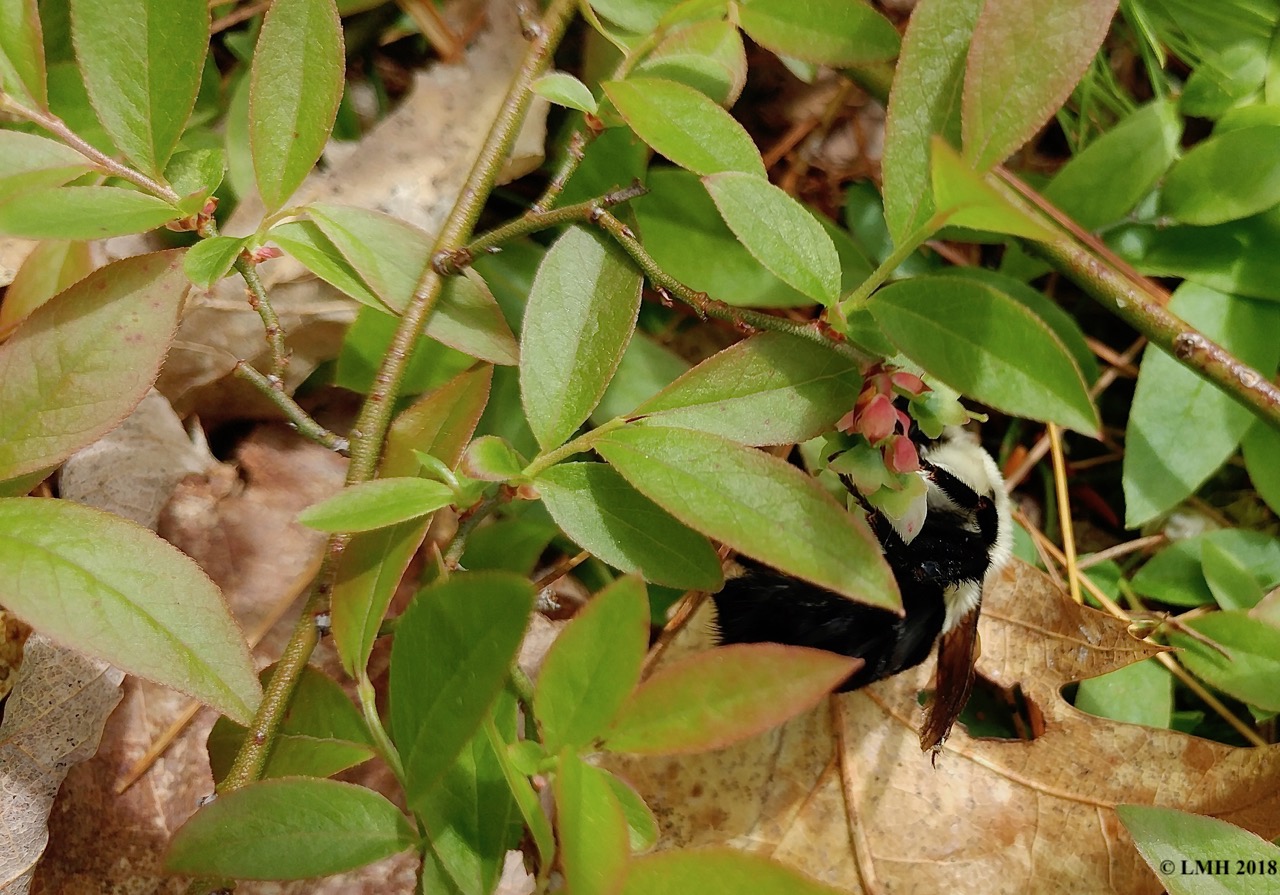
But . . . the day before the frost, as I walked along a local trail, something tiny captured my attention and as I bent down, I realized that despite the fact that the leaves of this Low-bush Blueberry had shut down their food production process and let the anthocyanin that had been stored in the leaves finally show through since chlorophyll was no longer a key factor, the plant was flowering.
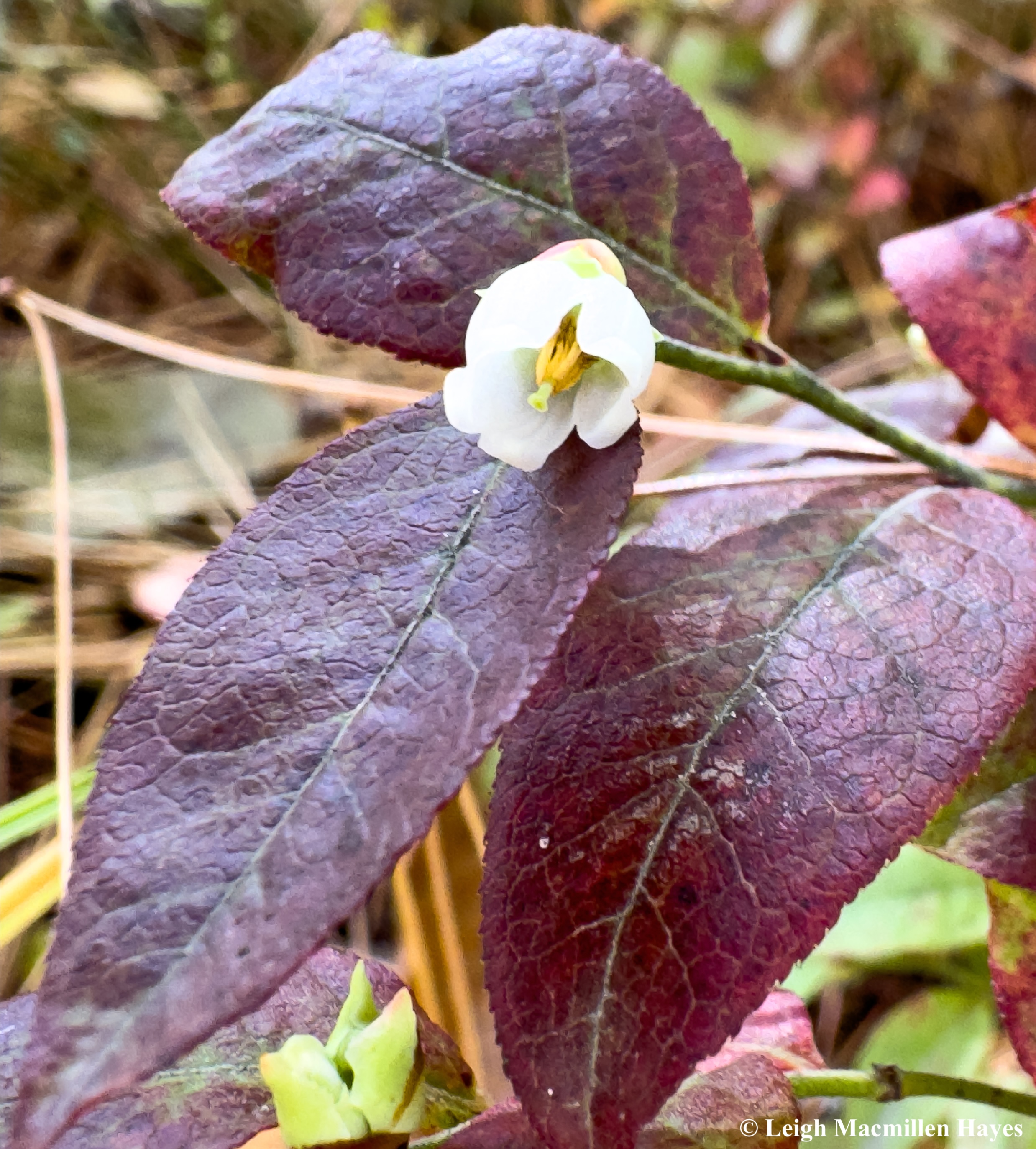
There were somewhere between a dozen and two flowers in bloom on this one plant. After seeing that, I checked others, but didn’t spot any more flowers.

Of course, I did what I always do when such an event occurs, and immediately sent the photos to my nephew who lives in southwestern New Hampshire. The past few years we’ve exchanged such photos when the out-of-the-ordinary occurs and last year it seems like we found a bunch of species in bloom at the wrong time. This was the first for both of us this year, and as he commented, probably because it’s been so dry. But still, it’s also been hot and the flowers seem to get confused–more than they used to, at least in our memories. How about for you?

And so today I stopped by St. Peter’s Episcopal Church in Bridgton, Maine, because I love the land that surrounds the building and wondered what it might have to offer. I actually stopped by twice–first in the late morning, and then again in the middle of the afternoon.

Seeing Hawkweed both in bloom and preparing to send seeds forth for future blooms wasn’t a surprise at all, for this flower is prolific and hardy.
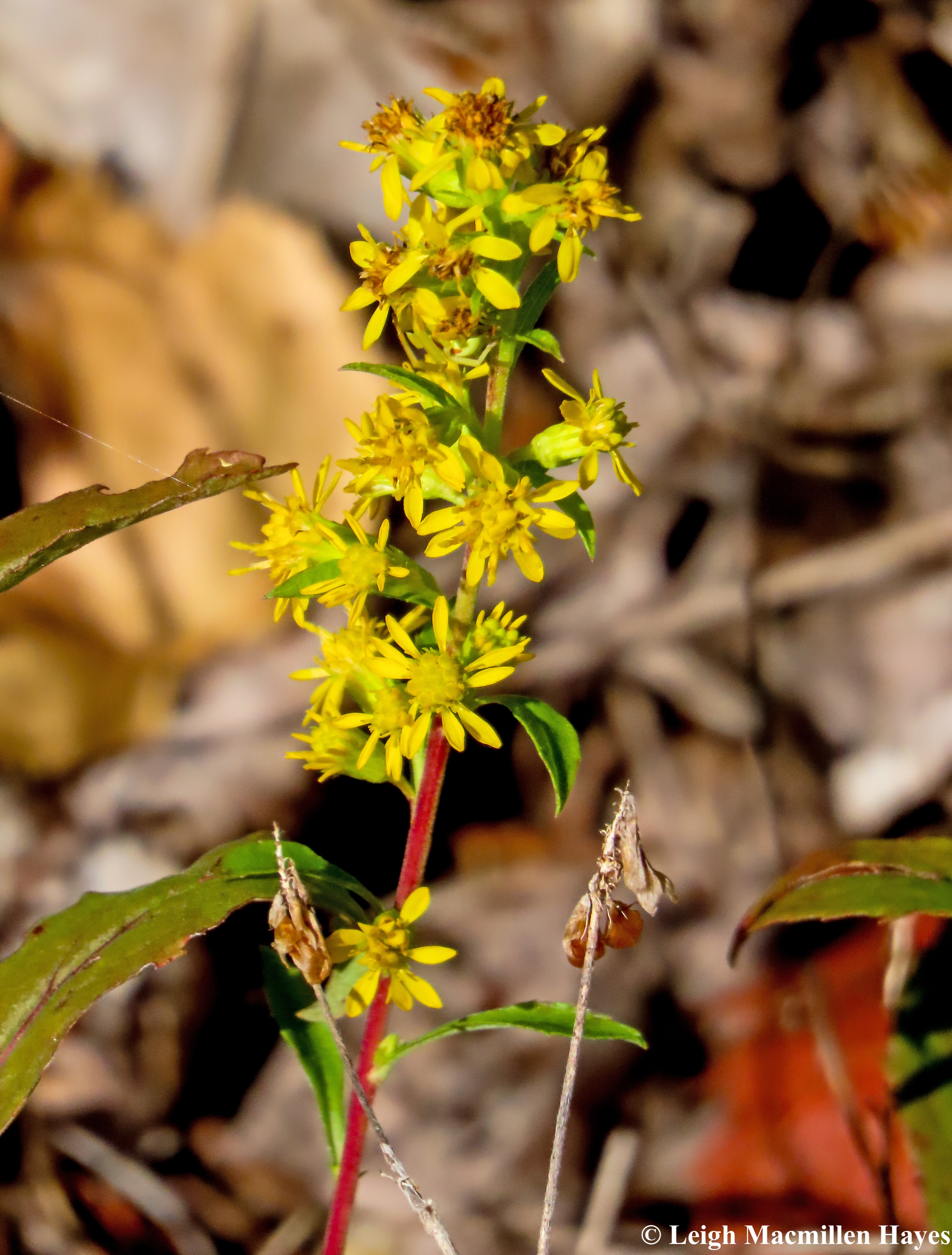
A few Goldenrods had also not yet achieved their gray-head status and instead served as beacons of light for any who were searching.

And the few Bumbleebees I saw gave thanks that there was still some food available.
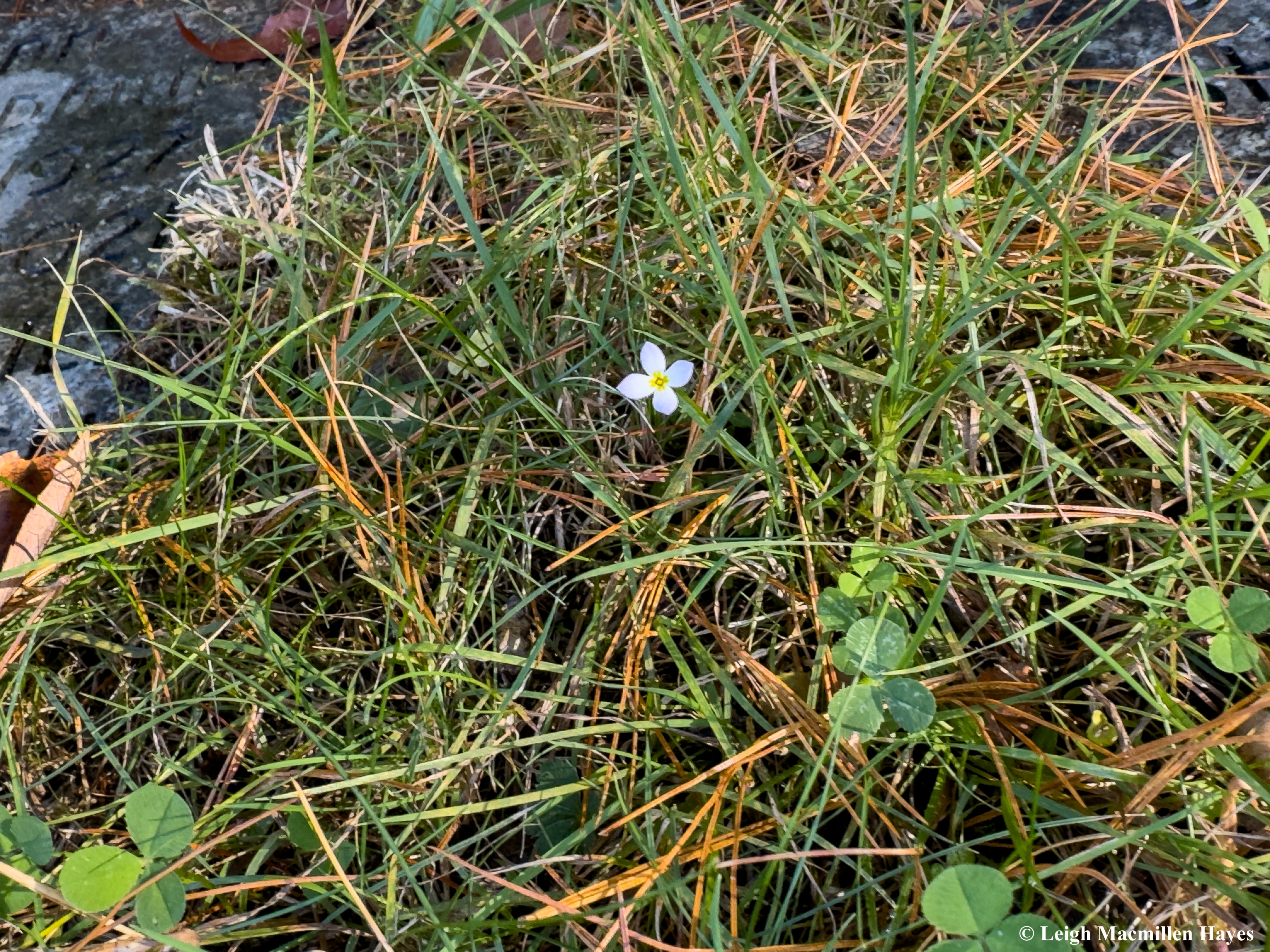
But then I spotted it . . . A single Bluet, aka Mayflower, one of our early bloomers that blossoms in May, showing off its perky little face between two grave markers in the church’s burial site.

I gave thanks for the Bluet, because it was located between two dear friends who died within months of each other, after a marriage of 71 years! To spend a few minutes wondering about the Bluet with them today was a blessing.

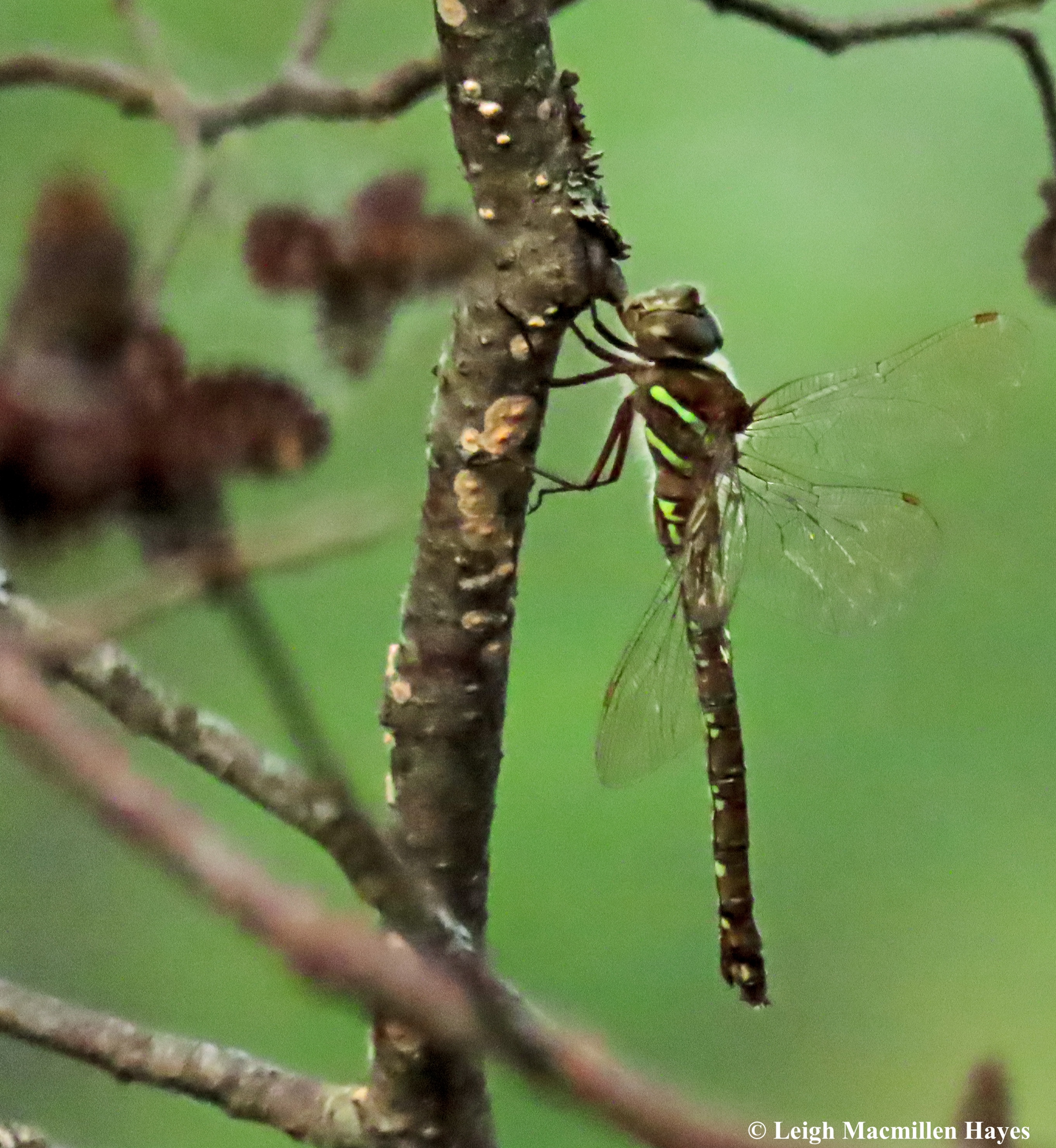
And no matter where I walked, be it the church lawn, woods, or parking lot, it seemed there were Autumn Meadowhawk Skimmer dragonflies, this being the male. If I moved, they moved a slight bit, but then landed nearby every time.
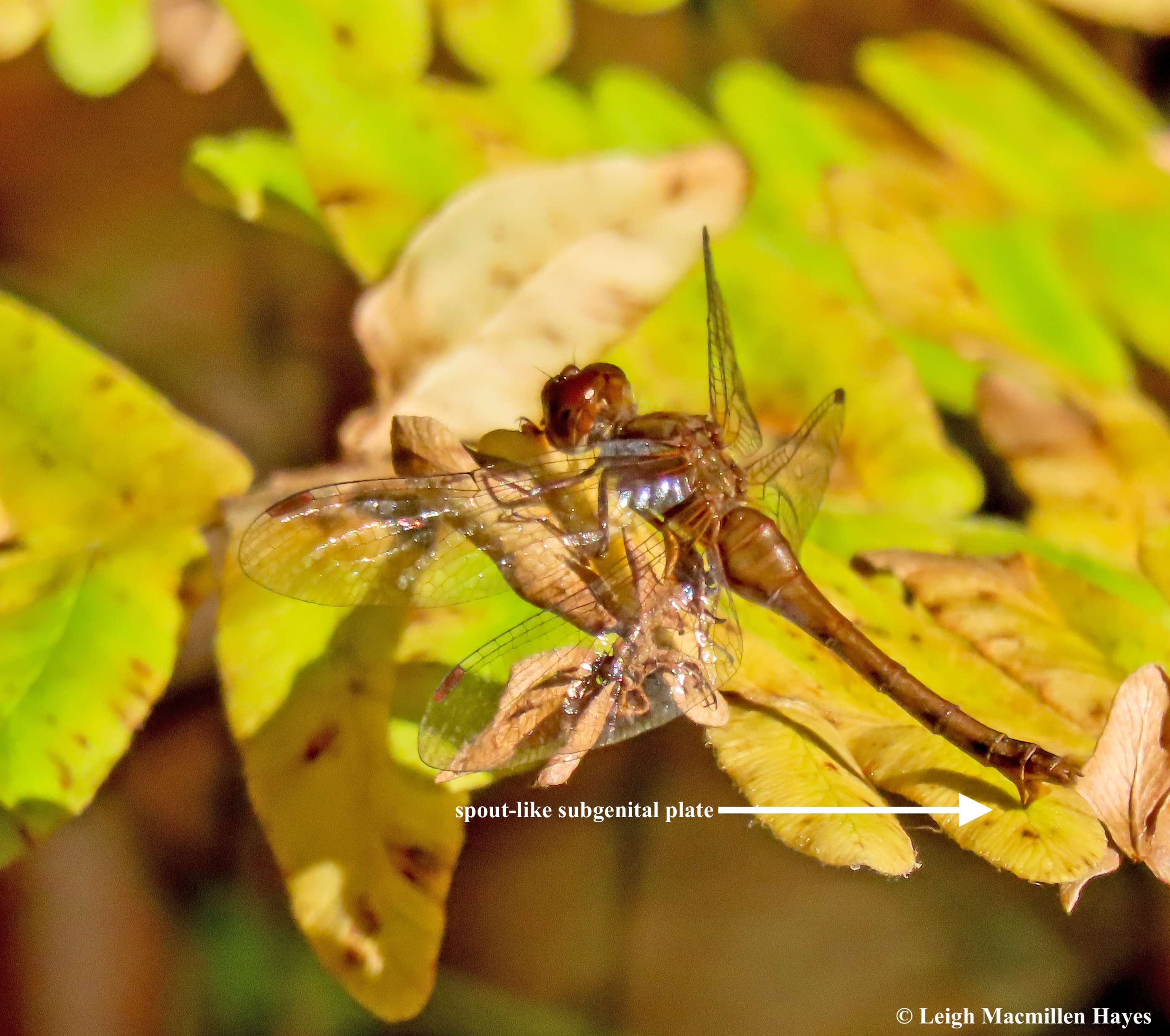
The females were also flying and landing everywhere I went. And I truly expected to find a pair canoodling, but they seemed more interested in landing near me than chasing each other for a date.

While female Autumn Meadowhawks are typically pale brown, as they mature, their abdomens may turn red like that of their male counterpart.
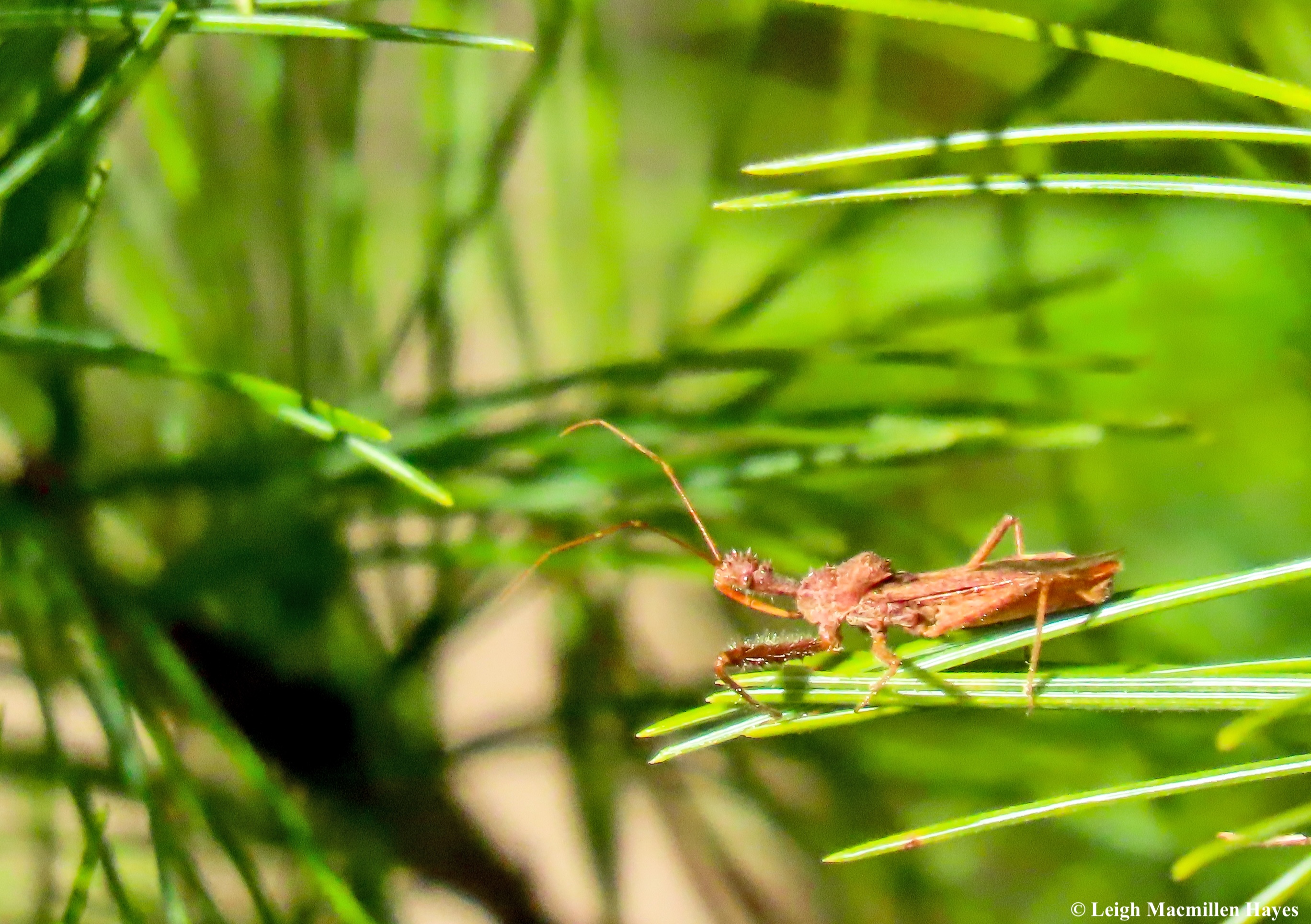
Of course, they all need to watch out for this guy. Or maybe he needs to watch out for them. The Spined Assassin Bug was on the move–the hunter or the hunted I don’t know, but it was just a fun find. And beside the church parking lot of all places. But then again, churches welcome all, especially those who are not perfect. Thank goodness!

As I continued to explore, I spotted one of my favorite fall finds dancing through the air rather like a little fairy, though some think of it as a snowflake, and just yesterday someone described these insects as bits of ash. All make sense to me.

I captured this one so I could take a closer look at those iridescent wings and the waxy fluff on the abdomen.
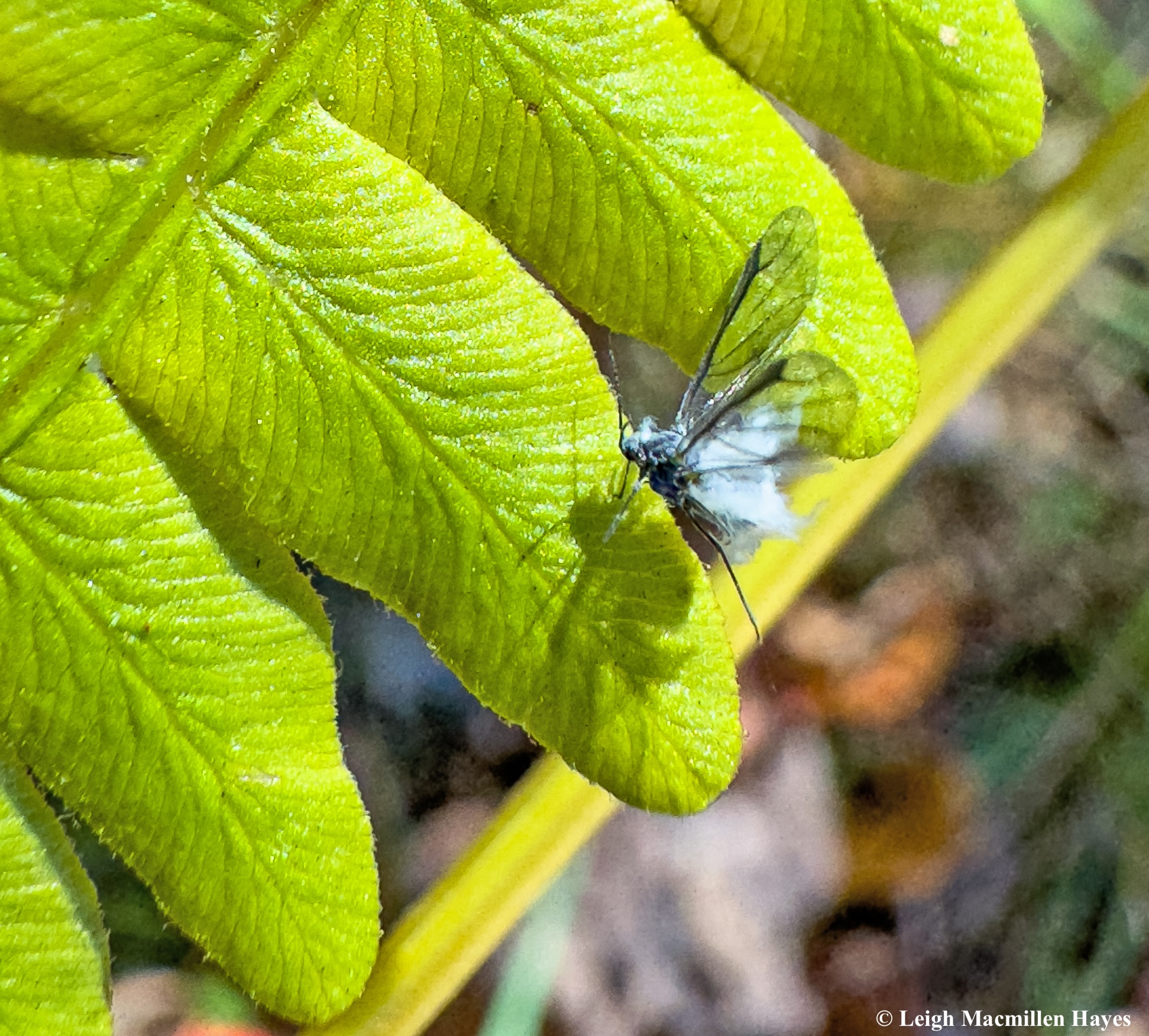
And then I released it onto a fern frond.

I invite you to notice the hint of blue as well.

This is the teeny, tiny Asian Woolly Hackberry Aphid, one who is searching for a sap source.
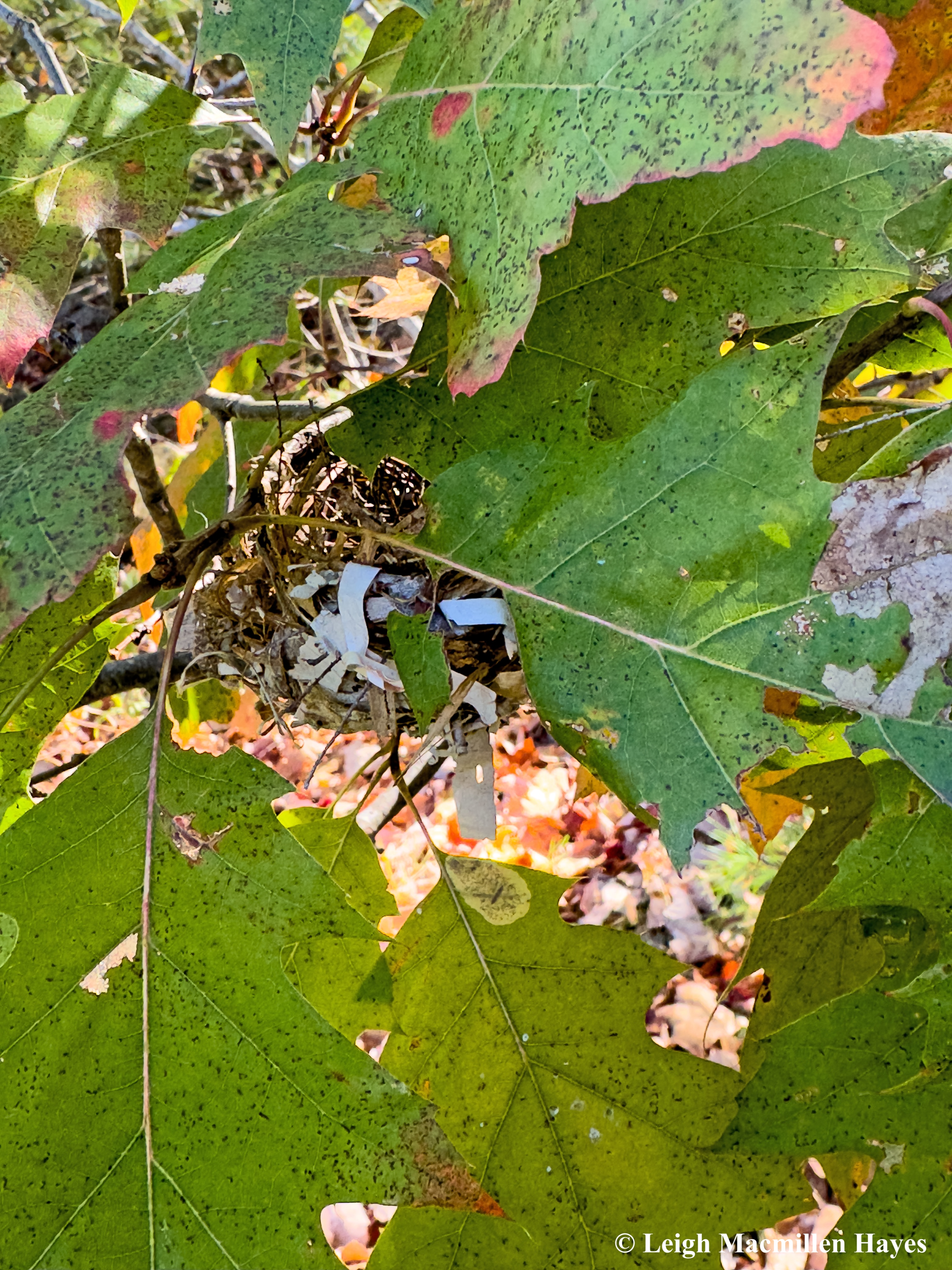
And then I came upon another surprise that I had forgotten. It was hiding below some leaves at about breast height.

A few of us first spotted this nest back in June when we accidentally approached it because we couldn’t see it hiding as it was below leaves, but Momma Red-eyed Vireo suddenly flew off. We apologized to her, took a quick photo of her eggs and promised her we would leave her be so she could raise her young in this place that we hoped provided safety. I never checked on her again.

But looking at the nest today, it appeared that she had a successful breeding season.
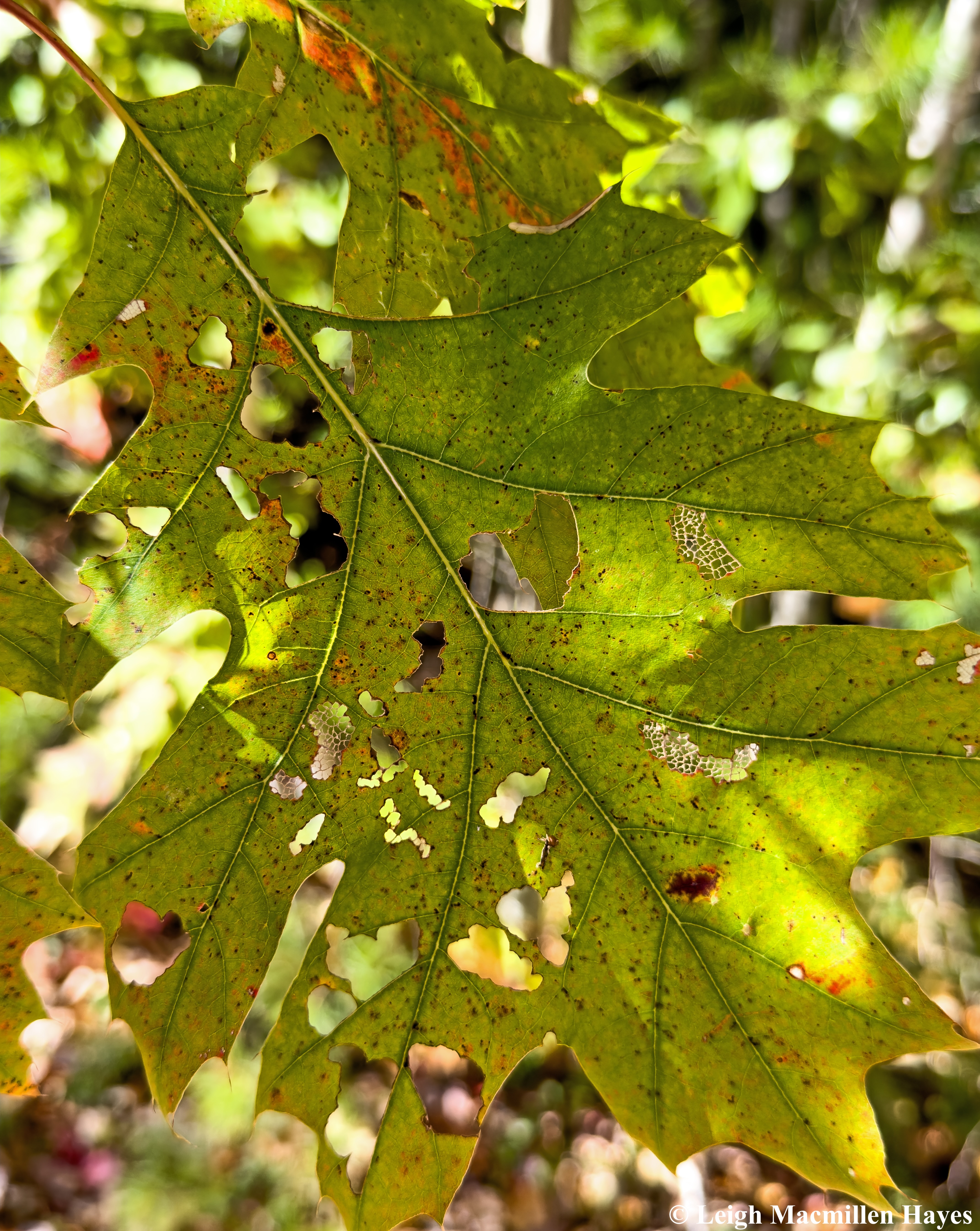
Looking at some Northern Red Oak leaves, like those that hid the nest, I was reminded of stained glass. Ours is a church that doesn’t have stained glass windows, but rather allows the outside world in. The ever-changing qualities of the natural world as seen through the windows serve as the scenes for us all to ponder each season.

And ours is a church with a group of people who wander out the door each week with others always welcome to join us as we wonder about all that surrounds us. We call ourselves Trail Snails, because slow is the manner of our movement.

And we have a mascot that was gifted to us by a couple from First Congregational in Bridgton, for they occasionally have joined our group to wander and wonder. T.S., short for Trail Snails, loves to pose along the way.
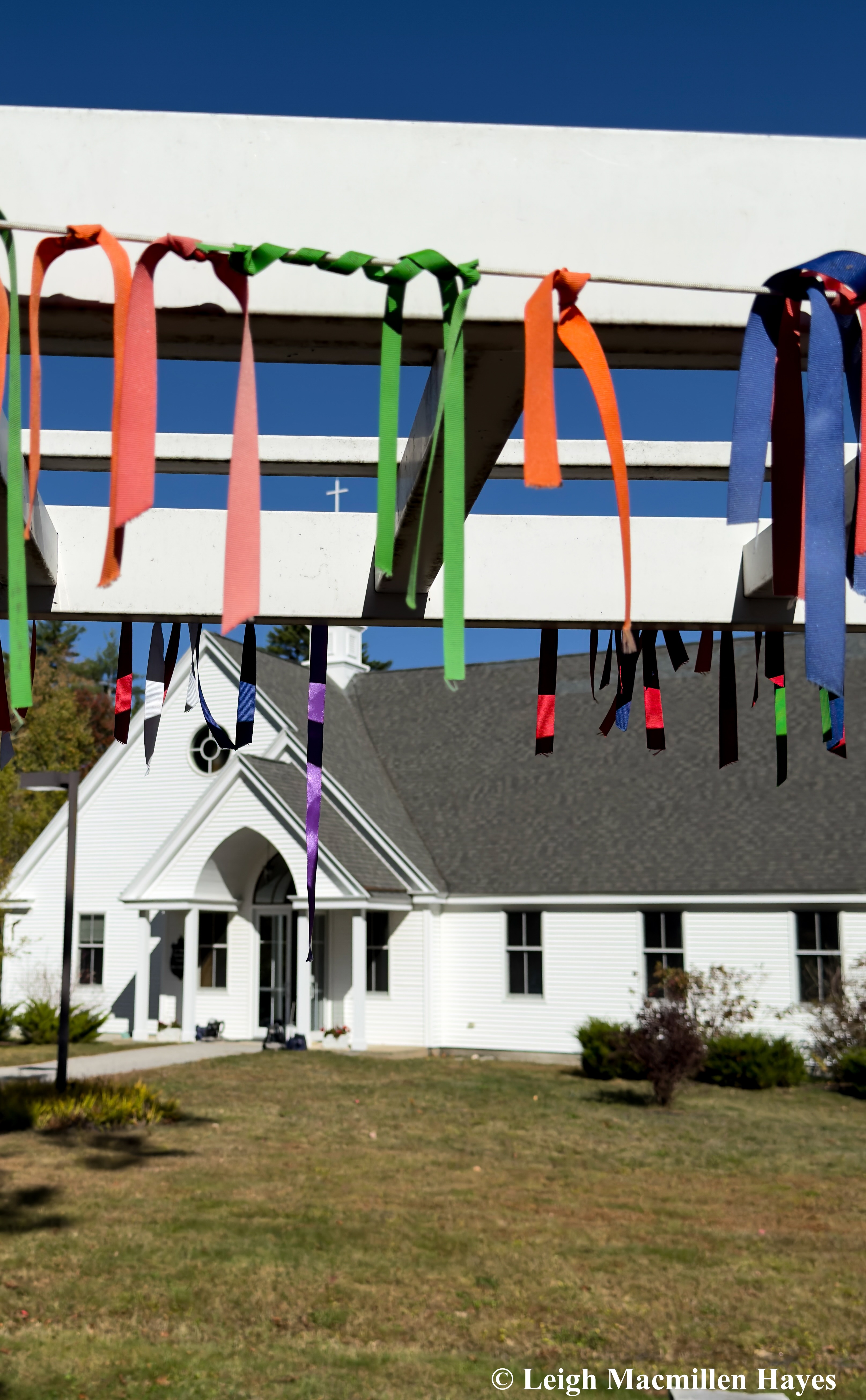
It’s also a church that knows the power of prayer and the ribbons tied onto the arbor actually represent specific prayers of parishioners and people we’ve only met for the first time.
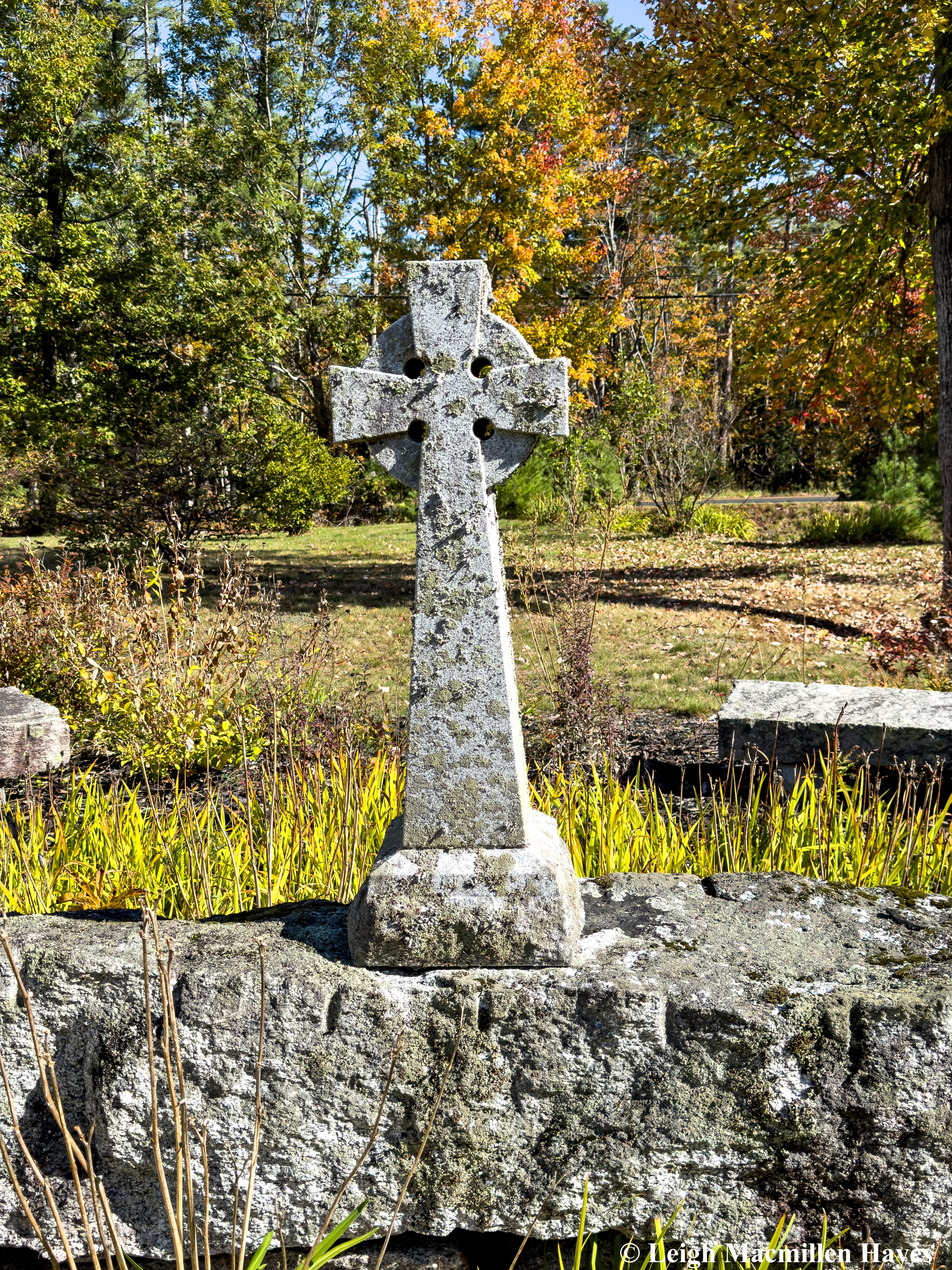
And there’s a beautiful Memorial Garden where all the flowers have now gone to sleep, but their leaves and seedheads offer different colors and textures in this season and anyone is welcome to sit in this space.

This all brings me around to my opening thoughts, for as I rounded the corner of the church building this morning, a shocking pink color on a bush mostly gone to fruit beckoned a closer look.

I wasn’t the only one peering in, for a Spotted Cucumber Beetle was making the rounds on the anthers within one of the flowerheads.

Blueberries, and Bluets, and even a Rose–a blooming surprise was each on this the eleventh day of October. Plus all the other wonder-filled finds.
Beyond the Edge

My life is rich on so many levels and people are a huge part of that, despite the fact that I’m a happy loner and a happy introvert at heart.

Just the other day, I wrote about the gift of a dragonfly specimen in Lessons in the Shadows.

And I actually saw a few Shadow Dragonflies on the wing this weekend, or pausing between defending territory, dining, and mating, or at least trying to do the latter.

But it’s other things that I noticed and want to share before I reveal today’s gift.

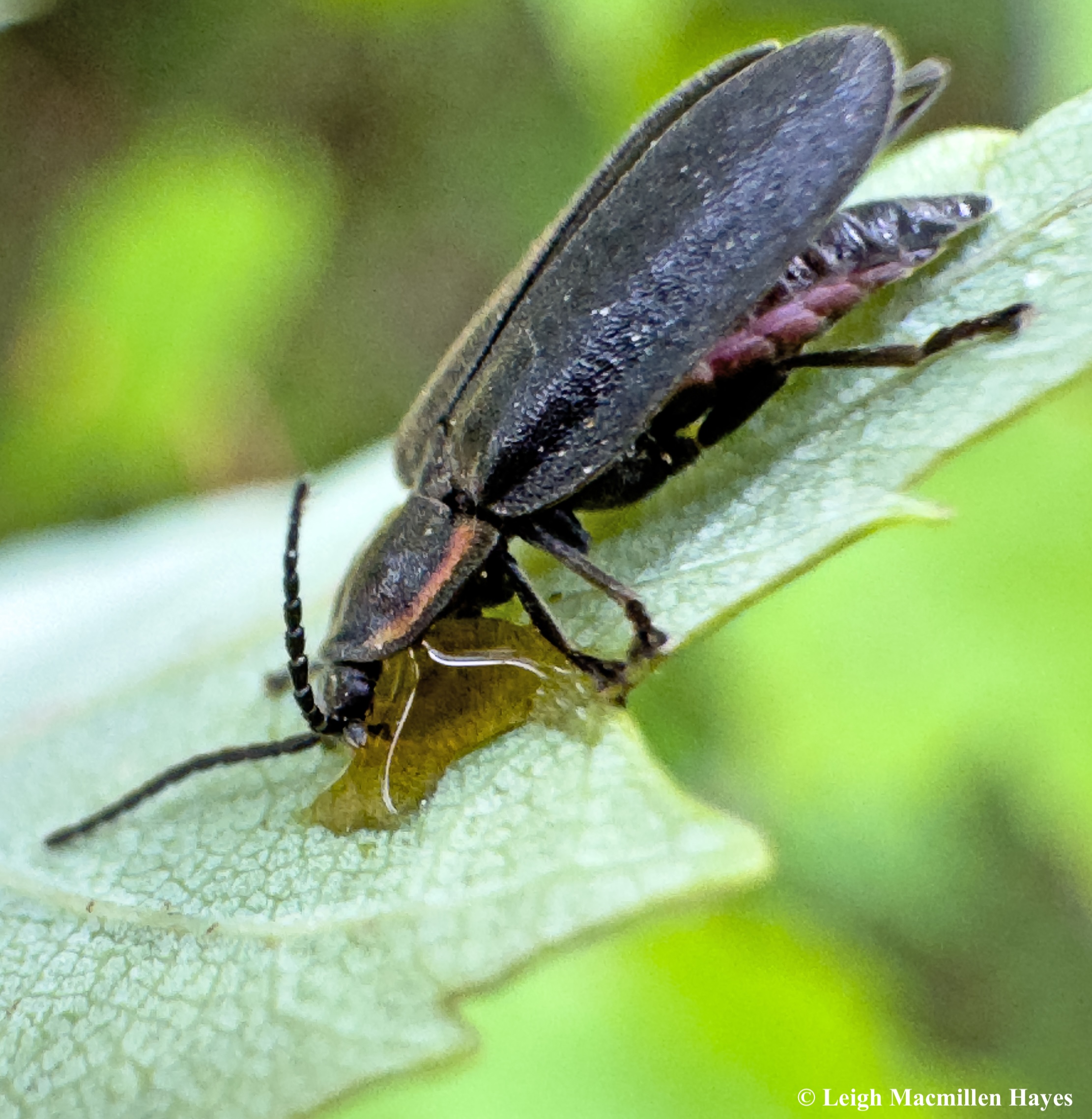
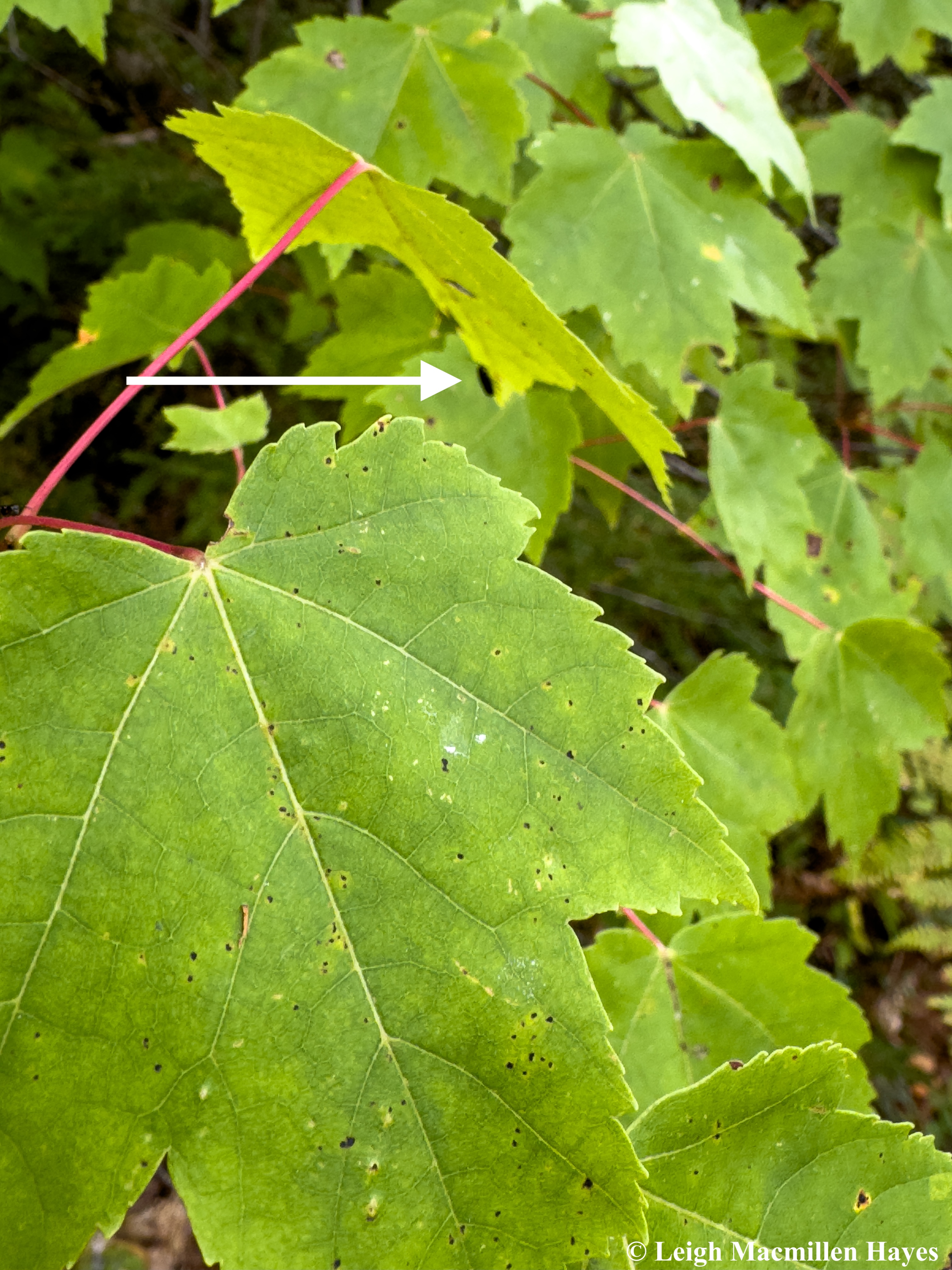
I do not know how I spotted this insect under a Red Maple leaf, but it was made known to me in the silence of a walk I took, and it too, was a gift.

The insect was a Winter Firefly, a species I love to find in the winter months, usually on or behind tree bark, the latter being bark that has pulled away from the trunk. Winter Fireflies in their adult form do not light up our evenings, but the fact that we can spot them in winter is special enough.

They also don’t disappear once summer arrives and lately it seems, I’ve been spying them regularly.

But it is what this insect was doing that turned out to be so spectacular. Remember, I spotted it on the much lighter in color underside of the leaf, and then turned the leaf over to take a closer look.

Much to my surprise, it was dining. I’ve never really thought about them dining before, but of course, they must. And do. Like my Ambush Bugs, and yes, you’ll meet a few more of them later in this post because I can’t resist taking their photos, Winter Fireflies use their mandibles to pierce into a prey species, inject it with chemicals to paralyze it, and then add enzymes to the mix to turn the other insect’s tissues into a smoothie.

Right before my eyes, the Firefly drank its meal! Despite the fact that I was in its personal space. For moments on end.

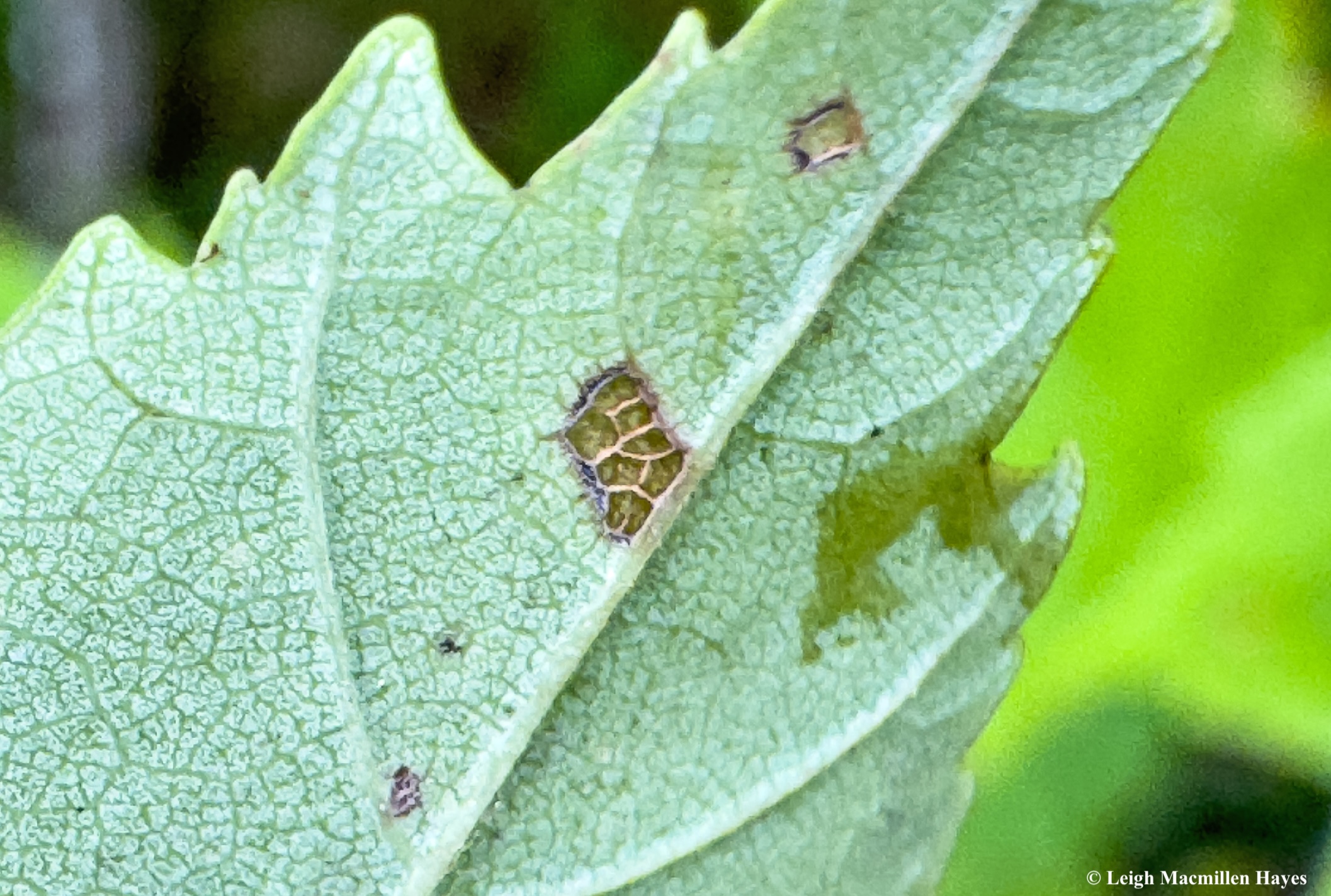
And when it had finished, there was only a remnant of the liquid form left and the Firefly moved on. But the other thing of note on this leaf is how another insect had chewed bits of the bottom layer of the leaf, leaving a skeleton of veins that provided a window to the next layer. I’m always trying to show people this by pulling leaves apart, and often meet with little success, but this leaf showed me that it is possible.

And then, because I was suddenly focusing on leaves, I began to notice a variety of structures that were not leaflike.

Oak Galls. In the Summer 2025 issue of Northern Woodland magazine, Michael J. Caduto wrote the following: “Oak galls are tumorlike growths caused by small wasps . . . Oak galls make up about 80% of the roughly 700 different kinds of plant galls formed by insects in the USA, and most of Canada and Mexico . . . During the spring, adults lay eggs in the tissues of leaves or twigs and at the same time inject substances that induce the surrounding plant tissue to grow in a particular manner and at an accelerated pace.”

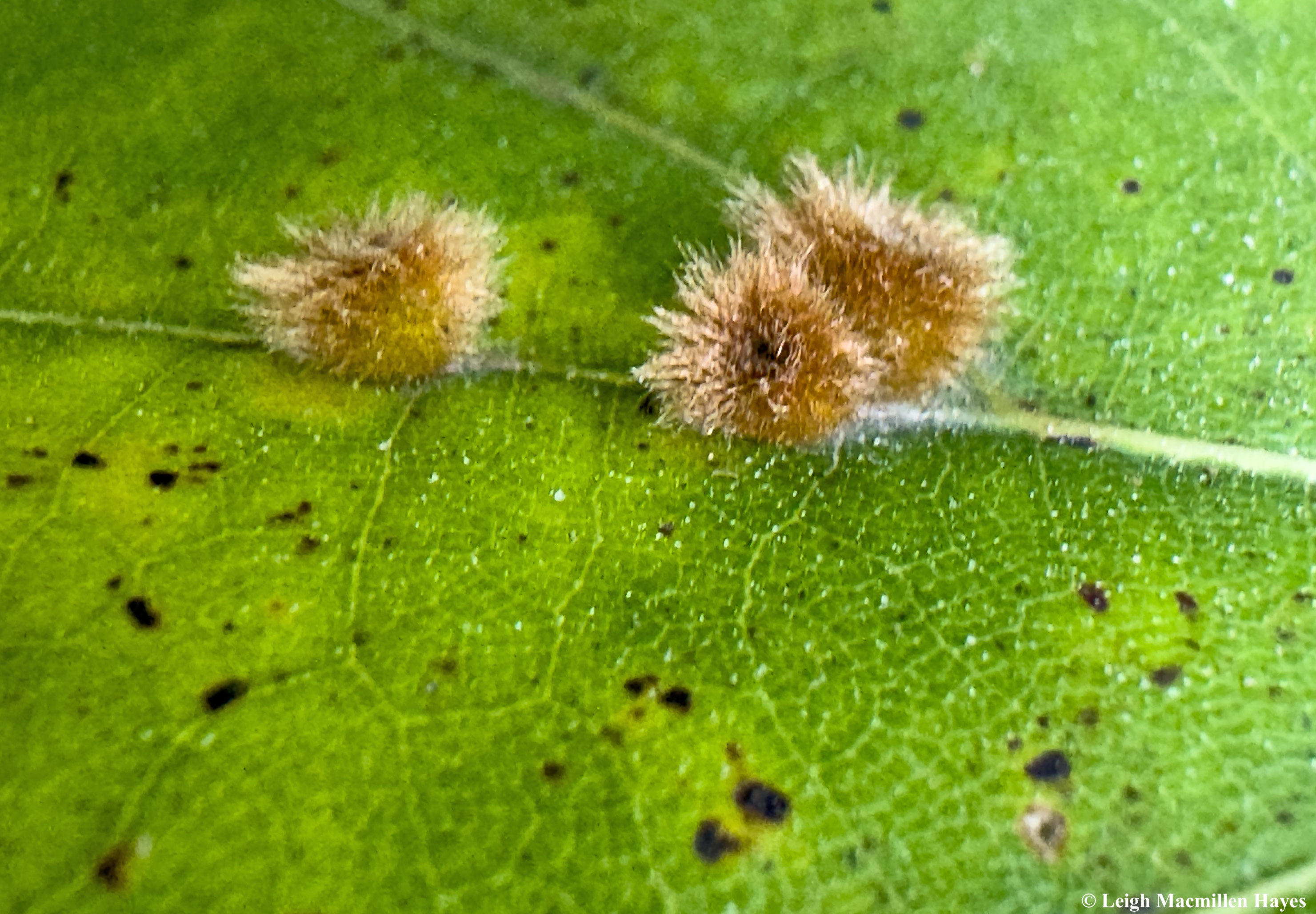
Above are pictured some woolly oak galls that result from the growth of tiny hairs on the leaves.

Gall tissues protect the wee wasp or midge larvae that develop inside, and they also provide food. As the young grow, the galls increase in size due to something in the insects saliva that imitates the plants growth hormone. Nature is amazing.

Those photographed above are caused by Oak Leaf Gall Midges. They are cosmetic and won’t harm the tree. After all, the leaves fall off in the autumn anyway, and until then they have done their duty of feeding the tree despite being laden with galls.

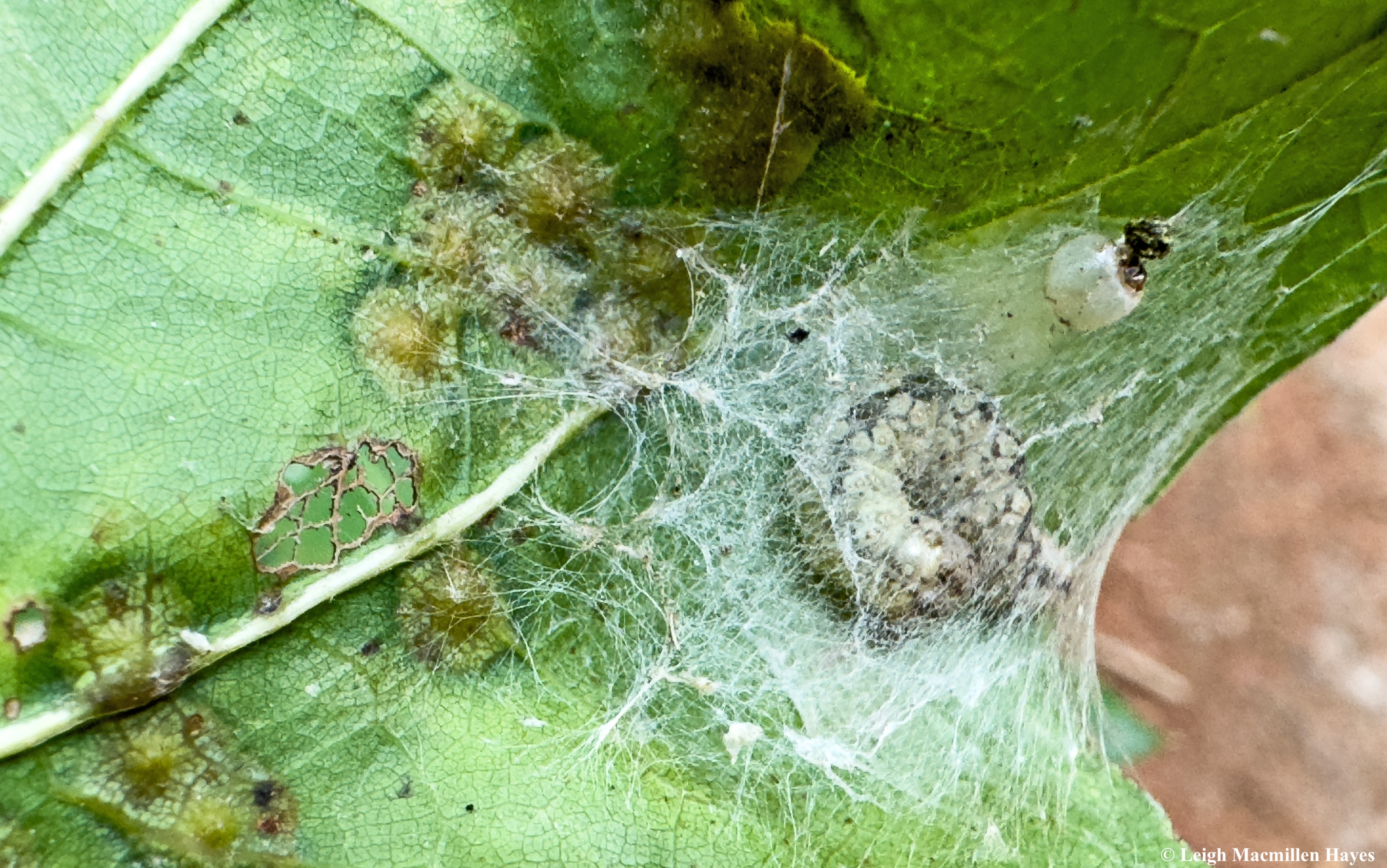
When I turned the same leaf over to look at the underside of the galls, I found a caterpillar who was ready to pupate and possibly the egg of another insect. So much going on in such a short time, given that in the north woods our leaves are only on the trees from mid-May through October or maybe a wee bit beyond for the most part.

Upon the underside of another leaf, I found Oak Leaf Seed Galls. They were quite small, and it looked like the initial gall was a dried papery structure within which were clusters of smaller galls.

And then I found one of my favorites, the Oak Apple Gall. I’ve written about this before following a visit to Trinity College in Dublin, Ireland. There, My Guy and I took the self-guided tour of the 18th century Old Library and viewed that most ancient of manuscripts–the Book of Kells, a 9th century book featuring a richly decorated copy of the four Gospels of the life of Jesus Christ. A favorite discovery: the monks used Oak Apple Galls to create ink–apparently, they crushed the galls and soaked them in rainwater, wine or beer until they softened.

What was cool about the one pictured above, was that the adult wasp had chewed its way out and I could see the fiber-like structure, those threads radiating from the center, that had supported its pupating form. Perhaps to keep other insects from parasitizing it.

And lest you think galls only occur on leaves, here are some on twigs, these being created by the Banded Bullet Gall Wasp.

And then without meaning to, but because the path I followed offered some Asters in bloom, I began to meet my old friends, the Ambush Bugs, this one being a male.

And on another, a female.

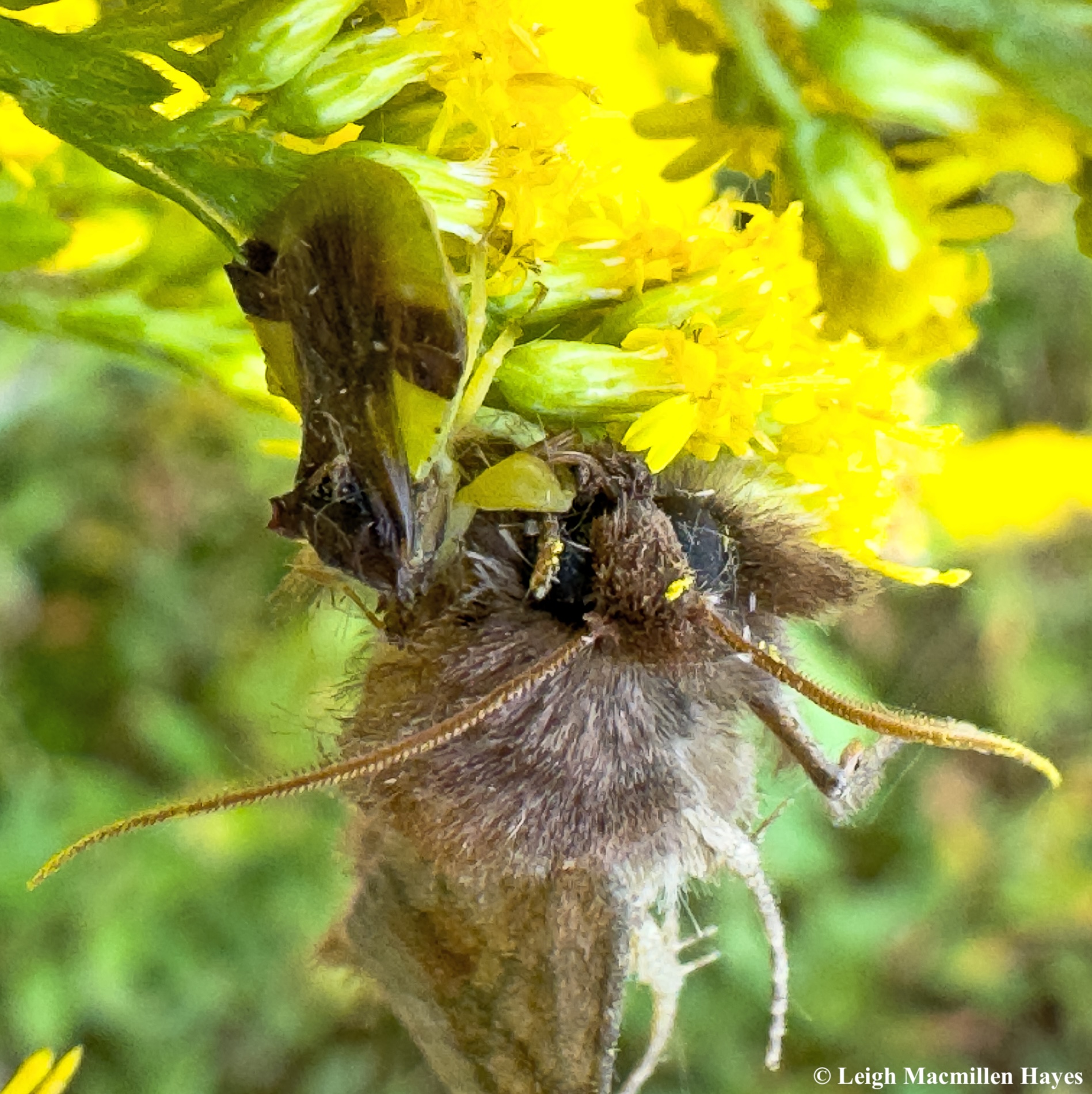
Wherever Ambush Bugs are, I look for their feeding sites, made visible by insects dangling in unsuspecting manners like this moth.

And tada, there she was having a go at a major meal.

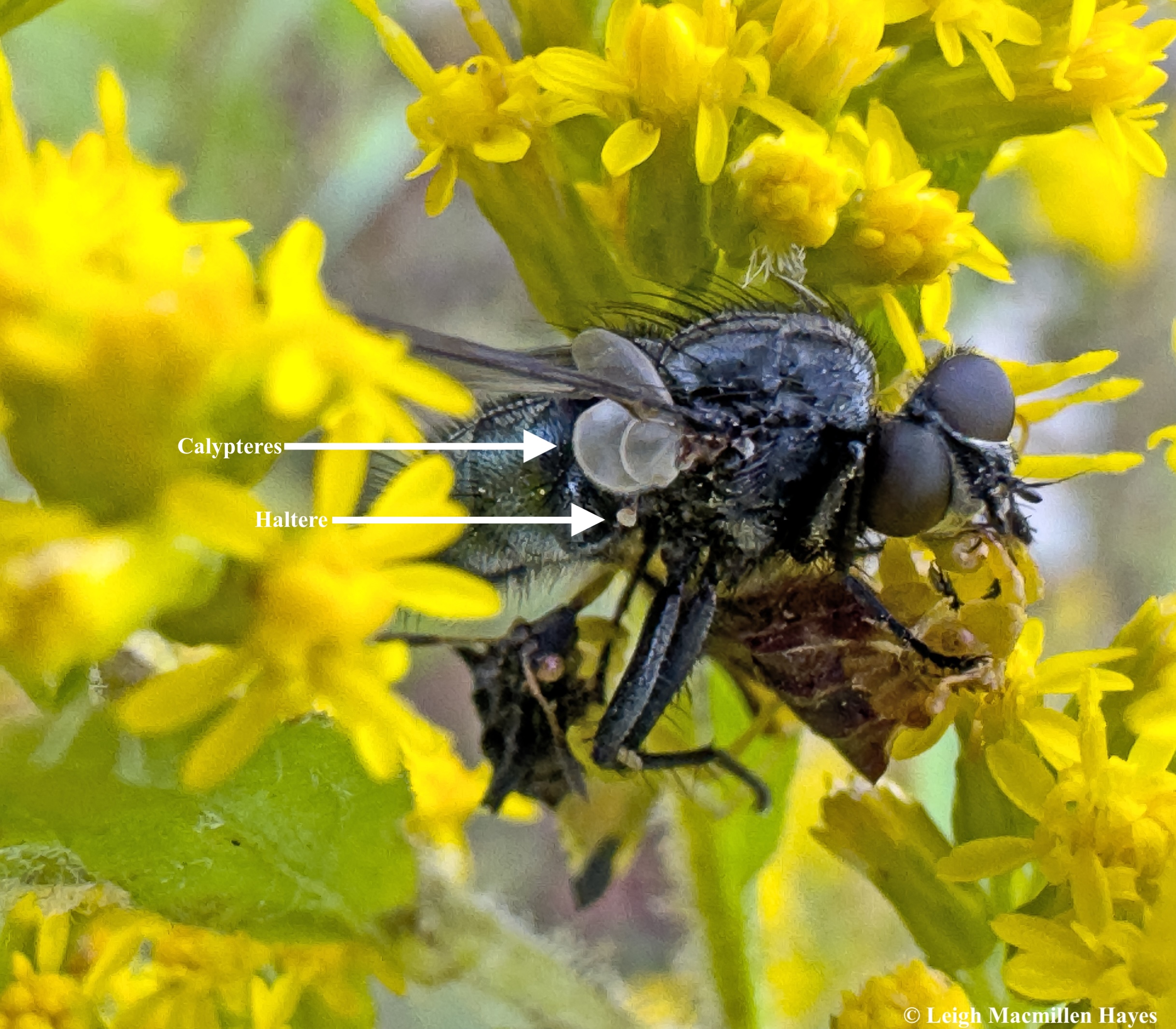
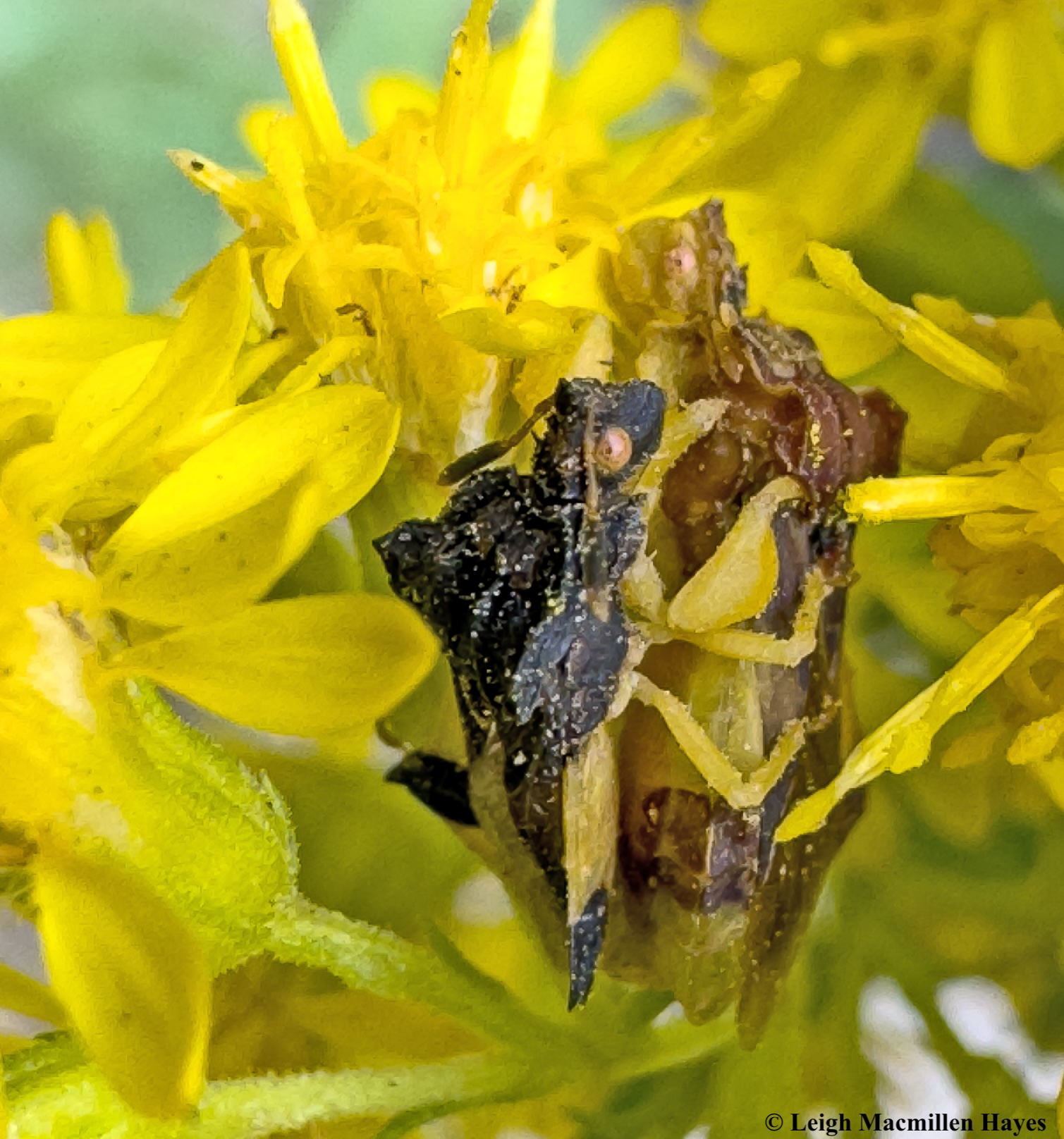
And sometimes those meals teach me other things, such as this fly that was being dined upon by both a male and female Ambush Bug. But more importantly, I captured the fleshy white structures on the fly. Those are calypteres! The calypteres are small membranous flaps or lobes that are located at the base of the wing in some species of fly. Flies often have two calypteres (commonly called the upper and lower calypteres) on either side of their bodies. And they cover the halteres, the little knobs that take the place of hind wings. You can see the little knob or haltere sticking out a tiny bit below the bottom-most calypter. Sooo cool. A new learning for me.

And then trying to hide within the Goldenrod blooms elsewhere, a canoodling pair.

Upon another plant that had gone to seed, a Dusky Stink Bug lurked, one of the smallest of the stink bug species.

In another spot, something else caught my eye. Yes, it’s bug related. This is the egg mass of Tent Caterpillars. There might be up to 400 eggs encircling the twig on this Cherry tree. The mass is shellacked with a substance that will protect it throughout the winter, thus the reason for its sheen.

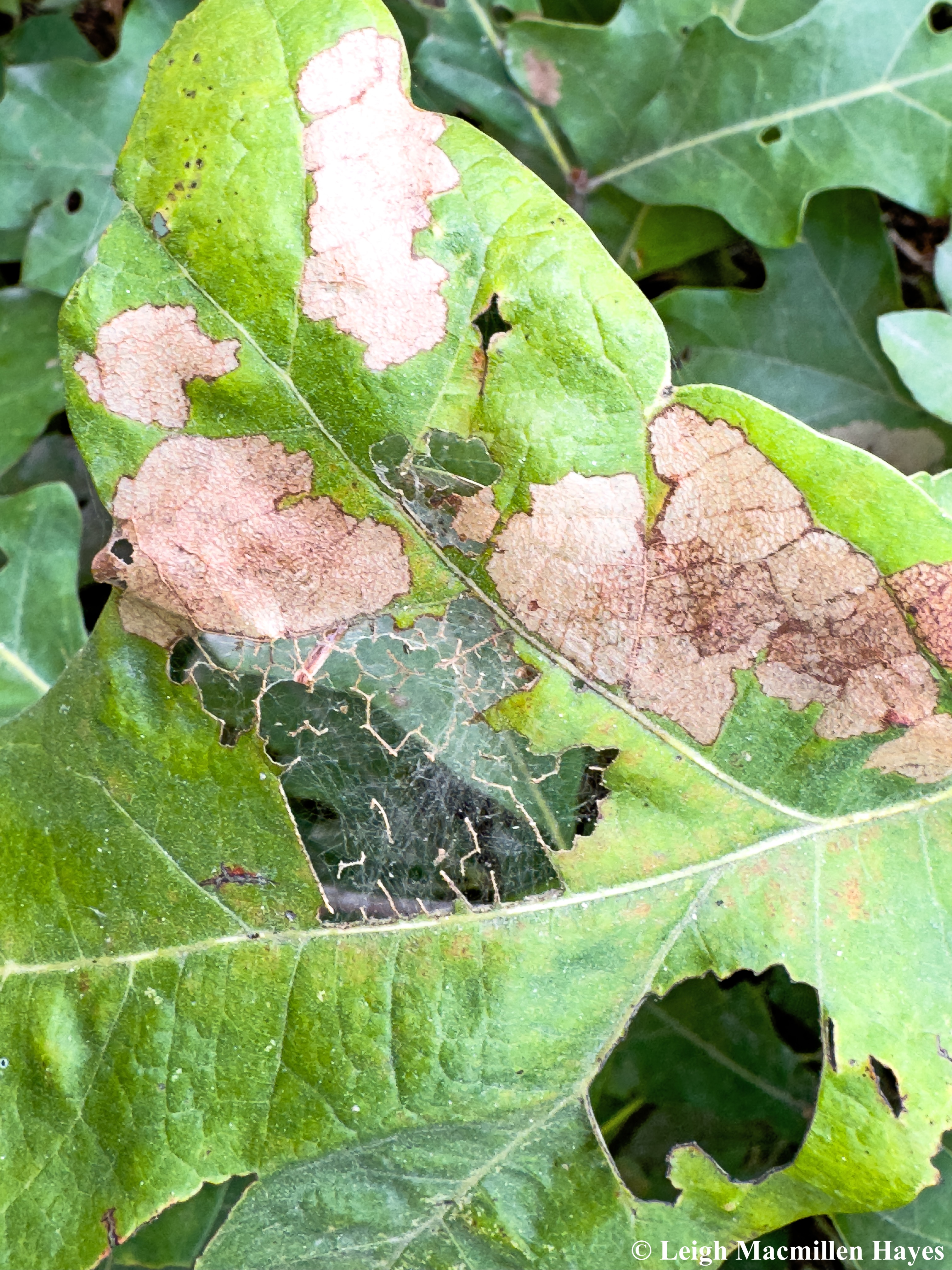
Because I’d been looking so closely at insects or insect structures, it struck me as interesting the various ways different insects dine upon a given leaf, from those who eat all of the cells and veins, to those who leave most of the veins as they skeletonize the leaf, to those who mine between the upper and lower leaf surfaces. All of this on one leaf. And still it was green and had done its food factory work for the tree.

I was almost back to my starting point when I noticed new leaf growth on some trees, which given that its September surprised me. But these days, nothing should surprise us.

Until something does. For right there on the same tree an anomaly caught my eye. Do you see what I saw? Yes, lots of munching. And yes, lots of new and older leaves. But take a look at the buds. One bud is not like the rest in the crown.

Because it wasn’t a bud. Hiding in that spot was an insect I am only familiar with in its larval aquatic form. It’s a cool one for it builds its own home depending upon its species, some using hemlock needles and maple flowers, others specks of sand, and still others plant or tree material, while some are net spinning and others free-living.

What I’d had the good fortune to spot was a mature Northern Caddisfly. As adults, they don’t have mouthparts, their only job being to mate. Adults don’t live more than a month, and I felt honored to have spotted this one. And Caddisflies are indicators of clean water. I was truly honored to spot this insect.

In the same way, I was equally honored to receive this gift of music created around words I’d written in a blog post in 2018, entitled From the Ground Up, where I’d offered the history of St. Peter’s Episcopal Church where I am a parishioner and then focused on all of the other species who had gathered on the ten-acre lot.

Thank you, Richard Michael Joseph, composer, musician, tenor, and chair caner, for taking my words and writing music to embrace them. Beyond the Edge indeed. Thank you also Richard, for your part in making my life so rich.

Step into the woods beyond the edge, and know that life carries on in the most incredible ways, we just have to be open to receiving them.

Lake Living Magazine: fall/winter 2019

For the past few years, we’ve either produced a limited winter issue or no issue at all of Lake Living magazine because those who purchase ads have been wary about spending money during those lean months. And it’s ads that support this free magazine. Everyone wants to be written about, but . . .
After some back and forth discussion with editor/publisher Laurie LaMountain, we decided to produce a fall/winter issue that would encompass the usual “at home” features of the fall magazine, but also include the book reviews written by the Pam and Justin Ward, plus their employees, Sue and Perri, of Bridgton Books, that typically appear in the winter issue.

Tada. Click on the link above and you can view the magazine in its entirety.

Laurie tackled four topics, while I worked on three ideas. Hers include “The Big Idea” about a Maine inventor, “Maine Dwelling” about a guy who flips houses locally, and “A Good Keeper” about winter squashes.

Her most interesting article, however, is one that everyone should read–whether you are a male or female. Don’t let the theme of it scare you. Entitled “Fierce Girls,” and yes that is Laurie in the photo, it’s about WOMEN. And more specifically . . . men-o-pause. When she proposed it, I was curious but not certain it would work. You have to read it.

My articles all ended up with a Lovell theme–probably because I spent most of the summer in Lovell and it was always on my mind.

The first is entitled “Resurrecting the Past,” about the Harriman Barn that Robin Taylor-Chiarello (board member of the National Council on White House History and associate member of the American Institute of Architects) lovingly restored with the help of Timberframer J. Scott Campbell of Maine Mountain Post and Beam in Fryeburg and Builder Bryce Thurston of Lovell.

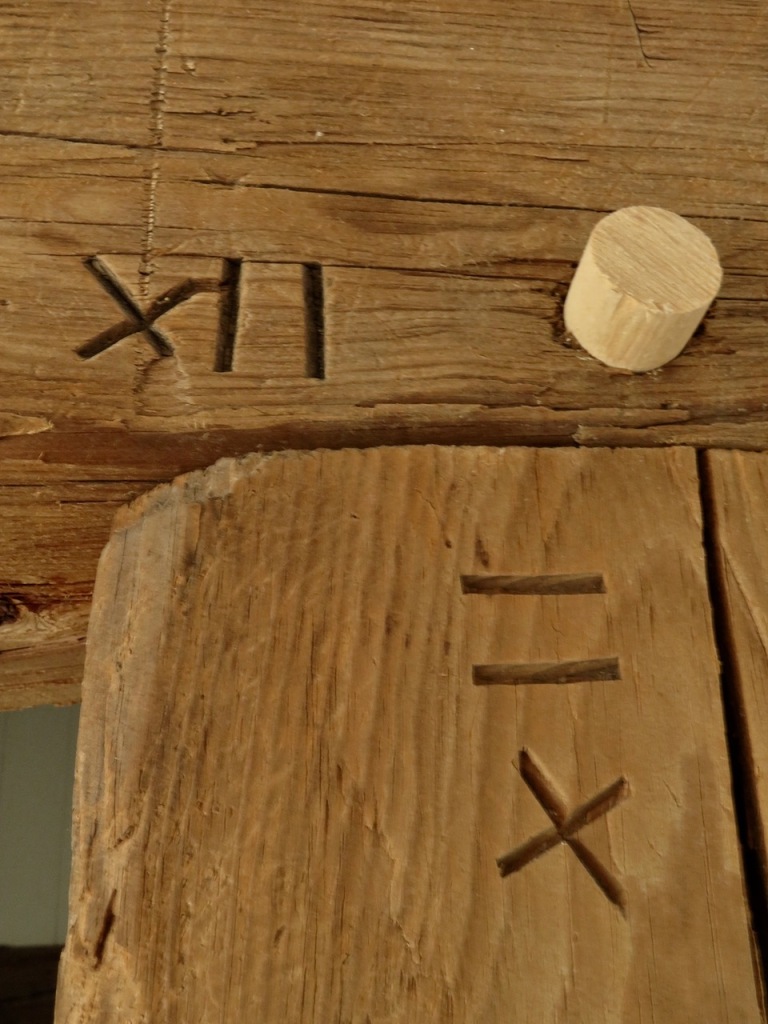
The marriage marks above were chiseled into the beams when the barn was built in the early 1800s. Scott used his own system as he pulled the timber frame down, and then reassembled it on a different site a couple of years later, but the early marks are still visible.

My second article is about two couples who chose to move north rather than south in retirement. Rather than snowbirds, as we fondly refer to those who spend six months in warmer climes, they are birdsofsnow. Okay, so I made that term up, but really, it does describe them.

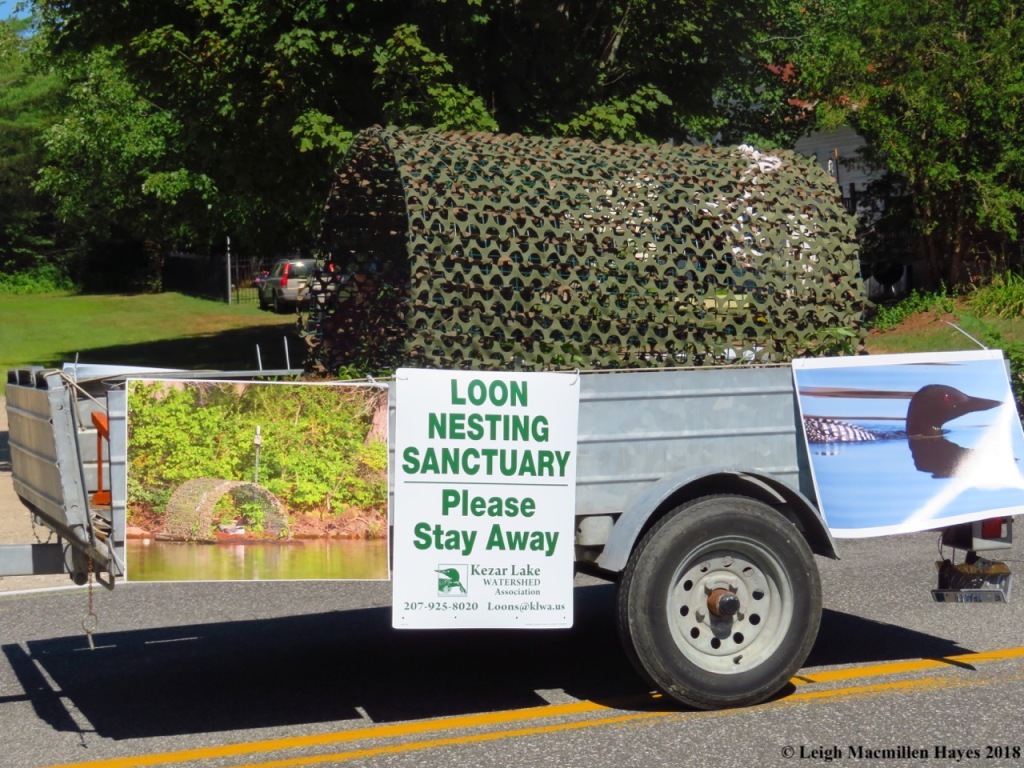
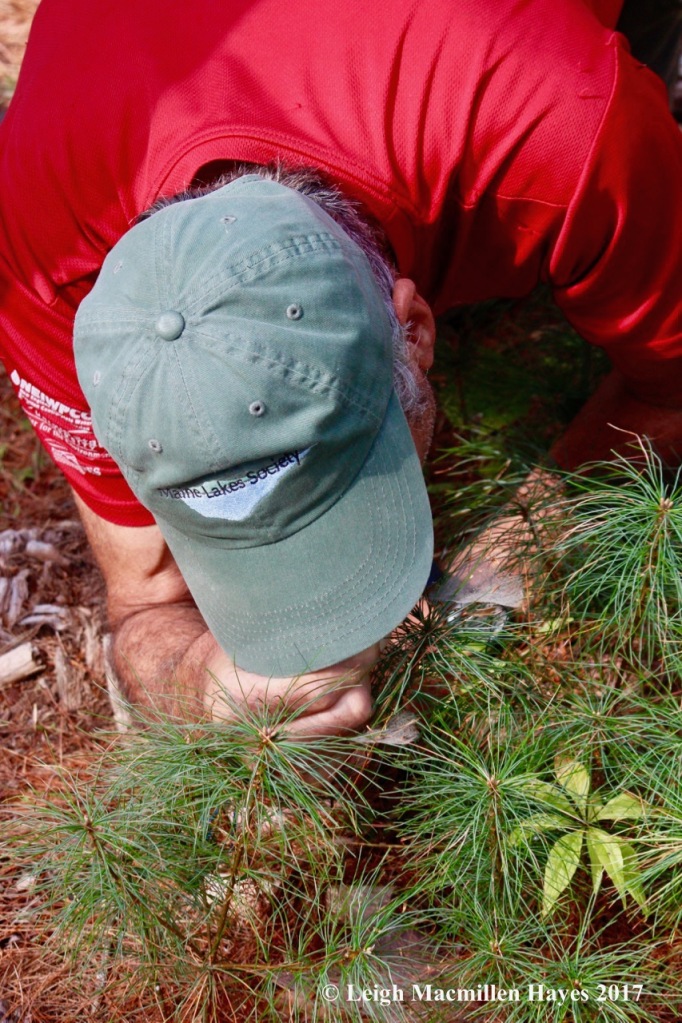
In their retirement, they’ve discovered ways to get involved in their communities and that has made all the difference. Heinrich Wurm fills his days with environmental activities, especially as related to Kezar Lake Watershed Association or Greater Lovell Land Trust. Here, he’s studying a spider web. And that’s only part of his local involvement.

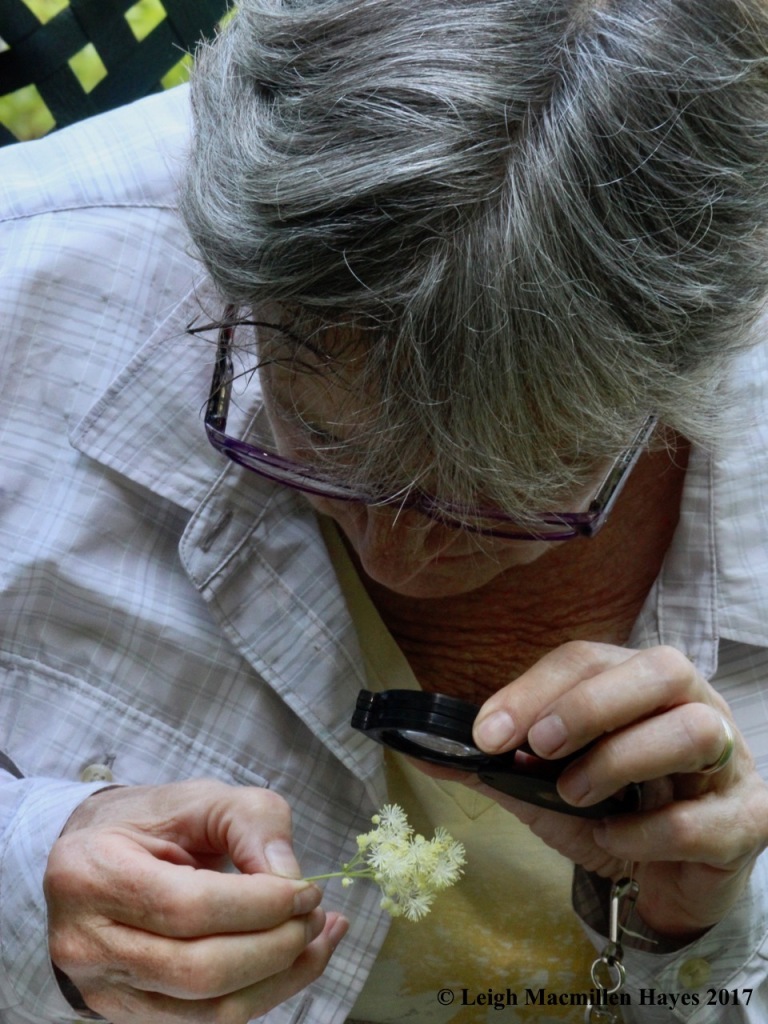
Linda, Heinrich’s wife, is a docent with Greater Lovell Land Trust, where she also enjoys looking at the finer details of the natural world.

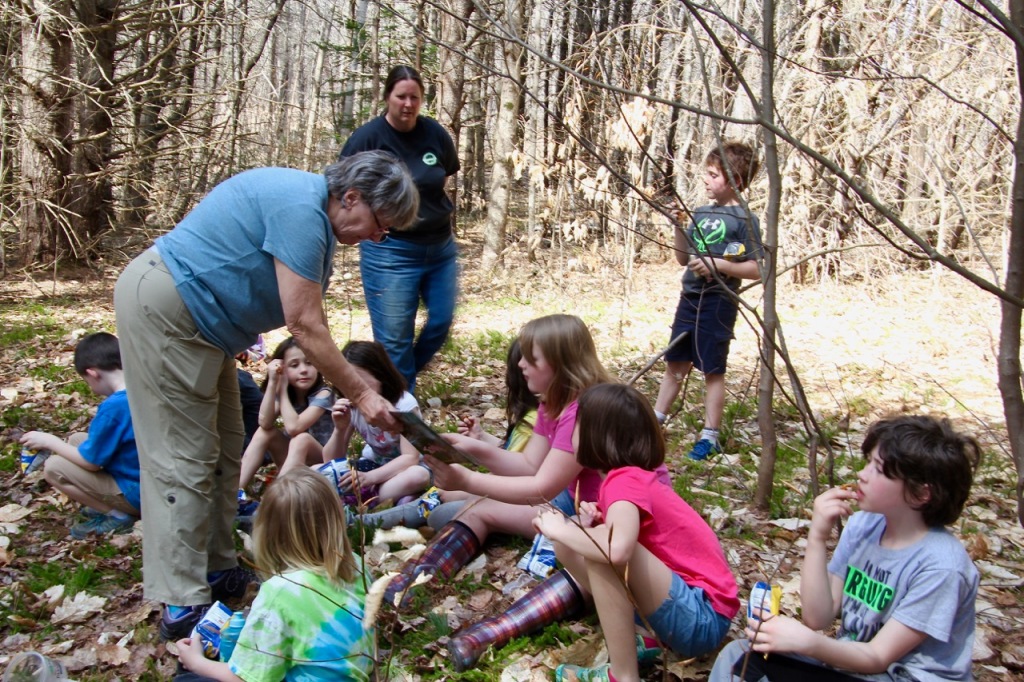
But one of her main fortes is sharing those details with youth, whether they be her own grandchildren, or kids involved in GLLT-sponsored events, like those in the after-school Trailblazers.

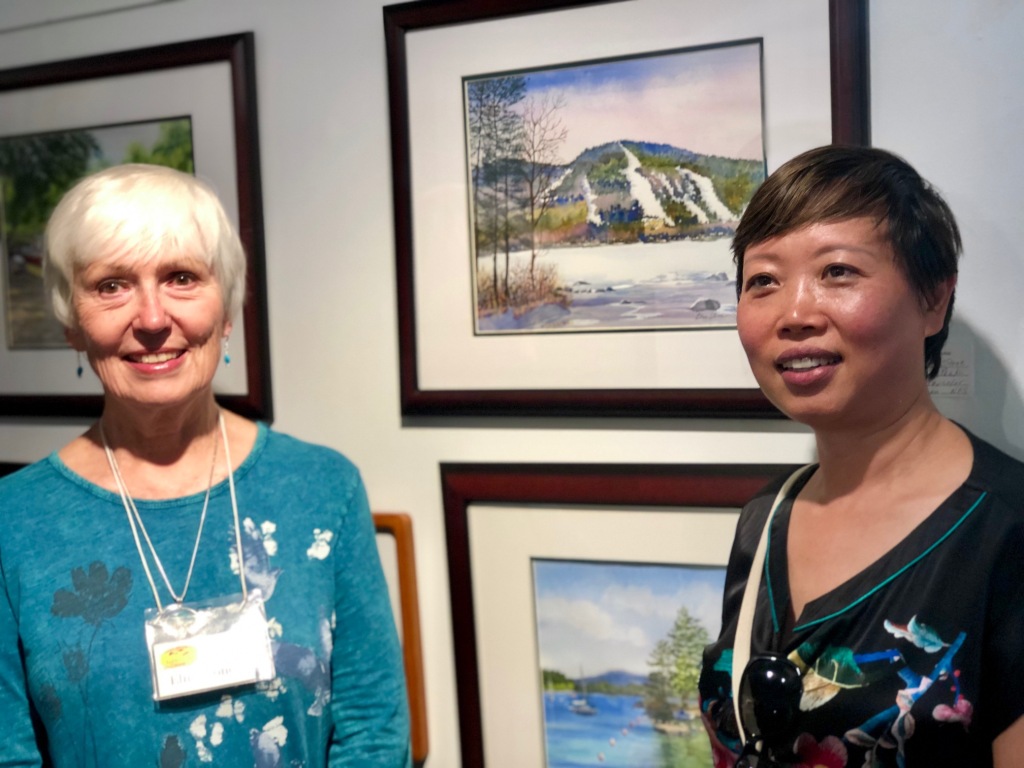
For Elna Stone, retirement gave her an opportunity to pursue her artistic talent and painting local landscapes has consumed much of her time. On the left, she poses beside a painting of Shawnee Peak Ski Area at Pleasant Mountain that she donated to a fundraiser for Gallery 302 in Bridgton. For years, Elna created calendars of local scenes that were sold as a fundraiser for St. Peter’s Episcopal Church.

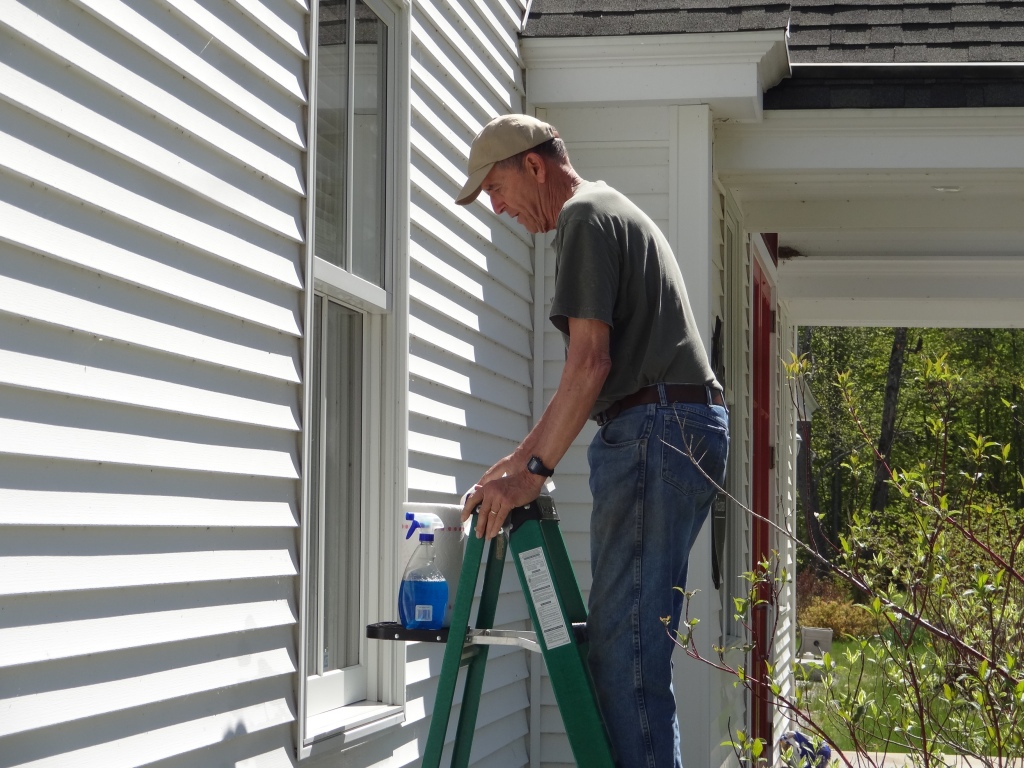
Helping others either via the St. Peter’s or Bridgton Hospital
Cafe has long been a passion for the Stones. Even cleaning windows at church can offer Tom a sense of satisfaction.

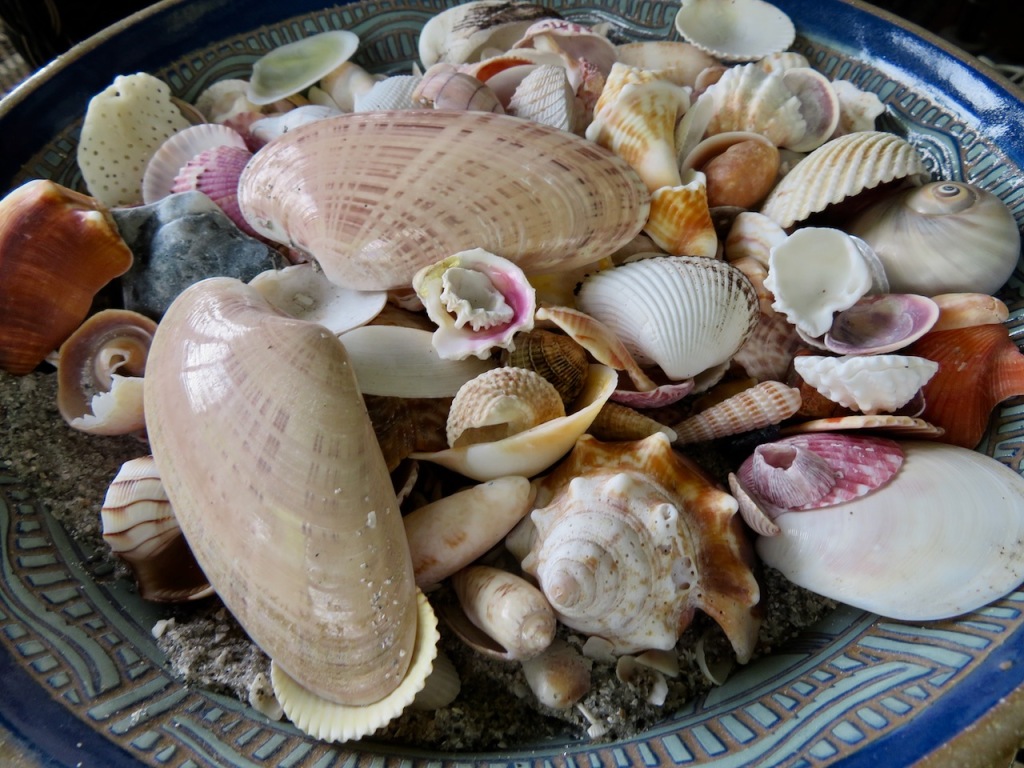
In the end, though they all love the life they’ve created in Maine, they admit there are some downfalls. One is that the winters seem to get longer each year. Linda Wurm has found a way to overcome that: a bowl of shells to gaze upon from time to time.

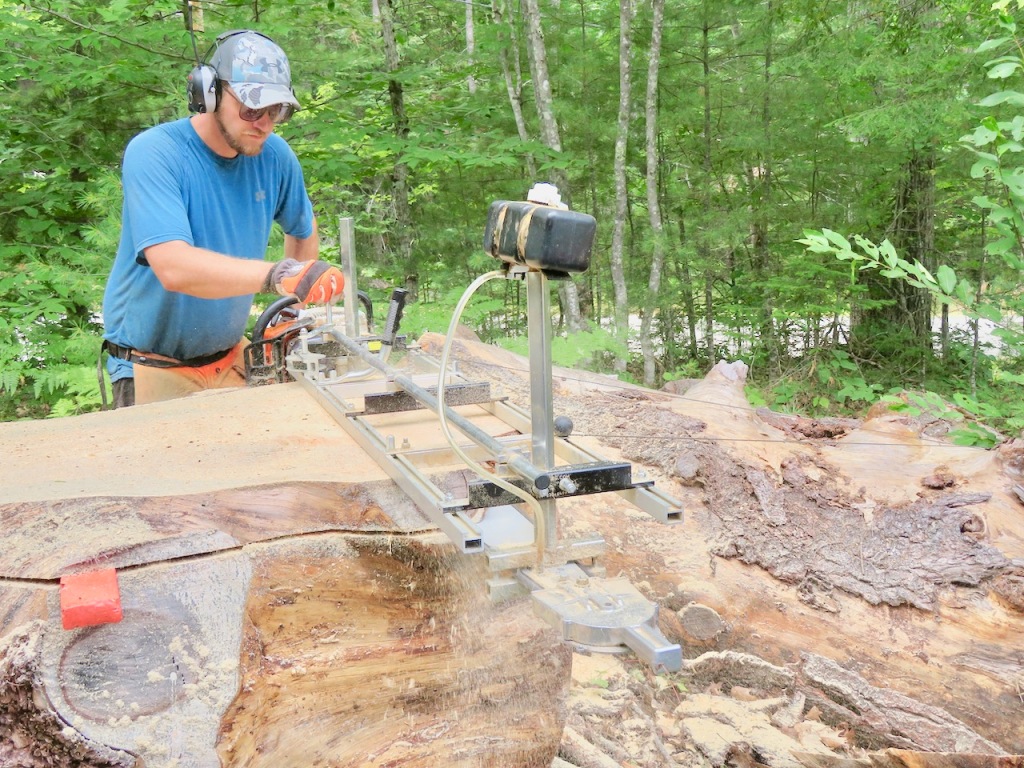
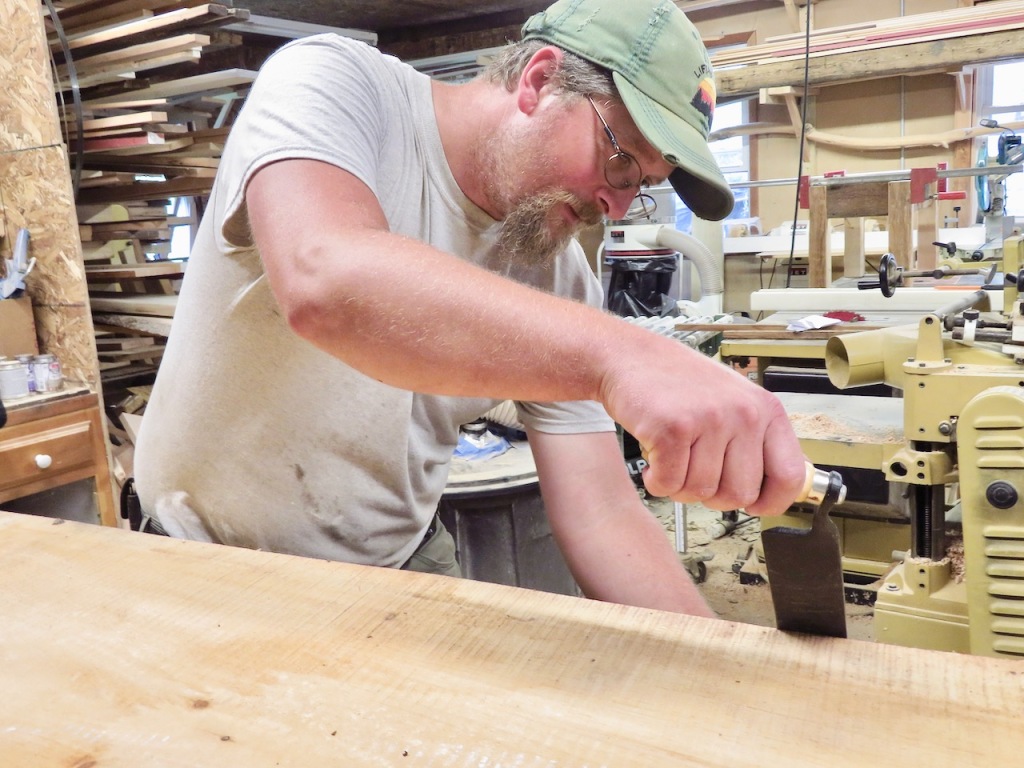
And then there’s my final article. It’s about three entrepreneurial men. They each bring a different talent to the . . . table. Literally. Eli Hutchins of Hutch’s Property and Tree chops the tree down.

Brent Legere of Lovell Box Company and Western Maine Slab Works cuts it into live-edge slabs.

And Eugene Jordan of Jordan Custom Carpentry, Inc, turns it into a beautiful piece of furniture. You can read all about it in “A Tree Falls in Lovell.”

So, yeah. Brew a pot of tea, curl up in your favorite chair, and enjoy this issue of Lake Living magazine.

Oh, and please support the advertisers, including my guy, so we can keep doing what we love to do: learn about the many talented people in this area. I am constantly amazed. I hope you will be as well.

From the Ground Up

“I am the Alpha and the Omega, the Beginning and the End, the First and the Last . . . The end of a beginning . . . A new beginning . . .” So began Bishop Chilton Knudsen’s sermon shared with over 170 parishioners and guests who attended the Dedication and Consecration of St. Peter’s Episcopal Church in Bridgton on Sunday, June 1, 2008.

Standing behind the pulpit in a site line between the entrance to the sanctuary, altar, cross and a circular pane that provided a window on God through the movement of the trees, wind and sun, Bishop Knudsen reminded us, as our rector, the Rt. Reverend John H. Smith, retired Bishop of West Virginia, had done previously, that the new building was just that — a building. She encouraged us not to get so caught up in the building that we lose sight of our mission of outreach to each other, our communities and the greater world.

St. Peter’s Episcopal Church began as a summer mission in 1962. On September 8, 1974, St. Peter’s-by-the-Lake held its first service of extended ministry. Though it did not have a home of its own, the church provided an Episcopal presence to summer and year-round residents of the Lakes Region by meeting in various locations including people’s homes, Bridgton Academy, and local churches of different denominations. In 2003, the parish voted to purchase a ten-acre lot at the junction of Routes 302 and 93, one mile west of downtown Bridgton.

After renting space for all those years, in 2007, church members enthusiastically supported a capital campaign; through gifts and pledges the full amount of the building cost was raised. Under the leadership of parishioner Beatrice White, a building committee was formed. The Vestry engaged the services of William Whited, Architect, to design a building that would be both beautiful and affordable.

S2-BISHOP KNUDSON BREAKS GROUND

On September 15, 2007, Bishop Knudsen, donning a hardhat decorated with the Episcopal shield, dodged raindrops as she helped break ground.

S2A-LETTER FROM BISHOP KNUDSON

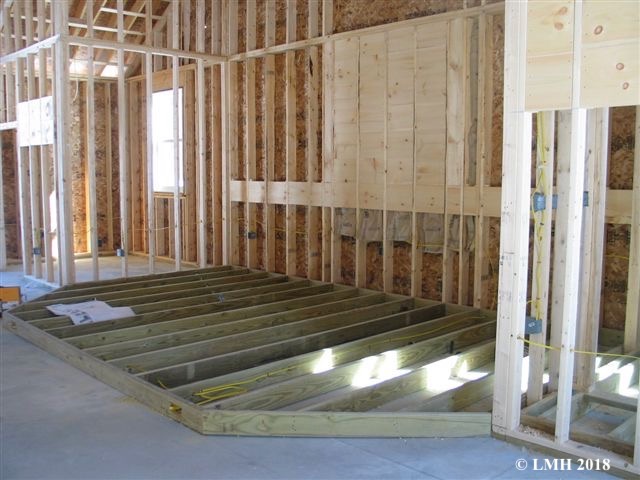
Following that initial groundbreaking, parishioners met at the site the first Sunday of each month for prayers and hymns. Rain . . . snow . . . mud . . . the weather presented a few obstacles, but the project proceeded in spite of it.

S3-CHURCH TAKES SHAPE

Over time, the building began to take shape.

S4-WINTER

With the advent of winter, it was wrapped in Typar . . and continued prayers.

S5-ALTAR

Within, the altar found its formation.

As parishioners, we watched it grow into a structure for worship and fellowship. Upon entering the church for the first service on May 25, 2008, one word was expressed over and over again, “Wow!”

S6-NEW CHURCH DEDICATION

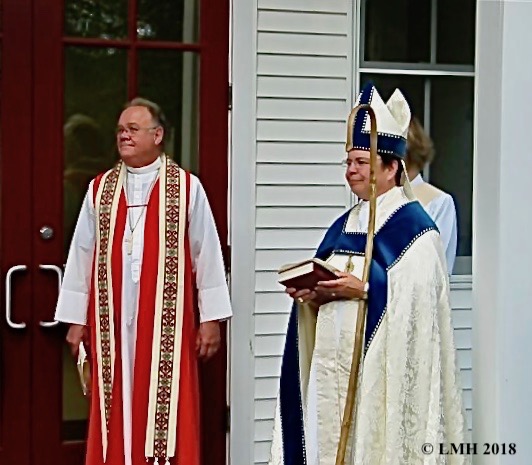
For St. Peter’s, the Dedication and Consecration of the building on June 1st was the culmination of years of discussions, planning, being amazed at fund raising miracles and working together to reach a goal. That grand and meaningful worship service is one that many people never experience unless they build a new church. Using the service of Dedication and Consecration as outlined in The Book of Common Prayer, Bishop Knudsen knocked her crosier and called for the doors to be opened. Gregg Seymour, General Contractor, opened the door and handed the Bishop a hammer as a symbol of his work. Beatrice White presented the building blueprints while Junior Warden Eric Wissmann gave the Bishop a set of purple building keys. A procession including the Bishops of Maine, our rector, a deacon, verger, wardens, crucifer, taperers, parishioners and guests flowed through the narthex into the simple, yet beautiful sanctuary. Following prayers for the building, the Bishop moved about the church and consecrated the baptismal table and bowl, cross above the altar, lectern/pulpit, hangings and parish banner, tapers, piano, kitchen, classrooms and offices, narthex table, credence table, altar shelf, fair linen, and other special gifts. She then celebrated the Holy Eucharist, assisted by the Reverend Christine Bennett, Deacon, and George Wright, Verger. The Eucharistic Bread was baked and offered by the “SPY” group, Saint Peter’s Youth. During Holy Communion, the choir sang “Jesu, Jesu,” accompanied by Evan Miller, Director of Music. Following the service, the parish continued the celebration indoors and out with a reception and pot-luck dinner. 

S7-CHURCH TODAY

Fast forward and the parishioners are now preparing for Bishop Steven Lane to visit next week and celebrate the tenth anniversary of St. Peter’s. In all that time, so much has changed . . . including the land. And so this afternoon I spent some time wandering around the grounds in quiet reflection of the people and the place. No, not the church building, though I continue to appreciate its simplicity and still love to gaze out the circular window above the altar.

S8-ANTS ON DANDELIONS

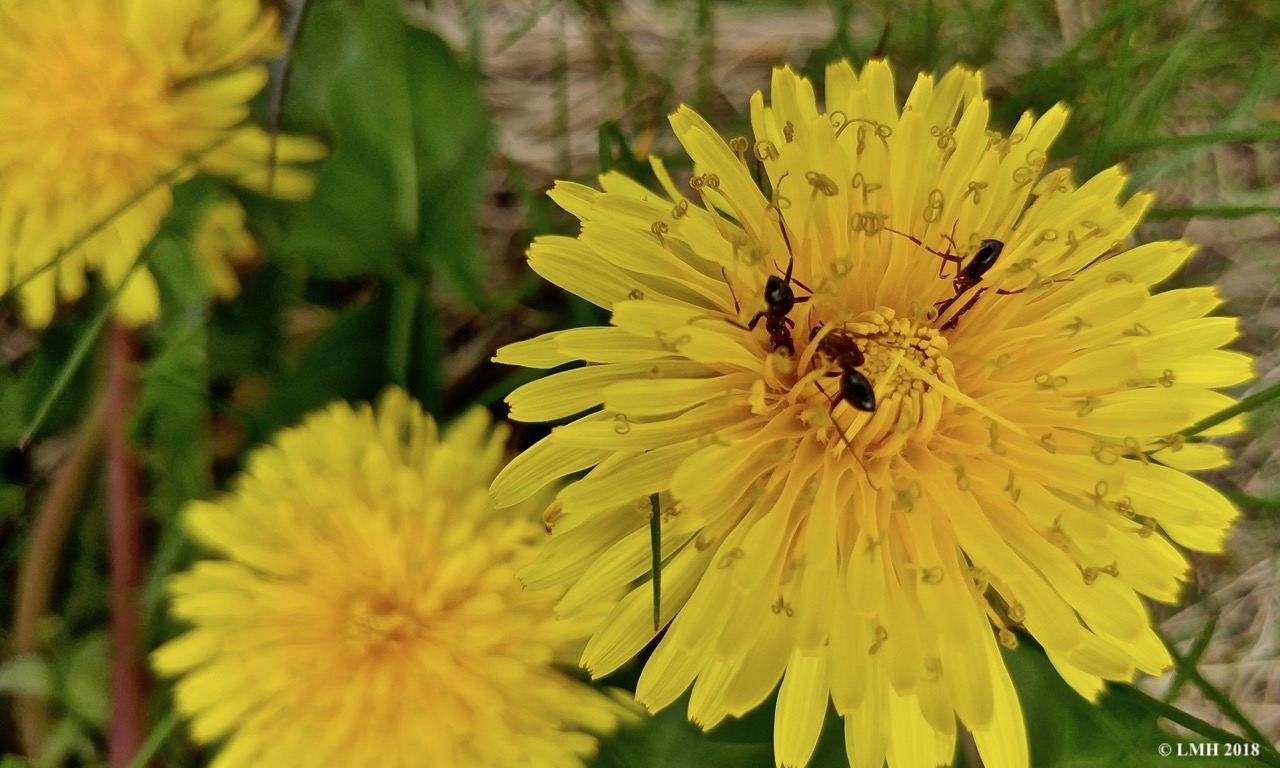
Today, however, I wanted to note all the other species that have gathered here, including the ants seeking nectar. Have you ever gotten as close to a dandelion as an ant or bee might? Did you know that each ray has five “teeth” representing a petal and forms a single floret. Fully open, the bloom is a composite of numerous florets. And equally amazing is that each stigma splits in two and curls.

S9-DANDELION SPREADING THE SEEDS

Of course, if you are going to admire a dandelion in flower, you should be equally wowed as it continues its journey. At the base of each floret grows a seed covered with tiny spikes that probably help it stick to the ground eventually. In time, the bloom closes up and turns into those fluffy balls waiting for us or the wind to disperse the seeds, rather like the work of the church. Until then, they look like a spray of fireworks at our feet.

S10-MEMORIAL GARDEN

My wandering led to the Memorial Garden where parishioners with greener thumbs than mine created a small sanctuary for one who wants to sit and contemplate.

S11-CELTIC CROSS WITH LICHENS

The garden’s center offers a cross depicted in the Celtic tradition. I remember when it was installed as a “clean” piece of granite and realized today that I hadn’t been paying attention, for as is true on any of the surrounding benches, lichens had colonized it, enhancing the circle of life.

S15-GRAY BIRCH

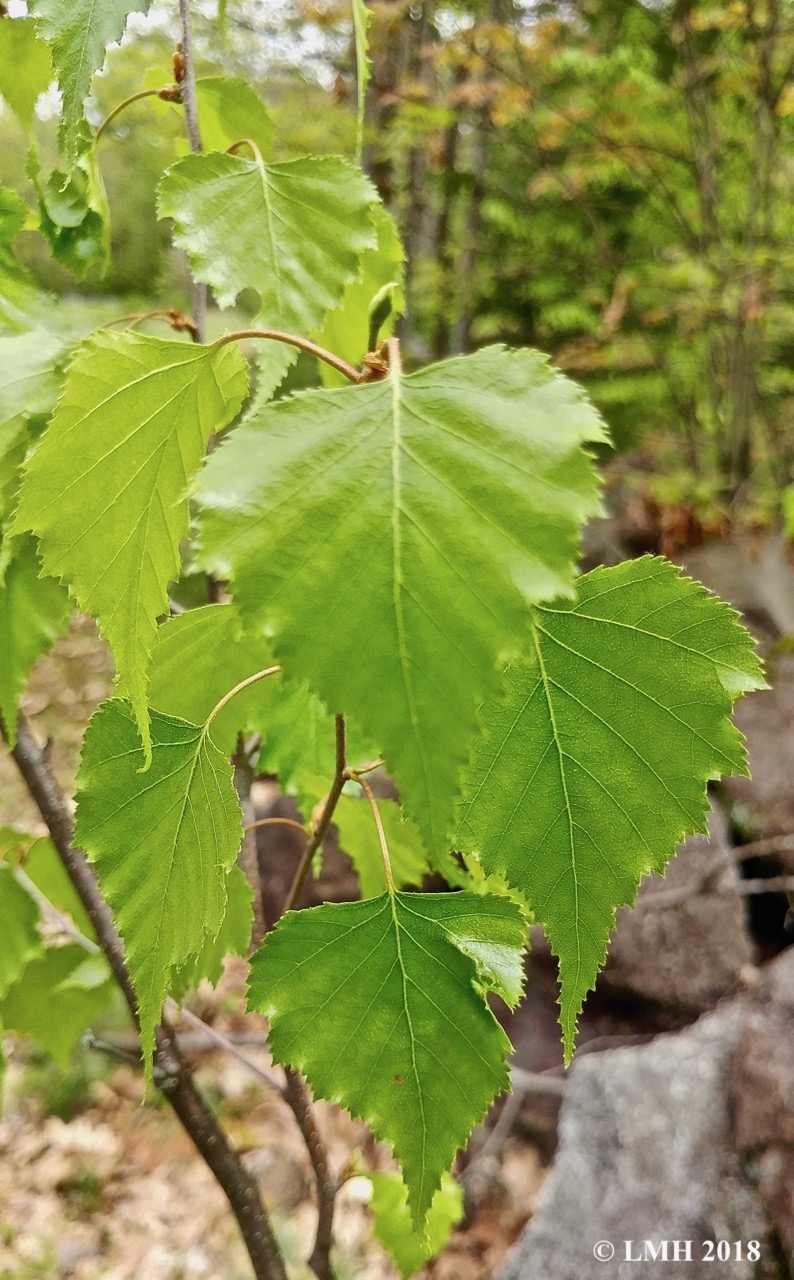
What I really wanted to look at though was the edge where various species spoke of forest succession. I found an abundance of gray birches, one of the first to take root after an area has been disturbed. It’s always easy to spy once you recognize its leaf’s triangular form, which reminded me of Father Dan Warren’s demonstration this morning about the Trinity.

S12-PAPER BIRCH LEAVES

Nearby grew an already established paper birch, its leaf more oval in shape.

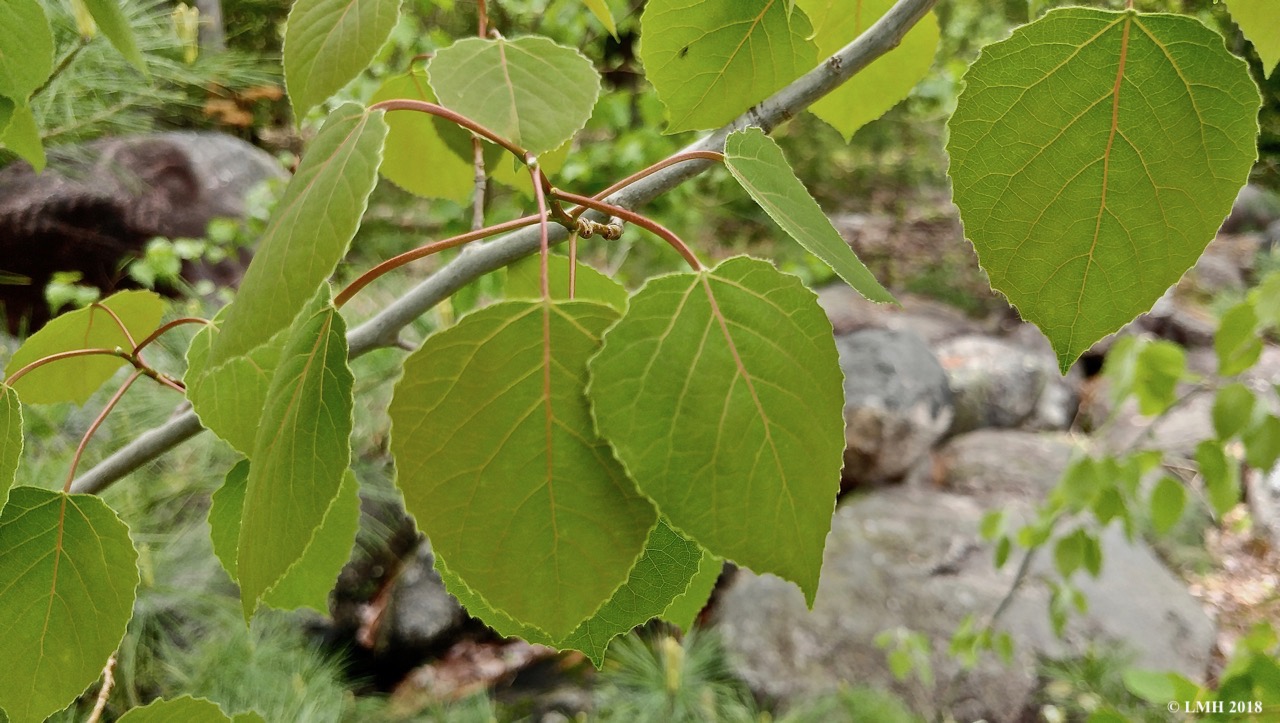
S13- QUAKING ASPEN

Then I couldn’t help it and my tree fetish took over. Quaking or trembling aspen showed off its small toothed edges, while . . .

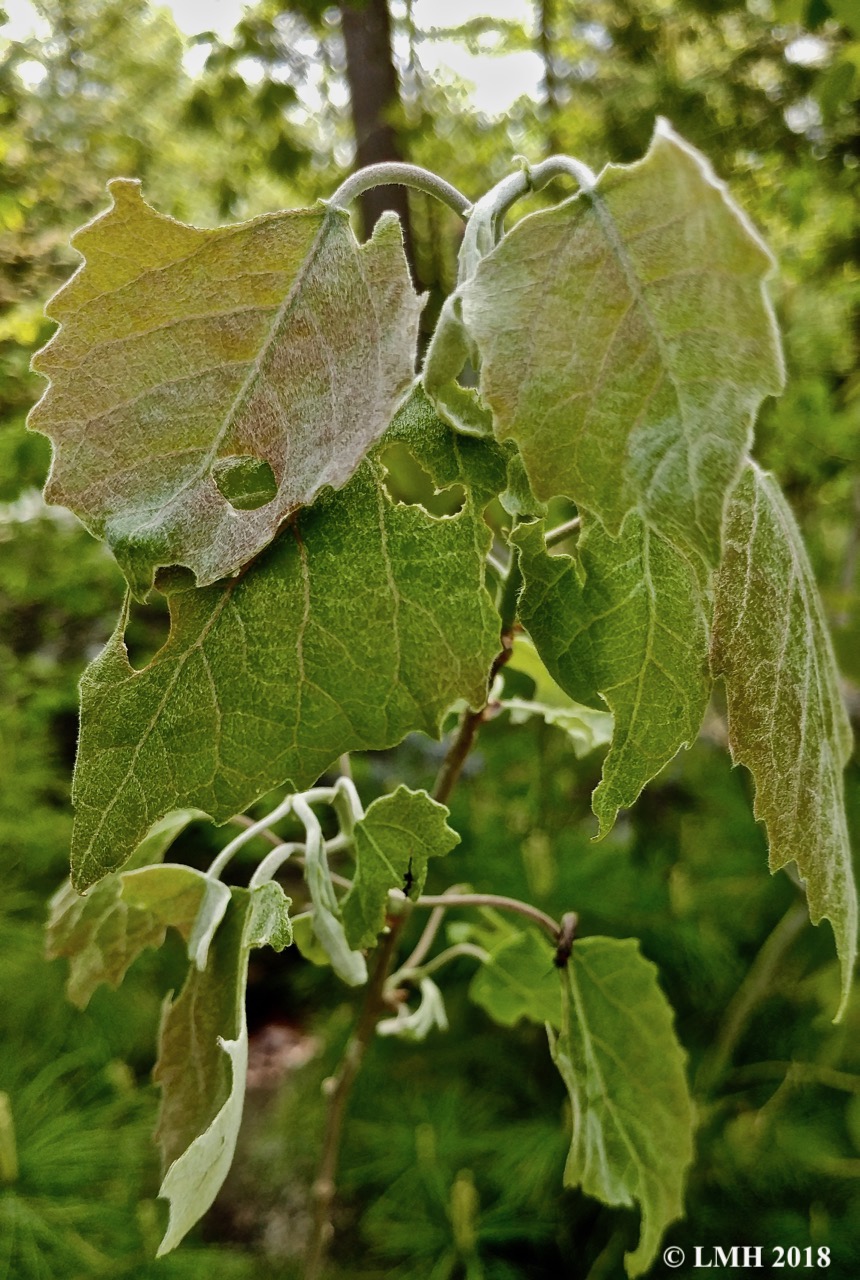
S14-BIG TOOTH ASPEN

its young cousin displayed big teeth. Despite its fuzzy spring coating, insects had already started devouring the pubescent leaves. One of my favorite wonders about both big-tooth and quaking aspen leaves is that they dangle from flattened stems or petioles and ripple in a breeze as they send out messages of good tidings.

S16-BEECH LEAVES

Also along the edge I found a beech tree donning huge leaves that looked like they were in great shape . . . momentarily.

S17-VERY HUNGRY CATERPILLAR

For on the backside, a very hungry caterpillar had been dining on its own form of the Bread of Life.

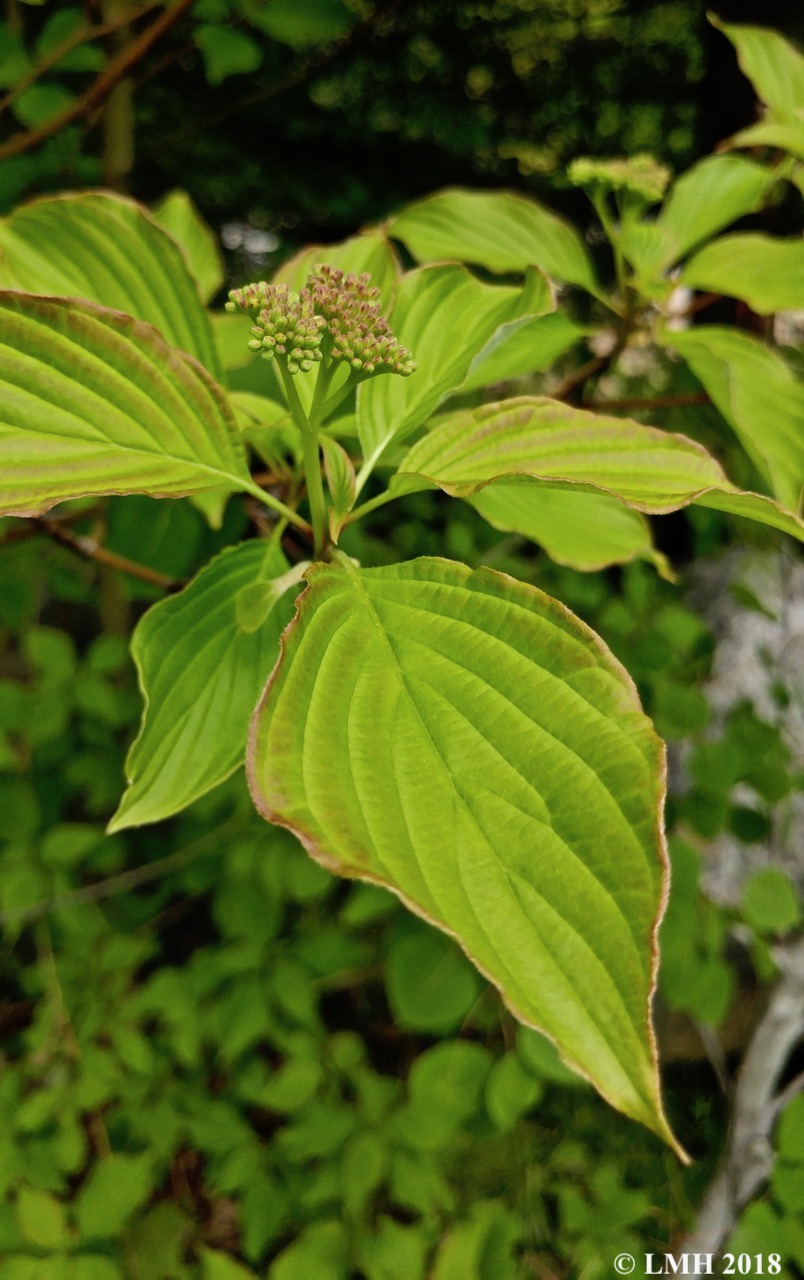
S17A-FLOWERING DOGWOOD

I found two other young trees that I suspected were planted within the last ten years–the first: flowering dogwood. Growing up in Connecticut, we had a large one in the side yard and so memories of times long ago intermingled with those of the more recent past and my home church, Zion Episcopal, entered into my reflections.

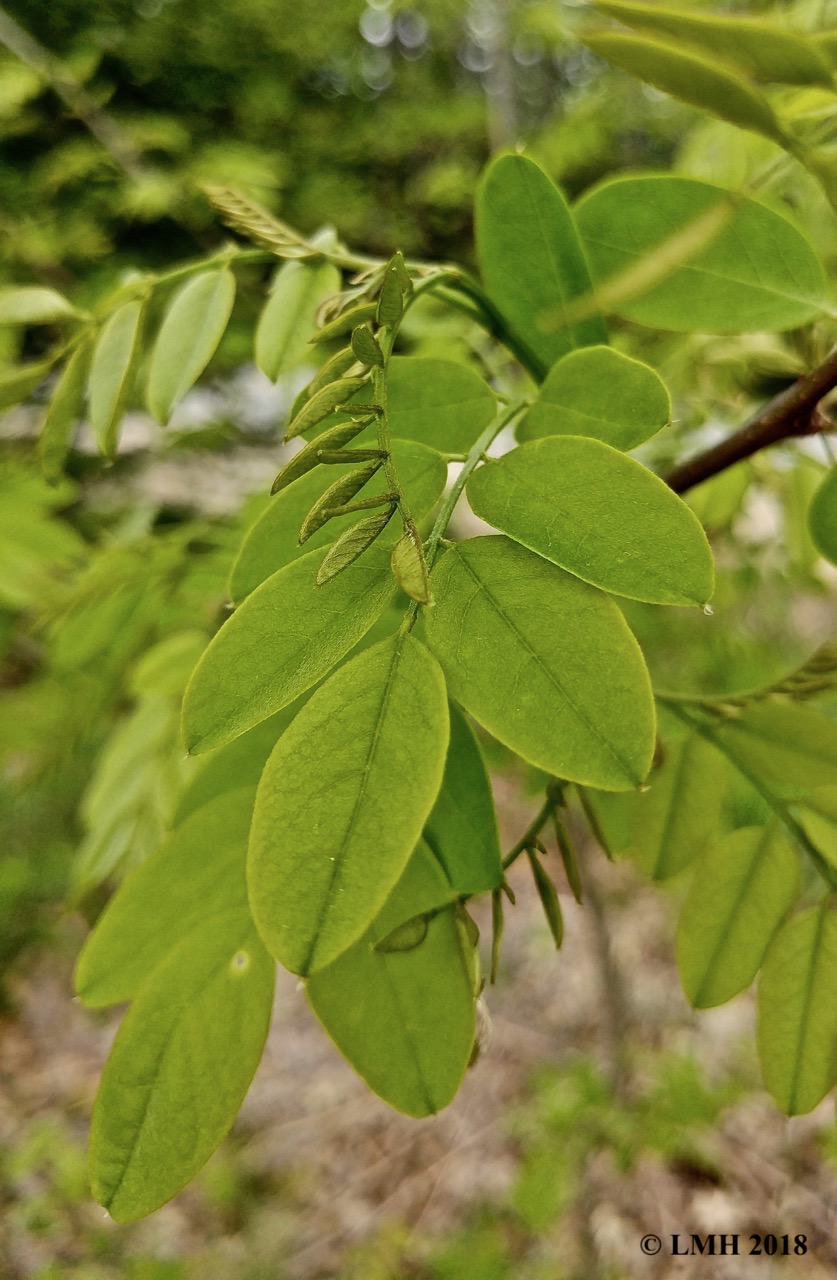
S17B-LOCUST

Like the dogwood, we also had a mature locust looming tall near my mother’s garden. Spying this one, I gave thanks for the ability to span the years, travel many routes, and remain faithful to my beginnings.

S22A-SWEET FERN

Slowly my eyes shifted downward . . . and fell upon a most pleasing sight–sweet-fern. It’s one of those, like hobblebush, that wows the eye in any season.

S18- WILD STRAWBERRY FLOWER

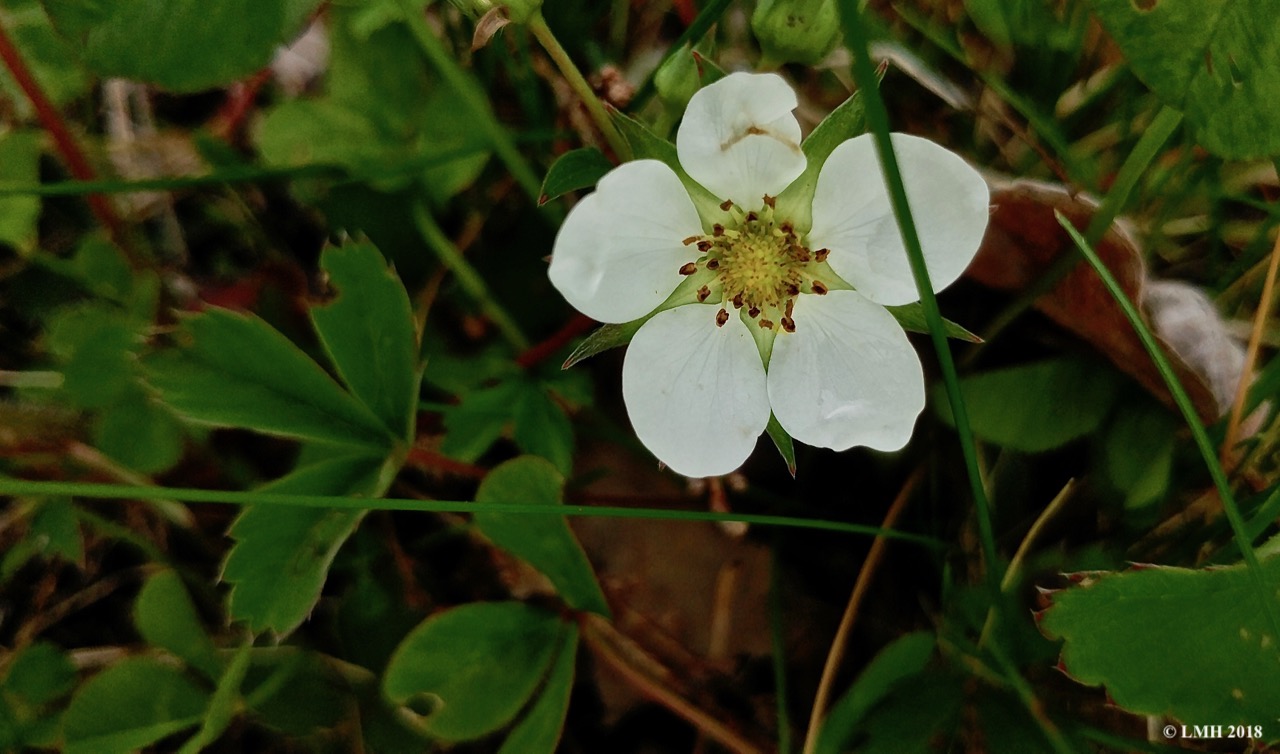
And then I turned my focus to the ground where an incredible variety of flowers either in bloom or still to come, mosses and grasses all shared the common space in seeming harmony, though I suspected there were those that crowded out others. Patches of wild strawberries graced the carpet. Five petals surrounded about twenty stamens and soon a fruit may form–meant to sustain small mammals and birds.

S21-FRINGED POLYGALA

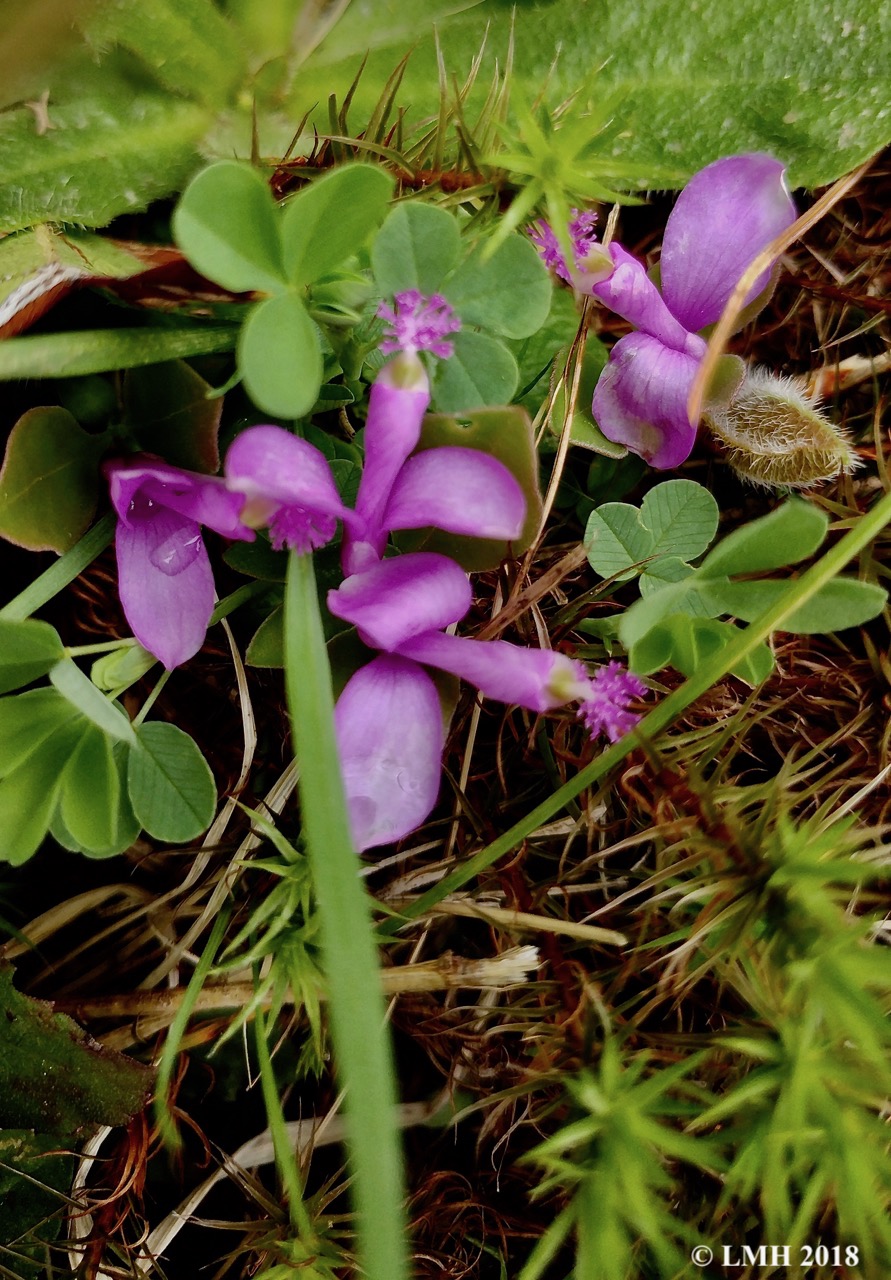
Gay wings or fringed polygala surprised me with its presence. So delicate, so beautiful, so fleeting.

S24-STONE WALLS

I stepped into the woods beyond the edge and was reminded that ten years ago I wanted to create a nature trail on this property–a place where anyone could partake of a short wander away from reality; a place where someone might be nurtured by nature.

S19-STARFLOWER

A place where the stars above would be reflected in the flowers below.

S20-DWARF GINSENG

A place where flowers like dwarfed ginseng would erase global issues–if only for a moment.

S23-GIANT BUMBLEBEE

A place where everyone recognized the system and from such recognition began to work together toward common goals.

S22-INTERRUPTED FERN

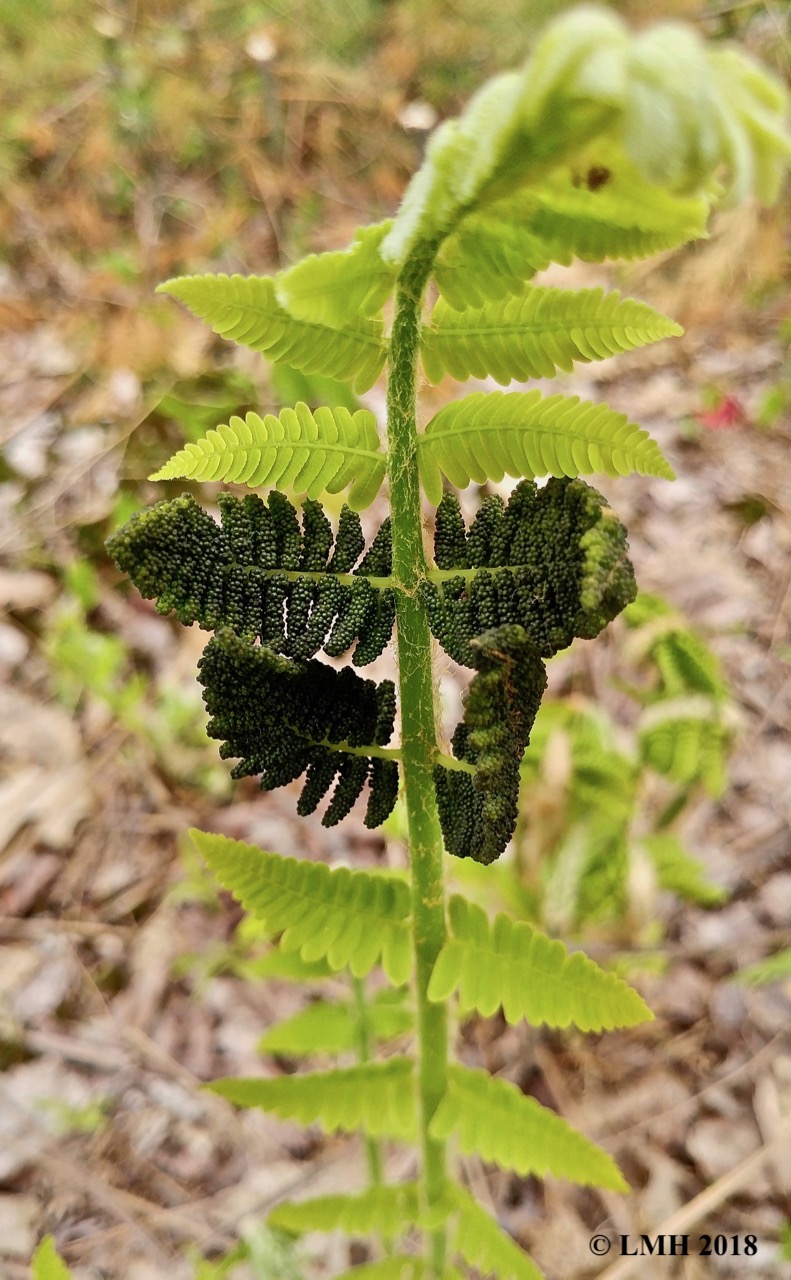
A place where interruptions occurred because life happens, but such were accepted as part of the norm.

S23A-BUMBLEBEE BREAK

A place where one could find a bench upon which to rest before beginning again.

S25-ENTER HERE

Here’s to beginning again St. Peter’s.

Here’s to remembering all those who made this place a reality.

Here’s to maybe someday a nature trail.

Here’s to continuing to create a place where all are welcome whether they pass through the red doors, into the Memorial Garden, or choose to take in the offerings from the ground up.