Solstice 2024

There’s a local trail I’ve been traipsing along solo or with company these past few weeks and when I dragged My Guy there early this morning, and said I was bringing my camera, his response, “Why, there’s nothing to see there.” Seriously. Doesn’t he know me better than that after all these years?

It’s a place where Bullfrogs sit upon lilypads in true frog style and wait patiently for a meal to fly by. Given all the Gnats and Deer Flies that buzzed our faces and ears as we walked, I assumed there was plenty of food and actually offered some, but he wouldn’t partake. The frog, that is.
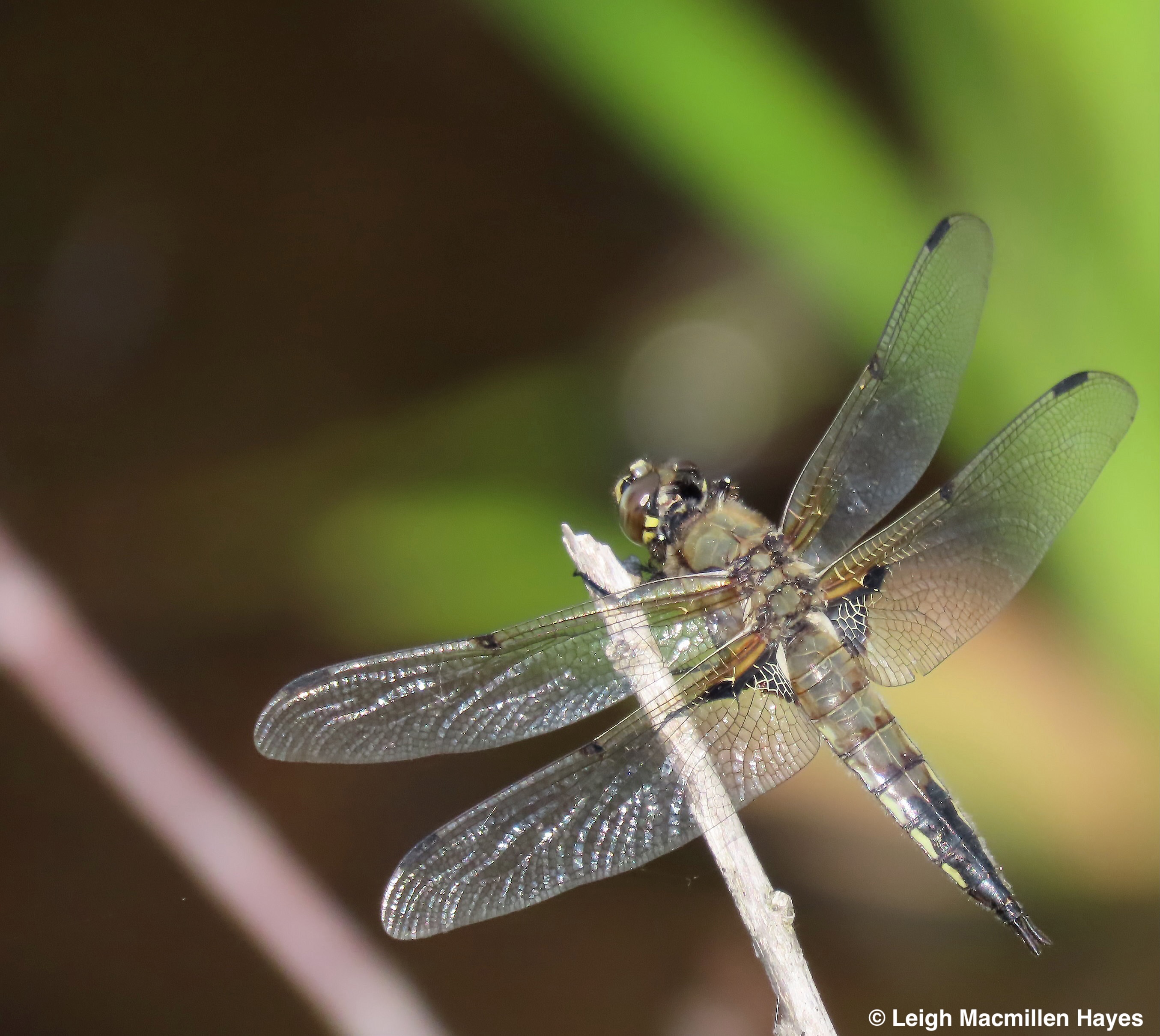
Another who should also have been enticed by the offerings, seemed to care more about defending his territory than dining, this being a Four-spotted Skimmer Dragonfly. The name Four-spotted refers to the small dark spots on the upper edge of each wing, there being two per wing, and thus four per side or four per front wing and four per backwing.

Equally nonchalant about all the available food, but curious about me, was the female Calico Pennant, another skimmer who loves to perch at the tip of plants and twigs and returns to the same site over and over again. Though I didn’t have a good view of her abdomen except for a hint of color on segment 7, the yellow-colored stigma toward the tips of her wings, and her yellowish face gave proof to her gender. Males have red stigmas and red faces.
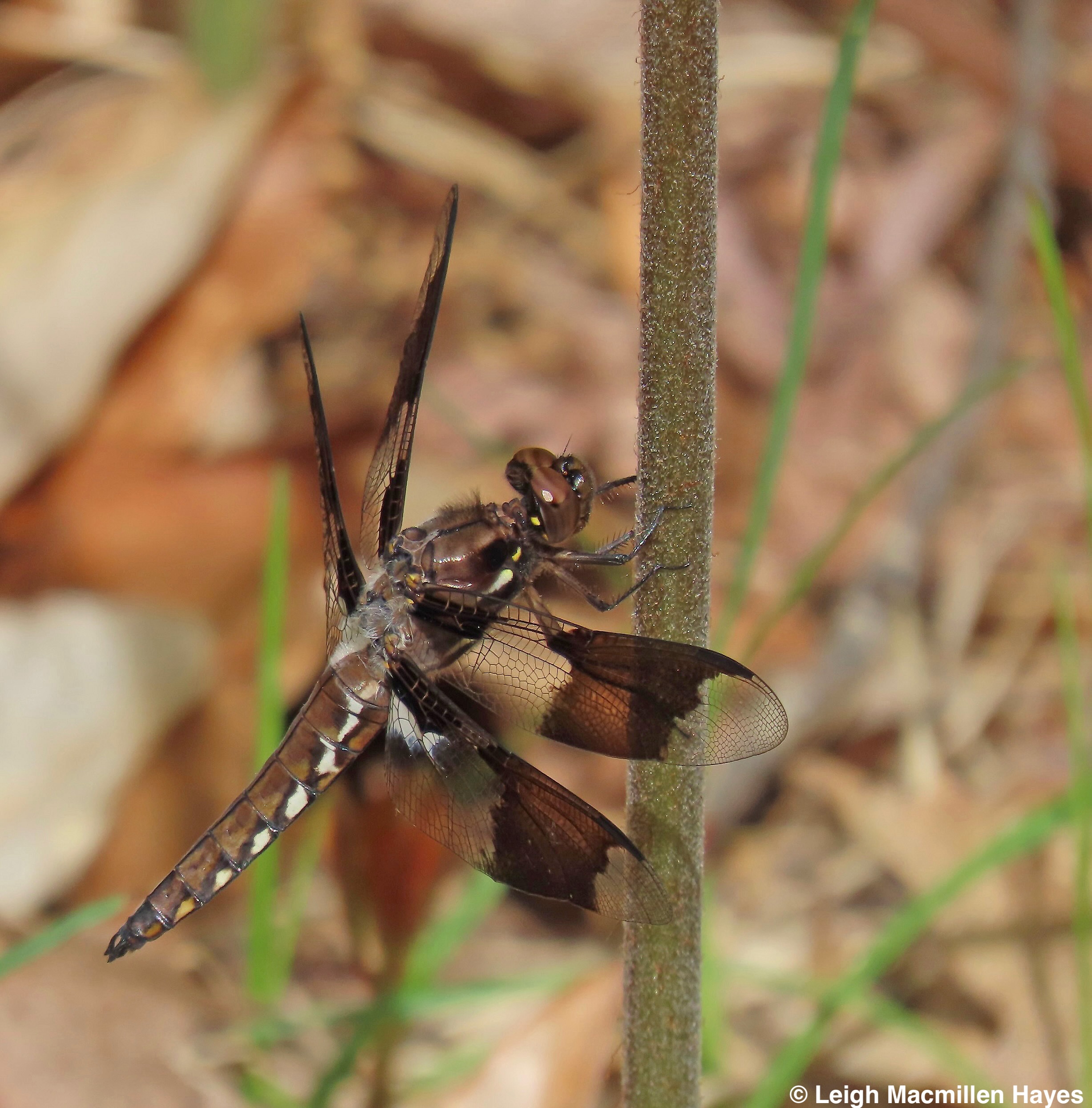
The immature male Common Whitetail cruised and paused, cruised and paused. This is such a handsome skimmer (not that the others aren’t). And while its abdomen resembles the female, it’s the wing pattern that identifies its gender. I love the complexity of dragonflies, even if I do have to relearn the clues each season.

Apparently, there were other things to do besides defend territory, and certainly rather than eat the biting insects–for canoodling was in order each time I visited. In this love wheel, the male Belted Whiteface dons the red thorax and he has clasped his mate behind her head with his claspers, as is the dragonfly custom. As Kurt Mead describes it in Dragonflies of the North Woods, “Prior to selection of a willing female, the male will transfer sperm from his testes located on the underside of the abdominal segment 9 to his hamulus located on the underside of segments 2 and 3. This is accomplished by simply arching the abdomen until the undersides of the appropriate segments make contact.” Once clasped, she arches her abdomen toward his hamulus to receive his sperm and thus fertilize her eggs.

Also flitting about, for that’s how these damselflies seem to move through the air, were some Ebony Jewelwings. The white dot or stimga at the tip of the wing signals this is a female, where the male has all dark wings. I love the iridescent colors of this species. And note how she has her abdomen reaching upwark in an obelisk position? That’s the Odonata way of avoiding overheating–thus reducing the surface area that is exposed to the sun’s rays. Oh, to be able to stick your butt toward the sun and cool off. On a day like today, and yesterday, and the day before, with our first heat wave in New England in two years, this would have been a most welcome adaptation.

Also along this trail, an extremely smart Eastern Phoebe who used a slight crevasse in a boulder upon which to build her nest of mud and moss and lichens. On the first trip, a friend and I spotted five eggs in the nest About a week and half later, these little chicks snuggled together like a pile of fluff with an occasional mustard-colored beak visible.

A week or so later and they continued to grow. What surprised me is how quiet they were, but that’s probably another technique that doesn’t give away the location of the nest.

That said, a Phoebe built a nest on the backside of our barn. It’s too high for us to notice if any eggs or chicks were located within, but we listen to the adults call back and forth all day long ,which is how we found the nest–they told us where to look and flew off anytime we passed that way.

The chicks above fledged within the last week and that nest is empty with no sound from an adult. It makes me wonder if the barn nest might see a second brood (if there actually was a first) for they continue to awaken us at about 4:20am each day. Stay tuned.

Another sight worth noting–the footprint left behind by a moose–traveling in the opposite direction of my foot. This was discovered by an observant participant on a recent walk for Loon Echo Land Trust.
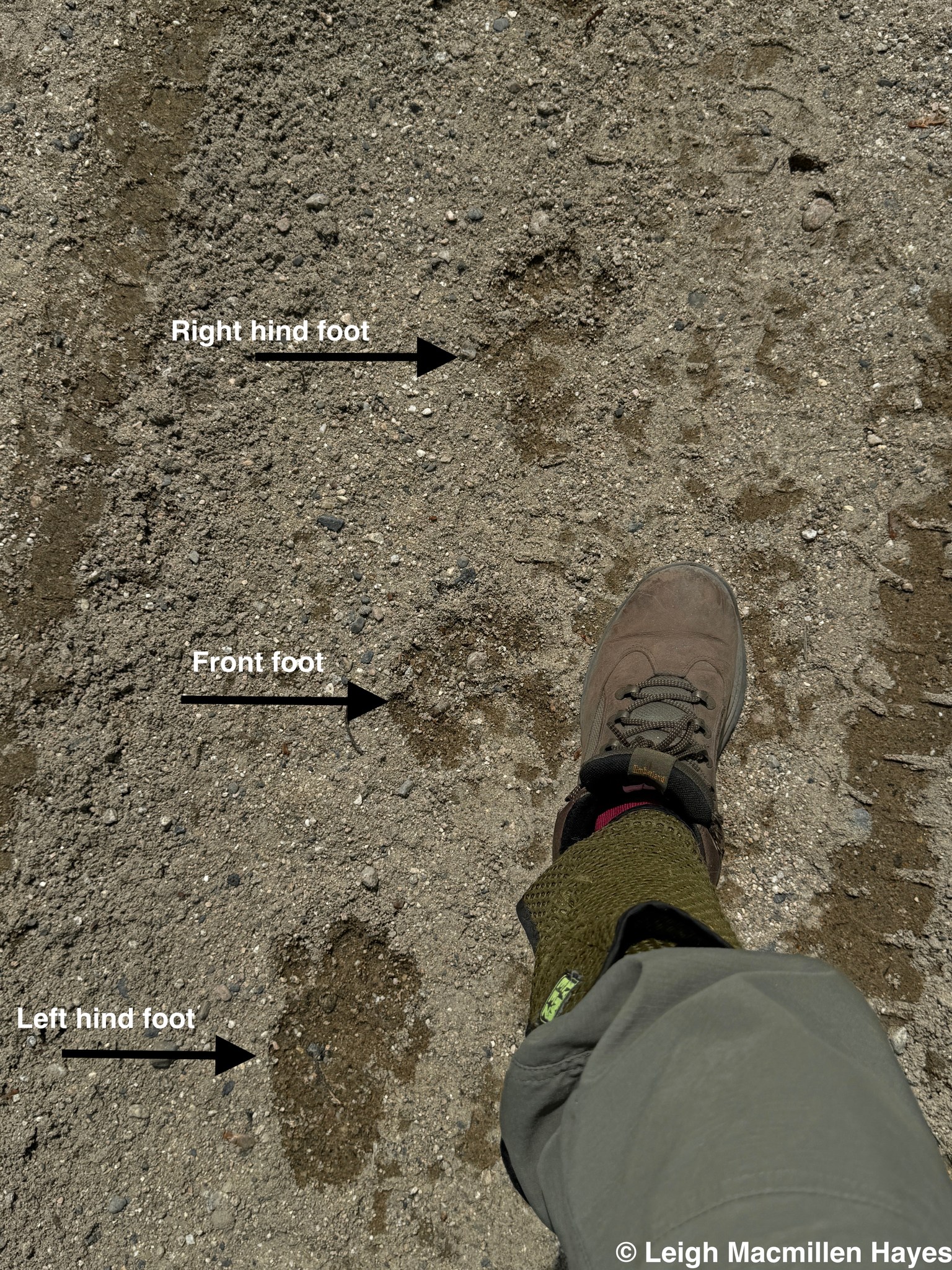
And an even better observation: the track of a Black Bear. My foot is located beside a front foot as you can see, with the larger hind feet registering before and after. The big toe is on the outside of the foot, opposite of ours. The better for climbing stability.
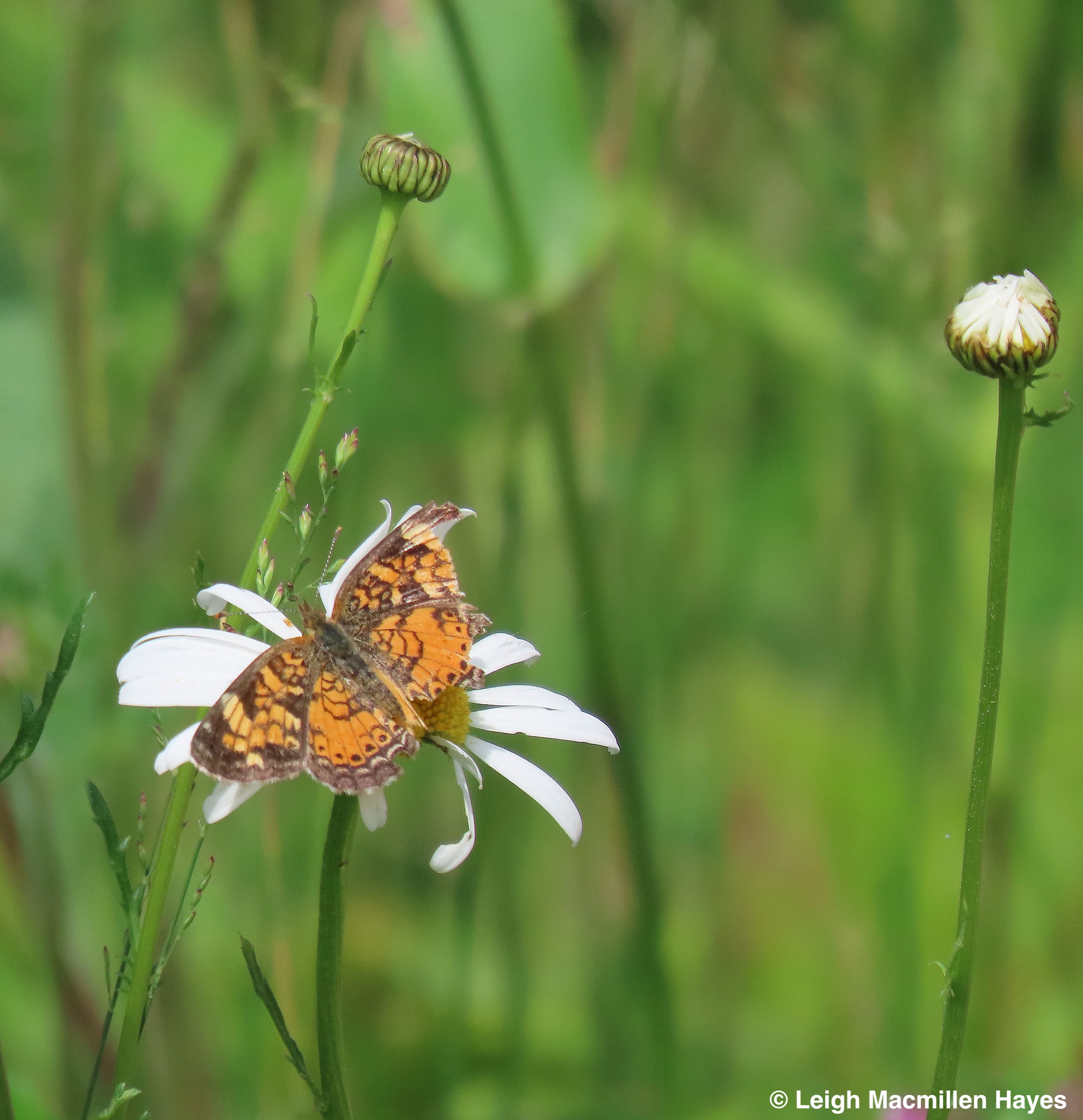
It still seems early for butterfly flight to me, but this Pearl Crescent showed us this morning that life hasn’t been easy given its tattered wings.

I think one of my favorite sightings along this path, other than the moose and bear prints, oh, and the dragonflies, of course, was something I couldn’t share with My Guy. The timing just happened to be right on this particular visit, when Eastern Tiger Swallowtail butterflies, so differentiated from the Canadian Tiger Swallowtail by the fact that the yellow band near the edge of the underwing was broken by black marks.

They were puddling, an act of probing for salt and minerals. Most puddlers are males, who ingest the nutrients that are then stored in their sperm. During mating, the male passes these goodies along to the female as a nuptial gift in his spermatophore. 

So we assumed it was scat upon which they puddled.
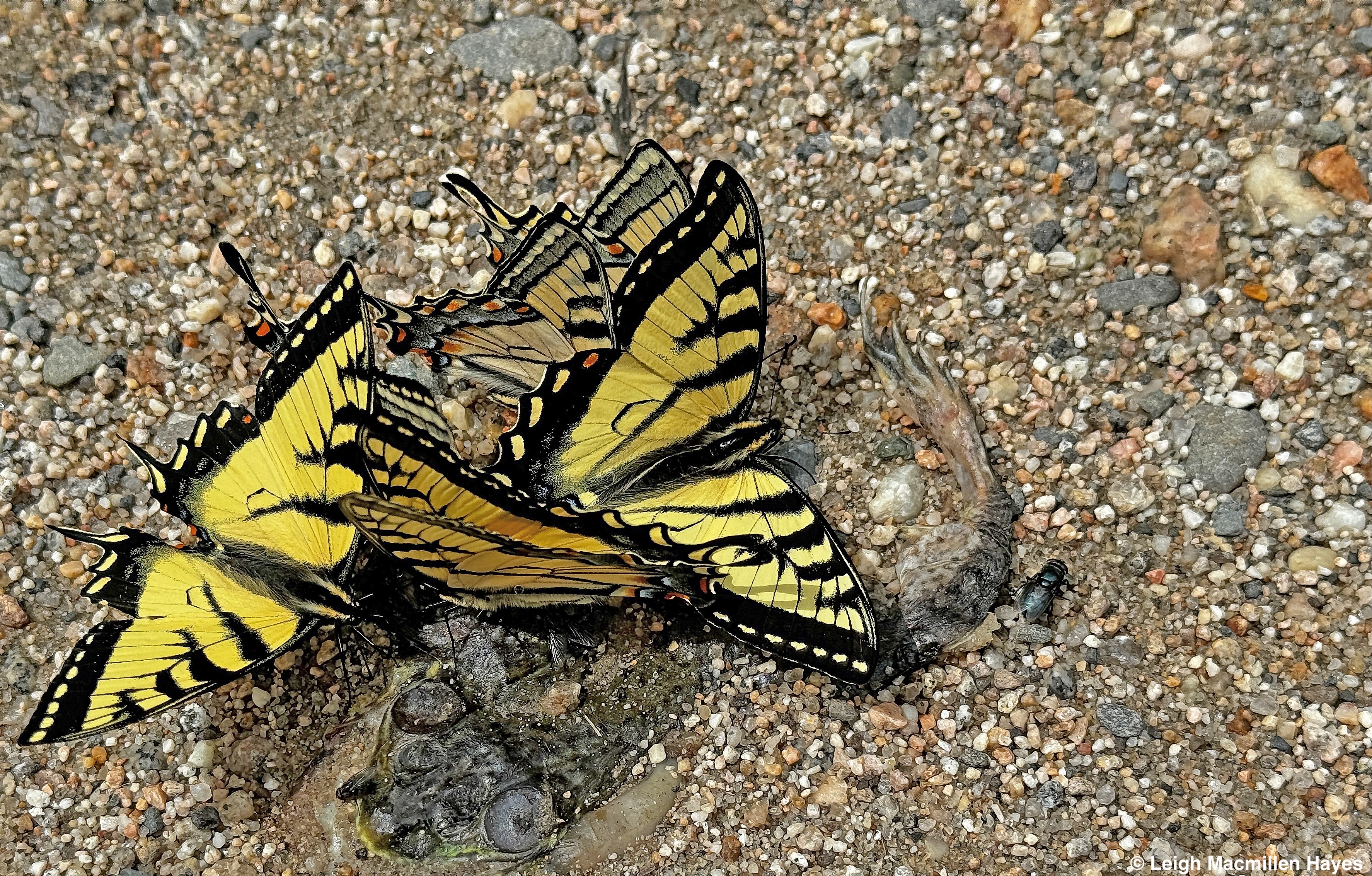
Until we realized it wasn’t. They’re choice of nutrient-offerings–a smooshed frog. The trail is not just for walkers. ATVs and even trucks use it.

Yes, the poor frog. BUT, the butterflies and flies made sure that it did not go to waste.

And another frog smiled. I’m smiling too, for it is officially summer. Happy Summer Solstice 2024.

And speaking of the solstice–be on the lookout tonight for the characters of my fairy tale doing some dancing in the woods, as they did in The Giant’s Shower.

Snow in June

On this June day with temps in the 70˚s, it hardly seemed possible that it might snow.

But indeed it did.

OK, so I hope the title caught your attention just as this field of daisies caught mine. The little flowers with their sunshiny centers (disK flowers) and white petals (ray flowers) that open with the break of dawn and close as the sun sets are an example of a $.50 cent word I recently learned: nyctinasty. I’ve read several theories about why some plants do this: perhaps to reduce its surface at night and thus retain temperature control; or reduce nighttime herbivory; or reduce the risk of flowers freezing; or protect pollen by keeping the plant dry at night.

All of these make sense, but it’s the daytime display in an unexpected place that has been mown for several years now, that captured my heart. I’d completely forgotten how beautiful this field could be with its array of daisies and hawkweeds and clovers. It was the daisies, however, that made the biggest splash.

By day, the field daisies attract any number of pollinators and as I stood beside and among them, they offered landing pads for a multitude of insects.

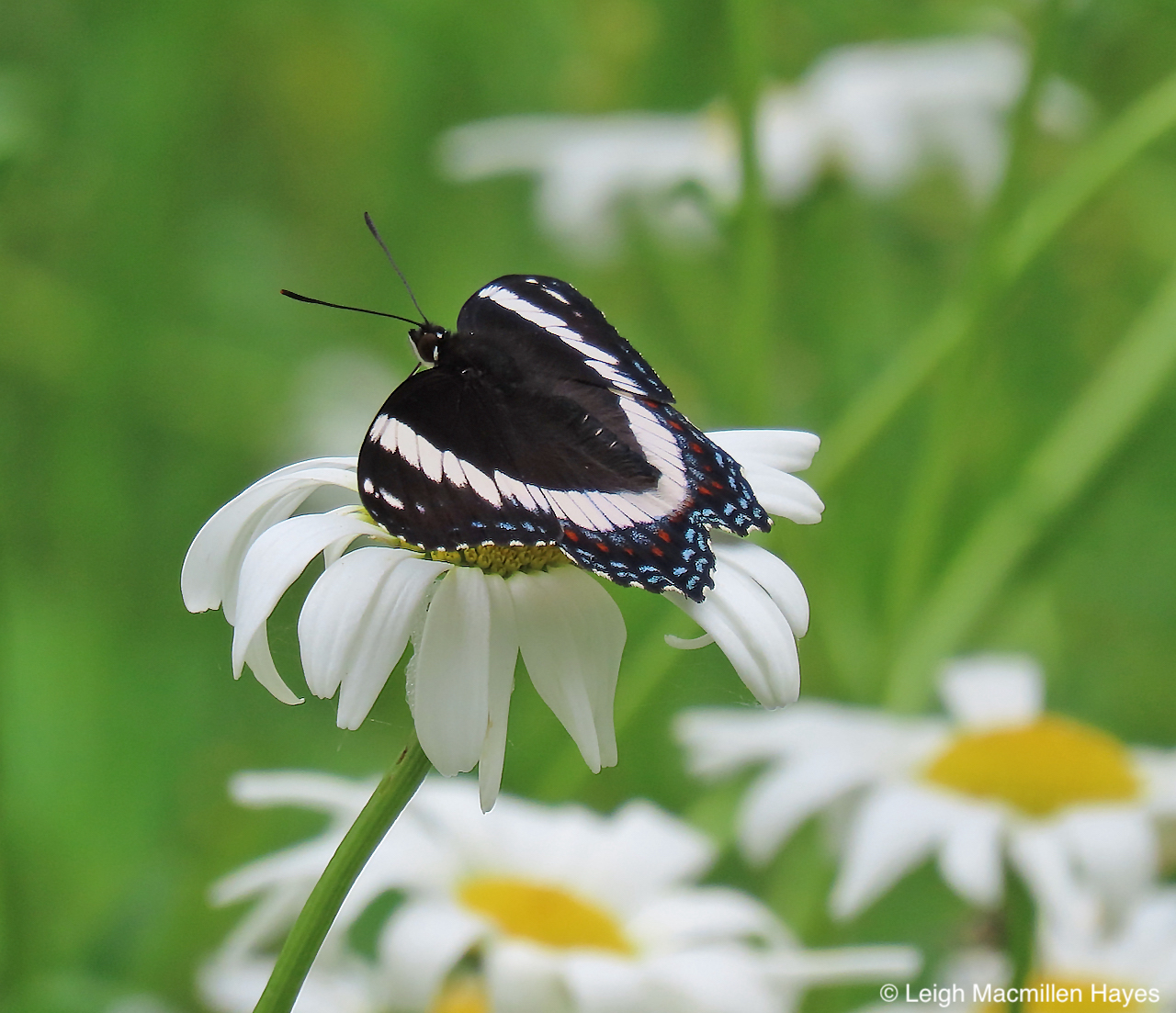
The White Admiral, with its handsome blue spots that mimicked the color of the sky, was nearly the same size.

With hundreds of those tiny disk flowers to feast upon, the butterfly had a full supply of nectar and in the midst of sipping it, gathered some pollen upon its feet, which it could pass off to the next daisy.

A Bumble Bee in constant motion, did the same. And added to the sound of buzziness in this place.

In the midst of all the flitting there was a tiny skipper sticking its proboscis into for a sweet sip. Such big eyes for such a little butterfly.

Big eyes are an insect thing–all those lenses in compound fashion offering views up, down, and all around so that as it stops in to take advantage of all that the flower has to offer, it can see all others in the area, including a certain photographer.

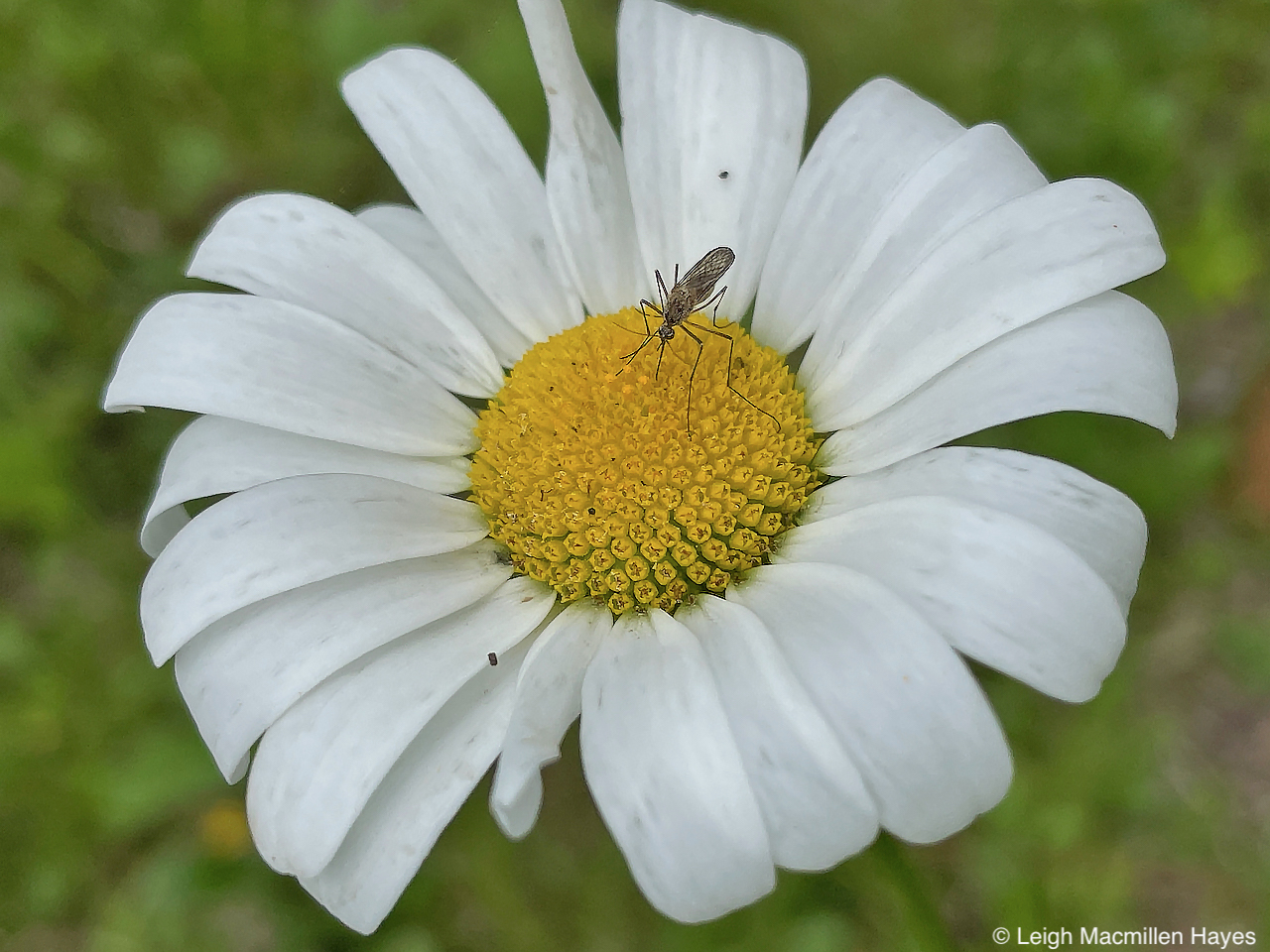
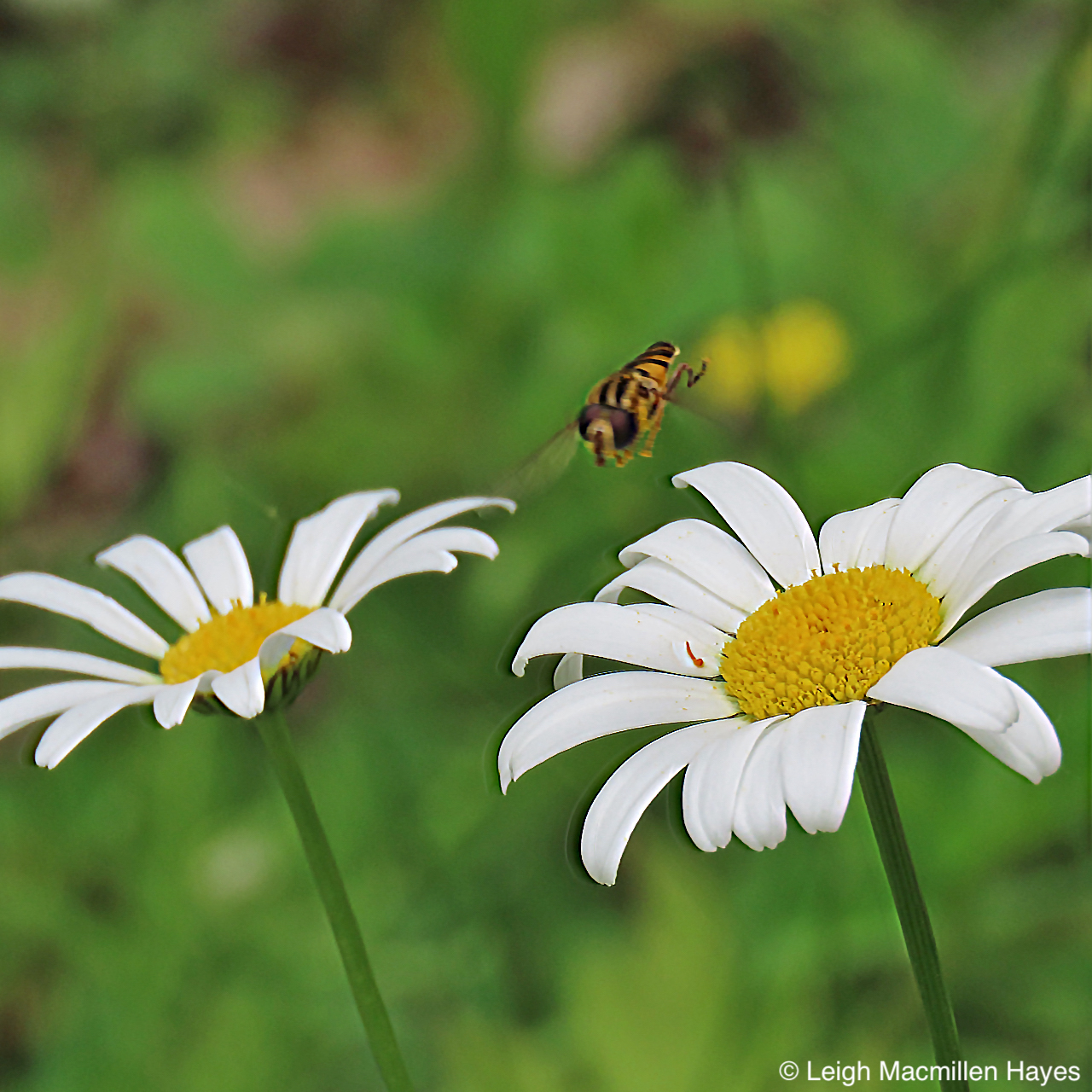
There were even teeny, tiny flower flies with long legs, veined wings, and equally teeny eyes, sucking from the source.

No, it isn’t my beloved snow that I came upon on this June day, but rather a field of daisies offering a scene reminiscent of snow white . . . with lots of colors and sounds in the midst spotted on this longest of days.

Happy Summer Solstice 2023.

Summer Solstice Sweetness

My dear friend Carissa sent me an e-mail about this week being Pollinator Week and challenged me to write about it. Her inspiration came from an e-mail she’d received from Natureworks Horticultural Services in Northford, Connecticut–part of our old stomping grounds as babes, toddlers, tweens and teens. (She grew up in Northford, while I grew up on the other side of the tracks in North Branford–two distinct villages that formed one town.)

Part of the message included this passage: “Happy Pollinator Week. There really is a week for that? You betcha. Pollinators are vital to life on this planet. And, at Natureworks, we are teaching our customers to protect and help pollinators every single day. It all starts with an organic garden. It includes planting lots of pollinator-friendly flowers. It continues with the way you manage your landscape and the way your community manages their public spaces. Pollinators are in decline around the world. We need to take this seriously. Let me just say . . .  we have the plants for that!

f1

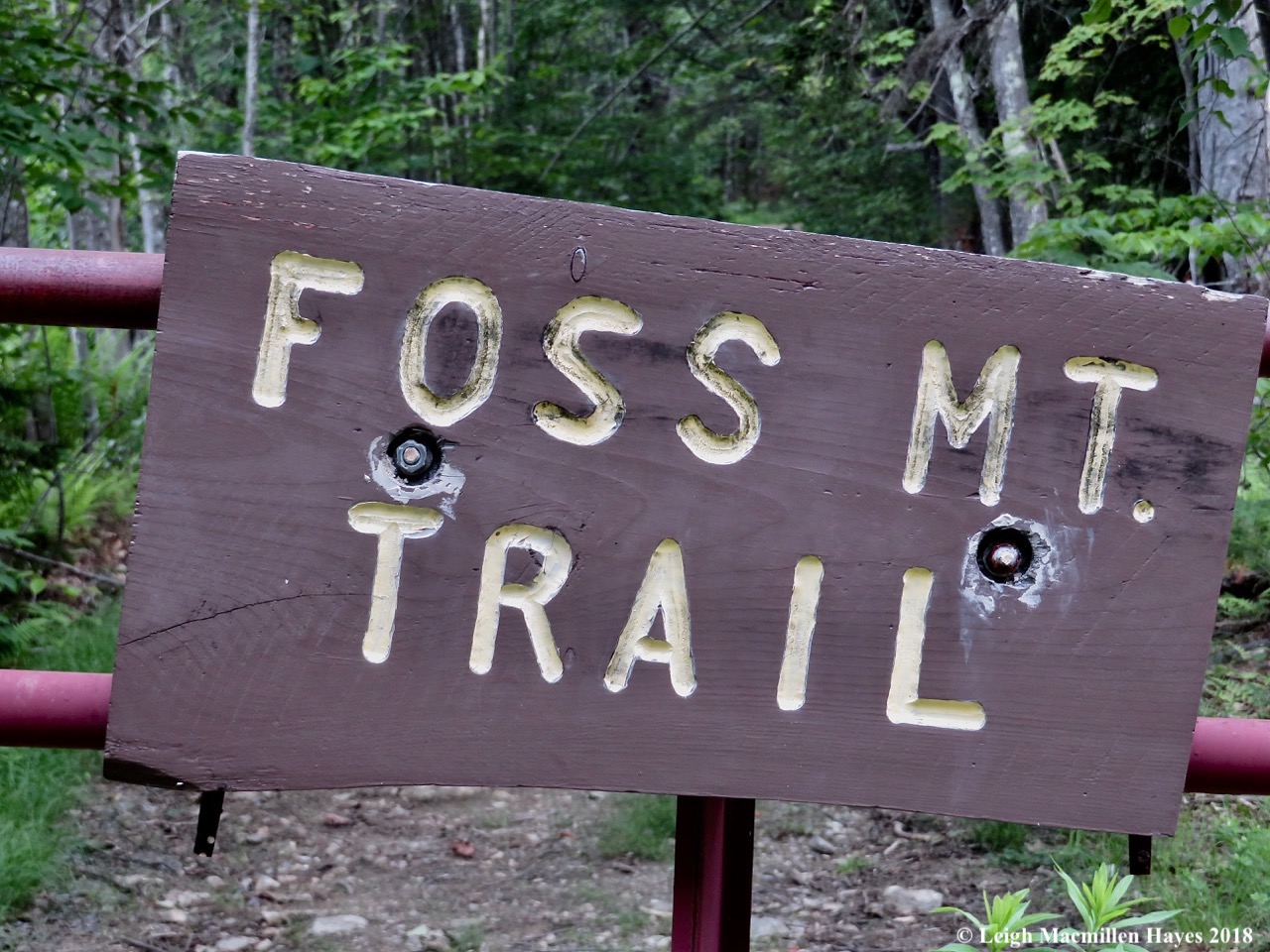
And then another friend, Pam, invited me to join her on a mini-hike to Foss Mountain today in Eaton, New Hampshire, and it all came full circle. To travel here with Pam was an incredible opportunity because she had some personal experience with the property and shared the local lore, including a story about a peddler who long ago repeatedly traveled a road that crosses the mountain and apparently spent some time canoodling with another man’s woman. And then, on one of those journeys, the peddler vanished into thin air–never to be seen or heard from again.

f2

Pam’s brother and sister-in-law had previously owned the land we were about to explore, but it’s now owned by the Town of Eaton and is protected in perpetuity by the Upper Saco Valley Land Trust. The property is managed by the Eaton Conservation Commission, which maintains the trail and blueberry fields.

f3

The blueberry fields were really a sign of early succession following a 150+ year history as pasture land. According to information posted on one of the three kiosks, there was a description of the farming heritage that included along the timeline the decade that the fields reverted to blueberries, juniper and gray birch, and the man who oversaw the blueberry crop–Frank French.

At some point along that timeline, the Brooks family homesteaded there, but not much was known about them. Pam and I wandered about the remaining cellar hole as we tried to interpret the scene, but didn’t quite understand all that we saw. (We sure wished our friend Janet had been able to join us and add her understanding of such historical sites.)

f4

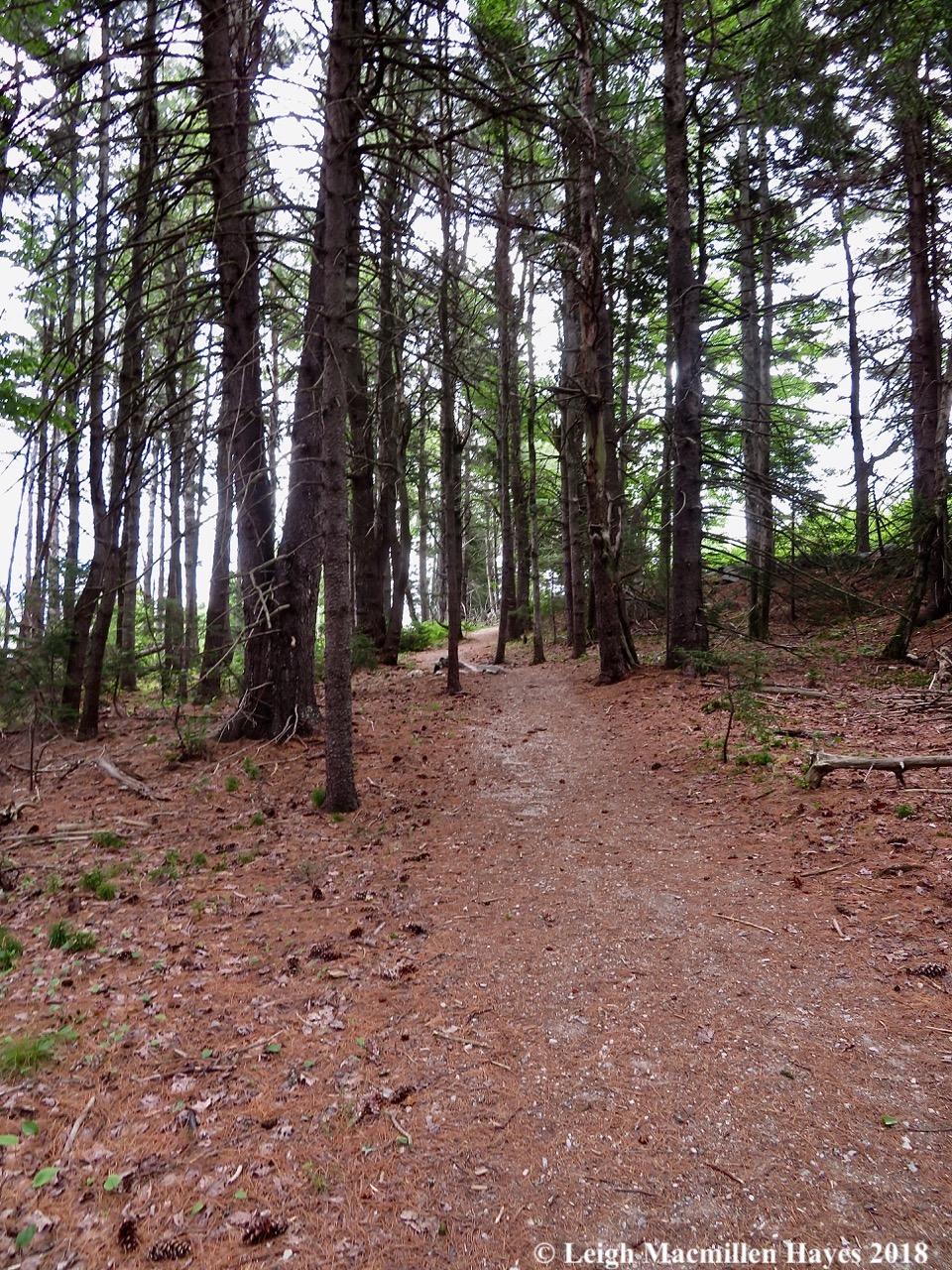
We continued on the short journey upward, passing through a pleasant White and Red Pine forest along a well-defined trail with switchbacks to help eliminate erosion.

f6

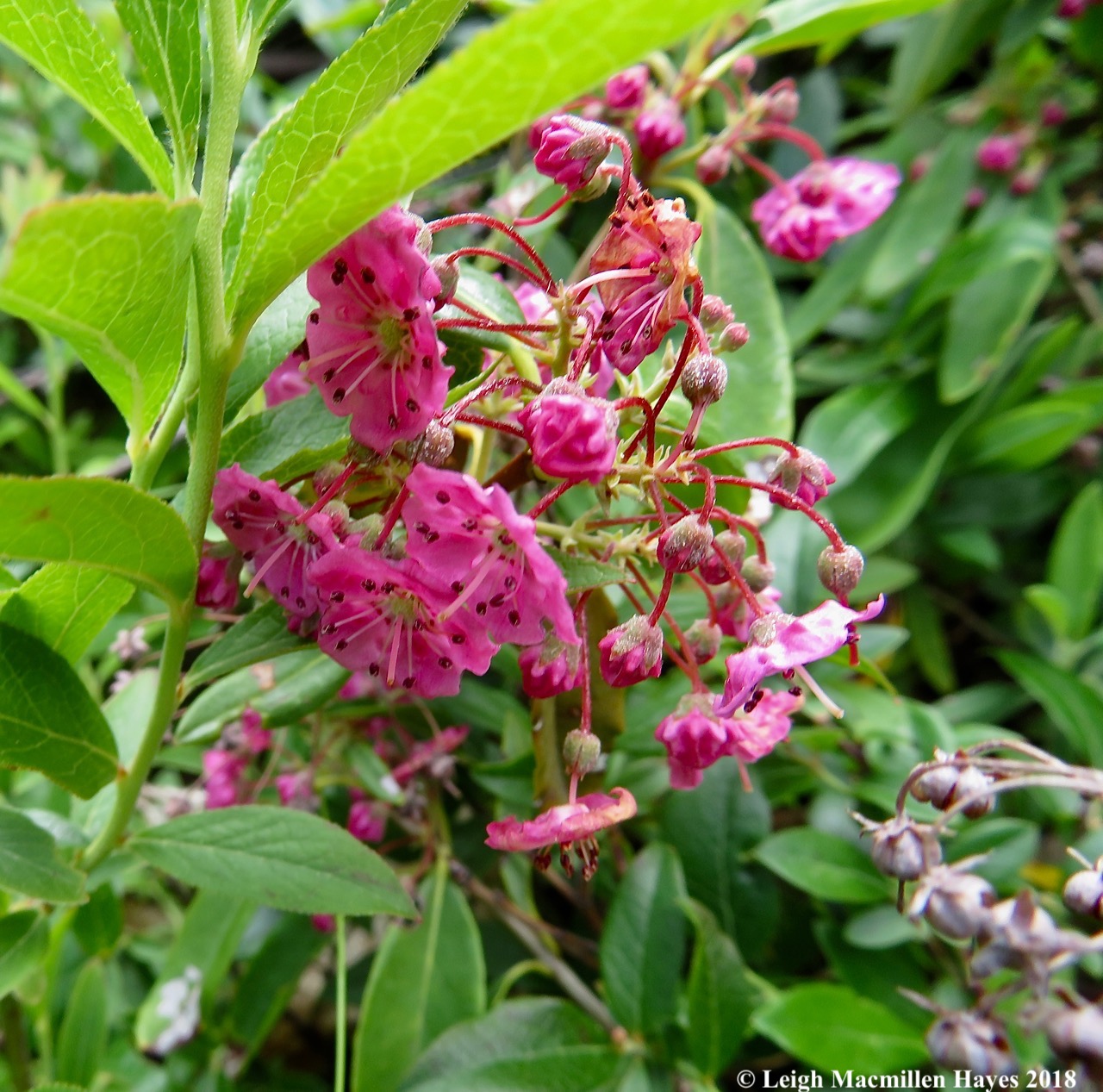
Suddenly, the natural community changed and we entered an open area where White-throated Sparrows serenaded us with their “Old Sam Peabody, Peabody, Peabody” song. Sheep Laurel surprised us with its bright pink flowers, but . . . we spied no pollinators.

f7

We also discovered a cinquefoil growing abundantly among the rocks, and though it had a few pollinators, it was just that–only a few.

f7a

Now allow me to interrupt with an explanation of the common name for this cinquefoil or Sibbaldiopsis tridentata: it’s known as Three-toothed (tridentata) for the three teeth at the tip of each leaflet. Do you see them?

f8

Though we only saw a few pollinators among the cinquefoil, the abundance of blueberries suggested a lot of previous action. A few blueberries had already ripened. We conducted a taste test and suggest you totally avoid Foss Mountain this summer for we certainly couldn’t taste the sunshine in those little blue morsels. (And my nose just grew longer–Pinocchio-style.)

f13

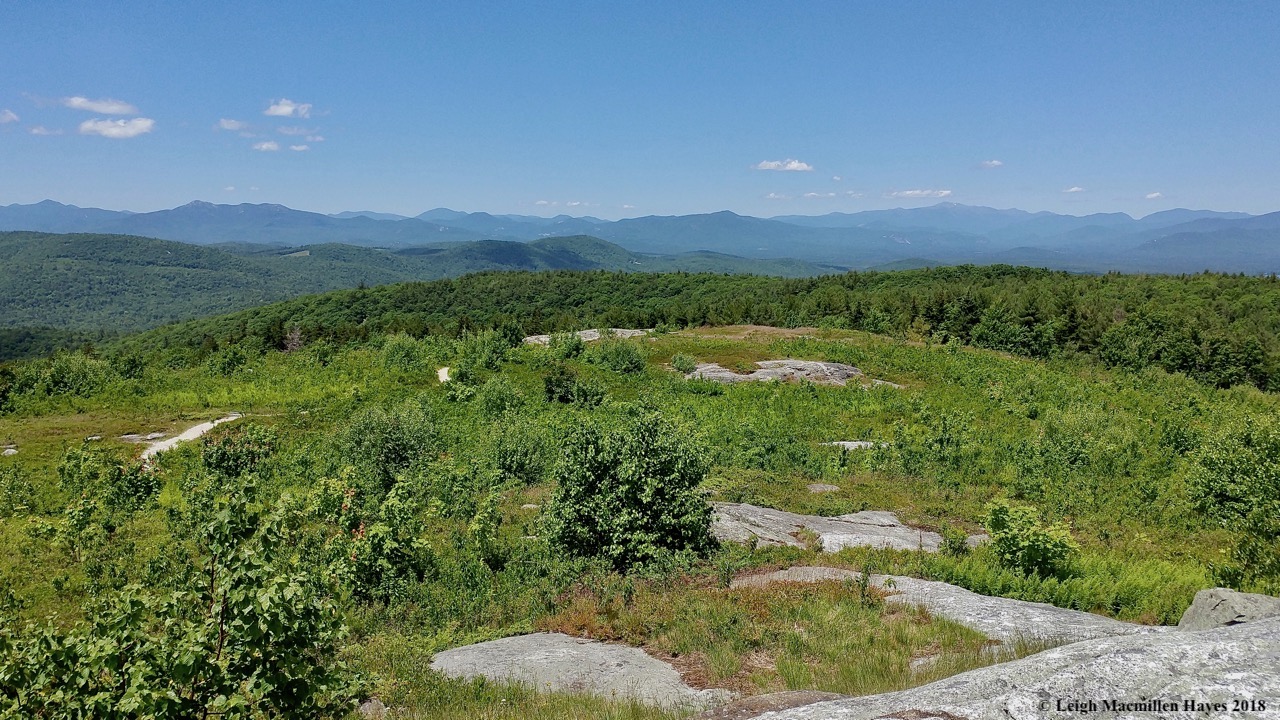
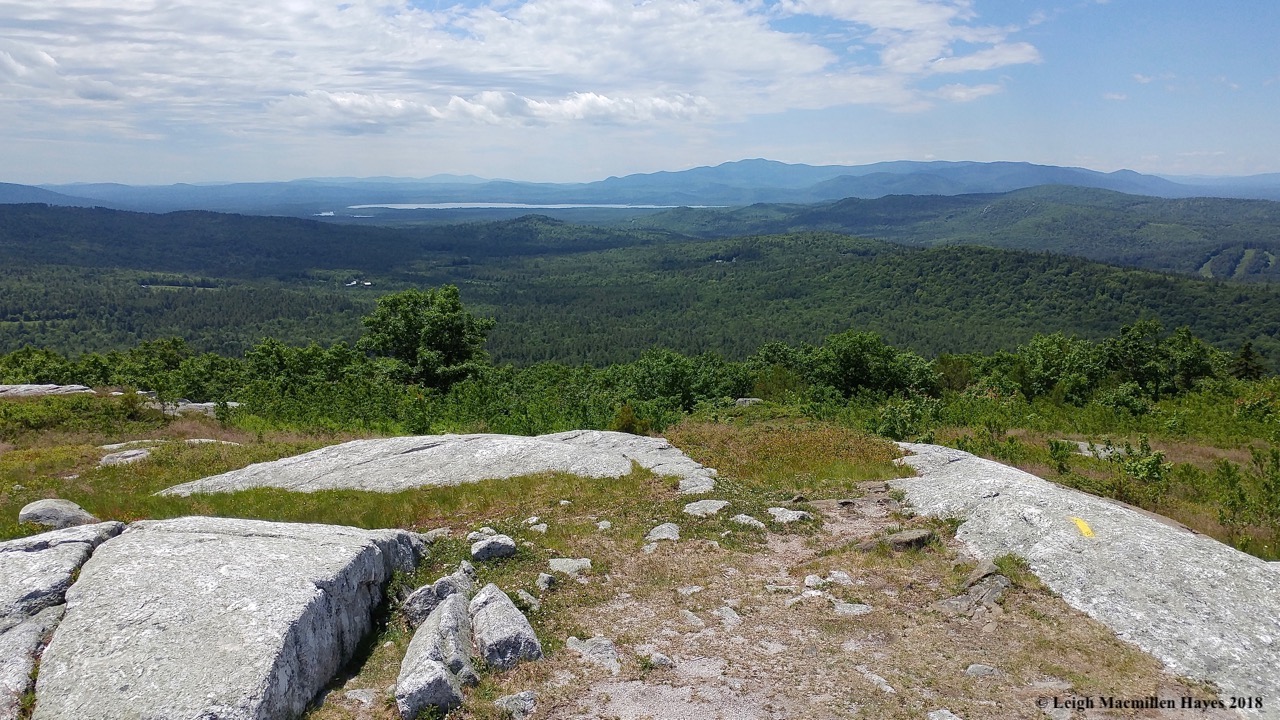
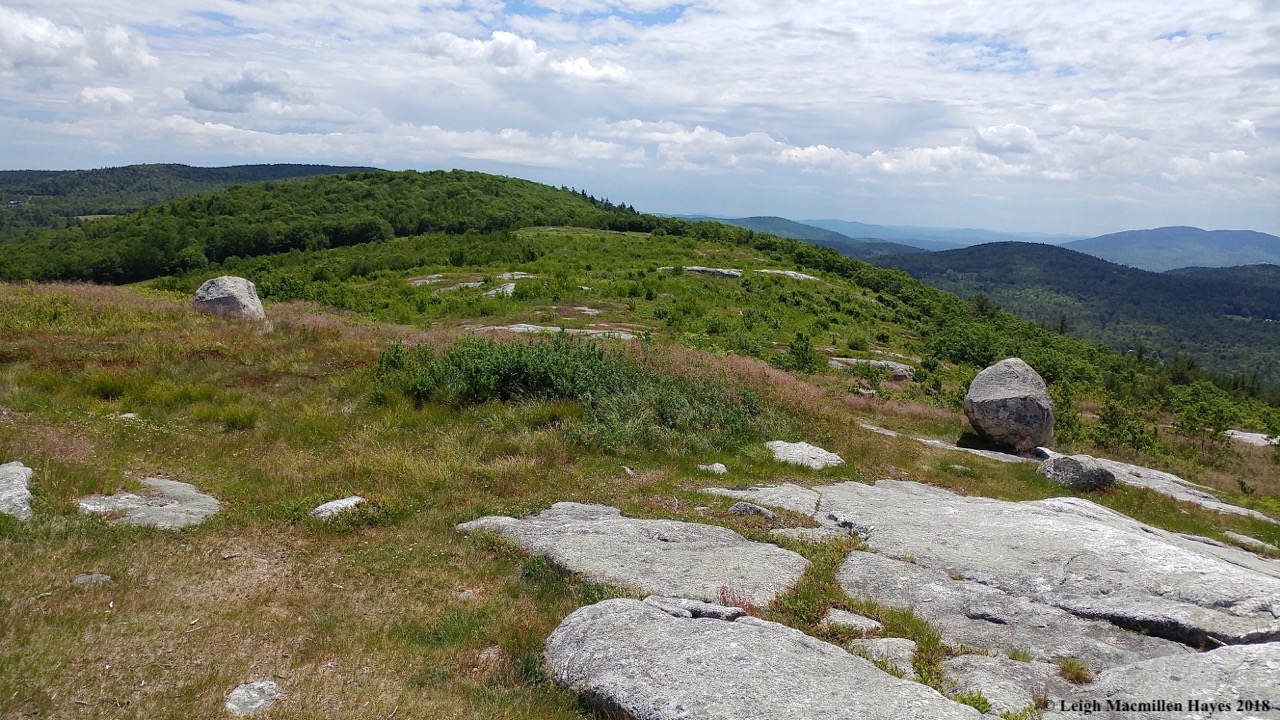
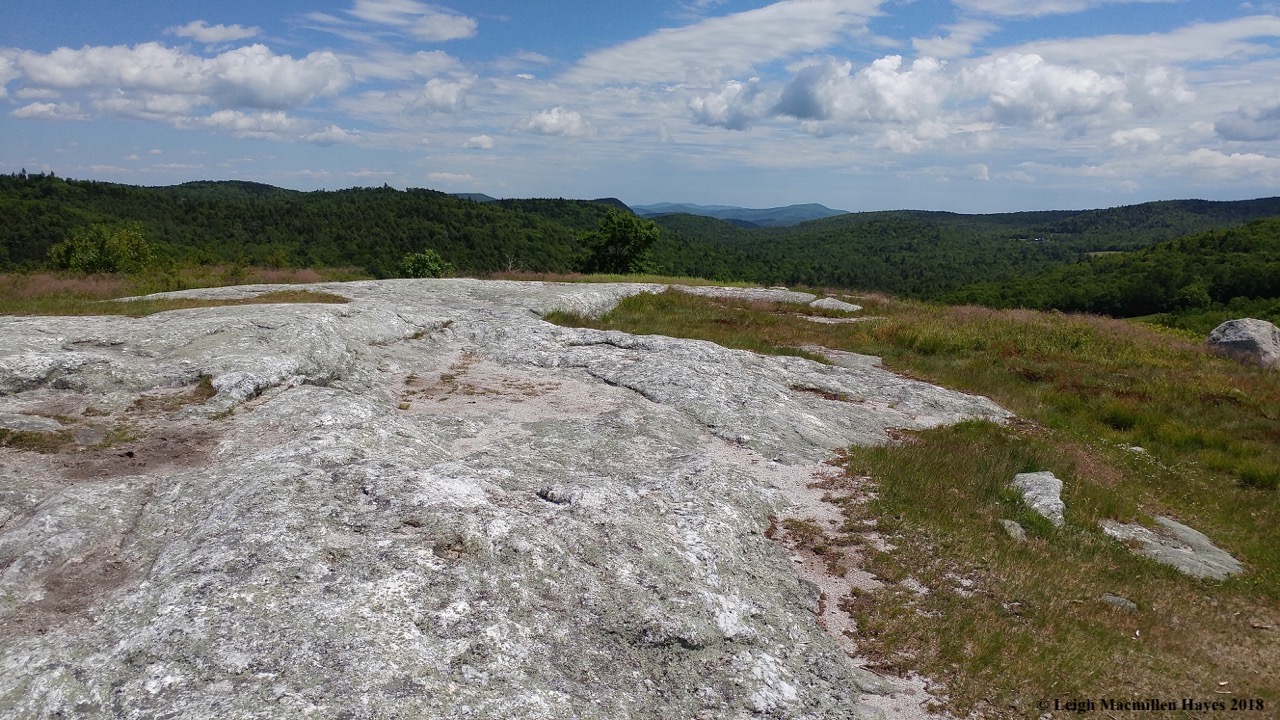
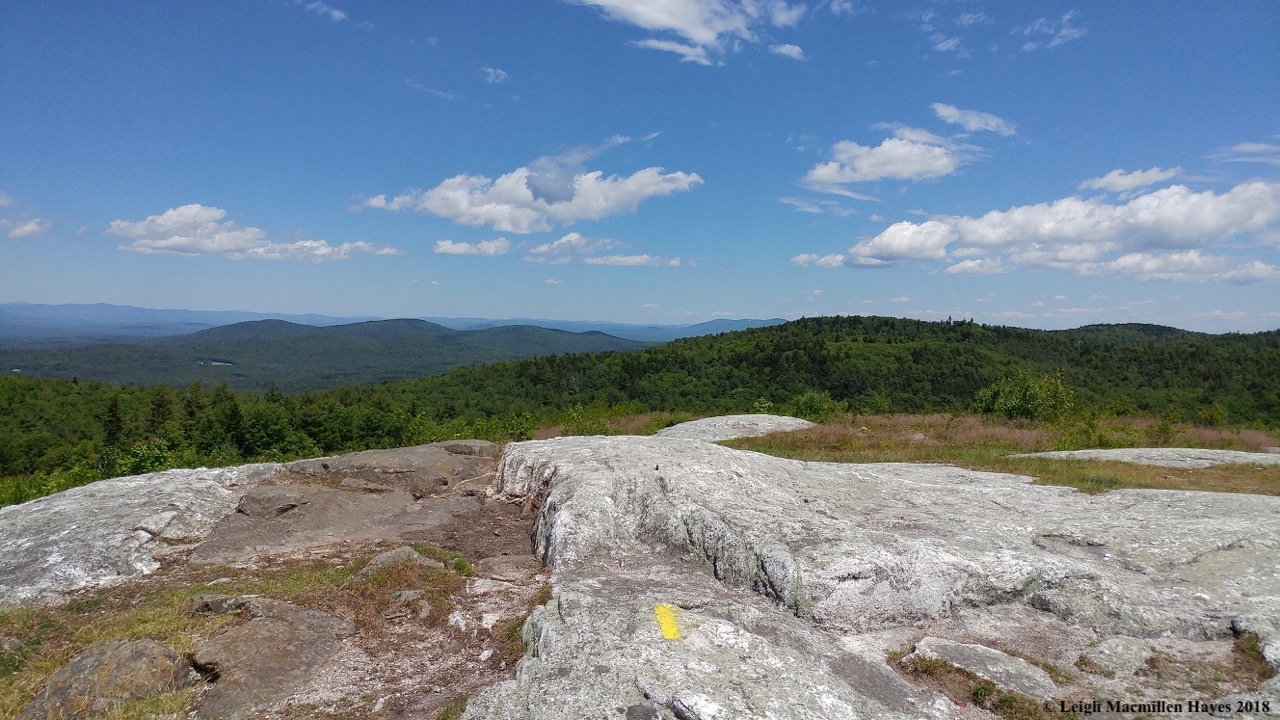
As we reached the summit, we shifted our attention from flowers and pollinators to the 360˚ view that surrounded us.

f14

In every direction . . .

f15

we relished the sight . . .

f16

of blueberry plants . . .

f17

and mountains–including the Ossipee, Belknap and Presidential ranges.

f19

After a lunch break in the middle of this longest day, we started down and made more discoveries–including the sweet flowers of Blue-eyed Grass and its fruits indicating it had been pollinated.

f20

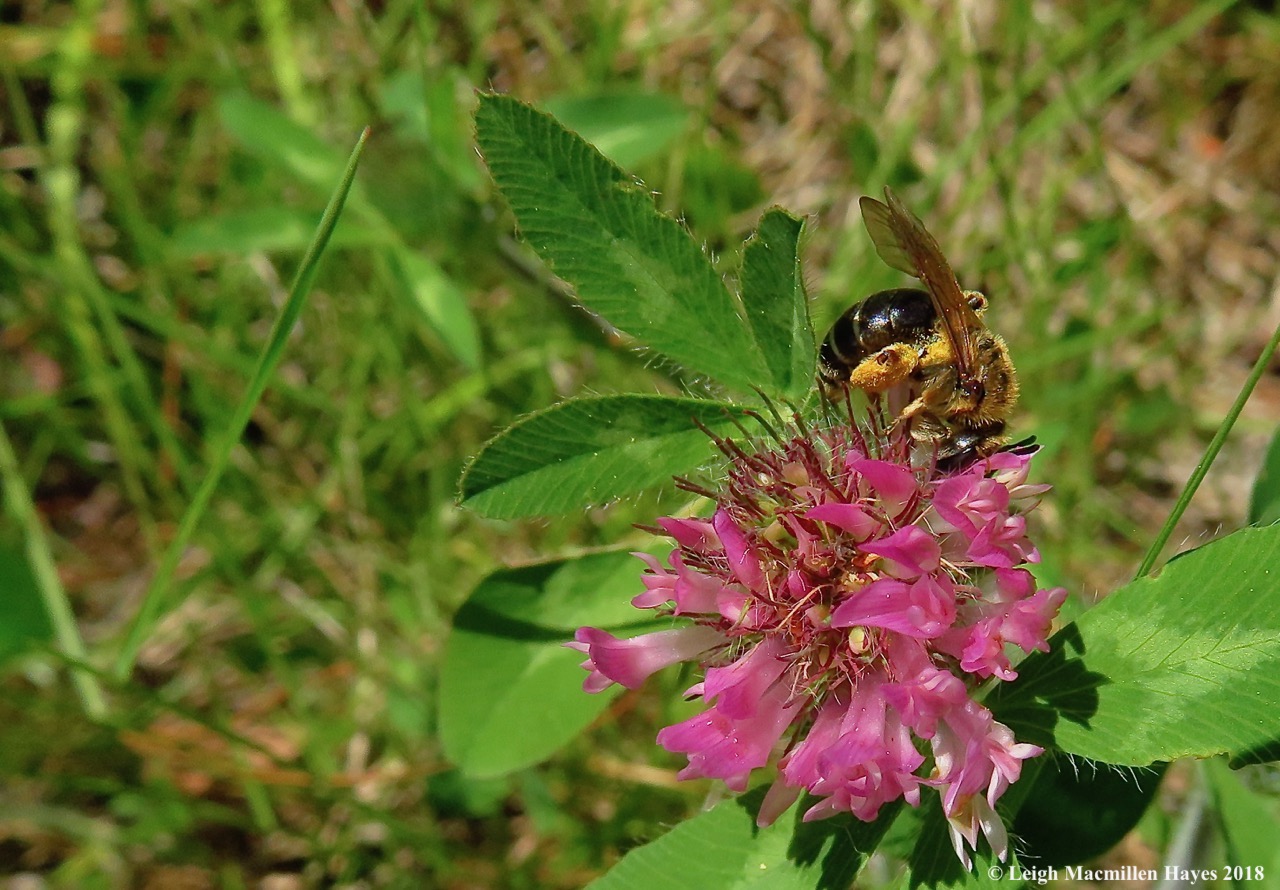
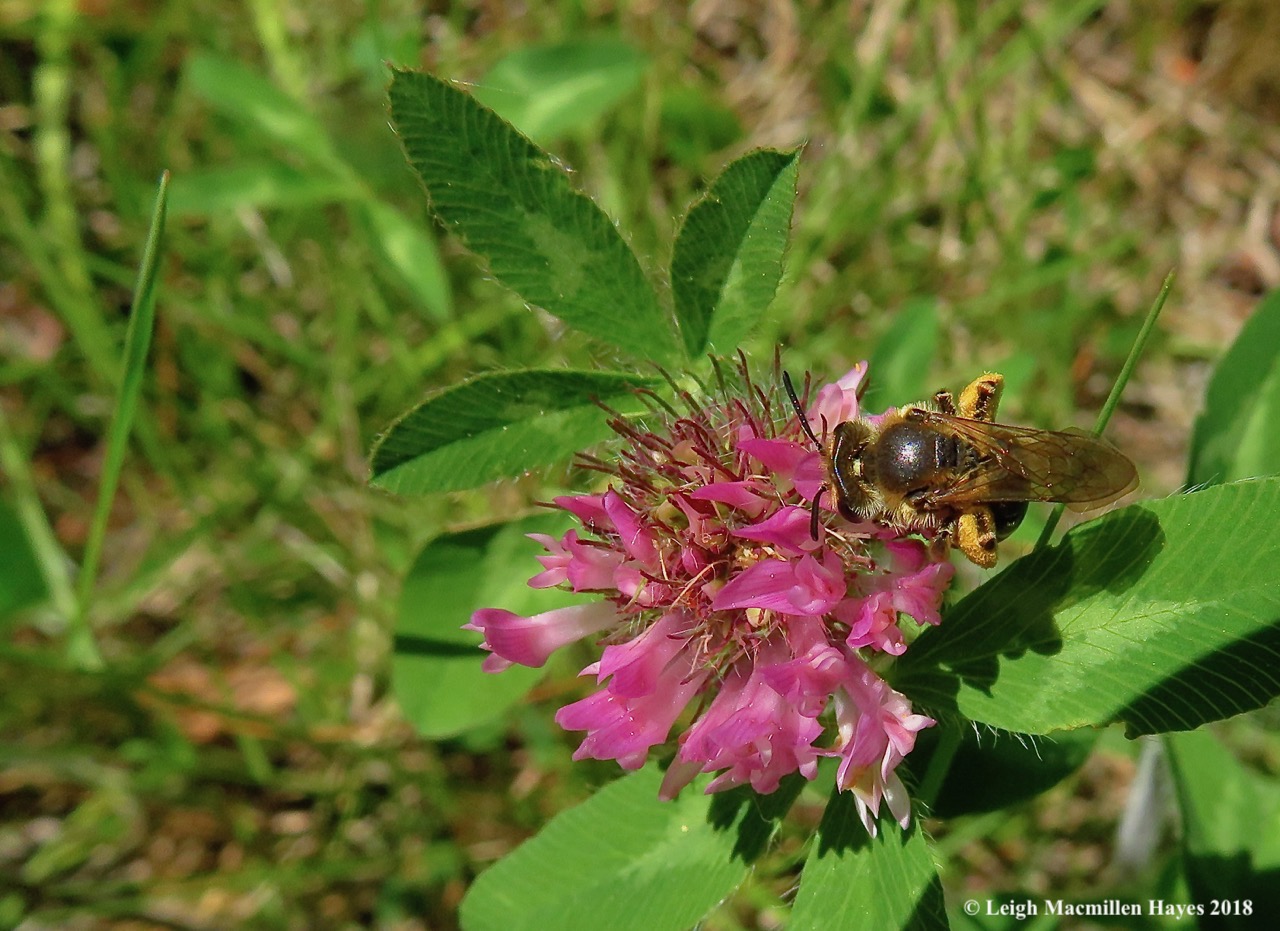
And nearby on a Red Clover . . .

f21

a bumblebee sought nectar while simultaneously filling its pollen sacs.

But in the whole scheme of things, we saw few pollinators and wondered–what’s up? This is an organic field and public space, as Carissa’s contact at Natureworks encouraged. And yet . . . Pam and I weren’t able to answer all our questions today.

f22

But . . . as we looked upon the abundant blueberry crop before us on this first day of summer, we gave thanks for those who had protected the land and those who had performed the mighty act of pollination despite adversity and we looked forward to the sweetness that will follow this Summer Solstice.