Giving Thanks Beside Sucker Brook

Since it’s deer hunting season in the Maine woods, we decided to host a walk one Sunday in November on a Greater Lovell Land Trust property because hunting is prohibited on this day. And today happened to be that Sunday. But first, this story begins with a few other events. On Friday, I had the honor of participating in a late afternoon program at New Suncook School. Before the young girls in the program, their leaders, and I stepped outside, one of them struggled with a Hannaford bag that was splitting apart because it was full of canned and boxed food. I helped her get the bag into her backpack before she dropped all its contents and the act drove home the need to make sure my guy and I attended the second event.
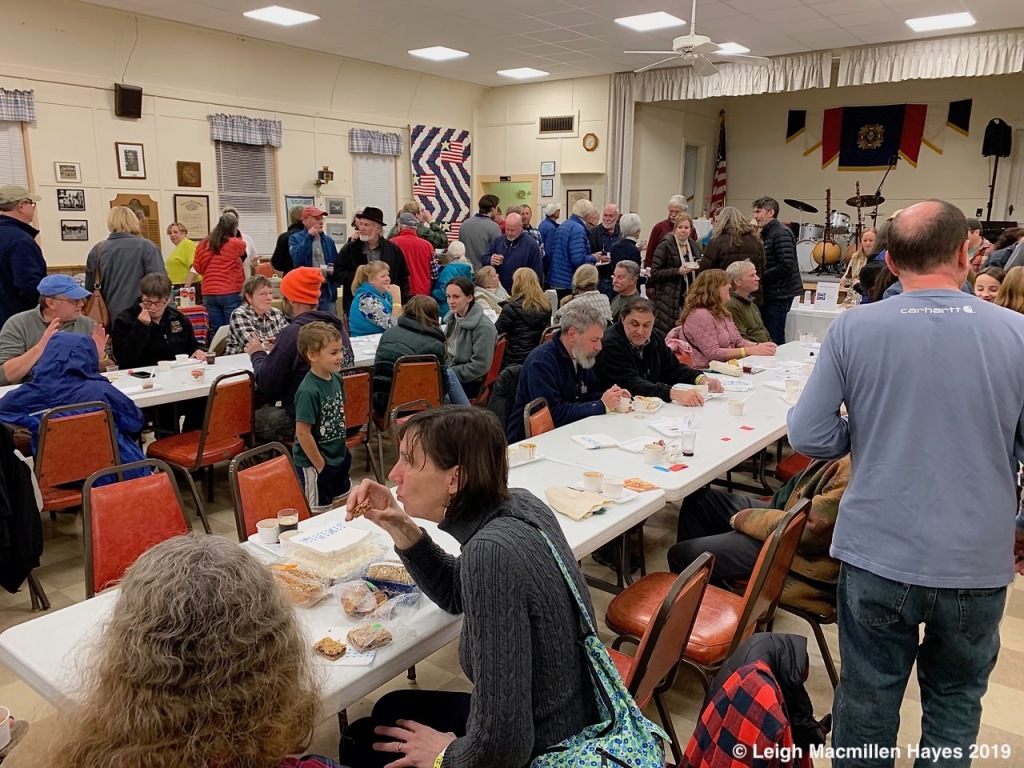
The second event was the Second Annual Bowls and Brews Chili and Chowder Challenge and Beer Tasting held at the Lovell VFW Hall last night.

The land trust was well represented by participants, including Executive Director Erika Rowland who created a delicious Black Bear Chipotle Chili.

Erika’s chili didn’t win, but she and GLLT’s Office Manager Alice Bragg were still all smiles.

The real winners of the event were the kids like the young girl I helped on Friday. For what she was trying to hold was a bag full of food as is provided to her family by the Sunshine Backpack Food Program. And the Bowls and Brews event was a fundraiser to support that program. Throughout the school district, elementary students in need go home with nutritious, non-perishable, easy-to-prepare food every Friday. One hundred percent of the proceeds from the fundraiser support the program.
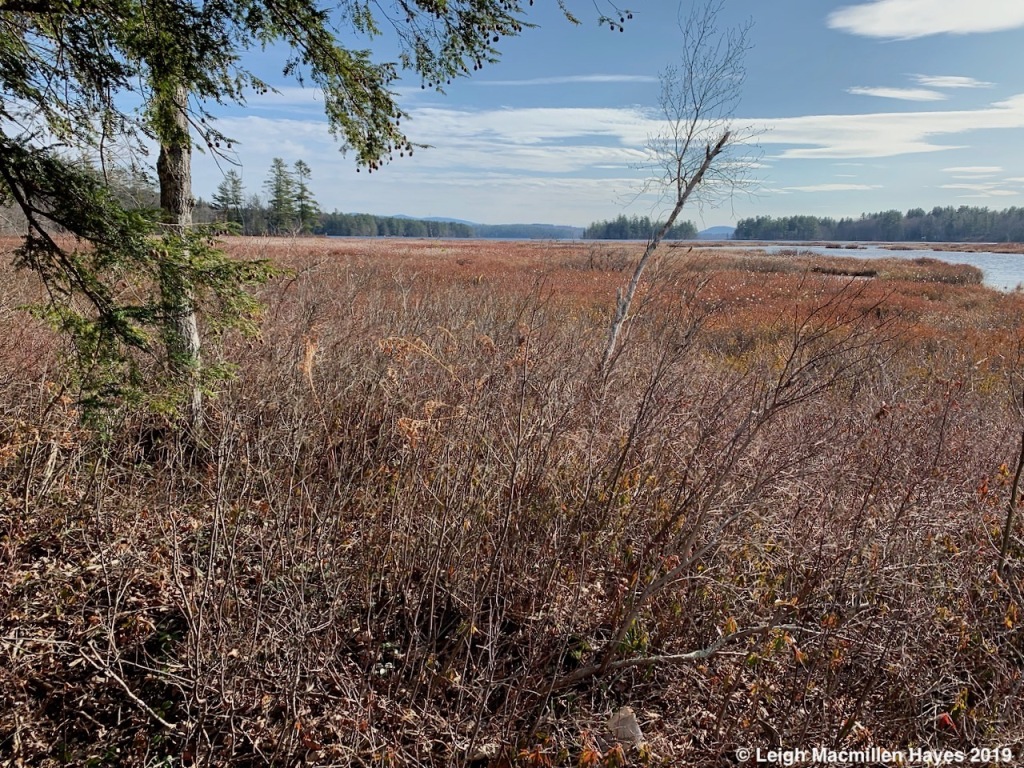
That brings me to this afternoon’s walk first advertised as Sunday Beside Sucker Brook. Months ago I wrote this description: Let’s get a head start on Thanksgiving, and journey the trail at John A. Segur East where we’ll take in the afternoon views of Sucker Brook, its plants in their winter forms, beaver lodges, and mountain views.

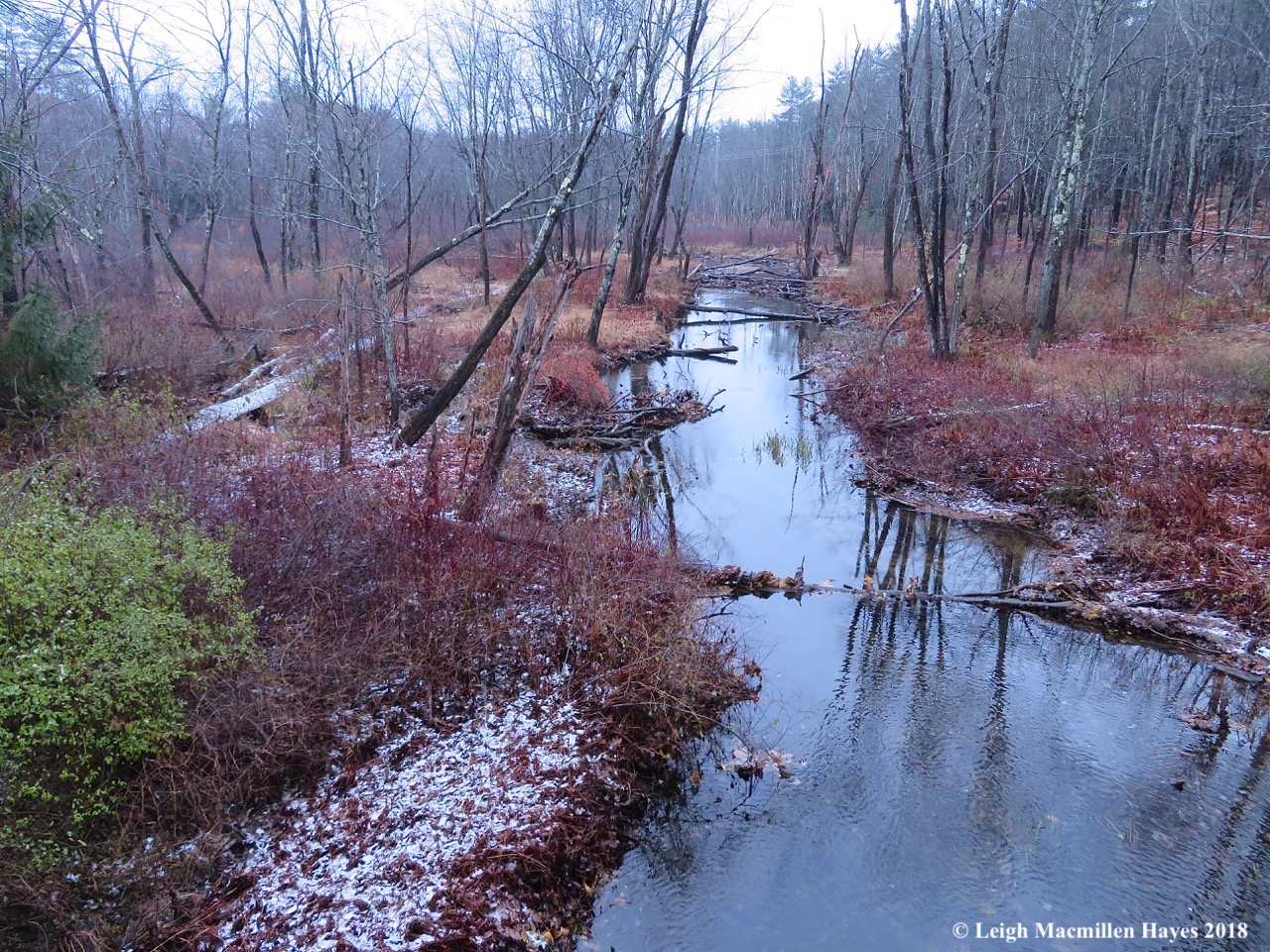
And so we did. First we stepped off the trail and took in the view to the south where Sucker Brook empties into Kezar Lake’s Lower Bay.

And then we looked north to admired the hills that are reflected by three beaver lodges situated in a triangle. The one to the right had some mud on it and so we trusted the beavers had been adding insulation to the homestead.

It’s a good thing because a thin layer of ice had formed around the edges of the brook and we realized the next season is on the horizon.

Even within the Pitcher Plant leaves ice had formed. Some of today’s participants touched the downward pointing hairs that draw insects into this carnivorous plant, noting the difference between the easy slide down and much bristlier texture one encounters trying to climb back out.
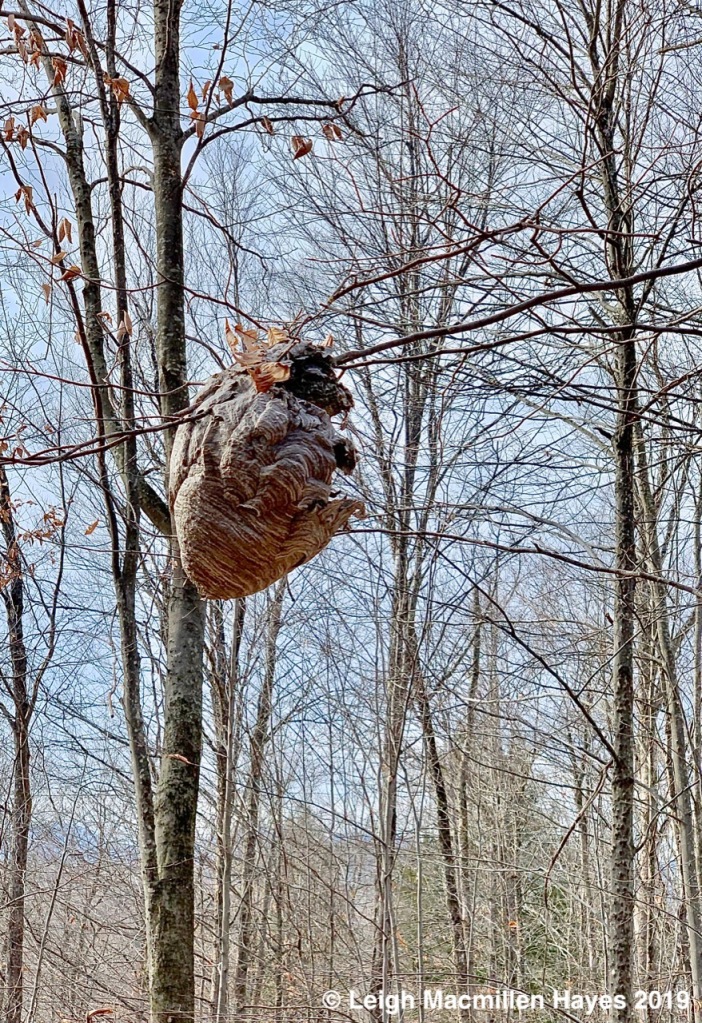
Continuing along the green-blazed trail, one among us spied a Bald-faced Hornet’s nest. When we noticed part of it on the forest floor, we had to step off the trail and check it out.

In the summer we avoid these nests for fear of being stung by the aggressive workers who defend their territory. But by now the workers have all died and the queen has found a snug spot to overwinter under tree bark.

Being able to examine the nest drew our awe as we noted the individual hexagonal cells created by the queen who had collected wood and plant fibers, chewed them into a papery pulp mixed with her saliva, and built brood chambers into which she placed eggs. To enclose the chambers that housed her girls she then constructed a thin papery envelope. The fact that the cells were the same size and shape was worth our wonder as we thought about the queen’s degree in mechanical engineering.
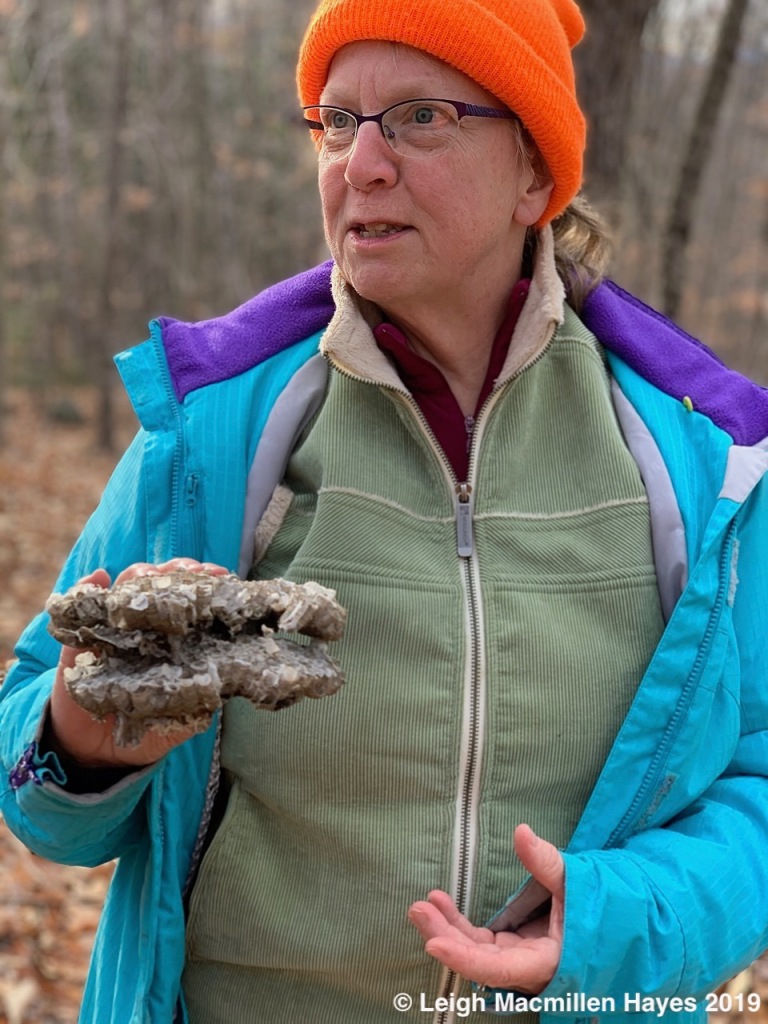
Within the outer envelope, several suspended combs contained chambers for larvae. A two-tiered section had fallen to the ground and Miriam picked it up for further examination. Her findings: brood chambers were papery and the darker gray that glued the combs together was much firmer.
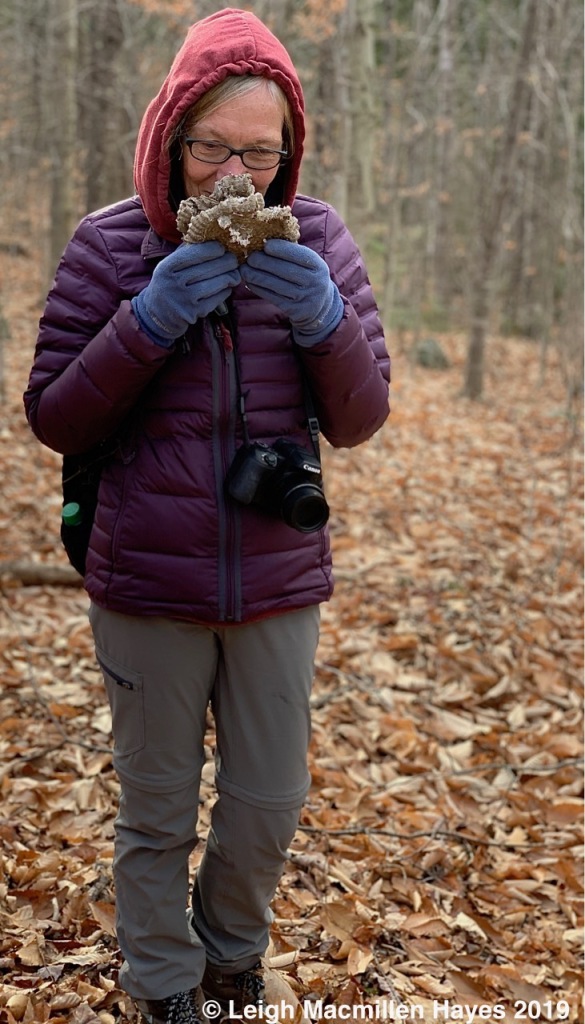
Pam gave the piece the sniff test. Her findings: the combs smelled like hay, but the glue offered a much more offensive odor.
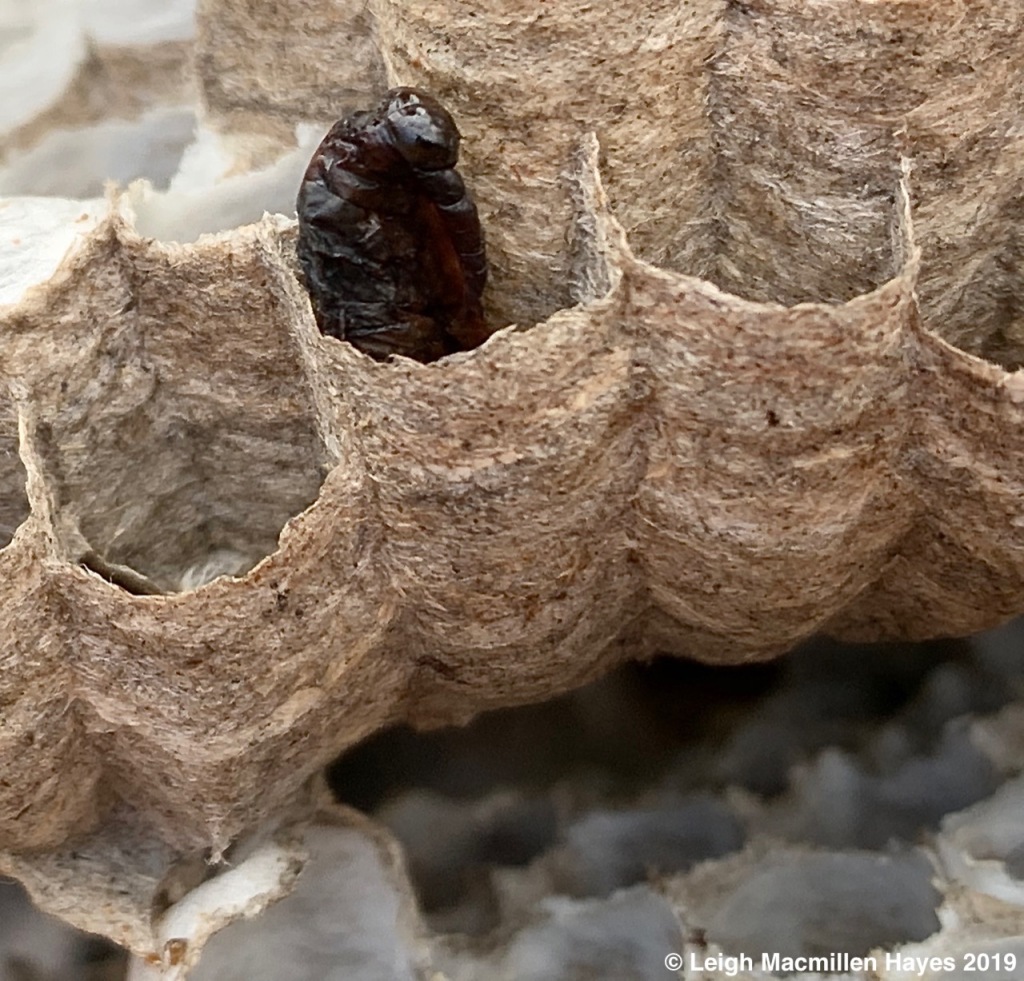
Our examination also revealed a few grub-like larvae that didn’t have an opportunity to cycle through life.

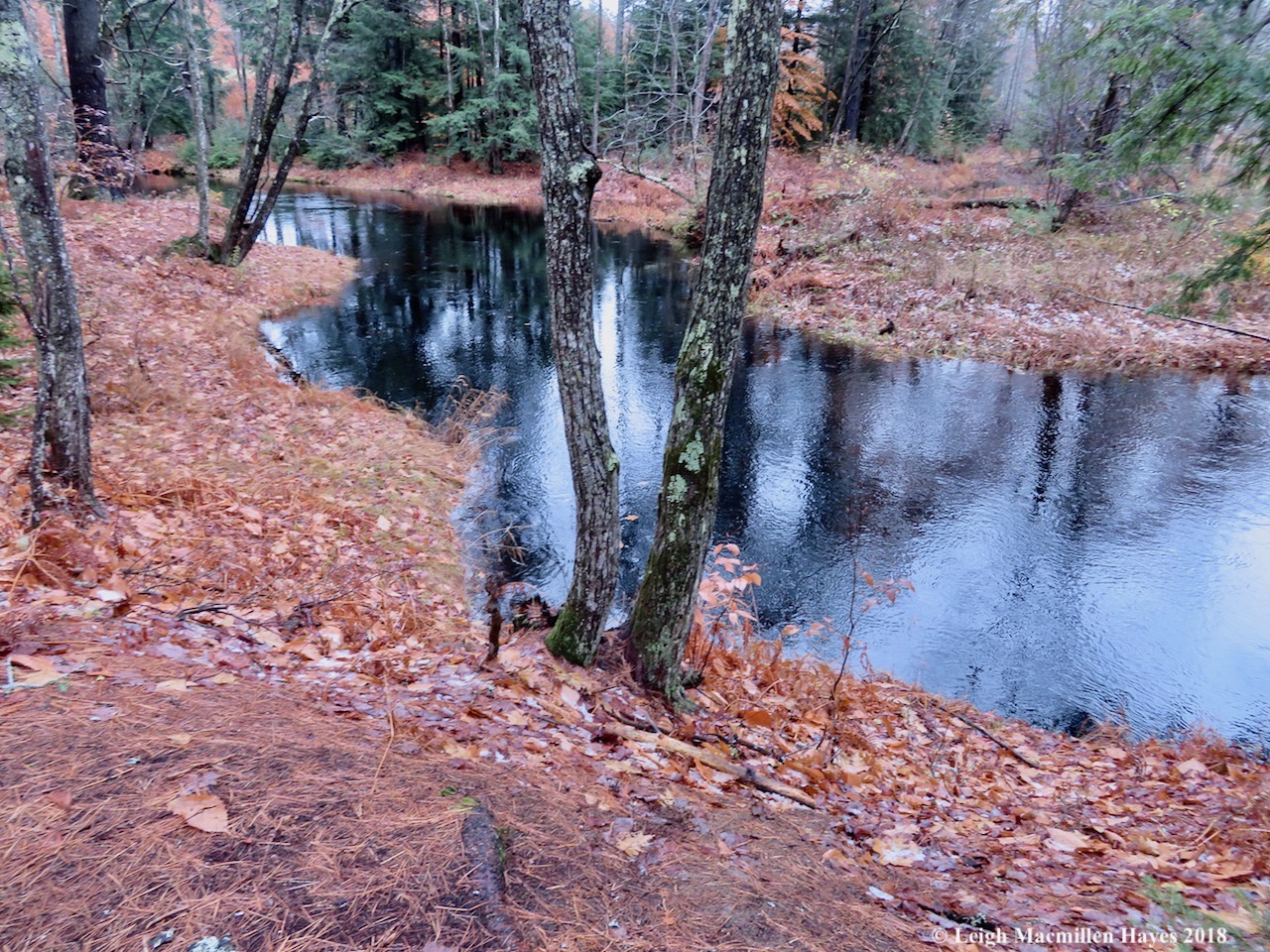
After kinda, sorta, not really bee-lining to finish before darkness fell, we reached the scenic view that again included the brook and mountains beyond.
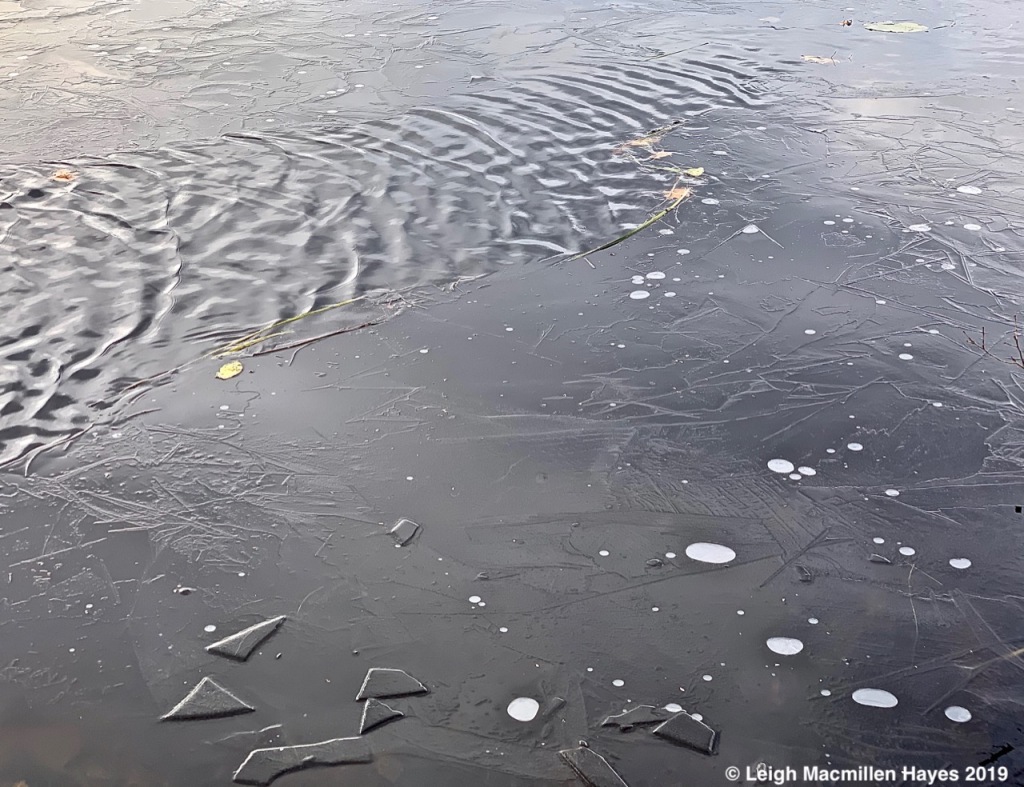
There was even more ice in our vision. Ripples made it look like the water flowed from south to north, but we knew it to actually be the opposite. The wind blew from the southwest and thus caused the current oxymoron.
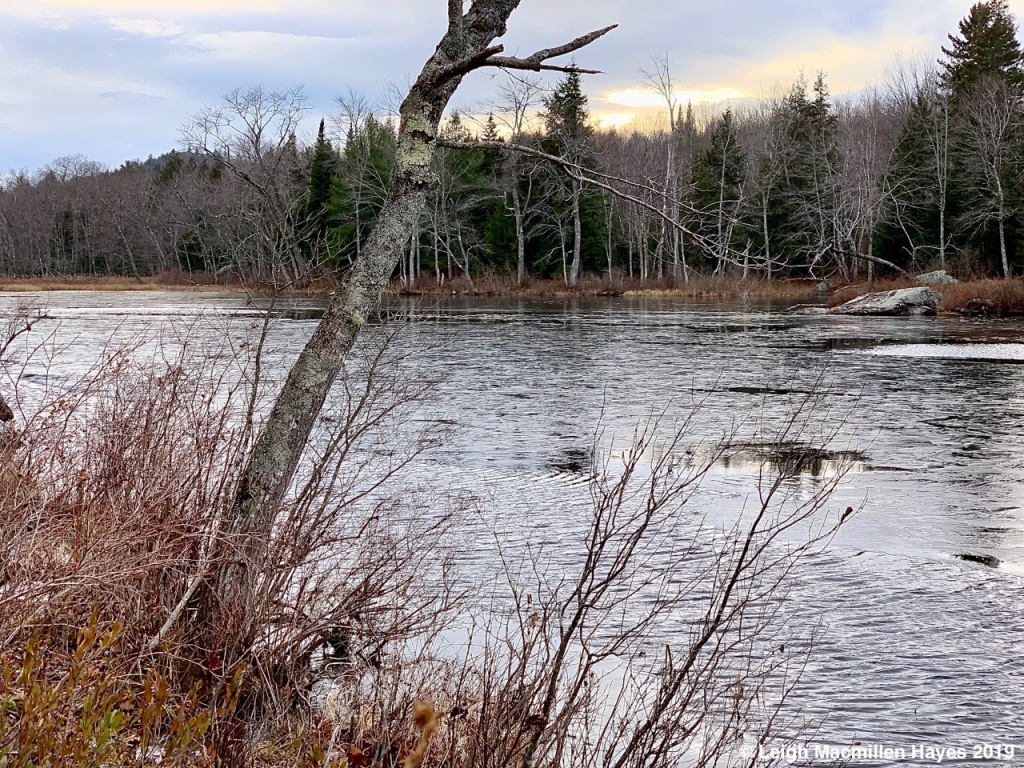
Quietly we stood for a minute and then shared “thanksgivings” for the land, the air, the water, the people, and the place.

Before turning around, a short bushwhack revealed another beaver lodge in the offing.
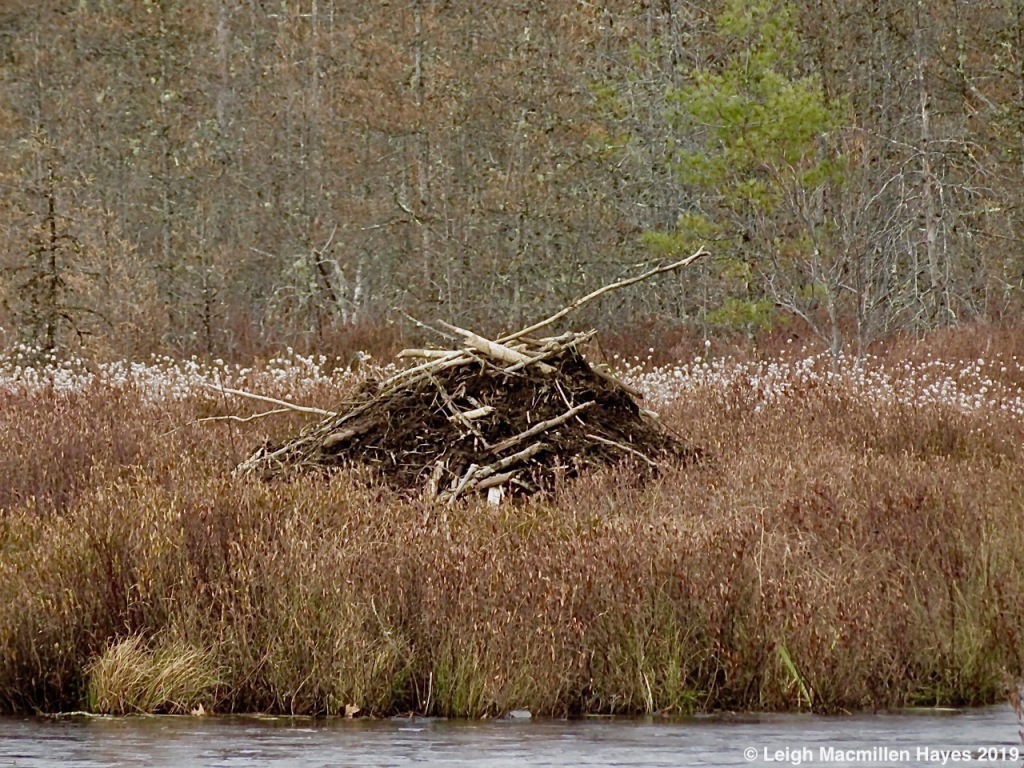
It, too, was covered in the beavers’ form of Typar: mud. And topped with fresh wood. Construction continues.
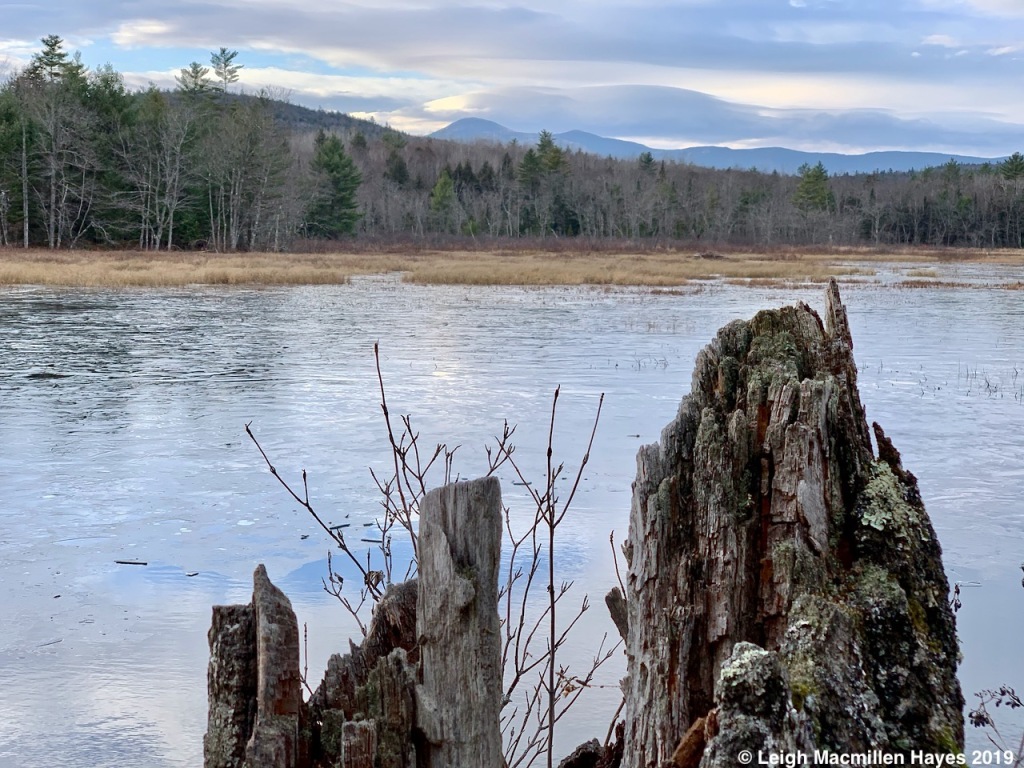
With one final view of the brook, the clouds shifted and revealed the Baldface Mountains in Evans Notch.

On the way out, we paused for moths as we’d done on the way in. Linda’s eagle eyes spotted this tiny one: Bog Bibarrambla Moth.
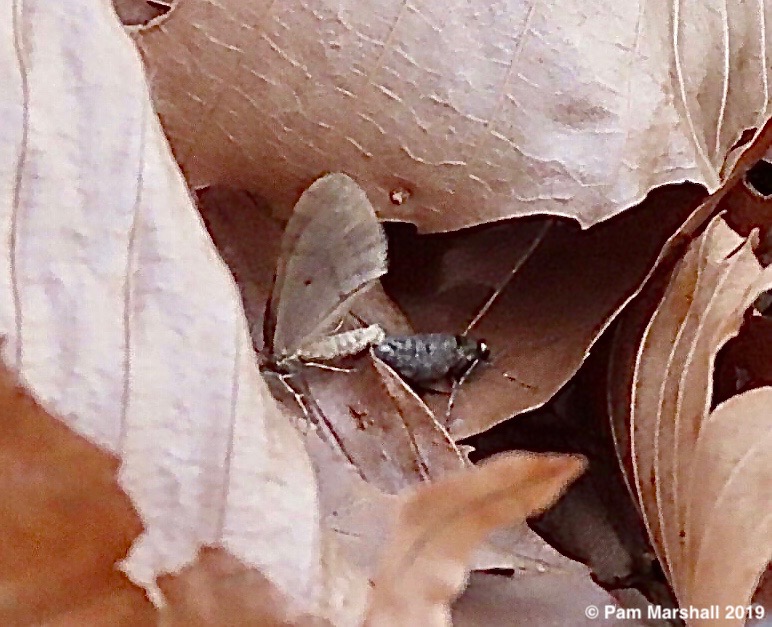
All along we’d noticed male moths flying about, but again on the return trip one among us noticed a few males in one area. If we’re correct in our identification, they were Bruce Spanworms, but what was even more important was the realization that the female is wingless. Yes, these two are canoodling.
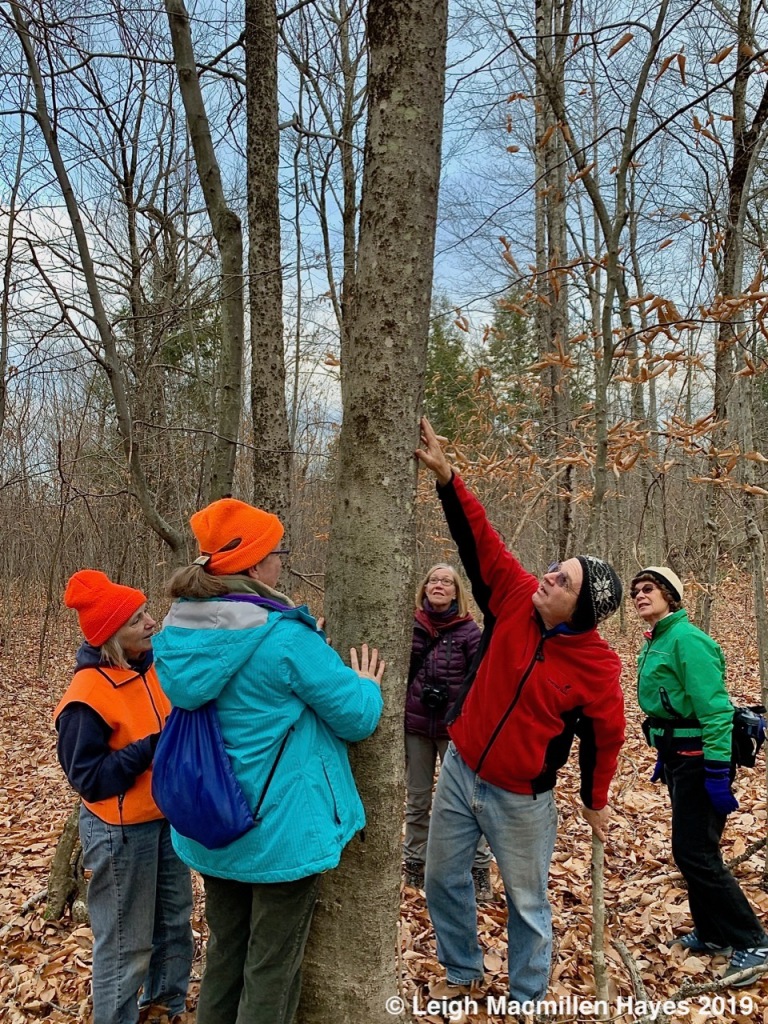
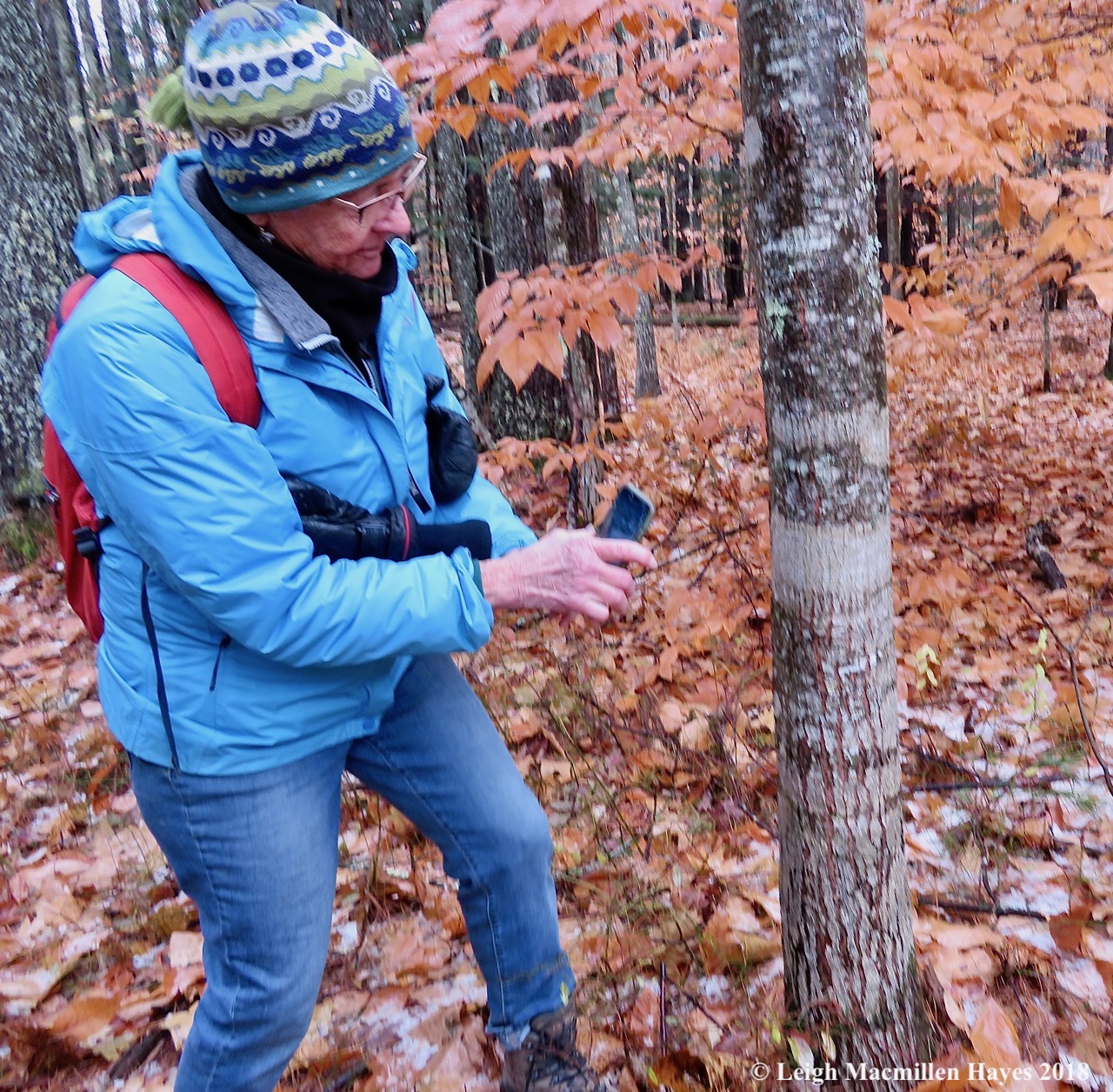
One last stop to make before continuing our “bee-line” to the parking lot was a bit of a scavenger hunt: A Bear-claw Tree Scavenger Hunt. Bingo. Brian made the discovery and everyone gathered ’round for a closer examination.
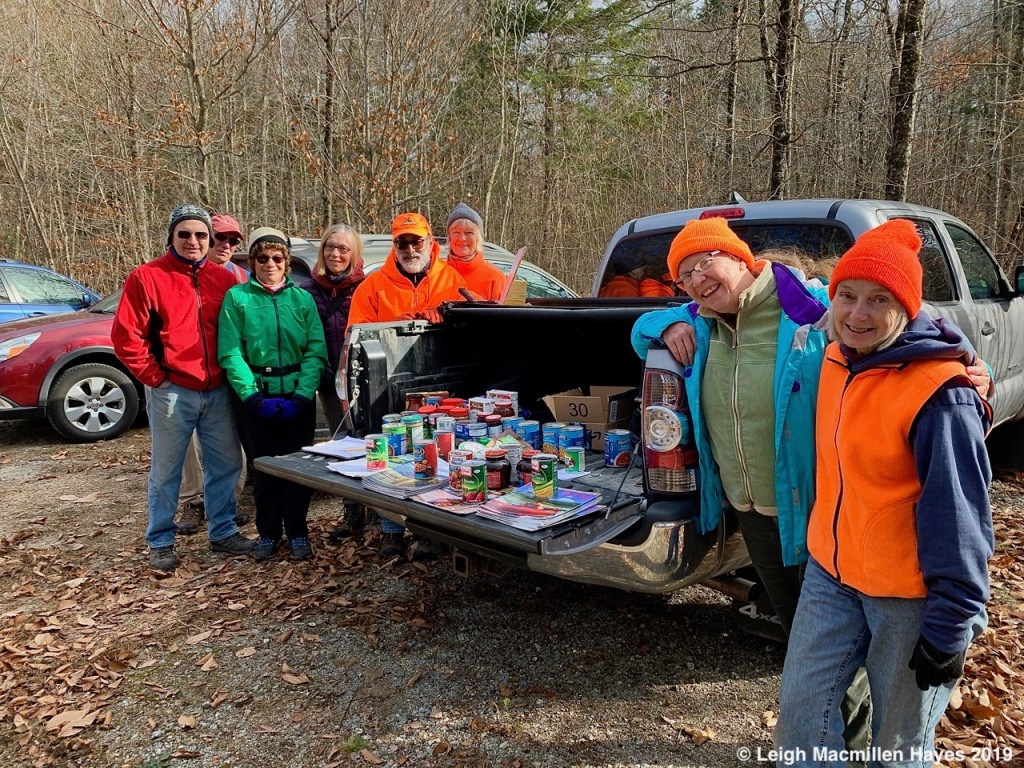
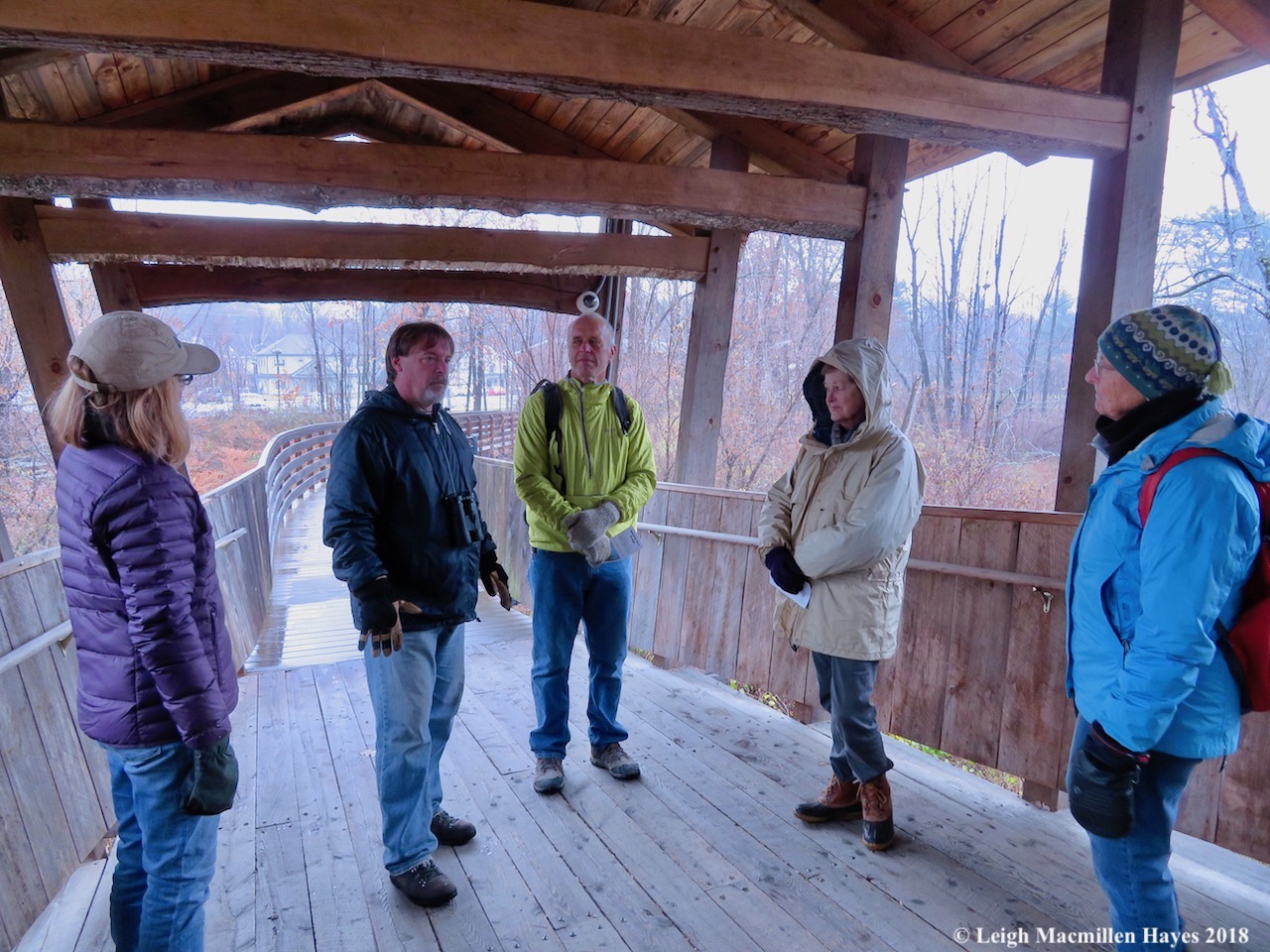
As I said earlier, when I first wrote the description for the walk, I said we’d get a head start on Thanksgiving, but I didn’t really define what that meant. And then a brainstorm a week ago revealed a plan. To offer thanks as we did by the brook, but also . . . to bring food for the Sweden Food Pantry, which serves Lovell, Sweden, Stow, Stoneham, Waterford, Fryeburg, and Bridgton. Our numbers were small today as nine of us traveled the trail at John A. Segur Wildlife Refuge, but our givings big (and we had some items from a few others who couldn’t join us.) We were equally glad to have Linda Bradley (she’s wearing the blaze-orange vest), president of the food pantry, along for the journey.

We’re grateful to all who either joined us or contributed to our offerings as we gave thanks beside Sucker Brook and helped fill the shelves in Sweden.

As we departed we made plans to repeat this event, but choose the following weekend next year so we don’t complete with the Third Annual Bowls and Brews fundraiser.

Childhood Magic

Why did the Greater Lovell Land Trust co-host (or rather tri-host) a hike through Pondicherry Park in Bridgton this morning? Because it’s hunting season, and it didn’t make sense to invite the public on a property that isn’t posted. (Not that we don’t still tramp on GLLT properties in November, mind you, but not on a public walk necessarily.)

And when I asked Jon Evans of Loon Echo Land Trust and Alanna Doughty of Lakes Environmental Association to join me in leading the tramp, they both quickly and graciously agreed to do so. I couldn’t wait because not only would it be a chance to share the special place with GLLT members, but also to bounce off of Jon and Alanna as we shared our knowledge of the natural and historical aspects of the park.

1-Bob Dunning Bridge

But . . . this morning dawned rainy and snowy. Still, we didn’t cancel. And though we knew that not everyone who had planned to join us could because there was more snow in the Lovell area and no power, we were pleasantly surprised to have a small contingent of participants that represented all three of our groups. And really, I love leading smaller groups because it’s so much easier for everyone to participate.

2-Jon giving the bridge history

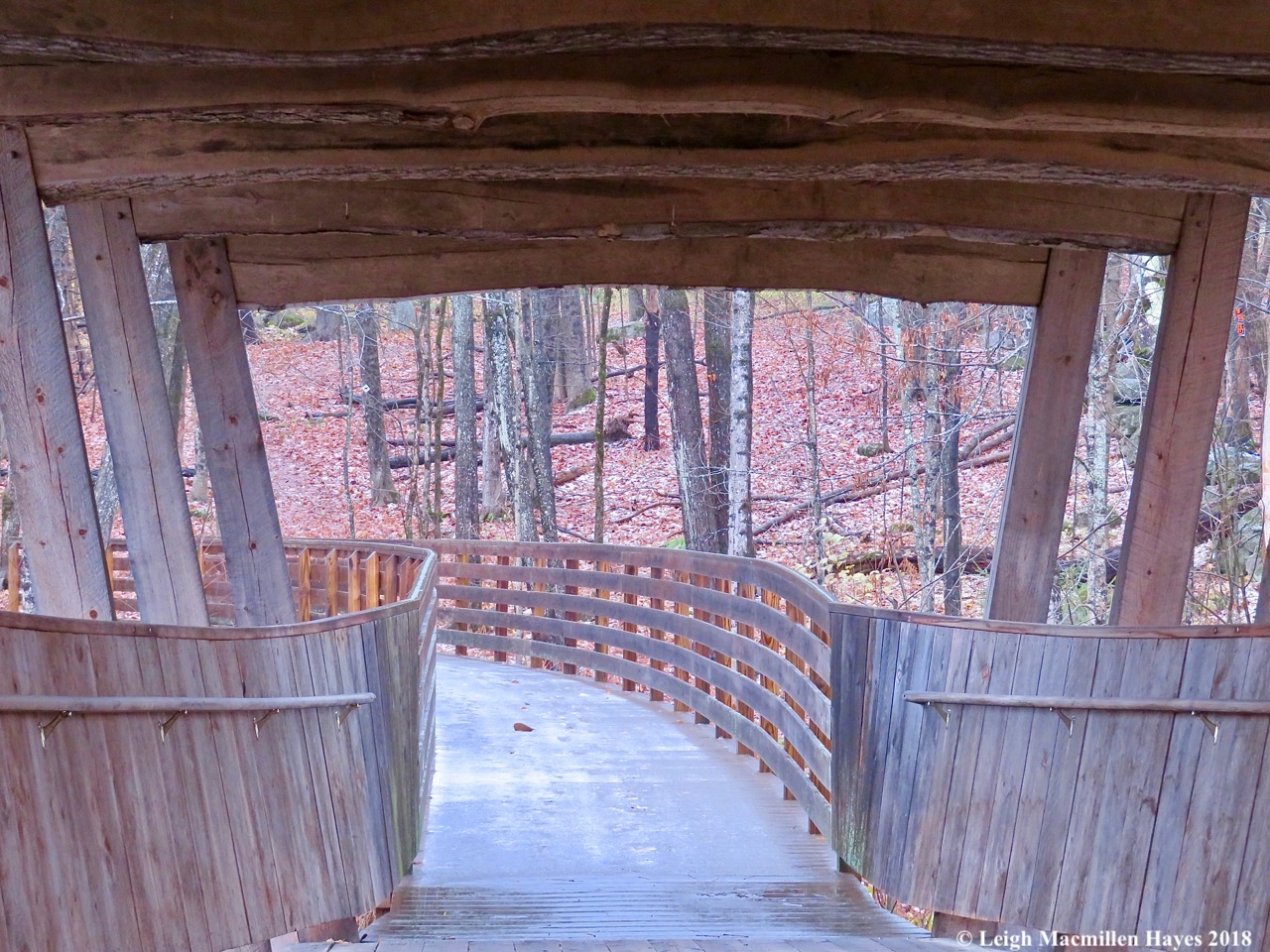
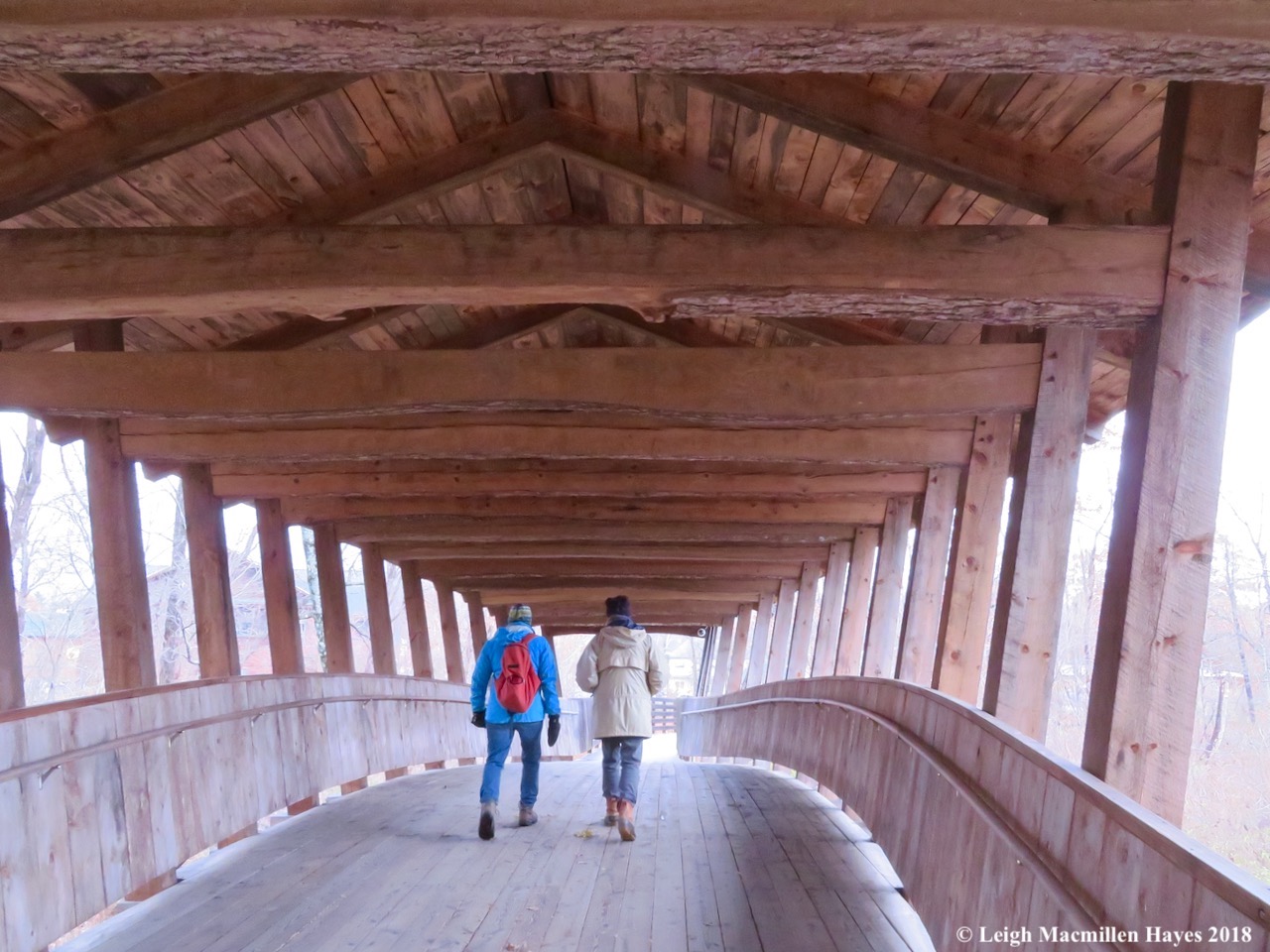
Our group, consisting of Pam, Jon, Bill, Connie and JoAnne, plus Alanna and me, stood for a bit on the Bob Dunning Memorial Bridge, the gateway into the park from behind Reny’s Department Store on Depot Street. As Jon explained, on September 11, 2010, the Bob Dunning Memorial Bridge was constructed in true barn-raising fashion.

3-Stevens Brook

The bridge spans Stevens Brook, the source of power when Bridgton was first founded and for many years thereafter.

4-Bob Dunning Bridge

One of the unique things about the bridge is that each tie beam comes from a different tree species, with the bark left on. As I walk across the bridge, my eyes are always drawn to the beams.

Until I took the Maine Master Naturalist class, I recognized only a few species by their bark. But my eyes were opened to the fact that each species has its own presentation, which is true for everything in the natural world. I wanted to know all of them so I set out to teach myself, beginning with the species on the bridge. These became the focus of my capstone project for the class and from that I created a Barking Up A Bridge brochure that is available at the kiosk.

5-sugar and Norway maple leaves

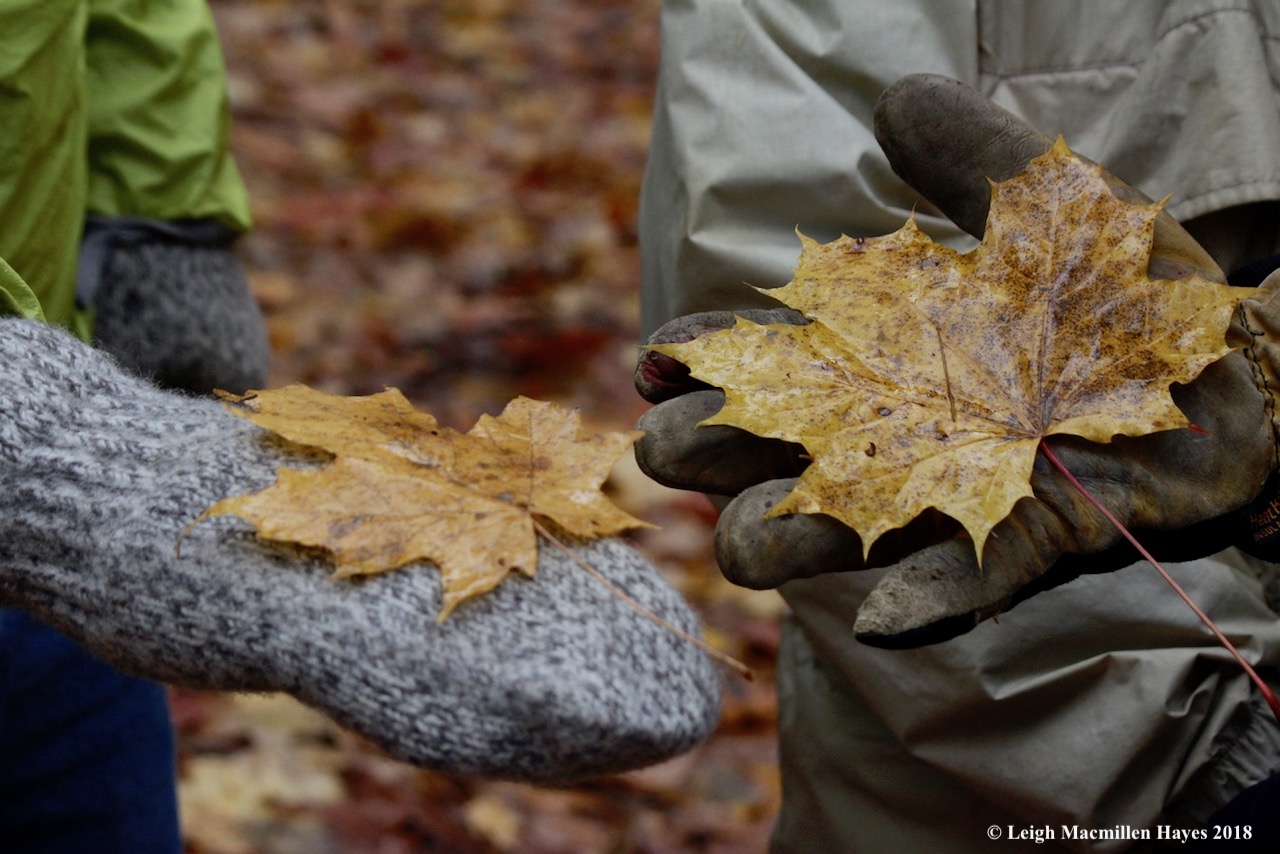
Into the park we finally went, stopping periodically along the way to notice and learn, including the similarities and differences between a sugar maple leaf on the left and Norway maple leaf on the right. Both have the same number of lobes (5) and look so similar, but . . .  the Norway maple leaf, an invasive planted along the main streets as a shade tree after the loss of Elms, is much boxier and more rectangular in shape. Plus, as Jon pointed out, the stem seeps a milky substance, which is a quick way to identify it.

6-pine soap

Our finds included many as we moved along at our usual slow pace, but one thing kept showing its form on pine after pine. Froth. It’s not unusual and occurs following a rain event such as we’d had all night and morning. So what causes the tree to froth? During a heavy rain, water running down the trunk of a white pine picks up the tree’s oils on the way. Air in the bark furrows bubbles through the oily film and produces the froth.

7-pine soap

Conditions were just right for it to occur so we spied frequent examples.

8-tussock moth cocoon

And because we were looking so closely at the bark, we noticed other things like tussock moth cocoons. We also found tube caterpillar moth cocoons created with pine needles and even pulled one apart to take a closer look. And the tiny sawfly cocoons on various twigs.

10-Willet Brook

Eventually, we found our way beside Willet Brook, which flows into Stevens.

11a-JoAnne photographing script lichen

And again, our eyes were drawn to tree bark and crustose lichen in particular. JoAnne snapped a photo of a script lichen that decorated a red oak.

13-crossing onto LEA property

Our intention was to turn away from the brook and cross the boardwalk that leads onto the Lakes Environmental Association’s adjacent property. Before doing so, however, we began to channel our inner child and rolled some logs.

12-baby red-backed salamander

And we weren’t disappointed for we found young and mature red-backed salamanders as hoped. If you roll a log, always pull it toward you so any critters that want to escape can do so in the opposite direction; and always put the log back into place quickly (well, after a couple of photographs, that is.)

14-Maine Lake Science Center Lab

At LEA’s Maine Lake Science Center, Alanna gave us a quick tour of the premises,

15-MLSC Lab

including the lab where various water quality tests are conducted.

16-Connie on the low-impact challenge course

Back outside, we headed up to LEA’s Pinehaven Trail and tried our talent as birds on a wire along the newly installed  low-impact challenge course.

17-Pam and Bill manuevering the wire walk

We all succeeded as Nuthatches for none of us fell off. If we’d done it with one hand, we  would have been Barred Owls and if we hadn’t used any hands, we would have been Cooper’s Hawks. But we were happy to be Nuthatches. There are four sets of challenges, each with a variety of activities to complete. Challenge your inner child.

18-watching balsam sticks

Crossing back into Pondicherry Park, we said we’d bee-line back to the bridge, but several times we just had to stop . . . especially when we found Balsam Fir blisters inviting us to poke them with twigs and drop the resin-tipped sticks into calm water.

19-balsam rainbow

We watched with fascination as the essential oil propelled the twig and created a rainbow, again satisfying that child within.

22-crossing back over the bridge

At last, a half hour after our intended finish time of 12:30pm, we found our way back to our starting point, all delighted to have spent time exploring and playing on a rather raw morning.

Thank you again to Jon and Alanna for sharing your knowledge and sense of wonder. And thank you to Pam, Bill, Connie, and JoAnne for coming out to play with us.

23-Chili and Beer

Later in the day, my guy and I drove to Lovell for yet another special event at the VFW Hall: LOVELL’S 1st ANNUAL BOWLS & BREWS fundraiser for the Sunshine Backpack Food Program.

It was a chili cook-off and beer tasting event featuring locally crafted chili and locally crafted beer from Bear Bones and Saco River Breweries. Plus, National Distributors in Portland donated Harpoon and New Belgium beers.

24-Paula and Diane

Diane Caracciolo nailed it and won first place from the judges and as the people’s choice. Her take away was a coveted apron, actually two, designed by local students who benefit from the Sunshine Backpack Food Program. As Paula Hughes, one of the event’s organizers explained, the packs are sent home on Fridays and filled with nutritious, non-perishable, easy-to-prepare food to ensure the kids get enough food on weekends.

At the end of the day, it seemed an interesting juxtaposition to have spent the morning channeling our inner child and the afternoon thinking about children who are so hungry that they can’t enjoy such childhood magic.

If you’d wish to contribute, let me know and I’ll put you in touch with Paula.