My Artistic Path: one year later

It’s all Jessie Lozanski’s fault that a year after publishing My Artistic Path, I’m publishing the next layer of paintings and sketches. Until I shared a few with my sister this afternoon, I had no idea how prolific I’ve been in this department. That said, some didn’t make it off the drawing board. Or rather, they did, but ended up in the trash, or in a pile to be considered at a later point in time. That’s the beauty of working with gouache, I can make changes at a later date. For me, that is liberating.

And now Dear Reader, you have three choices: 1) Read this entire post from beginning to end; 2) Scroll through the pictures and call it good; or 3) Click out of this post and pretend you either never saw it or that you did see it and loved all of it.
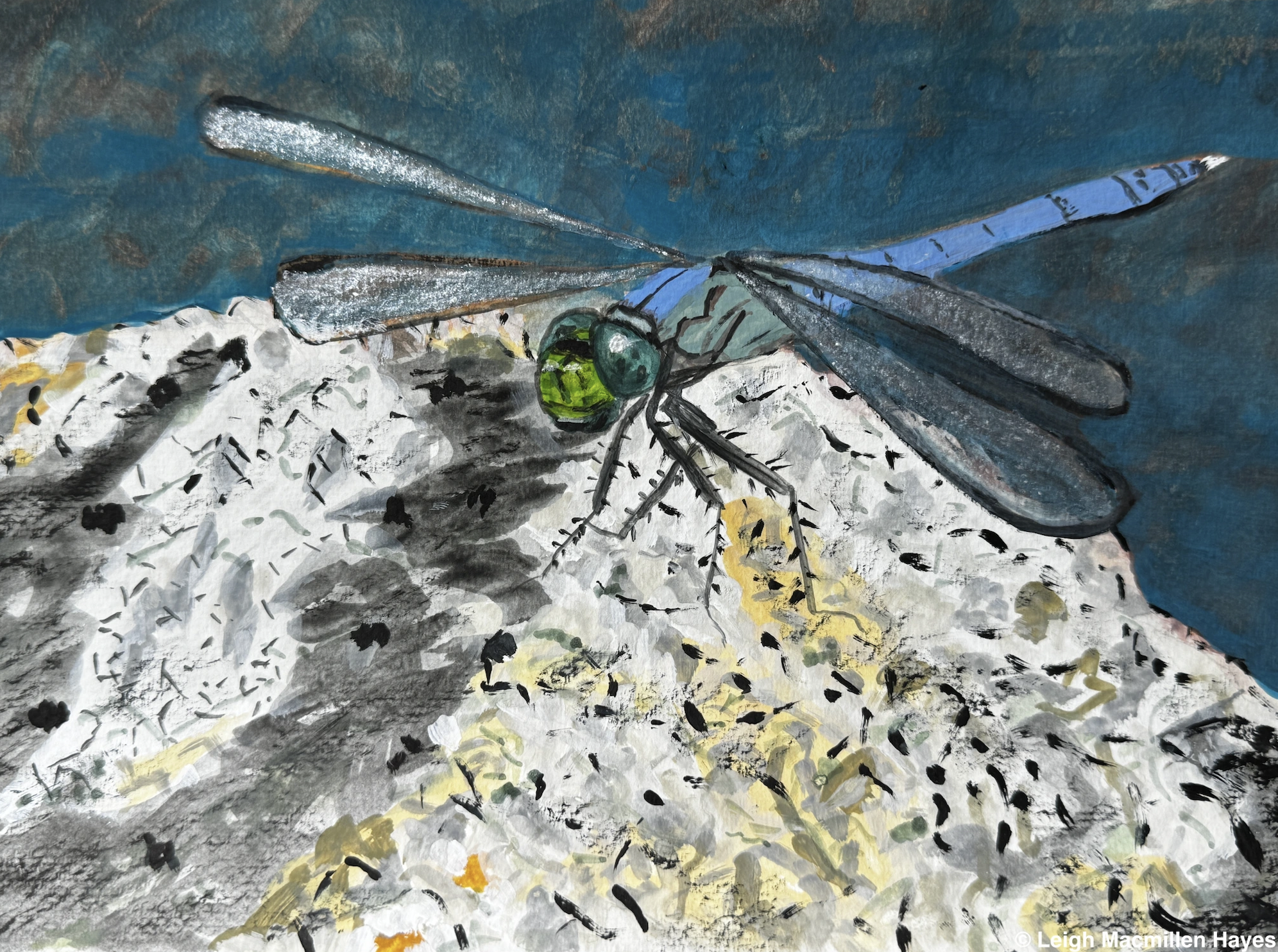
I have to say, I thought I’d paint more dragonflies like this Eastern Pondhawk, but when I scrolled through My Art Gallery, I discovered only a few others. That said, I did take some time to sketch the naiad forms of six families and then painted each one. You can visit all of those in Dragons of the Future if you wish.

Waterways also intrigued me as I tried to figure out how to make the water look as if it is flowing. This is Province Brook in Chatham, New Hampshire.

And then there are the critters and I’m afraid you’ll see a few of them along this journey. The fun thing about this Chipmunk is that it made an appearance on a February day. I was tracking with some friends and we were pretty certain that we’d discovered Chipmunk prints, but it didn’t seem possible. Until it was because as we backtracked, we saw him and he posed for a few photographs. Sometimes, when you need more food, you might make a mad dash from your winter home to locate it.
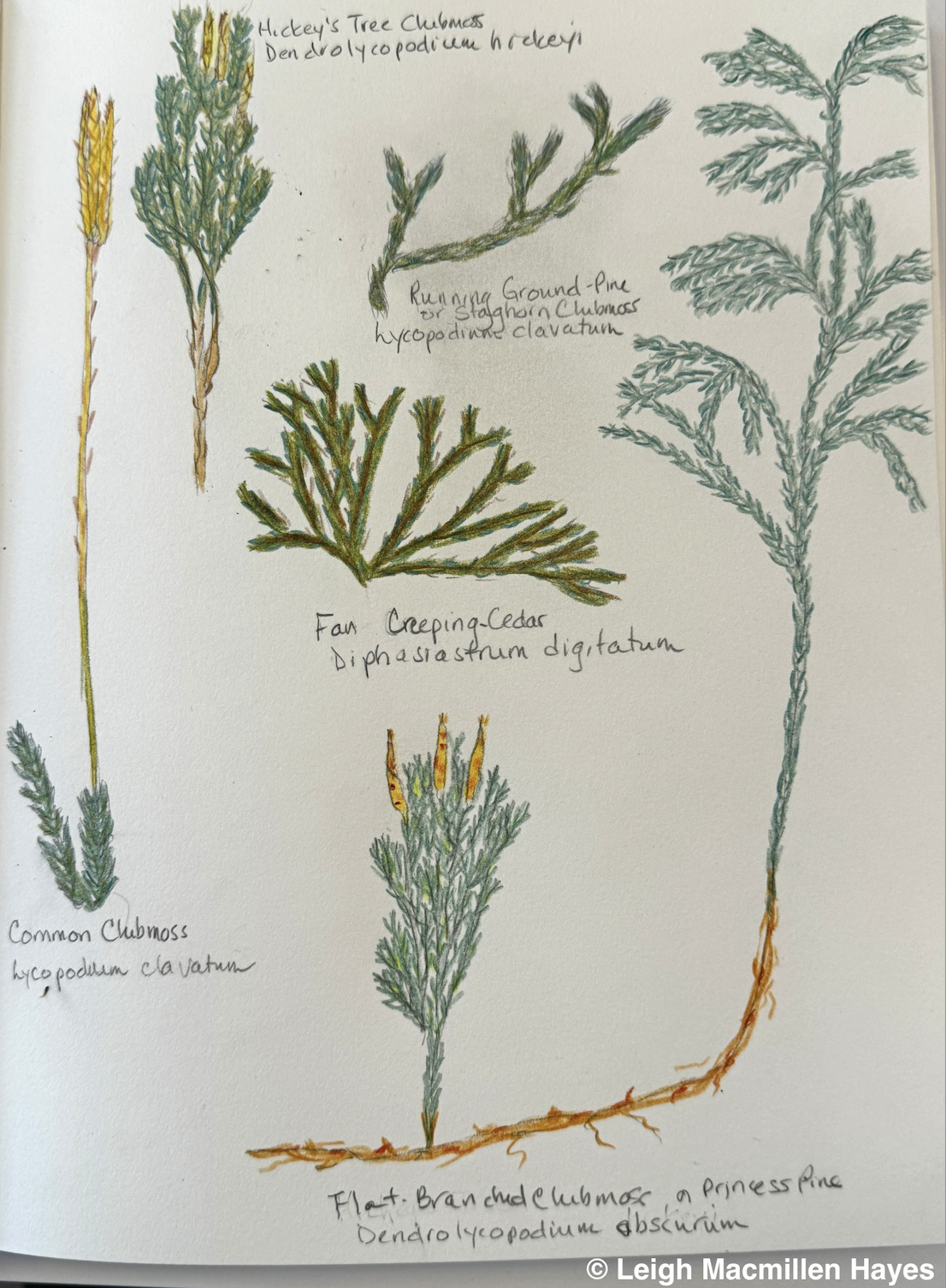
Clubmosses are one of the topics I’m trying to learn. . .when I take the time to do so. And so I sketched these after spending some delightful hours studying them as I wrote about in When is a Moss not a Moss?
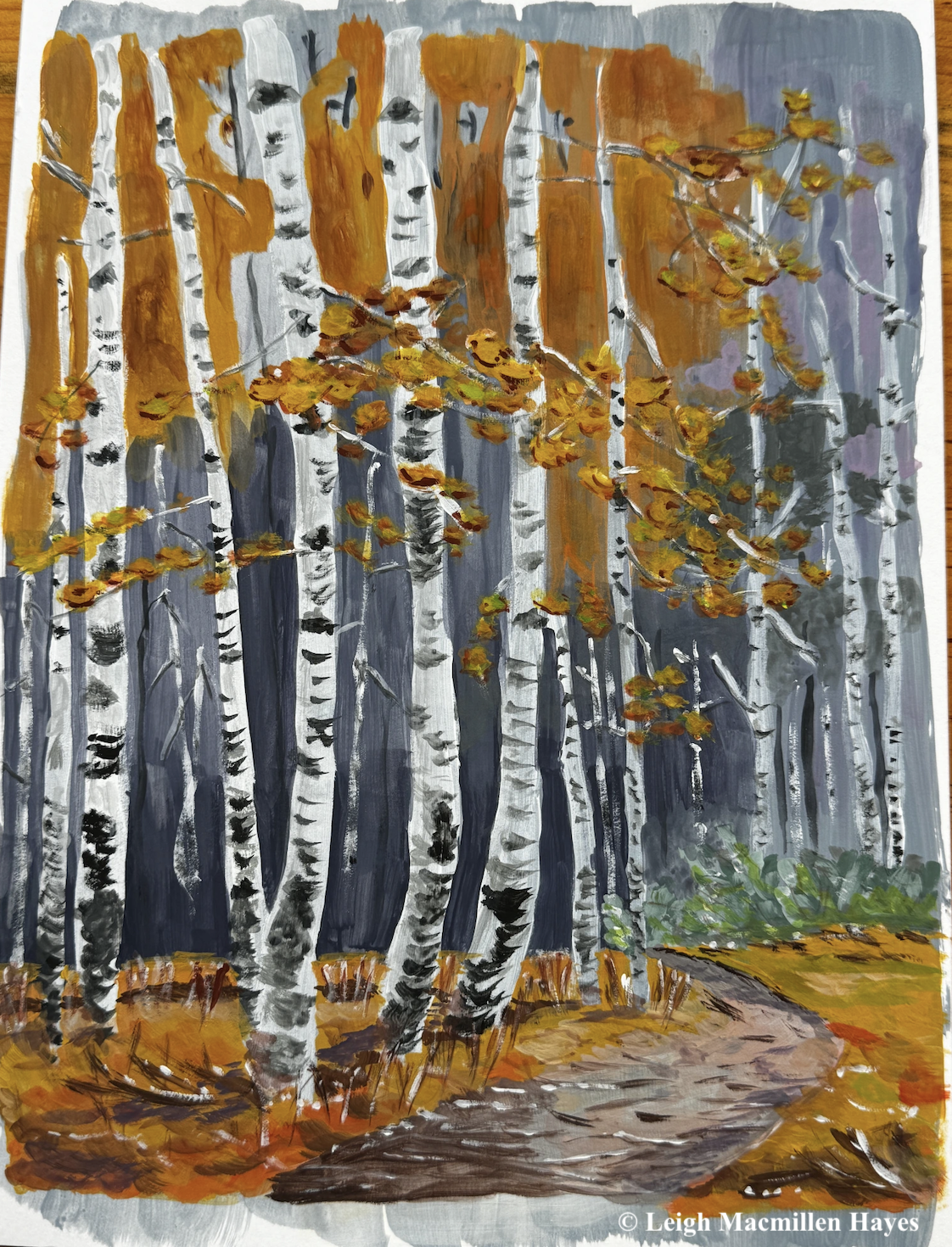
It’s the colors in this painting that I like. And figuring out how to paint Birch bark.

And then there was Forter Castle in Glen Isla, Scotland. I actually did three smaller versions of this castle and then decided to paint this larger picture based off one of those. It was a gift for Anne, our hostess when we were invited to spend a few nights there back in 2017, and in memory of her husband John. You can read more about that adventure here: From the Bonny Banks to the Highlands.
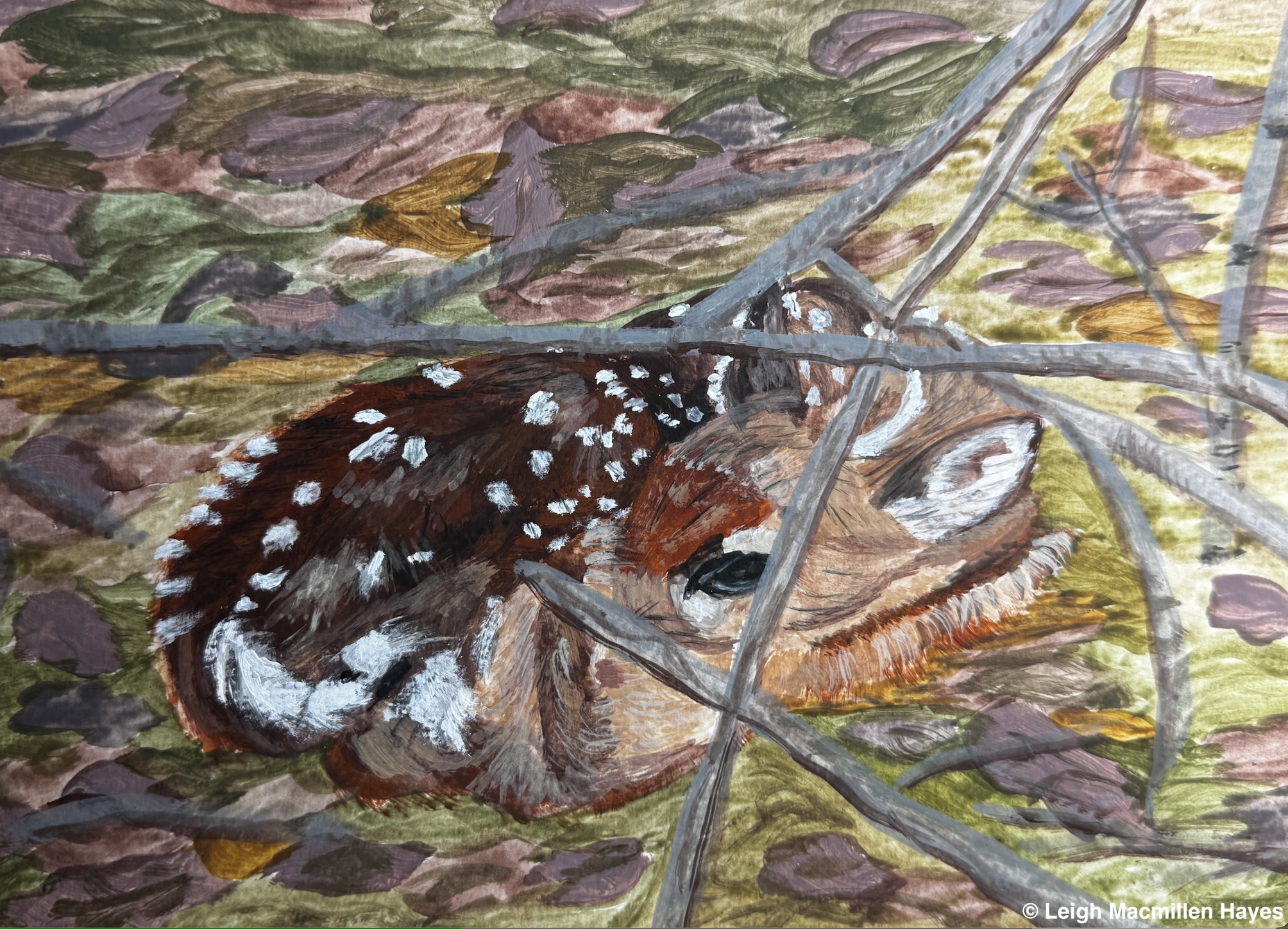
This next one will forever evoke the memory of my friend, Faith, who passed away this summer. We were on a Lakes Environmental Association walk at Holt Pond when we all “spotted” this fawn quietly waiting for momma. Quick pics and then we moved away.

And this is one of the Red Foxes who frequent our yard. In My Art Gallery, there are two more attempts, both in watercolor while this one is with gouache paints. Experimenting is fun.
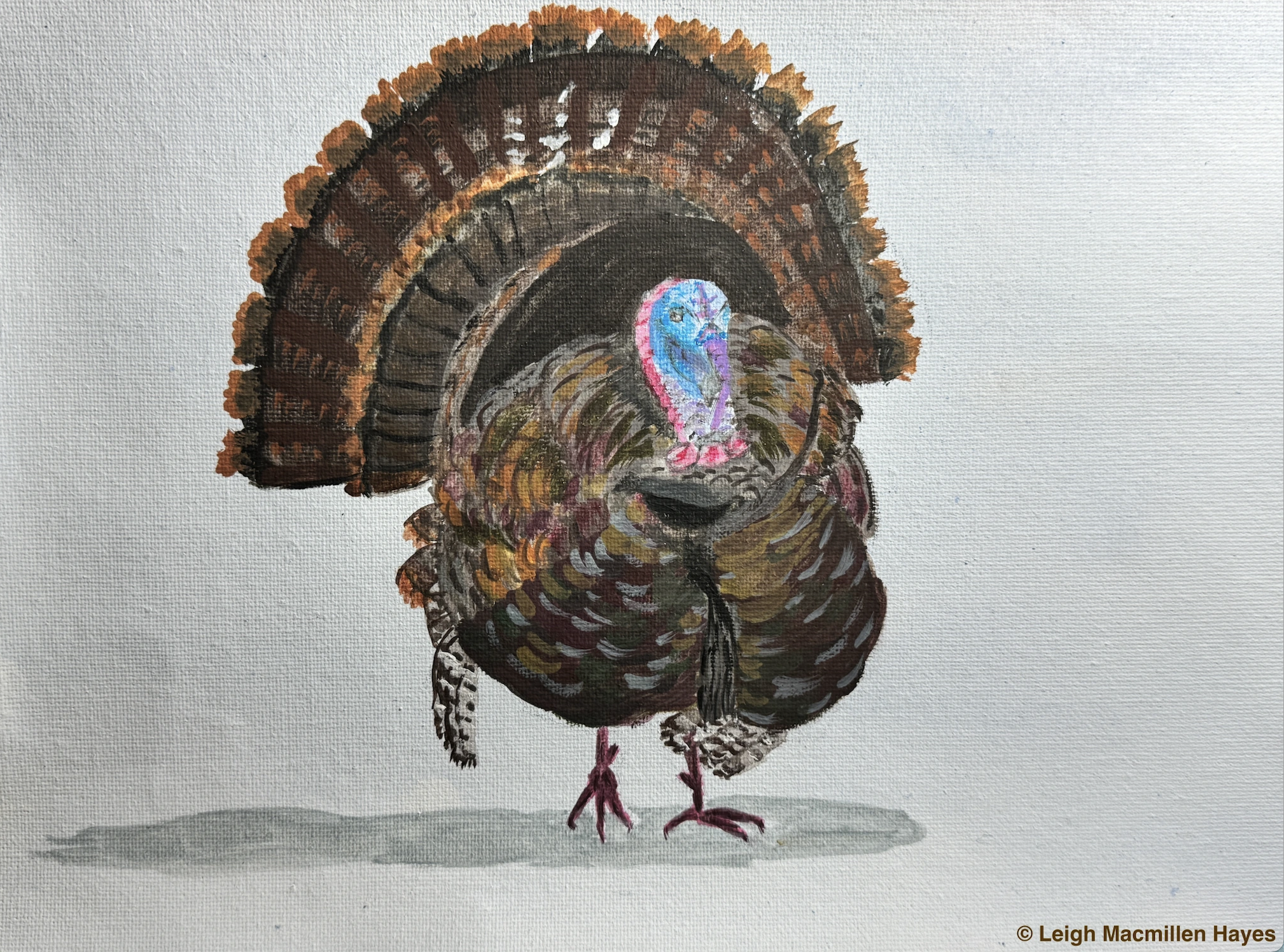
Tom Turkey! What more need I say.

In the midst of taking classes with Jessie this past year, which sadly ended in the spring, I purchased Grahame Booth’s book: Anyone Can Paint Watercolour Landscapes, and tried to follow the step-by-step instructions. This was a result of Lesson 1. There were six lessons altogether, and I thoroughly enjoyed the experience. You can see my other paintings based on the book by looking once again at My Art Gallery. Yikes, I’m beginning to sound redundant. Smiley Face!
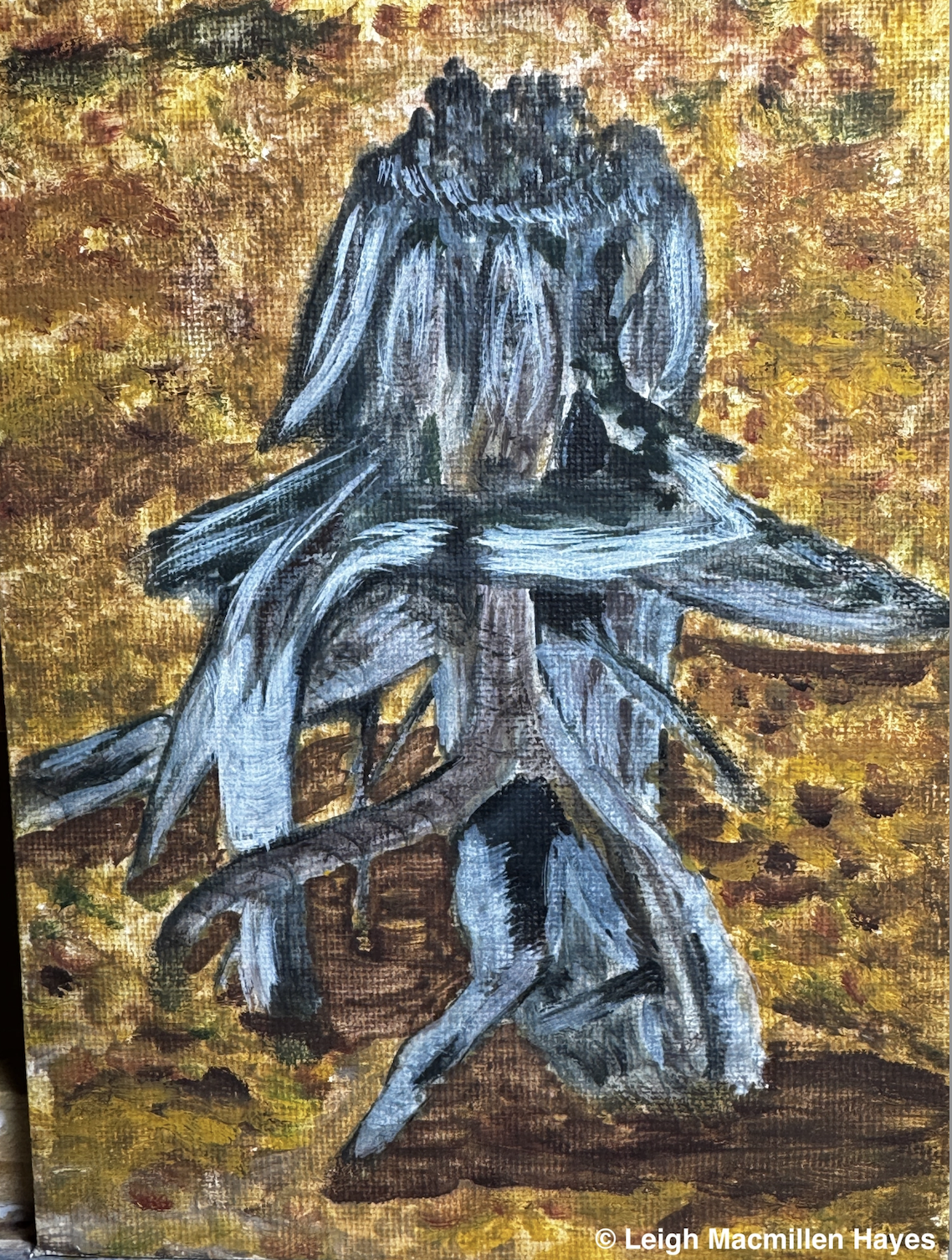
I like this one because I like the subject. I used a matted board to paint it. The stump is beside the Saco River in Conway, New Hampshire.

This one was for another friend because we had walked out to Kezar Pond in Fryeburg from her home the previous New Year’s Eve or Day, and it was just lovely.

And then there is a perennial subject of mine–the Stairway to Heaven tree along the cowpath in our woods. I especially love it when snow outlines the branches.

Another favorite scene takes me back to my childhood in Clinton, Connecticut, and I painted this for my sister and brother-in-law as a keepsake. So many memories in the spot that was our little piece of Heaven for so many years.

On and off, I’ve produced paintings of birds, and another favorite subject is the Great Blue Heron. I’ve also tried to paint rookeries, but often struggle with perspective. Of course, you can view my attempts you know where: My Art Gallery, to be shortened to MAG going forward.

No words necessary really–a male Northern Red Cardinal.

And his female counterpart.
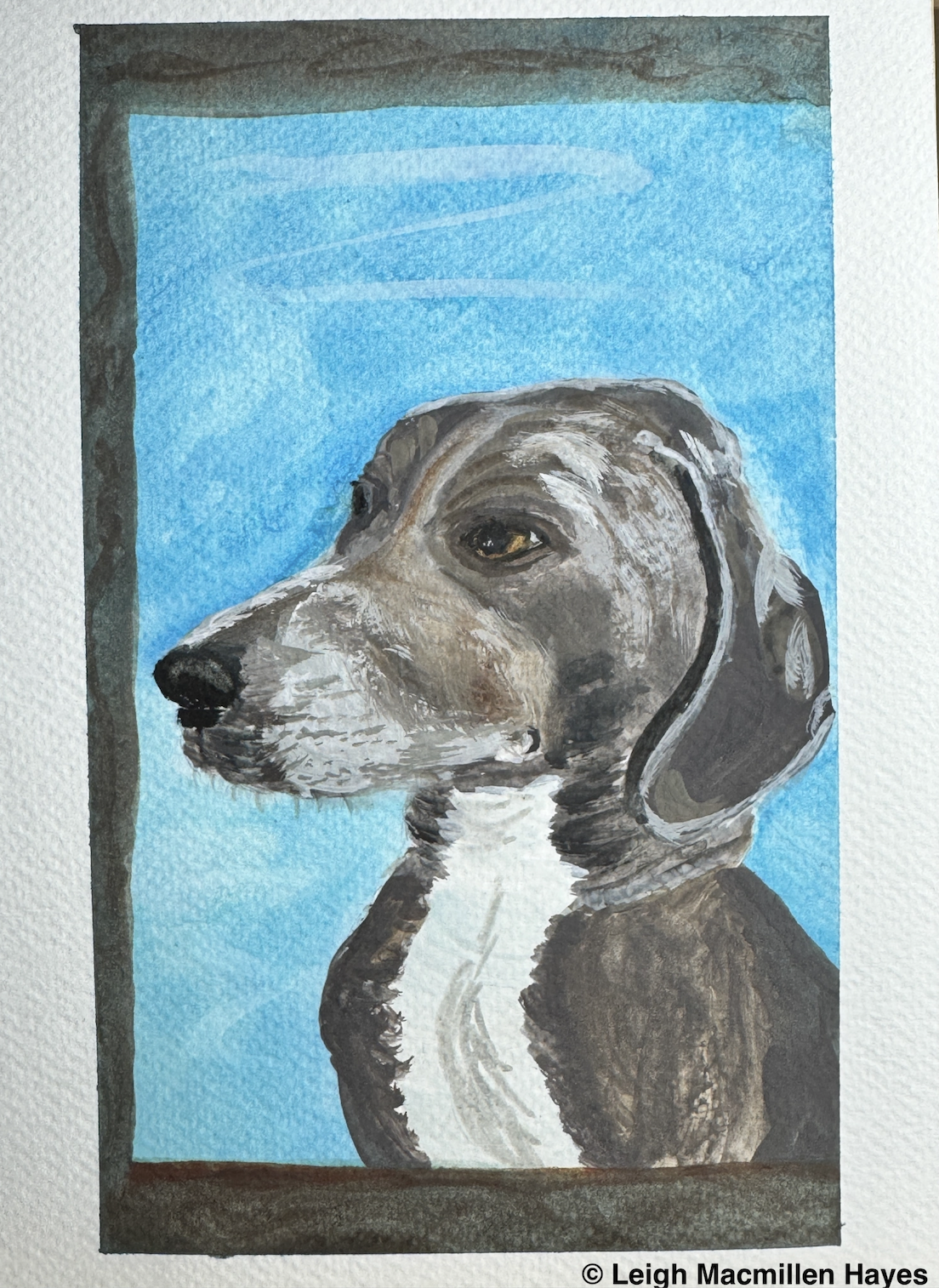
Our oldest son and his girlfriend rescued this energetic pup at the beginning of the pandemic.

And this pup belongs to our youngest son’s girlfriend’s mother.
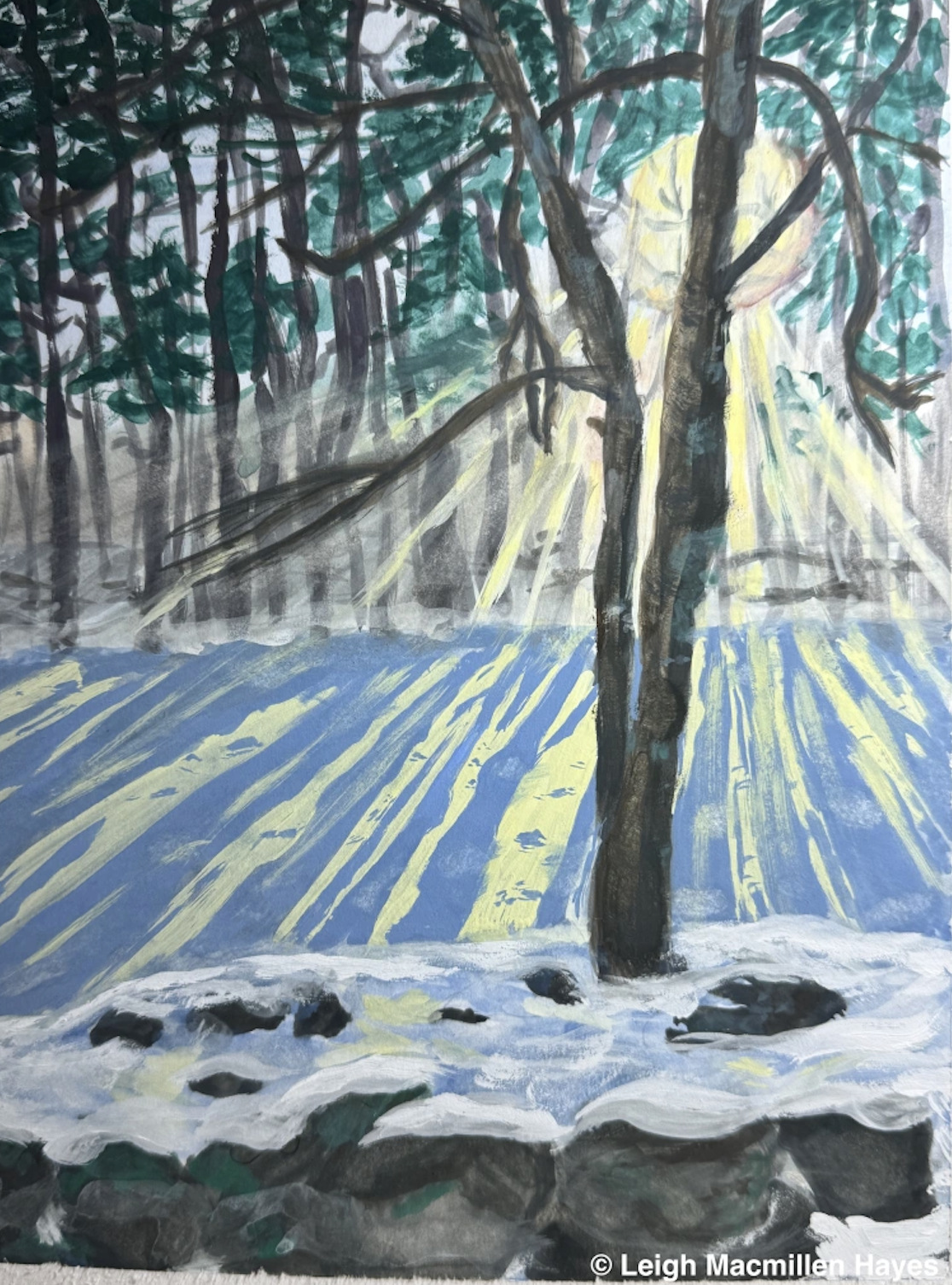
One morning, I stepped outside just after it had finished raining and the sun was shining through the trees out back and there was a layer of fog and shadows and it was just exquisite so I tried to capture it.
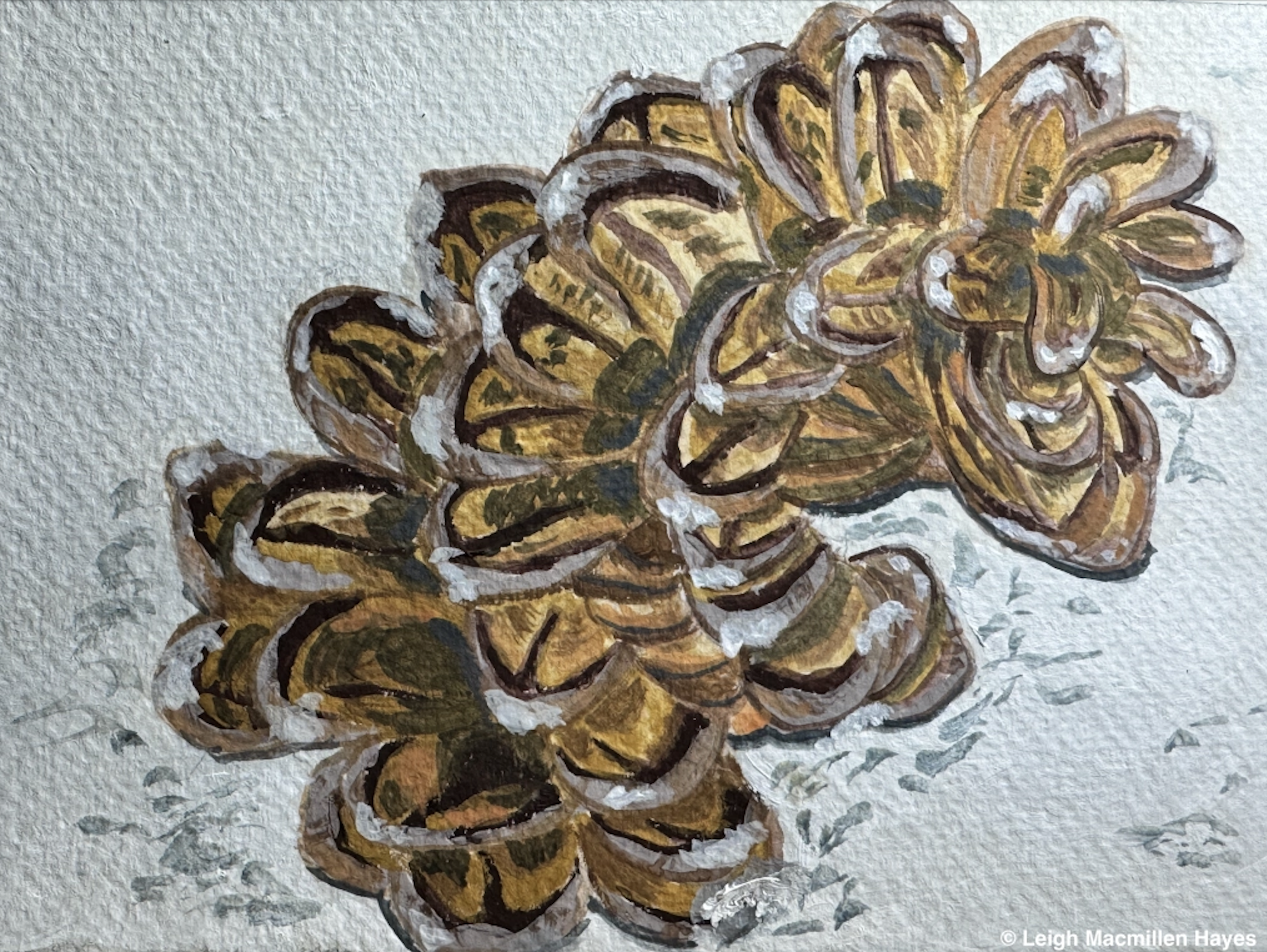
The White Pine Cone was something I started to sketch and then left for a long time, until I realized the scales were all arranged in a spiral of course and bingo, I knew how to go about it.
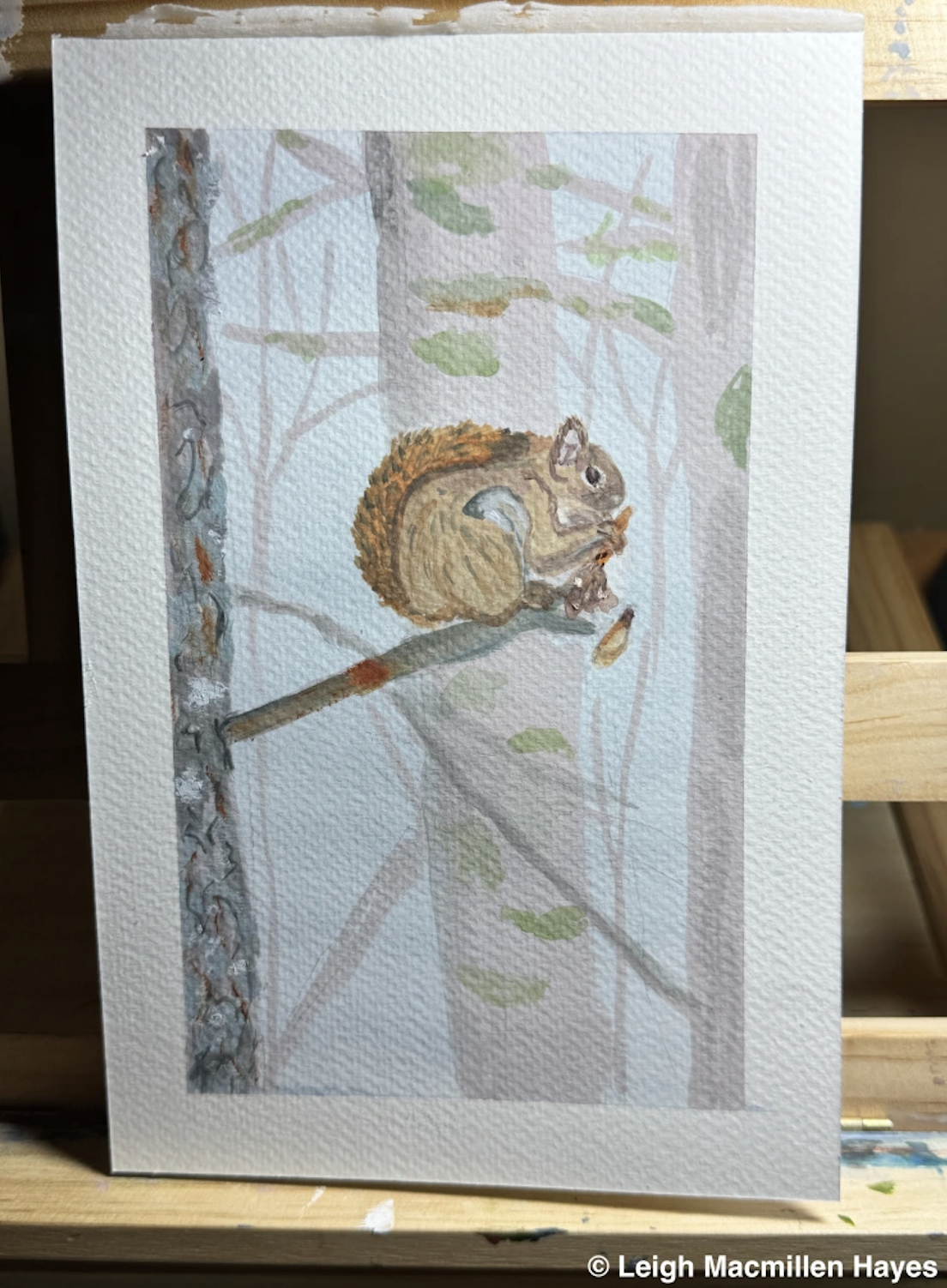
Turns out, I’m not the only one who knows to go about it–for Red Squirrels love to take each pine cone scale off in order to get to the seeds stored by such. Their method of descaling a cone is rather like us eating corn on the cob. I actually referenced both the pine cone painting and this one in Another Amazing Lesson from a Red Squirrel.
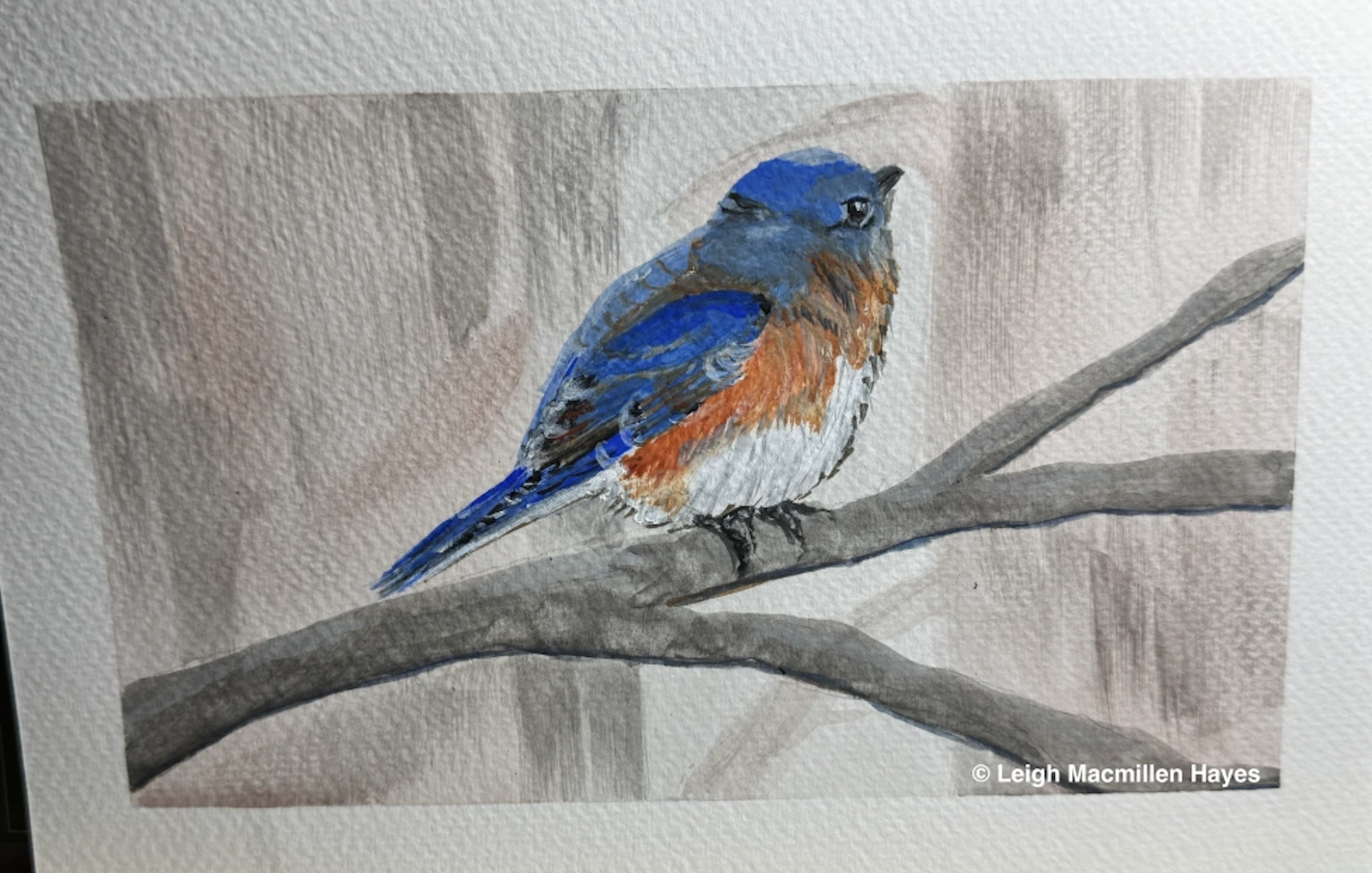
All last winter and spring, and into the beginning of the summer, my neighbor and I rejoiced because we had Bluebirds. In fact, a pair nested in one of our boxes, but that was around July 4th, and by the end of the week, she’d abandoned the nest. We’ll never know why.

A few more birds coming up–including this male Red Winged Blackbird at Brownfield Bog.

A Sharp-shinned Hawk in the backyard and field.
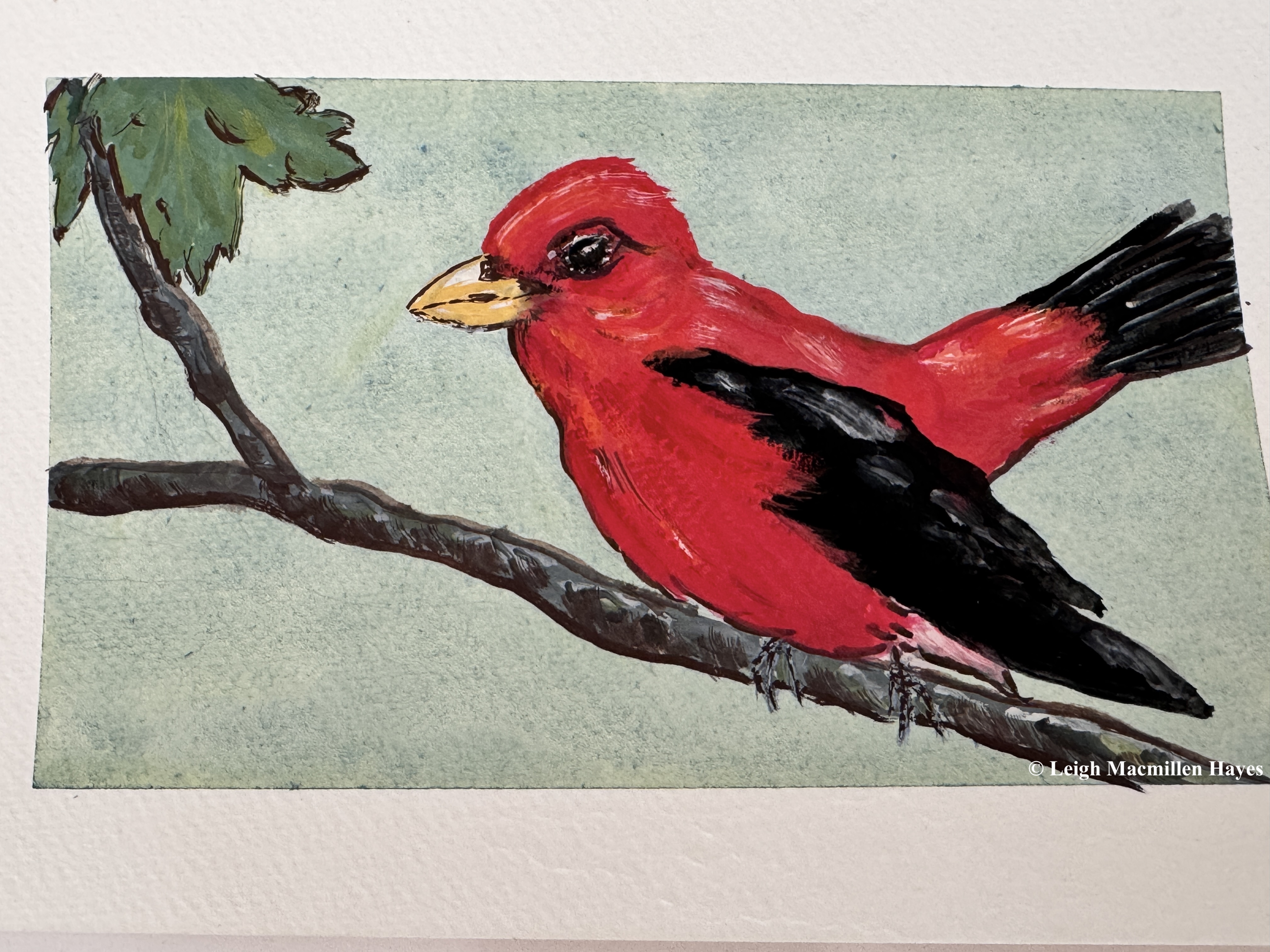
And a Scarlet Tanager on Mount Cutler in Hiram, Maine.

I did think I’d paint more butterflies, and perhaps this fall or winter I’ll attempt to, but it seems the Spring Azure is all I’ve done so far.

I’ve also made a couple of cards in the course of the year, this one for a First Grade student who was my penpal and she told me she really likes Dandelions. That girl will go far in life!

Another favorite topic of mine: Dog-Day Cicadas. If you type Cicada into the “Search” bar on my blog, you’ll discover several posts about these insects emerging. As I write, I can hear them “singing” from the treetops.

Sometimes, actually, more than sometimes, something catches one’s eye and this Tree Frog was one of those times. A friend and I had stopped to talk about a Snapping Turtle that seemed to be late laying eggs, and bingo, there was the frog on a tree.

Speaking of frogs and other critters who rely on vernal pools, visit MAG and you’ll find my Vernal Pool series, including a Fairy Shrimp that looks WAY bigger than its actual 1 – 1.5 inch size.
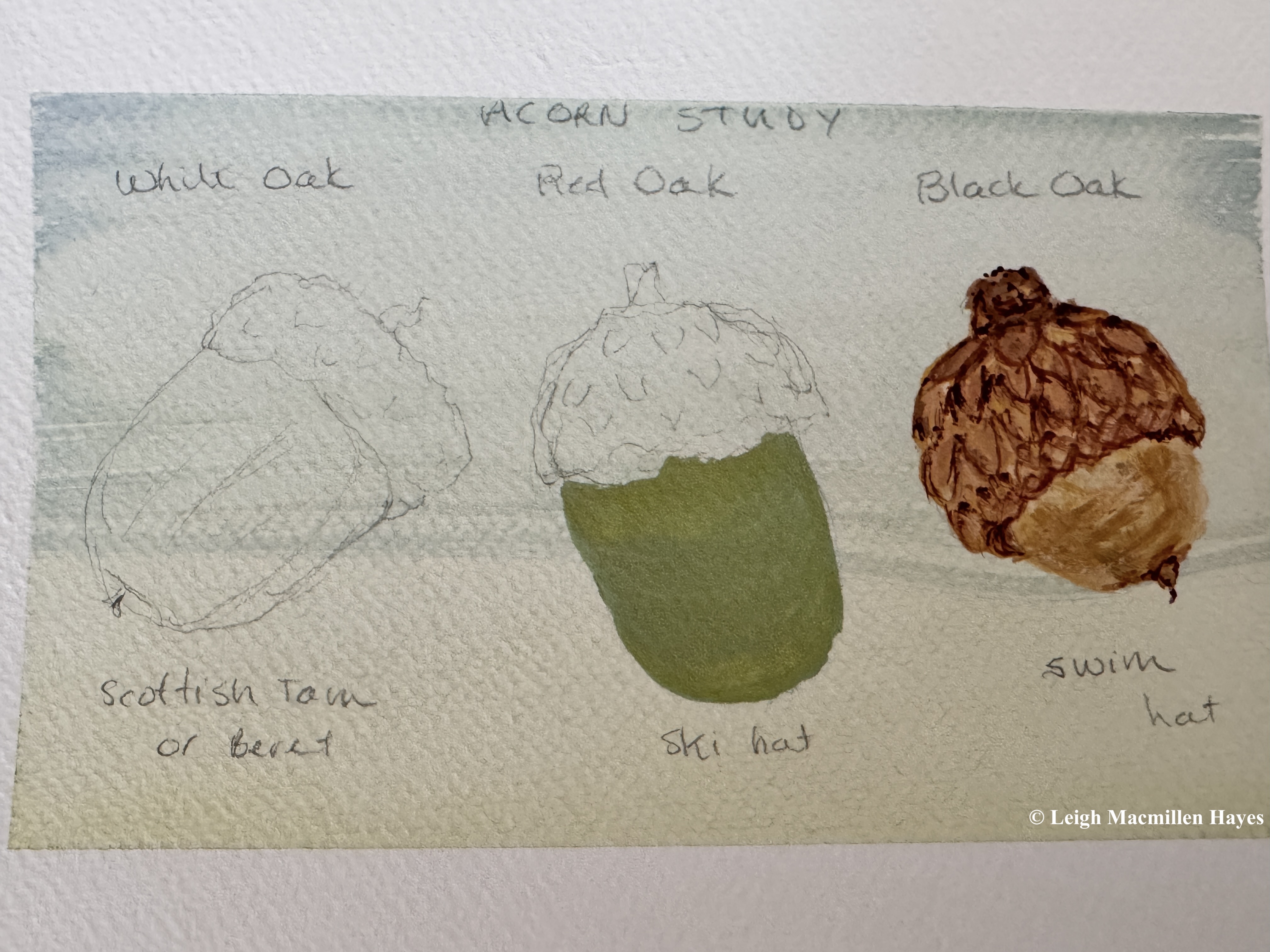
And then there was the day I pulled out a copy of National Audubon’s Field Guide to North American Trees because I wanted to get to know acorns better. Silly me, I came up with names for each one based on what they looked like to me, but I made the mistake of writing the names in pencil before painting a light colored wash on the paper. As I began to paint the acorns, I realized I wanted to change their names, but couldn’t erase them or paint over them. So . . .
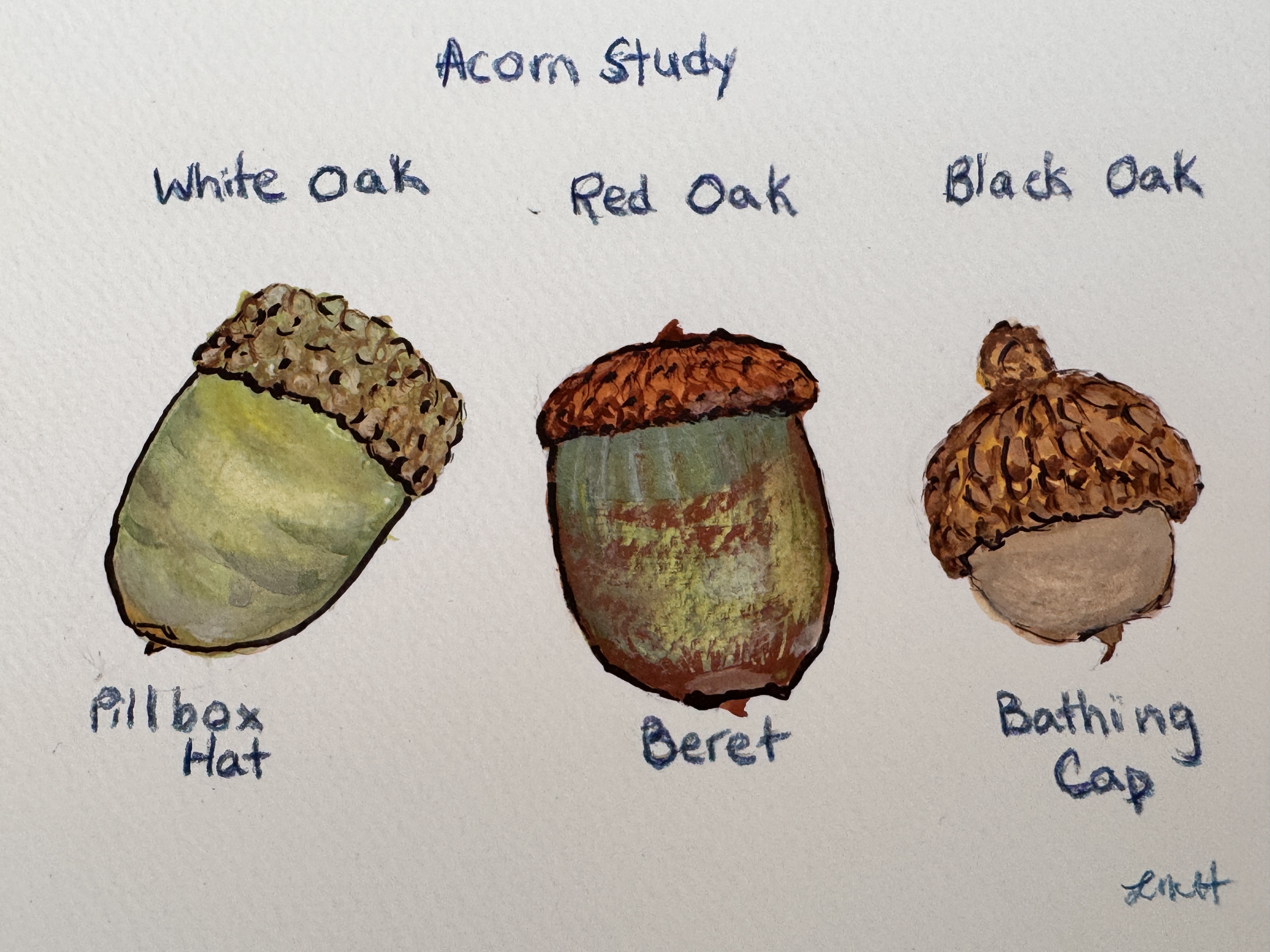
I sketched them again, and gave them new names.

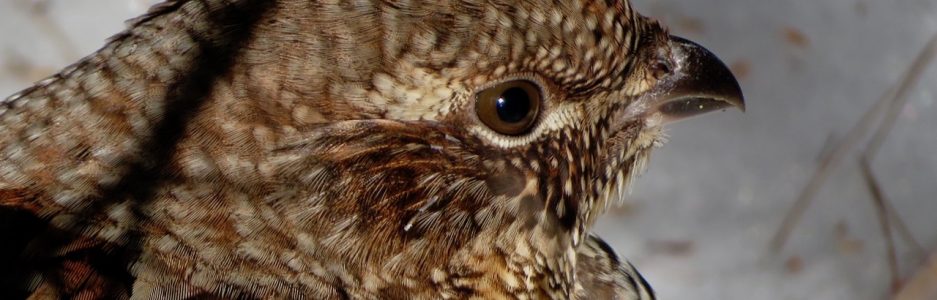
And finally the moment you’ve been waiting for, today’s painting:
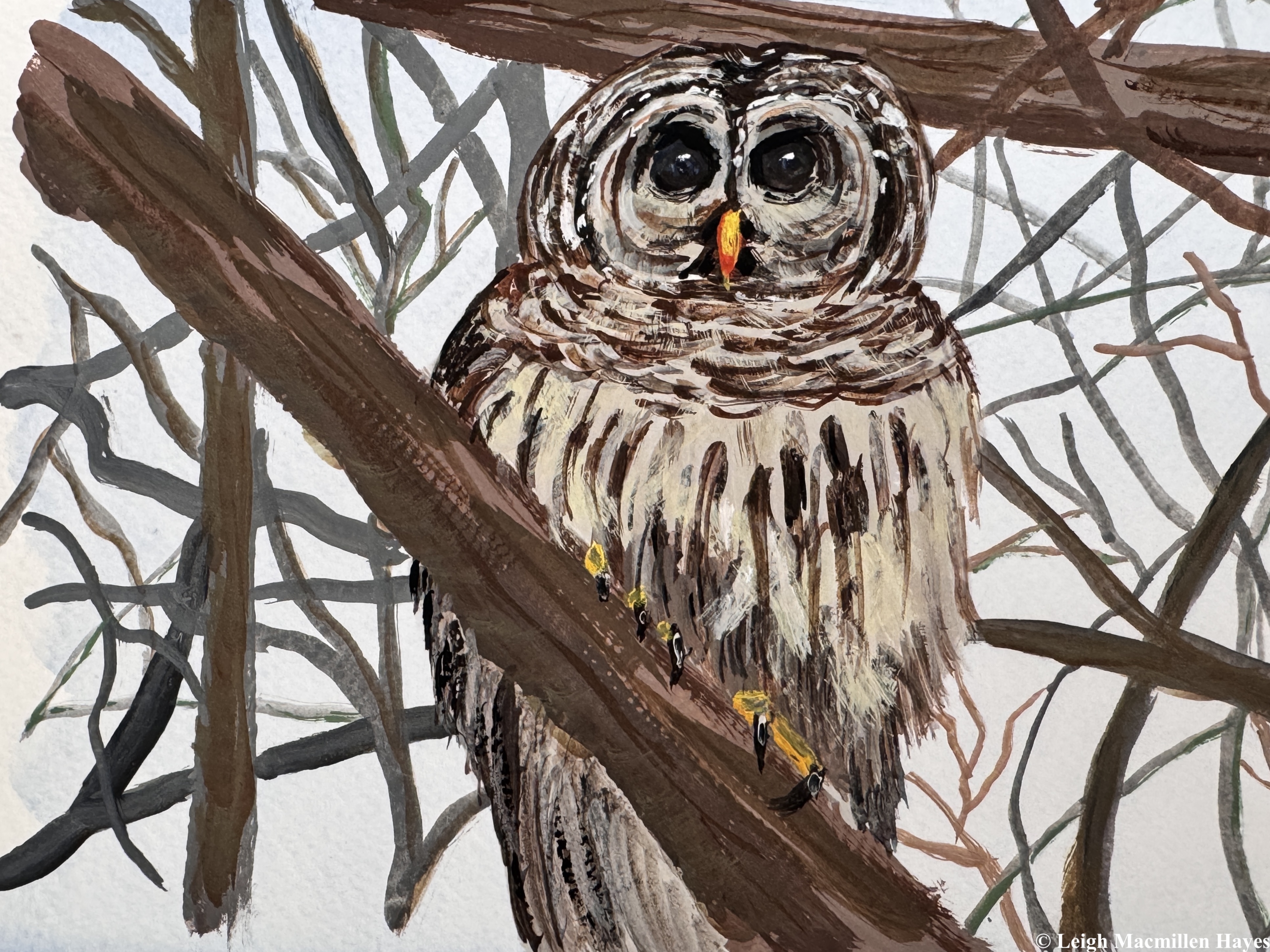
I always like it when I try iNaturalist’s SEEK app on a painting and it agrees with me. Barred Owl it is.

Wow, I had no attention of pulling this all together today until about an hour ago when I was sharing photos with my sister and realized I hadn’t sent her any in a while. So thank you, B.S., for being my inspiration today . . . and always.

And thank you Dear Readers, for sticking with me today and always as I share My Artistic Path: one year later.
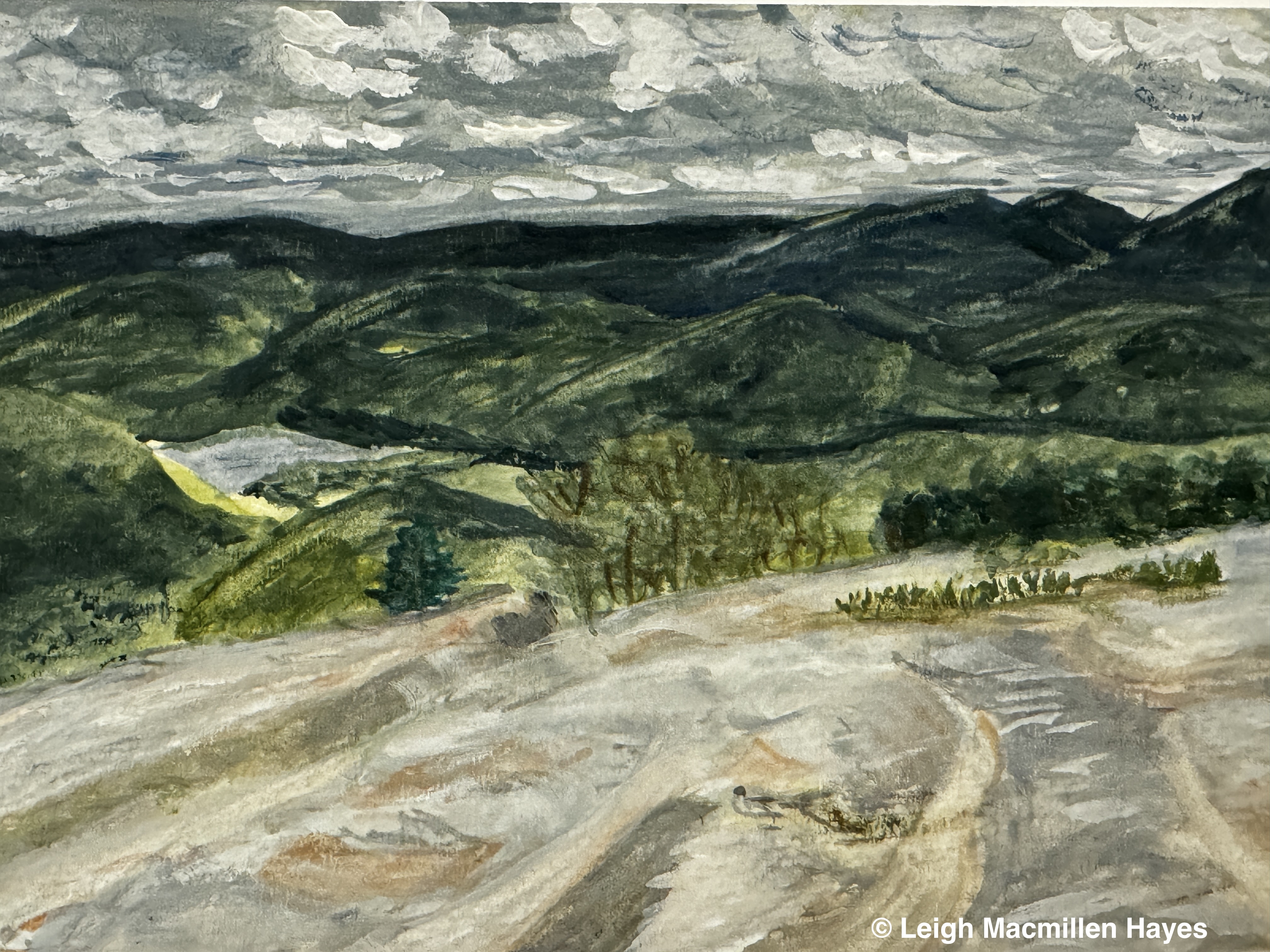
My Artistic Path

In a way, this is A Lost Art Found continued. It’s the rest of the story, at least to this date.

Once I got hooked on painting, I couldn’t stop. What I’ve discovered is that it’s a lot like writing. You choose a topic, which for me so far has been from a photograph I’ve taken as I’m afraid to purchase an easel and try plein air; complete an outline or at least jot down notes to get an idea of where you are going with the topic in the form of a values sketch; choose how to frame the story whether upon watercolor paper or canvas, and the media being watercolors, acrylics, or gouache; begin a first draft of sketching a wee bit on the mat of choice and apply a light colored wash; paint the basic shapes to get the story on paper which may be more representational than factual; and then tweak, tweak, tweak, which sometimes takes me eighteen drafts to get to a publishable product, and even then, I know more changes can be made.

But here’s the thing. I’m brand new to this art form. And thanks to Jessie, my teacher/mentor, I’ve learned a lot and still have more to learn. Then what’s the thing? The thing is that in every painting I’ve completed so far, there’s plenty I can critique, but at least one thing that I like and so that’s what I want to focus on. The rest I can learn . . . down the road.

After our spring session of classes ended, I decided to keep going on my own.

The view from the summit of Blueberry Mountain, Evans Notch, New Hampshire, looking toward Shell Pond below and the mountains beyond. My fav: the shape of the pond.

Frenchmen’s Hole in Newry, Maine. My fav: the color of the water, darker in the depths and lighter as if flowed over rocks to the next fall.

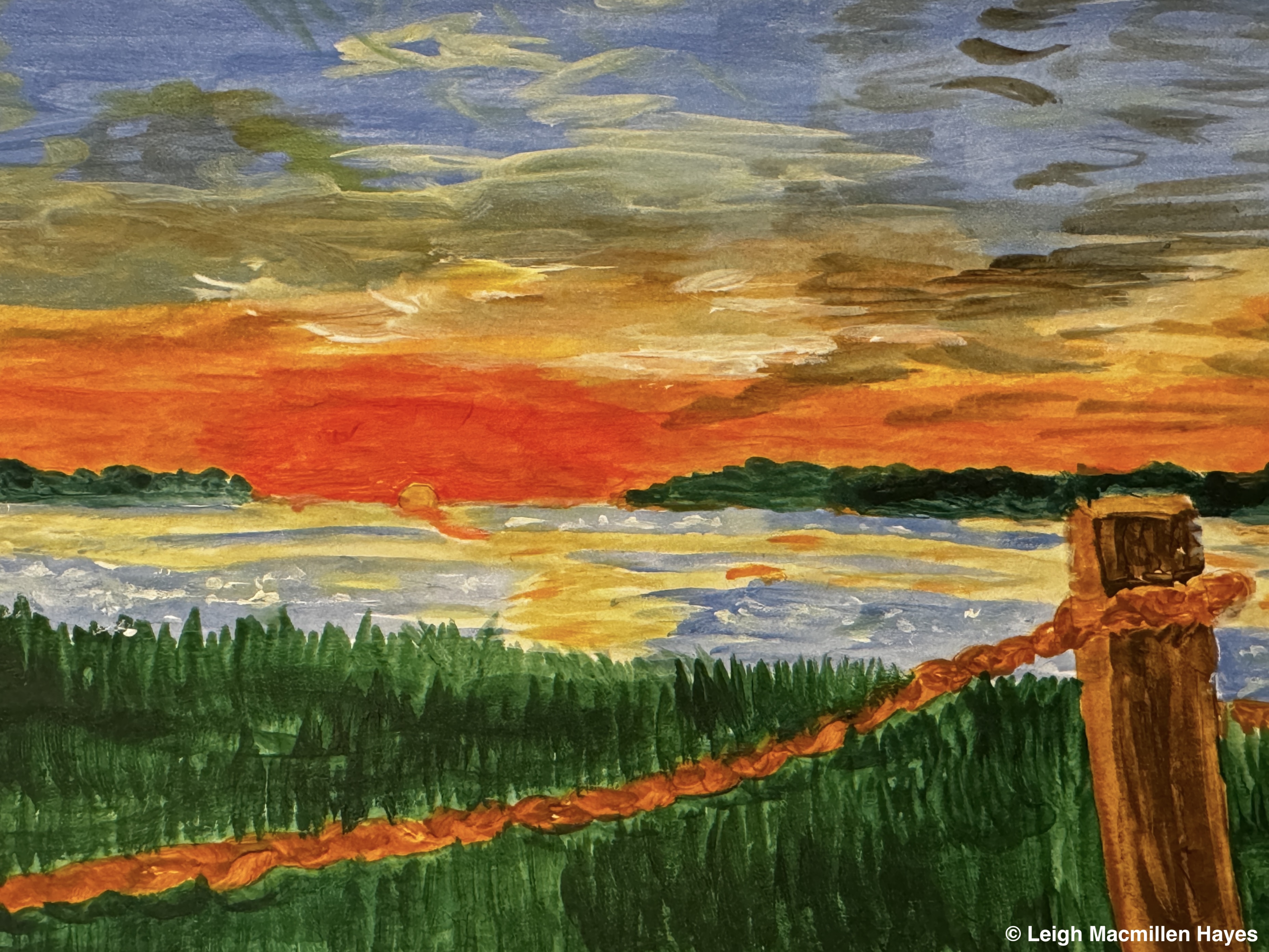
Sunrise, Lubec, Maine. My fav: the rope in the foreground. And the sky.

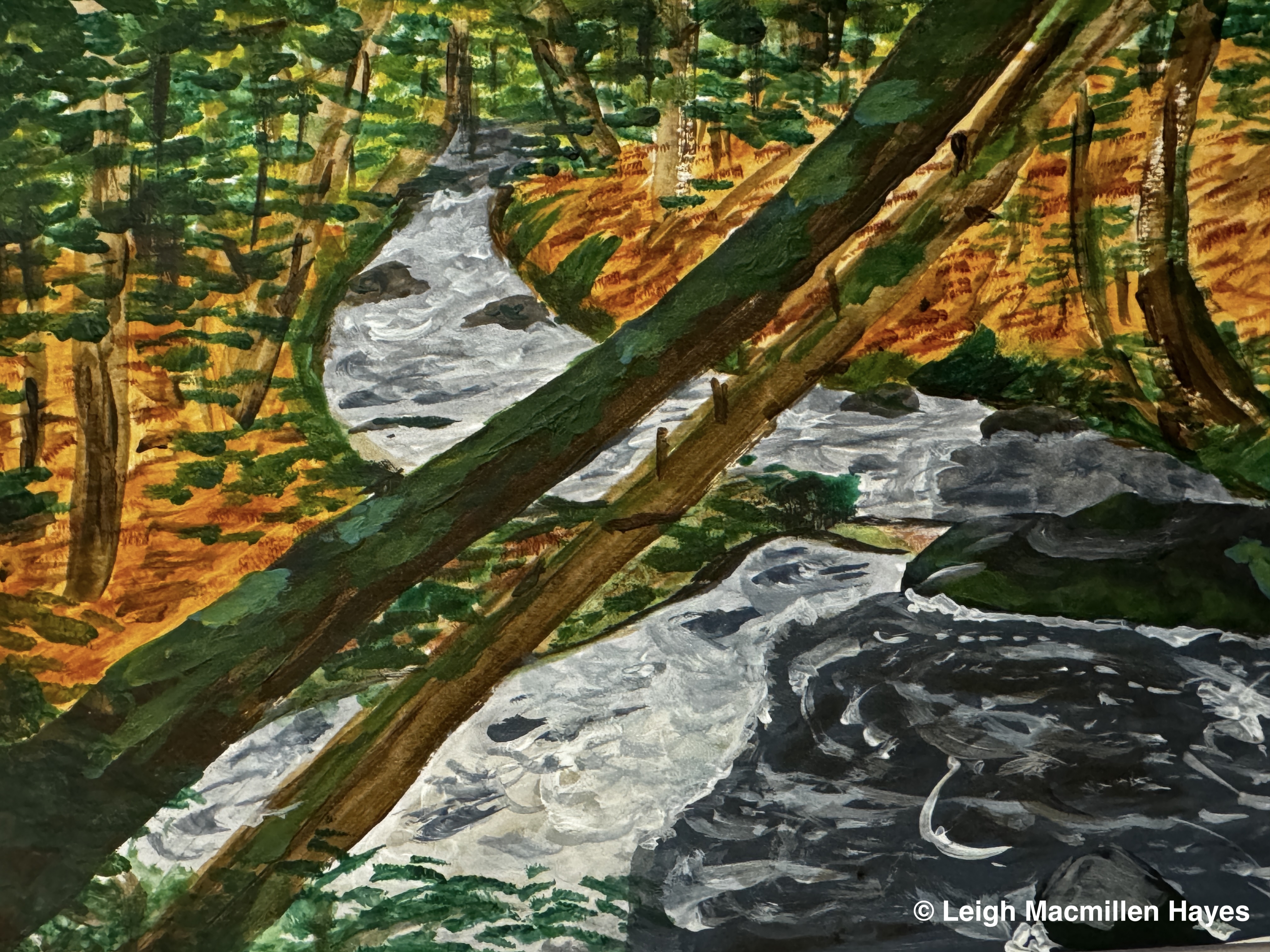
Carsley Brook, Lake Environmental Association’s Highland Research Forest, Bridgton, Maine. My fav: the trees leaning across the brook.

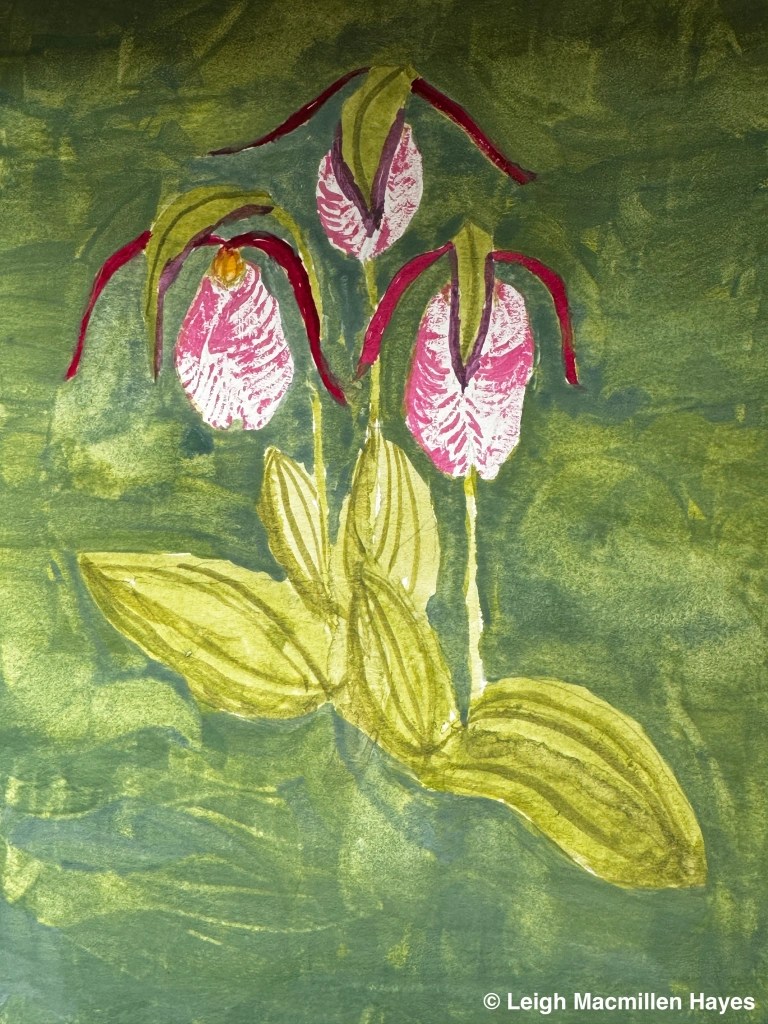
Lady’s Slippers from any of our counts as a gift for My Guy, who I’ve learned only likes to count them when they are in bloom. Since that season, he can’t be bothered to note the leaves or occasional seed pods and is praying it snows soon so I won’t continue to point them out. My fav: the shape of the flowers.

The fire tower at the summit of Pleasant Mountain. My fav: a sense of perspective with the mountains.

All of these were watercolor paintings. And then . . .

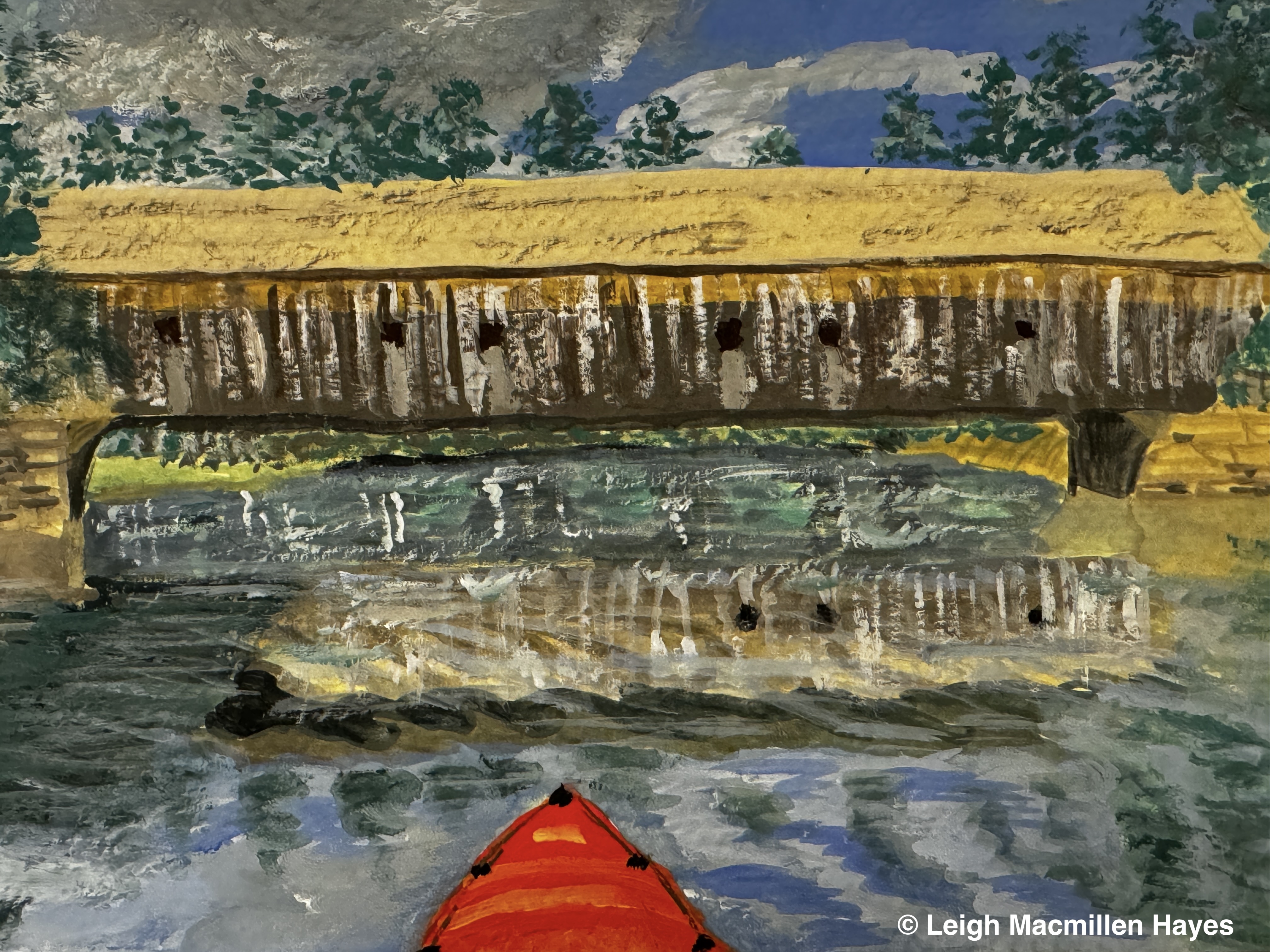
I purchased some gouache and painted Hemlock Covered Bridge. My fav: the bridge and the reflection, but also the lesson that this was a bit like completing a paint by number as I broke it up into different sections.

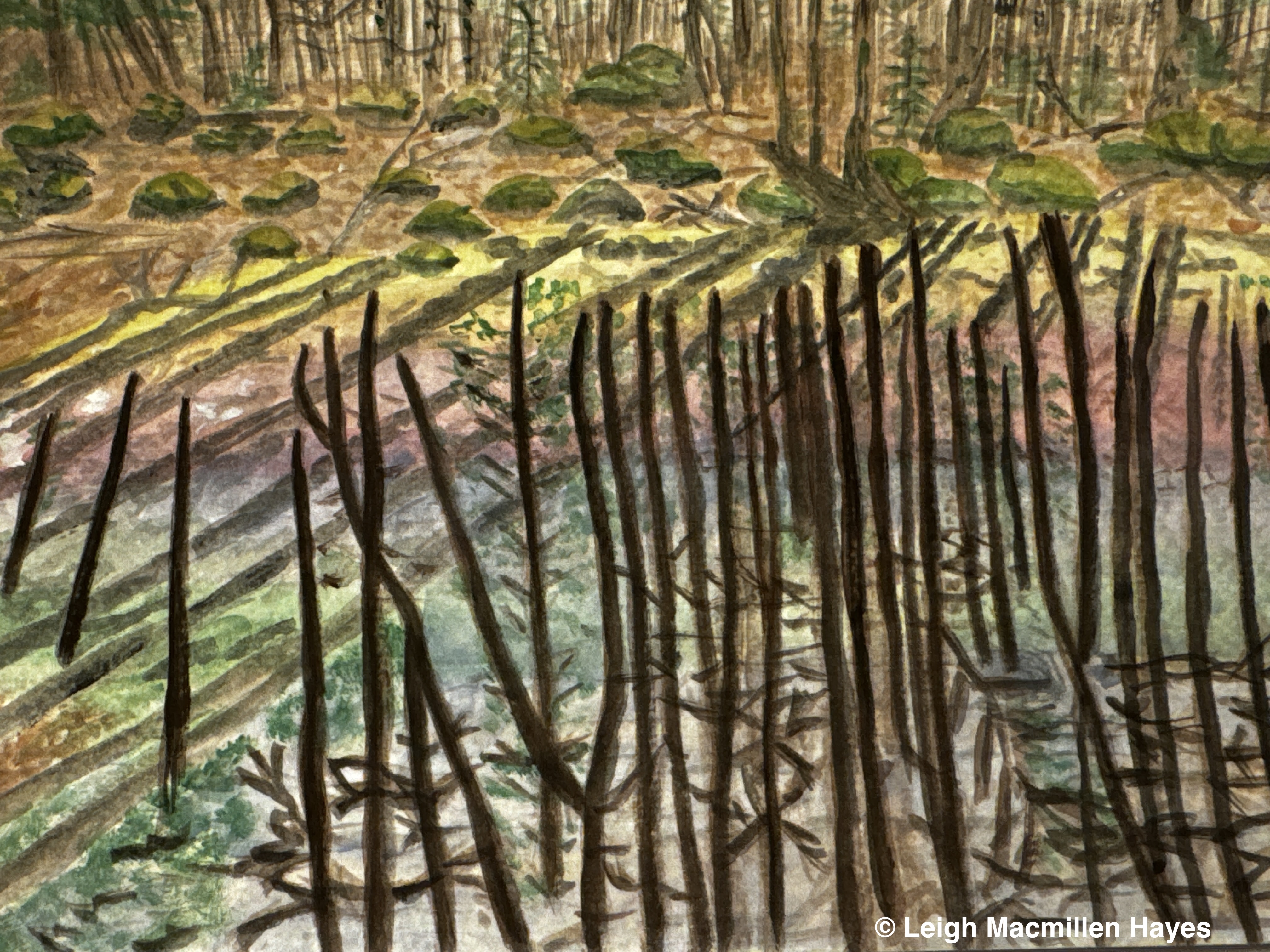
Fall reflection cropped from a river scene. My fav: All of it. It was like painting a jigsaw puzzle. And i loved creating the wavy lines.

Winter along Heald Pond Road, Lovell, Maine. The interesting thing is that this barn was taken down a few weeks after I painted this scene. My fav: the barn boards and the snow. And my learning–painting the lower background before adding the foreground trees.

Our barn at Christmas. My fav: The reflection in the window.

Interior of Hemlock Covered Bridge in Fryeburg, Maine. My fav: sense of perspective.

Sunlit part of spider web inside Hemlock Covered Bridge on mat canvas. My fav: texture of the boards and light between boards.

Bob Dunning Memorial Bridge, Pondicherry Park, Bridgton, Maine. My fav: the different beams that provide support as each represents a different species of native wood.

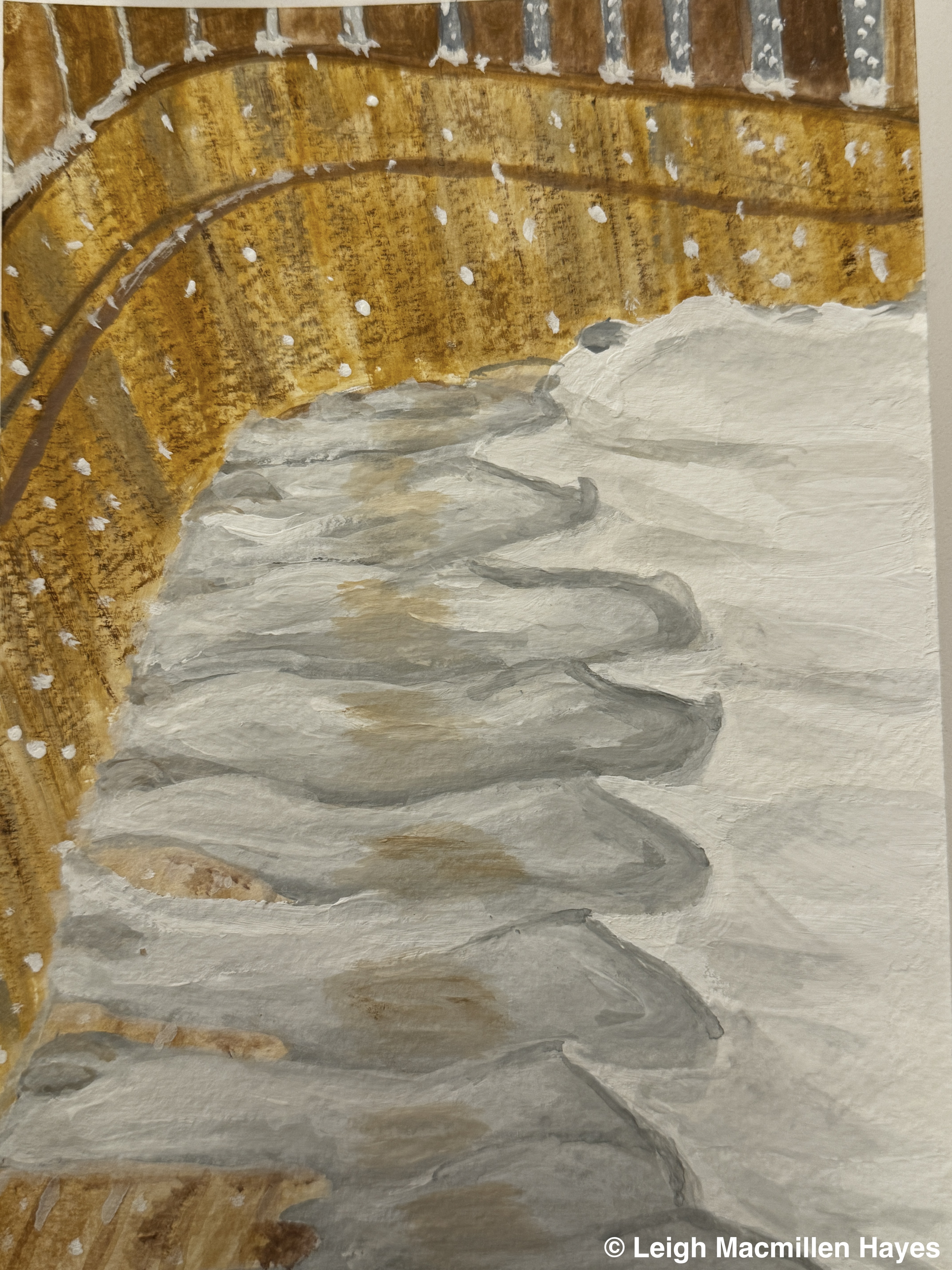
Approaching Bob Dunning Memorial Bridge on a snowy day when no one else had yet entered Pondicherry Park in Bridgton, Maine. My fav: the bend in the bridge.

Beaver at Albany Mountain trail, Bethel, Maine. My fav: the beaver’s face.

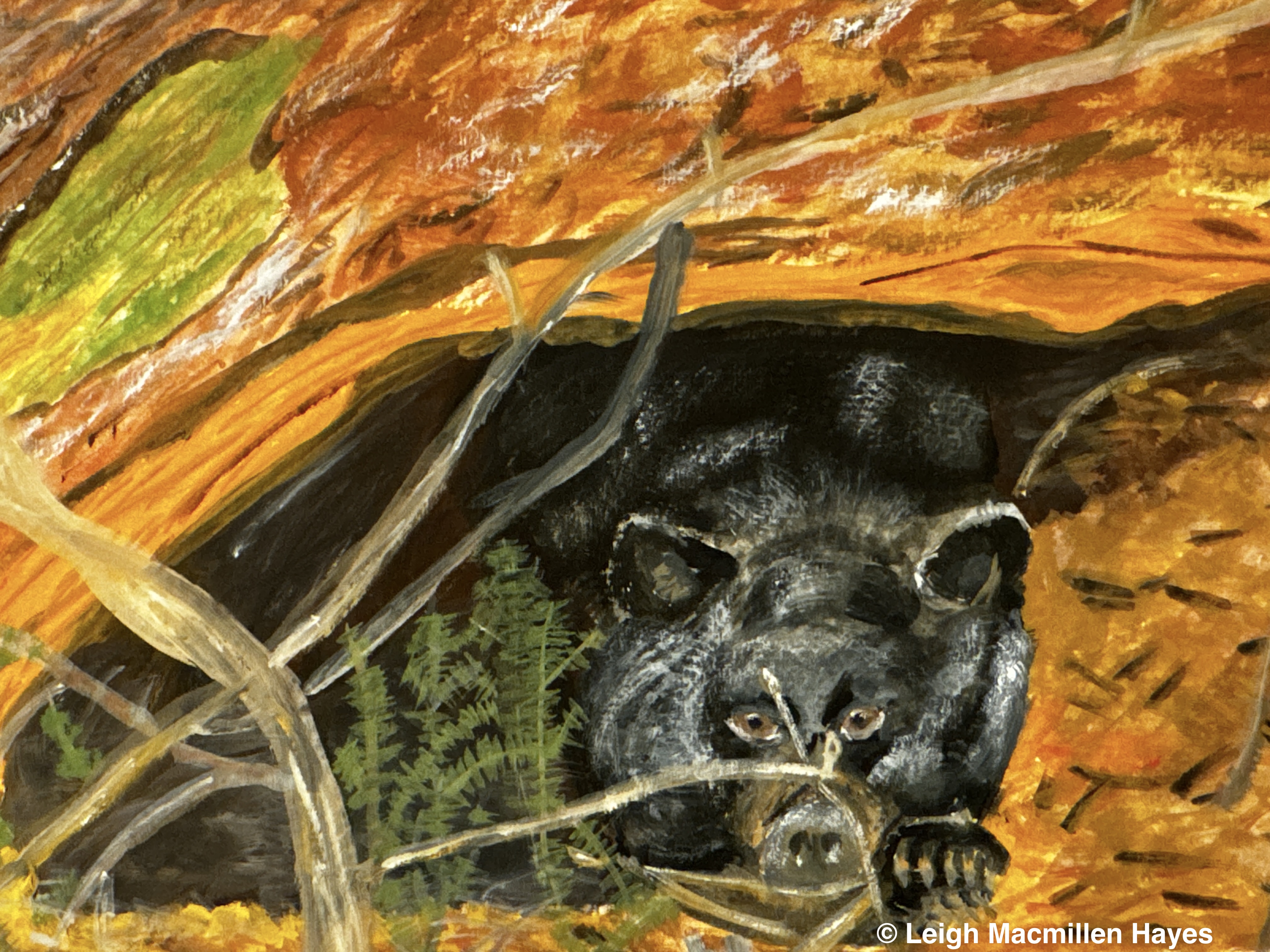
Denning Black Bear. Location a well-kept secret. My fav: the eyes.

Painted Turtle, Moose Pond, Maine. On mat canvas. My fav: colors of the water.
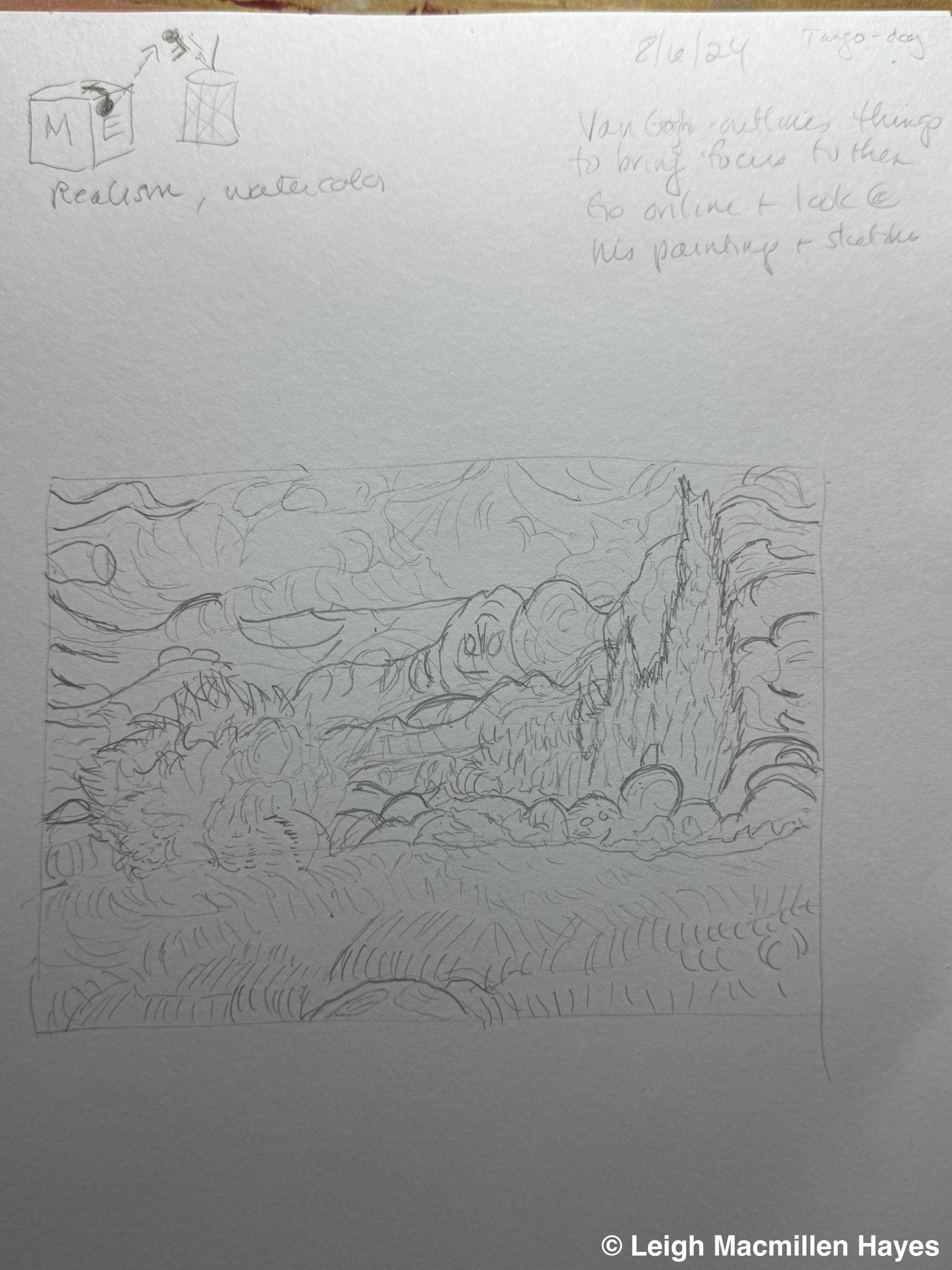
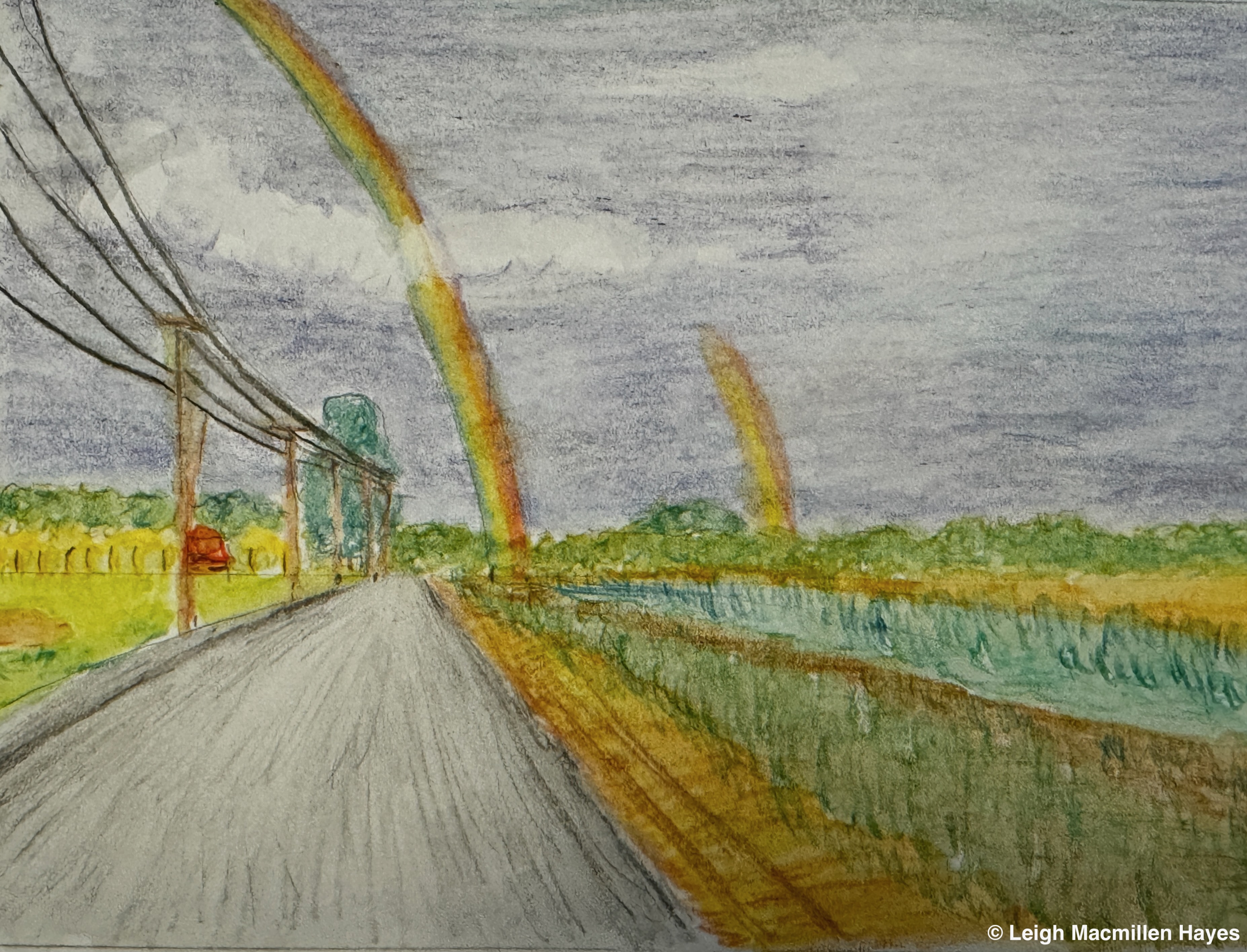
In August, Jessie offered a second class and we had to stuff our art critics in a box in the upper corner of the paper and leave them locked inside and then jot down what we wanted to work on for this session. She also had us take a look at Van Gogh’s style of outlining and bringing focus together.

And then, from a photo of our own, we tried to emulate the famous artist. This was a rough draft that I never finished. My fav: I love the colors and simplicity of it.

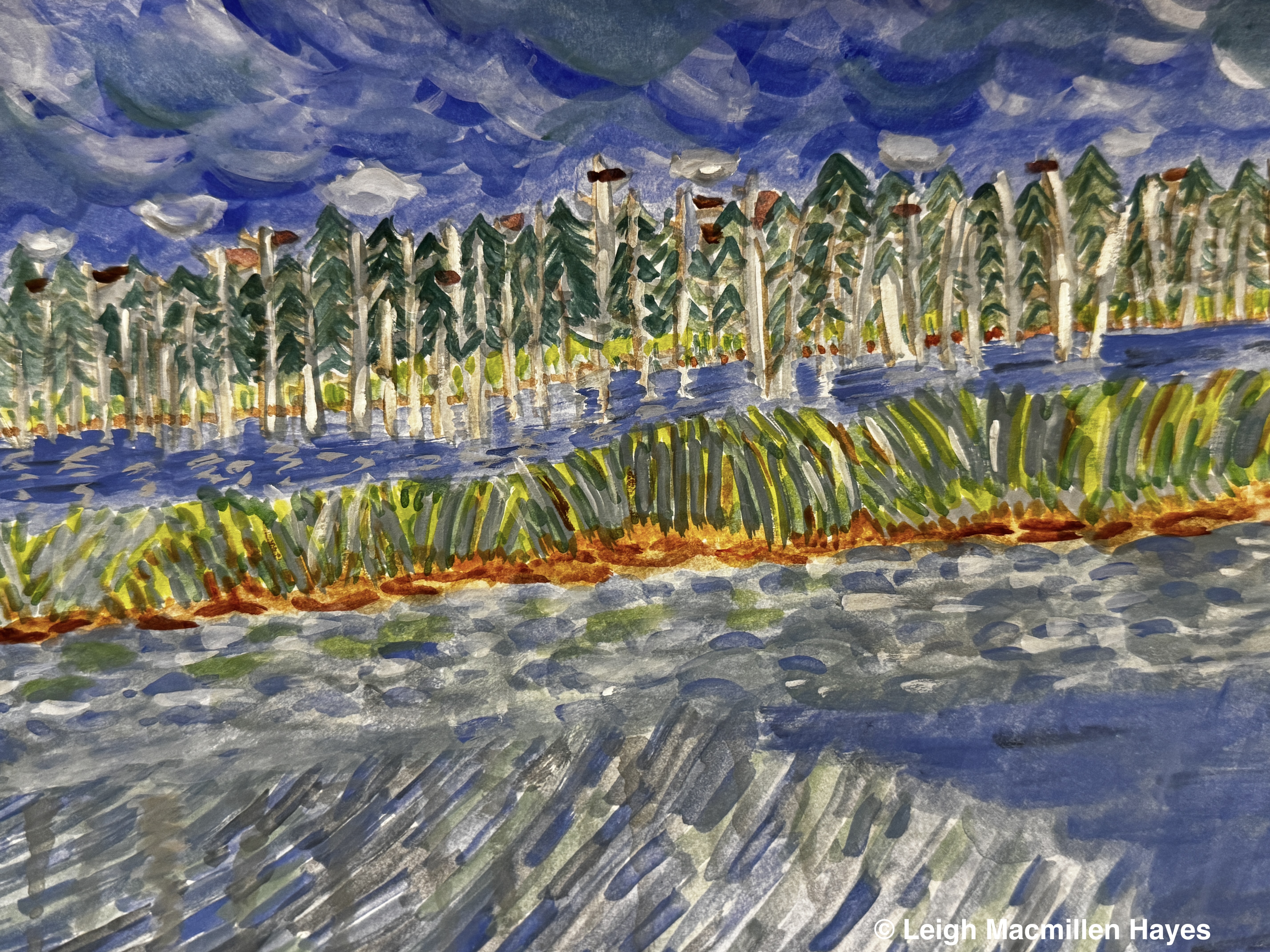
A second attempt at emulating Van Gogh. My fav: the trees in the background.

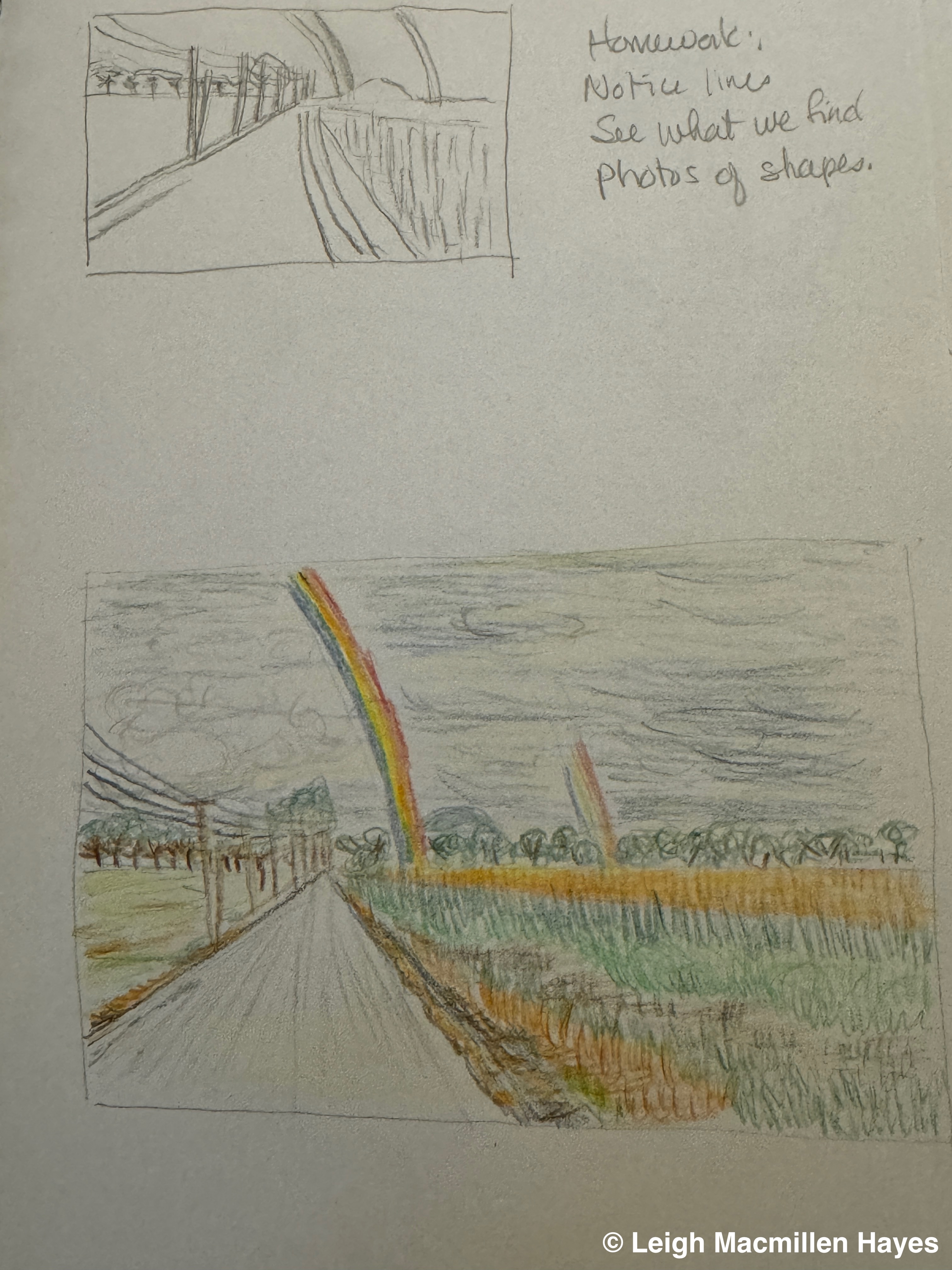
Third try. The sky was different. My fav: getting better at perspective.

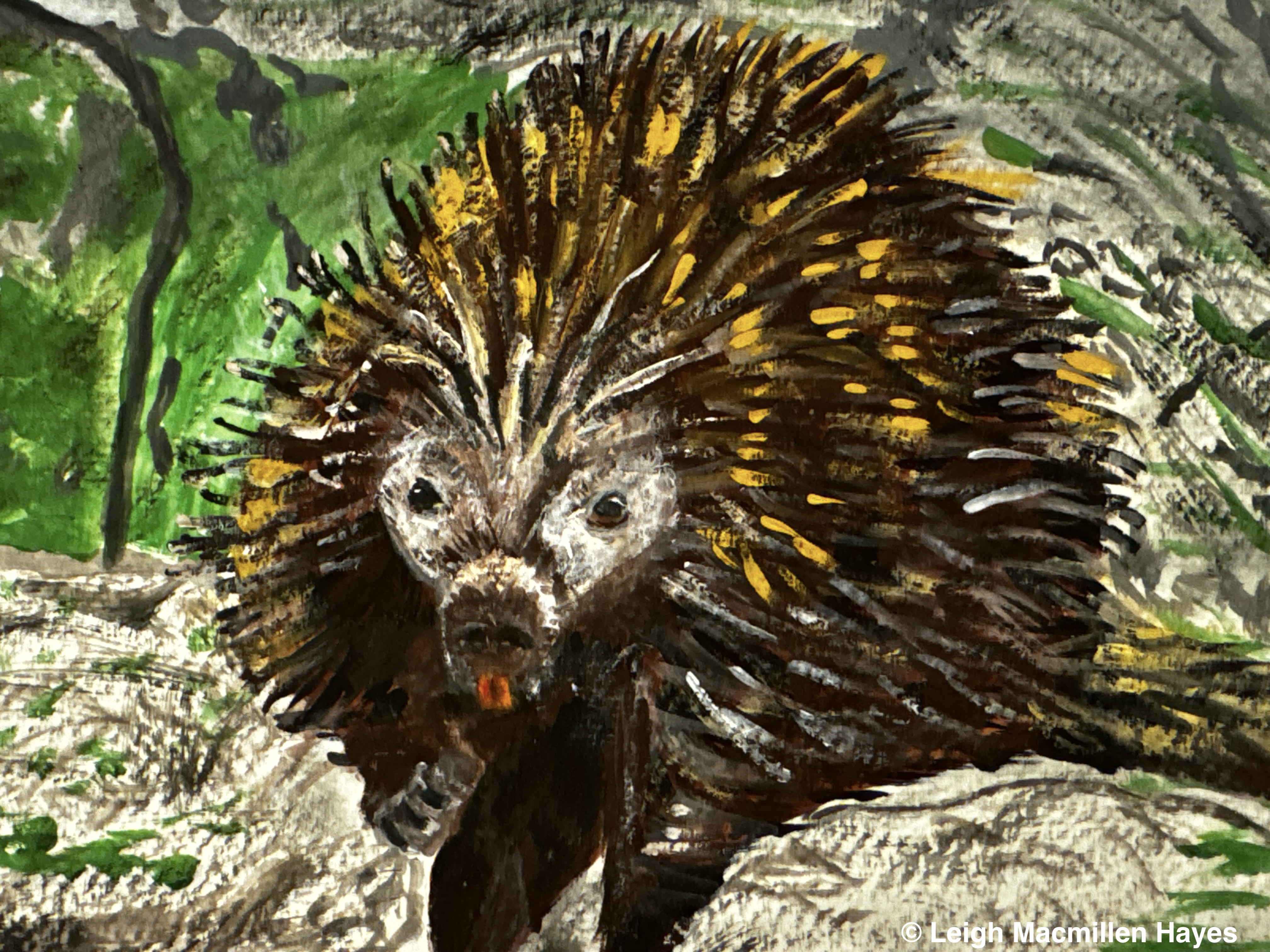
In between classes I continued to paint. One of my absolute favs: Bandit! The porcupine I met in the yard last year. My fav: His face.

A Moose My Guy and I met in the beaver pond on Albany Mountain Trail, Bethel, Maine. My fav: His face.

What’s left of the Hayes Homestead, My Guy’s great-grandparents’ farm in Nova Scotia. My fav: shingles.

An amazing moment when I visited the vernal pool out back as the sun lowered and discovered that in the stillness of the water, a rainbow was created by the pollen, and while the tree shadows draped across the pond, they also were visible in their usual vertical presentation on the water. My fav: colors of the sunlight on the pollen.

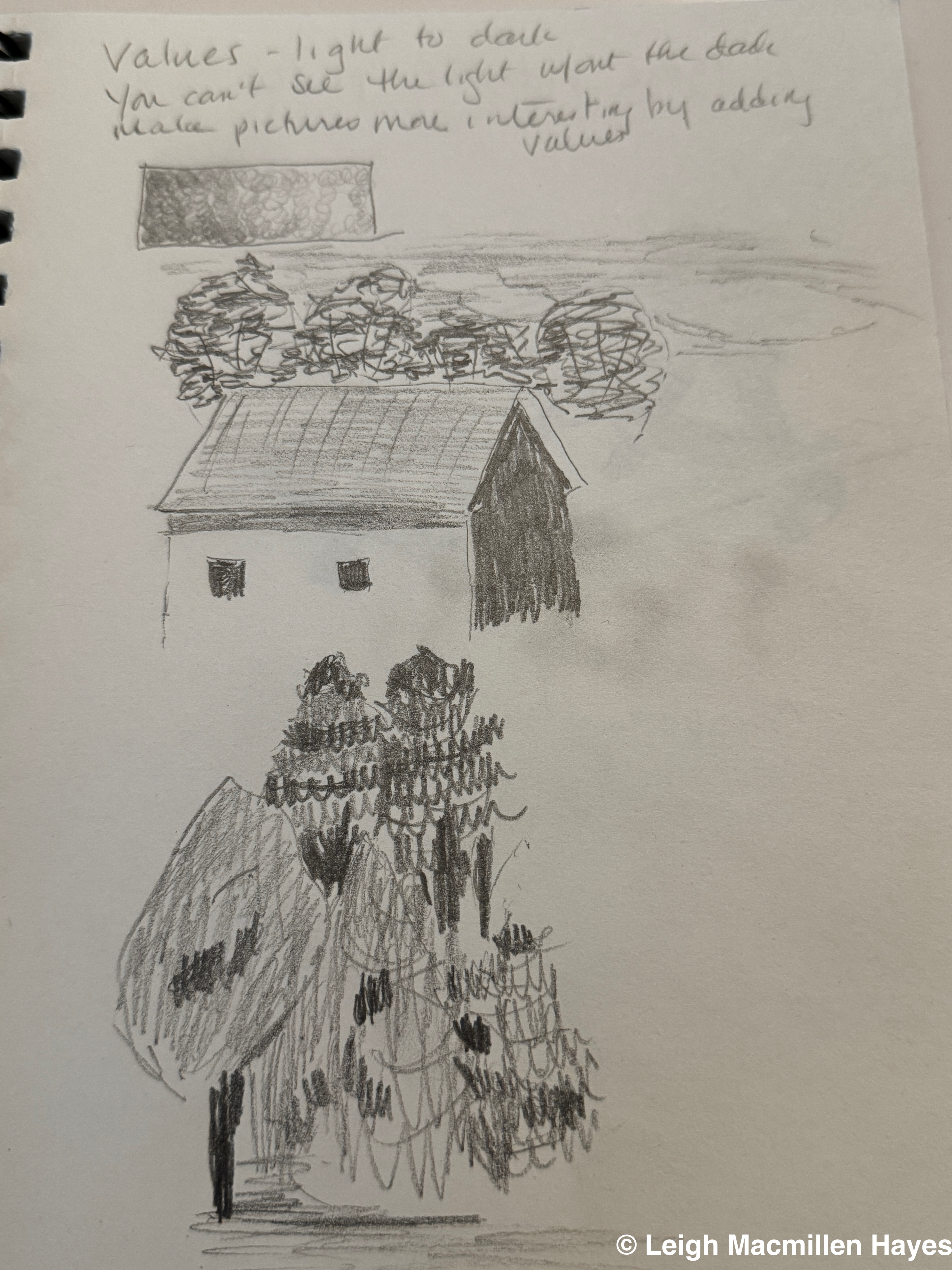
Back to class and learning more about values. I have to admit that I don’t always heed this advice and do a values sketch before painting.

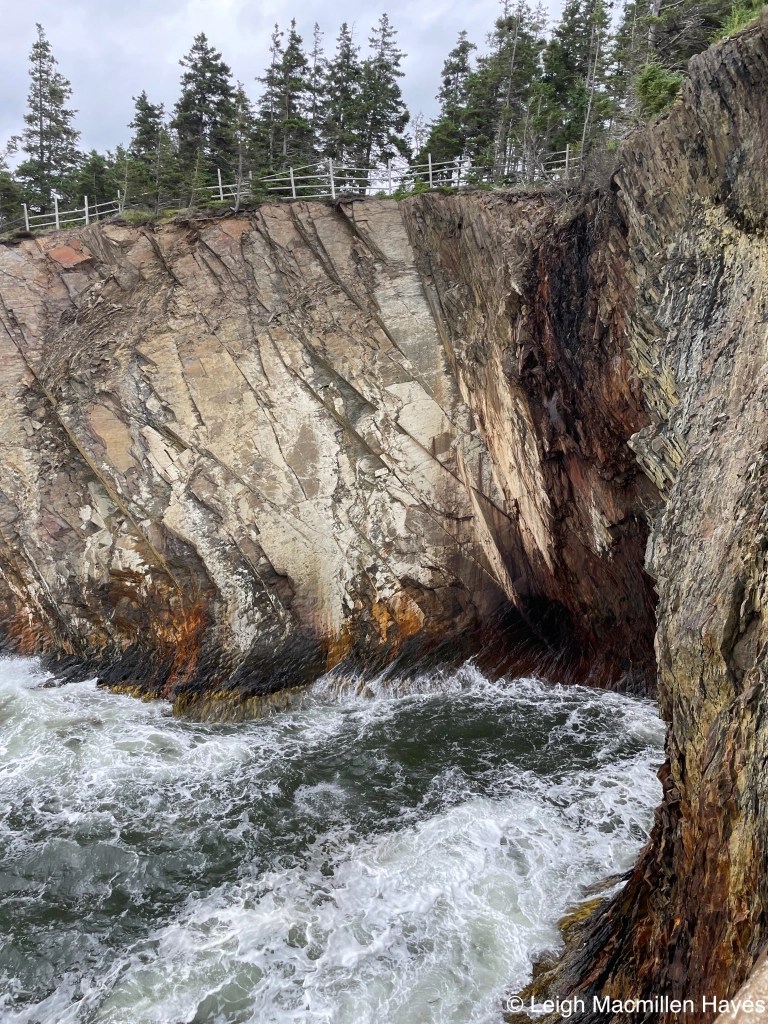
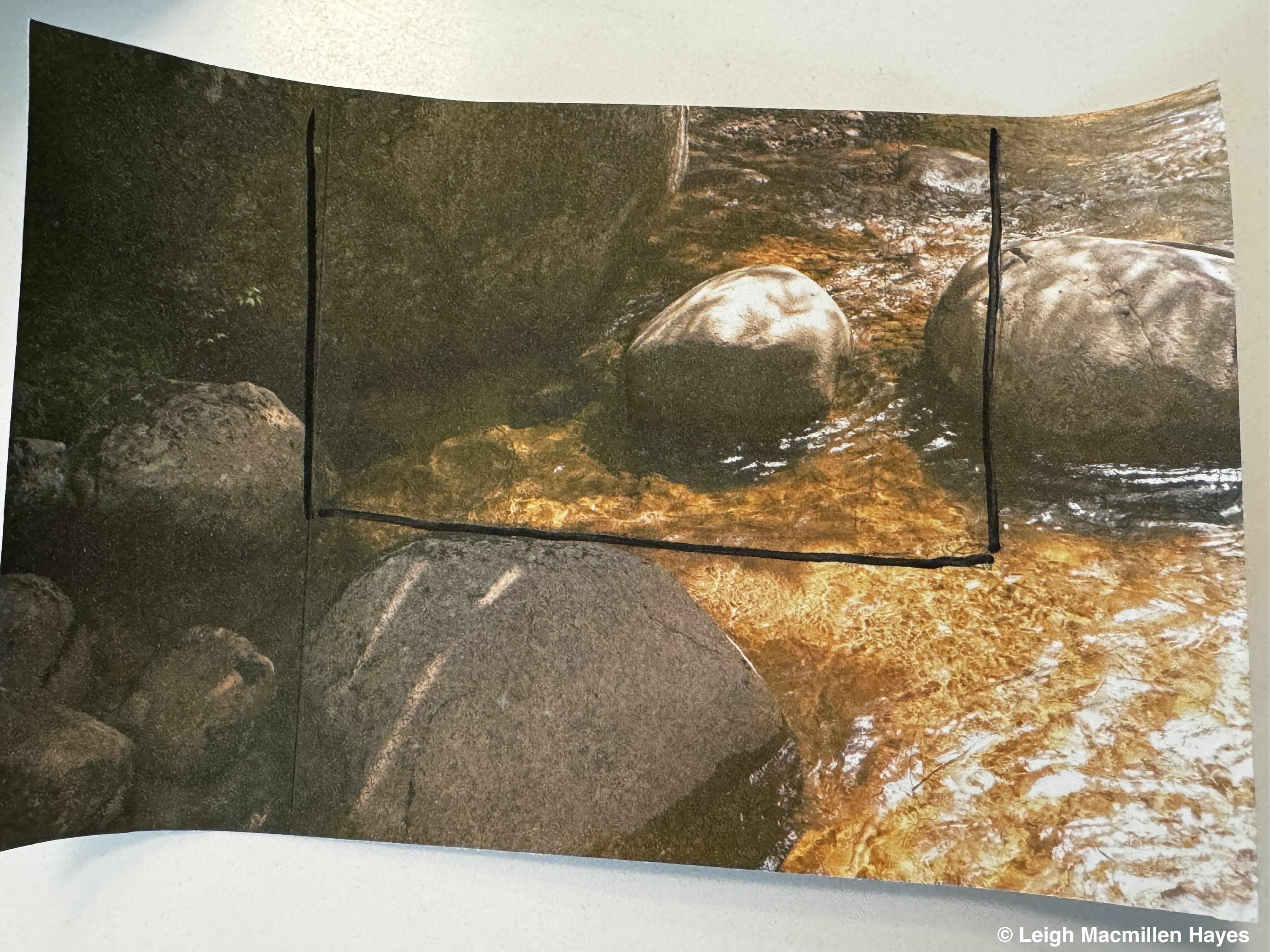
Photo of Ovens Cave, Nova Scotia.

Cropping the photo in sketches.

One final sketch before painting.

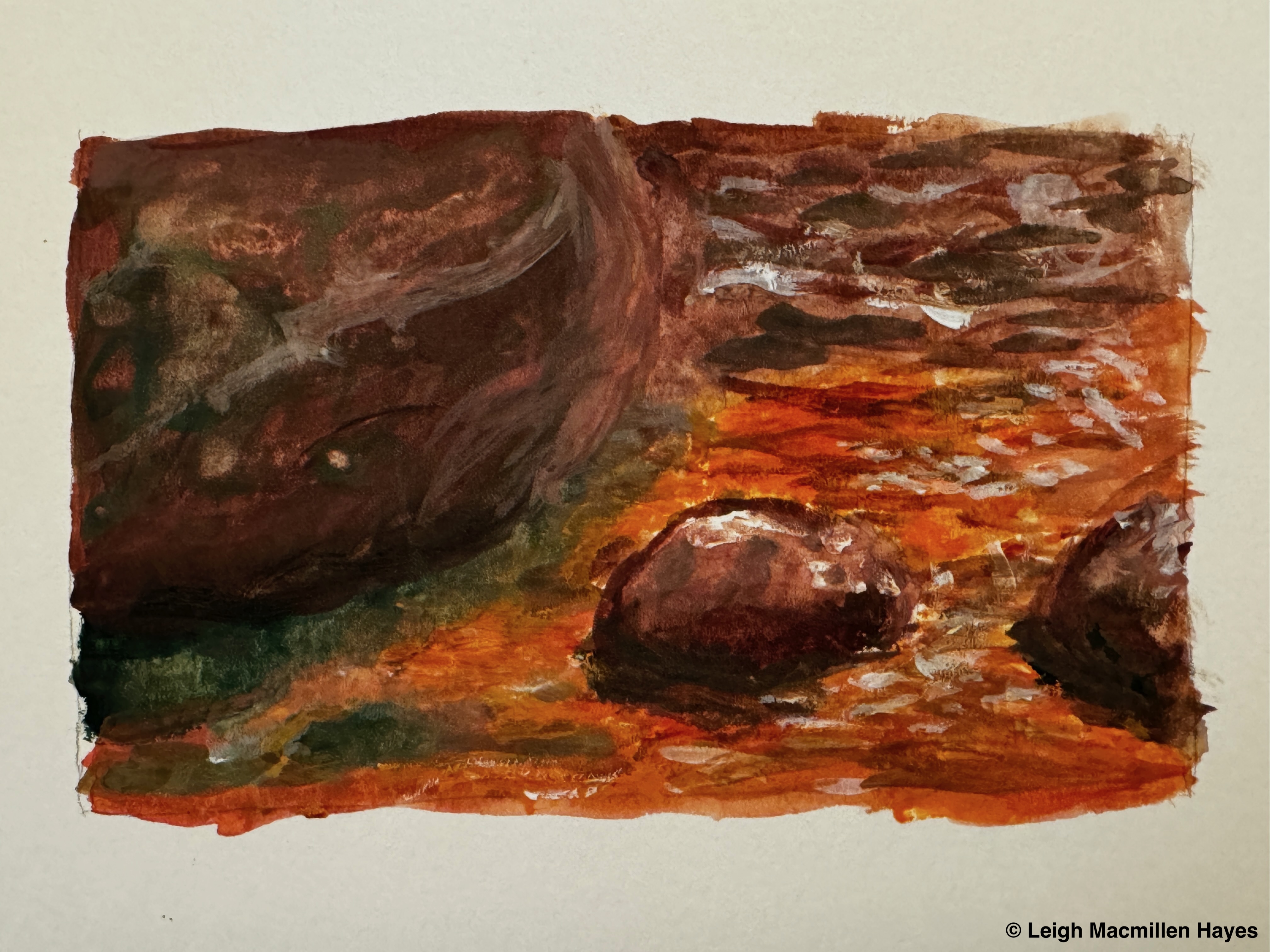
First attempt in gouache. My fav: colors of the rocks.

Jessie taught us a neat trick to check values by using a filter on our phones.

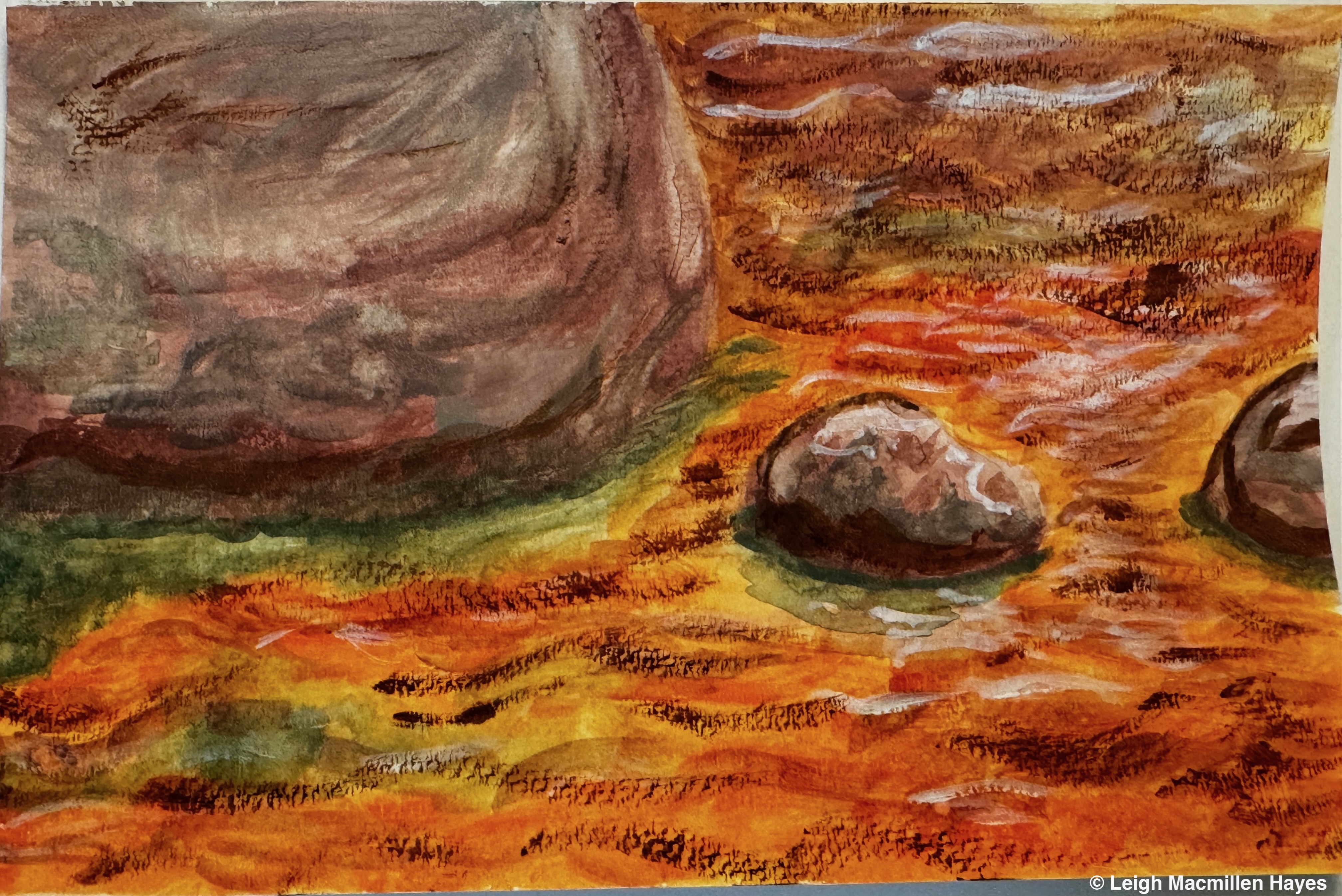
Trying to be more abstract with the same scene. My fav: the color of the water.

Values photo of the same.

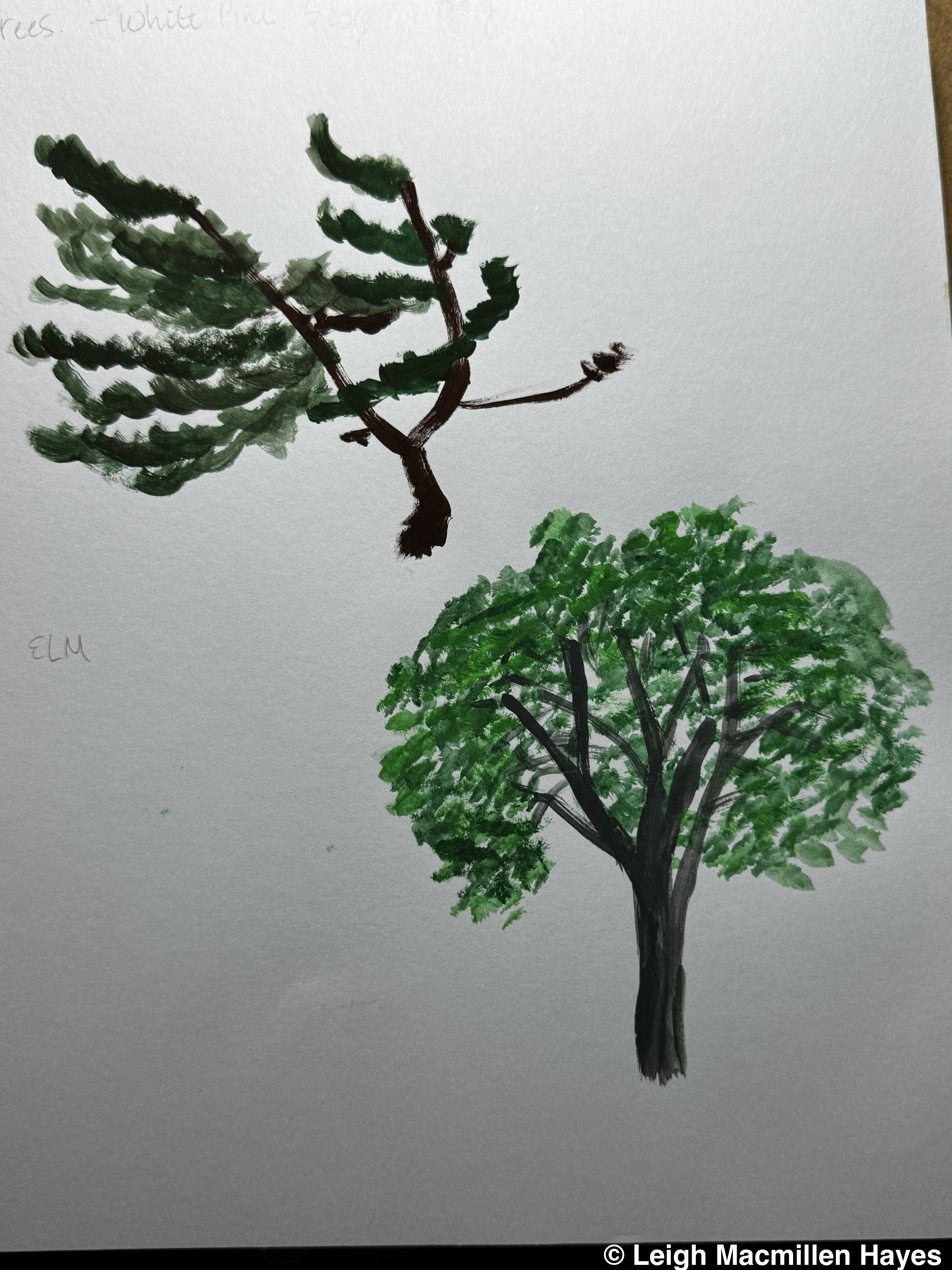
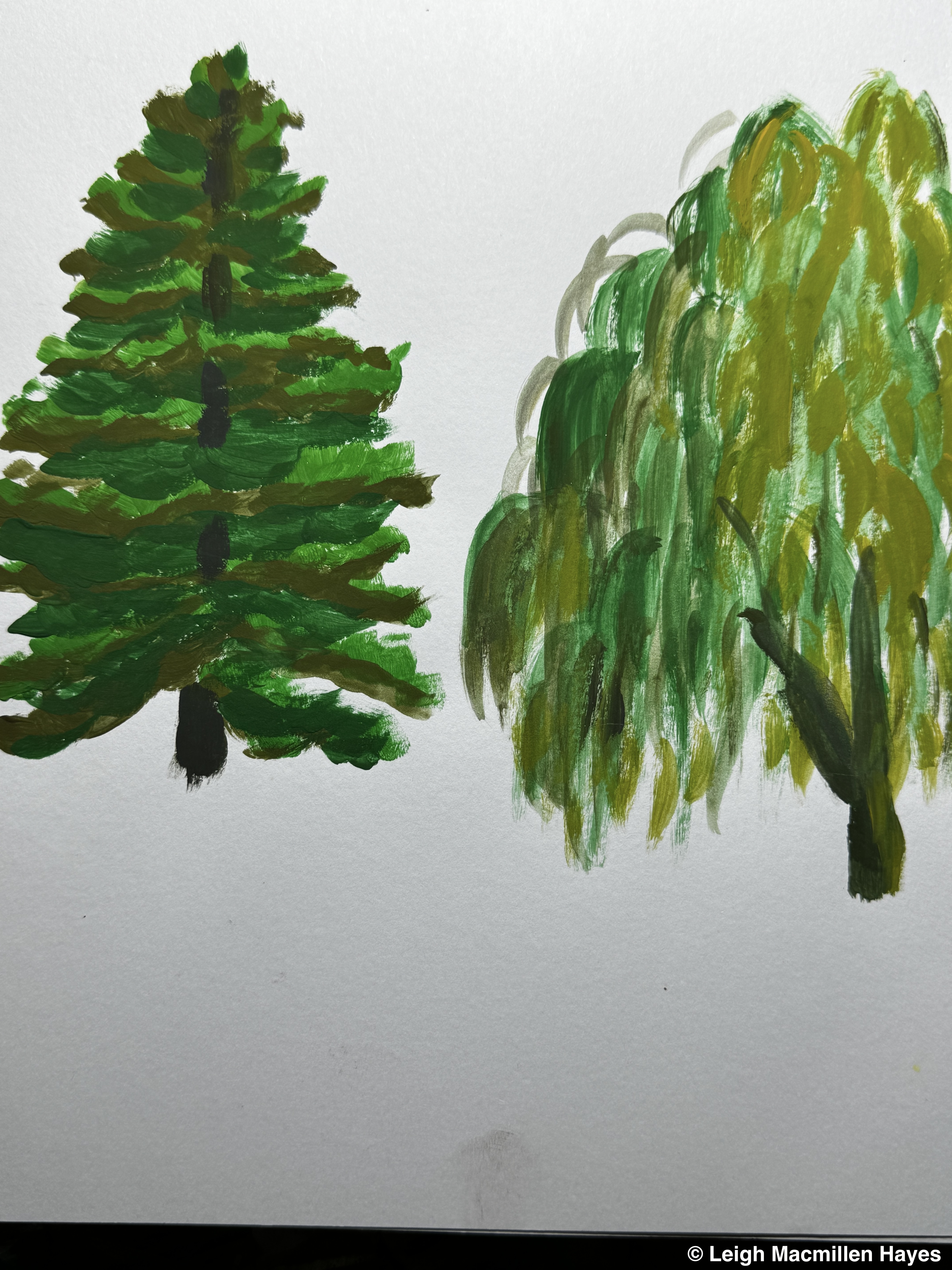
The third time we met we talked about basic shapes and had to quickly paint trees. It was supposed to be six trees, but our class only got through four. I guess we weren’t so quick after all. My fav: the willow. But also thinking about different shapes. And how to fill them in quickly.
Hairy Coo My Guy and I met in Scotland. My fav: the ear tag!

Values sketch of photo she offered in class, and getting the basic shapes on paper.

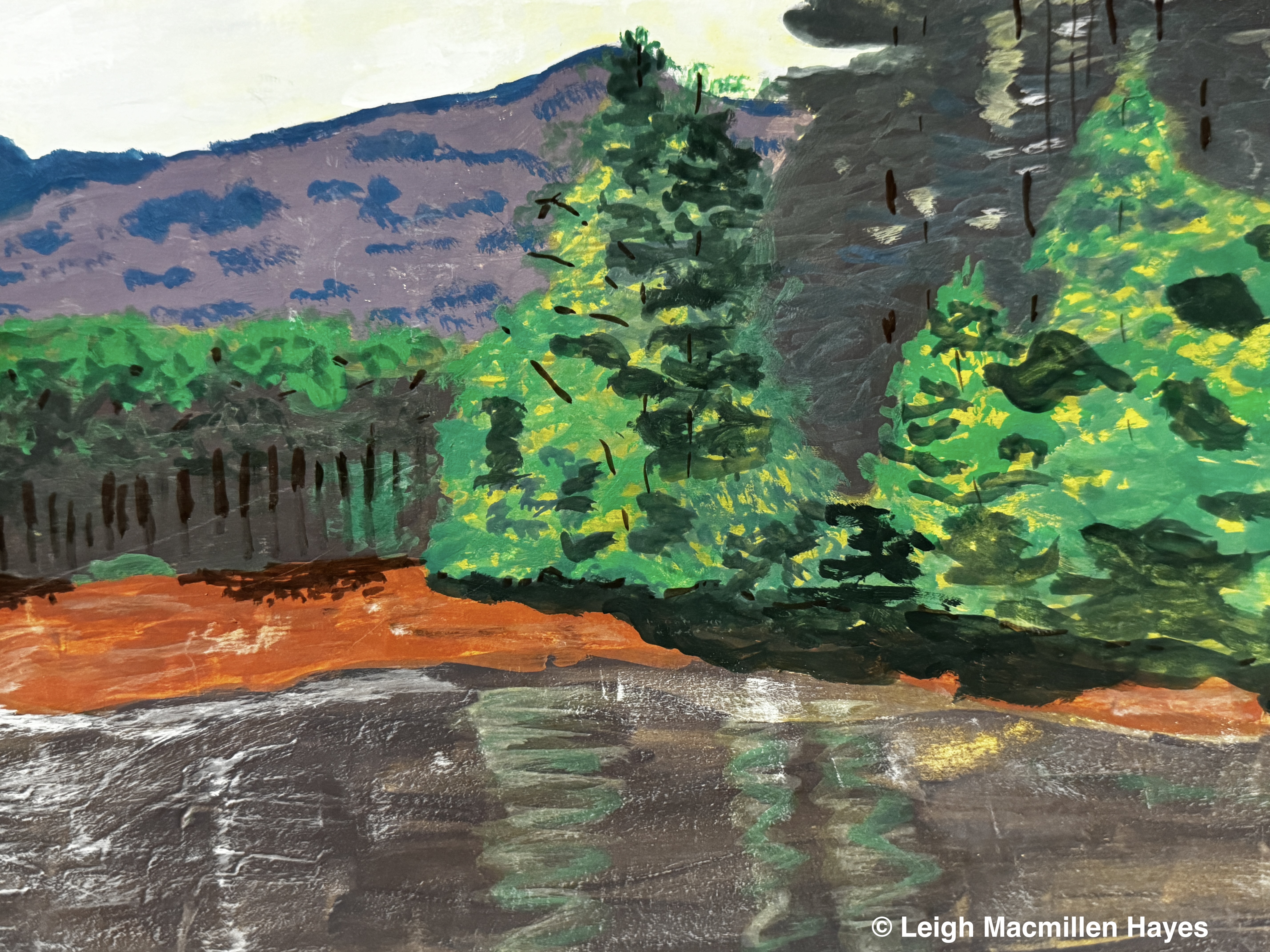
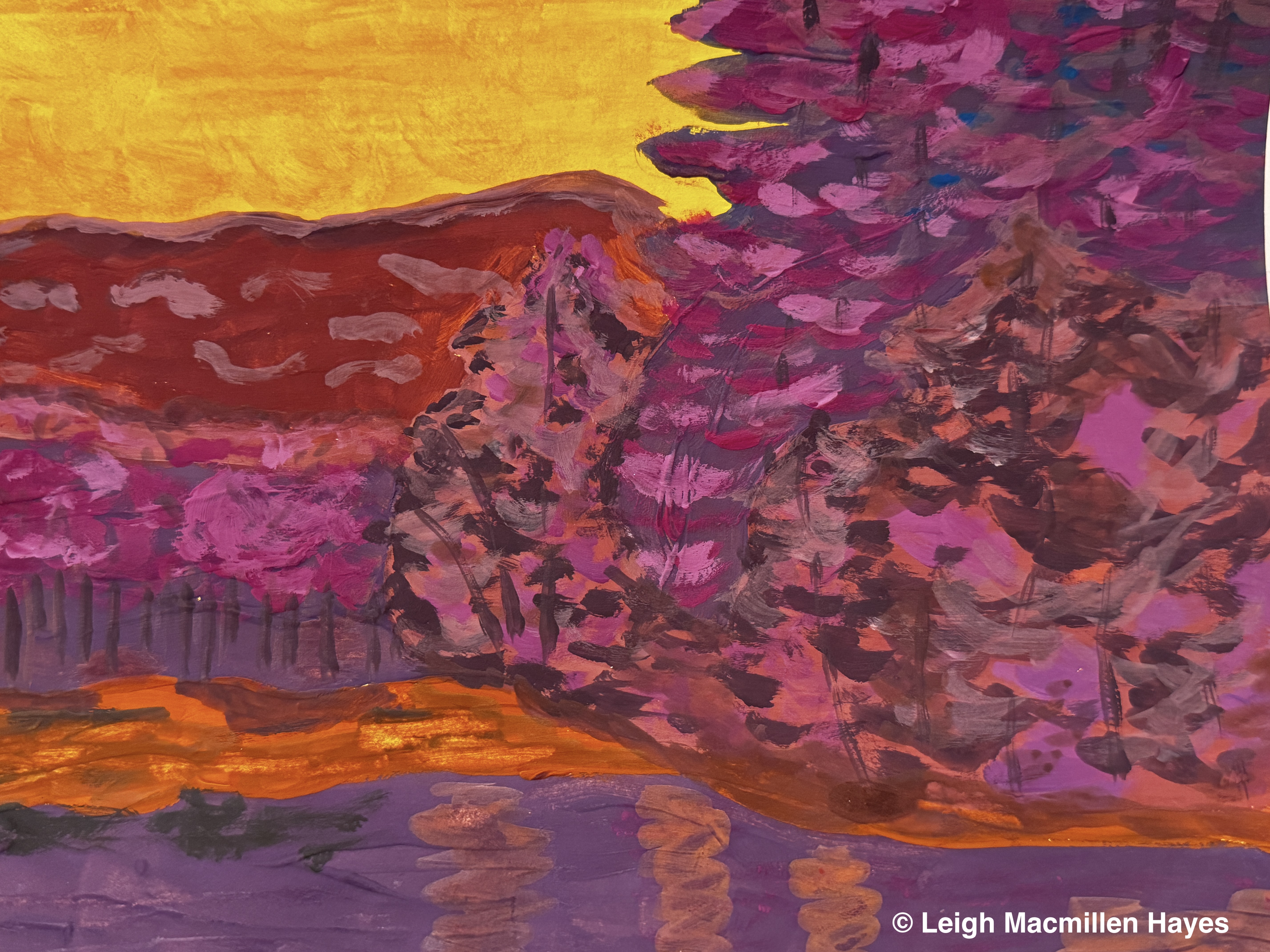
And then we could only use certain colors to paint the scene, filling in the shapes first before adding detail. This was mind opening for me. My fav: making blobs look like trees.

The same scene using different complementary colors on the wheel. I struggled with the values in this one. My fav: the trees still look like trees.

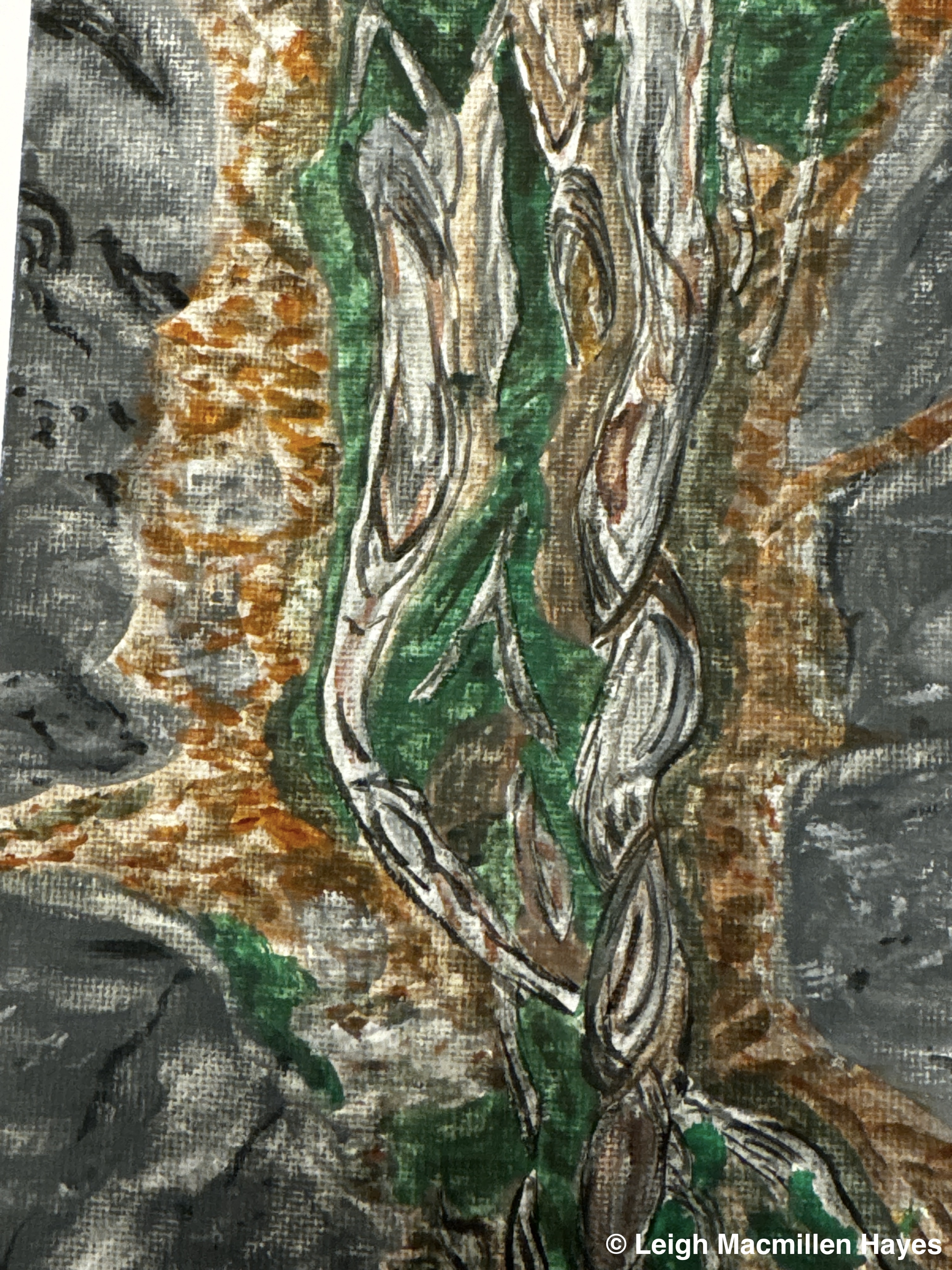
This one has been the most difficult for my family to understand. An intersection of granite ledges and tree roots on Bald Pate Mountain, Bridgton, Maine, on a canvas mat. My fav: the tree roots.

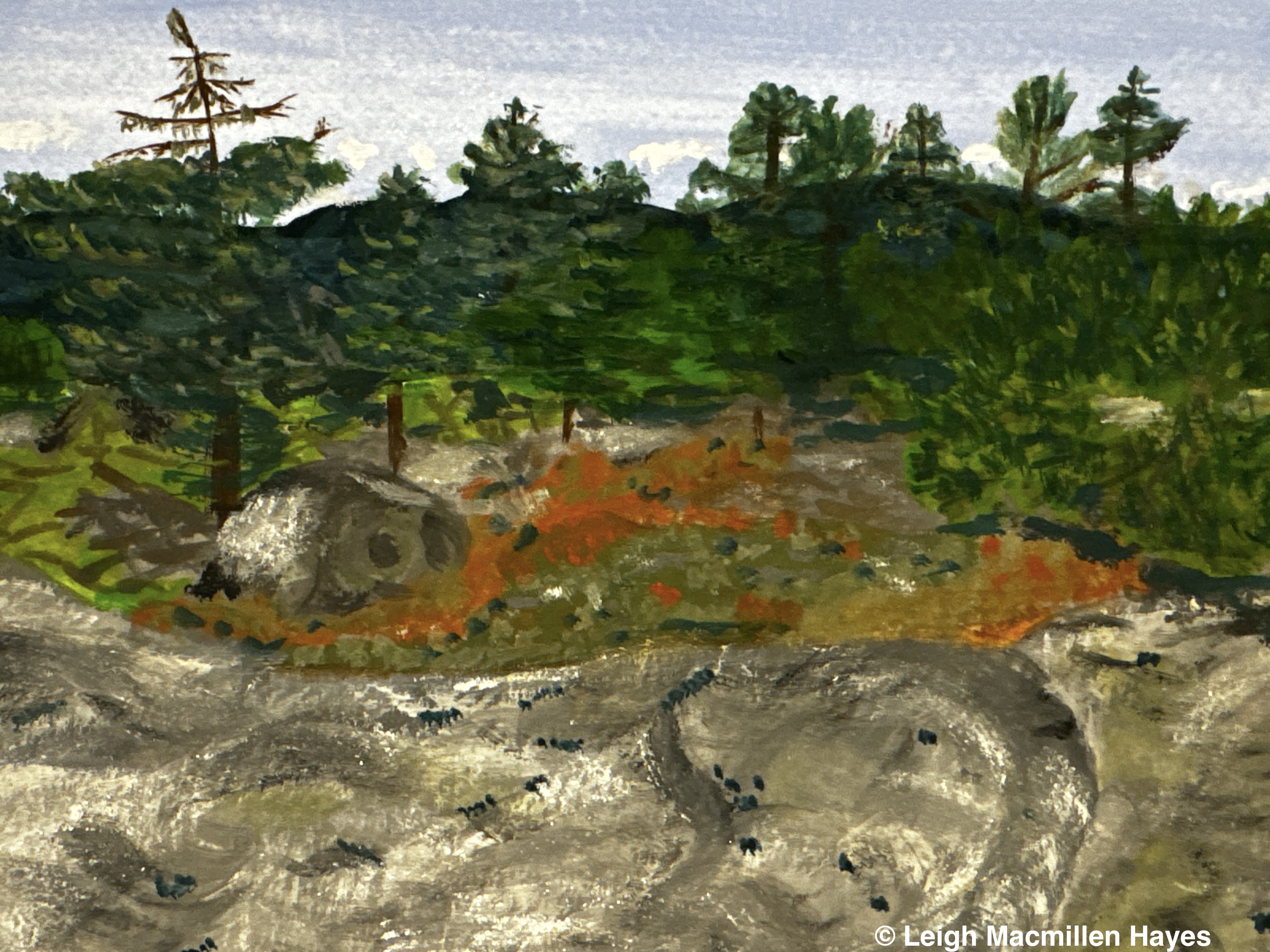
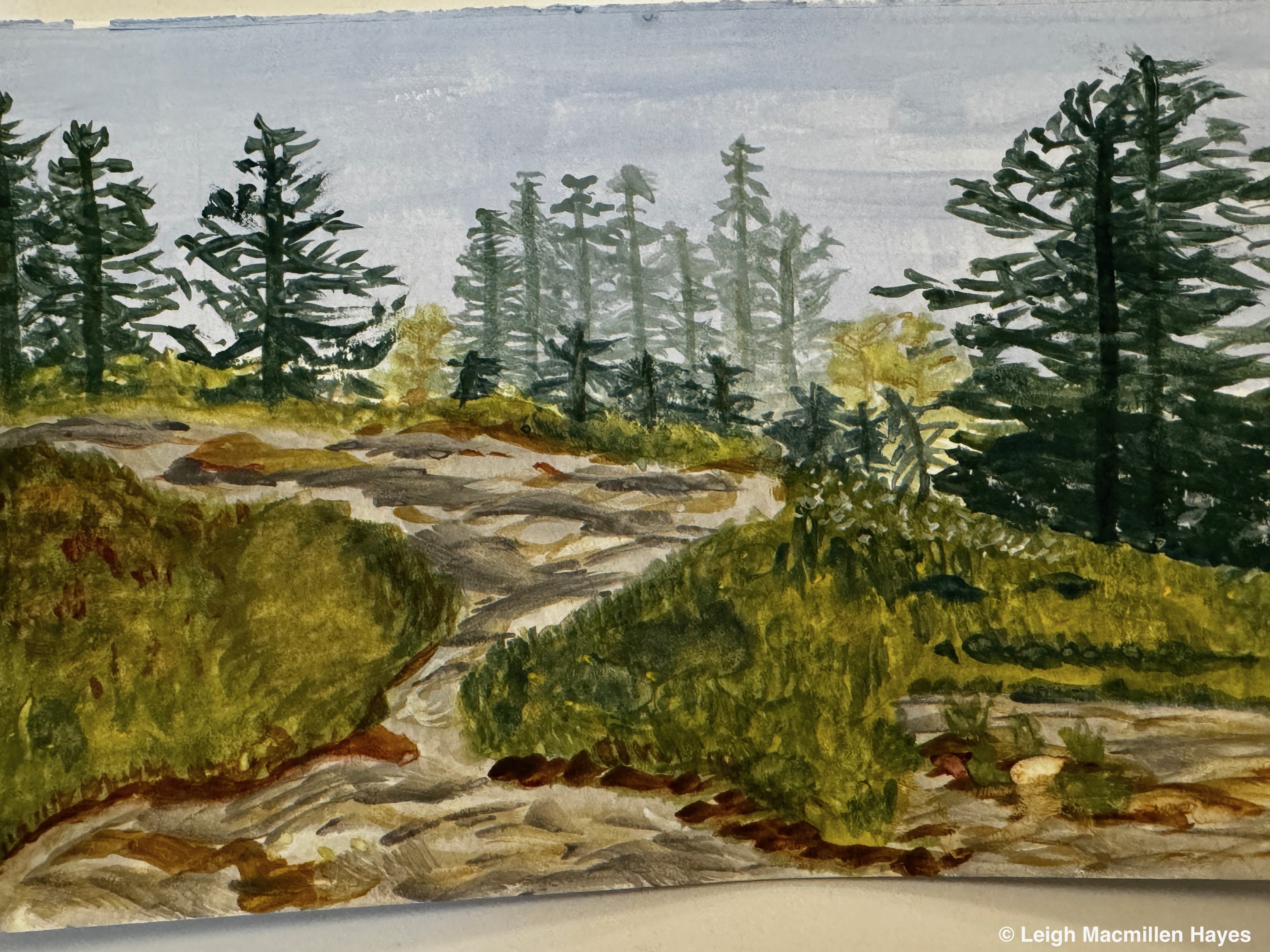
Ledges on descent of Rumford Whitecap Mountain, Rumford, Maine. My fav: the trees with the mountain backdrop.

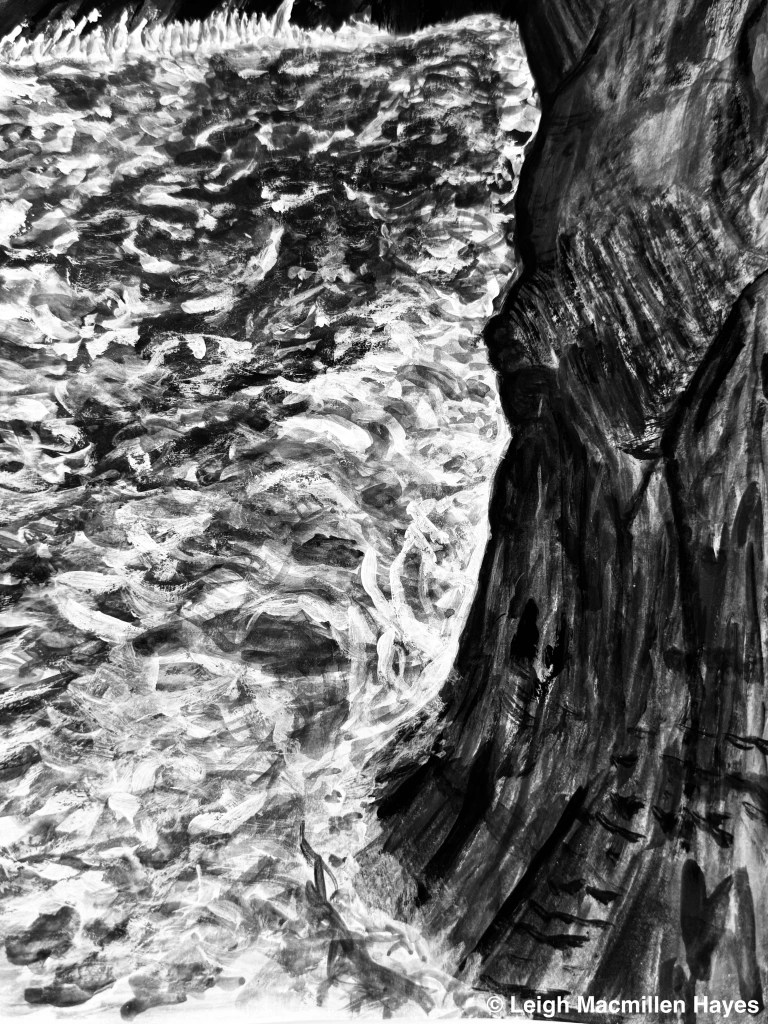
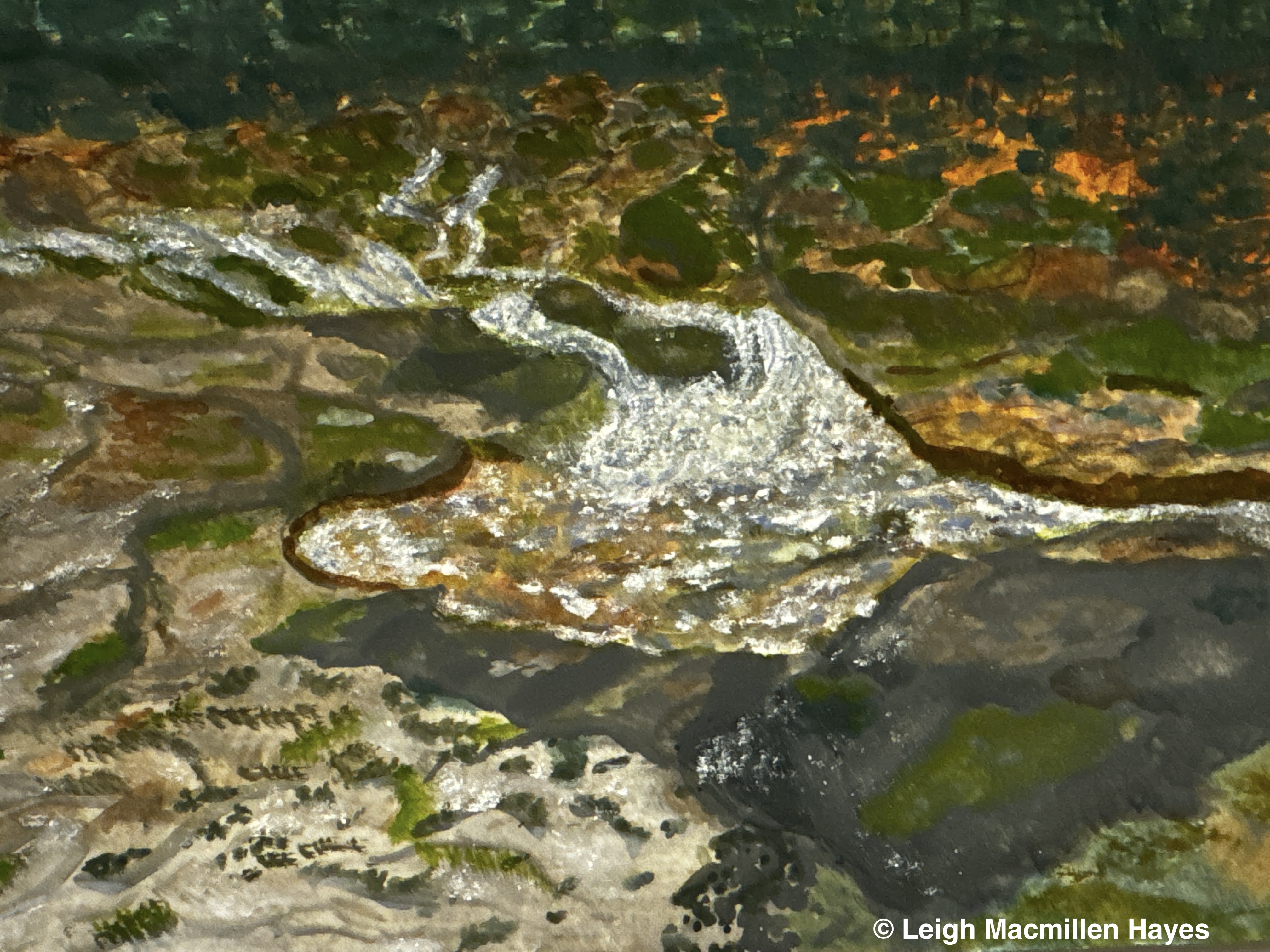
Bickford Slides, Blueberry Mountain, Evans Notch, Maine. And the discovery that I had accidentally purchased a small tube of shimmery white watercolor paint. My fav: water flowing over the mossy rocks.

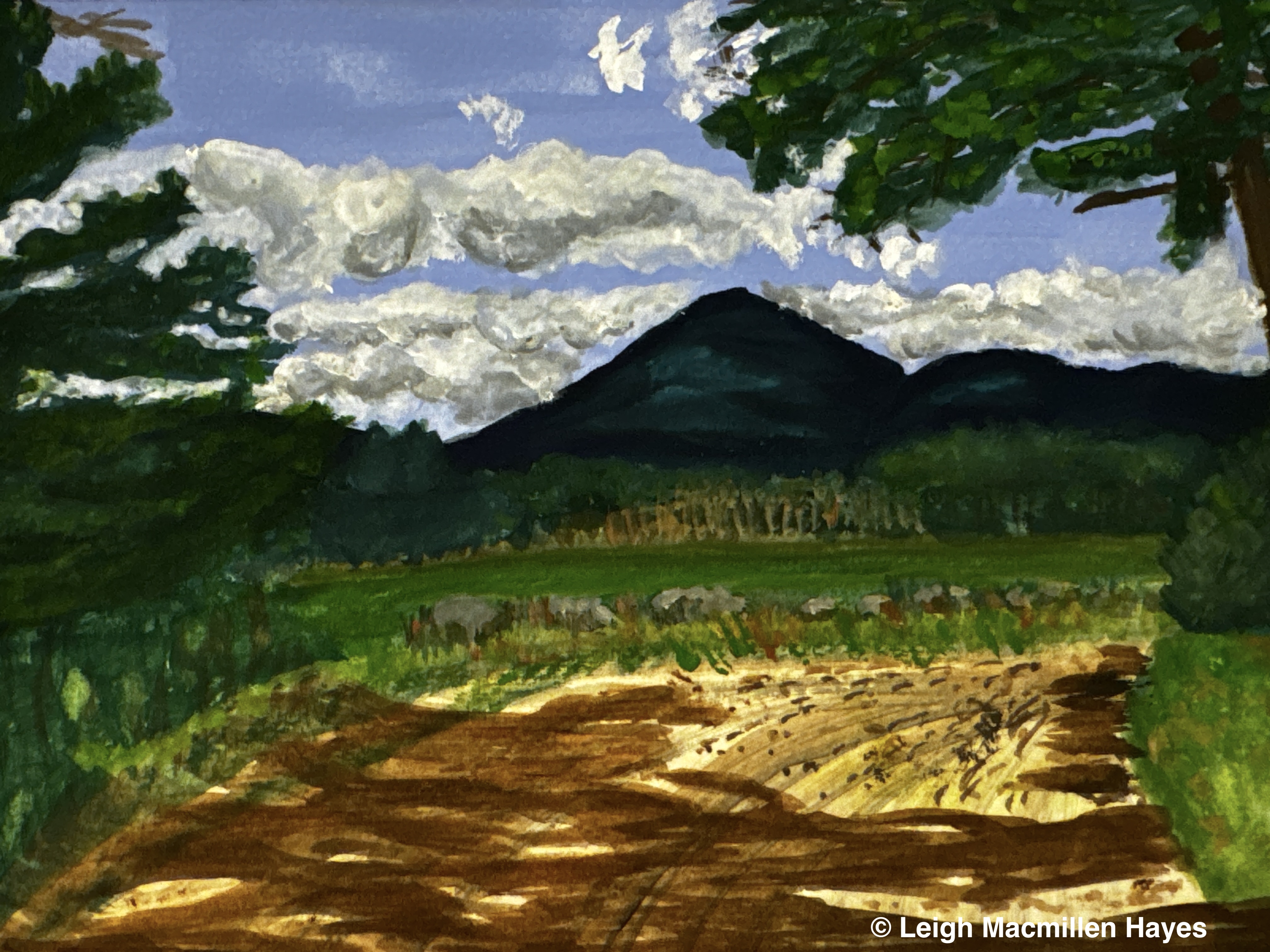
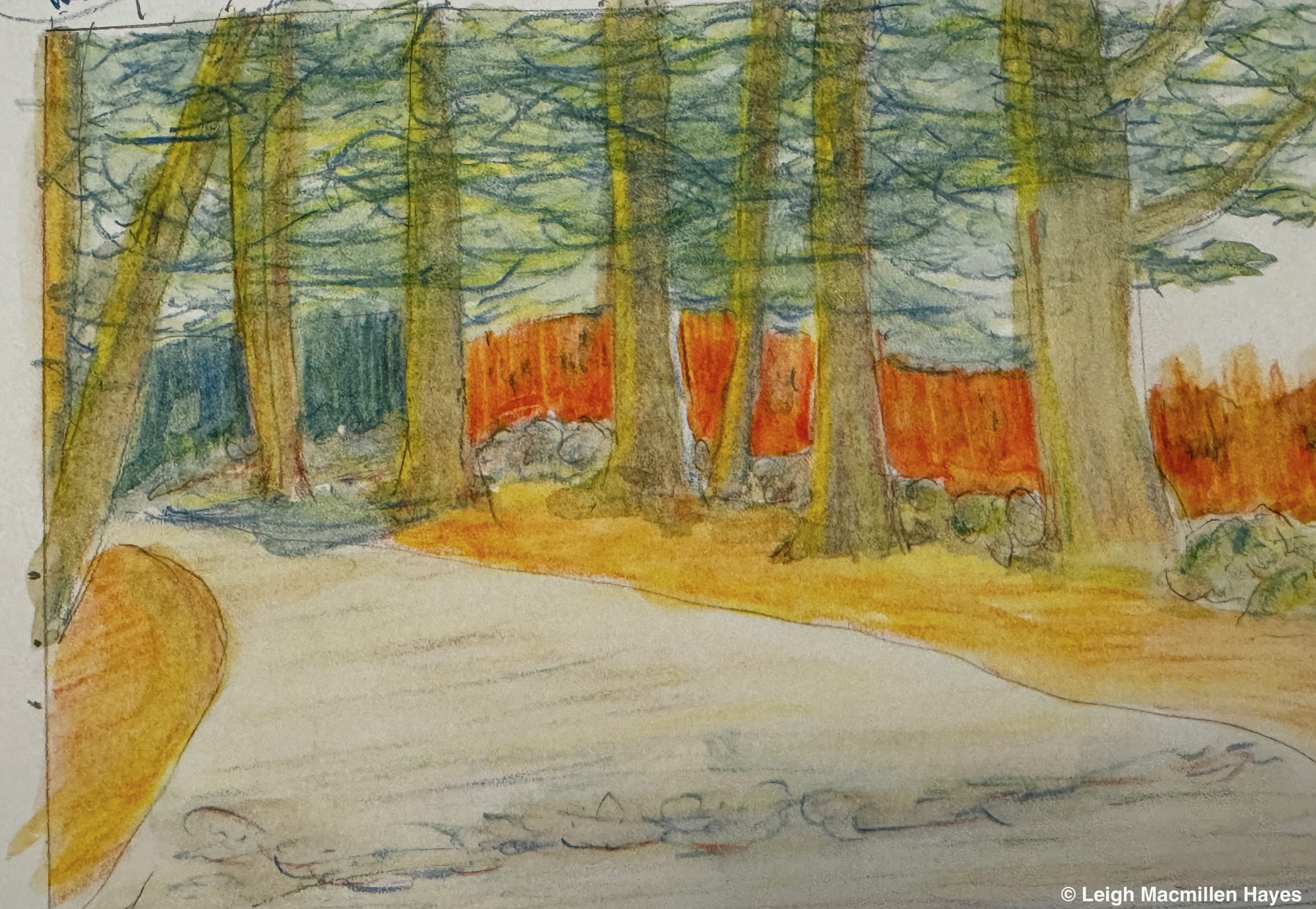
Shadows across Hemlock Bridge Road, Fryeburg, Maine. My fav: those very shadows. And the rocks that line the road.

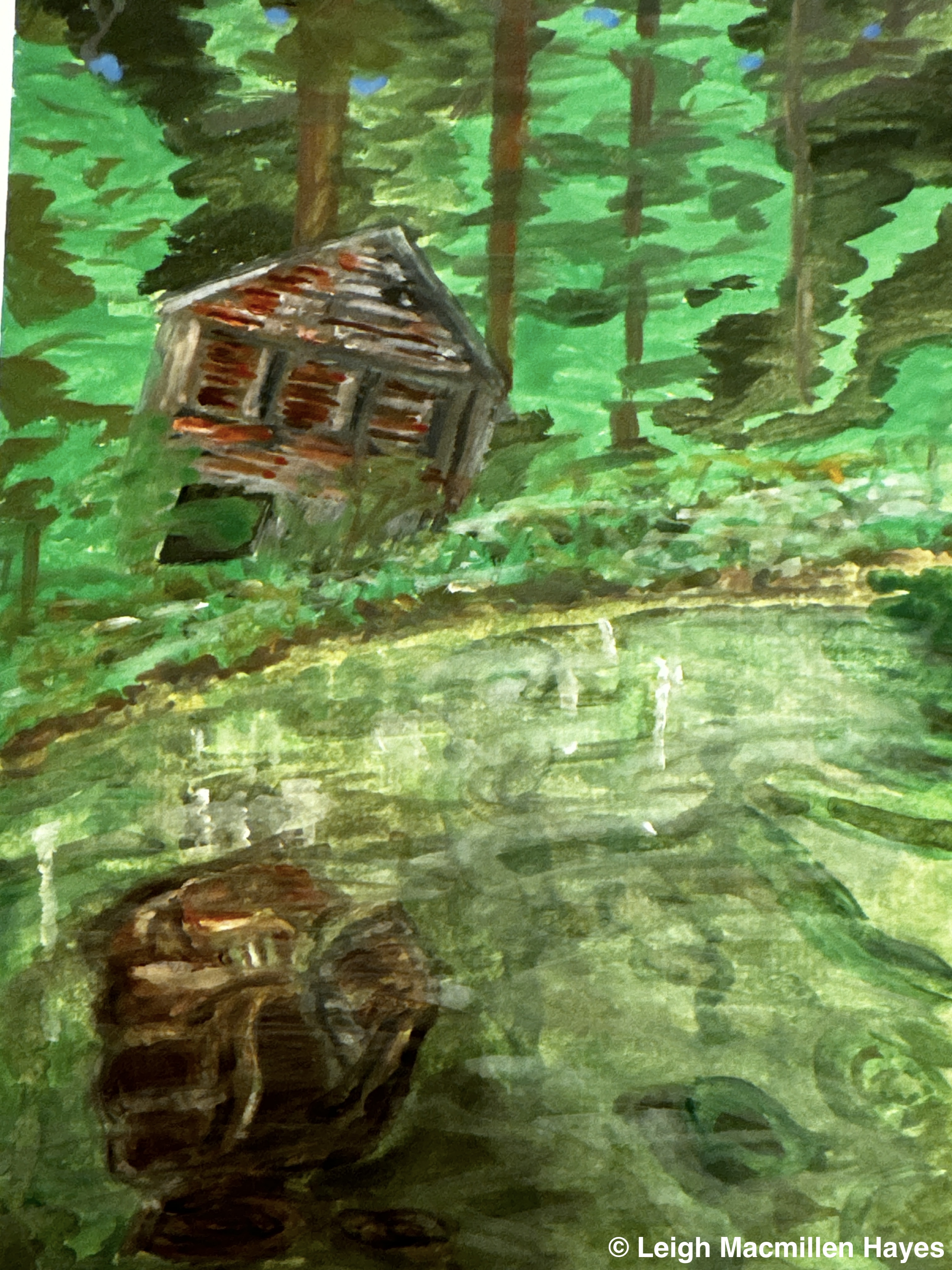
Back to gouache to capture the reflection of a falling down cabin on a small pond in New Hampshire. My fav: the trees and hints of the blue sky.

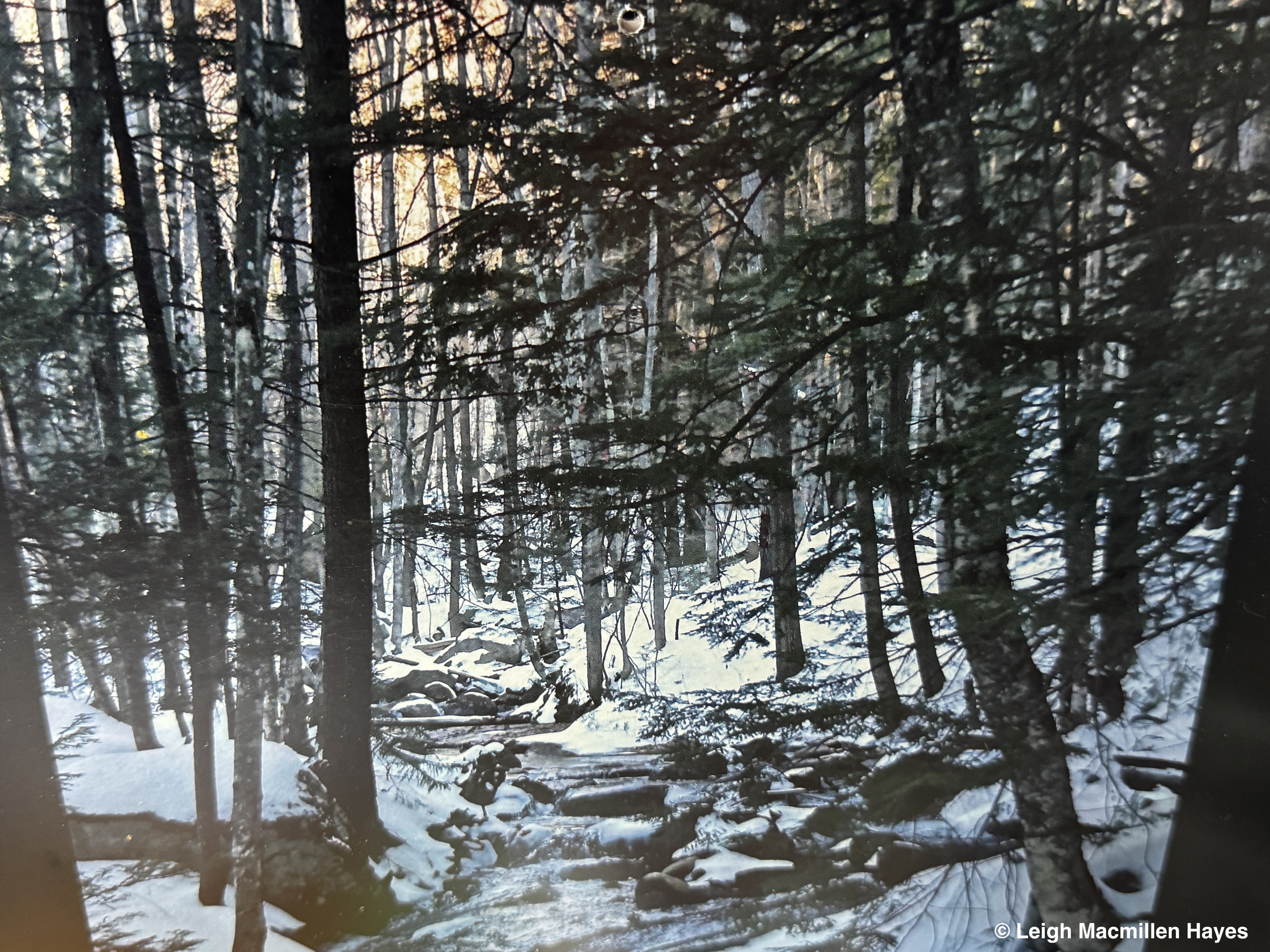
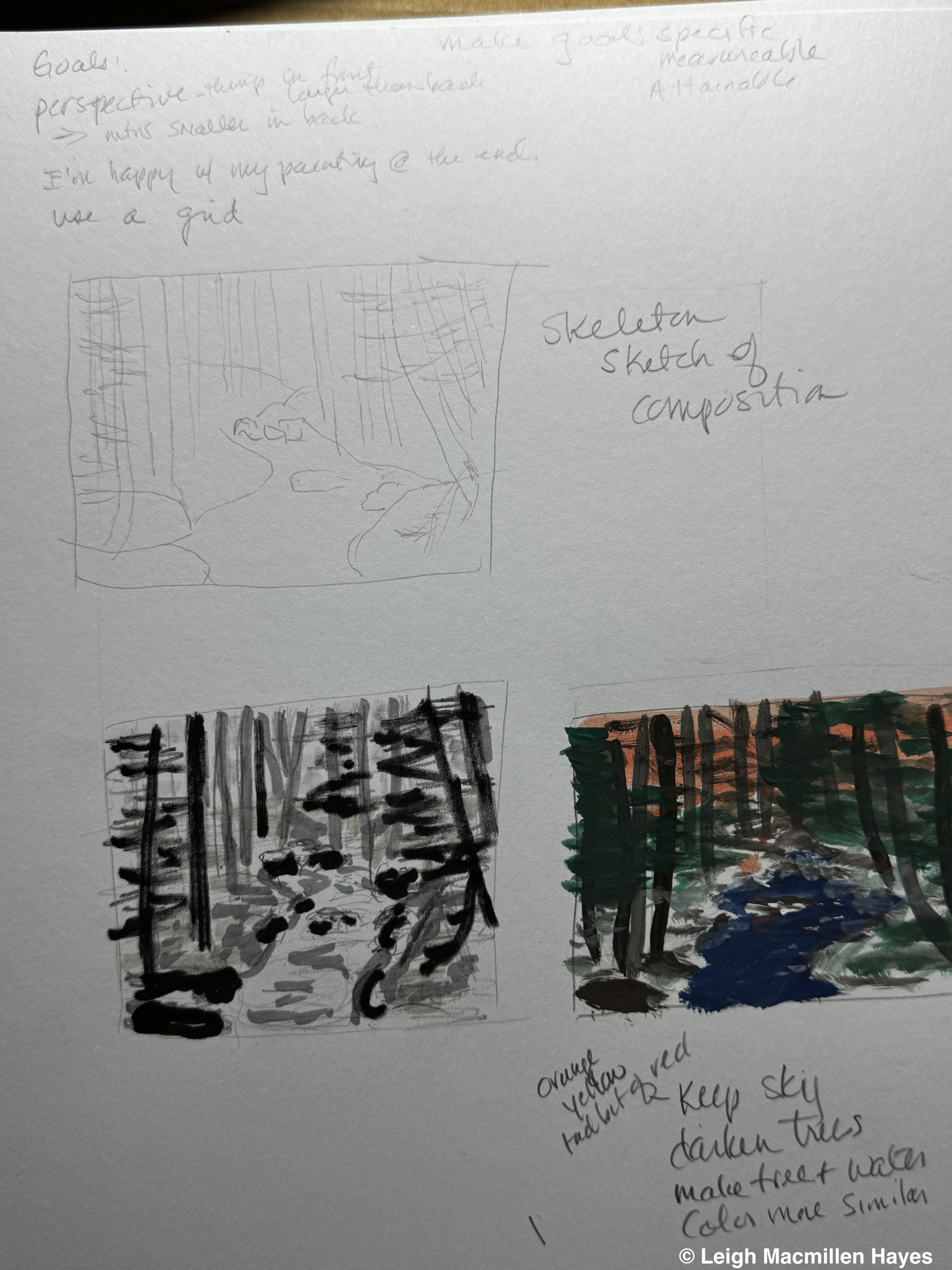
The final assignment took us two classes. This is the scene I chose to paint. Sucker Brook at Greater Lovell Land Trust’s Wilson Wing Moose Pond Bog Reserve, Lovell, Maine.

Planning with sketches, markers, and paint and figuring out what might work best. And simplifying the scene.

Jessie gave me a piece of Hot Press Finish paper upon which to work, and I have to admit that it was a joy to paint on this. I started with the sky color as the wash and then worked on the snow next, then the water, and finally the trees. My fav: sunlight reflected on the snow in the background.

After I shared that painting with a friend, she commented, “Can’t you do something other than snow until there is snow?” So, I painted a fall scene at the summit of Bald Pate. The mountain tops are not quite this color yet, but will be in a couple of weeks. My fav: contrast of colors.

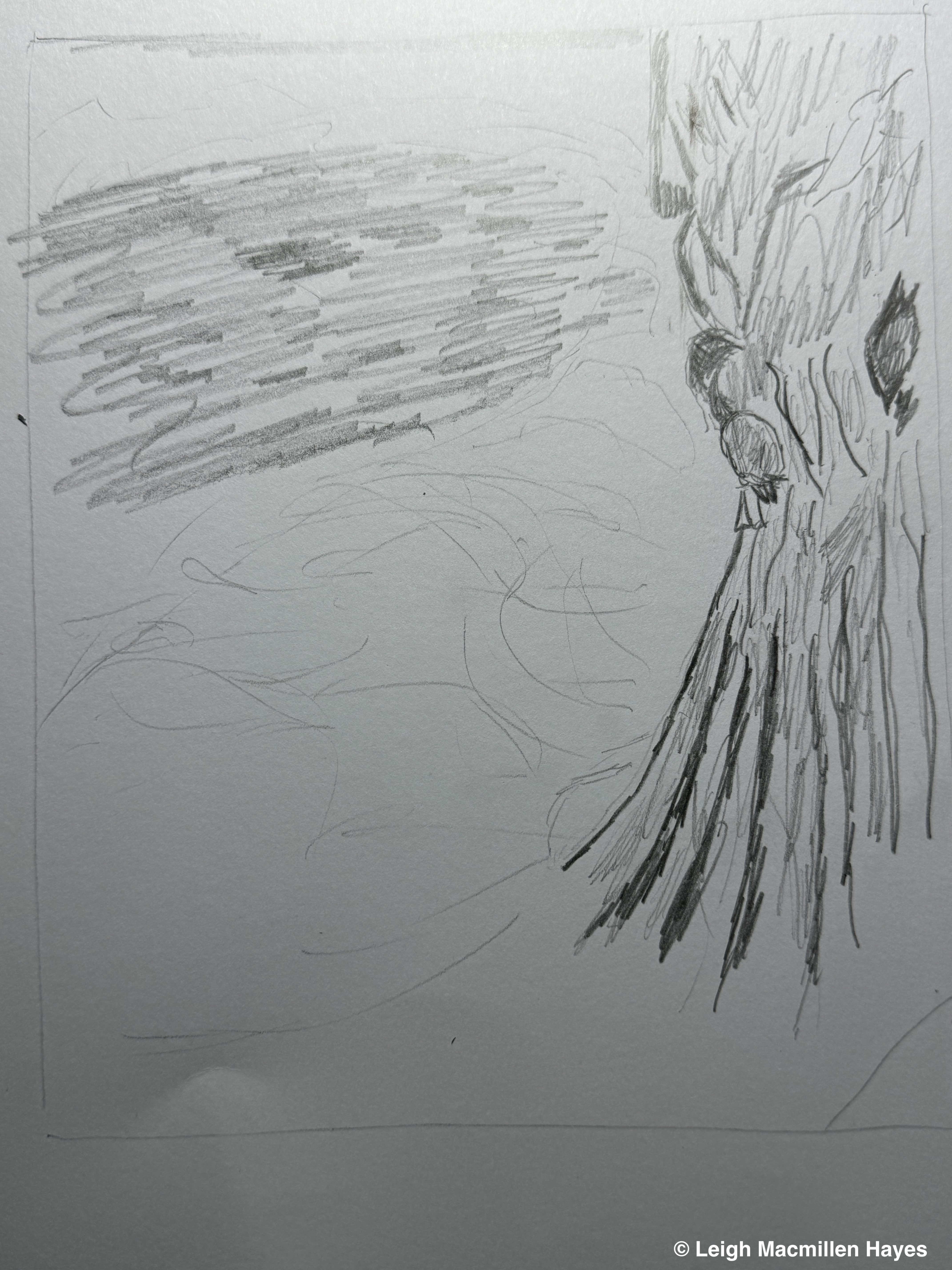
My last painting to date on a larger canvas sheet was a Pileated Woodpecker that frequents our woods. I discovered, like the Hot Press paper, I really like the canvas except that it takes a while for the paint to dry. My fav: the bird’s head and the pine tree bark on the right.

That’s all I have to offer at the moment. And if you stuck with me this far, I’m impressed. Thank you!

I keep thinking about this creative journey and can’t wait to see where it takes me next. If you are interested, you can follow my artistic path by clicking on wmw art gallery every once in a while.

A Lost Art Found

At the end of April I began taking an art class offered by one of my peeps, a young woman who walked into the lives of many of us one day about twenty months ago; a young woman with a million talents to offer. Among those talents, she is a self-taught artist and we’ve been begging her to teach us.

At our first class, we had to draw a small box in the upper left-hand corner of the paper and place the person who has been our biggest art critic into it. That done, the critic was forever boxed–well, until she sneaks out, which she seems to do way too much.

And then we looked at some photographs in magazines and had to sketch them and determine the direction the eye would travel in the picture.

Next we looked at lines and perspective. I’d brought along my favorite colored pencils, but immediately felt my inner critic jump on me because all of my classmates were working with watercolor pencils, watercolor paint or acrylics. And the artist herself, gouache. Until I met her, I’d never even heard of gouache. Or at least never paid attention, if I had.

And so between classes I purchased a set of watercolor pencils and tried all over again. It certainly was a quicker way to create and I liked how I could blend the colors with a brush. But still, it was a long process to produce such.

Our next lesson was on values and we looked at how values add to the picture and stood outside and quickly sketched some scenes in the neighborhood.

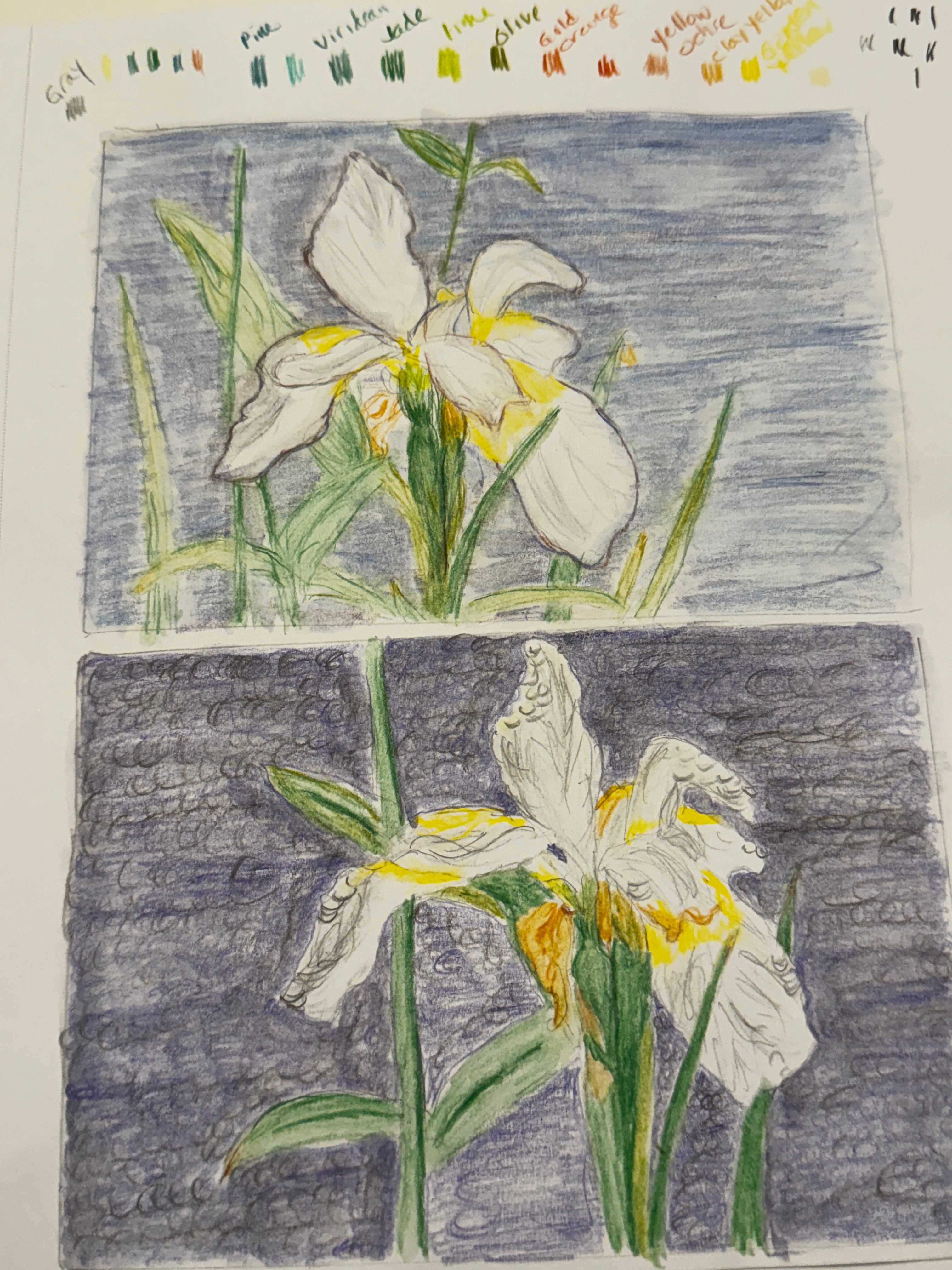
And then she produced a photo of a white iris for us to illustrate. I struggled with this because I couldn’t figure out how to make the flower pop and so I cheated (well, maybe it’s not cheating, but rather an artist’s prerogative), and outlined the flower with a different color.

When I later asked the artist how to do this, she showed me that by making the background darker the flower would stand out. And so I tried again.

The other thing about the artist’s prerogative–you don’t have to include everything in your illustration that is in the photograph. And so you can see I left some leaves out on the second try. But I did want more detail in the flower.

“Painting is not about ideas or personal emotion. Paintings are about freedom from the cares of this world, from worldliness. All art work is about beauty.” ~Agnes Martin

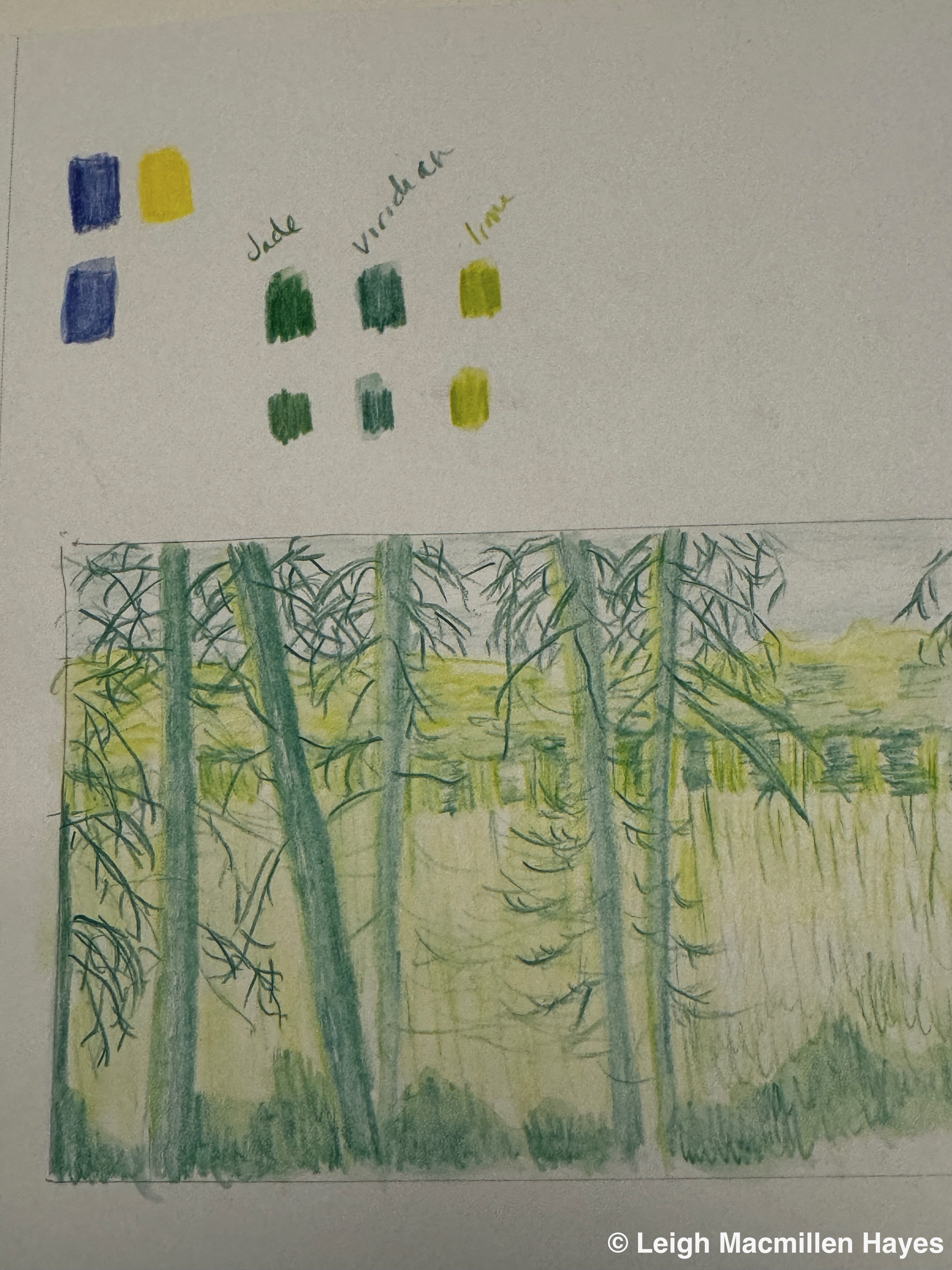
When we were asked to draw a scene from another photograph and complete it only with greens to get a sense of value, I again needed help since I couldn’t create green from blue and yellow, and so she helped me choose three colored pencils to use.

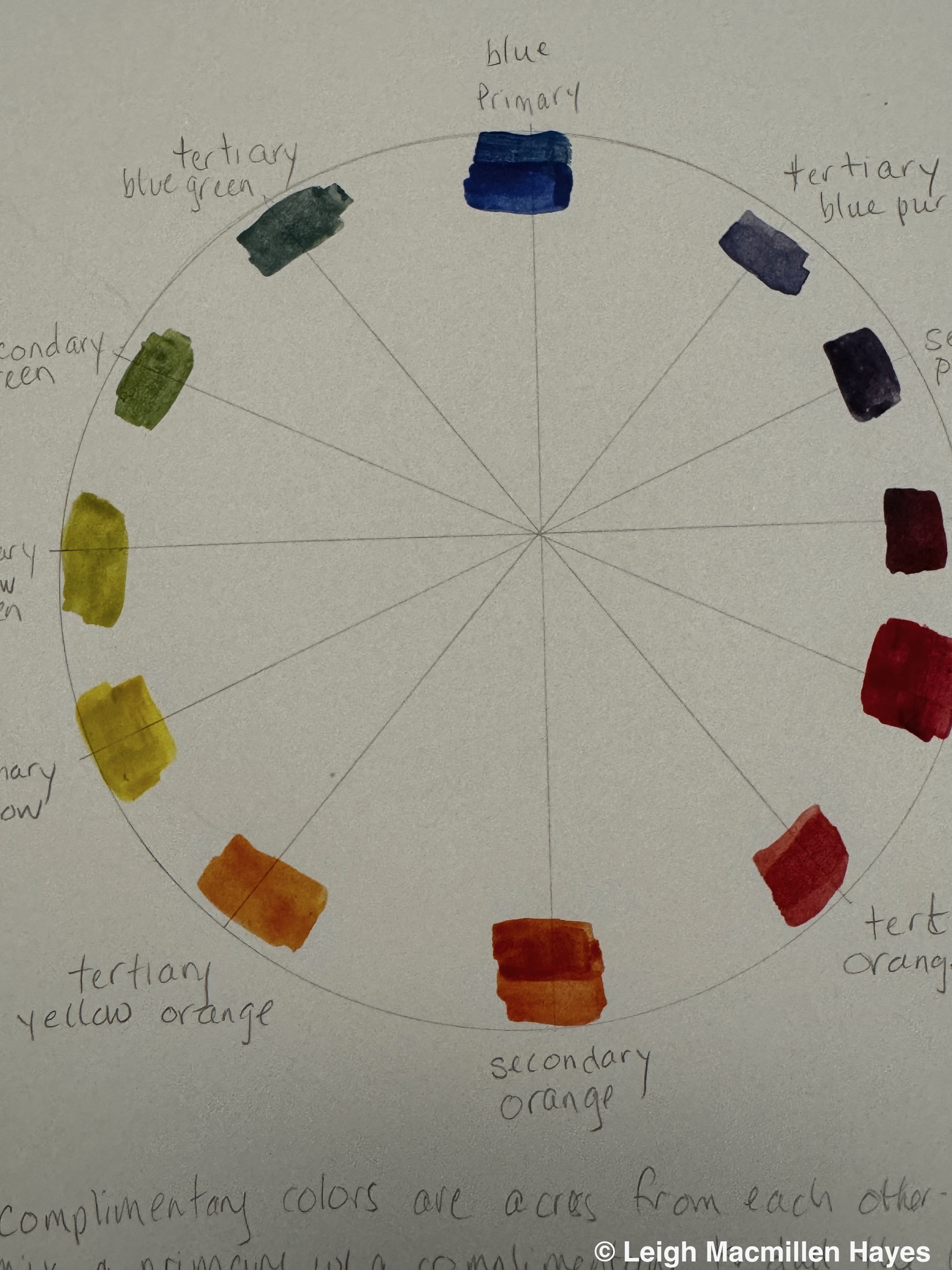
And then the third class was upon us and I was encouraged to borrow her watercolors because it would be easier to create a color wheel. And my confidence took a dip as I was giving up my beloved pencils for an hour or two. And walking down a path I hadn’t followed in many, many years.

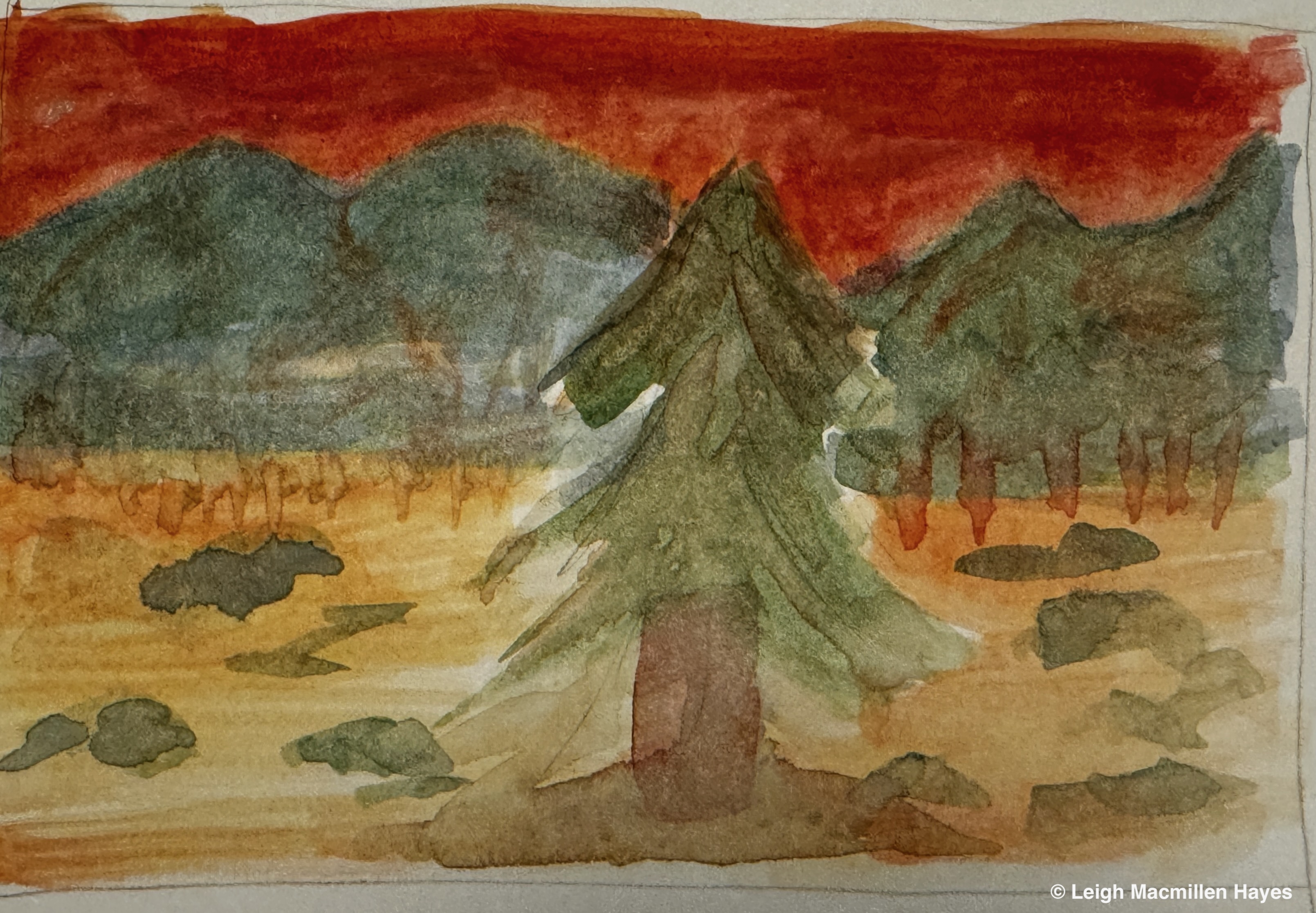
This was a study in complementary colors and from our mind’s eye we needed to paint a tree with mountains behind and use such colors. Not only was it kinda fun, but definitely a faster way to reach the end and the colors popped more.

Next we had to go big. Well, not that big really. I usually stuck to the size of the photograph, the easier to figure out how to position lines. But we were all given this photograph of Hemlock Bridge Road and had to use those same complementary colors to complete the scene. And so I played. And had great fun. And began to learn that I could let go. Sometimes.

That said, at home I attempted the same scene with the watercolor pencils and actually liked that as well. It was a different effect.

Back in class again, we learned more about using complementary colors and had different scenes to illustrate. This was with the watercolor pencils.

And then the afternoon dawned when composition was the topic. As we looked for the most interesting area in a scene. It never occurred to me to crop, just as we sometimes crop photographs.

I was a wee bit nervous for this one for a couple of reasons. One, I’d purchased some watercolor paints and new brushes. And two, the photo struck me as being a really difficult scene to replicate. Or at least represent. And so I did a painting smaller than the paper I was working on. And discovered that white was my friend.

A day or two later, I couldn’t wait to pull the paints out again, and give this another try. It’s much lighter/brighter than the actual photo or my first attempt, but I kinda like it.

That inspired me to go back to the other water scene and try it again. It looks nothing like the photo of an original painting, (I’m sorry, but I don’t remember the artist) but playing with the paints was becoming a favorite pastime.

A really favorite pastime, so much so, that I’m addicted; in a good way, of course. When I showed this to My Guy, he immediately knew where it was for we’d only climbed this particular mountain a week or so ago to count Lady’s Slippers. On a rainy day.

Over the weekend I photographed this Four-spotted Skimmer, so named for the four spots on each side: two per wing, the mid-wing spot being the nodus, and the black spot toward the tip of the wing being the stigma.

I know that what I like about sketching is that I can focus on details, but when painting with watercolors, that is much more difficult for me. And so I need to figure out how to let go a bit more. But that will come in time. Maybe.

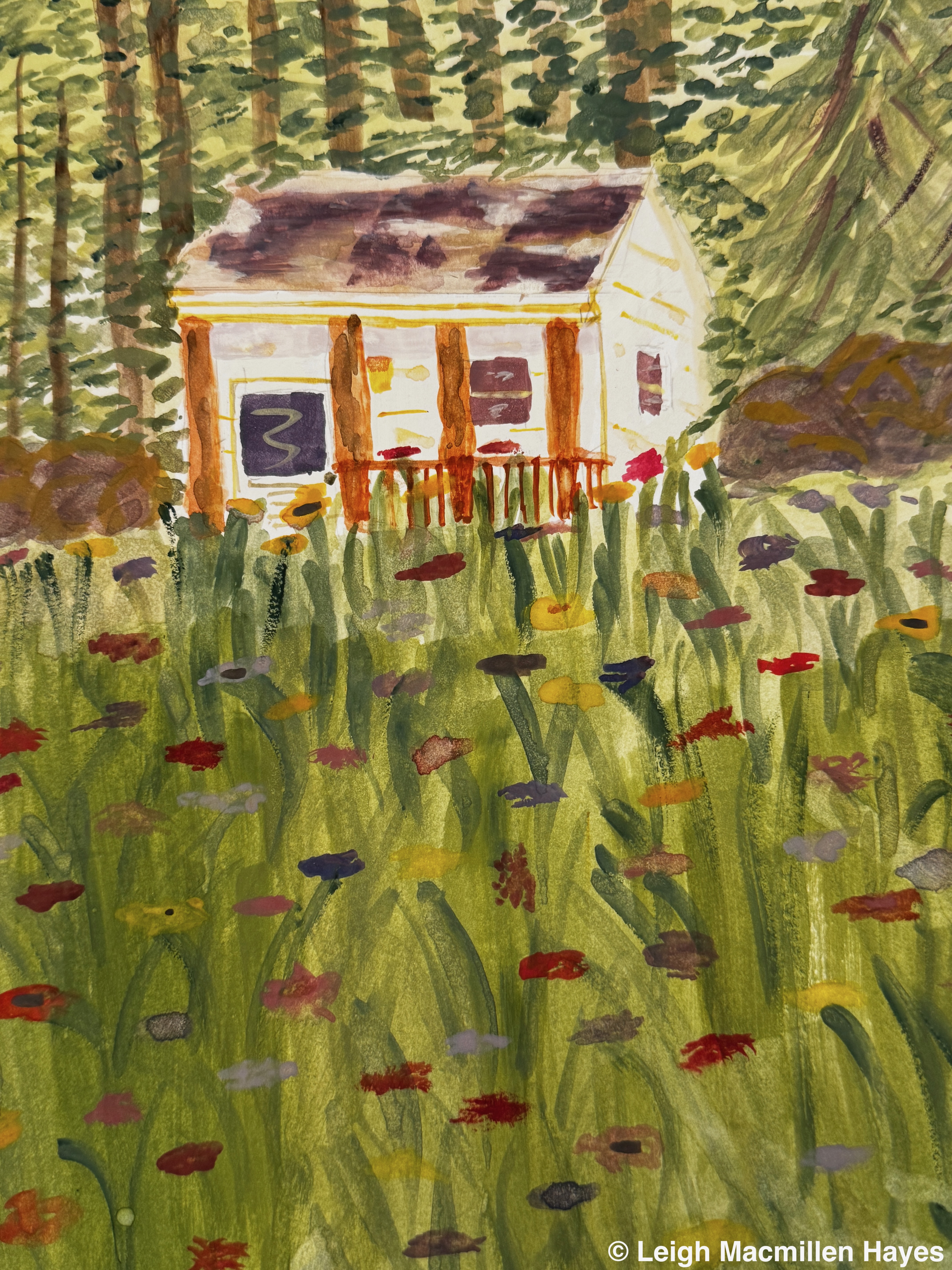
For our last class yesterday, we had to choose a scene of our own to illustrate. I chose the wee studio on our back forty (haha, we only own six acres total, so it’s rather hard to have a back forty), where a pollinator garden adds to the picture. Okay, so this is a painting. The garden looks nothing like that. And the stonewall behind is much smaller. And, oh geesh, here comes the art critic.

The cool thing about the studio, which I don’t use anymore, but someone suggested yesterday I should do my artwork in there, is that we won it at the Fryeburg Fair many moons ago when we paid $25 for five raffle tickets to support Harvest Hills Animal Shelter. To enter, one has to duck. I’ve always felt that was a plus for it put me into a different place where I could create. And thus, The Giant’s Shower, the fairy tale I wrote and Solona Ward illustrated, was written in that space.

At the end of the last class, we were invited to show off our paintings and I chose the mountaintop scene. We were down one because she is on vacation, but seated left to right are Pam, Linda, Debbie, and me.

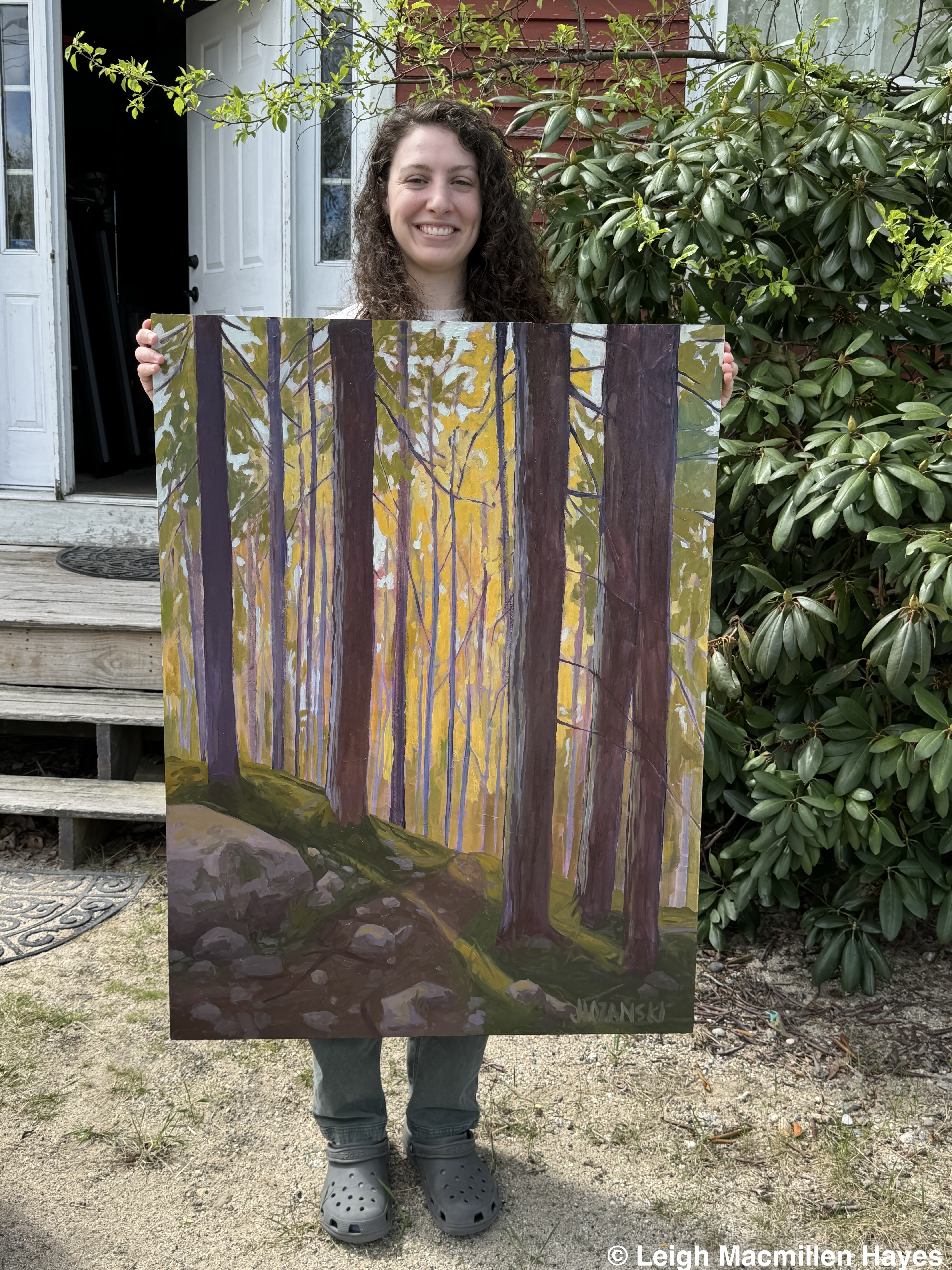
And our teacher for these past seven weeks was the one and only Jessie Lozanski, who recently painted this scene from photos I’d taken along a trail at the Bold Coast of Maine. It graces our kitchen and each time I look across at it I am transported to that time and place, but also to so many other times and places for it triggers many memories.

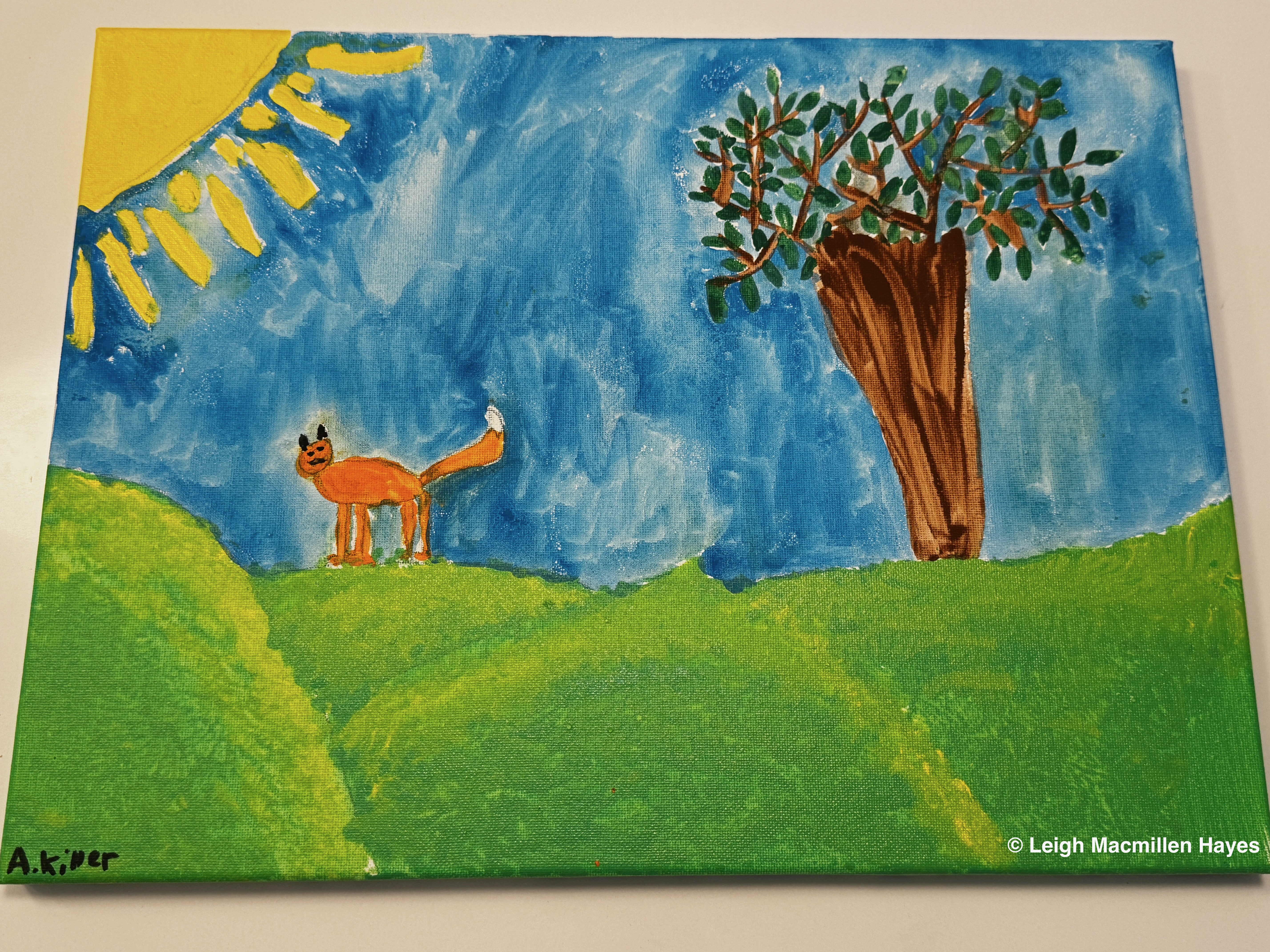
This morning I was gifted a painting by another student of Jessie’s. The painter of this scene is nine years old. And she’s an extraordinary naturalist whom I’ve had the pleasure of working with every other Wednesday for the past three school years. I love the grassy mounds and the fox and the tree–especially its trunk. This is an artist who is well on the way to finding her style and both she and Jessie will have their works for sale at Gallery 302s Art in the Park in July.

Here’s a photo of the young artist and her mom heading back along a trail we’d explored a few weeks ago. Anywhere we go, she finds inspiration.

The same is true of Jessie, and I know I take a lot of photos, but she takes a million more and I get it now because I’m looking at the world from a different perspective, like seeing the shades of green and yellow, and brown and even purple in our yard and the field beyond in a different light.

I am chuckling because shortly after purchasing the watercolor paints, I found this ditty in my collection. If I remember correctly, I painted this in college. Nobody is perfect. Thank goodness.

And I’m having fun finding an art that I thought I’d lost . . . all over again.