There’s a local trail I’ve been traipsing along solo or with company these past few weeks and when I dragged My Guy there early this morning, and said I was bringing my camera, his response, “Why, there’s nothing to see there.” Seriously. Doesn’t he know me better than that after all these years?

It’s a place where Bullfrogs sit upon lilypads in true frog style and wait patiently for a meal to fly by. Given all the Gnats and Deer Flies that buzzed our faces and ears as we walked, I assumed there was plenty of food and actually offered some, but he wouldn’t partake. The frog, that is.
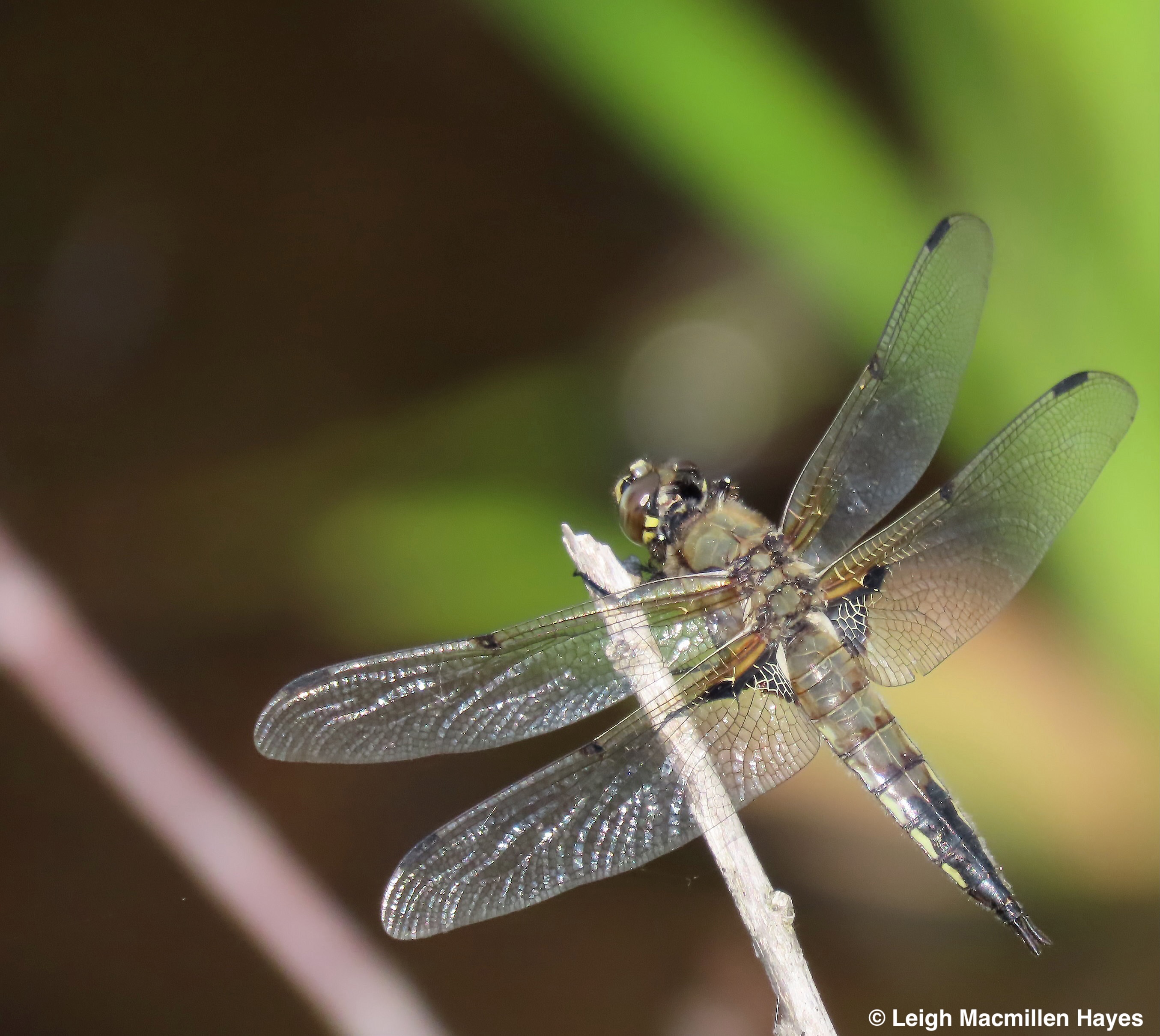
Another who should also have been enticed by the offerings, seemed to care more about defending his territory than dining, this being a Four-spotted Skimmer Dragonfly. The name Four-spotted refers to the small dark spots on the upper edge of each wing, there being two per wing, and thus four per side or four per front wing and four per backwing.

Equally nonchalant about all the available food, but curious about me, was the female Calico Pennant, another skimmer who loves to perch at the tip of plants and twigs and returns to the same site over and over again. Though I didn’t have a good view of her abdomen except for a hint of color on segment 7, the yellow-colored stigma toward the tips of her wings, and her yellowish face gave proof to her gender. Males have red stigmas and red faces.
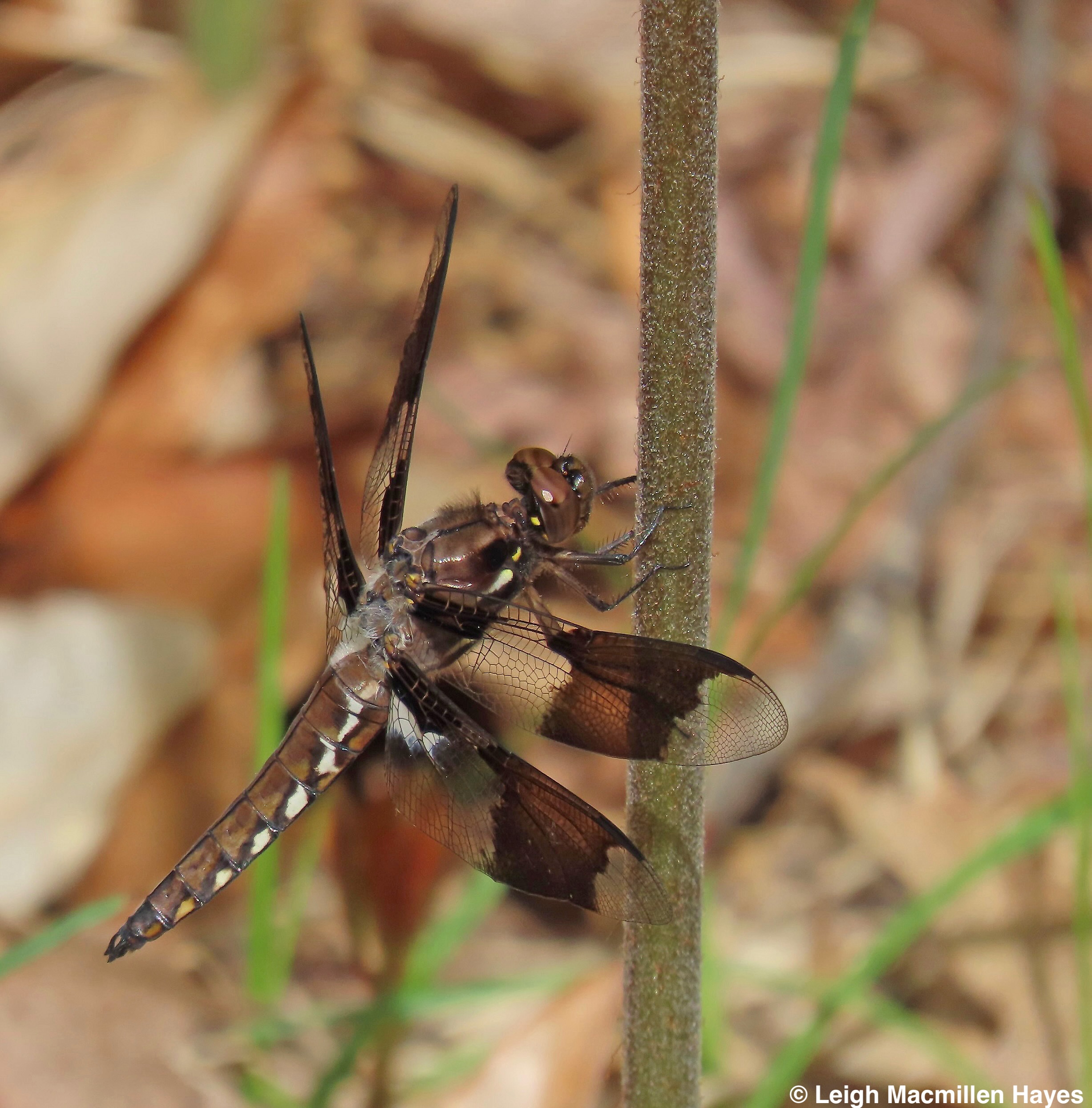
The immature male Common Whitetail cruised and paused, cruised and paused. This is such a handsome skimmer (not that the others aren’t). And while its abdomen resembles the female, it’s the wing pattern that identifies its gender. I love the complexity of dragonflies, even if I do have to relearn the clues each season.

Apparently, there were other things to do besides defend territory, and certainly rather than eat the biting insects–for canoodling was in order each time I visited. In this love wheel, the male Belted Whiteface dons the red thorax and he has clasped his mate behind her head with his claspers, as is the dragonfly custom. As Kurt Mead describes it in Dragonflies of the North Woods, “Prior to selection of a willing female, the male will transfer sperm from his testes located on the underside of the abdominal segment 9 to his hamulus located on the underside of segments 2 and 3. This is accomplished by simply arching the abdomen until the undersides of the appropriate segments make contact.” Once clasped, she arches her abdomen toward his hamulus to receive his sperm and thus fertilize her eggs.

Also flitting about, for that’s how these damselflies seem to move through the air, were some Ebony Jewelwings. The white dot or stimga at the tip of the wing signals this is a female, where the male has all dark wings. I love the iridescent colors of this species. And note how she has her abdomen reaching upwark in an obelisk position? That’s the Odonata way of avoiding overheating–thus reducing the surface area that is exposed to the sun’s rays. Oh, to be able to stick your butt toward the sun and cool off. On a day like today, and yesterday, and the day before, with our first heat wave in New England in two years, this would have been a most welcome adaptation.

Also along this trail, an extremely smart Eastern Phoebe who used a slight crevasse in a boulder upon which to build her nest of mud and moss and lichens. On the first trip, a friend and I spotted five eggs in the nest About a week and half later, these little chicks snuggled together like a pile of fluff with an occasional mustard-colored beak visible.

A week or so later and they continued to grow. What surprised me is how quiet they were, but that’s probably another technique that doesn’t give away the location of the nest.
That said, a Phoebe built a nest on the backside of our barn. It’s too high for us to notice if any eggs or chicks were located within, but we listen to the adults call back and forth all day long ,which is how we found the nest–they told us where to look and flew off anytime we passed that way.
The chicks above fledged within the last week and that nest is empty with no sound from an adult. It makes me wonder if the barn nest might see a second brood (if there actually was a first) for they continue to awaken us at about 4:20am each day. Stay tuned.

Another sight worth noting–the footprint left behind by a moose–traveling in the opposite direction of my foot. This was discovered by an observant participant on a recent walk for Loon Echo Land Trust.
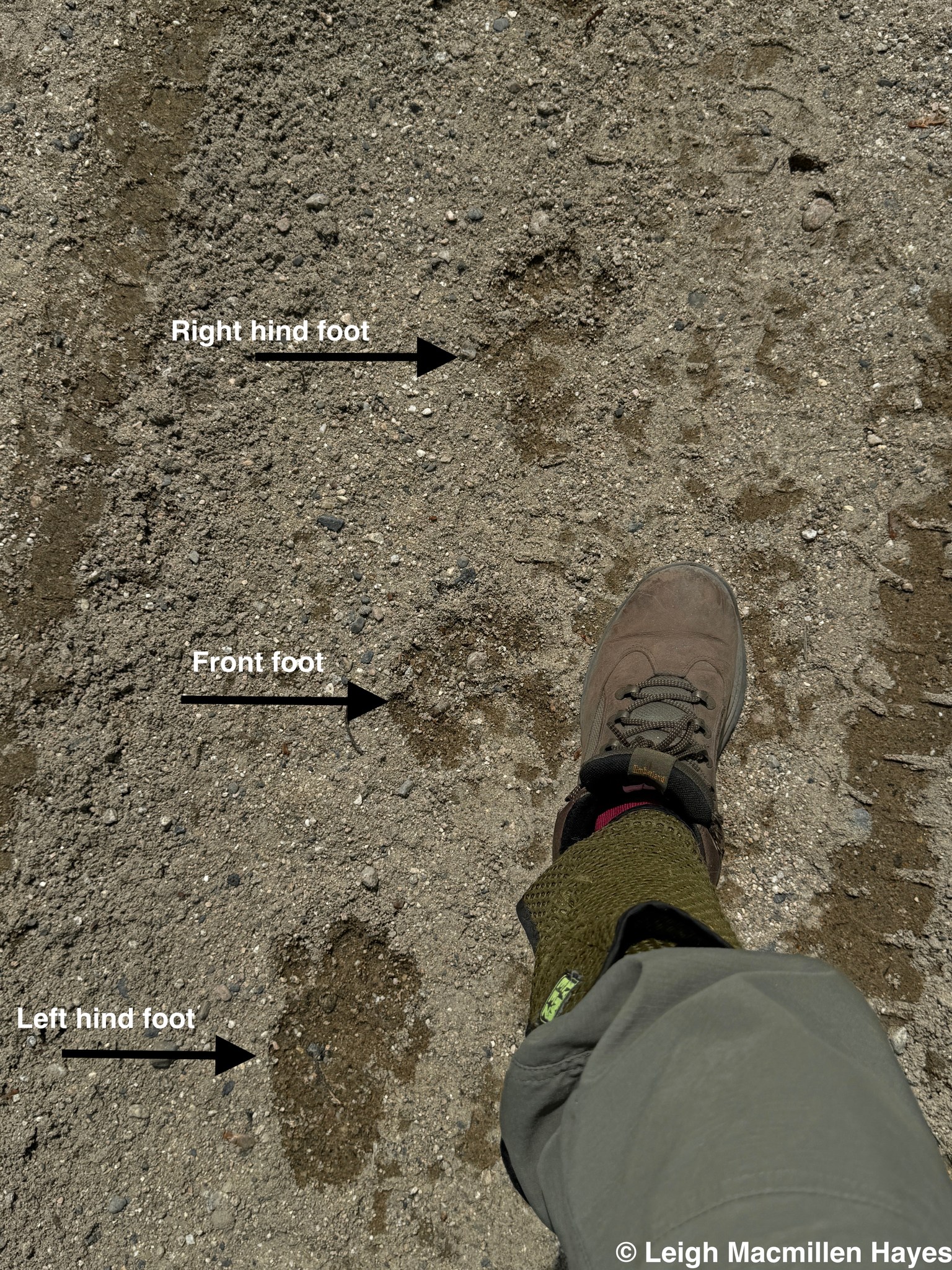
And an even better observation: the track of a Black Bear. My foot is located beside a front foot as you can see, with the larger hind feet registering before and after. The big toe is on the outside of the foot, opposite of ours. The better for climbing stability.
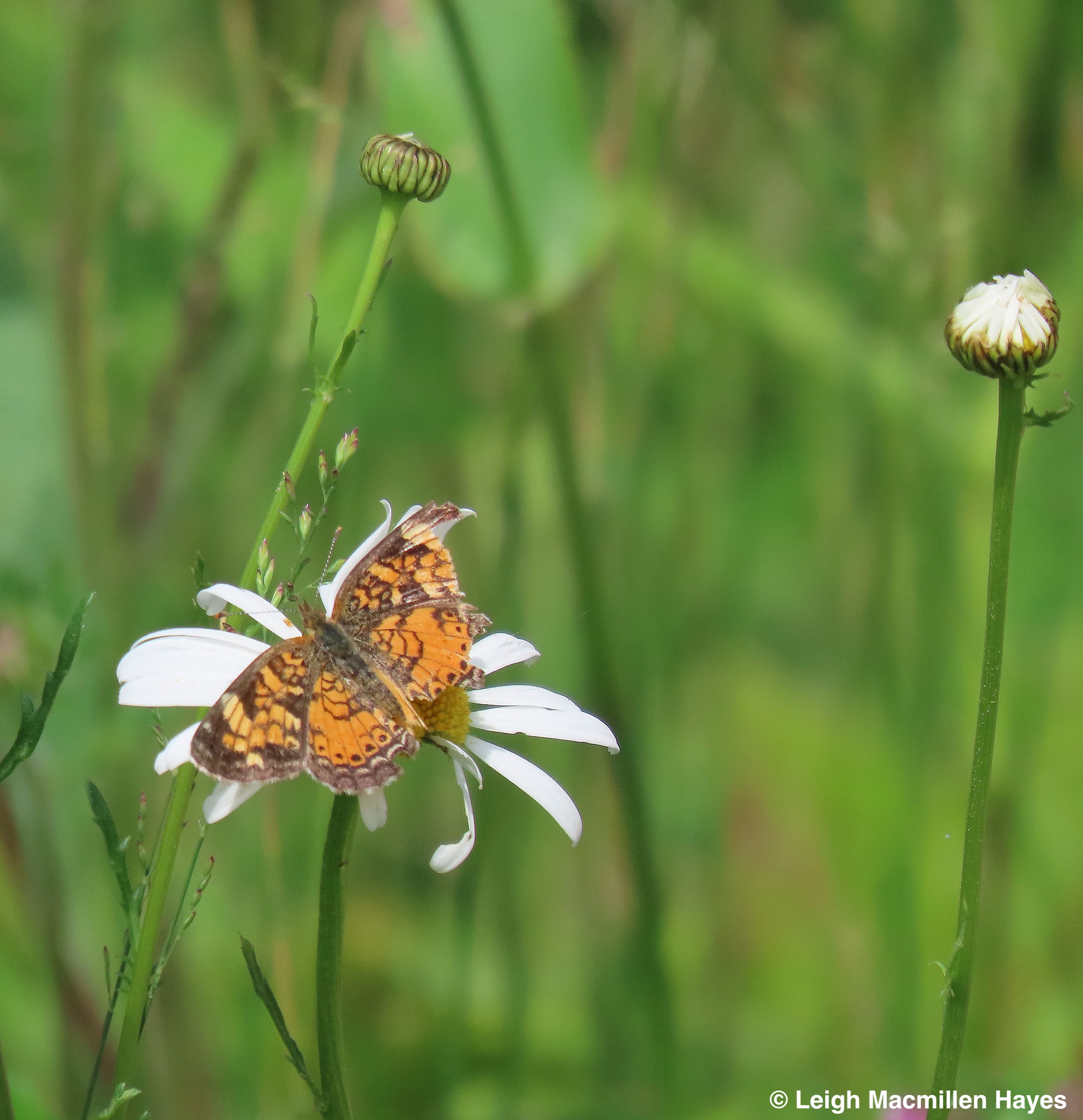
It still seems early for butterfly flight to me, but this Pearl Crescent showed us this morning that life hasn’t been easy given its tattered wings.

I think one of my favorite sightings along this path, other than the moose and bear prints, oh, and the dragonflies, of course, was something I couldn’t share with My Guy. The timing just happened to be right on this particular visit, when Eastern Tiger Swallowtail butterflies, so differentiated from the Canadian Tiger Swallowtail by the fact that the yellow band near the edge of the underwing was broken by black marks.
They were puddling, an act of probing for salt and minerals. Most puddlers are males, who ingest the nutrients that are then stored in their sperm. During mating, the male passes these goodies along to the female as a nuptial gift in his spermatophore.
So we assumed it was scat upon which they puddled.
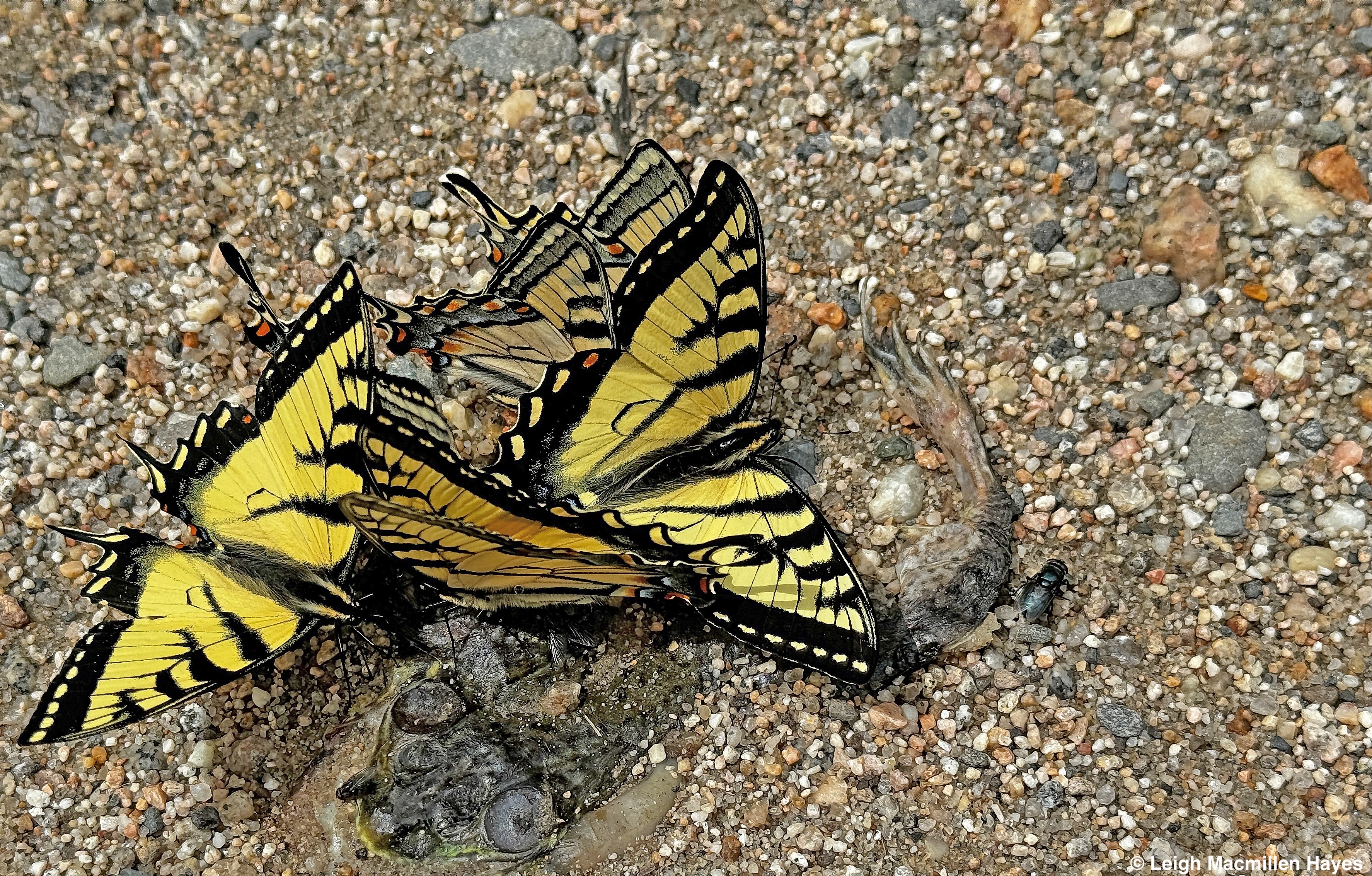
Until we realized it wasn’t. They’re choice of nutrient-offerings–a smooshed frog. The trail is not just for walkers. ATVs and even trucks use it.
Yes, the poor frog. BUT, the butterflies and flies made sure that it did not go to waste.

And another frog smiled. I’m smiling too, for it is officially summer. Happy Summer Solstice 2024.

And speaking of the solstice–be on the lookout tonight for the characters of my fairy tale doing some dancing in the woods, as they did in The Giant’s Shower.



 wondermyway