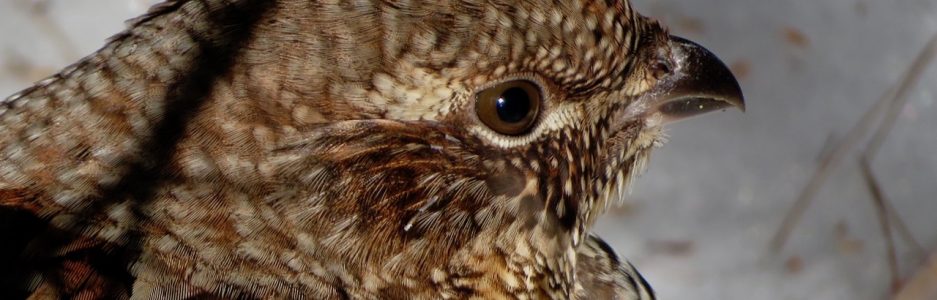
Winter Inventory

We live on the edge. The edge of a small town in western Maine. The edge of a neighbor’s field. The edge of a vast forest.

Our property only encompasses six acres, but it’s six acres that I love to explore and it’s been my outdoor classroom for a long time.

And so today, I invite you along to take a look; if you are a regular, you may have already met the friends I’m about to introduce, but their actions keep me on my toes, much like the deer who crisscross our yard on a regular basis.
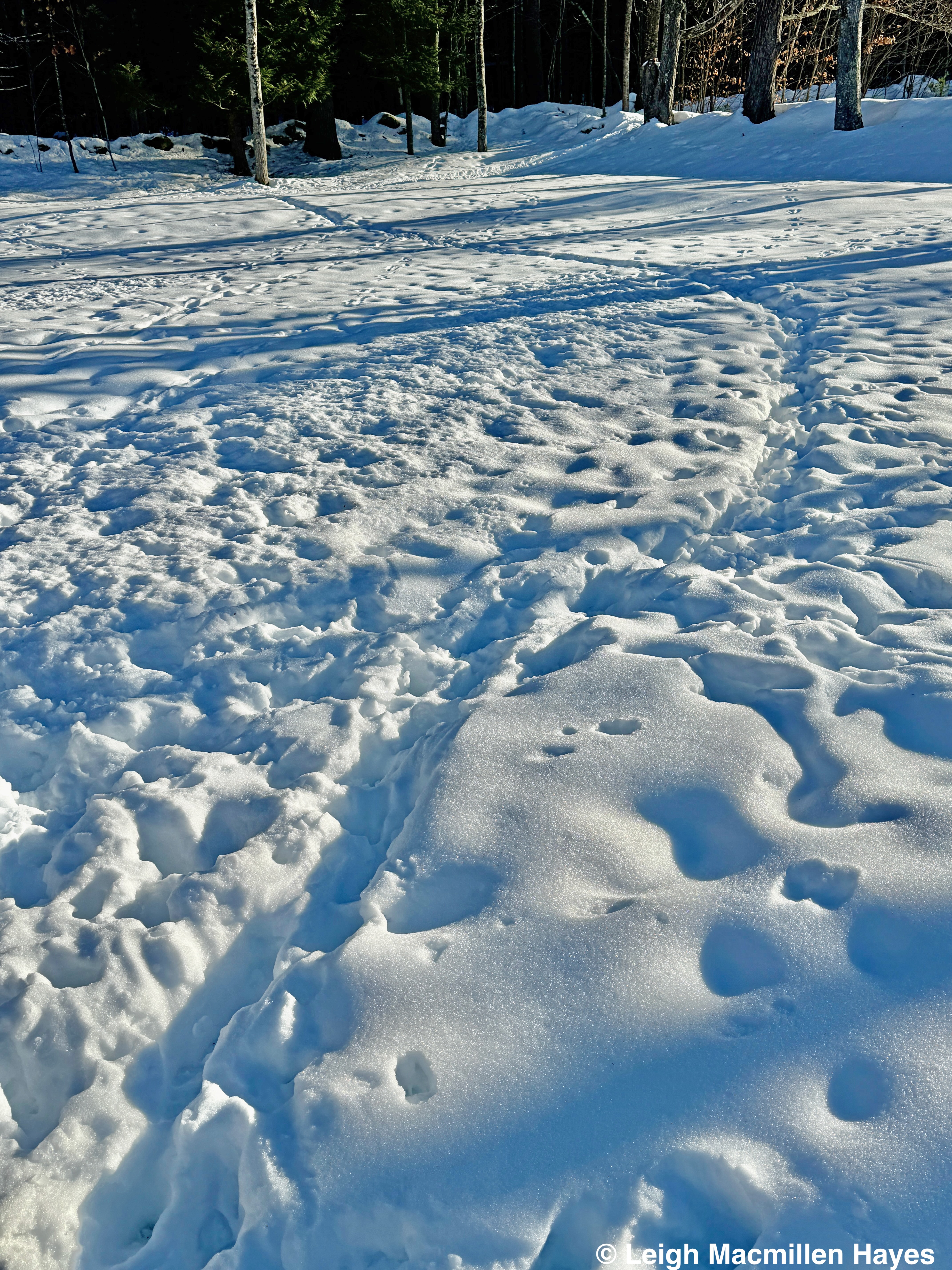
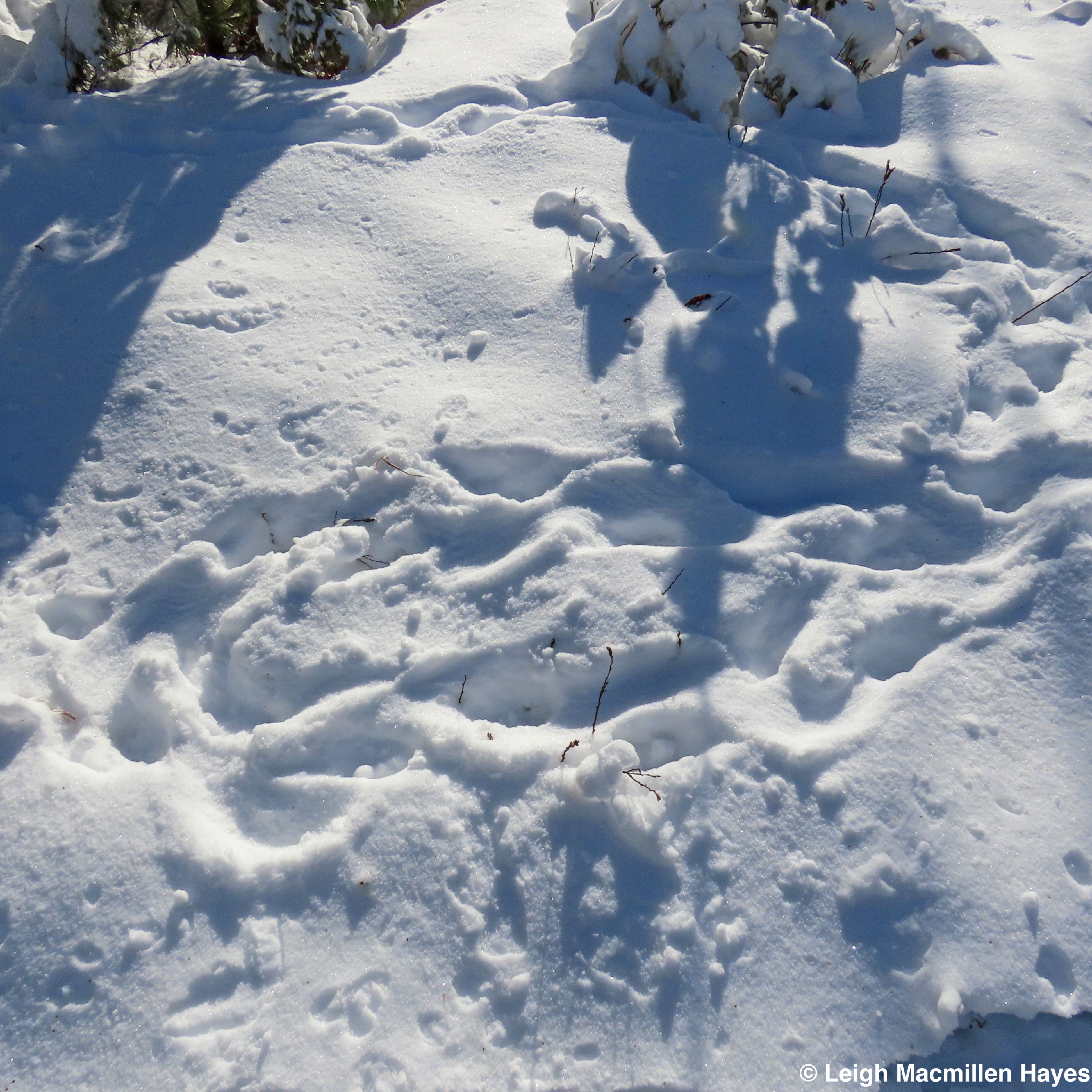
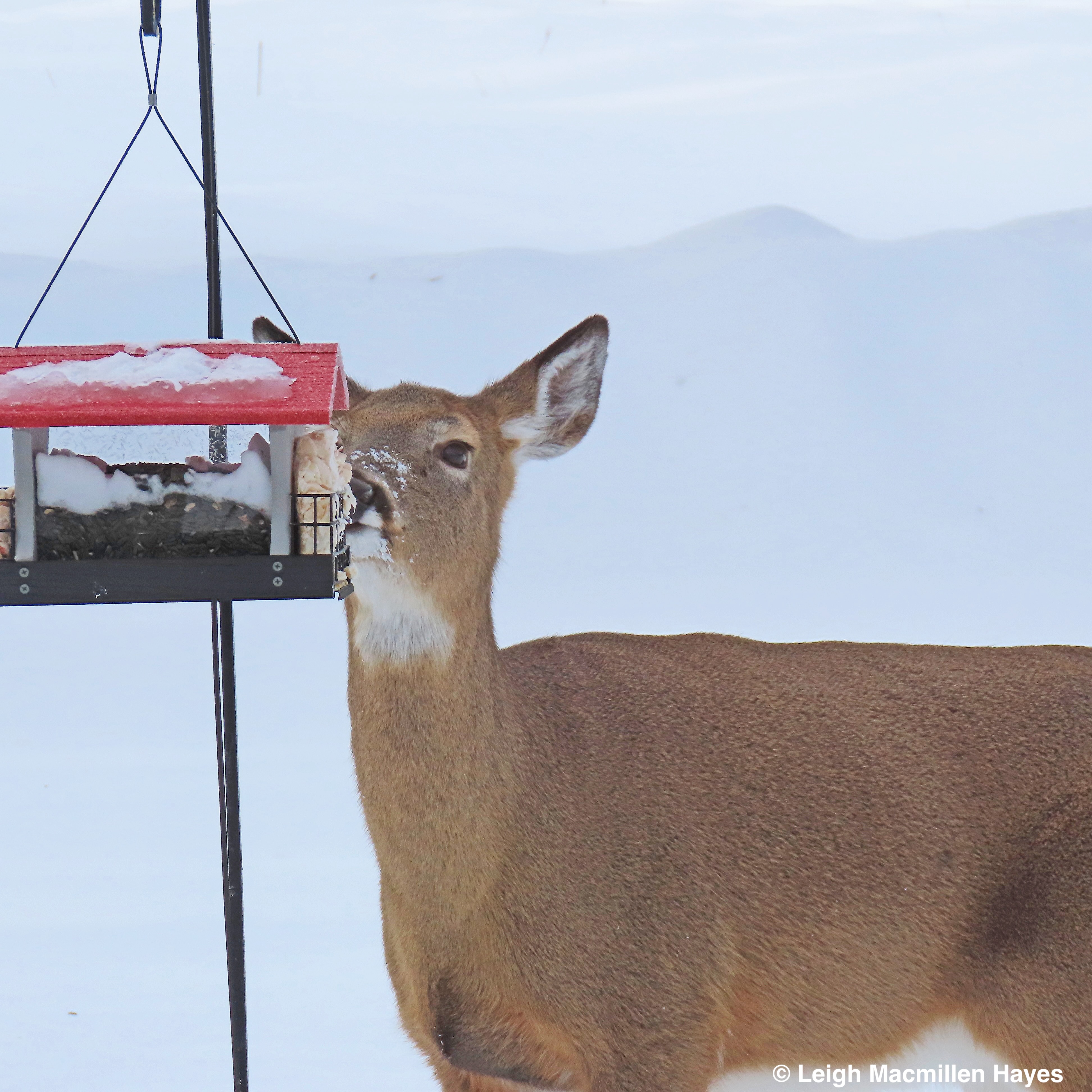
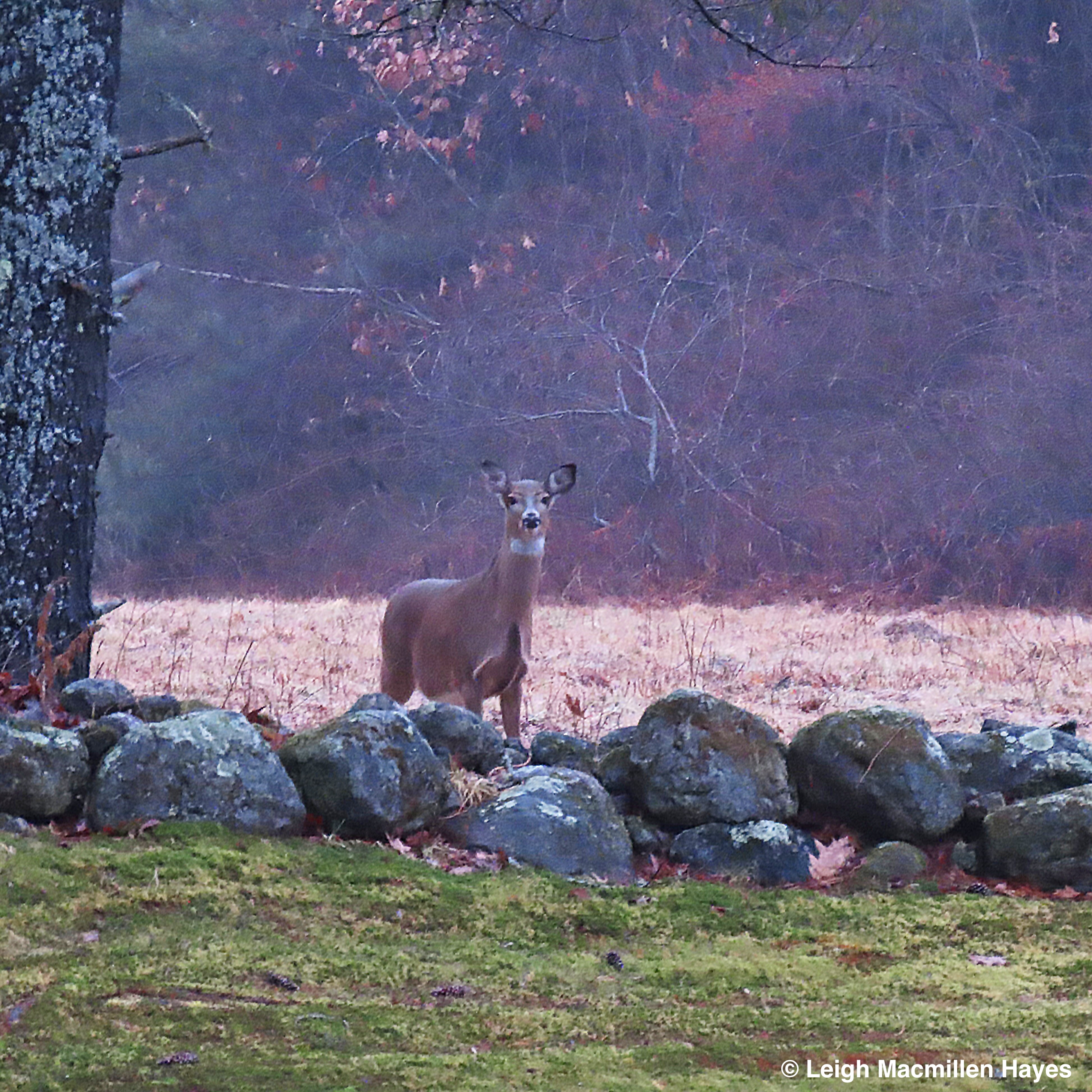
Though the acorn crop was abundant in our area, the deer make several trips day and night to consume sunflower seeds and corn and they’ve worn a path (deer run) making it easier to travel. They don’t always follow it, as you can see, but do so enough that it’s much like my snowshoe trails.

The yard is full of tracks, for besides the deer, there are gray and red squirrels who also frequent the feeders, an occasional red fox that I’ve yet to see this winter, and our neighbors’ dogs and cats. Everyone has a place at this table.

Of course, the deer run does lead to another species they love to munch on, the needles of a Balsam Fir. They frequently pause here before climbing over the stone wall into our wood lot.

And so I paused too. And discovered yet another cache and midden created by one of our local Red Squirrels. I’m in awe because until yesterday, I wasn’t aware of this one and I can see it from the desk where I’m writing right now. And to top it off, yesterday was the first day since I filled the feeders at the beginning of December that I saw a Red Squirrel chasing the Gray Squirrels away.

I, too, climbed over the wall and look who I met. Always on alert and often either skittering along the ground or a stone wall, or chastising me from its branch of choice, Red doesn’t realize that I’m a fan.

Next, I ventured over to the old cow path, bordered as it is by two walls, and checked on the cache and midden situation that’s become so familiar to me.

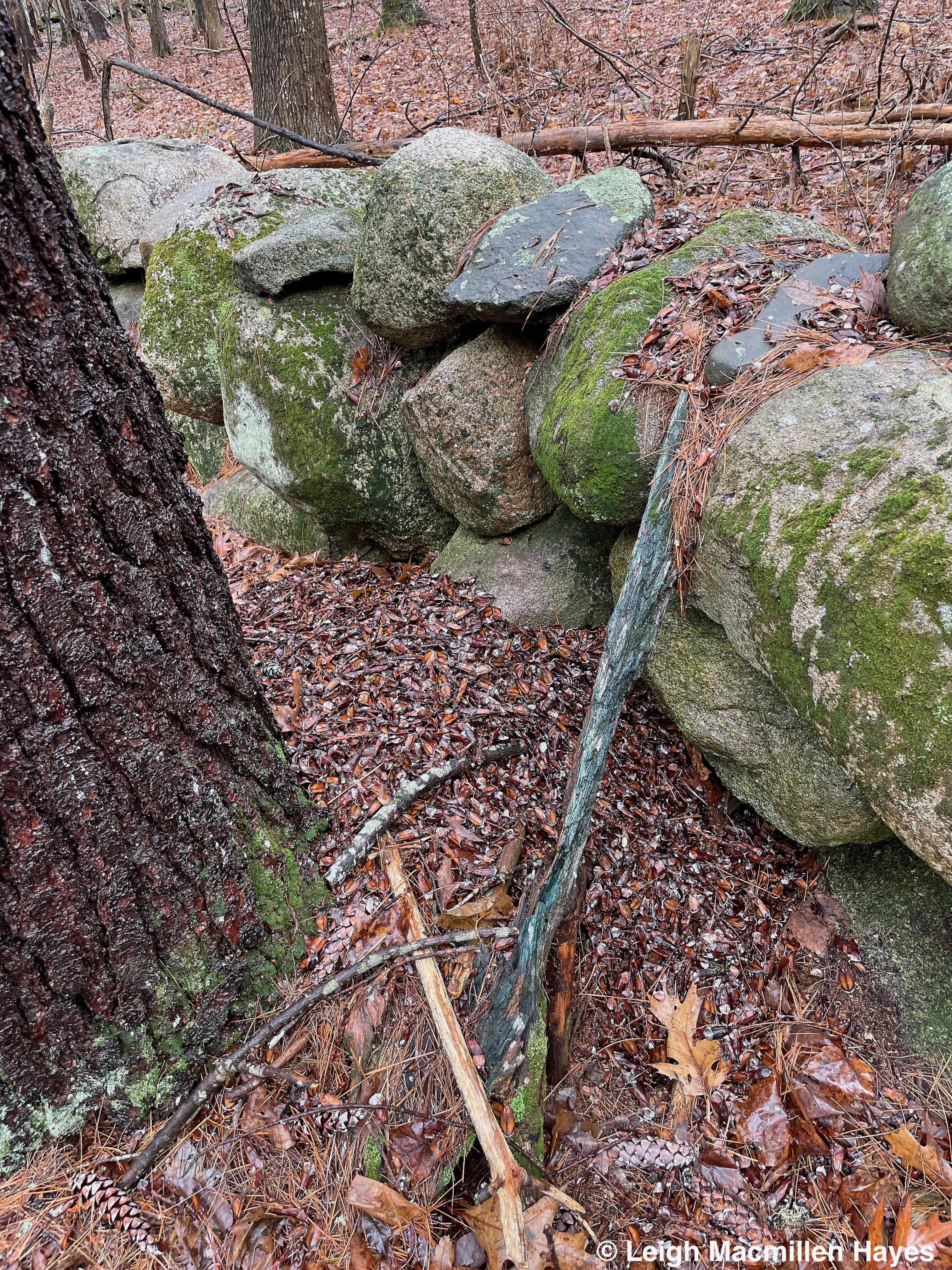
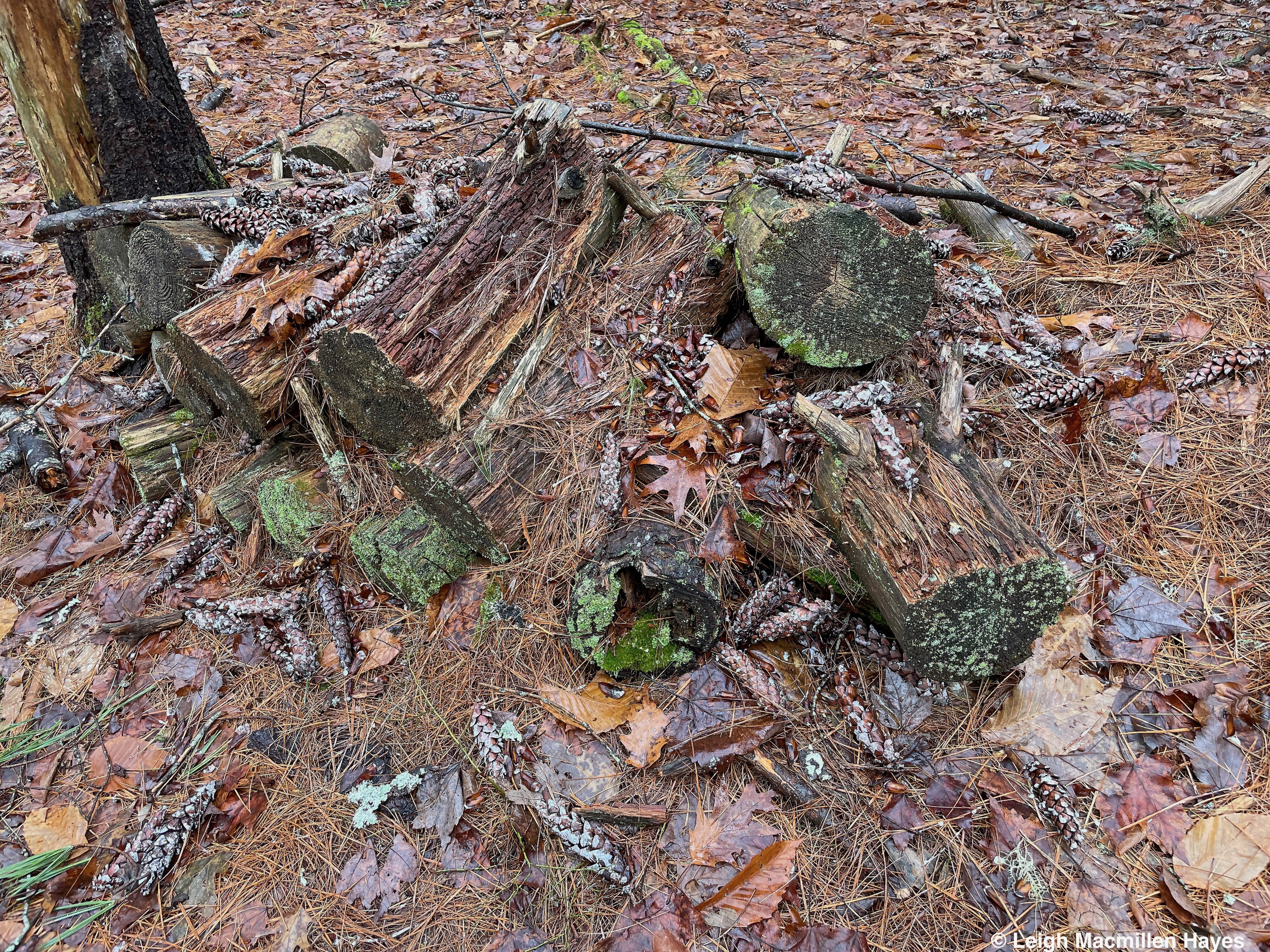
The cache or storage pantry of pine cones is located under the mound of snow the black arrow points toward. At last measurement as recordered in The Forever Student, Naturally, the pile was a foot high. As you can see if you look closely at the tops of the stones behind the snow-covered pile, you’ll spy several middens. So my question is this and I’ll have to wait until the snow melts to answer it: Are all of the cones the squirrel is consuming (well, seeds actually, for the midden is the pile of discarded scales that protect the seeds, plus the cob or core left at the end) coming from under the rocks, where I’m sure there was more storage space, or the bottom of the pile, because Red Squirrels do tunnel? I can’t wait to realize the answer in another month or so.

The pine tree beside the cache also provides a grand dining spot.
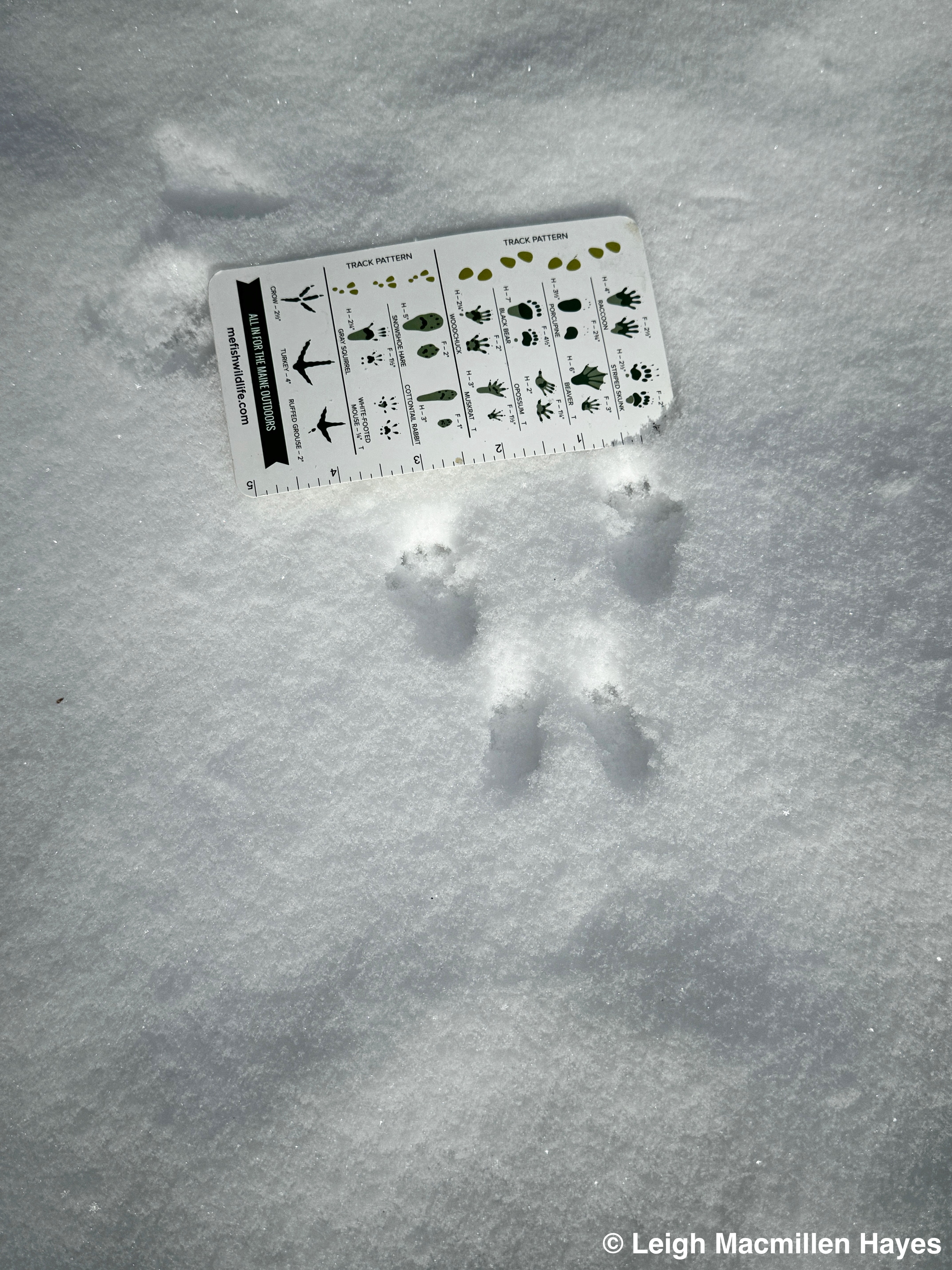
About an inch of snow fell overnight, so when I went into the woods this morning, I found fresh Red Squirrel prints, with the straddle or track width being the typical three inches. It was a bit nippy with the wind chill, so I didn’t get the card placed exactly as it should have been, but you get the idea. Its big feet in front are actually this hopper/leaper’s hind feet.

Okay, so I did risk the freeze for a minute because I spotted the set of four prints behind the first set I’d photographed and realized not only how close together the four were, but also the length of the leap from one spot to the next: My mitten and wrist holder are 19.5 inches in length and they didn’t cover the length of this motion–perhaps an attempt to quickly reach safety in the other wall or up a tree.

That action was on the eastern end of the path, but there’s more to see as I head west.

A few days ago, and probably because the night temperatures were more moderate, a family of rascals crossed from the other side of the wall and onto the path. By the baby fingers of the front foot, I know they were Raccoons.

As waddlers, Raccoons have their own pattern that is easy to recognize once you get it into your head. They don’t travel this way all the time, but most often I find their prints, with a front foot (baby hand) of one side and hind foot (a bit longer print) of the other side juxtaposed on opposite diagonals. If you look at the black lines I placed before each set of two prints I hope you’ll see what I mean. And notice the keys. It’s all I had in my pocket that day and I wanted something for perspective. I really didn’t expect to find the raccoon tracks.

I went back home and grabbed a tracking card to set on the ground. If you’ll look closely, you’ll note that it’s more than one animal, but all the same family. I followed them across the wood lot, over another stone wall, and into the field where they split up into four individuals before heading off in to the neighbor’s woods on the far side.

Back to the cow path I did return and this time it was a scene just off the path that drew my attention. Our Pileated Woodpecker has been active as evidenced by all the wood chips on the ground. That means one thing to me. Time to look for scat.

And I wasn’t disappointed. Check out that cornucopia stuffed chock full with insect body parts that the bird couldn’t digest.
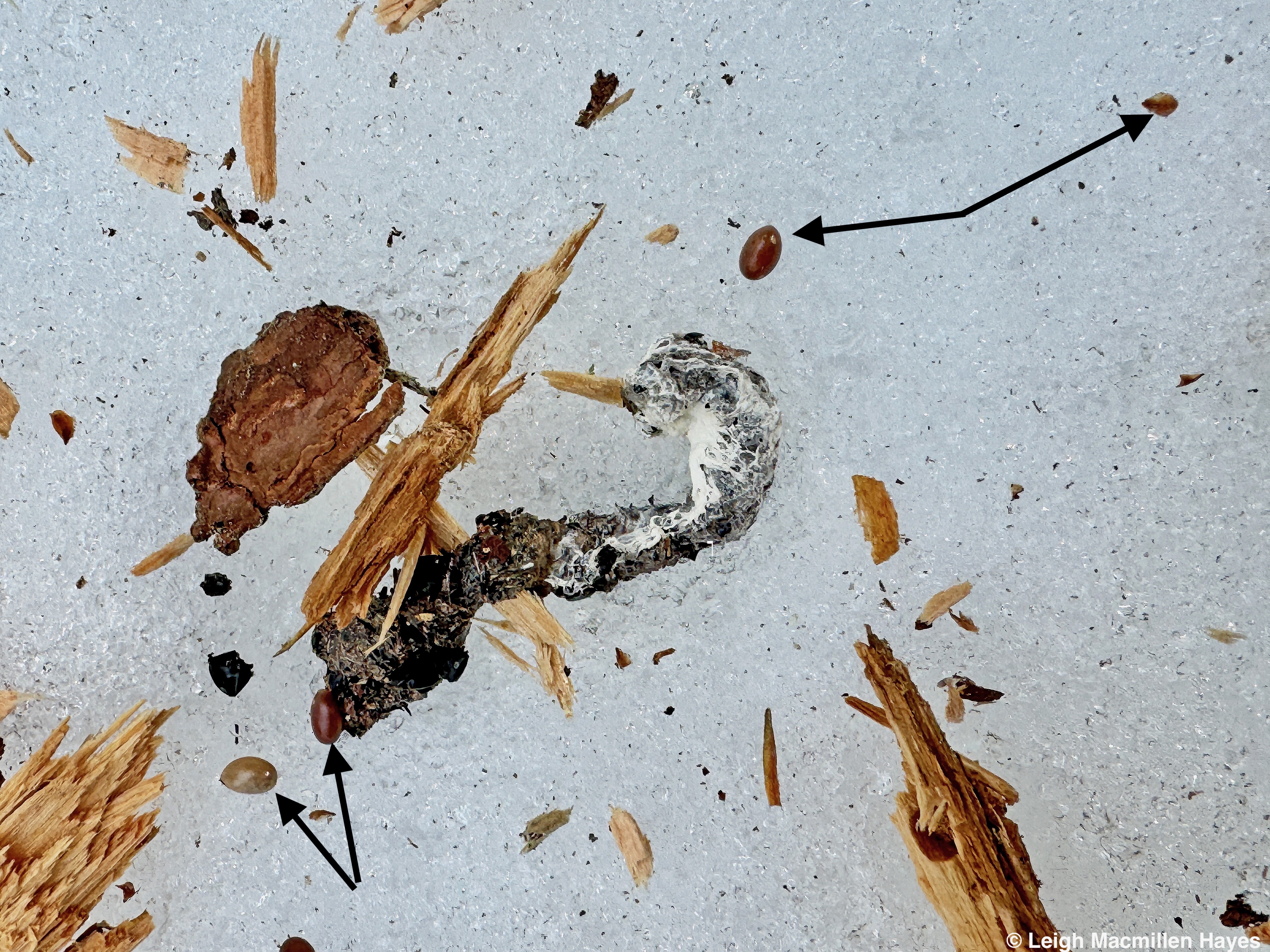
Finding this is always like opening a Christmas present. The thrill never ends. But, curious spot here. Seeds. Staghorn Sumac seeds.

And on the pine tree and at its base, I found more of the Staghorn Sumac in bird droppings, a completely different form from the Carpenter Ant droppings.

Both followed me home! The Carpenter Ant scat is very fragile.

The sumac, being fleshier, held together better. Under the microscope I noted that there were some ant body parts mixed in with the sumac.

Here’s a closer look at one of the legs of a Carpenter Ant–notice the long “thorny” thing, which is the tibial spur located at the base of the tibia.

And an exoskeleton plus another leg. With lots of wood fiber in the mix. Lots of nutrients and fibers mean scat findings for me.

A power line bisects our property and I have a love/hate relationship with it. I do love that it looks like we could walk north to Mount Washington. But my destination was to the trees on the western (left-hand side), where we own at least one more acre enclosed by stone walls.

About half of that acreage is a combo of hemlocks and firs fighting for sun. In the end, the hemlocks will rule the world, but the firs are trying to compete.
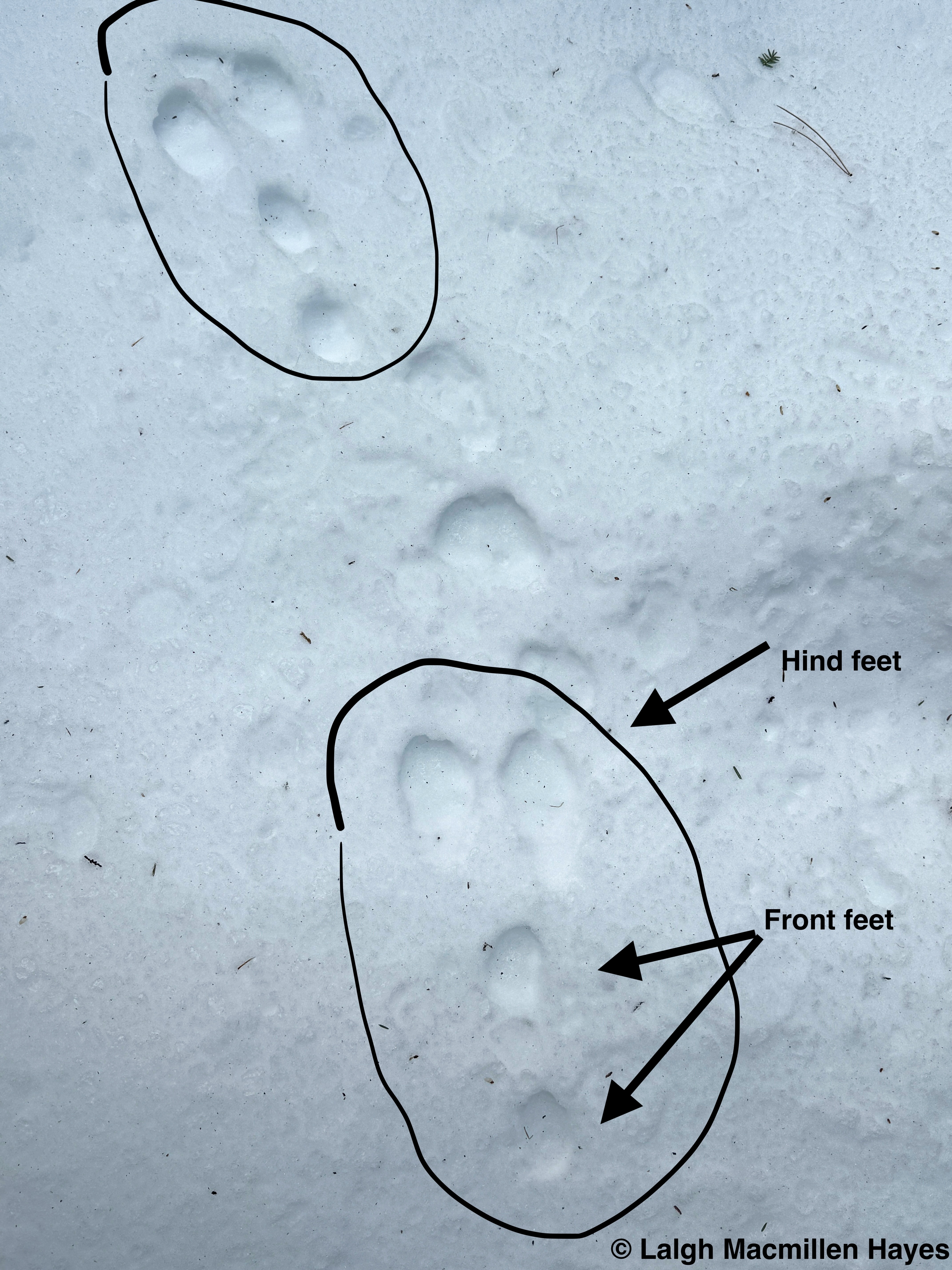
It is here that I discovered Snowshoe Hare tracks and my heart smiled again. There’s not much on this portion of our land for the hares to dine upon, such is the landscape when the trees block undergrowth. But on either side of the walls, there’s plenty available to them in areas that have seen timber cuts within the last twenty years.

Here’s the thing about hare prints–as hoppers, the smaller front feet land first and often, but not always, on a diagonal. The much larger hind feet swing past where the front feet had been as the mammal moves forward, and thus appear to land in front when you look at the overall pattern. And my favorite part of this set of four footprints: the overall shape, which to me looks like a snow lobster with the front feet forming the tail and hind feet the claws. Do you see it?
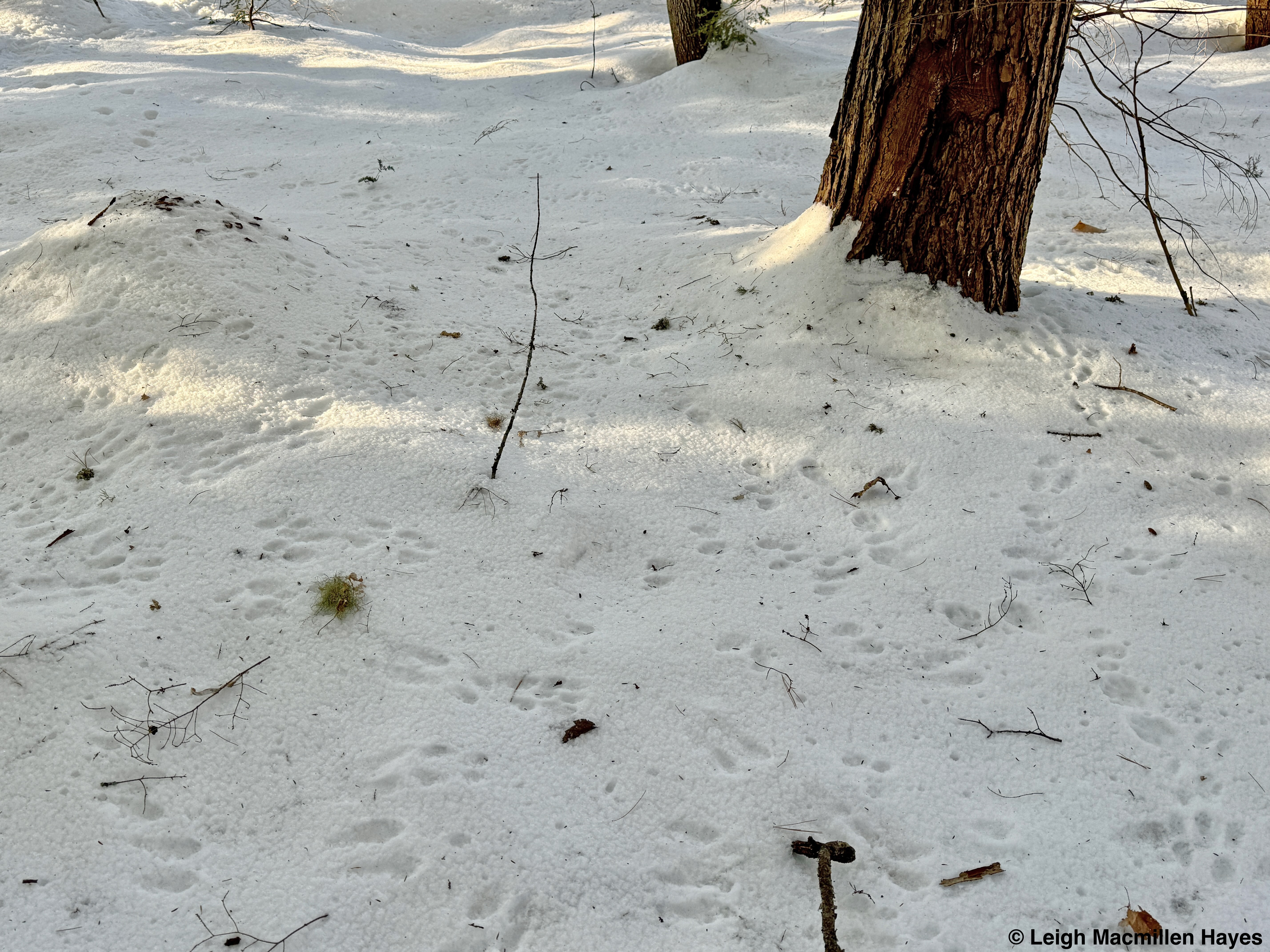
This neighborhood on the other side of the power line also supports a Red Squirrel who in true squirrel tradition travels this way and that.
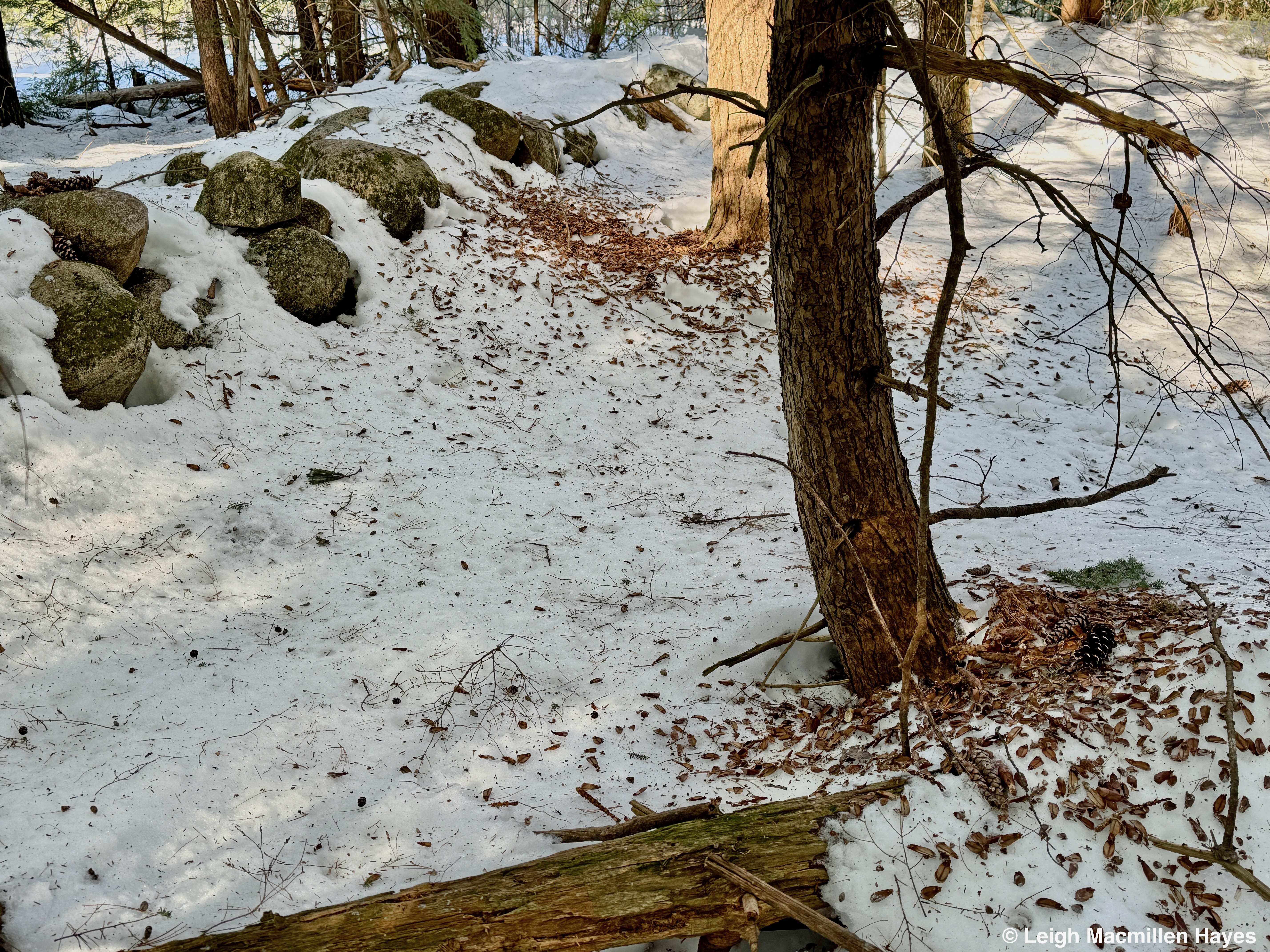
And like its relative on the other side, it took time to cache a bunch of cones and now feasts upon its supply.
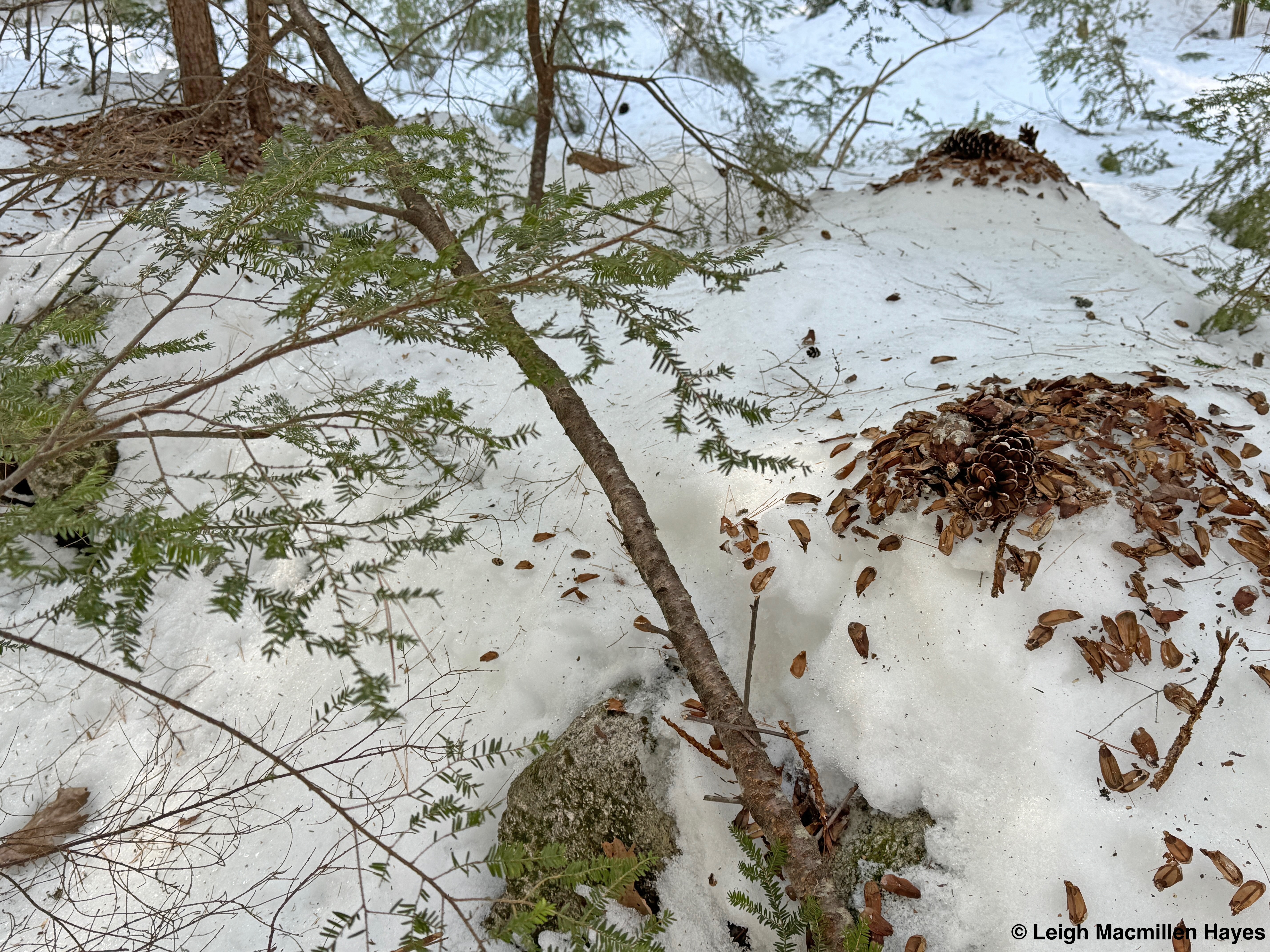
And leaves its garbage for nature to recycle. Notice how the middens are often located on high spots such as the rocks along the wall–the better to be in a spot where you can see who or what might be approaching. Even those on the ground below trees mean that the squirrel probably did most of its dining from a branch above, and then let the trash fall.
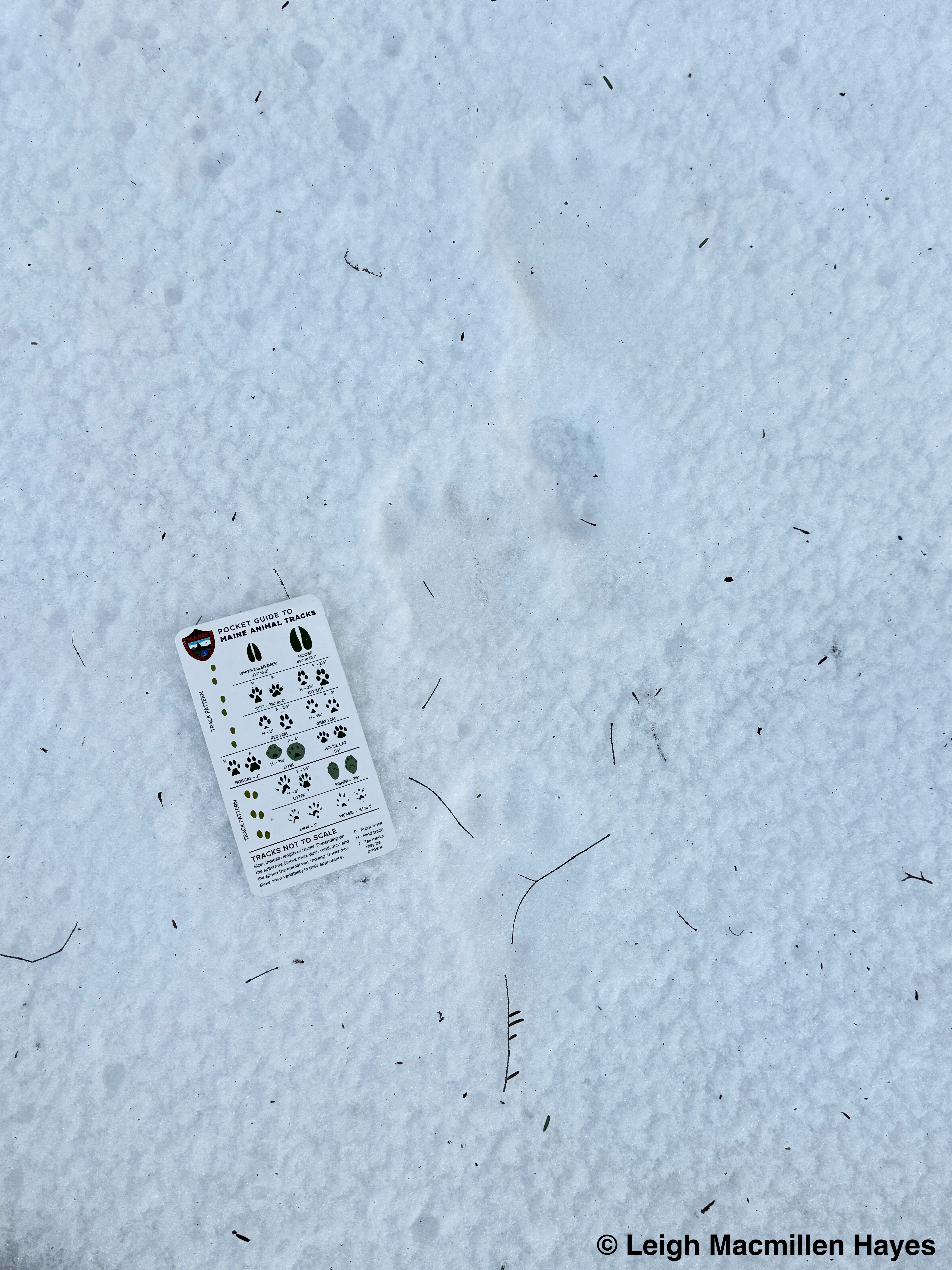
What could a squirrel possibly fear in these woods? Besides coyotes and foxes and bobcats, oh my, think Fisher such as the one that left these tracks in the squirrel’s territory. As far as I could tell, the Fisher (and it’s not a cat, it’s a member of the weasel family) was only passing through, probably on its way to hunt down the hare. Though a squirrel would make a fine meal, as well.

Heading back across the power line, cases stood out on the White Pine saplings at the start of the cow path. The cases consisted of clusters of needles bound together. This is the work of the larval form of a Pine Tube Moth, Argyrotaenia pinatubana. What typically happens is that the caterpillar uses between ten and twenty needles to form a tube or hollow tunnel.

The caterpillars move up and down their silk-lined tunnels to feed on needles at the tip until they are ready to overwinter.

The moth will emerge in April, when I’ll need to pay attention again. Two generations occur each year and those that overwinter are the second generation.
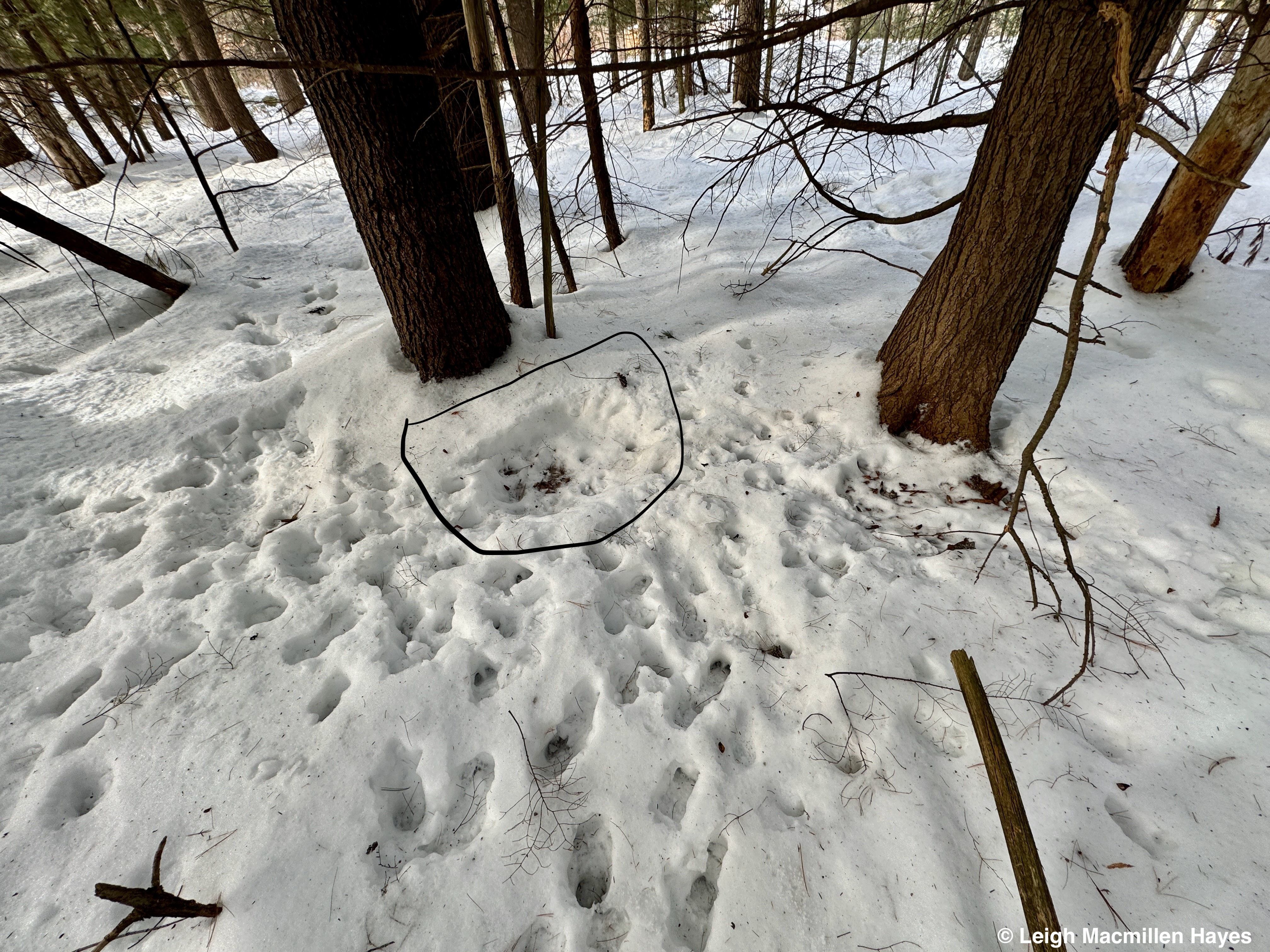
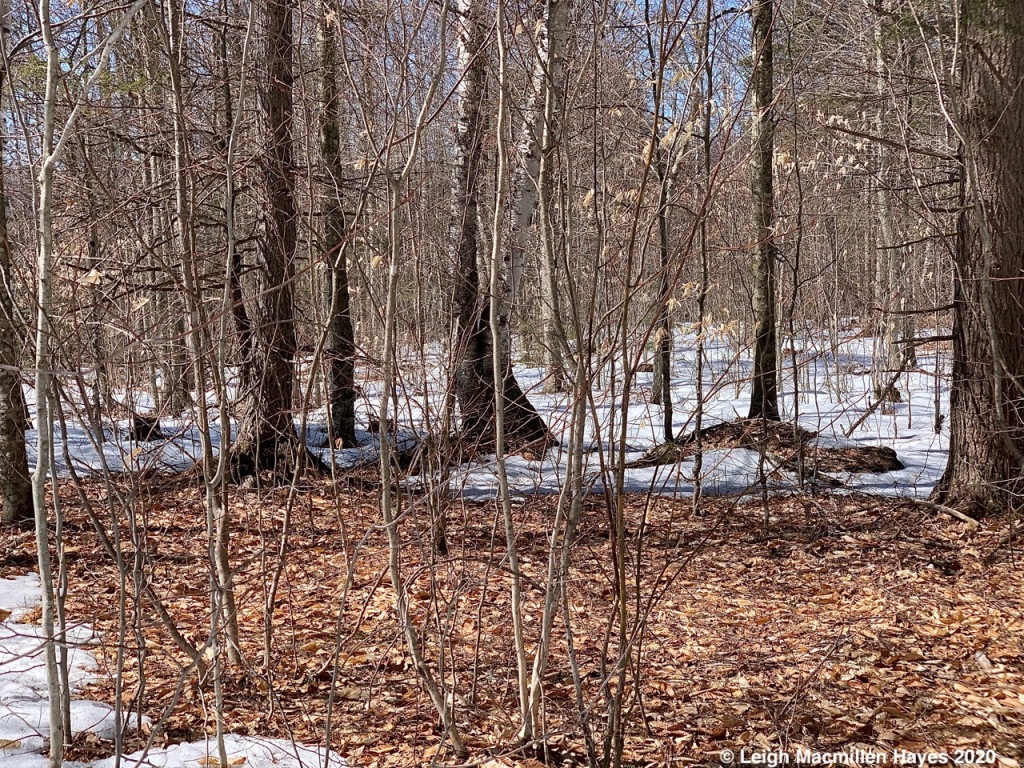
Walking home via a different path in our woods, I spot deer beds. At least a half dozen spread out under the pines and hemlocks, the spot where the evergreens keep heavy amounts of snow from reaching the forest floor, thus making it easier for the animals to move.

Finally back home, there’s one more member of our family to mention–a porcupine. This may be my friend Bandit, but I haven’t actually seen him in a while so I can’t be certain.
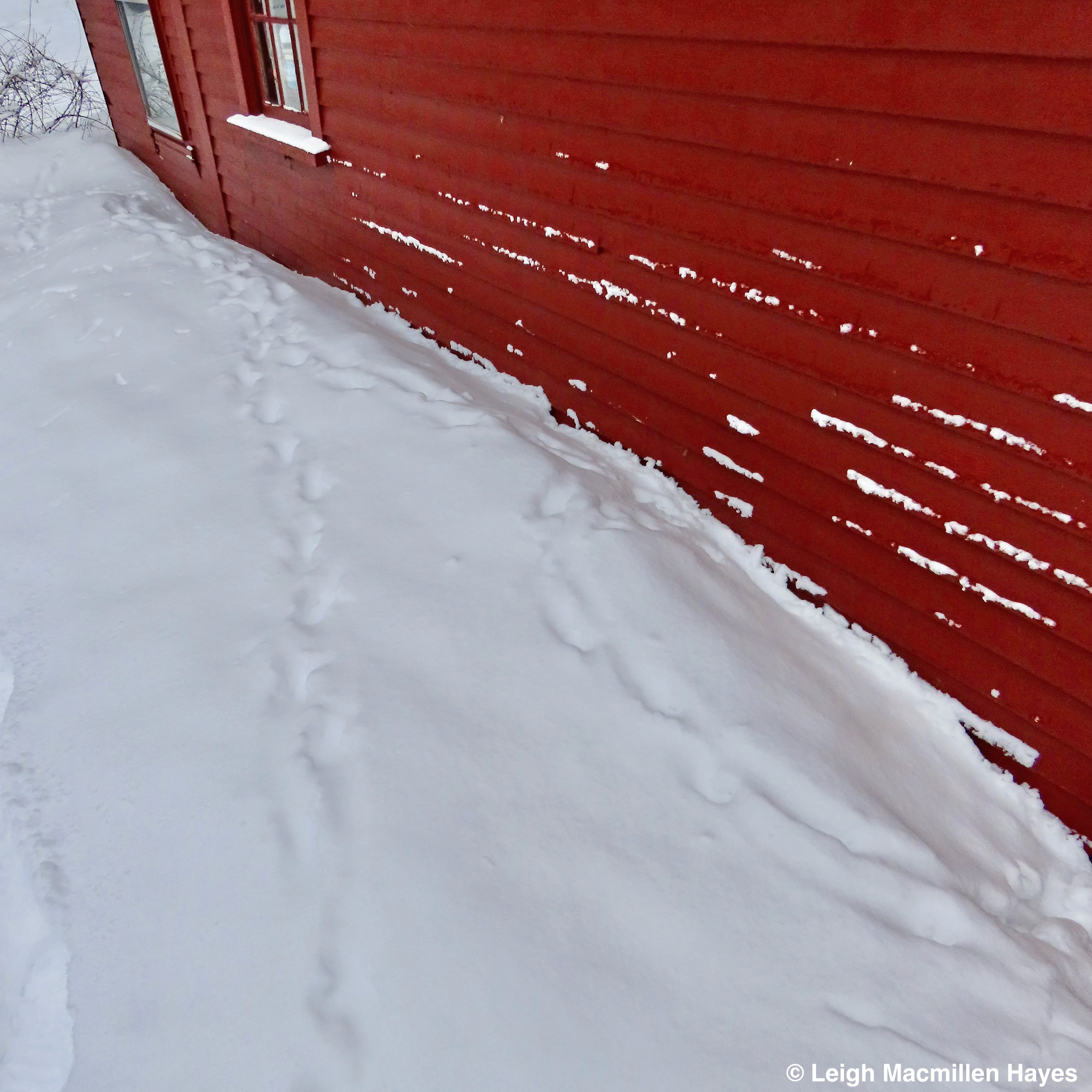
The porcupine did check out a tiny hole under the barn, but we don’t think it actually stayed there. Will it return. Probably, as the barn has long hosted this species; along with other small critters.

That’s a lot for now and at last I’m done counting the stock for our winter inventory. There’s more out there, but this is certainly enough to make me realize that they don’t live in our woods, but rather, we humbly reside in theirs.
World Spinning Out of Control, Naturally

If it seems like the world is spinning out of control, that’s because it is . . . on so many levels in so many ways. Even some things I’ve witnessed of late in the great outdoors don’t make sense.

Two weeks ago I sent this email message to my friend, an incredible naturalist, hunter, forester, David Sears. Dave knows everything and has taught me so much over the years.
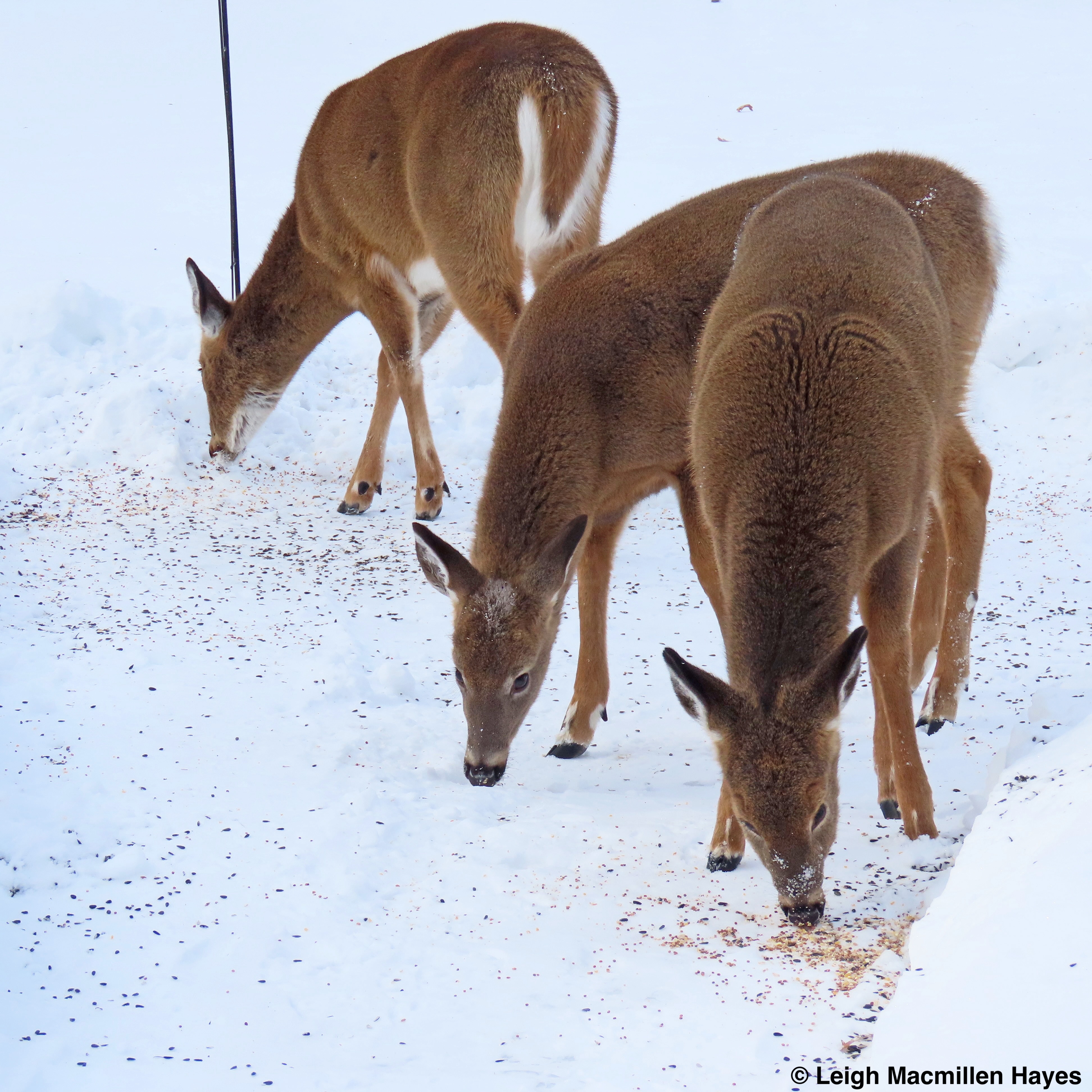
Here’s the message: “Daily we have three deer come into the yard because now that there is snow on the ground, they can’t get to the acorns so easily, but do love the sunflower seeds by the bird feeders. It’s a doe and two skippers. On Thursday I saw another doe with them. And then, as I was finishing up writing the tree blog, Becoming Tree Wise, late afternoon yesterday, I saw two by the feeders and two about 20 feet away. A doe and a skipper in each set. The doe farther away was licking the butt of the skipper. At least that’s what it looked like she was licking from my desk. For minutes on end. And then the other doe and skipper approached them and got quite close. The second doe nudged the first and the first jumped away, paused and then headed back over the stonewall and into the woods. The second doe and two skippers remained close to each other and then I noticed the second doe was bent over. I was trying not to move because even though I’m inside, they hear me and startle easily. I finally grabbed my binoculars and realized the doe was licking the underside of the skipper. I have never seen this before. Have you? Two does bathing a youngster? And at this time of year?”
Unfortunately I did not get a photo of the licking behavior because I didn’t want them to run off into the woods as I tried to understand what I was seeing.

Dave’s response matched my thoughts: “Seems strange at this age. Certainly groom them when young, but a little old now.”

Me: “And two doing the grooming?”

Dave: “Mother nature doing her thing.”

Me: “Yup. She doesn’t read our books.”

About a week or less later, I was on a reconnaissance mission with friend and fellow naturalist Dawn Wood at Loon Echo Land Trust’s Tiger Hill Community Forest in Sebago, Maine, when we spotted the sashay track a porcupine leaves in fluffy snow.

We tried to follow the track to locate either its feeding tree or den, but this porcupine provided an example of more strange behavior. Itacted like a dog, doing zoomies across the landscape. Literally, it walked in circles.

All over the place. Was it rabid? It certainly wasn’t seeking a date because it was too late for mating season. And we couldn’t find evidence that it was evading a predator.

We never did find the feeding tree or den site and wonder if we’ll see the same behavior when we return to the site this week.

On another recent day, I was with Dawn again, climbing Bald Pate Mountain in South Bridgton, when she spied this dead mouse upon a branch. White-footed or Deer Mouse I can’t say for certain.

Our immediate thought was that a Shrike had impaled it on a branch, but upon closer examination, it wasn’t impaled, but perhaps had been dropped by a predator. The question remains: Why didn’t the predator return to enjoy the meal. Or is it being saved for a later date? Perhaps it was letting any toxins leach out?

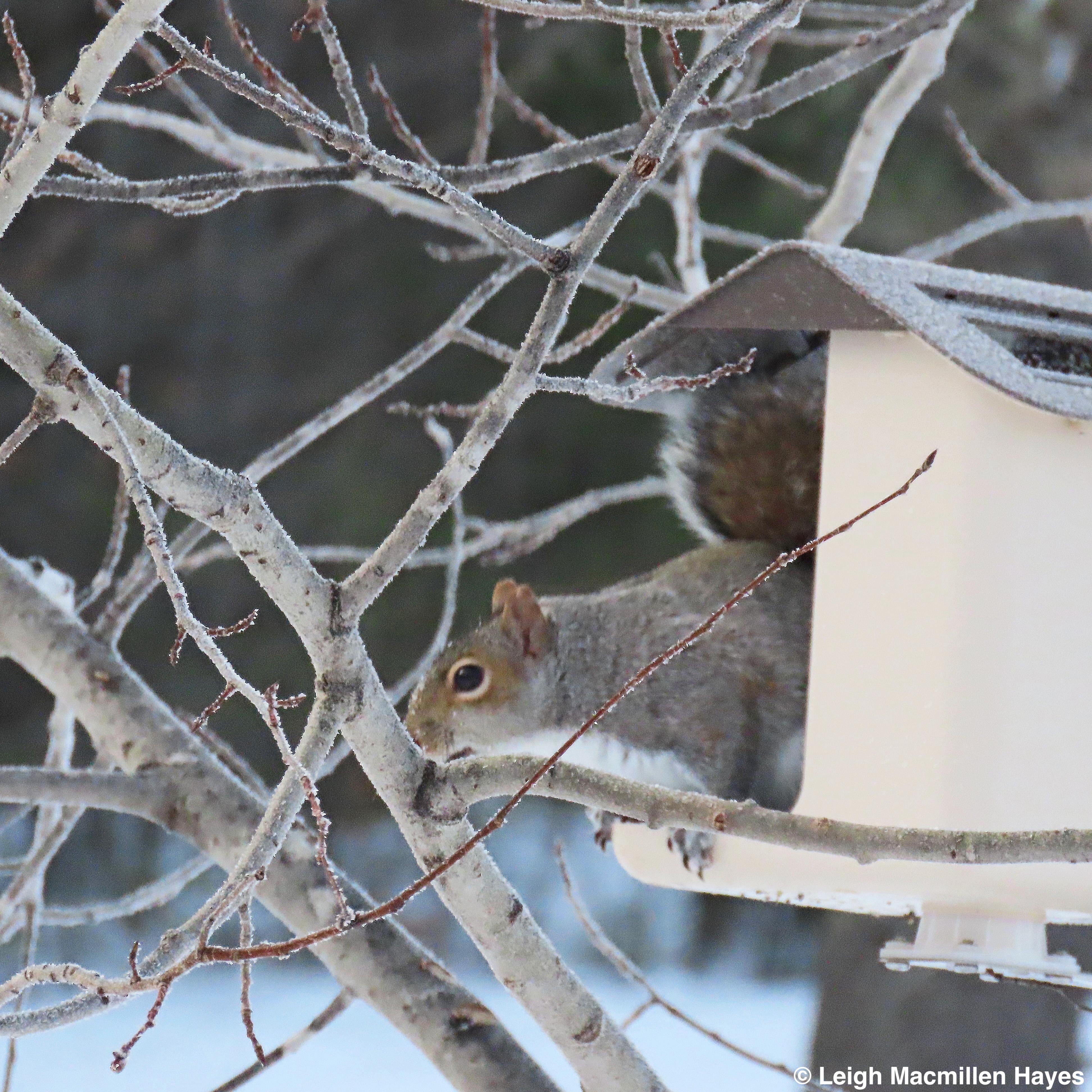
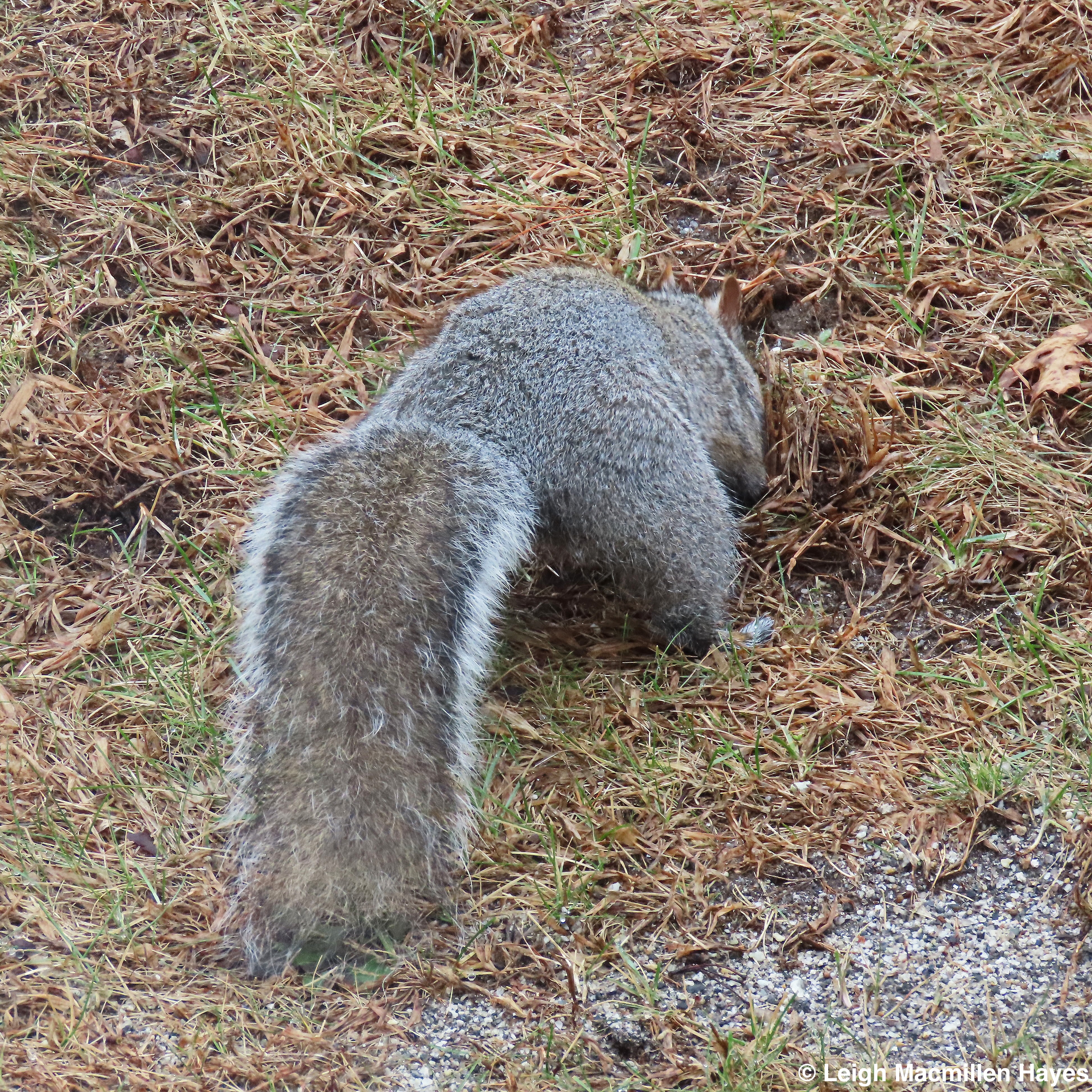
At the end of many days, I’m left looking for answers, much like this Gray Squirrel on the snow mound outside a kitchen window. Of course, the squirrel must have been wondering why I wasn’t supplying more bird seed for it to consume. This same critter actually jumped partway up the kitchen door a few times in what I assume to be protest.

As for me, I wonder how to make sense of scenes like these that I’ve shared and how to keep an open mind as the world continues to spin out of control.

Birds Of A Feather?

The other day a friend asked if my bird feeders were busy, but I’d been so focused on looking at mosses through the microscope lens, that I had my back turned to the yard and no idea what was going on out there.

Then today dawned.

And as is typical, a large flock of Juncos flew in. I love to watch them sit up in the Quaking Aspen and then almost dive bomb before gracefully landing on the ground, where I always make sure to spread plenty of seed for the ground feeders. My seeds of choice–a wild bird mix and lots and lots of black oil sunflower seed. Plus suet.

Of course, the Blue Jays also had a presence and, in fact, always make their presence known with their loud squawks. But I do love their colors, especially against the snow, and so I welcome them.

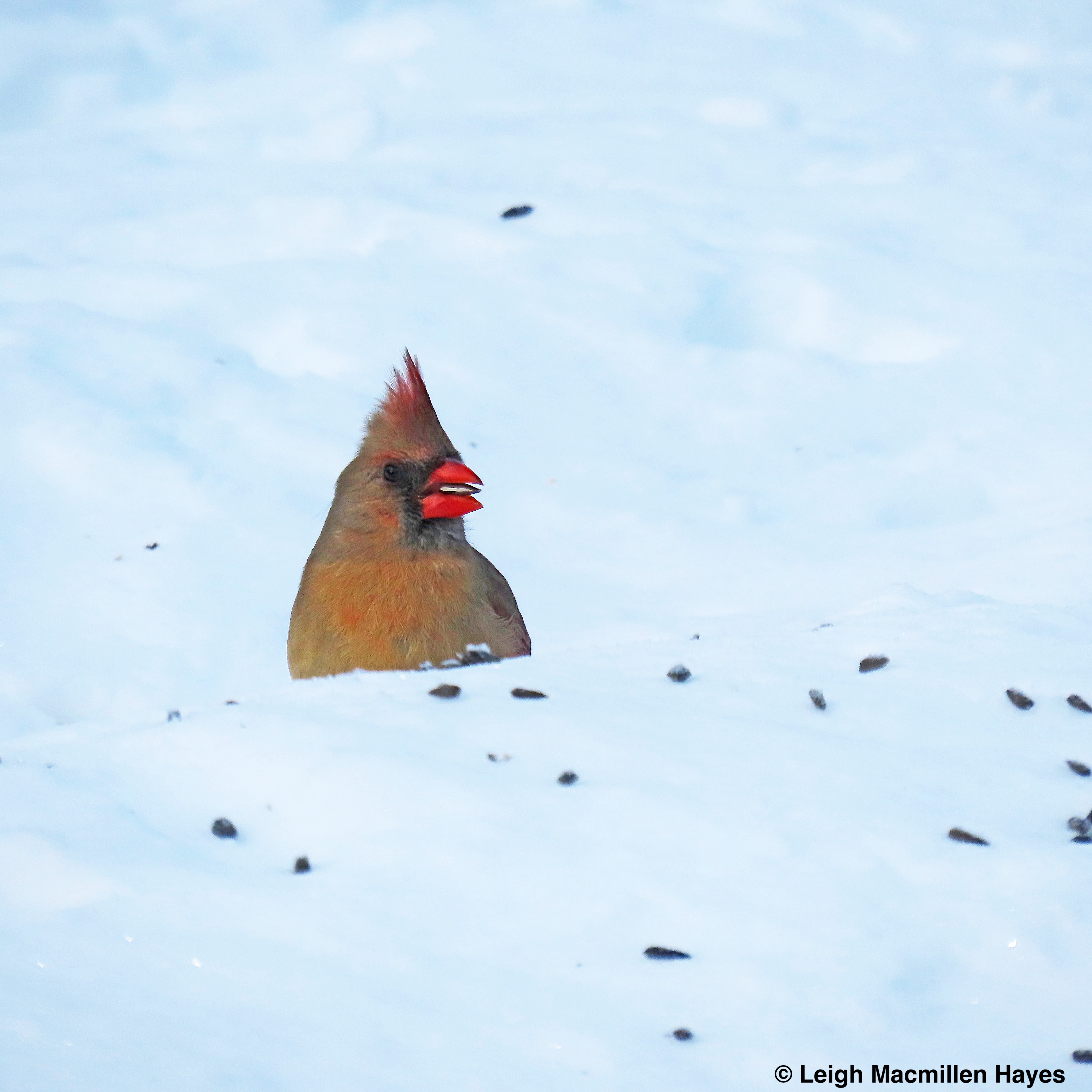
One of my favorite visitors is also the most timid–the female Cardinal. The second any little movement or sound startled her, she flew to a line of shrubs, a favorite hangout for most of the species that visit our yard. And when she flew, usually the others did as well. And then two minutes later, they’d begin to filter in again.

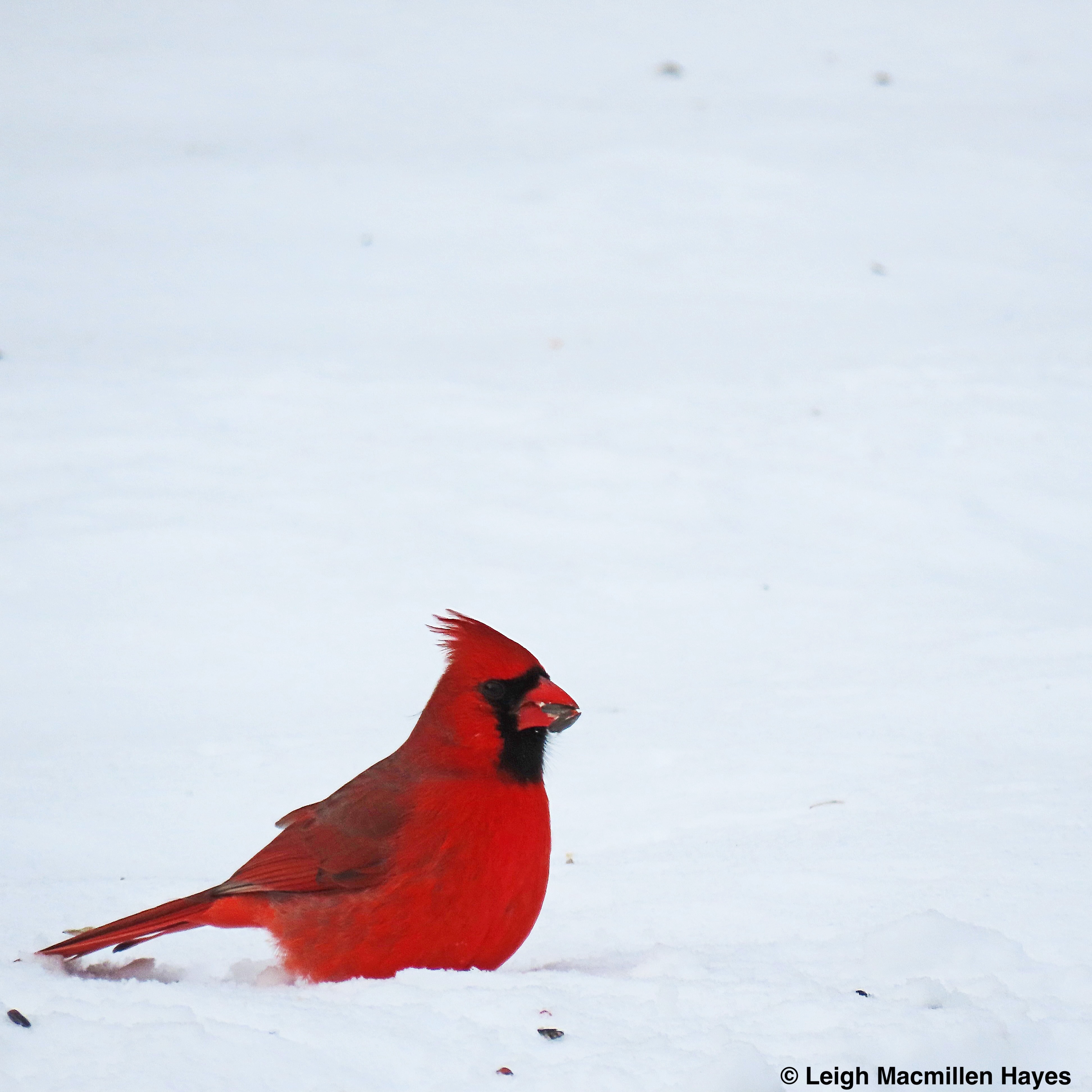
Her guy friend showed up as well, but she spent more time here than usual, despite his bossy attempts to get her to fly. Soon, though, he won’t be pushing her away, but rather sharing seeds beak to beak.

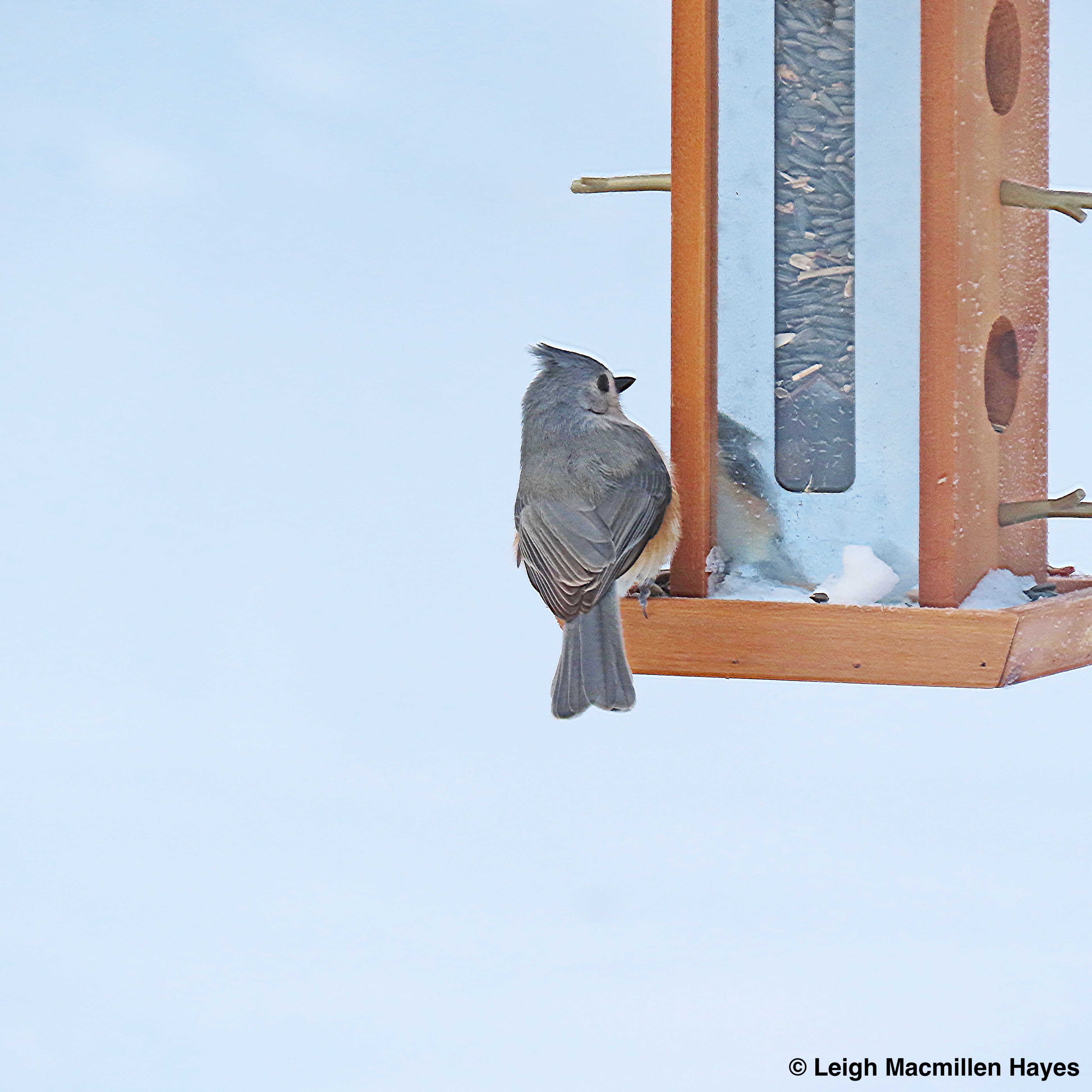
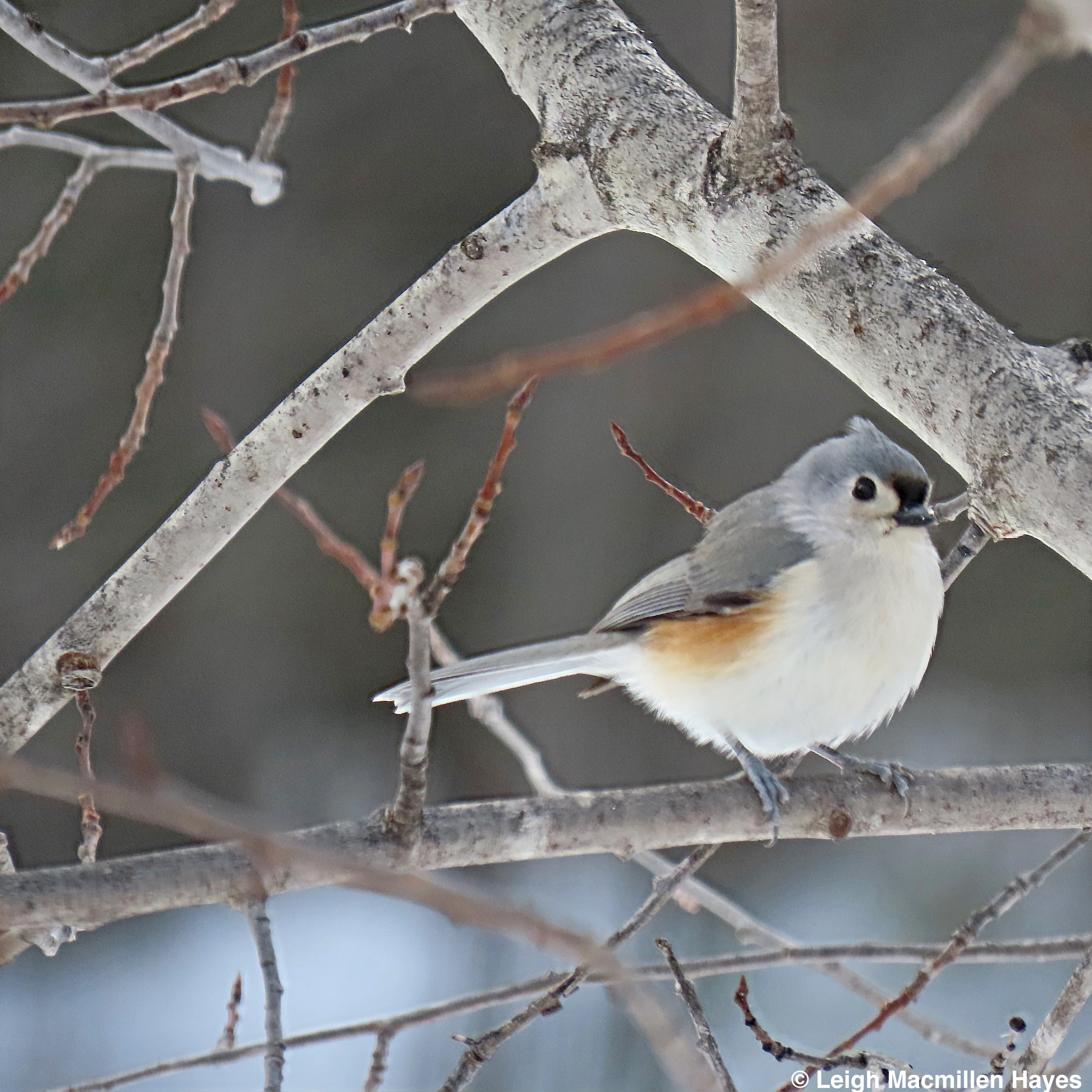
Tufted Titmice happened by and I had to wonder if this one saw its reflection in the feeder. That does happen and sometimes the results are comical.

Meanwhile, at another feeder, a large Gray Squirrel that grows larger every day thanks to my offerings, made sure everyone knew that the feeder attached to the tree was his. We knew when we put it there, that this would be the case, but it was our only choice of position.

And so he dines. A. Lot.

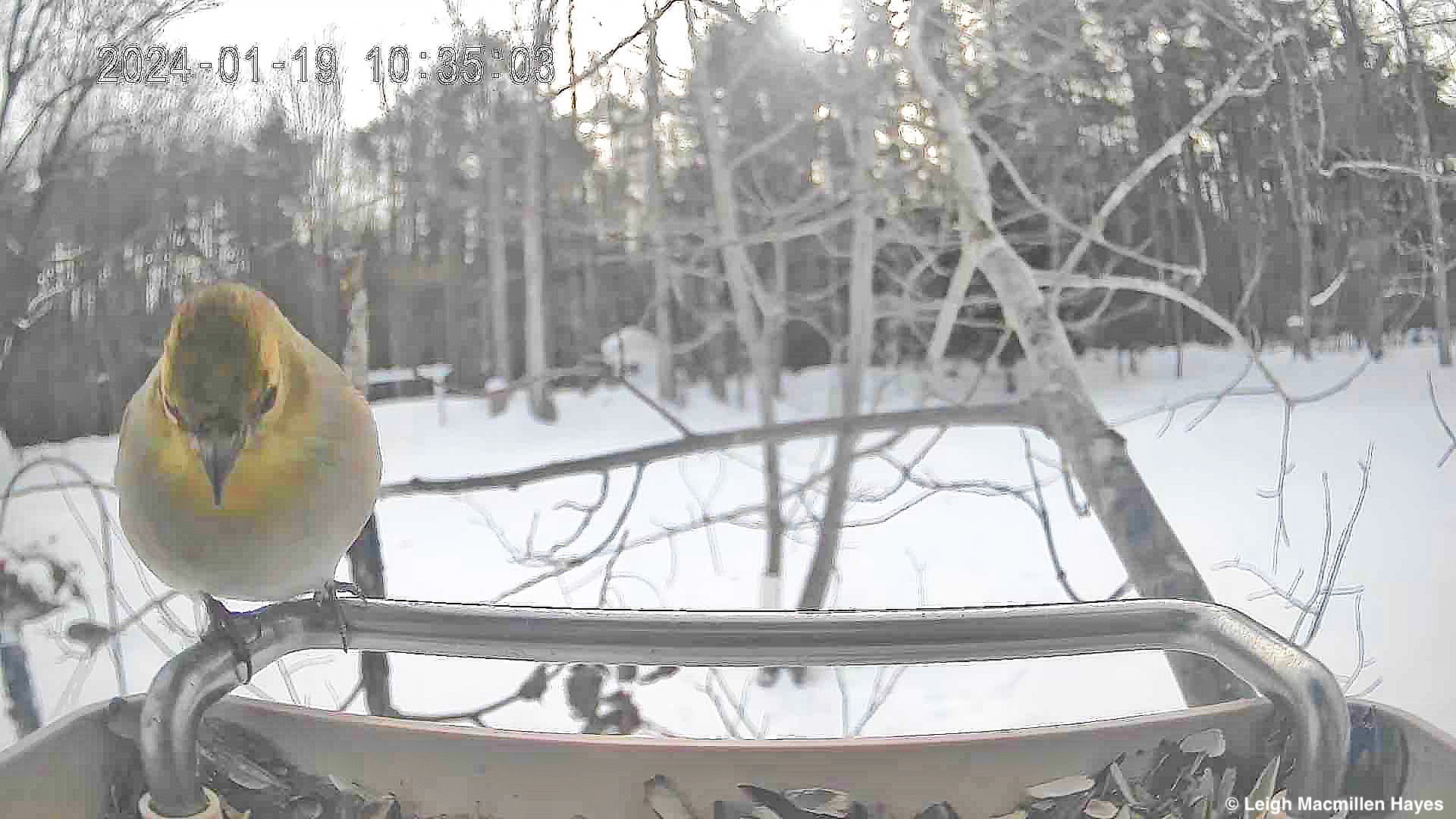
The good news is that eventually he leaves and others, such as this Goldfinch, fly in and look for just the right seed of choice.

Bingo. Mission accomplished.

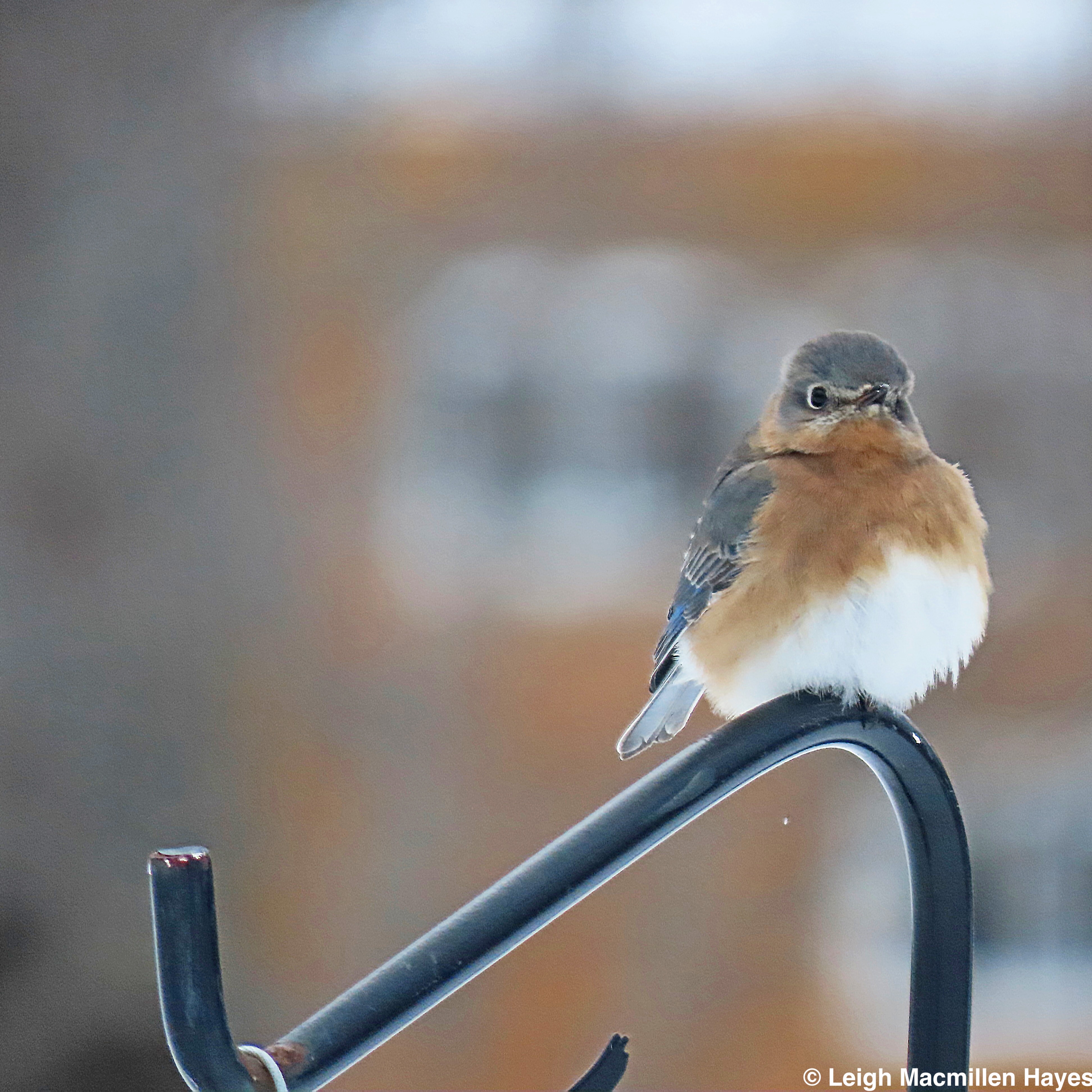
And then . . . and then . . . two surprise visitors arrived. Bluebirds . . . of happiness, of course, for they made me happy.

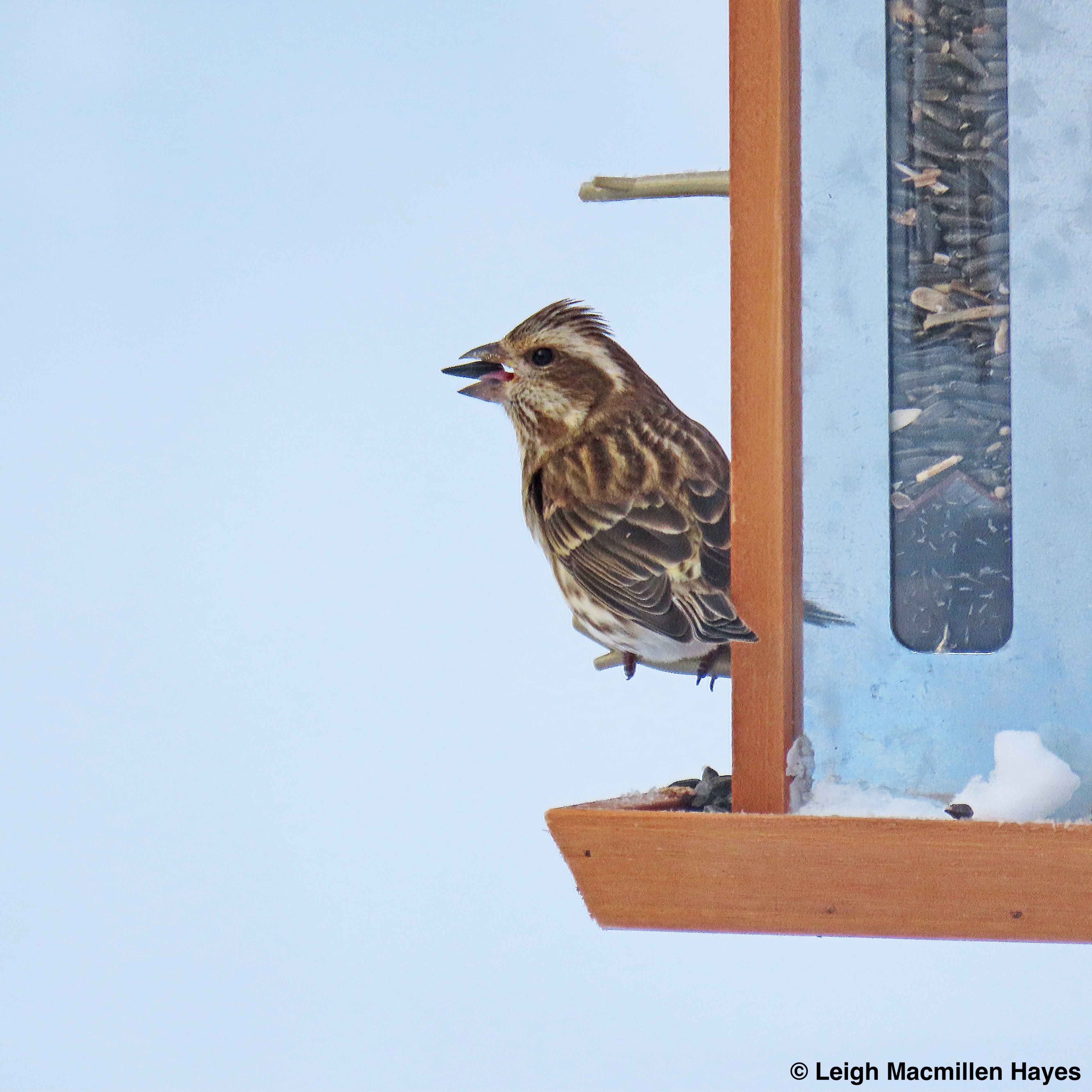
And then, another surprise visitor–a female Purple Finch who looked quite pleased with her tasty seed.

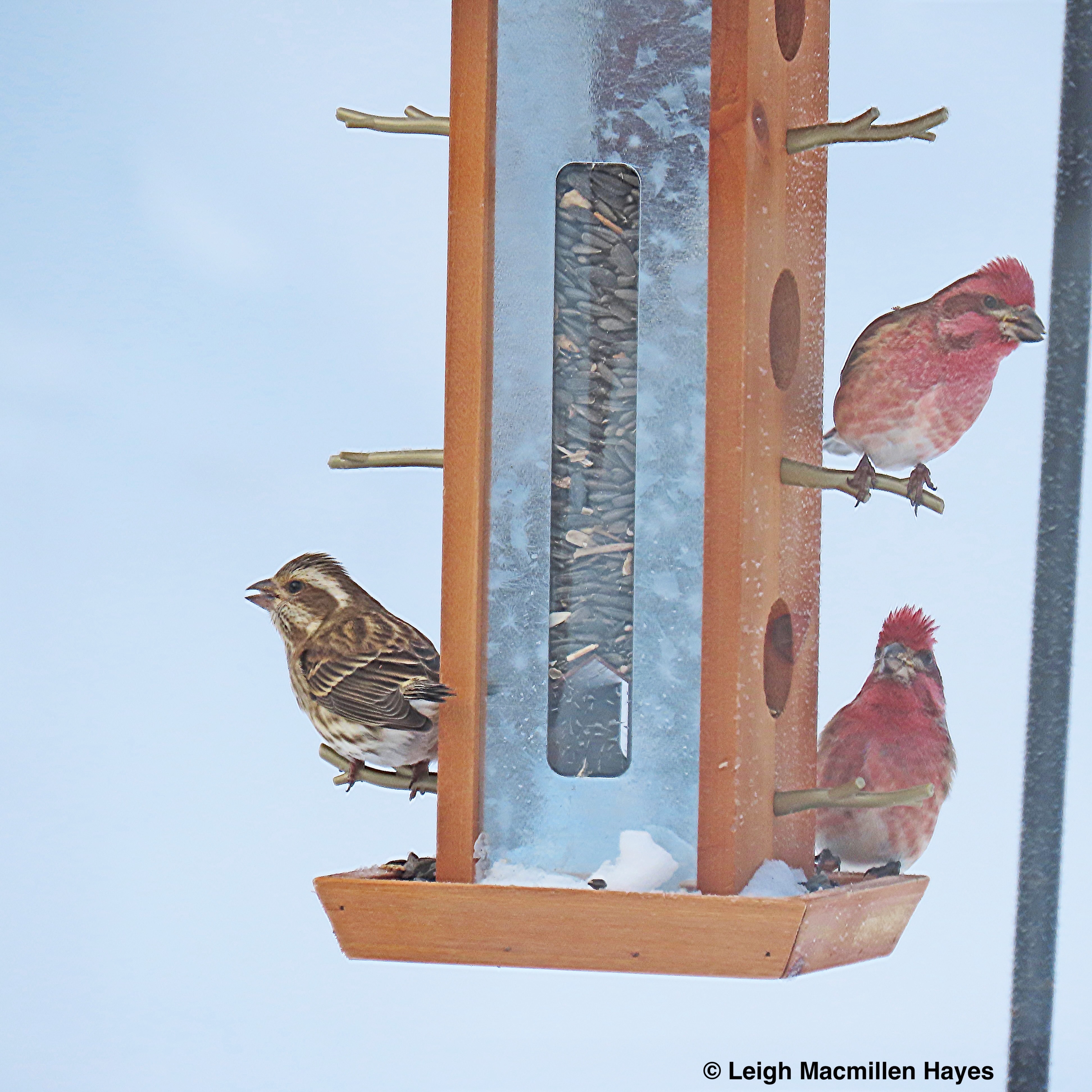
She was so pleased, that she apparently invited two males to join her. Their postures and bad hair day made me laugh–they seemed to have been put here to provide comical relief. That’s not true at all, but so it seemed.

With all of this action, I had to stand as still as possible to take these shots through the back door window. And because I was so still, I had yet another surprise.

Bird seed is not just for birds, as the squirrels prove daily. And the White-tailed Deer often make that statment at night, but today . . . today was different. They came in the morning and were like vacuums as they consumed the seed.

Observing the birds, I often note that the Juncos can be quite defensive, the Male Cardinal sometimes suggests the female should leave (until that is when he decides to feed her), Chickadees fly in, grab a seed and fly off to a branch to break it open, and Goldfinches hang out together. As do the deer. These were the two young skippers, and they weren’t at all disturbed to be in each others space.

One of the skippers approach this feeder was instantly startled by its movement, but momma doe was much more curious, though in the end she chose to opt for seeds on the ground.

And all were delicious.

After about a half hour, my body tense from holding still for so long because after all, they were only steps from where I stood, the deer had consumed most of the ground seed and headed off to the woods. I waited a few minutes to give them time to depart without pressure and then went out to spread more seed around.

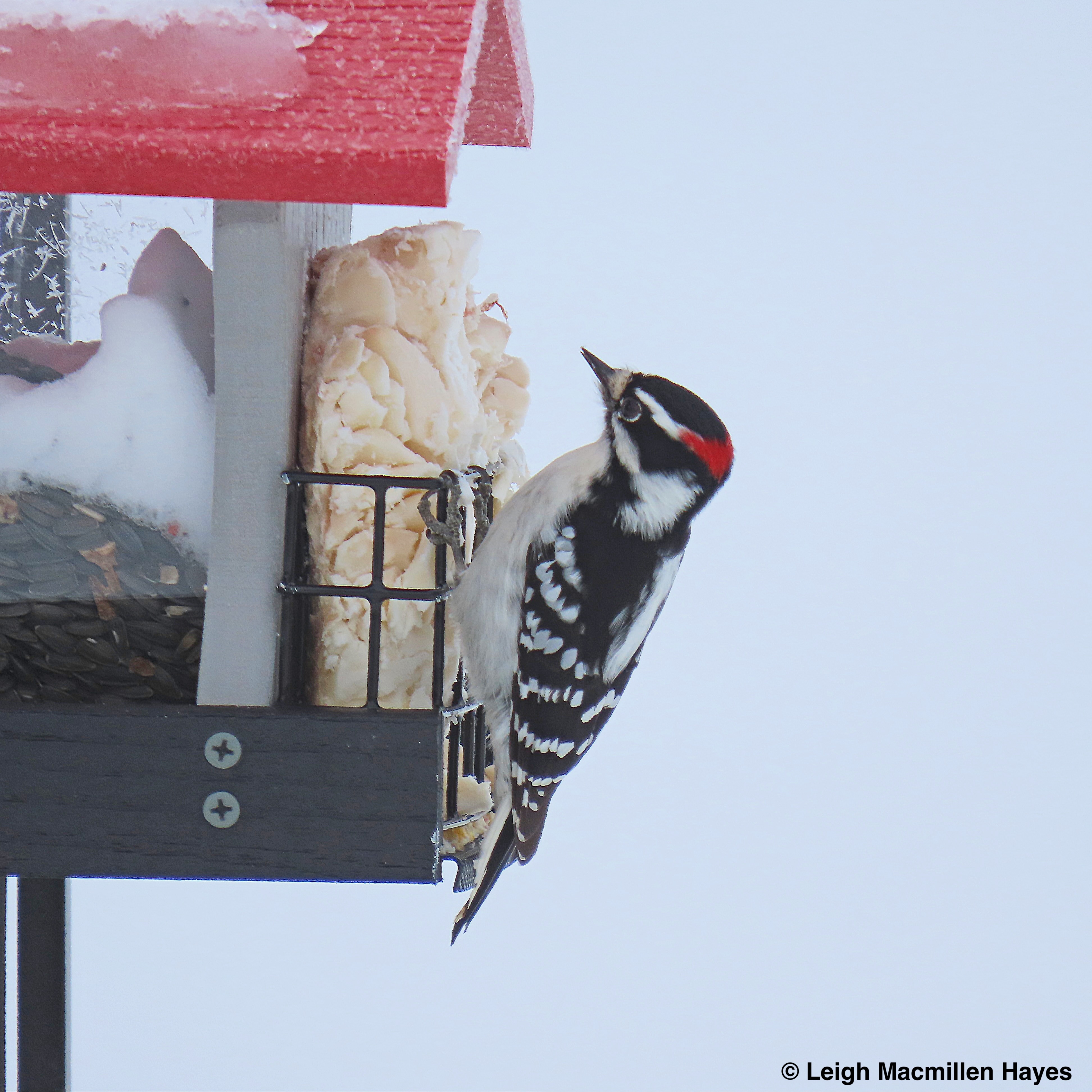
It took a few more minutes and then the action picked up again and in flew a male Downy Woodpecker to sample the suet.

His mate also arrived and waited in the Aspen to take her turn, though there are two suet feeders out there so I’m not sure why she felt the need to wait her turn.

And the rest of the mixed flock returned as well, including the Tufted Titmouse.

At the end of the day, my favorite visitors were the Bluebirds for it was such a treat to see them.

I can only hope they make a habit of returning to our yard.

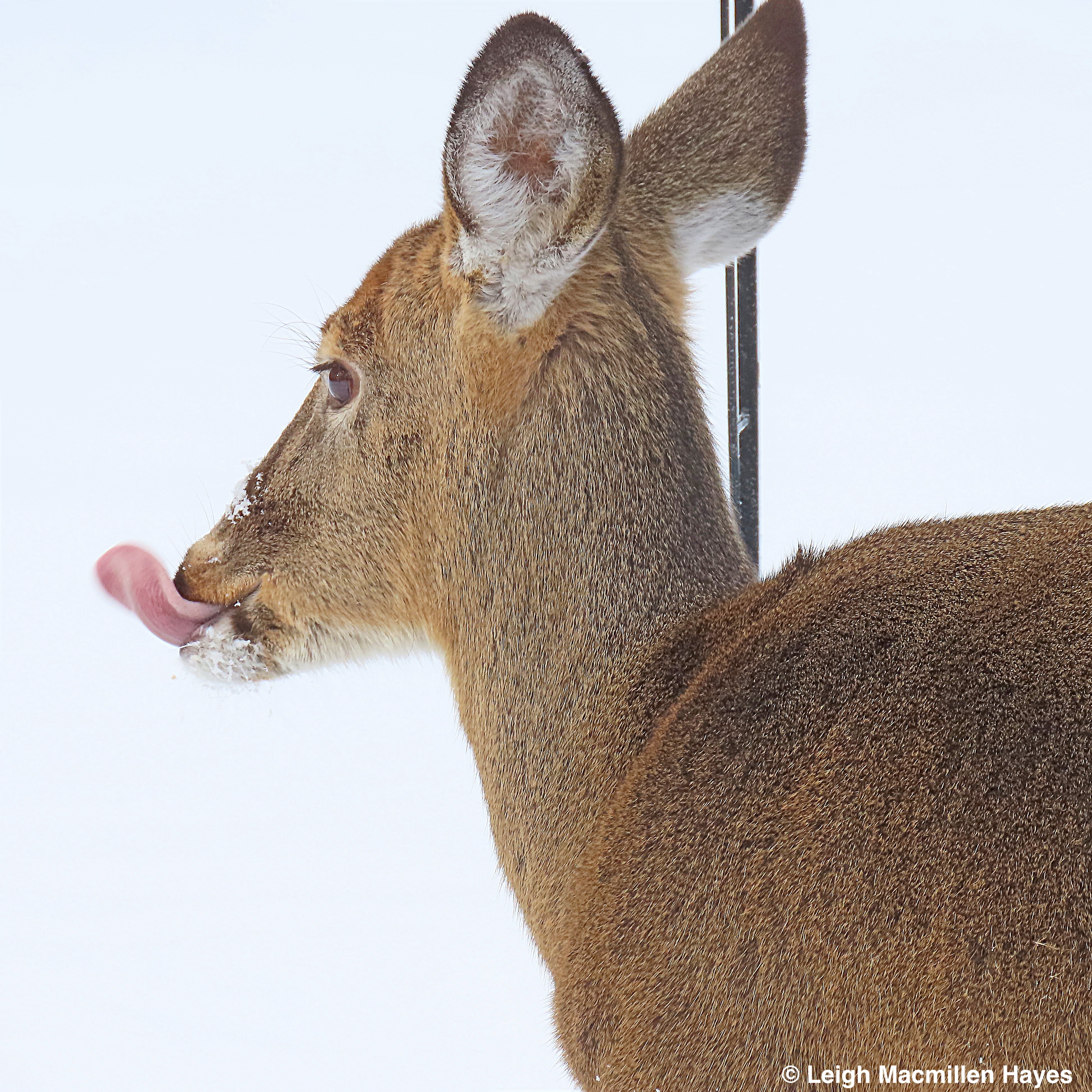
And the deer, who found everything tongue-licking good.

And along with the squirrels, proved that not every bird has feathers. I mean, seriously, have you ever watched Gray Squirrels fly from tree to tree? And Deer fly across a field? Certainly reindeer fly.

The Forever Student, Naturally

This story begins . . . at the beginning. Okay. Early morning, not enough coffee, humor. Rather, this story begins at a bird feeder located about twenty feet from our back door.

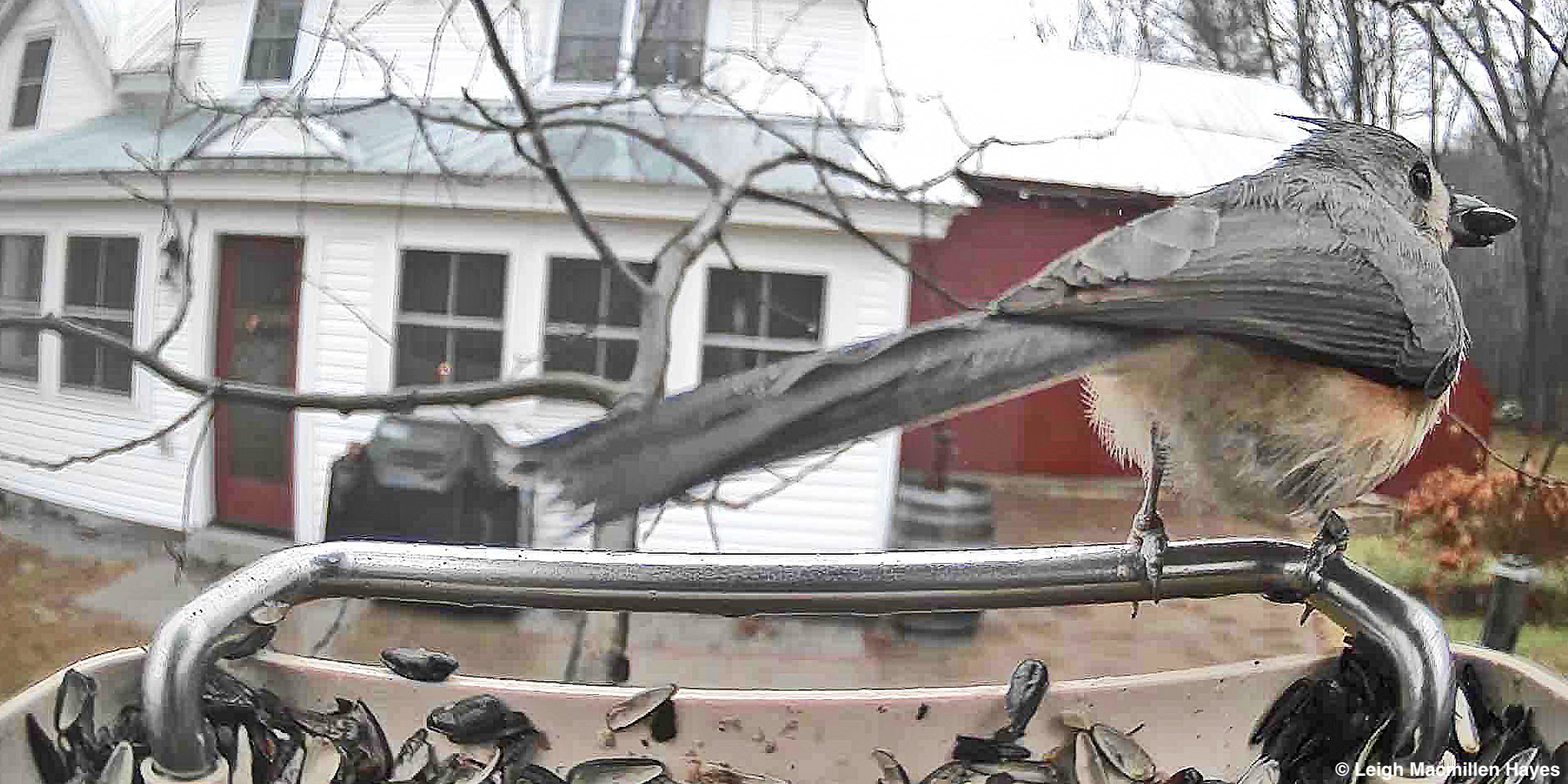
Birds, like this Tufted Titmouse, frequent it, especially on rainy days, which seems to be the norm this December. In fact, this year. Sadly.

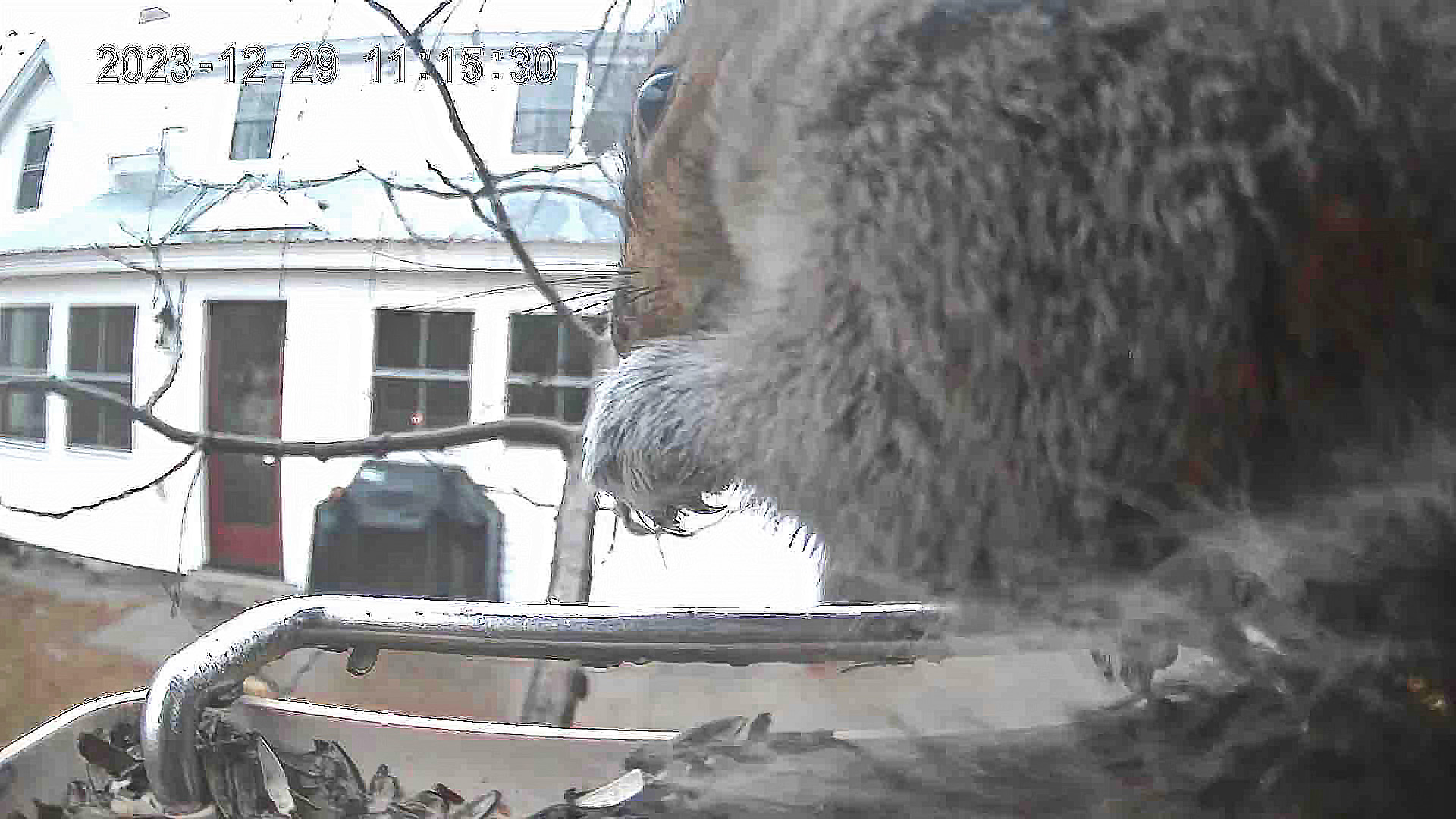
But, there’s another visitor, who thinks its a bird. If it had the membrane that stretches from the wrist of a front paw to the ankle of a rare paw, we could at least call it a Flying Squirrel. It does not. It just thinks its entitled to the bird feeder selection, despite the fact that I spread plenty of seed on the ground and have a dangling corn feeder intended for such uses.

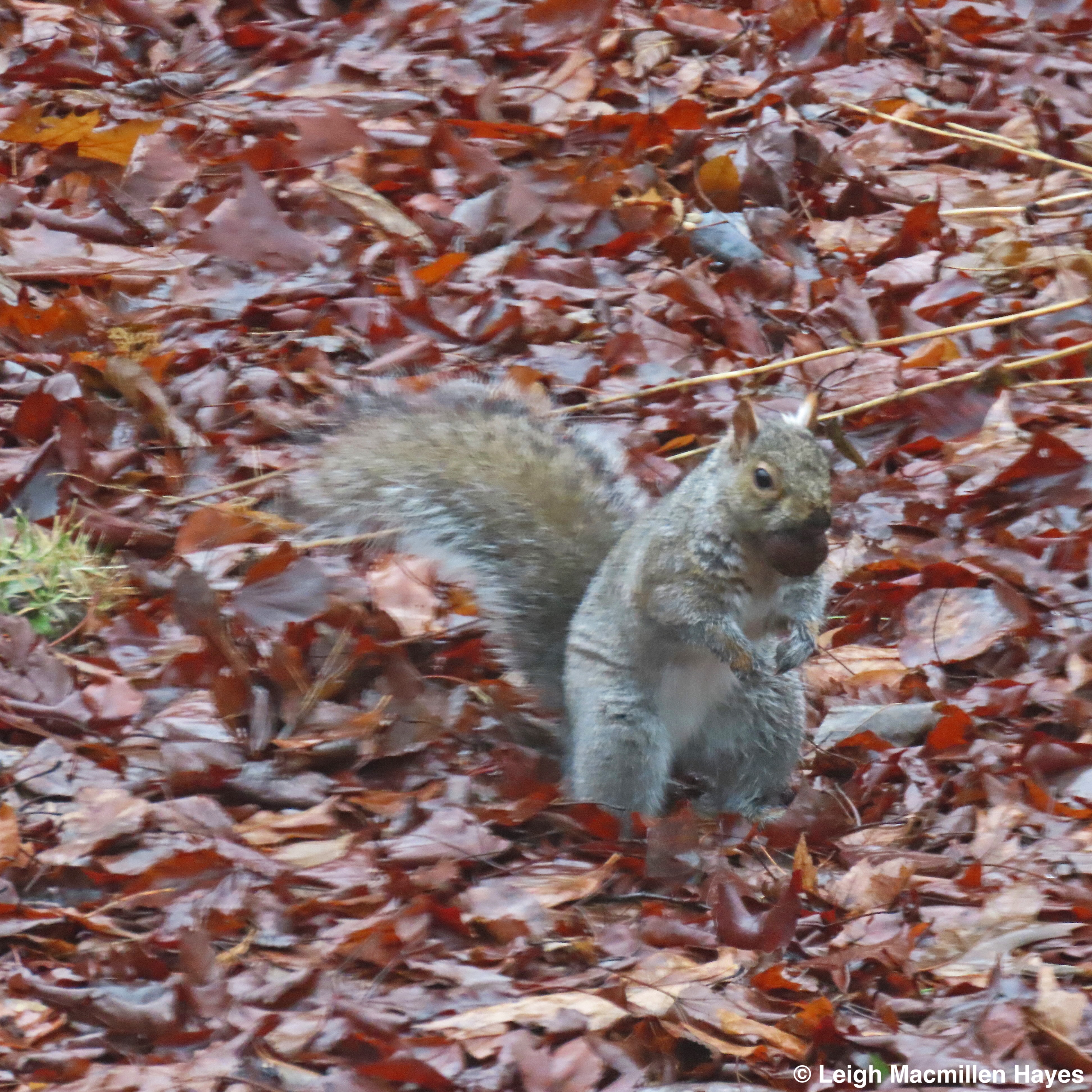
Eventually, it did resort to normal Gray Squirrel behavior and fetched an acorn, then frantically searched for a spot to cache it. And taught me a lesson.

I realized I’ve never paid particular attention to a Gray Squirrel caching acorns, one here, one there, for future food sources, or a future oak sapling if not dined upon. I knew they did that. But what I didn’t realize is that much consideration goes into location of said single cache. The squirrel moved through two gardens, across the yard, and paused about three feet from the back door to dig, all the while holding the acorn between its lips.

And in the end, that wasn’t the right spot and so it moved on.

And I stepped out the door. The hole was just deep enough and wide enough for that single acorn, but the last I saw of the squirrel , it still hold the nut tight as it pranced along the stone wall and then into the field beyond. Funny thing is that when I returned home an hour or two or three later, there was a second hole excavated but equally empty. Why dig here twice and not make a deposit?

The Gray Squirrel’s activity inspired me to step into our woods and check on the activity of my friend Red. He doesn’t disappoint and each day that I visit I notice new middens (garbage piles of discarded cone scales) and new cones added to the cache (food cupboard).

My favorite cache is now a foot tall and the cool realization is that he doesn’t dine upon this pile. Like the Gray Squirrel burying his acorns for future consumption, Red is dining on plenty of pine cone seeds, but saving up for that day when we have so much snow (will that day ever come again?) that he has a food supply available and doesn’t have to tunnel through the white stuff in search of a meal. Considering how many pine cone seeds he must consume each day, I have to wonder how long this source will last and will it grow taller and wider in the coming weeks?

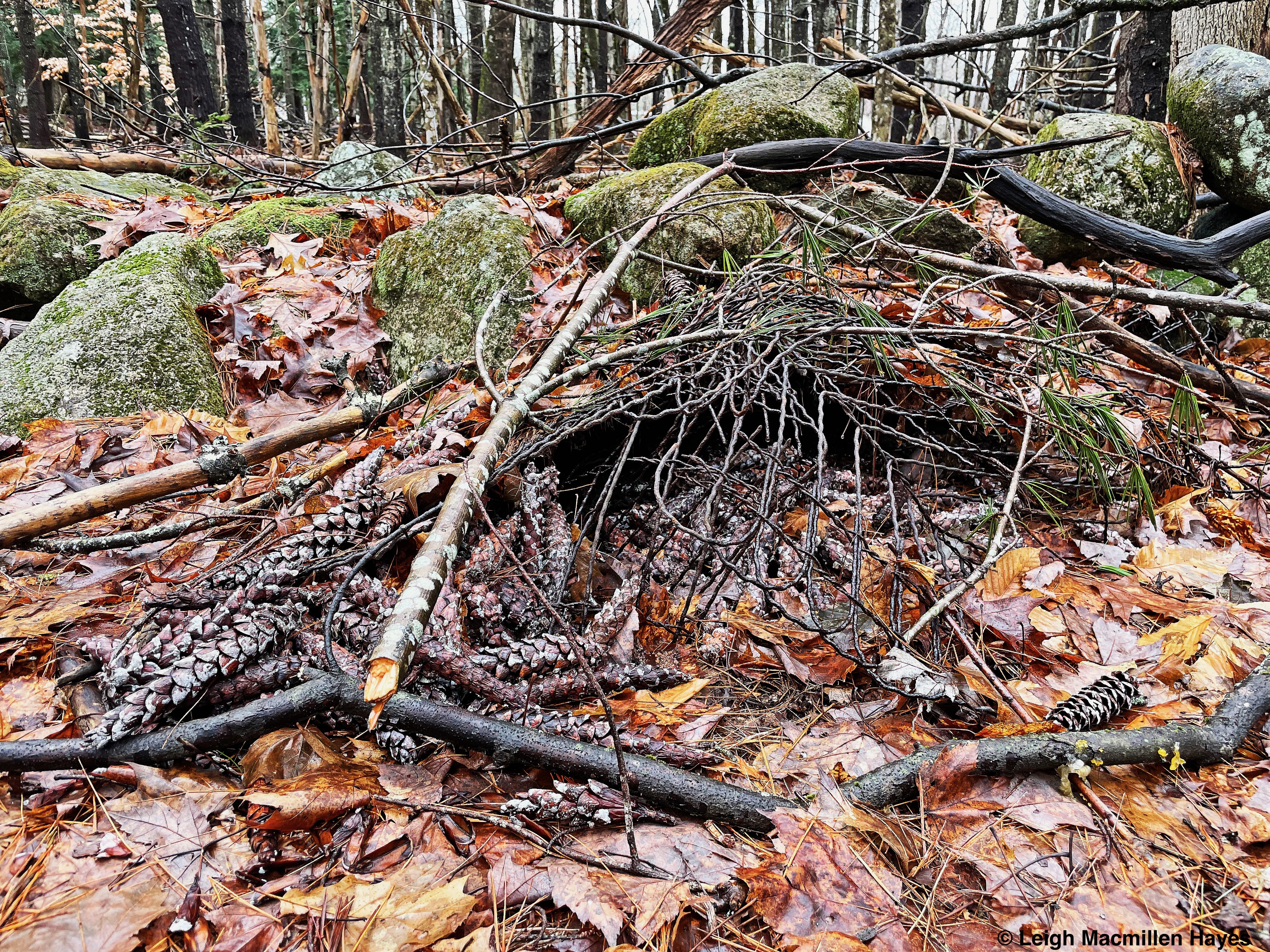
On the other side of the cow path, for that is where the tall pile is located, I realized he’s started another cache, this one located under some discarded garden fence left behind by previous owners of the land. It’s actually a great spot in my squirrely mind, for its beside the wall so he can easily access it from a dry spot within and the fencing and sticks and leaves have created a shelter.

Much to my delight, I spotted Red on a pine branch, a perfect high spot on which to dine and keep an eye on invaders of his domain, such as me. My presence, however, did not stop him from peeling each scale to seek the two seeds tucked close to the cob.

And as is the custom, its only the seeds that he cares about, scales discarded because their usefulness is no longer important.

The base of the tree shows just how many scales he’s discarded over the last few months as his midden contiunes to grow. Considering this year was a mast pinecone production year for Eastern White Pines in western Maine, this is one well fed squirrel.

Another tree that produced a mast crop is the Northern Red Oak and the abundance of acorns has been a food source for the squirrels, especially the Gray, Porcupines, and White-tailed Deer.

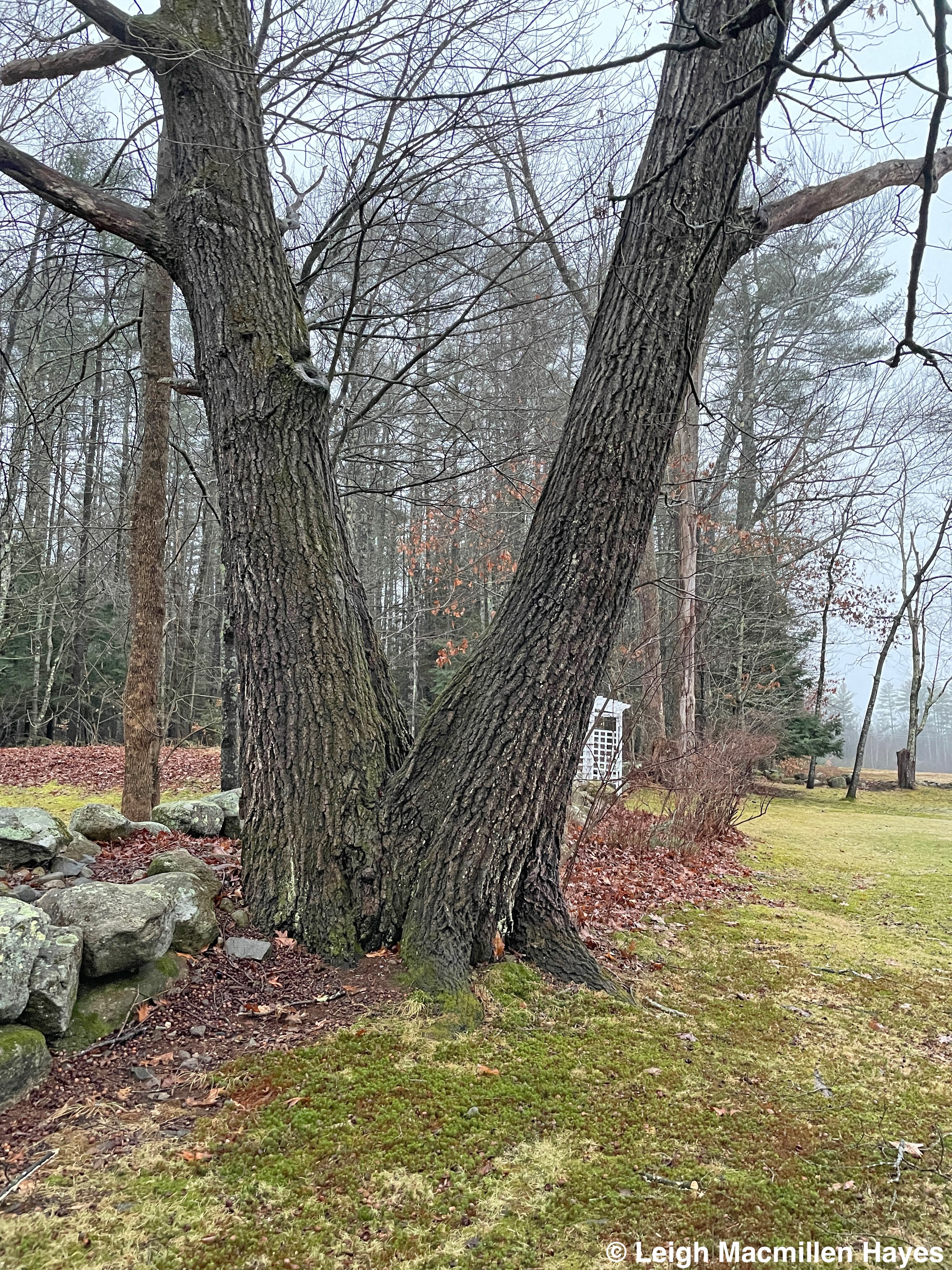
The tree behind our barn is massive, with a coppiced base and therefore three large trunks. Our sons once built a fort in that space between.

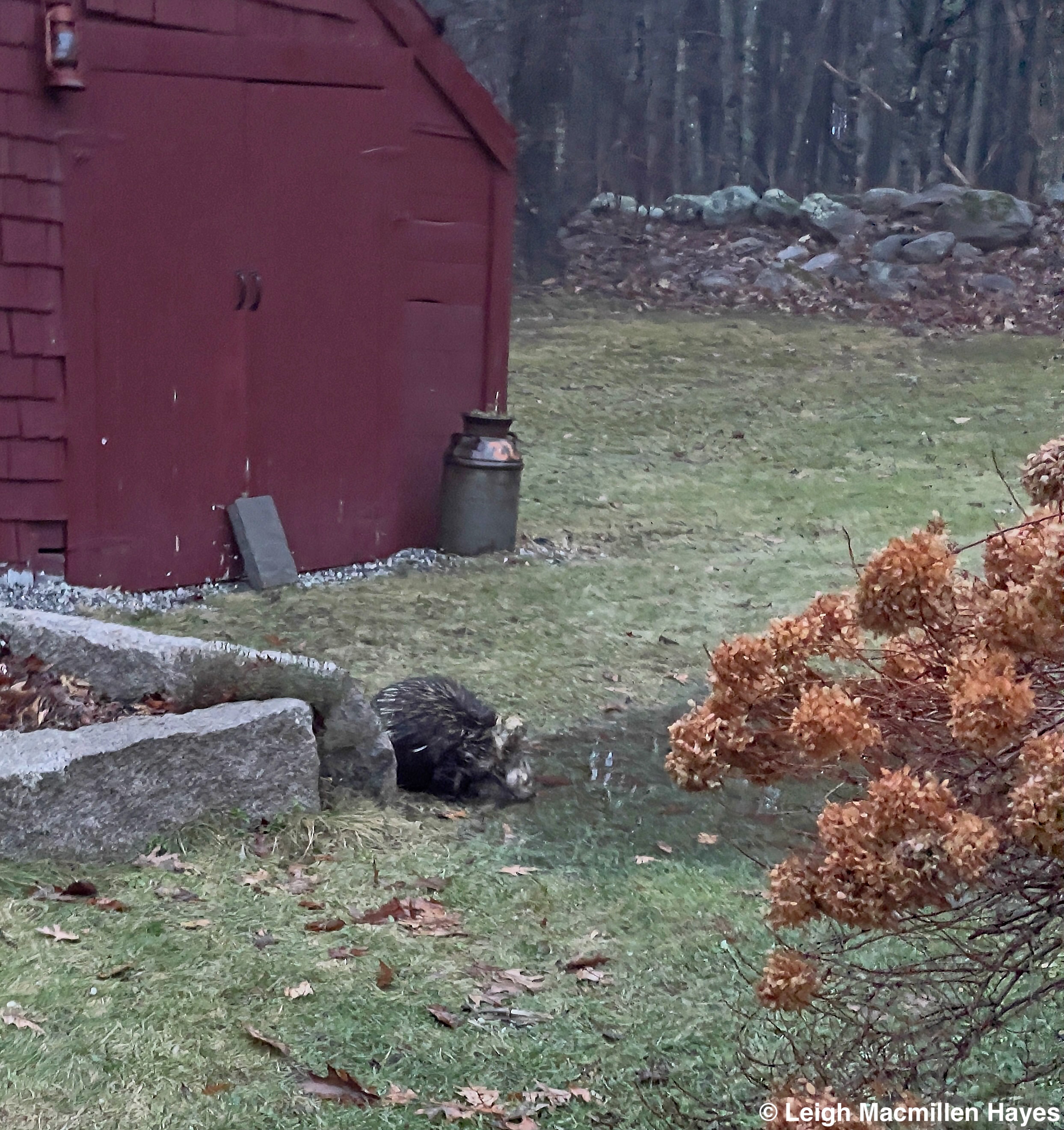
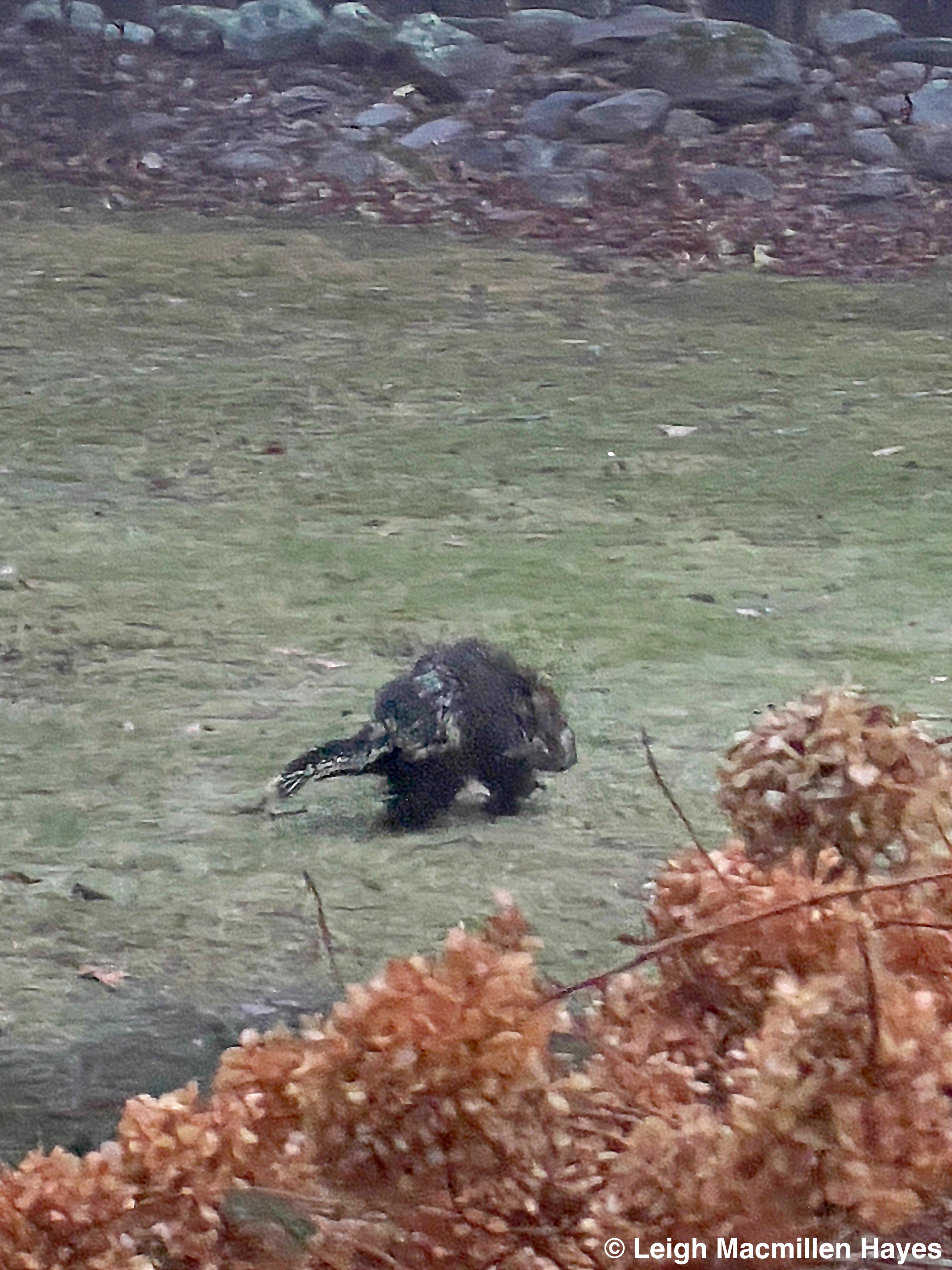
At about 4:15pm the day before, our youngest son, his gal, and I watched Bandit, the local porcupine come from the acorns to a puddle beside the herb garden and pause for about five minutes as he sipped from it. That was another first for me. And them as well. In fact, for his gal, just seeing a porcupine in the wild was a first.

Then he waddled off to the woods on the other side of the stone wall, and probably found an Eastern Hemlock upon which to dine for the night. I found a few trees with downed twigs, but none that cried out, “I’m Bandit’s food source,” so I suspect I need to expand my search on another day.

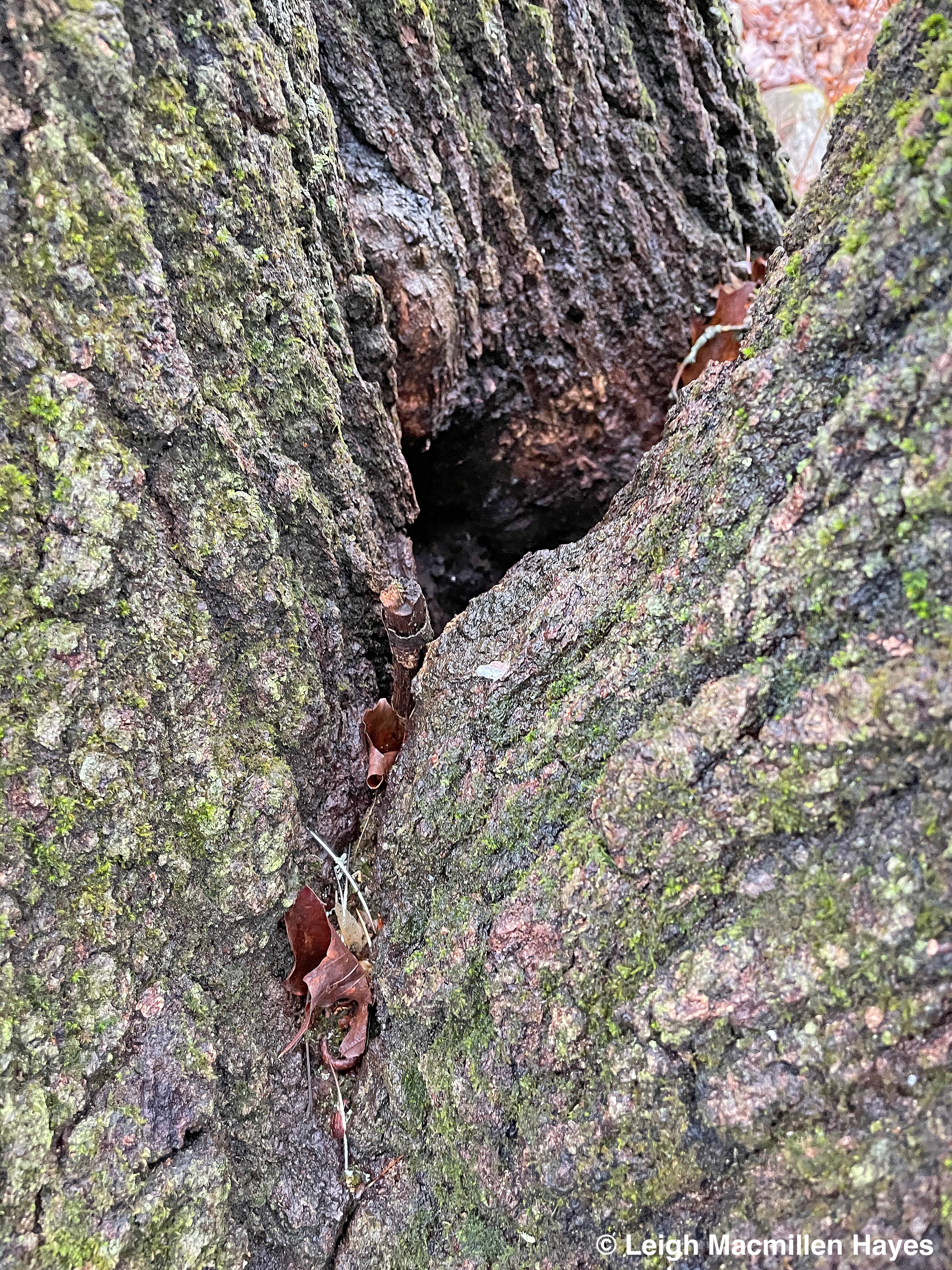
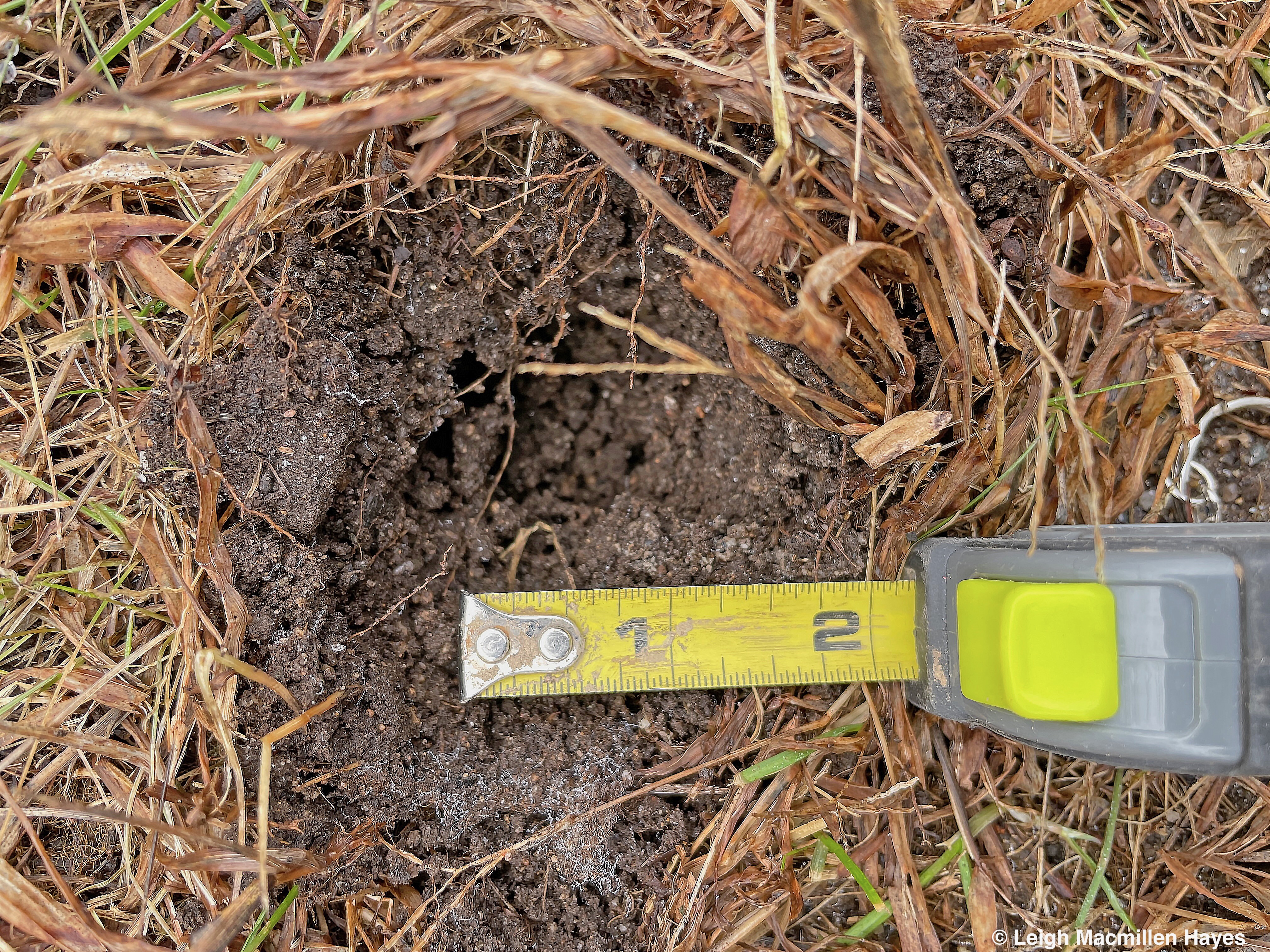
Instead, I made a different discovery. We know that Bandit has spent time under the barn, and he’s left tracks when we did have snow that led to a neighbor’s shed, but I have wondered about the old oak tree and the hollow within its three trunks And today, I spied evidence that he has inspected the hollow. Do you see it?

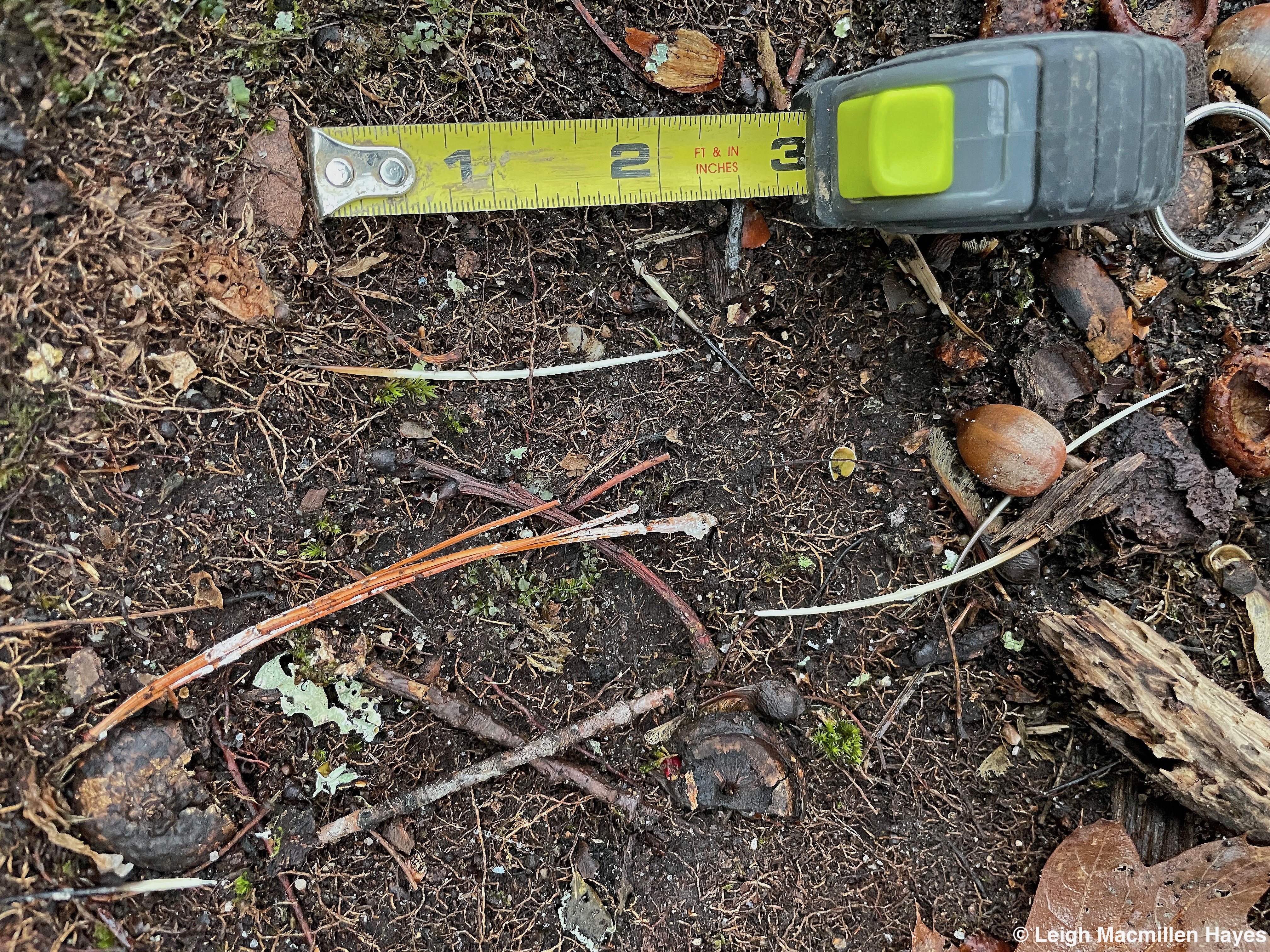
How about now? Quills! I found them on both sides of the trunk.

And on the ground below.

About two inches in length, and some were longer, I love how his brownish hue is similar to that of the bundle of dried pine needles.

The hollow is dark and deeper than my camera could see. The curious thing is that there is no scat. Yet. You can rest assured that I will keep an eye on this spot.

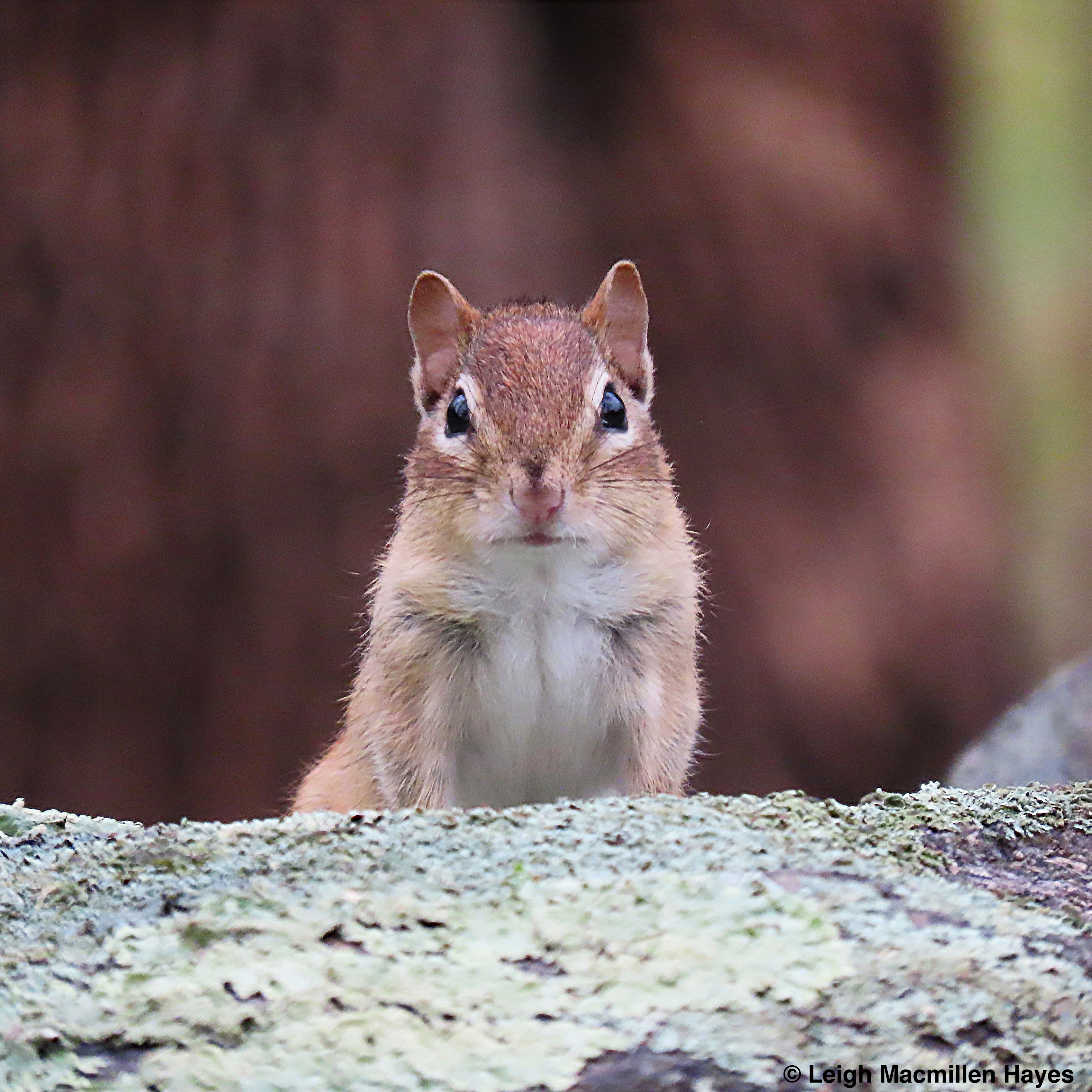
I decided to hang out not too far from the tree and barn as day turned to dusk in hopes of spotting Bandit emerging. Much to my surprise, an Eastern Chipmunk appeared on the wall behind the tree. Wait. What? Shouldn’t he be in torpor? Yup. But chipmunks will make an occasional appearance on warmer days and we’ve had way to many of them this year.

A doe and her two skippers also appeared and watched me from the edge of the field, or at least listened to my movements, which I tried to minimize as much as possible, but those ears were on high alert.

About a month ago, when we did have snow, I discovered blood beside her tracks on this side of the wall and knew that she was in estrus. A day later, I noticed a young buck in the field and by the way he kept his nose to the ground and moved frantically, I knew he was on a mission to find her. Did he? Is she with child? Only spring will tell.

In the meantime, her twin skippers are still with her. They ran off before I headed in, but I suspect it wasn’t long before they returned under the blanket of darkness and munched on a bunch of acorns.

Bandit never did appear during the time that I waited. Who knows? Maybe he had spent a night and day or two in the hemlock of his dining choice. I’ll continue to search for evidence of his activities because it’s what I most enjoy doing.

There’s always something wild going on outside our back door, rain or shine or snow or sleet, and I’m grateful for each lesson they take the time to teach me. I am a forever student, naturally.

Stepping Up A Notch Mondate: Part 2

Last week found us hiking up an old fav, but there’s another way to approach the summit and so today was the day to follow that route.

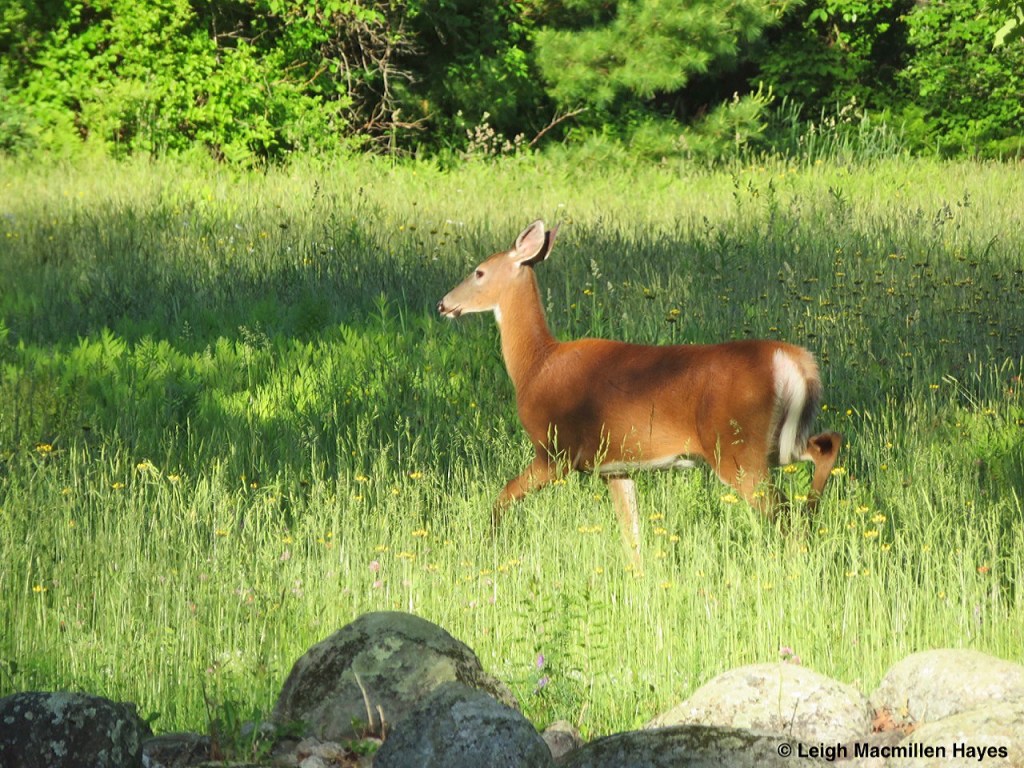
But first, my guy needed to sleep in for a bit because he’s been working way too hard of late and way too many hours and so he missed some early morning moments spent with our resident doe.

But that didn’t matter. A late morning start found us parking beside a clover patch where the swallowtail butterflies showed off not only their need for nectar, but battle scars as well.

Not long into the hike, we came upon a stone bench where we once shared lunch. It was only for a brief pause that we stopped today because the insects were thick, but still . . . it’s such a pleasant spot.

After conquering some wet spots along the way, we arrived at the wettest of all, that was actually quite dry. And not a dragonfly in sight.

After that we began to climb, encountering more damp seeps along the way.

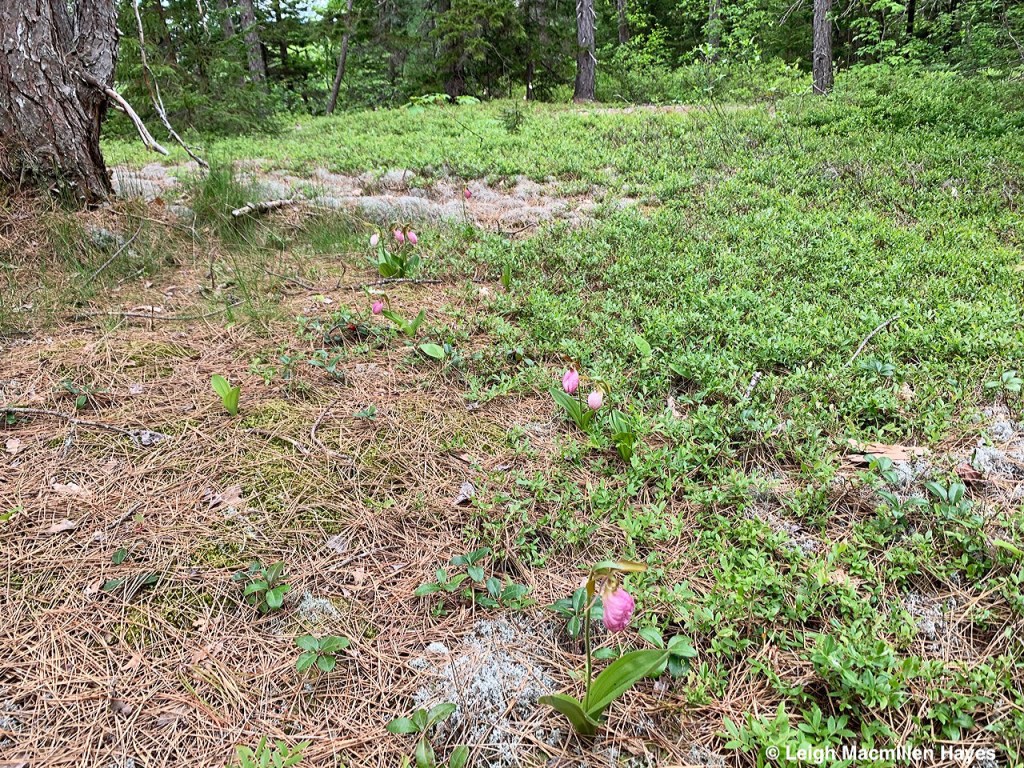
All the while our eyes scanned the forest floor because on the other trail to the same summit we’d counted 150 lady’s slippers last week. It wasn’t until we were two miles into today’s hike that we finally found one.

At last we reached the start of the ledges, a welcome spot for that meant no more mucky spots and fewer biting insects.

By the time we reached the same spur to the summit that we’d followed last week, we’d counted 13 lady’s slippers. Mind you, as we began the hike I asked my guy how many he thought we’d see. “One hundred,” he replied. And then he turned the question to me. “Seventy-five,” I said.

At the intersection he conceded. “You win because you had the lower number.”

“What do you think we’ll count when the lady’s slippers fade,” I asked.

“Deer Flies,” he said. Funny guy, my guy.

We agreed that we couldn’t count the ladies along the spur since we’d already acknowledged them last week. That is, until we came upon a bouquet we’d completely missed. Eight in a cluster like none we’d seen before.

We did chuckle a bit further on for we knew there were a bunch, but swear more had appeared for today’s display. Though you can’t see them all because some are by the tree line, there were fourteen that we know of. That’s one more than along today’s chosen trail.

Even though we had stopped counting, I have to tell you that we continued to point out old friends to each other, and even found a few others we’d previously missed. Besides the bouquet, my favorite was a wee blossom that hid under a red maple sapling.

I would be remiss if I didn’t acknowledge others on display like the huckleberry’s red flowers shaped like bells waiting to ring joyous sounds across the summit.

And then there was the flower beetle atop a mountain ash tree. I was pretty sure it was a flower beetle because . . . um, it was a beetle on a flower. But beyond that my knowledge and research were limited. So as I do in such cases, I reached out to Maine Master Naturalist Anthony Underwood, who said that I’d found an uncommon scarab, Gnorimella maculosa, or Maculated Scarab. Maculate means “mark with a spot.”

And then there were the ants pretending to be part of a flower structure.

Birds also were in on the scene, though we actually heard the songs of many more than we had the honor to see. But this Mourning Dove posed on the trail for us and we could hear a mate call from nearby so we suspected there must be a nest in the vicinity.

Our wonders were many, but the best of all . . . when we reached lunch rock we realized several women who were social distancing had arrived at the overlook before us. Funny thing . . . we knew them. Funnier thing . . . and the best part was that last week along this same mountain we’d met Eleanor on the left and Rachel in the middle. Today, Amy completed their friendship triangle.

Who knew that as we stepped up the notch from a different starting point on this Mondate, we’d find these three amigas. Perfect.

Where will we find you next week, ladies?

My Great Escape

The past two days have found me wandering on and off trail at John A Segur Wildlife Refuge in Lovell, where spring slowly emerges.

Yesterday’s journey, which began beside New Road, required me to climb up over the snow bank. If you go, don’t worry; I did my best to carve out steps for you.

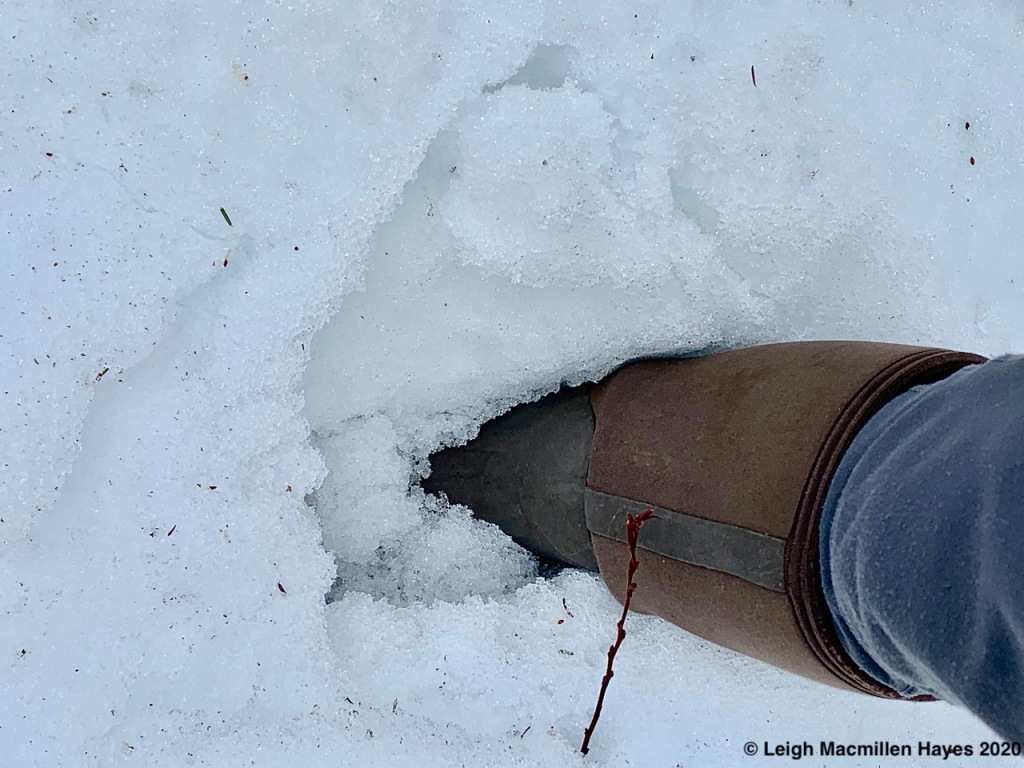
Do, however, choose your footwear appropriately for I spent a lot of time creating post holes.

My intention was to locate timeless sights I can upload to a Google Map for at the Greater Lovell Land Trust we are working to create virtual hikes for those who can’t get onto the trails right now.

But there were other things that garnered my attention and I’m never one to pass by a White Pine personally decorated by the rain.

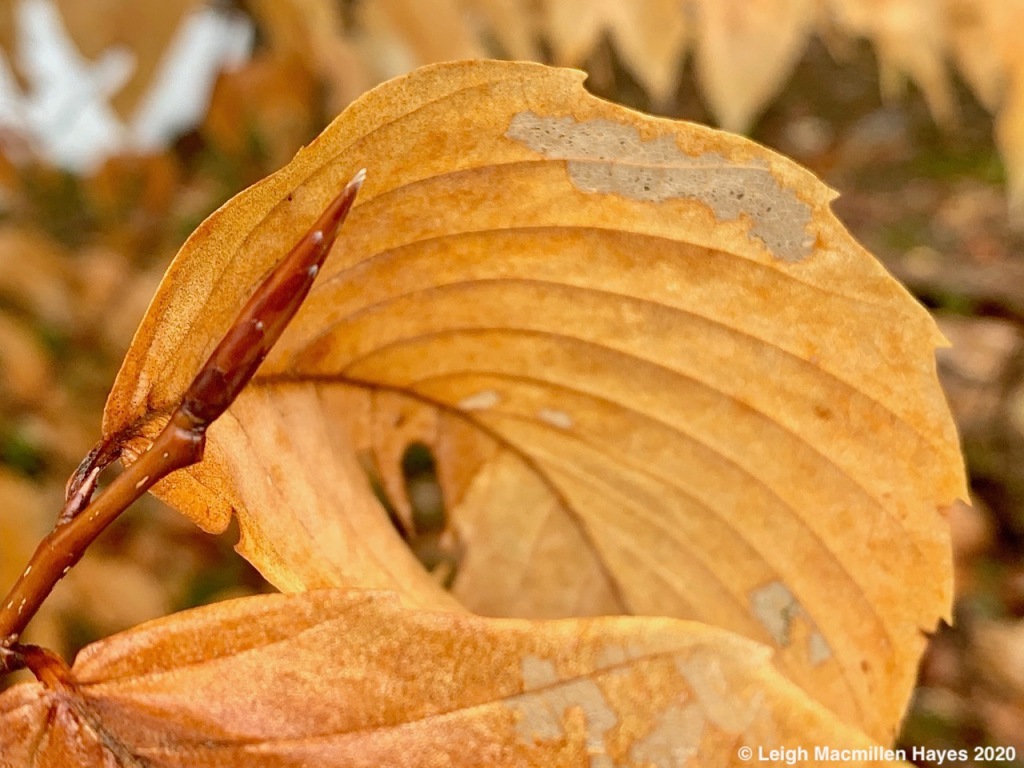
And then there was the beech leaf that arced in such a manner its veins mimicked rays of sunshine on a gloomy day.

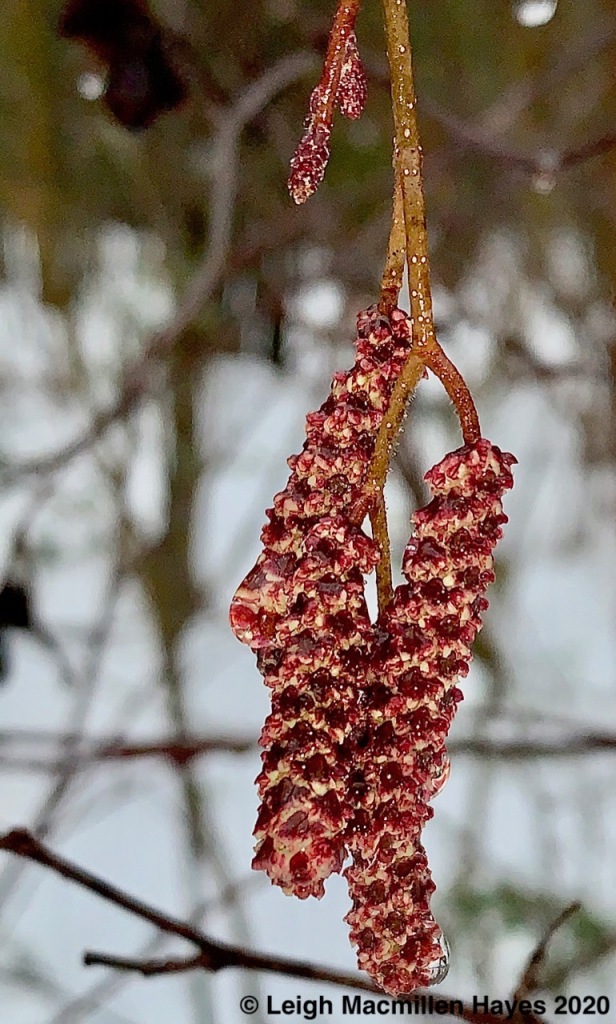
Speckled Alder catkins poured forth with their own presentation of color as they added more cheer to the landscape.

And Trailing Arbutus (aka Mayflower) buds, like all others, provided a sign of hope that the future will arrive.

Beside Bradley Brook, an Eastern Hemlock held a raindrop-in-waiting, its gift from the sky soon to be transferred back to the place from whence it came.

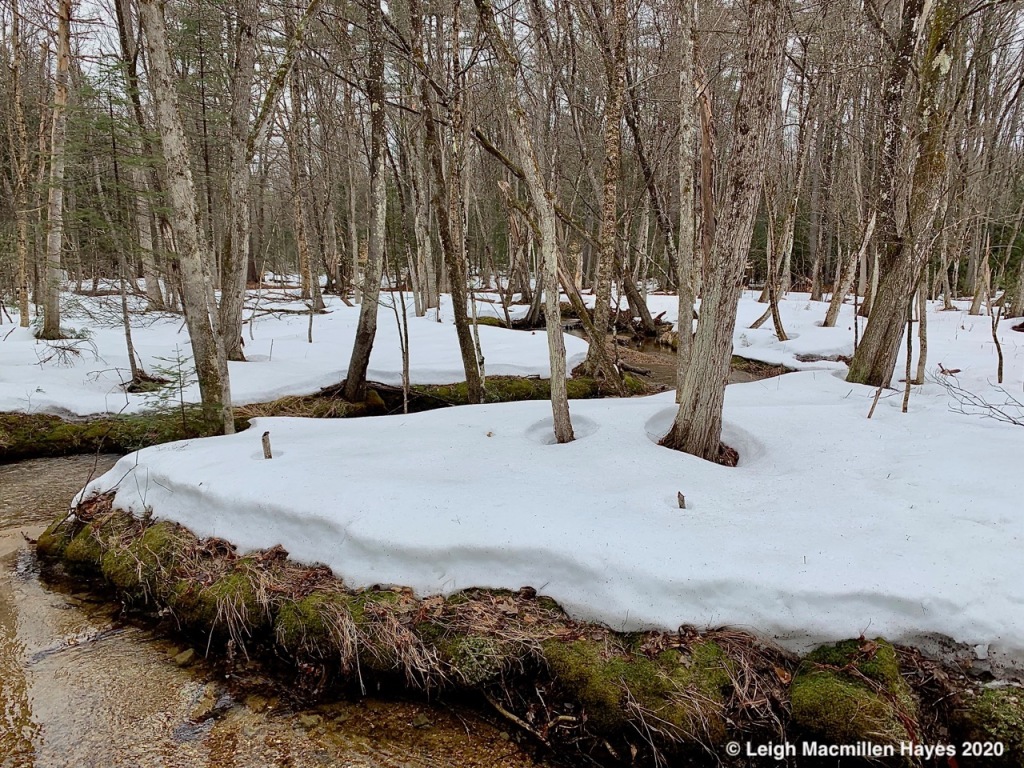
The brook flowed forth with a rhythm all its own and I rejoiced in its gurgles, temporarily forgetting the world beyond.

Eventually I followed it back, giving thanks for all its meandering curves in hopes that we will all be able to continue to enjoy life around the bend.

Today dawned a new day, and a much brighter one at that, and so my truck made its way to the other trailhead along Farrington Pond Road. The parking lot wasn’t plowed this winter and so I tucked into the edge.

Lost in thought, the sight of a fruit still dangling on a Maple-leaf Viburnum pulled me back to reality.

One of my favorite places on this property isn’t along an actual trail, but rather its one folks can easily find on their own. I prefer to think of it as the secret garden.

It offers views of Sucker Brook Outlet feeding into Kezar Lake’s Northwest Cove. But even more than that, it offers layers and colors and teems with life. Today I startled two Wood Duck couples who quickly flew off “oweeking” all the way.

Life in the secret garden includes three beaver lodges that reflect the mountains beyond.

And flowers like this Rhodora, waiting for their chance to burst into color beyond understanding.

Back on the Blue Trail, I discovered one small feather, so light and delicate and fluffy, and yet barbed, the better for all of its kind to interlock and protect.

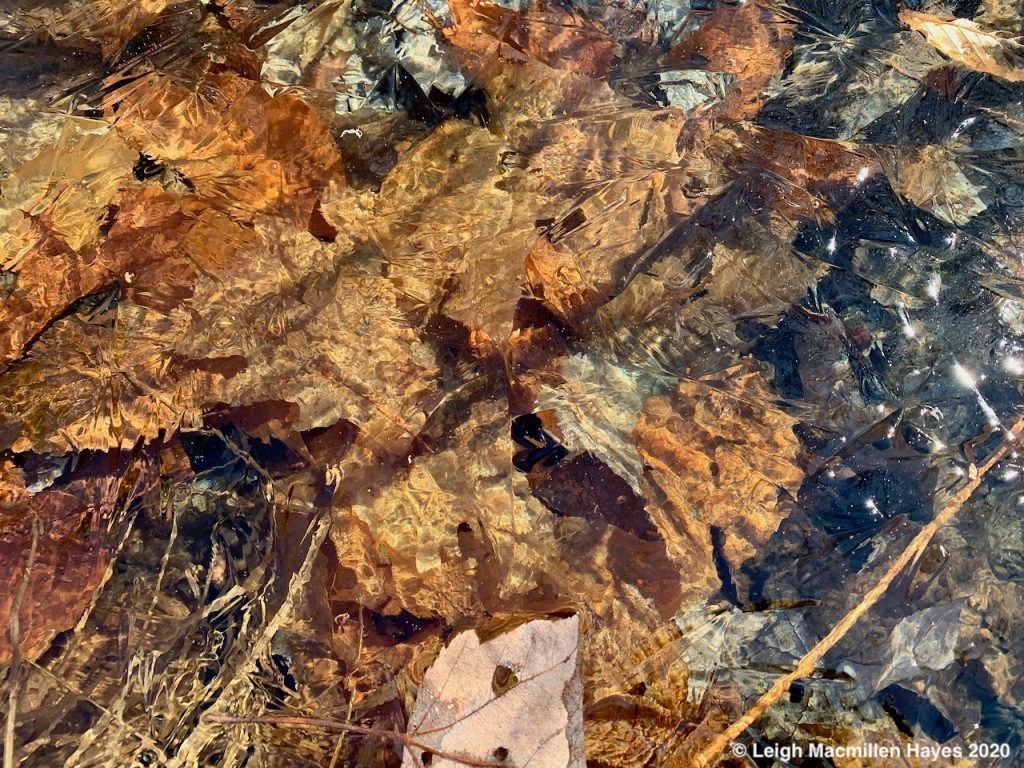
At a wet spot, the feather slipped from my mind and I marveled at the thin layer of ice that transformed the watery display.

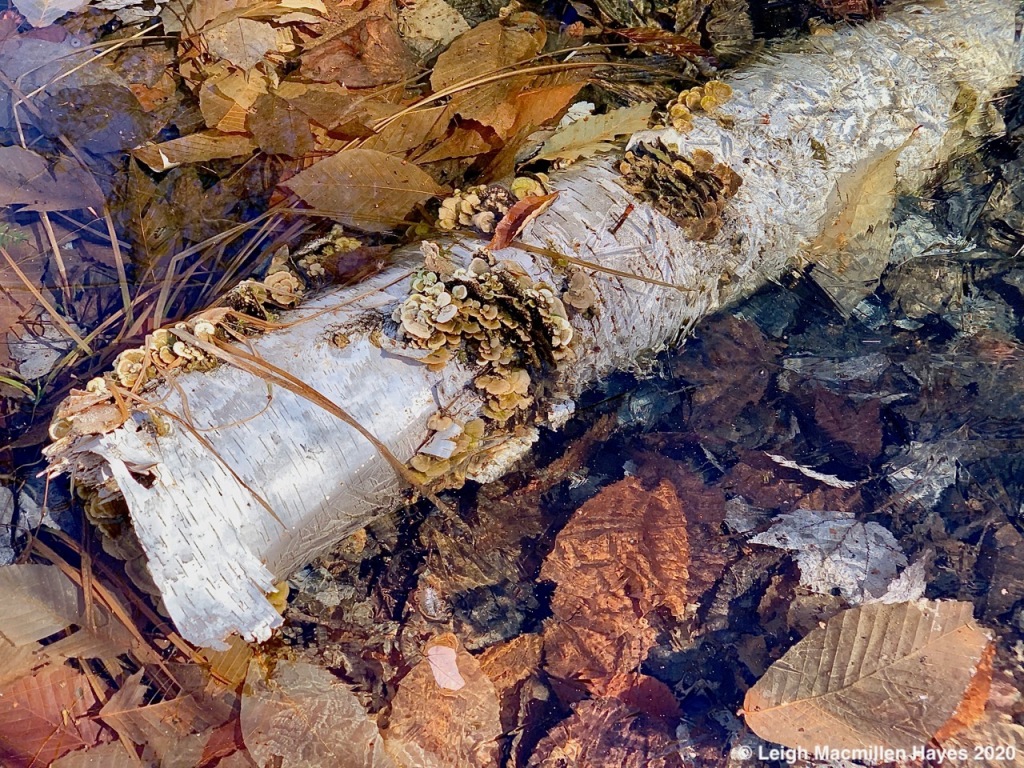
Within the puddle, a broken Paper Birch trunk showed off the fact that even in death, life continues.

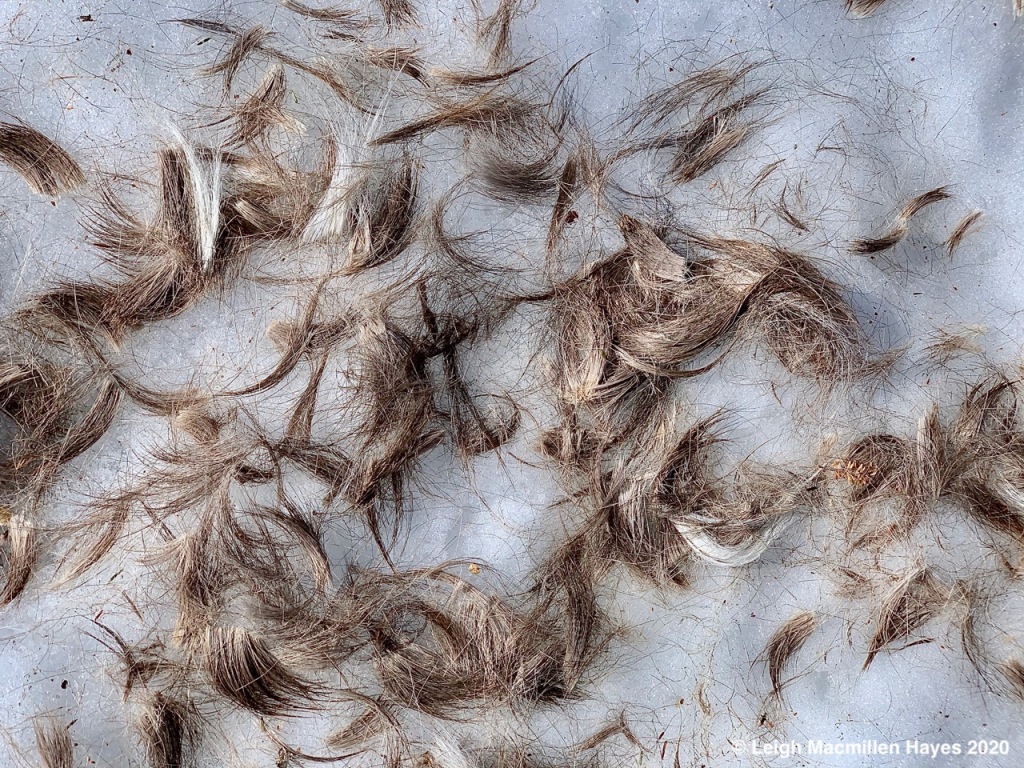
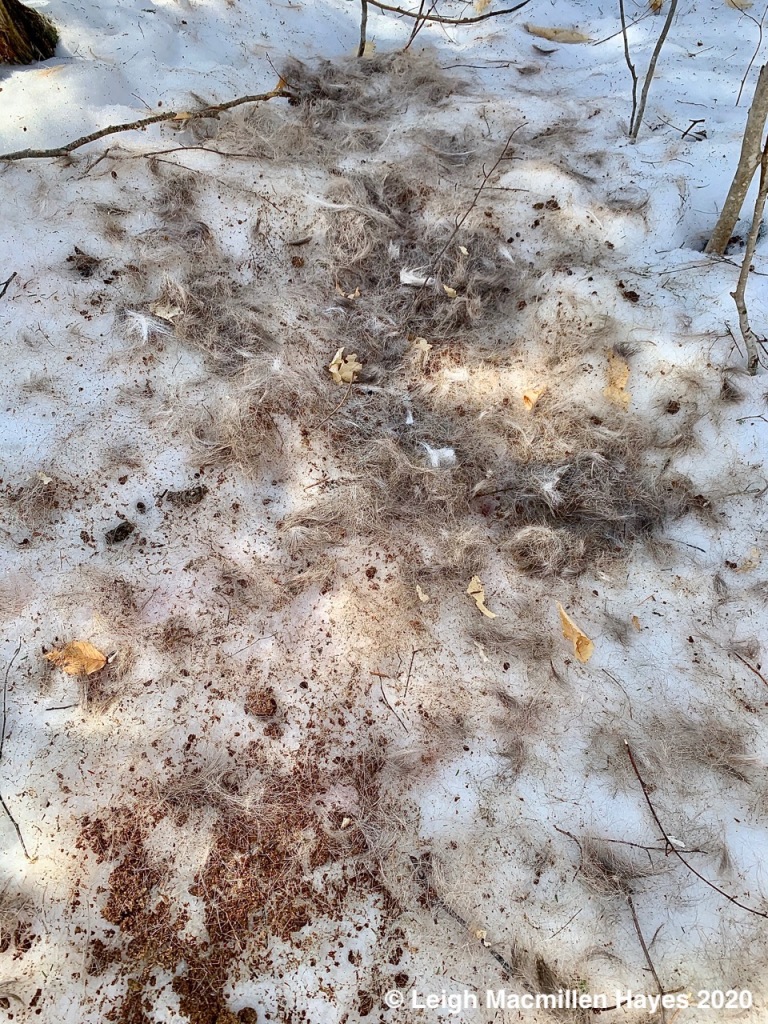
And then I met death. At first, I thought it was a scattering of more feathers.

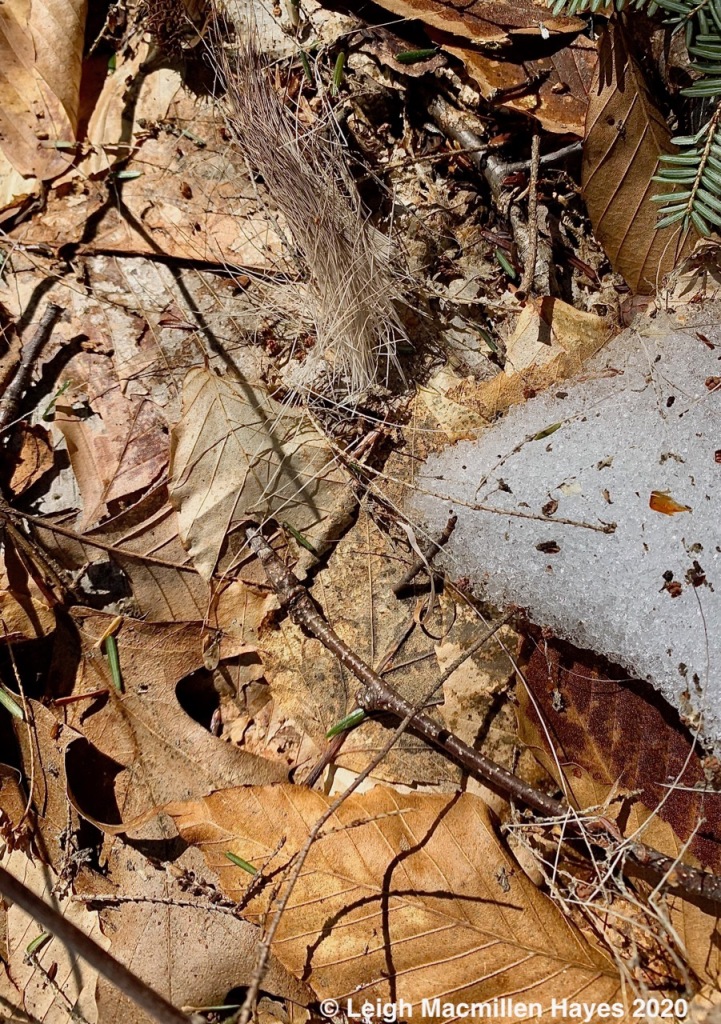
That is, until I bent down and realized it was deer hair. Had the deer shed its winter coat?

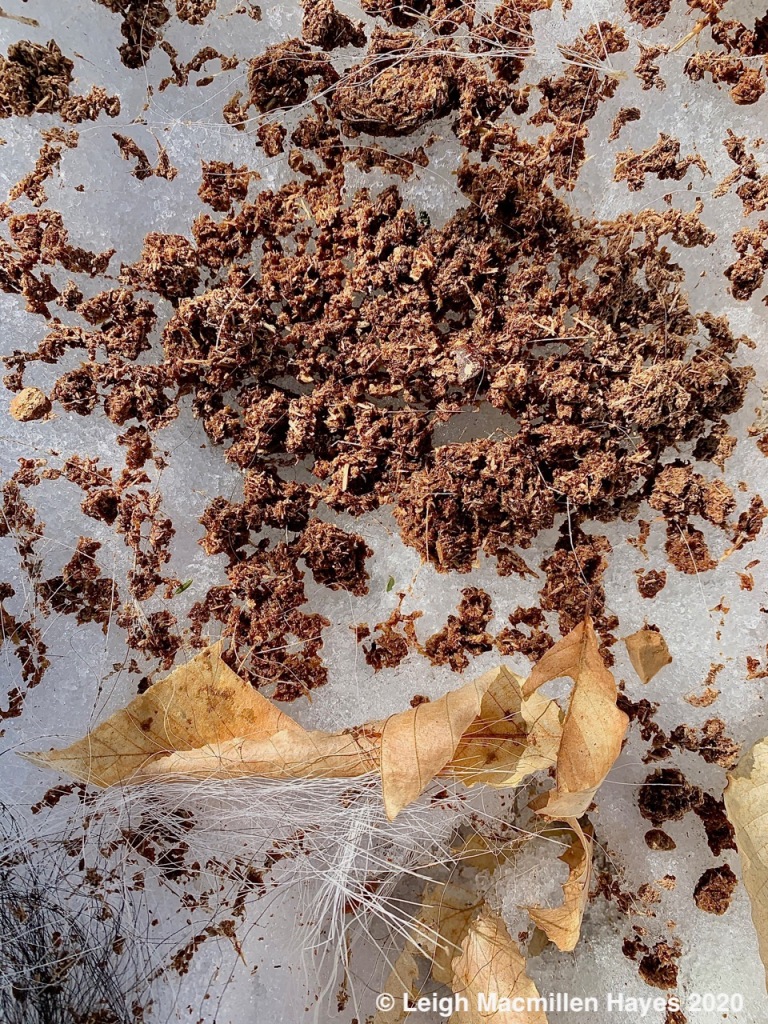
That was my first thought until I spied this. Do you know what it is?

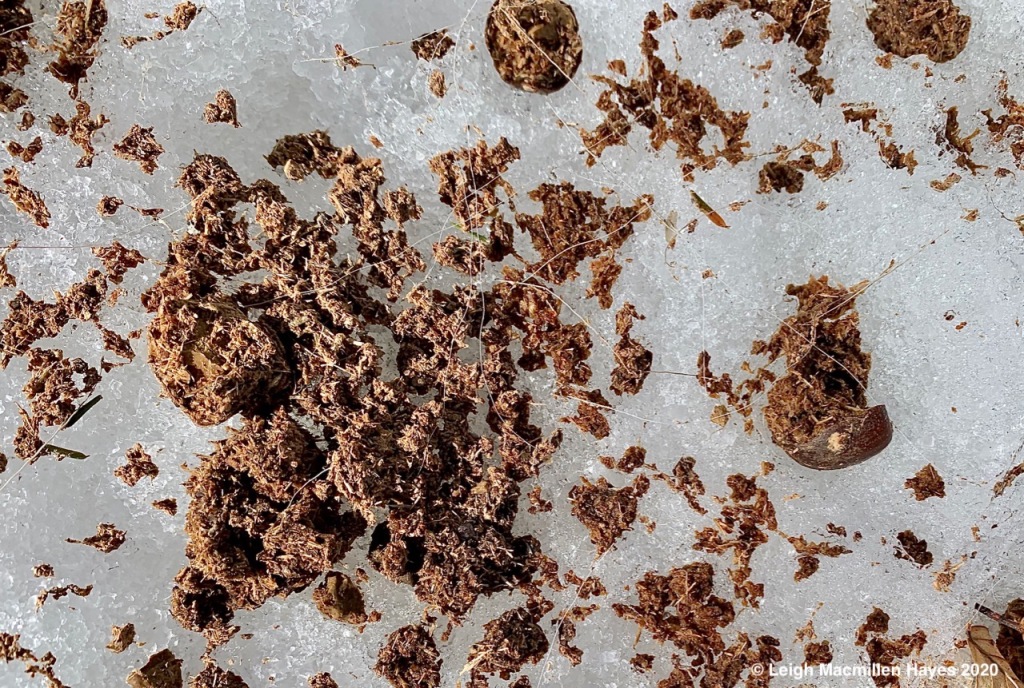
I hope I’m not disgusting you, but I found it fascinating. As best I could tell, it was the contents of the deer’s rumen or first stomach chamber.

And what exactly were the contents? Acorns. Can you see a few shells not quite digested?

Beside all of that was some scat filled with hair and a chunk of something.

And just beyond, more rumen offerings and then an even larger area of deer hair.

As best I could, I tried to piece together the story. Earlier on the trail i’d seen what I thought were bobcat prints until the behavior didn’t quite match for a bobcat wouldn’t follow the entire length of a trail and the presentation seemed to morph into coyote.

I searched high and low for a carcass, but found none. Nor any blood.

What I did find was more deer hair as if something had circled around a tree.

But the curious thing: there were lots of downed branches but none of them were broken. If a coyote had dragged a carcass, surely there would be blood and guts and broken branches. My wondering began to focus on a human. Some of the twigs were on top of the hair so the incident would have occurred at an earlier time? And perhaps all of this had been hidden by snow for a while? And then recent rain events obliterated some signs?

I may never know the answers, though I’ll return to look for more evidence. About a quarter mile away, I did find more proof that a coyote had dined on something quite hairy. It included a big chunk of bone.

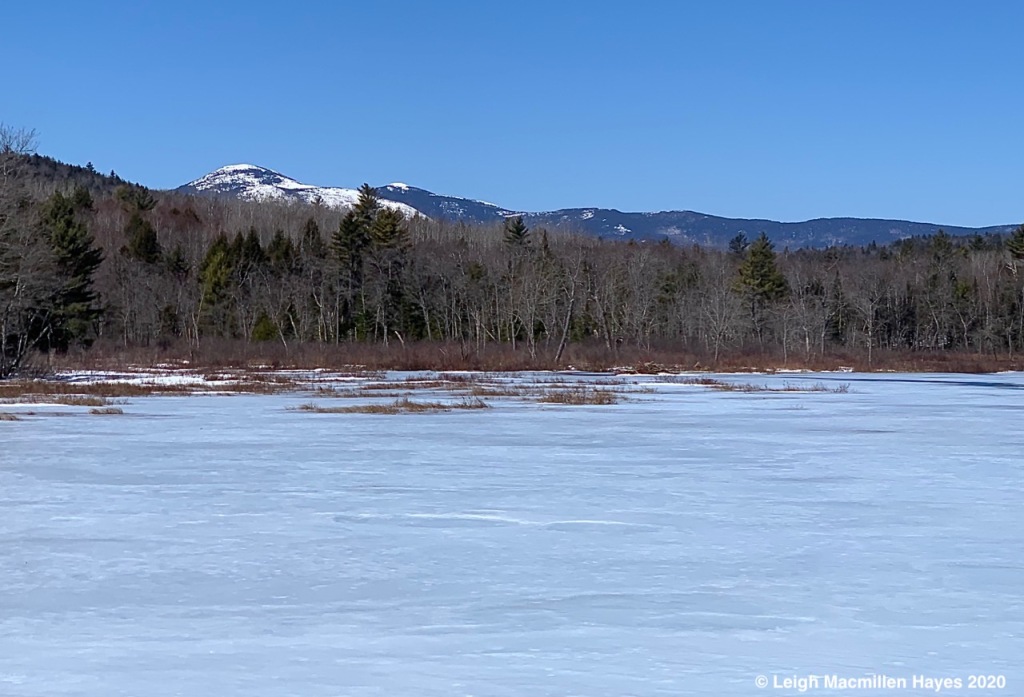
For those wishing I’d get back to the prettier scenes, my tramp eventually took me to a lookout point, where the backdrop was provided by the Bald Face Mountains in Evans Notch.

And the foreground included another beaver lodge.

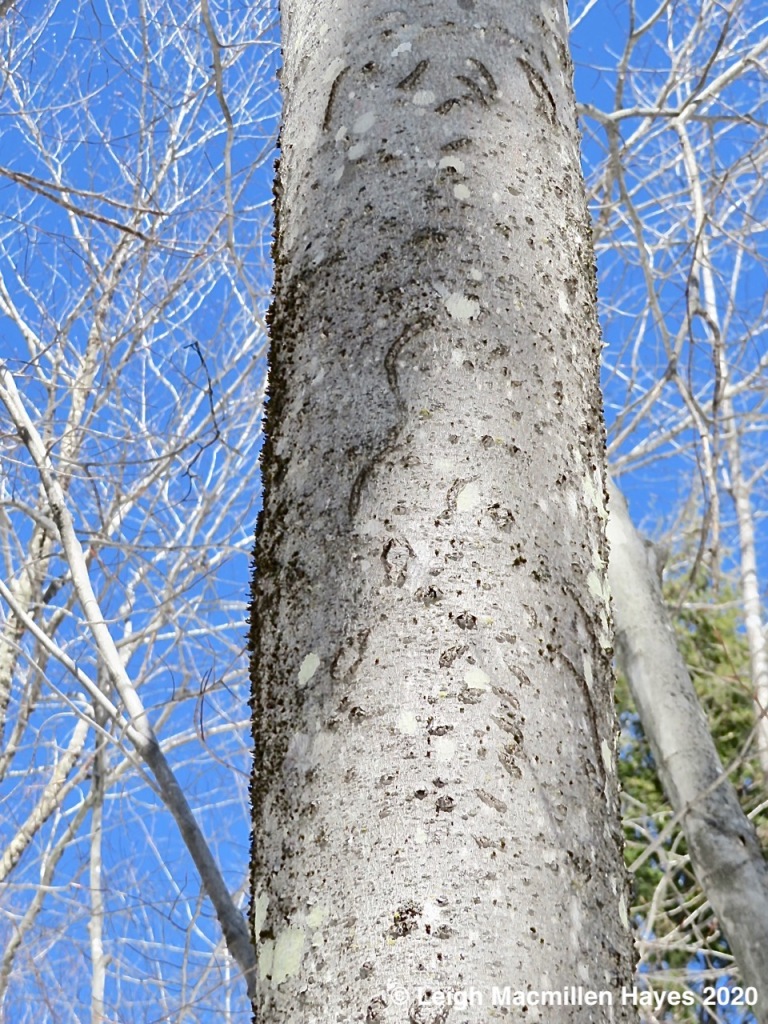
Eventually I turned around and followed the Green Trail out, stopping to pay reverence to a Bear Claw tree. With the scars being gray/black and at least a half inch wide, I’d say these were created more than seven years ago. In fact, I know that for I’ve been visiting that tree for far more than seven years. But . . . it never gets old.

Nor does the sight of ice as it turns anything into a pleasing-to-my-eyes work of art.

I’m grateful for the opportunity to sneak away and even though I had a work project on my mind, these trails have been my greatest escape so far. May you also find escapes of your own making.