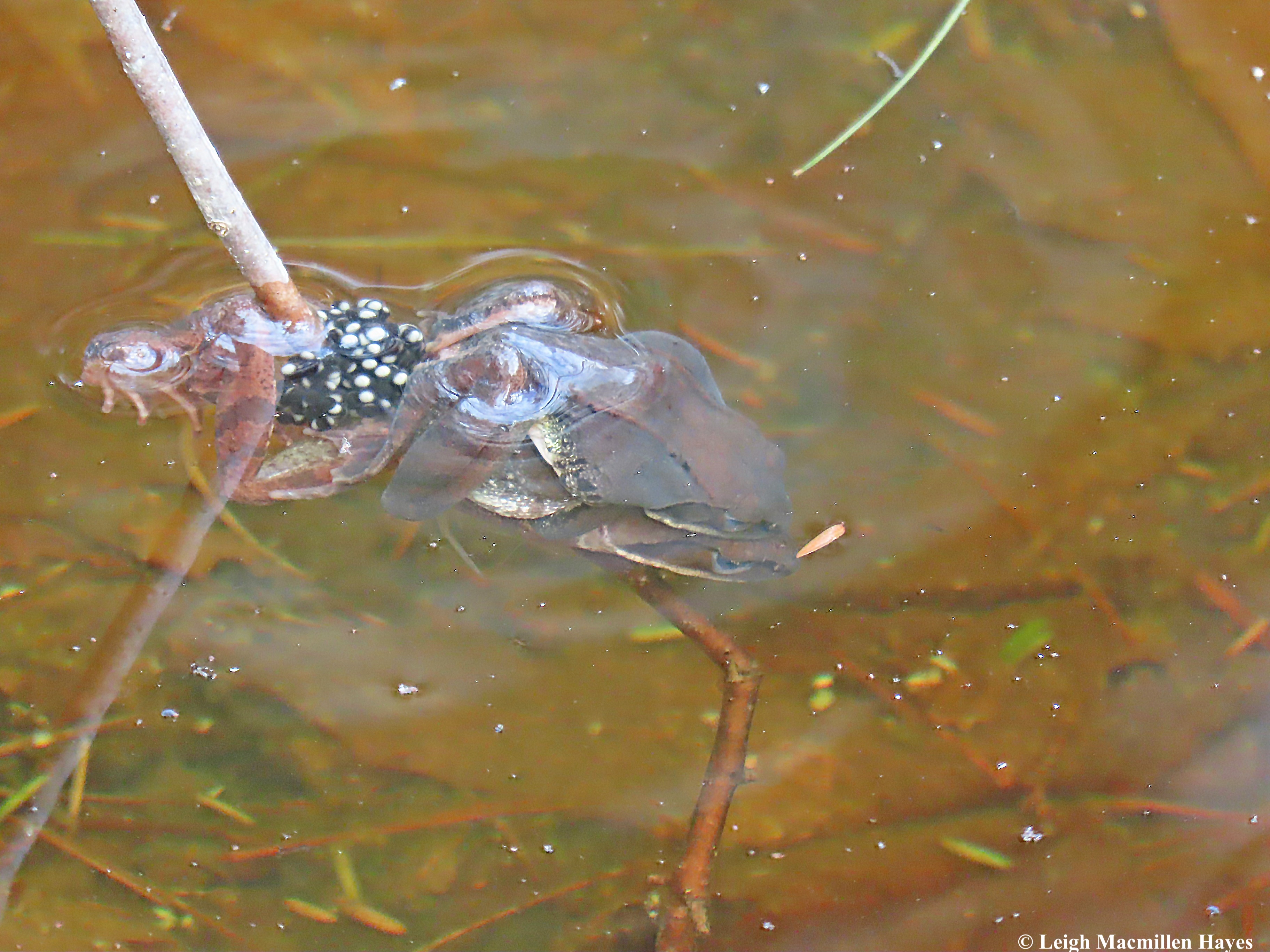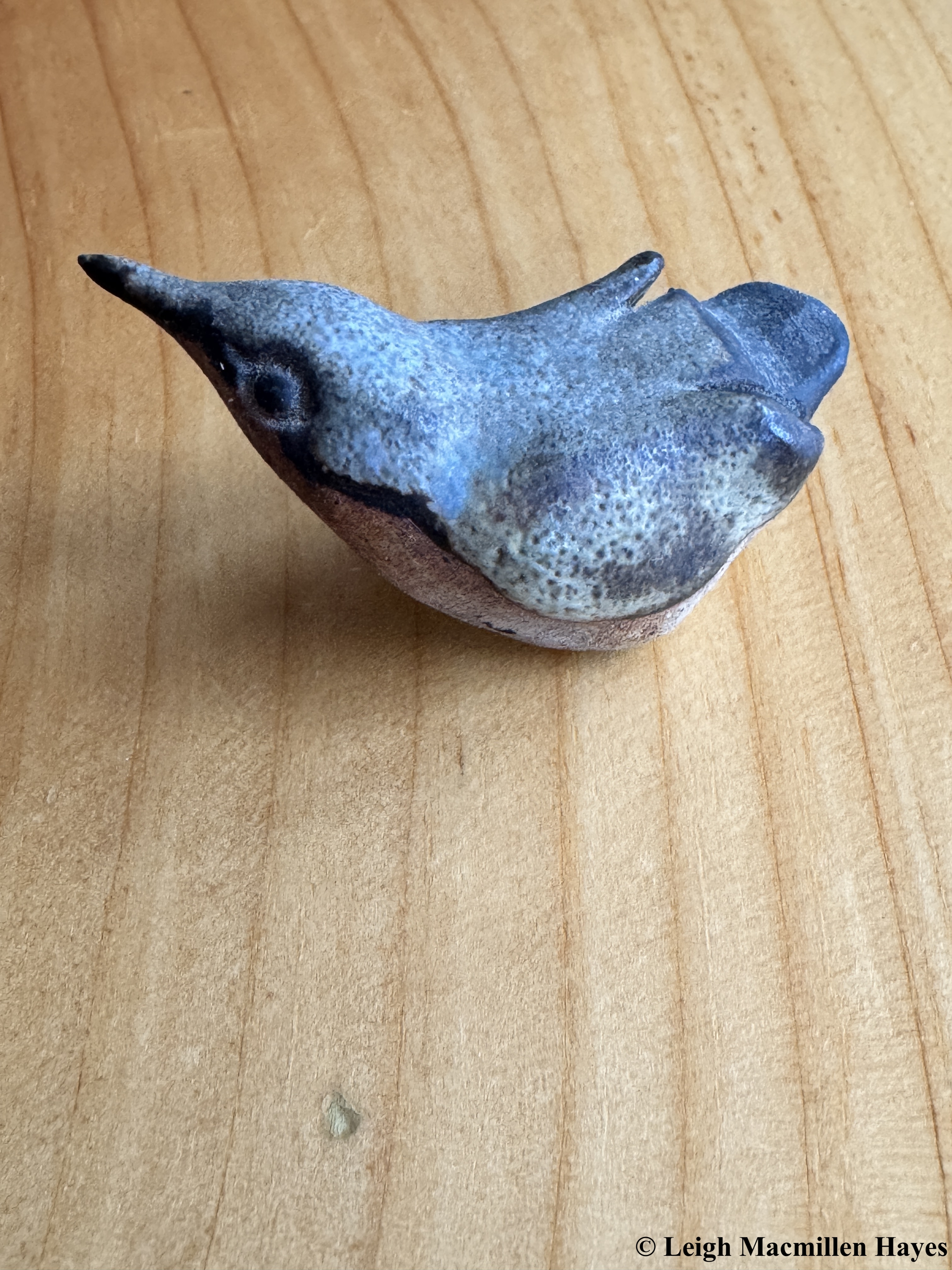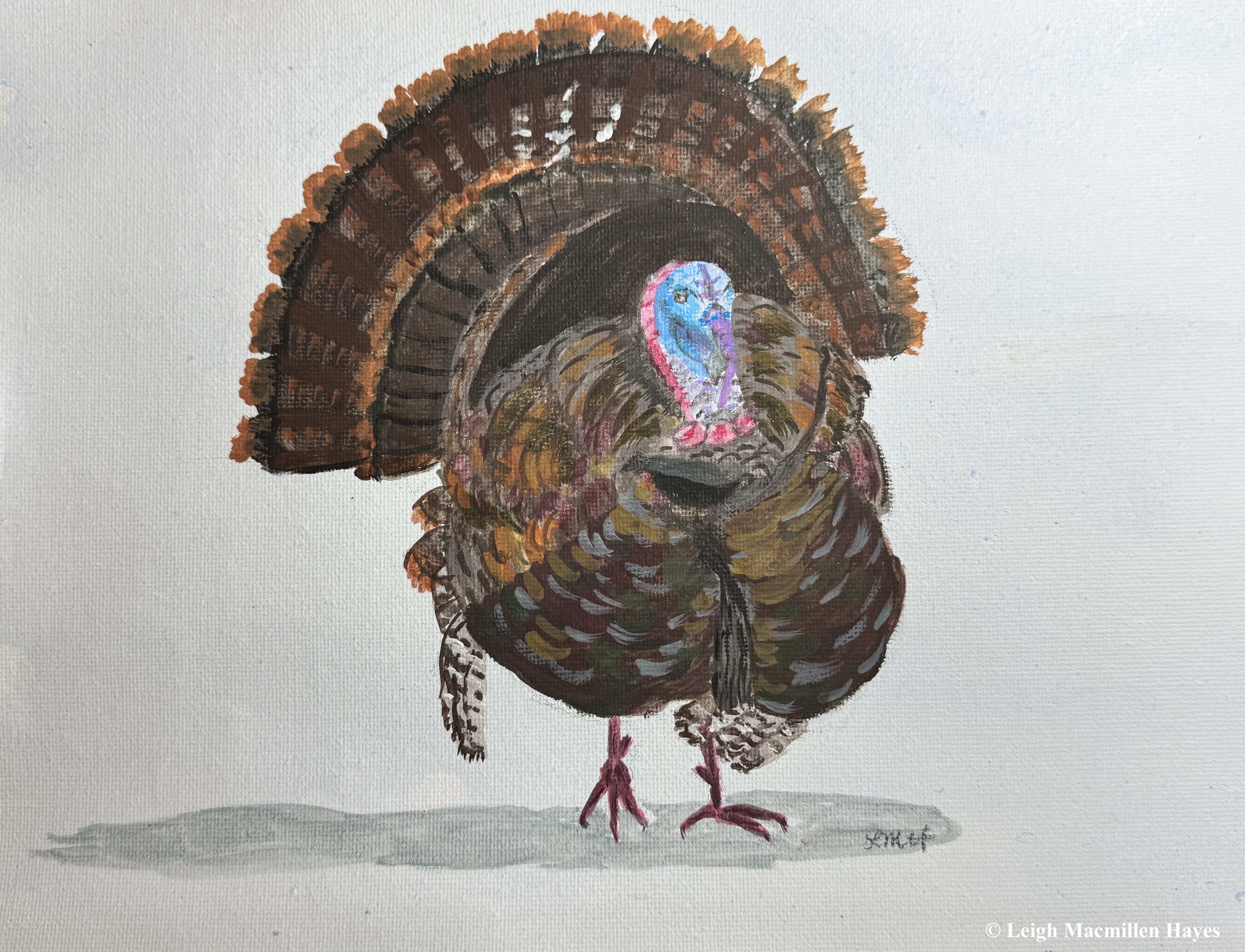
On the Cusp of Autumn

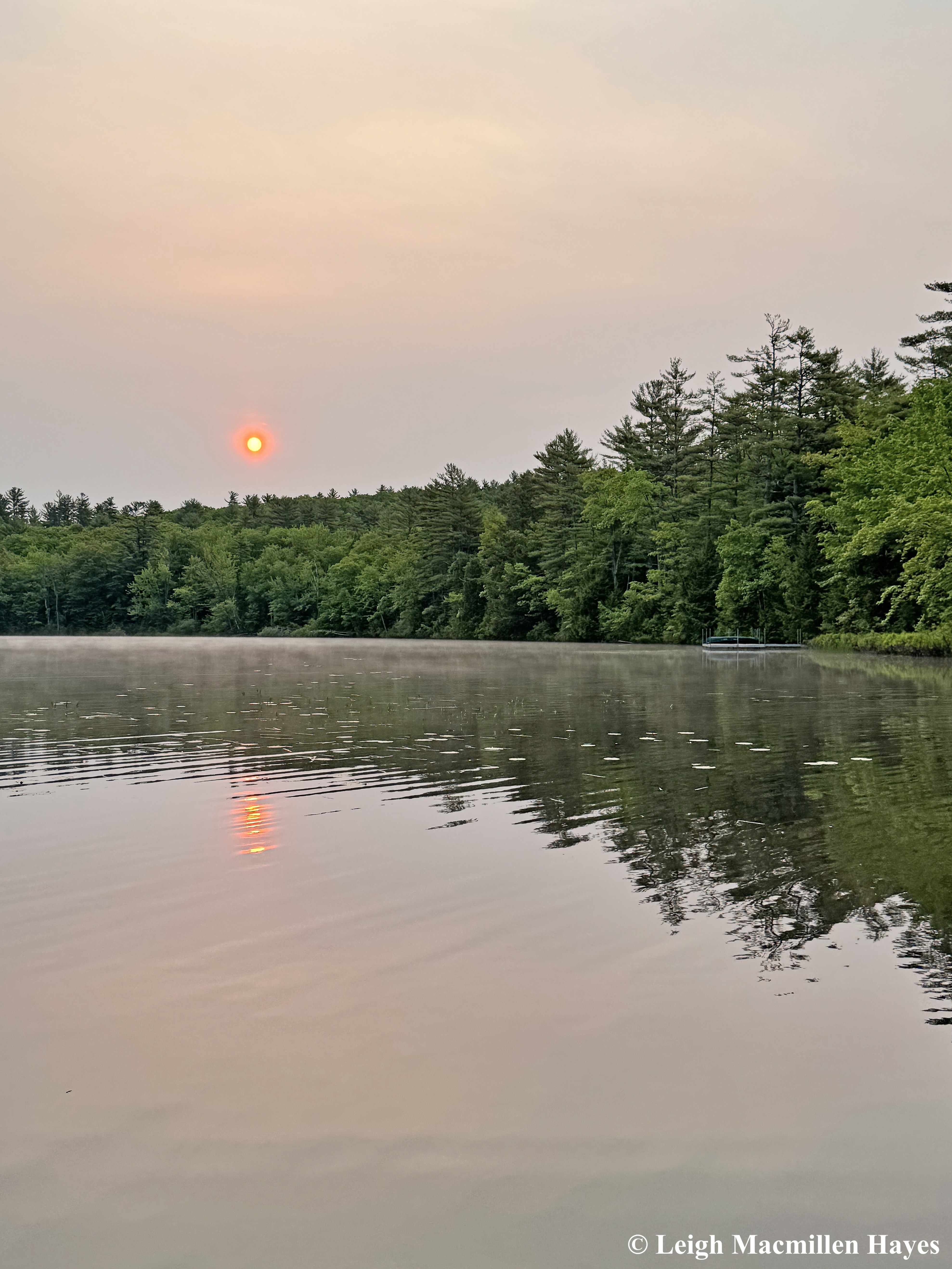
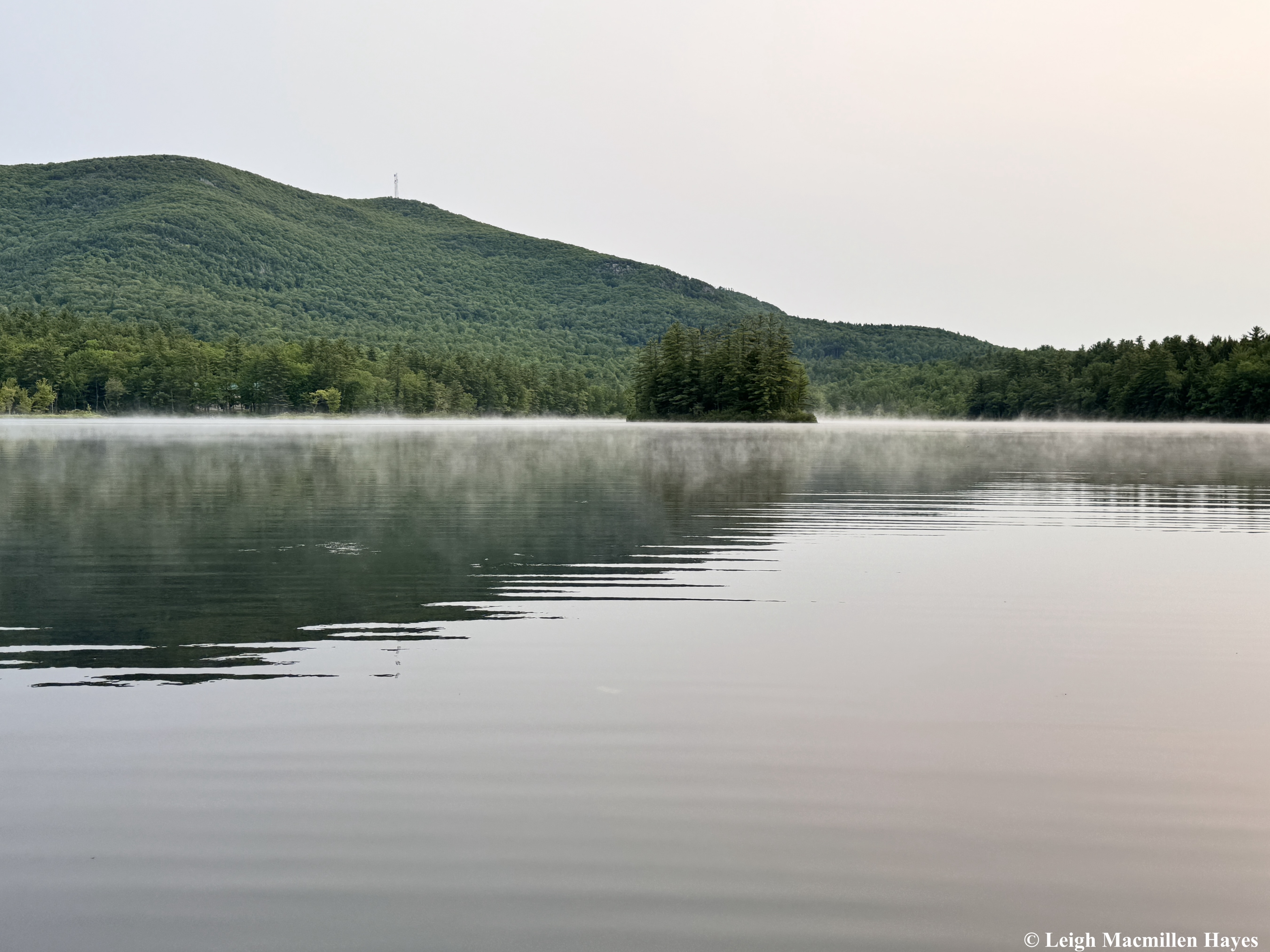
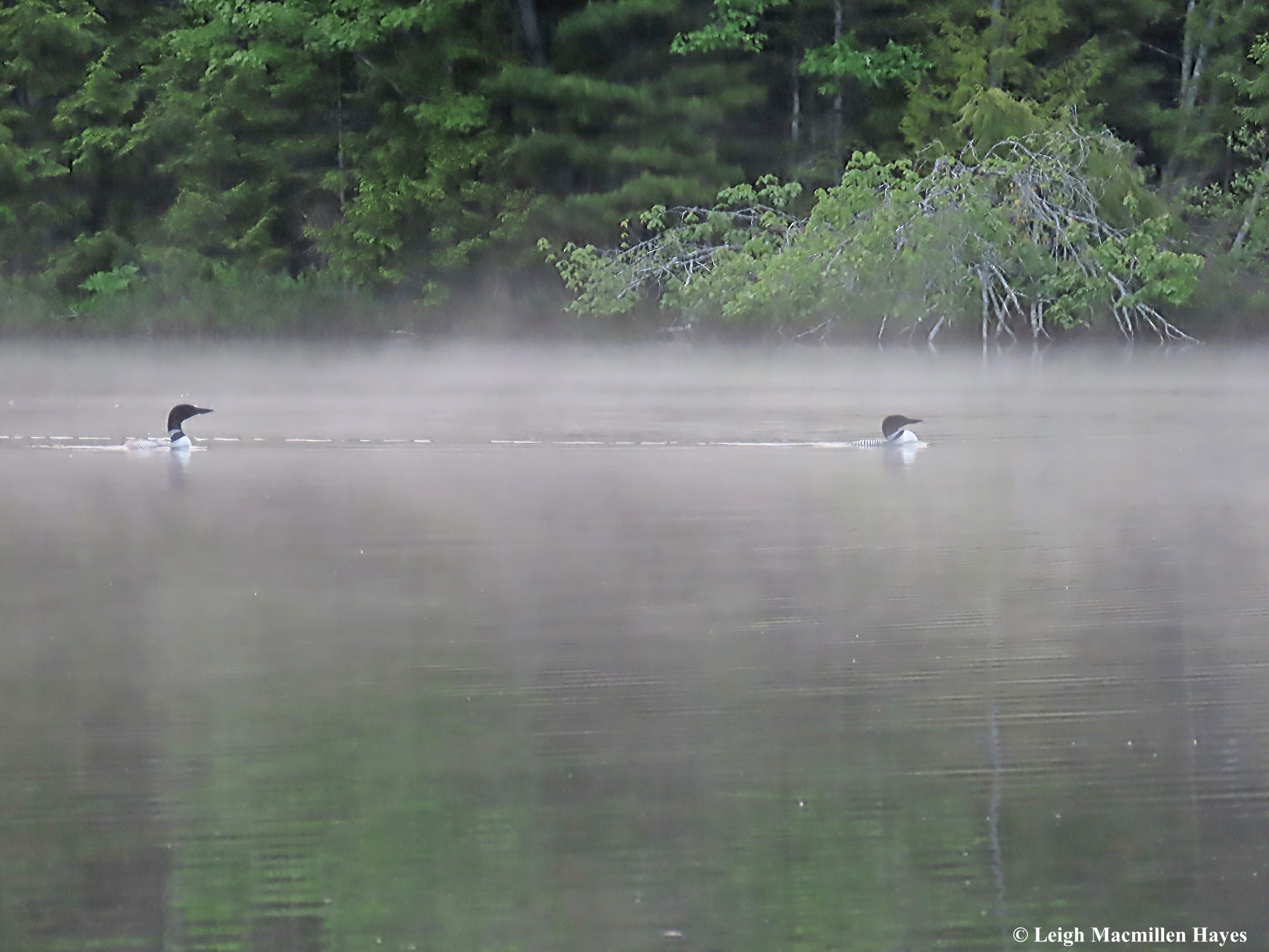
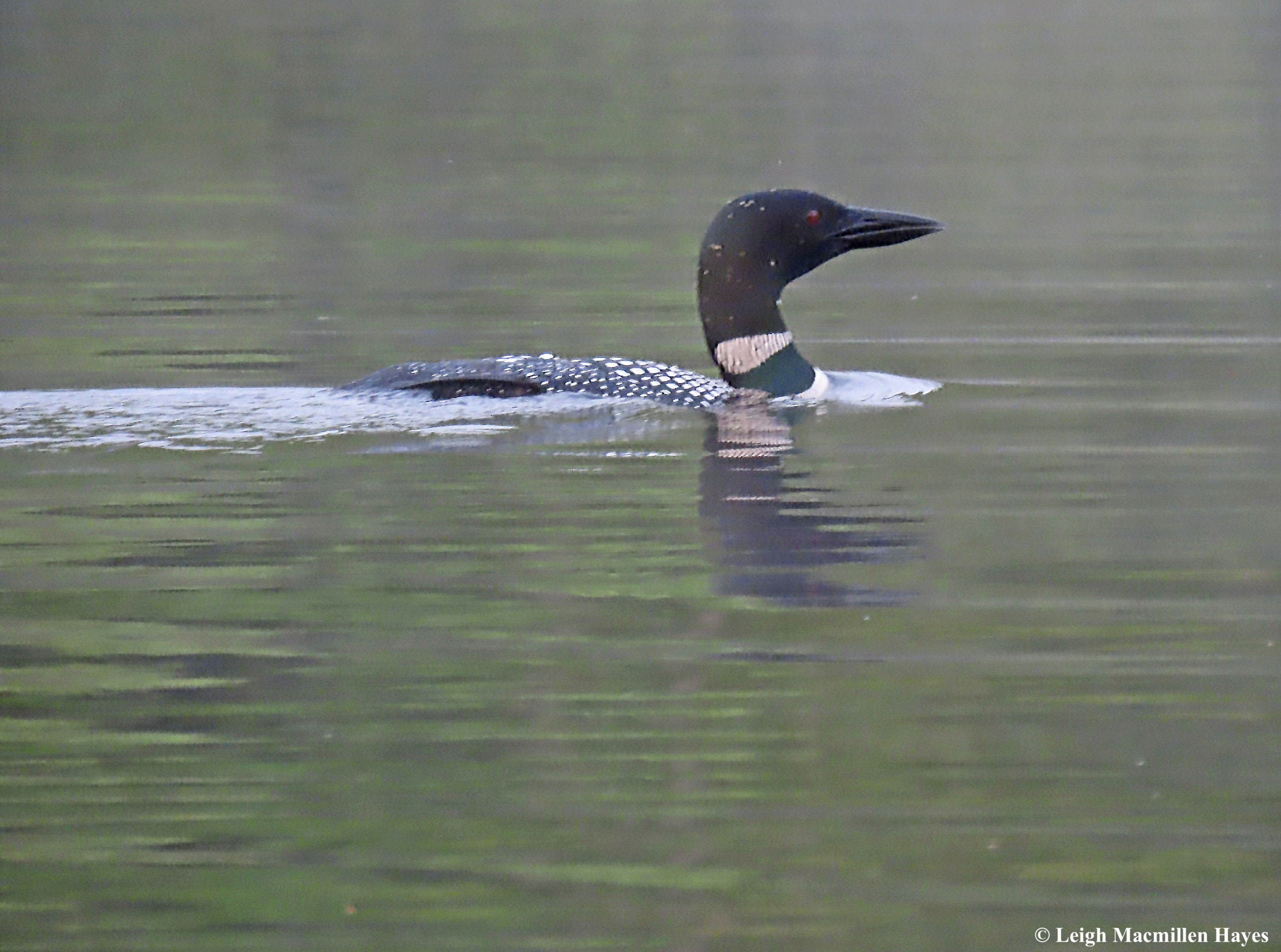
It occurs every year, autumn that is. But this year it hasn’t even started and already feels different. In the past week, My Guy and I have followed many a trail or waterway, both on foot and by sea, oops, I mean kayak on local lakes and ponds, and every offering has been unique.

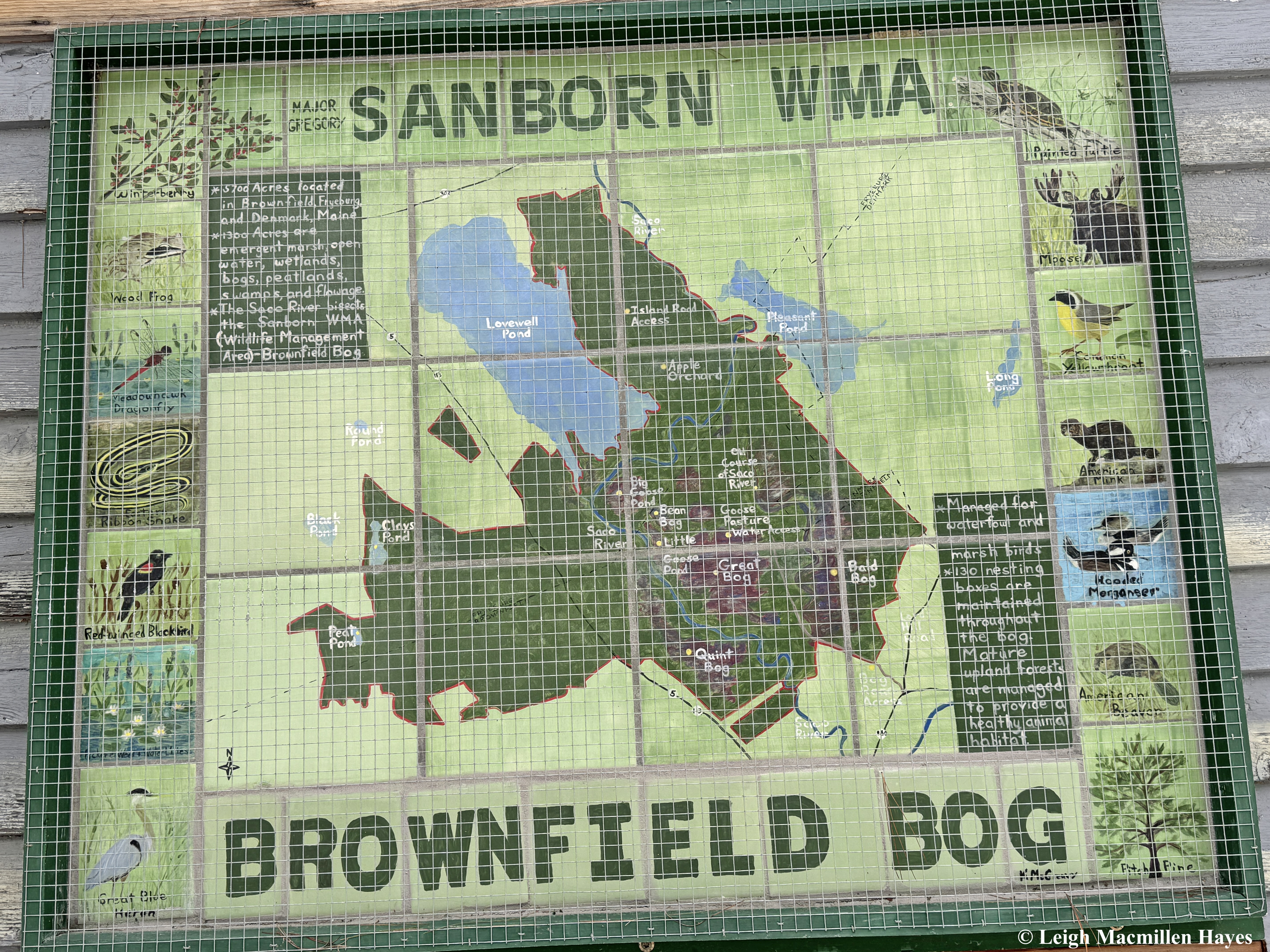
Some, such as this, being Brownfield Bog as we locals know it, or Major Gregory Sanborn Wildlife Management Area as the State of Maine knows it, took us by complete surprise. The last time we’d wandered this way together was in the spring, when despite wearing Muck Boots, we could not travel some parts of the trail because the water was so high. That was in the Time-We-Actually-Experienced-Rain. That time has long since passed and now western Maine is in a severe drought and don’t the Lilypads know it. What about all the mammals and birds and insects that depend on this water? It was an eerily quiet walk in a place that is usually alive with action.

Where the Old Course of the Saco River crosses through the bog, there was some water. But still, not enough. And we know of other areas of the Old Course, such as in Fryeburg Harbor, where there is no water.

As for the Saco, it too, was incredibly low and sandbars were more the norm.
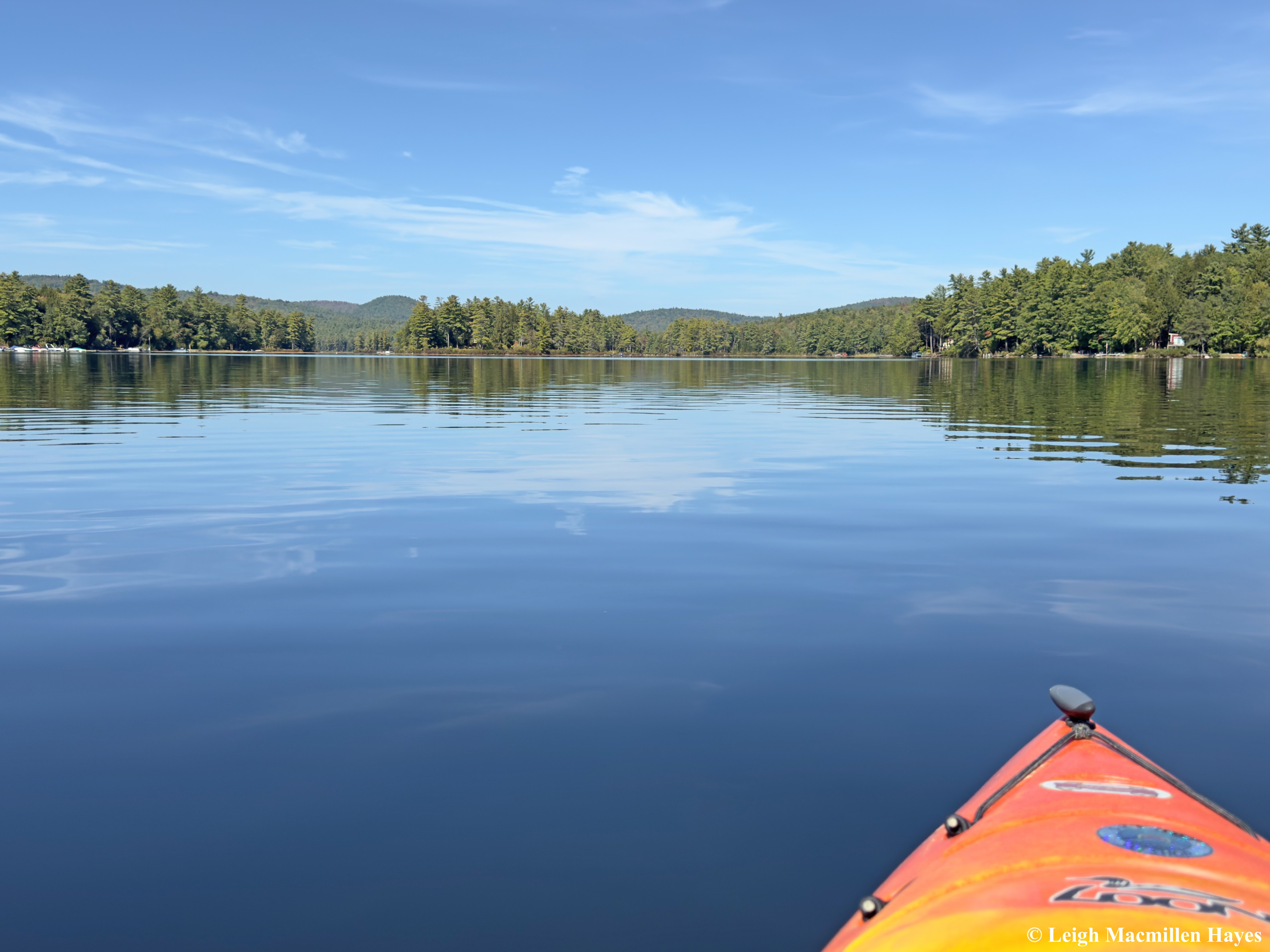
Other adventures found us paddling our favorite pond.
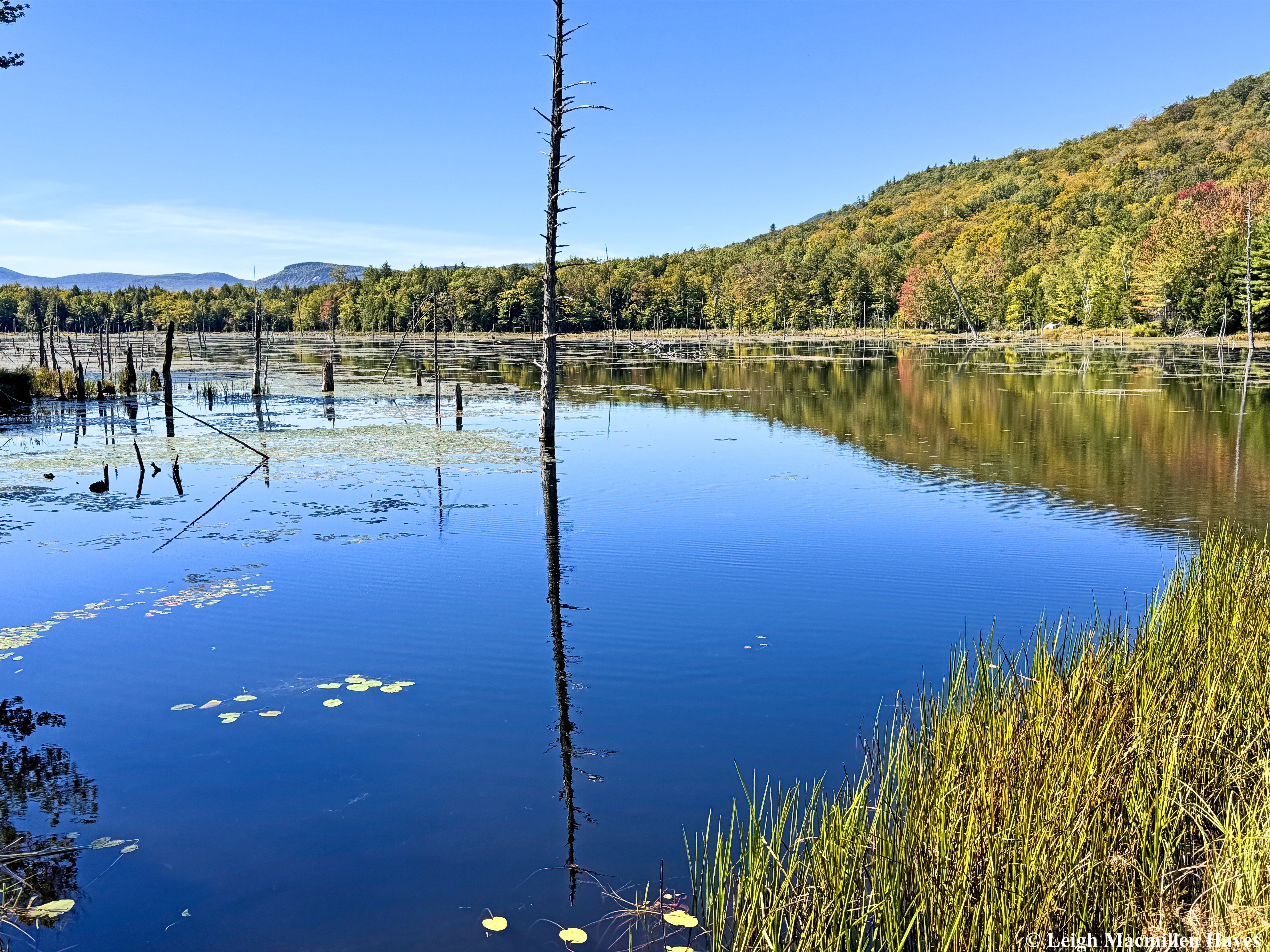
And bushwhacking around another bog.

What kept making itself known to us–the fact that the trees are turning much too soon, and many leaves aren’t even turning, but rather drying up and falling.

That meant that some paths or bushwhacks found us crunching the dried leaves with each step we took. We could hardly sneak up on a Moose or a Bear, or even a Squirrel.

Despite such dry conditions, we did find the varied colors of Wild Raisins or Witherod drupes dangling in clusters below their leaves.
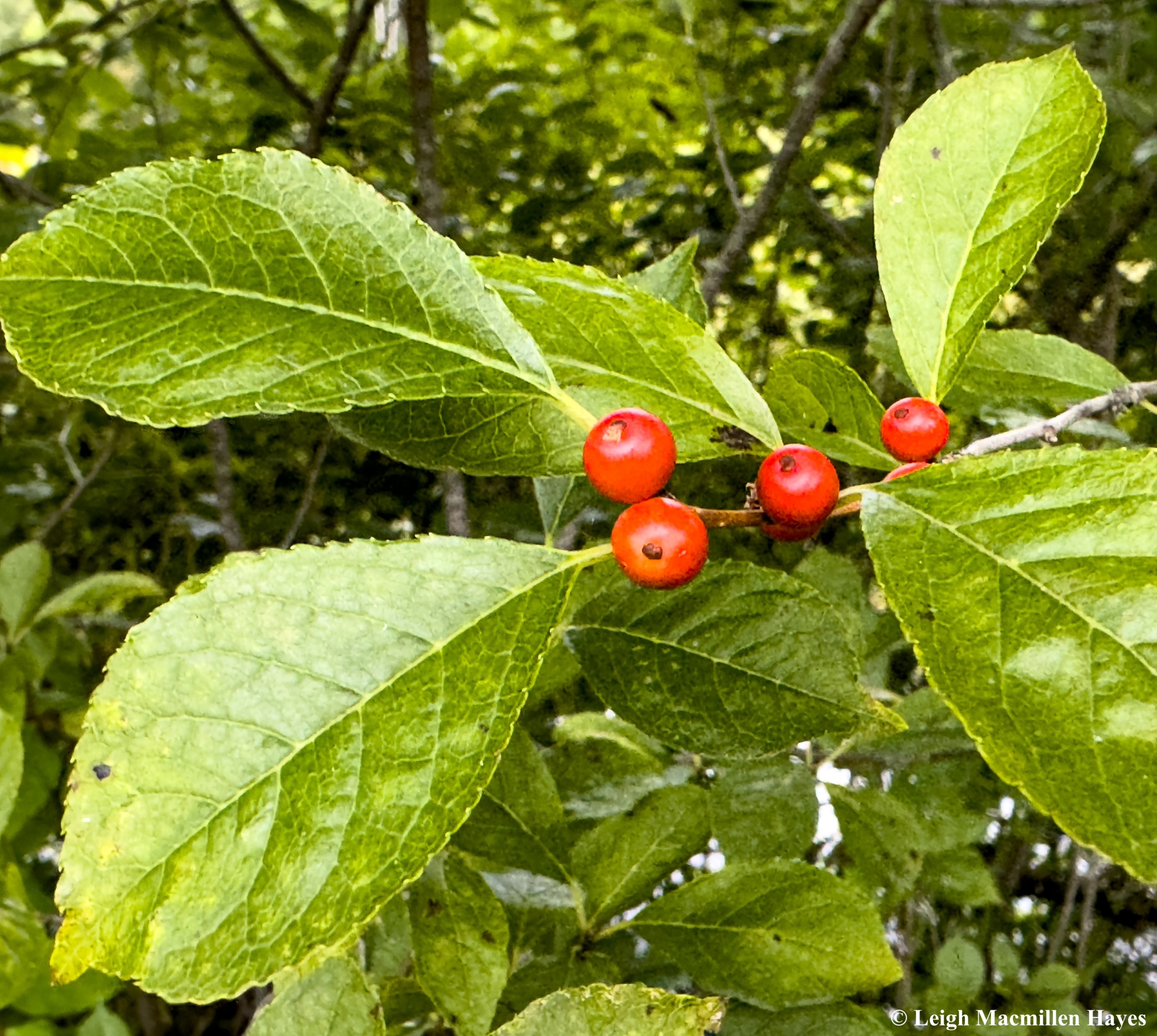
And Winterberries showing off their enticing red hues–ready to attract birds and maybe become part of our holiday decorations. Only a few branches for us, mind you. We leave the rest to the critters because we know their importance in the food chain.

Late summer flowers were also in bloom, including the brilliant color of the Cardinal Flower.

And in a contrast to the red, there were Ladies’ Tresses, a wild orchid, one of the few with a fragrance if you can bend low enough to smell it.

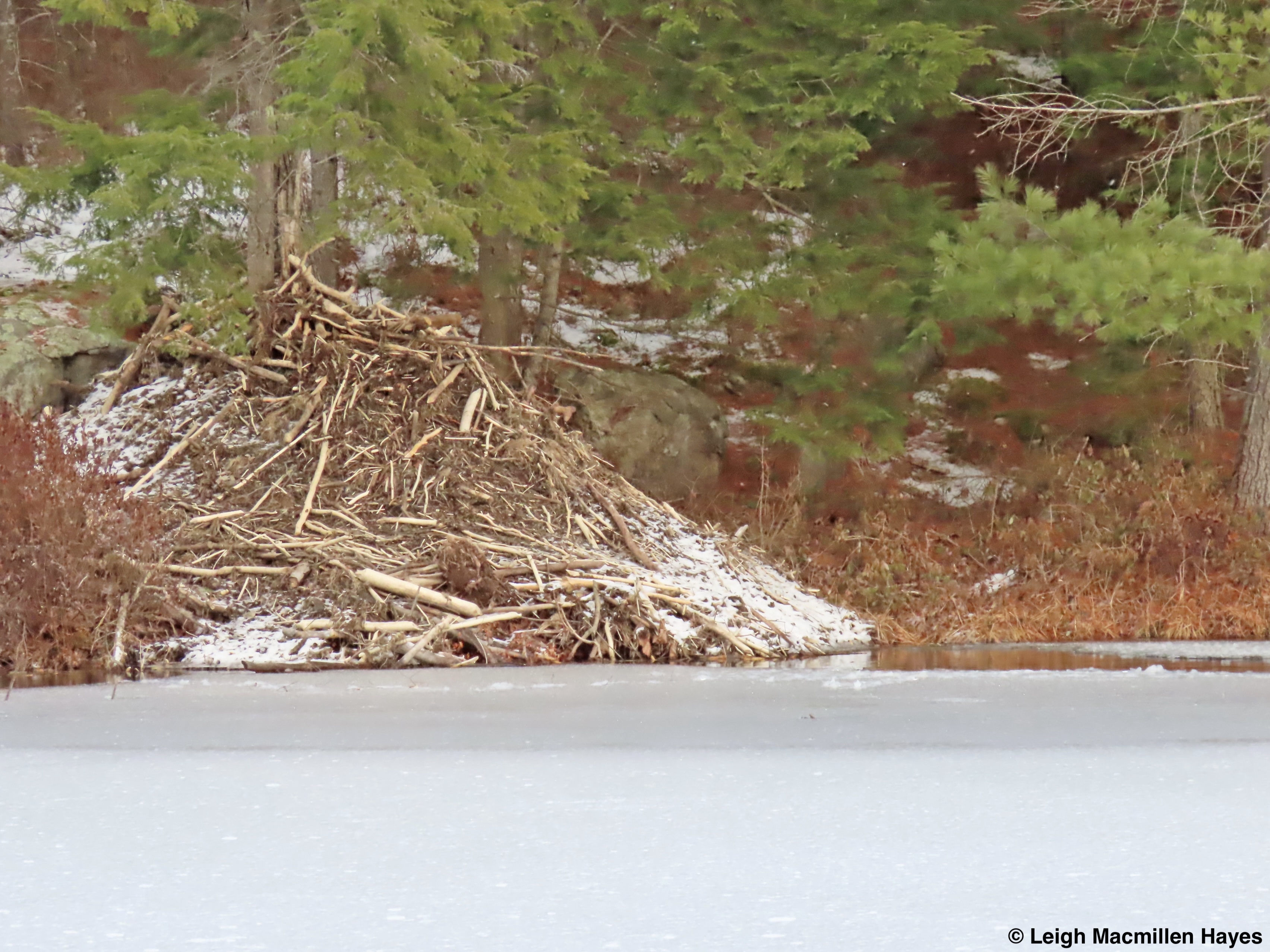
I think one of the greatest wonders is how many variations there are on a theme, in this case flowers for take a look at the Pilewort or American Burnweed, this one growing upon a Beaver Lodge.

What you are looking at is the flower heads: They are about a ¼ across and petal-less. The inner bracts, with their purplish tips form a ½-inch tube exposing just the yellowish to creamy white stamens at the top. And the seeds are teeny tiny, as you can see, with tufts of white hairs to carry them like parachutes upon a breeze.

Along one trail, we spotted another teeny tiny display that surprised us due to the fact that we haven’t seen many mushrooms this summer. But the Orange Peel Fungus apparently had enough moisture, at least to produce these two forms.

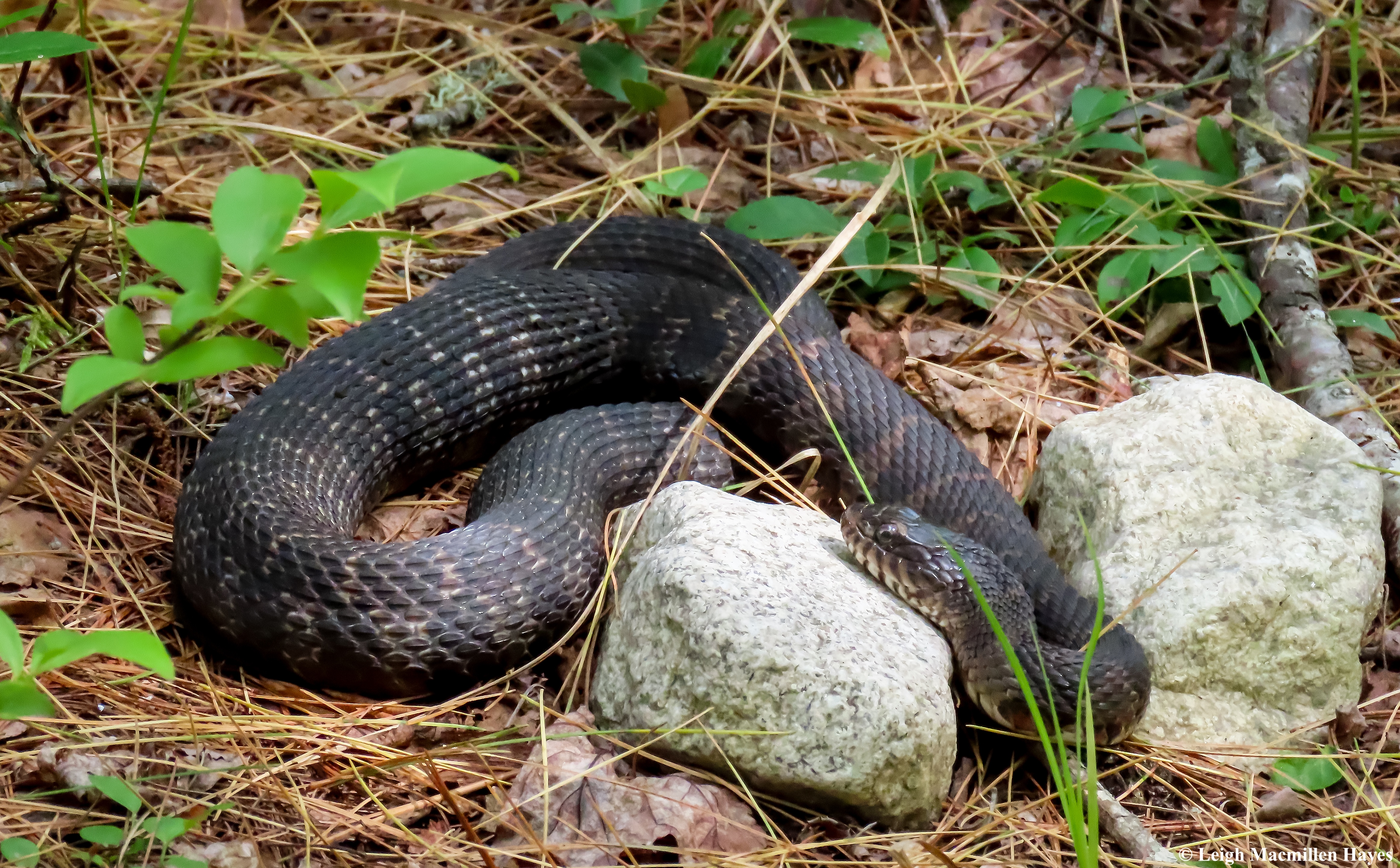
Critters were also a part of our sightings and several times we encountered young Northern Water Snakes, not more than two pencils in length.

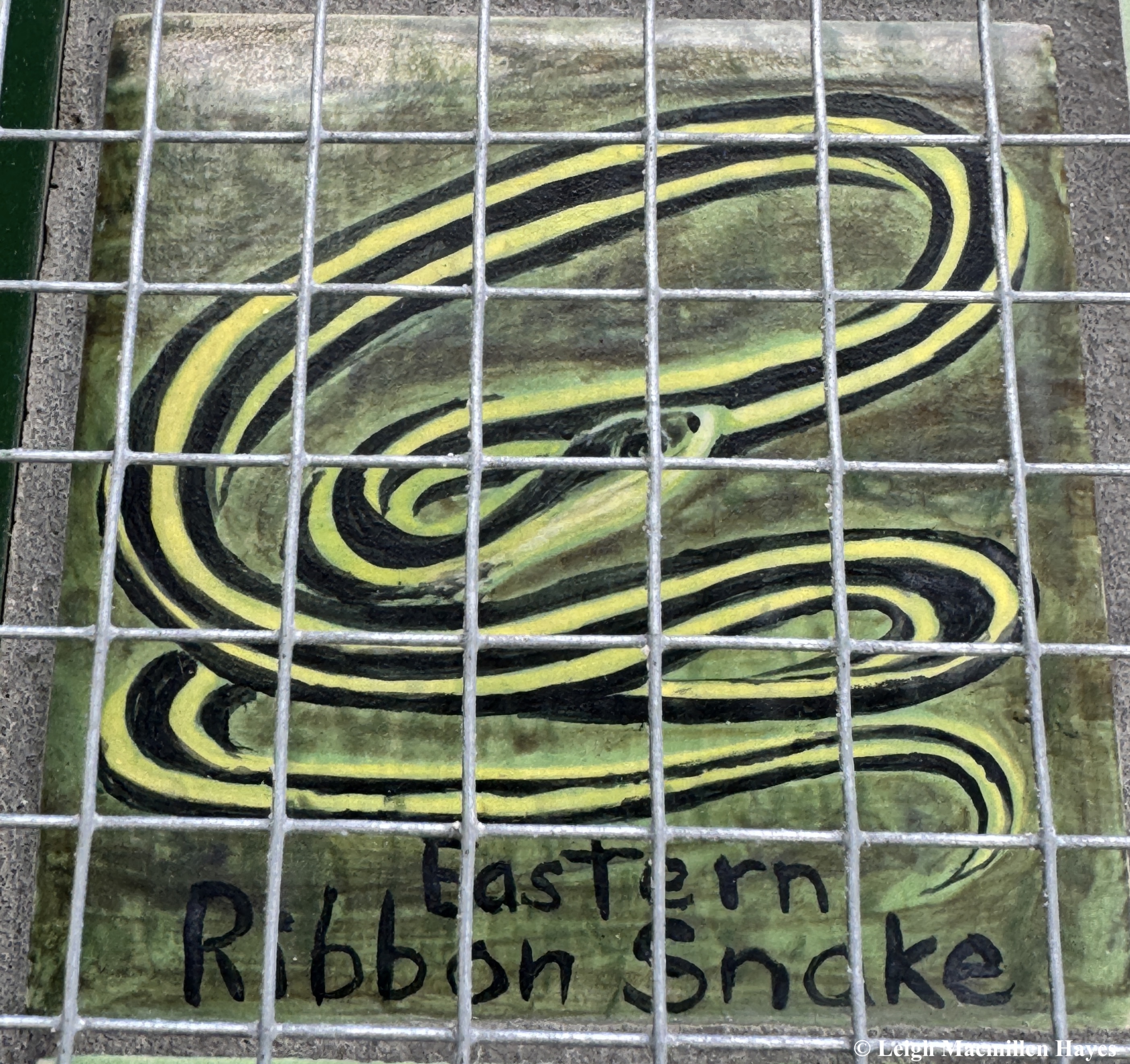
In another spot where we expected to see Water Snakes, we instead met a Garter. Mind you, none of these wanted to spend any amount of time with us.
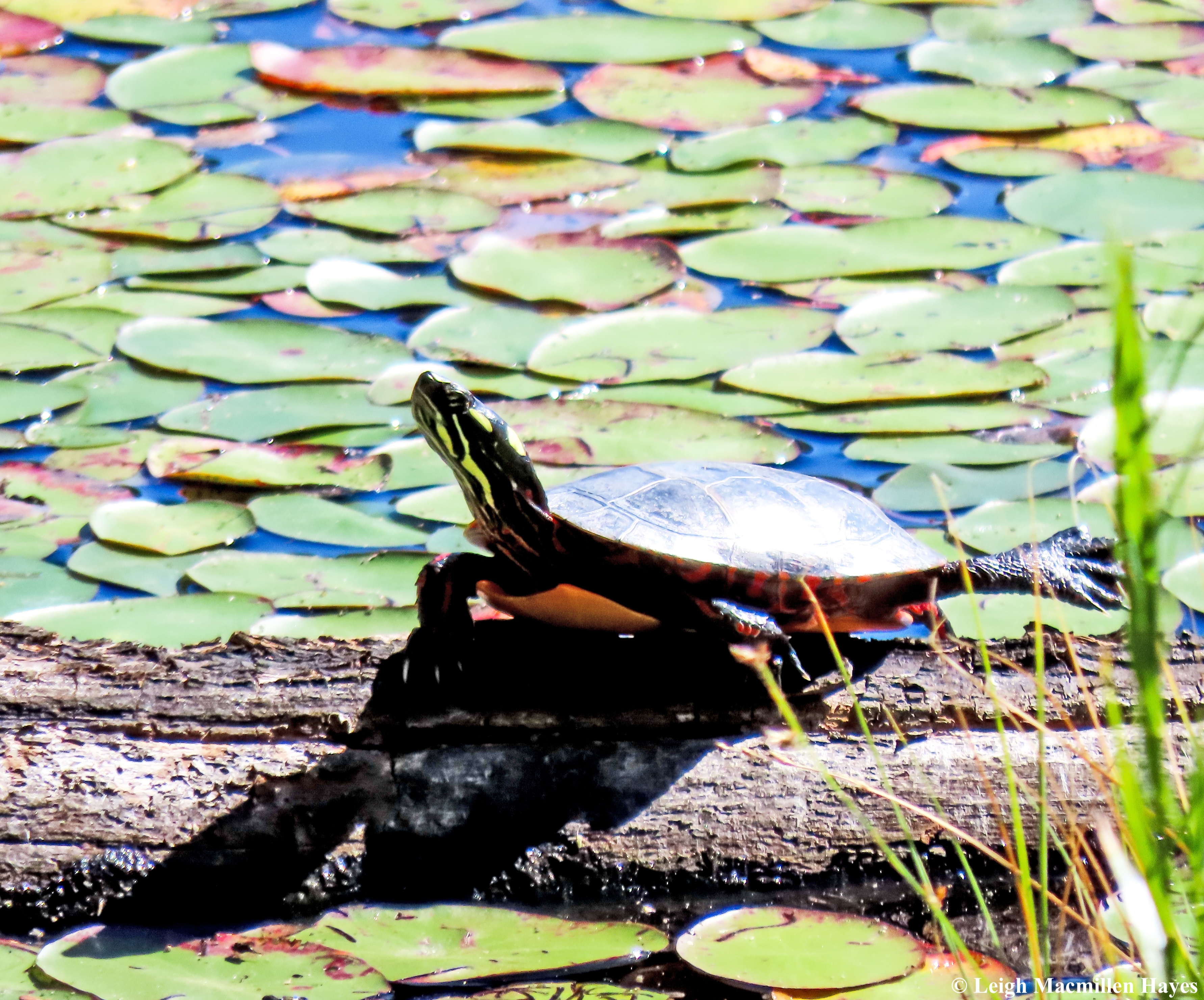
And despite the cooler morning temps that we’ve been experiencing, including lows in the mid-30˚s the past few days, or more likely, because of those temps, the Painted Turtles were still basking, soaking up the sun’s warmth. I love how they stick out their legs to absorb more warmth. It truly looks like a Yoga position, and I know this personally because along one of the trails we traveled in the past week, My Guy showed me several poses he’s learned recently. He also showed me those he struggles to perform.
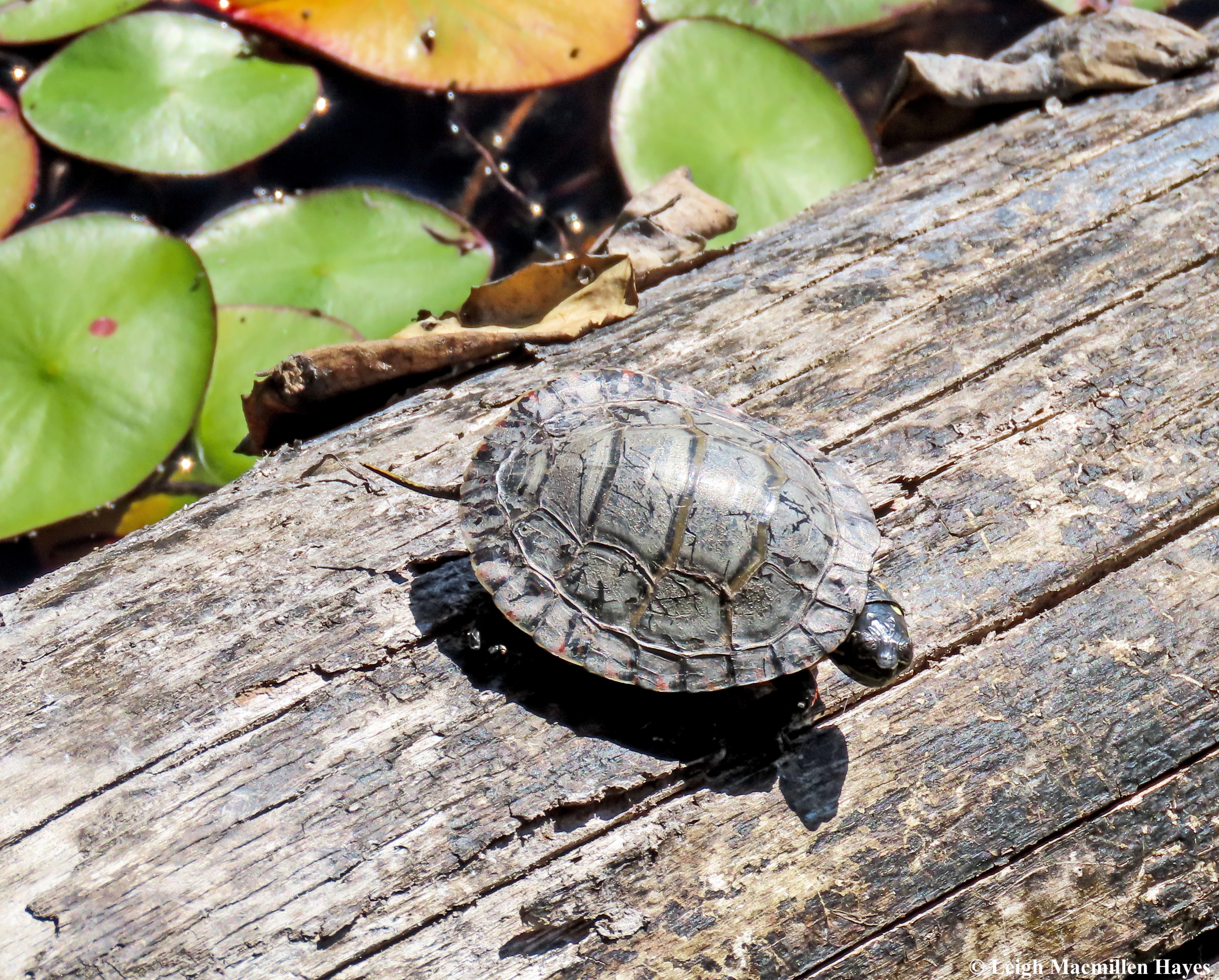
Not all turtles were of the same size, and this was a tiny one, who stayed on this log for at least two hours as we spotted it before we embarked on a bushwhack and it was still there when we returned, though it had changed its position. And gave me a wary look.
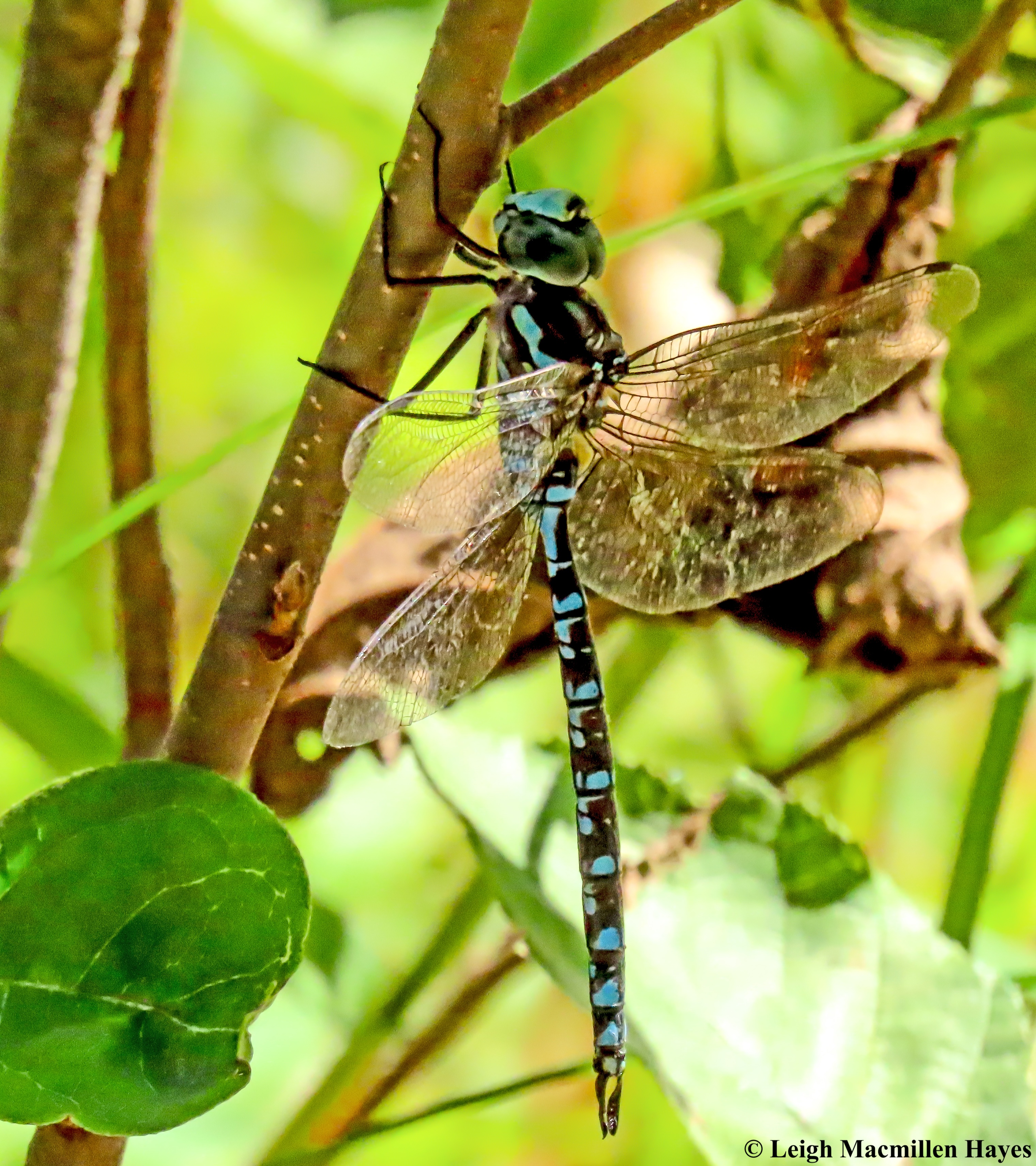
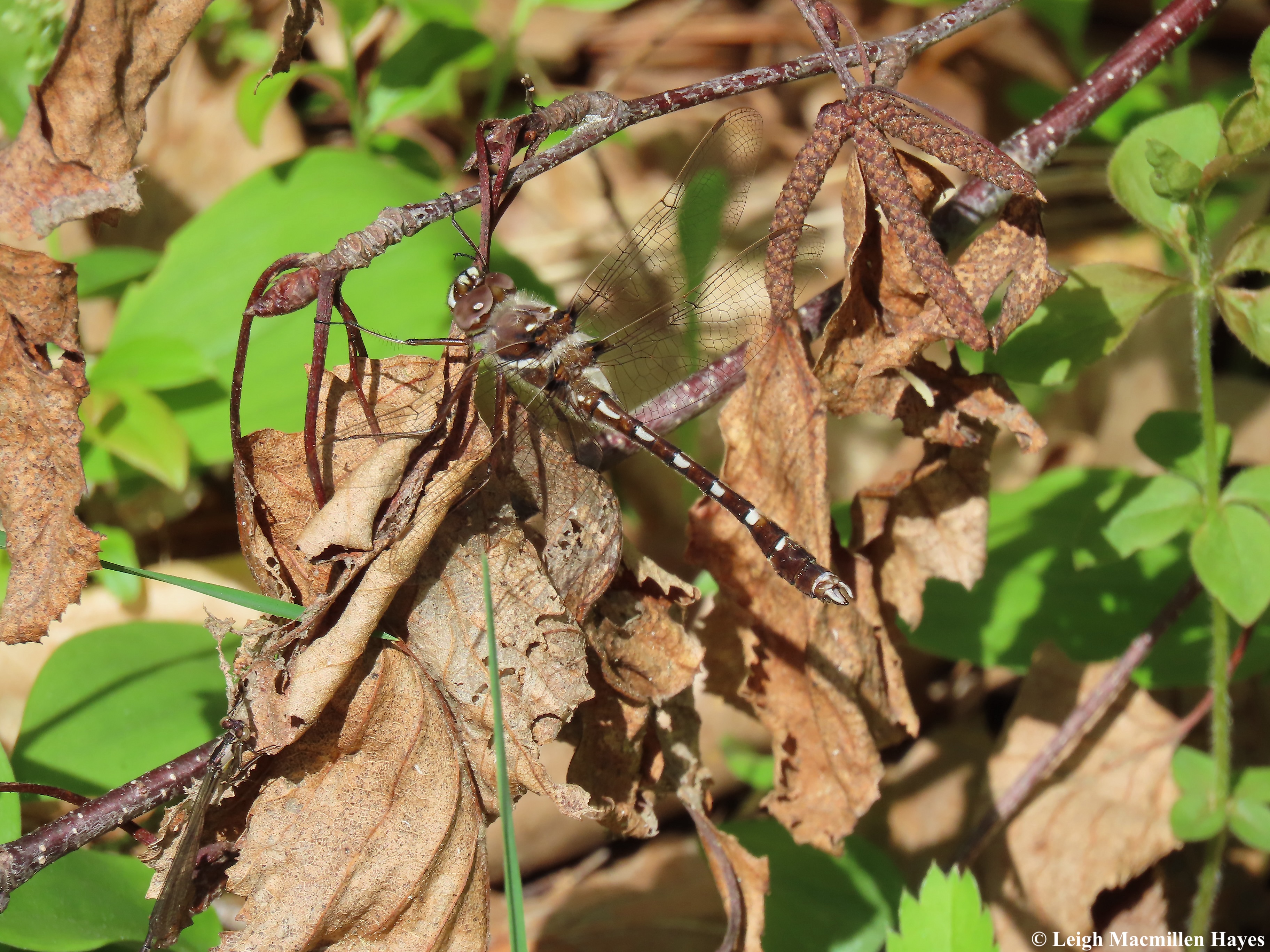
My Dragonfly fetish was also fulfilled for the Darners and Skimmers continue to fly and occasionally pause. Well, the Skimmers often pause, but the Darners are usually on the wing–patrolling territory while looking for a meal, and even more so, a mate. That’s why it’s always a moment of joy for me when one stops and my admiration kicks up a few notches. In fact, it’s the notch in the side thoratic markings that help with ID–in this case a Canada Darner. I’ve discovered this summer that they are numerous ’round these parts.
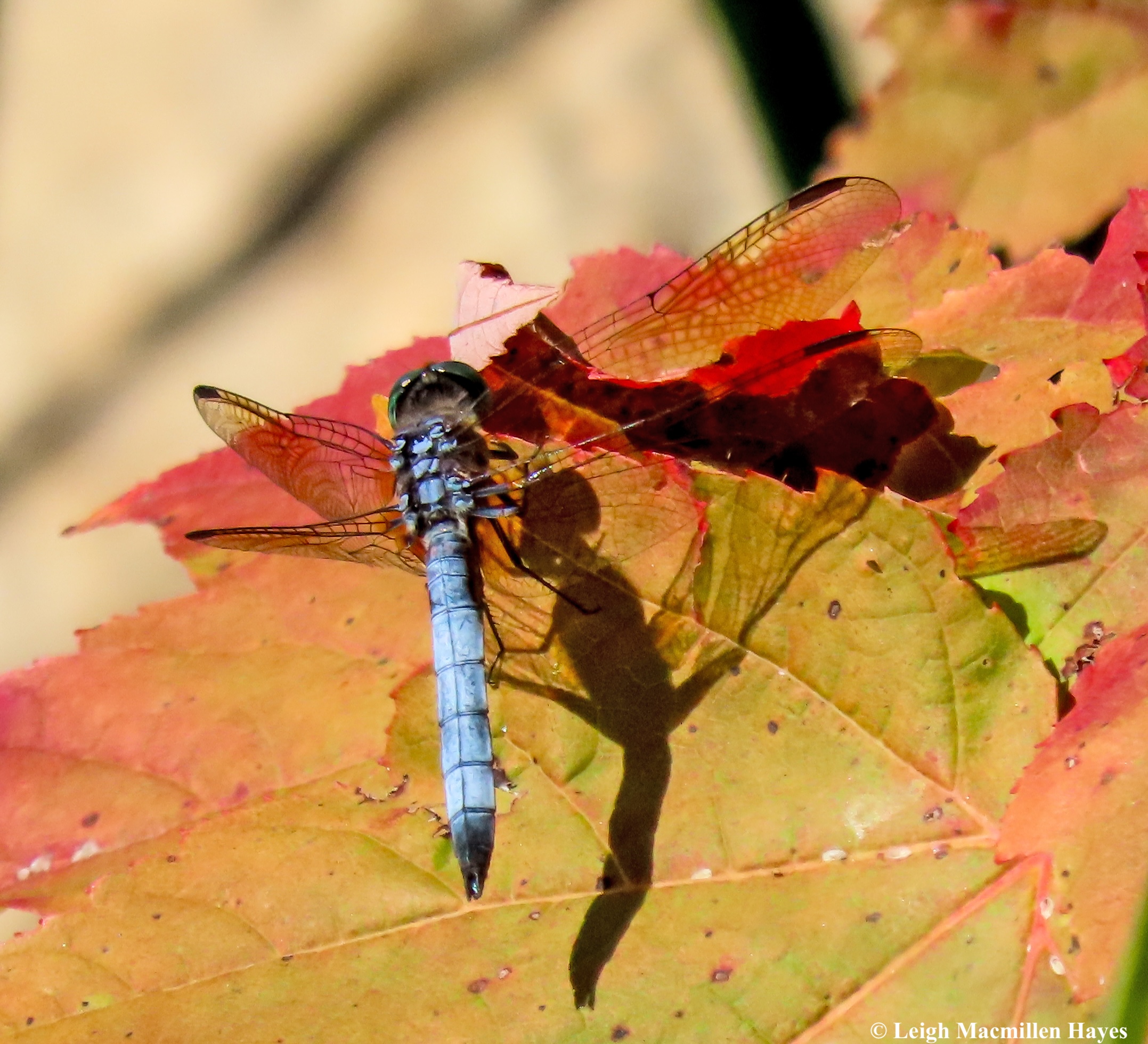
While the Darners are on the largish size in the dragonfly world, most of the Skimmers that are still flying are much smaller. The Blue Dasher, as this is, is probably considered medium in size.

What a display, no matter how big, with the blues and blacks and greens contrasting with the Red Maple leaf’s hues.

And then there’s the dragonfly’s shadow. It’s almost like it was a different creature.

My surprise was full of delight when I realized as I floated beside a Beaver Lodge, that I was watching female Amberwings deposit eggs into the water as they tapped their abdomens upon it. I rarely spot Amberwings, and yet they were so common in this spot.

And overlooking all the action, perhaps not only to defend its territory, but also to eat anything that got in the way, a Slaty Blue Skimmer, twice the size at least of the Amberwings and Blue Dasher.

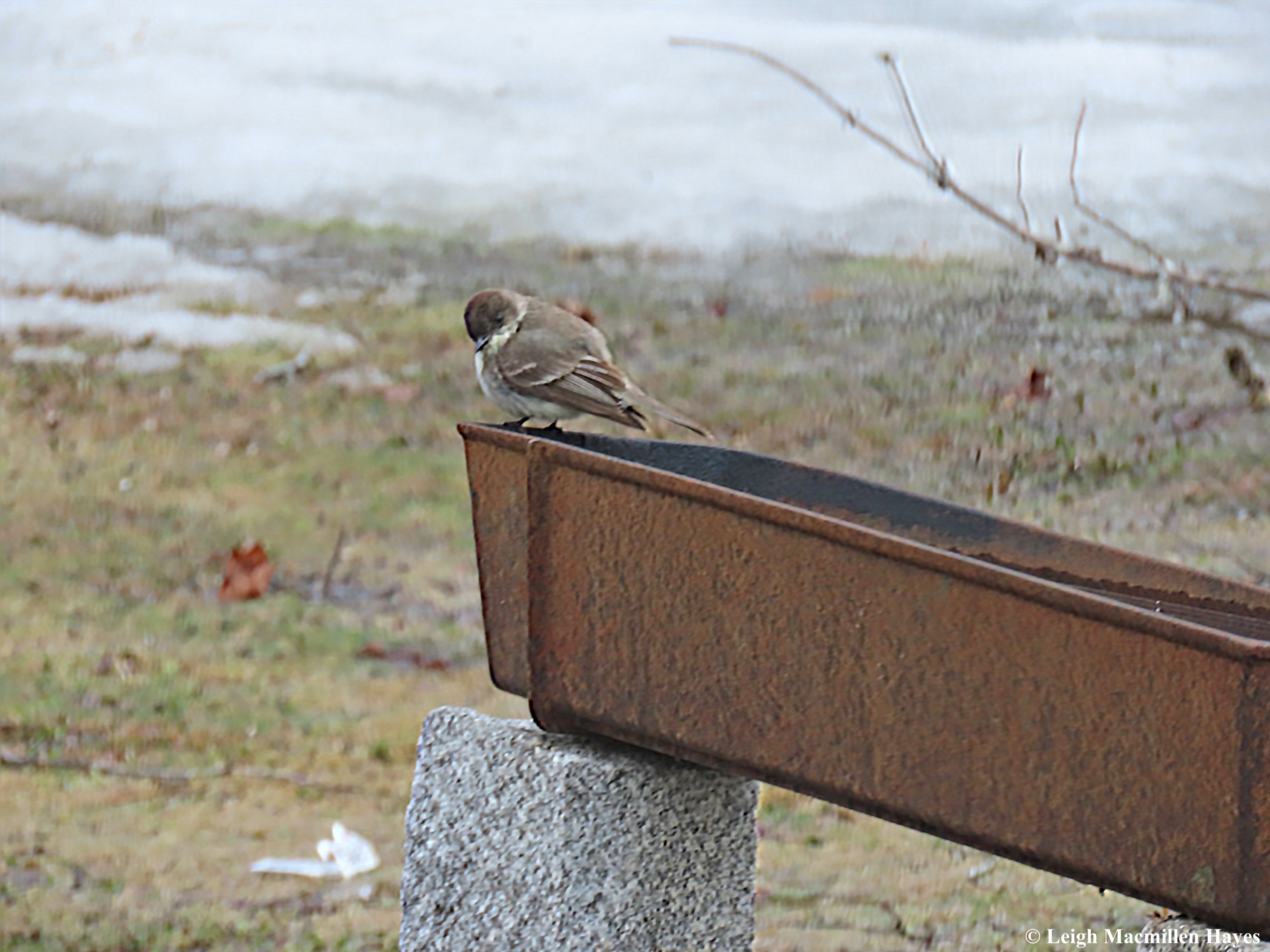
Birds, too, were part of the scenery wherever we were. This Eastern Phoebe spent moments on end looking about, from one side to the other, and then in a flash, flew to some vegetation below, grabbed an invisible-to-me insect, and flew off.

Much to the surprise of both of us, despite the loud crackling of leaves and branches upon which we walked in one place, we didn’t scare all the Wood Ducks off, and enjoyed spending a few minutes with this Momma and Teenager. Usually, this species flies off before we spot them on the water.

Even the male hung out and when I suggested to My Guy that he look at it through the monocular, he was certain he really didn’t need to because he could see it without any aid. And then he did. And “Oh wow!” was the reaction. And I knew he’d finally seen a male Wood Duck–for the first time. And that moment will remain with me forever.

One of our other favorite moments occurred on our favorite pond, where we first spotted a Bald Eagle on a rock that the low water had exposed. And then it flew. As birds do.

And we followed it with our eyes, and watched it land above us in a White PIne.

And thus, we spent a good twenty minutes with it, admiring from our kayaks below.

The Bald Eagle was sighted not to far from our favorite Beaver City–where we know of at least five lodges located within a football field-sized area. And this one above had been abandoned for the last few years.

But fresh mud and fresh wood told us that someone was home. Probably more than one someones. We love the possibilities. The mudding is an important act–preparing for winter by coating the outside and closing up any holes or airways that might let cold air penetrate. Of course, the “smoke hole” at the top will remain, much like a chimney in our homes.

Just a Beaver channel and a hundred yards away, another of the five lodges also showed signs of winter preparation. It’s a busy neighborhood.
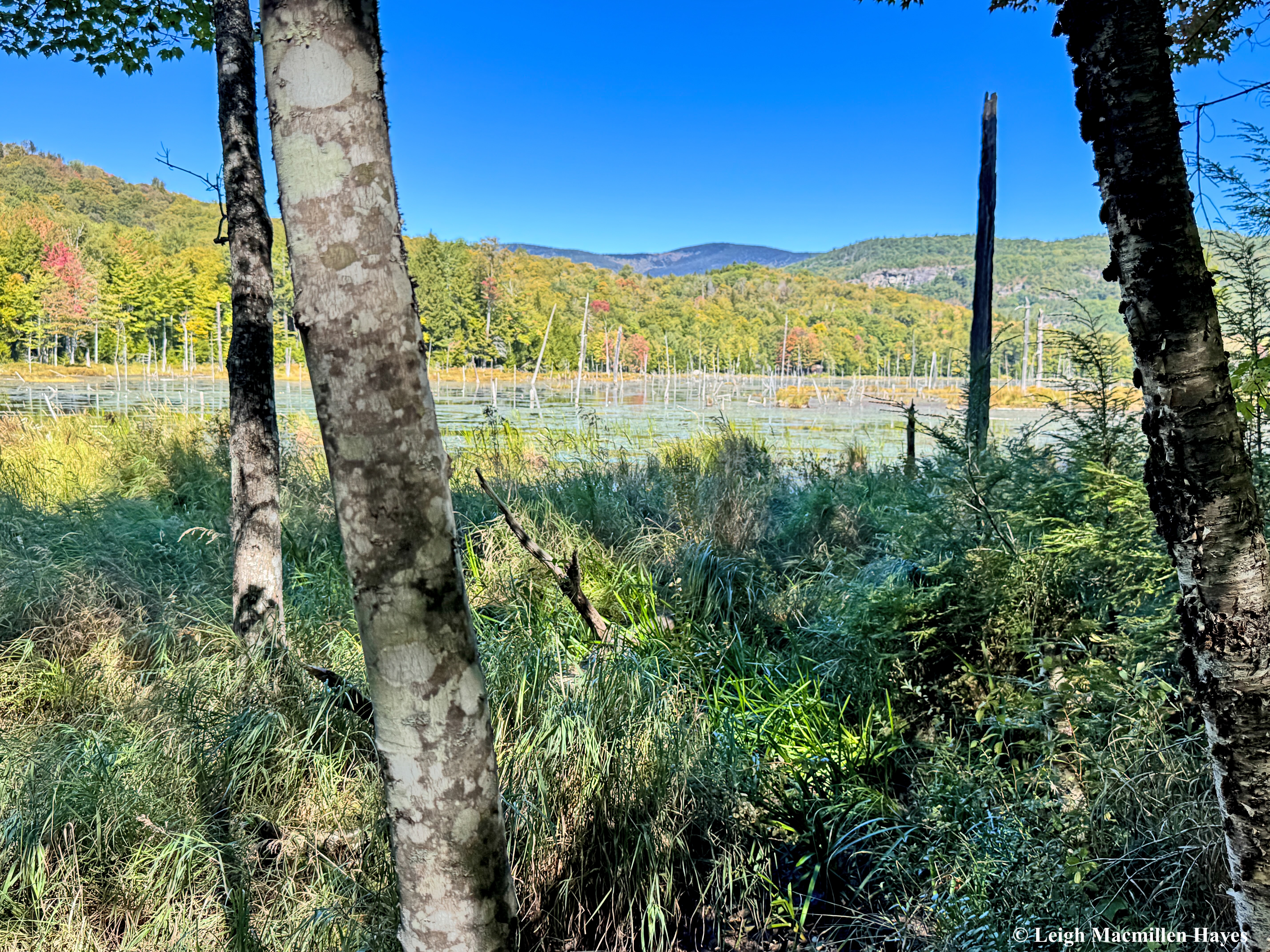
No matter where or how we traversed, one of the things that stood out to us is that despite the autumnal equinox being September 22 at 2:19pm. fall is already here thanks to the summer’s drought.

It’s usually mid-October when we begin to celebrate the color change–that time when Chlorophyll, the green pigment we associate with summer, and necessary for photosynthesis, slows and then stops manufacturing food, and the leaves go on strike.
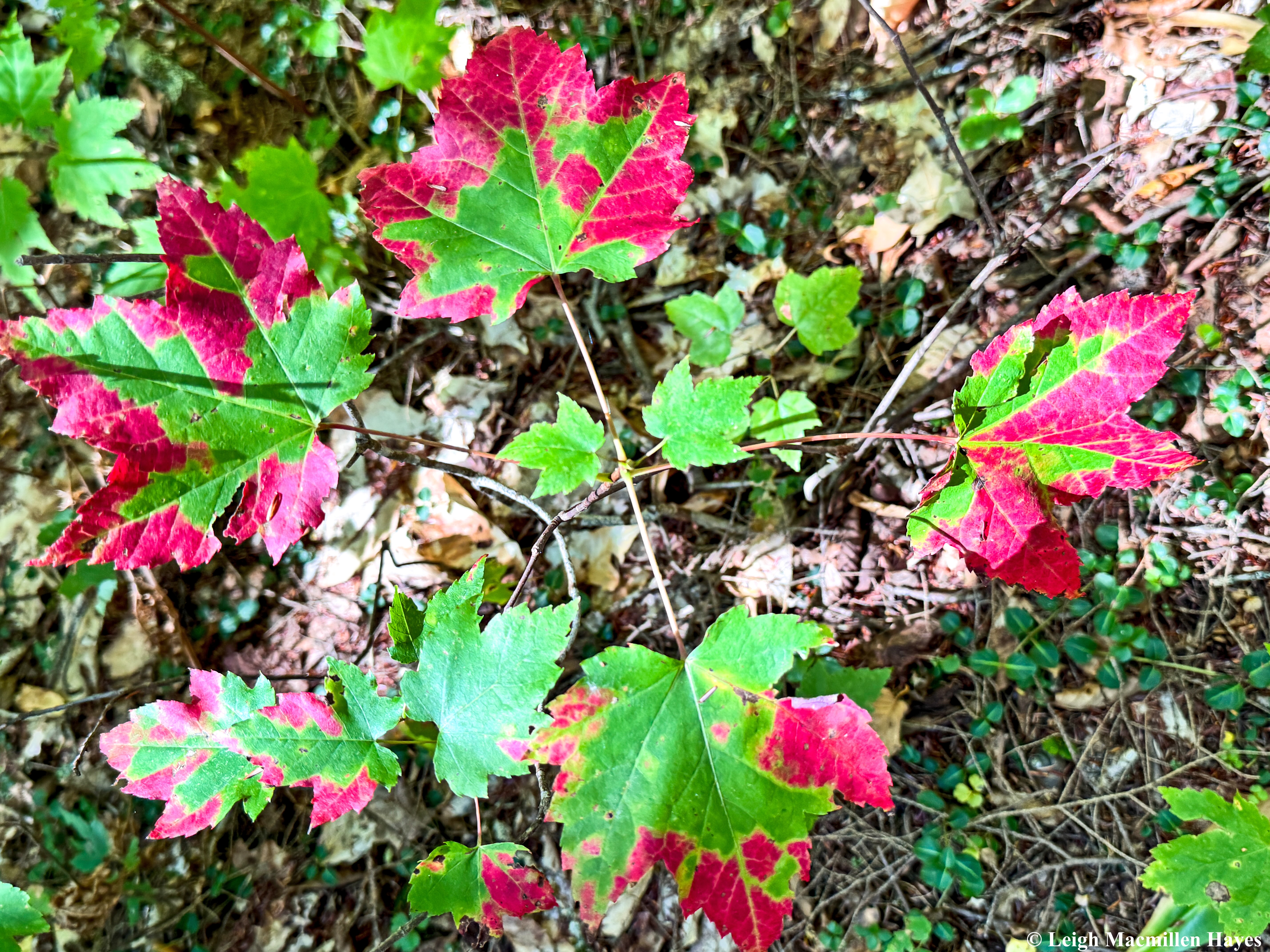
Veins that carried fluids via the xylem and phloem close off, trapping sugars, and promoting the production of anthocyanin, the red color we associate with Red Maples like these.

Tonight, as I finish writing, we are on the Cusp of Autumn, which is about seventeen hours away. But this year, I think it’s already here and if you have planned a fall foliage tour for mid-October I hope you won’t be too disappointed. I suspect we’ll not have many leaves left on the trees by that point.

But . . . maybe I’m wrong. There’s always that possibility.

No matter what–Happy Autumnal Equinox!
Lessons in the Shadows

The email arrived before 8am. “‘Morning. I have a dying/dead dragonfly. Perfect condition/appearance. Wonder if you could use it for your collection. No rush if so, I’ll keep it safe!”

And so it was that this afternoon I drove to a friend’s house and received this gift. In the moment, I knew it was in the Darner family, but I wasn’t sure about its full identification. The amber wing color drew my awe and I couldn’t wait to go home and look through my guides and make a decision.

But . . .

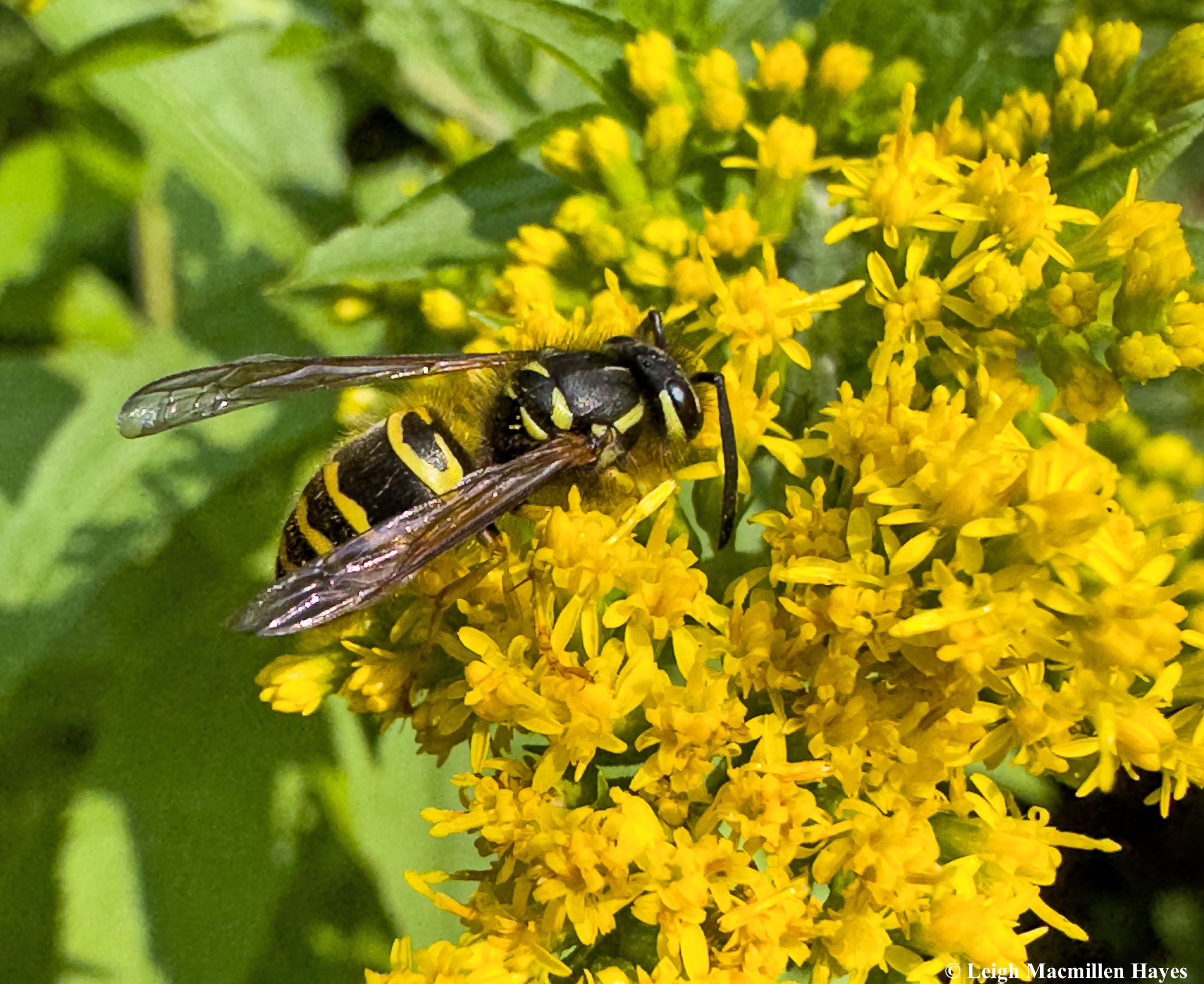
First I drove to a local preserve and followed the trail to a favorite wetland where Yellowjackets like this one and Bees of every kind, and Hornets, and Flower Flies buzzed and flew and buzzed some more as they frantically worked on the Goldenrods and a few Asters still in bloom.

I had intended to cover some miles, albeit at a slow pace, but . . . once I spotted this specimen, I knew my plans were shot. Instead, I was meant to be in this one place for a couple of hours. And so I stayed.

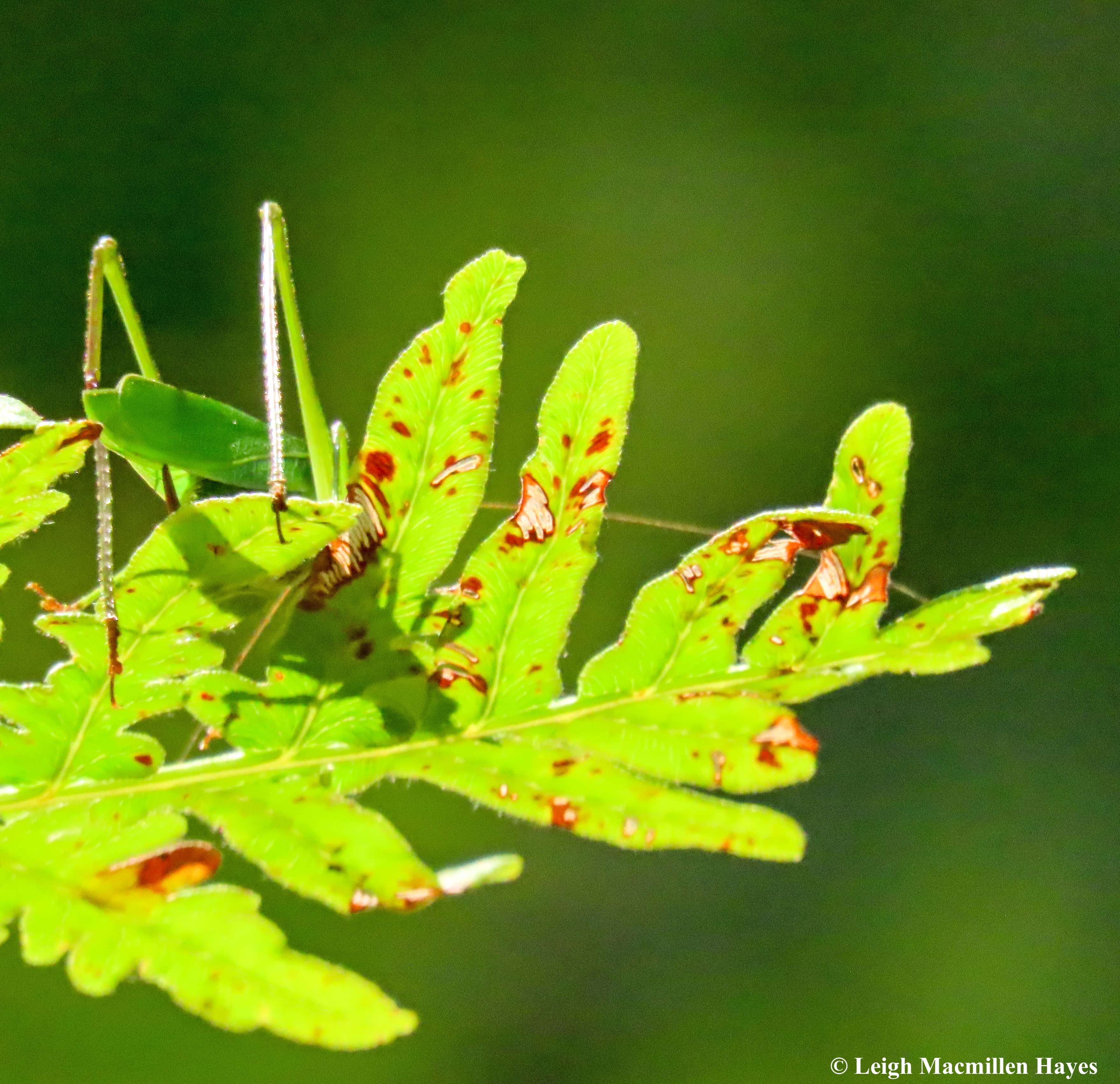
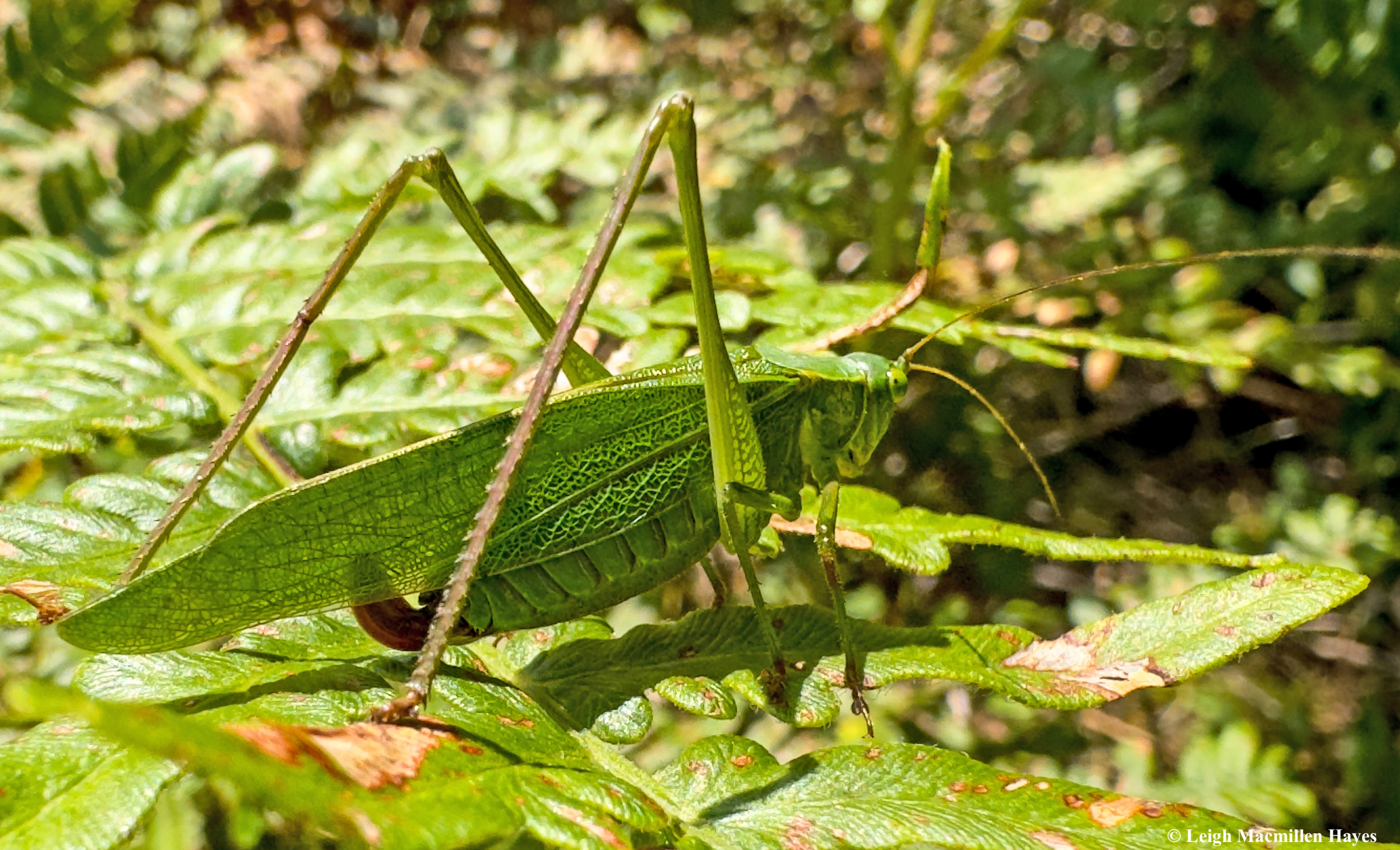
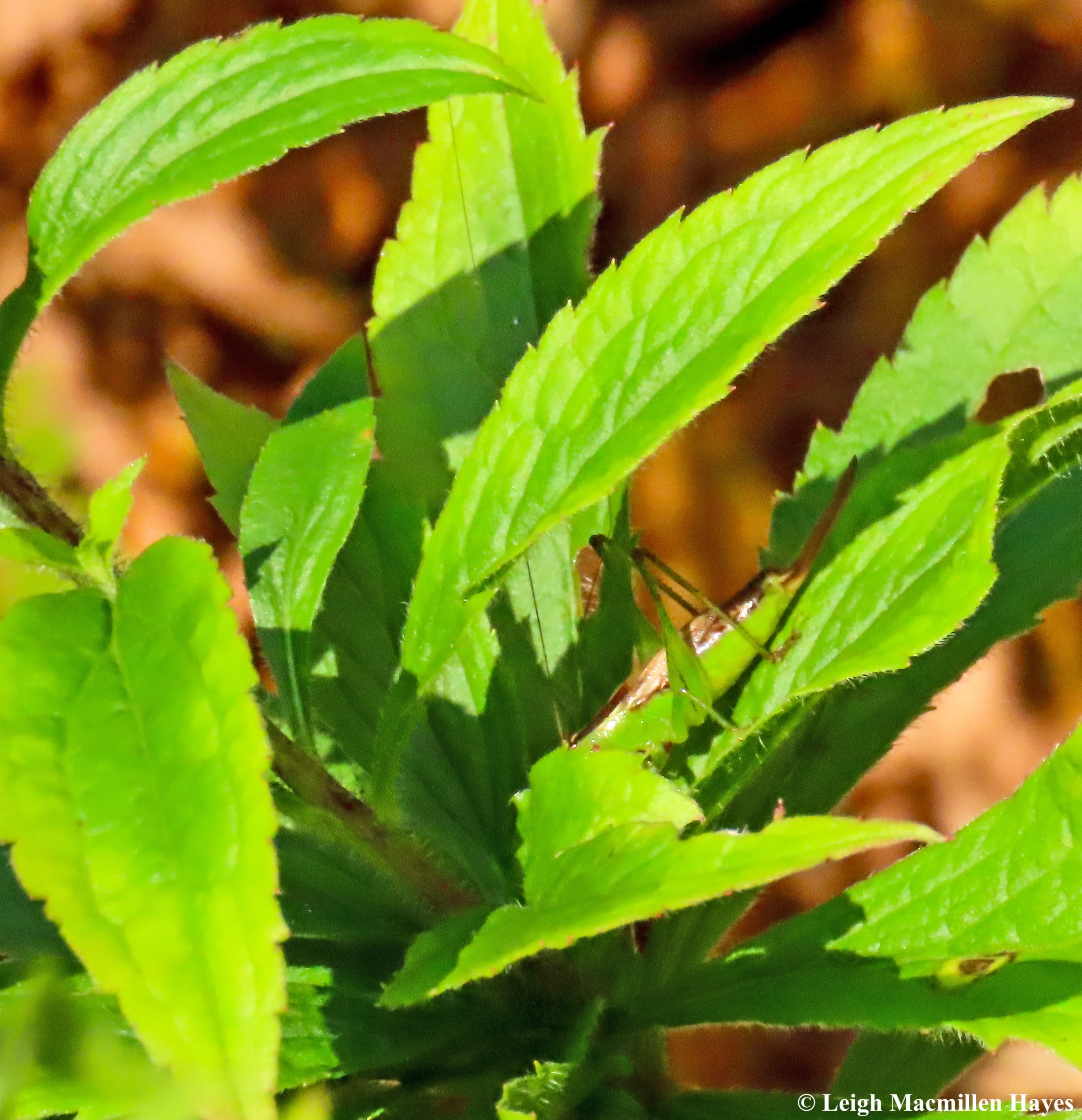
And reveled in the sighting of this Bush Katydid. As I said to another friend this morning via a text message–look at the armor and color and texture and design. Of course, then, I was referring to a Two-Striped Grasshopper. But truly, the same holds true for the Katydids in our world. (Especially my favorite Katy-did! She knows who she is.)
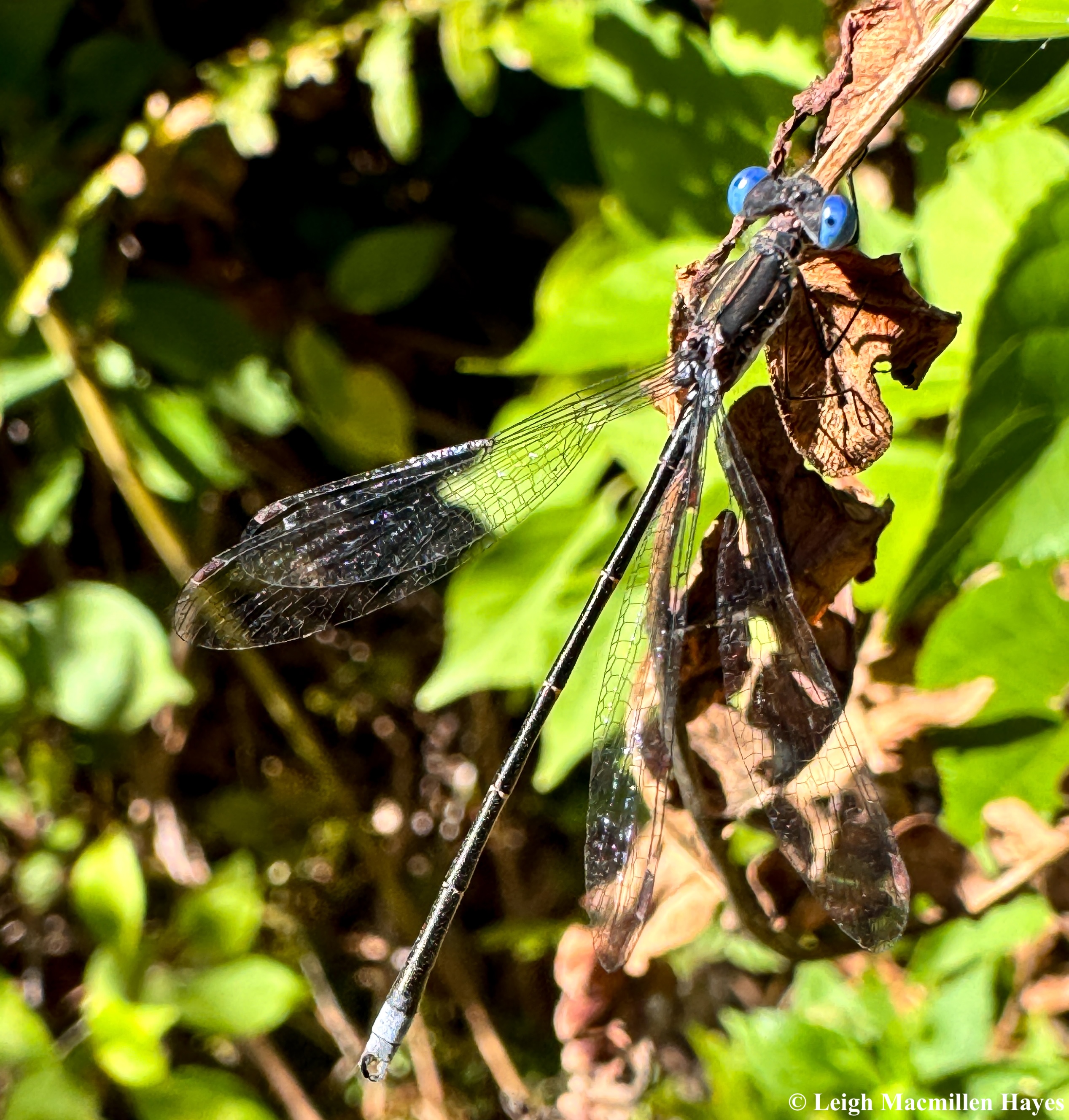
Also in my midst–Spotted Spreadwing Damselflies. This is the male and last week, plus today, I spotted them but couldn’t find a female anywhere.

Until I did. As always, her color is much drabber than his, but still she has the more important job . . . at least in my book of how the world turns.

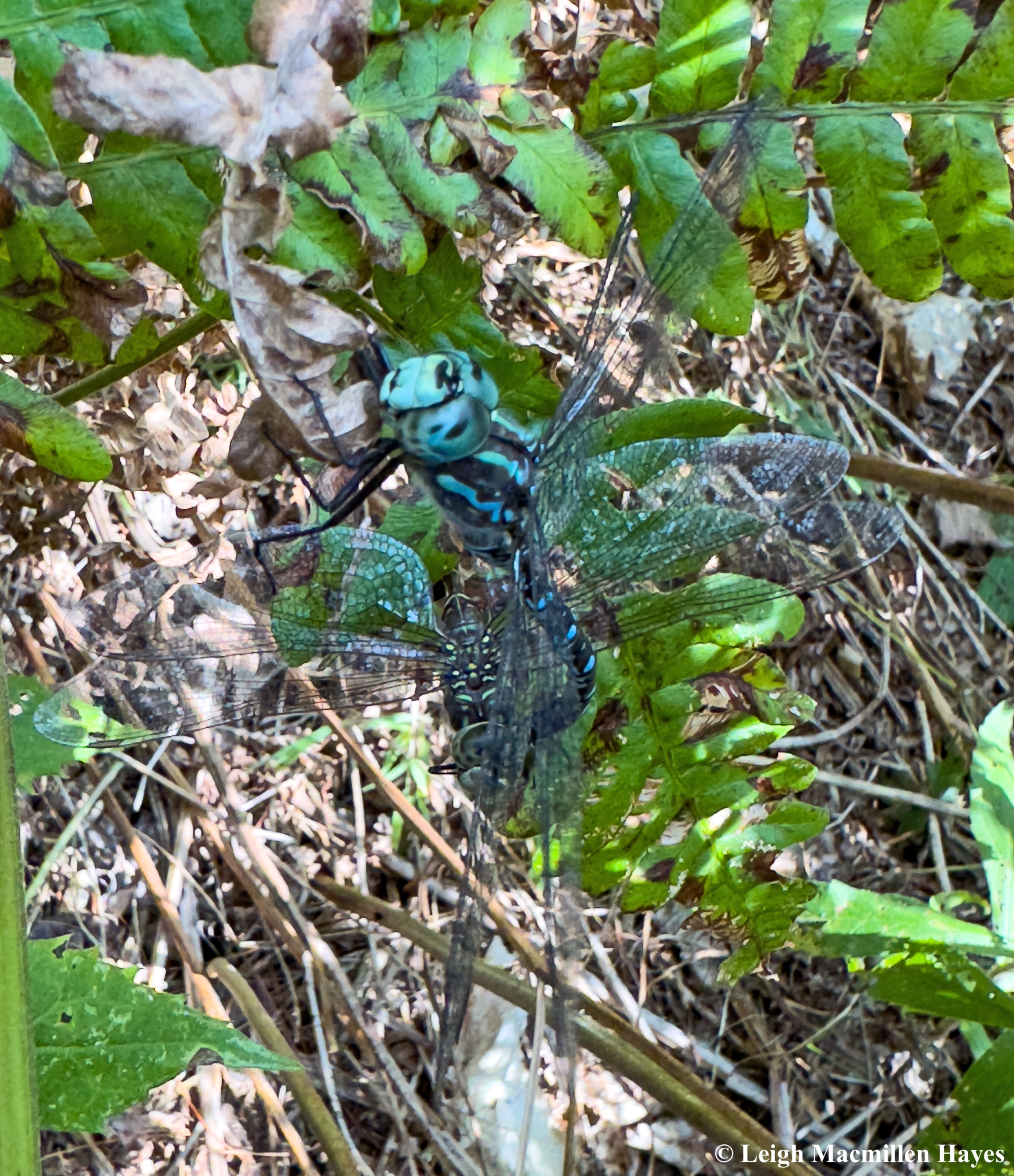
And speaking of that most important job, a couple of Canada Darners decided to canoodle right before my eyes. I couldn’t believe my good fortune. Notice how he uses the cerci at the end of his abdomen to clasp her behind the head and hold her in place as she curls her abdomen around to form the dragonfly mating wheel.

While I watched them, a snippet of movement caught my eye and I was forced, yes FORCED, to look elsewhere. Do you see what drew my attraction?

How about now? Just across the path from the much larger Bush Katydid, a smaller Meadow Katydid. Both seemed appropriate for this small ecosystem that included bushes and shrubs and wildflowers and ferns in the midst of a meadow.

And below the Katydid, more movement caused me to look more closely. Just this morning, another friend commented on the fact that she can’t believe the stuff I see. And I heard the same from another friend a day or two ago. I guess it’s all about tuning in–to sounds, I heard a wee rustle; and anomalies–I saw a bit of a color change. And tada: a small Pickerel Frog pausing on dead fern fronds–so camouflaged was it. Much like the two Katydids.

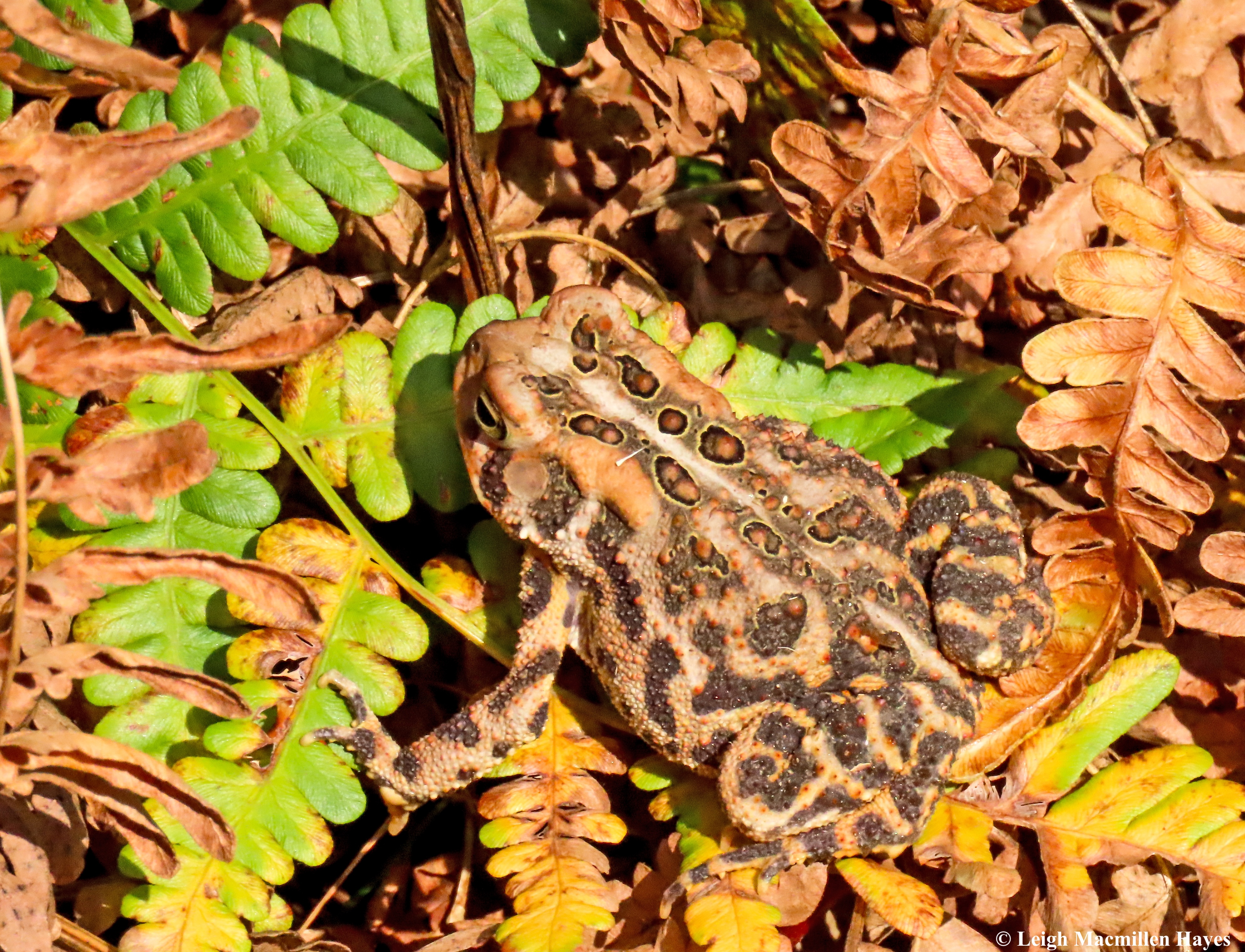
And about six inches away, I espied this female American Toad. She stayed as still as possible. Forever. Or almost forever. I would look away as I kept an eye on the canoodlers and then had to key back in to this site to spot the toad who was still there. I guess it’s all about being slow and training the eye to notice. Even if it’s something as ordinary as a Toad, it’s still a joy to be present and notice.

Suddenly I heard a rustling of wings and knew the sound to be canoodling dragonflies on the wing–or so I thought they were flying about. But I couldn’t see them anywhere. They were no longer posing on the fern where I’d first spotted them. The sound came from below and behind that fern, in the midst of other fern fronds. And then I found them. I don’t know why they left their original perch, but suspect another male drove them to move on. What I think happened next is that they got a wee bit caught in a spider web. And struggled fervently to free themselves.

So . . . I interfered. First I freed him and thought he’d take her along, but he flew off and then she did also. I can only hope that they found a different spot to continue their date night.

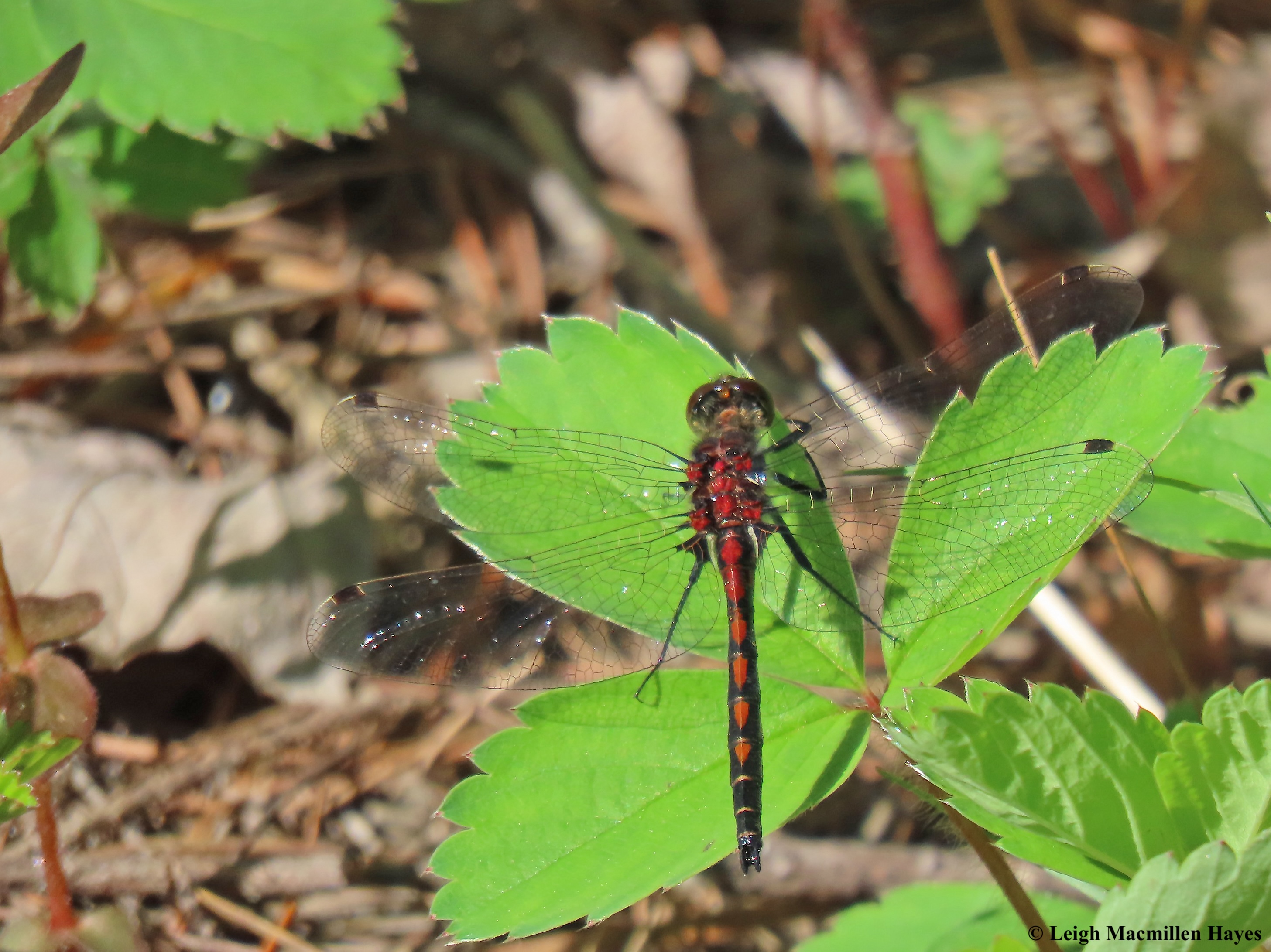
Other fliers in this same vicinity where the tiny Autumn Meadowhawks, this being a male.

His female counterpart was also posing everywhere.

They got as far as the tandem position, where the male clasps the female behind the head, but before they form the canoodle circle. That was the last I saw of them before it was time for me to move along for I had a date with another dragonfly waiting at home. Well, really, waiting in my truck for a ride home.

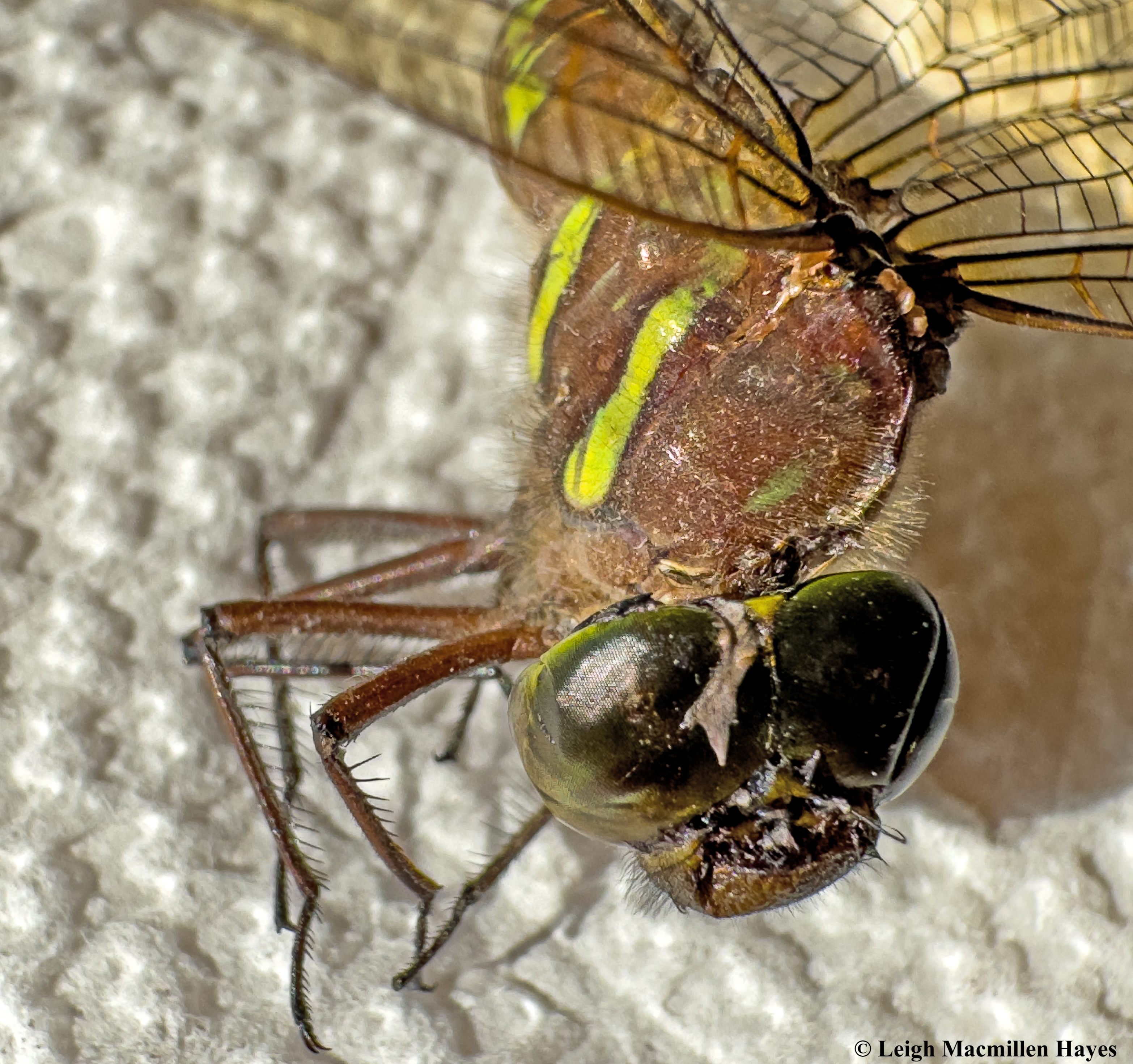
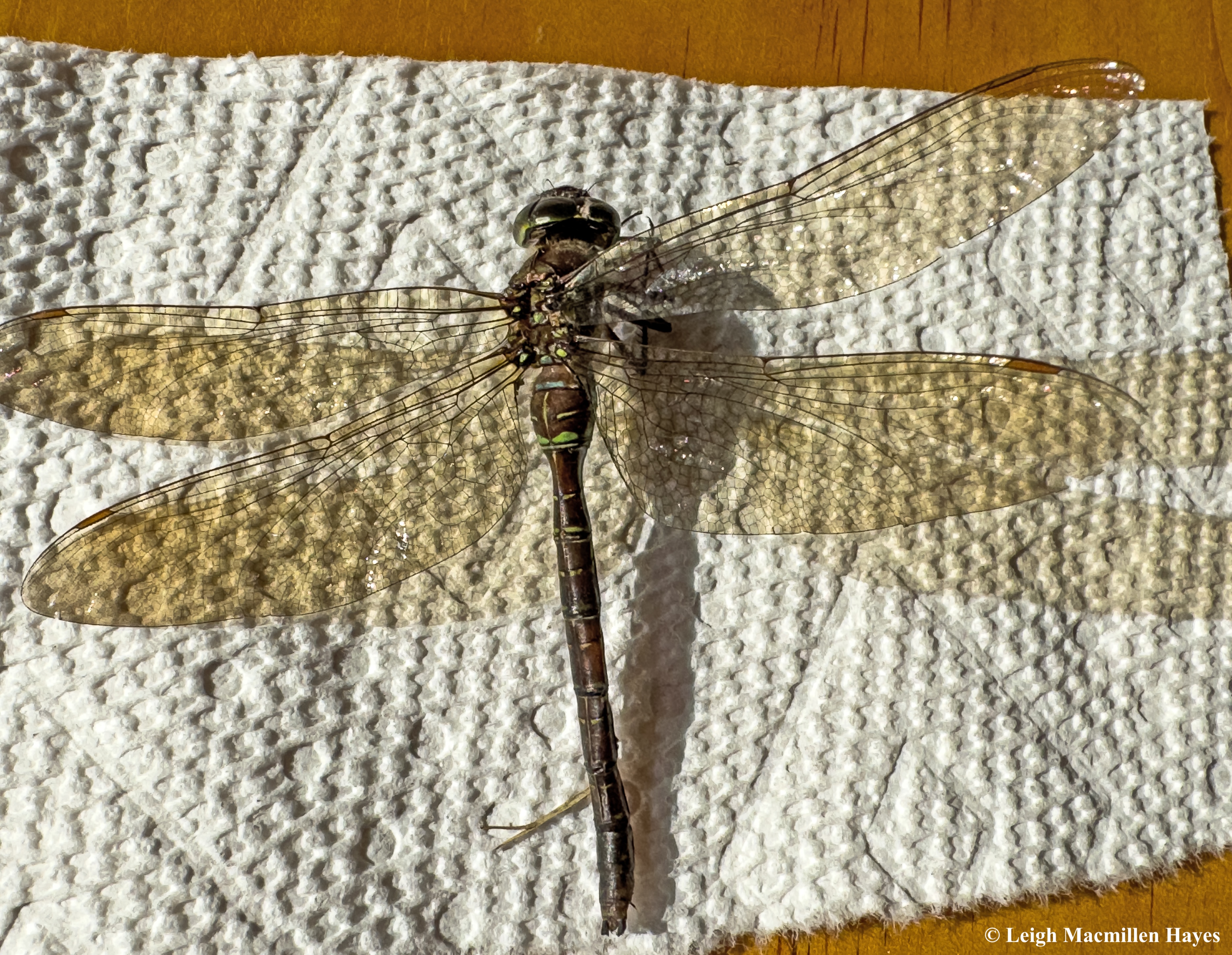
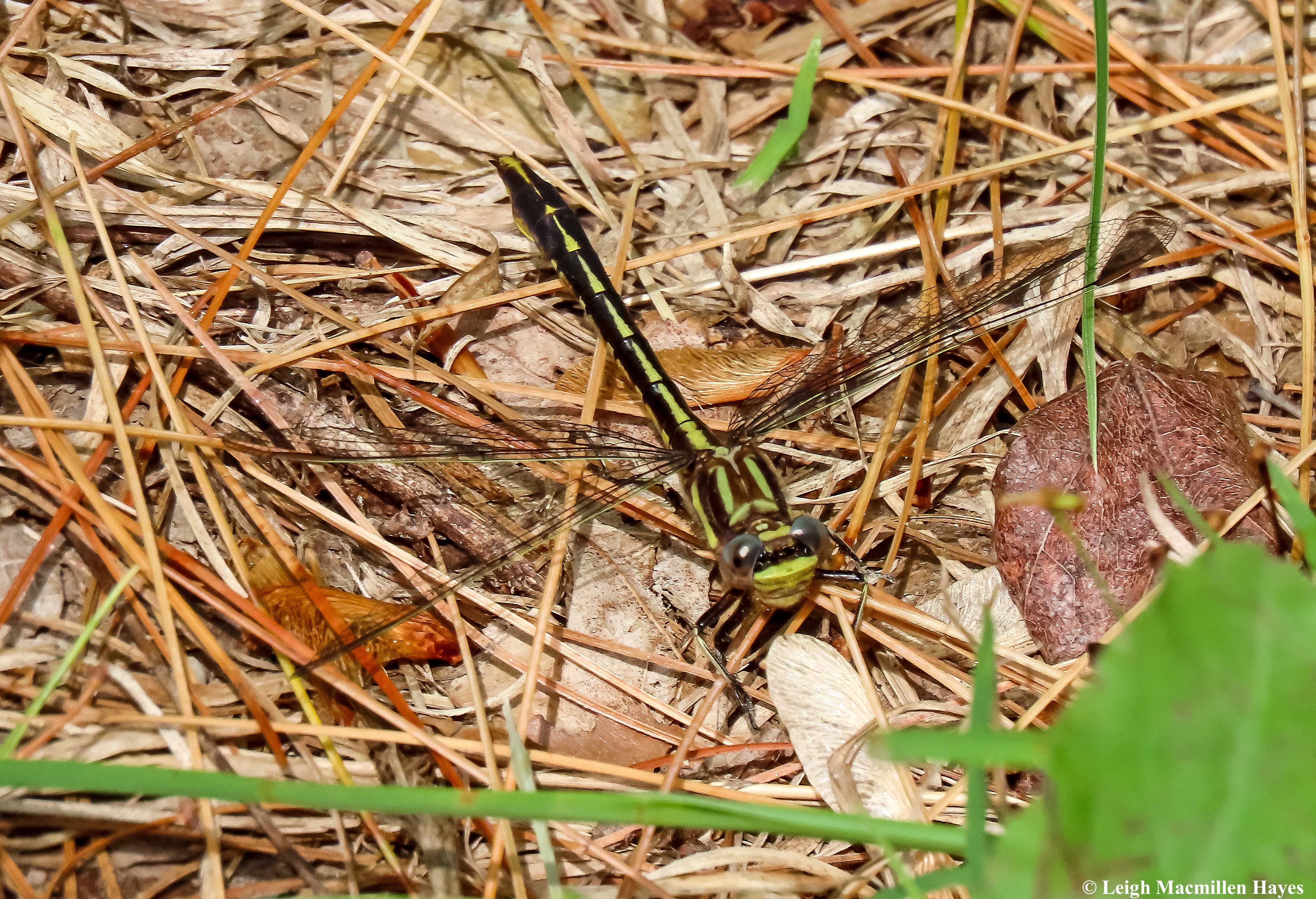
Once there, I studied this specimen, taking in as many details as possible. It was the colors and pattern on the thorax and abdomen that helped me come up with a name. And one other detail that could be easily overlooked. This particular species often has broken-off cerci at the end of the abdomen, a sign of maturity. Plus, it you look at the bulging start of the abdomen, below the thorax, there’s a slight blue line that crosses it, and in combination with the green markings, leads to species’ name.

The green thoractic strips also helped with identification.

The curious thing when my friend first offered this specimen to me was the fact that the two sets of wings were off kilter of each other. But as I told her, dragonflies operate the two sets of wings at different beats, and it’s especially noticeable when it’s chilly out as this morning was with temps in the low 40˚s. Pumping their wings is a way to stay warm. When she found this pretty female, its time on Earth was waning and though it pumped the wings alternately while in her hand, as she went to place it on the ground, it slowly breathed its last breath.

During those two hours I spent as the sun waned from the trail and meadow, I couldn’t believe what I’d seen, including the camouflaged Katydids, the canoodling dragonflies, and a few other canoodlers, plus all the pollinators.

But I was especially thankful for this one who taught me more about lessons in the shadows: a Shadow Darner Dragonfly.

And to K for the offering! Thank you for thinking of me yet again.
Great Blue Herons COUNT

Community science, aka citizen science or participatory science, is an opportunity that allows laypeople like you and me to contribute meaningful data in a short amount of time that researchers can use to inform larger conservation efforts. And along the way, we get to learn more about a particular species, as well as those who share the same habitat.

For the past 25 years, I’ve had the pleasure of being involved in a variety of such local research projects, and one of my favorites is HERON Observation Network of Maine. For the last 16 years, friends and I have monitored first one and then several Great Blue Heron Rookeries (colonial nesting habitats).

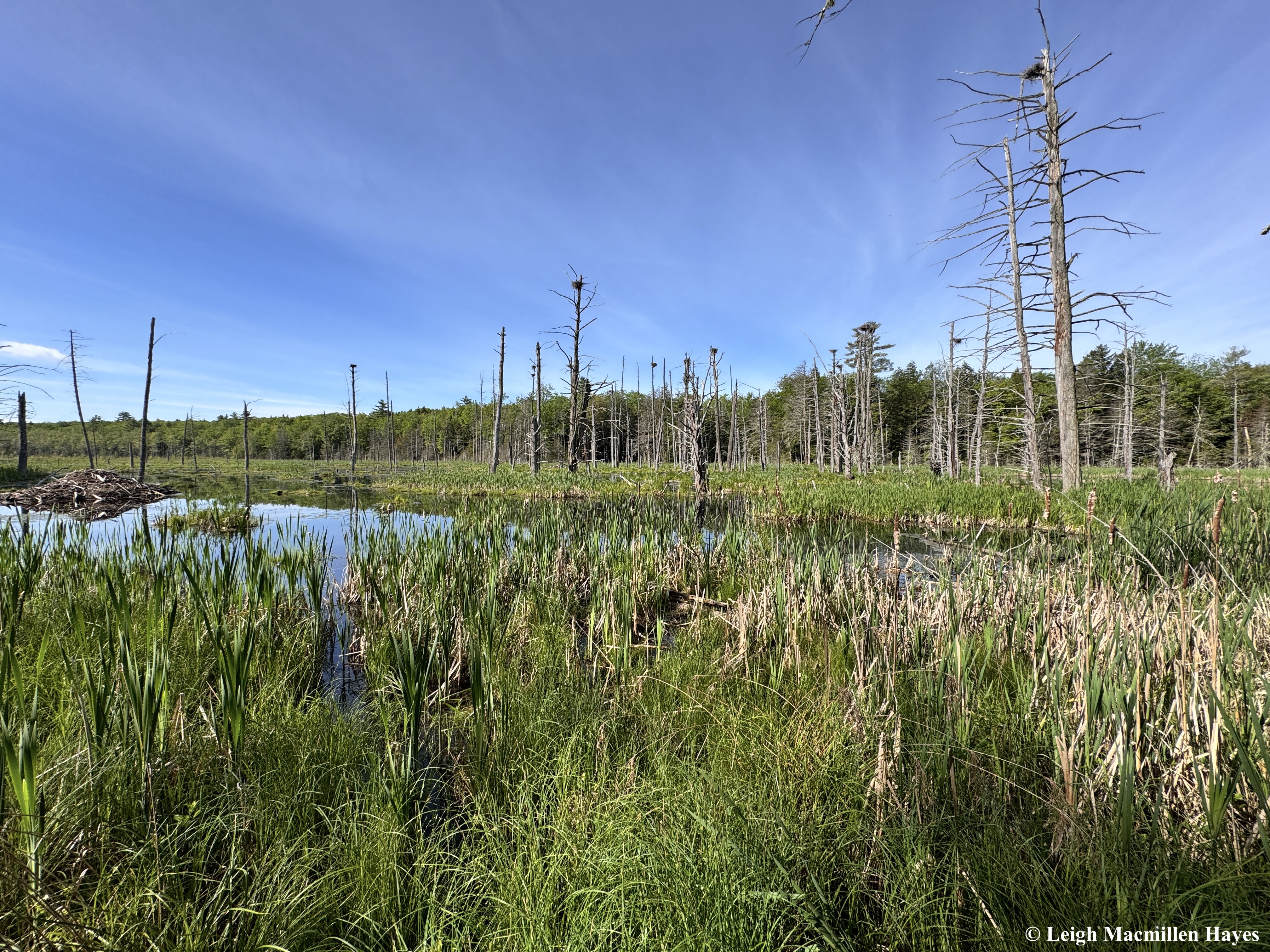
With landowner permission, we visit the rookeries several times between May and July and our job is to count the number of nests, number of active nests, inactive nest, adults, adults incubating, young, and fledglings. It’s rather intense work to move binoculars or cameras from tree to tree and some trees have double or triple-decker nests, and some nests are tucked into the background, and young can be difficult to see if they are so tiny that they are tucked down into the nest, and it’s easy to get confused and then have to start all over again.

Ah, but I can’t think of a better place to be on a summer morning than in these wetlands where aquatic life explodes in color and sound and texture and even life and death.

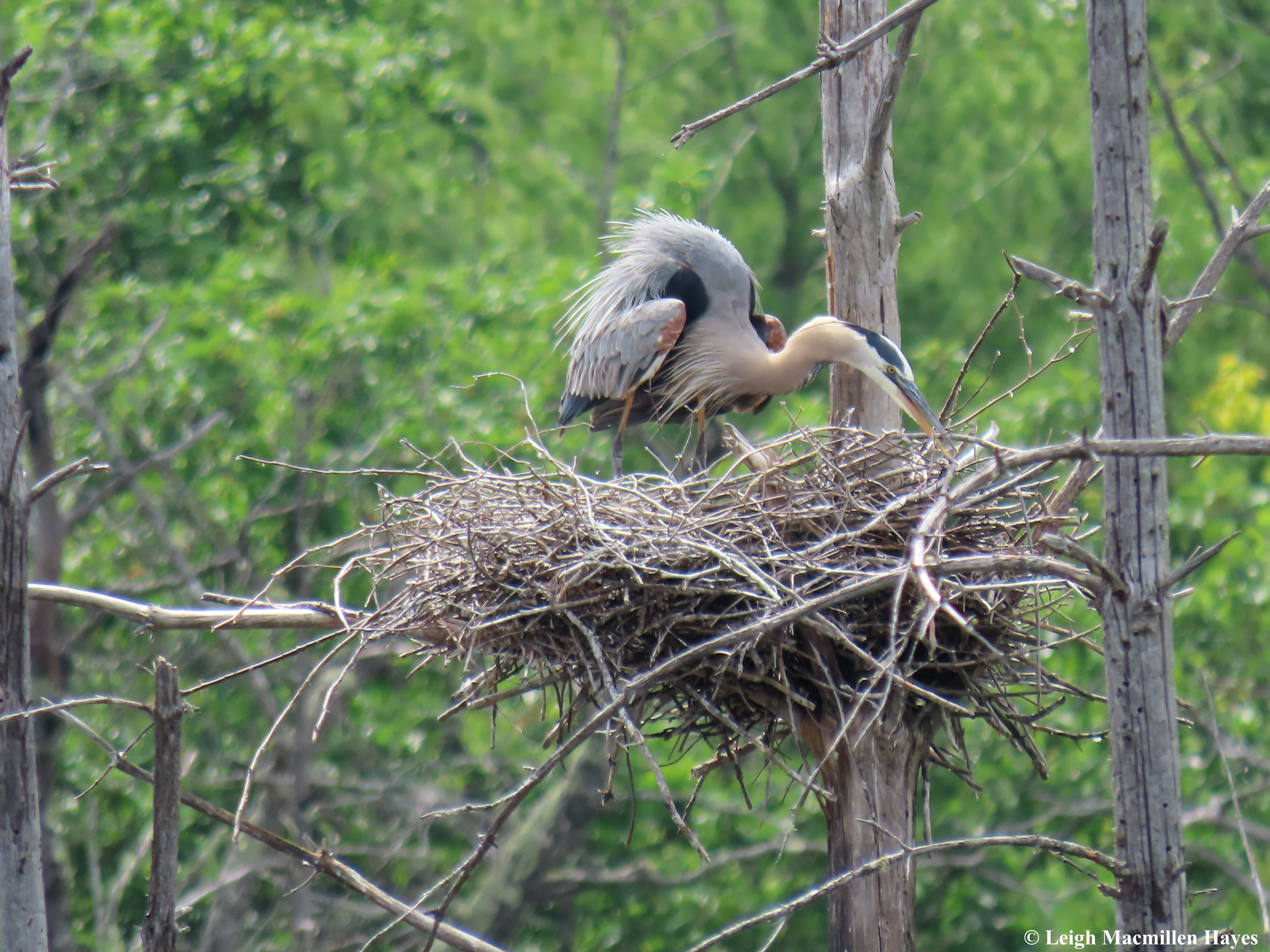
Sometimes it looks like a female is merely rearranging sticks to create a stronger nesting site.

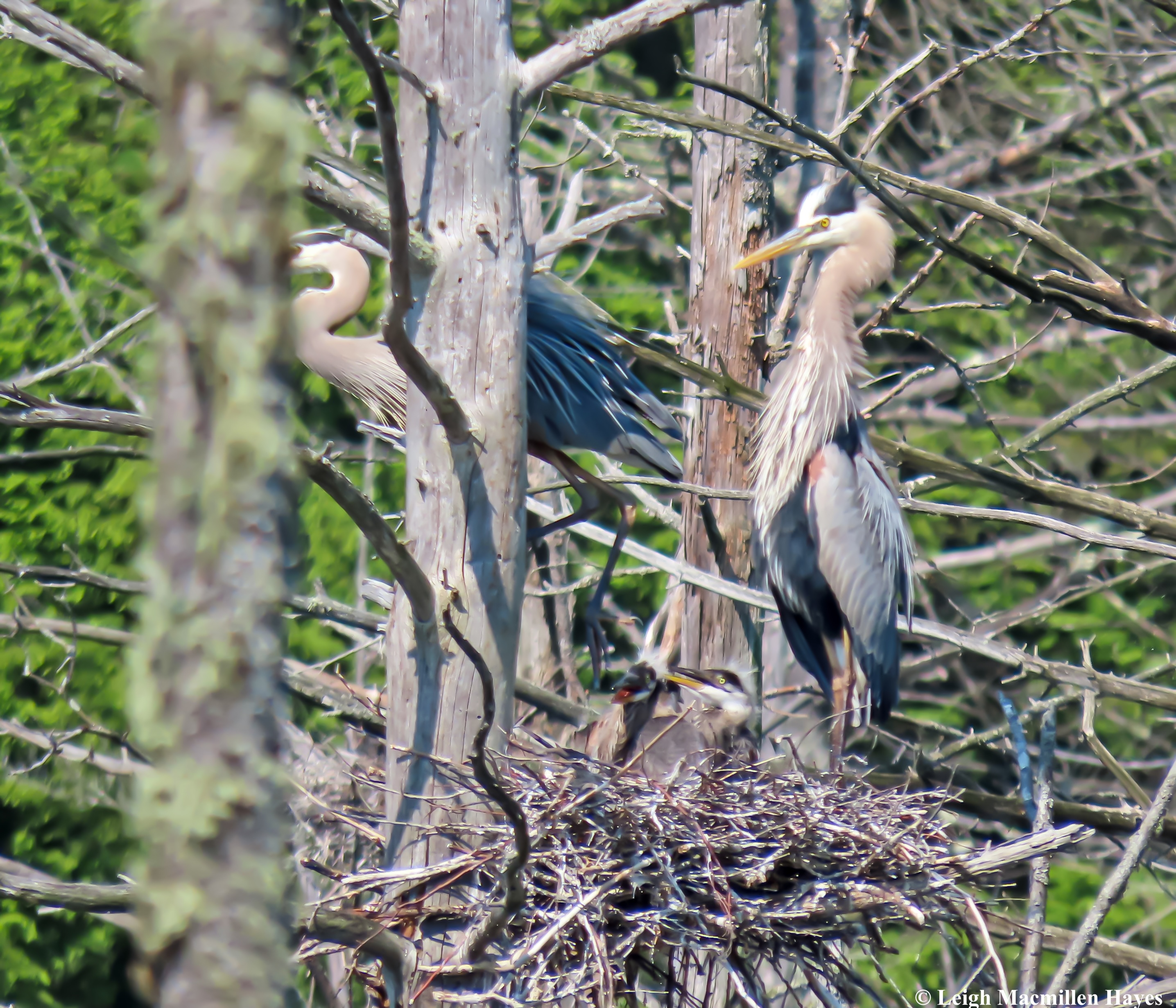
But then . . . much to our surprise and delight, a fuzzy head is spotted and we know we have babes to look for, and suddenly that makes the job more difficult.

Especially when one head turns into two and we have to add another line to the tally sheet while the adult cools off and seemingly shades the youngsters.

The adults, meanwhile, not only take turns tending to their young, but they also take turns heading off to fish for meals. And when one is secured, that adult flies back to the nest and takes a few minutes to semi-digest the food.

At this point, the young begin to squawk, and I’ve often wondered if their sounds encourage the regurgitation that follows.

Ever so slowly, we can watch the food item come up the big bird’s throat and then with mouth open wide, it coughs and tada . . .

The young ones are happy to dine on their own form of baby food.

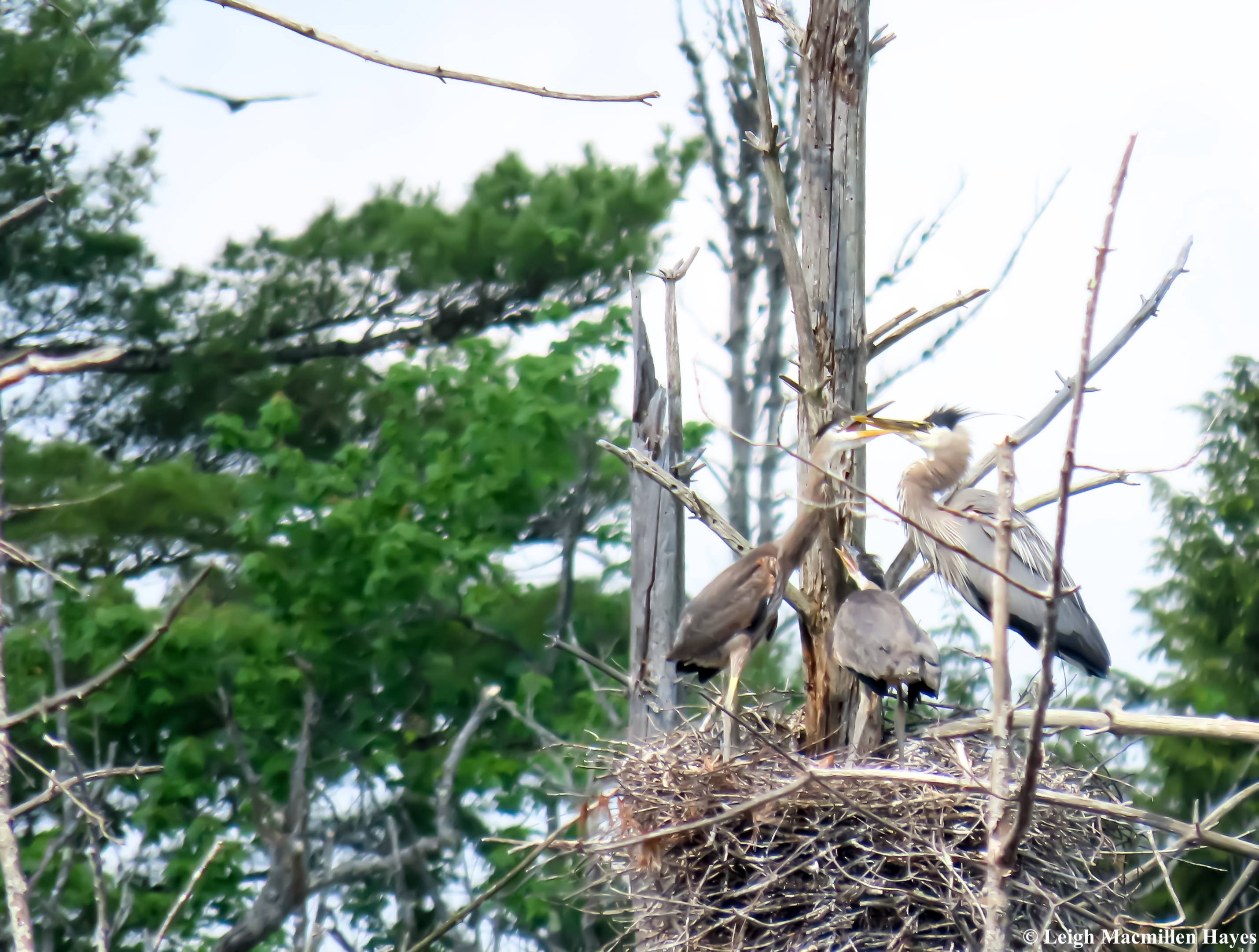
Even as they grow, the feeding ritual continues. One parent will fly in and join the family, while prepping the meal delivery.

And the other will fly out the back door in search of more to fill those ever-begging mouths.

And the kids will squawk until the remaining parent provides.

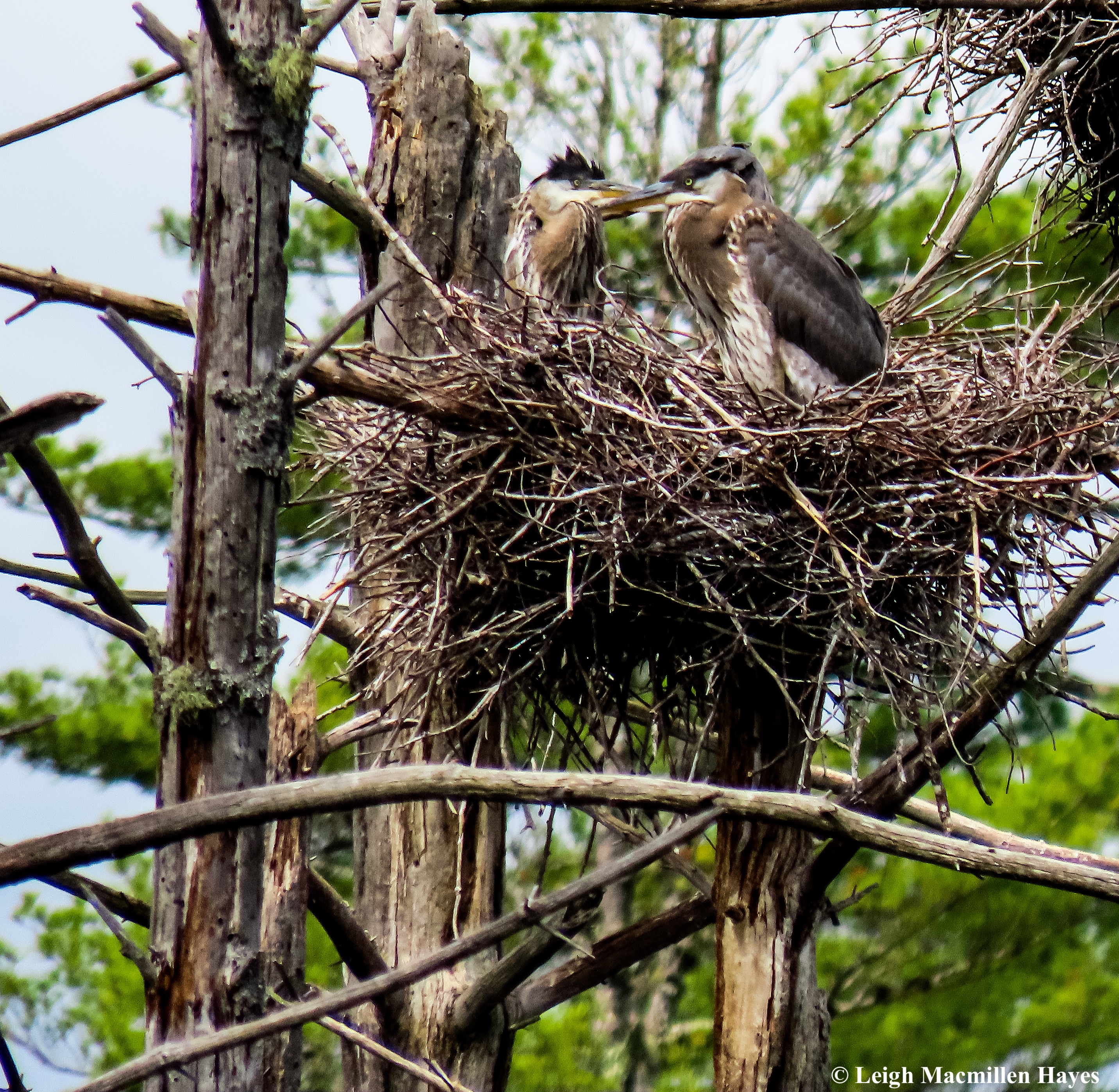
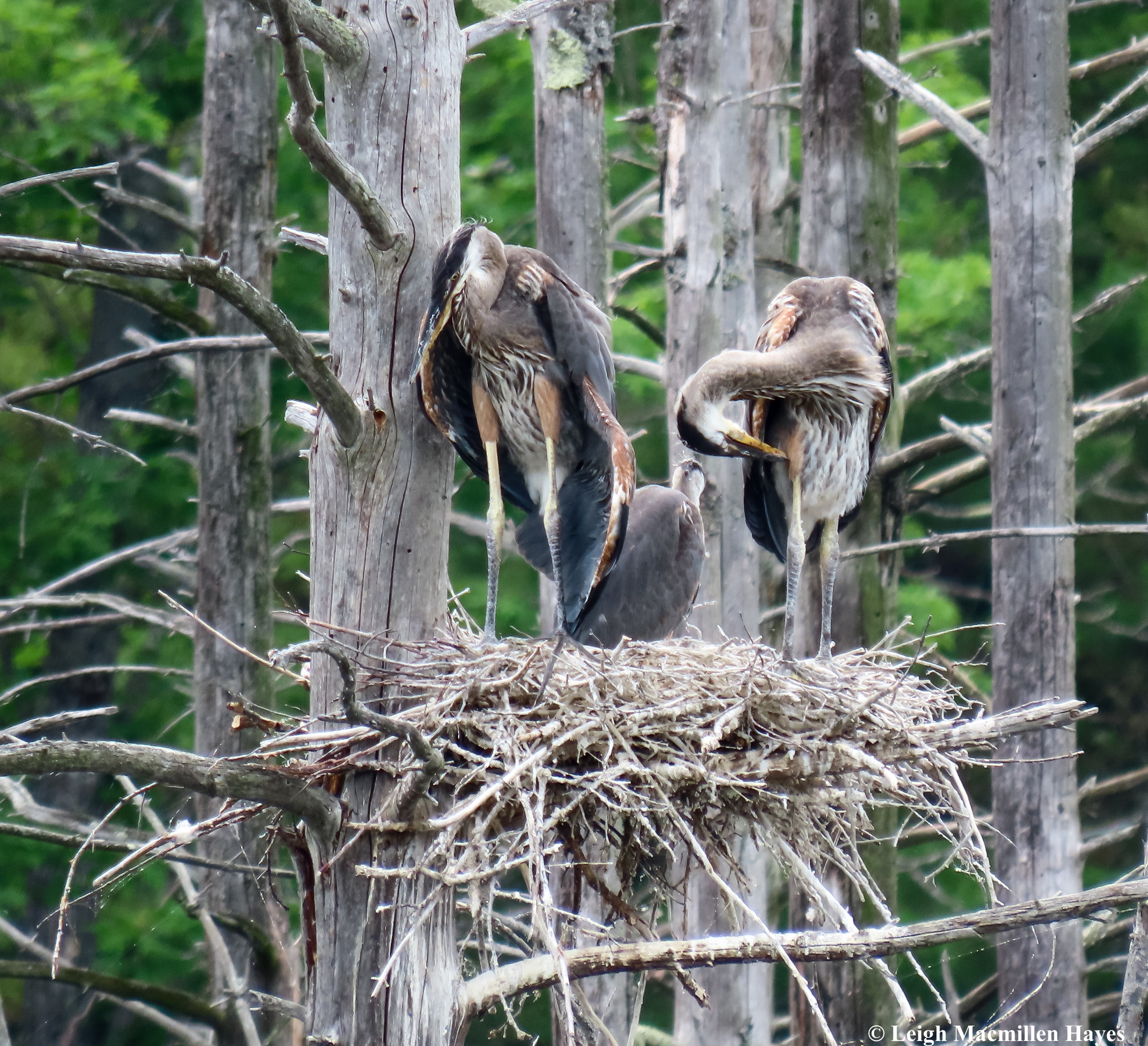
As weeks turn to a month or more, the birds turn into tweens, growing to the point where one wonders how they can all still fit in the nest, despite the fact that Momma built it to be about three feet wide, using sticks that Daddy provided.

And those tweens, like so many of their human counterparts, start to preen between meals, fixing their feathers over and over again.

Preening is important for several reasons: to keep feathers clean, free of parasites, waterproofed, and properly aligned for optimal performance because that first flight is getting closer and closer.

Despite all their preening, however, the younger birds are still dependent upon their parents for meals on wings because they haven’t yet fully fledged and started their own hunting habits.

In the midst of taking count, life happens all around us and we rejoice in any other sightings that might distract, even if it means starting the count again. That’s why, at one of the larger rookeries, we have a few landmark trees so we know if we get confused we can locate said tree and count from there.

We also try to keep track of where each nest is located in the landscape, but if you were to read my notes, you might get totally lost. I do!

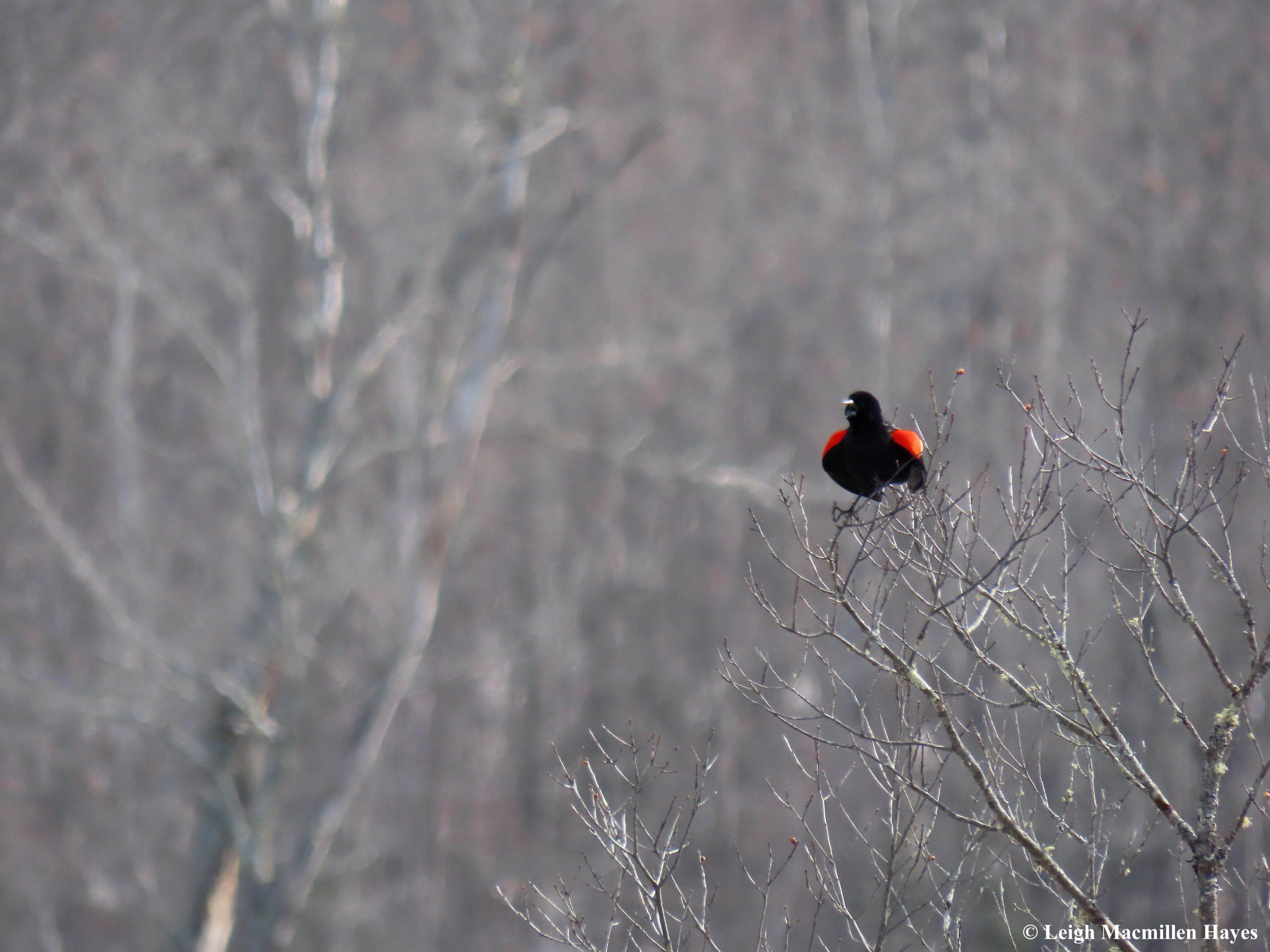
Other distractions include Red-winged Blackbirds, even if their meal of choice is one of our beloved dragonflies.

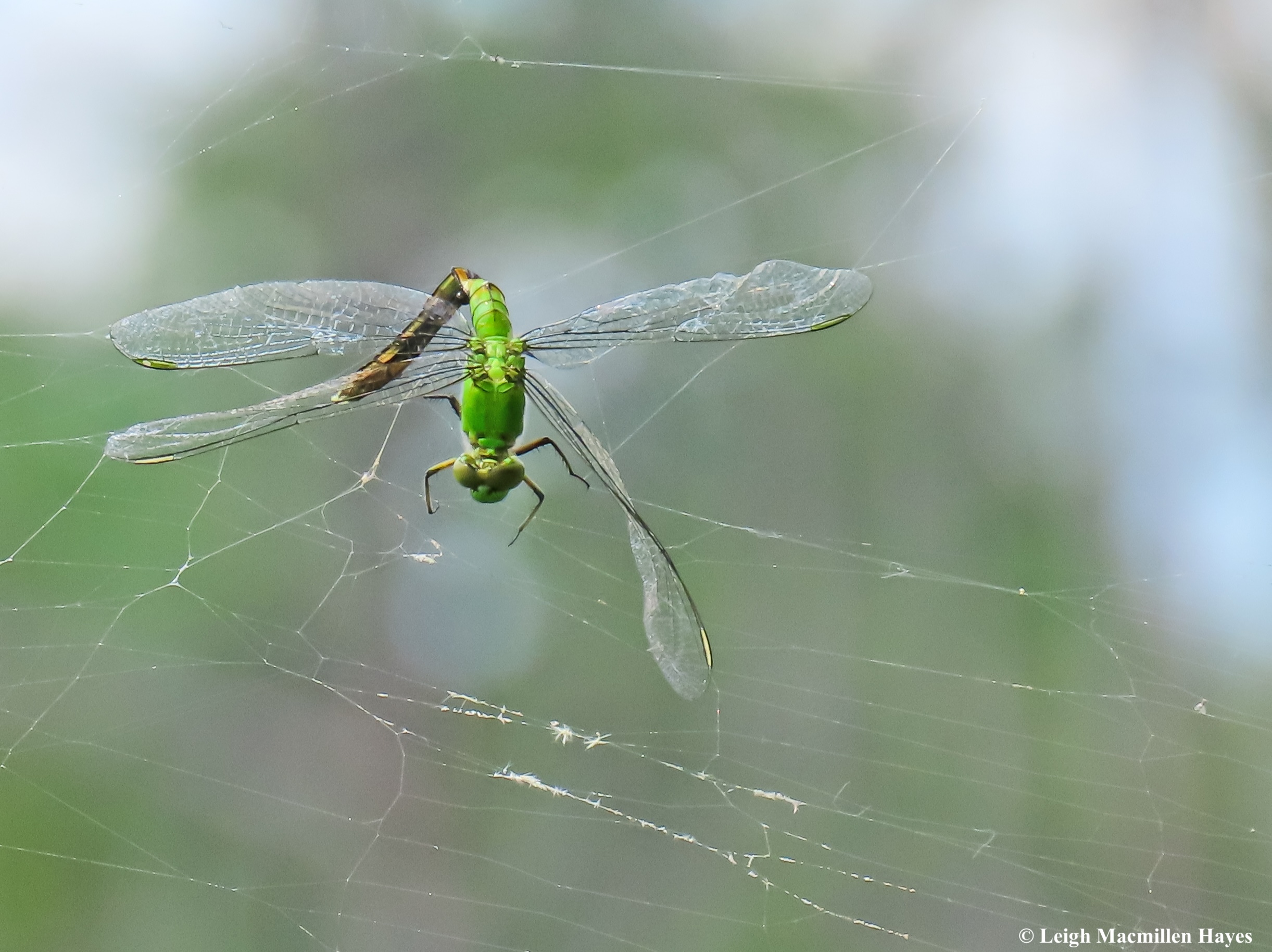
Spiders also make meals of dragonflies, but despite the fact that this female Eastern Pondhawk Dragonfly got snagged, she was still a picture of beauty.

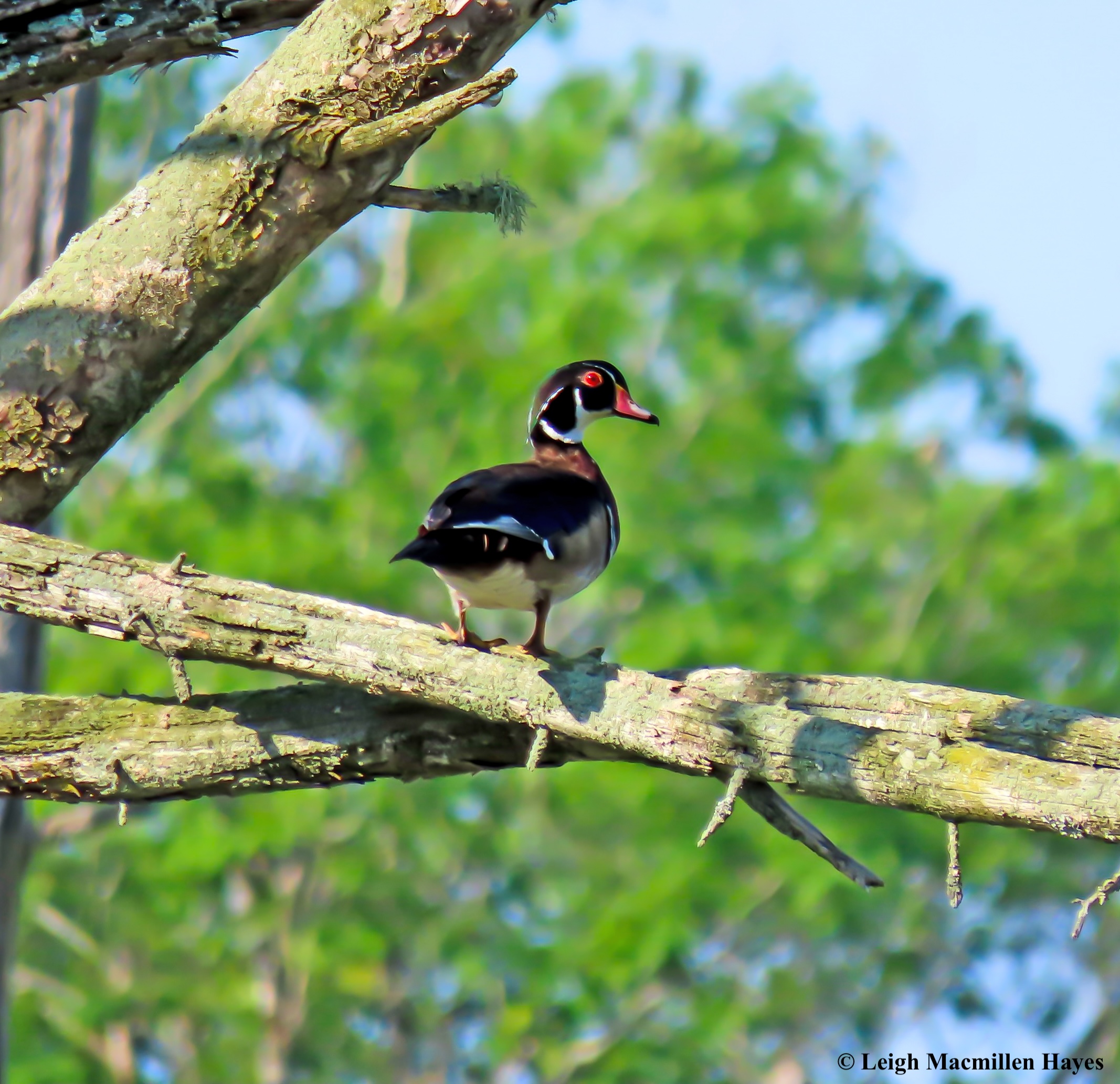
And usually when we spot Wood Ducks such as this male, they fly at the first inkling of our invasion into their space. But when you are far enough back and tucked into the trees beside the wetland, sometimes you are offered a glimpse, and this was one of many in an old snag.

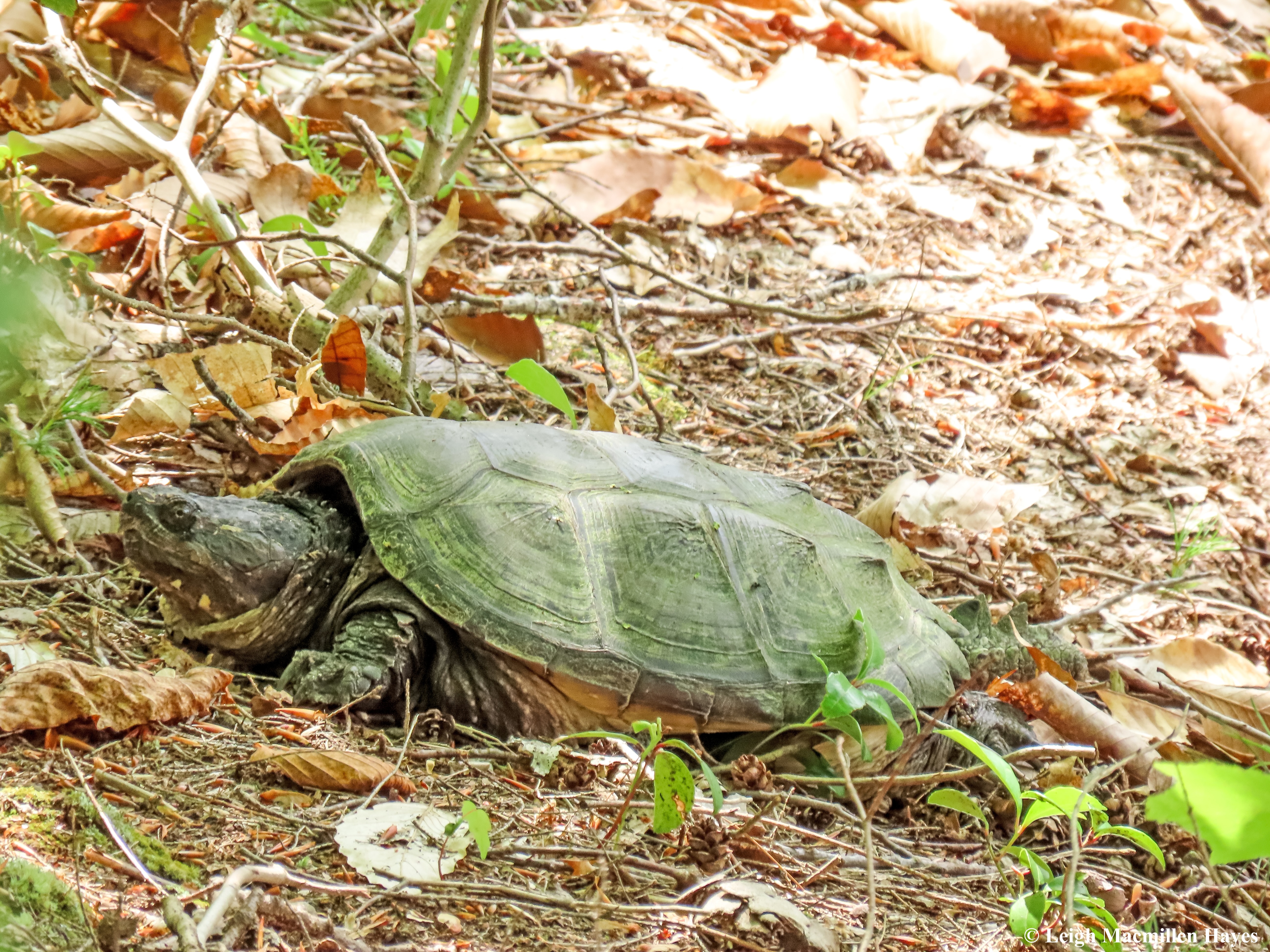
In the hike to and fro the wetland, there other offerings, like a Snapping Turtle on her way up a hill to lay eggs.

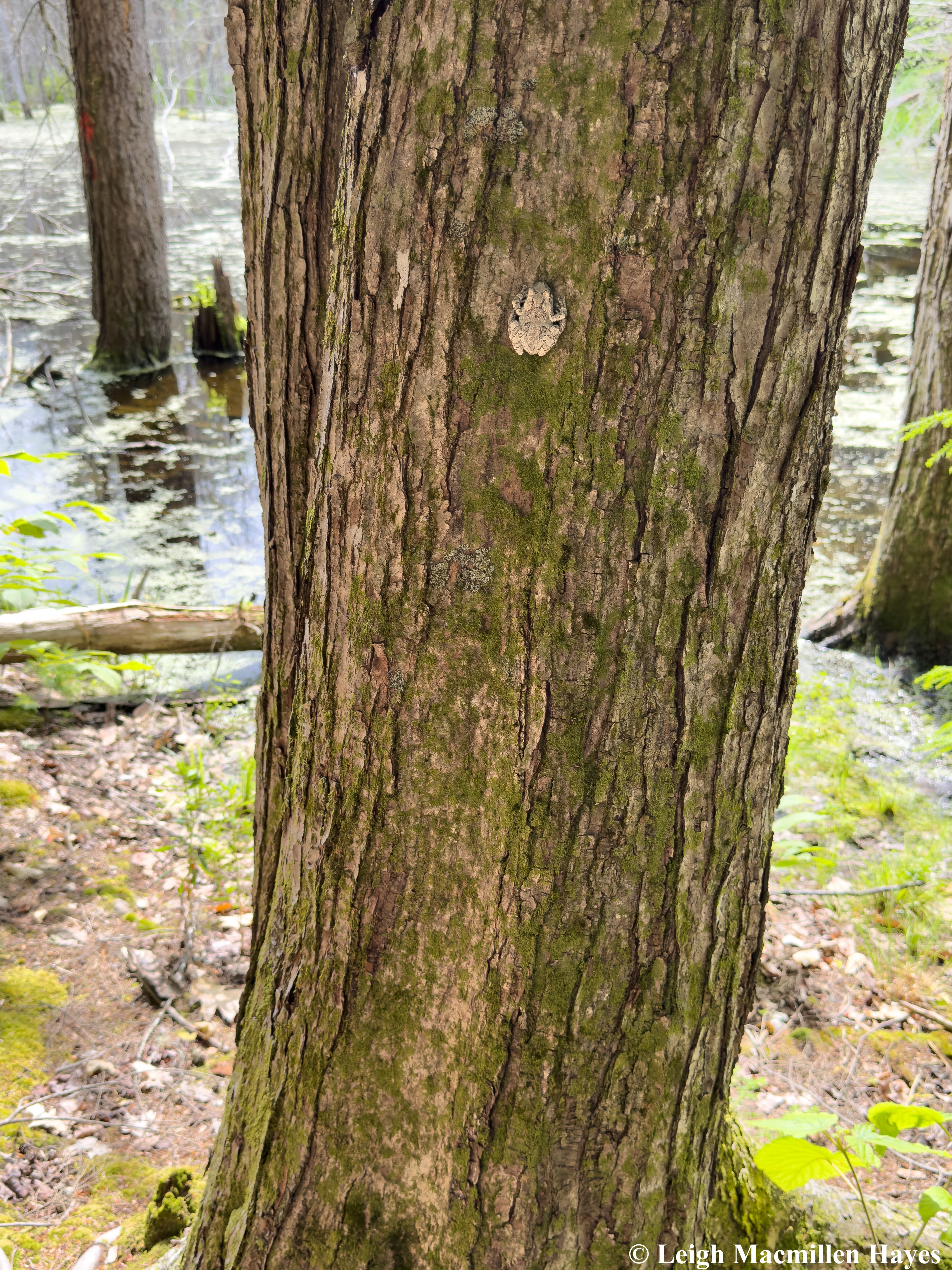
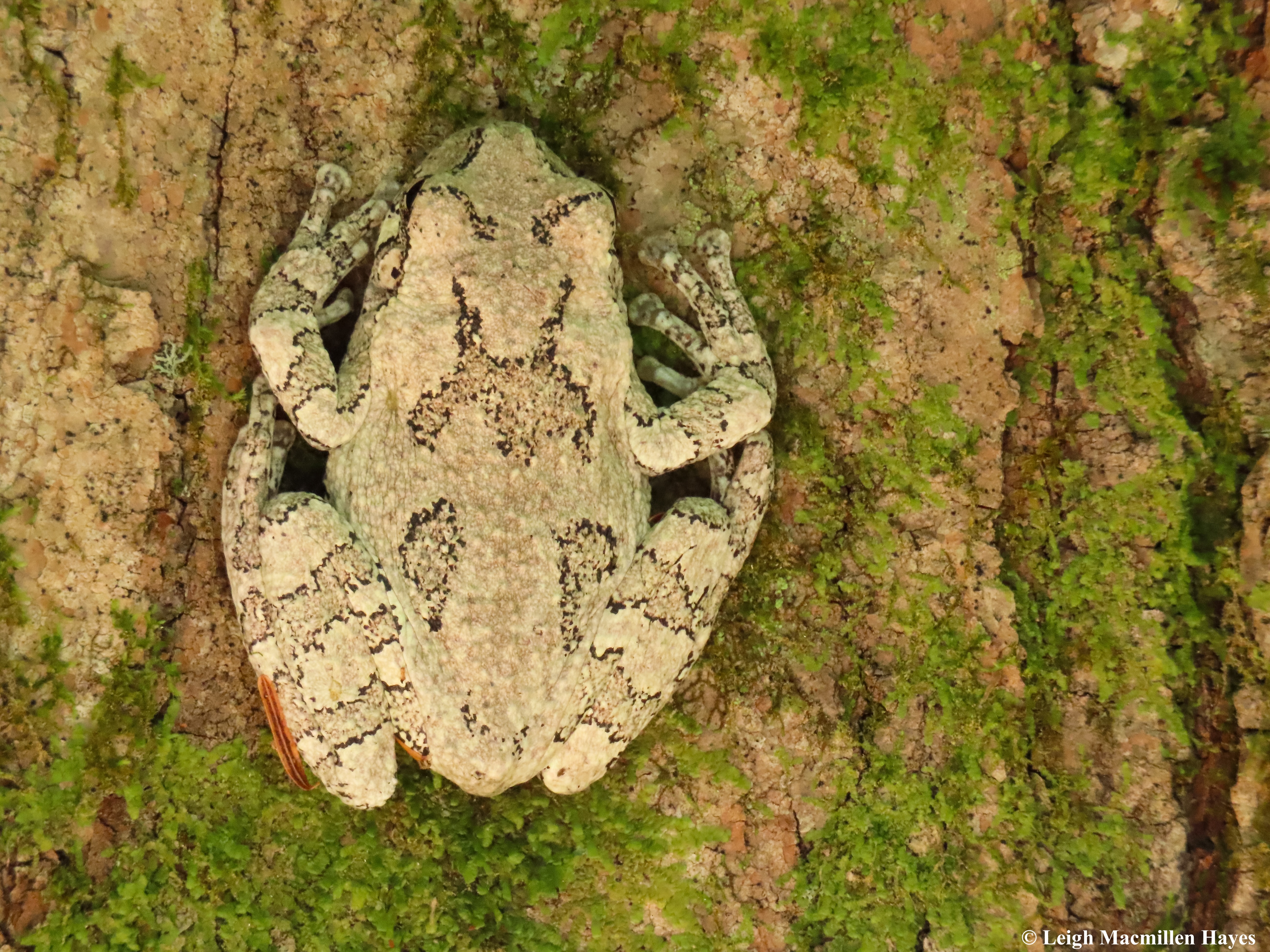
And while pausing to talk, a Tree Frog was spotted.

And we gave great thanks that it allowed us to invade its inner circle for a few moments. Look as those toes, the ginormous suction cups that they are.

Even a Little Wood Satyr added magic to the scene.

And under a tree we spotted a number of pellets full of bones. We don’t know the creator of the pellet, nor the food that was consumed, but someone had a favorite feeding tree.

And now the rookeries are empty and the tweens have turned to teens and must hunt for themselves. It’s a task that takes great focus, but those eyes are all seeing.

And the beak is quick to snag.

And though the meal may be small, its one of many to come and success is key.

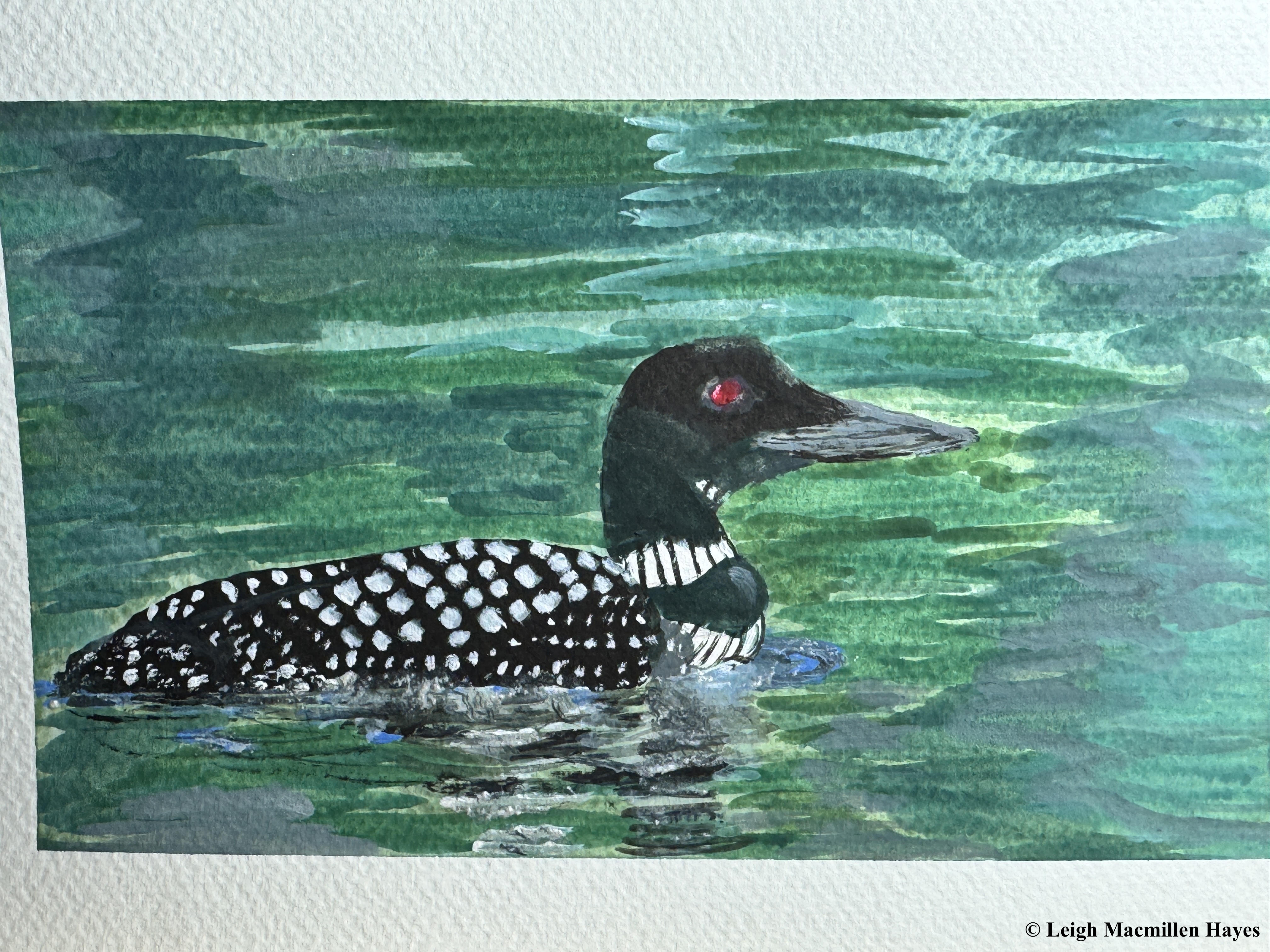
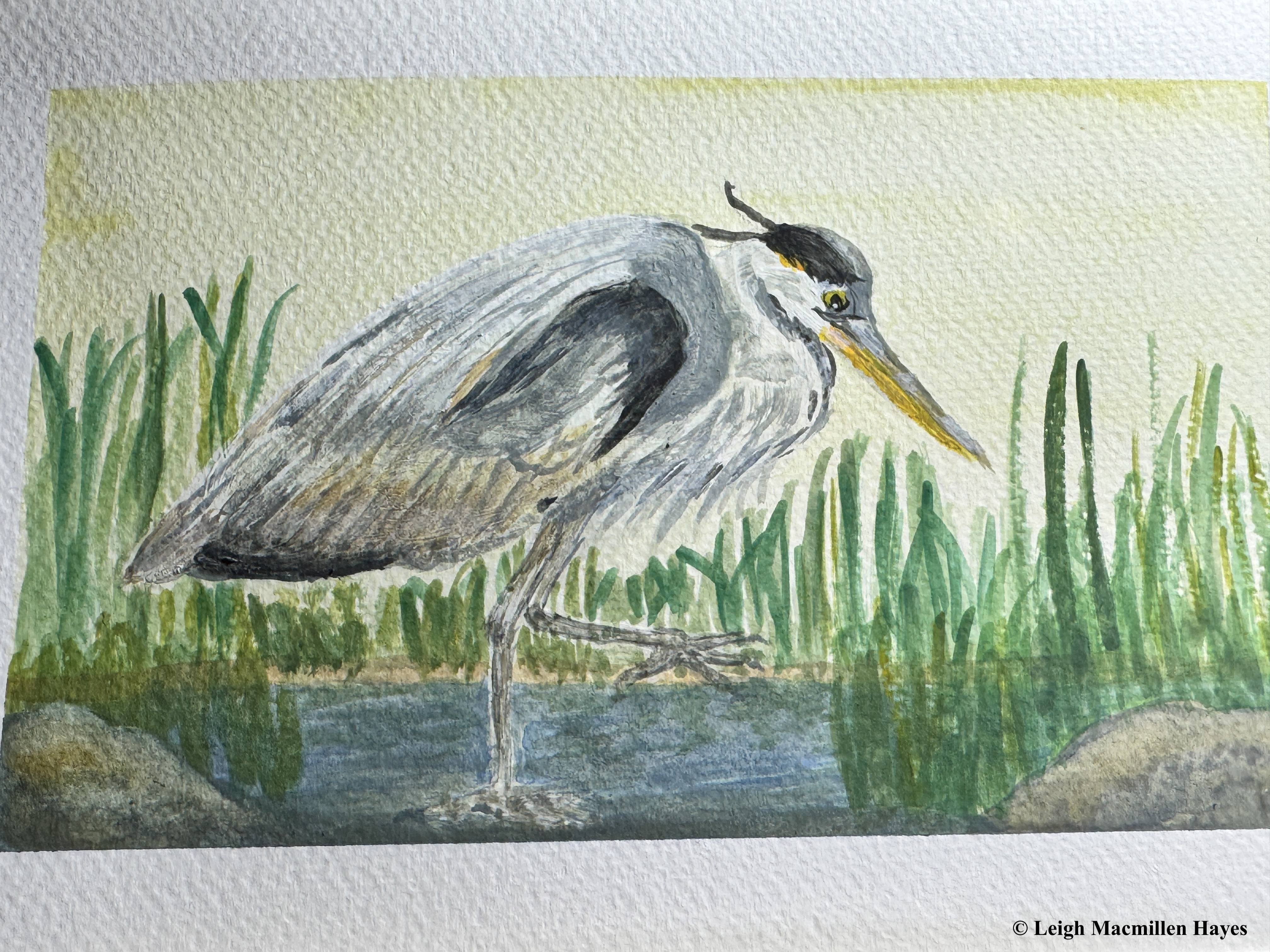
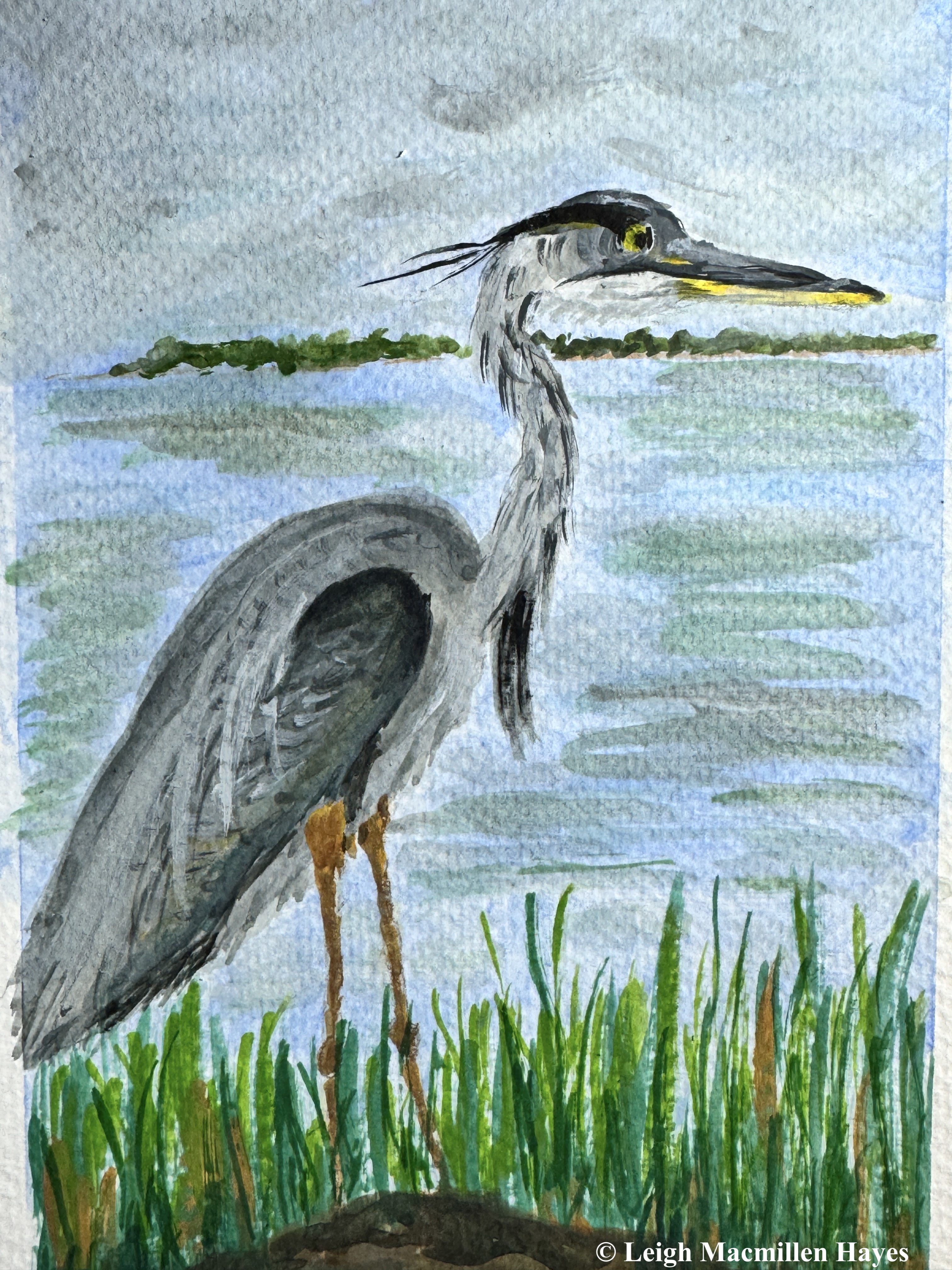
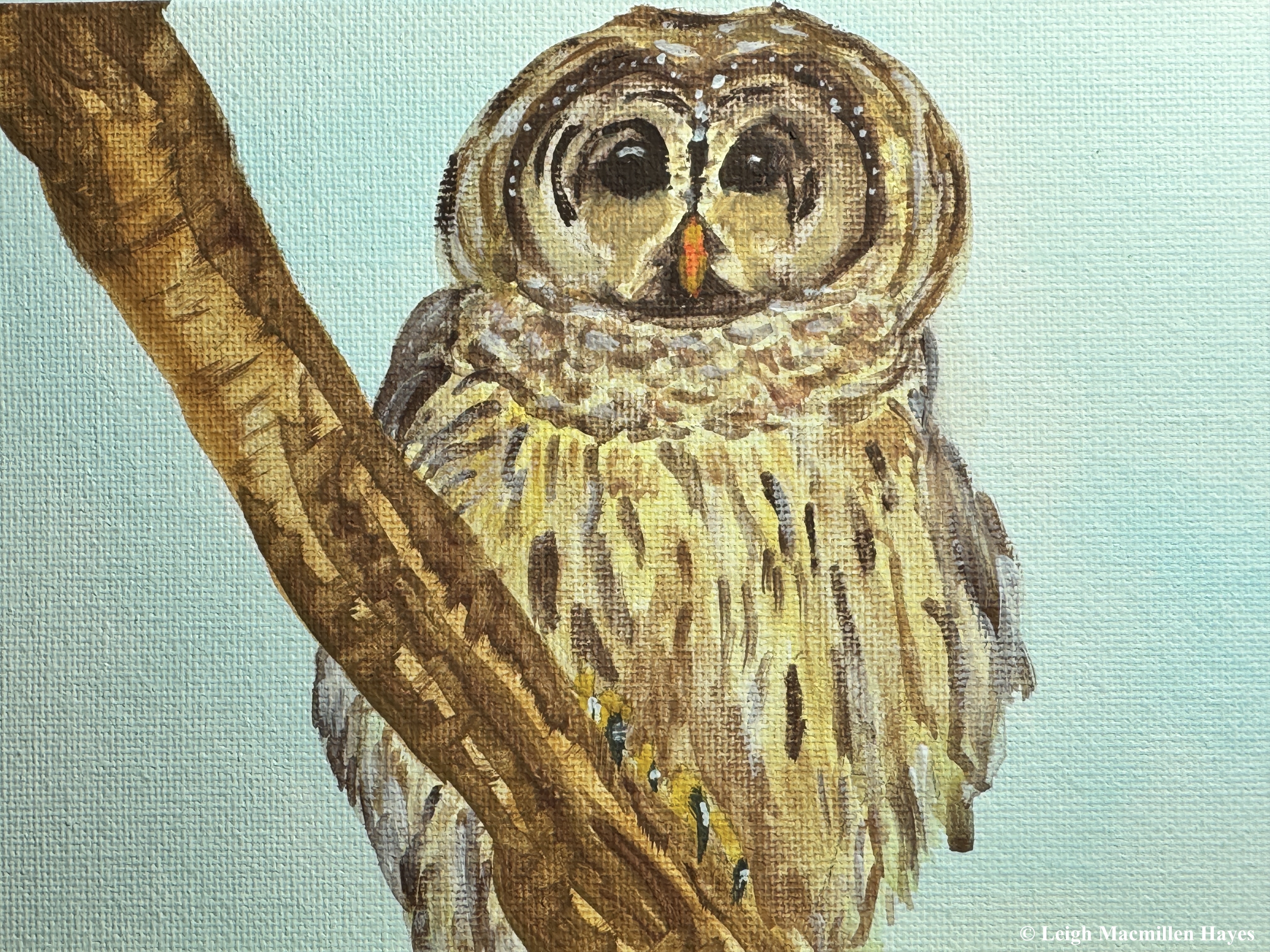
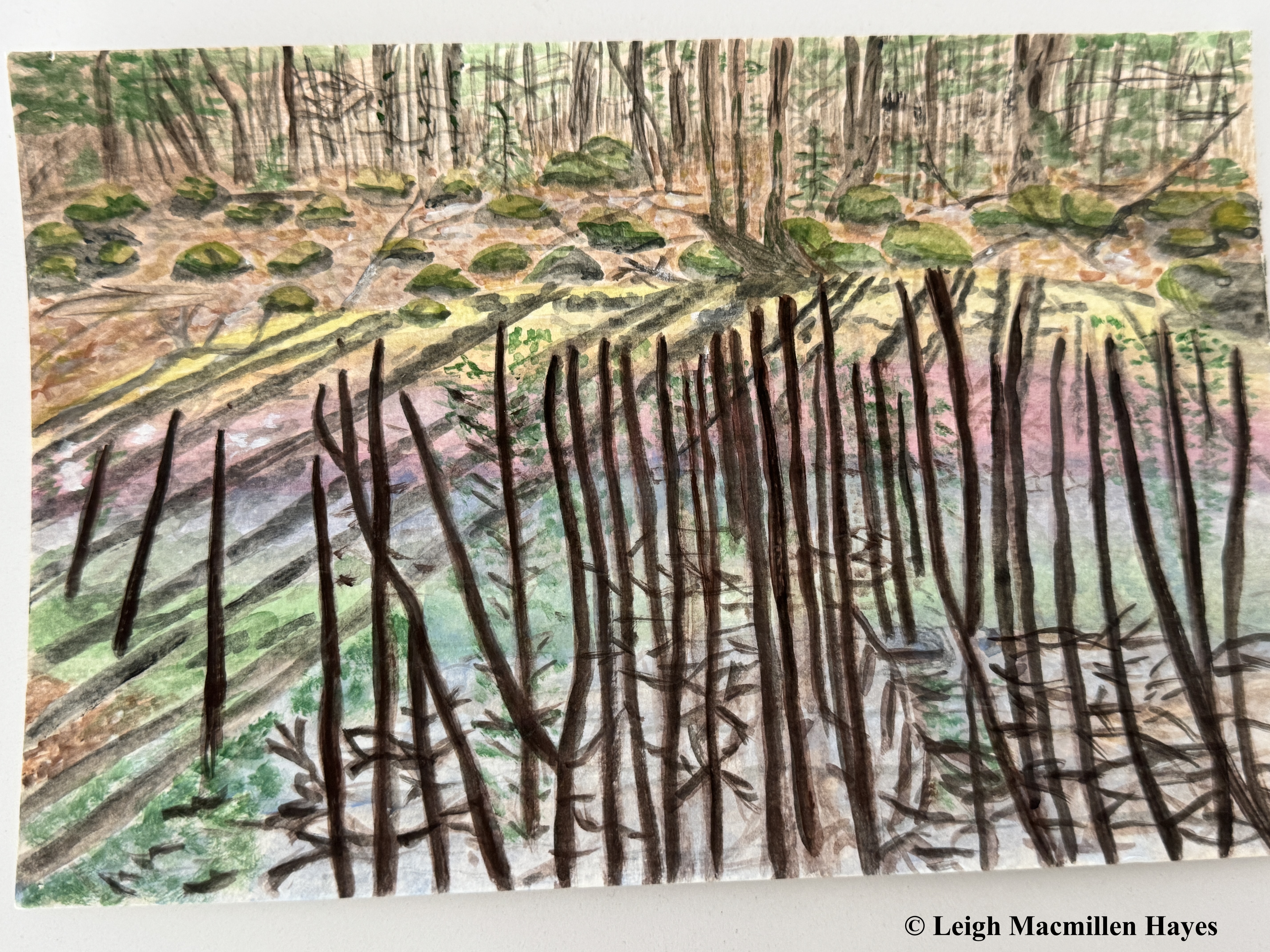
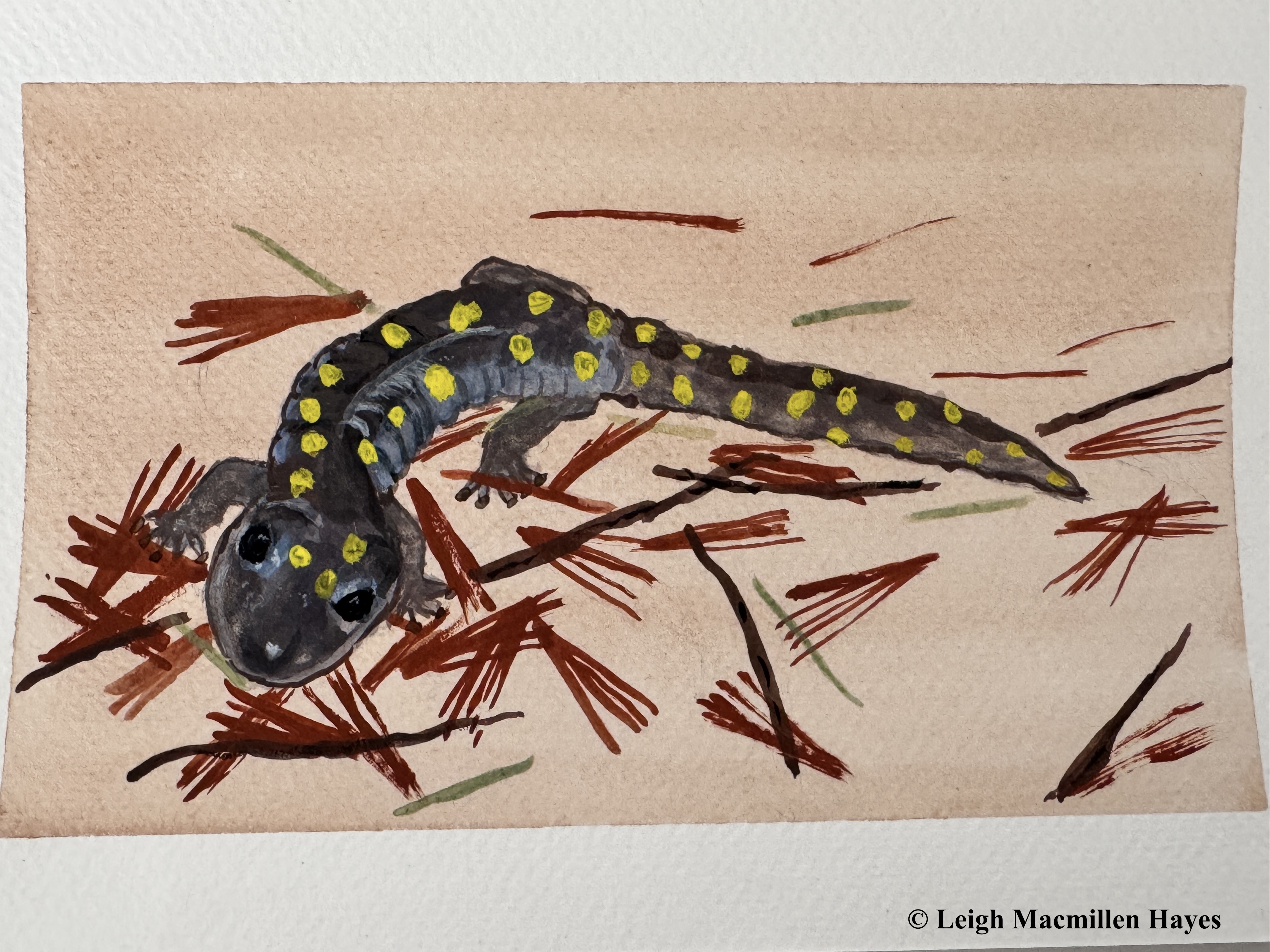
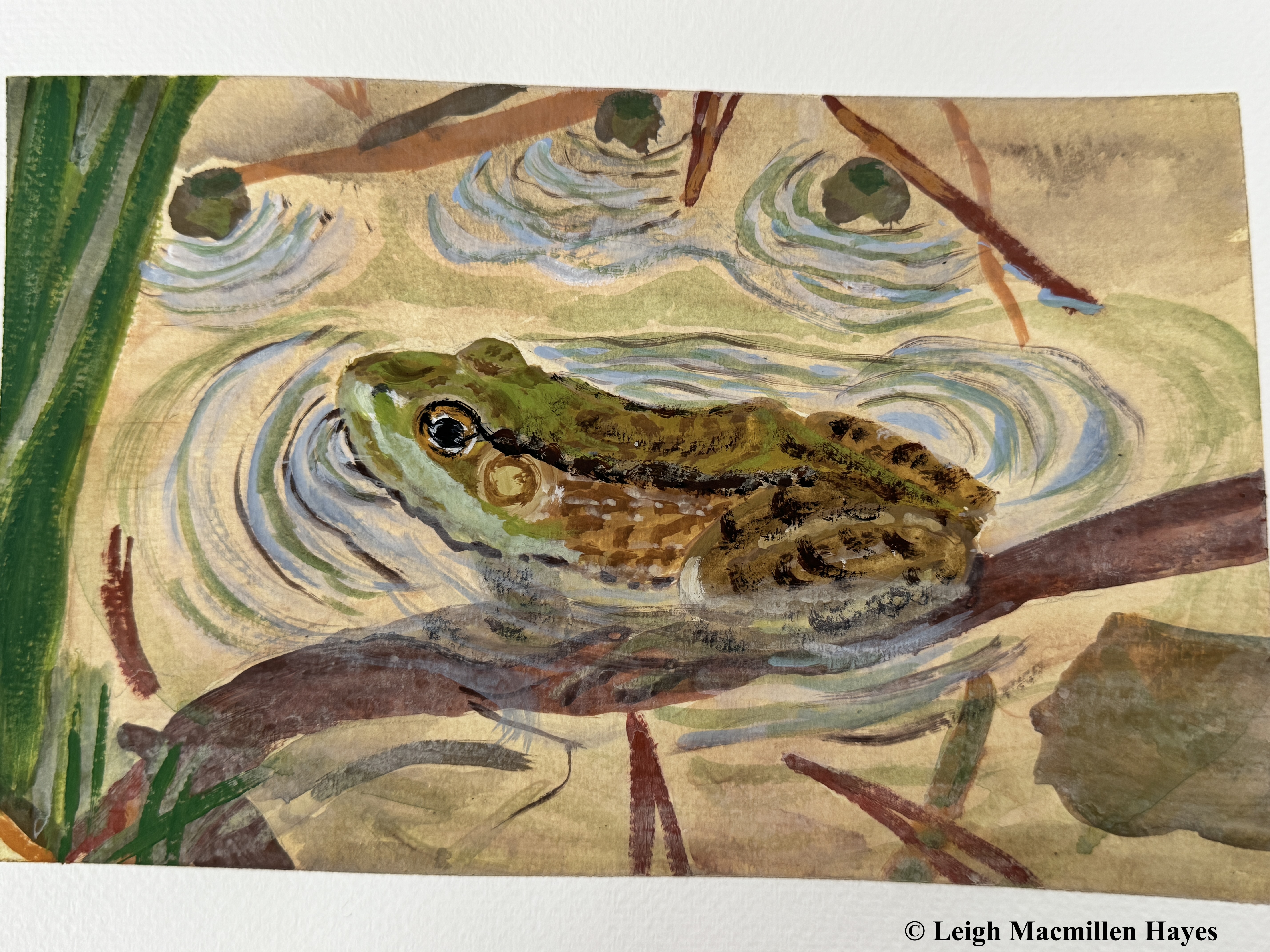
I’ve tried to commemorate these morning’s with a few paintings, including this teen and its catch.

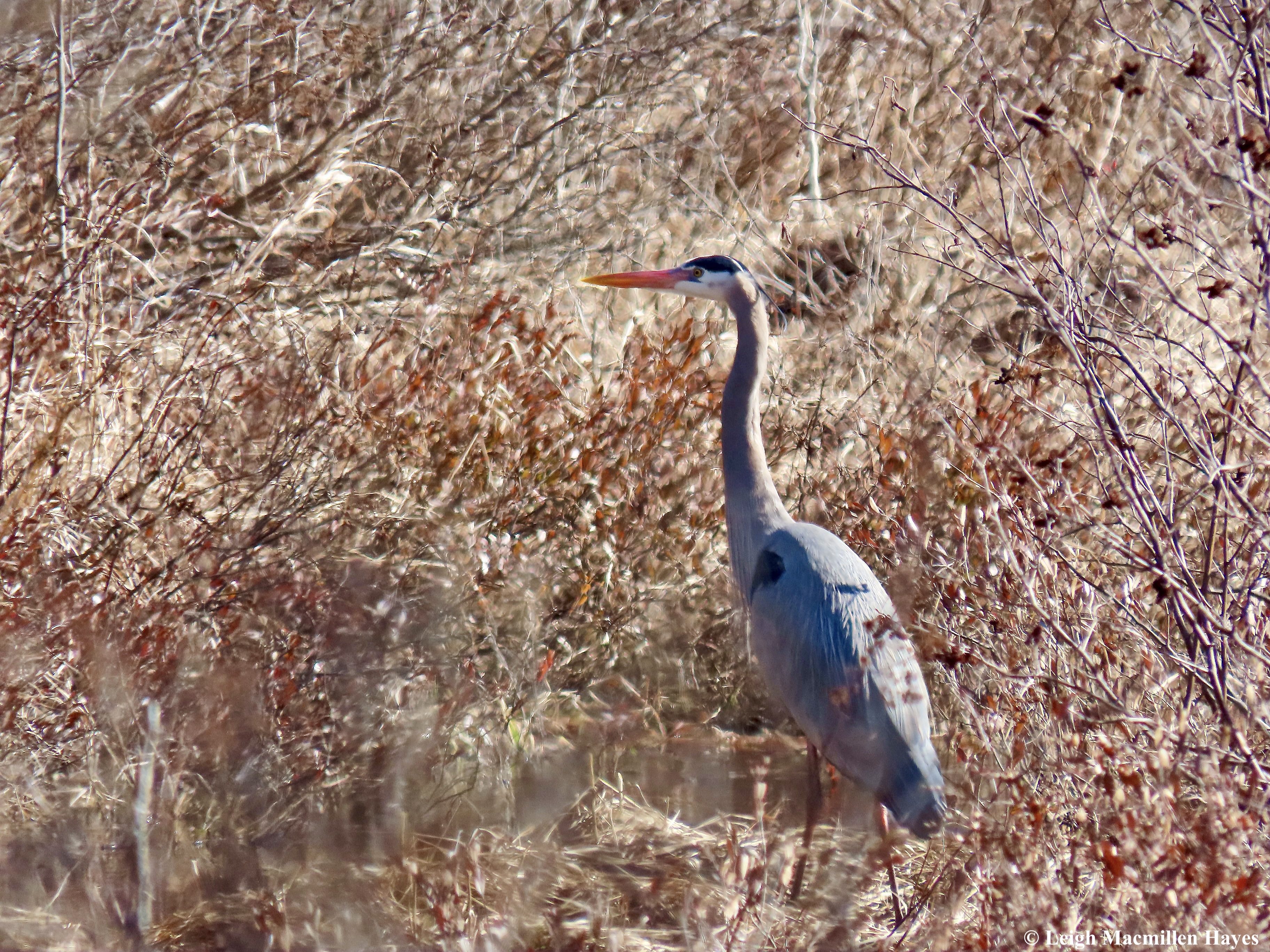
And an adult on the hunt.

The Tree Frog.

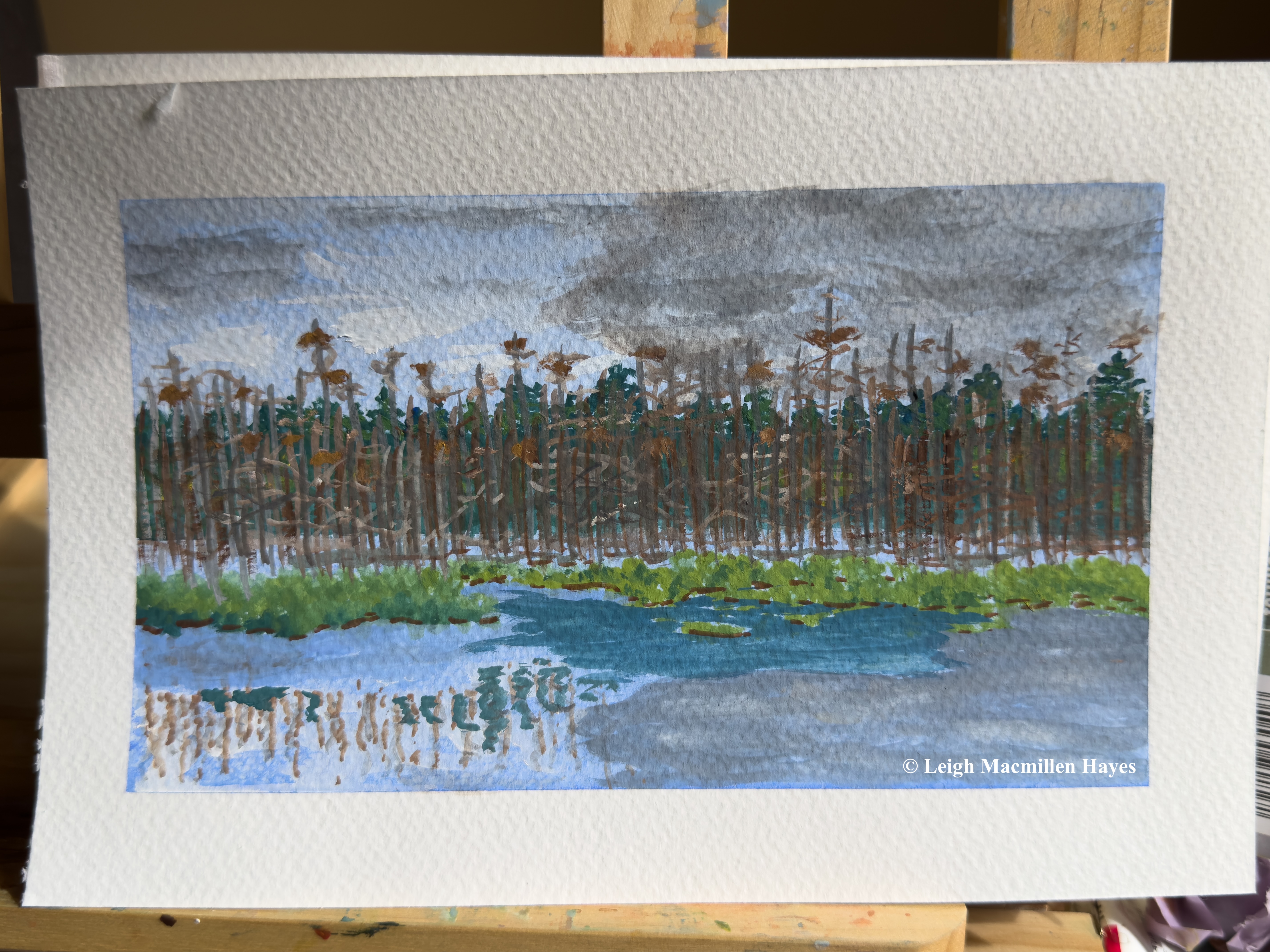
And one of the rookeries, this one being the most successful.

2025 numbers:

Rookery 1: zero nests as has been the case for about six years now and I suspect I’ll be told not to bother with that one next year, but then again, some other Great Blue Herons could decide it’s just the right place and build a new rookery. The last year that we saw nests and birds, a Bald Eagle was in the area and within a week there were no more Herons to count.

Rookery 2: 21 nests observed; 18 inactive; 3 active; 5 adults; 3 young upon the first visit in May.

21 nests observed; 21 inactive. Yes, all nests were empty two weeks later. We knew when we didn’t hear any squawking as we approached that things were not good, but we were totally surprised to not spy any Herons. What had happened during the two week interval we’ll never know. But we suspect maybe a Bald Eagle in this locale as well. Or maybe an owl? Last year, the rookery had declined drastically from the first visit to the second, but not to this extent.

Rookery 3: 1 inactive nest; 59 active. YES! 60 nests in all, an increase of 7 from last year. And of 2024’s 53 nests, only 46 had been active. So 59 was a huge number! Have you ever tried to count birds in a wetland, where the nests are at least a football field or more away from you? It is not easy. And takes about two hours plus the hike in and out to complete. Oh, and the count: the number of adults varied with each visit, becoming less and less as the weeks went on because they were out hunting for larger fish to feed their growing brood. The youngsters at our last count: 122, plus 7 fledglings. That’s a lot of mouths to feed. And think of size of those birds, some nests with 4 kids, plus the two adults. Talk about tight living quarters.

Shoulder and neck muscles tense. The brain gets befuddled. Mosquitoes buzz in our ears.

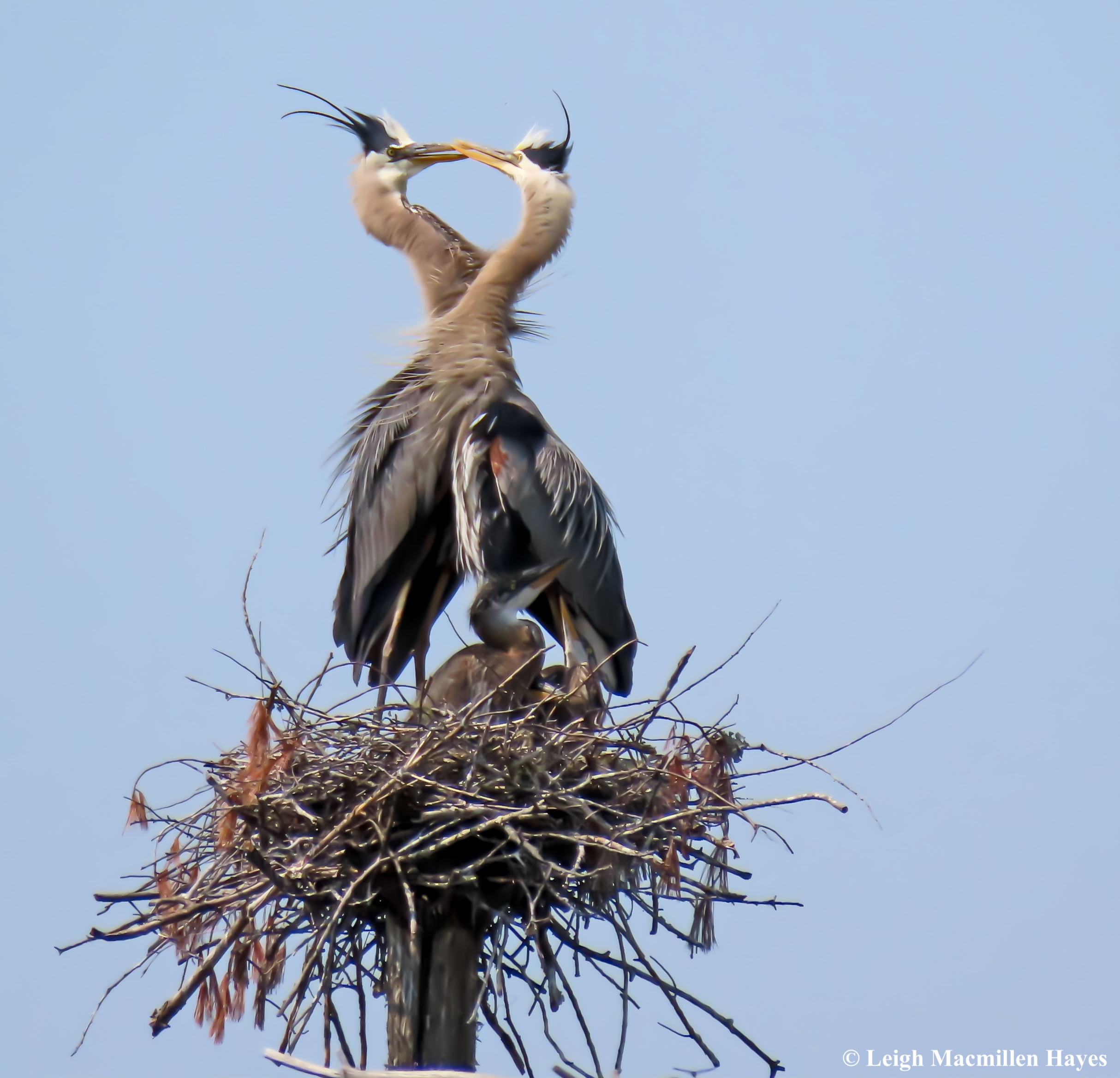
But at the end of the morning, I can’t think of any place I’d rather be than spotting these two sharing a moment and give great thanks for all the moments we get to witness because we take part in monitoring the rookeries and making the Great Blue Herons count.

Thanks also to my companions. I won’t name them because I don’t want anyone to bug them about locations, just like I won’t name the actual locations or their State ID numbers because these are special places that need to be left undisturbed.

My Little World

Between our six acre plot of land and our neighbors’ field, which is probably about three or four acres, I feel like we live in a special place. Oh, I know I’m not alone and so many others have their own special places. What I’m most grateful for, however, is the ability to enjoy it by wandering and wondering on an almost daily basis and getting to know it intimately. That said, there are always surprises and perhaps that’s what makes it extra special in my eyes.

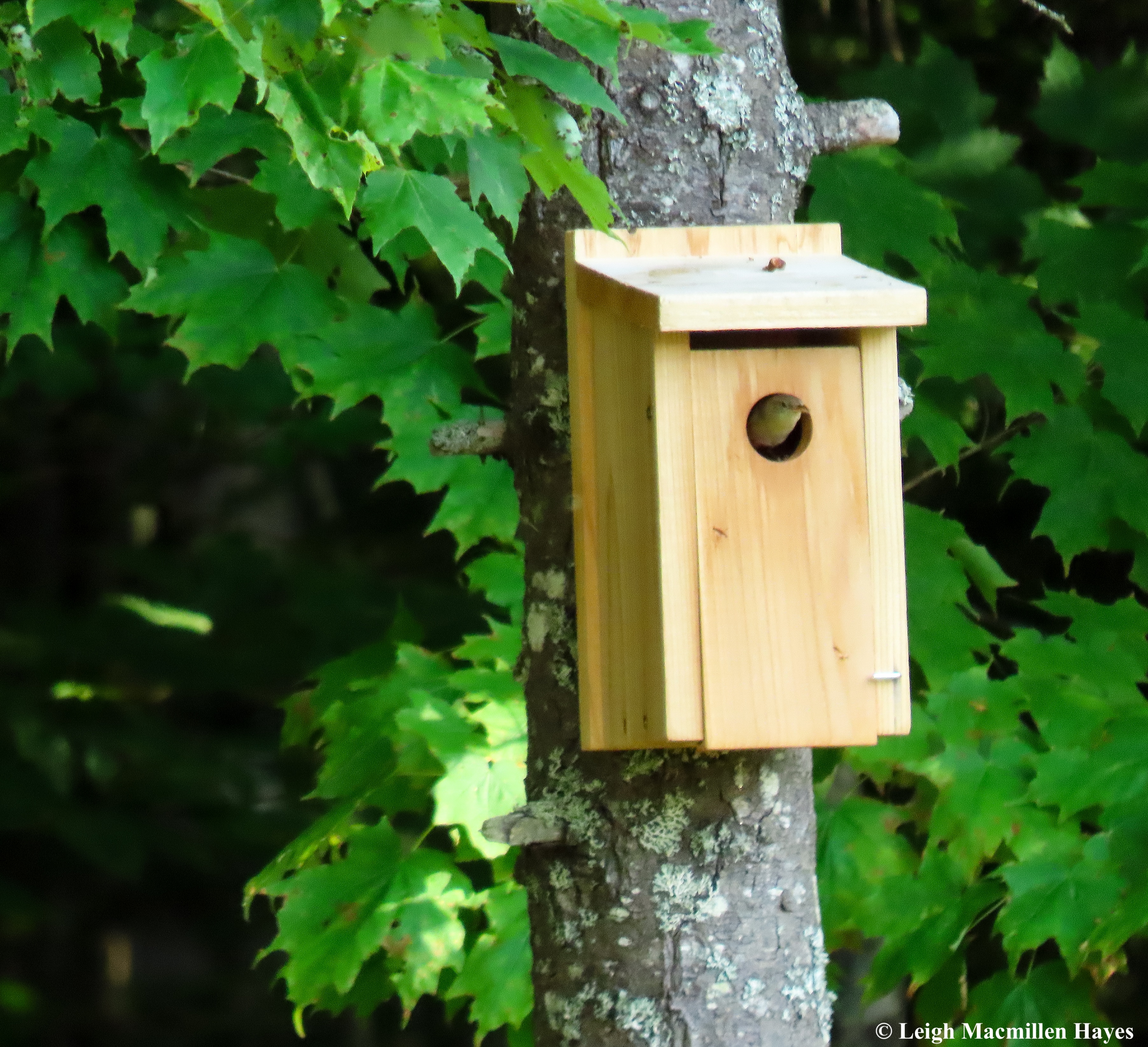
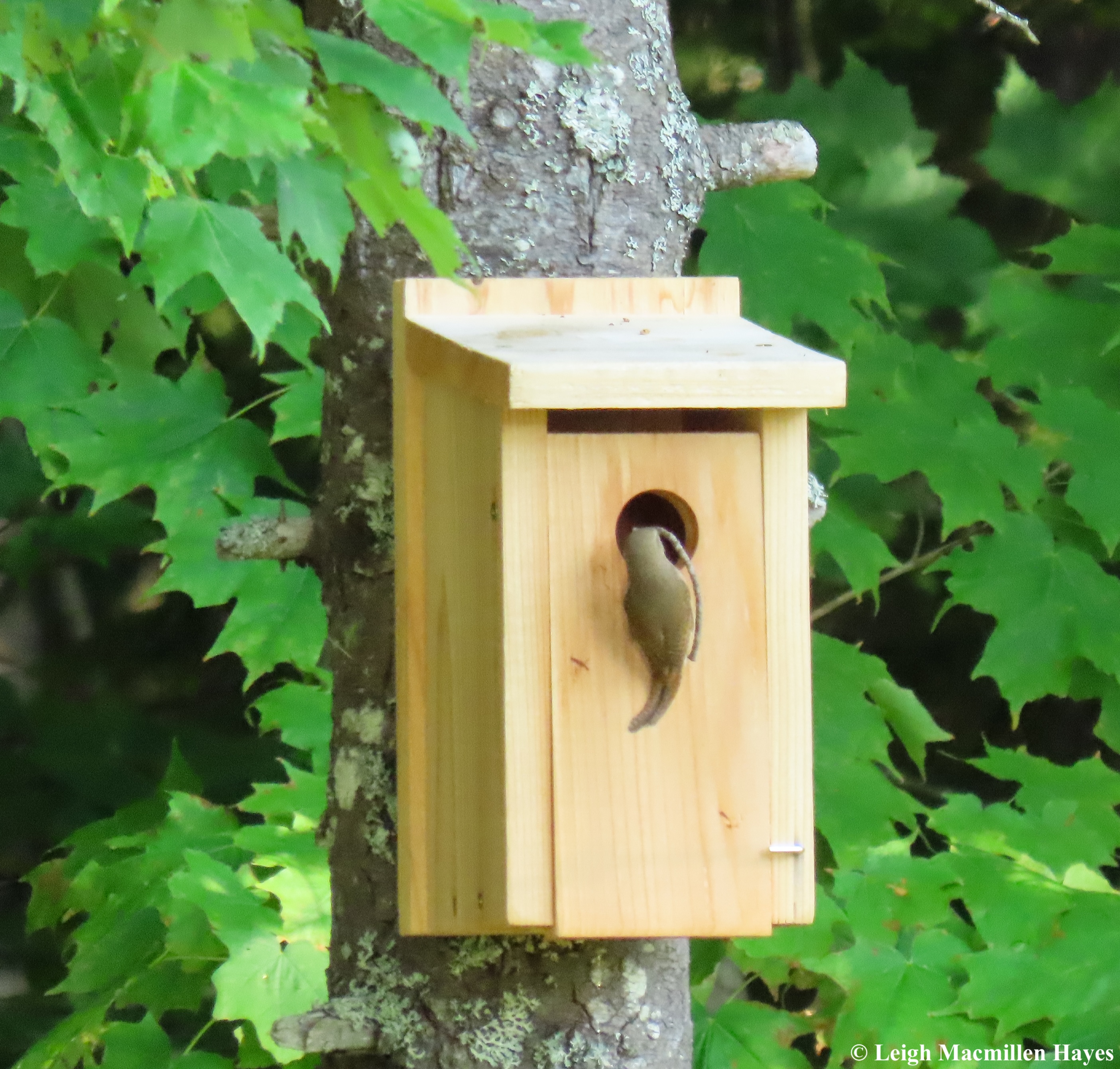
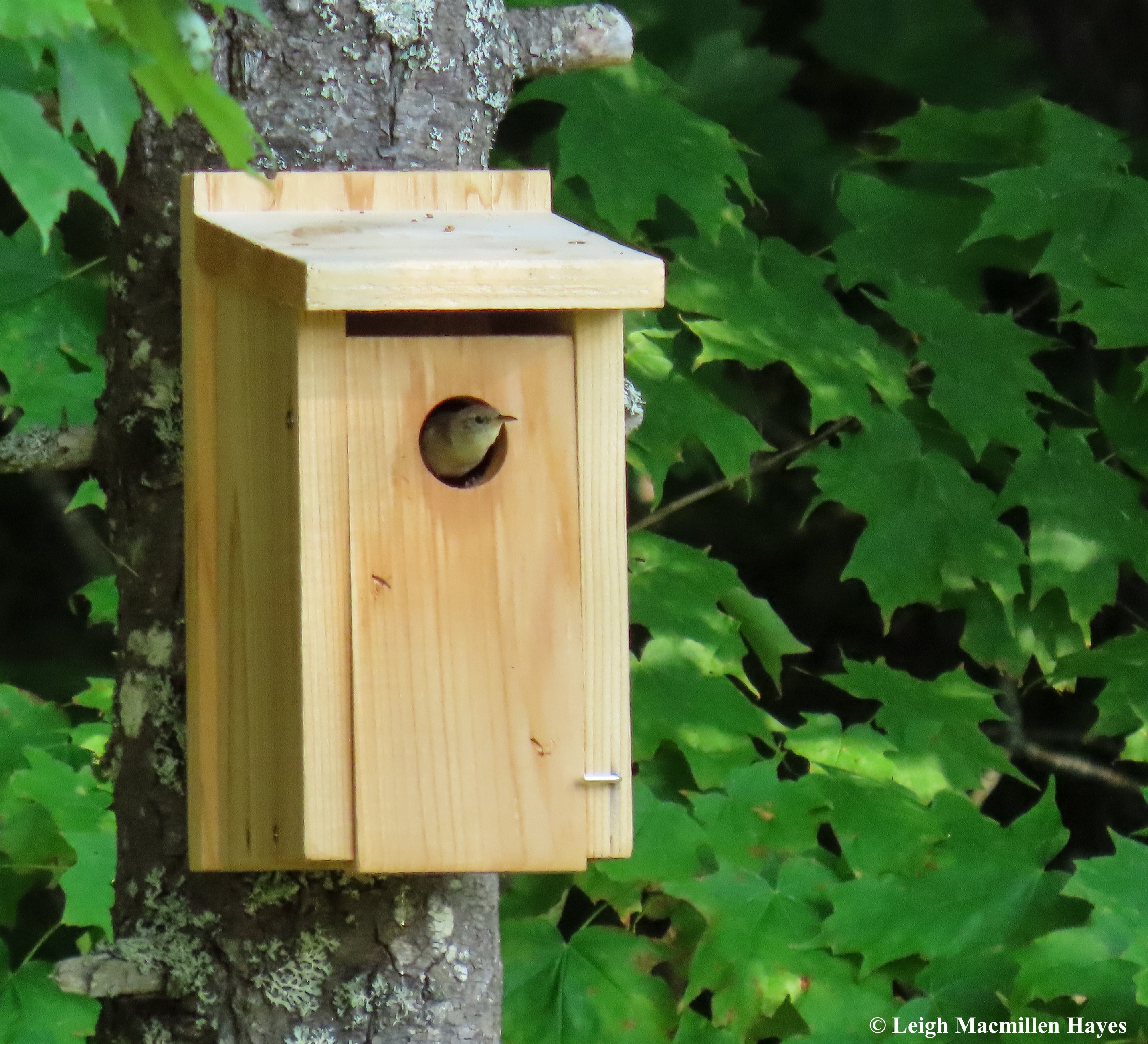
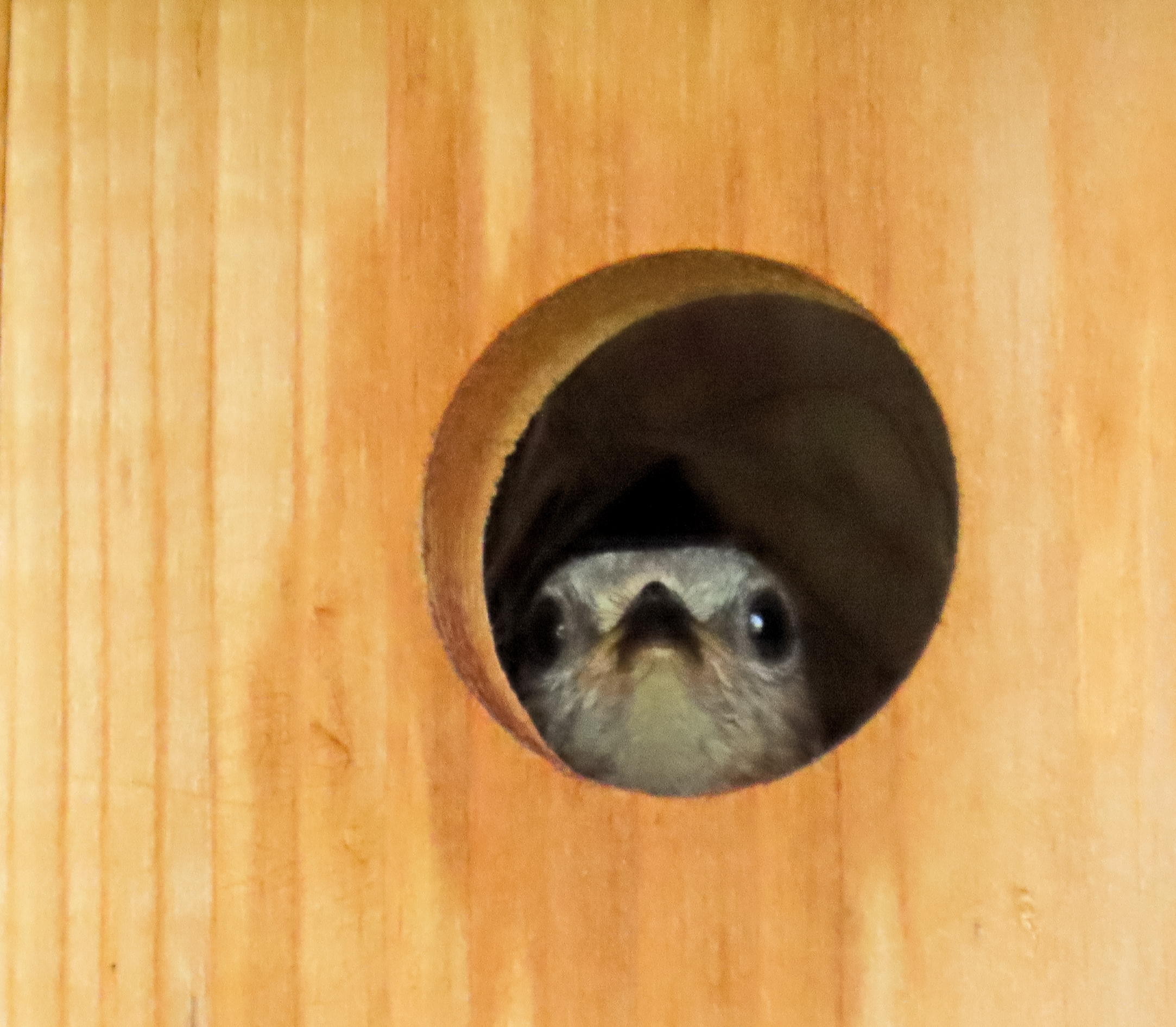
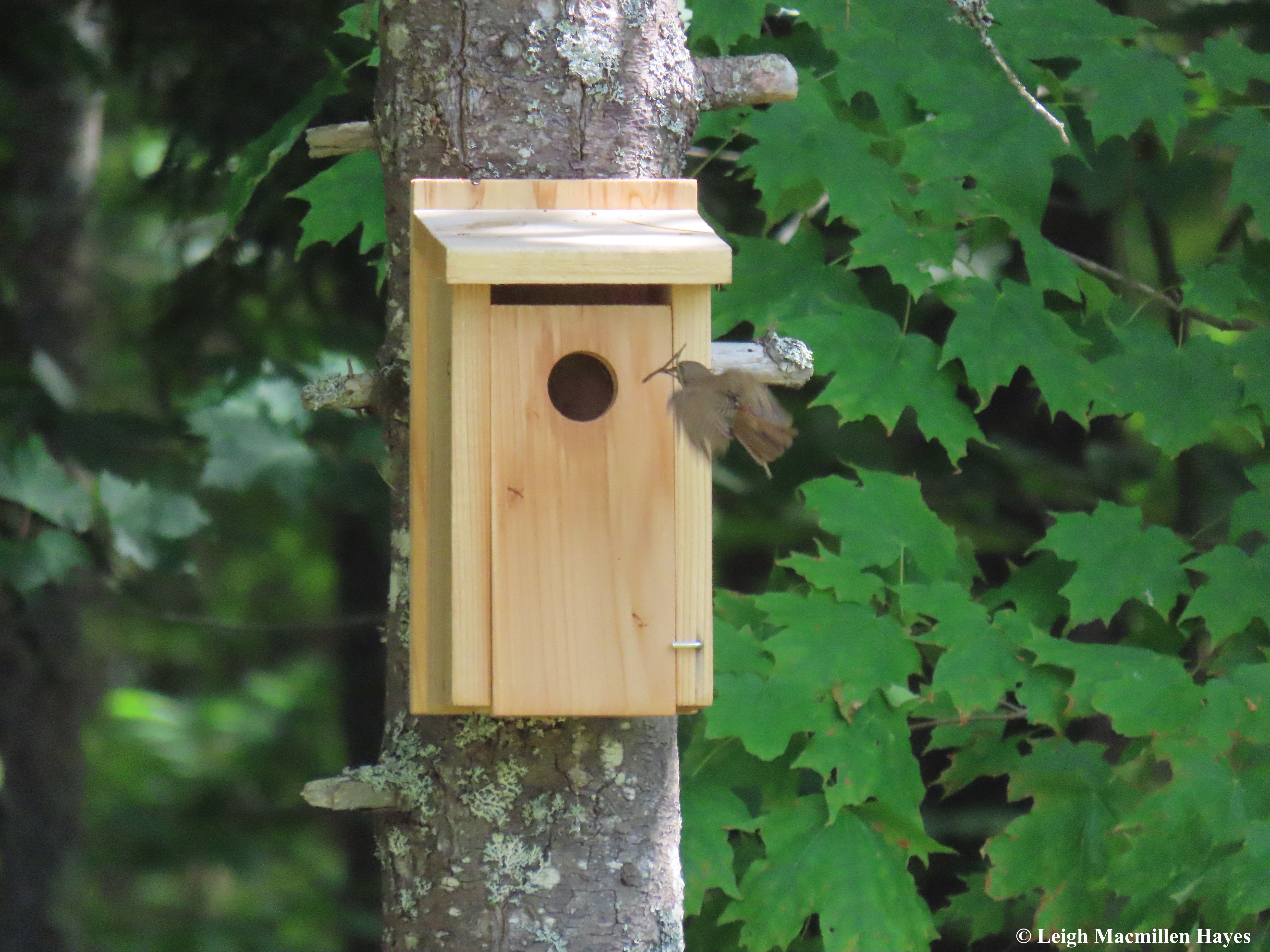
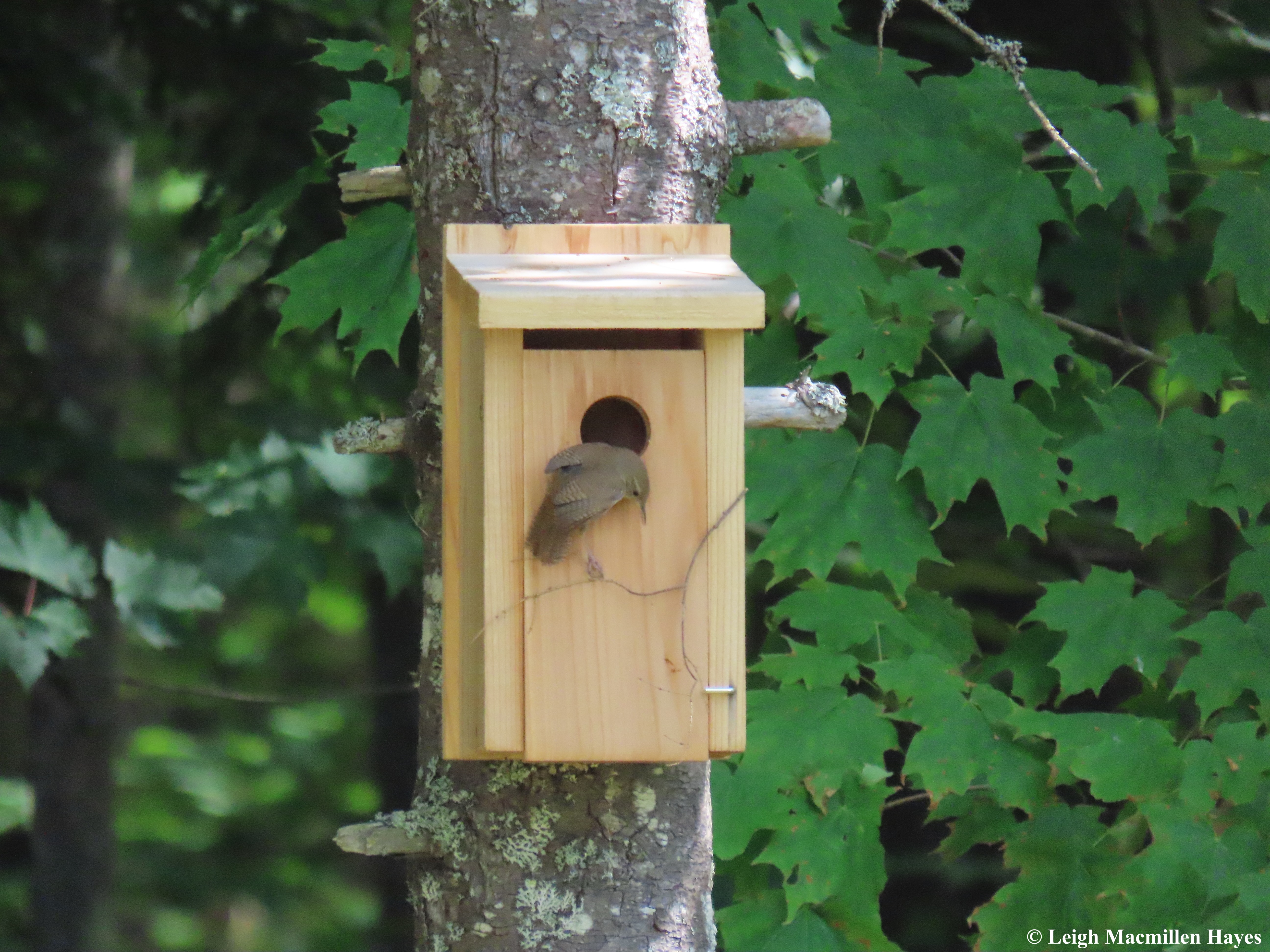
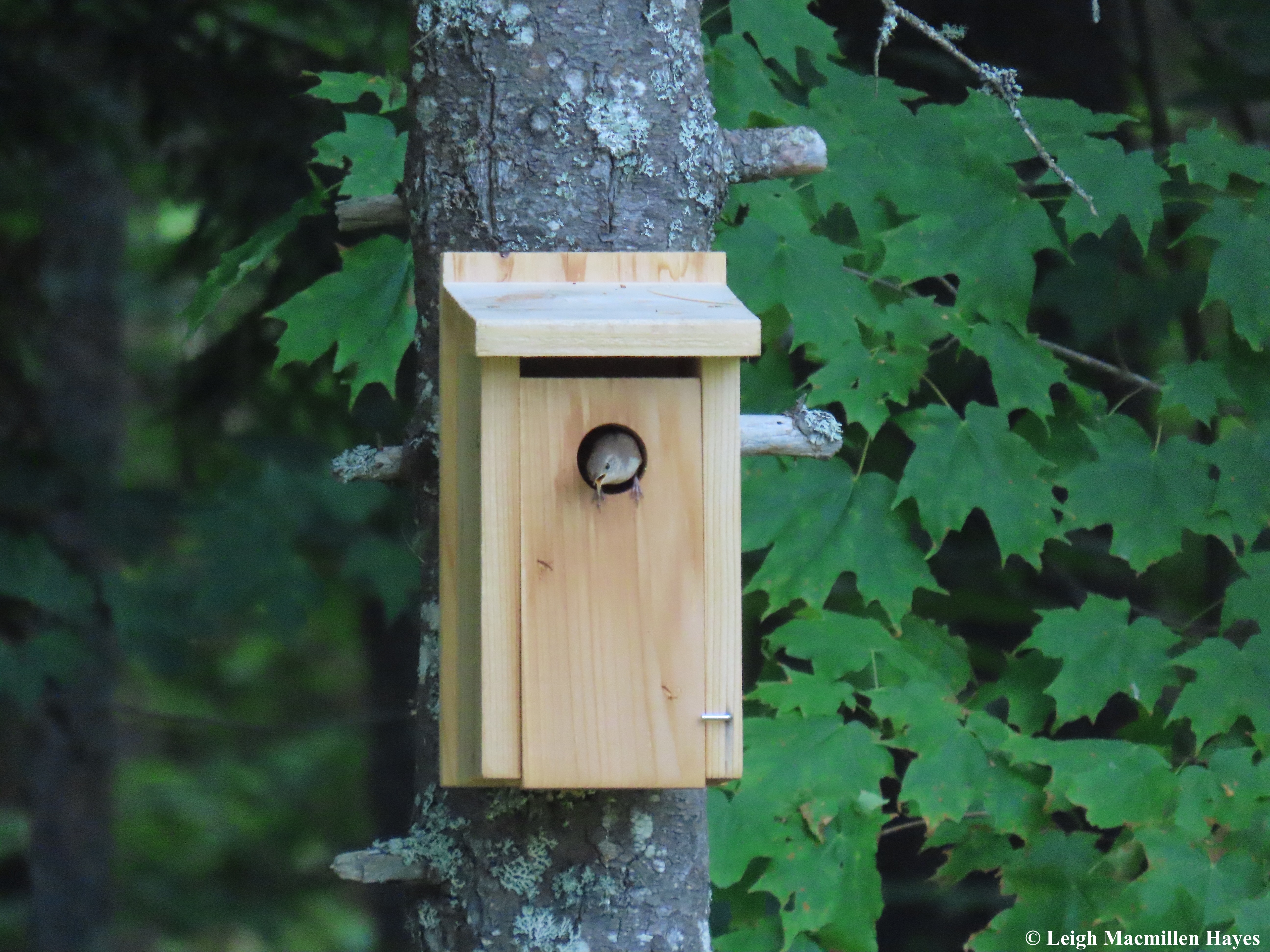
One day recently, after spotting no activity for about two months at the Bluebird Box My Guy had nailed to a tree along one of the stonewalls, I noticed activity. In the form of a House Wren.

For hours, sticks were picked up and brought to the box, the better to build a platform for the nest cup to rest upon. Sometimes they were too big. At least to my untrained mind.

But a little finagling this way and that; I admired such perseverance. And knowledge.

Tada, in that stick did go to join the others. With many more to come.

For two days, the Wren worked in the same manner. And then. Nothing. Being a Male Wren, it was just being a Male Wren . . . filling a possible site here and probably in other boxes near the field, as well as in tree cavities and she chose a different piece of real estate to set up housekeeping.

To say I’m disappointed is an understatement, but it’s the Wren Way. And I’m only a guest here.

I love being a guest here because I see all sorts of Natives make themselves known, including this youngster who followed in the footsteps of its parents, crossing the yard at an angle. Fortunately, the backdoor often serves as a screen so I can photograph many of the species with whom we share this land and not disturb them.

That same “screen” helped me capture a shot of an immature Red-bellied Woodpecker, who has the slightest hint of his parents’ crimson red upon his head. He stops by at least once a day, but is always in motion. And never stays long.

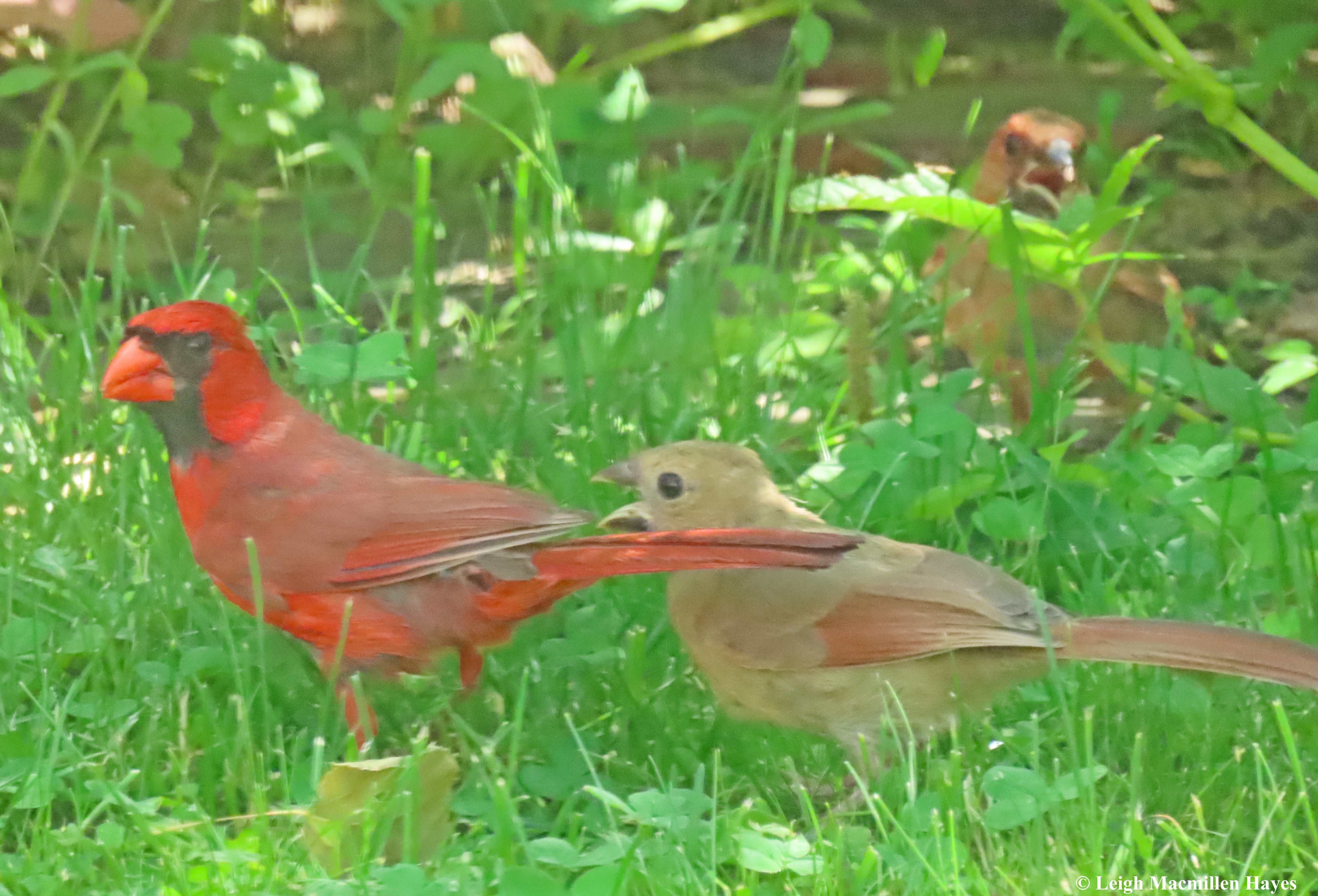
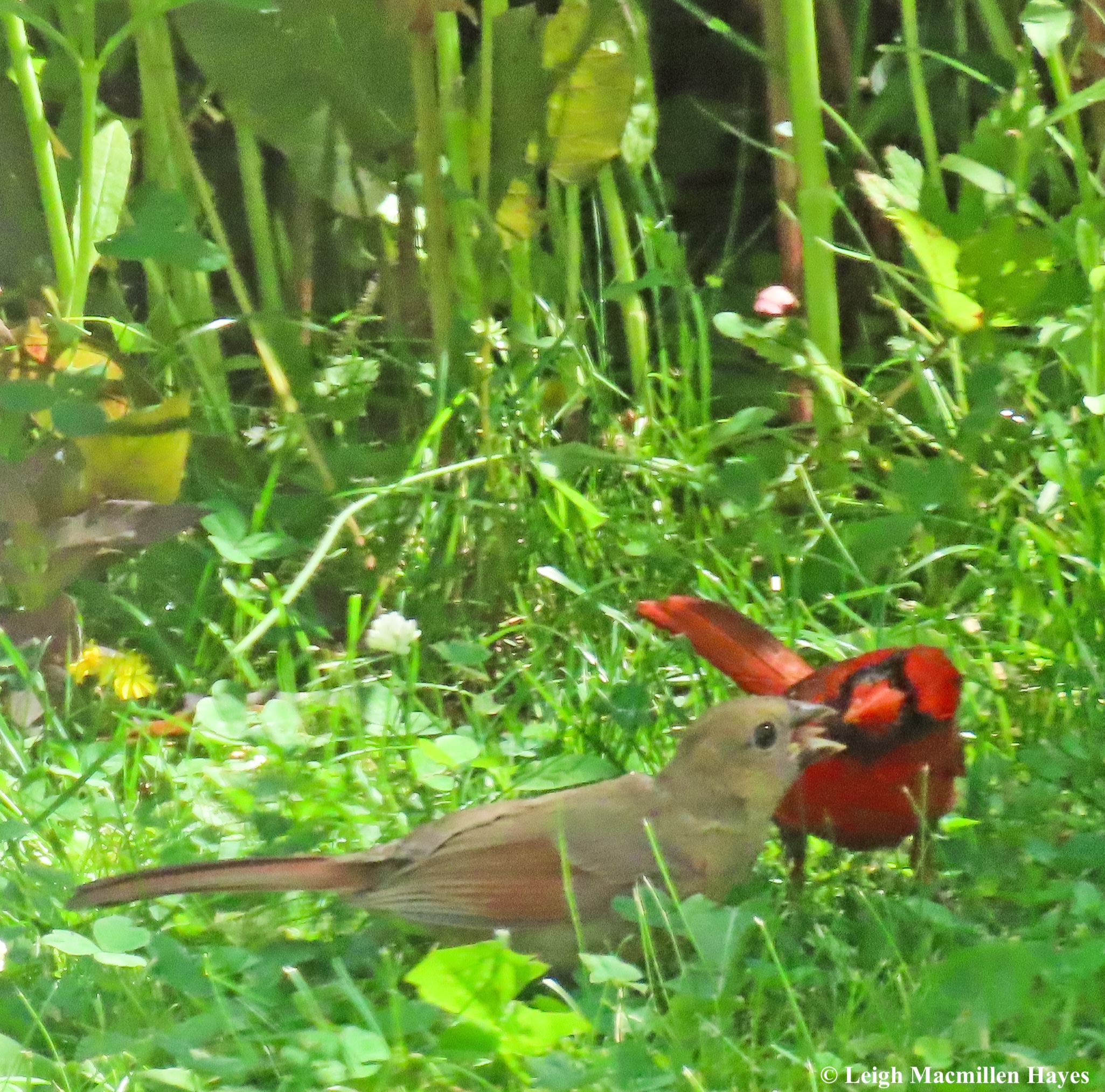
The Cardinals also bring their young to visit on a regular occasion, and sometimes the young’uns even come on their own. Watching them reminds me that many wild parents are amazing caregivers. Beavers and White-tailed Deer and Moose and Coyotes are among those who stay together as a family unit for a year or more. But not all are the same, like the frogs and salamanders who lay eggs and then leave the vernal pool.

What I have to wonder is how does this all work–why do some stay with their young and others abandon them?

Speaking of young’uns a wee bit more, as I headed up to the field, I met a recently fledged Robin, its breast all speckled. Though the Robins are constant backyard visitors, it wasn’t till I wandered about the yard that I found their nest.

And now I regret that I didn’t realize its position earlier, for I would have enjoyed keeping an eye on it.

As I said, the field belongs to our neighbors and I’m eternally grateful that they mow a path meant for them and their dogs, but I’m allowed to trespass by climbing over one of our stonewalls . . . and I do. Daily. Sometimes several times a day.

It’s a place that serves as one of my classrooms and I’m always amazed at who I meet there, including this Frosted Whiteface Skimmer Dragonfly. The yellow and black thorax and base of the abdomen, indicate this is a female. And though you can’t see her white face, she has yellow spots on the thorax segments 4 to 7, with 7 being very small.

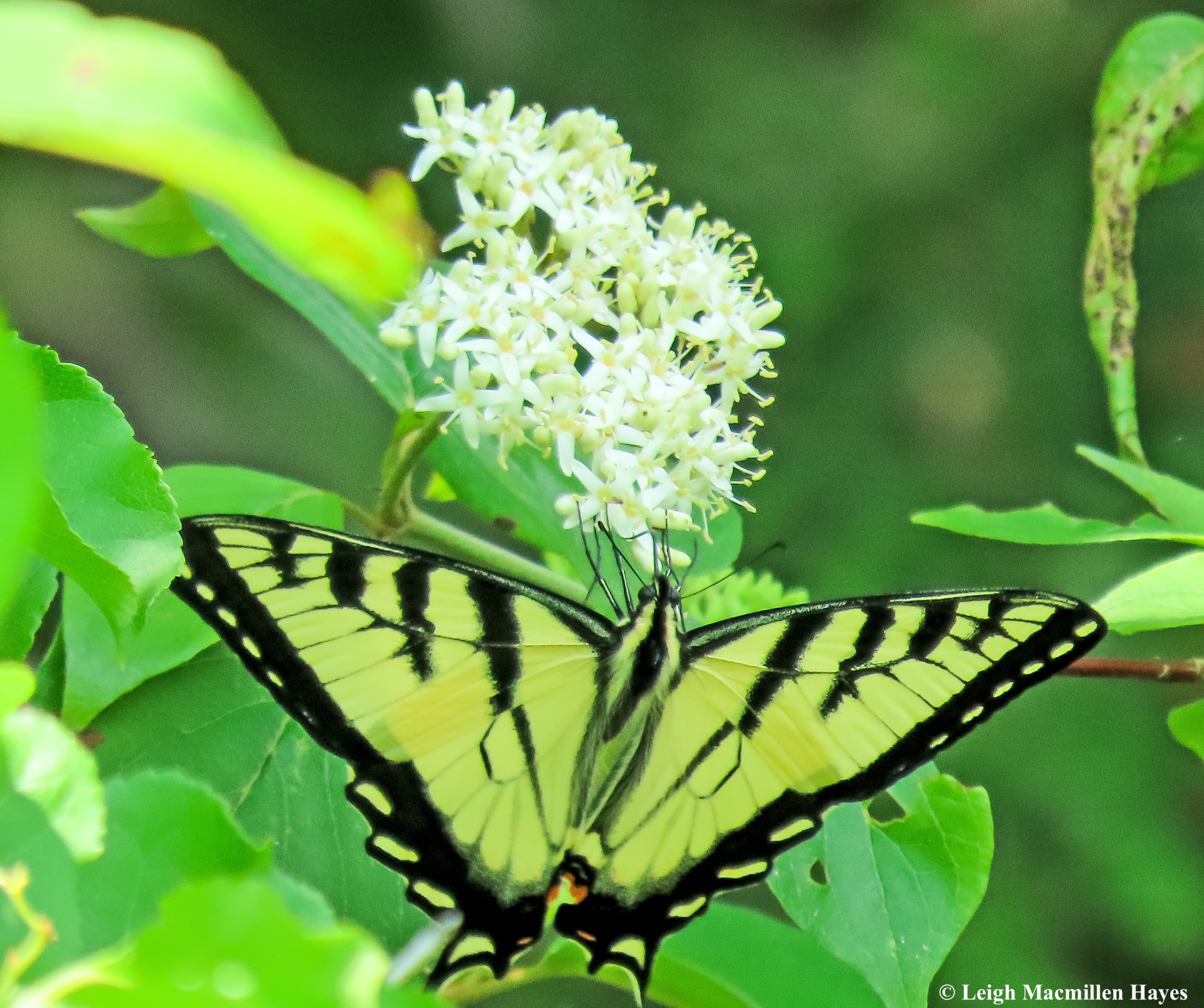
The most abundant butterfly of the season so far is the Tiger Swallowtail, and this one took advantage of the flowering Dogwoods at the top of the field.

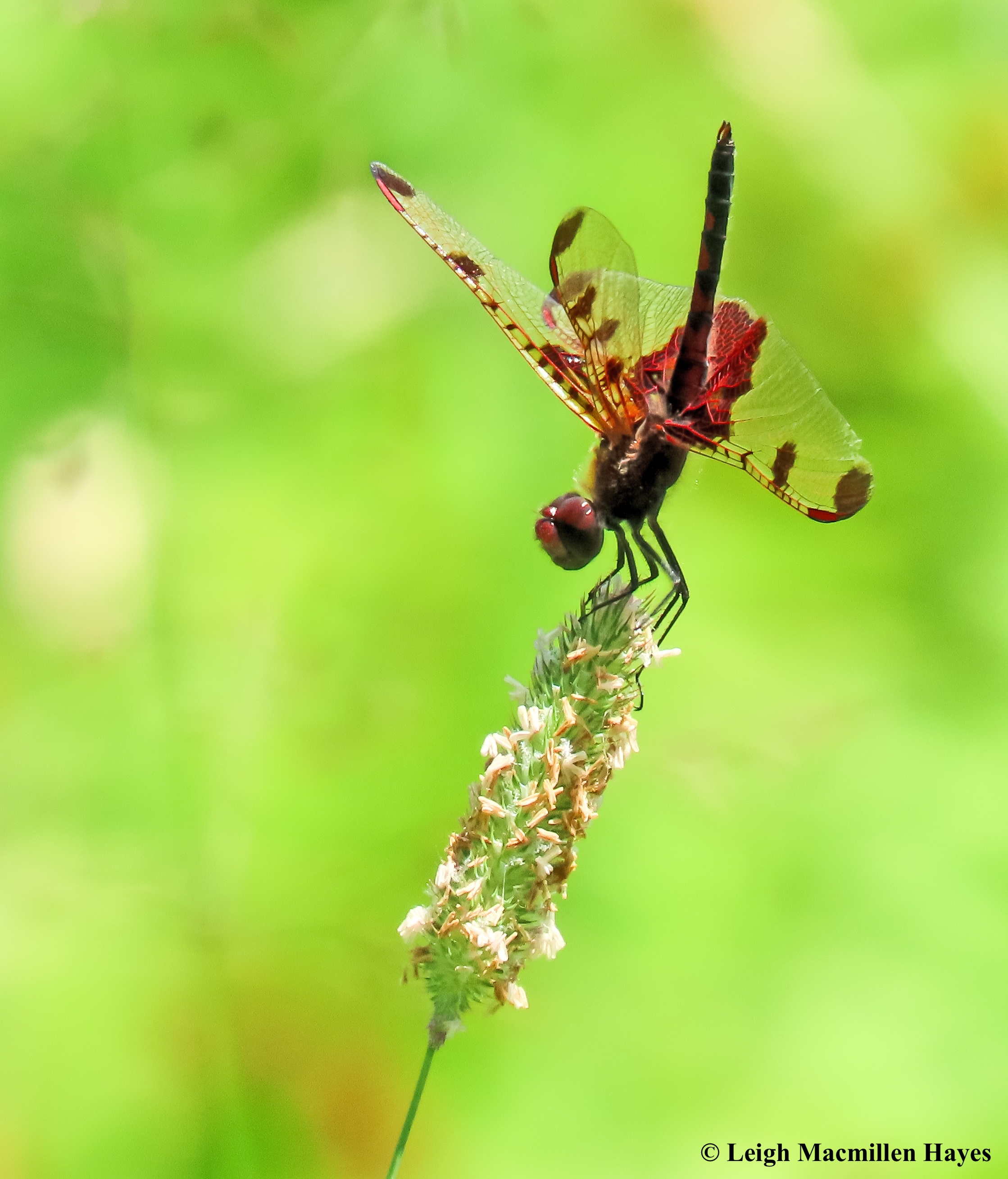
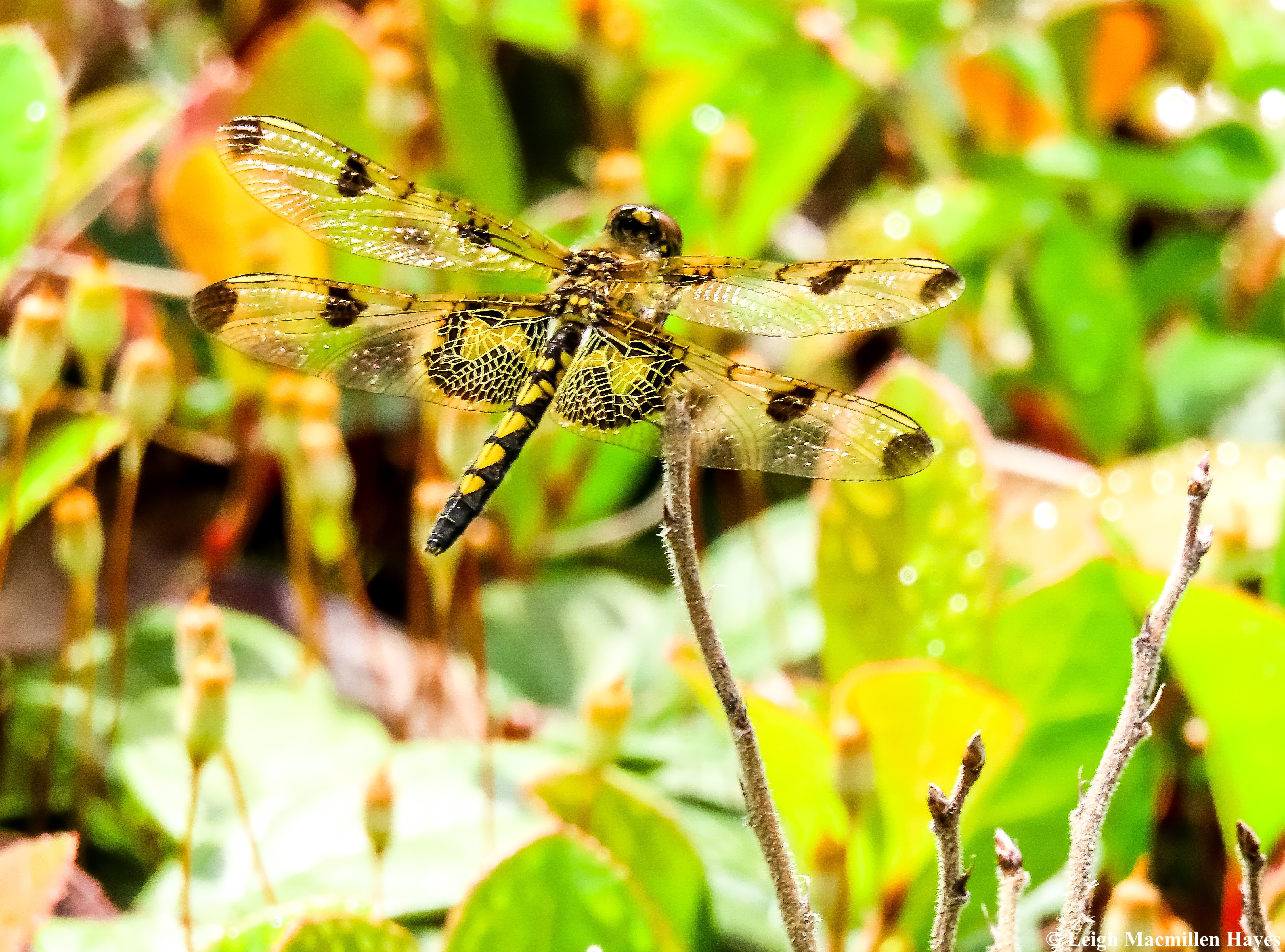
Everywhere, there were Calico Pennants, one of my favorites (one out of a million), this being the female with her yellow markings.

While My Guy practices Yoga several times a week, the dragonflies do so even more frequently, especially if its super hot, like today’s temp of 91˚ that felt like 96˚, or so the weather app told me.

The Calico’s handstand is actually an obelisk posture, with the abdomen pointing toward the sun in a manner meant to minimize the surface area exposed to solar radiation. Again, I am in awe.

Calico’s male, bedecked in red, chose the same stance.

Back over the wall and into our yard, Oriental Beetles are making their presence known. What captures my attention is the texture of wings and thorax, and the hairy and spiky legs, and the funky antennae that look like handmade forks.

Apparently some mistake them for this, the Japanese Beetle, but though there are similarities in the wings and antennae, in my brain that’s it. These are not insects high on anyone’s list of favorites, but look at that iridescent green thorax and the hairy, dotted design on its abdomen.

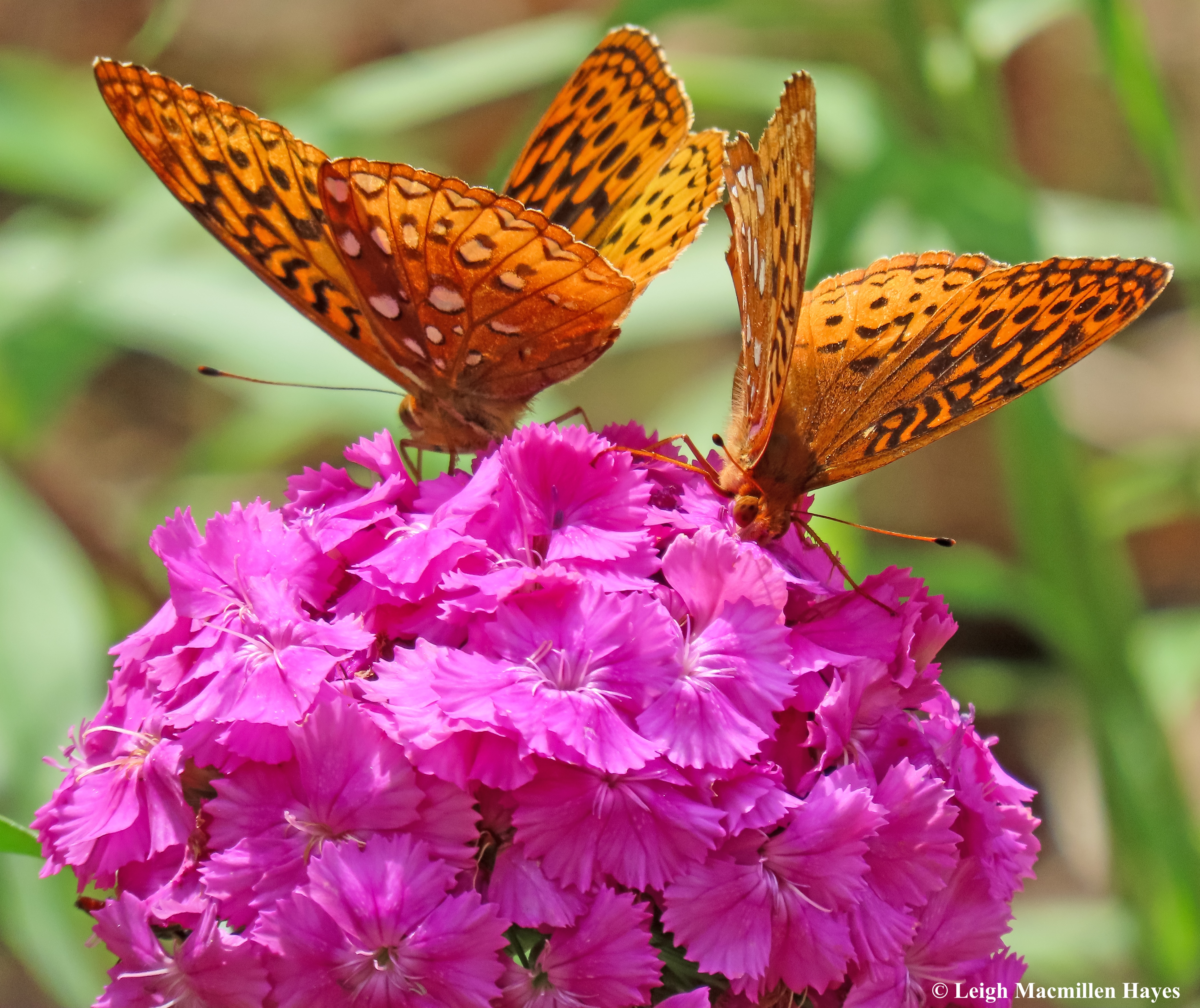
I also spent time circling my newest pollinator garden and among the frequent visitors are the Fritillary Butterflies.

I do, however, worry about some other visitors who keep dining on the flowers rather than pollinating them.

In the wee hours of the morning and all night long, Deer stop by to nibble. There are at least two does and two fawns, and so far the garden has enough to offer them, and the pollinators, and me. But I do worry.

Especially since via the Game Camera I discovered that a neighbor I thought had moved on is still around, and the end of the garden may be in the mouth of the Woodchuck. I hope not, but we’ll see what happens.

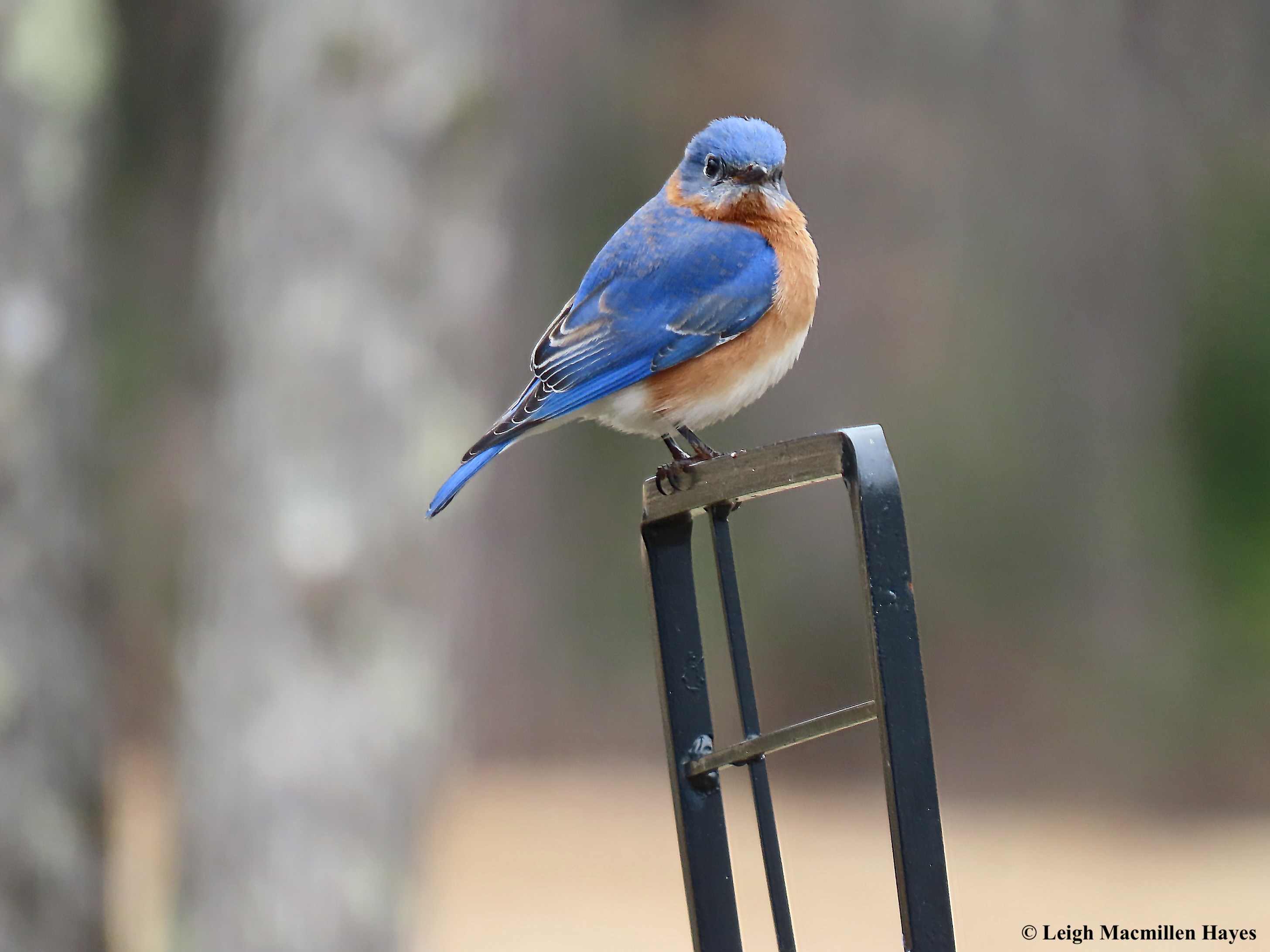
That said, there’s another new neighbor in the ‘hood. Remember the male Wren who worked so hard to fill the birdhouse with sticks? And then I didn’t see him at this spot again. A few days later I spotted a male Bluebird checking it out. And tada . . . a female is sitting on eggs, I do believe.

My little world. It may be small, but really, it’s huge. This is only a smattering of what happens here daily and nightly and I feel so honored to be granted the opportunity to keep an eye on it all. It so enhances my life to spend time wandering and wondering upon these acres.

I hope you have a little world to explore and get to know intimately.

In The Heat . . . of the moment

About dinner time yesterday, that is, dinner time for most people, as My Guy and I tend not to eat until about 7:30pm, as we sat on our patio, I suddenly saw action at a Bluebird house we’d nailed to a tree in the yard. After months of seemingly no action, a bird was flying to it and carrying sticks, and I realized that the male House Wren who has been singing from the trees had decided this just might be the place his loved one will want to set up housekeeping.

The action continued for about an hour last night, but then ceased.

And this morning . . . nothing that I could see.

And so deciding I wouldn’t have a chance to watch the fun of moving in today, I decided instead to head to a local wetland where the Painted Turtles taught me a lesson.

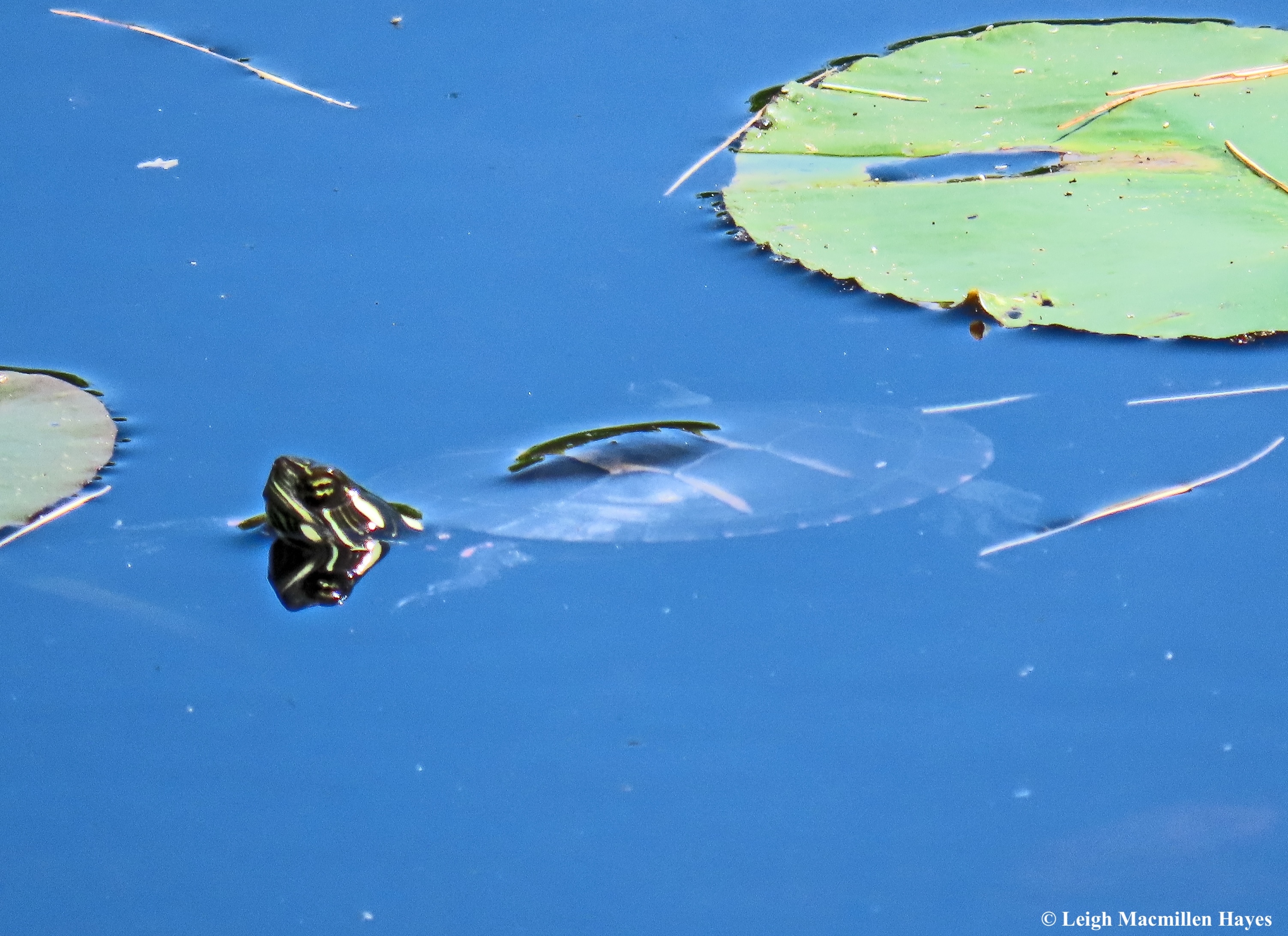
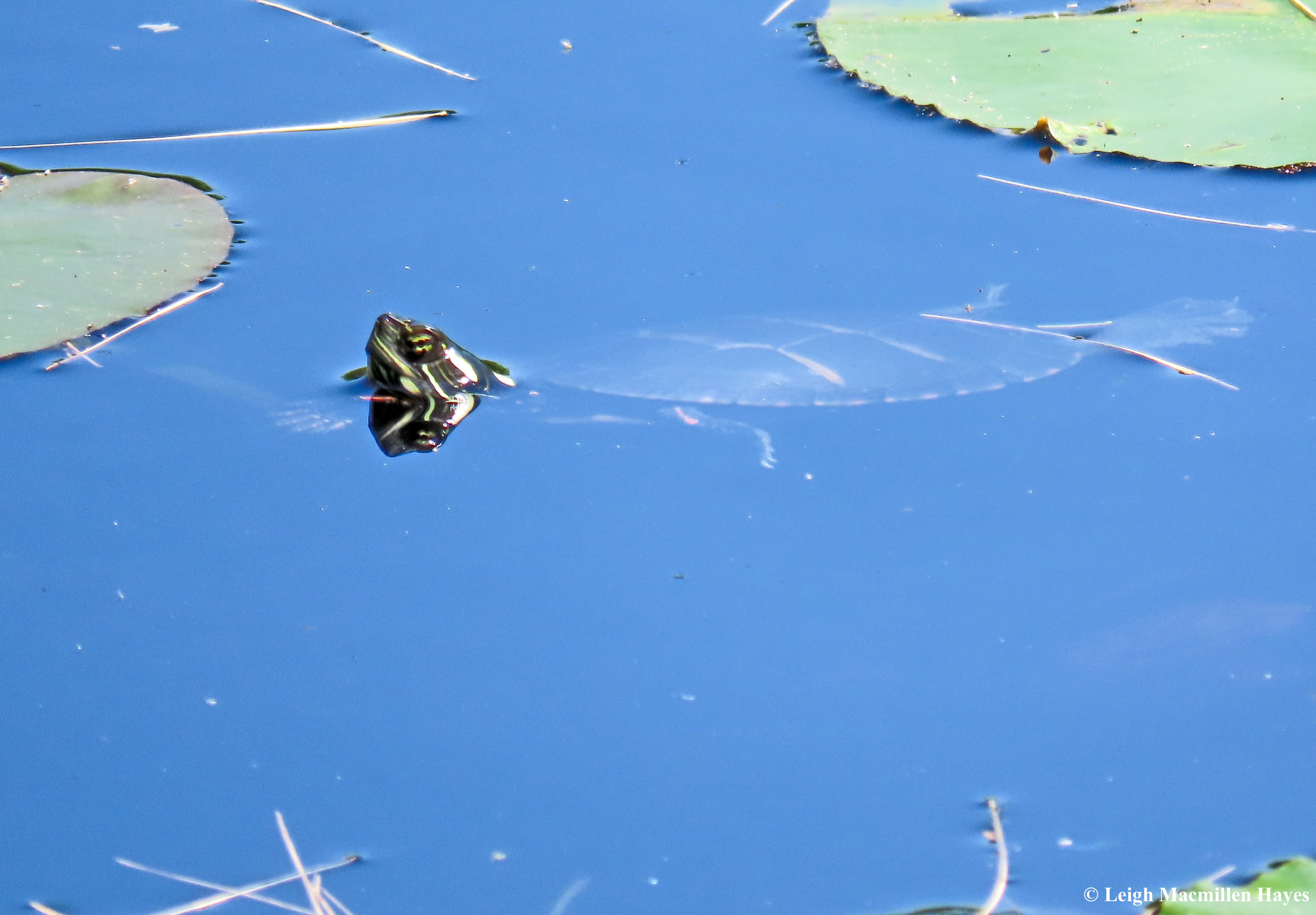
I love seeing turtles basking on logs and rocks in the water, but everywhere I looked today, they were not on any of these raised platforms. Instead, they floated. And it occurred to me that it was a brilliant strategy: stay near the surface of the water, but be a wee bit submerged, and therefore stay cool on the hottest of hot summer days thus far this season. Especially given that Painted Turtles have black carapaces or upper shells which are intended to absorb the heat . . . but extreme heat?

While I watched, I noticed that they all stayed in the same spot. How? By treading water, just like we do. Or so it seemed to me as I watched the feet move, but the head and shell remain still.

In all my years of turtle watching, I have never witnessed this before. Or . . . if I did, failed to take note.

Because I was by water, there were plenty of dragonflies as they defended their territories and ate some bugs on the fly and occasionally paused so I could admire and thank them. There were no Mosquitoes to speak of and only a few pesky Deer Flies.

This Four-spotted Skimmer and I spent quite a bit of time together because he was so beautiful and I could have looked at him forever, plus I loved watching him perch, then flight off to chase another dragonfly out of the area, and perch again, over and over.

But there were a few other things to observe. Well, more than a few, but only a couple that I’ll note.

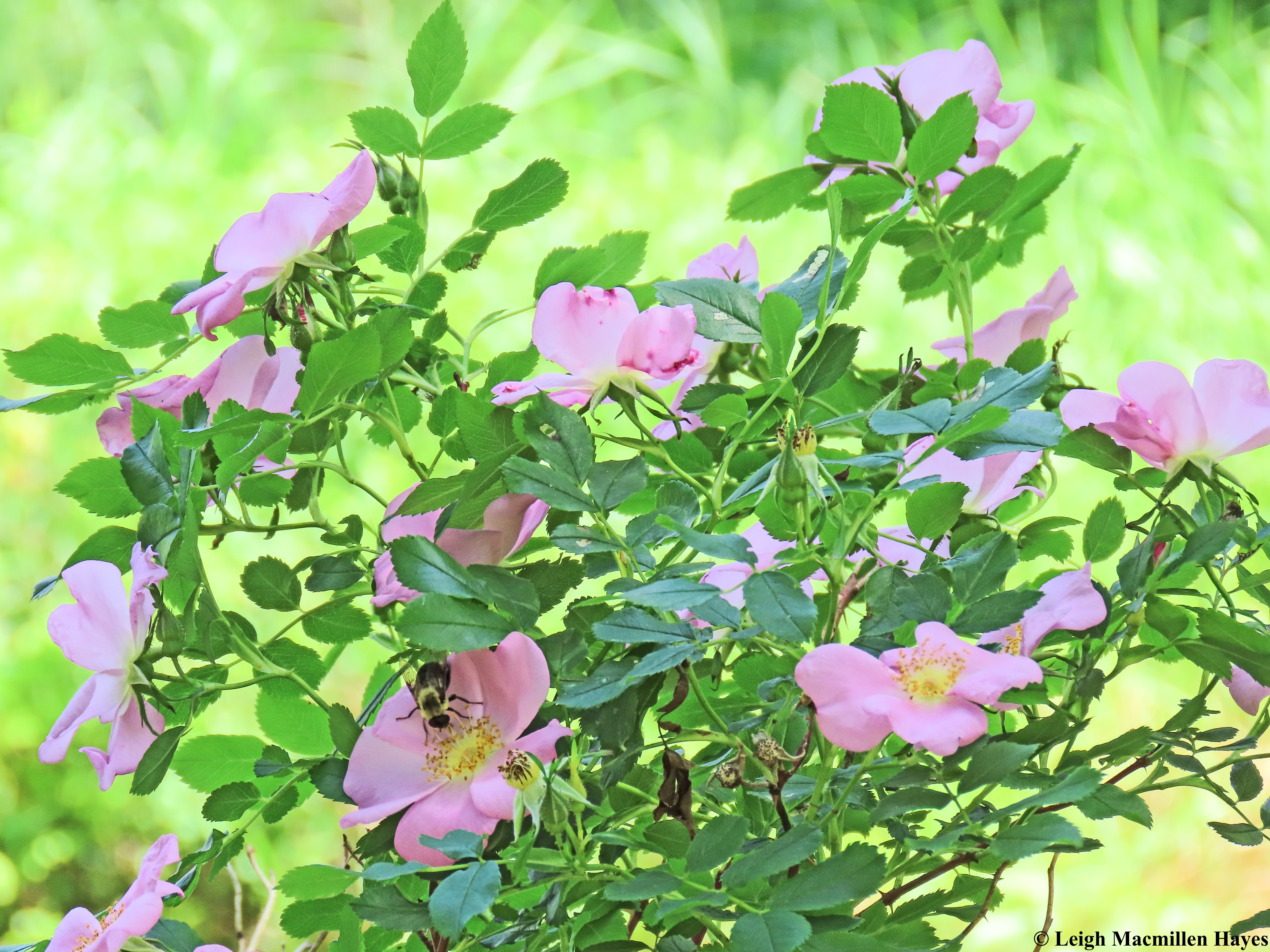
Have you ever noticed how on a hot summer day the smell of fallen pine needles is intensified by the heat? I just love that smell. And where there are Swamp Roses, there is also an aromatic fragrance, and it seemed I wasn’t the only one paying attention.

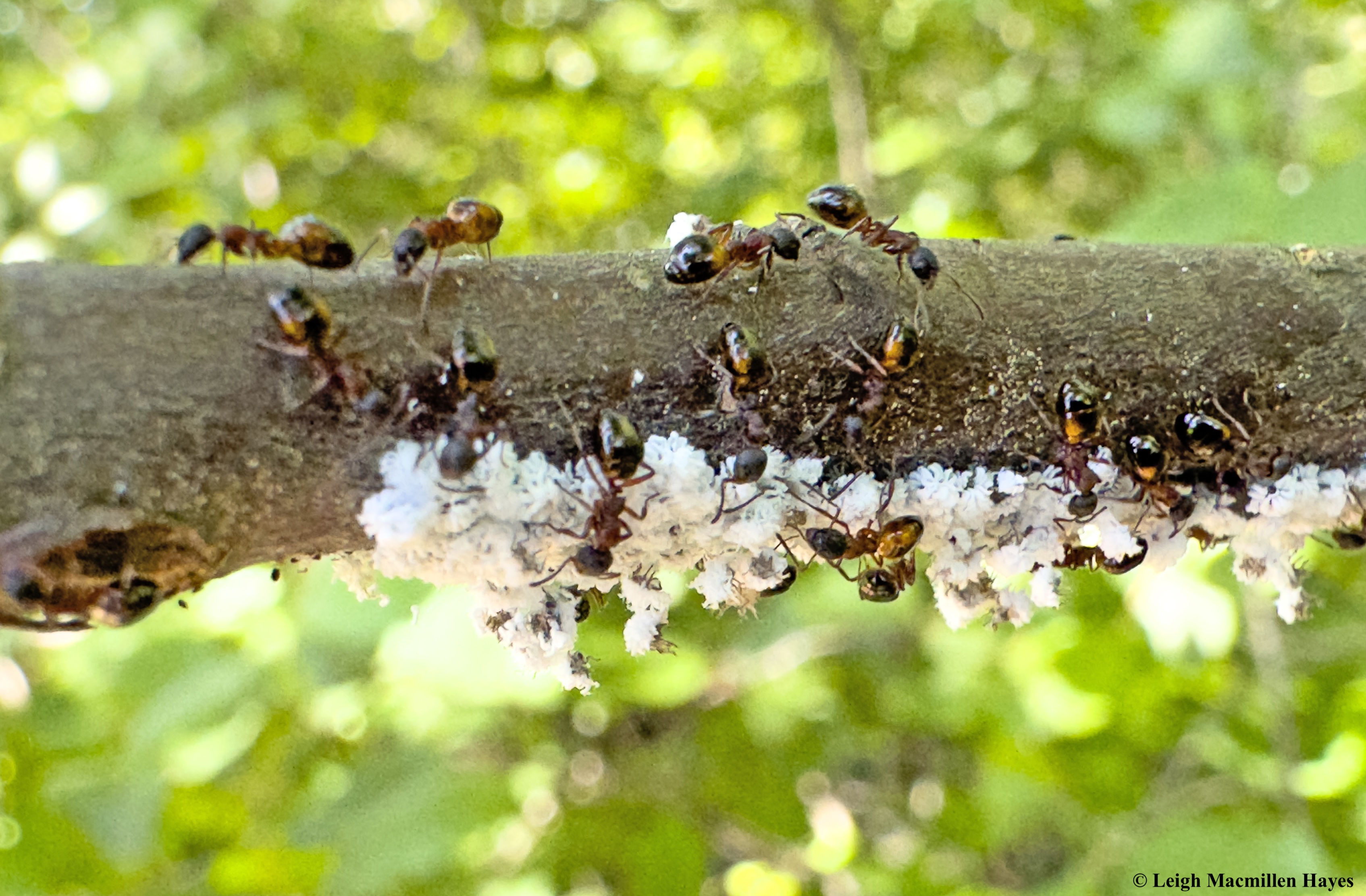
Seeking nectar is the job of bees and wasps and flowerflies and other. Seeking a sugary substance is the job of ants. On Speckled Alders.

Ants “farm” or “milk” or basically tickle Woolly Alder Aphids that feed upon the shrubs’ sap and get the honeydew the tinier insects secrete.

That cotton candy look on the aphids is actually a waxy material they produce from their abdomens, perhaps meant to detract visitors. Or protect them from the weather. 

The relationship between the ants and the aphids is actually a form of mutualism as the ants protect the aphids from predators, while the aphids provide the ants with a food source. Hmmm. Maybe more of us need to pay attention to this way of living together.

At last I pulled myself away from the wetland, saying goodbye to all and thanking the Painted Turtles for today’s lesson.

Back at home, I heard the Wren before I spotted it and sure enough, it was back on the job of setting up living quarters. Male House Wrens fill cavities with a tangle of sticks and then he tries to persuade his betrothed to build a nest, which she does toward the back of the cavity.

He kept gathering sticks from the ground and returning to the box, though getting them through the hole wasn’t always an easy task. I wanted to encourage him to also try the slot at the top of the box, but my encouraging act would have had the opposite effect, and so I kept my distance.

It was rather like watching a gymnastics show, for such an acrobat was he. And like the turtles treading water, I’d never actually seen a House Wren build a nest before–my knowledge all gained from literature.

Smaller sticks worked well, but those larger ones were much more entertaining from my point of view.

And then there was a really complicated one. Such a challenge.

But a little wiggle here and waggle there and voila. The stick was in the hole. So was the bird.

Until the next one. And then more contemplation.

But all things are doable when you persevere, so of course, another lesson learned today.

I’ve read that House Wrens fill several cavities and then let the woman decide. Smart birds. The jury is out in our neighborhood because my neighbor and I know that either he or another Wren keeps visiting a different birdhouse that the Bluebirds have also considered for their digs.

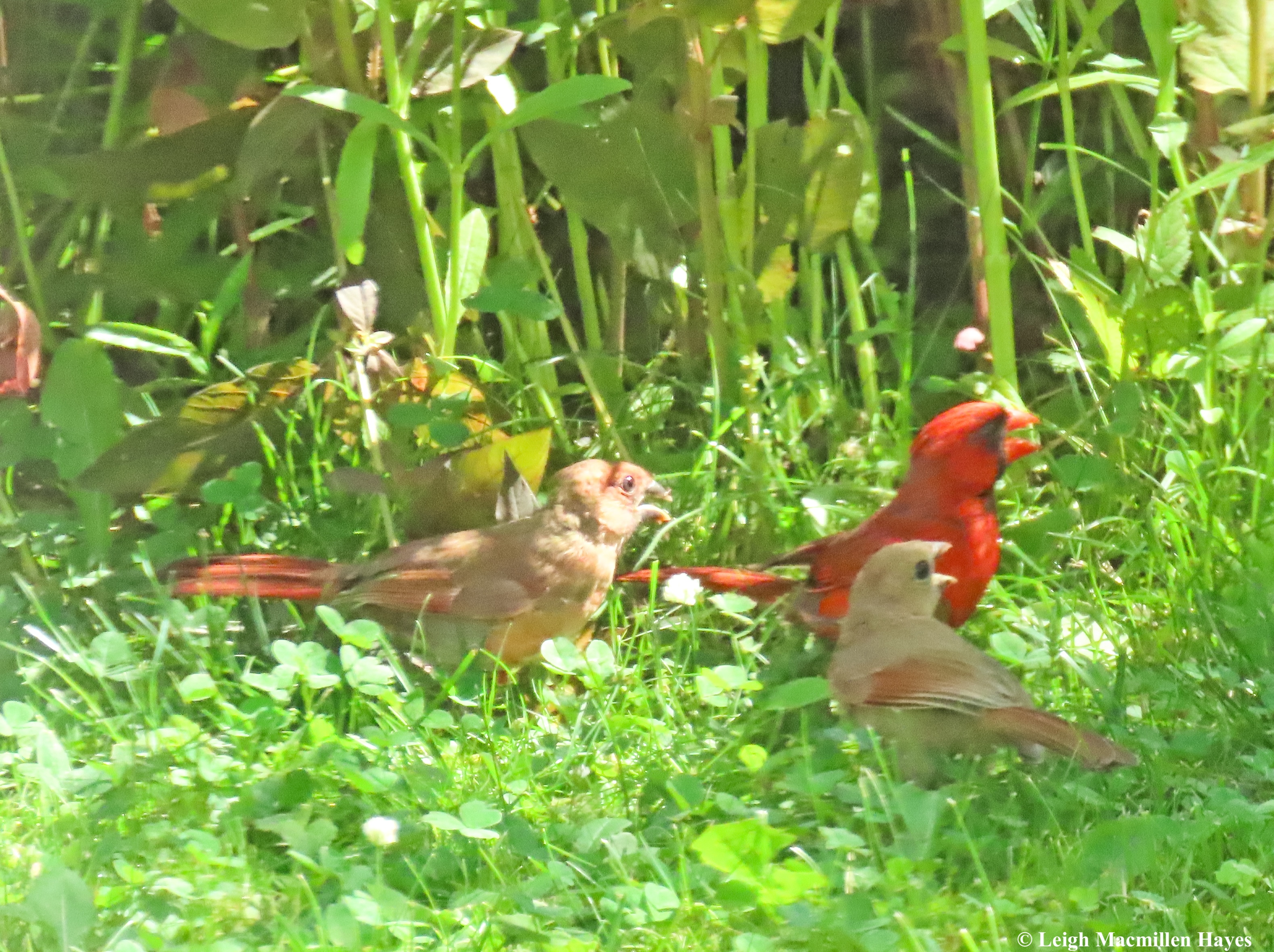
Heading back in, I suddenly heard a Cardinal, and suspected it was the male because I haven’t seen the female in at least a week. Through the glass in the back door, there he was, feeding a chick! We have a baby!

And then I realized he was feeding two babies, and my, were they ever insistent.

I must say, the chicks look much more like their mother than their father. But he did a great job of tending to their needs, ever the nurturing one.

Today has been really hot, and I know you are all aware of that, but in the heat I managed to be present in so many moments and give great thanks for that.

Summer Fauna among the Flora

As spring bid adieu and summer waved hello, I found myself wandering and wondering with others and alone and stopping in my tracks repeatedly, which is kinda what I do all the time I guess you could say, but suddenly this week there were a few special events that called for attention.

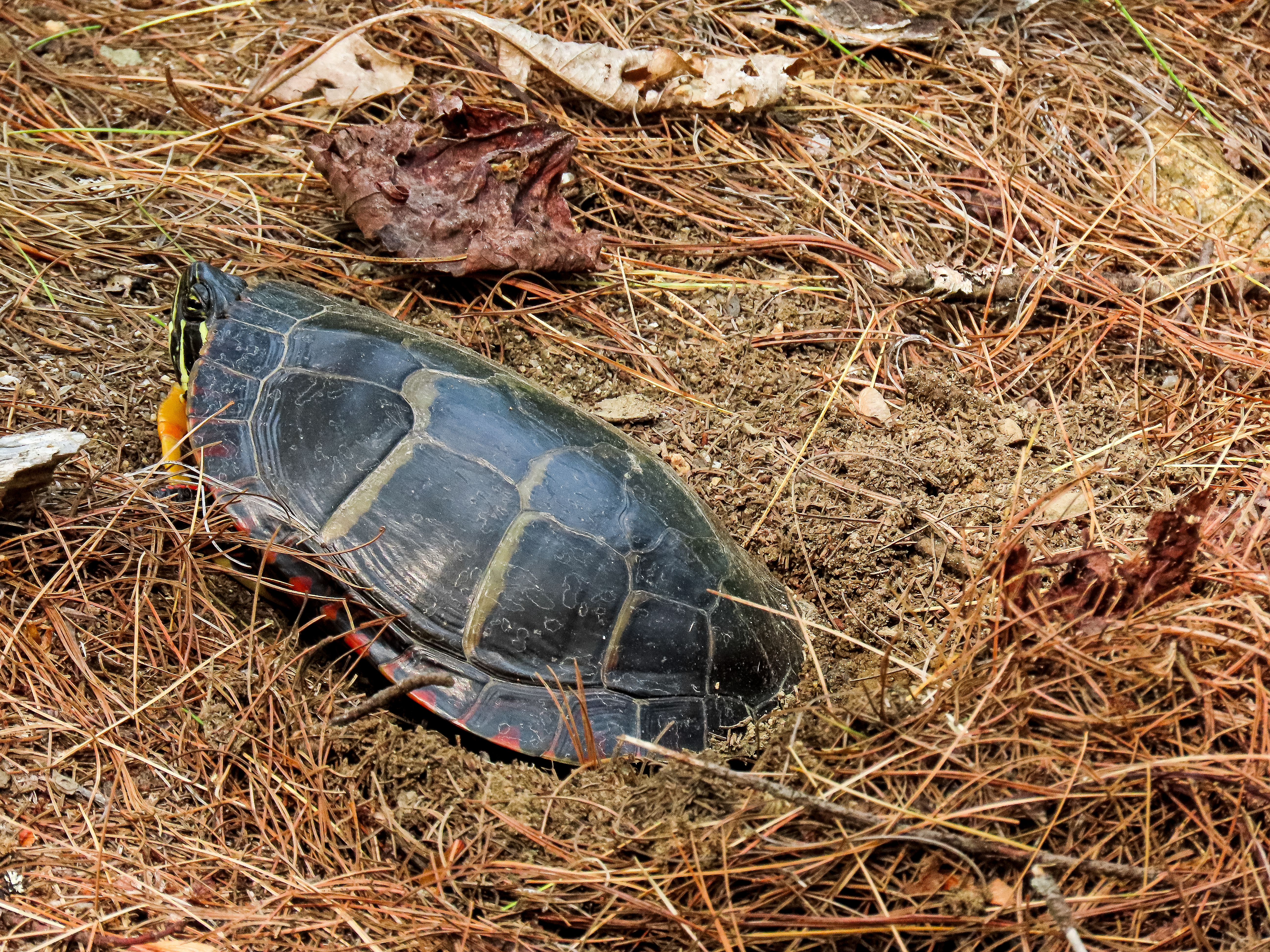
The first was Momma Snapping Turtle that I spotted beside a trail as I co-led a walk with Dawn Wood for Loon Echo Land Trust. Thanks to the magic of a camera lens, it may appear that we were close, but believe me, we all realized the sensitivity of the situation as this mother was digging in the dirt and laying eggs right before our eyes and we were transfixed–from a distance. There were fourteen of us and we tried to stand quietly and watch and ask questions and after about ten minutes decided it was time to come up with Plan B and reroute ourselves so that we wouldn’t stress her out.

In another place a day later, it was a Painted Turtle upon which I focused and gave thanks that it didn’t consider plopping back into the water as they often do when we so much as breathe. From the spot where I stood, I think this was also a female, given the shorter nails, but I couldn’t say for sure because tail length and plastron (bottom shell) orientation are also key to ID. The male has a longer tail and a more concave or indented plastron, while the female’s is more convex or flatter.

That said, when I spotted this one, I knew its gender immediately, for like the Momma Snapper, this Momma Painted was also in the process of laying eggs. She pulled her head into her shell the moment I spied her.

In the few moments we spent together, however, she ever so gradually extended her head.

But I felt like she was keeping a wary eye on me. And very much wanted me to move along.

And so I did.

And then it was the insects that begged for attention, this being a female Calico Pennant Skimmer Dragonfly. Her coloration is yellow, while his is red. One of the things I love about perching dragonflies such as the Skimmer family, is that within their territory, they return to the same perches over and over again–flying off to capture food or defend said location, but usually back to the same twig or flower or one close by, making it easy to spend some time with them.

The Clubtail family is the same, this being a Lancet. These dragonflies often land on our dock or our kayaks and spend some time with us.

I swear they are as curious about us as we are about them. But maybe again, they are checking out our predator abilities. I much prefer letting them be the predators as they munch on Mosquitoes and Deer Flies and make time in the woods or on the water so much more comfortable.

And then there are those who seek nectar and Meadow Hawkweeds are a valuable resource right now for Flower Flies and Bees and Wasps and Butterflies like this little Northern Crescent. Last summer I spent a lot of time with this species in my neighbor’s field and was thrilled to realize that as long as there was food available during the fall in the source of Goldenrods and Asters, they were present.

One of the most abundant butterflies this year has to be the Tiger Swallowtail. Canadian and Eastern, and probably hybrids in the mix, they are everywhere. Everywhere. Adding grace in their flutter-bys and color to the landscape. As well as serving as pollinators.

Dropping drastically back down in size, my attention was also drawn to the Long Dash Skipper Butterfly. According to the comprehensive field guide, Butterflies of Maine and the Canadian Maritime Provinces, by PhillipG. deMaynadier et al, “The Long Dash is named for the conspicuous stigma on the male forewing. Found on forewings of most other small, orange and brown skippers in our region, a stigma is a specialized patch of scales that emits pheromones used during courtship. In the Long Dash, the stigma is surrounded by black scales, making it appear larger than it really is.” Thus, this would be a male Long Dash Skipper upon one of its favorite flowers, Red Clover. But from the book, I’ve learned I should also look for it upon Cow Vetch, Common Milkweed, Spreading Dogbane, hawkweeds, Ox-eye Daisy, and knapweeds.

Keeping pace with me despite its much shorter legs, the Six-spotted Tiger Beetles, which I love for the iridescent green, practically ran ahead, reminding of Chalk-fronted Corporal Dragonflies who insist upon flying five feet in front, waiting till I almost catch up, and then flying another five feet ahead, over and over and over again. The only time I’ve seen the Six-spotted Tigers slow down is when they are canoodling. But even then, they are on the move.

Another insect, which is much slower, may have significant value in our landscape. If I’m correct with the ID, and I’m waiting for iNaturalist to confirm, this is Atanycolus cappaerti, a parasitic wasp. I can only hope that my ID is correct, because . . . according to Cornell University’s College of Agriculture and Life Sciences, A.cappaerti “attack [Emerald Ash Borer larvae] at rates high enough to be considered significant for biological control. While studies are still ongoing, the use of the native parasitoid A. cappaerti for augmentative biological control would be desirable from an environmental perspective as it is already established and has a niche in the ecosystem.” That’s in Michigan. But maybe in Maine as well? Please let it be so. This past winter we all noticed that EAB had spread significantly in our area.

Basking just down the trail from the wasp was a Northern Water Snake who didn’t seem to mind my presence, and I tried not to mind its either.

He was aware of me, and I say he because in the Northern Water Snake world, the male is smaller than the female, and this one wasn’t really all that big, but still . . . a wee bit intimidating. Of course, it did nothing to make me feel that way, so the intimidation was all in my mind. Instead, he let me take a few photos and pass by without a confrontation, as is always the case. I remember once stepping out of a canoe and practically landing on one, who stayed put. And another time, realizing that one was basking in Maleberry shrubs at the edge of a pond as a few of us paddled by within mere inches–or so it seemed.

As spring gave way to summer this past week, I think one of the things that stood out most to me was sighting the turtles laying eggs. Though they don’t hatch at exactly the same time, it will take about two to three months for the eggs to incubate. Of course, temperature has much to do with that. But my experience in the past is that about the autumnal equinox we may see baby turtles crawling out of small holes, if not sooner. And if predators don’t get to them first. There’s always that risk.

I do love winter, but summer fauna among all the flora–so much life happening right before our eyes–its like an explosion of color and form and pattern and texture and sound. And it’s only the beginning. I can’t wait to see what the rest of the season has in store for us.

Zodiac One: Maiden Voyage

The message arrived the day before: Leigh, I am ready for the morning. The truck is loaded. I suggest wellies unless you don’t mind wet feet. I plan on being there for 6:00am. All you need is your camera.

And so I set the alarm for 4:30am, spent an hour reading and sipping coffee in the peace of a quiet kitchen, and then headed out the door with my camera on my shoulder.

As the sun rose, it became apparent that the smoke from the Canada wildfires was going to cast a haze upon this June day.

And indeed it did. But, at 6:00 in the morning, with the temperature at 48˚, lake fog, or in this case, pond fog, danced across the surface of the water like fairies performing a swirling ballet. Actually, the fog occurs when cool, moist air meets relatively warmer water, causing the water to evaporate and condense, thus creating mist that burns off as soon as the sun rises.

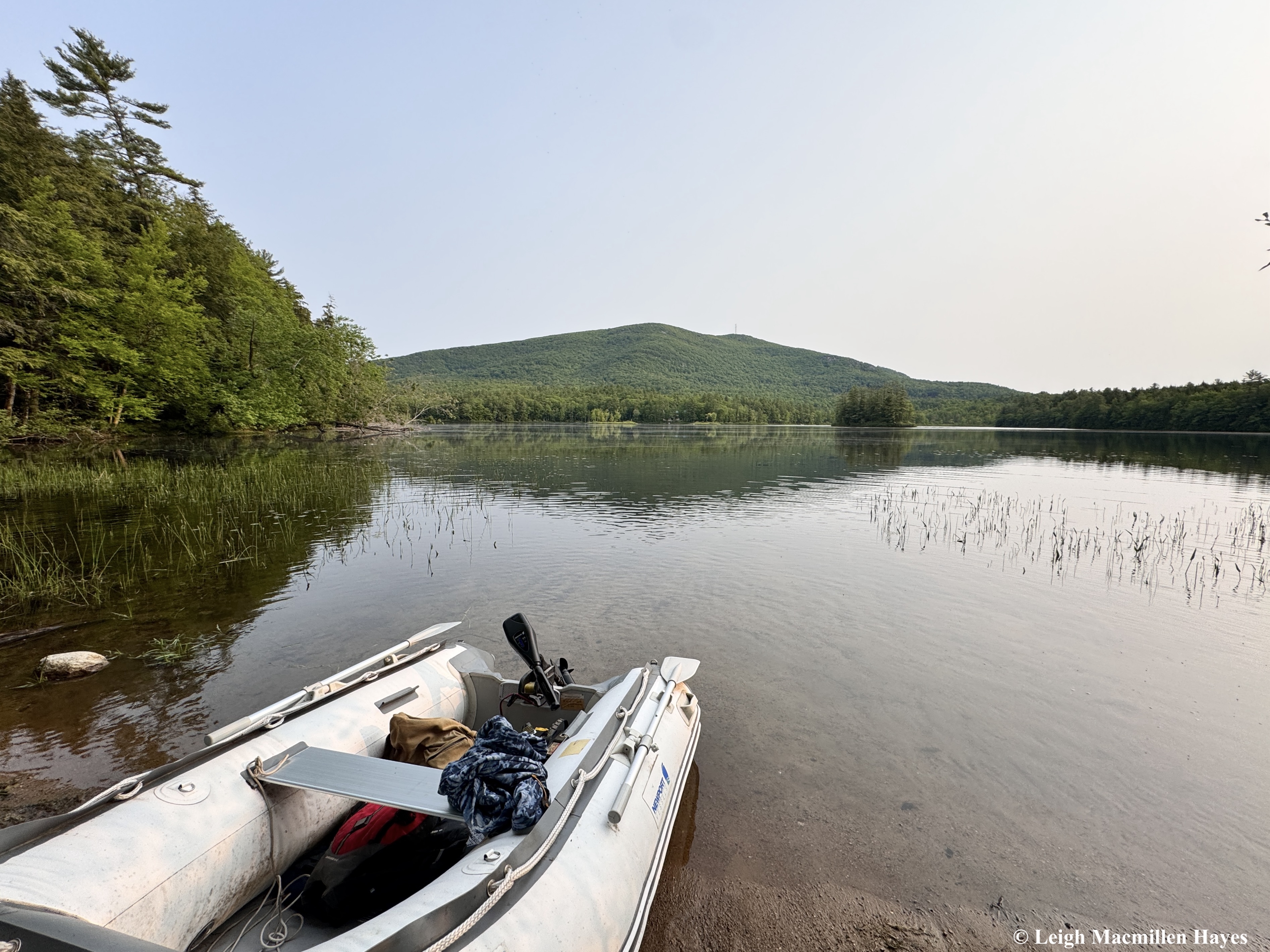
With Pleasant Mountain’s Southwest Peak in the background, I knew my place in the world.

The captain of the boat wondered if I’d ever been on the pond before. I have. Once. This past winter when Laurie LaMountain, of Lake Living magazine, and I spent a day tramping through the snow and across the pond and sometimes getting fake lost, but finally finding our way back to her house seven miles later.

I had not, however, ever seen it in the spring or summer. Well, except from the teepee on the Southwest Ridge of the mountain.

Once upon the water, we first heard, then saw a pair of Common Loons swimming and diving for breakfast. Bass are plentiful in this body of water, and we saw plenty of them as well.

There was a third loon that the other two greeted, but within a half hour it took to the air and flew south.

I found that curious because in the wee hours of the previous morning I heard one fly over our house, announcing its presence with a Loon tune, and wondered if it was a teenager looking for a place to find a mate or at least hang out where the resident pair(s) wouldn’t mind. Maybe this third Loon was doing the same and the others suggested it move on. Or maybe they were its parents and again, they looked forward to be empty nesters for another week or so.

After spying the Loons, our tour took us near Pickerel Weeds and suddenly our eyes clued in on the beginning of other life forms.

By now it was 6:20am and obvious that the Damselfly Naiads had already chosen this day to climb up the stalks maybe as early as 4:00am to begin their new life as terrestrial fliers. I’ve seen this occur later in the morning, but did not expect that they emerged so early when the air was still a bit chilly.

I probably should not have been surprised, for a few weeks ago I saw them emerging in another place on an equally chilly day.

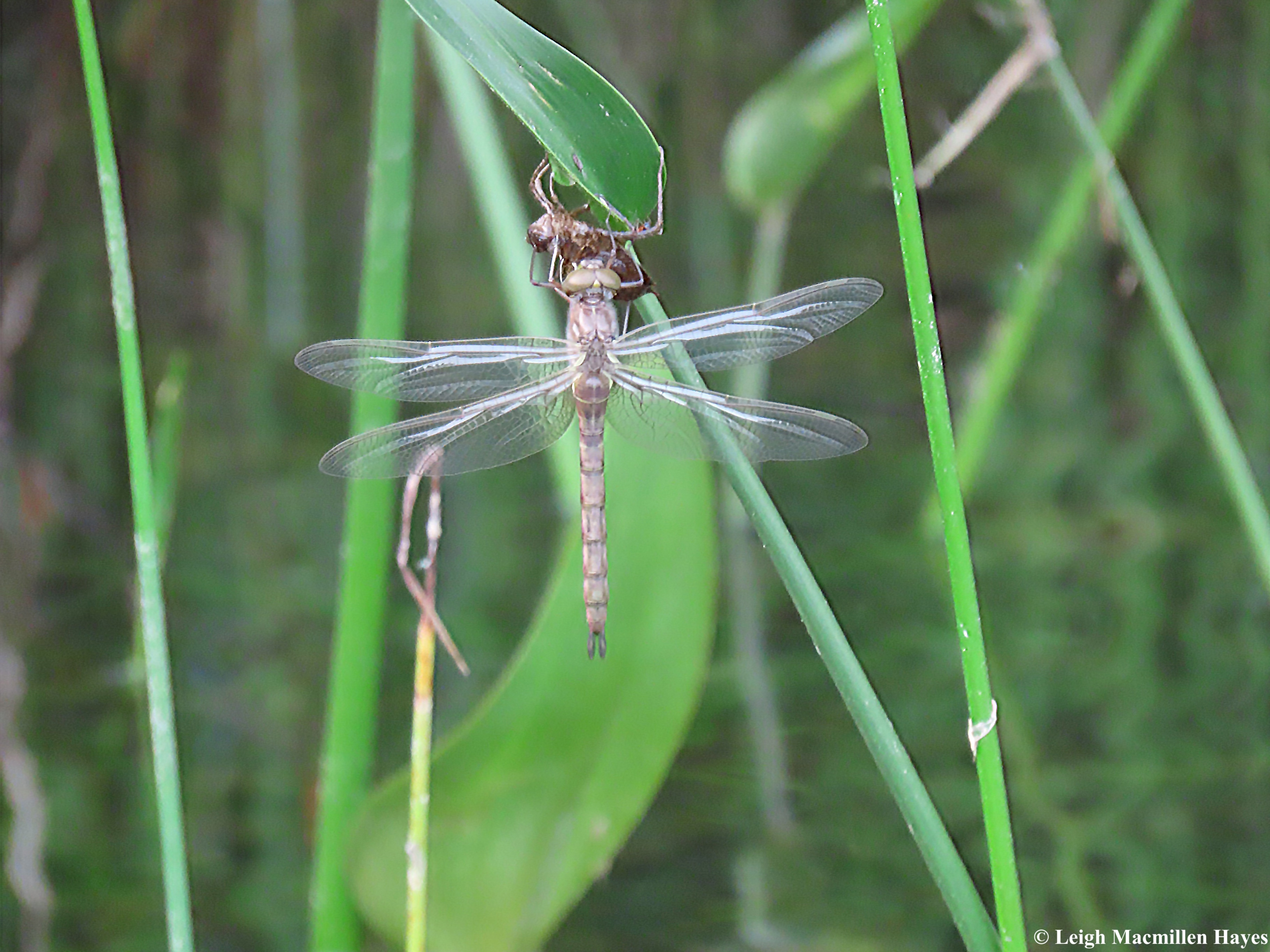
Of course, where Damselflies are, so often are there Dragonflies, and this Darner spread its wings in our presence, so shiny and cloudy as was to be expected until they dry out.

With its wings spread, thorax and abdominal colors would begin to transform providing a clue to its name, but I suspected it was a Common Green Darner. We didn’t have time to watch that color change and so we silently moved on, for such is the ability with an electric motor.

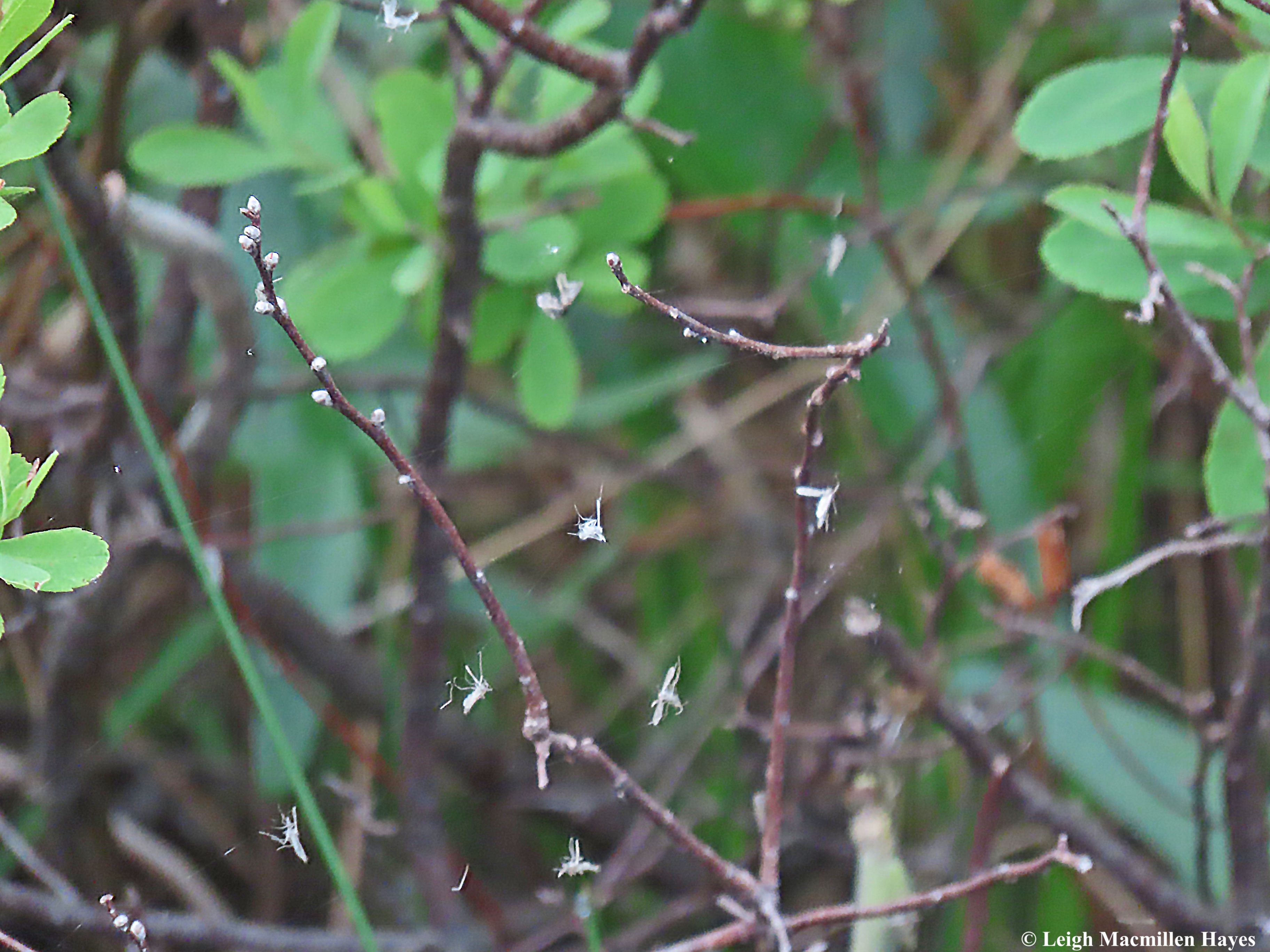
Among the vegetation behind the Pickerel Weeds there were many orb spider webs and among the webs, looking as if they, too, had been performing a dance, were little Whiteflies taking their final bows.

Posed above and ready to fly off at any moment were Kingbirds with their handsome tuxedo appearance, looking like they were ready to attend a formal dinner.

And perhaps they were.

For everywhere on the northwestern side of the pond, more Dragonflies had emerged, and after a few minutes it became obvious that they were all of the same family: Calico Pennant Skimmers.

In fact, they were also all the same gender, the yellow hearts on the abdomen and coloration on the thorax and wings all leading me to think they were females.

The Calico Pennant in the name comes from the design on the wings, which once opened and dried is really stunning.

Although, I say that they were all females, it could be that all begin life with this hue and it only changes to red for males and bright yellow for females as the individuals mature.

In one spot, we found at least five, plus a bunch of Damselfly exuviae also upon the stems and leaves.

Do you see all five, two being almost a mirror image? Why “almost”?

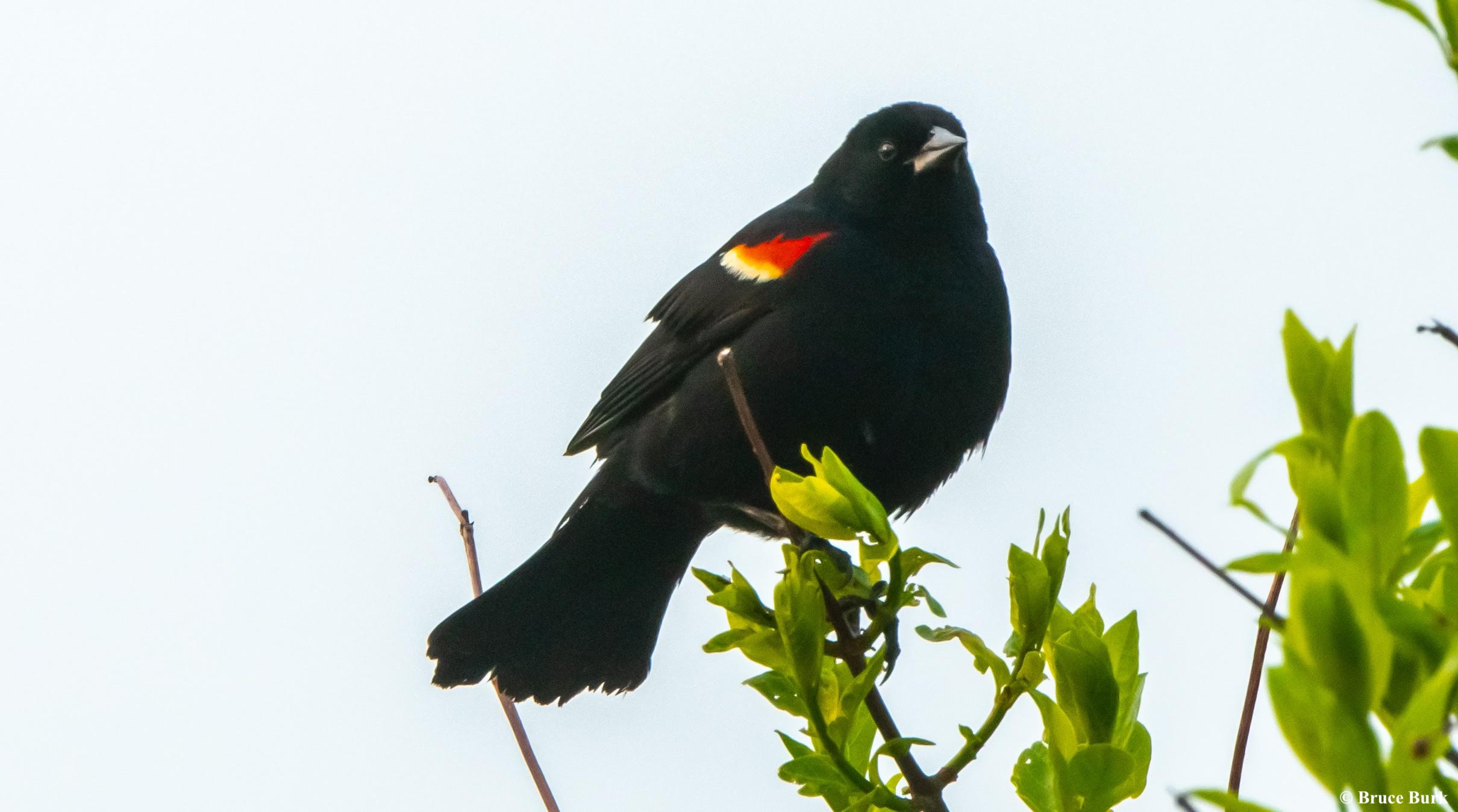
Loons and Kingbirds weren’t the only ones on the morning hunt. This handsome male Red-winged Blackbird seemingly had a family to feed and wanted to make sure we didn’t approach. Thank goodness for telephoto lenses.

In the midst of the shrubs below, his Mrs. was on the hunt and had a full mouth. If you look carefully, you may notice some Dragonfly exuviae below her, their shed skins left behind once they took flight–the insects, that is.

We wondered if the Mrs. was taking advantage of this morning’s Dragonfly offerings and capturing those that were just emerging, an easy meal for herself, but probably also for some wee chicks she may have tucked away in a nest nearby. Their meal would have to wait until we moved on, and so we quickly did.

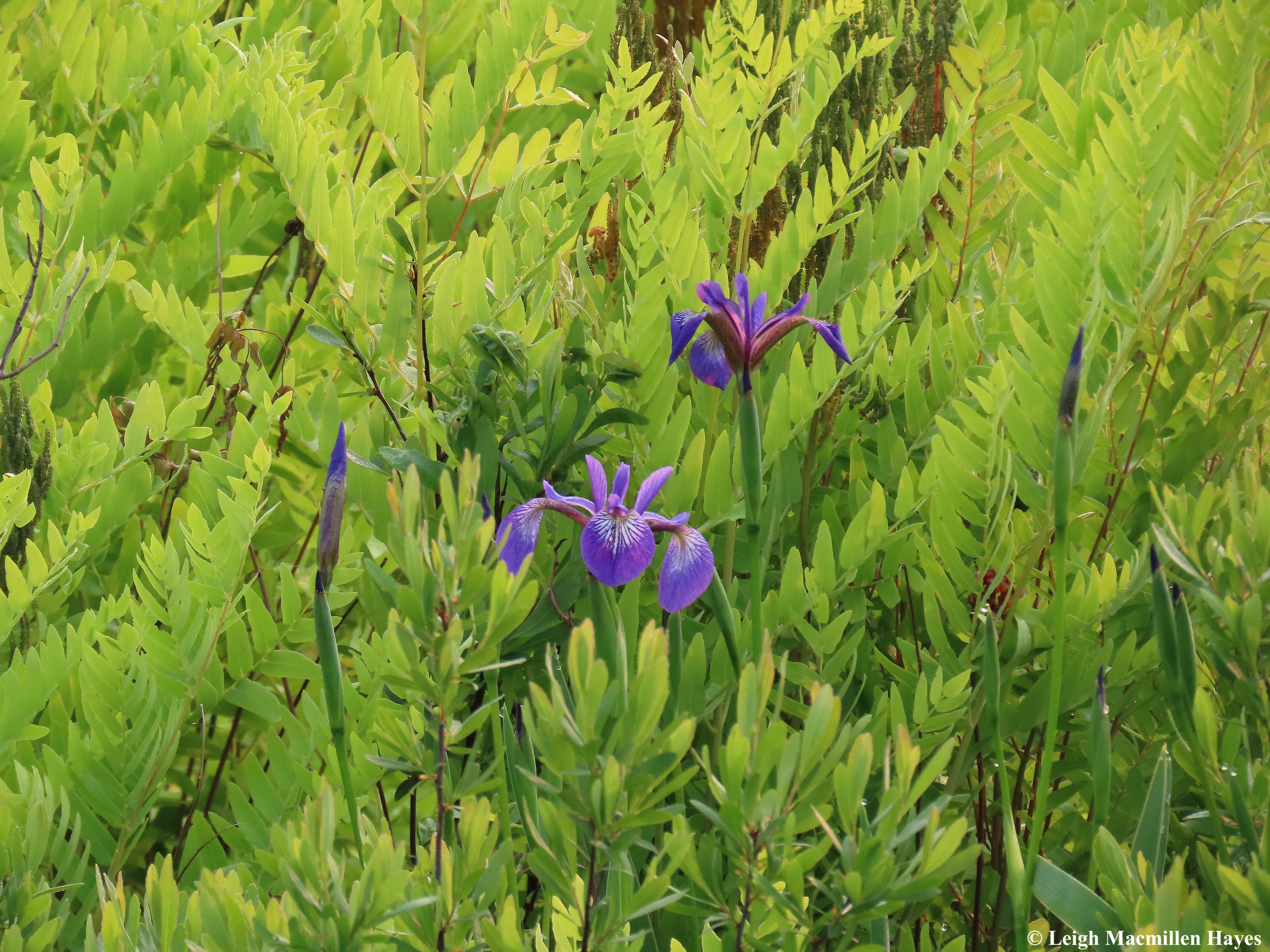
But not without pausing for a moment to admire the newly opened Blue Flag Iris among the Royal Ferns. Though the ferns have their own crowns of fertile stalks, the irises looked like exquisite tiaras fit for queens.

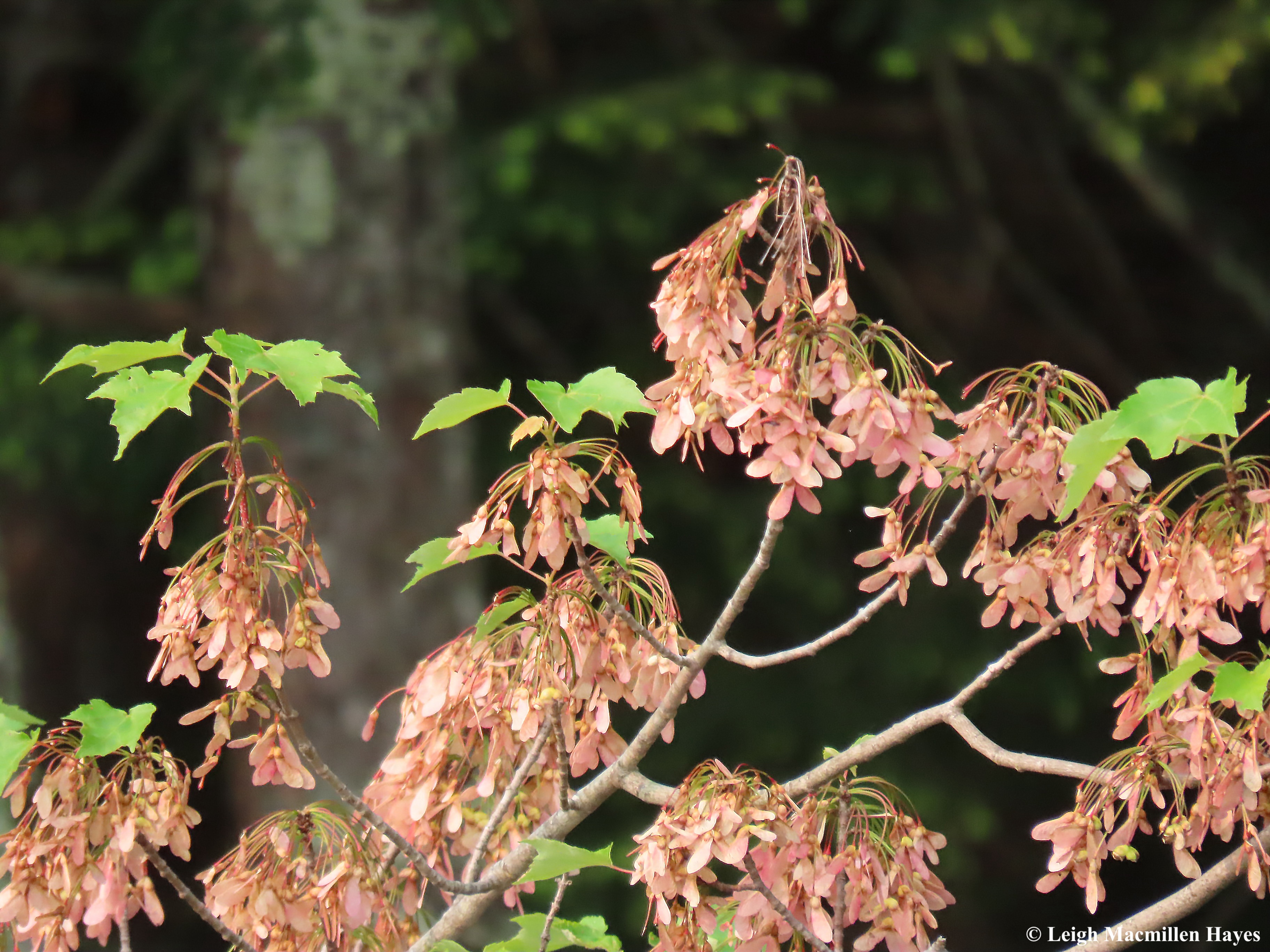
Finally heading back toward the boat launch, we saw explosions of Red Maple seeds dangling like chandeliers that perhaps the Queen Irises had ordered.

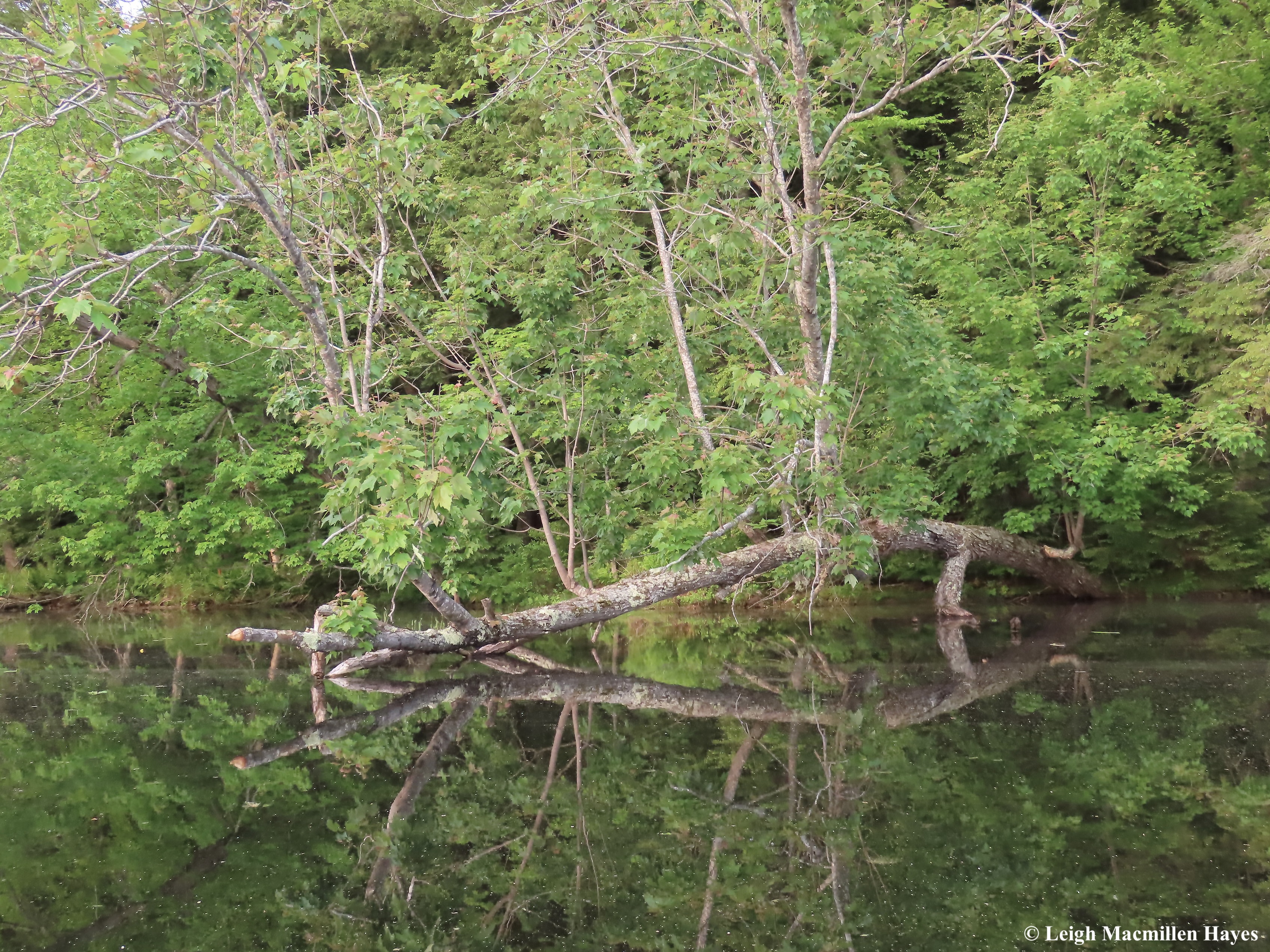
And another Red Maple that gave us pause for it deserved being noticed since it had obviously fallen years ago, but lifted its branches upward and was still in rather good health, its roots at least partially intact. Perseverance.

And then we noticed the tip of it. Across the pond we’d spotted a small beaver lodge in an adjacent wetland, and wondered about the Beaver’s own peserverance–it looked as if the tip of the tree had been harvested this past winter from the ice, and looking at other parts of the tree behind the tip, there’d been some harvesting previous years. We didn’t get close enough, but suspect the Beaver may have felled the tree, and its been a source of building material and food ever since.

Two hours later, Captain Bruce landed the Zodiak at the boat launch, and I gave great thanks for the invitation to explore Beaver Pond in the quiet of the morning.

The Black Flies were plentiful as they buzzed in our ears, but they weren’t biting so that was good.

We also saw several turtles swimming, including one huge Snapper that swam under the boat and neither of us captured in a photograph, and possibly a Water Snake.

Zodiac One: a maiden voyage for me. Here’s to many more! Thank you, Bruce.

Memorial Day Dragons and Damsels

It finally stopped raining and with a wee bit of sun late this afternoon, the temperature broke 60˚ and I found myself exploring a local wetland where all kinds of interesting things happen daily. And yearly. In cycles. And sometimes I happen to be there.

One of my favorite events is the emergence of dragonflies and damselflies. It seems like we endure Black Flies for most of May, all the while looking forward to our champs, the Ondonata family, to step in or rather up out of the water and transform before our eyes and take on the world. This usually happens by Memorial Day.

And this year is no different. The dragons and damsels have been emerging for the past couple of weeks, but now is prime time. And they are just in time because the Black Flies and Mosquitoes have had a heyday with all this rainy, cold weather, and today . . . as it warmed up, so did they and I have red welts on my neck to prove that they are biting. It’s all good, I remind myself. It’s all good. They are bird food. And so are the dragonflies, who eat the Black Flies, et al, and if they become bird food, all the more energy sent the bird’s way.

Cloudy wings and clinging to its shed skin indicated that this dragonfly had just made that magical transformation from its aquatic life to terrestrial existence. And I was there to protect it. For a while anyway. Until the Black Flies sent me scurrying onto the next great find.

That next being a damselfly, also with cloudy wings indicating it had also just emerged. Though I don’t know who the first dragonfly was that I met today because it didn’t yet have enough colors and pattern to make that determination, I did learn that this damsel is called Aurora! I don’t recall ever greeting it before, but based on the the lack of shoulder stripes, black patch with wavy edges on the thorax, and yellow sides led to this ID once I consulted Damselflies of the Northeast by Ed Lam.

Now it’s one I don’t think I’ll forget. AND, I love that it is named for my ten-year-old naturalist friend, Aurora. Or she for it. Or neither, but they both share the name of an electrical phenomenon.

As I looked about, I spotted several other newly emerged dragons and damsels, all with their signature cloudy wings, but then I spied this one.

Yes, it’s wings are cloudy, but this Lancet Clubtail has an issue going on, for its wings are folded, rather like the main character in my fairy tale, The Giant’s Shower, for Falda’s wings are also folded.

That didn’t stop Sir Lancet from climbing up a fallen branch with gusto. But I did wonder about his fate.

That said, I moved on because I had some Painted Turtles I wanted to meet, figuring that they’d be basking after several days of temps in the 40˚s. Being ectotherms, they rely on external heat to regulate their body temperature. Sun is their friend.

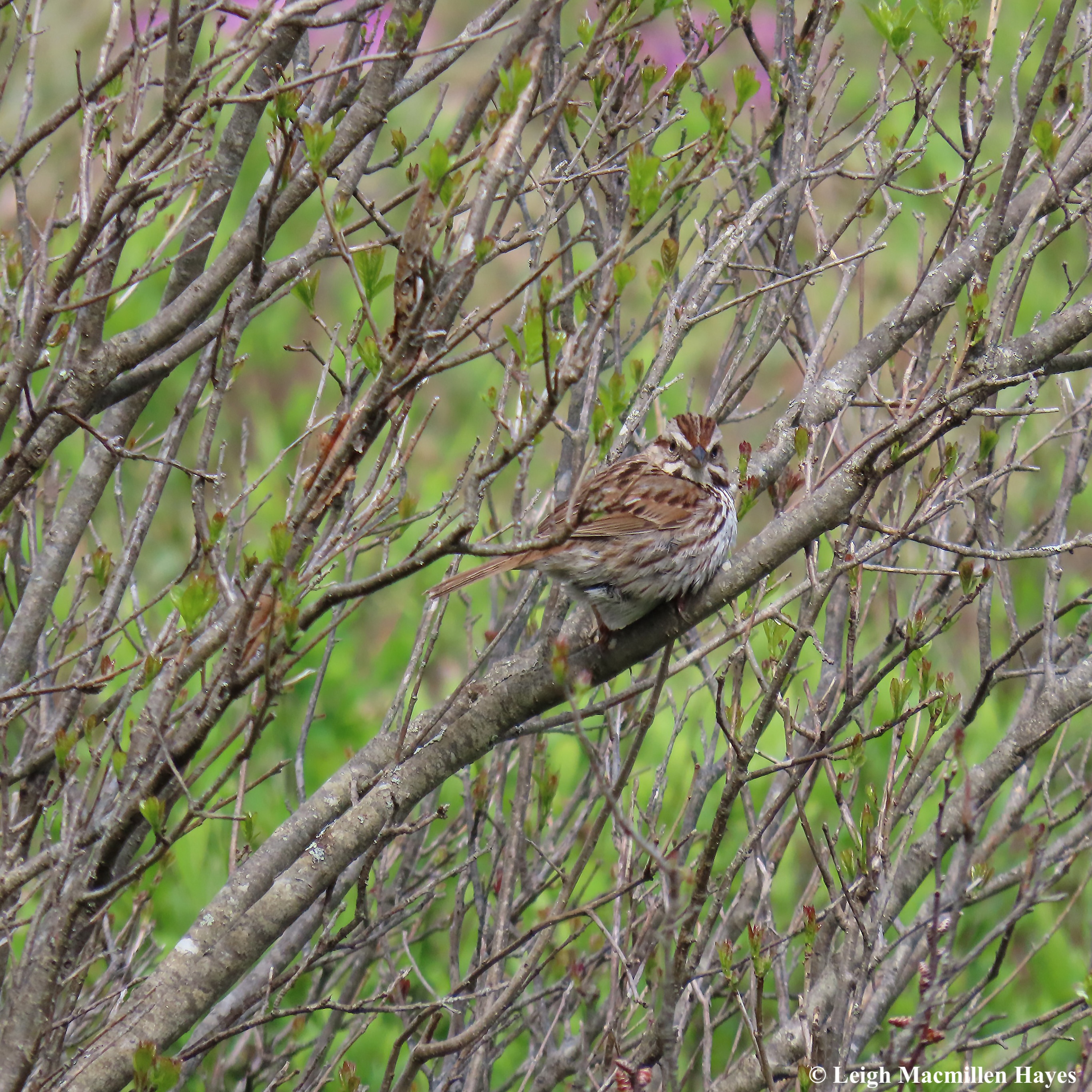
Being in a wetland, the bird song was plentiful, but though the Merlin app included a chorus of plenty including Redstarts and Towhees and Common Yellowthroat and more, the only one who posed was a Song Sparrow.

I walked about a mile away from my starting point, but really was eager to return because I knew there was more to see and learn in that spot.

Almost back, I met a Dreamy Duskywing Butterfly, a species I’ve met in this place before but not sure we’ve encountered each other anywhere else. I love the tapestry of its dusky wings.

A moment later, an old friend flew in–Hudsonian Whiteface–this being a male, for the female’s markings are yellow. These are early spring skimmers, and I have to remind myself not to confuse them with Calico Pennant skimmers who have similar, yet different abdominal markings, he being red and she yellow. Also, the Calicos, being pennants, have a stained glass basal wing pattern that the Hudsonian’s don’t exhibit.

Back at base camp, or rather, my starting point, I checked on Sir Lancet. He’d crawled up the branch to a rather perfect hiding spot at the Y, at least to my eyes. And look into his eyes I did. Including the three simples eyes, singularly called ocellus, which are arranged between the two large compound eyes. Each ocellus offers a single lens with which to view the world, while the compound eyes offer multiple lenses. Amazing. I can’t even begin to imagine such sight.

But what I also noticed about my folded-wing friend was the green “blood” that seemed to be stuck within those wings. Dragons and damsels and other insects that emerge from an exuviae break through their old skin, their wings coming out first with the head, and then pulling the abdomen out slowly and pumping their insect blood first into the wings until they reach full length before drawing said blood back into the body and allowing the abdomen to extend to full length and slowly take on the hues of its adult self.

I’ve seen this in others with folded wings though, where the insect blood seems to have become blocked and is still visible in the transparent wings and maybe that’s why they are deformed? But what causes this?

I don’t have an answer, but try to remind myself that eventually this dragonfly will become units of energy for a bird or another insect and that’s its way of giving.

Meanwhile, though it was getting late and the temperature was starting to drop again, two immatures caught my attention–a Mayfly subimago or dun and another Lancet. Both had cloudy wings announcing their age.

And both were fairly safe in each other’s company, for the Mayfly has no mouthparts, not that it could eat anything as large as a dragonfly at this point, and the Lancet wasn’t quite ready to eat yet for it had some more work to do in order to become a flying predator.

Slowly Lancet’s wings became more transparent and though dinner prep was on my mind and I knew I needed to head home, I waited until it spread its wings and then without a backward turn or wave goodbye, took off. Despite that, I wished it my usual, “Fare thee well.”

And as I walked back to the truck, a young Lancet met me. I was totally surprised to find it land with wings folded over its back. Had we just met only steps away by the water? How cool would that be if it were true.

And then my all-time favorite appeared, a Stream Cruiser with its Oreo Cookie coloring. I was asked the other day what my favorite bird is and I came up with at least five different species, but the Stream Cruiser will always be my favorite dragonfly.

And dragonflies and damselflies on Memorial Day weekend–another favorite for we all know that the Black Flies will now be on the decline.

Memorial Day weekend not only means a return of the Dragons and Damsels who slay those other pesky bugs, but also a time for us to remember those who died serving our country, like my Mom’s brother, age 19, who died in World War II. Thank you Uncle B. We never met, obviously, but Mom brought you alive in my mind for you were her best friend and I know you are with me and trust you would approve my curiosity and adventures and reverence for the natural world .

Senior College: Forever Students

We honestly weren’t sure anyone would sign up. Or show up.

Vernal Pools and Macroinverebrates
Leigh Macmillen Hayes and Dawn Wood
Friday, April, 25, May 2, 9, and 16th, 9:30 – 11:30 am
April 25: The Hidden Life of Vernal Pools
Discover the wonders of vernal pools—seasonal wetlands vital to forest ecosystems. Learn how wood frogs, salamanders, and fairy shrimp rely on them for breeding and why protecting these fragile habitats matters. Join us indoors at St. Peter’s Episcopal Church for this engaging workshop.
May 2: A Day at the Vernal Pool
Meet at Loon Echo Land Trust’s Raymond Community Forest, Conesca Road, Raymond. Walk ¼ mile to the vernal pool, where we’ll provide tools to explore its temporary residents and their unique ecosystem.
May 9: Meet the Macros
Ever wonder who lives in local streams? Join us to discover the tiny creatures that call them home! Dive into the world of macro-invertebrates—those fascinating “big bugs” without backbones—and learn how macros tell us about the health of the environment. This hands-on workshop will take place indoors at St. Peter’s Episcopal Church. 
May 16: Macro-invertebrates Up Close
Explore the role of macro-invertebrates in stream health and the ecosystem. Join us for hands-on dipping and rock turning to assess water quality at Northwest River and Douglass Brook, Tiger Hill Community Forest, Sebago.
Maine Master Naturalists Leigh Macmillen Hayes and  Dawn Wood of Bridgton will lead these experiential classes. Both have a sense of wonder about the natural world and spend hours exploring only a few feet from a trailhead.

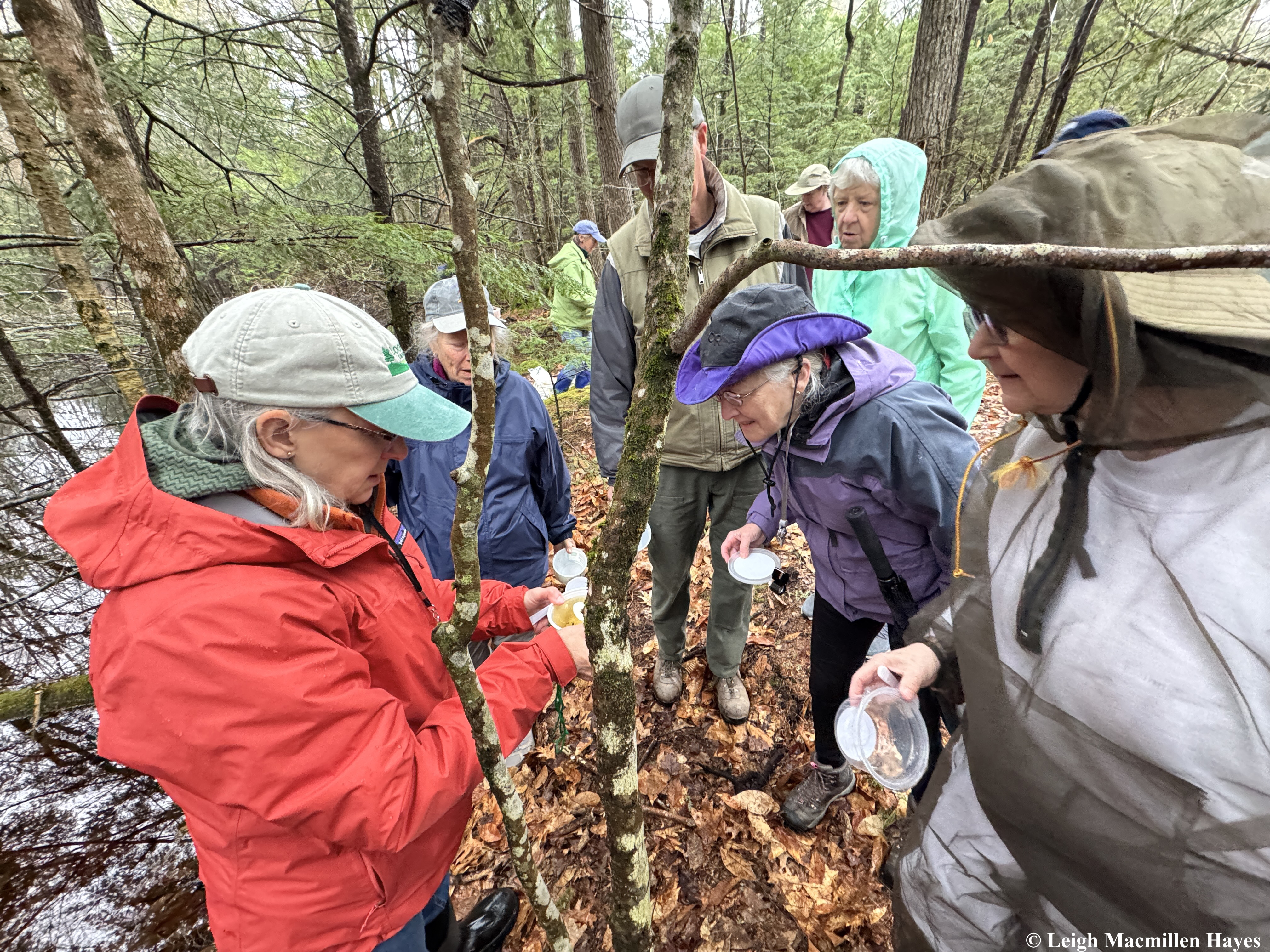
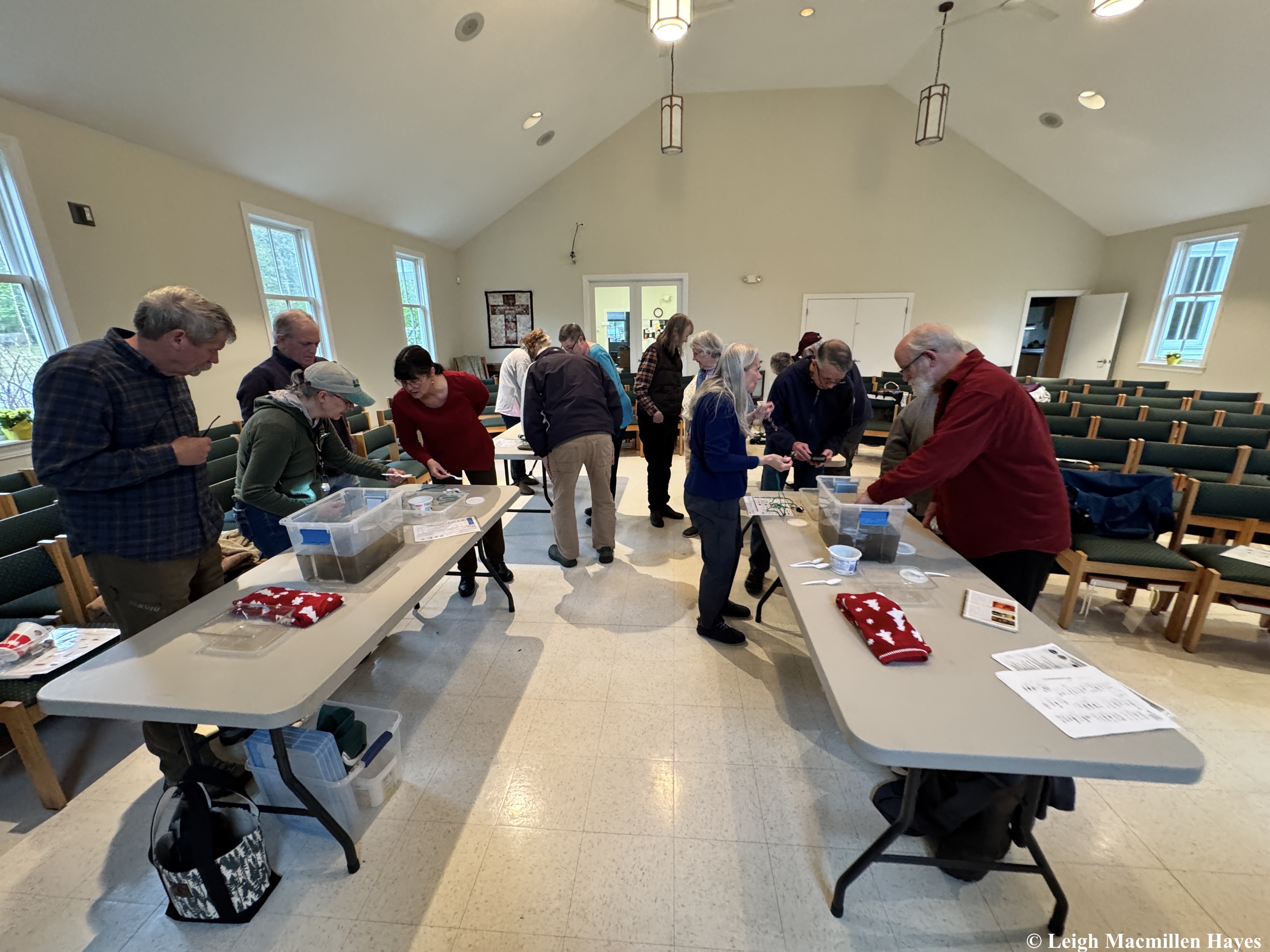
And then they did. Almost 30 of them. The first class, as you can see, was an indoor introduction to vernal pools where we shared our photographs, ID books, and models, and told stories about our experiences in these ephemeral habitats. Their questions were numerous and they shared stories as well, making it an even richer experience.

And then we ended with a musical treat since we knew that there was at least one conductor in the audience. As you click on the arrow to listen to the Springtime Chorus, remember that Wood Frog calls sound like “Wruck, wruck.” Spring Peepers: “Peep, peep, peep.” Green Frogs: “Ga-dunk, ga-dunk.” And Bullfrogs: “Jug-a-rum, jug-a-rum.”

Thank you, Jan, for leading this, and thank you to everyone for participating so willingly.

The following Friday we awoke to rain and again we were sure no one would show up. BUT . . . that did not stop them and we slowly snaked through the forest on our way to the vernal pool.

Of course, we all suffer from that most wonderful of syndromes: Nature Distraction Disorder (NDD), and the summer grape that grows along the Grapes Expectations Trail at Raymond Community Forest was the first thing to draw our attention.

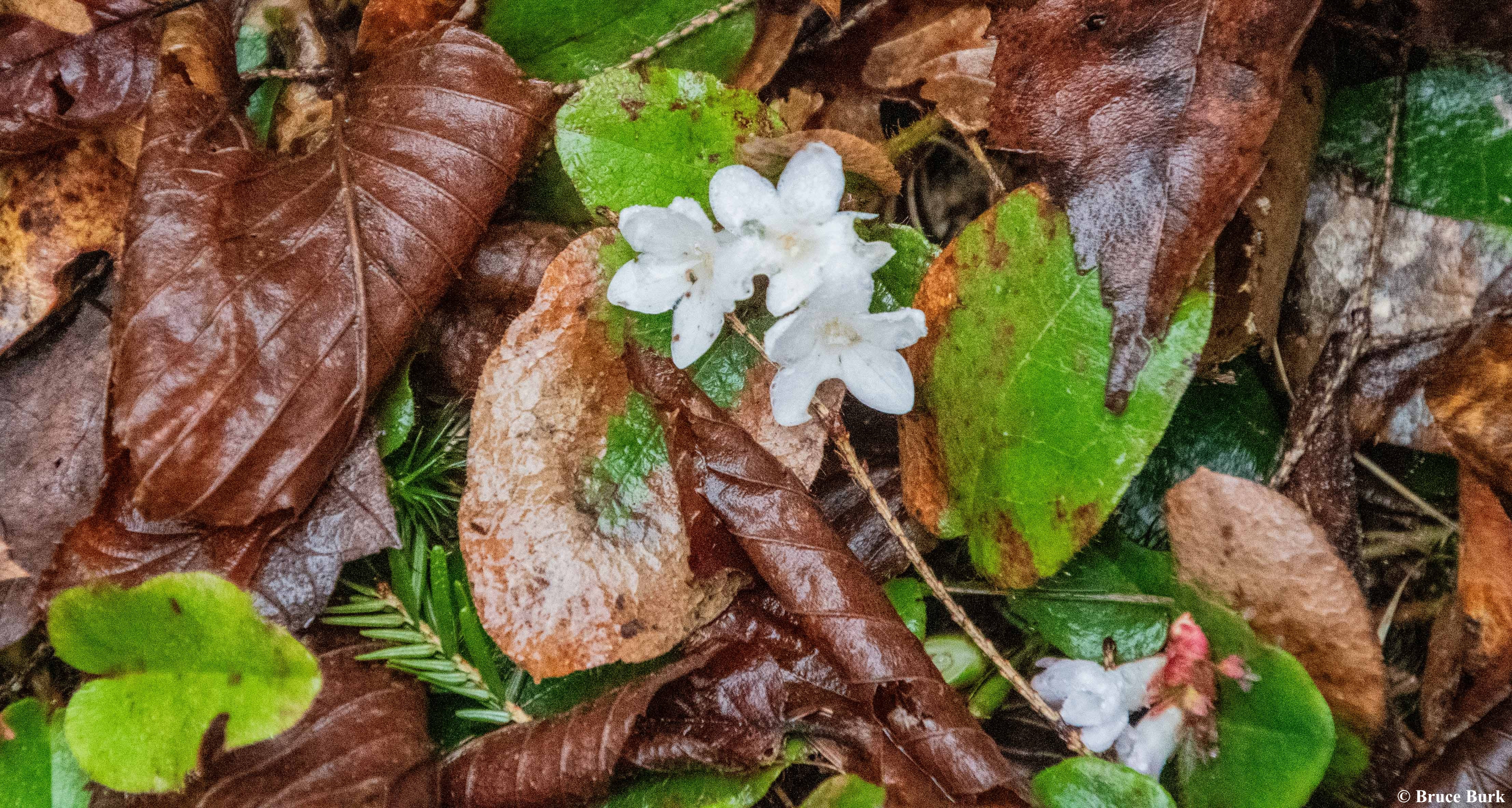
Trailing Arbutus with its sweet little flowers also caused us to pause.

At last we reached the pool and because the sky was overcast and some raindrops and mist fell, we couldn’t see into the pool very well, especially to admire the egg masses deposited by Wood Frogs and Spotted Salamanders. But . . . we could dip.

And within a few minutes the prize of the day was discovered and everyone came to take a peek at what Dawn had found.

Soon one Fairy Shrimp (just enough to make the pool significant by Maine standards) was followed by multiple more. This particular one happens to be a female with a full brood sac at the top of her abdomen.

I’ve said this before, but it’s worth mentioning again and again:

40 Wood Frog egg masses make a pool significant; OR 20 Spotted Salamander egg masses; OR 10 Blue Spotted or Jefferson Salamander egg masses; OR a single, yes one, Fairy Shrimp.

Fairy Shrimp are cool because in order for eggs to be viable, the pool must dry out. And they can survive being dry for multiple years. And in any given year, not all eggs will hatch, thus saving some in the bank for another year or ten.

Our other finds that day include Phantom Midges–with inner workings visible through the translucent body.

And Predaceous Diving Beetle larva, plus . . .

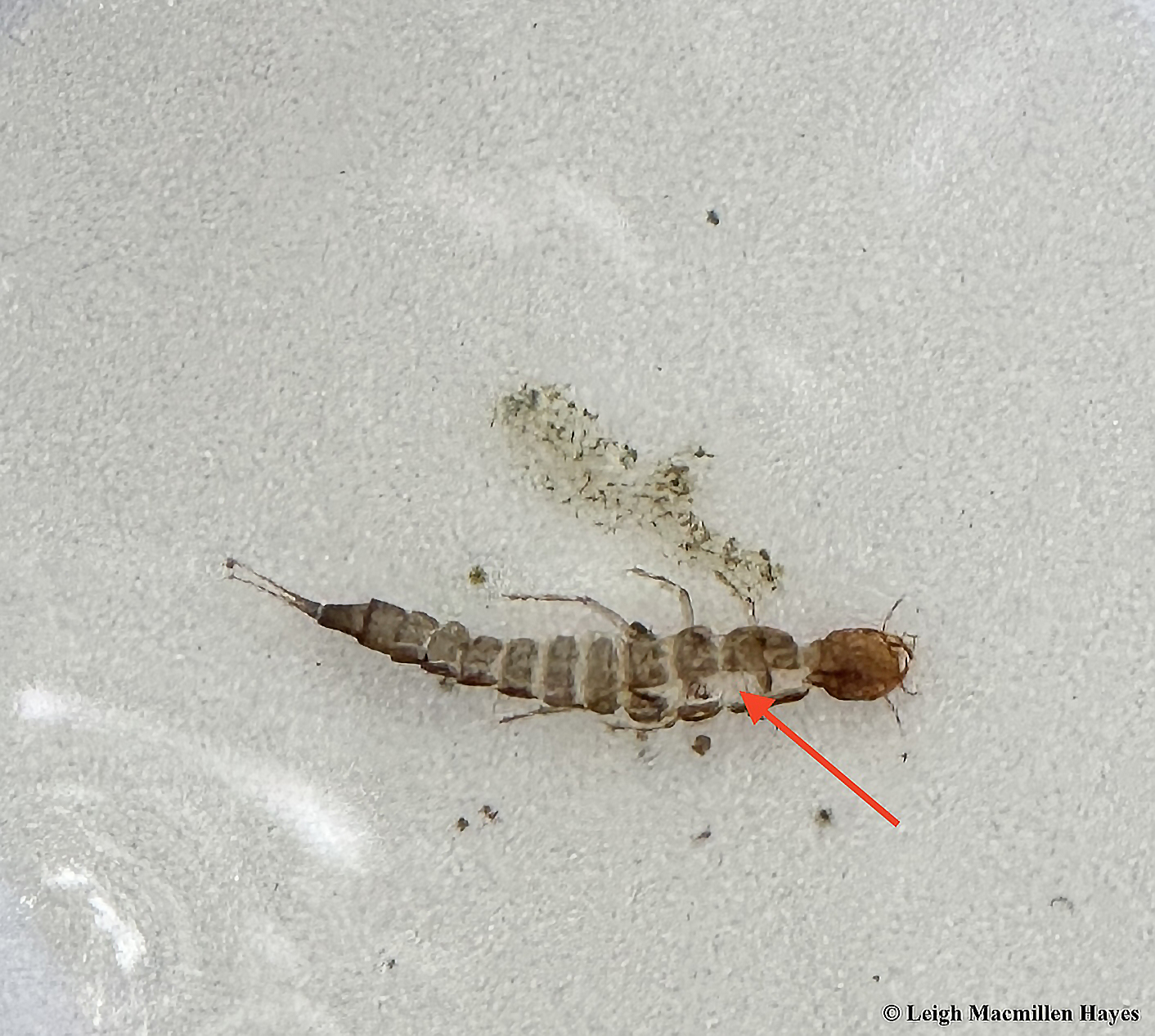
the shed skin of a PDB, with a split where the wings of the adult emerged first and then the rest of the body squeezed out through that slit that the arrow indicates.

This is the adult, with an air bubble on its back end; and if you look closely, you may see a few Mosquito Wrigglers twisting and turning in the photo as well.

We always remind everyone that all larval forms must go back into the pool or stream or whatever waterbody, because in the whole scheme of things, everything is important.

I laugh when I look at this photo because as a youngster, my brother always noted that my mouth was always open in pictures–apparently he thought I talked too much.

But obviously, on this Friday I was waxing poetic about something.

Before we left the pool that day, the students had a surprise for us. The previous week I had pulled out a party noisemaker and reminded those who had attended our winter class on insects that it served as a great tool to illustrate how a butterfly or moth proboscis (mouth part) curls up in flight, but upon a flower, they extend it to reach the nectar. Turn the noisemaker over, however, and suddenly you have a frog tongue–as they snap it out to capture an insect.

And tada, unbeknownst to us, everyone was suddenly a frog. Heck, if we were going to make them perform in the frog chorus, then they might as well be frogs. It was awesome. And yes, they did perform in the chorus once again, after which we left the pool and headed home.

Week three found us back at the church, where we began with a slide show about Benthic Macro-invertebrates.

Benthic: Living at the bottom of a body of water (stream, river, pond)

Macro: Large enough to be seen with the naked eye

Invertebrate: Animal without a backbone

Macro-invertebrate: Large, water dwelling animal able to be seen with the naked eye.

Prior to the class, Dawn and I spent an hour or so trudging to and fro a local wetland to retrieve containers of water so that after the initial presentation, the students could take a look–up close and personal, in the comfort of a building. (Never fear: all critters were safely released in the same spot where we captured them with our D-nets)

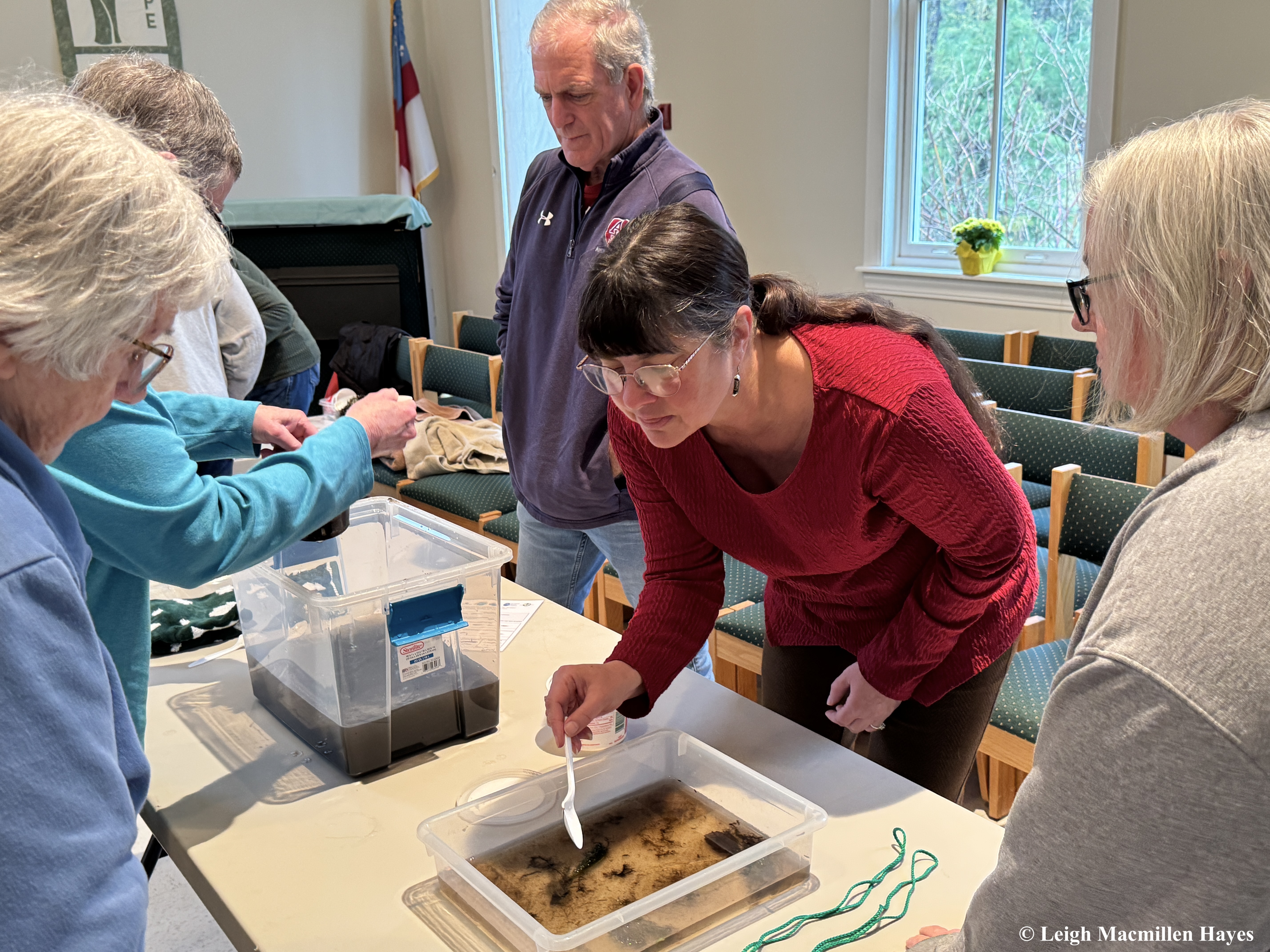
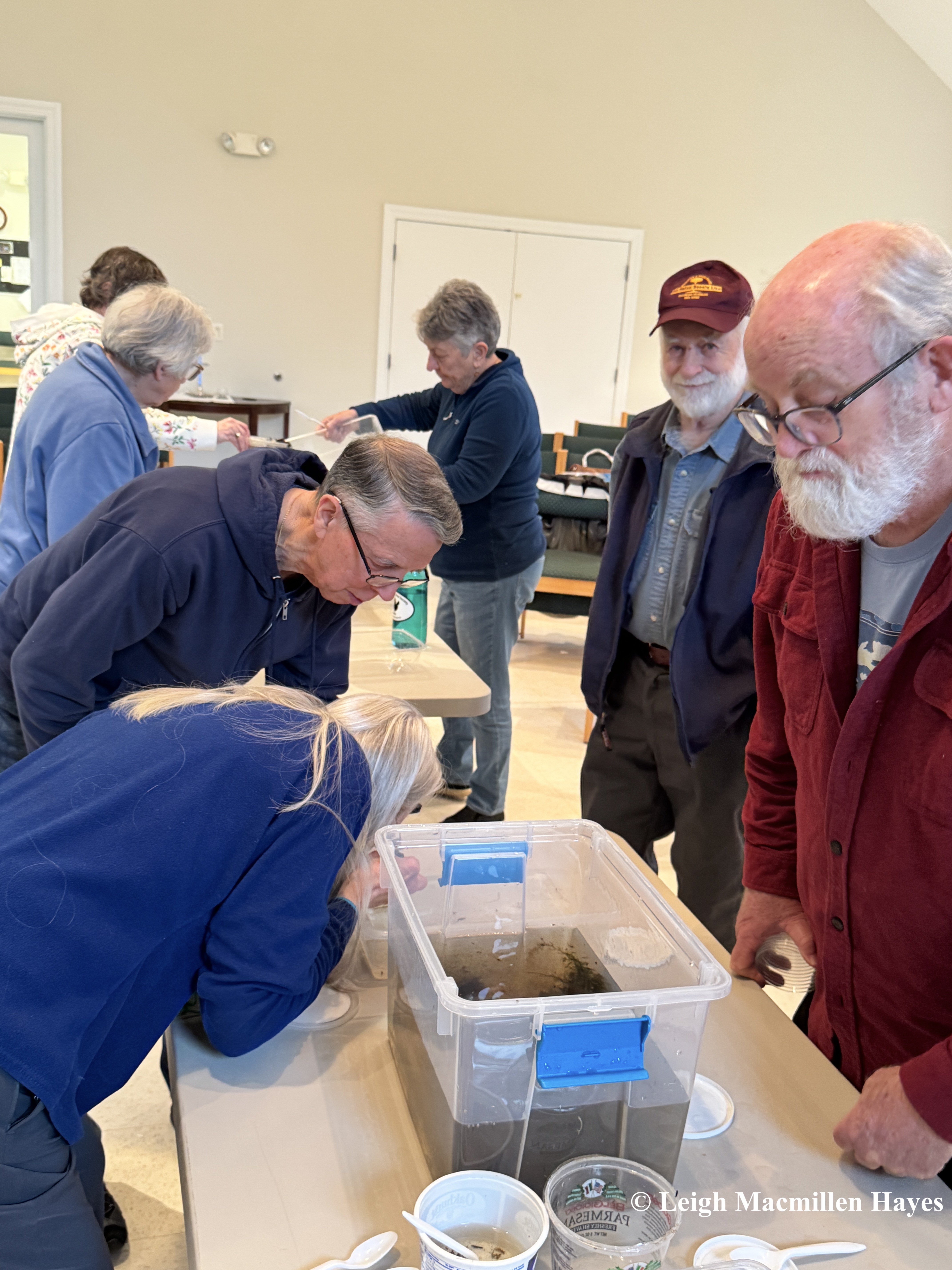
They started starring into the water and began to notice movement. And then, using spoons and small containers and lids, all recycled, they were able to glimpse the wonders of the water.

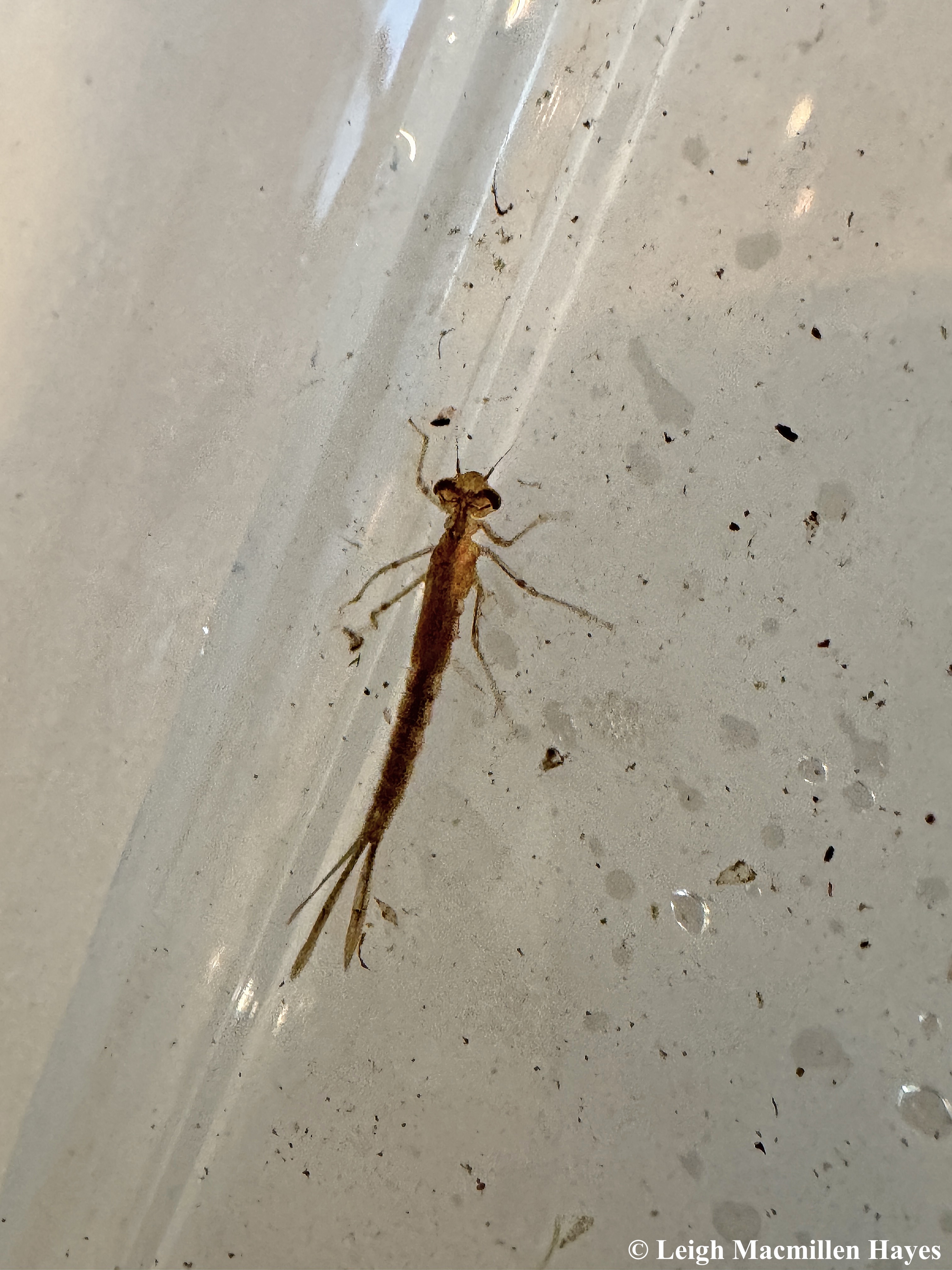
One of the favorite finds was the larval form of a damselfly, with three paddle-shaped tails that serve as gills.

The critters love to hide under the leaves and muck that we’d pulled up so sometimes it took a few moments to wait for the water to settle before spotting something moving.

But they did. And with the use of loupes on lanyards that we borrowed from Loon Echo Land Trust, they found Mayflies and Damselflies and Dragonflies and Backswimmers and more.

Finally, today dawned. The forecast kept changing all week, so we were pleasantly surprised by the sun. That said, you know those Mosquito larvae we always encourage everyone to save? Well, they are hatching. But, just as for the rain, everyone was prepared.

Oh, and yes, another moment of NDD hit us only a hundred feet from the parking lot. We love mud.

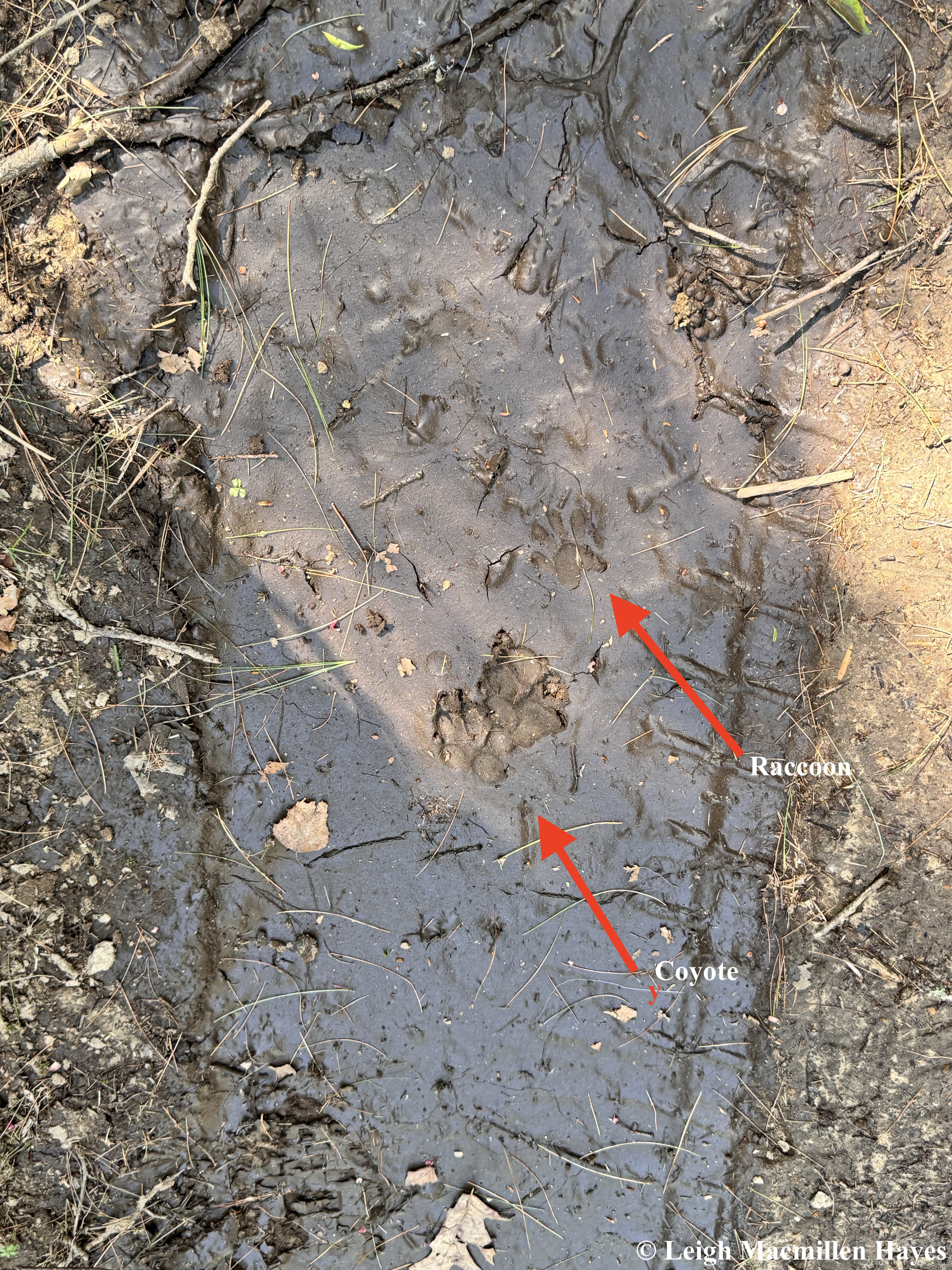
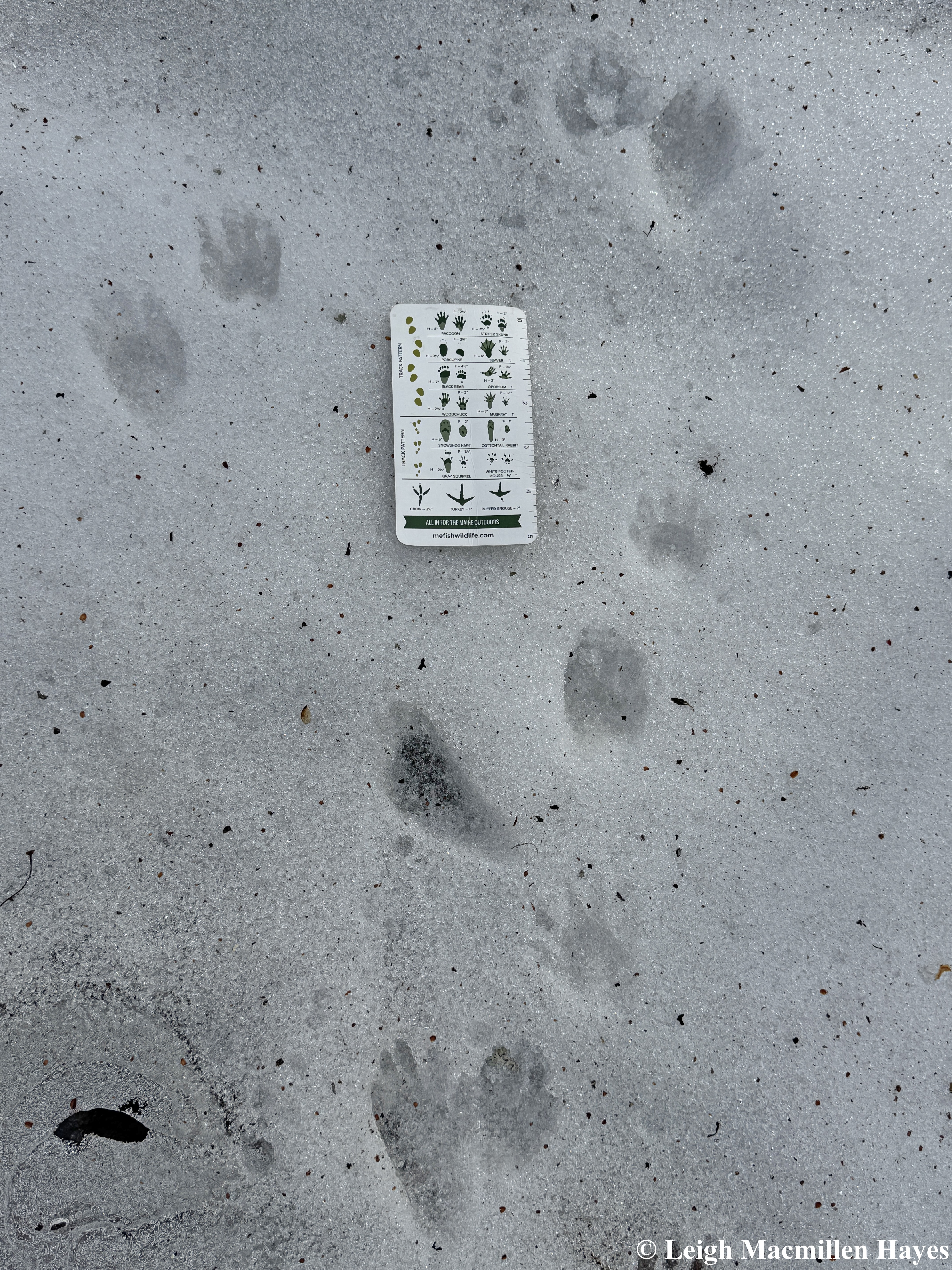
Especially when it tells us who passed this way during the night. In this case, it was two critters: a Coyote and a Raccoon. If we can’t have snow, mud is great. In many ways, it’s even better than snow for the prints are much crisper and easier to read. (Don’t tell the snow I said that. Ever. If you do, I’ll deny it.)

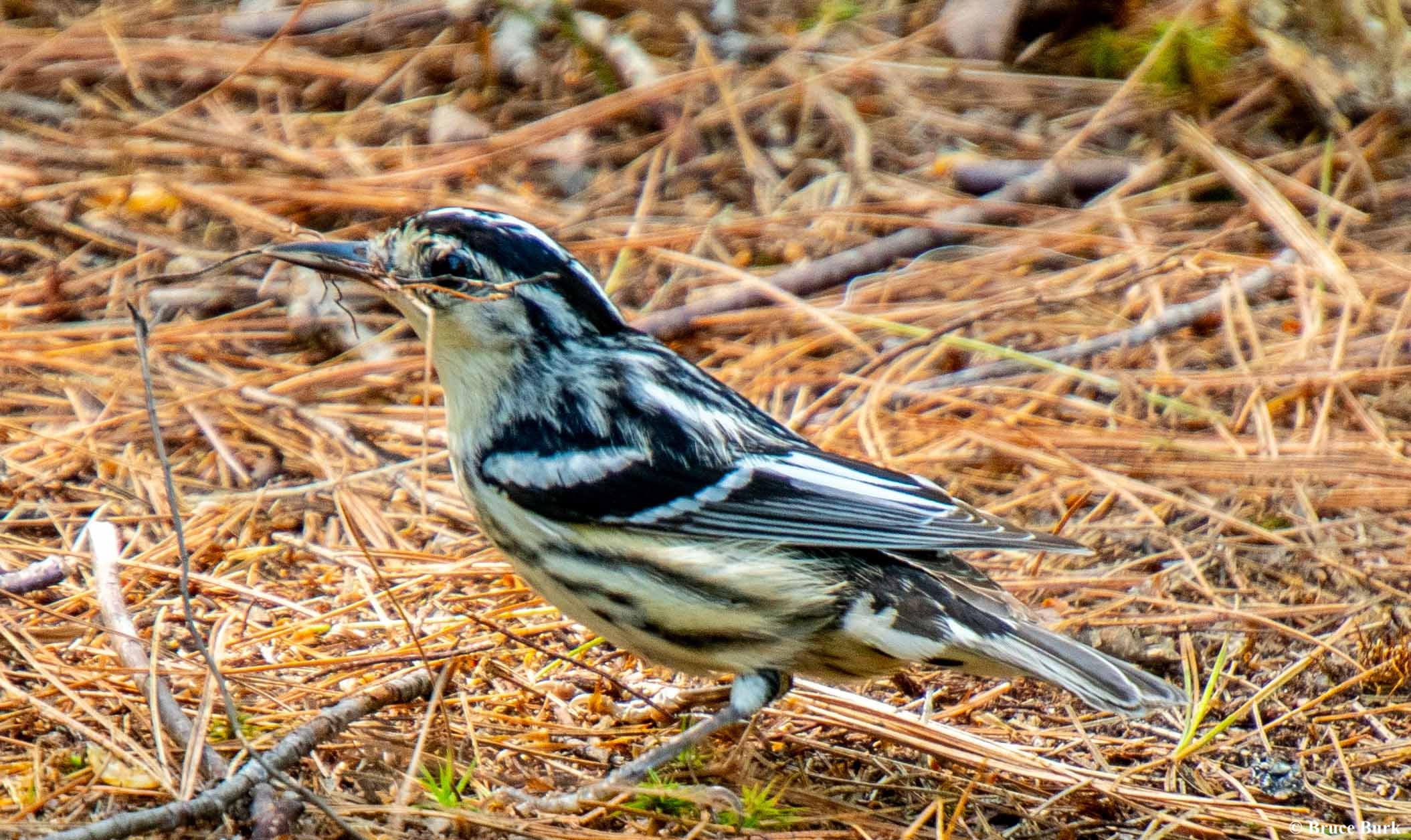
But . . . we had a mission and a time frame. The Black and White Warbler didn’t care. Apparently, we had entered its territory and despite our presence, it went right on collecting nesting material.

When nature surprises us with these moments, I always feel we’ve been blessed to be witnesses.

Finally, it was time to dip the D-nets into the river.

We’d placed a few tables near it so everyone could take a look without risking going into the water. Plus, the trail to the water is narrow and once we realized the bird was building a nest there, it made it even more important that we not spend too much time.

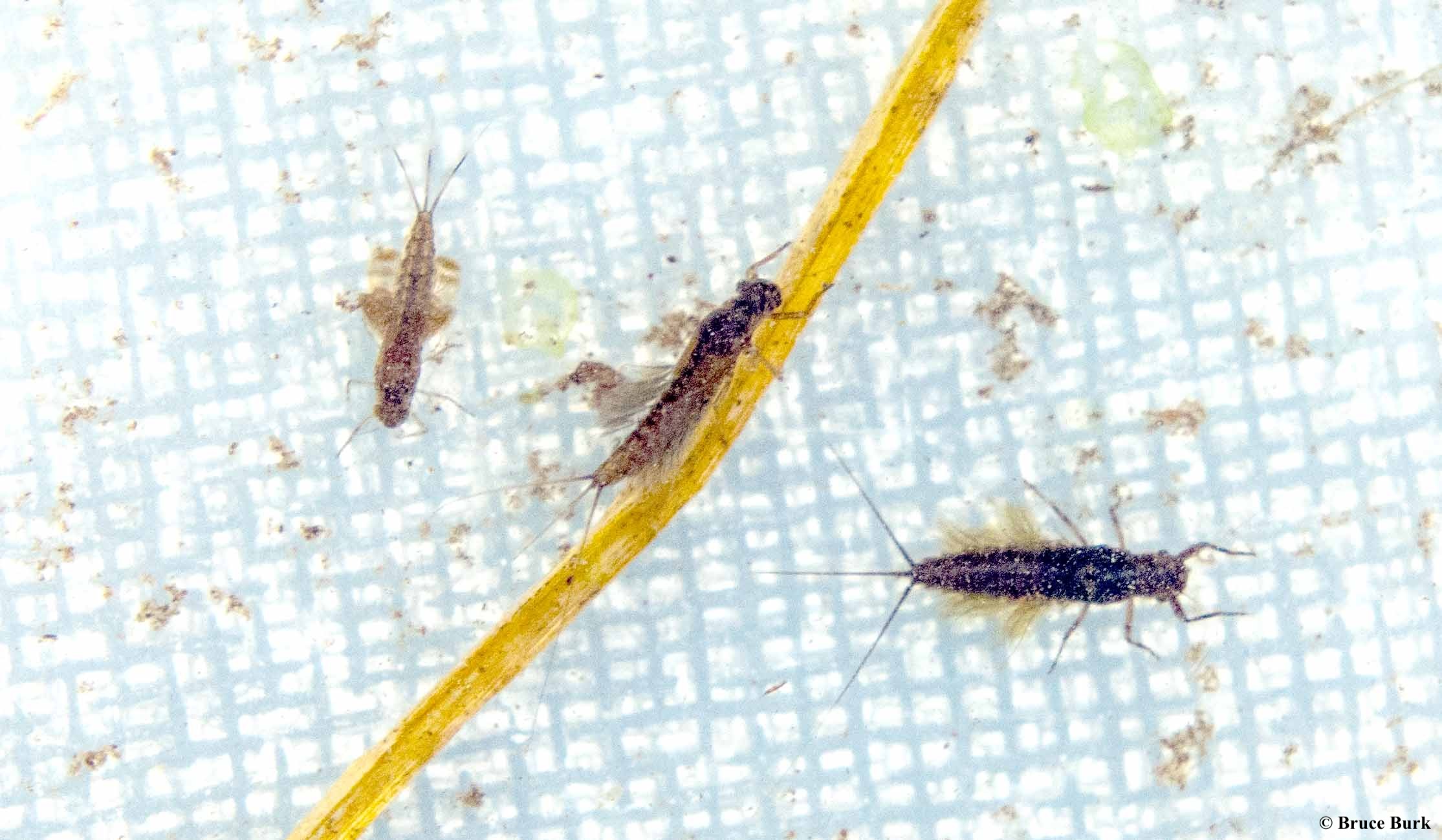
The most prolific finds of the day: Mayfly larvae.

There are so many types of Mayflies as everyone soon realized. What I love about them: their feathery gills on the sides of their abdomens, and the three long tails that most feature, which they even had as adults, probably helping with balance for one thing.

Again, it was an enthusiastic crew and any time something interesting was discovered, all wanted a chance to see.

We had a damselfly that at first I thought was a Water Scorpion because the three shorter tails were held together so that they looked almost like the tubes at the end of the abdomen, but then I took a better look and realized that they weren’t elongated and in every other way, it had damselfly written all over its head and body.

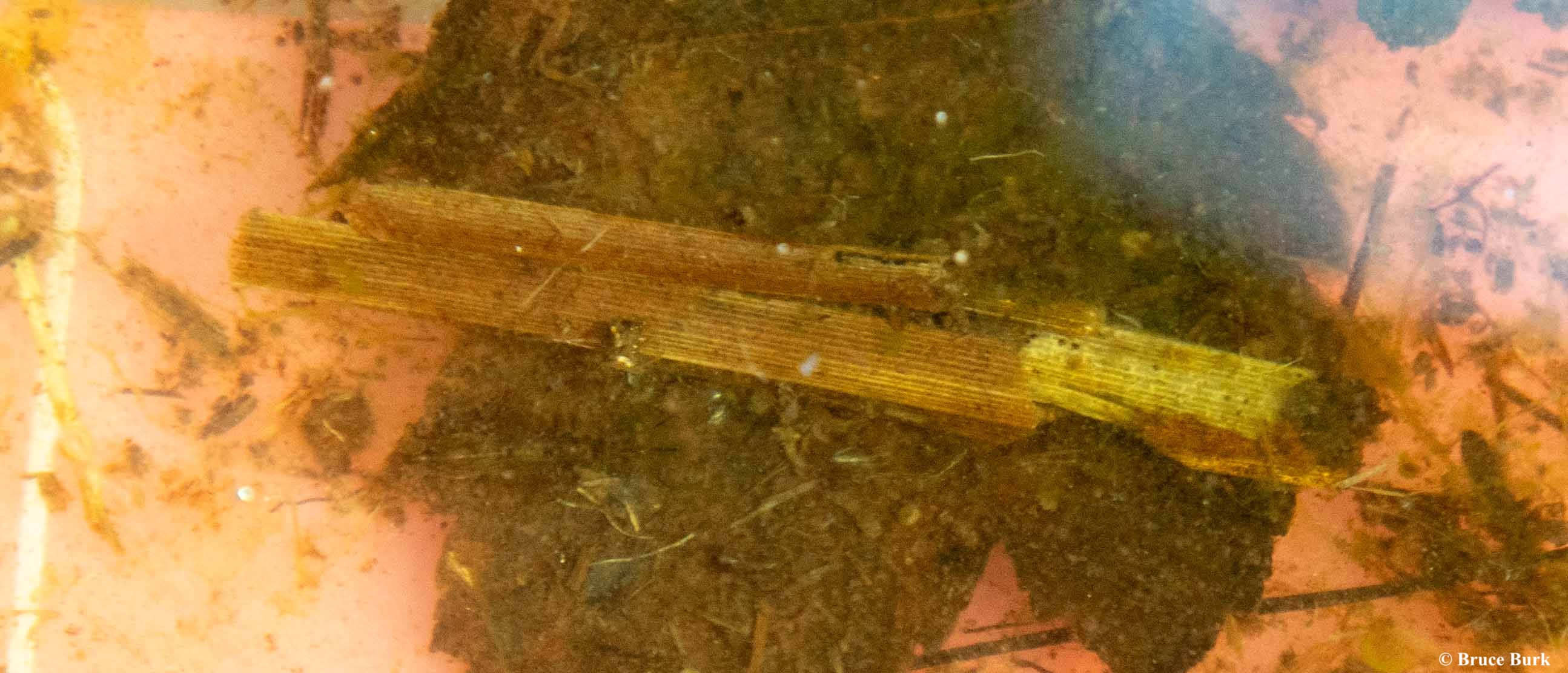
Caddisfly larvae also entertained us and we found a Northern Case Maker, plus . . .

what might have been a Giant Case Maker, who built its home from the broken off tube of vegetation.

Everyone was fascinated, but we had one more stop to make so eventually we had to pack up shop in this location and move down the road to another trail.

Another NDD moment happened as we walked beside a vernal pool where we could not only spot Spotted Salamander egg masses, but also these of the Wood Frog variety, and tons of tadpoles feeding on the green algae. It actually created a full circle from our first classes about vernal pools.

A Pickerel Frog also caught our attention and delight. Bruce caught an amazing photo of the underside of its rear thighs–with the yellowish coloration. Both Pickerel Frogs and Northern Leopard Frogs have spots, but one of the defining differences is the yellow, or sometimes orange color that you see here.

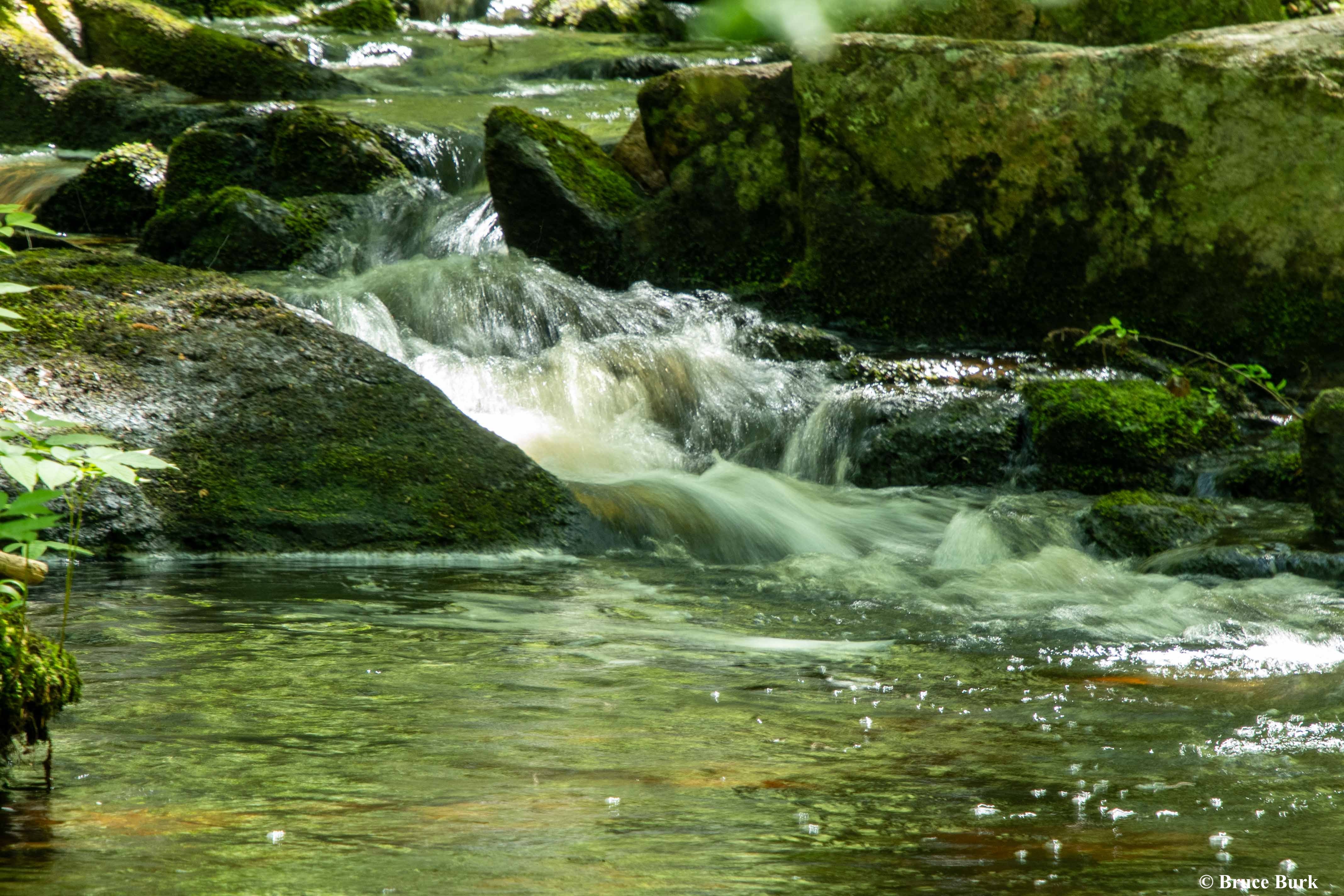
Our final destination was Douglass Brook, where the water flowed faster than it did in the section of the river where we had dipped only a half hour earlier.

Our reason for this location was because it has lots of rocks and we wanted everyone to see how some critters use them as places to cling.

So once again, we took an up close and personal look.

And scooped up anything we could find.

Including Black Fly larva which like fast-flowing water. I think folks were not quite as keen on saving every little critter given how many Mosquitoes swarmed us, but still they did.

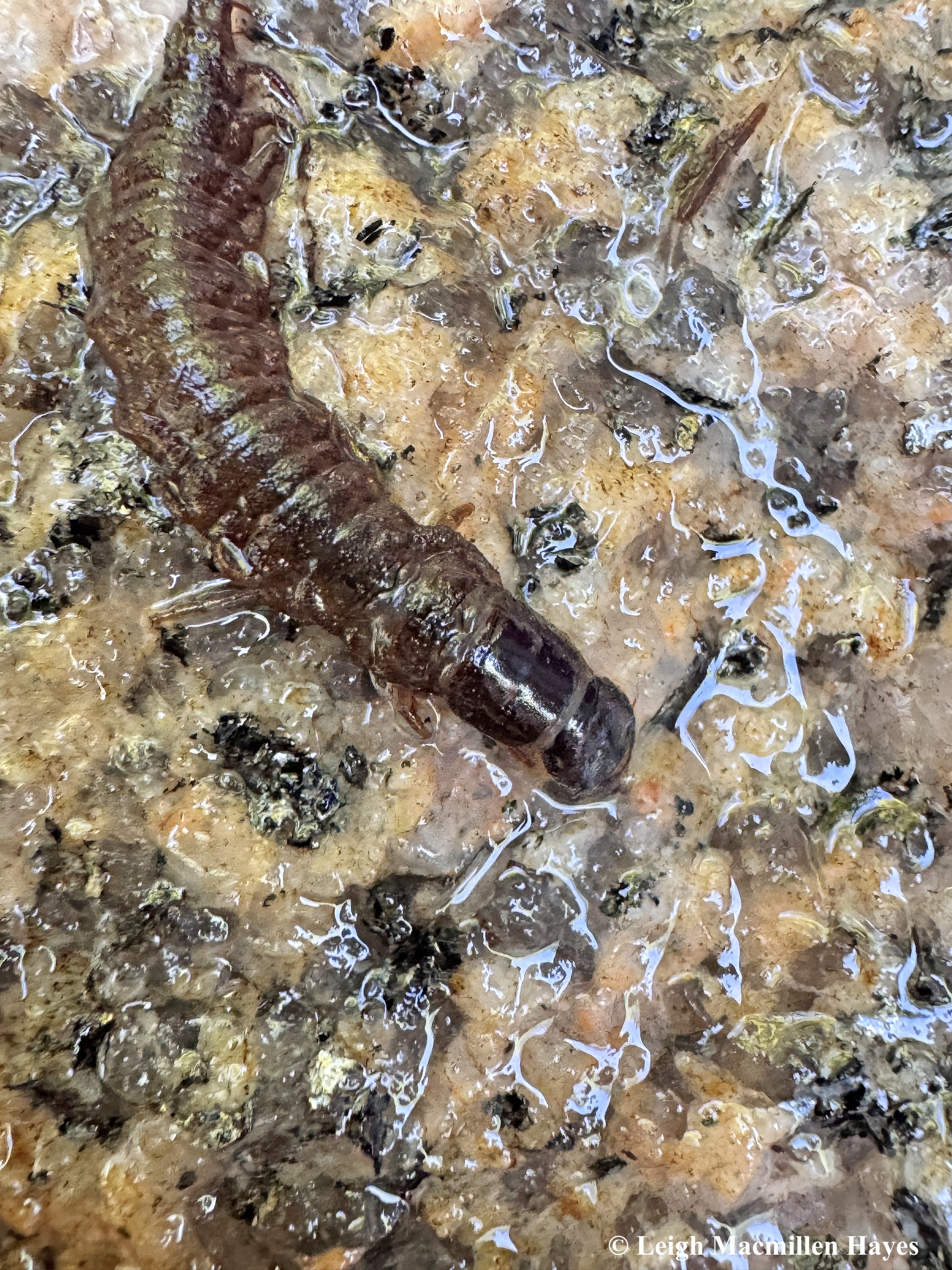
We also found a Dobsonfly Larva, aka Hellgrammite, who prefer the fast flowing water and hold onto rocks with strong claws on their legs, or so I read in A Guide to Common Freshwater Invertebrates of North America, and that’s exactly what this one did.

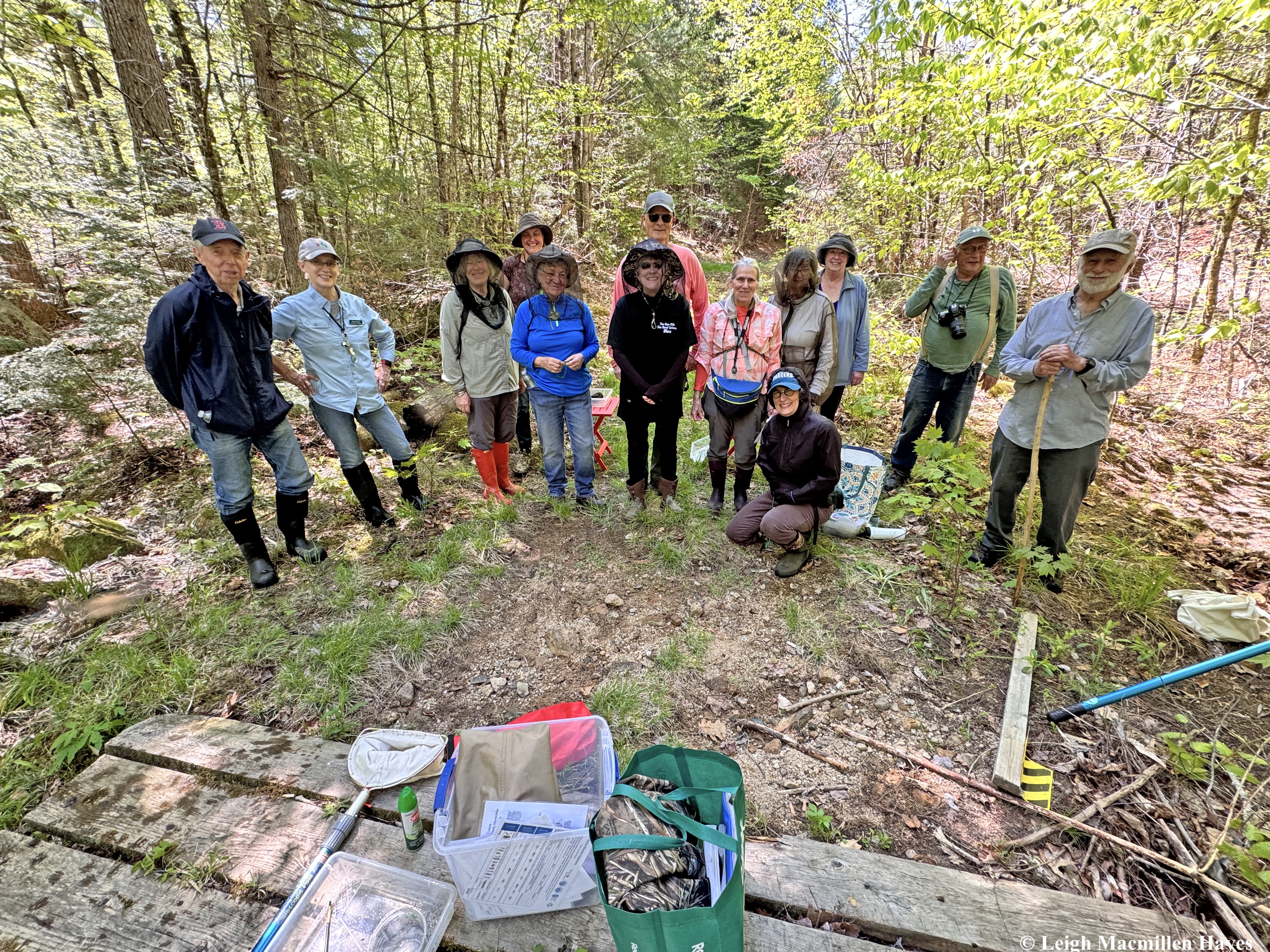
Two hours passed quickly and finally it was time for the four-week class to come to an end. And we were all smiles.

Senior College is an awesome opportunity for us mature beings to learn. The curriculum is diverse; there are no prerequisites, term papers, exams, or grades.

Hats off to the all-volunteer board. And to the students. We can’t believe how many of you joined us each week. And thank you all for helping us carry equipment today.

Many thanks also to Dawn for co-leading with me. And to Bruce for taking so many photos so that I could use them to share all of these incredible learnings with you.

Mr. Cretella, my high school Spanish and Latin teacher, popped into my head just now. In my yearbook, Mr. C. wrote, “Never lose your desire to learn.” Those words have reverberated with me over the years. I don’t remember what anyone else wrote, but his sentiment struck a cord. Pretty amazing, given that when I took Latin I my senior year, I was forever substituting Spanish words if I didn’t know the answer on a quiz or test.

Wherever he is now, I’m grateful that Mr. C. encouraged my desire to learn. And love that so many are the same.

Senior College: Forever Students indeed!

Dragons of the Future

Spring is actually a combination of many seasons, beginning with winter that doesn’t want to let go, followed by mud, and then road-repair, with bug quickly taking form following several days of rain, and soon to come, my favorite of all–dragonfly season.

And so I thought I’d take some time to honor friends I’ve met in the past and try to get to know them better . . .

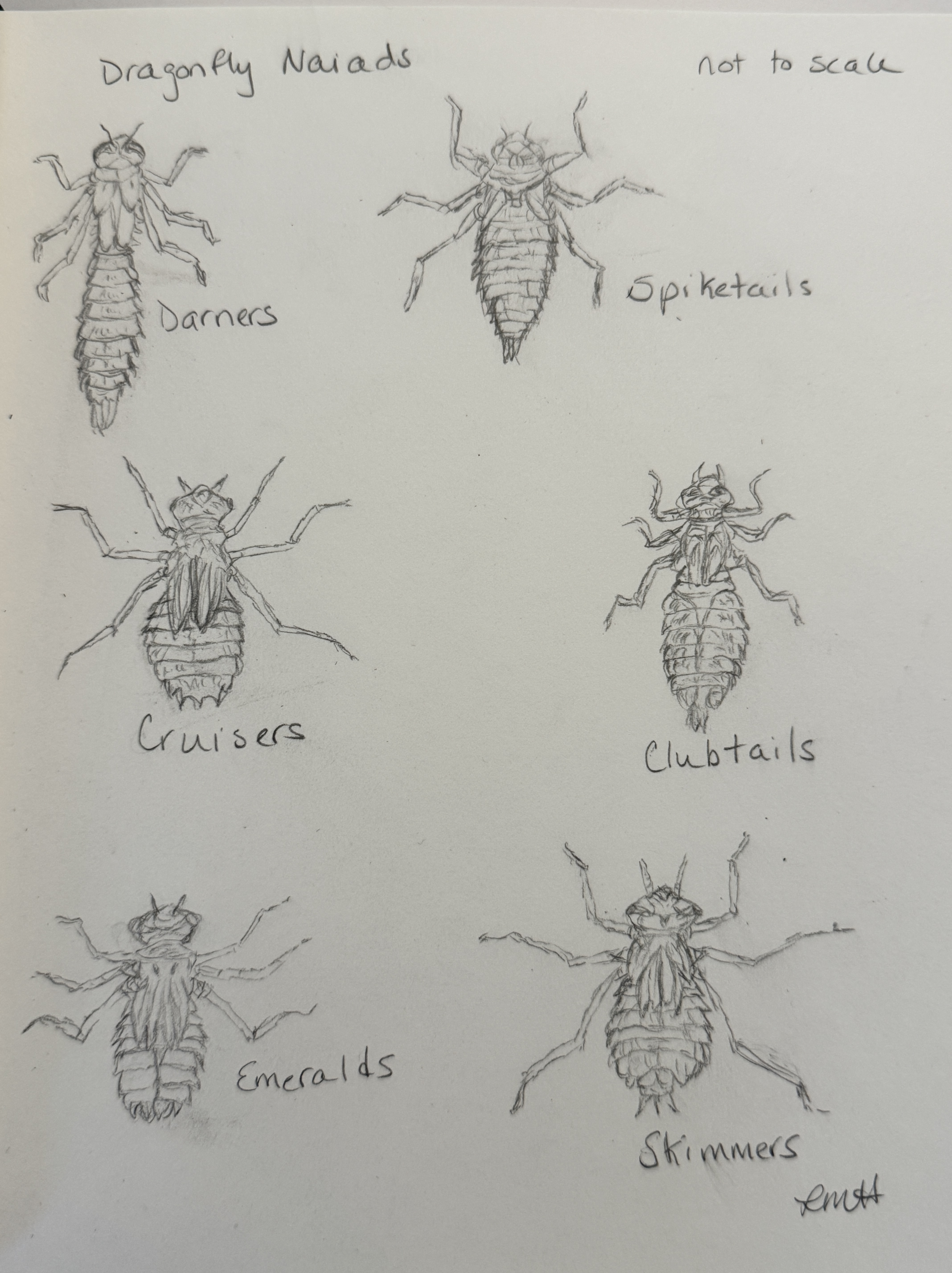
With my pencil first. Sketching is such a wonderful way to slow one’s self down and try to capture the essence of the object. Thankfully, with pencil and a good eraser, changes can be made and believe me, I have, and will continue to edit these.

Darner Naiad

And then I decided to take it one step further–by painting the Naiads (larval form) of six dragonfly families.

One of the incredible wonders of this world is that the aquatic form of dragonflies become terrestrial and we anticipate and celebrate their emergence every spring, knowing that BUG season won’t last too much longer. Well, in some places. Right Jenn?

Usually, they begin to emerge by the end of May and then it’s an ongoing process, with some waiting until late summer or early fall to transition from one world to the next.

This is a Black-tipped Darner that I met in the fall a few years ago when it was barely alive. It was on the grass by the outlet of Deer Hill Bog in Stow, Maine, which is a typical habitat for this species, though it isn’t common.

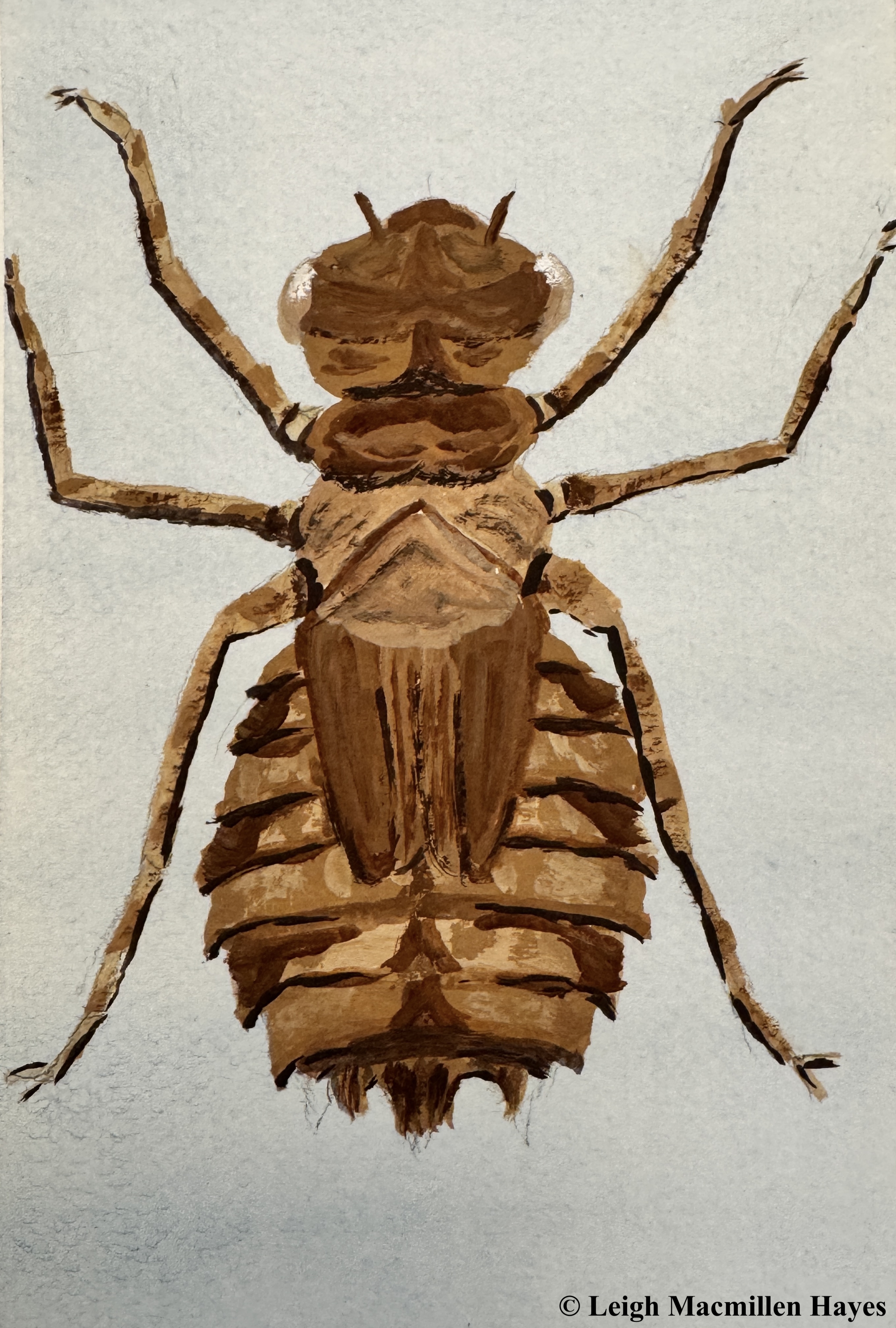
Stream Cruiser Naiad

After painting the Cruiser Naiad, I thought I’d use the iNaturalist APP: SEEK on it and bingo, SEEK identified it as a Stream Cruiser. All the rest came up as dragonfly/damselfly, so at least AI knew I was painting insects, but I was excited that it could reach the species with this one.

When immature, Stream Cruisers remind me of Oreo cookies, or maybe an Ice Box cake, which is actually rather funny because a few days after my birthday last year, I was the surprise recipient of an Ice Box cake. Thank you, Deb!

There are not a lot of cruisers in the Cruiser family, and as far as I can tell, this and the Swift River Cruiser are the only two found in New England.

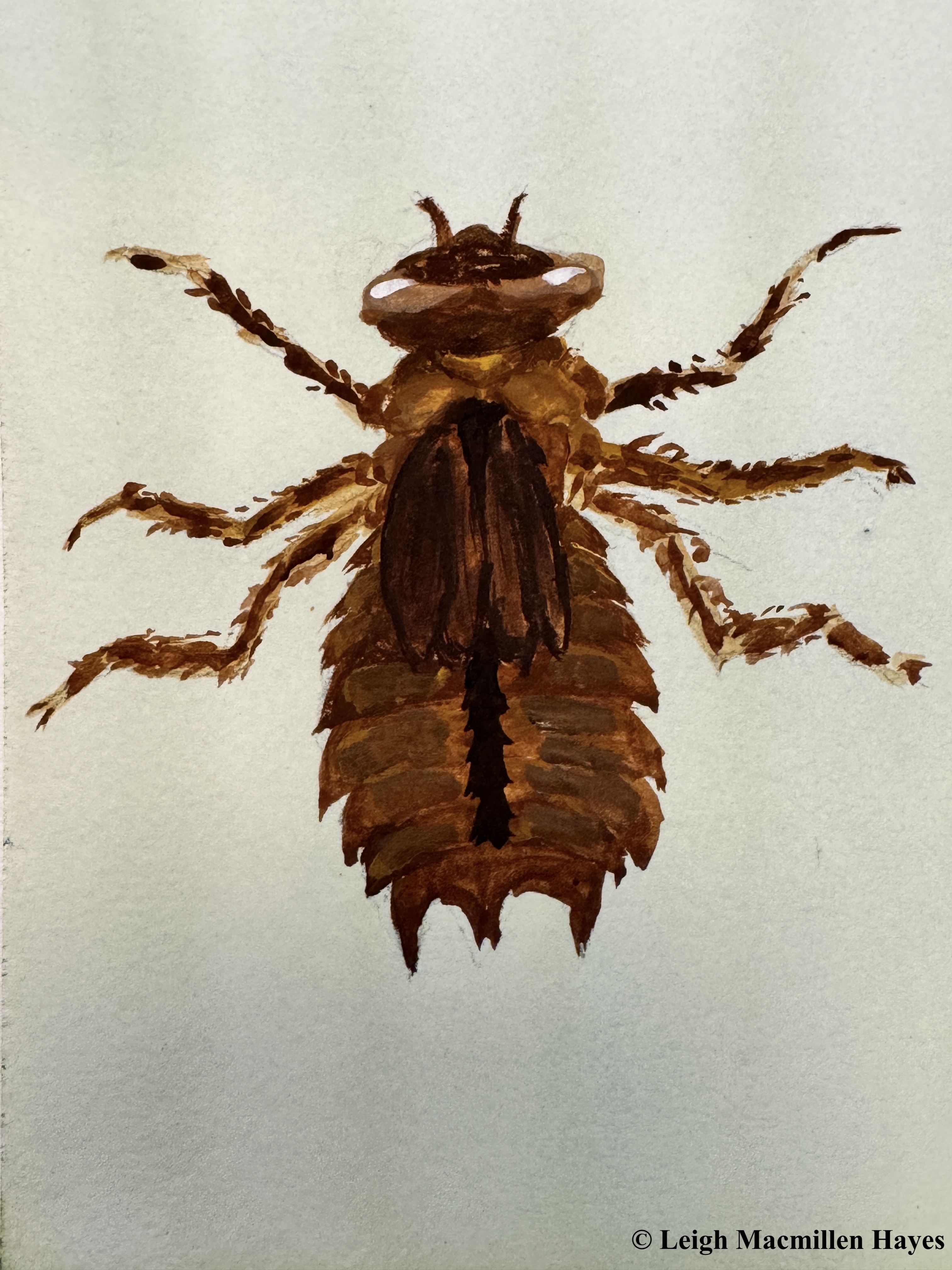
Emerald Naiad

Okay, so I tried to show the hairy body of the Emerald Naiad. If you’ve ever looked through a loupe or hand lens, you’ll know that the whole world is hairy!

Most Emeralds have greenish eyes and this Kennedy’s Emerald is no exception. In his field guide, Dragonflies of the North Woods, Kurt Mead writes, “Named for Dr. Clarence Kennedy, a professor at Ohio State University and a pioneering odonatologist.

Also in the Emerald family are the Baskettail dragonflies, this one being a COMMON Baskettail. I’ve commented before on the word “common,” and probably will again, but seriously, do you see anything common about this intricately-designed specimen?

Spiketail Naiad

So, um, I drew and painted this Spiketail Naiad, but to my knowledge, I’ve never encountered a Spiketail. I guess that should be one of my goals for the upcoming season. And I’m sure that having said that, I will start receiving photos of such from friends who have spent time with the adult members of this family.

Clubtail Naiad

Clubtails, however, I do know and meet often. They are so named because most adults have clubbed abdomens.

One of the ones I meet most frequently is the Lancet Clubtail–who loves to greet me on our dock or accompany me for a kayak ride. Do you see how the end of the tail is more club-shaped?

I will say that I often have to slow my brain down to differentiate between a Lancet, Dusky, and Ashy Clubtail.

I would be remiss if I didn’t mention the biggest Clubtail of all: Meet the Dragonhunter. Yes, he has a clubbed tail. But also yes, as his name implies, he eats other dragonflies. Oh, there are plenty of other things on his menu, but at up to 3.5 inches in length, this big guy may also eat butterflies and even other Dragonhunters!

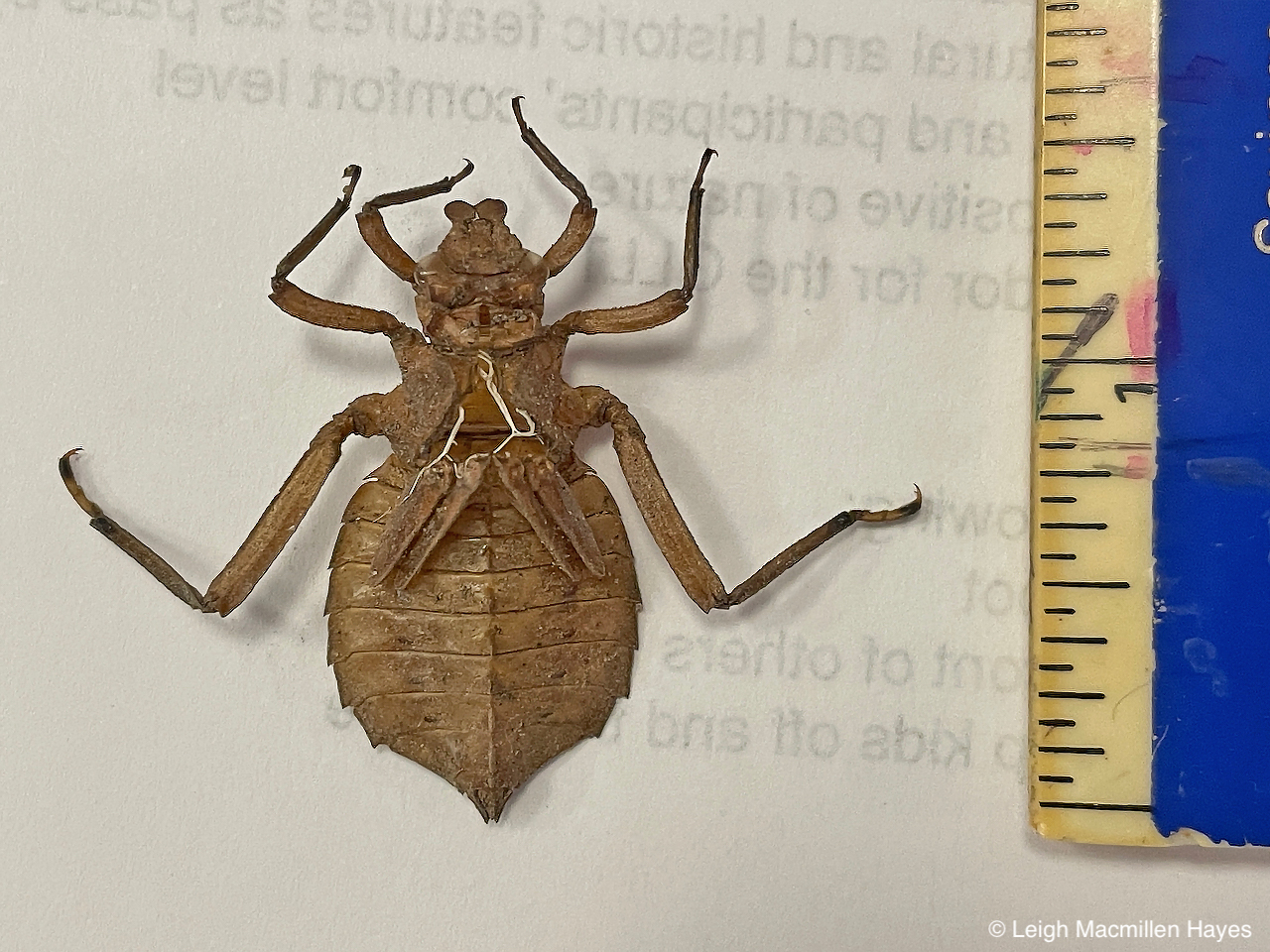
I would also be remiss if I didn’t share this photo of a Dragonhunter exuvia, which Dennis Paulson, author of  Dragonflies and Damselflies of the East describes as “wide, flat larva that resembles a wood chip.” The legs alone speak to its strength; formidable in the water and out.

And this is just a reminder to self that though I sketched and painted one form of a dragonfly naiad for six species, some may have other shapes. It’s the cerci at the tip of the abdomen that becomes key for identification to family.

Skimmer Naiad

My final painting completed this afternoon is that of a Skimmer Naiad. This is the largest family of dragonflies and every ID book includes a thick section for skimmers.

That seems apropos because not only are there a lot of family members, but their abdomens are also quite thick or chunky.

Pictured above is a male Calico Pennant Skimmer. His counterpart has all the same markings, but where you see red, she sports yellow. And soon, a pair of cousins will fly before the Calico Pennants. The cousins are the Hudsonian Whitefaces. Their abdomens are similar, but they have clear wings and as the name suggests, white faces.

That being said, I again have to slow myself down when I spot a Hudsonian because I often mistake it for a Calico at first glance.

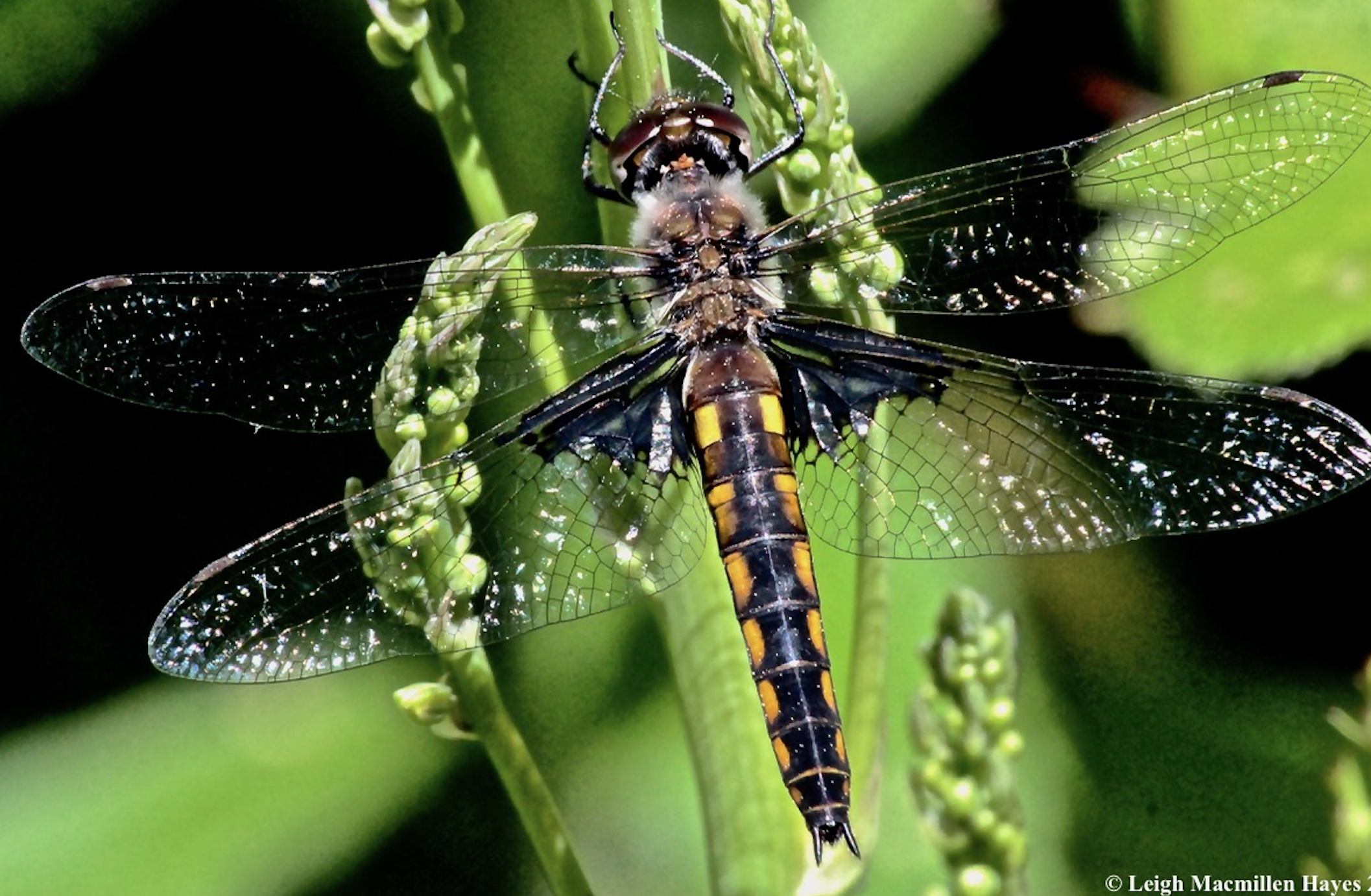
I share thousands of photos (and probably have shared at least a million over the last ten years) of Skimmers, but thought I’d keep it simple and end with this one–a male Spangled Skimmer. Note the white stigmas on his wings. That I am aware, no other dragonfly has these white stigmas.

Thanks for stopping by to check on my current Naiad collection.

Naiads are the dragonflies of the future.

And the future is close at hand.

I can’t wait for spring 2025 to debut her dragonfly season.

Vernal Pool 1: Oh Baby(ies)

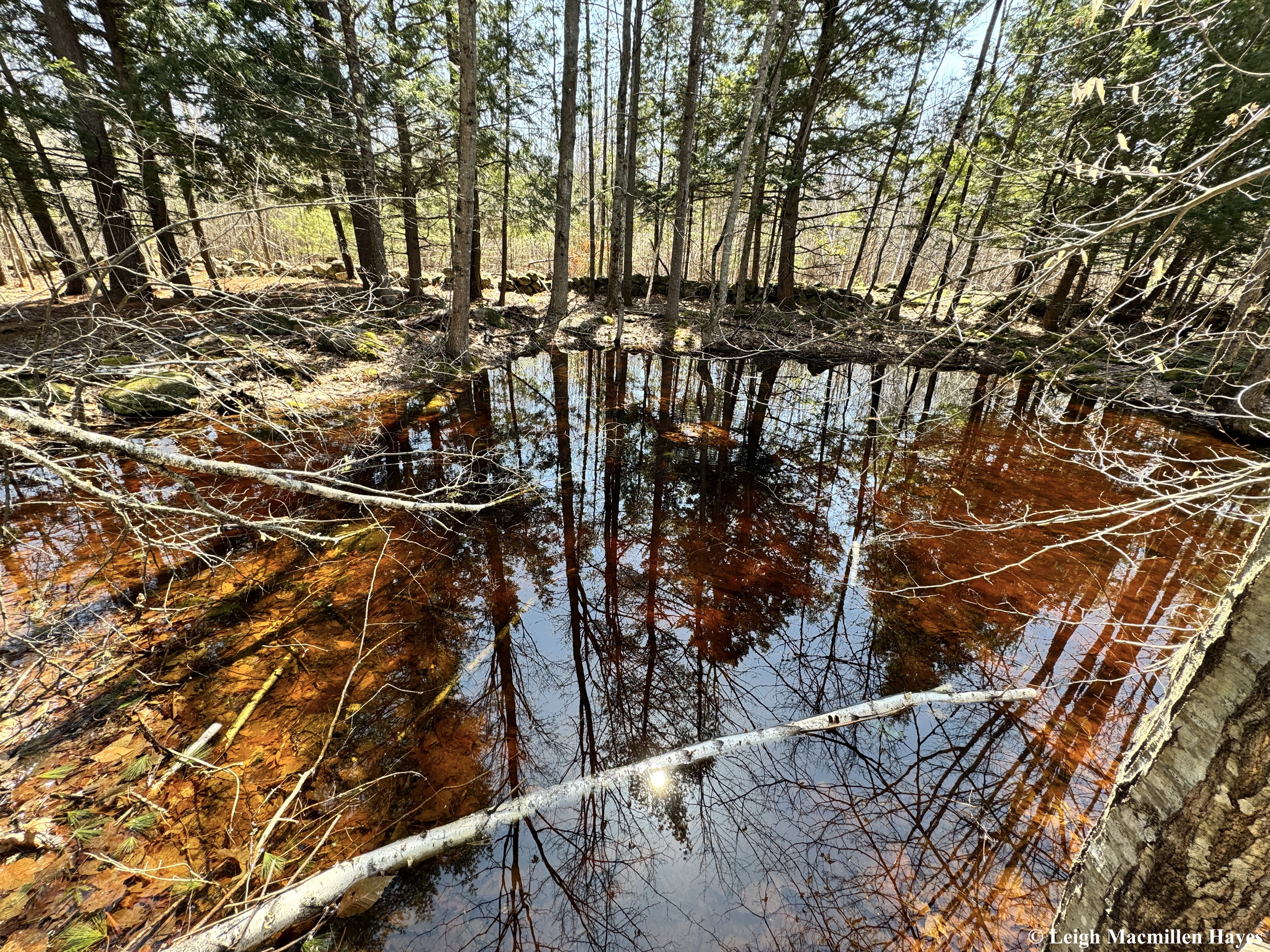
Once the snow and ice began to melt, I started making almost daily visits to “My” vernal pool, located about a quarter of a mile from our house, and only a hop, skip, and jump, well maybe a few hops, skips, and jumps, from the cowpath, and more importantly, on neighbors’ property.

I met the neighbors for the first time last November when I spotted them walking their dog through their woods as I looked for any insects on trees. They were breaking branches to create a sorta trail, and I encouraged them to walk the cowpath instead because it’s flat and I try to keep it cleared of downed branches.

It was upon our second encounter when they did actually use the cowpath (and have done so regularly since though our paths haven’t crossed in months) that I asked them if they knew about the vernal pool. They did not. The dog was a rescue and they’d only had her for a few months and she was the reason they were out walking in the woods.

Being my blunt self, I did ask that they not bring their dog to the vernal pool in the spring and explained about the Wood Frogs and Spotted Salamanders who use it as a breeding pond. Yeegads. But they didn’t take it to be rude, and instead told me that they think they have another vernal pool elsewhere on their land, closer to their house. Then they invited me to walk in their woods and explore anytime. Um, I thanked them and admitted that I’ve been doing that for years; I just don’t go close to the house.

At last, about two weeks ago, the ice went out. But . . . there was no action. It was cold and seemed to snow every other day and the ground was still frozen and the breeders just weren’t ready. I waited.

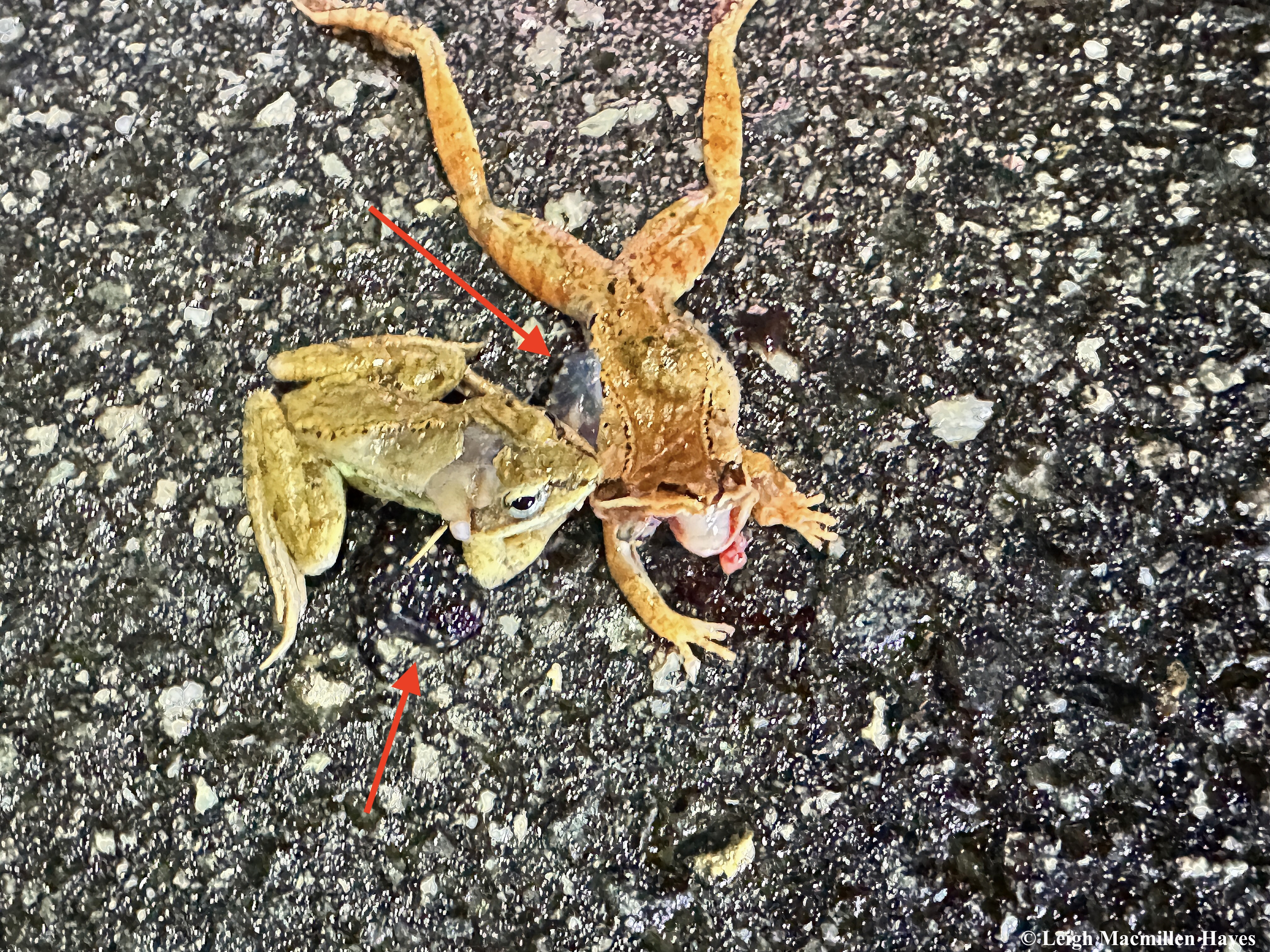
Finally, on Sunday, April 13, 2025, we had some rain, and our local Big Night celebration was announced via text and email messages. Big Night is that night(s) when it’s been raining in the afternoon and evening and the roads are wet, and volunteers head out to locations close to home to help amphibians cross the road without getting smooshed. Or help most of them.

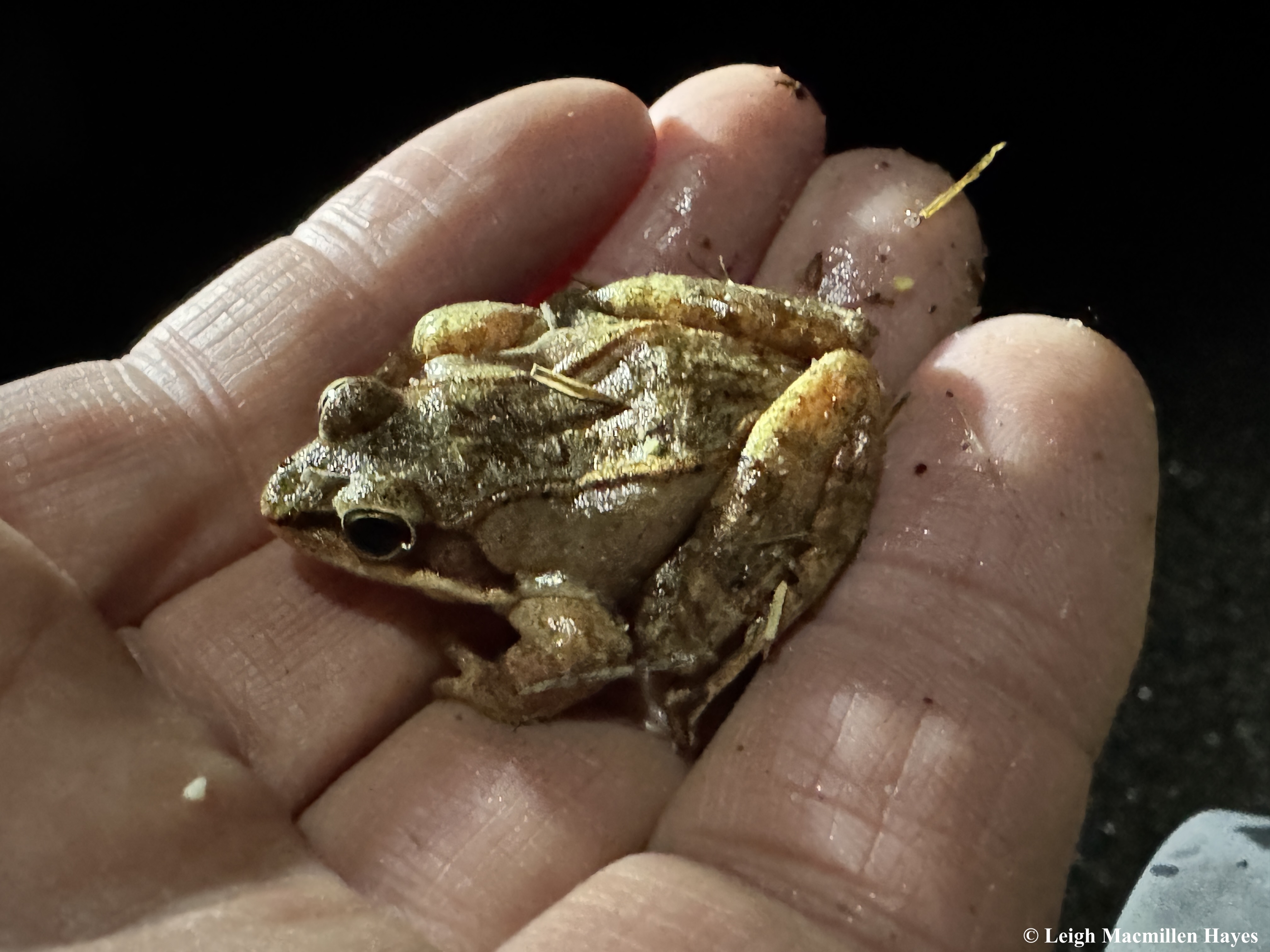
We didn’t hear any Wood Frogs or Spring Peepers as we approached the pool of our attention that night (not “My” vernal pool, which is thankfully not near a road), so we weren’t sure if we’d see any action. And others south and east of us had been posting for a week that they’d only found one or two frogs during any given rain event. Still, we went. And were glad we did because we helped a total of 158 Wood Frogs (including the one pictured above) and Peepers that night. There were still a few smooshed, but as always, we reminded ourselves that they become food for other critters.

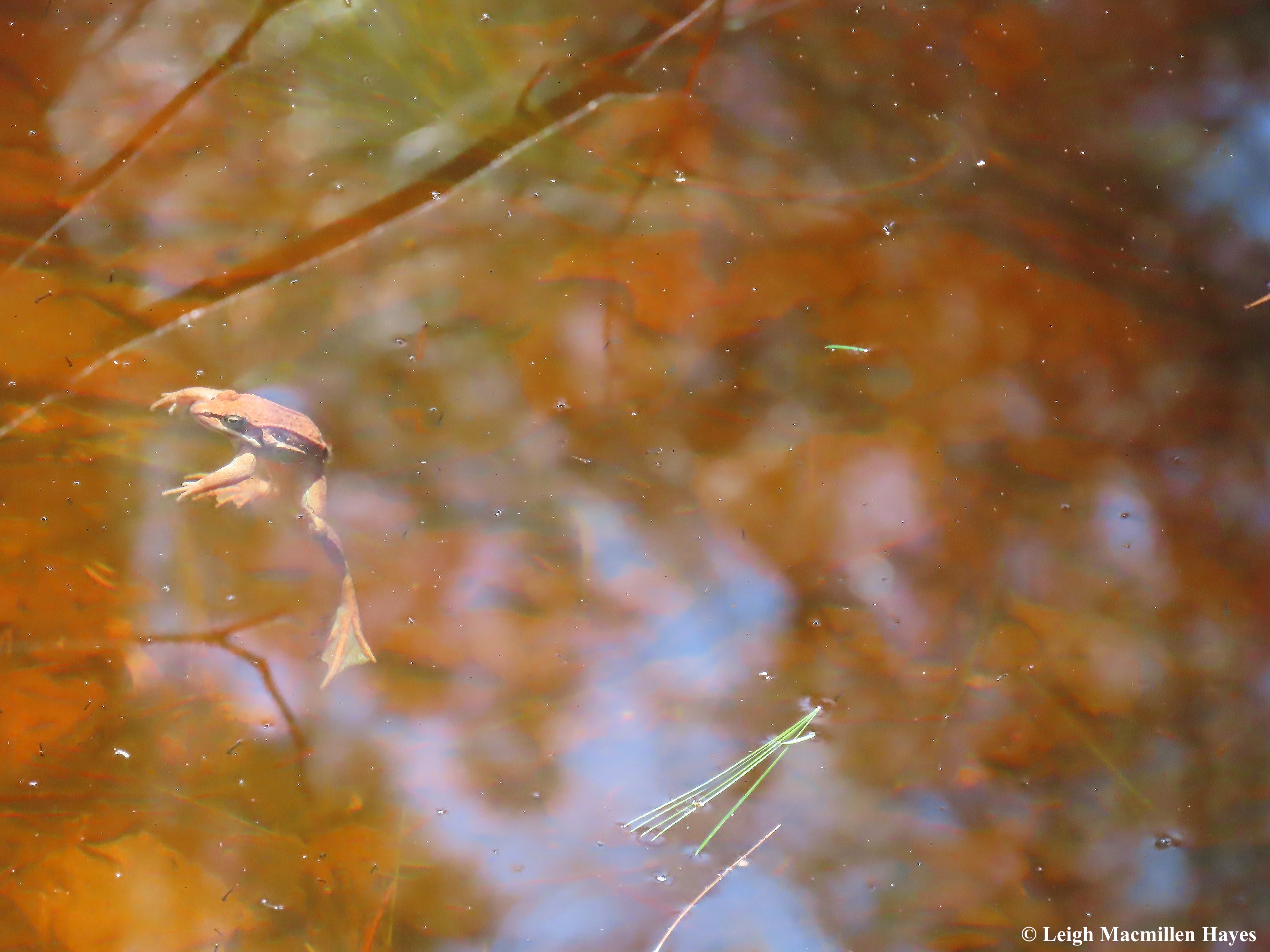
Given that success, the next afternoon I visited “My” pool and heard not a peep upon my approach. But I did what I do, and stood as still as possible upon a rock at the edge, and within a few minutes this male Wood Frog surfaced.

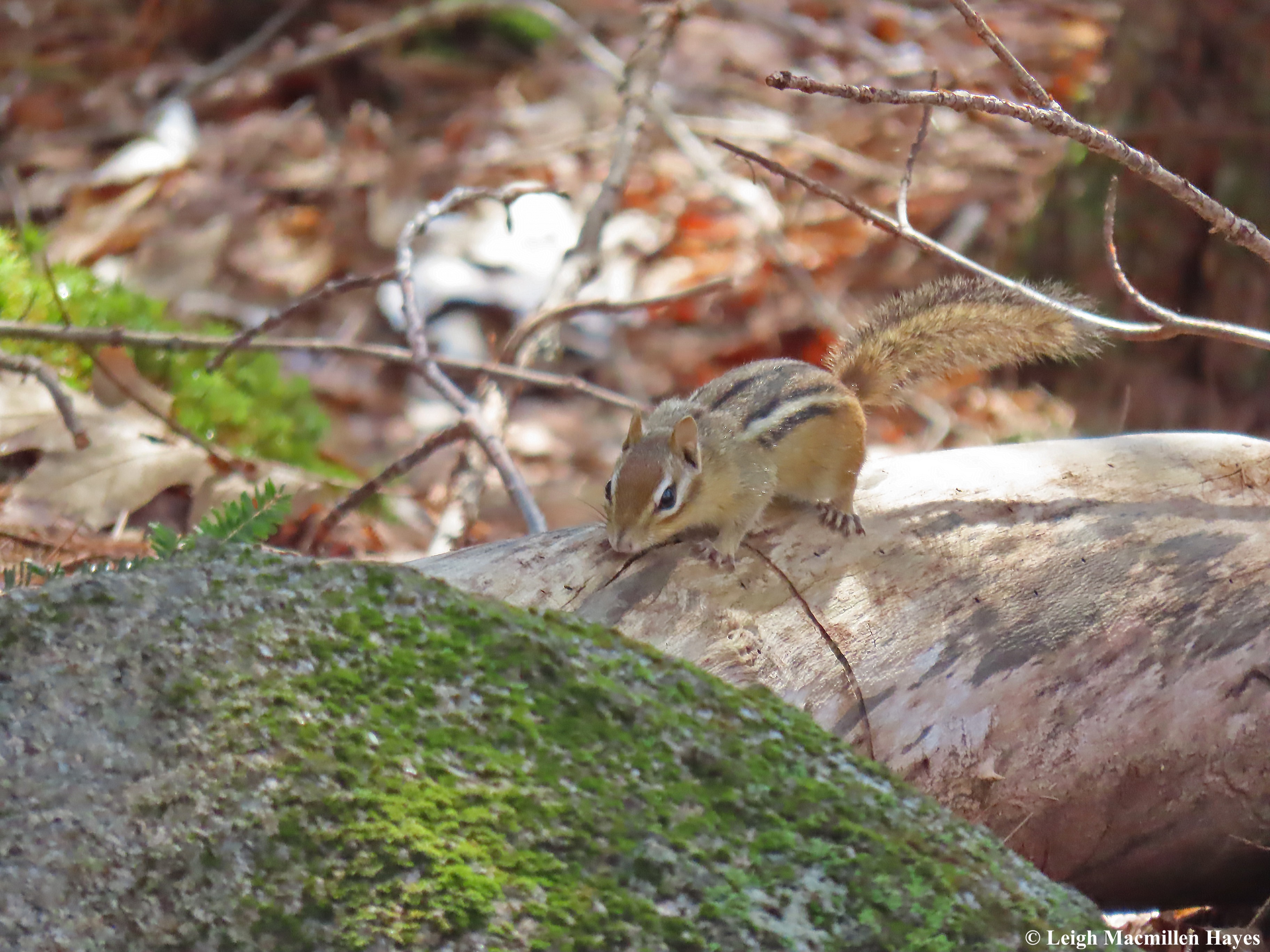
And I decided that this year I am going to try to be more present at the pool and try to get to know all who venture in and around it, including Chippy, on an eternal search for seeds to stuff into his cheeks.

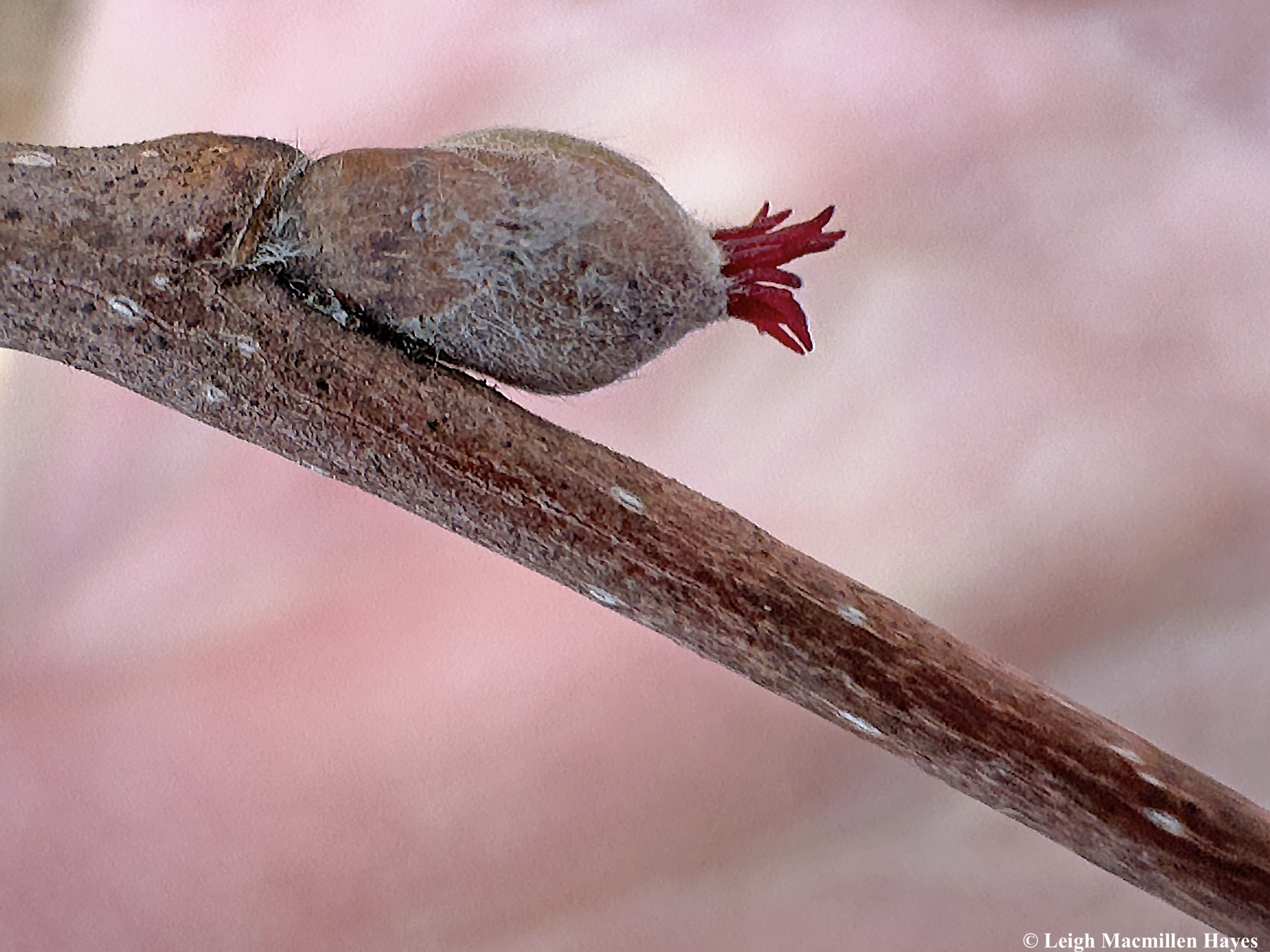
Mid-morning Tuesday found me making my way to the pool again and this time, I could hear the “Wruck, Wruck” calls of the male Wood Frogs as I approached. Spring has finally sprung. Oh, and the crocuses have finally bloomed. Beaked Hazelnuts with their tiny yet exquisite magenta flowers as well.

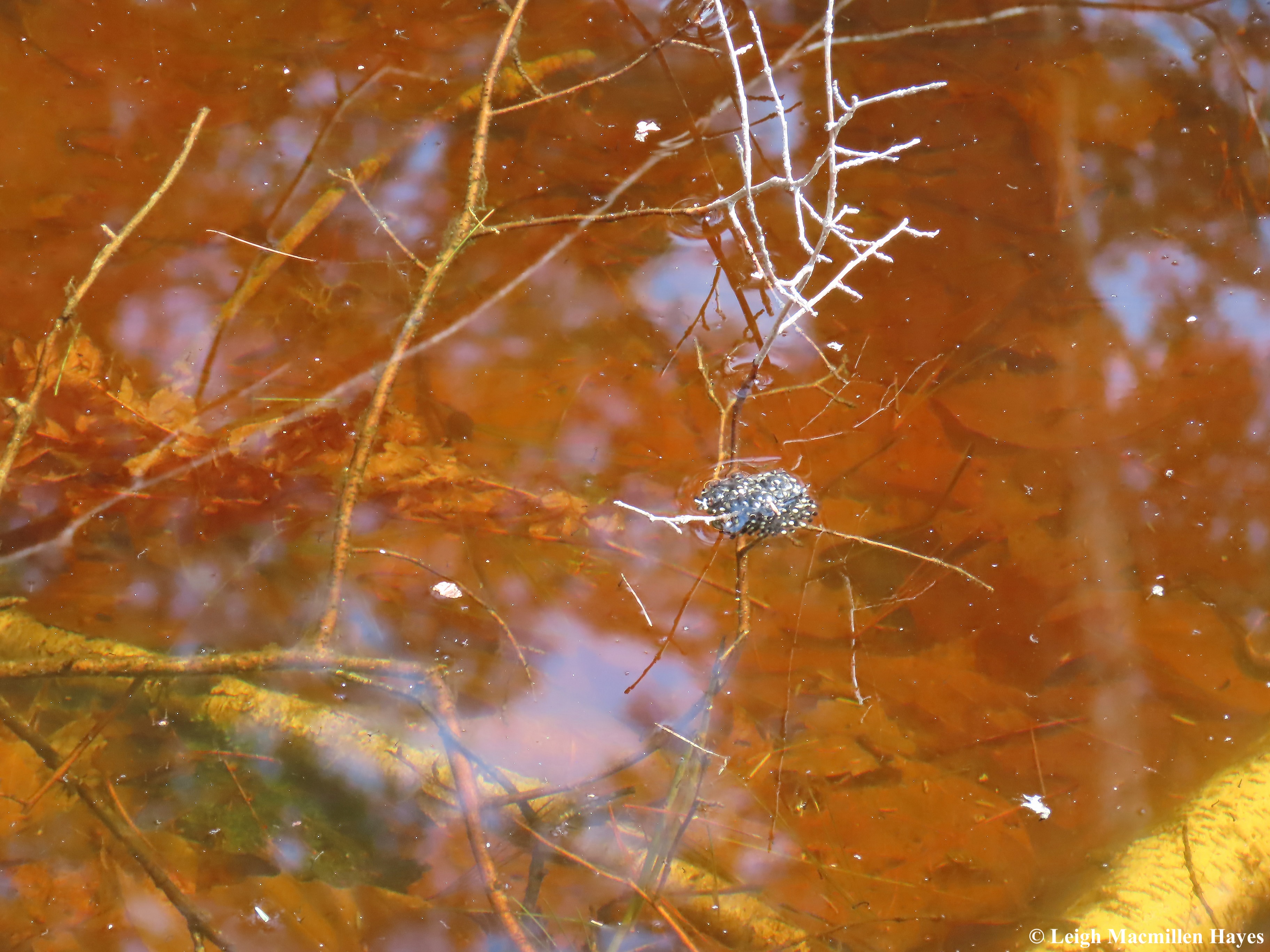
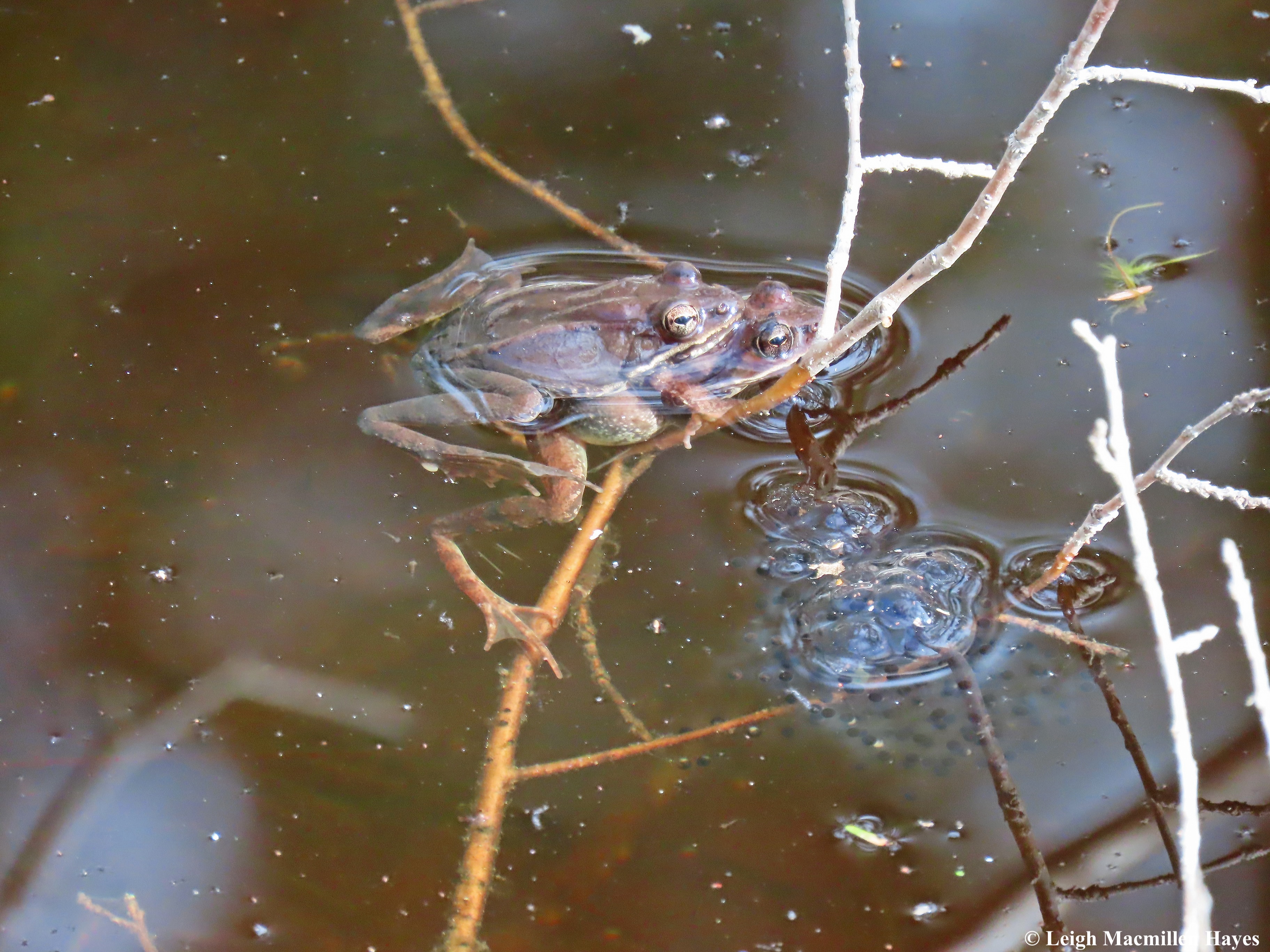
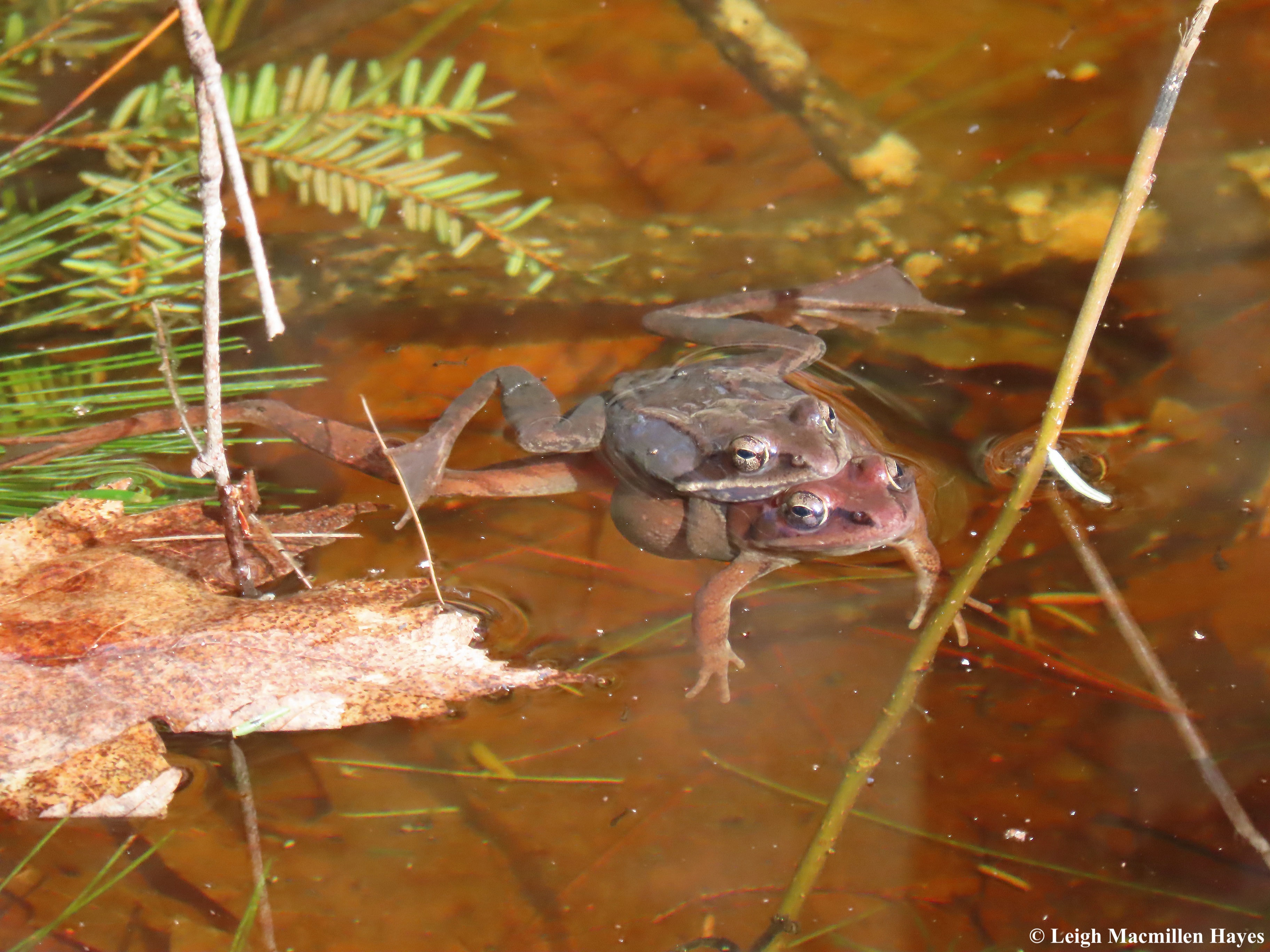
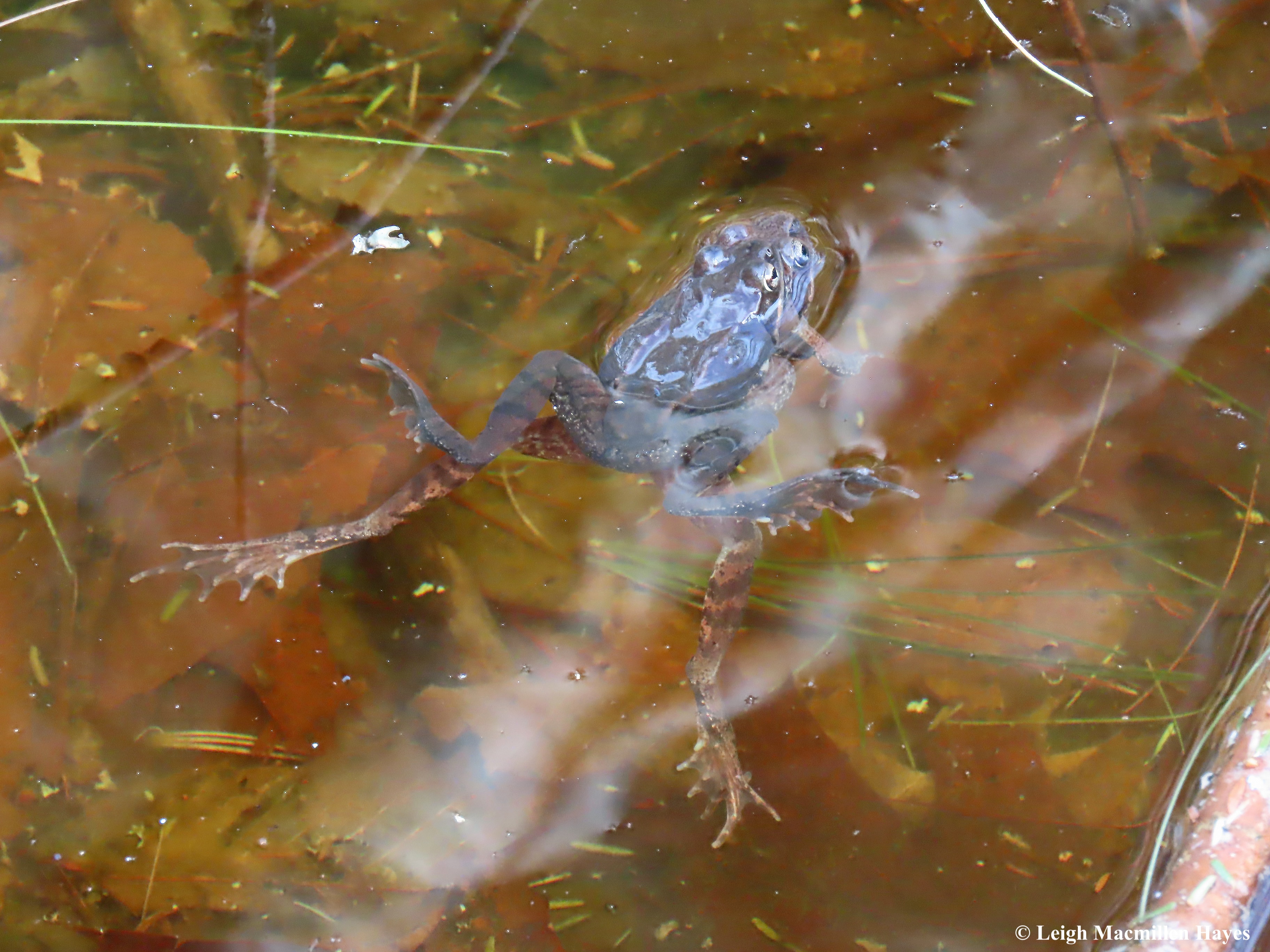
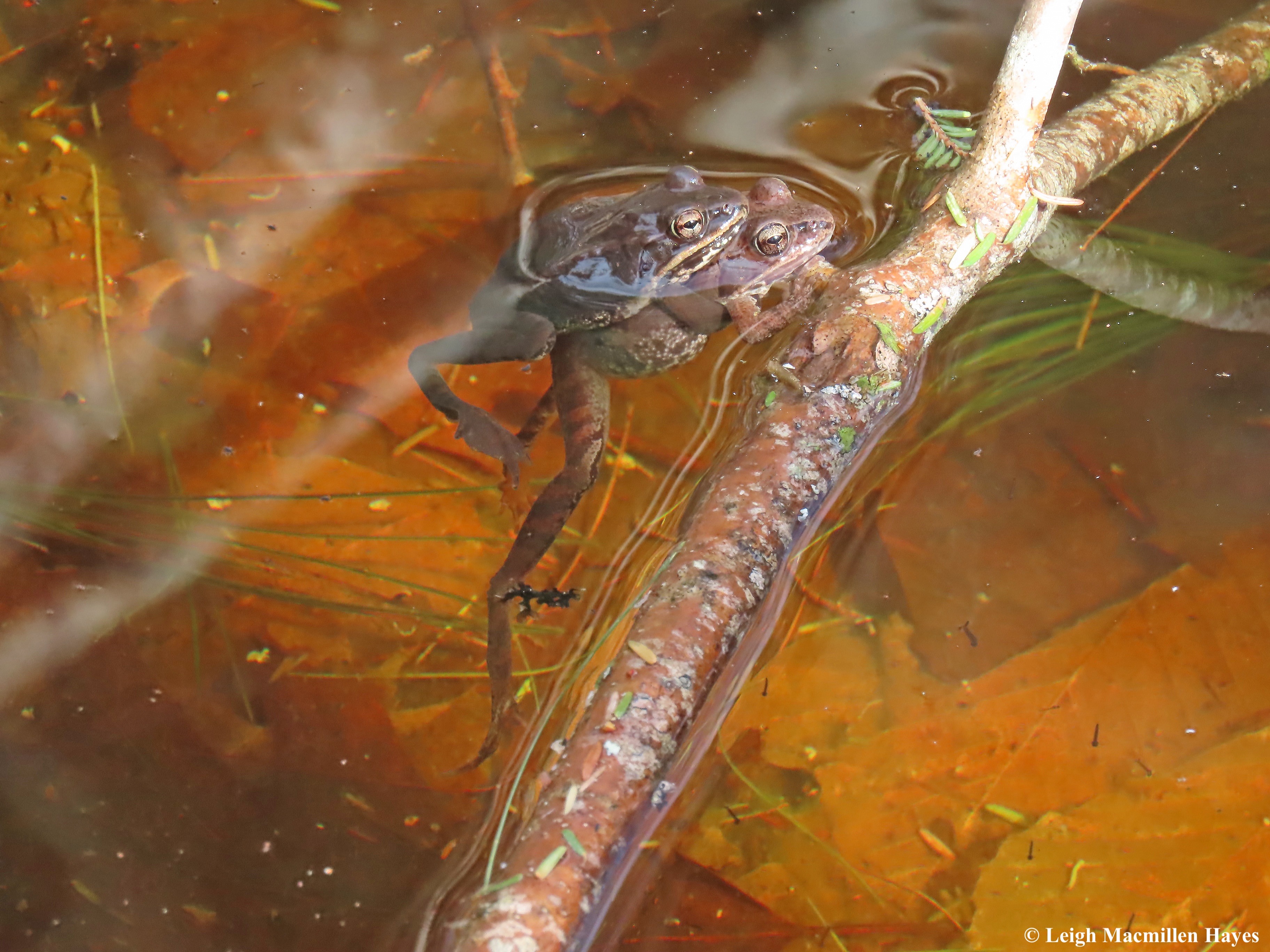
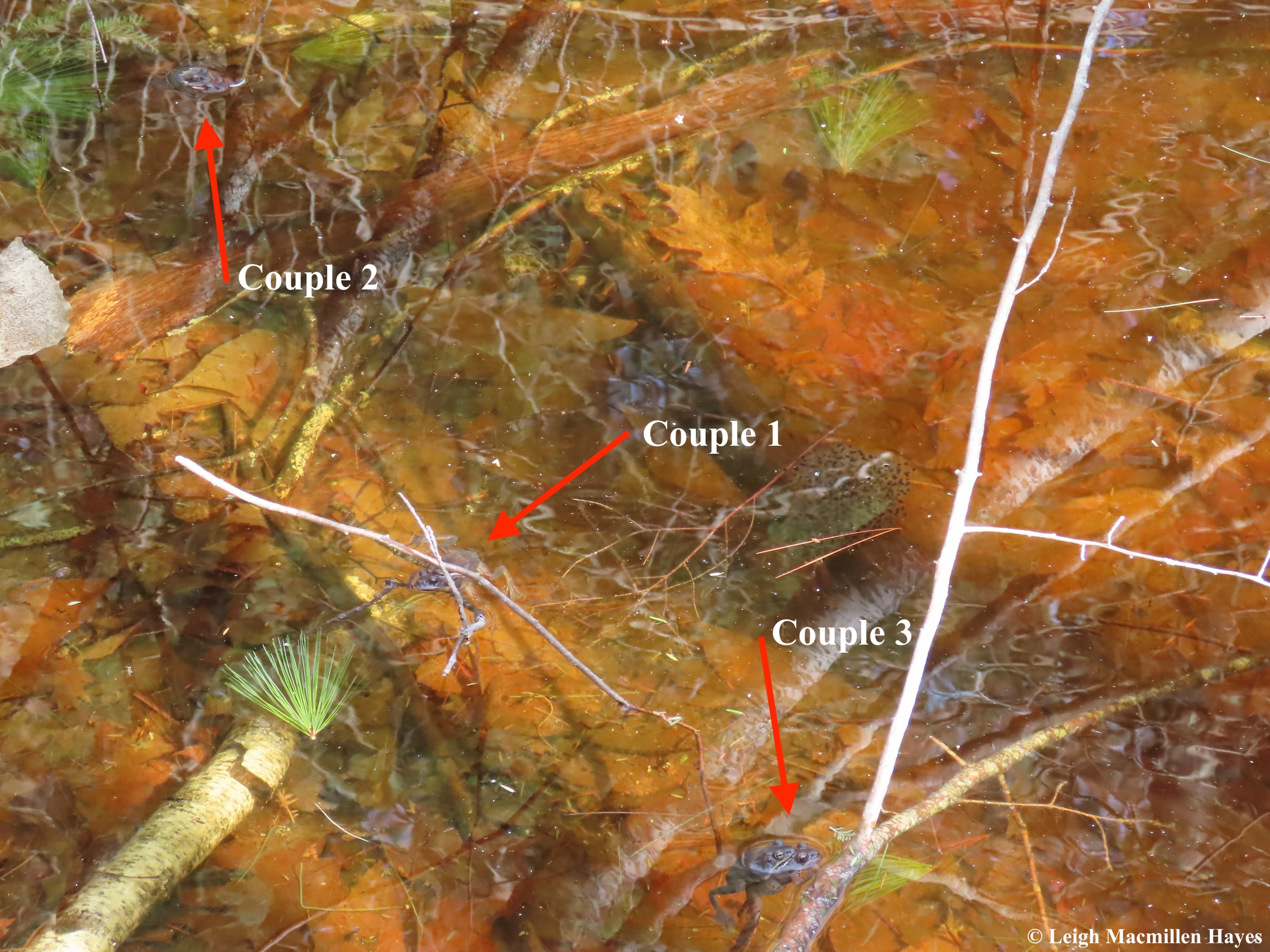
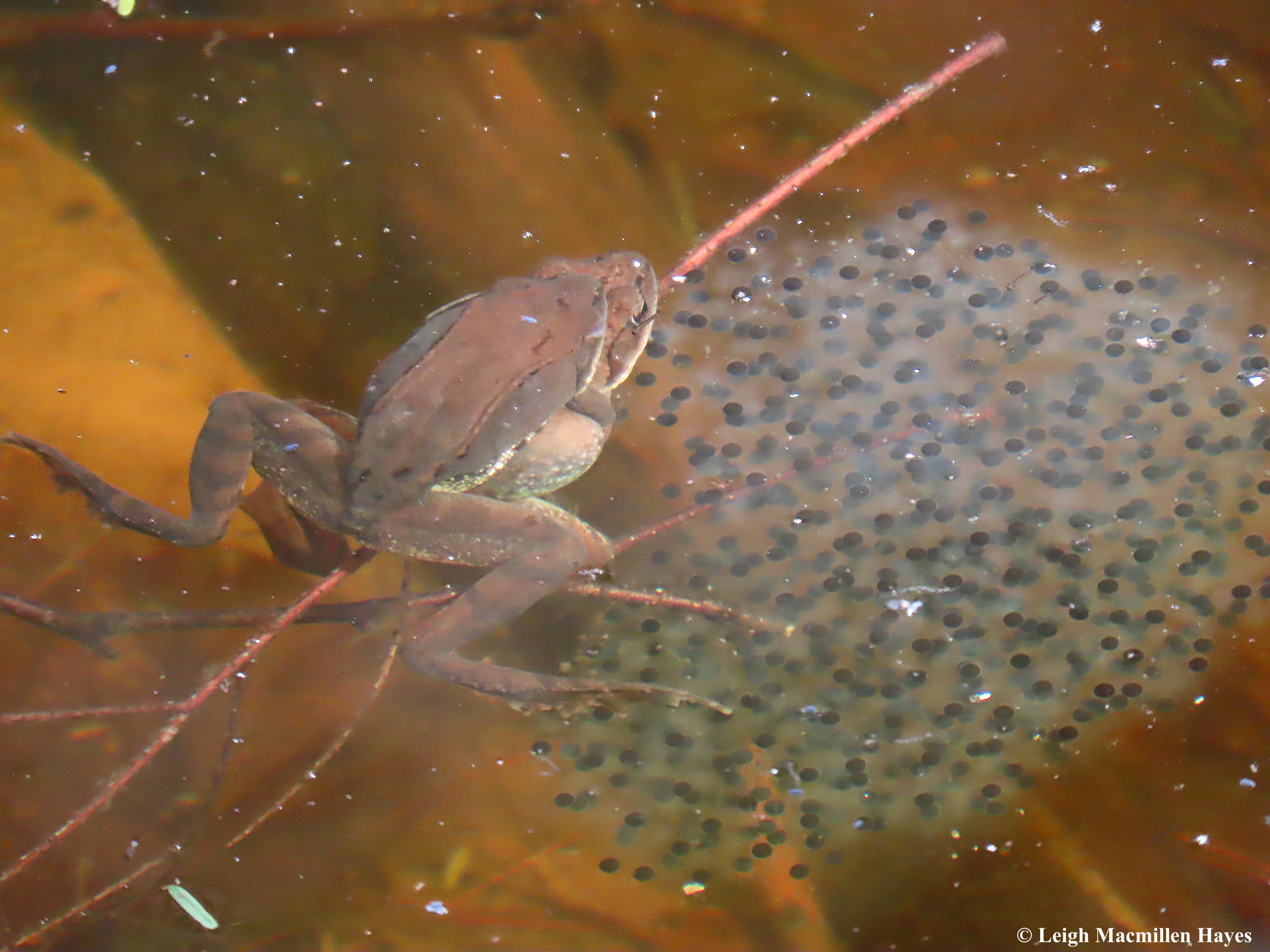
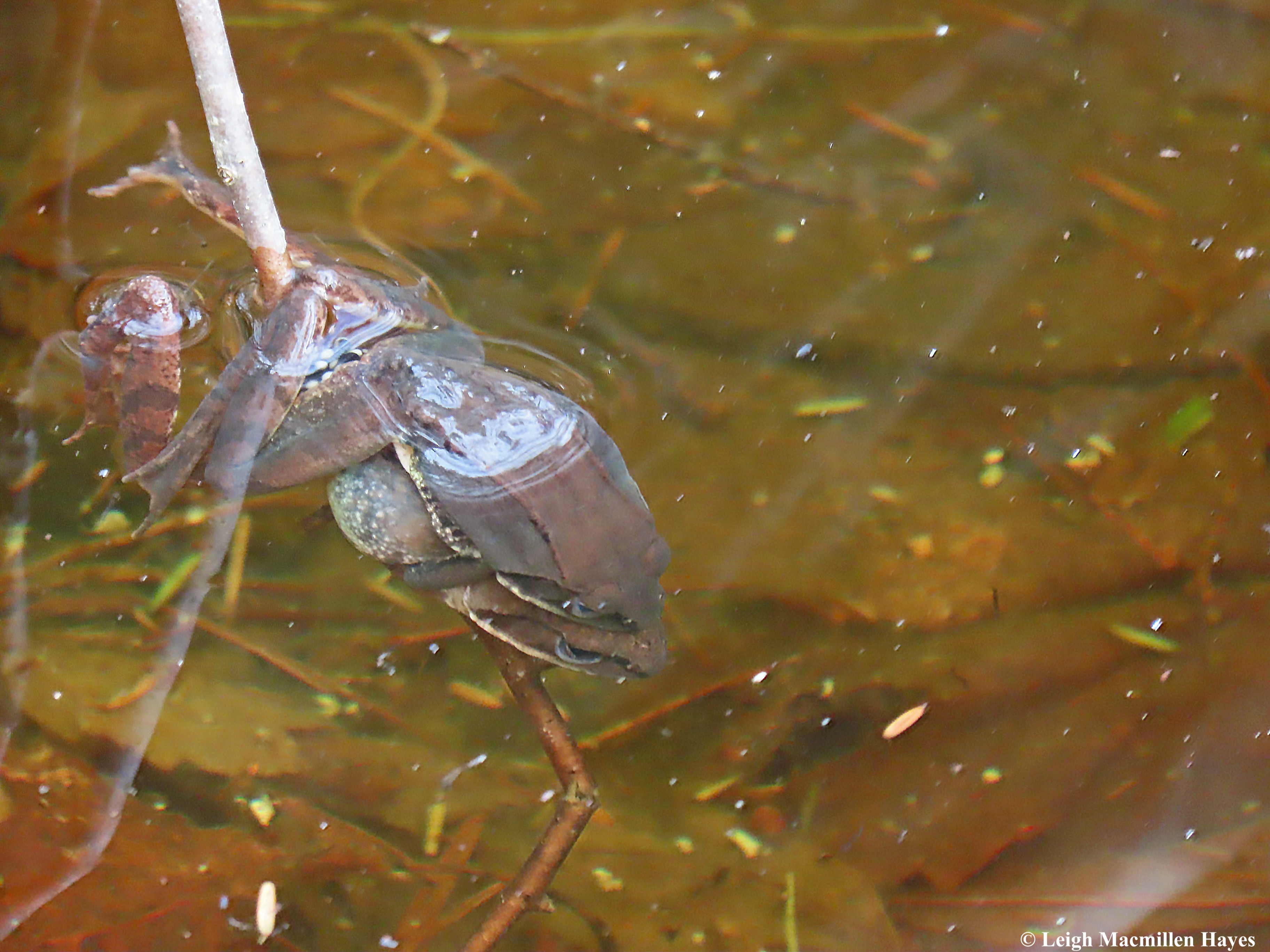
And then, my first peek into the pool, and there it was, a Wood Frog egg mass about the size of a wiffle ball and I wondered if it had been there on Monday and I just hadn’t seen it.

As always, I stood still, and as always, it took the frogs a few minutes to surface, but suddenly they were everywhere, and probably wishing, if frogs can do such a thing, that I would leave so they could begin their mating chorus again.

But I stayed. And wondered. Why is it that a Gray Squirrel, like the Chipmunk, can scamper about and rustle the leaves and make all kinds of noise and the frogs continue to float upon the surface, but the minute I flinch, they dive to the bottom and hide under leaves for minutes on end?

I did decide to change positions after a bit of enjoying the sight of so many frogs, because I wanted to see if there were any egg masses at the western end of the pool, but discovered none.

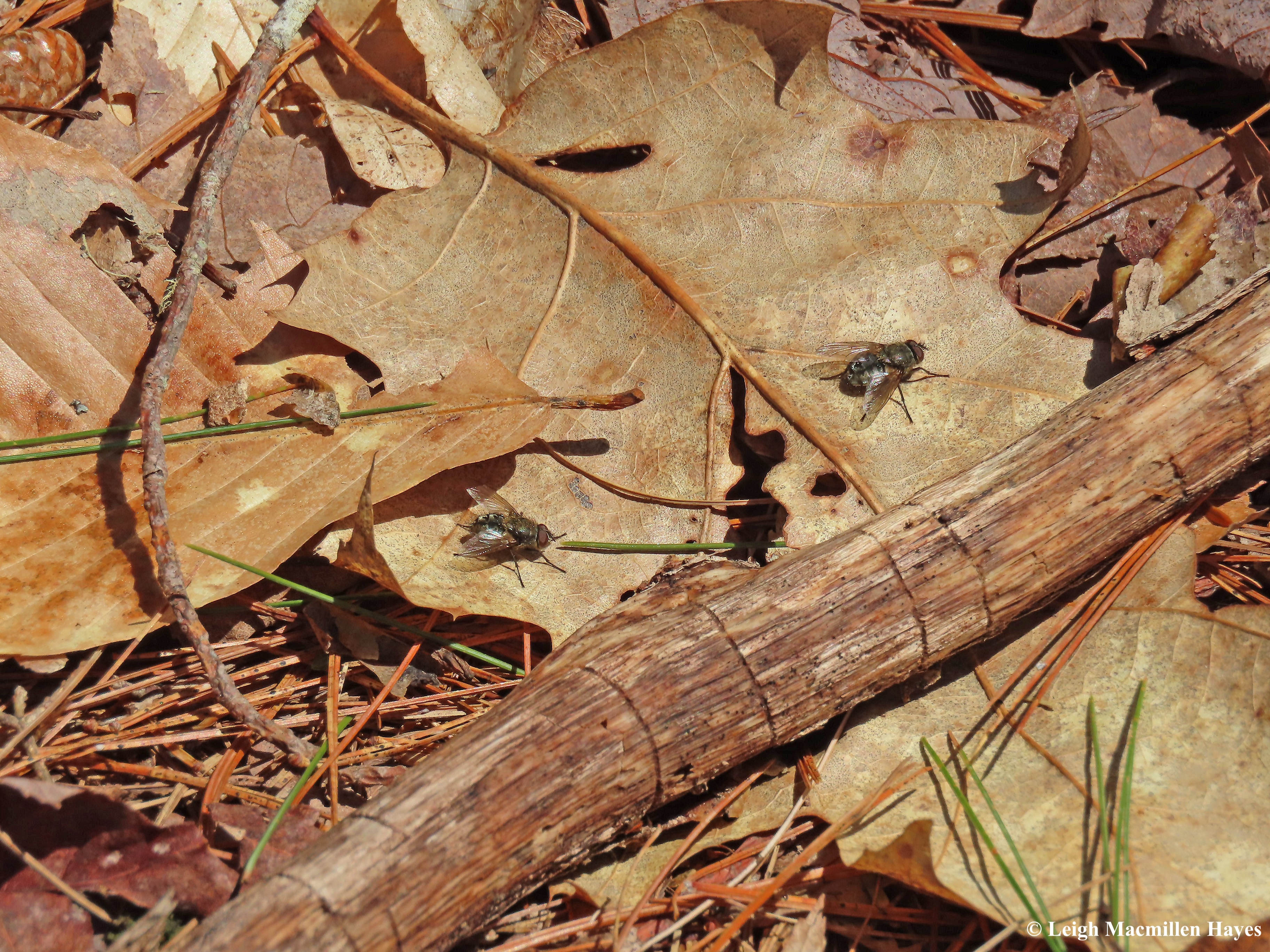
I did spy a bunch of Cluster Flies by the edge of the water.

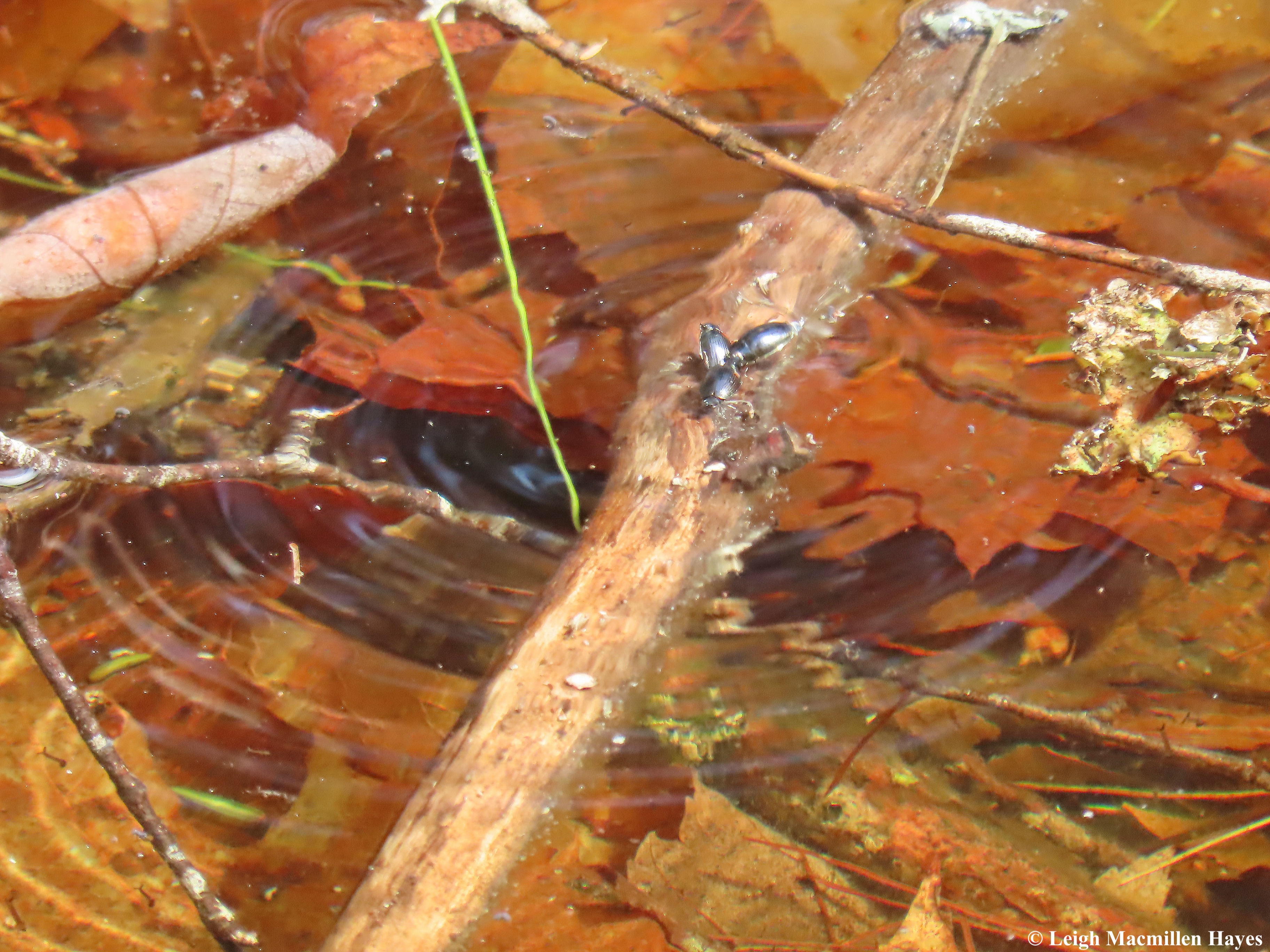
And in the water, I watched Mosquitoes larvae wiggle about and a Predaceous Diving Beetle lift its butt to the surface to fill the air bubble located under its wings or elytra.

And then the Beetle surprised me and after swimming under the small log, it climbed onto it and gave me a whole different perspective for I never think about them as fliers, but they have strong wings and can do such, especially if the pool they are in dries up and they need to get to another pool. Apparently they are also attracted to lights, another reason not to keep outdoor lights on all night.

My morning visit came to an end when the frog nearest to me dove down and hid under the leaf cover. Well, sorta hid. Do you see it?

I was so taken with the pool, that I returned again in the afternoon. And this time I spotted something I’d missed in the morning. A more recently deposited egg mass. I suspect it had been there for at least a few hours because it was already bigger than a quarter, which is the size they are at first.

During this visit, I also spotted Whirligig Beetles gyrating around each other in breakneck speed, creating ripples everywhere.

And male Wood Frogs ever on the look out for a date.

In fact, so anxious were they that sometimes one male tried to grasp another, but the one underneath quickly squealed and swam away.

Then I spotted another old friend or its relative and wondered if the Long-jawed Orb Weaver that had created a perfect web between branches over the water was one that I’d photographed on the snow this past winter. Probably not. But a woman can dream.

Later in the afternoon on Tuesday it began to rain and while the storm didn’t last too long, it was enough to wet the roads and again the word went out for Big Night #2. This time there were a few Spotted Salamanders on the move as well.

The next photo may disturb you, so you may want to skip over it.

I included this picture of two squished female Wood Frogs because this is what happens when we drive by vernal pools and other wetlands on rainy nights. And I added the arrows to show the egg sacs that had popped out as the tires drove over these ladies.

We let out a communal groan as we heard the pop, and then made this discovery, trying to ease the moment by reminding ourselves that they would become food for others, but still . . . reinforcing the reason why we’ve been celebrating Big Night(s) on this local road for at least 25 years of organized events and I suspect many more before that.

All told for saves on Tuesday night: 836 live Wood Frogs, Spring Peepers, Spotted Salamanders, plus at least one Green Frog and one Eastern Newt.

That was a BIG night! And many thanks to Dawn and Maggie for organizing it.

And from the sound of the “Wrucks” on Wednesday, which was louder than the day before, I knew the ladies had returned to “My” pool as well. And the guys were feeling successful.

Within a minute of standing there, I looked down and spotted a couple embraced in what is known as Wood Frog amplexus, the smaller and darker male being on top with his forelegs wrapped around her, just above her enlarged belly.

She seemed to be in full control as she moved about the twigs, looking for a good location to deposit her eggs.

I thought the first spot was perfect because it was located near another egg mass and Wood Frogs tend to deposit their eggs in communal colonies, the better to avoid predation–especially if yours are among the first and are surrounding by other egg masses, and therefore protected.

Scanning the pool, I spotted another couple and decided that going forward they need names, so this is Couple 2.

Meanwhile, Couple 1 continued to move about the same set of twigs.

And then near my rock, Couple 3 appeared.

There were also lone males, and because it was breezy, no one seemed to mind my presence. In fact, a couple of males in the western corner even “Wrucked” a few times.

Couple 2 found a larger branch and hung out there.

But Couple 1, they were on the move again.

This time testing a different set of twigs. All I could do was wonder exactly what she was looking for. What made a prime location prime?

I don’t have the answer and probably never will, but still couldn’t believe my good fortune to have all three couples right there by my feet.

And then . . . and then Couple 1 swam off and disappeared under a recently fallen tree and I thought, “That’s a good place because there are so many branches to choose from,” but at the same time I was disappointed because I figured I’d never see the rest of the story.

Until . . . they swam back out and approached the twig of their first choice.

And seemed to be making a move to settle upon it.

Only they didn’t. Instead, they swam to another twig that they’d tried earlier; one that had no other egg masses.

And suddenly, right before my eyes, she began to lay eggs, which he fertilized externally. Can you see the black and white dots between their hind legs?

I could not believe I was finally witnessing this amazing moment. Magic in the making.

My body was stiff from standing so still, but it was so worth the effort.

With her hind legs, and I may be wrong about this, she appeared to be wrapping the mass around the stick so it would be well attached.

The eggs are black and white, the Pied Pattern, the top of the egg being dark so predators from above may not see it because it more closely matches the dark leaves and muck on the floor of the pool, and white on the bottom so that predators within the pool will think it’s just sky.

So, as luck would have it, and I was feeling super lucky and grateful for the opportunity to observe, my camera battery died. And the back-up battery was at home. (Note to self: carry it in my pocket.)

I pulled out the next best thing and shot this photo with my iPhone. He eventually moved off of her, but not too far away, probably exhausted from all the effort. And she remained below the quarter-size egg mass for a few more minutes.

As for the other two couples, one disappeared under the fallen tree and the other went under the leaves below my rock, perhaps seeking privacy.

Finally, I took my leave. With a huge smile on my face.

Oh Baby(ies), I know your parents will leave the pool soon, but I’ll be there to watch over you. Maybe not daily, but frequently for as long as the pool holds water, being ephemeral as it is.

Collecting Birds

OK, I admit it. I’m a collector. Of things. But they are all special things. And many of them handcrafted. And most of them with a story to tell.

So, yes, I collect birds. No, not dead or dying birds. And certainly not living birds. Just . . . birds. My collection is actually quite small, and until today I hadn’t given it much thought, but it began a hundred years ago when I was a senior in college and my roommate and I hosted a student from Great Britain in our dorm room for a week.

I honestly cannot remember her name or too much about her. But I do remember that at the end of her stay she gave us each a bird.

And I remember she told us they were of the Tit species, which didn’t mean a whole lot at the time, but now that I see and hear Titmice on a regular basis, I have a better appreciation. This little bird has graced my desk for decades and the young woman’s name keeps flitting in and out of my mind, so maybe I’ll recall it by the time I finish writing. I now realize I haven’t thought about her in years, despite my fondness for the gift she bestowed upon me.

Another gift was the carving of a Chickadee, and I received this one about 35 years ago from a sweet little man named Carl and I only wish he’d lived long enough to know how much I still appreciate it.

Likewise with this Loon, crafted for us by my Godfather Russell because he knew My Guy and I love our encounters with these birds who symbolize Maine. And he loved to paint, among many other talents.

I also cherish these two ornaments that never made it to a Christmas tree because they pose instead from a vase of twigs in my study. The one on the left was created by Dr. Fred, a founder of the Maine Master Naturalist Program, and the Hummingbird was gifted to me by my friend Marita after she spent some time bicycling around Cuba last year.

And then there is the Token Owl. Token, because if one is leading an Owl Prowl and there is no guarantee of spotting an Owl, it always pays to pull such a stuffie out of one’s pack so that everyone can leave saying, “I saw an Owl.” Sometimes you just need to make things happen.

All of this leads me to what I realized today is becoming quite a collection: my paintings of birds.

Pileated Woodpecker in our back forty, which is actually only five more acres beyond the house. One of his favorite trees, however, is at the edge of our yard before the woods, where we’ve left several super tall dead snags and he uses them to mark his territory early in the morning, and later in the day as he taps away. Every day.

Tom Turkey strutting his stuff across the yard in hopes of wooing a hen. I can only assume he did though I never caught them in the act, but so large is the Turkey population round these parts.

A Common Loon in front of the dock at camp. I admit that like dragonflies, I can never take too many photographs of loons.

Great Blue Heron scoring a wee fish for a snack.

And another searching for another meal.

And still seeking more, its eyes always intent as it stalks its prey.

A Barred Owl near the vernal pool, thankfully when there was still ice on it about a month ago, but he’s in the area, so anything can happen.

Ah, but how I love to meet these critters, who unless they are calling, remain incredibly still and blend in with the scenery and I’m sure I pass by more than I actually spot.

Mr. Cardinal, and I’ve been waiting for him to pass sunflower seeds on to his Mrs. because I’ve seen him do it in the past and it’s such a lovely gesture.

The Mrs. waiting for a gift from her betrothed. To my knowledge, she’s still waiting. One of these days he’ll surprise both of us.

Mr. Bluebird, who also visits daily, as does his Mrs., and from the direction of their travel, I believe they are setting up housekeeping in a house my neighbor erected just for them.

One of the zillion Juncos my friend Kate sent up from Connecticut. They arrived the day she told me they were on their way. That was a few weeks ago. In a snowstorm the other day, we had quite a large flock, but I think most are continuing their journey north as now I only see a few at a time.

My first attempt at painting a Robin following instructions in a book.

And then trying to tweak the painting and turn it into an American Robin. I fooled SEEK, a free app developed by iNaturalist. It came right up with A. R.

SEEK also knew this to be a male Red-Winged Blackbird. What it didn’t know is that it was one I saw calling a few weeks ago when there didn’t seem to be any females around.

And finally, my new friend, who has actually been in the neighborhood for a long time, but we only recently spent a few minutes together the other morning: Sharp-shinned Hawk.

As I look out the window right now, besides this Goldfinch, the Bluebirds are both here, plus Robins, Juncos, Chickadees, Tree Sparrows, White-Breasted Nuthatches, and Mourning Doves. And actually, there are more Juncos than I expected.

That is the extent of my bird collection–at least for the moment. Thanks for stopping by to take a look.

The student from Britain: Jillian. It just came to me.

The Wild Out My Window

I know I should take in the bird feeders. After all, it is April 8. And a friend found bear tracks in her yard about seven or eight miles away on April 1st–and it was for real, though I did question if she was trying to fool me.

But I haven’t done so yet and the past two days have offered insights and outsights as I’ve stood at the back door periodically, ever ready to snap a photo.

Picture taking began early on the 7th–at about 6:15am, when the lighting was a bit dark and my camera encouraged me to use the flash, but I chose not to because I knew it would offer a reflection of light on glass and I’d never get a photograph of the critter of my intent.

Much to my surprise, a Sharp-shinned Hawk helped me greet the day. The bird perched about twenty feet from the back door, right in the midst of my feeding station–well, the feeding station I’d set up for birds, though my plan has always been for me to provide the food in the form of seeds and suet, not in the form of other birds.

We spent a few minutes together, Sharpie and me, and not a single bird flew in–thankfully.

The feeders were actually quite low on seed, but knowing the Hawk was around, I decided to wait to refill them and instead took off for a hike with My Guy, where we spotted Beaked Hazelnut in flower.

Back at home, I immediately filled the feeders and spread seed on the ground, and it seemed like within seconds, we had visitors.

The female Mourning Dove was a bit of a hog–filling her crop non-stop.

Her male counterpart didn’t seem to care about eating and he marched about going this way and that.

And then I noticed him begin to fluff out his feathers and all I could think of is a Tom Turkey and I suspected I knew what he had on his bird brain.

He’d fluff, then calm down and strut past her, but she didn’t seem to care as she stayed low and kept on gathering more seeds for later consumption.

Then he’d fluff up again.

And preen to make sure he was looking his best. I was impressed.

She didn’t care.

Like her, I turned my attention in a different direction as at least three Song Sparrows splashed in a large puddle and also sought seeds. I’ve yet to hear their songs, but they’ve been back in Maine for at least a couple of weeks.

And then a female Bluebird joined the scene and made me give thanks for our neighbor’s field and the houses she has installed for these beauties.

Her mister also kept flying in, actually more often than his Mrs., but he only occasionally sought sustenance. The rest of his time, he watched and waited, and waited and watched.

When I did turn my attention back to Mr. Mourning Dove, he was fluffing up again.

And then he approached his true love.

And tried to jump on her back, but she quickly hopped away. It took him a while, but finally, he headed north, walking across the yard to I know not where. And she stayed and gathered more seeds.

At one point all three species, the Tree Sparrow, female Mourning Dove, and male Bluebird all occupied the same space, but then he flew–as birds are known to do, especially when I want to photograph them.

More interested in suet was the male Downy Woodpecker. I kept expecting his lady to arrive, but she never did appear.

There was, however, a lot of Chickadee action, and I cannot say whether male or female, for to my uninformed eye, they all look the same.

White-breasted Nuthatches also came, seeking both suet and seeds in no particular order.

And for the first time this year, an Eastern Phoebe entered the scene. She’s tried to build a nest over our front door one year and on our back shed the next. I’m curious to see where she decides to locate her adobe this year.

The final bird for yesterday was the Squirrel Spoonshovel, so deserving of its common name for all it seems to do is shovel seeds into its mouth. Nonstop. All day long. This one and six of its nearest kin.

But eating bird food apparently works, and I couldn’t believe it when I saw it take flight.

This morning dawned with the Bluebirds and all their neighbors back in residence. And I could not help but think of the patience this male has as he perches for minutes on end.

That is . . . until it began to snow and he looked at the first flakes with disdain.

And then back at me as if it was all my fault. Really, I tried to explain, I can’t control everything, despite my fervent attempts.

The star of the show today, however, was another unexpected visitor, this in the form of an American Mink!

My photos are not crisp for so quickly did he bound, but I couldn’t believe my good fortune to have spotted him.

I’ve seen fewer squirrels today and wonder if he might know why. Although, as I typed that, I looked out the window and tada, there was one, and then a second.

They fought for a chance to sit in the bird feeder . . . of course! Because after all, they are Squirrel Spoonshovels, that rarest of bird species.

The wild out my window . . . is truly wild here in western Maine. And each of these is just a snapshot of time, for honestly, I don’t spend every moment standing by the backdoor.

But just imagine if I did . . .

Deciphering the Porcupine Dance

When I least expect it, the Universe speaks. And suddenly all makes sense. Well, not all, but a few things become clearer and my understanding of the natural world grows.

So it was early this week when I walked down a forested road and met tracks well worth pondering.

To set the stage, we’d had a 5 – 6 inch snowstorm Friday night into Saturday, followed by some melting, and then rain and freezing rain on Sunday, and fog and rain on Monday. A smorgasbord of spring weather.

As I walked along, I noticed some disturbance in the snow and when I reached it, I noted that there were two disturbed sites almost parallel in orientation.

And my heart gladdened, for I immediately recognized these as representing the travels of a River Otter, or two or three. What’s more, they had been made over the course of at least two days.

The bounding slide on the left was first and probably occurred early Saturday as it still snowed. Such was the bound and slide so filled in, yet still representational.

Do you see the diagonal orientation of pairs of prints in the above photos of the second set of tracks? And the five toes–tear-drop shaped as they were?

These prints were much clearer and appeared to have been made Monday.

Because I was traveling light, I only had my Maine IF&W card in my pocket to offer a sense of size. But a closer look revealed that this particular trail included the Otter(s) moving in opposite directions, again at different times due to the clarity or non-clarity of the prints.

I looked across the road upon which I walked and saw that the bounders had come up and gone down to a stream via a very steep embankment. “Yeehaw!” I could almost hear them shout.

It was a rather circuitous route to the water, but that’s the way of an Otter. Why do straight when you can move in any direction you choose.

Eventually I moved on, and the next beauty to share a sign of its presence in these woods was a Snow Lobster, aka Snowshoe Hare. Remember, the two feet at the top of the photo are actually the hind feet, while the two behind, that form the lobster tail, are the front feet–as the hind feet swing around the front and land as this hopper leaps forward.

The snow conditions were such that the impressions were rather wide.

But not as wide as those I’d seen the day before. My, what big feet you have–indeed.

Continuing on, I began to notice the tracks of others who had passed this way, and the first clue to identification was the manner of movement–this being a rather straight line with a hint of a zigzag down the middle of the road. This was the track of a Red Fox.

And soon a Bobcat appeared. Well, it didn’t actually appear, but its track did.

Some prints were almost perfect–with a lead toe, much like our middle finger, and the C ridge between toes and heel pad.

That’s not all, There were more sets of prints oriented on the diagonal. Think back to the River Otter, who is in the Weasel family. This small critter is a member of the same family, but these are the prints of a Mink.

By this time I was feeling really rich. Especially since I didn’t expect to find so many different species in this space I walk frequently.

And then I met an old friend, the one and only pigeon-toed Porcupine. Actually, if you look closely at this photo, you might note the Mink bounding over Porky’s path, only actually, I think the Mink passed this way first. And it’s not a known predator of the quilled one.

I didn’t venture off trail to locate Porky’s den, but I knew it was among the boulders just beyond where I stood for I could see its tracks moving back and forth between them and suspect there is more than one home site in this locale.

As I moved on, I followed Porky’s path along the road for a while, before he moved off into the woods, toward what I assume to be its feeding site.

That said, you should note another critter also passing this way–another perfect walker, this one being a Coyote.

And then, and then, the creme de la creme:

A do-si-do dance, all the moves worked out, with a promenade forward and then a turn around several times until the Porcupine ended back at the spot where it began these fancy steps.

I knew at once what this represented and though I shared this video only a couple of weeks ago, upon seeing the fancy footwork in the snow, I knew exactly how to interpret it.

The video is from my game camera and after you click on the arrow, you can watch the prickly critter do a do-si-do dance before climbing a tree. This is the reaction to a predator in the area.

In both situations, it was the same cast of characters who could serve as a predator: Red Fox, Coyote, and Bobcat. Of all of them, the Bobcat would be of most concern. The largest concern would be a weasel whose tracks I did not spot–a Fisher.

The circular route that my prickly friend took gave it an opportunity to show off the quills on its back–a warning telling others to stay away. For the time being they did.

And I gave great thanks for the opportunity to see signs of so many critters, but especially to decipher the Porcupine dance. Just like that, it all began to make sense.

Marching into the Vernal Pool

I’ve lived in Maine for just shy of 40 years and can barely recall the month of March going out like a lamb, as the saying goes.

It’s certainly true that once again this year the ending of the month is more lion-like with an overnight and morning snowstorm, with freezing rain on the horizon for tonight and tomorrow, followed by a warm-up and rain on Monday.

That all said, March snow doesn’t last long.

But still . . . it has me dreaming. Remember, I LOVE winter, but am as ready for spring as the next person.

And so I spent much of today (when not shoveling, which really didn’t take long) holed up in my wee studio where I’ve been working on a vernal pool series of paintings.

The idea for this post actually came to me in a dream last night–why not turn those paintings into a blog post. Why not?

Because, it’s scary to share creative works with the world. But, I am probably my own worst critic. My instructor, Jessie, always reminds me to put my inner critic into a box, place the cover on top, and get to work. And besides, by sharing here, I can hide behind the screen. She wants those of us in her class to host an art show, but I refuse to do that. It’s much more comfortable for me this way.

I’ve only been painting since last May, but let’s not let that be an excuse. The thing is, working with gouache paints means I can easily edit, much like writing. And believe me, I have. My motto has always been that there’s no such thing as a final draft–whether it be an article for a magazine or a work of art.

Have you noticed that I’m procrastinating? And putting all of my excuses out there.

It’s snowing again.

All right, I’m almost ready. But here’s the other thing–in sharing these with you, may you be inspired to do something you never imagined and discover that the time you spend doing such is most enjoyable and it’s easy to get “lost” and just plain have fun and decide that even though the “end product” isn’t exactly what you first set out to create, it’s still half decent and you had the most delightful time sitting quietly as is my custom, doing just that: creating.

And now . . . for a look back as a way to look forward to a vernal pool as it emerges from winter or early spring, or mud season, or almost spring but still winter, or whatever season this is.

Pine and hemlock needles and branches from winter storms coat the ice as it slowly begins to melt along the edge of the pool, providing a glimpse of the sunken leaves below, where life awaits.

Once the ice finally melts, barren trees offer a reflection that speaks to winter, but there’s hope in their buds.

And no sooner has the ice gone out, when upon my approach I hear “Wruck, wruck,” and know that the Wood Frogs have returned to their natal breeding grounds. At first, they dive as soon as they hear me approach. But I stand still, sometimes for up to fifteen minutes, and ever so slowly, one by one, they rise to the surface and float.

It’s the lucky male who has the best “Wruck, wruck,” that finds a mate. He clasps her with his forelegs and as she begins to deposit eggs, he fertilizes them externally.

I return a couple of days later, in the late afternoon, and can’t believe my good luck. The pool is coated in pollen and the sun hits it in such a way that I see a rainbow of colors and love how the tree reflections are in two orientations upon still water.

A few weeks later, looking deep into the pool, which isn’t really all that deep, I notice blobs of eggs clustered together in a mass that has a tapioca-like shape to it and notice little life forms moving about in the shape of tadpoles. I feel like a proud momma. The thing is, the Wood Frogs mate, she lays eggs he’s fertilized and within two weeks, the parents are long gone, back to their woodland setting. And so I do feel protective parent–or maybe foster parent–keeping watch and celebrating achievements.

Another life form who uses the pool as a natal breeding spot is the spotted salamander and though I tend to mostly spy them on Big Night, I can tell by egg masses left behind that they have visited.

Their egg masses are a wee bit different from the Wood Frog masses, in that they have a gelatinous coating around the entire grouping, so they don’t look so tapioca-like. Mosquito larvae, tumblers at this stage, also wiggle about in the water.

And if I’m lucky, though this has never happened at the pool behind our house, I might see a fairy shrimp or dozens.

So here’s the thing: 40 Wood Frog egg masses make a pool significant; OR 20 Spotted Salamander egg masses; OR 10 Blue Spotted or Jefferson Salamander egg masses; OR a single, yes one, Fairy Shrimp. And this one is a female, as noted by the sac of dark eggs she carries.

Fairy Shrimp are cool because in order for eggs to be viable, the pool must dry out. And they can survive being dry for multiple years. And in any given year, not all eggs will hatch, thus saving some in the bank for another year or ten.

Hanging out by the pool, Green Frogs are always willing to dine on whatever is available. So the Green Frog has dorsal lateral folds (or bumps) along either side of its back that start behind the eyes.

The Bullfrog differs in that the line behind the eye circles around the tympanum (ear drum) and ends.

Here’s the other thing to remember: Males have tympanums larger than their eyes; females are smaller or equal to eye size.

And I like to think of this painting as a Frog-ersation.

This week I actually framed two paintings to send to friends, the Bullfrog being one of them.

There. I did it. Survived the art show.

As I bring this to a close, I realize there’s one more painting I should add to the collection, but I’ll save it to paint another day.

Thank you for marching into the vernal pool with me. I hope you are glad you did.

The Exclamation Point

The crossover from winter to spring is actually emulating the same from autumn to winter with fluctuating temperatures and snow. But still there is so much to see if you can get outside.

Yesterday, My Guy and I paid a visit to “our”vernal pool (located on a neighbor’s back forty) and noted that it was still ice covered. That said, I know I’ll start making almost daily visits because any time now the ice will begin to melt and tada, the action will start to happen.

The day before, we’d walked a local trail that still had areas of snow here and there, but were delighted to spot our first Great Blue Heron of 2025, which was apropos as this morning I received an email from the state biologist asking if I’m still willing to monitor three rookeries as I have done for the past 15 years. YES!

And the day before that, while hiking another trail in a different town where there was almost no snow, we had a quick sighting of an Anglewing Butterfly that I couldn’t name to species because it flew off before I could spot the markings on the underside of its wings.

Now those sightings seem like only memories and how could they have possibly occurred given that five inches of snow accumulated quickly yesterday.

But early this morning, the snow turned out to be a tracker’s delight, for fresh tracks showed details providing names for the creators who passed this way.

And so along our cowpath (where cows haven’t walked in years), I followed the Red Fox, wondering where it might lead me.

I knew I should have backtracked it so as not to put pressure on it, but knowing and doing are two different things.

If I had backtracked it, I might have discovered the source of its scat left in such a location beside a tree stump, that I thought it was a boundary marker the Fox had deposited.

And it may well have been, but I suspect there was other important information given off by the scat such as the fox’s gender, age, and health, for a few steps later it left a sign and scent of its availability in the form of skunky-smelling pee. I thought mating season had come to an end, but apparently I thought wrong and the fox knows best.

We stayed together for a bit, though there were a few downed trees I chose to walk over or around, rather than under like the fox did. When it reached the stonewall between our land and the neighbor’s field, I decided to turn around and head toward the vernal pool instead to perform my daily check.

The transformation from yesterday to today should not have amazed me–My Guy and I walked in sleet and then snow yesterday, but still . . . the vernal pool seemed like a whole other place–almost like December 25th rather than March 25th.

To the left of the pool I noticed tracks that I’ve seen frequently here and beside the cowpath and knew that the resident Porcupine had been out and back overnight. I love the sashay of its track pattern and will miss seeing that when the snow does finally melt.

I followed Porky’s track to a Hemlock and noted that it had climbed up and down. I know about where its den is because I followed its tracks a few weeks ago over a couple of stonewalls and then into the yard of a neighbor around the corner, but decided to not locate the actual spot cuze it might seem a bit odd that I was looking for such.

Can you imagine seeing this woman show up in your backyard because she wants to know where the Porcupine she displaced this winter is now denning?

On my way out today, I did grab the game camera because I fully expected to see the Red Fox on it. For some reason, it alluded the camera, but I did find a couple of Porky videos. The first was taken about a week ago and I encourage you to watch the ten-second demonstration of the mammal’s behavior.

Not only do Porcupines sashay, but they have other dance moves as well, and I only wish I’d seen these in snow, but if I ever do, I’ll have a better understanding of interpreting them.

This behavior is one of self-defense–as Porcupines don’t see or hear very well, but it must have sensed danger. The camera didn’t pick up on a predator, but those erect quills being flashed all around indicate something loomed in the night.

I’d love to call it a dance of joy, but know better. It was meant to be an intimidating dance. If a predator should get close, Porky could lash out with those 30,000 quills, which are easily detached and can become embedded in the skin of the attacker. Definitely not a dance of joy from the predator’s point of view.

A couple of days later, Porky was all business as he headed toward home, leading me to believe he felt no threat in that moment.

Here’s the thing. His den is the same den of the Porky by the vernal pool and I know he has sampled several trees poolside, as well as several trees cowpath-side, so I assume it is the same animal.

I left the pool behind and walked down the driveway of a local business and then slipped into a park where I again met Foxy Loxy on the move.

He wasn’t the only one moving, either. Do you see the tiny black mark by my tracking card?

Winter Stoneflies were having a heyday this morning. It always excites me to see them because their nymphs require healthy, clean water and so to live in a area where these tiny insects are abundant means we are among the fortunate.

How fortunate? Super! For my next great find was . . . drum roll, please . . . an Otter slide. My heart be still.

I’ve seen their slides in this very spot before, but it’s been quite a few years. Of course, I had to follow the path that they took, which was really a bushwhack, given that they crossed the path we humans have created.

This is the spot where the Otter came out of the brook and bounded up the hill. I assume it was one, but sometimes they travel in family units and follow the same route so what looks like one could be two. Foxes do the same.

Speaking of that, do you see a set of tracks coming in from the east to meet the Otter? Or at least sniff around and wonder where it went? Those belong to the Red Fox.

The same Red Fox who traveled through our woods? Possibly.

And this is the spot where the Otter slid back into the water.

Fortunately the Otter didn’t meet its fate by becoming a meal for the Red Fox. Yet.

I moved on from that spot, but it seemed no matter where I went the Red Fox had been there before me.

And always searching. Food is a strong motivator.

So is finding a mate. More urine and this time there were two foxes, so I wonder if he found a she.

And I’m wondering how many Gray Squirrels who frequent our bird feeders will become meals for kits. The squirrels are well fed; I can attest to that.

I felt like life couldn’t get much better, and then others made their presence known, like the Long-jawed Orb Weaver,

Winter Firefly,

and another robust spider.

As for those suddenly ubiquitous Stoneflies . . . I kept looking for one that had actually reached a tree and was at last successful.

Until it wasn’t, and I wanted to say (and actually did), “Hey Bub, you took a wrong turn. You’ll never find a mate if you don’t reach that tree trunk.”

Of course, there are many more trees in the forest and perhaps something didn’t seem quite right about this one.

Until it did. And the Stonefly started to climb up onto the bark.

Do you see it?

How about now? It’s definitely a Where’s Waldo moment.

Does the arrow help?

With his abdomen, he’ll create a drum beat only she can hear, and I left him to it in hopes that he was successful.

As I turned around, I met a young mother and her two-year old son out for a nature hike and so I introduced them to the Stoneflies. The tot was thrilled and he kept locating others. We chatted for a few minutes and then it was time to part and he turned to me, smiled, and said, “Goodbye,” and then blew me a kiss. His mother was as surprised as I was. I blew a kiss back to him.

There was so much out there to make my day today, and that kiss was the final seal.

It brought me back around to the Anglewing Butterfly. On Saturday I couldn’t tell My Guy if it was an Eastern Comma or a Question Mark, both species that as adults overwinter behind bark.

This is a Comma, where as the Question Mark would have this same line, plus an additional dot making it look like a QM.

My Guy’s comment, “For you, it doesn’t really matter. They are all Exclamation Points.”

YES! And today was full of Exclamation Points. I’m forever grateful.

P.S. As I headed home a couple of hours later, the temperature had risen and snow plops were falling from trees and the conditions for tracking had significantly deteriorated.

Bogging With Bridie

We parked on the little dirt connector road between Route 160 and Lord Hill Road, close to Bog Road, because we knew the conditions would be such that driving into Brownfield Bog would be impossible. Besides, walking would offer more time to catch up on each other’s lives. Well, I’m afraid I did most of the talking, but at least my friend Bridie is up to speed on my life. Hers is so full of students and research and writing, that just having time to breathe in the fresh air of her childhood backyard was enough.

At the old shed, we paused to admire the work of her mom, Kathy McGreavy, a potter who created this tile map of Brownfield Bog in 2017 as her capstone project for the Maine Master Naturalist program. And we wondered how many of the same species we might see or encounter today.

One particular tile always elicits a shared memory, for I was with Bridie when we spotted an Eastern Ribbon Snake slither across the road and down into the water.

It was then that I learned that Ribbon Snakes are a species of special concern in Maine, and rather uncommon. Since then, I’ve seen at least one more in the bog and a few more in several other local spots, but each sighting is special, and always I return in my mind to that first time.

And why the wire across the tile art work? It seems woodpeckers like to peck at the tiles and Kathy had to repair a few a year or two ago.

We couldn’t go out on the bog today, as we had done previous winters. After all, we are on the cusp of spring, and didn’t trust the ice. But from the edge we admired Pleasant Mountain forming the backdrop–and always giving us an idea of where home is located.

Down a side road, which we were able to walk being not flooded (yet), we found our way to Pirate’s Cove along the Saco River and the water is high and mighty and muddy. For a few minutes we watched in silence. Well, we were silent, but the river wasn’t.

Returning to the main drag, we made our way back to the Old Course of the river and were greeted by the most delightful bird chorus, including the conk-le-rees of the Red-winged Blackbirds.

With their bright red shoulder patches bordered below in yellow, they were calling from high perches among the shrubs.

Puffing out while calling is indeed a breeding activity, and so the race is on. May the best males find a mate.

Our other bird sightings included this White-breasted Nuthatch, plus Hairy Woodpeckers, American Tree Sparrows, Canada Geese, and a thousand Wood Ducks. Or so it seemed. The fact that they moved every time we spotted them, even if two hundred yards away, might mean that there weren’t quite that many, but rather that we kept meeting the same ones in different locations.

We also saw signs of Pileated Woodpecker works. Not only do they excavate holes while in search of Carpenter Ants, they also shred and chisel and in these woods, that seems to be a favorite activity. We wondered why, but couldn’t come up with an answer.

We did, however, do what Bridie taught me to do a million years ago and searched for scat. Bingo! Though we saved this thought for another day, we did wonder if we dissected the scat, would we be able to tell about how many ants had been consumed?

And no adventure with Bridie would be complete without some tracking in the mix. Our snowpack is quickly dwindling and where three days ago at home, we still had a foot, now there are lots of bare spots and what snow is left might be only about four inches.

That said, we relished the finds we did make, including lots of Vole tunnels like these. And I reminded Bridie that she was the one who introduced me to the subnivean layer, that microhabitat between the ground and the bottom of the snowpack (think back to Thanksgiving 2024), which provides insulation and protection for many animals, like the Voles, who happen to be on everyone’s dinner menu.

Our other finds included Raccoon tracks,

Mink,

and Coyote,

plus a family of Coyotes on some sand at Goose Pasture.

And, of course, our adventure could not be complete without discovering several Coyote scats.

And just for good measure, we met one large Six-spotted Fishing Spider.

Okay, so it wasn’t really as big as the close-up made it look.

There were also beaver works in various places, though we suspected this was a wee bit old, but not older than a few months ago based on the color of the wood. The warmer temps made the sap flow a bit.

There are a bunch of well-mudded lodges in the bog, but we didn’t see any hoped for activity today.

We did, however, discover some scent mounds and know that claiming territory is an important assignment that will become more significant as the ice begins to melt and the two-year-olds leave the lodge to venture off on their own and claim a territory.

Next, we turned our focus to a few shrubs, including the Winterberry. While I still have some dried bright red berries as decorations in my house, most of the berries on branches have shriveled and we wondered why the birds hadn’t dined on them when they were ripe.

What we discovered, much to our delight, was that some had been procured by little brown things, presumably mice, and had been consumed in a bird’s nest. It’s illegal to take bird nests without a permit and this is one reason, they are recycled into homes for other critters.

What totally surprised us about the Winterberry, however, was that we found one shrub with the berries still bright red and plump, as if today was December 18th and not March 18th. Again, we wondered why.

We also found a few of last season’s cranberries hiding under their leaves. That reminded me of another day I’d spent searching for cranberries in the bog years ago–and though I told Bridie about it, I’ll save that two-day story for another day.

Leatherleaf also had offerings to provide, in the form of little flower buds along the woody stems.

At last we reached the old Oak at Goose Pasture and stood there for a bit taking in the sun and warmth and feeling like it was a bit of a beach day. But, our time together was coming to a close, and we knew this would be our turn-around point.

That said, there were a couple of other gifts to share together, as today was the first day this year that the two of us saw Pussy Willows in bloom.

And, drum roll please, we heard them before we spotted them way over on the other side of the bog, but their distinctive call told us to look that way and sure enough there were two Sandhill Cranes.

Like the Wood Ducks they flew, but the two morphed into three as we watched them take to the air.

We’d been blessed. In so many ways.

And at the end of our time together, after traveling 6.2 miles, we needed to say our goodbyes.

The thing is, she wasn’t really with me, which I realized when I went to put my arm around her for our selfie shot. But, in my mind, she was and I had the best time Bogging with Bridie today, her birthday.

Happy Birthday, Bridie McGreavy!

Thursday By The Sea

Salt air. It’s a necessity. As kids, my Dad used to remind us to cleanse the innermost recesses of our lungs with salt air while we walked or sailed along the Connecticut coast. And My Guy was used to doing the same as he grew up along the shores of Cape Cod. And so we are drawn. Periodically. To do the same. Together.

Our tramp today began along the Eastern Trail at Scarborough Marsh. For a ways, the trail was hard packed, and we reveled in donning micro-spikes rather than snowshoes. Until, that is, we found ourselves eventually post-holing and decided maybe it wasn’t the right choice after all.

But still. We walked beside Dunstan River where the hues of blue were so subtly varied and I gave thanks to my art teacher, Jessie Lozanski, for helping me to notice. Will I paint this scene? Maybe. One never knows what moves me to paint, until it just does.

It was the ducks, however, who were the real stars of the show, including the male Red-breasted Merganser showing off his typical wild hair day. Or perhaps it should be “wild feather” day.

Either a mate or an immature male joined the show. And actually, there were many others, all hanging out together.

Also in the mix, Common Goldeneye Ducks, with golden eyes indeed.

But, post-holing didn’t appeal to us and so we headed down the road to Pine Point Beach, where snow hugged the beach, but below the tide-line all was clear.

And so we took off, toward Old Orchard Beach.

It was here that the action was even better than the marsh (today, that is) and we paused as we watched a Ring-billed Gull tackle a meal.

The bird thrashed its food this way and that, as the morsel inside tried, I’m sure, to avoid being further consumed.

While sometimes dropping the shell helps, I’m not sure why the bird did this, unless he wanted to give his morsel a moment. A moment to do what? Regrow if it could? Burrow into the sand?

It’s not like it could actually get away at this point, being a Razor Clam. And since the shell was less than half its normal size, we knew the bird had dined well on this one.

Being amongst the gulls always gives me pause, for I need to slow down and think who they are. The fact that we grew up together, the gulls and I, doesn’t matter.

Here’s the lesson: Ring-billed–has a dark ring around its bill (bingo!). And yellow legs.

The one with whom it commonly shares the shoreline is the Herring Gull, with red on its bill, and pink legs to stand upon. And it has an orangey ring around its eye. Of course, I think this is all correct. Whenever I’m in a situation where I see them together, or even alone, I wish I had my birder friend Joe Scott in my pocket to clarify the differences.

What I do know is that this gull (I believe another Herring), had a bum foot and we watched as it bumbled along, putting some weight on its injury, but taking a rest between limps.

The other Herring of my attention, showed what that foot should have looked like–held at an angle when lifted off the ground, rather than dangling straight up and down.

A huge flock of Sanderlings were also in the mix, flitting and foraging where the tide had recently ebbed.

The black bill and legs help in IDing this species. But heck, just watching them race up and down the beach and play in the waves is good for the soul. Almost as good as the salt air.

My attention included more than the birds, for occasionally there were shells to celebrate, especially when they showed their age by serving as home to others including barnacles.

When I turned the Common Whelk over, I realized two things: it was empty. Bummer. But also, it had grown in whorls, much like White Pine pinecones, their scales swirling around the “cob” as they do.

And everywhere there were Quahog shells, most upturned and empty, methinks because the gulls had been dining. I didn’t dig this one up, but instead reveled in its colors and layers, which very much reminded me of Scarborough Marsh.

And no venture should go without tracking, though having the actual creator present in the very moment is rare, but such was the case with this snail.

One of my favorite things about this beach is that I always spot Sand Dollars upon it. Well, at least parts of them, this one being worth $.20 since a piece of the quarter was missing.

Another was worth $.47.

And finally a whole dollar! My Guy thought I’d collect them, but I have a few and felt that pictures would suffice for today.

The most unusual find of the day was this. And we spotted quite a few. I think its a sea ball, created with vegetation by wave action. I’ve seen pond balls full of hemlock and balsam fir needles, but had never noticed this sort of structure at the ocean before, having spent my entire life wandering the shoreline of New England. That said, maybe I just never noticed it before, but now that I have, the balls were everywhere.

At 2.5 miles from the start, we reached the Pier at Old Orchard Beach. In the summer, it’s abuzz with people and sound and aromas and activity.

Today, all was quiet. Delightfully quiet. Well, there were natural sounds, but those are meant to be.

Life stood absolutely still at the OOB’s Palace Playland beyond, with ice on the Pier’s piers speaking winter to the amusement park’s summer.

Even the clustered Barnacles stayed snug as icicles dripped.

We took one last look and then, as the tide changed, so did our direction.

Back under the piers did we pass as the waves increased and began to break, adding a little drama to the scene.

On the way back, I noticed and commented every time I spotted a Sand Dollar. My Guy was certain I’d spotted $35.46. I’m pretty sure it was closer to $6.74. Really though, it was priceless.

Thursday by the sea–a delightful day to walk along the Atlantic Coast in our beloved state of Maine as we did what Dad would have hoped and filled the innermost recesses of our lungs with salt air.

“Hightailing it Home” published in The Maine Natural History Observer

As some of you know, I not only have a soft spot in my heart for Dragonflies and Cicadas and Beavers and Otters, but also my prickliest friends, Porcupines. And recently I’ve been looking for our neighborhood rodents, which my neighbor sees when she lets her dogs out at night, but they’ve alluded me.

I do keep finding some evidence of their whereabouts, at least where they’ve ventured at night, but have yet to locate a den this winter or even spot a Porcupine waddling through the woods or sleeping on a branch.

That may be our fault. We’re in the process of saving our barn and have closed up any entrances Porky has used for the last 30+ years and probably longer than that, and tore down an attached shed and we’re having it rebuilt, so except for that one night he spent in the barn loft due to our stupidity of not shutting a trap door, I’m afraid we’ve evicted him. But there is more than one Porcupine in this neighborhood and today I wandered several miles into the woods beyond our land, and came up short-handed.

That said, I did spot three deer as I headed out along our cowpath. Do you see them?

We spent at least five minutes together before I decided it was cold and I need to get my mittens back on and keep moving.

Switching gears, I submitted an article about Porcupines to the Maine Natural History Observer for their first issue of 2025 and was tickled once again to have it accepted.

According to their website: Maine Natural History Observatory’s mission is to improve the understanding of natural resources in Maine by compiling historic information and implementing inventory and monitoring efforts of Maine’s natural history.

The Observatory specializes in collecting, interpreting, and maintaining datasets crucial for understanding changes in Maine’s plant and wildlife populations. We are committed to filling data gaps for Maine’s least understood species and creating a legacy of data for use in nature conservation, land use policy decisions, and expanding scientific knowledge.

Specifically, our mission is to:

  • Compile and publish summaries of Maine’s natural history
  • Coordinate local and regional inventory and monitoring efforts of Maine’s flora, fauna, and habitats
  • Facilitate cooperation and exchange of information among organizations, agencies, and individuals conducting natural history research in Maine or caring for natural history collections
  • Engage in other activities related to the advancement of scientific knowledge and education of the public regarding the flora, fauna, and habitats of Maine.

“Hightailing it Home” is about an adventure I had with a Porcupine in February 2024, and again, it was deep in the woods behind our home.

This is the back view that I first encountered that day, before the Porcupine realized I was being a nosy neighbor.

And I’ve included this portion of a page just cuze I love my Porky friends. Look at all those quills! Over 30,000 of them. And yet, his face is so soft, as is his belly.

Apparently I’ve made that love known, for my ten-year old friend and fellow naturalist and artist created a tree cookie ornament for my birthday.

And my Cousin Bob did the same for Christmas. Both ornaments did hang from our tree, but now they are on display in my study.

Okay, back to the MNHObserver 2025, Issue 1, here’s a link: Maine Natural History Observer.

You’ll find “Hightailing it Home” on page 36.

There are some really interesting articles, including one about Maine weather in February 1958!! Perfect for an evening read on another frigid night.

Thank you, Maine Natural History Observer, and especially to Celeste Mittelhauser, Outreach Coordinator.

Here’s to future adventures with Porky and so many forms of fauna and flora who continue to teach me. I sure hope I get to hightail it home following a sighting in the near future.

The Beaver’s Tale

Much to our delight,
just after parking the truck
at a local trailhead,
the caretaker crossed the road
to bid us hello.
After sharing with us
his plans for an upcoming adventure,
we wished him Bon Voyage,
and started down the trail,
giving thanks that friends
had pre-packed it
with their snowshoes
last week
so we only had
to wear micro-spikes.
(Thank you, Sue and Lee)
At last reaching one of two ponds,
around which we planned to tour,
we chuckled at the juxtaposition
of summer and winter,
in the forms of
canoes, snow, and ice.
A few more steps,
and we weren't sure
which season witnessed
what must have been an immense crash
as part of this old hemlock
slammed onto the ground.
Meanwhile, 
the upper most section
of the fallen tree
was caught by friends
who are still doing their best
to hug it
and keep it
from careening
to the forest floor.
And farther still, 
a bunch of
mustard colored droppings,
aka scat,
bespoke the past presence
of a Ruffed Grouse
who must have dined well.
By the shape of the prints 
in front of him on the trail,
My Guy immediately new the maker,
for one was a wee hand,
and the other a bit longer,
and both were
offered on opposite diagonals,
as is this waddler's presentation,
it being a Raccoon.
When we reached the lifesaver,
we knew we were at the halfway point,
and had to decide
to continue to the next pond,
or only circle this one
because our time was limited.
We chose the latter,
saving the other for another day.
The trail next passed
beside a wetland,
and in the middle
I spotted the Big House, Little House, Back House, Barn,
of a Beaver family,
with fresh wood
indicating someone was probably
in residence.
Continuing on, 
it soon became apparent,
that a logging operation,
had taken place,
but the workers
were of the non-human sort,
for such were the toothmarks
of said Beavers.
We found 
example after example
of trees sawed
with their chisel-like teeth,
and some even crossed the trail
we followed
for our route
was of no concern to them.
Upon reaching 
the other side
of the wetland,
I looked at the lodge again,
and found it curious
that there was no open water,
given that up until today's frigid temps,
we had a bit of a melt,
and surely the Beavers
would have been
on the move.
And then mere minutes and steps later,
because there are no leaves on the trees,
I spied across the way,
a huge new lodge
that we somehow missed
as we hiked above it
a half hour earlier.
As I zoomed in with the camera,
what should I see,
but a Beaver swimming
in open water,
and my heart was still,
and I wanted to stay
in that spot forever.
For about ten minutes,
that Beaver and I shared the space,
mind you from a distance.
My Guy was just up the trail,
and did not see what
I was focused on.
And this was not the time
to shout,
"Hey look, there's a Beaver!"
because no sooner said,
then there would not
be a Beaver anymore.
Chew sticks were visible
on either side of the pool
he had created
and I suspected he was grabbing a few
from an underground "raft"
of sticks previously stored,
or cached as we say,
and bringing them in
for the rest of the family to dine.
I think my assumption
may have been correct,
for when he reached
the far end of the pool,
he slipped quietly underwater,
rump first rising in the air,
and then whole body disappearing.
It's a funny thing
to realize
that when a Beaver
isn't aware of my presence,
it doesn't need
to slam its tail
and surprise me
or warn its family
that I am there.
Rather, it barely
leaves a ripple
upon the water's surface.
About five minutes later, 
the Beaver appeared again,
and then disappeared under water
beside the lodge
and I again assumed
I was correct
that chew sticks
were on the menu
this night
as they are every night.
With that 
I took my leave
from my lookout spot,
and followed My Guy
toward the conclusion
of our journey,
giving thanks all the way,
for the Beaver
who went about its daily duties
and let me be a witness.
As the sun 
began to set
on this day,
January 2, 2025,
I realized that it
shall be forever more
the day I celebrate
this Beaver's Tale.
Thank you to the owners of the land,
Mary and Larry,
and to their caretaker Bruce,
for conserving this place
so all may live
as nature intended.