Part of the Neighborhood

The text arrived from one of my first playmates on Wednesday. “Good morning,” she wrote, “Just wanted to give you a heads up my fat and sassy Juncos are headed your way. Only had a couple yesterday and none this morning. Hope they had a safe trip! Blow them a kiss for me. Hugs.”

A few hours letter I wrote back that I’d let her know when they arrived.

And a few minutes, voilà! My second text to Kate: “No sooner said than BINGO! I looked out the back door and there were three!”

On Thursday afternoon, the Bluebirds arrived. Kate told me she’d had three couples all winter in Connecticut. “They are so stunning! They seem to be the kindest of breeds. They don’t squabble as much as others and share better.”

After that, it was a Tree Sparrow. And many more Juncos each day.

And today, the Chickadees and Tufted Titmice and Bluejays, of course, but also Goldfinches, and one Tree Sparrow, and Mourning Doves, and Red-breasted and White-breasted Nuthatches, and Downy and Hairy Woodpeckers, and I’m sure others that I’m missing, and suddenly, the feeders were busy. Toss into the mix Red and Gray Squirrels, and Crows, though the latter stayed about ten feet away from the action, while the former got right into it, and it was a full house.
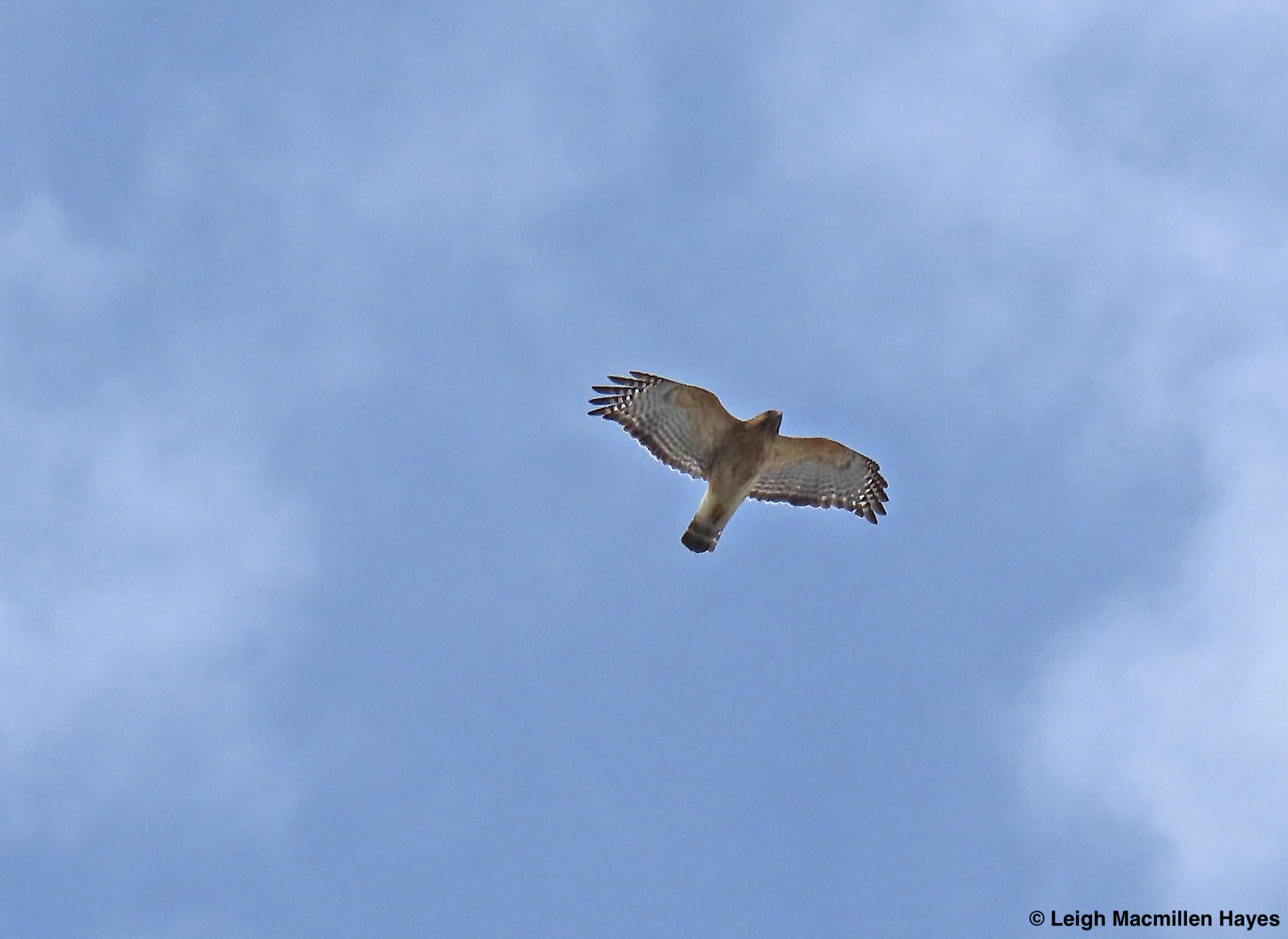
This afternoon, I interrupted the action for a few minutes when I headed out the back door to go for a tramp in the woods and had just reached an opening when I heard, then saw this guy and knew that our resident Red-shouldered Hawk had returned.

According to Stan Tekiela’s Birds of Prey of the Northeast, “Adults return to the same nest and territory for many years; the young also return.”

Welcome home!

I had no sooner lost sight of the hawk, when movement from another source caught my eye.

Flying from the ground up to a tree limb was a Barred Owl. And my heart was even happier than it had been.

We spent a few minutes together and I gave great thanks also that the vernal pool over which the owl perched is still rather frozen. No frogs or salamanders would be on the menu yet. I did, however, worry about the birds in my yard, but there was nothing I could do.

Except, that is, watch my friend for a few more minutes before waving goodbye to him and moving on.

And that’s when I heard a song, or rather many songs, that took me back to a summer morning and realized that as much as I don’t want winter to come to an end this week, the time has come because there is so much more to see and welcome and wonder about. The Red-winged Blackbirds were in a large flock with Grackles, and Robins, and more Crows. And the chorus was most delightful.
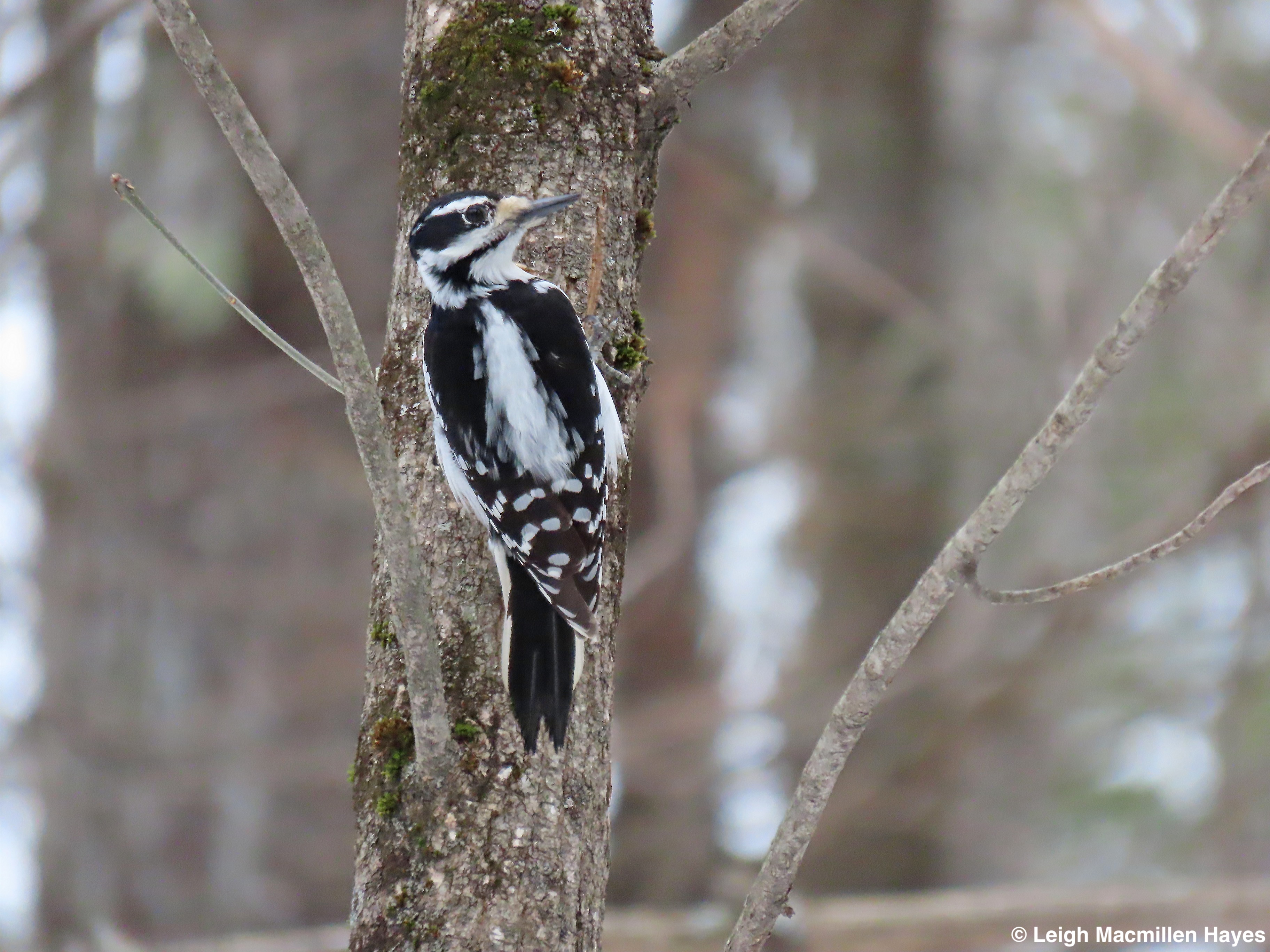
I’d say the female Hairy Woodpecker was much quieter than the others, but it was her inflight song that encouraged me to look for her.

I just hope it wasn’t Emerald Ash Borers she was seeking as she drilled a few test holes in the tree. Of course, if she can help control them, then that’s a good thing.

My journey led me to a local brook where the Mallard flock is spreading out more as the ice is receding quickly during these suddenly 50˚ days.

That said, they are still there.

He preened . . .
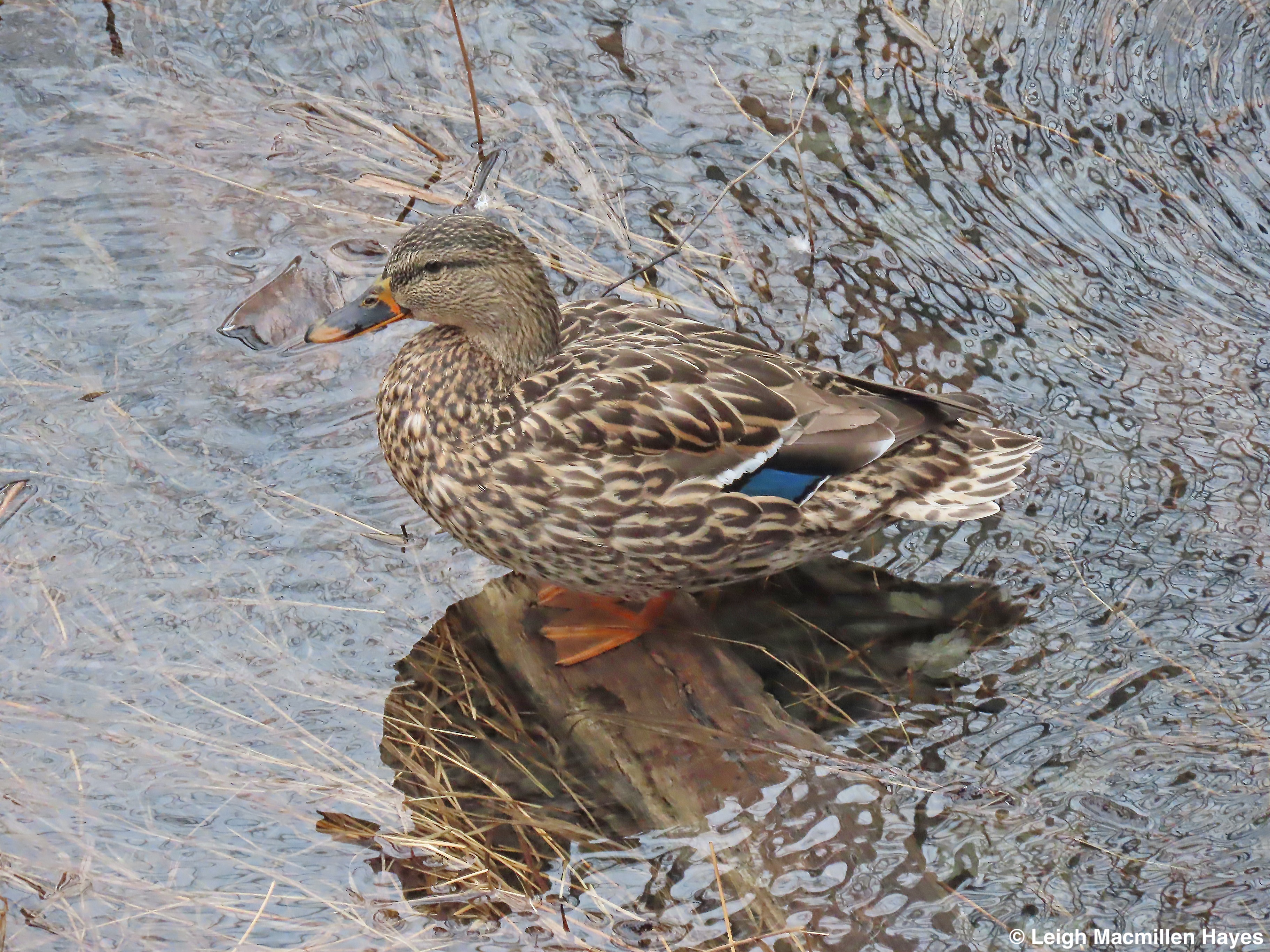
as she looked on.
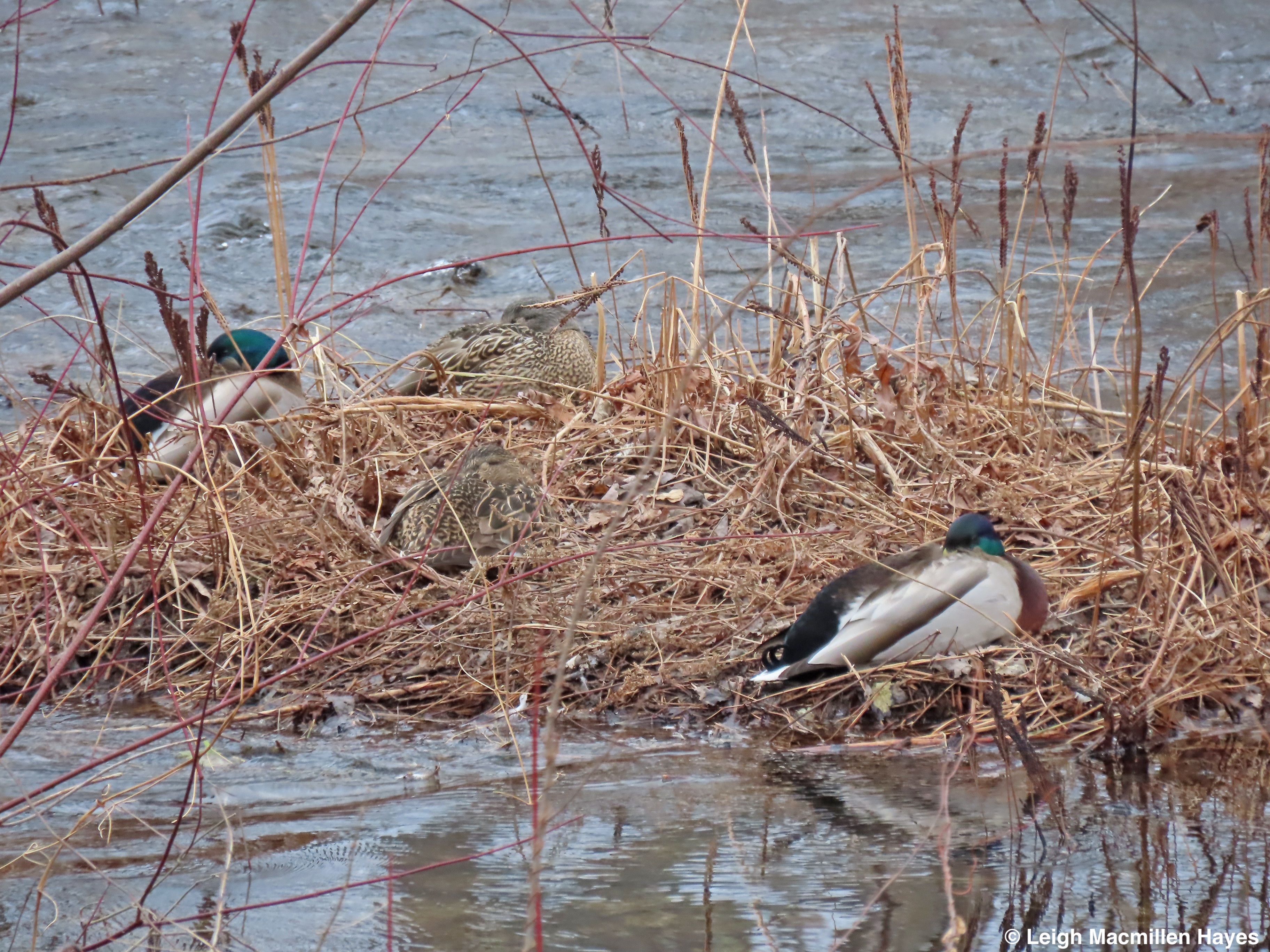
Others did what we should all consider doing on a Sunday afternoon: stick our heads under our wings and take a nap.

But I didn’t. How about you?

Upon a second brook that flows into the first, another species caught me by surprise as I rarely see it in this place. A female Common Goldeneye. I’ve always had a problem with the descriptor “common.” That prominent golden eye is hardly common in my book.

Moseying along, I realized it wasn’t just birds who were greeting the day. Chipmunks have been dashing about on the snow for the last week or two, taking advantage of any acorns the squirrels may have hoarded. (And birdseed–as I watched one stuff its cheeks the other day.)

One critter that surprised me was a Carpenter Ant making its way toward a boulder rather than a tree. Though I see the exoskeletons of these ants in Pileated Woodpecker scat all the time and even found some fine specimens in our woods today, I don’t recall ever spotting one on snow before.
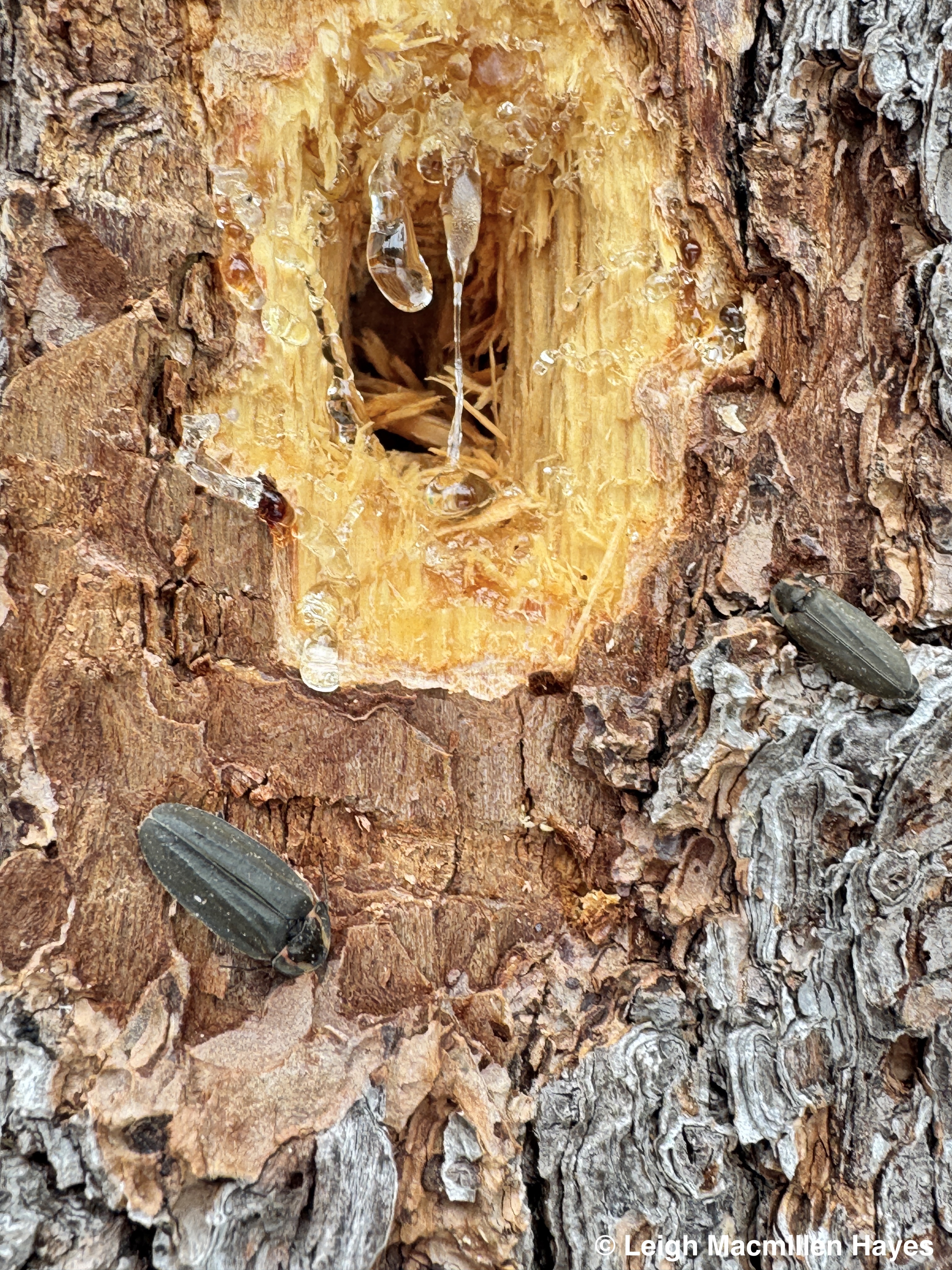
Speaking of Pileated Woodpeckers, their freshly excavated holes are dripping with sap and by this hole I found a couple of Winter Fireflies. So, um, Winter Fireflies are fond of Maple Sap. In fact, some call them Sap-bucket Beetles. But White Pine sap? Do you know how sticky it is? As in, you can practically glue =-your-fingers-together sticky.

When I first spotted these two, I wondered if the sap might have given them pause. Were they stuck?
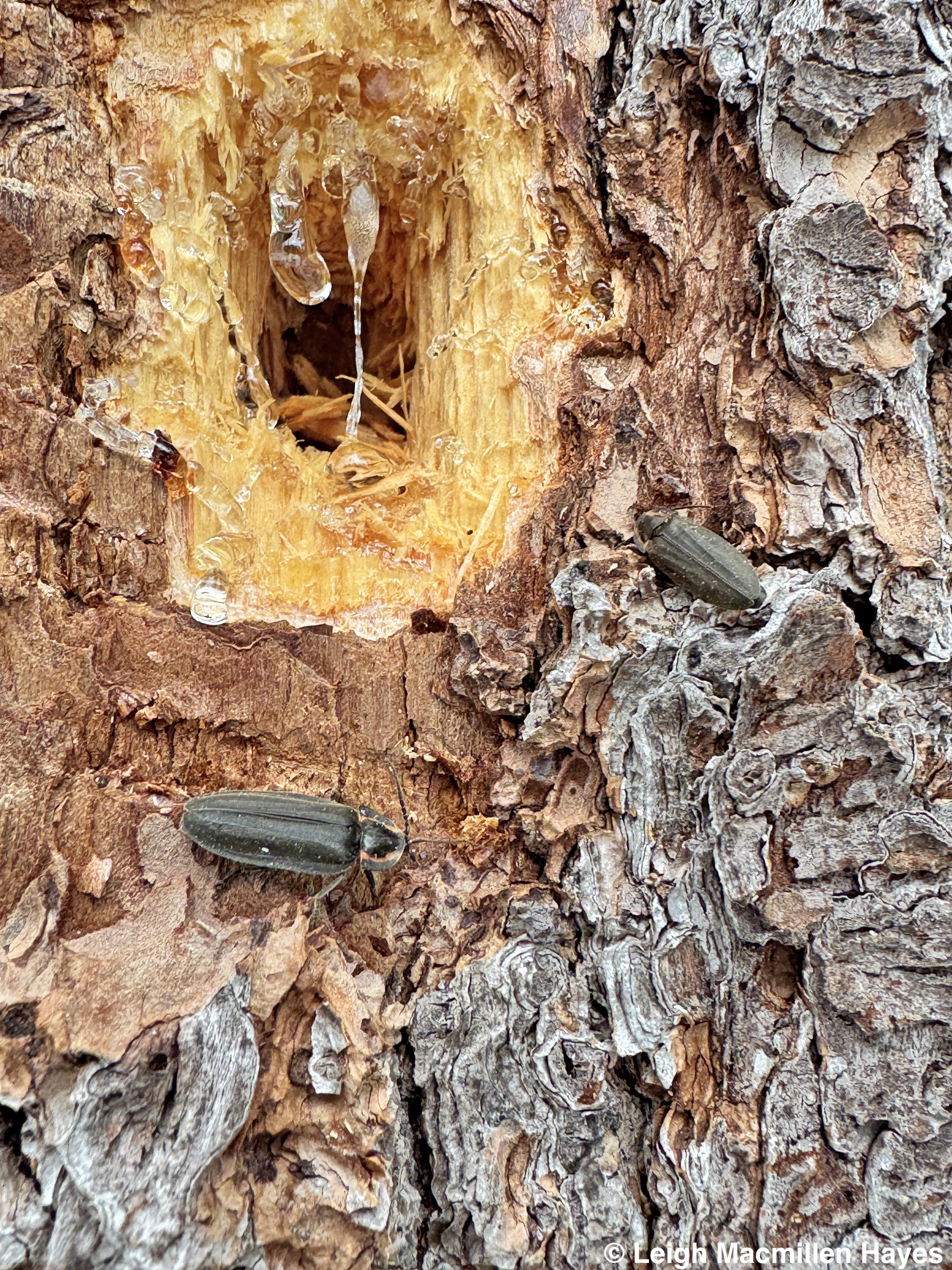
But then there was movement and in that moment, all was good with the world.
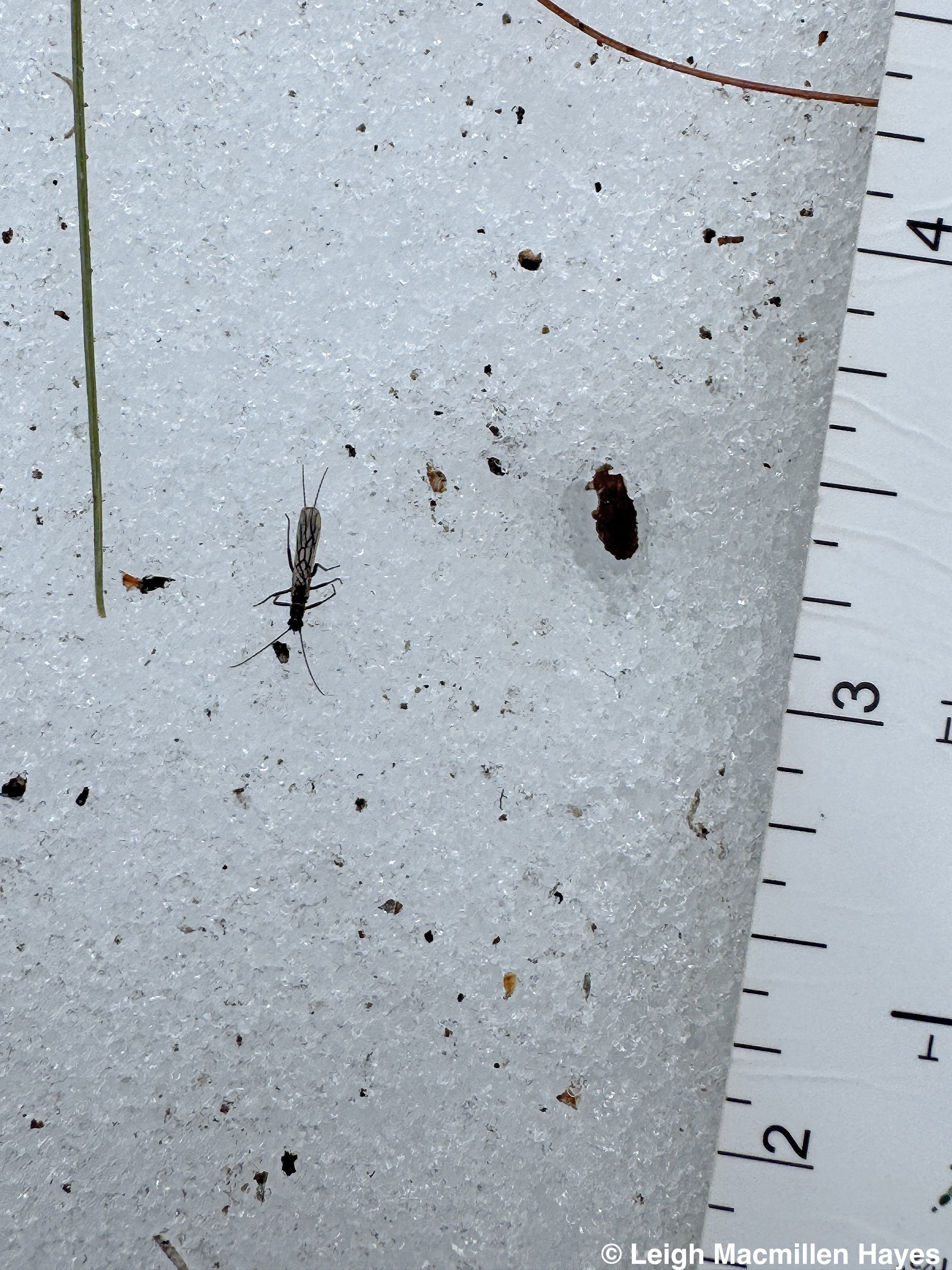
I had one more discovery to make–actually, it’s been my quest this year to find this species and its relative who is only about a half inch longer.

But I must have missed the mass emergence of Small Winter Stoneflies, and their cousins, Winter Stoneflies, for like today, I’ve only seen one or three or maybe five on any particular occasion near these brooks, when in the past there were so many more. Might last summer’s drought and water conditions be the reason for so few? After all, these species are highly sensitive to pollution and thus, are indicators of excellent water quality. I have to hope that I just missed the right day.

After the Stonefly discovery, I did find one more thing that always brings me around to the cycle of life. A small bird was plucked and became the meal of a larger predator.

Curiously, some feathers were stuck to the bark of the tree . . .

My thought was that the predator sat high above, and let the plucked feathers drop and being a pine, a few stuck to the sap, or maybe just to the rough bark. Or maybe the bird was consumed right there on the side of the trunk.

I don’t know and I don’t know who the predator was, but energy was offered and sunshine turned into seeds and insects that fattened up the smaller bird were passed on to the bigger critter.
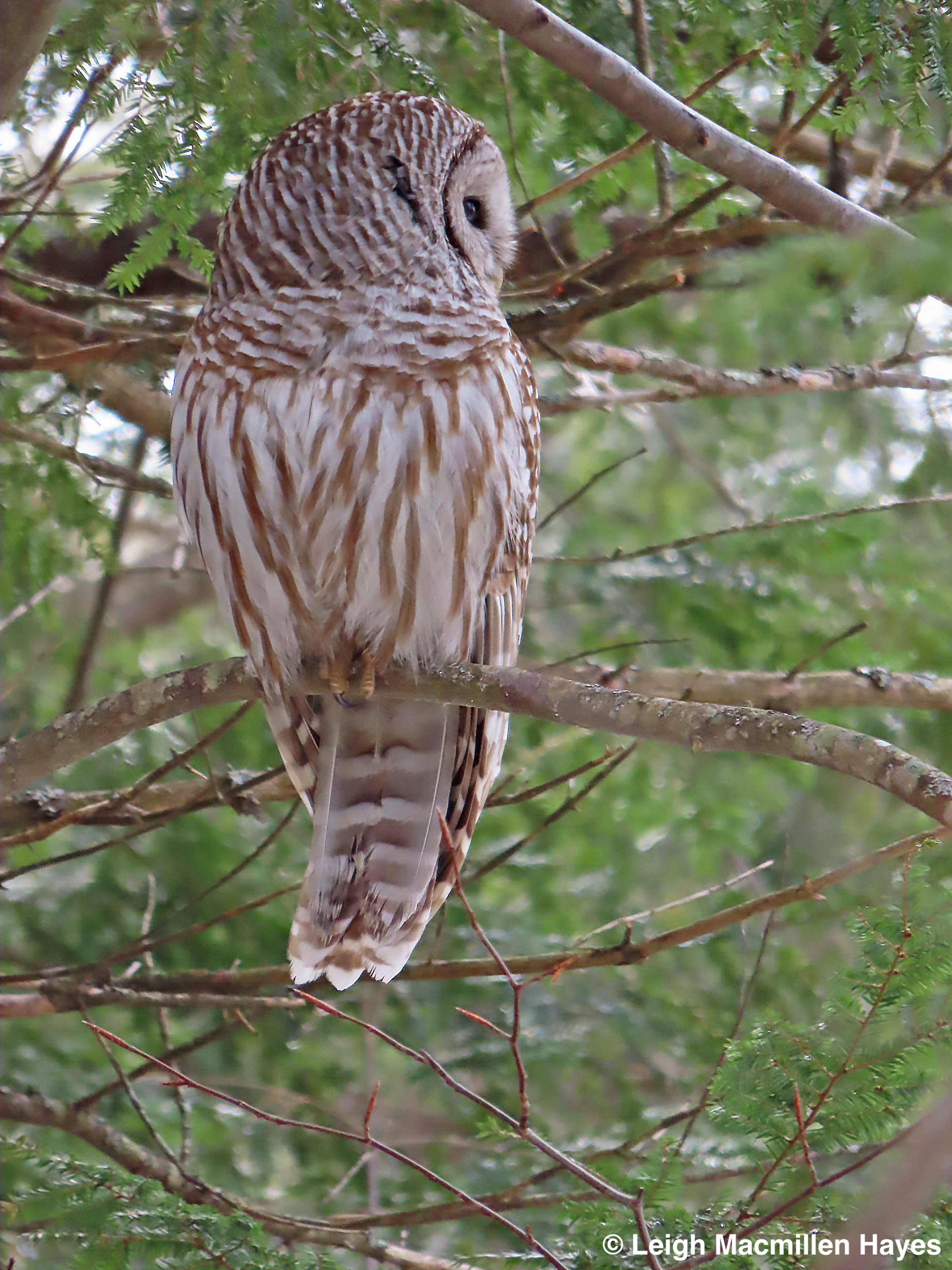
Perhaps the Barred Owl knows the whole story. Or the Red-shouldered Hawk.

All I know is that I gave thanks for this day to wander and wonder and be greeted by so many who are all a part of my neighborhood. Well, really, I’m a part of their neighborhood, and I appreciate that they share it with me.

In Search of Winter Stoneflies

I’ve been waiting for this day for the last few weeks. To that end, every couple of days I’ve snowshoed out the back door and made my way down to the park, eyes always looking down just in case. To no avail.

Oh, the ducks are always there, as its their winter hangout, being one of the few places with open water given how cold the temps have been. Even this morning, the thermometer registered -7˚ at our house.

What I love about the sun shining on the male Mallards heads was that some appeared green and others blue in their iridescent hue. They rather reminded me of Ebony Jewelwing Damselflies who have bodies of the same color, albeit a million times smaller.

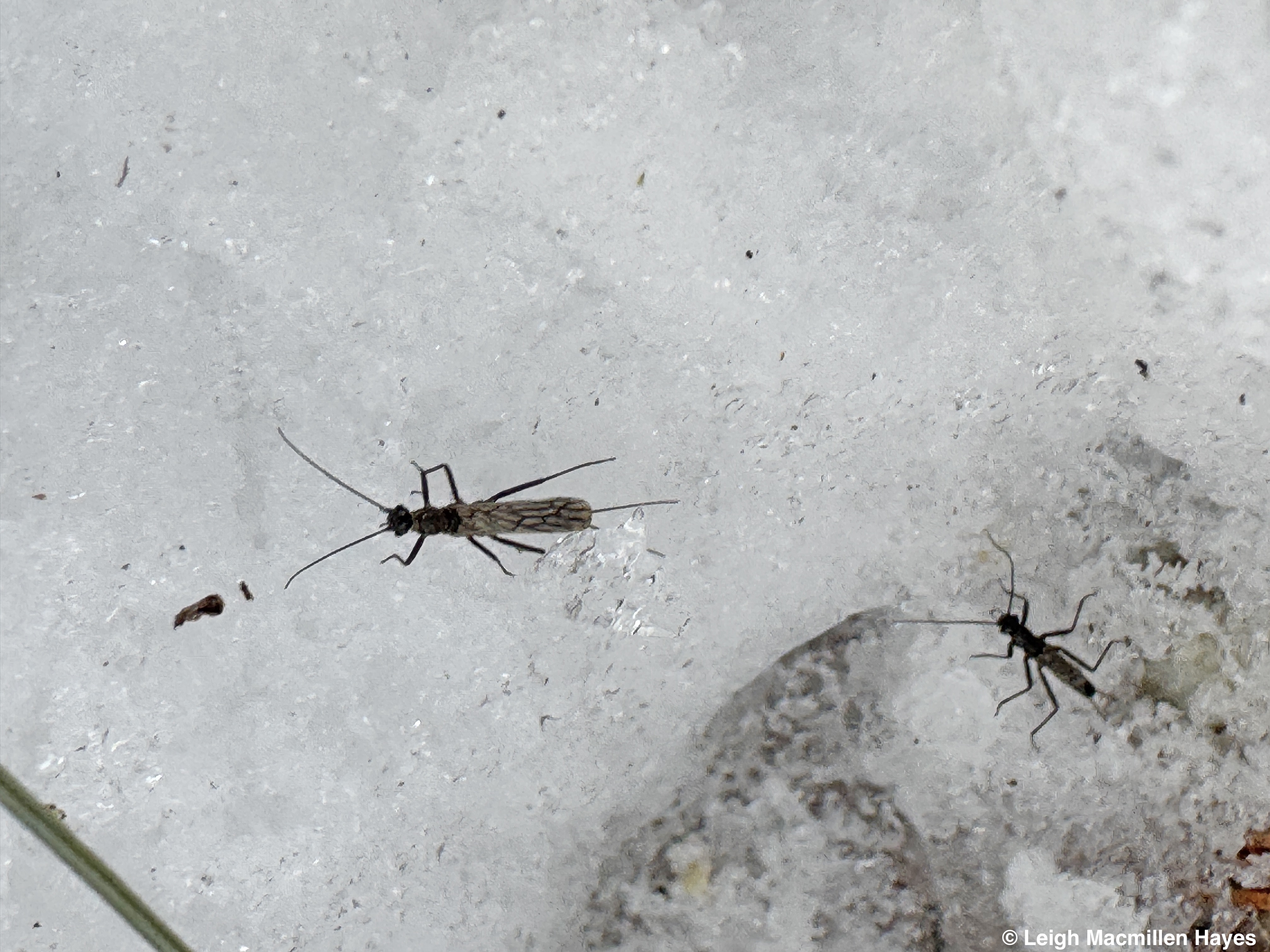
But it wasn’t the ducks that I sought. Instead, it was this. A Winter Stonefly!

In winter, crazy as it may seem, the aquatic immature stage of a Winter Stonefly, aka naiad, crawls from the rocky bottom home of the brook where it has spent the last year or more maturing (going through as many as thirty molts) and shredding fallen leaves, climbs up through crevices in the snow that covers the brook, finds a plant or some other spot to emerge as an adult, and leaves behind its shed skin, much like a dragonfly or damselfly.

Today, though not abundant, the insects were all on the move and most headed west, as I’ve noted in the past.

Their mission: to reach a tree trunk.

Once there, they’ll crawl under the snow beside the trunk and I had to wonder if we’ll hear the sounds of their party reverberating through the cold night air tonight. That said, today it wasn’t hundreds of insects; but that day will come soon.

Why to the tree trunks? And why crawl under the snow? The bark is warmest in that spot, so it is a good place to get out of the weather.

Stoneflies have hammer-like structures on their abdomen that make noise when thumped against a surface, like a tree trunk or a twig or even the ground. This is a mating call. The males drum, and the females drum back, and voila, they find each other and canoodle.

And just to mix it up, this spot is also home to Small Winter Stoneflies.

Like Mayflies and Caddisflies, Stoneflies are particularly sensitive to pollution and serve as bioindicators of water quality. That means the brooks beside which I walked have excellent water quality. That is good news indeed.

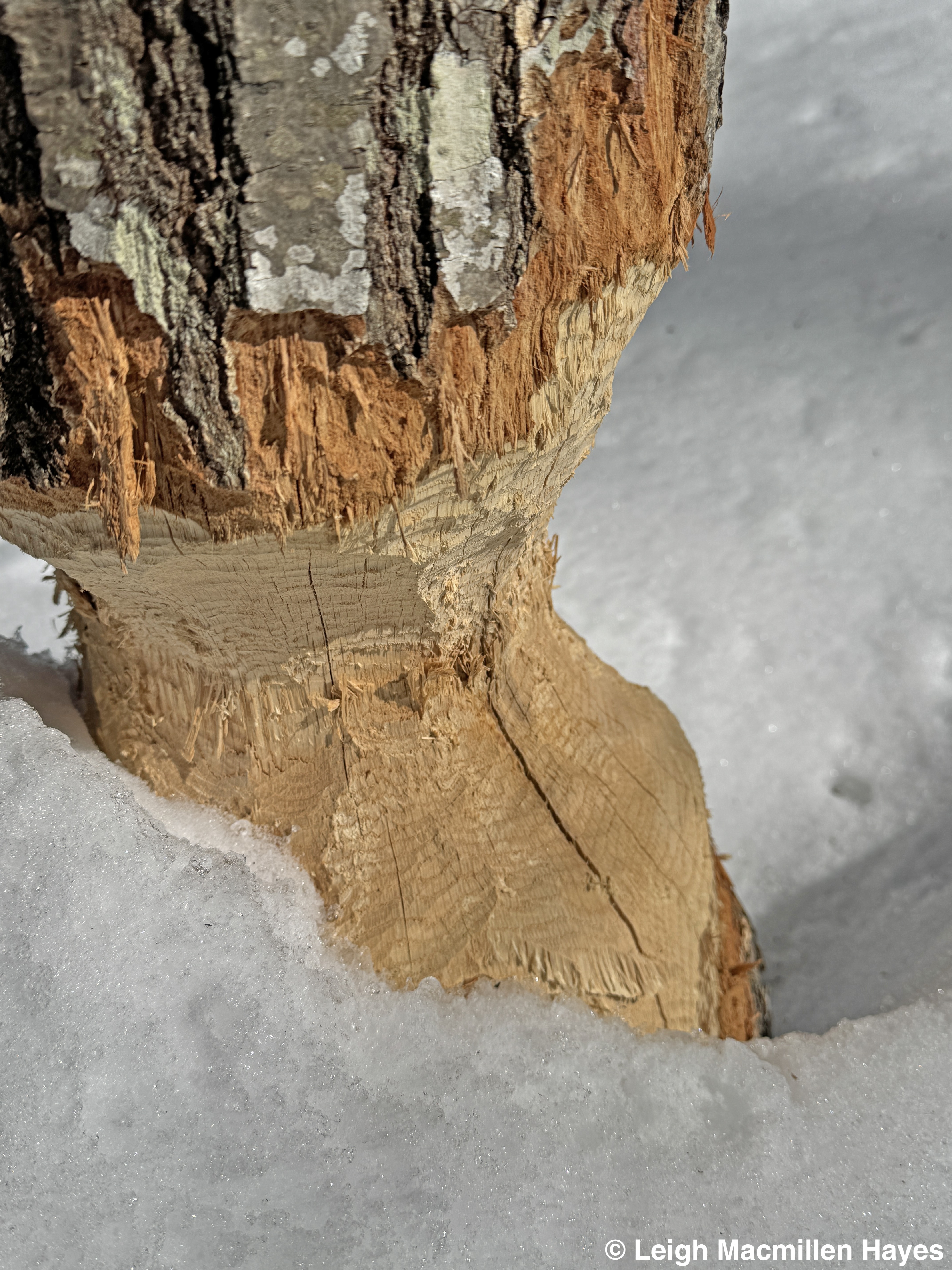
Since I was in the park, I decided to look around to see who else might be living there. There was an abundance of Gray Squirrel tracks, and those left by a Red Fox or two, and even Raccoons. But then in a spot where I hadn’t spotted this tree for any reason before, I noticed that a Beaver had paid attention.

Can’t you just imagine the Beaver cocking its head to the side and trying to cut this tree down. From the looks of it, this tree was partially chopped down before ice formed over most of one of the two brooks that flow through the property, so I would imagine in early December. How did I miss this before?

And where there are White Pine Saplings, some times there are signs of a Pine Tube Caterpillar’s winter home. Well, it could have been in this one or any of the dozen others I spotted nearby.

The larval form of the Pine Tube Moth, Argyrotaenia pinatubana, binds clusters of needles together. What typically happens is that the caterpillar uses between ten and twenty needles to form a tube or hollow tunnel. (You might also see the little white Pine Scale insect to the left of the tube.)

In October 2021, I had the good fortune to watch some Pine Tube Caterpillars at work.

Back and forth they moved, excreting silk that formed a ladder-like web. The caterpillars moved up and down their silk-lined tunnels to feed on needles at the tip. When the time comes, each caterpillar creates one more tube and does the same thing until it is ready to pupate overwinter.

The moth will emerge in April, when I’ll need to pay attention again (if I remember). Two generations occur each year and those that overwinter are the second generation.

Those were all great sightings. BUT. Not all is perfect with the natural world. And the blonding on the Ash tree is certainly an indicator of one thing that is wrong.

Emerald Ash Borers are invasive insects that will attack and kill both weak and healthy Ash trees of all species.

Most of the EAB’s life cycle takes place below the bark.

Tunnels or galleries from feeding larvae accumulate and disrupt the flow of a tree’s nutrients. All wood boring insects leave behind tunnel patterns, but to my knowledge no others have the S-shaped or sinuous curves of EAB.

During the winter, woodpeckers probe for larvae feeding beneath the bark, and often reveal infested trees. The “blonding” I referred to earlier is the light color left behind as the birds remove the outer bark.

I checked some of the debris below one of the infected trees, in hopes of finding woodpecker scat filled with the larval and/or pupal forms of EAB, but so far have not had success. Though some towns are bringing in parasitic wasps to attack the mature insects, wouldn’t it be great to know that we have birds who can help in the effort?

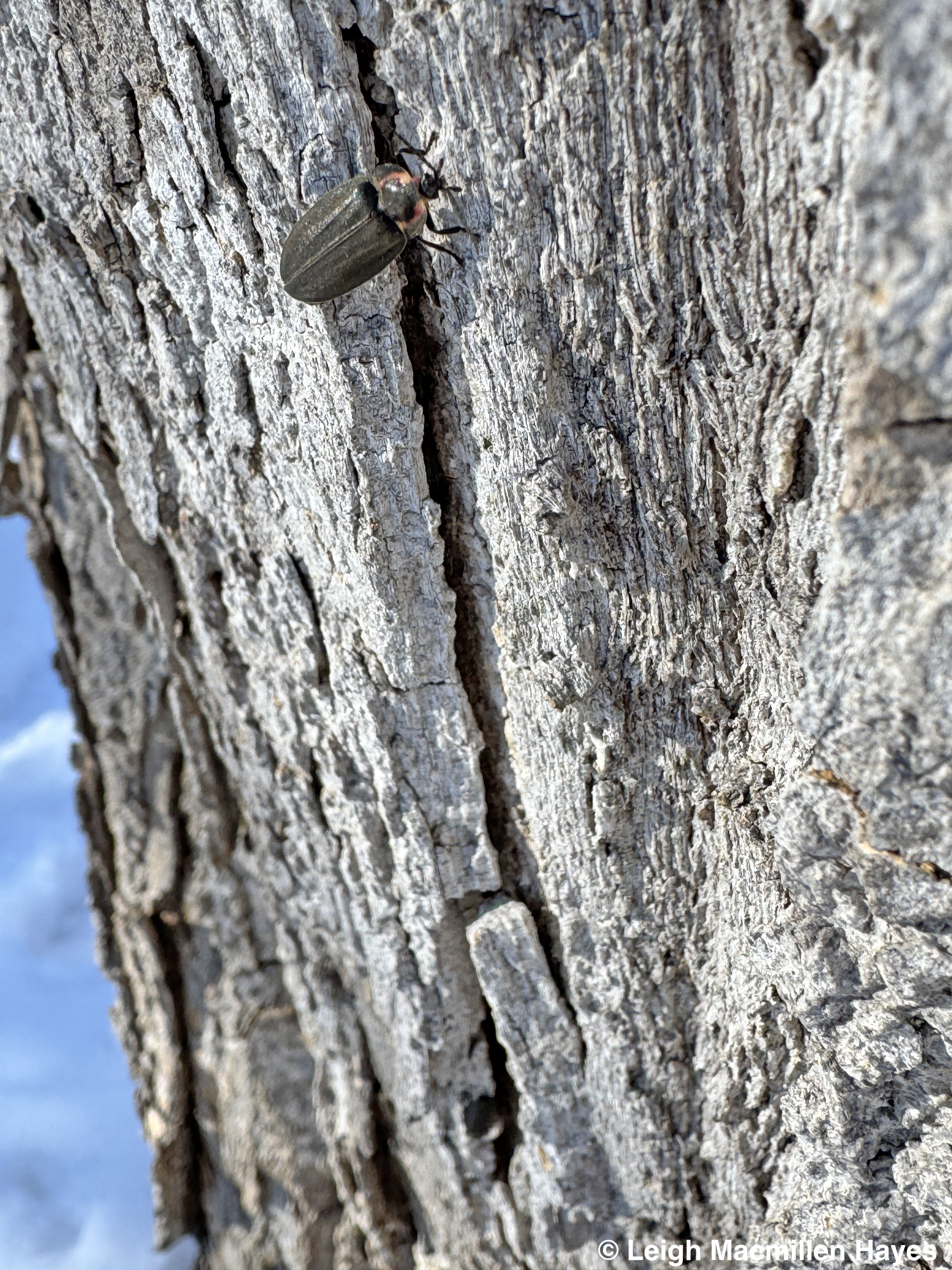
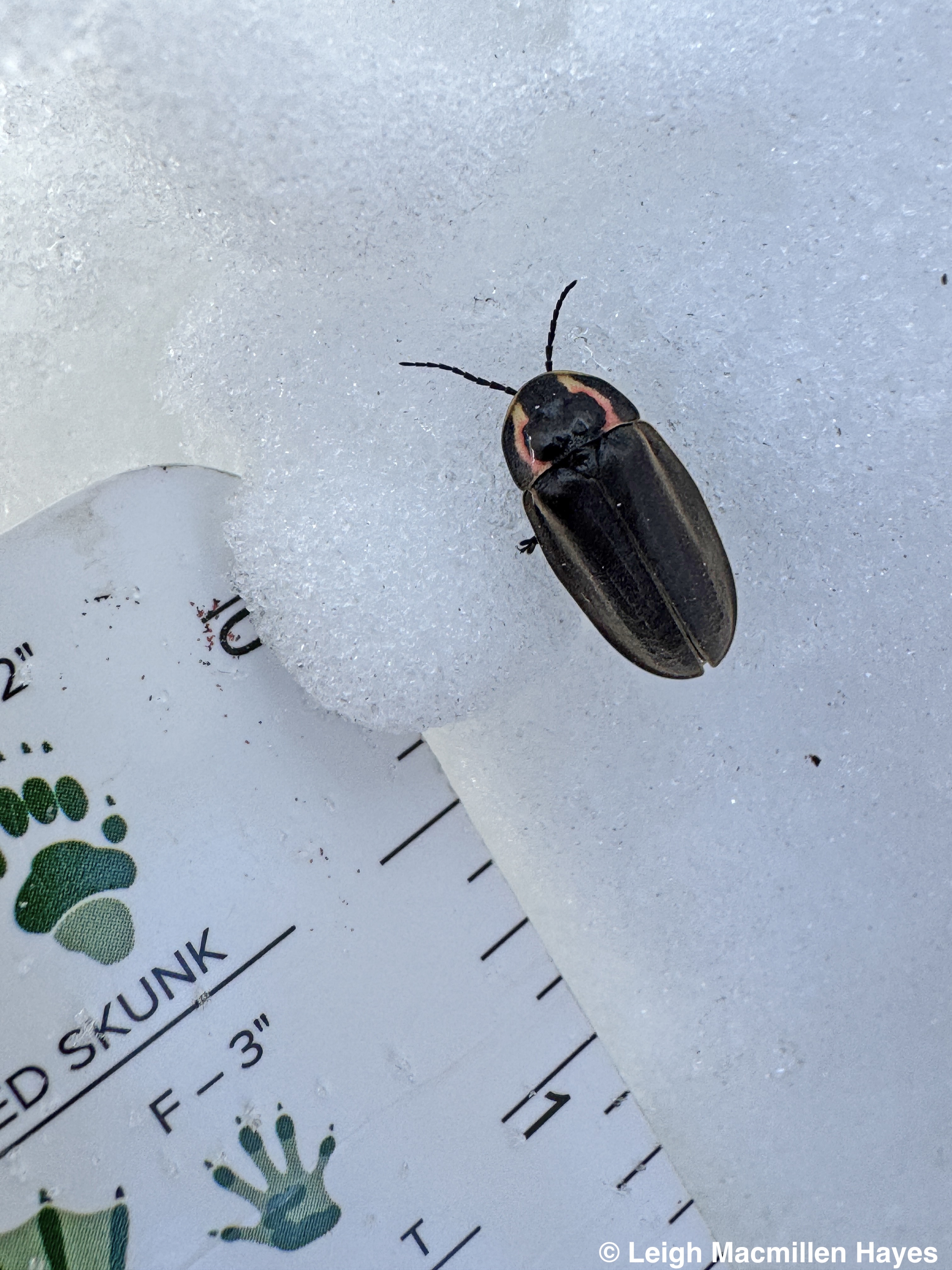
While studying the Ash trees, I looked across the trail at a couple of Sugar Maples and discovered another insect whom I think the world of, the Winter Firefly.

So here’s the thing: fireflies are not flies; they are beetles. Unlike many beetles, however, Winter Fireflies overwinter as adults.

Also, they are diurnal and don’t have lanterns to light up the night sky.

Once I started looking, I discovered quite a few either crawling on the trunk or tucked just underneath where the bark curled away from the tree.

There were also a bunch on the snow, like this one above, and they appeared to be dead, which surprised me. Or maybe they were just taking a rest?

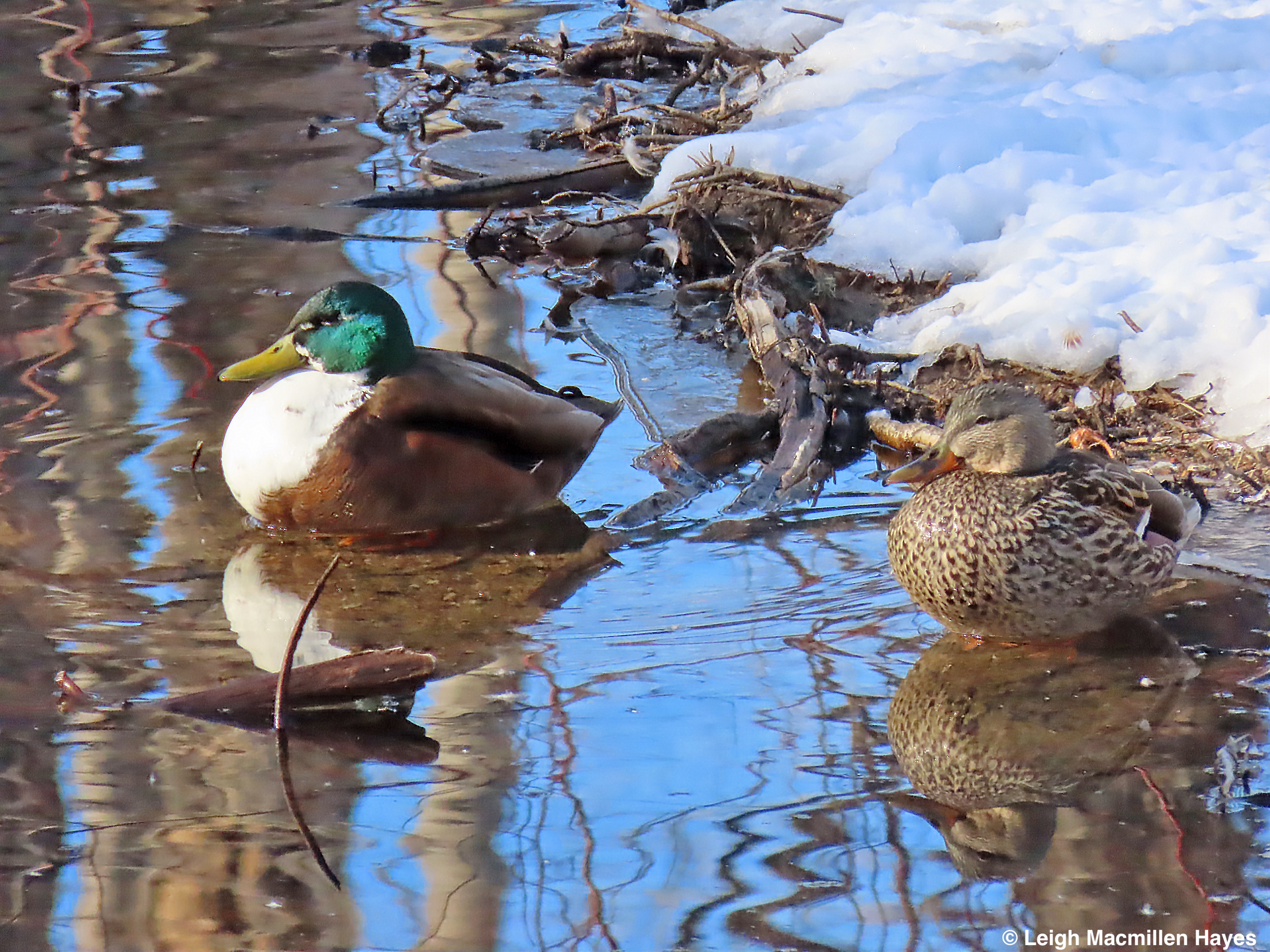
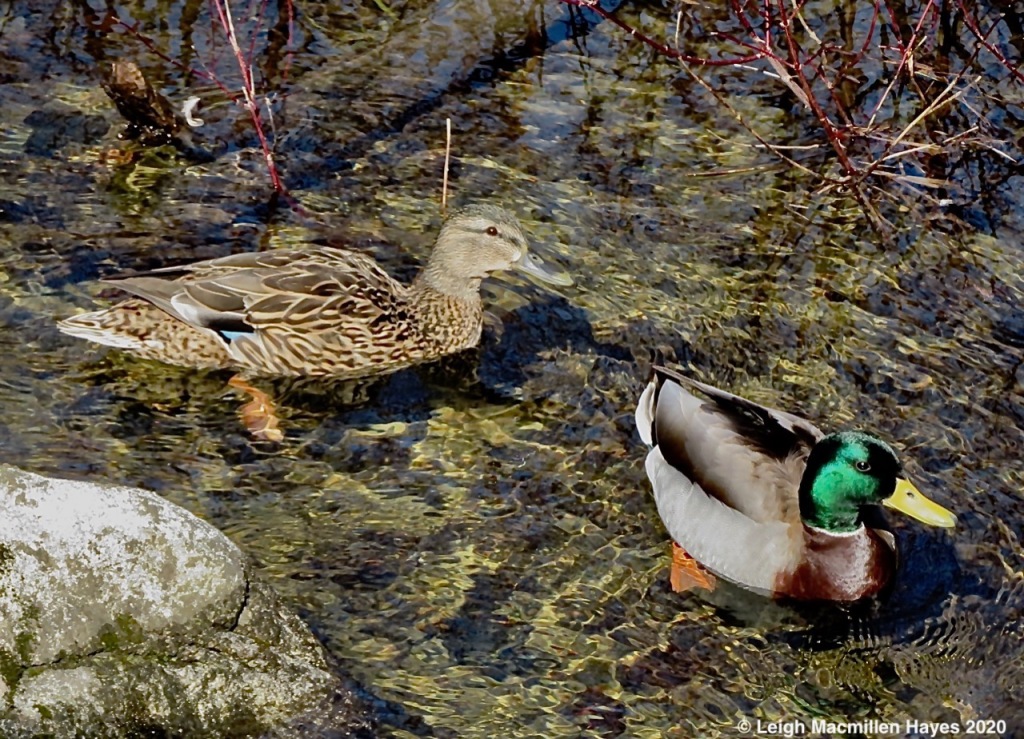
Back to the ducks I returned before heading home. And this time, it wasn’t just Mallards who came into my view. I would like to confidently say that the duck on the left is a female American Black Duck and on the right, a female Mallard.
BUT . . . yes, it’s true, there always is a but, I’m only basing my conclusion on the difference in their beaks and according to The Sibley Field Guide, there are hybrids.

The rest of the bodies of these two look almost identical, and perhaps not as dark as the Black Duck should be. Am I right? (You know that when I’m alone I’m 100% correct, but in blog-land, I’m not alone so I welcome any tips to help me have a better understanding.)
There were a zillion Mallards and though some seemed to be couples like these two, others ganged up and squawked and zipped about chasing each other in circles.
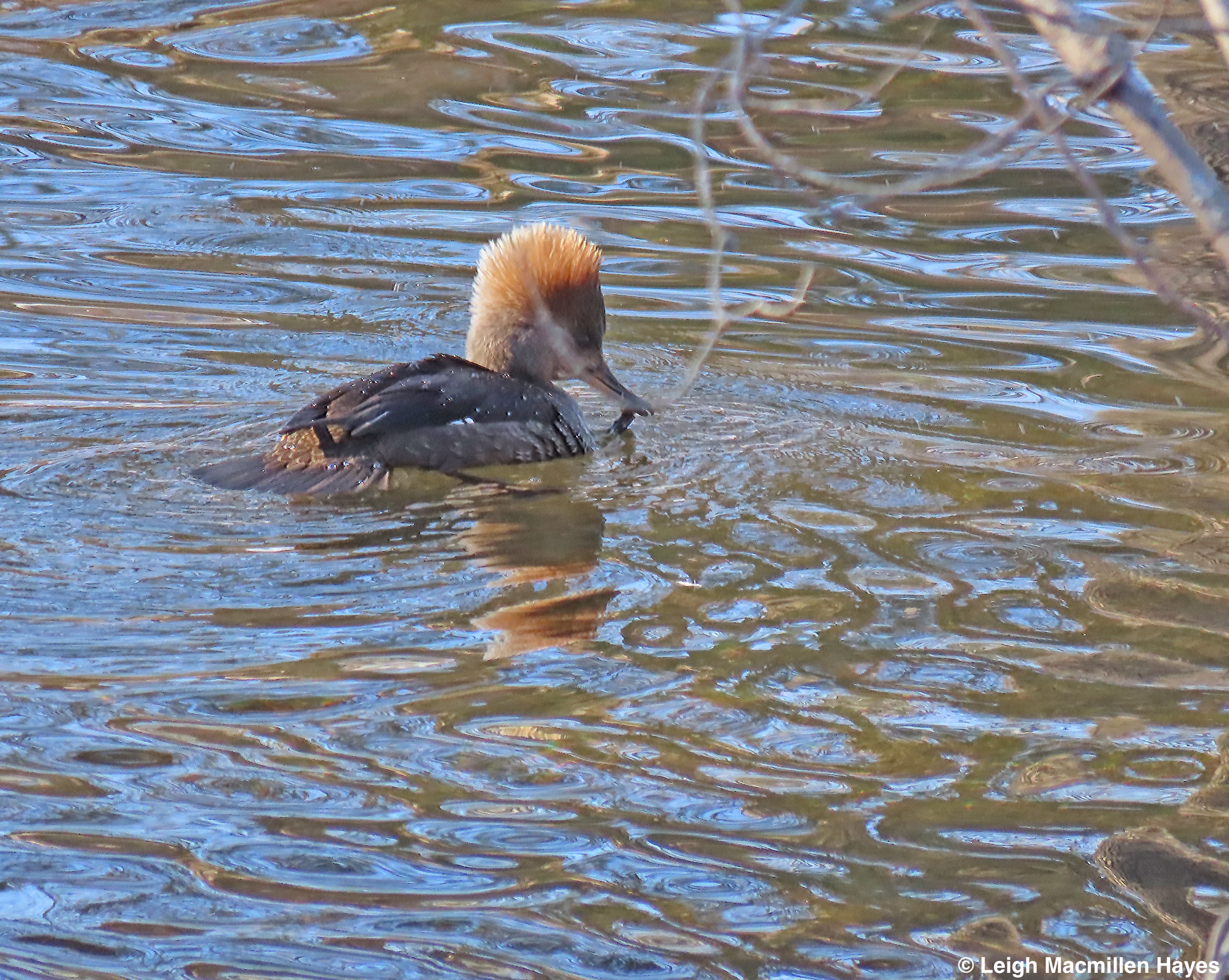
And then into the mix entered a pair of Hooded Mergansers, she being the more drab color. Actually, I spotted two males, but only one female. Then again, I stood only in one spot to view the open water, so I don’t know who might have been around the bend.

Both the male and female Mergansers were diving and feeding, possibly on small fish.

As I watched them, another duck paddled my way and I thought for sure it was a rare species and couldn’t wait to get home and check my field guides.

He had the green head and yellow bill of a breeding male Mallard, and gave chase to his woman.

But that white bib?

It was almost as if the White-bibbed duck had the opposite coloration of the male Mallard, with the light colored chest and dark flank versus Mr. M’s dark chest and lighter flank.

Mr. White-Bibbed also had a white eye line that I didn’t see in the Mallard. And his chest seemed to stick out prominently.

The best I can tell from a little research, is that this is the result of a Mallard canoodling with a domestic duck. Again, if I’m wrong, please let me know.

Some call them Manky Mallards or Domestic Mallards. Mrs. Mallard seemed rather pleased with her choice and if these two do stay together, I can only wonder what their offspring will look like.

Just before I walked home, I heard and then saw a pair of Northern Cardinals. She didn’t make herself clearly visible, because if you look closely, you’ll note the berries of another invasive, Bittersweet, that she was dining upon. Junk food for birds. And they are the reason it spreads so rampantly in our area. I have to say, I remember a time when I thought Bittersweet was beautiful as a decoration.

At the end of the day, I have to say I went in search of Winter Stoneflies and came home well rewarded.

Easter 2024

Easter came early this year and at our church a spring snowstorm that dumped up to two feet of snow meant that last weekend’s Palm Sunday service had to be held via ZOOM. But with a new rector on board, Reverend Annette went with the flow and then during the week, she was able to offer Maundy Thursday, Good Friday, and finally today’s Easter celebration all in person.

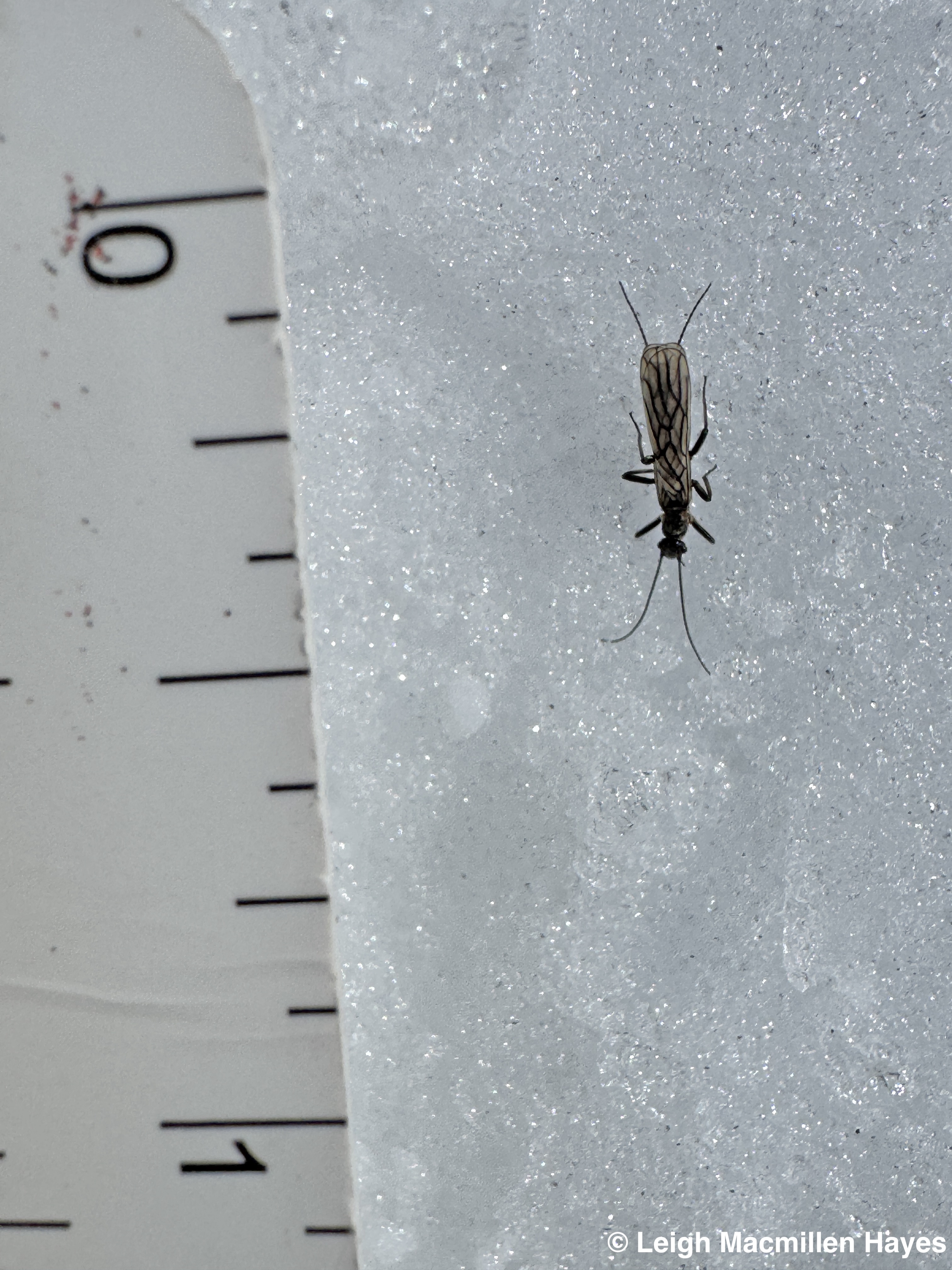
It was a week of reflection, as it should be. And a week of searching, like this Winter Stonefly that emerged from a freshwater brook and journeyed up and down and around the obstacles of the forest and snow fo seek a tree. Particularly, the bark of a mature tree. Species mattered not.

The aquatic immature stage of a Winter Stonefly, aka naiad, crawls from the rocky bottom home of the brook where it has spent the last year or more maturing (going through as many as thirty molts)and shredding falling leaves, climbs up through crevices in the snow that covers the brook, finds a plant or some other spot to emerge as an adult, and leaves behind its shed skin, much like a dragonfly or damselfly.

Stoneflies have hammer-like structures on their abdomen that make noise when thumped against a surface, like a tree trunk or a twig or even the ground. This is a mating call. The males drum, and the females drum back, and voila, they find each other and canoodle.

I heard not the drumming for it is not for us to hear, but I have faith that this insect with its veined wings that serve no flying function was successful.

The venation of the Winter Stonefly’s wings was not lost on me as I saw stained glass in their presentation. And was struck by the same when I peered into a quick flowing stream that transported melting snow and noticed the amazing lines and shapes as the water twirled around a rock.

And on both sides of the stream I spotted the prints of one who passes in the night, working behind the scenes and leaves only a trace of its presence. But still, because I recognized these prints, I believed the Bobcat was nearby, perhaps even so close that it kept watch over me without my knowledge. As it should be.

Turkey prints were much more prevalent, but today it was the shape of such that garnered my attention and I could imagine the cross and a being upon it.

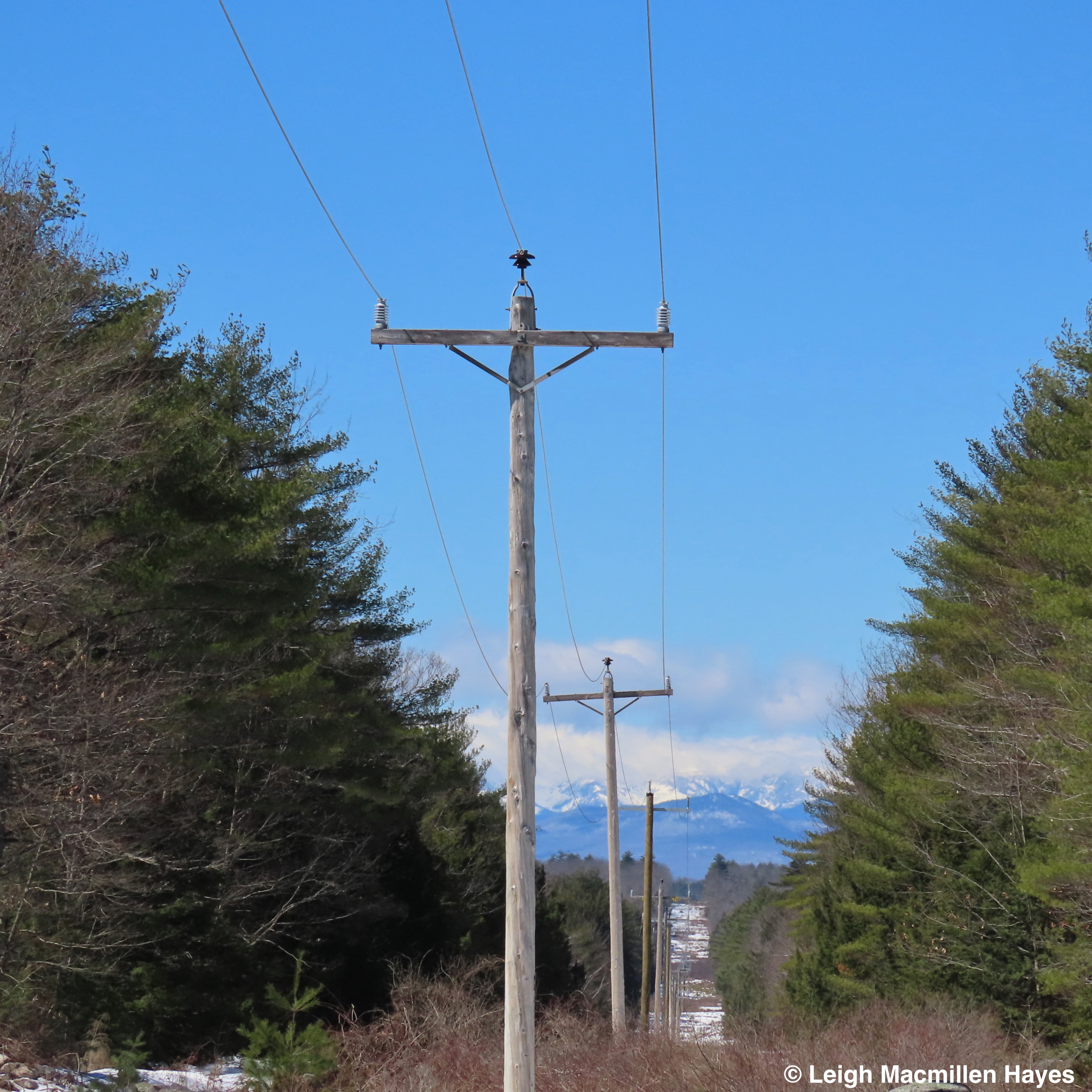
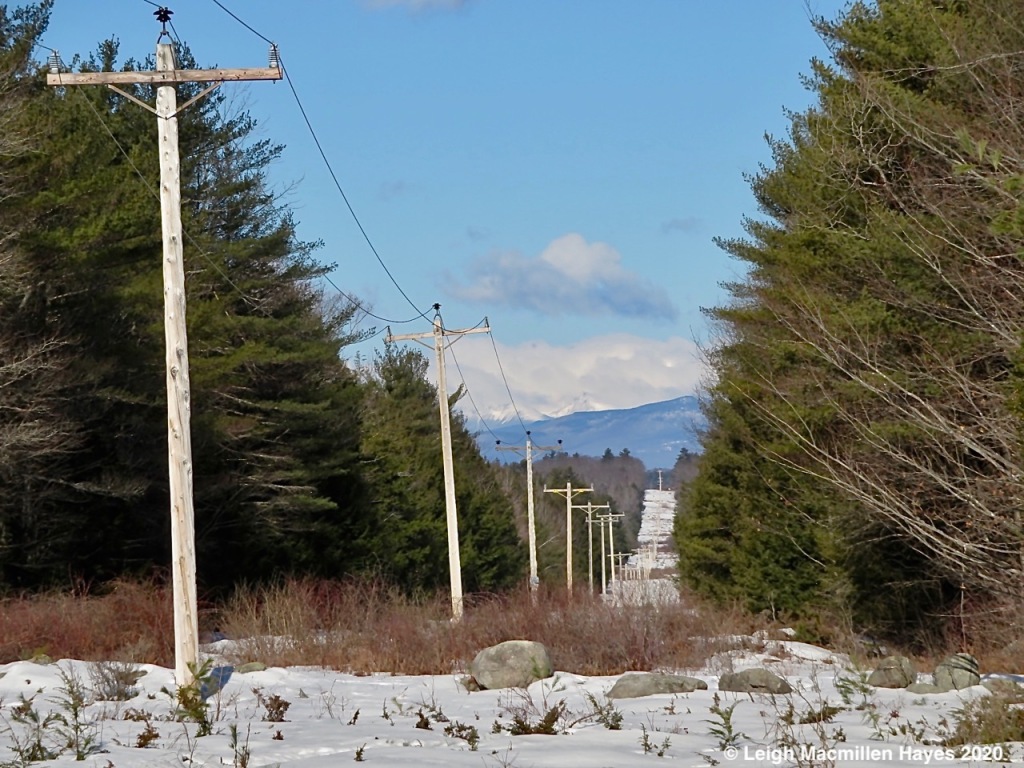
The cross theme was equally created in the form of telephone poles leading to the most powerful mountain in New England. Who knew? Light and communication sizzled across the wires for all of us who choose to partake.

An equally power-filled force, some of which is also harnessed for electricity, this swollen river flows to the ocean as waves break over boulders. I see not its full path from source to sea, but trust in its immanence.

And on this day, with the snow melting under bright sun and 50˚ temps, the White Crocus with its lilac-colored runway lines, suddenly bloomed–and the Alleluias are heard ringing across the landscape.

A Purple Crocus added its soprano voice to the Alleluia chorus.

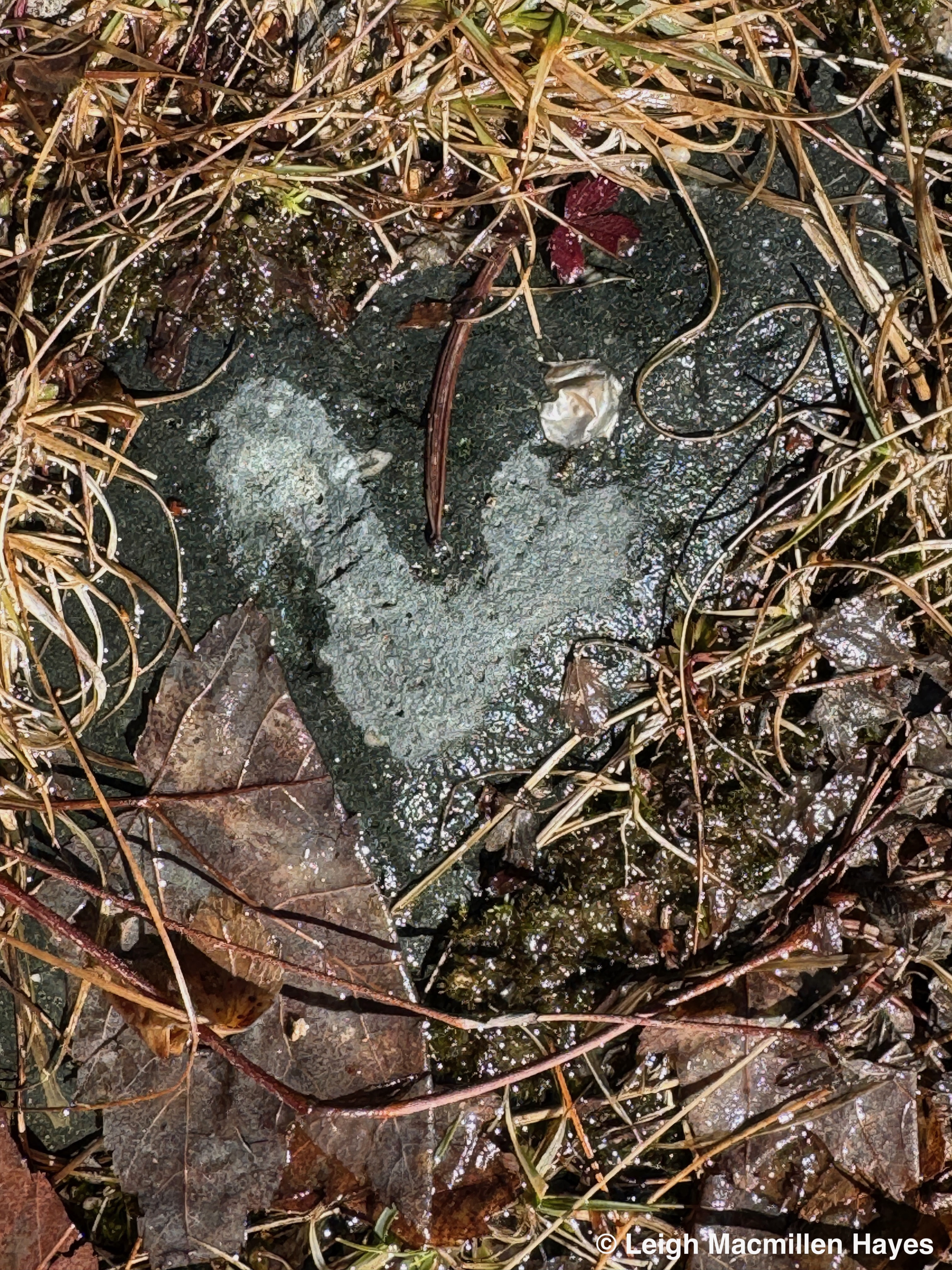
When I spotted this heart upon one of the paths I followed this weekend, I was reminded that hope and awe and wonder and love are captured within my heart and I gave great thanks.

Christ is Risen. A new day has dawned. Alleluia. Happy Easter 2024.

Power of Line: Matter of Seeing

I could have followed the wood poles all the way to Mount Washington today, for such was their invitation . . .

but the mighty mountain was veiled in clouds, so instead I chose a different direction to venture.

Walking into trees, their height drew my eyes to a vanishing point on the horizon.

It was a place where ragged curves framed towering angles.

Occasionally, in that same place, geometric designs provided camouflage.

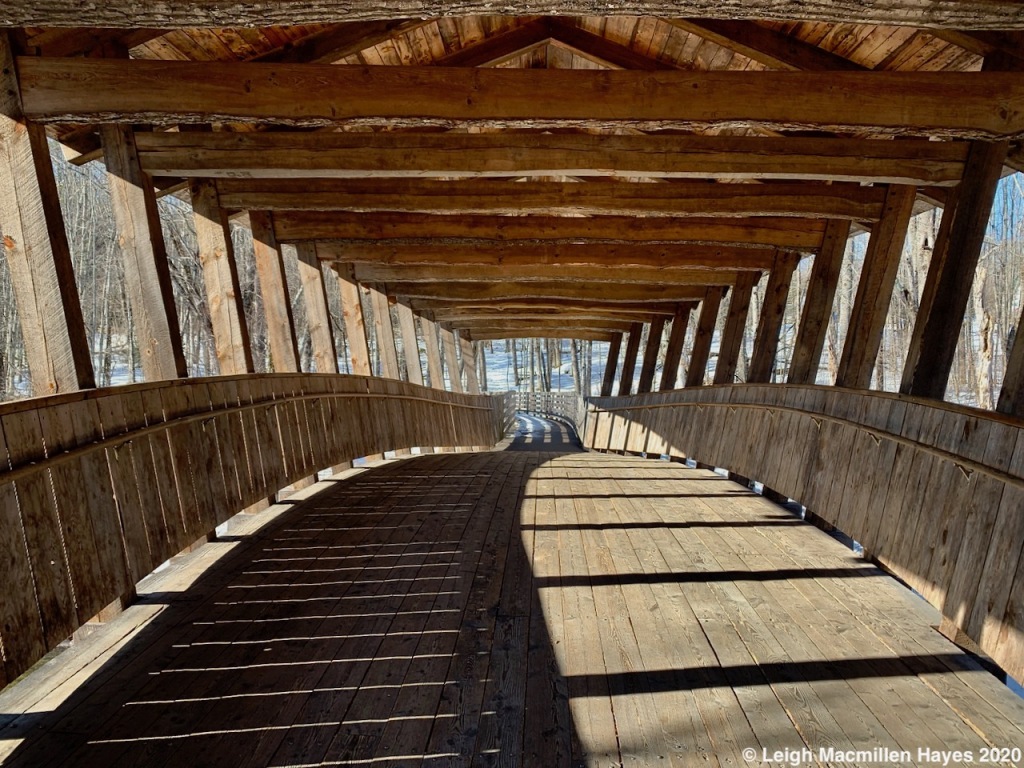
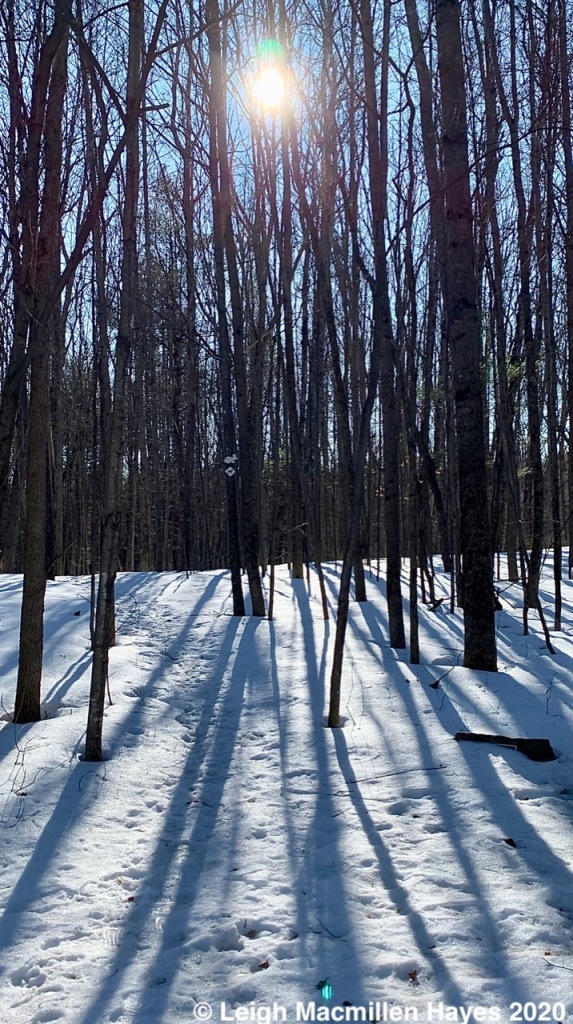
And man’s creation of horizontal, diagonal, and vertical found imitation in curved shadows.

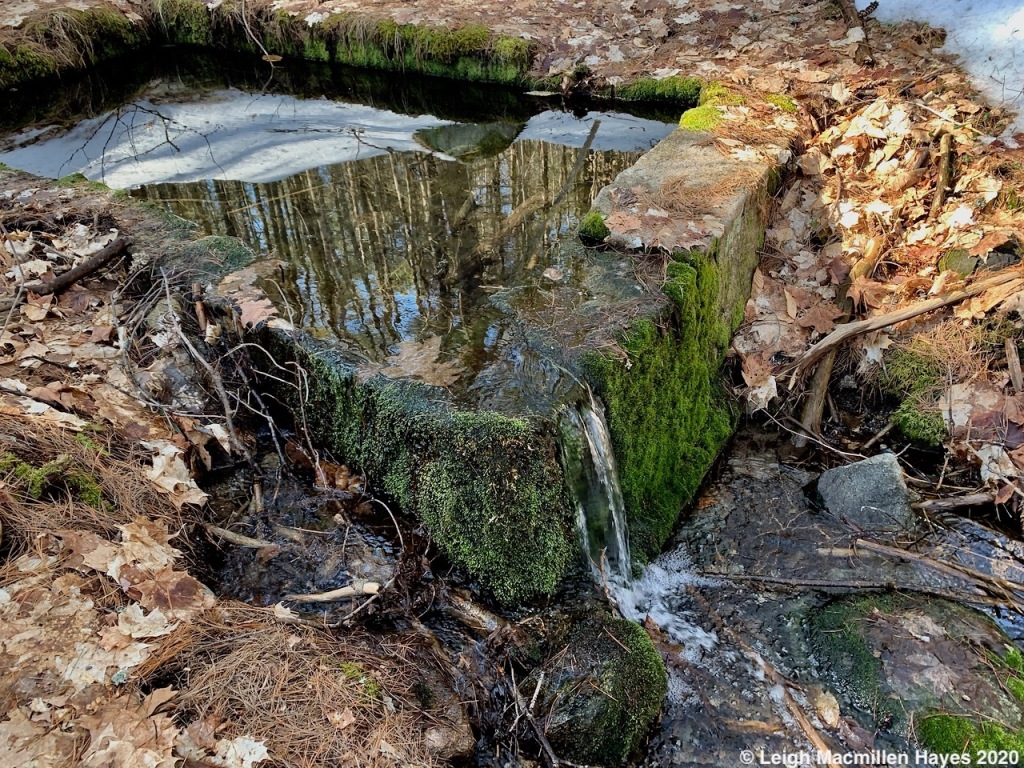
Upon another structure reflections stood still before flowing forth.

Further on, intersections were noted upon several levels.

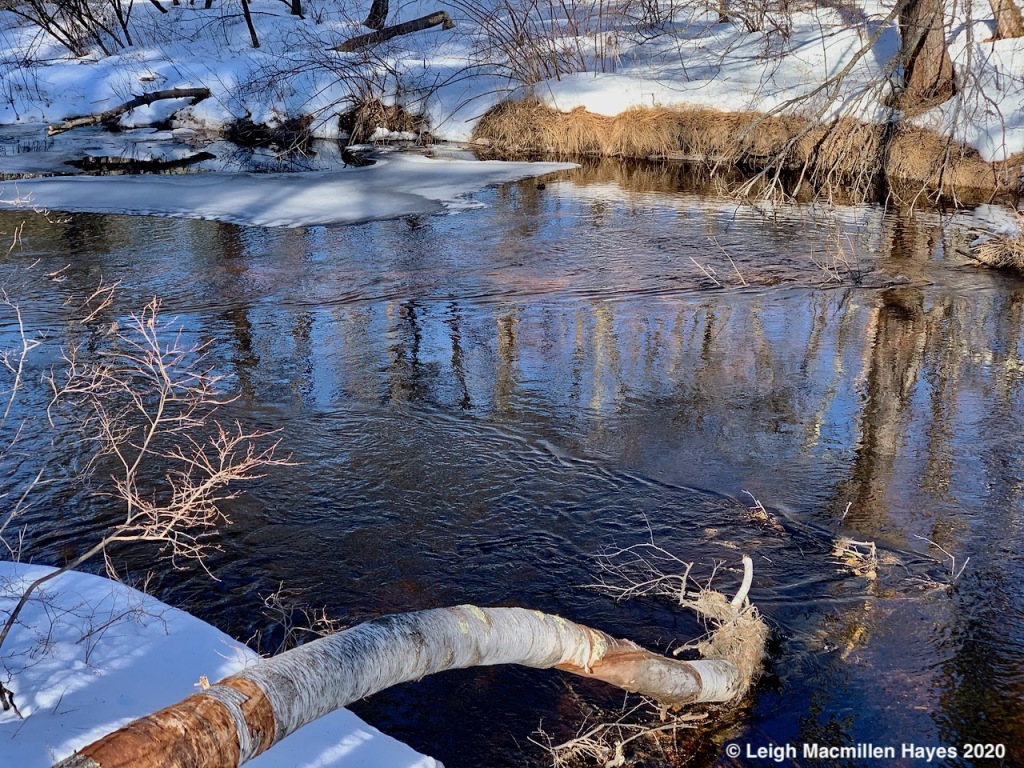
Ripples created movement with quiet wedged between.

Into the mix, nature added a triangular archway.

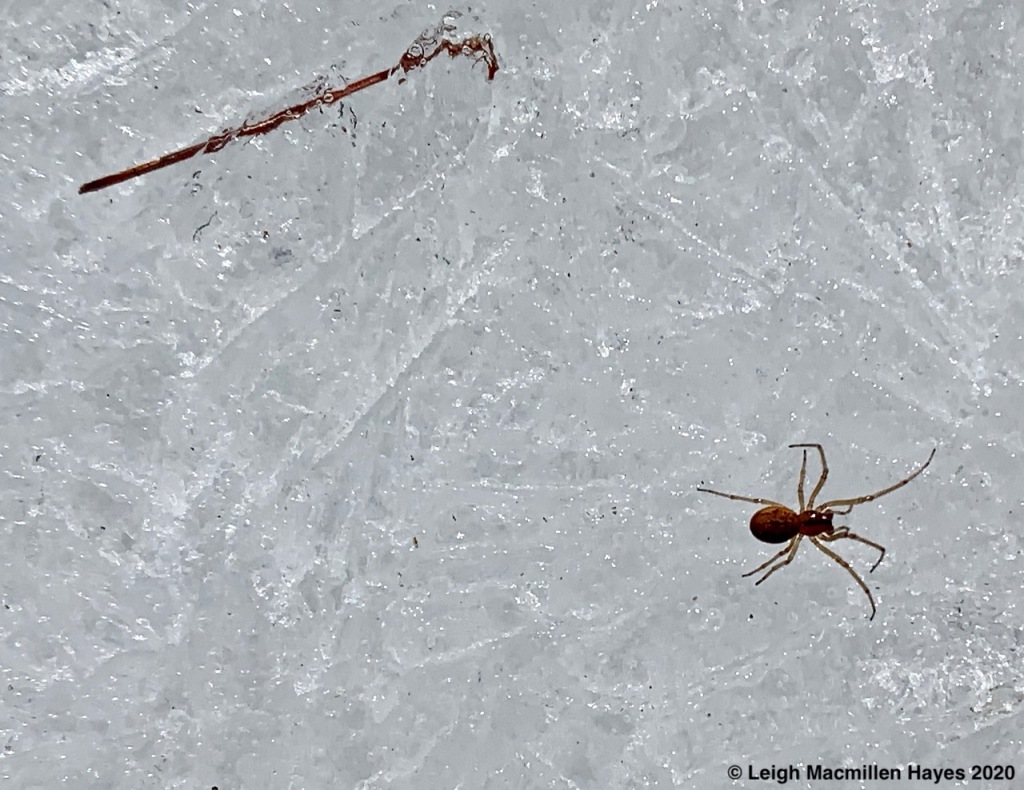
And allowed jointed legs to cross needles of ice.

At one pause beside a tree trunk, wing venation offered a tiny stained-glass presentation.

Nearby, venation of a different sort peeked out from under its winter blanket.

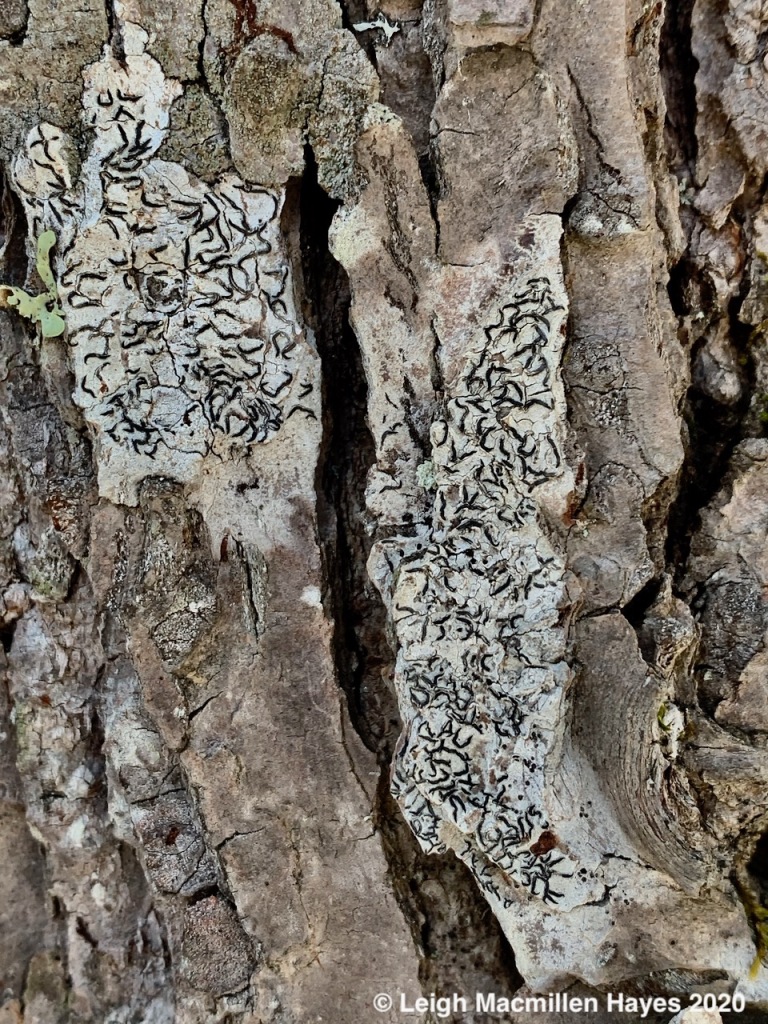
A story was written upon a crustose in squiggly calligraphy beyond my interpretation.

Slowly, I returned to the anomaly in the landscape . . .

Where paddlers constantly reinvented ovals and circles.

And then I headed home and noticed Mount Washington was lifting her cloudy shroud, thus adding more curves and angles to the picture.

The power of lines, a familiar part of the landscape. It’s all a matter of seeing.