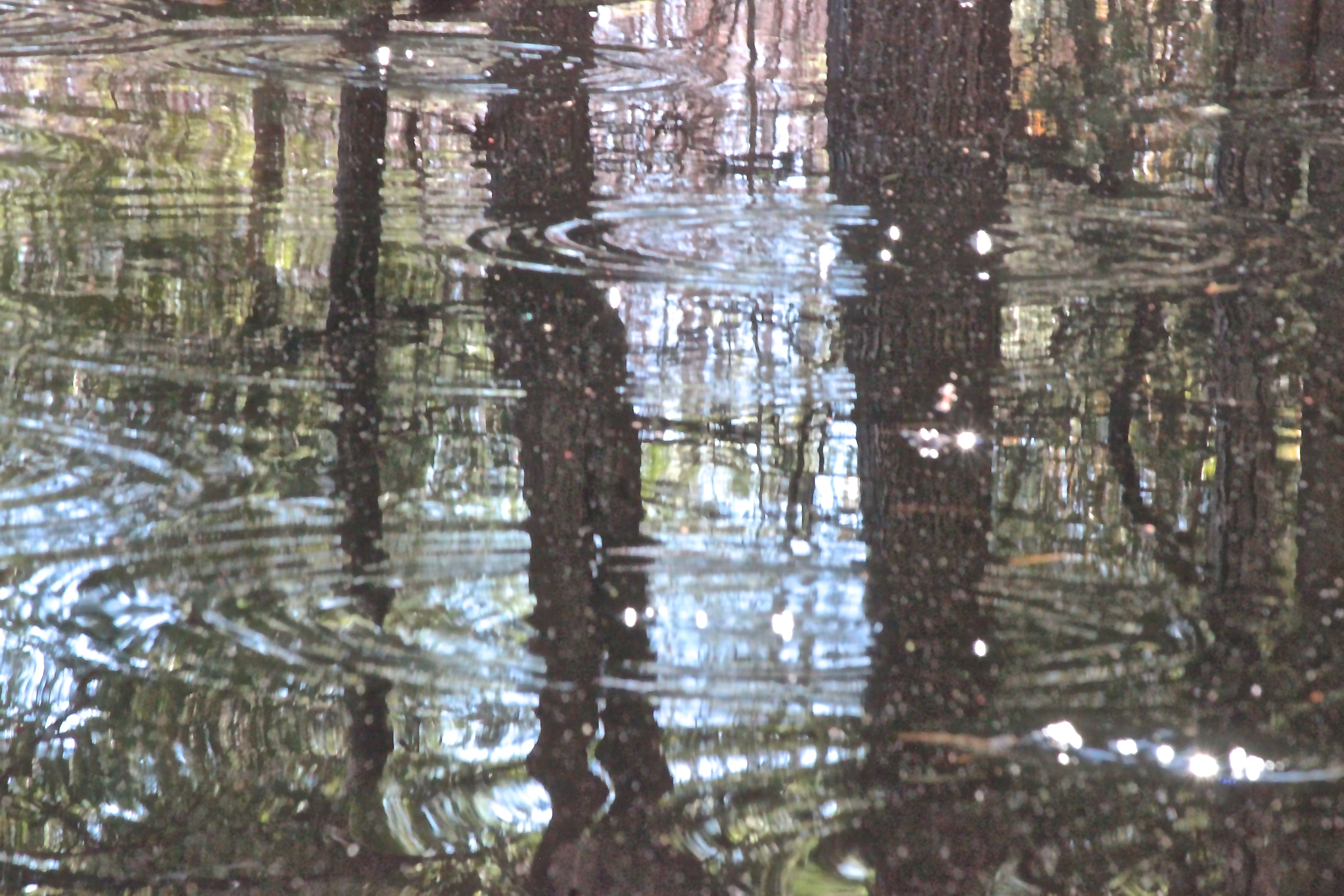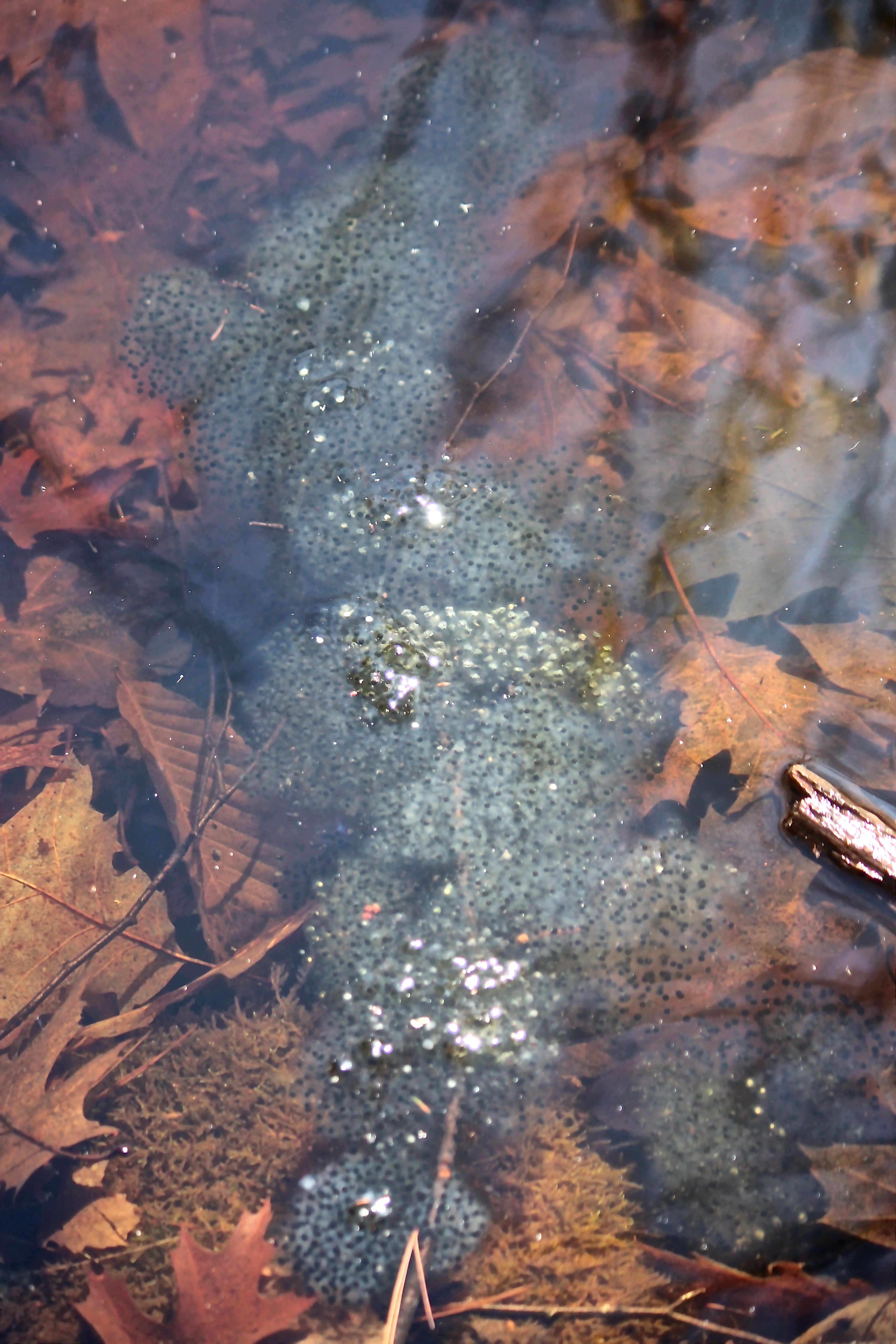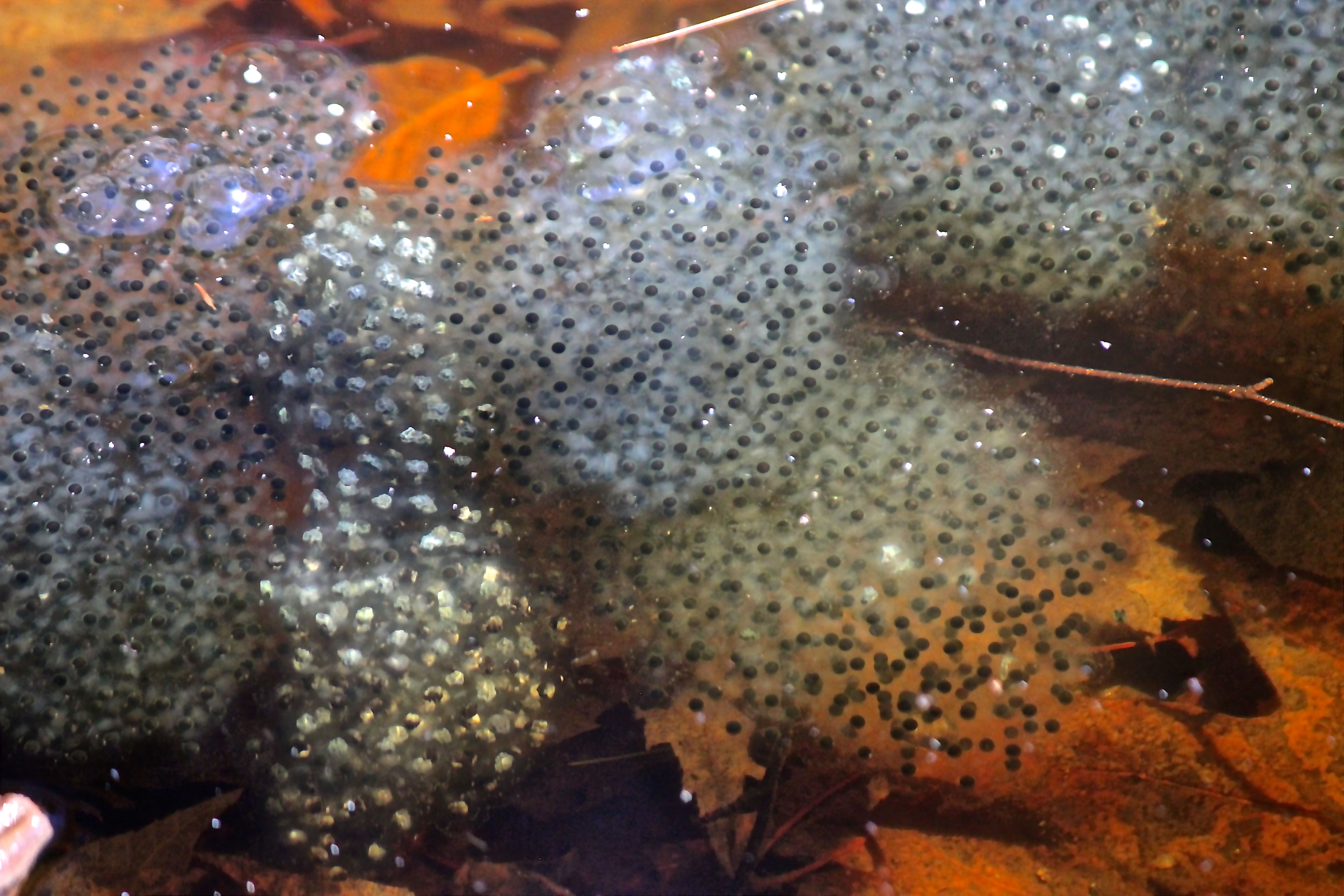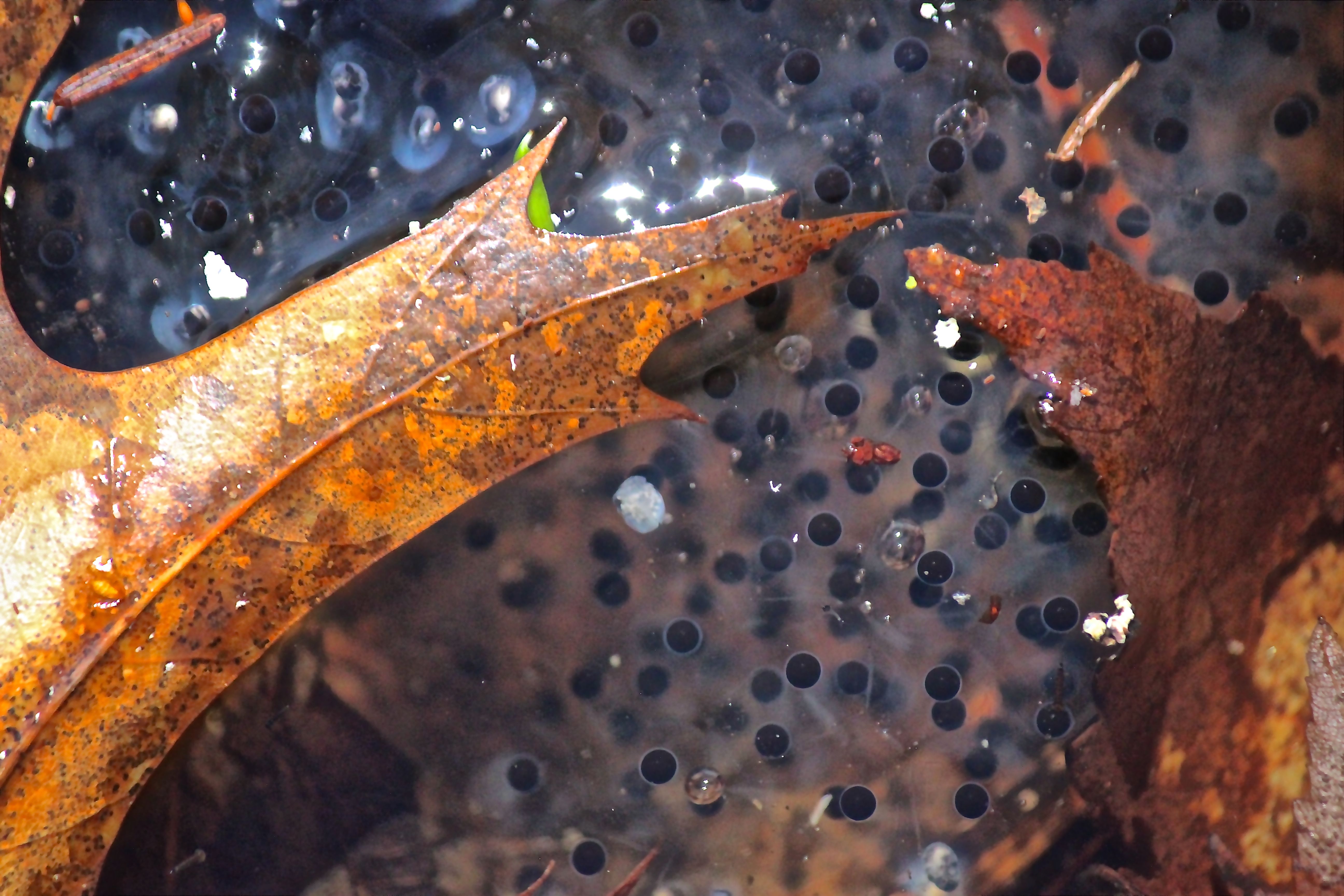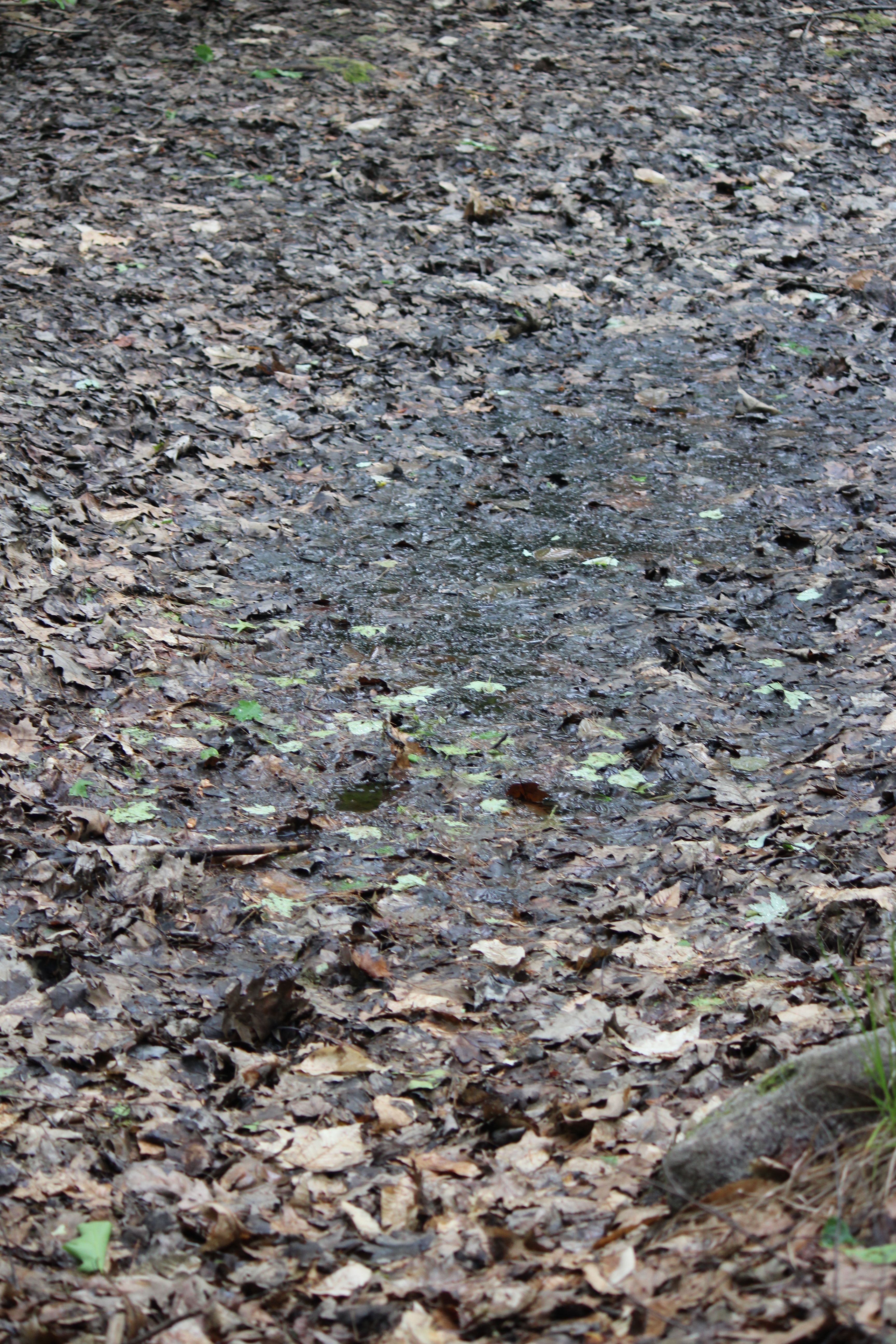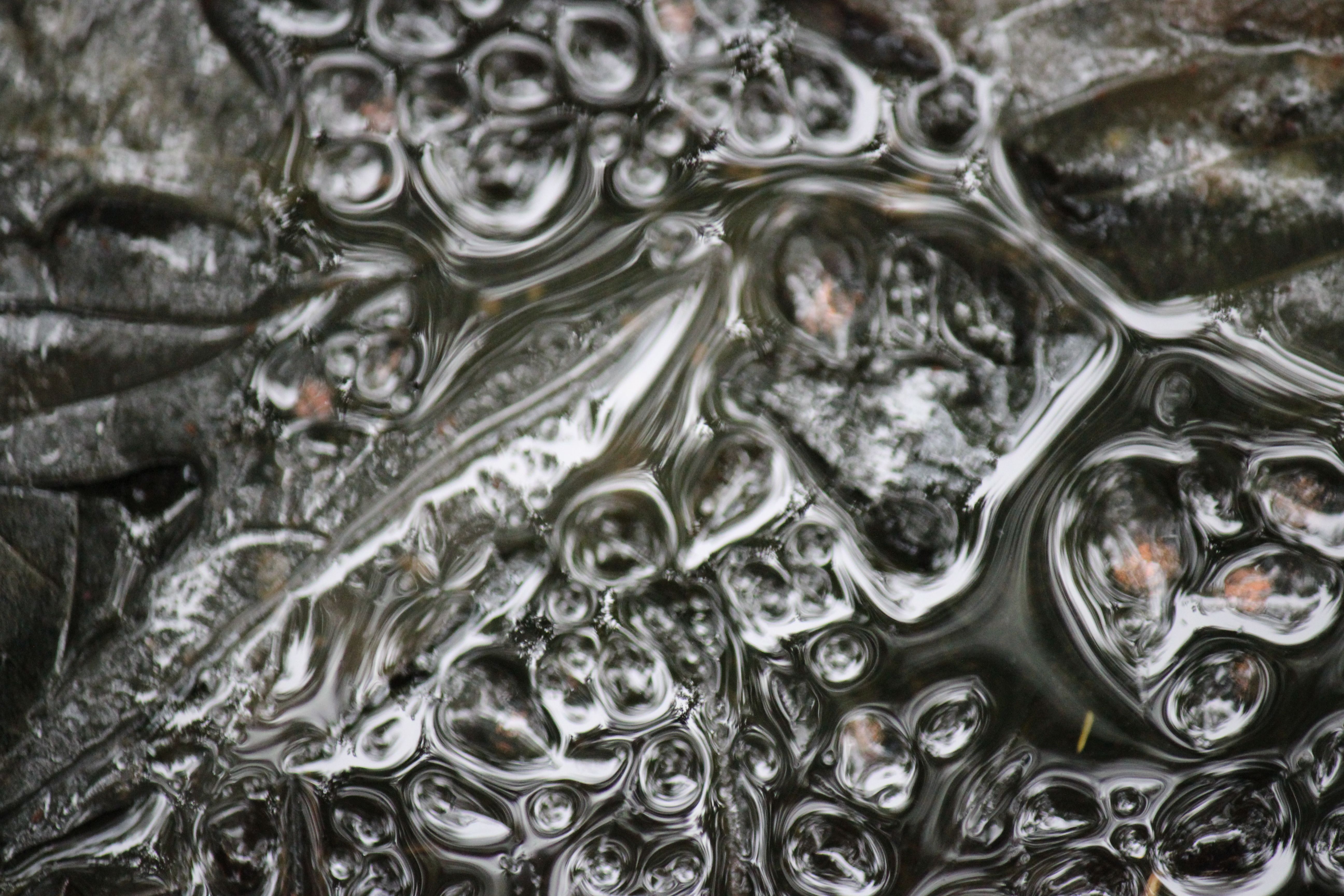
Vernal Pool 1: Oh Baby(ies)

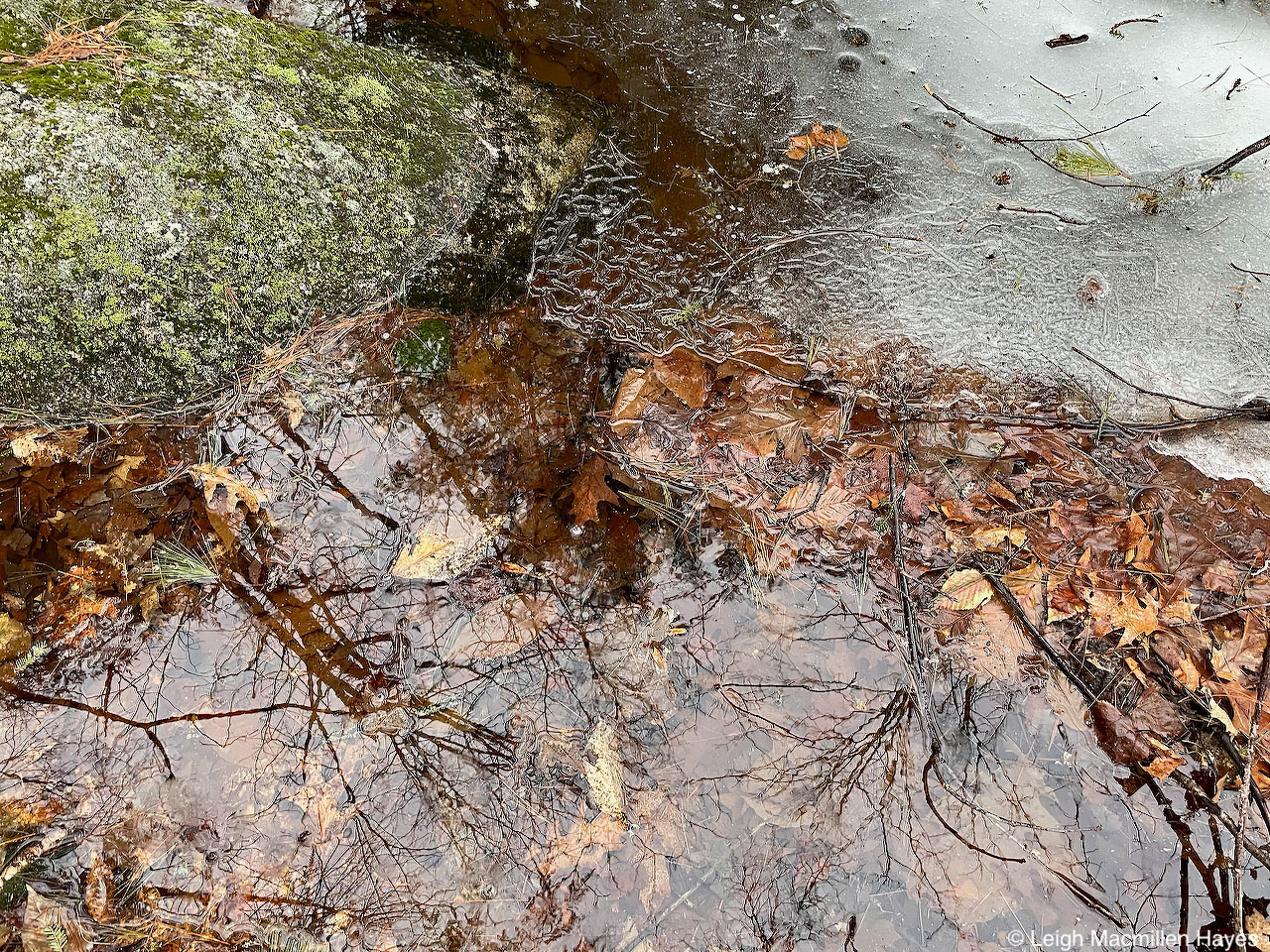
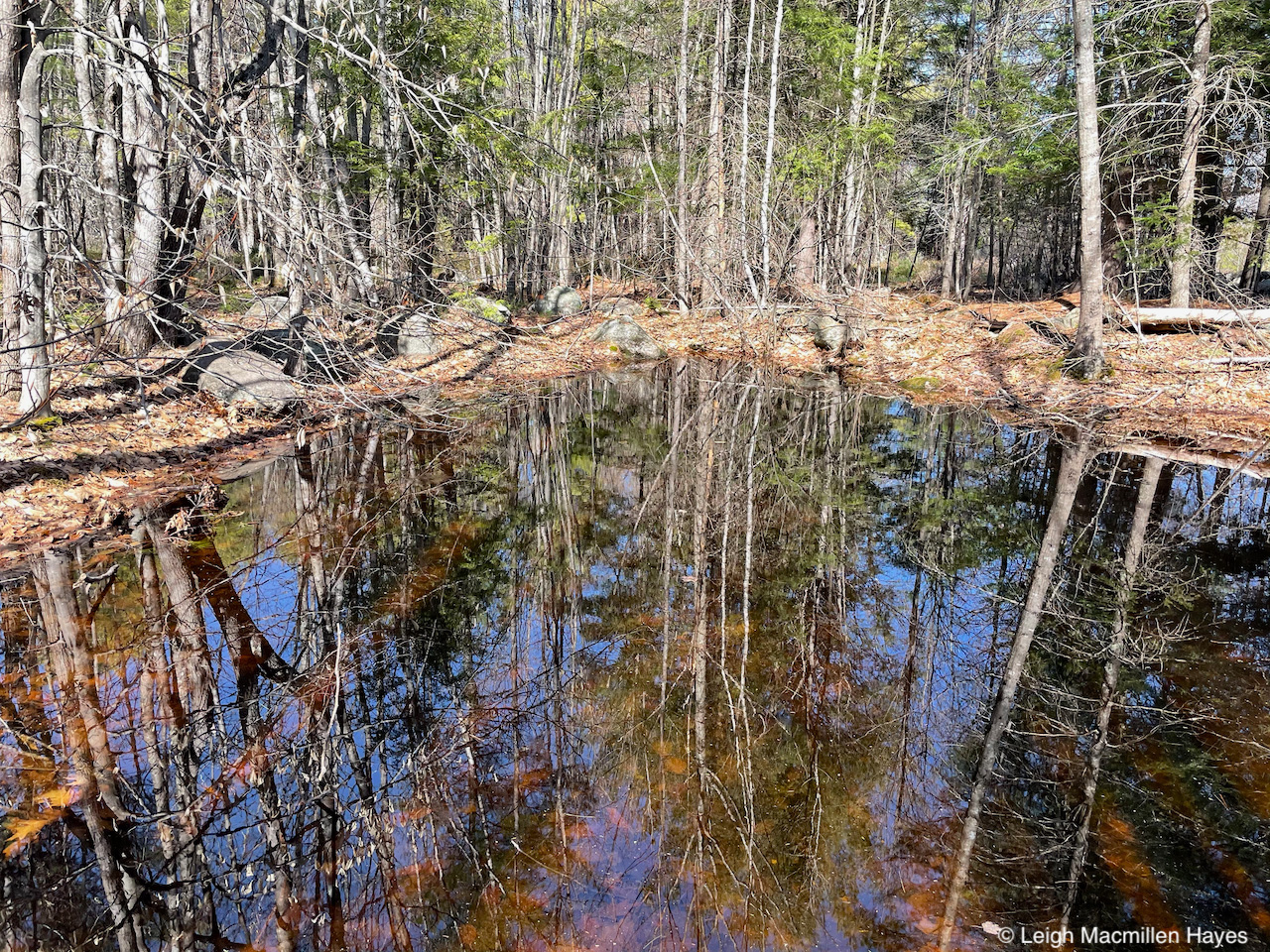
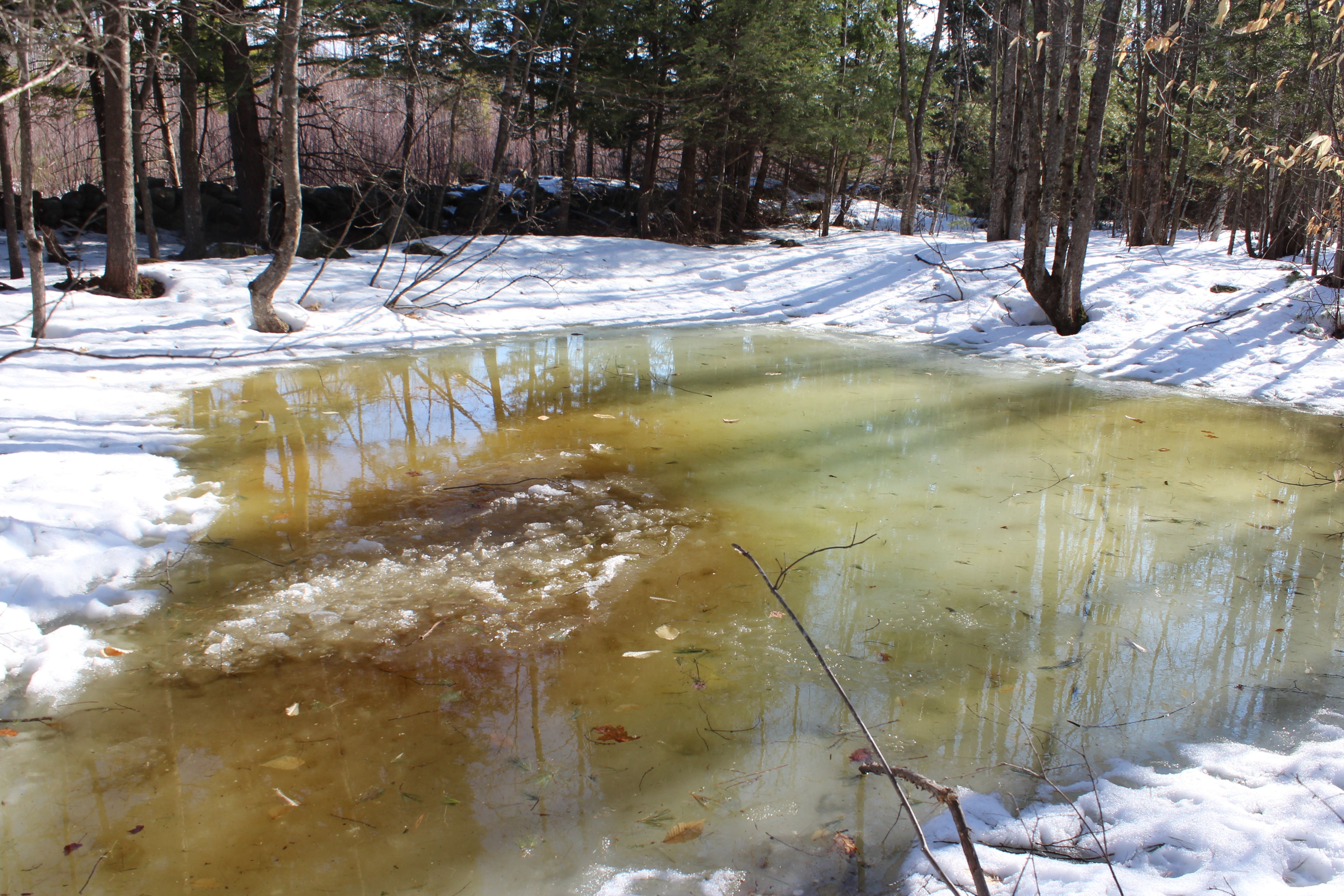
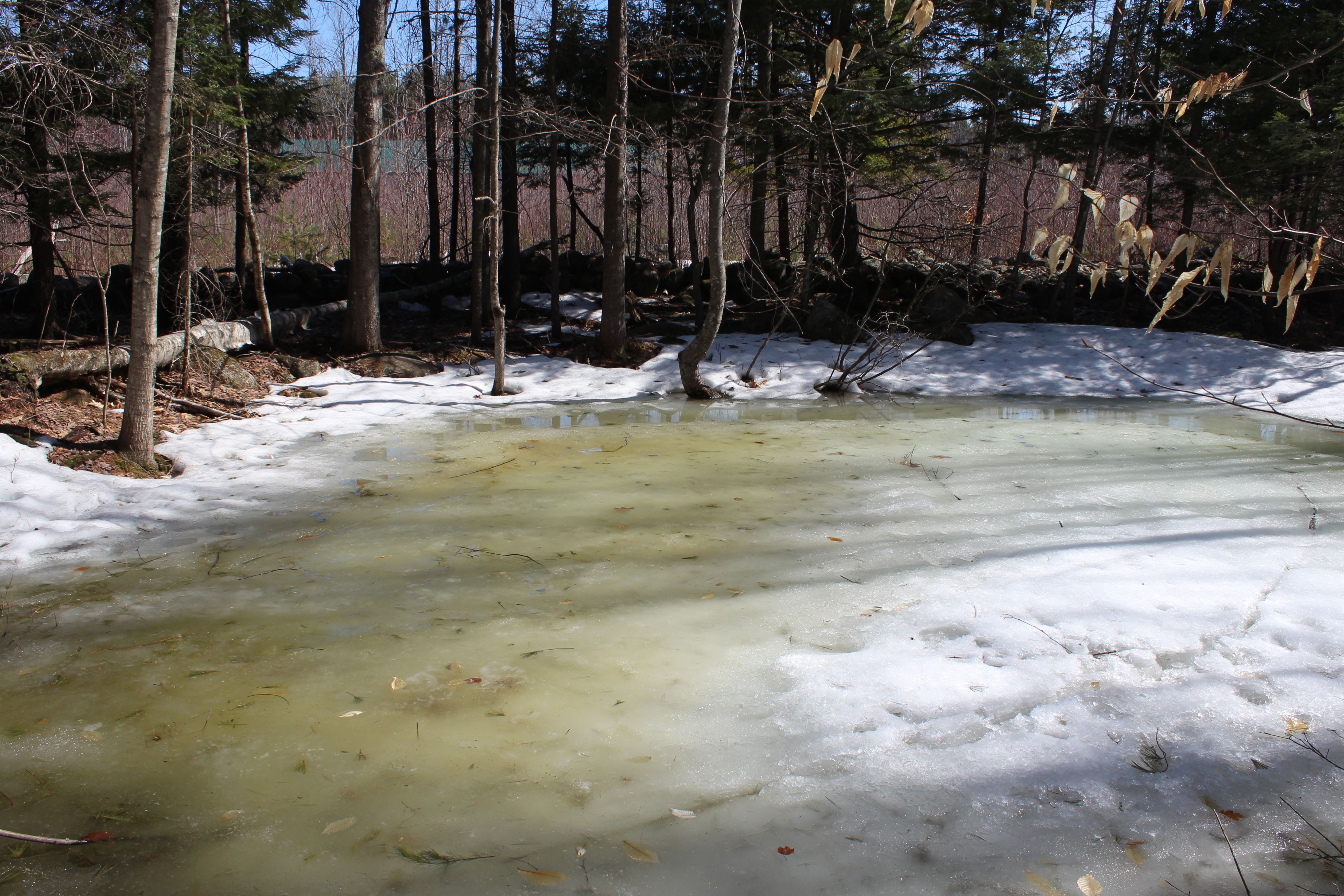
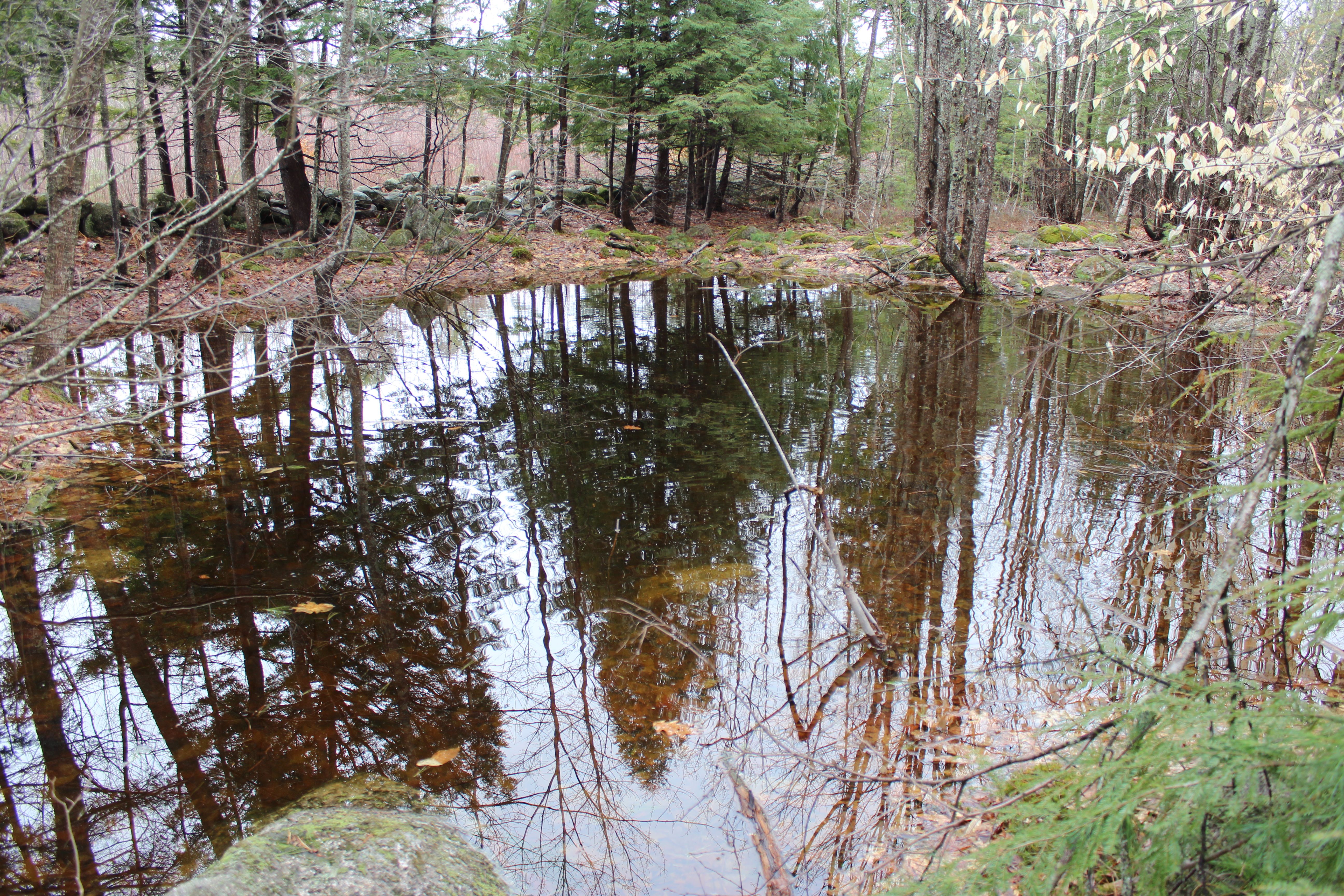
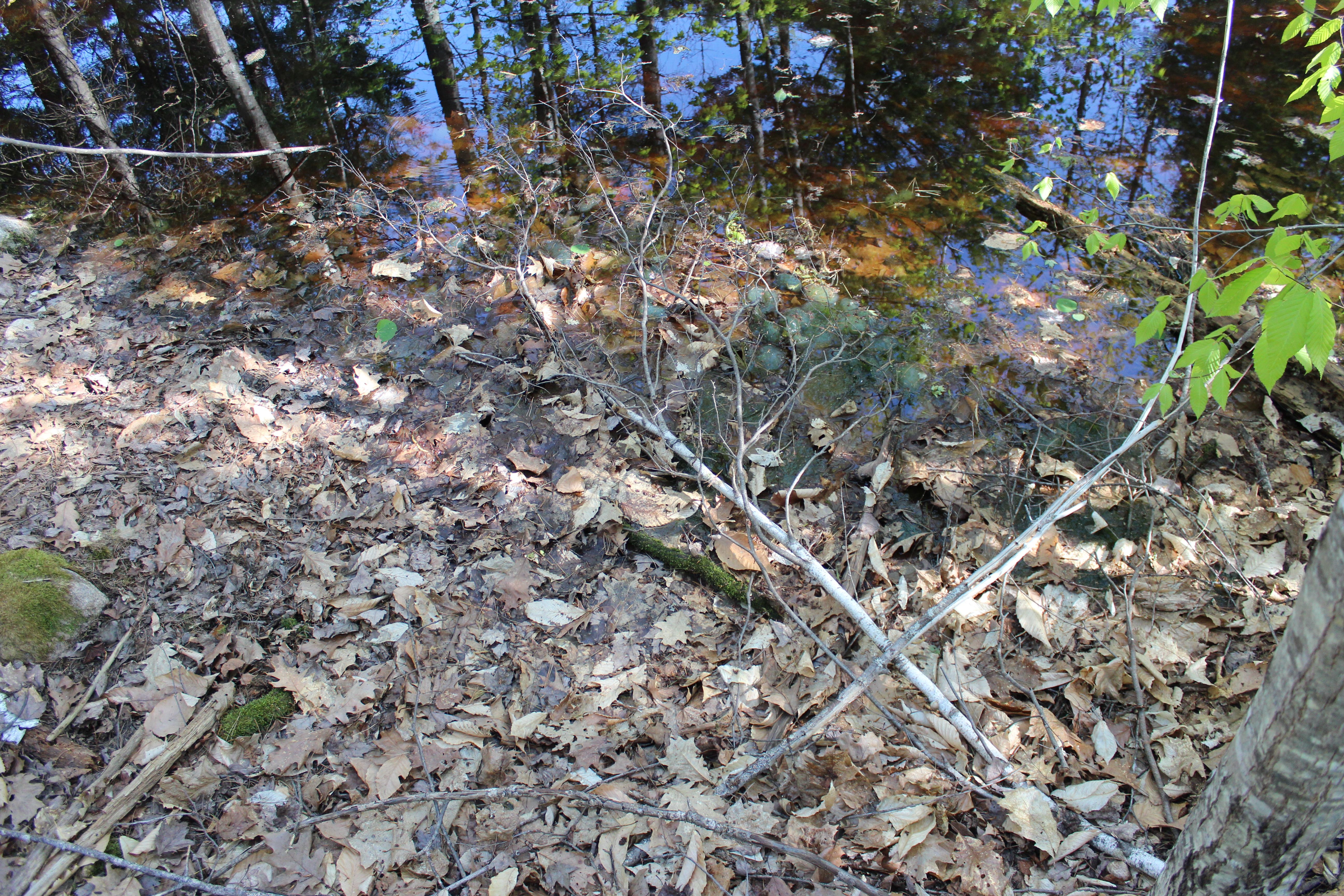
Once the snow and ice began to melt, I started making almost daily visits to “My” vernal pool, located about a quarter of a mile from our house, and only a hop, skip, and jump, well maybe a few hops, skips, and jumps, from the cowpath, and more importantly, on neighbors’ property.

I met the neighbors for the first time last November when I spotted them walking their dog through their woods as I looked for any insects on trees. They were breaking branches to create a sorta trail, and I encouraged them to walk the cowpath instead because it’s flat and I try to keep it cleared of downed branches.

It was upon our second encounter when they did actually use the cowpath (and have done so regularly since though our paths haven’t crossed in months) that I asked them if they knew about the vernal pool. They did not. The dog was a rescue and they’d only had her for a few months and she was the reason they were out walking in the woods.

Being my blunt self, I did ask that they not bring their dog to the vernal pool in the spring and explained about the Wood Frogs and Spotted Salamanders who use it as a breeding pond. Yeegads. But they didn’t take it to be rude, and instead told me that they think they have another vernal pool elsewhere on their land, closer to their house. Then they invited me to walk in their woods and explore anytime. Um, I thanked them and admitted that I’ve been doing that for years; I just don’t go close to the house.
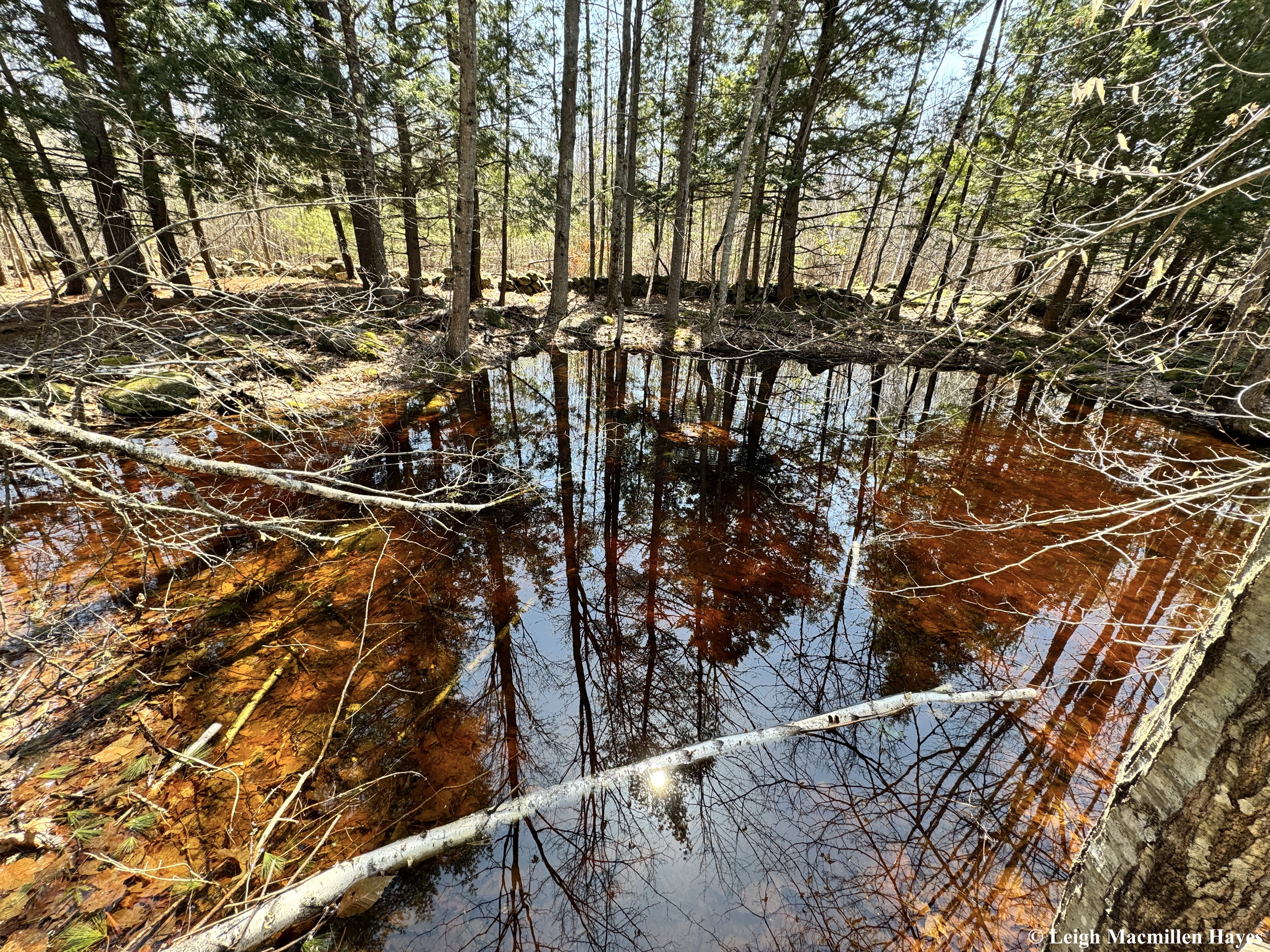
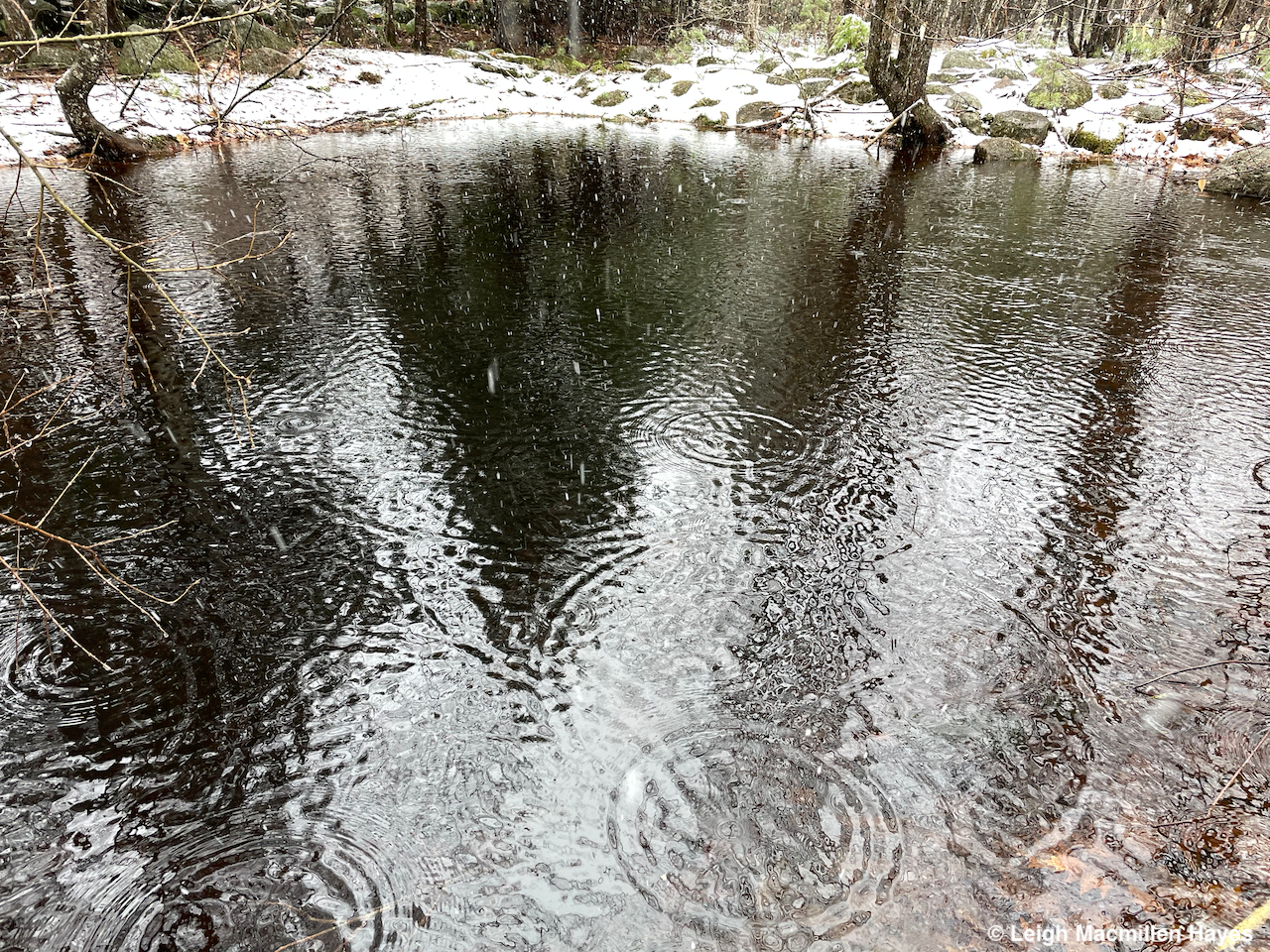
At last, about two weeks ago, the ice went out. But . . . there was no action. It was cold and seemed to snow every other day and the ground was still frozen and the breeders just weren’t ready. I waited.
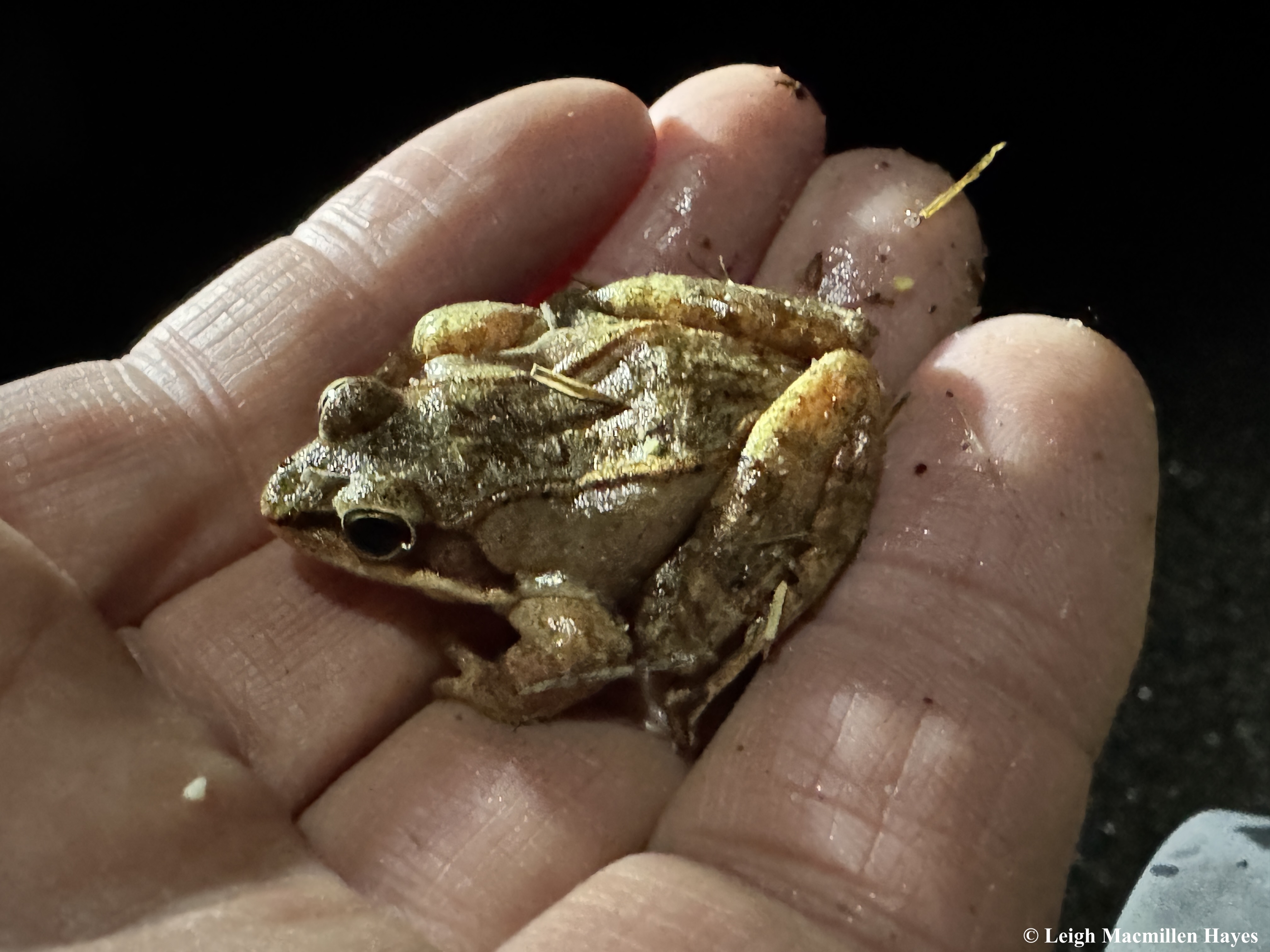
Finally, on Sunday, April 13, 2025, we had some rain, and our local Big Night celebration was announced via text and email messages. Big Night is that night(s) when it’s been raining in the afternoon and evening and the roads are wet, and volunteers head out to locations close to home to help amphibians cross the road without getting smooshed. Or help most of them.

We didn’t hear any Wood Frogs or Spring Peepers as we approached the pool of our attention that night (not “My” vernal pool, which is thankfully not near a road), so we weren’t sure if we’d see any action. And others south and east of us had been posting for a week that they’d only found one or two frogs during any given rain event. Still, we went. And were glad we did because we helped a total of 158 Wood Frogs (including the one pictured above) and Peepers that night. There were still a few smooshed, but as always, we reminded ourselves that they become food for other critters.
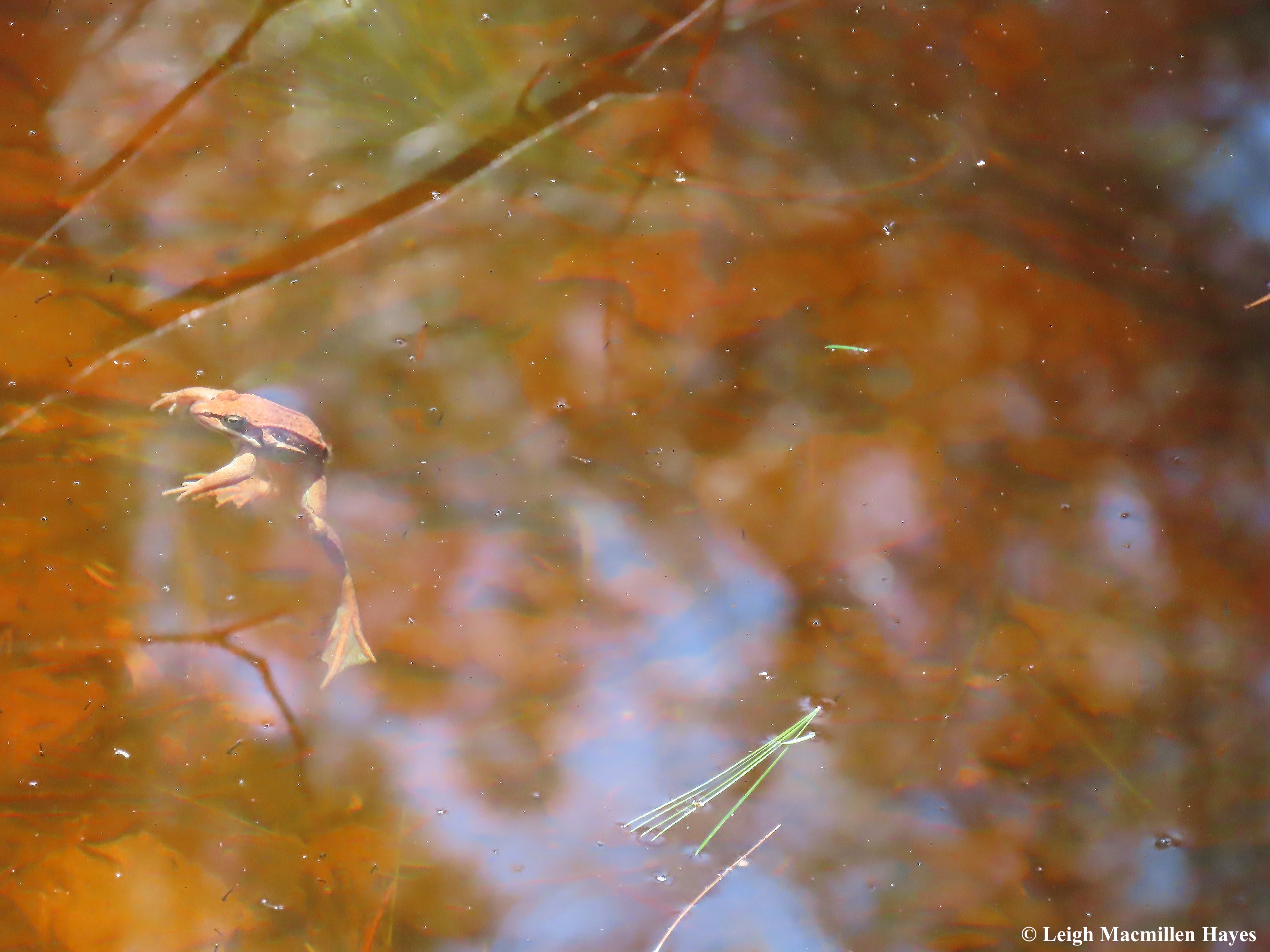
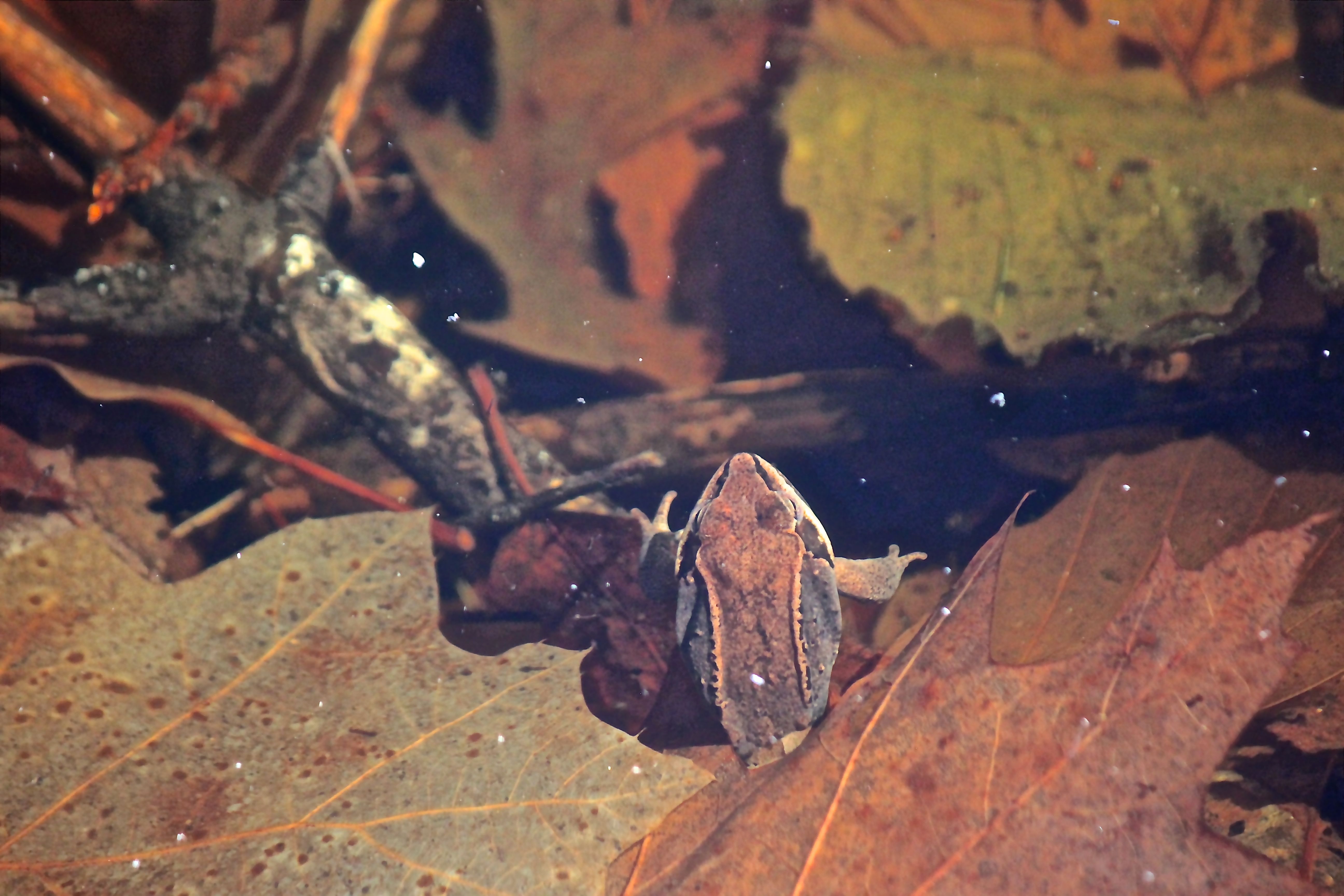
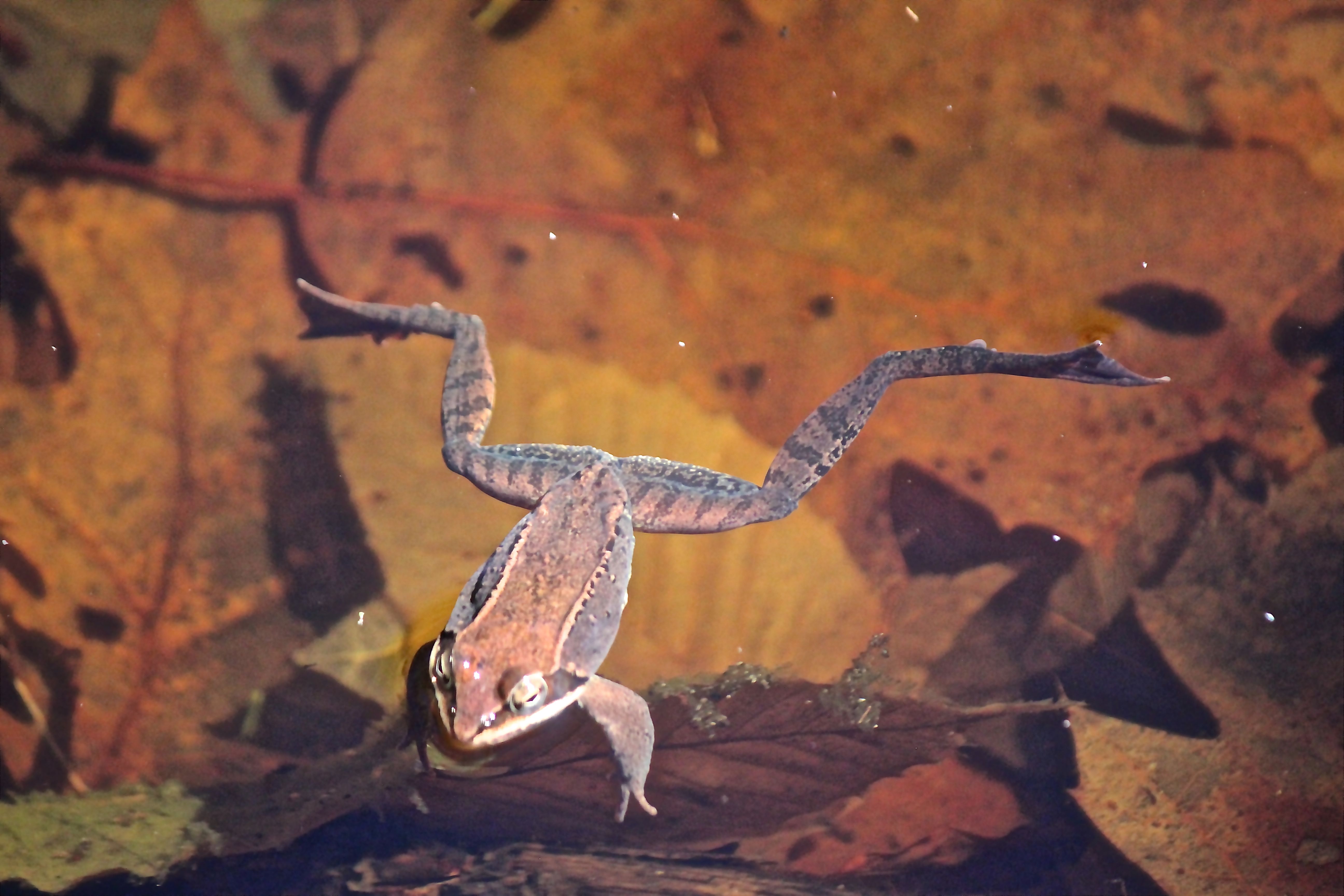
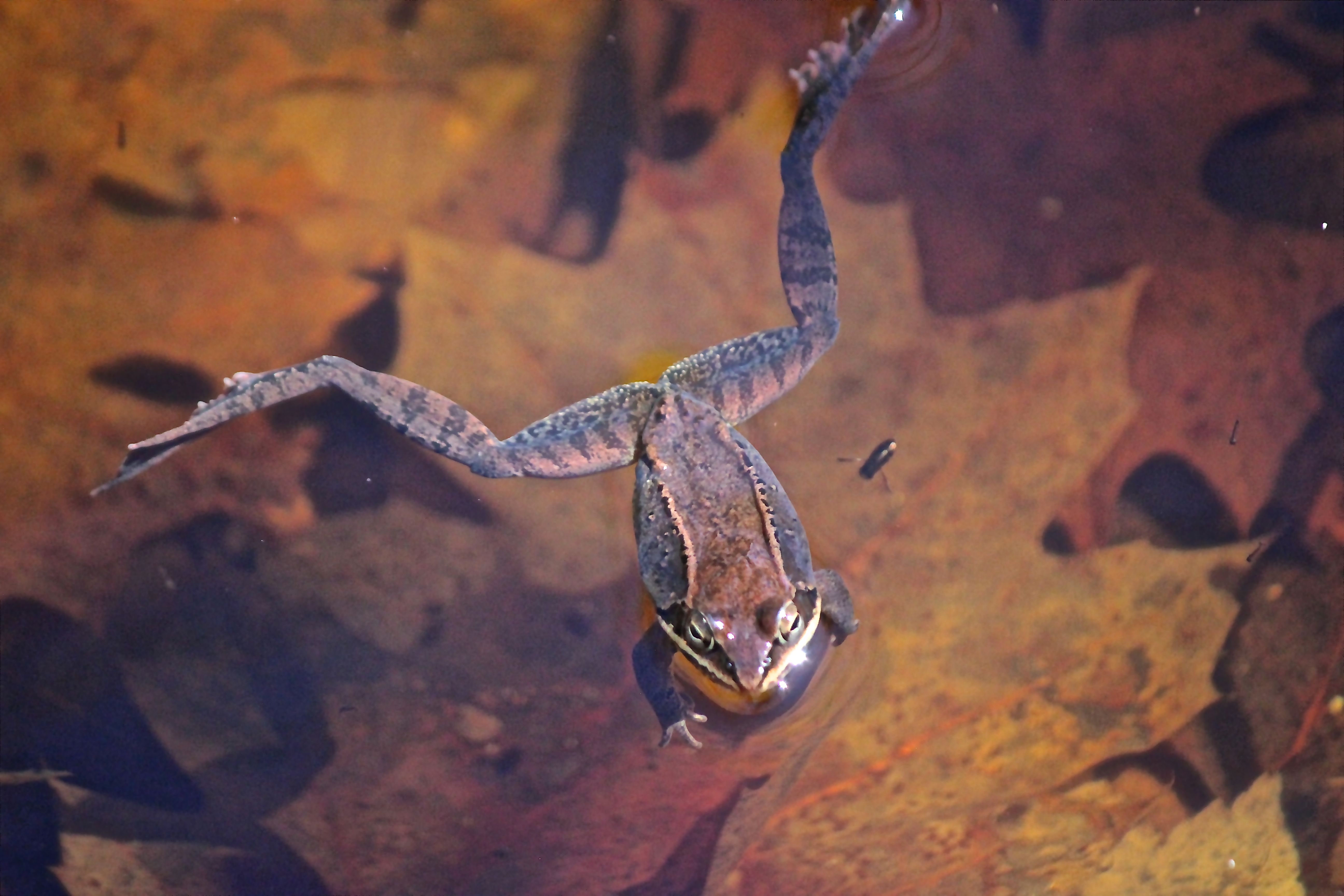
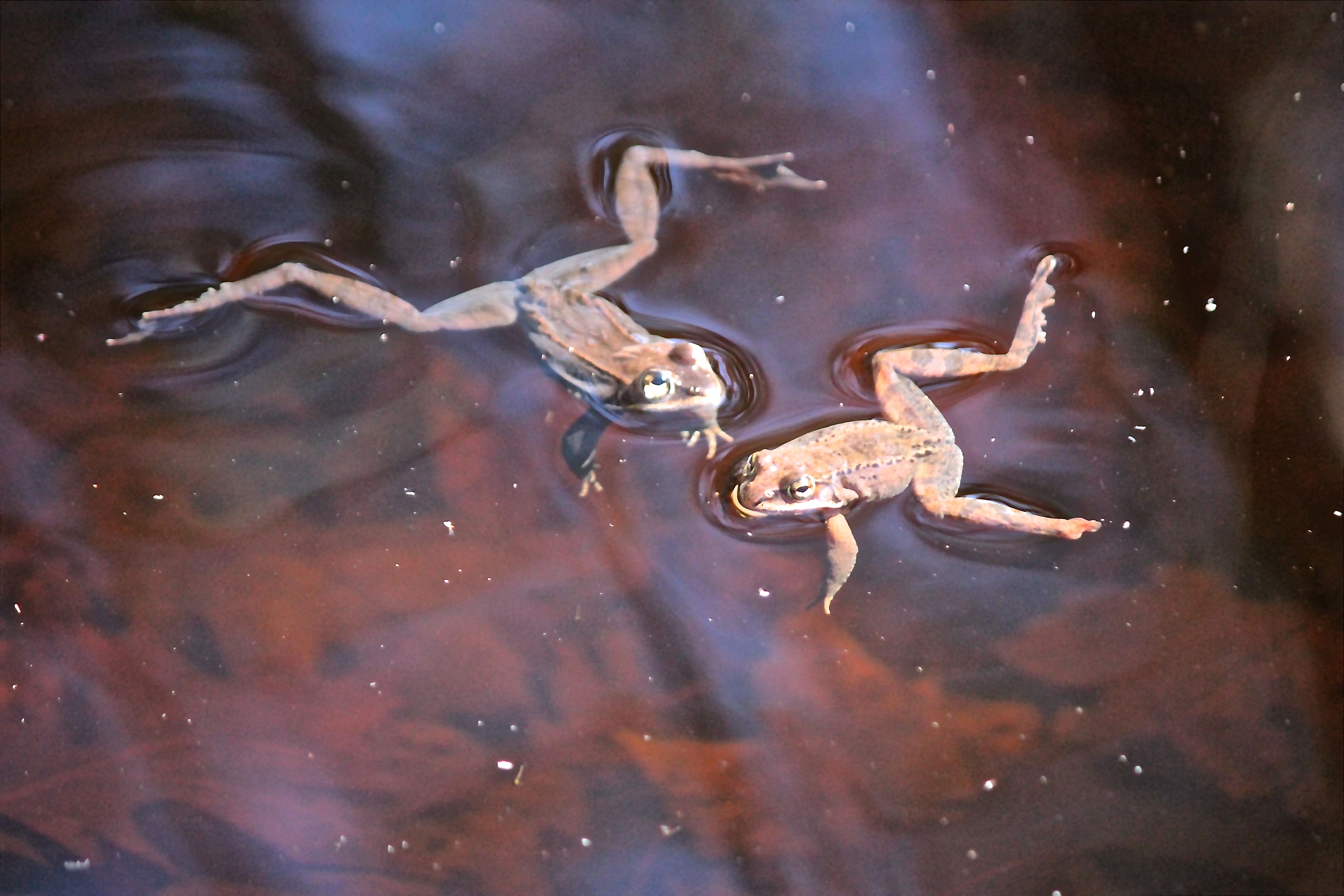
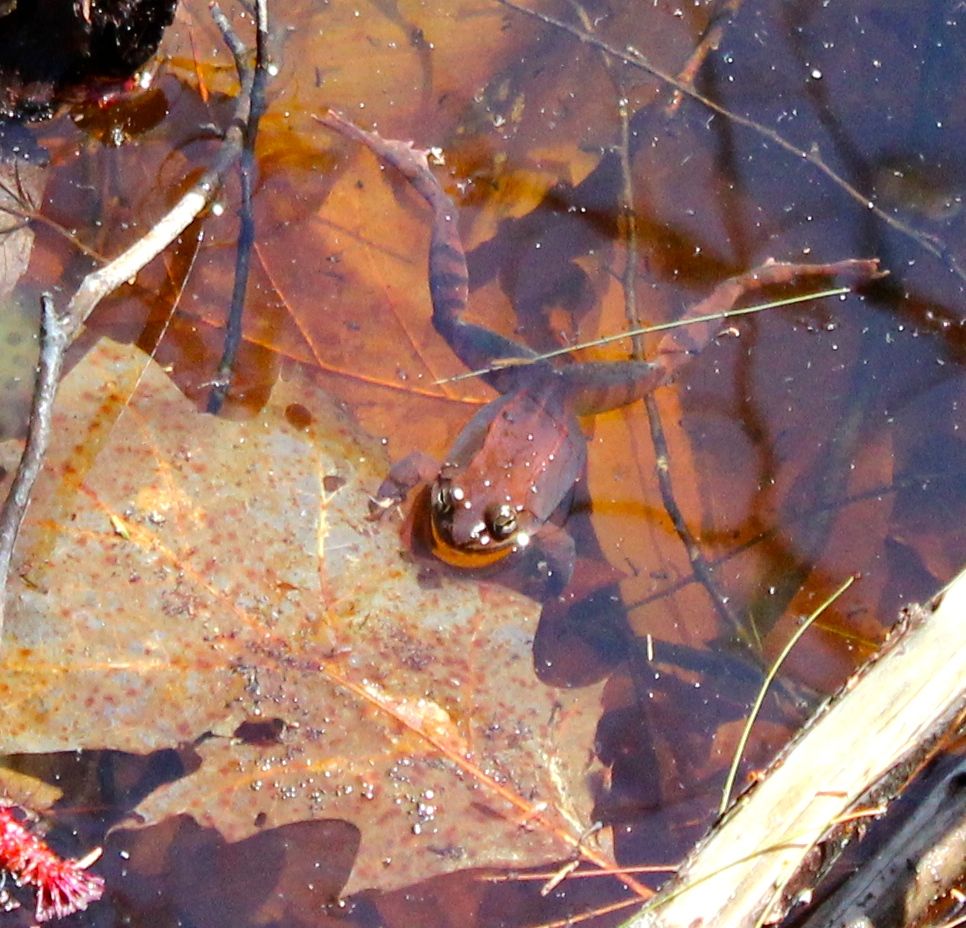
Given that success, the next afternoon I visited “My” pool and heard not a peep upon my approach. But I did what I do, and stood as still as possible upon a rock at the edge, and within a few minutes this male Wood Frog surfaced.
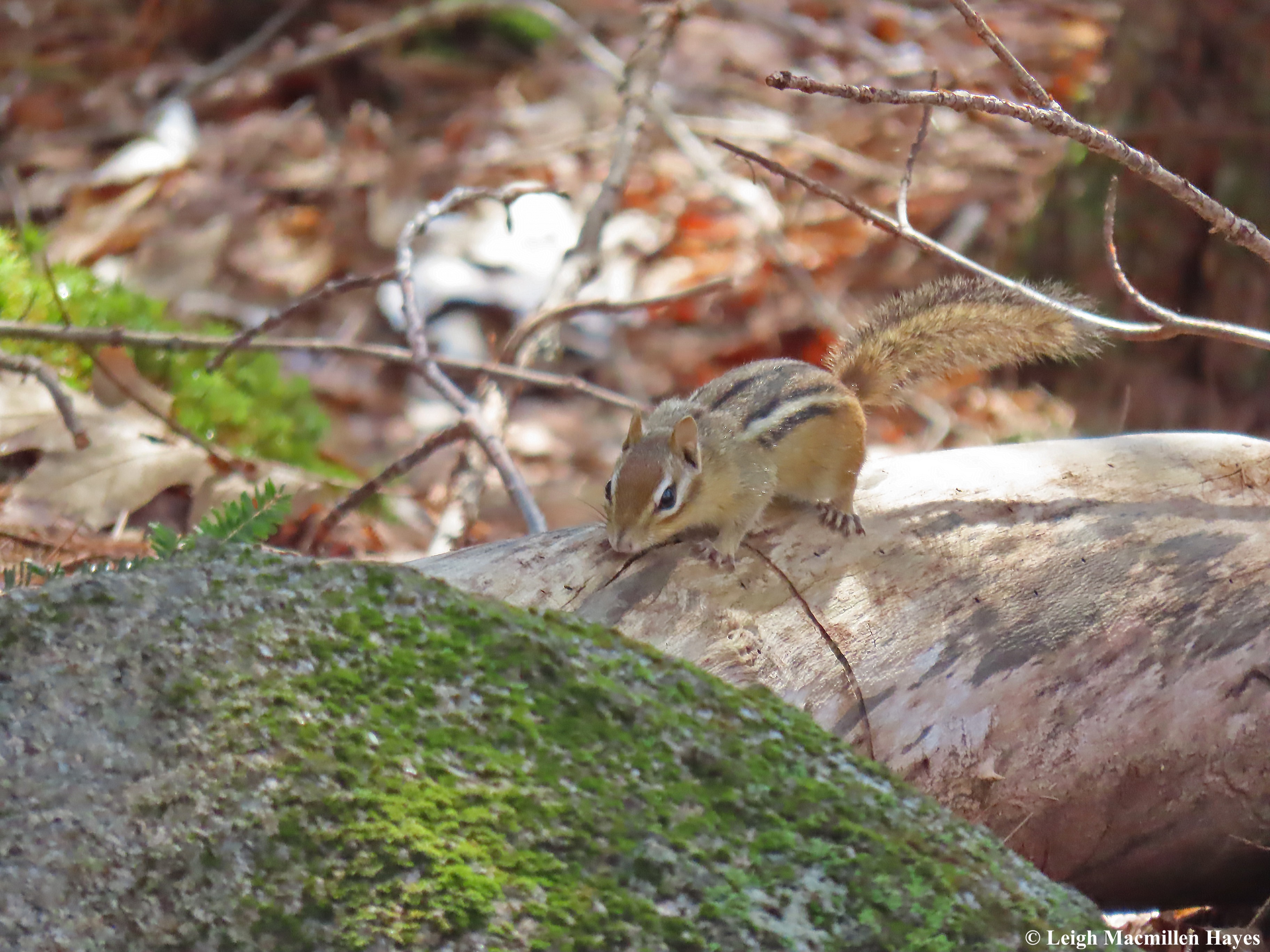
And I decided that this year I am going to try to be more present at the pool and try to get to know all who venture in and around it, including Chippy, on an eternal search for seeds to stuff into his cheeks.

Mid-morning Tuesday found me making my way to the pool again and this time, I could hear the “Wruck, Wruck” calls of the male Wood Frogs as I approached. Spring has finally sprung. Oh, and the crocuses have finally bloomed. Beaked Hazelnuts with their tiny yet exquisite magenta flowers as well.

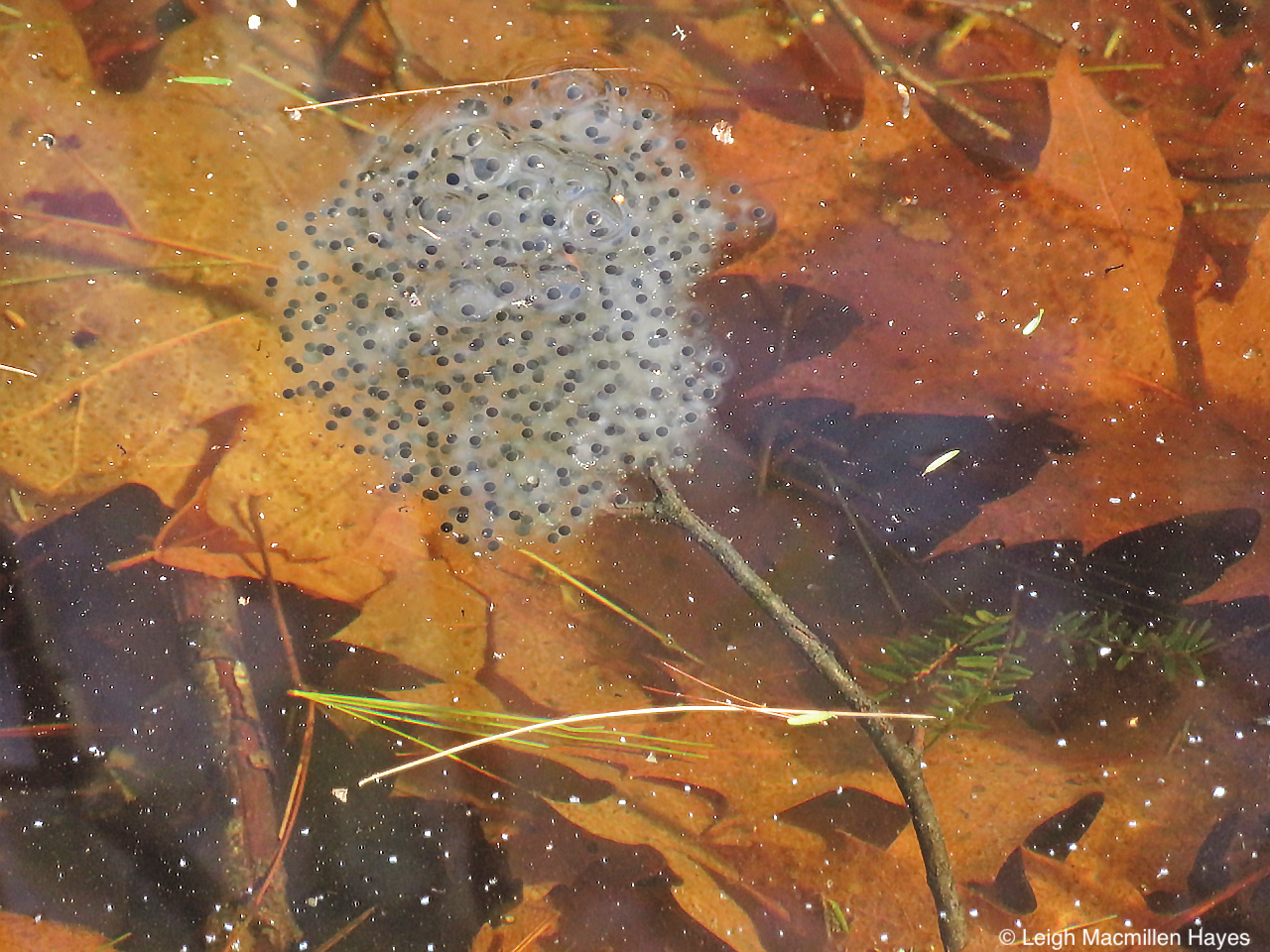
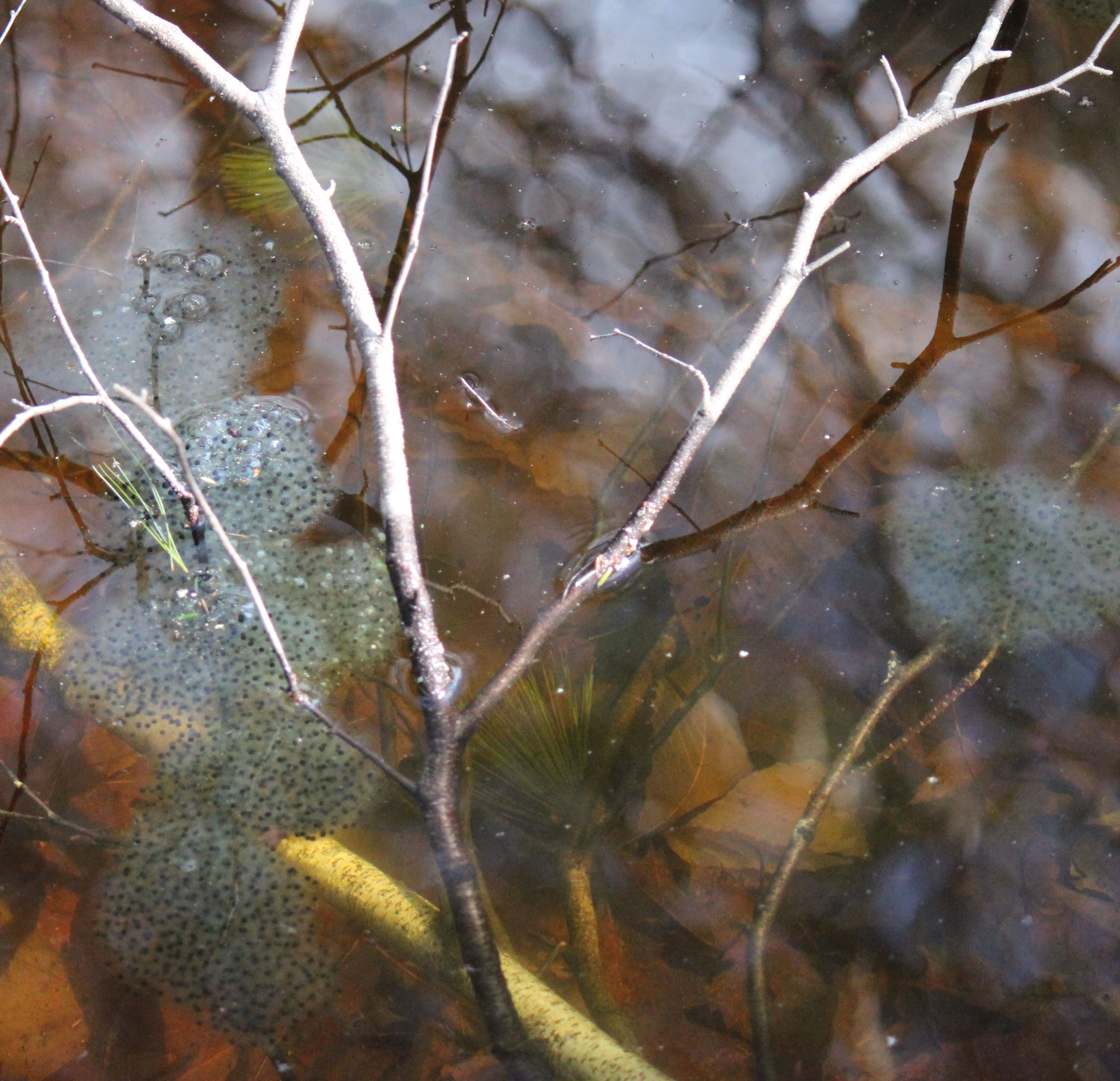
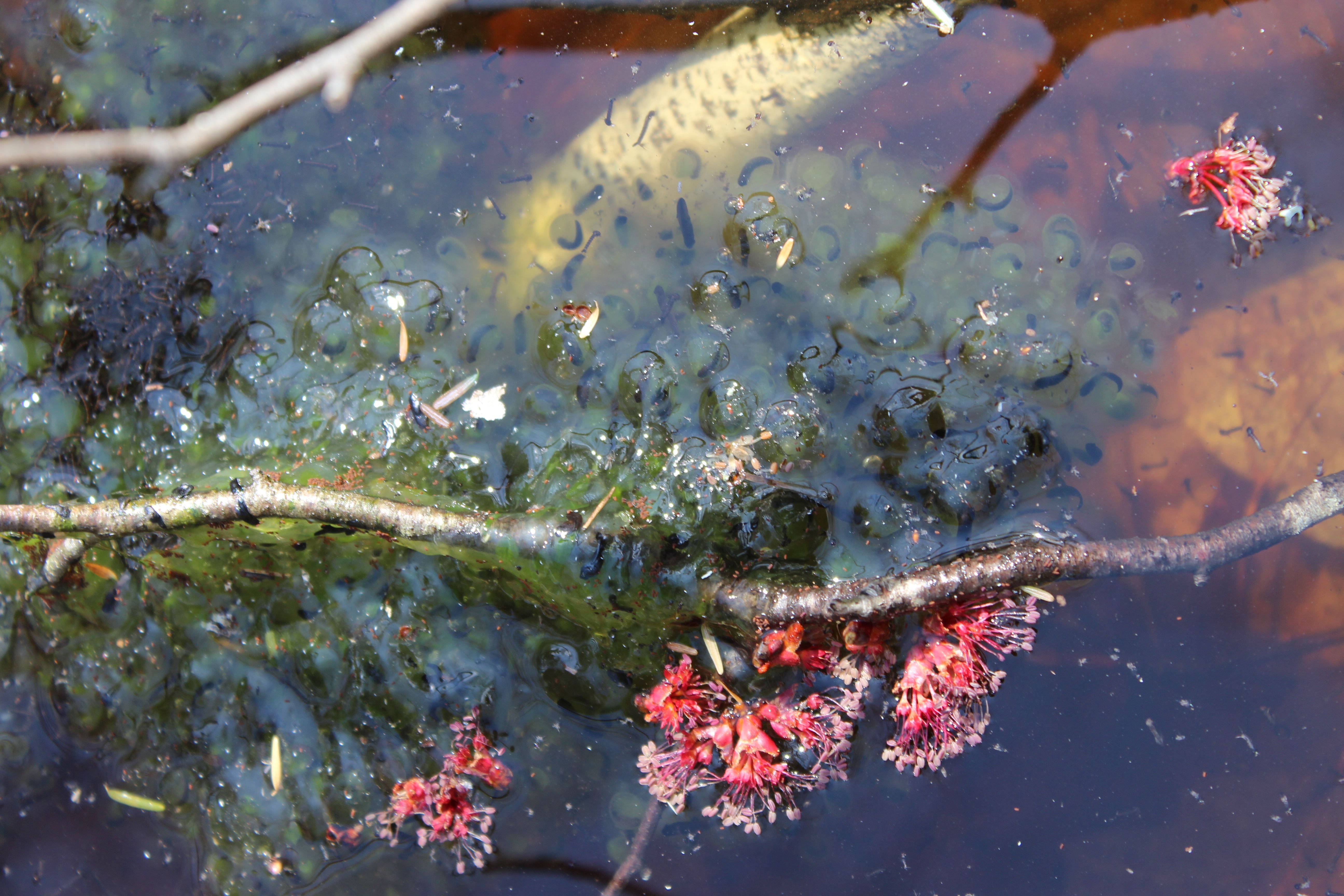
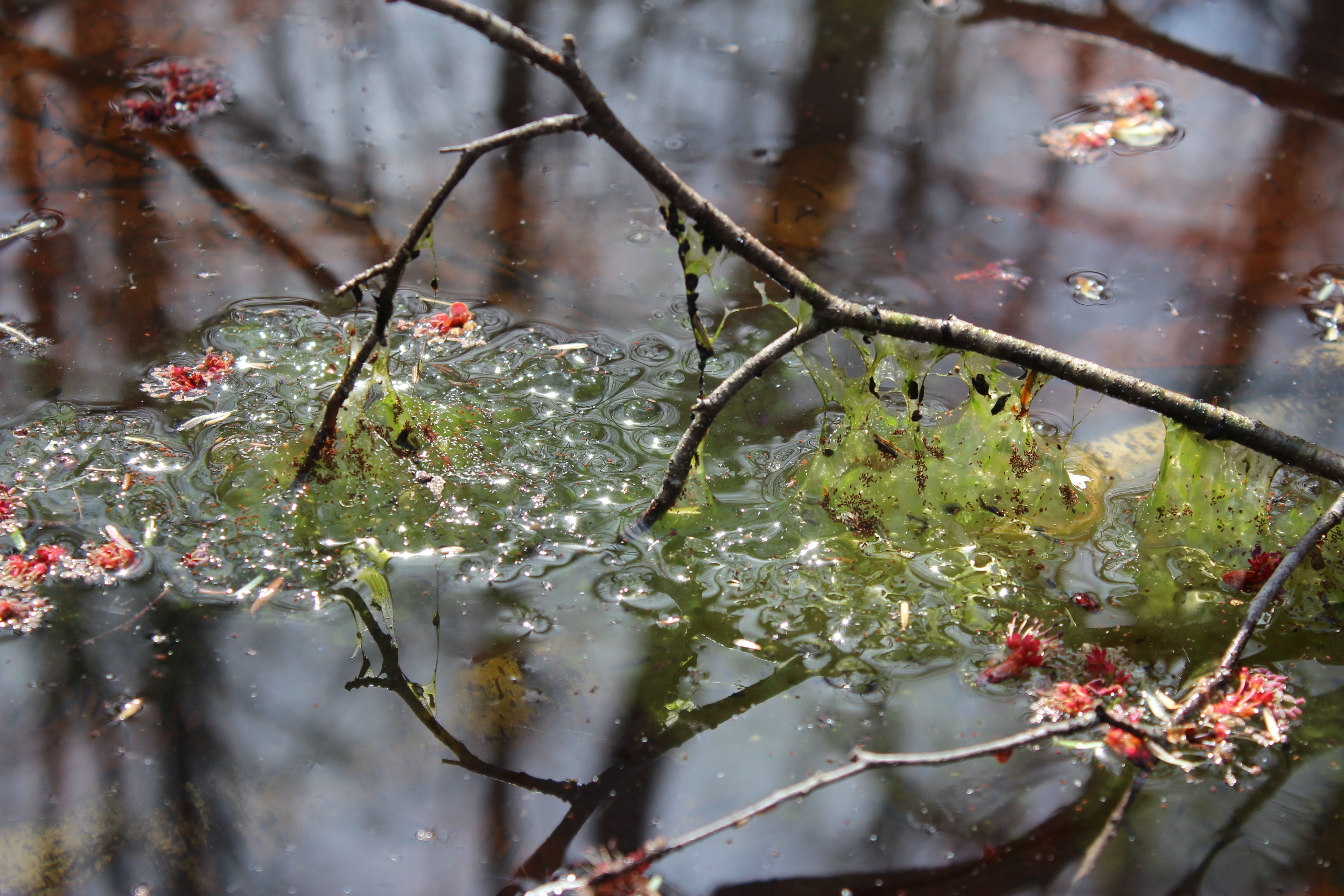
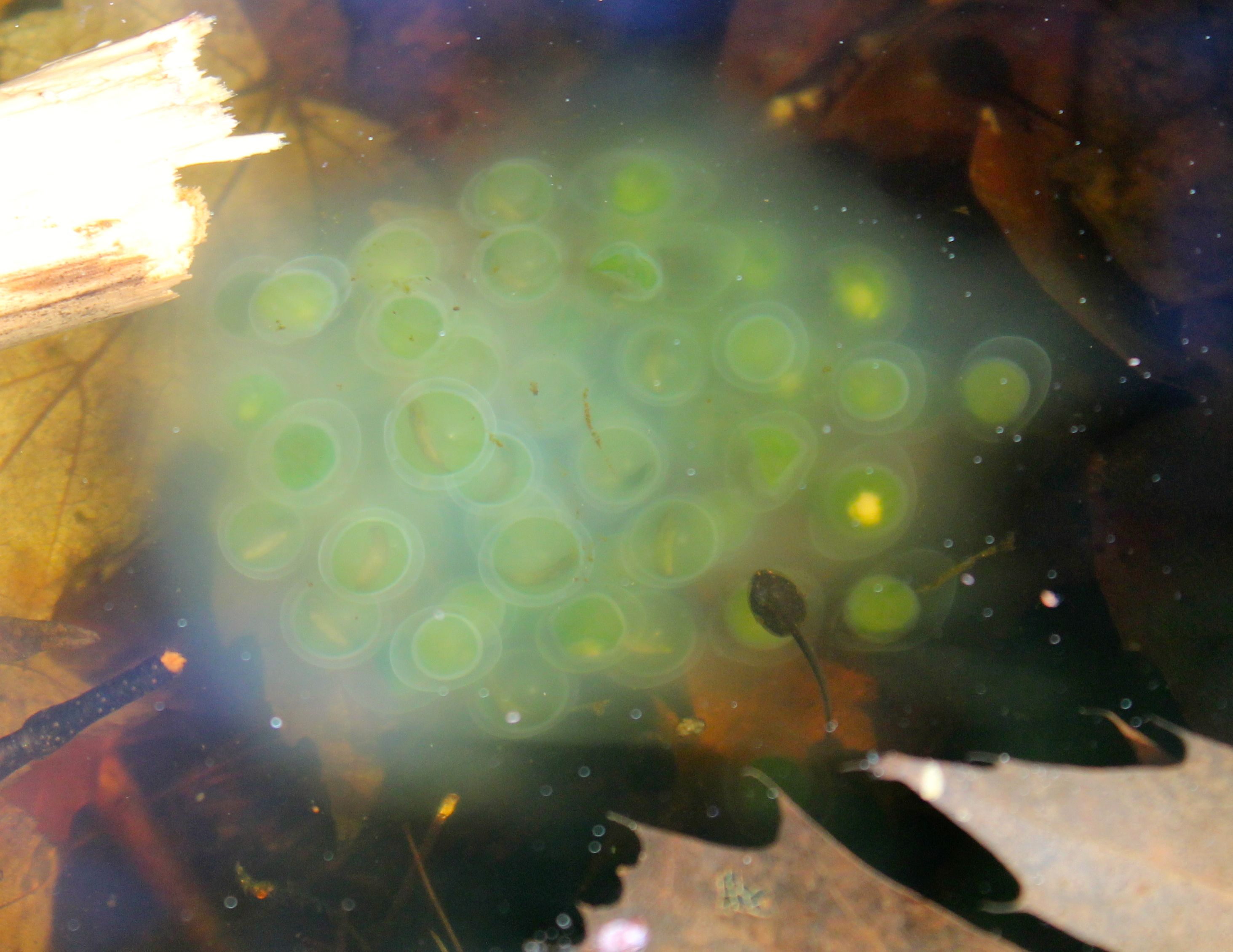
And then, my first peek into the pool, and there it was, a Wood Frog egg mass about the size of a wiffle ball and I wondered if it had been there on Monday and I just hadn’t seen it.

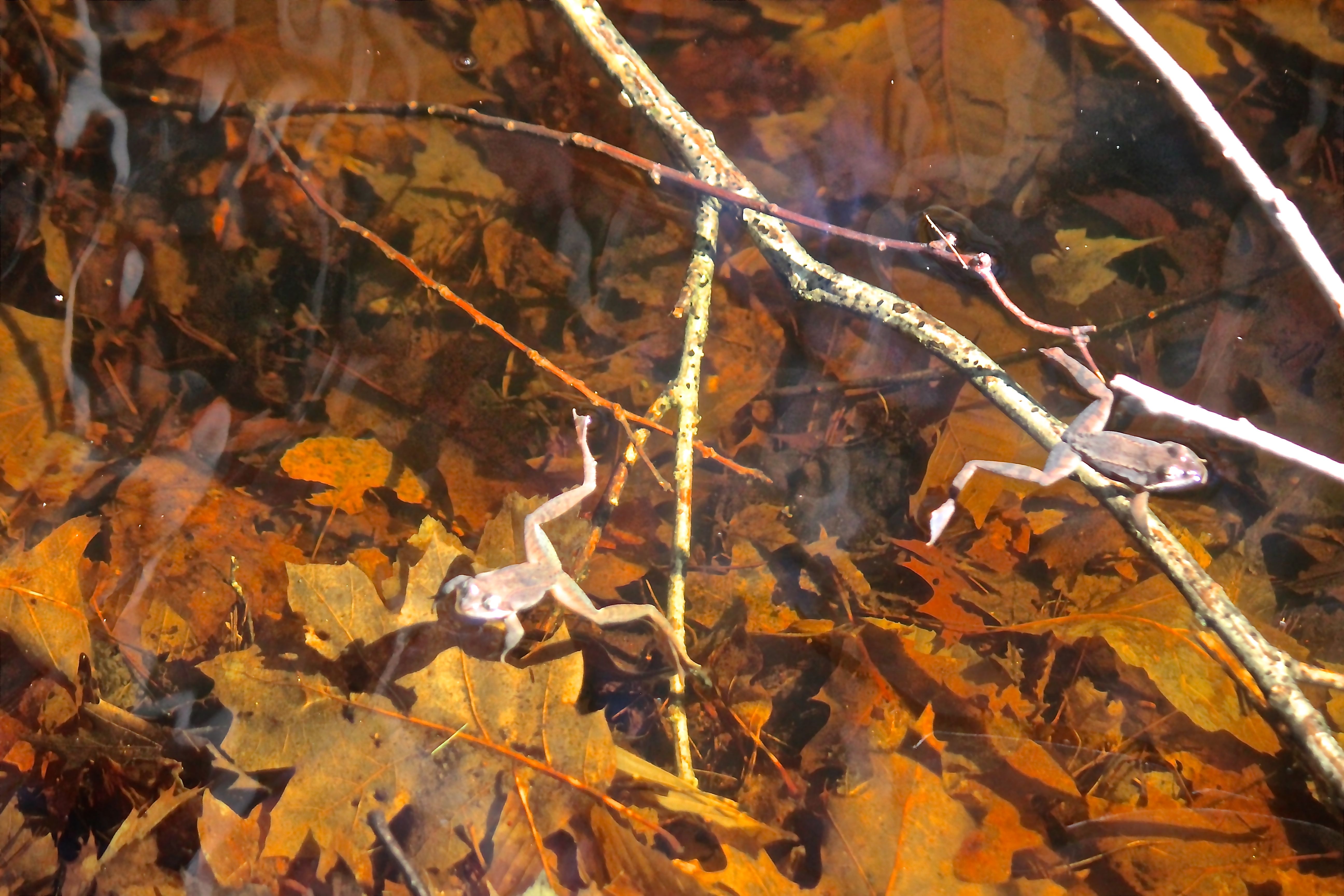
As always, I stood still, and as always, it took the frogs a few minutes to surface, but suddenly they were everywhere, and probably wishing, if frogs can do such a thing, that I would leave so they could begin their mating chorus again.

But I stayed. And wondered. Why is it that a Gray Squirrel, like the Chipmunk, can scamper about and rustle the leaves and make all kinds of noise and the frogs continue to float upon the surface, but the minute I flinch, they dive to the bottom and hide under leaves for minutes on end?
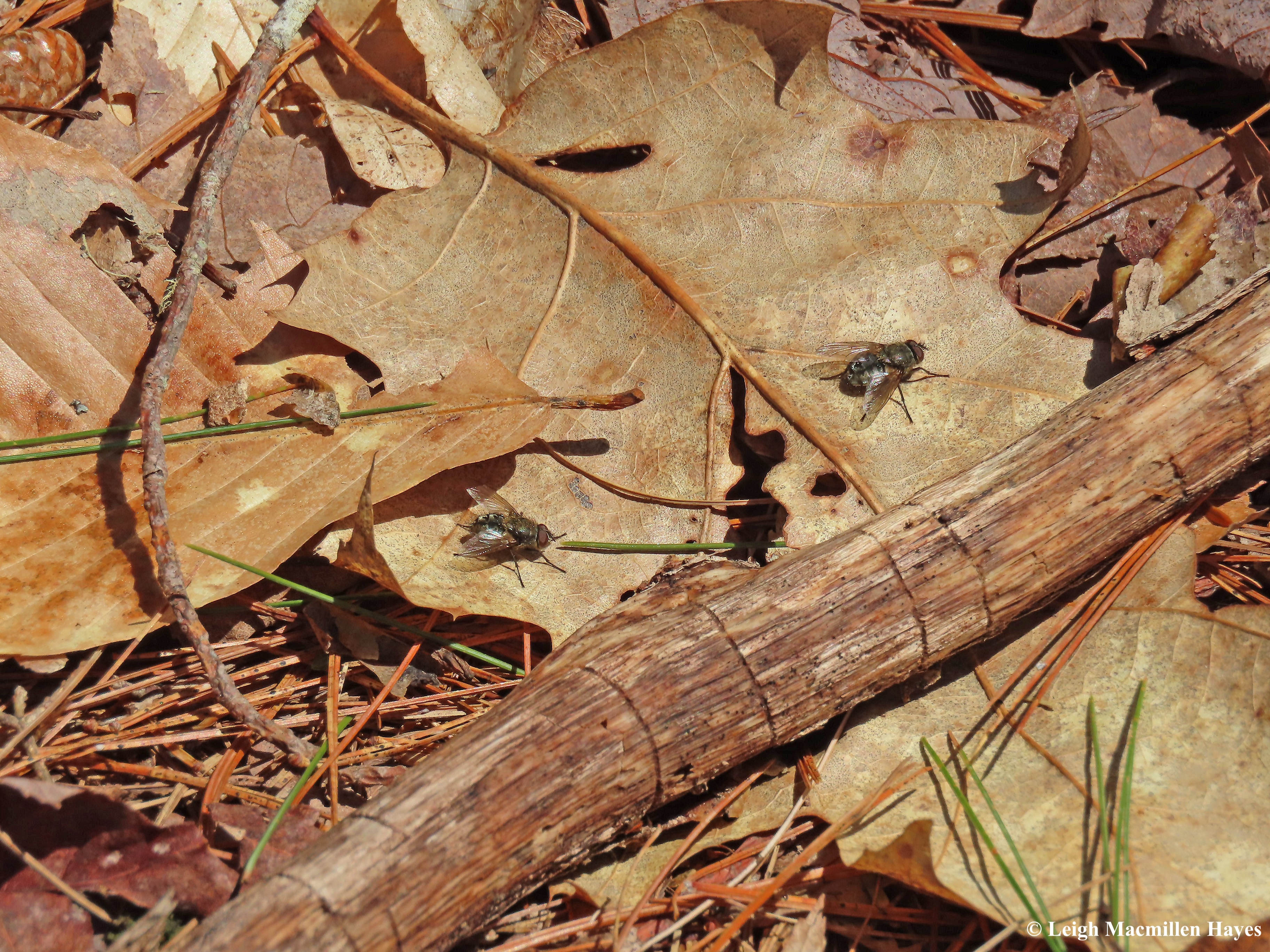
I did decide to change positions after a bit of enjoying the sight of so many frogs, because I wanted to see if there were any egg masses at the western end of the pool, but discovered none.

I did spy a bunch of Cluster Flies by the edge of the water.

And in the water, I watched Mosquitoes larvae wiggle about and a Predaceous Diving Beetle lift its butt to the surface to fill the air bubble located under its wings or elytra.

And then the Beetle surprised me and after swimming under the small log, it climbed onto it and gave me a whole different perspective for I never think about them as fliers, but they have strong wings and can do such, especially if the pool they are in dries up and they need to get to another pool. Apparently they are also attracted to lights, another reason not to keep outdoor lights on all night.

My morning visit came to an end when the frog nearest to me dove down and hid under the leaf cover. Well, sorta hid. Do you see it?
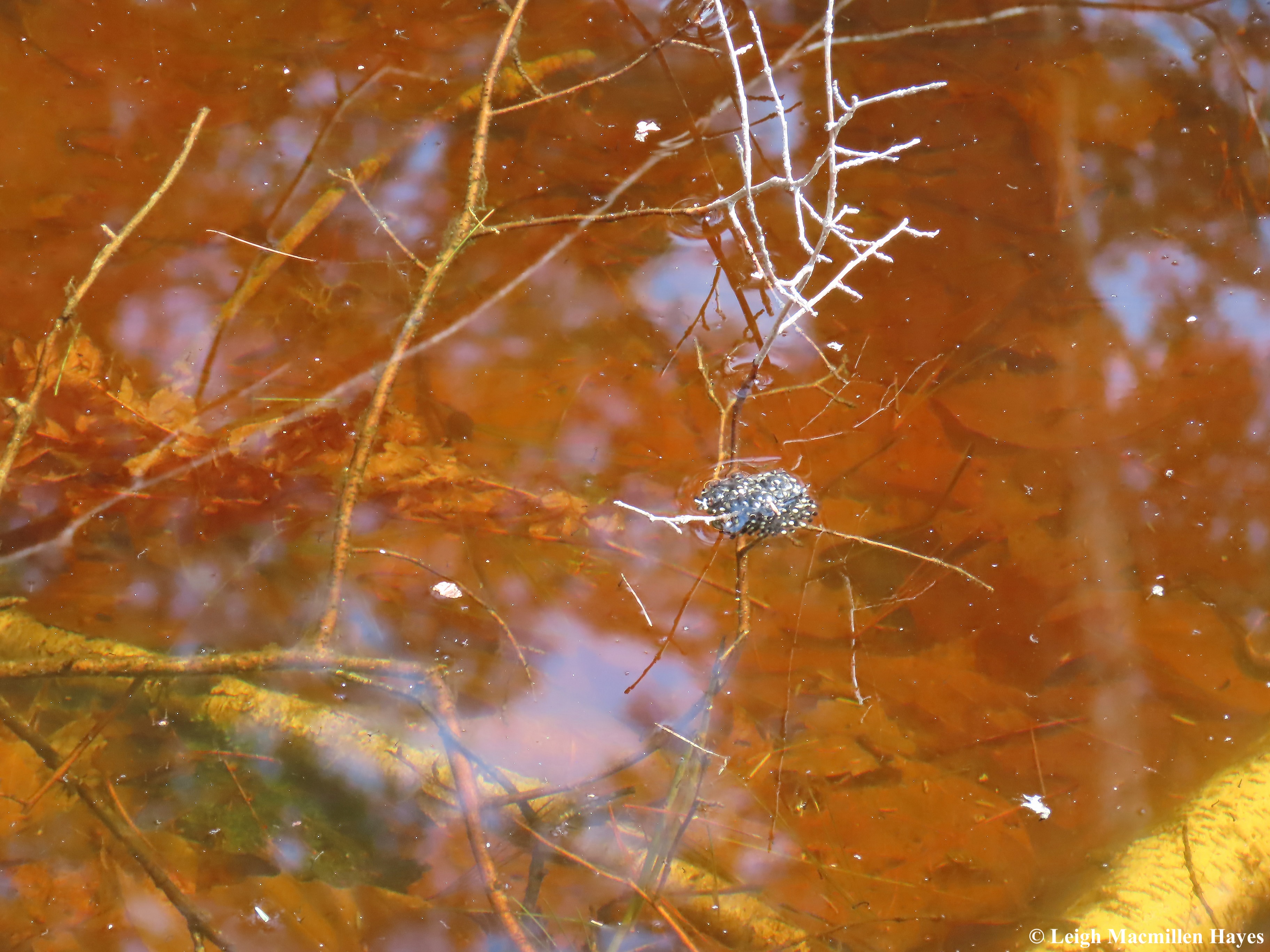
I was so taken with the pool, that I returned again in the afternoon. And this time I spotted something I’d missed in the morning. A more recently deposited egg mass. I suspect it had been there for at least a few hours because it was already bigger than a quarter, which is the size they are at first.
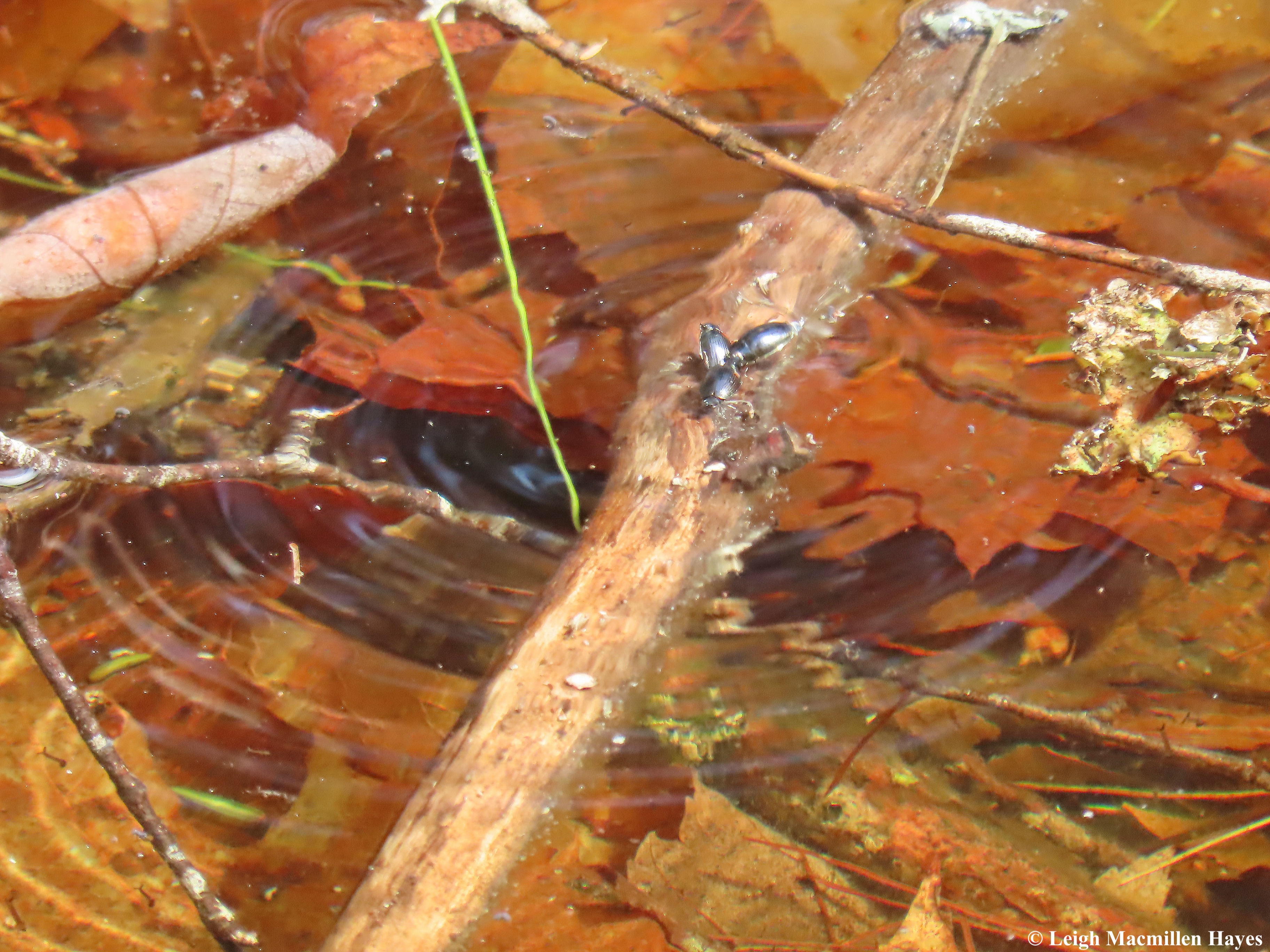
During this visit, I also spotted Whirligig Beetles gyrating around each other in breakneck speed, creating ripples everywhere.

And male Wood Frogs ever on the look out for a date.

In fact, so anxious were they that sometimes one male tried to grasp another, but the one underneath quickly squealed and swam away.

Then I spotted another old friend or its relative and wondered if the Long-jawed Orb Weaver that had created a perfect web between branches over the water was one that I’d photographed on the snow this past winter. Probably not. But a woman can dream.

Later in the afternoon on Tuesday it began to rain and while the storm didn’t last too long, it was enough to wet the roads and again the word went out for Big Night #2. This time there were a few Spotted Salamanders on the move as well.

The next photo may disturb you, so you may want to skip over it.
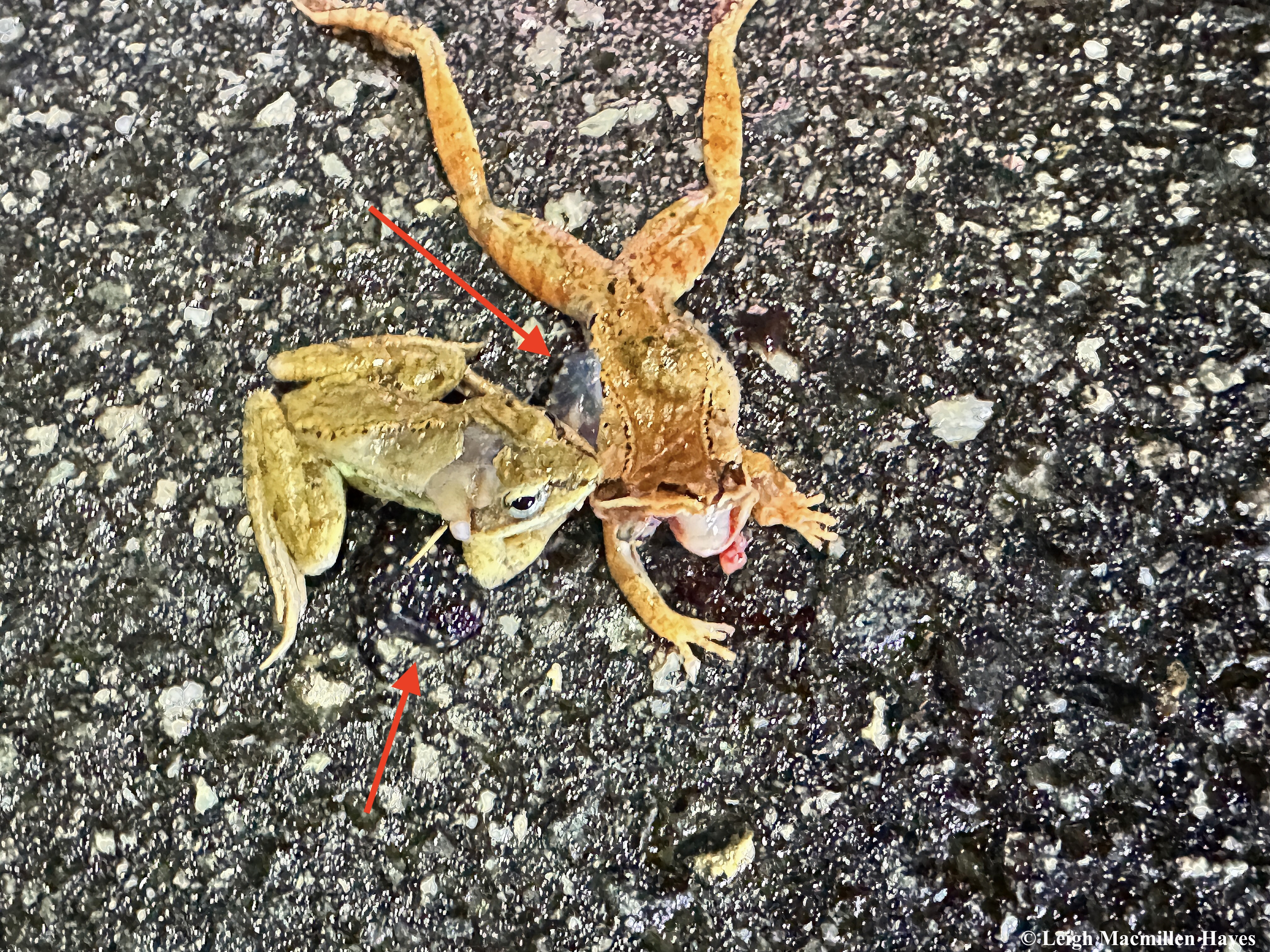
I included this picture of two squished female Wood Frogs because this is what happens when we drive by vernal pools and other wetlands on rainy nights. And I added the arrows to show the egg sacs that had popped out as the tires drove over these ladies.

We let out a communal groan as we heard the pop, and then made this discovery, trying to ease the moment by reminding ourselves that they would become food for others, but still . . . reinforcing the reason why we’ve been celebrating Big Night(s) on this local road for at least 25 years of organized events and I suspect many more before that.

All told for saves on Tuesday night: 836 live Wood Frogs, Spring Peepers, Spotted Salamanders, plus at least one Green Frog and one Eastern Newt.

That was a BIG night! And many thanks to Dawn and Maggie for organizing it.

And from the sound of the “Wrucks” on Wednesday, which was louder than the day before, I knew the ladies had returned to “My” pool as well. And the guys were feeling successful.

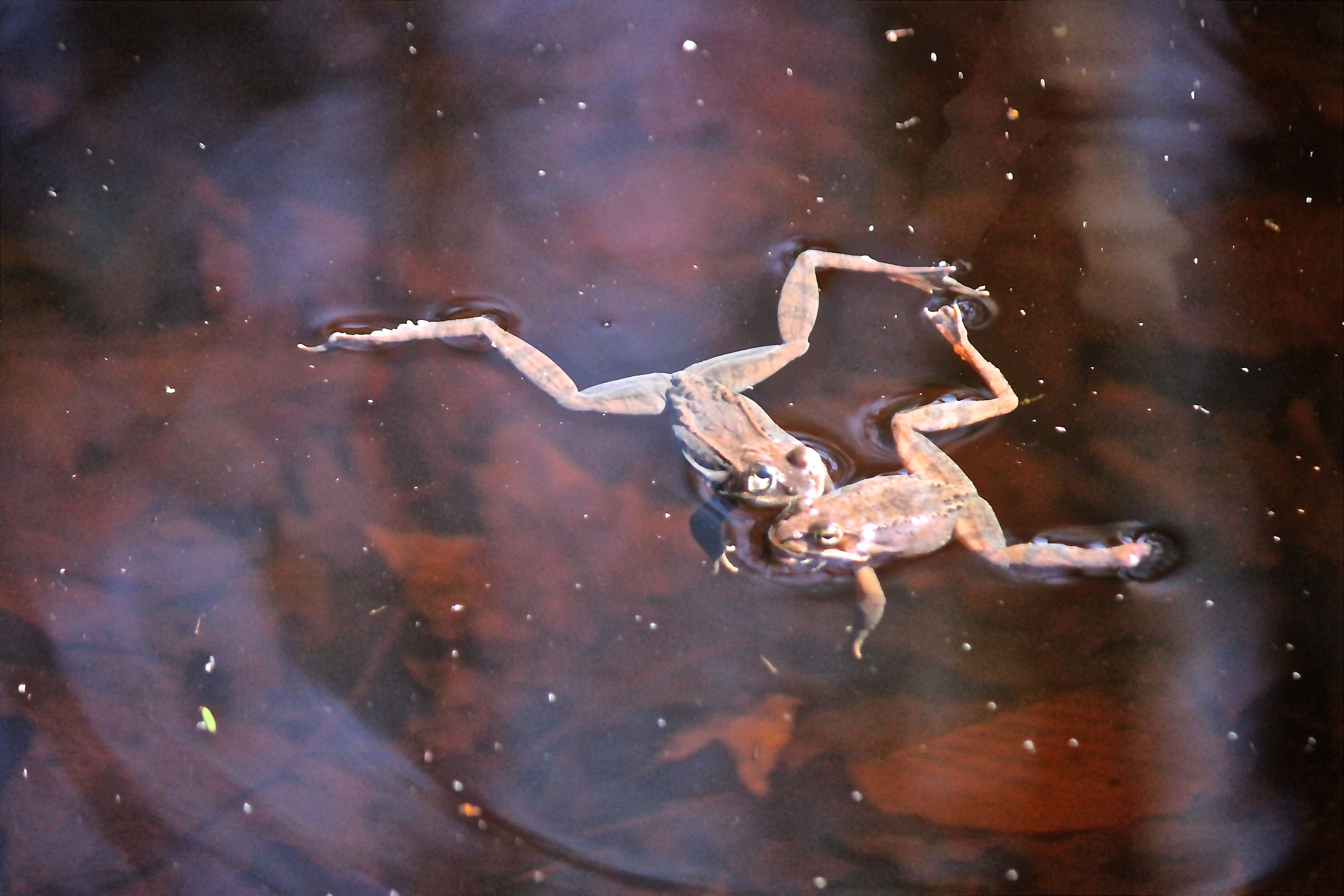
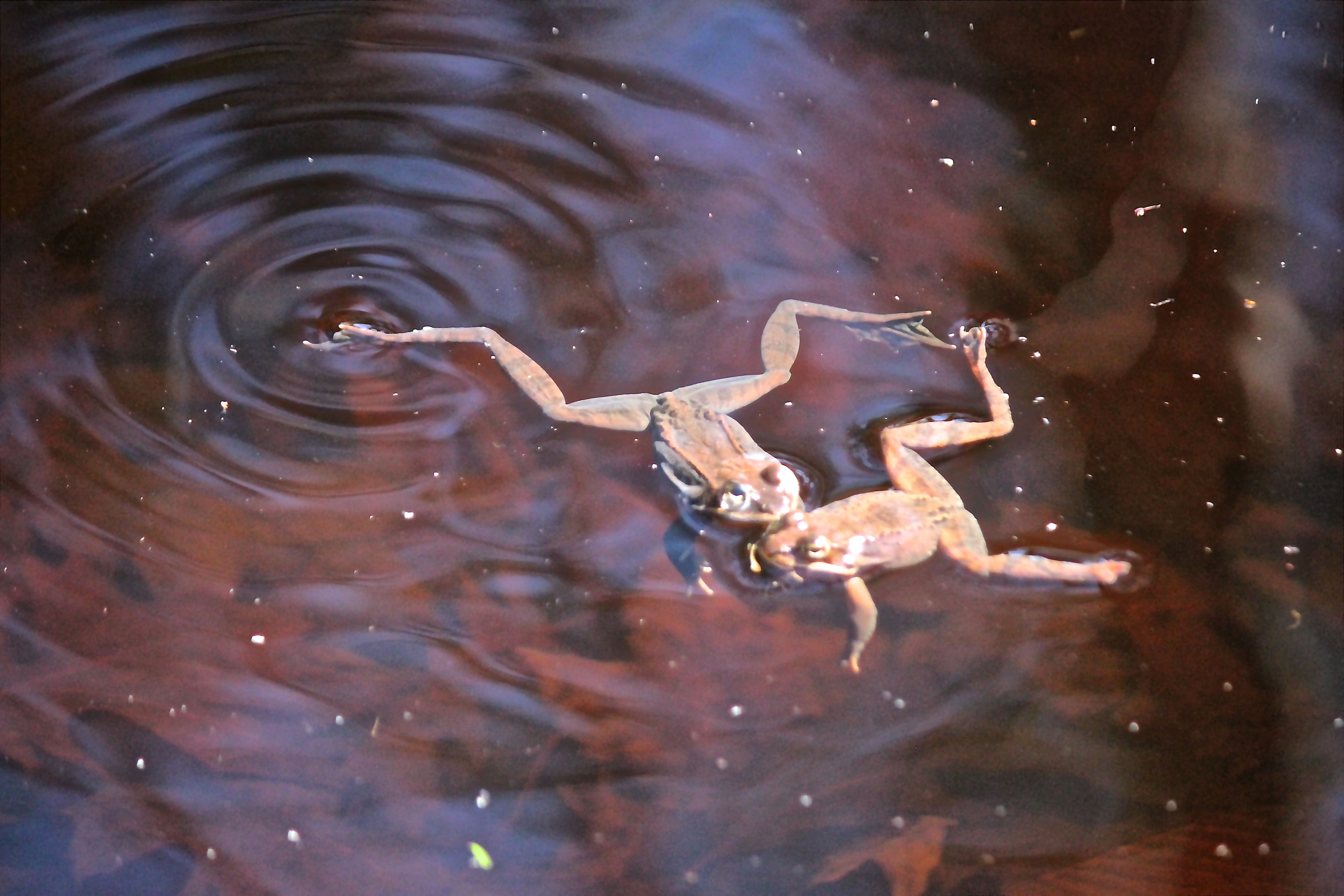
Within a minute of standing there, I looked down and spotted a couple embraced in what is known as Wood Frog amplexus, the smaller and darker male being on top with his forelegs wrapped around her, just above her enlarged belly.

She seemed to be in full control as she moved about the twigs, looking for a good location to deposit her eggs.
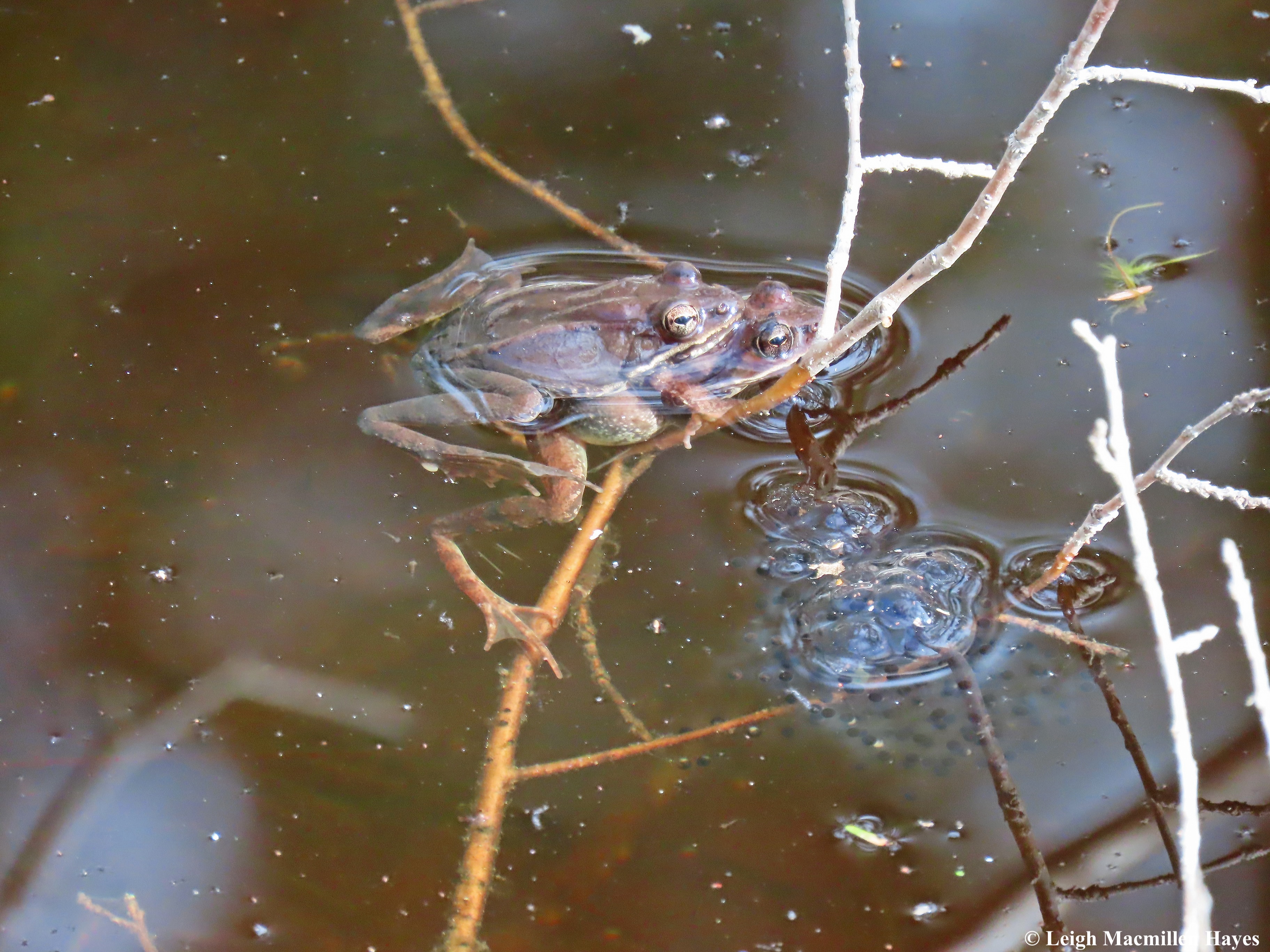
I thought the first spot was perfect because it was located near another egg mass and Wood Frogs tend to deposit their eggs in communal colonies, the better to avoid predation–especially if yours are among the first and are surrounding by other egg masses, and therefore protected.
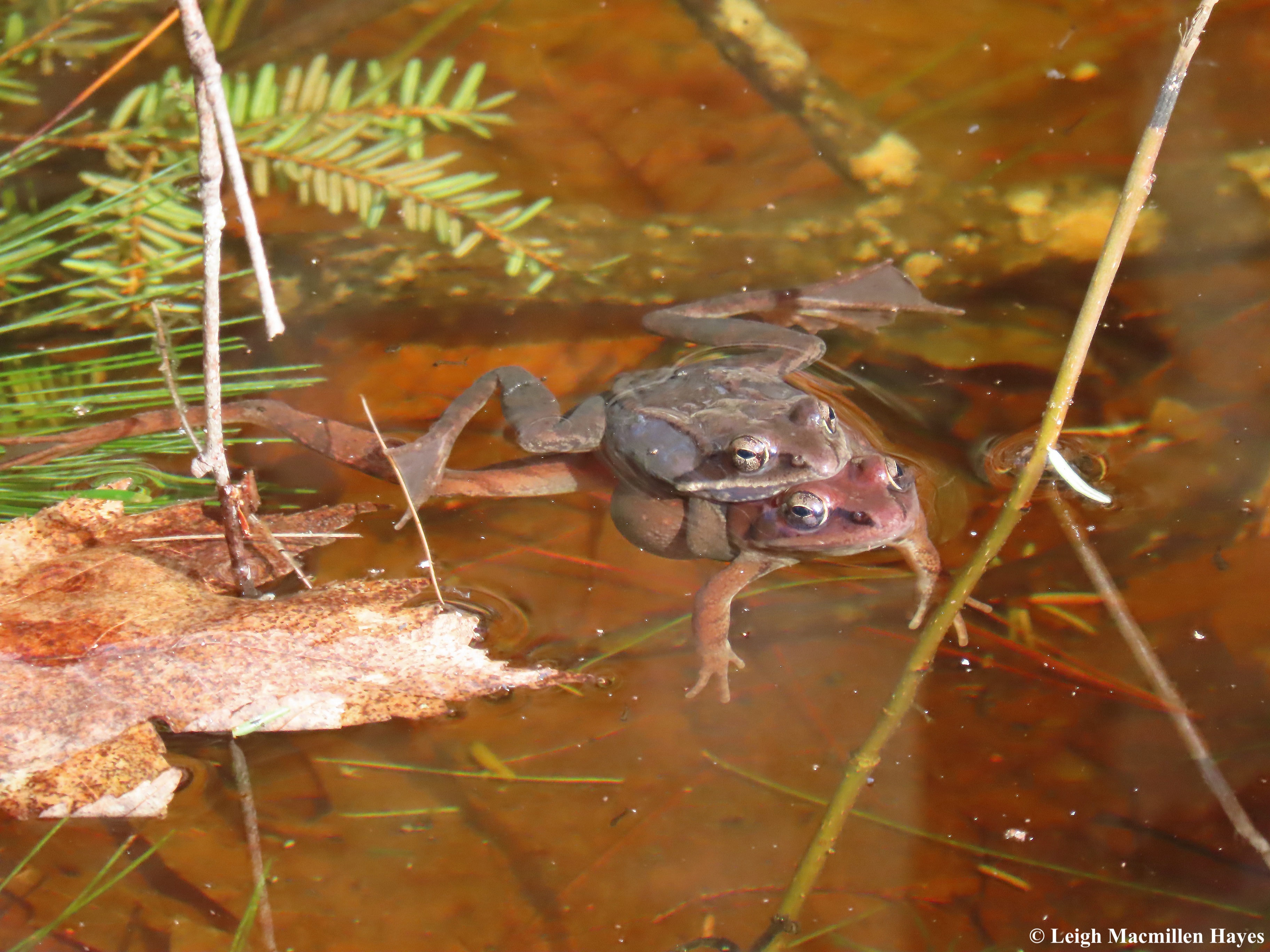
Scanning the pool, I spotted another couple and decided that going forward they need names, so this is Couple 2.

Meanwhile, Couple 1 continued to move about the same set of twigs.
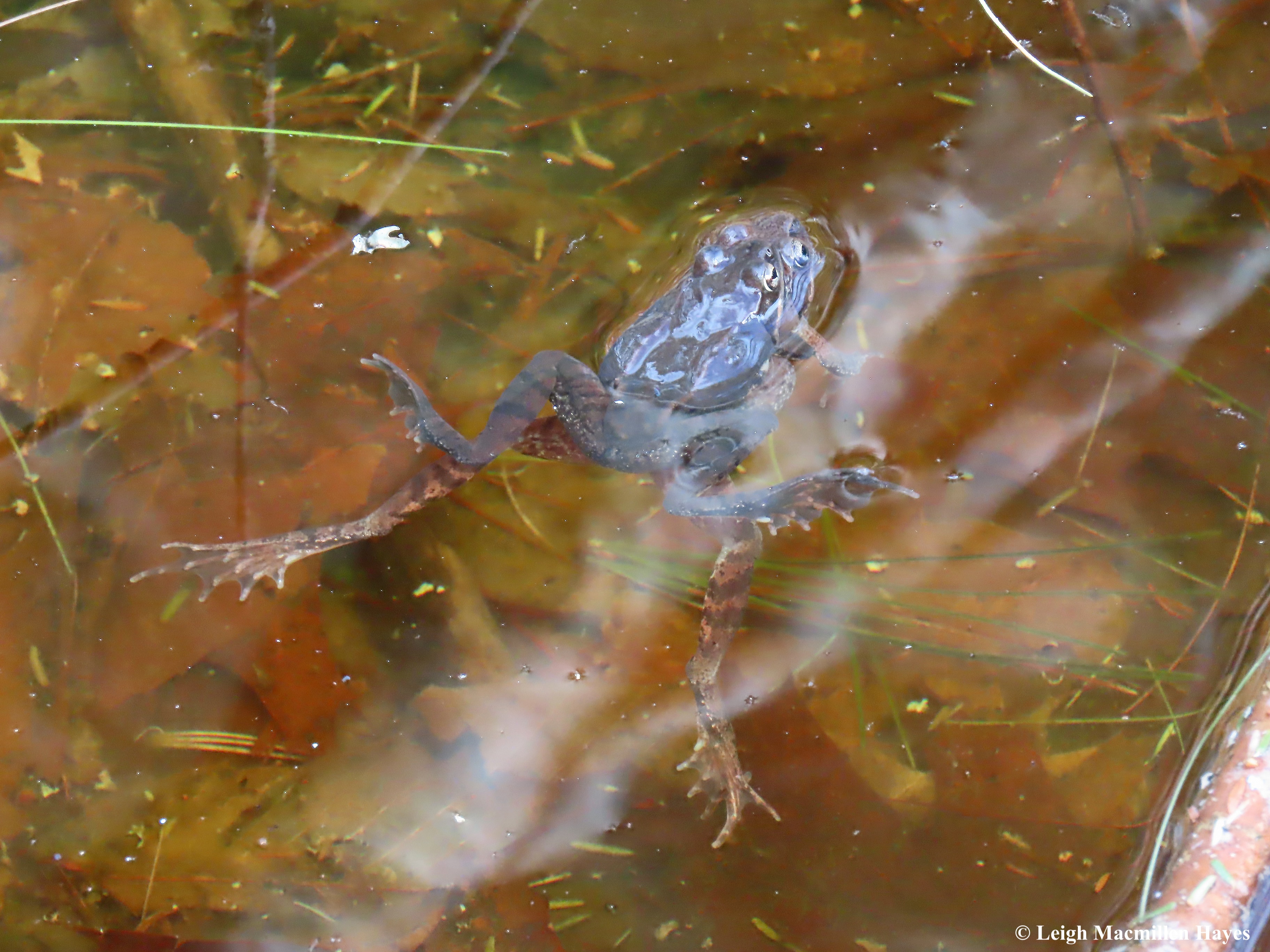
And then near my rock, Couple 3 appeared.

There were also lone males, and because it was breezy, no one seemed to mind my presence. In fact, a couple of males in the western corner even “Wrucked” a few times.
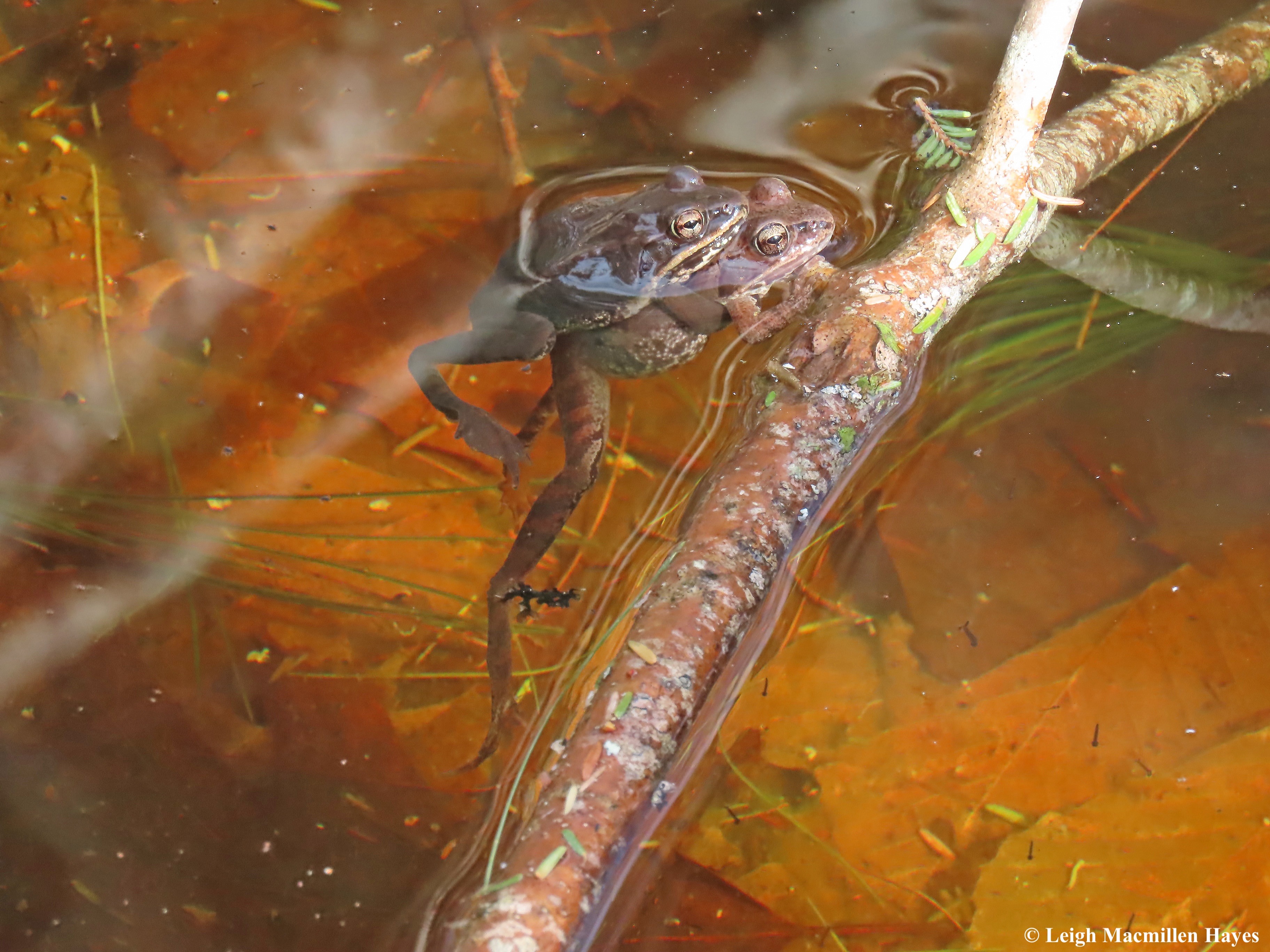
Couple 2 found a larger branch and hung out there.

But Couple 1, they were on the move again.

This time testing a different set of twigs. All I could do was wonder exactly what she was looking for. What made a prime location prime?
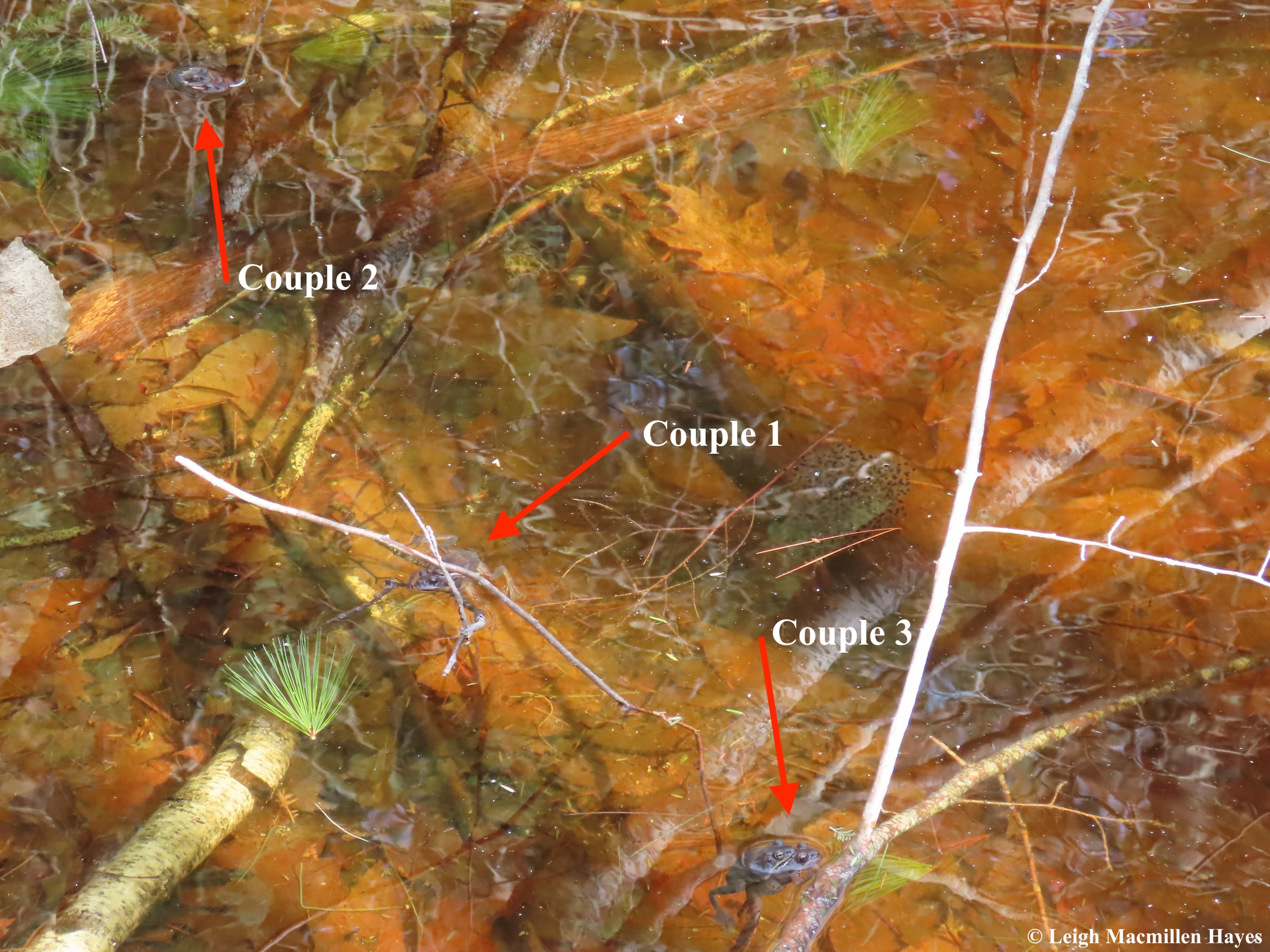
I don’t have the answer and probably never will, but still couldn’t believe my good fortune to have all three couples right there by my feet.

And then . . . and then Couple 1 swam off and disappeared under a recently fallen tree and I thought, “That’s a good place because there are so many branches to choose from,” but at the same time I was disappointed because I figured I’d never see the rest of the story.

Until . . . they swam back out and approached the twig of their first choice.
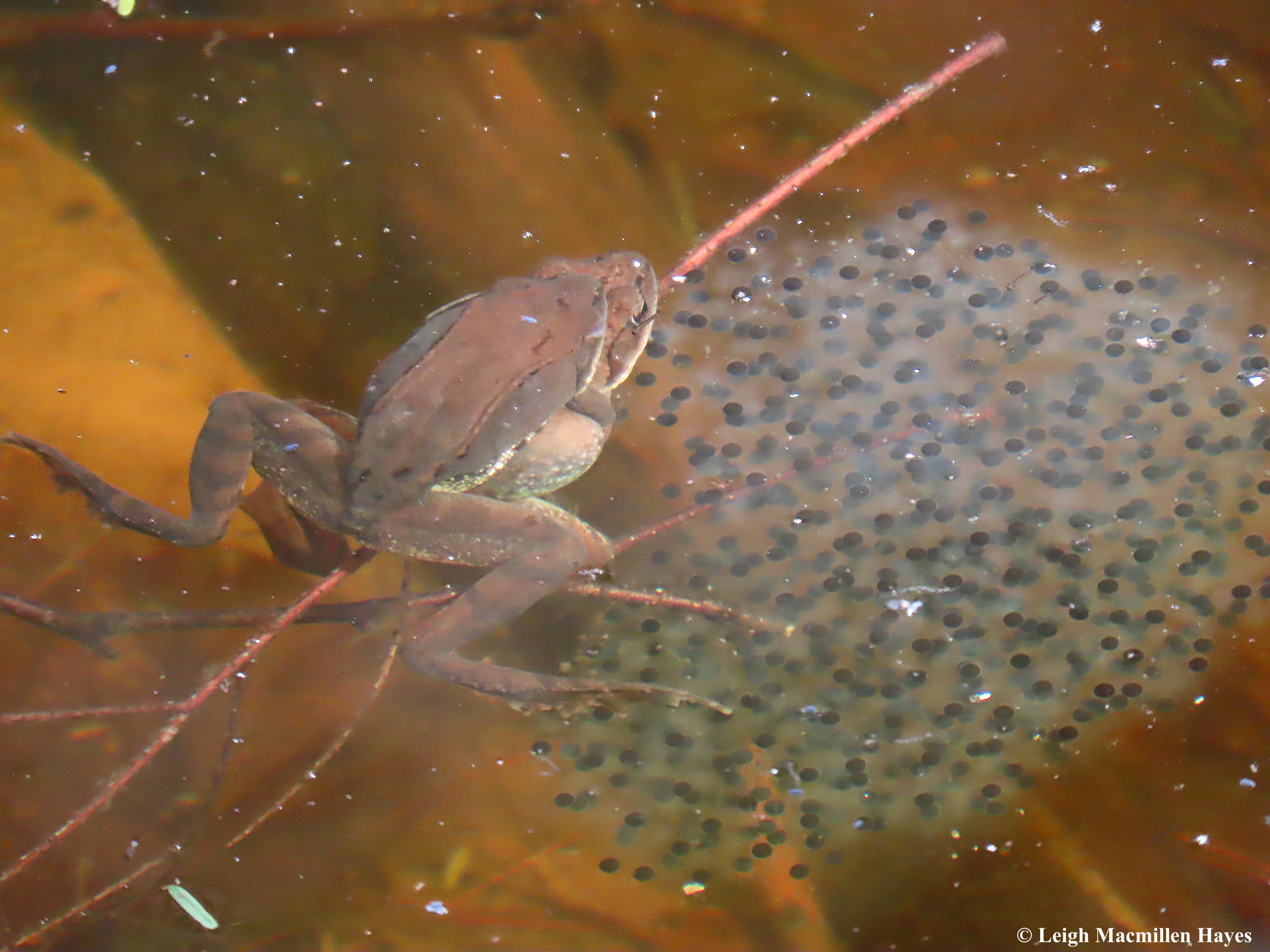
And seemed to be making a move to settle upon it.

Only they didn’t. Instead, they swam to another twig that they’d tried earlier; one that had no other egg masses.
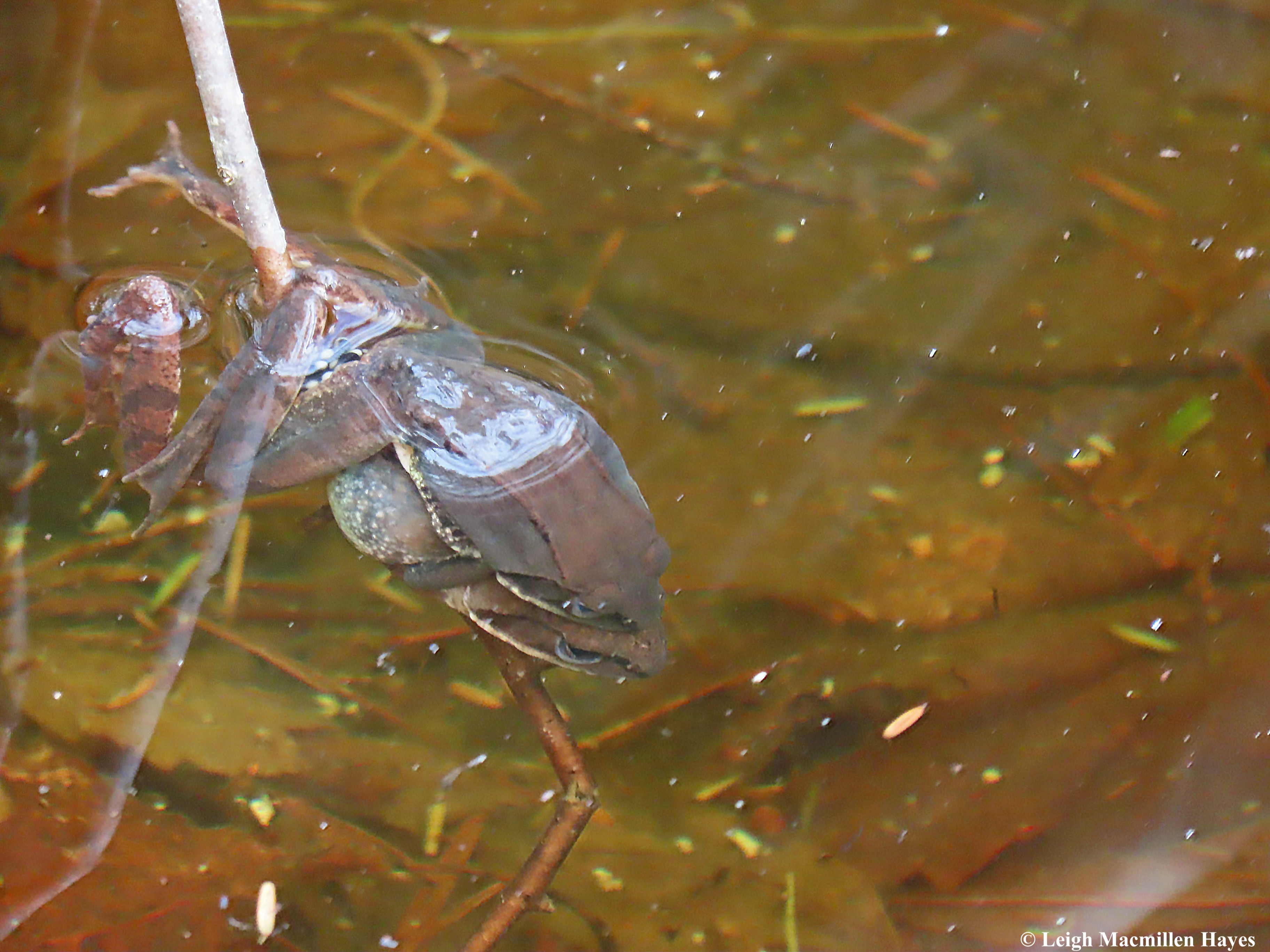
And suddenly, right before my eyes, she began to lay eggs, which he fertilized externally. Can you see the black and white dots between their hind legs?

I could not believe I was finally witnessing this amazing moment. Magic in the making.

My body was stiff from standing so still, but it was so worth the effort.
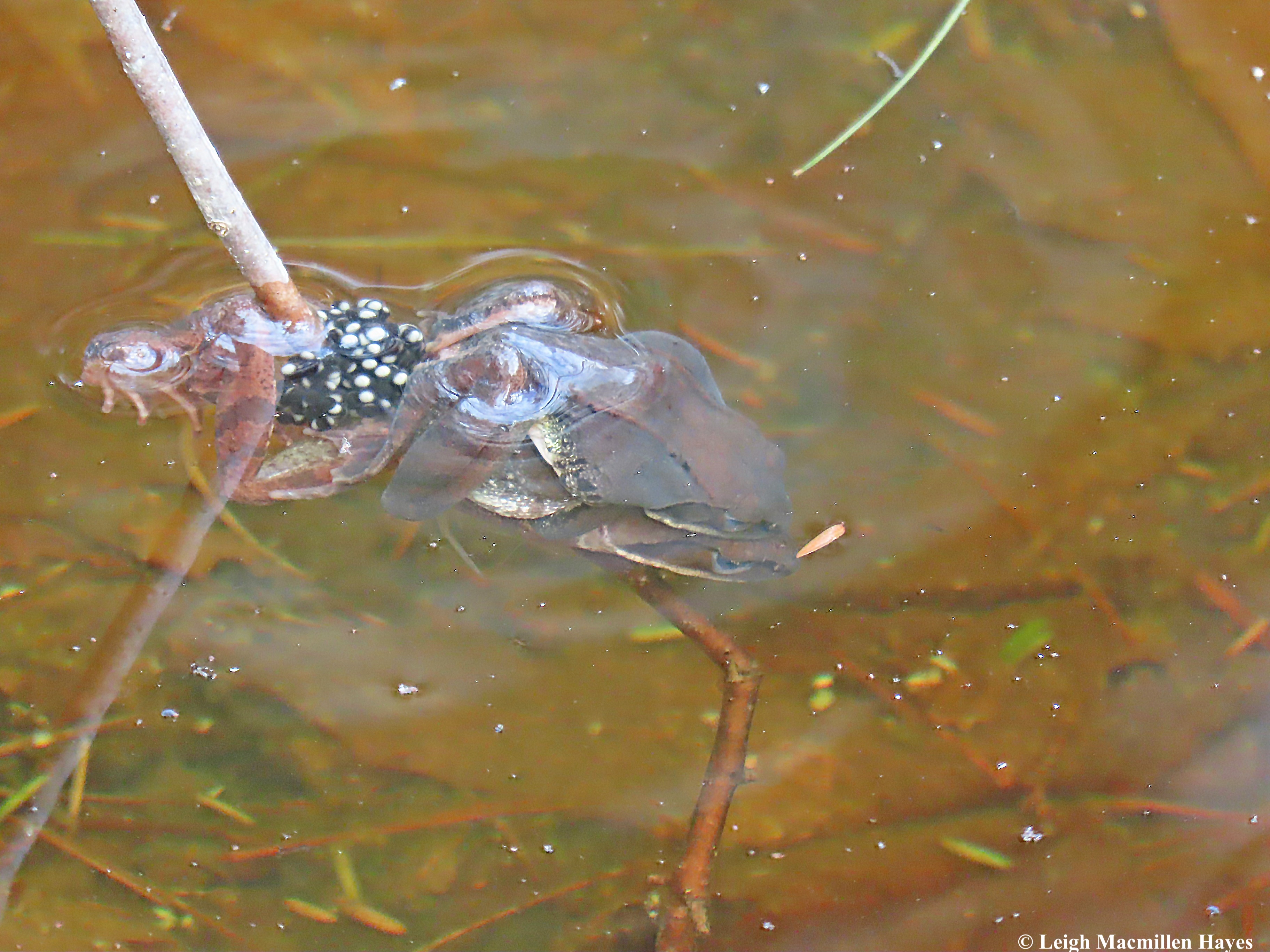
With her hind legs, and I may be wrong about this, she appeared to be wrapping the mass around the stick so it would be well attached.

The eggs are black and white, the Pied Pattern, the top of the egg being dark so predators from above may not see it because it more closely matches the dark leaves and muck on the floor of the pool, and white on the bottom so that predators within the pool will think it’s just sky.

So, as luck would have it, and I was feeling super lucky and grateful for the opportunity to observe, my camera battery died. And the back-up battery was at home. (Note to self: carry it in my pocket.)

I pulled out the next best thing and shot this photo with my iPhone. He eventually moved off of her, but not too far away, probably exhausted from all the effort. And she remained below the quarter-size egg mass for a few more minutes.

As for the other two couples, one disappeared under the fallen tree and the other went under the leaves below my rock, perhaps seeking privacy.

Finally, I took my leave. With a huge smile on my face.

Oh Baby(ies), I know your parents will leave the pool soon, but I’ll be there to watch over you. Maybe not daily, but frequently for as long as the pool holds water, being ephemeral as it is.

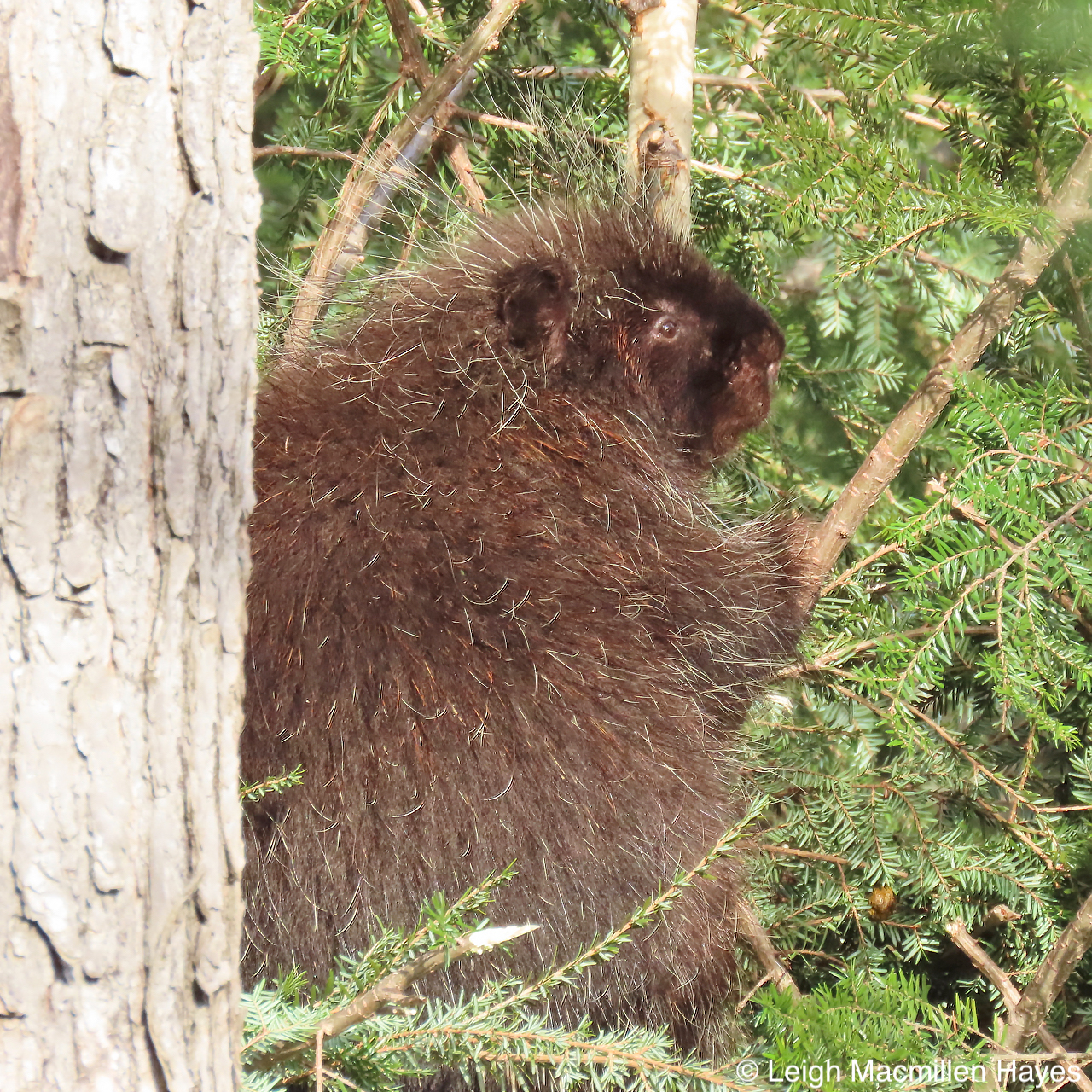
Happy 9th Birthday, wondermyway!

Thank you to all who read and comment and share wondermyway.com. Some of you have followed my blog posts since the beginning, February 21, 2015. A few have joined the journey as recently as yesterday. I’m grateful for the presence of all of you in my life.

To mark this occasion, I thought I’d reflect upon those moments when my wonder gave me a glimpse of the “Thin Places” that I’ve experienced either by myself or in the company of others.

To quote my friend, Ev Lennon, “A Thin Place is a spot of beauty, loveliness, space–an example of the wideness and grandeur of Creation.”

I think of them as places that you don’t plan a trip to visit, but rather . . . stumble upon.

I had
the track of
a bobcat to thank,
for it showed me the way
to a special friend.
It was without expectation 
that we met
and spent at least
an hour together.
And then I realized
though its sight is not great,
it was aware of my presence
and I hightailed it home,
but I will always
celebrate time spent
with the Prickly Porcupine.
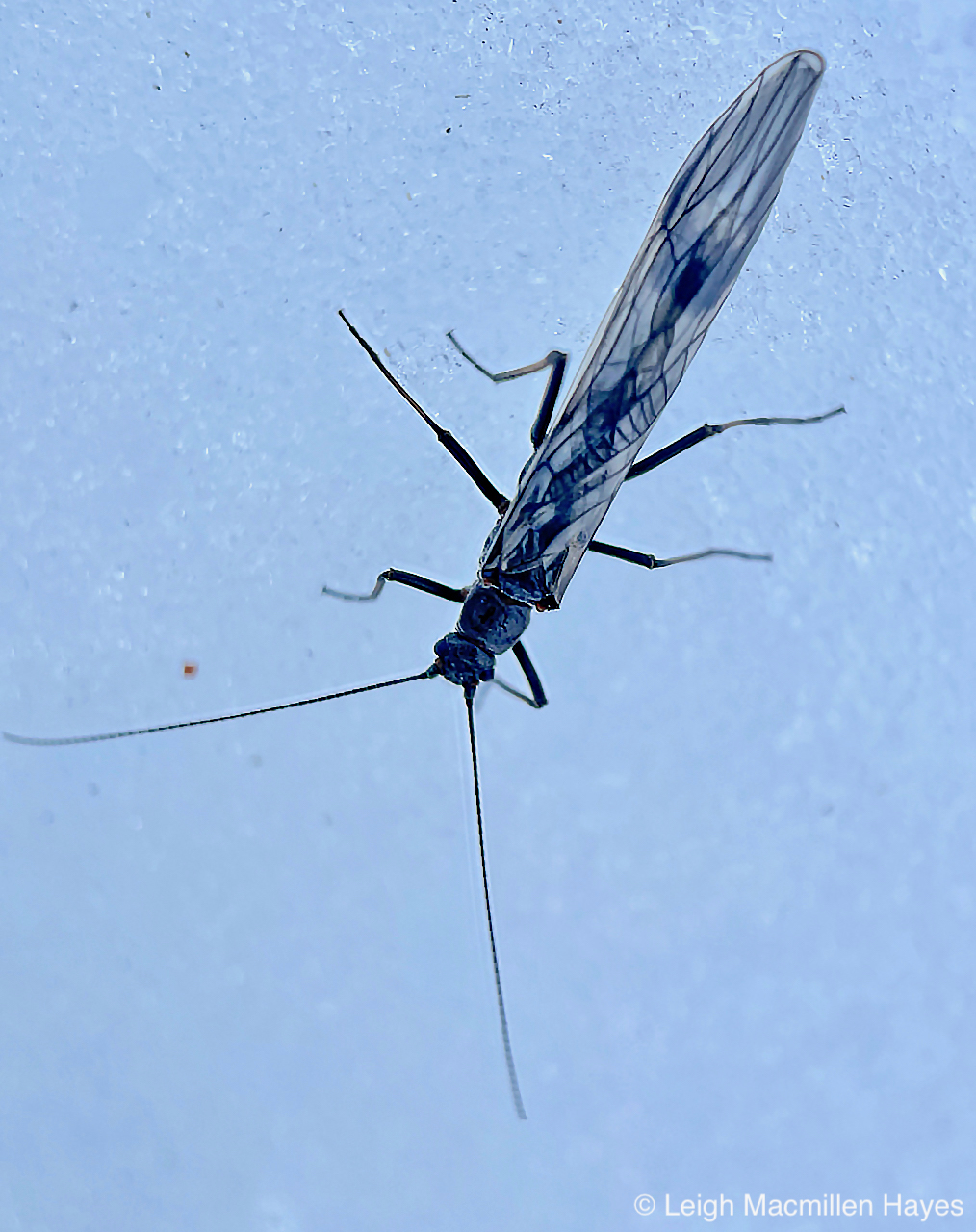
Something quite small
scurrying across the snow
captured my attention
and suddenly
there was a second
and a third
and then hundreds
of Winter Stoneflies.
All headed west from the brook
toward mature tree trunks
to beat their drum-like structures
against the bark
and announce their intentions to canoodle.
Though I could not hear
their percussion instruments,
I am grateful
to learn
with those who
march to the beat of a different drummer.
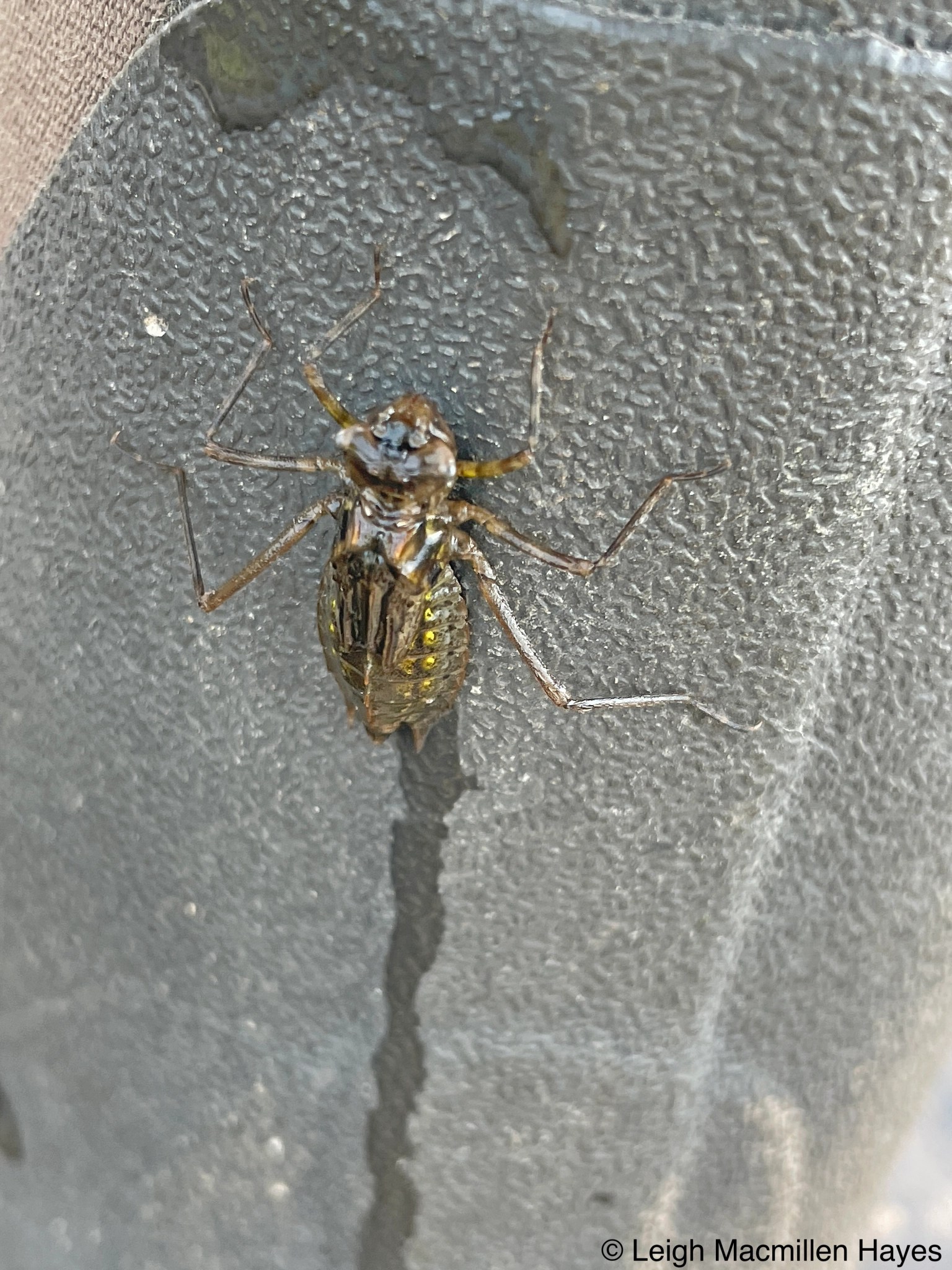
Standing beside quiet water,
I was honored
on more than one occasion
to have my boot and pant legs
considered the right substrate
upon which to transform
from aquatic predator
to teneral land prey
before becoming
a terrestrial flying predator.
It takes hours
for the dragonfly to emerge
and I can't think of a better way
to spend a spring day
than to stand witness
as the mystery unfolds
and I begin to
develop my dragonfly eyes
once again.
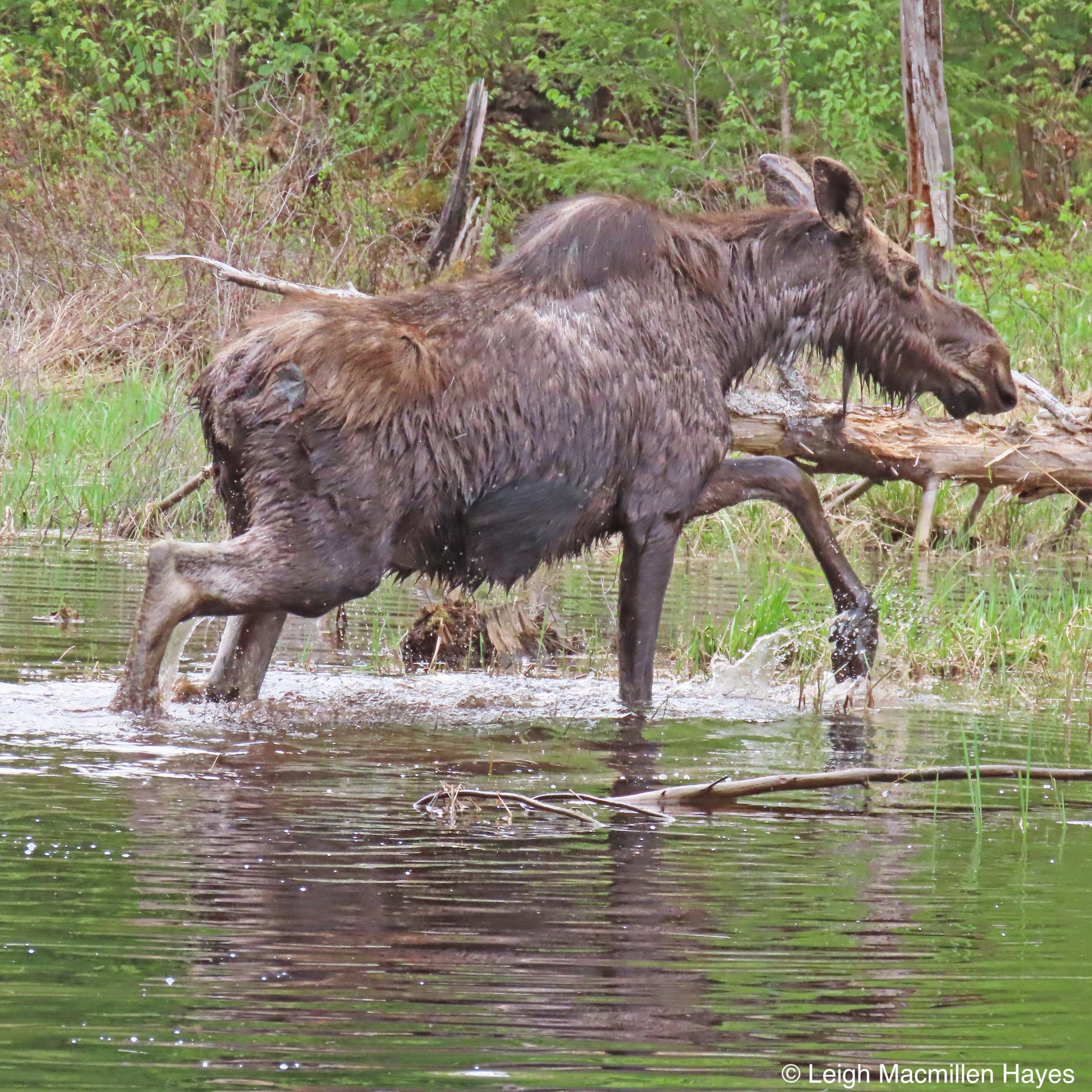
It took me a second 
to realize that I was
staring into the eyes
of a moose,
and another second
to silently alert My Guy
while grabbing my camera.
She tip-toed off
as we relished our time
spent in her presence
and at the end of the day
had this Final Count
on a Moosed-up Mondate:
Painted Trillium 59
Red Trillium 3
Cow Moose 1
One was certainly enough!
Some of the best hours
I spend outdoors
include scanning
Great Blue Heron rookeries
to count adults and chicks
and get lost in the
sights and sounds
of rich and diverse wetlands.
Fluffy little balls
pop up occasionally
in the nests and the
let their presence be known
as they squawk
feverishly for food.
And in the mix of it all
Nature Distraction
causes a diversion of attention
when one swimming by
is first mistaken for a Beaver
but reveals its tail
and morphs into a Muskrat.
I give thanks to the Herons for these moments.
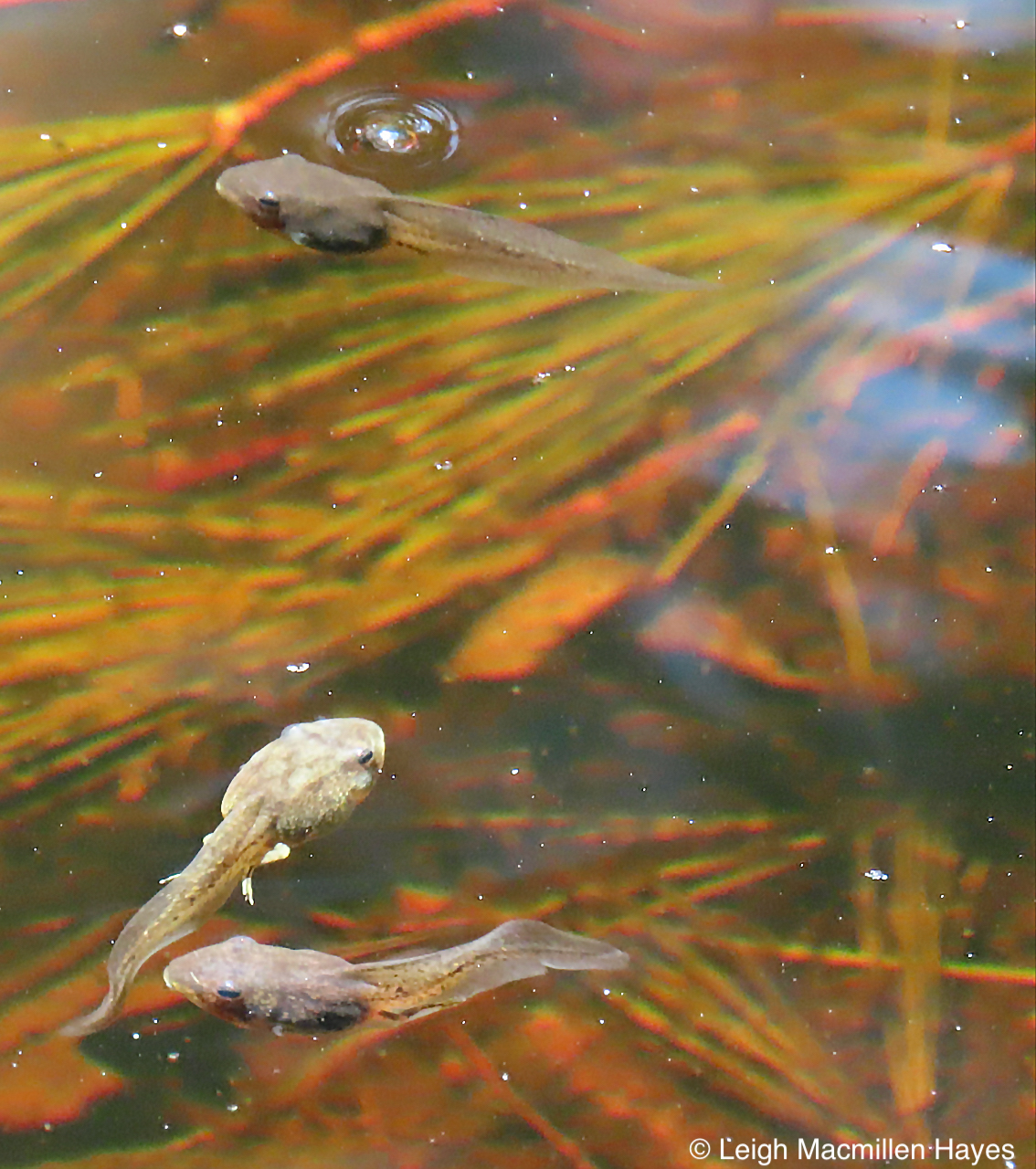
What began as a "Wruck, Wruck" love affair
continued
for longer than usual
and due to
a rainy spring and summer
I was treated to a surprise
in the form of developing frog legs.
In the midst of my visits
one day I heard
the insistent peeps
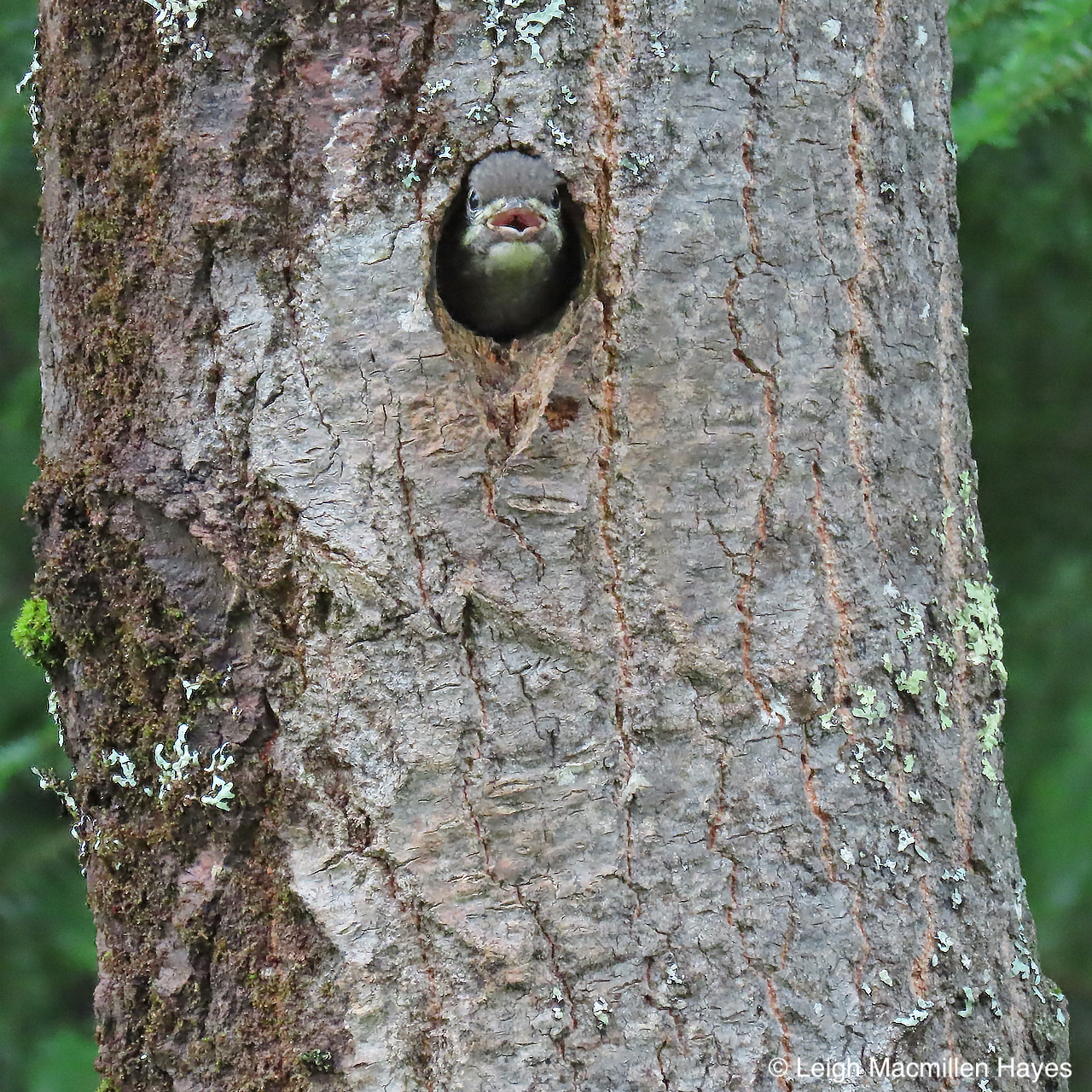
of Yellow-bellied Sapsucker chicks
demanding a meal on wings,
which their parents
repeatedly provided.
Walking home 
from the pool
another day,
I was honored
to spend about ten minutes
with a fawn,
each of us curious
about the other
until it occurred to me
that its mother
was probably nearby
waiting for me to move on,
so reluctantly I did,
but first gave thanks
that something is always happening
right outside my backdoor.
While admiring shrubs
that love wet feet,
I counted over
one hundred branches
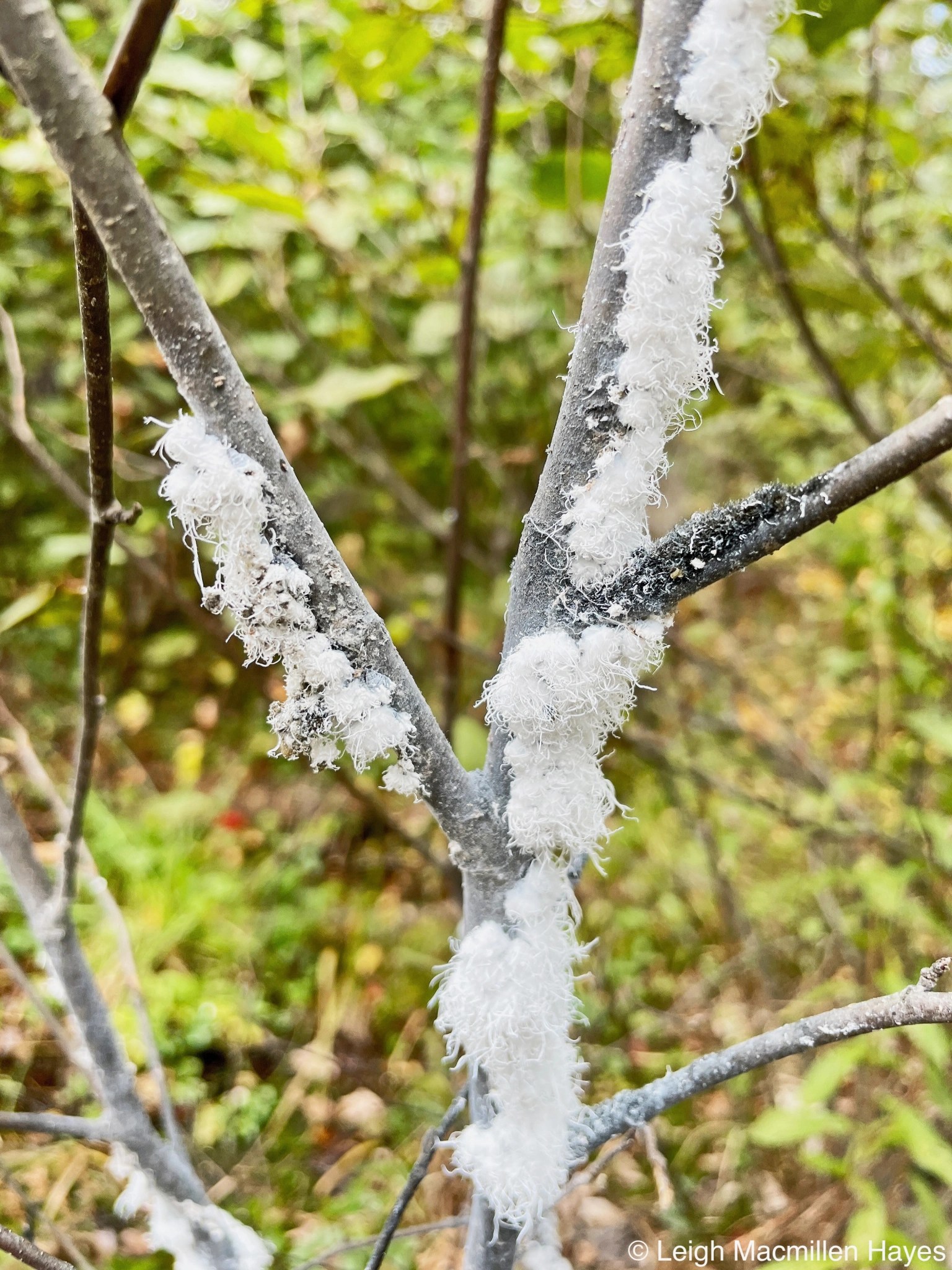
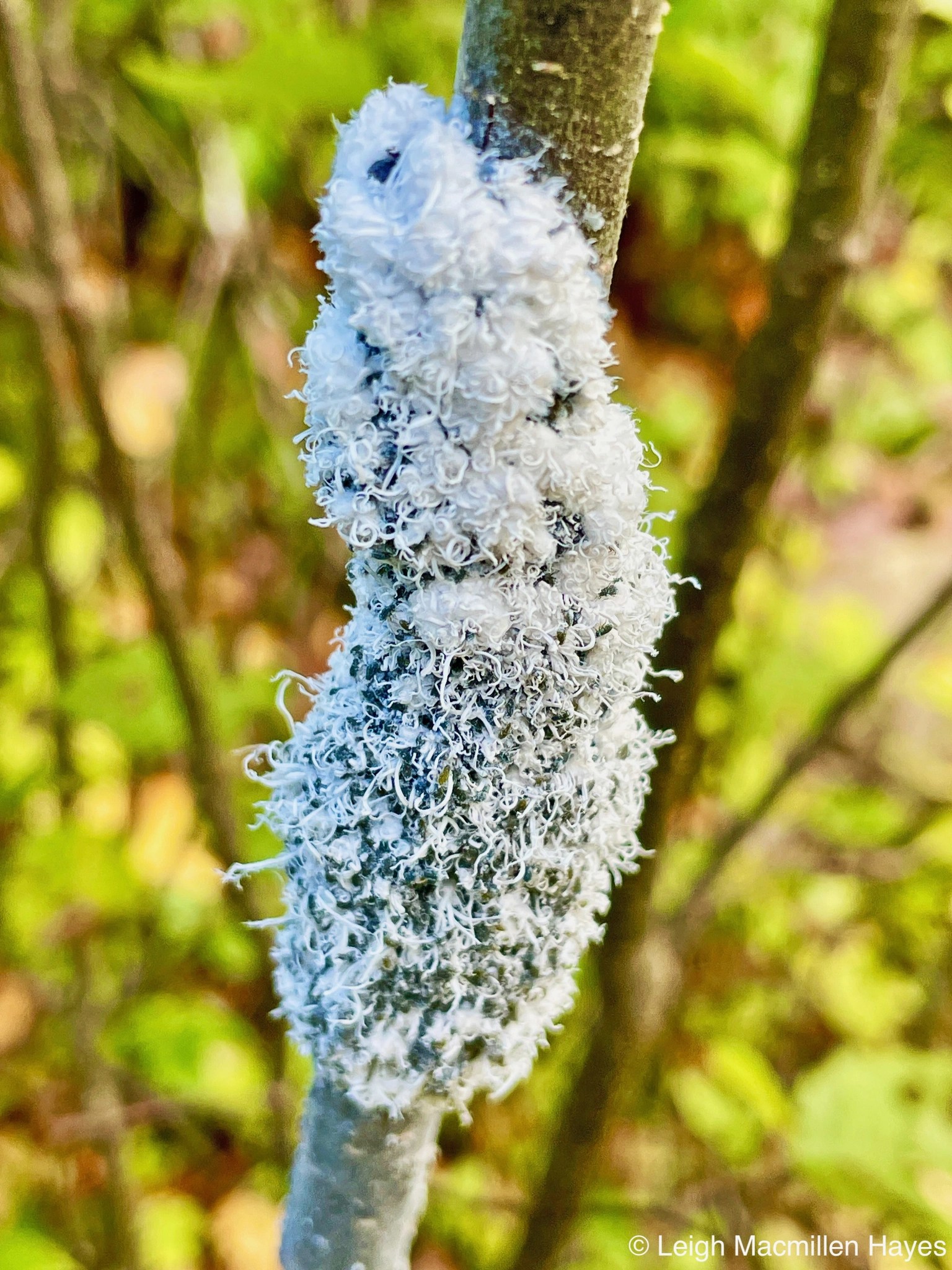
coated with white fluffy,
yet waxy ribbons.
Theirs is a communal yet complex life
as the Woolly Alder Aphids
suck sap from Speckled Alders.
Communal in that
so many clump together
in a great mass.
Complex because
one generation reproduces asexually
and the next sexually,
thus adding diversity
to the gene pool.
Along with the discovery
of coyote scat,
and Beech Aphid Poop Eater,
a fungus that consumes
the frass of the Aphids,
it was an omnivore, herbivore, insectivore kind of day.
Awakening early, 
a certain glow
in the sky
pulled me from bed
and I raced downstairs
to open the door
and receive the quiet
that snowflakes create.
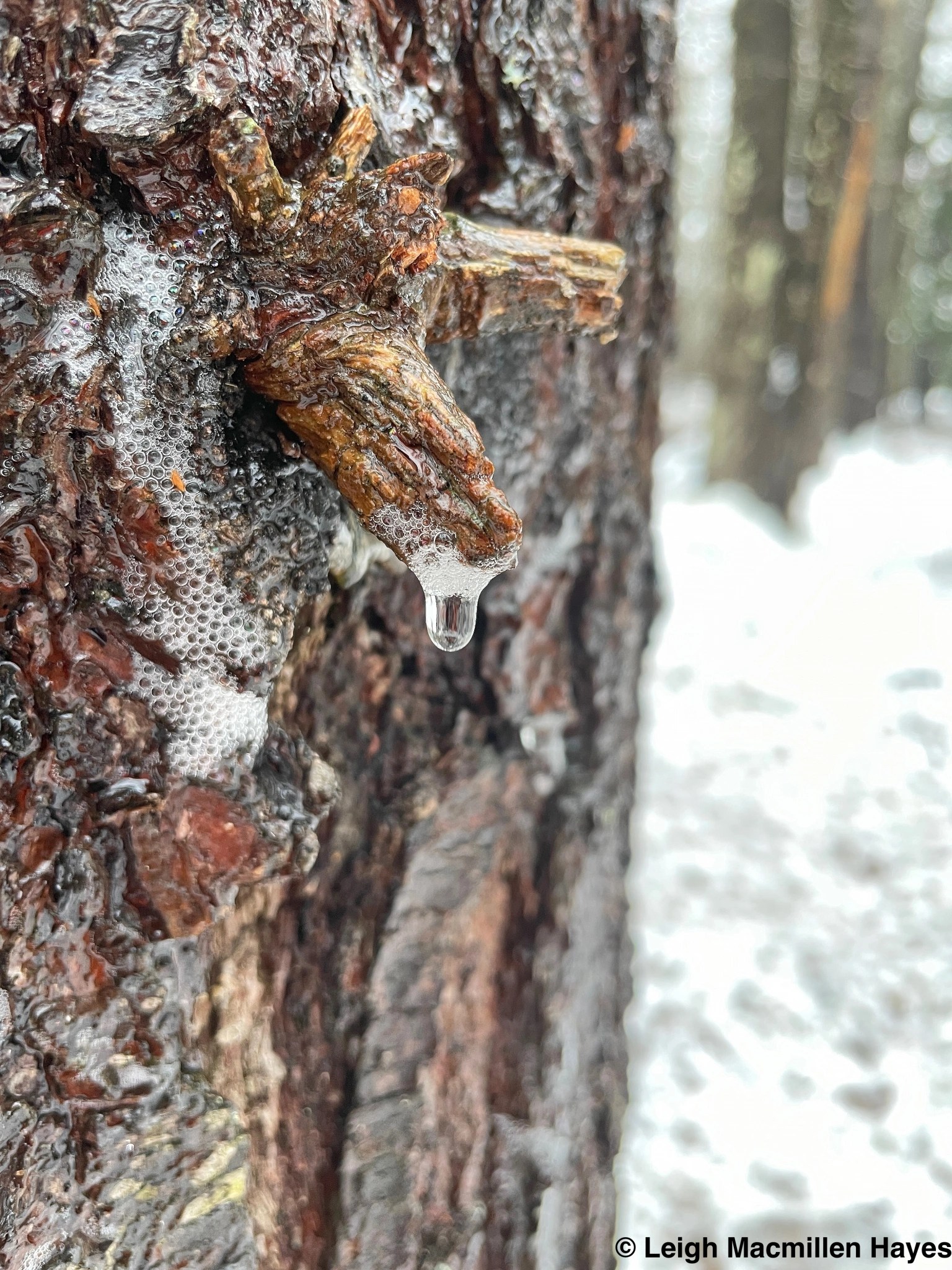
The snow eventually
turned to rain,
which equally mesmerized me
as I watched
droplets elongate
and quickly free fall,
landing on bark below
in such a manner
that caused them
to mix with sap salts and acids.
The result was
White Pines foaming
in the form of
Pine Soap
with its hexagonal shapes:
worth a natural engineering wonder
and I gave thanks for being present.
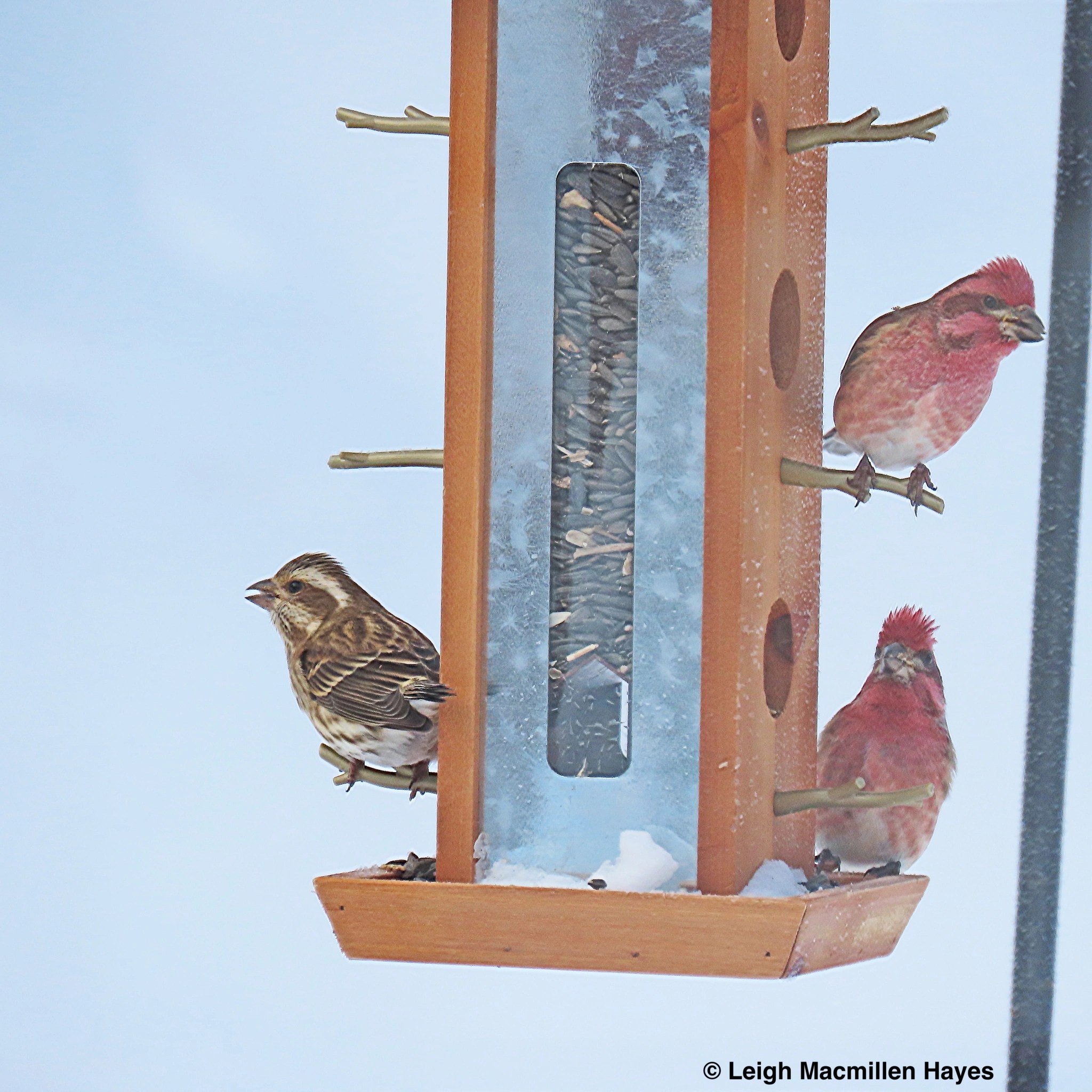
Occasionally, 
it's the action
outside the backdoor window
that keeps me standing sill
for hours on end,
as a variety of birds fly
in and out
of the feeding station,
such as these Purple Finches,
the males exhibiting
bad hair days.
Bird seed is not 
just for birds
as the squirrels prove daily.
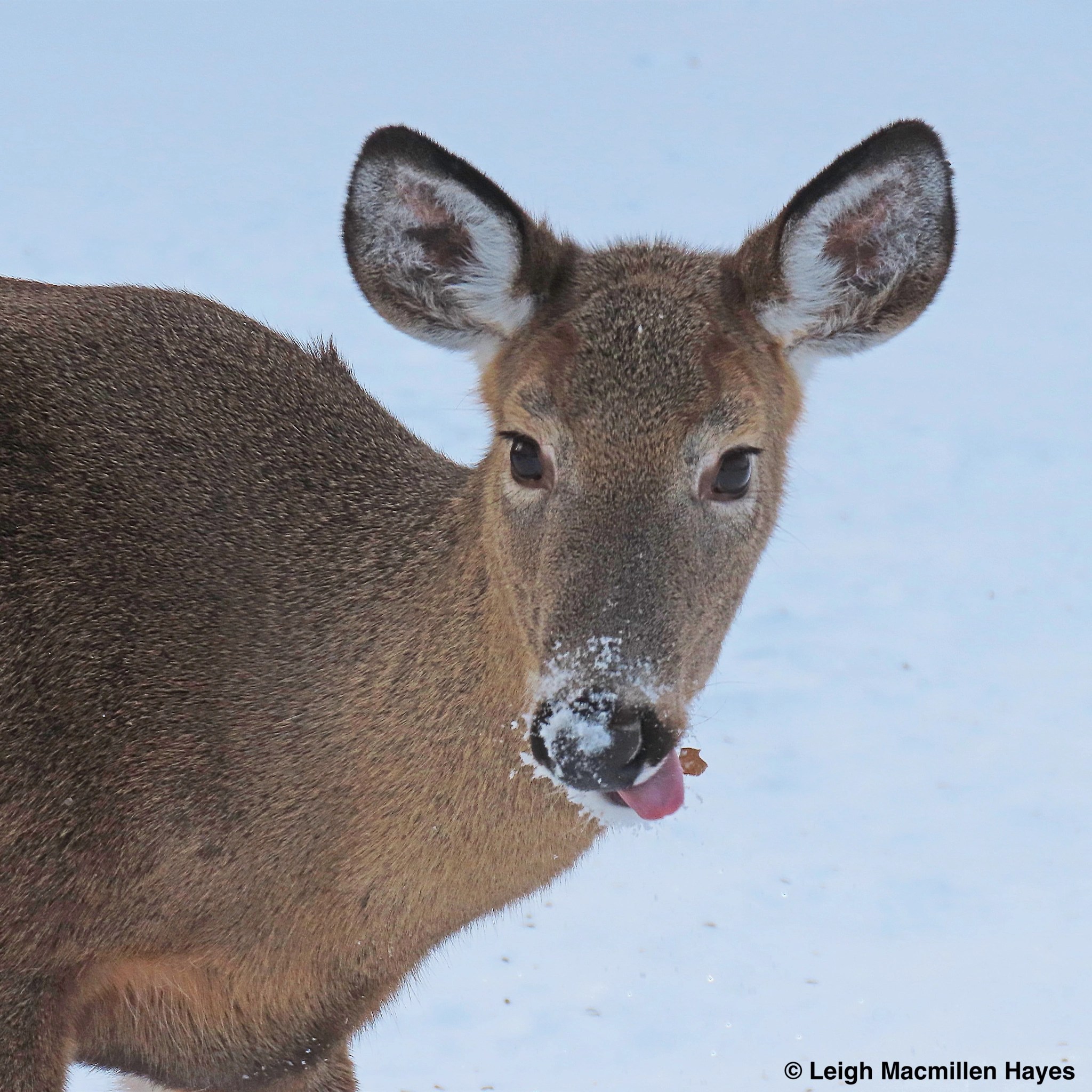
And White-tailed Deer
often make that
statement at night.
But this day was different
and they came
in the morning
using their tongues
to vacuum the seeds all up.
At the end of the day,
my favorite visitors
were the Bluebirds
for it was such a treat
to see them.
But it was the mammals
who made me realize
not every bird has feathers.
These are samples 
of the Thin Places
I've stumbled upon
this past year.

They are a
cause for celebration,
participation,
and possibility.
My mind slows down
and time seems infinite
as I become enveloped
in the mystery.

I give thanks
that each moment
is a gift
and I have witnessed
miracles unfolding
that did not
seek my attention,
but certainly captured it.

And I thank you again
for being
one of the many
to wander and wonder my way.

The Saga of a Vernal Pool

Warning: Some may find parts of this post disturbing. But it is, after all,  about the circle of life. 

A climbing thermometer in March signaled one thing amidst many others: the time had arrived to check the vernal pool located in the woods behind our house. 

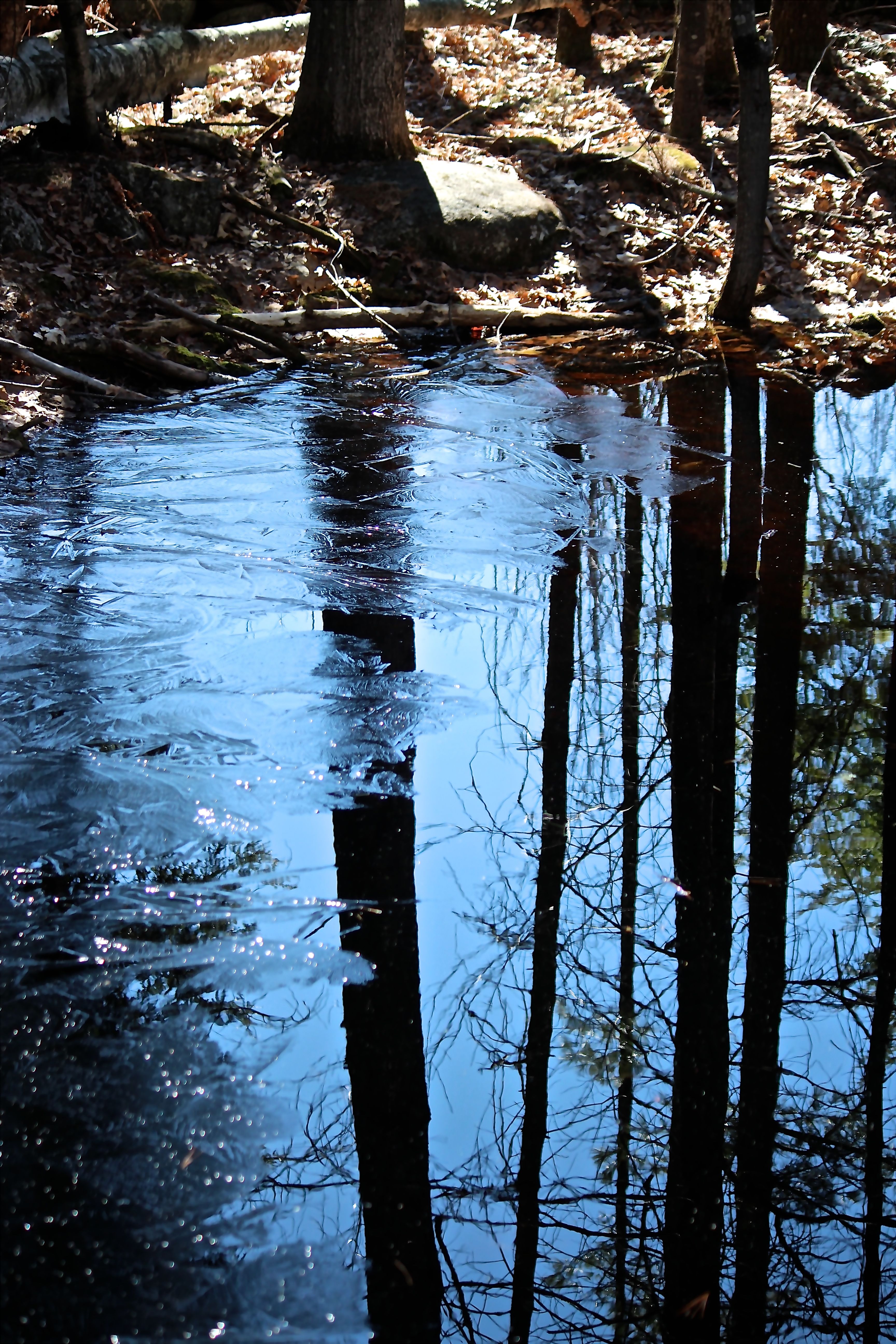
Completely covered with ice at the start of my explorations, I noted puddling on top and knew it was only a matter of days. 

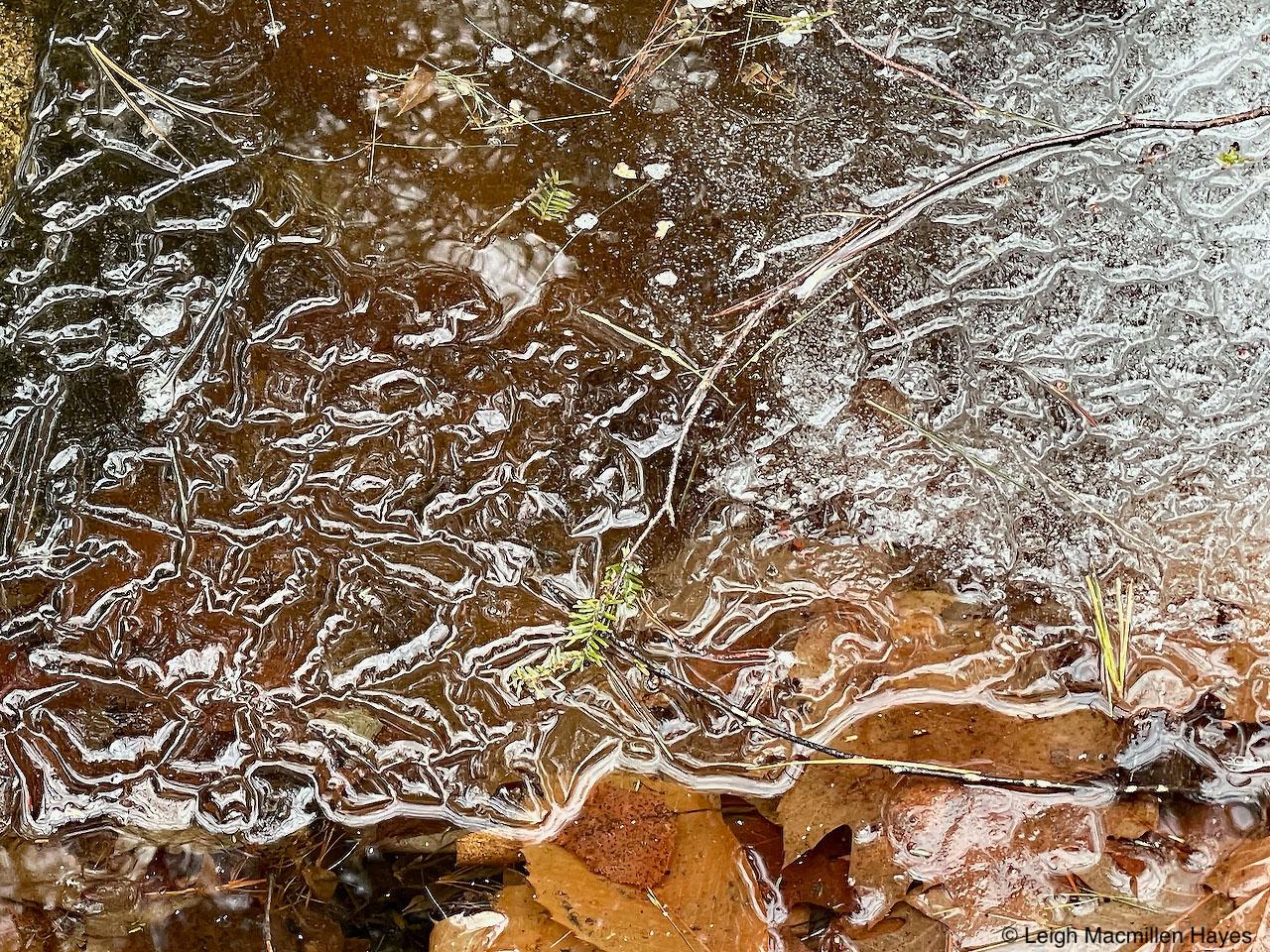
Not wanting to rush the season, though truly I did, I rejoiced when the edges melted because life within would soon be revealed. And what’s not to love about the unique tapestry, a pattern never repeated. 

With keen eyes I’d gaze in, but at first my focus was only upon the reflection offered by the bare-limbed trees above. 

And then one day, as if by magic, the ice had completely gone out as we say ‘round these parts. It was early this year–in late March rather than April. That same night I heard the wruck, wrucks of Wood Frogs, always the first to enter the pool. 

The next day he had attracted his she, grasping her in amplexus as is his species’ manner. 

A day or two later, her deposited eggs already swelled with water, presented themselves like a tapioca pudding popsicle. 

Soon they were joined by so many other globular masses making a statement that living in community is safer than upon your own and might provide warmth when the temperature dips. 

Inevitably it did dip, and one day snowflakes frosted the rocks and ground, sugar-coated the tree branches, and plopped like leaden raindrops, rippling the water’s surface. 

But . . . the embryos still formed.

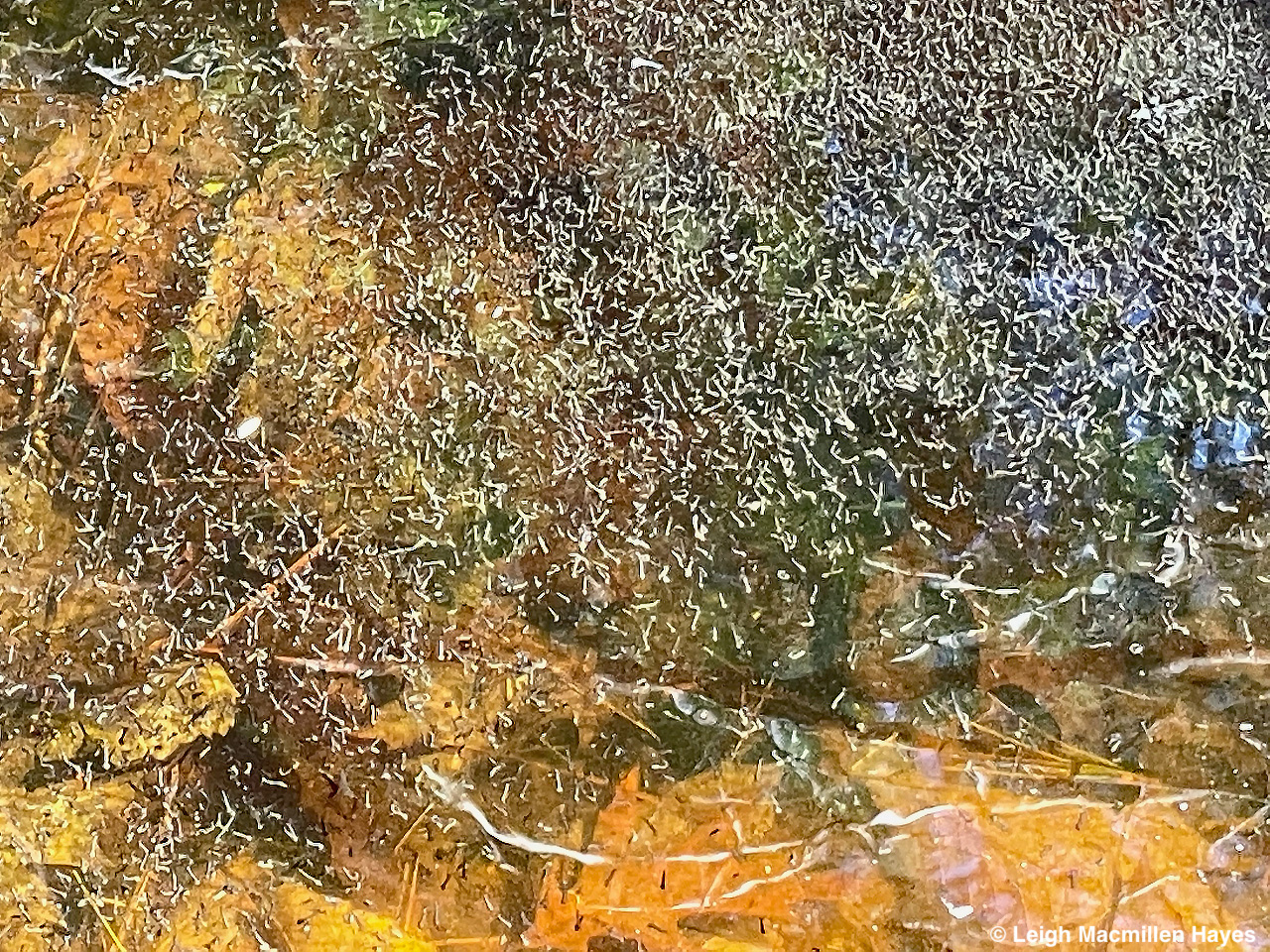
With each visit it became more and more apparent that a vernal pool isn’t just about Wood Frogs. Spotted Salamanders and midges and beetles and mites and water striders and squirrels and deer and raccoons and snakes and so many others benefited regularly from its nourishment. Even the resident Barred Owl liked to call occasionally. But perhaps the most prolific residents were the mosquito larvae who wriggled and tumbled through the water column. 

Predacious Diving Beetles intent upon creating more of their own, lived there as well. 

One of the curious wonders about those who use a vernal pool as a breeding ground is that they don’t stay around to parent their offspring. If fact, once canoodling is done, they either hop, climb, or fly out and spend the rest of their lives in the forest.  

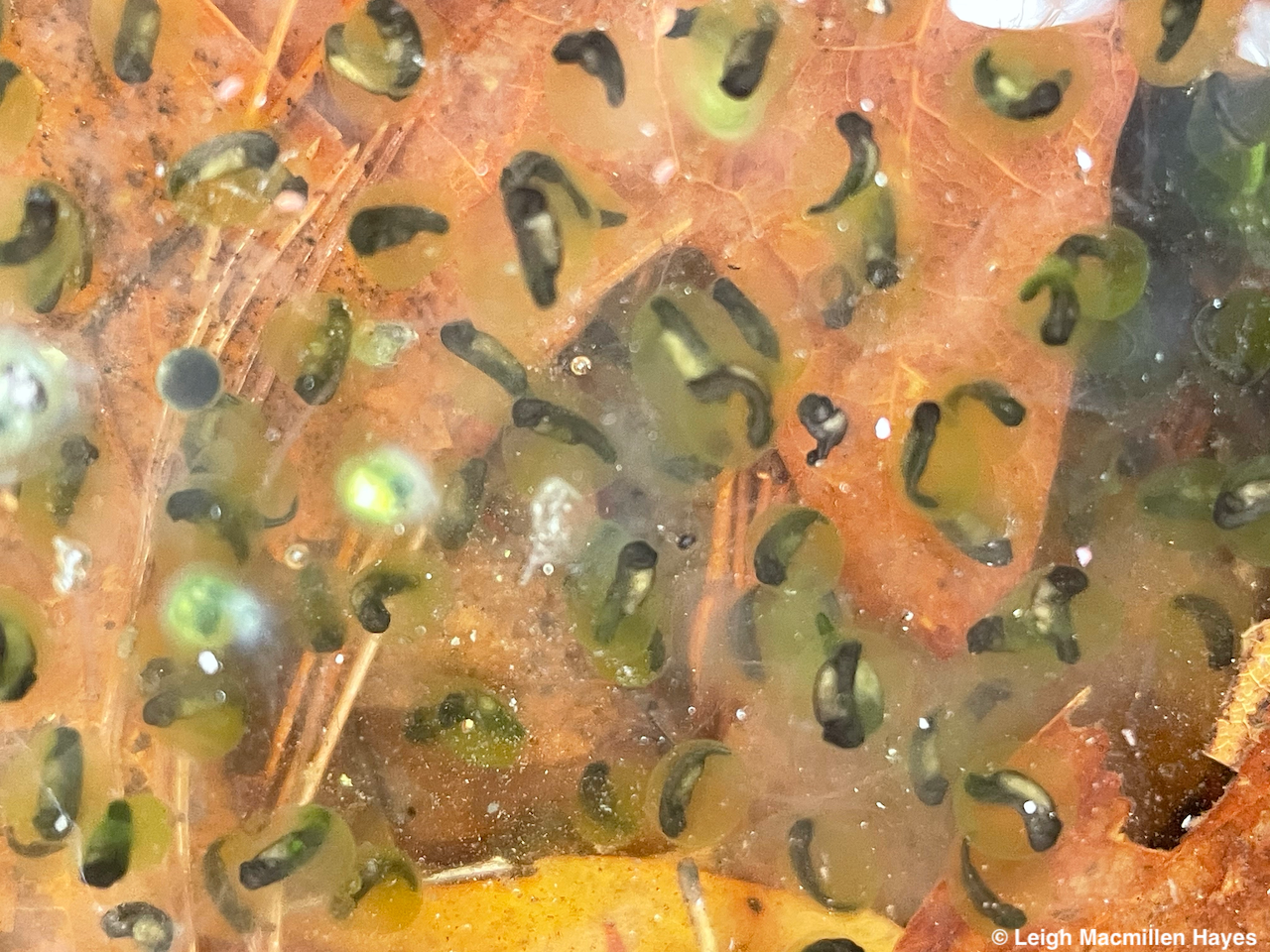
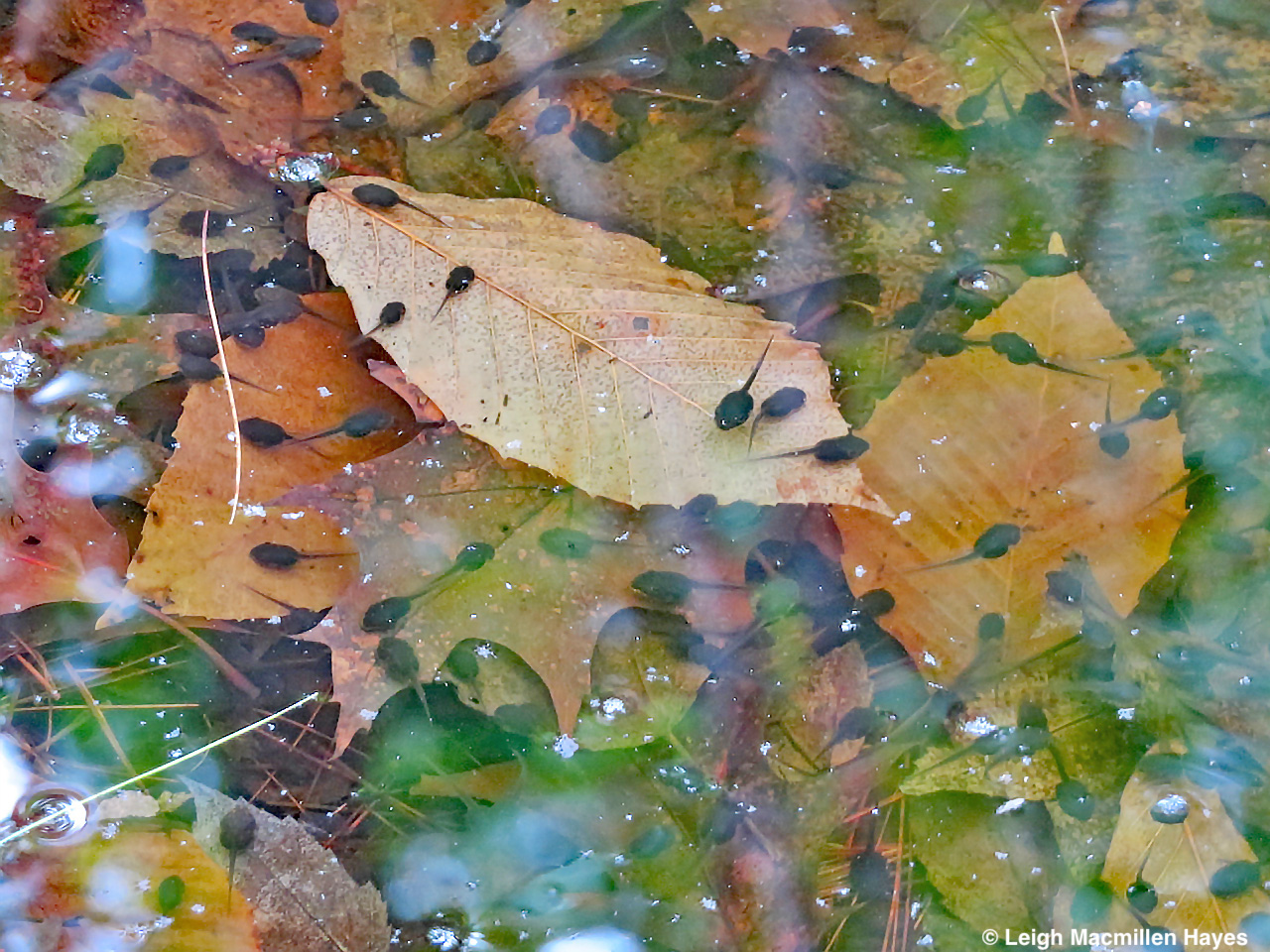
Despite the lack of nurturing, within two weeks tadpoles emerged. Hundreds at first. And then . . . thousands. 

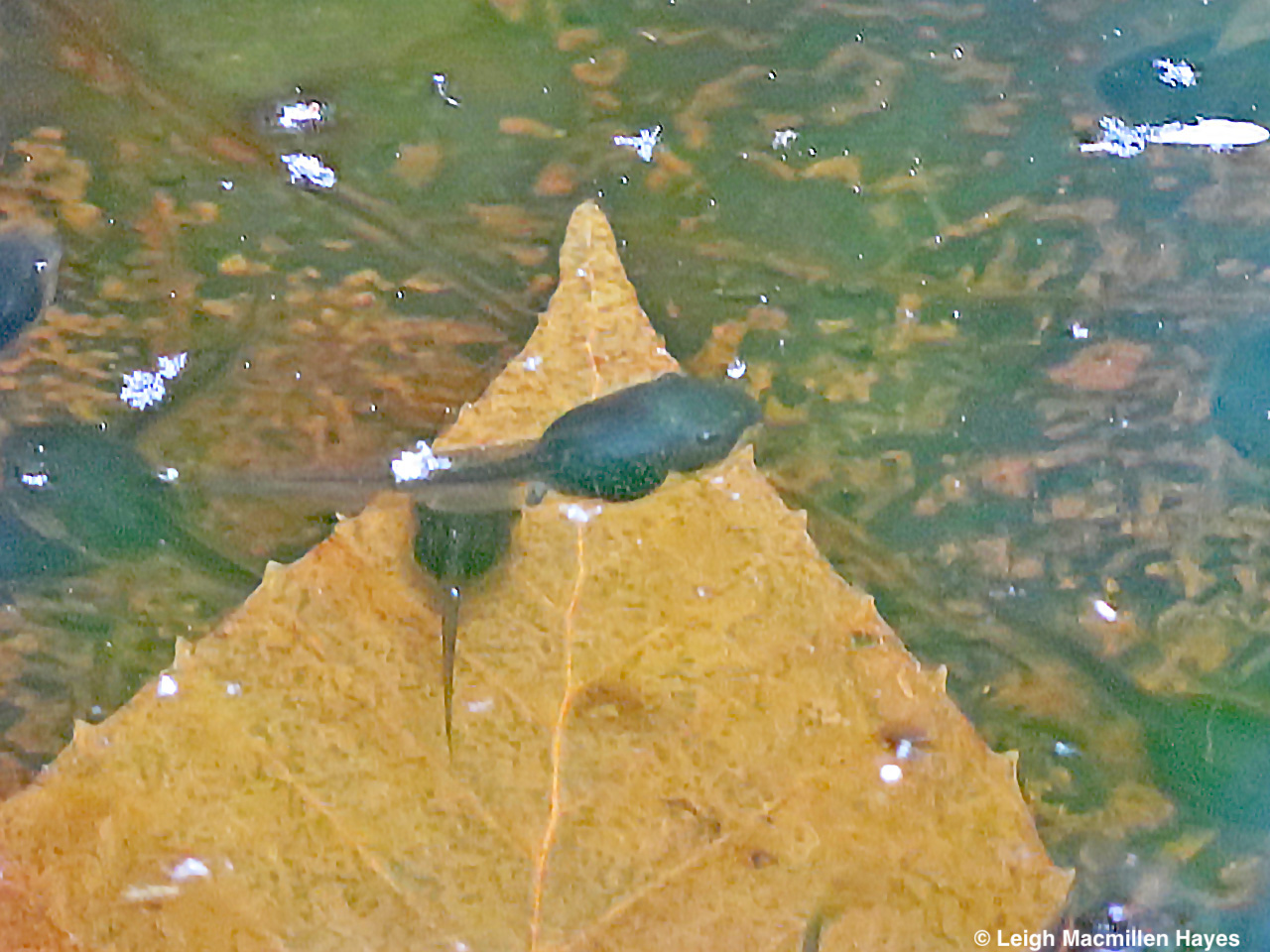
A month later, as the pool began to shrink significantly because it is vernal, and fed only by rain or snow melt, my tadpoles, so claimed since I’m about the only one who checks on them regularly, started to show off their more adult form in the making.

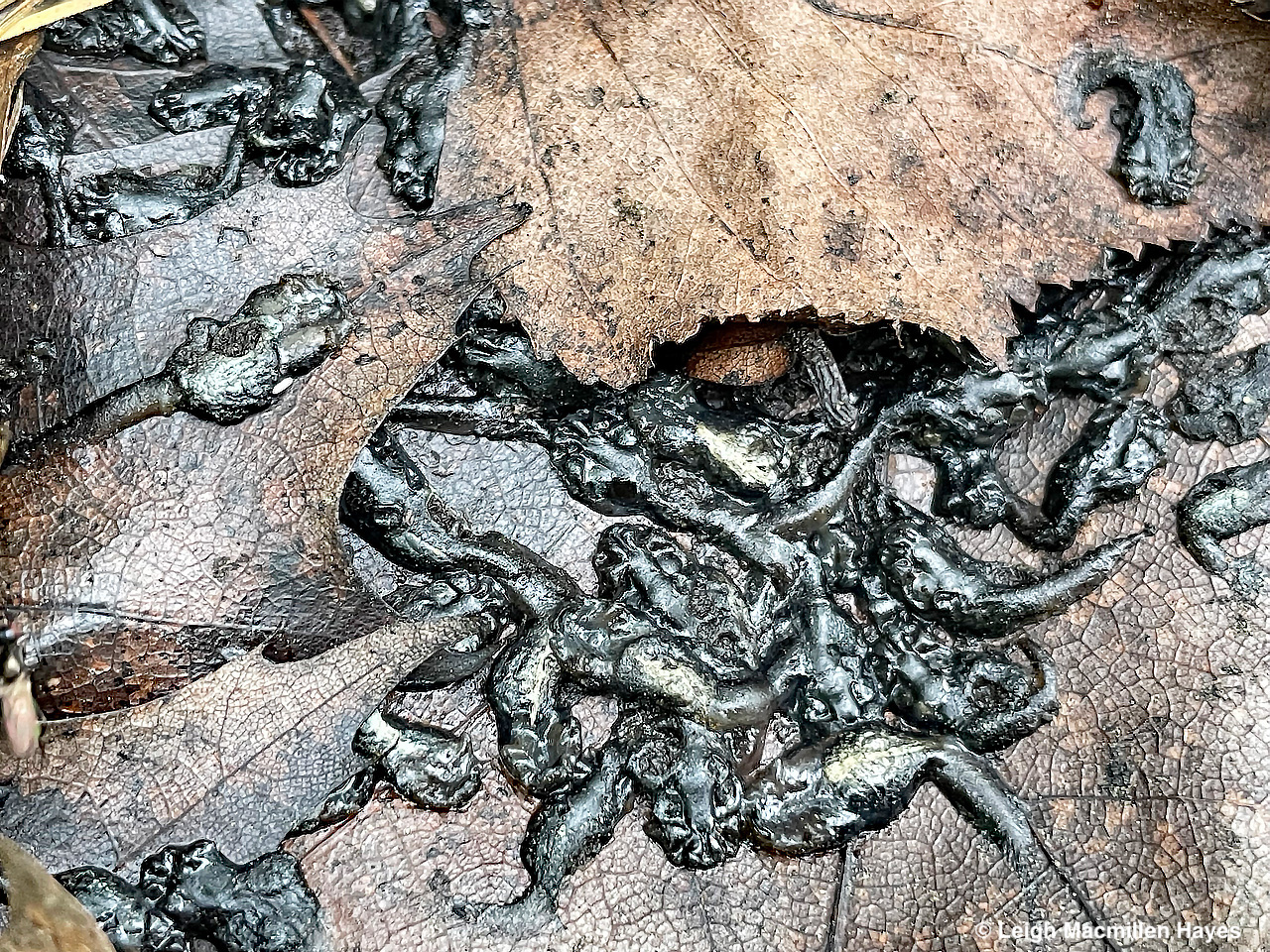
Suddenly . . . a few sweltering days later and all the water had evaporated. 

Stepping toward the center with hope, I was instead greeted with the horrific odor of decaying bodies and a Flesh Fly confirmed my suspicions. 

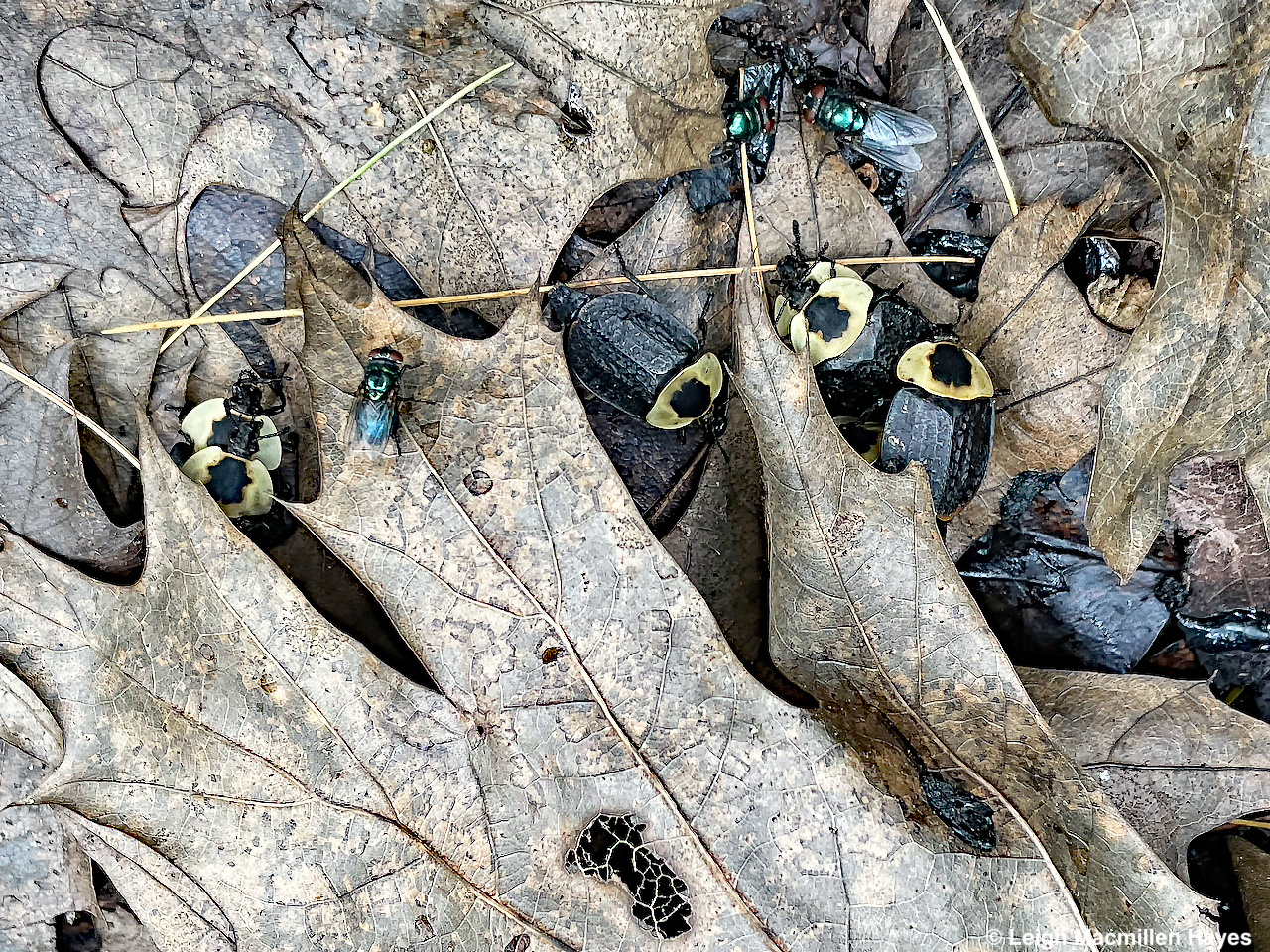
Also buzzing all about were Green Bottle Flies and the reason for so much frantic activity: carnage by my feet. 

But I soon came to realize that while not all the frogs had transformed in time to leave the pool, many must have and it still teemed with life–of a different kind.

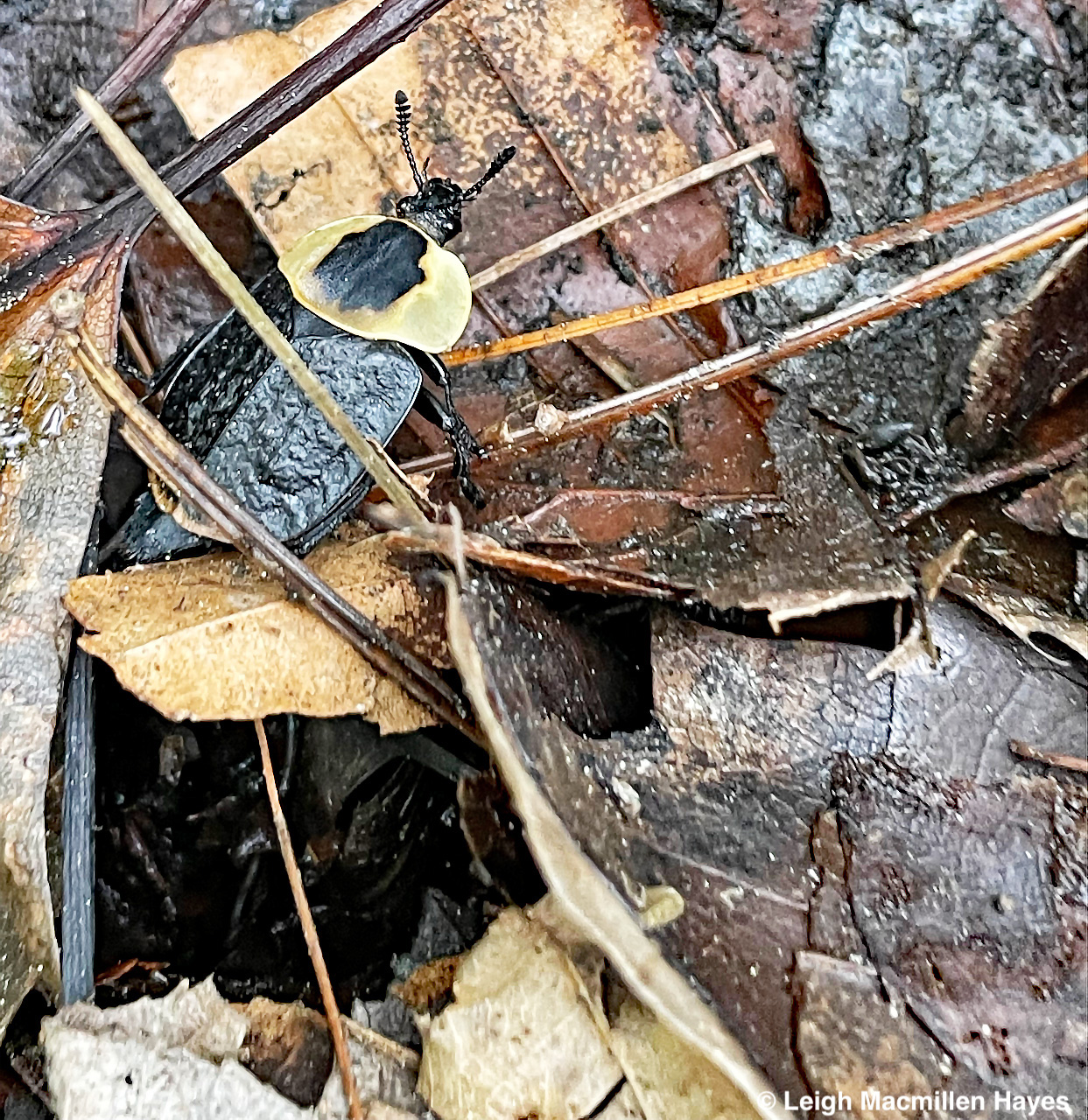
American Carrion Beetles also stalked this place of death. 

Over and under leaves, the Carrion Beetles moved as they mated. The rotting tadpoles provided a place for them to lay their eggs and a food source for their future larvae. This was true for the flies and even little mites who live in a symbiotic relationship with the beetles and eat fly eggs so the beetle larvae have the carrion to themselves. 

As I watched, one canoodling pair of beetles flipped over and if you look closely, you might see he was on top (or the bottom in this case) and biting one of her antennae as part of their mating ritual. 

At last it was with great sadness that I said goodby to those who could not, but leaving the stench and frantic activity behind, I reminded myself that this happens each year and there’s a reason why frogs lay so many eggs. Without my witnessing it, some, possibly many, did hop away from the pool. And next year they’ll return to carry on the ritual. Until then, the flies and beetles and so many others will bring new life and by November the depression will fill again waiting for the saga of the vernal pool to continue. 

In parting, here’s  a quick video of the sights and sounds. 

Birds of a Feather

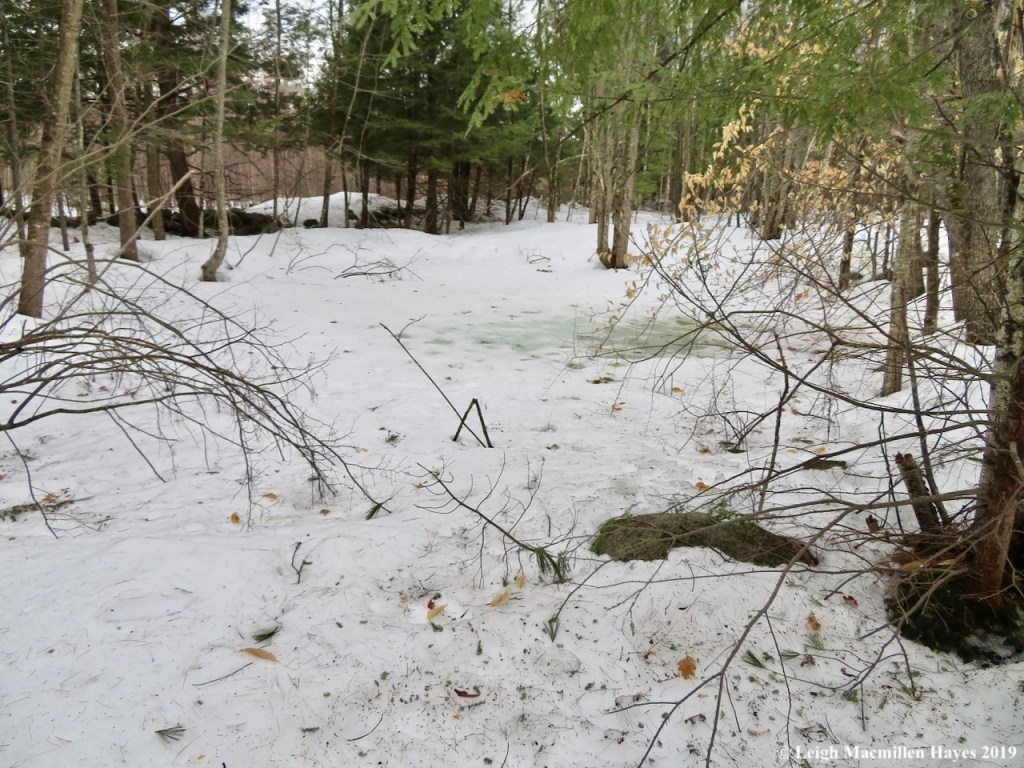
My intention was to check the condition of several vernal pools as I tramped into the woods today. Only a few years ago I was taking photographs of wood frogs on this very date, but I knew that would not be today’s focus.

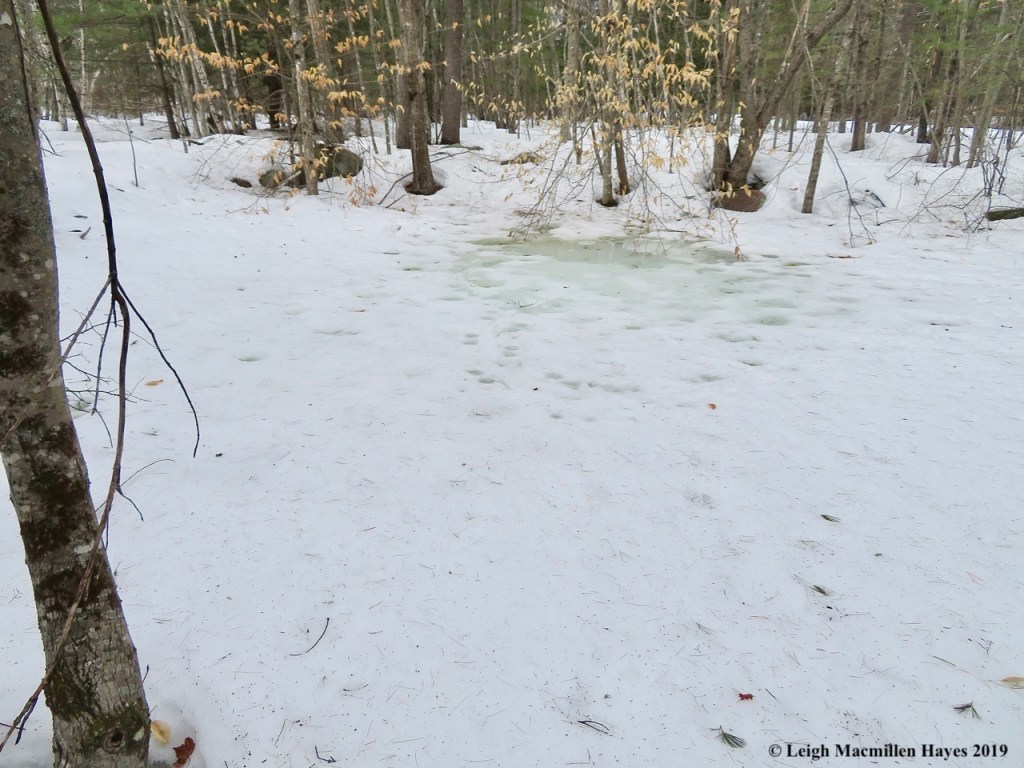
As I approached the first and saw that it was still snow covered, though the northeast side displayed the pastel bluish hue of slushy ice, I began to wonder what would draw my attention.

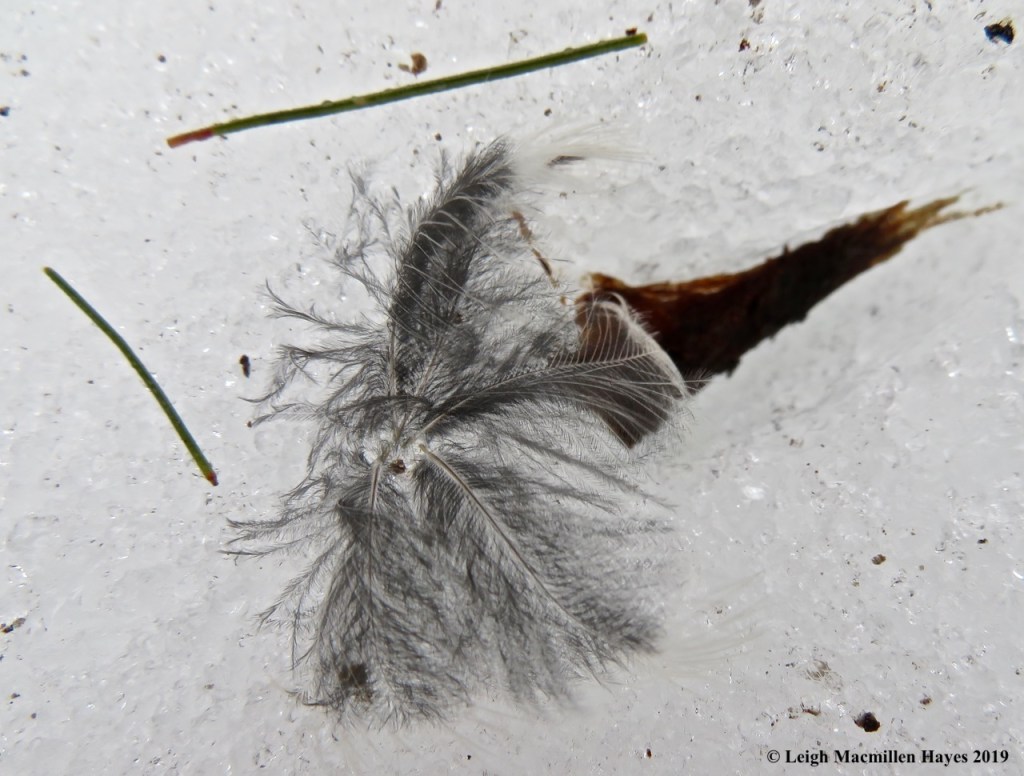
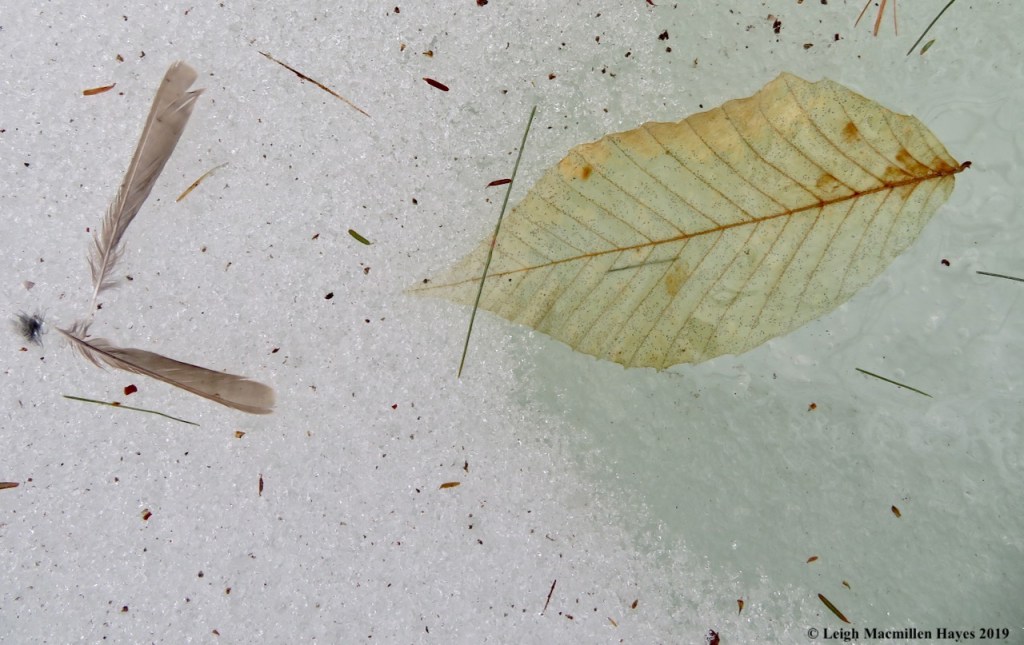
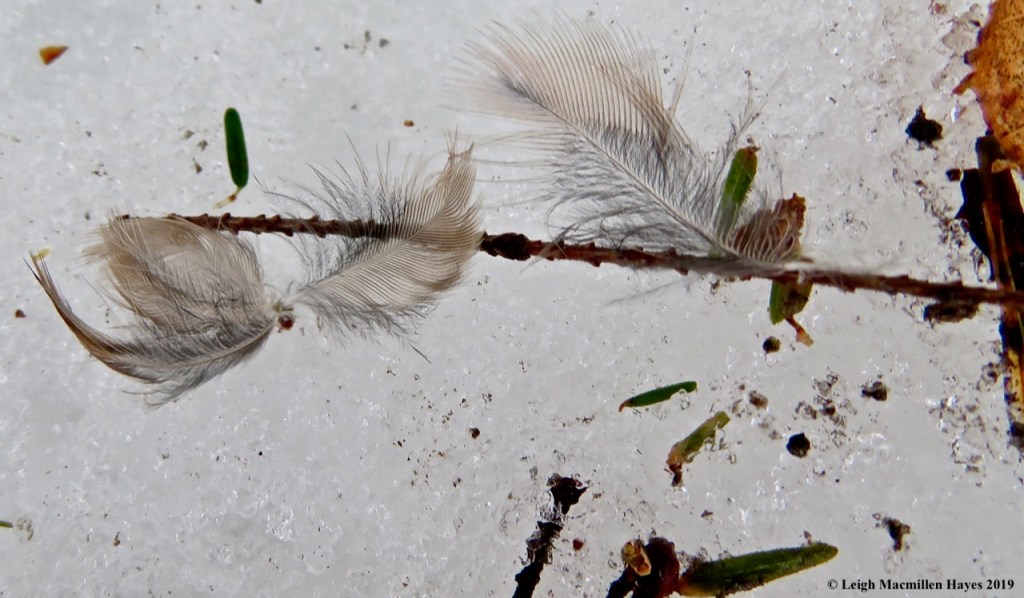
And then I looked down by my snowshoes and suspected I’d found the answer. That answer, however, brought other questions to mind. To whom did the feathers belong? What had happened? Were there others? How did they get there? And when?

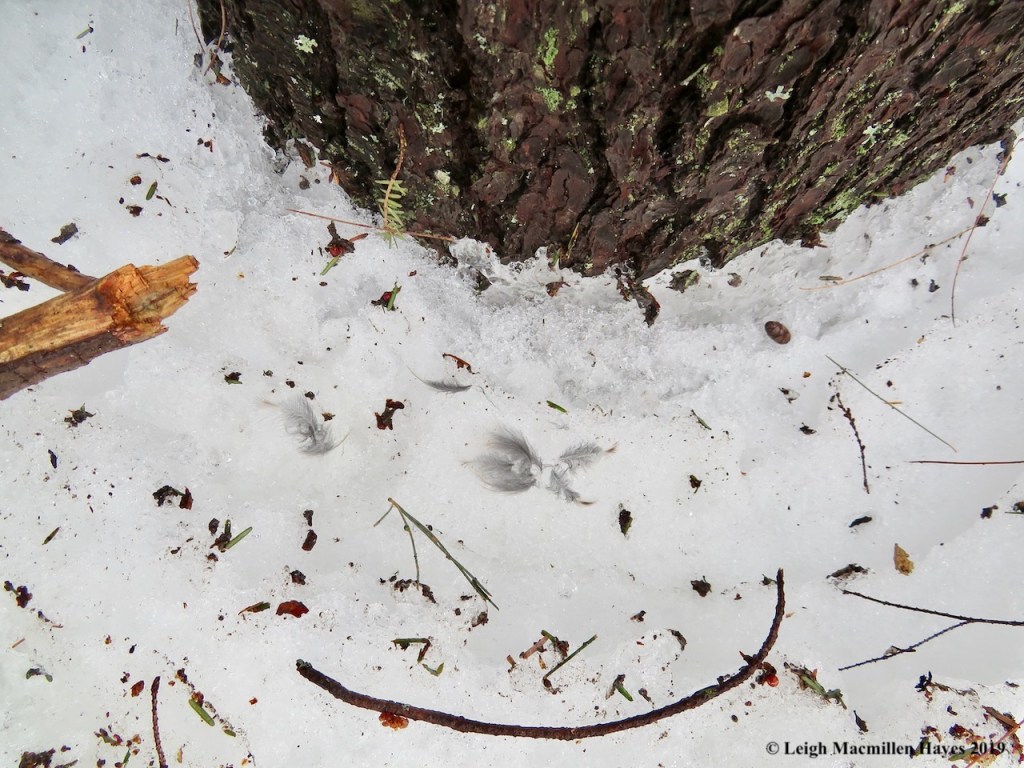
Beside the pool and just below a hemlock, I found another. The hemlock’s needles provided perspective for they were only about a half inch in length.

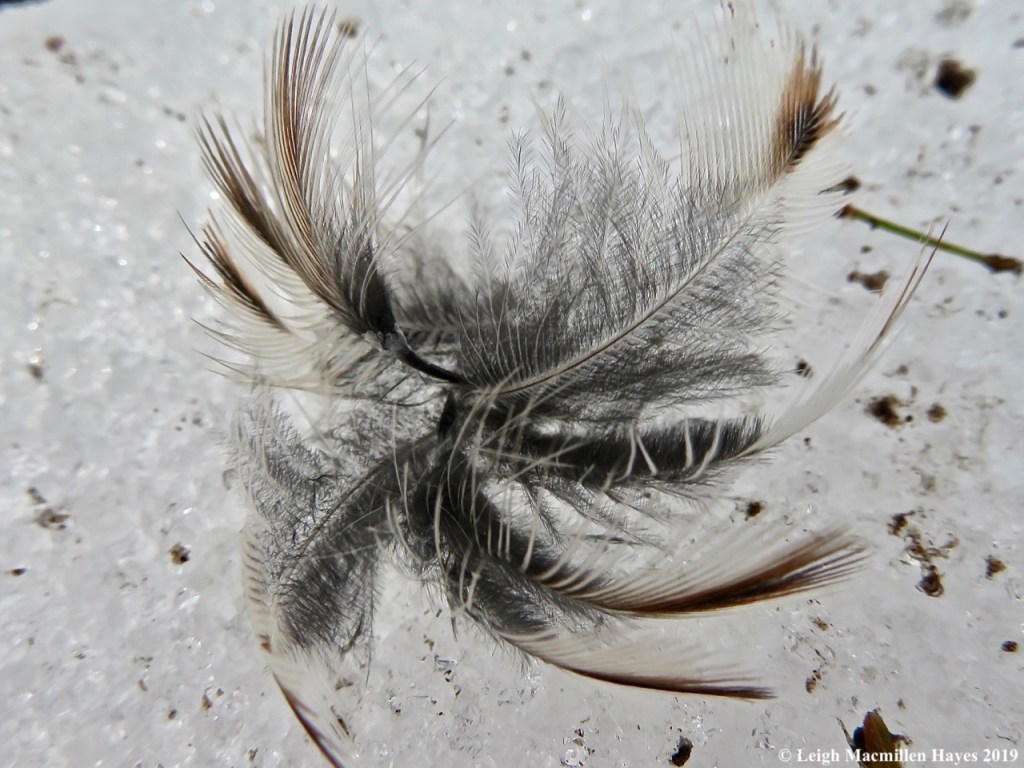
As I moved onto the pool, my eyes cued in to a feather here and a feather there and occasionally a cluster in the mix.

While most were slate gray, I began to note some with tints of brown on the outer fringe.

There were even a few that I thought might be tail feathers, but really my bird knowledge needs to increase greatly. Again, however, with their orientation beside the beech leaf, it was obvious that the bird of choice was not big.

With so many feathers on display, as minute as they were, I wondered who had dined. Or rather, who had snacked for it hardly seemed like a full-fledged meal (pun alert) had been consumed. I found the tracks and then scat of one of the neighborhood deer and knew it was intent on the hemlocks beside the pool and small birds were not on its menu.

In the melted water by the scat were a a couple of feathers of lighter colors. And then it occurred to me. All had been plucked.

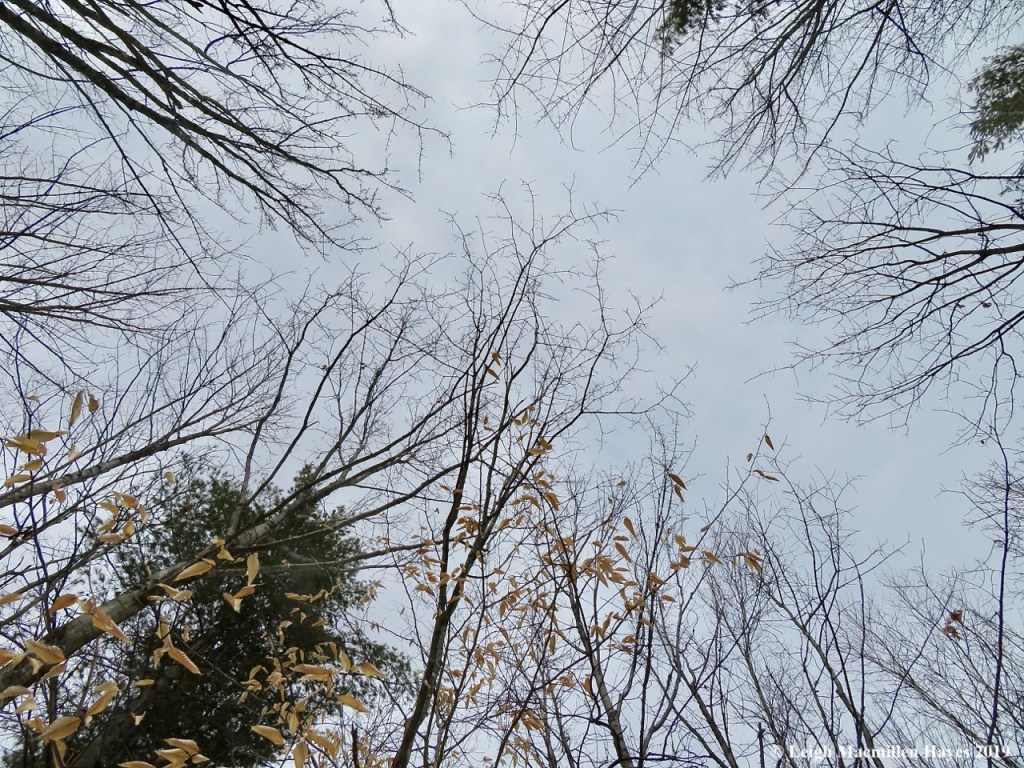
Finding no other evidence of tracks other than deer and turkeys, my mind began to gaze skyward for I considered a bird of prey as the predator. The pool is surrounded by a mixed forest of beech, maples, oaks, hemlocks and pines. Several would have been fine candidates for a feeding tree.

And so I began to wonder if there was more evidence somewhere near the pool. With that in mind, I climbed out of it, and still here and there tiny clumps or individual presentations caught my attention.

With that knowledge, I made a plan. I began on the northern edge looking south and then turned around and walked out, scanning the ground and trees, both at eye level and above, looking for evidence.

I’d walk out as far from the pool as I found evidence, also checking every tree well on the way. Do you see the bits of gray?

Any feathers were more scattered the further from the pool I went, but still they were present. And if you’ve noticed, all were atop any other ground debris. That was significant.

At the point where I saw the last of the feathers, I’d turn around and approach the pool again at an angle, thus zigzagging in and out as I circled it. The furthest away that I got was about 15 snowshoe lengths.
By the time I reached the southerly shore I realized that there were no feathers. That also proved to be significant.

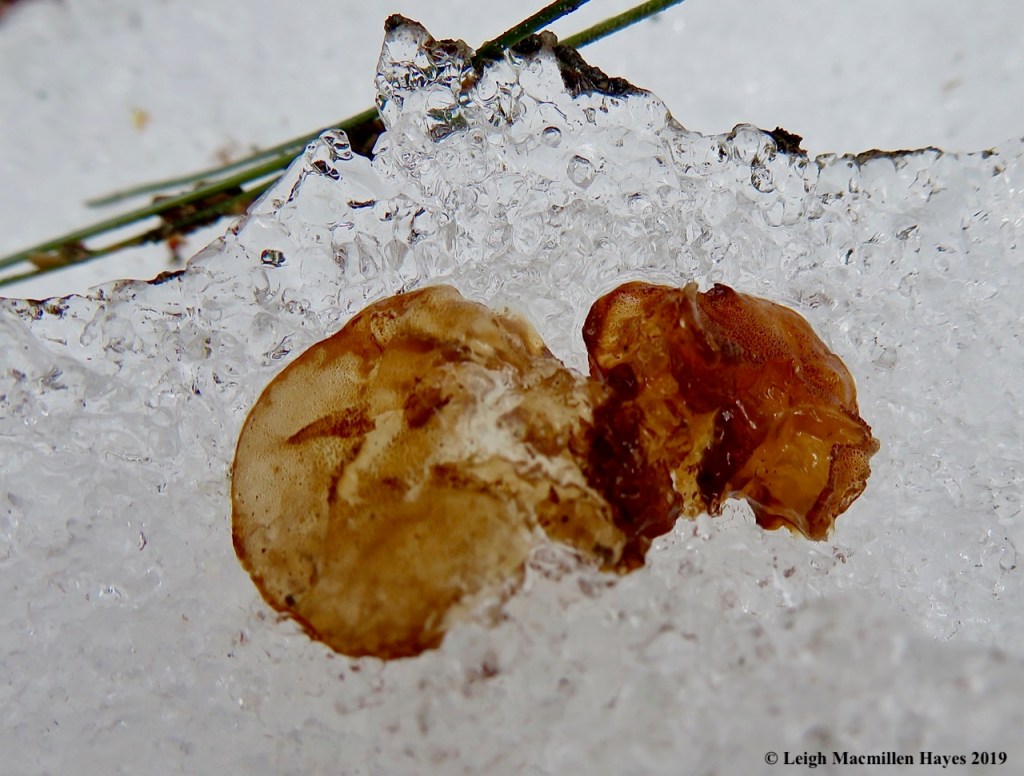
While I was searching, or perhaps because, I found other things of interest like the jelly ear fungus, Auricularia auricula-judae.

It’s one of my favorites this time of year and I love its rubbery and gelatinous feel.

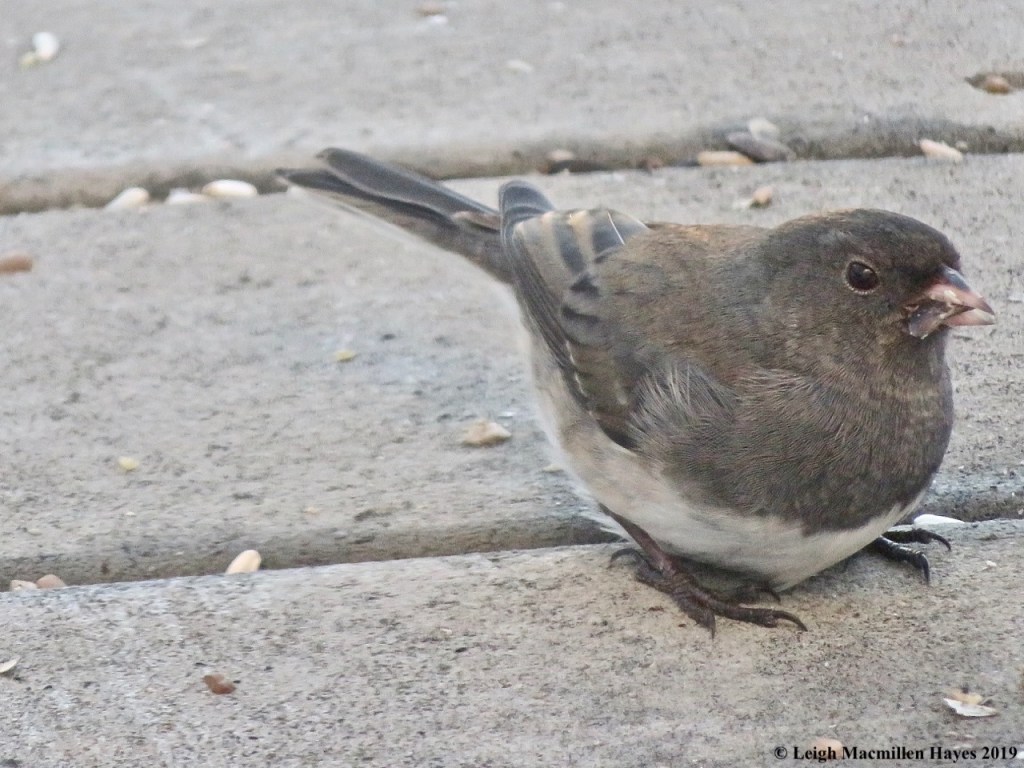
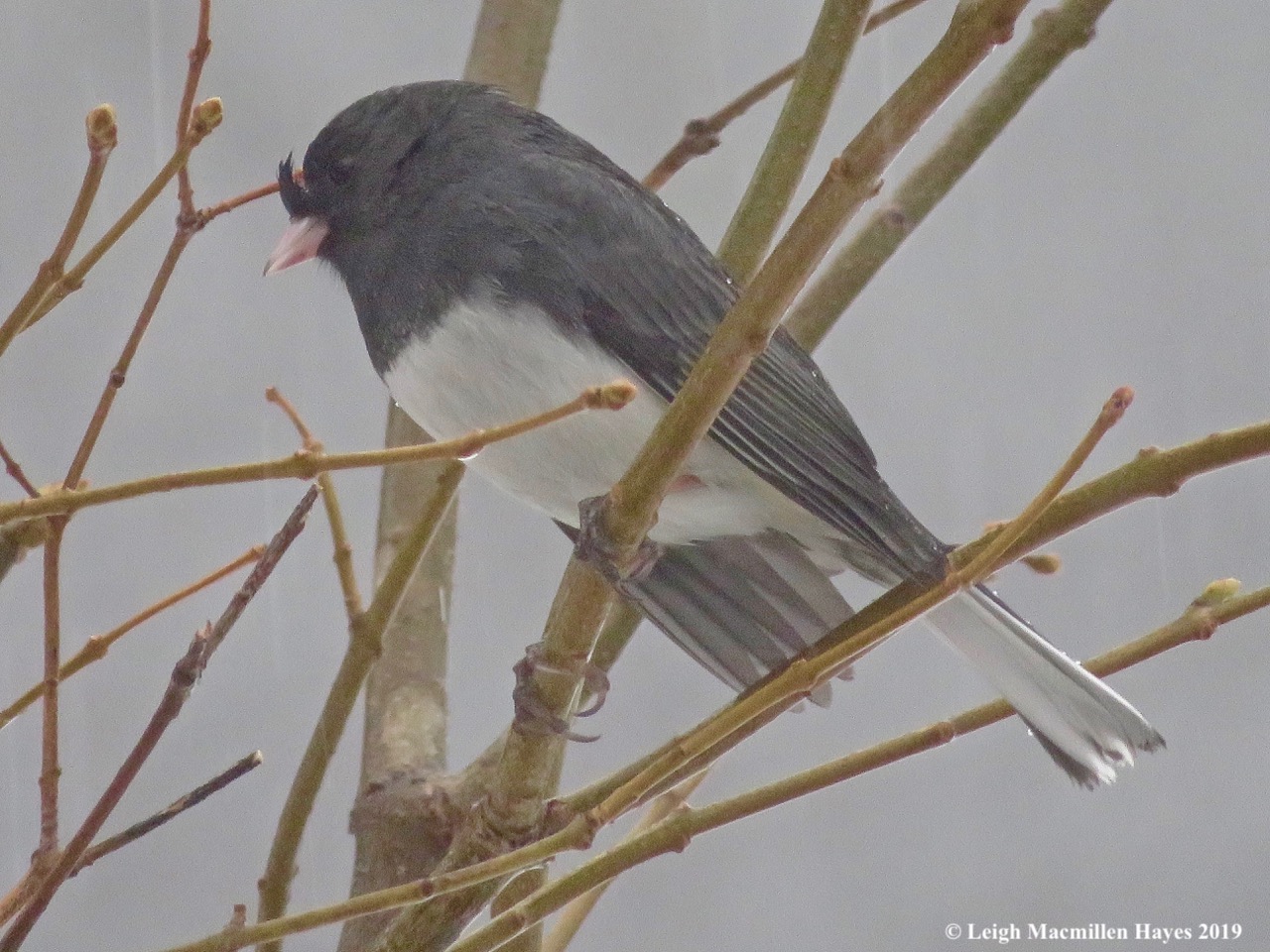
But I digress. And so back to my bird. I didn’t encounter feathers again until about half way back on the westerly side. That lead me to make some conclusions that may be totally wrong, but I’ll put myself out on limb (oh geesh, another one) with my findings: 1. The perpetrator had dined from high up in one of the trees on the north side and I suspected a pine or oak. 2. And if it had dined from above, then the predator was a larger bird 3. The meal was rather recent for all of the feathers were on top of the surface, rather than having sunk into the snow or appearing from under any other debris. 4. I suspected the victim was a Dark-eyed Junco. While the Juncos were everywhere in the fall, once the snow fell in early November, we didn’t see them for a couple of months. And then in mid-January a few found our feeders. This week, the flock has increased substantially as they migrate north and I counted twenty on the ground and in the trees by our home, which isn’t far from the pool.

I never did make it to the other vernal pools today, for so taken was I with trying to figure out the mystery of the feathers. Another thing about Juncos is that though many we see are slate gray, females may be a bit buffy on top of their head, back, and wings.

The other thing about Juncos is their countershadowing coloration.

Looking at the bird from the ground, it tends to blend in with the sky, especially on this gray day. And if you were to look down on the bird from above, it would blend in with the ground. That is, unless of course, you have snow on the ground as we have had for quite a while. It’s beginning to melt, especially in this afternoon’s rain and fog, but it does make the wee birds an easy target for the bigger ones.

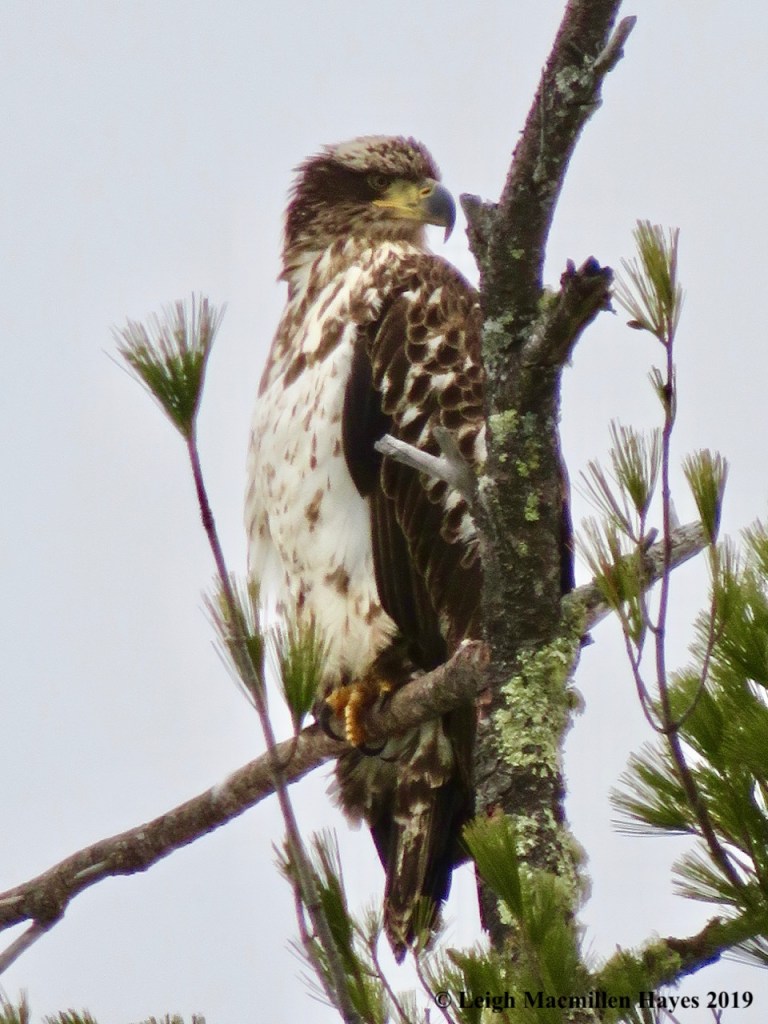
Yesterday I saw a big one, but not in my backyard. Well, in a way I guess it was for I saw it near our camp. And I should have recognized it for I spent all last summer watching an immature and adult in the very location but it’s coloration threw me off.

When I first spied it, I thought it was an eagle or an owl. But the closer I got (mind you, I wasn’t as close as this may seem given that it’s a telephoto lens on a Canon Powershot), the more the white spots on those wings confused me. So, I settled for a hawk–either an immature Broad-winged, Red-shouldered or Red-tailed. But . . . . for once I did what I should always do–and reached out to those who know more than me.

Thank you to Alan and Linda Seamans and the Stanton Bird Club for they all agreed that it was a sub-adult Bald Eagle. Notice the mask. According to the Cornell allaboutbirds site, which I visited at least a hundred times yesterday: “Third year birds [Bald Eagles] have a mostly white belly, with some brown mottling, a brown chest, and a broad brown mask on the face.” Said my friend Alan, who is also a Maine Master Naturalist, “The huge schnozz is being noted by all, much too big in proportion for a red-tailed.”

Thank you also to the birds who continue to teach me about their life stories every day. I don’t always interpret what I see correctly and I admit I may be wrong about thinking the feathers belonged to a Junco, but I do enjoy the journey. Birds of a feather, they keep me wondering.

Sallie Savers Celebrate Big Night with LEA

The initial email was sent by Mary Jewett of Lakes Environmental Association in Bridgton, Maine, on Tuesday:

Hello everyone!

Many amphibians have already crossed and laid eggs but there are still some waiting in the woods. Tomorrow evening looks like it will be perfect conditions for an amphibian migration and I would like to get a group together to go out with me. My plan would be to meet at the office at 8pm. With sunset being at 7:40 I really wouldn’t want to start any earlier since the frogs and sallies won’t move when it’s light out.

I want to get an idea of who would be able to come out with me. I have a reporter and videographer coming out from the Bangor Daily News and they would like to get shots of actual people (not just me) and possibly get some quotes from participants. I know that it’s tough to get out with kids since it starts so late but I hope that we can get a diverse group. We also may have the opportunity to check out egg masses that are already in the water!

And then this afternoon, Mary sent this follow-up message:

I have heard from a handful of people who are able to come out tonight so I’m going for it. Here are some details:

Meet at the LEA office building (230 Main Street) at 8pm
We will caravan up to the Masonic Hall and walk to Dugway Road from there.
Bring high powered flashlights/headlamps
Wear warm clothes and rain gear. It looks like the rain may be pretty heavy when we are out there. Good for amphibians but not so great for people trying to stay dry.
Wear reflective clothing if you have some. I have vests available if you don’t have your own.
Do not wash your hands with soap or put on hand lotion or hand sanitizer.
I have spoken to the police and they are going to try and send someone out. They have a training program this evening so we might not see them. This makes it extra important that kids stay with their parents at all times!

b3-amphibian crossing sign

And so we did just that–met at the LEA office first, and then moved on to the Masonic Hall to park before beginning our journey into the wet and wild world of the amphibians.

b1-redbacked

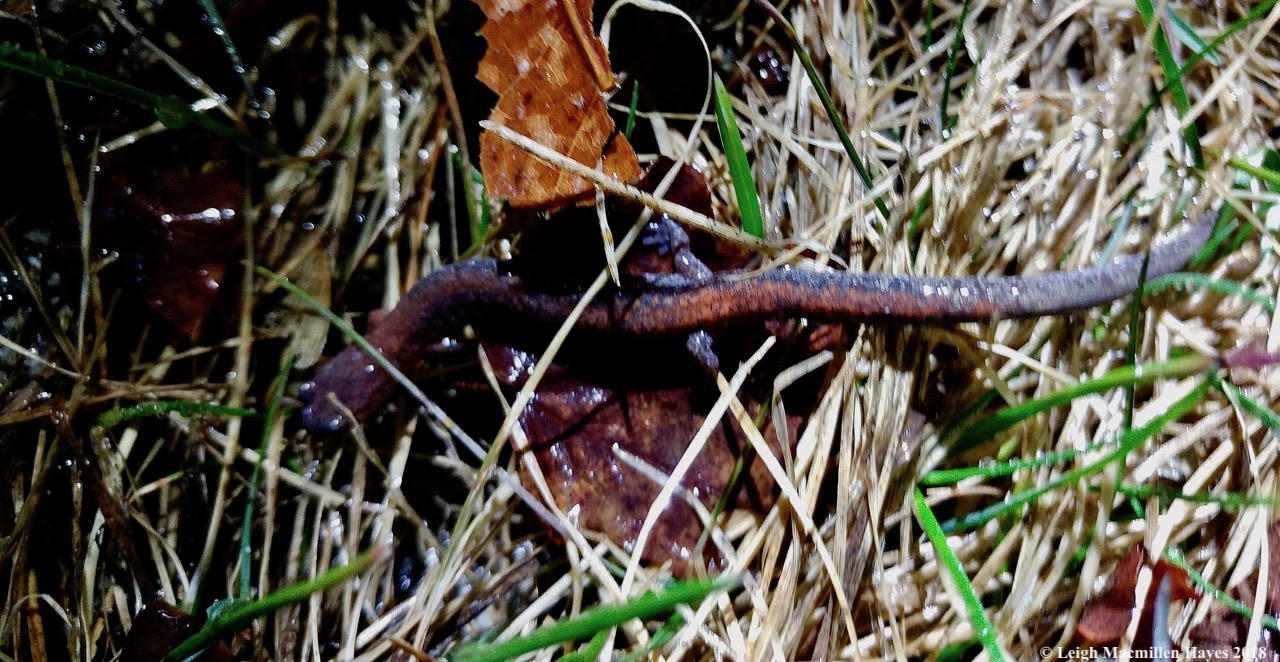
Right away, we noticed worms. And even better, a red-backed salamander. Red backs don’t use vernal pools to mate, but they sure do love rainy nights that offer great opportunities to roam about seeking food.

b2-red backed salamander

We crossed the field from the Hall to Memory Lane, our eyes ever looking for more redbacks, but instead we noted a kazillion worms, each the size of a young snake. And then, after only a few minutes on the road another redbacked graced us with its presence.

b4-Mary explains rules of the road

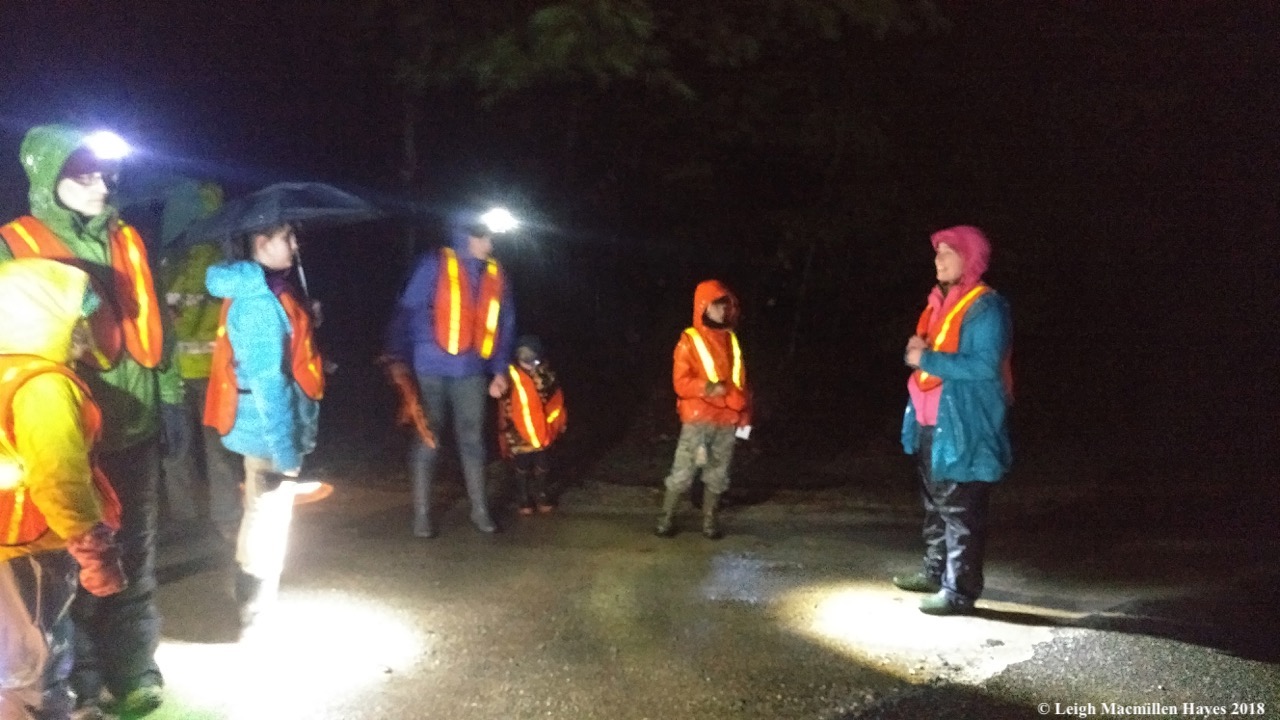
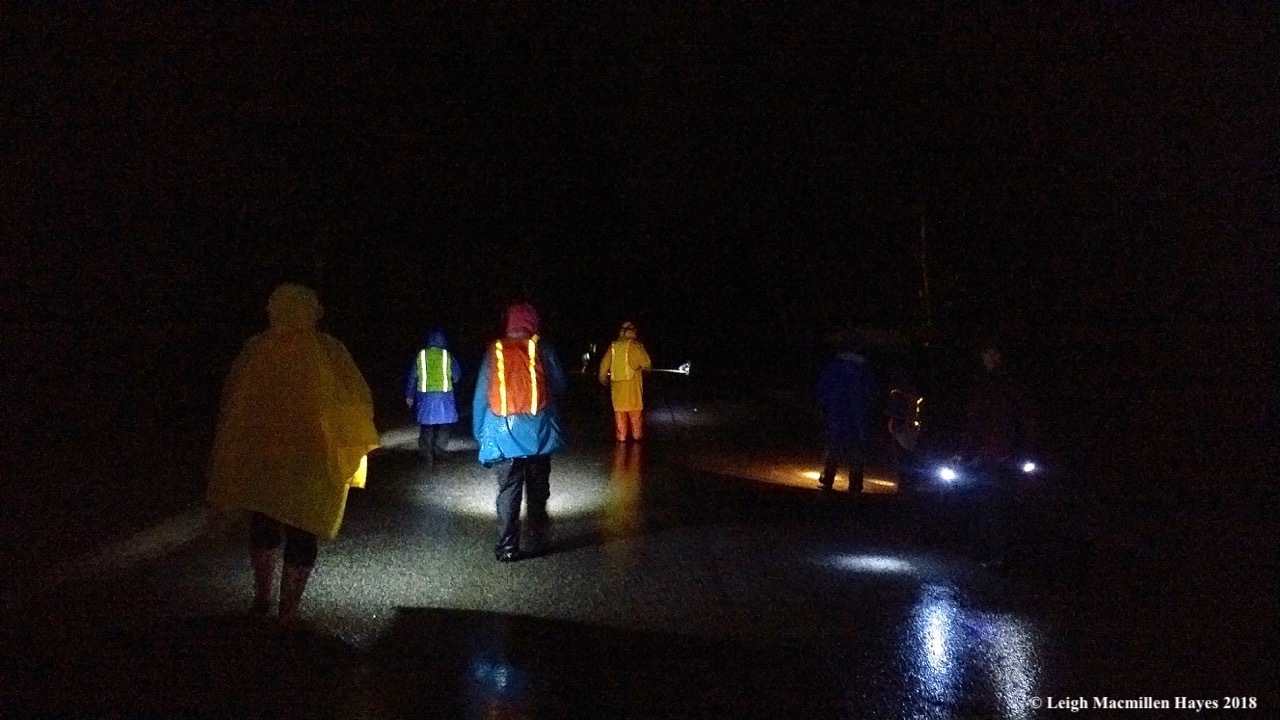
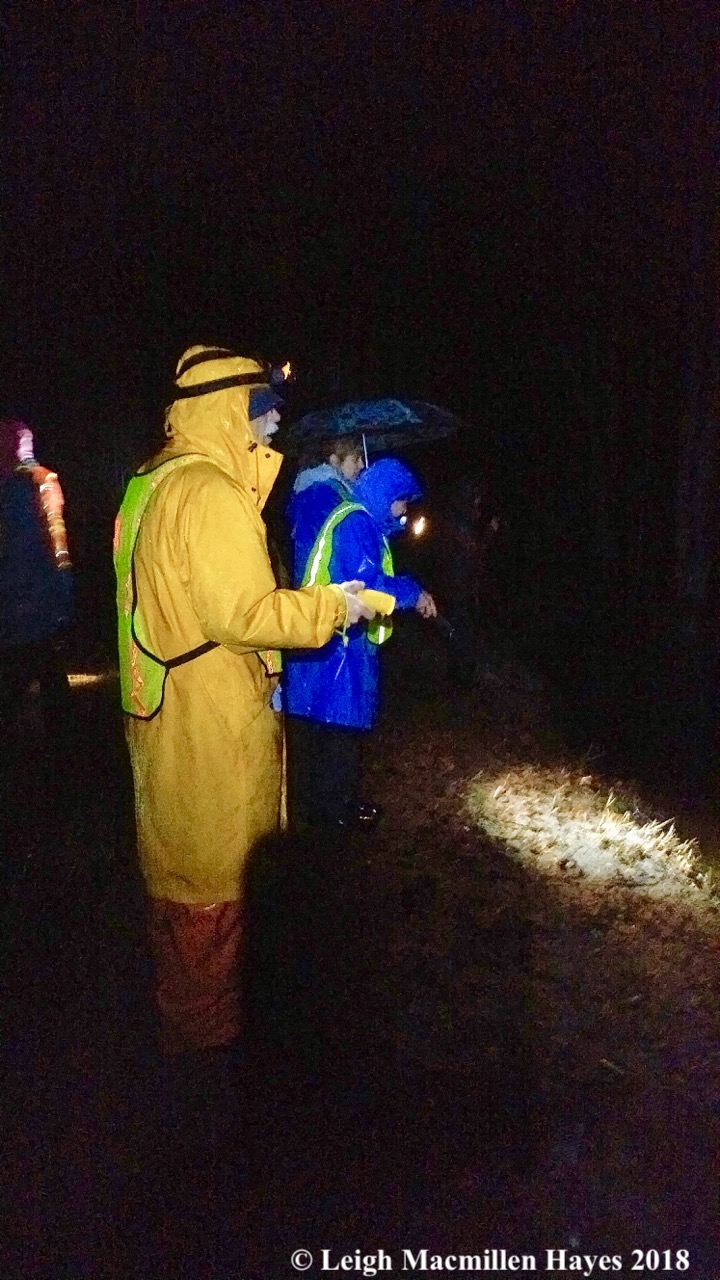
Finally, we reached Dugway Road, our destination, and Mary took a few minutes to remind folks of safety rules. Some years the Bridgton police are able to join us and either shut the road down or at least slow traffic. Such was not the case tonight and so it was important that our crowd of at least twenty ranging in age from four years old to 70+ be cautious.

b4-walking the road

And then the real fun began. We spread out across the road with flashlights and headlamps, walking with care as we tried to notice the little things in life who chose this night to return to their natal pools in order to mate.

b6-spring peeper

Right away, the good times got rolling as we began to spot spring peepers. Really, it was those with eagle eyes who spotted the most, which wasn’t easy given the asphalt conditions. Though we knew better, we did have to wonder if the amphibians chose this road because it provided good camouflage.

b5-first catch- spring peeper

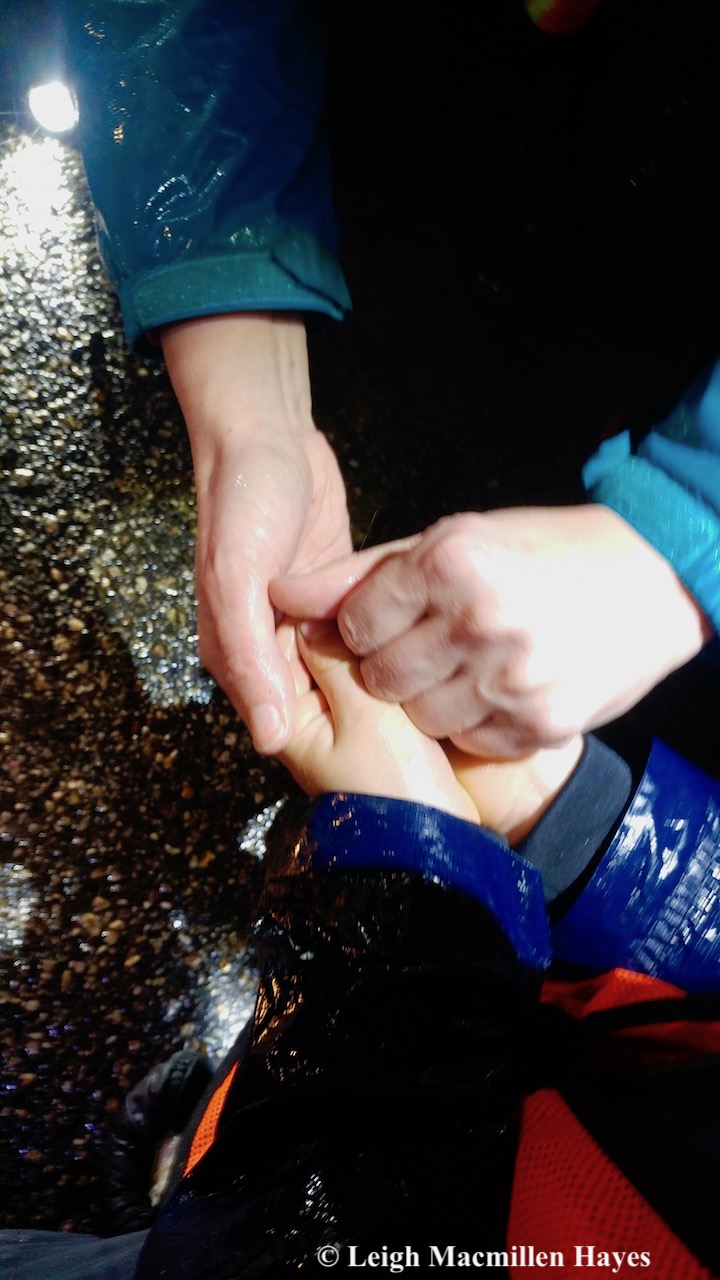
Being the first of the night, Mary demonstrated the fine art of capturing the peeper, explaining first that her hands were damp and had no soap or cream upon them.

Outstretched hands of one of the younger set awaited a transfer.

b5-pass off

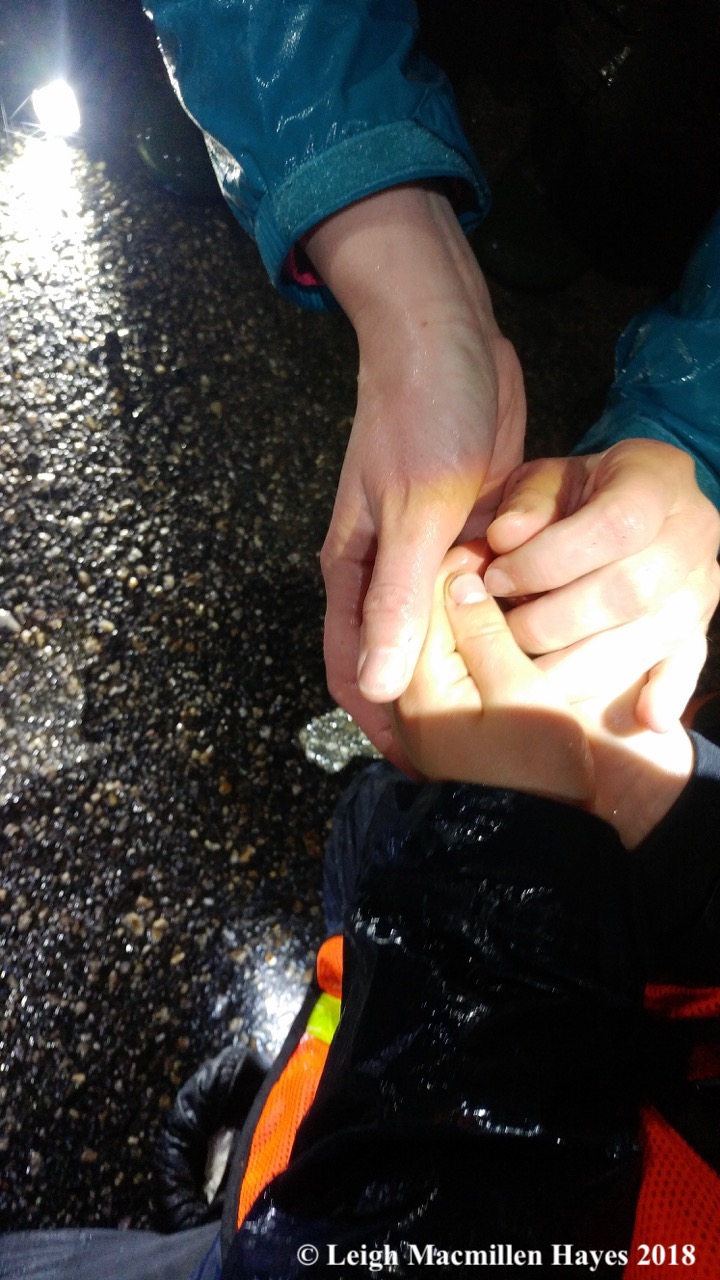
The mission was to help the peeper get to the other side of the road. Typically, once captured, we transport them to the side in which they were headed.

b5-final pass off

The release was made into the youngster’s hands and then onward the child holding frog went. Lucky for the frog, there was a culvert at the side and that seemed like the safest place to release it.

b14-into the vernal pool

Further down the road, the songs of the wood frogs and peepers were almost deafening. As we looked into the vernal pool that was still half covered in ice, there was some movement, but the frogs all continued to sing despite our presence, unlike what happens when we approach a pool during the day and they dive under the leaf cover for a few minutes.

b7-spotted salamander

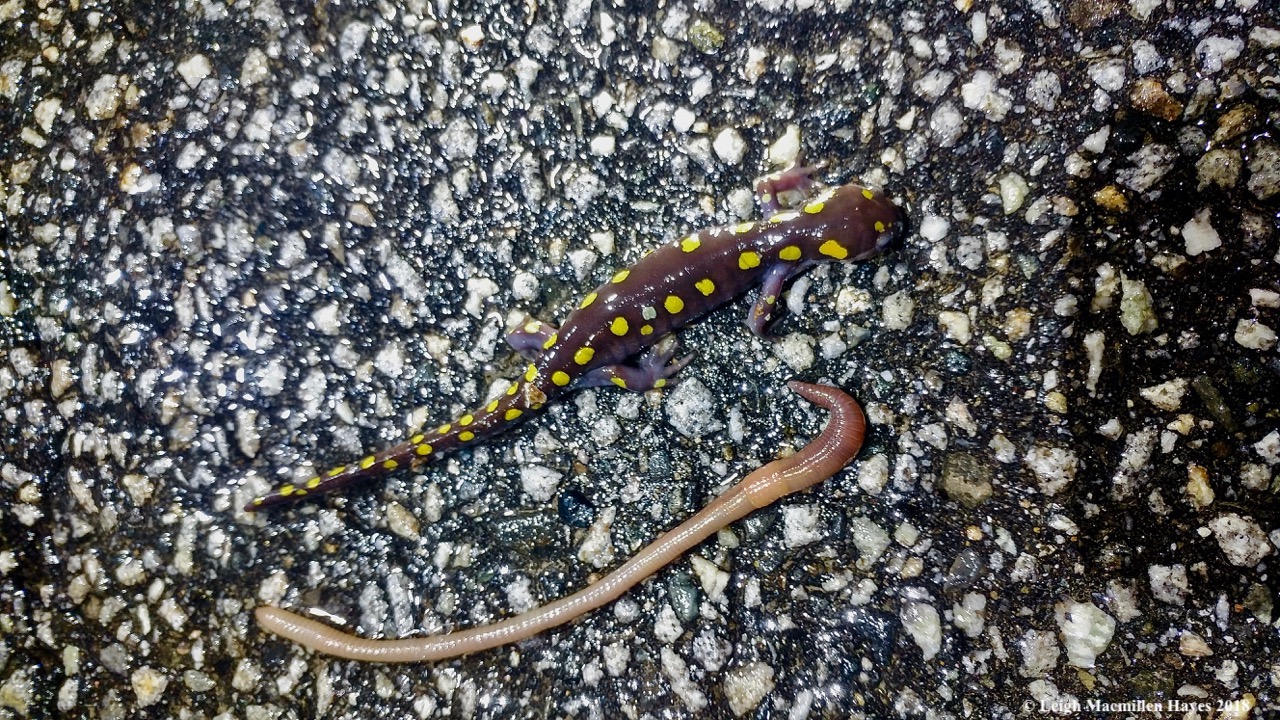
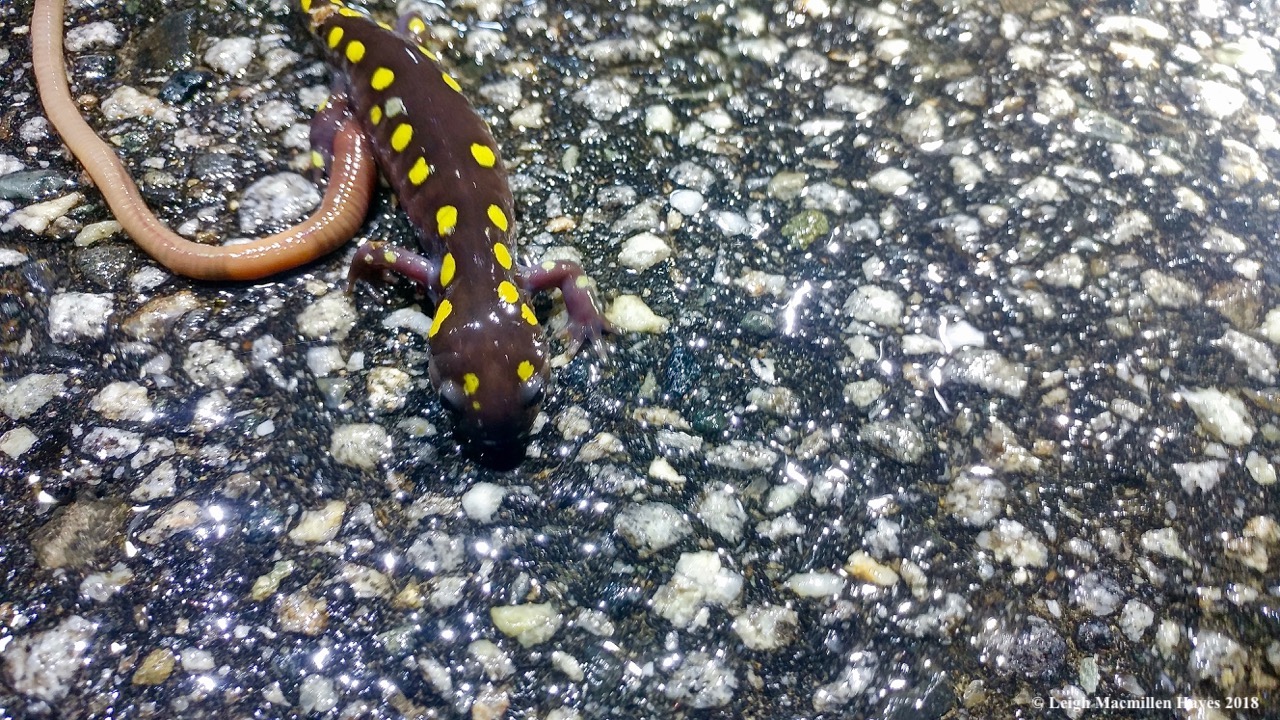
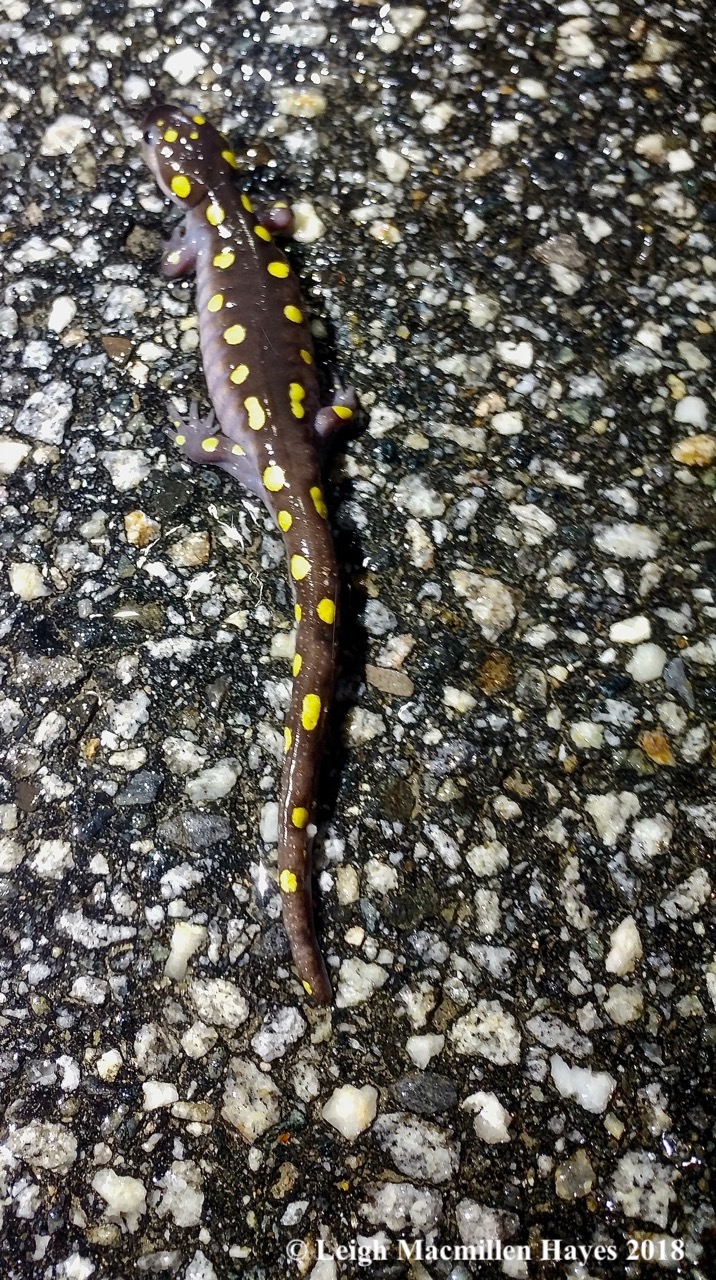
We found enough peepers, but the stars of the night were the spotted salamanders.

b8-sally and worm

The youngest among us picked up one of the ubiquitous worms that marked the night and laid it down beside a sallie.

b9-sally eyes

Sallie didn’t care. It was on a mission and just wanted to move on without our interference. There was only one thing on its mind and we suddenly stood between it and that goal.

b12-salamander

It had a dance to perform before the sun rose and we had a heck of a nerve for getting in the way. I’m always in awe of these creatures who spend at least 11.5 months under the leaf litter and maybe a week or two in the pool. Our rare chance to catch a glimpse of them is on such a rainy night as tonight.

b10-sally on card

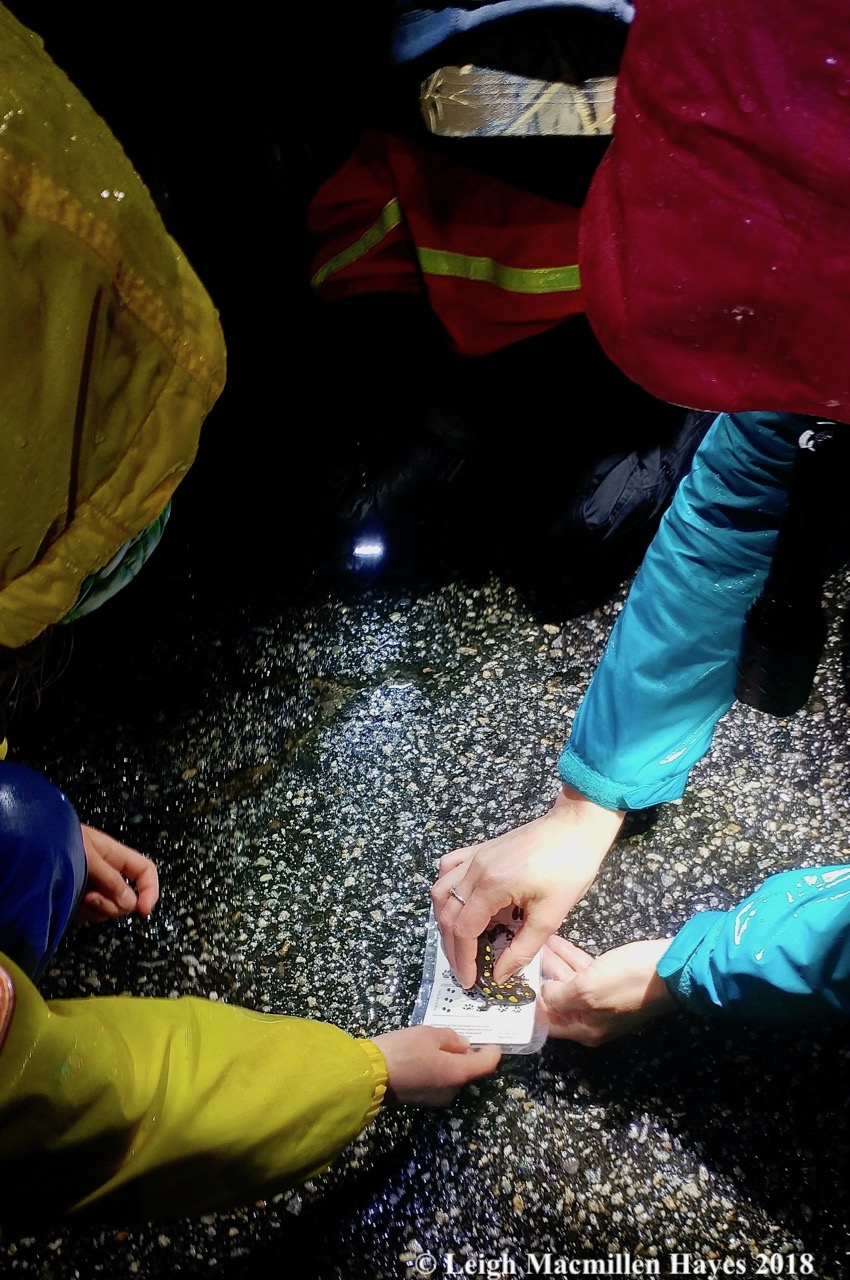
Our intentions were in their favor. We only wanted to help save them from the vehicles that passed by.

b11-sally's world

In the end, though, I had to wonder–is this what the salamander’s world looked like as we scooped it up and helped it across.

Possibly, but still, it’s always a thrill for tots, tweens, teens, and all the rest of us to celebrate Big Night with the Lakes Environmental Association. We are the Sallie Savers.

Books of May: Vernal Pools

I had two books to choose from and couldn’t decide which one to promote as the Book of May, and so . . . I chose both.

And it seems only right that both should be presented, for though they aren’t about the flowers or birds or leaves that are making our days brighter, they are about one of my other favorite May events. Yes, we celebrate Big Night in April, that night or those nights, when amphibians cross the roads as they return to their natal vernal pools to continue the life cycle. But it’s in May that so much growth occurs within those pools and if we take the time to notice, we can watch it all happen–changing daily. And the more we understand what we are looking at, well . . . the more we get it. (“Stating the obvious again, Mom,” our two twenty-something sons would say if they were to read this. But they don’t so I can get away with it.)

Enough said. The May Books of the Month are . . . the following:

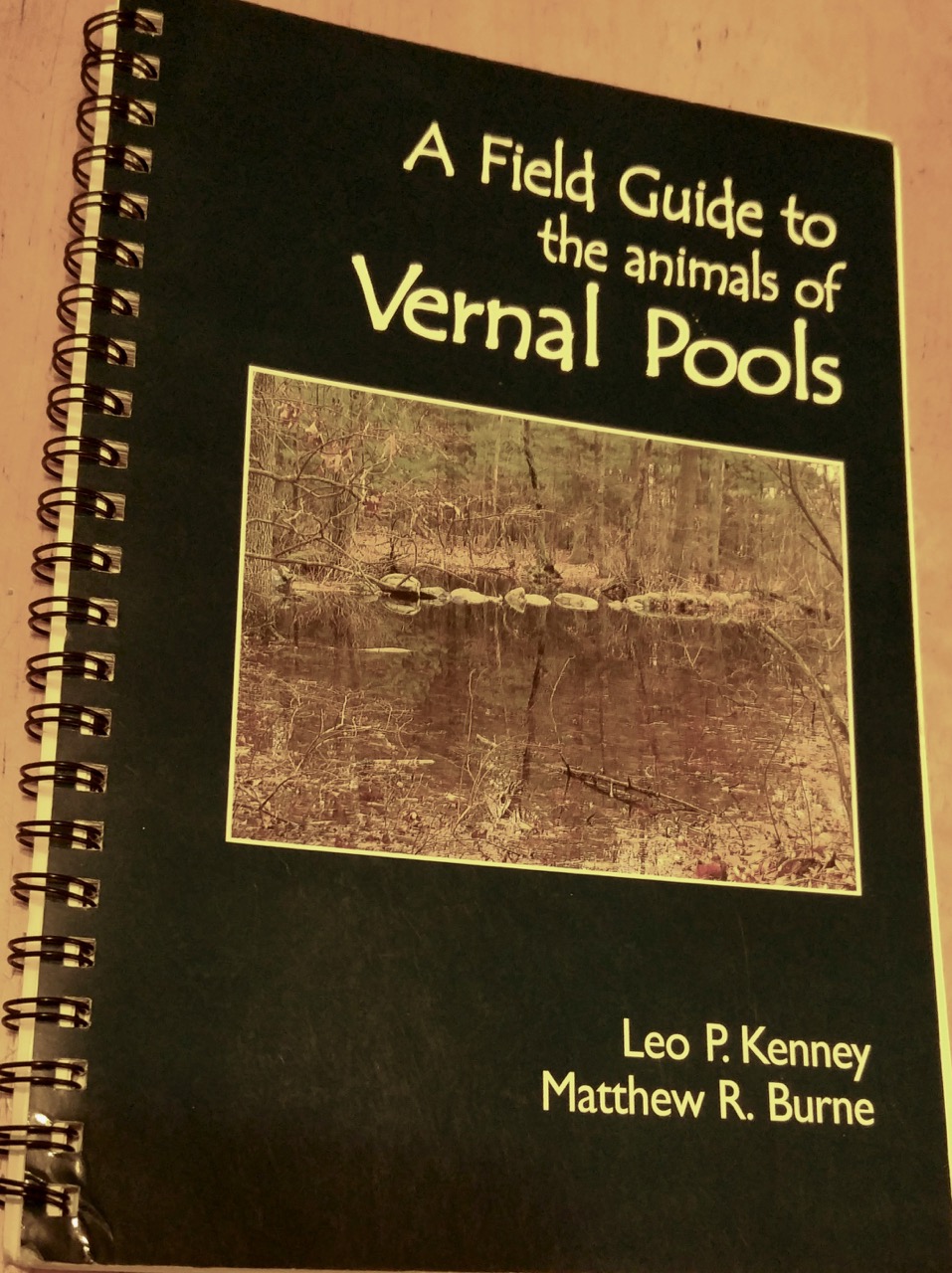
A Field Guide to the animals of Vernal Pools

and

s-MAAR (2)

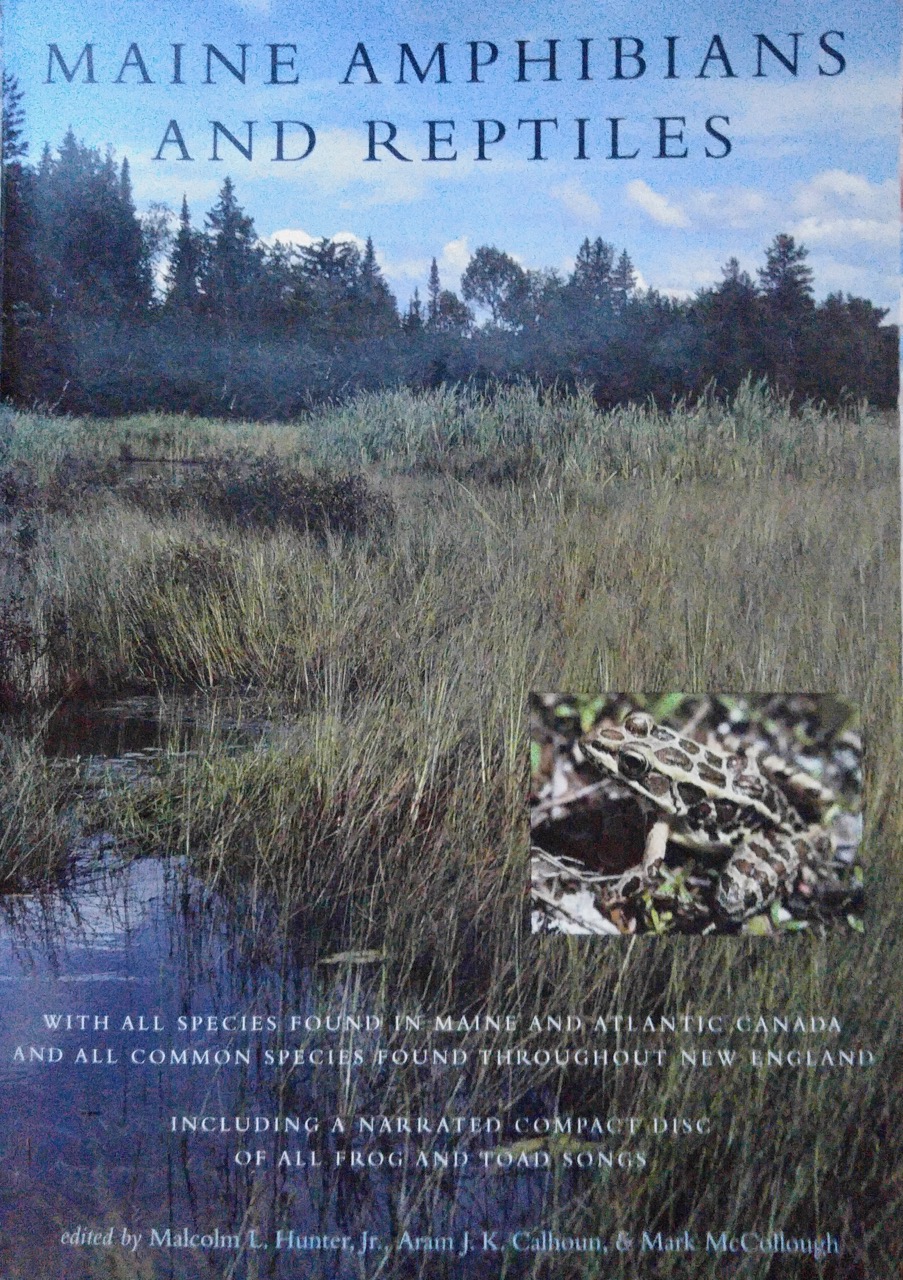
Maine Amphibians and Reptiles.

The former, A Field Guide to the animals of Vernal Pools by Leo P. Kenney and Matthew R. Burne, is about 8″ x 5″ and fits easily into any pack I decide to carry. Its pages are glossy, so I don’t worry too much about it getting ruined if I get it wet. And though it was written to represent Massachusetts, most of the species described match what Maine vernal pools have to offer.

s-MAAP frogs:toads (1)

After an introduction to vernal pools, their indicator (obligate) species, protection, importance and human impacts upon them, there is a pictorial guide to the adult amphibians and reptiles. This is a quick and easy reference, and especially useful when trying to determine the difference between species, e.g. bullfrogs and green frogs or leopard frogs and pickerel frogs. Besides frogs, it includes salamanders, snakes and turtles.

s-MAAR sallies (2)

And then there are more descriptive pages for each species. These have helped me over the years to gain a better understanding of what I’m looking at.

s-sallie eggs 1

Even today, when Jinny Mae and I discovered these spotted salamander eggs, I loved that we could see that gelatinous matrix that surrounded the individual eggs.

s-wood frog eggs

And the book has helped me recognize the difference between those salamander eggs and these wood frog eggs.

In the field, there’s so much more to see, including the invertebrates that inhabit the pool, and ever so slowly I’m learning to identify them as well–you know, predaceous diving beetles, damselfly larvae, water scorpions, backswimmers, water striders . . . the list goes on. Each of them is featured in the back of the book with a photograph and paragraph or two describing their larval and adult forms.

Maine Amphibians and Reptiles, edited by Malcolm L. Hunter, Aram J.K. Calhoun and Mark McCollugh, is my at-home reference book. Well, sometimes it goes for a ride in my truck, but usually, it’s left at home because it’s larger and offers a much more in-depth take on amphibians and reptiles, their habitats and conservation. Besides a photo gallery, each amphibian and reptile that makes its home in Maine is featured, with thorough descriptions, taxonomic status, distribution, reproduction, habitat, diet, and interactions with people and other animals. There are sketches and maps to further enhance the information presented. And it’s all quite readable.

s-MAAR recordings 2 (1)

One of the best features of this book (and unfortunately, mine is cracked) is the CD at the end. Yes, you can actually listen to the individual species so that when you hear them in the day or night, you might begin to recognize them, much as you would a bird, by their voices before you spy them.

In the past few years, the vernal pool that I study frequently, has dried up before the amphibians have matured. I find solace in the fact that even when the pool dries up, the species growing there still provide nourishment and pass on energy to their consumers.

But . . . maybe this year will be different. We had a lot of snow, and now a lot of rain. Maybe this will be the year the amphibians and insects that reside in the pool will actually mature and hop or fly out.

It all begins with MAY.

The Books of May:

A Field Guide of the animals of Vernal Pools, by Leo P. Kenney and Matthew R. Burne, available through the Massachusetts Division of Fisheries & Wildlife’s Natural Heritage & Endangered Species Program.  (Curiously, the copy I own was from the third printing in MAY 2009)

Maine Amphibians and Reptiles, edited by Malcolm L. Hunter, Jr., Aram J.K. Calhoun, and Mark McCollugh, The University of Maine Press, Orono, 1999. (I purchased my copy at Bridgton Books.)

So Many Quacks

Stepping as quietly as possible through the woodland, my heart quickened when I heard a particular chorus vibrating from the vernal pool.

v-ice 2

Three days ago a thin layer of ice still covered half of it.

v-ice 3

But I was happy to note that despite last week’s frigid nighttime temperatures, the wood frogs had been active.

v-many heads

While I stood and waited on Sunday, there’d been no movement or sound and I thought that the frogs had already moved on–mission accomplished. My ears and then my eyes knew differently today. I heard the quack of the males and then saw a number of heads on the water’s surface. Quickly, I snapped a photo–the little balls of light represent those precious heads.

v-ripples

They sensed my approach and began to make waves. Water rippled as they dove under the leaf cover below. And all was silent.

v-eggs 3

The community of egg masses, however, showed that their efforts continued to be fruitful.

v-egg masses 2

In general, each mass laid by different females is attached to a twig or branch. They tend to take advantage of the same site for attachment and usually in a sunny, warm spot. Already, some floated to the surface. Eventually, they’ll gain a greenish tinge from algae, which actually helps to camouflage them. One of the many wonders is that any given mass may contain up to 1,000 eggs–from a two-to-three-inch frog.

v-egg mass 1

A couple of masses were positioned independent of the rest, like this one–embraced in oak and maple leaves. It’s almost out of the water, though yesterday’s rain helped, but I questioned whether or not it will be viable.

v-frog and sally eggs

Then again, will any of them? Last year, the pool dried up before the tadpoles reached maturity. And it isn’t just tadpoles that begin life in this pond. Notice the white, gelatinous masses below those of the wood frogs? Spotted salamanders had also returned to this small body of water.

v-sally 3

They, too, attached clusters to vegetation. Smaller in number of individual eggs, salamanders lay 30-250 within each clear or opaque white mass. As they absorb water, the masses enlarge.

I walked around the pool looking for spermatophores produced by males and left on the leafy bottom, but saw none. Earlier today, my friend, JVP, and I walked along the Narrow Gauge trail and saw them in several pools. Unfortunately, though I had my camera in tow, I’d left the battery at home–still sitting on the charger. Oy vey!

v-beech leaves

As beech leaves continued to cling and blow in the slight breeze over the pool, I finally settled down at the edge and waited for action.

v-diving beetle

Moving with aquatic beetle speed, predaceous diving bugs swam about in constant motion.

v-water boatman

Also calling this small pool home were numerous water boatmen.

v-peaking out:blending in

But what I most wanted to see–the wood frogs themselves. Ever so slowly, they began to emerge from the leaf cover.

v-frog 1

Once by the surface, they floated.

v-frog 5

As long as I didn’t make any sudden moves, they stayed–showing off the dorsolateral ridges that run from the back of their eyes toward their hind legs.

v-frog 4

Color variation was evident–from rusty browns to gray and tan.

v-frogs hanging

Sometimes, several floated near each other–probably wishing I would leave so they could continue their serenade.

v-2 frogs

And then there were two that seemed intent upon one another.

v-2 frogs 3

I’m sure they spoke–probably cursing my presence.

v-2 frogs 1

With the flick of a frog leg . . .

v-2 frogs depart

they suddenly went their separate ways.

v-love 1

One couple, however, did hug. So that brings up another curious thing about wood frogs. Males cannot identify females by sight or sound, so he has to clasp the other frog. If the frog is thin, it’s either  another male or a female that has already released her eggs–thus he’ll release it quickly. Yup–females are generally fatter because they carry eggs.

My eyes were as wide as the frogs I watched–I’ve never had the pleasure of seeing so many in this particular pool. And I was sure that due to the ice, all the action was completed a few days ago. But the multiple chortles I heard upon my initial approach created a racket today–and sounded, of course, like a bunch of mallards. I rejoiced over the sound of so many quacks.


Observing the Cycle of Life

The Maine Master Naturalist class of 2015 graduated last night and for the second year in a row I had the privilege of helping students focus their eyes and develop a strong foundation about the natural communities of Maine. And now, they are ready to go forth and educate others.

In some ways, the year reminds me of life in a vernal pool.

And at the vernal pool I’ve been visiting on a regular basis since March, the transformation continues. I know I’ve included it in several (probably more than several) posts, but today seems like a good day to reflect upon its life cycle.

VP March 25

March 25: A snow-covered depression with some indecipherable tracks crisscrossing the surface.

VP April 4

April 4: Snow, water and slush. Something caused a disturbance.

VP April 12VP April 12 A

April 12: Freeze and thaw and freeze again, trapping newly fallen beech leaves.

VP April 21

April 21: Three days ago, this was still covered in slush. Suddenly, open water.

VP woodfrog eggs, April 21

April 21: The wood frogs didn’t waste any time.

VP April 24

April 24: More and more egg masses appear–attached to the branches or each other, as is their habit.

VP April 28

April 28: Though most are wood frog, there are some spotted salamander egg masses in the mix. All are taking on the green tinge from the algae with which they have a symbiotic relationship.

VP Predacious, April 28

April 28: Meanwhile, not even bothering to lurk in the shadows, a predaceous diving beetle swims about.

VP frog May 2

May 2: A well camouflaged wood frog still hopes for some action.

 VP wood frog, sally, May 4

May 4: Wood frog egg mass at top; spotted salamanders mass at bottom.

VP Babies May 4

May 4: Tadpoles at last.

Swarm

May 4: With communal living comes warmth.

VP, larvae, May 4

May 4: Mosquito and other larvae flip-flopping around.

VP, drying up, May 5

May 5: A sign that the pool is beginning to dry up–egg masses suspended in midair.

VP, life, May 5

May 5: Meanwhile, in the water, life continues. Tadpoles and others feed on the algae.

VP, May 12

May 12: Due to a lack of rain, the pool size decreases.

VP, lower, May 12

May 12: I can only hope that these blobs are just the remains and that most of the tadpoles have hatched.

VP, May 12, more life

May 12: A peek into the variety of life below the water.

May 14

May 14: Shrinking more and more.

VP, May 14, drying up

May 14: Some masses are left high and dry.

VP, May 14, tadpole:sally

May 14: A tadpole visits the salamander embryos.

VP, May 14, peanuts

May 14: Peanut shells. What? There hasn’t been much evidence of any person or critter visiting the pool . . .  until this.

vp 1

May 28: Almost completely dried up.

wet spot

May 28: The only wet spot left.

tadpoles

May 28: Tadpoles make the most of the wee bit of water.

tadpoles galore

May 28: The wet depression boils with action.

peanuts

May 28: And peanut shells are everywhere in the pool, but only one on the snowmobile trail. Another mystery.

With the end of class, eighteen new master naturalists are heading off into the woods to teach others. I hope the tadpoles have a chance to continue their development so that they, too, can hop away from the pool.

As for the vernal pool–vernal means spring and though spring isn’t over, unless we receive a substantial rainstorm, it has almost completed its cycle of life.

Thanks for wandering and wondering with me today.