
This lesson began on Black Friday, but I was waiting for a sloggy snow day to finish the assignment and today was such. Three more inches of snow and then, of course, rain. Ugh!
But, Black Friday was bright and brisk and while many people spent dollars and dollars shopping for the perfect Christmas gifts at supposedly discounted prices, some peeps from the Maine Master Naturalist Program and I joined Jeff Pengel and Alan Seamans for a Moss Foray in New Gloucester.
Among other things, they reminded us that mosses are divided into two groups based on their reproductive structure, and this I think I now know. Pluerocarps form spore capsules from side branches while Acrocarps are not as branched and the capsules arise from the tip of the stem or main branch.

We’d hardly walked fifty feet from the parking lot when the first subject was introduced. I love its common name: Electrified Cat-Tail Moss. This was a new one for me and the real quiz will be if I can find it on my own once the snow melts (though I do hope we get some more snow first).
The guys introduced us to a variety of mosses and a few liverworts, but . . .

one of my take aways was gaining an understanding of this blue-green growth under the arrow. I always thought it was algae. Not so. This is protonema, or germinating moss spores all tied together with filaments. We could not identify them to species yet, but their mossy leaves were starting to emearge here and there. Now I can’t wait to spot this again–and meet it all over for the first time.
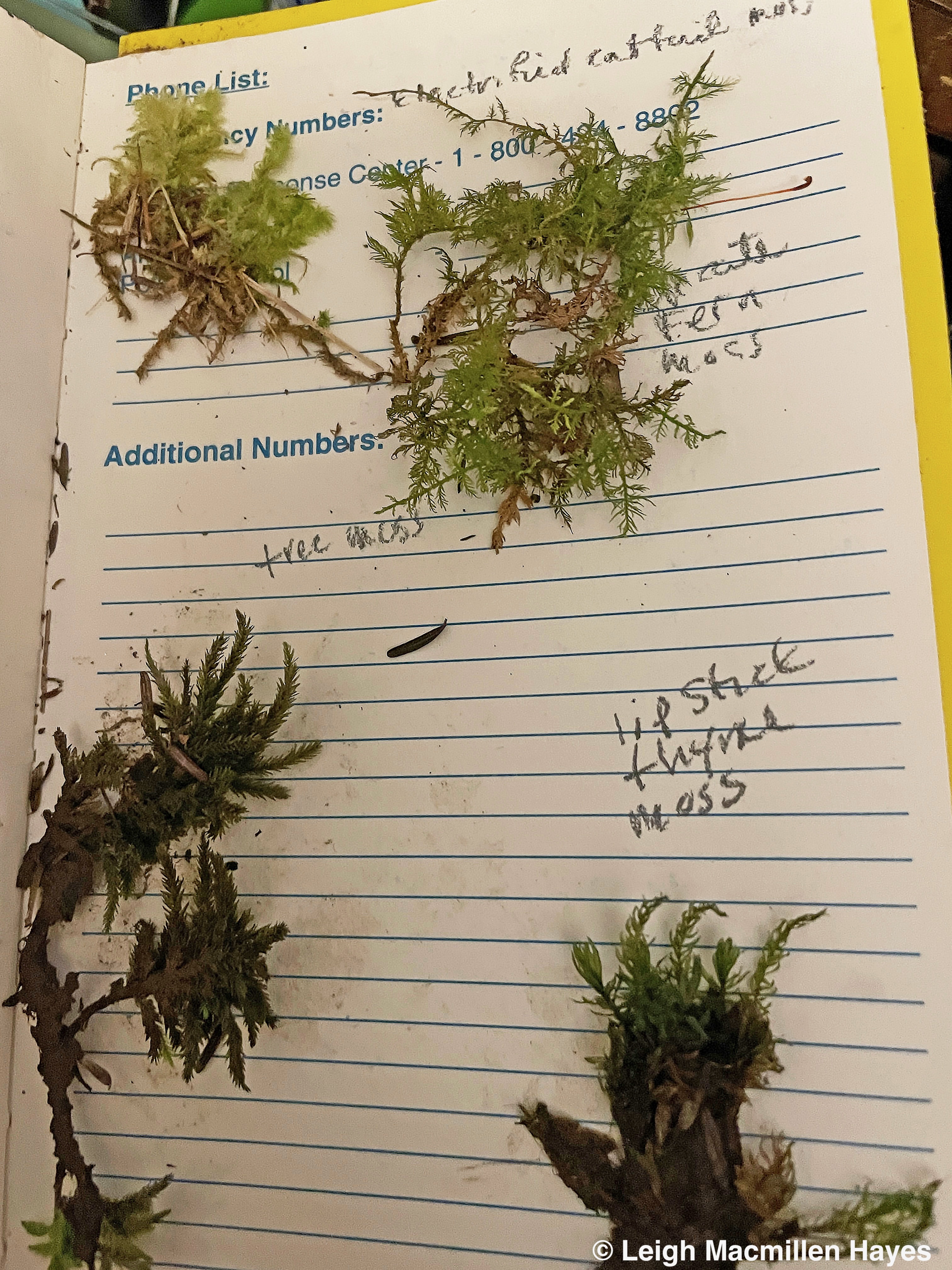
As we moved along, and I think we determined in the end that we had traveled less than a quarter of a mile in the few hours we were together, I collected some specimens I wanted to get know better. Damp as they were, they put my all-weather field book to the test, and it’s now a bit warped. Ah, but so worth it.
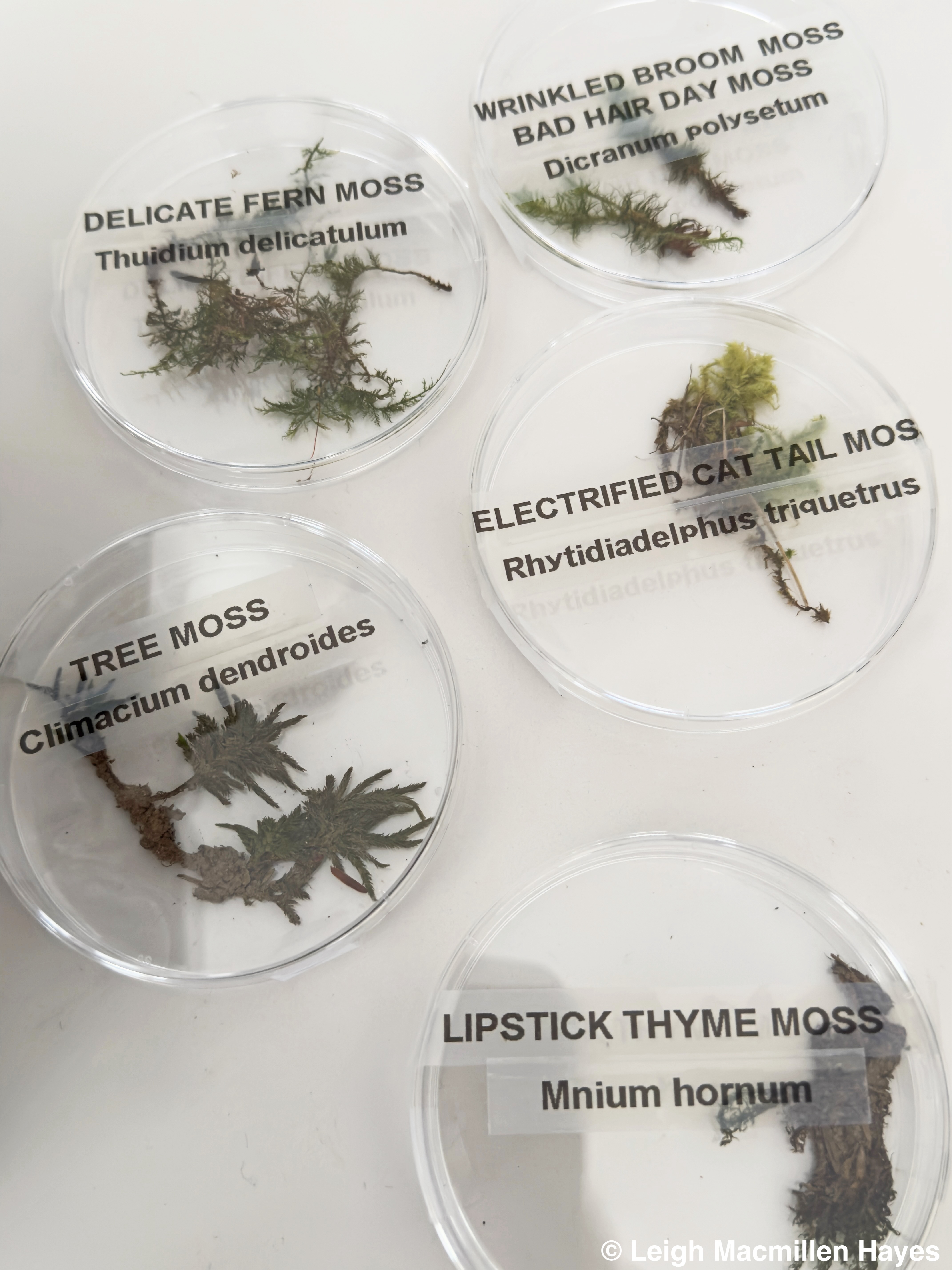
Fast forward to today. The mosses found their way from the field book to petri dishes and all were labeled with common and scientific names. I’m feeling so efficient. For a brief moment.

And then it was on to a somewhat deep dive and so out came a 10X and 20X loupe, as well as the microscope. Let the fun begin.
Taking photos through the scope is an acquired skill and I’m working on it.

Up first: Electrified Cat-tail Moss, Rhytidiadelpus triquetrus. I can remember the common name, but am going to have to practice the scientific. Though the leaves grow outward in so many directions, thus giving it an electrified look, even as a dry specimen, it feels rather soft and fuzzy.
This is a pluerocarp that likes wet soil. The take aways for me are the orange stems and shaggy appearance.

Under the scope, I could see the pleats on leaves, which is another identifying feature.
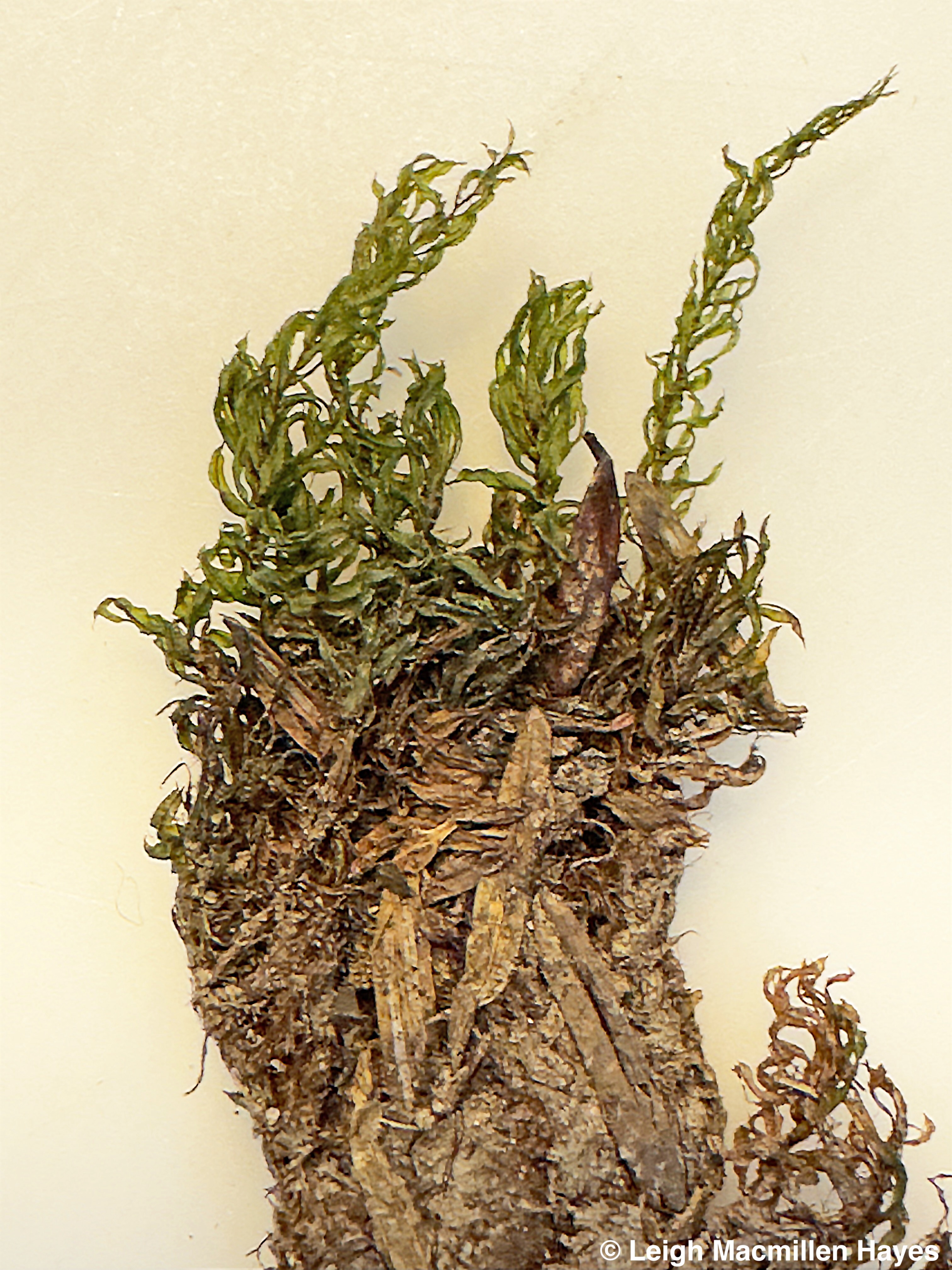
Along a stream we found the next species, growing in another shaggy manner, though more upright than the Electrified Cat-tail. This is Lipstick Thyme Moss or Mnium hornum. It is an acrocarp.
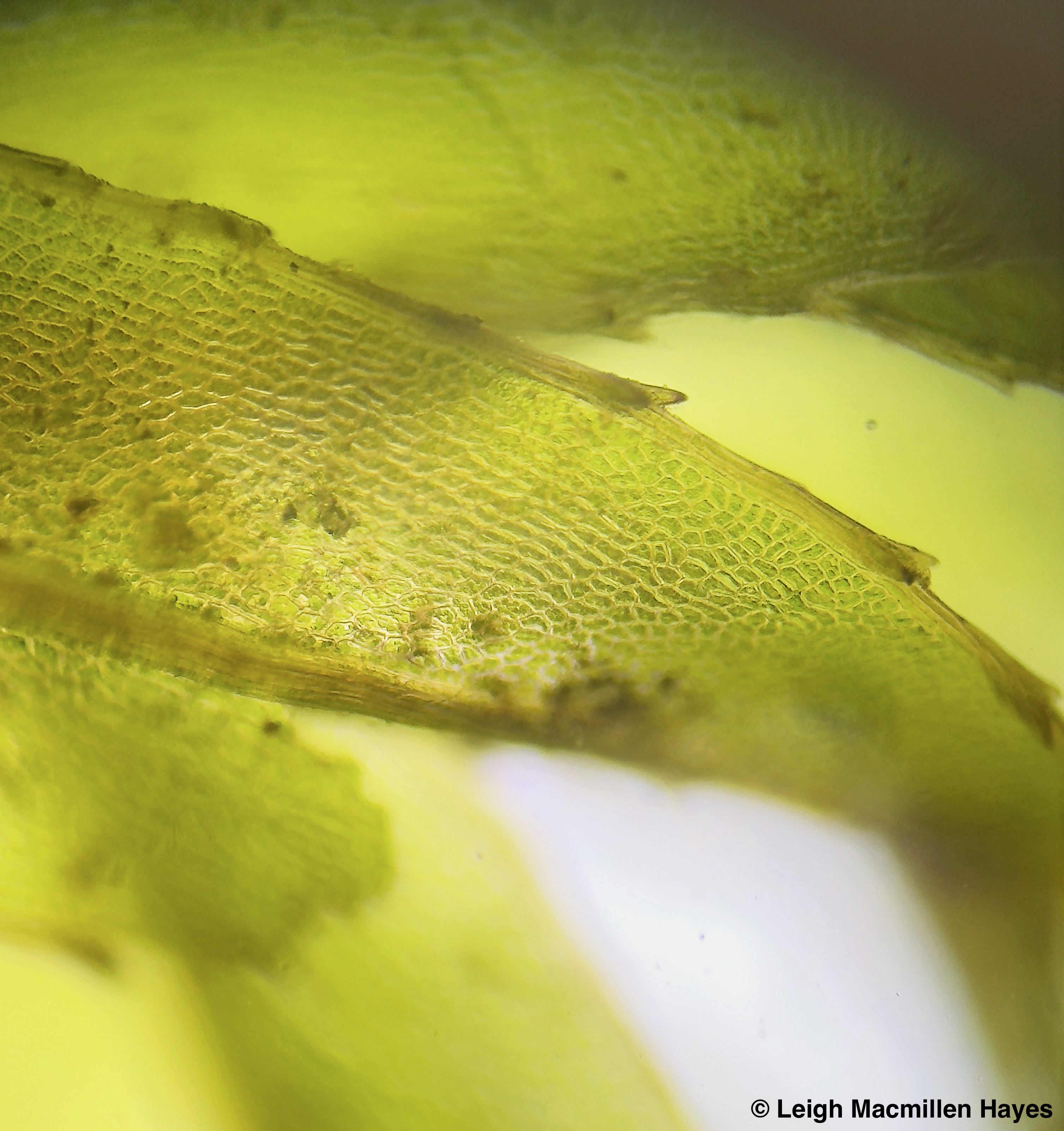
I’m fascinated by the leaf cells that are equal-sided and look like snakeskin. Along the toothed margin the cells are elongated.

Though the common name of this next species is Tree Moss, it grows in moist areas and not on trees. But Climacium dendroides does resemble a tree in its growth form.
The leaves of this pluerocarp are overlapping and toothed.
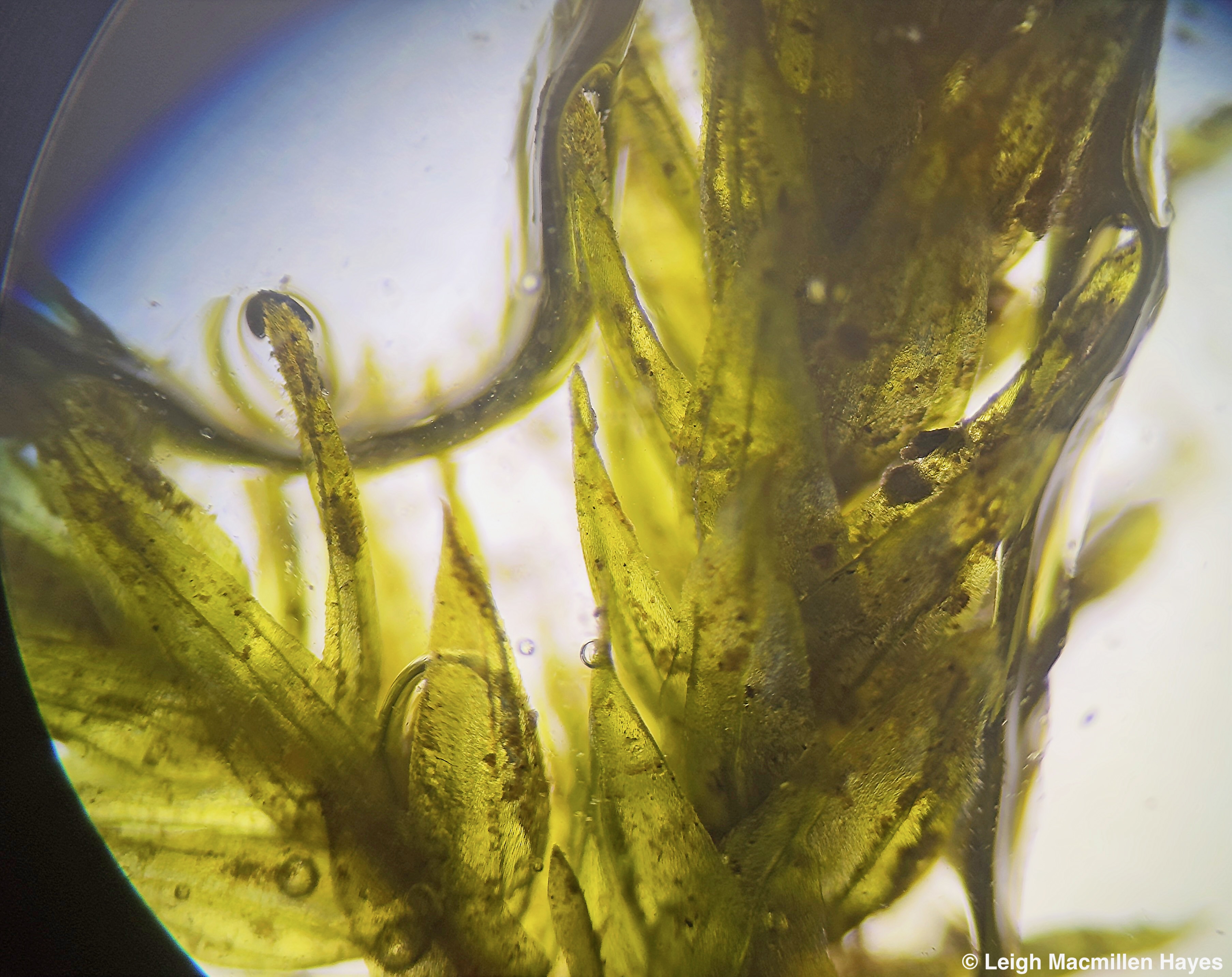
They are so tighhtly arranged and didn’t let much light into the photo.

This next species has two common names: Wrinkled Broom Moss and Bad Hair Day Moss. I think I prefer the latter because that’s me every day.
The stems have conspicuously whitish or reddish tomentose (lots of filamentous rhizoids or hairs) and hold water.

Dicranum polysetum actually has more common names: Waxy Leaf and Wavy Leaf moss. It seems to fit all of its descriptors.

The final species was Delicate Fern Moss, Thuidium delicatulum. We found it, as is often the case, growing on a rotting stump. The leaf structure is very fern-like, thus making this one easy to identify even without Jeff and Alan as guides.
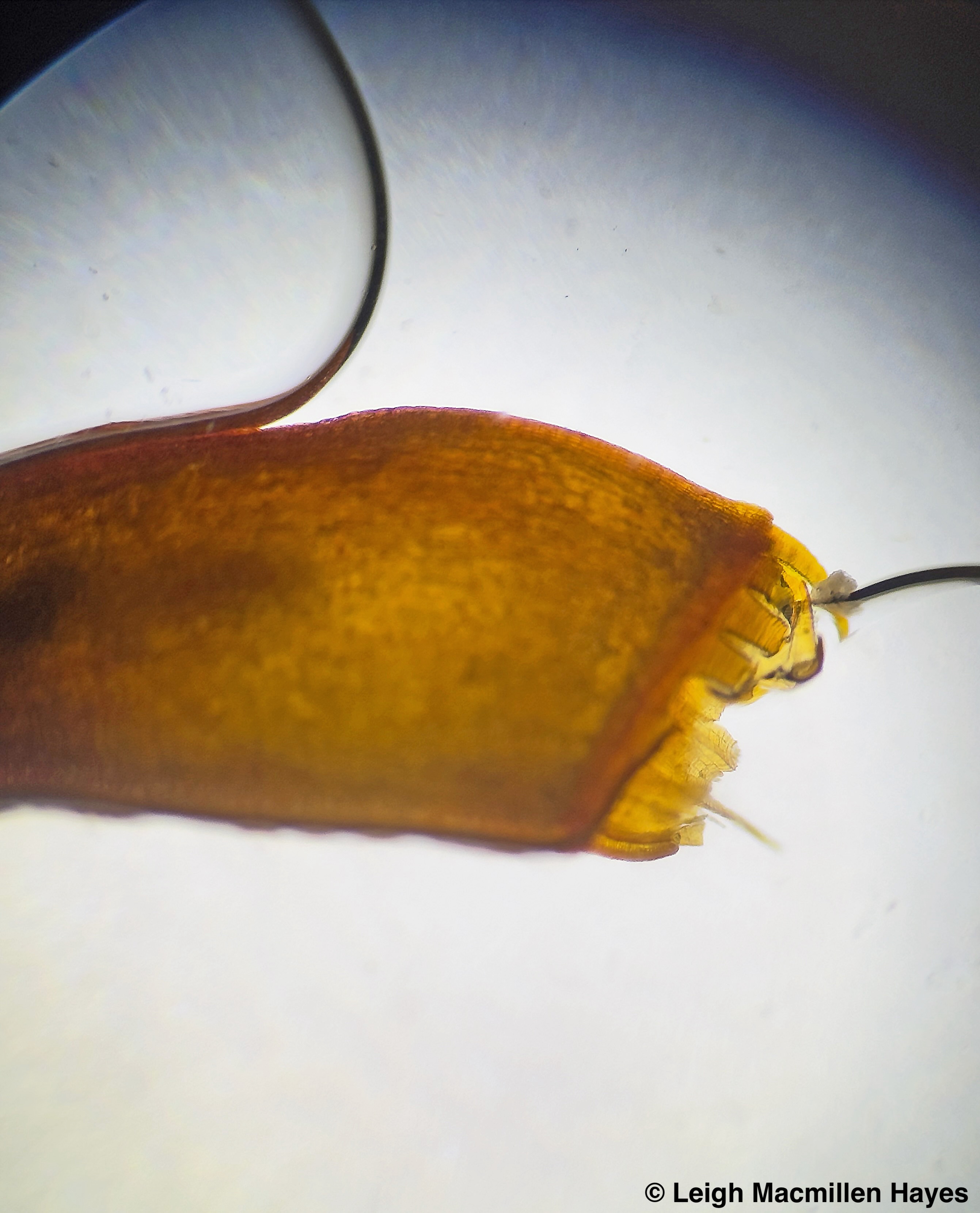
As a pluerocarp, the sporophytes would have formed in this curved capsule. In the fall, the operculum or lid covering on the capsule opened, releasing spores. Visible at the tip is the one ring of teeth located inside the mouth of the capsule and known as peristome.
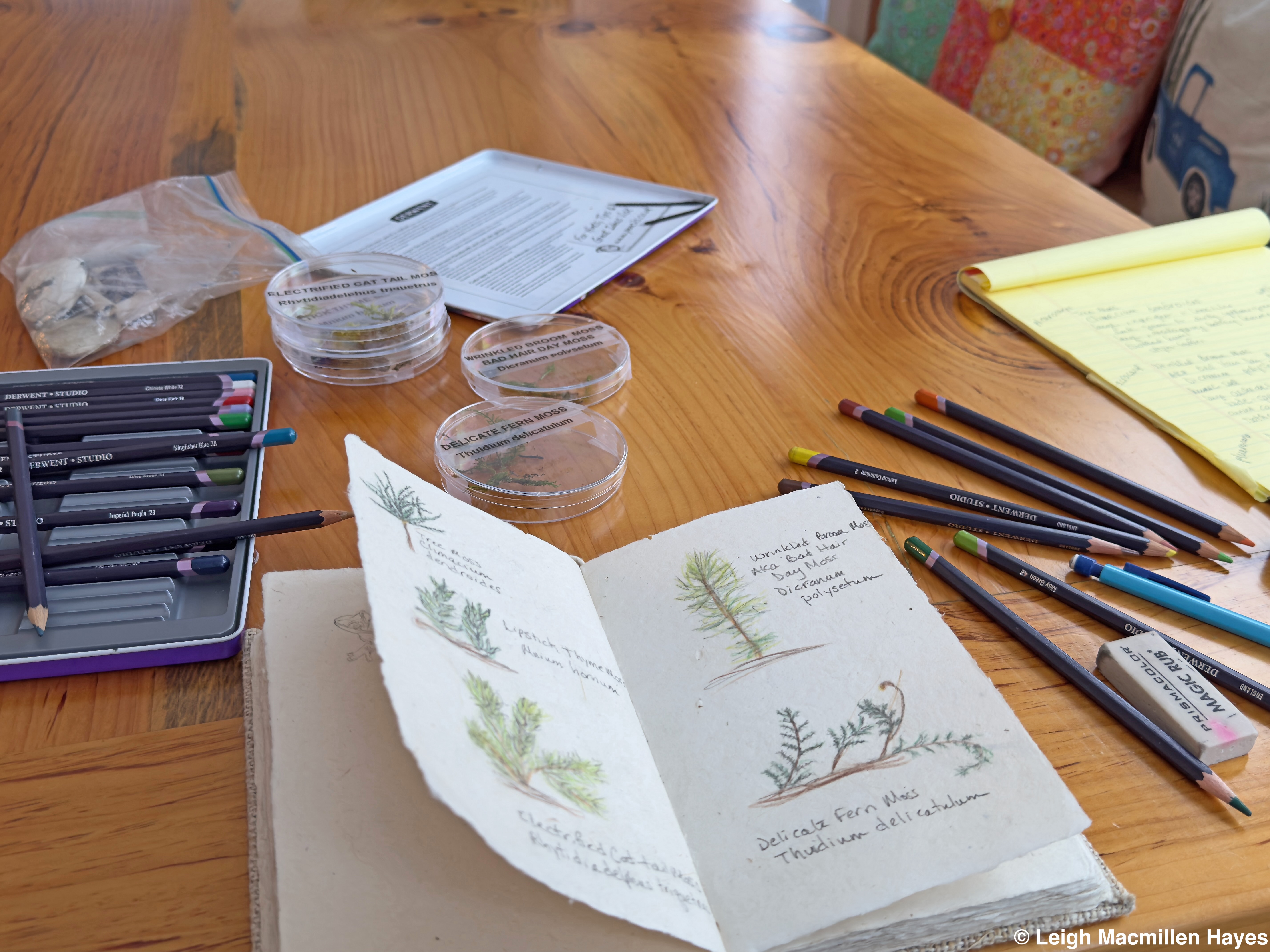
Looking through the lenses and microscope offered a great way to get to know these mosses better, but slowing myself down to do some sketches may be the thing that solidifies them in my mind.

Even my guy noted that it’s been a while since I’ve actually made time to sketch. The real test will be if I can meet these friends in the wild and greet each one by name. I think I should earn bonus points if I can remember both the common and scientific names. Fingers crossed. And practice needed.

One needs eagle eyes to really learn the idiosyncrasies of bryophytes such as mosses, those tiny green plants with rhizoids, rather than roots, and no true vascular system.
As it was, on Black Friday, an immature Bald Eagle greeted us when we returned to the parking lot, all grateful for the time spent together learning from each other, and especially from Jeff and Alan.
A perfect ending to the perfect classroom shopping expedition.
 wondermyway