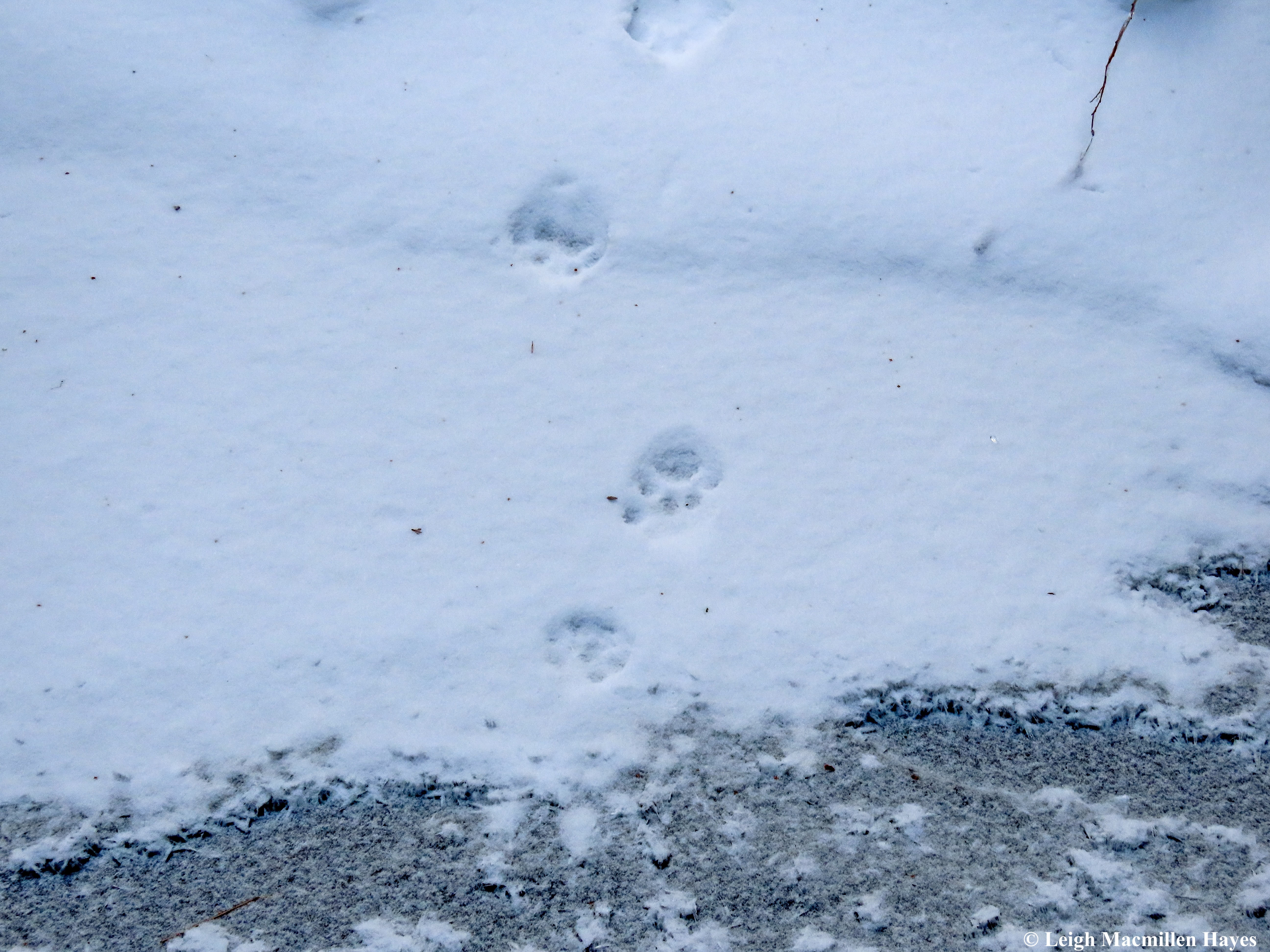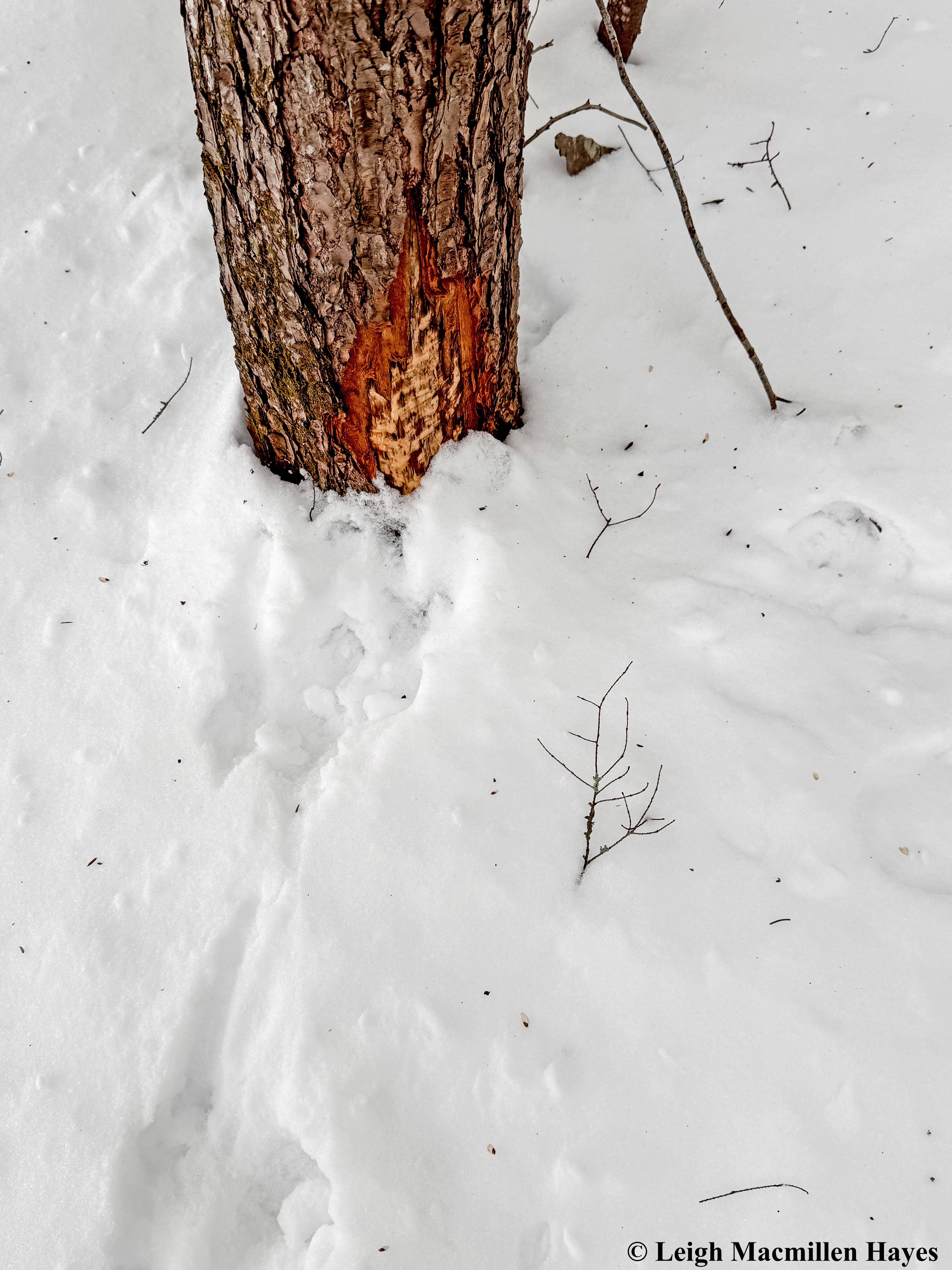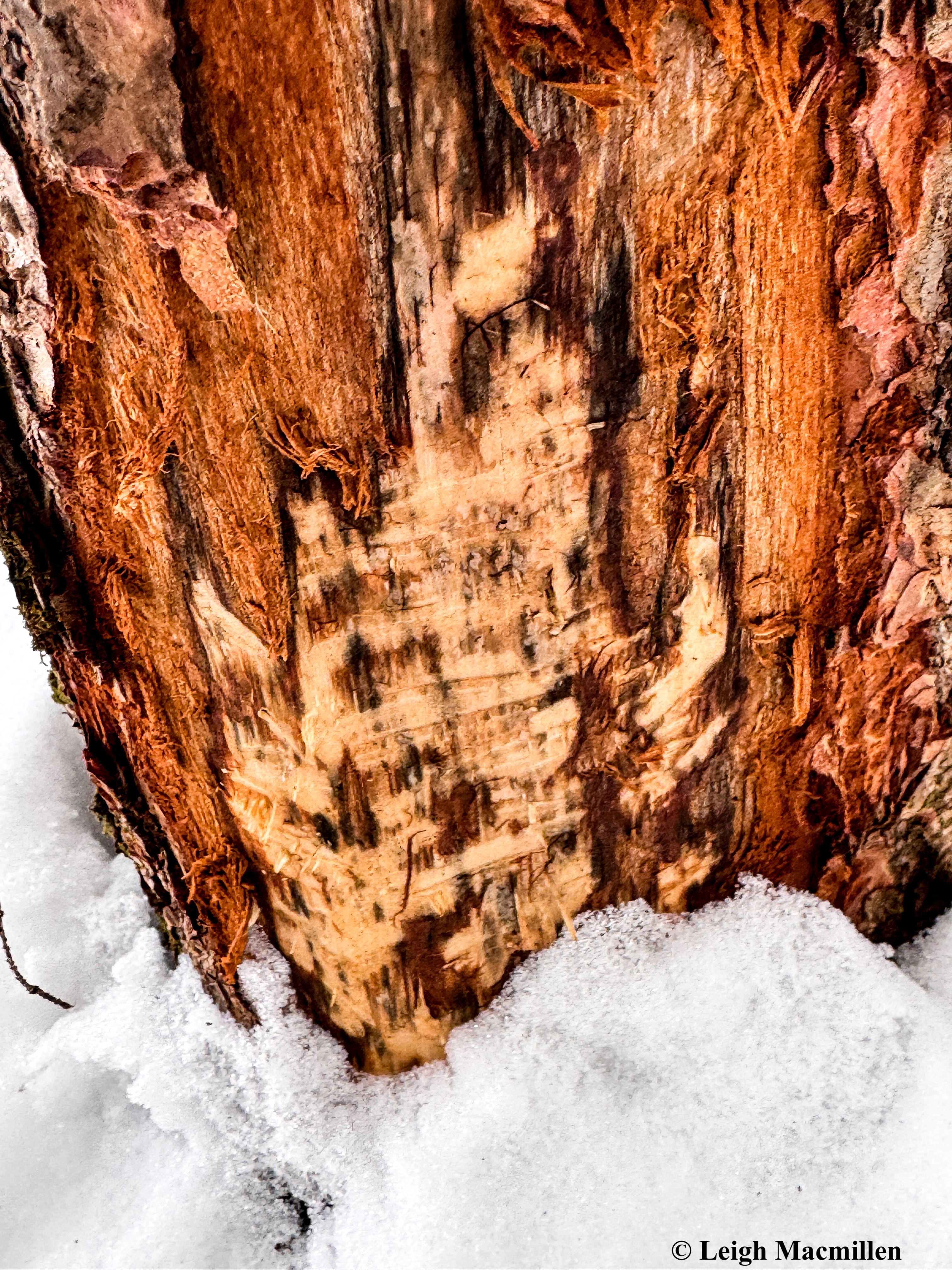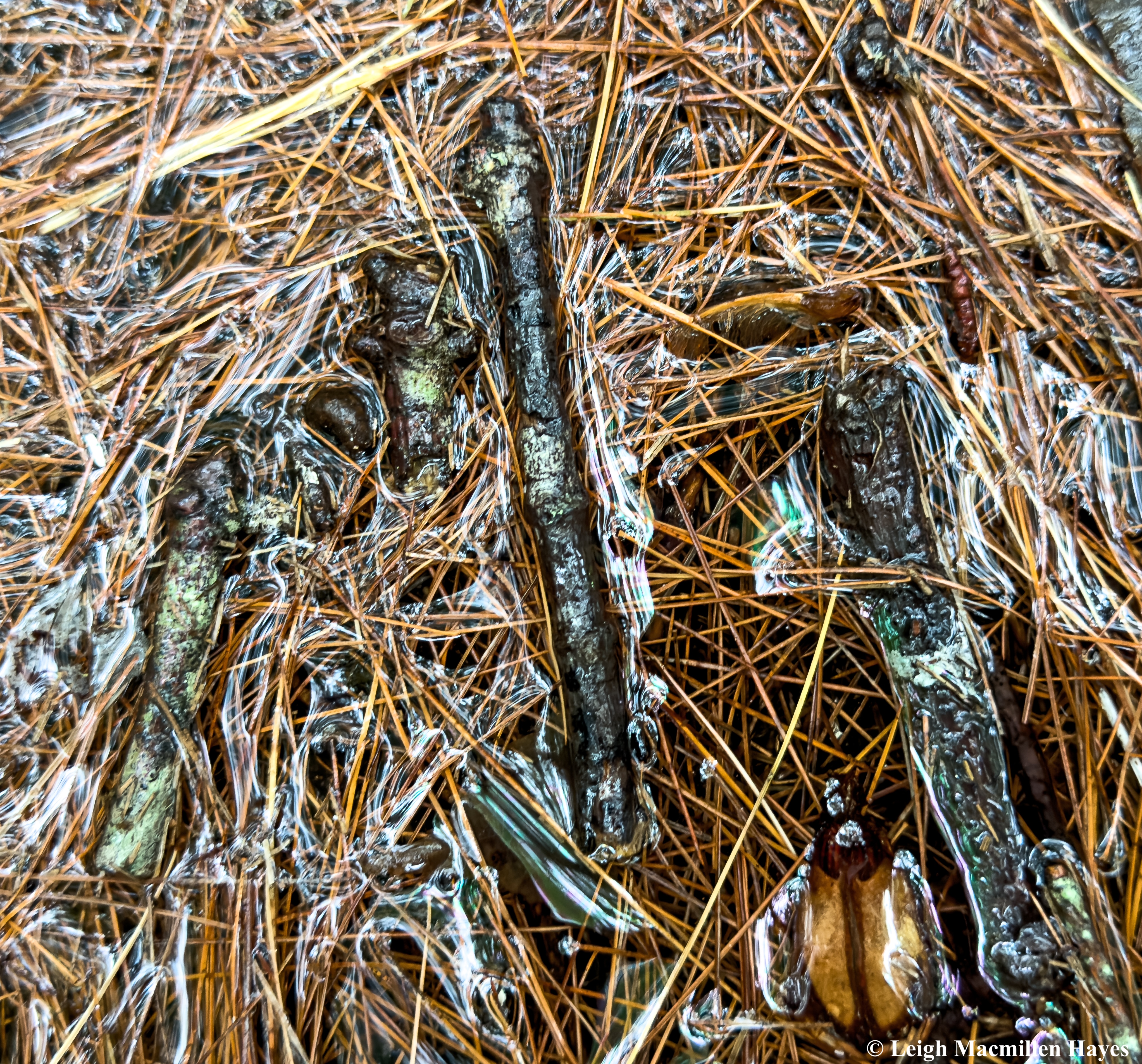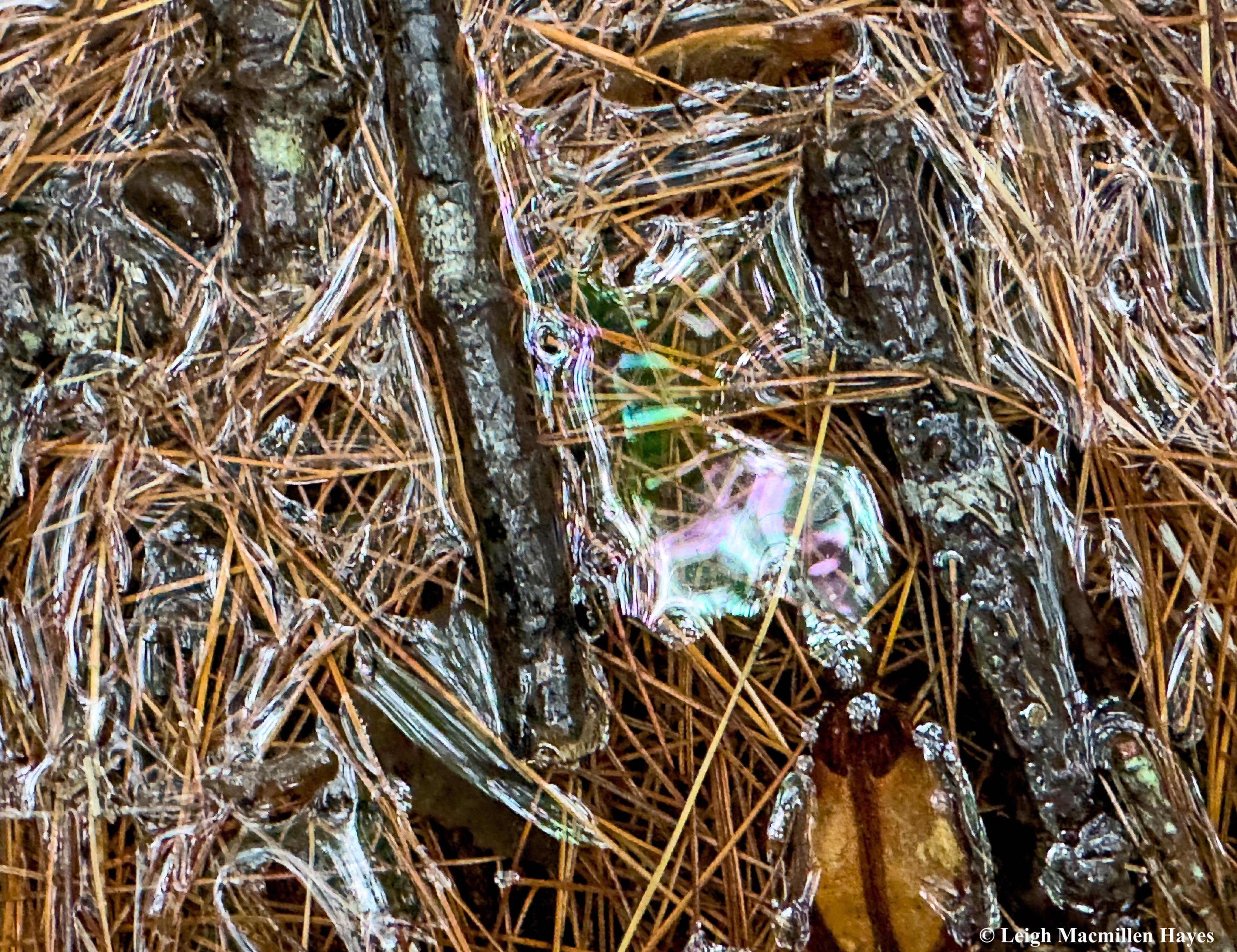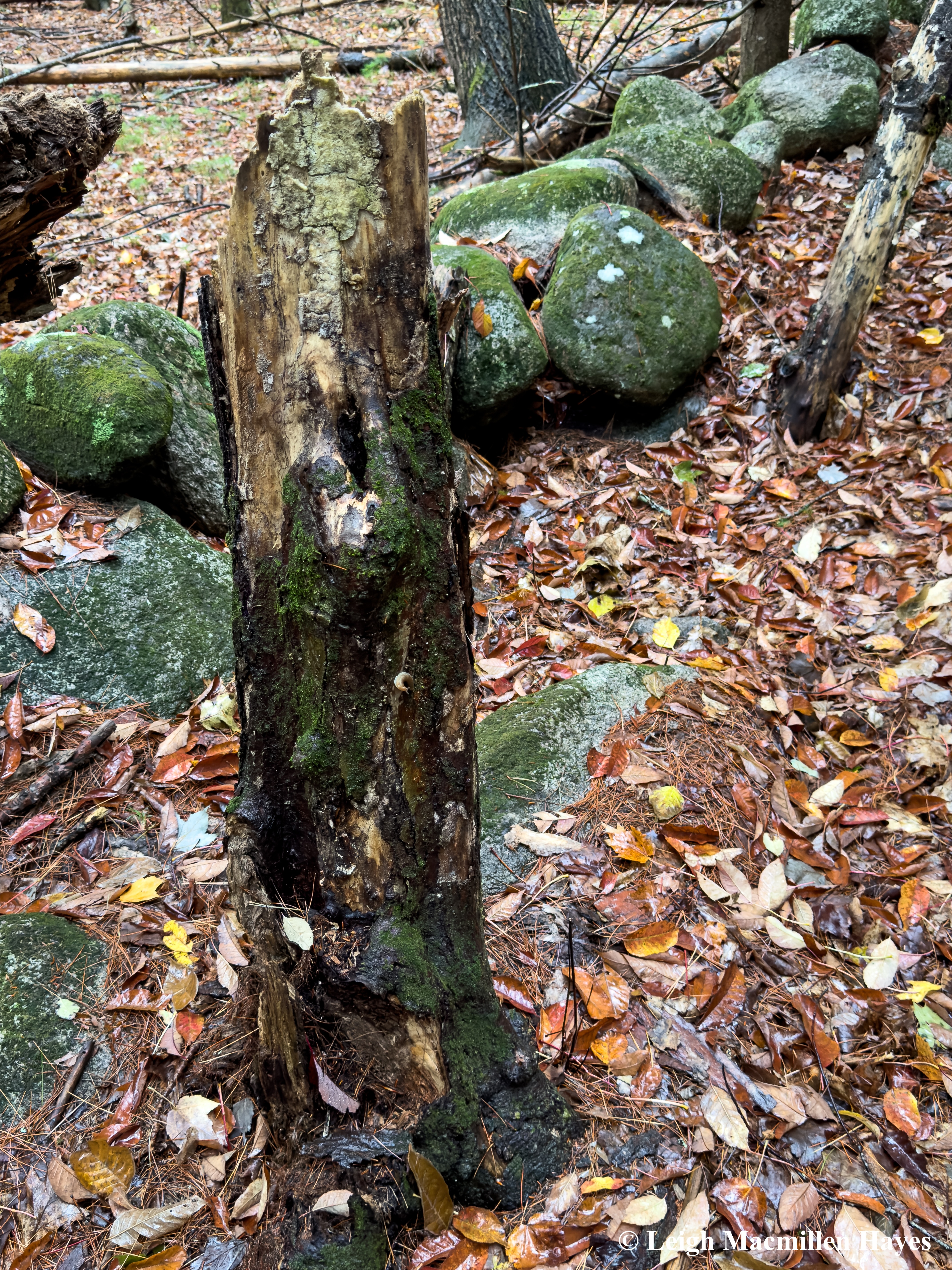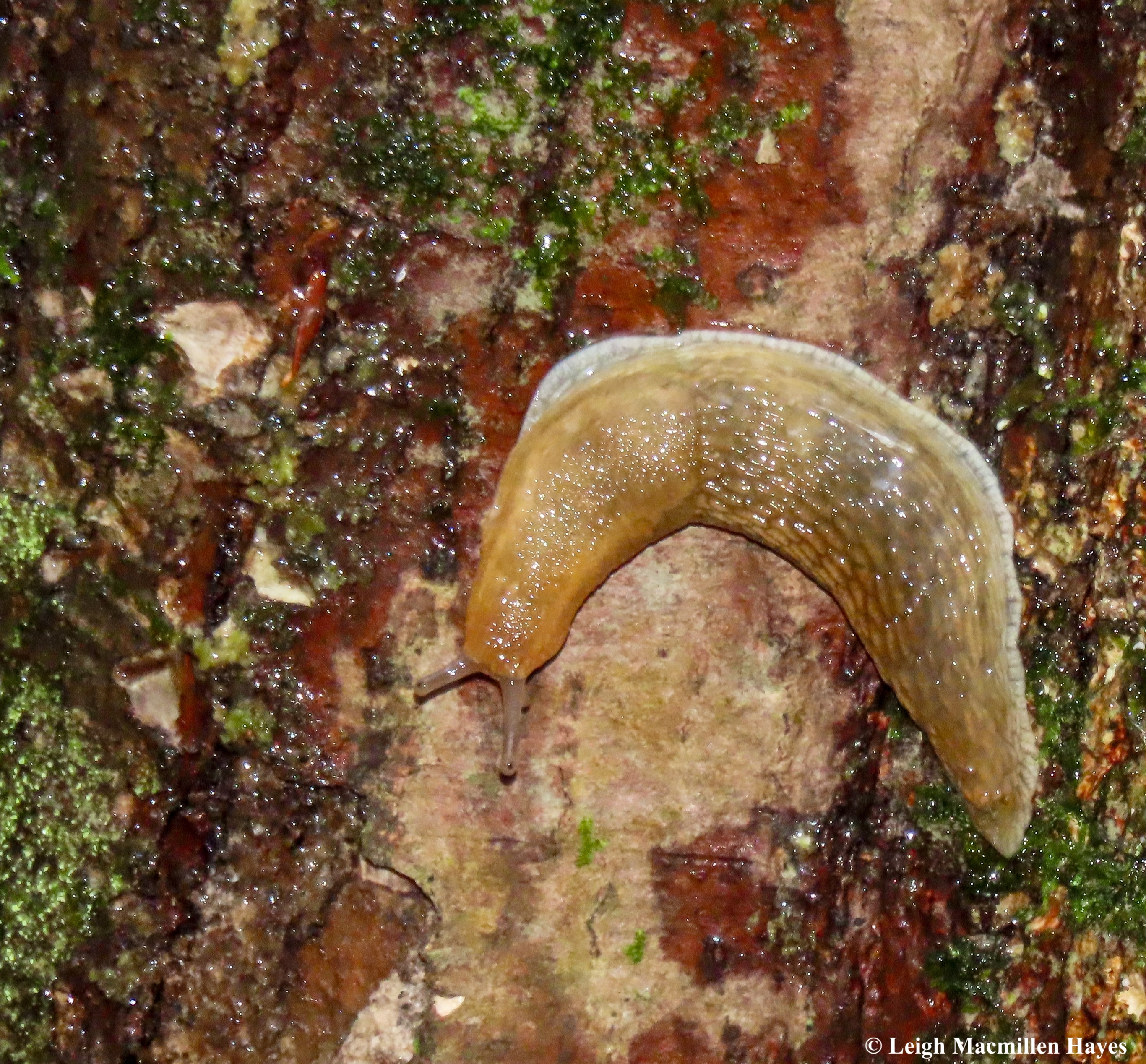
Spiders and Insects: A Winter Love Story

Lest you think that I spend the colder months forgetting about six and eight-legged members of the natural world, rest assured that I do not. That said, this has been an incredible week of spotting these little members of the ecosystem that often go overlooked as people tramp through the snow.

About eight inches of snow fell a week ago and in the middle of the storm, I did what I love to do. I headed out to explore in our woods. Have you ever stepped outside and listened on a snowy day? Really listened? It’s magical. The world’s sounds are muffled, except for the soft hush of falling snow.

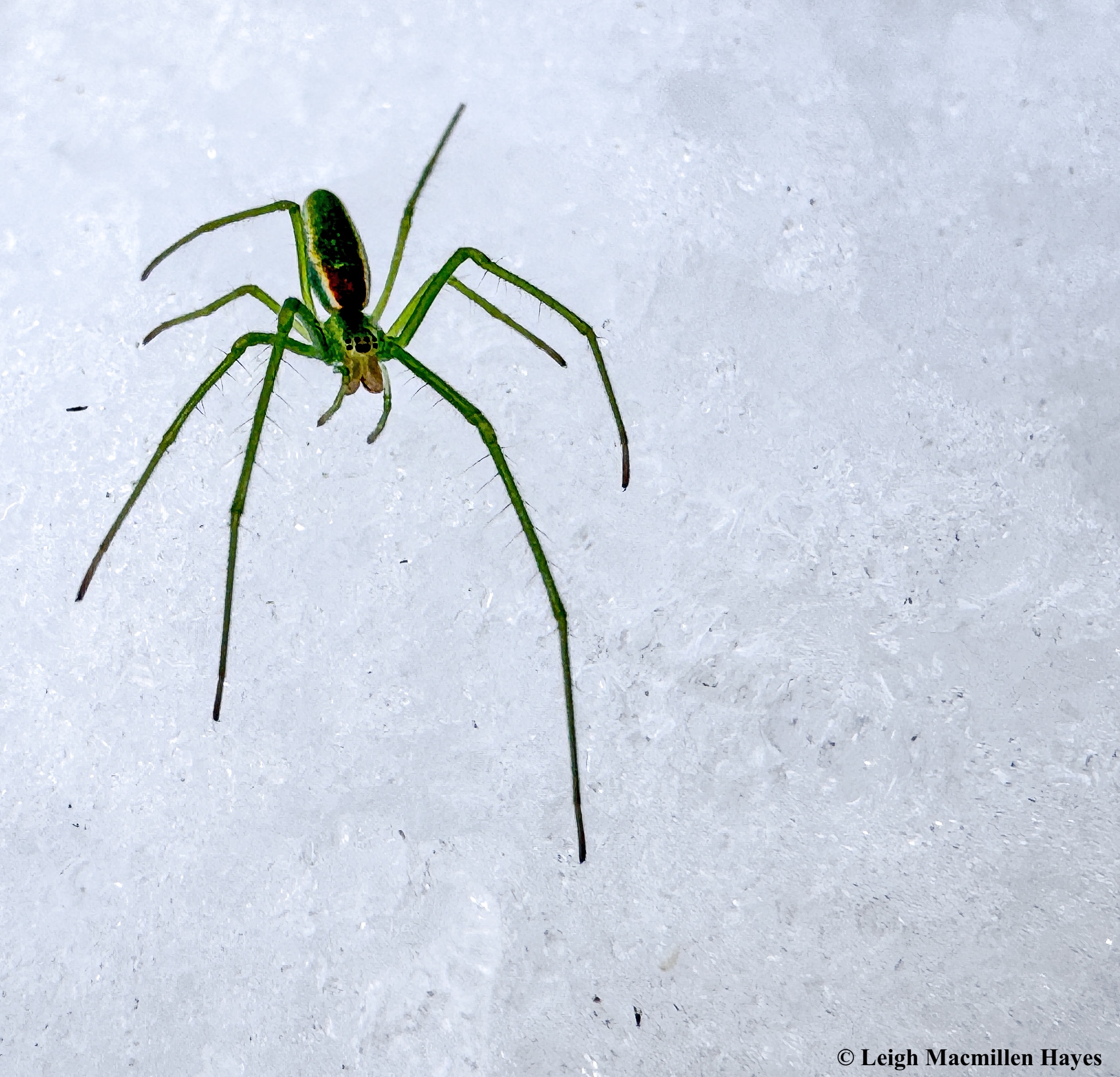
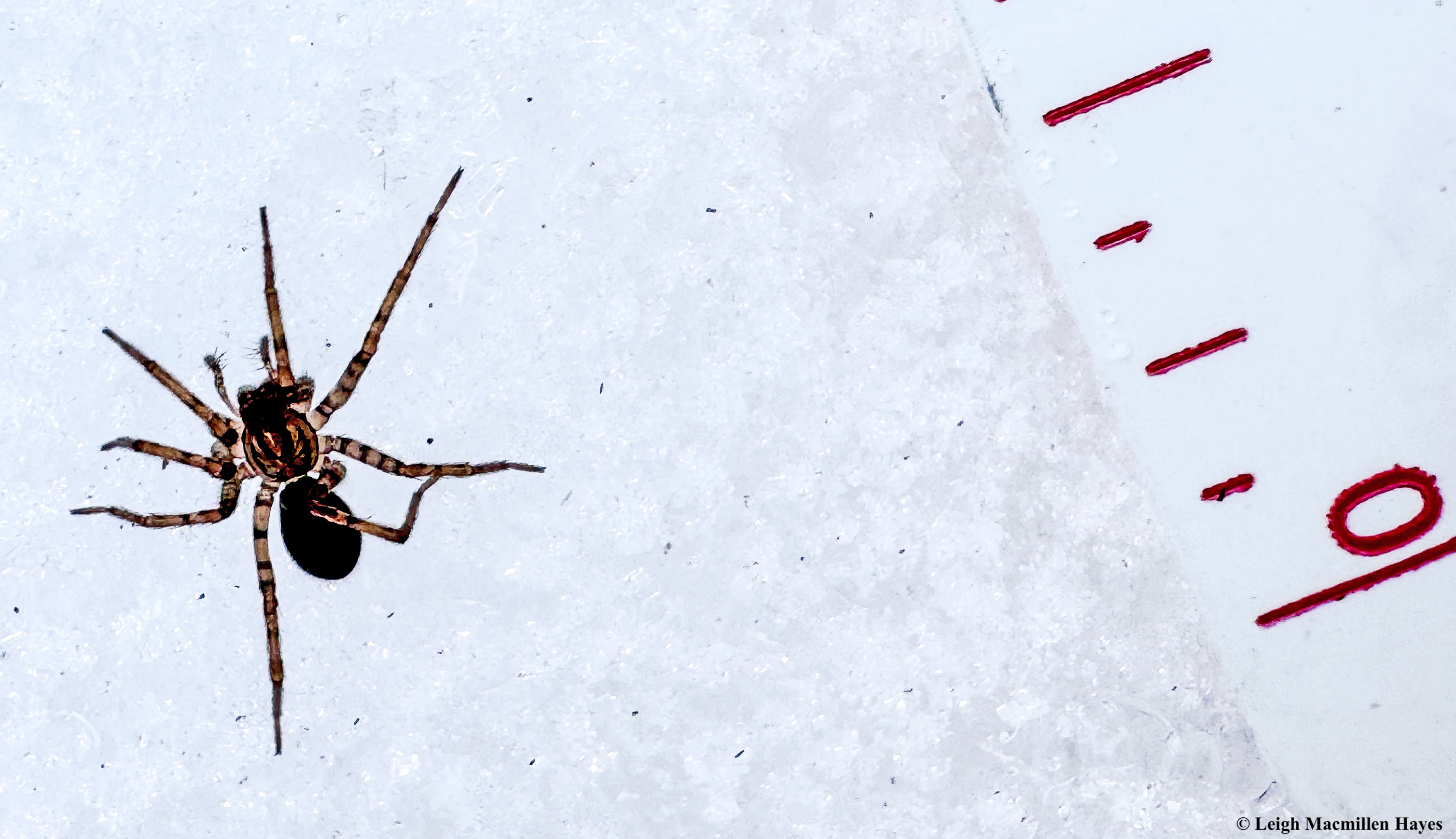
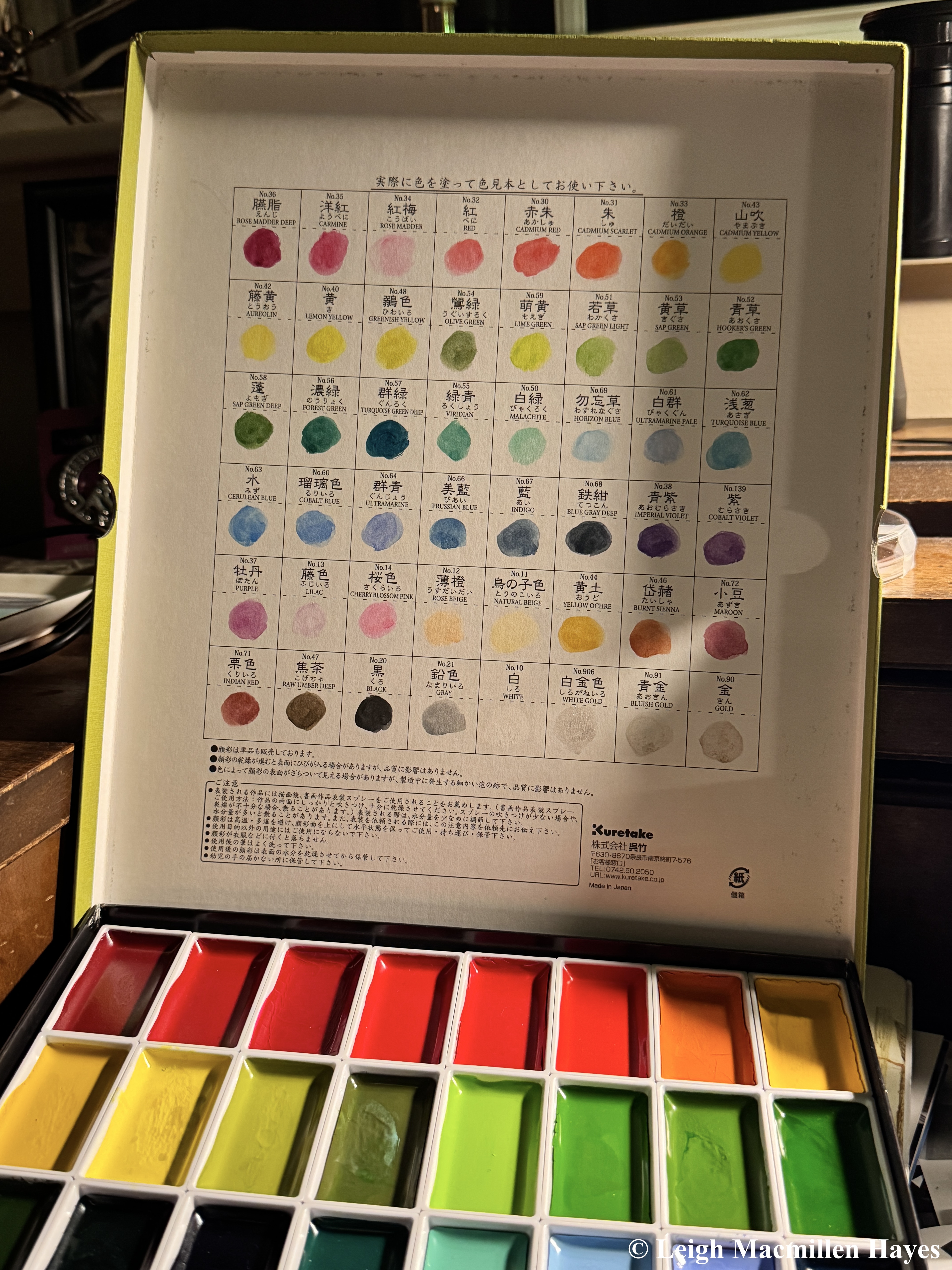
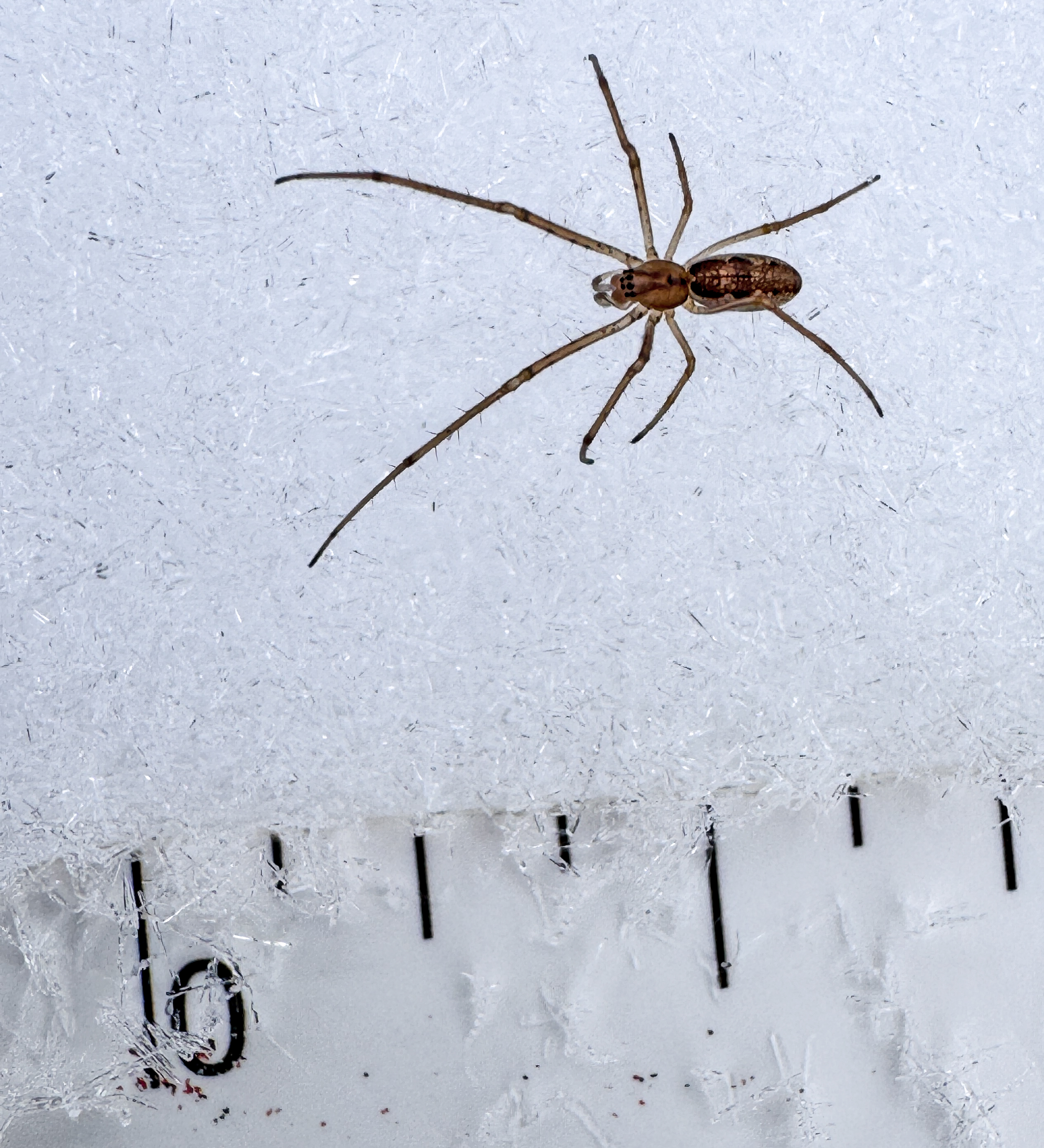
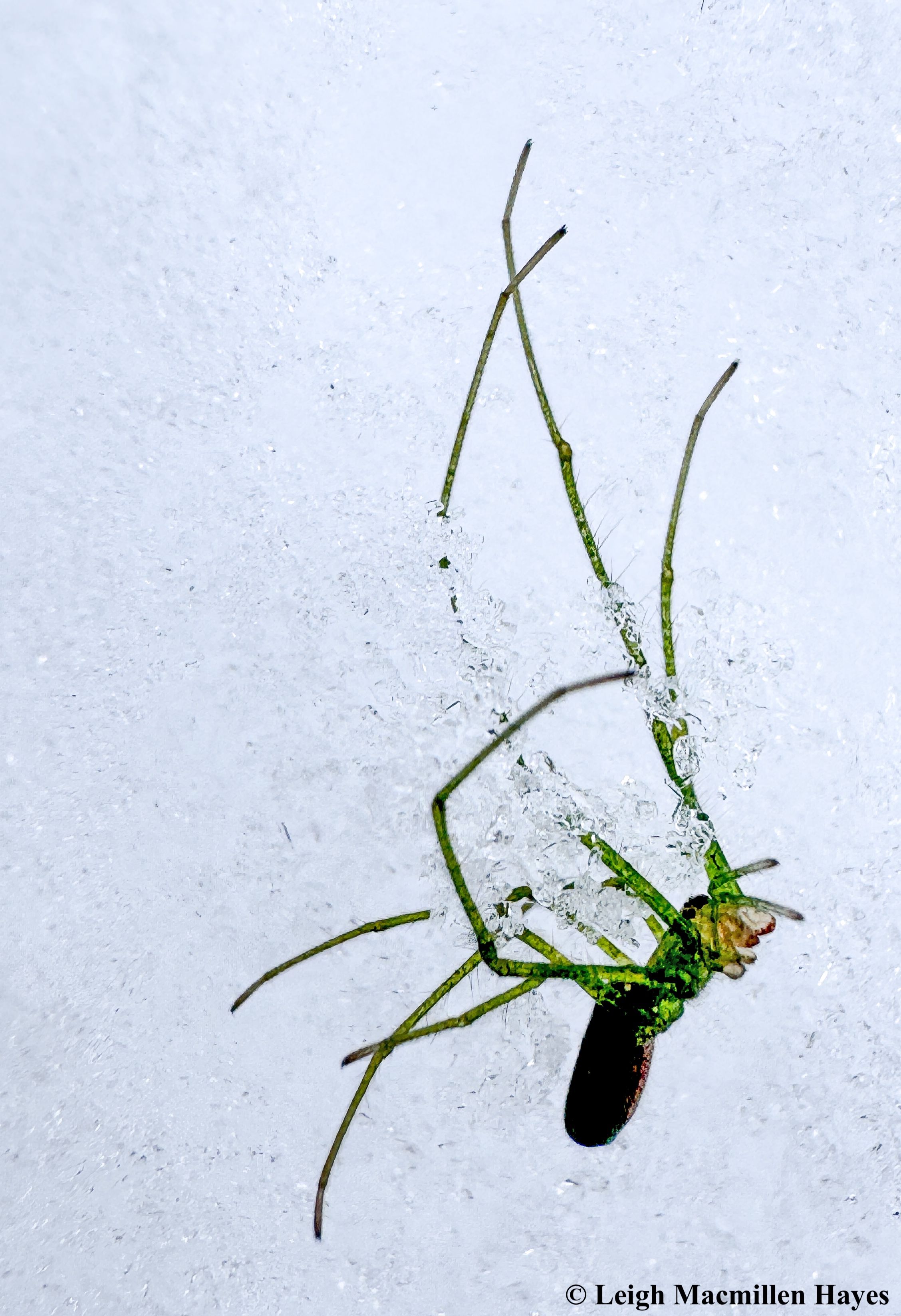
It was while standing still and appreciating the quietness that I first began to notice these most beautiful creatures. I was compelled to check the coloration against a watercolor set gifted to me by a dear old friend. The legs of this Long-jawed Orbweaver are Sap Green Deep. Its head and abdomen: Raw Umber Deep, Greenish Yellow, and Turquoise Green Deep; and its pedipalps, those leg-like appendages near the mouth that look like boxing gloves: White Gold.

Of course, Crayola would have completely different, and certainly more creative names for the same colors.

Long-jawed Orb Weavers are also known as Stretch Spiders for their ability to spread their long, hairy legs out–two in front and two behind, when resting on a twig and blend in so well, that sometimes it is impossible to see them. Unless they are on snow, of course. And then their metallic coloration may catch your attention. Mind you, they are small.

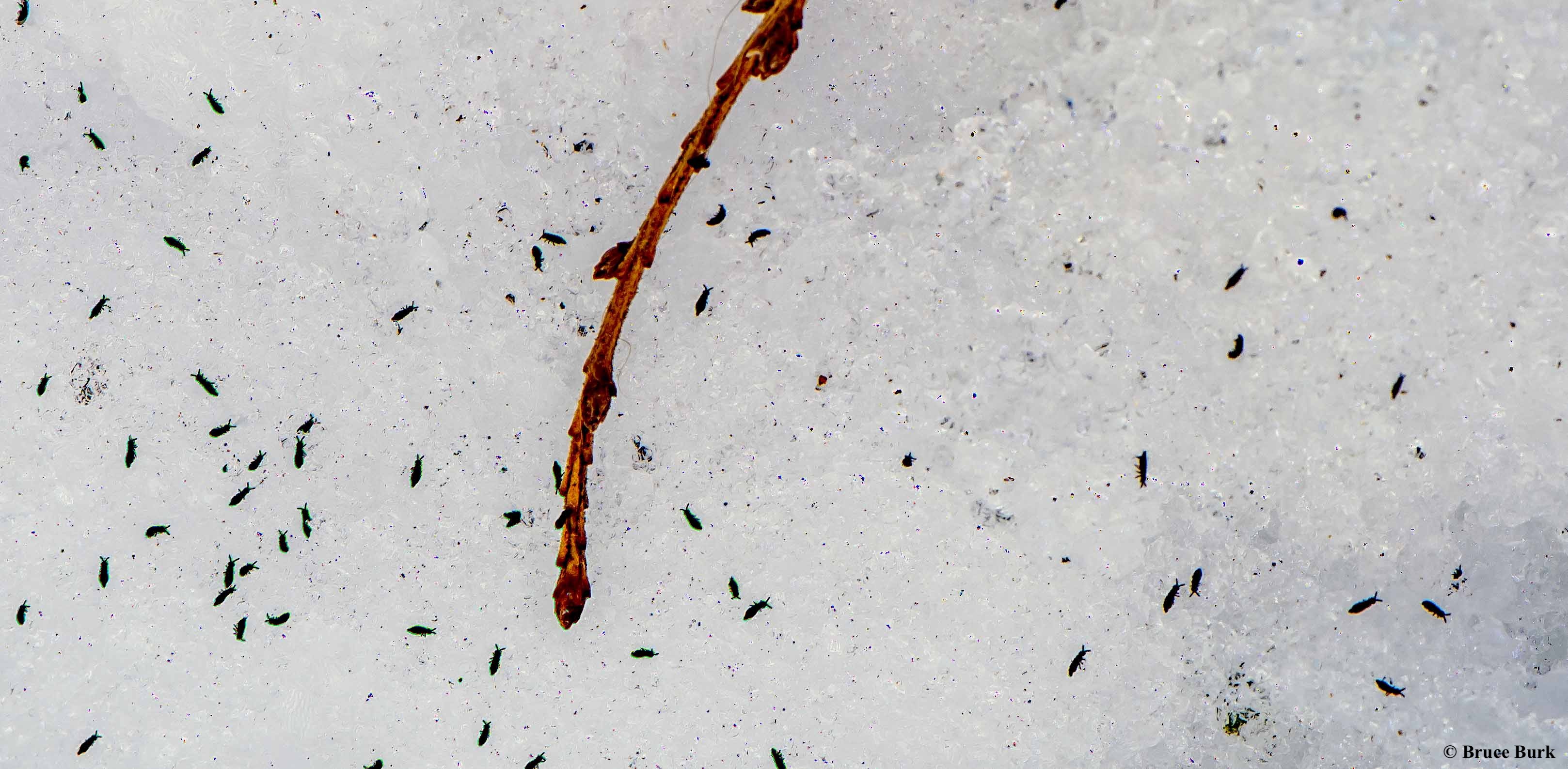
What I can’t figure out is why they are walking on the snow on these cold days, given that their meal of choice is in the subnivean layer between the ground and snow–that being the Springtails, aka Snow Fleas, those little dots of pepper that perform circus acts as they jump around in our boot prints on warm winter days. I have yet to see any Springtails on the snow.

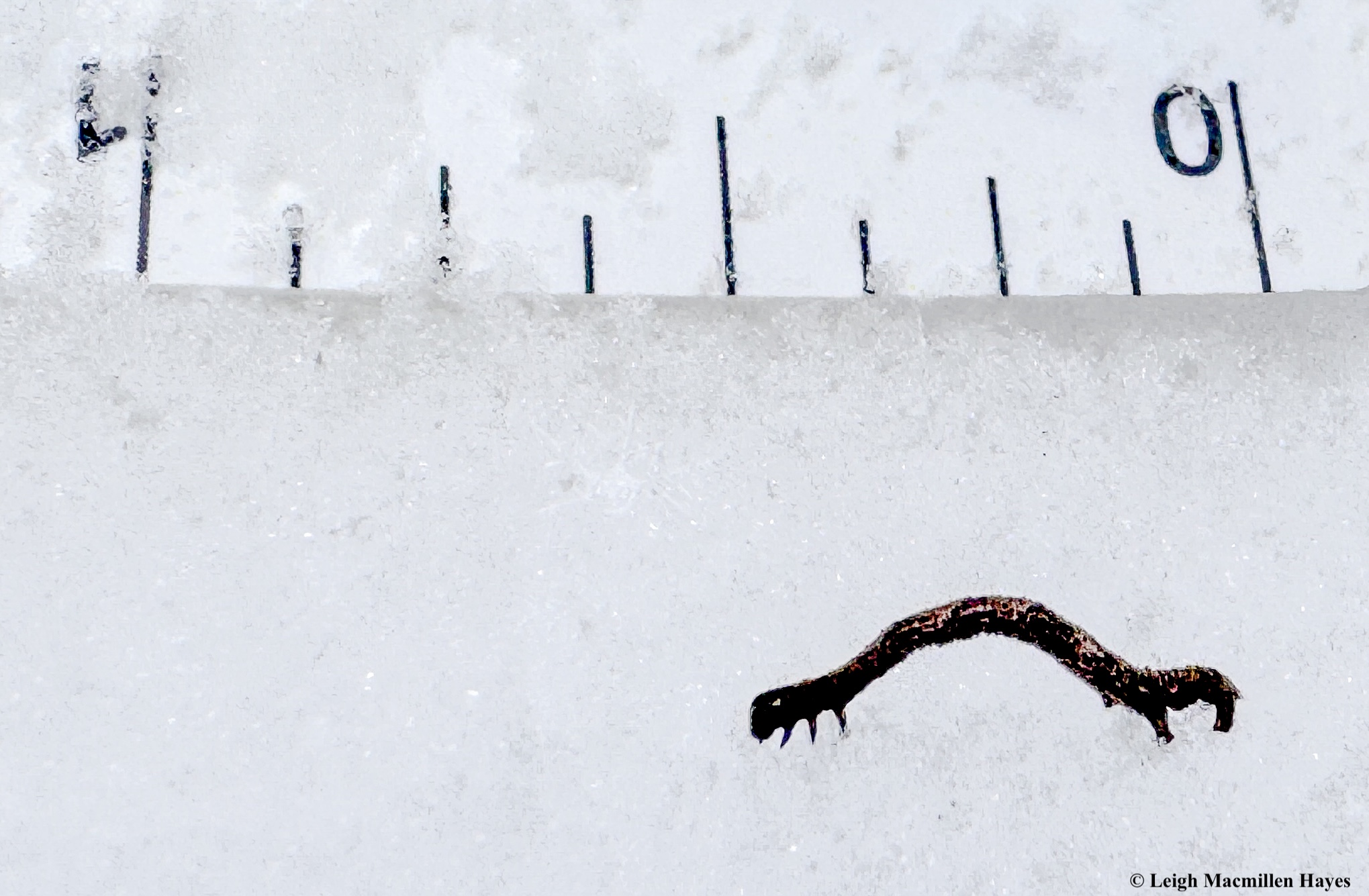
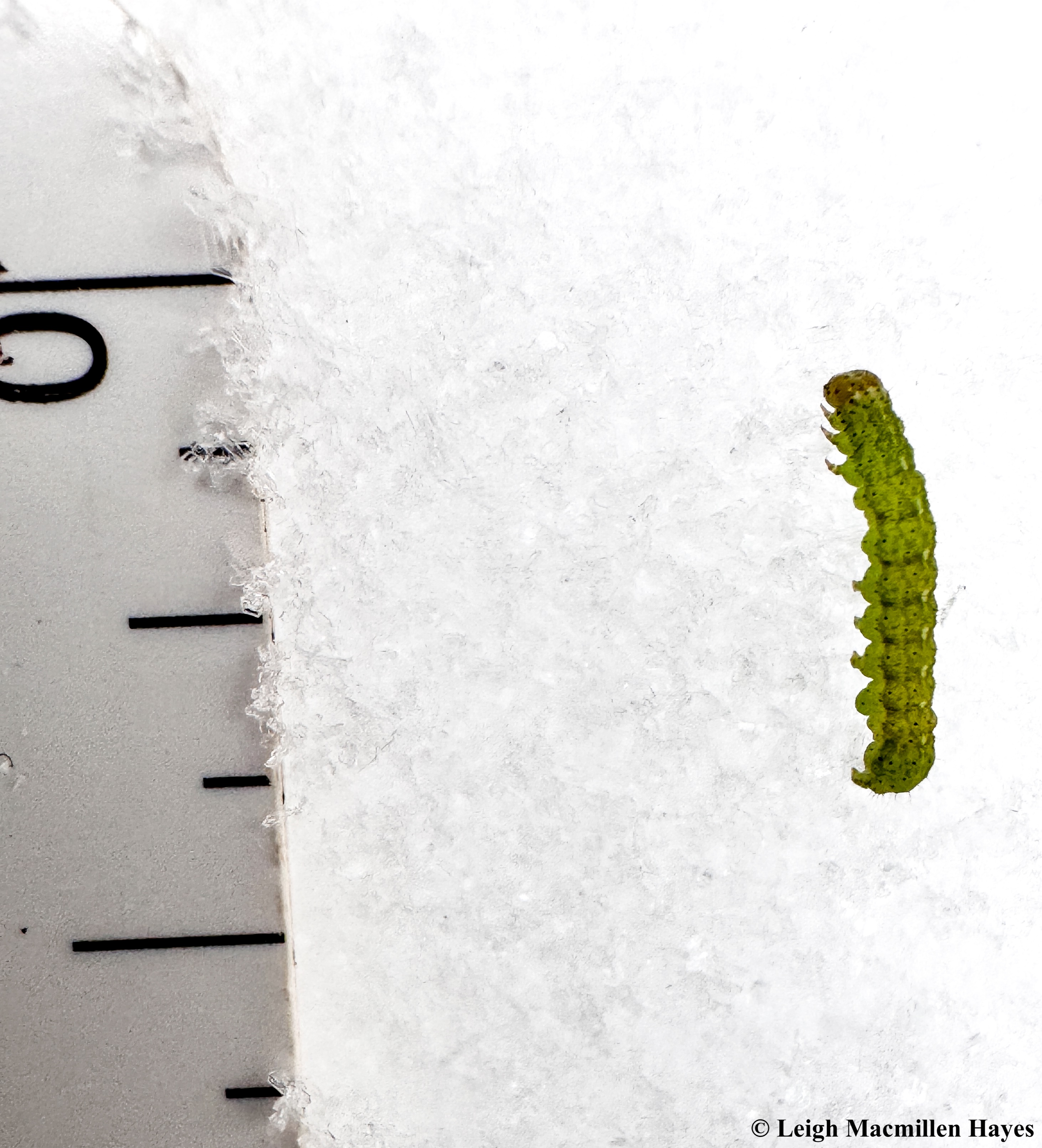
A few more steps and I discovered this Cutworm Caterpillar. Near this green one I also found a brown variation. While they may come to the surface on warmer days, I was surprised to find these Snow Worms when the temperature was in the low teens.

Apparently posing for the paparazzi is not in their DNA. And so I moved on.

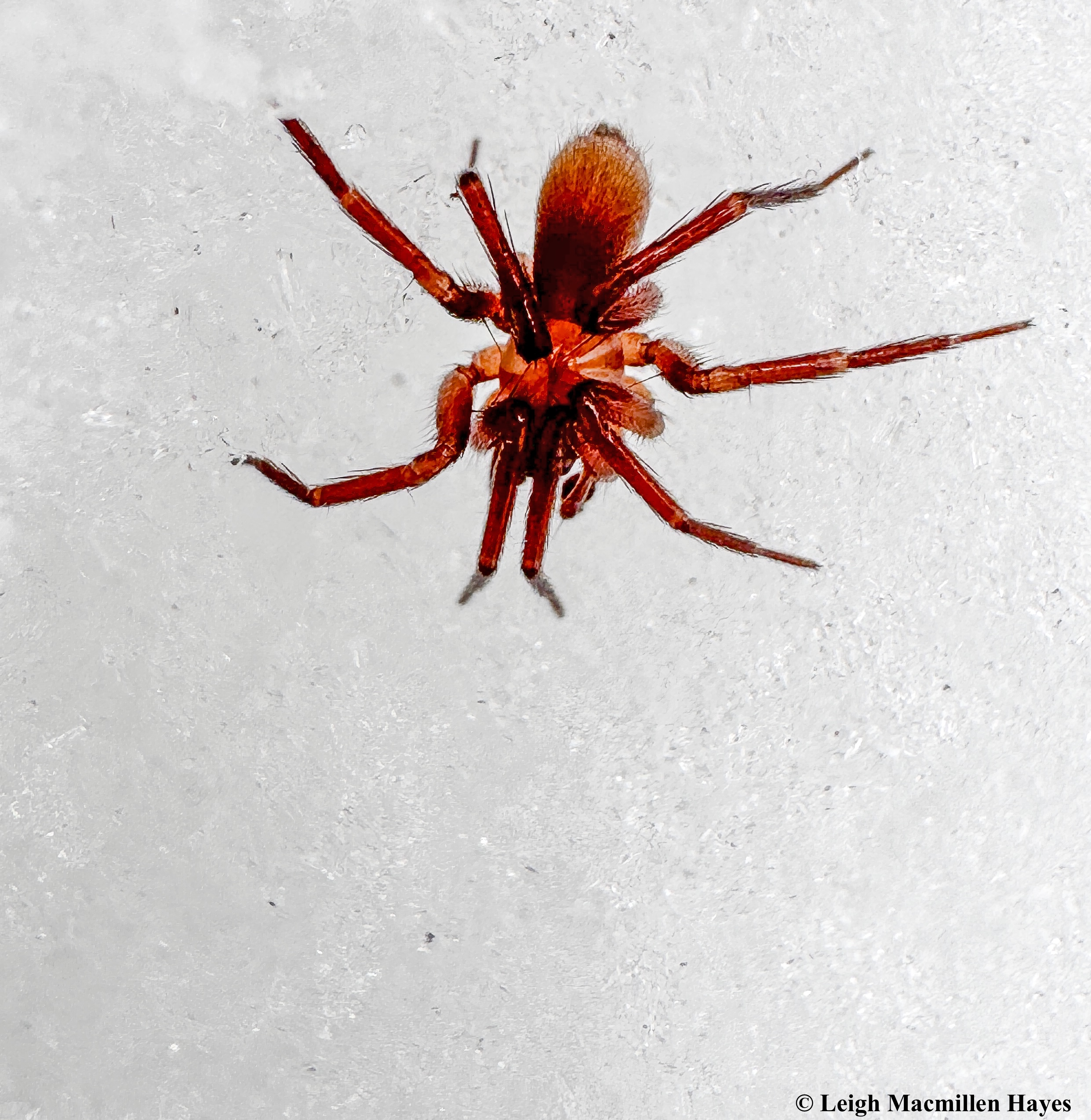
And discovered another Long-jawed, this one being hues of brown. I’ve been thinking about these spiders all week, and actually for many years, because there are days when I can go for a walk in the woods and see one every ten feet or less. Frigid days even, which has been the case this past week.

The question is: how does a tiny critter with such a fragile looking body and legs survive in these temps? I’ve read that some spider species can lower their bodies’ freezing point by producing a cryoprotectant, Glycerol, a natural anti-freeze compound that lowers the temperature at which their tissues will freeze.  

But . . . another question arises: What happens when that antifreeze no longer seems to work?

Answer: They curl up and die.

Or do they?

You see, I’d picked one spider up and held it in my hands for a few minutes in hopes of reviving it. And met no success.

The next day I picked up another and placed it in a Petri Dish, thinking I would look at it under the microscope.

A day later, and it was walking around inside the container.

Absolutely amazing to this wonderer.

And consequently, a few more have traveled home in my pocket and I’m wondering if they’ll revive as well in the warmth of our home. If so, what does that mean? That they can go dormant atop the snow in freezing temps, and thaw and become active when the sun warms them up? I guess my biggest question is this: Why are they on top of the snow, anyway, when it’s much warmer under it and that’s where their food source can be found.

There’s another critter I’ve been encountering quite a bit this past week and it looks rather ferocious.

But don’t judge a book by its cover as the old adage goes. While some look robust, like this one, others are small and slender. Again, I’ve read this, but not observed it: they don’t eat, but may sip snow. The main goal of the adults who are active in winter is to mate.

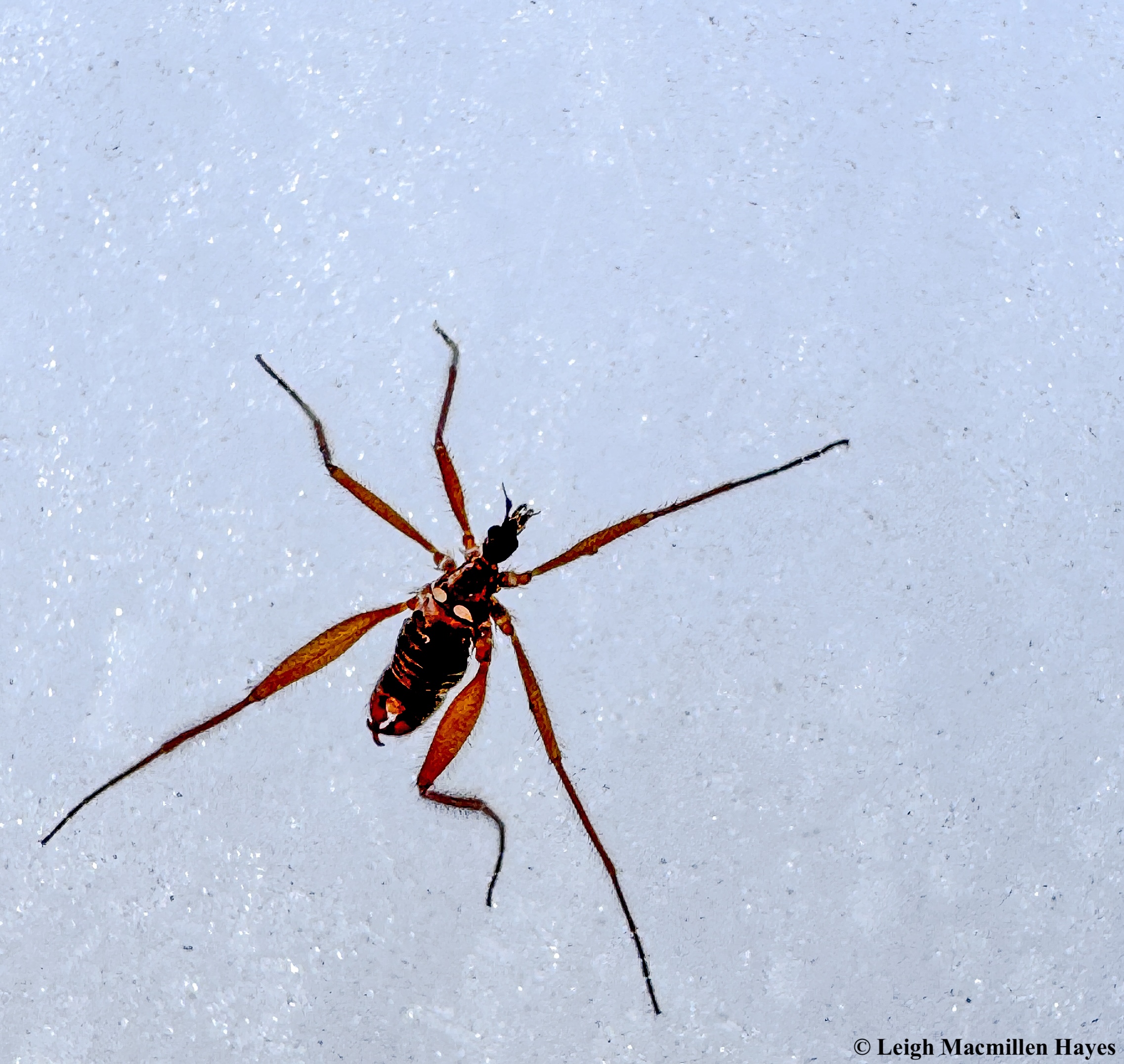
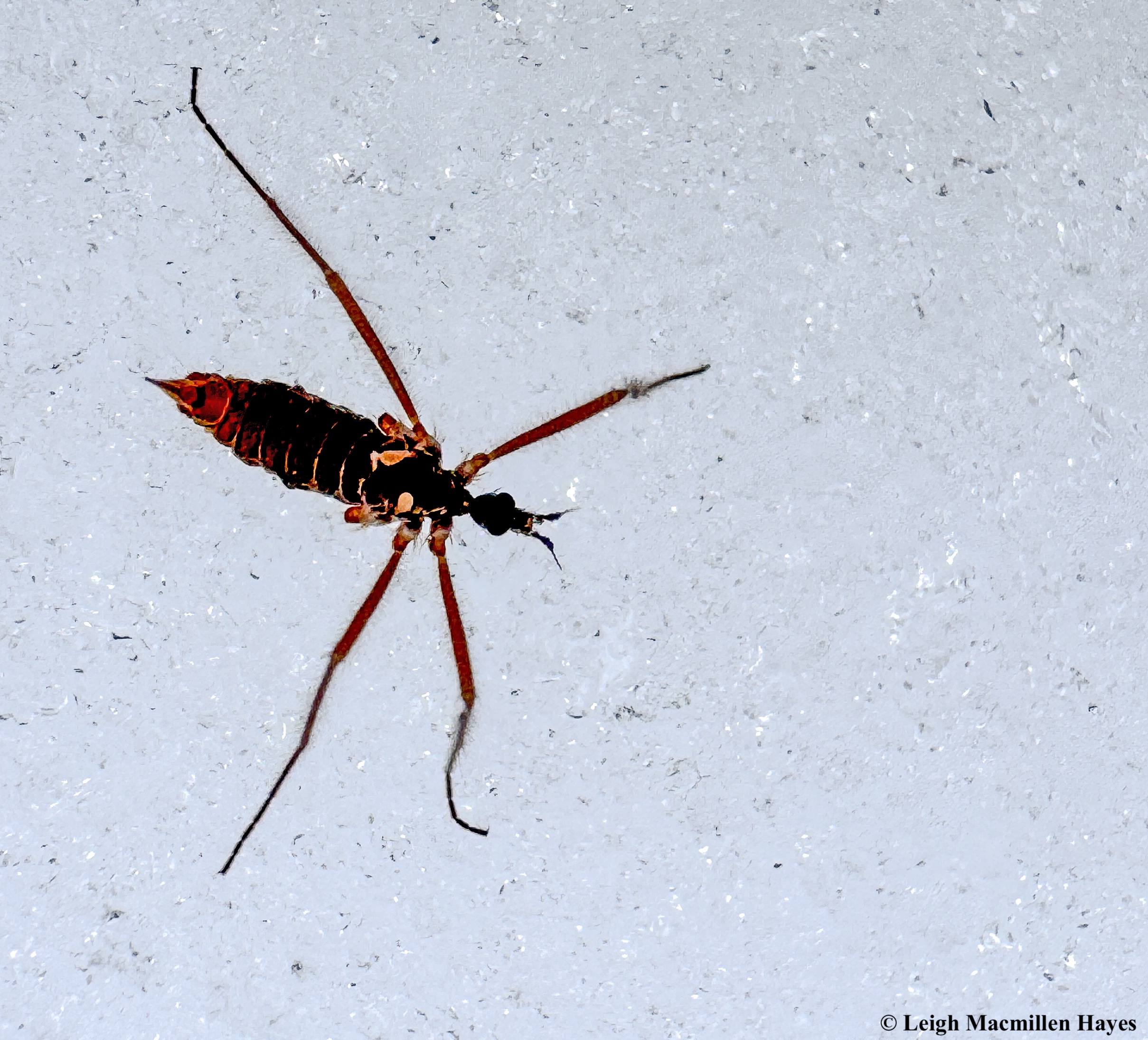
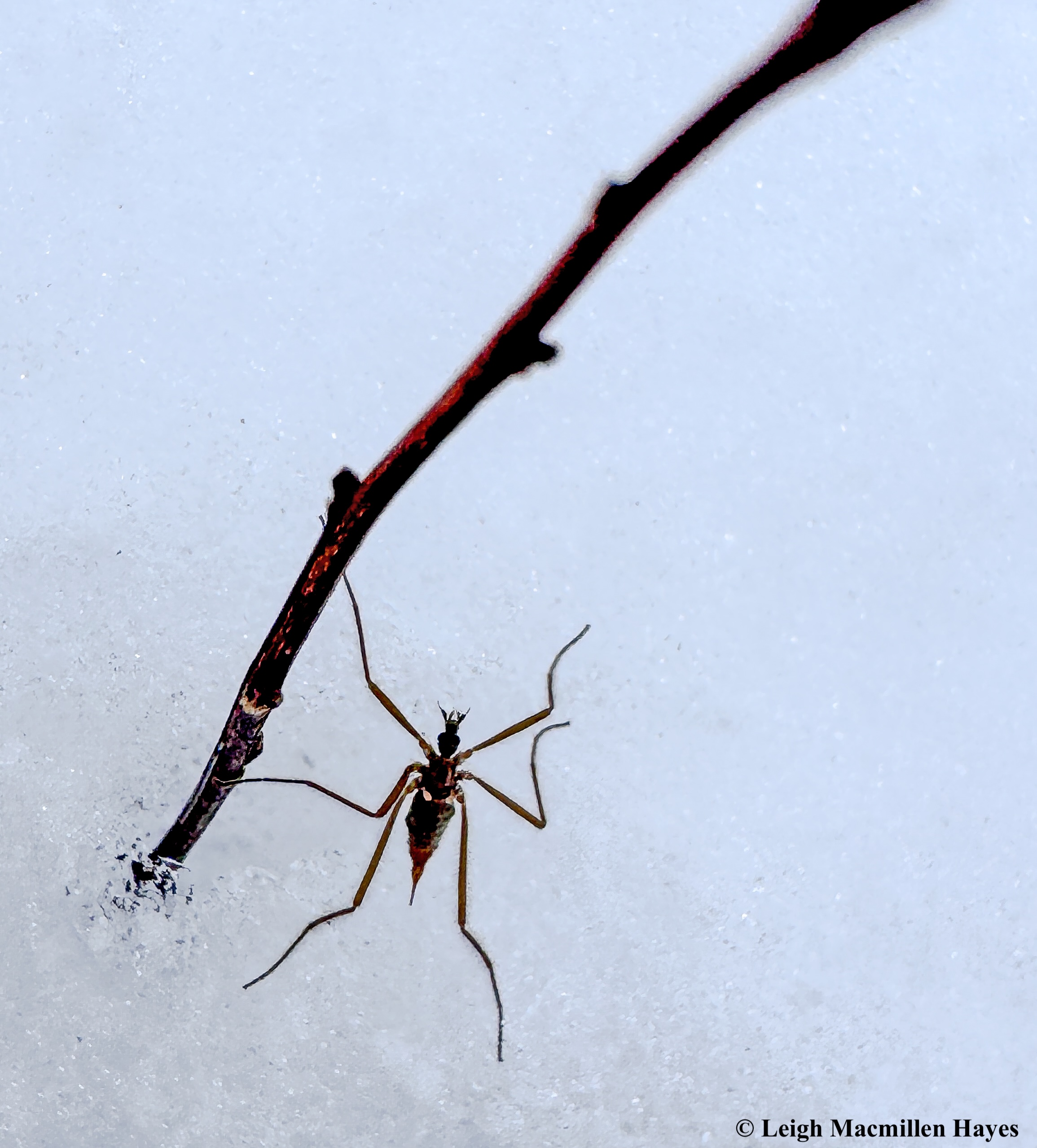
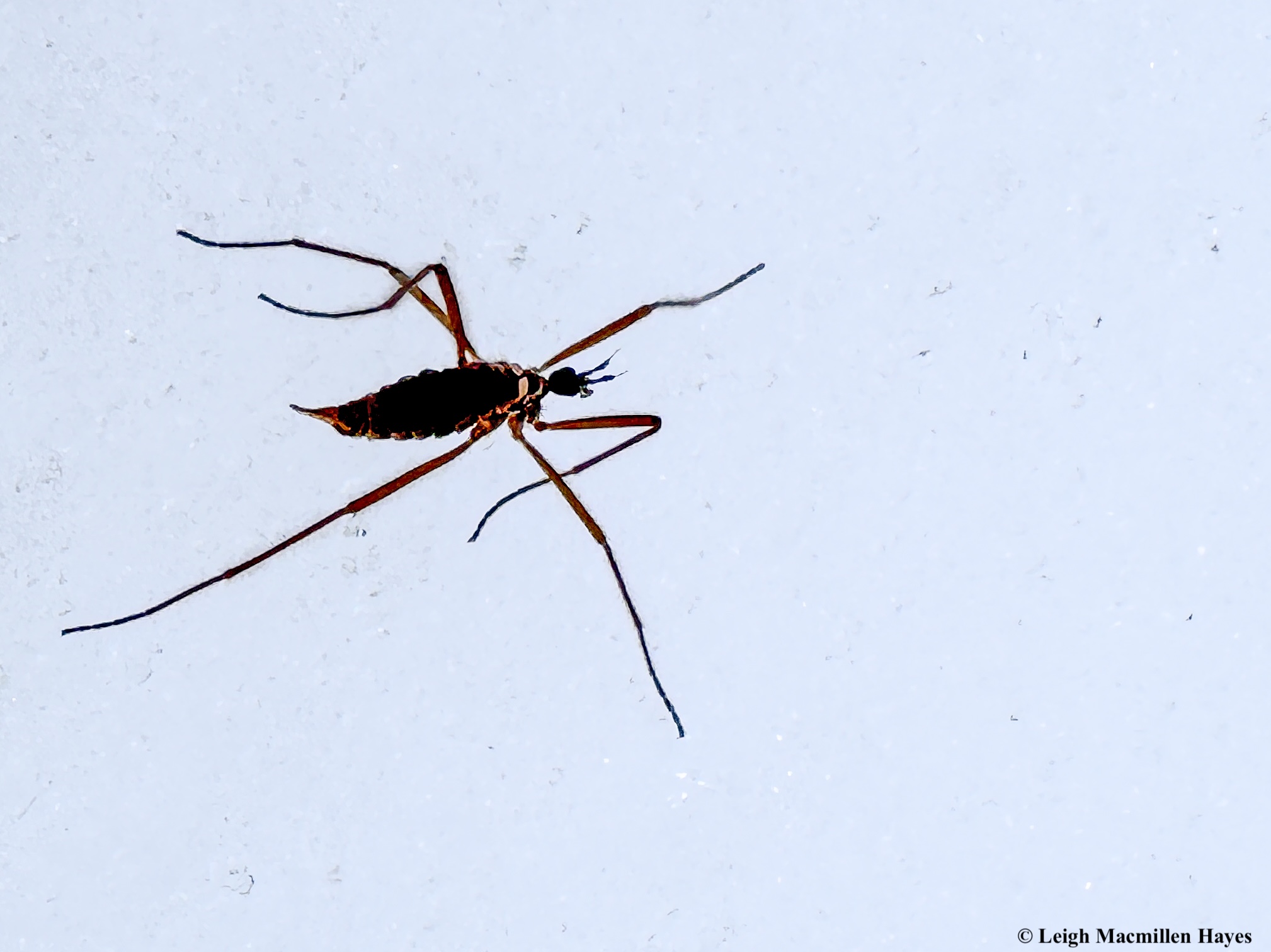
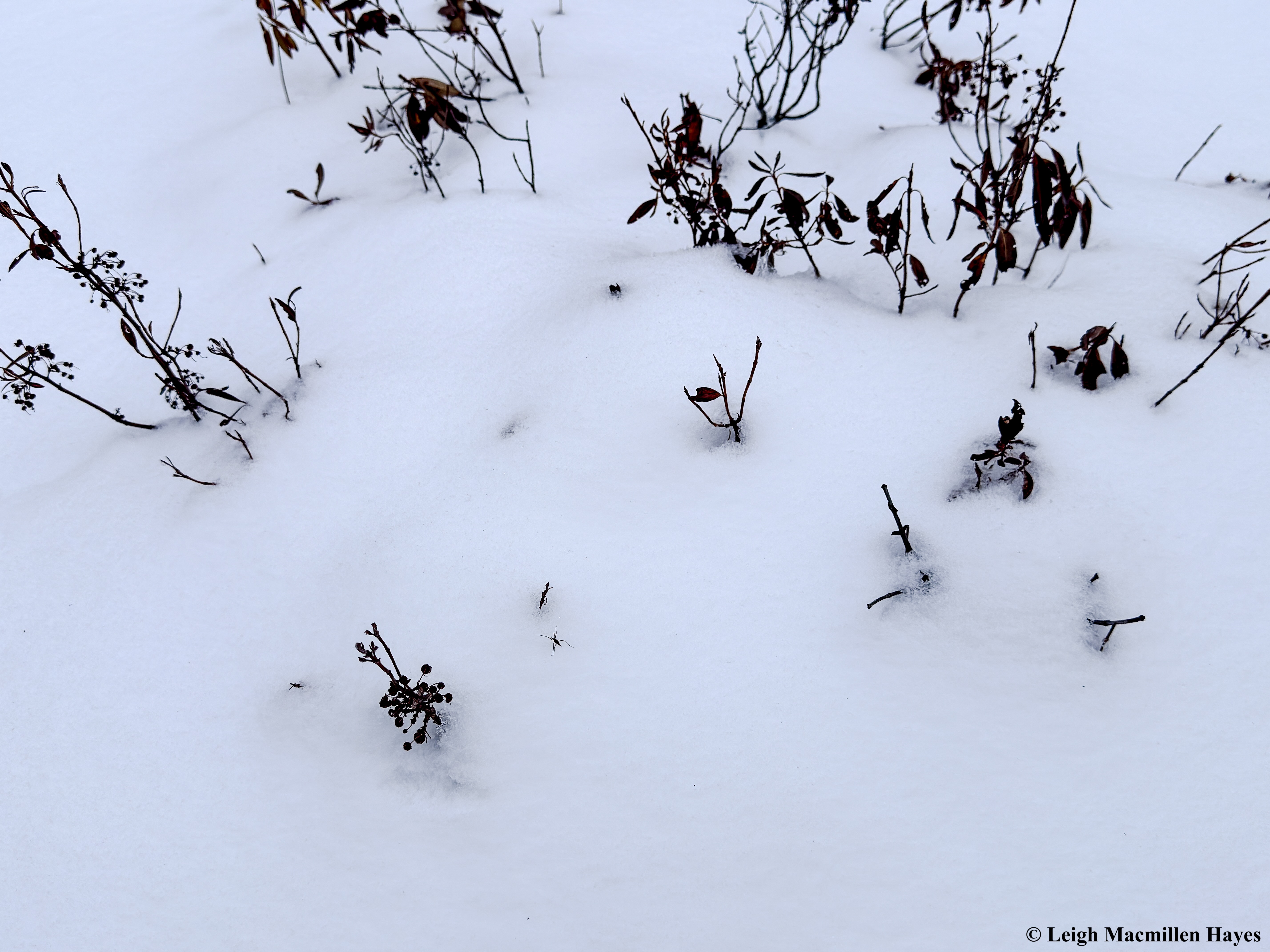
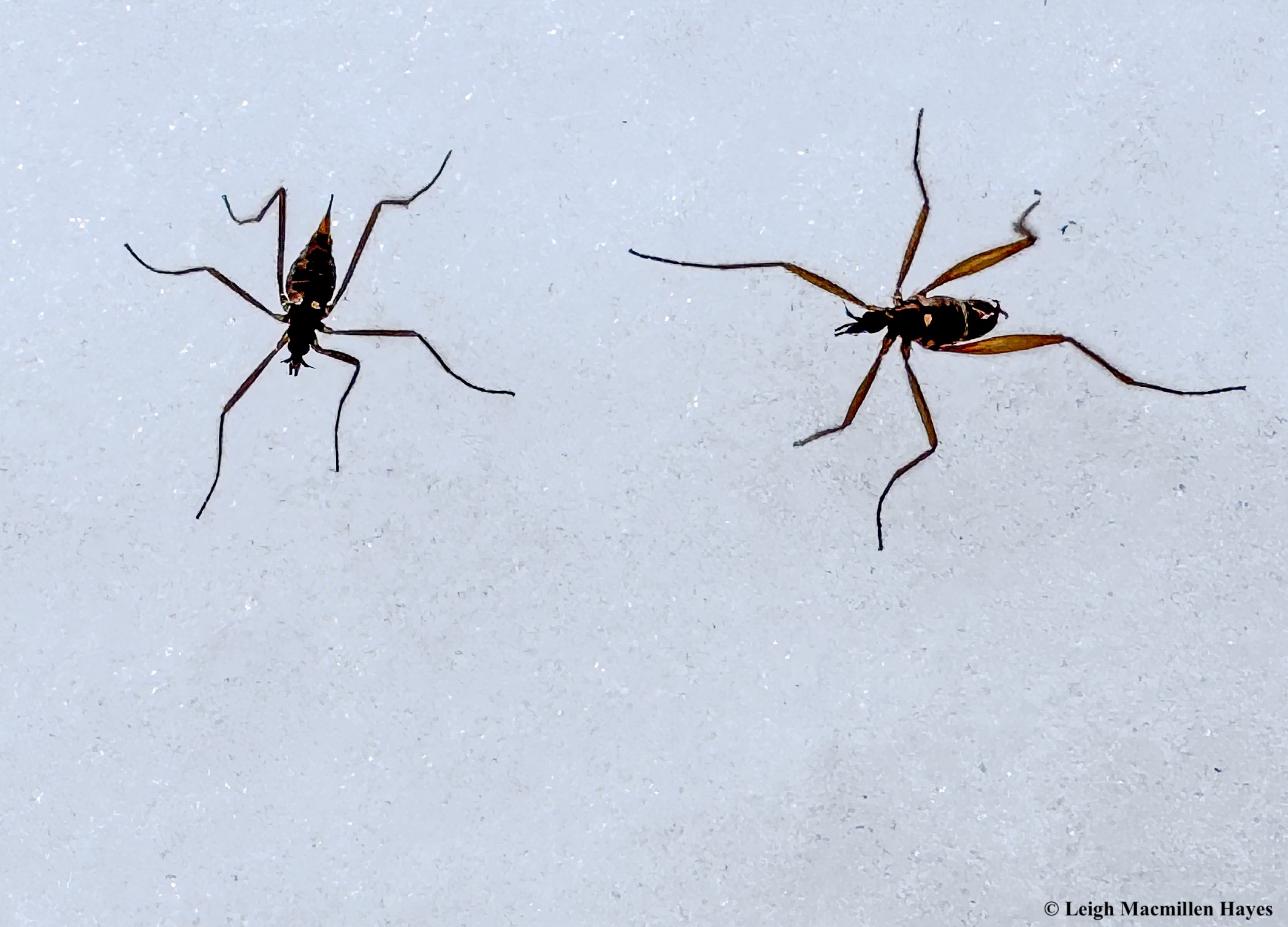
Who is this critter? A Snow Fly, a flightless Crane Fly.

They lack wings, but do have a set of halteres, those knob-shaped organs that help with stability.

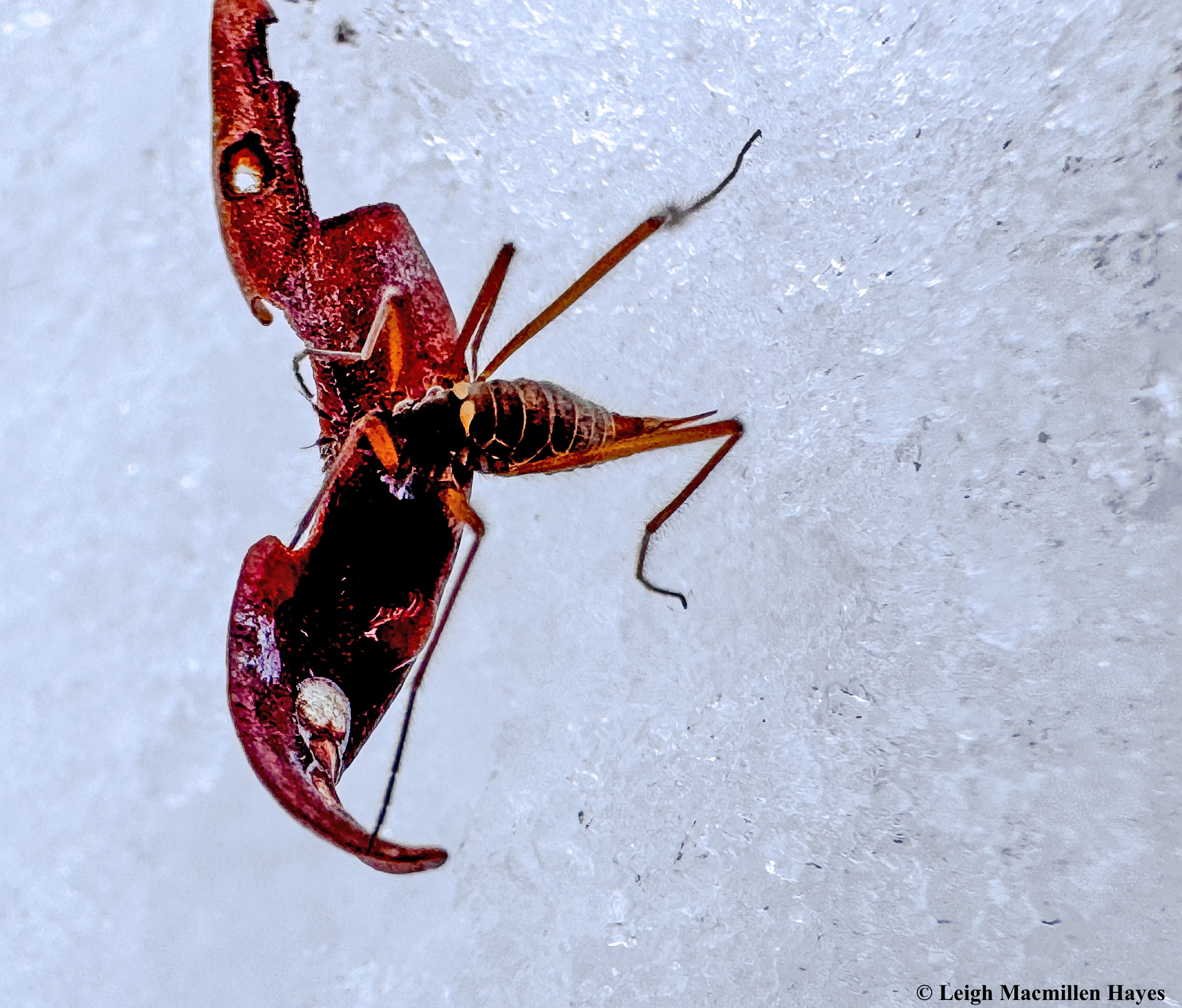
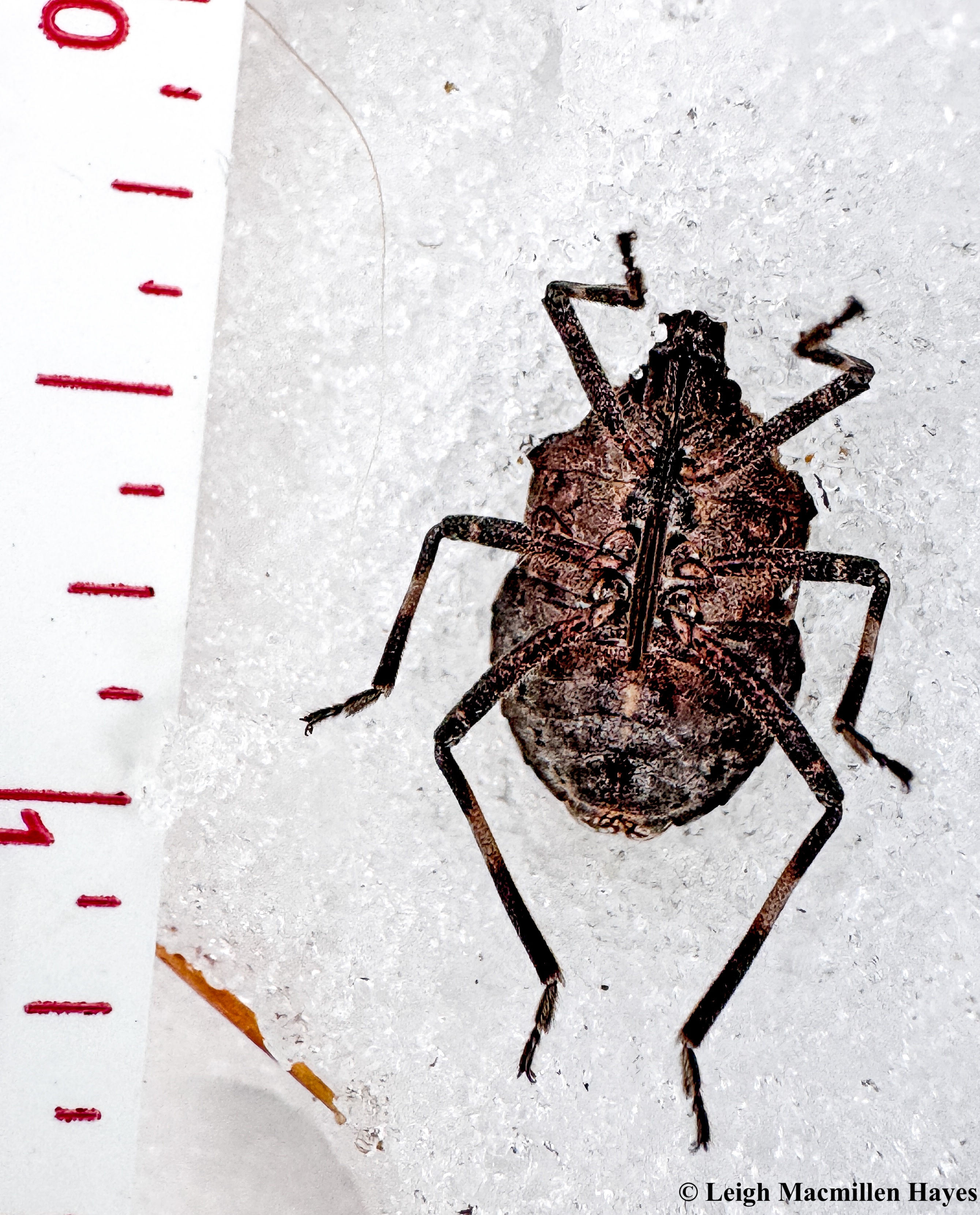
This is a female Snow Fly, the gender being determined by the abdominal appendages. Notice hers is upward curving and tapered to a point.

Do you notice anything else about her? As in how many legs she has?

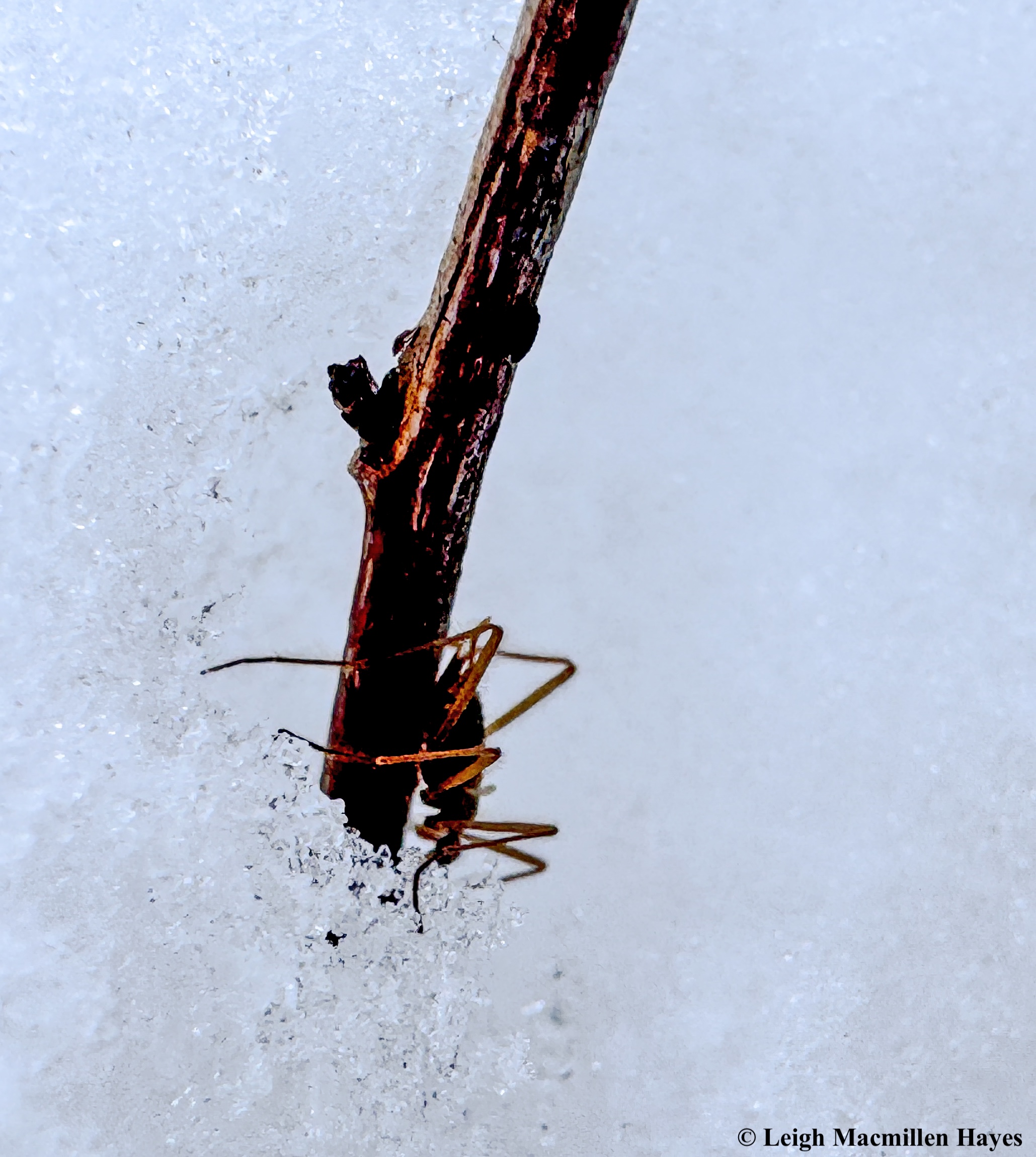
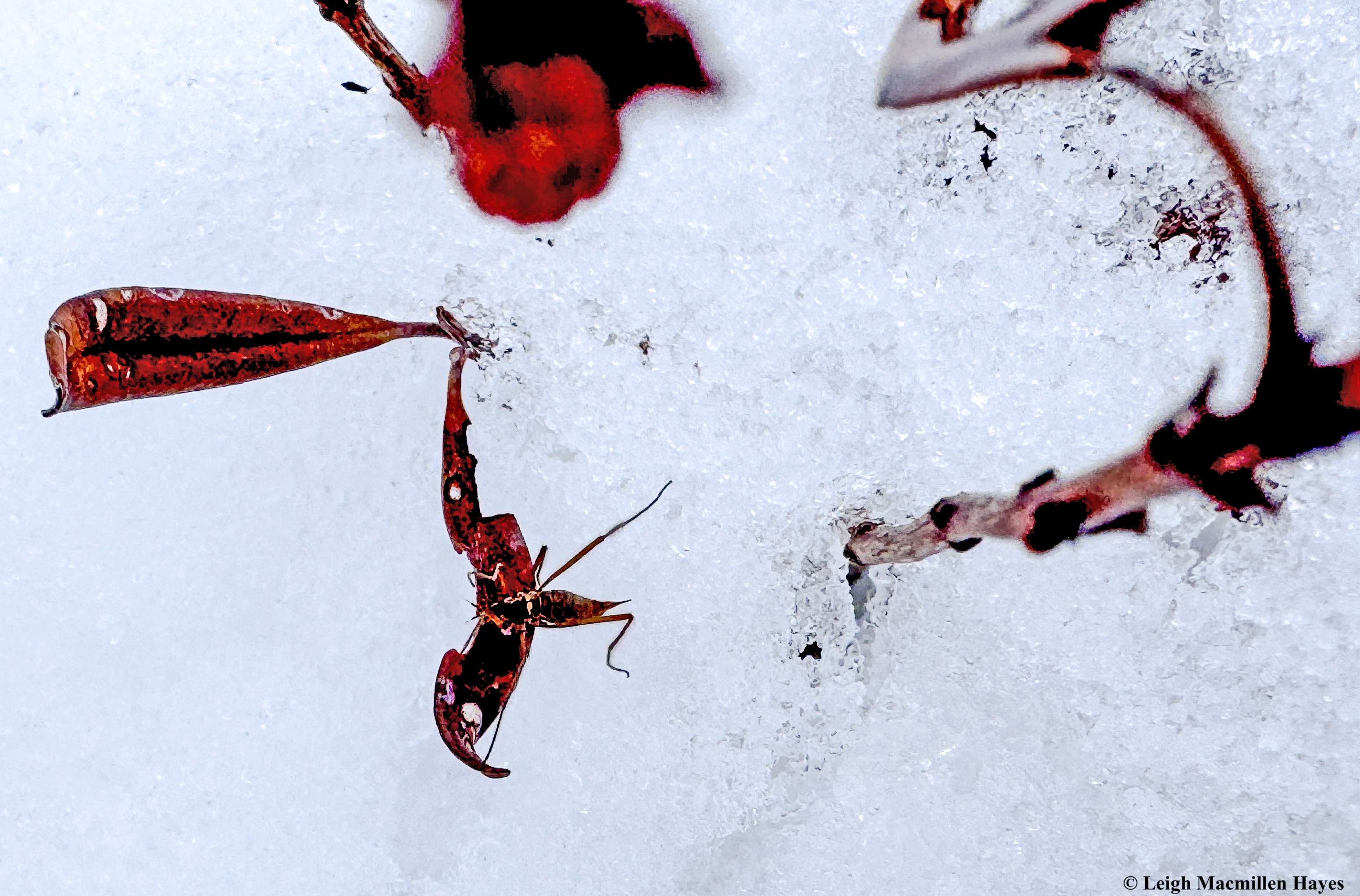
This robust male’s abdomen appendages are much blunter and pincer-like in shape.

Hmmm, again I ask, how many legs has he?

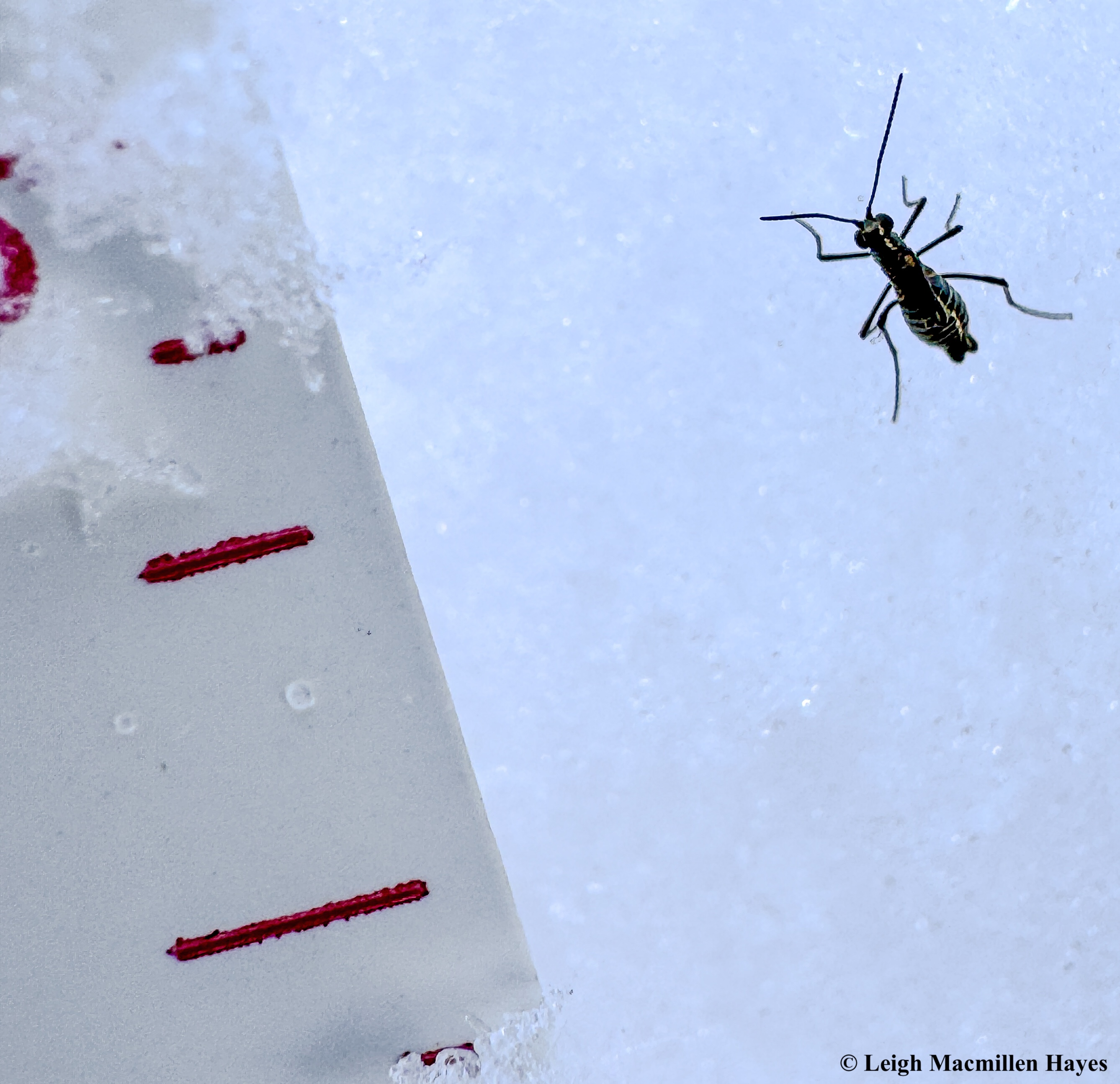
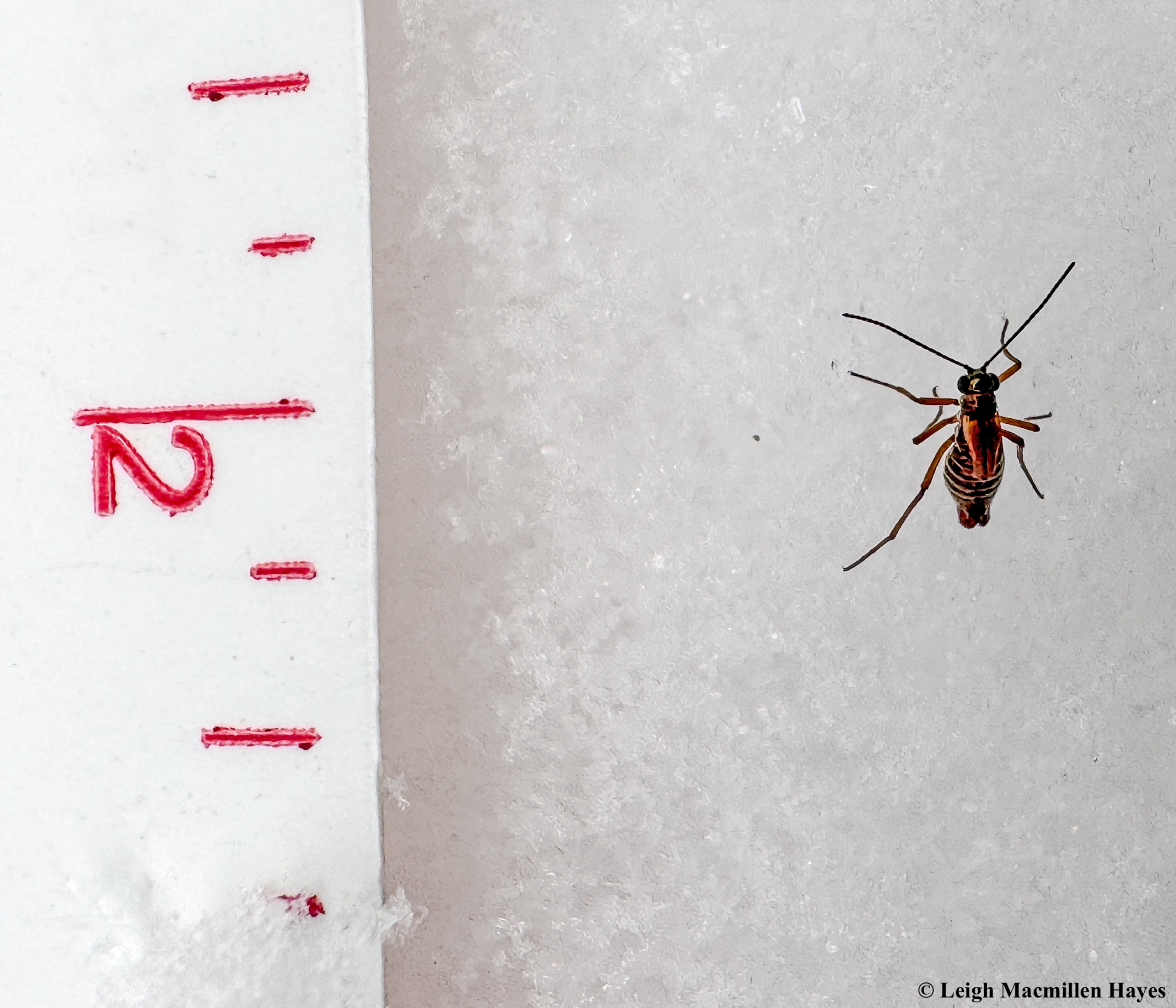
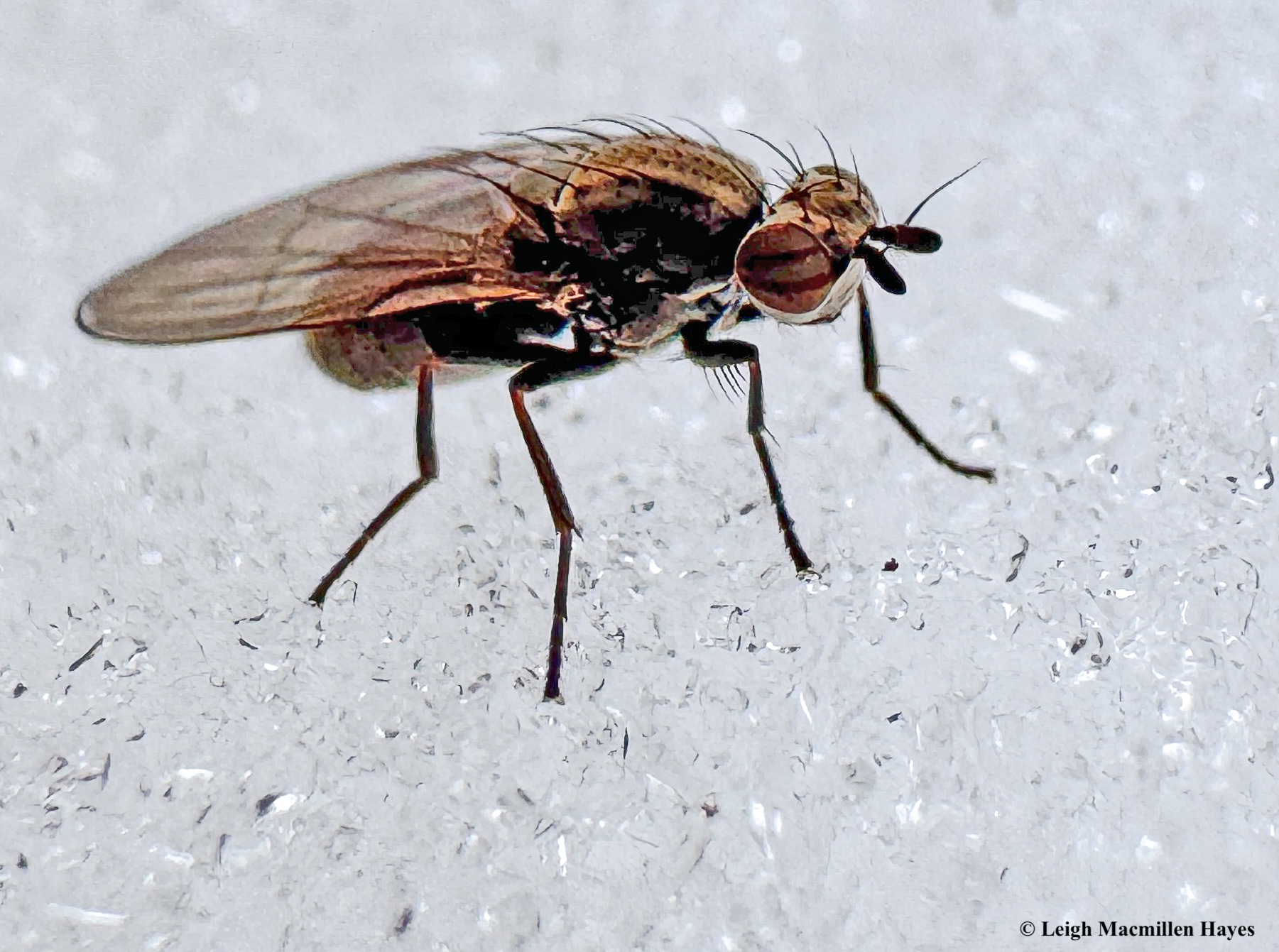
While the Snow Fly in the first photo I shared sported the typical six legs of an insect (as opposed to eight legs for a spider), the last three have only five. This is due to another amazing winter adaptation:
Snow Flies can self-amputate freezing legs to prevent ice from spreading to organs within their body.

What? We say all the time, “Nature is amazing!” It truly is astounding.

I watched as this male made his way down a brink of snow on only five legs.

He was quick and rather nimble.

As he approached the leaf below, I realized why it is difficult to spot these adults before the snow falls, for then they are well camouflaged in the leaf litter, just as the Orb Weaver spiders are camouflaged on their tree species of choice, their colors blending in and stretched out shapes making them look like the twigs upon which they pose.

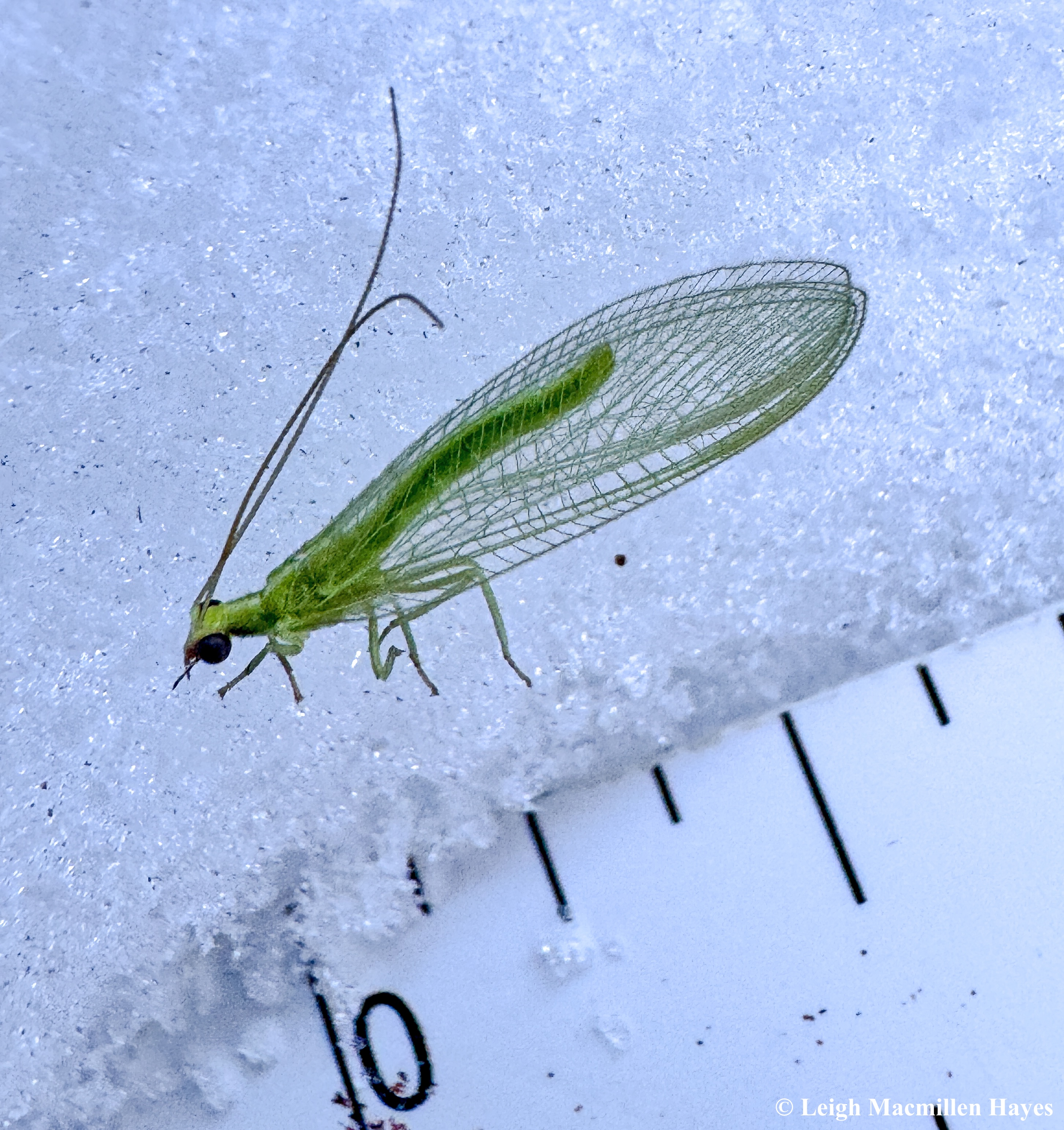
One last critter to share with you is a Green Lace Wing, who completely surprised me. I’m used to seeing them in the field during the summer months, and found this one on the trail just around the corner from the field yesterday.

Adults can overwinter behind bark and may come out on warmer days, but the temperature was 19˚F.

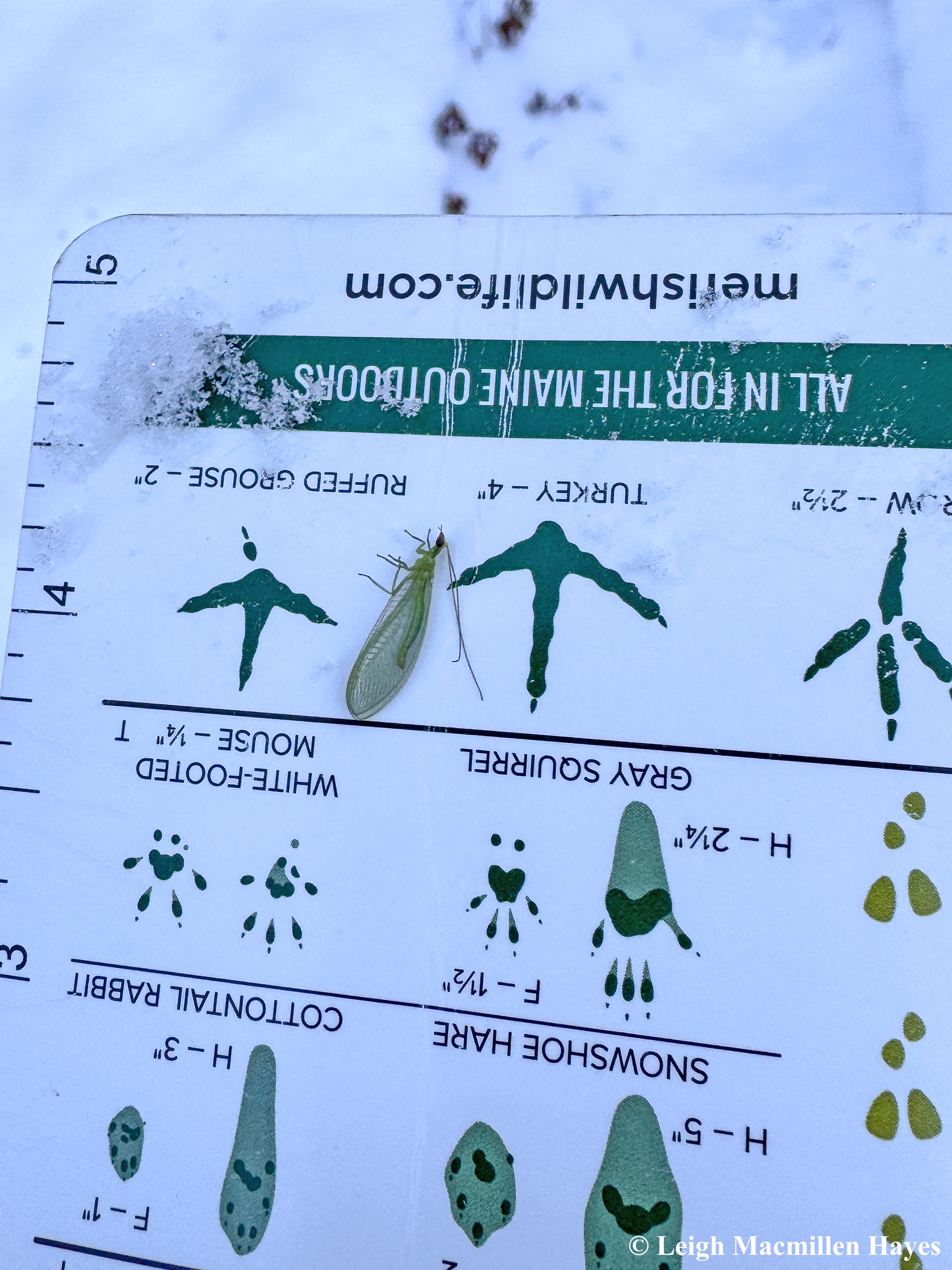
I didn’t have anything to carry it home in, so I scooped its fragile body up onto my little tracking card and carried it home, protecting it from being blown off by the wind. Unlike the spider, however, it didn’t revive once inside.

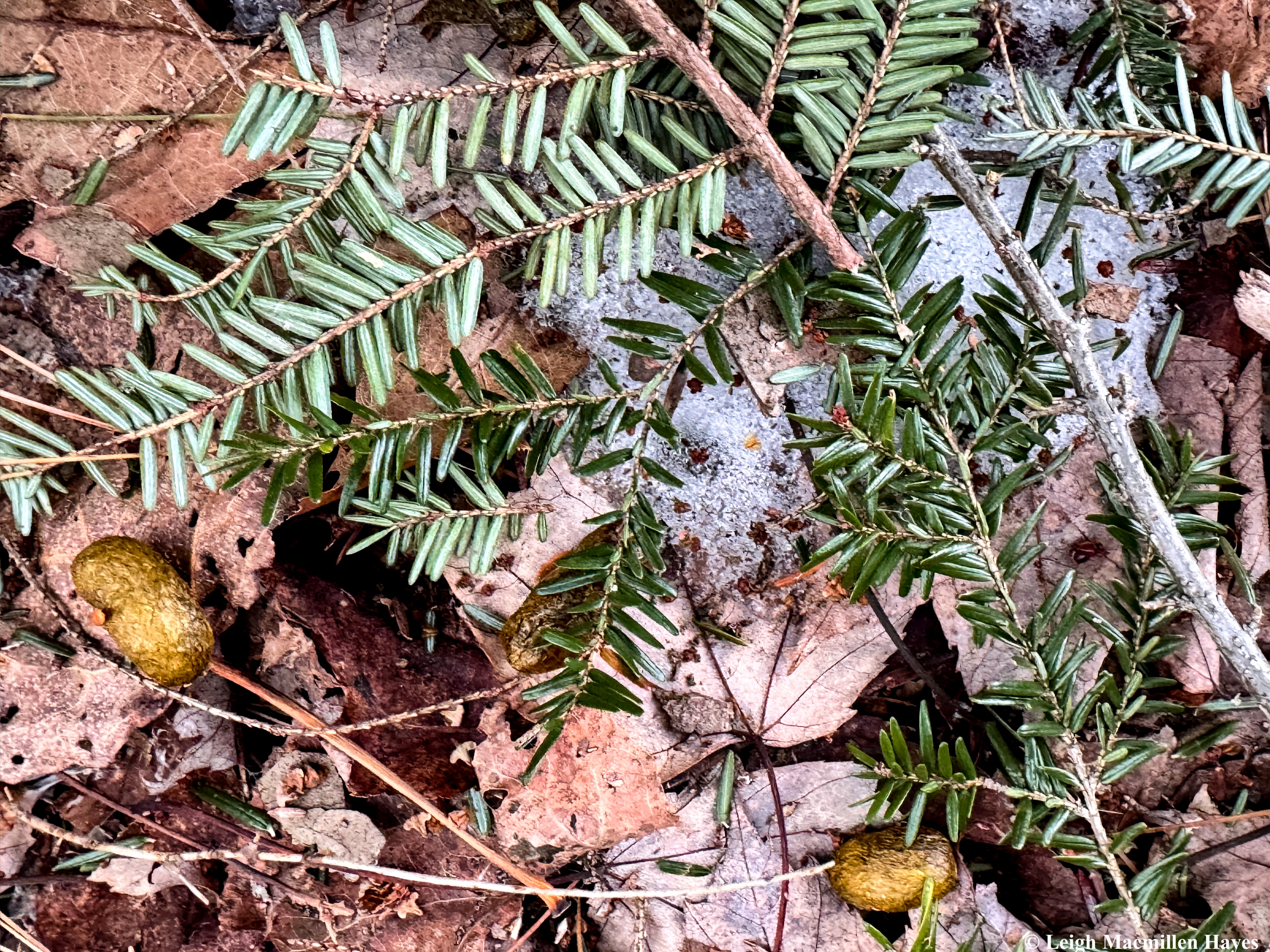
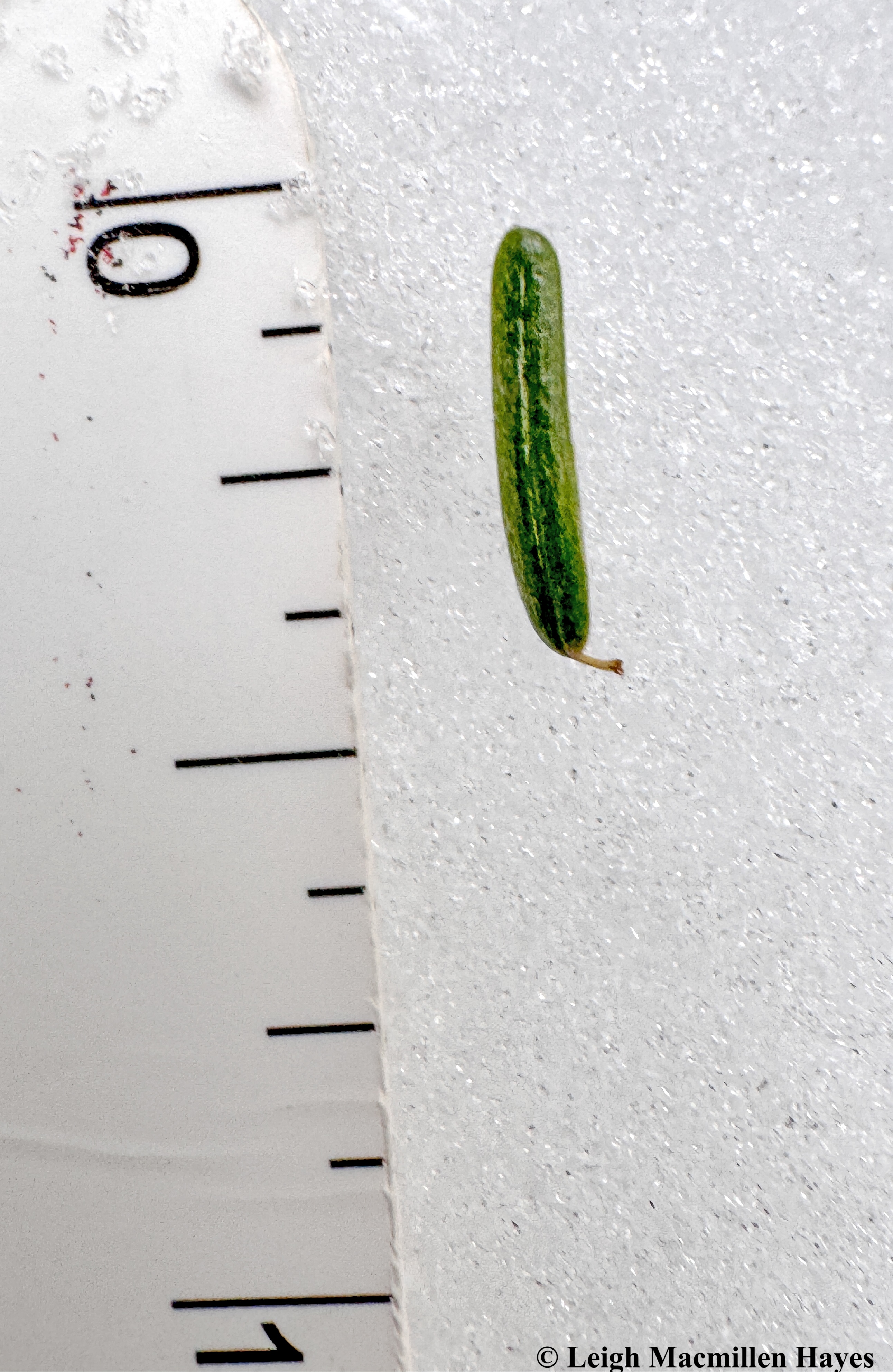
If you are so inclined to look down during a snowy tramp, don’t be fooled by some of the litter, such as Hemlock Needles with their short petioles, pretending to be green abdomens.

Or Birch Seeds that look like miniature butterflies.

I do hope you will venture out and search for these friends. They have a place in the ecosystem and provide us with one more reason to get outside and observe and stand in awe and try to learn no matter what the temperature is.

Spiders and Insects: A winter love story. For me, at least.

Ode to the RAIN!

It began in spurts, 
The rain that is.
Starting with some drops on Tuesday,
Followed by a few more on Wednesday.
But today, much to our delight,
we awoke to the drumming of droplets
upon our metal roof,
and I couldn't resist heading into the woods.
One Jack, or rather Jill-in-the-Pulpit,
lay down its sweet head
upon the wet ground
as if to kiss the moisture gathered there.
In a boggy section,
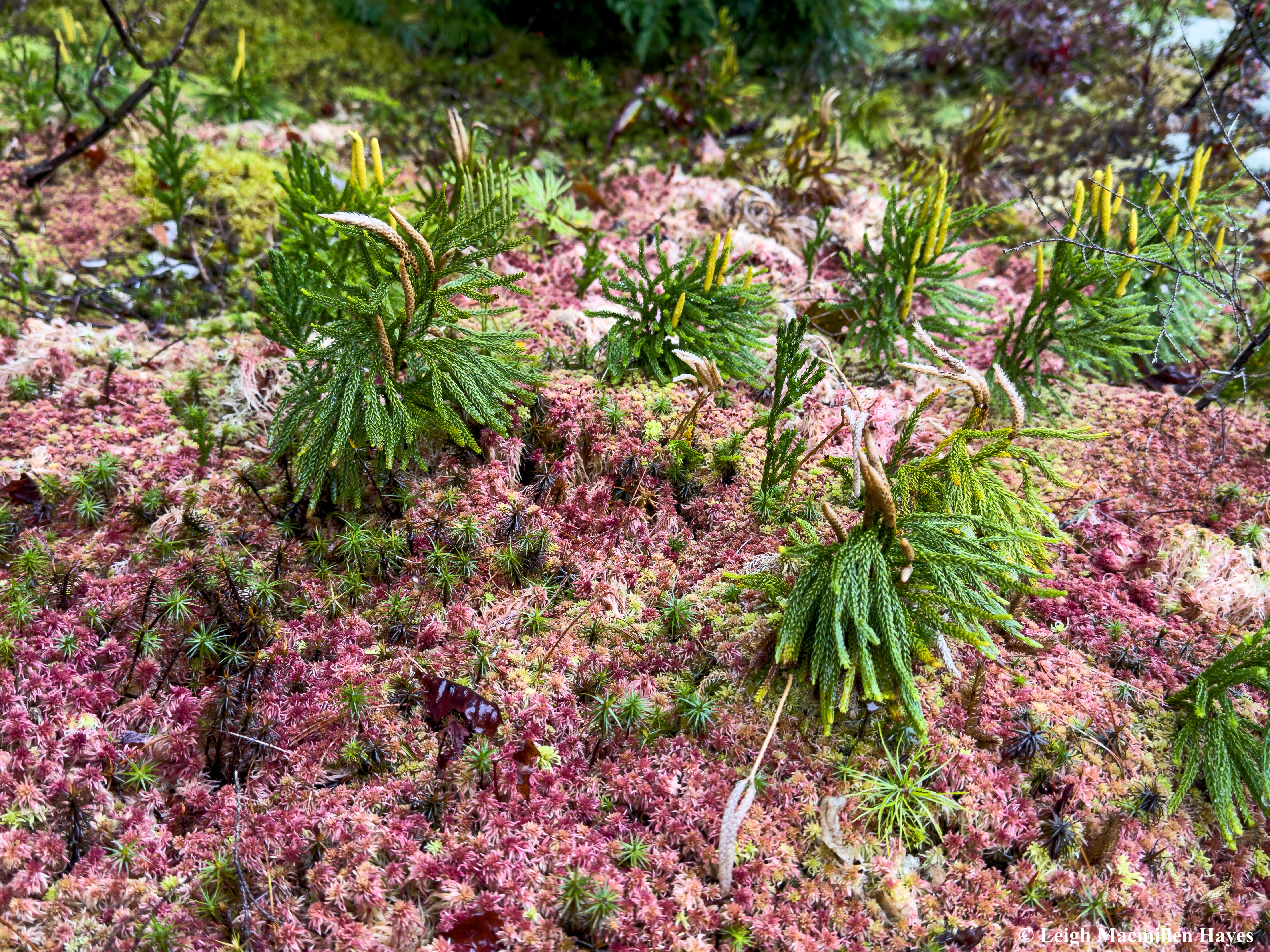
it made the Hickey's Tree Clubmosses
suddenly stand out in contrast
to the pink and green sphagnum below.
And upon every surface,
or so it seemed,
raindrops gathered,
sometimes hesitating for a moment.
Other droplets 
enhanced guidelines
and supporting threads
of a spider's web.
Because it was raining,
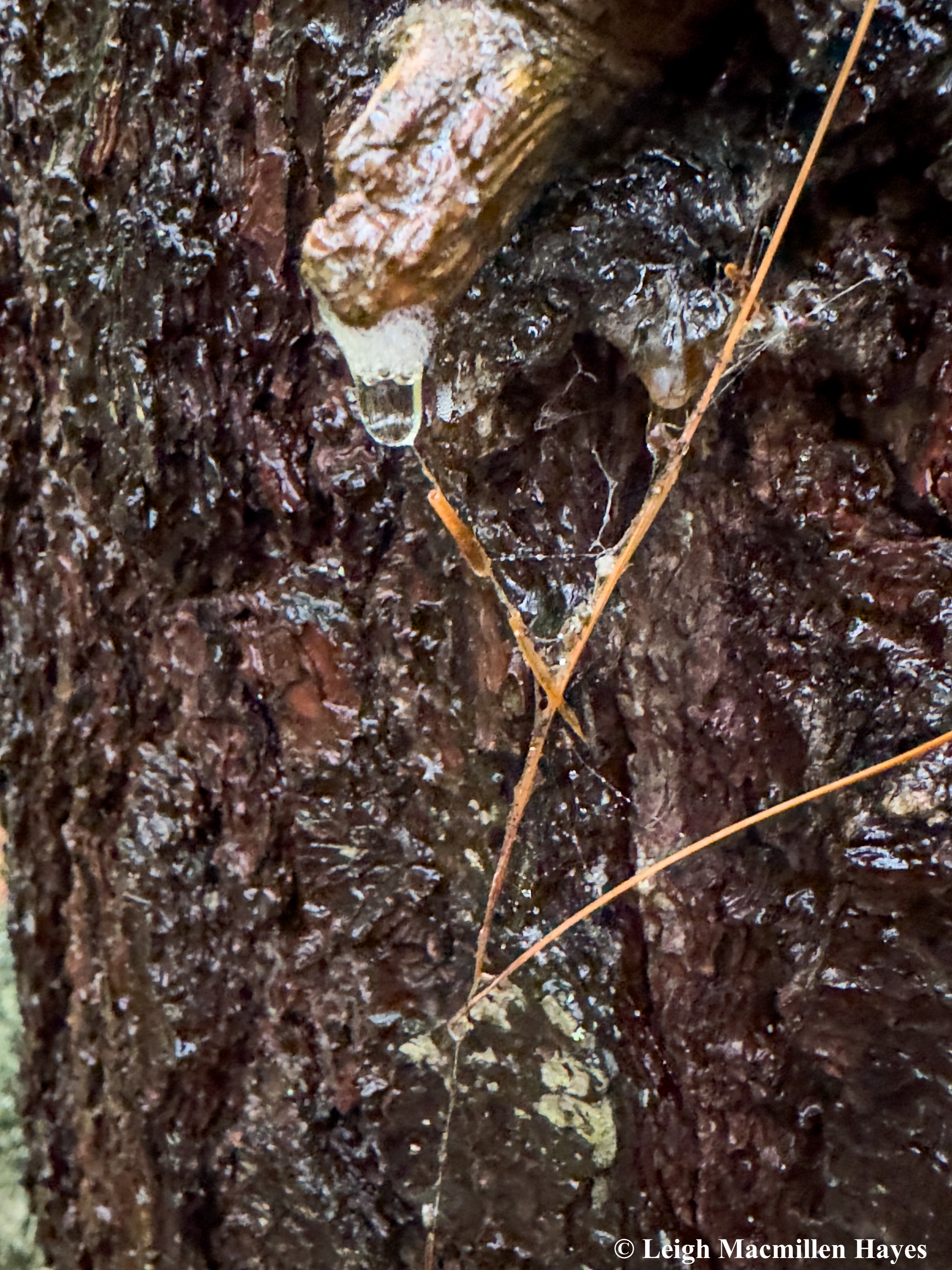
I decided to play and poked a stick
into the resin blister of a Balsam Fir,
then placed it in a tiny puddle.
My sense of wonder
was well rewarded
as the essential oils
created ever-changing rainbows.
But my real intention
for heading outside so early
was to search for slugs
who haven't had an easy summer.
I was rewarded 
when upon a snag,
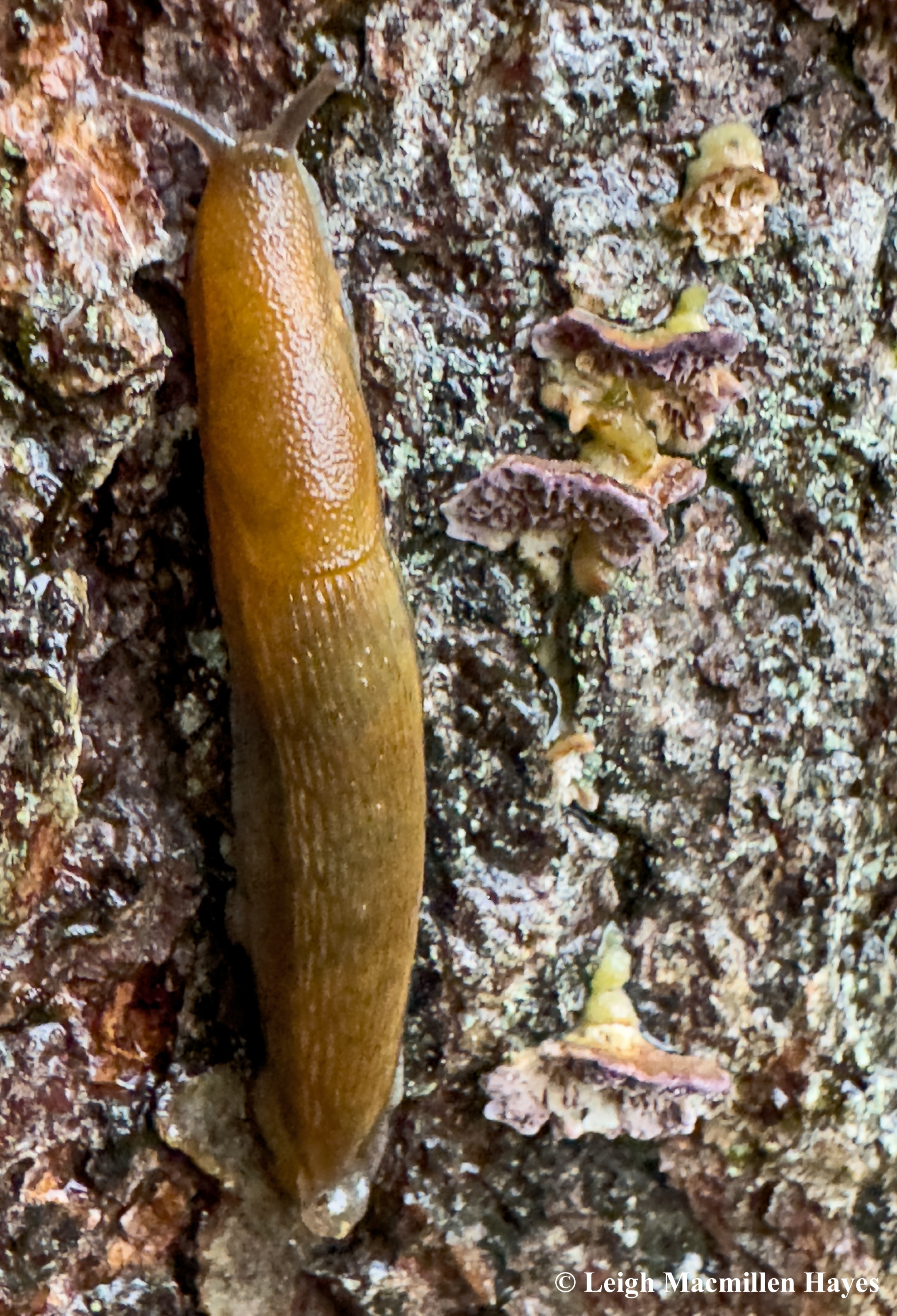
I found a Western Dusky
dining on smaller organisms than I could spot.
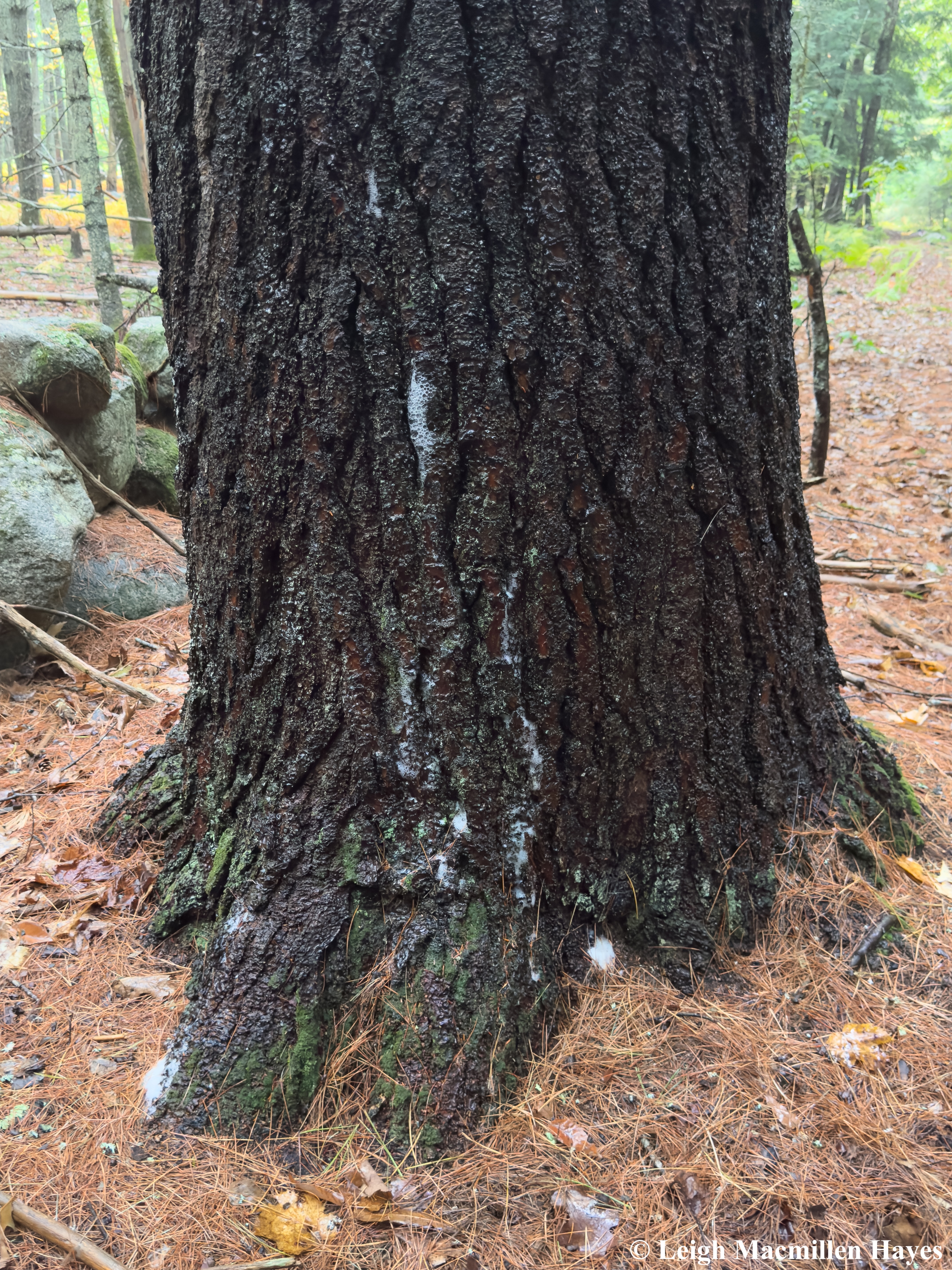
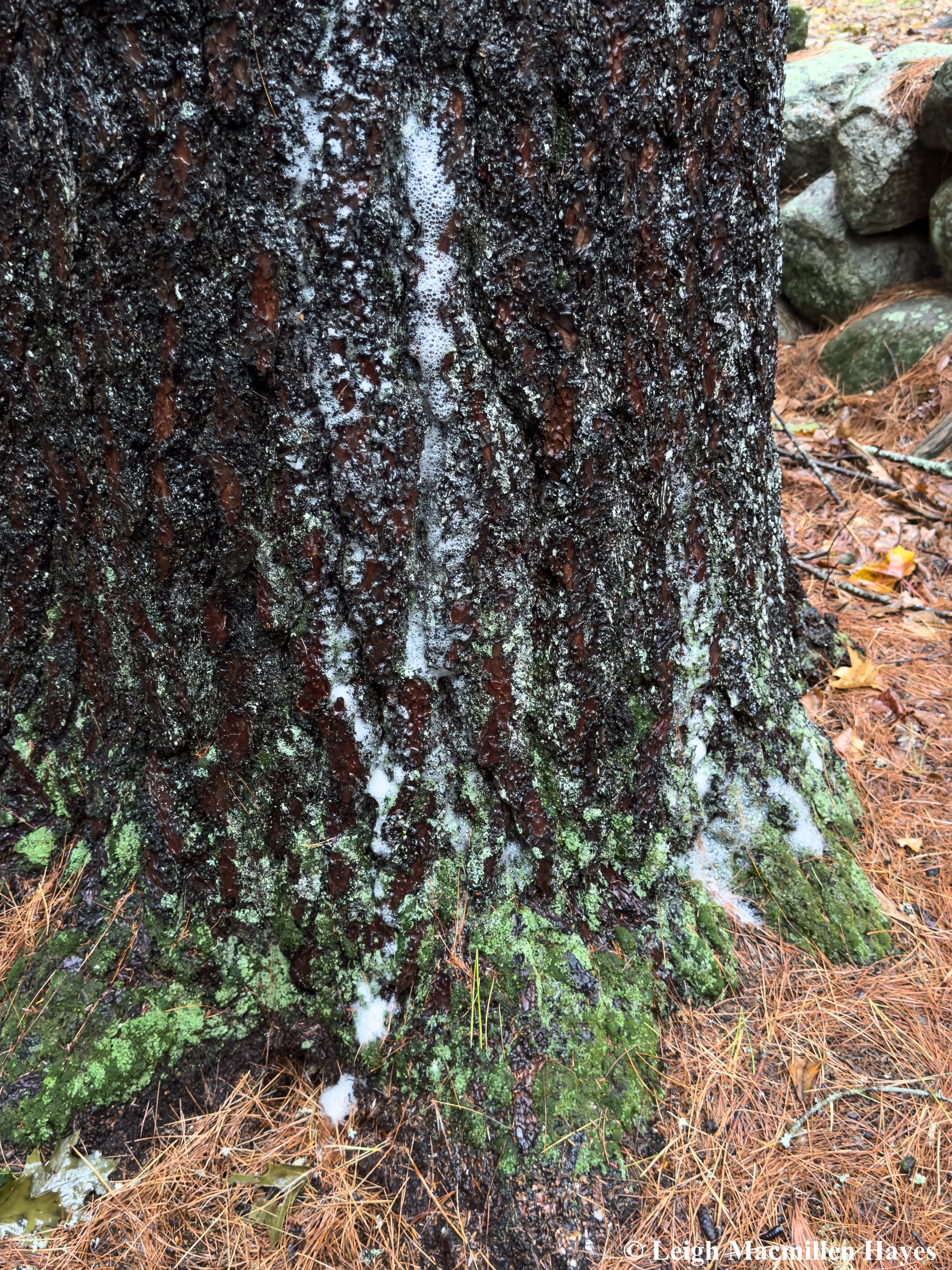
My other intention was to hunt for suds
and though I found some in the morning,
the pounding rather than pitter-pattering rain of the late afternoon
provided many an example.
As the droplets dripped toward the base,
dissolving chemicals on the bark,
the surface tension changed,
and with the turbulence came air, thus forming foam.
It's all a matter
of one drop at a time,
but when the rain is heavy,
those drops form and release quickly.
Upon one of the older White Pines
between the stonewall and old cow path,
I found lots of pine soap,
on the eastern side.
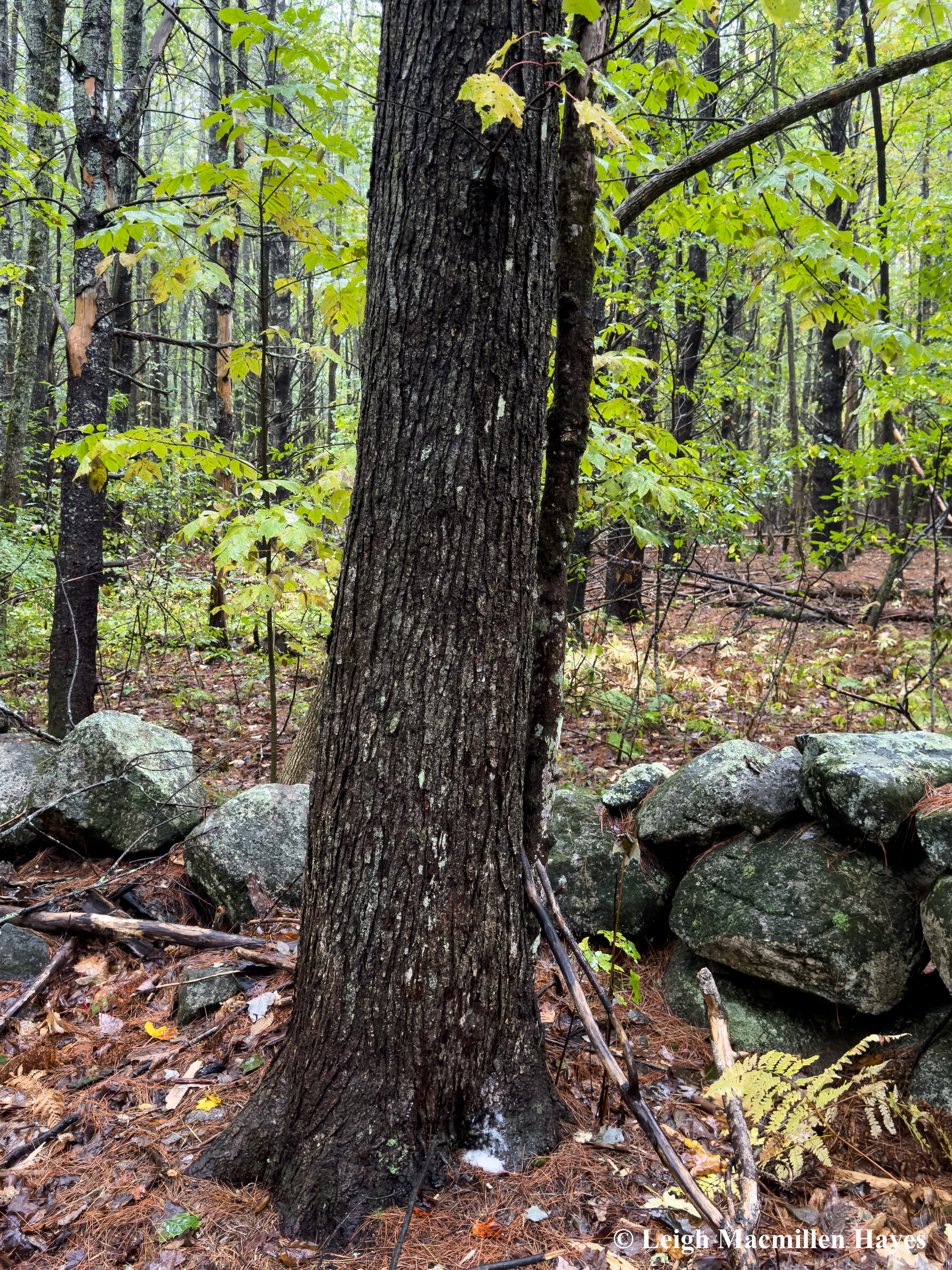
The same was true on the western side,
and as I now sit inside all cozy and dry,
it is pouring out there and I suspect almost every tree
has a base like this.
It's easy to think
that only pines offer the suds,
But I've learned from observation,
That others do the same, like this Red Maple.
And much to my pleasant surprise, 
I found a gathering of suds,
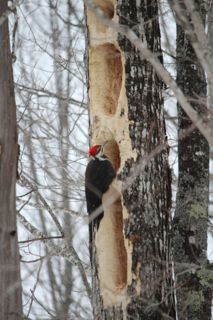
within an old Pileated Woodpecker hole,
on one of my favorite trees.
I like to think of it 
as the Stairway to Heaven Tree,
for such do its branches remind me,
as if I could climb them into the sky.
Because I was looking,
I discovered an insect,
this being a Hemlock Looper Moth,
taking refuge upon a trunk.
When I originally headed out the door this morning, 
and told My Guy I was going on a search for Slugs,
he said, "Who is this person I married?"
And we both chuckled.
All told I only found three. 
Nevertheless, I know these three
and many other critters and humans
join me in praising the rain.

Lessons in the Shadows

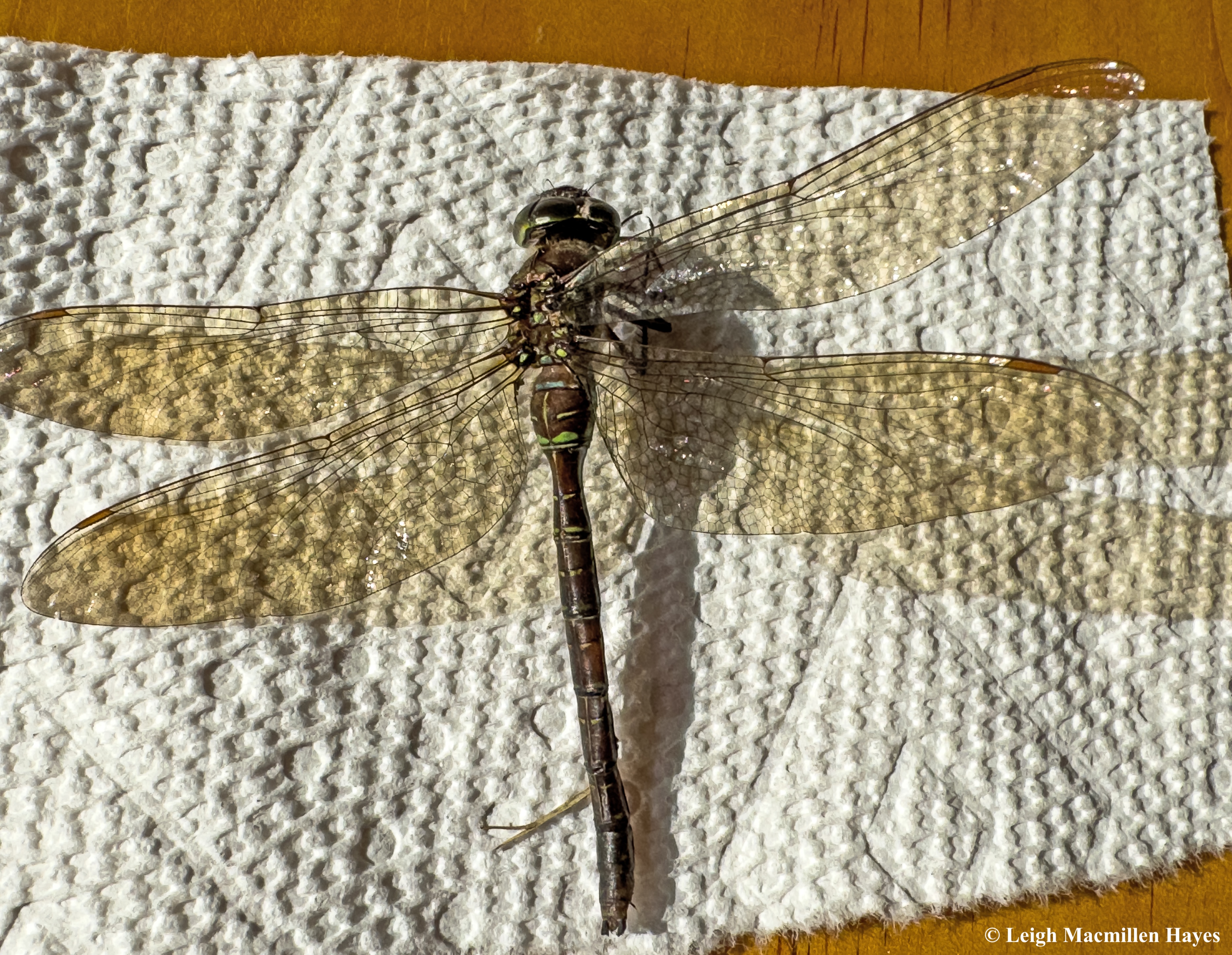
The email arrived before 8am. “‘Morning. I have a dying/dead dragonfly. Perfect condition/appearance. Wonder if you could use it for your collection. No rush if so, I’ll keep it safe!”

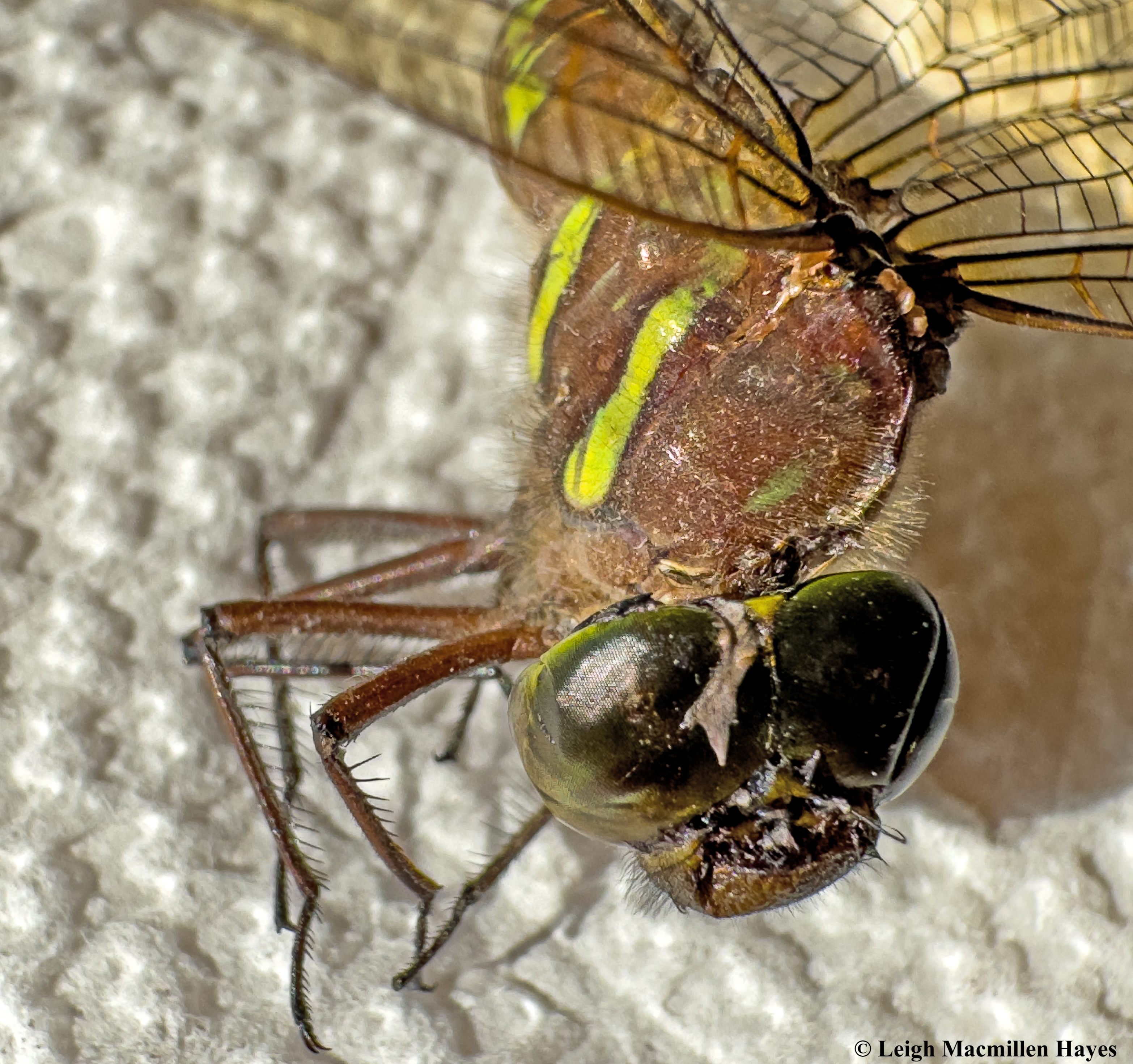
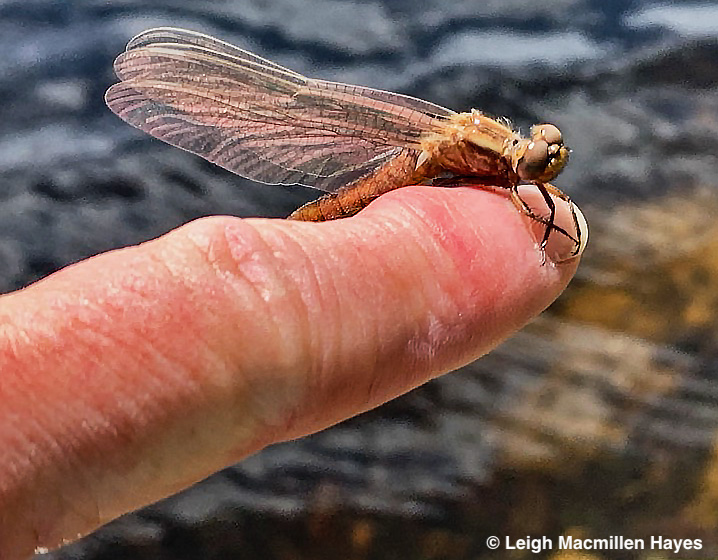
And so it was that this afternoon I drove to a friend’s house and received this gift. In the moment, I knew it was in the Darner family, but I wasn’t sure about its full identification. The amber wing color drew my awe and I couldn’t wait to go home and look through my guides and make a decision.

But . . .

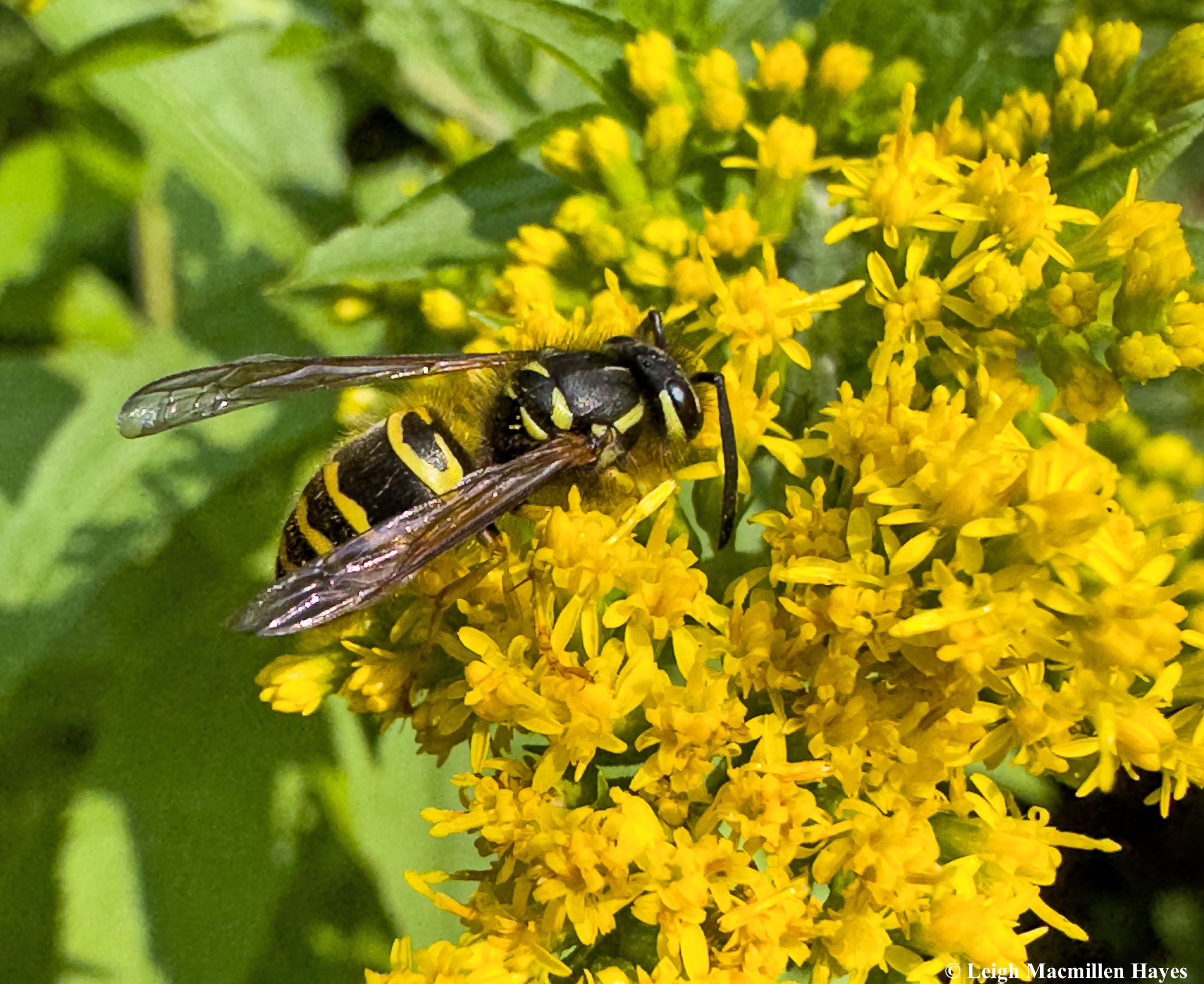
First I drove to a local preserve and followed the trail to a favorite wetland where Yellowjackets like this one and Bees of every kind, and Hornets, and Flower Flies buzzed and flew and buzzed some more as they frantically worked on the Goldenrods and a few Asters still in bloom.

I had intended to cover some miles, albeit at a slow pace, but . . . once I spotted this specimen, I knew my plans were shot. Instead, I was meant to be in this one place for a couple of hours. And so I stayed.

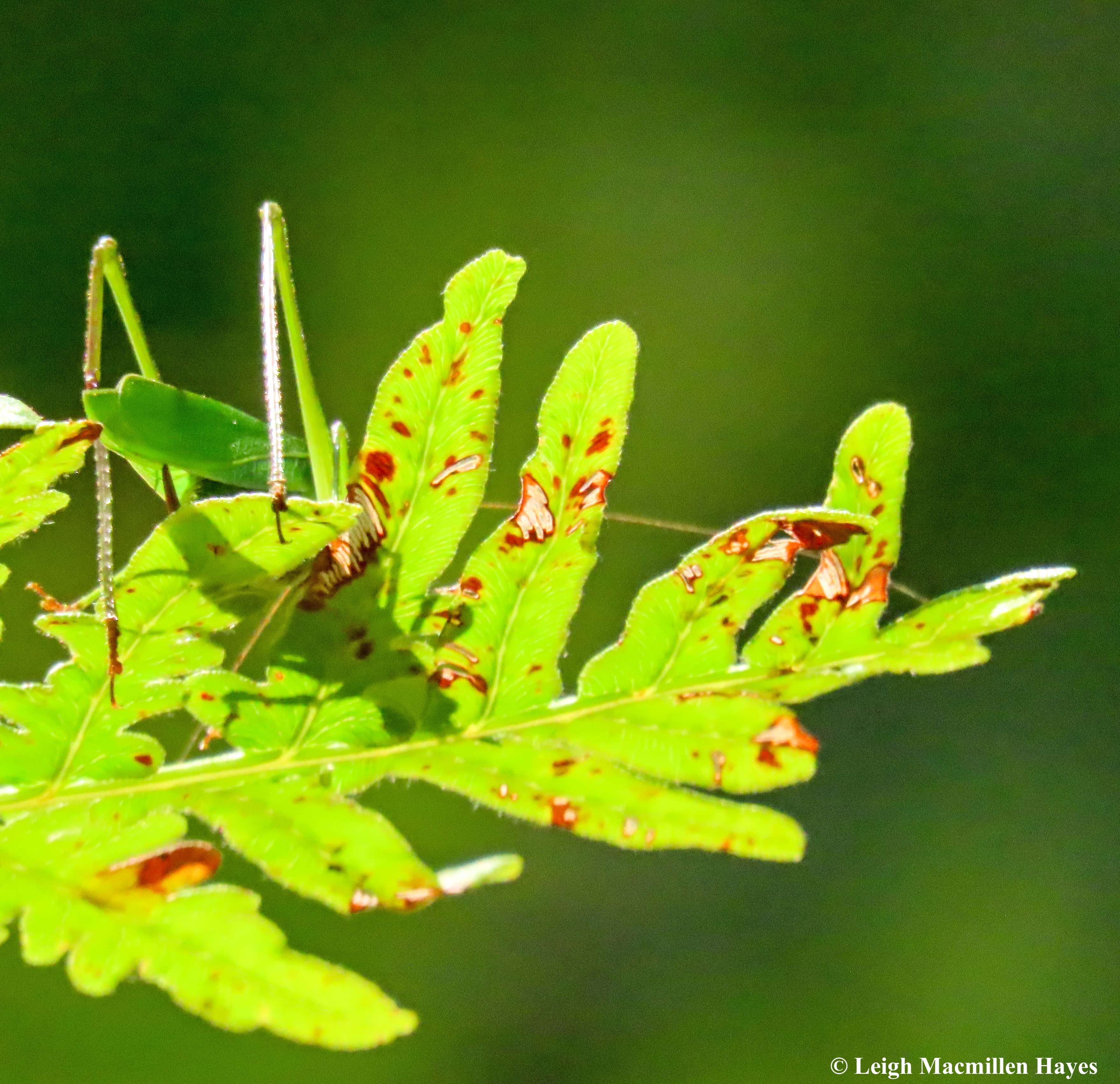
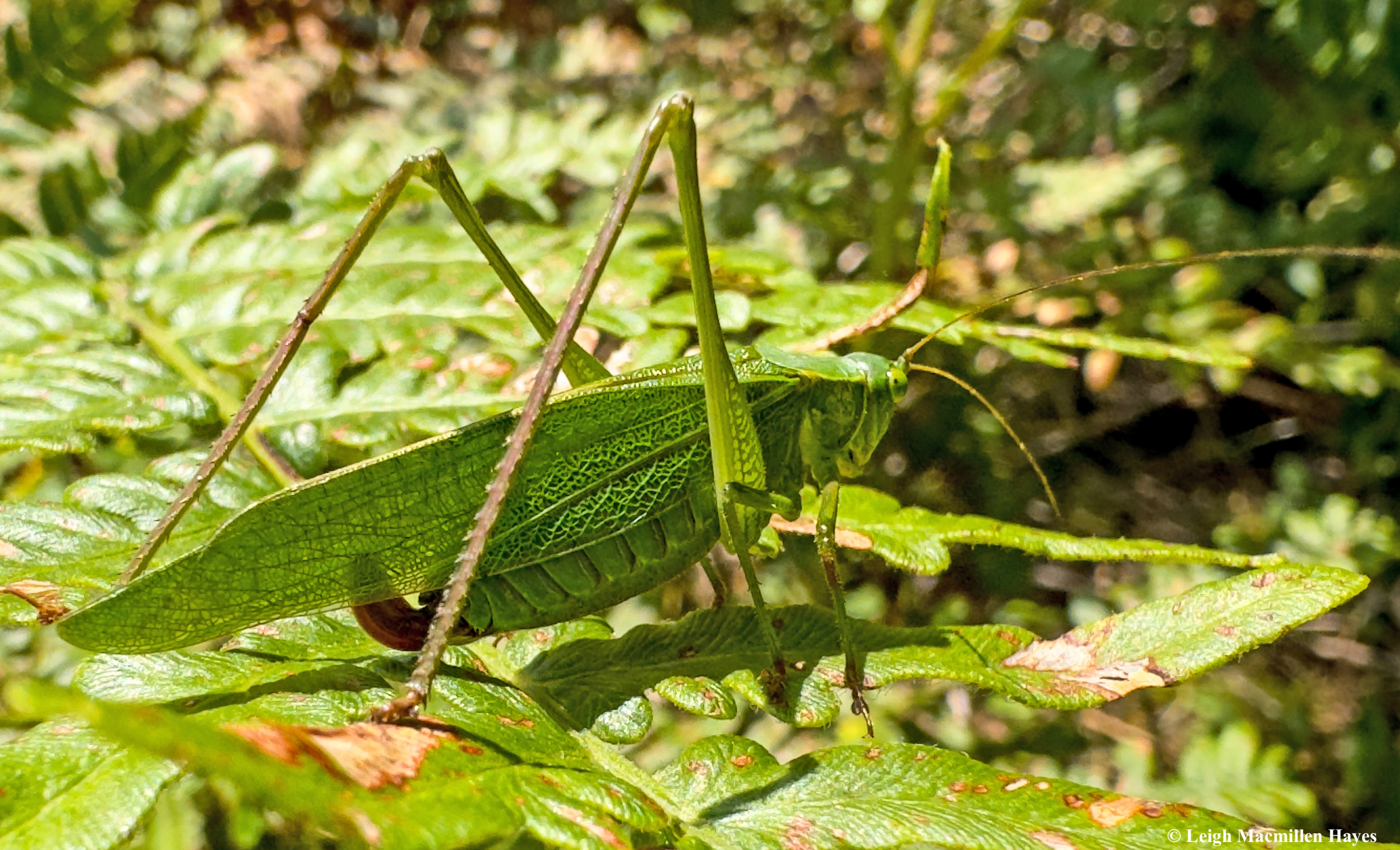
And reveled in the sighting of this Bush Katydid. As I said to another friend this morning via a text message–look at the armor and color and texture and design. Of course, then, I was referring to a Two-Striped Grasshopper. But truly, the same holds true for the Katydids in our world. (Especially my favorite Katy-did! She knows who she is.)

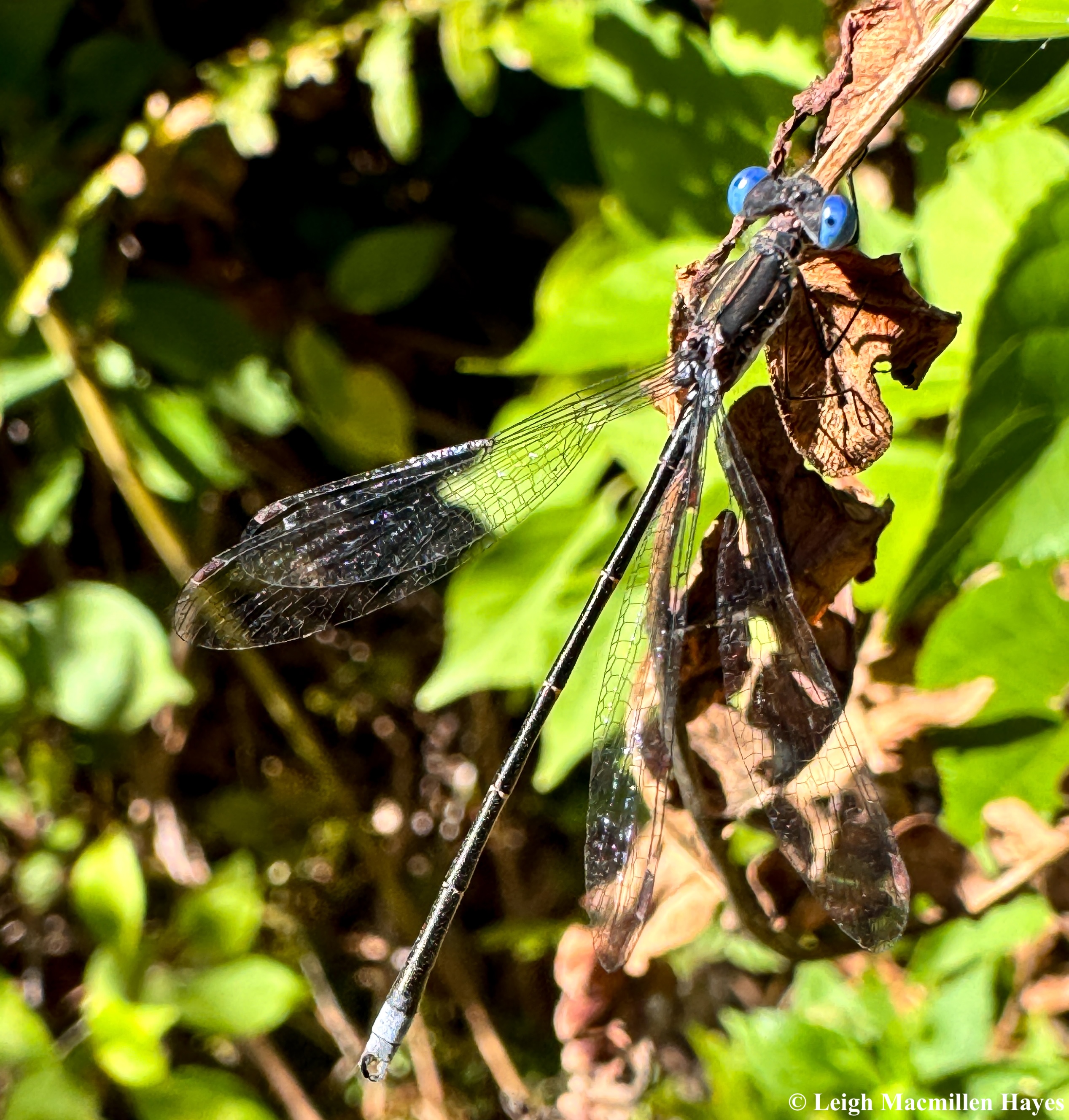
Also in my midst–Spotted Spreadwing Damselflies. This is the male and last week, plus today, I spotted them but couldn’t find a female anywhere.

Until I did. As always, her color is much drabber than his, but still she has the more important job . . . at least in my book of how the world turns.

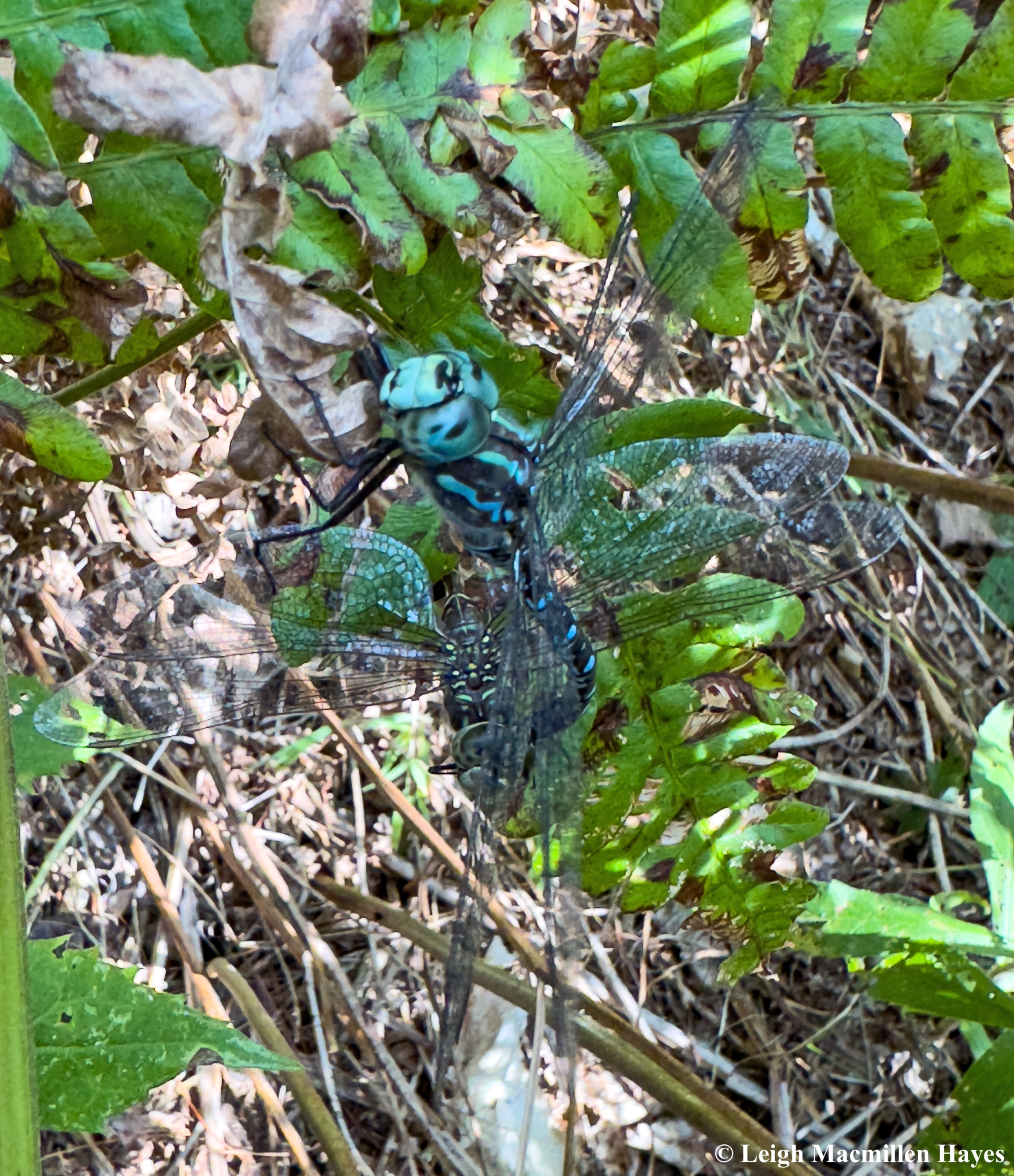
And speaking of that most important job, a couple of Canada Darners decided to canoodle right before my eyes. I couldn’t believe my good fortune. Notice how he uses the cerci at the end of his abdomen to clasp her behind the head and hold her in place as she curls her abdomen around to form the dragonfly mating wheel.

While I watched them, a snippet of movement caught my eye and I was forced, yes FORCED, to look elsewhere. Do you see what drew my attraction?

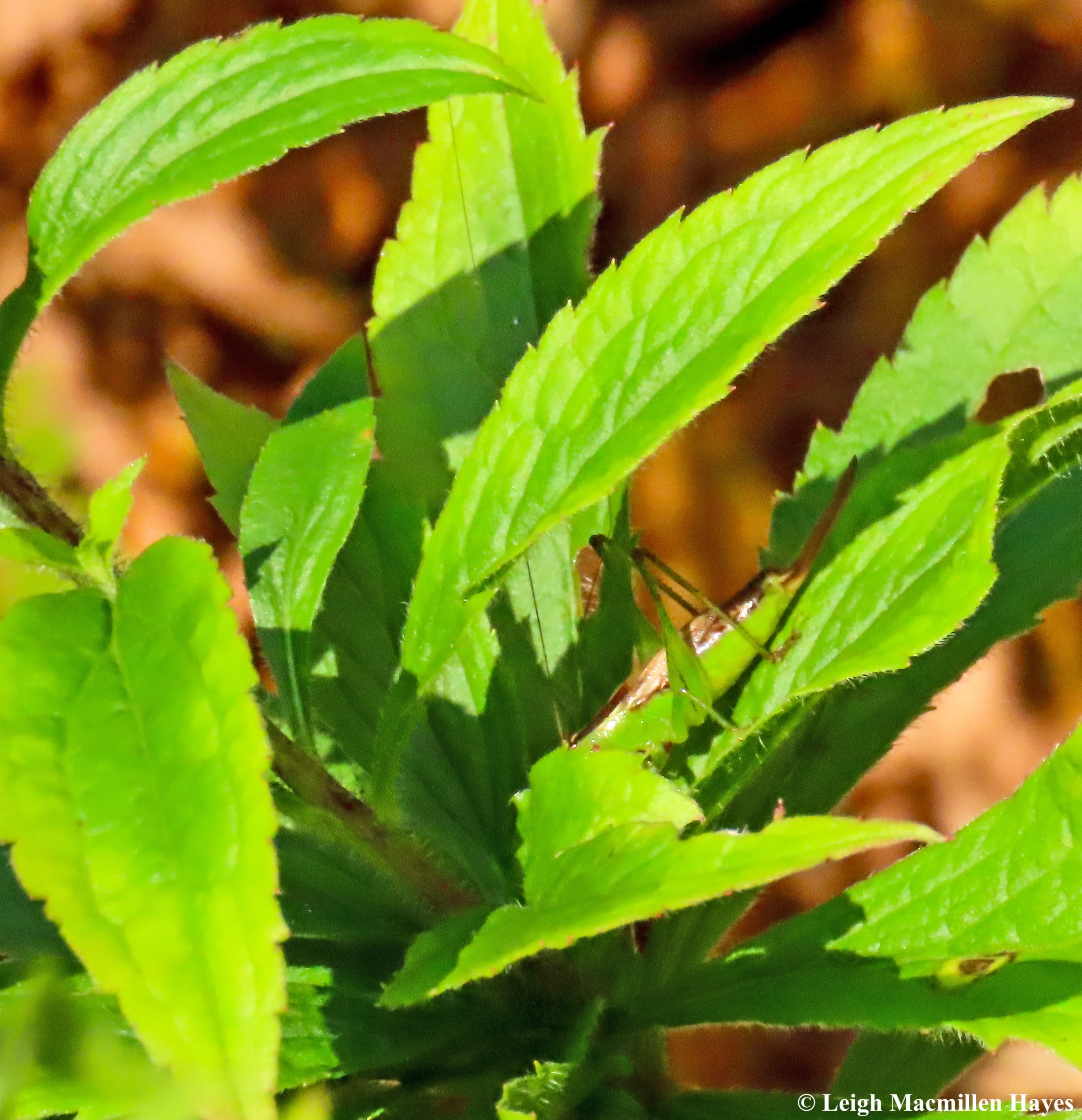
How about now? Just across the path from the much larger Bush Katydid, a smaller Meadow Katydid. Both seemed appropriate for this small ecosystem that included bushes and shrubs and wildflowers and ferns in the midst of a meadow.

And below the Katydid, more movement caused me to look more closely. Just this morning, another friend commented on the fact that she can’t believe the stuff I see. And I heard the same from another friend a day or two ago. I guess it’s all about tuning in–to sounds, I heard a wee rustle; and anomalies–I saw a bit of a color change. And tada: a small Pickerel Frog pausing on dead fern fronds–so camouflaged was it. Much like the two Katydids.

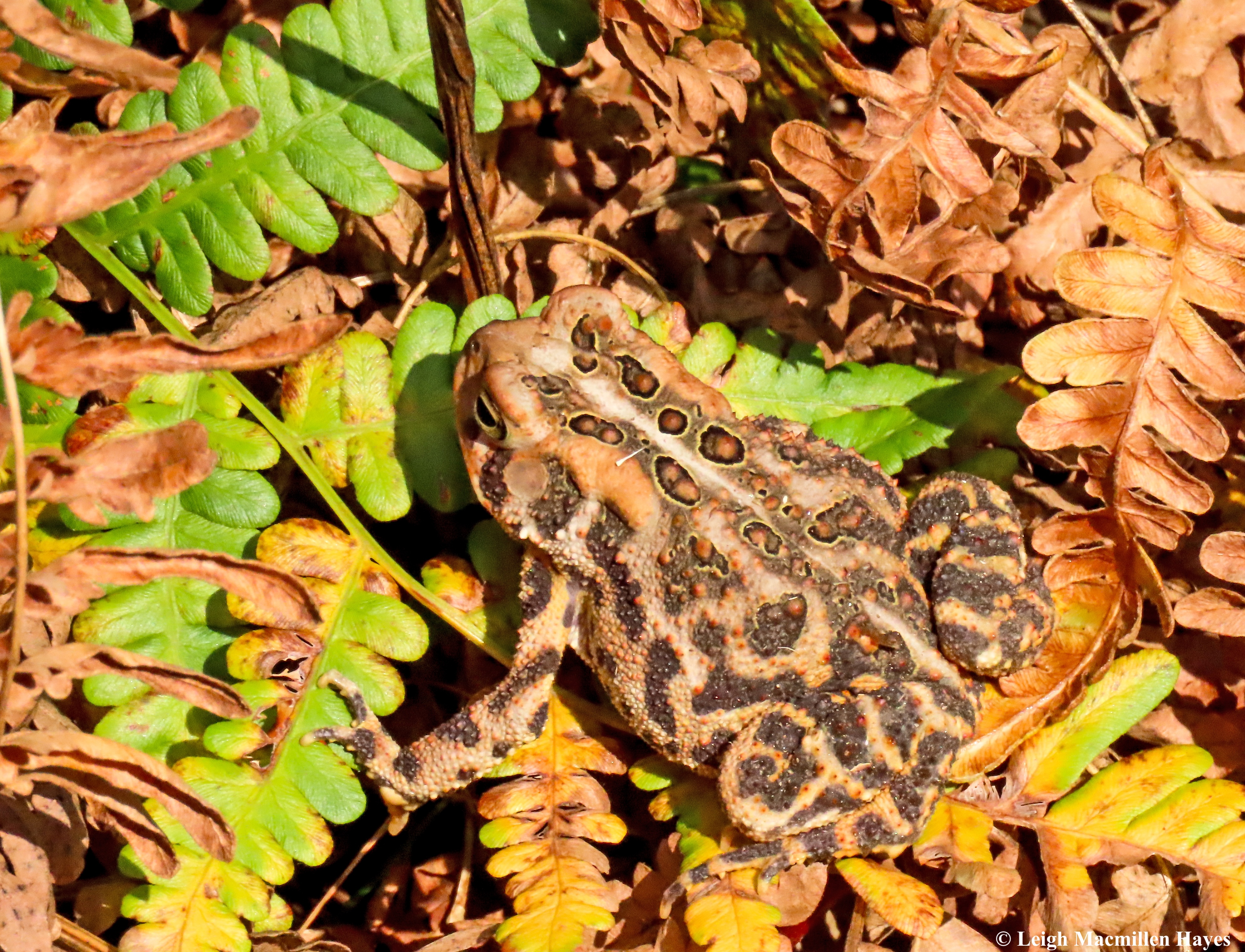
And about six inches away, I espied this female American Toad. She stayed as still as possible. Forever. Or almost forever. I would look away as I kept an eye on the canoodlers and then had to key back in to this site to spot the toad who was still there. I guess it’s all about being slow and training the eye to notice. Even if it’s something as ordinary as a Toad, it’s still a joy to be present and notice.

Suddenly I heard a rustling of wings and knew the sound to be canoodling dragonflies on the wing–or so I thought they were flying about. But I couldn’t see them anywhere. They were no longer posing on the fern where I’d first spotted them. The sound came from below and behind that fern, in the midst of other fern fronds. And then I found them. I don’t know why they left their original perch, but suspect another male drove them to move on. What I think happened next is that they got a wee bit caught in a spider web. And struggled fervently to free themselves.

So . . . I interfered. First I freed him and thought he’d take her along, but he flew off and then she did also. I can only hope that they found a different spot to continue their date night.

Other fliers in this same vicinity where the tiny Autumn Meadowhawks, this being a male.

His female counterpart was also posing everywhere.

They got as far as the tandem position, where the male clasps the female behind the head, but before they form the canoodle circle. That was the last I saw of them before it was time for me to move along for I had a date with another dragonfly waiting at home. Well, really, waiting in my truck for a ride home.

Once there, I studied this specimen, taking in as many details as possible. It was the colors and pattern on the thorax and abdomen that helped me come up with a name. And one other detail that could be easily overlooked. This particular species often has broken-off cerci at the end of the abdomen, a sign of maturity. Plus, it you look at the bulging start of the abdomen, below the thorax, there’s a slight blue line that crosses it, and in combination with the green markings, leads to species’ name.

The green thoractic strips also helped with identification.

The curious thing when my friend first offered this specimen to me was the fact that the two sets of wings were off kilter of each other. But as I told her, dragonflies operate the two sets of wings at different beats, and it’s especially noticeable when it’s chilly out as this morning was with temps in the low 40˚s. Pumping their wings is a way to stay warm. When she found this pretty female, its time on Earth was waning and though it pumped the wings alternately while in her hand, as she went to place it on the ground, it slowly breathed its last breath.
During those two hours I spent as the sun waned from the trail and meadow, I couldn’t believe what I’d seen, including the camouflaged Katydids, the canoodling dragonflies, and a few other canoodlers, plus all the pollinators.

But I was especially thankful for this one who taught me more about lessons in the shadows: a Shadow Darner Dragonfly.

And to K for the offering! Thank you for thinking of me yet again.

My Flame for Black and Yellow Garden Spiders: a fire story

I’m back in the meadowy-field because, well, because of the Black and Yellow Garden Spiders and because of a brush fire on an extremely hot day last week.

Looking back toward our house, with our neighbors’ woods to the left and ours to the right, it looks as though the Goldenrod goes on forever. Actually, there’s some Meadowsweet and a few Steeplebushes, and some other flowers in the mix, and ferns including Sensitive and Marsh and Royal and Interrupted, and mosses galore. But right now it’s the Goldenrod and Spirea (Meadowsweet and Steeplebush) that are attracting the pollinators.

And since the beginning of August, the Black and Yellow Garden Spiders have made a return and as I slowly walk along the path my neighbor keeps mowed, I’ve been noticing more and more of them every day and wonder how many more I don’t see or are deeper in middle the field where I dare not venture . . . because I know there are Black and Yellow Garden Spiders in there.

One extremely hot afternoon last week, I noticed a few of the spiders hiding in the shade. I circled the field twice and then headed indoors to get out of the heat, rather like them. But before going in, I grabbed the SD card from my game camera.

A couple of hours later, actually about 5:30ish, I headed back out to relocate the game camera in our woods. My neighbor saw me and we waved before I disappeared.

Camera relocated, I decided to circle around the trail I’d created in our woods years ago because in the shade of the Pines and Hemlocks, and with a breeze, it was rather pleasant despite the temp being about 97˚.

I was almost to the power lines that cross both of our properties when she texted me: “Do you smell smoke?”

I sniffed and did not, which I told her.

“I’m really smelling it now,” she wrote a minute later.

“Oh boy,” I responded. “I’m just about to the power line. I’ll head home via the field.” Which meant I’d walk under the power lines toward her field, thinking that by walking north, I might be able to figure out where the smell was coming from.

And then I stepped out of the woods and onto the actual power line. “The minute I hit the powerline,” I wrote, “it is strong. Yikes.”

“I’m going to walk up the field,” she replied.

I could see haze toward the north and told her that.

And then, I heard a crackling sound near me that didn’t make sense.

The crackling was the fire.

“I see it,” I wrote. “It’s behind us Calk 911.” Yes, Calk cuze I was in a panic.

And if you look closely at the photo, you’ll see two spots of orange which were the flames.

“Behind where,” she asked because she had called 911, but she wasn’t sure where exactly I was.

And then in my panic I realized that I needed to call 911 and did so. “I’m on the phone with them,” I wrote. “Thank goodness you smelled it.”

Actually, we were both on the phone with the Dispatcher, who was incredibly calm as she asked me to describe what I could see. The fire was on land belonging to another abutter to our south and about thirty feet in from the power line. From where I stood, it was difficult to get a sense of how large it was, but no way was I going in there to give a more accurate account.

Thankfully, the cool, calm, and collected Dispatcher asked me the best way to the location, which she knew via e911, and for which I am grateful, and the fire department was in the midst of their weekly meeting, so within minutes, with the Dispatcher still on the line, I heard the sirens and ran to the field to meet them.

Because the power line is also part of the snowmobile trail, the trucks could follow the path up through the field, and then cross over and drive between the breaks in the two stonewalls that define our boundaries.

Once they were at the location, I ran down the field trail to meet my neighbors and My Guy.

A little while later, three of us decided to head up and take a peek from our land on the other side of the power line.

Ten men and one woman were in there spraying the area with foam and cutting trees, many of which I think were snags or broken from snow weight as they were Gray and Paper Birch.

Another firefighter sent a drone up to check the entire area. He also saw the haze to the north that I’d seen at first, and sent the drone that way, but thankfully found nothing.

They came back the next day to try to determine the cause, but we haven’t heard what it might have been, which is disconcerting because given how dry and crisp everything is right now, I live in fear of this happening again. (We hiked a local mountain today and the top is crisp and dry and fall foliage will not be so great this year because everything is brown)

This morning I was checking on my spider friends and others in the field and My Guy, who had been on an errand, found me out there and asked if I wanted to show him where the fire had been since he’d had to go back to his store when it actually was happening.

He didn’t realize how big of an area it was, probably 30 or 40 feet by 20, and the potential danger it could have caused if my neighbor hadn’t smelled the smoke and she and I hadn’t gone looking for the source.

But I’m trying not to focus on that and instead spend my time observing all that happens just over the stone wall from our house. Check out the size of that pollen sac!

And look at the hairy scales on this dainty Common Ringlet butterfly.

Though I occasionally meet a Katy-did around here, I think this past week was the first time I’d encountered a Broad-tipped Conehead! What a conehead it is!

There have been a variety of dragonflies over the course of the summer, and just this morning it was this male Twelve-spotted Skimmer who stopped by. Each evening, there are a bunch of Darners, but they won’t slow down enough for me to make a positive ID. I do positively give thanks for them because all are helping to keep the Gnat and Mosquito populations low. Of course, they also eat some of my other favorites, but I remind myself that that is nature at work.

I did worry that as the fire trucks were driving up through the field last week, especially when they cut across to get to my location, they were destroying the spider webs. And they probably did. But what they were doing was way more important in that moment. And . . . the spiders have found some new locations in the spaces where the tires flattened plants.

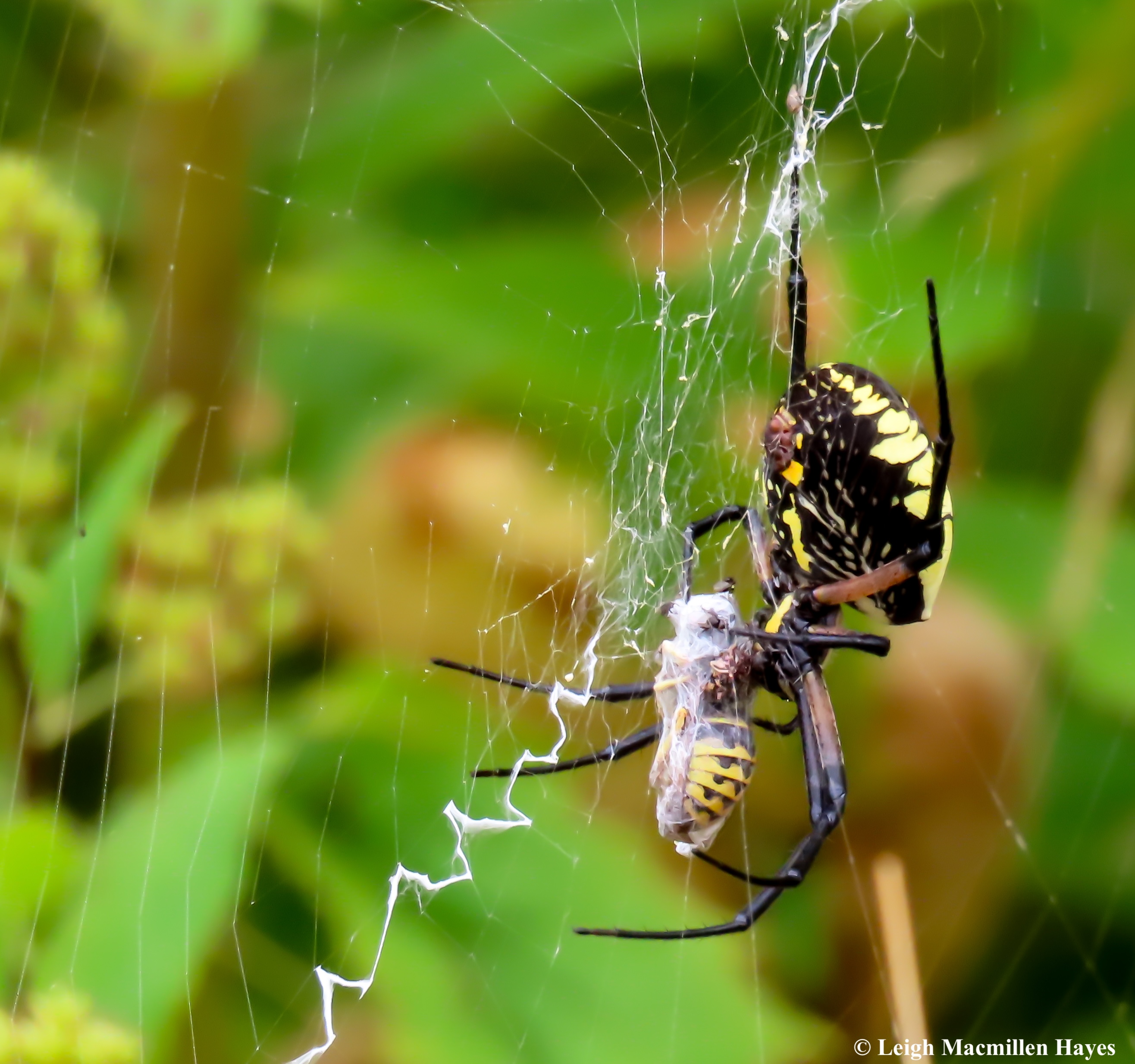
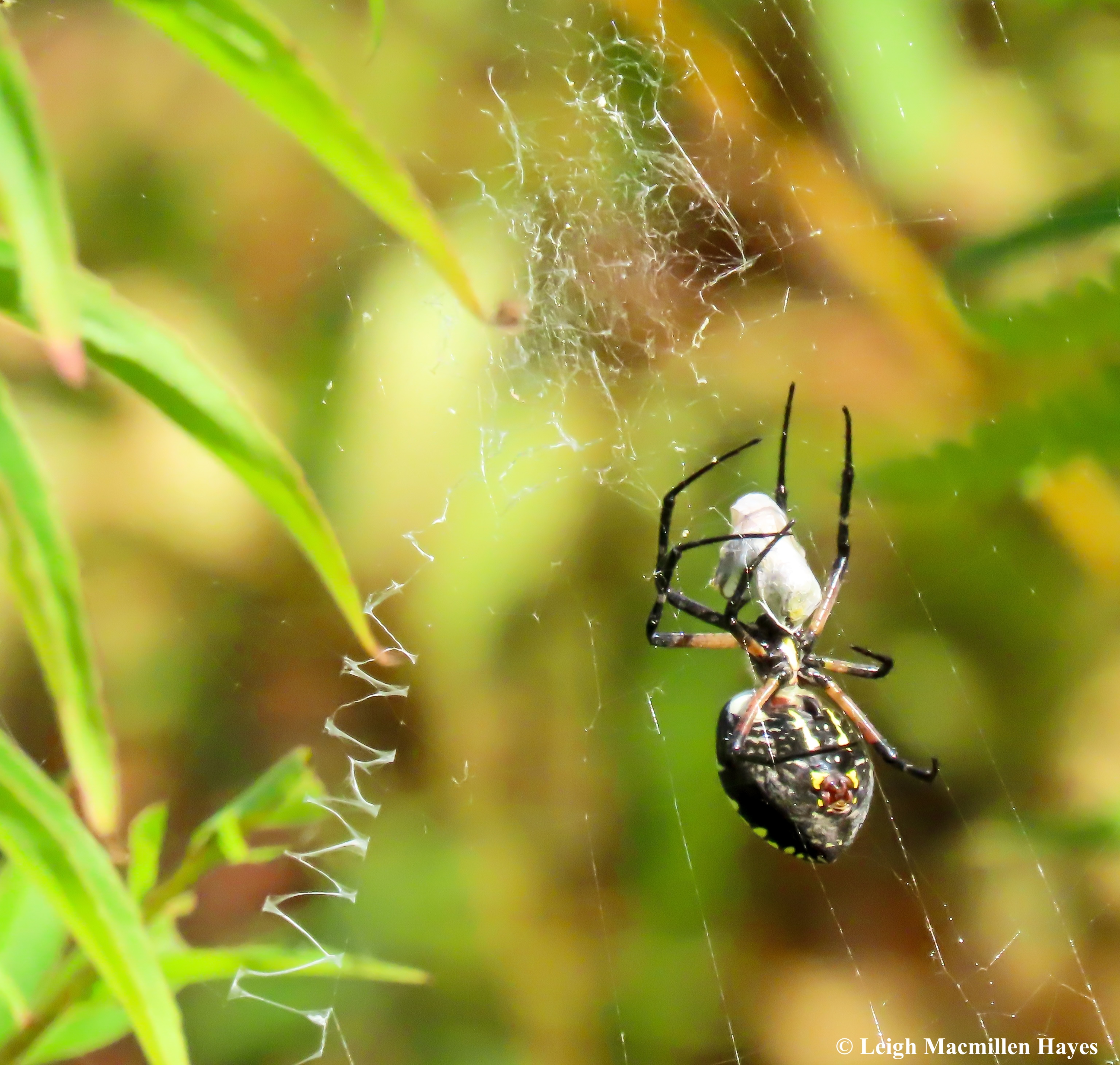
It seems every summer I learn something new from these spiders, and this year I’ve had some time to watch them wrapping their prey on more than one occasion. I’ve also watched as one Bumbler somehow managed to bounce off the web . . . one strand at a time, and fly off. But not all are successful and the spiders need to eat too.

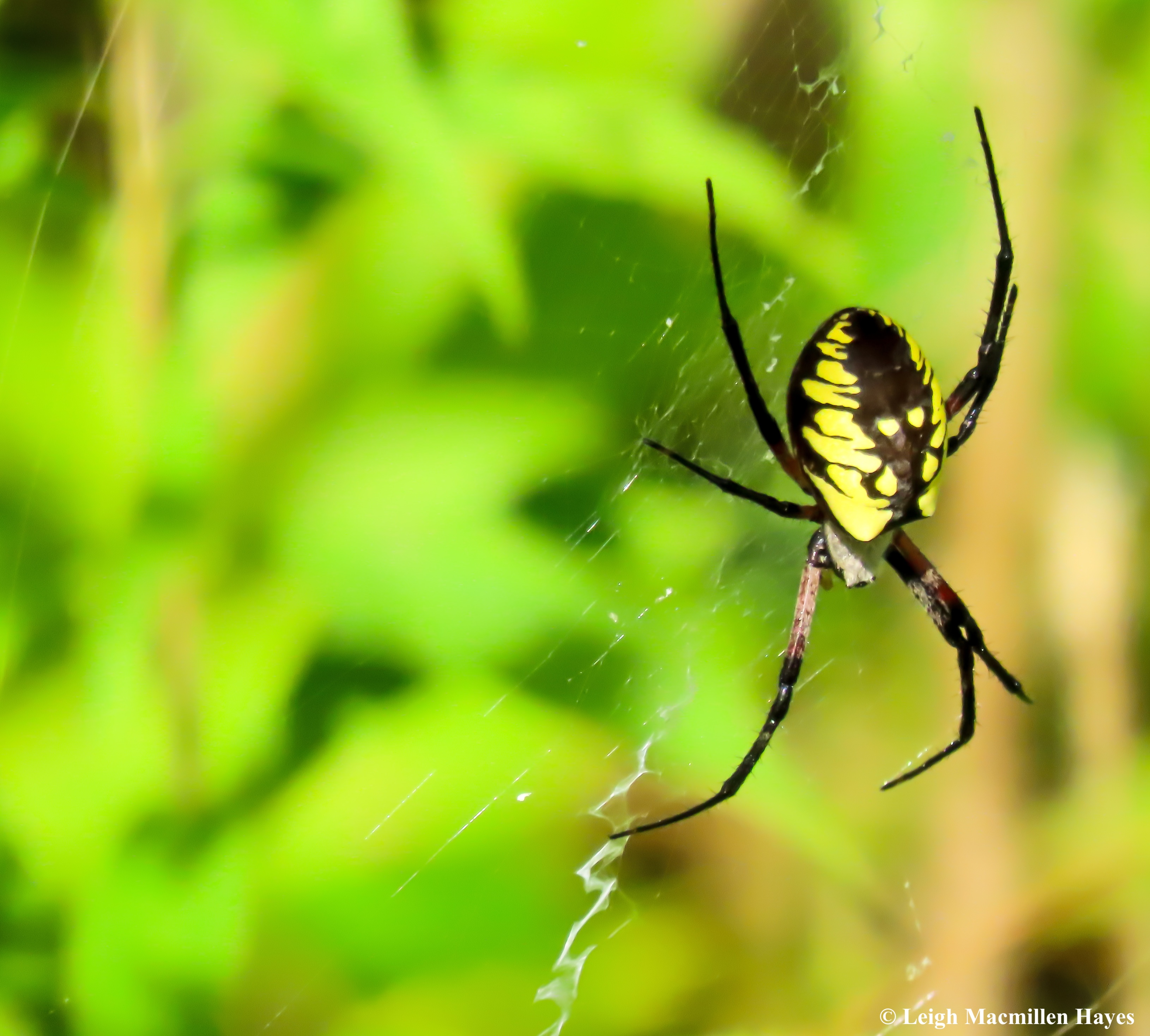
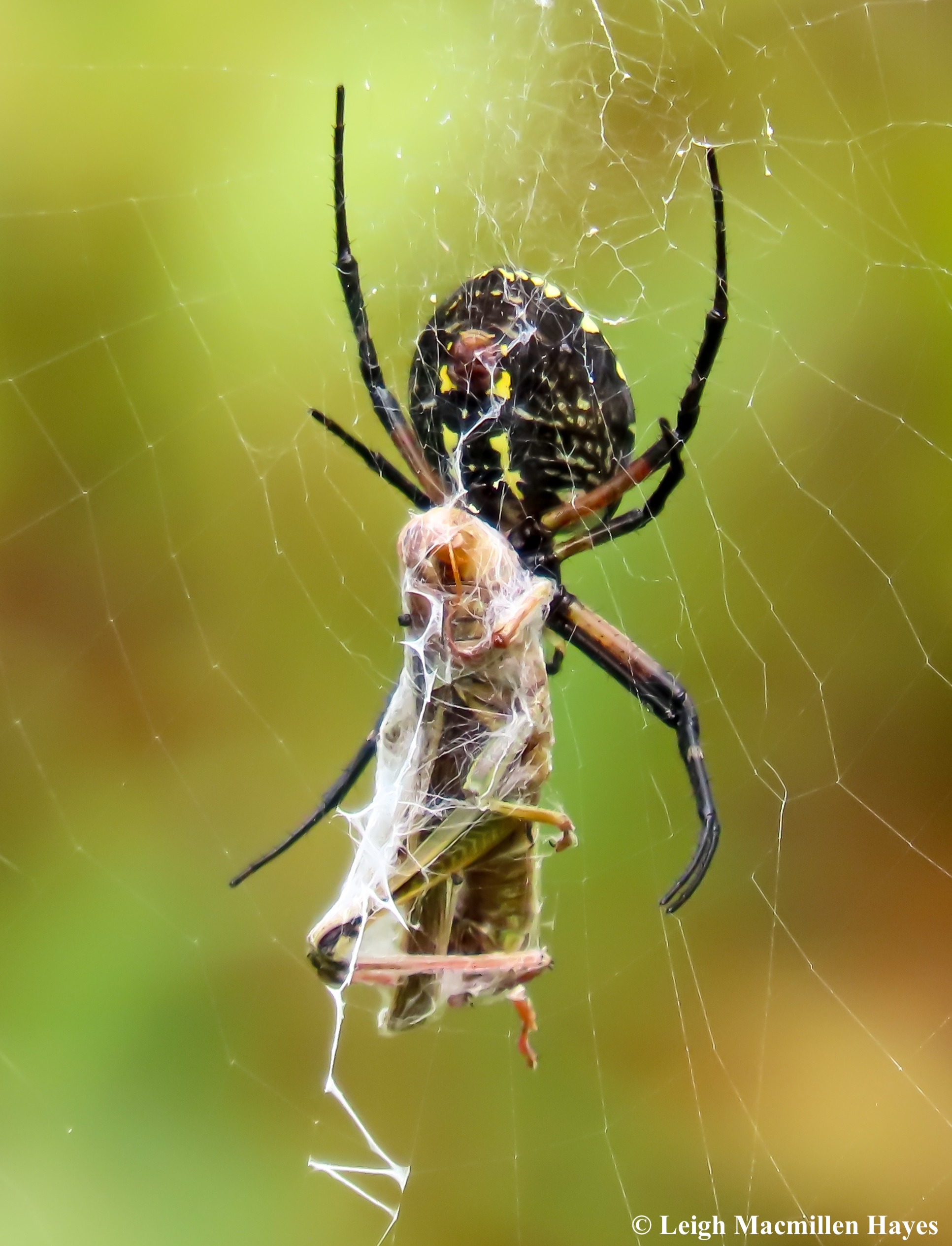
Though they occasionally eat the pollinators, they also help keep the population of some not-so-beneficial insects down, such as this Oriental Beetle. It’s warp-speed work when an unsuspecting guest visits the web.

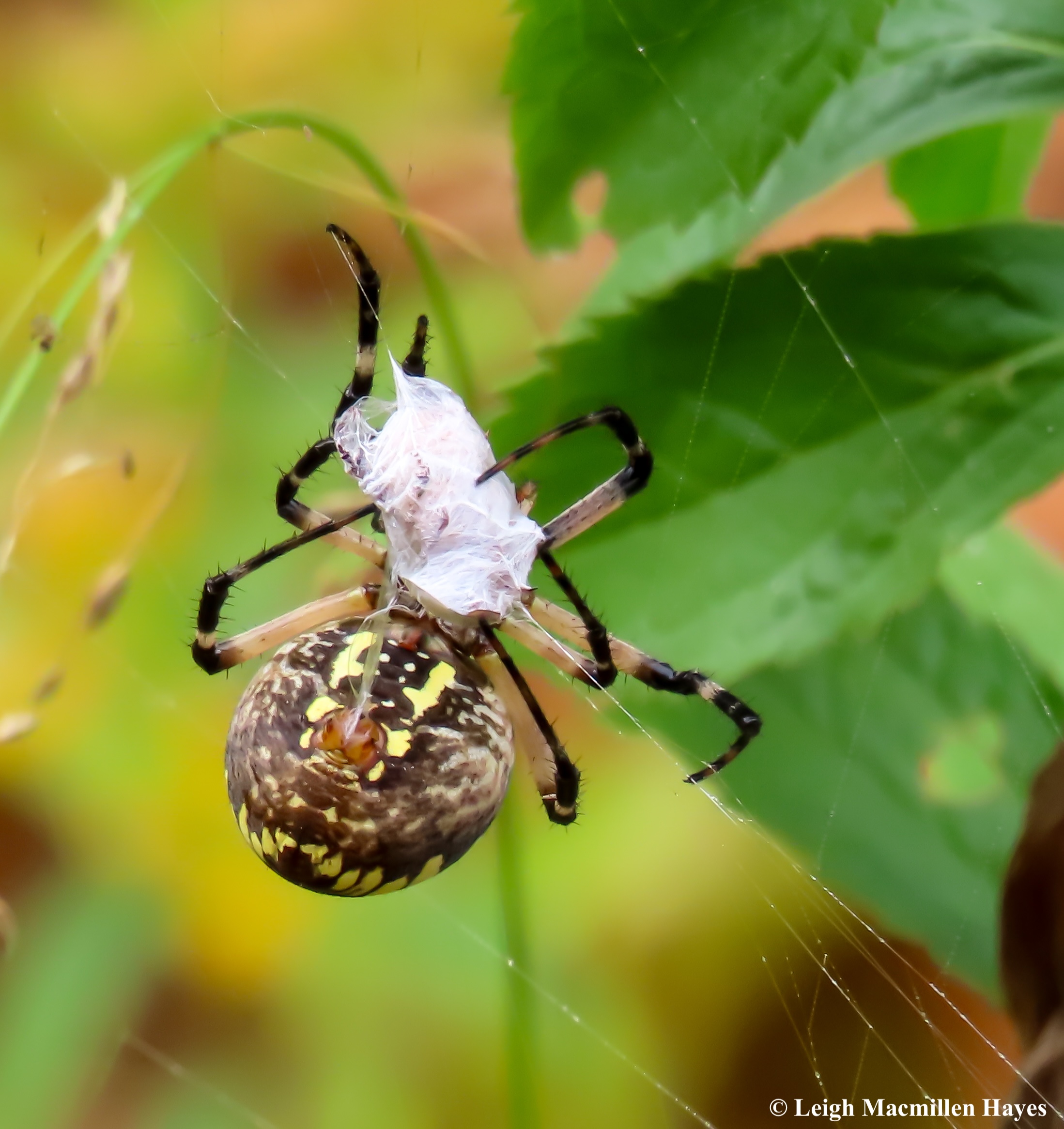
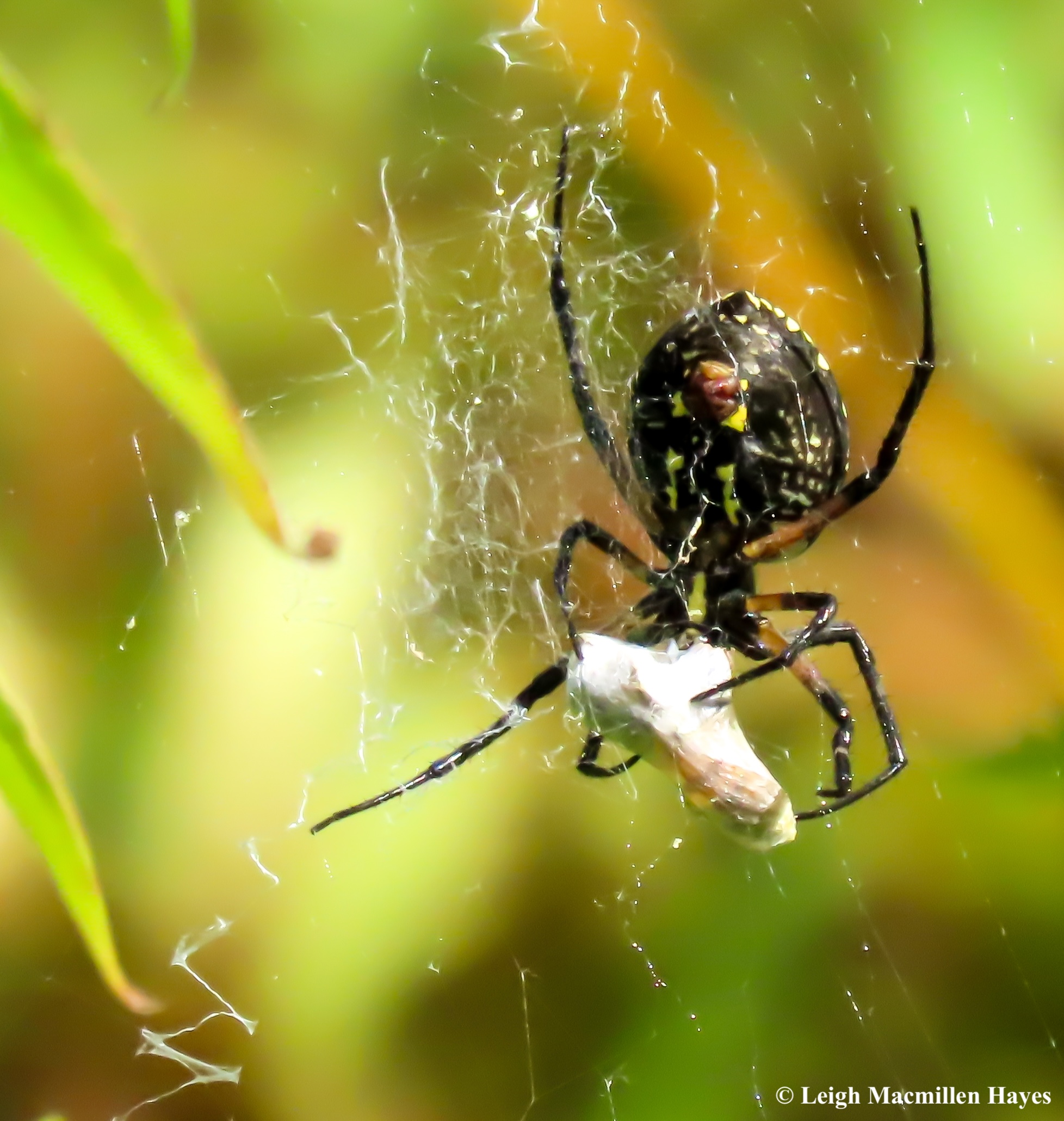
Silk flows from the spinneret and the victim is quickly wrapped up as the spider turns it over . . .

and over again.

Click on the arrow and you can watch this ten-second video of the action.

Their meals come in all shapes and sizes and there are plenty of grasshoppers to meet the spiders’ feeding needs.

What I found curious is that not everything gets wrapped in quite a neat package, and I’m not sure why . . . yet.

I also had the chance to watch as a meal package was moved from a lower part of the web.

And brought up to the central station, which is a rather cobweby creation in the center of the orb.

And then the spider went into its traditional upside-down manner in this home base as it continued to wrap the captured insect.

As I draw this blog post to a close, I want to note that most of the spiders (at least a dozen on any given day) I spot are located in an East/West orientation, their upper dorsal carapace or their underside facing in these directions.

And even when a Black and Yellow Garden Spider abandons a web site, the drag lines remain, for such is their strength.

Those drag lines are super thick and if we were to walk through them, heaven forbid, we’d bounce off of them. It’s an amazing wonder.
What happened to the resident spider of the web above? I don’t know. I did spot a male hanging out with the female a couple of weeks ago, so maybe they mated and were done. Or . . . she moved on to a different location.
At the end of the day and the end of the web and the end of this post, I will be forever in awe of these Black and Yellow Garden Spiders, and grateful for what they and all the insects teach me.

I am also incredibly grateful to my neighbors for their awe of the natural world as it plays out in our neighborhood. And for her nose! Which smelled that fire that could have set all of this aflame.

And I’m thankful for the calm woman at Dispatch and brave first responders who put out the brushfire on an extremely hot day.

My Flame for Black and Yellow Garden Spiders is best ignited by awe and not by real fire.

Resurrecting the Resurrection

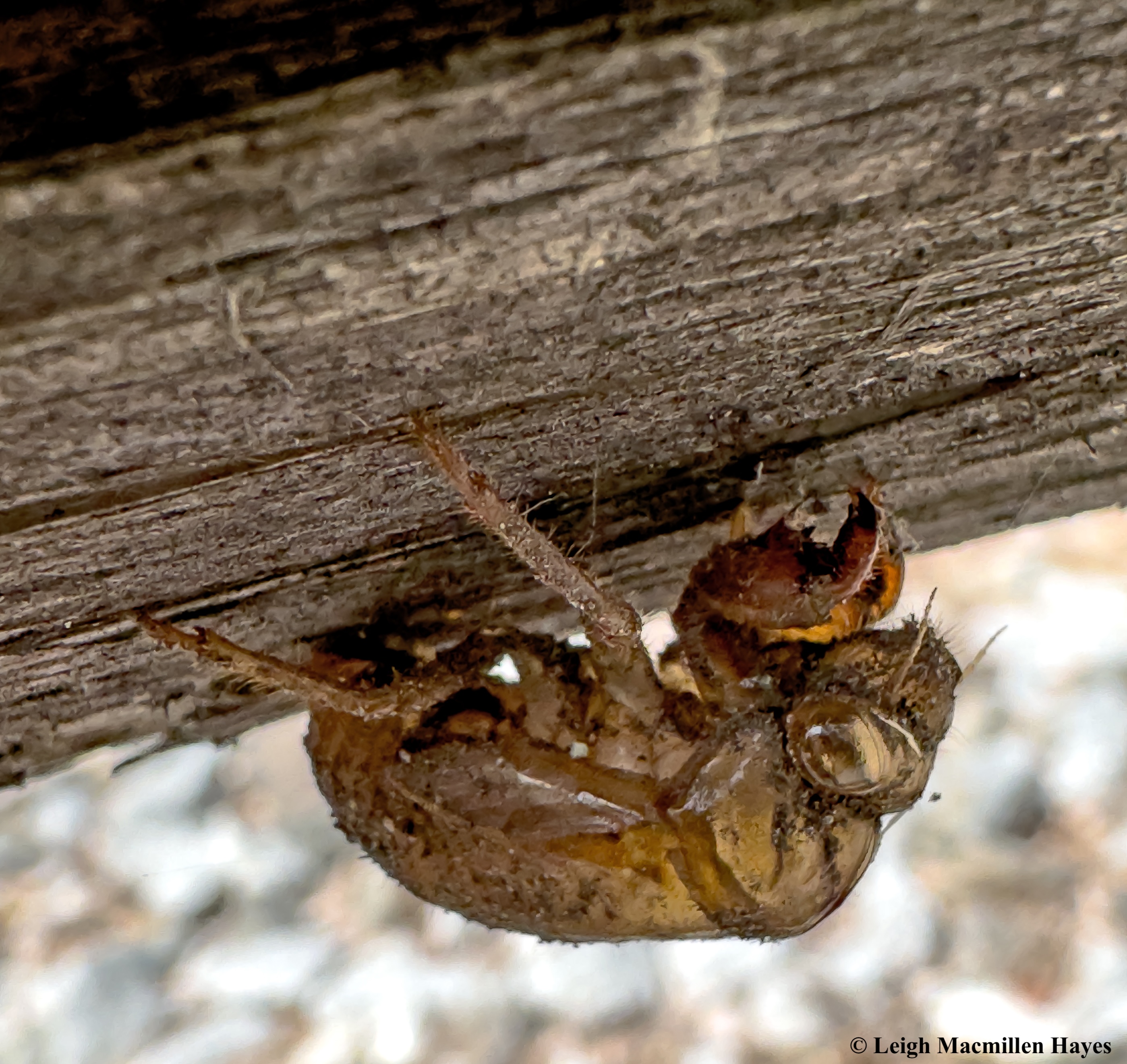
This afternoon I met a young girl, probably about seven years old, who patiently waited as her mother ran some laps on a local trail and because I’d just started to notice the exoskeletons of Dog-day Cicadas, one of my favorite summer insects (besides dragonflies, mind you), I started to point them out.


At first look, she stepped way back, and told me they were too scary. They are. But then I picked one off the fence and she was intrigued but still apprehensive. I explained the life cycle and that this was no longer a living specimen and then I placed it on the ground and told her if she wanted to pick it up or show her mom, I’d leave it for her.

She did show her mom and then she caught up with me again and one by one, started to point out all the specimens along the route.

Eventually the mom joined us and said she’d only heard and seen the Seventeen-year Cicadas and did not know that we have Cicadas in Maine.

They decided they’d go home and look them up and see if they could watch a video of the adults emerging.

And then . . . my little friend found one.

I told her it would take about three hours for the process to be completed. She thought maybe her dad and sister would like to come back to see them, but was sure her sister would be frightened.

Whether they did or not, I’ll never know as I’ll never know her name for we didn’t exchange such. I was just thrilled the she had the chance to see such a miracle, one of the many wonders of the world, take place and that she had spied it before I did.

A few steps later and her mom spotted one that had fully emerged, but wasn’t yet ready to fly to the tree tops to sing its raspy love song.

When we departed I thanked them both for sharing the experience with me and I have a feeling that young girl will be looking in the future. She did tell me that she likes dragonflies and butterflies and grasshoppers, but not other insects. I suspect Dog-Day Cicadas may have been added to her list on the drive home.

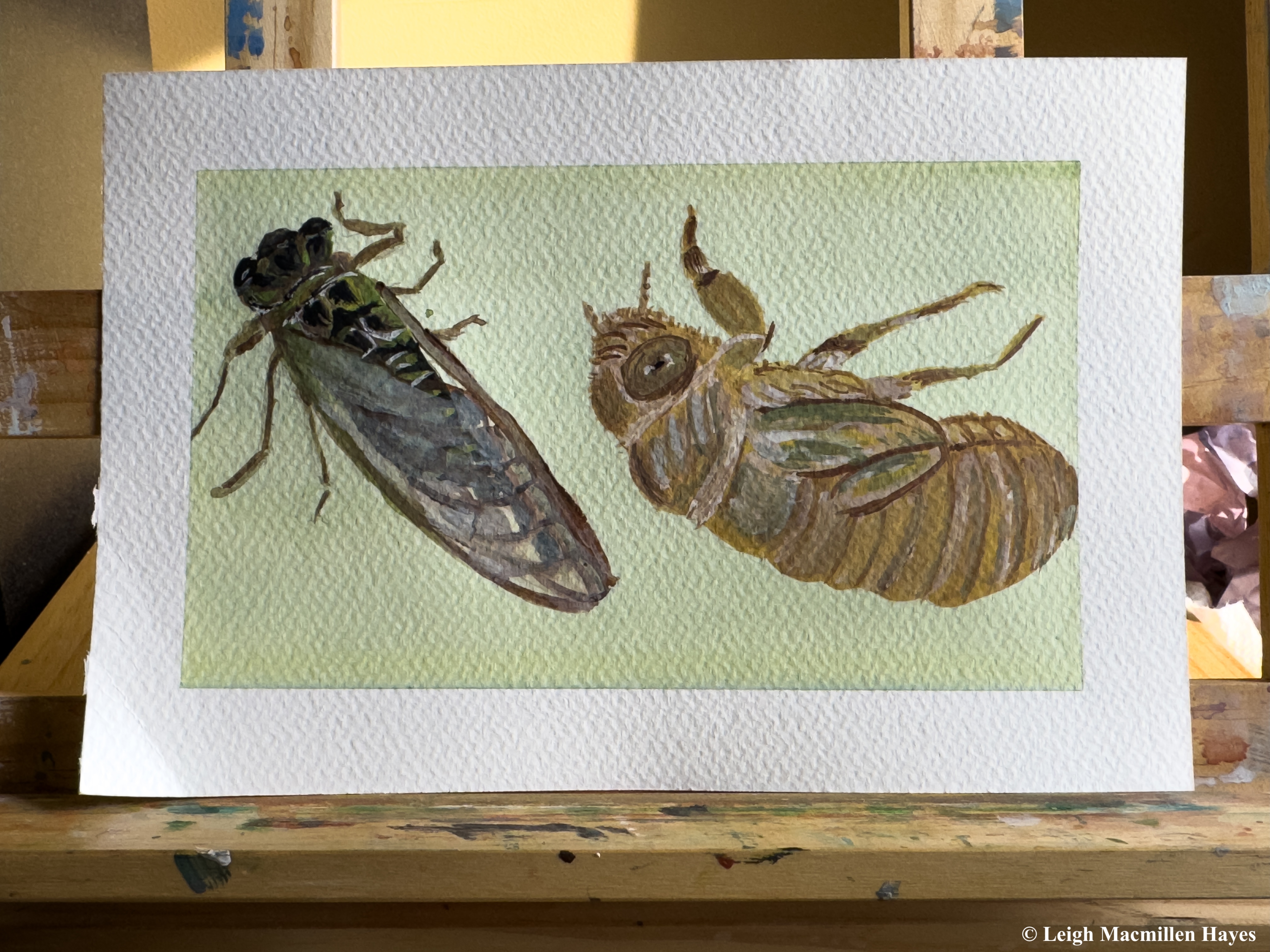
And now, because I can, I share with you once again my tribute to these amazing insects. The cemetery referenced is in Lovell, Maine.

Resurrection
By Leigh Macmillen Hayes, 7/19/2020

To walk into a cemetery on a summer day
And find an insect metamorphosing upon a stone
I begin to understand the process of resurrection.

A life well spent questing sap for sustenance
Prepares to crawl free of its past
And reach for heavenly aspirations.

Through a tiny slit, a spirit no longer contained
Emerges head first as a teneral shape develops
with bulging eyes to view a new world.

Gradually, a pale tourmaline-colored body extends outward
With stained-glass wings unfurling
That provide baby steps toward freedom beyond.

I mourn the loss of your former soul
But give thanks for a peek at your upcoming ascension
From this place to the next.

It is not for me to know when you will first use the gift of flight
As I didn’t know when you would shed your old skin,
And I quickly offer a final goodbye when I see your wings spread.

I rejoice that I’ll spend the rest of the summer
Listening to your raspy love songs
Playing nature’s lullabies upon violin strings from above.

On this day, I celebrate the secrets of a cicada’s life,
Dying to the old ways and rising to new,
While I wander among the graves of others who have done the same.

And here’s today’s tribute, which still needs some tweaking, but that’s the beauty of working with gouache paints. I can easily make changes when the mood strikes.

Thanks for stopping by as I resurrected the Resurrection.

Ec-lec-tic

Not one to ever be bored,
I follow my brain
in a million different directions
every day.
Sometimes the thoughts are broad-winged,
and even if I try to hide them,
they catch up
and stare me down.
Other times they are quick
and race through my head
in such a manner
that I can hardly capture them.
And then there are those 
that are as small as a Spittlebug
but still worth considering
because everything counts.
Some moments I get to share with others
and together we wonder
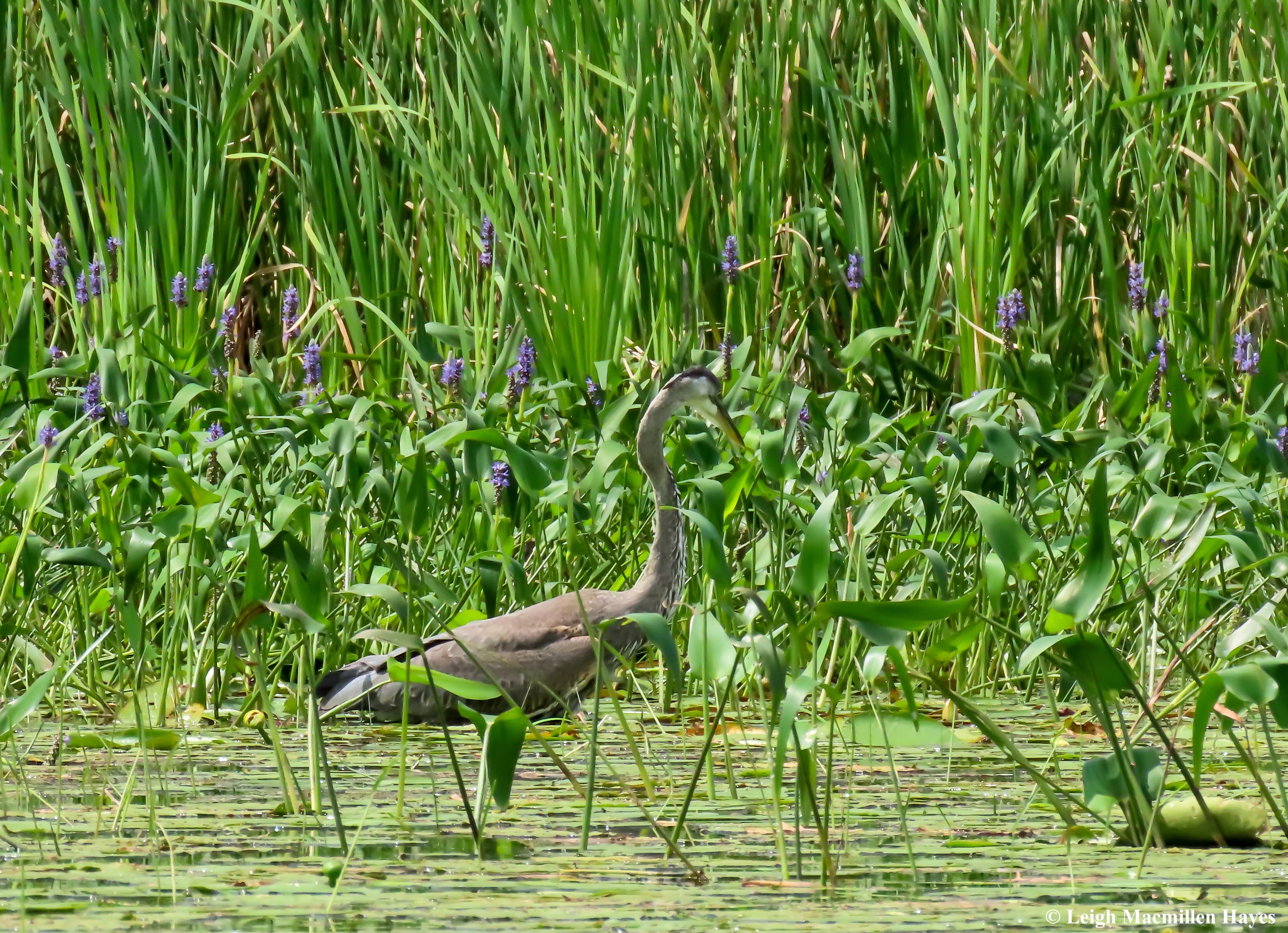
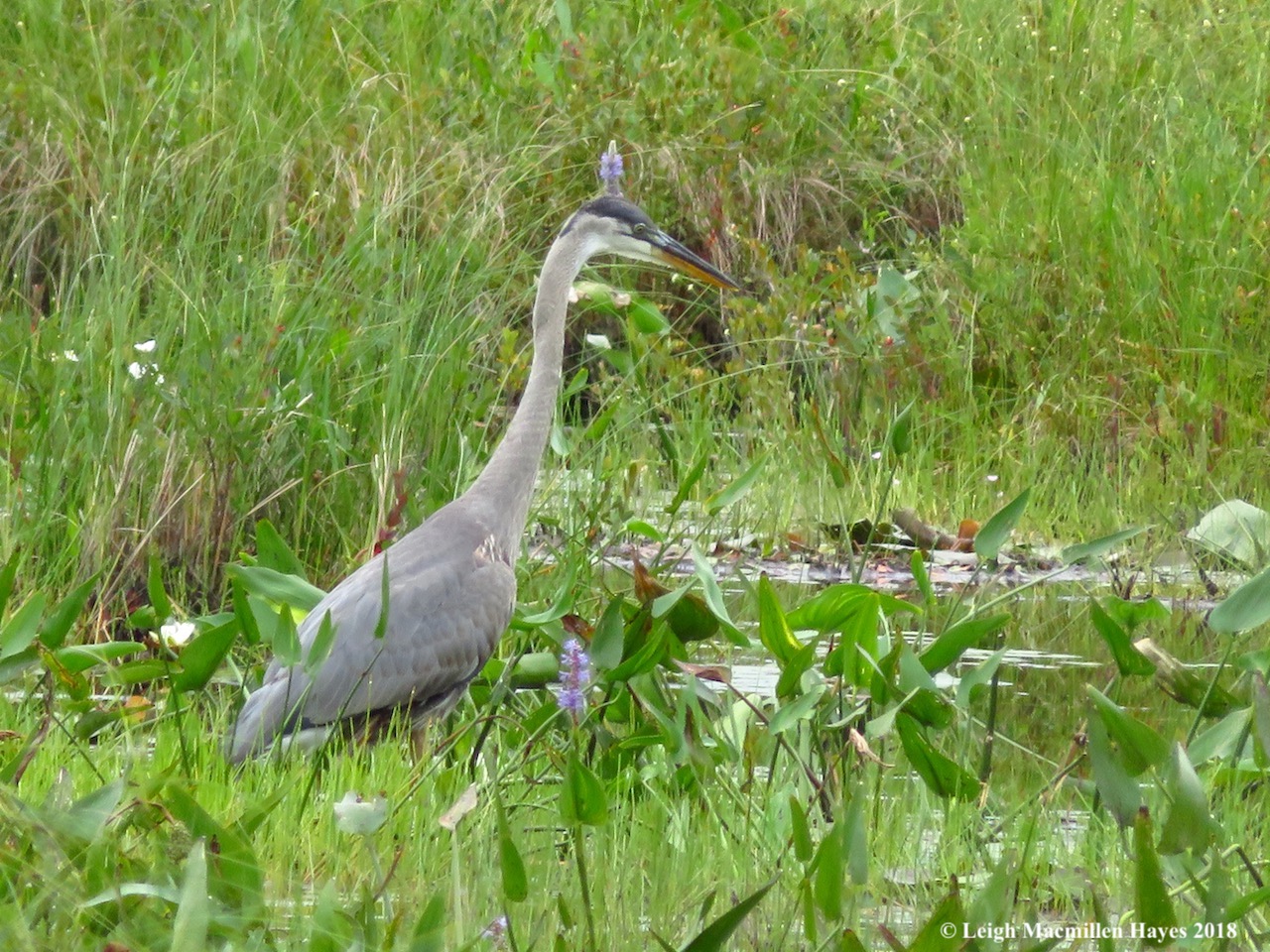
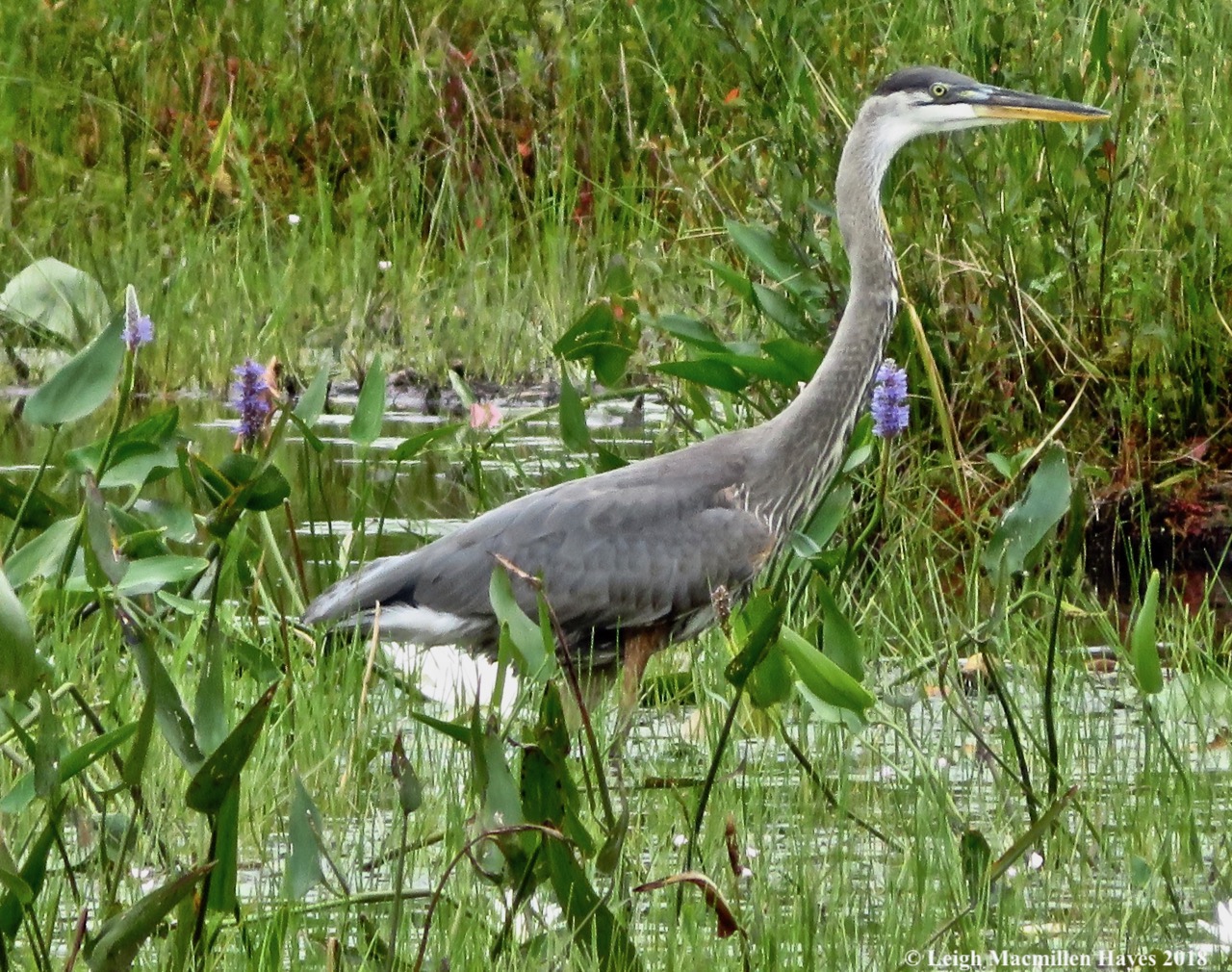
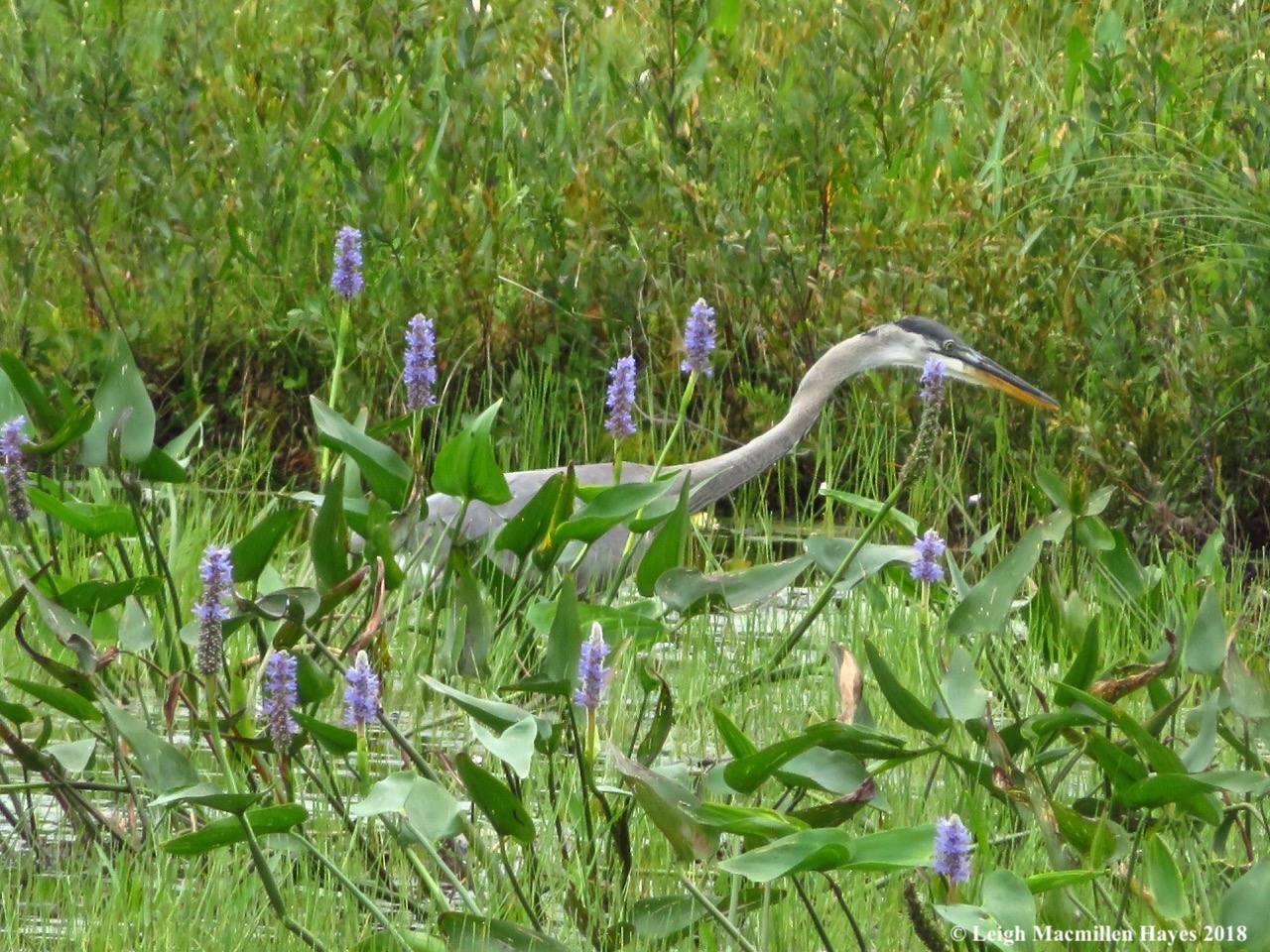
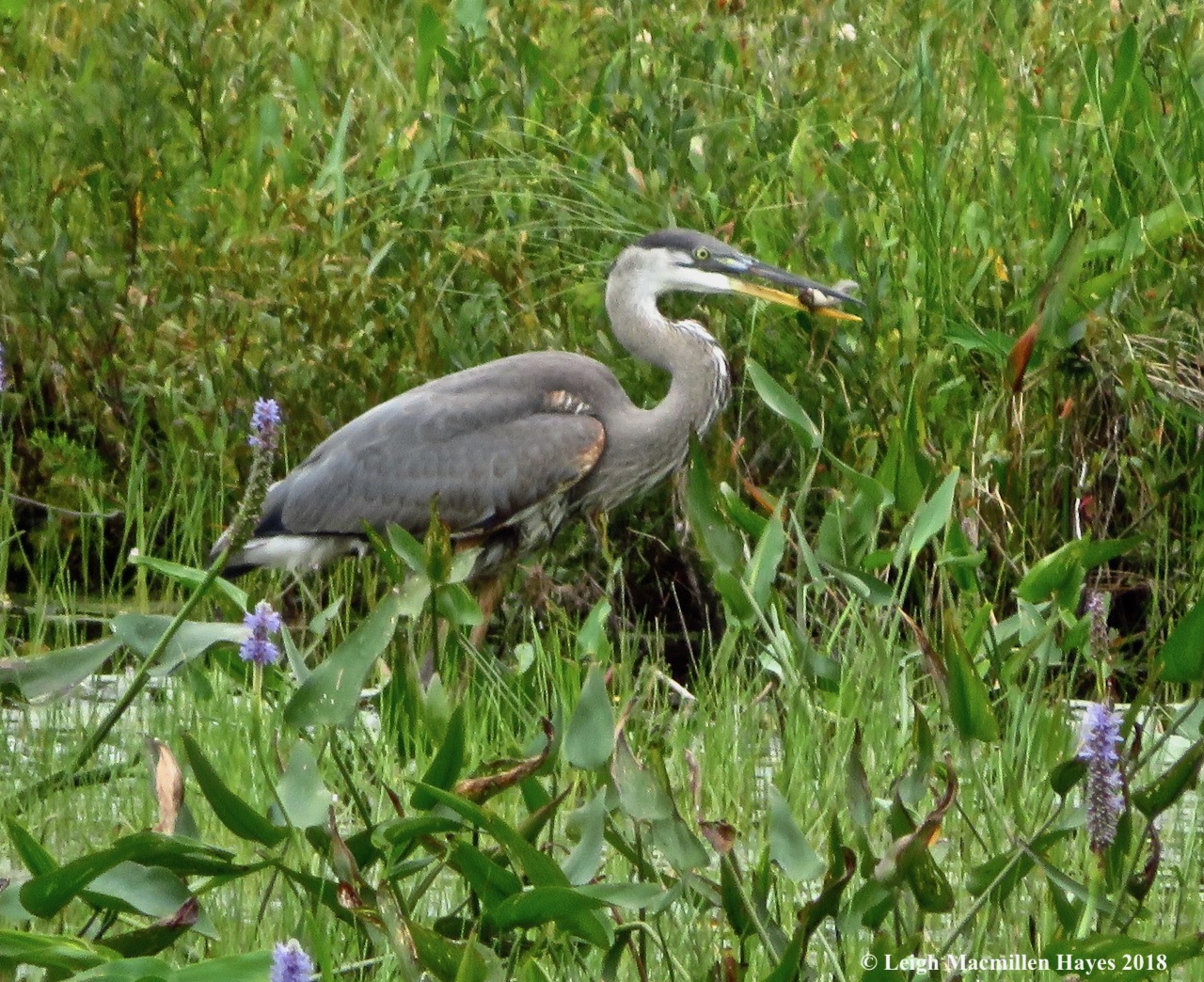
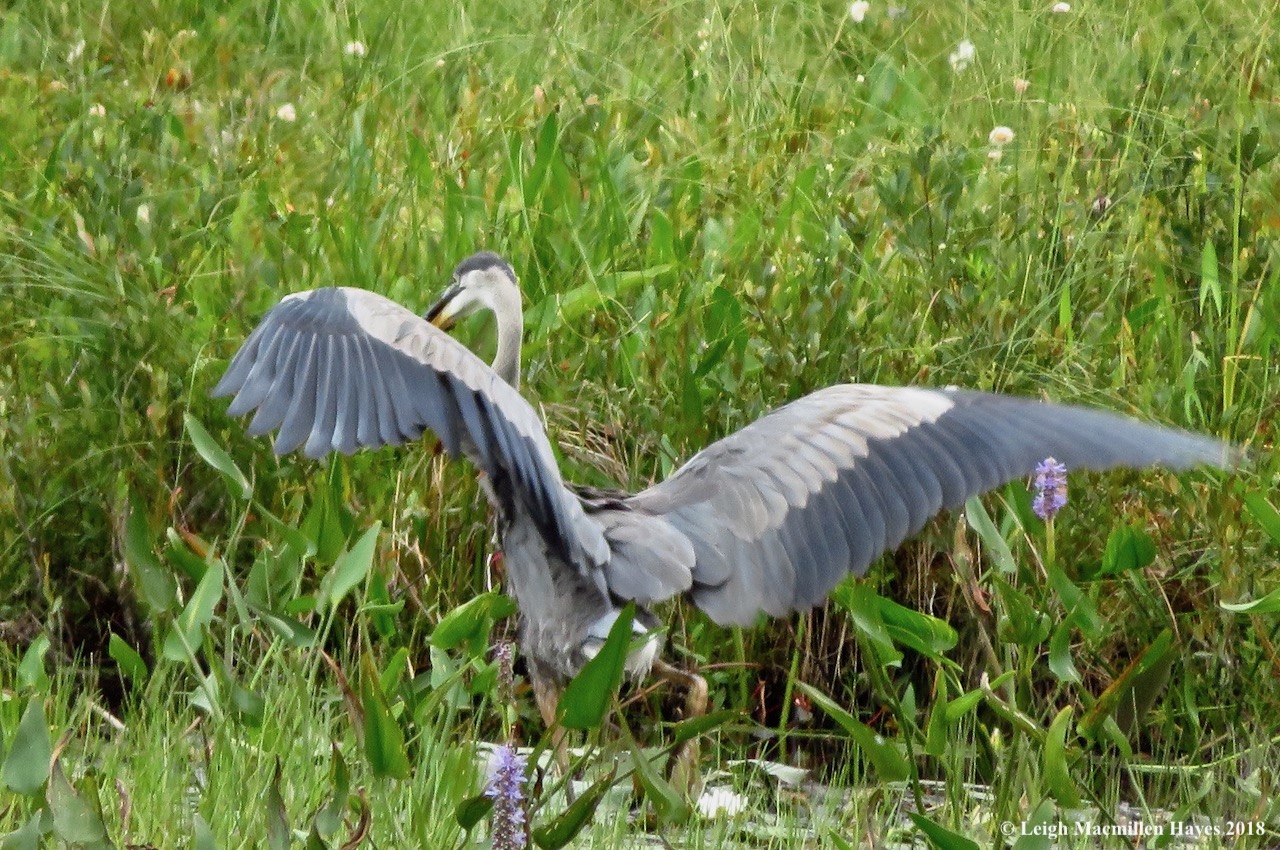
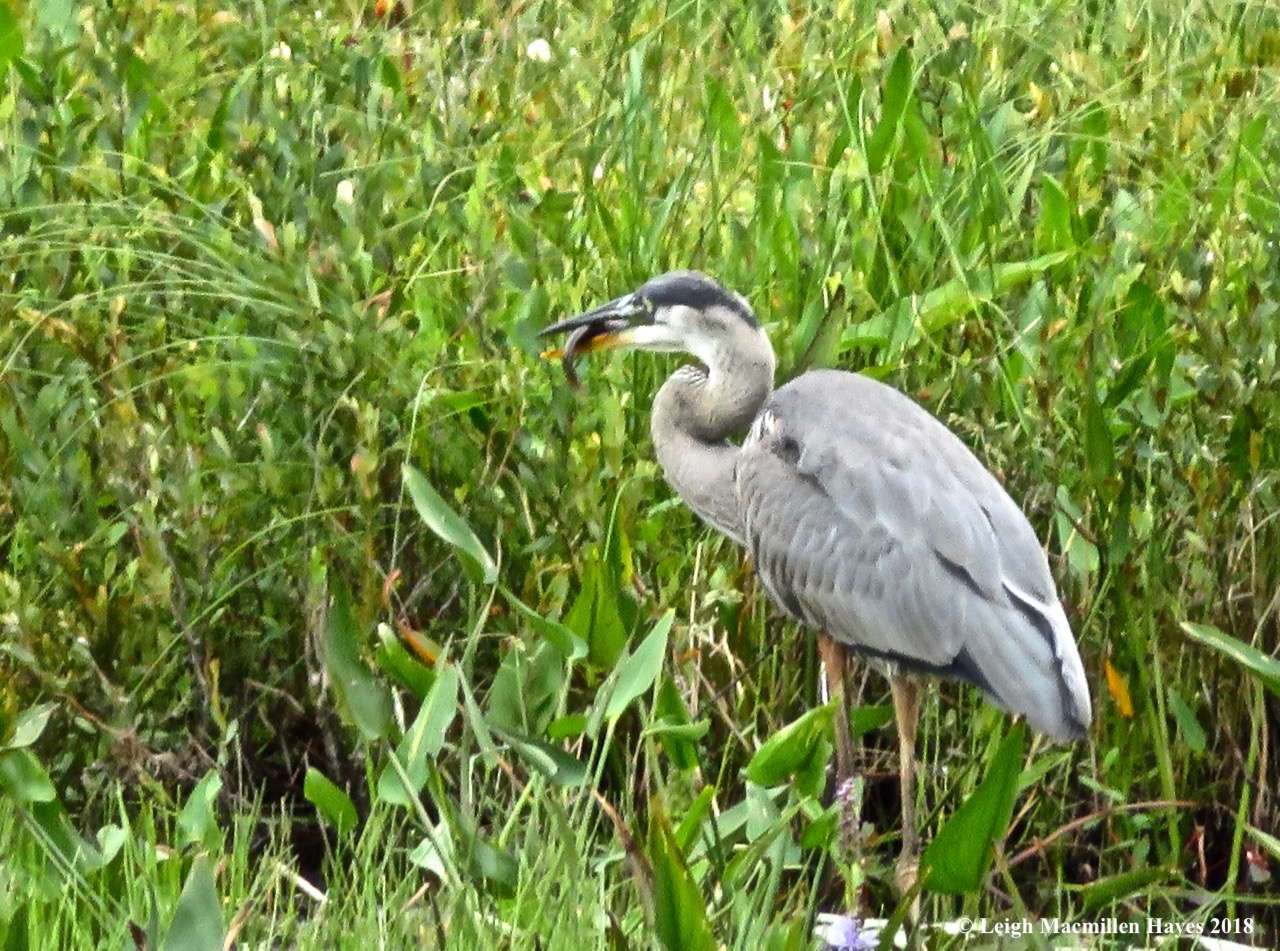
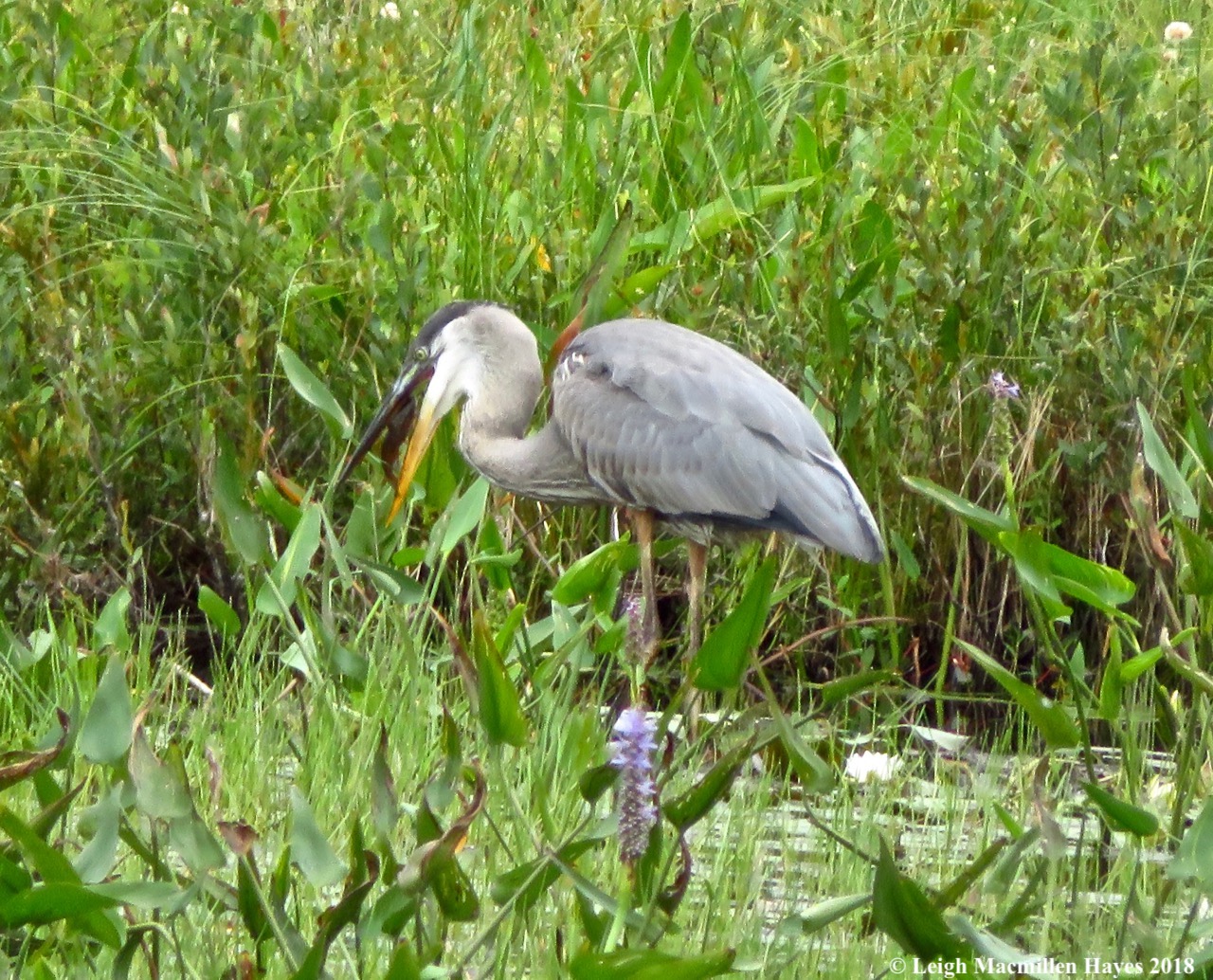
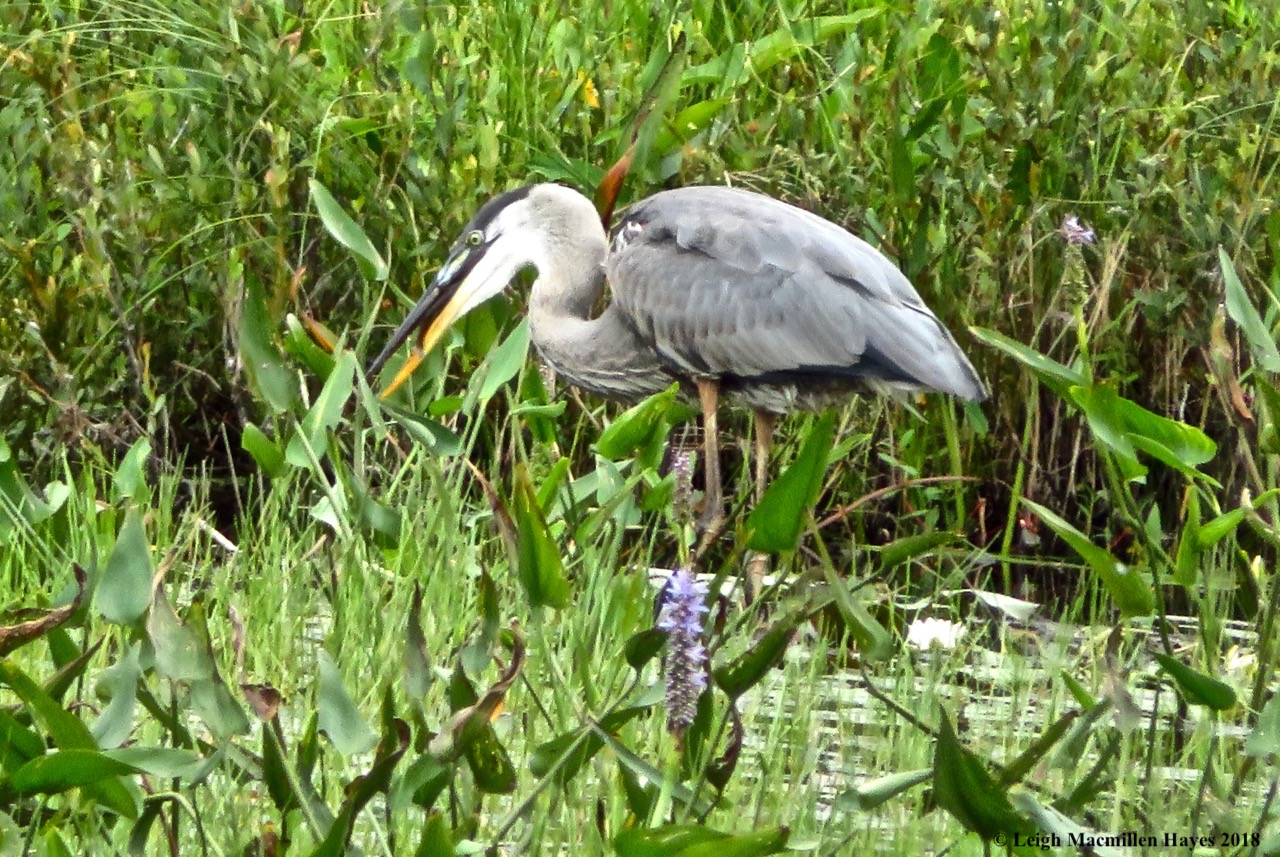
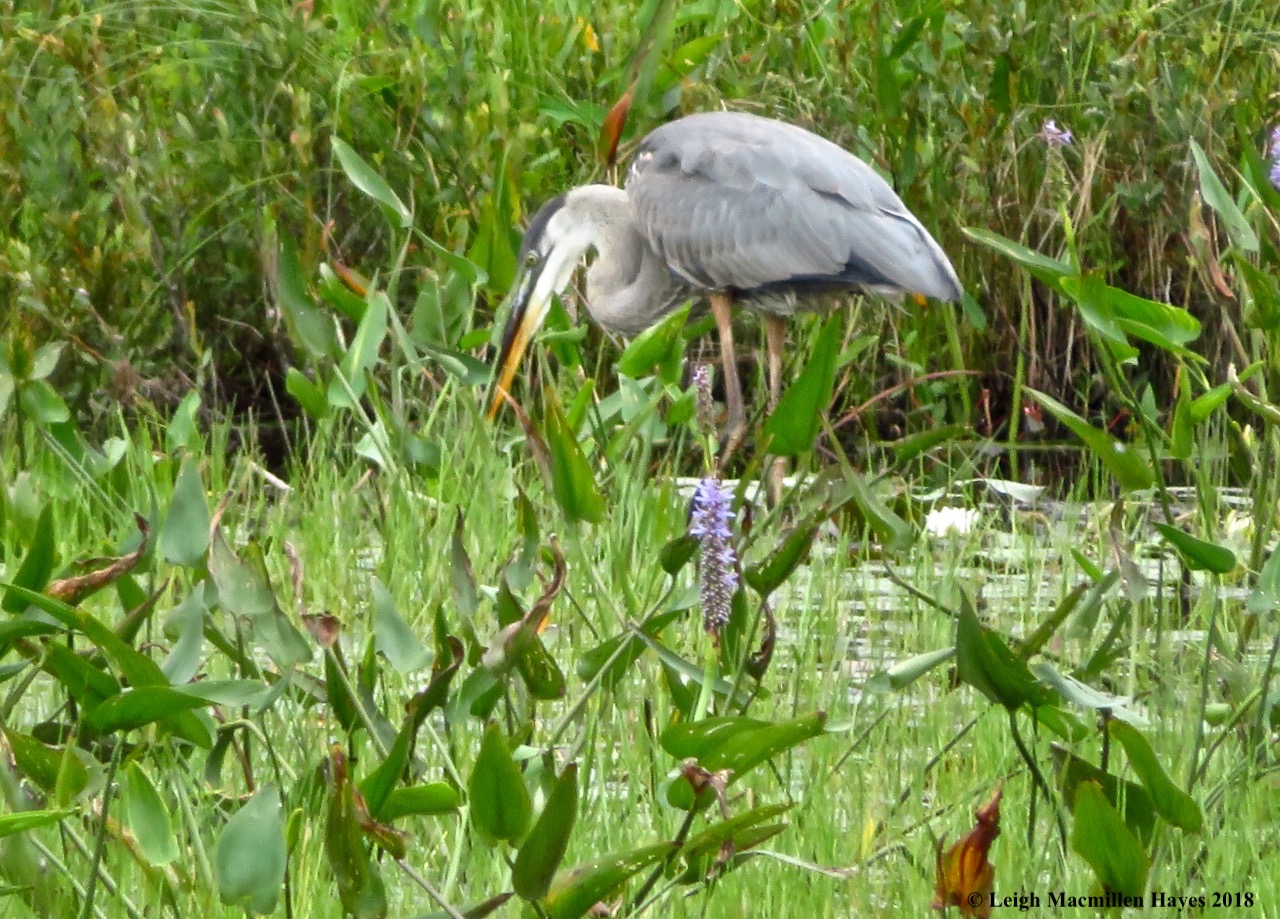
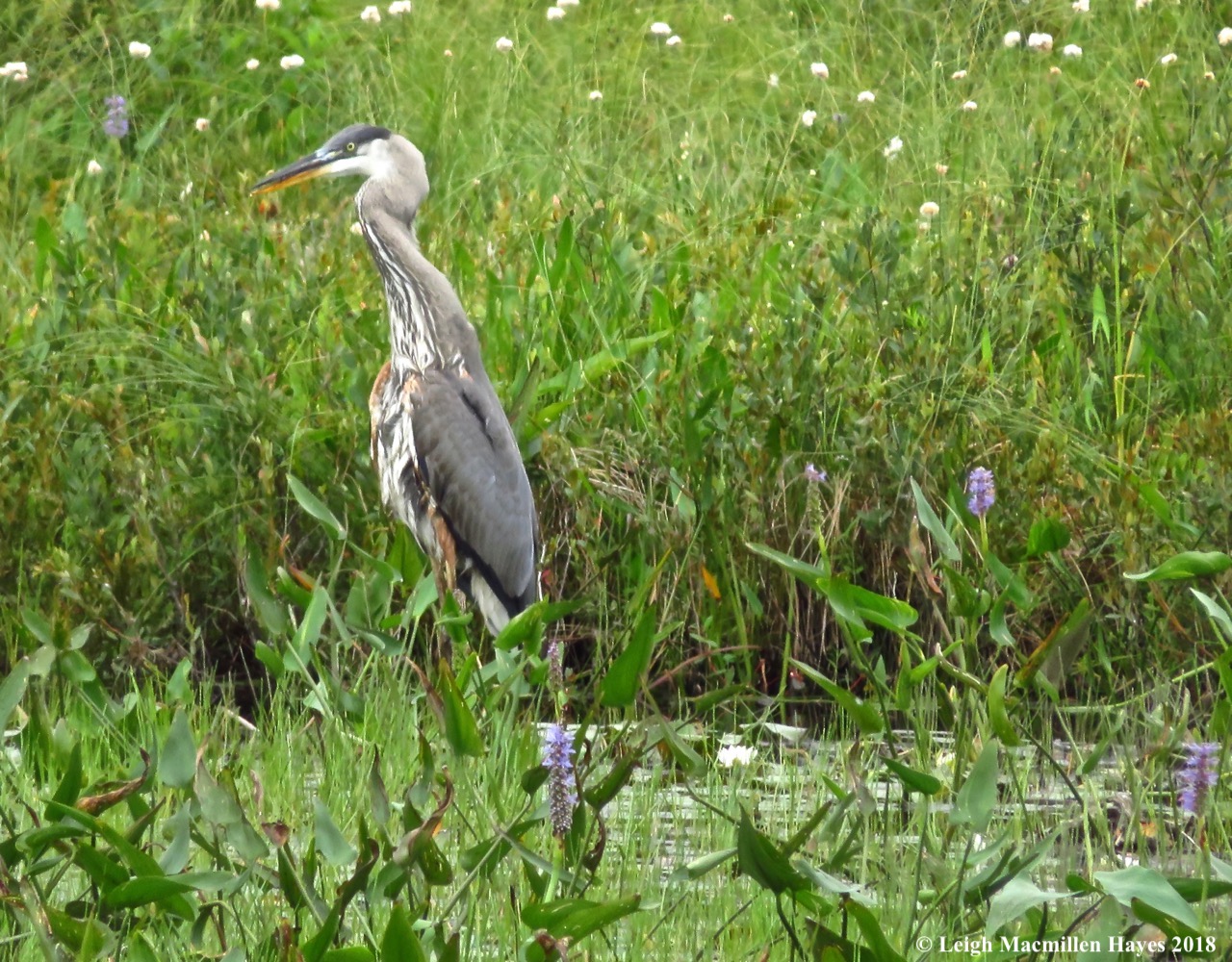
how long the Heron
will wait before taking the next step.
In that same space named for Otters
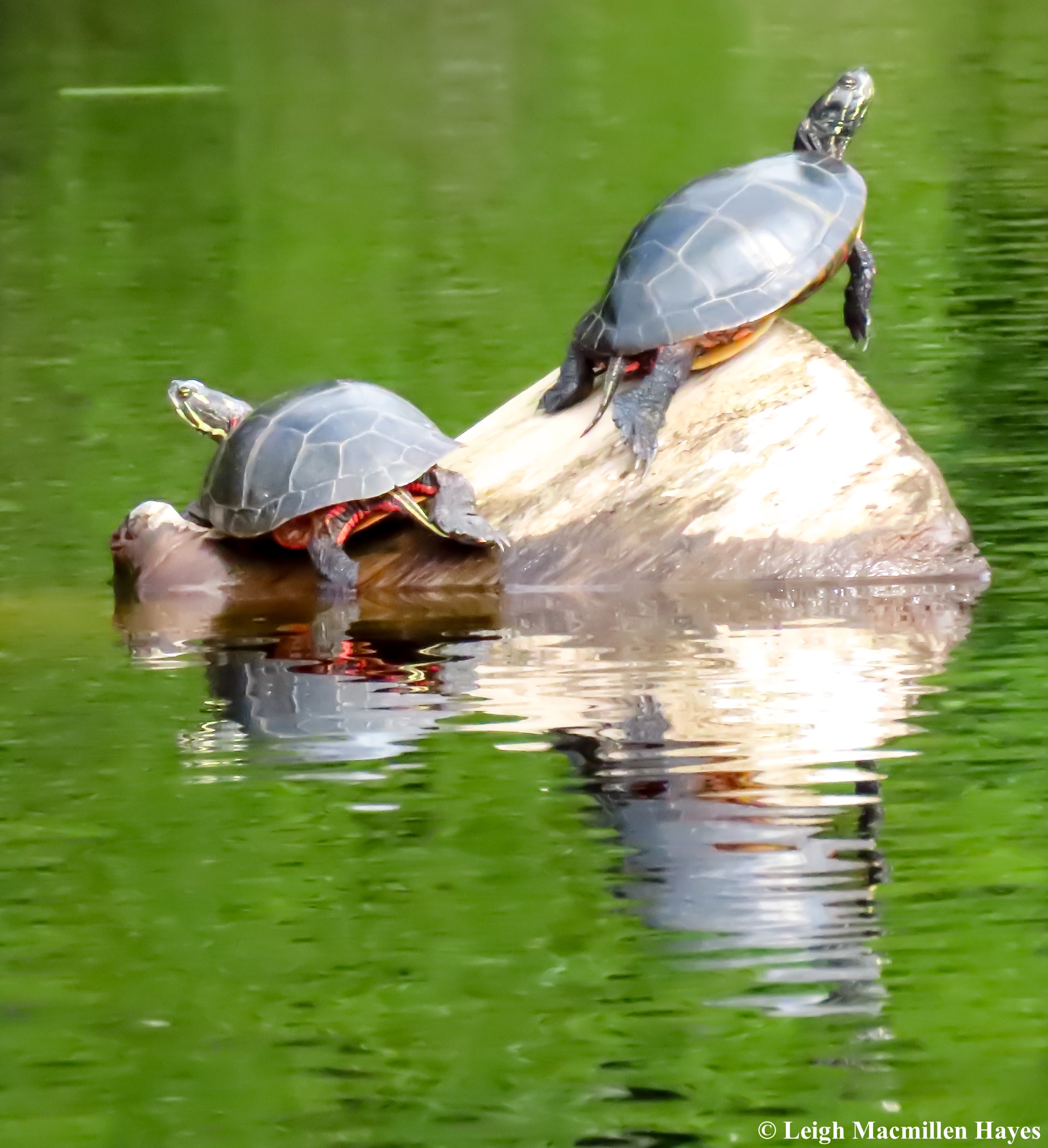
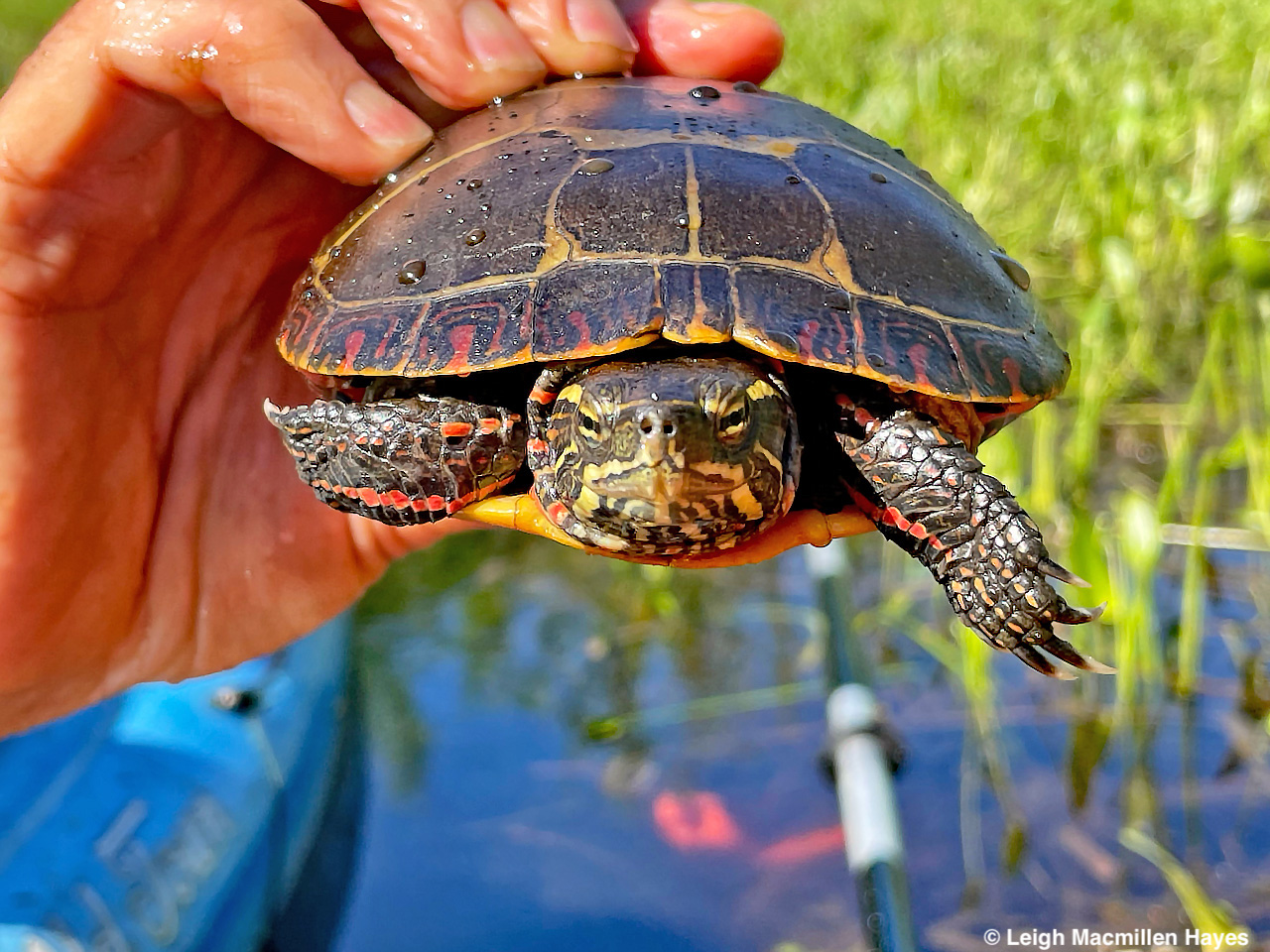
we spy basking Painted Turtles
who remind us we don't always need to
slip into the water and disappear from the scene.
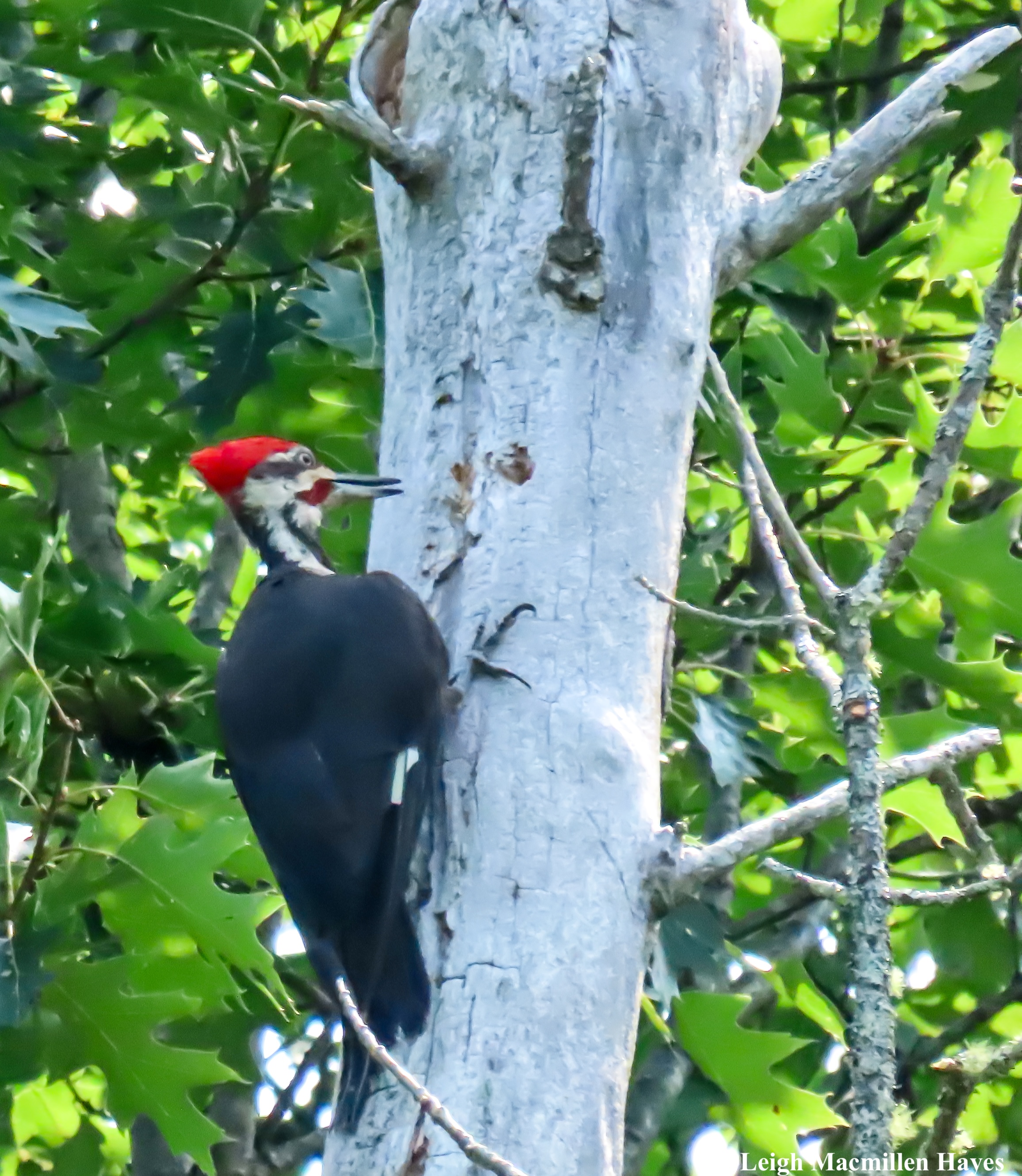
And then the Woody Woodpeckers 
of the North Woods
Rat-a-tat messages
best interpreted by their mates and I can only listen.
They may get a wee bit ruffled
in their Pileated fashion,
but I soon realize
that's because his she was nearby. And then they flew.
Next, upon a fern so Sensitive,
one with Spiny Legs doth land,
a Northern Crescent in its mouth
meant to provide nourishment.
Meanwhile, strung between other ferns
of the Sensitive sort,
a large Black and Yellow Garden Spider
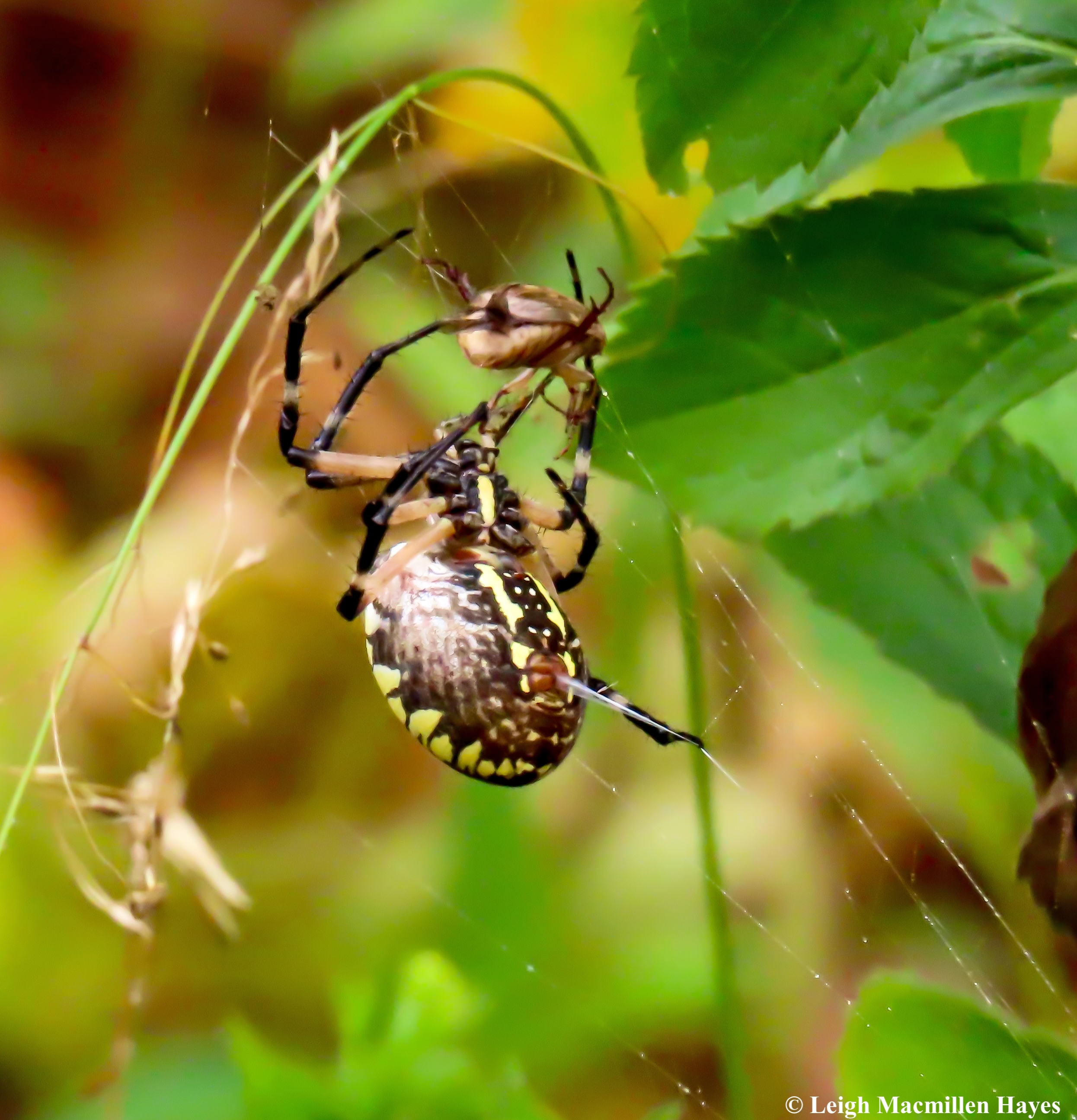
packages a meal as a smaller one looks on.
And I realize I've never seen 
such a small female
and wonder why she hangs
onto the web of her bigger sister.
Across the path
another Black and Yellow has several packaged meals
that may be a betrothal gift
for her Guy dangles above her, he being much smaller and drabber.
And the Black-shouldered Spinyleg
finds me again
and practically smiles,
if dragonflies can do such a thing.
Water also flows into the scene
as it should
for it is life giving
even if its merely a trickle.
But the delightfully curious thing
is that upstream
the mosses imitate
the water's action even where it is practically non-existent.
Upon the ground just above,
the Big-toothed leaf that most recently
gathered energy from on high
chose to shut down and show off its colors before giving back to the earth.
It's in this same place 
that My Guy and I notice a Bear Claw Tree,
the marks located just below a trail blaze
and we wonder if the blazer was aware of the bear sign.
Back to a garden planted for Pollinators
I wander alone
and listen as a million bees buzz
and watch the clear wings of the Hummingbird Moth remain almost stationary.
It's in this same place, 
just above a sign bearing the name of its adult form
that I spot a caterpillar
so many of us revere.
While spotting Monarchs 
has been a bit of a challenge these days,
I rejoice that occasionally
I have the thrill of being in their presence.
All of this
and oh, so much more,
as the hawk shouts that being ec-lec-tic
means deriving a taste from a broad and diverse range of sources.
I'm so grateful 
to enjoy an eclectic view of the world
on so many fronts,
and to share with you just a smattering of what matters.

Memorial Day Dragons and Damsels

It finally stopped raining and with a wee bit of sun late this afternoon, the temperature broke 60˚ and I found myself exploring a local wetland where all kinds of interesting things happen daily. And yearly. In cycles. And sometimes I happen to be there.

One of my favorite events is the emergence of dragonflies and damselflies. It seems like we endure Black Flies for most of May, all the while looking forward to our champs, the Ondonata family, to step in or rather up out of the water and transform before our eyes and take on the world. This usually happens by Memorial Day.

And this year is no different. The dragons and damsels have been emerging for the past couple of weeks, but now is prime time. And they are just in time because the Black Flies and Mosquitoes have had a heyday with all this rainy, cold weather, and today . . . as it warmed up, so did they and I have red welts on my neck to prove that they are biting. It’s all good, I remind myself. It’s all good. They are bird food. And so are the dragonflies, who eat the Black Flies, et al, and if they become bird food, all the more energy sent the bird’s way.

Cloudy wings and clinging to its shed skin indicated that this dragonfly had just made that magical transformation from its aquatic life to terrestrial existence. And I was there to protect it. For a while anyway. Until the Black Flies sent me scurrying onto the next great find.

That next being a damselfly, also with cloudy wings indicating it had also just emerged. Though I don’t know who the first dragonfly was that I met today because it didn’t yet have enough colors and pattern to make that determination, I did learn that this damsel is called Aurora! I don’t recall ever greeting it before, but based on the the lack of shoulder stripes, black patch with wavy edges on the thorax, and yellow sides led to this ID once I consulted Damselflies of the Northeast by Ed Lam.

Now it’s one I don’t think I’ll forget. AND, I love that it is named for my ten-year-old naturalist friend, Aurora. Or she for it. Or neither, but they both share the name of an electrical phenomenon.

As I looked about, I spotted several other newly emerged dragons and damsels, all with their signature cloudy wings, but then I spied this one.

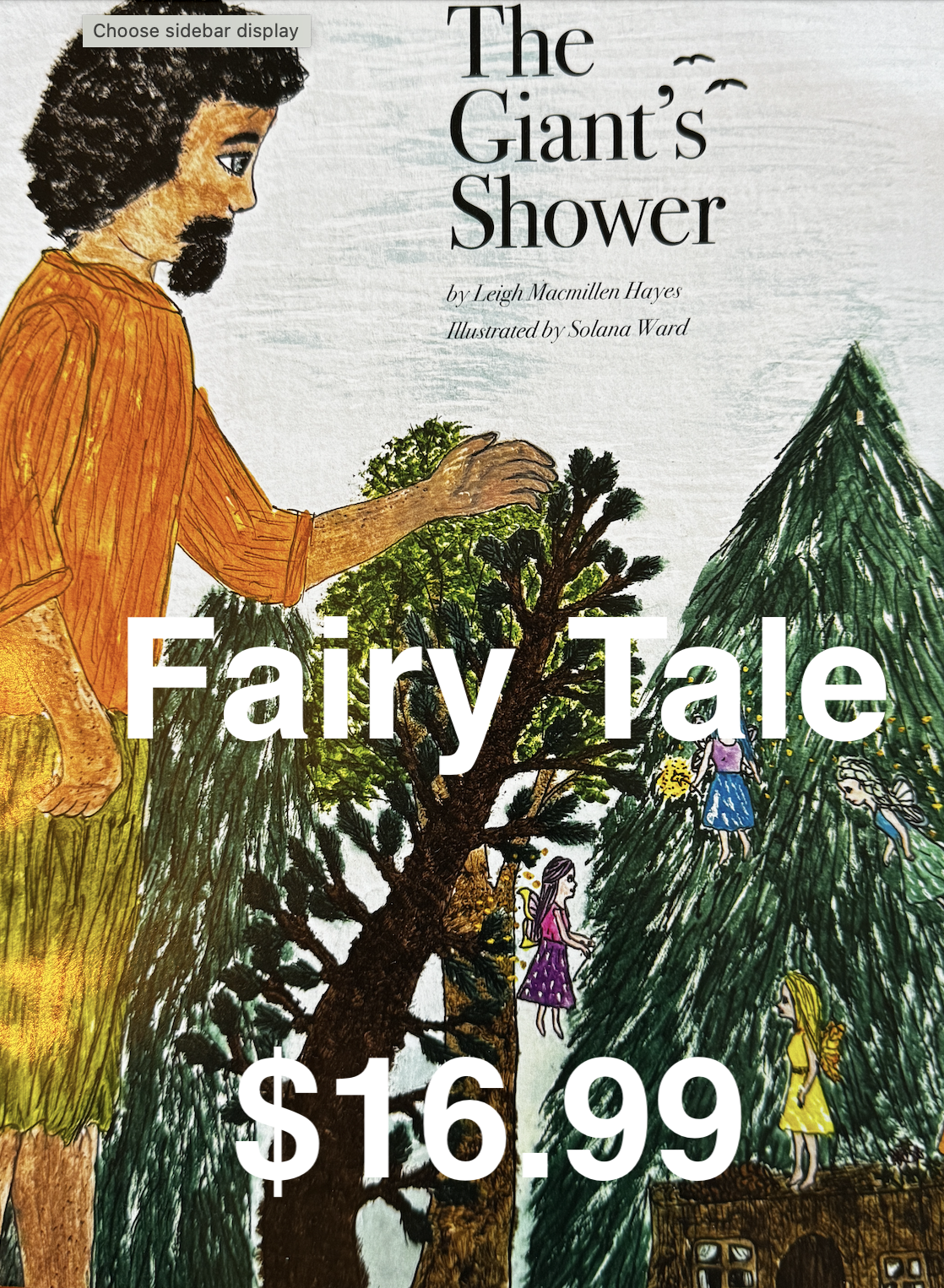
Yes, it’s wings are cloudy, but this Lancet Clubtail has an issue going on, for its wings are folded, rather like the main character in my fairy tale, The Giant’s Shower, for Falda’s wings are also folded.

That didn’t stop Sir Lancet from climbing up a fallen branch with gusto. But I did wonder about his fate.

That said, I moved on because I had some Painted Turtles I wanted to meet, figuring that they’d be basking after several days of temps in the 40˚s. Being ectotherms, they rely on external heat to regulate their body temperature. Sun is their friend.

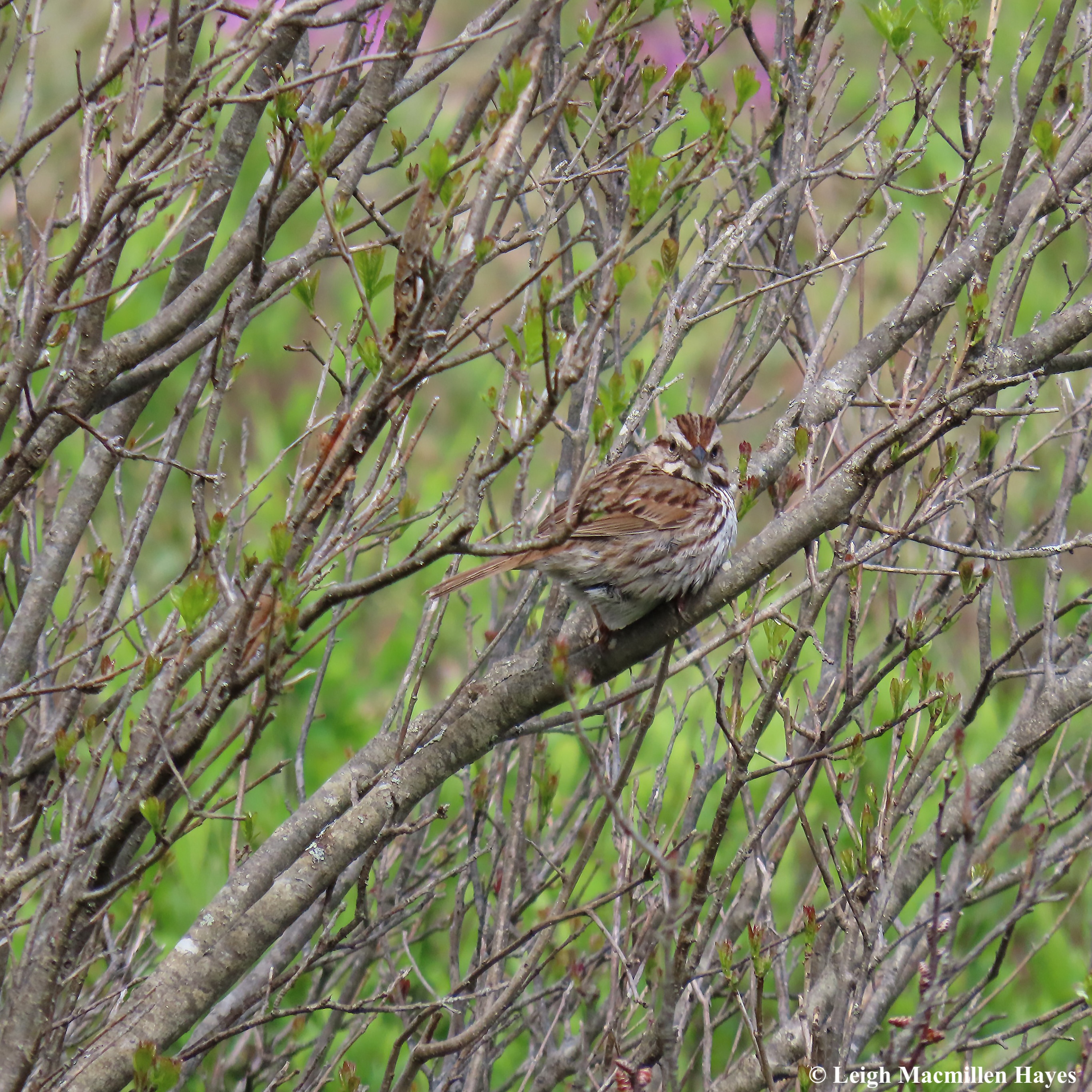
Being in a wetland, the bird song was plentiful, but though the Merlin app included a chorus of plenty including Redstarts and Towhees and Common Yellowthroat and more, the only one who posed was a Song Sparrow.

I walked about a mile away from my starting point, but really was eager to return because I knew there was more to see and learn in that spot.

Almost back, I met a Dreamy Duskywing Butterfly, a species I’ve met in this place before but not sure we’ve encountered each other anywhere else. I love the tapestry of its dusky wings.

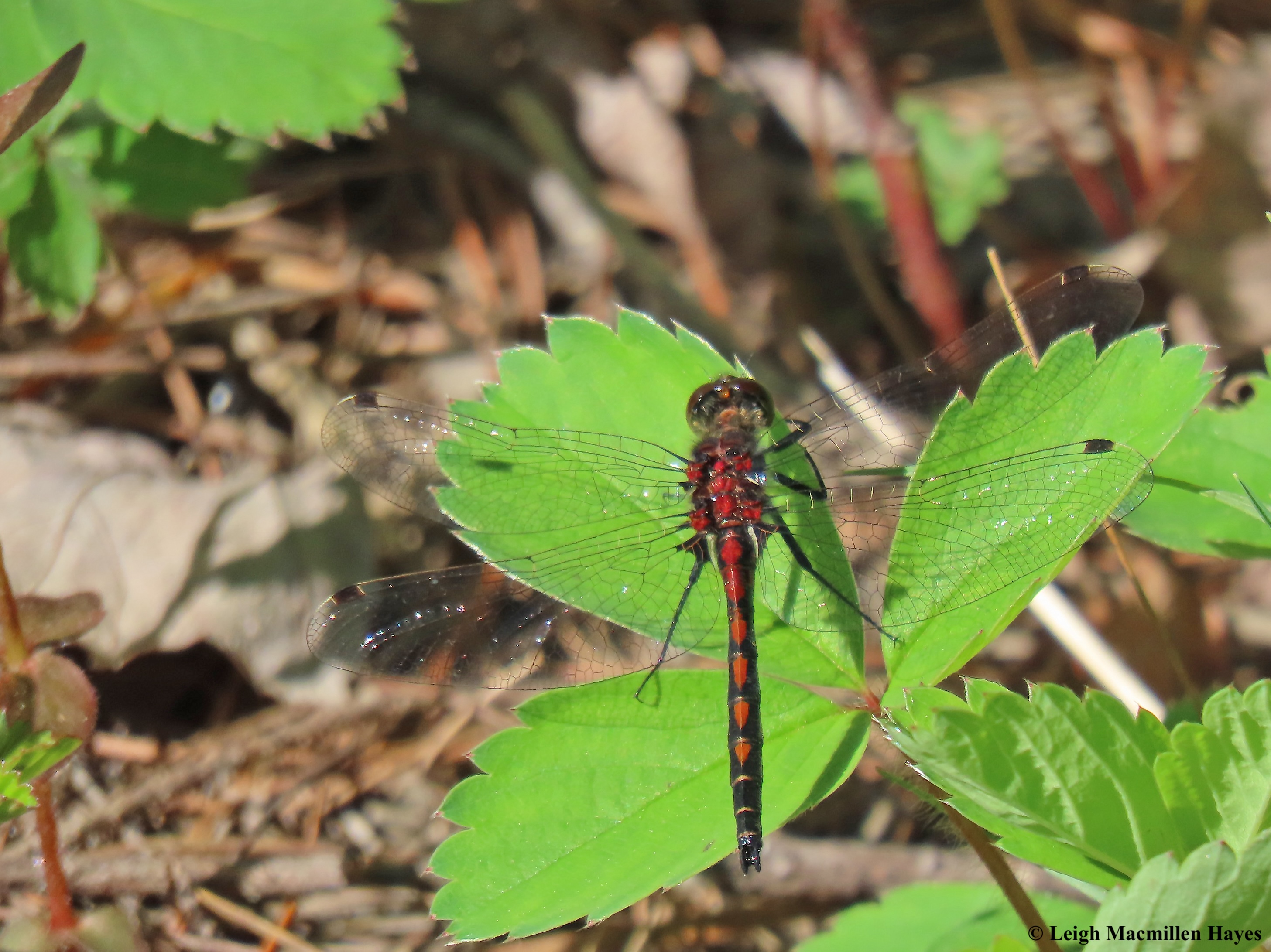
A moment later, an old friend flew in–Hudsonian Whiteface–this being a male, for the female’s markings are yellow. These are early spring skimmers, and I have to remind myself not to confuse them with Calico Pennant skimmers who have similar, yet different abdominal markings, he being red and she yellow. Also, the Calicos, being pennants, have a stained glass basal wing pattern that the Hudsonian’s don’t exhibit.

Back at base camp, or rather, my starting point, I checked on Sir Lancet. He’d crawled up the branch to a rather perfect hiding spot at the Y, at least to my eyes. And look into his eyes I did. Including the three simples eyes, singularly called ocellus, which are arranged between the two large compound eyes. Each ocellus offers a single lens with which to view the world, while the compound eyes offer multiple lenses. Amazing. I can’t even begin to imagine such sight.

But what I also noticed about my folded-wing friend was the green “blood” that seemed to be stuck within those wings. Dragons and damsels and other insects that emerge from an exuviae break through their old skin, their wings coming out first with the head, and then pulling the abdomen out slowly and pumping their insect blood first into the wings until they reach full length before drawing said blood back into the body and allowing the abdomen to extend to full length and slowly take on the hues of its adult self.

I’ve seen this in others with folded wings though, where the insect blood seems to have become blocked and is still visible in the transparent wings and maybe that’s why they are deformed? But what causes this?

I don’t have an answer, but try to remind myself that eventually this dragonfly will become units of energy for a bird or another insect and that’s its way of giving.

Meanwhile, though it was getting late and the temperature was starting to drop again, two immatures caught my attention–a Mayfly subimago or dun and another Lancet. Both had cloudy wings announcing their age.

And both were fairly safe in each other’s company, for the Mayfly has no mouthparts, not that it could eat anything as large as a dragonfly at this point, and the Lancet wasn’t quite ready to eat yet for it had some more work to do in order to become a flying predator.

Slowly Lancet’s wings became more transparent and though dinner prep was on my mind and I knew I needed to head home, I waited until it spread its wings and then without a backward turn or wave goodbye, took off. Despite that, I wished it my usual, “Fare thee well.”

And as I walked back to the truck, a young Lancet met me. I was totally surprised to find it land with wings folded over its back. Had we just met only steps away by the water? How cool would that be if it were true.

And then my all-time favorite appeared, a Stream Cruiser with its Oreo Cookie coloring. I was asked the other day what my favorite bird is and I came up with at least five different species, but the Stream Cruiser will always be my favorite dragonfly.

And dragonflies and damselflies on Memorial Day weekend–another favorite for we all know that the Black Flies will now be on the decline.

Memorial Day weekend not only means a return of the Dragons and Damsels who slay those other pesky bugs, but also a time for us to remember those who died serving our country, like my Mom’s brother, age 19, who died in World War II. Thank you Uncle B. We never met, obviously, but Mom brought you alive in my mind for you were her best friend and I know you are with me and trust you would approve my curiosity and adventures and reverence for the natural world .

A Visit From Mom

We stood in her bedroom and peered into her closet, then I grabbed a shirt and was about to close the sliding door. It was Dad sitting on my shoulder, who reminded me, as he always does, to pull the string and turn off the overhead light.

Next I remember, she was getting ready to walk the three of us down the road to the bus stop. And grab the next-door neighbors on the way. We all always walked together.
That was my childhood neighborhood. My adult neighborhood is a wee bit different, but in a way, really the same. The length of our road is the same, with the same number of houses lining the street. We live at the dead end as my family did growing up. And it’s nothing but field and forest beyond.

One of my favorite parts about my current neighborhood is the vernal pool that I refer to as “MY” vernal pool even though it’s on a neighbor’s property. So, neighbors are still an important part of my life.

And while visiting the vernal pool to check on my amphibian friends yesterday as days of rain drew to a close, I discovered two new residents I hadn’t met in this space before.

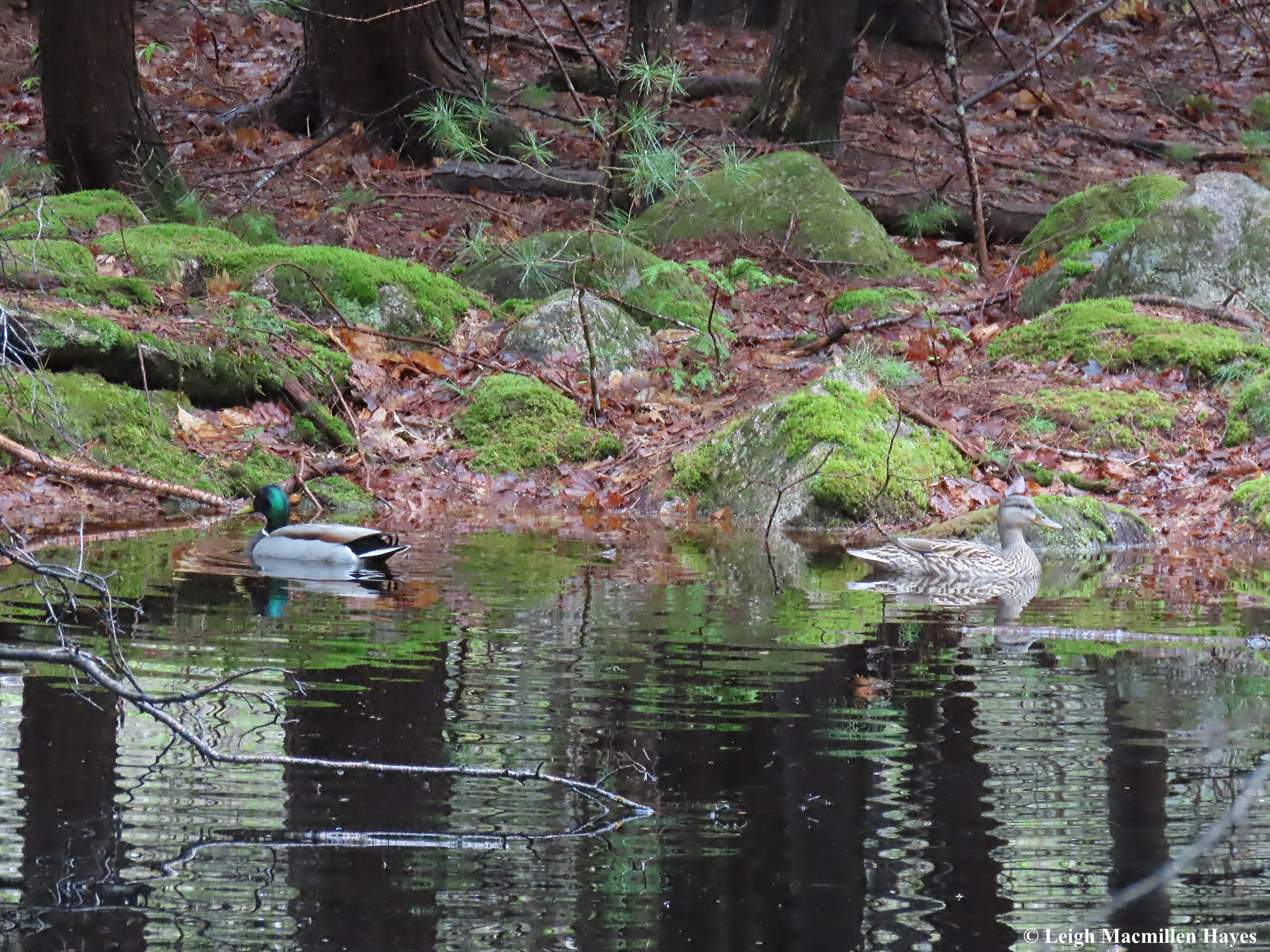
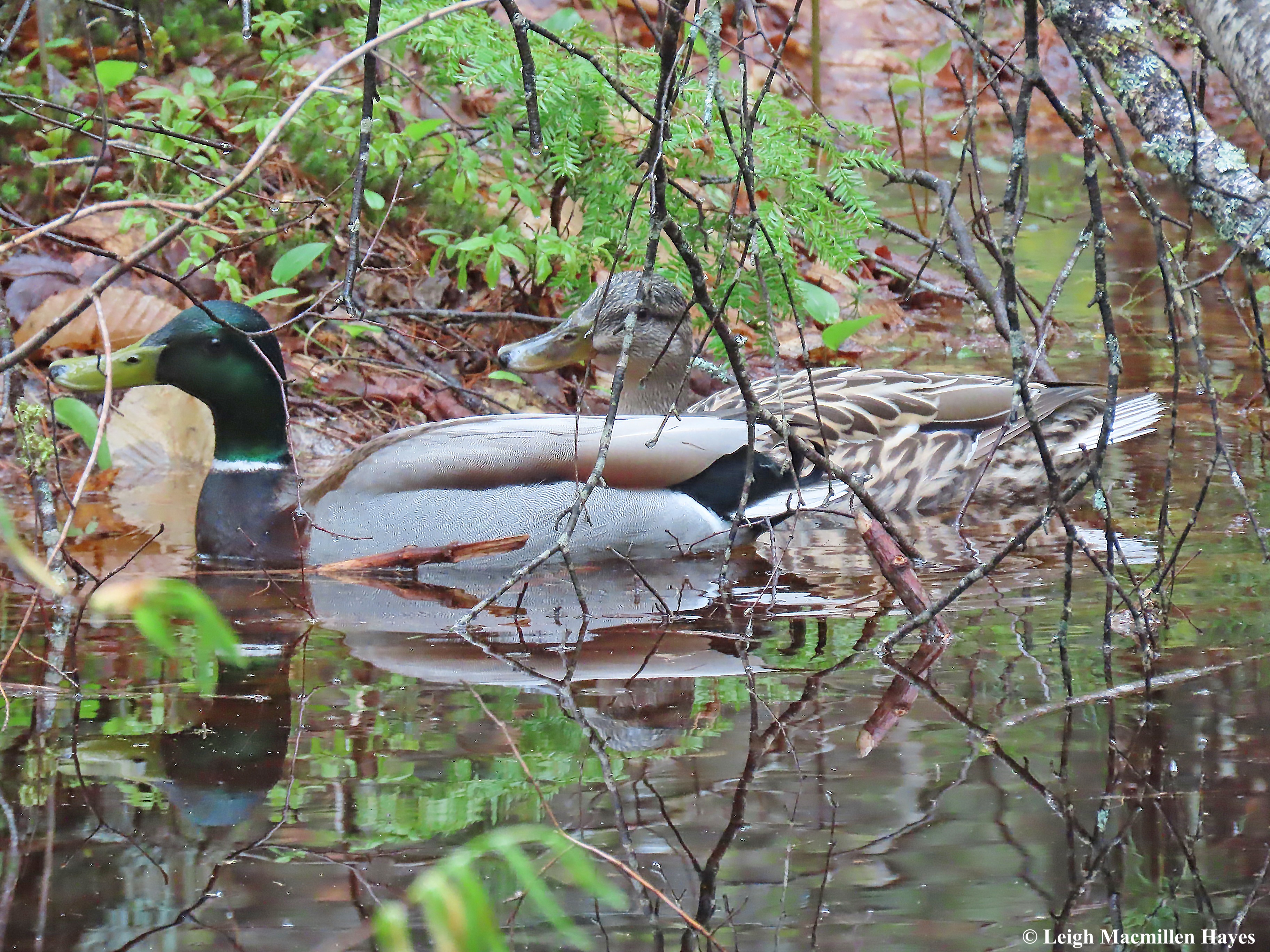
Maybe Mr. and Mrs. Mallard have visited before, but in 30+ years of my journeys to this spot, I’d never encountered them. My first response was to scare them away. Thankfully, I came to my senses quickly.

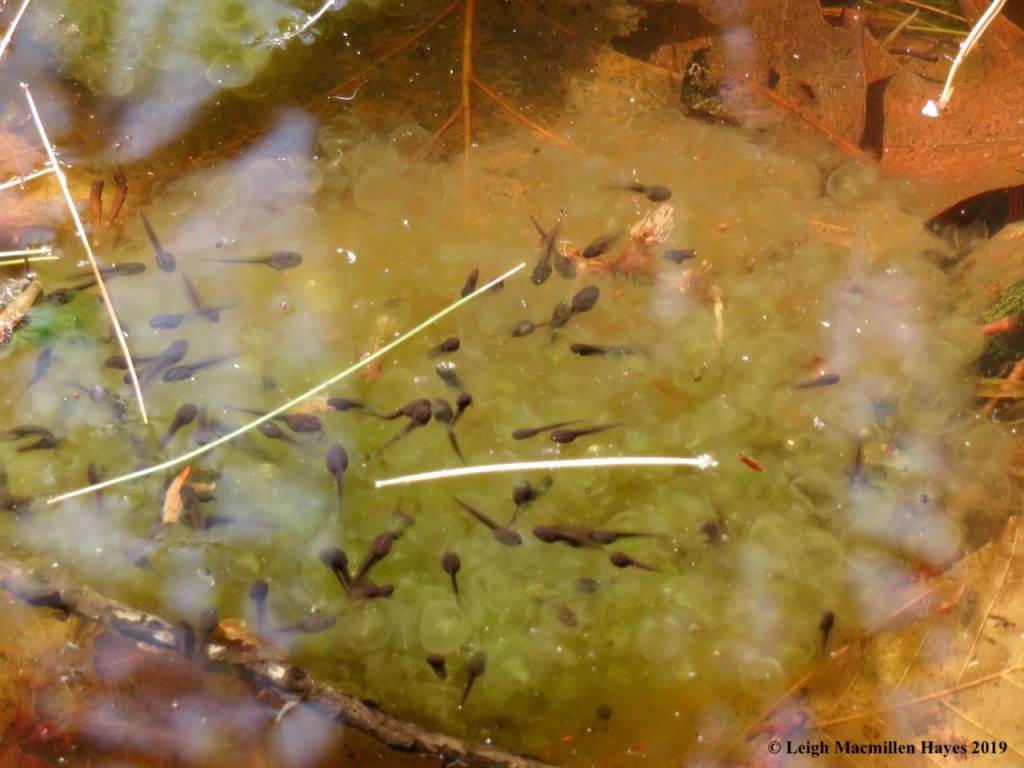
But in those first few moments, all I could think about were the tadpoles that were using the pool to develop. Their moms and dads had left the pool just after the eggs that contained embryos that turned into the said tadpoles emerged. And because those moms and dads only spend about two weeks in the pool and then return to their upland habitat for fifty more weeks of the year, I always feel it is my duty to watch over and protect them. And the ducks . . . might gobble them up.

But she excited the pool and looked tall and poised and I was certain their visit was just for a moment and so I gave thanks that I’d had the chance to spot them.

He added his own stature to the landscape. And my presence seemed not to annoy either of them.

Though my concern was that they’d gobble all the critters I chose to protect, I did think that if they had any interest in the larval Mosquito wigglers or their pupal tumblers that looked like little bullet forms, then have at it and eat away. Just don’t touch my Wood Frog and Spotted Salamander tadpoles. “MY” tadpoles. Synonymous with “MY” vernal pool. Located on a neighbor’s property.

As I walked around the pool, the Mallards swam, and I realized that I’d forced them into the spot where the egg masses had been laid and I wondered how many they’d already eaten.

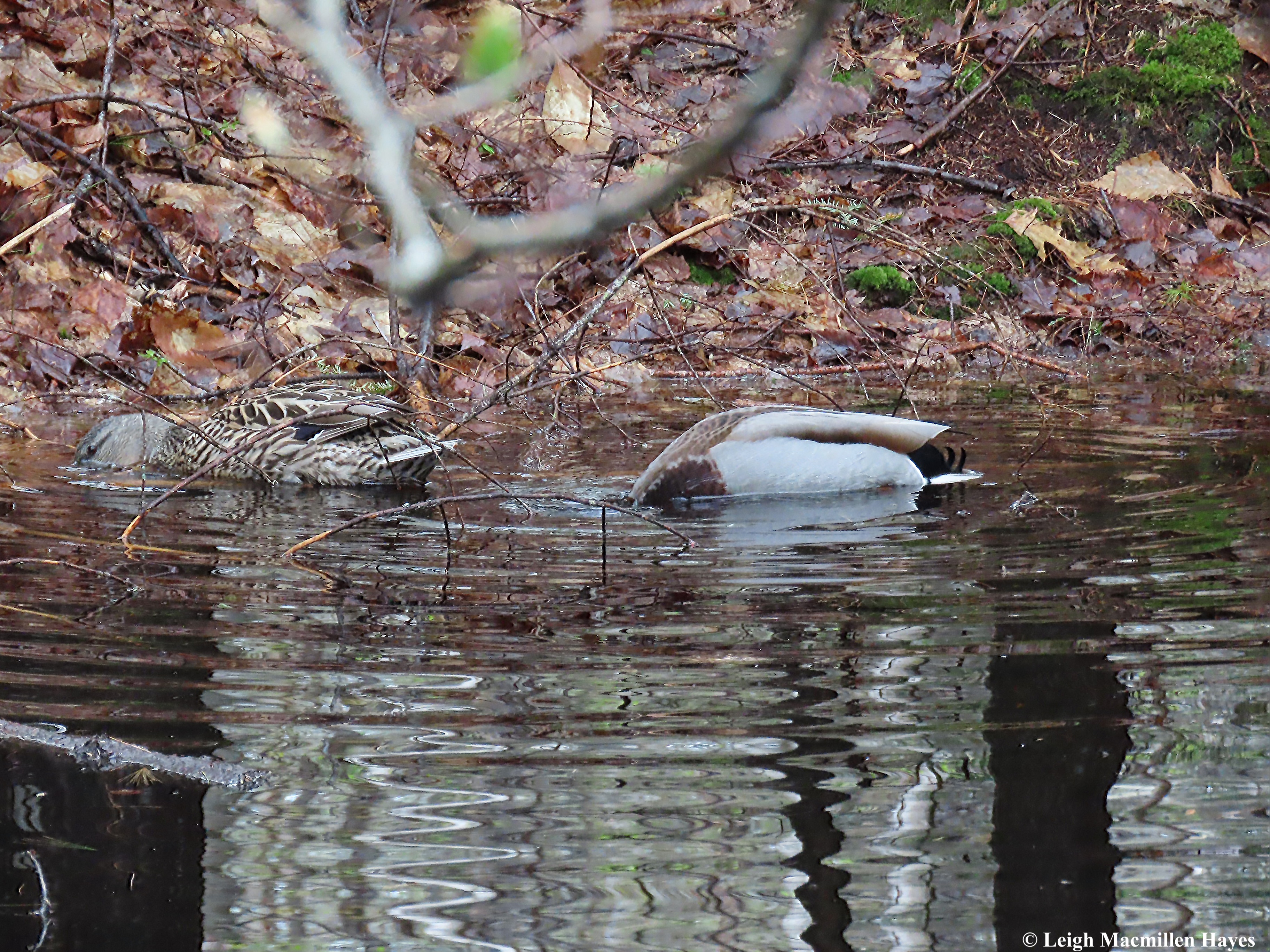
And then . . . they did start foraging. My only hope was that I know tadpoles quickly dart under leaves, so that might protect them. But what else could the ducks be consuming? Aquatic plants are few in this particular pool. Seeds, however, are abundant, so there was that thought. But really, I’m sure they were dining on my buddies as well as macro-invertebrates.

I tried not to think about it. Until I did.

Two years ago, we had rain all spring and summer and this pool, which typically dries out by mid to late June, was full until September, and for the first time in my memory of decades of visits, I witnessed the tadpoles developing hind legs first and then front legs.

Last year, however, due to drought conditions, all dried out in a short time, and if any tadpoles metamorphed, it was quick. And I think this year’s egg masses spoke to that for there were far fewer Wood Frog masses, but over forty Spotted Salamander masses. Perhaps the latter sensed the changing conditions last year and enough were able to develop quickly into adults.

On the way home, I searched the trees in our woods and finally was rewarded with one showing off the suds of a rainy day–when pine salts turn into bubbles at the base of a tree.

The better surprise occurred just up the trunk, where I suddenly keyed in on intense activity, in the form of Crane Flies canoodling and jockeying for a chance to canoodle. They were fervent in their attempts.

Today dawned SUNNY, and after church I headed back out to the pool. At first I didn’t see the ducks, but within moments realized they were still present. And I began to come to terms with their presence because really I love them too. I just don’t want them to eat all my other friends.

While I looked down, a cat-like meow called my attention upward and there I spotted a female Yellow-bellied Sapsucker. And I was drawn back in time to watching Sapsuckers raise families in our yard and on land trust property and I wondered if this female was a momma and if so, where had she hidden her gang?

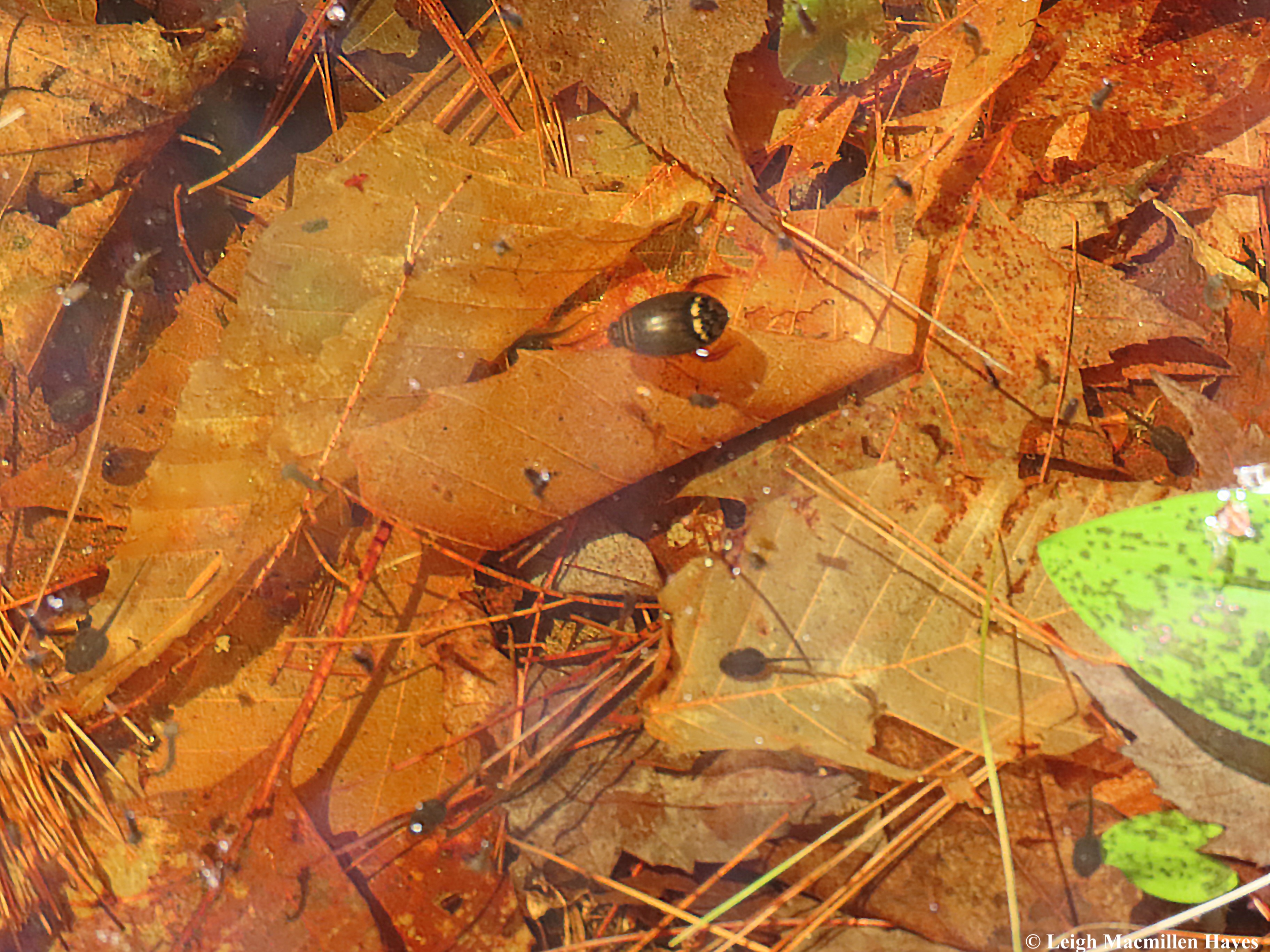
And then, because of the sunshine, I could peer into the water through my polarized sunglasses and tada, I still had tadpoles. This momma was pleased and proud. So, maybe I could share the space with the Mallards after all–as long as they promised to not eat all of my babies.

In the mix, I also spotted Predaceous Diving Beetles, and of course, the ubiquitous Mosquito larvae.

As for my ducks, ah yes, I’d now accepted them as mine. Really, they are a handsome couple. My next question for them is this: how long will they remain? That, I know, depends on how long the pool holds water. Which depends on how much precipitation falls from the sky. One thing leads to another, which leads to another, and so life goes on.

Upon a floating log within the pool, more life happened, this time in the Midges trying to canoodle with other Midges as a Crane Fly looked on.

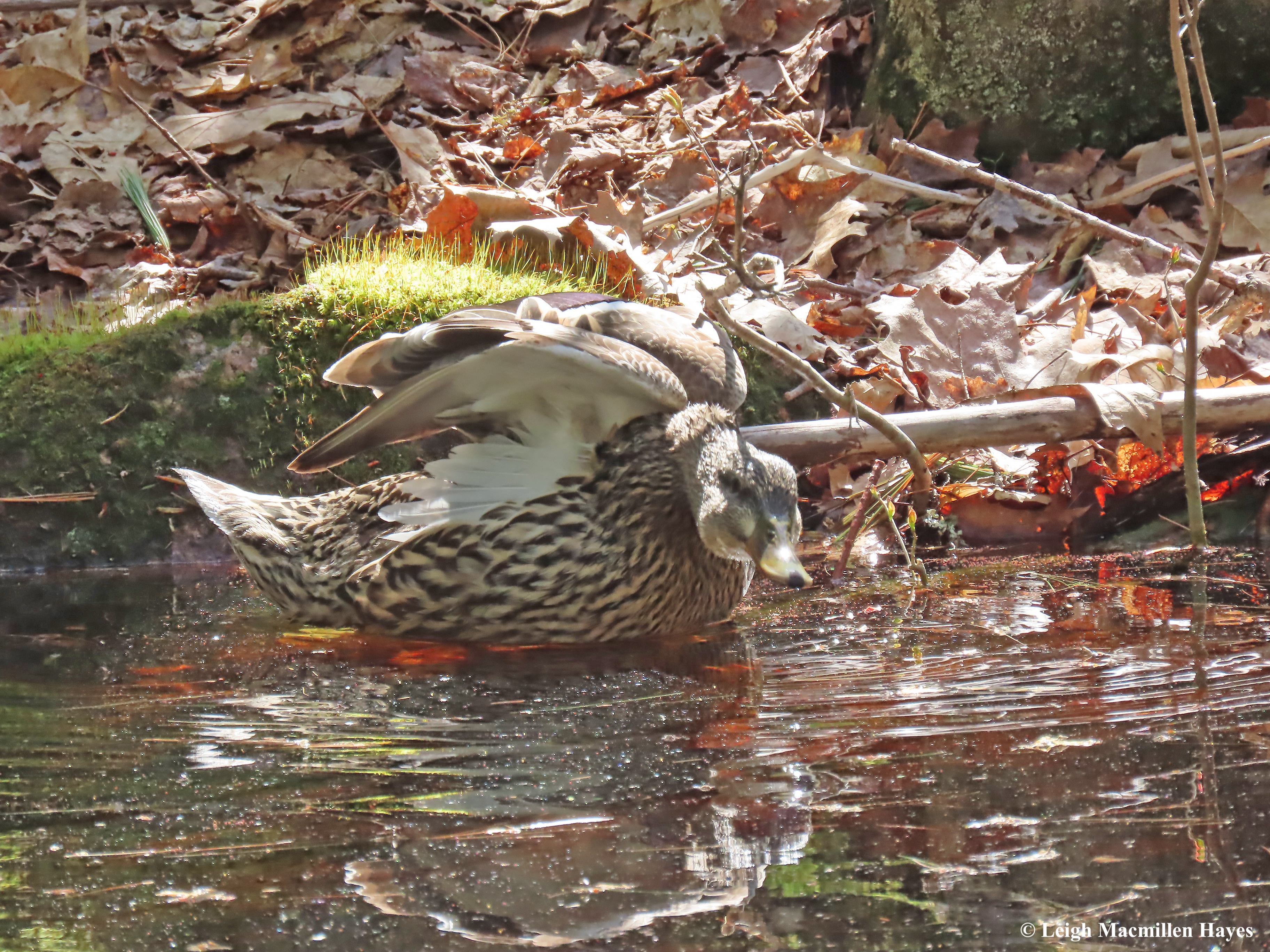
As for the ducks, they again moved under the branches where the egg masses had been, but this time they preened.

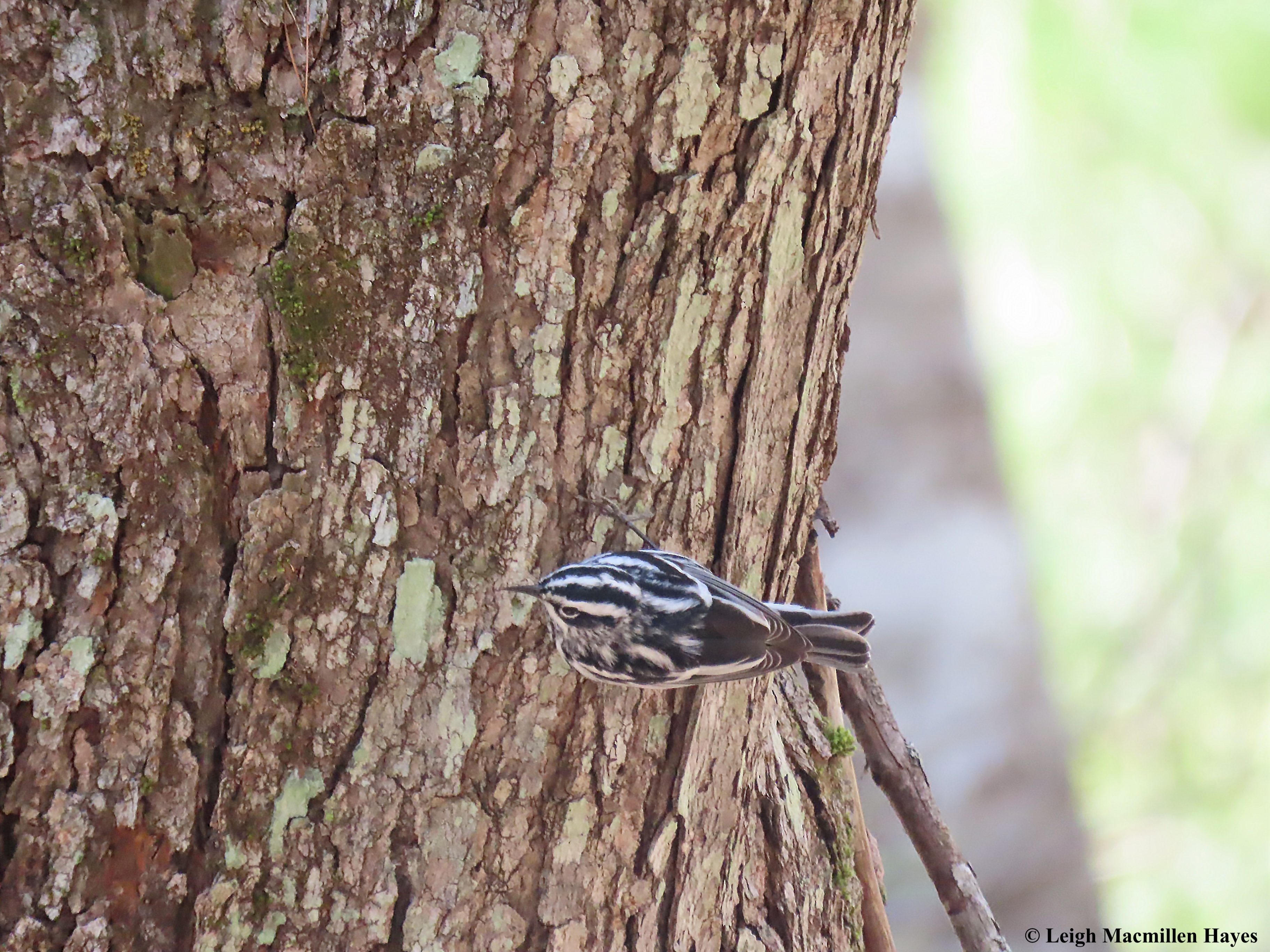
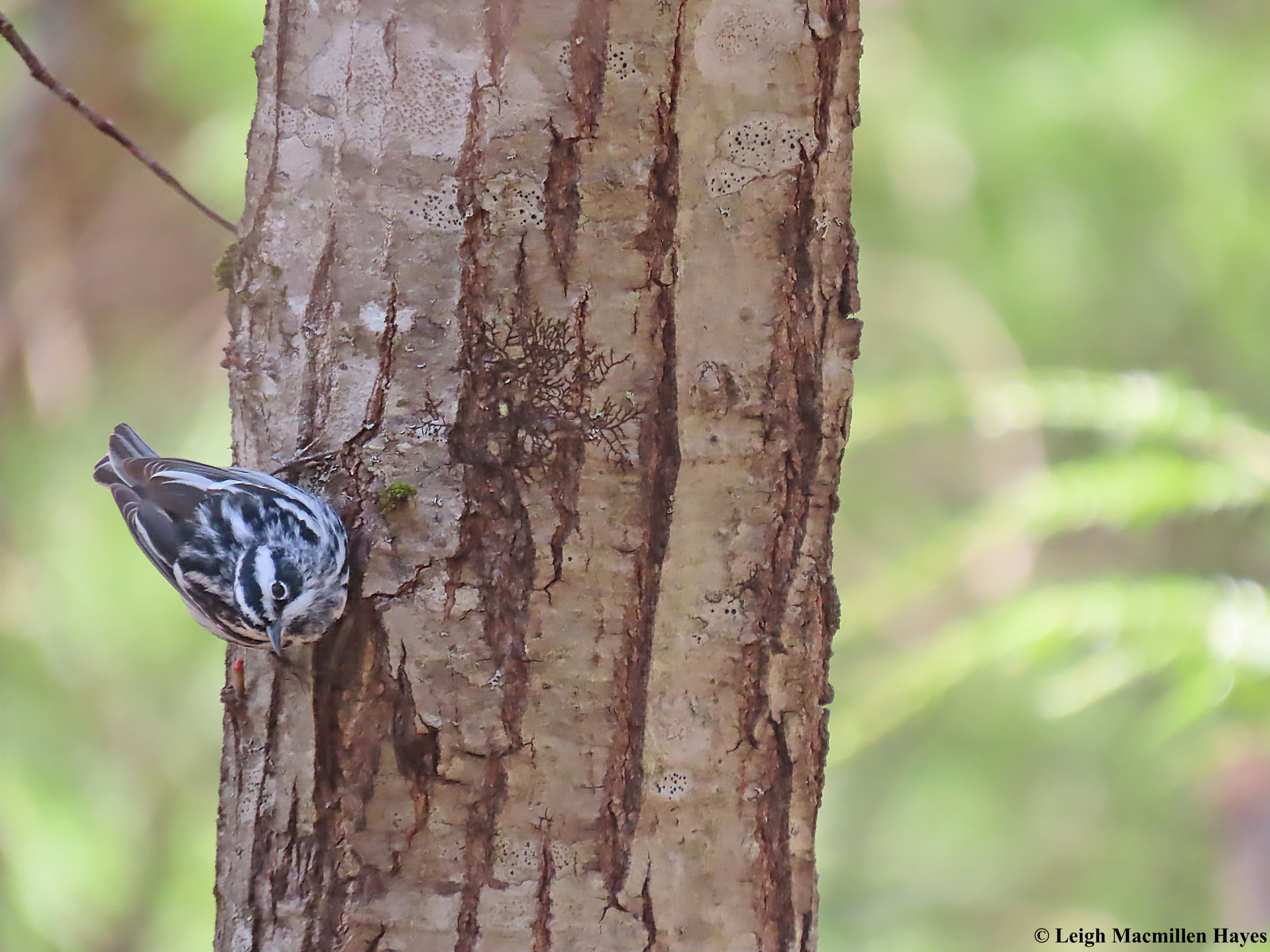
And into the midst of all, in flew a couple of Black and White Warblers, and I felt rewarded once again for being in this place at this time.

Zebra birds might be another suitable description.

A few minutes later and Mrs. Mallard demanded my attention once again as she took a bath.

And then she climbed upon a rock in the pool, while he circled around for a while, protecting her or so it seemed.

She finally settled and he joined her, pausing to preen.

And then they both took a nap. Apparently my presence wasn’t a concern.

Thank you, Mom, for your visit. It was so awesome to spend some time with you last night. And thank you for making me realize that we don’t have to necessarily be moms to human children, though I do give great thanks for our boys who have been in touch throughout the day even though we couldn’t be together, to be nurturing. To all who guard and watch over human babes, and amphibians, and birds, and insects, including monarchs, and furbabies, and you name it: Happy Mother’s Day. Your efforts are gallant. Your souls are brave. Your hearts are full.

I love it when my parents show up in my dreams, but couldn’t believe my good luck today to wake up after a visit from Mom.

Marching into the Vernal Pool

I’ve lived in Maine for just shy of 40 years and can barely recall the month of March going out like a lamb, as the saying goes.

It’s certainly true that once again this year the ending of the month is more lion-like with an overnight and morning snowstorm, with freezing rain on the horizon for tonight and tomorrow, followed by a warm-up and rain on Monday.

That all said, March snow doesn’t last long.

But still . . . it has me dreaming. Remember, I LOVE winter, but am as ready for spring as the next person.

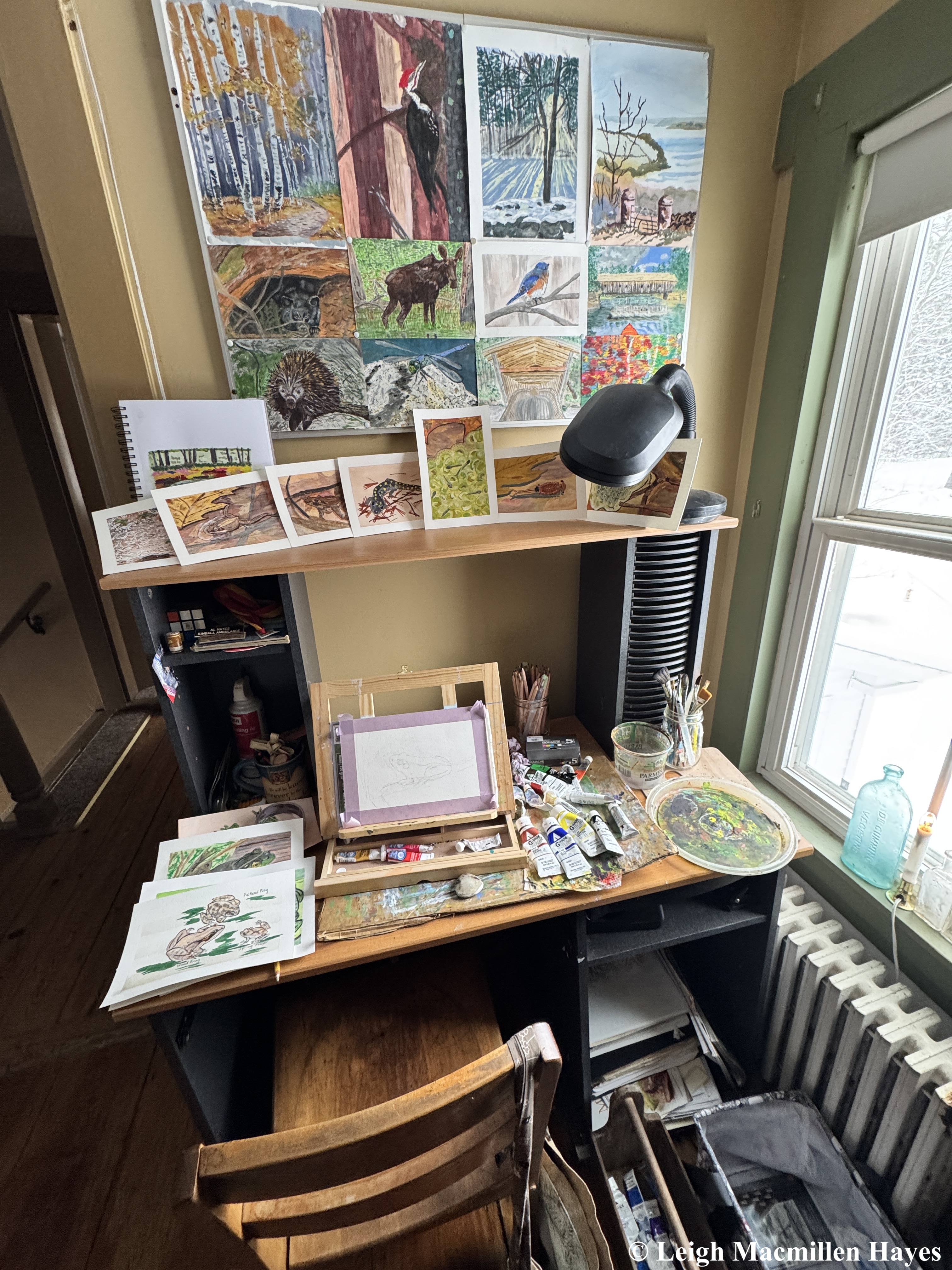
And so I spent much of today (when not shoveling, which really didn’t take long) holed up in my wee studio where I’ve been working on a vernal pool series of paintings.

The idea for this post actually came to me in a dream last night–why not turn those paintings into a blog post. Why not?

Because, it’s scary to share creative works with the world. But, I am probably my own worst critic. My instructor, Jessie, always reminds me to put my inner critic into a box, place the cover on top, and get to work. And besides, by sharing here, I can hide behind the screen. She wants those of us in her class to host an art show, but I refuse to do that. It’s much more comfortable for me this way.

I’ve only been painting since last May, but let’s not let that be an excuse. The thing is, working with gouache paints means I can easily edit, much like writing. And believe me, I have. My motto has always been that there’s no such thing as a final draft–whether it be an article for a magazine or a work of art.

Have you noticed that I’m procrastinating? And putting all of my excuses out there.

It’s snowing again.

All right, I’m almost ready. But here’s the other thing–in sharing these with you, may you be inspired to do something you never imagined and discover that the time you spend doing such is most enjoyable and it’s easy to get “lost” and just plain have fun and decide that even though the “end product” isn’t exactly what you first set out to create, it’s still half decent and you had the most delightful time sitting quietly as is my custom, doing just that: creating.

And now . . . for a look back as a way to look forward to a vernal pool as it emerges from winter or early spring, or mud season, or almost spring but still winter, or whatever season this is.

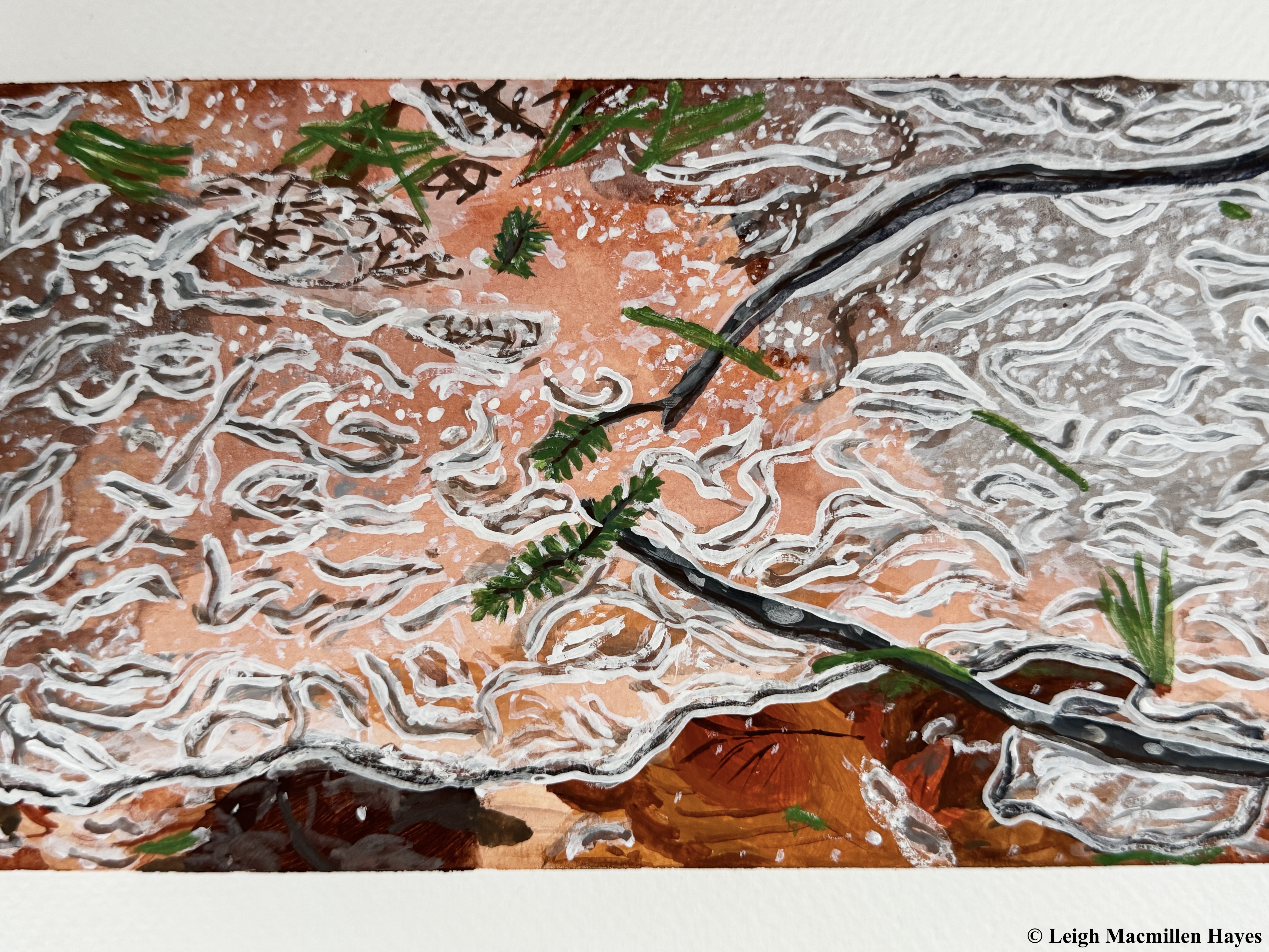
Pine and hemlock needles and branches from winter storms coat the ice as it slowly begins to melt along the edge of the pool, providing a glimpse of the sunken leaves below, where life awaits.

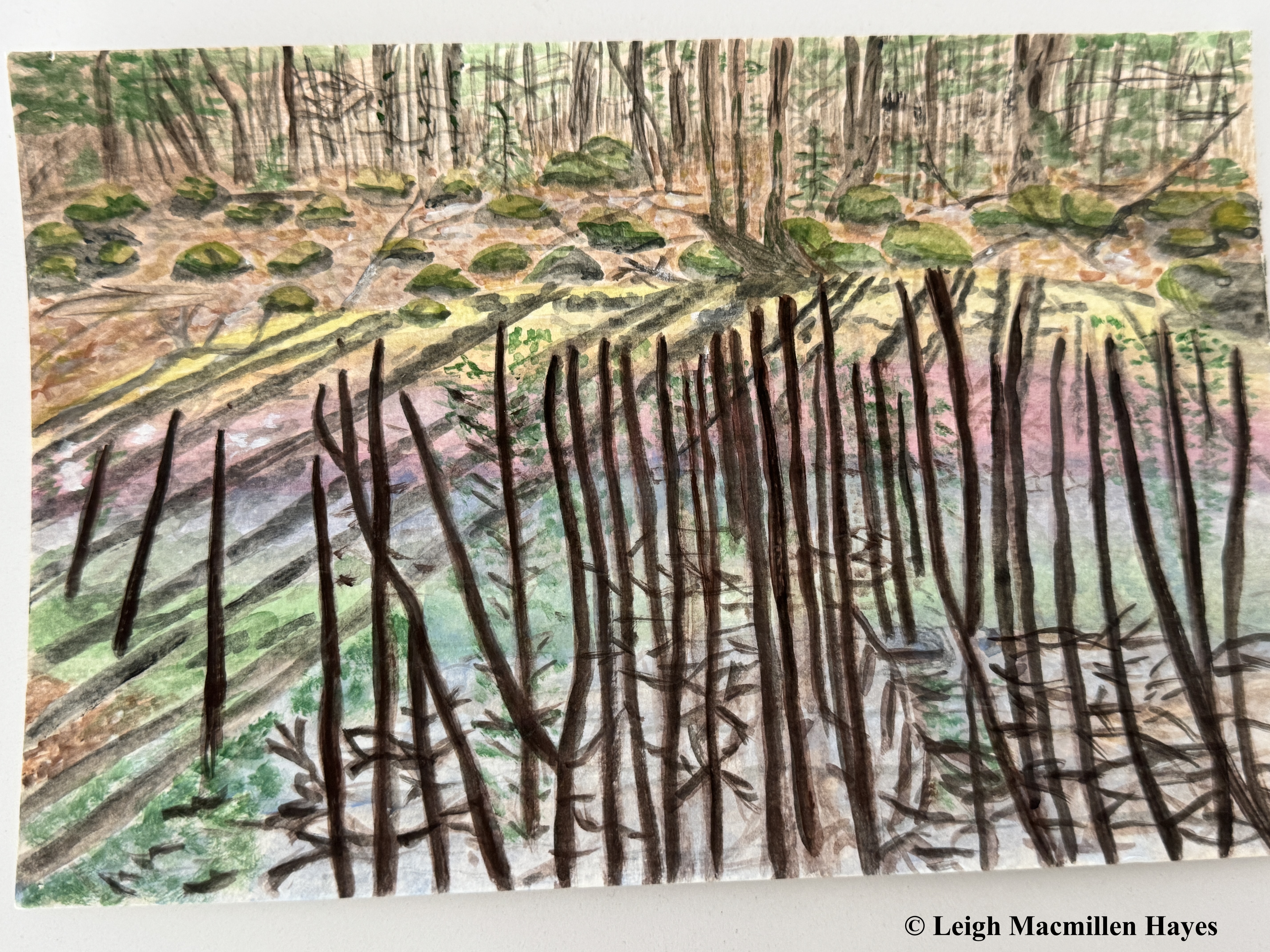
Once the ice finally melts, barren trees offer a reflection that speaks to winter, but there’s hope in their buds.

And no sooner has the ice gone out, when upon my approach I hear “Wruck, wruck,” and know that the Wood Frogs have returned to their natal breeding grounds. At first, they dive as soon as they hear me approach. But I stand still, sometimes for up to fifteen minutes, and ever so slowly, one by one, they rise to the surface and float.

It’s the lucky male who has the best “Wruck, wruck,” that finds a mate. He clasps her with his forelegs and as she begins to deposit eggs, he fertilizes them externally.

I return a couple of days later, in the late afternoon, and can’t believe my good luck. The pool is coated in pollen and the sun hits it in such a way that I see a rainbow of colors and love how the tree reflections are in two orientations upon still water.

A few weeks later, looking deep into the pool, which isn’t really all that deep, I notice blobs of eggs clustered together in a mass that has a tapioca-like shape to it and notice little life forms moving about in the shape of tadpoles. I feel like a proud momma. The thing is, the Wood Frogs mate, she lays eggs he’s fertilized and within two weeks, the parents are long gone, back to their woodland setting. And so I do feel protective parent–or maybe foster parent–keeping watch and celebrating achievements.

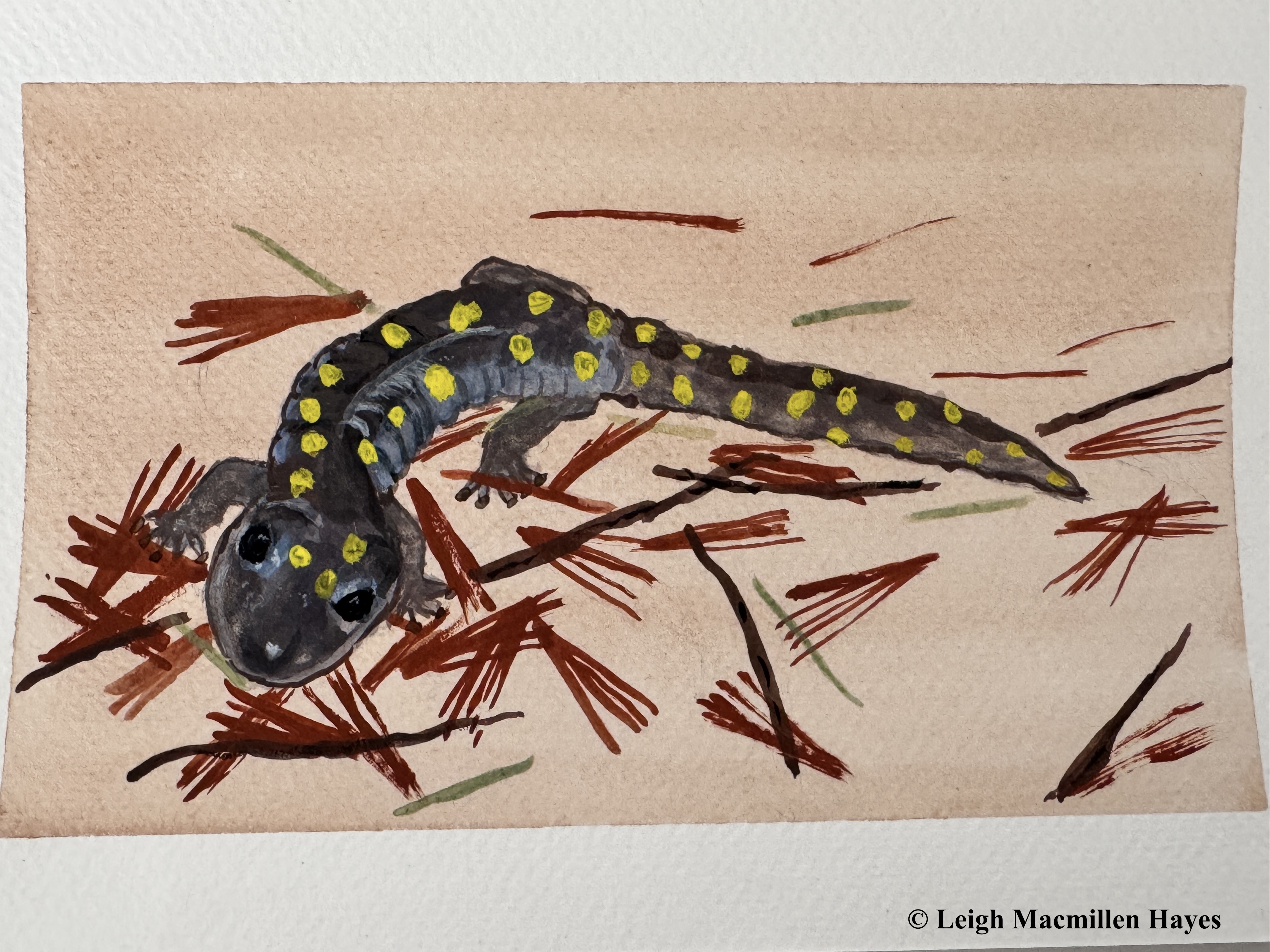
Another life form who uses the pool as a natal breeding spot is the spotted salamander and though I tend to mostly spy them on Big Night, I can tell by egg masses left behind that they have visited.

Their egg masses are a wee bit different from the Wood Frog masses, in that they have a gelatinous coating around the entire grouping, so they don’t look so tapioca-like. Mosquito larvae, tumblers at this stage, also wiggle about in the water.

And if I’m lucky, though this has never happened at the pool behind our house, I might see a fairy shrimp or dozens.

So here’s the thing: 40 Wood Frog egg masses make a pool significant; OR 20 Spotted Salamander egg masses; OR 10 Blue Spotted or Jefferson Salamander egg masses; OR a single, yes one, Fairy Shrimp. And this one is a female, as noted by the sac of dark eggs she carries.

Fairy Shrimp are cool because in order for eggs to be viable, the pool must dry out. And they can survive being dry for multiple years. And in any given year, not all eggs will hatch, thus saving some in the bank for another year or ten.

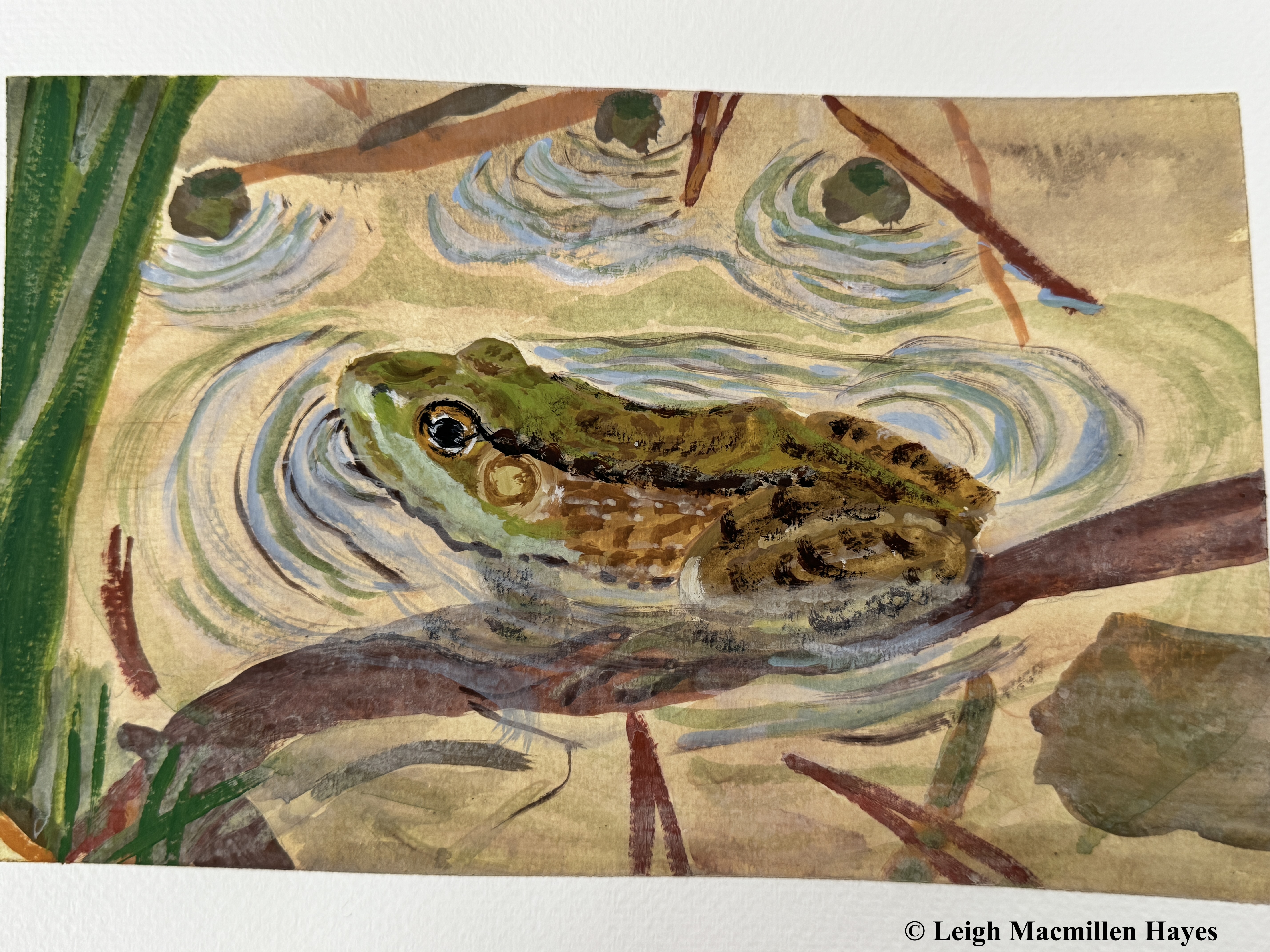
Hanging out by the pool, Green Frogs are always willing to dine on whatever is available. So the Green Frog has dorsal lateral folds (or bumps) along either side of its back that start behind the eyes.

The Bullfrog differs in that the line behind the eye circles around the tympanum (ear drum) and ends.

Here’s the other thing to remember: Males have tympanums larger than their eyes; females are smaller or equal to eye size.

And I like to think of this painting as a Frog-ersation.

This week I actually framed two paintings to send to friends, the Bullfrog being one of them.

There. I did it. Survived the art show.

As I bring this to a close, I realize there’s one more painting I should add to the collection, but I’ll save it to paint another day.

Thank you for marching into the vernal pool with me. I hope you are glad you did.

Happy Belated 10th Anniversary, wondermyway.com

I can’t believe I missed the date by two days. I’d been planning this for months. Well, in the back of my mind, that is. No actual thoughts were jotted down on paper. I just knew what I wanted to do and when I wanted to do it . . . until I forgot. Or rather, it slipped my mind. Momentarily.

No harm done.

As the saying goes, “There’s no time like the present,” and so my gift to you dear readers will be to give you the present of time by taking you back to the beginning of wondermyway and then making our way to the present. And all of it is because I was given the gift of being present in the moment on so many occasions. Egads. That’s a lot of presents. And presence.

Wonder My Way

My first blog post was published on February 21, 2015, and entitled Wonder My Way. It began with these paragraphs: Wonder my way as I wander through the Maine woods. So often I see things that make me stop and wonder. Sometimes I figure it out, but other times, I’m just as happy that I don’t. It’s The Sense of Wonder that Rachel Carson wrote about which keeps me going. Do we need to have all the answers? I think not.

So join me for a tramp from our woodlot to the world beyond. I know not where this trail will take us, but I can guarantee that we’ll have fun along the way. Read more . . .

Spring in Slo-Mo

Spring is so fleeting in Maine. Oh, I know, it lasts the usual three months and the beginning and ending overlap with its seasonal partners, but really . . . one must take time to pause and watch or you’ll miss the most amazing action that occurs in slow motion right outside the window–and beyond.

For those who are new to my blog, Jinny Mae, who is featured in this and many blog posts, was a dear friend whose name I turned in to an alias as she faced cancer courageously and rather privately. In the end, the cancer consumed her, but the things we enjoyed along the way were bountiful, including this spring adventure to an incredible space in our little neck of the woods. Read more . . .

Universal Love

Written on Valentine’s Day, this post was dedicated to My Guy and all who wander and wonder with me.

When I wander, hearts frequently speak to me . . . Read more . . .

Nothing To Grouse About

I shared a unique experience with five other naturalists, the majority of them in the six to eleven age range. For twenty minutes the six of us watched a Ruffed Grouse at it moved about, overturning leaves and foraging on buds. When we last saw it, the bird headed off in the opposite direction that we intended to journey, and so we moved on with wonder in our eyes and minds.

And then the next day I returned on a mission to study some twigs at the same property. No sooner had I stepped onto the trail when I heard the sound of leaves cracking a wee bit and what to my wondering eyes should appear but the same bird.

The curious thing: the bird followed me, staying about ten feet away as I tramped on. I stopped. Frequently. So did the bird.

And we began to chat. I talked quietly to him (I’m making a gender assumption) and he murmured back sweet nothings. Read more . . .

Amazing Race–Our Style

Okay, so My Guy and I have enjoyed The Amazing Race show over the years and felt like there were some challenges either or both of us could face, but others that neither of us would dare attempt. And so . . . I created our own version.

The thing is that until I take the time to change the order of this post on my website, you’d be best to start at the bottom and read each entry, going up one step at a time. As in, this: Scroll down to February 18 on this link and then after reading that entry, make your way up one episode at a time, until you reach the last recorded on February 2, 2019. Oh heck, read it in any order that pleases you. Just get into the spirit of the race I created cuze I certainly had fun with it. And fooled a few people along the way.

The Amazing Race–Our Style

I’m sure when we said our wedding vows back in 1990, there was something in there about only riding a snowmobile once. And I did that once two years or so ago–mostly because I knew it would please my guy. Certain memories remain from that experience: I felt like a bobblehead inside the helmet; I lacked control as I sat behind him and couldn’t see; when I did peek around, I was sure my head was going to strike a tree so narrow was the trail; and I didn’t like the speed. Oh yeah, and at a road crossing, I do believe I jumped off and walked to the other side. With all of that in mind, I’m not sure what I was thinking when I created a Valentine’s gift for him–our very own Amazing Race. Read more . . .

wondermyway turns five

Five years ago today (ten now!) I turned from taking a hundred million photos on each tramp to taking a hundred million photos and writing about them.

Typically, on the anniversary I scan the past year’s posts and choose one from each month, providing a photo to represent it, with a brief (or not so brief) comment and link to the full read.

But . . . because this is a milestone I never imagined reaching (posts: 733; views: 76,793; visitors: 44371; followers: 578), I thought I’d take the time to thank you, the readers, for wandering through the wonders with me.

Thank you! Read more . . .

Dragonfly Whisperer Whispers

We had no intention of eating lunch in this spot today, but while looking for a mountain to climb, we kept encountering full parking lots and so our backroad meander put us beside a bog at lunch time and voilà, we managed to walk all of less than two tenths of a mile. Total.

But in that short distance, our eyes feasted. First it was all the Painted Turtles basking in the sun. Read more . . .

Surveying the Wildlife of Charles Pond

For the past two weeks at Greater Lovell Land Trust we’ve had the good fortune to conduct a wildlife survey in the waters that surround the newly acquired Charles Pond Reserve in Stow, Maine. Our hats are off to Alanna Doughty of Lakes Environmental Association (LEA) for her willingness to be the lead on this project and work in collaboration with us. Alanna, you see, has conducted previous surveys for Maine Inland Wildlife & Fisheries (MDIFW) at LEA properties, and was trained by wildlife biologist Derek Yorks to set these up.

MDIFW maintains a comprehensive database on the distribution of Maine’s amphibians and reptiles, as well as terrestrial and freshwater invertebrates and the data we’ve collected will add to the bigger picture. What we discovered was just as important as what we didn’t find. Read more . . .

Hightailing It Home

Friends,
At the risk
of sounding redundant,
I bring forth
a prickly topic.

A quick glance
while surveying treetops
and suddenly
my heart sang
as I spotted
a well-armored back.

Read more . . .

Happy 9th Birthday, wondermyway!

Thank you to all who read and comment and share wondermyway.com. Some of you have followed my blog posts since the beginning, February 21, 2015. A few have joined the journey as recently as yesterday. I’m grateful for the presence of all of you in my life.

To mark this occasion, I thought I’d reflect upon those moments when my wonder gave me a glimpse of the “Thin Places” that I’ve experienced either by myself or in the company of others.

To quote my friend, Ev Lennon, “A Thin Place is a spot of beauty, loveliness, space–an example of the wideness and grandeur of Creation.”

I think of them as places that you don’t plan a trip to visit, but rather . . . stumble upon.

Read more . . .

And that brings me to this year and this anniversary, belated as it may be. I can’t believe it’s been ten years since I started this endeavor, which has served as my diary and memory, and been a place for me to share so many incredible extraordinary ordinary experiences with all of you. Thank you for being faithful readers.

As I compare the numbers to year five, I haven’t written as often in the last five years, but your support has been incredible.

wondermyway.com by the numbers:

Posts: 1,076

Visitors: 135,888

Views: 205,389 and increasing constantly.

The most popular post of this new year was Giving Thanks for the Pileated Woodpecker. So far, anyway.

The Giant’s Shower

And since I retired as Education Director for a local land trust just over a year ago, I’ve added some other fun to the mix.

I did a thing. Years ago I wrote a children’s story. Well, a bunch of them actually. And I tried to sell this particular one to publishing houses. No takers. Then, a couple of years ago I purchased a Fairy Coloring Book created by the one and only Solana, teenage daughter of the Fly Away Farm Wards in Lovell and Stow, Maine, and approached her about illustrating my fairy tale. She took on the task and did an amazing job. Then I asked copyeditor Pam Marshall to wave her magic wand over it. And I asked local graphic designer Dianne Lewis to use some fairy dust and turn it into an actual book. I always said I’d never self-publish a book. And tada: I did just that. And now it’s even better because it’s published by http://www.indieauthorbooks.com.

Read more . . .

My Art Gallery

At the end of April I began taking an art class offered by one of my peeps, a young woman who walked into the lives of many of us one day about twenty months ago; a young woman with a million talents to offer. Among those talents, she is a self-taught artist and we’ve been begging her to teach us.

At our first class, we had to draw a small box in the upper left-hand corner of the paper and place the person who has been our biggest art critic into it. That done, the critic was forever boxed–well, until she sneaks out, which she seems to do way too much.

And then we looked at some photographs in magazines and had to sketch them and determine the direction the eye would travel in the picture.

Next we looked at lines and perspective. I’d brought along my favorite colored pencils, but immediately felt my inner critic jump on me because all of my classmates were working with watercolor pencils, watercolor paint or acrylics. And the artist herself, gouache. Until I met her, I’d never even heard of gouache. Or at least never paid attention, if I had.

Read more . . .

Lake Living on Lake Region Television!

And we said goodbye to Lake Living magazine, a glossy publication I’ve worked on since 2006.

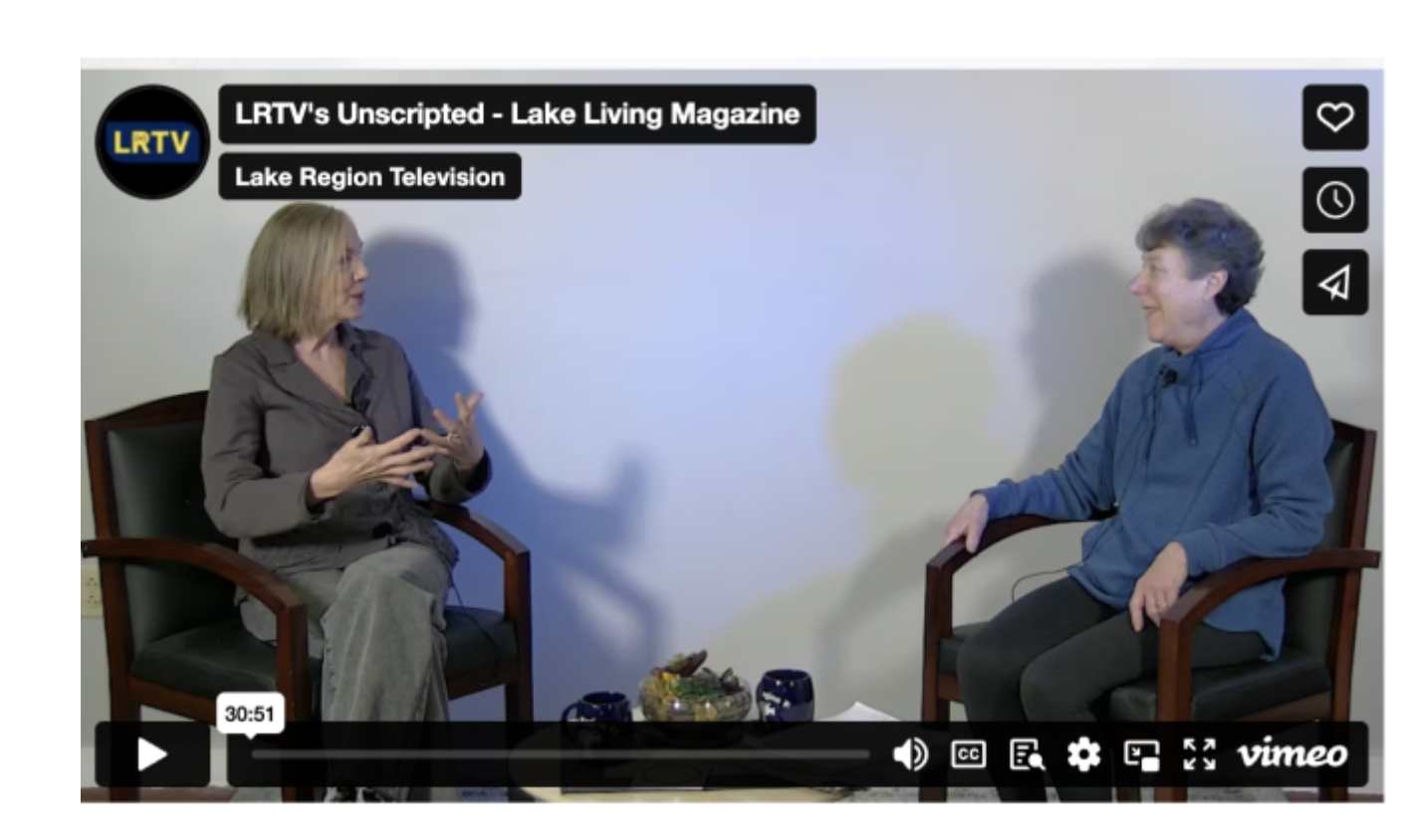
We are movie stars! Well, maybe not quite. But, many, many thanks to Evan Miller of Lake Region Television for filming and editing Laurie LaMountain, owner and publisher of Lake Living magazine, and me recently as we said, “Fare Thee Well,” to working on this publication.

Read more . . .

And in the midst of it all, I still have the good fortune to share the trail with so many others . . .

and especially with My Guy, who is forever patient as I pause to consider the wonder of the moment.

My heart-felt thanks to him and to all of you for joining me so often as I wondermyway.

Wowza–ten years! I never imagined. No time like the present to wish wondermyway.com a belated 10th anniversary.

My Bright Idea: Filled with Awe and Wonder

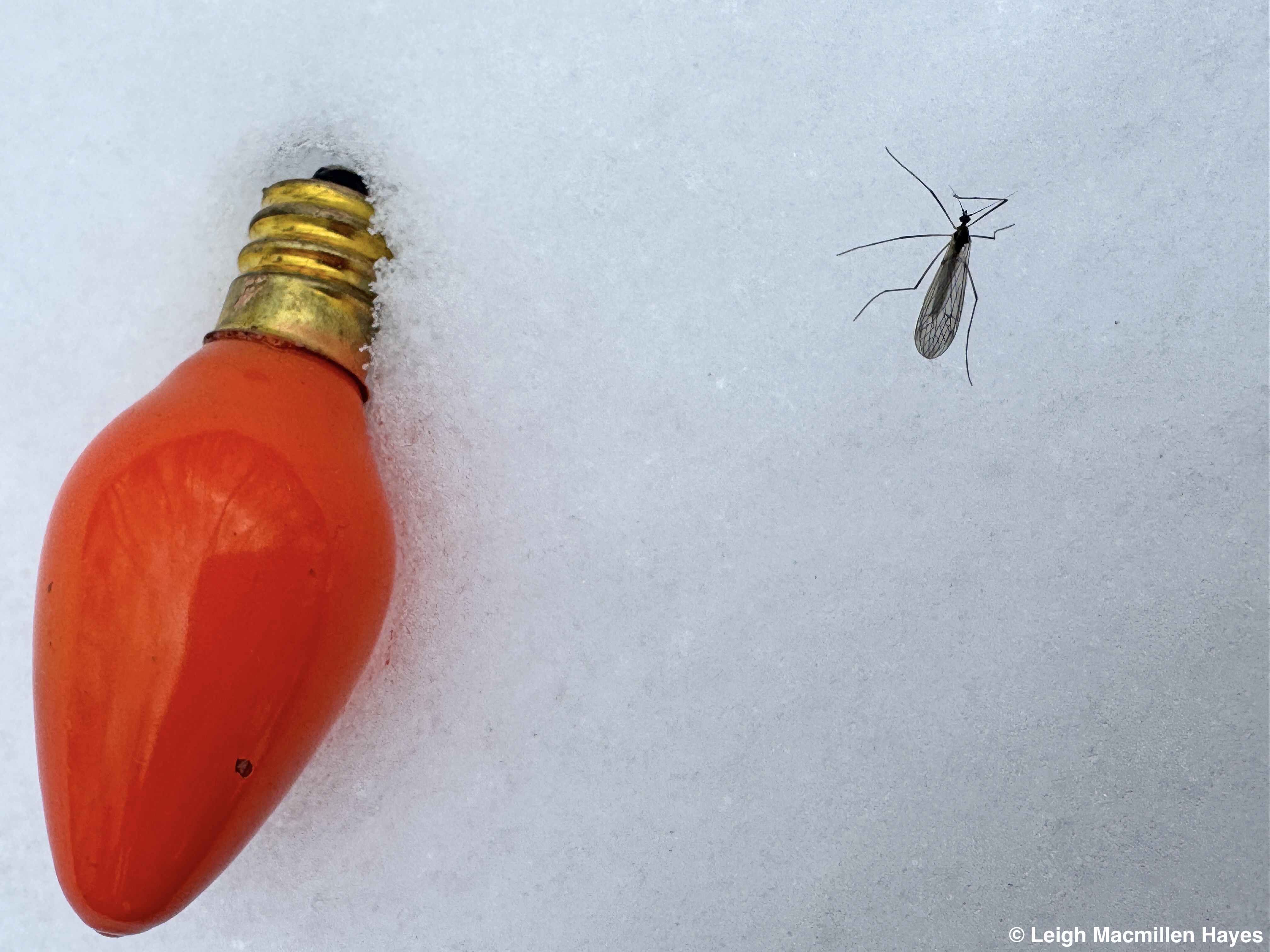
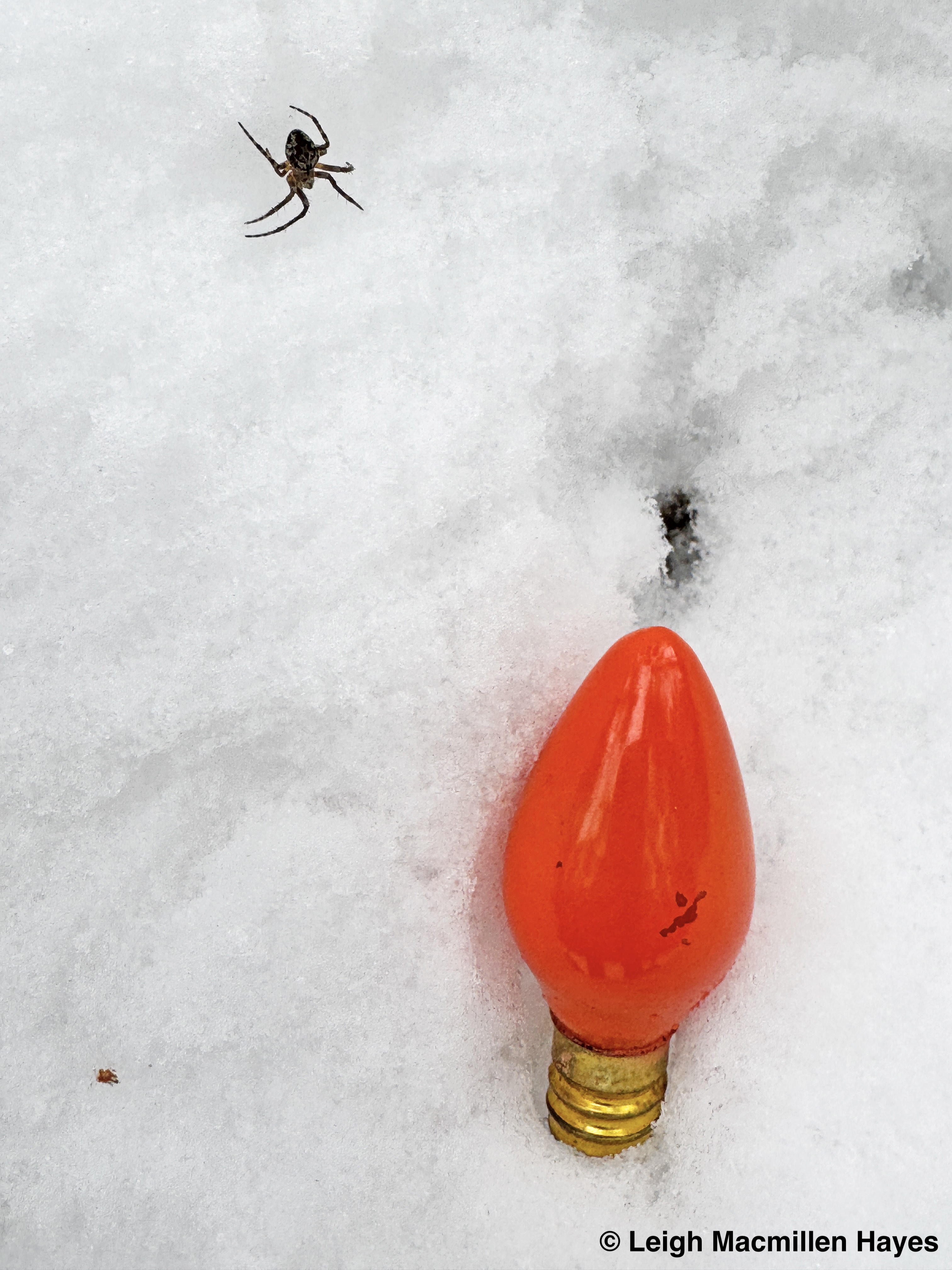
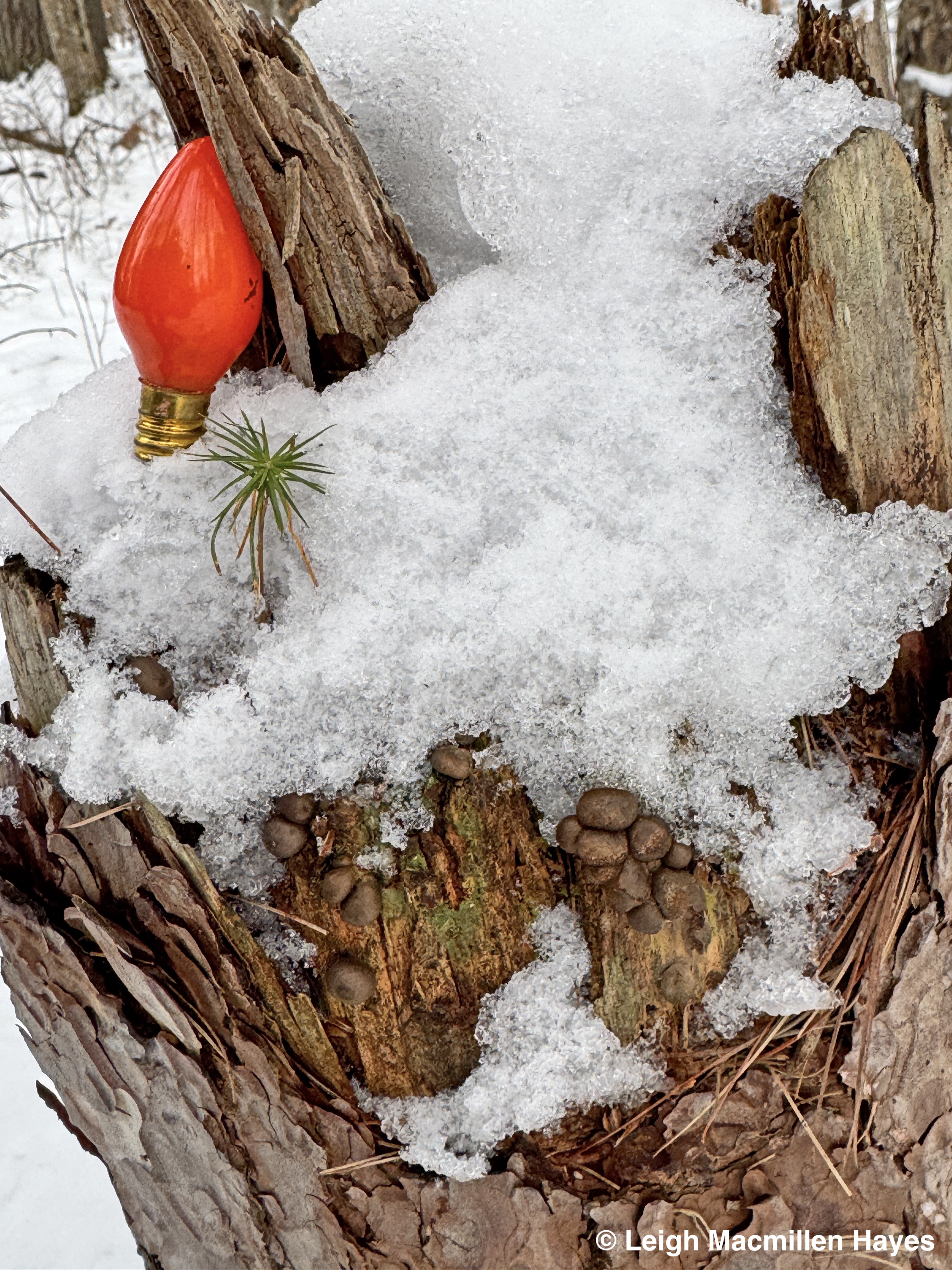
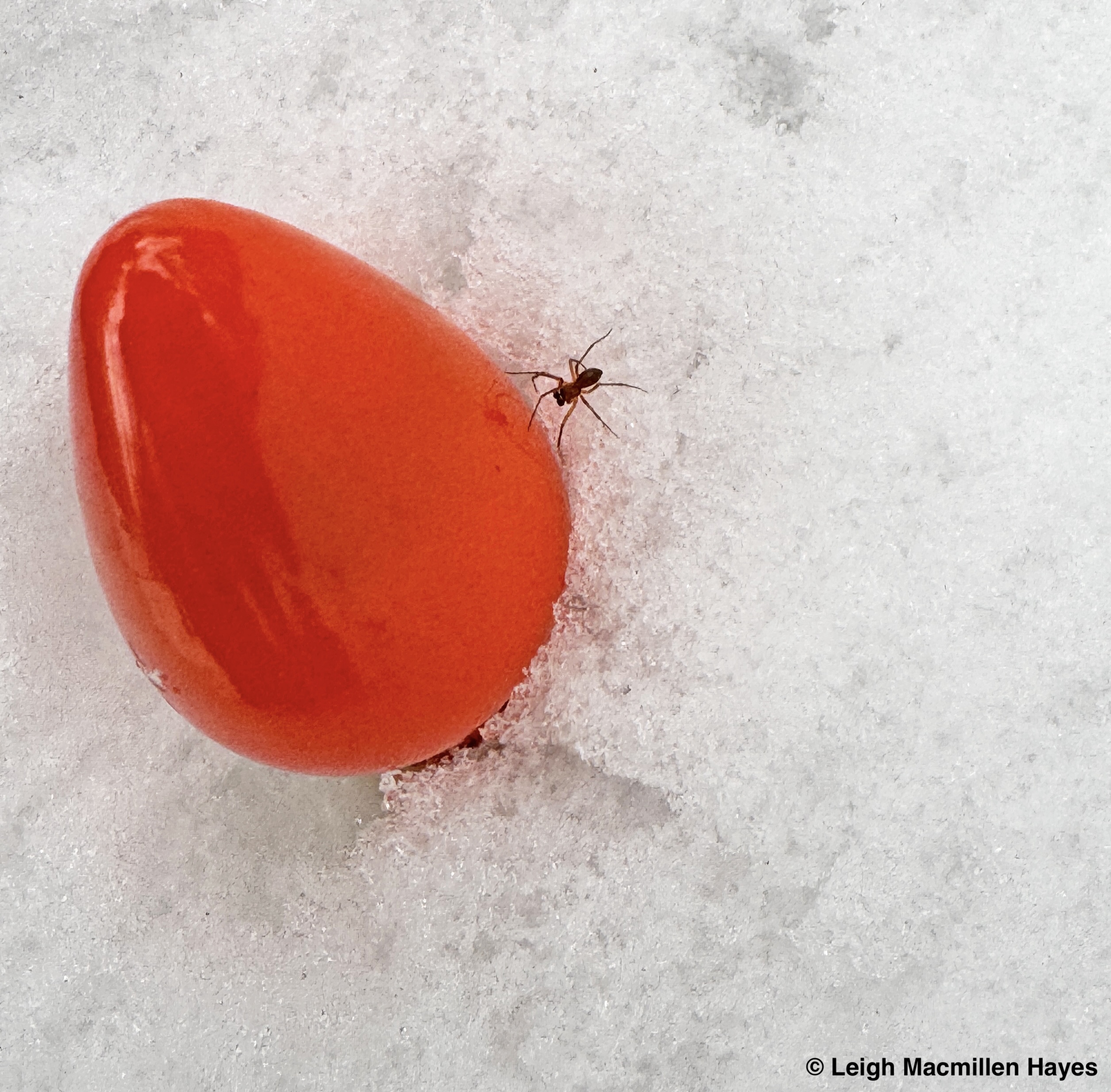
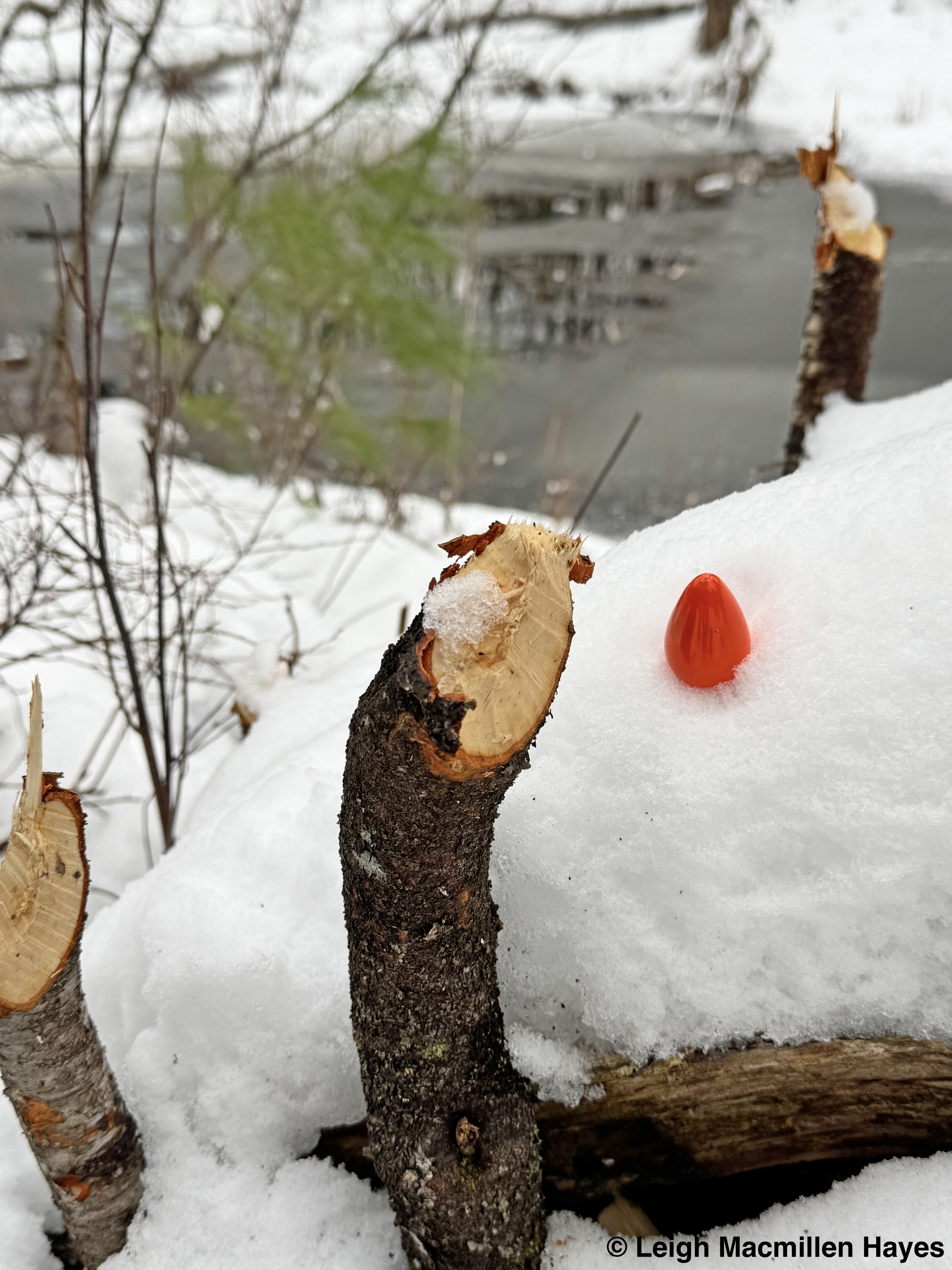
Just as I stepped out the backdoor this afternoon, I realized I really should have something in my pocket to use as a reference because the snow conditions were perfect. And so I grabbed the nearest object, which happened to be an old orange Christmas bulb that no longer brightens a tree, but serves as a reminder of past holidays in my parents’ home. Not exactly a tracker’s go-to instrument, but it does measure two inches in length.

I suppose I shouldn’t have been surprised to spot Snow Fleas, aka, Springtails atop the snow, but I was. They always strike me as more of a February event, but really, they are always on the leaf litter below the snow, we just don’t take the time to look. And today’s temperature felt a bit like February leaning into March, a rather pleasant reprise from the frigid temps of the past week. And so these insects made their way up through the snowpack to do their thing: dine on fungi and decaying matter that I couldn’t see.

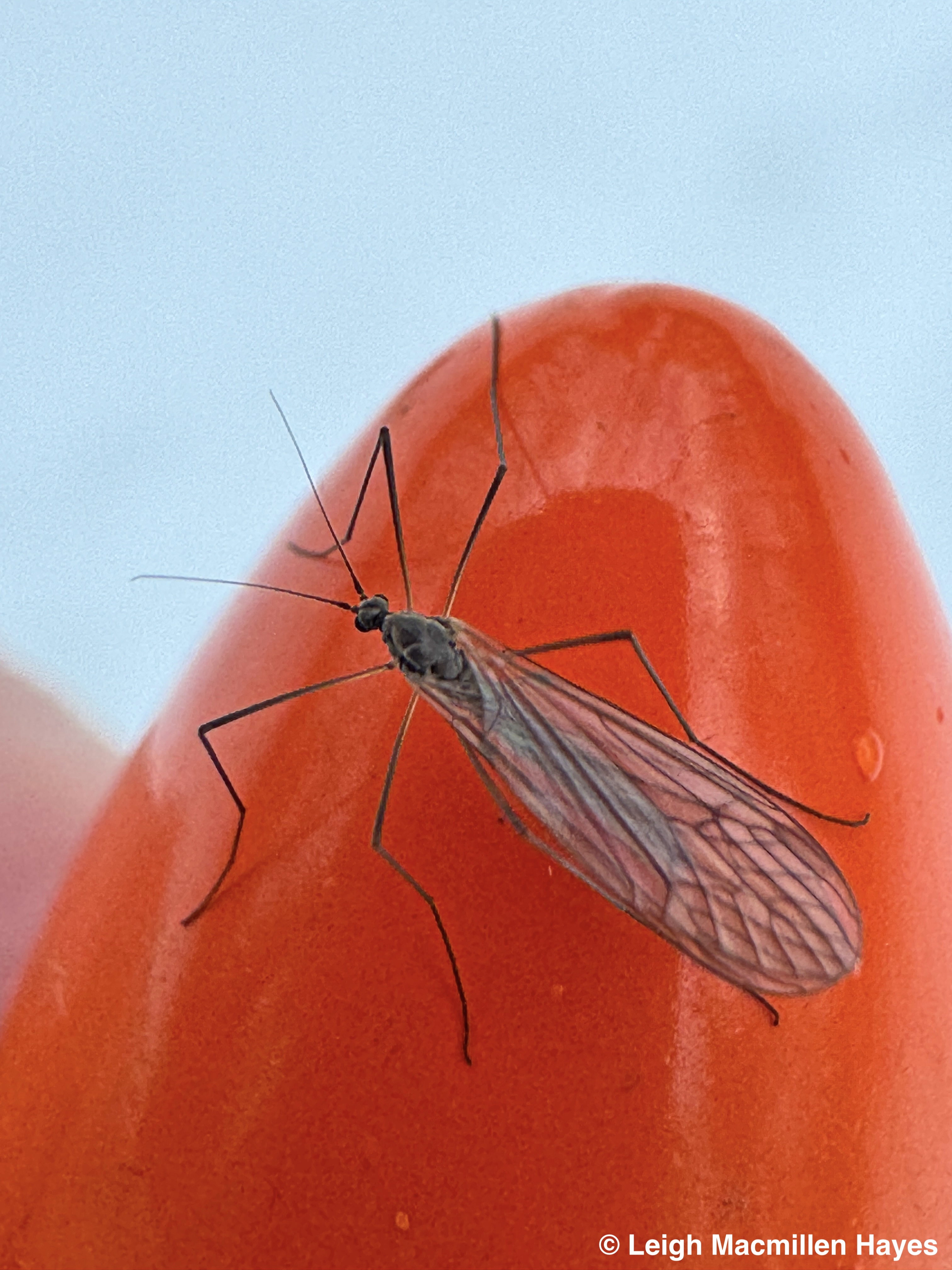
Also flying about and landing, Winter Craneflies, which are smaller than their summer cousins, but still have the long legs and transparent wings. They were everywhere–both flying and walking on snow.

And even the bulb! That was a bit of an experiment because I wondered if the Crane Fly would climb up once I placed the bulb in its face–much like when I can entice a dragonfly to do the same. Voila!

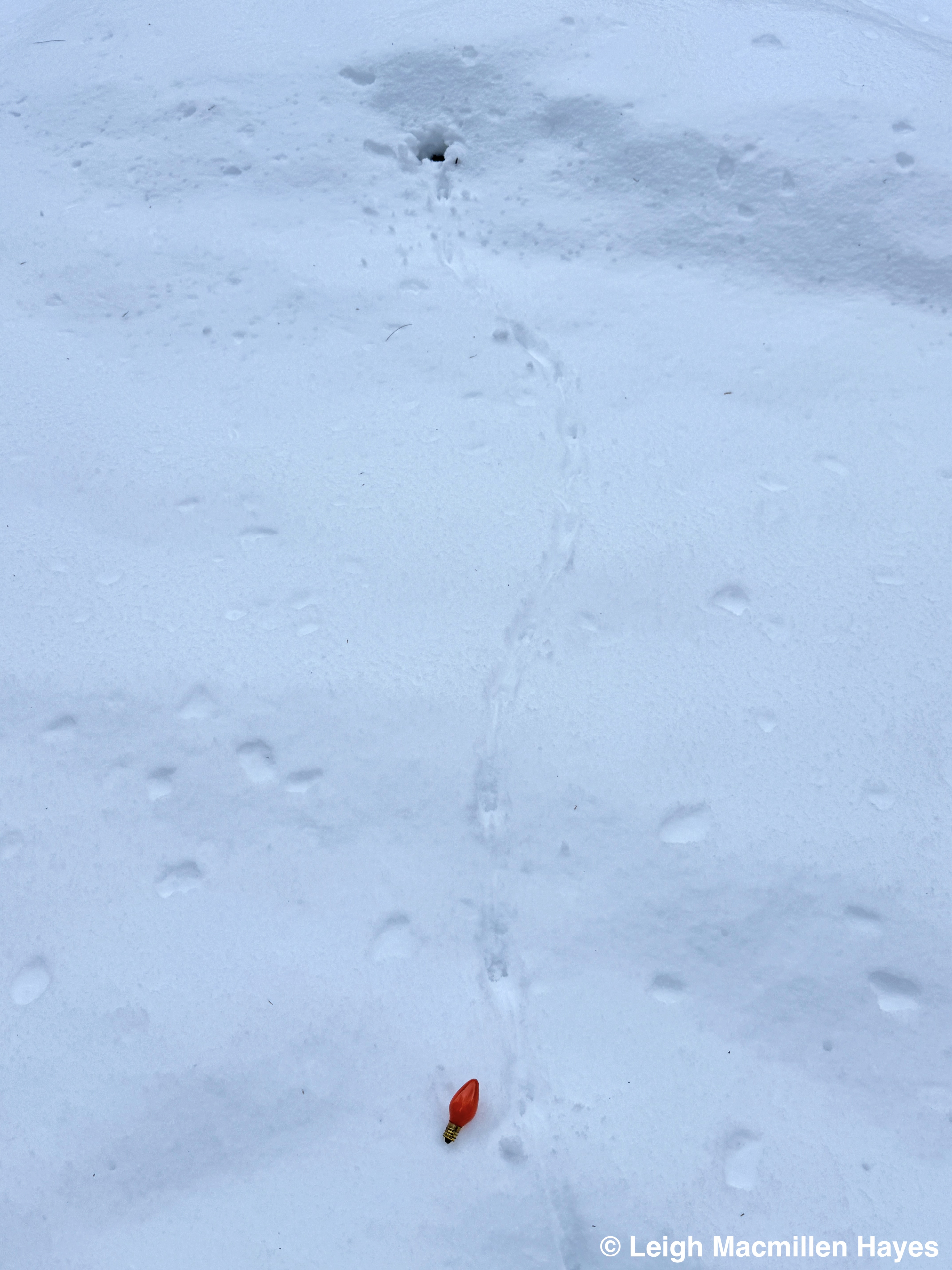
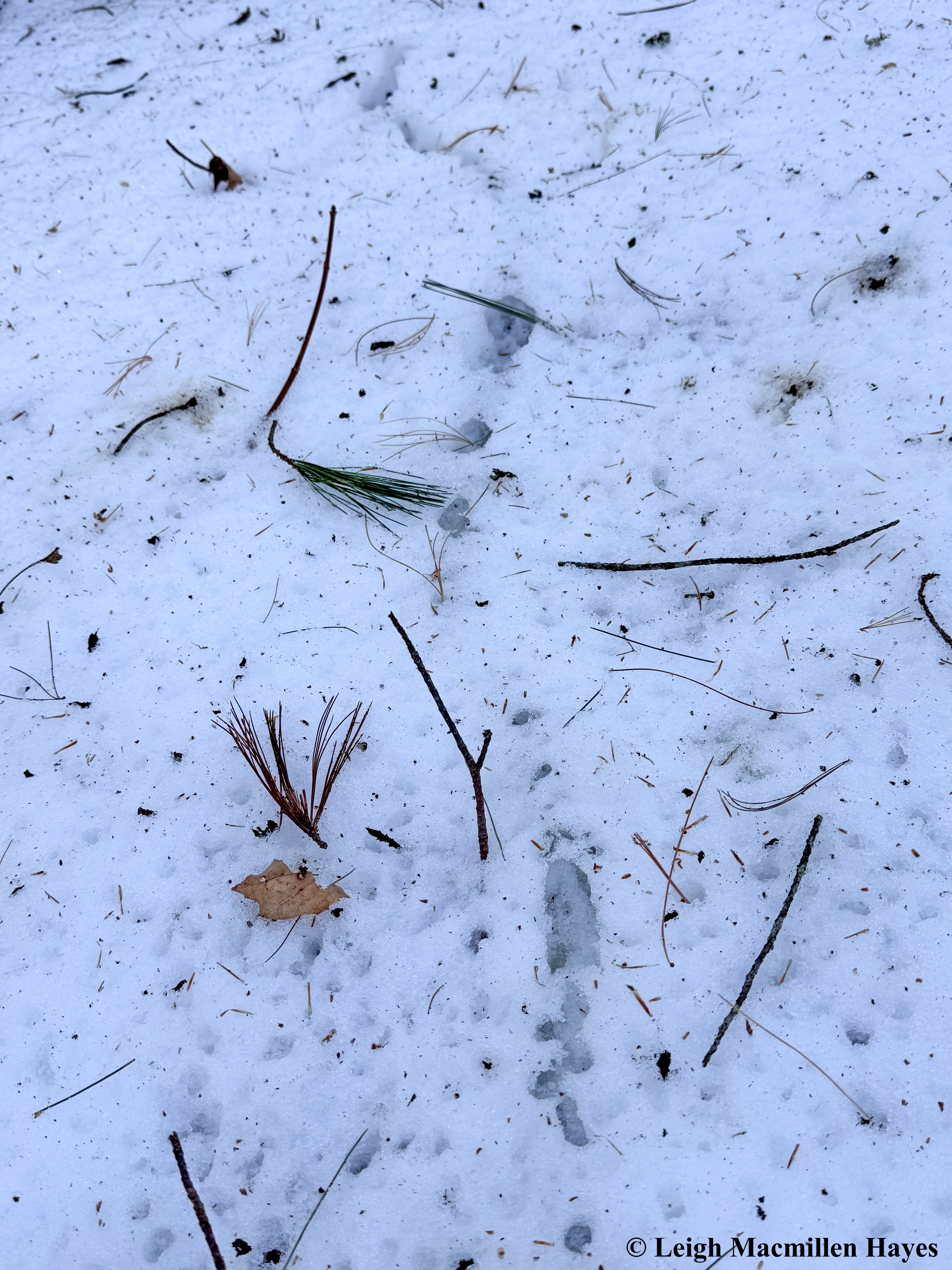
It wasn’t just insects to exclaim over and a few feet later I discovered the impressions of feet of another traveler. The prints left behind on one side of me indicated a hopper/leaper of the mini-kind. And it entered the snow as indicated by the hole at some vegetation that I knew grew below.

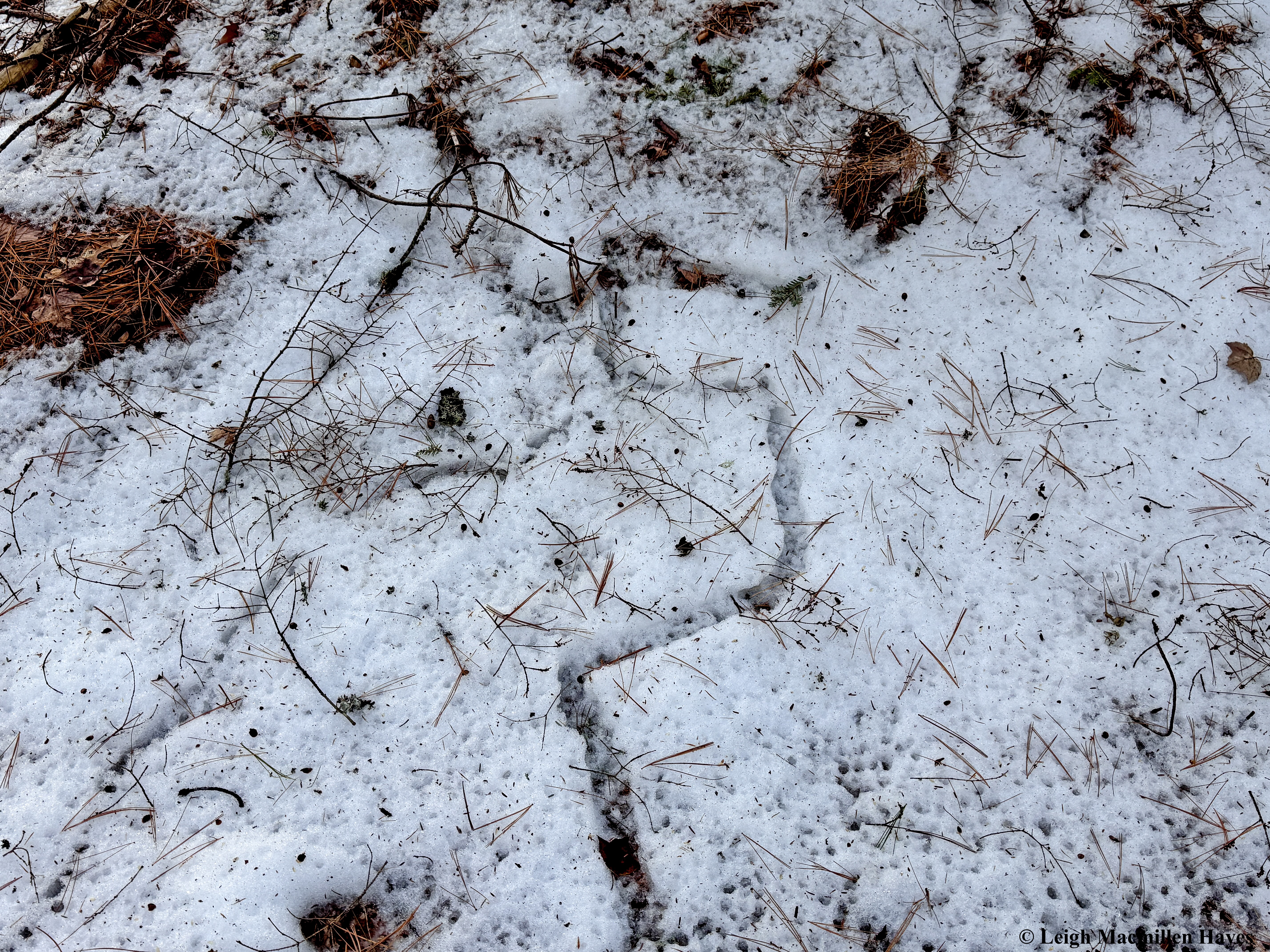
What really gladdened my heart was seeing that on the other side of my feet, its gait changed and I knew my identification was spot-on: a Vole who can change from a hopper/leaper to a perfect walker, where one foot packs the snow down and the next foot lands in the exact same spot creating a trail that looks a straight line with a zigzag twist.

Next up to shine the light bulb on–a spider! Walking on snow also. Many spiders are winter walkers and weavers and I was thrilled to spot this little one.

It had a pretty snazzy pattern and I believe it to be an orbweaver.

Then I began to play with the bulb, and spotted a tree with a hole that invited a fitting. I was admiring the tree’s bucketload of Ulota crispa, or Crispy Tree Moss, when something else caught my eye.

Below where I’d placed the bulb was the leftover molt of a tussock moth caterpillar. My, what spiny hairs you have. You make the spider’s hairs seem almost not worth mentioning. So I didn’t.

For a few minutes, trees continued to hold my attention, including this one, grafted into an H. Sometimes I think the H trees were created for me.

And not the be outdone, the Northern Red Oak showed up a brilliant display of its inner “red,” which seemed a perfect match for my bulb.

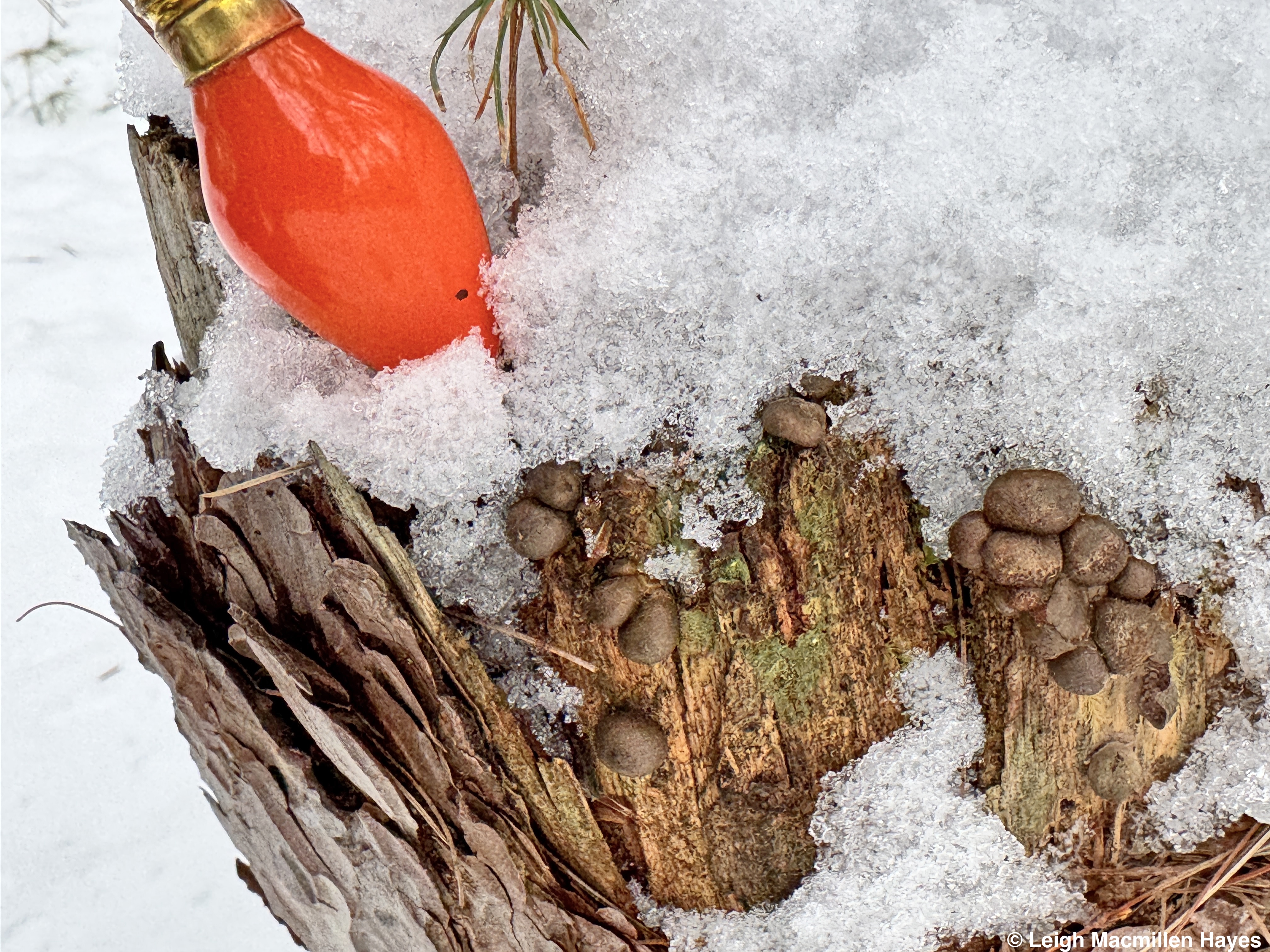
Upon a Red Pine tree stump, the bulb stopped again, this time to shine a light on a tiny pine sapling that resembled a palm tree. Whether the sapling is a Red Pine or White, I failed to figure out because my attention was consumed by something else.

The bulb changed its position to point downward, highlighting the Wolf’s Milk Fungi that grew below the sapling.

And my playful spirit did what it often does when spotting this species. I found a small stick and poked the little puff balls, which released its spores in a smoke-like manner. I can’t show you the action, but you can see the results of the dried salmony-brown spores atop some of the now-deflated brown balls.

Over the past week and half, about a foot of snow has fallen here in our neighborhood and last night’s addition, plus today’s slightly warmer temps made for some great tracks as I’d already witnessed with the Vole. Gray Squirrels also left their marks–the two smaller feet in the back being their front feet. That always feels like a bit of a stretch until you watch a squirrel move across the landscape.

There was another tree, or should I say pair of trees, that I paused by for a bit because I think of them as a landmark ’round these parts. I love introducing others to these two–the Yellow Birch growing as it does atop a White Pine. I can just imagine the stilts the birch will stand upon when the pine finally finishes rotting away.

As I admired the trees, I noticed something else. My squirrel friend had hopped up, but I can only imagine it didn’t manage a good landing, for there was only one foot impression left behind. In my mind’s eye, I could see him tumbling down–had another squirrel tried to attack from behind?

In the past year, I’ve gotten back into sketching and have been learning to paint, and now see the world through different eyes and know that I’ve walked past this barbed wire many times before, but never noticed it. Today, it looked like an artistic insect in acrobatic motion and love how the bulb found its way into the display.

As I finally headed toward home because darkness was settling in, another spider crossed my path and so I set the bulb before it.

And the spider quickly walked away. Perhaps orange isn’t its color.

To say I went without expectations today would be wrong. For I truly thought I’d see the creator of these works of art since they were made this past week. I did not.

Instead, I came away with revelations and rejoiced in letting my playful spirit run free as I was filled with awe and wonder.

As for the light bulb–it was a bright idea! A brilliant one, really.

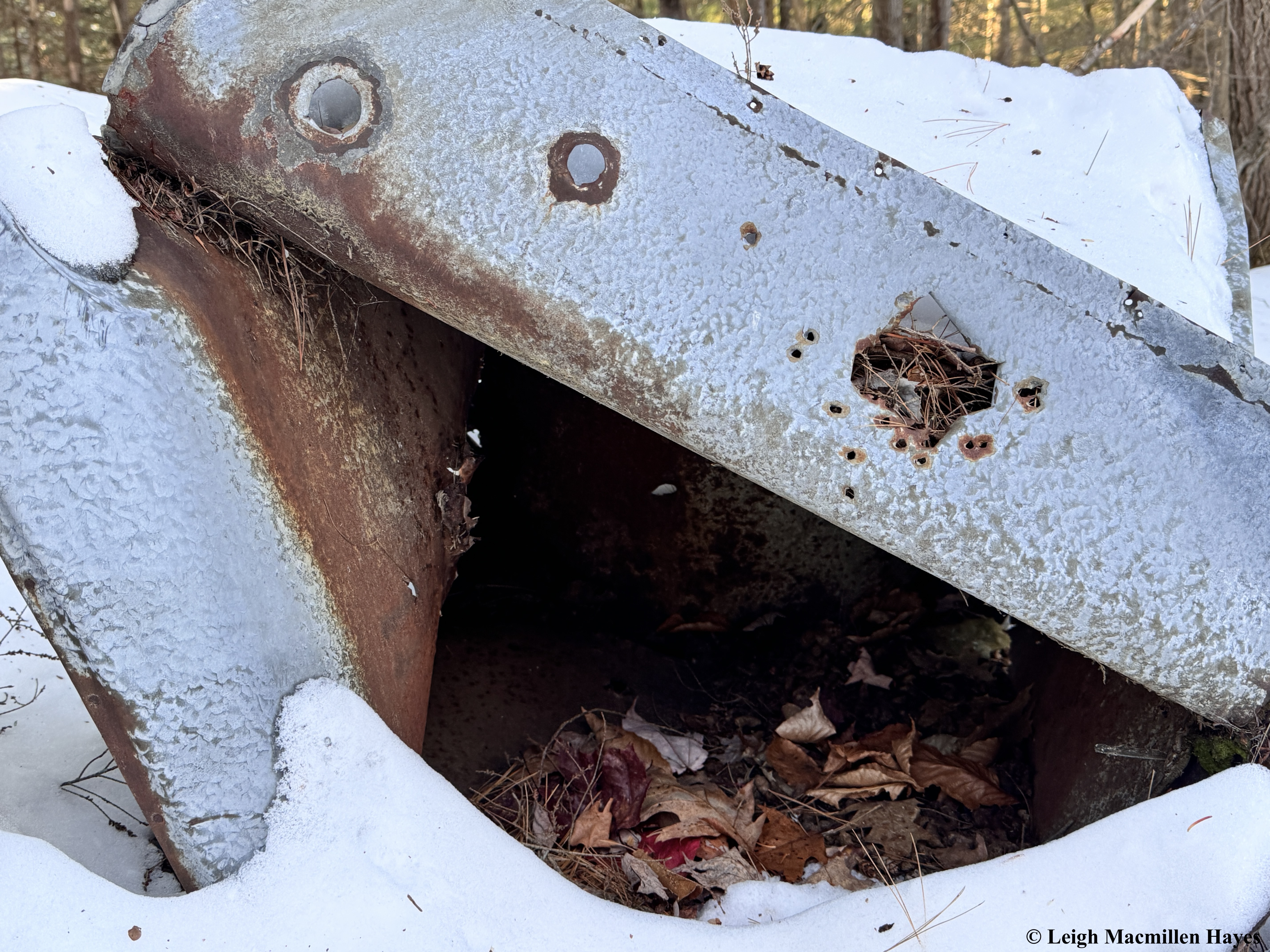
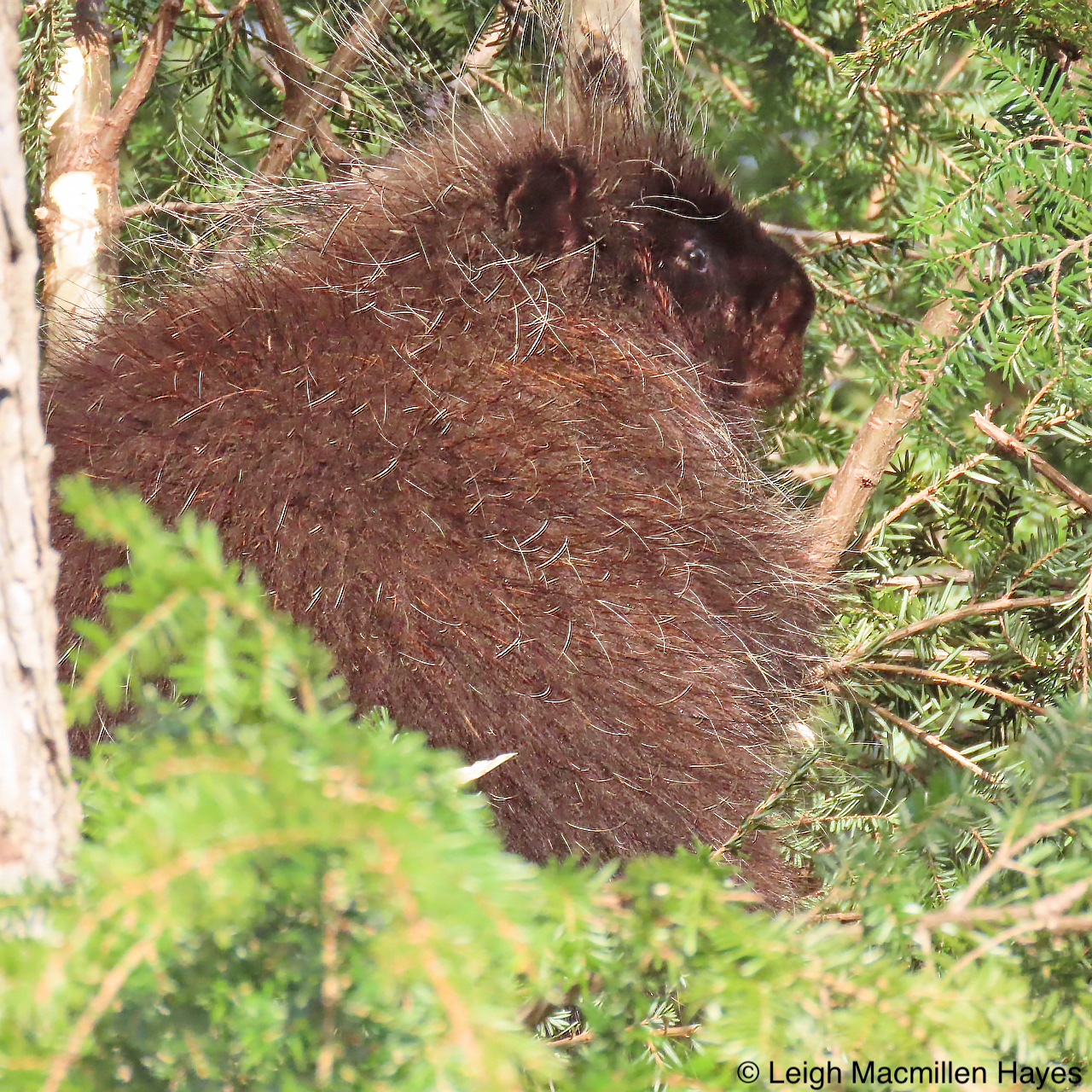
The Inside Out Porcupine

This story begins at about 5:10am on November 5th. I awoke to a noise that immediately became plural–and the ruckus sounded like it was taking place in the barn that is attached to our old farmhouse. For about fifteen minutes things shifted and banged and dropped, and then all was silent. My Guy slept through it all.

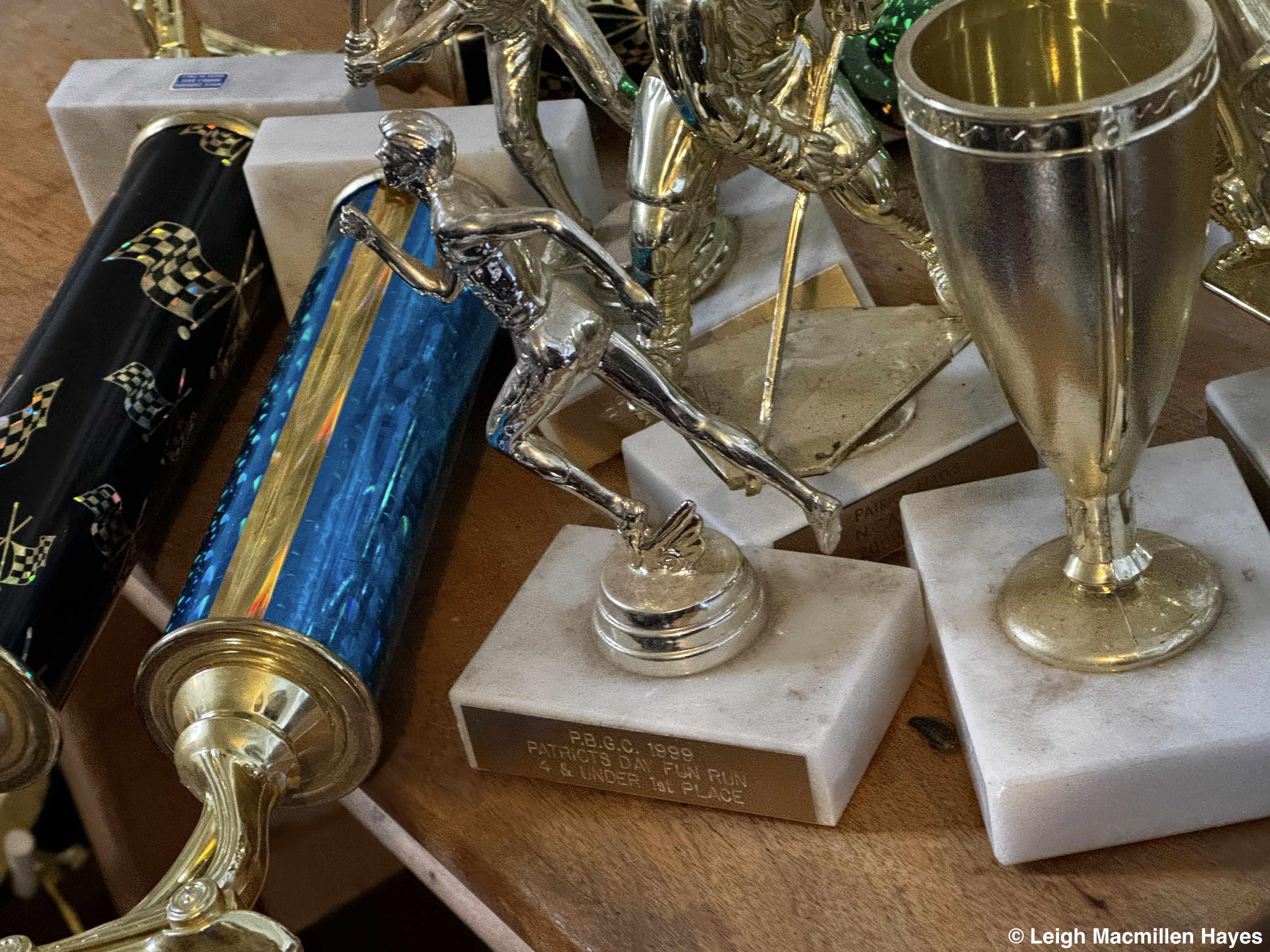
At lunch time, however, he did as I asked, and climbed to the hay loft to find out what had happened. And that’s when he discovered that I really did hear things dropping, for the myriad trophies our sons “earned” years ago for soccer, and peewee football, and golf, and baseball, and basketball, and hockey, and Pinewood Derbies, and who knows what else, were astray.

I’m going to digress for a minute or two, but really, it was the more creative trophies they received that I like the best like these from Boy Scout Cake Bakes.

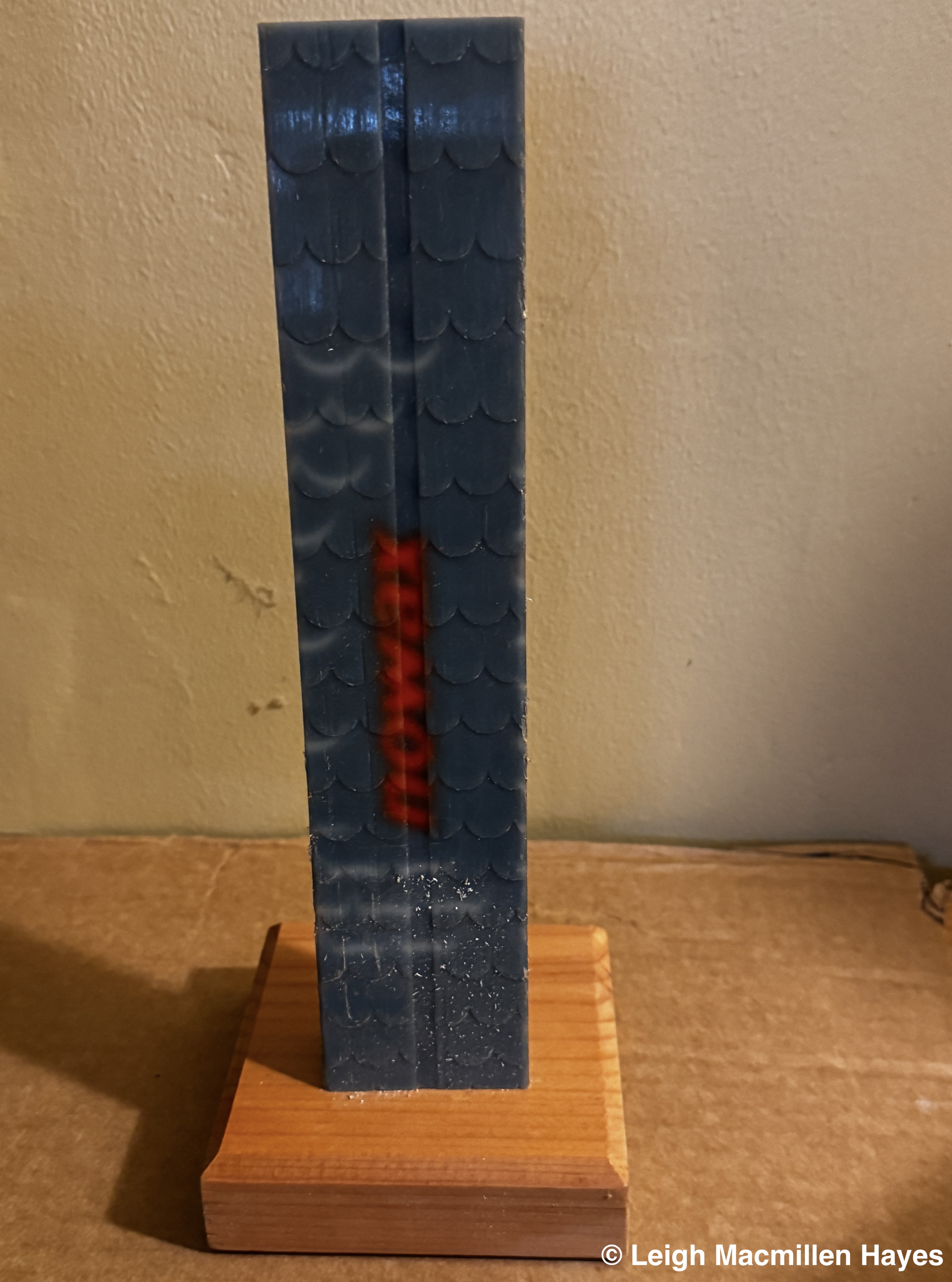
And this one for being the king of Nordic Ski Team ski waxing.

Now back to the barn: As My Guy poked around, and there’s a lot of stuff up there right now because we’ve torn up the floor boards on the first level in anticipation of saving the structure and making it safe to park a vehicle in there again, he made a discovery and quickly sent me a photo because I wasn’t home.

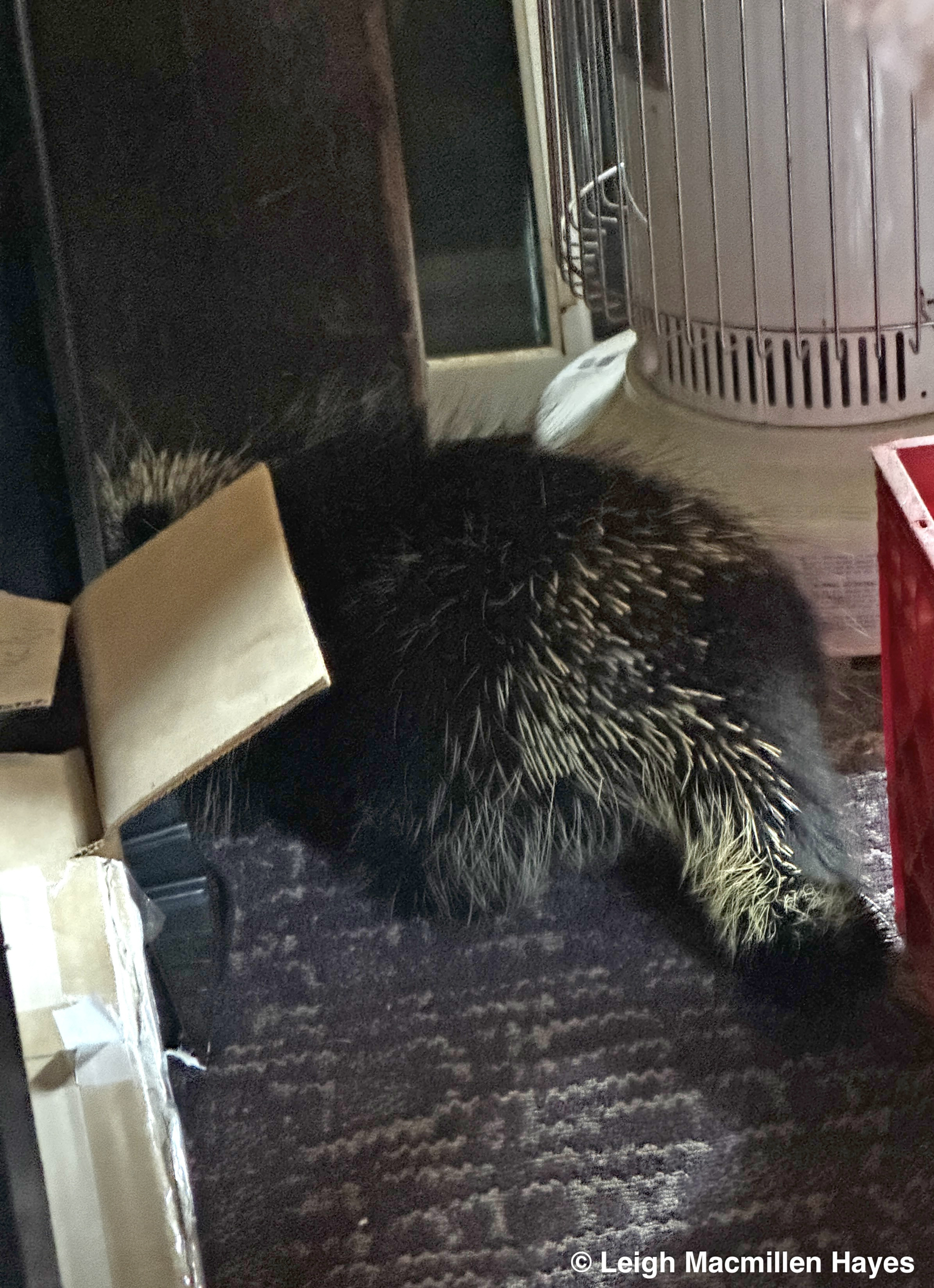
A porcupine was snoozing under the Air Hockey table!

We set a trap that I hoped the critter would evade. And it did. My Guy also made quite a lot of noise the next day and saw Porky move from under the table to below a chair. And then he couldn’t find it.

Checking on the situation again a day or so later, we discovered Porky had indeed done some work–beginning with chewing the window and sill.

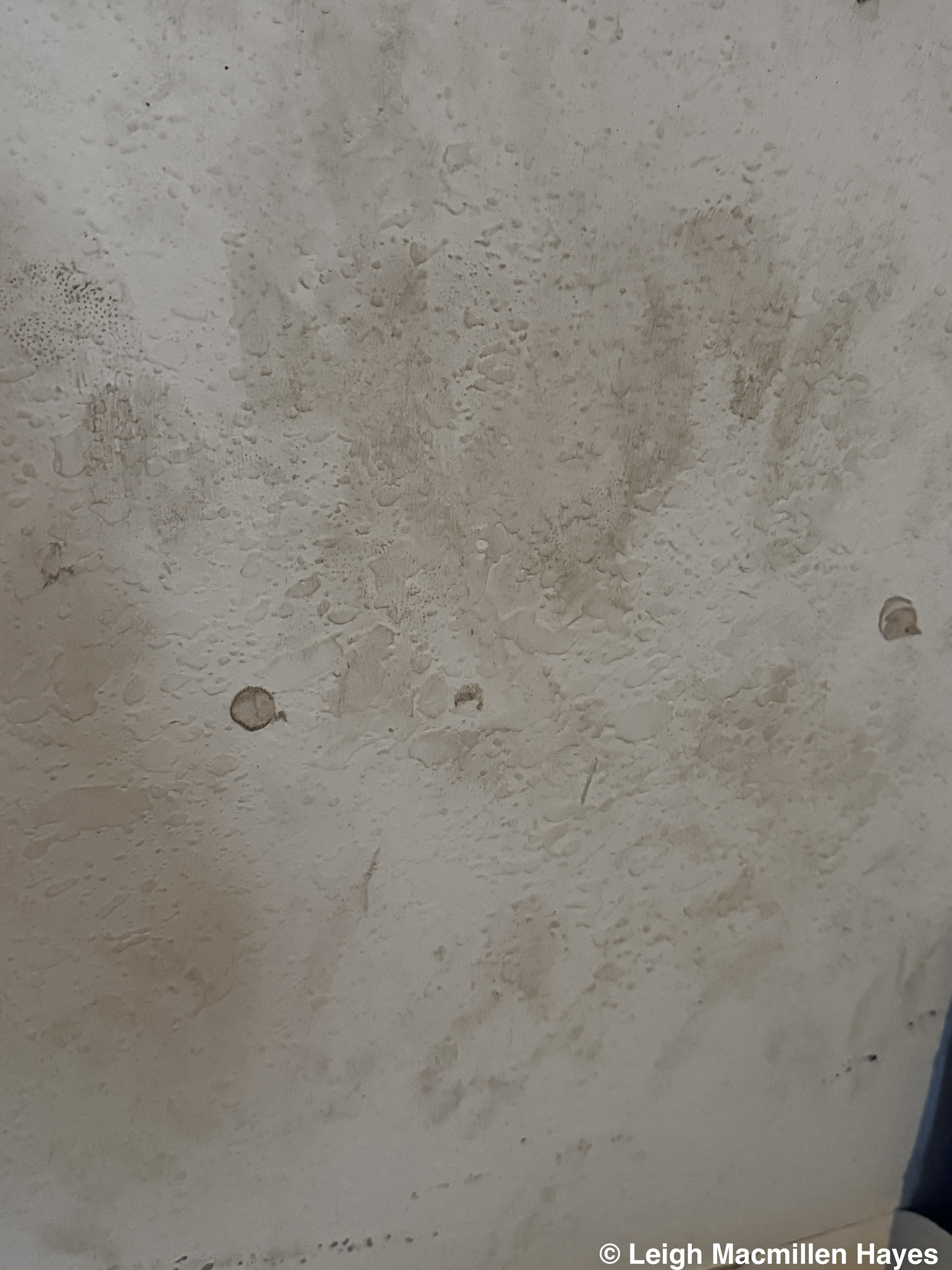
And he left signs of his adventures, including muddyish footprints on the wall below the window.

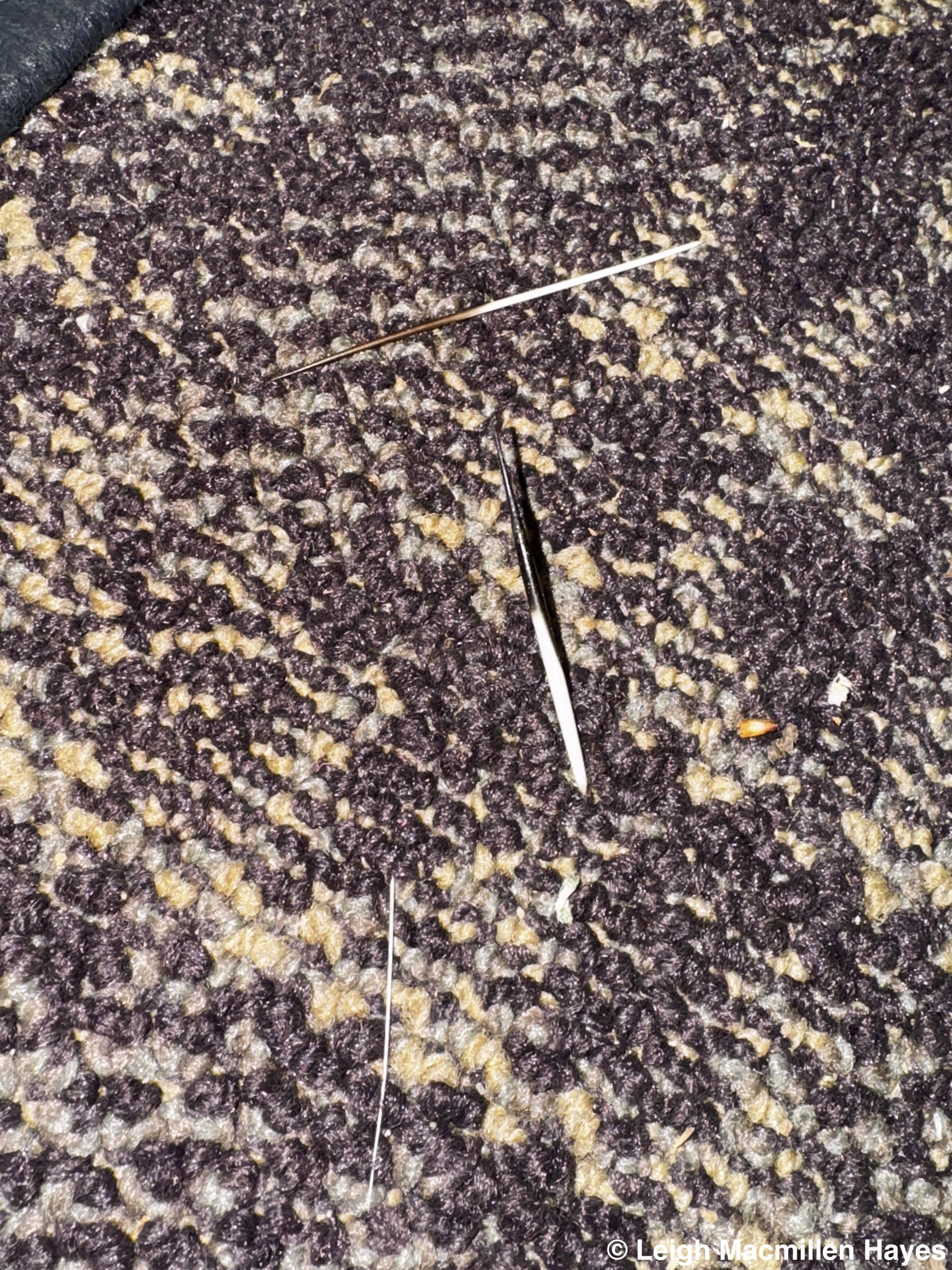
And quills scattered about, some even sticking into the rug originally placed because this had been a Rec Room back in the day when our sons were young. Right now it’s a Wreck Room!

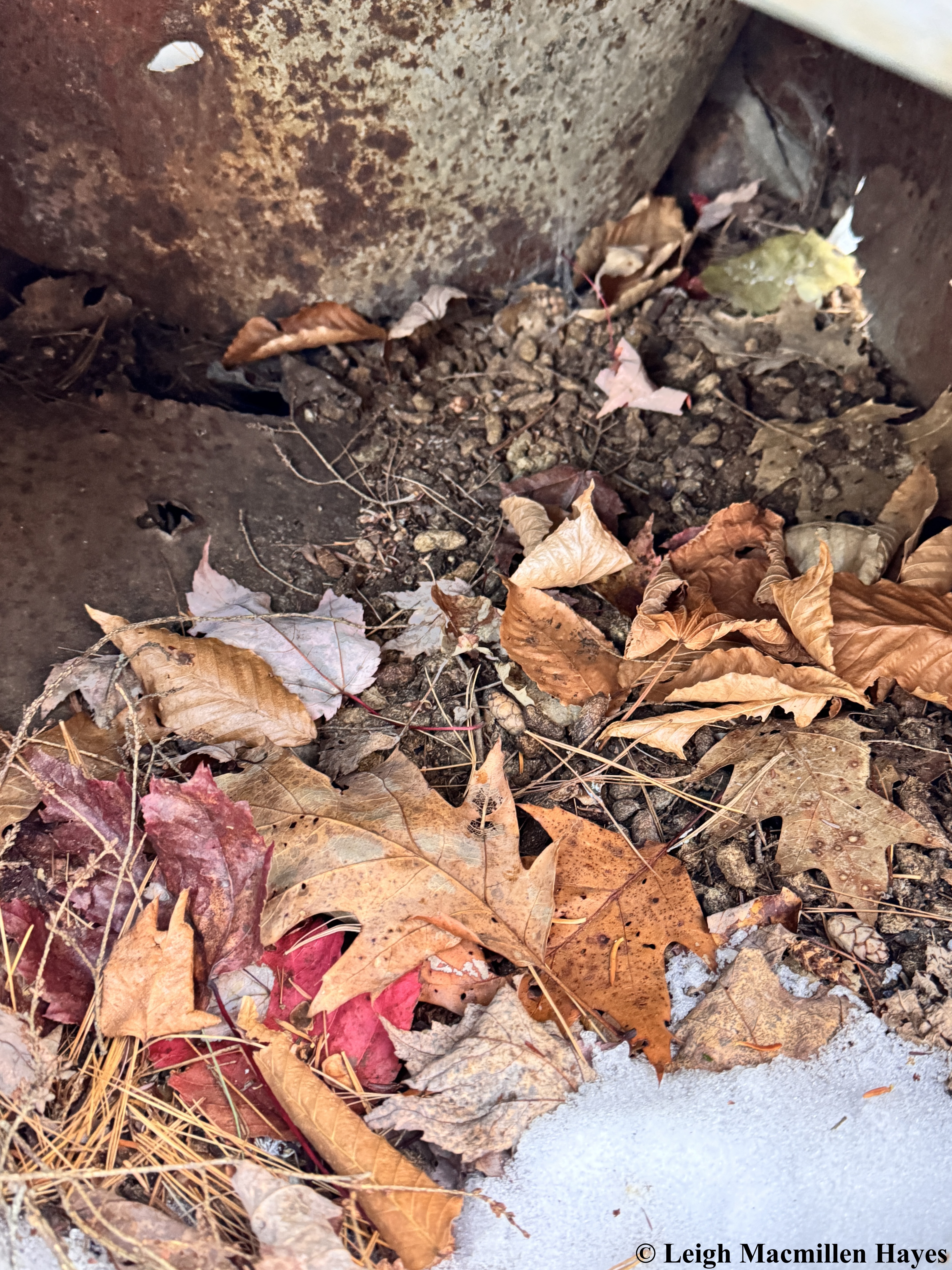
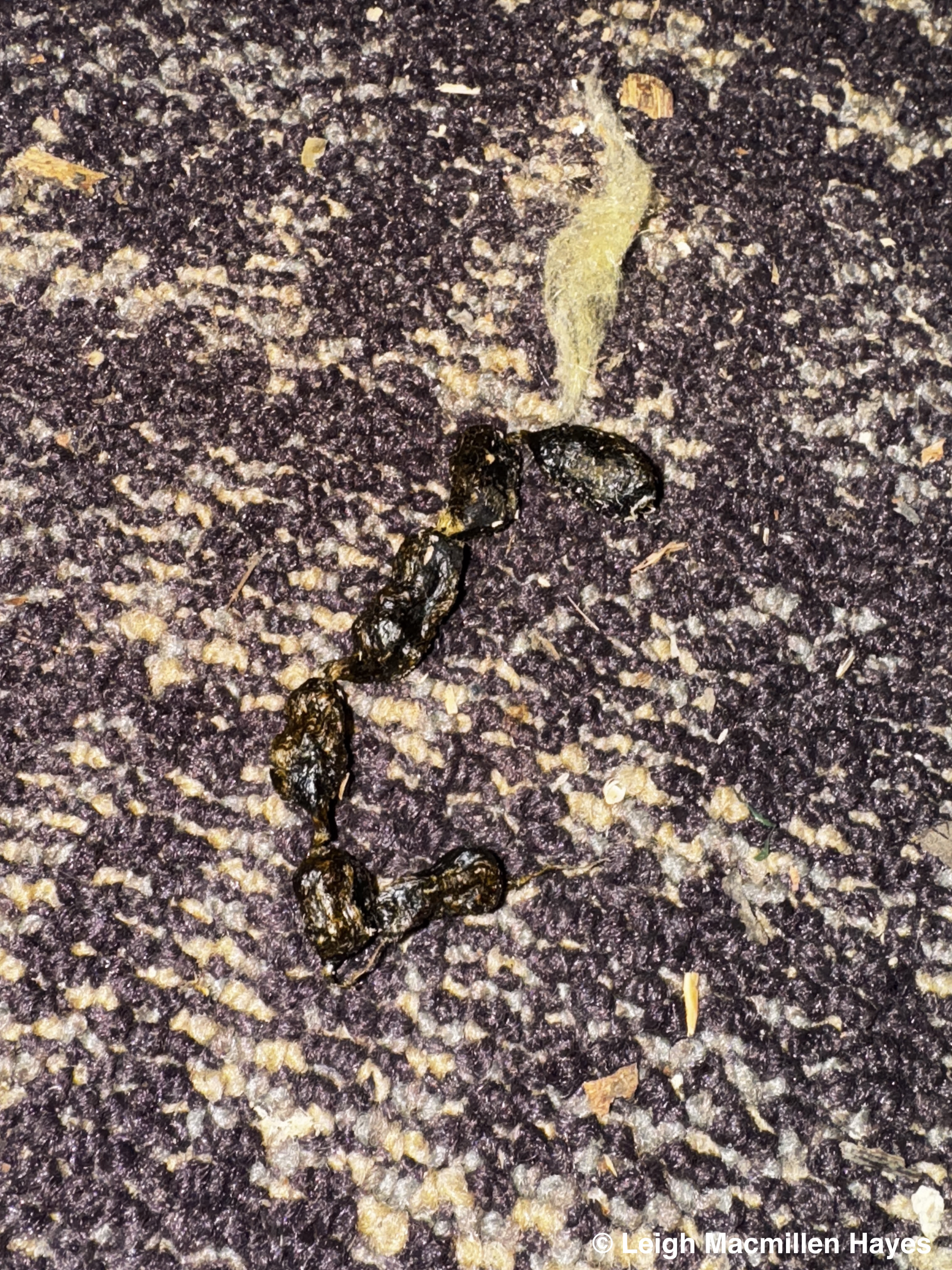
Was there scat? Yes, but not nearly as much as expected, and I could track his movements.

Today, I was out there looking for more evidence. So . . . I have a rather extensive collection of tree cookies and twigs and even some branches–all for teaching purposes, including this particular piece of a sapling I’d carried down a mountain because it was in the way on a trail, but deserved to be saved for it features a moose scrape.

But even better than that, this afternoon I noted some wood chips and scat below it and realized Porky had taken some samples.

I love how I can get a sense of the size of his teeth with the work that he did.

And I’m surprised but happy to announce that he didn’t touch any of the other samples stored up there.

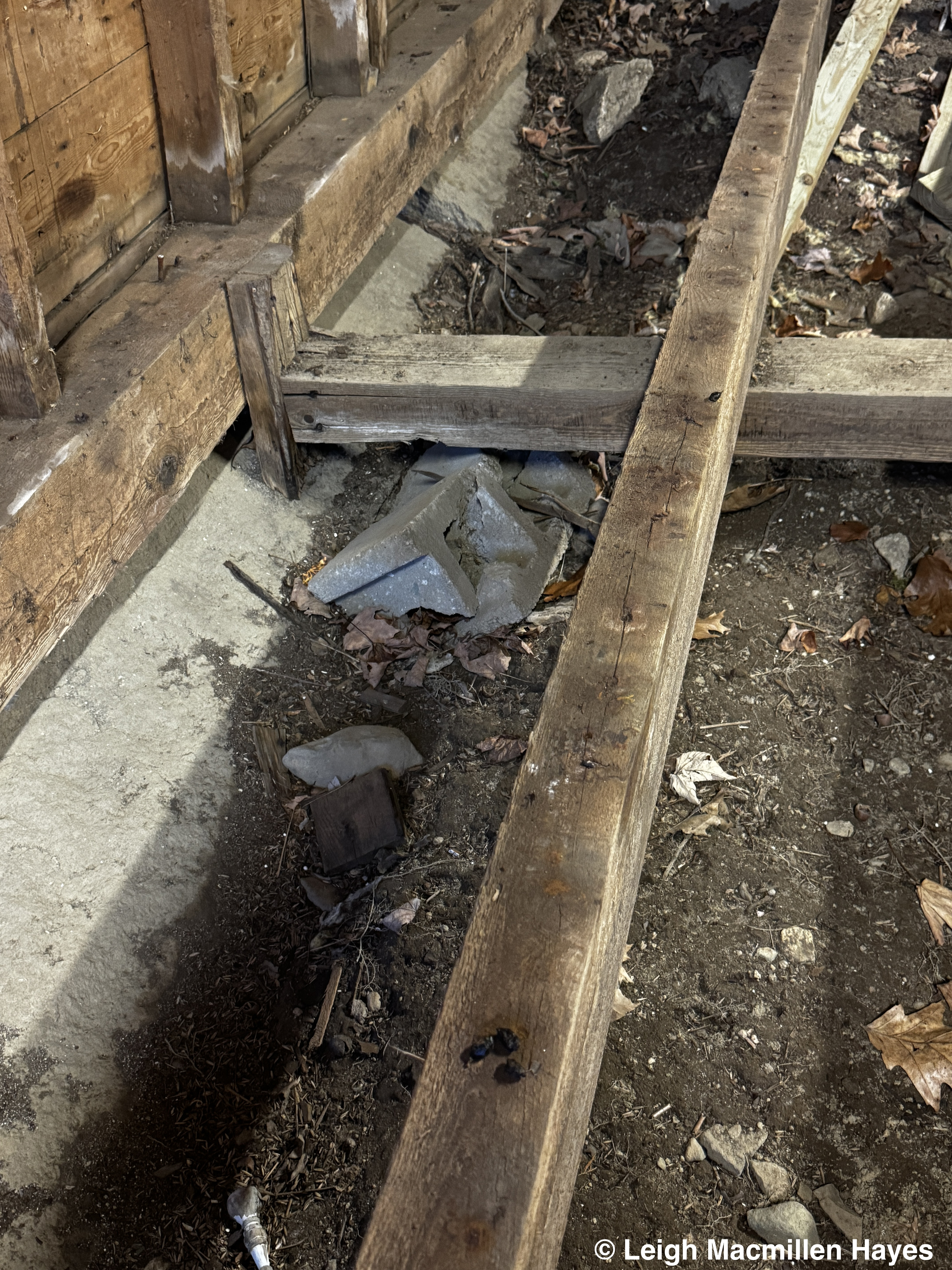
I decided to follow his trail and found a few scat specimens on the stairs, and others along beams that are right now uncovered given the first floor changes planned for later this week.

The question I haven’t answered yet and I suspect its because leaves have blown in and covered any evidence: which entrance did he use?

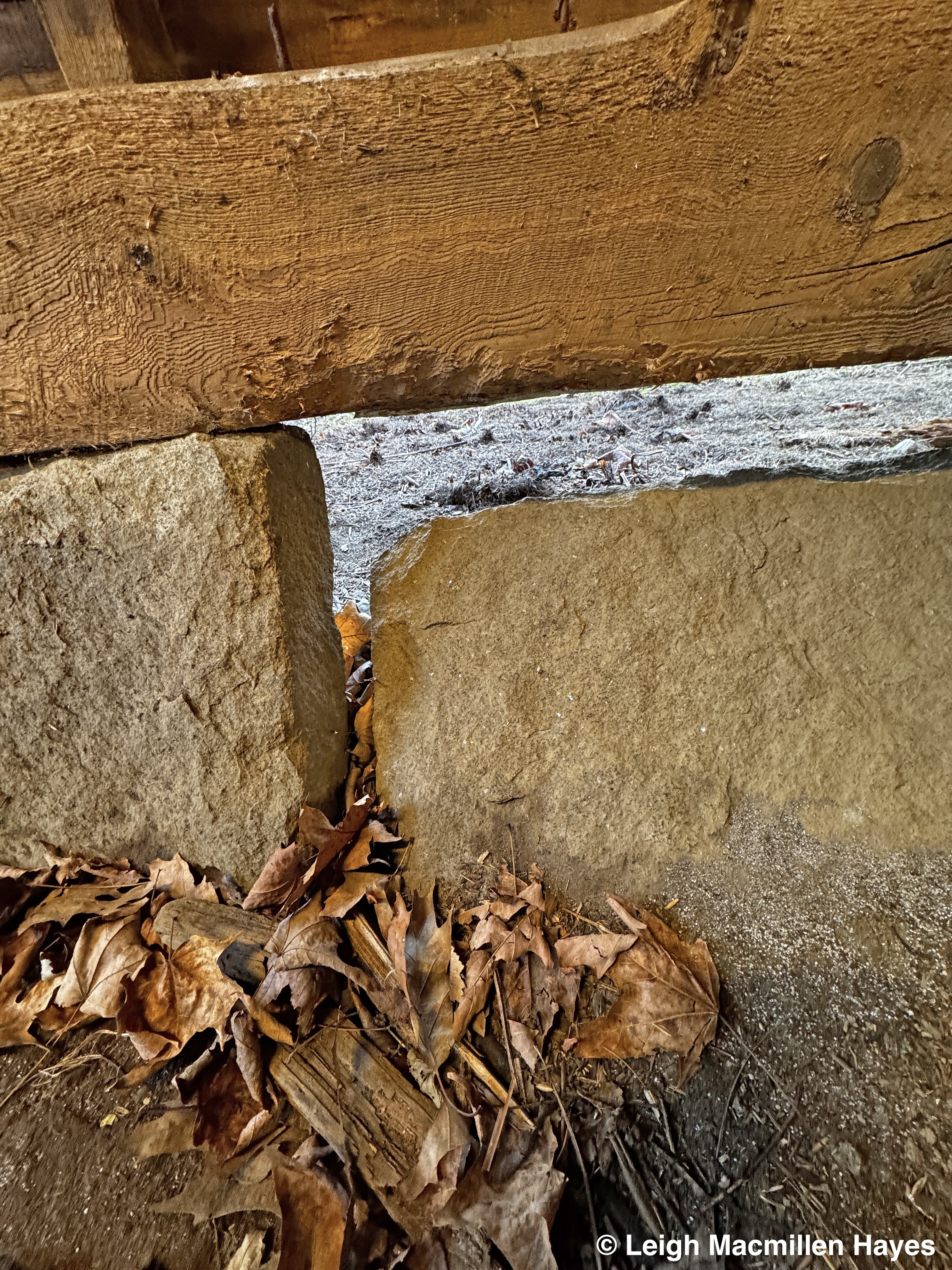
This is one he’s used for the past several winters. Okay, truth be told, we’ve owned this property for over 30 years and have housed a porcupine (and raccoons and woodchucks and opossums and anyone else) for all of those years. They used to have a different entrance, but we made some changes four years ago that forced them to find a new way into their abode.

If you look at the bottom of the beam, you can see where Porky has worked in the past to enlarge this hole over the split granite.

And just last year, he started another between the barn and an attached shed.

With all those years of co-existing, I was sure we’d find far more damage when we removed the floor boards. But . . . we did not. What we did find: Eight, yes eight, suet feeders that had disappeared over the years and I always suspected the raccoons had taken them under the barn because I couldn’t locate them in the yard, field, or woods.

All I can think is that Porky was sated when he entered and didn’t need to gnaw on the wood.

The funny thing about the latest Porky adventure, is that it could have been prevented if we’d thought to close the trap door at the top of the stairs. It took us a day or two to realize this and I feared that Porky would stay up there forever, given that he had plenty of wood to eat and a rather snug place to sleep with the only predators being us.

That said, the trap door does get closed now. And there is no new evidence of a visitation by my favorite rodent. And we didn’t trap him afterall. And he’s still in the woods somewhere. And I can’t wait to meet him–just outside, not in.

And when I do, I’ll be curious to see if it’s my old friend Bandit, for he and I met behind the barn last November and I’ve since honored him with a painting.

Here’s hoping the Inside Out Porcupine stays outside going forward. I’ll be looking for him.

The Power of Print Indeed

In the spring of 2006, I did one of the bravest things I’ve ever done. Picking up the phone, I dialed the number for Laurie LaMountain, owner, editor, and publisher of Lake Living: Southern Maine’s Leisure Lifestyle Magazine, and told her, um, that I thought, um, she needed an, um, assistant editor.

You see, a few years prior, Laurie had interviewed My Guy about his running career, and in particular about training for marathons (think: 2 Maine in Portland; 2 Marine Corp in D.C.; and 2 Boston, with qualifying time for a third that he never did run due to time conflicts). While I enjoyed the article, I was annoyed because she had spelled my name “Lee” and not “Leigh.” Plus, there were other grammatical errors that I had noticed.

To say I was nervous was an understatement. I wrote (and edited) what I wanted to say, knowing I had to be positive about the magazine at the start and make it personal. I also knew my voice would crack and quiver as I spoke, and it didn’t let me down.

But, I’d gone through a copy of the magazine — with the red pen of my teaching career and made all kinds of edits and suggestions. Toward the end of our phone conversation, Laurie politely said I should share the edited copy with her. Of course, I did.
And she couldn’t believe all the corrections I’d made. She said she’d send me article to edit and I should keep track of my time.

Eighteen years later, I’m still keeping track.

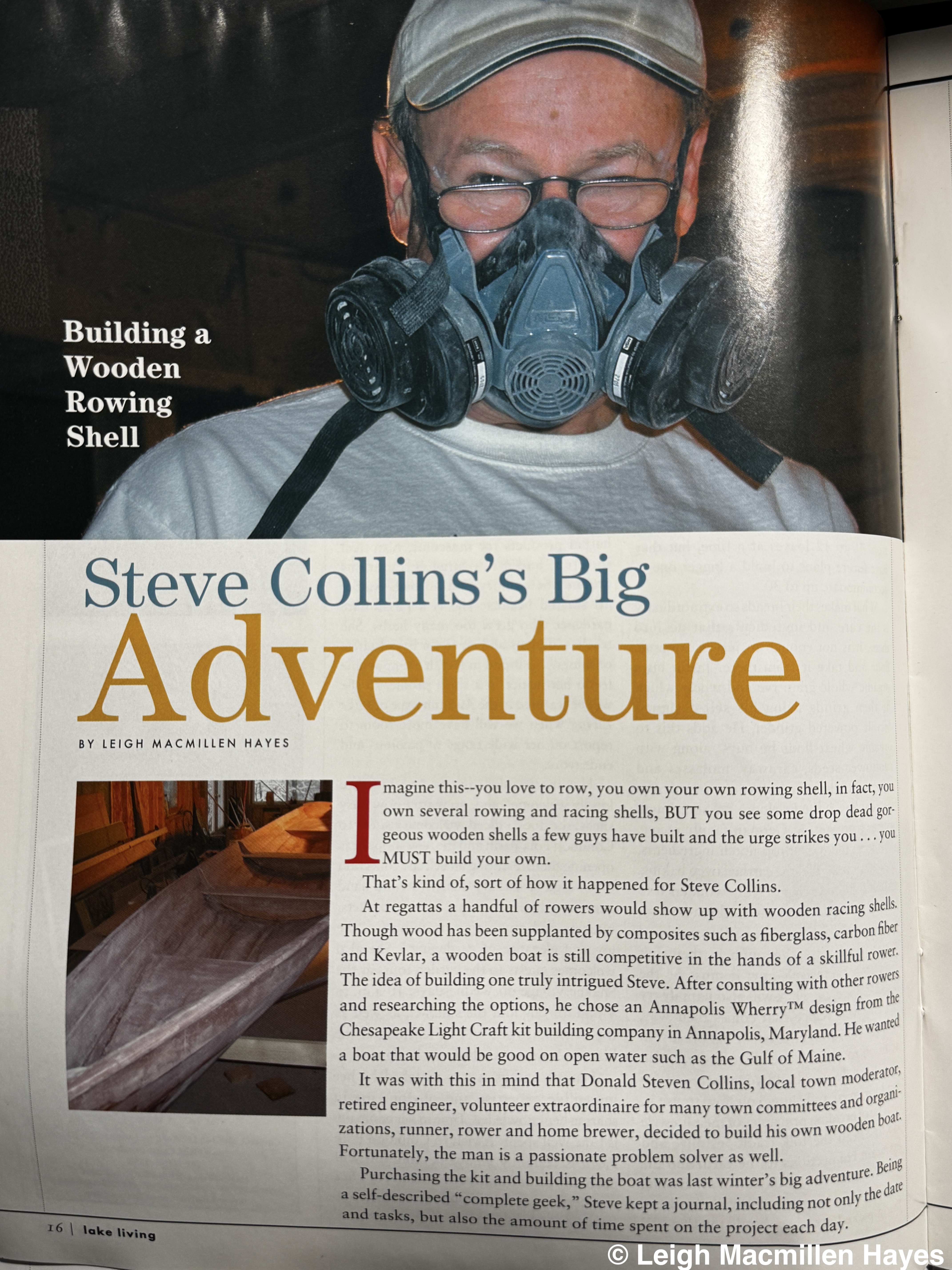
For the next issue, she asked if I had any ideas for articles and I suggested she should contact Steve Collins who had built an Annapolis Wherry® row boat from a kit. Much to my surprise . . . and delight . . . she suggested I interview Steve and write the article.

Sometimes my voice still cracks and quivers when I interview people.

It certainly did during that first interview with Steve, even though we were both serving on a local board, and I’d known him for years, and he and My Guy had trained for the 1st Boston Marathon together.

It’s just that it’s always a step out of my comfort zone to set up a meeting and then actually come face-to-face with the other person, knowing that in the end I had to tell their story they way they envisioned it.

That first article will always be my favorite–maybe because Steve let me borrow and read and quote from his diary of the building process, and watch him at work. Maybe because I really liked how I had organized it, describing his process, but including snippets from the diary. Maybe because it was my first published article in Lake Living.

It certainly wasn’t my last and I’ve had the good pleasure of writing two or three articles per issue. I’ve also had the opportunity to meet so many cool, creative people who call this place home.

In the past week, I’ve been reflecting on the magazine and though I won’t tell you my least favorite articles that I wrote, and I can think of at least two–both interviews with the same person, though about two slightly different topics, I will share a few that stand out.

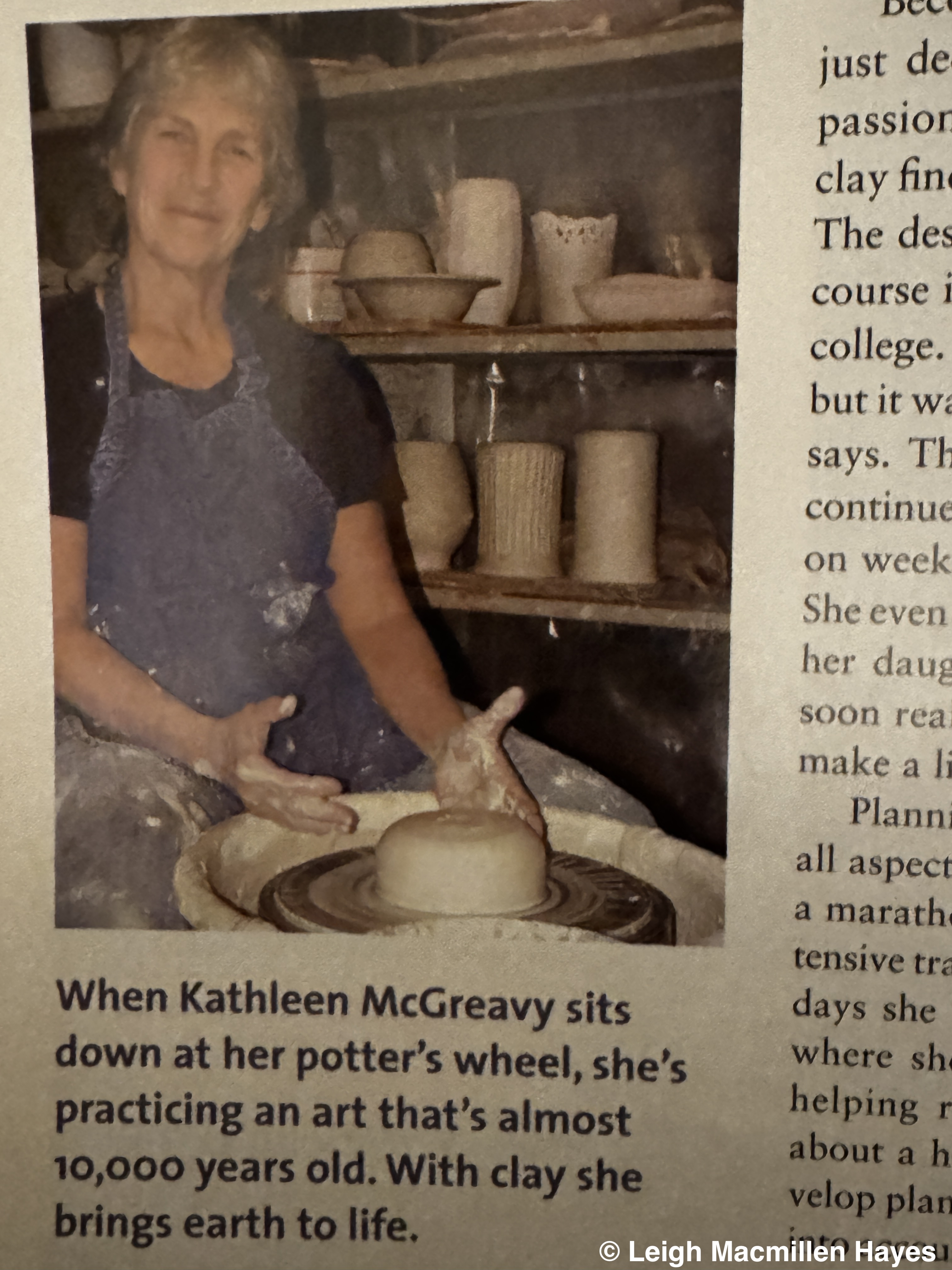
One was entitled “Bringing Earth to Life,” about Kathleen (Kathy) McGreavy, a potter from Brownfield we featured in Spring 2010. There were two memorable things about researching and writing that article: 1) Kathy let me throw a pot on the wheel, which she later finished, glazed, and gave to me.

It now holds some gear on my desk; and 2) I developed the article around the different steps of creating art on a potter’s wheel, beginning with wedging and continuing on through centering, opening and pulling, etc., and thought I was incredibly clever.

For the Winter 2013 issue, I wrote about a soul-filled choir–an a cappella group of women and men who sing for the terminally ill or those on the threshold between life and death, and their families. What was so special about that interview was that they invited me to sit in the center of their group. “I closed my eyes and suddenly I was surrounded with a cadence of voices in three part harmony singing ‘River of Jordan.’ I felt as if I was softly embraced by a warm blanket.” The memory still warms my heart.

There have been so many others, but the list is too long.

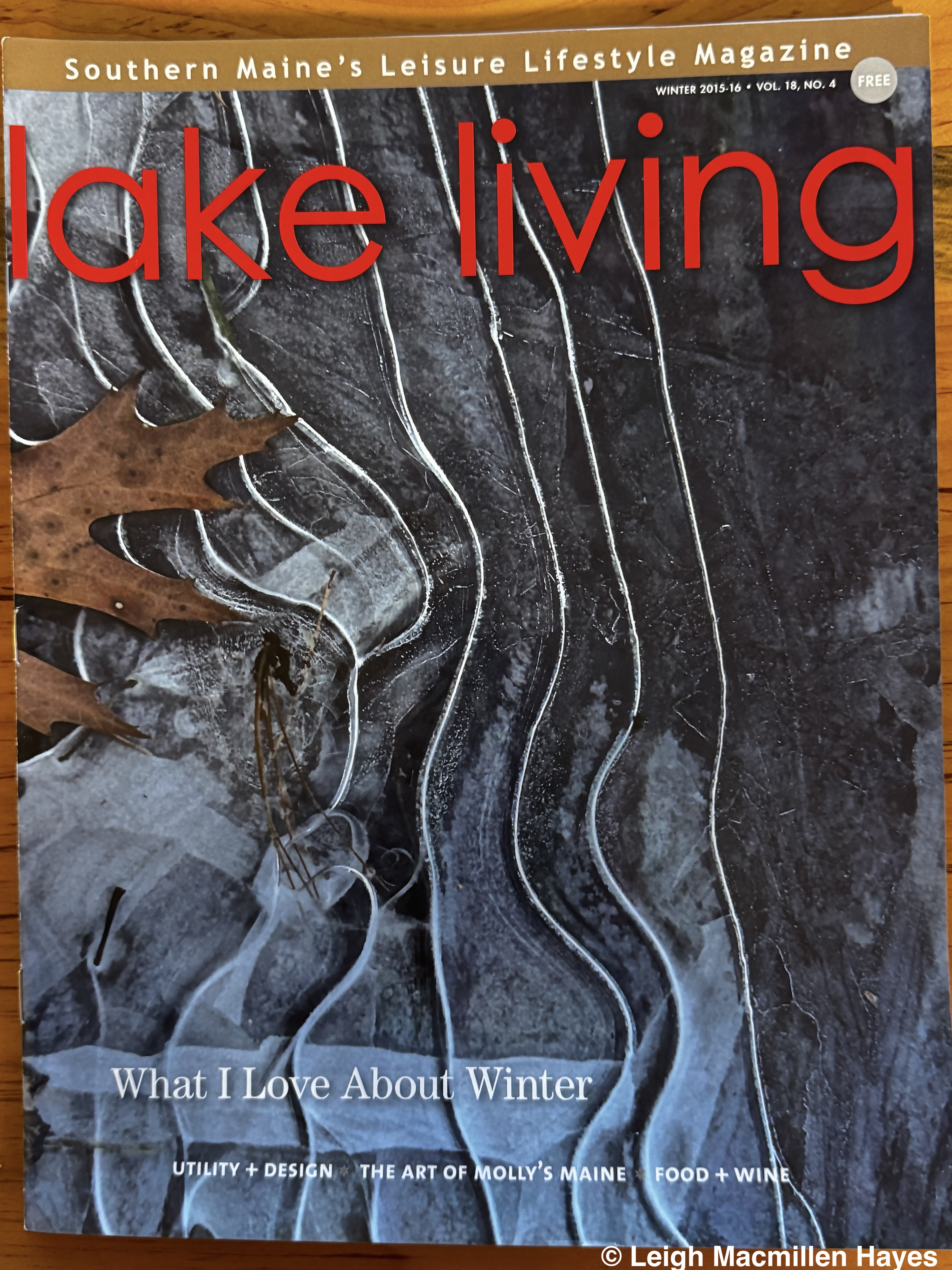
It was also a thrill to have a cover shot or two chosen from my many offerings, including this from Winter 2015-16.

And I do have to say I kinda like the article “What I Love About Winter” that appeared in that particular magazine. Things haven’t changed. “And the more time I spend outside, the more I love it [winter]. It’s not just the cool, crisp air that I find so exhilarating. During this season, the landscape reveals itself and all its complexities. Intense color gives way to details I may dismiss in other seasons . . . ”

All of this brings me ’round to the latest issue of Lake Living. If you’ve kept track since the start of wondermyway.com in 2015, you may have noticed that pre-COVID we published four issues a year. All that changed in 2020. This is a free magazine, which means advertisers are needed to pay for printing and distribution . . . and even me and my efforts!

With the onset of the pandemic it became difficult for Laurie to get advertisers (I’m proud to say My Guy has always advertised in the mag) and so we cut back to two issues: Summer and fall/winter.

This latest issue is probably the last.

Yes, let that sink in for a minute. You read it correctly.

Laurie is ready to retire. And it would be sweet if she could find a buyer.

I shall miss it.

I shall miss long conversations with Laurie where we first catch up with each other and our families and other interests, and then get down to the business of brainstorming as we bounce ideas around and laugh and talk and ask questions and toss presumed answers into the mix. It’s often out of these sessions that we notice a theme begin to emerge.

I shall miss seeking out all the people who do such interesting work in our communities and help make them thrive, despite my nerves when talking to them.

I shall miss the excitement of opening the final product–that smell of hot-of-the-press paper on crisp pages with fantastic layout created by Laurie and graphic designer Dianne Lewis.

What I won’t miss is opening the pages and realizing I’d missed a spelling or punctuation error or something else. But then again, I remind myself that only God is perfect and probably (I hope) only a handful of grammar police are on duty at any given time.

All of this said, dear readers, and now I present to you Fall 2024, vol 27. no 2.

Be sure to read my article about the Mountain Division Trail expansion coming our way soon. While writing this, I got to meet Andrew and Terry and Andrew’s young sons and learn about two incredibly involved people who care passionately about their respective communities and are volunteers extraordinaire.

Read also “Finding Rhythm in Weaving,” an article in which I not only learned a whole new technique, but also had the opportunity to get to know a fellow Episcopalian parishioner better.

You’ll find it here: Lake Living Fall 2024.

Be sure to read Laurie’s article, “In Praise of Print.” It’s her good-bye note after 27 years of creating this magazine that so many have come to love.

We know we’ve grown through this experience and hope the same has been true for you.

In praise of print indeed.

Bluebird, Bluebird, Through My Focus

It rained. The sun came it. Rain drops continued to fall. Until they didn’t. Then the temperature rose to a degree we haven’t seen in over eight months here in western Maine. And we melted.

But, with the heat wave came some new visitors, including this male Baltimore Oriole, so named because his coloration resembled the coat-of-arms of Lord Baltimore.

The funny thing about Lord Oriole: he’d stopped by a few days ago when I had a sturdy chunk of suet in the feeder. After seeing him, I immediately added orange slices to the offering in hopes of enticing him to return.

And so when he did this morning, I marveled at the fact that he ignored the oranges and chose instead a small bite of the suet.

Adding more color to the yard was a male House Finch. He tarried not long for his gal paused in the lilac bush and then flew past and he followed in hot pursuit.

But I gave thanks to the finch for as I looked for him to return, I noticed movement on the outer edge of the garden below the back deck. Shuffling about the dried leaves looking to glean a meal was a Common Yellowthroat. My very own Common Yellowthroat. Certainly another reason to rejoice.

There was more rejoicing to be done for I eventually found my way to the vernal pool. I realized I’ve been avoiding it lately, ever fearful after discovering a few dead frogs that life had taken a turn for the worse within that small body of water.

But the surprise was all mine when I discovered recently hatched tadpoles resting atop an egg mass. The green color is an algae with which they share a symbiotic relationship. The algae colonize the egg mass and produces oxygen. Being symbiotic, it’s a two-way street and the algae benefits from the eggs by gaining carbon dioxide produced by the embryos. The carbon dioxide is needed for the photosynthetic process. For a few days after hatching, the tadpoles feed on the alga.

Salamander embryos within their own gelatinous also took on that greenish hue due to the same symbiotic alga. My heart was filled with joy for there were numerous masses within the pool, most of them spotted salamander. And now I can only hope that the pool stays wet enough for them to mature and crawl out as their parents did.

Leaving the pool behind, I wandered toward home, but a familiar call beckoned. It took a few minutes for me to locate the creator, but eventually I saw him.

On a sturdy branch parallel to the ground, the Broad-winged Hawk did dine. He also frequently announced his presence with his high-pitched voice.

As a true carnivore, he’s known to eat reptiles, amphibians, birds, small mammals and even large insects. From my stance, I thought I saw a long tail that didn’t seem right for a vole. Instead, I wondered if it was a snake. I kept expecting to be greeted by one beside the vernal pool and the hawk wasn’t all that far away. I suppose that means that if the salamanders and frogs are able to crawl and leap out of the water, they’d better find good hiding places because this guy and a possible mate have been soaring above for a couple of weeks and probably have a nest nearby.

In the end, it seemed that whatever his meal was, it was lip-licking good. Upon finishing it, he flew south while I trudged across the field to the east. But I suspect our paths will cross again going forward.

All of those finds were spectacular, but . . . one of the best parts of the day–watching Eastern Bluebirds in the yard. I first spied the male in this morning’s rain.

And then late this afternoon, I was surprised to discover that they were both here, the she and the he. For the most part, they stayed out by the stone wall, perched on branches above before flying down to catch a meal.

Then they flew closer to the house and landed atop the feeders where I don’t have any mealy worms that are much to their liking. I hadn’t even planned to still have the feeders out, but with each new day bringing new visitors, I’ve delayed taking them in for the season. That is, until a Black Bear arrives.

But no Black Bears yet. (Just wait, one will probably show up overnight or tomorrow.)

And so . . . Bluebird, Bluebird, through my focus. Thanks for taping me on the shoulder. ;-) And sharing this day with me.

A’pondering We Will Go

August 3, 9:30 am – 12:30 pm
A’pondering We Will Go: Get inspired by the beauty along the trail at the John A. Segur Wildlife Refuge East. This will be a stop-and-go walk as we pause frequently to sketch, photograph, and/or write about our observations, or simply ponder each time we stop. Location: John A. Segur Wildlife Refuge East, Farrington Pond Road, Lovell.
Degree of Difficulty: Easy.

j1-pickerel frog

That was our advertisement for this morning’s Greater Lovell Land Trust walk, but we weren’t sure the weather would cooperate. Docent Pam and I emailed back and forth as we looked at various forecasts and decided to take our chances. As it turned it, it did sprinkle occasionally, but we didn’t feel the rain until we finished up and even then, it wasn’t much. Instead, the sound of the plinking against the leaves in the canopy was a rather pleasant accompaniment to such a delightful morning. Our group was small–just right actually for it was an intimate group and we made a new friend and had a wonder-filled time stopping to sit and ponder and then move along again and were surprised by tiny frogs and toads who thought the weather couldn’t get any better, as well as other great finds. Here, a pickerel frog showed off its rectangular spots for all of us to enjoy.

j2-Sucker Brook

After a first 20-minute pause in the woods, we continued on until we reached Sucker Brook.

j3-Colleen

Each of us settled into a place to listen . . .

j4-Bob

photograph . . .

j6-Judy

and write.

j7-heron

I have no idea how much time had passed, but suddenly we all stirred a bit and then someone who was noticing (I think it was Ann) redirected our attention.

j8-heron

We were encouraged to focus on another who was also paying attention.

j9-heron

And narrowing in . . .

j10-heron and fish

on lunch.

j11-wings

When the young heron flapped its wings, we were all sure the meal was meant “to go.”

j12-securing the catch

But thankfully, the bird stayed.

j13-lunch

And played with its food.

j14-lunch making its way down

Ever so slowly, the fish was maneuvered into its mouth.

j15-gulp

And swallowed.

j16-down the throat it goes

Down the throat it slid.

j16-feathers ruffled

And then the feathers were ruffled–rather like a chill passing through its body.

j17-movement

Wing motion followed.

j18-searching

But still, the Great Blue Heron stayed.

j19-next course

And stalked some more.

j20-Isaiah

We continued to watch until we knew we had to pull ourselves away.

j21-the journalists

If we didn’t have other obligations, we might still be there. Gathered with me from left to right: Judy, Colleen, Isaiah, Pam, Ann, and Bob.

j22-owl pellet

On our way back, again we made some interesting discoveries that we’d somehow missed on the way in, including White Baneberry, aka Doll’s Eye, a bone we couldn’t ID, Indian Pipe, and this owl pellet smooshed, but full of tiny bones–vole-sized bones.

j22-Pam reading what she wrote

We stopped one more time, to share our morning’s observations.

j23-Judy reading her poem

Reading aloud is never easy, but because our group was small and we’d quickly developed a sense of camaraderie and trust, the comfort level was high.

j24-Ann's landscape sketch with heron

Sketches were also shared, including this one of the landscape that Ann drew–including the heron that entered the scene just before she quietly called our attention to it.

j25-stump and lichen

And my attempts–the first of a tree stump from our woodland stop, and then a lichen when we were by Sucker Brook.

A’pondering We Did Go–and came away richer for the experience. Thanks to all who came, to Pam and Ann for leading, and to Isaiah for his fine eye at spotting interesting things along the way.