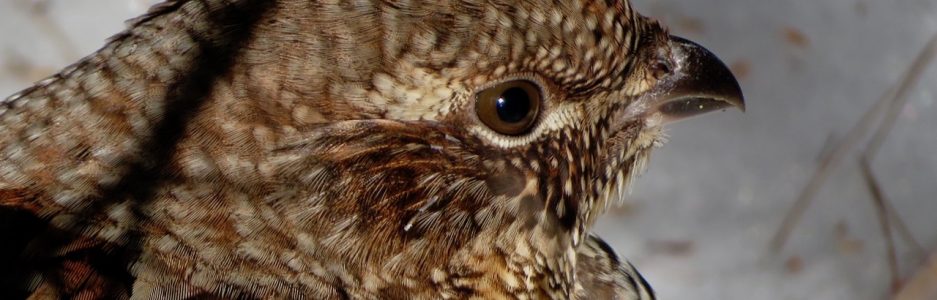
We honestly weren’t sure anyone would sign up. Or show up.
Vernal Pools and Macroinverebrates
Leigh Macmillen Hayes and Dawn Wood
Friday, April, 25, May 2, 9, and 16th, 9:30 – 11:30 am
April 25: The Hidden Life of Vernal Pools
Discover the wonders of vernal pools—seasonal wetlands vital to forest ecosystems. Learn how wood frogs, salamanders, and fairy shrimp rely on them for breeding and why protecting these fragile habitats matters. Join us indoors at St. Peter’s Episcopal Church for this engaging workshop.
May 2: A Day at the Vernal Pool
Meet at Loon Echo Land Trust’s Raymond Community Forest, Conesca Road, Raymond. Walk ¼ mile to the vernal pool, where we’ll provide tools to explore its temporary residents and their unique ecosystem.
May 9: Meet the Macros
Ever wonder who lives in local streams? Join us to discover the tiny creatures that call them home! Dive into the world of macro-invertebrates—those fascinating “big bugs” without backbones—and learn how macros tell us about the health of the environment. This hands-on workshop will take place indoors at St. Peter’s Episcopal Church.
May 16: Macro-invertebrates Up Close
Explore the role of macro-invertebrates in stream health and the ecosystem. Join us for hands-on dipping and rock turning to assess water quality at Northwest River and Douglass Brook, Tiger Hill Community Forest, Sebago.
Maine Master Naturalists Leigh Macmillen Hayes and Dawn Wood of Bridgton will lead these experiential classes. Both have a sense of wonder about the natural world and spend hours exploring only a few feet from a trailhead.
And then they did. Almost 30 of them. The first class, as you can see, was an indoor introduction to vernal pools where we shared our photographs, ID books, and models, and told stories about our experiences in these ephemeral habitats. Their questions were numerous and they shared stories as well, making it an even richer experience.
And then we ended with a musical treat since we knew that there was at least one conductor in the audience. As you click on the arrow to listen to the Springtime Chorus, remember that Wood Frog calls sound like “Wruck, wruck.” Spring Peepers: “Peep, peep, peep.” Green Frogs: “Ga-dunk, ga-dunk.” And Bullfrogs: “Jug-a-rum, jug-a-rum.”
Thank you, Jan, for leading this, and thank you to everyone for participating so willingly.

The following Friday we awoke to rain and again we were sure no one would show up. BUT . . . that did not stop them and we slowly snaked through the forest on our way to the vernal pool.

Of course, we all suffer from that most wonderful of syndromes: Nature Distraction Disorder (NDD), and the summer grape that grows along the Grapes Expectations Trail at Raymond Community Forest was the first thing to draw our attention.
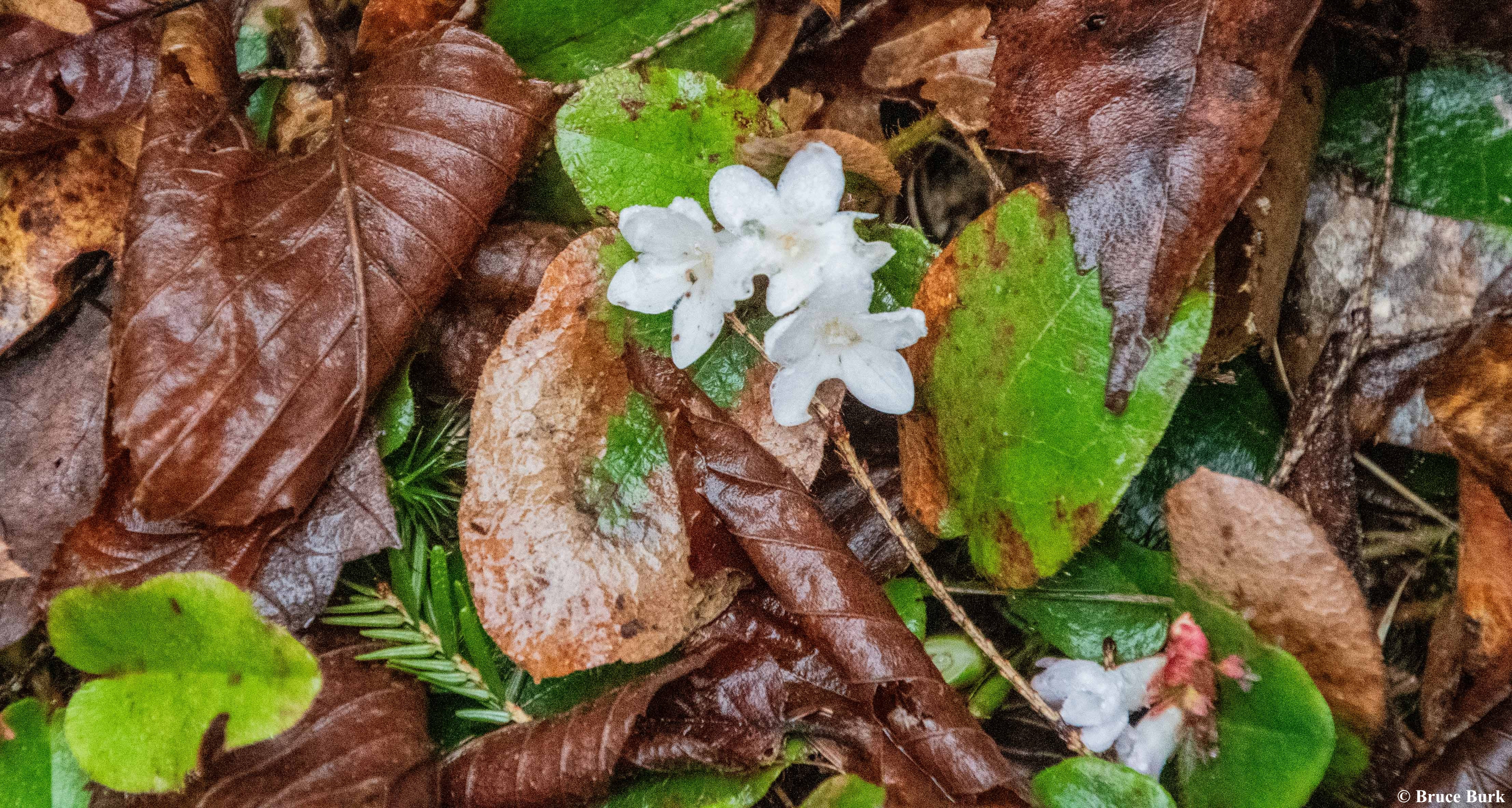
Trailing Arbutus with its sweet little flowers also caused us to pause.

At last we reached the pool and because the sky was overcast and some raindrops and mist fell, we couldn’t see into the pool very well, especially to admire the egg masses deposited by Wood Frogs and Spotted Salamanders. But . . . we could dip.
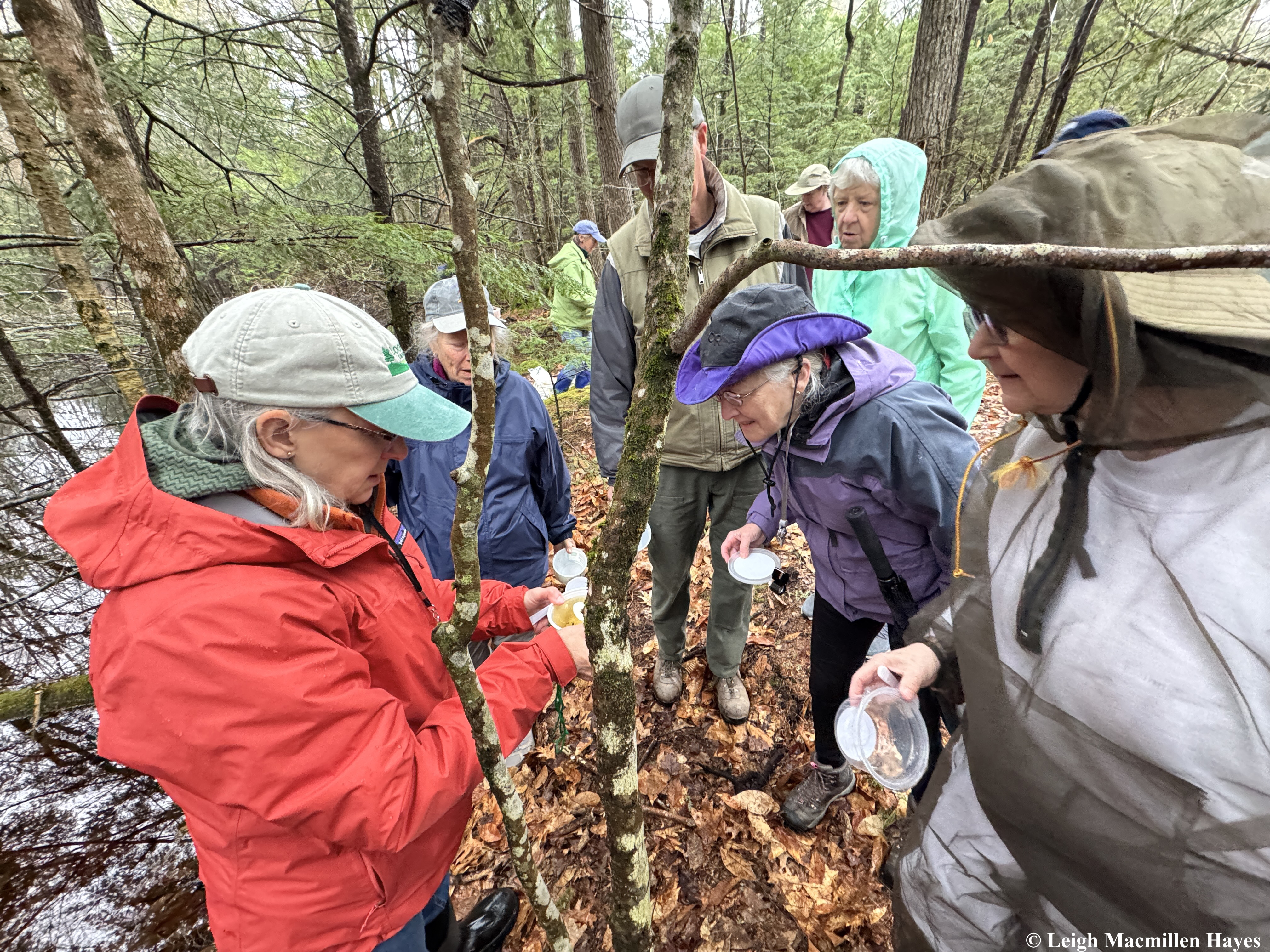
And within a few minutes the prize of the day was discovered and everyone came to take a peek at what Dawn had found.

Soon one Fairy Shrimp (just enough to make the pool significant by Maine standards) was followed by multiple more. This particular one happens to be a female with a full brood sac at the top of her abdomen.
I’ve said this before, but it’s worth mentioning again and again:
40 Wood Frog egg masses make a pool significant; OR 20 Spotted Salamander egg masses; OR 10 Blue Spotted or Jefferson Salamander egg masses; OR a single, yes one, Fairy Shrimp.
Fairy Shrimp are cool because in order for eggs to be viable, the pool must dry out. And they can survive being dry for multiple years. And in any given year, not all eggs will hatch, thus saving some in the bank for another year or ten.

Our other finds that day include Phantom Midges–with inner workings visible through the translucent body.

And Predaceous Diving Beetle larva, plus . . .
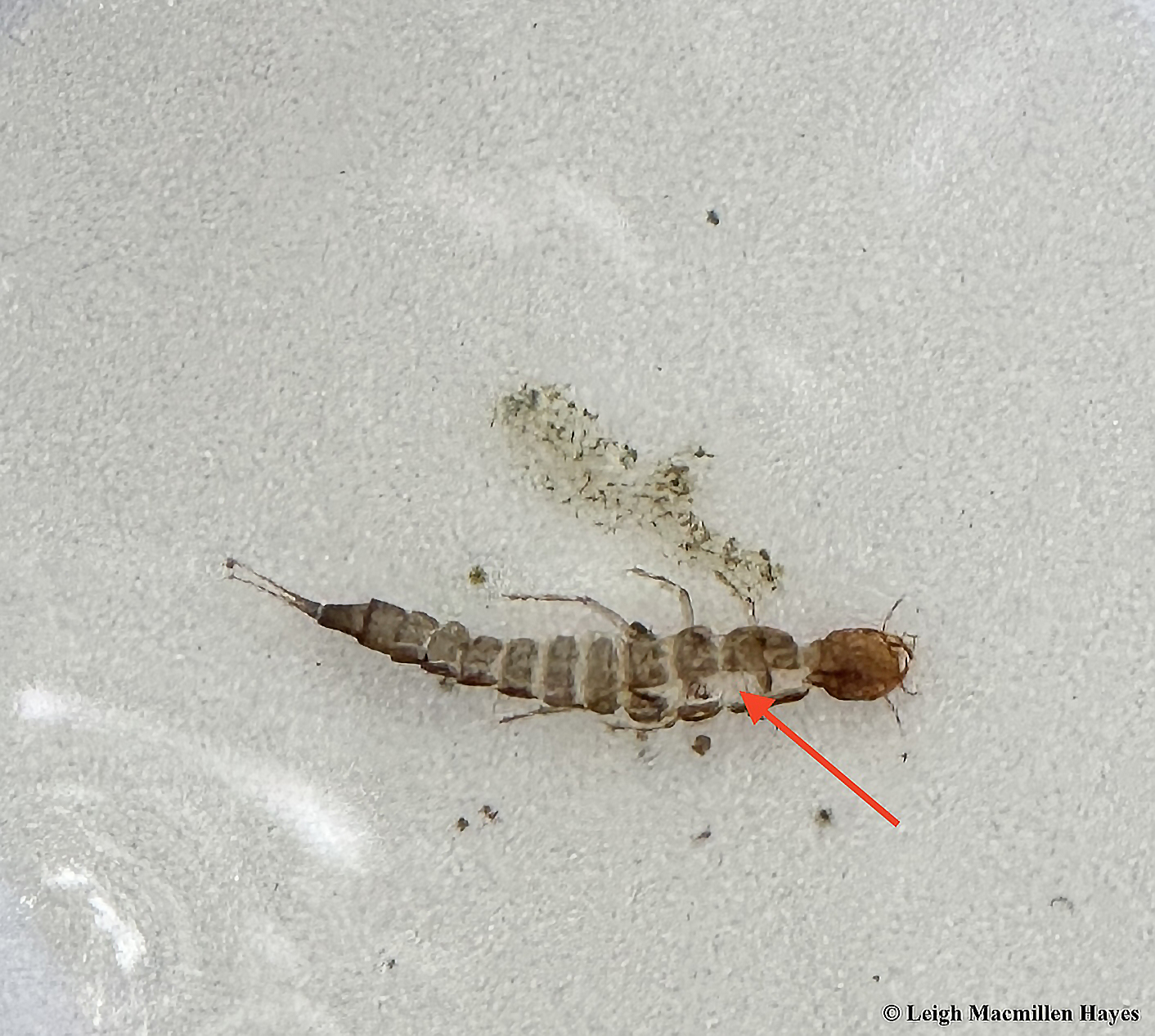
the shed skin of a PDB, with a split where the wings of the adult emerged first and then the rest of the body squeezed out through that slit that the arrow indicates.

This is the adult, with an air bubble on its back end; and if you look closely, you may see a few Mosquito Wrigglers twisting and turning in the photo as well.
We always remind everyone that all larval forms must go back into the pool or stream or whatever waterbody, because in the whole scheme of things, everything is important.

I laugh when I look at this photo because as a youngster, my brother always noted that my mouth was always open in pictures–apparently he thought I talked too much.
But obviously, on this Friday I was waxing poetic about something.

Before we left the pool that day, the students had a surprise for us. The previous week I had pulled out a party noisemaker and reminded those who had attended our winter class on insects that it served as a great tool to illustrate how a butterfly or moth proboscis (mouth part) curls up in flight, but upon a flower, they extend it to reach the nectar. Turn the noisemaker over, however, and suddenly you have a frog tongue–as they snap it out to capture an insect.
And tada, unbeknownst to us, everyone was suddenly a frog. Heck, if we were going to make them perform in the frog chorus, then they might as well be frogs. It was awesome. And yes, they did perform in the chorus once again, after which we left the pool and headed home.
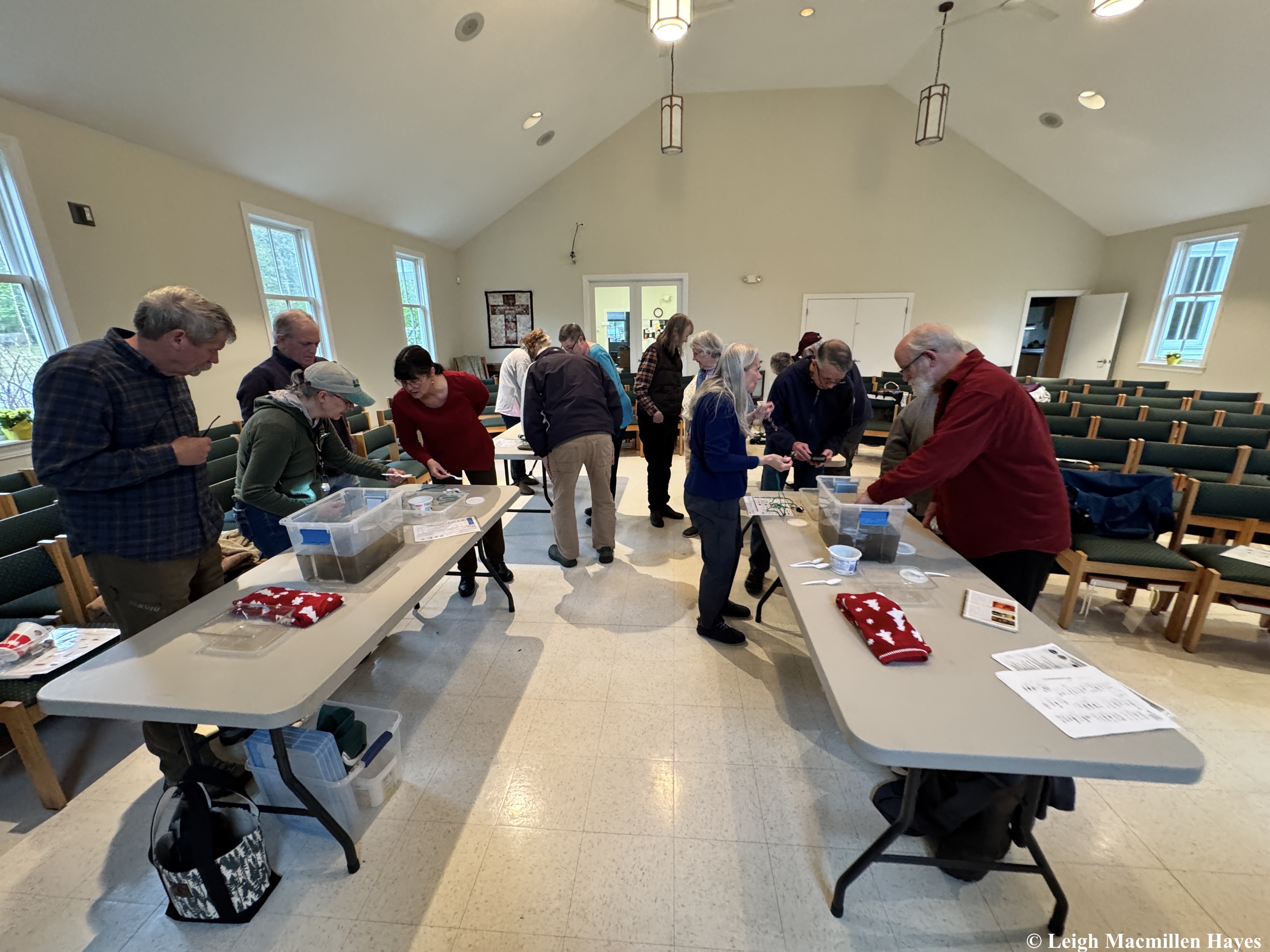
Week three found us back at the church, where we began with a slide show about Benthic Macro-invertebrates.
Benthic: Living at the bottom of a body of water (stream, river, pond)
Macro: Large enough to be seen with the naked eye
Invertebrate: Animal without a backbone
Macro-invertebrate: Large, water dwelling animal able to be seen with the naked eye.
Prior to the class, Dawn and I spent an hour or so trudging to and fro a local wetland to retrieve containers of water so that after the initial presentation, the students could take a look–up close and personal, in the comfort of a building. (Never fear: all critters were safely released in the same spot where we captured them with our D-nets)
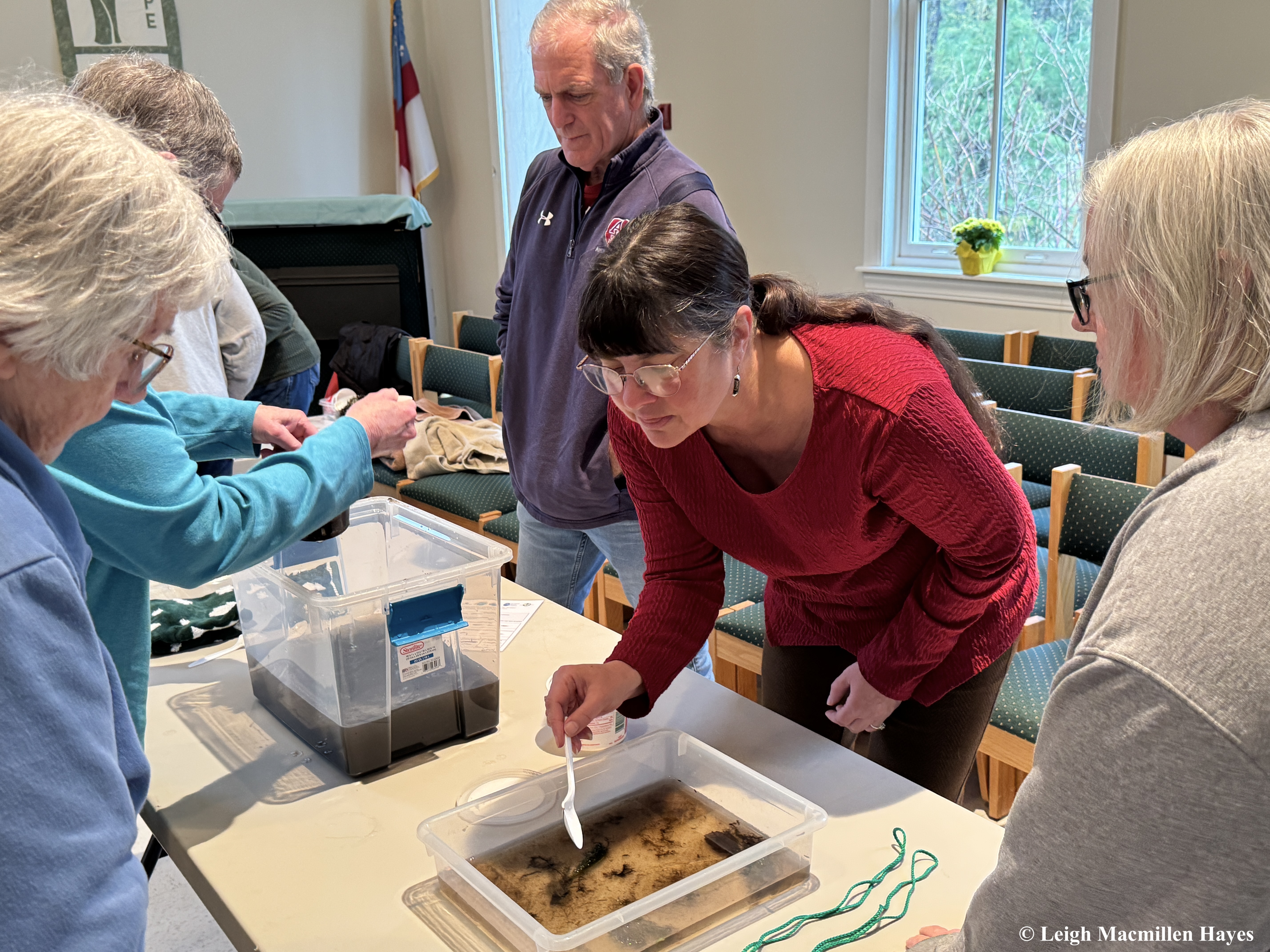
They started starring into the water and began to notice movement. And then, using spoons and small containers and lids, all recycled, they were able to glimpse the wonders of the water.
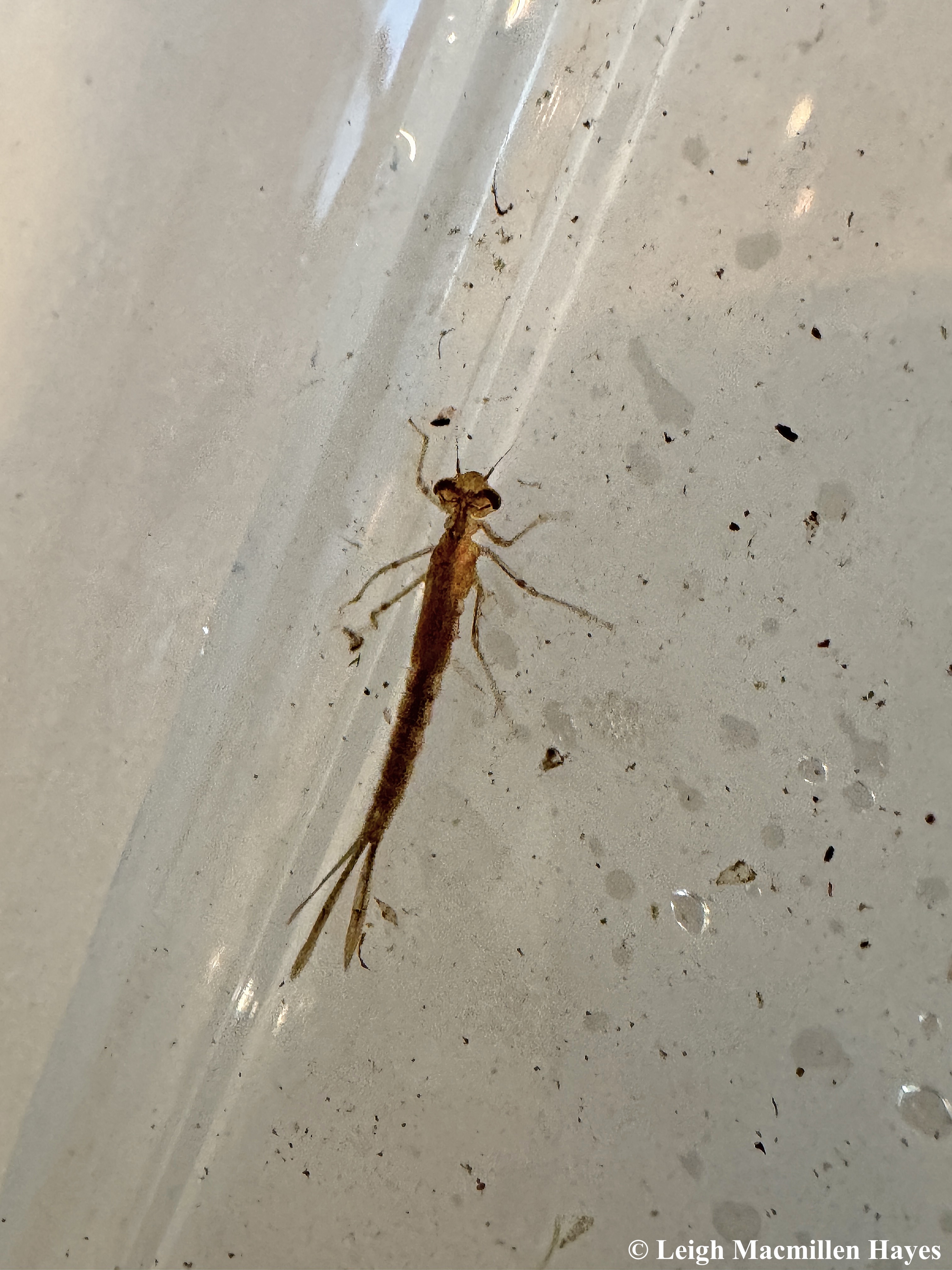
One of the favorite finds was the larval form of a damselfly, with three paddle-shaped tails that serve as gills.
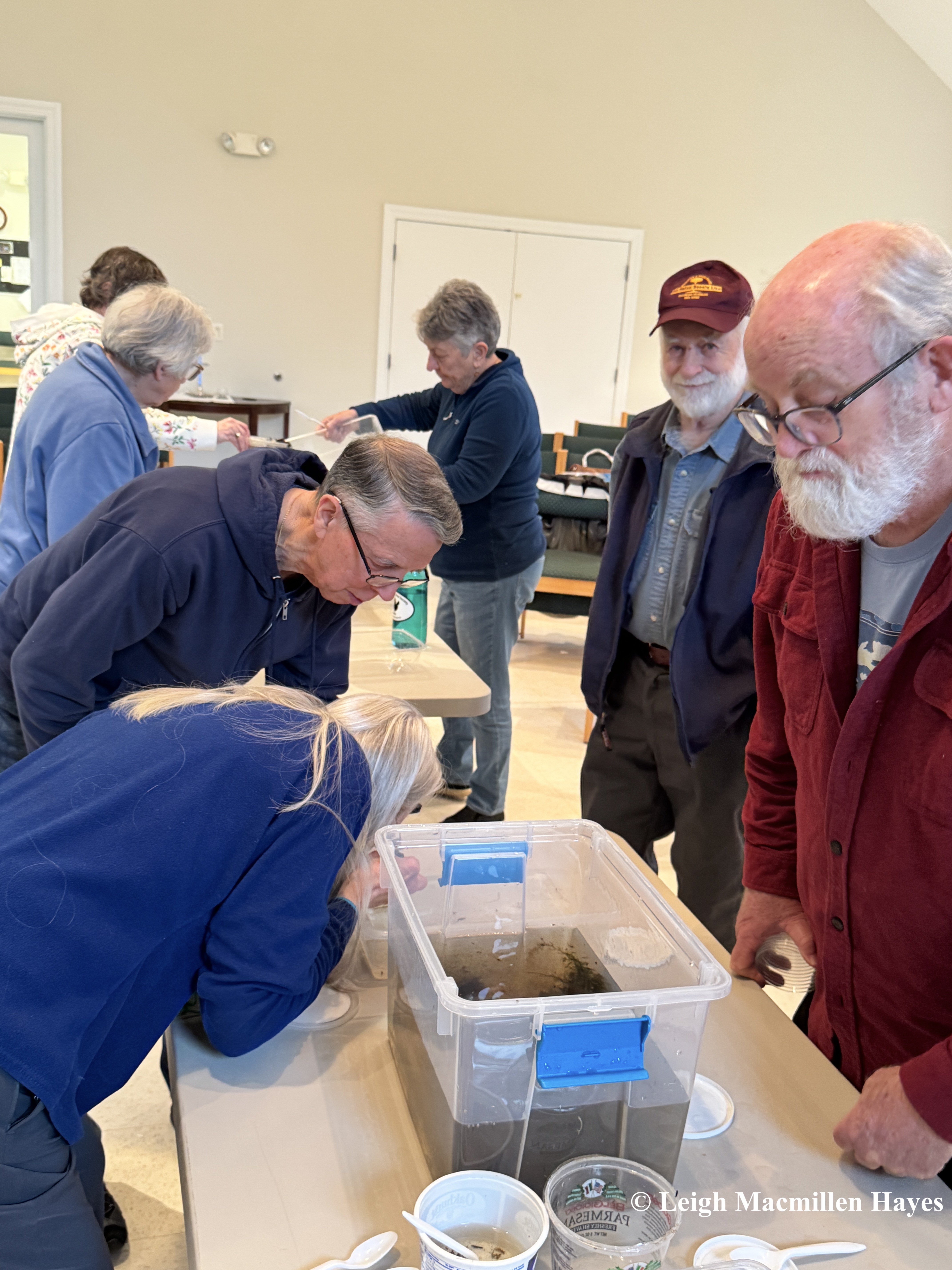
The critters love to hide under the leaves and muck that we’d pulled up so sometimes it took a few moments to wait for the water to settle before spotting something moving.

But they did. And with the use of loupes on lanyards that we borrowed from Loon Echo Land Trust, they found Mayflies and Damselflies and Dragonflies and Backswimmers and more.

Finally, today dawned. The forecast kept changing all week, so we were pleasantly surprised by the sun. That said, you know those Mosquito larvae we always encourage everyone to save? Well, they are hatching. But, just as for the rain, everyone was prepared.
Oh, and yes, another moment of NDD hit us only a hundred feet from the parking lot. We love mud.
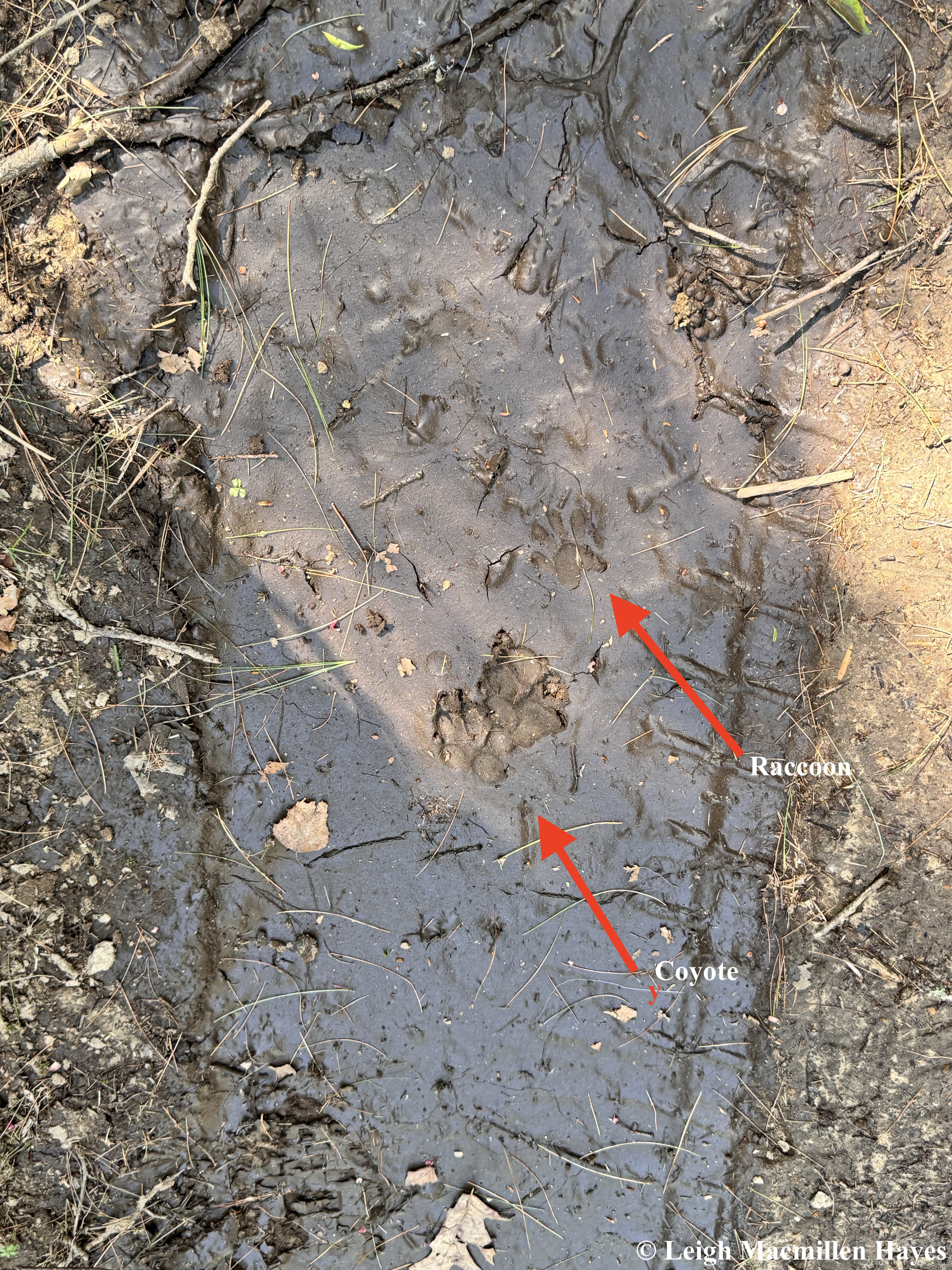
Especially when it tells us who passed this way during the night. In this case, it was two critters: a Coyote and a Raccoon. If we can’t have snow, mud is great. In many ways, it’s even better than snow for the prints are much crisper and easier to read. (Don’t tell the snow I said that. Ever. If you do, I’ll deny it.)
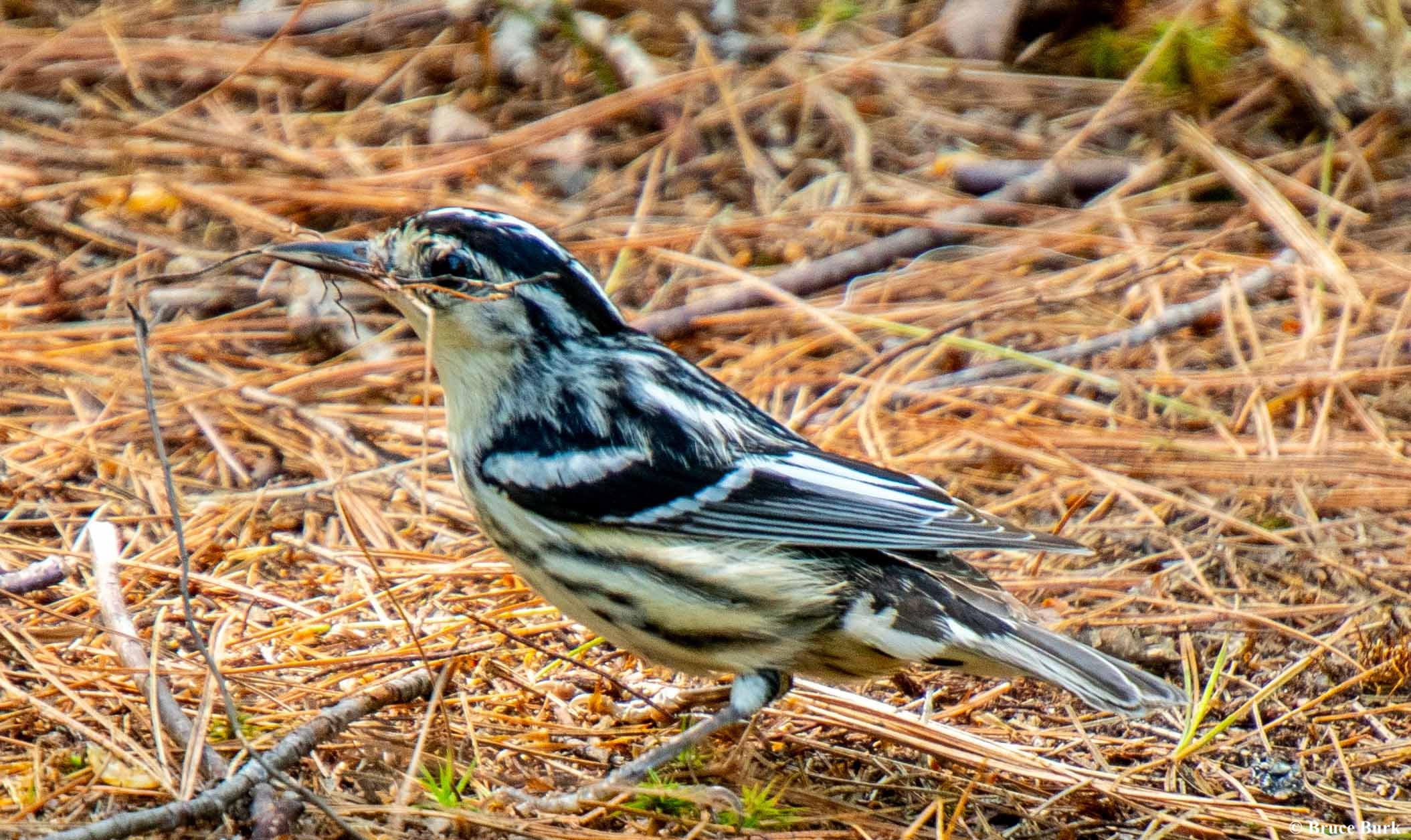
But . . . we had a mission and a time frame. The Black and White Warbler didn’t care. Apparently, we had entered its territory and despite our presence, it went right on collecting nesting material.
When nature surprises us with these moments, I always feel we’ve been blessed to be witnesses.

Finally, it was time to dip the D-nets into the river.
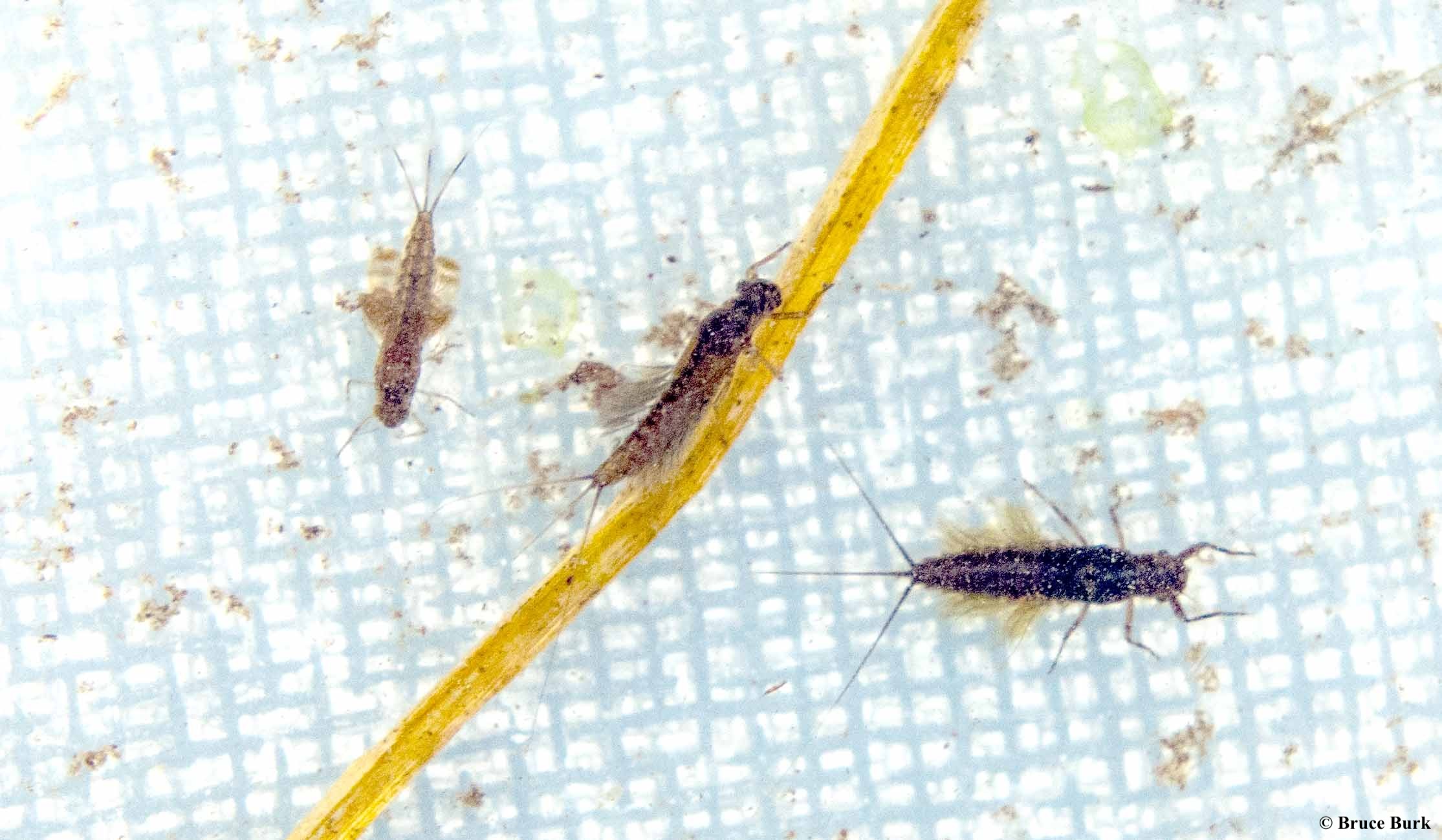
We’d placed a few tables near it so everyone could take a look without risking going into the water. Plus, the trail to the water is narrow and once we realized the bird was building a nest there, it made it even more important that we not spend too much time.
The most prolific finds of the day: Mayfly larvae.

There are so many types of Mayflies as everyone soon realized. What I love about them: their feathery gills on the sides of their abdomens, and the three long tails that most feature, which they even had as adults, probably helping with balance for one thing.

Again, it was an enthusiastic crew and any time something interesting was discovered, all wanted a chance to see.

We had a damselfly that at first I thought was a Water Scorpion because the three shorter tails were held together so that they looked almost like the tubes at the end of the abdomen, but then I took a better look and realized that they weren’t elongated and in every other way, it had damselfly written all over its head and body.

Caddisfly larvae also entertained us and we found a Northern Case Maker, plus . . .
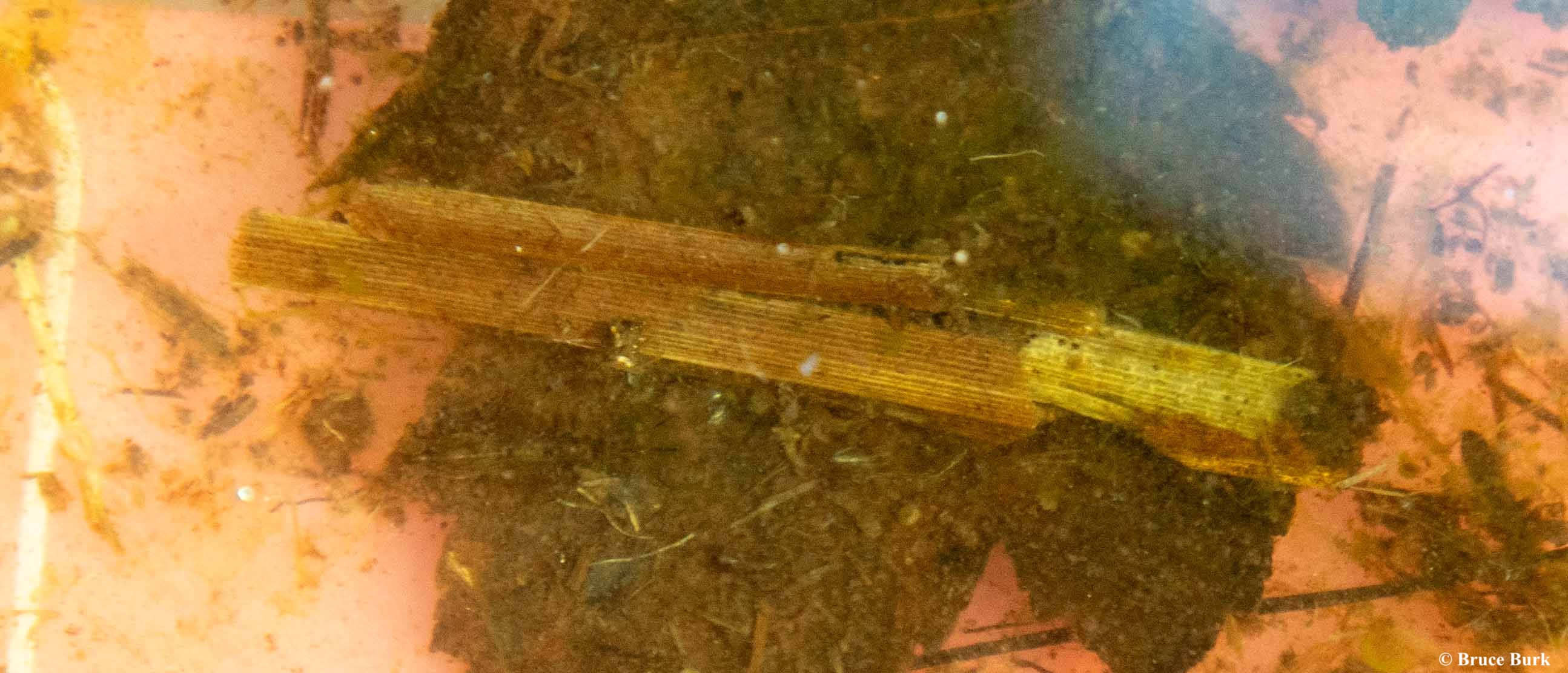
what might have been a Giant Case Maker, who built its home from the broken off tube of vegetation.

Everyone was fascinated, but we had one more stop to make so eventually we had to pack up shop in this location and move down the road to another trail.

Another NDD moment happened as we walked beside a vernal pool where we could not only spot Spotted Salamander egg masses, but also these of the Wood Frog variety, and tons of tadpoles feeding on the green algae. It actually created a full circle from our first classes about vernal pools.

A Pickerel Frog also caught our attention and delight. Bruce caught an amazing photo of the underside of its rear thighs–with the yellowish coloration. Both Pickerel Frogs and Northern Leopard Frogs have spots, but one of the defining differences is the yellow, or sometimes orange color that you see here.
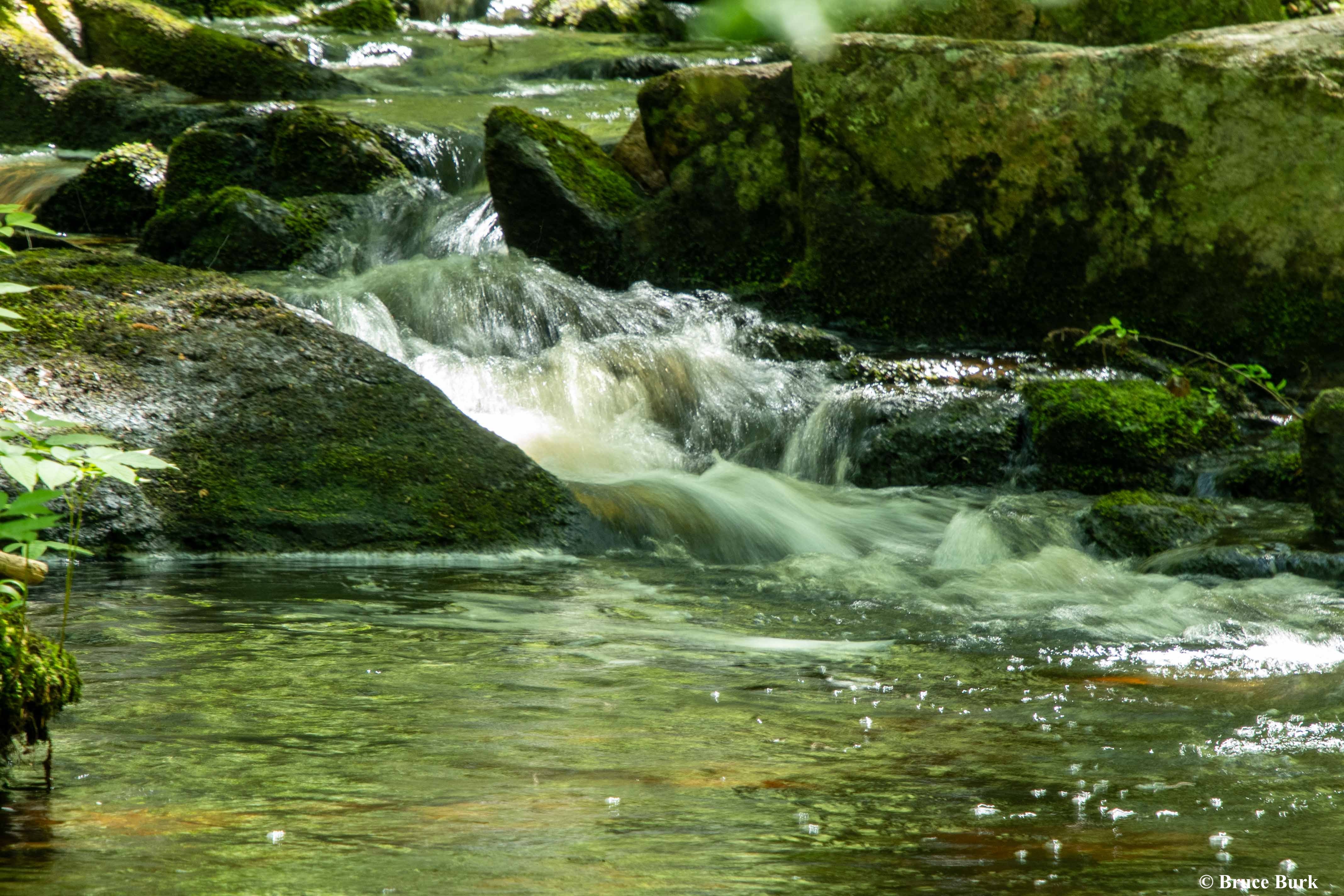
Our final destination was Douglass Brook, where the water flowed faster than it did in the section of the river where we had dipped only a half hour earlier.

Our reason for this location was because it has lots of rocks and we wanted everyone to see how some critters use them as places to cling.

So once again, we took an up close and personal look.

And scooped up anything we could find.

Including Black Fly larva which like fast-flowing water. I think folks were not quite as keen on saving every little critter given how many Mosquitoes swarmed us, but still they did.
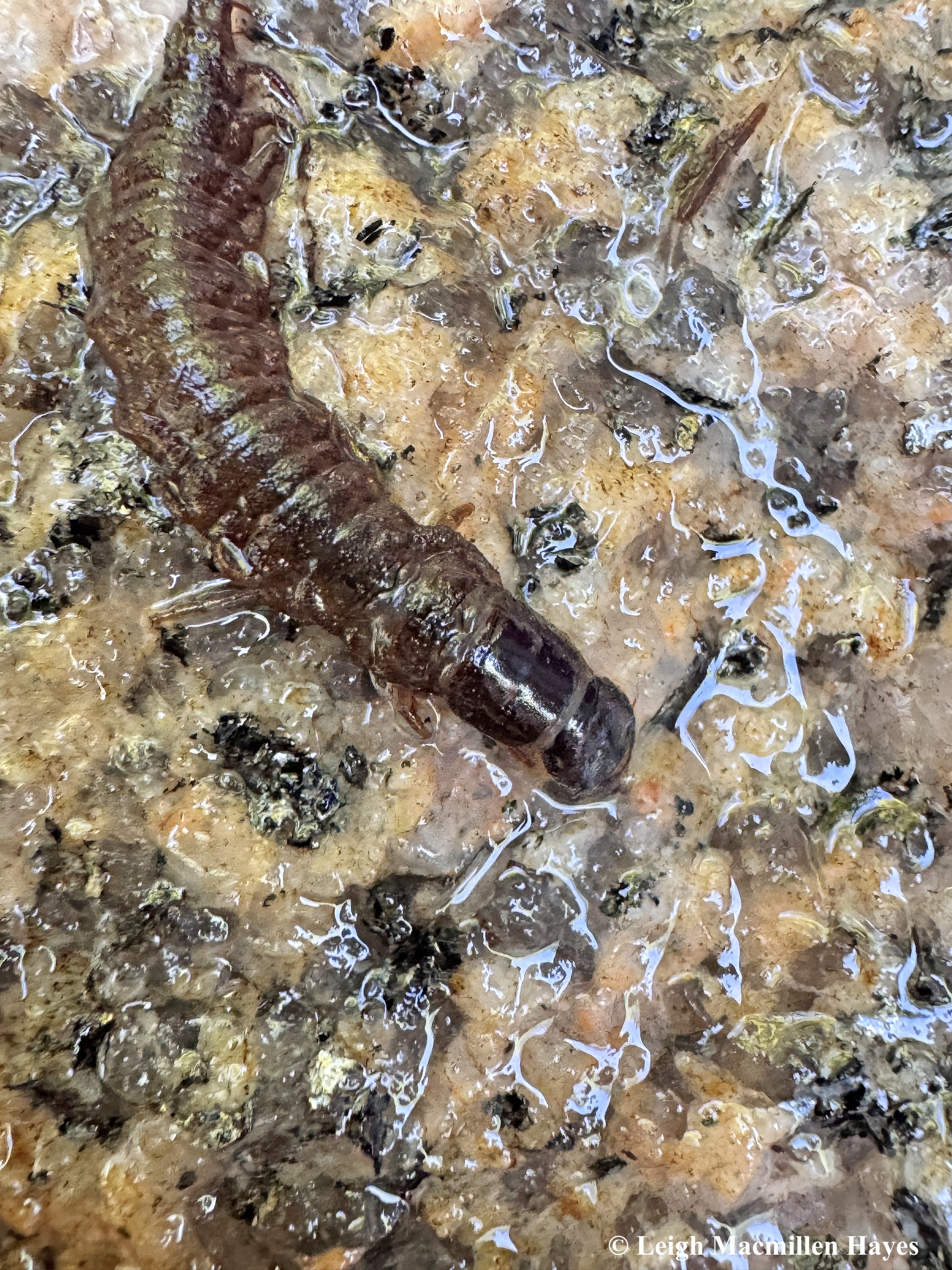
We also found a Dobsonfly Larva, aka Hellgrammite, who prefer the fast flowing water and hold onto rocks with strong claws on their legs, or so I read in A Guide to Common Freshwater Invertebrates of North America, and that’s exactly what this one did.
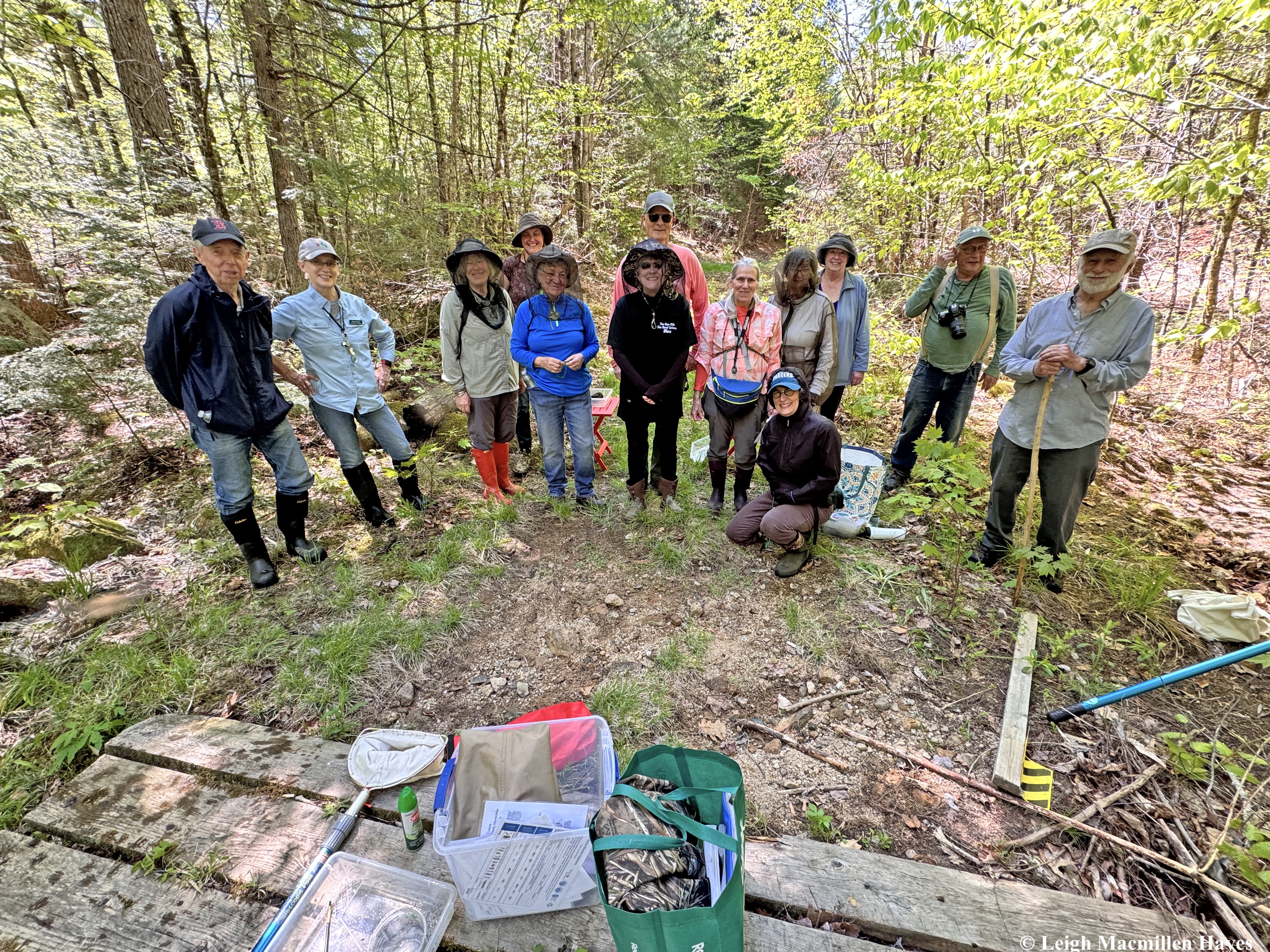
Two hours passed quickly and finally it was time for the four-week class to come to an end. And we were all smiles.
Senior College is an awesome opportunity for us mature beings to learn. The curriculum is diverse; there are no prerequisites, term papers, exams, or grades.
Hats off to the all-volunteer board. And to the students. We can’t believe how many of you joined us each week. And thank you all for helping us carry equipment today.
Many thanks also to Dawn for co-leading with me. And to Bruce for taking so many photos so that I could use them to share all of these incredible learnings with you.
Mr. Cretella, my high school Spanish and Latin teacher, popped into my head just now. In my yearbook, Mr. C. wrote, “Never lose your desire to learn.” Those words have reverberated with me over the years. I don’t remember what anyone else wrote, but his sentiment struck a cord. Pretty amazing, given that when I took Latin I my senior year, I was forever substituting Spanish words if I didn’t know the answer on a quiz or test.
Wherever he is now, I’m grateful that Mr. C. encouraged my desire to learn. And love that so many are the same.
Senior College: Forever Students indeed!
 wondermyway
Hello Leigh,
This blog was spectacular. You and Dawn do so much to increase people’s awareness of living things no matter how small they might appear. The Senior College at Bridgton is so grateful for you both. Thank you for keep stretching our minds in extremely valuable ways. Awareness is the first step towards preservation.
Thank you so much for everything.
Miss Twig!
LikeLiked by 1 person
Miss Twig, It’s always fun to have you along, whether in class or on the trail. You are one of our star students as you take what we teach and go out and practice what you’ve learned. Oh, and a grand conductor as well. Thank you, LMH
LikeLike
While still in FL, I read this with such envy! Oh, to join you and Dawn on a rainy slog through the woods to a vernal pond – heavenly!!! At least I could enjoy the vicarious trek 😄 Thank you both.
LikeLiked by 1 person
Next year, Zoe. Next year. Head north for a respite in March. I know, most people head south in Arpil, but that’s vernal pool season ’round these parts.
LikeLike
Can you please take me off your list. I
LikeLike
I’m sorry you wish to no longer receive these. I’ve removed your email and hope that you will no longer find them in your inbox.
LikeLike