As spring bid adieu and summer waved hello, I found myself wandering and wondering with others and alone and stopping in my tracks repeatedly, which is kinda what I do all the time I guess you could say, but suddenly this week there were a few special events that called for attention.

The first was Momma Snapping Turtle that I spotted beside a trail as I co-led a walk with Dawn Wood for Loon Echo Land Trust. Thanks to the magic of a camera lens, it may appear that we were close, but believe me, we all realized the sensitivity of the situation as this mother was digging in the dirt and laying eggs right before our eyes and we were transfixed–from a distance. There were fourteen of us and we tried to stand quietly and watch and ask questions and after about ten minutes decided it was time to come up with Plan B and reroute ourselves so that we wouldn’t stress her out.

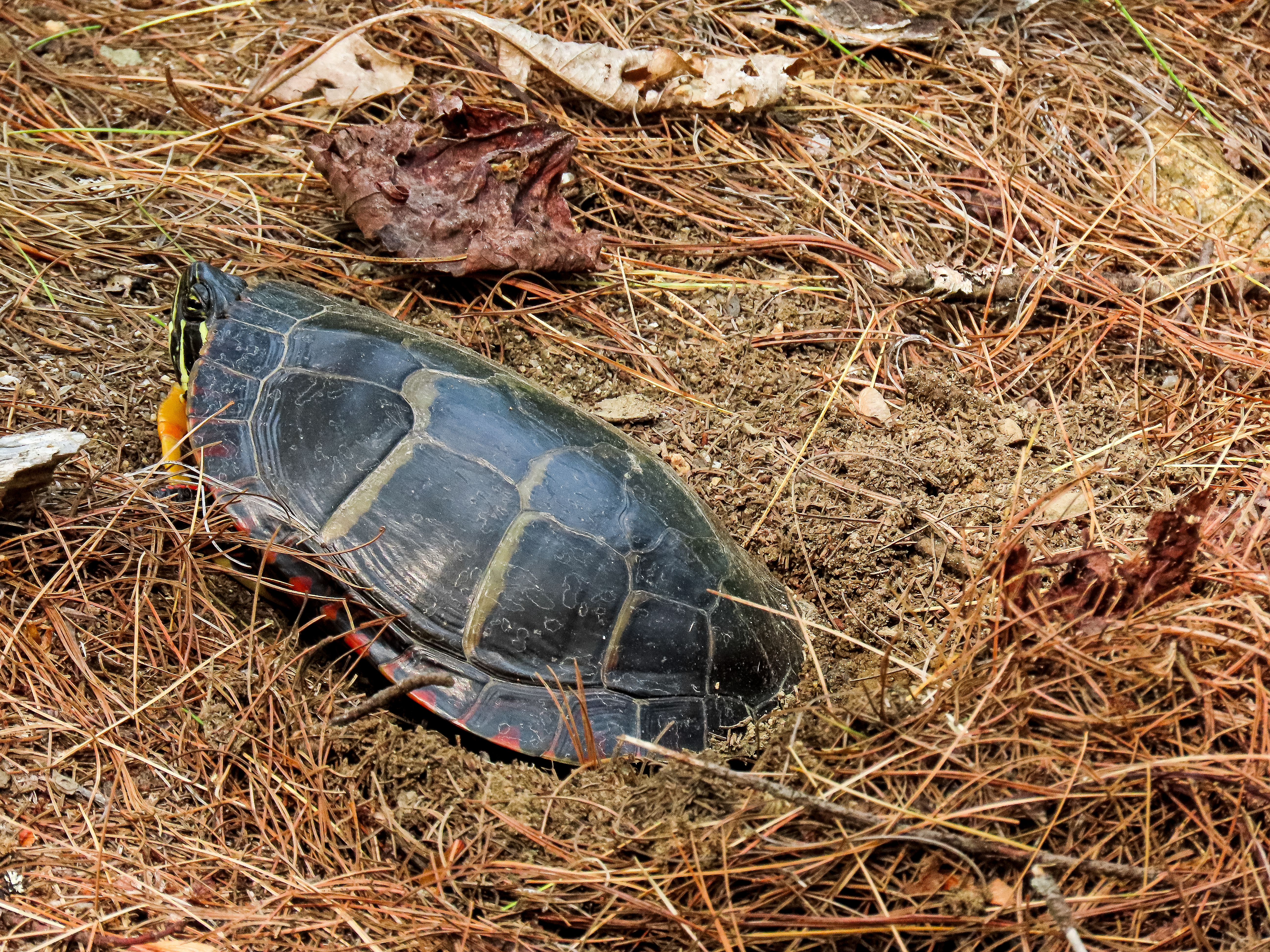
In another place a day later, it was a Painted Turtle upon which I focused and gave thanks that it didn’t consider plopping back into the water as they often do when we so much as breathe. From the spot where I stood, I think this was also a female, given the shorter nails, but I couldn’t say for sure because tail length and plastron (bottom shell) orientation are also key to ID. The male has a longer tail and a more concave or indented plastron, while the female’s is more convex or flatter.

That said, when I spotted this one, I knew its gender immediately, for like the Momma Snapper, this Momma Painted was also in the process of laying eggs. She pulled her head into her shell the moment I spied her.

In the few moments we spent together, however, she ever so gradually extended her head.
But I felt like she was keeping a wary eye on me. And very much wanted me to move along.
And so I did.
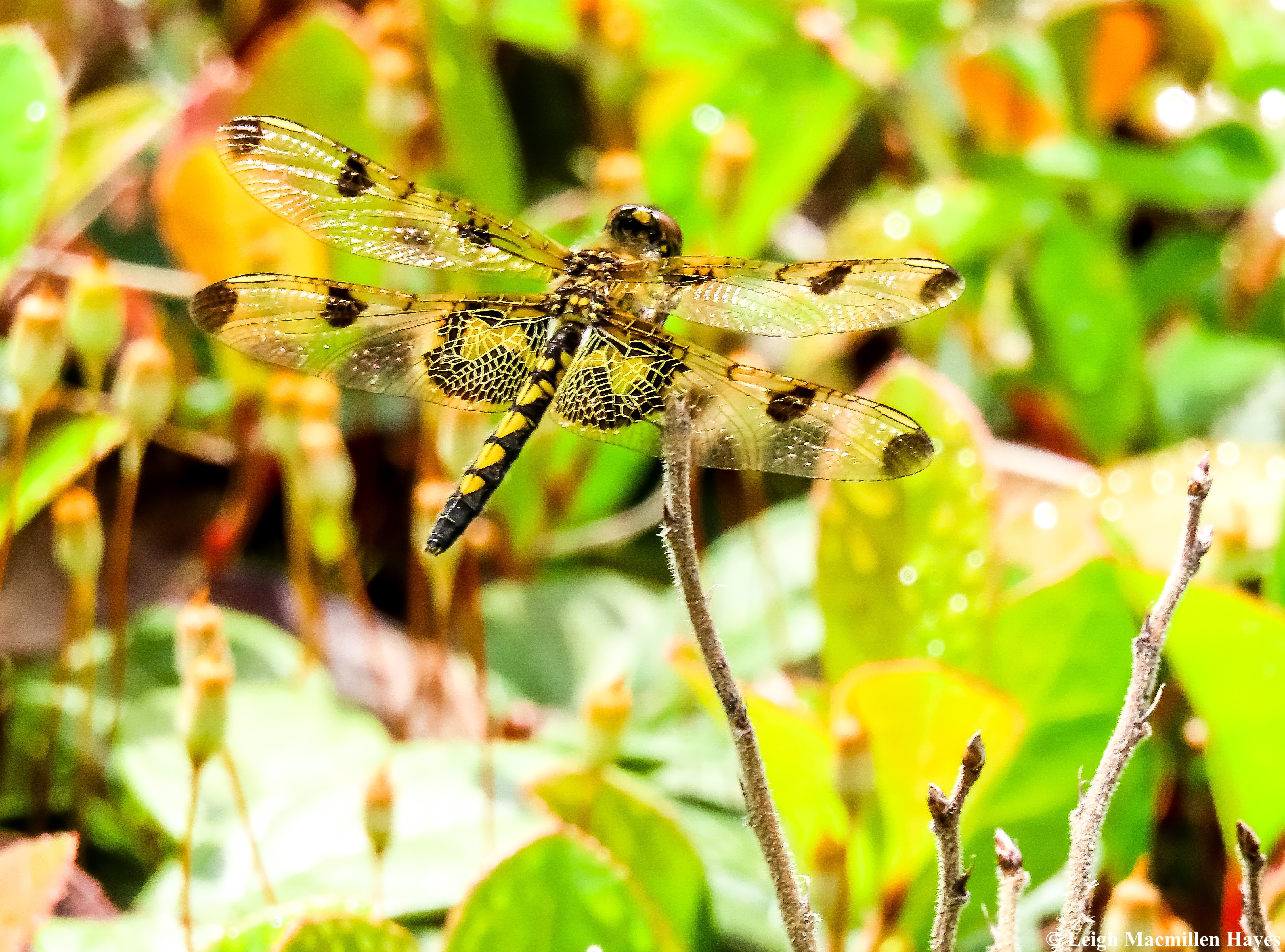
And then it was the insects that begged for attention, this being a female Calico Pennant Skimmer Dragonfly. Her coloration is yellow, while his is red. One of the things I love about perching dragonflies such as the Skimmer family, is that within their territory, they return to the same perches over and over again–flying off to capture food or defend said location, but usually back to the same twig or flower or one close by, making it easy to spend some time with them.

The Clubtail family is the same, this being a Lancet. These dragonflies often land on our dock or our kayaks and spend some time with us.
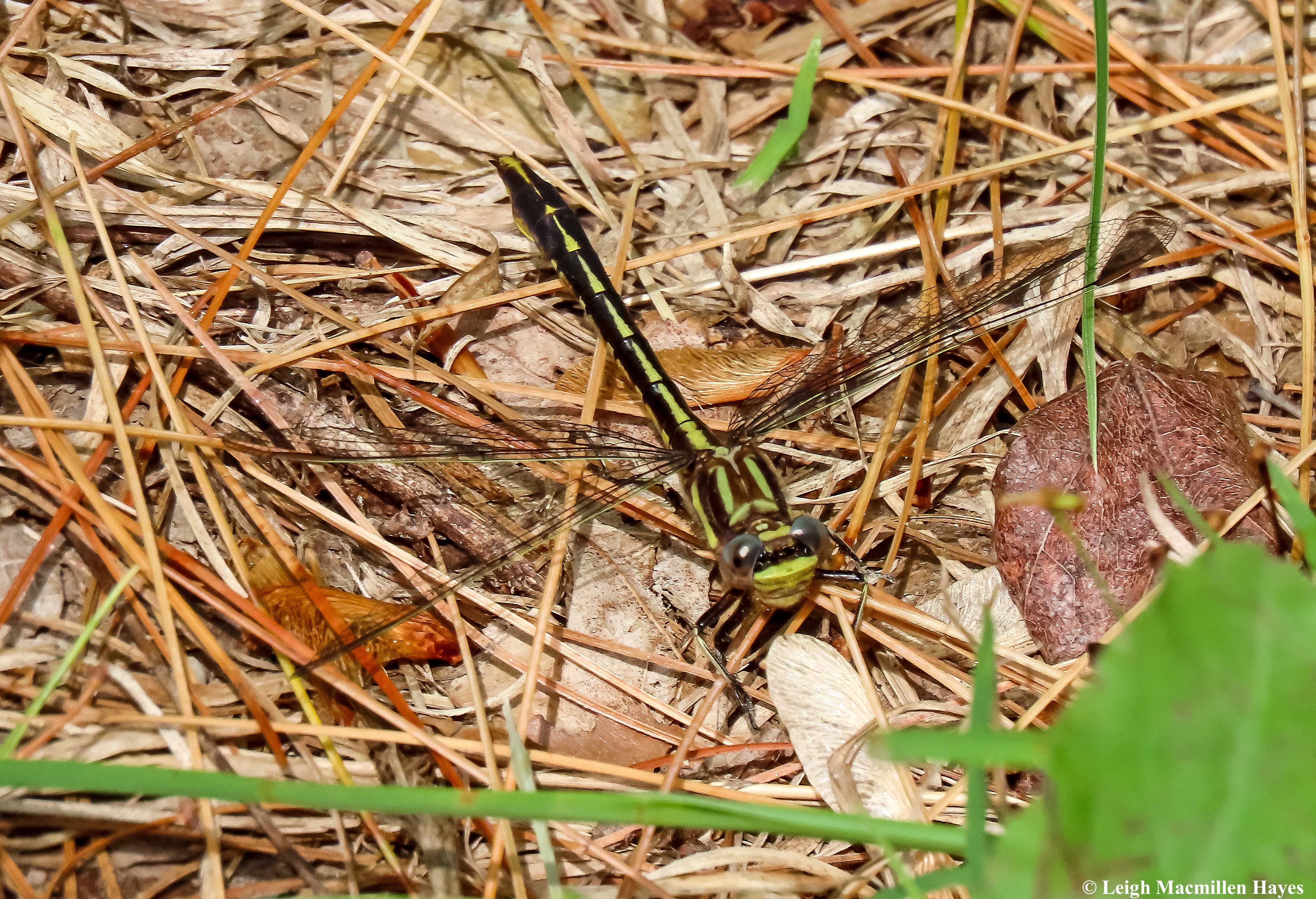
I swear they are as curious about us as we are about them. But maybe again, they are checking out our predator abilities. I much prefer letting them be the predators as they munch on Mosquitoes and Deer Flies and make time in the woods or on the water so much more comfortable.

And then there are those who seek nectar and Meadow Hawkweeds are a valuable resource right now for Flower Flies and Bees and Wasps and Butterflies like this little Northern Crescent. Last summer I spent a lot of time with this species in my neighbor’s field and was thrilled to realize that as long as there was food available during the fall in the source of Goldenrods and Asters, they were present.

One of the most abundant butterflies this year has to be the Tiger Swallowtail. Canadian and Eastern, and probably hybrids in the mix, they are everywhere. Everywhere. Adding grace in their flutter-bys and color to the landscape. As well as serving as pollinators.

Dropping drastically back down in size, my attention was also drawn to the Long Dash Skipper Butterfly. According to the comprehensive field guide, Butterflies of Maine and the Canadian Maritime Provinces, by PhillipG. deMaynadier et al, “The Long Dash is named for the conspicuous stigma on the male forewing. Found on forewings of most other small, orange and brown skippers in our region, a stigma is a specialized patch of scales that emits pheromones used during courtship. In the Long Dash, the stigma is surrounded by black scales, making it appear larger than it really is.” Thus, this would be a male Long Dash Skipper upon one of its favorite flowers, Red Clover. But from the book, I’ve learned I should also look for it upon Cow Vetch, Common Milkweed, Spreading Dogbane, hawkweeds, Ox-eye Daisy, and knapweeds.

Keeping pace with me despite its much shorter legs, the Six-spotted Tiger Beetles, which I love for the iridescent green, practically ran ahead, reminding of Chalk-fronted Corporal Dragonflies who insist upon flying five feet in front, waiting till I almost catch up, and then flying another five feet ahead, over and over and over again. The only time I’ve seen the Six-spotted Tigers slow down is when they are canoodling. But even then, they are on the move.

Another insect, which is much slower, may have significant value in our landscape. If I’m correct with the ID, and I’m waiting for iNaturalist to confirm, this is Atanycolus cappaerti, a parasitic wasp. I can only hope that my ID is correct, because . . . according to Cornell University’s College of Agriculture and Life Sciences, A.cappaerti “attack [Emerald Ash Borer larvae] at rates high enough to be considered significant for biological control. While studies are still ongoing, the use of the native parasitoid A. cappaerti for augmentative biological control would be desirable from an environmental perspective as it is already established and has a niche in the ecosystem.” That’s in Michigan. But maybe in Maine as well? Please let it be so. This past winter we all noticed that EAB had spread significantly in our area.
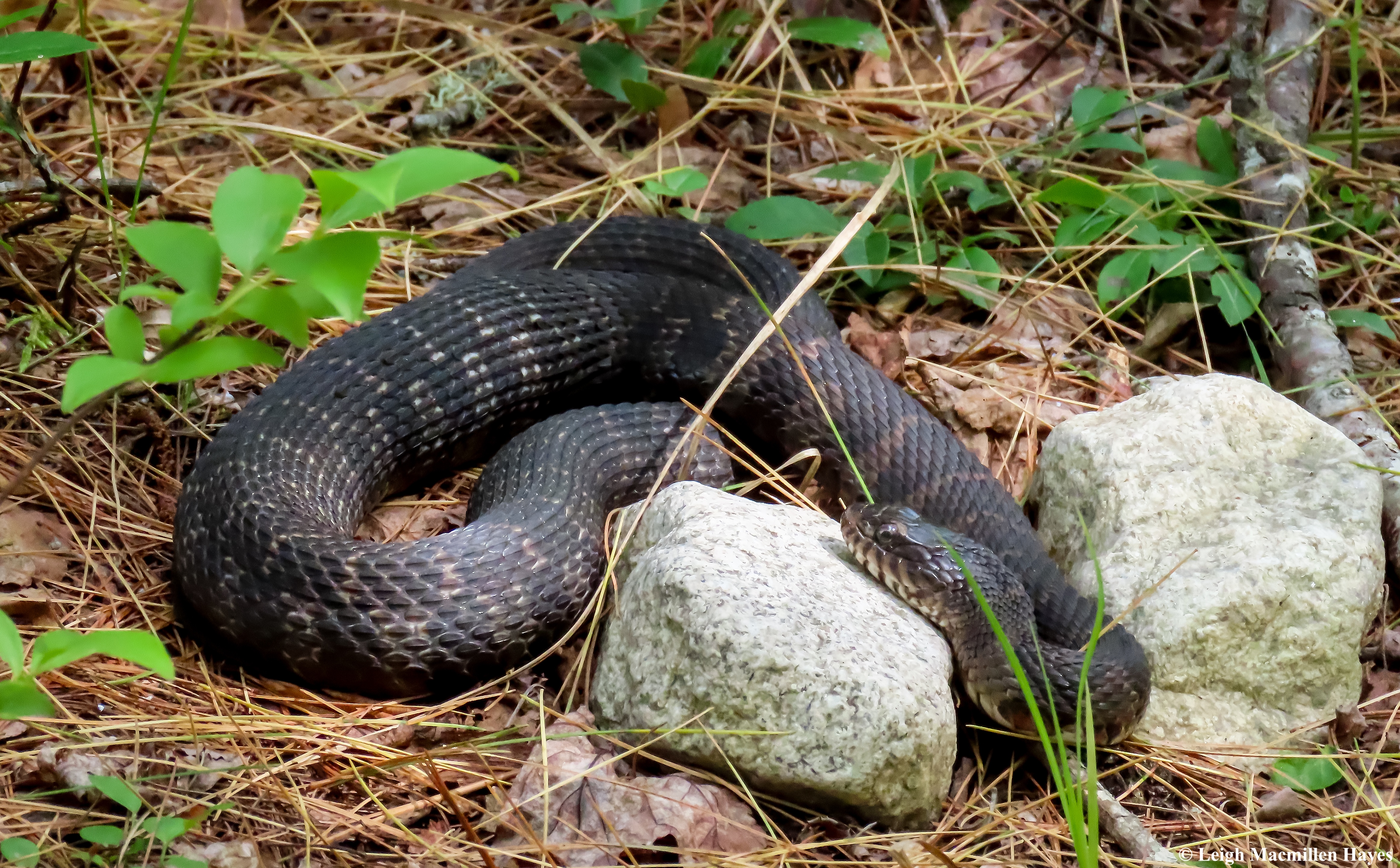
Basking just down the trail from the wasp was a Northern Water Snake who didn’t seem to mind my presence, and I tried not to mind its either.

He was aware of me, and I say he because in the Northern Water Snake world, the male is smaller than the female, and this one wasn’t really all that big, but still . . . a wee bit intimidating. Of course, it did nothing to make me feel that way, so the intimidation was all in my mind. Instead, he let me take a few photos and pass by without a confrontation, as is always the case. I remember once stepping out of a canoe and practically landing on one, who stayed put. And another time, realizing that one was basking in Maleberry shrubs at the edge of a pond as a few of us paddled by within mere inches–or so it seemed.
As spring gave way to summer this past week, I think one of the things that stood out most to me was sighting the turtles laying eggs. Though they don’t hatch at exactly the same time, it will take about two to three months for the eggs to incubate. Of course, temperature has much to do with that. But my experience in the past is that about the autumnal equinox we may see baby turtles crawling out of small holes, if not sooner. And if predators don’t get to them first. There’s always that risk.
I do love winter, but summer fauna among all the flora–so much life happening right before our eyes–its like an explosion of color and form and pattern and texture and sound. And it’s only the beginning. I can’t wait to see what the rest of the season has in store for us.
 wondermyway