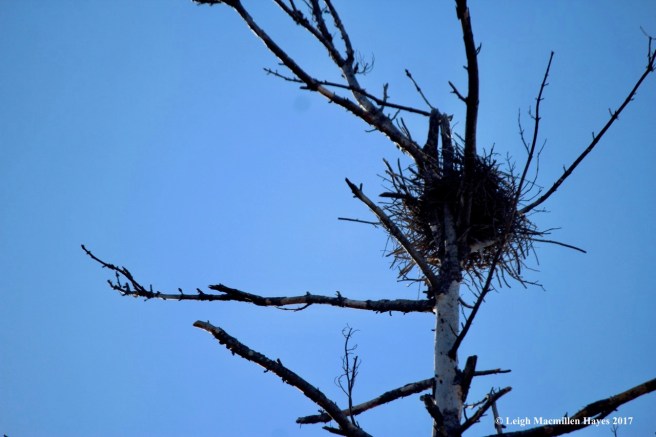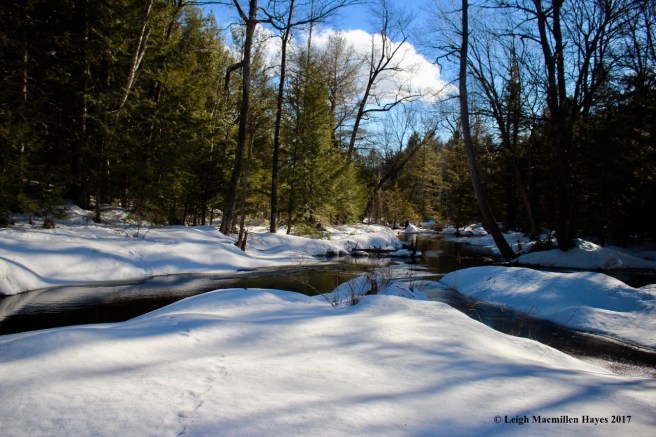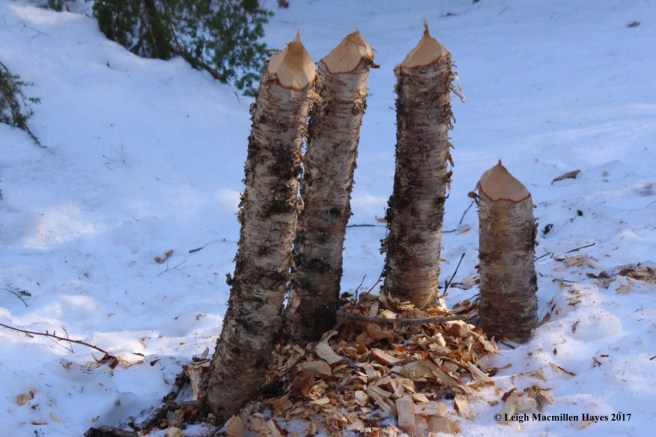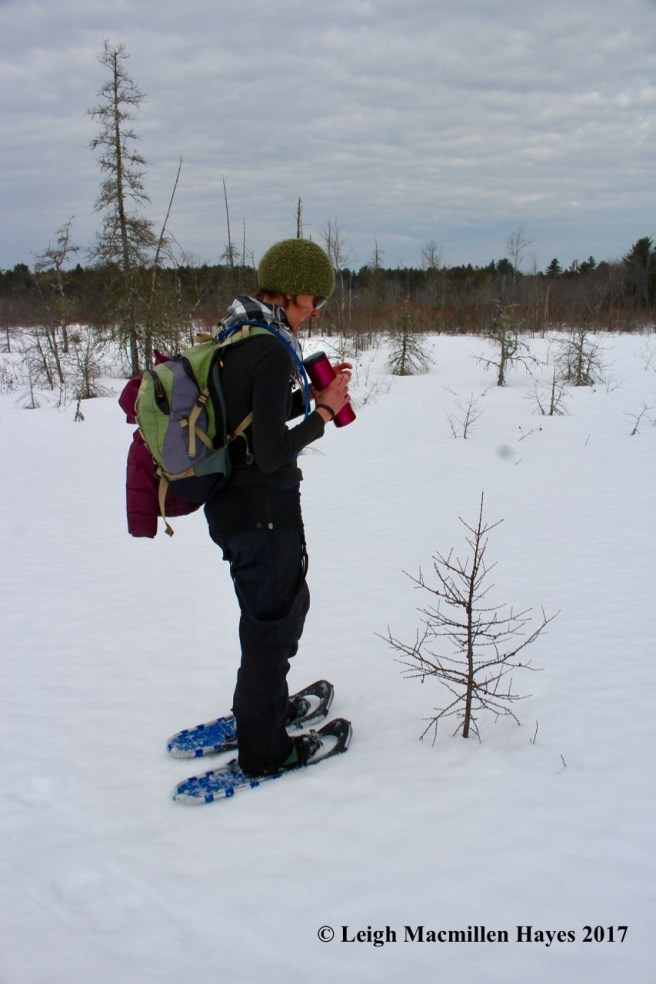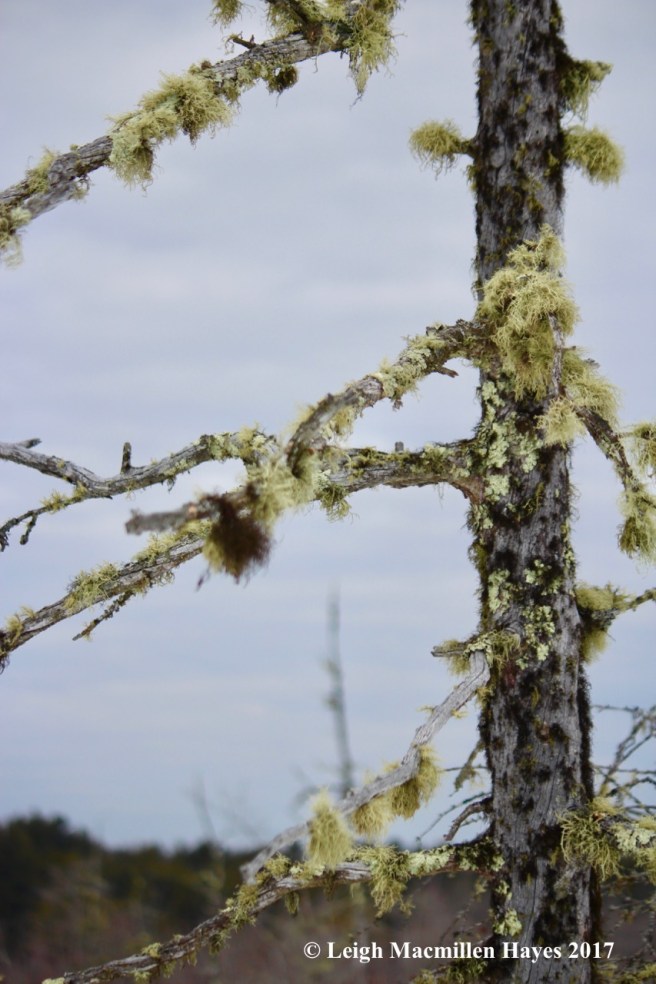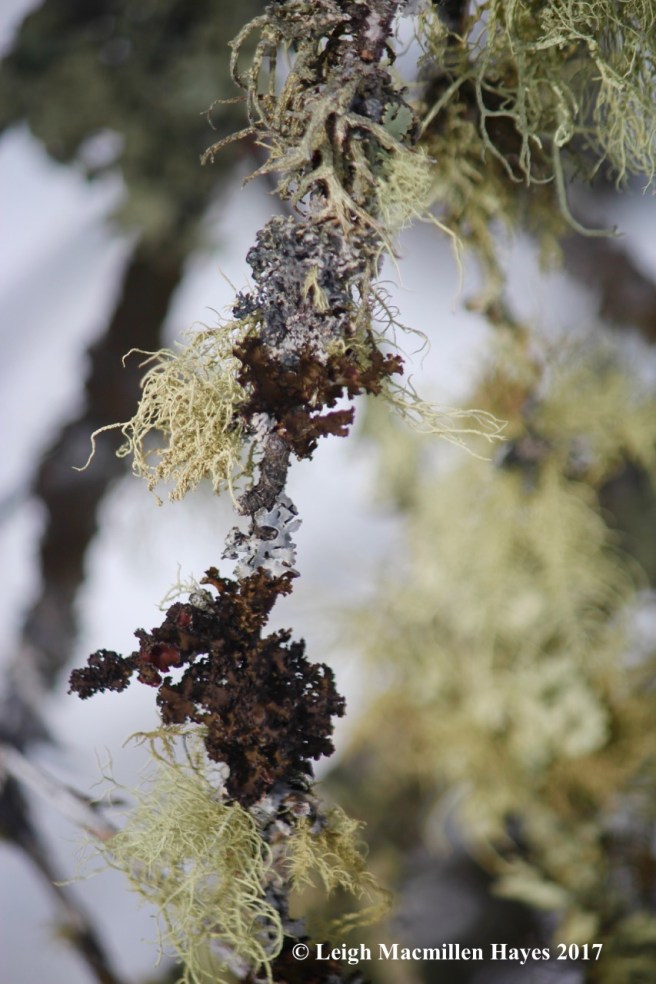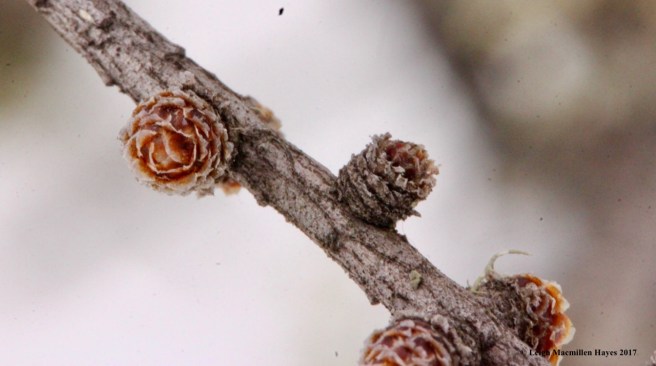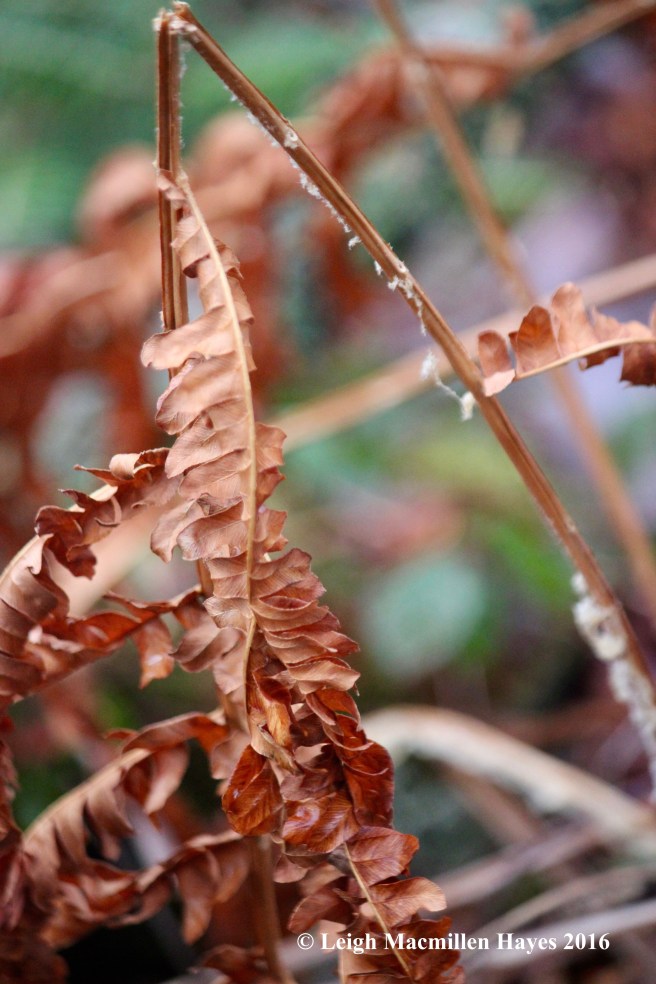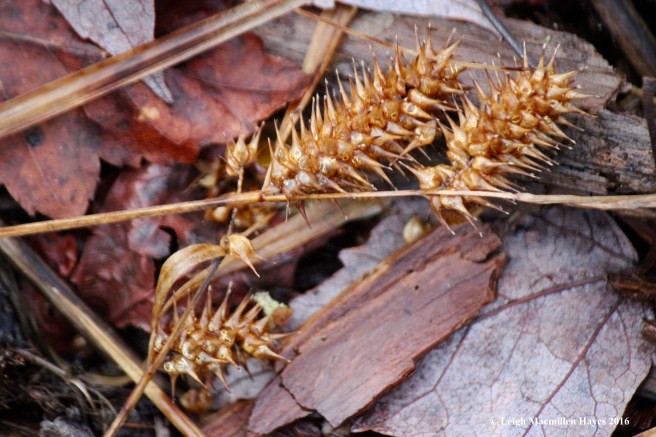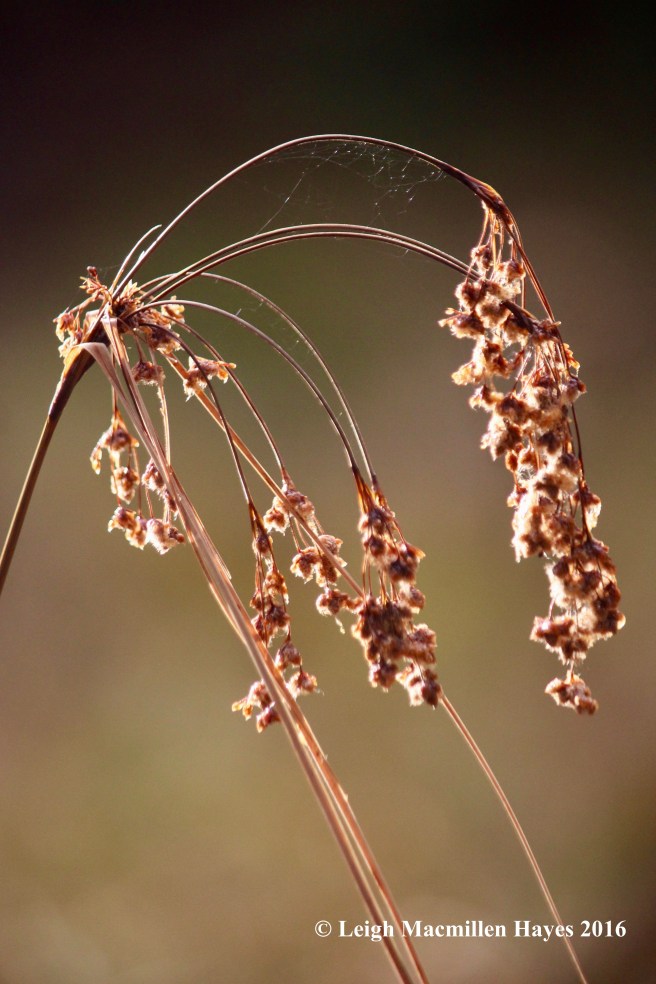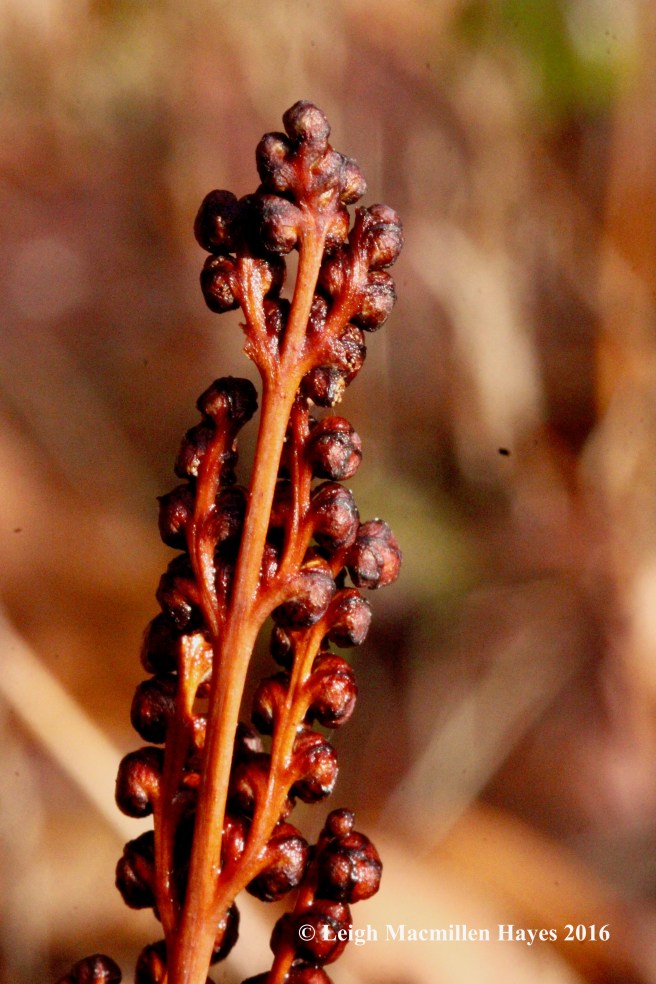
The Irish Colors

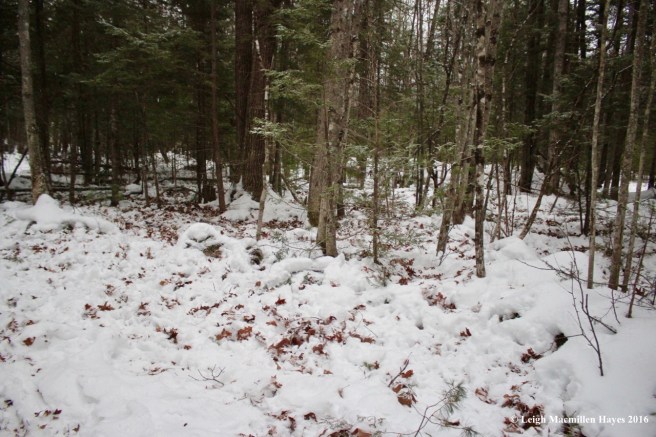
With so much snow still on the ground, it’s easy to see the landscape as a monochrome palette of grays. And so I set out on this St. Patrick’s Day to find some color.
f-bridge

My destination was the Greater Lovell Land Trust‘s Flat Hill trail and Perky’s Path from the end of Heald Pond Road. The parking lot is almost non-existent, so much snow do we have. And the bridge crossing tricky.
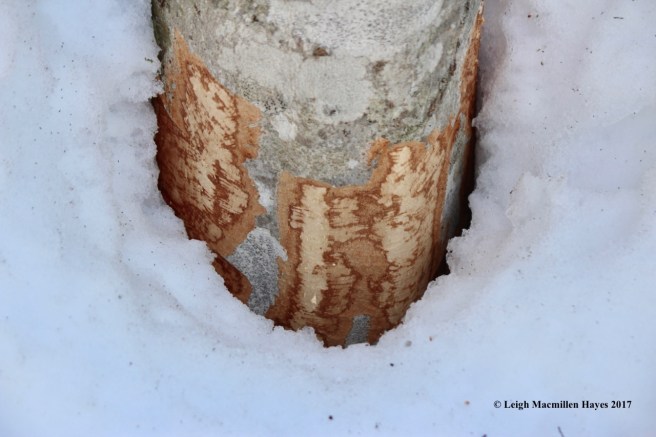
f-cherry bark

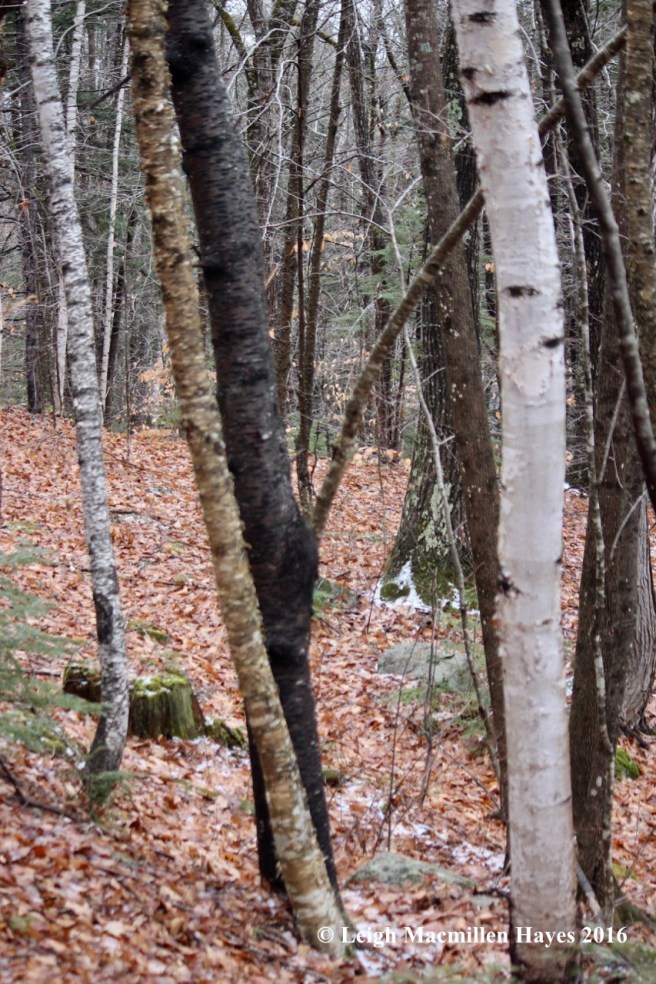
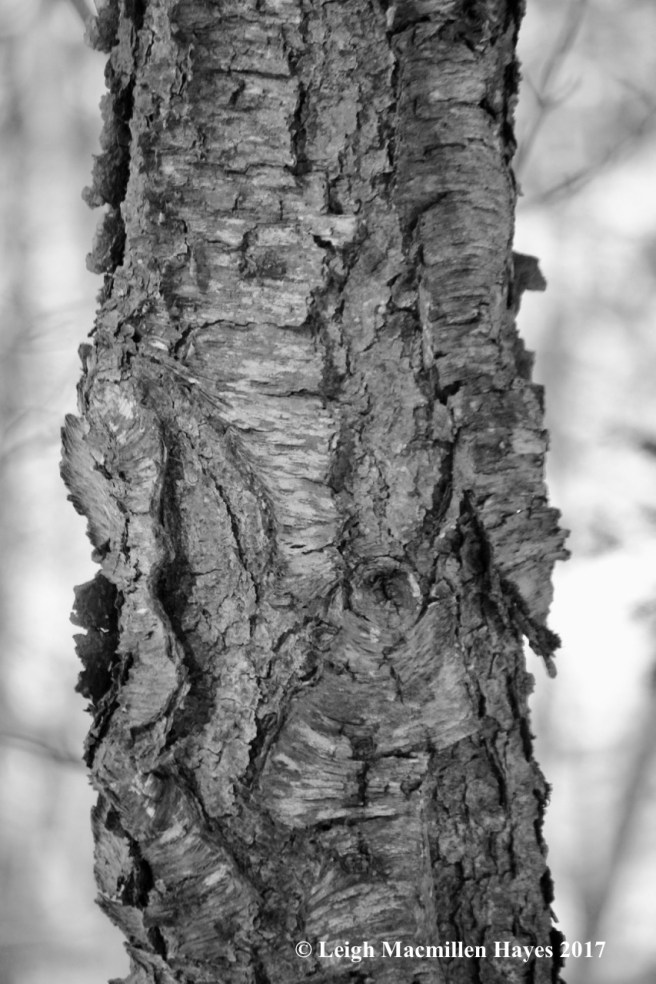
As I climbed upward, the thought that some see the world as black (cherry) and . . .

f-paper birch 1

white (paper birch) kept racing through my brain.

f-gray birch 1

And then there are those who accept that gray areas exist (gray birch–a brother of paper birch from another mother).
f-yellow birch bark

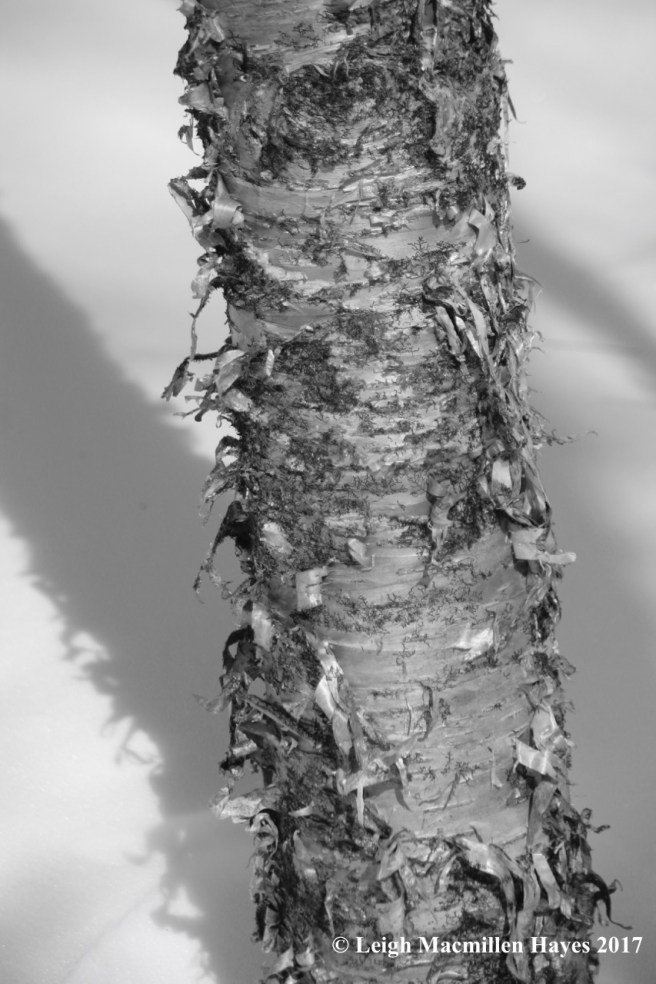
Textures visible in shadows reflected differences (yellow birch–a cousin),
f-hop hornbeam

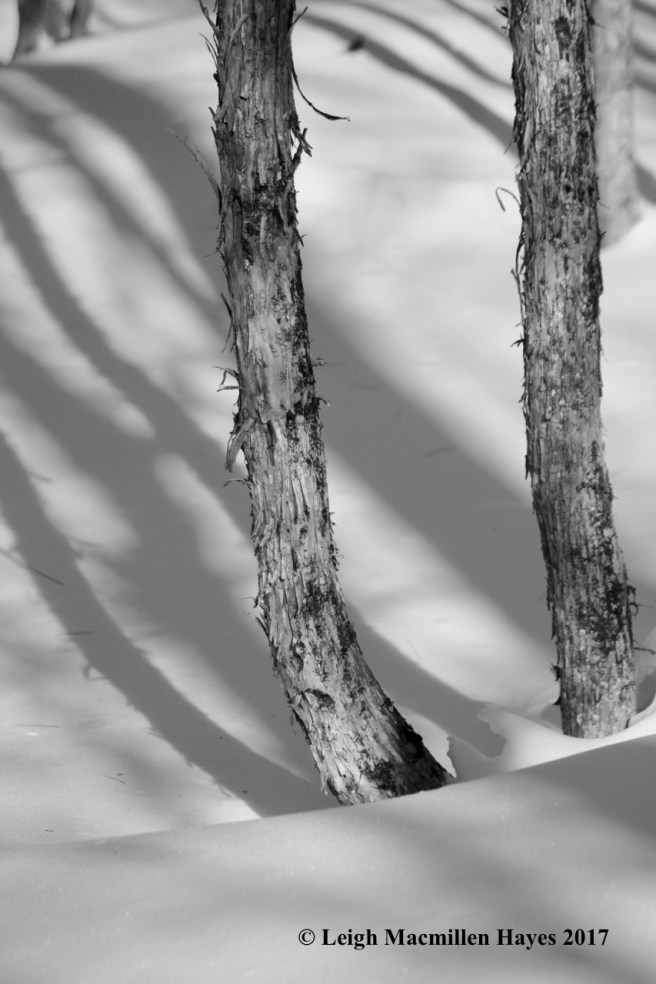
even among family members (hop hornbeam–also a birch relative.)

f-mink tracks

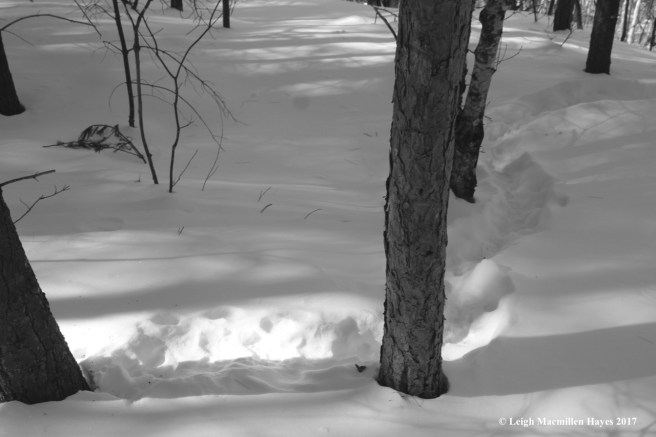
It may have seemed there wasn’t much new to see and wonder about, but . . .

f-mink prints

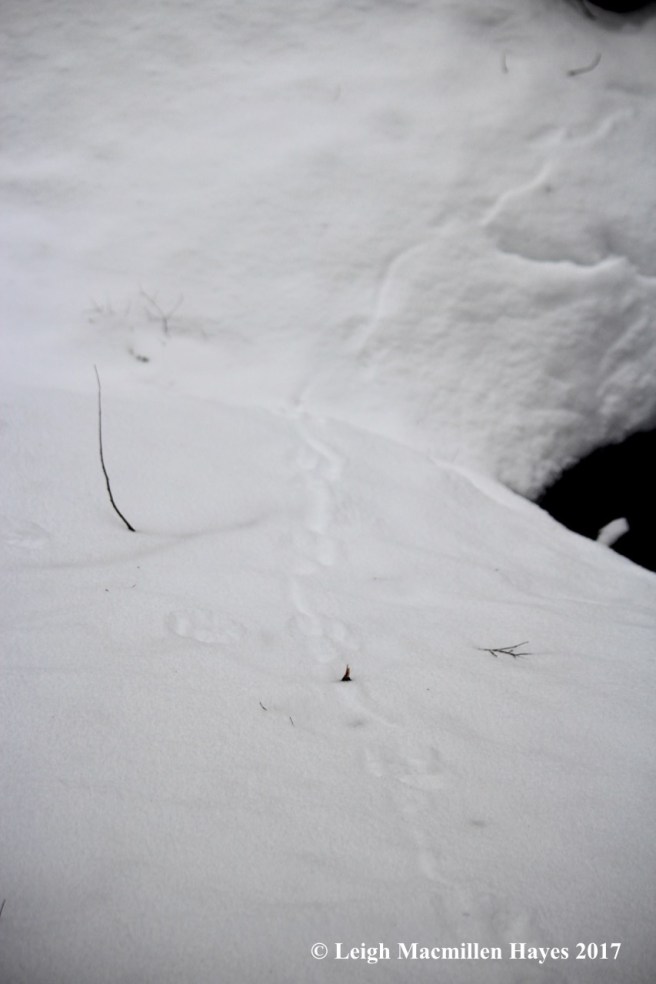
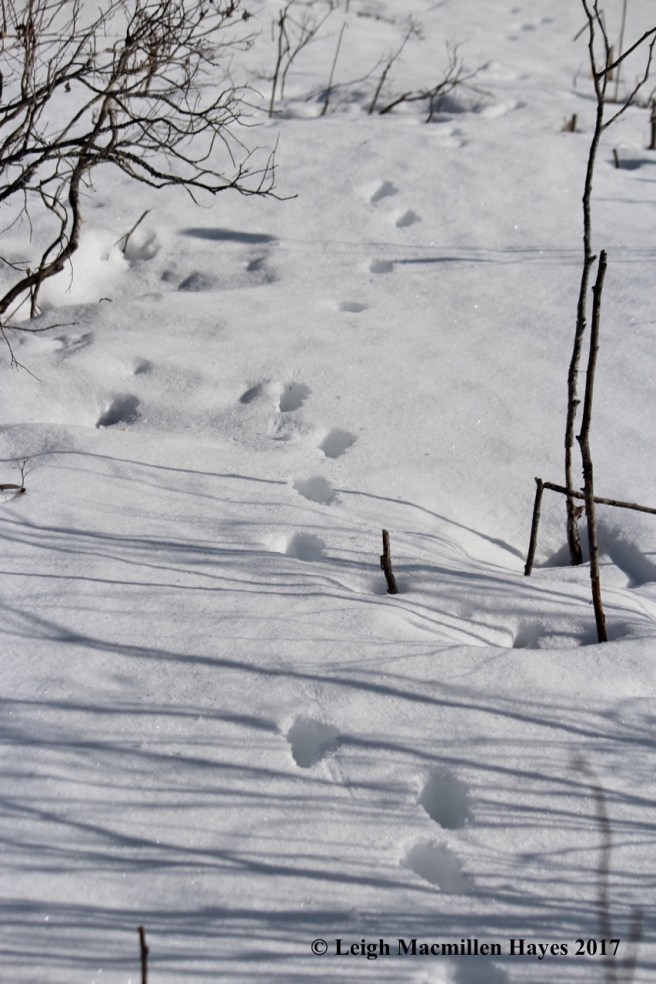
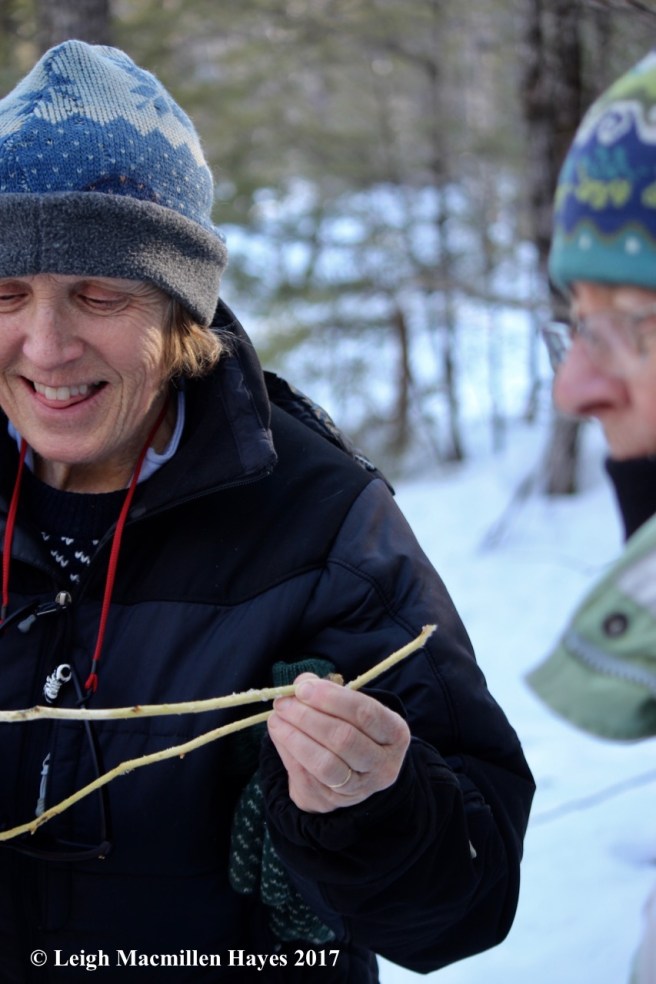
the straddle (width from outside of one print in a set to outside of the other) and angle of these prints told a different story. A mink had crossed the trail. (My mitten had to hold the Trackard in place or it would have slid down the trail.)
f-porcupine trail

Nearing the top, I went in search of another mammal who has frequented this area for years–and I wasn’t disappointed. The porcupine trough was fresh.

f-view from Flat Hill

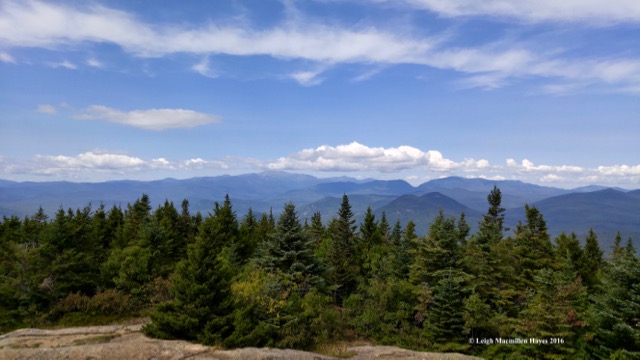
And then I reached the summit of Flat Hill (forever an oxymoron) and the whites, greens, browns and blues of mountains and sky opened before me. There was even a hint of red in swelling buds.

f-downhill from Flat Hill

The wind was cold, so I didn’t pause for long. Instead, I retraced my own tracks down the hill.
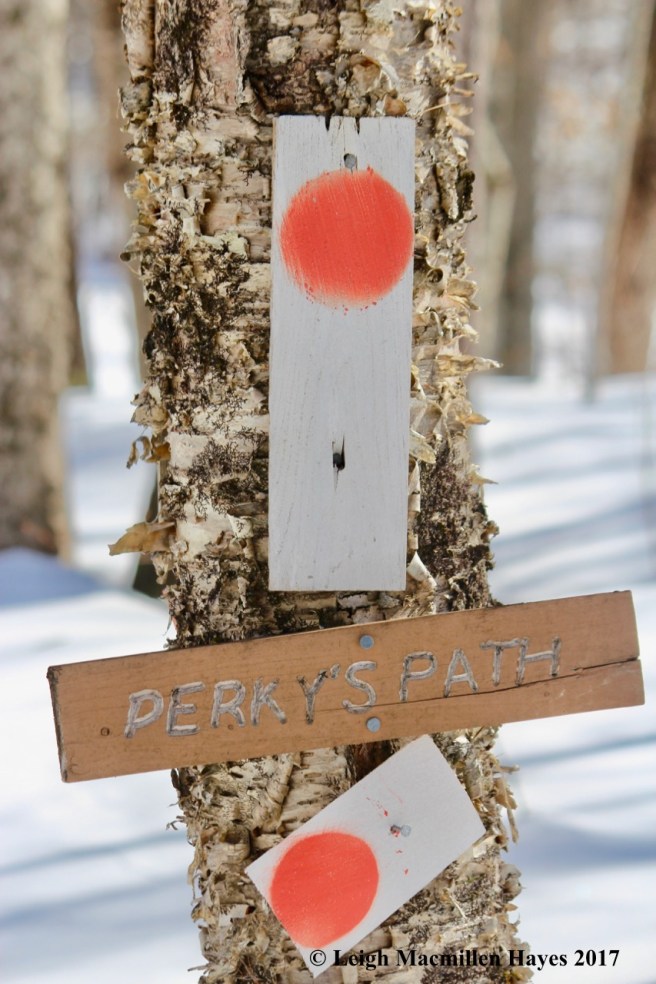
f-orange trail

And then I turned onto the orange trail that is Perky’s Path and realized the symbolism of the color and this day. My Scottish ancestors smiled down on me.

f-beaver lodge

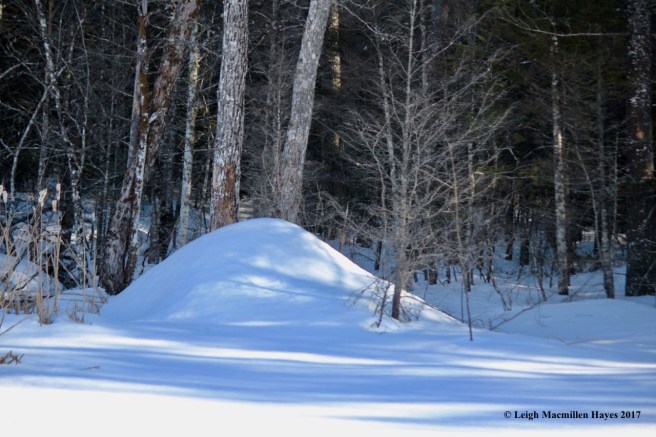
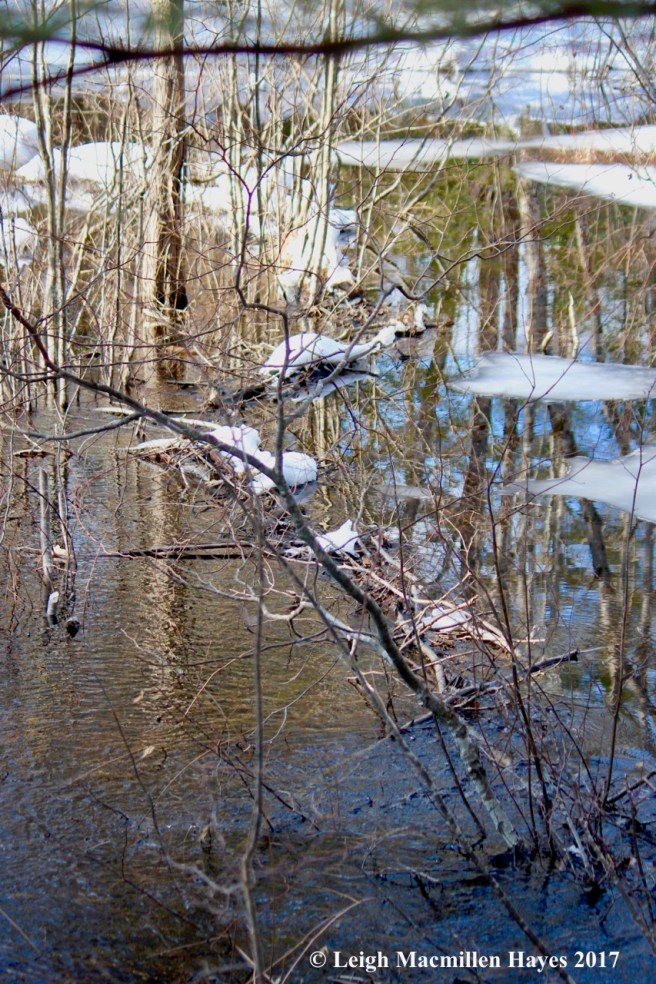
I’m always drawn to the wetland and had to take a peek at the beaver lodge, which remained snow covered, indicating that no one was home. But there again, the sky enhanced my view.

f-wetland from bridge

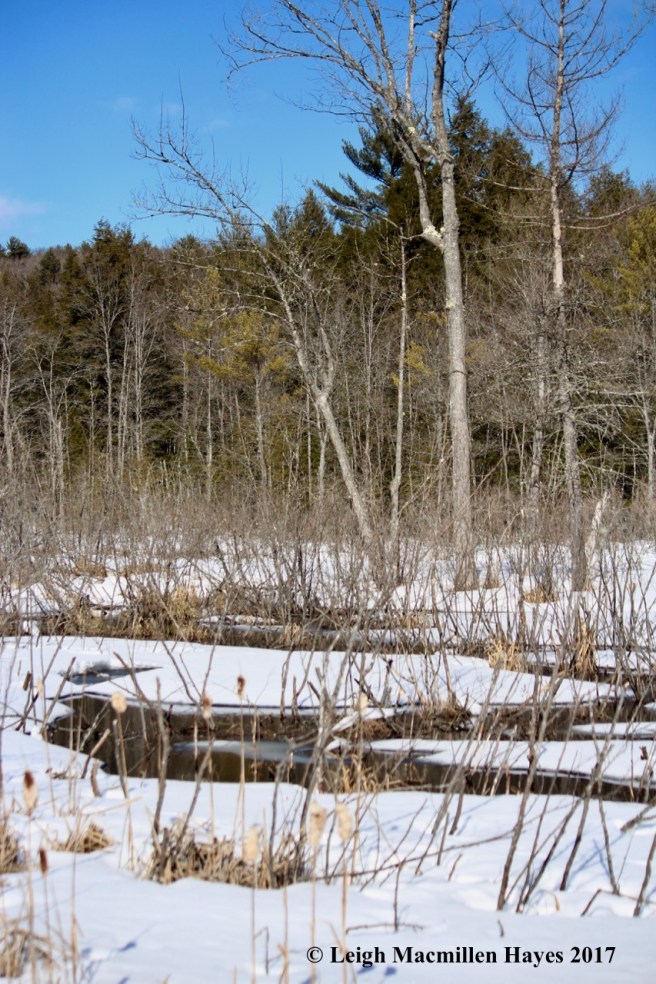
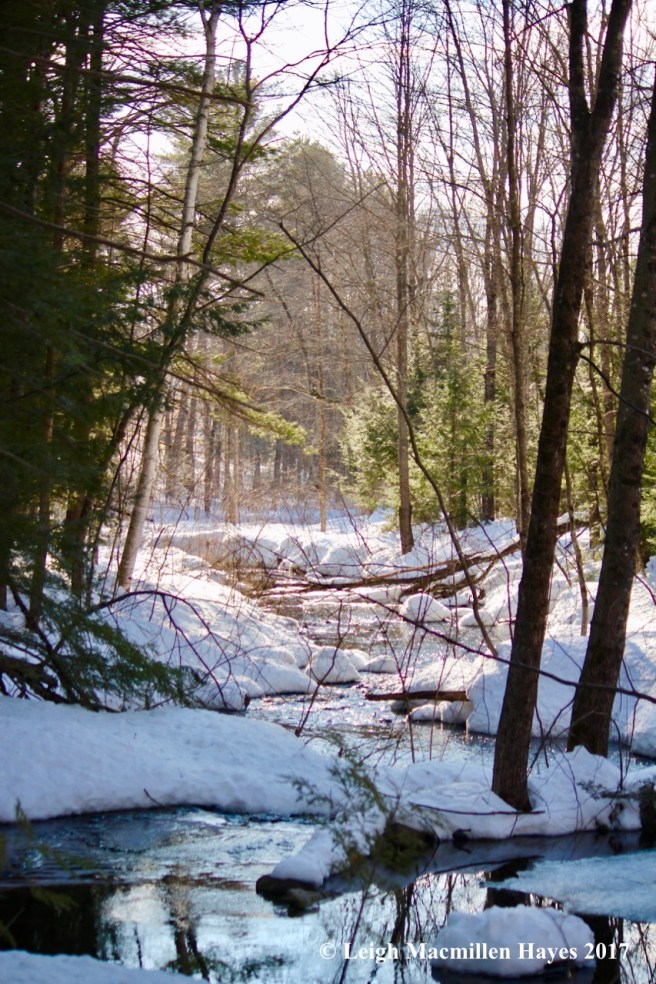
The path leads to another set of small bridges, and there I stood for a while, taking in the peacefulness and beauty before me. Oh, and the warmth of the sun as its strong rays embraced me.
f-chickadee 1

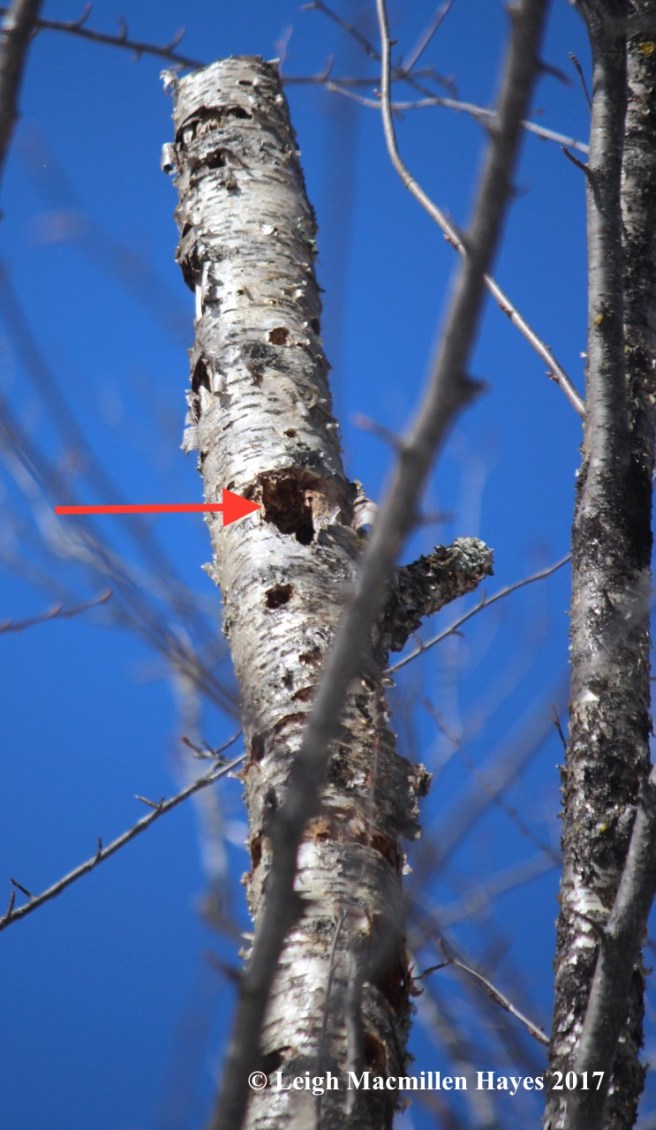
While I stood and listened, a chickadee called and I watched as it entered a hole in the birch snag. This was a wow moment, for though I know birds use old pileated holes, I rarely see them come and go.

f-chickadee 3

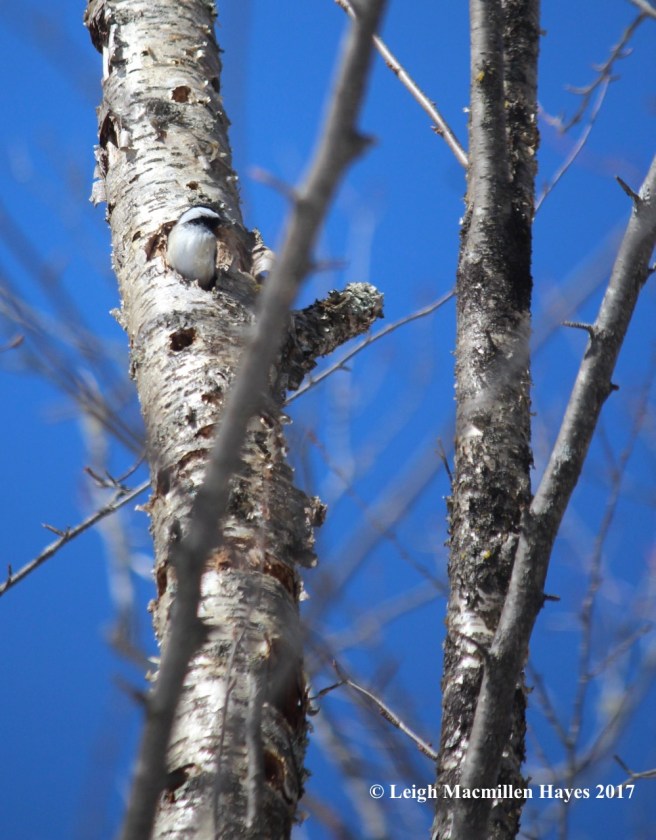
Out he popped, giving a curious look–perhaps because I was pishing.
f-chickadee 2

He paused for a moment and then flew off, chickadee-dee-deeing across the bright blue sky.
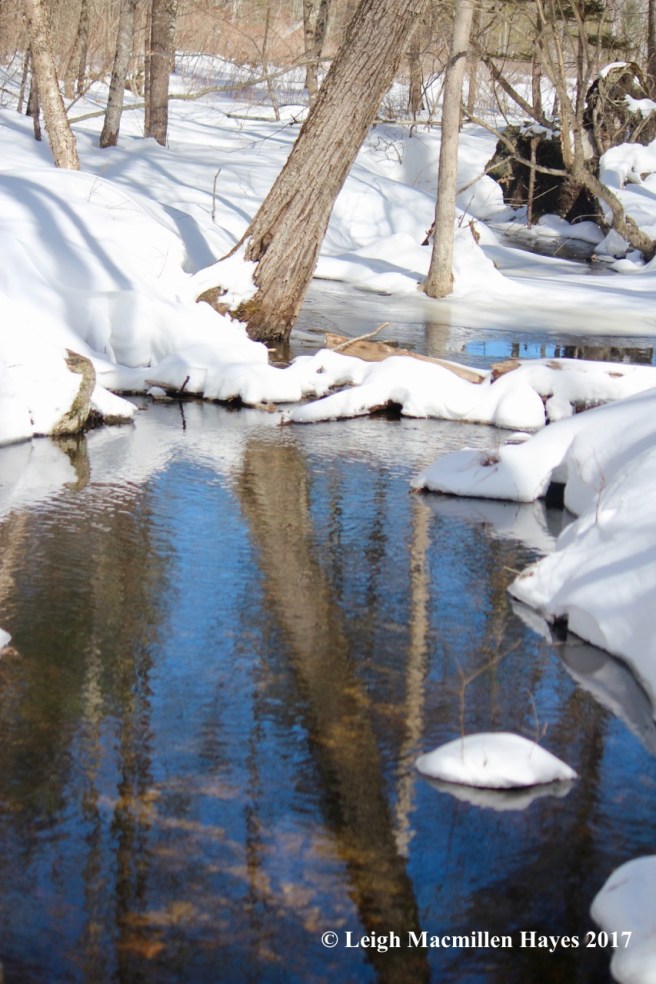
f-brook view

I, too, took off, but not before enjoying a few more reflective moments.
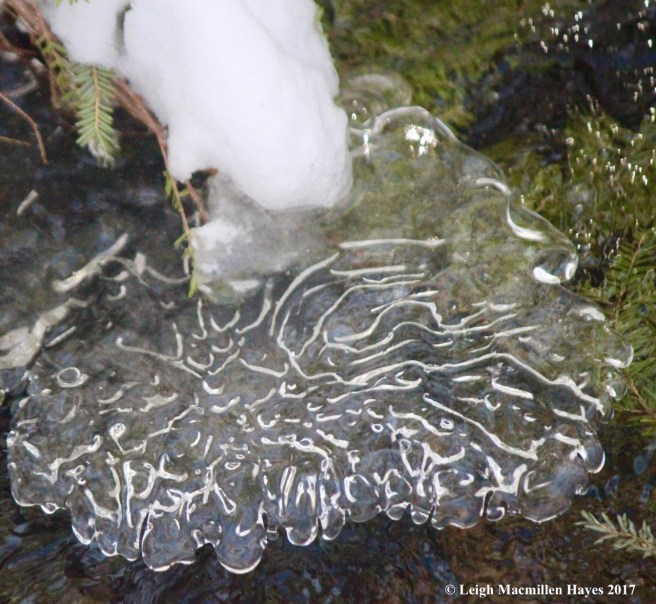
f-ice swirls

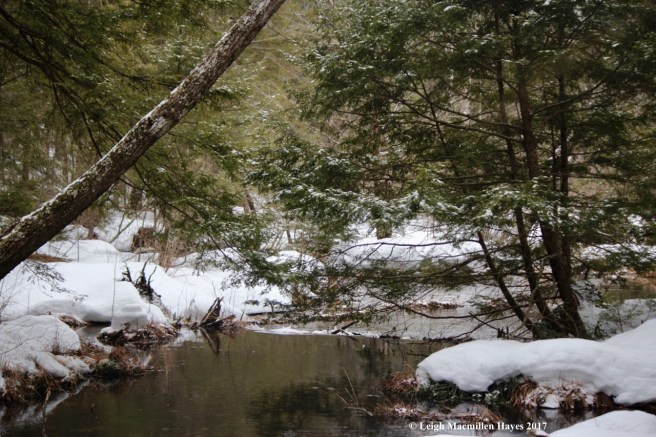
The juxtaposition of snow, hemlock branches, water and ice created colorful swirls of artistic design beyond understanding.

f-wintergreen

And then I found a few wintergreen plants, their waxy leaves transforming from winter maroon to summer green.
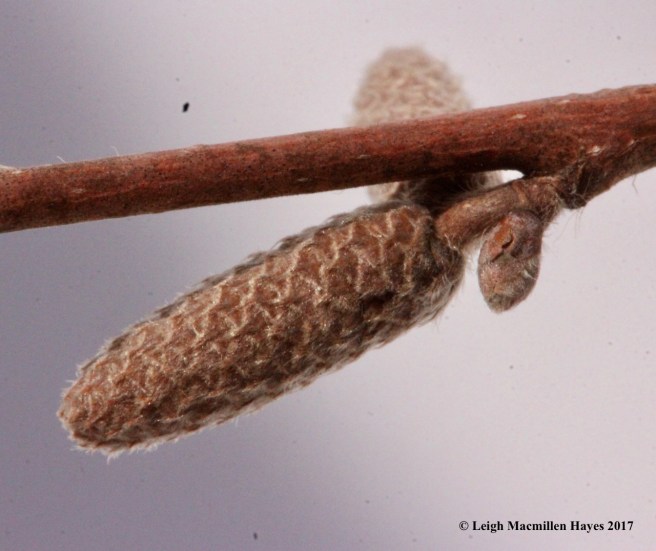
f-beaked hazelnut

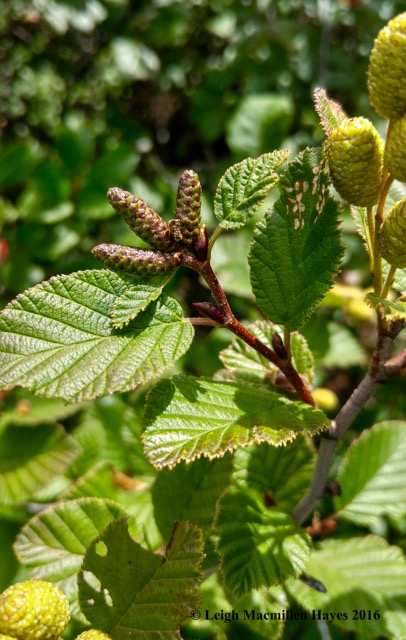
On my way out, I stopped to examine a few buds–and catkins, in this case. I love winter, but I am beginning to crave color and beaked hazelnuts will be among the first to flower.
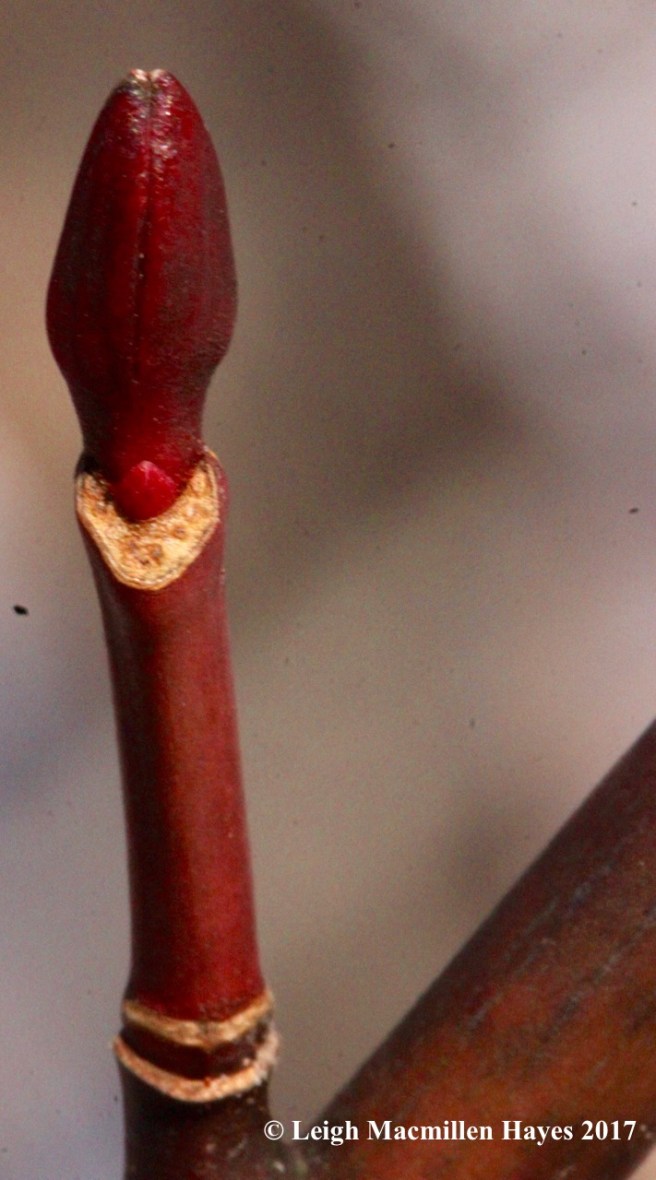
f-striped maple bud1

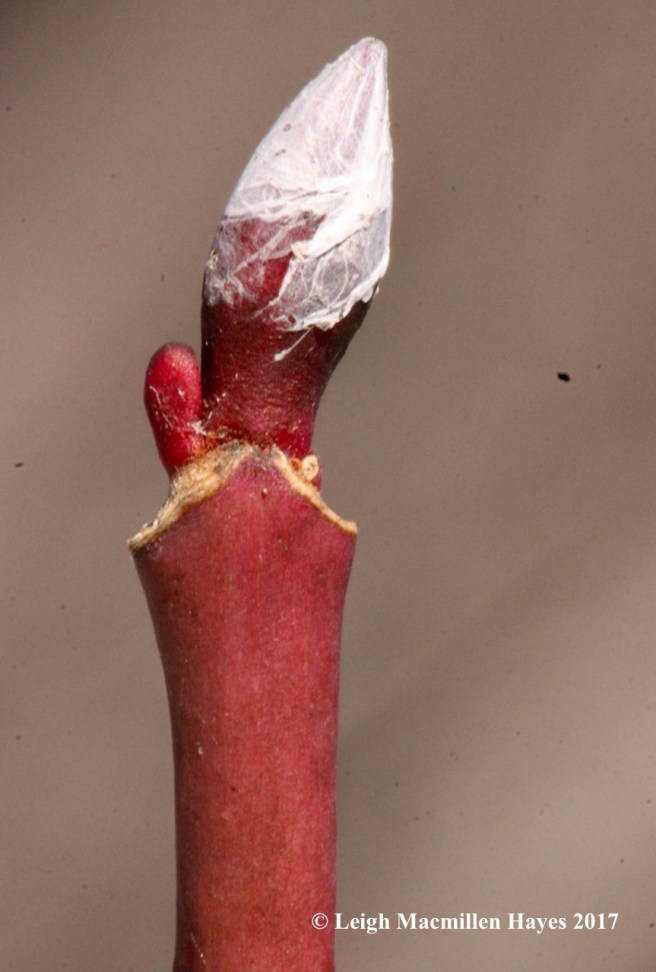
A striped maple showed off its waxy buds, leaf scars and growth rings. The bud reminded me of hands in prayer–perhaps worshipping the patron saint of Ireland.
f-striped maple covered

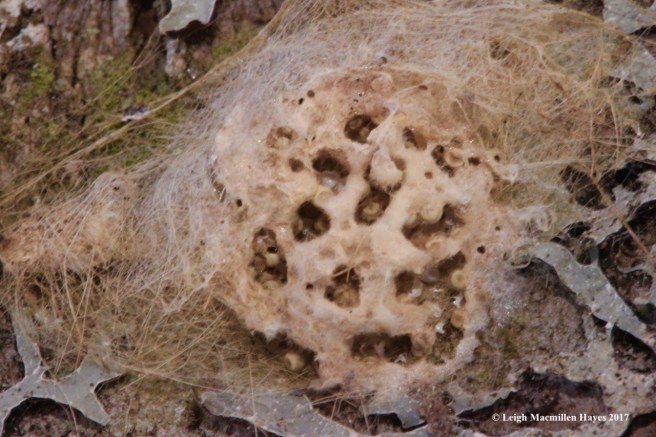
One bud was sheathed in white. Even with my hand lens, I couldn’t figure it out. I’d like to think it was an angelic covering, but suspect it is a cocoon.
f-basswood 2

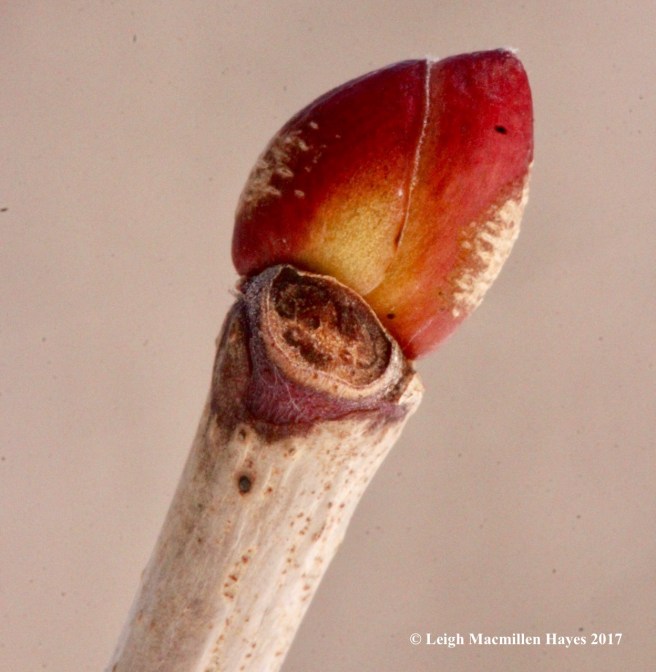
And then there were the bulbous bright buds on the basswood tree.

f-basswood lateral bud

Indeed, they were a sight to behold. Though winter reduced the color palette to the essentials, slowly the transition to spring has begun.
f-Irish flag in breeze

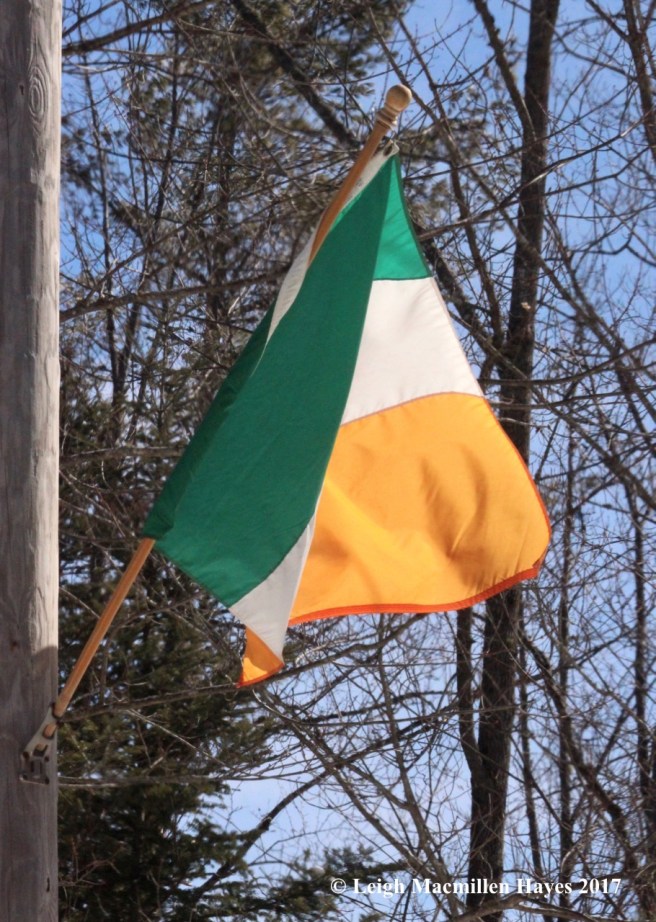
My journey was done, but I made one more stop along Route 5, where Irish flags flapped in the breeze to commemorate this day. The Irish color–where white signifies the truce between the Orange and the Green.

I always wear a hint of orange on this day in contrast to my Irish guy’s green. And I remind him that St. Patrick was born in Scotland.


Beware the Ides of March

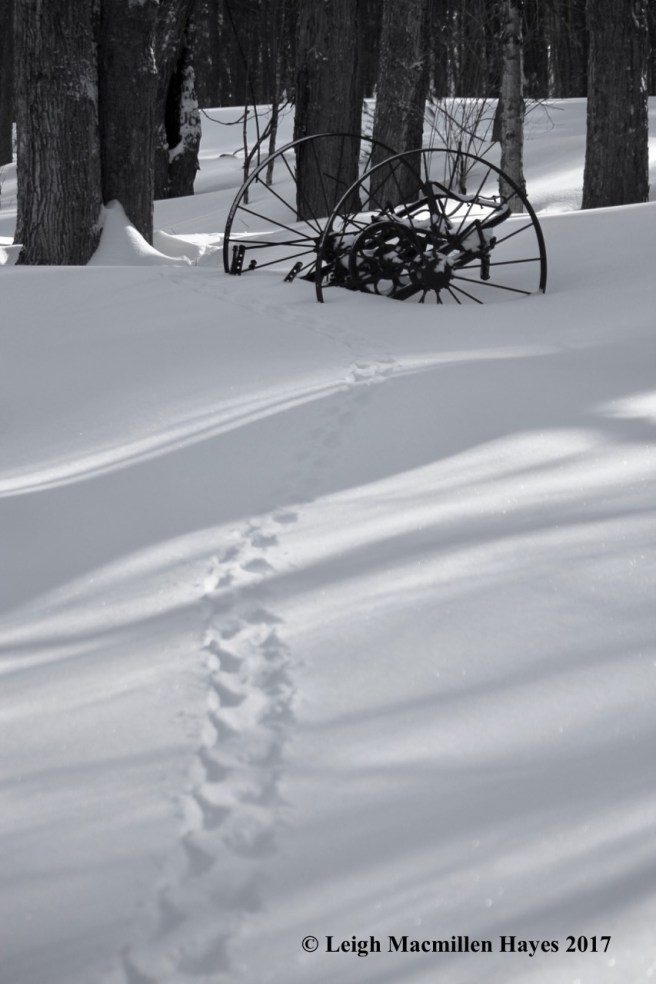
As I write, snow flurries float earthward landing atop the almost two feet of snow we received yesterday. Perhaps I should have heeded the soothsayer who warned Julius Caesar to “Beware the ides of March,” in Act 1, Scene 1 of Shakespeare’s play about the Roman politician. 

But I didn’t. I stepped out the door this morning and took my friend, Judy Lynne, with me for today is her birthday, thus making March 15 a day of celebration rather than one to be dreaded.  

As for “ides,” that word refers to the day in the middle of the month. Every month has a day that divides it in half, therefore, every month has an ides. But still, in the play it sounds so ominous–and is eventually.

And as for Judy, she missed the blizzard (and all our winter weather) because she teaches in China. And she is not at all like the Roman soldiers. Rather, Judy embraces every person and critter around the world and sheds love wherever she goes. 

p-porky

Since she can’t be in western Maine to enjoy the results of a late season storm, she’ll have to travel vicariously–beginning with the porcupine who didn’t let a little snow stop him from plowing through. Those of us who know Judy travel in a similar manner as she shows us parts  of the world we may never actually visit. 

p-Mount Wash

The view of Mount Washington will help her get her bearings. It is this and Pleasant Mountain and our orientation to them on the horizon that help us recognize our place in the world.

p-snowshoe hare

I didn’t expect to see many tracks this morning, but was pleasantly surprised. Besides the porcupine, I saw deer, mouse, red and gray squirrel, chipmunk and these. I can’t give you lobsters for your birthday, Judy, but I can give you the lobster-like prints of snowshoe hare. 

p-AMC bridge

I often don’t know where I’m headed when I walk out the door, and today was no different. This journey took me into Pondicherry Park where I stopped by the AMC bridge and thought about Judy’s ability to cross bridges with people of other cultures, no matter how deep the snow may be.

p-AMC bench

Today, however, if she wanted to pause after making such a crossing, she’d need a shovel, such was the depth on the bench by the bridge.

p-willet brook from bench site

Together, we headed down the trail to the viewpoint beside Willet Brook. Judy is an artist and I had visions of her recreating this scene of winter snow and spring ice. This picture of transitions reminded me of the changes in her life as she interviews for jobs in other countries.

p-Willet 2

The change will be difficult as she leaves behind friendships formed in the last five years, but I trust in reflection she’ll know she’s making the right choice.

p-false tinderconk

As I snowshoed, I found a few things I knew, but didn’t necessarily understand. Bumps in the road you might say, Jude, or at least on the spore surface of a false tinderconk.

p-hammered, green shield and cocoon

Because she loves design and has an insatiable curiosity, I knew she’d enjoy taking a look at the shield lichens, both hammered and common green.

p-cocoon 2

And that would have brought her to notice something else on the bark. She’d have laughed as I stuck my chin against the tree to get a closer look at the silky-hair cocoon embedded on the lichen. Perhaps a tussock moth?

p- Hooded Merganzer

As I wound my way back, I checked Willet Brook again–and spied a hooded merganser swimming away, its crest described as a hammerhead. Hammershield, hammerhead. Methinks Judy will nail down a new job soon.

p-beech bud breaking

And then there was the beech bud already breaking–I’ve seen this happen in previous years; a few scales bursting open before their time.  For Judy, it would have turned into a science lesson for her Chinese high school students. And perhaps a drawing lesson for art class.

p-deer, maple leaves on ground

Throughout the park, I didn’t roam alone for deer tracks were obvious everywhere and I saw three of the creators. But it was the leaves atop the snow that made me pause and I’m sure Judy would have done the same.

p-maple leaves

Occasionally I spot a single withered maple leaf on a tree, but this tree was covered and it made no sense. Maples aren’t typically marcescent–they don’t retain their leaves like beech and oak. It wasn’t until I stepped back and looked at the tree that I finally understood; this was a branch that had fallen when the tree was still in leaf and the deer browsed the tips of some branches, though I trust they didn’t find much nutrition for they moved on. I laughed again and heard Judy roar with me.

p-deer crossing stream:watercress

At the stream below the spring, I noticed the deer had walked right through the water to get to the other side.

p-watercress 1

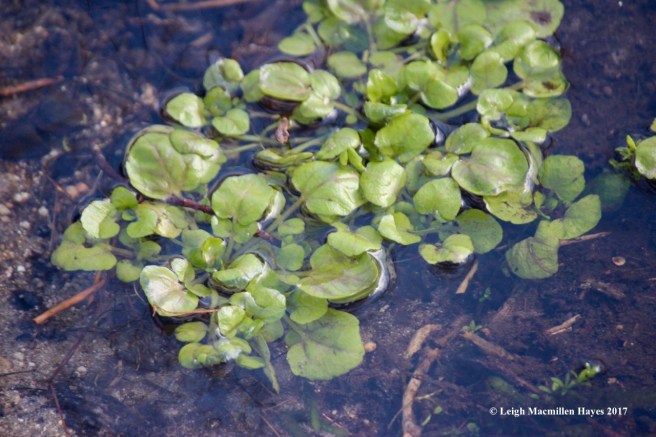
I couldn’t tell for sure, but trust they sampled some wild watercress that grows freely there. And I thought of the foods Judy has sampled during her time in China and other travels.

p-deer crossing bridge

Not all of the deer chose to walk through the water. Some actually crossed the bridge. It struck me that they learned to use it to get to the other side. Judy has learned so much about herself and the world as she’s crossed bridges I’ll never set foot on.

p-dunning bridge 1

The best bridge of all awaited, its roof supporting the weight of the snow. This bridge was built by many to honor a community member, whose wife just happened to be the reason Judy and I met 25 years ago. Wow–it’s been that long since we practiced breathing techniques in Lamaze class .

p-snow on Dunning bridge

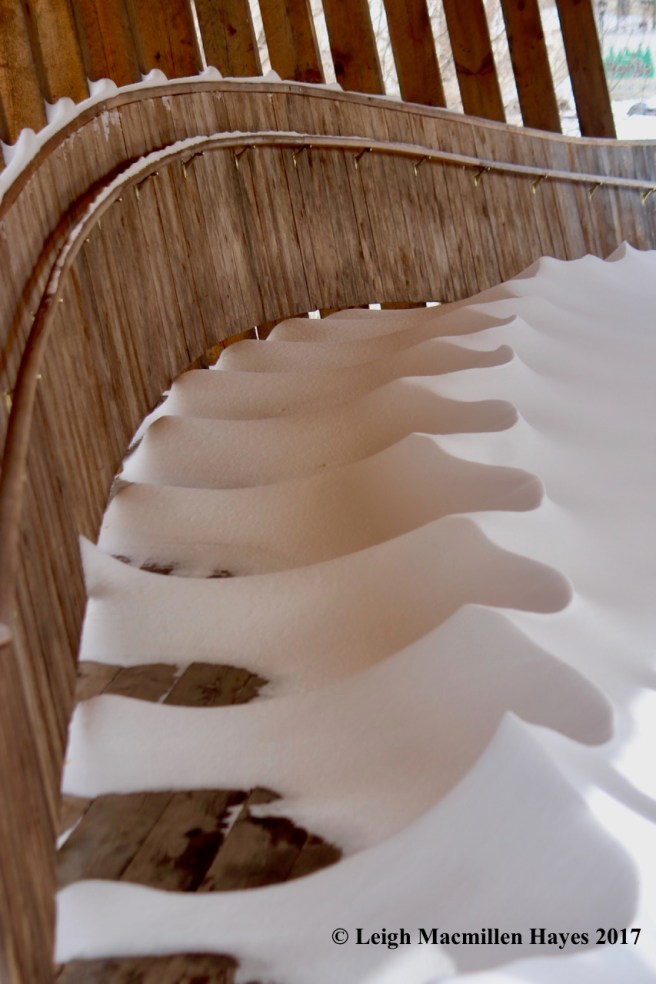
One of the cool things this morning because I was the first one there, the peaks and valleys left behind by the storm. If she’d been here, Judy would have taken the very same photo.

p-ducks 1

I went to the bridge to see the other ducks that frequent this location. The sight of the snow-topped rocks and vegetation made me think of frosting and guess who also teaches a cooking class–yup, Judy.

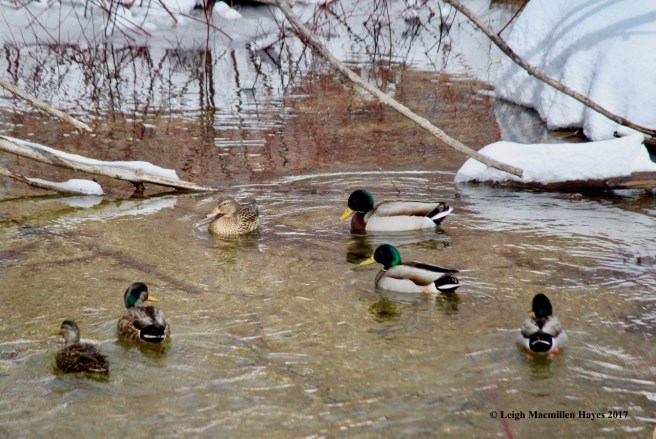
p-ducks 4, black:mallard hybrid?

Within the mix, what I think are two black ducks. I’m still learning my birds, but it did look like one may be a hybrid–a cross between a black duck and a mallard. Of course, I could be wrong on all accounts. No matter–what does matter is that they all get along and that’s what is important to Judy. She’s also a great believer in random acts of kindness and has performed so many good deeds for others.

p-robins 2

I was almost home when I saw some color in the gray birches–more color than the berries being eaten.

p-robin 3

A flock of robins dined on the “junk” food of the bird world–bittersweet berries.

p-robin 1

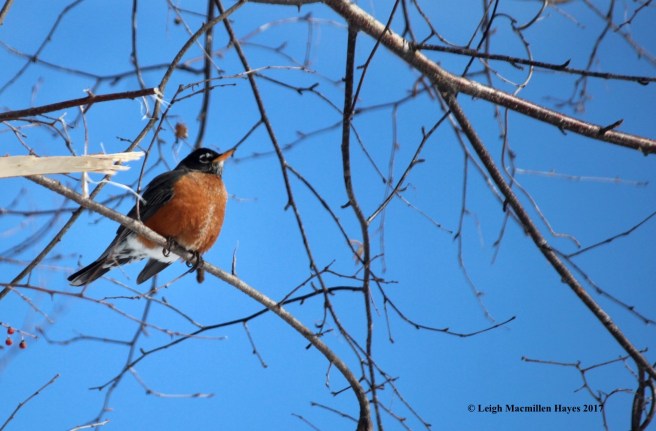
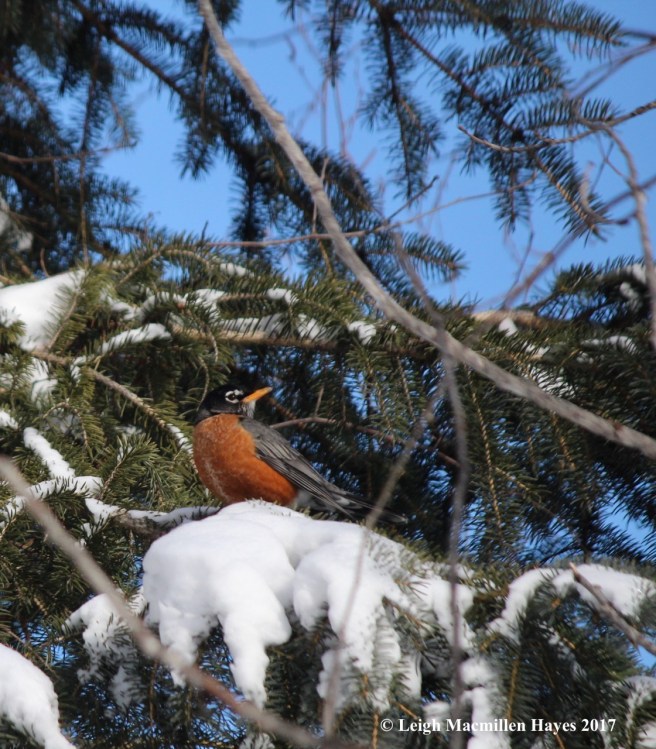
After one drank some snow, it showed off its rufous-colored breast, reminiscent of Judy’s red hair.

This one posed atop the snow-covered branch seemed a mighty fine representation of our move from one season to the next. (Or might it be one country to the next, Jude?)

In the end, today’s journey reminded me once again to Be Aware–the eyes of March. And be thankful.

I am thankful for my friend, Judy Lynne, born on the Ides of March, but not actually reading this until the day after her birthday. I’ll be forever in awe of her.

Focusing Our Eyes at Wilson Wing

I almost canceled our Tuesday Tramp this morning. The weather seemed iffy and though that doesn’t often stop us, road conditions do. But Mary and I exchanged a few e-mails and decided that even though we were the only two available, we’d go for it.

w1--deer 1

As we made up our minds, I watched another who also experienced some indecision. Lately, eight deer have spent many moments in the field and our yard, nipping buds along the edge.

w2-deer 2

While the rest of its clan was further out, this one came over the stone wall.

w3a--deer 3a

For me, it was a matter of watching how its legs worked and where it placed its cloven toes.

w4-deer 5

About to visit some trees, it turned suddenly when it realized it was being stalked–not by me but rather a neighbor’s cat. Well, maybe I was as well, but I was indoors.

w6-deer 6

Gingerly, it moved in for a closer look.

w7-deer 7

Tail down, it seemed curious to make a new acquaintance. And the big, tough cat–it ran home.

w8--Sucker Brook 1

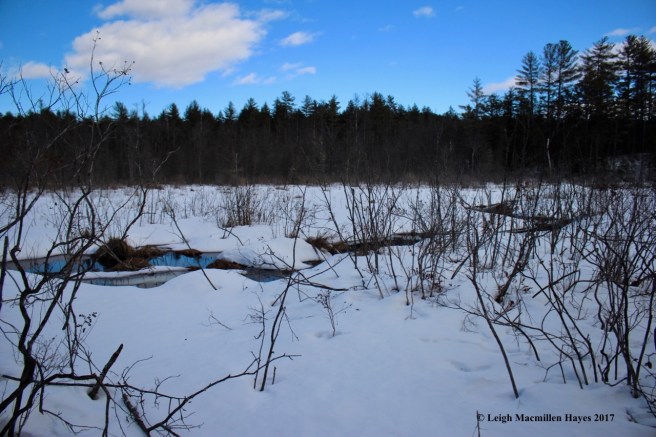
And so, I packed up and met Mary for our adventure at the Greater Lovell Land Trust’s  Wilson Wing Moose Pond Bog Preserve on Horseshoe Pond Road in Lovell. We’d had a dusting of snow overnight and weren’t sure what to expect. Always expect the unexpected.

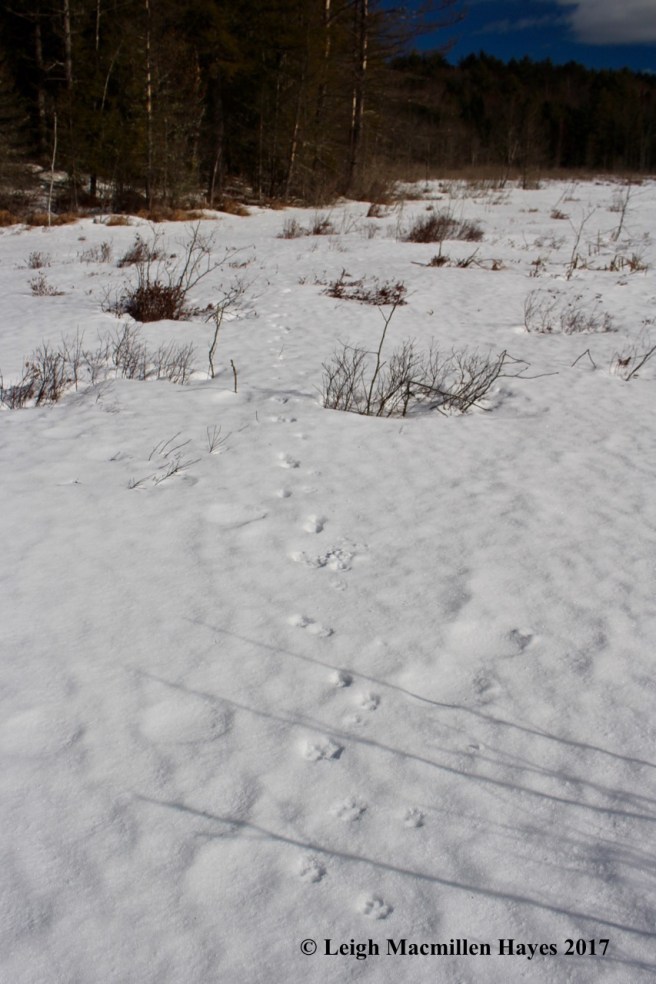
From the start, we found older coyote tracks that we decided to follow. Those led us to mink tracks that began near Sucker Brook. For a while, we followed both as they ran parallel, the mink tracks being much fresher. And then we stood in one spot and realized we were encircled by coyote, mink, red squirrel and short or long-tailed weasel tracks. We could have gone home then, but of course we didn’t.

w9-ice skirt

We decided to follow the brook for a while, hoping to see otter tracks and a slide. Instead, we were treated to aprons of ice surrounding boulders and tree roots.

w10-hoar ice

Some hoar frost at a hole made us wonder who might be within.

w11-mink tracks with tail drag

And our eyes again recognized that we were still on the trail of the coyote and mink. All along, we were curious to see the drag marks left behind by the mink’s tail. Unless it was carrying something–another option.

w12-Sucker Brook 2

As we stood and looked about, movement caught our eyes and we realized we were looking at the mink. Unfortunately, neither of us thought to capture it in a photograph, but it will remain forever in our mind’s eye. While I did exactly what I tell others not to do–tried to follow it for a couple of minutes–Mary stood and listened. A sound above make her crick her neck.

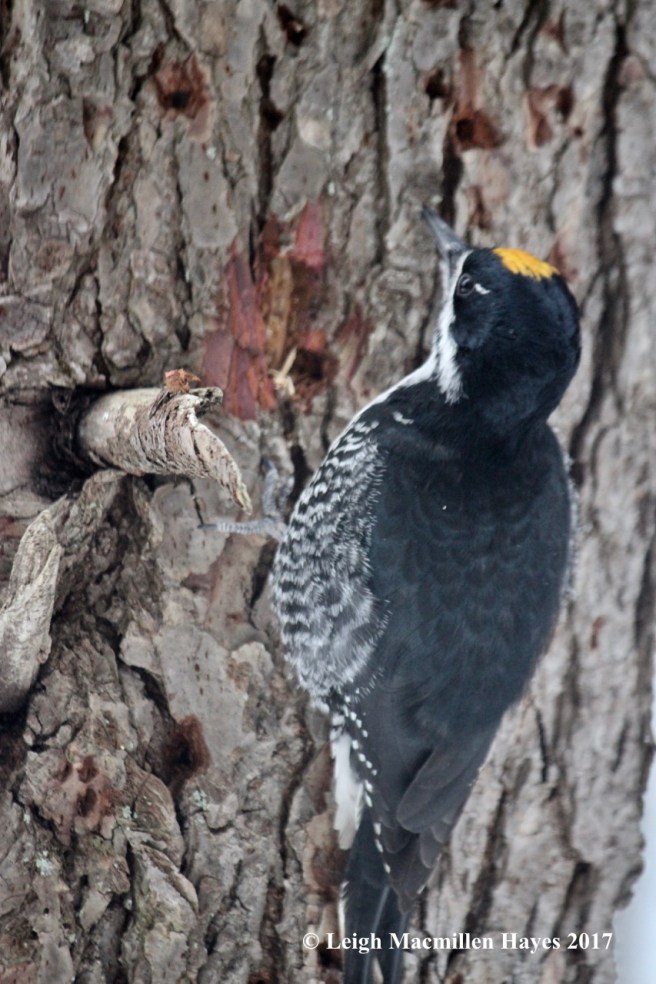
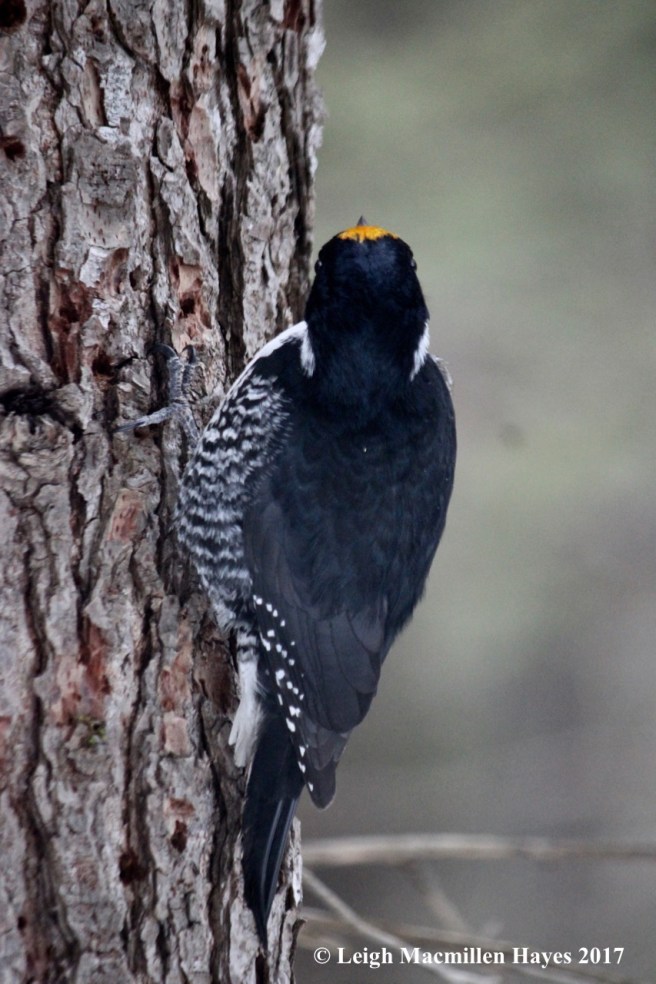
w13-black backed woodpecker

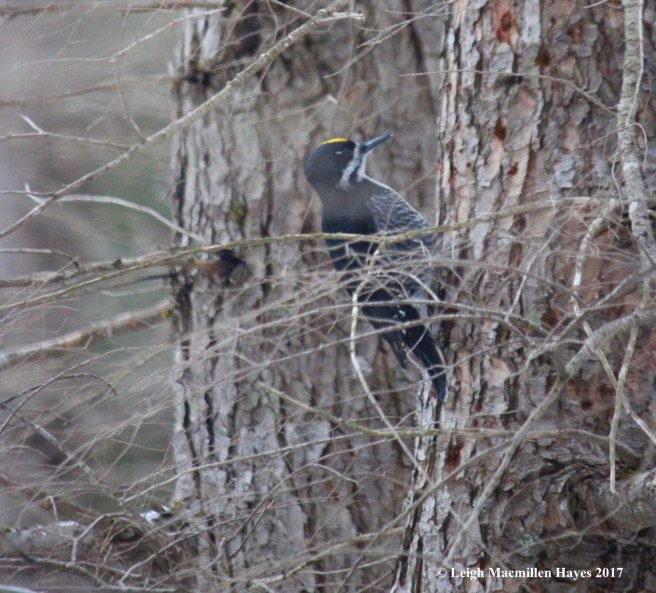
On a dead trunk, a woodpecker foraged among the bark scales. We watched it for a while, trying to note its features from below and we then moved on.

w14--hobblebush

My visits to Wilson Wing are never complete without a stop to worship the hobblebush. For those anticipating spring, it’s only a few weeks away. It won’t be long and these naked leaf and flower buds will unfurl and I’m sure I’ll share their blooming glory with you.

w15-Moose Pond Bog

Another stop that I can’t pass by is a climb up the stairs to the platform–the perfect viewing spot for the bog.

w16-car

Finally, we continued along the trail and I realized my focal points were redundant of all past visits, but it’s fun to view some of these in various seasons. For those who know, this is the old blue vehicle.

w17-lungwort

And right near it, my favorite of all foliose lichens–lungwort, indicative of unpolluted air. At Wilson Wing–indeed.

w18-hemlock catkins ;-)

We crossed the last little stream, found some deer tracks and a beaver chew, and then decided to follow the trail back rather than the road. One of our stops included admiring the hemlock catkins. (Smiley face)

w19-black backed 2

And then we returned to the woodpecker. By now he was our woodpecker, just as the mink that we saw and other critters we didn’t see were also “our mink” and “our coyote,” etc. It’s amazing how even when we don’t see the mammal, recognizing that it has passed through is enough to excite us. But this bird . . . oh my.

w20-black backed 3

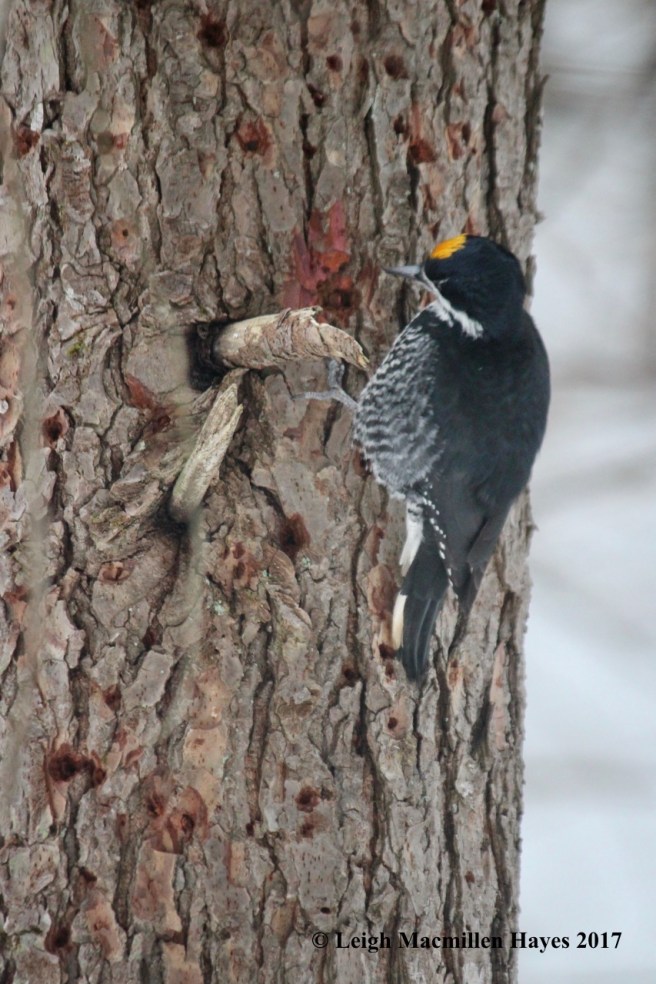
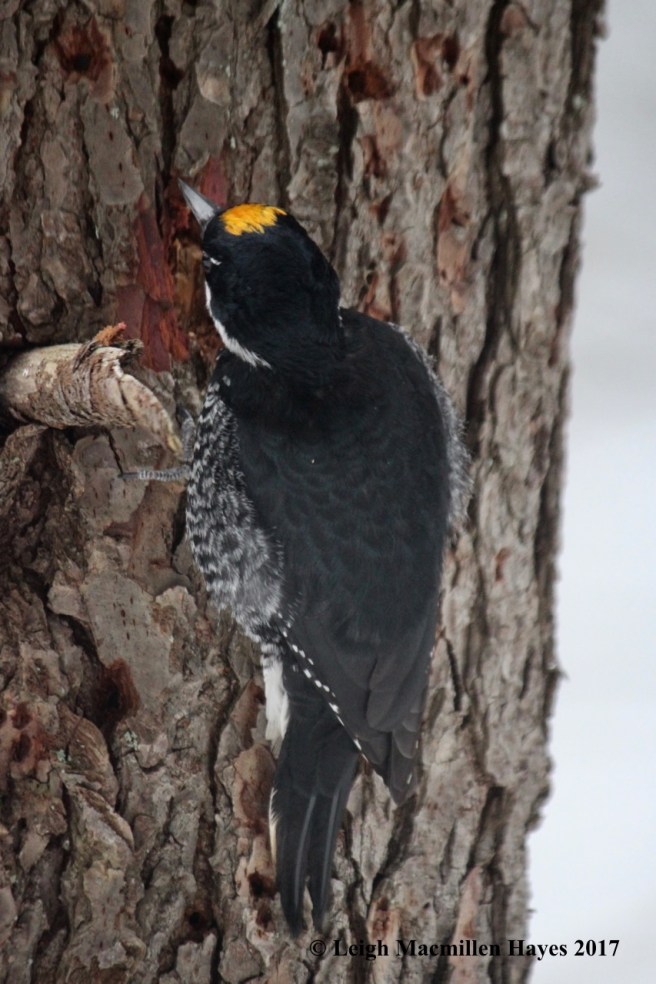
We noted the orangey yellow crown as it cocked its head.

w26-black backed 8

Its face was black and white, including a black mustache and white eye line.

w22--black backed 5

We were surprised by its stocky build.

w24-black backed 6

And those black and white barred sides or flanks weren’t like the woodpeckers we normally see.

w25-black backed 7

It worked constantly, flaking the scales off the trunk as it searched for insect larvae.

w27-black backed 9

Cinnamon colored underbark revealed itself where the bird had recently excavated.

w28-black backed 10

As it contemplated its next move, it didn’t seem to mind our admiration.

w30-black backed 11

With its strong beak, it probed and probed.

w31-black backed 12

Then held its head back and . . .

w32-black backed 13

probed some more.

w33-black backed 14

First it cocked its head to the right.

w36-black backed 17

And then back to the left.

w38-blackbacked 18

Frequently, it paused for a brief break. Or perhaps it was dining and we didn’t know it.

w40-black backed 21

We were mesmerized.

w39-black backed 20

And delighted . . .  for we’d had the opportunity to focus our eyes on so many wonders, but especially the mink and this . . . a black-backed woodpecker. This was a rare opportunity for these birds seldom show themselves, especially this far south–all the more reason to be thankful that we decided to go for it and focus our eyes on the nature of Wilson Wing Moose Pond Bog Preserve.

From Lion to Lioness

Given yesterday’s rain and fog, March forgot its lion-like nature and seemed rather tame. Or so we thought.

h-lion

This morning, however, dawn broke with sunshine and clouds, followed by raindrops the size of half dollars, followed by clouds and wind, followed by snow and wind, followed by clouds and sunshine, followed by hail, followed by sunshine and clouds. And all of that before noon.

h-clothes-line

The wind continued to blow, but was down a few knots when two friends and I noticed this bark hanging out to dry much the way laundry does.

h-beaver-bog

Our intention was to explore Lakes Environmental Association‘s newly acquired property in North Bridgton. The 325-acre property was the gift of the David and Carol Hancock Charitable Trust. And based on the wildlife signs we encountered today, it offers a valuable corridor. It’s all of that plus it’s part of the Highland Lake watershed and ultimately the Sebago Lake watershed. And it will provide a place for research, public education and recreation.

h-bog-1

And so today, I followed Marita Wiser, author of HIKES & Woodland Walks in and around Maine’s LAKES Region and JoAnne Diller, who has conquered all 100 4,000-foot peaks. Our intention was to skirt around the outside of the wetland, but curiosity got the better of us.

h-coyote-prints

For a bit, we followed the tracks of several coyotes who had traveled through rather recently given that we could clearly see the toes, nails and X between pads .

h-coyote-trot

And then we found a set of prints, also coyote, that appeared to be even fresher. What made us wonder were the drag marks we saw in various places associated with the tracks, which we don’t often see.  It was obvious that the mammal was trotting give the sets of four prints in a backward C fashion. But was it dragging its tail because it was sinking in a bit, much as we were? Or was it dragging some prey? We never did figure it out, but enjoyed the chance to wonder.

h-heron-nest-2

We do know that it led us to a heron nest high up in a tree. I’d only visited the property twice before, in the early summer and had seen another heron nest, but this one was new to me. Such big birds. Such little nests given that they raise three or four young who grow as big as their parents while waiting to fledge.

h-beaver-brook-meanders

Though we could feel the wind on our faces, we enjoyed the sunshine as we journeyed on through this special place. Soon this world will change and so we were rejoicing in the opportunity to view it from such an upclose perspective.

h-beaver-lodge-1

Our next stop was one of the beaver lodges. It appeared that no one was home, given the fact that there was no meltdown at the top and no mammal tracks leading to or from it.

h-beaver-lodge-2-opening

Instead, we followed faded weasel tracks presumably made by an otter, to another lodge, where the top was exposed.

h-beaver-damotter

As we circled around behind it, we noted that many visits had been made.

h-heron-nest-3

And then we turned again, to another heron nest that I recognized. During my June visit, an adult had flown in, indicating there may have been young in the nest.

h-lungwort-brown-1

From there, we paused briefly to admire some lungwort that was the brownest and driest I’ve ever seen, especially given yesterday’s rain and today’s mixed precipitation.

h-beaver-dam-approach

And then our eyes were suddenly drawn to a line of lumps in the snow and we realized we were standing on the infinity pool created by a beaver dam.

h-beaver-dam-3

Being mighty explorers, Marita led the way and we climbed up and over a hemlock hill to garner a closer look. And then JoAnne led us onto a little island where we stood and took in the views.

h-beaver-brook-below-dam

Tracks leading to the water indicated we weren’t the only ones who had ventured this way. But . . . no sign of beaver activity.

h-beaver-trees

Back up over the hill we tramped and suddenly our eyes began to focus . . .

h-beaver-teeth-marks

on beaver works.

h-beaver-goddess

With our imagination wheels turning, we saw a sculpture of a pregnant woman.

h-beaver-birch

And marveled at the amount of fresh works everywhere.

h-beaver-trail

Their path was well traveled and led us to more.

h-beaver-chew-stick

We even spied beaver chews, the snack of choice.

h-beaver-dam-small

And another smaller dam.

h-marita-and-joanne

Eventually, we left the beavers behind and continued across the hardwood/hemlock/pine forest, crossing a couple of skid roads before finally following one out, sharing stories and future plans as we hiked.

For this day that came in like a lion, we were thankful for the opportunity to enjoy its more lioness form and to roar with our own joy and laughter shared.

Knowing Our Place

It doesn’t matter how many times I explore the same space, I’m always amazed at the opportunity to learn something new. And so it happened at the Holt Pond Preserve this very morning. It’s one of my favorite hangouts in western Maine on any day, but today–it added some new notches to the layers of appreciation and understanding.

h-willow

Because  Grist Mill Road that bisects part of the preserve serves as part of the snowmobile trail in the winter, parking occurs on the sharp curve that marks the end of Perley Road and beginning of Chaplin Mill Road. (You have to know you are moving from one road to the next because there are no road signs.) A couple of parking spots have been plowed and its from those that this first sight was viewed. I was a bit confused when I saw alder catkins and cones, with pussy willows growing among them. On the same shrub? Shouldn’t be. And it wasn’t. Rather, a closer look cleared the confusion when I realized that the two shrubs favor the ditch at the edge of Emerald Field.

h-tingley-brook

I was with Alanna Doughty, Education Director for Lakes Environmental Association and our intention was to focus on tracks. But . . . we suffer from Nature Distraction Disorder, thank goodness, and so our NDD forced us to notice all things, including the beauty that is Tingley Brook.

h-moss-green

And the way the snow and morning sun enhanced the color of mosses decorating old maple trees.

h-green-ash

The mosses weren’t the only shade of green in the neighborhood. A young ash tree angled across the path and its D-shaped leaf scar helped us identify it as a green ash.

h-beaver-dam-1

As we moved along, we spied a new beaver dam and began to notice their works in the vicinity.

h-beaver-chews-near-dam-1

We know what trees they chose for construction.

h-beaver-on-beech

And we wondered why they didn’t finish the job on this beech tree. Will they return? Only time will tell.

h-squirrel-works

Though we periodically saw downed hemlock twigs, some appeared to be wind drops. But, these drew us in for closer inspection.

h-squirrel-nibble

Through a hand lens, we spied the works of a different mammal–in this case, red squirrel. Ends of twigs were cut and dropped and then their buds nipped. But that wasn’t all we noticed. We were wowed by the petioles and how those little stems attached the needles to the twigs. And the tiny warts on the twigs. And . . . and . . . and. Who knew there was so much to admire about a hemlock twig?

h-beaver-dam-2

We continued on, turning from the brook to Muddy River, where  a larger and older beaver dam easily identified itself given the snow cover.

h-canoe

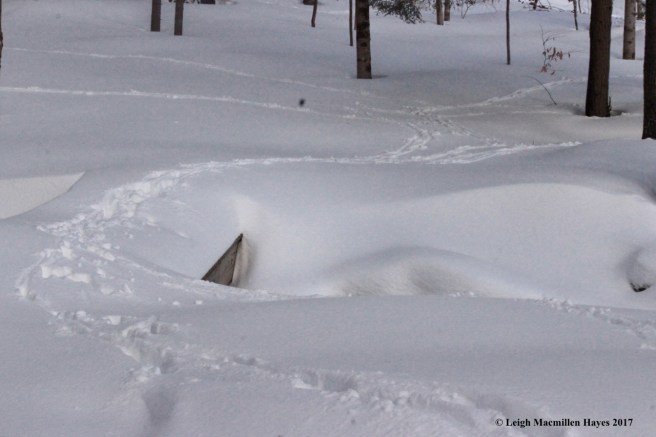
We followed some indiscernible tracks of a perfect walker and then lost them by the time we reached the canoes–also hiding under the white blanket.

h-red-maple-swamp

At the canoes we could have turned and found our way out, but ever curious, we continued on toward the red maple swamp. And then we decided to take a different course. Rather than follow the boardwalk, our usual pathway, we took advantage of the current conditions and decided to walk through the swamp toward the Muddy River. Earlier, we’d noted that a snowmobile had passed along the river and though we’d questioned the choice of its driver, we felt a compelling drive to take in the view from a different vantage point.

h-lodge-1a

With that in mind, and all caution thrown to the wind, we crossed the Muddy River to take a closer look at the beaver lodge we normally admire from a nearby boardwalk.

h-lodge-5

h-beaver-lodge-3

h-beaver-lodge-back-side

We took it in from all sides, noting the fresh saplings added during fall reconstruction, as well as the mud. It was a warm day–and we wondered if we might have seen steam rising had the temperature been colder.

h-muddy-river-from-lodge

It was from here that we looked back across the river to the hemlock hummock and boardwalk area where we normally stand. There was a certain satisfaction in being on the other side for a change.

h-tamarack-2

When we made our way back to the red maple swamp, a little tree drew our attention. Small in stature, yet big in personality is the tamarack or Eastern larch. It’s our only deciduous conifer and somehow we’d missed its existence in the swamp all these years, perhaps because we don’t often actually walk through the swamp. While larches have needles, they typically turn yellow and then drop, leaving behind a winter form that yields horizontal branches with nubs.

h-tamarack-cones

We noted that though the fruits reminded us of hemlock cones, on the larch they stand upright in contrast to those that dangle on their cousin’s branches.

h-holt-pond-and-bear-trap

Once we realized we were looking at larches, we started to see them everywhere. Finally, we pulled ourselves back to the river’s edge and continued our journey to Holt Pond.

h-holt-pond-outlet-2

Again, we found tracks that had been bleached out by the warm sun of the last few days, but we surmised a member of the weasel family had bounded along, crossing the outlet of Holt Pond.

h-alanna-1

We crossed the quaking bog, home to spaghnum moss, pitcher plants, sundews, cranberries, and so much more. But our attraction was overwhelmingly to today’s tree of choice–more larches.

h-tamarack-lichens-1

While we appreciated the young ones, we were completely in awe of the grandparents, who had grown long beards and supported a variety of barnacles in the form of lichens.

h-variety

Foliose and fruticose, they added texture and color to the presentation.

h-tamarack-winter-twig

Some describe the branches as wart-like, but we saw roses.

h-tamarack-lichen-maze

And a composition of structure and age and growth that spoke to an art form.

h-alanna-at-tamarack

All warranted further examination.

h-barbed-wire-on-tamarack

And then we realized there was also another sign of the tree’s history–barbed wired wrapped around and growing through the trunk. Stonewalls in one section of the preserve speak to a former farmer’s need to keep livestock from entering the swamp. But the barbed wire was a distance from the walls and quite far out in the swamp and so we wondered who had placed it there and why.

h-nest-2

At last it was time to turn back. And as we moved closer to shore and the speckled alders, a bird’s nest made itself known. Grasses, cattails and leaves were woven into the structure that was securely attached to the shrub’s branches.

h-layers

Before following the river back to the woodland trail, where we realized some tracks we’d followed earlier were those of a bobcat, we looked at the layers from the swamp to shrubs to deciduous trees to conifers to blue sky and clouds–and the colors mixed within.

And we knew that we’d shared an appreciation for the time –getting to know each other and our place better.


Falling Stars

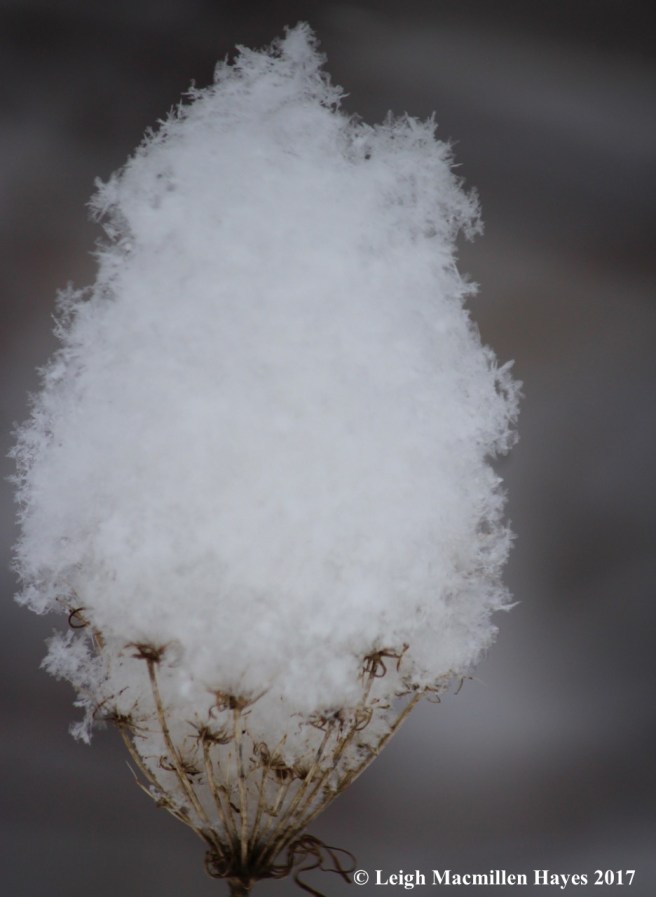
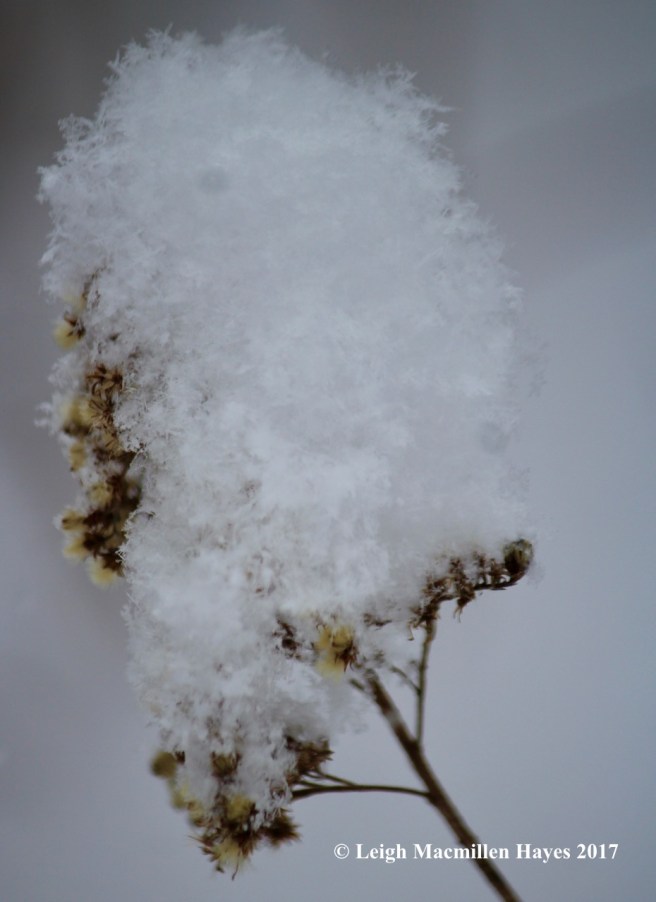
The sight of falling snowflakes filled that spot in my soul that is devoted to wonder.

p-queen-annes-lace

Each tiny morsel unique.

p-aster

Many stacked high.

p-red-maple-leaf

Some precariously perched.

p-shelf-fungi

Others well supported.

p-milkweed

Foundations varied.

p-stairway

Stairways formed.

p-lea-mlsc-boardwalk-1

Boardwalks hid.

p-moss-monster

Moss Monsters smiled.

p-moose

Moose chuckled.

p-male-mallard

Mallards speculated.

p-red-fox

And the red fox paused.

Watching snowflakes gather reminded me of the impermanence of it all. They are exquisite and beautiful, yet temporary.  Here one moment, trampled and melted the next. Yet, I am forever awed by each tiny star that falls from the sky.

Mondate with Tom and Friends

My guy and I–we drove to Portland this morning for a two-hour meeting and then enjoyed lunch with one of his sisters at the Miss Portland Diner before moving on to South Portland to run an errand and finally returning home.

Too much food and sitting time. And so the woods beckoned.

v-turkeys-1

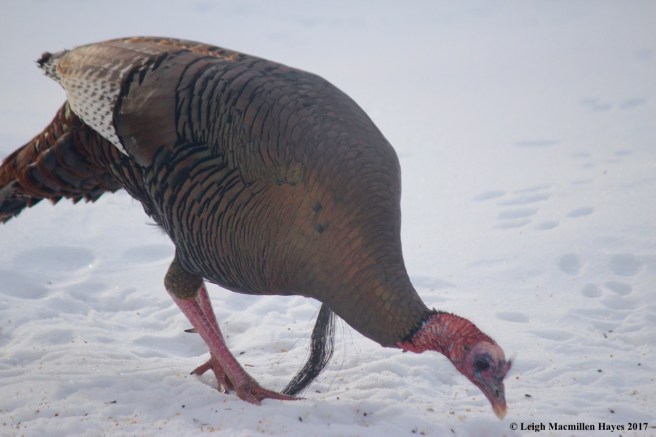
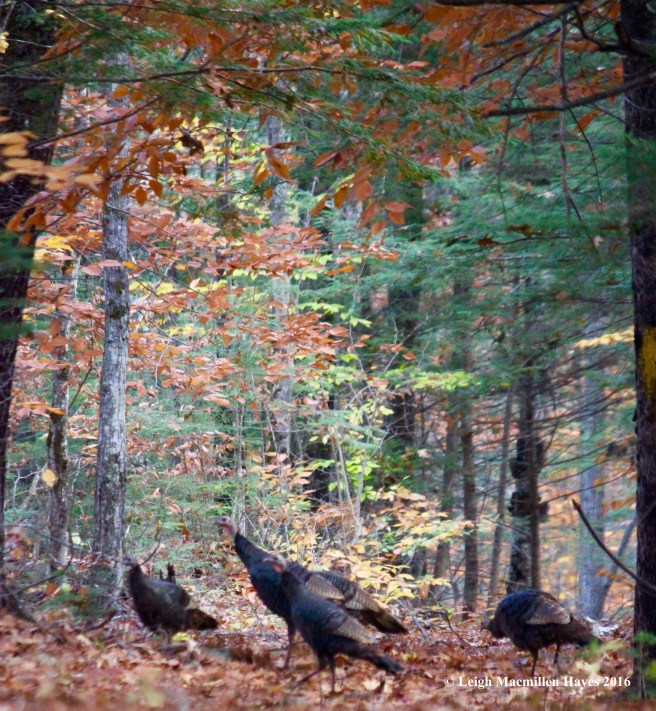
Right out the back door, male turkeys took advantage of our offerings. The snow is crusty and while acorns were plentiful, foraging for them has become a more difficult task. But birdseed is free feed and once discovered means often frequented.

v-turkey-1

That’s OK for now because it gives me a chance to get to know these guys. We live in an 1870s house on former farmland (I often refer to the cowpath), all of which played a part in the reduction of forest land, one of the factors that led to the extirpation of native wild turkeys in Maine. Slowly, the land has reverted to forest, which helped in reestablishing turkeys to their former range. At the same time, our neighbors, thankfully, continued to mow the adjacent field that we look upon, which provides for prime turkey nesting habitat.

v-turkey-2

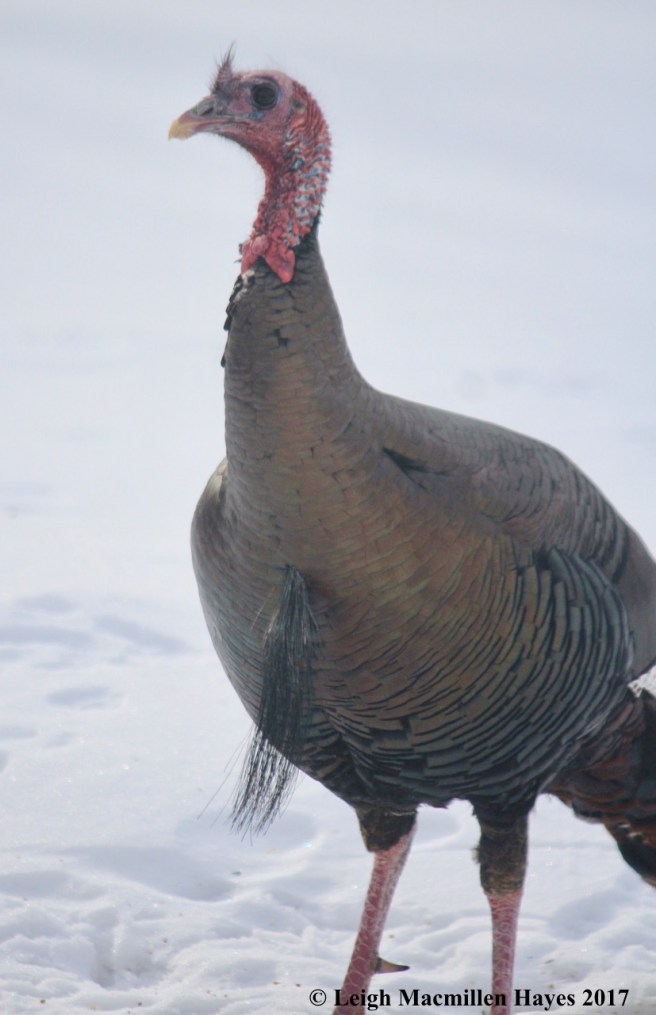
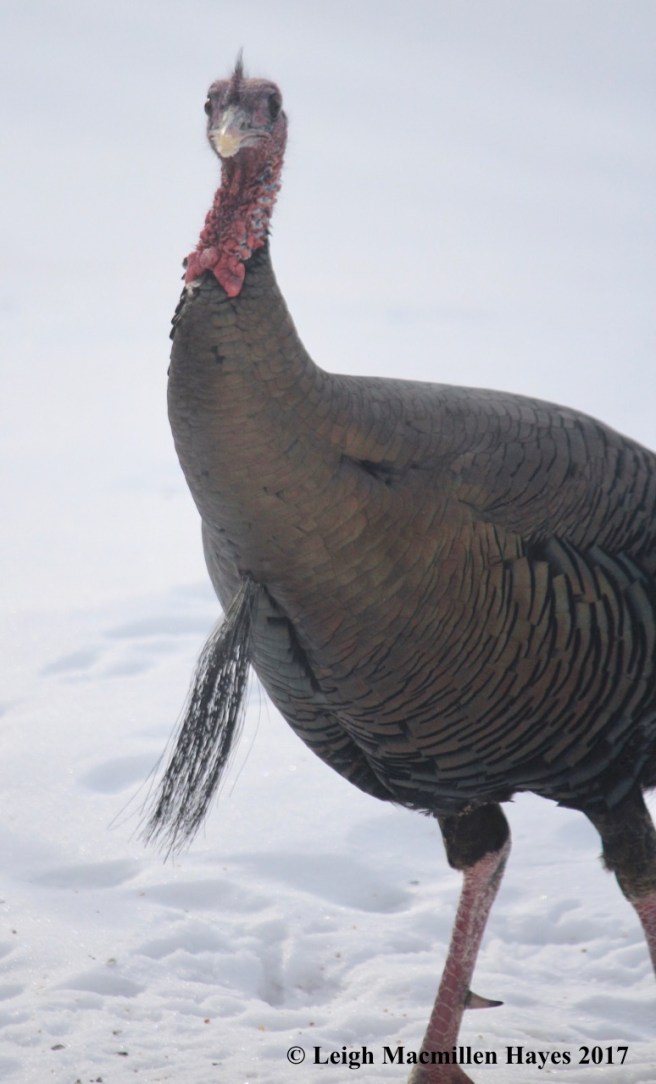
Tom and his brother Tom and his other brother Tom are handsome devils in their own unique ways. Their featherless heads of blue and pink and red raised bumps called  caruncles change colors with their moods.

v-turkey-3

And on their chests, bristle-like feathers that don’t look at all like feathers are referred to as beards (by us humans–I’m not sure what turkeys call them). Though some hens sport beards, theirs are not as robust or long as those of the Toms.

v-turkey-4

“You looking at me?” asked Tom.

“Yes, I am. I’m admiring your iridescent feathers layered like slates on a roof and those spurs on your legs used for defense and dominance. Do you object?”

“Well, I guess I am rather handsome.”

“I didn’t say that.”

Yeah, the turkeys and I, we talk. We’ve long had a relationship and I truly don’t think you should eat them. Maybe next Thanksgiving I’ll tell you my turkey story.  I know they can leave a mess in the yard and become aggressive, but . . .

v-turkey-tracks-2

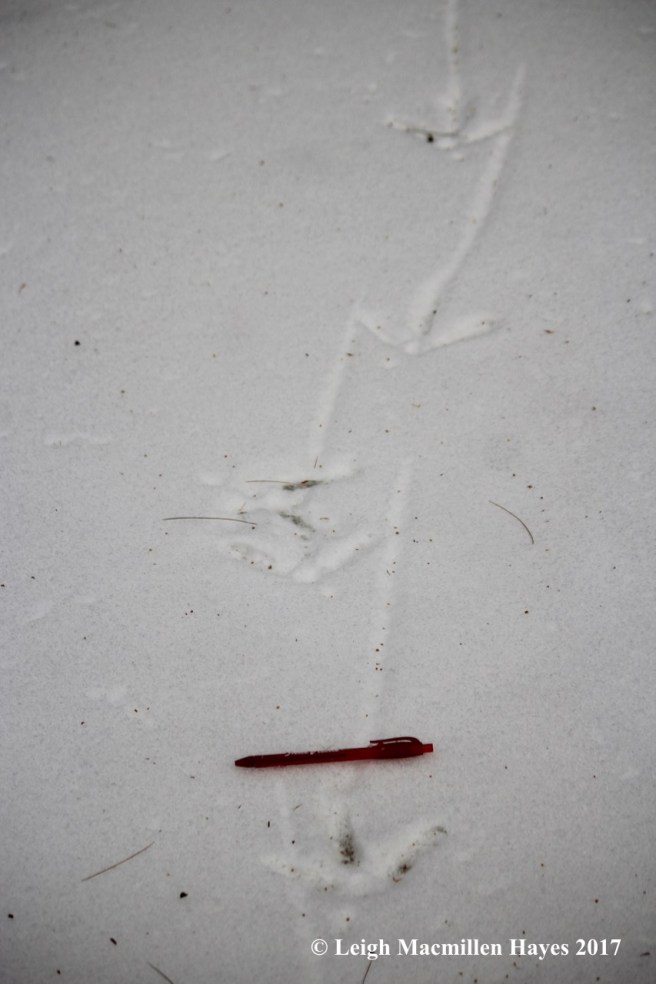
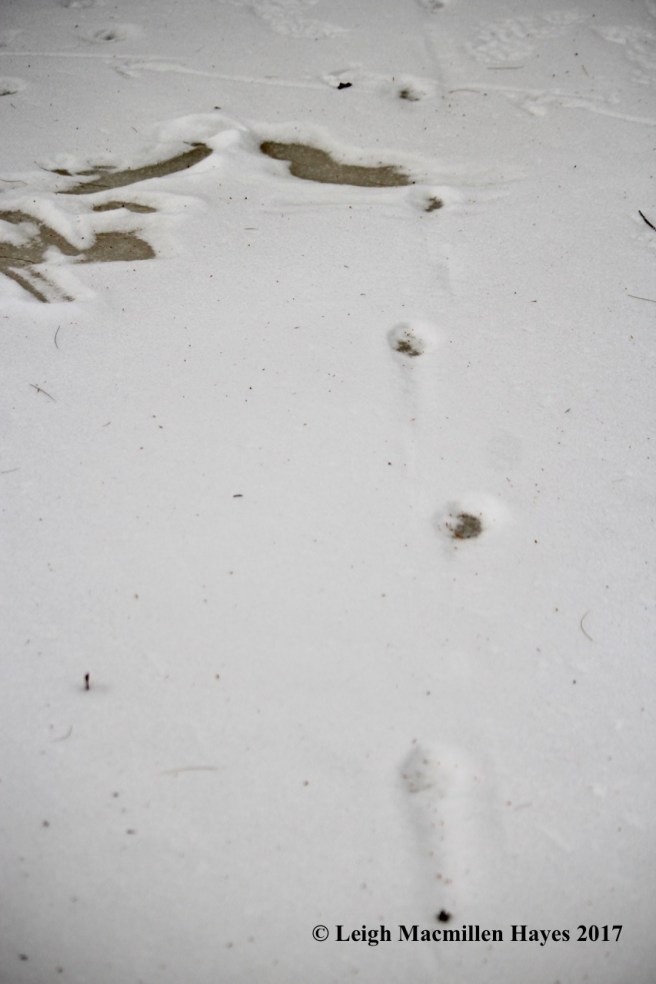
I encourage you to follow their tracks into the woods. You never know where they might lead.

v-turkey-tracks

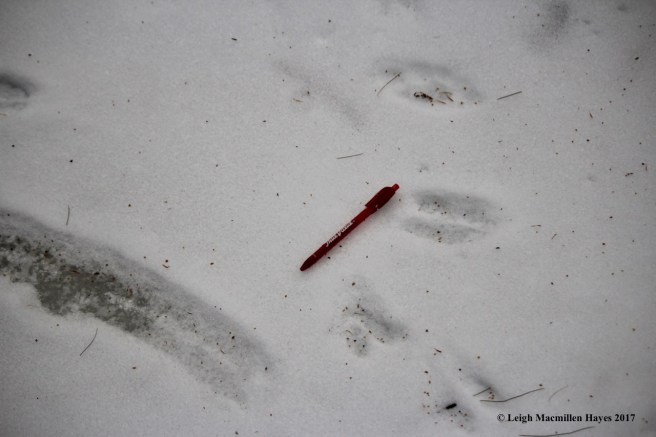
Following them today led to the vernal pool. Note the pen, my form of perspective in relationship to size because it’s what I had in my pocket. The pen measures 5.5 inches. Turkey prints are large.

v-vernal-pool-adventures

The pool wasn’t teeming with amphibian life yet, but for the first time all winter, it was obvious that visitors had stopped by.

v-vernal-pool-action

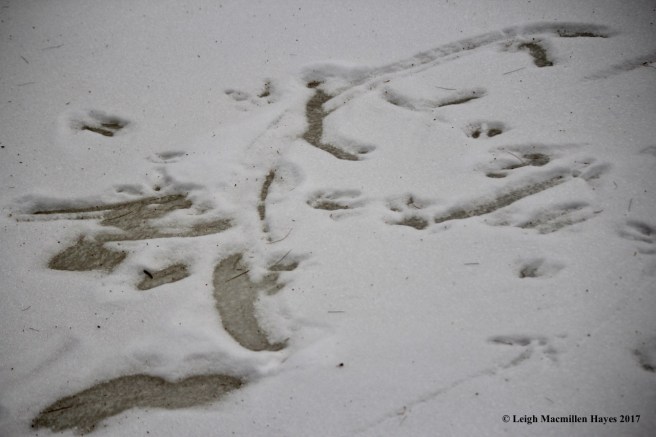
Their timing wasn’t the same, but the turkeys strutted across, while deer slid and skidded on the ice. Life happened over and over again.

v-deer-prints-2

It appeared to be more than one deer–perhaps a mother and a skipper or two wanted to skate, much as our sons used to do at this very same spot.

v-coyote

And among the prints, those of a predator, though its journey appeared to be earlier than the deer. Gray squirrel tracks circled the perimeter and maybe that was the intended prey, though really, any of these critters would have made a desirable meal–the forest being what it is, groceries gleaned when needed.

v-deer-hemlock

Continuing the journey, plenty more turkey tracks and then the white tails of deer  flashing in the distance. Beside the trail another item on the grocery shelf–fresh hemlock bark scraped.

v-pileated-holes

One final item in a different aisle–fresh pileated woodpecker holes. They wake us each morning with their drumming and the sound continues throughout the day. Wrapped around the tree, a vine that added to this bird’s food.

v-pileated-scat

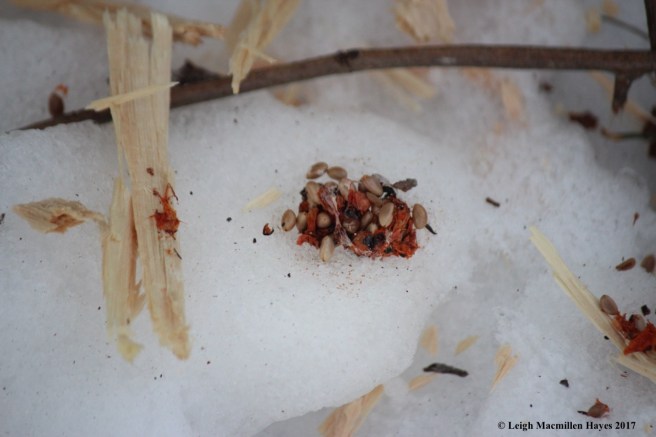
Its scat told of the source–not only a few carpenter ants, but also bittersweet fruits. Yes, this is how the seeds of this invasive species spread.

And so it was today that I traveled the woodland trail alone after a morning and afternoon spent with my guy. And . . . the Toms shared their story and those of others. It was indeed a Mondate–spent with others.

(Did you think I was going to mention Tom Brady? Congrats to the Pats on their Super Bowl victory.)


Seeing Red

I wander through the same woods on a regular basis, sometimes following old logging roads and other times bushwhacking through the understory–a mix of young conifers and hardwoods that are slowly reclaiming their territory. Always, there are water holes to avoid as this is a damp area, so damp that in another month I probably will have to curb some of my wandering habits because it will become difficult to navigate.

h-maleberry-buds

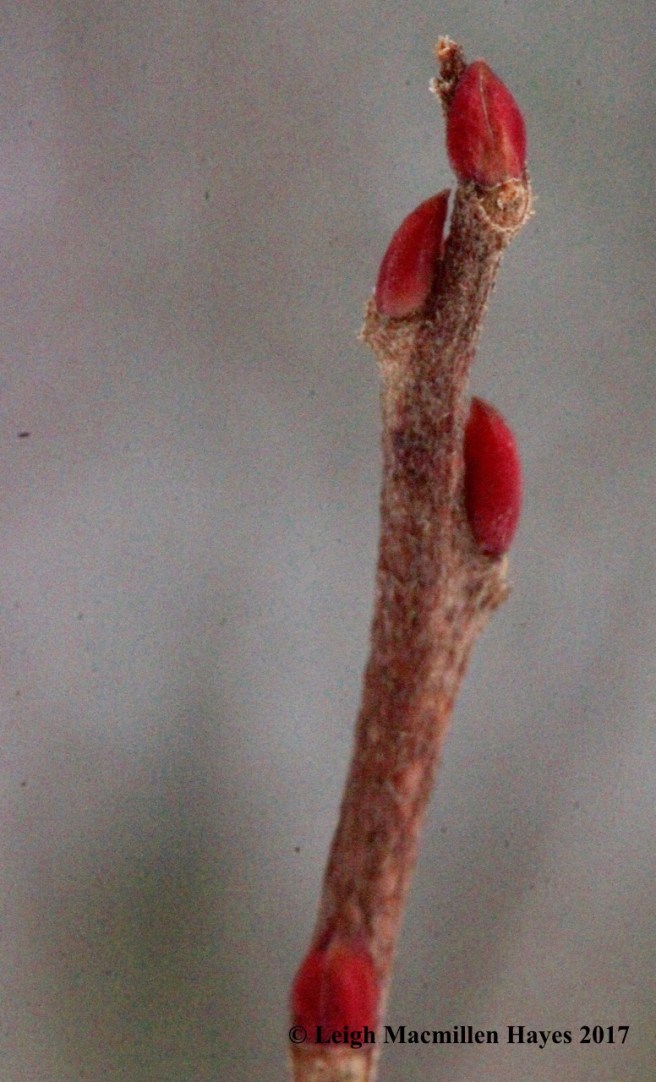
But it’s that same water that gives life to the flora and fauna that live therein, such as the buds on the maleberry shrub. Notice how downy the twig is. And the bright red bud waiting patiently within two scales–preparing for the day when it will burst forth with life.

h-maleberry-pods

On the same shrub exists evidence of last year’s flowers, now capsules reddish-brown and five-celled in form.

h-red-maple-buds

And like the maleberry buds, the red maples buds grow more global each day, some with three scales of protective covering and others more.

h-snowflakesbuds

Today was a day of contrasts, from sunshiney moments to snow squalls, as well as greens to reds, tossed in with a mix of browns and grays.

h-moose-scrape

Continuing my venture, I soon realized I wasn’t the only one enjoying red. The moose and deer with whom I share this place, also find it a color of choice–especially the bark of young red maple trees.

h-moose-scrape-2

As I looked at the tree trunks, I could sense the motion of the moose’s bottom incisors scraping upward and then pulling against its hard upper palate to rip the bark off. Everywhere I turned, the maples showed signs of recent scrapes.

h-moose-rub

Less frequently seen were antler rubs such as this one, where the middle was smoothed by the constant motion and the upper and lower ends frayed. Such finds offer noted differences between a scrape and rub–the former has tags hanging from the upper section only and the teeth marks stand out, while the latter often features a smooth center with the ragged edges at top and bottom. But . . . like us, nature isn’t perfect and not everything is textbook, so I often have to pay closer attention.

h-moose-bedscat

I saw more than red and so I could hardly resist a moose bed filled with scat and urine. I’m always in awe of the sense of size and again I saw motion, of this large mammal laying down to take a rest and perhaps a few hours later, getting its feet under itself to rise again, do its duty and move on to browse some more.

h-witch-hazel-scattered

Deer tracks were even more numerous than moose and the solidness of the snow allowed them to travel atop the crust. At one point I spied something I didn’t recall seeing before–witch hazel capsules decorating the snow.

h-witch-hazel-pod

At this time of year, these grayish tan capsules persist on the trees, but their work was completed in the fall when they expelled their two glossy black seeds.

h-witch-hazel-bud-nibbled

Ruffed grouse, wild turkeys and snowshoe hare like witch hazel buds. As do deer, who rip them off in the same fashion as a moose and leave a tag behind–as a signature.

h-witch-hazel-bud

Not all were eaten–yet. Notice these buds, ensconced in dense reddish/yellowish/brown hairs rather than the waxy scales of the maleberry and maple. And the shape extending outward from the twig, almost in scalpel-like fashion. Yeah, I was still seeing a hint of red.

h-witch-hazel-flower-bracts

If I wanted to carry my red theme to the extreme, I could say that the bright yellow bracts that formed the base of the former flowers were framed in red, but really, it’s more of a hairy light tan along their rims. Eventually, the bracts will develop into seed capsules and next autumn they’ll be the ones to shoot their seeds with a popping sound. We always talk about that sound and refer to Henry David Thoreau for as far as I know he was the one to first hear it. This past fall, a friend tried this and like Thoreau, he was awakened during the night by the seeds being forcibly expelled. (Credit goes to Bob Katz for that experiment.)

h-british-soldiers

Back to red. Under the hemlocks where the deer had traveled, I was looking at some mosses when these bright red soldiers showed their cheery caps–it’s been a while since I’ve seen British Soldier lichens, most of it buried beneath the snow.

h1-red-oak-bark

As I headed toward home, a red oak beside the cowpath asked to be included. It seems in winter that the rusty red inner bark stands out more in the landscape, making the tree easy to identify. Of course, don’t get confused by the big tooth aspen, which slightly resembles a red oak at the lower level, but a look up the trunk suddenly reveals similarities to a birch.

h1-acorn-cap

Many of the acorns have been consumed after such a prolific year, but their caps still exist and the color red was exemplified within the scales.

h1-icicles

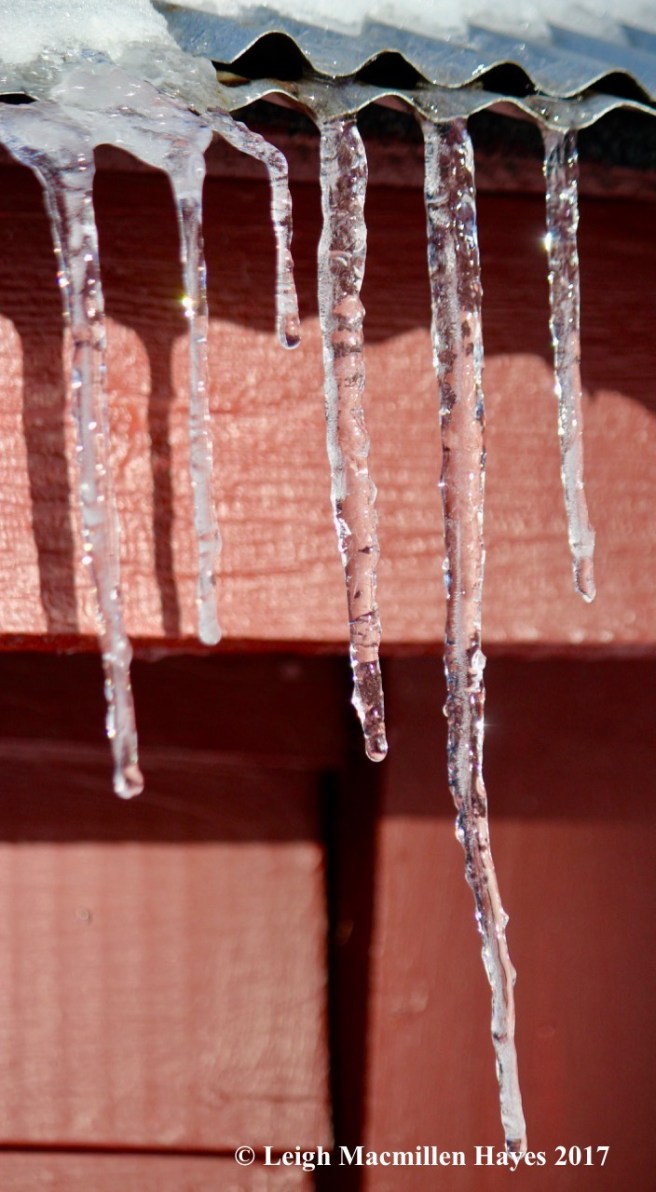
Back at the homestead, I walked by the shed attached to the barn where icicles dripped–again speaking to this day. By that time the snow squalls had abated and sun shone warmly, but a brisk wind swirled the snow in the field into mini whirling dervishes. My cheeks were certainly red.

h-cardinal

My red adventure was completed at the bird feeder. A happy ending to scenes of red.


In the Hush

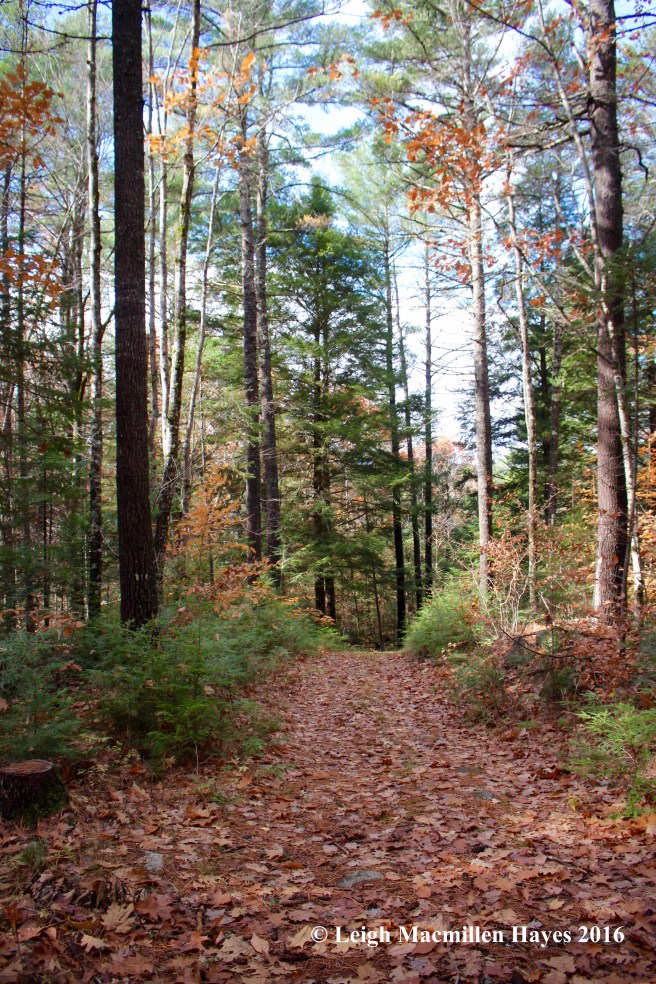
Walking along the cowpath today, I encountered a downed red oak branch that took some maneuvering to move it off to the side. And then, as I emerged onto the power line right-of-way that crosses our property, I discovered another downed tree across my trail, this one a white pine.

h-downed-pine

I tried to move it, but suddenly realized that it was more than a branch that was down. It was an entire tree, which had been cut. A bit further along, I noticed a red oak had also been chopped. And from the work left behind, I knew the culprits, their signature obvious by the hack job they so often do and mess they leave behind.

h-lucas-tree-service

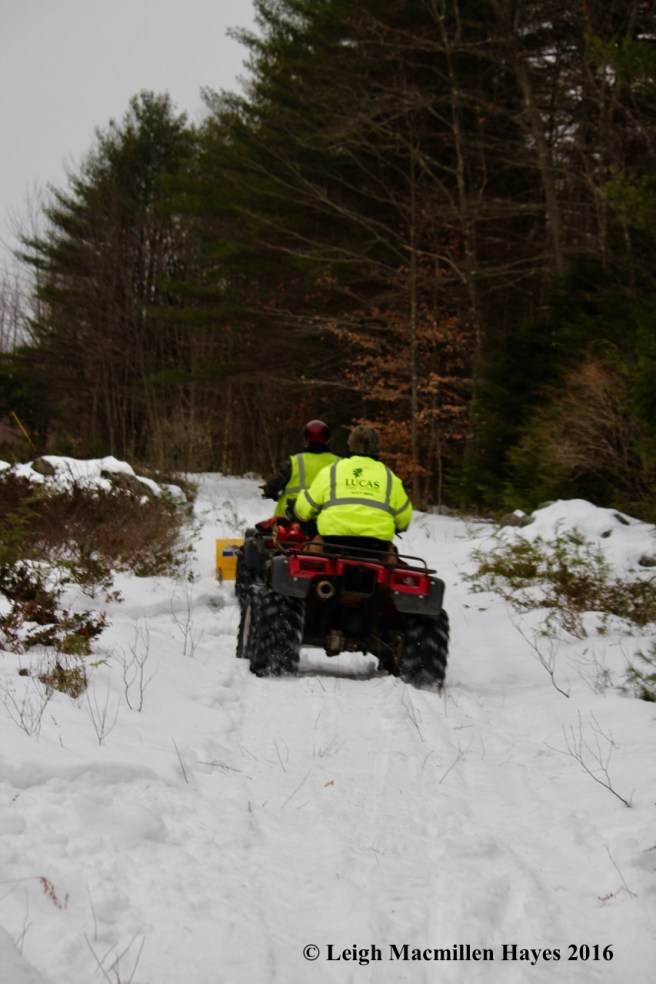
Just as I moved onto the snowmobile trail, I saw them approaching from the north. And so I stepped off to let them pass, offering a weak smile and wave. I had half a mind of stopping them and asking why. Fortunately, the other half of my mind, the one that occasionally halts my mouth, stepped forward to zip my lips shut and force that wisp of a curve.

Last winter, a crew from Lucas Tree Service had worked on a neighboring property and promised me that there was no need to work on ours. I was relieved.

In my journey today, I realized that the only hacking done was on our land. I was furious. What was the need? The branches/trees weren’t anywhere near the line.
Irate, I continued to walk, but wondered what I’d see that would be worth noting. Suddenly, my world turned about. Who cared about the little stuff? Nothing mattered if in the rev of a power saw you could cut it all down.

I knew I didn’t have a say, especially as we are beholden to the power source since we don’t have the wherewithal to live without it.

But, more questions formed. Why was it that the Lucas Tree crew could ride ATVs during the offseason? What made them so special?

Then I had a flashback to a road in Lovell that I’d recently travelled and noted their very work–also a hack job. In fact, every time I pass by such work, I know they’ve been there before me. In the Lovell case, they tore off half of a beautiful cedar tree that was on the opposite side of the road of the power line.

And in Sweden, this past summer, I drove past two young guys spraying weed killer below the power line on more than one occasion. They wore no protective gear, except for long pants, as they moved through the tall wildflowers, ferns and shrubs. My immediate thoughts–ticks and the effects of inhaling weed killer (aka animal and people killer?). Meanwhile, their crew leader drove beside them in his air conditioned truck.

h-locust-seed-pod

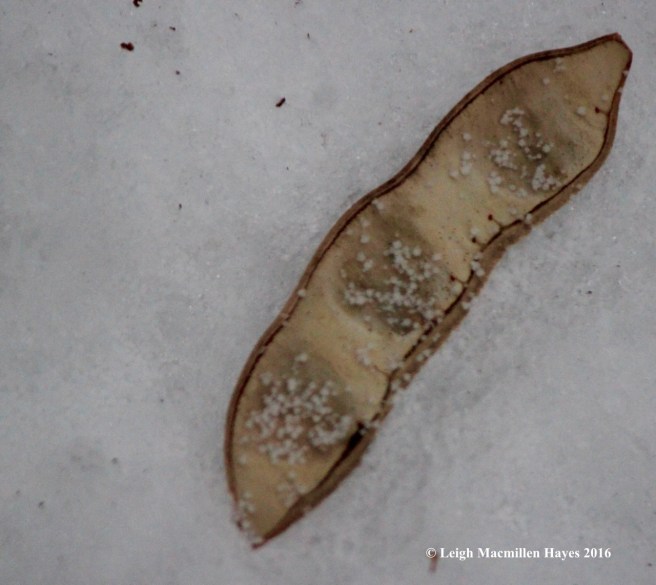
When I saw this locust seed on the snow today, where no locust trees grow, my mood worsened. It seemed to me a hitchhiker from the ATVs.

I have no idea why I continued on, since there was obviously nothing new to see and wonder about. Until . . .

h-paper-nest

I spotted the remains of a paper nest I’d walked past many times before. So . . . maybe there were still things to observe.

h-hoar-frost

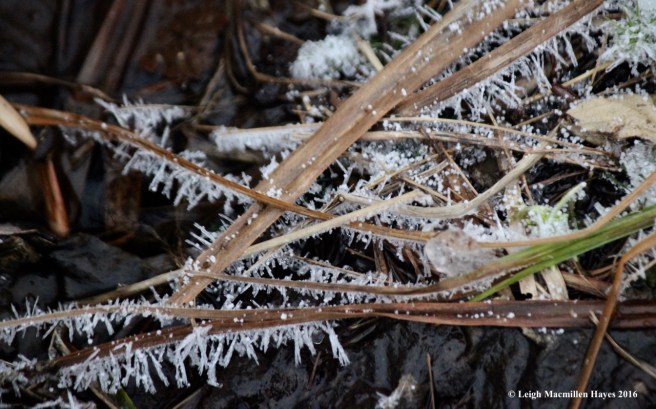
Like the needlework frost over open puddles.

h-witch-hazel

And snowflakes beginning to gather

h-beech

in various ways.

h-fern-flakes

Upon leaves and fronds,

h-snow-on-tinderconk

fungi

h-snow

and winter weeds.

h-vernal-pool

There was the quiet of the vernal pool untouched.

h-deer-feast

And the disturbance left behind by a deer feast.

h-turkey

There were the turkeys who took advantage of goodness uncovered.

h-bluejay

And back at home, visitors eyeing stock before the storm worsened.

h-chickadee-1

Some came by with feathers fluffed to reduce heat loss.

h-cardinal-1

And others appeared oblivious of the smiles they garnered because of their striking beauty.

In the hush of the snow, wonder recovered.

Calling All Birders

Each year, for the past 116 years, expert and novice birders have spread out across America between December 14 and January 5 to observe and catalog birds for the Audubon Society’s Annual Christmas Bird Count.

b-dam

And so this morning, I ventured to Denmark (Maine, that is) to join a small group of fellow citizen scientists as we drove and walked around our assigned quadrant within a 15-mile circle.

b-chickadee-2

Kathy, Katie, Stan and Howie welcomed me with open arms despite the fact that I was a few minutes late and they were already on the road. When it comes to birding, I’m always a wee bit nervous because I know the winter species at my feeding station like Black-capped Chickadees, but am not so great with others. This group, however, likes to joke and laugh, thus making the day a pleasure even in the cold wind.

b-chickadee-1

We weren’t the only ones who felt the chill and thus the need to puff up and appear as if wearing a down-filled jacket. Everywhere it seemed, we saw Black-capped Chickadees and Blue Jays. It was interesting to note that a year ago our Blue Jay count was 16. Today’s count–bunches and bunches, making us wonder if the mast acorn crop had anything to do with their abundance.

b-white-breasted-nuthatch

White-breasted and Red-breasted Nuthatches also seemed plentiful, and often, when we stepped out of the car, their yanks greeted us.

b-downy-1

b-downy-female

Hairy and Downy Woodpeckers made their presence known with a greeting of another kind.

b-pileated-1

I did hope we’d see a Pileated Woodpecker. Their works were certainly evident all along our route.

b-pileated-2

Some holes more recent than others.

b-pileated-pole

Other holes more productive than some.

b-mourning-doves

Instead, we saw Mourning Doves,

b-goldfinch-2

American Goldfinches,

b-cardinal1

and Northern Cardinals.

b-cardinal-2

For a few minutes we watched a male and female cardinal flit about in a shrub as they dined on its berries.

Here and there, we peered through our binoculars into people’s yards, especially if they had bird feeders. Thankfully we never heard sirens and no one yelled at us for stalking. In fact, one woman came out and said, “I know you are doing the Christmas Bird Count.” She went on to tell us about her observations, including an increase of Blue Jays as we’d noted, and dead swallows this past summer–perhaps due to the lack of insects.

b-turkeys1

It wasn’t until the end of the day that we finally saw Turkeys.

b-turkeys-2

That surprised us given we all encounter them frequently, whether crossing a road or in the woods.

b-snow-bunting-3

Our favorite siting of the day–a Snow Bunting.

b-snow-bunting-2

I’d never seen one before so was thrilled with the opportunity.

b-snow-bunting-1

Snow Buntings are nicknamed Snowflakes for the behavior of a flock that swirls through the air and lands on a winter field. Today, only one, but actual snowflakes fell as we watched. And one was enough to make us happy.

b-lizard

We saw other birds to add to our list. And . . . we encountered a couple of novelties including the Denmark Lizard, a rare species indeed.

b-owl

Our final view–an owl. OK, so you need to use your imagination. But with this group of birders, that was easy to do.

By 4:00pm, our time together was done for another year. And we were all grateful for the opportunity to participate in the bird census, break bread together at lunchtime and make more than enough Blue Jay jokes.

Prior to 1900, the tradition was to shoot birds for identification and fun, including a holiday hunt where the biggest pile won. The Christmas Bird Count was first proposed by ornithologist Frank M. Chapman after the realization that the bird population was declining.

Because of Mr. Chapman, we spent a delightful day participating in a census that helps assess the bird population and guide conservation efforts.

We’d heeded the call.


Pay Homage at Otter Rock

This holiday season, why not take a short hike and smell the roses along the way?

h-milkweed

Or at least admire the milkweed plants that grow in the field across from the boat launch. I did just before I walked the blue/red trail at the Greater Lovell Land Trust’s Heald and Bradley Ponds Reserve this morning. It wasn’t a long walk, but worth every moment. And I encourage you to do the same, whether here or somewhere else.

h-water-over-dam-1

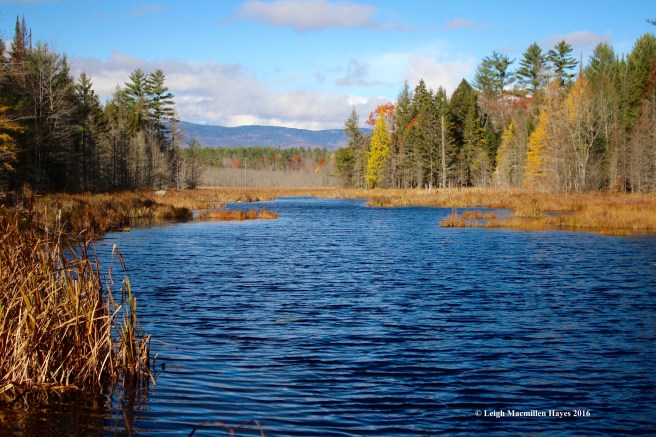
Listen to the water flow over the dam.

h-boat-1

Notice the greenery across the mill pond.

h-snow-on-trail

Follow the path sprinkled with snow.

h-ice-on-leaves

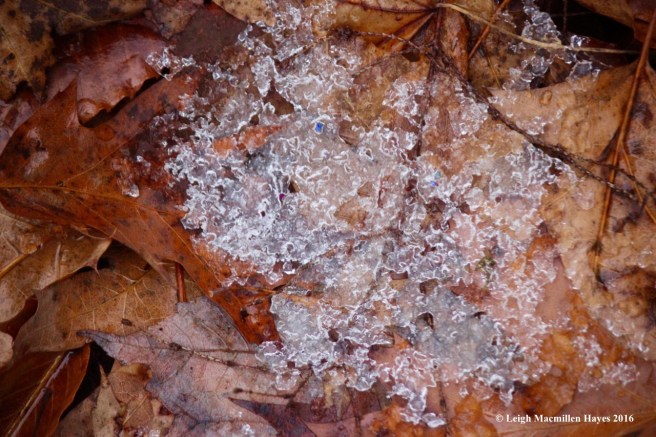
Rejoice in the ice shapes atop various leaves.

h-pileated-works

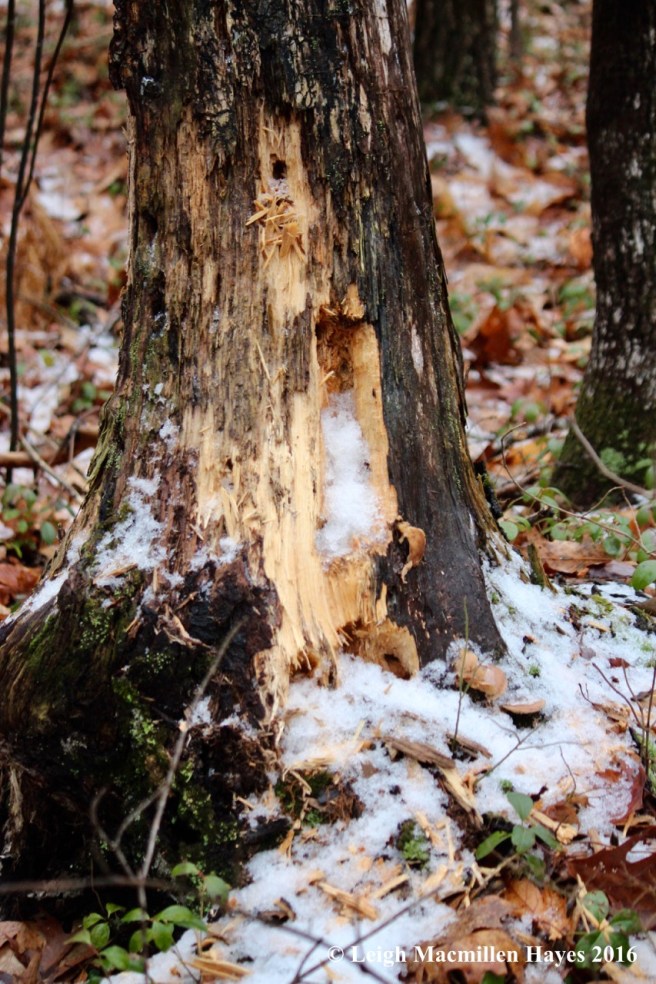
Check out the Pileated Woodpecker works in dead snags.

h-bright-beech

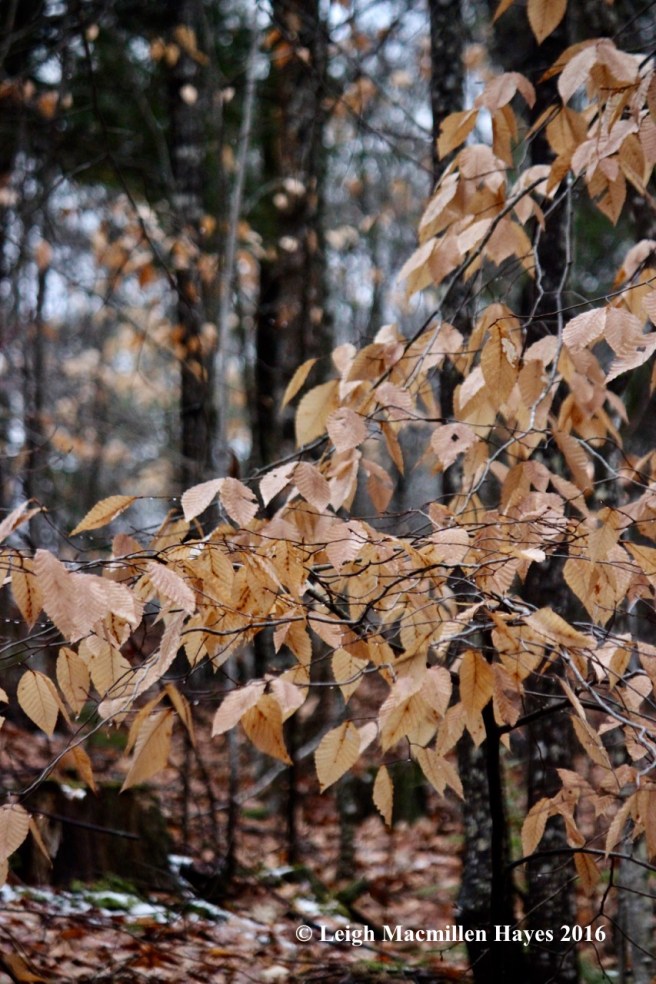
Let the Beech leaves brighten your day.

h-beech-and-witch-hazel

Distinguish between the hues of Beech and Witch Hazel.

h-four-trees

Greet four amigos–Paper, Yellow and Gray Birch, with the trickster Cherry posing as a Black Birch.

h-grape-fern

Applaud the maroon-fringed Grape Ferns at your feet.

h-sign

Follow the directions found on the sign.

h-bleeding-mycena-mycena-haematopus

Rejoice in late blooming fungi like these Bleeding Mycenas (Mycena haematopus).

h-otter-rock

Wonder at the various lichens that adorn the trees.

h-bristly-beard-lichen

Get up close and personal with a few, including the Bristly Beard.

h-rocks-near-otter-rock

Laud the reflections of water not yet frozen.

h-fall-colors

Praise the warm color of Royal Ferns gone by.

h-exo-1

Revere dragonfly and damselfly exoskeletons that still cling.

h-john-fox-2

Take in the view–ice and water and the old John Fox place–a testimony of yesterday, today and a glimpse toward tomorrow.

To Otter Rock–whether it takes you twenty minutes or three hours, make time in this busy season to pay homage.

Ho-Ho-Ho Ho Hoing Away

I remember a time when a Pileated Woodpecker sighting was rare. And now, it’s a daily event, but one which I still feel blessed to experience.

h-pileated

Stepping out the door this afternoon, I immediately heard one hammering and realized another was drumming in a nearby tree. Within minutes, a third flew in and birds #2 & 3 sang their eerie tune as they approached #1. He chased the couple and they flew off, their flight strong, and marked with slow, irregular woodpeckery flaps.

h-woodpecker-hole-1

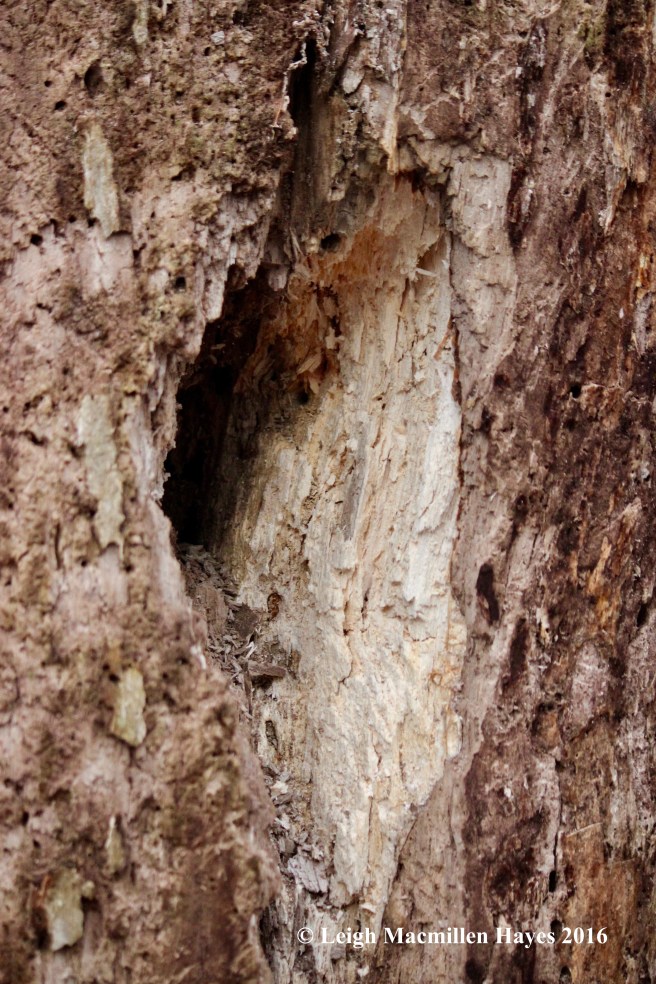
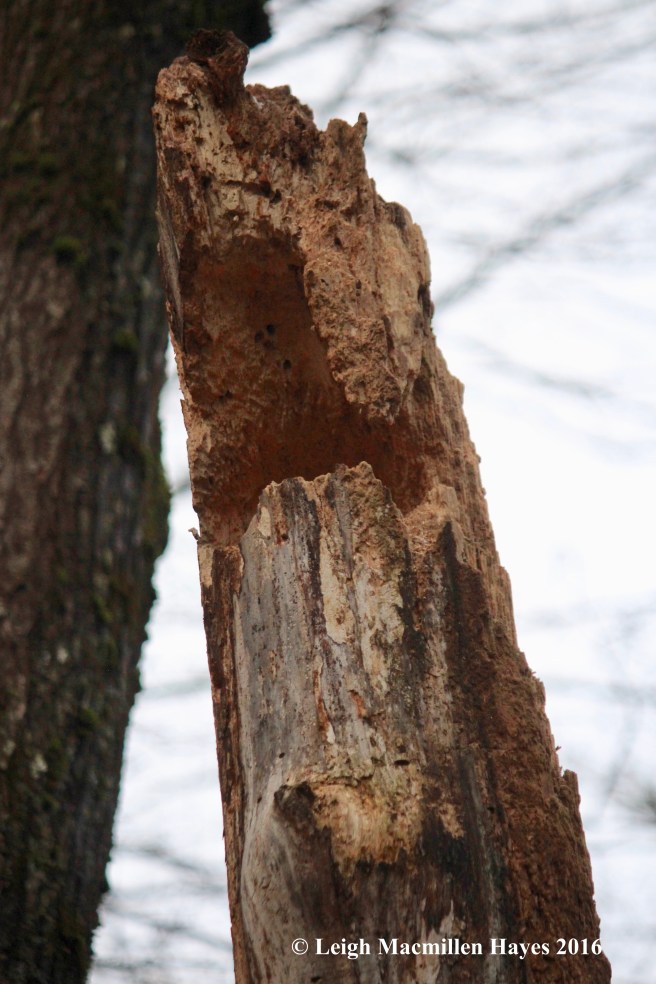
After watching #1 for a bit, I went in search of woodpecker happenings scattered throughout our woodlot. Though they’ll eat lots of wood-boring insects and occasionally berries, seeds and suet, carpenter ants are their mainstay. Better in a woodpecker’s stomach than our home. Sometimes the holes they create are about six inches across and almost as deep.

h-woody-condo-2

h-woody-condo

And those holes became homes for other critters occasionally, so when friends and I see trees such as these, we think of them as condominiums providing living quarters perhaps for small birds and little brown things (mice). Included in these condo units are some smaller round holes, created by the Hairy and Downy Woodpeckers that also live in our neighborhood.

h-wood-chisel

Occasionally I come across trees such as this one that hadn’t been so much excavated as chiseled. Woodpeckers are just that–peckers of wood. They don’t eat the wood. But to get at their preferred food, they must hammer, chisel and chip the bark.

h-woodchips

At the base, always a scattering of wood chips. I, of course, cannot pass up any opportunity to search through the chips in hopes of locating scat. I was not rewarded with such a find today.

h-hole-in-snag

Leaving dead snags encourages woodpecker activity. They become prime locations to forage, roost and maybe even nest, though I hardly think this snag was large enough to serve as the latter.

h-pinesap

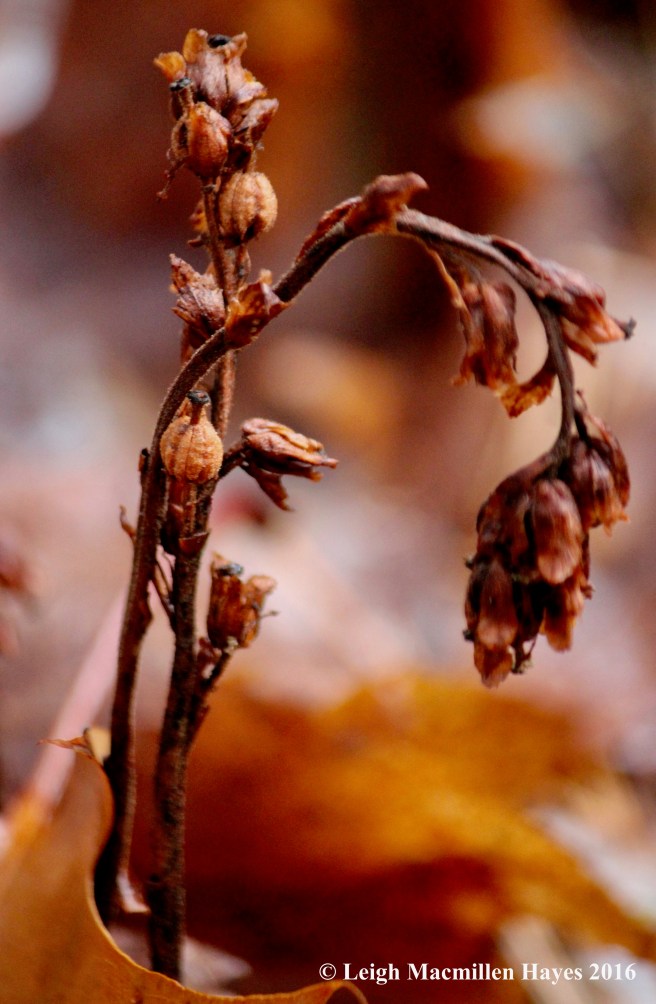
While I was out there, I did stop to admire a few other sights including the now woody structure of pinesap;

h-winterberry

winterberries contrasted against the wee bit of snow that still graces patches of ground;

h-deer-tracks

deer tracks indicating we’d had visitors during the night;

h-violet-upper

h-violet-toothed-under

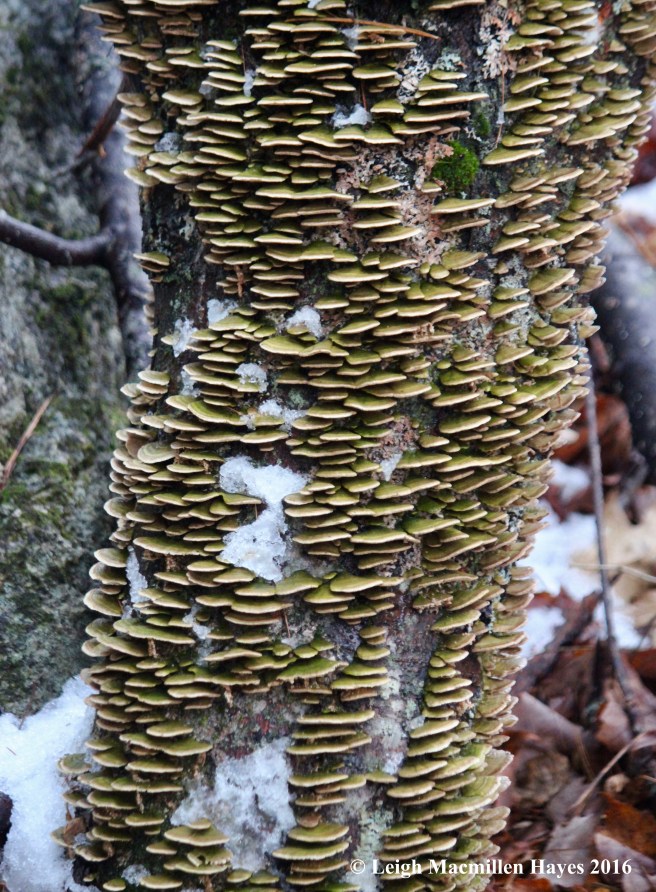
and a tree skirt of violet-toothed polypores. They are rather like the Lays Potato Chips of the natural world. You can never have just one. (Note: I’m not talking about eating them, but rather how they grow.)

h-woody

It’s been said that Pileated Woodpeckers are skittish. That’s not always the case. I’ve stood beneath one for over twenty minutes, the bird intent on its work and seemingly oblivious to my presence.

The next time you are in the woods and hear the ho-ho-ho ho ho, ho-ho-ho ho hoing that reminds you of that cartoon character, Woody Woodpecker, take a look around. You, too, might be blessed. And don’t forget to check for scat. ;-)

Forever a Student

Once the rain let up, I donned my Boggs and headed out the door in mid-afternoon, not sure where exactly I was headed. But after reaching the snowmobile trail, I decided to turn south. Since the spring, I’ve been to the vernal pool on the neighboring property numerous times, but not much beyond in that direction.

h-new-bridge

Part of the reason was that a local industry, of which we now have so few, was constructing a new building and had cut off the trail. Oh, I could have bushwhacked around the project, but the other part of the reason is that it’s a heavy tick zone and I normally avoid it come warmer weather. Given the new building, I wasn’t sure what to expect today, but as I passed through the stonewall, I discovered they’d added a bridge over a new water diversion and the trail was open. I’m glad for the small industry, but simultaneously sad that the willows are gone. No more pussy willows in the spring. Or willow galls, though I suppose that’s good news. And who knows, perhaps some viable willow seeds will spring forth in this place–a hypothesis to be tested.

h-artist-conk-top

After crossing behind the building, I moved through an opening in the next stone wall, and felt right at home again–in one of my local classrooms. This is one where I’m often the solo student, as was the case today.

h-artist-conk-2

I revisited an old stump, where art class was about to begin. The underside of the artist’s conk welcomed a sketch, but I left the canvas blank for another day.

h-gate

In social studies class, I took a look at former land uses. The wall opening and split stone gate bars helped me envision the fields that once were cleared. I followed several walls, which switched from single to double and even double-double, or so it seemed as one section was at least six feet wide and a football field long (The New England Patriots are winning in CA right now!). Barbed wire indicated the need to keep animals out and flat land with trees not a hundred years old spoke to the land’s former plowed use.

h-vp

A few minutes later, I moved over an old rock mound and stood before my science teacher–another vernal pool. As I recalled, this one dries out early in the season and grasses and other vegetation grow prolifically here. But unlike the smaller pool closer to home, this one held some water from the recent rain.

h-boots

As any student should, I stepped through the door and sunk my feet into class.

h-cinnamon-fern

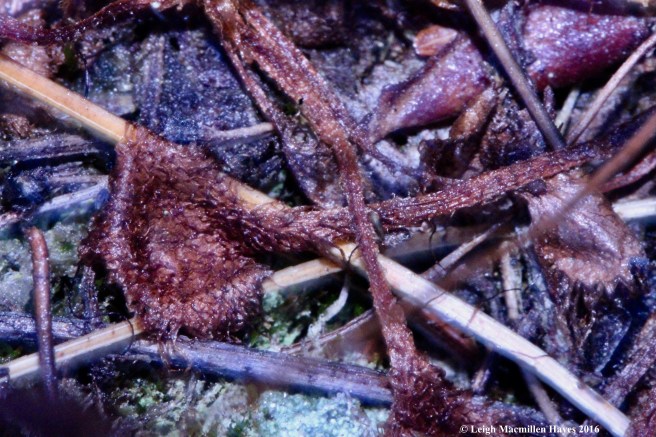
Cinnamon ferns reminded me that they keep their fuzziness right up to the end.

h-birdnest-1

I wondered about strips of paper birch dangling from a young sapling and then realized I was looking at the remains of a nest–maybe a vireo.

h-seeds

I questioned how the long-beaked sedge seedheads came to be bent over–by weather or wildlife or just because their time had come?

h-vp-bulrush-a-grass

While bulrushes (actually a grass) offered flowing fountains pouring into the future, their seeds still clung–as did a spider web.

h-vp-steeplebush-web

And more spiders eluded me, though their webs stood strong among the steeplebush capsules.

h-vp-crystal-ballseeds

A few raindrops dangled like ornaments from a holiday decoration.

h-vp-backside-of-sensitive-fern-beads

And bead-like spore structures on sensitive fern’s fertile stalk waited for another day to spread their good news.

h-lichen-or-fungus-2

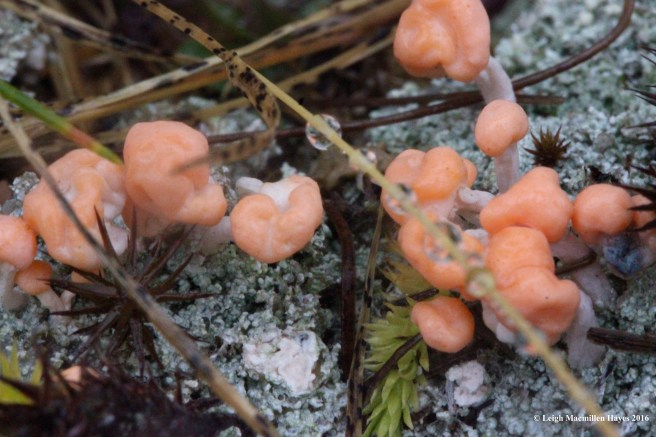
I finally left the vernal pool, but before heading back down the hallway, small salmon-colored growths stopped me. Lichen? Fungi? I didn’t think I’d ever seen it before and so it was a new lesson.

h-lichen-or-fungus

My first thought–lichen. In a way, it resembled the tops of British Soldiers that grow prolifically here. But my latest thought is red tree brain fungi (Peniophora rufa) . I may be wrong, but that’s what being a student is all about.

h-woodpecker-1

With each new lesson, I was also thankful for those that were reinforced, such as the chisel-like and shredded works of pileated woodpeckers. I used to think such trees were the result of bear activity.

h-woodpecker-2

I’m always awed by the resulting sculpture left behind by those powerful birds–their strong beaks stabbing away at the bark until they’ve consumed a meal of carpenter ants and beetles. Thankfully, their skulls are thick and spongy–allowing their brains to absorb the impact of such repeated drilling.

h-field-succession-layers

At a field, I paused to admire the layers–a testament to field succession. These woods are constantly changing.

h-male-turkey-scat-j

One thing that doesn’t change is the signature of a Tom Turkey–usually offered in straight or J formation.

h-slime-3

h-tubifera-ferruginosa

h-slime-2

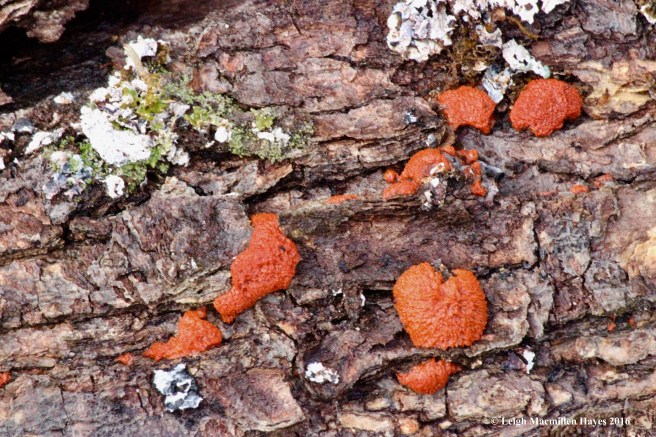
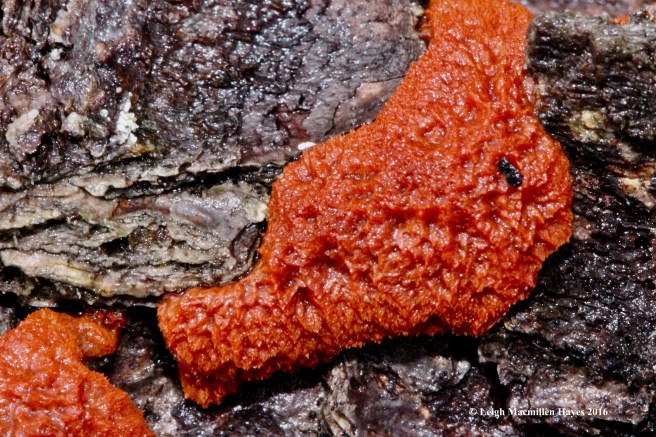
At another wetland, I poked around and then my eye focused in on something decorating a fallen tree. A slime mold perhaps? Red raspberry slime? In one rendition it seemed to have a crater-like surface, while another was more flower-like with petals spraying from a center.

h-hemlock-cinnamon

At last I entered a hemlock forest where the cinnamon inner bark stood out on the wet trees. If not for the scales, I realized it would be easy to confuse this bark with that of red oak, but a quick look up the trunk and the answer was obvious.

h-striped-maple-seeds

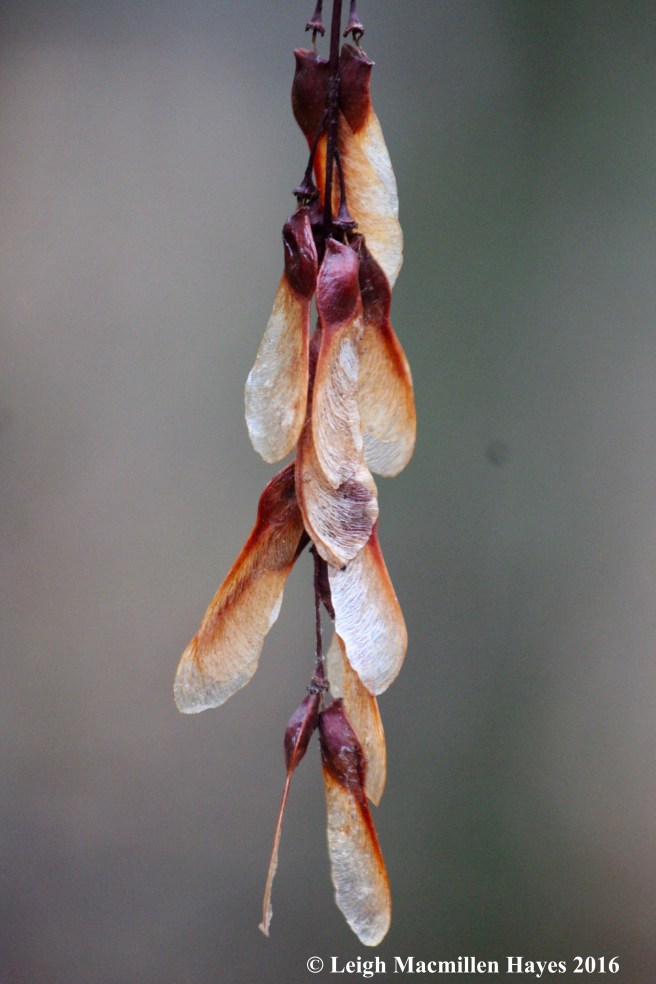
As I walked back toward home, I looked along parts of the trail I’d skipped while exploring in the woods. And I wasn’t disappointed when I discovered one of the few striped maple trees–still bearing the seeds it produced last year. Why did they cling still? When released, will they be viable?

h-pine-suds

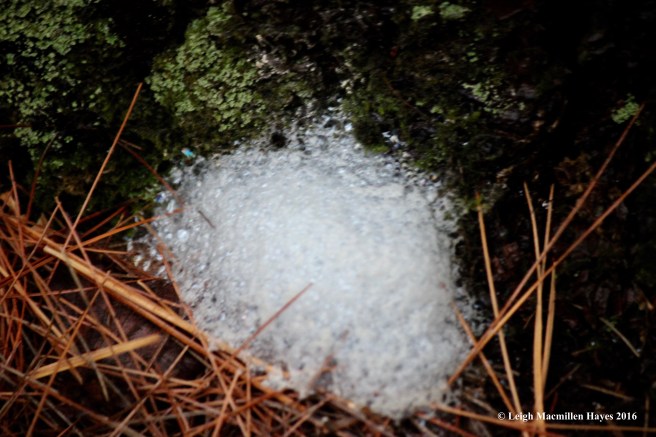
And then, a sight I was hoping for presented itself when I returned to our woodlot. Froth at the base of a pine tree. It’s not unusual and occurs following a rain event such as we’d had all night and morning. I had hoped to see some foam today, and felt rewarded for my efforts. So what causes the tree to froth? Well, like all lessons, there are several possibilities. Maine Master Naturalist Science Advisor Fred Cichocki recently had this to say about it: “I’ve noticed this phenomenon often, and in every case I’ve seen it’s associated with white pine, and always after a dry spell followed by heavy rain. Now, conifers, especially, produce hydrocarbons called terpenes (it’s what gives them their lovely pine, balsam and fir scent). These hydrocarbons are hydrophobic by nature and form immiscible films on water. During a heavy rain, water running down the trunk of a white pine picks up terpenes on the way. Air (having accumulated in bark spaces, channels, etc. perhaps under slight pressure) then “bubbles” through terpene-water films producing a froth. Recall the cleaning products PineSol, and the like. They are made from terpenes, and produce copious bubbles when shaken. One could get the same result directly by shaking terpentine in water, or by bubbling air through a terpentine-water mixture with a straw  . . .  Of course, it may be that other substances (salts, etc.) enhance the frothing.”

No matter how much I have learned on this life-long course, there’s always more. I certainly don’t have all the answers and for that I am thankful. I’m forever a student.


Book of November: The Natural World of Winnie-the-Pooh

My sister knows me well. And so this summer she gifted me a copy of Kathryn Aalto’s The Natural World of Winnie-the-Pooh: A walk through the forest that inspired the Hundred Acre Wood. 

pooh-11

My relationship with Pooh began as a child, though I can’t remember if my sister or mother read the stories to me or if I first meet him on my own. It doesn’t matter. What’s more important is that I had the opportunity to meet him and to stay in touch ever since.

pooh-10

Our relationship continued when I took a children’s literature course as a high school senior and after reading and writing about the books, I sketched characters from several stories including A.A. Milne’s Winnie-the-Pooh to complete an assignmentMy framed collage still decorates a wall in my studio. And later, I met Pooh again through The Tao of Pooh here I listened more closely to his lessons about life. When I needed to interpret a song for a sign language class, it was to Pooh I turned: Kenny Loggin’s “House at Pooh Corner.” And Pooh was a dear friend when our sons were young and the oldest formed his own relationship with the residents of the Hundred Acre Wood.

pooh-9-1

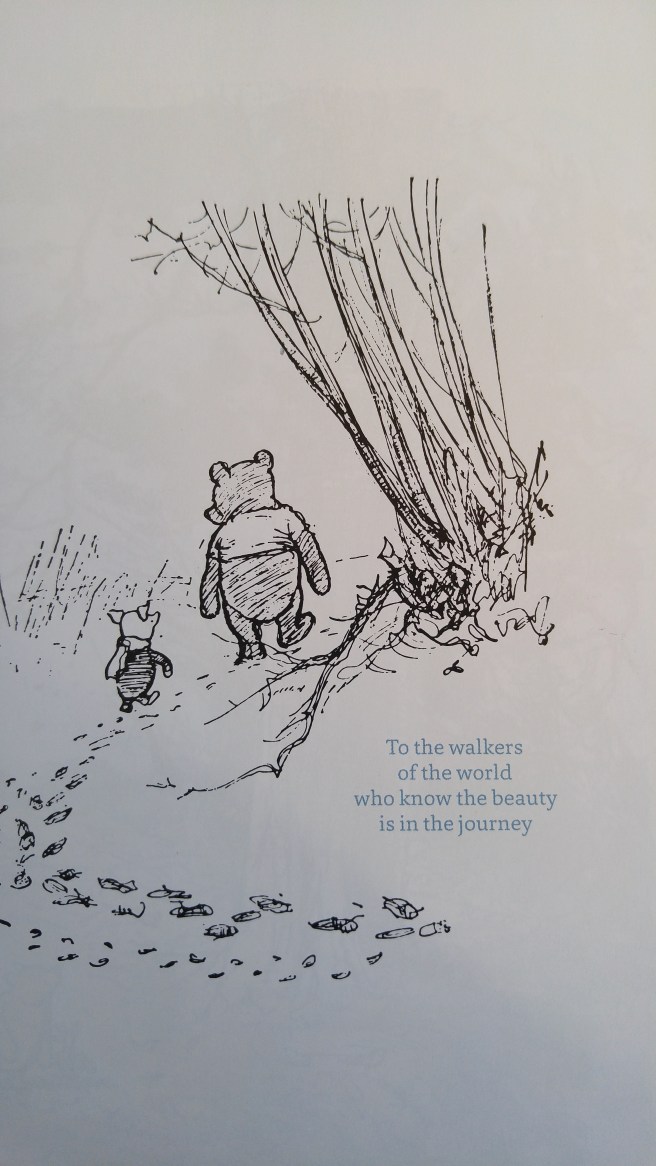
And so it was with great joy that I opened Aalto’s book and immediately related to her dedication: “To the walkers of the world who know the beauty is in the journey.”

pooh-8-1

When a friend noted that Winnie-the-Pooh is 90 years old today, I knew that this had to be the Book of November. Alan Alexander Milne published When We Were Young and A Gallery of Children in the two years prior to 1926 and followed with The House at Pooh Corner in 1928. All are as meaningful today as they were then–perhaps more so.

Aalto is an American landscape designer, historian and writer who lives in Exeter, England. I know it’s not good to covet someone else’s life, and yet . . .  I do.

Her book begins with biographical background about Milne and how he came to be at Ashdown Forest and the Five Hundred Acre Wood. I think one of my favorite facts that she shares is that while at boarding school, his mother sent care packages that included  bunches of flowers grown in her garden. Upon receiving them, he was pulled home by the sight and scent. Perhaps secretly, my sons would appreciate that, but they’d never let on.

States Aalto: “We value the books for simple expressions of empathy, friendship, and kindness. The stories are classics as they express enduring values and open our hearts and minds to help us live well. But as I read about Milne and walked around England with my children, I saw how they also tell another story: the degree to which the nature of childhood has changed in the ninety years since Milne wrote the stories. There is less freedom to let children roam and explore their natural and urban environments. There are more digital distractions for our children that keep them indoors and immobile, and heightened parental fears that do so as well.”

With that, I am reminded of a childhood well spent exploring the environs of our Connecticut neighborhood and beyond and not returning home until we heard Mom shout our names from the back door. (Or a certain next door neighbor told me that my mother was calling.)

pooh-7-1

While C.R.’s explorations with his stuffed animals became the muses for his father’s stories, the landscape also provided inspiration.

That landscape still exists, though time has had a way with it. Aalto takes us there through her photographs and words. She begins with a visit to the farm, village of Hartfield, and the forest located steps to the south. Referring to the Ashford Forest, she comments: “It is still a place of solitude where people can walk half a day without meeting another person. There are no overt signs pronouncing your arrival in Pooh Country. There are no bright lights or billboards, no £1 carnival rides, no inflatable Eeyores, Owls, or Roos rising and falling in dramatic flair. There are no signs marking the dirt lane where Milne lived, nor pub grub with names like “Milne Mash and Peas” or a “Tigger’s Extract of Malt Cocktail” on ice. A quiet authenticity–historical, literary, and environmental–has settled over the landscape.” Ah, yes. A place to simply be and breathe and take it all in.

pooh-13-1

A photograph of C.R.’s secret hideaway in a tree reminds us that the stories are about real people and real places and based on real life events, all with a dash of real imagination. Aalto examines every aspect of this.

A week ago today, while exploring a similar woodland in New Hampshire with a dear friend, I convinced her to step inside a tree cavity, much the way the real Christopher Robin used to do a Cotchford Farm. At heart, we can all be kids again.

pooh-6-1

I love that Aalto provides us with a closer look at the flora and fauna of the forest. From flowers and ferns to birds, butterflies, moths, damselflies and dragonflies, and red tail deer, she gives us a taste of C.R. and Pooh’s world.

pooh-5-1

And she reminds us to get out and play, including rules for Poohsticks. I think it is more important than ever that all members of our nation step outside, find a Pooh bridge, drop a stick and run to the other side. As Aalto says in rule #9: “Repeat over and over and over and . . . ”

pooh-12-1

I also like that she mentions one special visitor to Ashdown Forest, who spent many hours examining carnivorous sundews.

pooh-sundew-1

I’m rather excited by that because just yesterday I discovered sundews, though rather dried up, growing on our six-acre woodland. We’ve lived in this house for 24 year and I’ve never spotted these before. The land is forever sharing something “new” with me and I’m happy to receive each lesson.

pooh-14-1

I’m also thankful for a feisty faerie with whom I share this outdoor space. Sometimes her statements are dramatic and I can only imagine the cause of her recent frustration.

pooh-3-1

It’s not too late to revisit your inner Pooh. To take the journey. And while you are there, I highly encourage you to get to know him and his place through The Natural World of Winnie-the-Pooh by Kathryn Aalto.

P.S. Thanks Lynn ;-)

The Natural World of Winnie-the-Pooh, first edition, by Kathryn Aalto, © 2015

The Way of the Land at Long Meadow Brook Reserve

Last month the Greater Lovell Land Trust purchased a new property along Long Meadow Brook that further develops the wildlife corridor. A couple of weeks ago I first visited it with GLLT’s Executive Director Tom Henderson and a number of the land trust’s volunteer docents. As we left the property, Tom said to me, “I didn’t oversell this, did I, when I said this will become one of the docents’ favorite properties.” Indeed.

And so I couldn’t wait to get back there myself to spend a few hours exploring the almost one-hundred-acre reserve.

l-mullein-flower-2

Because the land was last logged by the previous owner in 2014, it’s in the early succession stage of regrowth.

l-mullein-flower-3

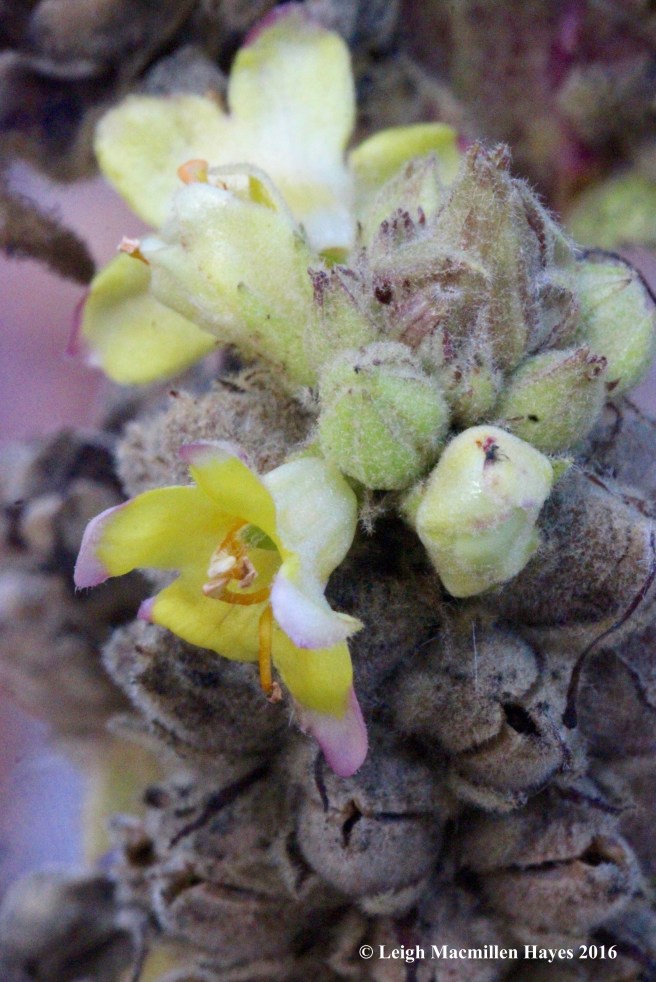
And so, it’s a place where those who like disturbed places tend to grow, such as the common mullein. What surprised me most was that I found a few still offering blooms.

l-mullein-cactus

Of course, it reminded me that I was in the great West–WESTern Maine, that is–with its occasional cacti-like form.

l-seeds-holidng-on

Scattered throughout are also the seedheads of white lettuce, waiting for release in lampshade-like formation.

l-orange-peel-fungi

Orange-peel fungi fruited prolifically in the gravel logging road.

l-future-parking-lot

That was all before I even reached the future parking lot, which had served as the log landing a few years ago. Already, sweet ferns and berry bushes have made themselves known.

l-sweet-fern-colors

The leaves of sweet fern, which is really a shrub rather than a fern, exhibited their version of autumn hues.

l-trail-marker

If you go, I encourage you to look for the blue ribbons that indicate where a future trail will be placed. It’s a loop trail that summer interns Hannah and Aidan laid out and leads to two focal features.

l-stonewall-double-to-single

The trail nears a neighboring property, which just happens to also be under conservation easement thanks to the foresight of its owners. I stepped off the blue flag trail and started to follow the wall for a bit–noticing that soon it changed from a double (garden or plowed land) wall to a single wall. A large pasture pine grew at the change-over point.

l-stonewall-barbed-wire-1

And where the wall switched to single formation, barbed wire indicated its former use a pasture boundary. And white pine scales indicated its current use–as a red squirrel’s dining room table.

l-forest-succession-2

After moving away from the wall, I noticed the mountains in the offing and ferns and young trees already filling in the empty spaces.

l-kearsarge

One of my favorite mountains to climb stood tall in the backdrop–Mount Kearsarge.

l-forest-succession-1

My bearings were off a bit, but I knew where the eastern boundary was as I moved across this opening.

l-pitch-pine-bark-1

Walking along the back edge, my tree passion was ignited yet again.

l-pitch-pine-1

Several pitch pines grow in this space. While the bark is similar to that of red pines, it’s platier (is that a word?). And the tufts of needles that grow along the trunk were a dead give-away.

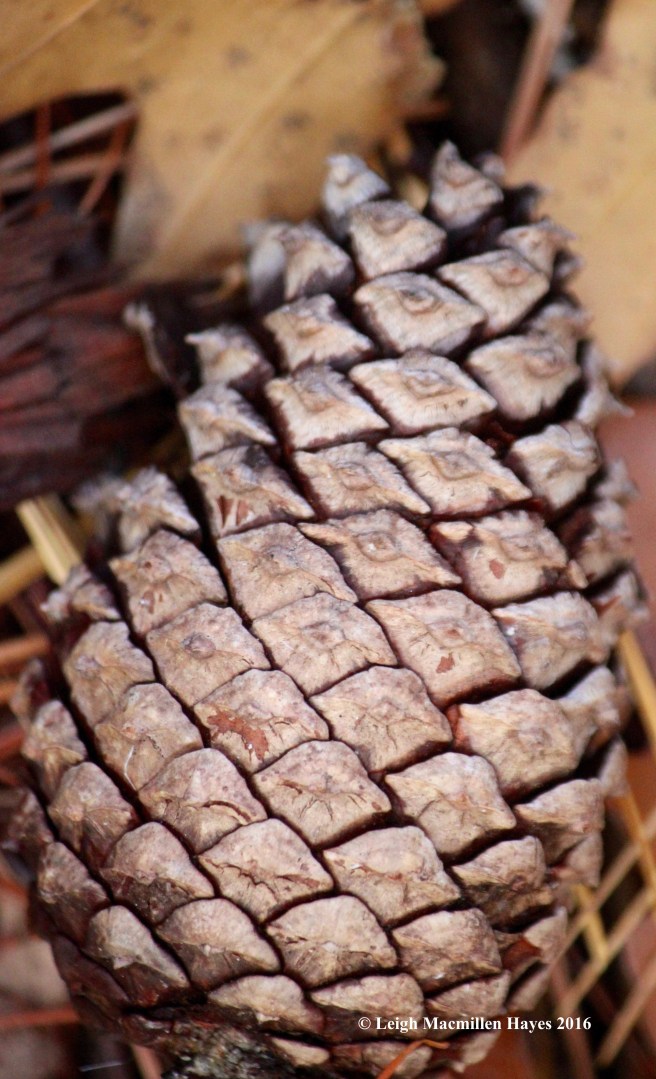
l-pitch-pine-cone

l-pitchpine-needles

But . . . I always quiz myself and so I looked around. And right below the trees, pitch pine cones and the triple needle bundles common to this species.

l-wintergreen-berries

It was here that I discovered wintergreen growing by the base of a tree stump. What made me wonder was the amount of fruit on each plant. Yes, wintergreen grows prolifically in all of western Maine, but I can’t recall ever seeing so many little red globes dangling below the leaves.

l-marshy-1

From my half-circle around the opening, I wasn’t positive about my whereabouts and so decided to follow the land downhill because it looked like there may be an opening below. A few minutes later, I realized I was in a marshy spot where the cinnamon ferns grew. And the earth beneath my feet was rather spongy and damp.

l-beaver-lodge

I reached what I thought was the meadow I sought–only to realize that I was looking at a beaver lodge. I knew that beaver lodge, but from a different perspective–the neighbors’ property.

l-first-marsh

And then something else caught my attention.

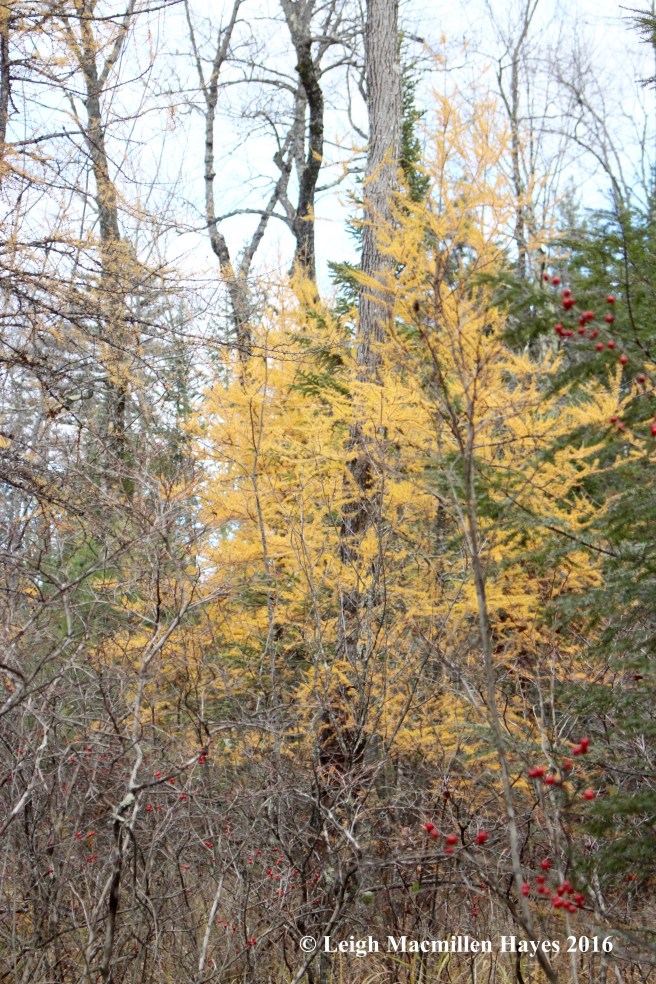
l-marsh-tamaracks

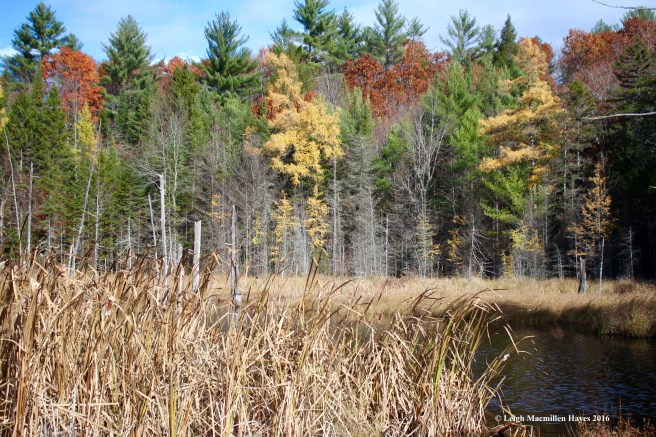
Tamarack (aka larch) trees–our only deciduous conifers, which had turned a golden yellow as is their autumn habit.

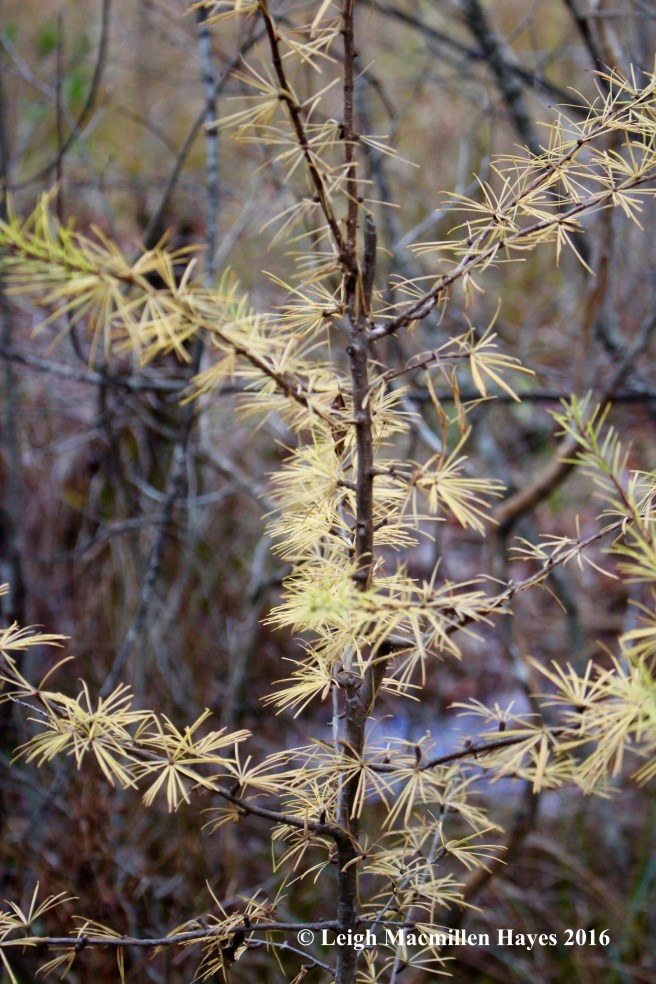
l-tamarack-2

The spray of tamarack needles reminded me of witch hazel flowers, which also grow on this property. But soon, the former will drop, leaving only their barrel-like stems as a reminder of their presence.

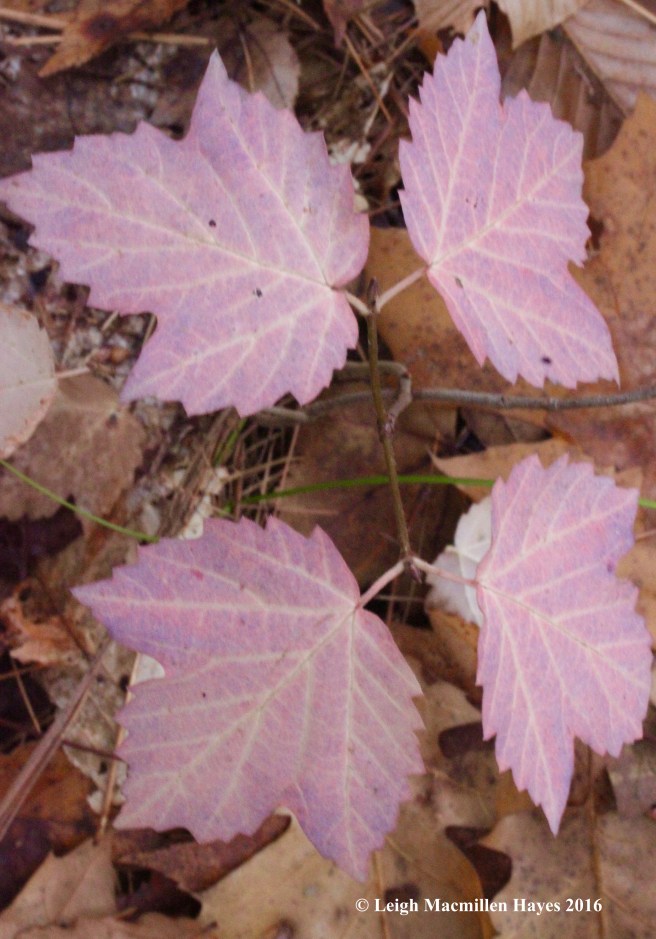
l-maple-leaf-viburnum

I left that spot, retraced my steps and headed to the north on a cross-country bushwhack, where the mauve colored maple-leaf viburnum grew.

l-turkeys

I saw lots of mammal sign and even a few birds, including turkeys who are loving the fact that this is a mast year for acorns.

l-trail-to-meadow

At last I emerged onto the trail I remembered and headed downhill again.

l-meadow-brook-2

And then . . . I was rewarded for my efforts. Long Meadow Brook and the mountains beyond provided a WOW moment.

l-meadow-east

I looked to the east for a few minutes.

l-meadow-layers

And then turned west again, where the layers and colors spoke of diversity.

l-meadow-snags

Even the dead snags added beauty.

l-cat-n-nine-tails

Cat-in-nine tails added to the view and I noted others who like wet feet including steeplebush, meadowsweet and bulrushes growing along the old beaver dam. It’s also a place for a variety of evergreen species–hemlock, white pine, balsam fir, red spruce and tamaracks. Future teaching moments await.

l-hobble-2

My intention to stick to the trail was soon thwarted when I spied hobblebush.

l-hobble-bud1

Like all trees and shrubs, the future was already encased in a bud–in this case a bud we refer to as naked because it doesn’t have the waxy coating of most others. Methinks its furry presentation offers the same protection from winter’s cold.

l-back-of-hobblebush-leaf

And as I studied the back side of fallen leaves, I paid attention to the venation–reminiscent of the bud’s pattern.

l-hobble-leaves-2

In the glow of sunlight, I felt like I’d found the pot of gold.

l-meadowhawk-2

A short time later I reached the second opening that Hannah and Aidan’s trail encompasses. And what to my wondering eyes should appear–a meadowhawk dragonfly.

l-snow-on-balds-1

It provided a sharp contrast to snow on the Baldface Mountains.

l-secod-opening-2

It was at this six-acre opening that I poked around for a while longer. And watched a goshawk fly to a pine tree with something dangling from its talons. Did I take a photo? No, of course not. I was too mesmerized to focus my camera. But sometimes, the photo doesn’t matter. Being there in the moment does.

I’m thankful for such opportunities made possible by organizations such as the Greater Lovell Land Trust. I know that ultimately this property is for the mammals that travel through and I saw plenty of evidence that they use this place. But then again, I’m a mammal who also appreciates the land bridges created and opportunity to observe the connectivity. I spent the day getting to know the way of the land at Long Meadow Brook Reserve–and can’t wait to return.


Cloaked By The Morning Mist

You remember the nursery rhyme, “Rain, rain, go away, come again some other day, we want to go outside and play”? Well, it finally rained yesterday and today, and many of us have greeted it with open arms. And we certainly didn’t let it stop us from going out to play.

u-eaton-1

This morning, I joined a group from the Upper Saco Valley Land Trust for  a hike in South Eaton, New Hampshire. Had I not been racing for time, I would have stopped every twenty feet to snap a photo, but I did pause beside Crystal Lake.

u-road-1

After getting lost for a few minutes because I didn’t pay attention to the directions, I found the property. Eleven of us headed down Paul Hill Road, led by Jesse Wright of USVLT, and Nancy Ritger, senior naturalist with the AMC.

u-big-tooth-raindrops

We paused to examine a variety of offerings, including the flat stems of the quaking aspens. It was the raindrops on the big tooth aspen, however, that drew my focus. One of the things Nancy spoke about as she had everyone feel a flat aspen stem, is how that very stem aids in photosynthesis.

u-big-tooth

The leaves tremble or quake, giving each more time in the sunshine–individual leaves, no matter where they are attached to the tree, share in unshaded glory for split seconds as those above them flutter. And, in the case of aspens, both sides of the leaf work to make sugar and release oxygen.

u-beaver-lodge

We spent a long time beside a beaver pond and pondered various aspects of it. We could see the lodge and beaver sticks in the water–that made sense.

u-retainer-2

But why a significant wall on at least two sides?

u-cut-stone-in-water

And a split stone by the water’s edge? What else had happened here? Jesse told us that there are numerous foundations that we didn’t have time to locate today, so we knew that though it seemed as if we’d traveled to the middle of nowhere, this place was once somewhere.

u-moose-track

And to the local moose, it still is as evidenced by the prints we found in mud.

u-raindrop-lichens-2

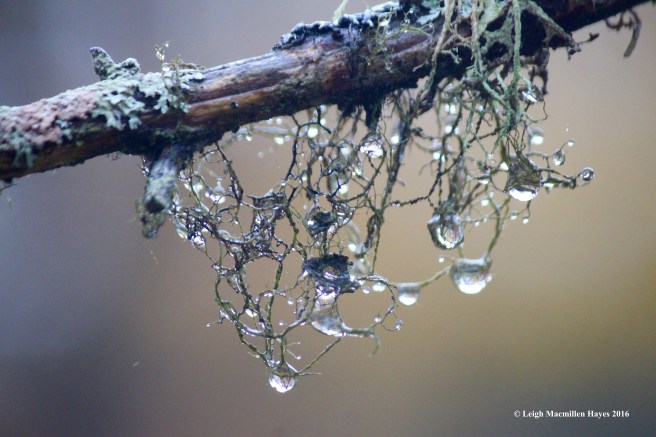
Our attention also turned upward as we admired raindrops dangling from fruticose lichen (think fruit-like branching).

u-raindrops-on-pond

Suddenly, the rain increased so Jesse asked if anyone wanted to turn around and received an overwhelming vote to continue on.

u-larch-2

One of my favorite discoveries was a couple of larch trees. Larch or tamarack is our only deciduous conifer. Huh?

u-larch-1

Like deciduous trees, the larch needles turn yellow each autumn and fall to the ground. Another cool fact: needles grow on stout pegs that look like wooden barrels.

u-pileated-and-ants

We paused beside ash trees and tree stumps, and enjoyed the view of this pileated woodpecker excavation of carpenter ant tunnels–their favorite prey.

u-candy-lichen

In the log landing that did become our turn-around point, we noted the early succession growth of Eastern white pines and sweet fern (not a fern). But again, we looked to our feet for the best views.

u-candy-lichen-1

Candy lichen is a crustose (think–flattish or crust-like) lichen with green to bluish-green coloration.

u-candy-2

Its fruiting bodies, however, are candy-pinkish disks atop stalks, even reflected in the raindrops.

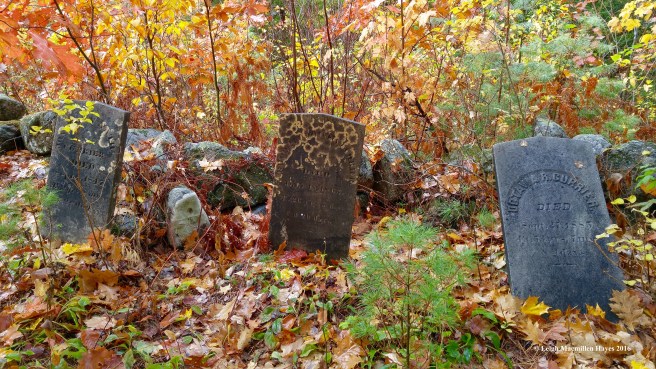
u-cemetery-entrance

Our journey back to parked vehicles passed quickly, indicating we’d not traveled all that far in two and a half hours. That’s normal when you take time to notice. Before departing, Jesse showed me a cemetery on the abutting property.

u-cemetery-small-stones-2

Small, unmarked stones made me think of a Civil War-era cemetery in Sweden, Maine–perhaps a sudden illness of young children called for quick burials.

u-cemetery-currier-plot

One section was portioned off by split granite.

u-cemetery-curriers-1

The Currier plot. A side road we’d passed by was named for the family.

u-cemetery-lichens

The crustose lichens were intriguing on Rhoda Lodolska Currier’s stone. Rhoda died at age 26.

u-cemetery-octavia

Her sister, Octavia, lived to be 53.

u-cemetery-nancy-leavitt-90-years

Most impressive was the age of Nancy Leavitt, her stone located just outside the Currier plot. Nancy died at age 90.

u-vireo-nest

As we walked out, Jesse spied a cup-shaped vireo nest built in the fork of a beaked hazelnut. Life continued to circle in these woods.

u-undulating-color

And the autumn color undulated, mimicking the land. The sun tried to peak out for a few minutes when we arrived at our vehicles, but we were all appreciative of the rainy day wonders we’d found along the way.
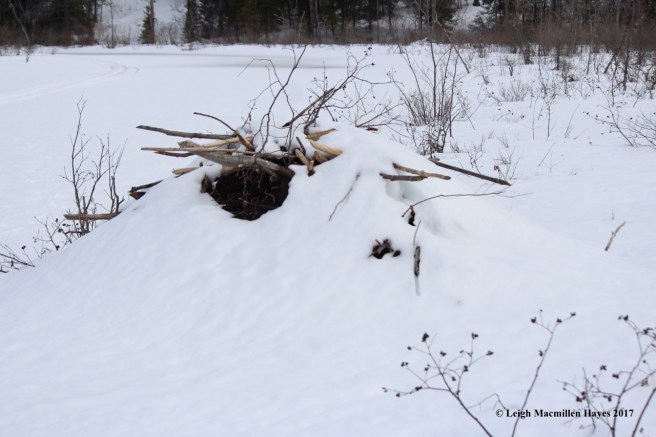
u-eaton-3

And back in Eaton, a quaint New England village located beside Madison and Conway, New Hampshire, and the Maine border–beauty cloaked by the mist.

Thanks to Jesse, Nancy and the Upper Saco Valley Land Trust for a fine morning spent wandering and wondering.


The Fruits Of Our Labor Day Mondate

I feel like a broken record when I say that my guy works too many hours, but so it has been. This was his weekend off and he worked more than a half day on Saturday and all day plus on Sunday. This morning he burned it all off with a seven mile run and then we headed off for a hike.

k-trail sign 1

Mount Kearsarge North off Hurricane Mountain Road in North Conway, New Hampshire, is an old fav that deserved a visit.

K-trail goes this way

It was great to be out of town and finally goofing off on this Labor Day holiday. He’s labored. I’ve labored (really–even when it seems like I’m playing, I truly am working, honest). And we needed a break. If we followed this blaze, however, we would never have found the summit.

k-climbing higher

Fortunately, we knew better. The hike is challenging, especially on the upward climb. We later commented about how the downward climb is faster, but does require attention to foot placement.

K-approaching tower

Just over two hours later, we approached the fire tower at the summit. Though no longer in use, it’s obvious from the 360˚ view why a fire lookout was built at this summit. Constructed in 1909, the structure was rebuilt by the US Forest Service in 1951. Prior to the replacement of fire towers by airplane surveillance, this tower was in operation until 1968.

k-summit fire tower (1)

Since we were last here about a year or so ago, it looked as if some of the support beams had been replaced.

k-my guy at tower

Despite the cooler temps and wind, it’s always worth a climb up.

k-summit tower 3 (1)

Once inside, all was calm. And the view–to die for. It made the efforts of our labor well worth it. We signed the log before moving back outside.

k-summit view 1 (1)

I was thankful for the railing that kept me from being blown to the great beyond as I gazed toward the Baldfaces,  though the wind wasn’t nearly as strong as last week’s Mount Crawford Mondate.

k-summit Mount Washington (1)

Back on the granite, we twirled about and took in each view–including Mount Washington with cumulus clouds grazing its summit.

k-summit to ledges and moats (1)

The cloud cover varied as we looked toward the valley with Cathedral Ledge, the Moats and beyond. Because we’ve set our feet down at those various levels, we appreciated the layers before us.

k-summit toward cranmore (1)

And we noted the Green Hills Preserve, where we’ve also hiked many a trail.

K-Pleasant Mtn

The cloud cover changed as we turned toward home and saw Pleasant Mountain in the distance. Our house is located about center beyond the mountain. And our camp to the left end of said mountain.

k-summit lunch rock (1)

Of all the rocks, lunch rock was the most important find. Sometimes, it’s difficult to locate such among all the opportunities, but this one spoke to us. And so we sat. And ate. Sandwiches (not PB&J–those are more for winter fare) and brownies (great any time of the year).

k-my guy snoozing (1)

And then my guy decided to snooze. He deserved it.

k-hare scat

I took advantage of the opportunity to observe and was tickled to find these woody fruits–the milk duds of the north woods. Snowshoe hare scat. I found numerous examples and wondered where the hares hid. Actually, they could have been anywhere because among the bald rocks there were plenty of islands filled with brushy undergrowth.

k-blueberry.jpg

And so I poked about. Though the low bush blueberry plants were plentiful, the fruits were sparse. In fact, I only spotted this one.

k-mountain cranberries

More prolific were the mountain cranberries, aka lingonberries.

k-summit speckled alder (1)

What surprised me was the presence of speckled alder in the mix because I think of this as a species with wet feet, but really, this mountain top is much moister than most of our lowlands, so in the end I guess it made sense. Always something to wonder about.

k-sheep laurel fruit.jpg

It wasn’t just speckled alder that made me wonder. Sheep laurel also grew there. I know it well in bogs and even along the power line behind our house. And yet, it loved the habitat on the summit.

k-summit huckleberries (1)

The same was true for huckleberries–which I look at beside Moose Pond all summer. How can they like wet feet and a bald mountain landscape. But again, I think perhaps it’s the moisture for these mountains are often lost in the clouds.

K-mountain holly

Mountain holly also liked this habitat. Again, I’ve seen this at camp where the fruits have already been consumed. Songbirds love these berries and the supply on Kearsarge will disappear soon as migration begins. Here today, gone tomorrow.

k-wild raisins 2

Wild raisins were equally plentiful and worth admiring.

k-wild raisins 3

The berries are edible, at least for birds. But . . . if not consumed, the fruits shrivel up–thus the name of wild raisin.

k-trail sign 2

At last, my guy awakened and we picked our way among the rocks and roots on our descent.

K-oak plum gall (1)

At least one more fruit showed its face on the downward route. Or was it a fruit? Actually not–it was an oak plum gall created by a wasp.

We talked about Labor Day as we climbed down. Labor Day is a tribute to the contribution of those who work and contribute to the strength, prosperity and well-being of our country. We gave thanks to our parents and the work ethic they taught us. And we noted the fruits of labor we saw in the natural world.

Finally, we toasted all with a beer at Delany’s Hole in the Wall in North Conway–a Shock Top for him and Tuckerman’s Pale Ale for me. On this Mondate, we felt rewarded with the fruits of all labor.


Halting Beside Holt Pond

Halting–prone to pauses or breaks. I didn’t break, but I certainly was prone to pauses as I moved along the trails and boardwalks at the Holt Pond Preserve in South Bridgton this afternoon.

h-pitcher flower2

One of my first stops–to admire the pitcher plant flowers in their August form.

h-pitcher  flower up close

When I took a closer look, I realized that the seeds were developing–certainly a WOW moment in the world of wonder.

h-buttonbush.jpg

The global seed heads of buttonbush also demanded to be noticed. Upon each head are at least two hundred flowers that produce small nutlets. What strikes me as strange is the fact that this plant is a member of the coffee family. Maine coffee–local brew; who knew?

h-Muddy across

At the Muddy River, the water level reflected what is happening throughout the region–another case of “Honey, I shrunk the kids.” It’s downright scary.

h-speckled bug and speckles

Both by the river and on the way to the quaking bog, this wetland features a variety of shrubs, including one of my many favorites, speckled alder. Check out the speckles–those warty bumps (aka lenticels or pores) that allow for gas exchange. And the new bud covered in hair.

h-speckled alder catkins

This shrub is so ready for next year–as evidenced by the slender, cylindrical catkins that are already forming. This is the male feature of the shrub.

h-speckled cones new

It also bears females–or fruiting cones filled with winged seeds.

h-speckled old cones

It’s not unusual for last year’s woody cones or female catkins to remain on the shrub for another year.

h-cranberries

Whenever I visit, it seems there’s something to celebrate–including ripening cranberries.

h-cotton grass

Common Cotton-grass dotted the sphagnum bog and looked as if someone had tossed a few cotton balls about. Today, they blew in the breeze and added life to the scene. Note to self–cotton-grass is actually a sedge. And sedges have edges.

h-holt pond left

Just like the Muddy River, Holt Pond was also obviously low. Perhaps the lowest I’ve ever seen. At this spot, I spent a long time watching dragonflies. They flew in constant defense of their territories.

h-slaty skimmer, male

Male slaty skimmers were one of the few that posed for photo opps.

h-canoe on pond

As I watched the dragonflies flit about along the shoreline and watched and watched some more, I noticed a couple of fishermen making use of the LEA canoe. I don’t know if they caught any fish, but I heard and saw plenty jumping and swimming. Well, a few anyway. And something even skimmed across the surface of the water–fish, snake, frog?

h-rose hips.jpg

Rose hips by the pond’s edge reminded me of my father. He couldn’t pass by a rose bush without sampling the hips–especially along the shoreline in Clinton, Connecticut.

h-pond toward 5 Fields

The view toward Five Fields Farm was equally appealing.

h-pickerel frog

And then I moved down tire alley, which always provides frequent sightings of pickerel frogs. I’m never disappointed.

h-golden spindle

At the transition from a red maple swamp to a hemlock grove, golden spindles embraced a white pine sapling as if offering a bright light on any and all issues.

h-hairy woodpecker

In this same transitional zone, a female hairy woodpecker announced her presence.

h-green frog

When I crossed Sawyer Brook, green frogs did what they do best–hopped into the water and then remained still. Do they really think that I don’t see them?

h-hobblebush berries

At last, I walked out to Grist Mill Road and made my way back. One of my favorite surprises was the amount of hobblebush berries on display.

h-meadowhawk

Walking on the dirt road gave me the opportunity for additional sights–a meadowhawk posed upon a steeplebush;

h-chicken

chicken of the woods fungi grew on a tree trunk;

h-chipmunk

and a chipmunk paused on alert.

h-American Woodcock

But the best find of the day–one that caused me to halt on the road as I drove out of LEA’s Holt Pond Preserve–an American Woodcock.

Worth a wonder! And a pause. Certainly a reason to halt frequently at Holt Pond.


Searching for the Source of Sweetness

I wore down a path between gardens today as I traipsed from one to the next and back again. But if air space is anything like lawn space, then those who visit the garden via flight have created their own well-worn passageways as they also search.

w-post face scrub

My mission was to see the hummingbird again. But, this little guy, no longer than a half inch, stood atop a false dragonhead yet to bloom and waited to be noticed.

w-face scrub

He even took the time to scrub his face as I watched.

w-double or triple daylily

Continuing my wander, I stopped by the daylilies and made a discovery. We’ve lived in this house for more than two decades and I never realized until today that we have some double daylilies. The previous owners had green thumbs and we’ve benefited from the fruits of their labor. But how had I missed this before? I know we have double daffodils, but loved my new find. Especially as this past weekend, my friend Beth invited us to her hundred acre wood and her mom showed us their daylily gardens. Beth’s mom, Mary, talked about hybridizing the lilies and so she’ll know best about this.

w-lily pollen

When I revisited the flowers later in the day, the sun shone brilliantly on them, enhancing their orangeness. Correct me if I’m wrong, but what I think has happened is that the petal formed along the stamen and imbedded the anther, thus it looks like a petal with grains of pollen. Crazy cool. And beautiful. And yummy.

w-fritillary1

That wasn’t the only shade of orange worth wondering about. And it was no mistake the this fritillary butterfly chose the beebalm on which to land.

w-frit 2

Check out its mouth. A butterfly feeds through a coiled mouth part called a proboscis. When not in use, the proboscis recoils and is tucked into position against the butterfly’s head.
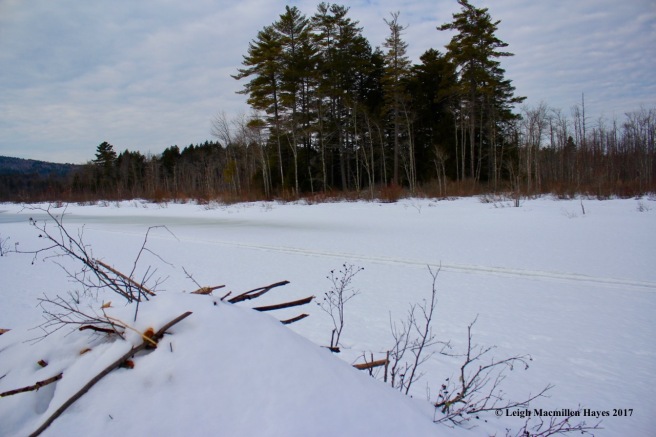
w-frit 3

Since the proboscis is narrow and straw-like, it allows the fritillary to extract sweet nectar from tubular-shaped flowers. Suck away, dear fritillary.
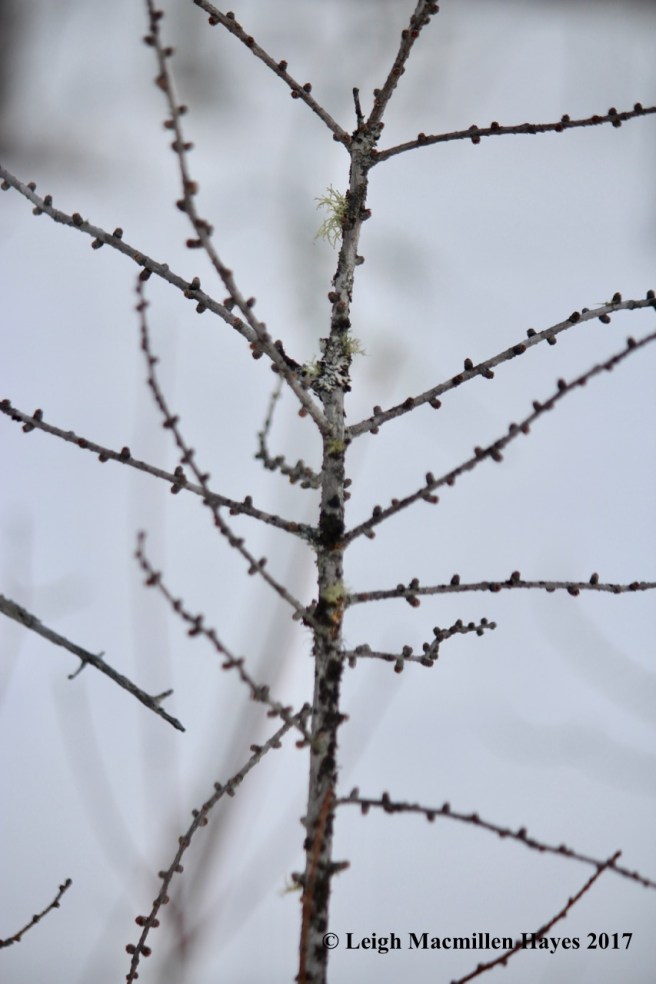
w-hummoth 1a

The fritillary wasn’t the only beebalm visitor with a coiled proboscis.

w-hummoth 3

I actually heard it before I looked up and saw this moth. It sounded like a hummingbird and flapped its wings as fast or nearly as fast as a hummingbird and shared the name hummingbird. This is a hummingbird moth.

w-hummingbird moth 1

Notice how the proboscis begins to unfurl as it approaches the flower.

w-hummoth 3a

While it hovers, it probes.

w-hummoth 4

Searching deep for the source of sweetness, where others can’t reach.

What’s So Special About Bee Balm?

I have childhood memories of ugly red bee balm plants surrounding a maple tree in our front yard. In addition to being ugly, what really bothered me about this flower was the smell. The scent tickled my nose in an unpleasant manner and gave me an instant headache.

b1

And then I grew up. Well, I suppose that’s questionable, but what did happen is I came to appreciate the showy flower and aromatic scent. (Funny thing is, an infusion of crushed, boiled bee balm flowers apparently treats headaches–I should have used it to treat the very symptom it caused. It has many other medicinal uses as well.)

b5

This summer, like others, I waited in anticipation.

b3

Even before it bloomed, its leafy bracts showcased a fluid beauty.

b4

And those leaves set at right angles to the square stem offered a crossroads where color and texture met.

b7

Finally . . .

b8

with the aid of raindrops

b2

and sunshine, the bracts pulled away and revealed star-capped tubes nestled within.

b9

Ever so slowly, flowers began to emerge.

b10

With a hat reminiscent of a jester, they crowned the plant.

b12

Stamens projected from the tubular upper lip, while below, three slender lips provided a landing pad for visiting insects seeking nectar-filled sweetness.

b15

Like me, the pollinators’ eyes shone brightly

b24

as they sought

b24a

fulfillment.

b11

I’ve spent many moments starring–in awe and wonder–at the structure, simple yet complex, and all of its idiosyncrasies.

b16

And I know I’m not the only female who stops by to soak in the glory of this old-fashioned perennial.

b17

b18

b25

b26

b20

b27b28

b22

b29

b21

What’s so special about bee balm? Everything.

P.S. This one is for you, Jinny Mae, because you, too, are special.