Book of December: Rewilding Our Hearts

It all started with an email message from my long-time mentor and former education director of the Greater Lovell Land Trust, Kevin Harding.

Wrote Kevin, “I rarely find a book that I’m willing to recommend to friends and colleagues. I rarely read books on saving the environment because I find them too depressing. I am guilty of feeling totally overwhelmed by the chaos and daily news of political disfunction that makes any kind of progress toward “saving the environment” seem impossible. Despite these feelings, I would like you to consider reading Rewilding Our Hearts by Marc Bekoff. No doubt many of you know this author and you may have already read some of his work. Bekoff can help us understand that the work we do in Lovell is in fact meaningful and productive.

Book of December

And so I added Rewilding Our Hearts by Marc Bekoff to my Christmas list and a few days ago my guy handed me this copy, which he’d ordered from Bridgton Books.

A professor emeritus of ecology and evolution at the University of Colorado, Boulder, (our youngest son’s alma mater), Bekoff is the author or editor of twenty-five books.

Since receiving the book, I’ve turned up the bottom corner of pages in the foreword and introduction that I want to reread and taken copious pages of notes.

In this book, Bekoff’s intention is to use the big picture challenges of “climate change, population explosion and constant damage to Earth’s ecosystems and loss of diversity” as the backdrop to encourage us all to change how we think and act–especially as it pertains to nonhuman animals.

“Rewilding our hearts is about becoming re-enchanted with nature. It is about nurturing our sense of wonder. Rewilding is about being nice, kind, compassionate, empathetic, and harnessing our inborn goodness and optimism,” writes Bekoff.

In the first chapter, he states, “Our effects on other species are wide-ranging and far-reaching, and we most likely understate the extent of our destructive ways. As with climate change, we often don’t know or fully understand what we’ve done or the extent of our negative impacts. Even worse, we have no idea how to fix the ecological problems confronting us, whether we are at fault for them or not.”

A live and dead spider within a pitcher plant leaf.

He encourages us to open our hearts and form a compassionate connection with nature–even in those moments when we don’t understand. For instance, in November a friend and I discovered two spiders in the water-filled “urn” of a pitcher plant on a land trust property. The larger spider was alive, while it seemed to play with the smaller dead spider that it kept moving with its hind legs. Was it trying to revive the youngster? Would the two or even the one be able to escape the carnivorous pitcher plant?

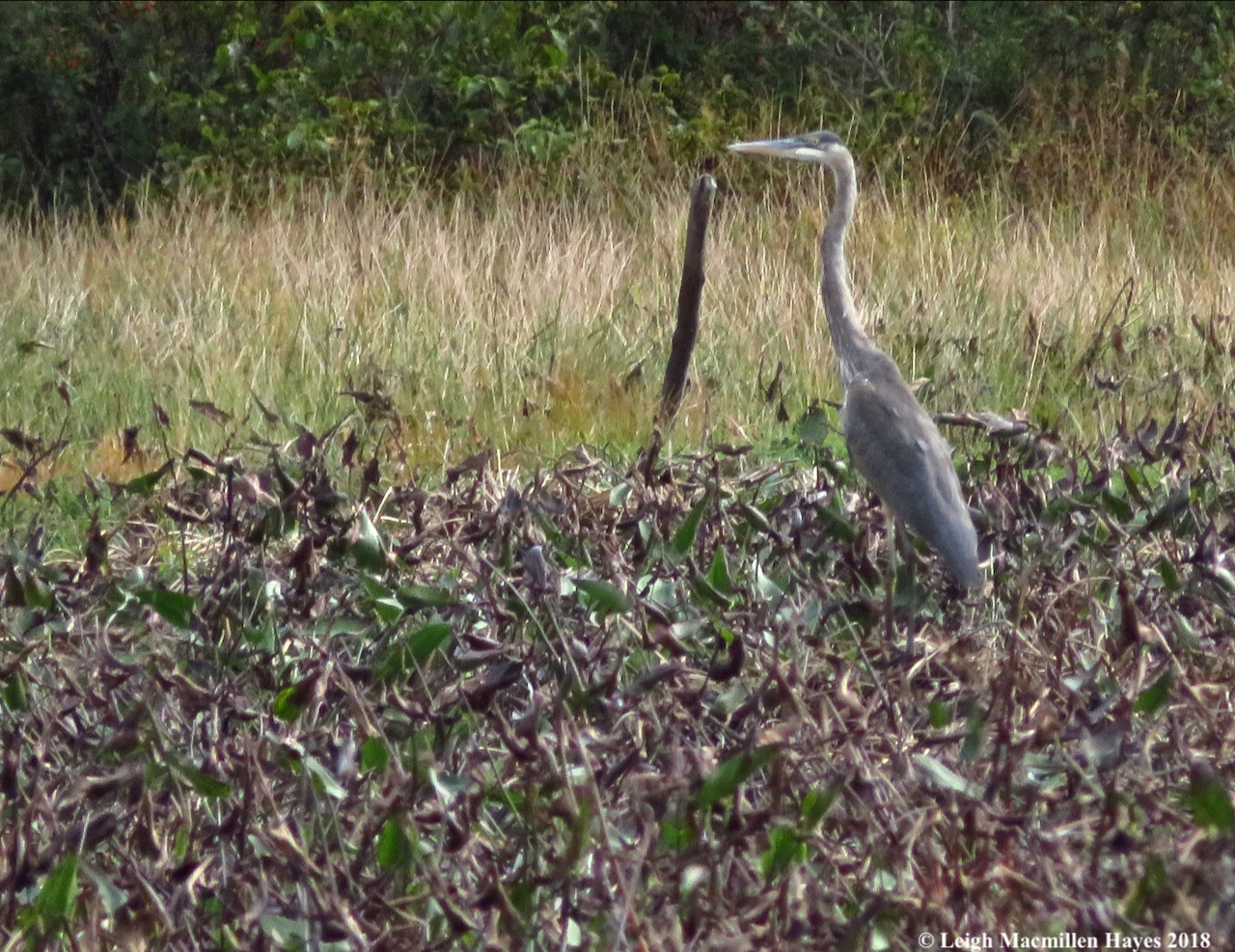
Great Blue Heron youngsters waiting for a meal

Watching something as small as the spiders or as large as young great blue herons is something some of us could easily take for granted, for we are fortunate to spend many hours as observers. Thankfully, we are constantly filled with awe and wonder.

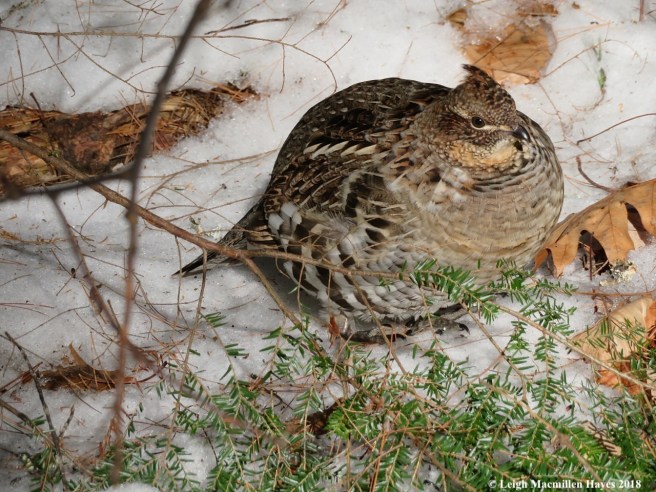
ArGee as last seen a few weeks ago. A ruffed grouse startled me in the same area yesterday. Was it him? Or another? I’m not sure, but I am grateful that it behaved as a ruffed grouse should by flying off.

As I read Bekoff’s book, numerous visions flashed through my mind and I thought of the corridors that our local land trusts have worked diligently to create. And with that came the memory of an article I wrote for Lake Living magazine in 2015 entitled “Land That We Trust”:

My happy moments are spent wandering and wondering in the woods of the lakes region. And photographing and sketching what I see. And writing about the experience. And trying to find out the answers. Honestly though, I don’t want to know all of the answers. For the most part, I just like the wandering and wondering.

Passing through a stonewall, I’m suddenly embraced by the fragrance of white pines that form the canopy over what was once an agricultural field. Beech and hemlock trees grow in the understory. Lowbush blueberries, Canada mayflowers, bracken ferns, Indian pipe, partridgeberry, sessile-leaf bellwort, Indian cucumber root and a variety of mosses and lichens add to the picture.

I follow a former cowpath that opens to the power line. At the edge, taller hemlocks and northern red oaks stand high, with a few beech trees in the mix. But my eye is drawn to the ground cover, varied in color and texture. Sphagnum moss, several species of reindeer lichen, British soldier lichen, wintergreen, bunchberries, junipers and sheep laurel appreciate the bogginess and sunshine of this space.

To the right of another opening in the wall, the neighborhood changes. This time it’s gray and paper birch that grow side by side. Nearby, a vernal pool teems with life.

In each space, I encounter evidence of animals, amphibians, birds and insects. Sometimes I even get to see these neighbors with whom I share the land. Gray squirrels build their dreys up high in the hardwood trees, while red squirrels prefer the white pine forest. Deer bed under the hemlocks. Snowshoe hare browse among the birch grove and its vegetative undergrowth. Yellow-spotted salamanders and wood frogs lay egg masses in the vernal pool. Snakes slither nearby. Frequent visitors to each area include porcupines, raccoons, skunks, turkeys, gray and red foxes, deer, woodpeckers, thrushes, chickadees, nuthatches and warblers. Occasionally, I’m treated to moose and bear evidence and sitings.

People, too, are part of this habitat. They recreate along the snowmobile trail that follows the power line. The stonewalls, dug wells and rusty equipment speak to the area’s history.

It’s land like this that our local land trusts work diligently to preserve.

A wee disclaimer: I’ve been a volunteer docent for about eight years and am now education director for the Greater Lovell Land Trust. My involvement stems from my desire to learn about what makes up the landscape that surrounds me.

Sometimes alone, sometimes with my husband or friends, I hike all of the GLLT properties on a regular basis. Trekking along trails with like-minded people who pause frequently to identify and appreciate what they see in any season puts a smile on my face. Something stops us in our tracks every time we explore and we gain a better understanding of ourselves and this place we inhabit.

This past winter, I started recording my outdoor adventures, wonders and questions in a blog entitled wondermyway.com. Sometimes those hikes on land trust properties became the subject for a post.

Bear print and deer print in a kettle bog in Lovell

February 23, 2015: Bishop’s Cardinal Reserve, I’m fascinated by bear sign and love to find claw marks on beech trees. Oh, they climb other trees, but beech show off the scars with dignity for years to come. While bark on most trees changes as it ages, beech bark is known for retaining the same characteristics throughout its life . . . Seeing all the animal tracks and sign, some decipherable, others not so, makes me thankful for those who have worked hard to preserve this land and create corridors for the animals to move through.

March 31, 2015: John A. Segur Wildlife Refuge, It’s one of those places that I could spend hours upon hours exploring and still only see a smidgeon of what is there. I’m overwhelmed when I walk into a store filled with stuff, but completely at home in a place like this where life and death happen and the “merchandise” changes daily.

April 15, 2015: Otter Rocks, A princess pine club moss shows off its upright spore-producing candelabra or strobili. Funny thing about club mosses–they aren’t mosses. I guess they were considered moss-like when named. Just as the mills take us back in time, so do these–only much further back when their ancestors grew to 100 feet tall during the Devonian Period. They make me feel so small and insignificant. And yet, I’m thankful for the opportunity to be in awe of them.

Middle school students from Molly Ockett’s MESA program picking cranberries in the GLLT fen

May 3, 2015: Chip Stockford Reserve, There’s something about the Chip Stockford Reserve on Ladies Delight Road in Lovell that keeps pulling me back. I think it’s the history associated with this property that fascinates me. And the questions it raises. From the start, there is a cellar hole and barn foundation. Eldridge Gerry Kimball had purchased 200 acres on January 31, 1880 from Abraham E. Gray. Various journals from that time period include entries about driving cattle over to the Ladies Delight pasture, picking cranberries over by The Pond, as they called Kezar Lake, picking apples, driving sheep to pasture, picking pears, mowing oats and trimming pines. Today, it’s the huge pasture pines, stonewalls and a couple of foundations that tell part of the story. I’ve also heard that this area was used as a cattle infirmary. According to local lore, diseased cattle were brought to Ladies Delight to roam and die, thus preventing disease from spreading to healthy cattle. . . Another story about Ladies Delight hill is that this is the place where people would come to picnic in the 1800s. Did the women get dressed up to enjoy a day out, a break from their farming duties? I have visions of them wearing long dresses and bonnets and carrying picnic baskets. But could they really afford a day away from their chores?

May 10, 2015: Bald Pate Mountain, The “bald” mountain top is the reason I am who I have become. Being outside and hiking have always been part of my makeup, but when our oldest was in fifth grade, I chaperoned a field trip up this mountain that changed everything. The focus was the soils. And along the way, Bridie McGreavy, who at the time was the watershed educator for Lakes Environmental Association, sat on the granite surrounded by a group of kids and me, and told us about the age of the lichens and their relationship to the granite and I wanted to know more. I needed to know more.

June 16, 2015: Bishop Cardinal Reserve, Though we never plan it that way, our journey lasted three hours. Suddenly, we emerged from the wet woodland onto Horseshoe Pond Road–all the richer for having spent time in the land of the slugs, bears and caterpillar clubs. Oh my!

We are fortunate to live in an area where five trusts protect land for us and the species with whom we share the Earth: Greater Lovell, Loon Echo, Western Maine Foothills, Mahoosuc and Upper Saco Valley. This strikes me as a valuable reflection of who we are and where we live.

Land trusts work with community members to acquire land for permanent conservation through purchases and donations. They also create legal and binding conservation easements that allow residents to protect land holdings in perpetuity, while retaining private ownership. Scenic views, wildlife corridors, flora and fauna, and topography remain, subject only to the whims of nature itself, which is ever-changing.

Conserving the land doesn’t mean it can’t be touched. The organizations develop management plans and steward the land. Timber harvesting, farming, residency and recreation continue, while specific wildlife habitat, wetlands, unique natural resources and endangered or rare species are protected. And in the process, they strengthen our towns. Ultimately, they give us a better sense of our place in Maine and opportunities to interact with the wild.

The service area of each of the local trusts include watersheds and wildlife corridors. Greater Lovell Land Trust is committed to the protection of the Kezar Lake, Kezar River and Cold River and adjacent watersheds located in Lovell, Stow and Stoneham.

Loon Echo Land Trust serves seven towns: Bridgton, Casco, Denmark, Naples, Harrison, Sebago and Raymond, and their efforts actually reach beyond to the 200,000 residents of Greater Portland for whom Sebago Lake is the public drinking water source.

Western Foothills Land Trust serves the Greater Oxford Hills towns of Buckfield, Harrison, Norway, Otisfield, Oxford, Paris, Sumner, Waterford and West Paris. The watersheds they protect include Lake Pennesseewassee, Thompson Lake, Crooked River and Little Androscoggin River.

The Mahoosuc Land Trust works in central Oxford County, Maine, and eastern Coos County, New Hampshire. It strives to protect the watersheds and natural communities of Albany Township, Andover, Bethel, Gilead, Greenwood, Hanover, Milton Plantation, Newry, Rumford, Shelburne, Upton and Woodstock.

Likewise, the Upper Saco Valley Land Trust crosses the border and includes the communities of western Maine and northern New Hampshire that make up the upper watershed of the Saco River. Its service area flows from the source of the Saco in Crawford Notch toward the Hiram Dam and includes Harts Location, Jackson, Bartlett, Chatham, Conway, Albany, Madison and Eaton, New Hampshire and Fryeburg, Denmark and Brownfield, Maine.

In addition to their service areas, the land trusts collaborate with each other and local lake associations. Most recently, the GLLT, LELT, WMFLT and USVLT, plus the Portland Water District have joined forces to protect the fifty-mile Crooked River. The river is the largest tributary flowing into Sebago Lake and it provides primary spawning and nursing area for one of four known indigenous populations of landlocked Atlantic salmon in Maine.
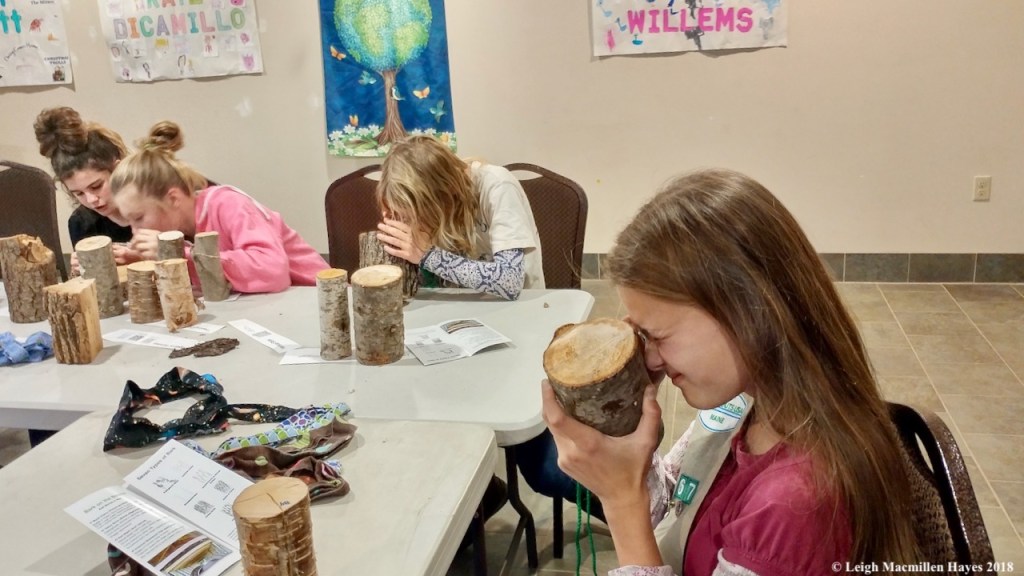
Lovell Girl Scout Cadette Troop 67 up close and personal with tree cookies

Protection is key. So is education, which develops understanding and appreciation. I know for myself, my relationship with the landscape continues to evolve. The mentors I’ve met along the way have played an important part in my involvement and caring for the environment.

All five land trusts offer numerous hikes open to everyone, providing a great way to explore and learn more about the diversity of the natural communities. Staff and volunteers lead walks, stopping frequently to share a bit of knowledge, ask questions and wonder along with the participants. These organizations also offer indoor programs featuring knowledgeable guest speakers.

I’m thankful for the work being done to protect the ecosystem. There’s so much I still don’t understand, but with each nugget of knowledge gained, the layers build. Maybe someday I’ll get it. Maybe I never will. Either way, I’m happy for the chance to journey and wonder on land trust properties.

Even though we can’t all endow the future of our properties, we can get involved to ensure that these organizations continue to protect land for future generations of humans and wildlife so it will remain in its natural state for the benefit of all.
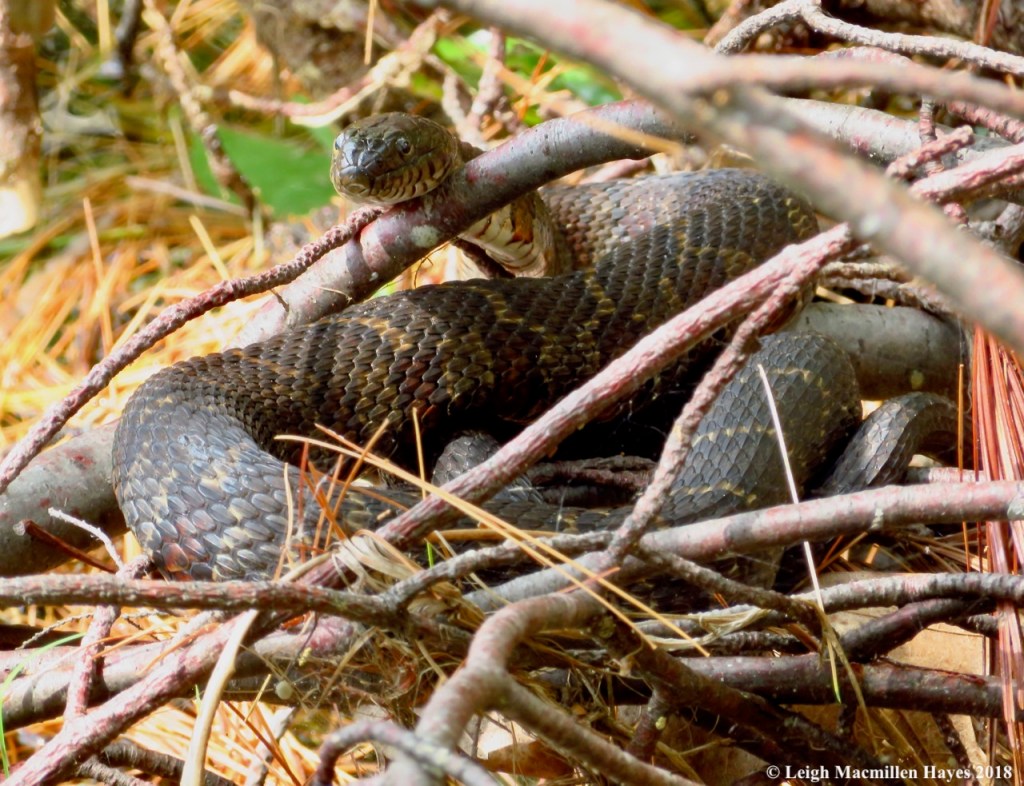
Water snake at the GLLT Otter Rock

So back to Bekoff’s book, he quotes many biologists and others as he makes the point that when we experience alienation from nature we make bad decisions including “wanton killing of wild species, clear cutting, pollution and other human impacts, and caging of nonhuman animals.”

“What we do,” writes Bekoff, “does make a difference and rewilding our hearts is about fostering and honoring our connections to one another and all life.”
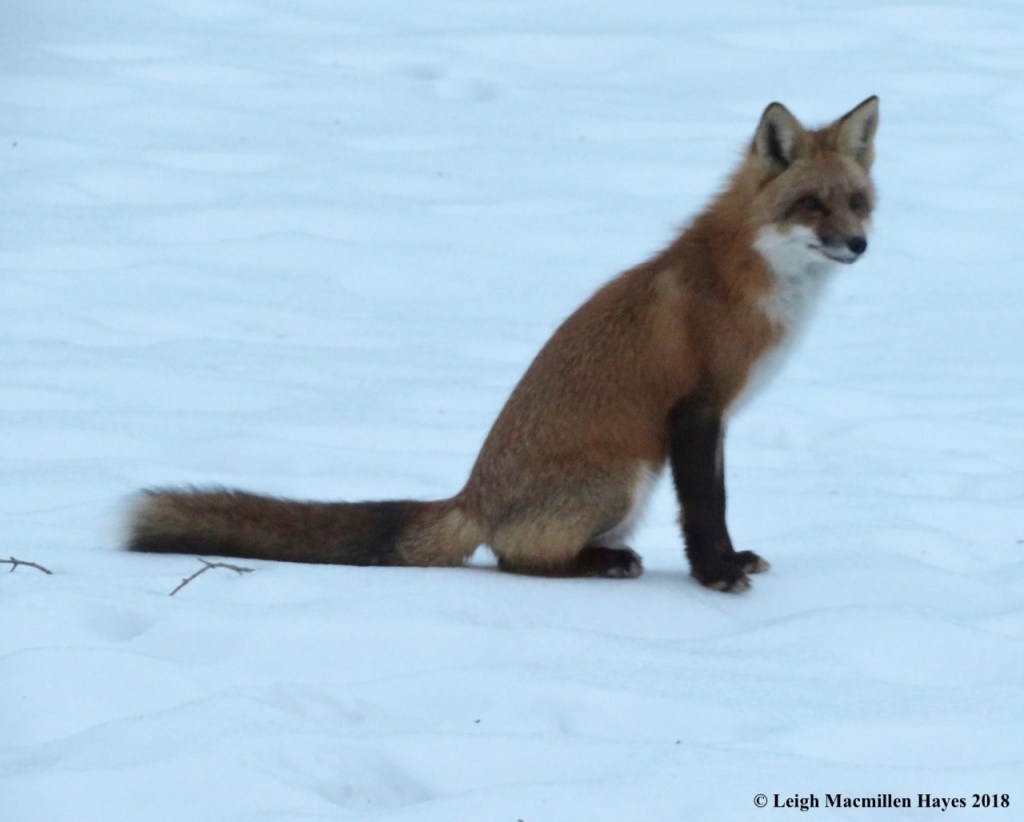
My daily fox–12/30/18

After all, as evidenced in our yard each day and night when the visitors are many, we share this place with and in fact live in the world of our nonhuman neighbors. We need to figure out how to live together–and that premise is at both nonhuman and human levels since we are all interconnected in the web of life.

Inside structure of an oak apple gall

Though Bekoff’s focus is on nonhuman animals, I do wish he’d also addressed other forms of life, such as fungi, insects, plants, and the like.

He does list what he calls the “8 Ps of Rewilding” as a guide for action: Proactive, Positive, Persistent, Patient, Peaceful, Practical, Powerful, and Passionate. “If we keep these eight principles in mind as we engage one another and wrestle with difficult problems, no one should feel threatened or left out,” says Bekoff.

As the book continues, there are definitions provided for catch phrases such as compassionate conservation and stories of unsung heroes who have made it their life’s work to “rewild our hearts and to expand our compassionate footprint.”

GLLT/Lovell Recreation Trailblazers created a woodland map

Bekoff is a realist and so am I. He would love to see us all become vegetarians or vegans, but realizes we will not. He knows that it will take people time to unlearn preconceived notions, especially given that the media thrives on misrepresenting animals. He knows that his rewilding our hearts is a concept with a broad agenda.

One of my take-away thoughts was that all of local environmental organizations are working hard to create corridors and raise awareness and awe about the natural world. Of course, we could all do better. But, we’ve already got a good start on doing what Bekoff suggests: “Figure out how to foster a love of nature and other animals so that every generation sees this connection as precious and vital and worth nurturing.”

But . . . he concludes that “if we all made some simple changes to our lives, the world would soon become a more compassionate place for all beings and landscapes.
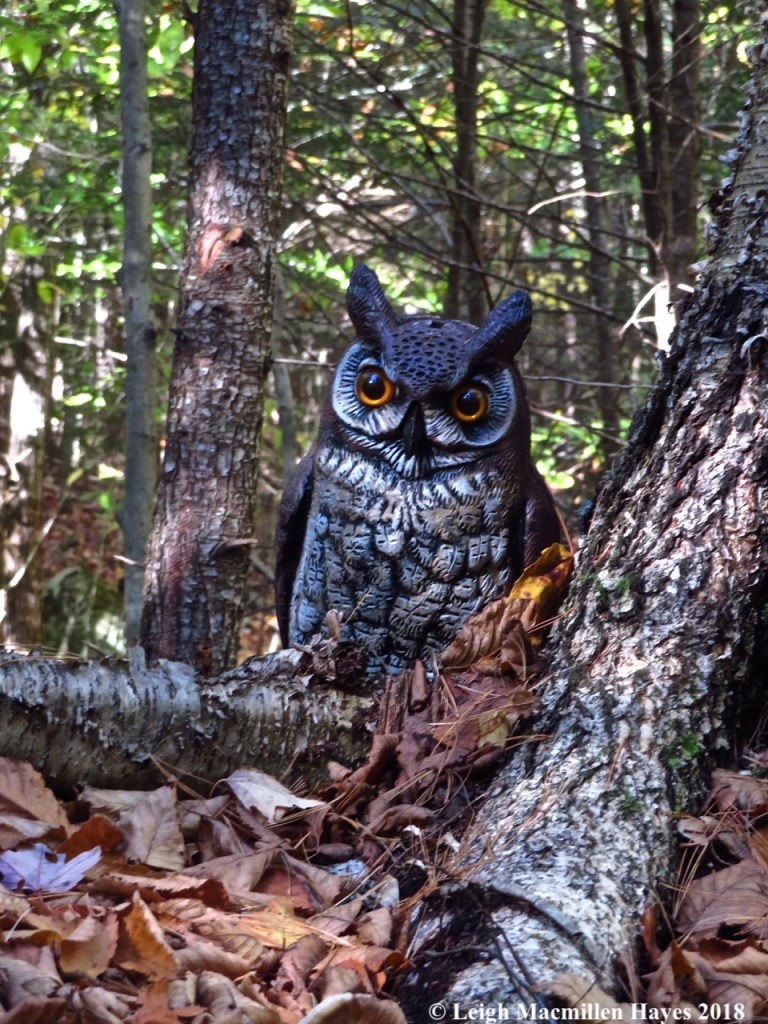
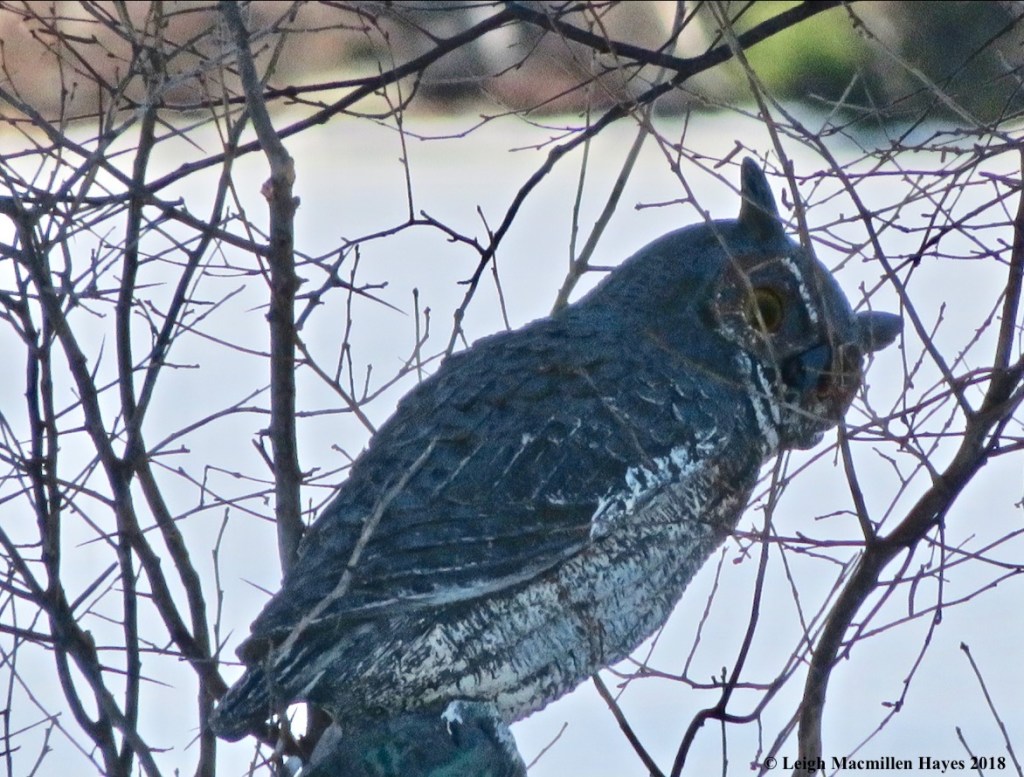
Great Horned Owl Plastica species

And he reminds us to be humble and able to laugh at ourselves. Yeah, so um, I was the one who stopped a small group of friends as we moved along a trail on private property because I was the first to spot a great horned owl this fall. Yeah, um. It was plastic. And a set up. I’m still laughing.

Dear readers, if you’ve read this far, you deserve a reward. I know I got a bit off track by including my own article, but I do believe that we’ve got a start on rewilding our hearts in western Maine. Yes, we have a long way to go. Let’s do this. Together!

And remember, my guy purchased this copy of Rewilding Our Hearts at Bridgton Books.

Rewilding Our Hearts: Building Pathways of Compassion and Coexistence by Marc Bekoff, 2014, New World Library.

Happy Bird-day Bird Count

Established in 1900 by an officer of the Audubon Society, the intention of the Christmas Bird Count (CBC) is to monitor the status and distribution of bird populations.

Our local count, known as the Sweden Circle CBC, typically takes place two days after Christmas, unless, of course it snows. Within several weeks prior to the event, organizer Jean Preis rallies volunteers and assigns sections within the circle to leaders and their assistant birders.

I had the good fortune to lead the southeastern section and so at 8am I headed off to begin searching for birds along the road, at backyard or front yard feeders, and just about anywhere within the assigned section. For the first 45 minutes I was alone as planned, and kept blaming my limited sightings on that fact, as well as the brisk morning temperature.

Other than the temp in the teens, I couldn’t say the weather was at fault for it wasn’t all that windy and there was nary a cloud in the sky.

By 9am, I was joined by the rest of my team, Maine Master Naturalist student Juli, and her oldest children, who are naturalists in their own right, Caleb and Ellie.

Juli took over the challenging task of driving, all the while searching for movement. Caleb, Ellie, and I had a much easier task–we just needed to search high and low and if we spotted something, to let Juli know in as gentle a manner as possible so we wouldn’t cause her to jam on the breaks.

At Plummer’s Landing on Long Lake, we got out of the vehicle, as would be our custom for the rest of the day. Down to the ice we walked, our eyes scanning the surrounding scene as we listened. The only sounds we heard–the wailing of the ice. If you’ve never heard that, it’s almost as good as birding! As for birds near the lake . . . not a one.

But there was a beautiful red maple tree by the landing that made for a perfect teaching moment–the clock face that helps birders locate a bird someone spies. I pointed to 12:00 at the top, then 3:00 to the right side, 6:00 at the bottom, and 9:00 to the left. Instantly, the kids caught on and for the rest of the day they were able to direct us–that is, when we did spy a bird.

Ever so slowly, we made our way along main roads and back roads and noticed few birds. In a way, I wasn’t surprised for my feeders have had only a few regular visitors this year. And when I’m in the woods, or even on the edge of a field, I’ve seldom seen or heard a bird since November when the snow fell. Before that, juncos were extremely common sights no matter where or how I traveled. Where have they gone?

Despite the lower than usual numbers, I was sure we would see something by the old Central Maine Power dam not far from the Stevens Brook Outlet. But . . . all we heard was the roar of the water.

And all we saw . . .

was water racing toward the lake and . . .

the dancing legs of icicle formations. That was OK because we enjoyed admiring them. Still, we wanted birds to count. To that point, our tally included a few chickadees and a couple of tufted titmice.

Onward we moved, toward the outlet of Stevens Brook into Long Lake where we were certain the open water would provide us with something worth reporting.

All was quite quiet, however, and we didn’t see any waterfowl to note. But then . . . the biggest find of our day let itself be known.

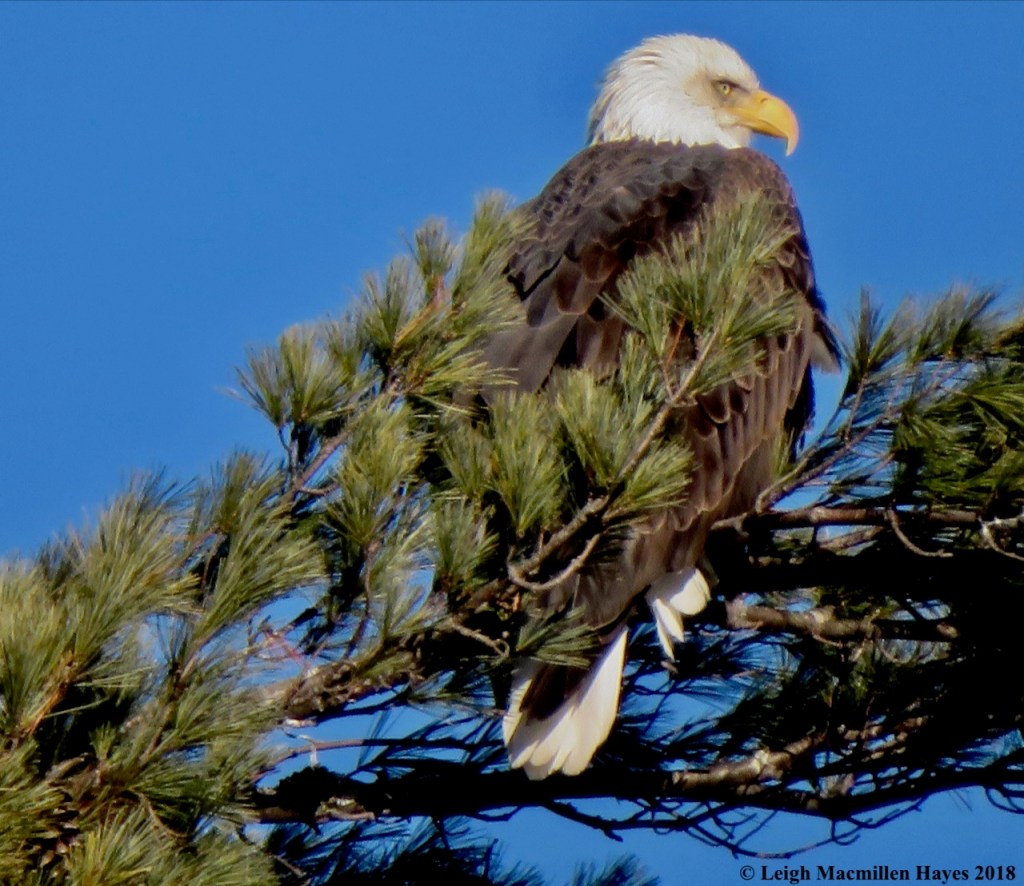
High up in a white pine above the opposite bank of the outlet, a bald eagle sat in wait. We practically danced in the icy parking lot–and knew that no matter what else we might see, we were golden with this discovery.

Eventually, we pulled ourselves away from the eagle, and continued on while looking left and right, up and down. At last, a front yard feeder yielded some more chickadees, a white breasted nuthatch and a hairy woodpecker. Things were picking up. Sorta.

And then as Juli drove down one back road, we spotted five crows in an unplowed driveway. They flew off when we paused, so we continued on down the road. Returning a few minutes later, we again spied the five crows in the same spot. And Caleb, who as a youth hunter has learned the ways of the woods from his dad, knew that where the crows were gathered there must be a carcass. He asked his mom to stop the vehicle while he crossed the road to check the area. Bingo! He encouraged us to join him. Just off the clearing he’d discovered a deer carcass. We weren’t certain how it had come to perish, or why its head was missing, though we had some thoughts on both, but we did notice that many had come to dine. If we’d been more into our tracking mode than our birding mode, we might have been able to write the first two chapters about the manner of death and loss of the head, but we had a different mission on this day.

Another body of water called our names. Last year, I’d seen robins and various other birds in a wetland associated with Woods Pond, so we jumped out at the town beach and stood still to listen and watch. Nada. The ice on the pond, however, was enticing. And though they didn’t have skates, Ellie and Caleb found the conditions to be much to their liking.

Even the clipboard with the field tally didn’t pose a problem as they slid to and fro across the frozen wonder.

Eventually we moved on and added a couple more chickadees to the list. And then we saw one who was not on the list and though he is native to this land, he’s not typically seen here in winter. So we filled out the Rare Bird Form for the Great Horned Owl Plastica species.

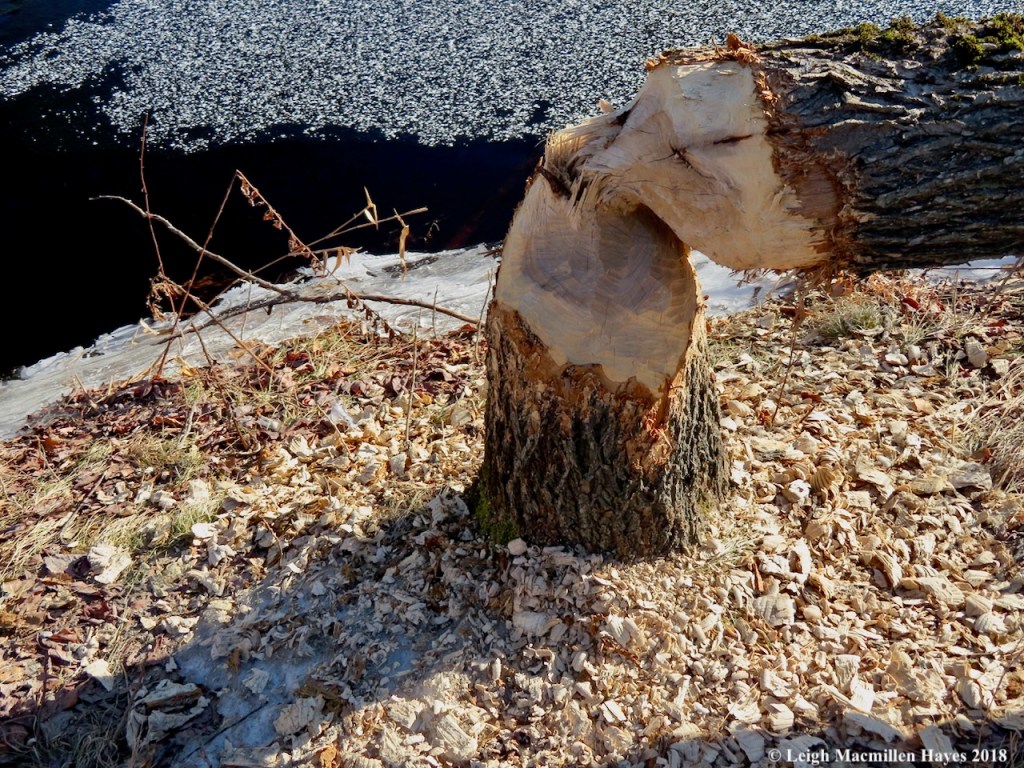
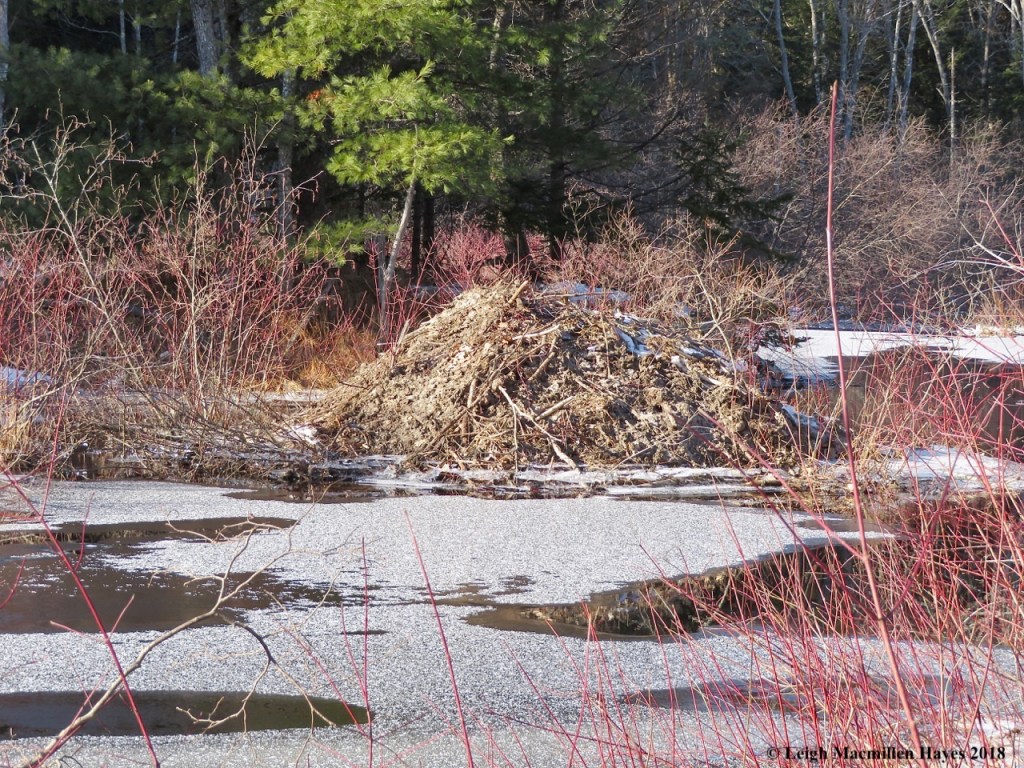
One of our final stops as a group was on what we fondly refer to as the Dump Road. At a swampy area, we thought for sure we’d have some luck. And we did. In the form of beaver works.

Peering across the road in search of birds near the open water, we noticed more beaver works.

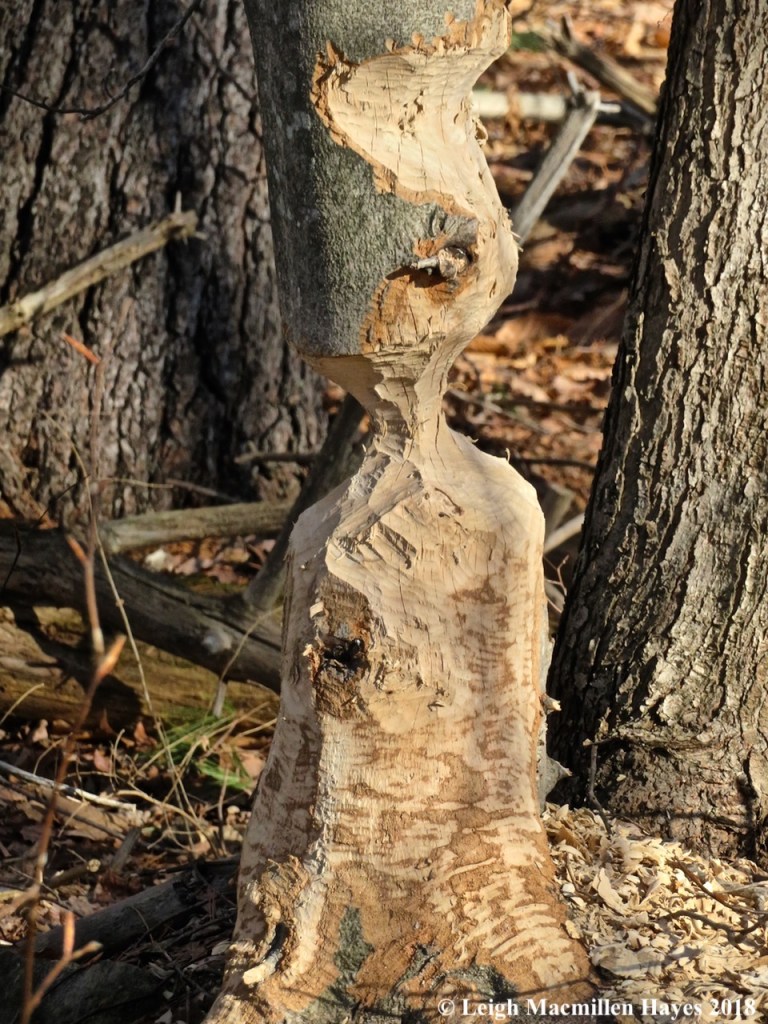
And our luck turned to awe as we admired a beech tree that still stood despite its hourglass shape. Why hadn’t it fallen?

The lodge looked well maintained and we rejoiced to think that it was located close to town and yet we’d never spied it before. Because of the CBC, we’d been given the opportunity to get to know our town just a wee bit more intimately.

After the beaver lodge sighting, Juli and her kids headed home, and so did I . . . for a quick lunch break. And then I journeyed down several more roads, adding a few more dashes to the tally. I found more chickadees, a few more white-breasted nuthatches, and some mourning doves.

Toward the end of the day, I decided to return to the dam, but still . . . stillness in the bird world despite all the sound and movement.

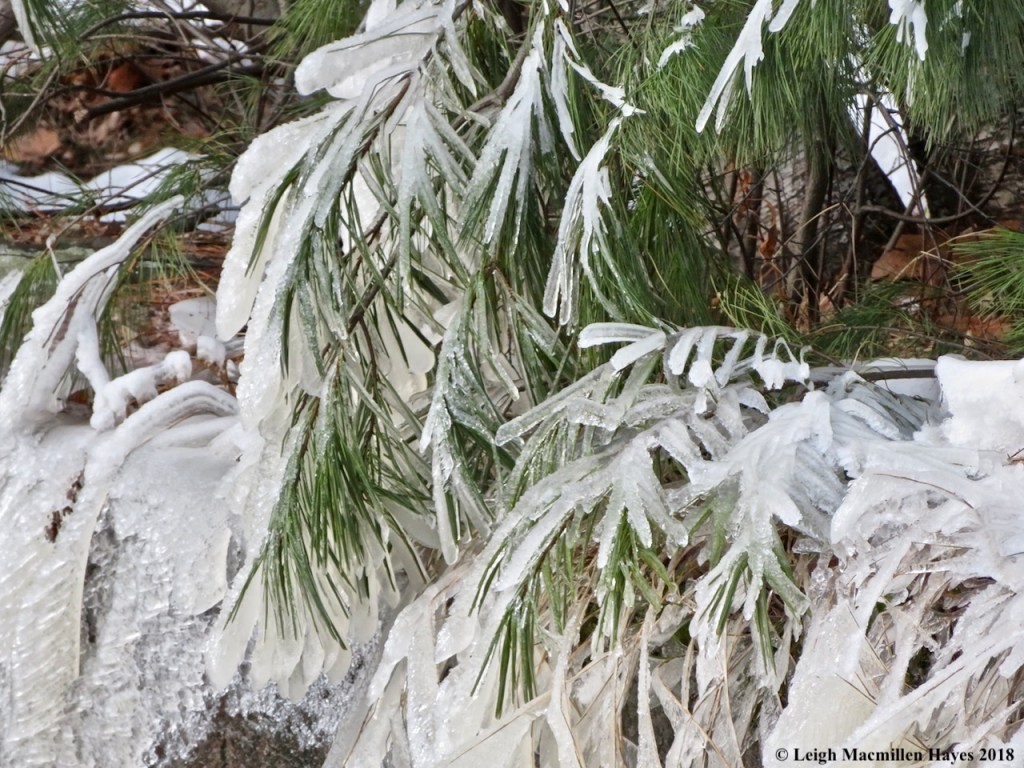
And ice-encrusted needles that looked so featherlike.

By 4pm the CBC had drawn to a close and our offerings seemed so skimpy. I was almost embarrassed to turn in the form, only to discover that most of the other birders in the Sweden Circle had had a similar experience. The Denmark and Fryeburg sections had the most sightings to report, but all in all, the numbers were down significantly. A few of us gathered around Jean’s table to compute the final numbers and wonder why they were so low. Too cold in November? When the snow and cold snap occurred early, did the birds fly elsewhere? Was there not enough food this season? One among us has spent the last few weeks joining the CBC in various locations around Maine, and he said that our experience was not unique.

Despite that, Juli, Caleb, Ellie, and I finished up the day smiling because we had seen an eagle. And today was Juli’s birthday–so it was certainly a wonder-filled present for her on this year’s Christmas Bird Count. Happy Bird-day, Juli!

Returning to Wonder

For three hours this morning I wandered across the crusty snow in the forest behind our home, all the while wondering what I might see. Occasionally, I sat on a stone wall or tree stump and let the sun’s warmth embrace me on this brisk day as I listened.

There were a few sights that gladdened my heart, including the woody capsules of pinesap, Monotropa hypopitys. Monotropa means once turned, while hypopitys refers to its habitat under pine or fir trees. This one had grown under white pines by a stone wall. And from the looks of it, the capsule had not yet split open from the tip to the base, thus the seeds hadn’t been released.

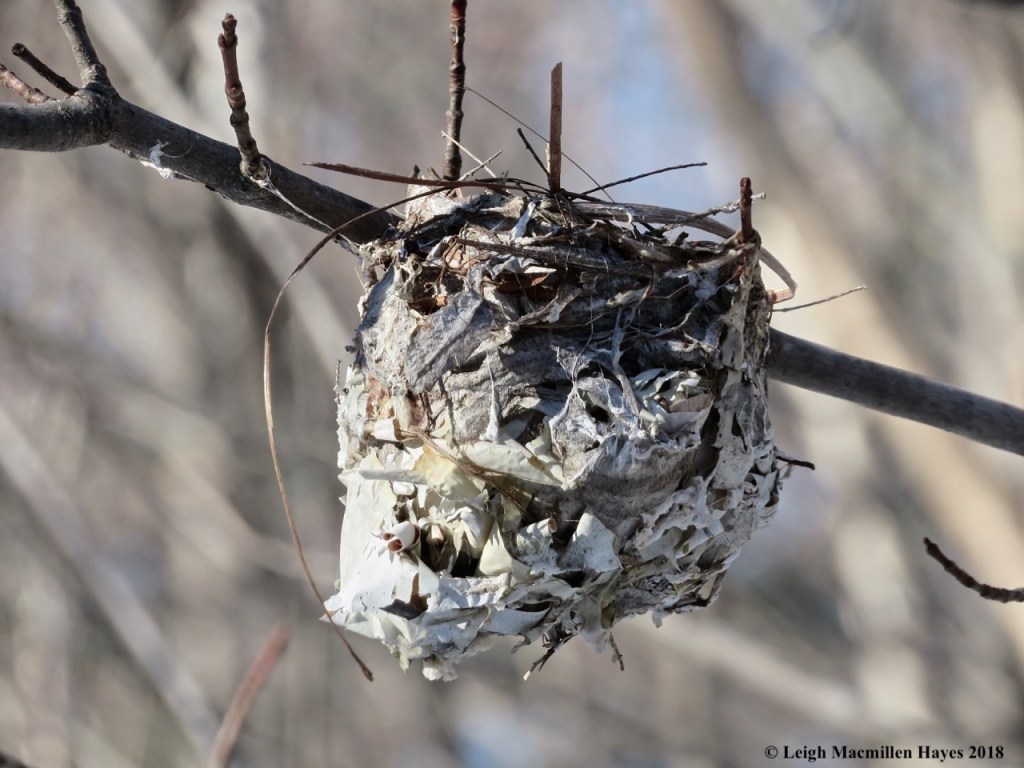
As I sat there, I looked across into an area of forest succession. About 15-20 years ago, one section had been almost clear cut and pine, beech, oak, and birch saplings now vie for air space. They aren’t the only ones, for wasps had apparently flown their own route among the branches as evidenced by the nest that was now in disarray.

I’m not sure if the wasp nest was from this past summer or a previous year, for some of the pulp had been threaded into a nearby bird nest. But then again, I’ve found other wasp nests in these woods in previous years.

Within minutes, I changed my focus from tree branches to the icy snow carpet. Where the forest was young, snowshoe hare scat was abundant. Oh, how I wanted to see one. But, my movements were too loud and quick.

Where the forest was a bit more mature, but still included coppiced trees (coppiced means a trees ability to make new stems from the roots or stump after its been cut down), moose tracks and scat were equally abundant. My favorite sight was of a moose print filled with scat–including the two dew claws a the back of the foot. Since this is a sideways photograph, the dew claws would be those two little scat-filled circles, one atop the other, just right of the center.

Oh, how I wanted to see a moose. But, I had to settle for the prints, scat, and possibly another sign. Many coppiced red maples’ terminal buds had been heartily consumed and so I studied the branches. An voilà, hair stuck behind one lateral bud. You many not be able to see it, but the fibers were tubular, as the winter coat of our northern mammals usually is–thus allowing the critter to trap air inside and remain warm(er). Moose and deer don super-insulated jackets of long, hollow hairs. They also sport a dense, soft undercoat that allows them to stay cozy and warm. I’m not certain, but some of the hair specimen may have included the wispier undercoat.

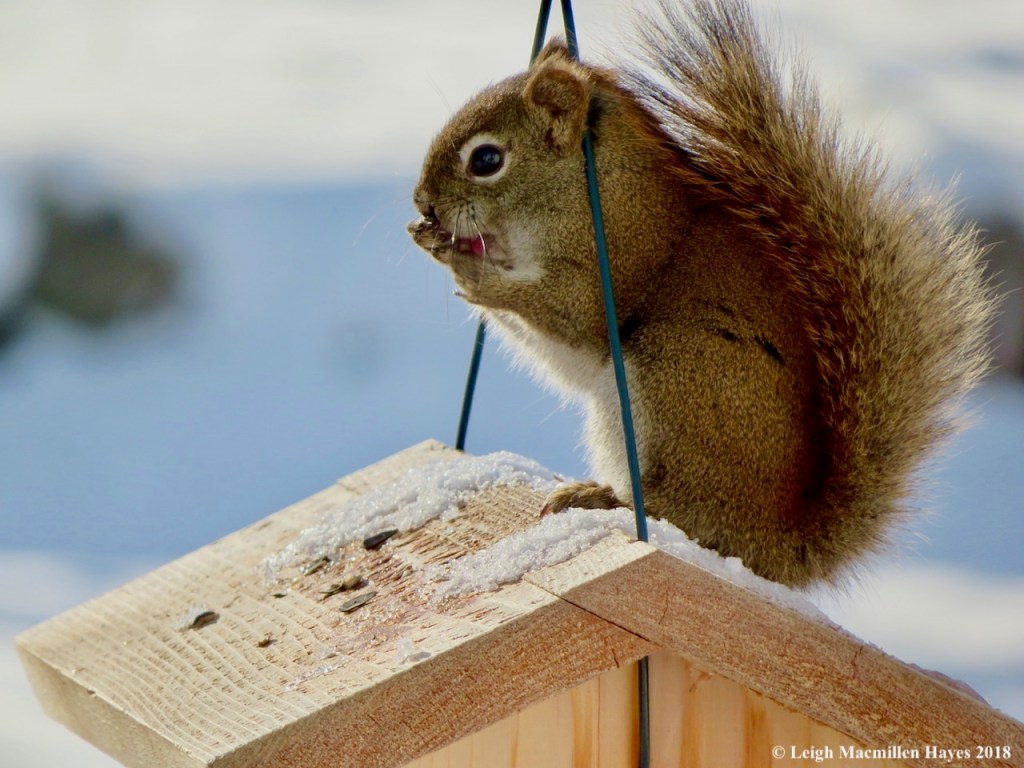
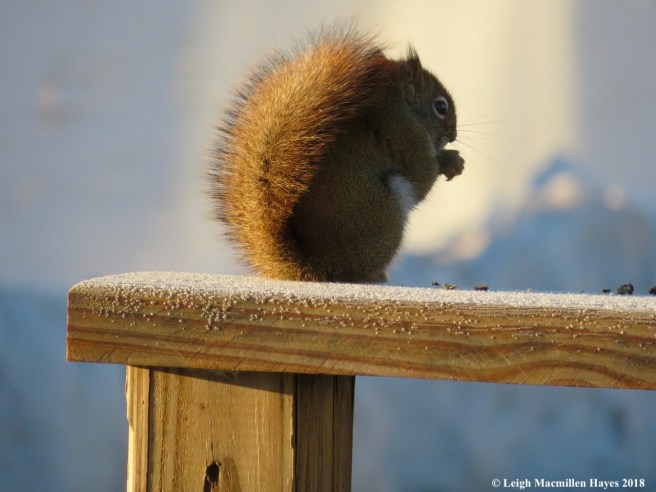
I was grateful for my findings, but all along I kept thinking about the fact that I really wasn’t seeing anything exceptional and perhaps my sense of wonder had disappeared. And so I decided to head home and along the way I recalled a few fun sights I’d made from behind the glass in our back door. Can you see the red squirrel’s tongue?

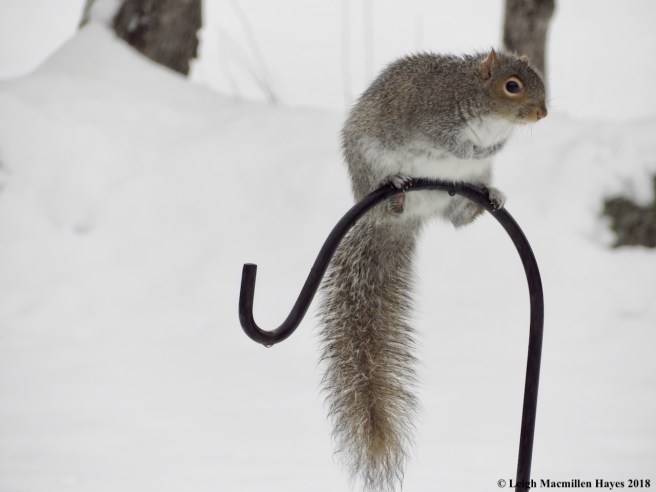
And do you spy the gray squirrel that tried to hide during a recent icy rain storm?

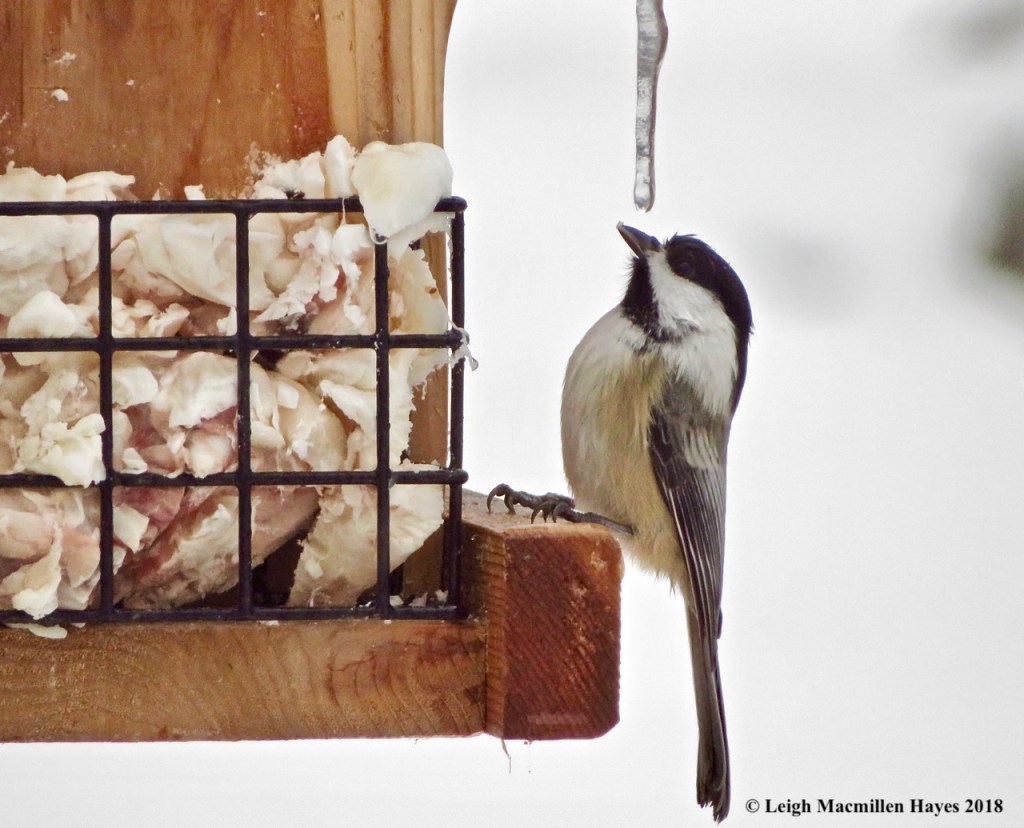
That same day a chickadee watched intently as an icicle dripped from the feeder’s overhang.

Then there were the red foxes. One or two pass through our yard almost every day. Sometimes we see them more than once in a day. During our most recent snowstorm (when all of one inch or so coated the snow we already had) the duo graced us with a lunch time visit (our lunch time, that is).

The bird feeding station is always one of their stops for it’s a gathering place day and night of birds and other mammals.

And then, on Christmas Eve morning, one of the foxes got down on all fours in anticipation, ready to pounce . . . on a gray squirrel that ran up a tree. Red foxes don’t climb trees, but had it been a gray fox, it could have outsmarted the squirrel for they do climb.

I was almost home, and indeed back in our woodlot, when I remembered first hearing and then watching a male pileated woodpecker the other day. How do I know it’s a male? Because it has a red “mustache” on its cheek, and the red crest on its head extends to its bill.

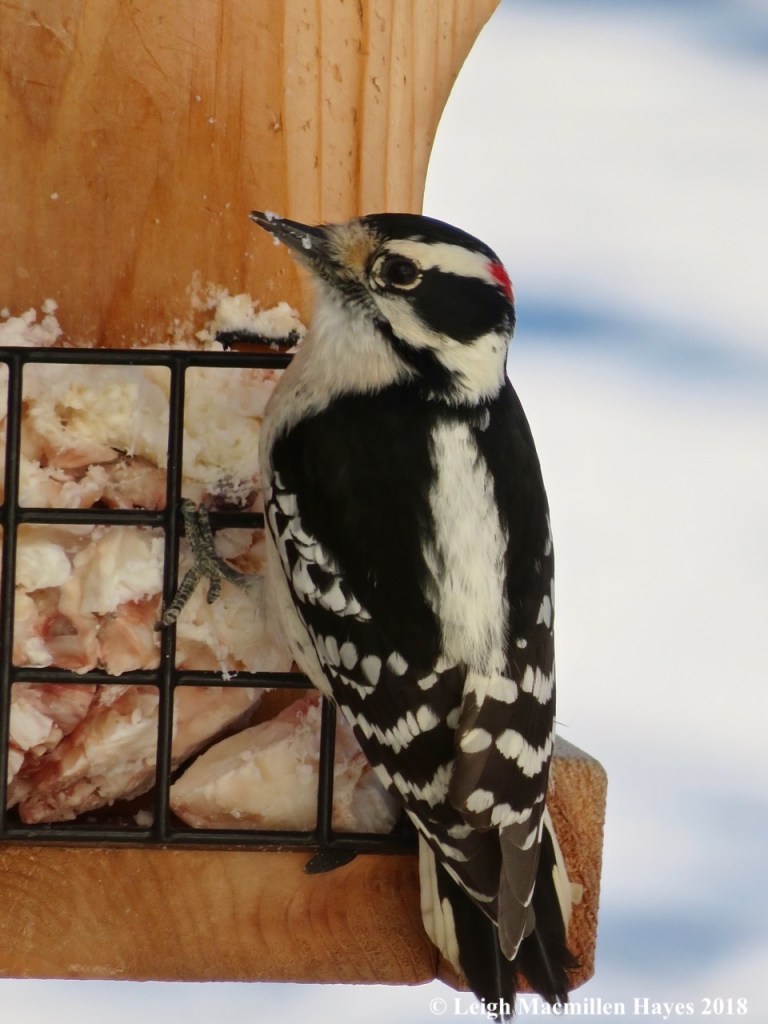
At last I was back behind the window in the back door and periodically I checked on the activity. A downy woodpecker didn’t let me down. Check out the red heart on the back of its head–thus it was a male.

The downy’s bill is about a third the size of its head and rather narrow when compared to other woodpeckers that frequent western Maine. What I find fascinating are the light brown rictal bristles as the base of its bill, which are thought to offer some sort of sensory mission.

And then as if on command, in flew a hairy woodpecker, so named apparently for the long, filamentous white feathers in the middle of its back. I find that a curious distinction because the downy seemed to have a similar feature. But the differences I do recognize are the red color–in the male you’ll see two bars on the back of the hairy’s head, not joined together as on the downy; and the bill again–for the hairy, the bill is thicker and almost as long as the bird’s head. And easy mnemonic: huge hairy for the huge bill.

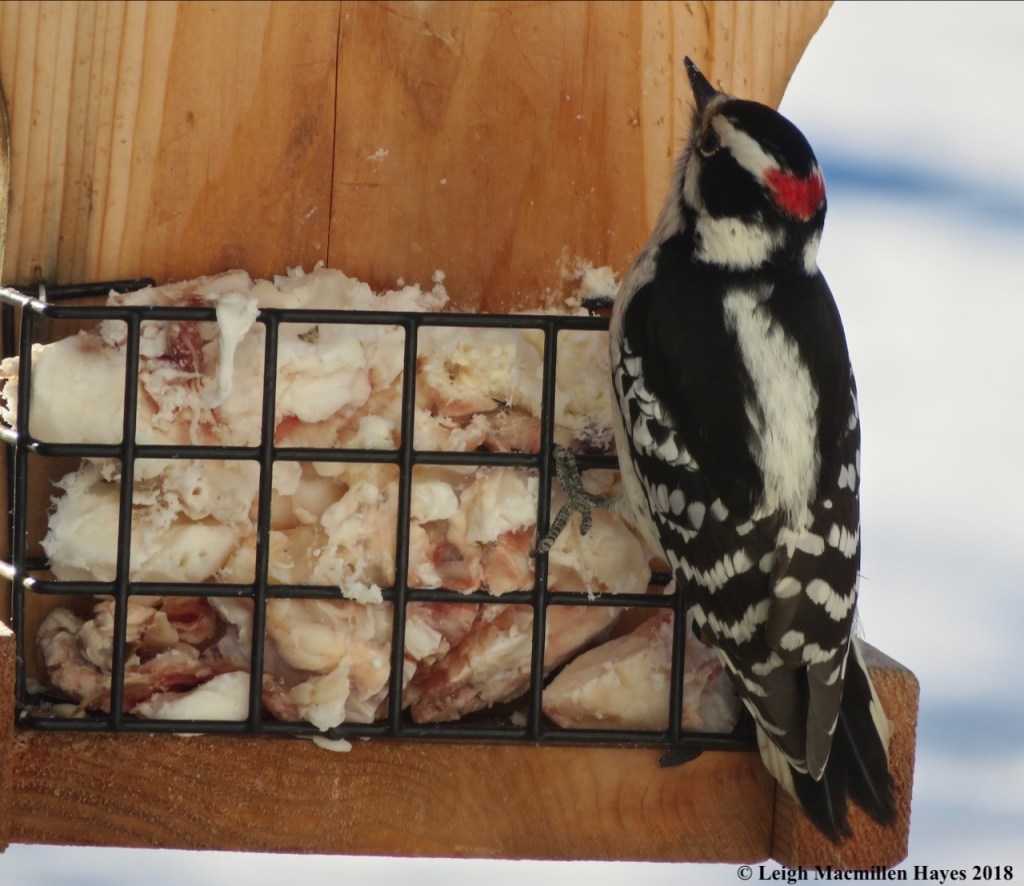
It was a while before the hairy left the long-damaged quaking aspen in the yard. Have you ever watched one? It can stay in one position for a long time, all the while looking about. Was it listening for insects? Looking for something? I don’t know, but eventually it flew to the feeder and began to eat the suet. And if you look closely, you’ll see the rictal bristles that looked like a bushy mustache atop its upper mandible.

Squirrels too, attracted my awe. Earlier in the day I heard one chastising me and thought, “Oh, it’s just a red squirrel.” Then I reminded myself that I like squirrels. I’m fascinated by them. And am having fun watching them move across the landscape, which is bringing a new understanding to my mind and will possibly be the topic for another post.

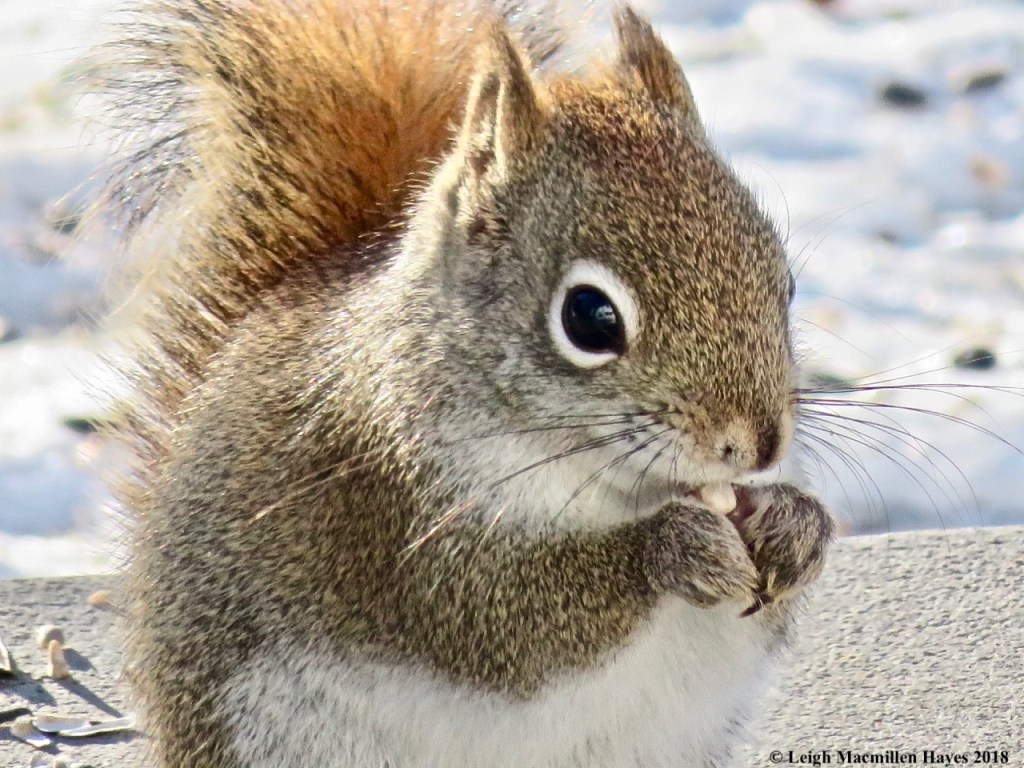
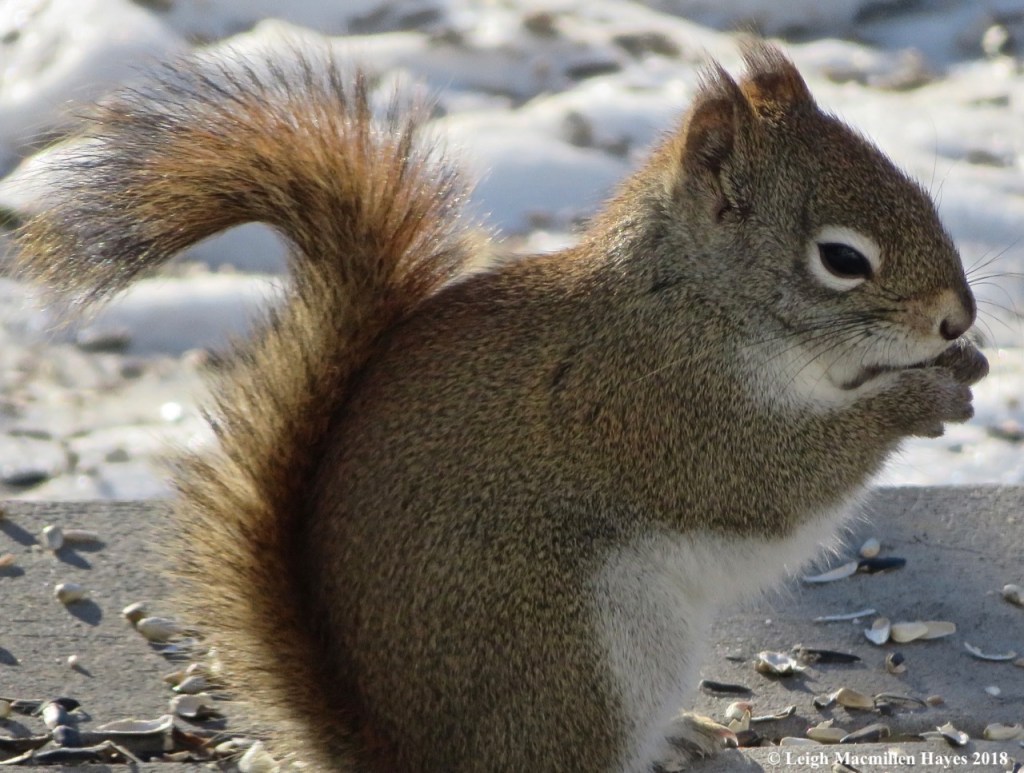
You wanna know one cool fact about red squirrels? Of course you do. Do you see the tufts of hair on the tips of its ears? During early fall, the tufts grow like a crown on their heads. It seems apropos since despite their size, they think they are the kings of the forest.

One of the resident gray squirrels (possibly the one that survived the fox treeing episode) joined the feeding frenzy out the door. It showed an outline of white fur behind its ears, but no tufts at the top–more visible if you look at her left ear.

And then there was the titmouse–a tufted titmouse to be exact. Yes, it too has a tuft . . . all year round. And the largest eyes. But why the tuft? And isn’t a cardinal also tufted? Why isn’t it called a tufted cardinal?

At the end of the day, I know there’s more for me to see and notice and question and I realize that I’ve returned to wonder. Thankfully.

Bird Brain

Wrote Aldo Leopold, “Everyone knows…that the autumn landscape in the north woods is the land, plus a red maple, plus a Ruffed Grouse. In terms of conventional physics, the grouse represents only a millionth of either the mass or the energy of an acre yet subtract the grouse and the whole thing is dead.”

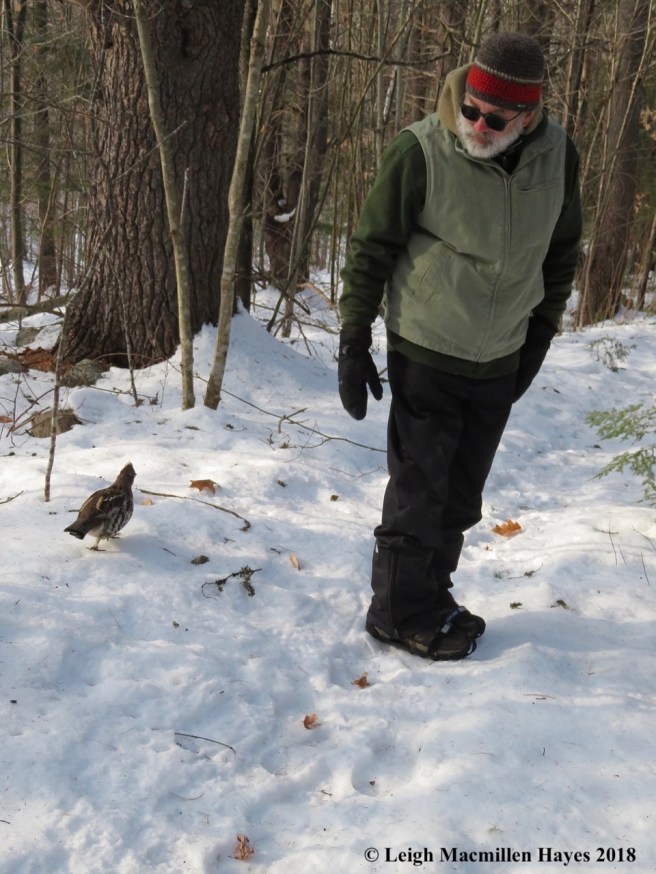
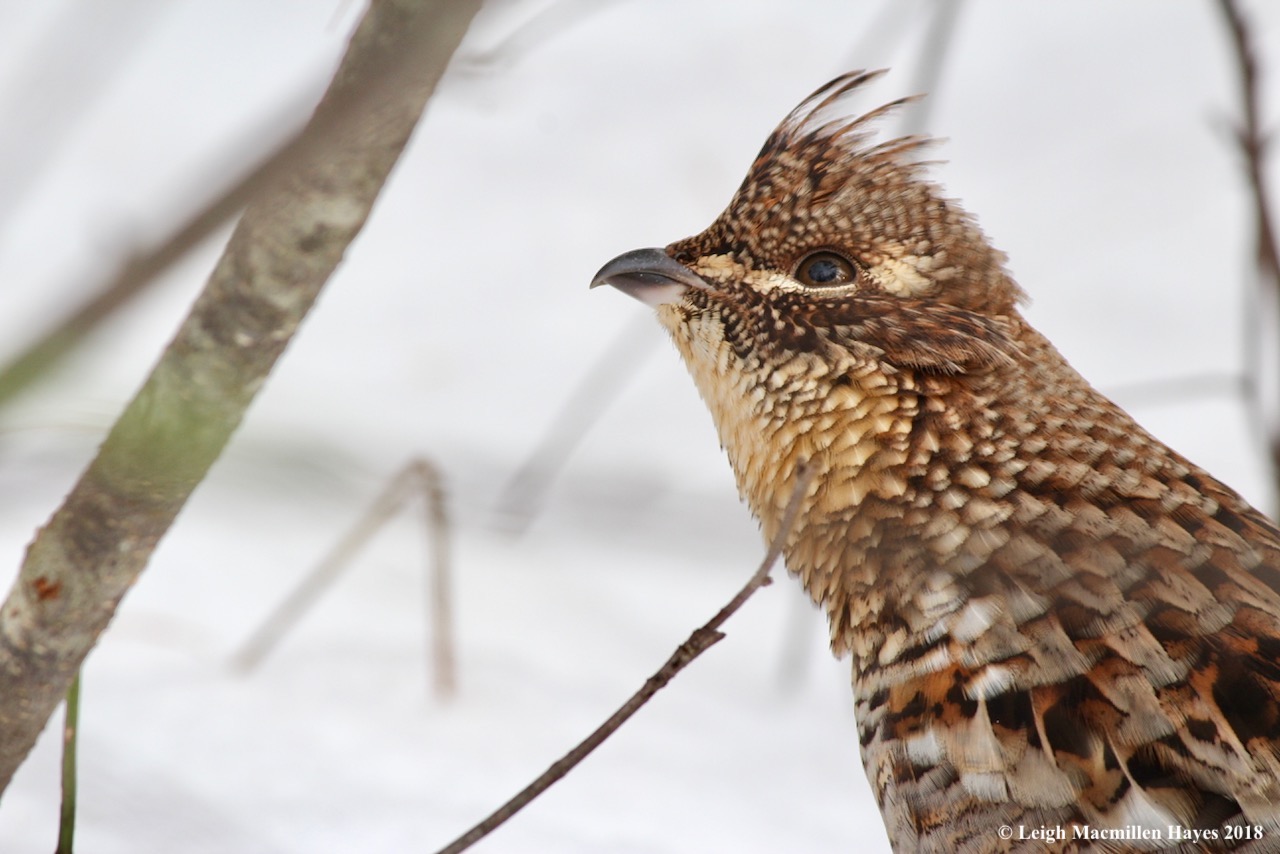
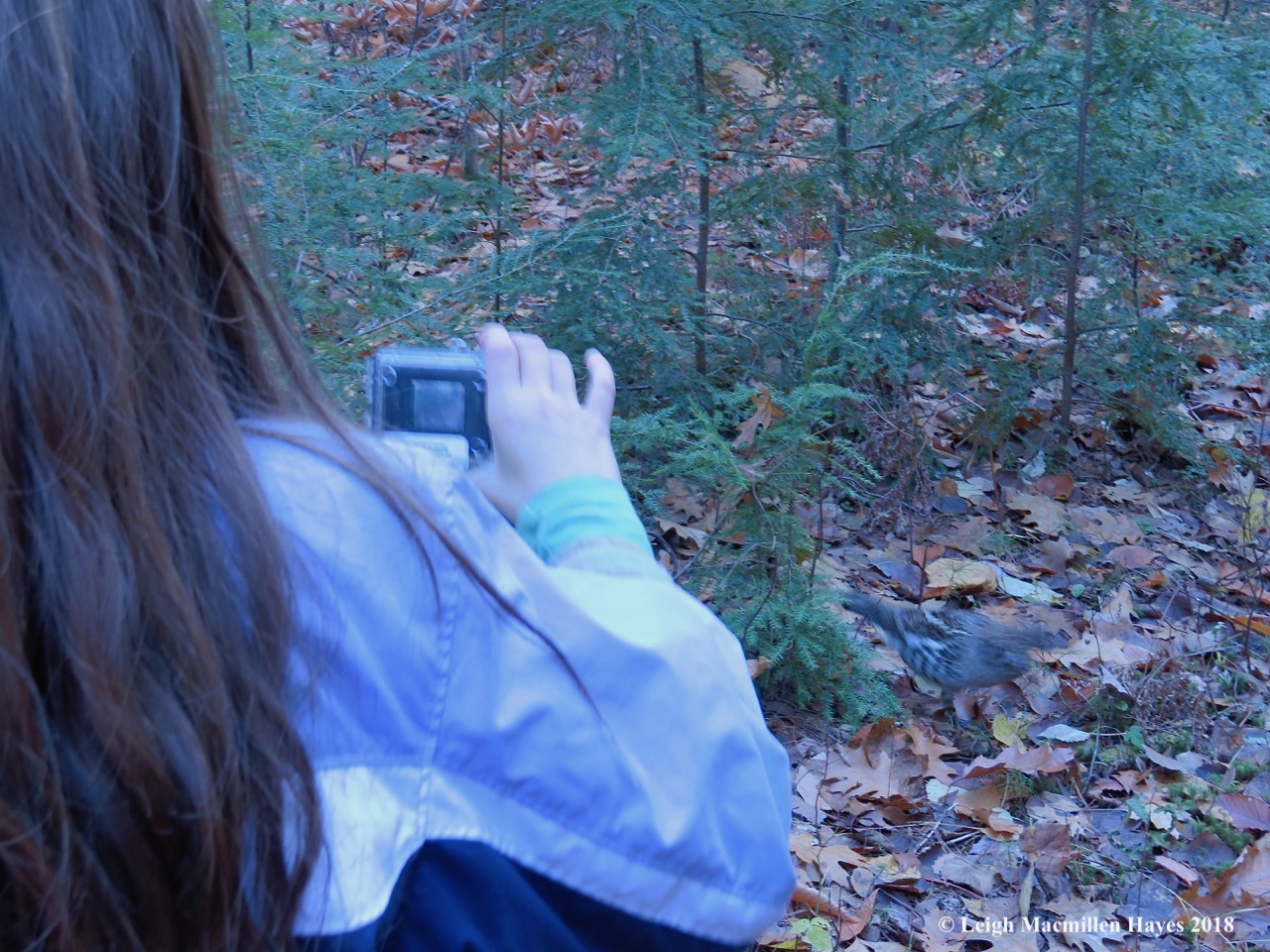
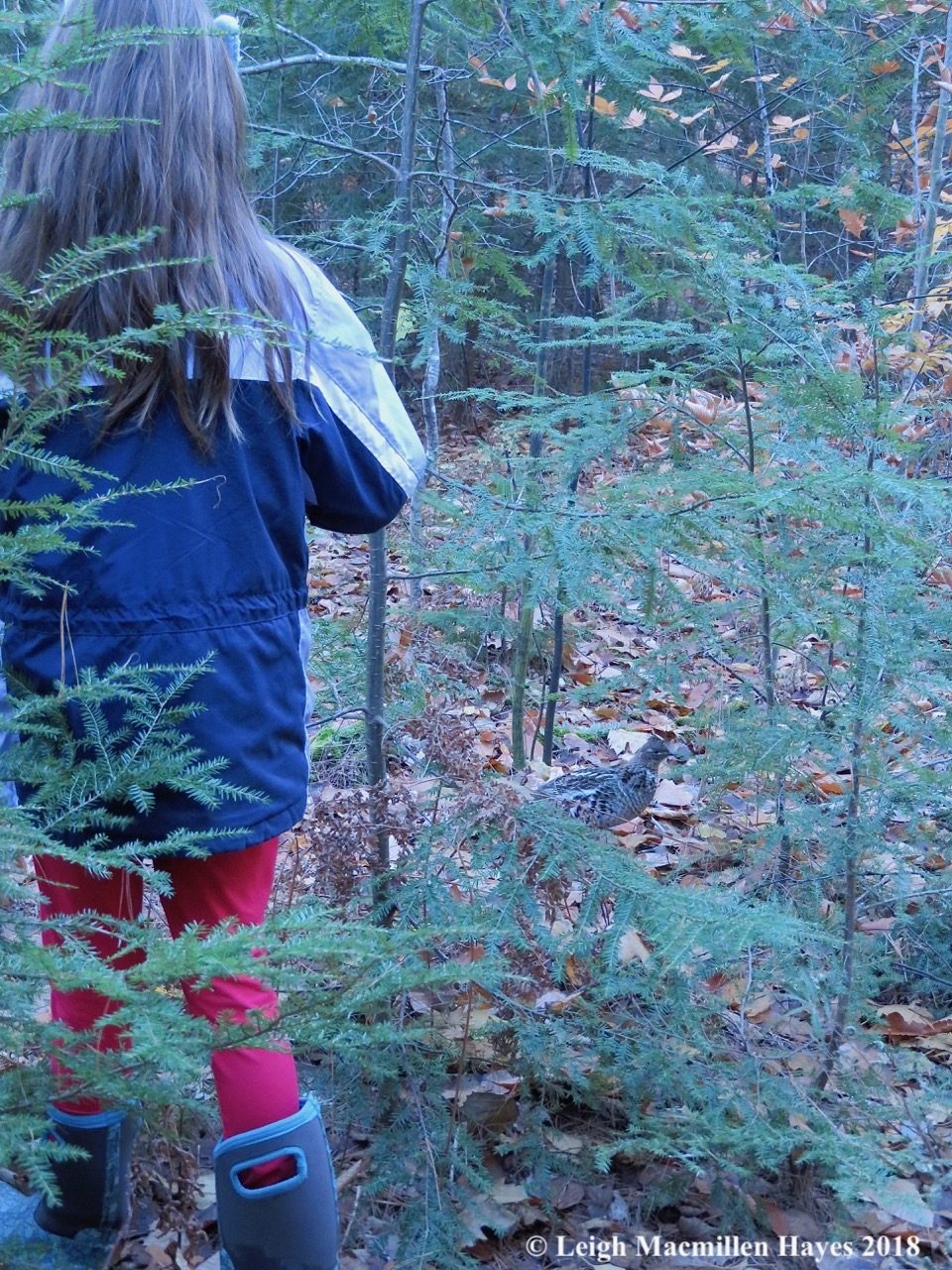
And so it was that I tramped with a couple of friends today who had the delightful pleasure of meeting ArGee (R. G. for Ruffed Grouse). We’d been chatting and searching for a few red blooms on a tall staghorn sumac when suddenly we spied him crossing over a stone wall and approaching us. 

He circled and circled for a while as we stood still yet continued to talk–sharing admiration and awe at the opportunity to be in his presence. 

We watched him forage for seeds and wondered about his behavior. Typically, Ruffed Grouse are loners, except for mating season. But this one seems to greet visitors to its territory with somewhat regular frequency. 

When we moved, he did likewise–usually a few feet to either side of us. 

And when we stopped, he did the same, seeming as curious as us. 

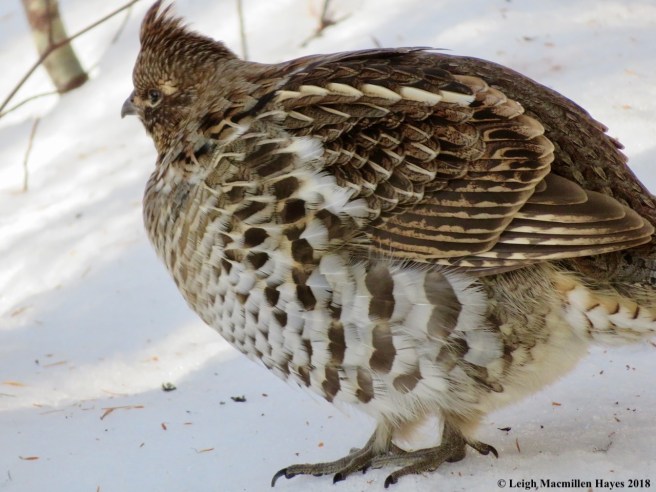
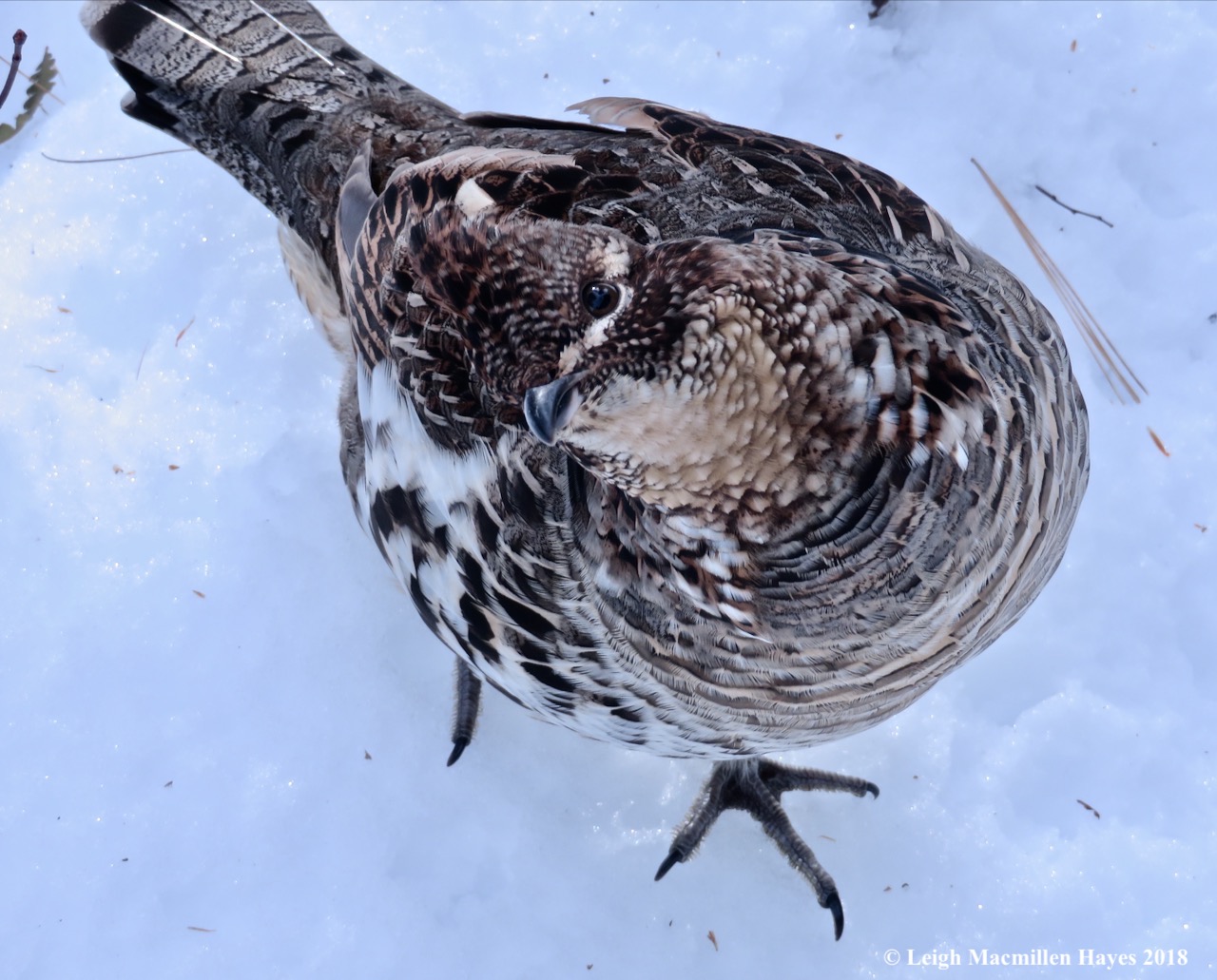
It was a brisk morning, so periodically he did what birds do to warm up–turned into a football of sorts as he fluffed up his feathers to trap warmer air. A bird’s body heat warms the air between its feathers and the more trapped air, the warmer the bird. After all, he didn’t have the luxury of hand warmers. But then again, we didn’t have the luxury of trapping air within our feathers. 

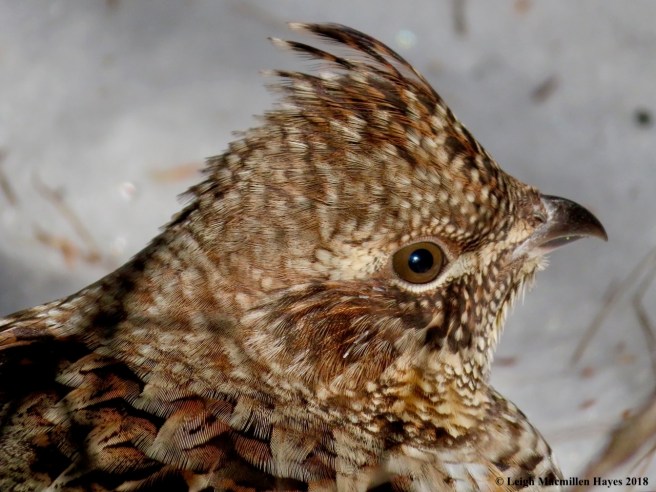
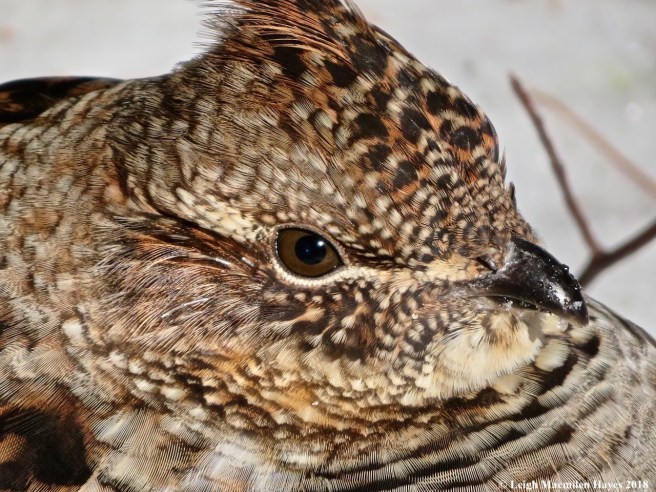
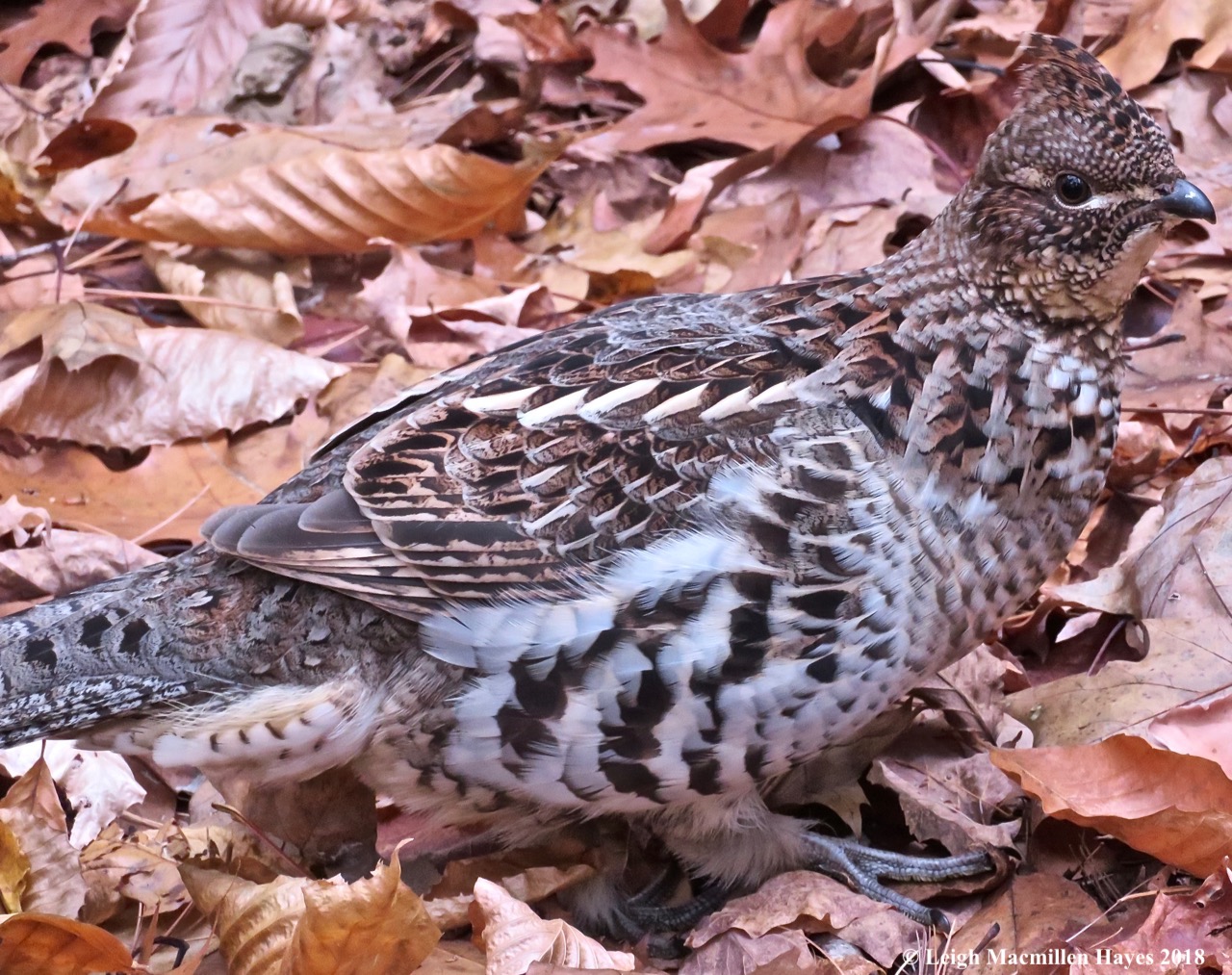
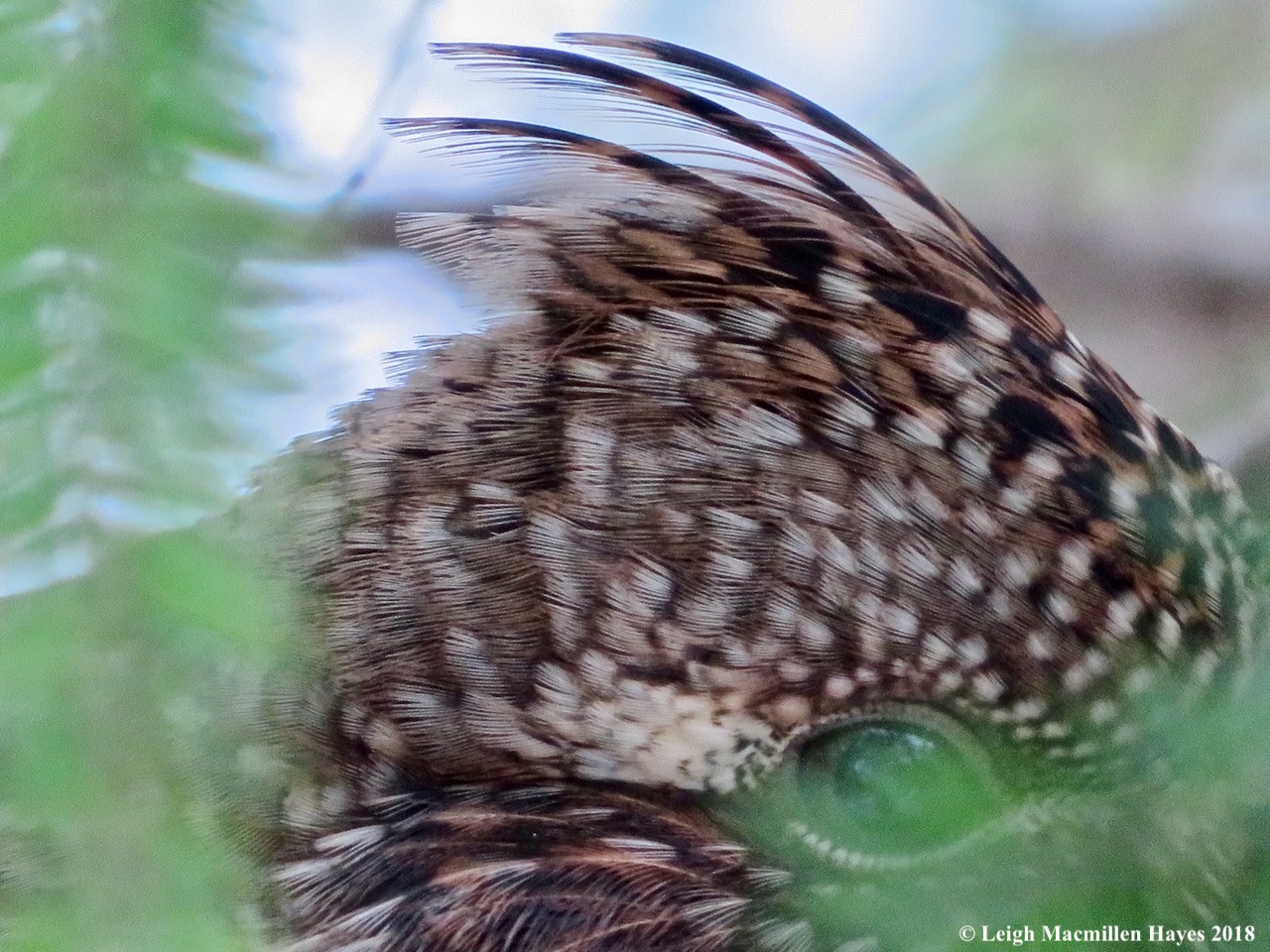
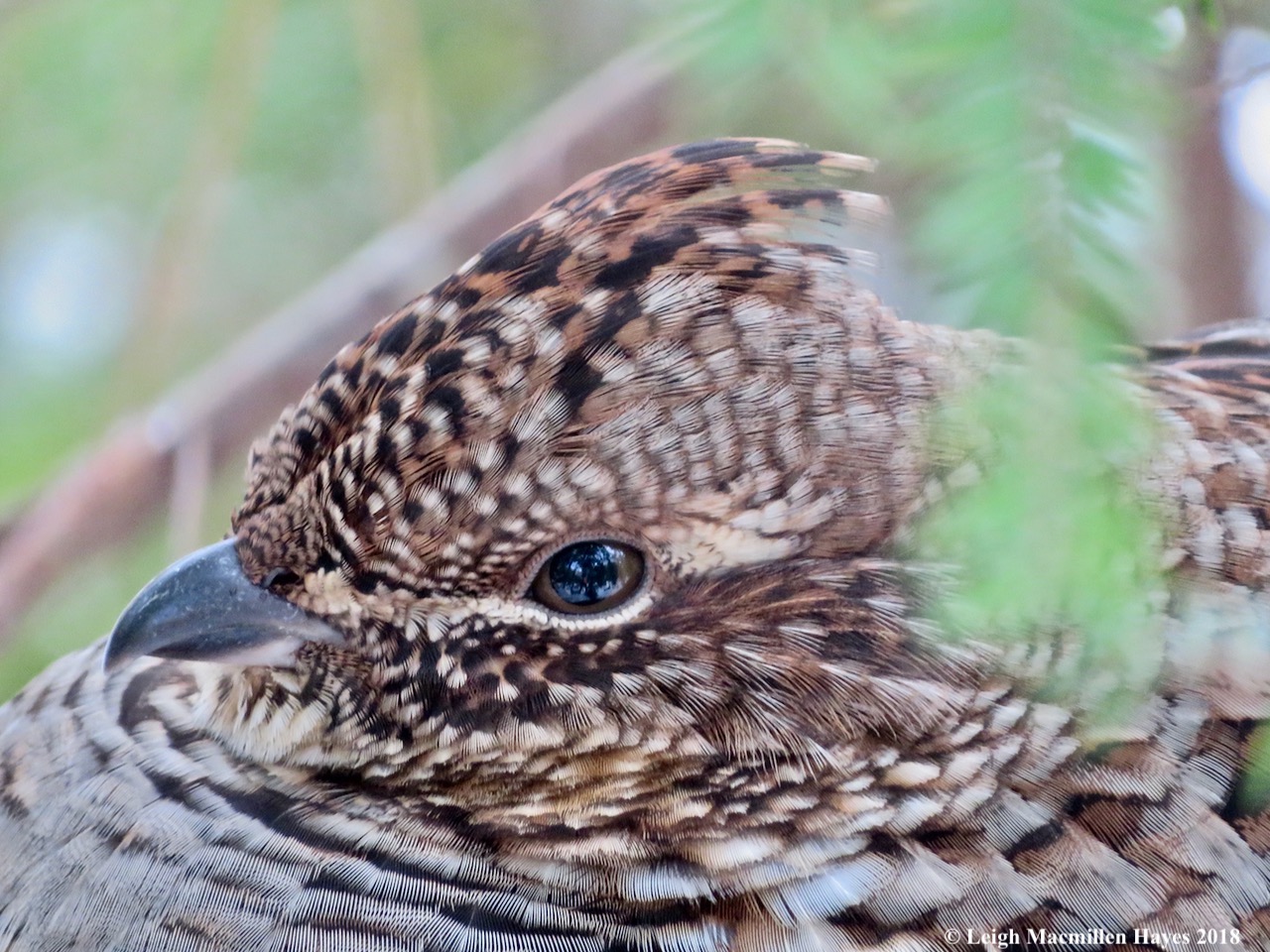
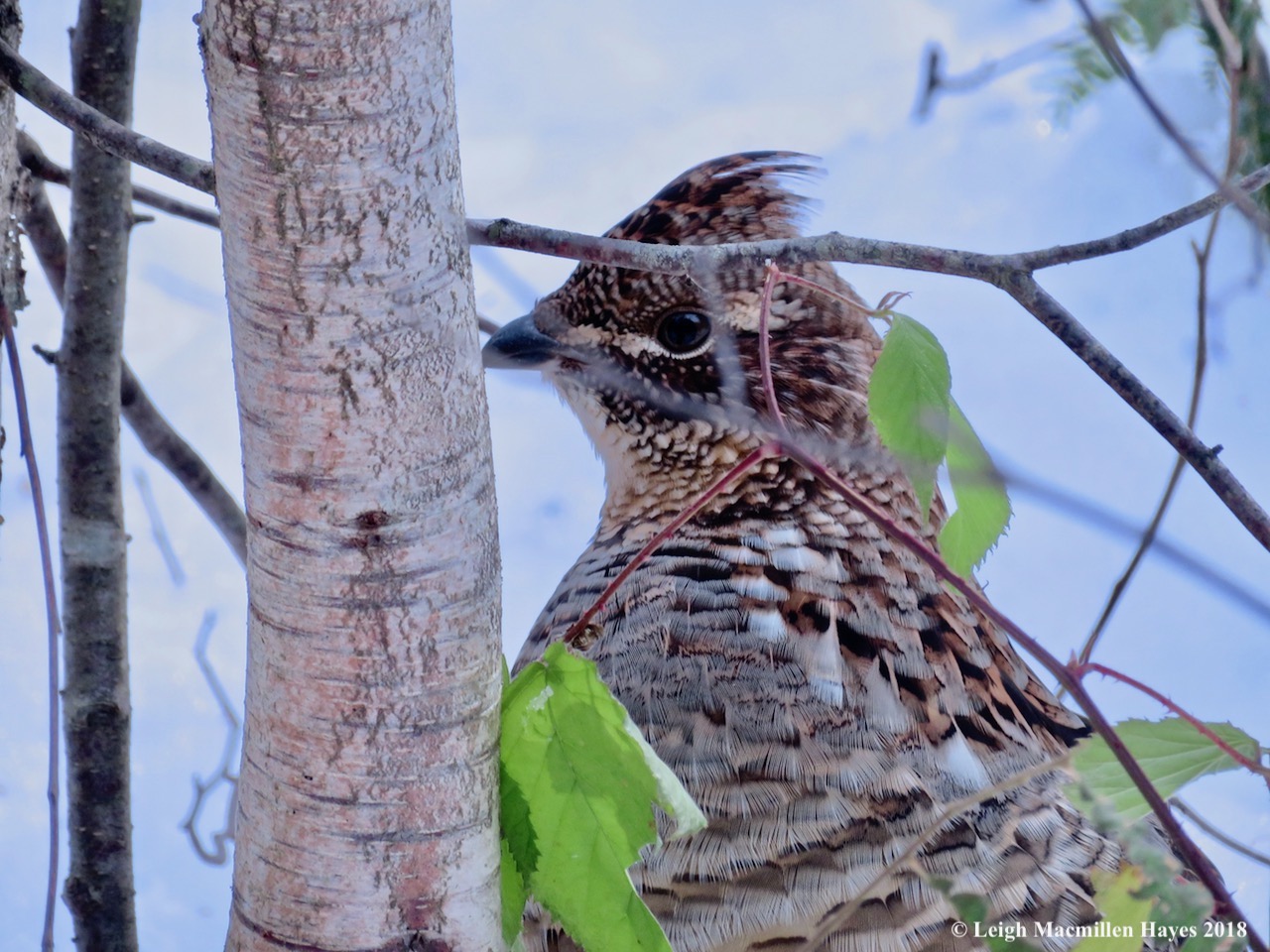
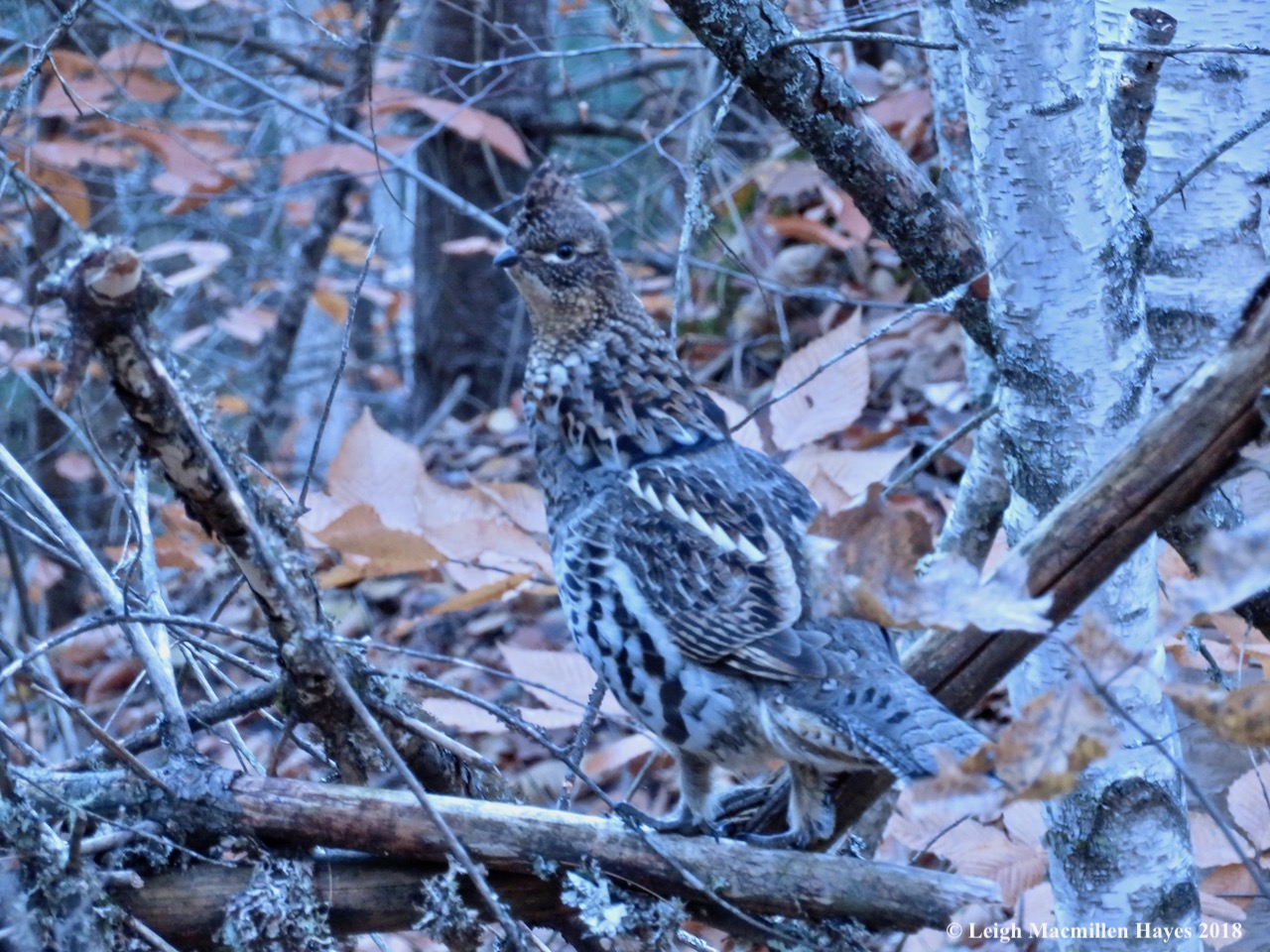
While we watched, I couldn’t help but notice the auricular feathers–those stiff feathers that cover the bird’s ear and form a triangular patch that extends back from the bill and the middle of the eye. 

Do you see what I mean as they fan out below ArGee’s eye? 

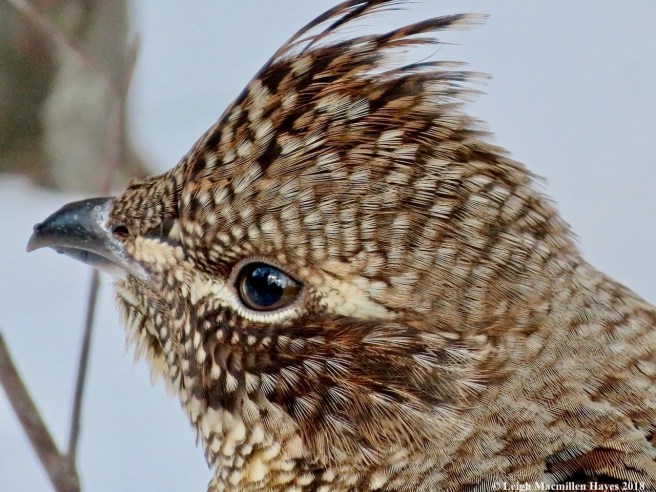
Here’s another look. And notice that beak–sturdy and down-curved for eating buds and twigs, the bird’s staple in winter. 

Survival isn’t easy for a Ruffed Grouse, but despite his affinity for people, ArGee knew to take cover occasionally and perhaps that is why he is still among us. That and maybe the fact that we’re honored to be in his presence and learn more about his species as we have the ability to study him. 

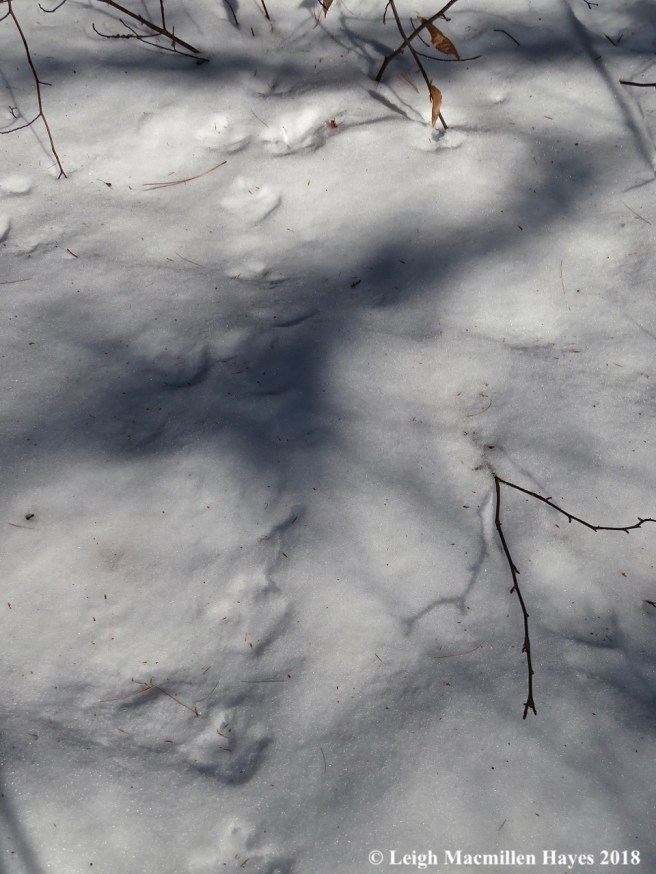
While I’d previously noted the comb-like scales on his feet that act as snowshoes and perhaps add stability somewhat like a porcupine as he’ll search for buds in trees once winter advances, today’s understanding included noting how ArGee moved–with one foot placed in front of the other. 

 I’ve seen it displayed in the tracks left behind including this old set we found further along, but watching the proximity of one foot to another as ArGee moved added a vision and understanding to the signs left behind. 

Sometimes it seemed the feet were practically touching and other times there was a bit of space between them. Then again, at times ArGee paused and that seemed to be when his feet where closer together and other times he marched or ran beside us and there was a bit of distance between the two feet. 

Our time with ArGee lasted maybe a half hour or less. And he wasn’t always puffed up to stay warm. When he returned to his original size, his chicken-like form seemed more apparent.

Always, he searched for buds to consume. Ruffed Grouse have a special internal adaptation, most helpful for their winter diet–similar to that of deer and moose, which is rather funny when you think about the fact that most Ruffed Grouse burst out of the snowpack and scare the daylights out of us as we approach and make our hearts beat rapidly as we’re certain we’ve encountered a moose. Maybe they should be named Ruffed Moose instead.

So back to that internal winter adaptation: they store food in their crops (esophagus) until later and then within their bodies are two offshoots of their intestines, called caeca, which grow enormous each autumn and allow them to break down cellulose so they can get nourishment from the woody aspen and birch buds that they prefer. Come spring, the caeca atrophy for the warmer months.

Our lesson from ArGee ended in much the same time frame as it usually does, but he left us wondering all the same. After we’d spent time moving and stopping together, suddenly he started to gently attack the backs of our legs. It was at a spot that seemed to delineate his territory given past experiences, but why the attacks? Did he want us to leave? Not leave? Were we suddenly seen as the aggressor? All along he’d seemed as curious about us as we him and so we were left to ask questions which we did for the rest of our journey. But wow. We were given the opportunity to wonder. 

And wonder we did. What did ArGee see in us? 

And what was he thinking? 

Bird brain? What passes through it? We may never know, but we do know that our lives were enriched and the landscape is alive. 

P.S. Pam and Bob–this one is for you! Wow! 

Boothbay Aglow

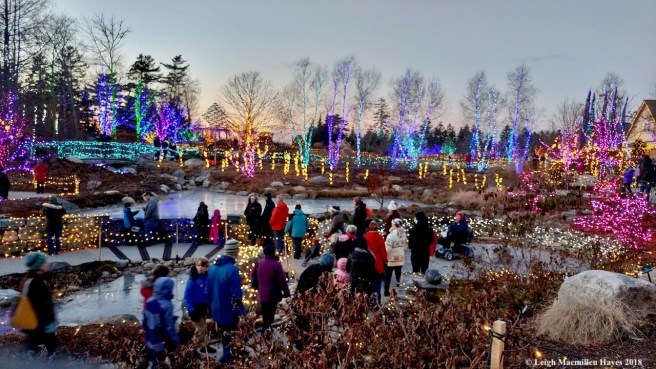
Yes, it was the Coastal Maine Botanical Gardens that drew us to Boothbay and Boothbay Harbor this past weekend, but we found the Christmas light show to be only a part of the attraction. 

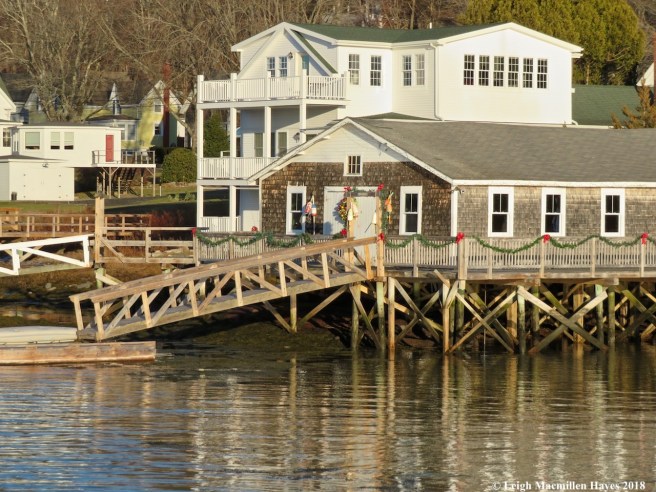
One of our favorite haunts in the harbor is the 1901 footbridge that connects the western and eastern sides of town. It’s renowned as being the longest wooden footbridge in the USA. And so as my guy settled in to watch a football game before heading off to the gardens, I set off to stretch my legs, the bridge being only a block or so from our “front” door. 

We’d booked a brief stay at The Harborage Inn, where our wee room was quiet and comfortable and we especially loved the pillows! Huh? I’ve become a bit of a pillow connoisseur in recent months–well, not really, but I know what I like and what I don’t and I wanted to take the pillows from our room home. But my mom would be proud for I refrained from stuffing them into our bag. 

Standing on the bridge, I could look north (or was it south for so confused do I get when I’m on one of Maine’s coastal fingers), and see our “place” and its dock, the last in line. 

Halfway across the bridge sits the bridge house, which has served many functions from bridge tender’s house to art gallery, and it’s accompanied with rumors of a prominent position during Prohibition when rum was smuggled through a trap door. This weekend its only activity was to provide a Christmas postcard look. 

Actually, much of the town was decked out in Christmas finery. Greens and reds and golds and a variety of other colors defined this seaside locale. 

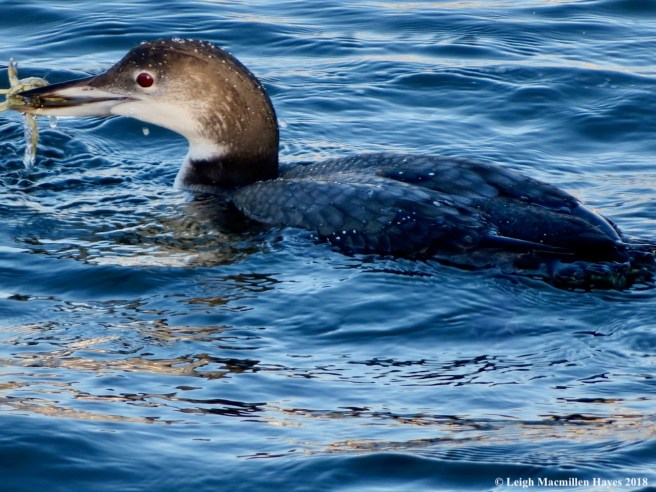
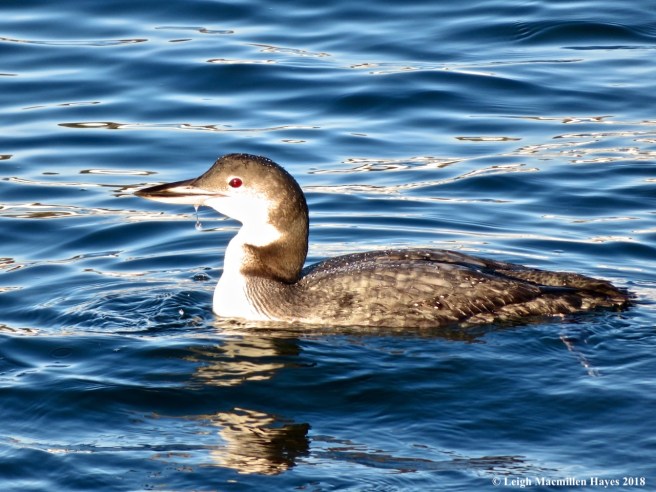
But . . . others had their own display to share, including a non-breeding loon who spent some time by the bridge. 

Though I stood still, it was in constant motion like the waves that surrounded it. 

There was a reason–feeding time! The water shallow, a crab was captured in a flash. 

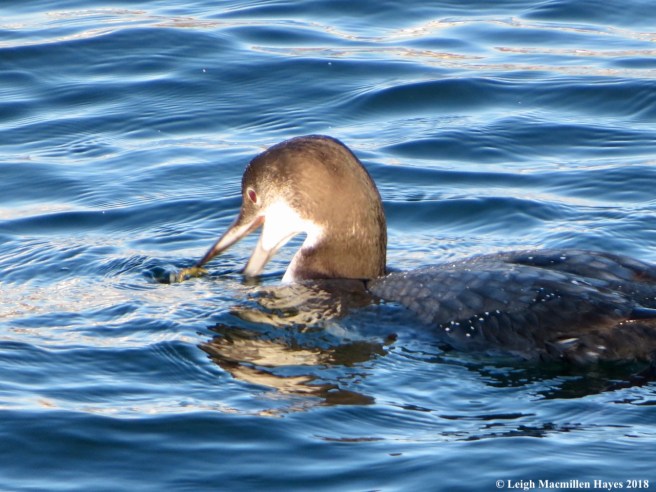
And then played with–dunk . . . 

toss about with a happy face, . . . 

dunk again, . . . 

grab, . . . 

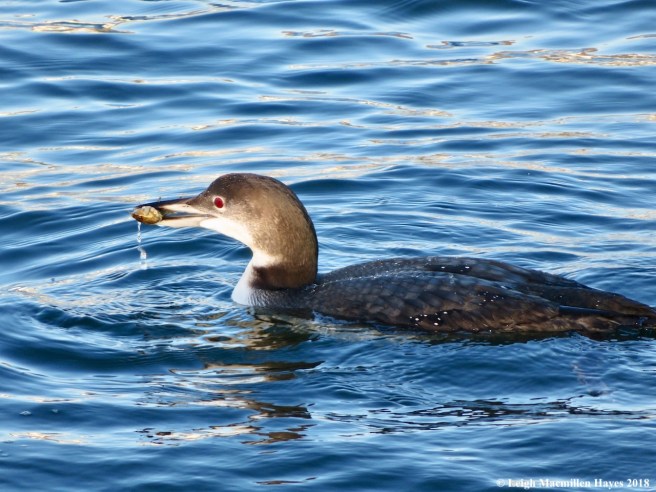
let hang out of the mouth much like a teenager does a mouth guard, . . . 

toss in the water one more time, . . . 

and then swallow. Notice the bulge in the loon’s neck? And the glow of the sun on its bill? 

A final gulp and the crab was completely consumed. A meal complete. 

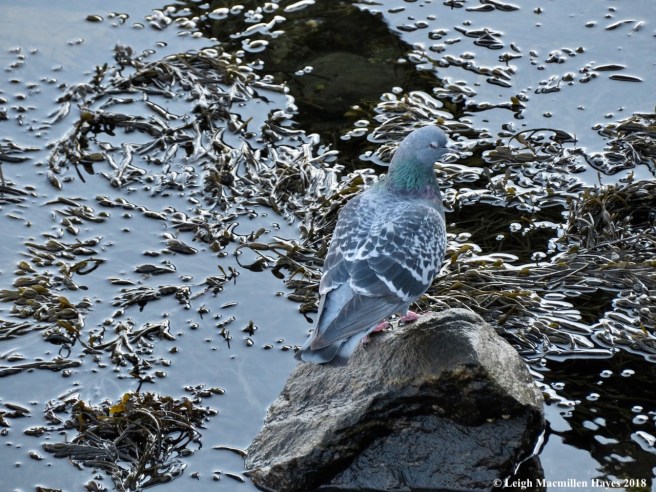
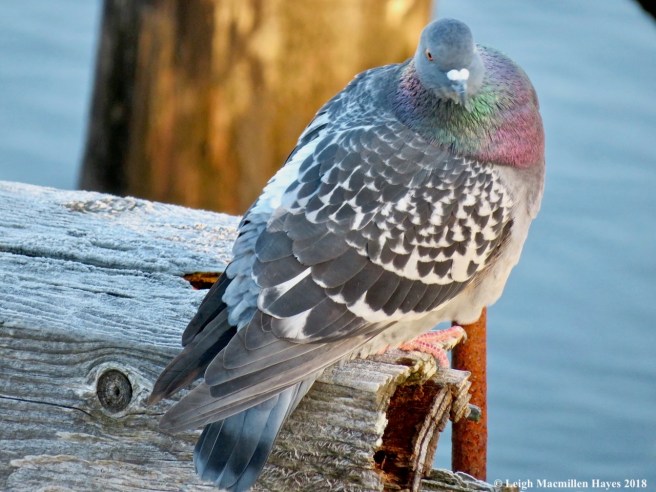
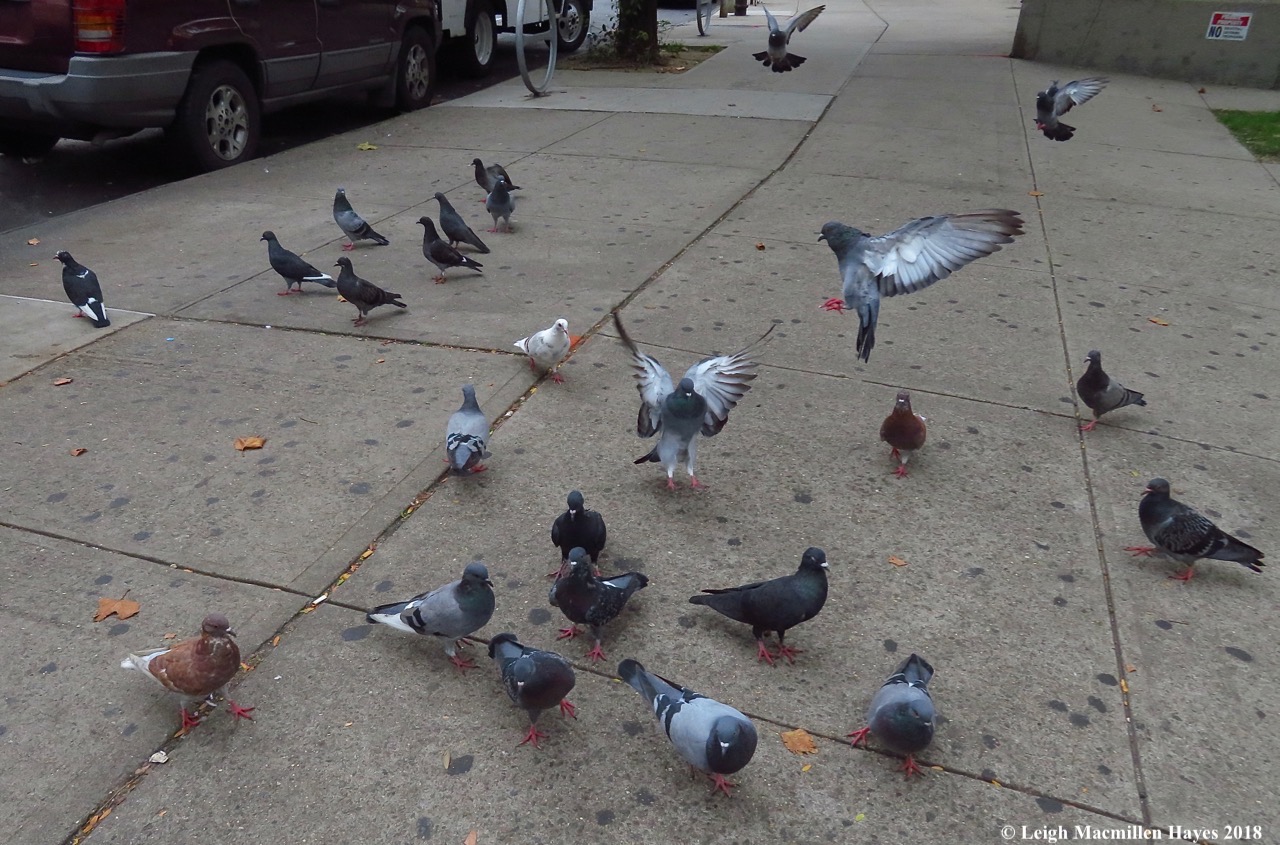
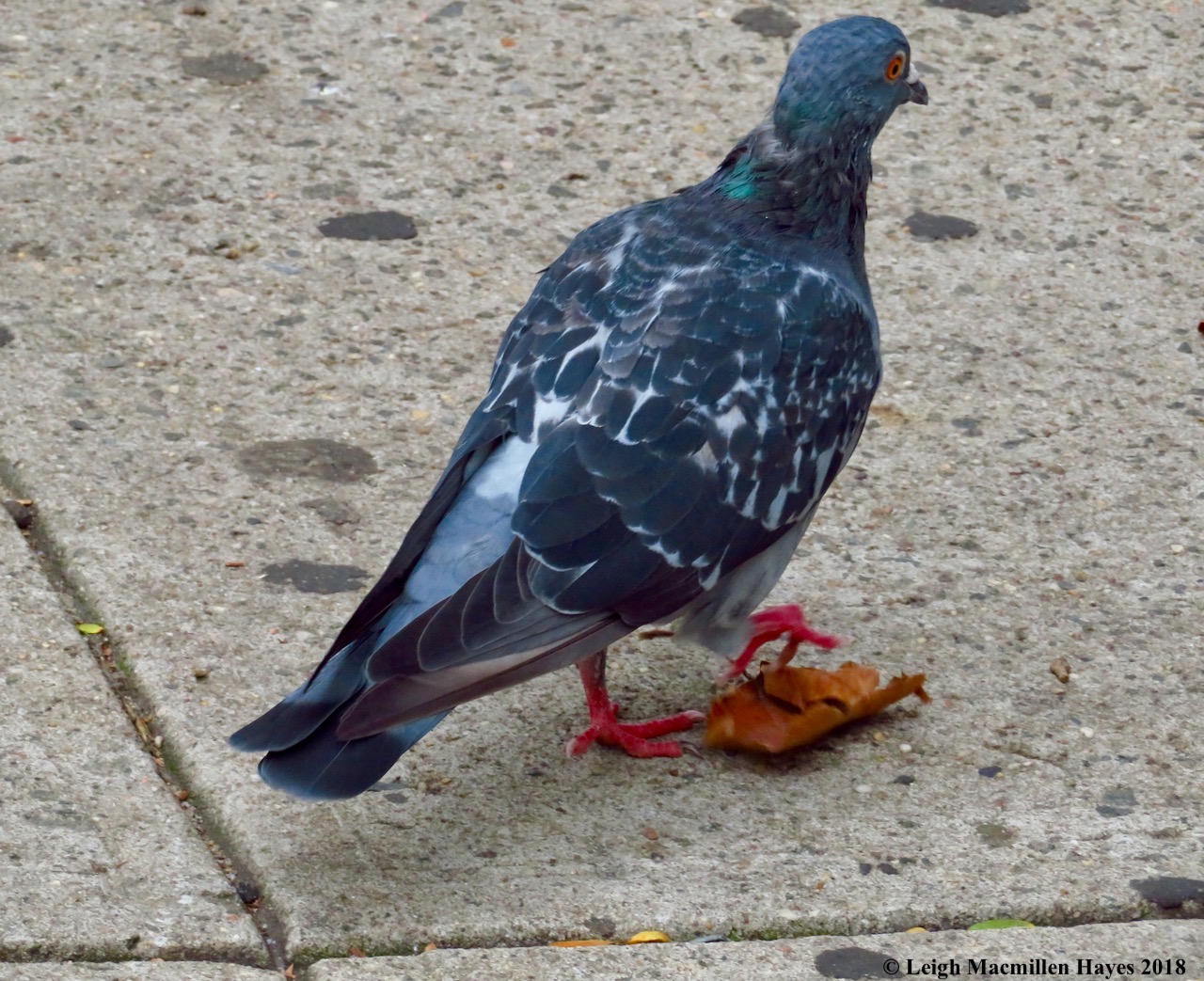
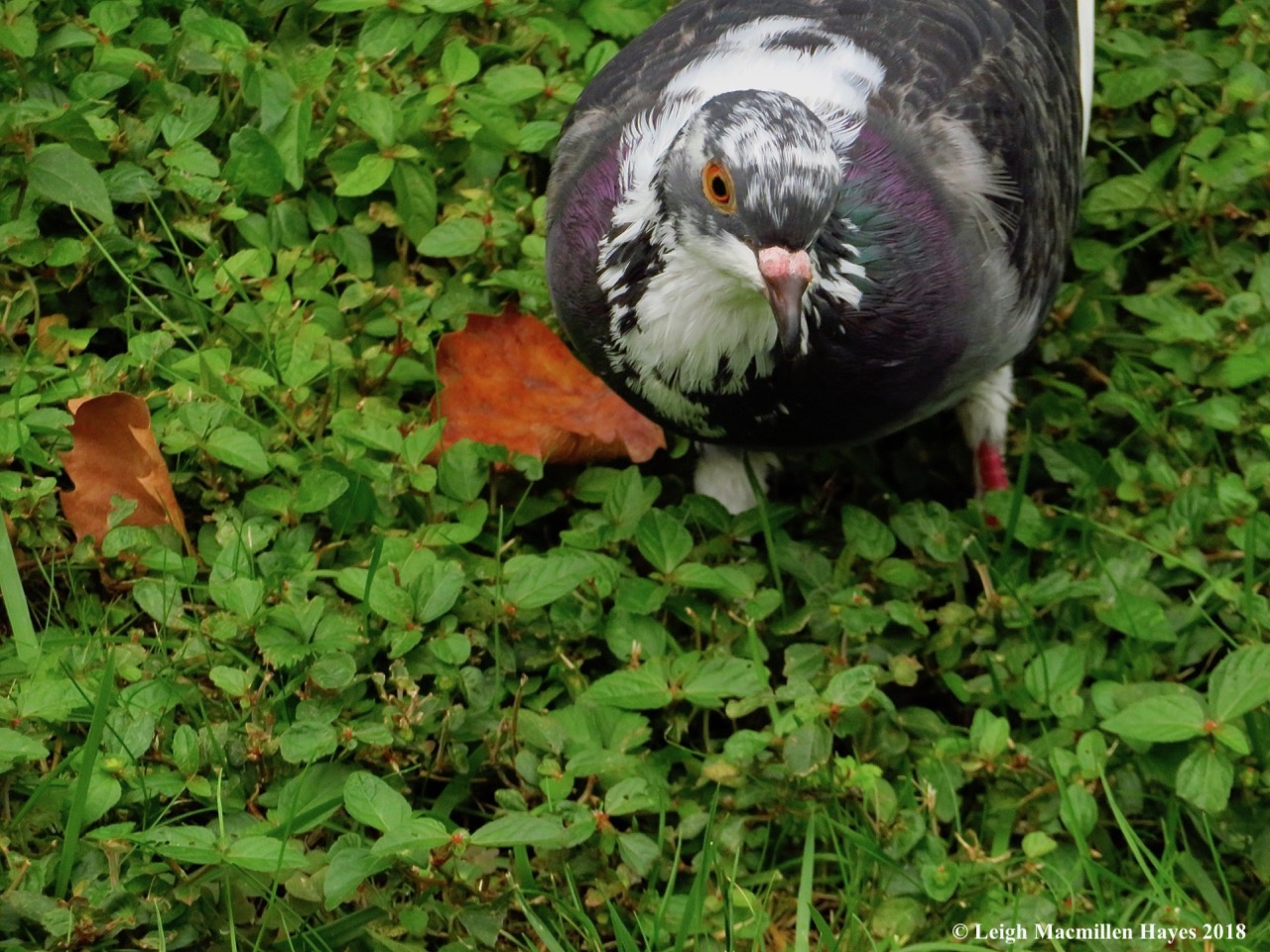
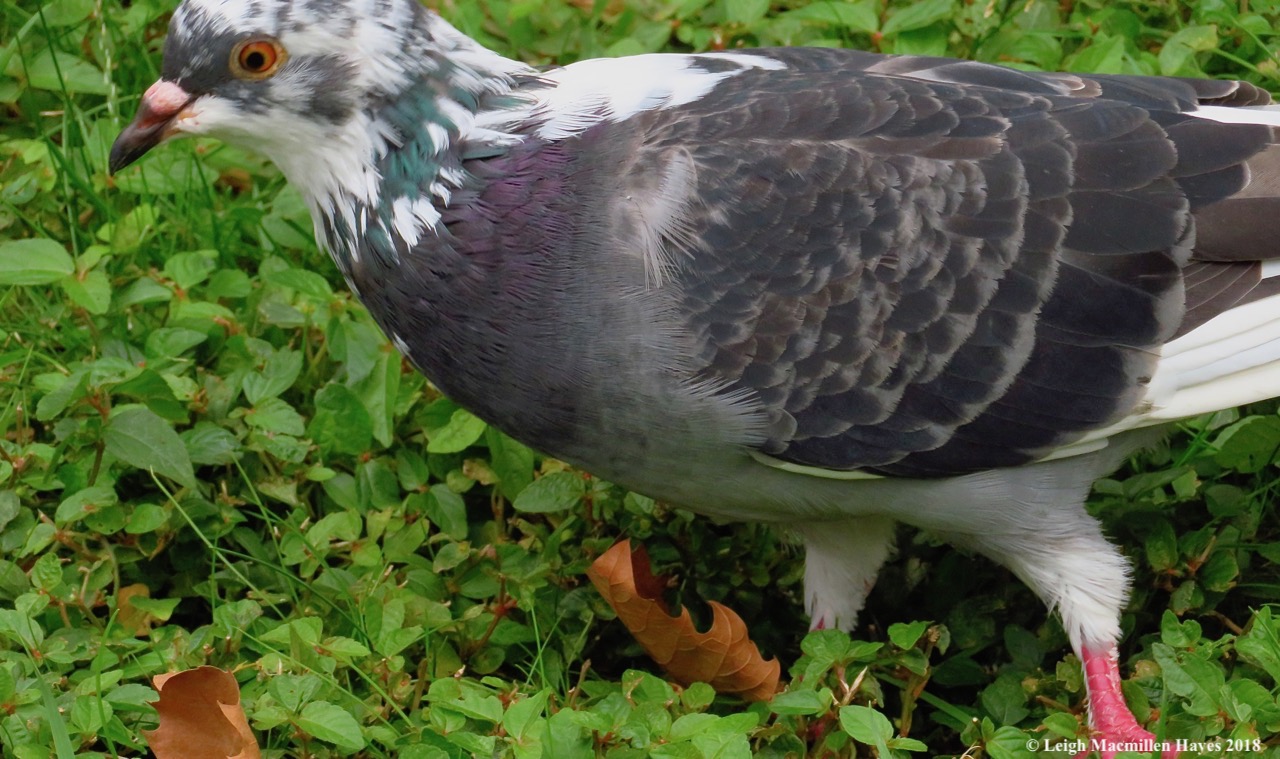
Finally, back across the footbridge I walked and near the shore the pigeons drew my attention. Okay, so they are pigeons. But I’ve said it before and I’ll say it again, they are rather exotic. 

And curious. And colorful. Pay attention to the colors. They provided a foreshadowing of what was to come. 

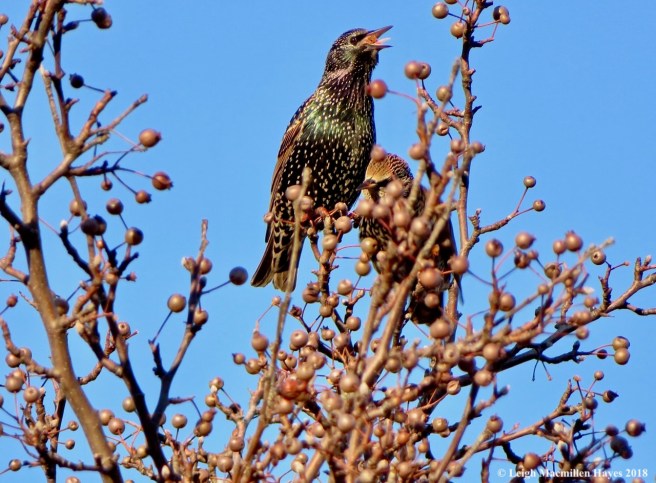
On Main Street another exotic, aka invasive, caught my attention by its song–that of the Eastern Starling. But those colors–again a sheen and pattern to admire. 

There were more traditional colors on display everywhere for this is a season that Boothbay has embraced. 

Back at the room, my guy was ready to depart for our next destination, but he had his radio and ear buds ready so he could listen to the Patriots football game. 

We’d no sooner stepped onto the property of the Coastal Maine Botanical Gardens when I heard him exclaim. Apparently the Patriots lost on a play gone afoul, but you would have thought it was the end of the world. Despite that, he quickly turned his attention to New England’s brightest and most colorful display.

We arrived for the 4pm entry so we could watch the world transform before our eyes. 

The sun set as we moved from one section of the garden to another, remembering along the way our past visits in warmer months. Typically in summer and early autumn our eyes were drawn to the display of colors from foot to hip, but on this evening, it was from foot to sky that we needed to note. 

With every minute that passed, the scene changed and we were grateful to our friend Marita for the suggestion to arrive at 4 and watch the transformation. 

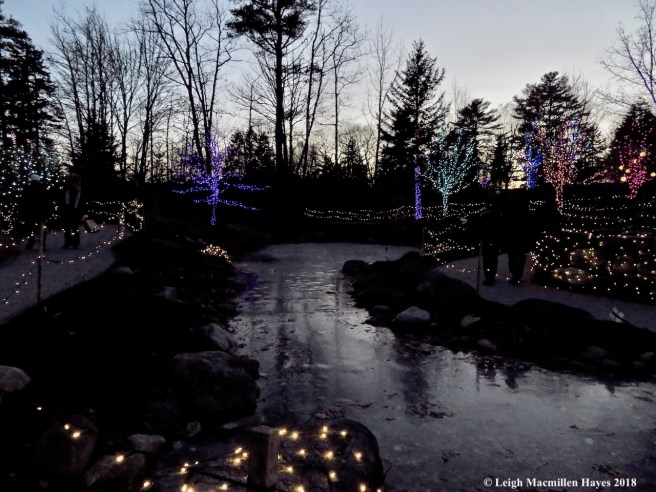
Silhouetted trees and iced reflections enhanced the experience. 

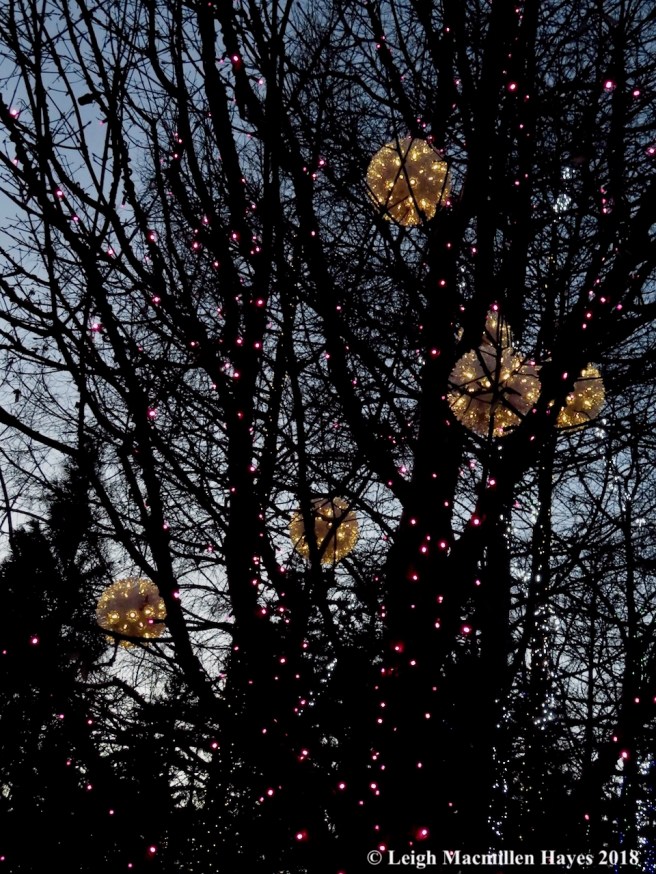
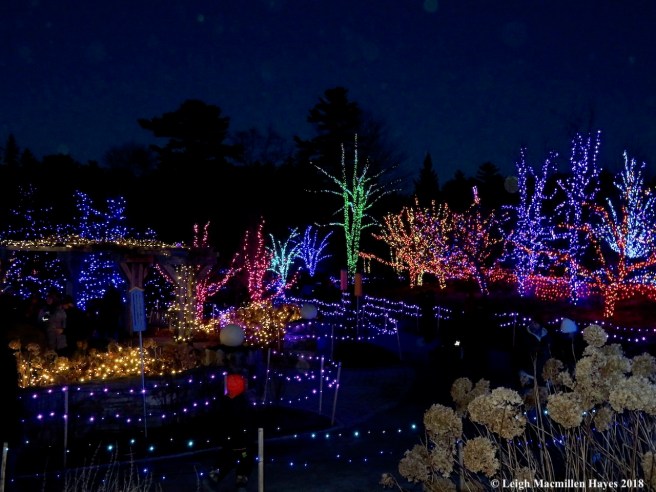
We were wowed by the fact that over 650,000 light bulbs had been strung to create such a scene. How? When? Who? We learned the next morning from a local gentleman with a handlebar mustache who pulled up a chair to join us for a chat before our breakfast arrived at a local bakery that volunteers help, the process begins months prior, and the locals are invited to attend for free one night before the event opens to the public. 650,000 bulbs. My hardware guy tried to fathom that sale. 

In the twilight, beauty shown. 

But it was in the darkness that magic beset the scene. And even though we moved among thousands of people, we managed to find spots to ponder the glory. 

Our initial journey lasted about an hour and then we spent an hour more circling about again, revisiting favorite spots before taking our leave. 

If you go, note where you park! Yes, that’s a warning. We thought we’d walked further to the entrance than we had. Thank goodness we remembered a few key features about our parking spot. Periodically, we did press the key fob as we looked for familiar lights to come on. At last . . . success. 

The next morning found us up and out early, again enjoying the footbridge, though it was a bit slippery with frost. 

I walked across, but my guy chose to run. Can you see his breath? 

And yet again, it was the pigeons that pulled me in. Notice the color of those neck feathers. 

And the need to puff up in an attempt to keep the cold at bay. 

I’m always amazed how birds can transform from their skinny selves to plump renditions in an effort to keep heat in and stay warm. 

Again, those neck colors. Don’t they remind you of the nighttime display? 

And then I found them reiterated in the rocks below. 

I could have stayed on the footbridge forever (perhaps I should move into the bridge house), but at last I moved off. Not before, however, marveling at the lobster buoy decoration that marks the bridge’s center. 

And the town reflected upon the calm water. 

My walk continued along water and some town roads. And I had to chuckle for though I wasn’t haunting my usual neck of the woods, old friends still made themselves known. 

I did note some differences. In the woods, a red squirrel chooses rocks or downed trees or sawed off tree trunks upon which to dine. Beside the water, apparently any railing will do. 

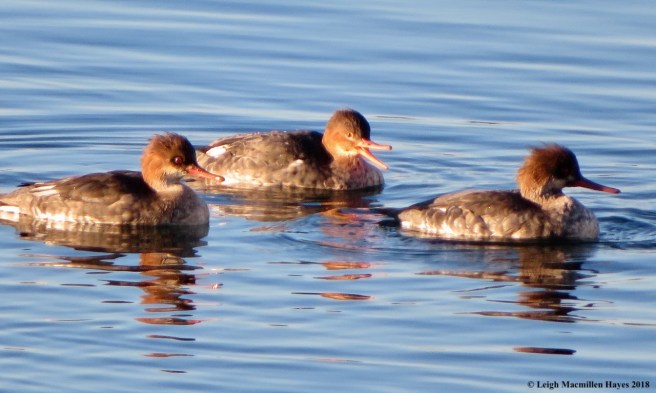
The mergansers seemed to have arrived not too long before us for just a week or so ago I saw a large flock of them on Kezar Lake in Lovell. Was the middle one getting the last laugh in my honor? 

And then there was a crow who shouted, “Har, har, har,” over and over again. And I heard a woman respond to him and thought he must be a regular. He seemed soooo black in this town of so many other colors. But apparently he had his own colorful character to maintain. 

Colors. Everywhere. Into. The. Focal. Point. Coastal Maine Botanical Gardens. Gardens Aglow. Worth a visit. Just remember, it’s more than the gardens. And even more than I noted. Boothbay Aglow. 

A Sign of Hope

We’ve entered that season many of us know as Christmas; a time of year when hustle and bustle can so easily overtake our lives. As youngsters, it was our desires, our longings, our yearnings that became the focus of our lives during the month of December. We thought we wanted, in fact needed, that pair of ice skates or that furry hat with the pom-pom balls at the end of the ties. At least, those were my desires when I was ten and eleven years old. 

In fact, I coveted that hat to the point where on Christmas morning I snuck down the hall to the living room and peeked into the gift bag with my name that sat under the tree. I was at once delighted/disappointed. Yes, Mom and Dad had fulfilled my wish and I would look like the other girls at school who donned such; but . . . the moment of surprise was gone and I’d have to feign my excitement. I don’t remember if it ever dawned on me that the hat was just that–an expensive, fancy covering for my head. One I didn’t need given that Mom loved to knit hats for us.

And then there were the Christmases that my guy and I bent over backwards as we tried to create a special day for our sons. And as we all know, the empty boxes were the best toys of all. 

Now, as I take an honest look at my past and wonder about the future, I realize that my attitude has shifted. No longer is it a frenetic, mad dash for the best deal or piece of plastic. My life has taken on the form of slowing down, noticing, watching, even in the darkness. 

And it was in doing so yesterday and today, that I realized something rather special in the ordinary. 
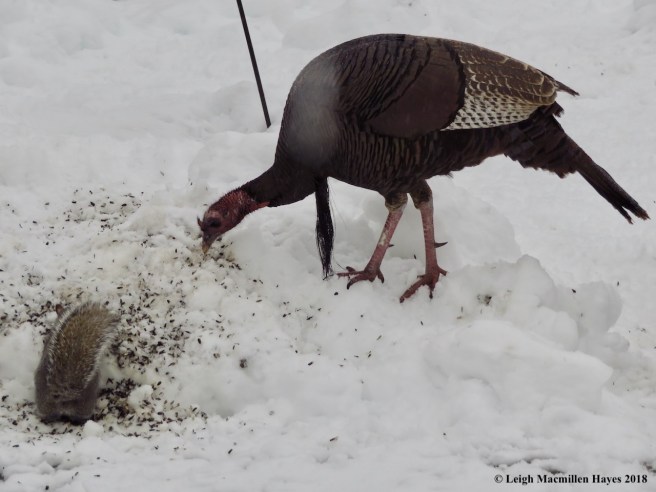
We’ve all become used to seeing wild turkeys on roadsides, in our yards and occasionally even up in the trees they fly to when danger lurks or  nighttime falls. But . . . think about it. Meleagris gallopavo, that fancy scientific name, have been the comeback kids since farms of yore reverted  to forest, thus allowing these large birds to reestablish in their former range. 

Because I put bird seed in feeders and spread it on the ground, the neighborhood turkeys stop by for an hour or two at least twice a day. 

And they aren’t the only visitors to the feast, for red . . . 

and gray squirrels also take advantage of the free meal. 

But it was the male turkeys upon whom I focused much of my attention for it occurred to me today that they were unicorns in their own right. Unicorns had a single horn protruding from the center of their heads, right? Okay, so maybe its a snood. But still.

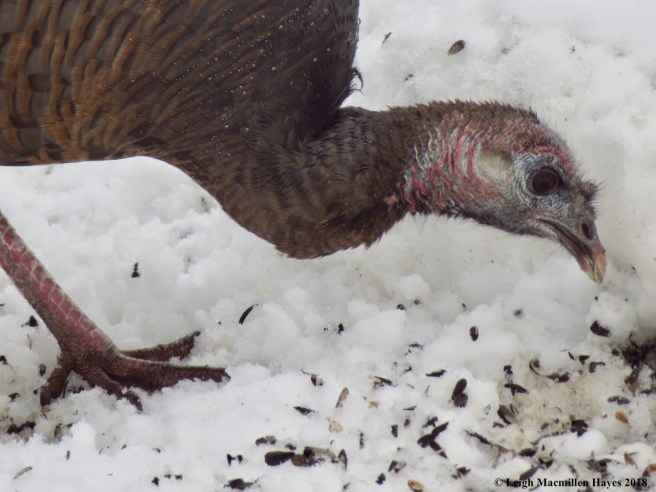
As for their magical powers, have you ever noticed that a male’s featherless head of blue and pink and red raised bumps called caruncles change colors with his moods?

Shifting my eyes to the back of the shanks or leg, the unicorn theme was reiterated in the form of a pointed spur. 

The theme again was repeated behind the toes, where a claw stuck out on its own in the area we might call a heel.

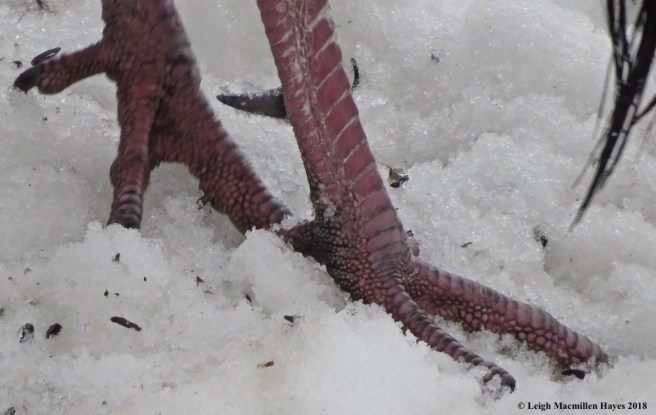
Check out the bottom of that foot, its bumpy surface much like a no-skid sock. Certainly there must be more magical powers protected within.

From behind a window in the back door that served as a bit of a screen, I watched the feeding station without disturbing the activity. The squirrels and male turkeys (their rafter ranging in size from 9 to 13 depending on the hour), devoured the sunflower seeds. 

It appeared to be a blissful co-existence. 

Until it wasn’t. The gray squirrel was the aggressor. 

Every few minutes, it took a flying leap and so did the young jakes and older Tom. 

Simultaneously, other gray squirrels decided to show off their own super powers, such as finally scaling one of the poles. Too bad I hadn’t put a suet feeder on it yet. 

He moved on to the bigger feeder–jumping first onto a baffle intended to keep him out. From there, he reached the top of the squirrel-proof feeder, and . . . um . . . 

proceeded to open the cover of the seed tube. 

The interior must have seemed like manna from heaven. 

Into the inner sanctuary he descended. 

His super powers included his ability to debunk “squirrel proof” and perform a disappearing act–almost. 

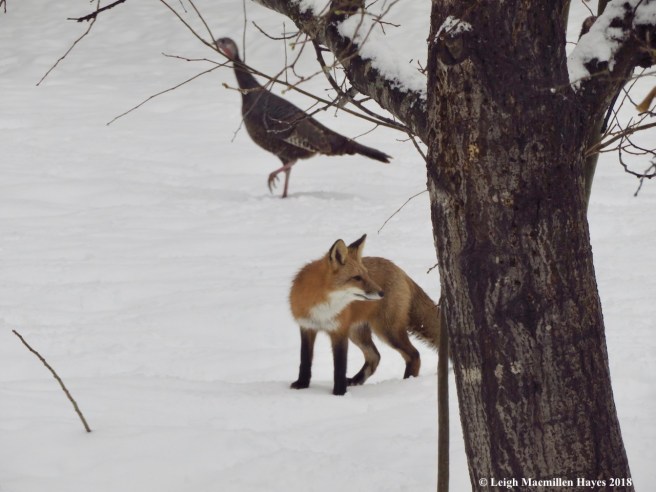
The day continued and so did the turkey and squirrel activity. And then, as the turkeys were moving away, a healthy red fox climbed over the stone wall, walked among the turkeys and paused. The squirrels again performed a disappearing act and were silent for once, but the turkeys didn’t appear threatened. Perhaps the fox was sated for the moment. 

In the case of the turkey, and yes, also the squirrels, we complain there are too many. But, we should give thanks that we’ve created an environment that’s conducive to successful turkey breeding. As for the explosive squirrel population that resulted from last year’s mast production of pine, beech and oak fruits, the red fox is on the hunt. 

At the end of the day, calling a turkey a unicorn is in the eye of the beholder. But, in his own form of handsomeness, he portrays a similar sign of hope.

As the holiday season continues, I hope you’ll also make time to watch . . . and be attentive to other signs of hope. 

Nothing to Grouse About

A week ago I shared a unique experience with five other naturalists, the majority of them in the six to eleven age range. For twenty minutes the six of us watched a Ruffed Grouse at it moved about, overturning leaves and foraging on buds. When we last saw it, the bird headed off in the opposite direction that we intended to journey, and so we moved on with wonder in our eyes and minds.

2

And then the next day I returned on a mission to study some twigs at the same property. No sooner had I stepped onto the trail when I heard the sound of leaves cracking a wee bit and what to my wondering eyes should appear but the same bird.

The curious thing: the bird followed me, staying about ten feet away as I tramped on. I stopped. Frequently. So did the bird.

And we began to chat. I talked quietly to him (I’m making a gender assumption) and he murmured back sweet nothings.

It was then that I did the unthinkable–I named him: ArGee.

Again I started down the trail, and again ArGee followed about ten feet to my right. And then I thought I got ahead of him, but a few minutes later he caught up and foraged by my feet as I examined twigs and buds for their idiosyncrasies.

When I finally turned back, ArGee did the same. Eventually I ran because I didn’t want him to follow me to my truck. Would he have? I don’t know. Would he survive? I sure hoped so. Would I visit again? I knew the answer was yes. Would I see him again? Who knew?

The next day I dragged my guy along. But much to my dismay, no ArGee. I’d been blessed twice and had to accept the possibility that he’d either flown off or became part of the food chain. My hope was that if the latter was the case, it was a four-legged predator or larger bird and not a human bi-ped.

Since last week, about five or six inches of snow blanketed the area and this morning dawned frigid with the temperature at about 5˚. I dressed for it and headed to a nearby spot in hopes of meeting up with a group that was going to count salmon and redds. But, I missed the link-up and decided instead to wander in ArGee’s territory so I could reaffirm his disappearance and move on.

1-looking for food

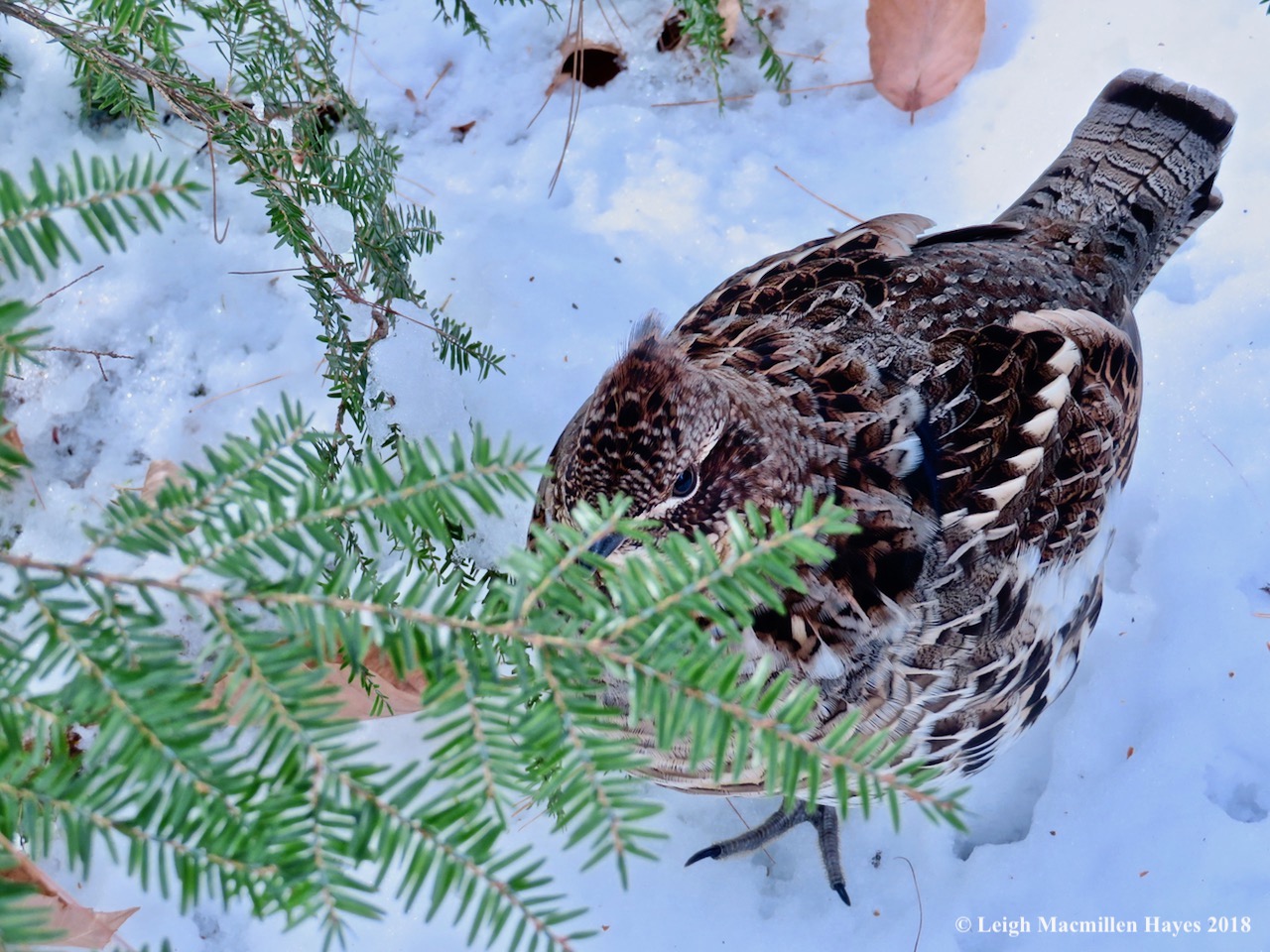
As I looked up at something in a tree, I heard a slight noise by my feet and guess who? I greeted ArGee with a quietly grand hello and together we shared the space, mindful of each other. After about twenty minutes he headed under a stand of hemlocks that provided some cover.

2-hiding and feathers bloated

I snapped and crackled through the woods, bushwhacking over to his position, all the while wondering if I was getting too close and perhaps he didn’t want me to spend more time with him.

2a-hiding

But what I discovered was that he’d stopped foraging, stood still, though occasionally turned his head, and puffed up his dappled and barred plumage. While I had donned several layers to keep the brisk air at bay, ArGee needed to fluff up in order to trap air in his feathers. Cool fact (or cold!): A bird’s body heat warms the air between its feathers and the more trapped air, the warmer the bird.

4-crown

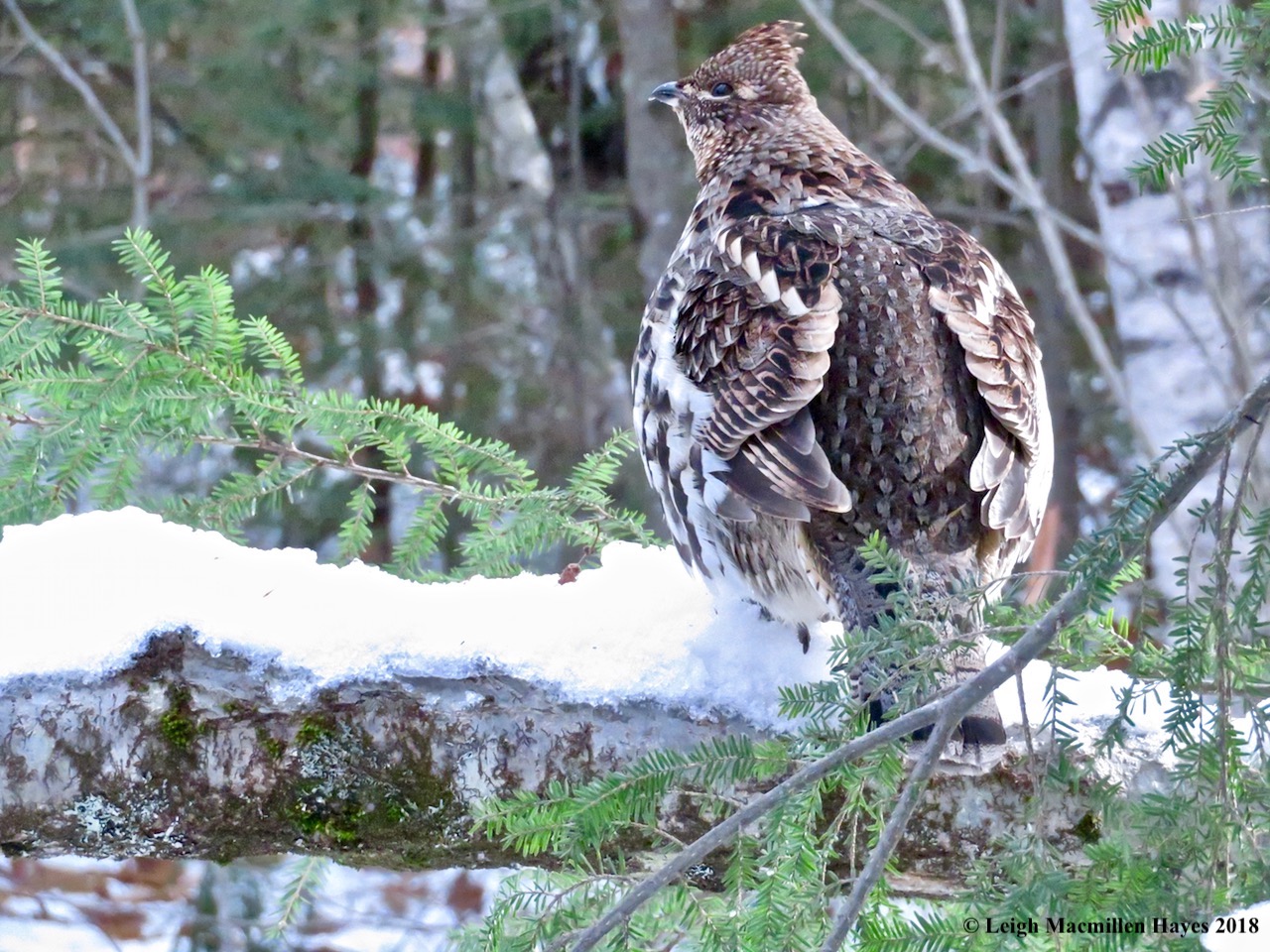
While ArGee warmed up, I focused on some of his features, including the crest feathers on top of his head. Their formation brought to mind ocean waves cresting, but perhaps they were actually standing upright because he saw me not as friend, but rather a foe?

5-eye to eye

I knew I was overextending my stay, but I couldn’t leave. And he didn’t seem agitated, so I continued to look. There was that eye-ring to notice, rather bead-like in appearance.  And the contrasting orientation of the feathers above and below his dark eye, their comb-like tips spread out like miniature fans.

6-looking at me

For another fifteen to twenty minutes, he warmed up below the hemlock, while I stood nearby and watched, occasionally offering a quiet comment, which he considered with apparent nonchalance.

7-beak

I had time to consider his robust down-turned beak and figured it must be adapted for the coarse vegetation it consumed. Ruffed Grouse are known to feed on buds or catkins of aspens, birches and cherries, and that was the habitat in which ArGee had made himself at home. They’ll also consume, seeds, fruits, leaves and twigs, insects, and maybe even salamanders, in season of course.

8-coming out of hiding

Finally, my friend seemed to have warmed up and so out from under the hemlock ArGee emerged.

9-dining on leaves

And immediately he found bramble leaves still green.

10-leaf in its mouth

Ripping one leaf off, he made quick work of it.

11-gobbling it up

And in a matter of seconds it disappeared into his mouth.

12-looking for more food

Then it was time to think about another.

12-those feet

Out in the open again, I had a chance to get a better look at ArGee’s feet. Though today’s snow was rather crusty, there’s potential for up to ten inches of fluff to fall tomorrow and then his feet will play a key role.

12a-combs on feet

Where the snow is deep and soft, grouse travel atop it with the help of their “snowshoes”—lateral extensions of their toes. Can you see the comb-like rows of bristles, aka pectinations? They began growing in September and reminded me of a centipede serving as each toe. It’s those bristles that act like snowshoes.

They also have stout legs for walking or running and those were also covered with insulating feathers that looked like an old pair of furry sweatpants.

12b-tail feathers

It’s difficult to tell a male from a female based on appearance, but typically the bird is a female if the color is faded or absent on the central tail feathers, thus I leaned toward ArGee being a male. No matter what the sex of this particular bird, the varied shades of black, gray, rusty red and buff all presented in a variety of patterns, including small hearts–what wasn’t to love?

13-I see you

For a while longer, ArGee and I played “I See You” and I continued to wonder about his behavior. Usually this species is quite elusive and difficult to approach. In fact, most often I am startled by the loud wing beat of a bird exploding, or so it sounds, from the ground or snow in front of me, and my heart responds with rapid beats for a second . . . and then I realize it was a Ruffed Grouse trying to avoid me.

13-so close

Today, and this past week, that has not been the case.

13b-are you looking at me?

ArGee has seemed as curious about me as I’ve been about him.

16-saying goodbye

Is he tame? Or has he been defending his territory? Perhaps it’s a hormone imbalance as the season changes, especially given that winter seems to have arrived early.

I’m not sure what’s going on, but I’m grateful for the time I have had to get to know this bird of the Maine woods a wee bit better. As has happened in the past, we parted ways at the same point, so I’ve a better understanding of his actual territory.
I’ve experienced grouse being aggressive when protecting their young in the spring, and wonder if at some point a close encounter with ArGee could switch dramatically from fascinating to hostile as he defends his territory.

Sometimes the critters with whom we share this natural world do things that make no sense, but then again, sometimes we do the same. For now, I have nothing to grouse about!


I Spy . . .

This afternoon’s goal: To find a Christmas Tree to decorate for the Christmas at Ladies Delight Walk on December 1st. For the reconnaissance mission, I joined the Coombs family at the GLLT’s Chip Stockford Reserve.

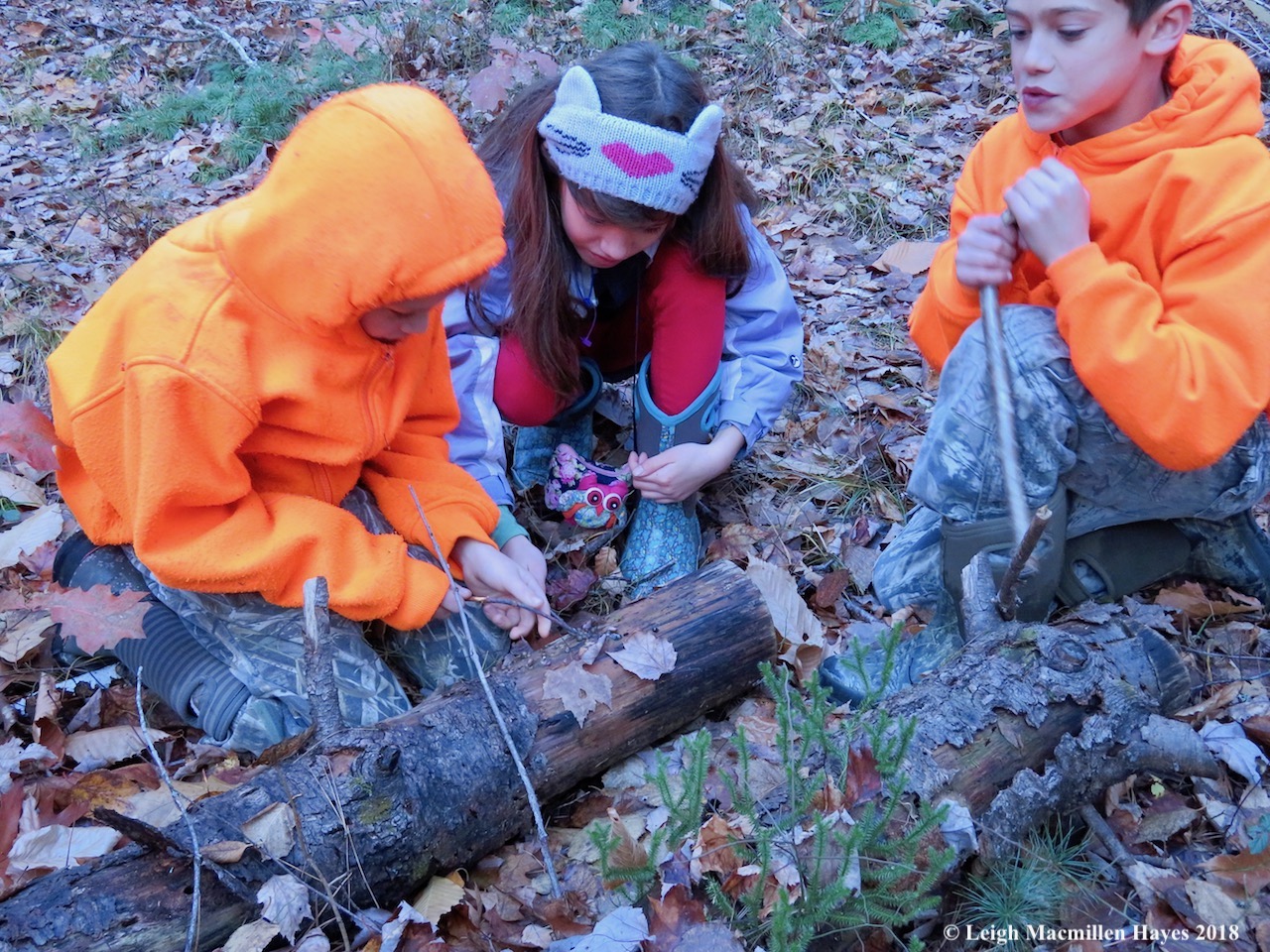
The Coombs children are homeschooled by their amazing mother, Juli, and though they learn many lessons at home, they are also well educated in the outdoors. In fact, they are among my favorite naturalists.

And they belong to a 4-H Homeschool group that will decorate a tree(s) with biodegradable ornaments prior to the December 1st walk.

1

And so we set off on our tour looking for just the right tree. But . . . as is always the case with this family, there was so much more to see.

2

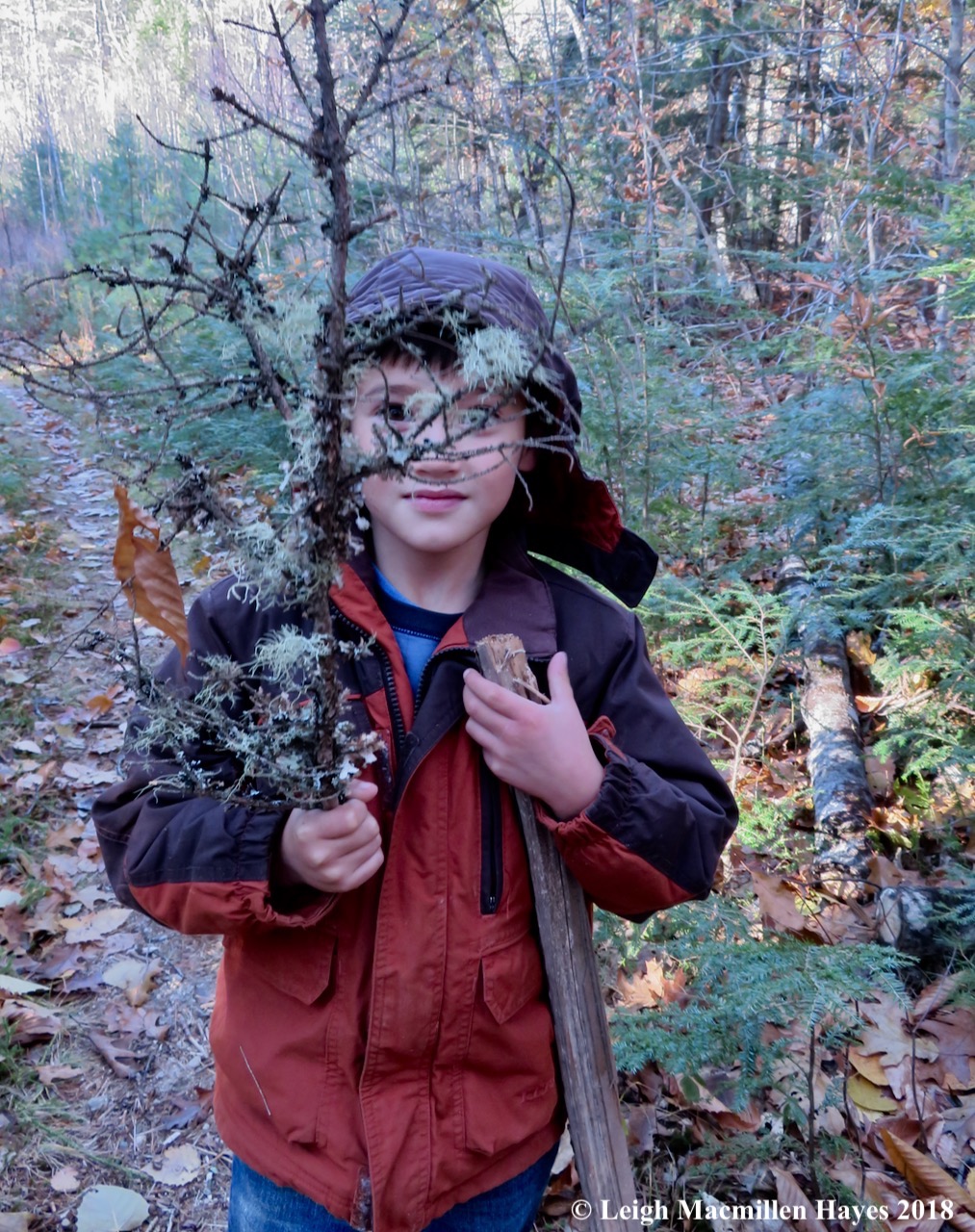
Since Juli is a Maine Master Naturalist Program student, so are her children. And every topic she studies, they study, so it was no surprise to me that six-year-old Wes picked up stick after stick loaded with various forms of lichens.

3

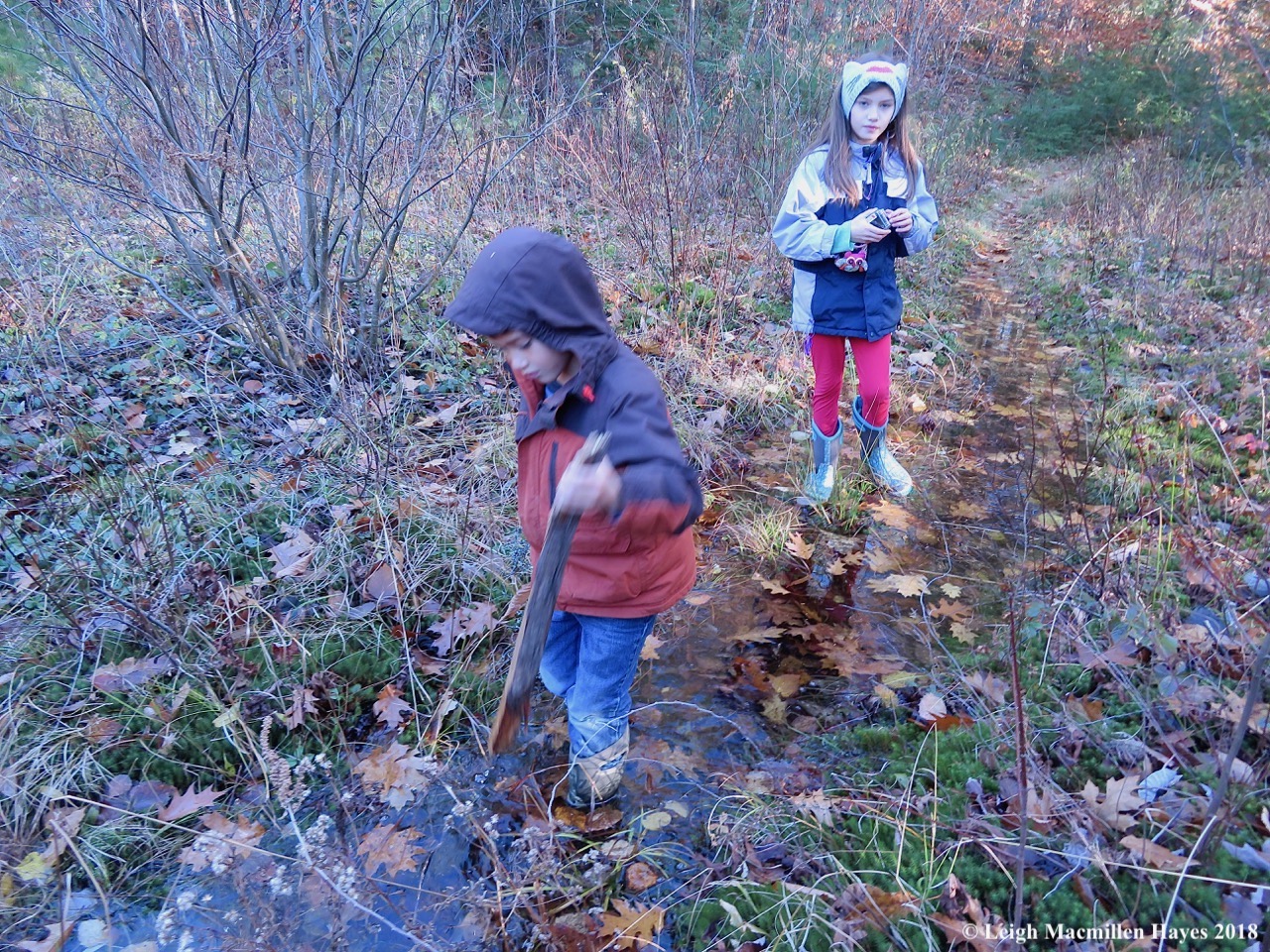
Of course, they are children, ranging in age from six to eleven, and puddles are invitations. The family motto is this: No puddle shall remain unsplashed.

4

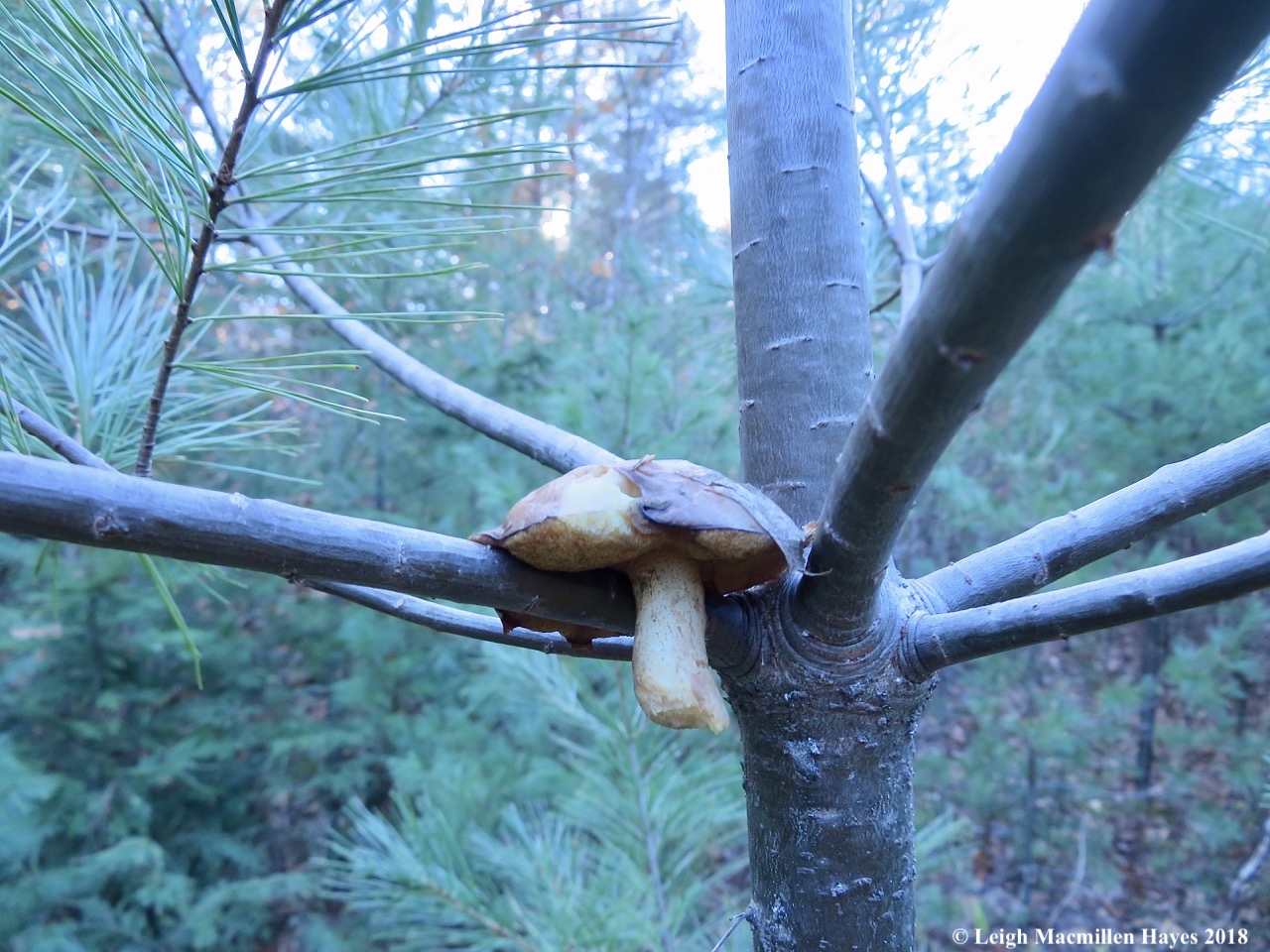
But just after the puddle, at the start of an old log landing, we began to notice something else. A mushroom drying on the whorl of a White Pine.

5

As we stood and looked at the first, someone among us spied a second.

6

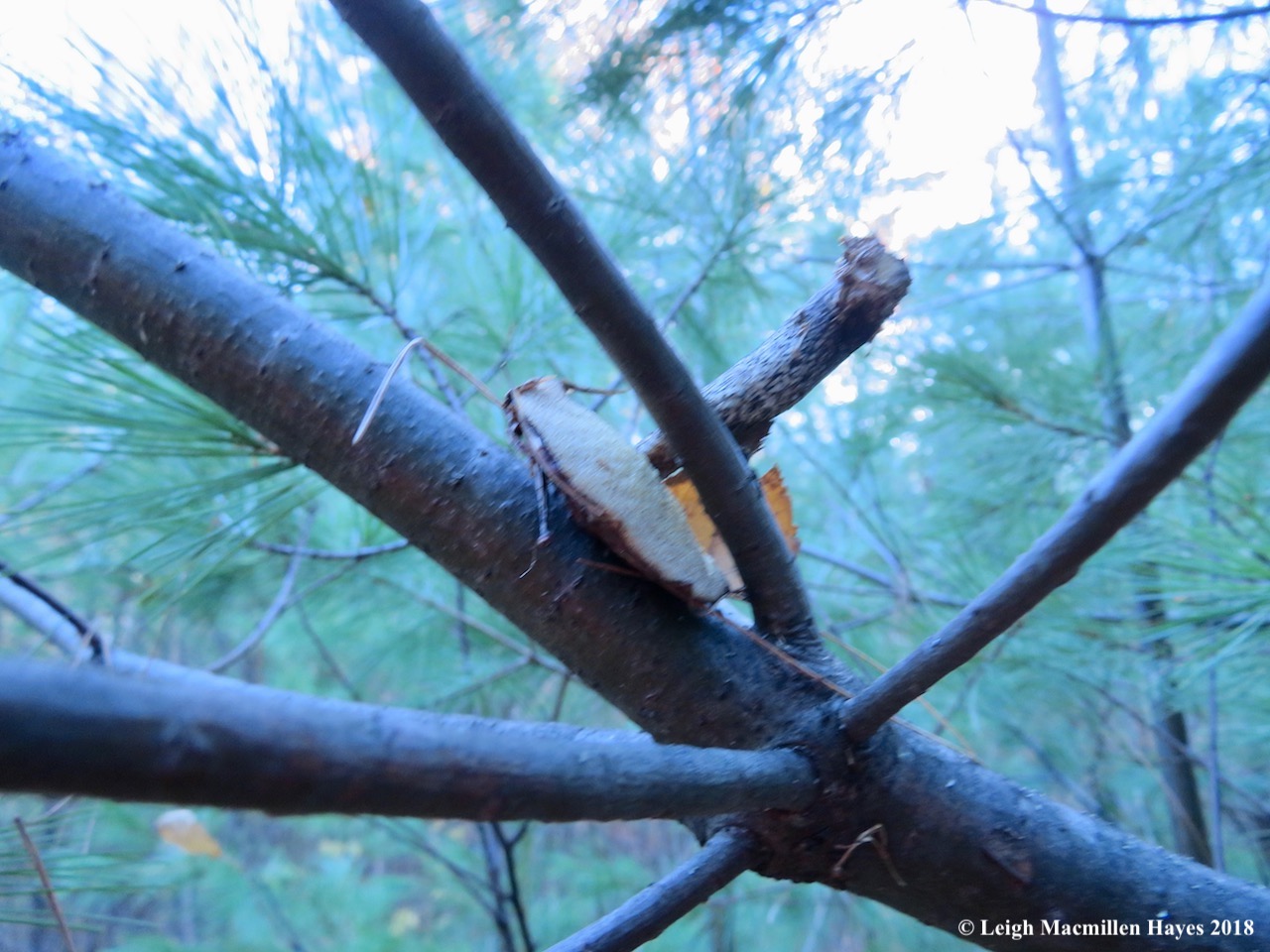
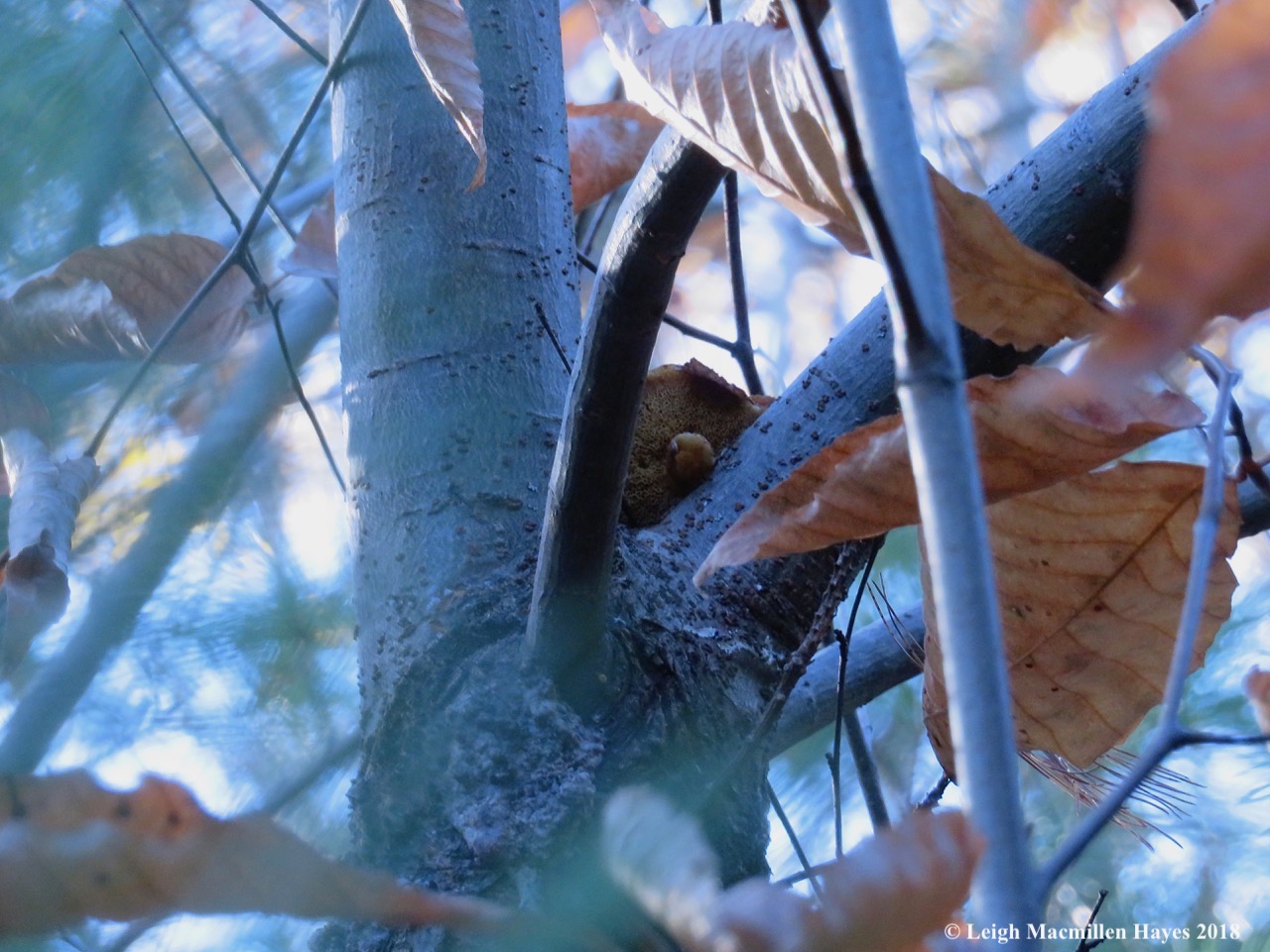
And then a third, and so it went. We knew that squirrels dried mushrooms in this manner, but never had we seen so many. It dawned on us that we were standing in a squirrel’s pantry. One squirrel? Two squirrel? Gray Squirrel? Red Squirrel? One Fish, Two Fish, Red Fish, Blue Fish.
7

For a while we paused by an erratic boulder and looked at the lichens that grew atop it. The kids and their mom also checked the sand under and behind it and I told them that the only critter sign I’d ever noticed was that of a Ruffed Grouse sand bath–and I only recognized it as such because I’d startled the two birds and they startled me as they flew off. In fact, on another hike this morning at the GLLT’s Five Kezar Ponds Reserve, friend Teresa and I had startled a grouse and we talked about how the bird’s explosive behavior makes us feel as if we’ve encountered a moose.

Well, just beyond the boulder, as we all chatted and moved about with quick motion, Caleb spotted something and told us to stop. A Ruffed Grouse!

8

It threw leaves about as it sorted through them in search of seeds and buds and we all watched in silence.

9

As we stood or sat still, the bird moved this way and that, making soft clucking sounds the entire time.

10

Ellie stood in front as the bird moved a few feet ahead of her and crossed the trail. I kept looking back at Juli in wonder. How could this be? Why wasn’t it disturbed by us? I’ve spotted Spruce Grouse in higher elevations and they are much “friendlier” or less wary of people, but I’d never been able to get up close to a Ruffed Grouse.

11

Our fascination continued and we noted its feathered legs, making us think perhaps it had pulled on some long johns for a cold winter night.

12

It eyed us and we eyed it back–our minds filled with awe.

13

Think about this: four children and two adults and we were starting to get fidgety because we’d been still for fifteen or more minutes and we had begun to whisper our questions and still . . . it let us watch.

14

And it let Ellie be the Grouse Whisperer for she began to follow it off the trail. Eventually, it climbed up a fallen tree and she knelt down beside, taking photos as it stood less than a foot from her. How cool is that?

15

We were all wowed by the experience, but when Ellie finally turned back, we continued on . . . sometimes running and other times pausing to ride imaginary horses.

16

Or listen to Birch Polypores! Yes, Juli did listen for it’s part of an assignment for the Maine Master Naturalist class. So what exactly does a Birch Polypore sound like? “I couldn’t hear the ocean,” she said with a smile.

17

And what does it smell like? “Wood.”

18

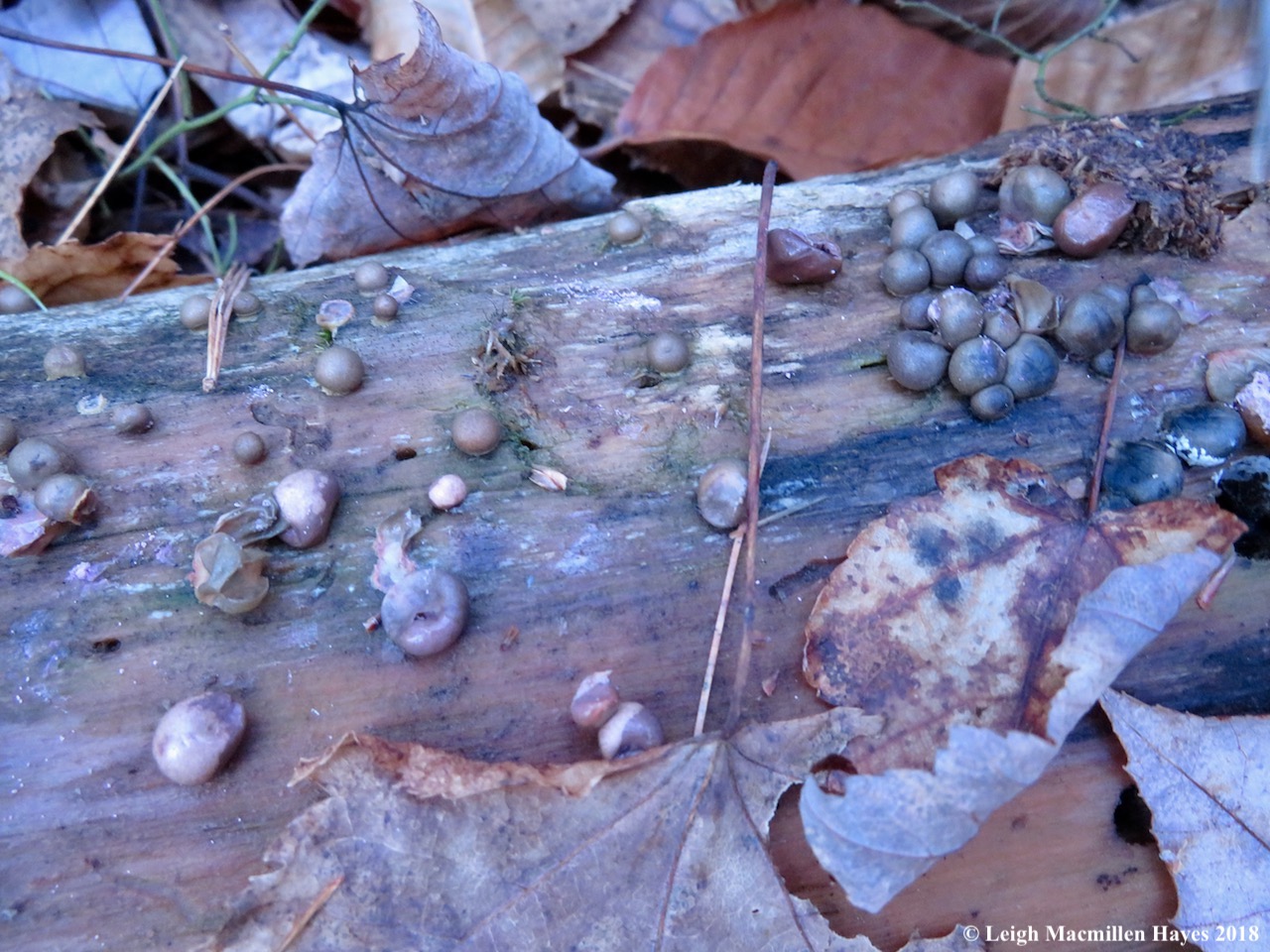
The next moment of glee–poking Wolf’s Milk Slime Mold and watching it ooze.

19

“It’s cool and gross at the same time,” said Ellie.

20

Onward and again, more fungi drying in trees as Aidan pointed out.

22

We even found a few stuck on spiky spruces much like ornaments might be and we reminded ourselves that we were on a mission and still hadn’t found the right tree to decorate.

23

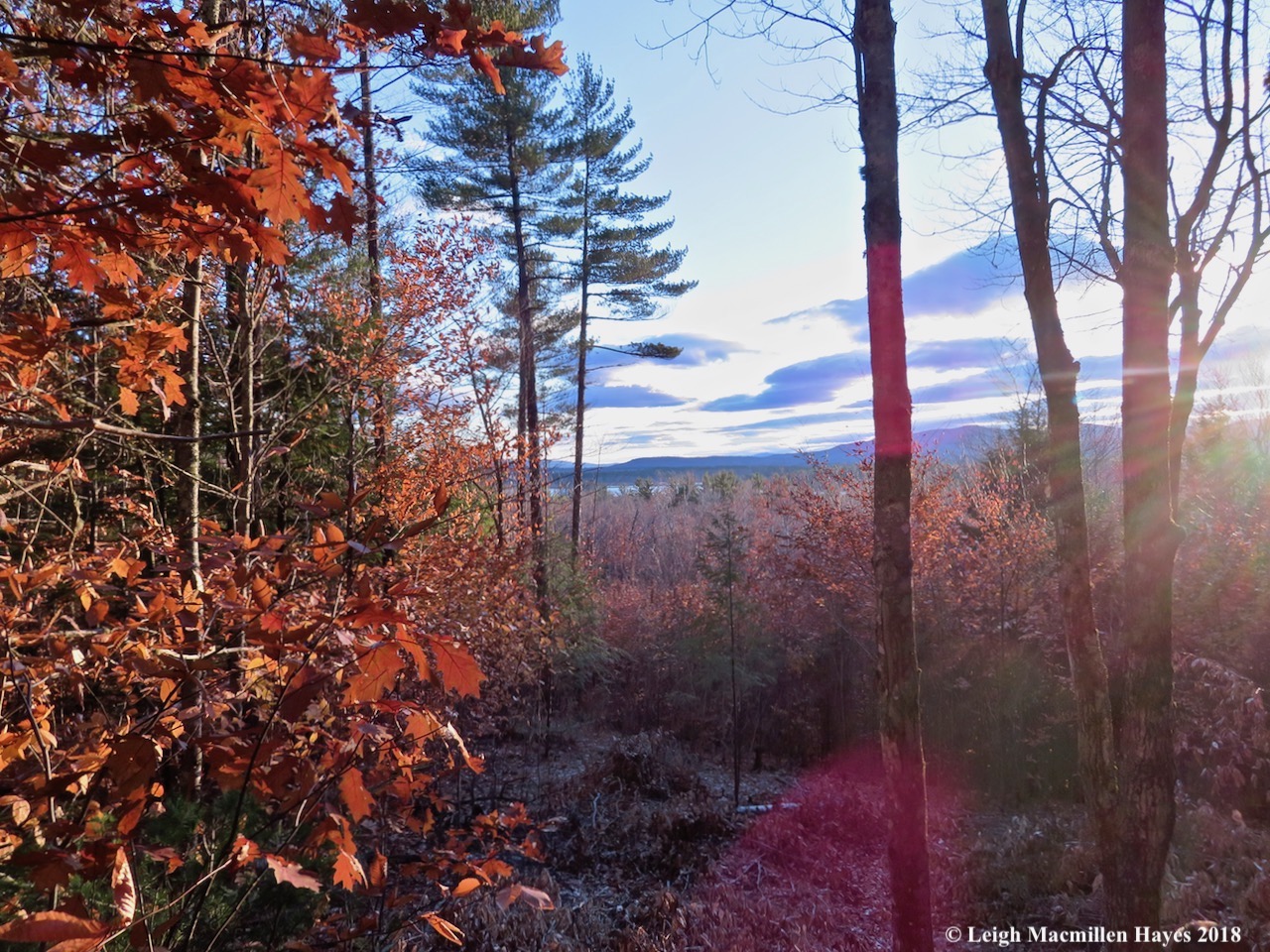
At last, however, we did. And then we made our way out to the spur and recently opened view of Kezar Lake’s Lower Bay and Cranberry Fen, plus the mountains.

24

This became our turn-around point as it was getting cooler by the minute and the sun was setting. We promised Wes we’d look only at our feet as we followed the loop trail down, though occasionally we stopped again to admire more fungi tucked onto tree branches and a set of trees that formed a rainbow arched over the trail.

As for the fungi, we wondered if we were seeing so many because last year’s mast crop of pinecones, beech nuts, and acorns didn’t exist this year. And when the 4-H club returns in a couple of weeks to decorate the tree, will the mushrooms still be there? Will there be more? How long do the squirrels wait before consuming them? So many questions and so many lessons still to be learned.

25

And so many things to spy. We were honored with the opportunity to do just that and my heart smiled with the knowledge that the kids appreciated it as much as their mom and I did.
I spy . . . we spied . . . INDEED!

Oh, and  please join the GLLT for Christmas at Ladies Delight. I have the inside word that there will be hot cocoa and cookies somewhere along the trail.

December 1, 9:30 – noon
Christmas at Ladies Delight: The Maine Christmas Tree Hunt is a fun holiday scavenger
hunt to find decorated trees in western Maine. We’ll search for the decorated tree along the Bill Sayles Loop at the Chip Stockford Reserve and may add a few of our own biodegradable ornaments along the way. Location: Chip Stockford Reserve, Ladies Delight Road, Lovell.
Degree of Difficulty: Easy.

To Pause and Focus

I had no idea what to expect of today’s tramp with two friends as I didn’t even know prior to this afternoon that the trail we would walk even existed. And so I pulled in to the parking area at the end of Meetinghouse Road in Conway, New Hampshire, sure that we’d only be able to walk down to the Saco River about a hundred feet away and that would be the extent of our adventure.

1-Conway Rec Path

But . . .  much to my pleasant surprise I was wrong and in the northeastern corner of the parking lot we crossed a bridge into the unexpected setting.

2-Saco River framed

For the entire journey, we walked above and beside the Saco River. And our minds were awed by the frames through which we viewed the flowing water and boulders.

3-clear view of the Saco River

Occasionally, our view was clear and colorful, the colors now more pastel than a week ago.

5-witch hazel, understory

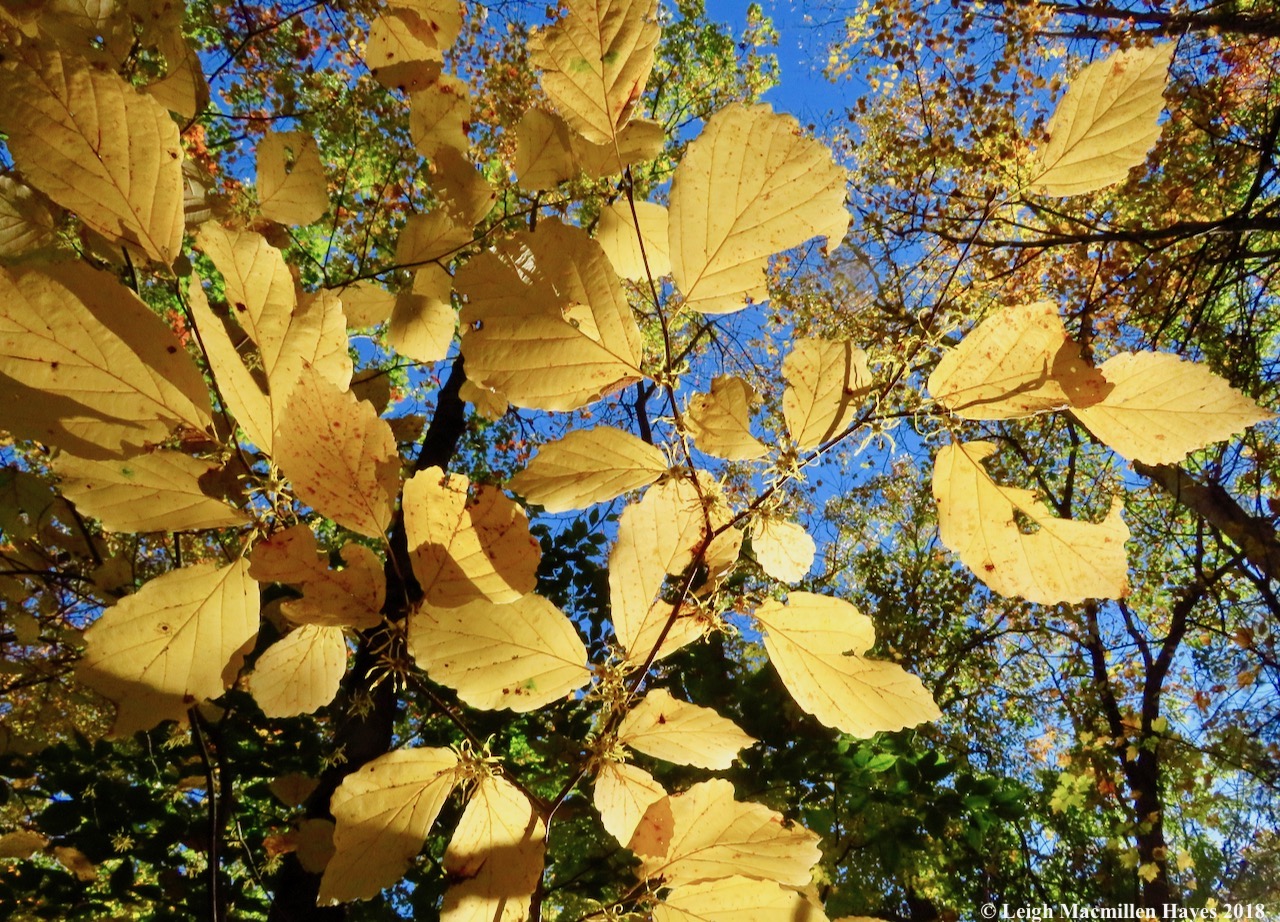
Even as the colors have begun to wane and leaves fall, we looked up from our spot below the under and upper stories and sighed.

4-Witch Hazel

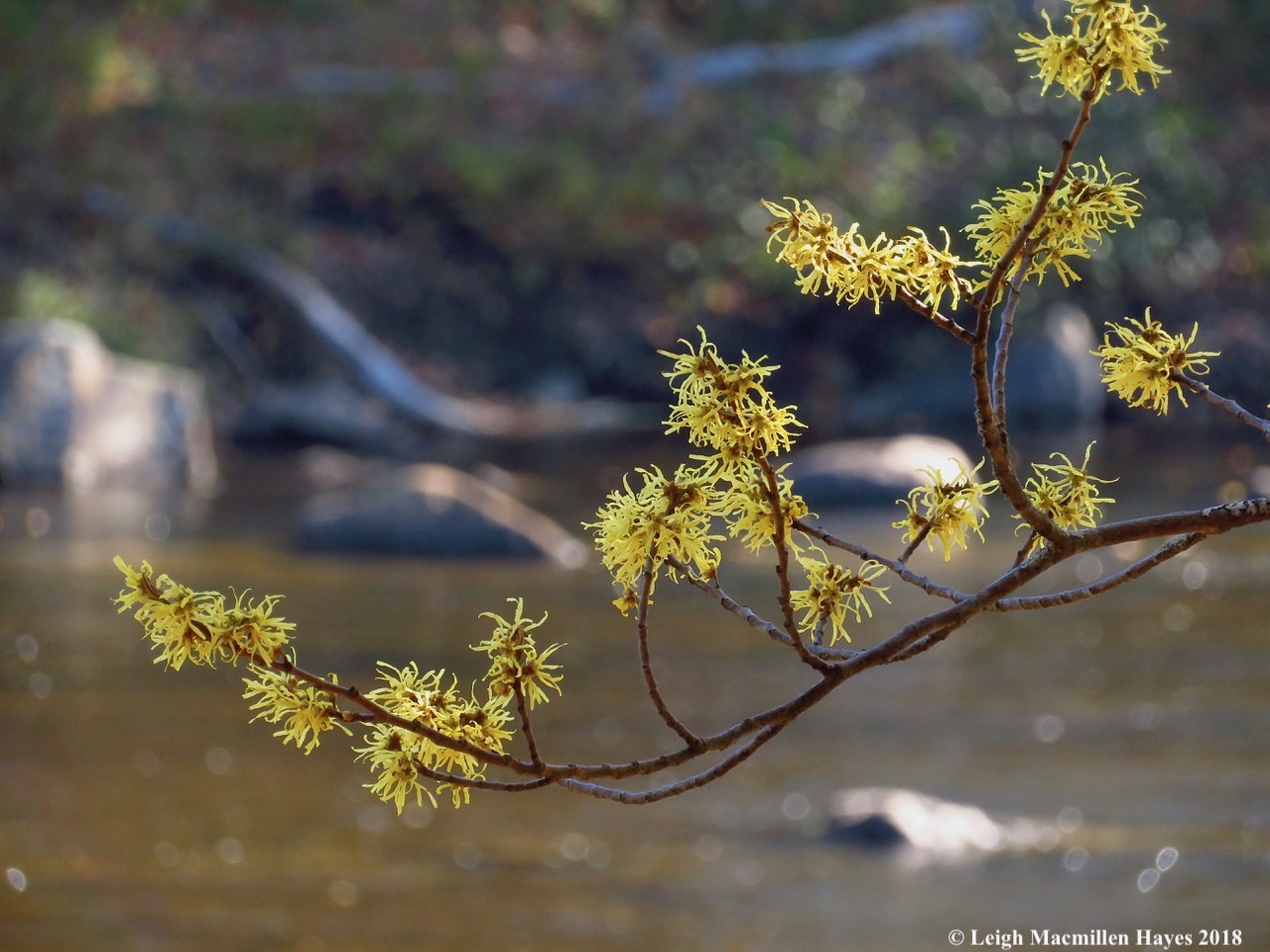
For much of the time, we were wowed by the Witch Hazel’s flowers–for so thick were they on many a twig.

4a-witch hazel flowers

In fact, if one didn’t pause to notice, you might think that each flower featured a bunch of ribbons, but really, four was the count over and over again.

4b-witch hazel flowers, leaf:bundle scars

And some were much more crinkly than others. One of my other favorites about this shot is the scar left behind by a recently dropped leaf. Do you see the dark smile at the base of the woody yet hairy flower petiole? And the dots within that represented the bundles where water and nutrients passed between leaf and woody structure?

6-spotted wintergreen

And then one among us who is known for her eagle eyes spied a Spotted Wintergreen, Chimaphila maculata, a name that has always made us wonder for its dark green leathery leaves seem far more stripped than spotted. It’s one of those plants with a bunch of common names and so we should try another one on: spotted wintergreen; striped prince’s pine; striped wintergreen; striped pipsissewa; spotted pipissewa; and pipissewa. But perhaps the fact that it’s striped and referred to as spotted helps me to remember its name each time we meet. A sign of how my brain works.

7-spotted wintergreen patch

While we know it to be rare and endangered in Maine, it grew abundantly under the pines on the slight slope beside the river in New Hampshire, and we rejoiced.

8-spotted wintergreen capsules

Its newer capsules were green, but a few of last year’s woody structures also graced the forest floor. Reseeding helps the plant propagate, but it also spreads through its rhizomes.

9-maple-leaf viburnum

Everywhere we looked there was a different sight to focus our lenses and we took photo upon photo of the variations in color of some like Mapleleaf Viburnum (Viburnum acerifolium), a shrub with three-lobed maple-like leaves and small white flowers in the spring that form blue fruits in the early fall and had been consumed, only their stems left to tell the story.

10-red maple leaves

Red Maple (Acer rubrum) leaning over the river offered their own hues that bespoke autumn.

16-platter sized mushrooms

And tucked into a fungi bowl, we found the yellow form of Sugar Maples (Acer saccharum). 

11-Saco River with Moat Mountains in background

Onward we continued with the river to our left, outlined with maples and evergreens, and backdropped by the Moat Mountains.

12-small pond stained glass window

And to our right, a small pond where trees in the foreground helped create a stained glass effect filled with autumn’s display.

13-reflection

And once again, in the pond’s quiet waters reflections filled our souls.

14-turn around trespass

A wee bit further, we trespassed onto private land, and decided to make that our turn-around point as we got our bearings via GPS.

15-trail

Backtracking was as enjoyable as our forward motion. We had been on a trail called the Conway Rec Path, part of the Mount Washington Valley Rec Path, intended for walking, running, biking, snowshoeing, cross-country skiing, bird watching, wildflower viewing , tree study, plus river and mountain views. Kennett High School athletes ran past us and we encountered couples out for exercise. None took their time as we did, but that’s our way and occasionally we ventured off trail because something caught our eye.

9-rock carvings match the waves

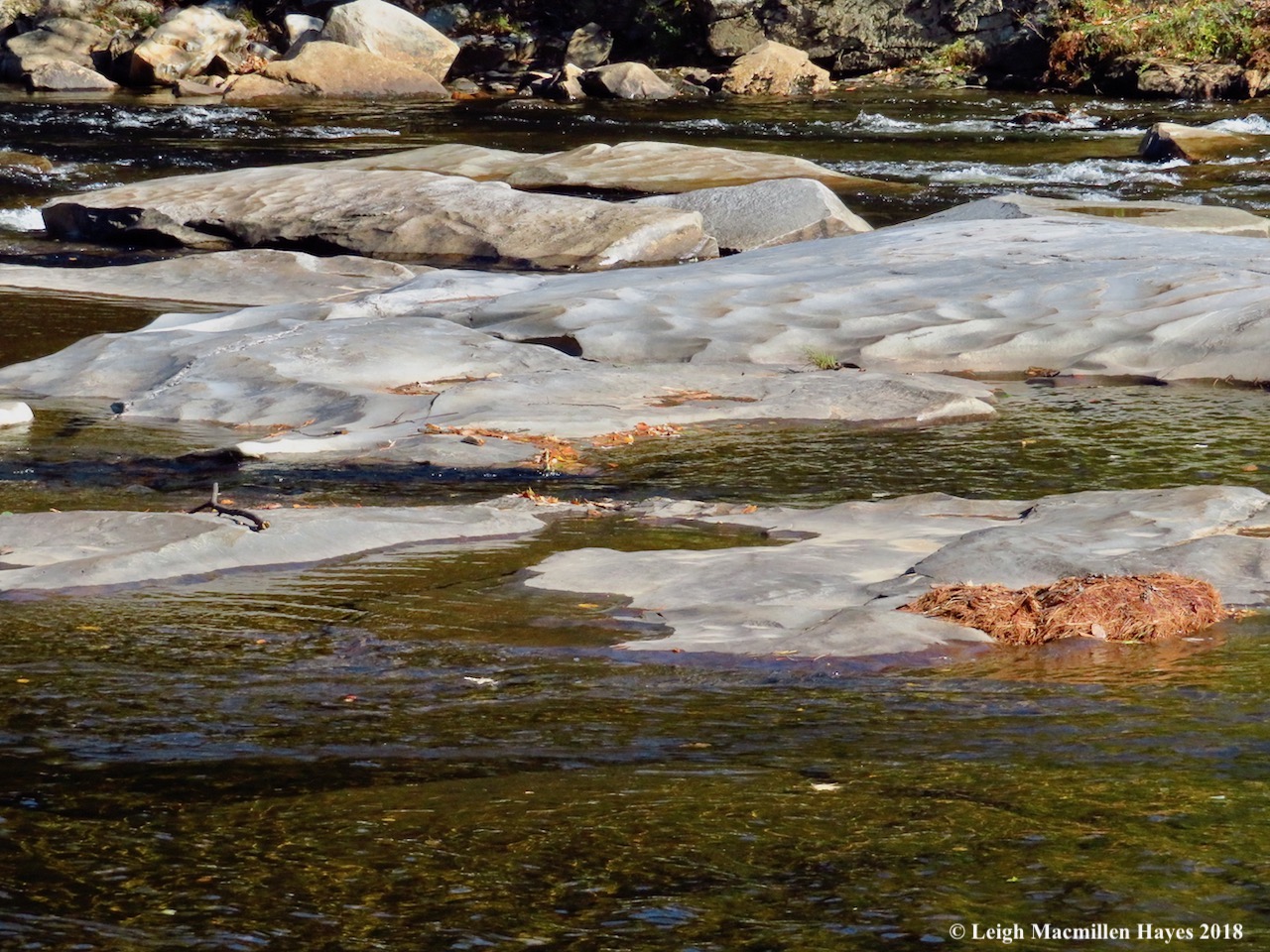
Meanwhile, the river continued to flow, as it has for almost ever, and the water continued to carve patterns yet to be seen, but we enjoyed those that reflected its action.

17-old silver maple

Back at the parking lot, we were wowed by a Silver Maple (Acer saccharinum), its girth suggesting an age older than a century.

18-silver maple buds

As had been the case all along the way, we experienced another wow moment when we realized how developed were the flower and leaf buds already. We know they form in the summer, but . . . they looked ready to pop!

19-white-throated sparrow

As we stood and admired, a flock of Juncos and White-throated Sparrows flew from one spot to the next as they sought seeds on the ground. Occasionally, the sparrows paused for a moment.

20-2 white-throated sparrows

And then moved on again.

21-Eagle over Moose Pond

At last it was time for us to move on as well and head for home, my friends’ to their mountainside abode in New Hampshire and me to my humble house on the other side of the Moose Pond Causeway. But as I always do when making the crossing, I looked up.

22-immature Bald Eagle

And was honored by a sighting that pulled me out of my truck. The immature Bald Eagle I’d watched and listened to all summer graced me with another opportunity to view it.

One scene after another, it was a delightful autumn afternoon. Thanks P&B, for the sharing a new trail with me and providing many moments to pause and focus.

The Gathering

I can’t remember when our yearly ritual began but it has become tradition for three college friends and me to meet somewhere for a fall weekend. And so this year found us staying at a borrowed house in York, Maine. I was late to the gathering but we spent last night catching up as we surrounded the kitchen island. It seems like a table or island is always the spot where we spend most of our time each year while we tell new stories and recall old ones.

1-duck pond

This morning found us dining at a local restaurant. Years ago, I’d spent many an hour in York, either eating at Rick’s, combing the beaches, or standing beside a duck pond. And after this morning’s breakfast, voila–the duck pond. I’m not sure it was the one I remembered for so much had changed in town since I’d last looked for it, but still . . . it was a pond . . . with ducks.

2-fall mallards

Dabbling Mallards to be exact, their iridescent colors as brilliant as the fall foliage.

3-Long Sands Beach

Our next stop was the beach–Long Sands Beach that is. With the tide rolling out, we were able to stroll along most of its mile and a half length.

5-herring gull-shadow and reflection

Our sights included a Herring Gull in triplicate, with both its shadow and reflection cast on the watery surface.

9-ripples in the sand

Equally impressive were the ripples in the sand that matched the water that had once flowed over it,

11-patterns

and those in a small stream bed (which we chose not to cross).

10-snail trails

Our sense of wonder was again aroused when we saw a message in the sand and realized it was not someone writing in script, but rather the trail of a snail.

8-half dollar

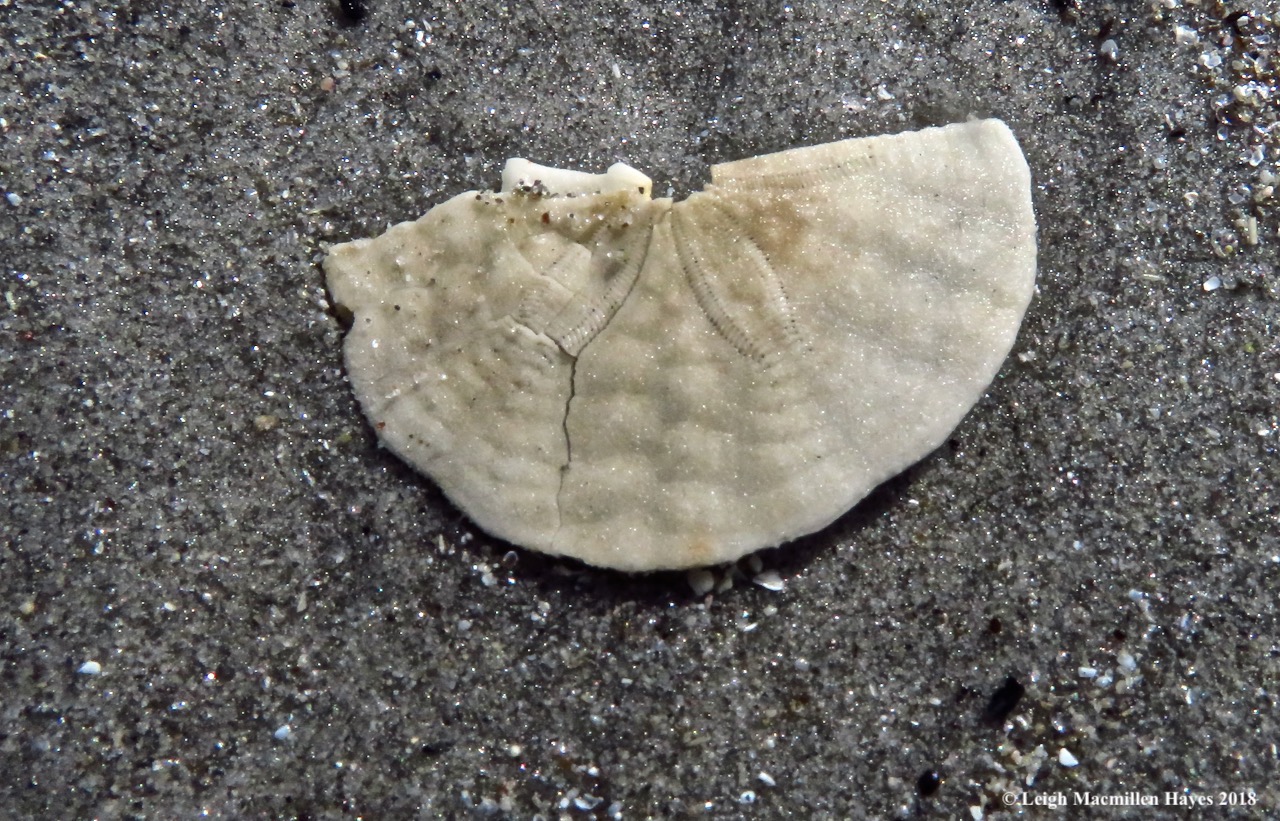
We also found a few broken sand dollars, the fifty cent piece being the largest.

6-three old friends

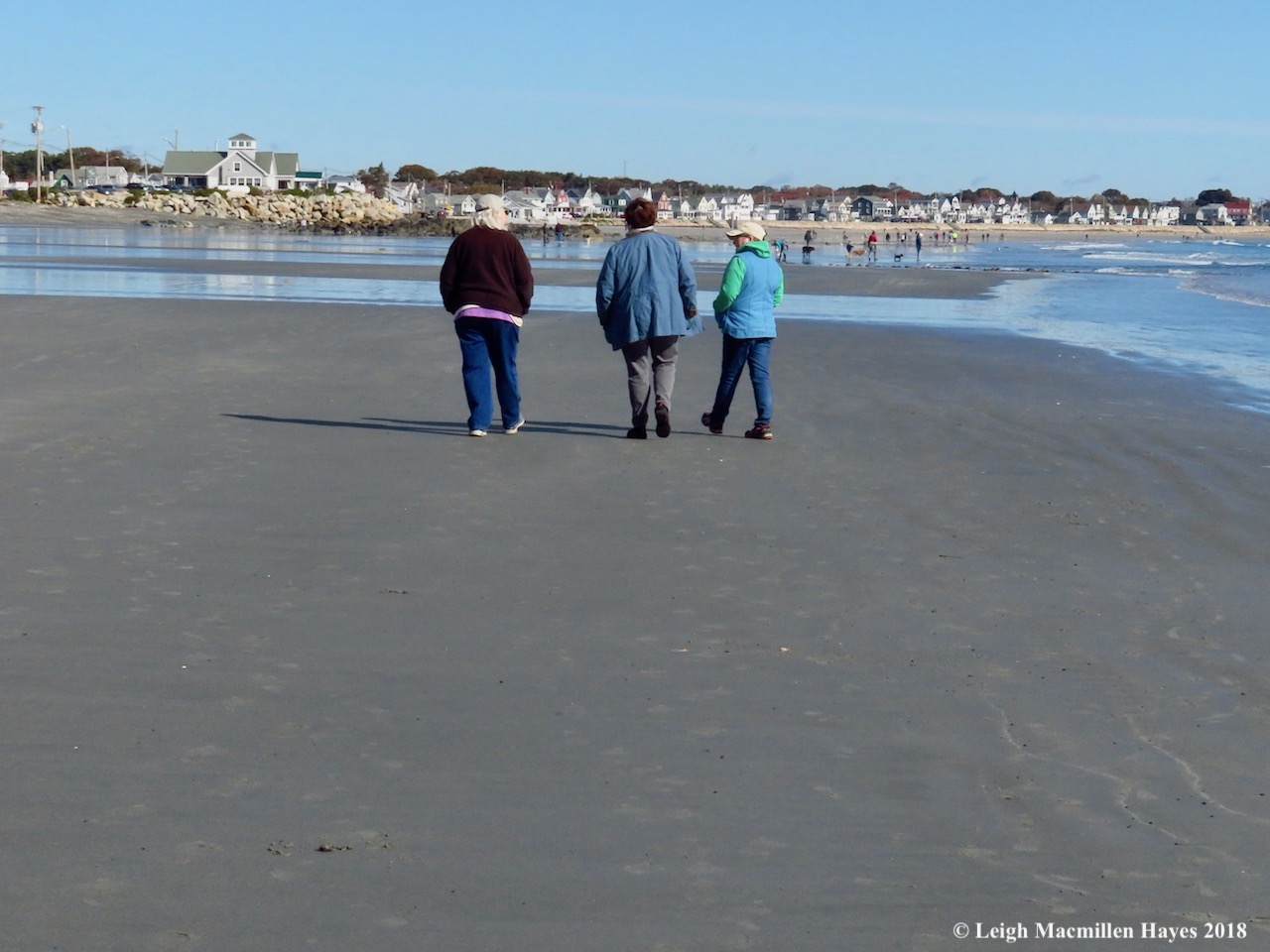
We walked and chatted and walked and chatted some more until our time together came to an end. Once more we gathered round the kitchen counter, then shared a group hug and said our goodbyes.

12-until we meet again

But we each left knowing that when the time comes to meet again, we’ll follow the signs and pick up where we left off.

13-Nubble Light

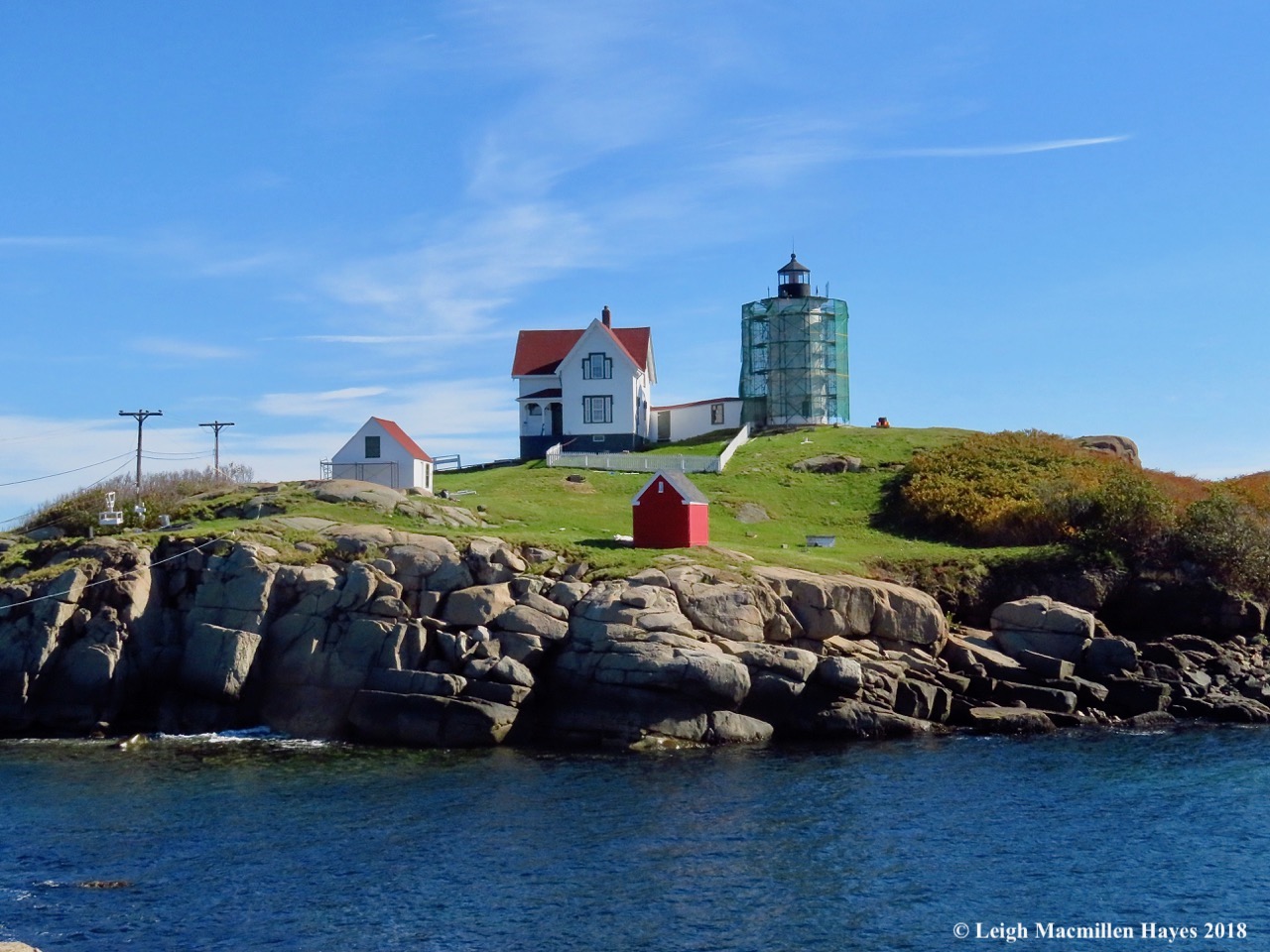
As I turned north out of the lane, I wasn’t quite ready to hop onto the highway and find my way home, so I detoured. My first stop was a Nubble Lighthouse, where “in 1874 President Rutherford B. Hayes appropriated money to build a lighthouse on this “Nub” of land.” All these years later, it’s getting a much needed facelift.

14-Barrier Beach Trail

A wee bit further up the road, I pulled into Wells Reserve at Laudholm , a 2,250-acre estuarine zone. Trails loop about the property and I followed a few.

15-bumblebee pollination

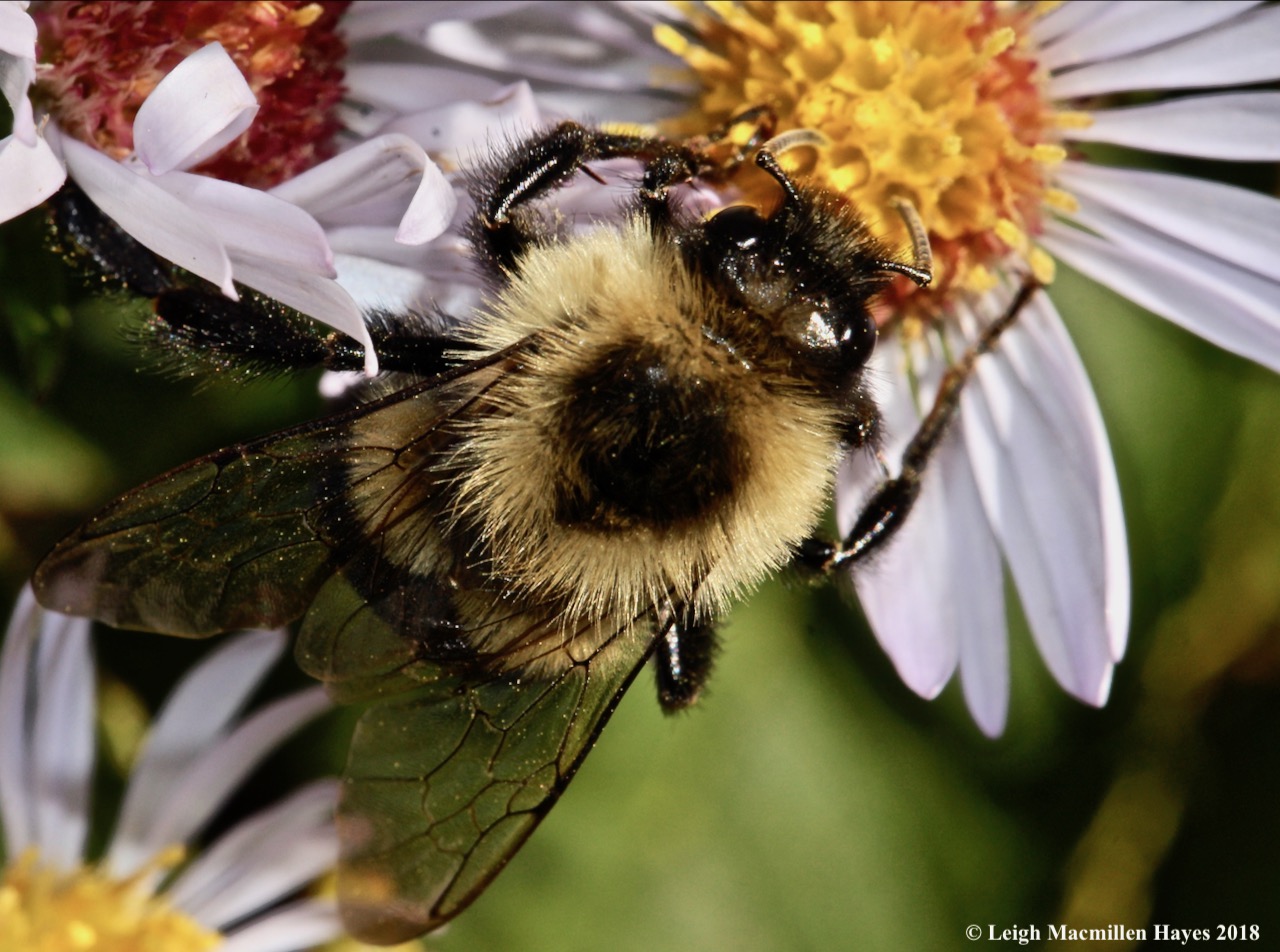
Beside the estuary, bees aplenty buzzed about some late asters in the warmth of the sunshine.

16-yellow rump hiding

And closer to the ocean, Yellow-rumped Warblers flew and landed among the shrubs.

17-beach rose

As I walked across a boardwalk toward the beach, a few beach roses showed off their brilliant blooms.

18-Drake's Island Beach

At last I reached Drake’s Island Beach on the Atlantic Ocean, one of my old haunts on daytrips long ago.

19-more squiggles in the sand

And there, another squiggly message in the sand, longer than the first but about half as wide in trail straddle (just getting back into my winter tracking frame of mind and terminology.)

21-Rachel Carson Wildlife Reserve

On my return, I looped around on the Laird-Norton Trail, where a well-built boardwalk was decorated with so many shades of red speaking to the Acer rubra Maples that arched above.

23-garter snake

In one sunny spot, a garter snake sunned and I tried to warn a woman who was walking toward me, but she didn’t hear and the startled snake practically jumped off the boardwalk. The woman almost did as well!

24-apple tree

Snakes and apples and I began to wonder if I was in the Garden of Eden. But really, I wondered if a squirrel had wedged the apple into the nook of the tree to dry. I’ve seen the same with mushrooms and just last week watched a red squirrel snatch a dried mushroom in a movement so quick that it will remain in my mind’s eye only.

20-drone fly, looks like a European honey bee

Certainly, the bees and flies, such as this hover fly, were taking advantage of the nutrition offered at the reserve. Temperatures are forecast to dip this week, so I’ll be curious to see how long the flowers and pollinators last.

25-estuary

My final stop of the day was to walk a trail that connects to the reserve. The Carson Trail is named for Rachel Carson. The Rachel Carson National Wildlife Refuge was created in 1966 to protect valuable salt marshes and estuaries for migrating birds. My views today included heron, an egret, and a sandpiper.

27-selfie

Finally it was time to head for the hills. But like the ducks and pollinators and birds that foraged for nourishment, I was grateful for the opportunity once again to gather with friends and be sustained by each other’s company.  We’d pose for our traditional selfie before heading off in individual directions to our everyday lives in Massachusetts, New Hampshire, Maine,  and Vermont. Thanks Pammie, Bev, and Becky, and a special thanks to Lynn and Tim for letting us make ourselves at home in their York place.

Until we meet again . . .


Yo, Brooklyn!

Past visits to New York City have always included museums and shows, but this weekend we followed a bit of the familiar path and sometimes took the trail less touristy in an attempt to get to know the area better.

2-Manhattan in the fog

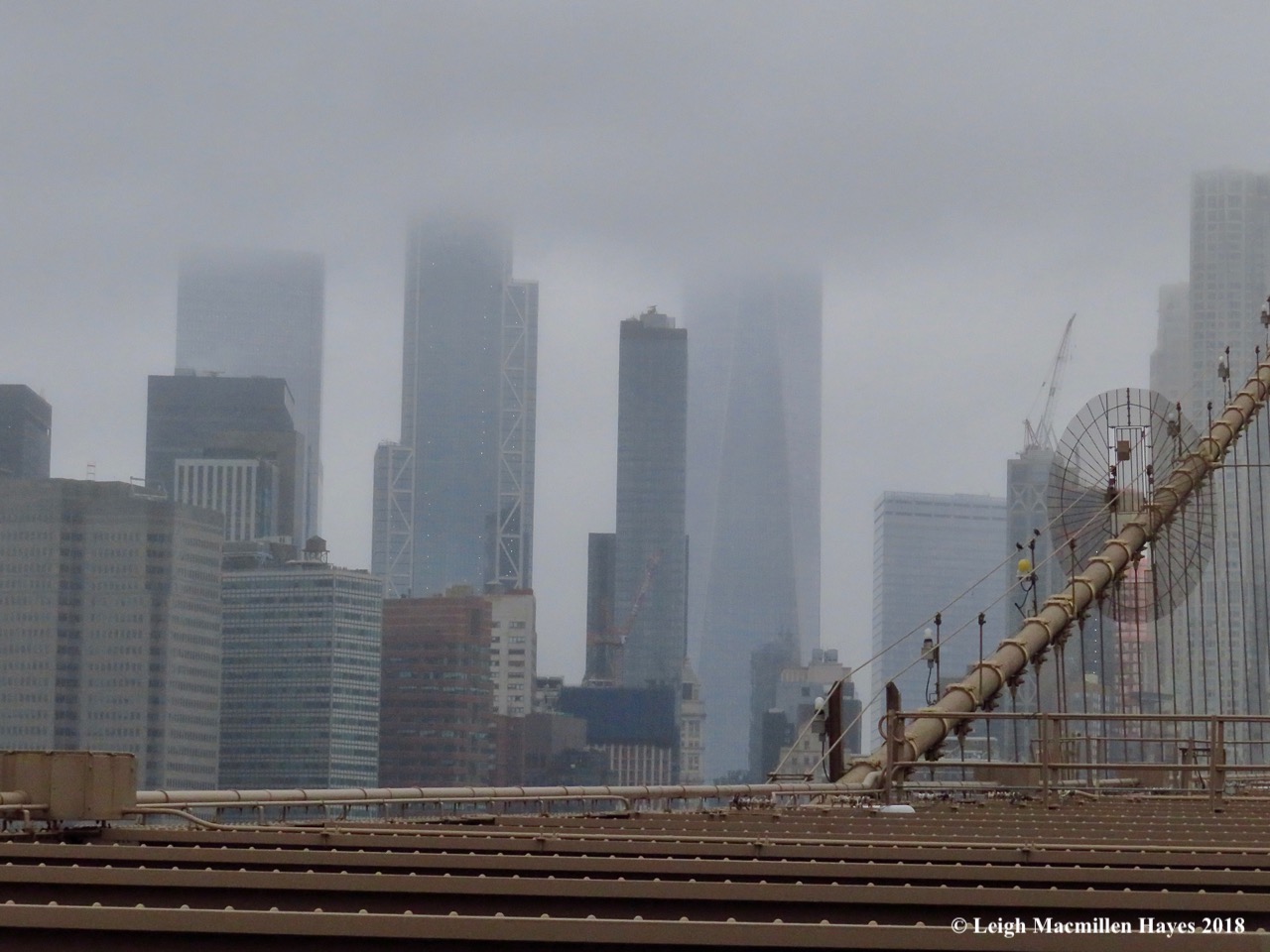
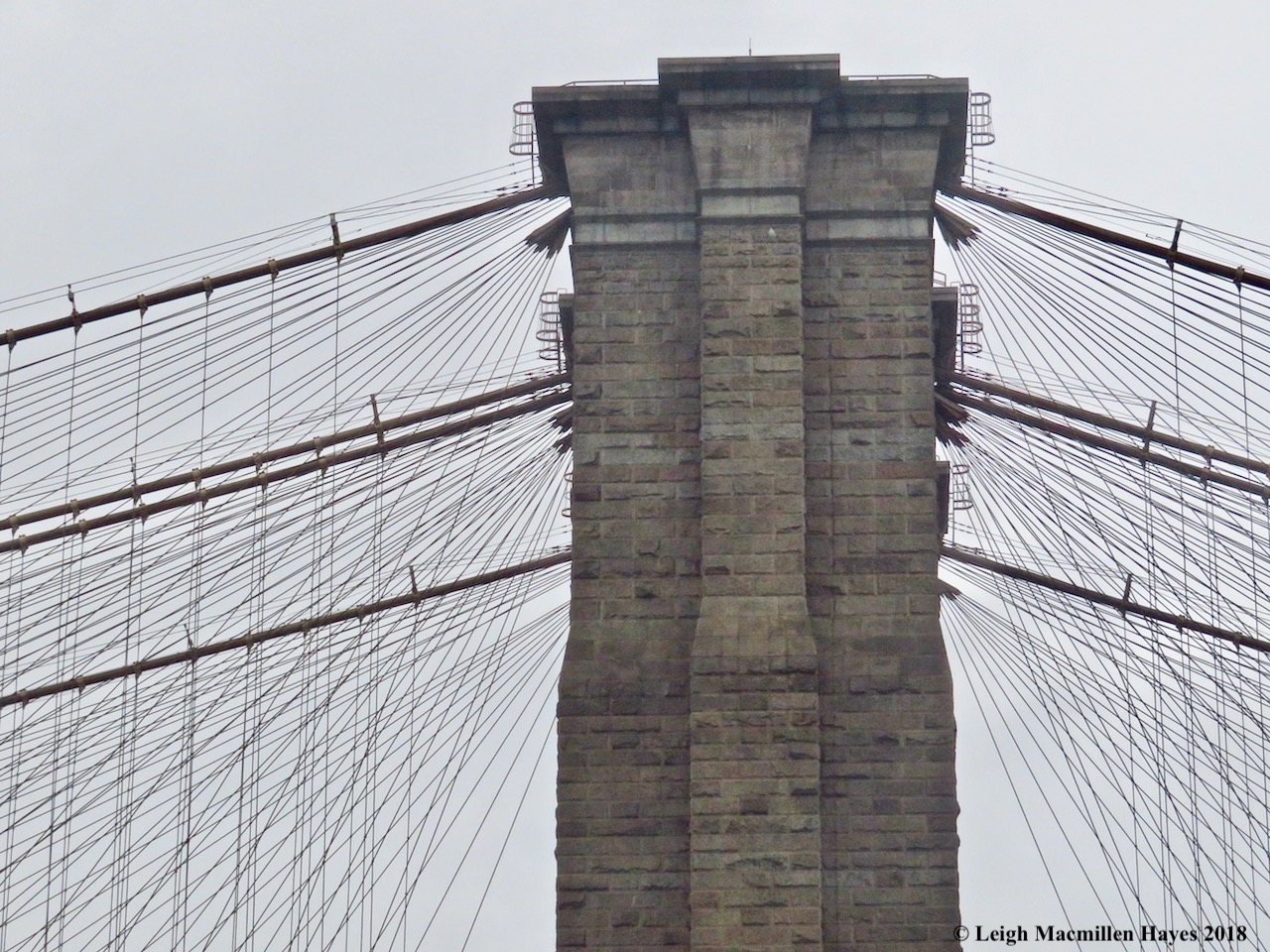
Saturday afternoon, following our arrival via a bus from Worcester, Mass., we walked across the Brooklyn Bridge to Manhattan, which was a bit veiled in fog, thus softening  ordinarily crisp lines.

1-Brooklyn Bridge

Begun in 1869 and completed by 1883, the bridge spans the East River and connects the boroughs of Brooklyn and Manhattan.

3-bridge like a spider's web

Among the throngs of people who walked or rode bicycles across, we all wove strands of thread that fit easily into the web long ago created. Some of us paused suddenly here and there, as the arachnid tried to take hold, while others tried to maneuver along the silken dragline writing messages with their feet much the way Charlotte may have within her web.

6-wildlife on the bridge

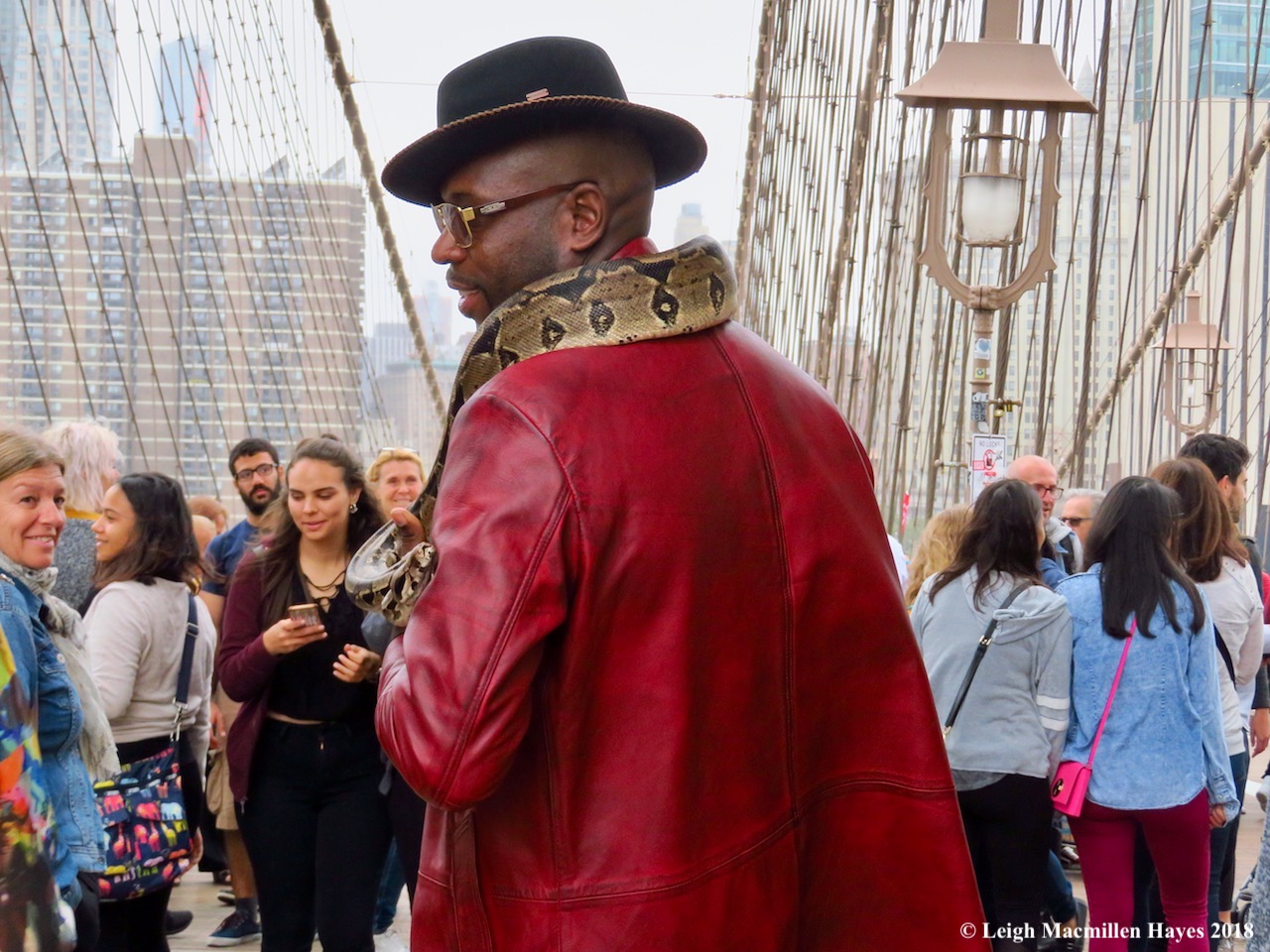
And a few got caught up by the constrictors waiting at the center.

7-onto the streets of Manhattan

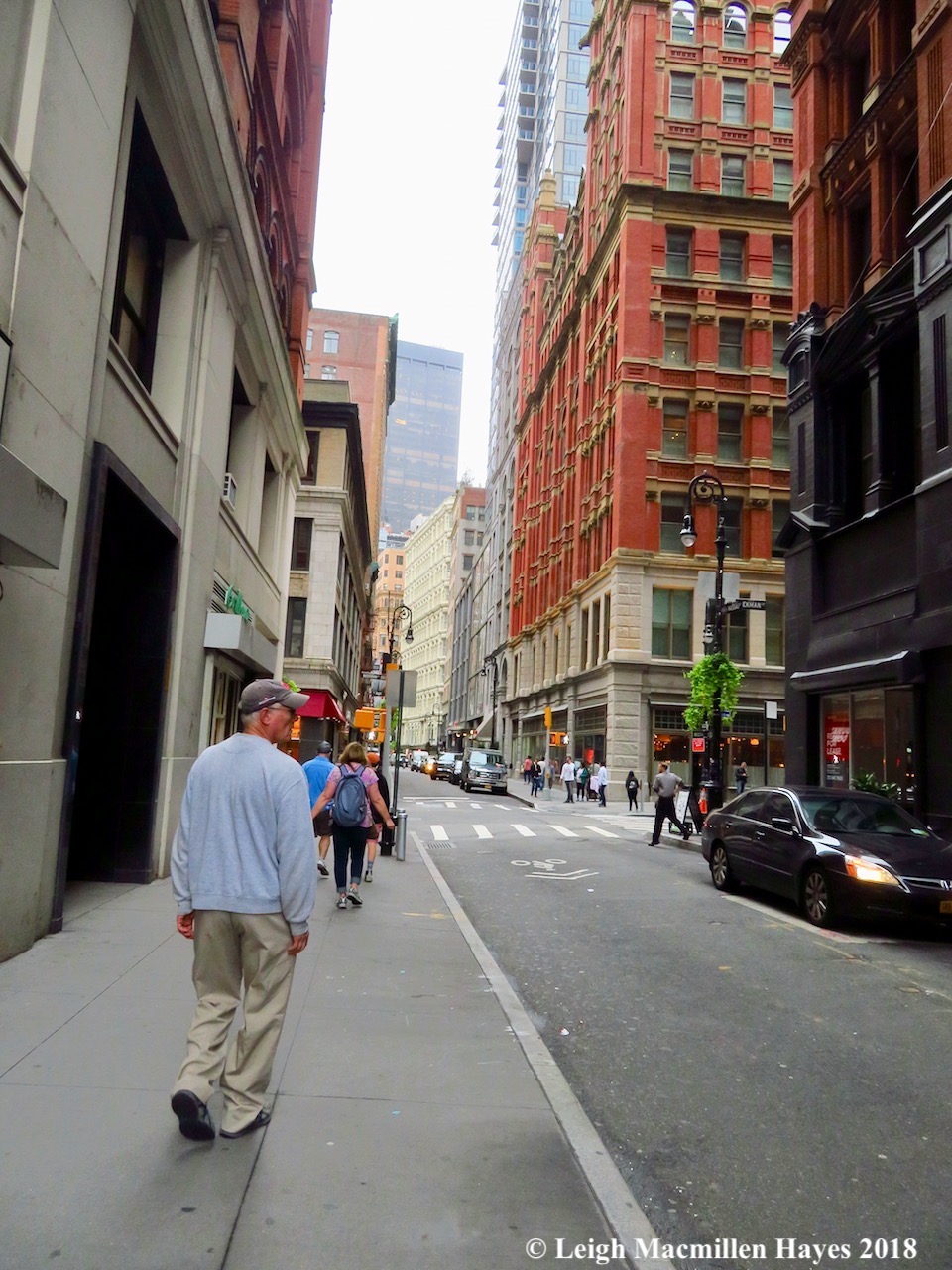
At last we emerged on the other side, where our attention was diverted by the architecture and colors.

8-New York Stock Exchange

Often, it was the interaction of today and yesterday that drew our notice, joined together as they were with a global reference.

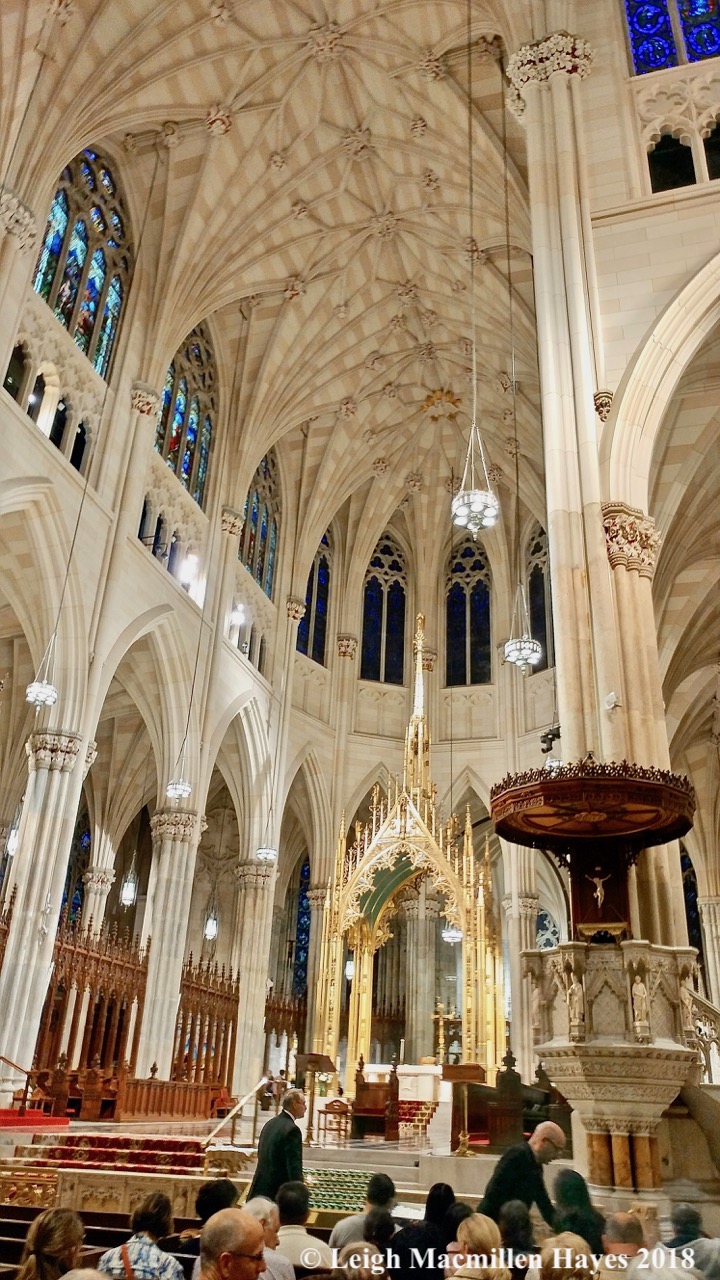
9a-entrance door to St. Patrick's

Eventually, we passed through the doorway of St. Patrick’s Cathedral . . .

9-St. Patrick's Cathedral

where many have gathered for centuries to light candles in memoriam of those who have passed from this layer of life to the next and prayed for the future.

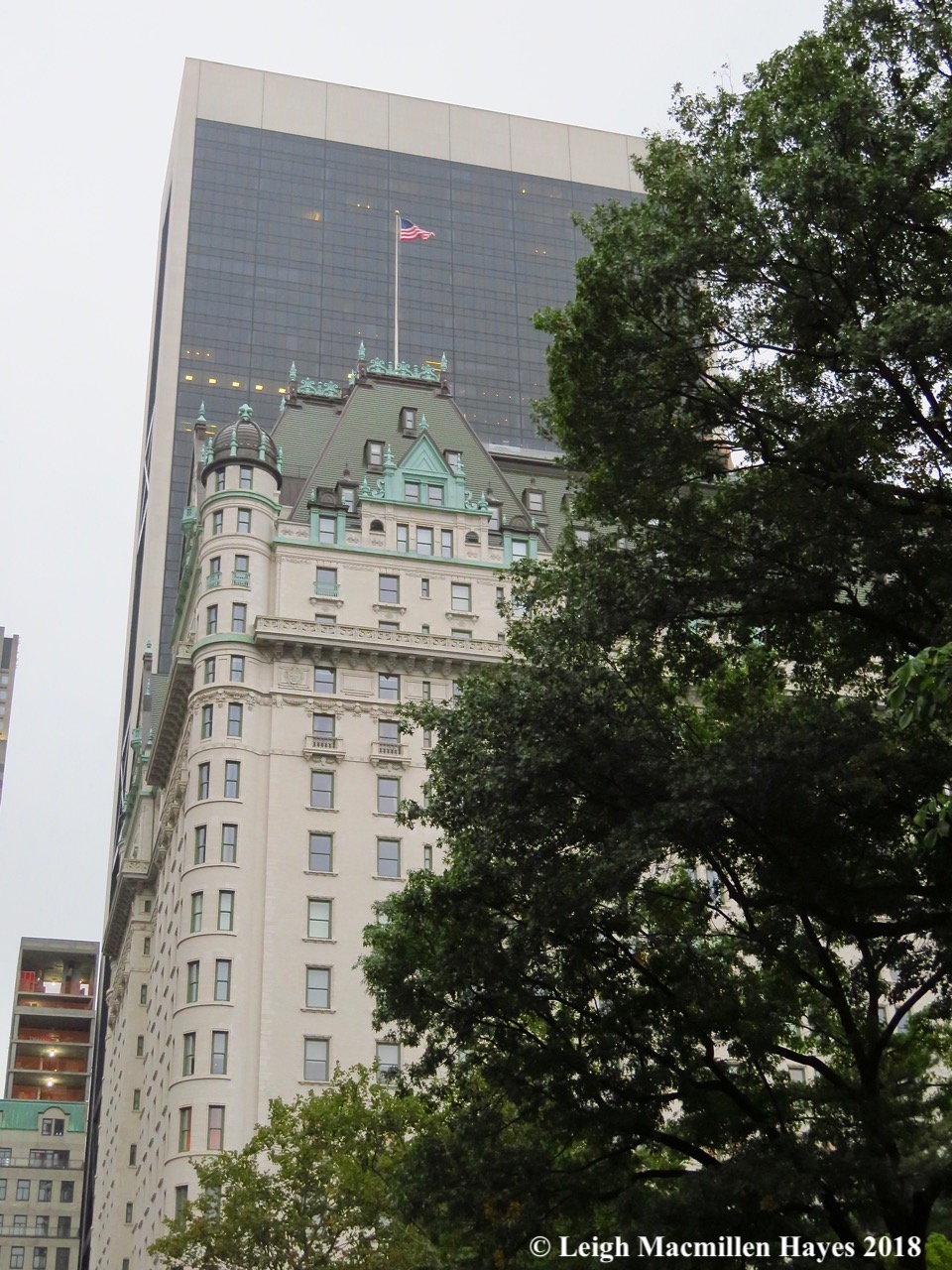
11-view from Central Park

And then we slipped into Central Park, where we were again struck by the architecture, especially as juxtaposed against the artificially landscaped natural world.

13-goldfish

As we watched the Mallards and Canada Geese, one of our biggest moments of awe was for a goldfish–the largest we’d ever seen.

Eventually, we boarded a train and found our way back to Brooklyn, where a quiet evening awaited.

14-the bridges from below

Sunday morning found us passing below the Brooklyn Bridge, where we could glimpse  the more “modern” Manhattan Bridge in the distance.

15-skyline from the promenade

Again, the skyline was muffled, but its edges softened.

16-spider web again

And once more we looked with wonder at the web construction.

17-river boat NYC style

Ever so slowly, we moved away even as a paddlewheeler representing the south made its way north.

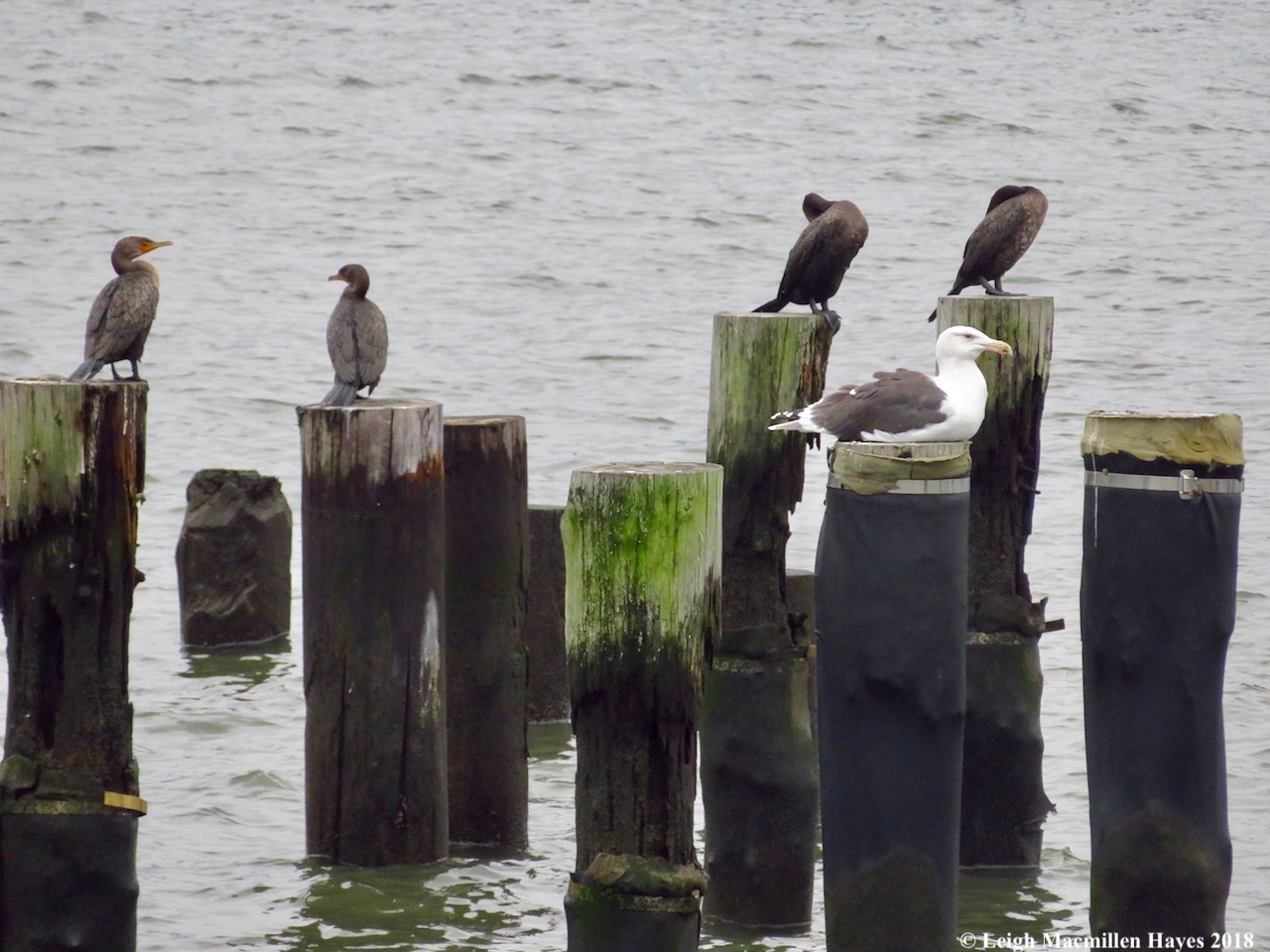
18-cormorants and gull

Despite our thrill at watching water taxis, tour boats, jet skis, sailboats, powerboats, and even a police boat move up and down the river, the local Cormorants and a Herring Gull took it all in stride.

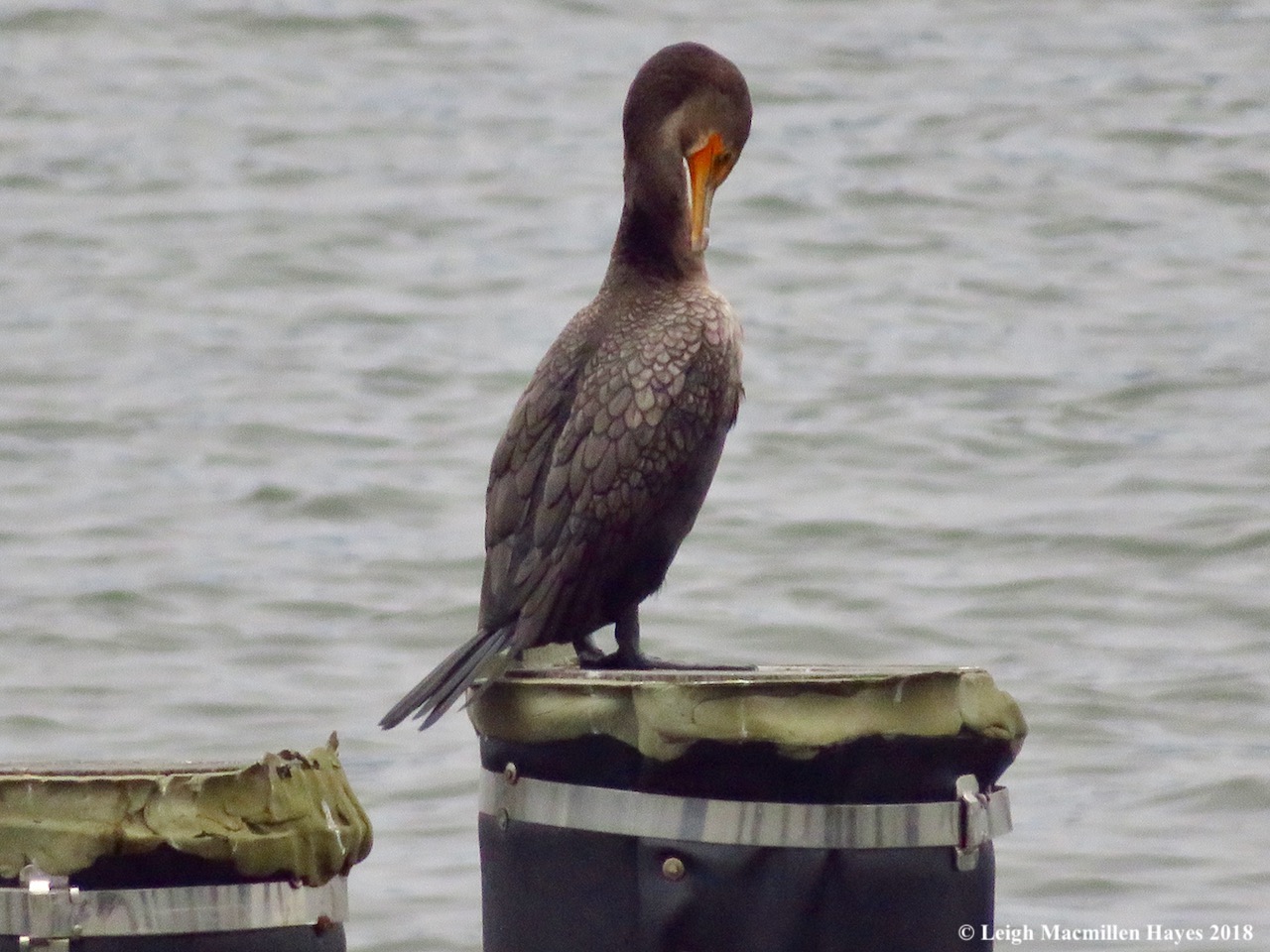
19-cormorant preening

After all, they had feathers to preen.

20-Canada Goose

And the Canada Geese–a grassy park to foul. The irony was that no dogs were allowed, but the geese made themselves quite at home.

22-offices of many sorts

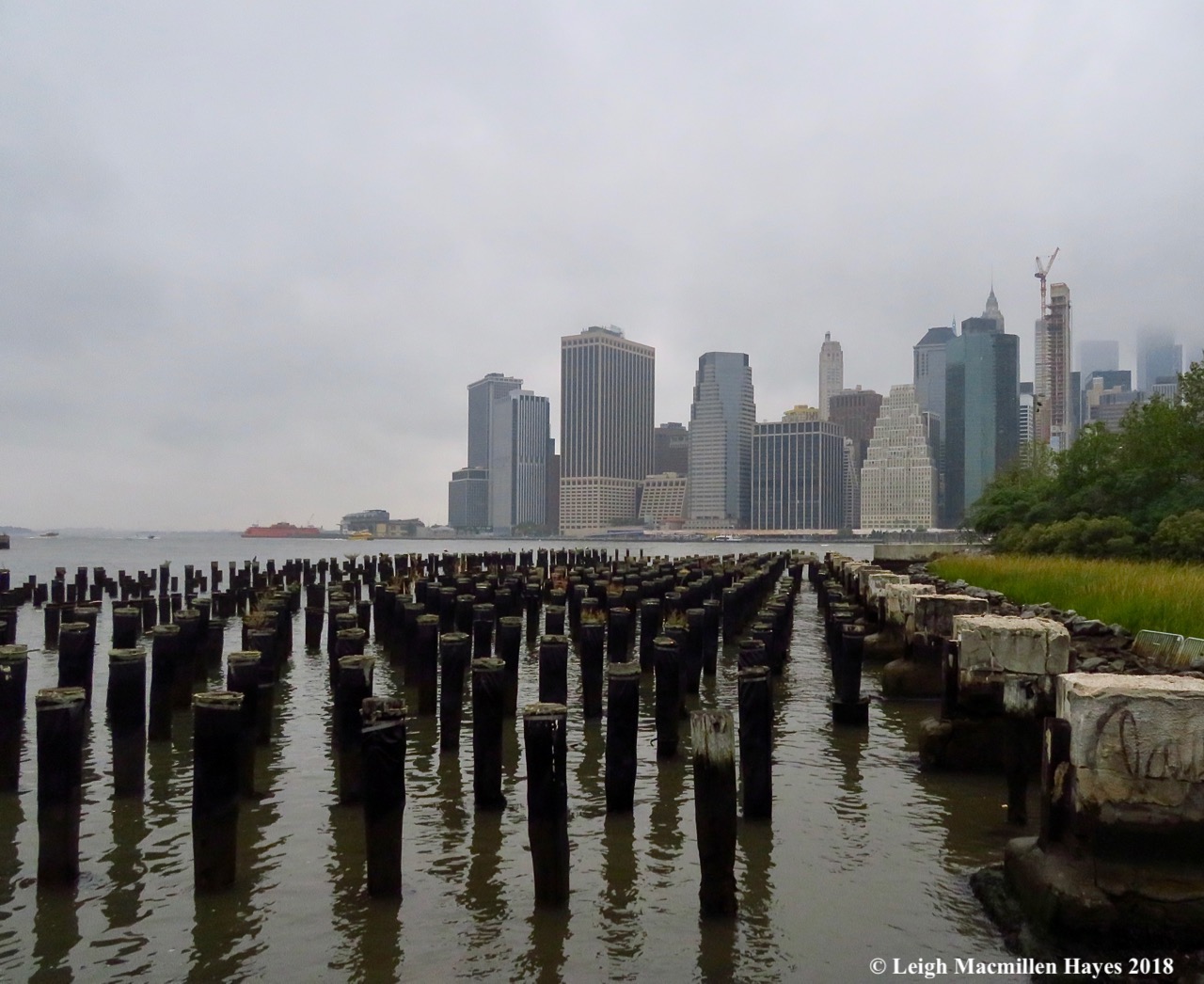
Above the Cormorant/Gull condos, Lower Manhattan gave way to the harbor, and we enjoyed the view from the Brooklyn Heights Promenade.

26-Lady Liberty

Our perch included the sight of Lady Liberty as she greeted all.

24-Queen Mary 2

And another grand lady, the Queen Mary 2. The last time I saw the QM, it was a previous rendition and she’d anchored in New Haven Harbor (Connecticut) in the summer of 1979. My father, sister, and I drove into the city to catch a view and then we followed the route Queen Elizabeth, who had arrived in town for a very brief visit, would take before departing from Tweed New Haven Airport. Crowds lined the route and we practiced our best QE wave. Humoring us, some waved back. We did glimpse the queen as her motorcade eventually drove by and that was enough to fulfill our Anglophile envy.

27-water tank in Brooklyn Heights

But, this weekend we were in Brooklyn to admire New Yorkers, (and we knew the queen wasn’t on the boat), so we pulled our point of view back to the area around us, which included a mosaic structure worth noting. Watertower is actually a sculpture created by Brooklyn artist Tom Fruin. He used plexiglass and steel in 2012 to represent one of the icons of our nation–a water tower.

29-playing fields on the piers

From pier to pier we followed the promenade beside the river, noting natural places and sports fields filled with athletes of many talents as they played games or worked out.

30-Brooklyn Heights

Eventually, we circled back and then climbed up into Brooklyn Heights, enjoying our meander through a beautiful neighborhood.

31-sycamore tree

And my guy, he became a pro at identifying Sycamore trees for so prolific do they grow in that neck of the woods.

33-pigeons

And then, and then we encountered a flock of happy pigeons. Yes, we were in New York City and all pigeons are happy there. It has something to do with peanut kiosks perhaps?

35a-pigeon

There were the typical blue-gray birds with two dark wingbars,

35-pigeon

rusty red version,

34-pigeon

those spotted or mottled,

36-pigeon

and even pale among the gang.

34a-piegon

But really, have you ever taken the time to look at those iridescent colors?

39-piegon

Or that sweet face?

40-maidenhair tree, ginko

At last we left our pigeon admiration behind and continued on, noting another tree not in our familiar category–the Maidenhair or Gingko Tree.

41-maidenhair leaf

Its fan-shaped leaves showed off the carotenoids that had been hidden all summer by the green pigment. Fall was slowly embracing the city, but it hadn’t arrived in full yet.

42-barber shop

As we moved from a more residential to commercial area, we were surprised to find a barber shop open on a Sunday morning. Given that I’d recently written about barber shops for Lake Living, it was fun to peek inside. And note how many men waited. But, in this city where many work late each day, it made sense that they’d make time on a Sunday morning for a hair cut.

43b-hardware

Eventually, our wanderings led us to a hardware store. And not just any kind of hardware store . . .

43-True Value

for it was an independently-owned True Value, much like my guy’s.

43a-entering the hardware store

And since one of our reason’s for visiting the city was to celebrate his 65th birthday, I followed him in.

45-fig in the garden

Lunch found us eating a slice of pizza from a local pizzeria. It was OK; better than what we find in Maine, but not quite what I remember from my childhood in Connecticut. We did eat in the “garden” where figs grew! I wasn’t quite sure how that related to pizza. But . . . we were in New York.

42-intential grafitti

New York . . . a city where graffiti is understood.

44-my guy.jpg

Our day ended with dinner at a small neighborhood Italian restaurant, Santa Panza, where we quietly celebrated my guy’s birthday with the most delicious dinner.

40-rotating statues of Miss Brooklyn and Miss Manhattan

As this morning dawned, it was time for us to look out the window of our hotel and say goodbye to the two ladies who’d waved us in and would wave us out. Miss Manhattan and Miss Brooklyn rotated continuously at the intersection of Flatbush Avenue and Tillary Street.

According to a Brooklyn Public Library’s website: “Miss Manhattan sits haughtily with her right foot atop a chest of money (or jewels?); in her right hand she holds a winged globe reminiscent of a cross-bearing orb, an ancient symbol of authority; a peacock, flashiness and luxury incarnate, is by her side. (The peacock, in the belief system of the Ancient Greeks, also represented immortality/eternity.) The bows of three ships hint at the status of Manhattan as an important port and an international trade hub. She is all dignity, privilege and hubris.

Miss Brooklyn’s demeanor could not be more different. Her expression is gracious, introspective and calm; she is surrounded by a church spire (Brooklyn to this day counts more houses of worship than any other borough); a lyre and a child with a book (a reference to the borough’s patronage of culture and education). The book on the child’s lap is massive. It must be a Bible, another reference to the borough’s spiritual thrust. Her head is adorned with a laurel wreath. In her hands she holds a tablet with the Dutch inscription “Ein Drach Mackt Maght” (“In Union there is strength”), a hint at the Dutch origins of Brooklyn and at the fairly recent New York City consolidation of 1898.

The granite maidens originated on the Manhattan Bridge, but these sculptures were installed on a pedestal at their current location about a year ago. For us, they were our home monuments much as Pleasant Mountain serves as our home mountain. Not only did they welcome us and send us on our way, but we knew where we’d lay our heads for the night as we approached.

43-Yo

At last, our brief city adventure came to an end, but we trust we’ll return.

Yo, Brooklyn! Yo Miss Manhattan and Miss Brooklyn. Thanks for the welcome. Until we meet again . . .


A “Fen-tastic” Afternoon

I was on a reconnaissance mission this afternoon for next week I’m leading some middle school students into a wetland and talking about forest ecology before sharing the joy of foraging with them.

1-Into the jungle

To reach the wetland, it was like walking through a jungle where the ferns grow tall, their fall coloration enhancing the scene. Cinnamon Ferns are a species that easily grow in medium to wet soils in part shade to full shade. The moist, rich, acidic soils, I walked through were much to their liking.

1a-cinnamon fern

It appeared that they were named for their autumn presentation, but really it refers to the cinnamon-colored fibers found near the frond bases.

1b-hairy underarm

Because they look so similar to their relatives in the Osmundaceae family, the Interrupted Fern, I looked to the back of the frond for confirmation. Sure enough, where the pinnae (leaflet) met the rachis (center stem), a tuft that we refer to as the hairy underarm was present.

2-kettle

Onward I continued, not sure what the moisture situation might be. So, in the past, I’ve paused by the kettle hole, but never actually entered it. All that changed today and my plan is to take the students into this special place. A kettle hole is a basin created when a large block of glacial ice was left stranded and subsequently melted in place, producing a basin or depression. These basins fill with water up to the depth of their surrounding water table, which currently happens to be rather low.

3-white face meadowhawk

Because the temperature had risen after a damp, chilly start to the day, the meadowhawk dragonflies flew . . . and landed. This one was a White-faced Meadowhawk, aptly named for that face.

4-white face meadowhawk abdomen markings

Its abdomen markings of dark black triangles also help in identification.

4b-autumn meadowhawk dragonfly

Flying in the same airspace where the Autumn Meadowhawks, with their light-colored legs. All other meadowhawks have dark legs.

4c-autumn meadowhawk love

Love was in the air and on the leaf as a pair of Autumns took advantage of the warm weather to canoodle in the sunlight.

4c-dragonfly love everywhere

They weren’t alone.

7-kettle 2

What I learned as I explored was that the kettle was actually a double pot for a second one had formed behind the first. Notice the layered structure of the area from trees on the outer edge to shrubs to grasses and flowers to water.

5-mammal tracks

And everywhere–deer and raccoon tracks crisscrossed through mud and water.

5a-racoon and bird tracks

Bird tracks also joined the mix among the raccoon prints.

6-six-spotted fishing spider

And because I was interested in learning who lived there, I had to pay homage to the six-spotted fishing spider.

8-spatterdock leaves and root

The spider flirted with me as he moved quickly among the spatterdock leaves that sat in the wee bit of water left in the center of the kettle.

9-another kettle

I finally left the kettle only to discover another and again the formation of layers.

10-green teal ducks

The water was a bit deeper and a family of Green Teal Ducks dabbled.

11-bottoms up

Bottoms up!

12-my destination

It took some time and steady foot placement as I climbed over downed trees hidden by winterberry and other shrubs, but at last I reached my intended destination, a cranberry bog.

13-cranberries

And then I spent the next hour or so filling my satchel for so abundant were the little gems of tartness. The best where those hidden among the leaves–dark red and firm were they.

14-some nibbled cranberries

As I picked, I realized I wasn’t the only one foraging. It appeared that either chipmunks or squirrels also knew the value of the flavor–though they only nibbled.

15-October colors layered

Occasionally, or even more often, I looked up to take in the colors and layers that surrounded me–from leatherleaf bronze to blueberry red to Gray Birch and Red and Silver Maples with a few White Pines in the mix.

16-buttonbush

Buttonbush added its own color and texture to the scene.

17-finding my way out

At last I decided to find my way out. (Sorta for I did get a wee bit disoriented.)

18-royal fern fertile fronds

Among the offerings were ferns of a different kind–though still related to the cinnamons I’d seen earlier. The Royal Fern’s fertile crown had months ago shared its spores with the world and all that was left were salmon-colored structures.

21-buttonbush galore, but more

I picked my way carefully and eventually found one of the kettles. And . . . drum roll please . . .

22-two sandhill cranes

two Sandhill Cranes. Others can tell you better than I how long the Sandhills have returned to this area, but it’s been for a while now and some even saw a nesting pair this past summer. My sightings have been few and so it’s always a pleasure.

23-sandhill cranes

I stood still as they moved about and they didn’t seem to notice my presence.

24-sandhill cranes

While they foraged for roots, another also watched.

25-great blue heron

The Great Blue Heron was cautious as they strolled in his direction.

29-bald eagle

And then . . . and then . . . in flew a Bald Eagle. And out flew the heron.

30-cranes flew out

The cranes waited a couple of minutes and then they flew, bugling on the wing.

And I rejoiced. Oh, I still had to find my way out and did eventually cross through a property about a quarter mile from where I’d started. But, all in all from kettles to cranberries to birds, it was a Fen-tastic afternoon as I explored an outlet fen.


Postcards from Sweden

Sometimes I forget when traveling that I should share my surroundings with those back home. A photograph of a local scene and a quick note are enough to say that though I was away, you were on my mind.

1-splash cup

And so dear readers, these are for you. The weather is great, I wish you were here. For if you were, your jaw would drop as mine did at the sight of these little morsels that so look like candy wrappers. Of course, the right thing to do would be for me to purchase a few to share with you.

2-splash cup

But, looks can be deceiving, and really, these are a fungi called Cyathus striatus, or Fluted Bird’s Nest. While they remind me of marshmallows covered with burnt coconut, they are really the young fruit bodies of the species. The lids, known as epiphragms, cover the structure and prevent rain drops from entering until the eggs within are ripe, for it’s the drips of the drops that release the spores of this fungi.

3-splash cup fungi

More mature structures, those that look like chocolate cups also coated in coconut, contained the “eggs” or lens-shaped structures known as peridioles.

4-eggs in splash cup fungi

This fungi is difficult to spy because it is teeny and inconspicuous and prefers a dark, moist habitat, but my hostess had her eye on these for a while and couldn’t wait to share them with me. And now, I’m excited to share them with you. The flute darkens with age, and that pale lid falls away or collapses inside the structure which does resemble a bird’s nest. Within each nest there are typically four or five silvery flattened “eggs.”

5-turkey tail fungi

We moved along and our next destination made me think of home. Back home, it seems the wild turkeys are taking over the world as we spy them in the yard, field, forest, and beside many a road. In the forest my hostess knows best, it was a turkey of a different kind that she shared. Trametes versicolor or more commonly, turkey tail fungi, grow prolifically in her woods. And their tail feathers are just as colorful and neatly arranged as the ones I know so well.

10-slime mold

Our next stop on the tour found her sharing a parlor trick with me. She poked a fruiting body of Lycogala epidendrum, or Wolf’s Milk Slime Mold, with a stick. Out oozed some goo, which had the fungi been mature would have been a more powdery spore mass.

10a-slime mold being slimy, parlor trick

You might say, “YUCK.” But it’s almost magical. The salmon-colored balls deflate instantly when poked and as the goo leaks we smile and think about sharing such a finding with others. When next I wander with you, we’ll have to look for slime molds.

11-Aleuria aurantia--orange peel funit

Because we’d been walking for a bit, you might think that my hostess offered a snack. The fun thing about exploring a place she knows so well is that sometimes there are surprises and such was the Aleuria aurantia or Orange Peel Fungi. We were looking at something else in the vicinity when suddenly we both spied the bright orange color and then realized there was a colony of it all about our feet.

14-earth tongue forest

In a different habitat, one where the sphagnum moss grows, we encounter a different fungi that I know, but had never seen in such an abundance: Trichoglossum farlowii is also known as Black Earth Tongue. I had never visited an Earth Tongue garden before but in a foreign land it apparently reigns.

15-singular tongue

Most of the structures are singular fruits, but . . .

15-forked earth tongue

we found one forked tongue.

16-green-headed jelly baby fungi

Nearby, on a rock covered in Bazzania, a liverwort, we found a small colony of Leotia viscosa or Green-headed Jelly Babies. Much like the Fluted Bird’s Nest, it looks like a another candy I should bring home to share, but I left the souvenirs behind and took only photographs.

17-green stain fungi fruiting

Our forest journey wasn’t over, but our fungi finds were complete when she showed me the fruiting bodies of Chlorosplenium aeruginascens, or Green Stain Fungi. Really, it should be called turquoise-stained, but I didn’t come up with the name. It’s difficult to photograph these beauties for so petite are they, and always a thrill to see.

18-Sweden forest

Many of our finds were located in the vicinity of a forest bog where cinnamon ferns grow tall and wild and add texture and color to the scene, making it look rather pre-historic.

6-beaver pond

Not only did my hostess share her woodland habitat, which is so different from my own, but she also took me to a beaver pond. Our intention was to say hello, but by the depth we noted that the beavers aren’t currently home. We’ll have to call on them another day during my stay.

8-green frog

What we did find were green frogs that squeaked as we approached and then leaped into the water to hide.

9-sundews, both round-leaved and spatula-leaved

As a gift for her hospitality, I was able to share something with my hostess–in the form of round-leaf and spatula-leaf sundews that grow at the water’s edge. Both are carnivorous and so she can now add another parlor trick to entertain her guests–feed insects to the plants.

7-solitary sandpiper

One final scene to share because she and I shared the same view: a Solitary Sandpiper on the hunt. We watched for a few minutes before it flew off.

And now it’s time for me to fly home. But the airmail has been stamped and if you have read this then you are on the receiving end of postcards from Sweden. Sweden, Maine, that is.

Thank you to my hostess, J.M., for your kindness and willingness to share so many special scenes with me. I can’t wait to return to your neck of the woods.


Making Connections

“The Great Maine Outdoor Weekend is a series of events led by outdoor-oriented organizations and companies to celebrate the how, where, and what of being active outside in Maine. Our goal is to connect our friends and neighbors with the natural world, to promote fun, physical activity, & good health.”  ~greatmaineoutdoorweekend.org

In the spirit of the GMOW, the Greater Lovell Land Trust and Upper Saco Valley Land Trust co-hosted a paddle at the Major Gregory Sanborn Wildlife Management Area, aka Brownfield Bog, in Brownfield today.

1-fine fall morning

Though the temperature was a bit nippy, as in mid-50˚s to start (and colder in the shade), we couldn’t have asked for a better autumn day, especially given that we first began planning this event last winter.

b-Kathy's sign 1

In what seemed like perfect timing for they didn’t all pull in at once, vehicles laden with kayaks and even one canoe, arrived and folks who’d never met before helped each other carry boats, paddles and personal floatation devices down the road. Then we stood in our traditional circle, where Erika of USVLT and I welcomed everyone and introduced our two organizations. By the tile sign created by Maine Master Naturalist Kathy McGreavy, I pointed out our location and destination along the Old Course of the Saco River.

2-walking to the put in

And then we all walked down the road to the put-in site . . .

3-kayaks on parade

where our parade of kayaks awaited the adventure.

4-onto the old course

One at a time the boats were launched. And then the magic began. It was two-fold in that I’d challenged our twenty participants, some of whom had learned of the event via our advertising efforts locally and were already members of our organizations, and others who discovered the event via the GMOW website and wanted to try something new. The challenge was to spend some time chatting with people they’d never met before. And they did. Conversations ranged from living in New York to termite mounds in Africa.

Folks came from Fryeburg, Bridgton, Lovell, Standish, Jackson and North Conway, as well as Westbrook, Portland, and Cape Elizabeth. But that wasn’t all, for one joined us from Philadelphia and two came from Houston. Our furthest traveler hailed from London. Well, truth be told, she’s a long-time GLLT member, docent and board member who spends at least four months in Lovell. ;-) Thanks Moira.

5-tapestry of color

The tapestry of colors was the other magical element. We chatted about the colors and the carotenoids (yellows and orange pigment) showing up as the leaves stop producing sugar and starch for the tree, and the chemical process that produces the anthocyanin or red coloration.

14-lily pad aphids and yellowjackets

We mentioned the lily pad aphids that sought nutritious sap and noted how the yellowjackets took advantage of the honeydew secretions the aphids offered.

12-soaring above--bald eagles

And some of us had the joy of watching two Bald Eagles soar on the thermals above.

16a-beaver works

There were some fresh beaver works to note and we did spy a few lodges, though none looked active.

7-duck hunters

And for most of the trip we heard the duck hunters’ gunshots as they took aim, though I think we scared a few of them off. The hunters that is. Well, we know we scared a few ducks off as well.

6-ahhhhh

But, what the day was really all about was an enjoyment of being outdoors and sharing a place many had never explored before.

8-around every bend

Around every bend, we discovered different threads, our own colors sewn into the tapestry.

9-the tree

One of my favorites is what I’ve come to call “The Tree.” It’s a perfectly shaped Red Maple that protects a beaver lodge–if you peak below the lower branches on the left, you may see the pointed top of the lodge.

10-the tree's reflection

Even The Tree’s reflection was worth several expressed “Ahhs.”

11-color enhanced by clouds

Though the clouds weren’t many, some enhanced the scene.

15-more color

With each stroke of the paddle it seemed we reached new vantage points where the artwork was similar . . .

16- and more reflections

yet different.

How could it get anymore beautiful?

13-lily pads upturned

Even the lily pads stood out as if seeking recognition for their presentation.

17-turn around point

At last we reached the end of the road, or rather Old Course. That was our turn-around point.

18-preparing to head back

And so we did . . . turn around.

20-taking a break

Before heading immediately back, however, we paused for a few moments to sip some water.

21-enjoying lunch

And a few new friends even enjoyed rafting up while they ate their picnic lunches.

26-the tree again

The trip back passed by much more quickly, as it always does. But still, The Tree called for attention.

23-yellow-rumped warbler

And so did the young Yellow-rumped Warblers that flew in and out among the Pickerel Weeds.

25-yellow-rumped warbler

They moved in a flock from weeds to the shrubs and back again and a few of us recalled the thicker than thick mosquito population we’ve encountered at the bog in the past, but exalted the insects because of the birds they feed. Today, we were mosquito free and thankful for that. The birds seemed to find what they needed to sustain them. There are still plenty of insects about, just not bothersome ones.

30-pulling boats out

Three hours later, we found our way back to the launch site and once again helped each other stabilize boats and bodies and then carry the boats and gear back to the vehicles. Our journey together had ended, but . . . we had all chatted with a variety of people and left with smiles on our faces and in our hearts for the morning we’d spent together.

29-layers

We’d connected in the most beautiful setting thanks to everyone’s effort of choosing to celebrate Great Maine Outdoor Weekend.

For help making those connections, thank you Jesse Wright of USVLT for initiating this paddle with me so many moons ago, and to Trisha Beringer of USVLT for the time we shared walking and paddling in preparation, as well as taking the lead on the sign-up process, and to Erika Rowland of USVLT for transporting boats, taking up the lead when Trisha got sick, and being flexible along the way.

What a great day and great way to spend time outdoors in Maine.


Summer Marches On

Today I attended a celebratory parade.

0-Subtle colors

The route followed the old course of a local river and along the way the trees stood in formation, some showing off their bright new coats.

5-colors in the field

Each float offered a different representation of the theme: transition.

3-ash seed raining

Upon some floats, seeds from the Ash rustled as they prepared to rain upon the ground like candy tossed into the gathered crowd.

4-crystalline tube gall on red oak

Oak leaves showed off their pompoms of choice–some being crystalline tube galls and others . . .

19-hedgehog gall?

possibly called hedgehog.

8-bald-faced hornet

Playing their instruments were the Bald-faced Hornets,

9-autumn meadowhawk

Autumn Meadowhawk Dragonflies,

11-immature green stink bug

and even an immature Green Stink Bugs.

10-green frog

On the percussion instruments at the back of the band were the green and . . .

23-pickerel frog

pickerel frogs.

15-yellow-rumped warbler

Adding a few fainter notes were a couple of Yellow-rumped Warblers.

16-yellow-rumped warbler

They didn’t want the chickadees to get all the credit for the songs of the woods.

17-hairy woodpecker

A Hairy Woodpecker also tapped a view beats.

12-wood ducks

Probably my favorite musicians, however, sported their traditional parade attire and awed those watching from the bandstand.

13-wood duck

Even a non-breeding male made the scene look like a painting.

14-wood ducks taking off

Their real contribution, though, came from the modestly plumaged females who offered a squealing “oo-eek, oo-eek”  each time they took flight.

18-sensitive fern

Though green attire was the most prominent of the day, others sported colors of change from yellows and browns to . . .

6-red emerging

brilliant reds.

21-Brigadoon

As is often the case along such a route, vendors offered works of art for sale, including local scenes painted with watercolors.

22-lily reflection and aquatic aphids

Before it was over, a lone lily danced on the water and offered one last reflection.

24-season transformation

And then summer marched on . . . into autumn.

Amazing Race–Our Style: episode eight

The clue arrived as mysteriously as usual on Sunday and we had to quickly book a seat for two on a seaworthy vessel. Thankfully, we got the first time slot for 10:30 Monday morning. And so, despite some fog, we drove northeast.

But . . . before we reached our destination, we had a challenge to answer to along the way. My guy needed to complete the crossword puzzle in the Portland Press Herald on his own. And then, while I did the driving, he needed to give me a clue, word by word until I’d completed the puzzle orally. Unfortunately, one letter held me up and we knew we’d loose a few moments if everyone else in the Amazing Race–Our Style finished it without flaws. We wouldn’t know for sure until the end. My glitch–the “r” in Urdu–the language spoken mainly in Pakistan.

1-Camden Harbor

Two and a half hours later we reached the location where our next challenge would begin. Of course, we had to pay attention to the signs and not park where permission was granted only to those who worked the waterfront.

3-Schooner Surprise

Our mission was to sail upon the gaff-rigged schooner Surprise. According to her website, Surprise was “built by the Waddell Shipyard in Rockport, Massachusetts, for Martin Kattenhorn. Surprise began her life as a racing and cruising yacht. Mr. Kattenhorn had commissioned Thomas McManus, the most famous American designer of fishing schooners, to design a vessel of about 45 feet, which could be safely sailed by a crew of no more than three persons. In early 1918, Surprise slid down the marine railway.

Her final dimensions were: Length overall 57 feet, Length on deck 44 feet, Beam 12 feet, Draft 7 feet, Displacement 21 tons.

Her topsail schooner rig allowed Mr. Kattenhorn to fly a mainsail, foresail, staysail , jib,  and a fisherman staysail. Her working sail area, not counting topsails, was just under 1000 square feet. Surprise was a respected racer. In 1923, she captured sixth place in a fleet of 22 vessels in the first race to Bermuda after World War I. Mr. Kattenhorn was a founding member of the Cruising Club of America, and Surprise carried the club’s ensignia from Bermuda to Nova Scotia and ports in between from 1918 until Mr. Kattenhorn’s death in 1959, an incredible sailing career!”

All of that history, and we realized we needed to pay attention. (Note to self: remember these facts) Already into the eighth leg of the race, we had a feeling that the historical value of some of our adventures would play a key part if we stay in the race until the final episode.

4-Captain Will applies sunscreen

At the established time, we boarded the boat and looked around at our shipmates. No fellow contestants. Huh? How could that be? But perhaps the rest had chosen the alternate activity that involved some baking and deliveries. We were much more comfortable setting sail with Captain Will, who when he wasn’t applying sunscreen, used his left foot to steer the boat out of Camden Harbor.

5-we raised the mainsail

Half way out, First Mate Laird asked for help in hoisting the sails. We knew this offering was intended for us. I quickly jumped up and my guy followed. My job–to use the hand-over-hand method to raise the raise the main gaff at the top as my guy kept the main boom parallel.  Of all our challenges thus far, this was among the easiest and we felt right at home.

6-Surprise

Finally under sail rather than motor power, the boat moved away from Camden Harbor and out into Penobscot Bay.

7-First Mate Laird

As we continued, the captain and first mate exchanged roles, because really, they are both comfortable and supportive in each. While Captain Will explained that Surprise was celebrating her 100th birth year, First Mate Laird looked up.

8-100 years old

Above, a flag blowing in the breeze commemorated the celebration.

9-ghost ship on the horizon

As we headed out to Mark Island in Penobscot Bay, so named because early mariners used the island to mark their bearings, we noted a ghost ship on the hazy horizon.

10-sailing Penobscot Bay

Will and Laird both exclaimed about what a perfect sailing day it was. Indeed.

11-Lobster Boat surrounded by gulls

The further out we moved, the more we noticed lobstermen checking their traps as gulls circled in hopes of an offering.

15-pulling traps

These were the folks who had headed out onto the water at 4 am as they surveyed the  grounds where they’d set traps. A Maine lobsterman is allowed to set up to 800 traps, but as we learned today, it not only takes time to gain a lobster license and no longer is it a tradition handed directly from father or grandfather to son or daughter, but one doesn’t set the full amount of traps to start. And we learned that Lobsterman Toby is the local God of the Traps and the one to consult before dipping into a lobstering career.

16-third lobster boat

Some collected lobsters while others replaced traps. It’s not an easy life, but don’t tell a lobsterman that. Oh yeah, and one more fact, women who lobster are also called lobstermen . . . with pride.

17-different tack

Once we changed tacks, positions on the boat shifted, as should be expected.

18-Curtis Island Light

From all sides, we viewed the Curtis Lighthouse. The station was first established in 1836. As the lighter rocks tumbled down in front of the current house indicated, when the first building was demolished, the rocks were not intended to be reused or repurposed. The present lighthouse was build in 1896 and automated in 1972. (Note to self: remember these facts)

19-Camden Harbor

Slowly we tacked and then motored back into the harbor, with Mount Battie’s domed shape, a reflection of the harbor’s outline, standing tall in the background.

21-boat featured in movie Dunkirk

Captain Will shared a third point of interest to add to our bag of potentially important historical points should we make it to the end of this race: The 1930 122 ft. steel-hulled yacht Atlantide. The boat played a life-saving role in World War II as allied troops pinned down by the invading German army were evacuated at Dunkirk, France. And it was featured in the movie Dunkirk.

23-sails coming down

As we sailed closer to shore, in a pattern of symmetry that matched our departure, everything was restored to its original position and the term shipshape revealed.

25-old boat railway

Back under motor power, we passed by an old marine railway, which probably resembled the one Surprise originally slid down.

23-female mallard

At last, our sailing experience of the day slowed. And a female mallard swam beside the boat, perhaps her hope for a handout redeemed occasionally by others.

2-Comorant

Meanwhile, a cormorant bathed.

24-docking

With precise precision as a neighboring boat docked, we pulled in, Laird jumped off the boat and all ropes were secured. Our journey had ended and we needed to hustle to a lunch spot.

25-beer at Peter Otts

We chose Peter Otts and a Maine Beer Company Peepers Pale Lager for me, while my guy enjoyed a Guinness–because it’s good for you! Two delish haddock sandwiches rounded out our menu choices.

25-Climbing Battie

But we still had one more task to complete–to locate a symbol of WWI while hiking. And so up Route One we drove to Camden Hills State Park in hopes that we’d chosen the right place. It was rather deceiving at the start of the hike for across one boardwalk after another did we walk.

26-changing terrain

Eventually, however, the incline steepened and terrain became more of what one might expect along the coast of Maine–rocks and roots to navigate around and over.

27-wavng hello

We hadn’t seen a single other contestant and had no idea how we were doing, but knew we’d lost a wee bit of time on the crossword challenge, and so we paused for a second and my guy expressed his inner Cousin Itt.

28-Camden below

The funny thing we noticed about the trail system was that no matter how much further we had to go, many of the signs indicate 0.5 miles, and even after we’d covered a section of 0.25, the next sign stated the summit was still 0.5 ahead. It amused us and from then on we knew everything was a mere half mile away from somewhere.

At the summit of Mount Battie, the view encompassed the harbor below.

29-tower

But it was what stood behind us that became significant.

31-tower dedication

We’d found our WWI symbol, a memorial to those local people who served our country. And another piece of history to tuck under our hats for future reference.

30-view from the tower

Though we couldn’t see Acadia because of fog, the view was still breathtaking from the top. It was there that we encountered another contestant who actually asked us for some help with the trail system. Team Purple is legally deaf and her partner had deserted her, so we were happy to offer assistance.

32-Edna St. Vincent Millay

To that end, we gave her a head start while we paused to honor Edna St. Vincent Millay. And give thanks that we saw what she had seen.

34-Team Purple

Eventually, we did catch up with Team Purple, but she was a hearty hiker and we let her continue to lead.

35-Crossing the mat together

She, however, had another idea in mind, and in true alliance fashion, the three of us, our shadows lengthened as the sun slowly lowered, crossed the finish line of this episode together. We weren’t the first to complete today’s challenges, but we’re still in the race.

Going forward, we wish Rebecca of Team Purple the best.

Phew, eight episodes of the Amazing Race–Our Style completed. Only four more to go. Will we survive? Stay tuned.

Our Home is Their Home

As I sit in my rocking chair on the camp porch, the cicadas still buzz, with chirps of crickets thrown into the mix and somewhere in the background a constant trill from another. Tree frog? Perhaps, but it seems to carry on for longer than usual. Grasshopper? Maybe. And then there is the occasional call of the loon.

1-camp

What truly attracted my attention earlier today, however, were the other members of the household. Whose home this is, I think I know. Or rather, I thought I did. I thought it belonged to my guy and me. But really, I should have known better for it has never just housed the two of us. There were the boys growing up, and family, and friends, and renters, even. Actually, the latter three knew it before the boys. (Oops, I suppose I should call them young men, mid-twenty-somethings that they now are.)  But, through all these years, it has also housed many others. And so today, I got acquainted with some of its other residents. Rather than the mammals that we know also share the space, e.g. mice, squirrels, and bats, it was the insects and arachnids that I checked out.

2-cicada exuviae

My first find along the foundation was an exuvia of one I listen to day and night–that of a cicada. In their larval stage, cicadas live down to eight feet underground. When the time comes to metamorphose into winged adults, they dig to the surface, climb up something, in this case the foundation, and molt. The  emerging winged insects leave behind their shed skin, aka abandoned exoskeleton or exuvia. It’s a rather alien looking structure, with the split obvious from which the adult emerged.

3-cruiser 1

The cicadas weren’t the only aliens along our foundation. It seemed like every few feet I discovered a dragonfly exuvia dangling from the porch floor and now encased in spider webs.

3b-cruiser

One of the cruiser exuviae had dropped to the ground below. But still the structure remained intact. And I now realize that my next task is to head out the door once again in the morning and collect these beauties, the better to understand their nuances.

4-cruiser hiding

I found cruisers hiding under the logs . . .

6-cruiser and cast off spider

and even one tucked in by a basement window that had a shed spider exoskeleton dangling from it.

6a-lancet clubtail dragonfly

There were others as well, but nowhere did I find the exuvia of the one with whom I’ve spent the most time, Sir Lance(t) Clubtail. I suspect his shed skin is attached to some aquatic vegetation for he spends so much of his time by the water, even today, pausing only briefly to rest on the dock ladder.

7-bag worms and pupal case of a pine sawfly

There were other species to meet, including the most interesting of structures, those of the evergreen bagworm cases. I assumed that the young had already emerged, but their homes consisted of material from the trees on which they fed, e.g. pine needles. They struke me as the terrestrial form of the aquatic caddisflies.

And beside the two bagworms was a small, rounded brown case–the pupal case of a pine sawfly. The sawfly had already pupated and in this case no one was home.

8-pine sawfly caterpillar on screen

Oh, but they were and have been for a few weeks. I first realized we had an infestation when what sounded like the drip-drop pattern of a summer rain on a perfectly sunny day turned out to be little bits of green caterpillar frass falling from the trees. Everything was decorated. And then I began to notice the caterpillars–many falling out of trees and landing on the surrounding vegetation, and the house. As would be expected, they climbed toward the sky, hoping, I suppose, to reach the top of the trees. Good luck with that.

9-pine sawfly caterpillars

Some didn’t make it above the foundation, where they encountered spider webs and soon had the juices sucked out of them. Such is life. And today, a winter flock of birds including chickadees, nuthatches, goldfinches, hairy woodpeckers, young robins, and even a brown creeper flew in and some fine dining took place. The raindrops have nearly ceased.

10-Northern Pine Sphinx

That wasn’t the only pine-eating caterpillar to make its home here. On the chimney, I found a northern pine sphinx caterpillar moving full speed ahead.

11-orbweaver

And around the bend, where the chimney meets the camp, an orbweaver spinning some silk in the hopes of fine dining.

14a-calico pennant dragonfly in web

One meal had obviously been consumed–a calico pennant dragonfly. I’d seen a few of those on the vegetation a few weeks ago, but none recently. Apparently, one flew too close to the building. The only way I could ID it was by its wings for the head, thorax and abdomen had been eaten. But the wings have no nutritional value.

11a-Northern Pine Sphinx 2

A short time later I returned to the chimney in hopes of locating the northern pine sphinx caterpillar again. I did. And he wasn’t. He’d apparently turned the sharp corner on the chimney and met his fate.

13- Northern Sphinx 4

Eye to eye. I’m amazed at the size of the insects that find their way to her web. It’s not like they are attracted to it. Instead, they come upon it quite by surprise and she makes fast work of their mistake.

14-pine tree spur-throated grasshopper

Rounding the corner back toward the porch door, one last insect drew my attention. And again, it was related to the pines, such is the local community: a pine tree spur-throated grasshopper on one of the logs that forms the outer wall of our wee home.

Our home is their home and we’re happy to share the space with them. Provided, of course, that they leave space for us to live as well. So far, all is well.


Long Speck-tacular

I suggested two hikes today to my guy and rather than choose one, he thought both sounded perfect. And so our journey began about noon as we ascended the 2.5 mile trail that twists and turns beside Mill Brook. Our destination: Long Mountain Ledges off Vernon Street in Albany, Maine, a property owned by Mary McFadden and Larry Stifler. Through their generosity, many trails in the area are open to the public. And through the work of their employee, Bruce Barrett, those trails are well maintained.

1-Long Mtn Trail

And well marked.

2-through the bog

At the start, a long series of boardwalks passes through a wettish area where so many ferns, and mosses, and wildflowers grow.

3-blue cohosh

Some, such as the Blue Cohosh, have matured to their fruiting stage–and their leaves hinted that another season is in the near offing.

4-red-belted polypore appearing to sweat

Once we began to climb, the natural community changed and so did the residents. One in particular reminded me that I have yet to understand its behavior. Why does the Red-belted Polypore weep, I wondered. It’s not a case of morning dew for nothing else appeared to have droplets of water. In searching for an answer, I learned a new word: gut·ta·tion–/ɡəˈtāSHən/, noun: the secretion of droplets of water from the pores of plants. On gardeningknowhow.com, I found this explanation: “The plant doesn’t always need the same amount of moisture. At night, when temperatures are cool or when the air is humid, less moisture evaporates from the leaves. However, the same amount of moisture is still drawn up from the roots. The pressure of this new moisture pushes out the moisture that is already in the leaves, resulting in those little beads of water.” If this is correct, I’m assuming the same is true for fungi.

5-pancake fungi

There were plenty of other mushrooms to see, including the pancake fungi my guy pointed out. He’s such a mushroom guru (NOT) that I instantly believed his identification. After all, they were plate-size and did resemble pancakes. All they needed were some blueberries, butter, and maple syrup.

6-Long Mountain Trail Ledges

Because the trail was so well created, it hardly felt like a climb and in just over an hour we had reached the ledges where the view included Round Mountain to the immediate left, also owned by the Stiflers, and the Whites in western Maine and eastern New Hampshire beyond. Suffice it to say, this was lunch rock.

7-crown-tipped coral

We descended via the same trail and I love doing that because there’s always something different to see. Today, it was a purple coral fungi. Did it begin life as a different color and the purple was a sign of maturity, I wondered. It didn’t matter. What mattered was that I couldn’t recall ever seeing that color before and it seemed rather royal.

8-hobblebush berries

There were also hobblebushes to admire, they’re green leaves and red berries adding a bit of Christmas joy to the scene. OK, so I’m rushing seasons, but I am a winter gal.

9-heading out

Five miles and 2.5 miles later, we walked back across the board walk, hopped into the truck, and drove south.

10-Speck Ponds Trail

For all of ten minutes, for our next destination was another property owned by the Stiflers. This time, we followed Hunts Corner Road to Hutchinson Pond Road and looked for the trailhead to the Speck Ponds Trail. If you go, know this, drive until you think you are almost there, and then drive some more. It’s located on the right, along the dirt portion of the road, just after the mailbox tucked into a canoe! Huh? You’ll have to take a look for yourself to understand what I mean.

11-the chair

I’d heard that some trail improvements had been made since I’d last ventured there. Indeed, they had, including new red trail blazes and an Adirondack chair by the trail map. The significance of the chair, however, wouldn’t be revealed to us until we finished. Onward we journeyed.

12-Crossing the line

And crossed from Albany to Norway, Maine, via the woodland trail.

13-home of many beaver homes

First, we circled halfway around Upper Speck Pond, noting signs everywhere that beavers had lived there in the past.

14-if this canoe could talk

And an old canoe that had its own stories of yore to tell. Somewhere, a family or group of friends know the history of this sunken artifact.

15-beaver dam on Lower Speck Pond

About halfway around, and really, directly behind the sunken canoe, another trail connects to the Lower Speck Loop. We followed it and eventually came to more beaver sign, including a dam with some new wood atop.

15a-beaverworks

Downed trees with freshly chopped chips also graced the area.

15b-beaver lodge

And another lodge. I lost count of how many we saw today, but suspected the one on Lower Speck was active.

16-Lower Speck Pond

We moved quickly as we circled round both ponds for my guy had visions of tonight’s pizza dinner on his mind. And maybe a Red Sox game that he was missing as well.

17-comorant

Despite our speed, we did pause to admire one of the pond residents–a cormorant.

A total of nine miles later, we’d climbed and circled and oohed and aahed and wondered along the way. Oh, and that chair, we considered sitting in it for we were hot and tired by the time we finished, but had we done so, we’d still be there–snoring away!

A Long Mountain-Speck Ponds Spectacular.


Eagle-eyed Mondate

It was the call of the loon that pulled me onto the dock early this morning, my coffee and camera in tow.

1

As it moved about not too far off, I noticed that it started turning in circles. It appeared to be listening and looking . . . and not for fish.

2

Suddenly, from behind me, there was movement in the sky and I began to understand. If you look carefully, you will also begin to understand.

3

A mature eagle had entered the neighborhood.

4

For some reason, the loon moved closer.

22

And then an immature eagle appeared. So did my next-door-neighbor, who walked quietly onto the dock with her camera. Together, we watched, barely exchanging any words as we didn’t want to disturb the scene.

23

Eventually the older bird flew up to a perfect viewing spot on a nearby island, rearranging a couple of twigs to create a mini-platform from which to watch the world.

5

The younger bird stayed a bit longer and then it flew toward the north end Moose Pond.

6

A few hours later, my guy and I also headed north, traveling a route we typically follow with our kayaks. Our mode of transportation on this day was the S.S. Christmas, our Maine Guide boat.

7

As we moved along, I felt a tickle on my leg and looked down to see that Sir Lance, the lancet clubtail dragonfly, had joined us for the journey. He came and went several times and then left us alone as we moved into a territory occupied by other species of dragonflies.

8

Among the islands we moved, keeping an eye on the bottom for the water is quite shallow and our boat precious. So are we. And the camera!

9

Eventually we ran out of mini-channels to follow for so carpet-like was the display of lily pads before us.

10

I would have been content to drift, but my guy is a doer and he needed to be doing something. And so he rowed.

11

As I turned around to see what I might see, I saw a hitchhiker up under the bow–a dock or fishing spider! The rule was, if it didn’t bother me, I wouldn’t bother it.  And so it went for the remainder of our journey together, though I’m not sure he departed when we returned to the dock.

12

Anyway, back to our adventure. We were approaching one of the islands we sometimes stop on when we snowshoe in the winter–it’s a fine place to enjoy a PB&J sandwich. And then I spied something in the tall pine. An owl? I’ve listened to a Barred Owl the past few nights.

13

My guy rowed closer and we realized it was the immature eagle.

14

And so at last we sat still. For a long while. And watched. And waited. And listened. And saw calico pennant dragonflies.

15

But it was the eagle that really drew our attention.

16

Behind us fish jumped and we fully expected the bird to scream down our way with its talons extended.

17

But it didn’t. Instead, it panted like a dog. The day was warm, especially up in the islands where the wind was blocked.

18

It also preened.

19

And occasionally it looked our way–mostly when my guy’s feet moved a bit and his crocs squeaked, sounding rather like another eagle. Their highpitched call always surprises me for it seems rather weak for such powerful birds that draw our awe and wonder with each sighting.

20

At last the eagle flew south, apparently not at all interested in any fish . . . or painted turtles. And we made our way south as well.

21

We were almost back to the dock when Sir Lance landed on my leg again. I placed my pointer finger in front of him and he climbed onto it. How cool is that?

Another fun Mondate aboard the S.S. Christmas with my guy–and another opportunity to exert our eagle eyes!


Filling Our Buckets Mondate

Our day began with a journey to Green Thumb Farms in western Maine because we were curious about their native blueberry sod. We had hoped to see some, but that wasn’t to be and instead we were given a contact number for a sales rep. Our hope is to purchase a couple of pallets worth and use it as one more filter system at our camp in our continuing efforts to protect water quality. We recently learned that we qualified for a LakeSmart Award, but don’t want that to stop us from finding other ways to create a more lake-friendly property. Stay tuned on the sod because once we figure that out, it will be a story worth telling.

1-lunch spot, Eaton Village Store

From Green Thumb Farms we zigged and zagged along the back roads until we reached Eaton, New Hampshire. Lunch awaited at the Eaton Village Store on Route 153. Inside, one wall is covered with mailboxes and the post office. Grocery and gifty items are displayed in an aisle or two. And then there’s the lunch counter and a few tables for the eatery. A most pleasant eatery. The menu is simple, food fresh, and all served with a smile and conversation.

2-falling snow sign

Oh, and one more thing. They are eternal optimists! Or procrastinators like me. Heck, eventually there will be falling snow to watch for again.

3-Foss Mtn Trail

After lunch, we zigged and zagged again, winding our way up a road we once remember sliding down–in the winter on our bellies with our eight and ten year old sons in tow. Our destination today was much easier, though I did put the truck into four-wheel-drive to reach the trailhead parking lot for Foss Mountain. I’d told my guy about the blueberries and views and neither of us gave a thought to today’s weather for in the newspaper the forecast predicted it to be “rather” cloudy, “rather” being a rather unscientific term. It turned out to be more than “rather.” And raindrops fell, but still we went.

4-Foss Mtn Map

We examined the sign and my guy was thrilled with the possibilities.

6a-no picking

Some fields, however, were closed to public picking for a private operation leased those from the town.

5-Ryan Bushnell Blueberry Operation

Off to the side, we spied their sorting machines. Note the blueberry color of the equipment.

6-blueberry envy

And the abundance of blueberries.

7-hands in pockets

After testing a sample to make sure they were acceptable for human consumption, my guy stuck his hands in his pockets to avoid further temptation.

8-Joe Pye Weed all in disarray

Upward we journeyed, following the path of this property that is owned by the Town of Eaton. Along the way, a large patch of Joe Pye Weed shouted for attention, its petals disarrayed much like my own hair on this misty of days.

9-into the fog

The habitat changed and still we climbed–anticipation in every step my guy took at full speed.

10-pick blueberries sign

At the next natural community boundary, where conifers gave way to saplings and undergrowth, my guy rejoiced. At last we’d reached the promised land.

11-my guy disappeared ;-)

And immediately he stepped off the trail to find those tiny blue morsels that bring him such delight.

12-summit fog

While he picked, I headed toward the summit, where a blanket of fog enveloped the view. It didn’t matter, for our focus zeroed in on what was before us rather than being swept up with the beyond.

14-my guy picking

From my place at the top, I could see him below–a mere speck intent on filling his bags to the brim.

15-erratic

I began to look around and felt an aura that made me feel as if I was in Ireland rather than New Hampshire. The fog. The green. The gray. The world disappeared.

16-more colorful eratic

And the world before me opened up.

17-Common goldspeck lichen (Candelariella vitellitta

Like yellow caterpillars that are all the rage right now, Common Goldspeck Lichen inched across the granite face.

18-granite-speck rim lichen

Beside it, Granite-speck Rim Lichen stood out like tiles in a mosaic work of art.

19-fog danced across ridge

Meanwhile, the fog danced across the ridgeline, twirling and whirling in a ghostly quiet manner, its transparent gowns touching the ground ever so tenderly before lifting into the next move.

19-my guy picked some more

And my guy found a new location and picked some more.

15-steeplebush

My attention turned to the Steeplebush, a spirea that grew abundantly at the summit, its flowers of pink offering a tiny splash of color to brighten any day.

25-American Copper Butterfly

The American Copper Butterfly and a bumblebee also found the Steeplebush much to their liking.

26-American Copper

And I, I couldn’t pull my eyes away from admiring this tiny butterfly and its beautiful markings.

28-American Copper Butterfly

From every angle that it posed while seeking nectar, I stood in awe–those striped antennae, giant black eyes, copper-silver color, and hairy scaled wings.

21-chipmunk

And then there was another, which I thought was a bird when I first heard it scamper out of the bushes.

22-chippie eating berries

But Chippie soon made himself known and I discovered that he, too, sought those little morsels so blue. Competition for my guy.

23-fog lifts a bit

Ever so slowly, the fog lifted a bit and even the sun tried to poke through for a moment or two. Still, my guy picked–somewhere. I couldn’t always see him, but trusted he was in the great beyond.

24-cedar waxwings

Much closer to me, three Cedar Waxwings circled the summit over and over again in a counter-clockwise pattern. Thankfully, they also paused, eyeing the potential for their own berry picking sights from the saplings on which they perched.

24-cedar wax wing bad hair day

I fell in love . . . with their range of colors:  cinnamon, black, gray, brown, red, yellow, and white. And the bad-hair day tufts, for like the Joe Pye Weed, the Cedar Waxwings and I also shared a resemblance.

29-My guy finishing up

At last my guy finished up, though not before standing on a yonder piece of granite, looking west and calling for me. “I’m up here, behind you,” I shouted softly into an almost silent world, where the only sounds came from cicadas and crickets and occasionally the Cedar Waxwings.

30-blueberry caterpillars

As we made our way down, he stopped again for about a half hour to pick some more in a spot he’d noted on the way up. And I looked around, discovering other blueberry lovers among us–Yellow-necked Moth Caterpillars were slowly stripping some bushes of their greenery.

35-blueberries!

At last we passed by the forbidden fields, where my guy later confessed he felt like we were in Eden.

31-Burnt Meadow Blueberries in operation

Ryan Bushnell of Burnt Meadow Blueberries was at work, raking and sorting the sweet morsels of blue.

32-Blueberries!

It was his business to make sure each pint would be filled by day’s end.

33-Filling the buckets

We wanted to chat with him more about the operation, but he was intent upon working and so after the initial greeting and a few more words, we knew it was time to move on. Mr. Bushnell’s buckets would be filled over and over again. (And I suspected that upon seeing this operation, my guy, should he ever decide to retire from his hardware business, may just ask to work in the field–the blueberry field.)

Our buckets were full as well–for my guy, it was bags of blueberries to freeze for future consumption. For me, it was all that I saw as I poked about the summit, thankful that I wasn’t distracted by the 360˚ view. We did indeed fill our buckets on this Mondate.