Celebrating New York Our Way

It probably seems odd that we love to visit the city, being the country-folk that we are who spend so much time wandering in the woods, but we do because there is so much to do and see and taste. And, after all, it’s only for a visit. But the best part–the people waiting for us on the other end, including our youngest and his gal and their friends and her family.

That said, on our first morning, we had some time to ourselves and walked several blocks to Prospect Park, where the Norway Maples have not quite given way to winter and so fall foliage still graced the sky above and pathway below.
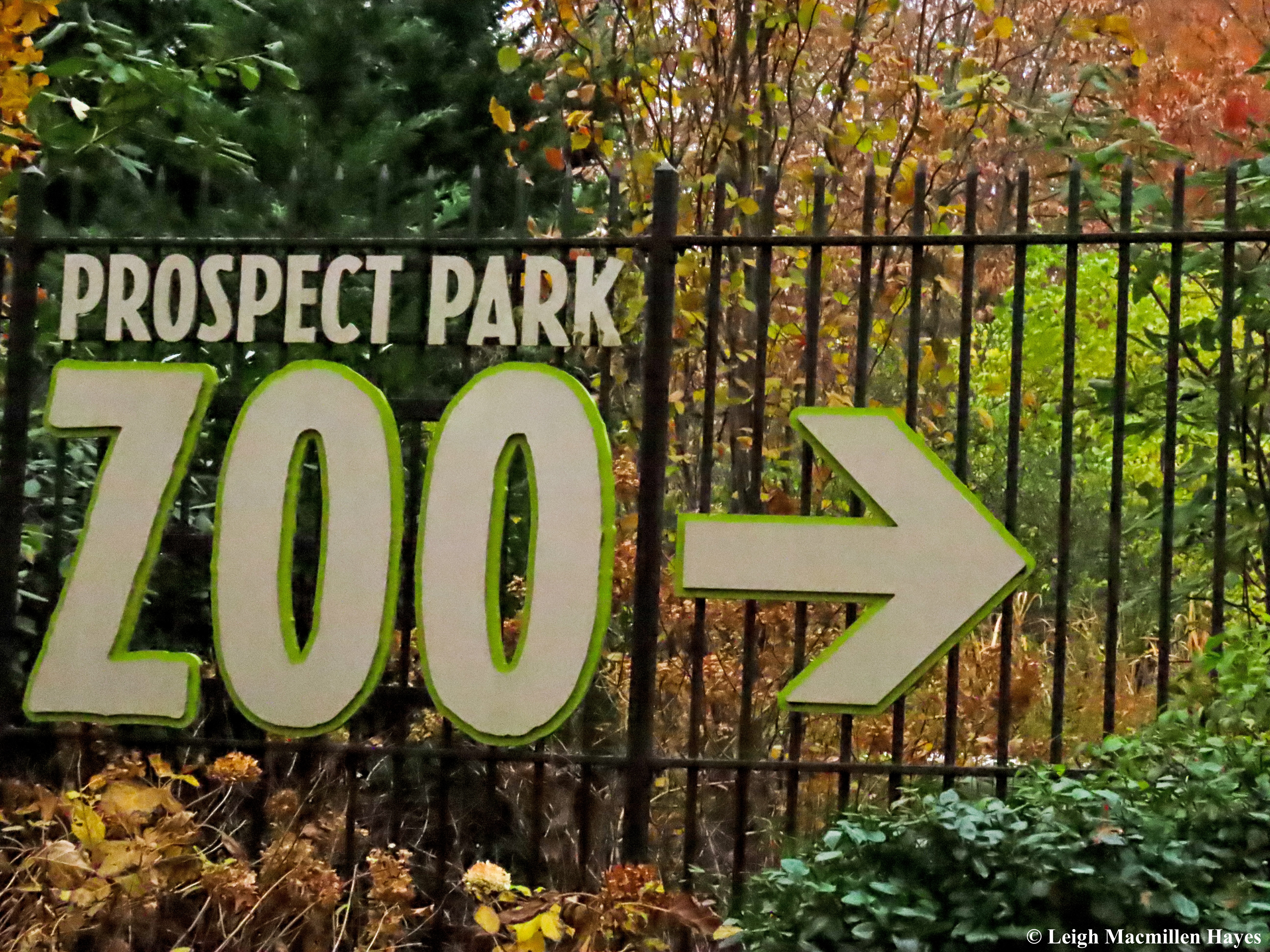
Our intention was to walk the outer perimeter and explore some new areas we hadn’t seen before, which suddenly included Prospect Park Zoo. When in Rome . . . and so we did. We entered the zoo and had the most delightful time.

First, there was the metal artwork that greeted us, including this snake consuming a frog. I have memories of such happenings in the natural world, watching as the frog became a large lump in the snake’s “throat.”
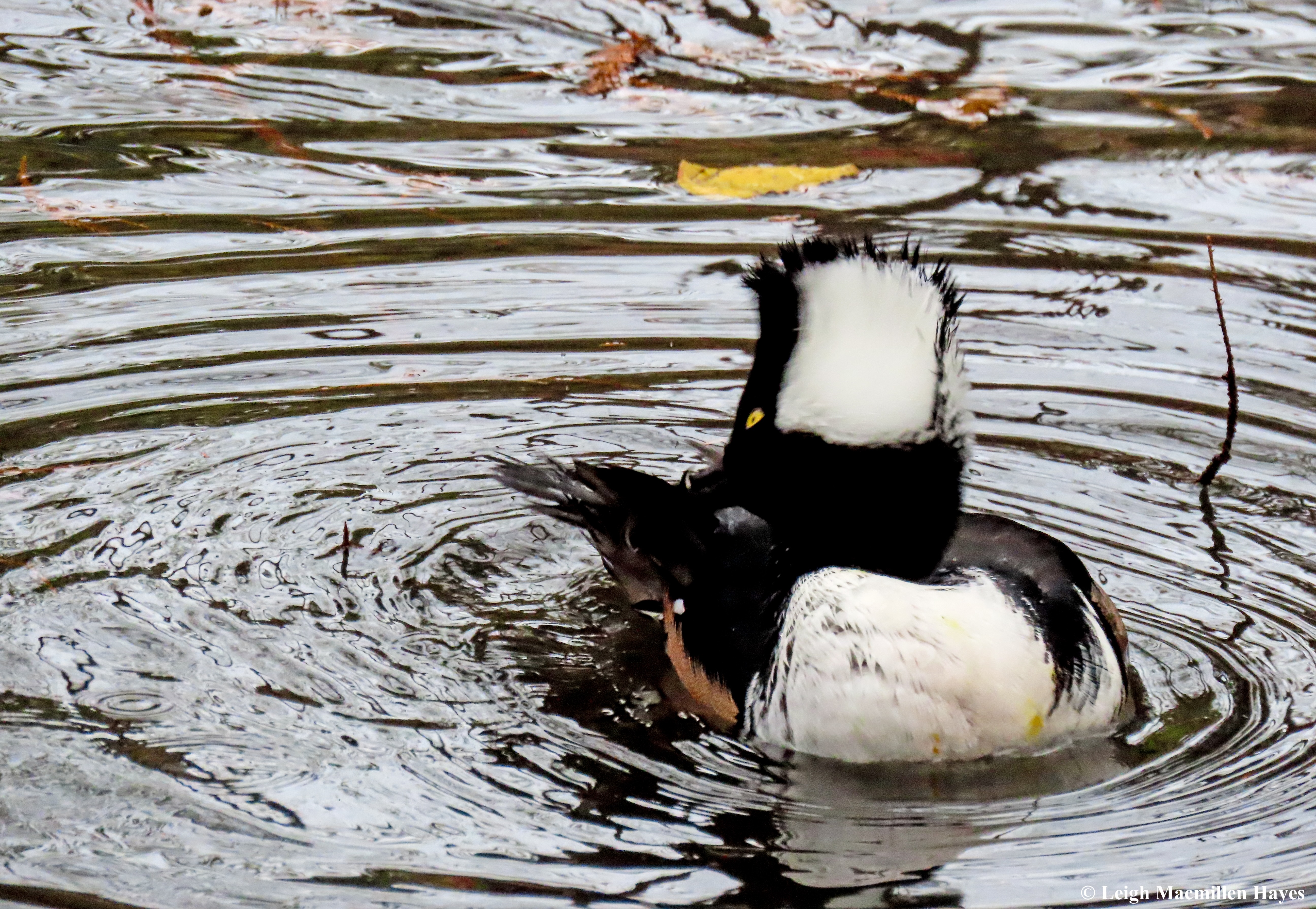
Around every bend there was something different to see and we felt like we were greeting an old friend when we spotted a male Hooded Merganser preening.
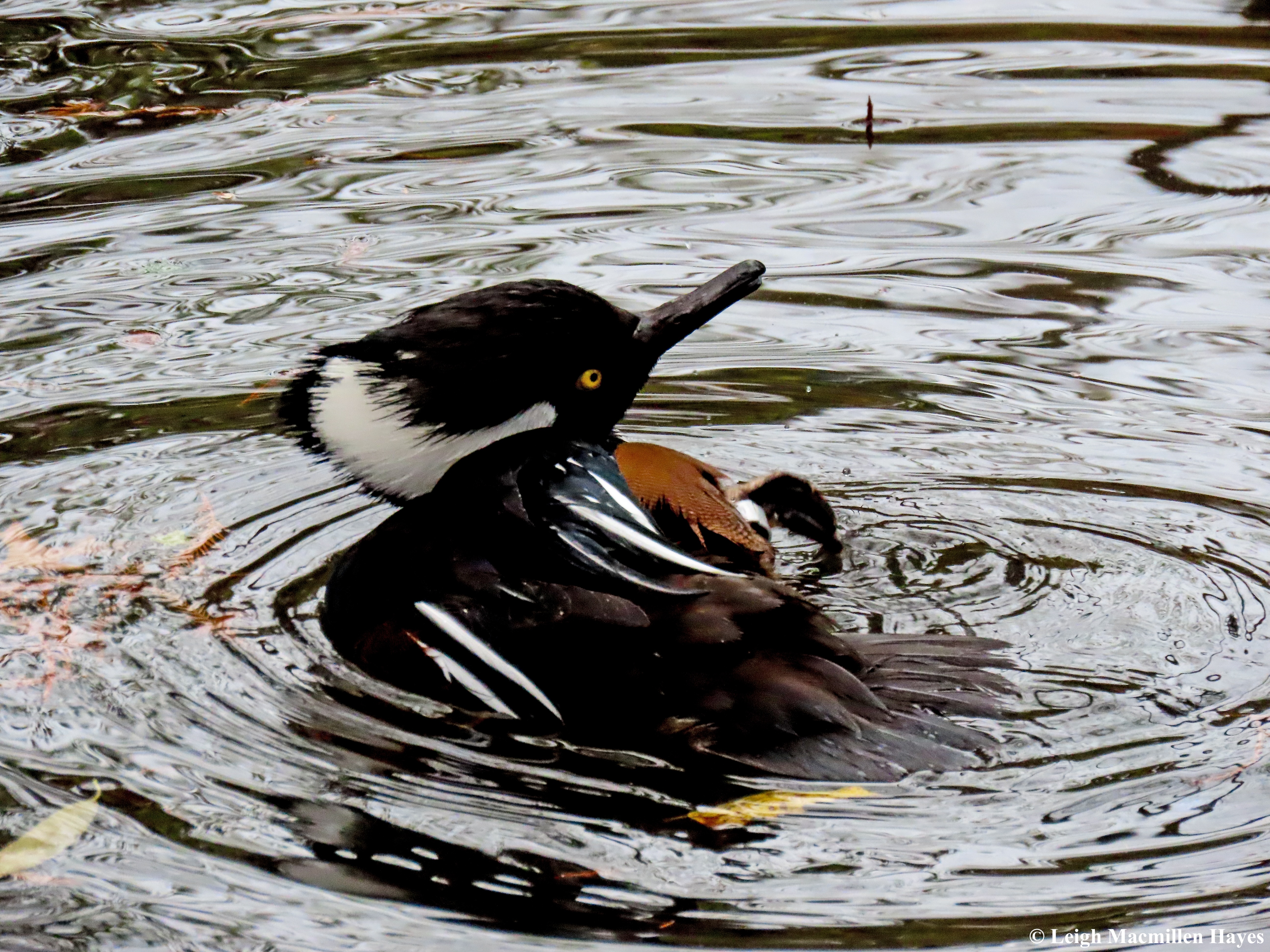
Splishing and splashing, his intention was to waterproof and align his feathers, cleanse them of dirt or parasites, and allow him to spread protective oil from a small gland near the base of his tail, which will keep him warm and buoyant, especially important given the changing weather of the moment.
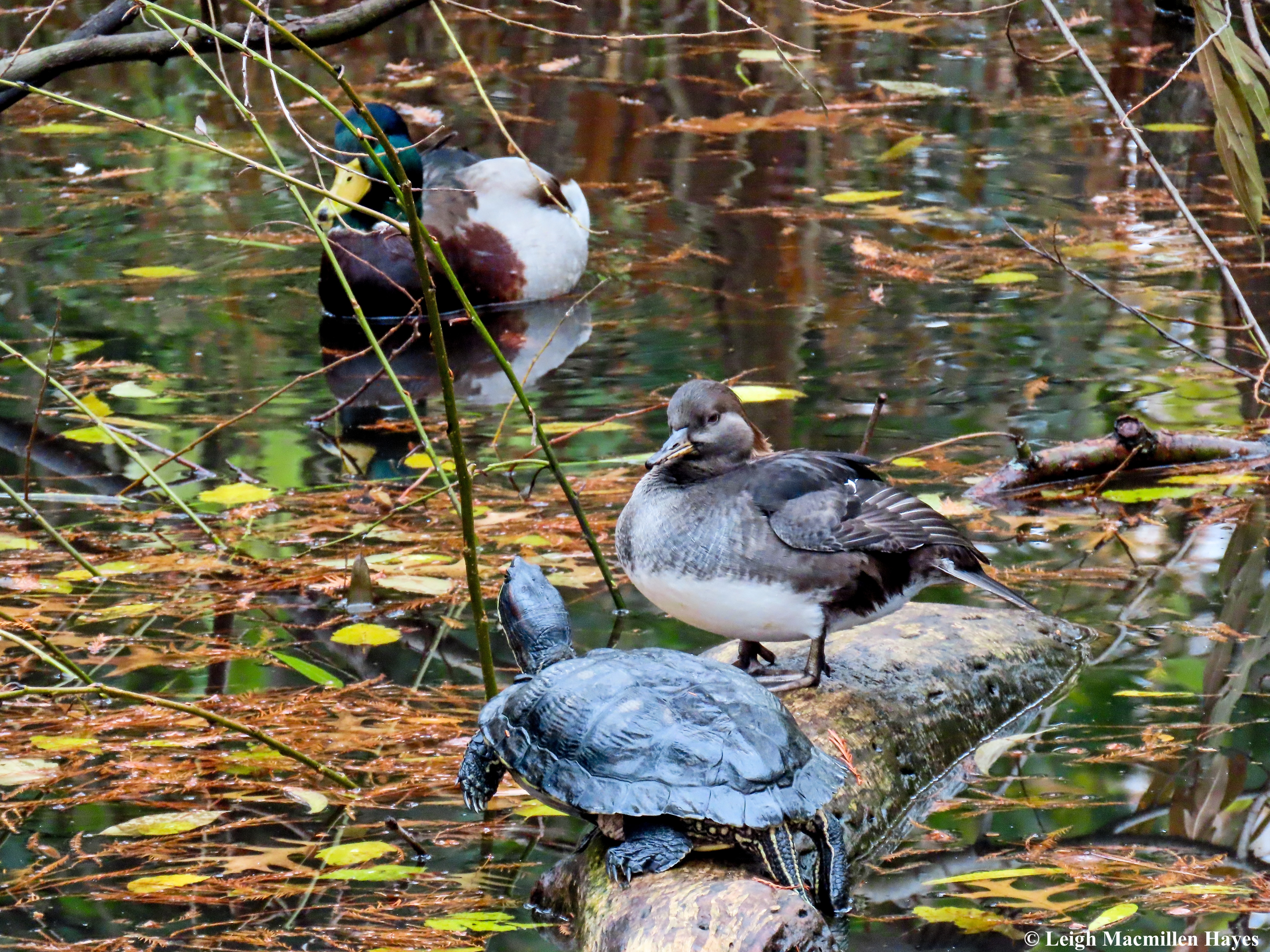
His mate, on the other hand, stood upon a log with a Red-eared Slider and we watched in bewilderment because neither one seemed concerned about the other.

It almost looked like they were two old friends sharing a quiet moment in the midst of a hectic world. And perhaps they were.

For a few minutes, I actually thought the turtle might not be real because there were some small sculpted animals along the zoo path, but then he turned his head ever so slightly.
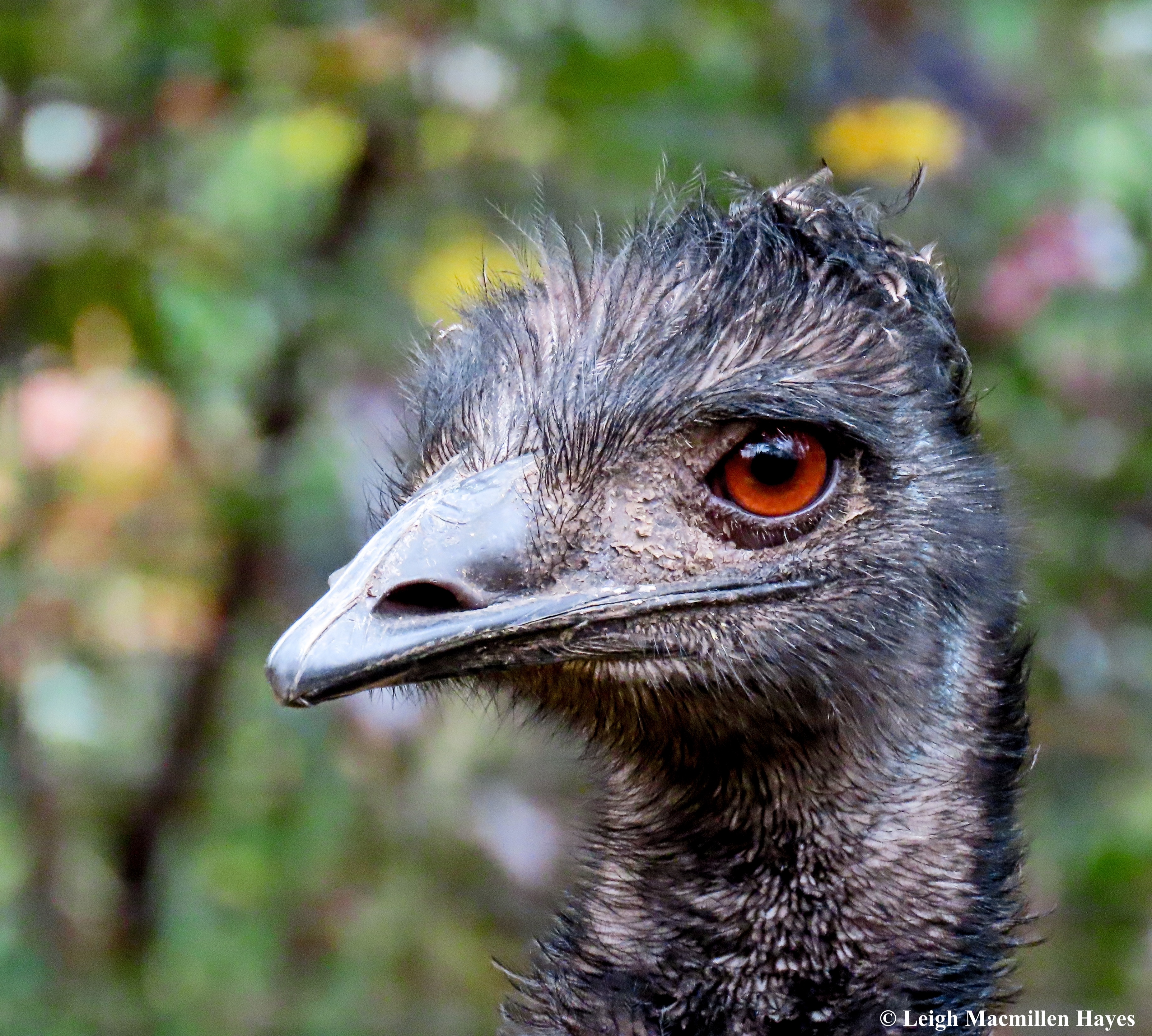
We left them in peace and found the Emus and I immediately fell in love with their orange eyes. And though they don’t look anything like Turkeys, I felt there was a good resemblance, maybe because both have appearances only a mother can love, and this seemed an apropos bird to meet the day before Thanksgiving.

And then, and then, there was a River Otter. Asleep. Who knew River Otters took time to nap? In my book, they are always on the go, swimming and chatting to each other and sliding. Always sliding. But, of course, one needs to take a rest from time to time.

And then slowly lift one’s head up . . .
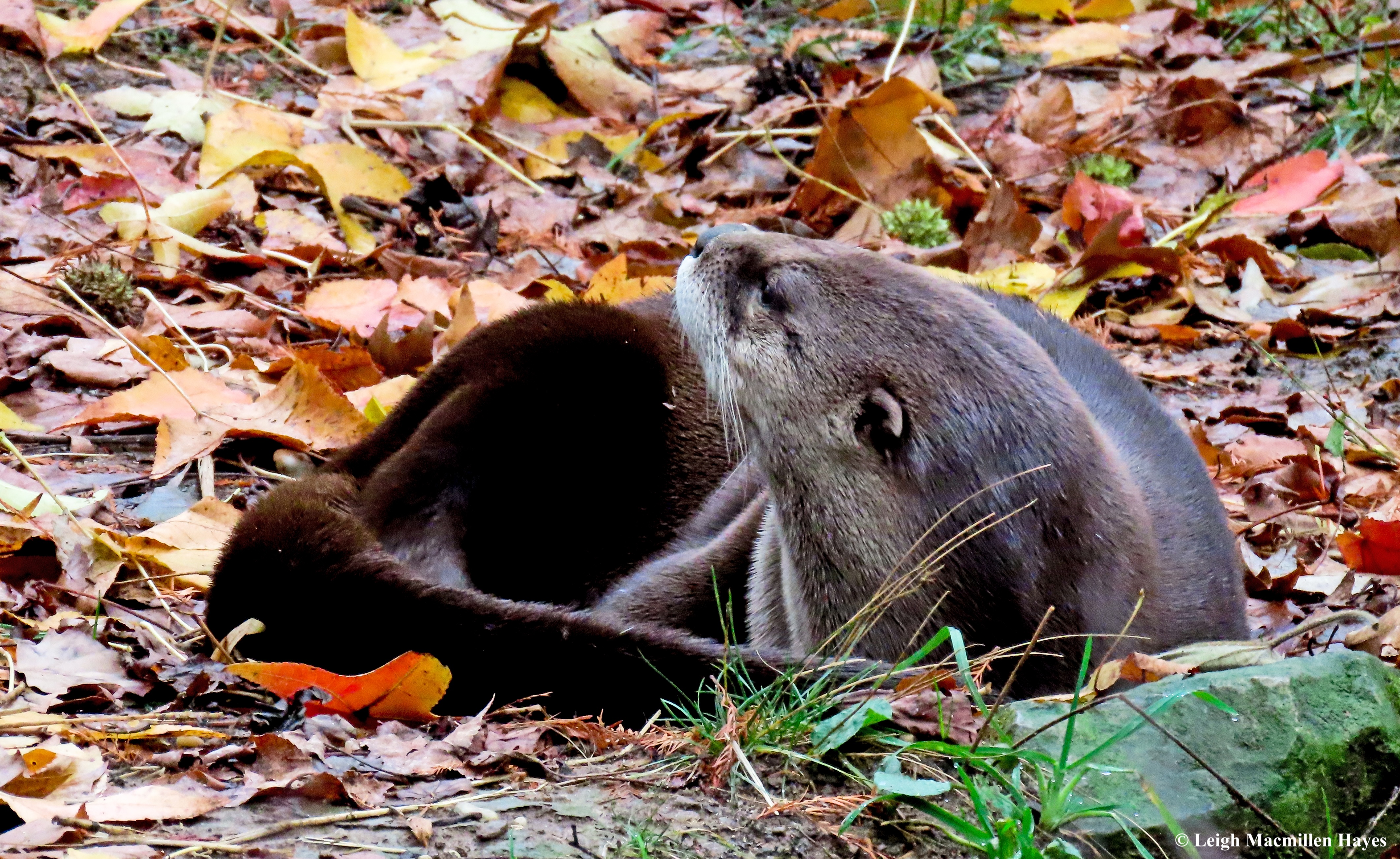
just a tad bit higher . . .

and scratch an itch, . . .

and then do the same as the ducks and preen a bit to spread the protective oils. It’s all in a day’s work schedule.

The ones who were having the most fun at the zoo seemed to be the Sea Lions. And we had arrived moments before a training session, so we stayed to watch and ooh and aah with the small crowd that had gathered that day.
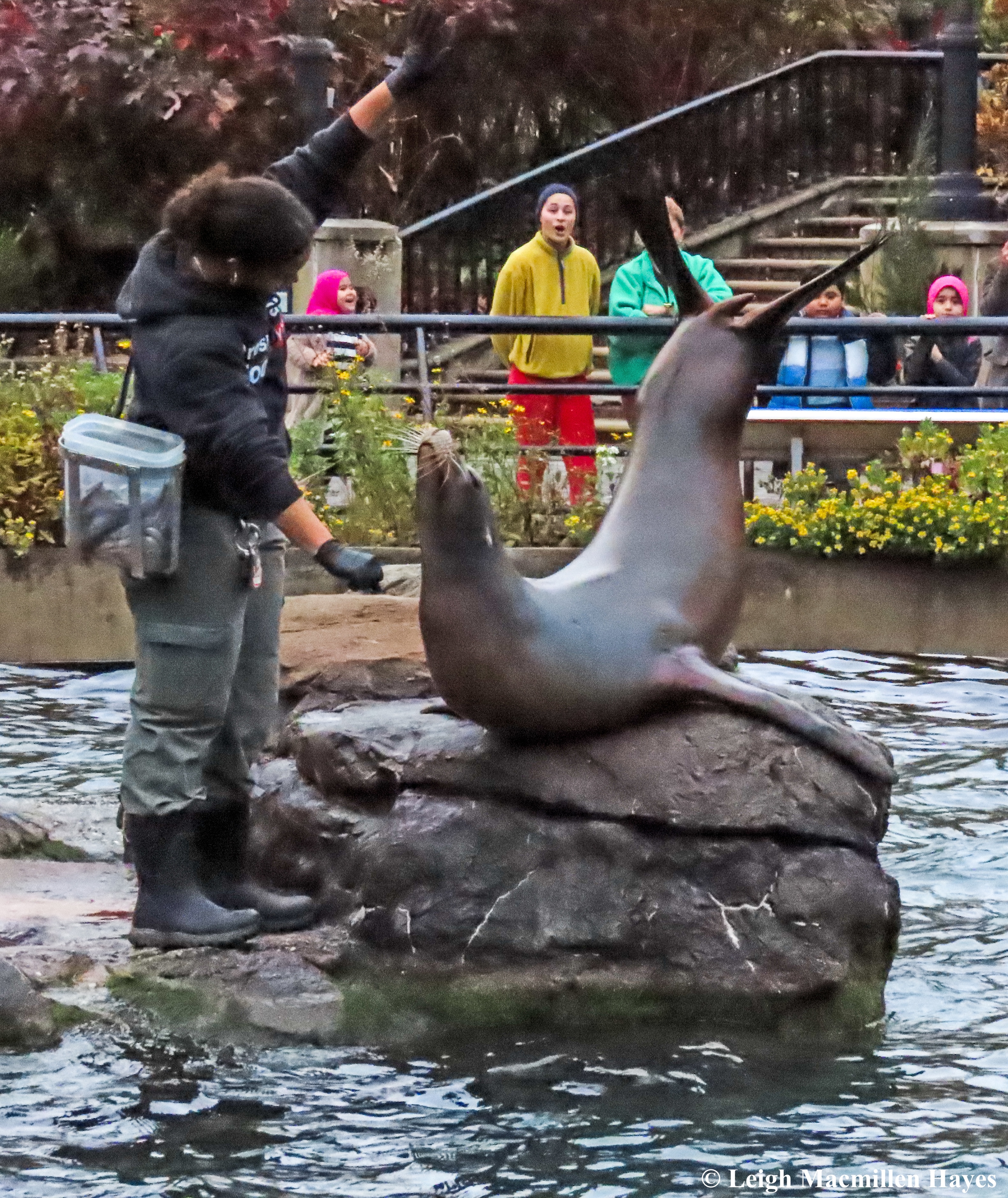
They reacted to hand signals. And fish, of course.

High Fives . . .

and Open Sesames . . .

and Eye Drops . . . were all part of the program.
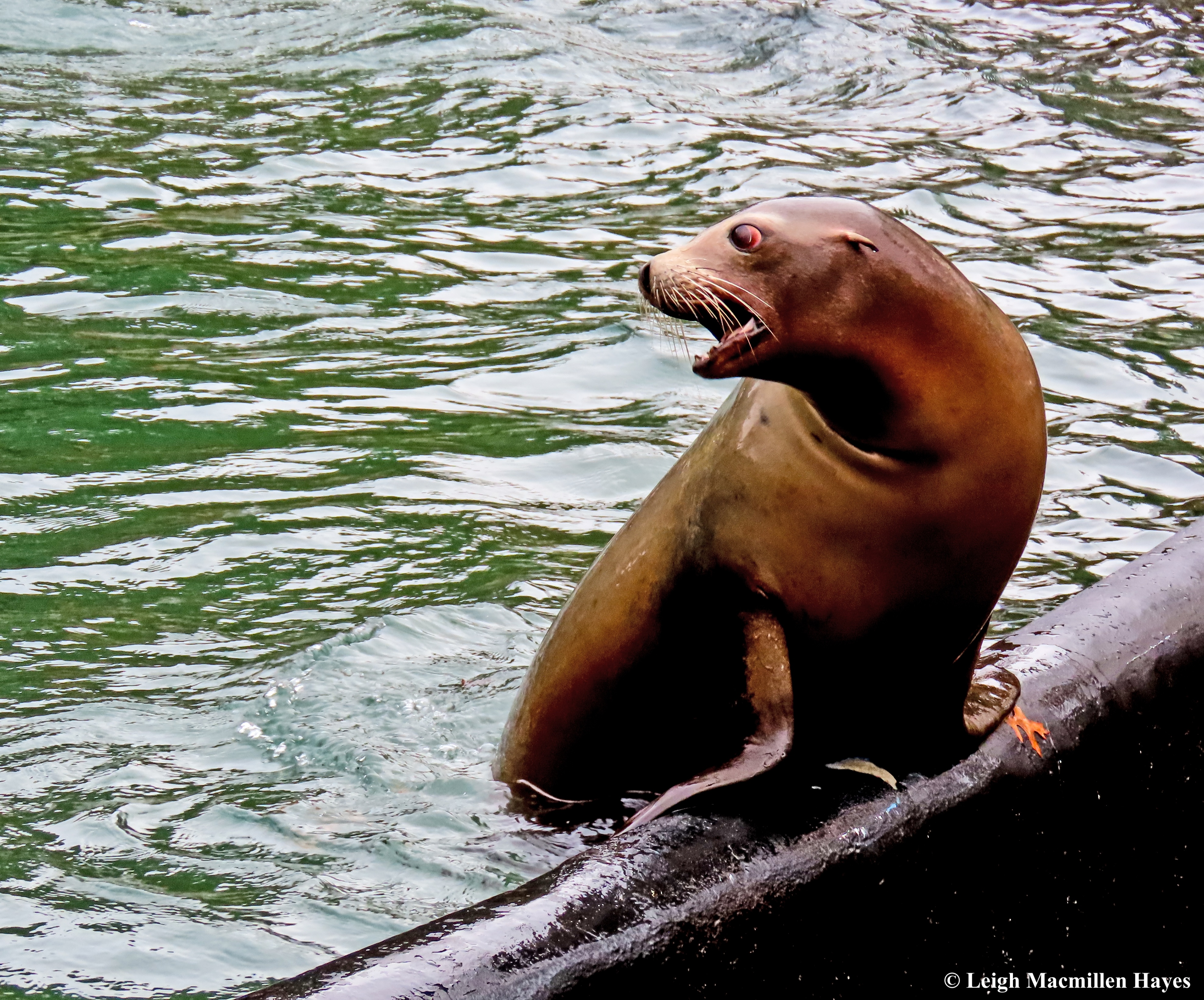
But maybe the best moment was when one swam to the edge, looked back at the trainer, recognized the signal to talk, and let us hear his voice.

Though I love fish, give me dark chocolates, and I might do the same.

Not to give away all that we saw, but there were Red Pandas who looked so cuddly, until I spotted the nails on their toes. They are bears, after all.

And a Pig-snouted Turtle, aka River Fly Turtle. I like the more common name because just look at that snout.

Meanwhile, the Merganser had moved to another part of the pond, but the Red-eared Slider maintained its position and I gave thanks for the opportunity to see it basking, even on a day with the temp in the low 40˚s.
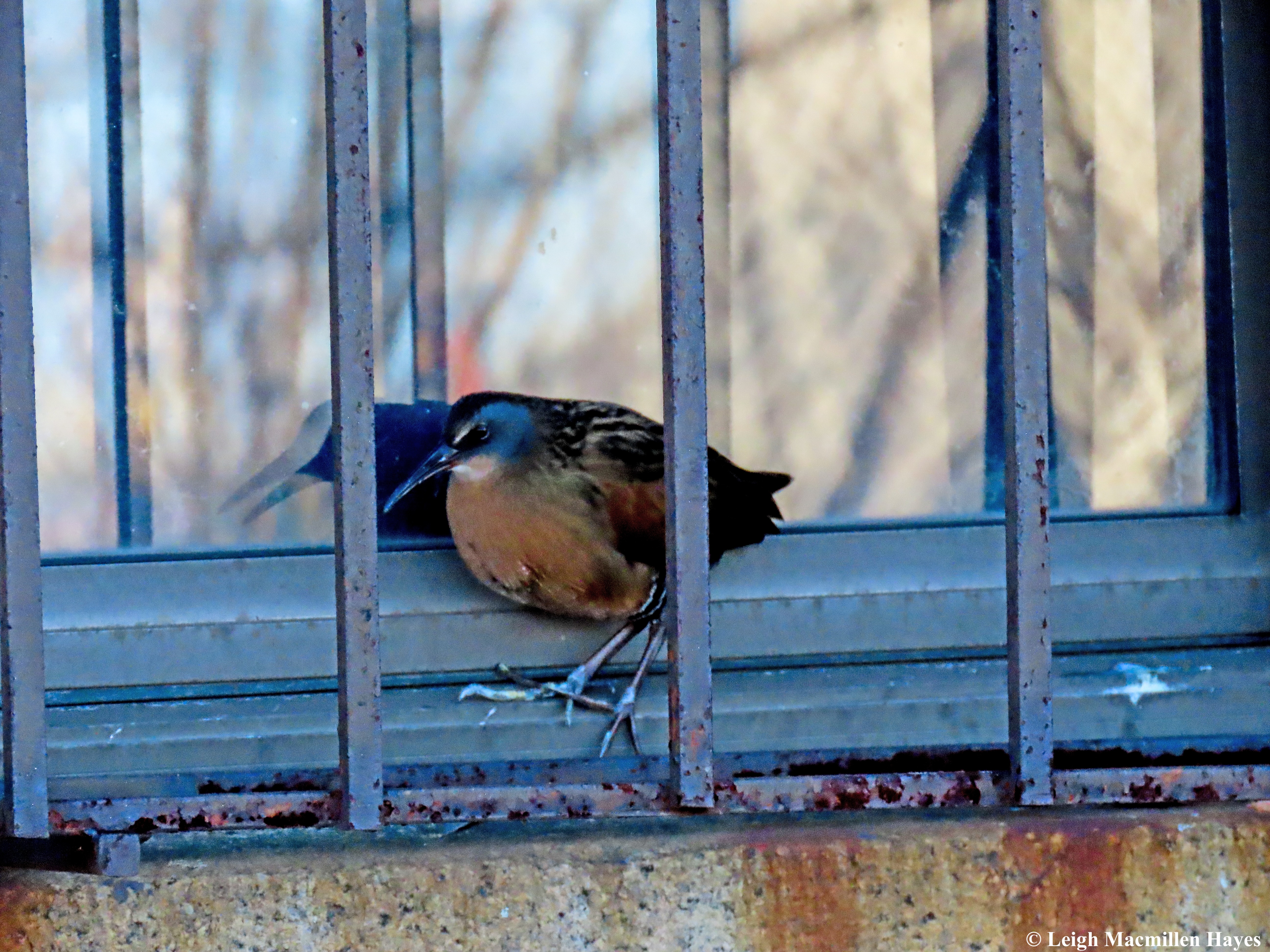
On another day in another place, a place next to where it should have been, we unexpectedly spotted a Virginia Rail. Yes, we were beside the East River in Wallabout Bay, but for some reason this most secretive of birds ended up behind the grates guarding a window.
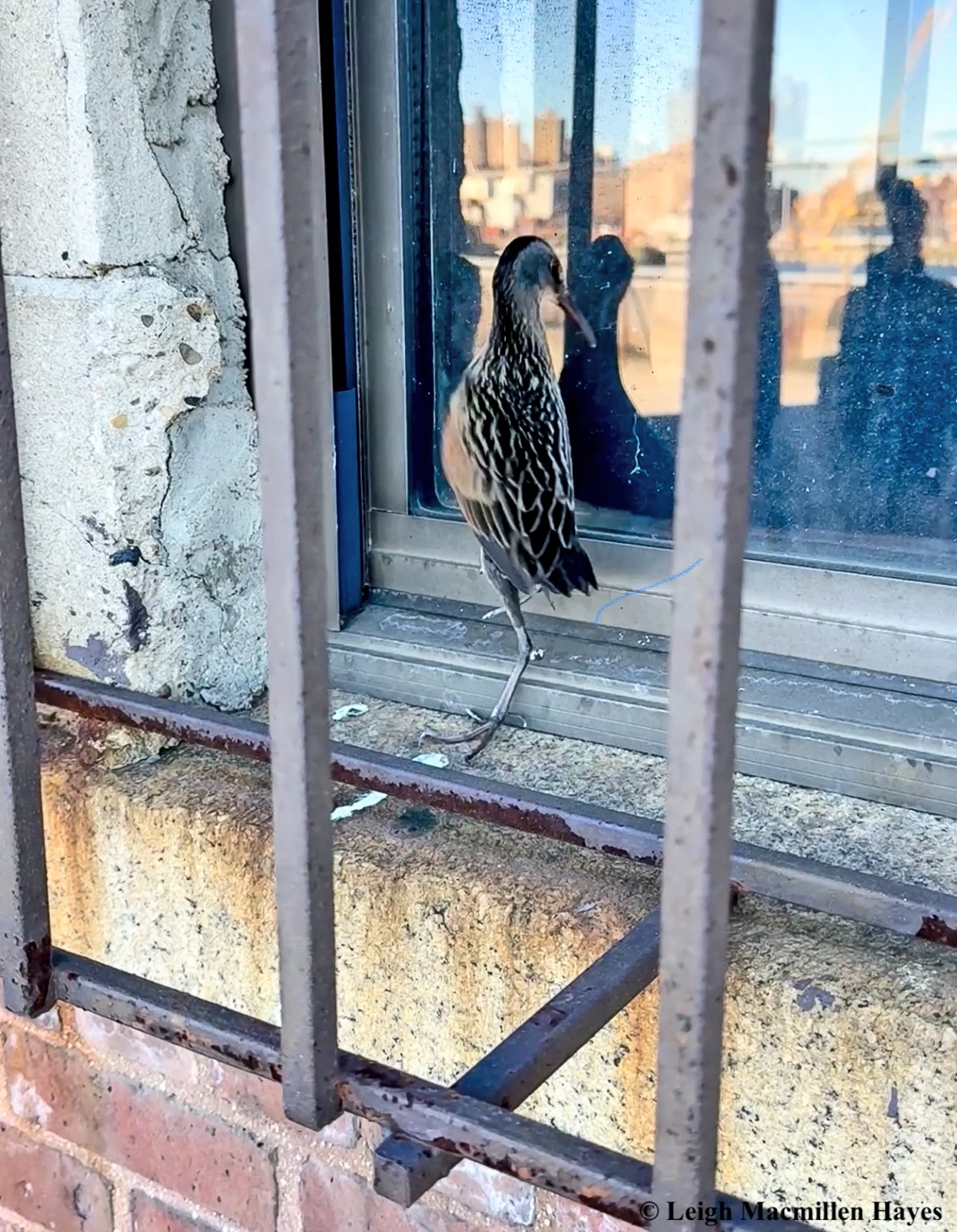
Our companions worried that it couldn’t get out, but I suspected it would as the openings were large, and could only imagine that the wild winds of the previous day had blown it a wee bit off course.

And in another place, Starlings, where I expected to find a more exotic species.

And then, much to my delight, one flew in: a Green Monk Parakeet.
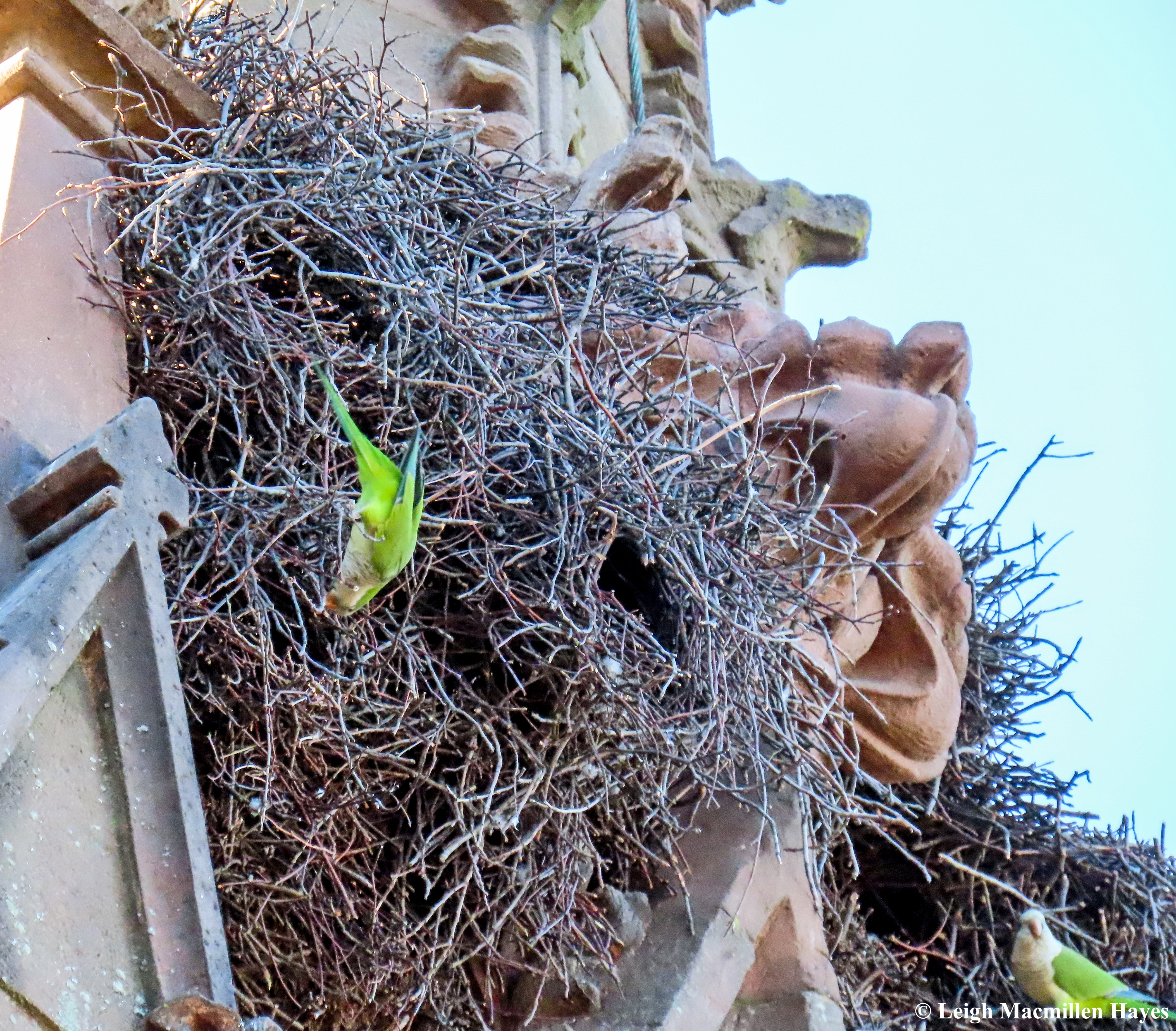
I could have stood watching and photographing for hours in an effort to get to know them better, but there were miles to walk and so I settled for a few quick snaps of the camera and briefly captured their acrobatic movements.

Bringing us back to reality, were the Gray Squirrels dining and creating middens atop tombstones.

But even better than that, a Black Squirrel, the melanistic (dark fur) color variation of the Gray Squirrel. The black coloration is caused by a genetic mutation and perhaps provides advantages in certain environments, like helping them absorb more heat in colder climes.

And finally, much to my utter surprise, we spotted a Queen Bumblebee stumbling along in the crack of a paved pathway, probably seeking a place to overwinter moments before the sun went down.

It wasn’t just the wildlife that we came to see, for we had the profound pleasure of spending time in the company of four young people we are proud to call our own–that being our two sons and their gals. And together one morning, we explored Jumbo and walked below the Brooklyn and Manhattan Bridges.

One fun discovery was this orange cone Christmas Tree that seemed like it would look right at home in our hometown in western Maine, given that we’ve endured several years of sewer construction and road work.
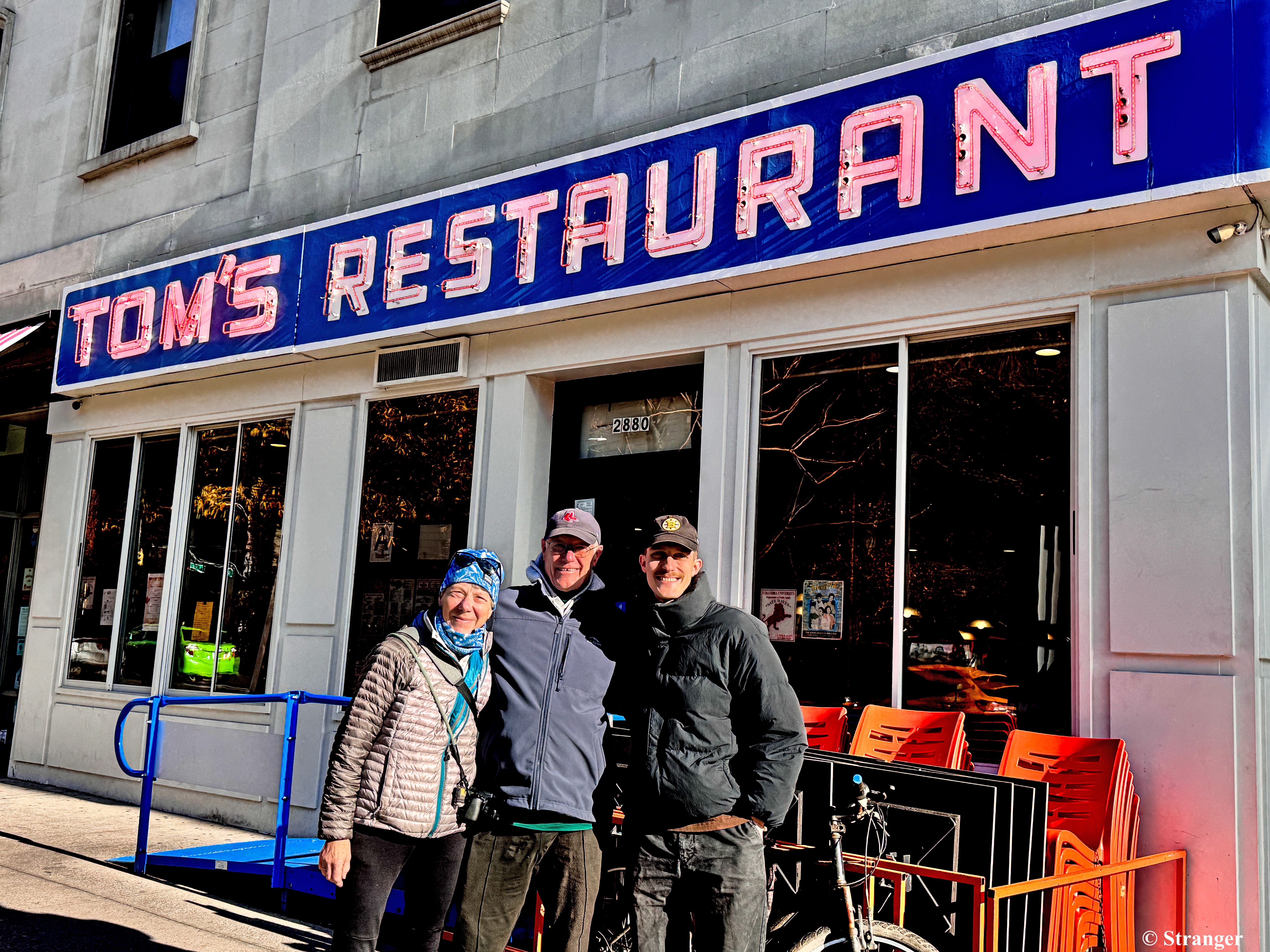
After saying goodbye to our eldest, we ventured to Manhattan with the youngest and found the restaurant that inspired one of our favorite shows.

We sat at the counter where P posed below Kramer and felt like we could hear Jerry and George and Elaine in a nearby booth.
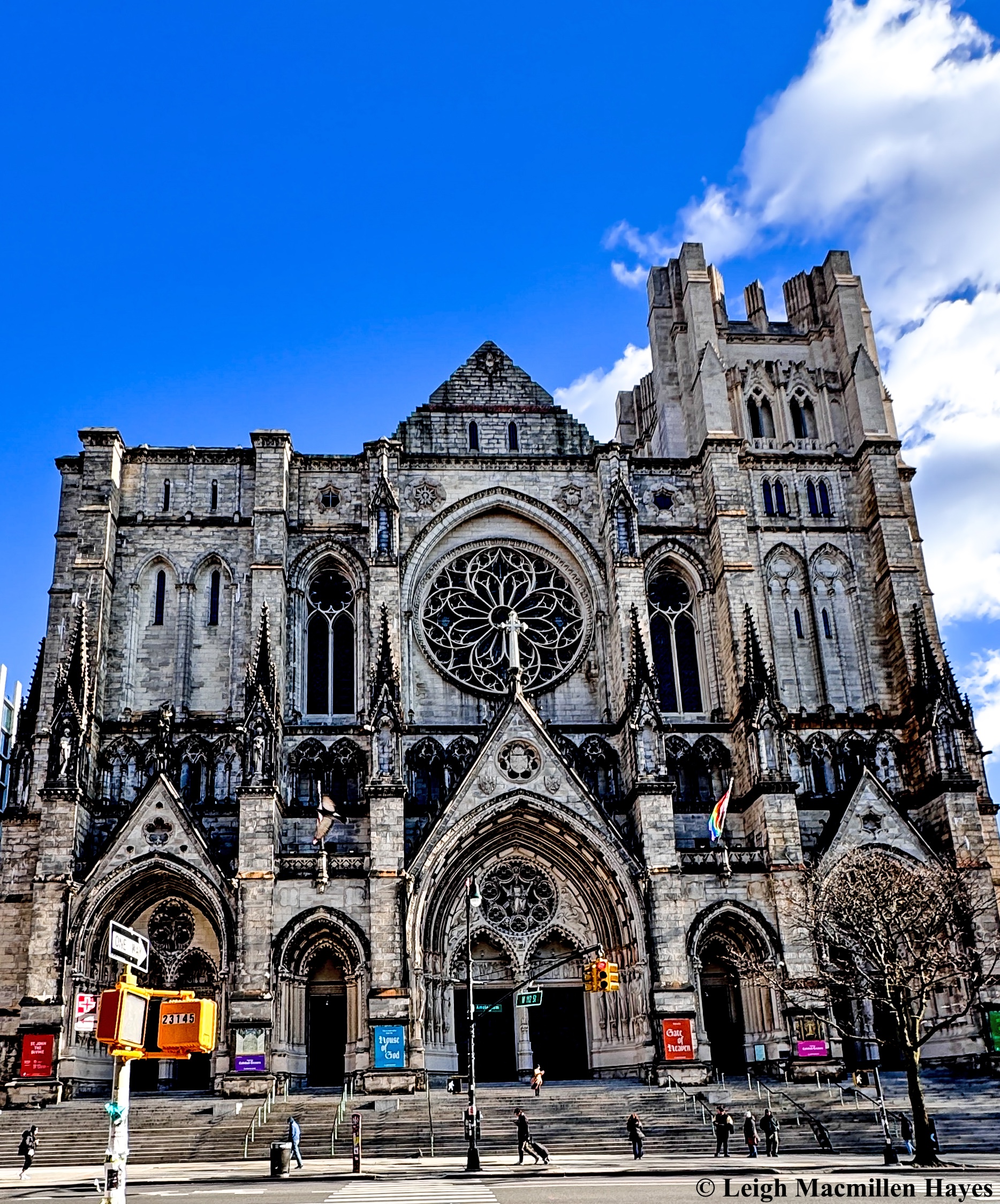
And then we walked to St. John the Divine, an Episcopal Cathedral steeped in history and never finished.

Our tour guide informed us that the original architects, George Lewis Heins and Christopher Grant LaFarge, envisioned a Romanesque-Byzantine style structure, as seen here in the Apse. Notice the rounded arches. They started building the Cathedral in 1891.

The Cathedral was partially finished in 1911, when Heins died. Architect Ralph Adams Cram was then hired to complete the work and the Nave reflects Gothic Revival architecture, his favorite. Notice the pointed arches.

Massive pillars that are 55-feet tall and six-feet across support the building and were constructed from New England granite without steel reinforcement, using techniques borrowed from the Middle Ages.
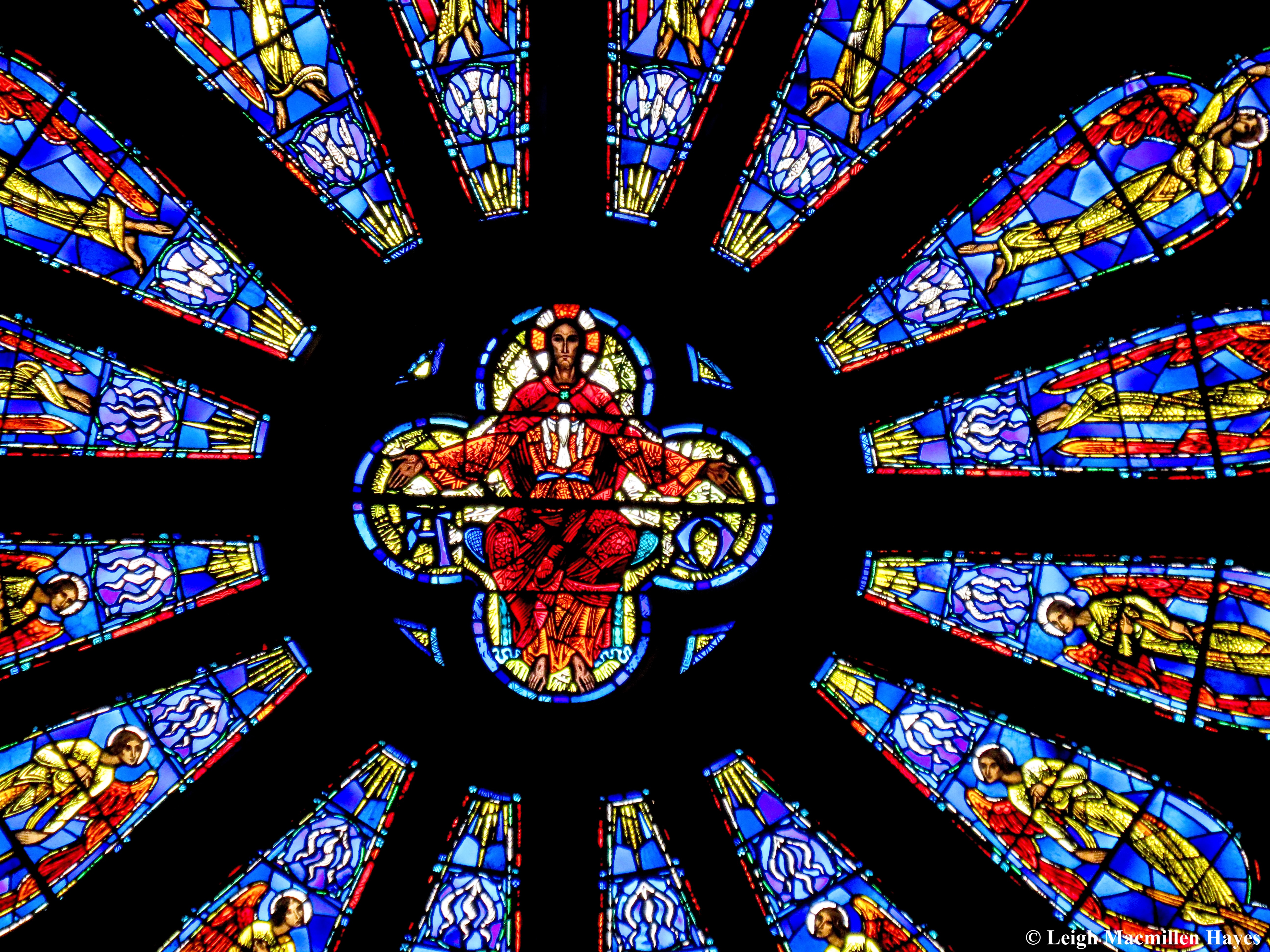
In the back of the Nave, the Great Rose Window is forty feet in diameter, with Jesus being 5.5 feet tall, despite how small he looks from the floor below. It’s the third largest rose window in the world and is made of over ten thousand pieces of glass, mind-boggling as that is.

Our youngest had signed us up for a vertical tour, and I have to say climbing up was much easier than climbing down, but I’m so glad we did it.

Each level brought us closer to the stained glass windows, which are dedicated to one of fourteen forms of human endeavor, including Labor, Medicine, Communication, Education, Law, Military, Arts, American, Anglican, Crusaders, Earth, All Saints, Missionary, and Sports.

The windows on the ground level show a variety of historical and scriptural figures engaged in a particular activity, all theme-related.

The higher set of windows show saints associated with the same activity.

Rosettes at the top depict Jesus, crowning each window and completing the progression from the human plane to the sacred and divine. He is always depicted with a cross above his head.

We happened to be there when the late afternoon sun was shining through and creating magical rainbows on the pillars.

From there we went to the MET Cloisters, where we walked the grounds and saved an inside tour for another day.

Each time we visit, we also arrange for a private group tour and this year’s locale was the Brooklyn Navy Yard in Wallabout Bay on the East River.

From the early 1800s through the 1960s, it was an active shipyard, and during World War II was known as the “Can-Do” shipyard, which employed 75,000 workers. In 1966, it was demilitarized.

According to our guide, the facility now houses an industrial and commercial complex for shipping repairs and maintenance, run by the New York City government, and as office and manufacturing space for non-maritime industries. Inside the museum one can view some of the products that call this place home.

One of the things we learned as we toured the shipyard, was that Sweet’N Low, the sugar substitute, was born and raised at a Fort Greene factory just outside the Brooklyn Navy Yard. Though the business has relocated, the iconic sign remains.

Our final tour of the weekend was self-guided, again with our youngest leading the way, and into Green-Wood Cemetery we ventured because it’s located just around the corner from the apartment he shares with his gal.
The cemetery contains 600,000 graves and 7,000 trees spread out over 478 acres, with hills and dales and ponds in the mix and as P noted, the city noises disappeared as we explored.

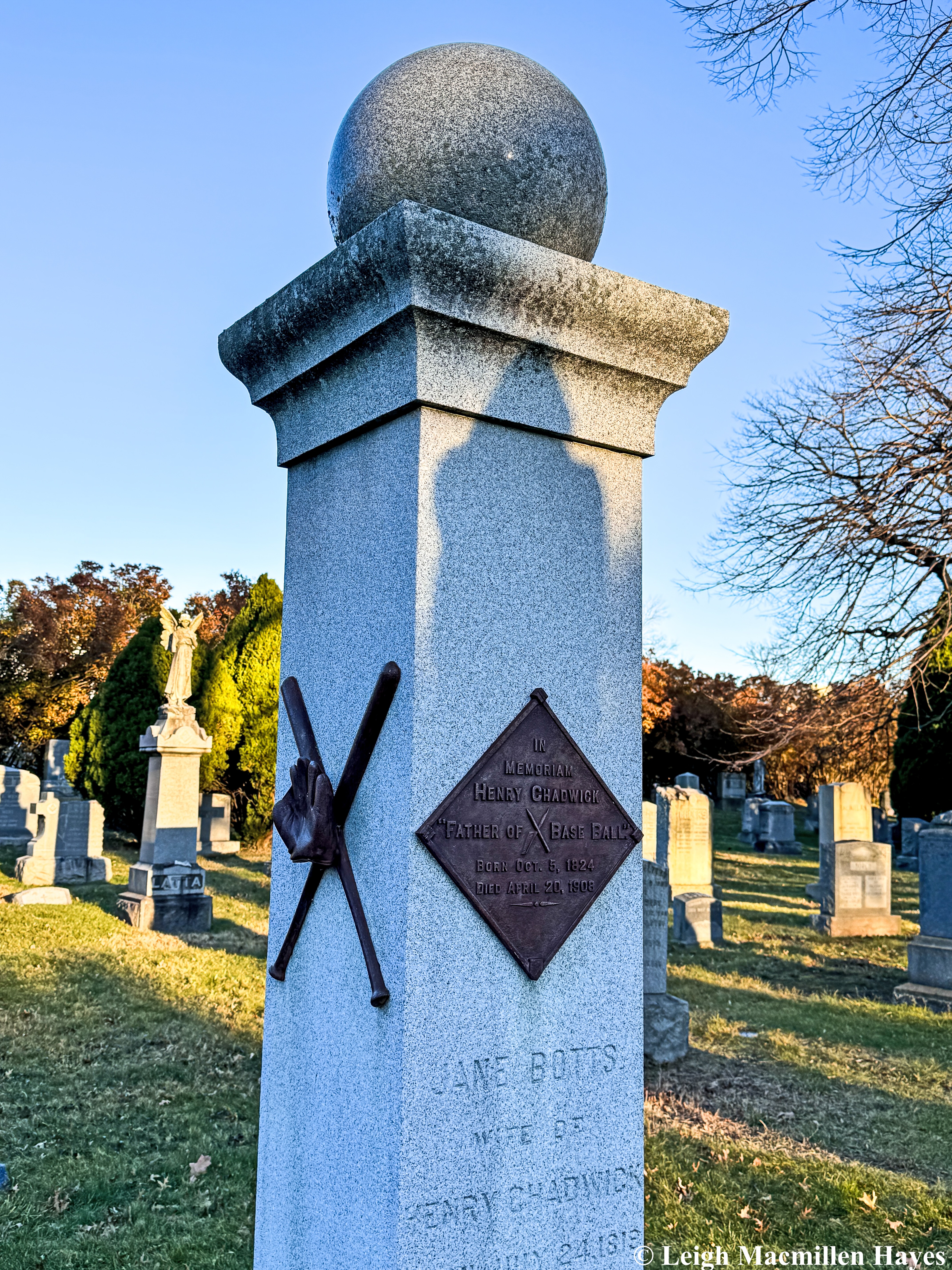
One of our fun finds, the pillar for Henry Chadwick and Jane Botts, he being the father of Baseball.
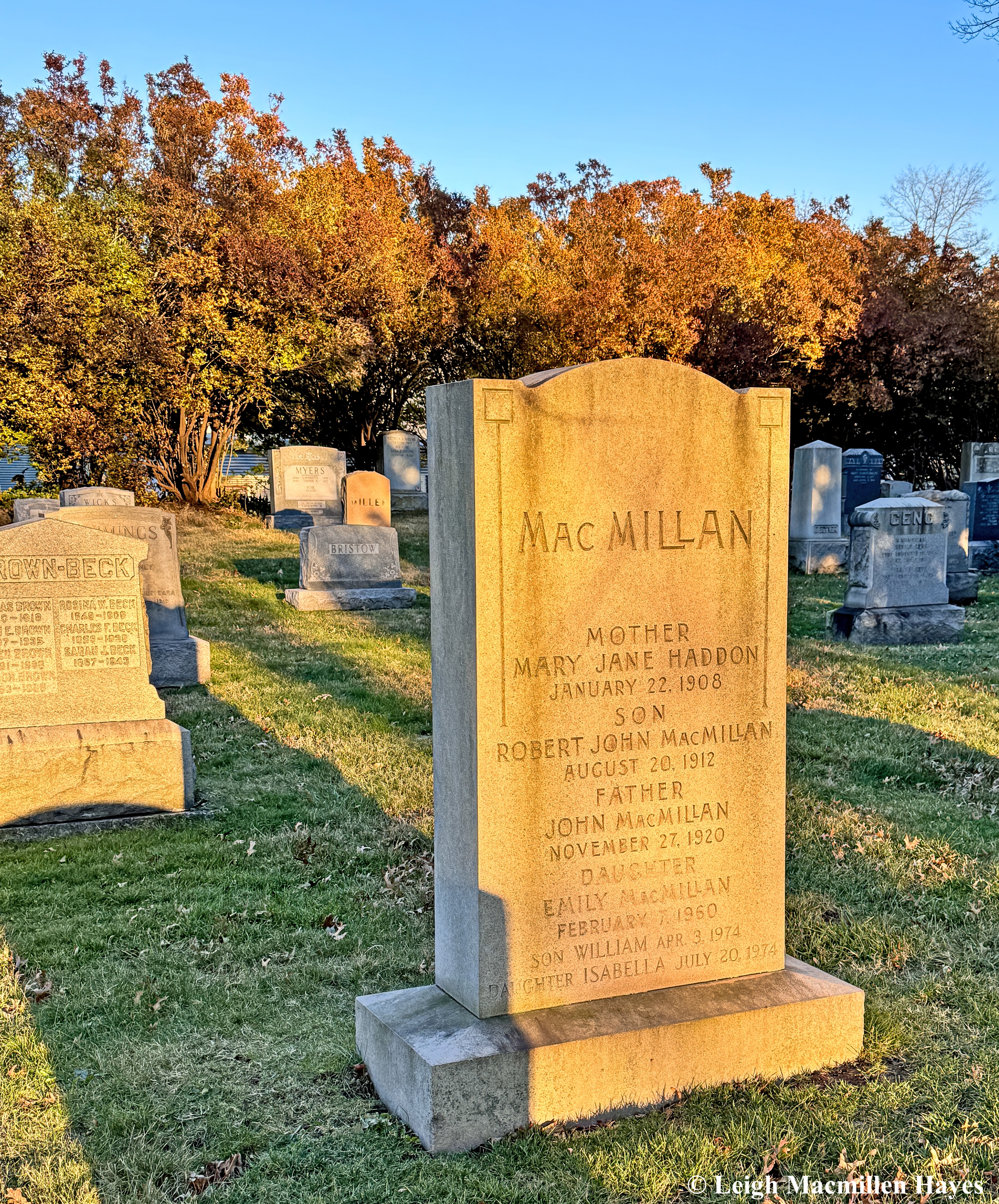
We also looked for familiar names and weren’t disappointed, though we don’t know of any connections at this point.

But what truly struck us is that this cemetery is one for all–for so many were the nationalities and religions depicted.

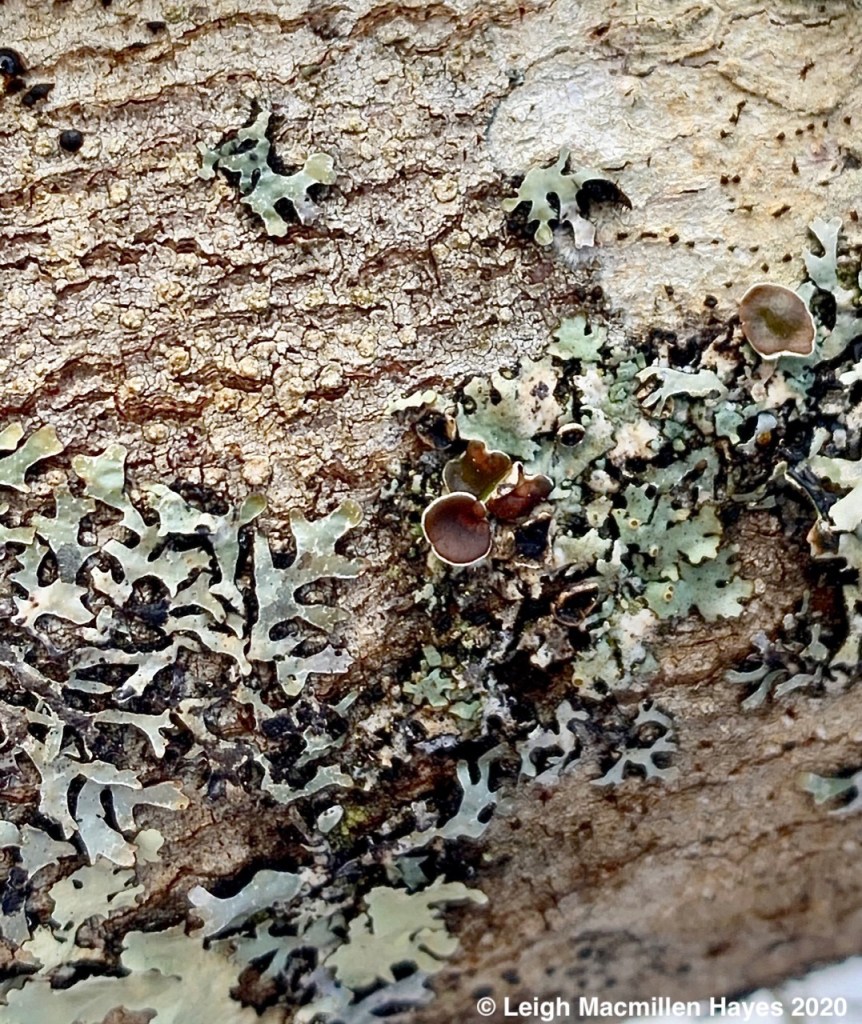
And while most of the stones looked like they were frequently cleaned, I did locate some with lichens, speaking to the fact that there is life among death. And this shield lichen very much spoke to such life for it featured the fruiting bodies or Apothecia with abundant Soredia, which are tiny, powdery vegetative reproductive bodies that can be carried off by the wind or rain to form new lichens. The Soredia are similar to other vegetative reproductive growths called Isidia, which are stalked growths on the thallus or body of the lichen.
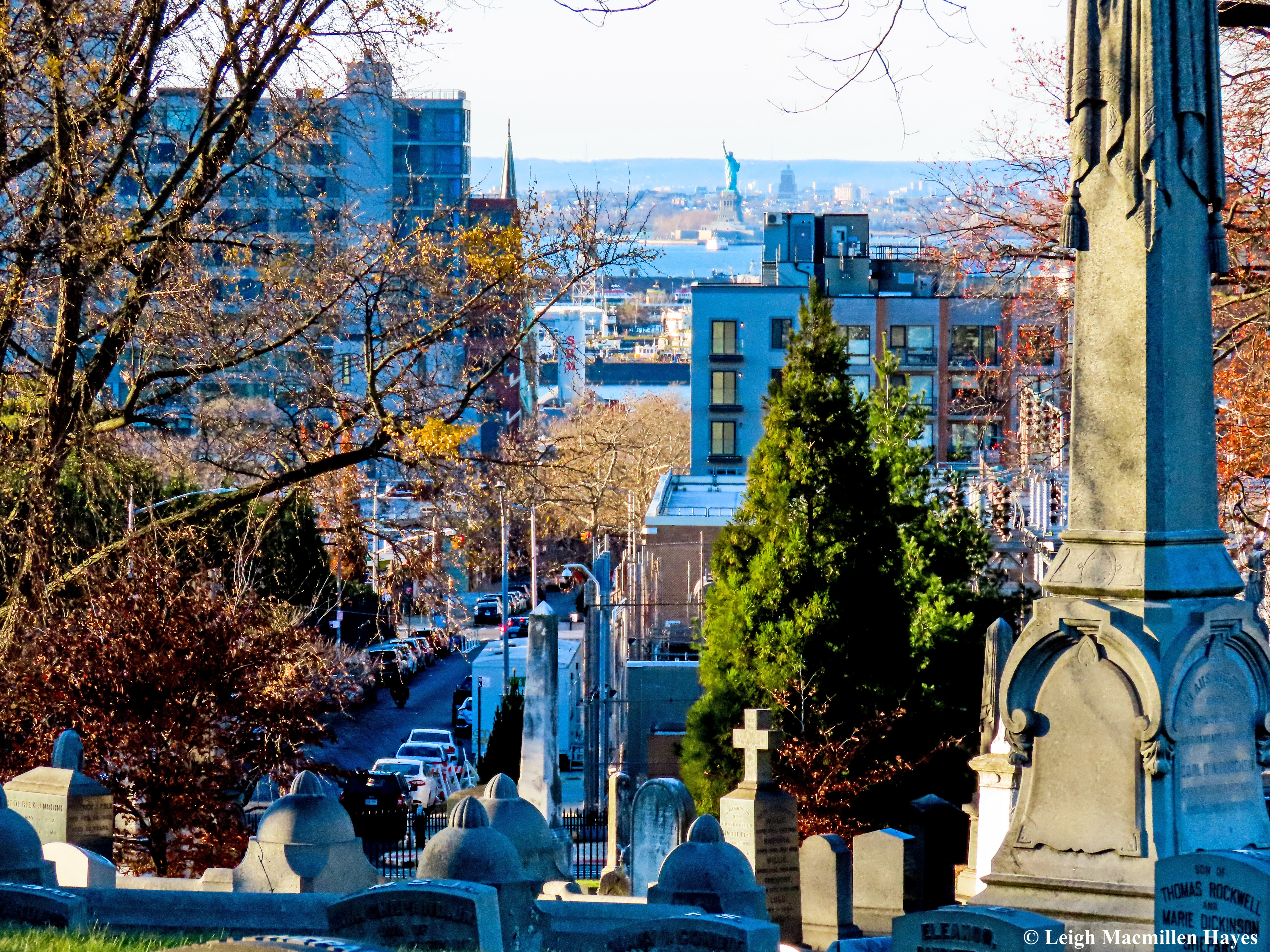
From the cemetery, we could see Lady Liberty standing tall and holding her flame to bring us all together.

And from various vantage points we could see the Empire State Building, standing as a beacon to us . . .

almost like Pleasant Mountain and Mount Washington back home, so that no matter where we were, we knew where our weekend home was located.
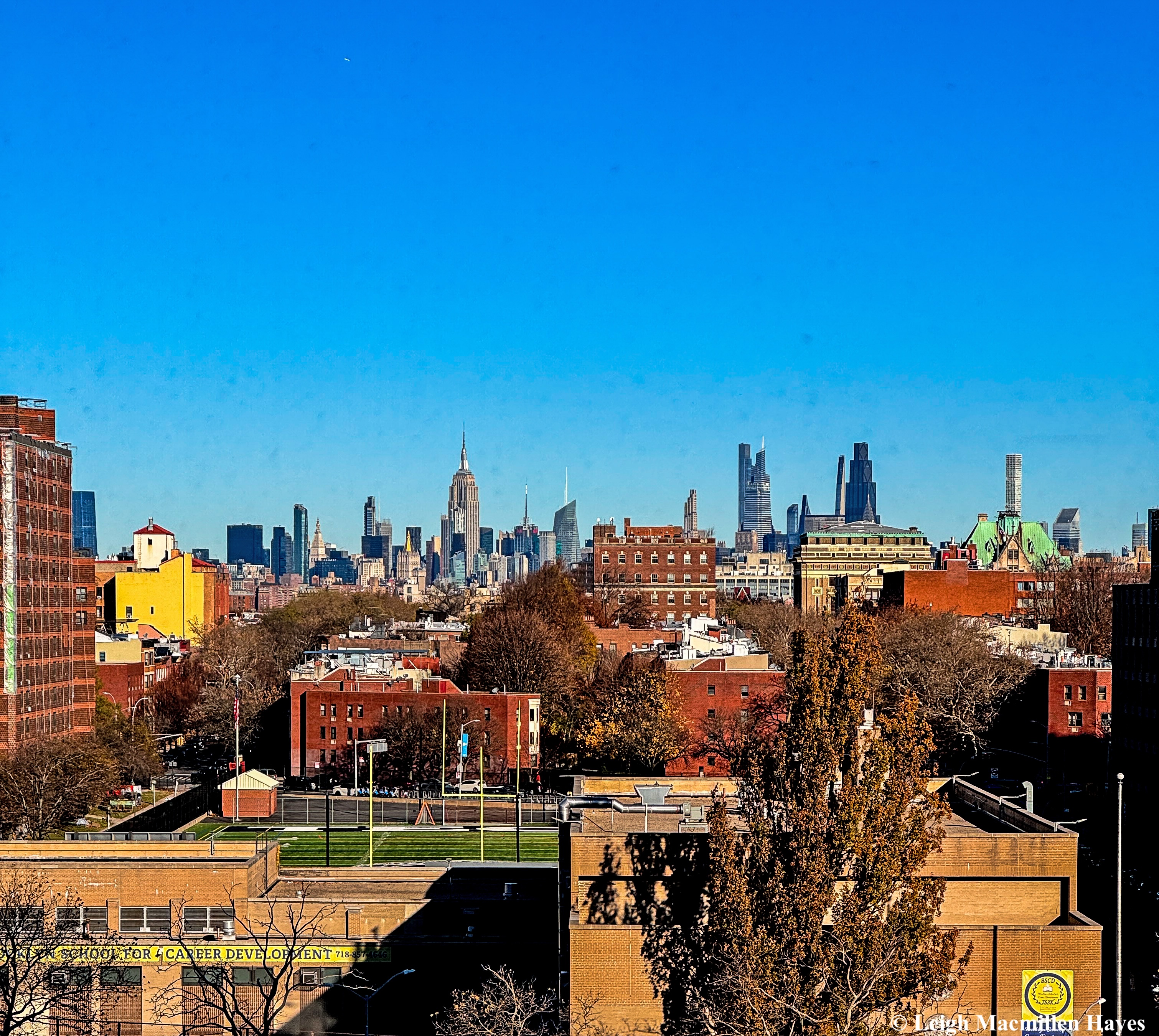
Because this was the view from said “home,” the Brooklyn apartment owned by our Thanksgiving hostess.

And no trip of ours is ever complete without a tour of a hardware store.
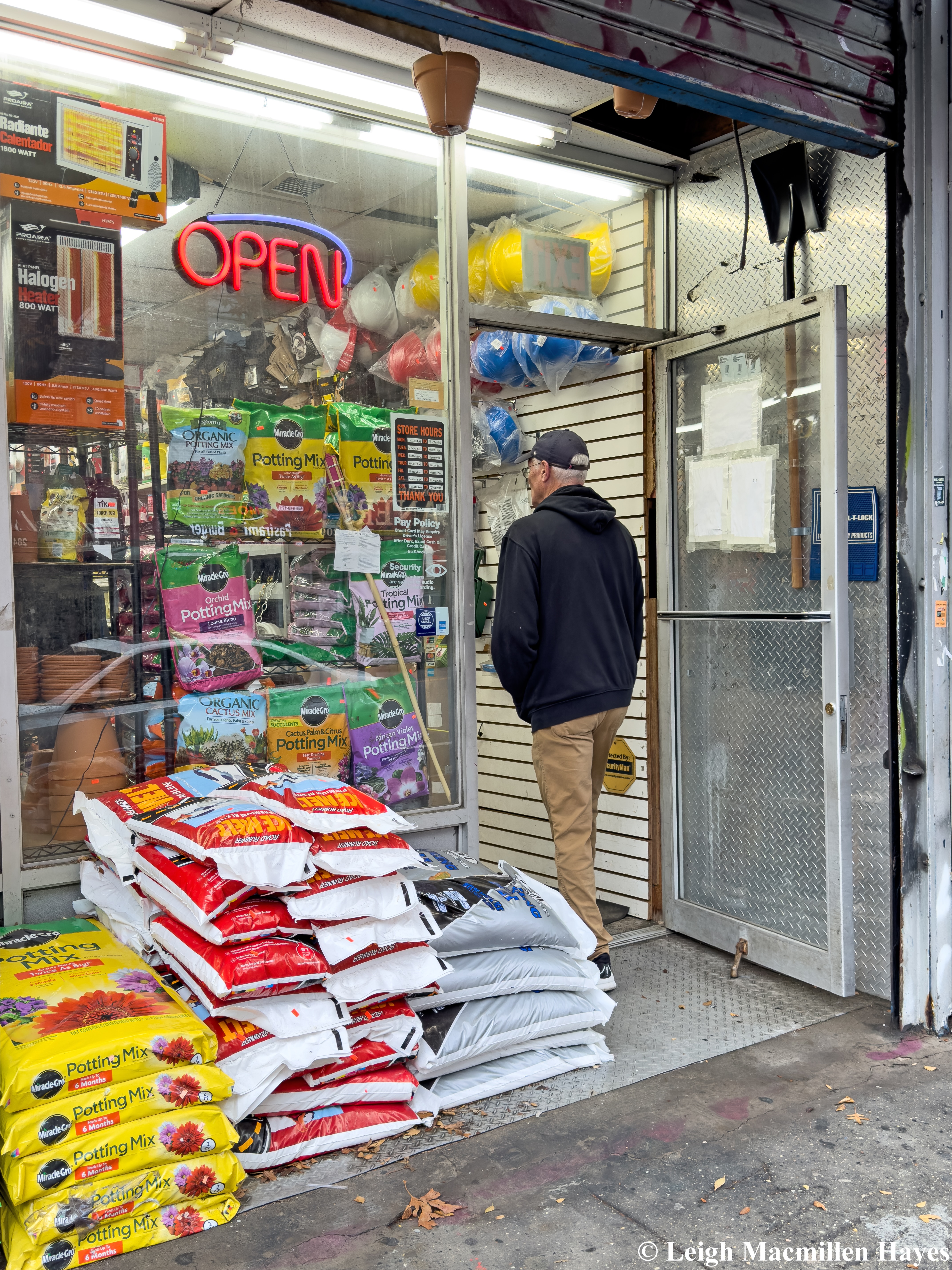
He said he wasn’t going to go in, but you know that he did. It was a quick loop up one aisle and down the other, for so narrow was the store, but oh was it packed with merchandise–every square inch in use as is the city way.

And remember our cemetery trip? Well, I spotted this and My Guy didn’t know what the Old Guard Southern Hardware Salesmen’s Association was all about. Turns out, it has quite a history.

Curiously, I found this explanation on Instagram:

From the American Artisan and Hardware Record, June 1, 1918:

“THE OLD GUARD SOUTHERN HARDWARE SALESMEN KEEPS ALIVE ITS ORIGINAL FIGHTING SPIRIT.

“The original fighting spirit which moved the members of the Old Guard Southern Hardware Salesmen’s Association to organize for carrying on the bloodless battle of commerce was strongly in evidence with new force and application in its annual general meeting held May 29, 1918, at Atlantic City, NJ. These veteran warriors of salesmanship pledged all their energies and experience to the aid of the younger men who are waging the titanic warfare of a free people against the despotism of barbarians who hide their savagery under a guise of mechanical culture.

“Particular significance attaches to the Old Guard by reason of the fact that its ranks represent the ripened wisdom of years of active service in the hardware trade. It was formed ten years ago at the Convention of the Southern Hardware Jobbers’ Association in Hot Springs, Arkansas. The membership of the Old Guard is strictly limited to salesmen and traveling salesmanagers who have sold hardware and kindred commodities to the hardware jobbing trade in five or more Southern and Southwestern states during a continuous period of fifteen or more years. The membership is limited to one hundred.

“The men who have been in charge of the affairs of the Association for the term which ended at the conclusion of this year’s convention have exerted themselves with enthusiasm and persistence to maintain the traditions of the organization and to further the collective interests of the membership…

“Adjournment was taken with a feeling of renewed confidence in the power and purpose of the Association and a determination to use all the influence of the organization in promoting a vigorous Americanism throughout their territory to the end that international justice may be established and lasting victory be won for the hosts of democracy.”

Hardware and Democracy it seems, were both important to Herb.
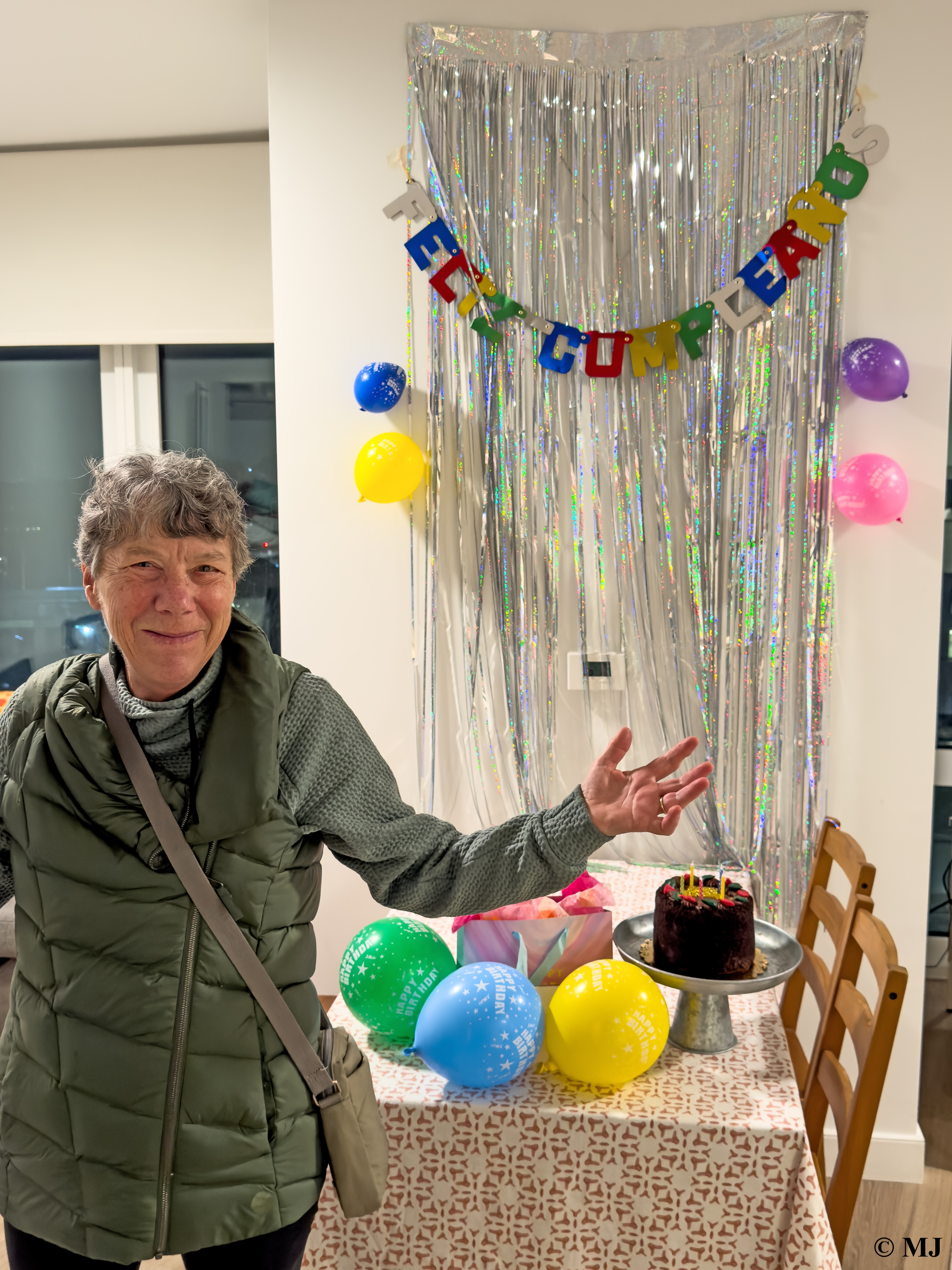
So we arrived in Brooklyn the night of my most recent birthday and were welcomed with a surprise celebration that included New York-style pizza and dark chocolate cake–thanks to M and P.

We were also there to celebrate America’s grand feast with M’s family in New Jersey.

Dinner included a gathering of family and friends, one of whom is a Kiwi and this was her first American Thanksgiving feast, so she graciously wore the turkey hat.

And this little one kept us all in line throughout the day.

At the end of the day and the end of the weekend, our biggest thanks go to these two, daughter and mother, M and D, M being our youngest son’s girlfriend. Their hospitality and generosity never cease to amaze us.

Because of them, we did lots and lots of walking, while it felt like an almost equal amount of dining was thrown into the mix from bagels to farm-to-table to traditional Thanksgiving to diner breakfasts to pub meals, and of course, the iconic New York-style pizza.

Thank you, D and M and P, for inviting us to celebrate New York our way, and to S and H for making the trip from Boston, even if you couldn’t stay the entire weekend.
Meeting Each Other Halfway

The text message arrived November 5: “Any chance you are free Friday and Saturday, November 14 & 15? If you aren’t already booked, thinking we could meet up and hike perhaps.”

The decision was made, a room booked, bags packed, and then there was just the driving left to be done.

And voila, at 10:30am on Friday I pulled into the parking lot and saw her sitting in her car. It had been eight years since we were last together for an adventure and much had happened since then, but as is often the case, it felt like yesterday.

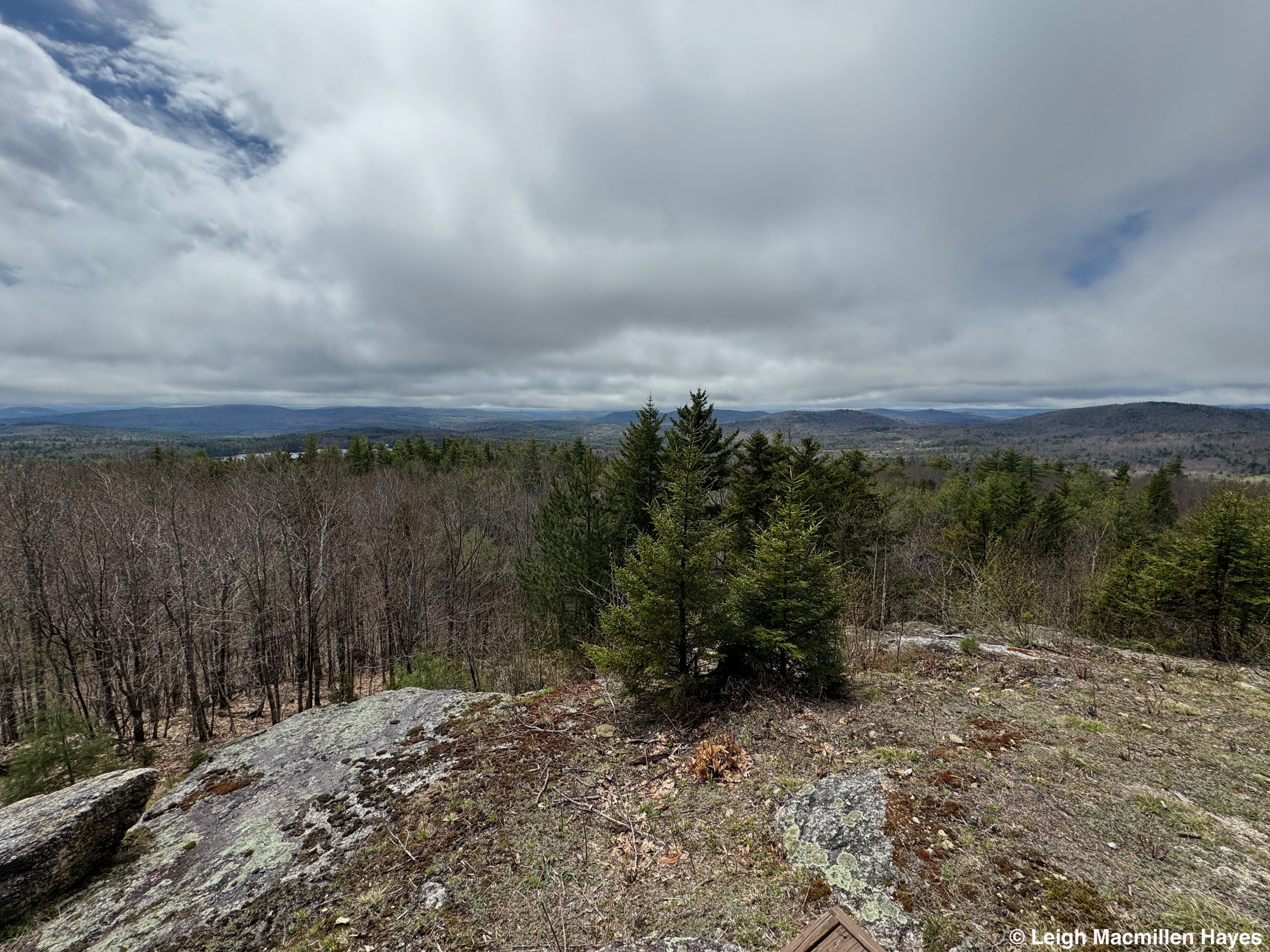
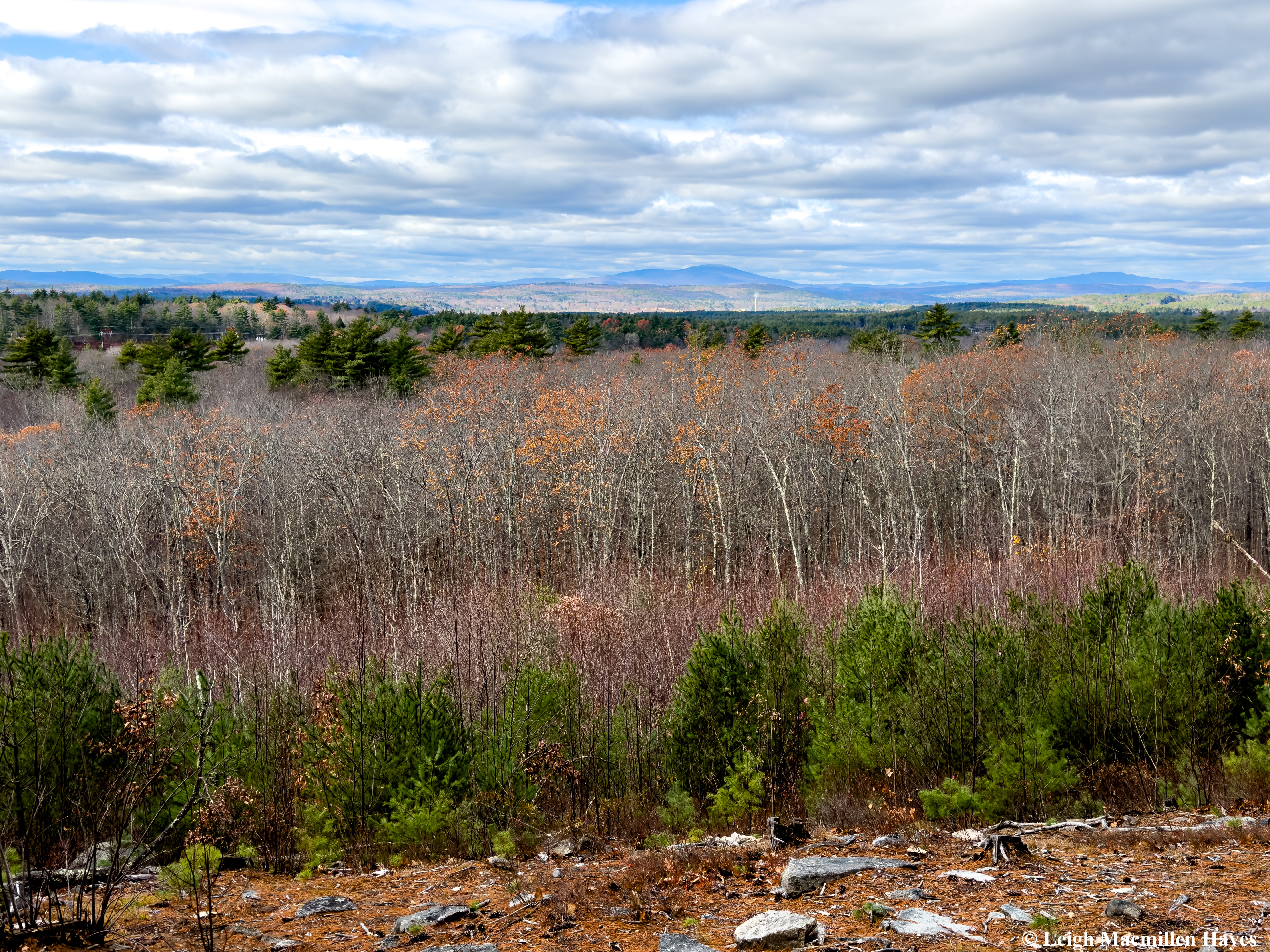
And so we headed off on the Oak Hill Tower Trail, with a plan to stay to the right, or was it the left, as we are direction-challenged, but really, we did know where we wanted to go and the vista spots that we wanted to experience, such as this one where we could see Mount Sunapee and Mount Kearsarge (not Kearsarge North that I’m more familiar with) in the distance. That said, I did record our journey on my GPS.

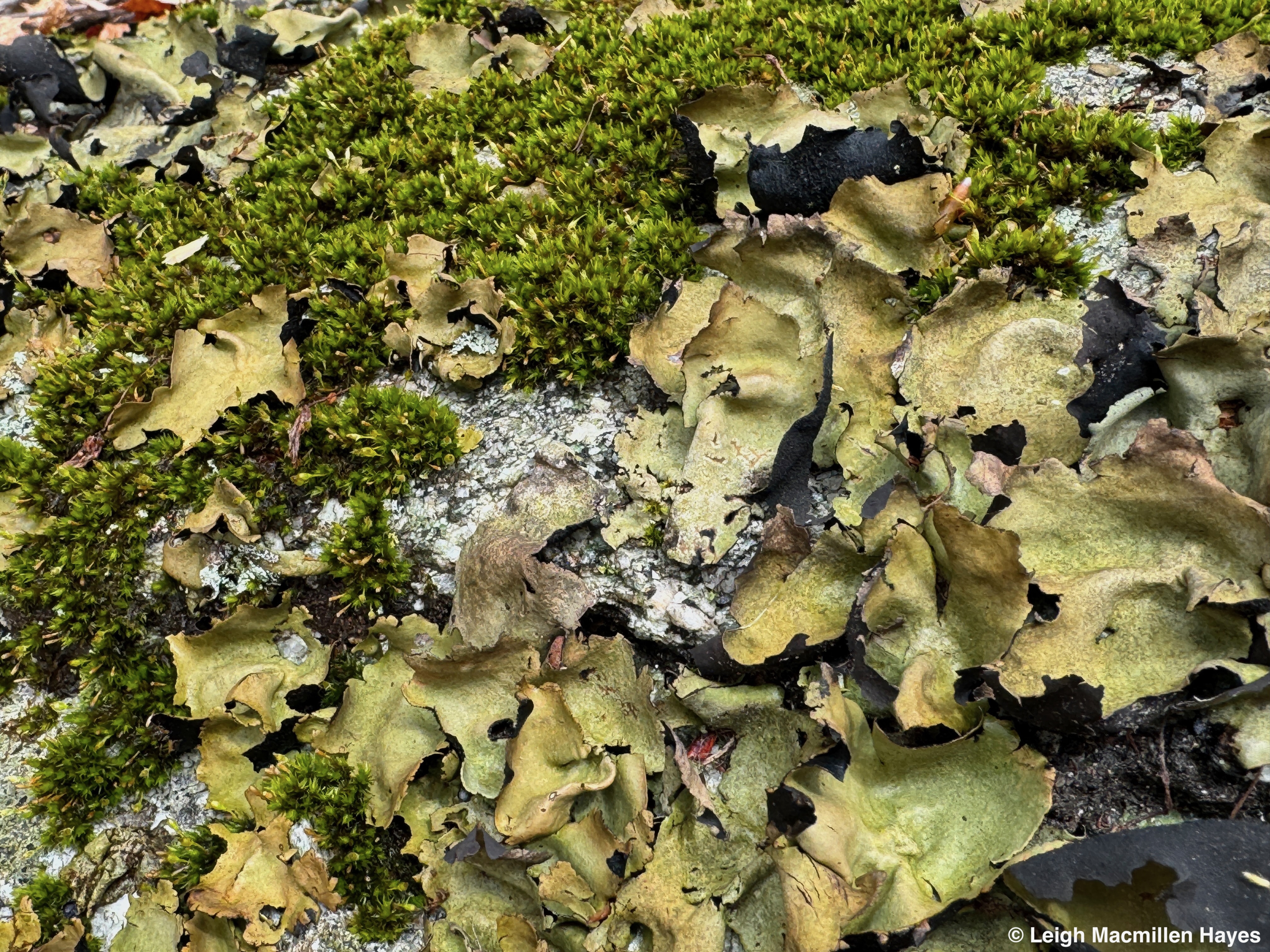
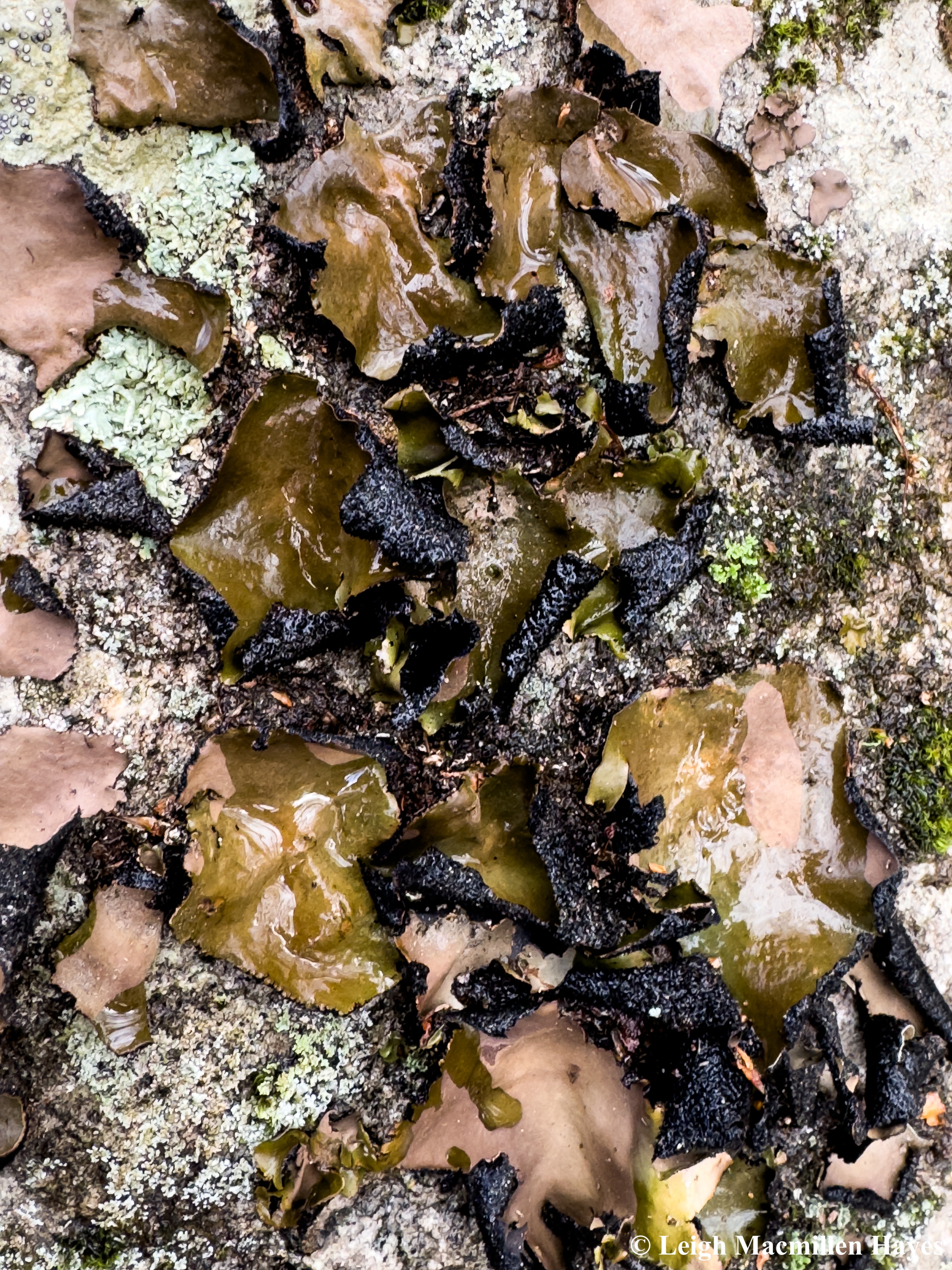
Because we were catching up as well as reminiscing about our junior and senior high school years, we let our tween or teen selves kick into action every once in a while, including by pouring water upon some dried and brown Rock Tripe. We watched with awe as the algal component of this umbilicate lichen immediately kicked into action and the “leafy” parts turned green and became more pliable.

And there were a few Winter Fireflies to admire, especially the pink parentheses that form brackets behind its head. I explained that though the eggs, larvae, and pupae glow, the adult form doesn’t light up the same as the Lightning Bugs we enjoy in the summer months.

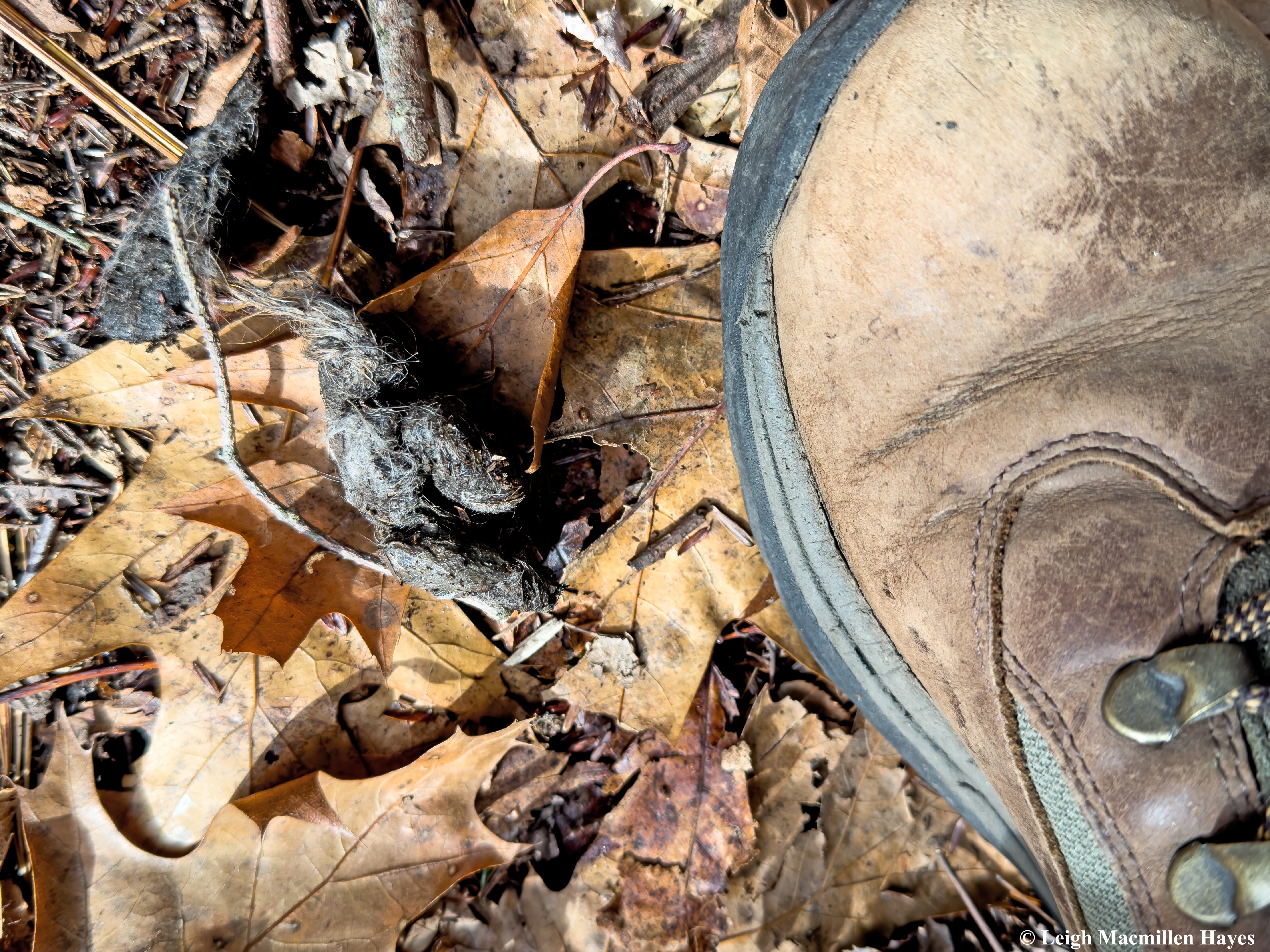
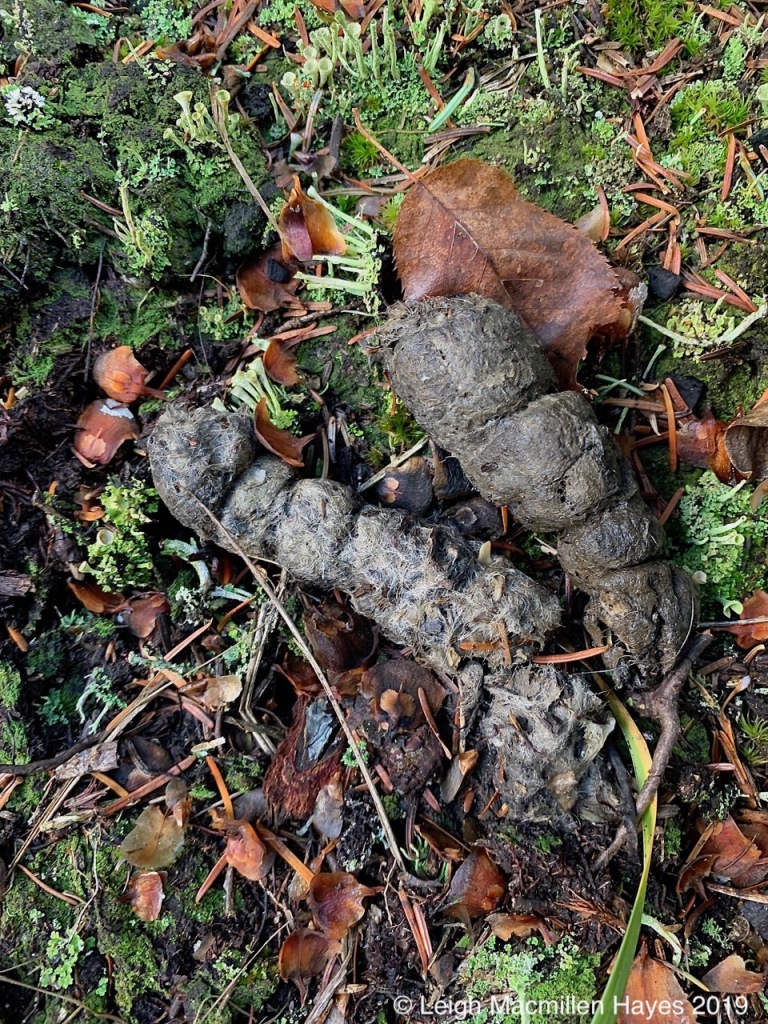
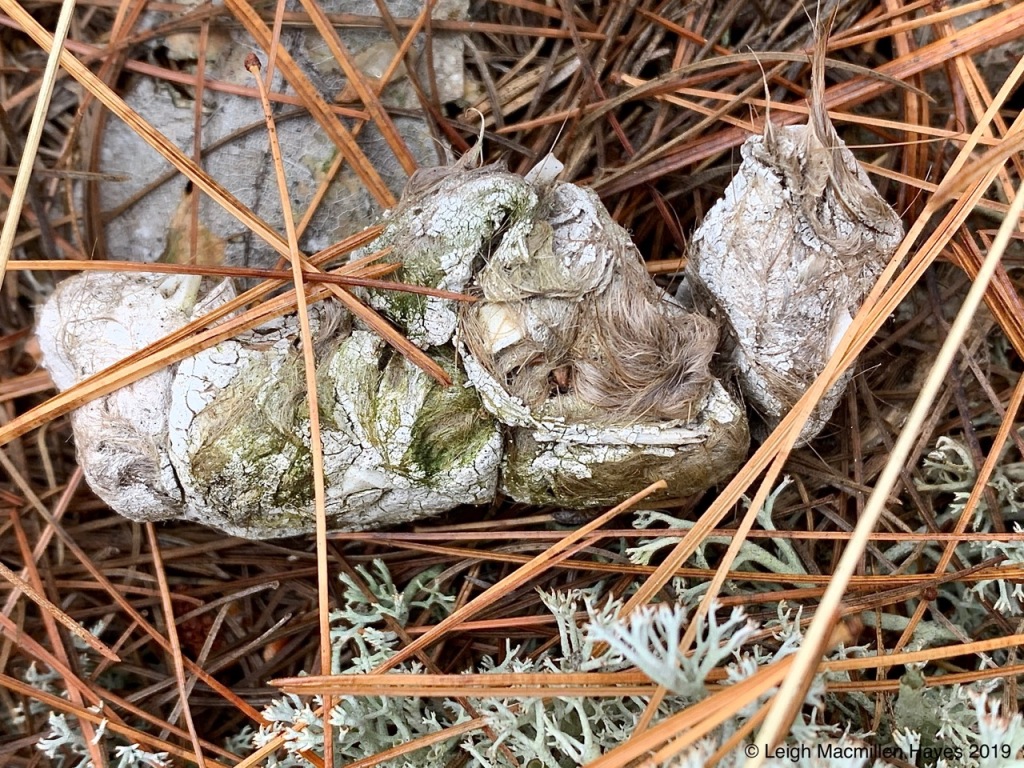
Our next great find was a fun one for me. I’m not sure she was quite as impressed, but she did want to know where all the fur may have come from in this Red Fox scat. We weren’t in Snowshoe Hare territory, but we were certainly in squirrel and vole habitat and so it could have been a combination that helped to form this twisted specimen with its blunt form on one end and tail on the other.

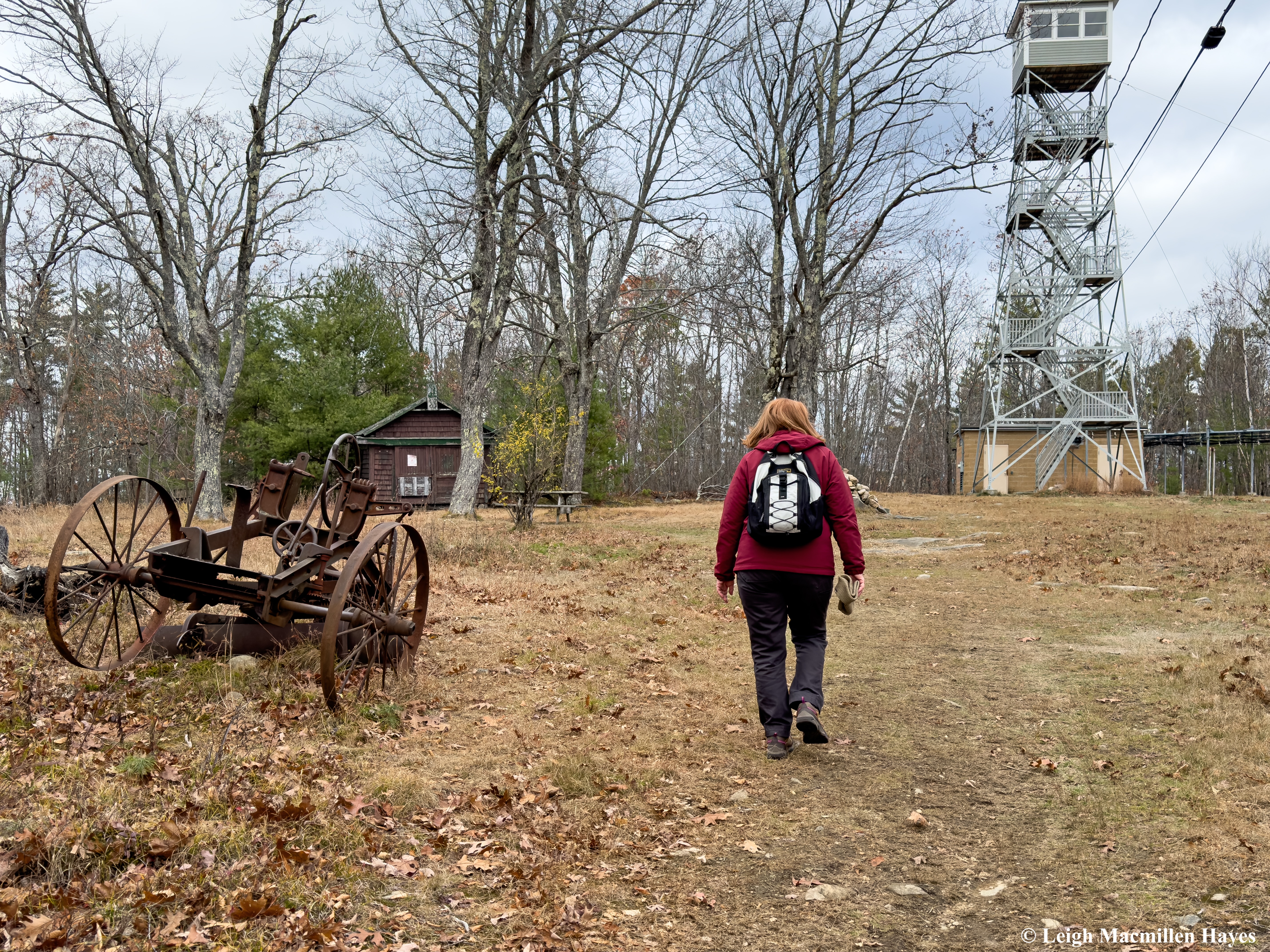
About an hour and a half after we began our journey, we reached the old fire tower for which the trail was named and noted also the house where the fire rangers would have bunked when it was necessary to step out of the cab at the top of the tower (think thunderstorm).

There was also a picnic table and since we had each brought a PB & J sandwich, this became our lunch stop.

Back on the trail, we spotted some puffballs, and again the need to play struck our fancy.

And so she found a stick and poked each one and we laughed as puffs of smoke, aka spores, wafted out of the little balls.

The next day found us upon a different trail that had been part of a working farm from the 1700s until about a year ago and known as Dimond Hill. Barbed wire that once kept animals in or out had become part of a stump, which often happens when a tree sprouts beside a boundary and over time grows around the obstacle so that they seemingly become one.

So much so, that a former limb had separated from the tree, but still the wire “glued” them together.

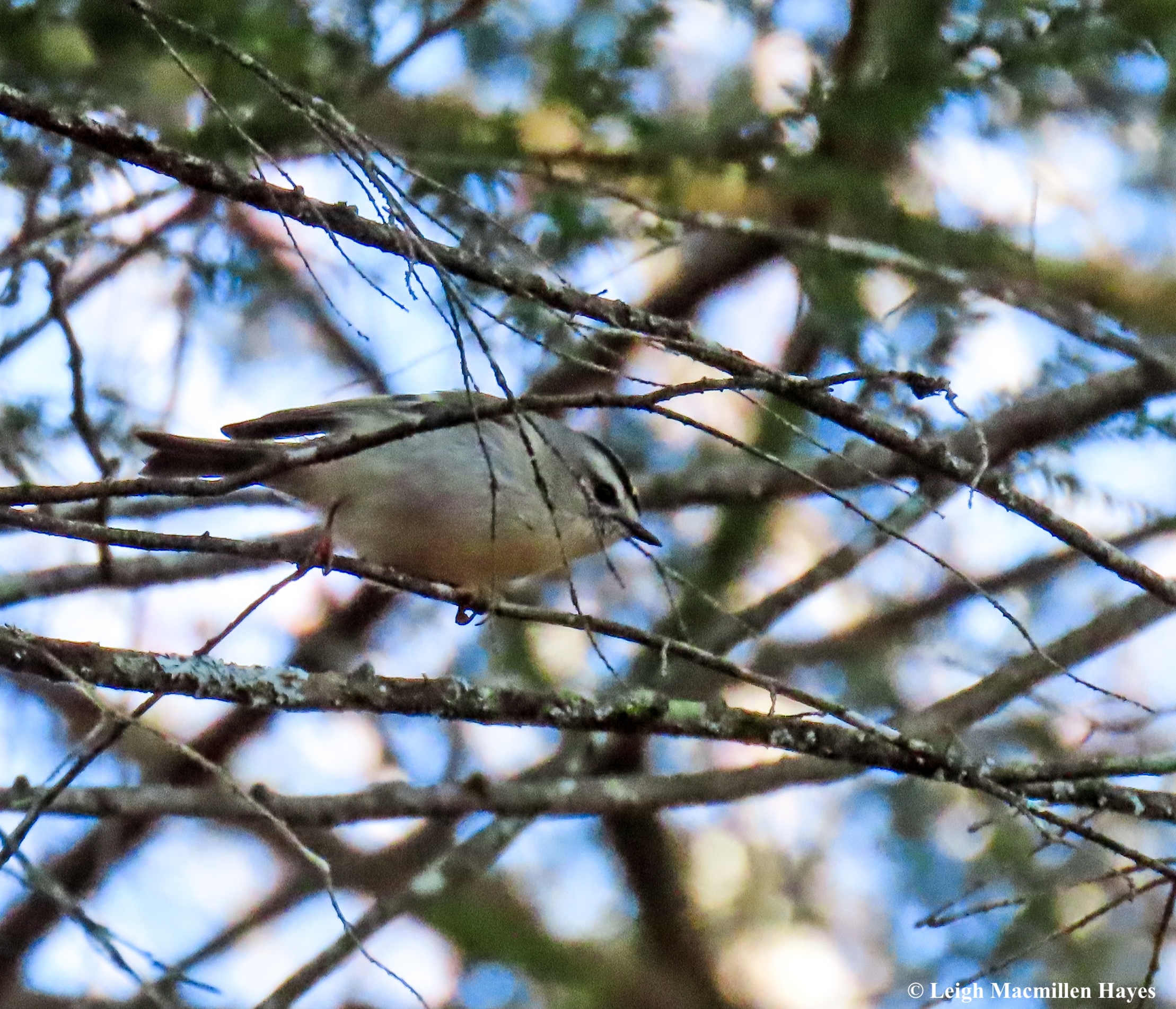
In one section, some wee birds flitted from tree to tree and though it was difficult to get a clear photograph, I was thrilled to be in the presence of Golden-Crowned Kinglets, even if only for a few minutes.

We talked a lot about tree bark along the trails, and nature in general, and all kinds of other topics as well, but every once in a while a tree stopped us in our tracks, such as this one. In my opinion, it offered a great example of the Bull’s Eye Target Fungus that affects Red Maple bark, but doesn’t kill the tree. I explained to my friend that it offers a quick way to identify this species of tree.

And in our midst, as we hiked we occasionally spotted Bruce Spanworm Moths flying about. What I forgot to mention on Saturday was that the males fly, but the females are wingless and we should have looked about because we may have found one. But knowing my friend, now that she knows this, she will be on the lookout. So will I.

We completed a circuit of trails on one side of the main road and then crossed to the field where vegetables and animals had once been raised. It struck us as odd that instead there was a door in the middle of the trail. A locked door at that.

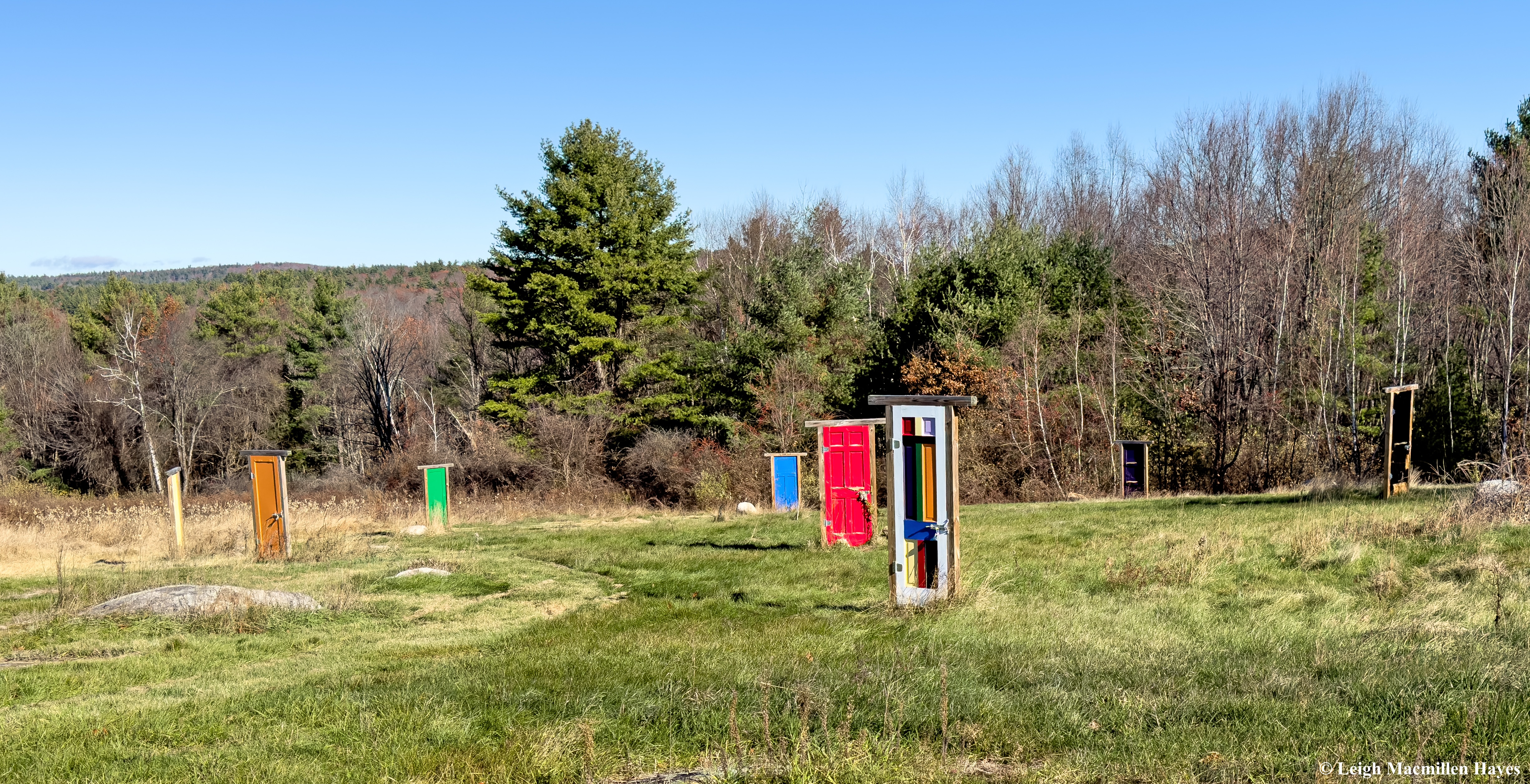
And then in the field below, we found one multi-colored door through which if one could unlock and pass, would lead to a circle of eight more brightly painted doors. You’ve heard of Stonehenge? We decided this was Doorhenge. Or perhaps Doorhinge.

The purpose for this installation? We don’t know, but we did wonder if the doors were strategically placed to represent compass points.

We knew we didn’t have time to hike the entire trail, but were thrilled to reach water, which I think must have been Ash Brook. What we did note was that it was an active Beaver territory.

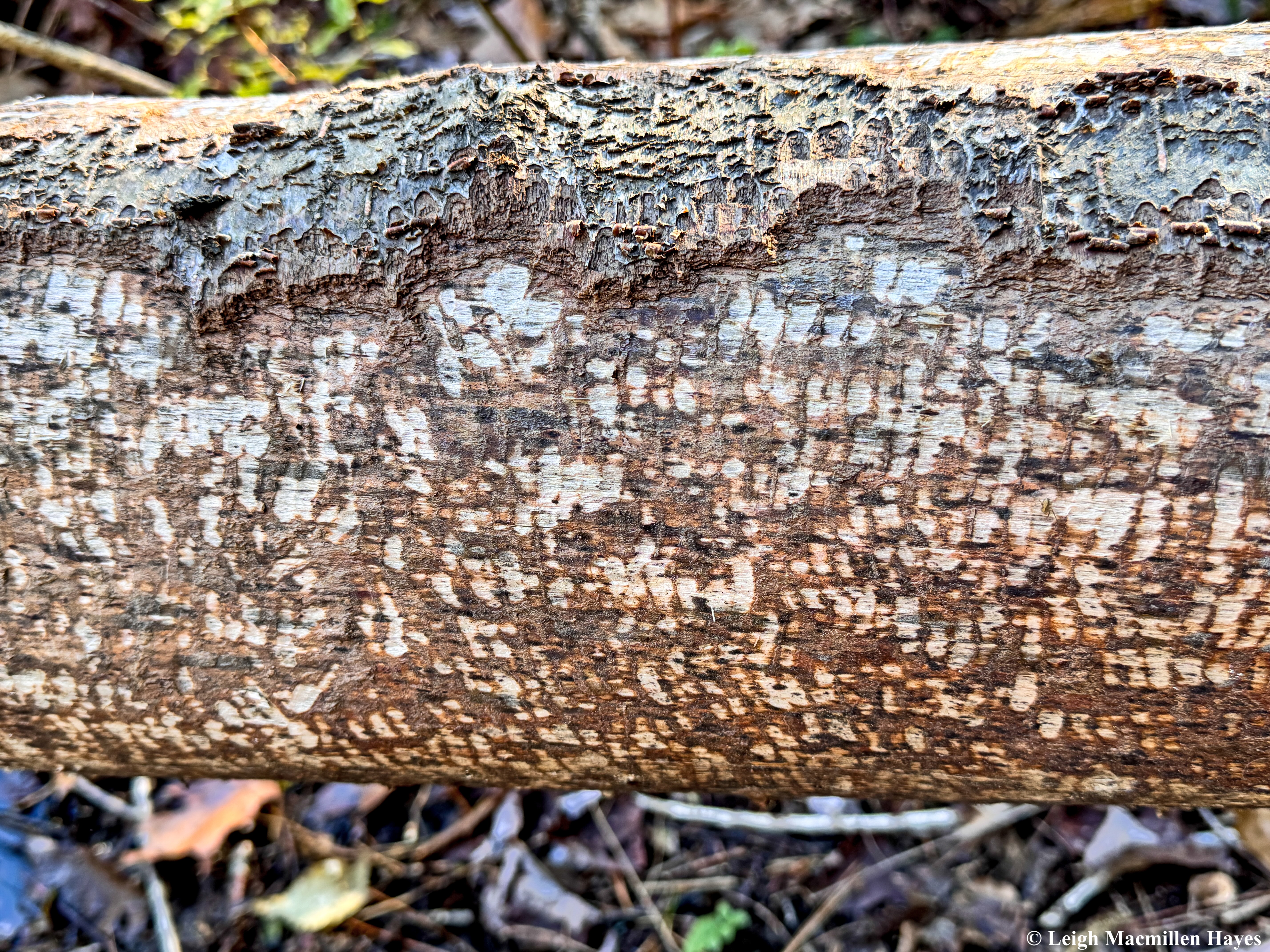
And the work of the Beaver’s teeth as upper incisors met lower to consume the cambium layer where sugars and water and nutrients were exchanged through phloem and xylem, was well documented. Barely any bark was left untouched.

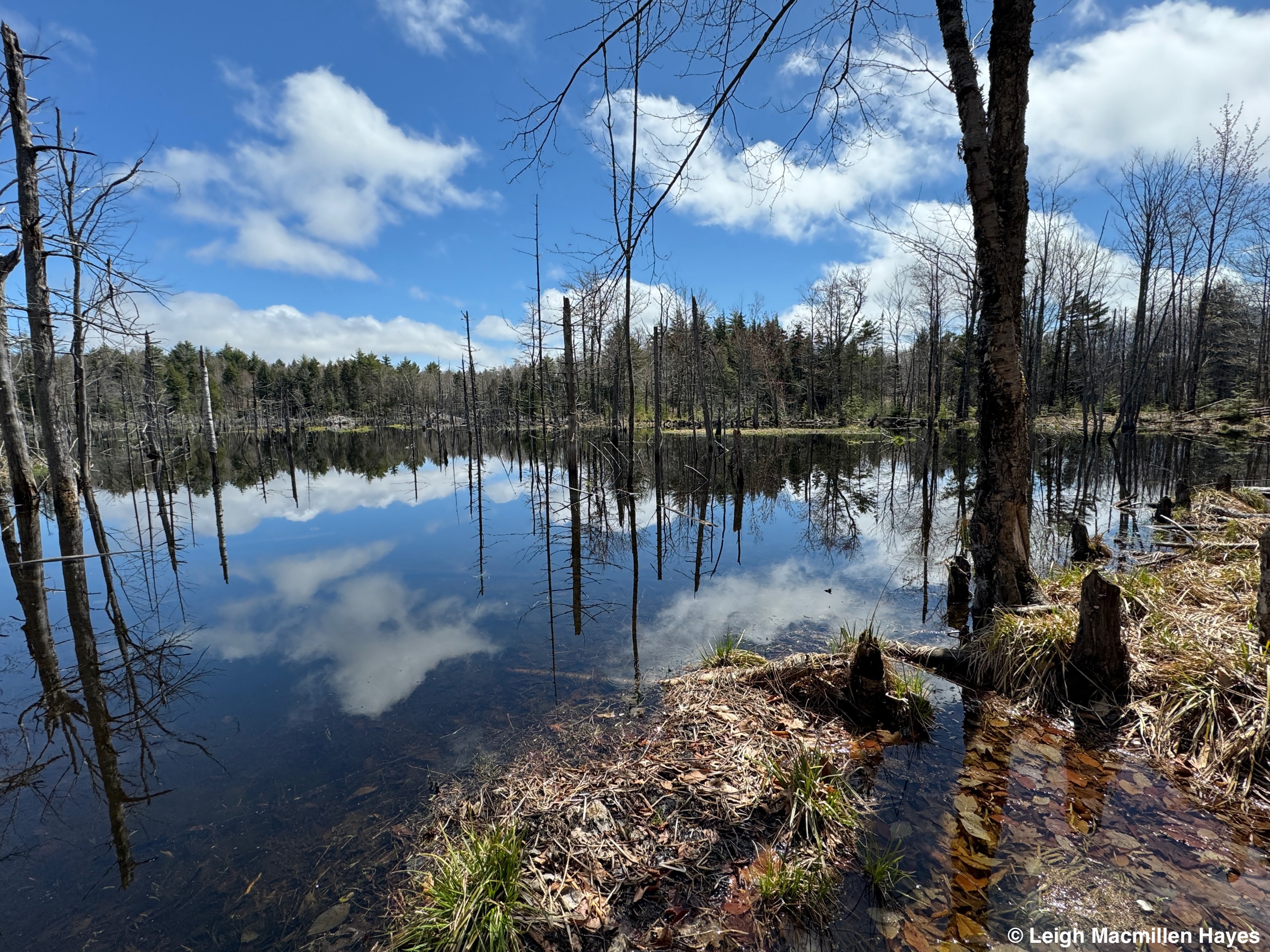
Not far from our turn-around point we reached more water and though we couldn’t find the actual Beaver Lodge, we did note that a skim of ice had formed. And the ice-covered water reflected the Bluebird day we were enjoying.

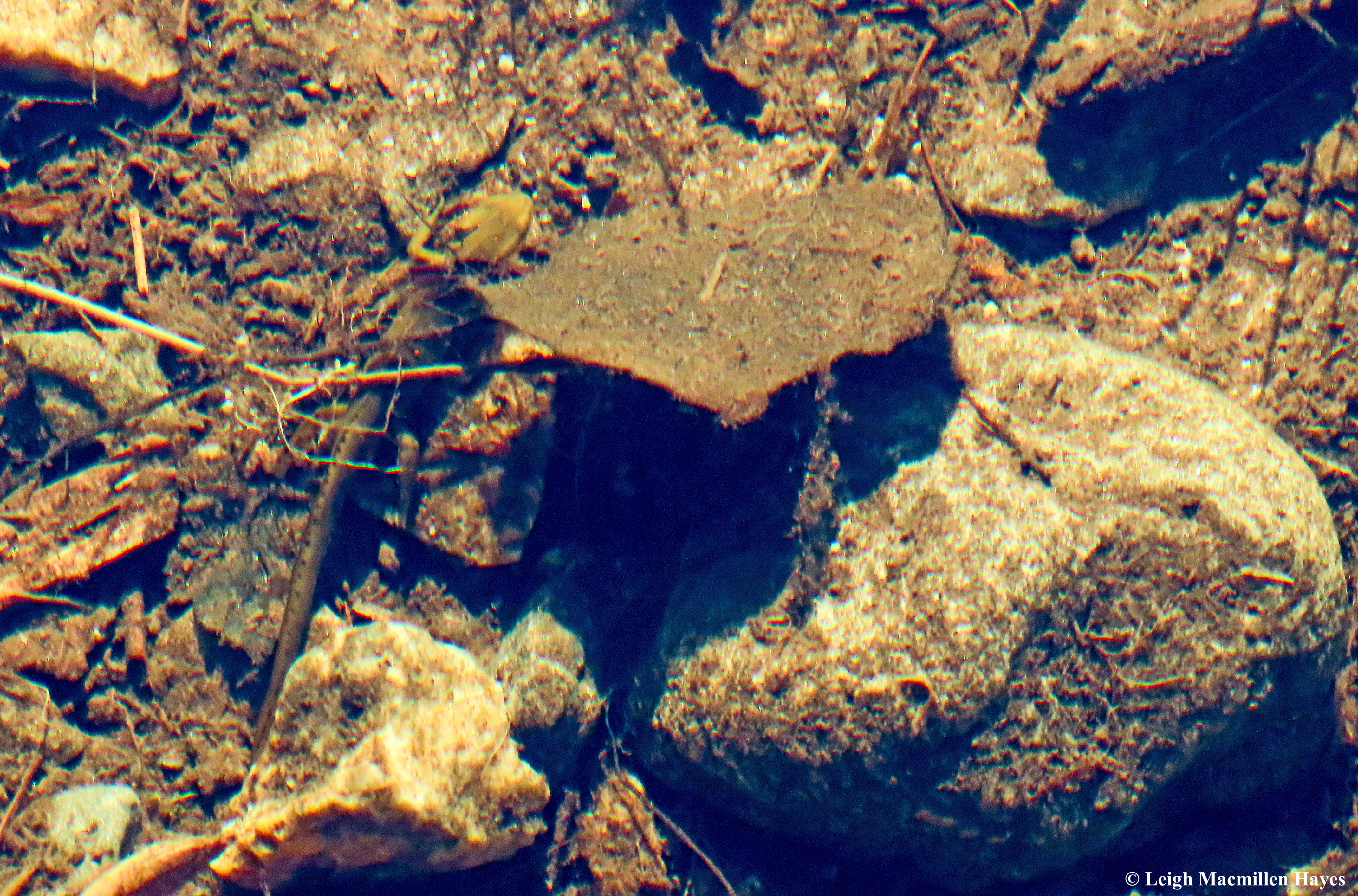
Her eagle eyes also picked up on an Eastern Newt in the water below. Can you see it in this Where’s Waldo image?

Upon our trek to our turn-around point, for this was an out-and-back trail, we discussed Paper (white) Birch and Gray Birch and my friend mentioned that she didn’t remember ever meeting Yellow Birch.

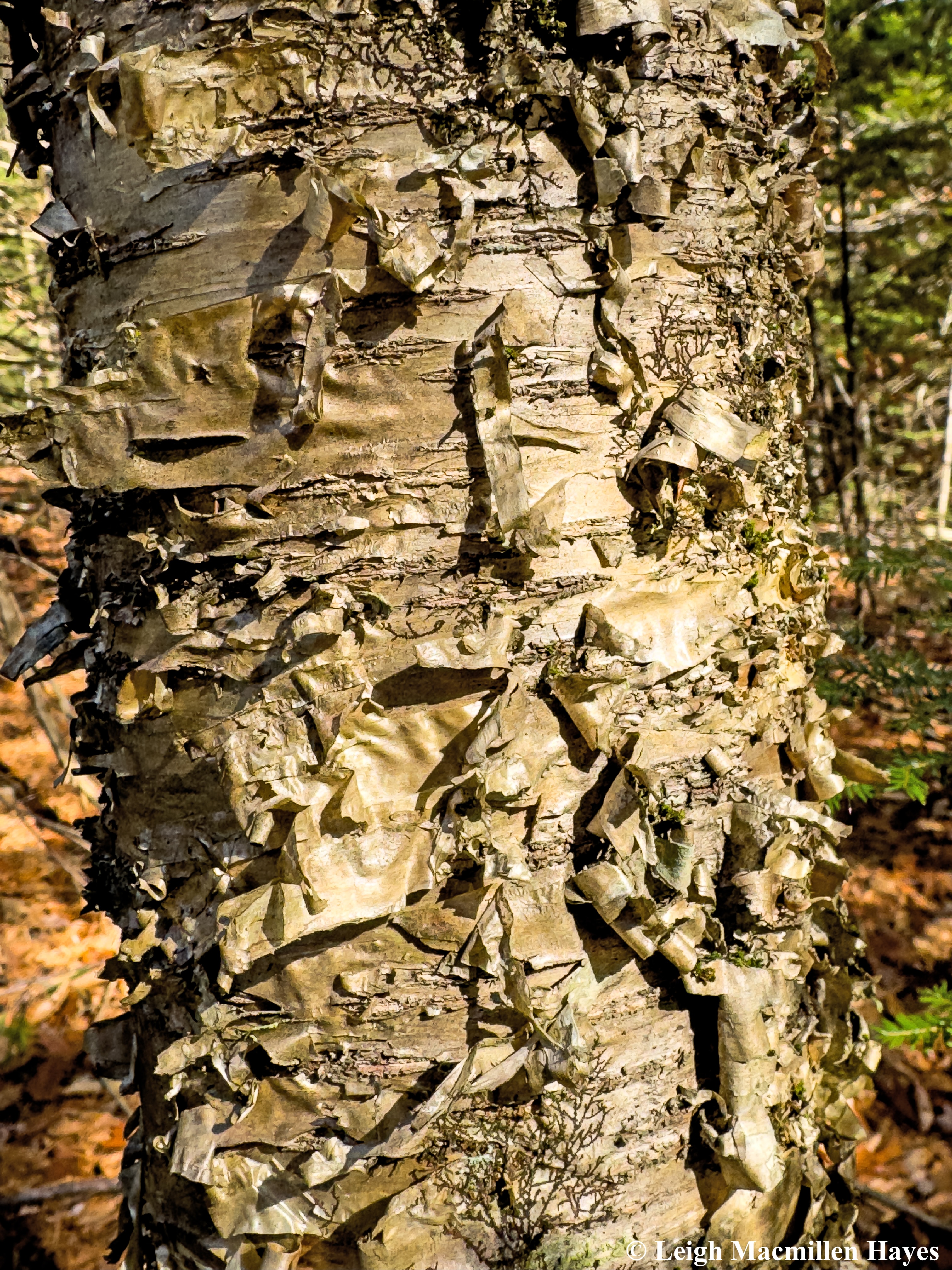
And then, as often happens, on the return trip we started to spot its curly presentation over . . .

and over again and I explained that as the tree matures it takes on a more silver gray appearance, but my friend liked that she could still see the gold in the curls.

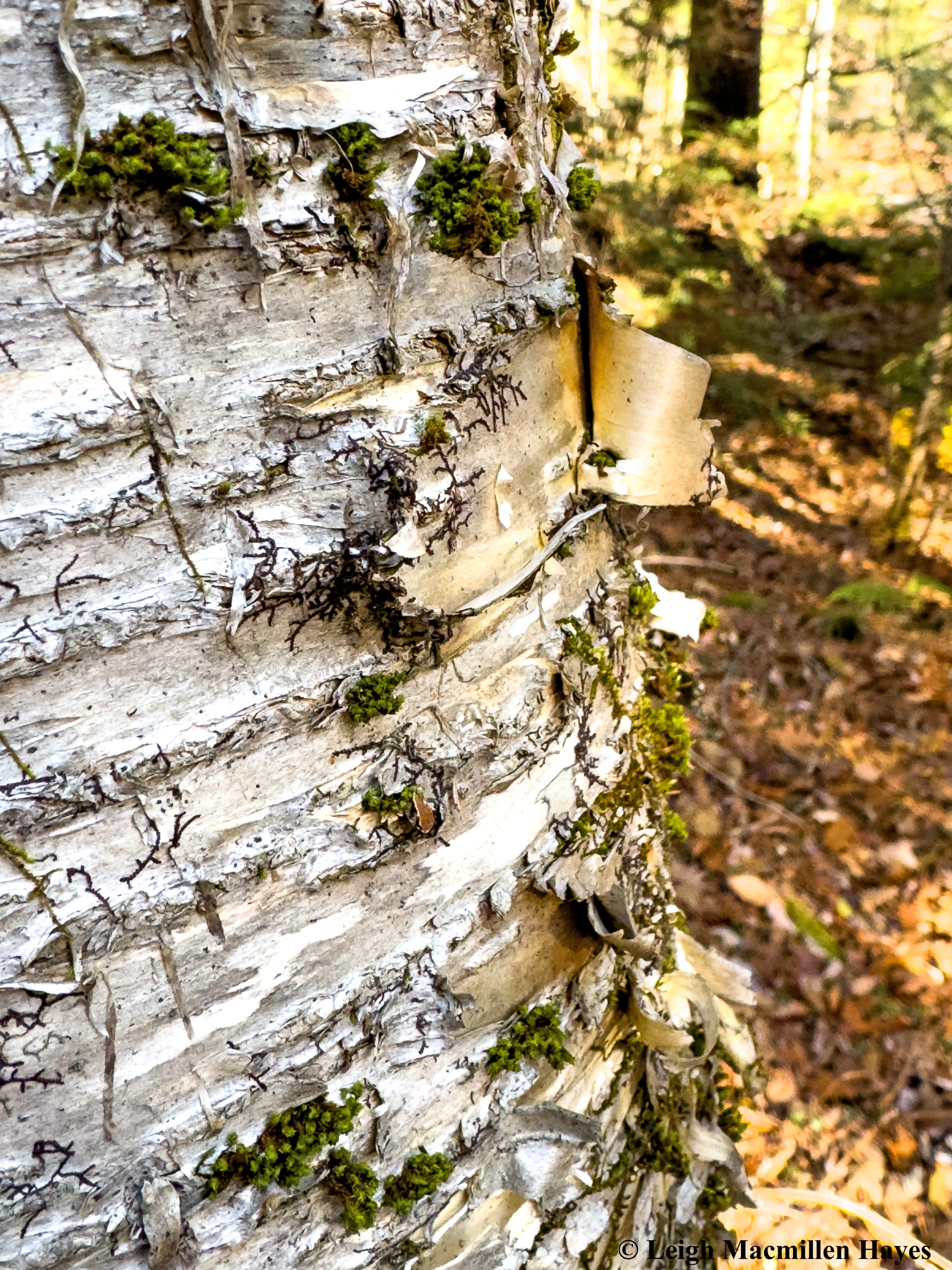
That said, sometimes the Paper Birch trees also had a golden underbark and so I reminded her that she had to also consider how the trees peeled, Yellow being in ribbons while Paper peels in, well, sheets of paper sometimes. Had there been twigs that we could reach, I would have done the touch and sniff tests, but that will have to wait for another adventure.

We even had the surprise opportunity to greet a Maple-leaf Viburnum, a species I’d shared photos of with her earlier in the fall.

We’d given ourselves a turn-around time so that at the end we’d have a chance to sit and eat left-overs from the dinner we’d enjoyed at The Common Man the night before and soak up the warmth of the sun and try to wrap up our conversation that had gone on for almost 24 hours. Well, except for when we were sleeping, of course.

In the end, we gave great thanks for making the time to meet each other at the Halfway Point. Well, the almost Halfway Point if truth be told for I’d only traveled two hours from Maine to reach Concord, New Hampshire, while Carissa had driven three hours north from Connecticut.

I’m so grateful for this friendship that has spanned decades and that we can renew it along the trail despite the distance that separates our everyday lives.

Thank you, Cris!

The Tale of Two Tails

We call ourselves the Trail Snails–a group of St. Peter’s Episcopal Church parishioners always accompanied by various non-parishioners who like to crawl at a snail’s pace.

Each week I try to find a different location, thinking fairly flat for locomotion and with natural elements that will bring out their sense of wonder. The first isn’t always easy, especially given the amount of snow and ice we’ve had this winter; but the second is a cinch since there’s so much to wonder about in our little corner of the world. When we started these walks in the fall, I did not expect that we’d continue weekly throughout the winter. But we have.

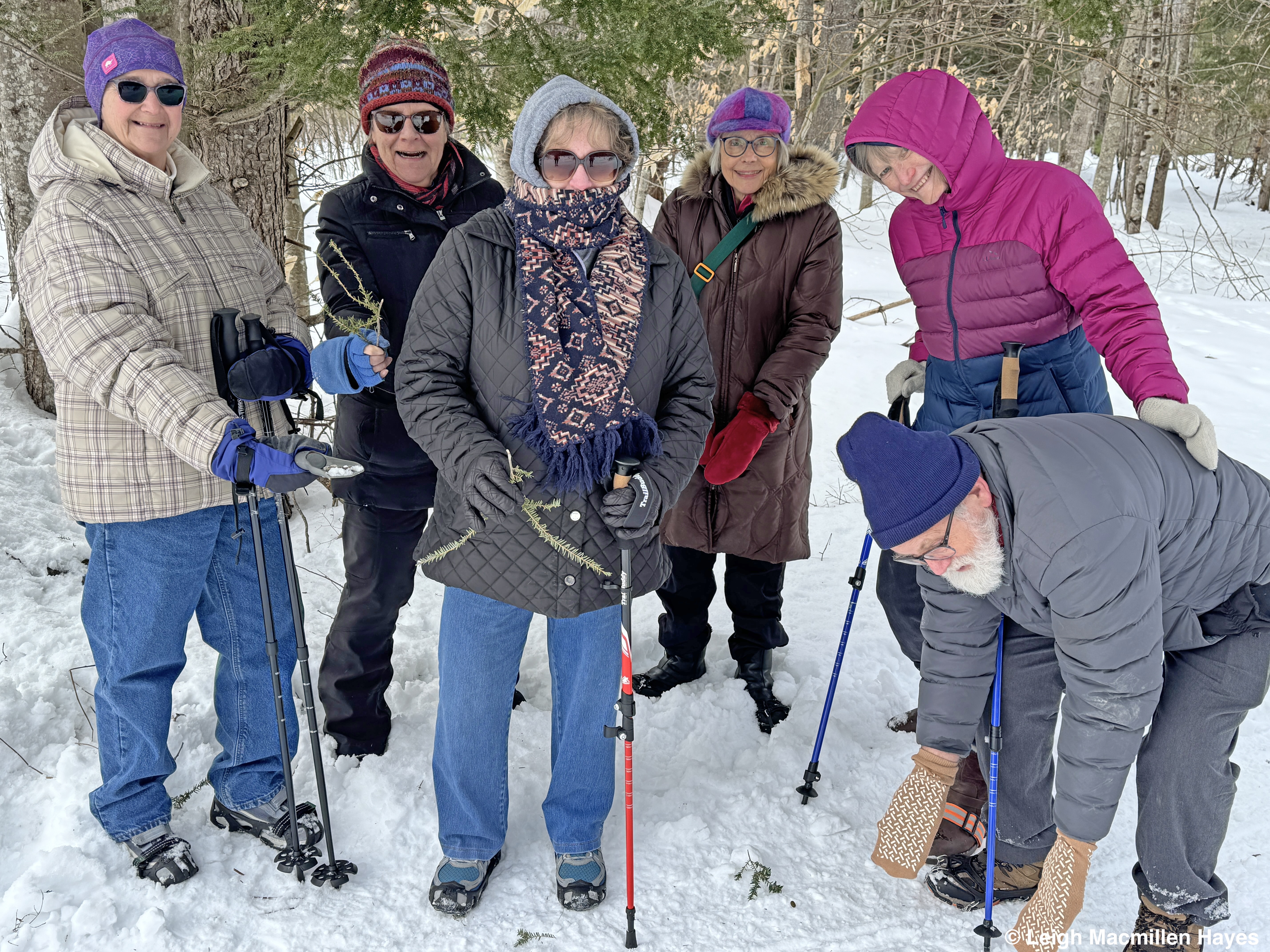
And so today six people (parishioners and non) joined me at my house to head out to the well-packed snowmobile trail. Of course, it wasn’t as well packed for the first thirty feet and that proved a bit challenging because we all wore some variation of micro-spikes rather than snowshoes, but they all persevered.

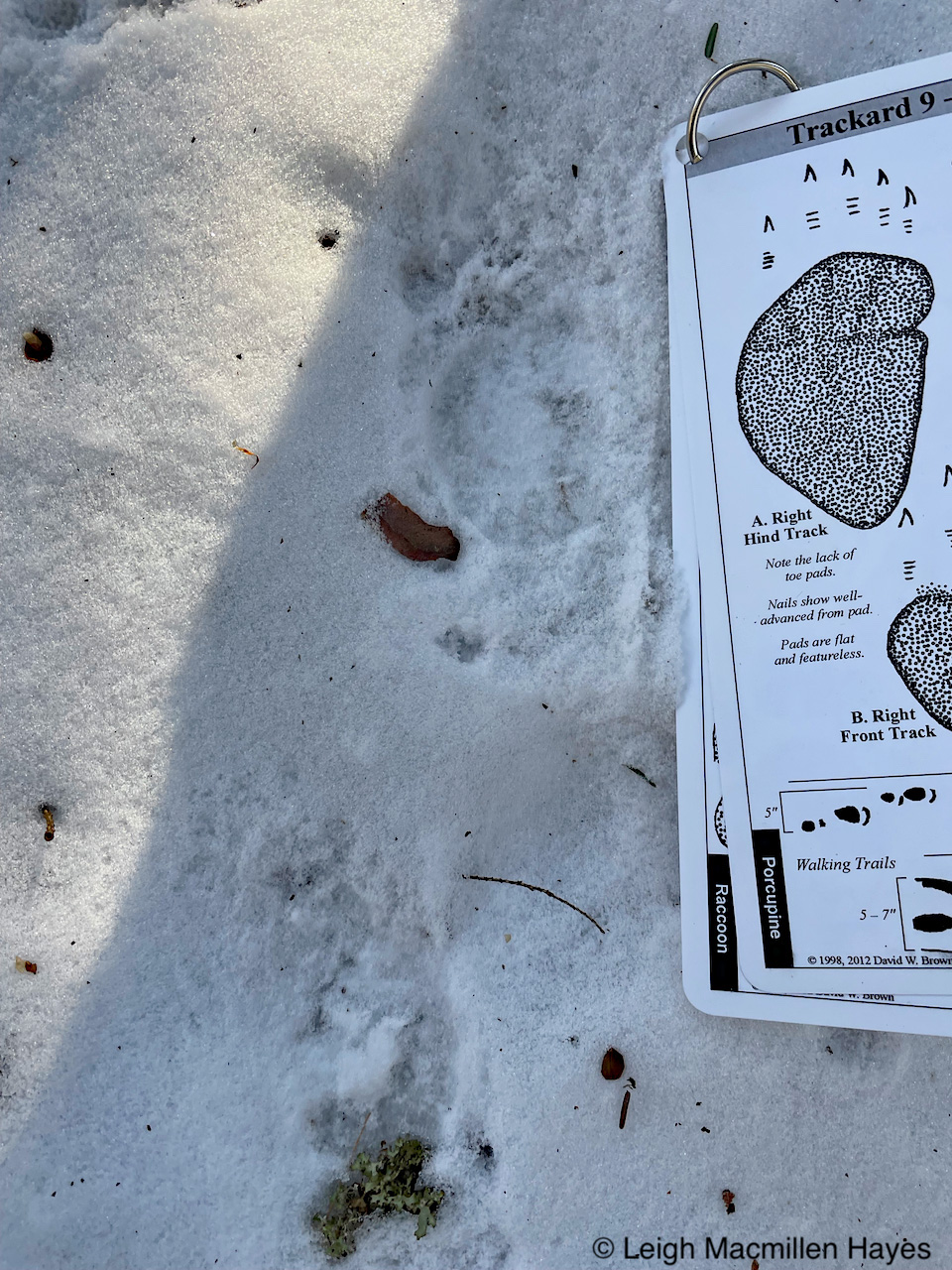
Once on the main trail, I showed them Porcupine tracks and then asked them to find the next set of such. It only took a minute for one to spot the pattern. While we looked at them and I shared some fun facts, I looked around and realized I was standing in the middle of recent Porky activity. Not only were there fresh tracks, but also scat and twigs cut at the traditional 45˚ angle, with buds and needles missing. We looked up into the tree, but fortunately no one was at home.

I think I know this Porcupine because he’s a frequent visitor to the Hemlocks in our woods and the neighbors’.

When I asked the group to share the findings and become a Porcupine, they did so, though I think they think I’m a wee bit crazy. Maybe I am. Anyway, Left to right: Nancy holding some scat on my scat shovel, Marion and another Nancy with twigs, Marcia smiling about it all, and Gary wearing my Porcupine socks to show how the feet are like sandpaper to gripe a tree as they climb, while his wife Julia was there for moral support and to help him up if need be.

We paused at many other spots along the way, including looking at the silk a Pine Tube Caterpillar uses to construct its tube.

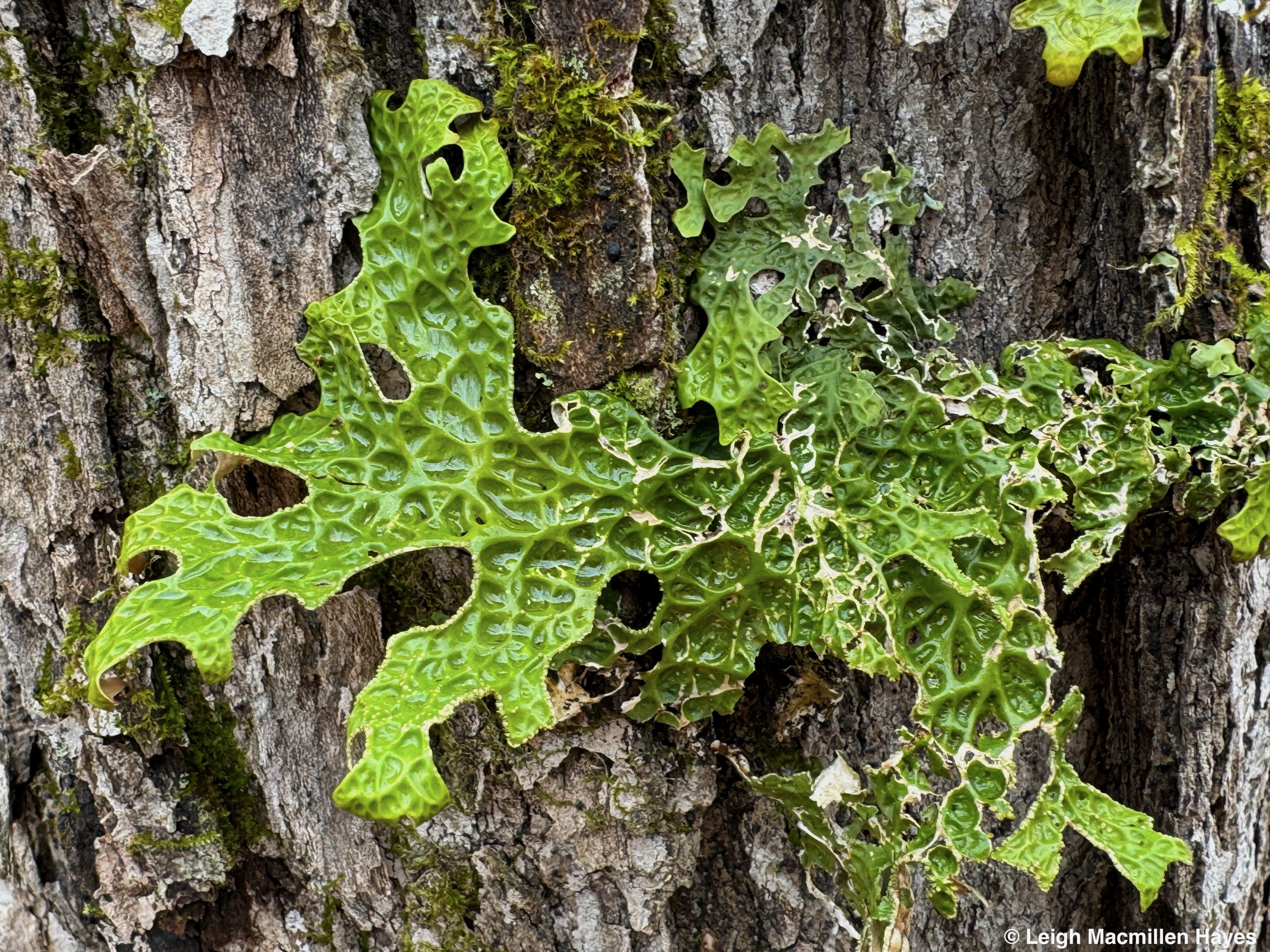
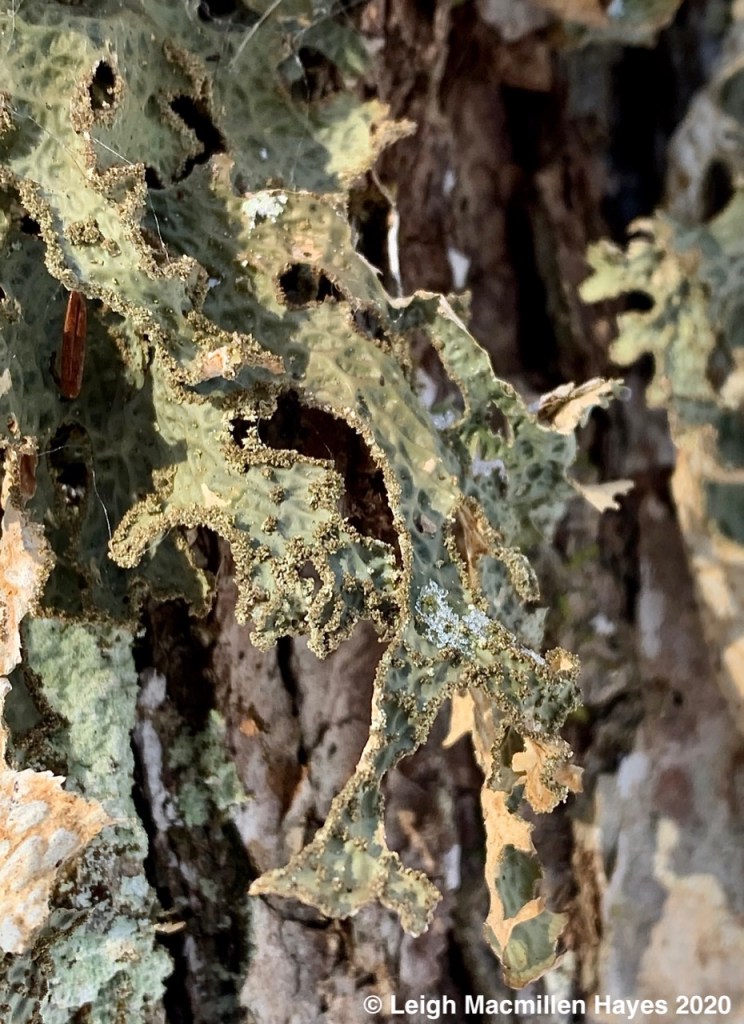
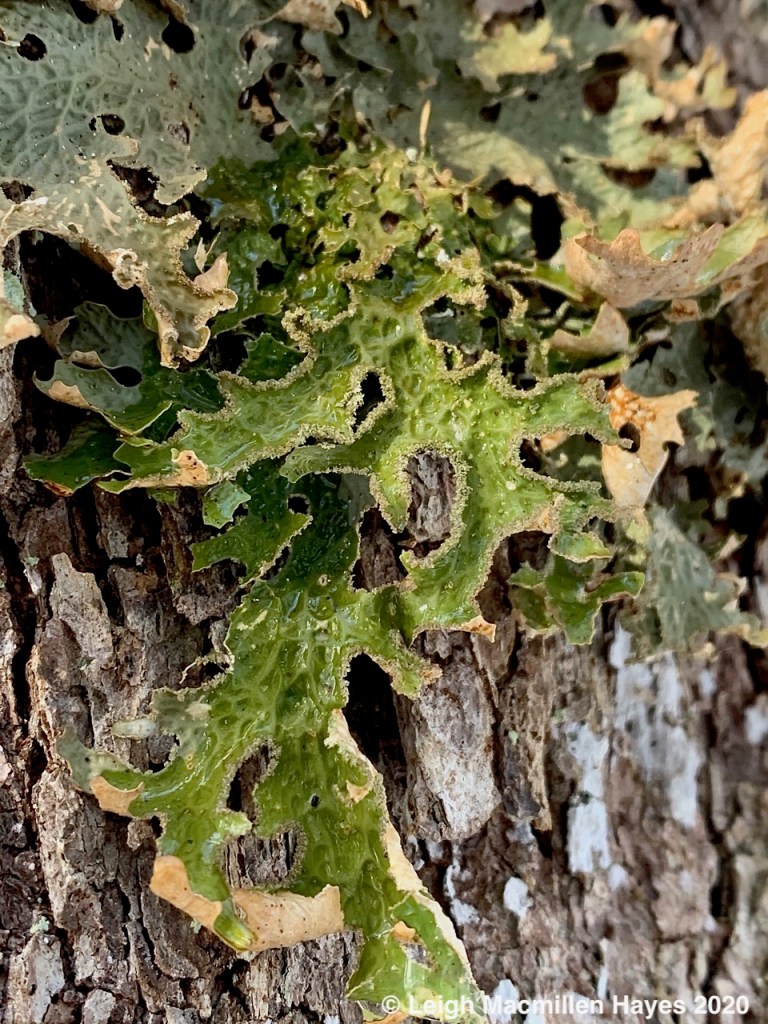
And admire a perfectly round display of Lungwort, a foliose lichen consisting of a fungus and a green algal partner living together in a symbiotic relationship with a cyanobacterium.

Had I brought water, I would have poured some on it to show off how green it quickly gets since the alga would have kicked into action to provide food for the fungal structure.

Lungwort is sensitive to air pollution and habitat loss, so spotting it is always a treat and reminds us of why we love living here in western Maine.

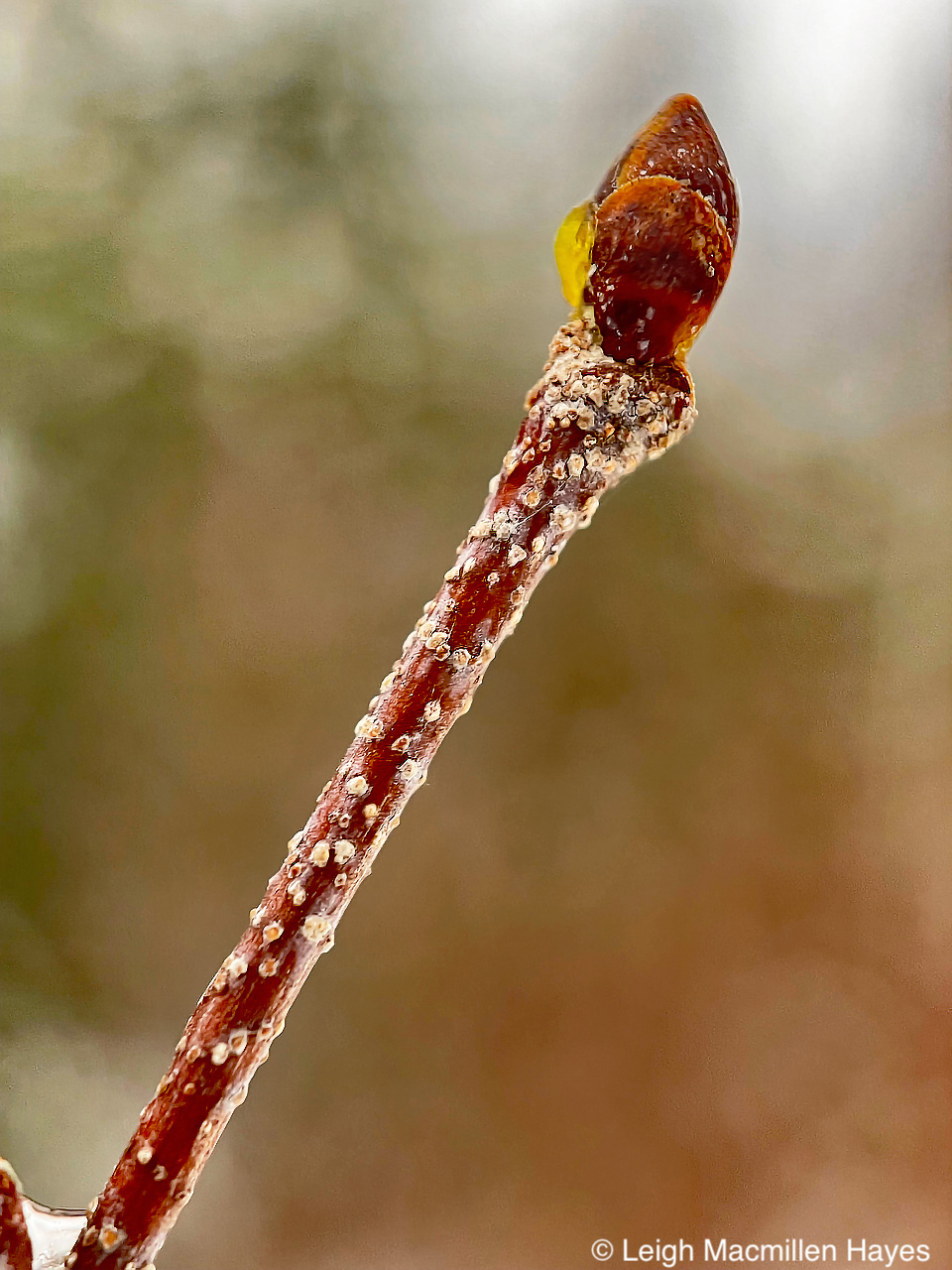
We also looked at buds on an Ash to figure out which species and I told them about the Emerald Ash Borer and showed photos of what blonding looks like.

It turns out what we were looking at was a White Ash–hairless buds that dip into the upside-down, C-shaped leaf scar.

And then there were the Winter Fireflies that we found still as could be on the snow. I picked one up in the scat shovel and thought it must be dead.

That is . . . until we noticed its antennae began to move.

And then it started to walk. Last we knew, I’d left it and its kin on their favorite tree, a Sugar Maple, with hopes that as the temps warmed today and will continue to do so going forward, the insects will survive.

Just before reaching our driveway at the end of our walk, we also saw a Winter Cranefly, but moments after I scooped it up in my scat shovel, it flew. At least most everyone got to see it.

As Trail Snails, we walked not quite a mile and a half in two hours, but saw so much, and I was especially jazzed by the new Porcupine evidence. I think they were as well. Maybe not jazzed, but curious.

And in our time together we saw only three snowmobiles. While it was brought up that those on the machines miss all that we were seeing, I did explain that My Guy often comes back from a ride and tells me of the wildlife he and friends sighted. There I am being so quiet and not seeing any, but somehow despite the machine he spies so much more.

And then this afternoon, I picked up a friend and drove to another section of the local snowmobile system. We walked and talked and talked and talked some more, catching up because despite retirement we are both incredibly busy. In a good way. Doing things we love to do.

As we walked, I kept pointing out Porcupine tracks and if we’d had snowshoes on, I might have convinced her to look for the feeding trees and den sights, but we chose to begin with micro-spikes and quickly ditched those since the snow conditions on the well-packed trail were just right.

We also paused to listen to a Barred Owl and tried to spot it to no avail.

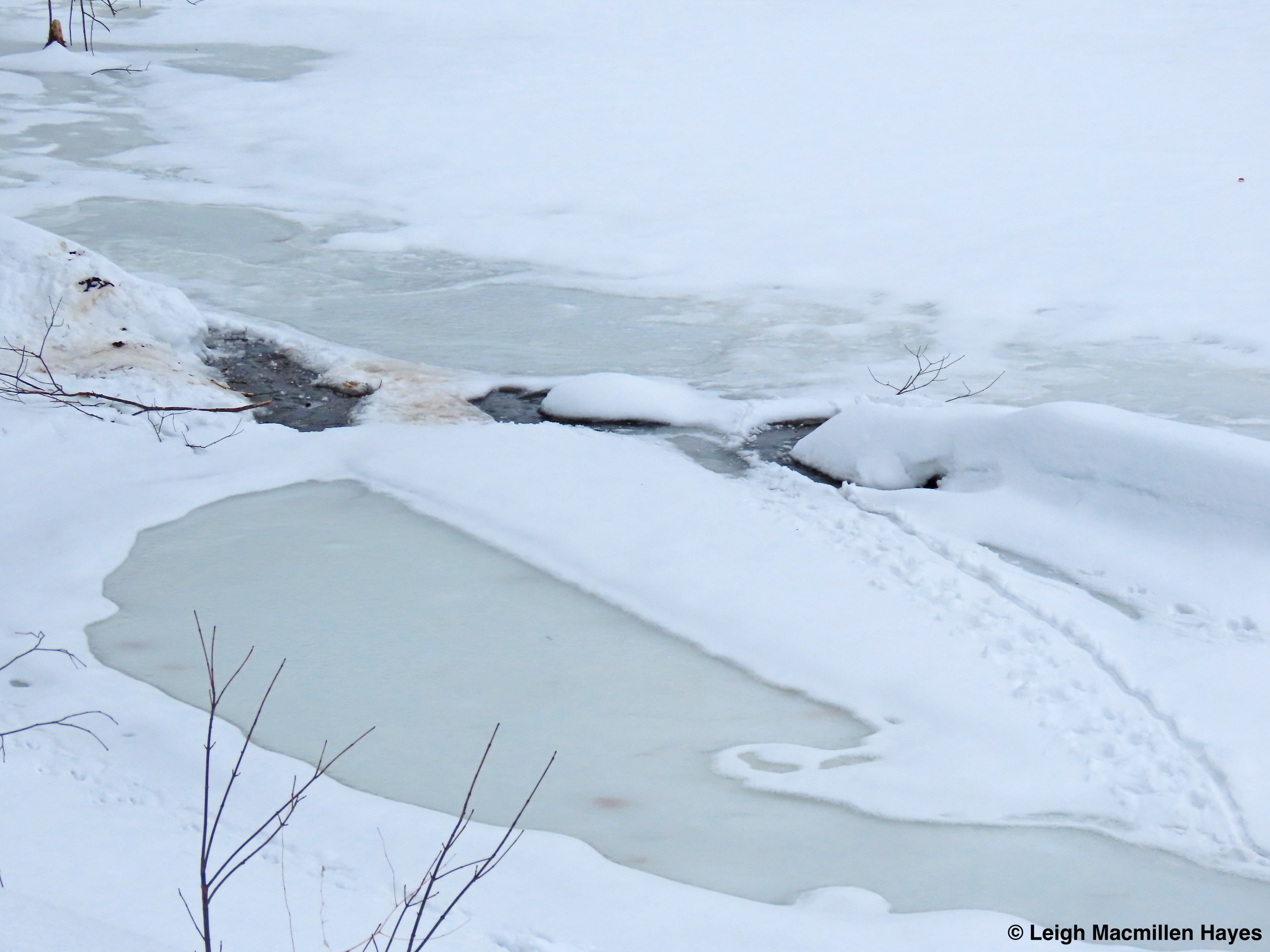
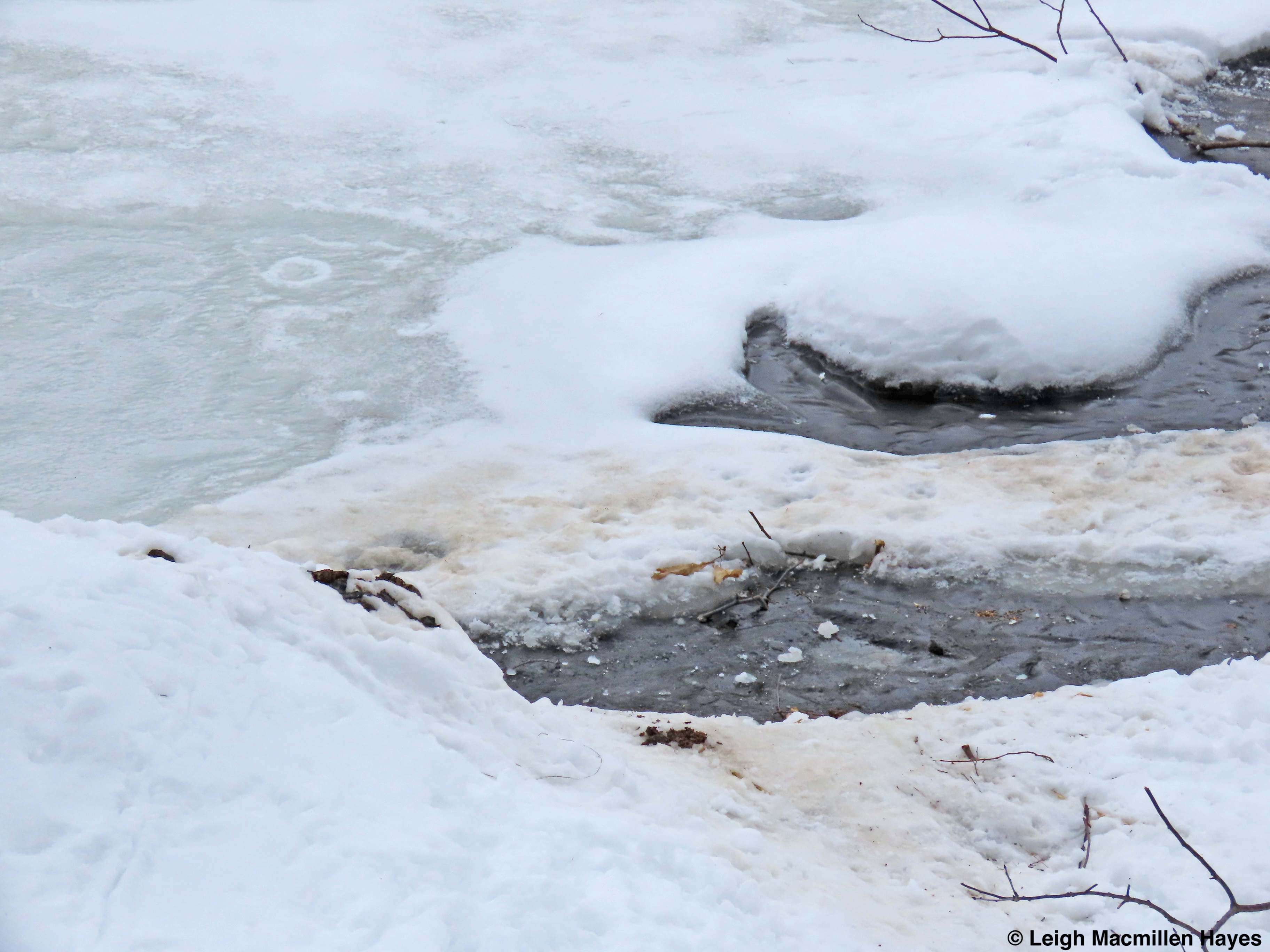
And then, near water, we spied tracks of a different sort. And scat. And mud. And not quite open water.

The scat was from Otters. And I really wanted to take a closer look, but didn’t trust the trail down, despite it being well traveled.

What I now realize I didn’t take a photo of were tree marks in the snow, which in the moment I surmised were twigs blowing down toward the water.

I noted that the track continued across the road upon which we walked and so I suggested we take a look and see if we could note anything about the Otters’ behavior.

We certainly did not note anything about such, but instead discovered fresh Beaver works. And suddenly the indentations left by the twigs made sense–Beavers dragging tree branches down to the water to take back to their lodge or winter food raft.

Maybe like some people that I’ve heard are looking for more firewood right now to stay warm the rest of the winter, the Beavers didn’t realize everything would stay frozen as long as it has and so they needed to replenish the pantry.

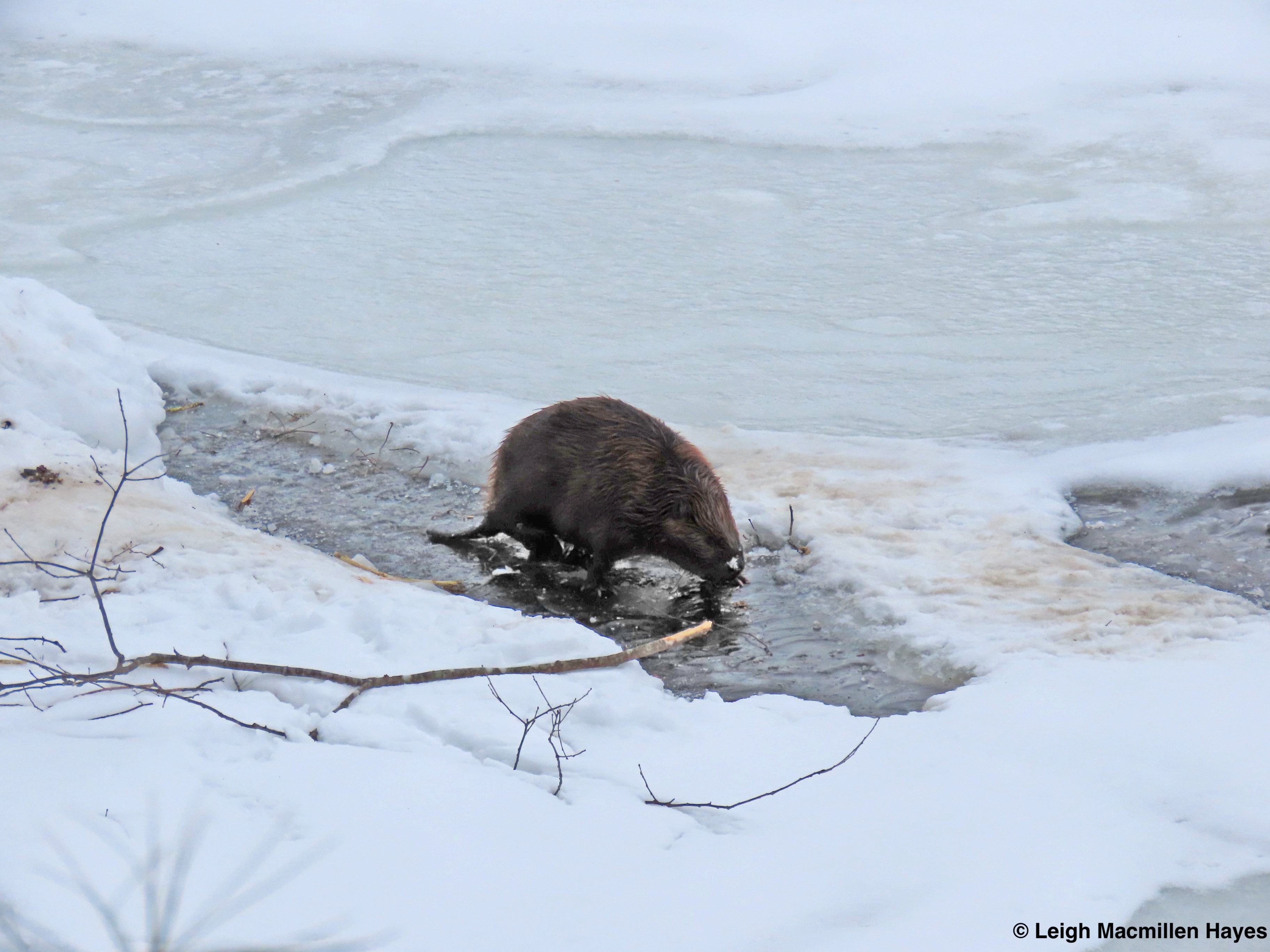
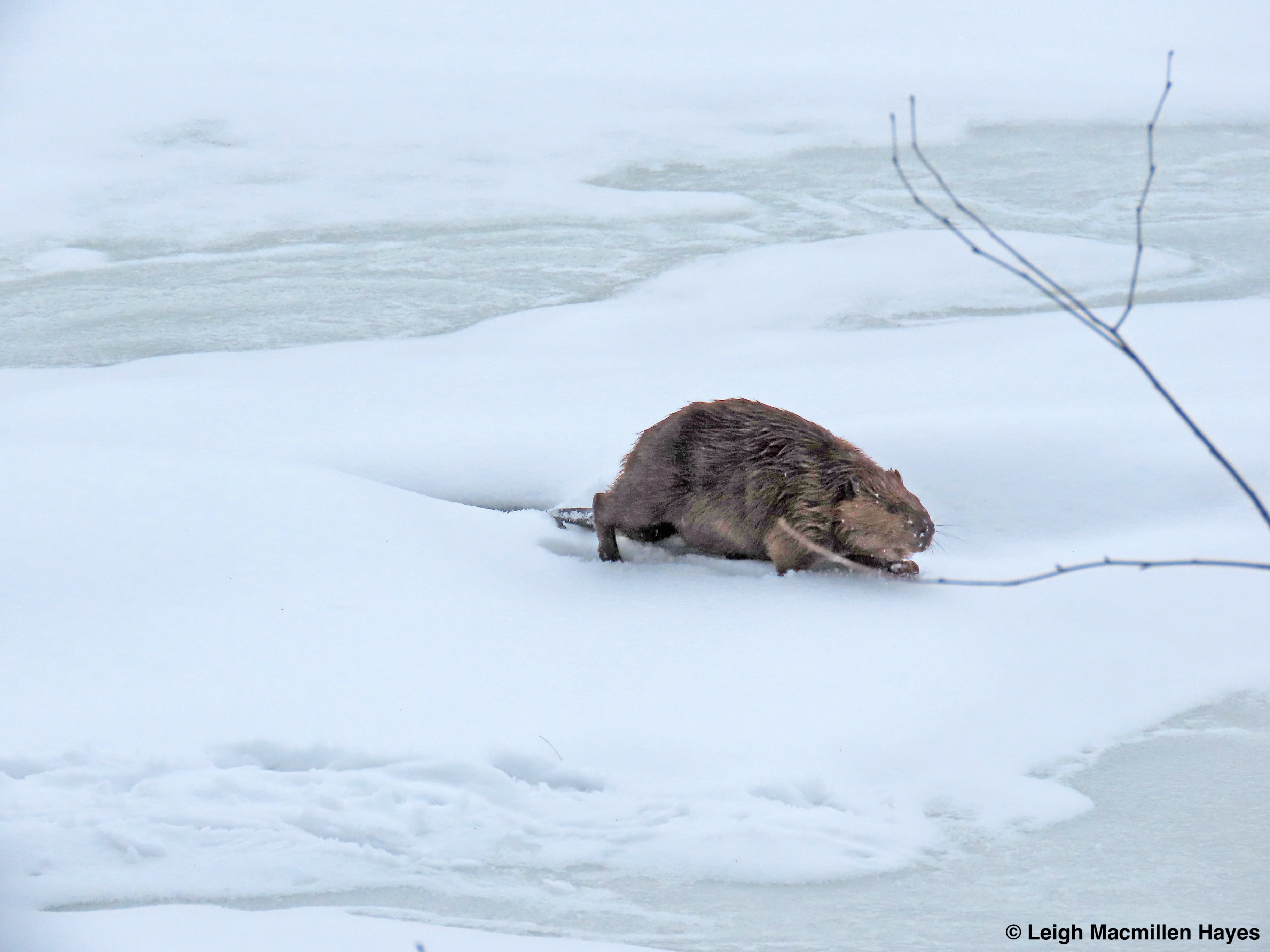
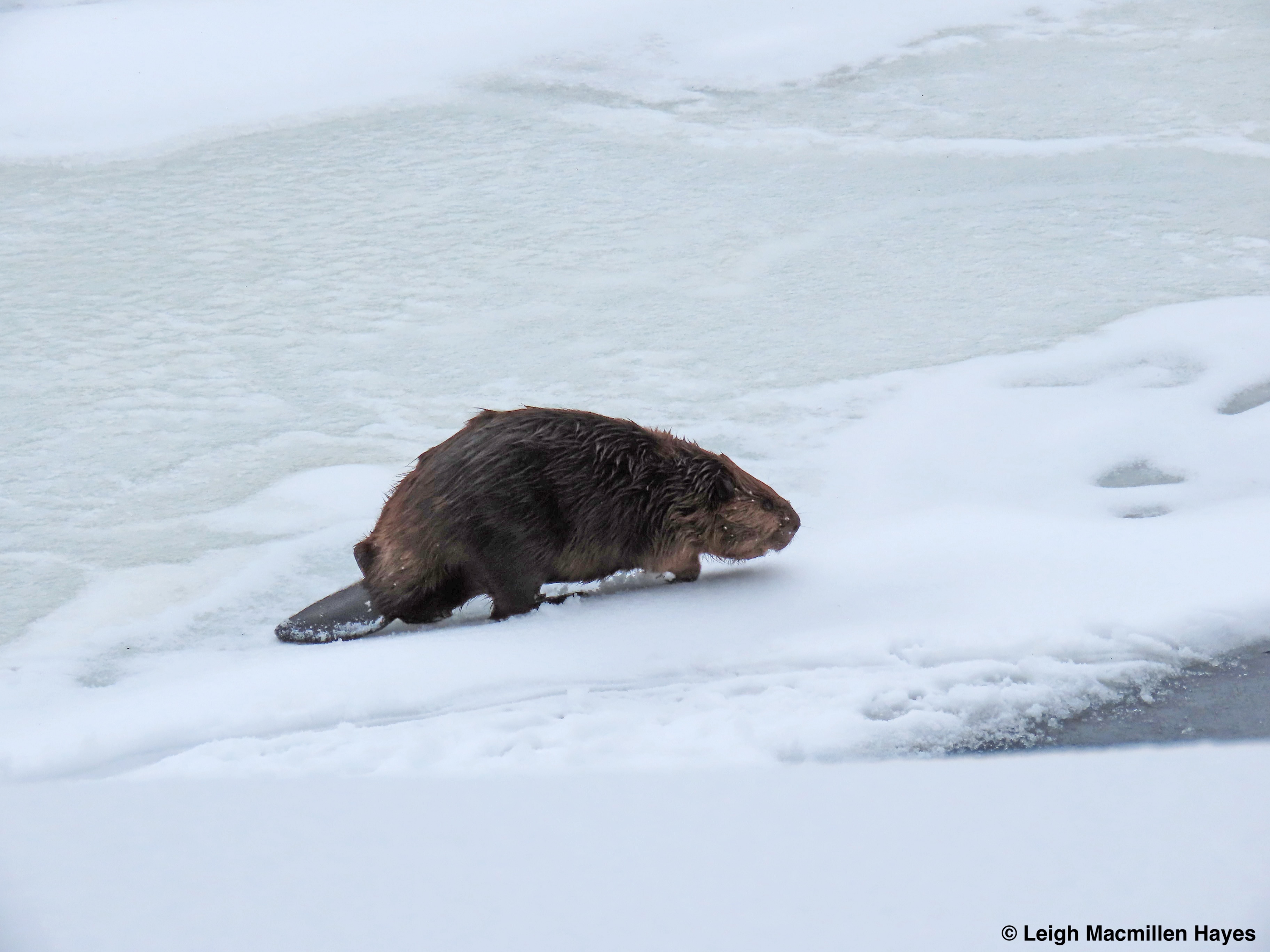
Shortly after that, at about the 2.5 mile mark from our journey’s beginning, we turned around and started to walk back. And then something stopped us in our tracks. It took me a few moments to say, “Look,” and grab my camera and I feared this something would slip out of sight before I did so.

The Beaver must have come up the hill to cross the road to go grocery shopping by the trees he’d previously cut down, and then spotted us and we watched it waddle down its well packed trail toward the ice.

We thought our time together would end in a second as it slipped into the water, but then we realized it was looking for an open hole.

And scratching the snow and ice, even to the point of getting snow on its face.

It kept trying and we kept watching.

Still no luck for the Beaver, while we felt we were having all the luck in the world.

Traveling on land is such a vulnerable activity for Beavers and I could only hope that the Otter scat in this very spot where we stood above the water was the result of the Otter eating something else and not making a meal of a Beaver kit. Because really, they both can take advantage of the same hole in the ice.

We also wondered where the lodge might be but the bank’s edge was too steep for us to note if it was nearby.

And then, just like that, the Beaver found open water and this was the last we saw of it before it made its escape.

We knew we were blessed, Marita and I. And gave great thanks for hearing the Barred Owl, spying Otter Scat, and spending a few minutes with a Beaver.

What a day, from a Porcupine’s Tale to a Beaver’s, two mammals with tails of grand importance–the former being for defense and stability on a tree limb, and the latter for a rudder, as well as stability like a tripod when cutting down a tree, and fat storage as well.

My Love Affair . . .

I have no expectations
and only so much time
to take a walk
along a nearby trail.
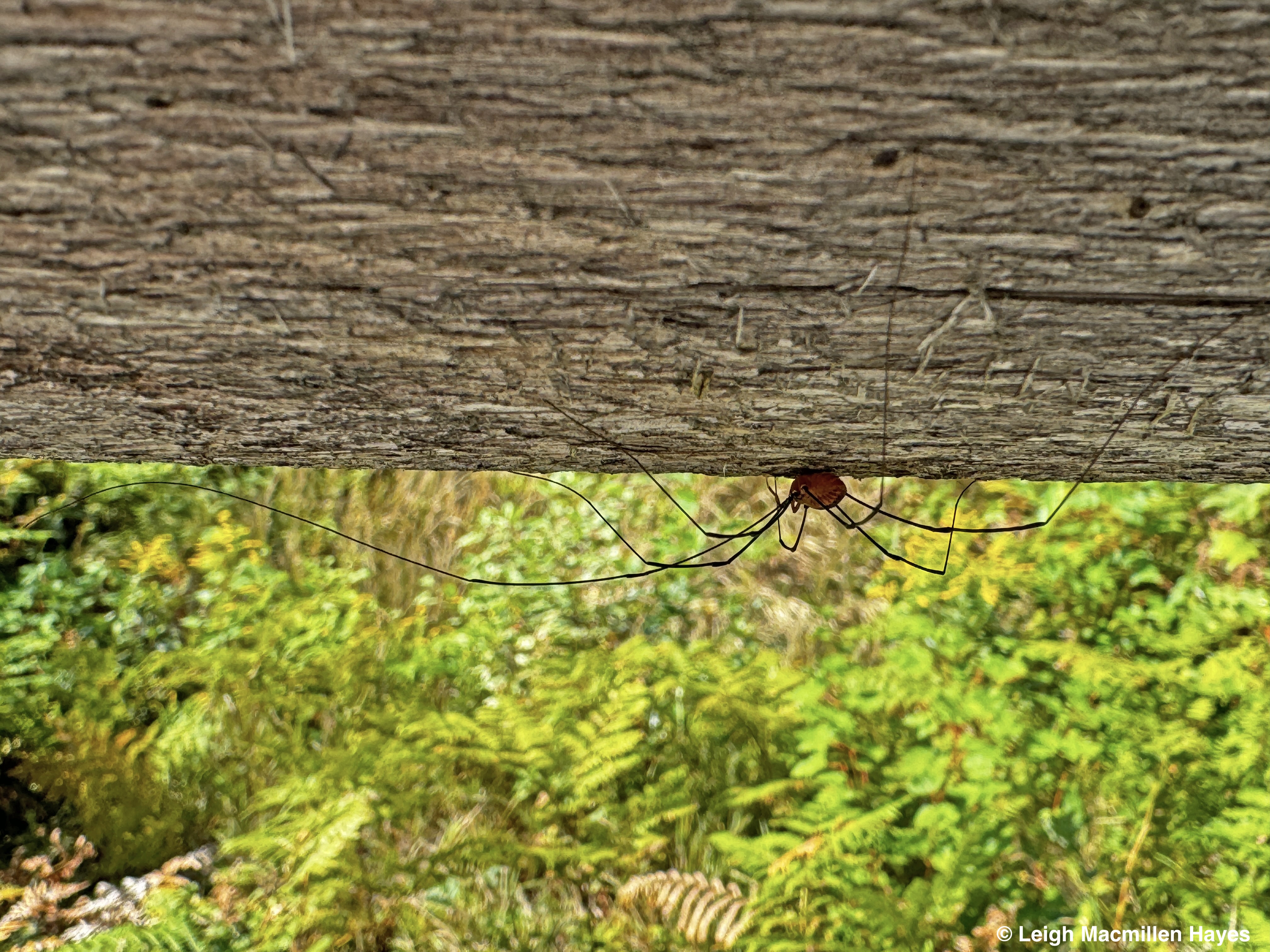
Hiding below a wooden rail,
An arachnid known as a Brown Harvestman rests.
Though spider-like, it's not,
for its body is single segmented.
Curious to see
what else the posts may offer
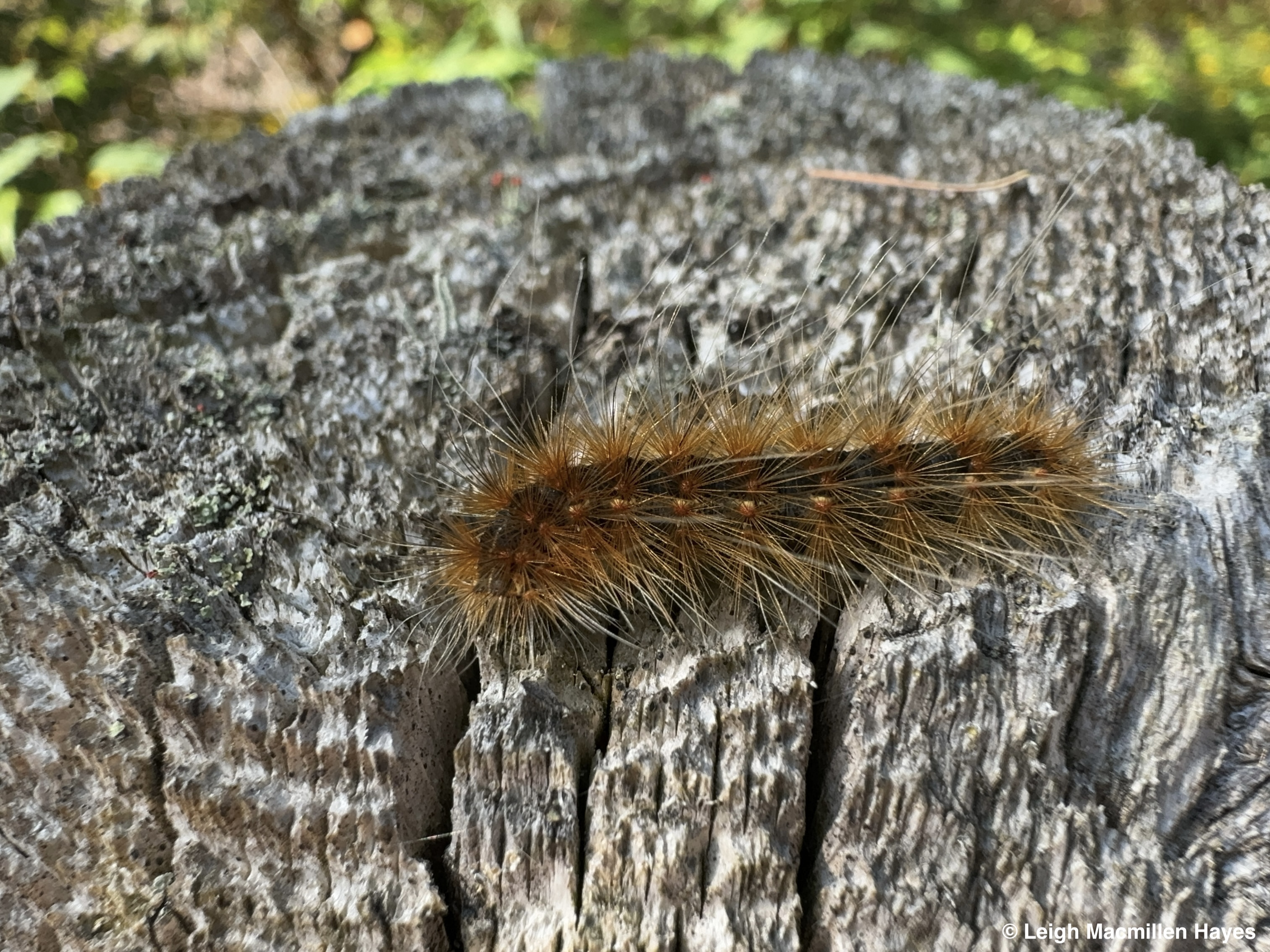
I meet a slow-moving Yellow Bear caterpillar,
It's rusty-brown hairs warning me not to touch.
A few feet away,
Whimsical with its brilliant red caps,
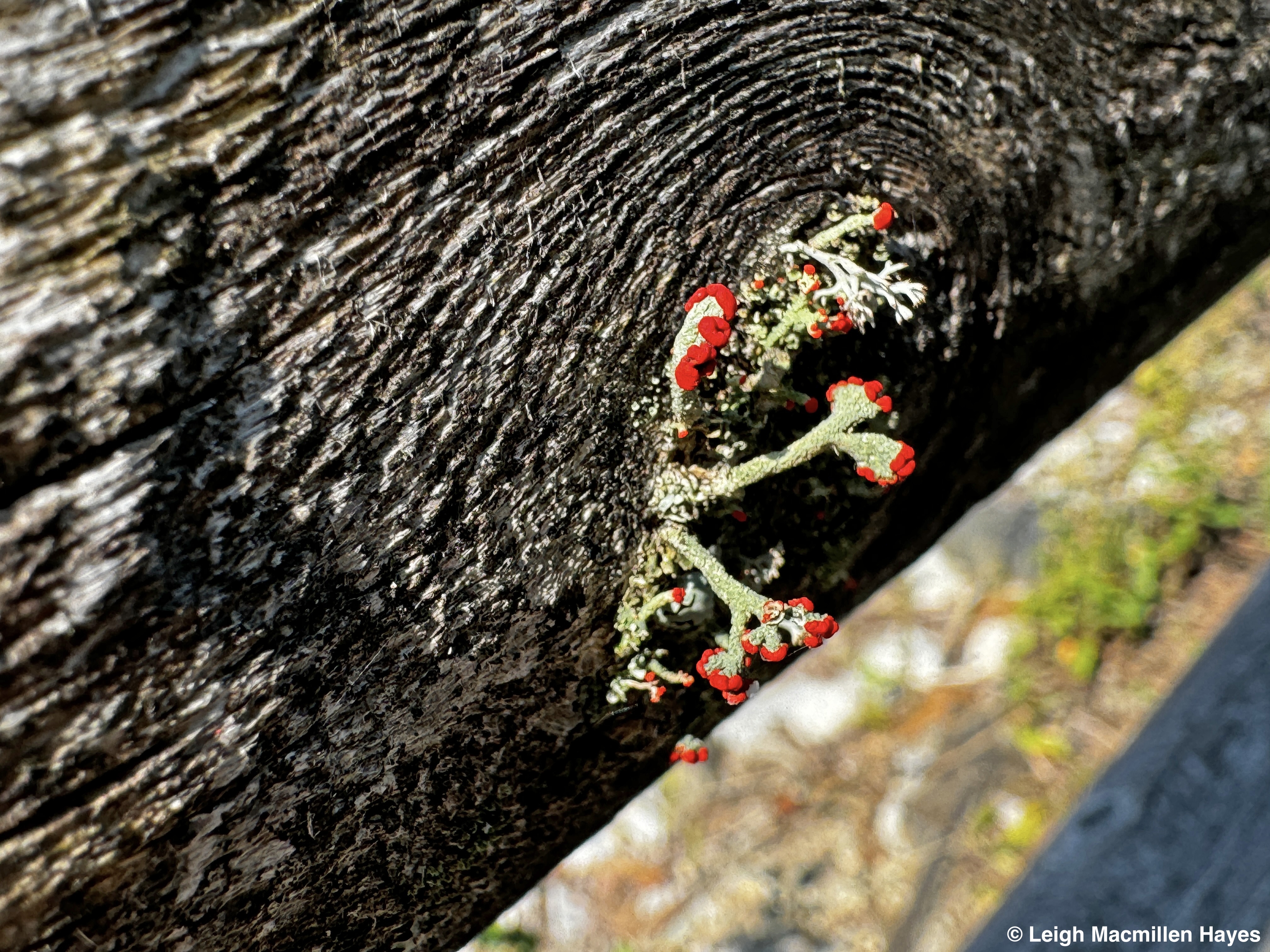
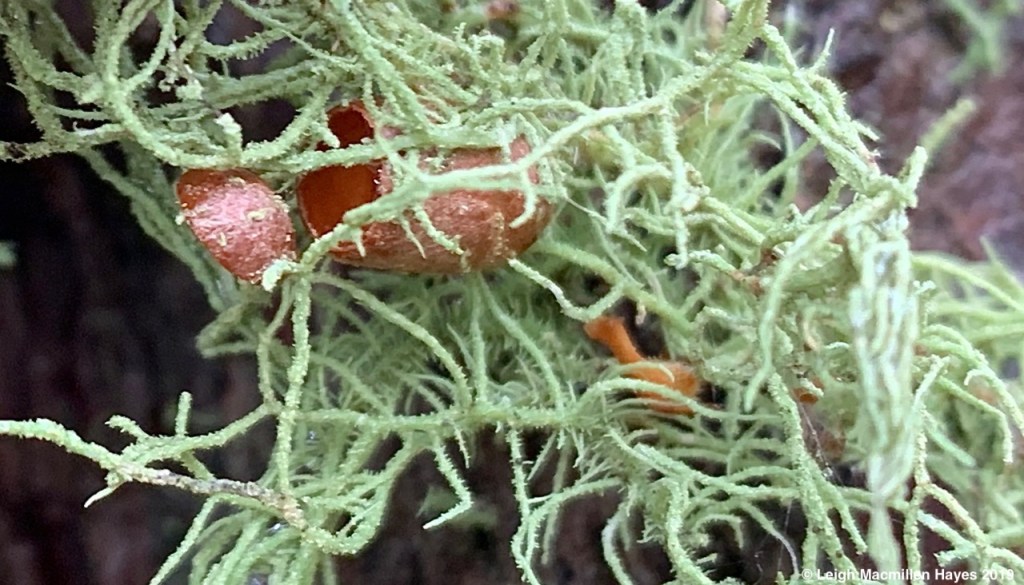
known as the apothecia or fruiting bodies,
a British Soldier lichen protrudes with a pop of color.
As I continue, one Harvestman 
becomes two, or three, resting below,
and the long legs of these Daddies
is all I can see.
And then by complete surprise,
Hunchbacked in its former nymphal form,
with legs so stout and lobster-like claws,
I find a shed exuvia and my heart skips a beat.
Like the Harvestmen, 
where there is one, there's another,
and I can only imagine
their watermelon tourmaline bodies slowly emerging.
It's when I spot a crawling creature
colored with vivid camouflage
and golden-veined wings,
I realize I've missed one of my favorite views of metamorphosis.
But still I am there to watch 
as the adult form reaches out,
one muscular foot at at time,
as it walks first sideways and then skyward.
I know from experience
its tented wings will soon spread,
but worry it will meet the web beside it,
and rejoice when it instead finally flies into the forest.
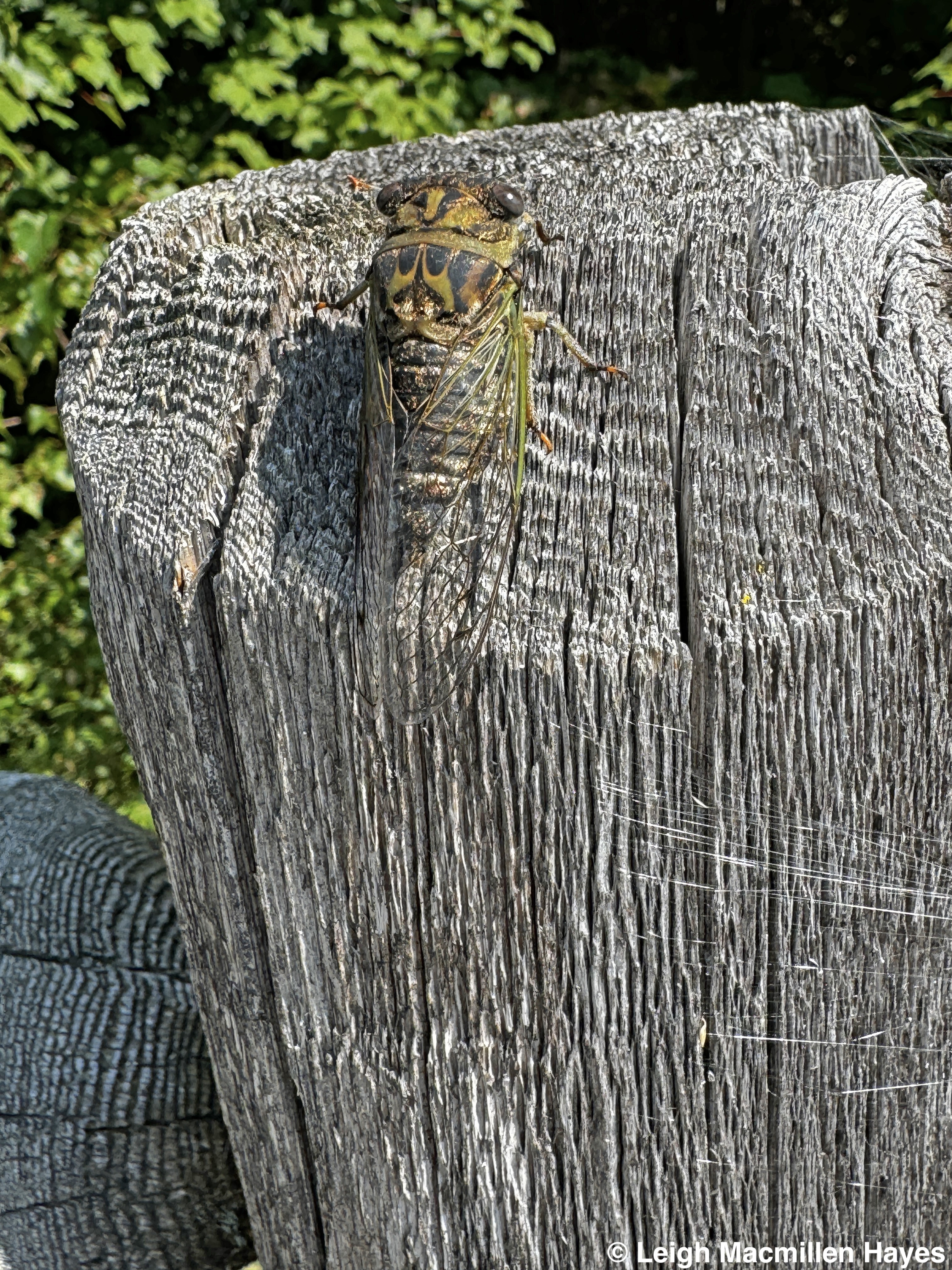
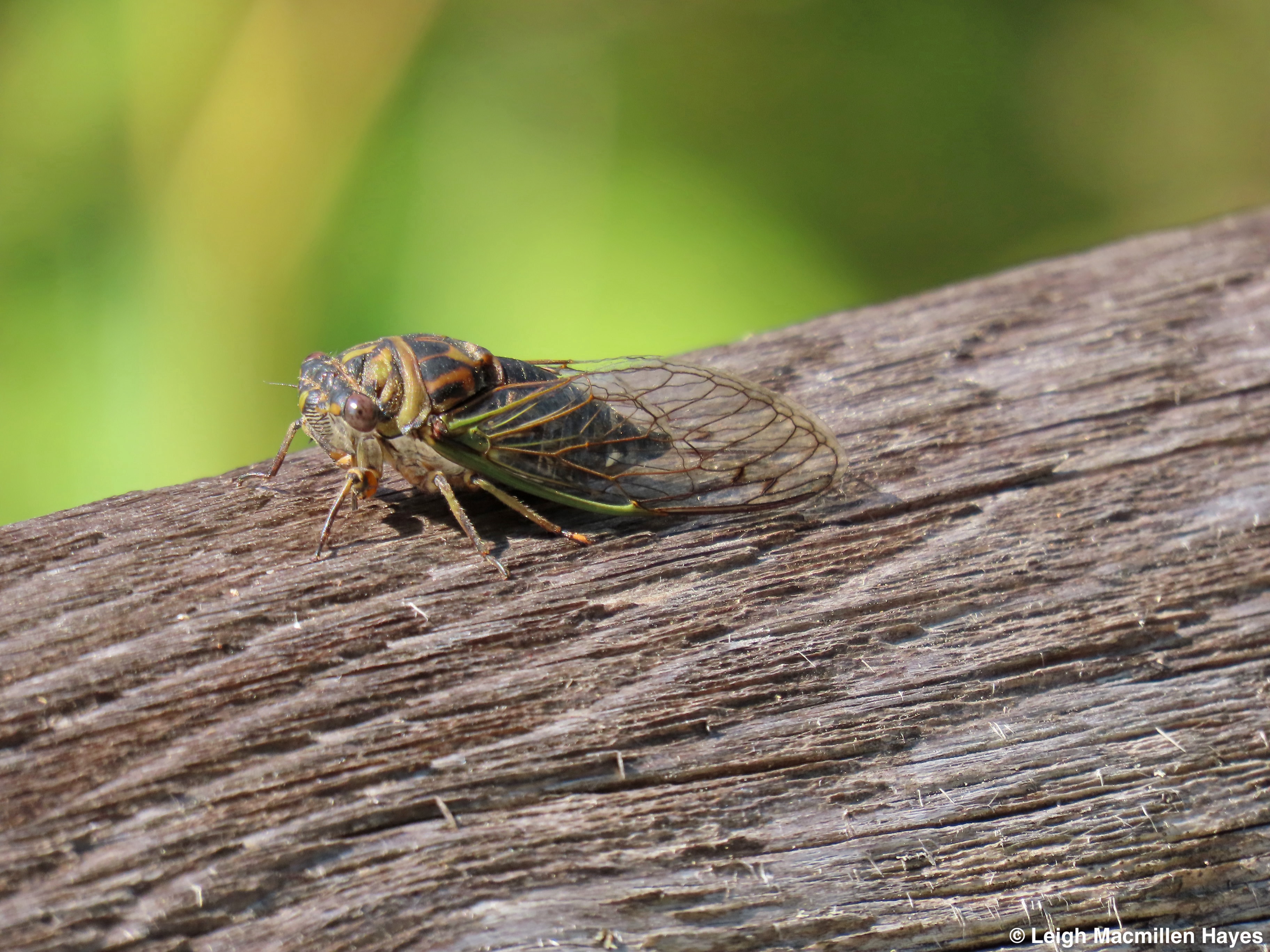
On this late summer day I find another,
and can only hope these Dog-day Cicadas
have time to sing their raspy love songs
that will continue the circle of life as they know it.
A few more steps and I must backtrack,
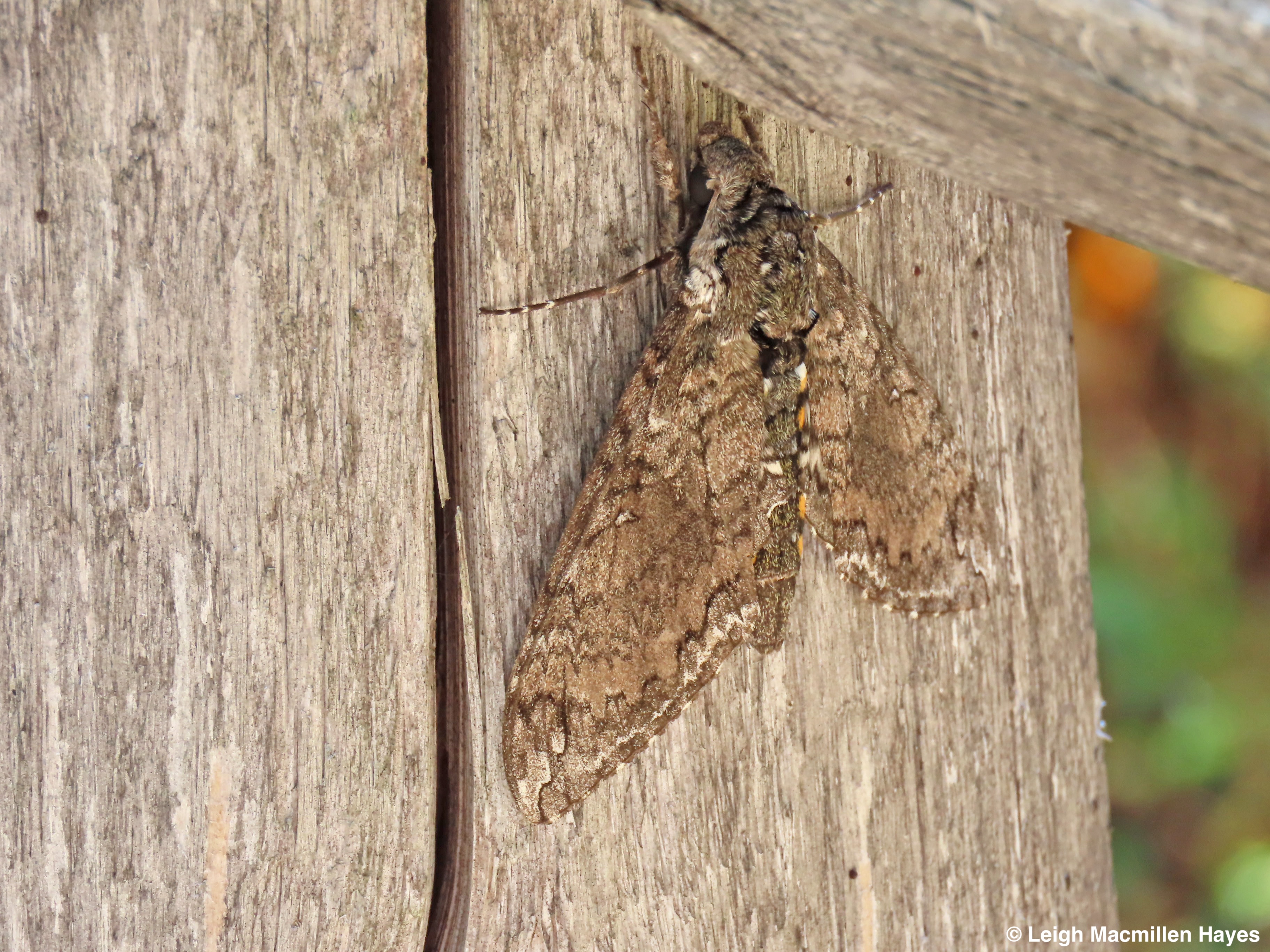
for something large garners my attention,
its mottled pattern resembling the post
upon which this Carolina Sphinx moth rests.
A rustle and wing beats cause me to turn my gaze upward,
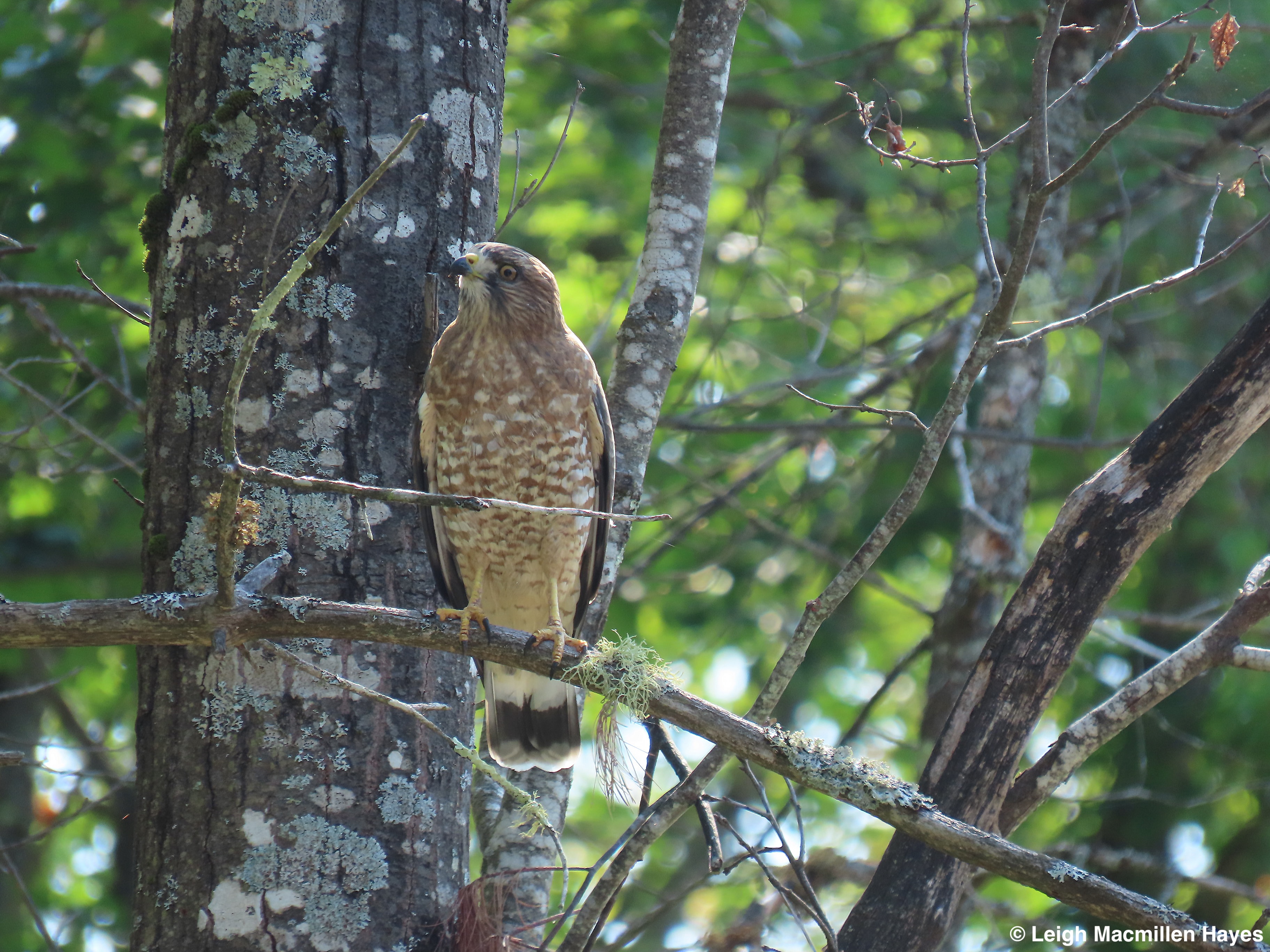
and I spot a Broad-winged Hawk landing,
and surveying the territory
for a consumable meal.
Intently, it looks down,
and all around with ten times the focus of my sight,
those predator eyes fixed as they are,
it must turn its head to see.
As I move the telescopic lens
I begin to wonder if it thinks its a creature
and I must admit that I duck
when it flies off . . . first toward me before swerving.
All of these sights I spy
in the course of forty-five minutes
and maybe three quarters of a mile
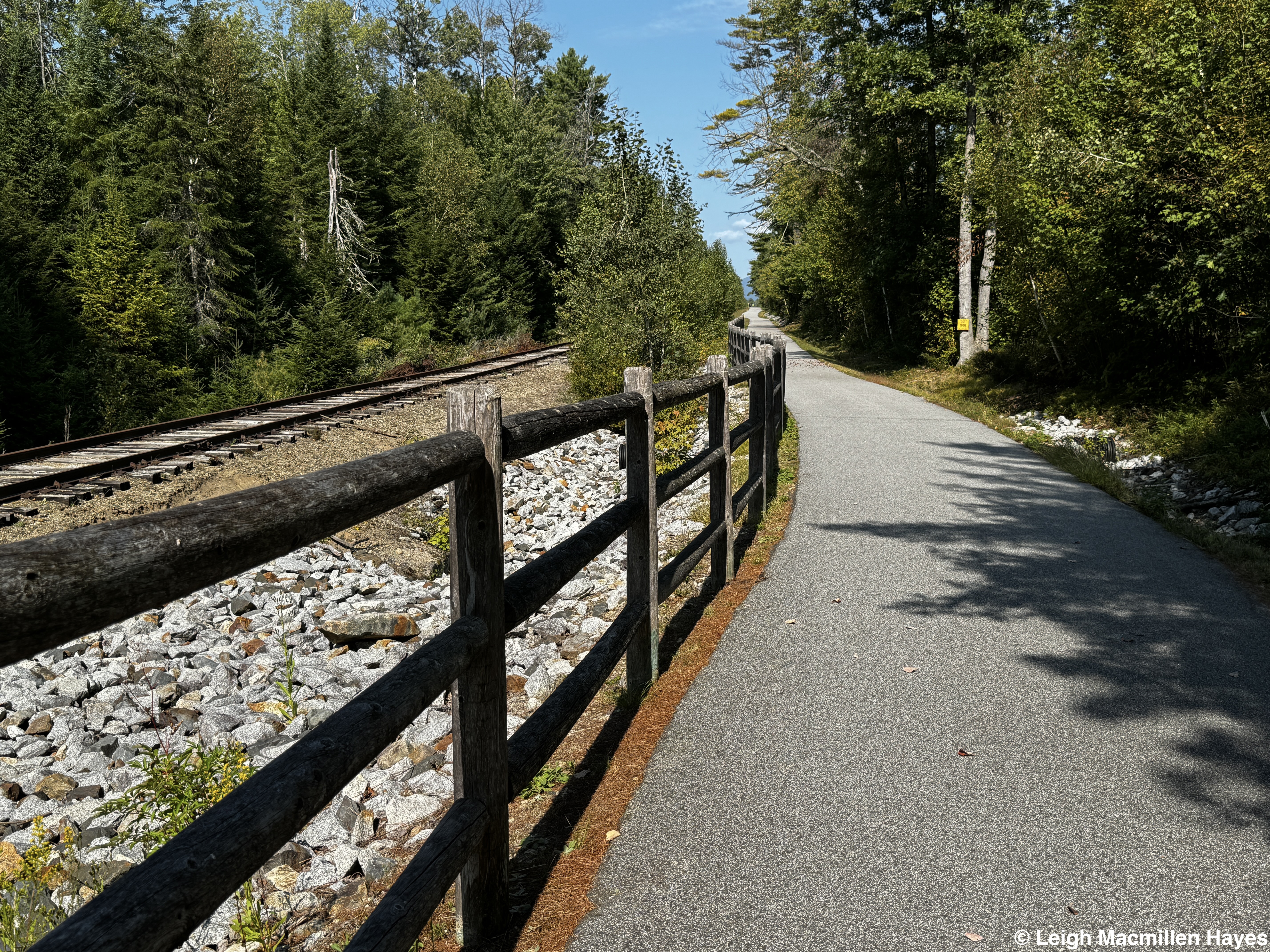
along the Mountain Division Trail.

On this day,
I develop a love affair
with the fence posts and all who gather there.
Can you imagine if I'd gone any farther?

Somewhere Under The Rainbow

Somehow we thought the rain wouldn’t fall upon our hike today, until it did. And so we sat in the truck for about 15-20 minutes, waiting for the drops to slow down, which they did.

The rain, however, enhanced everything. And as the sun came out, the water and warmth combined to create a Black Fly Festival, one which will last for several more weeks.

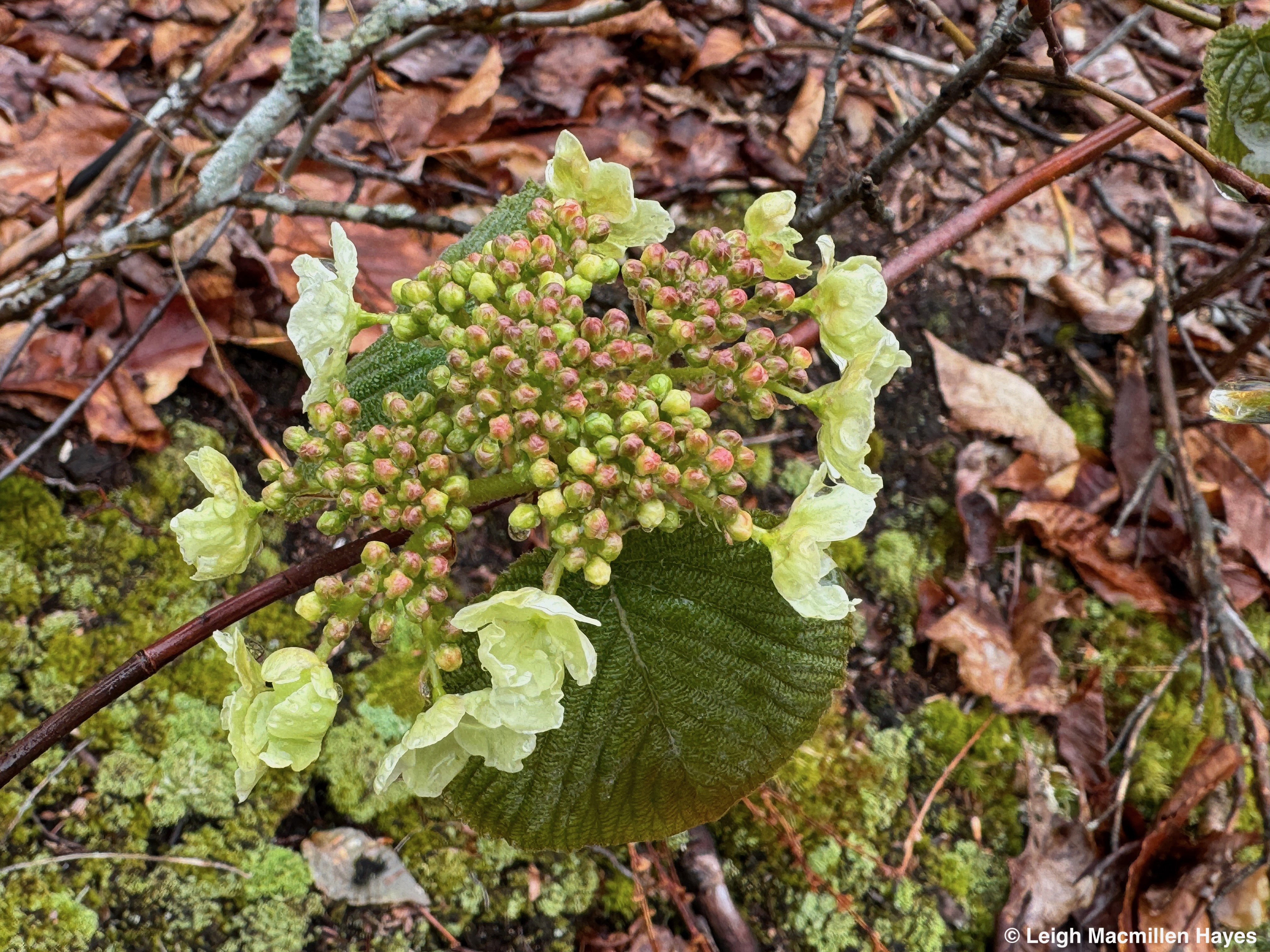
But, April/May showers do bring May flowers, and I sooo love the pastel colors that Hobblebush produces, its non-fertile showy flowers on the edge meant to entice insects to visit about a hundred tiny fertile flowers preparing to bloom in the center.

In wet seeps, Round-leaf Yellow Violets did show off their cheery faces, with violet-veined runways showing the way to the nectary, much like lights at an airfield that aid landings.

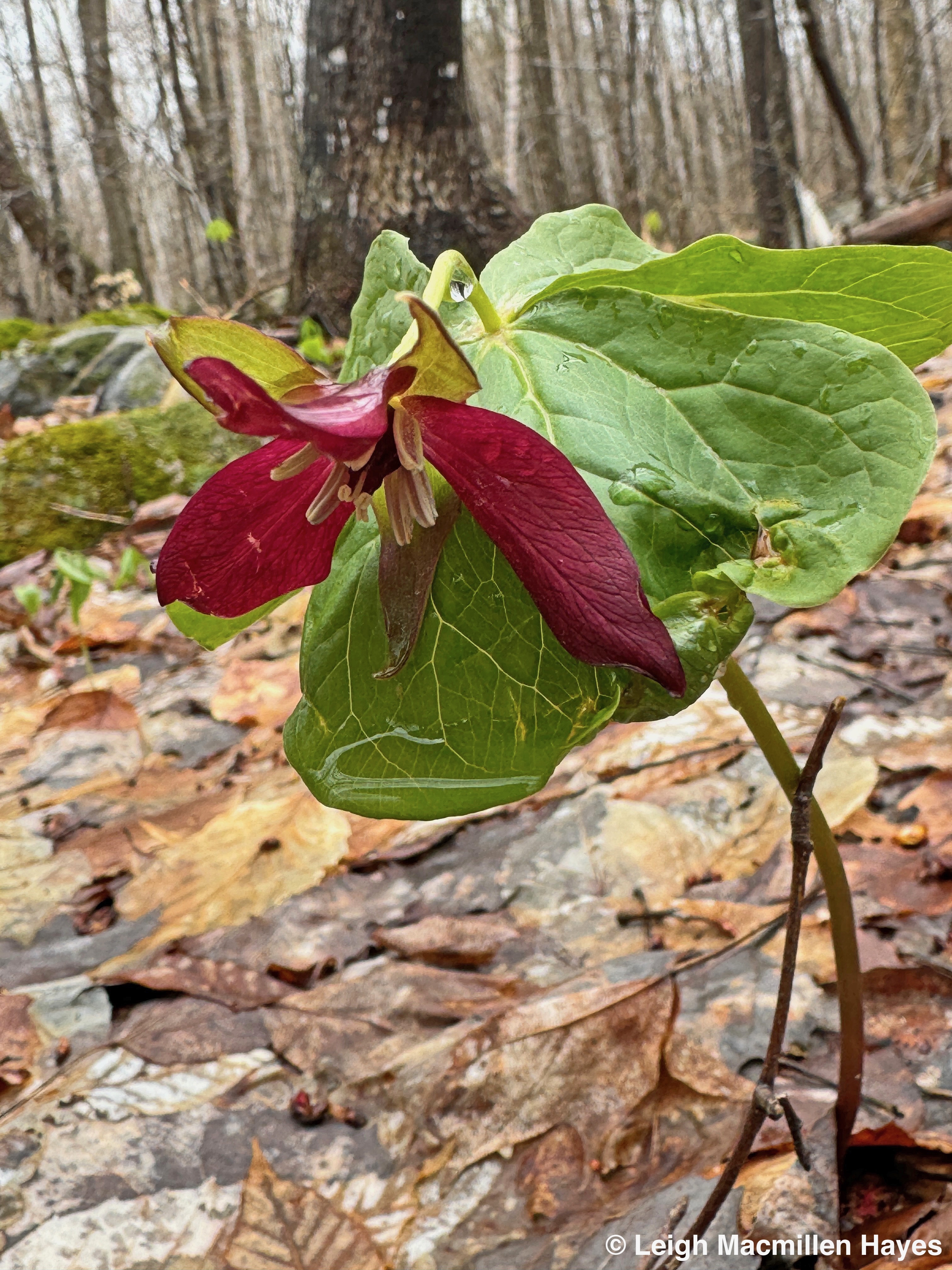
And fortunately My Guy didn’t question the fact that I was taking more photos of Red Trillium, for I’ve hardly reached the trillion I intend to take. Really though, in a few weeks our attention will turn toward his beloved Lady’s Slippers, and there are comparatively fewer trilliums than slippers in the forests through which we wander.

Because of the rain, Lungwort, a foliose lichen consisting of a fungus and a green algal partner living together in a symbiotic relationship with a cyanobacterium, showed off its greenliness since the alga had kicked into action to provide food for the fungal structure. It’s sensitive to air pollution and habitat loss, so spotting it is always a treat and reminds us of why we love living here in western Maine.

Below the summit, we paused to share lunch with the Black Flies and take in the view of the mountains, though many were obscured by the cloud cover.

On our descent, there were more hues of green to add to the art palette in the form of the larger Rock Tripe, an umbilicate foliose lichen, and Rock Tuft Moss scattered in its midst.

At a beaver pond, we noted several beaver lodges that looked abandoned and a long dam, but it was the reflection of the sky and clouds that also garnered our attention. The day had transformed as was visible both above and below.

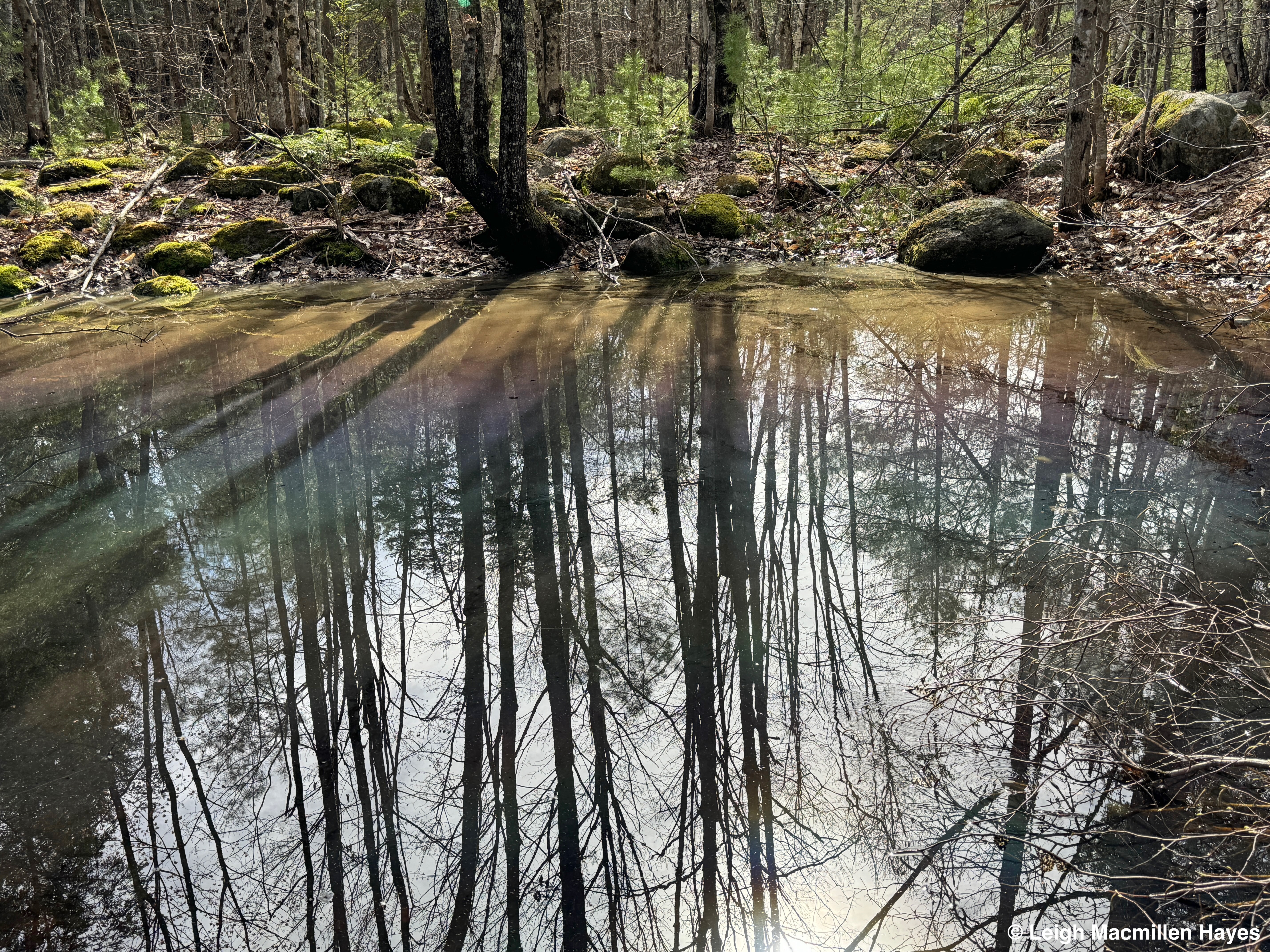
Back at home, I wandered out to the vernal pool to check on the activity. A few days ago I realized that tadpoles were beginning to emerge from egg masses, and today’s warmer weather brought even more into the picture, which in this case included both what I could see under water, as well as the reflection of trees and sky upon the water.

It was when I stopped looking into the depths, however, and focused upon the scene before me, that I realized I was seeing something I’ve never noticed before.

As I had approached the pool, I saw that it had a coating of Birch and Maple pollen and thought with a smile of a fourth grader spotting such last year and looking confused as he asked me if it was ice. No Daniel, it’s not ice. But his initial reaction made sense.

What I noticed today was that the pollen added a rainbow to the water’s surface as the sun got lower in the sky. Yellow by the far shore, orange, red, purple, blue, and green.

So, what caused this rainbow to appear? I’m a huge fan of taking a stick to a Balsam Fir blister to gather some resin and then tossing it into a puddle or still water to watch the natural resins or essential oils appear. Was that happening here?

Maybe this was from decaying vegetation and the sun being at the right angle?

Maybe it had something to do with the pollen as well as the sun’s angle?

I don’t know, but certainly it was fun that this day which began with rain, and showed off a variety of vibrant colors during our five-mile hike, should end somewhere under the rainbow.

Fall After Fall Mondate

At the start of today’s hike I met a rock. A rock covered in soft green broom mosses. A rock that invited a caress. And so I did. Repeatedly.

When I mentioned that it was the perfect pet rock to My Guy, he reminded me that it wouldn’t fit in my pocket. Details. Details.

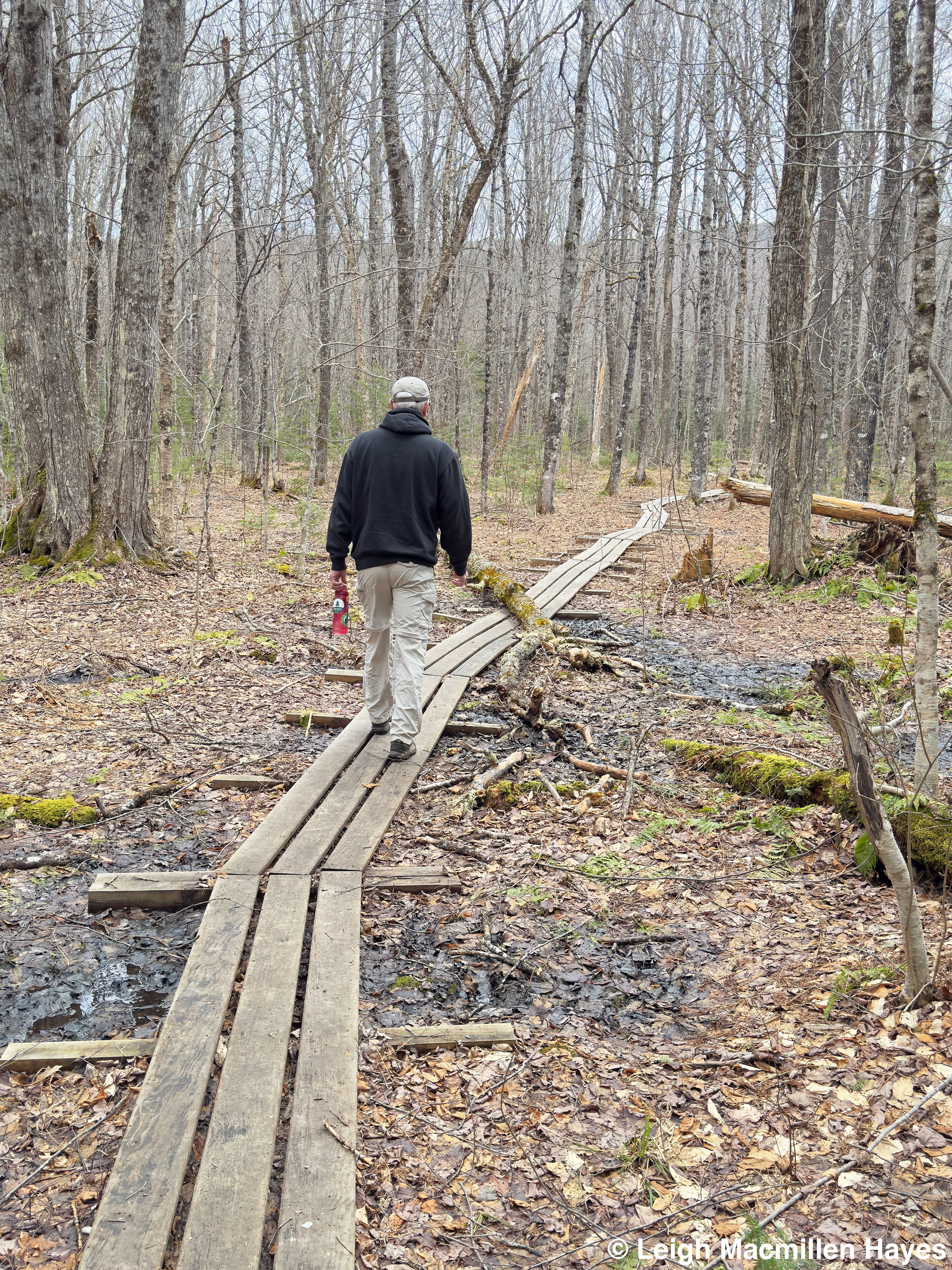
And so our hike continued through a wet area where we gave thanks for the boardwalk system. And for the opportunity to change out our hiking uniform from winter to spring. Oh, we had Muck boots in the truck, but welcomed the opportunity to wear hiking boots, and summer hiking pants, and sweatshirts, and baseball caps instead of winter gear.

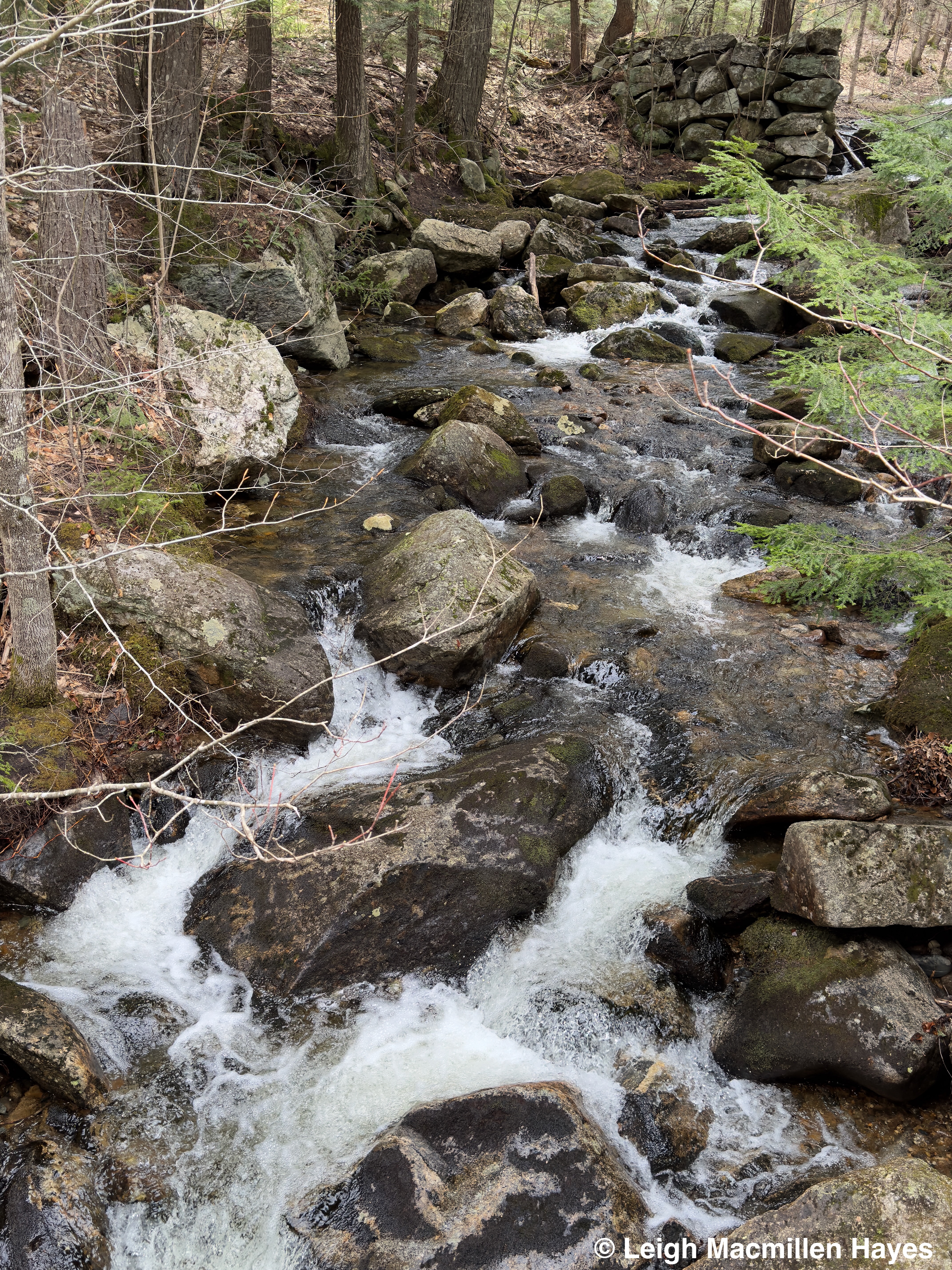
The wetland wasn’t so wet, but the water swirled around rocks just below an old mill as we crossed a bridge over the brook known as . . . Mill Brook.

In its lower reaches, we paused to rejoice in how the water swirled around and over and under the boulders and reveled in the fact that their faces were smoothly carved as can only happen in places where so much H20 has flowed for eons.

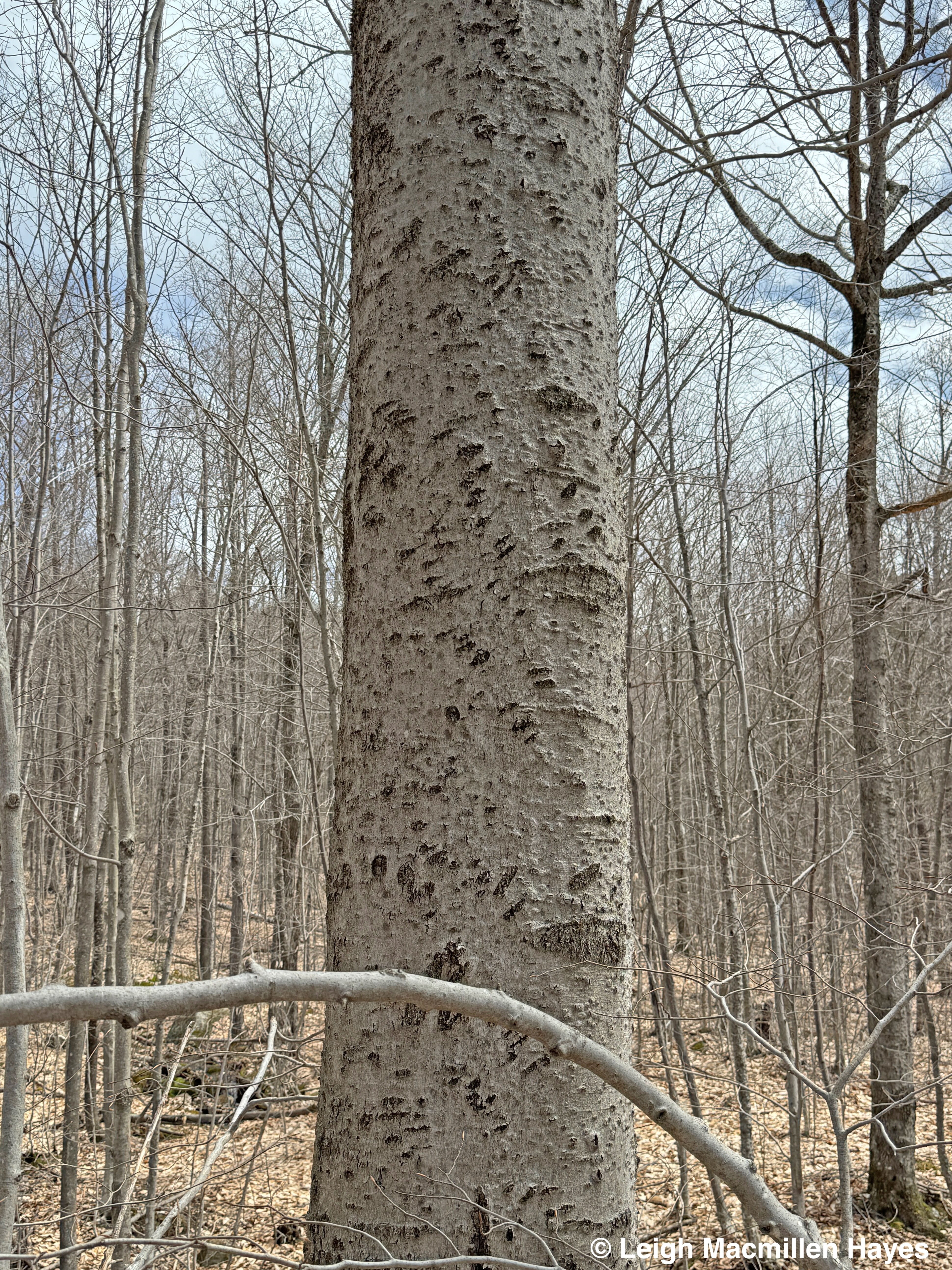
Leaving the water behind for a time, we met some friends. Beech Trees. Particular American Beech Trees. American Beech Trees more commonly known to us as Bear Claw Trees. And in this case, an oft-visited Bear Claw Tree.

Where there is one there is usually another. And another. And another. We found several, but imagined that many more exist given how many claw marks we found on these trees.

About two miles or more from the trailhead, we followed the spur trail to North Ledge (aka Lunch Ledge) and sat down to dine. Below stood a forest of hardwoods that we’d passed through and we had to wonder how many more Bear Claw Trees we might find if we actually took the time to go off trail and look. One of these days.

I did take time to examine a few fruticose lichens growing on the bark of a hemlock overlooking Lunch Ledge, this one being a Boreal Oakmoss, which is actually a lichen despite its mossy name.

And a Bristly Beard Lichen, with its short bristles decorating each branch.

From North Ledge, it’s at least a mile and a half across the mountain, with ups and downs and all arounds to get to the other side. Including snow. Given that we’d had two spring snowstorms, with the first being March 24, and both dumping a couple of feet upon the landscape, it was no surprise. Should we have donned our Muck boots?

Nope. I poked my hiking pole in at one point and discovered there was at least a foot of snow left in spots, but it was soft and easy to hike through and so we did.

At last we reached the southern side, where the trail turned and hugged the edge of the mountain. It was downhill from there.

But first, a quick break at the outlook, where we actually met the only other person who was on her way out as we were on our way in. Looking west, we could see snow showers in some surrounding mountains, but our day consisted of a few raindrops, sunshine, clouds, and a breeze. Perfect for hiking.

Also perfect for hiking: a delayed dessert of Dark Chocolate McVities! A favorite of mine since 1979 when I devoured their biscuits on a regular basis while attending school in York, England.

Downward we hiked and then we met Mill Brook again as it cascaded forth.

And forth.

And continued forth some more.

We followed as it flowed between a crevasse in the boulders–headed as you might note toward . . . My Guy.

And admired it repeatedly along its course.

Occasionally it fanned out over boulders in its midst.

And plunged into pools.

It was a lot of water and we were thrilled to hike beside it and are still exclaiming over what a fun hike it was. Oh, there was mud. And ice. But those were secondary condtions. So far, we agreed, this was our favorite hike of the year.

Where were we? Where bears of all types roam, including this crazy Bruin, who is usually a Maine Black Bear.

And no, we did not fall, though I know a few of you were wondering because you know my ability to do so at inopportune times. It was the waterfalls that we followed that made this Fall After Fall Mondate at Long Mountain so special.

Thanks as always to Mary McFadden and Larry Stifler. Through their generosity, many trails in the area are open to the public. And through the work of their employee, Bruce Barrett, those trails are well maintained.

Eclipse in Totality

My Guy and I had no idea what our plans were for today. We just knew that we wanted to find a place to enjoy the solar eclipse.

And then the invitation came and friends made connections and wrapped us in their tapestry and welcomed us into their midst so that we might enjoy the celestial event in one of the most beautiful places on Earth in the community of others.

This morning’s sunrise felt a bit like Christmas and so I arose early in anticipation of what was to come. I hope you did the same.

And then a few hours later after an hour and a half drive upta camp, we were welcomed to this place of peace.

The plan was for My Guy and two buddies to head off on their sleds for a few hours while I explored the area via snowshoes before others joined us for the afternoon celebration.

And they were off.

So was I. Who knew that they’d be sledding on April 8 and I’d be snowshoeing. As it turned out for me, it was actually the best snowshoeing adventure of the season, so firm was the snowpack.

Please don’t tell my sister, for I was given some directions about old logging roads and did some zigging and zagging and, of course, checked my GPS frequently, but I really had no idea where I was. And yet . . . I felt completely at home.

I found ledges filled with old friends tucked among the seams like Yellow Birch and Hemlocks growing where most other trees can’t take root.

And Broom Mosses . . .

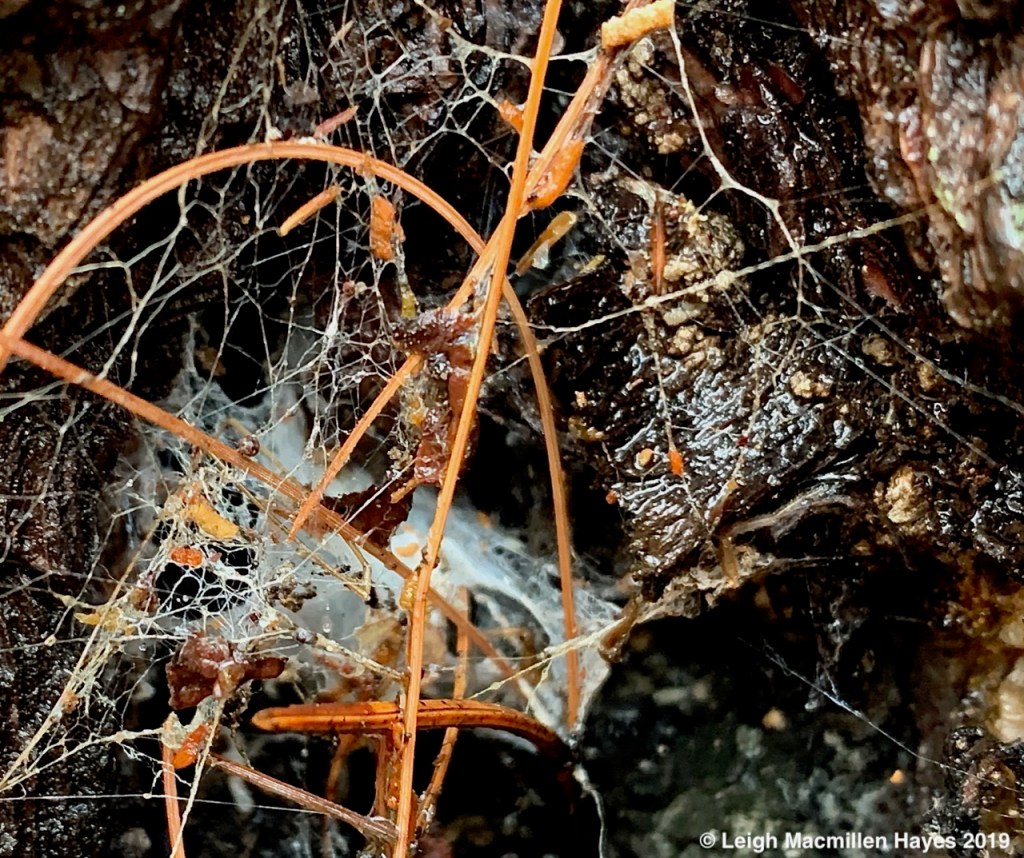
and architecturally designed spider webs among the offerings.

There were kissing cousin trees . . .

and Striped Maple twigs showing off their growth rings and buds . . .

plus a few offering chandeliers of seeds.

I was told that when I reached the blue blazes, I should turn left to head back to the trail and so I did.

But still there was more to see, including the camp that served as today’s headquarters in view from my location.

Along the way, the flattened, antler-like portrayal of Boreal Oak Moss.

And one of my favorite finds: Beaked Hazelnut catkins.

And maybe the creme de la creme: Beaked Hazelnut flowers in bloom! So tiny. So sweet. So beautiful.

And then . . . and then . . . I discovered this fairy path through the evergreens and I knew there would be riches at the other end.

At the other end I was honored for there stood Alanna demonstrating the phase of today’s solar eclipse with the help of an Oreo cookie. And then she ate it.

Those who had gathered began to play with the shadows as the sun slipped behind the moon and we were all in awe of finger shadows that resembled tree frog’s suction cupped toes.

And crescents formed as the light filtered through tree shadows.

Darkness began to descend in the middle of the afternoon and we all watched the sky change and felt the temperature drop. Suddenly, we were cold again.

It was as if the sun had set, when indeed it still stood high in the sky.

Totality of the solar eclipse lasted about two minutes and we were a group of about 20 ranging in age from about 6 to, um, senior citizens, and every one of us was in total awe.

Before and after totality we watched the light dance on the snow in a way never experienced before.

We checked the tree shadows again, and noted how they had changed as the sun started to appear again.

Thank you to Alanna and Jason for inviting us to your special family place and to Brian for transporting My Guy’s sled. Celebrating this phenomenal event in community served as icing on the cake for an extra special day, with snowmobiling and snowshoeing being the base layers.

Solar Eclipse 2024. One for the books.

Of Stumps and Snags on this St. Patrick’s Day

Stump: the base of a tree that has been chopped down or fallen, but is still connected to its roots.

Snag: a standing dead or dying tree; or part of a tree that is dying.

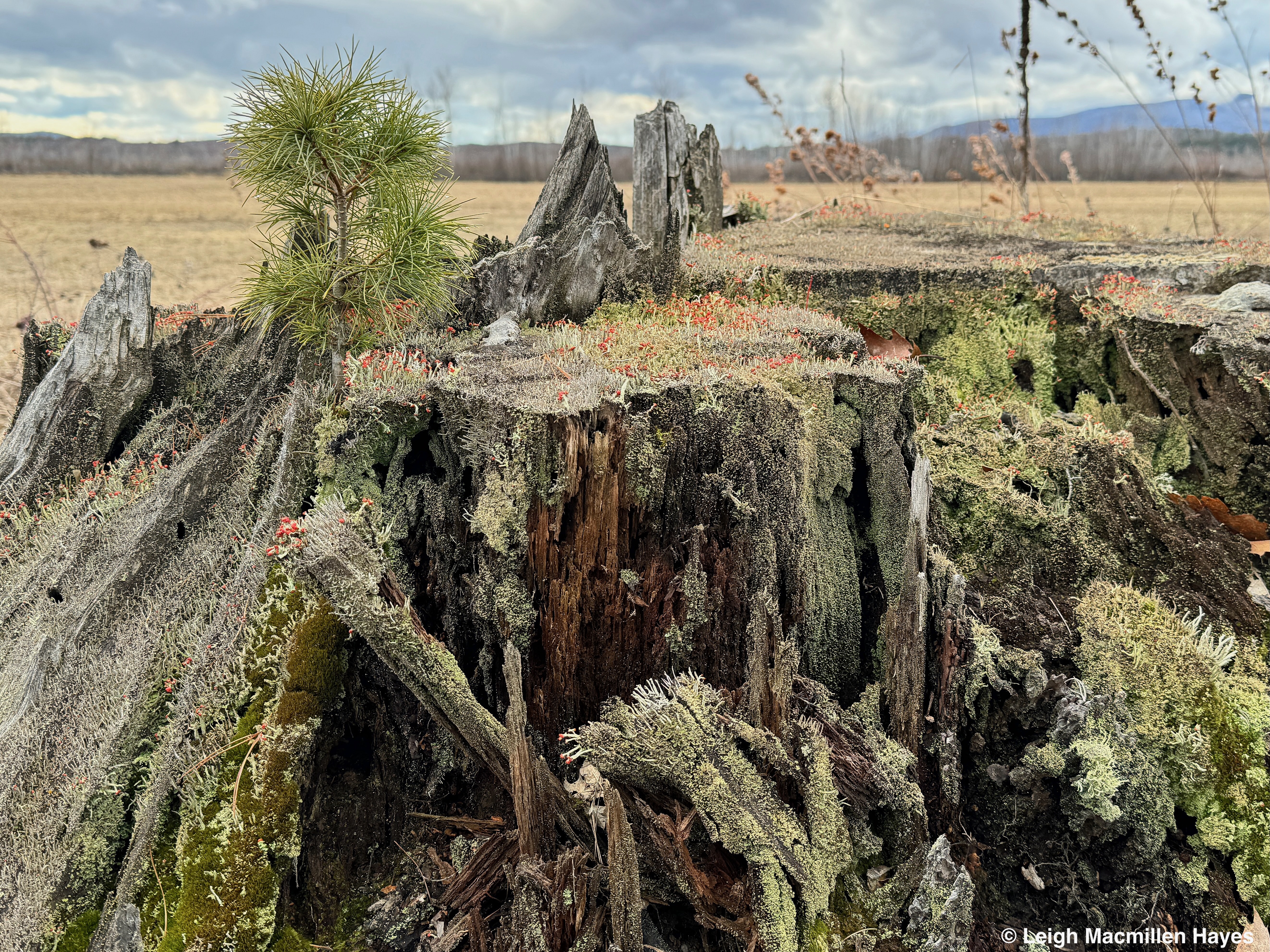
To visit a stump presumed dead
is to find life that comes in many forms.
Mosses and lichens colonize in a manner all their own,
and saplings find a new spot upon which to grow.
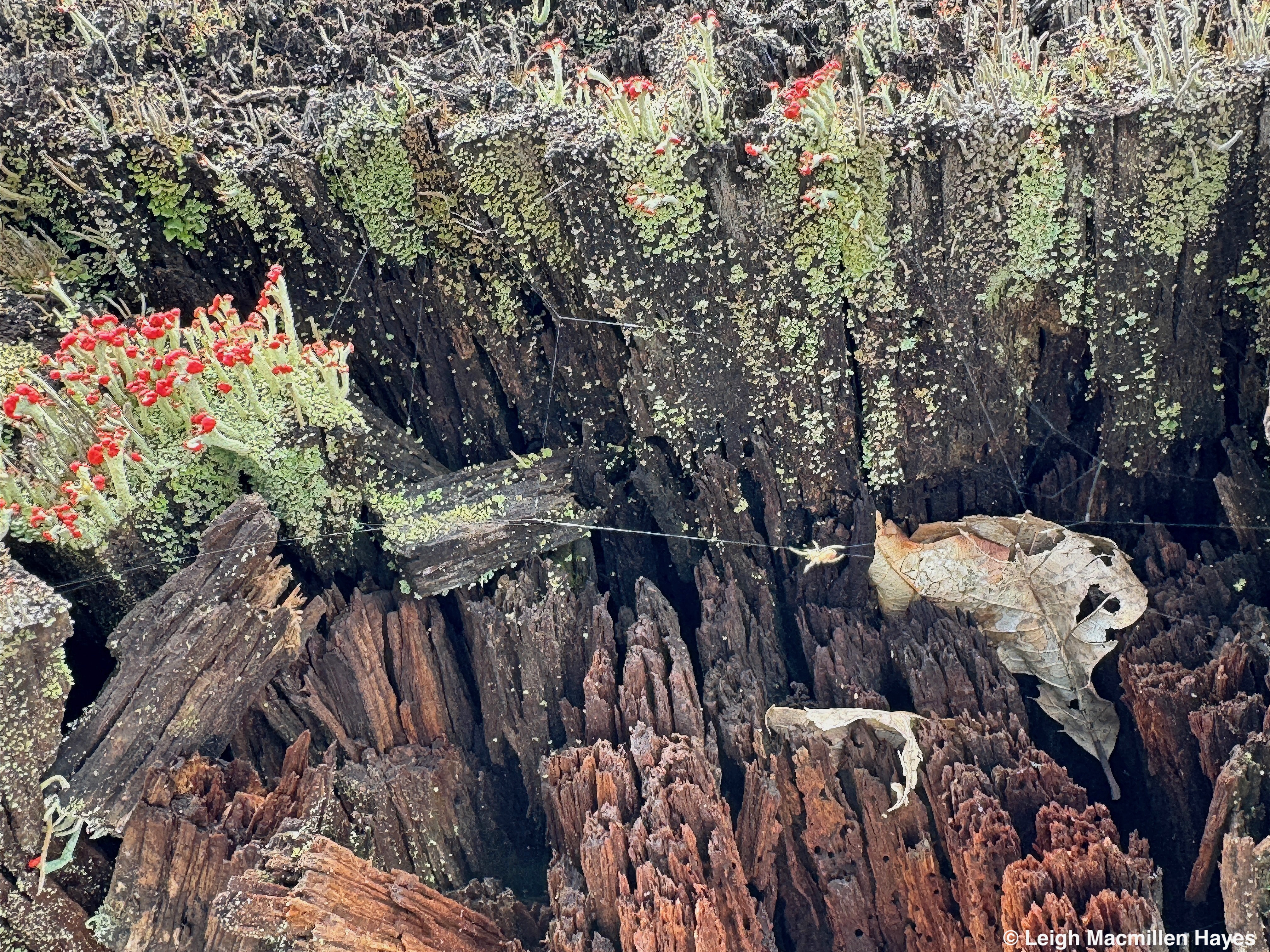
British soldiers crowd the scene,
their red caps marching toward the future
with fruiting spores planning to form
more of the same.
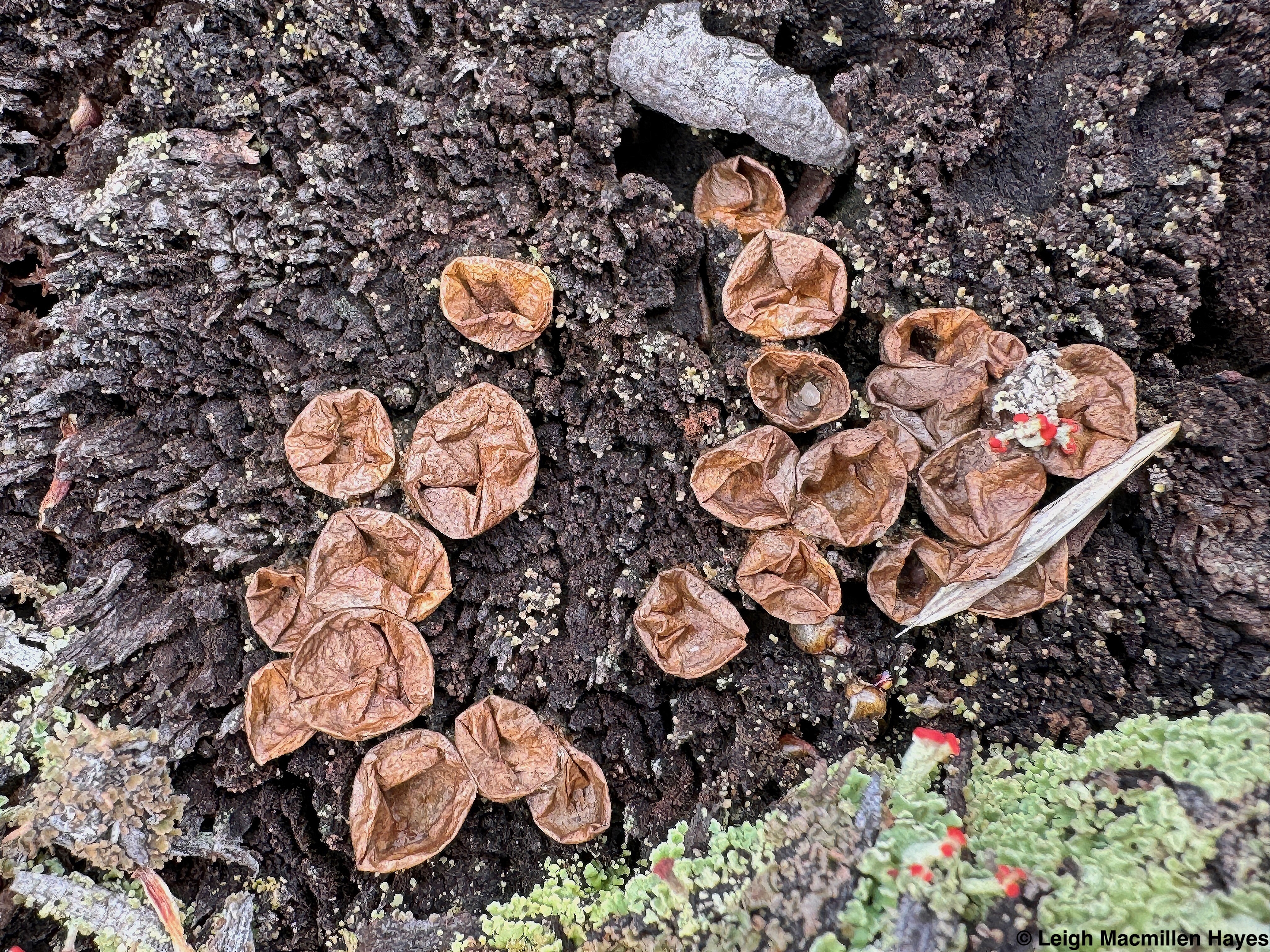
In their midst
others who are deflated,
the papery remains of puffball fungi
having already spread their wealth.
And a tiny White Pine
who chose this spot
upon which to germinate
at least seven years ago.
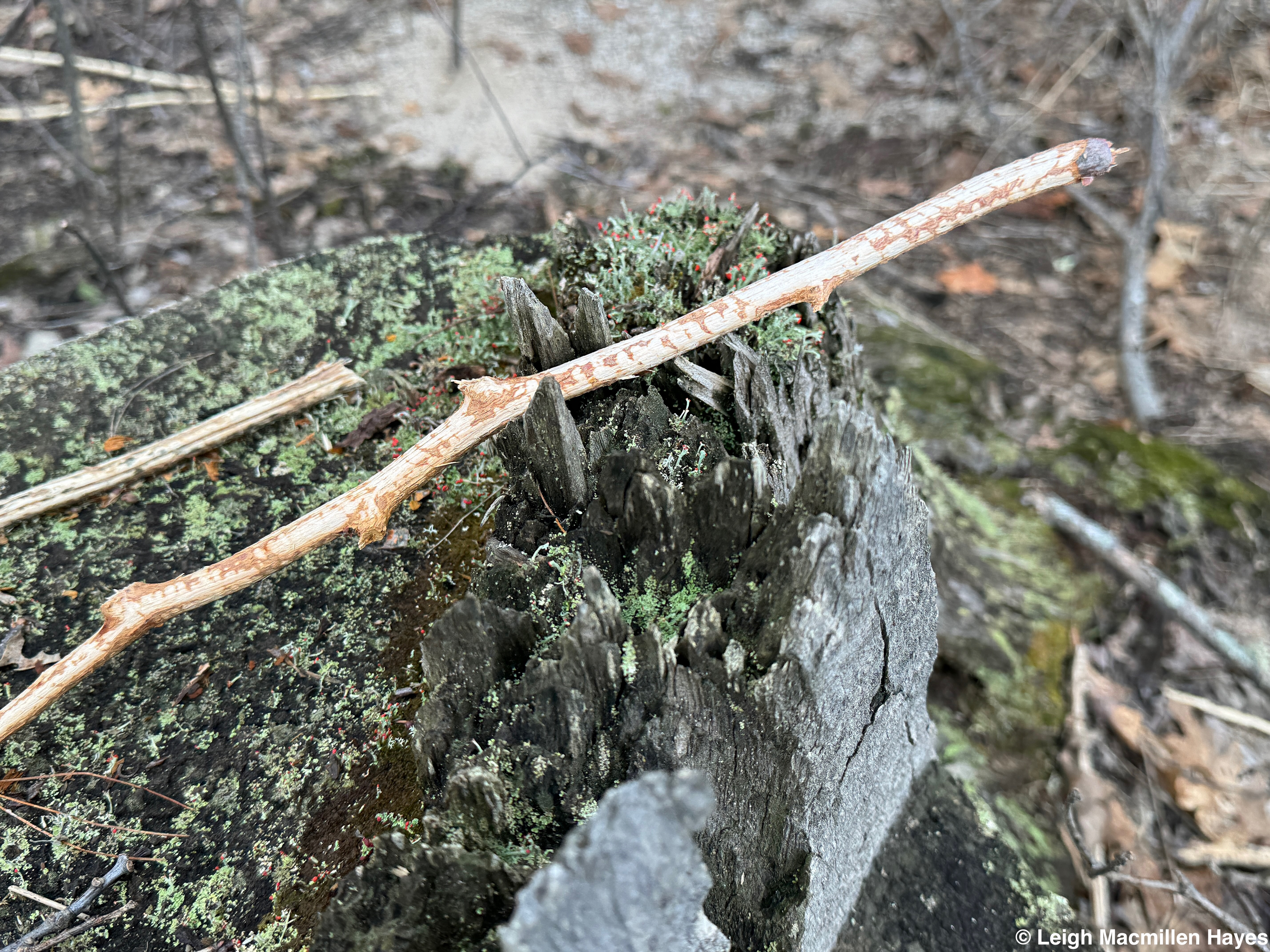
Stopping beside another stump,
it is not the residents who call this home
that attracts my attention,
but rather the sign of another who had paused here.
Beaver nip sticks, a source of winter food, 
were on display,
the trees from which they came
now skinny stumps in the background.
And growing on this stump,
scaly-surfaced trumpets
blaring Irish tunes
for all to lichen.
The next stump in my survey
had rotted from the inside out
and humus formed within
its castle-like chambers.
It even had an arched doorway
for leprechauns to enter
or pass into the next world
and the stump itself was leading the way.
There was another, 
which though the wood had already decomposed,
offered a substrate for a few
to set up housekeeping.
I was struck by the contrast
of a small clump of British Soldiers
on this one, whilst its neighbor
supported an entire army.
And only one small clump 
of Four-tooth Moss,
decorated with raindrops
in a salute to our March weather.
It's when one takes 
the time to look,
that the tiniest residents
make an appearance.
And so I watched this tiny spider
works its magic
of building guide lines
and creating a snare in hopes of a grand capture.
Not all stumps in this river-side location
were the result of man's intervention,
for old beaver works
highlighted tree spirits in the curvature of the lines.
Switching my attention to snags
brought the vision
of more artwork
upon the skeleton of a tree trunk.
And a display of the (w)holiness of this place,
for such were the portals
carved by beeltes in the past
that had breached the bark.
Finally, I stood by one mighty snag
that is a marvel of this natural world,
so much of it decomposed
yet replenishing the soil.
Looking skyward from within,
one can see branches
and marcescent leaves above
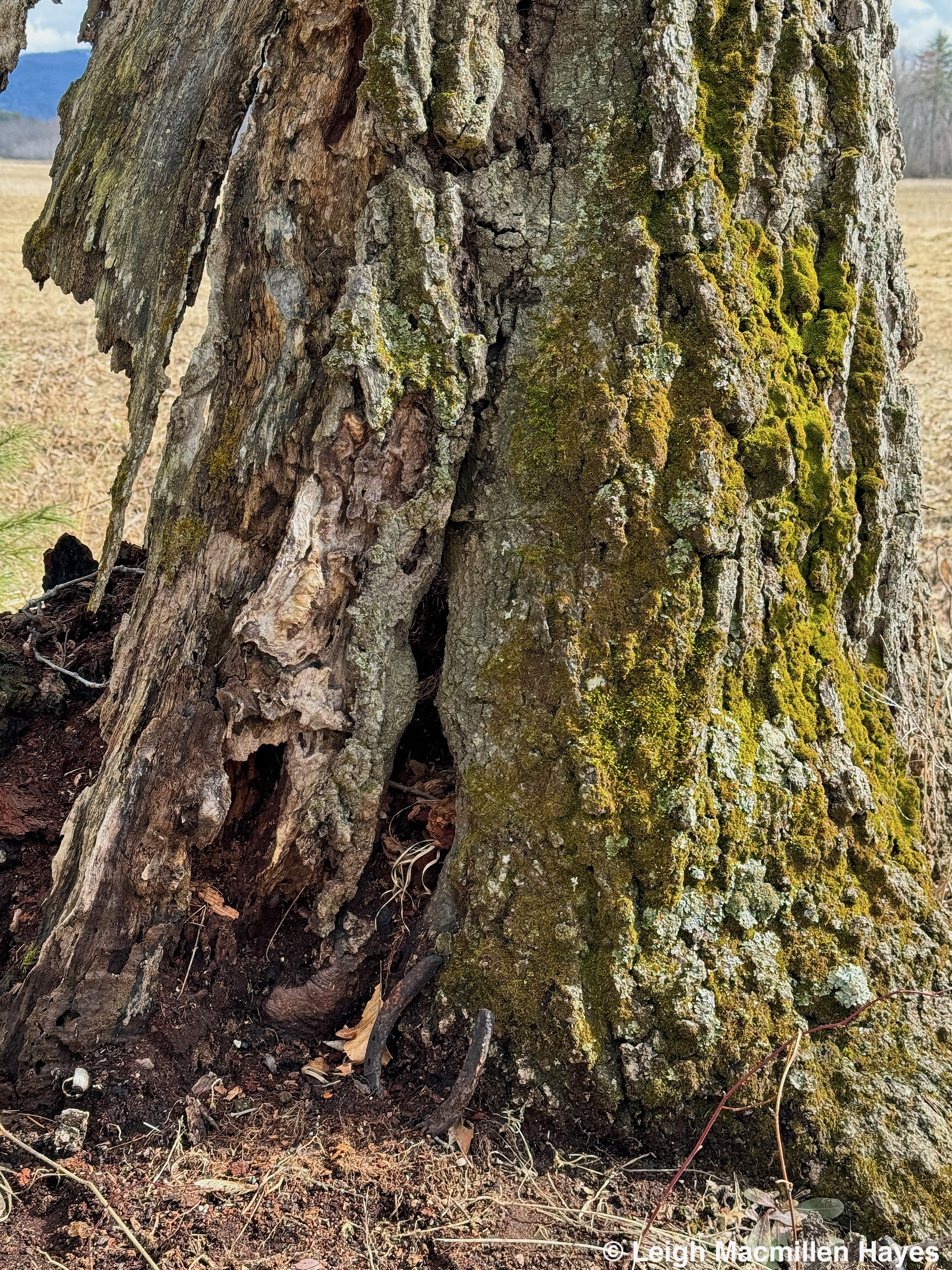
speaking to the xylem and phloem still in operation.
What bark is left,
serves as armor for this old oak,
and as scaffolding
upon which mosses and lichens can grasp.
It's what I spy inside,
however, that takes my breath away.
Oddly enough, it is named
for the breathing structure of another.
And when I compare it to 
the nose of my oldest son's furbaby,
I can see the resemblance, sorta.
Dog Nose Fungus.

As for stumps and snags, I must give thanks
for they are hardly useless in the landscape,
but rather hosts of many a forest life,
and I'm sure St. Patrick would approve.

Witnessing the Past

We’ve traipsed through these woods before, My Guy and I, but always, there’s the old to see and the new to appreciate. And so today we visited both.

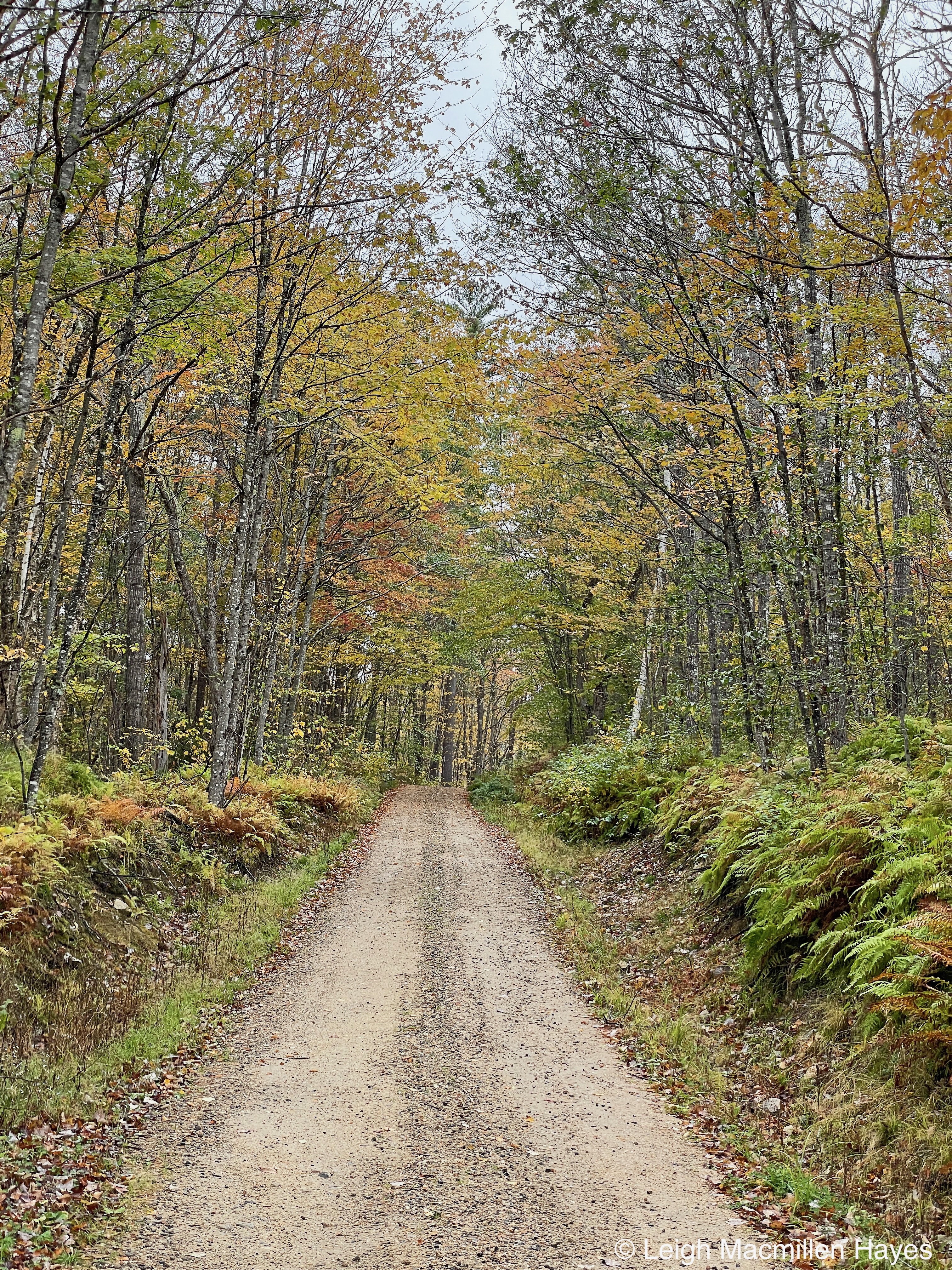
By the shape of the forest road we walked, I could have driven another mile before parking. But . . . I like to walk. And besides, you can’t appreciate all the beauty that surrounds you on a wet autumn day if you fly in at 60 miles per hour. Or even at 20!

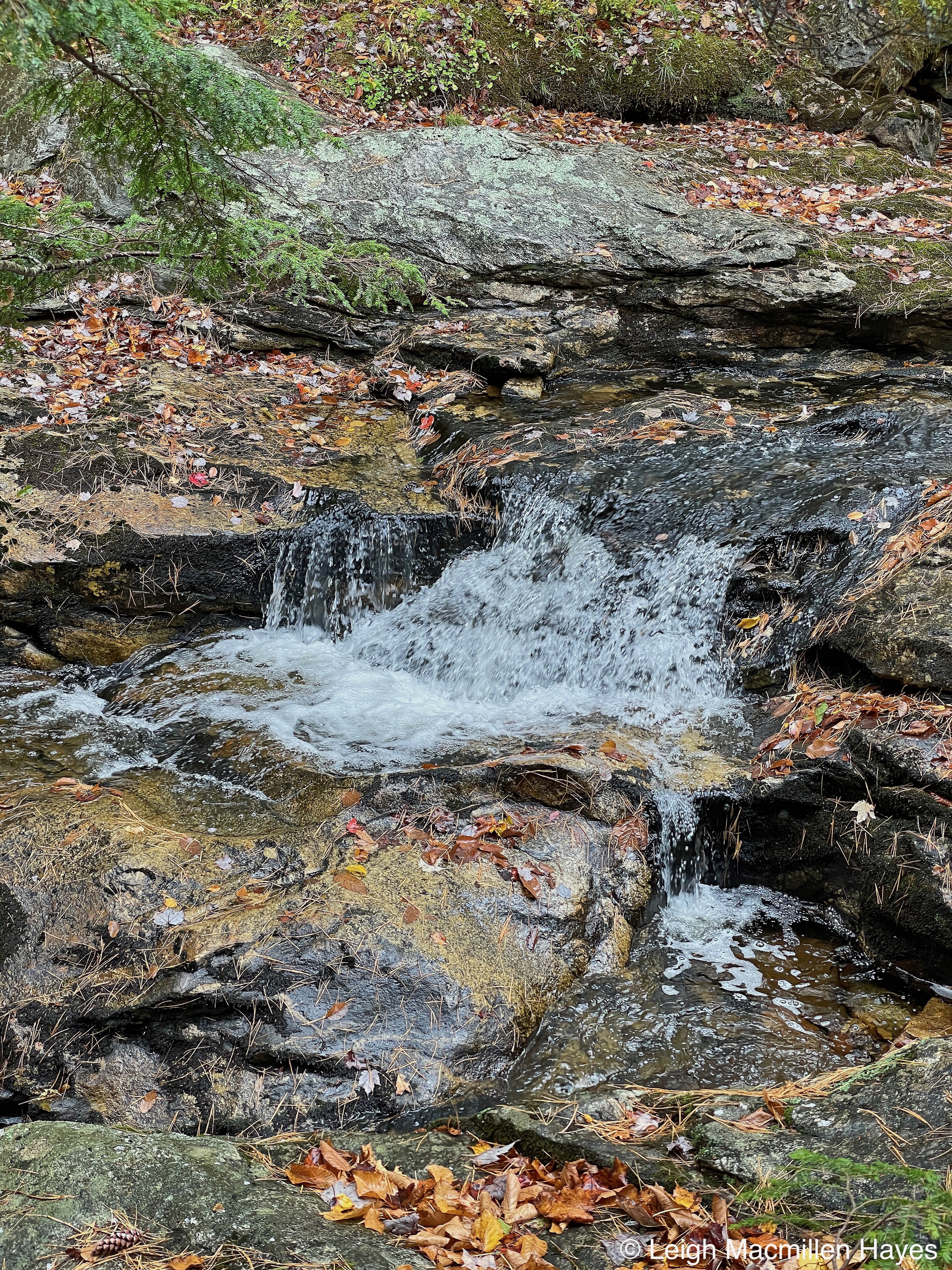
And because we walked, we found an off-shoot trail that led us to a sweet spot we’d not visited before along Great Brook, where we stood for a few moments watching and listening and smelling as the water cascaded over the rocks.

Once we got to the trailhead after passing around a gate, we followed another old road for a ways, up and down over a few little hills, and then, because memory was on our side, as the road curved to the right and the stonewall began on the left, we knew it was time to turn and begin a bushwhack up a road that hasn’t seen much use in decades. It was there that we spied the first witness. A tree standing over a marker. By the way the tree is growing around the sign, it’s obvious that it’s been keeping watch for decades.

So if that was the witness post, where was the survey marker? Atop a rock at the base of the witness tree. And 1965 would be the year that the sighting was first made.

Eventually we reached the first of the foundations because even when we are what seems to be deep in the woods, we’re in the middle of a place that was once somewhere — someone’s neighborhood. In this case, according to the 1858 map, we were visiting the Durgins.

My friend, Jinnie Mae (RIP), was an historian and tech guru and years ago she overlaid part of the bushwhack we did today on an 1858 map. You can see the name E. Durgin on that.

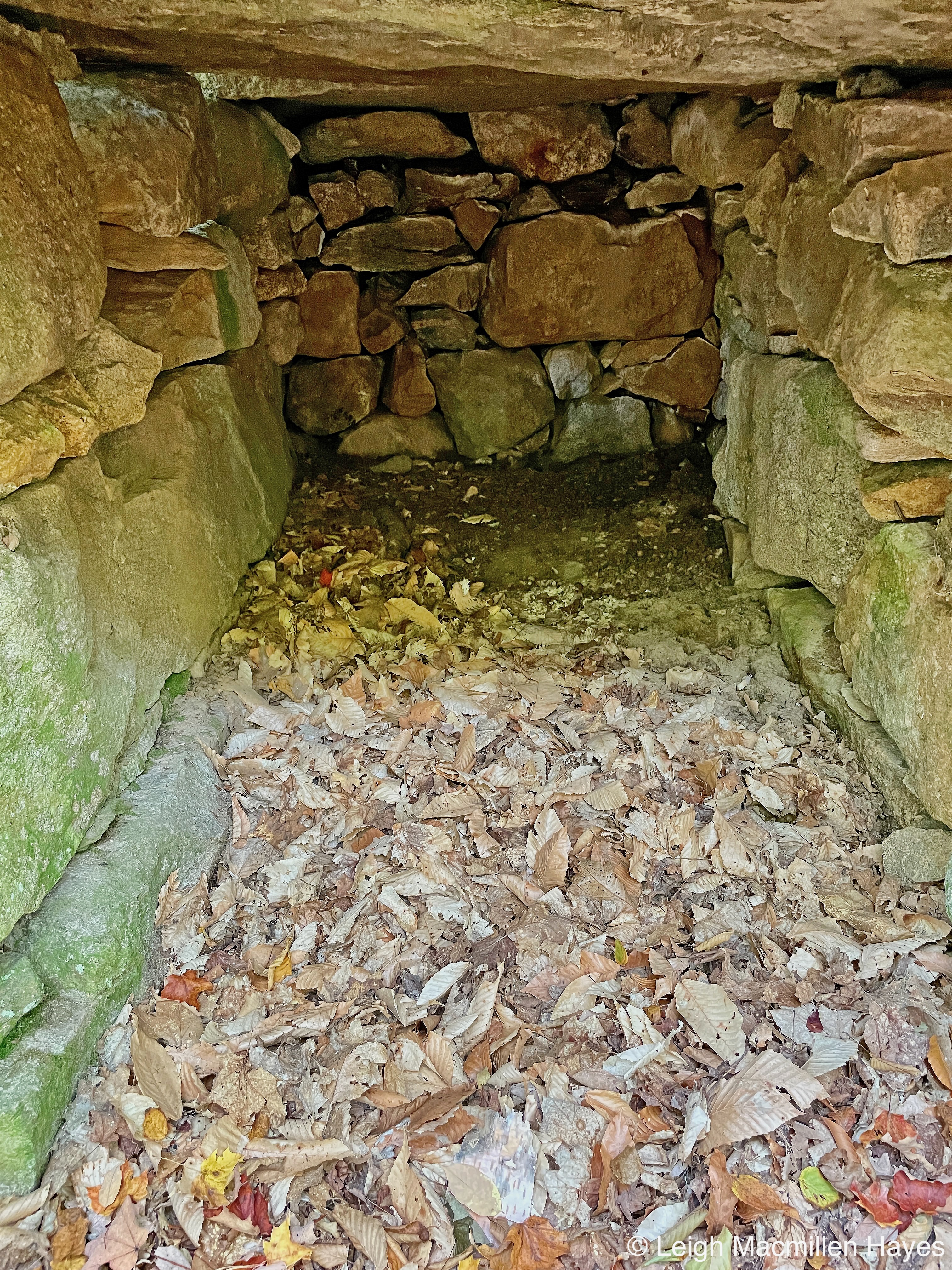
One of my favorite things about the Durgin cellar hole is the cold storage. In the cold to come, it will still serve as storage, so witnessed by the findings within today.

For the back corner has long provided protection from the elements for a porcupine, given the scat pile.

Because we were there, we decided to check on the Durgins who hang out a ways in the woods behind their former home and followed a stonewall to their locale.

Three of them were still there. Sarah, daughter of Anna and Ephraim (E. Durgin on the map), died in 1858 at age 22.

Beside her stood Mary, wife of Sumner Dergin, who died before Sarah in 1856, also at age 22.

Our best guess is that Sarah and Sumner were siblings.

Ephraim, father of Sarah and Sumner, and husband of Anna, died in 1873 at age 81. Did you notice the difference in stone from the 1850s to 1870s? Slate to cement. And the name change–Dergin vs. Durgin. We’ve learned through geneology research that spellings often differ. I found the following a few years back on RootsWeb.

8. ANNA3 FURLONG (PATRICK2, JOHN1) was born 1791 in Limerick, Maine, and died 1873 in Stoneham, Maine. She married EPHRAIM DURGIN June 18, 1817 in Limerick, Maine14. He was born April 13, 1790 in Limerick, Maine, and died in Stoneham.

Children of ANNA FURLONG and EPHRAIM DURGIN are:
i.OLIVE4 DURGIN, b. 1811, Stoneham, Maine; m. DUNCAN M. ROSS, April 11, 1860, Portland, Maine.
ii.SALOMA DURGIN, b. 1813.
iii.ELIZABETH DURGIN, b. 1815.
iv.SALLY DURGIN, b. 1817.
v.SUMNER F. DURGIN, b. 1819, Of Stoneham, Massachusettes; m. MARY ANN DURGAN, July 11, 1853, York County, Maine; b. Of Parsonsfield, Maine.
vi.CASANDIA DURGIN, b. 1821.
vii.EPHRAIM DURGIN, b. 1823.
viii.FANNY DURGIN, b. 1825.

Sarah isn’t listed above. But . . . Sally and Sarah were often interchangeable.

We ate lunch with the family as we looked out at the view they enjoy every day–possibly once called Durgin Hill, and then maybe Sugar Hill.

After lunch, our journey continued a wee bit further until another witness stopped me in my hiking boots. It took me three bear hugs with arms fully outstretched to completely circle this ancient Sugar Maple. Can you imagine the tales stored inside this great, great, great grandfather?

And at his feet, a wee one to appreciate –a Many-fruited Pelt Lichen, the many fruits being the brown fruiting bodies or apothecia.

A few steps away, we reached the Willard family foundation. Two large granite slabs are visible in the back and I had to wonder if they originally formed the roof of another cold storage.

Again, I referred to Jinnie Mae’s research. By 1880, the Willards house was occupied by the McKeens. And the Durgins were no longer living there, which makes sense given that Anna and Ephraim both died in 1873. The Rowlands had moved in to their home.

A newer member of the neighborhood, a Striped Maple, may not have known any of these occupants, but despite the full canopy of evergreens and maples and birches, it sure knew how to produce large leaves to increase its chances of survival.

Eventually, we turned west and followed an old road way bordered by stonewalls on either side. I remember when few trees grew there, but now one has to move through like a ball in a pinball machine, ricocheting off this tree and that rock along the way.

It’s well worth the effort because it leads directly to Willard Brook, which flows southward toward Great Brook , where we first began our journey.

Though I know the first part of the trip well, I sometimes get a bit mixed up with the second part and such was the case today. That said, as we scrambled up and down the sometimes steep hillside beside the brook, we came upon these wheels and bingo. We knew them as old friends we’d met on a previous trip.

There is so much history tucked away in these woods, and I gave thanks for two more witnesses, who despite their differences, stood together and supported each other.

We live in unceded Wabanaki land and I’ve come to some understanding of the Native American presence that once existed here in this place between Great Brook and Willard Brook. And I’m sure still does.

After witnessing the past, we walked back down the road as raindrops fell. A perfect hush to end the journey.

First Day Substitute Mondate

A mountain on The Kanc (Kancamagus Highway, aka Route 112 that stretches from Conway to Lincoln, New Hampshire) has been calling our names for some time. We’ve hiked neighboring Hedgehog Mountain on several occasions, but never Potash–until today, that is.

Well, actually, that’s not true. We last hiked Hedgehog in early fall and after finishing thought we’d attempt Potash since the trail leads from the same parking lot. That is, until we met Downes Brook, which is about 35 feet wide and my brain-over-matter would not allow me to make the crossing. Another couple had arrived at the brook moments before us, and while both our guys ventured across the rocks, she and I thought it best not to go forth. And so it was today, knowing how much rain we’ve had recently, that we decided to follow the recommendation in the AMC guide and instead park near a gated logging road about a half mile beyond the trailhead lot. After hiking up the logging road, the intersection with the hiking trail isn’t marked and is very subtle, but we were grateful for people who had gone before and left their marks on the snow. Suddenly, we were in the woods and as we paused to look through the trees, the colors afforded us reminded us of spring. As they should, for today felt like a spring day. Actually, too many days have felt like such lately, so when it does freeze every few days, our bodies go into shock.

That spring feeling was evidenced by the lack of snow on the trail and lack of ice on the rocks. What should have been . . . wasn’t.

Even the streams along the way flowed with vigor and no ice had formed. Oh, it probably had, but then melted.

The trail starts out rather tame, but soon becomes rocky with lots of intersecting roots seeking to trip hikers.

Until I looked at the map, I thought we’d reached the summit in good time, only to realize it was a false summit, as so often happens. And we were only at the halfway point.

This would have been a great place to eat lunch, if we hadn’t already done so before leaving the truck. We had visions of Orange KitKats dancing in our heads, but promised ourselves a summit treat and so we had to continue–but first, we waved to Hedgehog Mountain in the foreground.

This photo doesn’t do it justice, for the last section of trail to the summit gets quite steep following a series of already steep switchbacks, and then one has to scramble over granite slabs.

We met the wind at the summit and the swirls in the snow showed that’s always the case. It was time to celebrate with a KitKat or two. Oops. We searched through the backpack and came up empty. Somehow we’d left them in the truck.

One quick look at the Sandwich Wilderness and then it was time to head down so we could reach the truck before darkness set in.

The descent was slow going, but that worked for me. Picking the right spot to place a foot always takes time.

Because I was spending so much time looking down and hugging trees as well as kissing some rocks, I spotted Cladonia squamosa, or Dragon Horn lichen.

Squamosa means covered in scales, which is apropos. And the brown tips are the reproductive parts or apothecia.

I also found some ice I’d missed on the way up. While it made me happy, I still am dismayed by the current conditions.

Here’s another curious thing. We spotted numerous Red Squirrel caches and middens, mostly of spruce cones. And then I spied this Ruffed Grouse scat, indicating the bird had roosted in this spot not too long ago. But other than hearing a few nuthatches, wild critter sign was non-existent. I can walk into the woods behind our home and find much more than this–why is that?

I pondered that thought as we once again turned onto the logging road, and hoped that a mammal would surprise us as we walked, out, but because I was expecting such, it didn’t happen.

Ah well, it was okay. In the end, My Guy and I were delighted we’d enjoyed this First Day Substitute Mondate. First Day Substitute? Whoever heard of that? But I guess that’s what the Monday following a holiday is called.

Oh, and we did gobble up the KitKats when we reached the truck. They tasted extra special.

Being Present: The Observer

Walking in silence
along a trail so familiar
my eyes were drawn
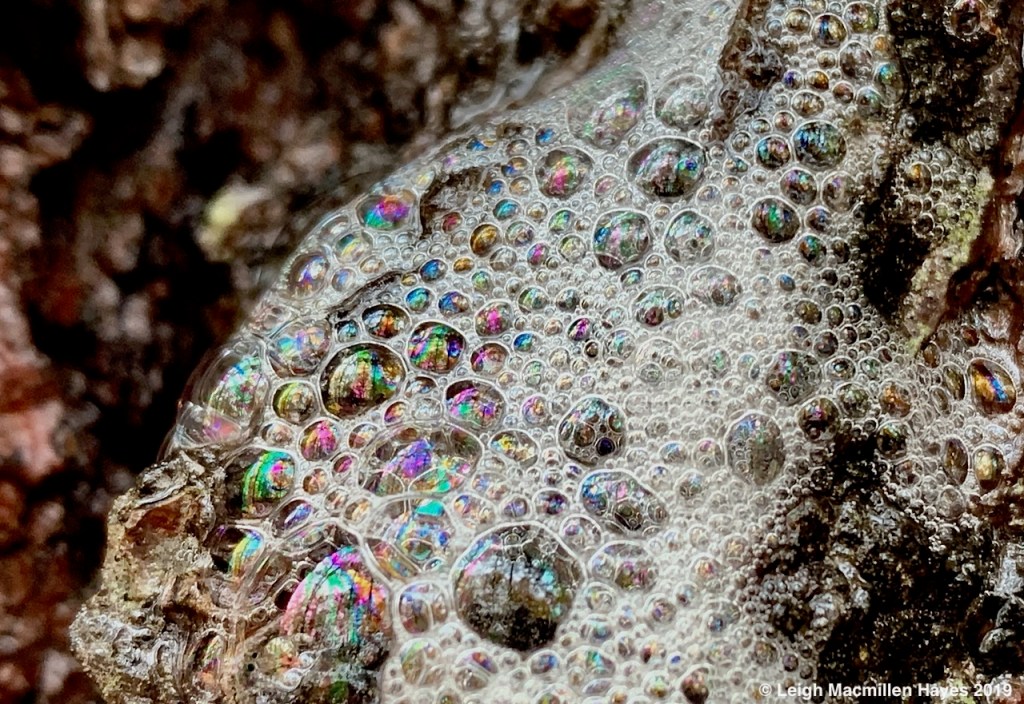
to bubbles at my feet.
Tiny bubbles, tinier bubbles, tiniest bubbles
formed random patterns
as they gave new life
to dying grasses.
Nearby, salmon-colored disks
sprouted upon
the mint-green crustose form
of candy lichen's granular base.
Meanwhile, crimson caps of British Soldiers
shouted for recognition
as they showed off
their branching structures. 
Upon a rotting tree
and backlit by the sun
glowed the irregularly lobed fruits
of Orange Jelly Spot. 
In another sunny spot, a Little Copper sought nectar
from a goldenrod still in bloom
while a Spotted Cucumber Beetle
photobombed the shot. 
I have to admit that I struggled with ID: 
Ruby, Cherry-faced, and Saffron-winged
since this dragonfly showed characteristics 
of each in the meadowhawk clan. 
Being present on this October afternoon
reminded me of another day
when I paced before a couple of shrubs
and watched the insect action.
I am honored and humbled to announce that that blog post was recently published
in The Observer,  a publication produced by the Maine Natural History Observatory. 
My friend and fellow master naturalist, Cheryl Ring, also has an article in this issue. 

The most humbling thing for me was an email I received from a reader who is also an avid naturalist. She commented that my ID of a butterfly at the end of the article, which I called Painted Lady, is actually American Lady. I now realize I need a new field guide because mine refers to it as American Painted Lady and I inadvertently dropped "American," while hers dropped "Painted" in the name. It's another lesson in why I need to wrap my brain around scientific names since common can cause confusion. I do appreciate that she took the time to read the article and write to me. 

That said, the best lesson of any day is to take time to be present and observe in nature. Even if it's only for a few minutes. 

Patience as the Season Unfolds Mondate

We do LOVE winter, my guy and I, but really, we appreciate all of our seasons and can’t imagine living in a place where we can’t experience each in its own right and the change from one to the next.

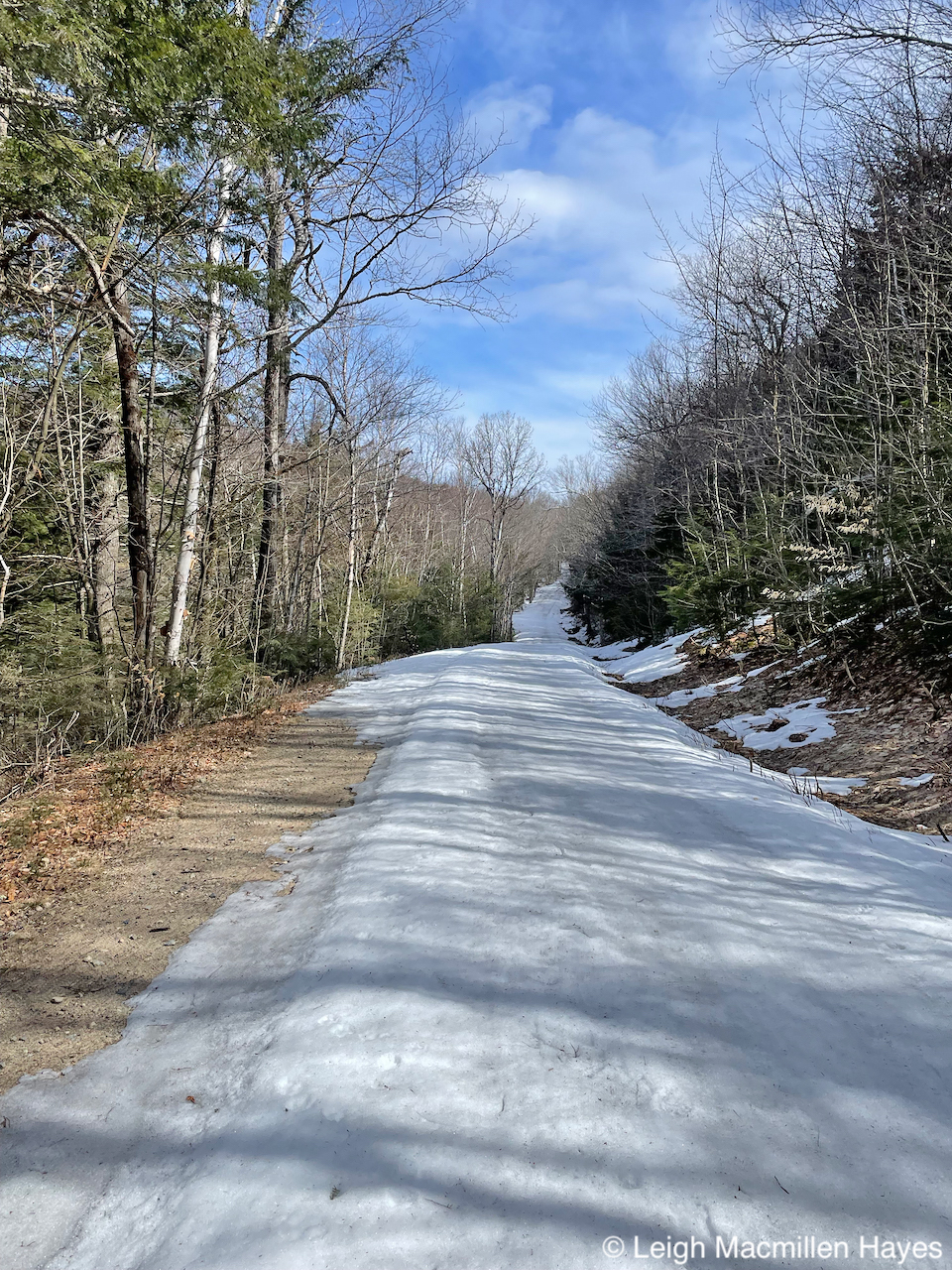
And so today, with the temp in the low 20˚s and wind chill making it feel even colder, we donned our micro-spikes and headed up a snowmobile trail to begin our search for the current season.

Icicles that we were sure had formed overnight, since the weekend temps had been much warmer, formed along a stream that flowed toward Slippery Brook, for our trail of choice was in the White Mountain National Forest.

In other seasons, one can either drive to our destination, or go via snowmobile, but for the time being the gates to Forest Road 17 in Chatham, New Hampshire are closed to vehicular traffic. That was fine with us.

At about 2.5 miles, we took a slight detour to take in the sounds and views of Slippery Brook.

It was there on a crossbeam of the bridge where my guy was about to sit that I noticed British Soldier, a common lichen with bright red caps that remain so year-round, but have been hidden from view by snow all winter. It was like meeting a cheery old friend for the first time . . . this sighting.

Along the road also grew many a Hobblebush, another old friend, their naked leaf and flower buds swelling in anticipation of what is to come.

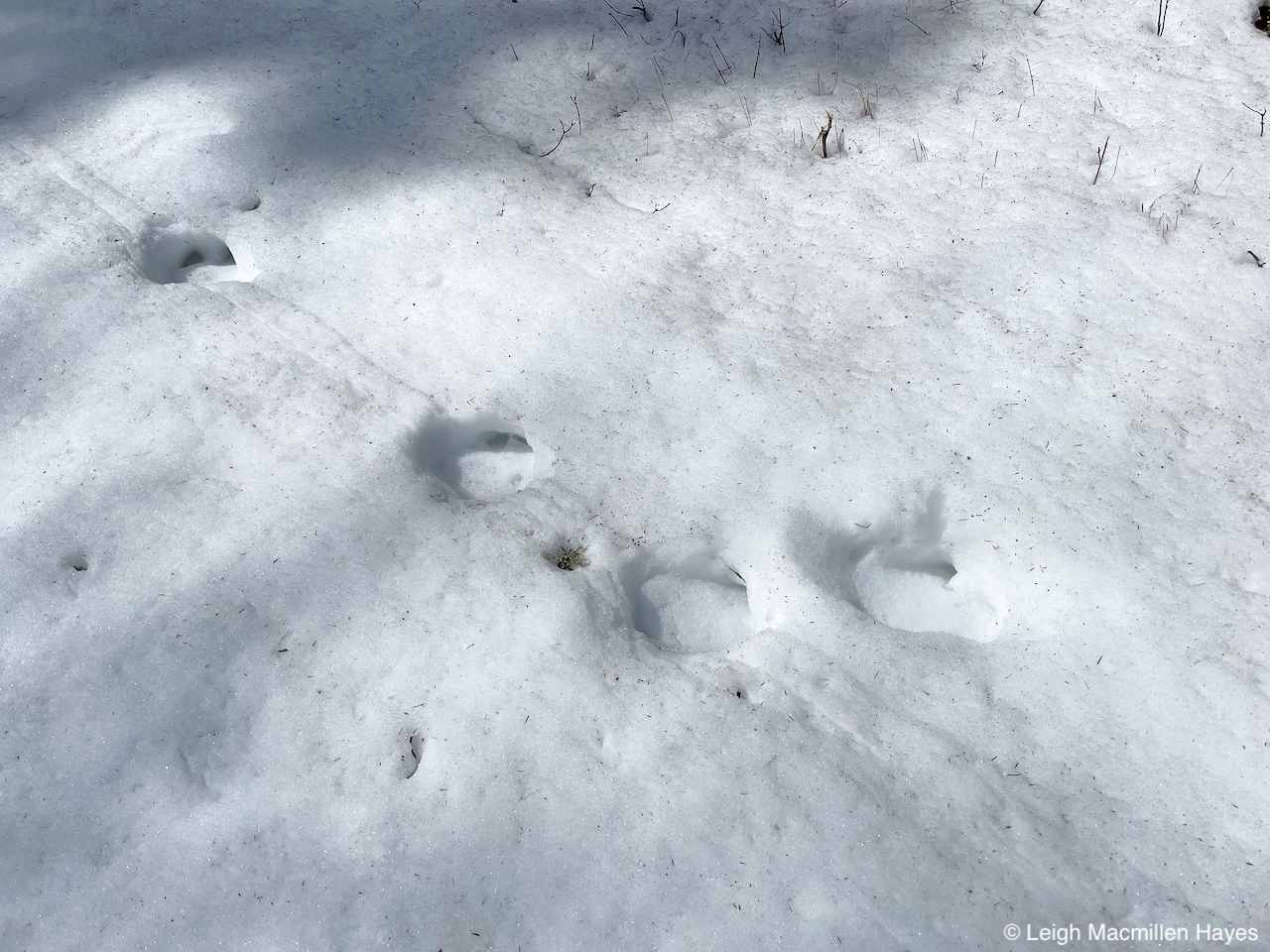
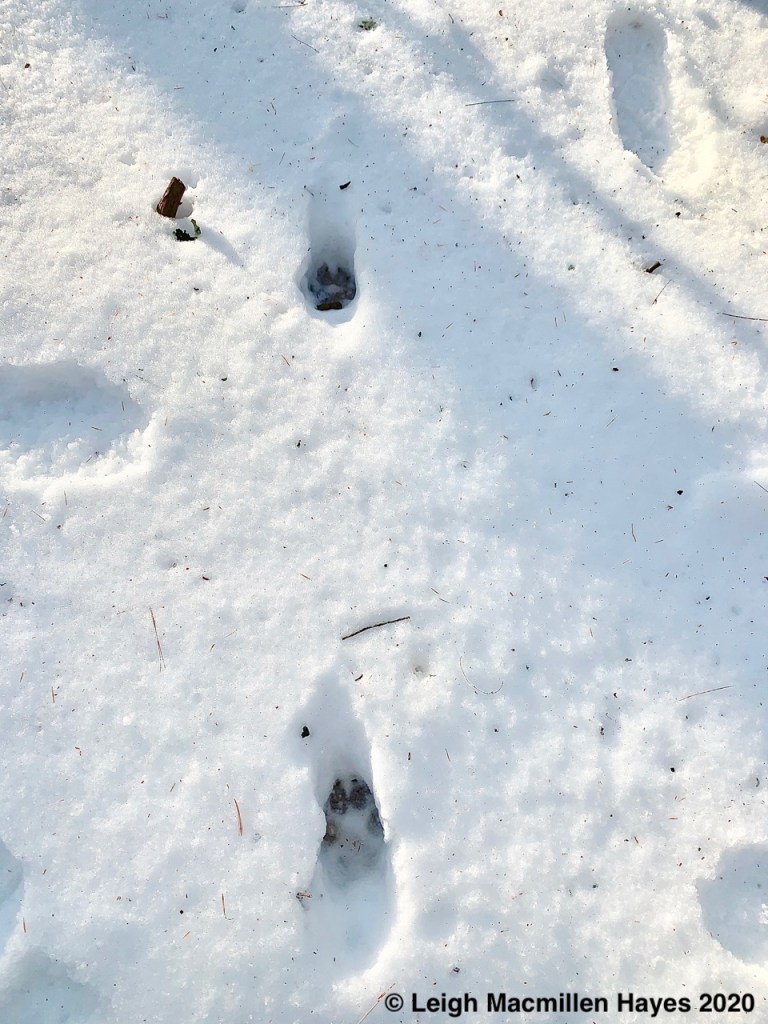
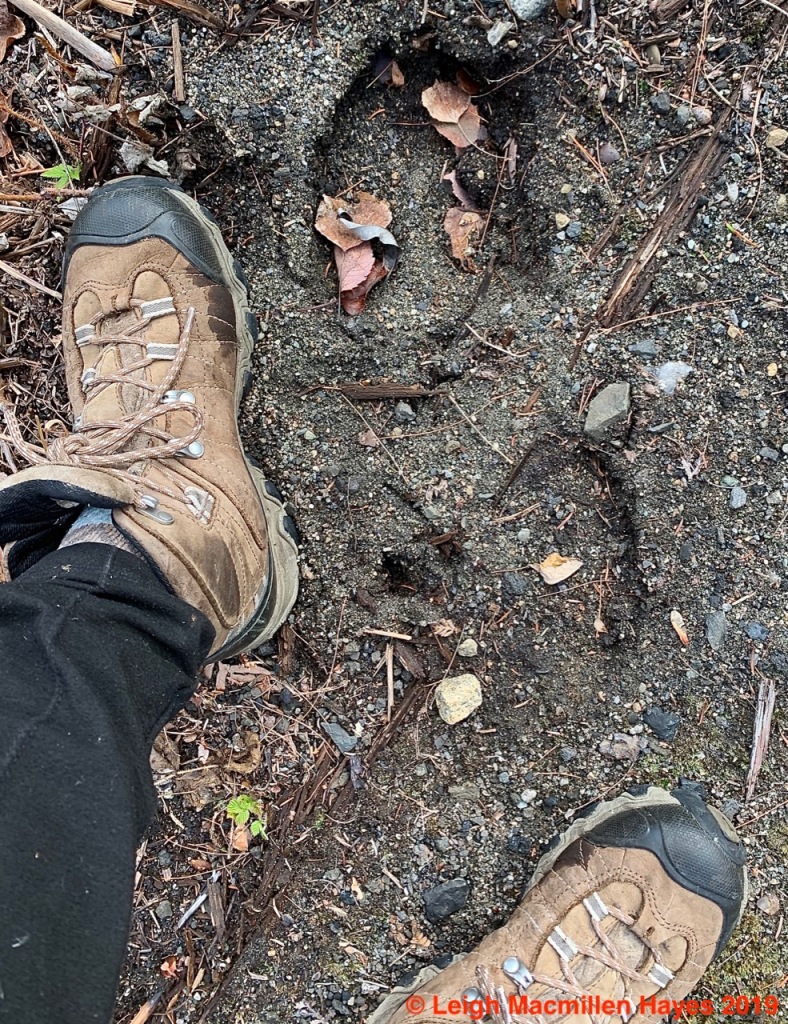
And then we spotted these prints, made by the largest mammal around and though we saw more in other places, this set of four made us wonder if the moose had come in for a landing and then flown off again.

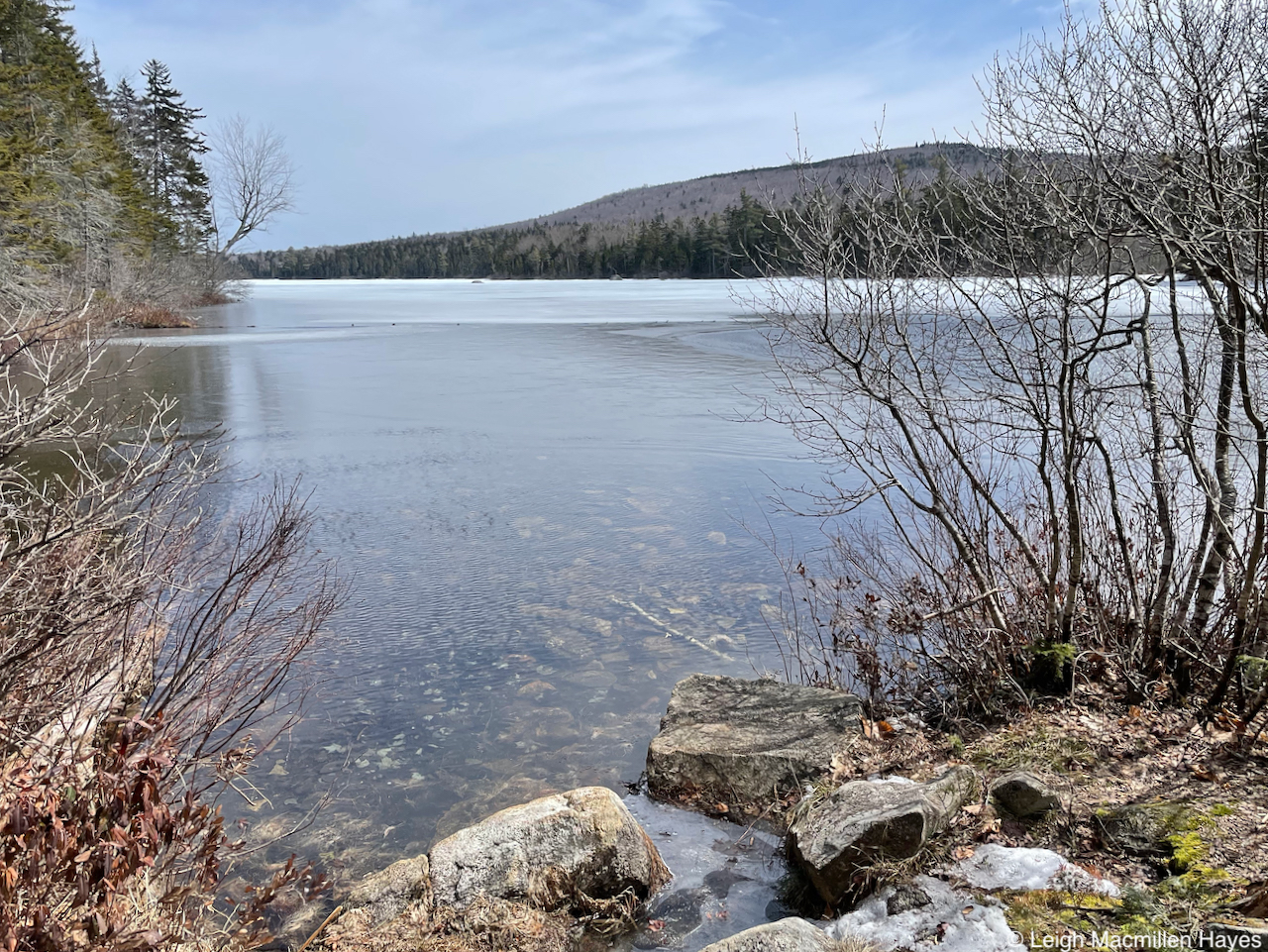
At last we reached the trailhead, and as we approached the pond we noted an immediate dip in temperature, plus an increase in wind. Thankfully, we’d expected such and had dressed for the occasion. That said, it’s hard to search for spring when your cheeks sting with the wind.

A rocky and rooty trail that circles the pond, though fairly flat, requires hikers’ attention at all times of the year and today was no exception. That said, the trail itself offered a snippet of spring.

We reached Mountain Pond at last and by the outlet found some open water, but other than a few chickadees and nuthatches, there were no birds or other forms of wildlife to spy upon as we’d hoped.

Even so, our focus was rewarded in other forms, such as other buds growing larger, like upon this Speckled Alder. And notice that lateral leaf scar–a happy face indeed.

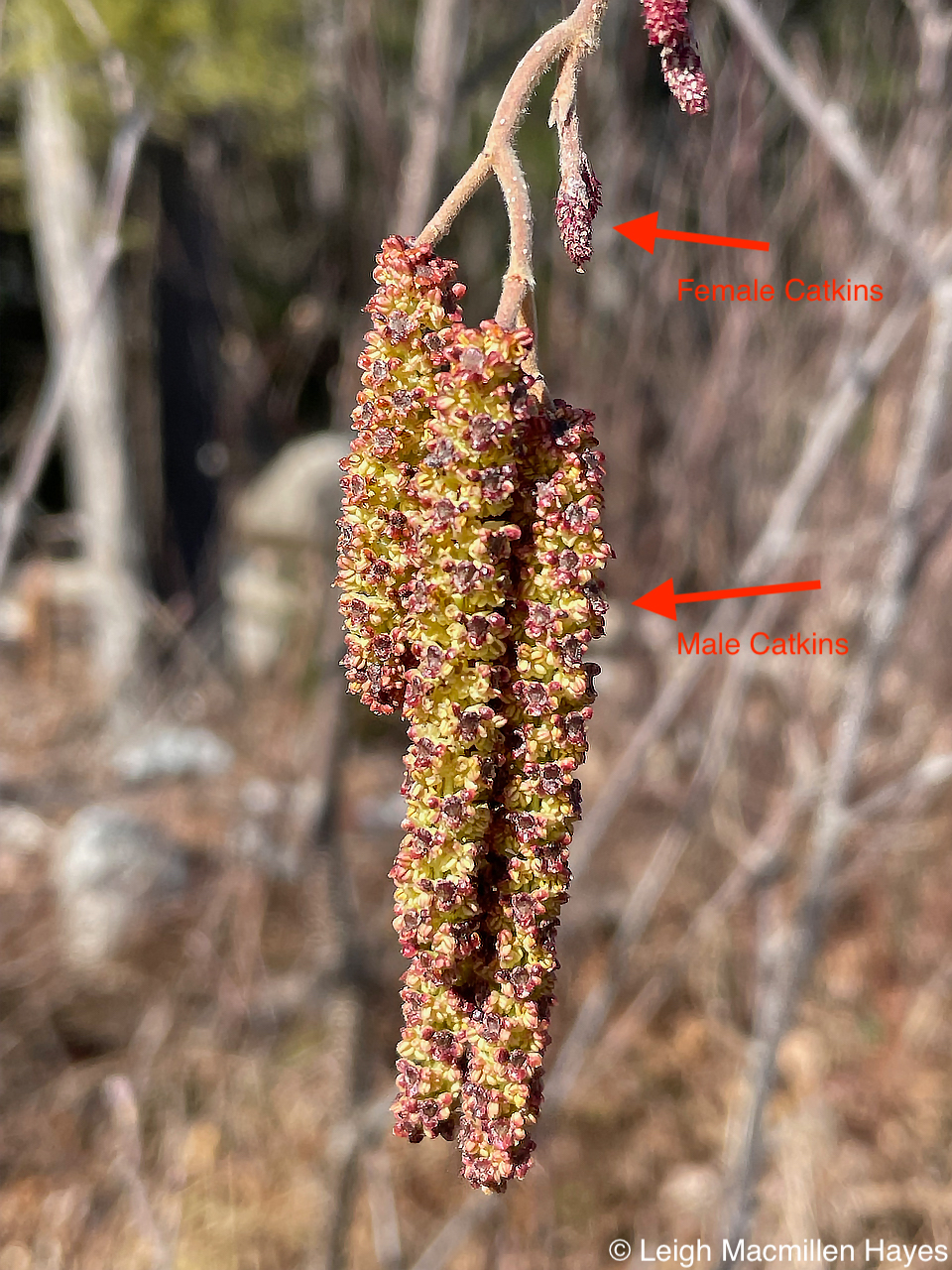
The longer male and shorter female catkins, which are the flowers of the alder, swayed in the breeze, waiting for a future date when they could do just that . . . date.

A few actually seemed ready to mate, though not with each other. While the pendulous male flowers open and extend when their pollen is ready to be dispersed, just above them the tiny, maroon female flowers “bloom” at the same time on the same shrub. In this case position counts and so with the female flowers above the males, self-pollination is discouraged and cross-pollination occurs instead thanks to wind.

Also beside the pond’s shore, the woody structures of last year’s Rhodora flowers, but also its buds enlarging by the day, with promises of exquisite displays making us suddenly want the time to push the clock ahead.

The same was true for the Sheep Laurel, that plump pinkish bud ready to burst open when the time is just right.

As we headed back toward the Forest Road at last, we began to notice exposed trails of Red Squirrels that led from one spruce cone cache to another. Those feisty ones were quiet today, but we suspected they are happy to have more food offerings on the horizon.

Nine miles later as we once again passed by the stream with the icicles and noticed that more had formed, we realized we’d found spring on this Mondate . . . she’s just taking her time and we should follow her example and be patient as this next season unfolds.

Ever A Sense Of Wonder

I thought I was losing it. Wonder, that is. I’ve hiked or walked many miles, taken thousands of photos, but haven’t been overly wowed by much lately.

This weekend, though, that all changed.

Maybe it was the fact that a friend and I spent a bluebird, yet brisk Saturday snowshoeing many miles as we tracked a couple of local mammals.

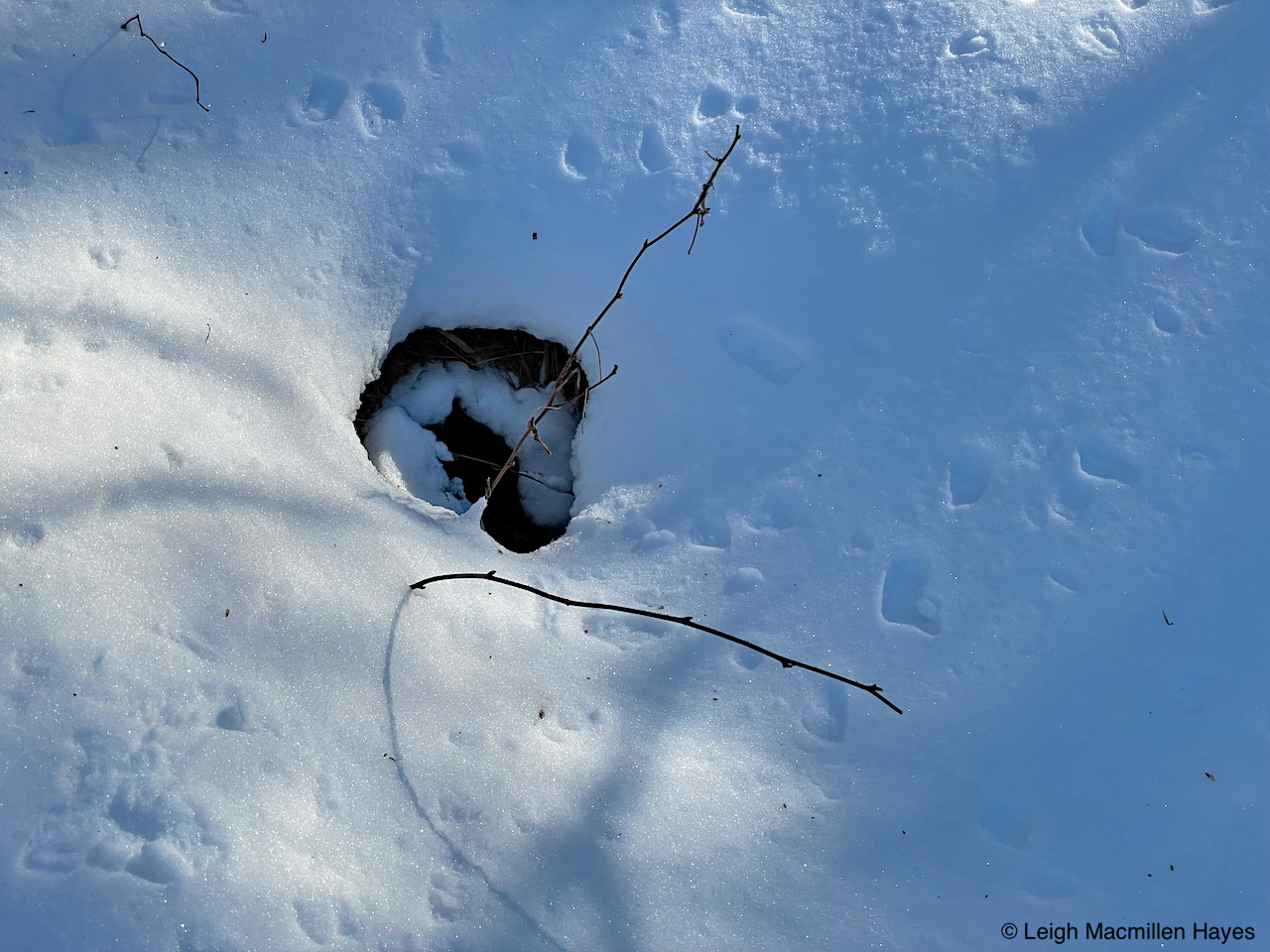
There were porcupine dens to explore. Well, not actually crawl into because we didn’t know who might decide to crawl out. We discovered two new ones that were obviously in use, but visited this older stump dump and found no one at home. Why? It had all the makings of a nice condo. Lots of room available, hemlocks growing right out the back door, beside a field with other offerings for a summer diet. Don’t you just want to move in?

We did discover other abodes that showed signs of life with tracks leading to the inner chambers.

How many inner chambers was the next question. Atop this much larger stump dump we counted at least seven holes coated with hoar frost around the edges–leading us to believe someone was breathing within. Did that mean there were seven porcupines living in this den? Do you know what a group of porcupines who share the same winter den, but sleep in their own bedrooms, is called? A prickle of porcupines. Don’t you love that?

By the amount of tracks, we couldn’t tell how many actually lived there, but in the fresh layer of snow we did note that at least one had gone outside to eat the previous night for we followed its tracks for a bit.

It also had visited another den, and by the amount of scat, it was obvious that this wasn’t the first day in a new house.

The porcupines weren’t the only ones we were interested in. For miles and hours, we also tracked a bobcat who’d paid a visit the previous night. Would we find evidence of what it had eaten? A kill site where a prey was attacked? Scat?

We knew by the fact that the bobcat track was atop the turkey prints that this bird lived to see another day.

The same was true for the squirrels that managed to avoid being consumed by the predator overnight as they huddled somewhere close by. But the bobcat apparently didn’t catch a whiff of their scent, though the former did check out holes by stumps and snags.

Sometimes we noticed that the cat picked up speed and we were sure we’d find the reason.

And then . . . and then it would pause and we did too. When the bobcat led us back out to the road we’d traveled on, and crossed to the other side, we knew our time with it had come to an end but enjoyed the journey, though still had questions. Did we miss a kill/feeding site?

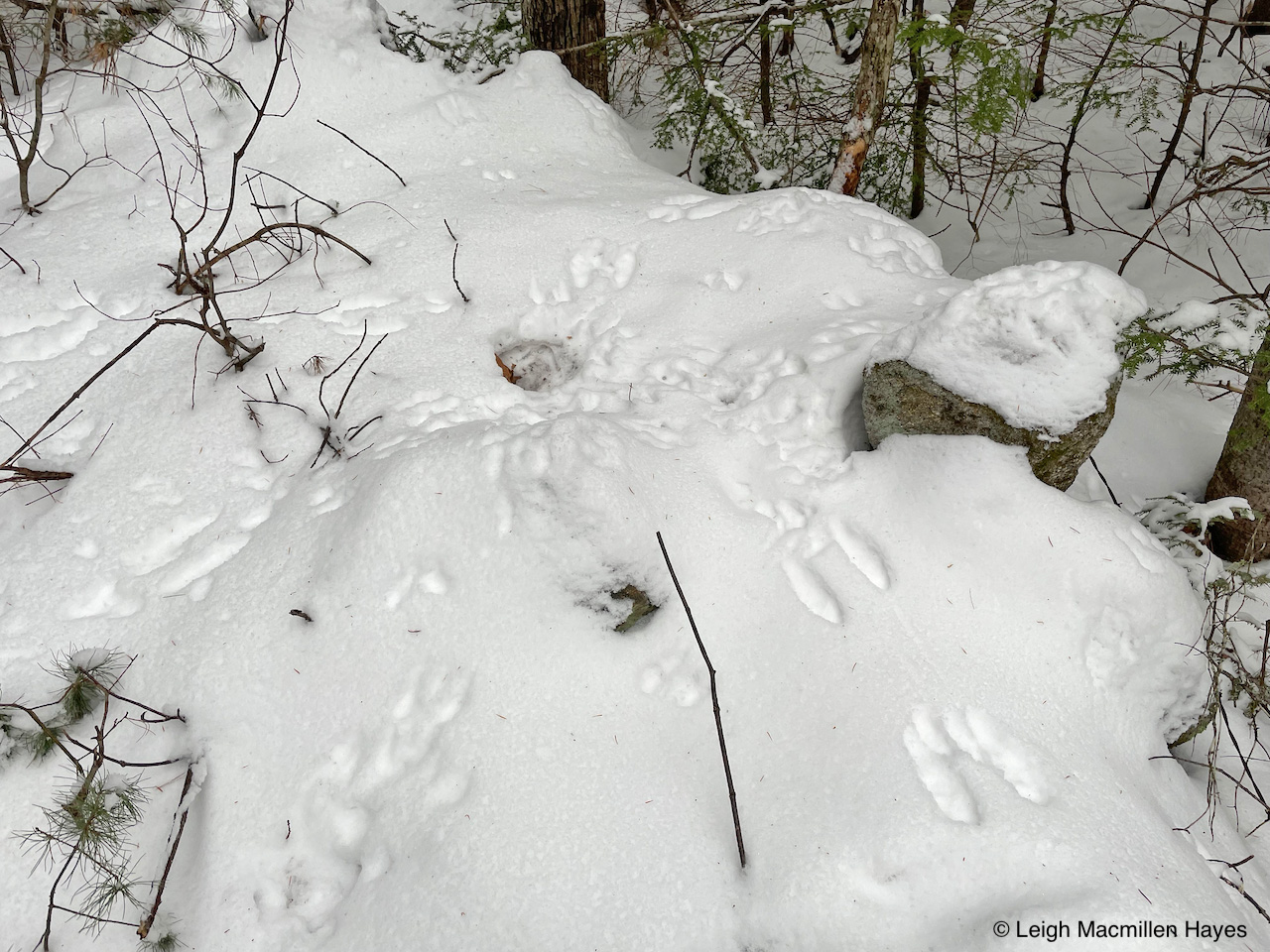
We had noted an abundance of food available, much of it in the form of the squirrel or hare. This is my snow lobster, as I’ve mentioned in the past and love how the front feet, being the smaller two prints, land on a diagonal and form the lobster’s tail, while as they lift up to leap forward, the hind feet land in such a way that they appear in the front of the set to form the lobster’s claws. And I’m reminded that for ground dwellers like the hare, the front two feet tend to land on a diagonal, while for tree dwellers like the squirrels, whose front feet also appear smaller and at the back of the set of prints, are most often parallel.

That was yesterday. Today dawned with a sleet storm. When I ventured out the back door this afternoon, I noticed again an abundance of hare prints, these the larger set in the photo while the smaller ones belong to a red squirrel. When I said an abundance of food, these are two of the many choices and this year the hare is everywhere. EVERYWHERE. I find it hopping through communities I’ve not seen it in the recent past. Certainly the bobcat of yesterday will or did find one–we just didn’t stumble upon it.

After spending so much time tracking, a favorite winter activity of mine, I finally turned my focus to trees, another passion. I was actually looking for insects, but fell for this solid droplet of balsam resin that looked rather like a bug. I would love to see the colors of the dribble repeated in yarn.

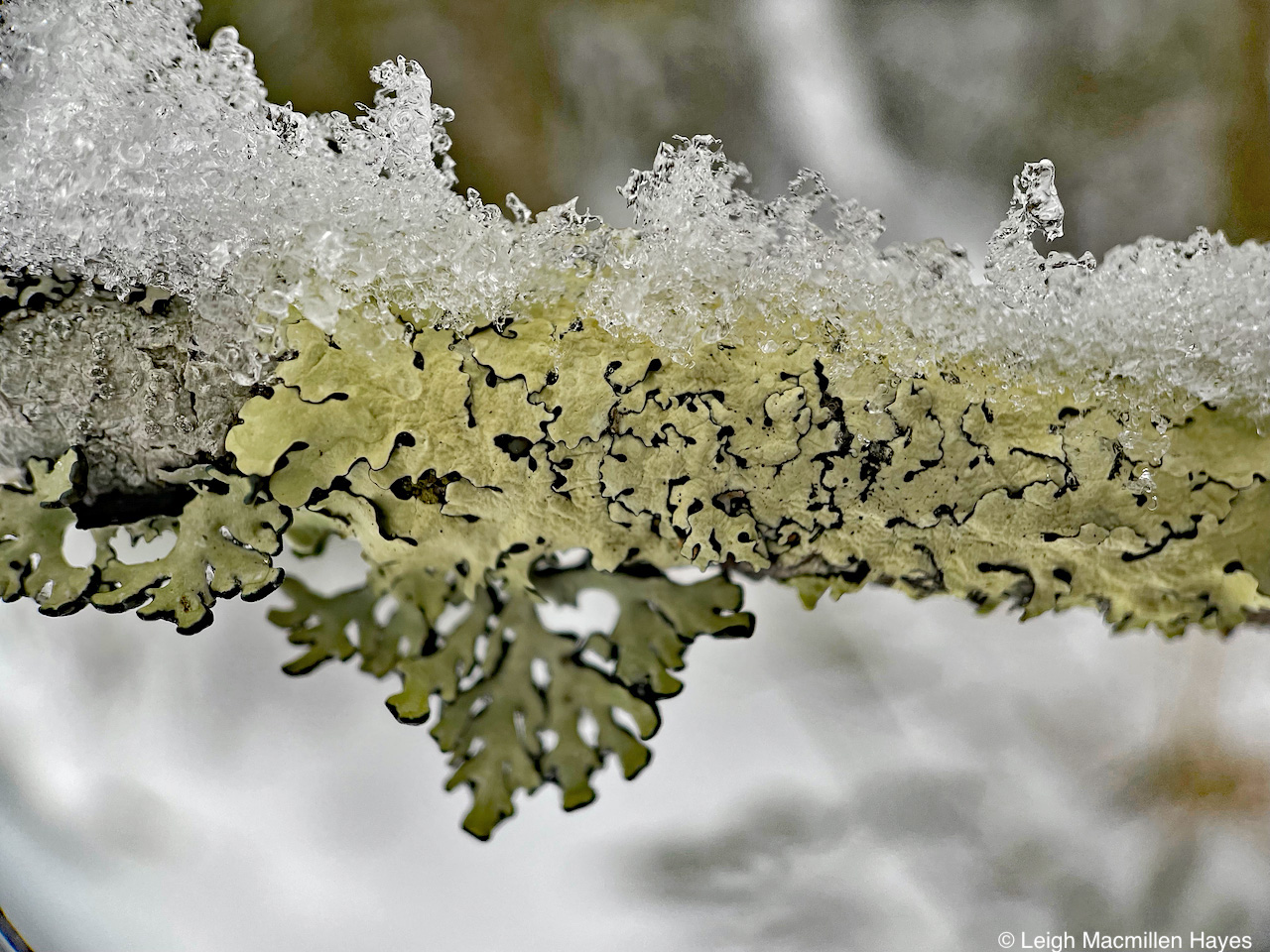
Then there was the ice that mimicked the shield lichen attached to a branch of the fir.

At last I did find an insect. Well, at least the left-behind structure of a sawfly–where it had pupated and then once ready to emerge, cut its perfect circular escape hatch. How to remember this insect: think of it as a circular saw-fly.

And attached atop the pupating case–what looked like another insect pupating. I don’t know if I’ll ever be able to name its species, but I thrilled in spotting it.

Bark is cool, but especially when you begin to notice all the idiosyncrasies of life upon it, such as the fruiting disks of a couple of crustose lichens, but one of my favs is the braid-like formation of the liverwort Frullania. It has brown leaves divided into two lobes. Liverworts are cool because they are flowerless and lack roots and reproduce via spores. Frullania is abundant upon bark, but unless you slow down and look, you may not ever spy its spiderwebby structure.

Speaking of spying, yesterday’s brilliant sun shone upon the hairy twigs of paper birch, another sight easy to overlook.

Today’s natural community found me tramping through an area where gray birch, with their bumpy, hairless twigs, grow.

How did these two members of the same family develop such differences? I think about that and how it is true of all in the natural world. Maybe the hairs don’t appear in exactly the same line-up and the bumps are more or less bumpy on another twig, but they all are variations on the same theme. Mammals are like that as well. And flowers. And ferns . . . and well, everything. We can learn to ID them because generally they share the same characteristics from one dandelion to the next. But . . . what about us? As humans, there are familial similarities, but very few of us look exactly like another. Though perhaps somewhere in the world we all have a twin we’ve yet to meet. Alas, I’ve rambled on enough.

It all boils down to the bush clover–a species my friend Pam and I first met at Brownfield Bog a couple of falls ago and recognized almost immediately when we discovered it in a field in Stow, Maine, before encountering our first porcupine condo yesterday. Today, she informed me in a text message that a year ago we met it in the same field, and we shared a chuckle that neither of us had a memory of that moment. Uh oh.

But I was reminded this morning that it’s important to go forth with a child-like attitude, finding awe in all that we see and encounter and I realized then that I’ve been too busy lately to slow down and really look.

Here’s hoping I can ever renew and enjoy that sense of wonder and that you can as well.

Grateful For Your Company

Oh my goodness, oh my goodness, oh my goodness. Today’s hike found me traveling solo, as is the norm in this current time, but I took each and every one of you along with me because so excited was I by all of our finds.

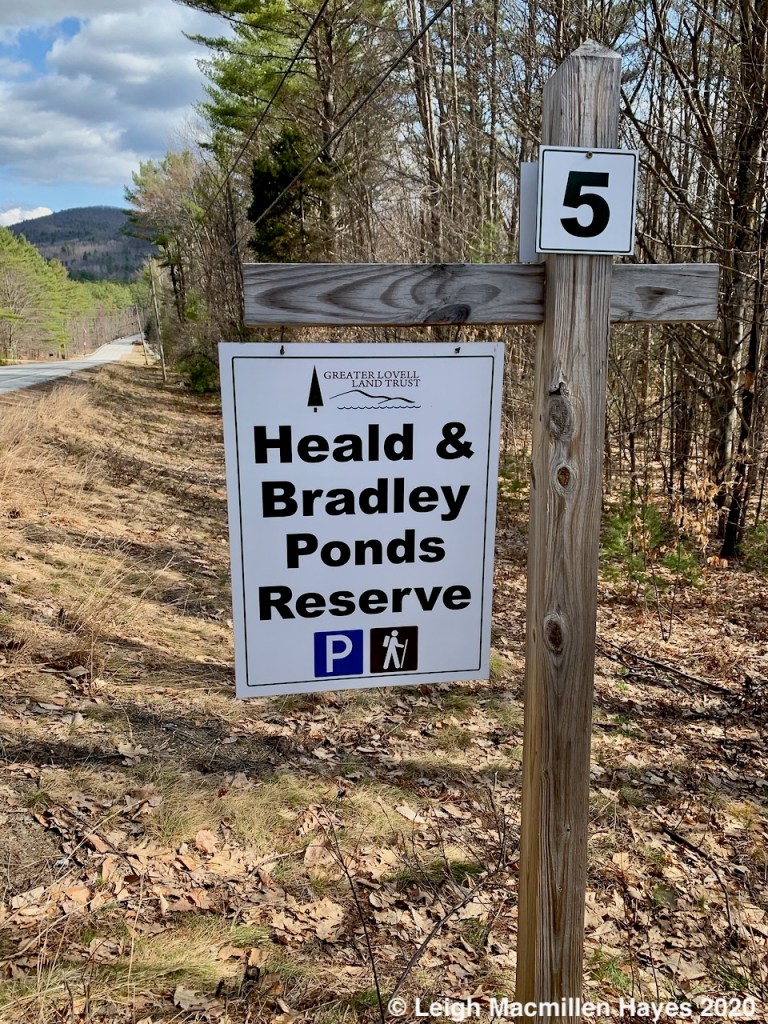
We began at parking lot #5 of Greater Lovell Land Trust’s Heald and Bradley Ponds Reserve.

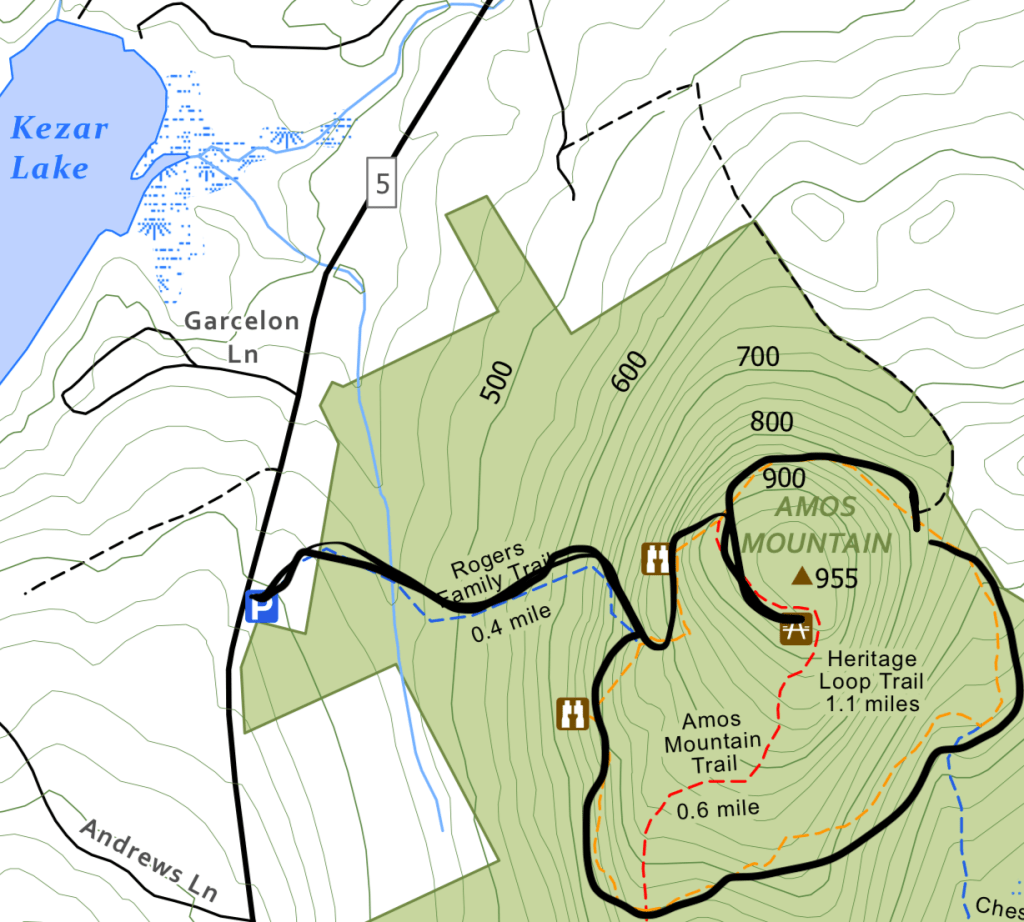
As I showed you in the parking lot, our plan was to begin on the Roger’s Family Trail and then circle around on the orange Heritage Loop Trail with a side trip to the summit of Amos Mountain in the midst of the journey. You all agreed that it sounded like a great plan.

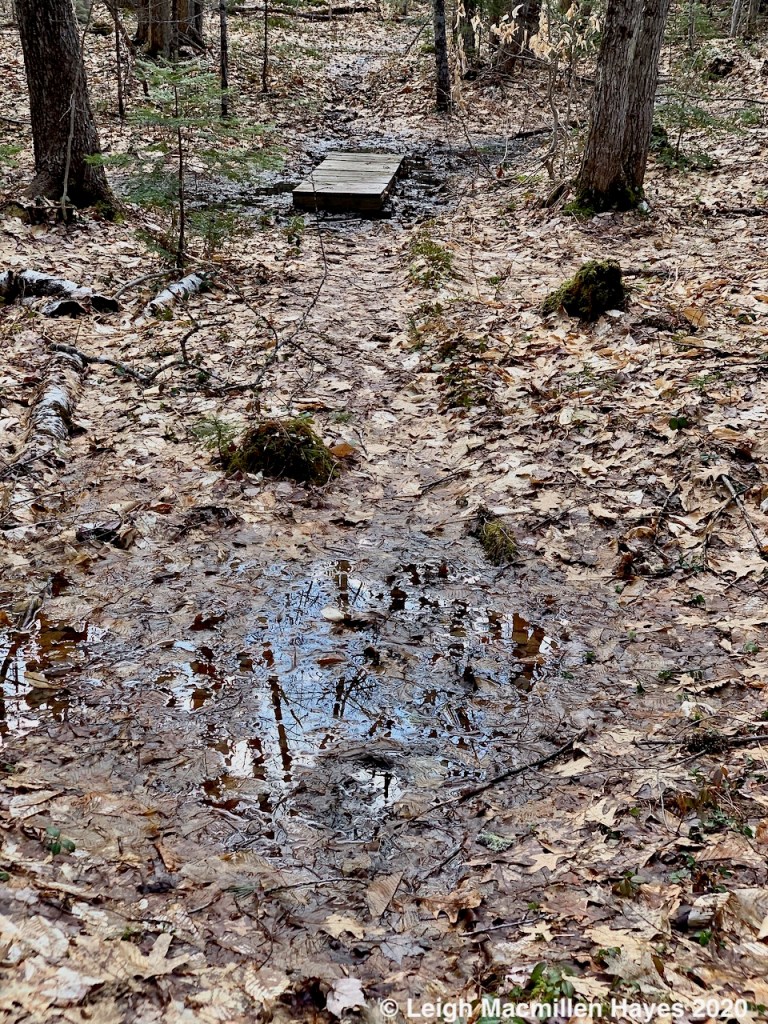
I had previously warned you that part of the route could be a bit wet and was pleased to see that some of you had remembered to don your rubber boots, but those who forgot managed to find a way around. I trust no one had wet feet by the time we finished. Was my assumption correct?

Of course, I love water and so before we crossed over the bridge, I insisted that we take a look and try to spy tracks in some mud or aquatic insects or plants springing forth.

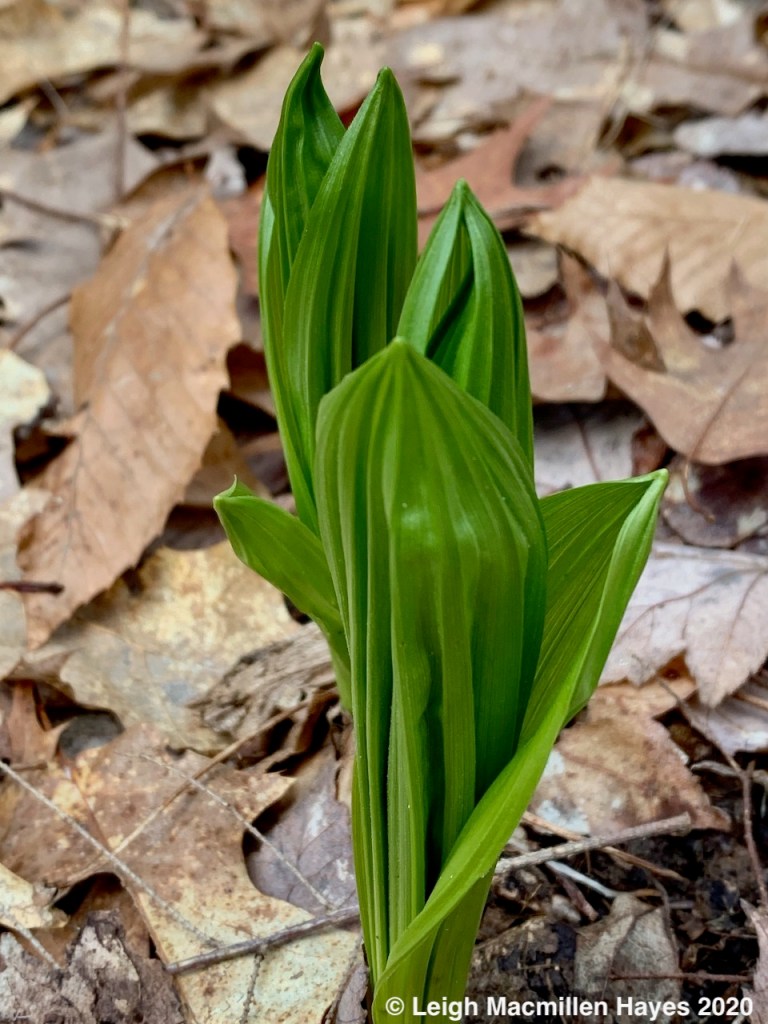
Bingo on the latter and we all rejoiced at the sight of False Hellebore with its corrugated leaves so green.

Finally, after poking about for a bit, I suggested we move along. It seemed like we managed to walk about five steps and then something would catch our attention and all forward motion came to pause. But that’s the way we like it for we notice so much with such slow movement. Do you remember this spot? Where we paused to look for Trailing Arbutus buds and noticed Downy Rattlesnake Plaintain growing in a colony. And remember how I told you that the only way I can remember the common name of this latter species is because it doesn’t look “downy” to me.

As often happens, the trail enhanced the lesson for not too much further along we practically stepped on another family member, this one bearing the name Checkered. Really, had Mr. Linnaeus asked me, I would have switched it around for the dullness of these leaves seems more downy in my mind and the other more checkered. Alas . . . he didn’t ask.

By this point, we’d hit drier trail conditions, if you recall, as we started climbing uphill. Drier, but rockier, that is. And then upon one, we spied a little package that you knew would delight me. Fox scat, indeed. With a blunt end and even a twist. Classic fox scat.

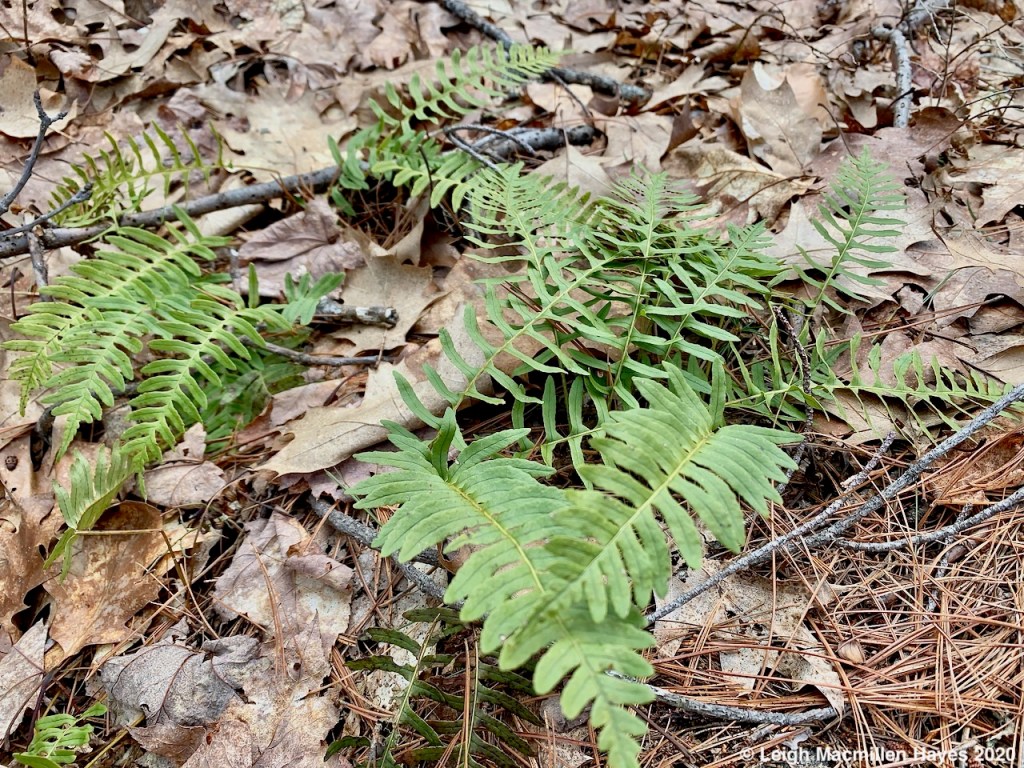
It took us a while, but we managed to reach the intersection with the orange trail and turned to the left to proceed. It was there that we began to meet common polypody ferns. Some of you explained that you know it as rock cap fern or rock polypody fern. What we all know is that it’s most often found growing on rock surfaces in moist, shady woods.

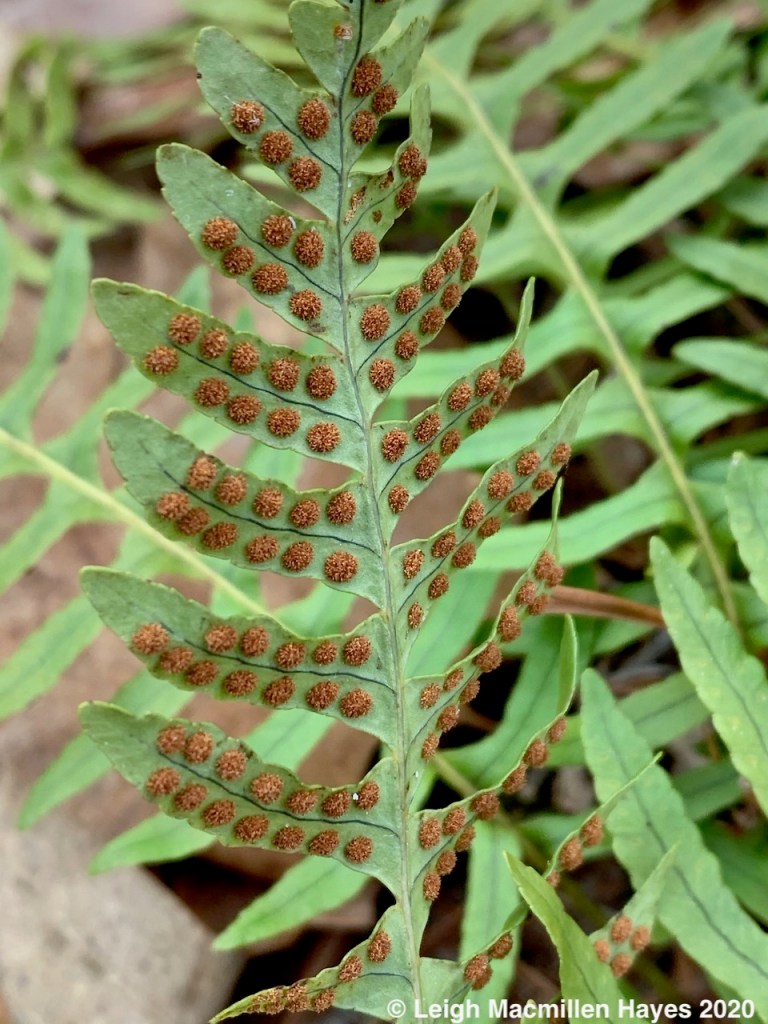
I did hear the hushed groans when I turned it over, but what could I say? I can’t resist checking to look at the underside. Like little pompoms, the organs or sori that housed the dust-sized spores or sporangia are arranged so neatly in two rows upon each leaflet. In their old age, the sori of these common polypody are orange-brown.

You, however, were eager to move on and so we did. Until we didn’t. For we stopped once again at “El Pupito,” the pulpit rock.

And did what one should do at the pulpit–honor the view through nature’s stained-glass window.

Oh yeah, and on the back of the boulder, you knew the minute you saw it what was going to happen next.

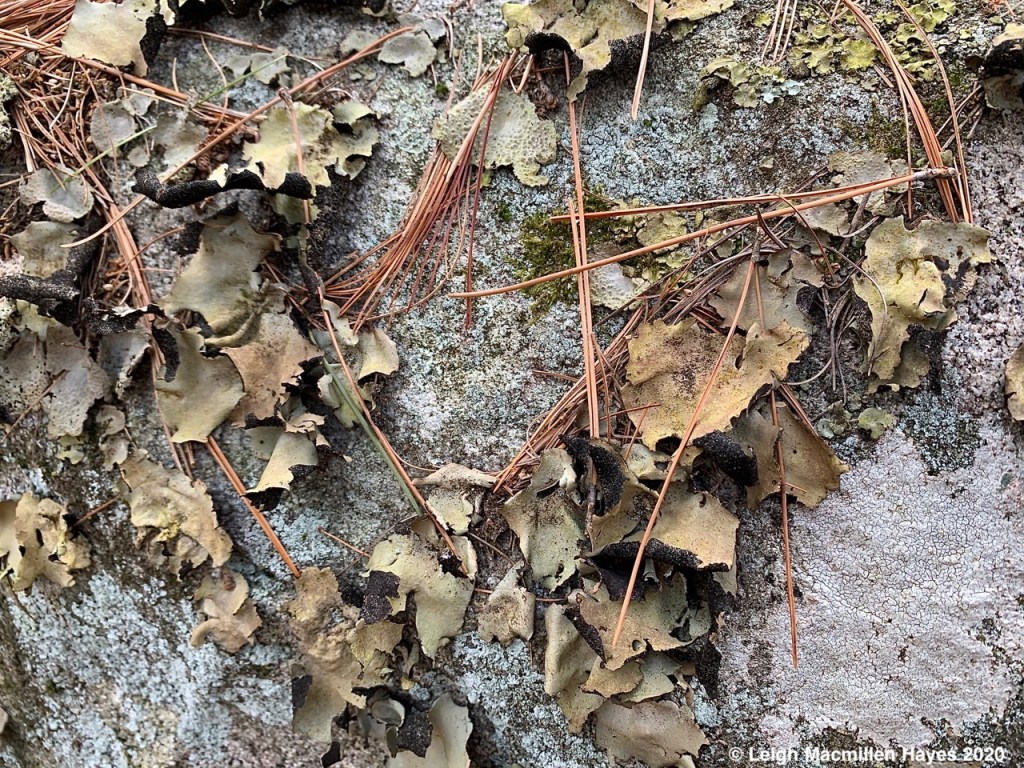
Out came my water bottle as I sacrificed some H20. But really, you are also equally amazed each time the magic happens and the greenish color of algae on rock tripe lichen makes itself known.

I saw a few of you gawk.

With a snap of our fingers and twitch of our noses (no we didn’t touch our fingers to our faces), we soon made it to the summit of Amos.

It was there that while zooming in to note the glorious red maple buds we spied another in the form of a spider. And we all took a closer look, one at a time, of course, allowing for six feet of space.

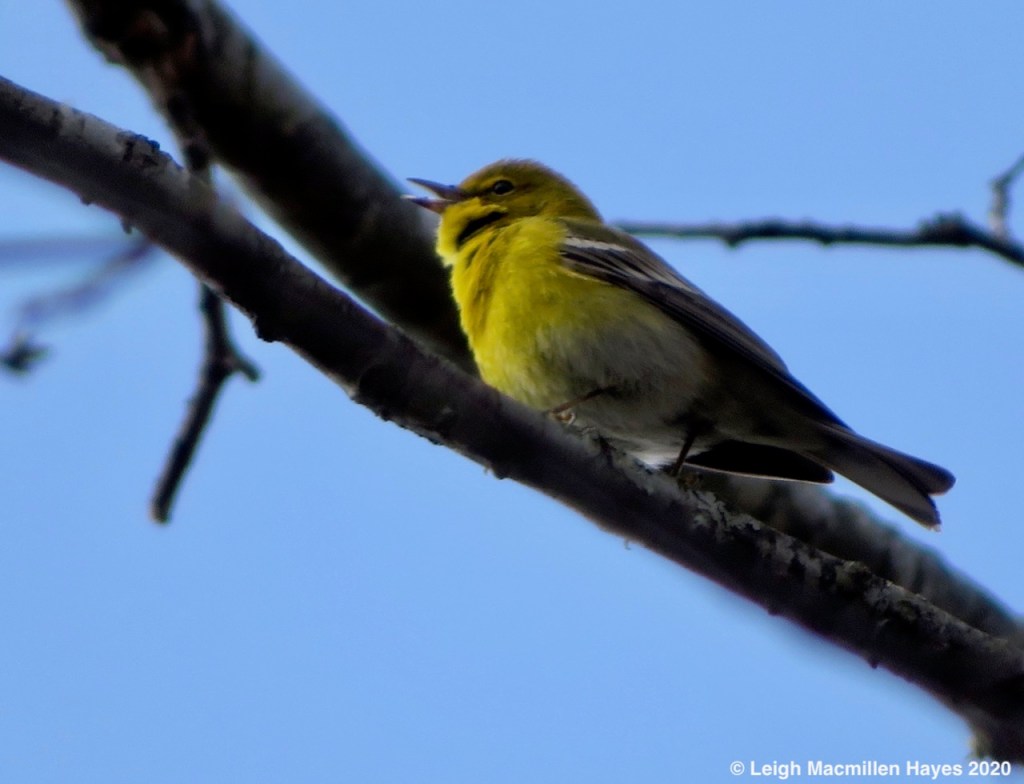
Then we backtracked down to where the blue trail met the orange trail and continued on the orange. That is . . . until sweet bird songs stopped us in our steps.

The trills lasted a few seconds and began again.

Most of us couldn’t recall who it was and gave great thanks to have Peter and Joe along for a positive ID: Pine Warbler indeed.

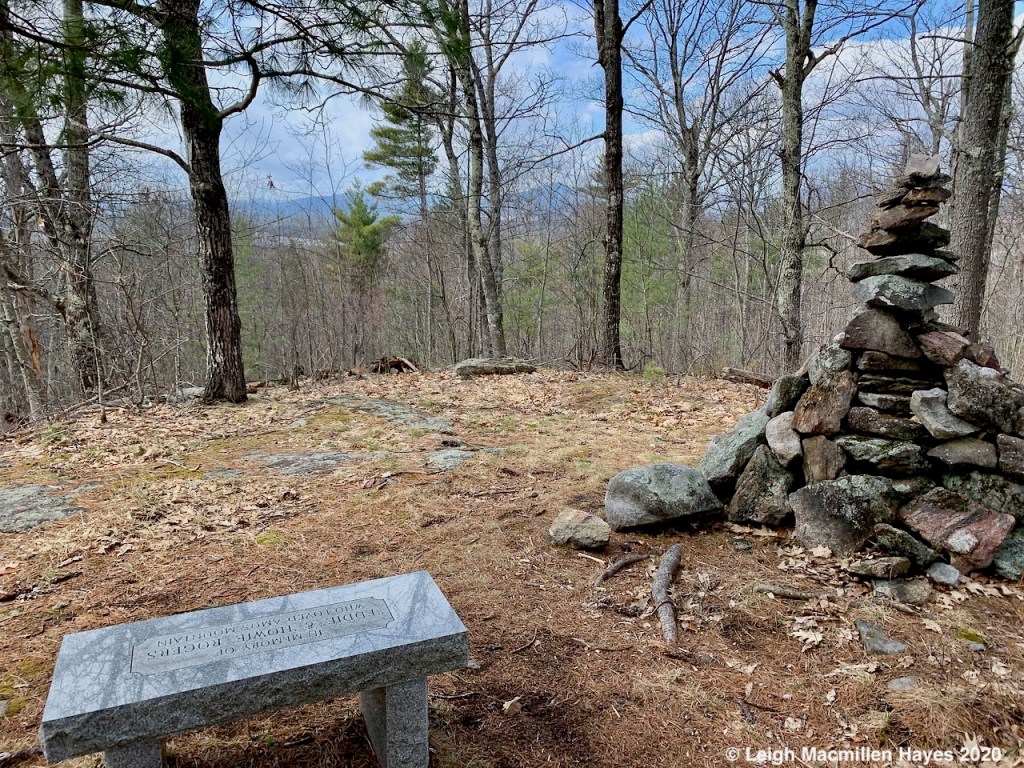
At our next stop I was so sure that one of you would provide a definitive answer to the structure’s use and history, but you only asked more questions to which I didn’t have the answers and so it shall remain a mystery. Who built it? Why? What? When? We do know the where and have some ideas about the how, but can’t quite respond to the Five Ws and an H in a complete manner.

And so we left there and moved on to the spot where we chatted about all the ghoulies and ghosties and long-leggity beasties that seemingly followed us through the woods.

Each time we heard a sound from one of the above, if it wasn’t a dried leaf blowing across the forest floor, it turned out to be a chipmunk. Why is it, we wondered together, that they can be so still one moment, but in the next insist upon calling attention to their presence?

Moving along, we eventually crossed over the wall and onto what was once the property of Amos Andrews.

Here, only a few years ago, one among us, yes Alice, that would be you, realized that in this spot grew white oak, a tree that we had previously believed no longer grew in these parts given its use in barrel making and other purposes. That is, until we recognized the chunky blocks of bark that helped to negate that assumption.

The leaves below also defined the new story, with red oak’s bristly pointed lobes on the left and white oak’s rounded lobes to the right.

As it would be, we realized we weren’t the only ones looking. And again, we had to take turns getting close to ohh and ahh at the alternating light and dark markings on the abdomen’s edge, legs and antennae of the Brown Marmorated Stink Bug. Okay, so we know these beasts inflect considerable damage to some fruits and crops, and can be a nuisance when it takes shelter in our homes, but still.

Around the corner from the oak tree we paused beside the homestead of Amos Andrews and wandered about his walled property for a bit, each of us trying to answer the question, “What was Amos thinking?” We haven’t answered it yet, but time will tell as perhaps more understandings will be revealed.

Down the former road we walked, grateful that being two rod wide, (a rod at 16.5 feet), we had plenty of room to spread out.

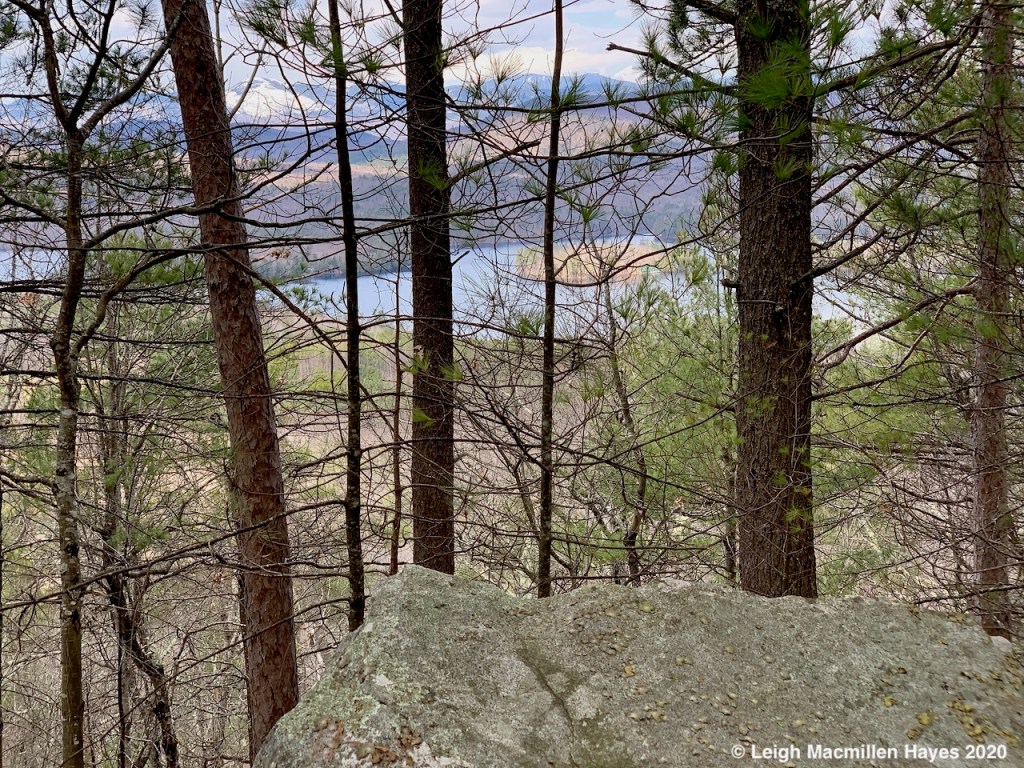
At the intersection with the Amos Mountain Trail, our route crossed over and we continued on to the lookout point where the Balds to the left, Mount Washington a wee white pyramid in the background, and Kezar Lake below held our focus.

And then we began to retrace our steps, back toward the parking lot where we’d first gathered. But there were two more things to notice, the first being a skeleton of a paper birch, its roots till seemingly intact.

And finally, water striders not doing a very good job of practicing social distancing.

We, on the other hand, had nailed that one, for while you all walked with me, I was alone. And ever so grateful for your company.

Perennial Mondate

It’s an old fav, Bald Pate Mountain Preserve in South Bridgton. And we love to visit it in any season. That being said, winter will “end” in a few weeks and this morning we realized we needed to head on over.

Our plan was to follow the Moose Trail for its entire length, then continue on the South Face Loop to the summit, start down the Bob Chase Trail, veer off to Foster Pond Lookout and then make our way back by rejoining Bob Chase.

One might expect to see a moose along the first trail, and we hoped to have such luck, but it was not to be. Instead, do you see the ski tracks? Portions of the preserve are groomed for cross-country skiers as part of the system at the adjacent Five Fields Farm.

What else did we spy? Some wicked cool finds in my book of wonder. For instance, you may think that this broken off piece of a twig is merely dangling from its counterpart, but . . . it is solidly stuck in place by a fungus known commonly as glue crust. It glues together twigs and branches that touch each other.

And sometimes twigs meet the bark on the trunk of a tree and hang in what you might think of as an unnatural stance.

The fungus is the dark bumpy structure that the second twig is stuck to, much like a magical act performed by nature. Really though, this fungus doesn’t let the twig fall to the ground where it would be decomposed by other fungi. Pretty tricky–making a claim all for its own benefit.

Continuing on, we scanned every beech tree in hopes of finding bear claw trees. We did find a beech worth honoring for we loved how it rested an elbow on the boulder below and with two arms formed a frame of the scene beyond.

Ever so slowly we climbed upward, our pace not my guy’s usual because of the bear paw challenge. When one is looking, however, one discovers so many other things upon which to focus like this rather common birch polypore in a rather uncommon shape, almost like a Christmas bell jingling in the breeze.

And then there was a display of snipped hemlock twigs scattered across the snow-covered forest floor.

We looked up and saw not a silhouetted form, but by the debris, which include diagonal cuts on the twigs, comma-shaped scat (some a bit more rounded than others), and even the soft, curly belly hairs of the creator, we knew a porcupine had dined overnight.

We looked a wee bit, but found not its den. By its tracks, however, we could tell that it had made more than one visit to this fine feasting spot.

Had we climbed the Bob Chase Trail we would have reached the summit in twenty minutes, but our choice to circle about before hiking up meant we spent two hours approaching the top where the bonsai trees of the North grow–in the form of pitch pines.

The true summit is a wee bit higher and so we continued on and then turned back to take in the view of Peabody Pond below.

It was there that while looking for insect cocoons I came across the gouty oak gall caused by teeny wasps no bigger than fruit flies. The structure was woody as it’s a couple of years old. And almost creepy in its display, like a head with many eyes looking every which way.

We did take the hint and looked every which way ourselves, the next point of view beyond Hancock Pond and beyond.

And then we moved on, until that is, we reached the wall of tripe, which always invites me to stop.

Water had also stopped in the form of several frozen falls.

And again, more of nature’s magic for the icicles facilitated photosynthesis by the algal partner of the lichen’s symbiosis. It’s a thing worth liken.

Nearby, a relative also begged a notice. Do you see the black flat-headed disks upon the surface? Those are the fruiting bodies or apothecium where this lichen’s spores are produced. The common name for this umbilicate structure: toadskin.

Just above the tripe and toadskin offerings, Pleasant Mountain came into view. Hidden behind a cloudy veil was Mount Washington, which typically sits in the saddle of the Pleasant Mountain ridgeline.

As we wound down and around, polypody ferns spoke about the weather–some were curled as it was cooler in their location upon a boulder in a hemlock grove, but others were flattened bespeaking the rising temperature.

Our last focal point before heading back to the parking lot was the lookout to Foster Pond. Where once stood a tall cairn, there are now two shorter ones marking the point of view and turn-around.

It was there that we discovered another gouty oak gall, its size at least that of a golf ball; a rather holey, warty golf ball.

This preserve is forever a fav in any season, which on this Mondate offered a flash ahead (think the opposite of flashback, rather like a preview) of what is to come. We love winter. And we especially love snow. But . . . we also love all the other seasons and the perennial plants on the southern side of the mountain where the snow has melted a bit, showed off their evergreen shades and hints of future events. Wintergreen and Trailing Arubuts, the later with the long buds atop a hairy stem.

Scat Happens

The forecast was for temps in the teens, with a wind chill making it feel like single digits. But . . . plenty of sun. And so Greater Lovell Land Trust docent Alice and I decided to go ahead with this morning’s planned Wetland Wonder at John A. Segur Wildlife Refuge West on New Road in Lovell.

After a two day storm that left snow, ice and more snow, we were happy to stretch our legs despite the temps. Unfortunately, or maybe fortunately, only one other person joined us, the ever adventuresome Hadley Couraud, Sebago Clean Waters Conservation Coordinator for Loon Echo and Western Foothills Land Trusts.

On a pre-hike last week, Alice and I decided it would be best to beeline to the brook and wetland or we’d never have time to enjoy the wonders that both offered. Today’s temp confirmed that that would be best as it would warm us up.

In what seemed like an amazingly short time, because for us it was, we found ourselves beside Bradley Brook and glanced downstream. Of course, we’d passed by some mammal tracks, but promised to look at them on the way out.

As we looked upstream, we noted that though it was a bit chilly, the wind hadn’t picked up yet and all the snow still coated the trees.

And then Alice rattled off a few species she wanted Hadley to look for and the first presented itself immediately. It took me a bit to catch on, but that was Alice’s way–to mention something and bingo, it was right there even though she wasn’t looking at it. That was certainly a fun way to feel like you were the first to make a discovery.

Hadley discovered the lungwort lichen, Lobaria pulmonaria, and I pride myself all these hours later in remembering its scientific name.

Of course we had to move in for a closer look. It’s one that we can never resist. Its ridges and lobes create a lettucey look, but many super moons ago it was thought to resemble lung tissue and thus a good remedy for maladies such as tuberculosis.

Its a species that begs a closer look (doesn’t everything?) and so we moved in, Hadley taking the lead.

And what to our wondering eyes should appear but the tiny granules trimming the outer edges of the lobes much like a fancy accent on a winter hat or sweater. Those structures are actually the lungwort’s asexual means of reproduction–and are called soredia.

Just before I performed a magic act with my water bottle, both Hadley and I took a few more photos of the brittle structure.

And then, tada, we watched as the water performed the trick.

It never ceases to amaze me: Once wet, the photosynthesizing green algae in the thallus or main tissue causes the lichen to instantly turn a bright shade and become pliable; once it dries, the color recedes to a duller olive green.

All that wonder, and we still hadn’t reached the actual wetland.

And so we marched on, pausing next beside a member Betulaceae ( Alnus and Betula) family. Alnus includes the speckled alder before our eyes and betula the birches. Scientifically known as Alnus incana ssp. rugosa, we got caught up with the male and female catkins, which both grow at the end of twigs.

The males are the longer catkins that formed in the fall, and just above them the wee females. Pollination is by wind and the fertilized female matures to a cone.

Both alder and lungwort lichen fix nitrogen, the former through a bacteria in its root nodules and decaying leaves and the latter as its structure falls to the forest floor and decays.

Upon one of the shrubs, we noticed what appeared to be cones in flower Actually, it was alder tongue gall–resulting from a fungus rather than an insect infecting the female catkins. Apparently, the tongue-like growths were green to begin, but transformed to orange, red and finally the brown we saw. Can you see the curly structures such as the one the black arrow points to?

We were there to look at the little things and the whole picture as it’s a place we only enjoy in this season, being difficult to access at other time of the year. In the midst of the wetland, the sun provided welcome warmth as we enjoyed the spectacular scene before us.

Artwork created by nature’s sketching artist gave proof that the wind was starting to pick up at about 11am.

It was at that point that we knew we were reaching our turn-around point, but still we reveled in the joy of being out there.

That is, until Hadley, as the caboose for some of the journey, found a weak spot in the ice. I gave her a hand to pull her out and we knew we needed to head out.

And so we followed a snowshoe hare back–giving thanks yet again for the snowshoes that we all wore.

What probably should have been a beeline much as we’d done on our way in, however, turned into frequent stops. The first was at a tree that had fallen across our path, which wasn’t really a path, but rather a bushwhack scouted out by Alice.

The fallen tree turned out to offer a lichen form classroom of crustose (appearing flat on the bark like a piece of bread or looking as if it had been spray painted onto the surface); foliose or leaf-like in structure; and fruticose, which reminds me of a bunch of grapes minus the grapes.

It was within the foliose lichen that we spotted the apothecia in the form of brown berets or disks.

And then there was the ice marching up a branch like miniature elephants on parade. We considered its formation and how it was anchored to the branch here and there, but not consistently. Was there warmth in the wood that created such formations?

As we headed back toward Bradley Brook, we spotted a tinderconk or horse’s hoof fungi that could have been a foot at the end of warm snowy white leggings.

The brook again offered a transitioning scene and we rejoiced in the sound of water flowing over rocks and downed trees.

Because we were still looking for the species Alice had suggested when we started, we stopped by well-browsed hobblebush where she shared their idiosyncrasies, including the fact that the buds aren’t covered in waxy scales like most tree and shrub species.

Instead, they are naked. And one of my favorites with their accordian-like design and fuzzy outer coating.

Eventually we made our way back to an old log landing, where evening primrose in its winter form became the subject of focus. Hadley is an apt student of nature and so even if she felt any discomfort from her dip in the water, she continued to ask questions and take notes about everything we encountered.

On the way out we noticed more snowshoe hare tracks, bird and squirrel prints, and then at a well worn deer run with fresh movement, we spotted the X in a print and new that a coyote had followed the deer, predator seeking prey.

One would have expected that with the mammal tracks we did see, we might have found some scat. We did not. But . . . all the same, Hadley really wanted an opportunity to say, “Scat Happens” with meaning. And she found it in her polar bear dip.

Still, the three of us had a wonderful tramp and rejoiced over hot cocoa and tea once back at my truck. I checked in with Hadley tonight and she’s fine, thankfully. But did I say she’s adventuresome? And ever eager to learn?

Still . . . scat happens. And with the right attitude, one can recover.

From Lovell to Lewiston, Naturally

This morning dawned as all do, but not all are quite so pristine. As I drove to Lovell I gave thanks that I’d be able to explore with a friend as we completed a reconnaissance mission before leading a wetland hike next weekend.

My friend Alice brought along her friend, Diana, and we tried to bee-line to Bradley Brook and the wetland beyond, but there were so many things to stop of us in our tracks, including the numerous prints of white-tailed deer and an occasional squirrel. Plus beech buds and marcescent leaves and . . . and . . . and. If I share all now, you won’t need to join us on February 8 and we really want you to come.

Eventually we reached the brook and were wowed by the colors and textures it offered.

As the brook flowed so did the ice form and its variation bespoke the water’s varying ways.

It was beside the brook that another local resident revealed its name by the prints it had made. We welcomed conditions that have been a bit on the warmer side of late (it wasn’t exactly warm when we began this morning, but these prints were made a night or two ago and actually showed some details or clues that led to identity). Do you see the baby hand in the upper left-hand print? And the diagonal orientation of one foot ahead of the other?

We continued following the raccoon and the brook toward the wetland of our destination, but paused again and again to rejoice in the presentation before us, including the tree that formed a triangle in reality and shadow.

At last we arrived at our destination, curious about the possibilities it offered. Though the temp was on the chilly side and we’ve had some really cold days this winter, we’ve also had some with much milder temps and so we watched our footing because none of us wanted to break through.

It’s a place where animal tracks intersect with nature’s lines and shadows grow long, whether arced or straight.

While we focused on the offerings, Alice and I gave thanks for Diana’s questions, which helped us consider how and what to share with participants who join us next weekend. Male and female catkins? Oh my.
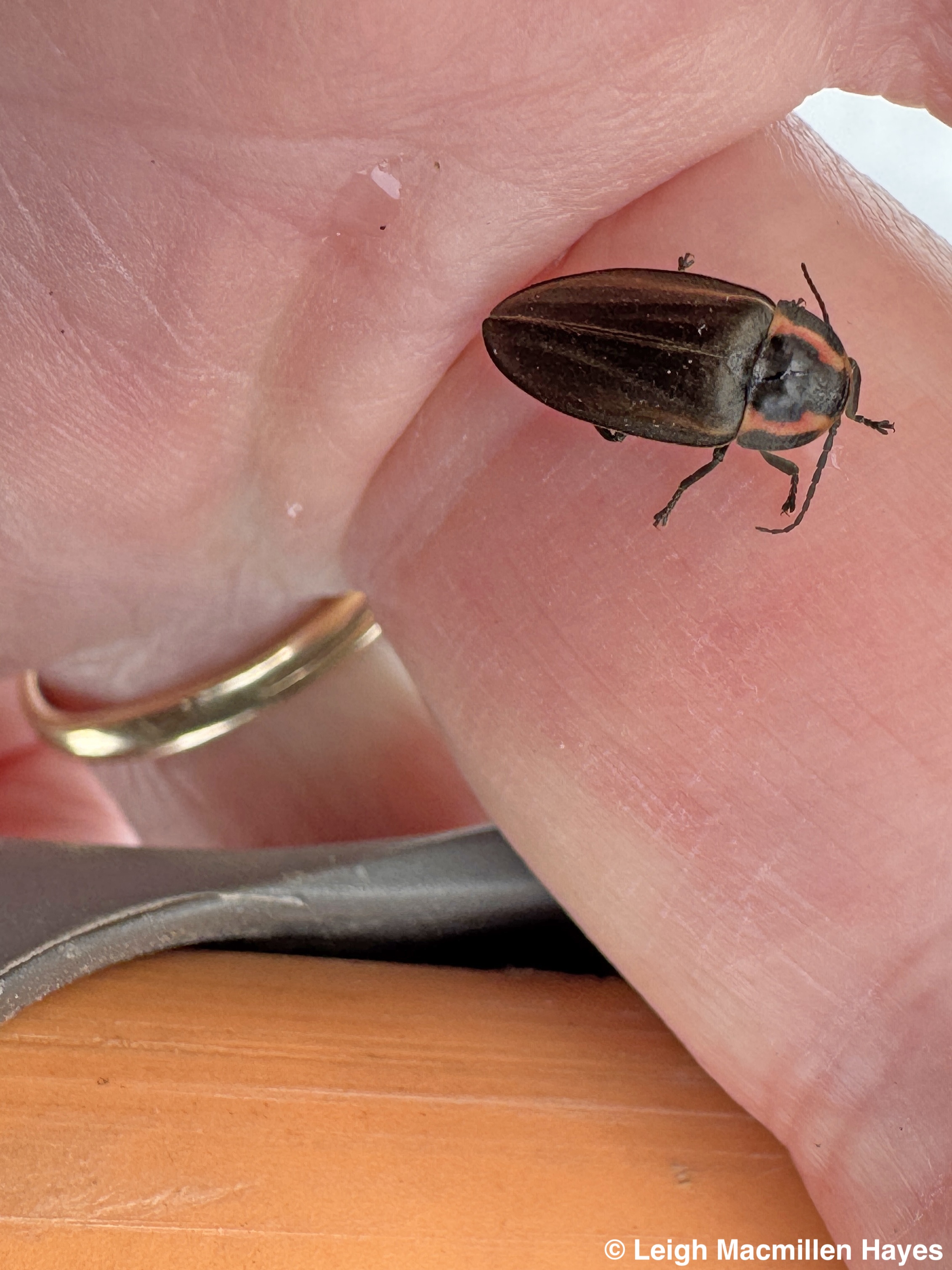
Eventually we found our way back to the brook, and if it seems like I’ve failed to show you all that we saw, it’s only because I don’t want to give away any treasures we want to share. Did I mention that Alice and I are leading a walk for the Greater Lovell Land Trust on February 8th at 9:30am.

We noted an ice bridge that crossed the brook, but it was thin and no critters had yet taken advantage of its structure. Next weekend, however, we’ll check again.

At the old yellow birch we paused before turning away from the brook, but really, don’t you just want to spend some time in this landscape? Listening to the babble of the water and calls of the chickadees and nuthatches? It’s a perfect place to get lost for a few moments and let the forest refill the innermost recesses of your lungs.

And then to look for lungwort lichen (Lobaria pulmonaria), an indicator for rich, healthy ecosystems such as old growth forests.

Alice teased me because I love to pour water upon it and watch as it magically turns bright green. The main photobiont is a green alga, and when water hits it it immediately photosynthesizes and goes from dull and dry to vibrant and pliable. It’s also a type of cyanolichen, meaning it contains nitrogen-fixing bacteria. When it falls to the ground and decomposes into the forest floor, it contributes its nitrogen reserve to the soil.

Eventually our time in Lovell came to an end and within the hour I drove to Lewiston for another meeting with some like-minded friends.

The plan was for me to deliver sets of tree cookies to Cheryl Ring and Sue Kistenmacher, two of four co-coordinators for the Maine Master Naturalist class now taking place in Waterville. After filling Cheryl’s car with boxes of bark, we headed off for a walk in the woods of Lewiston.

Within moments, we found ourselves admiring the red in the bark of a red oak and Cheryl went forth to honor it for announcing its name.

Red maple also announced itself, though in a completely different manner. It’s the only tree in Maine that suffers from bullseye target canker which creates . . . a bullseye shape or circular plates caused by a fungus.

With these two notorious birders, we spent a lot of time looking up and saw chickadees, nuthatches, crows, a downy woodpecker, heard a pileated, and the icing on the cake: two brown creepers upon the tree trunks.

But . . . we also spent time looking down and the footprints beside our feet amazed us.

It was the orientation of prints always presented on a diagonal with five tear-drop shaped toes and in a bounding pattern that first heard us exclaiming.

Taking measurements and noting all the details, while using Dorcas Miller’s Track Finder book and David Brown’s Trackards, we nailed it. Fisher. (I just have to say this: not a fisher cat. It’s not in the feline family; it’s a weasel.)

As we followed the fisher tracks we met another traveler of these woods. It threw us off at first because its pattern led us astray. But we followed the track for a bit and examined the prints until we found a few that helped us make a positive ID.

We’d considered fox, but none of the measurements matched up and we were pretty sure we were seeing five toes rather than four and then we knew the creator. The second raccoon of my day.

As it happened we followed both the fisher and raccoon and noticed that while the raccoon walked by the pine trees, the fisher’s prints were visible on one side and then on the other in a way that was not humanly or fisherly possible, unless the mammal climbed the tree and jumped off the other side.

And planted a solid landing–like any great gymnast.

How great it was to stand there and note where the fisher and raccoon tracks had intersected–both overnight perhaps, but for as far as we had traveled no interaction had taken place.

We did, however, find an area that explained why the fisher was on the hunt: a hillside filled with squirrel middens. This spot offered more squirrel middens than I’ve seen all winter.

A midden is a garbage pile. The red squirrel finds a high spot, either the lay of the land, a rock, tree stump, or branch, upon which to “eat” a white pine cone like an ear of corn. The squirrel pulls off each scale on the cone and munches on the tiny pine nuts, discarding the inedible parts.

Each pine scale holds two pine nuts with attached wings or samaras–think maple seed with its wing. If you look closely at the inside of the pine cone scale, you can see the shape of the samaras and seeds.

Just before we turned back on our afternoon journey, we discovered a coyote track and gave thanks that we were in a city space that provided an incredible sanctuary for the mammals and birds.

My thanks began in the morning when I spent time exploring the John A. Segur Wildlife Refuge in Lovell with Maine Master Naturalist Alice and her friend Diane.

And it concluded with the afternoon spent with Maine Master Naturalists Cheryl and Sue at Thorncrag Bird Sanctuary in Lewiston.

From Lovell to Lewiston, naturally with naturalists. Thanks be.

Ode to Pinus strobus

Oh ancient ones,
so tall and stout.

My gaze turns upward
to take in your mighty presence
as you reach out
and shake hands
with each other.

Your crown tells the story
of your true nature,
ever graceful as it is,
and decorated with
daintily dangling needles,
which spell your name
much like my fingers of five:
W-H-I-T-E.

In maturity you form furrows
of stacked outer layers
and I wonder about your age.
Within those furrows,
others, like a Stink Bug,
take refuge from the world,
especially as raindrops fall.

Though considered dead cells,
your skin protects life within,
where phloem and xylem
work like dumb waiters.
The former transports sugars
created by photosynthesis
from your needles
to feed branches, trunk and roots,
while the latter
pulls water and dissolved nutrients
from your roots for nourishment.

I have this and
so many other reasons
to revere you.
Today, I focus
on the decorations
you perhaps unknowingly encourage
by providing a scaffolding
upon which they may grow.
Mosses and lichens
first take advantage.
of your hospitality.

And they in turn,
offer places
for others to gather.
As I peek,
I notice tiny flies
of a robotic style
seeking each other.
The seeker advancing
upon a fruticose form,
while the seekee
waits on a foliose lichen.

Upon another,
a tiny cocoon,
once the snug home
for the larval form
of a Pine Sawfly.
Its opened cap
indicates the transformation
of another generation.

There were others 
who once considered
your trees their own.
A spider web
woven during warmer months,
gathered raindrops today
that highlighted
the 3-D artwork
of its creator.
Not to go unnoticed
were the fruiting structures
of lichens,
such as a crustose
with its thick, warty, grayish crust
topped by numerous
jam tart fruits.

But my favorite find
on this soaking wet day
was caused by
a chemical interaction
that resembles
the creation of soap.

During a heavy rain, 
water running down your trunk
picks up oils.
Air in the bark furrows
bubbles through the oily film
and produces froth.
It’s a tapestry-forming froth
and within some bubbles,
surrounding trees
pronounced their silhouettes.

Oh Pinus strobus.
Some know you
as “The Tree of Peace.”
I know you
as “The Tree of Protection,
and Life, and Color.”
And then I realize
that is Peace.
Thank you for all that you do, naturally.

Bear to Beer: Pondicherry Wildlife Refuge

Our intention had been to explore the Pondicherry Wildlife Refuge in Jefferson, New Hampshire, during the summer months, but intentions are just that. An aim or a plan. In our case it was an aim that was a bit off plan.

Today, however, dawned, as each day does, and we honored the plan we’d made last night by packing a lunch and getting out the door by 9:30.

An hour and a half later, we’d driven across Route 302 through Crawford Notch, recalling sites we’d enjoyed from the Conway Scenic Train less than a week ago, and on to Jefferson where we found Airport Road, aka Hazen. At the kiosk, we developed a bit of a trail plan and then ventured forth.

The area is supported by several organizations as noted on a website: “Pondicherry is a Division of the Silvio O. Conte National Fish and Wildlife Refuge, and it is owned and managed by the U.S. Fish and Wildlife Service in partnership with New Hampshire Audubon and the New Hampshire Department of Fish and Game. A local Friends group also plays a role in the management of the refuge, and the New Hampshire Bureau of Trails has specific jurisdiction for the rail-trails.”

For a mile and a half, we followed the rail trail to its vantage point. Well, not quite all the way, but to the Waumbek Station, where three rail lines once converged.

We thought we’d step out onto the Tudor Richards Viewing Platform, then continue on the rail trail. But, a woman ahead of us had stepped onto the platform to practice Tai Chi and so we let her be and walked for a bit on the Presidential Recreation Trail, a 20-mile link to Gorham, New Hampshire.

Along the way, much of the scenery looked more like November than October, given the fact that we were further north than our hometown. But, a few goldenrods still bloomed. And upon some of their stems, the Goldenrod Ball Gallmaker had made itself a home.

Though we’d planned to eat lunch upon the observation deck, we were delightfully surprised to locate a small bench overlooking Cherry Mountain and so down we sat. PB& Strawberry and Peach, we each enjoyed a half of the others intended sandwich.

Eventually, we returned to the observation deck and enjoyed the fruits of Witherod and High Bush Cranberry that outlined the boardwalk leading to Cherry Pond.
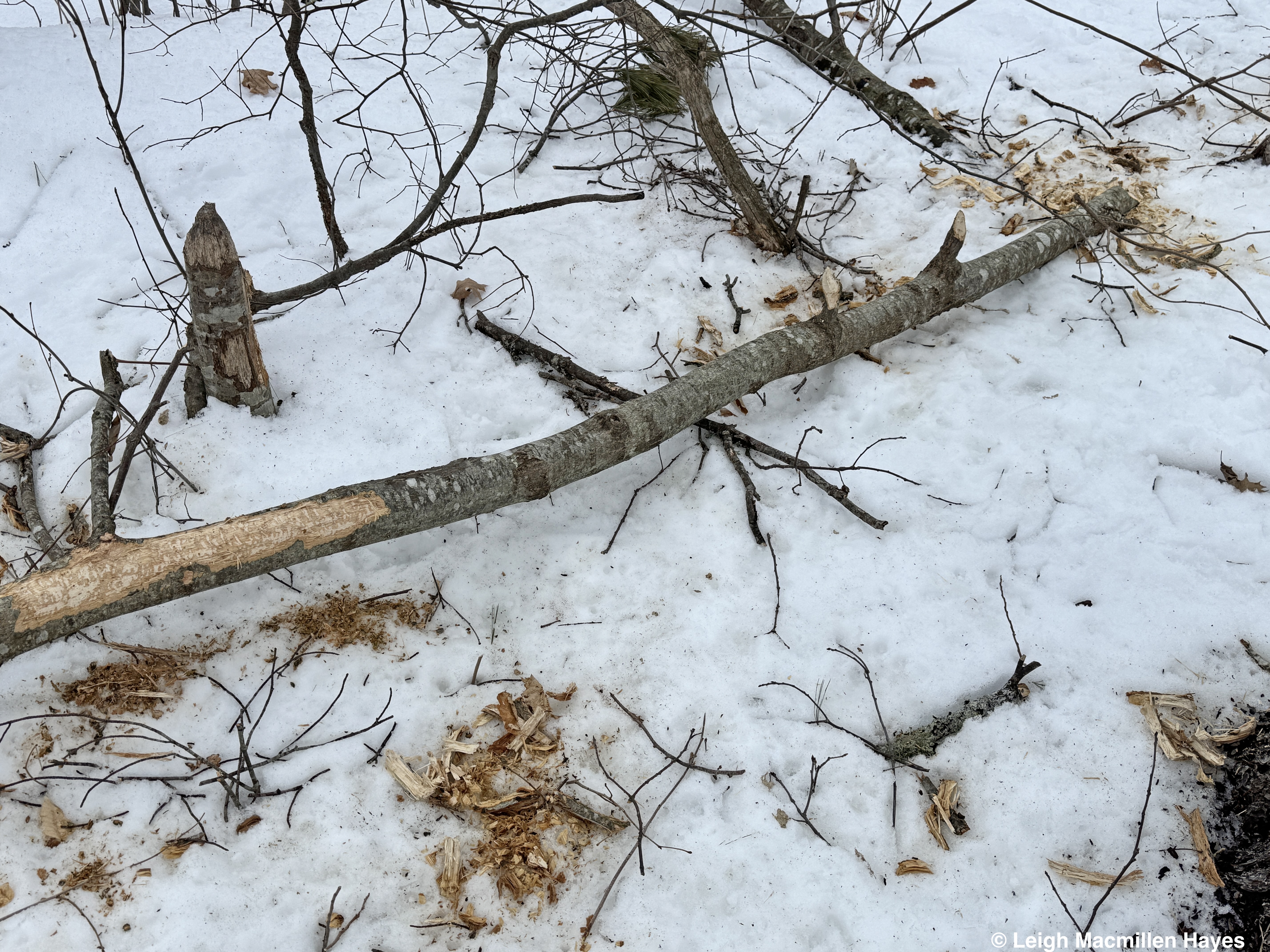
The Pliny Range offered a backdrop on this day filled with sun and clouds.

In the distance, Bufflehead Ducks swam.

Returning to the junction, we continued northeast where rail trail joined rail and one could imagine the clackety clack of trains passing by.

A bit further on, we turned left toward Little Cherry Pond, where the natural community began to seriously embrace all sorts of coniferous trees.

At our feet, the trail cover was a bit more golden and much shorter than our native White Pines.

Looking toward the sky, Tamaracks sang their cheery autumn song as their needles turned golden before dropping. I’m forever intrigued by this deciduous conifer. And thrown into the mix of the cathedral ceiling: spruces of colors I need to spend more time with for throughout the refuge grew white, red, and black spruce. My task down the road: get to know each one individually so that I recognize them in new settings.

While I can tell you that there are five needles in a White Pine bundle, three in a Pitch Pine, two longer ones in a Red Pine, and two shorter needles in a Jack Pine, the needles of the Tamarack are produced in clusters of ten to twenty.

They are attached to the twigs in tight spirals around short spur branches. giving the tree a feathery look.

Upon a downed conifer, a jelly fungus offered its own version of a flower.

At last we reached Little Cherry Pond, where more Buffleheads swam.

And then we noticed another swimmer who made us smile. Yes, that’s a beaver. We couldn’t see his destination for it was around a corner and signs warned us not to venture further in order to protect the area.

Backtracking a bit, all the while admiring the plants including Rhodora, Creeping Snowberry, Trailing Arbutus, Pitcher Plants, and so many more (I need to return in the spring), we found our way back to the Mooseway Trail. (Note: “You Are Here” was taken on the way in, but I wanted to give perspective. Look for the Mooseway Trail toward Mud Pond.)

Not long onto the Mooseway Trail, I was thrilled to discover Lungwort growing up a tree trunk. Its ridges and lobes create a leafy lettuce or lung tissue appearance (thus its common name).

Because lungwort’s main photobiont is a green alga, it is also a type of cyanolichen, thus meaning it contains nitrogen-fixing bacteria. When lungworts fall following a storm, they decompose into the forest floor, contributing their nitrogen reserve to the soil.

The Mooseway Trail seemed easy to follow at first, but soon it became more of a bushwhack and we wondered when the last human had ventured forth. We found all of three blue blazes indicating the way.

But after the third, we had a choice to make. Head north or south. We chose south. And within a short distance the trail completely disappeared. Thanks to GPS and occasional glimpses of Cherry Mountain, we persevered. And startled a snowshoe hare that startled us. I couldn’t capture it in a photo for so quick was its hop, but suffice it to say that the hare’s coloration was gray/white, given the next season that had already visited some of the surrounding mountains.
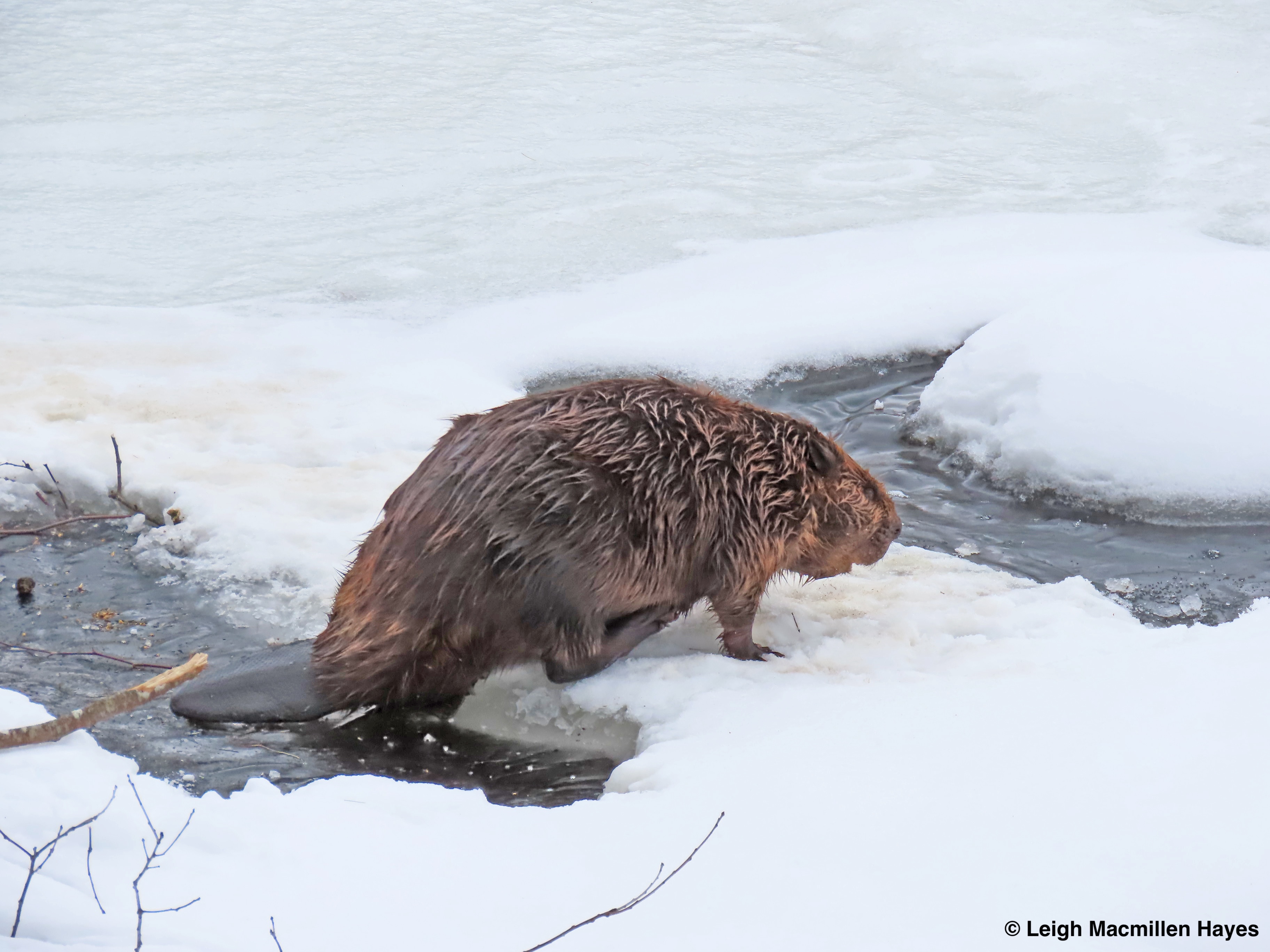
Maybe it only took a half hour, but it sure felt like hours before we finally found the rail again. I actually considered kissing it, but my guy convinced me otherwise.

There was so much more of the refuge to explore, but we followed the trail back, giving thanks to the shape of the mountain that helped give us perspective on our location as we’d bushwhacked.
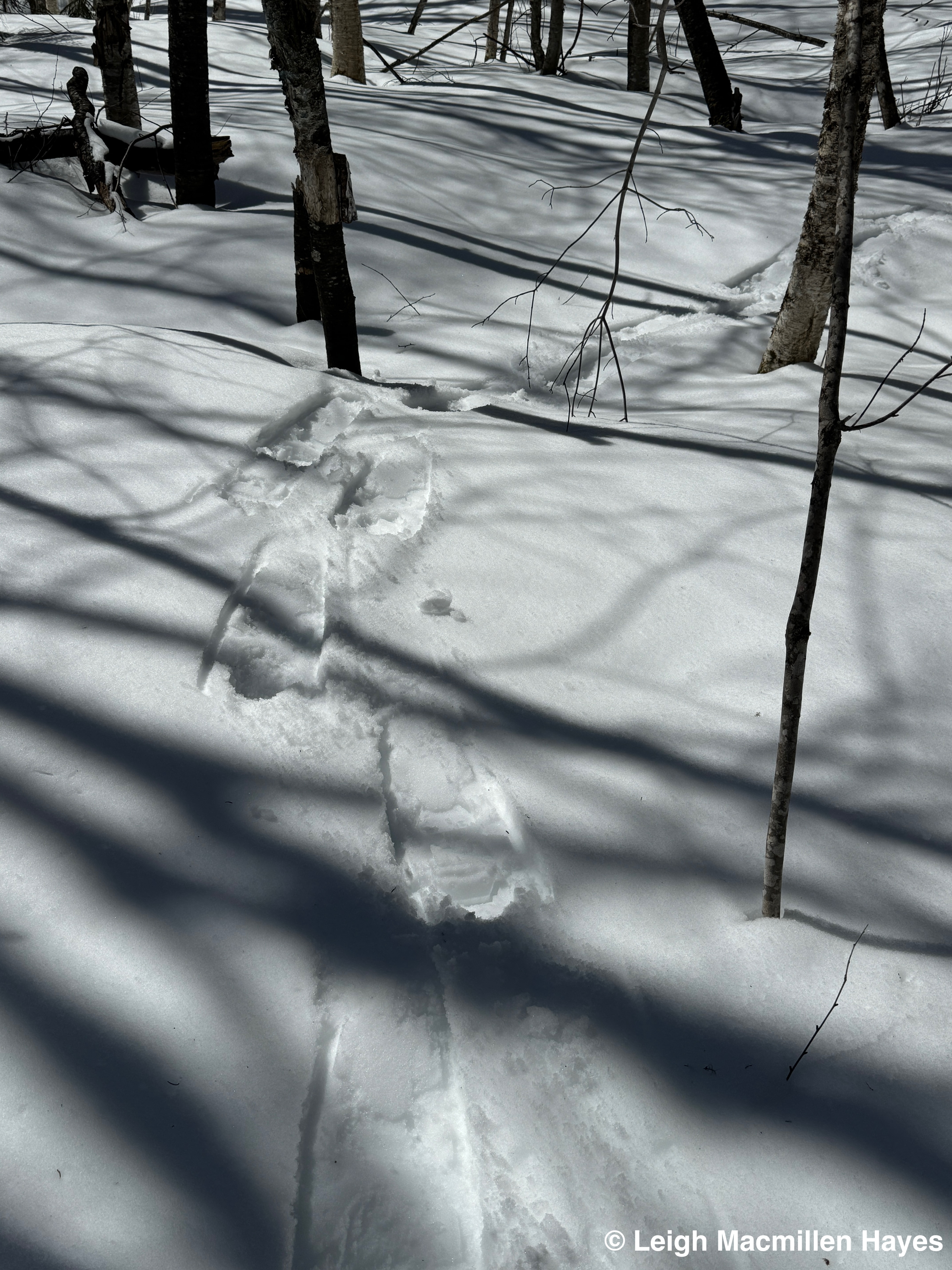
And a backward look upon the pond brought to light the snow that had fallen upon the Presidentials, previously hidden in the clouds.

As for that darn Mooseway Trail that led us astray . . . it did have much to offer including this Bobcat scat. We also found a specimen of coyote.

And not only Moose scat, but also some prints. We were rather excited by that.

And then the crème de la crème: bear scat filled with berries. Yes, we’d scanned the trees for claw marks, but if they were there, they were difficult to distinguish (cuze, um, we were moving at my guy’s speed). Despite that, this display made us both happier than happy.

I had no idea when I chose most of the places for our Bear to Beer Possibilities, what the trail’s tales might be, but really, our success rate was quite high.

And we topped off our success by sipping some suds at an old fav in Glen, New Hampshire. For him: Moat Mountain’s Matilda’s Red Rage. For me: Tuckerman’s Pale Ale.

For both of us: Bear to Beer–we got this one. Seven miles later, bear scat to beer at Pondicherry Wildlife Refuge and Red Parka Pub.

Ponds #1 and #2 Mondate

My friend, Alice, suggested a trail to me over the weekend, and so when this day dawned, my guy and I had a plan. We’d pack a lunch, drove a wee bit north, and let the fun begin. We love exploring places new to us and this was such.

Immediately, the forest floor reflected the canopy above where Sugar Maples, Beech and Red Oak presided.

Other items also made themselves known, including the dried capsules of Pinesap, a plant that features three to ten topaz-colored flowers during the summer. The plant has such cool characteristics: it lacks chlorophyll because it doesn’t have any leaves to photosynthesize, and acts as an indirect parasite of trees. You see, Pinesap’s roots steal nutrients from mycorrhizal fungi, specifically from the genus Tricholoma, that the mushroom obtains from associated trees.

It wasn’t long before the carpet changed color indicating we’d entered a Red Maple community.

And again, upon the ground, another cool site worth honoring. Many-fruited Pelt is a foliose lichen that grows on soil, moss and rocks. The rust-colored projections among the shiny brown lobes made me squat for a photo call. Those reddish-brown projections are the fruiting bodies on the leafy margins–thus the name.

Again we moved onward and upward and again the community changed, the leaves telling us we’d entered a Big-Tooth Aspen/American Beech neighborhood.

Wherever beech trees grow this year, it seems the parasitic Beechdrops are also present. Lucky for me, though my guy likes to hike as if on a mission to get to the destination, when I ask him to pause, he quietly does. I’m forever grateful that he understands my need to take a closer look. I’m not sure if he’s amused by it or just tolerates it, but he never complains. And occasionally he points things out for me to notice or tells me the name of something.

Anyway, Beechdrops, like Pinesap, lack chlorophyll, have scales in place of leaves so they have no way to photosynthesize, and are parasitic. In the case of the Beechdrops, however, it’s the roots of the American Beech from which it draws its nutrition. Small, root-like structures of the Beechdrops insert themselves into the tree’s roots and suck away. Do they damage the trees? The short answer is no because the parasitic plant is short-lived.

Our journey continued to take us uphill and really, it wasn’t easy to follow, but somehow (thanks to GPS–I surprised myself with my talent) we stayed on the trail.

Do you believe me now that it wasn’t easy to follow? Yes, that is a blaze, the yellow paint practically obliterated by a garden of foliose and fruticose lichens. Foliose being a “leafy” looking structure and at least two grew on the bark. Fruticose, likewise the “fruity” structure (think a bunch of grapes minus the fruits) also presented itself in at least two forms.

Of course, there were still many other things to admire including the multiple shades of magenta presented by the shrub: Maple-leaf Viburnum. In my book of autumn, nothing else exhibits such an exquisite color, making it easy to identify.

Our luck increased once we began to spy rock cairns marking the trail.

And it got even better when I noticed several classic deposits beside the cairns. Bobcat scat! Check this one out. Have you ever seen anything quite so beautiful? Look at that hair tucked within the packet. Of a snowshoe hare. Oh my.

While taking a closer look, I realized I wasn’t the only one with all eyes on the structure. Yes, that’s a wolf spider.

Realizing we were at the summit of a certain small mountain, suddenly we found ourselves walking along ledge.

And then the view opened up. It became lunch rock view.

Words seemed not enough to describe.

At last we made our way down, for still we hadn’t reached our destination.

And that’s when Pinesap’s cousin, Indian Pipe showed off its one-flowered structure. While Pinesap features three to ten flowers per stalk, Indian Pipe offers only one waxy structure made of four to five small petals. Until fertilized by a Bumblebee, the flower droops toward the earth, but upon pollination turns upward toward the sun. Eventually a woody capsule will form.

Also parasitic, Indian Pipes have a mutually beneficial relationship with many tree species plus Russula and Lactarius mushrooms, as they work together to exchange water and carbohydrates with nutrients from the soil.

At long last, we reached the first of our destinations, Pond #1. The glass-like water offered a perfect mirror image of the scene upon the opposite shore and we both let “oohs” and “aahs” escape from our mouths when we came upon an opening in the shrubby vegetation that protected the shore. I think my favorite portion of this photo is the evergreens that add a fringed frame.

Our journey, however, didn’t stop there, for we had another pond to locate. Again, we referred to the GPS and found ourselves climbing over several fallen trees. Upon one, I spied pumpkin-colored fungi that requested a stop. Of course. But really, it’s another I can never resist–Cinnabar-red Polypore.

As lovely as the color of the upper surface may be, it’s the pore surface that really makes my jaw drop. That color. Those angular shapes. Another “oh my” moment.

And then upon another downed tree, multi-aged tinder mushrooms. It was the mature one that fascinated me most for it looked like happy turtle basking on rocks in the sun.

Last week I met a Snapping Turtle in the shade and he hardly looked thrilled with our encounter.

At last my guy and I reached Pond #2, where we sat for a few minutes and took in the scene. Okay, so we also enjoyed a sweet treat–as a celebration.

We still had another mile or so to hike before reaching my truck, but we gave thanks to Alice for the suggestion and for the fun we’d had discovering Pond #1 and #2 on this Mondate. And all that we saw between.

Go ahead, take a second look at that bobcat scat. You know you want to.