On the Cusp of Autumn

It occurs every year, autumn that is. But this year it hasn’t even started and already feels different. In the past week, My Guy and I have followed many a trail or waterway, both on foot and by sea, oops, I mean kayak on local lakes and ponds, and every offering has been unique.

Some, such as this, being Brownfield Bog as we locals know it, or Major Gregory Sanborn Wildlife Management Area as the State of Maine knows it, took us by complete surprise. The last time we’d wandered this way together was in the spring, when despite wearing Muck Boots, we could not travel some parts of the trail because the water was so high. That was in the Time-We-Actually-Experienced-Rain. That time has long since passed and now western Maine is in a severe drought and don’t the Lilypads know it. What about all the mammals and birds and insects that depend on this water? It was an eerily quiet walk in a place that is usually alive with action.

Where the Old Course of the Saco River crosses through the bog, there was some water. But still, not enough. And we know of other areas of the Old Course, such as in Fryeburg Harbor, where there is no water.

As for the Saco, it too, was incredibly low and sandbars were more the norm.
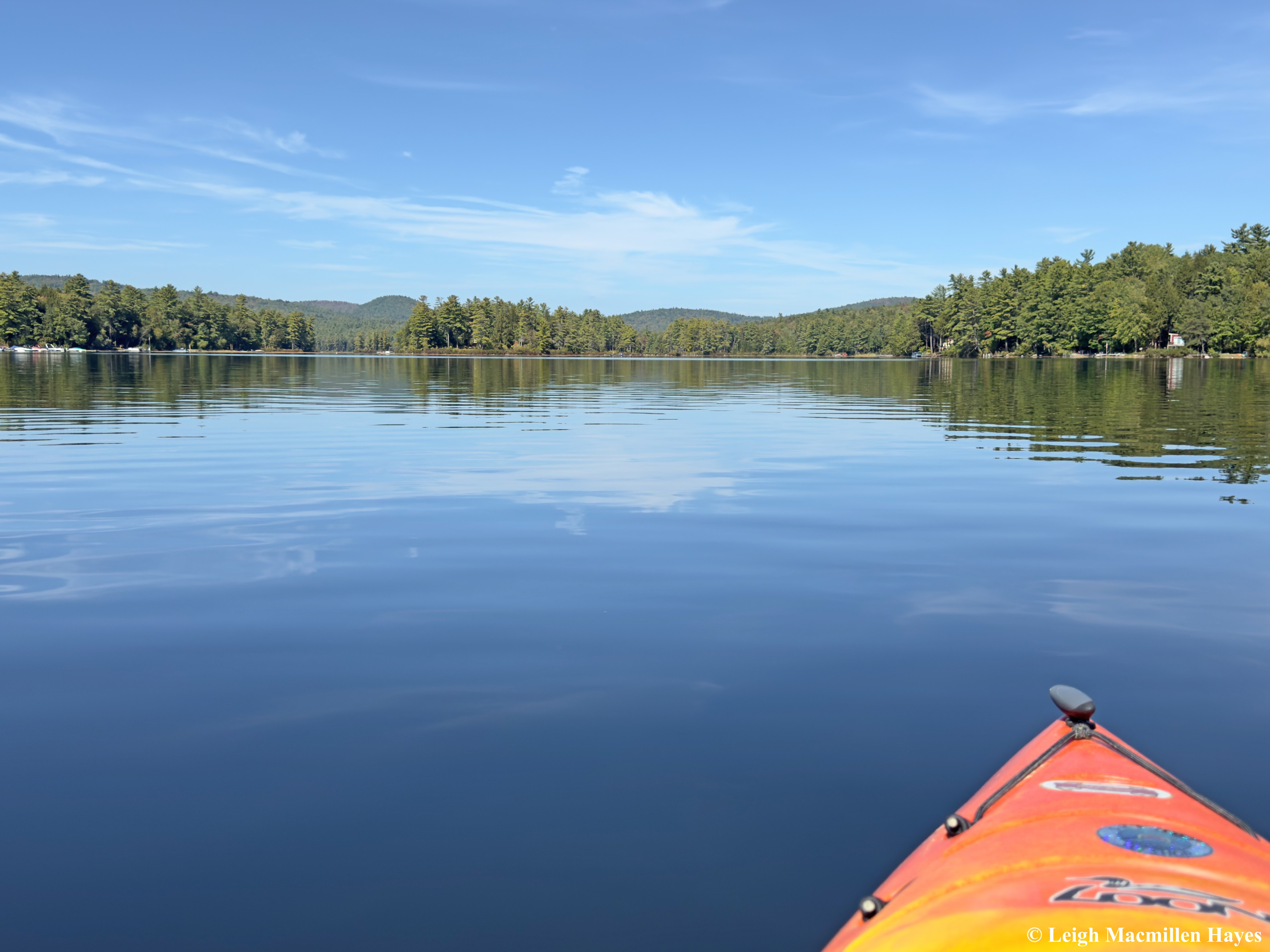
Other adventures found us paddling our favorite pond.
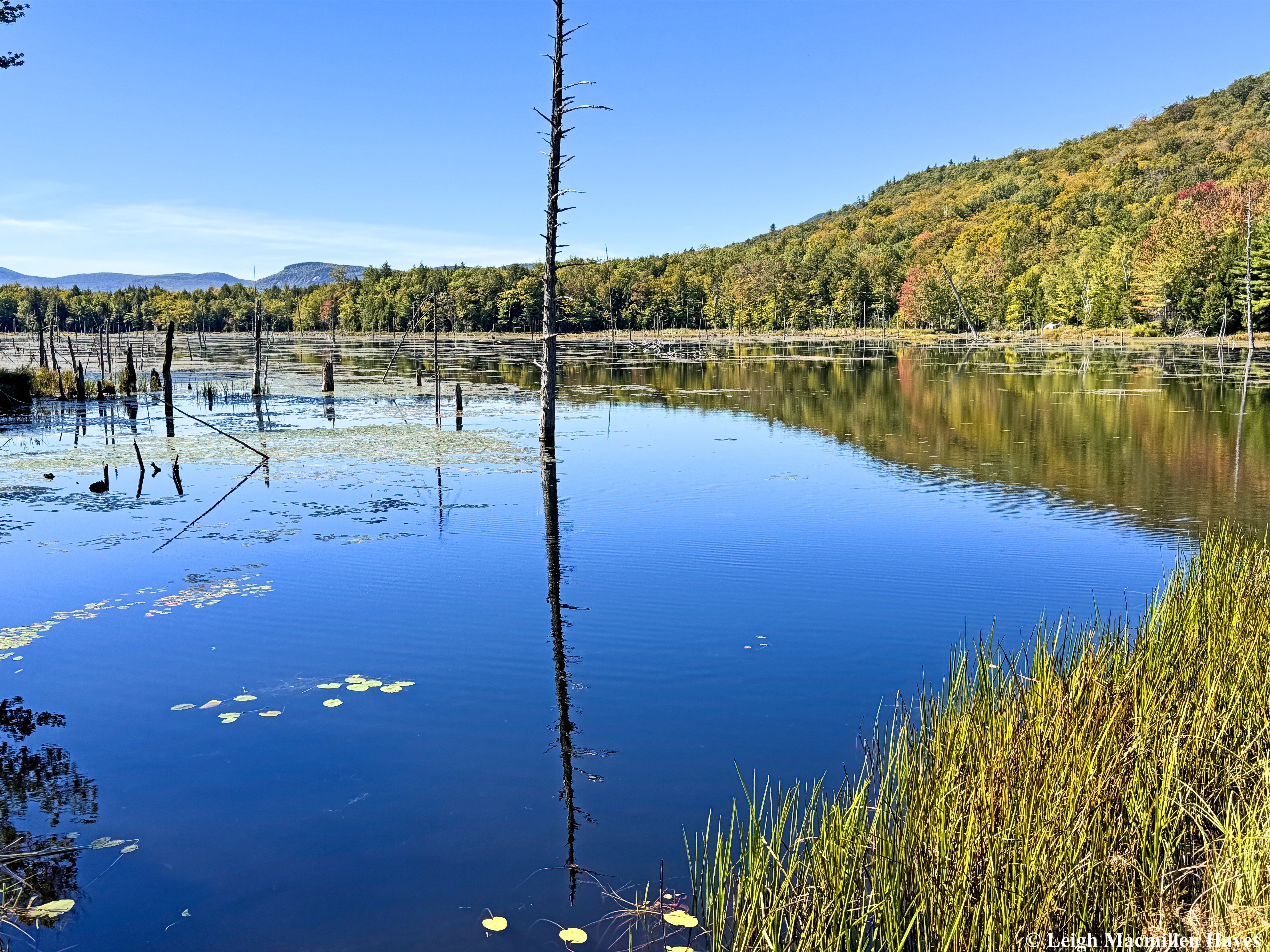
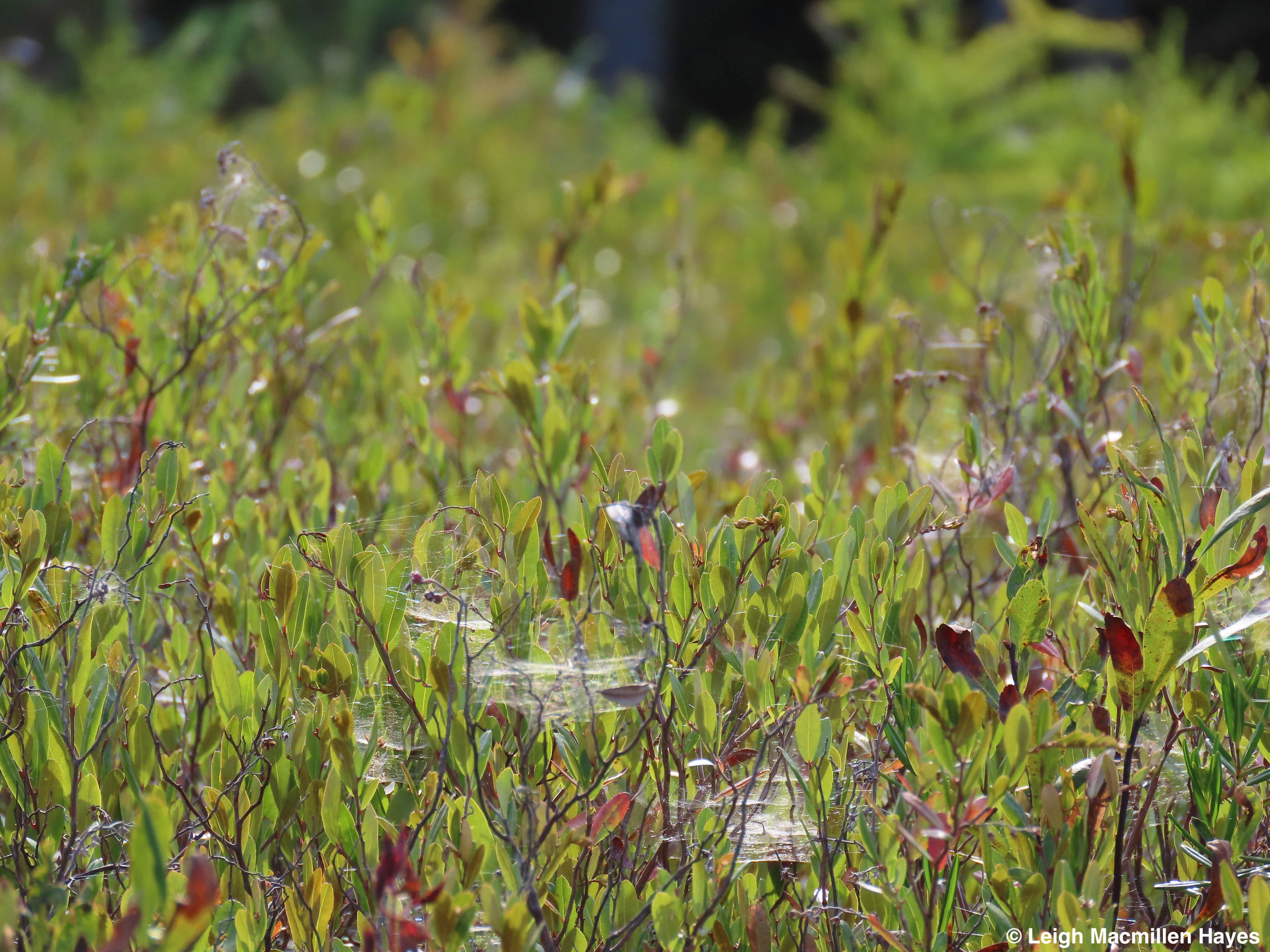
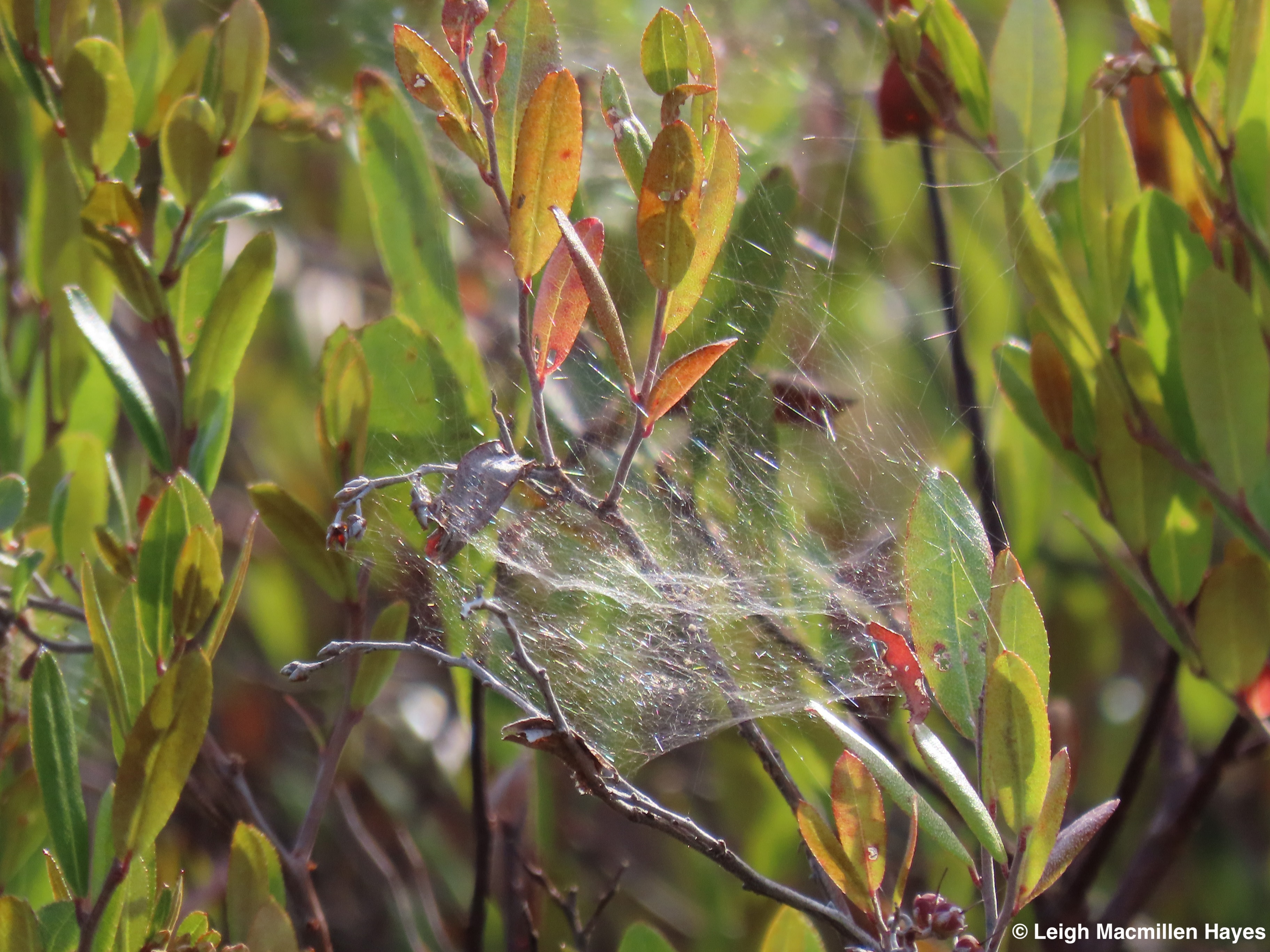
And bushwhacking around another bog.

What kept making itself known to us–the fact that the trees are turning much too soon, and many leaves aren’t even turning, but rather drying up and falling.

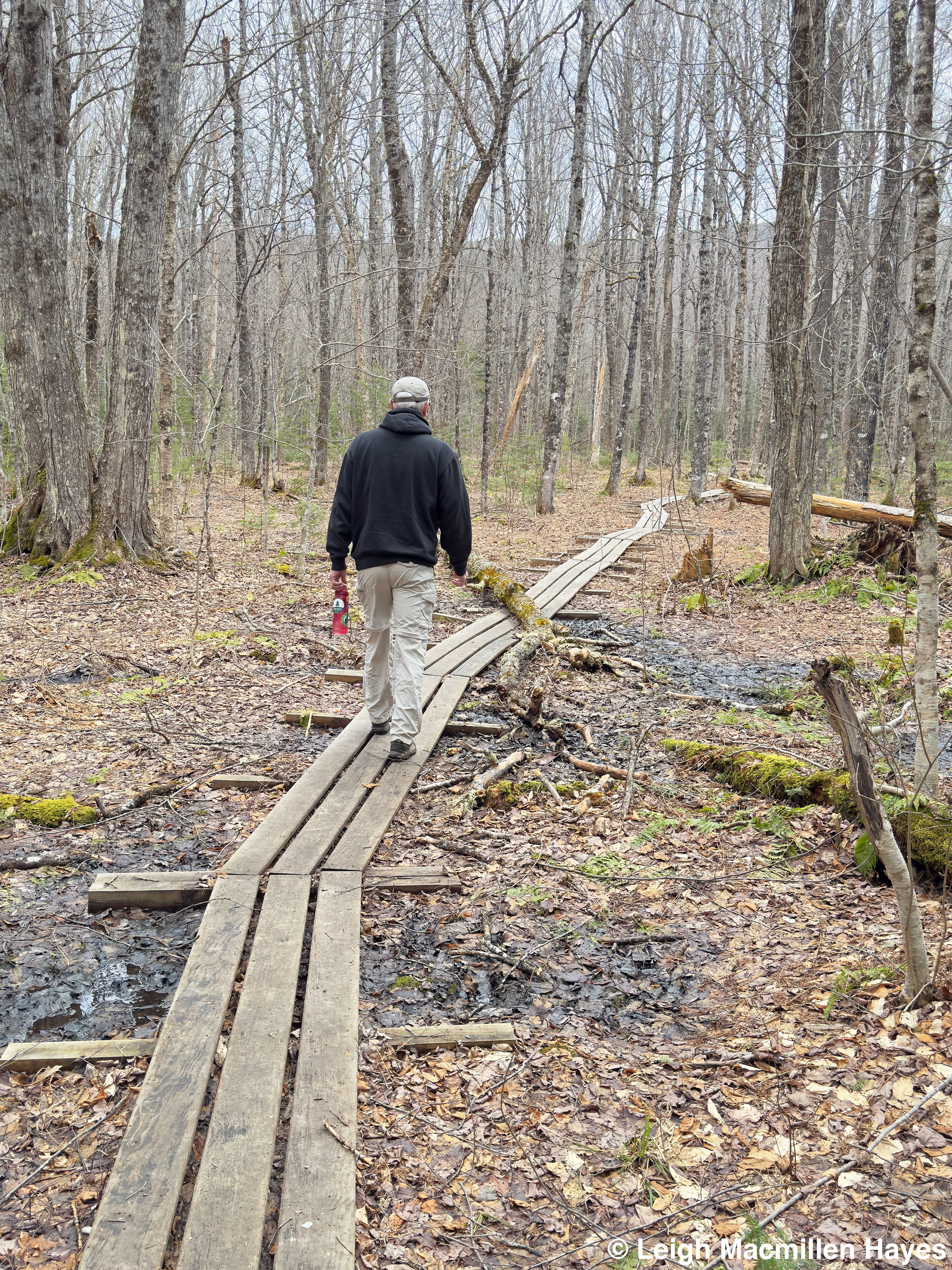
That meant that some paths or bushwhacks found us crunching the dried leaves with each step we took. We could hardly sneak up on a Moose or a Bear, or even a Squirrel.

Despite such dry conditions, we did find the varied colors of Wild Raisins or Witherod drupes dangling in clusters below their leaves.
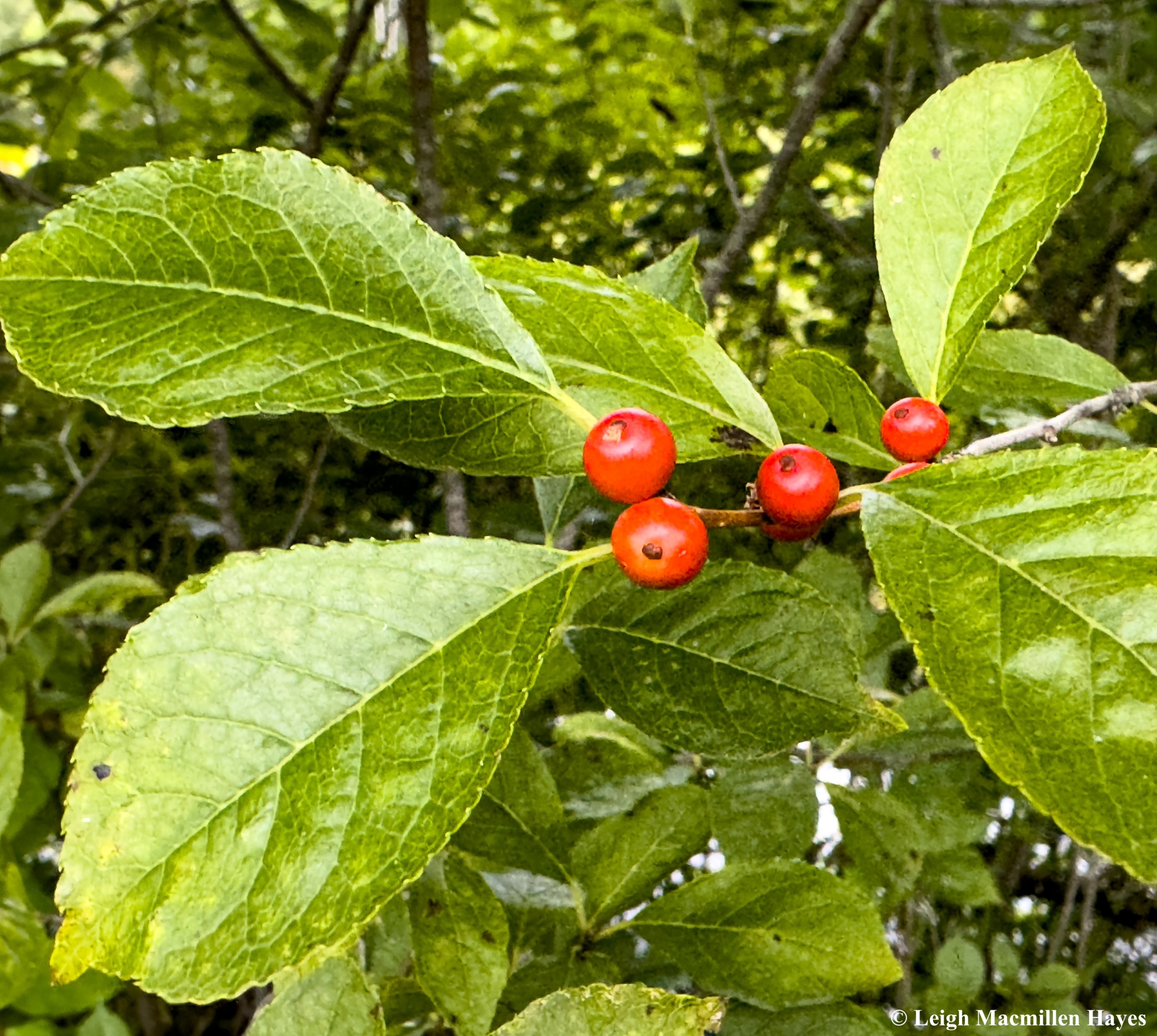
And Winterberries showing off their enticing red hues–ready to attract birds and maybe become part of our holiday decorations. Only a few branches for us, mind you. We leave the rest to the critters because we know their importance in the food chain.

Late summer flowers were also in bloom, including the brilliant color of the Cardinal Flower.

And in a contrast to the red, there were Ladies’ Tresses, a wild orchid, one of the few with a fragrance if you can bend low enough to smell it.

I think one of the greatest wonders is how many variations there are on a theme, in this case flowers for take a look at the Pilewort or American Burnweed, this one growing upon a Beaver Lodge.

What you are looking at is the flower heads: They are about a ¼ across and petal-less. The inner bracts, with their purplish tips form a ½-inch tube exposing just the yellowish to creamy white stamens at the top. And the seeds are teeny tiny, as you can see, with tufts of white hairs to carry them like parachutes upon a breeze.

Along one trail, we spotted another teeny tiny display that surprised us due to the fact that we haven’t seen many mushrooms this summer. But the Orange Peel Fungus apparently had enough moisture, at least to produce these two forms.

Critters were also a part of our sightings and several times we encountered young Northern Water Snakes, not more than two pencils in length.

In another spot where we expected to see Water Snakes, we instead met a Garter. Mind you, none of these wanted to spend any amount of time with us.
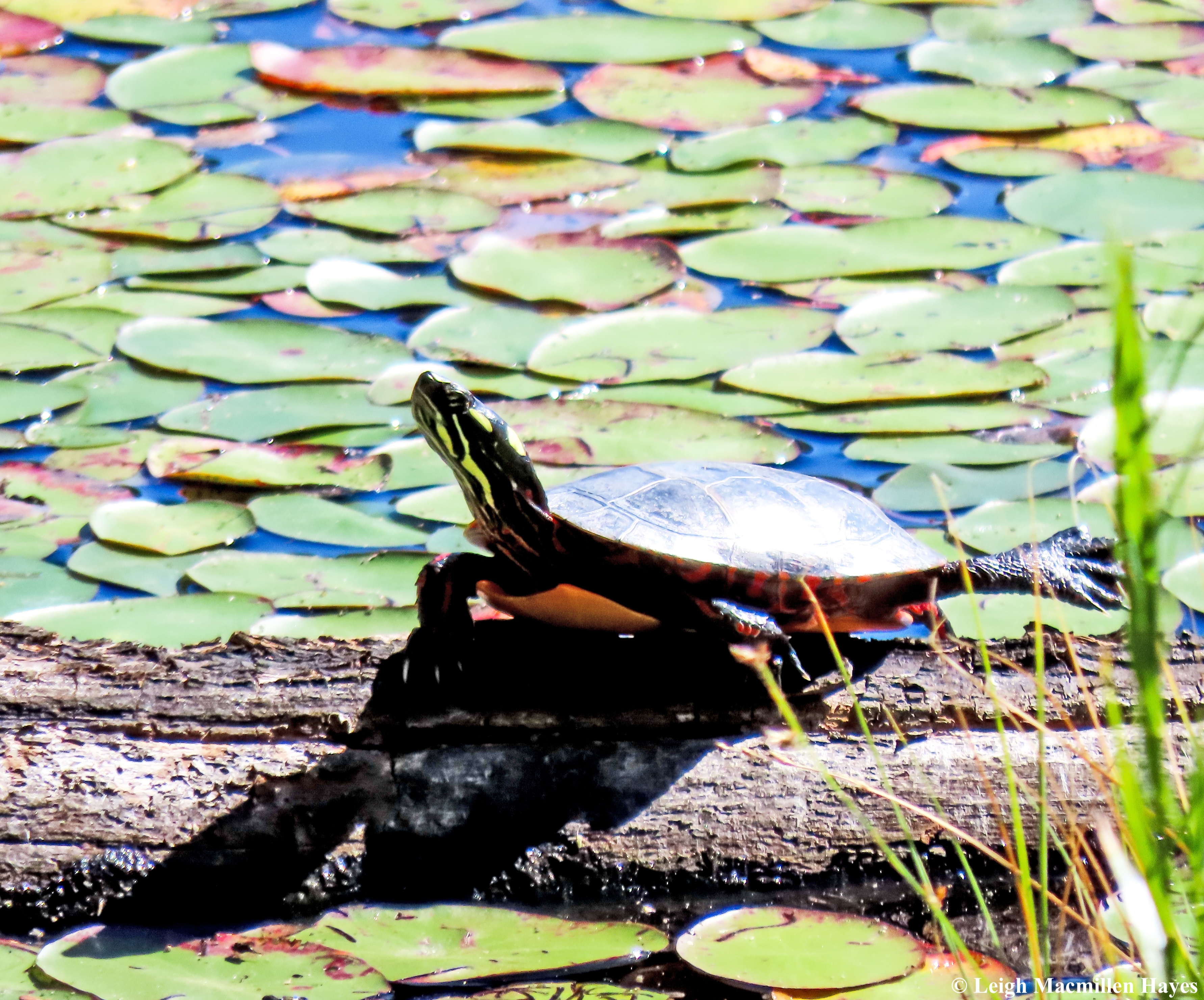
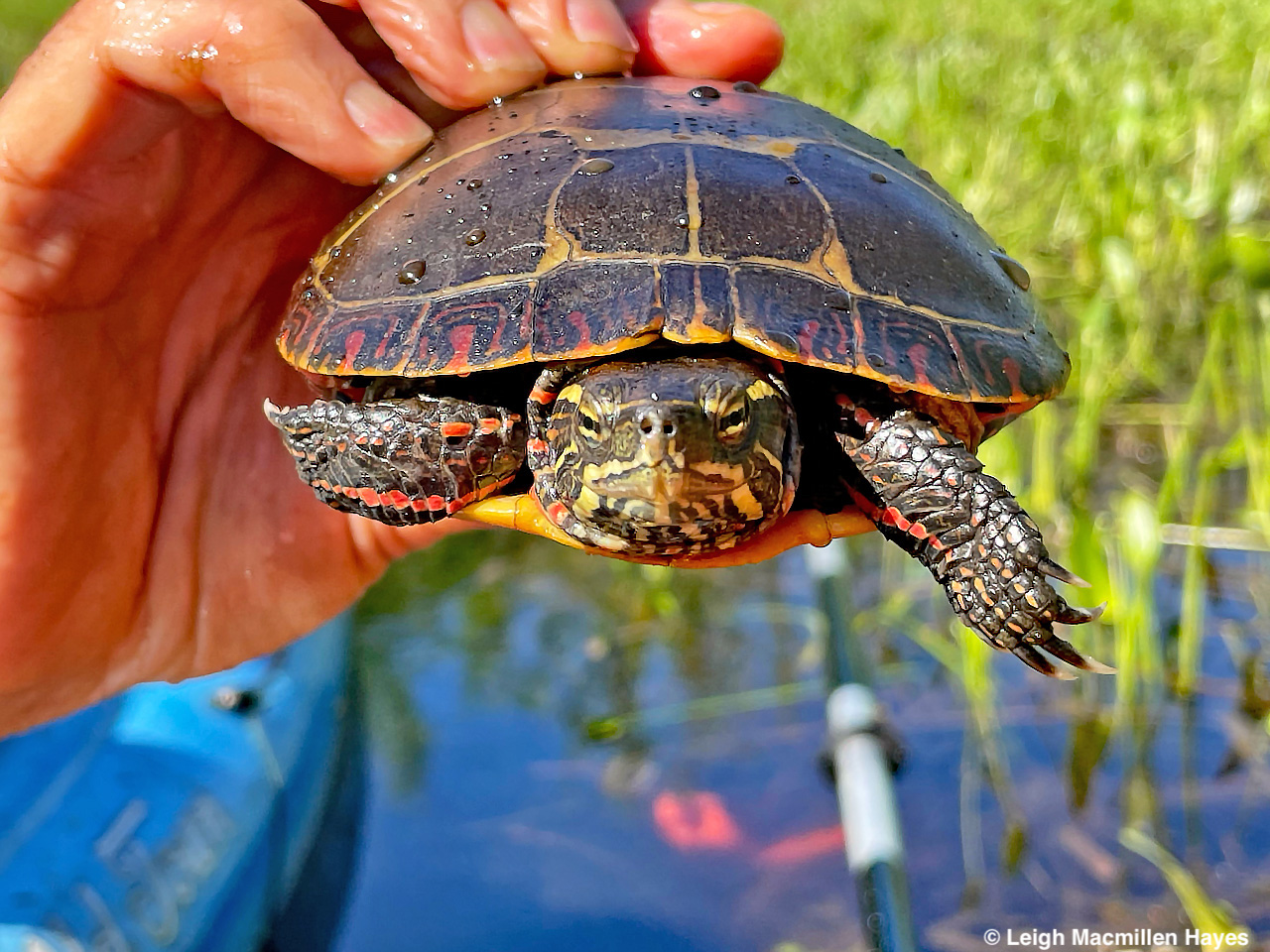
And despite the cooler morning temps that we’ve been experiencing, including lows in the mid-30˚s the past few days, or more likely, because of those temps, the Painted Turtles were still basking, soaking up the sun’s warmth. I love how they stick out their legs to absorb more warmth. It truly looks like a Yoga position, and I know this personally because along one of the trails we traveled in the past week, My Guy showed me several poses he’s learned recently. He also showed me those he struggles to perform.
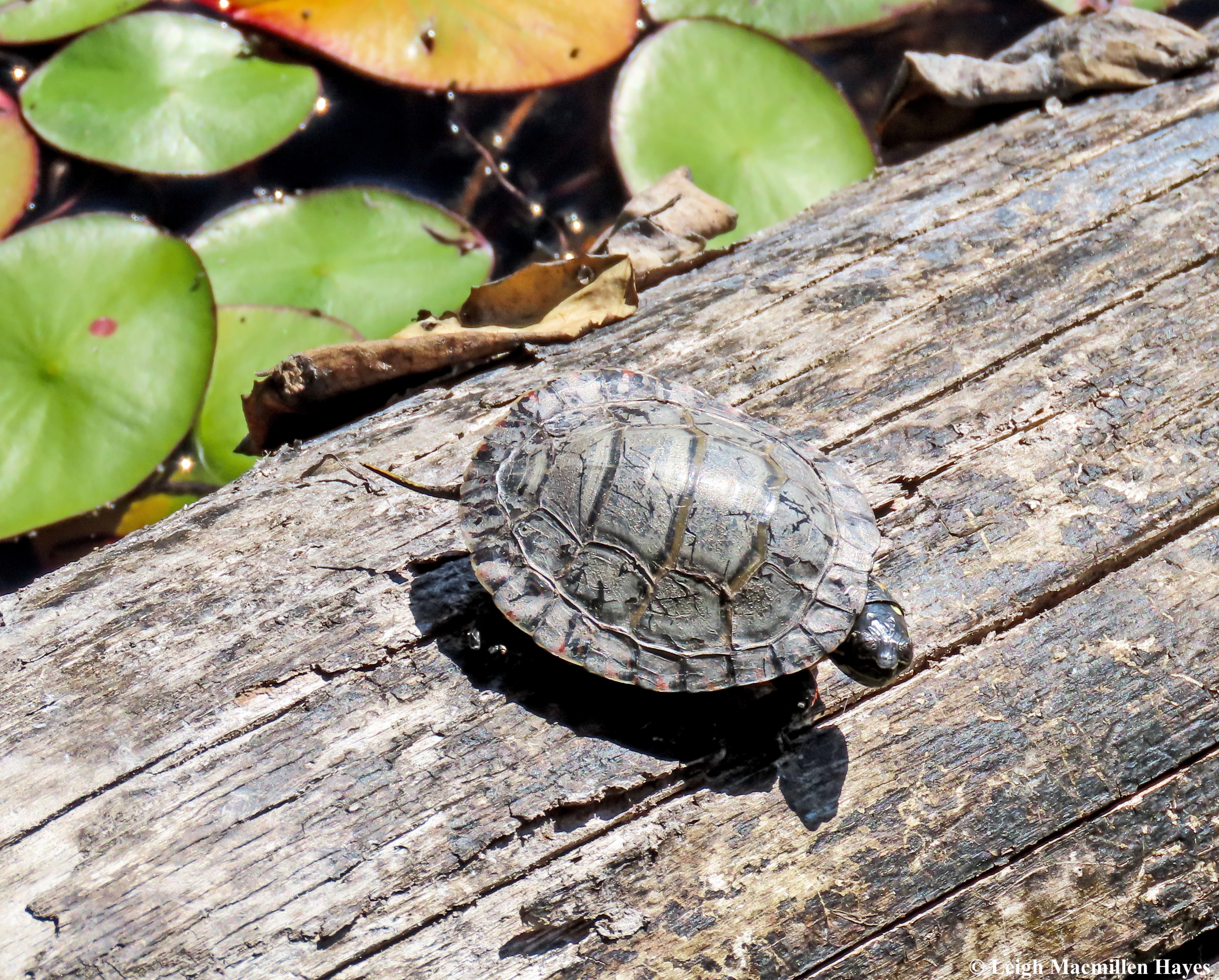
Not all turtles were of the same size, and this was a tiny one, who stayed on this log for at least two hours as we spotted it before we embarked on a bushwhack and it was still there when we returned, though it had changed its position. And gave me a wary look.
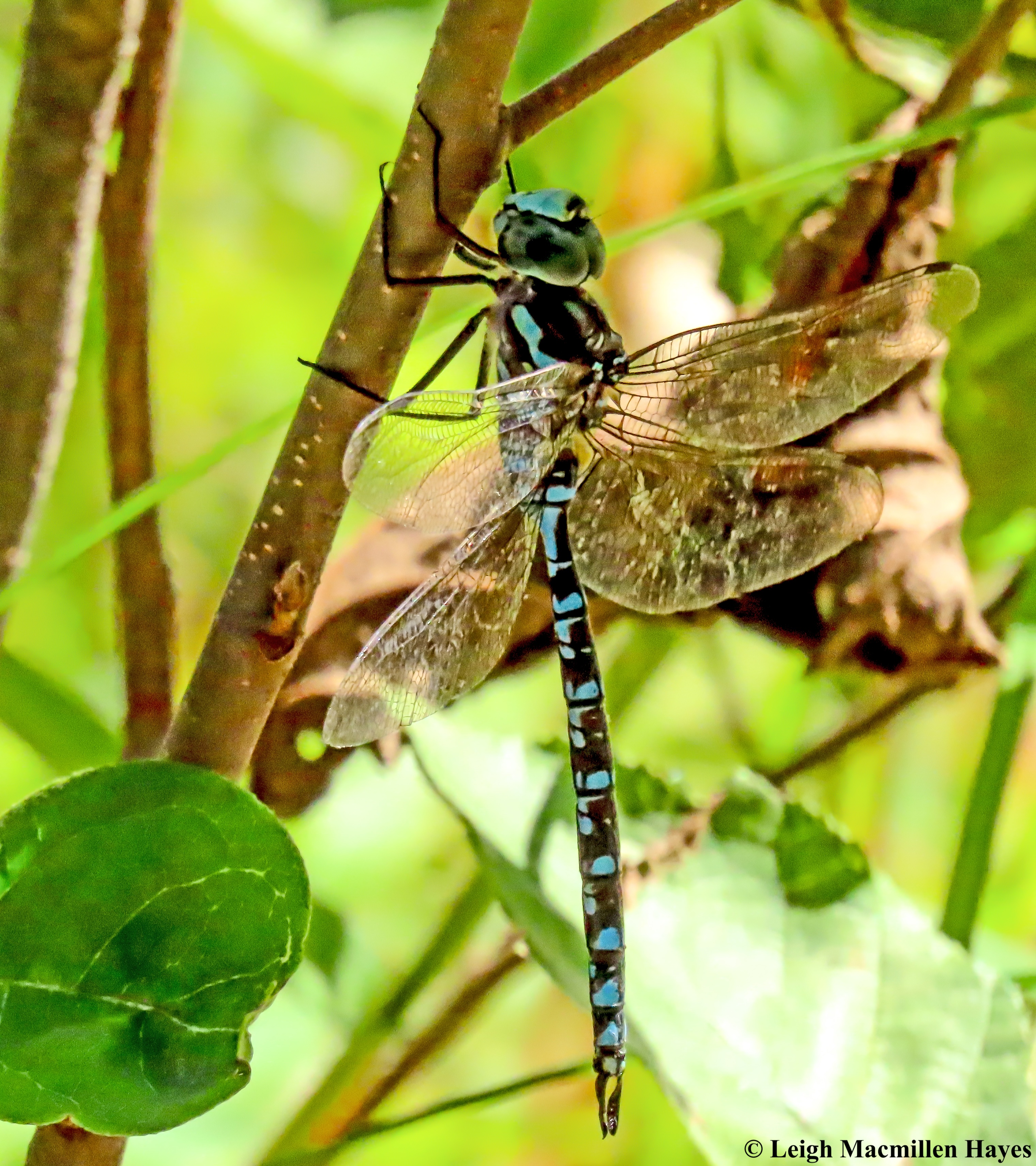
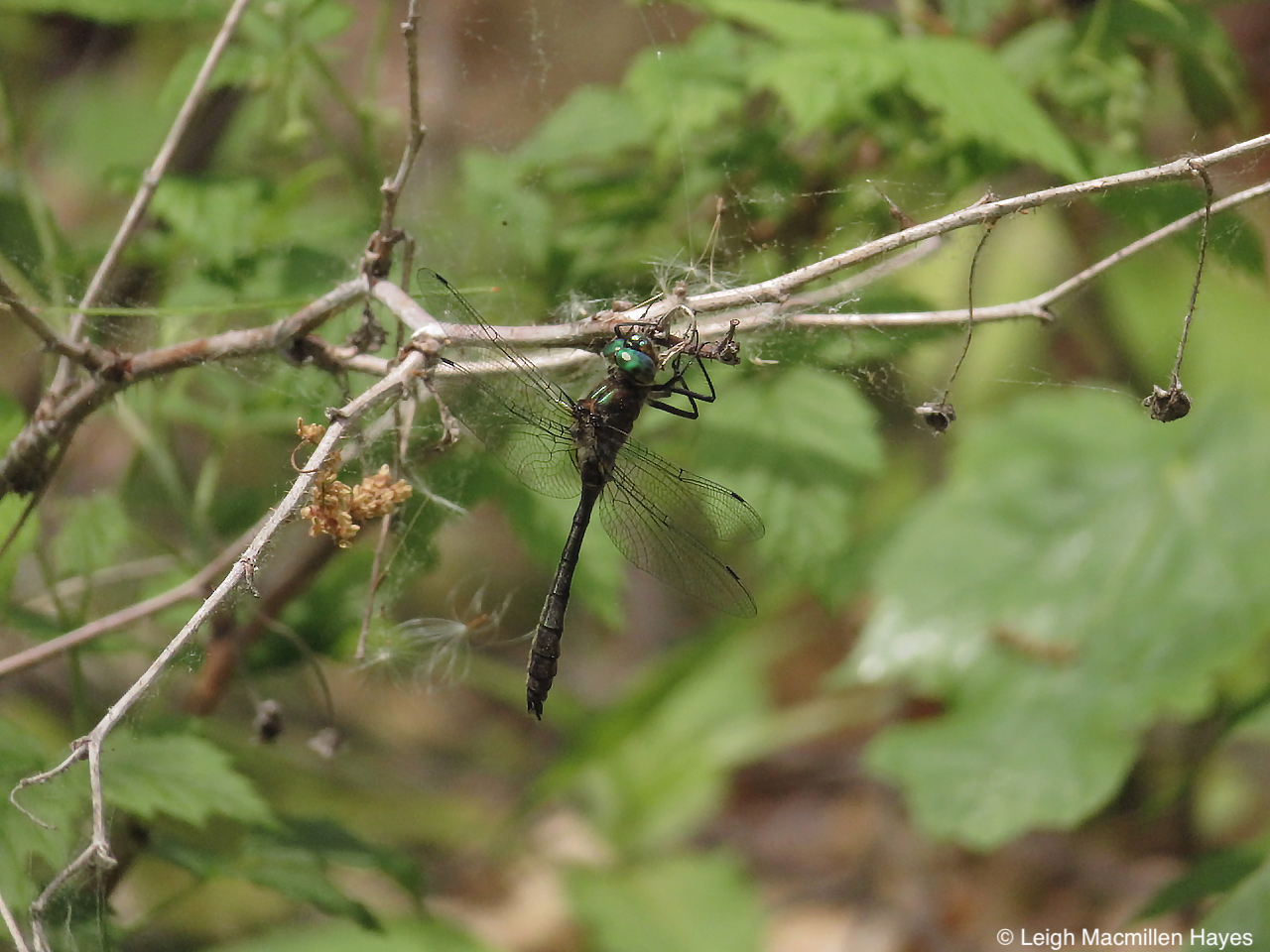
My Dragonfly fetish was also fulfilled for the Darners and Skimmers continue to fly and occasionally pause. Well, the Skimmers often pause, but the Darners are usually on the wing–patrolling territory while looking for a meal, and even more so, a mate. That’s why it’s always a moment of joy for me when one stops and my admiration kicks up a few notches. In fact, it’s the notch in the side thoratic markings that help with ID–in this case a Canada Darner. I’ve discovered this summer that they are numerous ’round these parts.
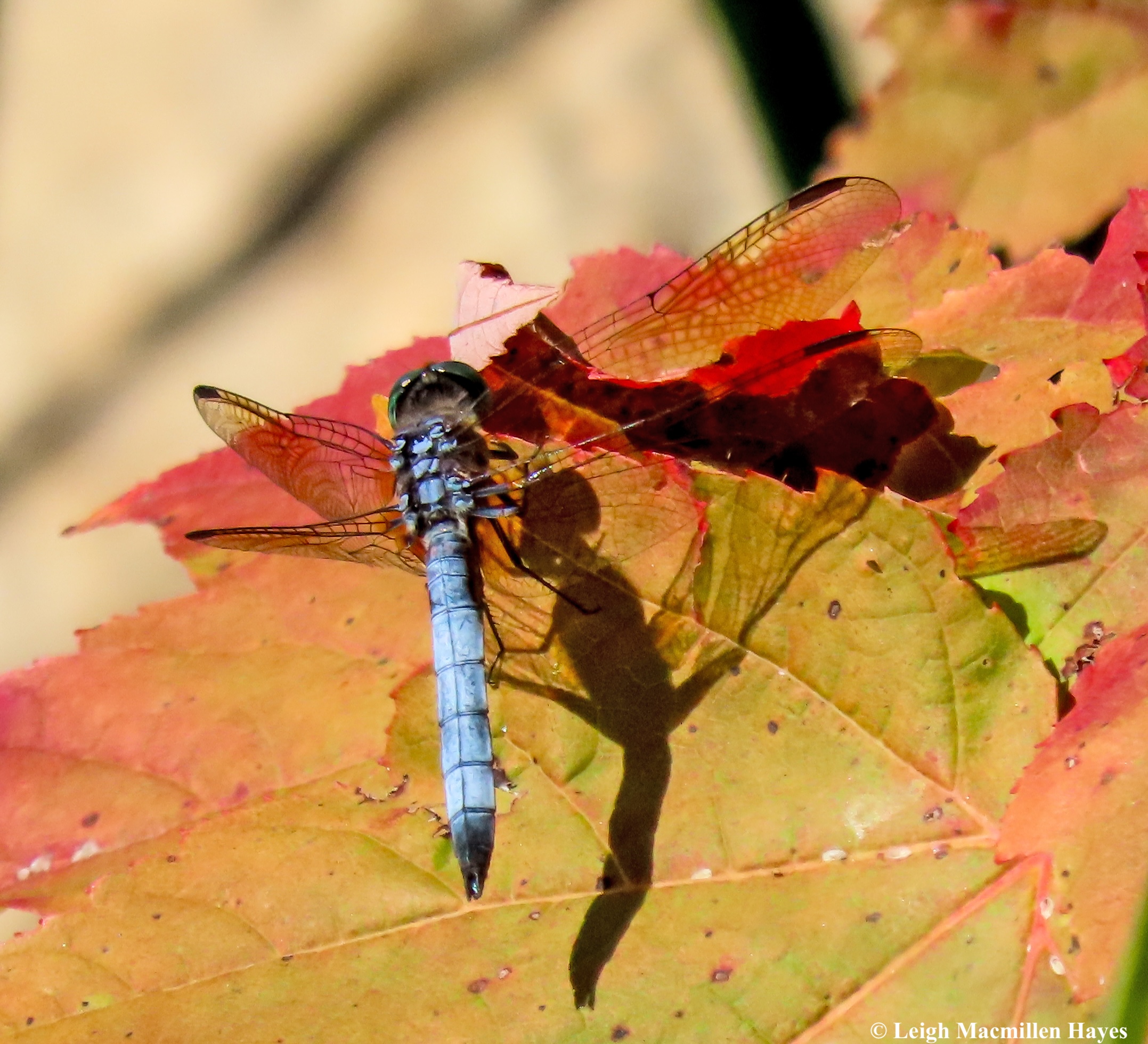
While the Darners are on the largish size in the dragonfly world, most of the Skimmers that are still flying are much smaller. The Blue Dasher, as this is, is probably considered medium in size.

What a display, no matter how big, with the blues and blacks and greens contrasting with the Red Maple leaf’s hues.

And then there’s the dragonfly’s shadow. It’s almost like it was a different creature.

My surprise was full of delight when I realized as I floated beside a Beaver Lodge, that I was watching female Amberwings deposit eggs into the water as they tapped their abdomens upon it. I rarely spot Amberwings, and yet they were so common in this spot.

And overlooking all the action, perhaps not only to defend its territory, but also to eat anything that got in the way, a Slaty Blue Skimmer, twice the size at least of the Amberwings and Blue Dasher.

Birds, too, were part of the scenery wherever we were. This Eastern Phoebe spent moments on end looking about, from one side to the other, and then in a flash, flew to some vegetation below, grabbed an invisible-to-me insect, and flew off.

Much to the surprise of both of us, despite the loud crackling of leaves and branches upon which we walked in one place, we didn’t scare all the Wood Ducks off, and enjoyed spending a few minutes with this Momma and Teenager. Usually, this species flies off before we spot them on the water.

Even the male hung out and when I suggested to My Guy that he look at it through the monocular, he was certain he really didn’t need to because he could see it without any aid. And then he did. And “Oh wow!” was the reaction. And I knew he’d finally seen a male Wood Duck–for the first time. And that moment will remain with me forever.

One of our other favorite moments occurred on our favorite pond, where we first spotted a Bald Eagle on a rock that the low water had exposed. And then it flew. As birds do.

And we followed it with our eyes, and watched it land above us in a White PIne.

And thus, we spent a good twenty minutes with it, admiring from our kayaks below.

The Bald Eagle was sighted not to far from our favorite Beaver City–where we know of at least five lodges located within a football field-sized area. And this one above had been abandoned for the last few years.

But fresh mud and fresh wood told us that someone was home. Probably more than one someones. We love the possibilities. The mudding is an important act–preparing for winter by coating the outside and closing up any holes or airways that might let cold air penetrate. Of course, the “smoke hole” at the top will remain, much like a chimney in our homes.

Just a Beaver channel and a hundred yards away, another of the five lodges also showed signs of winter preparation. It’s a busy neighborhood.
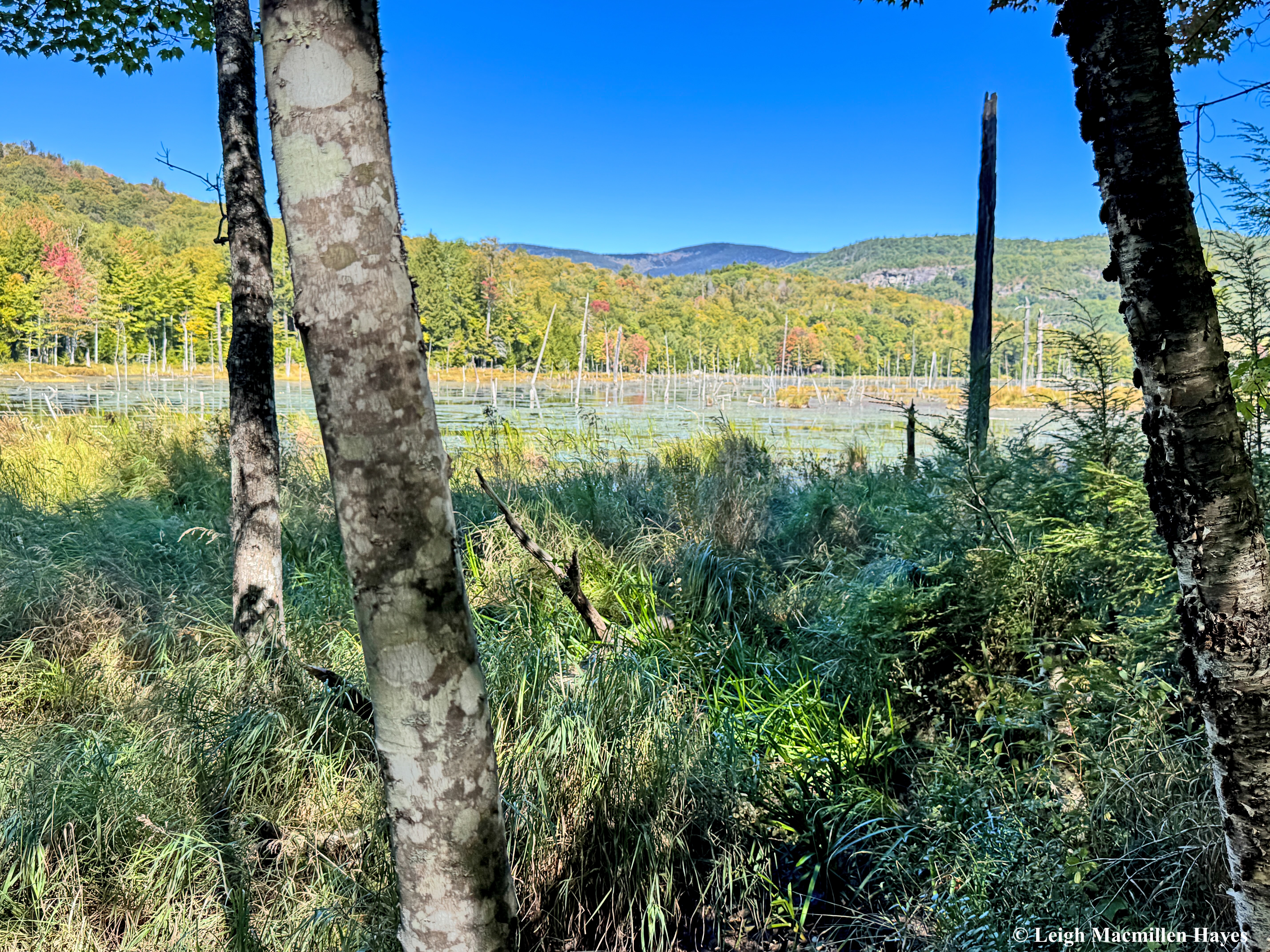
No matter where or how we traversed, one of the things that stood out to us is that despite the autumnal equinox being September 22 at 2:19pm. fall is already here thanks to the summer’s drought.

It’s usually mid-October when we begin to celebrate the color change–that time when Chlorophyll, the green pigment we associate with summer, and necessary for photosynthesis, slows and then stops manufacturing food, and the leaves go on strike.
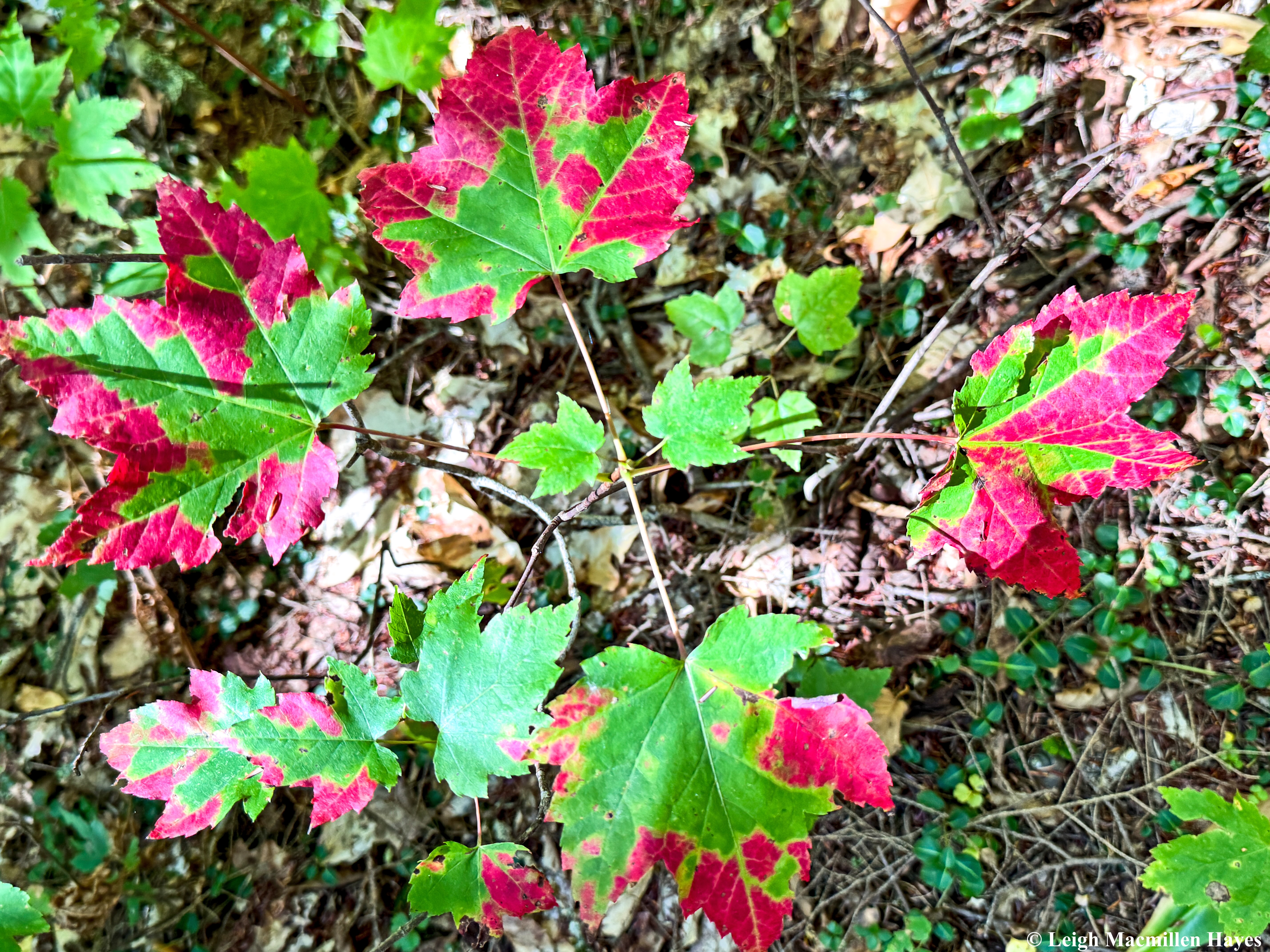
Veins that carried fluids via the xylem and phloem close off, trapping sugars, and promoting the production of anthocyanin, the red color we associate with Red Maples like these.

Tonight, as I finish writing, we are on the Cusp of Autumn, which is about seventeen hours away. But this year, I think it’s already here and if you have planned a fall foliage tour for mid-October I hope you won’t be too disappointed. I suspect we’ll not have many leaves left on the trees by that point.

But . . . maybe I’m wrong. There’s always that possibility.

No matter what–Happy Autumnal Equinox!

Senior College: Forever Students

We honestly weren’t sure anyone would sign up. Or show up.

Vernal Pools and Macroinverebrates
Leigh Macmillen Hayes and Dawn Wood
Friday, April, 25, May 2, 9, and 16th, 9:30 – 11:30 am
April 25: The Hidden Life of Vernal Pools
Discover the wonders of vernal pools—seasonal wetlands vital to forest ecosystems. Learn how wood frogs, salamanders, and fairy shrimp rely on them for breeding and why protecting these fragile habitats matters. Join us indoors at St. Peter’s Episcopal Church for this engaging workshop.
May 2: A Day at the Vernal Pool
Meet at Loon Echo Land Trust’s Raymond Community Forest, Conesca Road, Raymond. Walk ¼ mile to the vernal pool, where we’ll provide tools to explore its temporary residents and their unique ecosystem.
May 9: Meet the Macros
Ever wonder who lives in local streams? Join us to discover the tiny creatures that call them home! Dive into the world of macro-invertebrates—those fascinating “big bugs” without backbones—and learn how macros tell us about the health of the environment. This hands-on workshop will take place indoors at St. Peter’s Episcopal Church. 
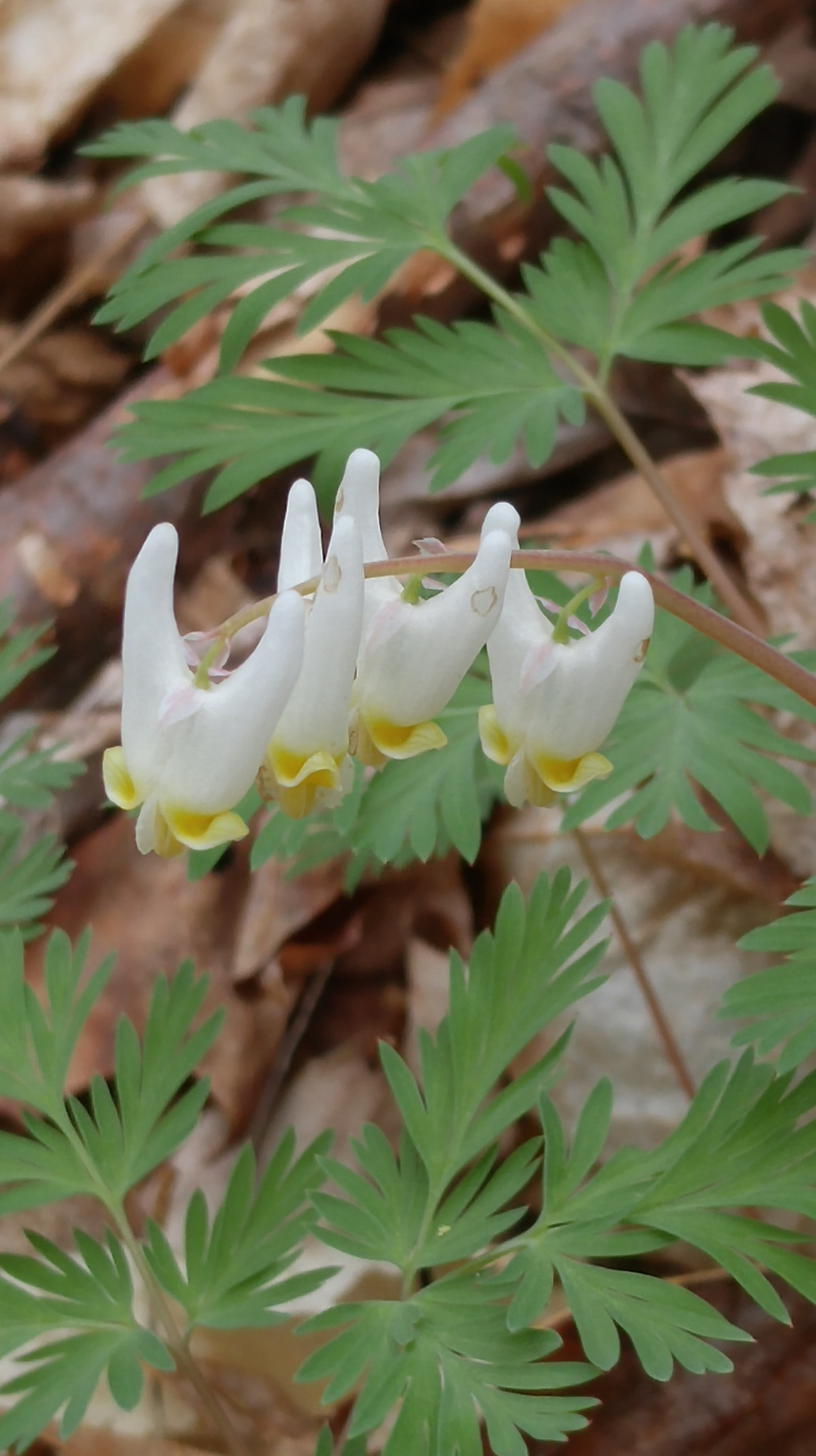
May 16: Macro-invertebrates Up Close
Explore the role of macro-invertebrates in stream health and the ecosystem. Join us for hands-on dipping and rock turning to assess water quality at Northwest River and Douglass Brook, Tiger Hill Community Forest, Sebago.
Maine Master Naturalists Leigh Macmillen Hayes and  Dawn Wood of Bridgton will lead these experiential classes. Both have a sense of wonder about the natural world and spend hours exploring only a few feet from a trailhead.

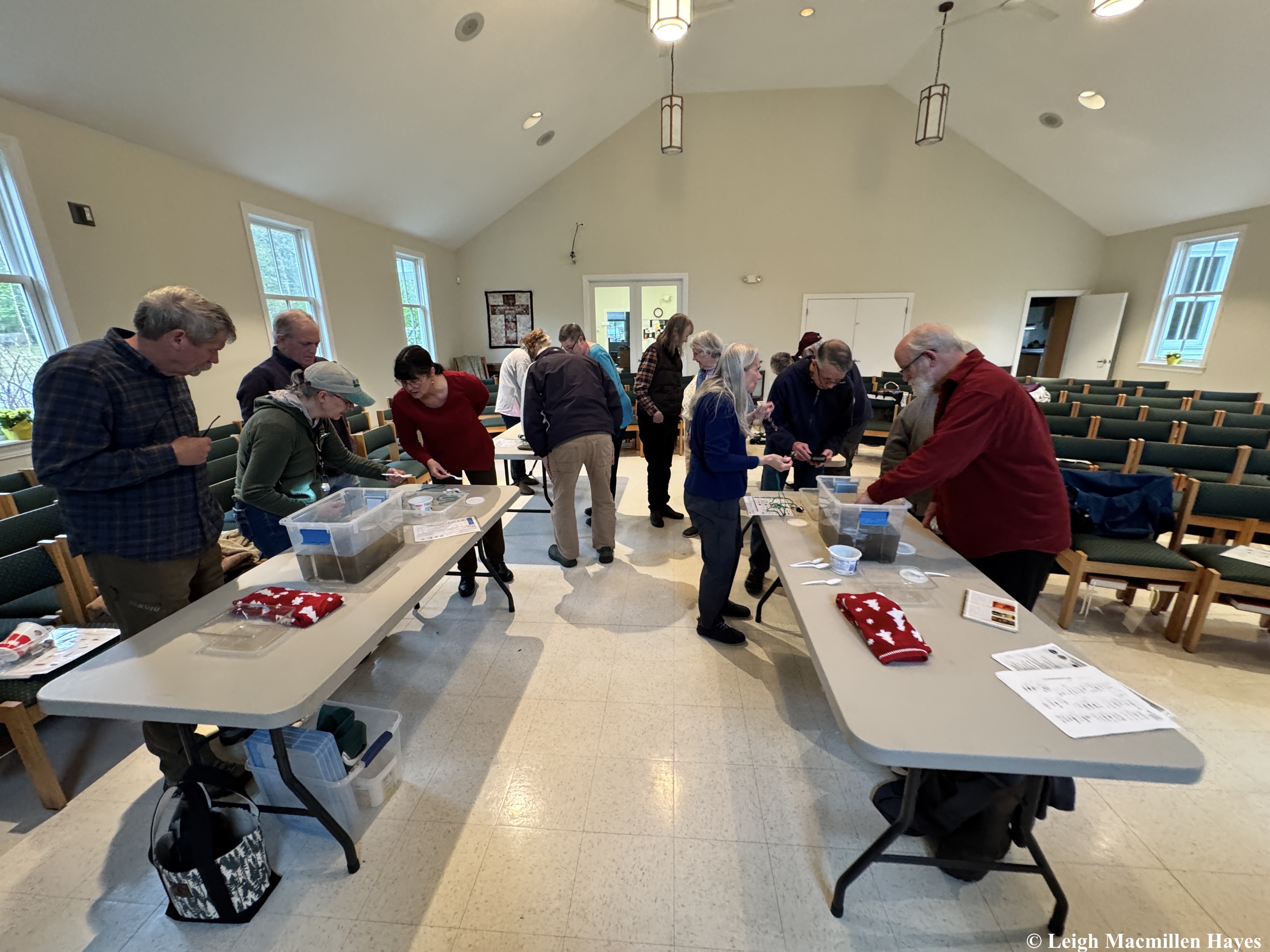
And then they did. Almost 30 of them. The first class, as you can see, was an indoor introduction to vernal pools where we shared our photographs, ID books, and models, and told stories about our experiences in these ephemeral habitats. Their questions were numerous and they shared stories as well, making it an even richer experience.

And then we ended with a musical treat since we knew that there was at least one conductor in the audience. As you click on the arrow to listen to the Springtime Chorus, remember that Wood Frog calls sound like “Wruck, wruck.” Spring Peepers: “Peep, peep, peep.” Green Frogs: “Ga-dunk, ga-dunk.” And Bullfrogs: “Jug-a-rum, jug-a-rum.”

Thank you, Jan, for leading this, and thank you to everyone for participating so willingly.

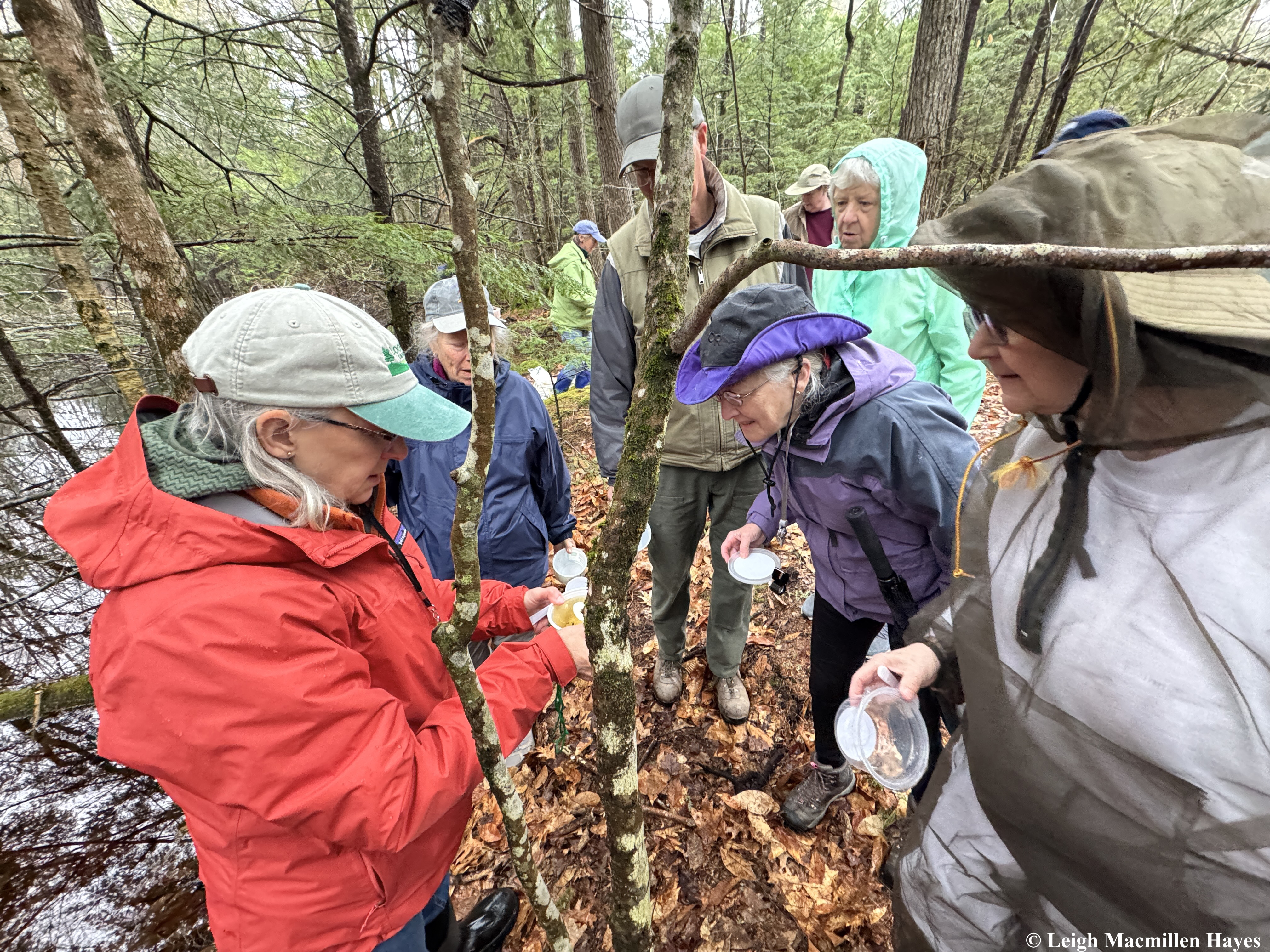
The following Friday we awoke to rain and again we were sure no one would show up. BUT . . . that did not stop them and we slowly snaked through the forest on our way to the vernal pool.

Of course, we all suffer from that most wonderful of syndromes: Nature Distraction Disorder (NDD), and the summer grape that grows along the Grapes Expectations Trail at Raymond Community Forest was the first thing to draw our attention.

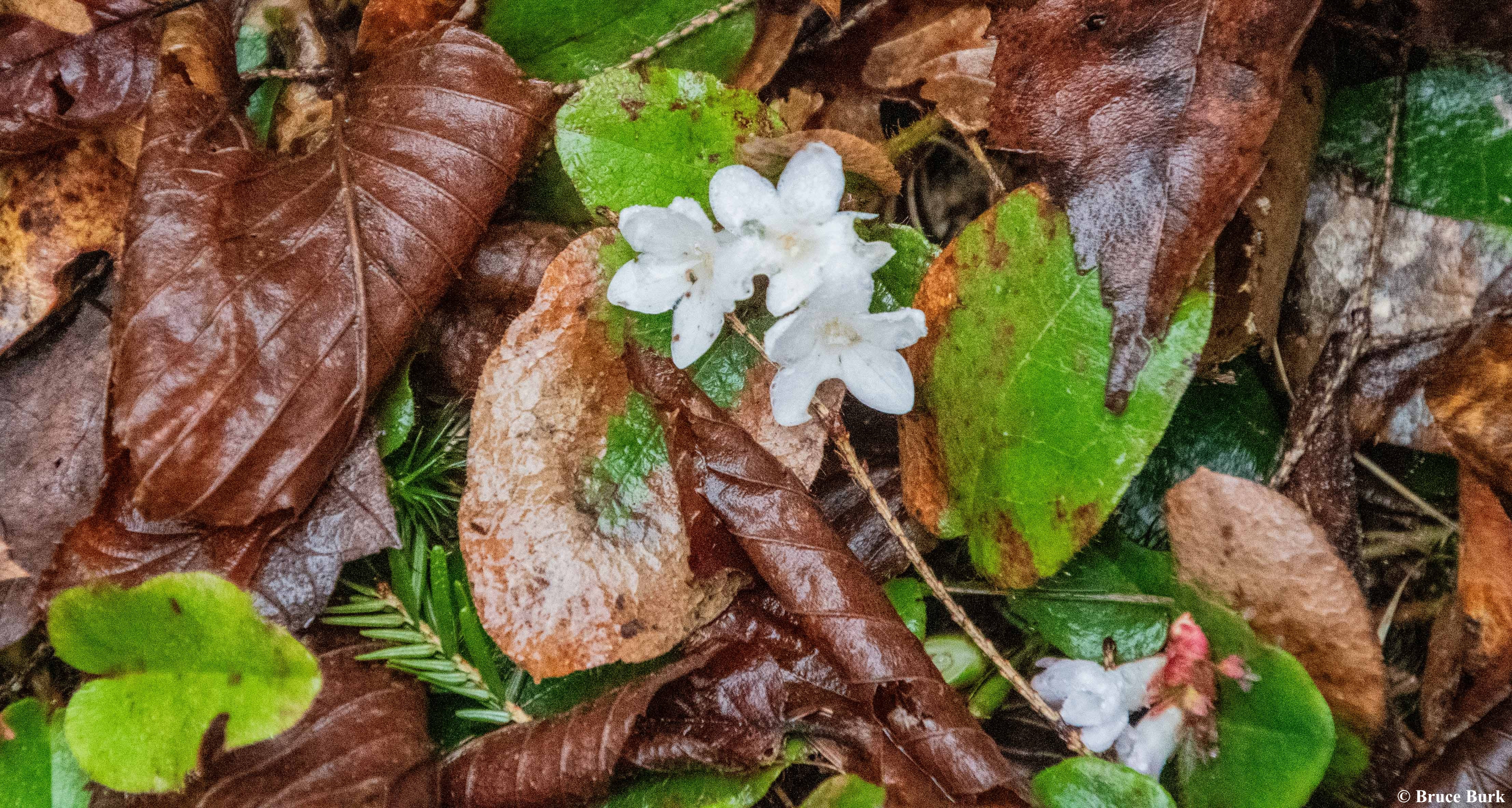
Trailing Arbutus with its sweet little flowers also caused us to pause.

At last we reached the pool and because the sky was overcast and some raindrops and mist fell, we couldn’t see into the pool very well, especially to admire the egg masses deposited by Wood Frogs and Spotted Salamanders. But . . . we could dip.

And within a few minutes the prize of the day was discovered and everyone came to take a peek at what Dawn had found.

Soon one Fairy Shrimp (just enough to make the pool significant by Maine standards) was followed by multiple more. This particular one happens to be a female with a full brood sac at the top of her abdomen.

I’ve said this before, but it’s worth mentioning again and again:

40 Wood Frog egg masses make a pool significant; OR 20 Spotted Salamander egg masses; OR 10 Blue Spotted or Jefferson Salamander egg masses; OR a single, yes one, Fairy Shrimp.

Fairy Shrimp are cool because in order for eggs to be viable, the pool must dry out. And they can survive being dry for multiple years. And in any given year, not all eggs will hatch, thus saving some in the bank for another year or ten.

Our other finds that day include Phantom Midges–with inner workings visible through the translucent body.

And Predaceous Diving Beetle larva, plus . . .

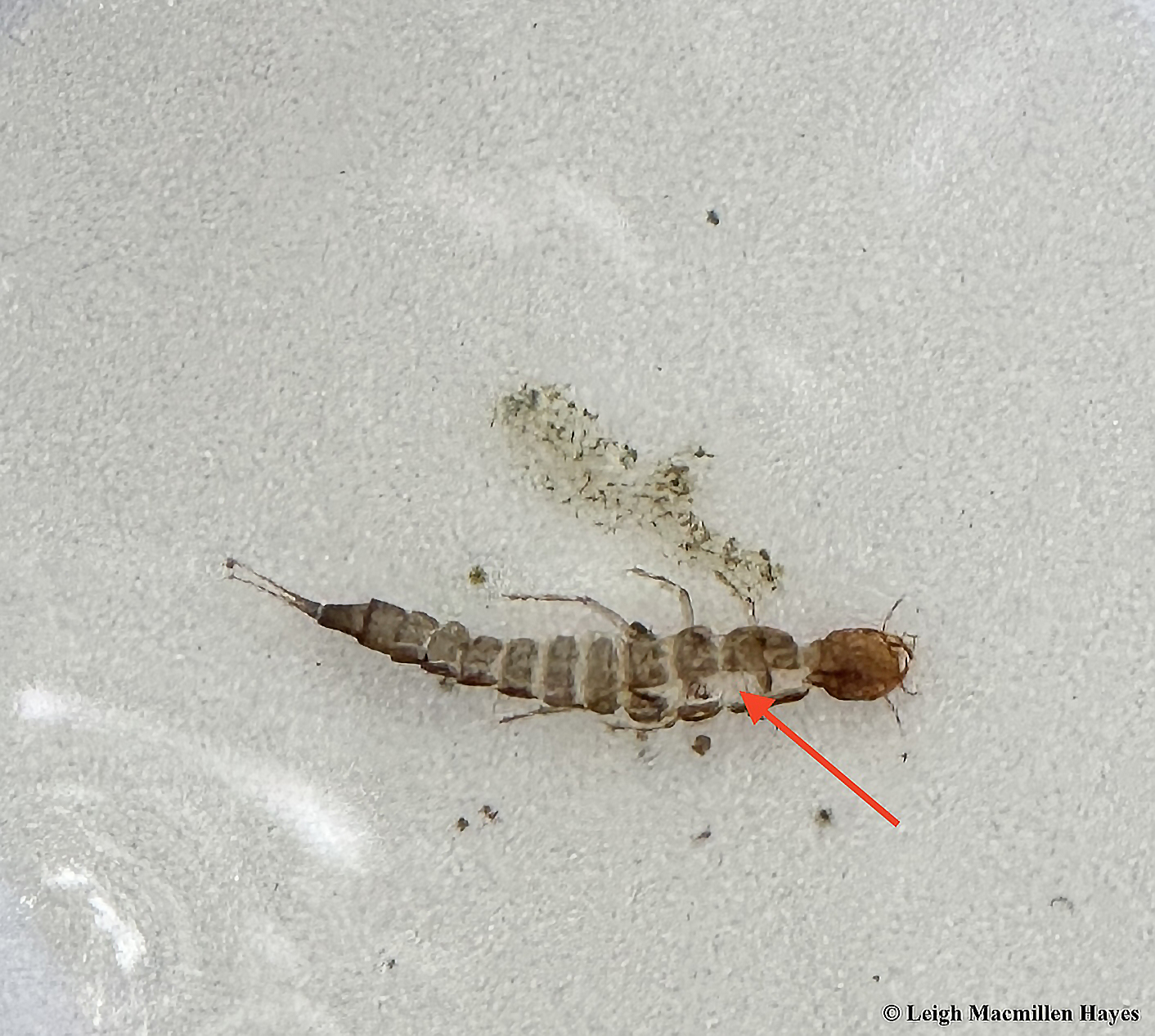
the shed skin of a PDB, with a split where the wings of the adult emerged first and then the rest of the body squeezed out through that slit that the arrow indicates.

This is the adult, with an air bubble on its back end; and if you look closely, you may see a few Mosquito Wrigglers twisting and turning in the photo as well.

We always remind everyone that all larval forms must go back into the pool or stream or whatever waterbody, because in the whole scheme of things, everything is important.

I laugh when I look at this photo because as a youngster, my brother always noted that my mouth was always open in pictures–apparently he thought I talked too much.

But obviously, on this Friday I was waxing poetic about something.

Before we left the pool that day, the students had a surprise for us. The previous week I had pulled out a party noisemaker and reminded those who had attended our winter class on insects that it served as a great tool to illustrate how a butterfly or moth proboscis (mouth part) curls up in flight, but upon a flower, they extend it to reach the nectar. Turn the noisemaker over, however, and suddenly you have a frog tongue–as they snap it out to capture an insect.

And tada, unbeknownst to us, everyone was suddenly a frog. Heck, if we were going to make them perform in the frog chorus, then they might as well be frogs. It was awesome. And yes, they did perform in the chorus once again, after which we left the pool and headed home.

Week three found us back at the church, where we began with a slide show about Benthic Macro-invertebrates.

Benthic: Living at the bottom of a body of water (stream, river, pond)

Macro: Large enough to be seen with the naked eye

Invertebrate: Animal without a backbone

Macro-invertebrate: Large, water dwelling animal able to be seen with the naked eye.

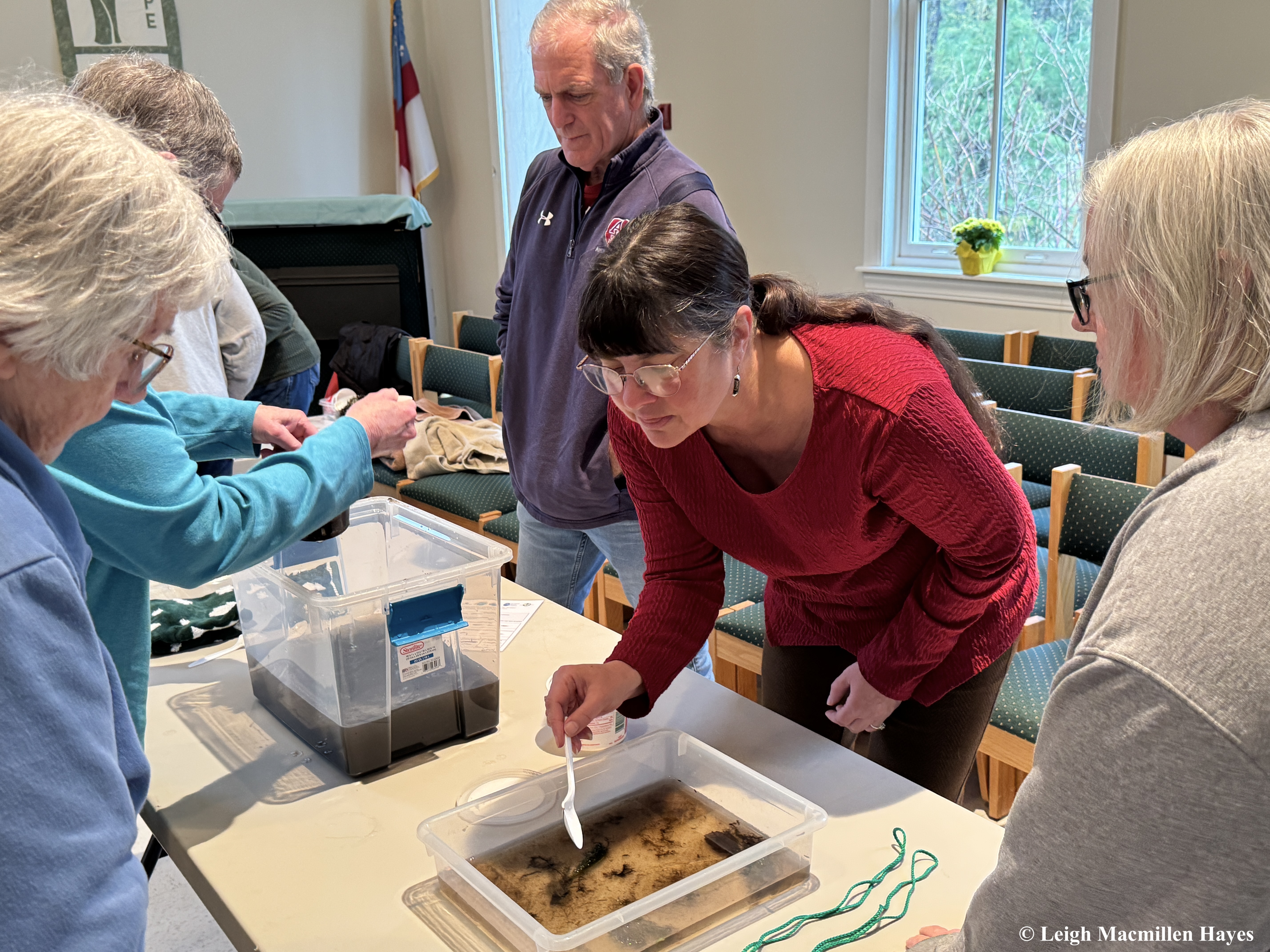
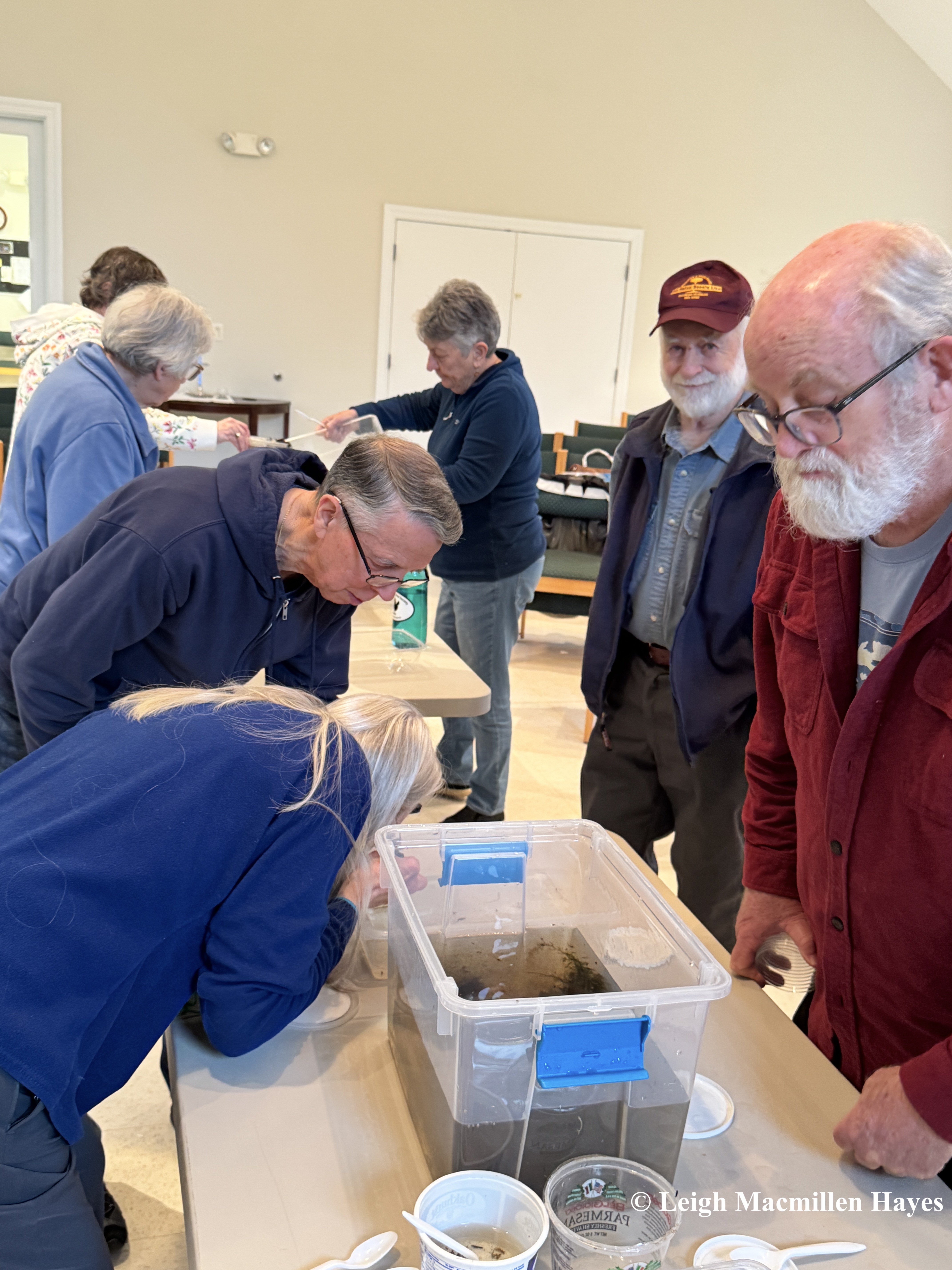
Prior to the class, Dawn and I spent an hour or so trudging to and fro a local wetland to retrieve containers of water so that after the initial presentation, the students could take a look–up close and personal, in the comfort of a building. (Never fear: all critters were safely released in the same spot where we captured them with our D-nets)

They started starring into the water and began to notice movement. And then, using spoons and small containers and lids, all recycled, they were able to glimpse the wonders of the water.

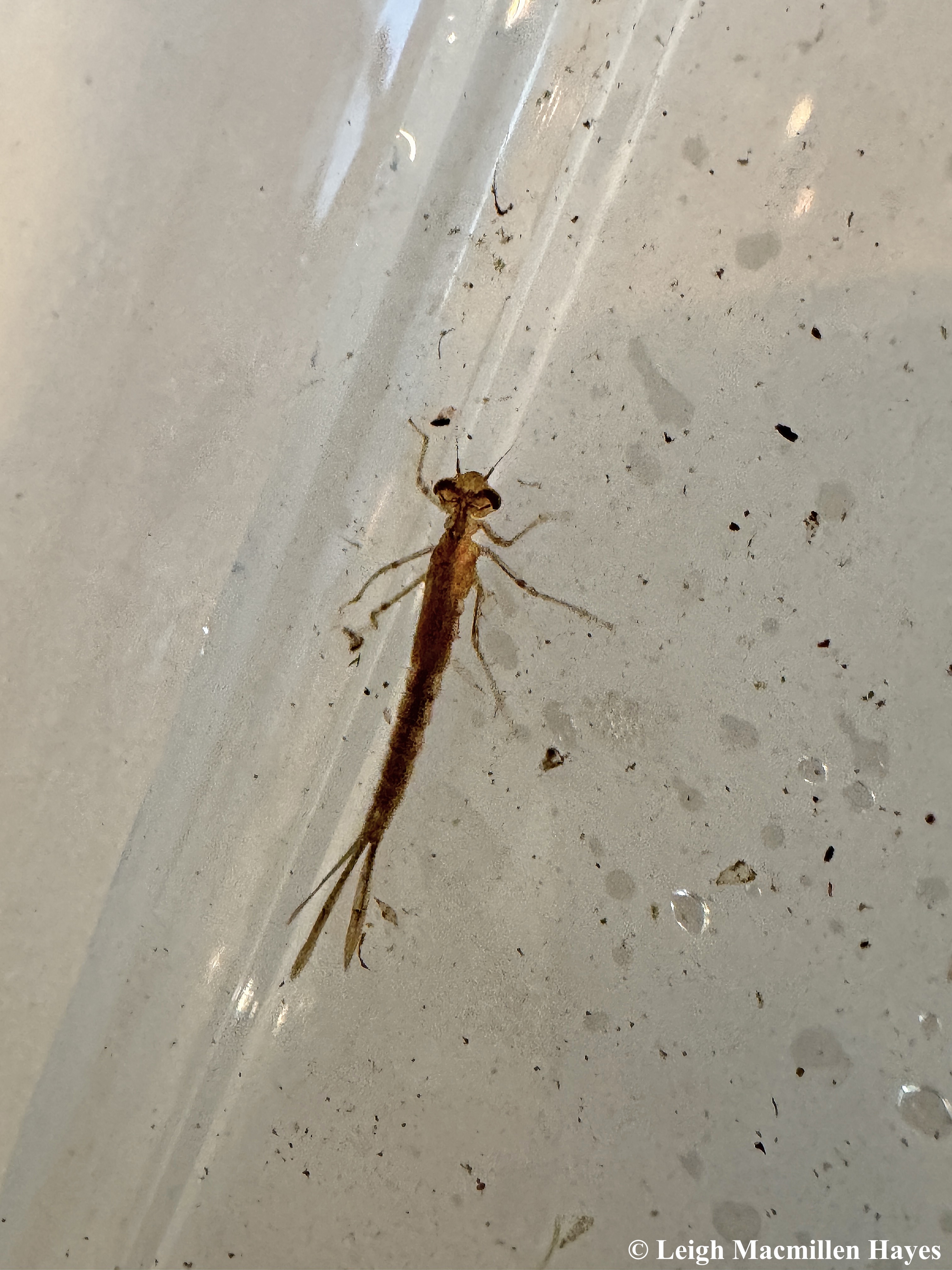
One of the favorite finds was the larval form of a damselfly, with three paddle-shaped tails that serve as gills.

The critters love to hide under the leaves and muck that we’d pulled up so sometimes it took a few moments to wait for the water to settle before spotting something moving.

But they did. And with the use of loupes on lanyards that we borrowed from Loon Echo Land Trust, they found Mayflies and Damselflies and Dragonflies and Backswimmers and more.

Finally, today dawned. The forecast kept changing all week, so we were pleasantly surprised by the sun. That said, you know those Mosquito larvae we always encourage everyone to save? Well, they are hatching. But, just as for the rain, everyone was prepared.

Oh, and yes, another moment of NDD hit us only a hundred feet from the parking lot. We love mud.

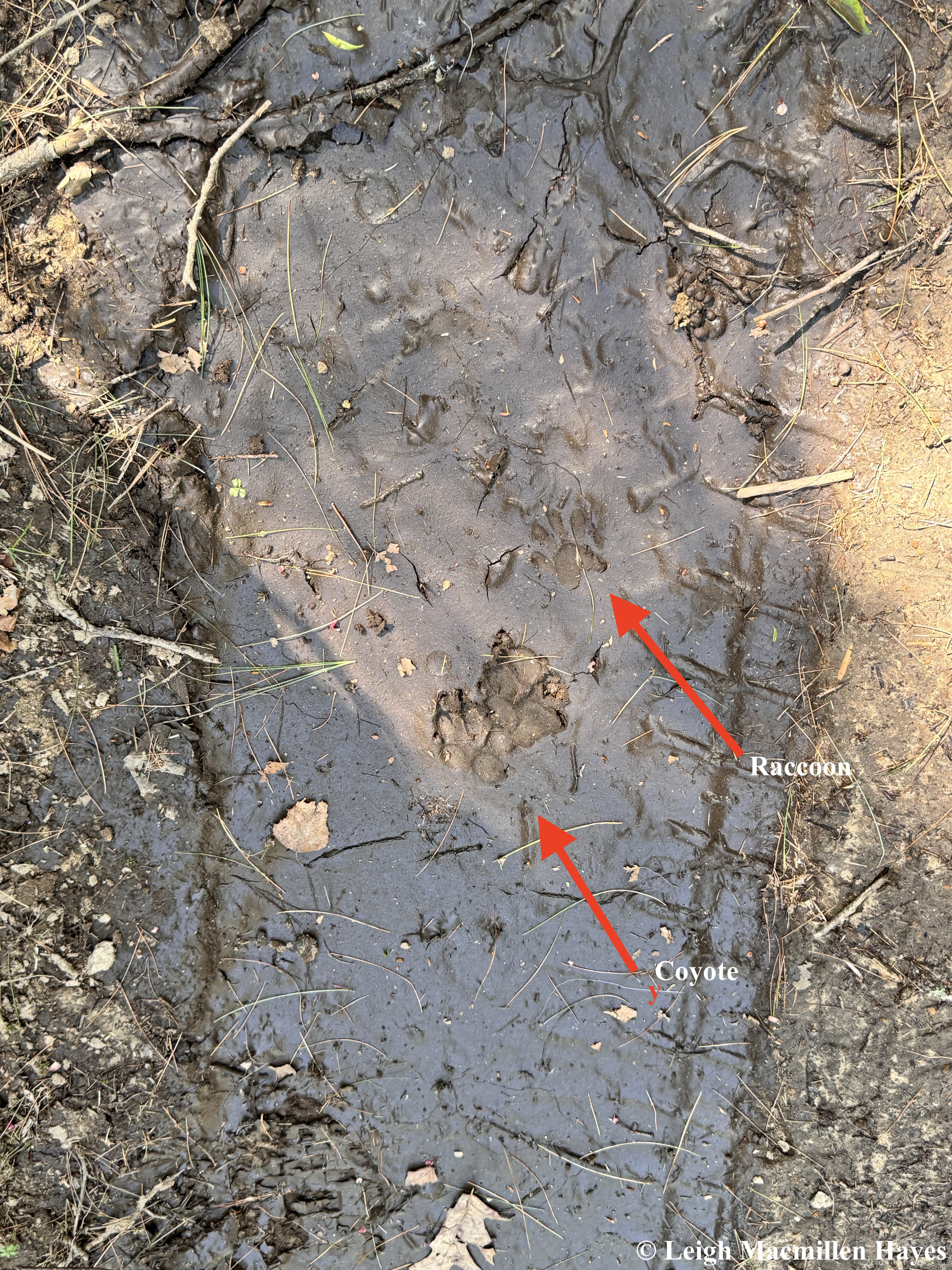
Especially when it tells us who passed this way during the night. In this case, it was two critters: a Coyote and a Raccoon. If we can’t have snow, mud is great. In many ways, it’s even better than snow for the prints are much crisper and easier to read. (Don’t tell the snow I said that. Ever. If you do, I’ll deny it.)

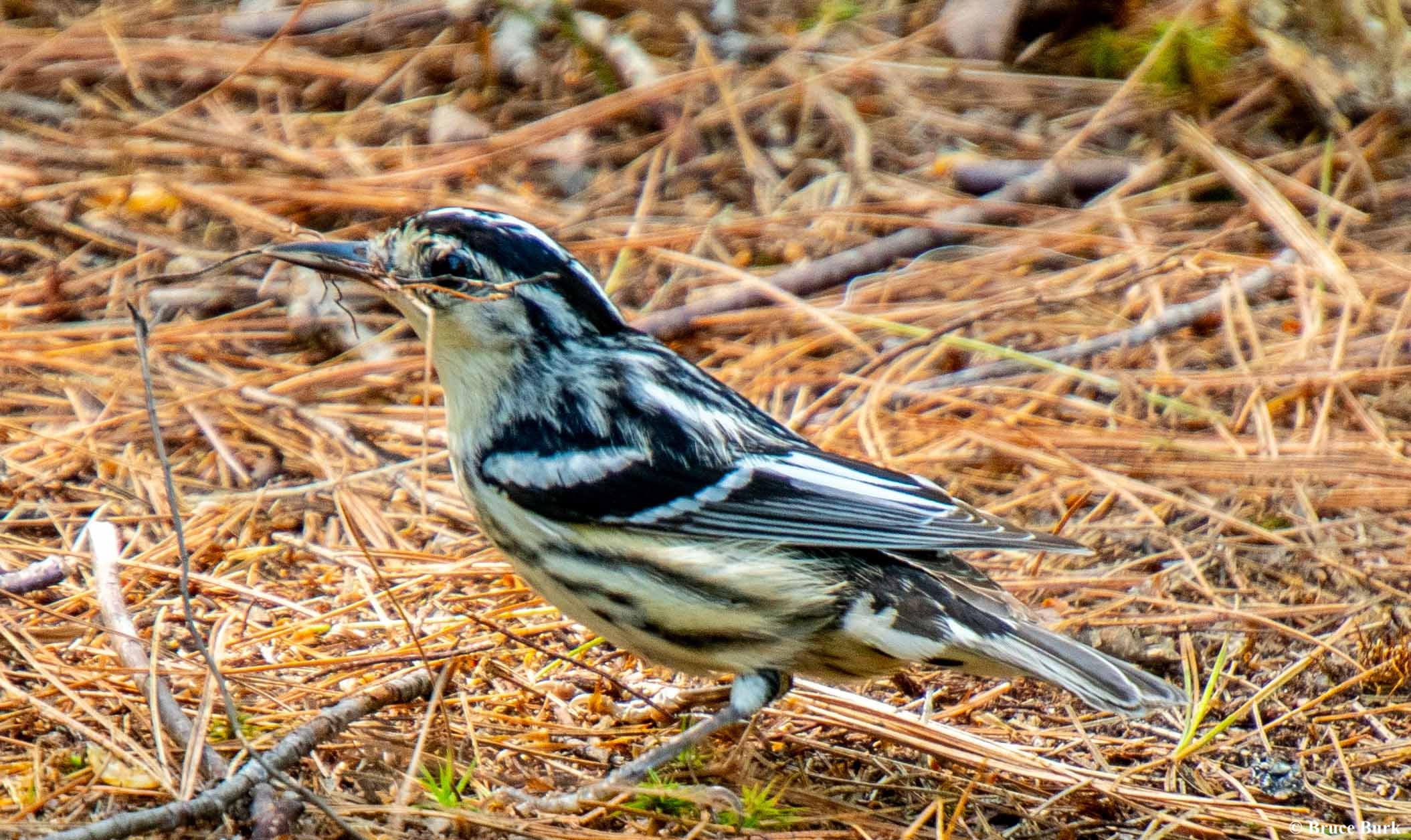
But . . . we had a mission and a time frame. The Black and White Warbler didn’t care. Apparently, we had entered its territory and despite our presence, it went right on collecting nesting material.

When nature surprises us with these moments, I always feel we’ve been blessed to be witnesses.

Finally, it was time to dip the D-nets into the river.

We’d placed a few tables near it so everyone could take a look without risking going into the water. Plus, the trail to the water is narrow and once we realized the bird was building a nest there, it made it even more important that we not spend too much time.

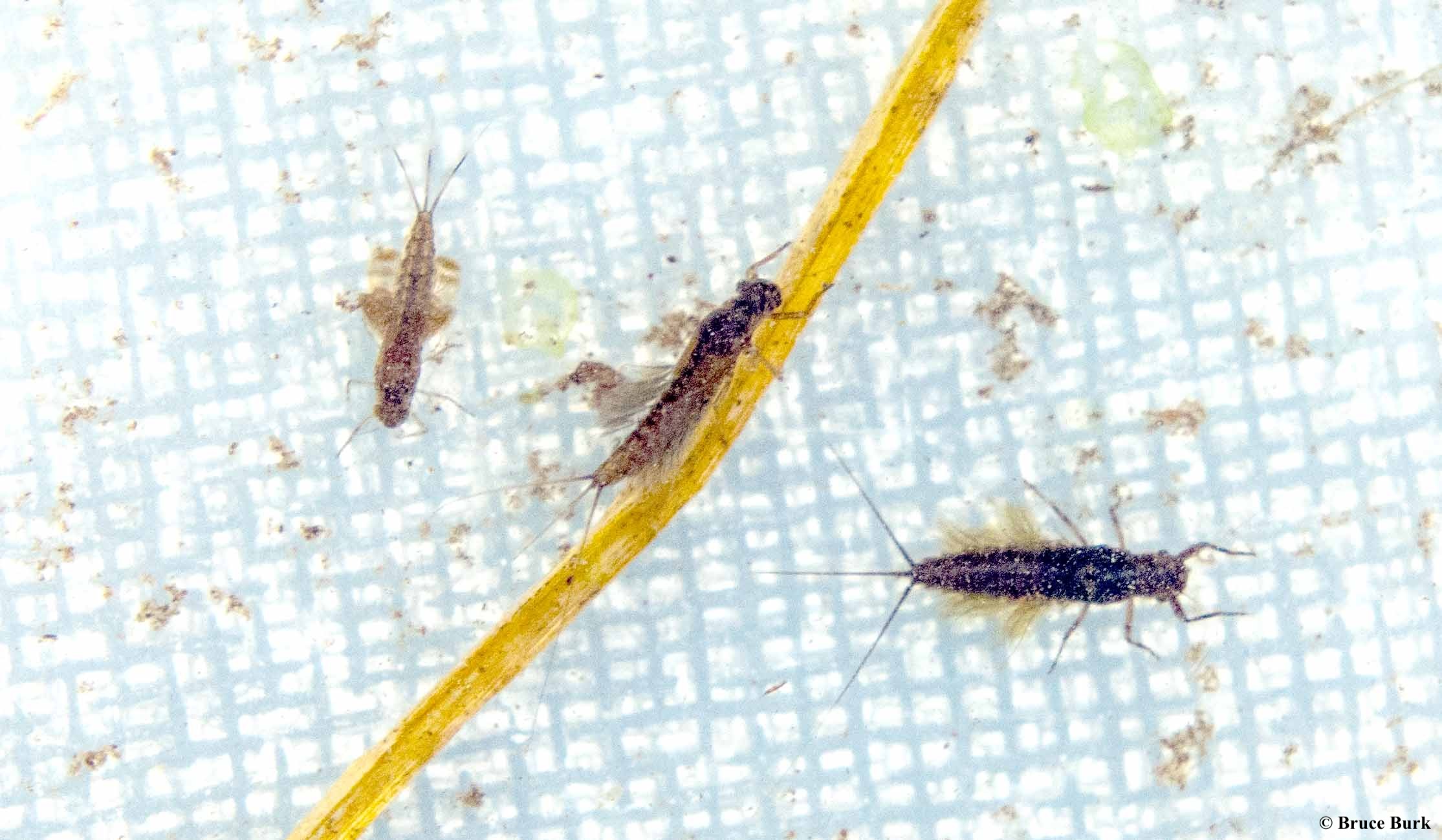
The most prolific finds of the day: Mayfly larvae.

There are so many types of Mayflies as everyone soon realized. What I love about them: their feathery gills on the sides of their abdomens, and the three long tails that most feature, which they even had as adults, probably helping with balance for one thing.

Again, it was an enthusiastic crew and any time something interesting was discovered, all wanted a chance to see.

We had a damselfly that at first I thought was a Water Scorpion because the three shorter tails were held together so that they looked almost like the tubes at the end of the abdomen, but then I took a better look and realized that they weren’t elongated and in every other way, it had damselfly written all over its head and body.

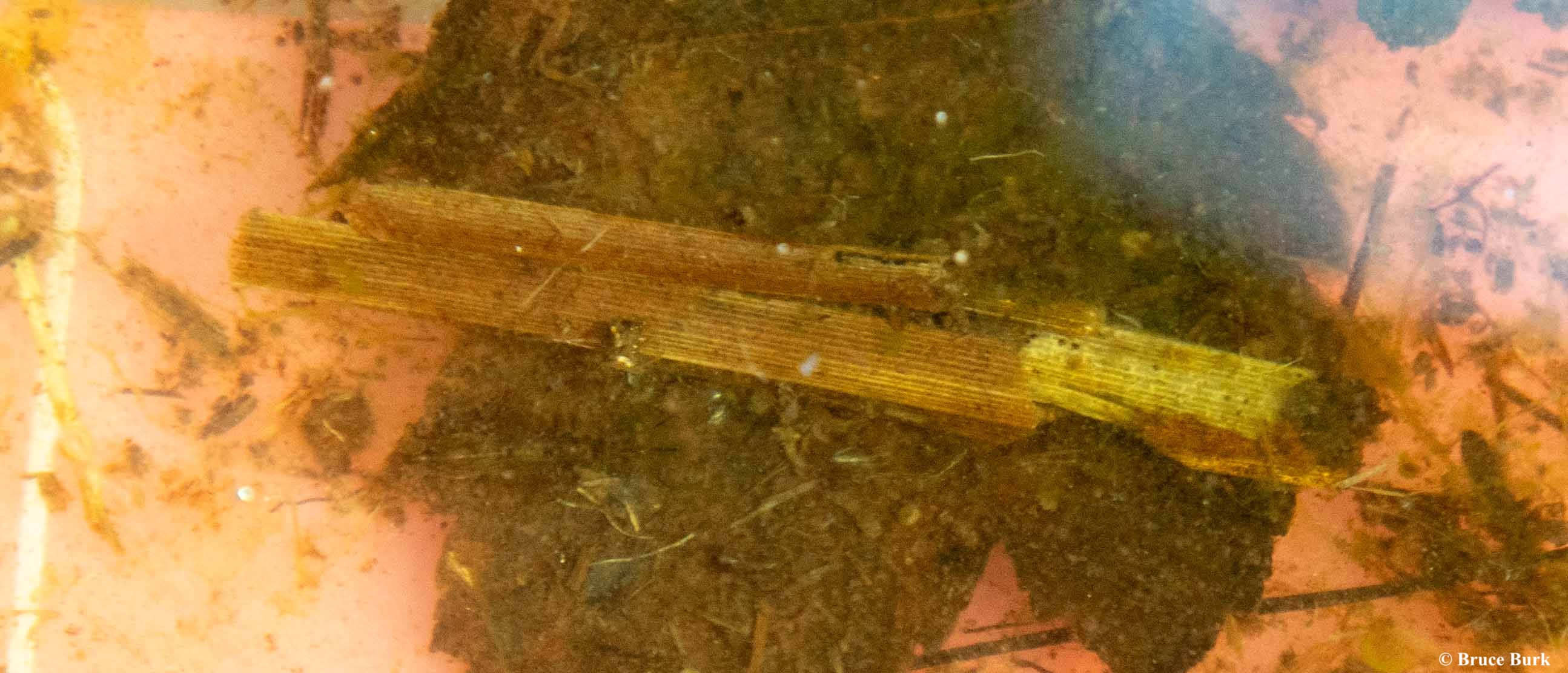
Caddisfly larvae also entertained us and we found a Northern Case Maker, plus . . .

what might have been a Giant Case Maker, who built its home from the broken off tube of vegetation.

Everyone was fascinated, but we had one more stop to make so eventually we had to pack up shop in this location and move down the road to another trail.

Another NDD moment happened as we walked beside a vernal pool where we could not only spot Spotted Salamander egg masses, but also these of the Wood Frog variety, and tons of tadpoles feeding on the green algae. It actually created a full circle from our first classes about vernal pools.

A Pickerel Frog also caught our attention and delight. Bruce caught an amazing photo of the underside of its rear thighs–with the yellowish coloration. Both Pickerel Frogs and Northern Leopard Frogs have spots, but one of the defining differences is the yellow, or sometimes orange color that you see here.

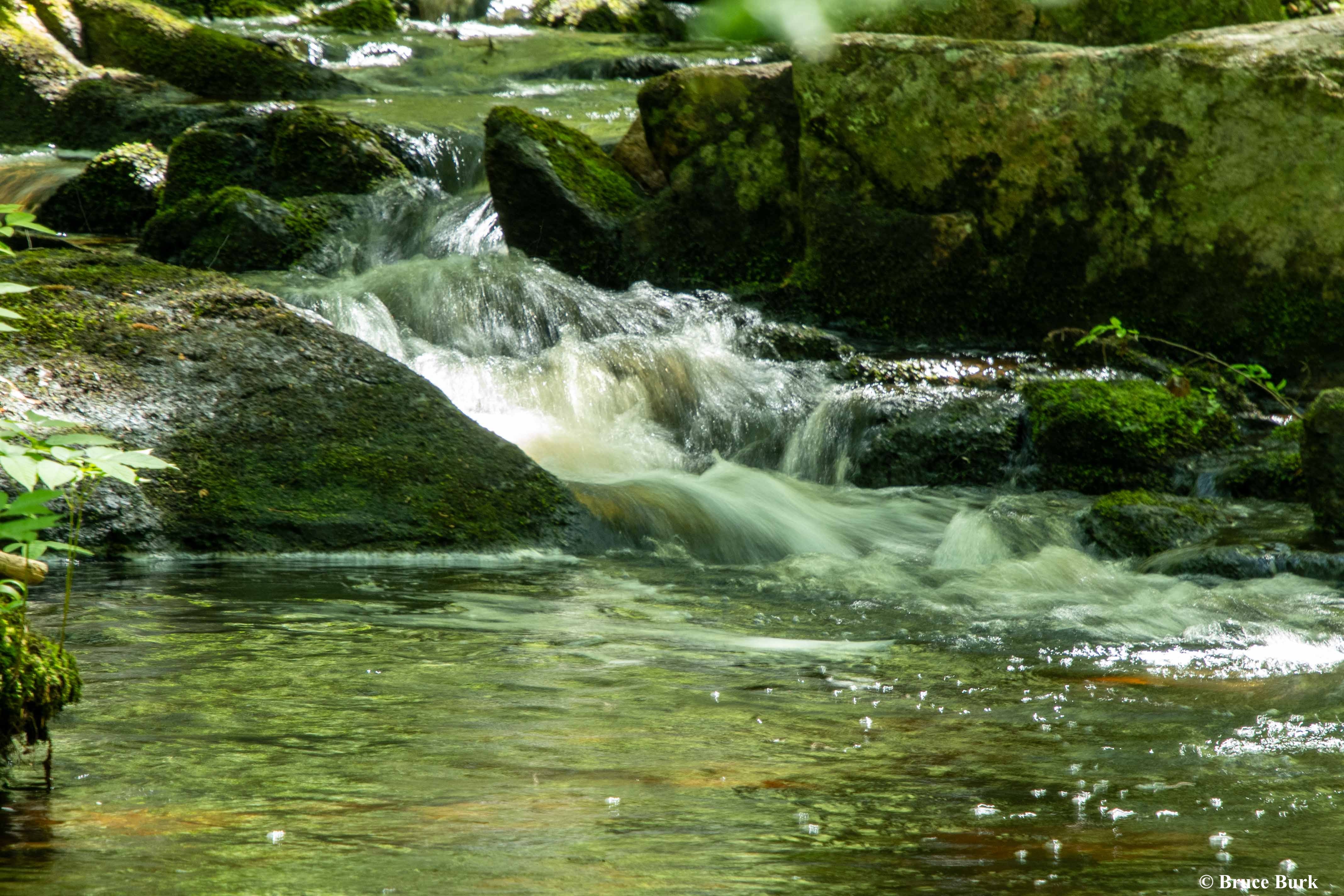
Our final destination was Douglass Brook, where the water flowed faster than it did in the section of the river where we had dipped only a half hour earlier.

Our reason for this location was because it has lots of rocks and we wanted everyone to see how some critters use them as places to cling.

So once again, we took an up close and personal look.

And scooped up anything we could find.

Including Black Fly larva which like fast-flowing water. I think folks were not quite as keen on saving every little critter given how many Mosquitoes swarmed us, but still they did.

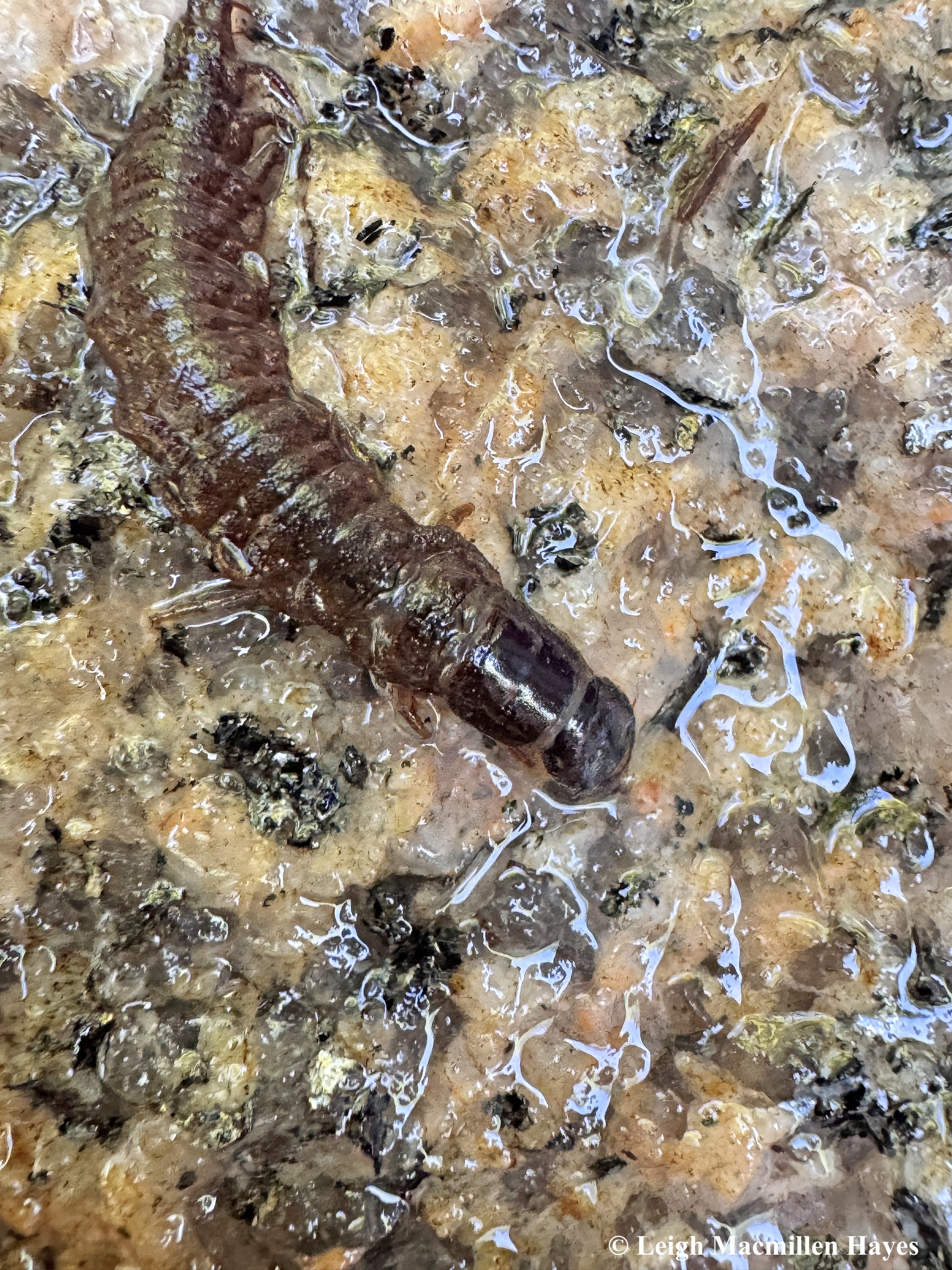
We also found a Dobsonfly Larva, aka Hellgrammite, who prefer the fast flowing water and hold onto rocks with strong claws on their legs, or so I read in A Guide to Common Freshwater Invertebrates of North America, and that’s exactly what this one did.

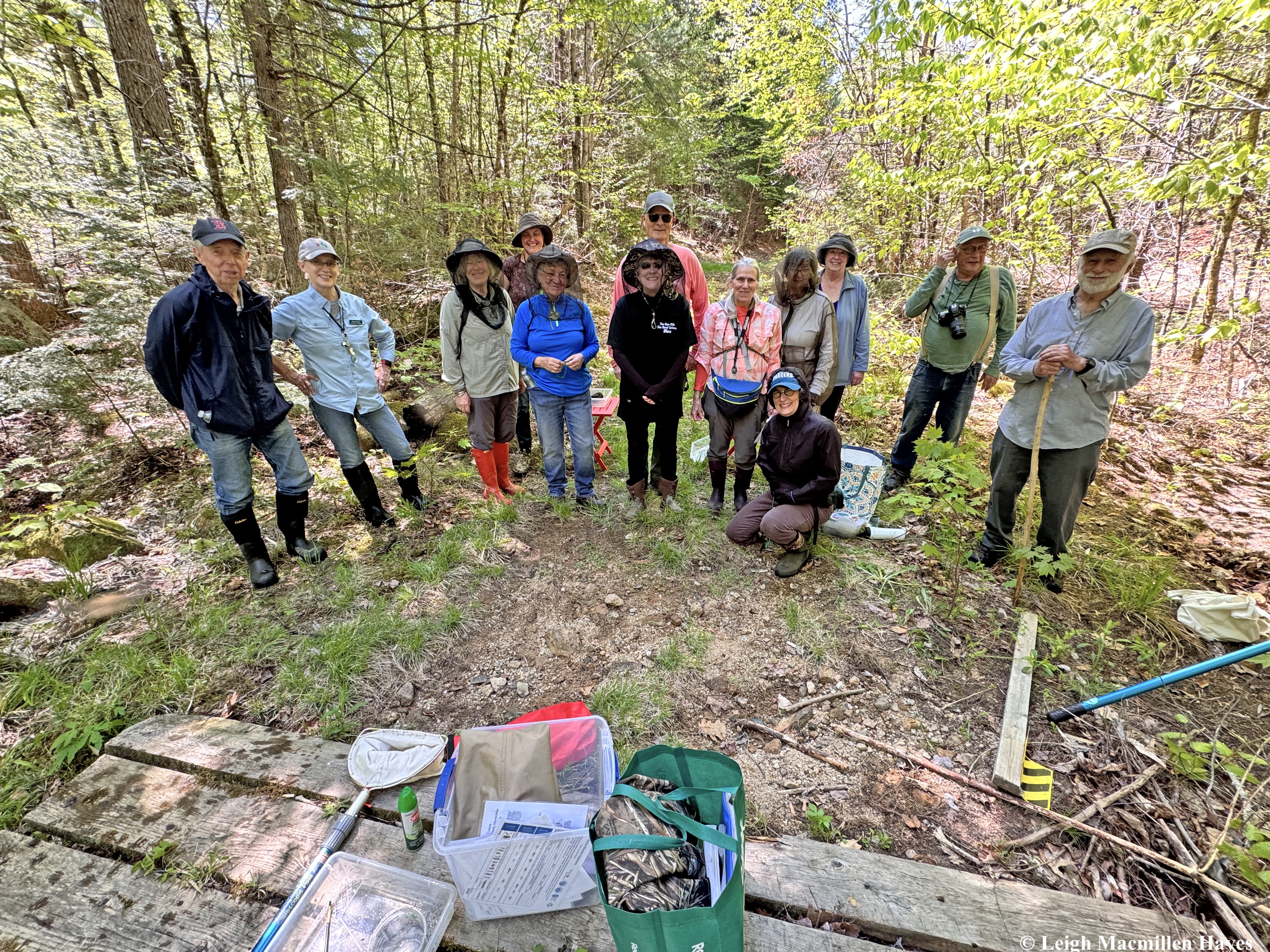
Two hours passed quickly and finally it was time for the four-week class to come to an end. And we were all smiles.

Senior College is an awesome opportunity for us mature beings to learn. The curriculum is diverse; there are no prerequisites, term papers, exams, or grades.

Hats off to the all-volunteer board. And to the students. We can’t believe how many of you joined us each week. And thank you all for helping us carry equipment today.

Many thanks also to Dawn for co-leading with me. And to Bruce for taking so many photos so that I could use them to share all of these incredible learnings with you.

Mr. Cretella, my high school Spanish and Latin teacher, popped into my head just now. In my yearbook, Mr. C. wrote, “Never lose your desire to learn.” Those words have reverberated with me over the years. I don’t remember what anyone else wrote, but his sentiment struck a cord. Pretty amazing, given that when I took Latin I my senior year, I was forever substituting Spanish words if I didn’t know the answer on a quiz or test.

Wherever he is now, I’m grateful that Mr. C. encouraged my desire to learn. And love that so many are the same.

Senior College: Forever Students indeed!

Happy Belated 10th Anniversary, wondermyway.com

I can’t believe I missed the date by two days. I’d been planning this for months. Well, in the back of my mind, that is. No actual thoughts were jotted down on paper. I just knew what I wanted to do and when I wanted to do it . . . until I forgot. Or rather, it slipped my mind. Momentarily.

No harm done.

As the saying goes, “There’s no time like the present,” and so my gift to you dear readers will be to give you the present of time by taking you back to the beginning of wondermyway and then making our way to the present. And all of it is because I was given the gift of being present in the moment on so many occasions. Egads. That’s a lot of presents. And presence.

Wonder My Way

My first blog post was published on February 21, 2015, and entitled Wonder My Way. It began with these paragraphs: Wonder my way as I wander through the Maine woods. So often I see things that make me stop and wonder. Sometimes I figure it out, but other times, I’m just as happy that I don’t. It’s The Sense of Wonder that Rachel Carson wrote about which keeps me going. Do we need to have all the answers? I think not.

So join me for a tramp from our woodlot to the world beyond. I know not where this trail will take us, but I can guarantee that we’ll have fun along the way. Read more . . .

Spring in Slo-Mo

Spring is so fleeting in Maine. Oh, I know, it lasts the usual three months and the beginning and ending overlap with its seasonal partners, but really . . . one must take time to pause and watch or you’ll miss the most amazing action that occurs in slow motion right outside the window–and beyond.

For those who are new to my blog, Jinny Mae, who is featured in this and many blog posts, was a dear friend whose name I turned in to an alias as she faced cancer courageously and rather privately. In the end, the cancer consumed her, but the things we enjoyed along the way were bountiful, including this spring adventure to an incredible space in our little neck of the woods. Read more . . .

Universal Love

Written on Valentine’s Day, this post was dedicated to My Guy and all who wander and wonder with me.

When I wander, hearts frequently speak to me . . . Read more . . .

Nothing To Grouse About

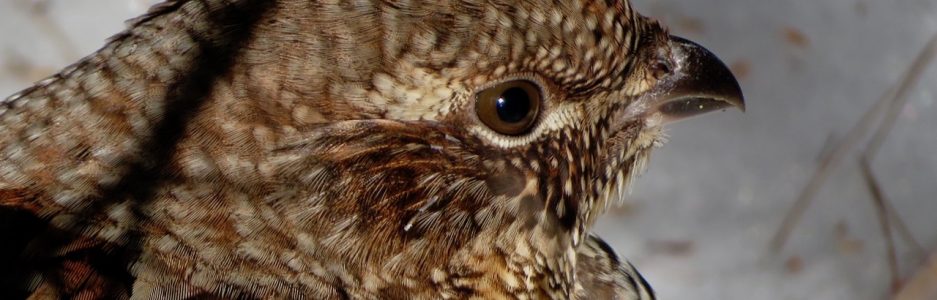
I shared a unique experience with five other naturalists, the majority of them in the six to eleven age range. For twenty minutes the six of us watched a Ruffed Grouse at it moved about, overturning leaves and foraging on buds. When we last saw it, the bird headed off in the opposite direction that we intended to journey, and so we moved on with wonder in our eyes and minds.

And then the next day I returned on a mission to study some twigs at the same property. No sooner had I stepped onto the trail when I heard the sound of leaves cracking a wee bit and what to my wondering eyes should appear but the same bird.

The curious thing: the bird followed me, staying about ten feet away as I tramped on. I stopped. Frequently. So did the bird.

And we began to chat. I talked quietly to him (I’m making a gender assumption) and he murmured back sweet nothings. Read more . . .

Amazing Race–Our Style

Okay, so My Guy and I have enjoyed The Amazing Race show over the years and felt like there were some challenges either or both of us could face, but others that neither of us would dare attempt. And so . . . I created our own version.

The thing is that until I take the time to change the order of this post on my website, you’d be best to start at the bottom and read each entry, going up one step at a time. As in, this: Scroll down to February 18 on this link and then after reading that entry, make your way up one episode at a time, until you reach the last recorded on February 2, 2019. Oh heck, read it in any order that pleases you. Just get into the spirit of the race I created cuze I certainly had fun with it. And fooled a few people along the way.

The Amazing Race–Our Style

I’m sure when we said our wedding vows back in 1990, there was something in there about only riding a snowmobile once. And I did that once two years or so ago–mostly because I knew it would please my guy. Certain memories remain from that experience: I felt like a bobblehead inside the helmet; I lacked control as I sat behind him and couldn’t see; when I did peek around, I was sure my head was going to strike a tree so narrow was the trail; and I didn’t like the speed. Oh yeah, and at a road crossing, I do believe I jumped off and walked to the other side. With all of that in mind, I’m not sure what I was thinking when I created a Valentine’s gift for him–our very own Amazing Race. Read more . . .

wondermyway turns five

Five years ago today (ten now!) I turned from taking a hundred million photos on each tramp to taking a hundred million photos and writing about them.

Typically, on the anniversary I scan the past year’s posts and choose one from each month, providing a photo to represent it, with a brief (or not so brief) comment and link to the full read.

But . . . because this is a milestone I never imagined reaching (posts: 733; views: 76,793; visitors: 44371; followers: 578), I thought I’d take the time to thank you, the readers, for wandering through the wonders with me.

Thank you! Read more . . .

Dragonfly Whisperer Whispers

We had no intention of eating lunch in this spot today, but while looking for a mountain to climb, we kept encountering full parking lots and so our backroad meander put us beside a bog at lunch time and voilà, we managed to walk all of less than two tenths of a mile. Total.

But in that short distance, our eyes feasted. First it was all the Painted Turtles basking in the sun. Read more . . .

Surveying the Wildlife of Charles Pond

For the past two weeks at Greater Lovell Land Trust we’ve had the good fortune to conduct a wildlife survey in the waters that surround the newly acquired Charles Pond Reserve in Stow, Maine. Our hats are off to Alanna Doughty of Lakes Environmental Association (LEA) for her willingness to be the lead on this project and work in collaboration with us. Alanna, you see, has conducted previous surveys for Maine Inland Wildlife & Fisheries (MDIFW) at LEA properties, and was trained by wildlife biologist Derek Yorks to set these up.

MDIFW maintains a comprehensive database on the distribution of Maine’s amphibians and reptiles, as well as terrestrial and freshwater invertebrates and the data we’ve collected will add to the bigger picture. What we discovered was just as important as what we didn’t find. Read more . . .

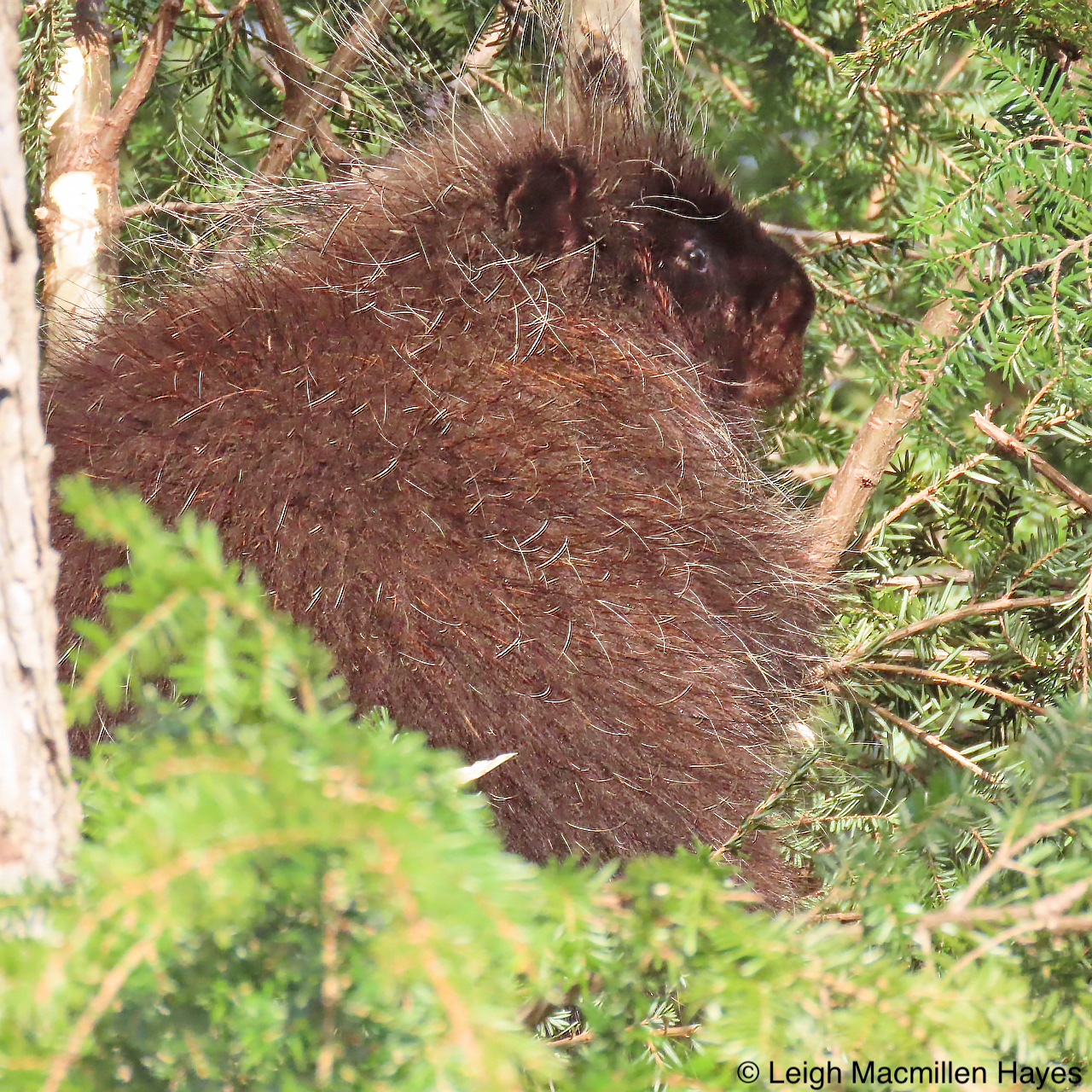
Hightailing It Home

Friends,
At the risk
of sounding redundant,
I bring forth
a prickly topic.

A quick glance
while surveying treetops
and suddenly
my heart sang
as I spotted
a well-armored back.

Read more . . .

Happy 9th Birthday, wondermyway!

Thank you to all who read and comment and share wondermyway.com. Some of you have followed my blog posts since the beginning, February 21, 2015. A few have joined the journey as recently as yesterday. I’m grateful for the presence of all of you in my life.

To mark this occasion, I thought I’d reflect upon those moments when my wonder gave me a glimpse of the “Thin Places” that I’ve experienced either by myself or in the company of others.

To quote my friend, Ev Lennon, “A Thin Place is a spot of beauty, loveliness, space–an example of the wideness and grandeur of Creation.”

I think of them as places that you don’t plan a trip to visit, but rather . . . stumble upon.

Read more . . .

And that brings me to this year and this anniversary, belated as it may be. I can’t believe it’s been ten years since I started this endeavor, which has served as my diary and memory, and been a place for me to share so many incredible extraordinary ordinary experiences with all of you. Thank you for being faithful readers.

As I compare the numbers to year five, I haven’t written as often in the last five years, but your support has been incredible.

wondermyway.com by the numbers:

Posts: 1,076

Visitors: 135,888

Views: 205,389 and increasing constantly.

The most popular post of this new year was Giving Thanks for the Pileated Woodpecker. So far, anyway.

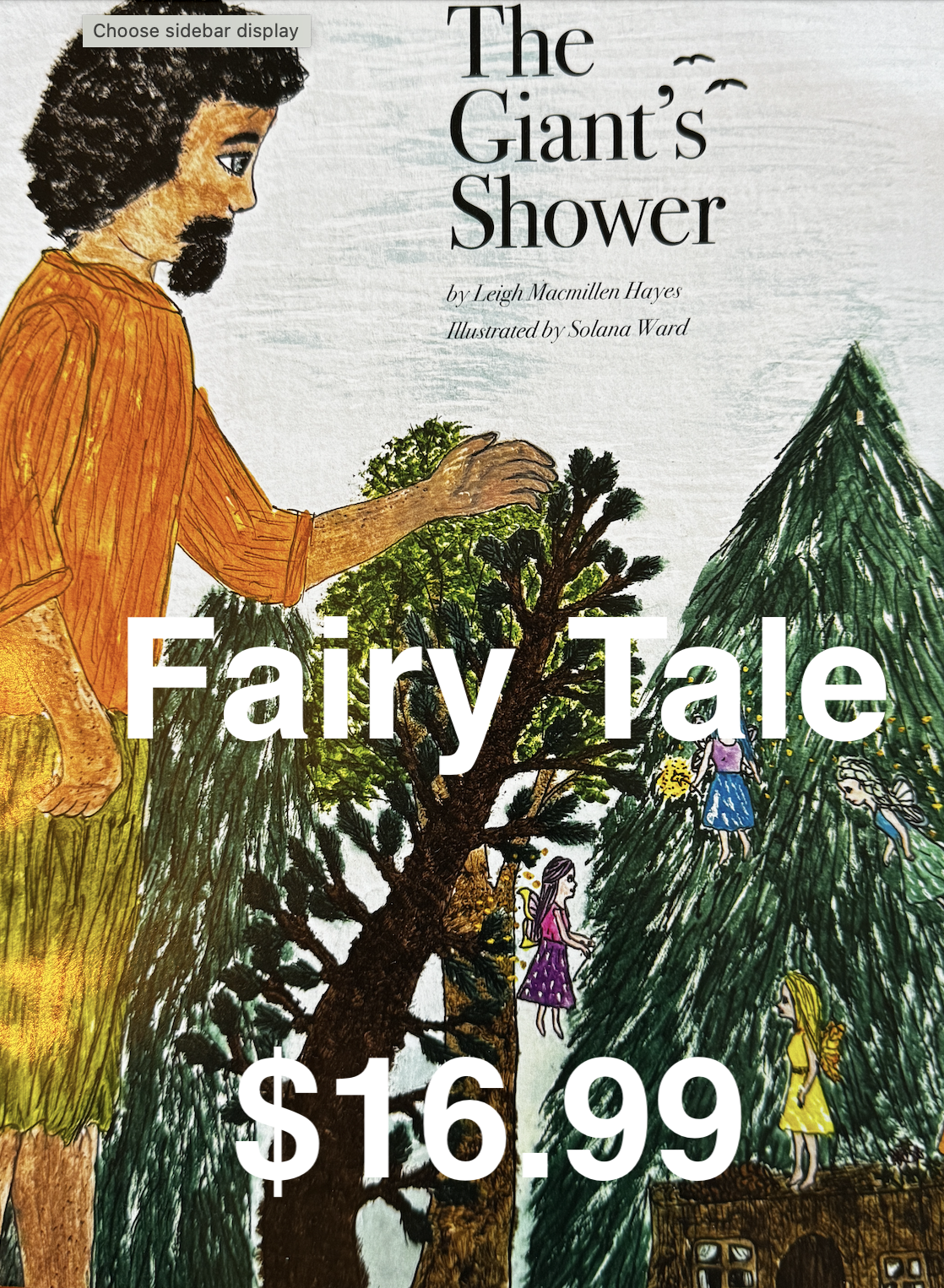
The Giant’s Shower

And since I retired as Education Director for a local land trust just over a year ago, I’ve added some other fun to the mix.

I did a thing. Years ago I wrote a children’s story. Well, a bunch of them actually. And I tried to sell this particular one to publishing houses. No takers. Then, a couple of years ago I purchased a Fairy Coloring Book created by the one and only Solana, teenage daughter of the Fly Away Farm Wards in Lovell and Stow, Maine, and approached her about illustrating my fairy tale. She took on the task and did an amazing job. Then I asked copyeditor Pam Marshall to wave her magic wand over it. And I asked local graphic designer Dianne Lewis to use some fairy dust and turn it into an actual book. I always said I’d never self-publish a book. And tada: I did just that. And now it’s even better because it’s published by http://www.indieauthorbooks.com.

Read more . . .

My Art Gallery

At the end of April I began taking an art class offered by one of my peeps, a young woman who walked into the lives of many of us one day about twenty months ago; a young woman with a million talents to offer. Among those talents, she is a self-taught artist and we’ve been begging her to teach us.

At our first class, we had to draw a small box in the upper left-hand corner of the paper and place the person who has been our biggest art critic into it. That done, the critic was forever boxed–well, until she sneaks out, which she seems to do way too much.

And then we looked at some photographs in magazines and had to sketch them and determine the direction the eye would travel in the picture.

Next we looked at lines and perspective. I’d brought along my favorite colored pencils, but immediately felt my inner critic jump on me because all of my classmates were working with watercolor pencils, watercolor paint or acrylics. And the artist herself, gouache. Until I met her, I’d never even heard of gouache. Or at least never paid attention, if I had.

Read more . . .

Lake Living on Lake Region Television!

And we said goodbye to Lake Living magazine, a glossy publication I’ve worked on since 2006.

We are movie stars! Well, maybe not quite. But, many, many thanks to Evan Miller of Lake Region Television for filming and editing Laurie LaMountain, owner and publisher of Lake Living magazine, and me recently as we said, “Fare Thee Well,” to working on this publication.

Read more . . .

And in the midst of it all, I still have the good fortune to share the trail with so many others . . .

and especially with My Guy, who is forever patient as I pause to consider the wonder of the moment.

My heart-felt thanks to him and to all of you for joining me so often as I wondermyway.

Wowza–ten years! I never imagined. No time like the present to wish wondermyway.com a belated 10th anniversary.

My Love Affair . . .

I have no expectations
and only so much time
to take a walk
along a nearby trail.
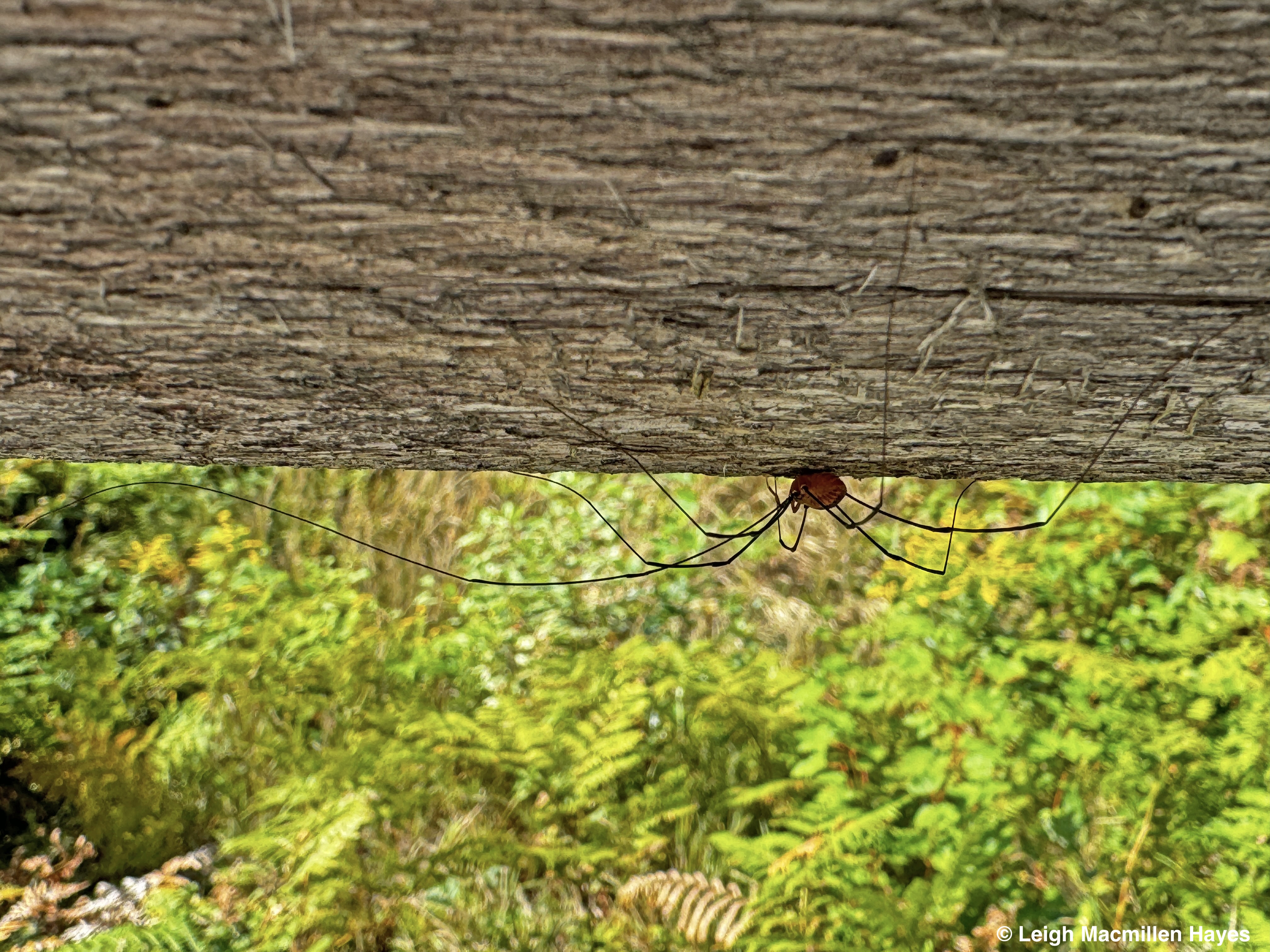
Hiding below a wooden rail,
An arachnid known as a Brown Harvestman rests.
Though spider-like, it's not,
for its body is single segmented.
Curious to see
what else the posts may offer
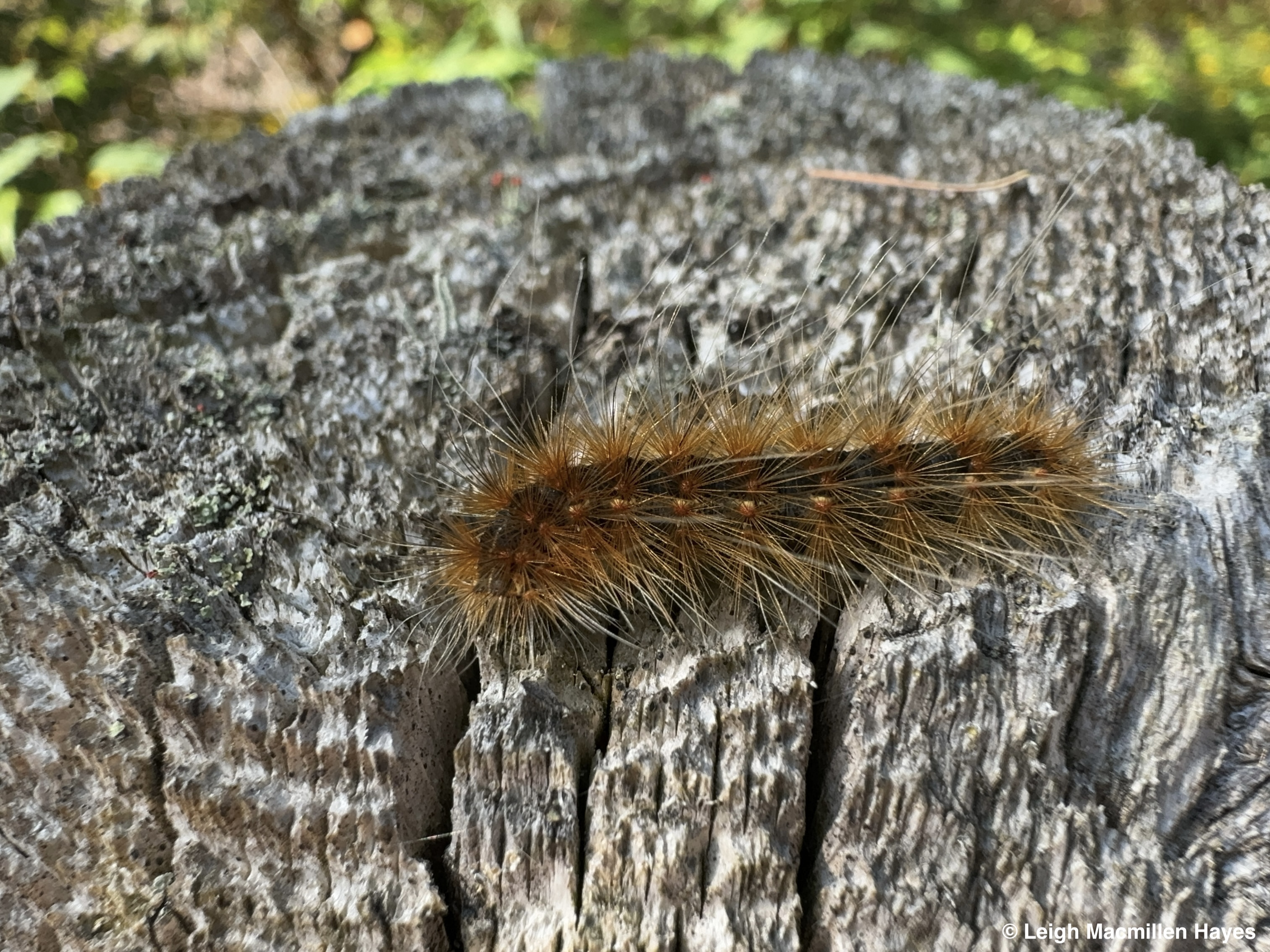
I meet a slow-moving Yellow Bear caterpillar,
It's rusty-brown hairs warning me not to touch.
A few feet away,
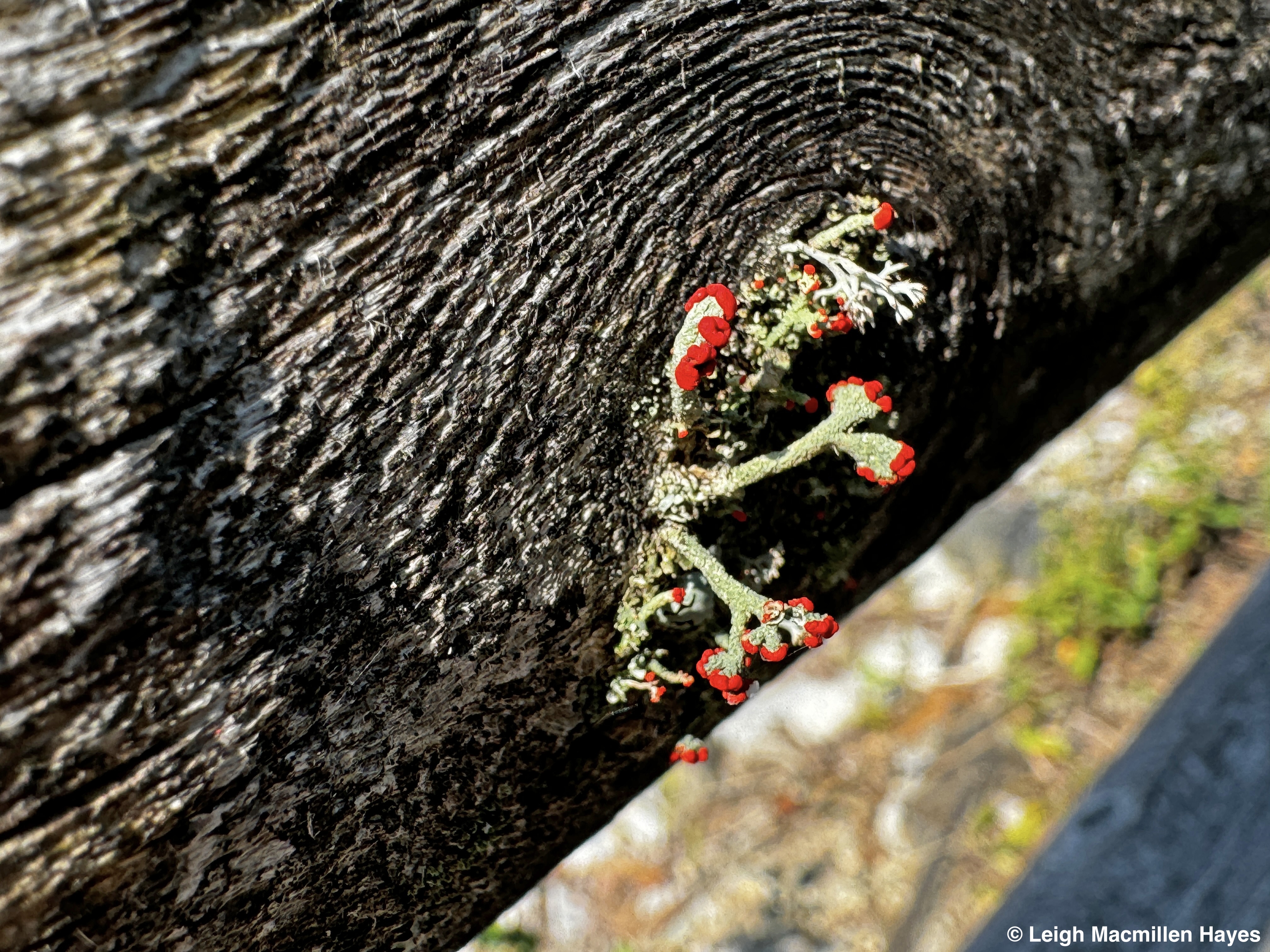
Whimsical with its brilliant red caps,
known as the apothecia or fruiting bodies,
a British Soldier lichen protrudes with a pop of color.
As I continue, one Harvestman 
becomes two, or three, resting below,
and the long legs of these Daddies
is all I can see.
And then by complete surprise,
Hunchbacked in its former nymphal form,
with legs so stout and lobster-like claws,
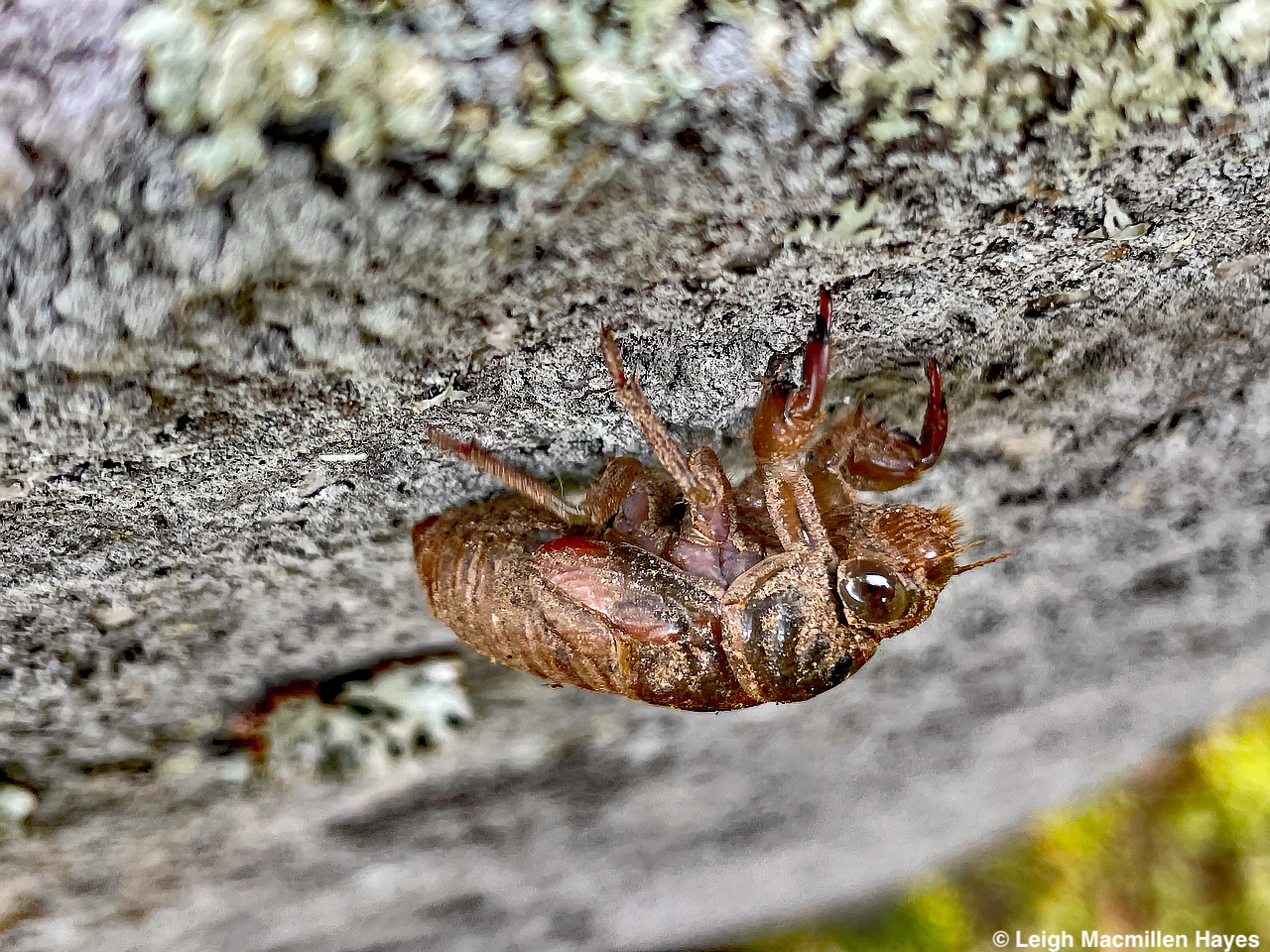
I find a shed exuvia and my heart skips a beat.
Like the Harvestmen, 
where there is one, there's another,
and I can only imagine
their watermelon tourmaline bodies slowly emerging.
It's when I spot a crawling creature
colored with vivid camouflage
and golden-veined wings,
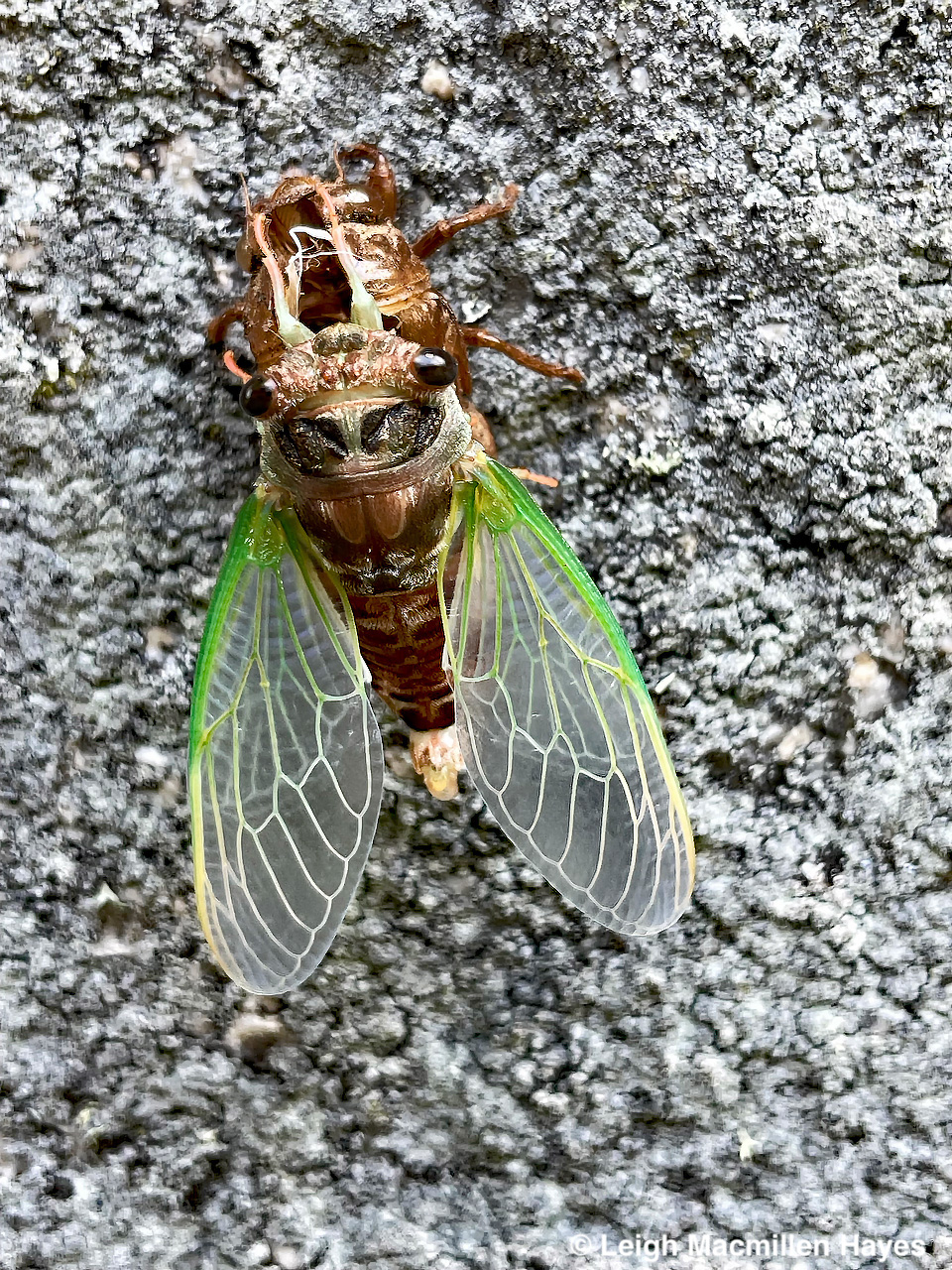
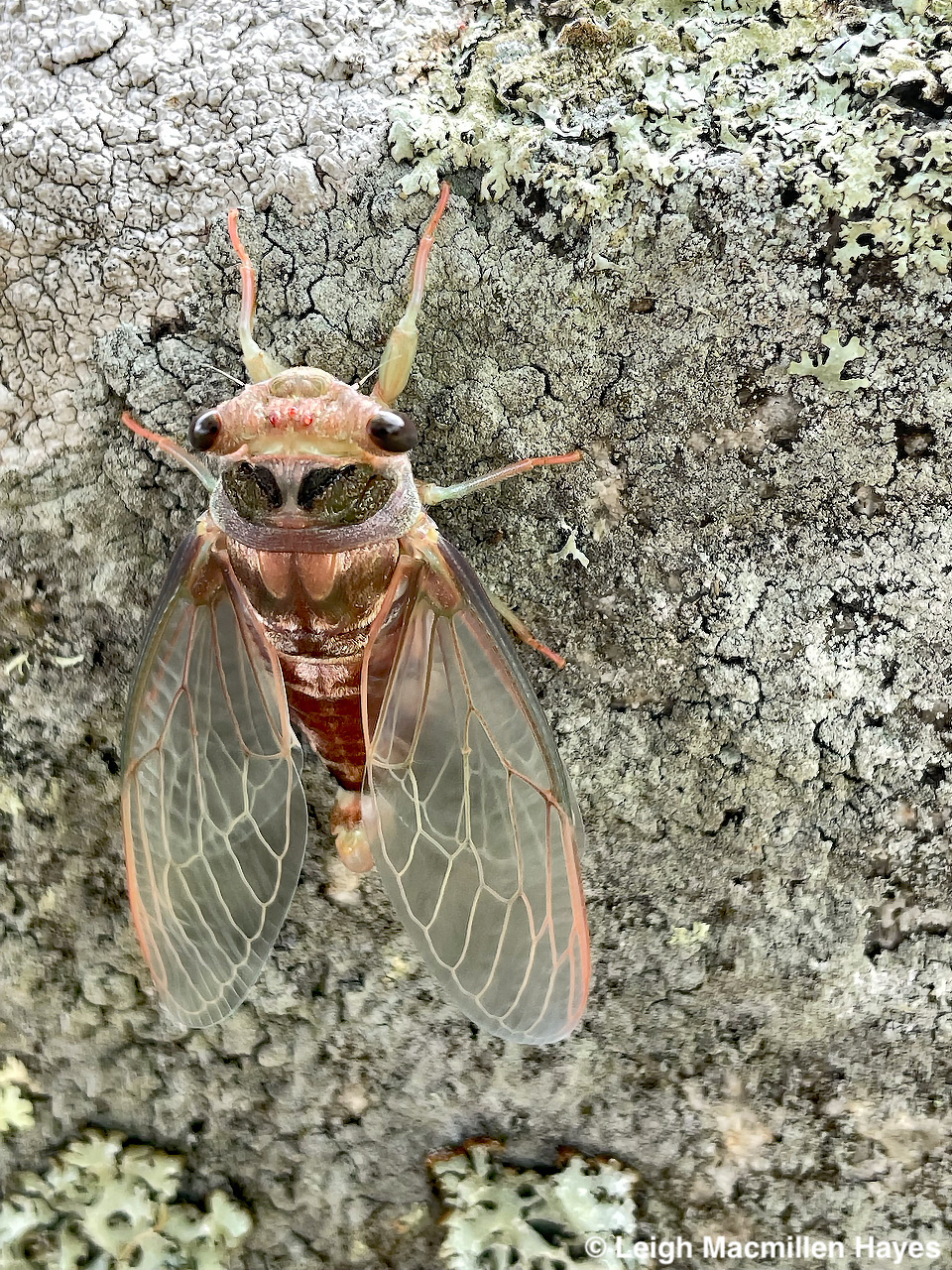
I realize I've missed one of my favorite views of metamorphosis.
But still I am there to watch 
as the adult form reaches out,
one muscular foot at at time,
as it walks first sideways and then skyward.
I know from experience
its tented wings will soon spread,
but worry it will meet the web beside it,
and rejoice when it instead finally flies into the forest.
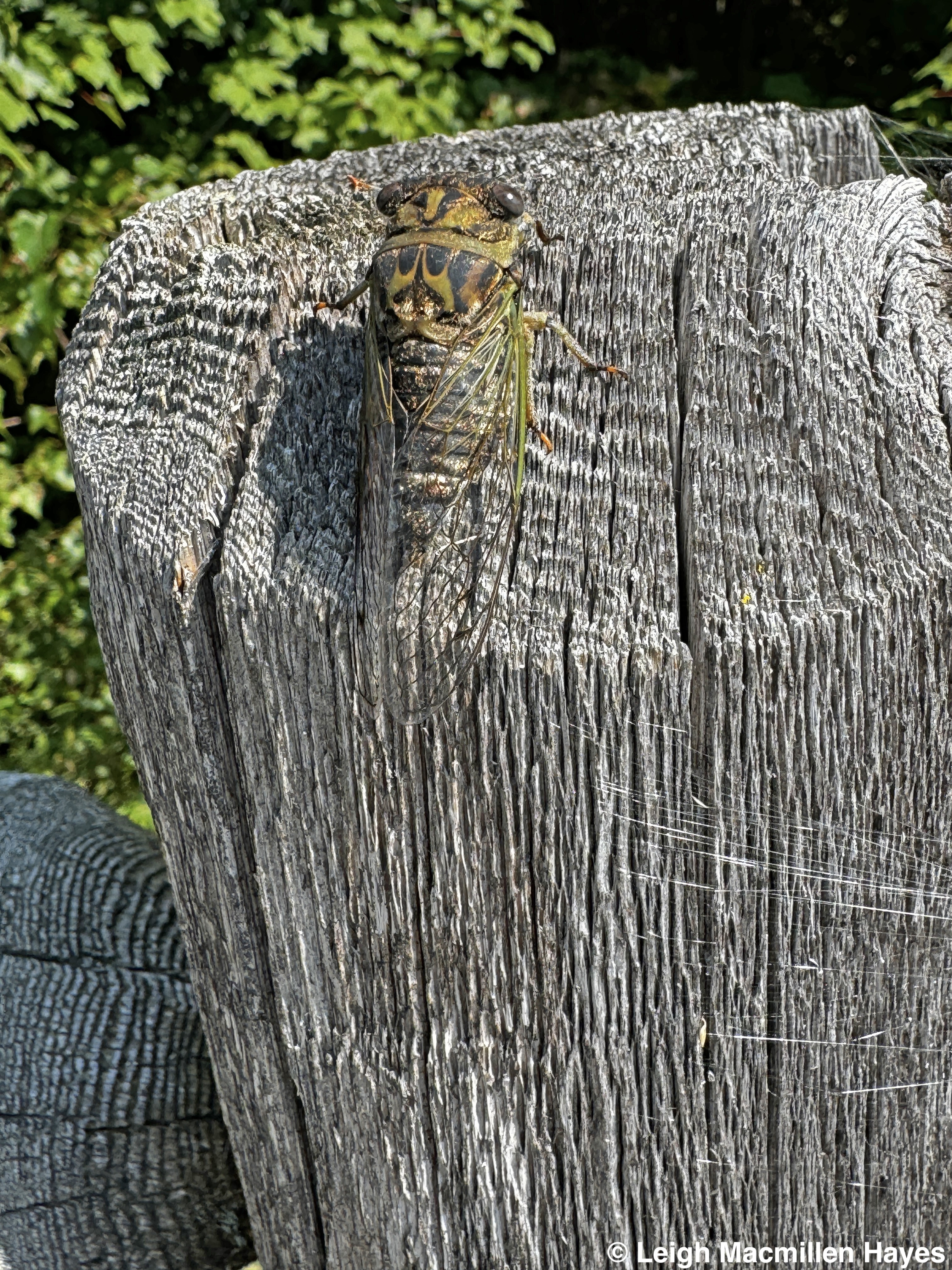
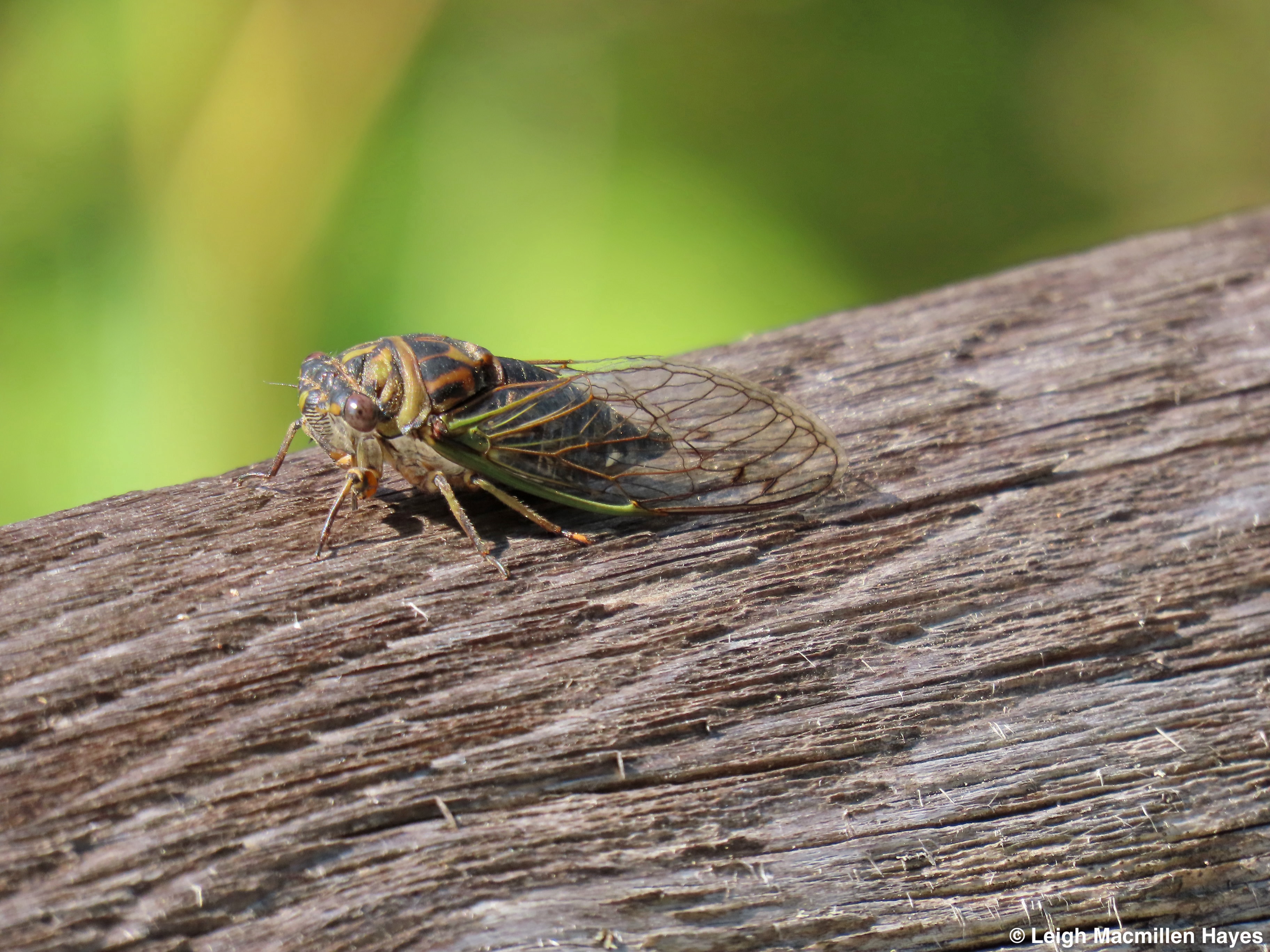
On this late summer day I find another,
and can only hope these Dog-day Cicadas
have time to sing their raspy love songs
that will continue the circle of life as they know it.
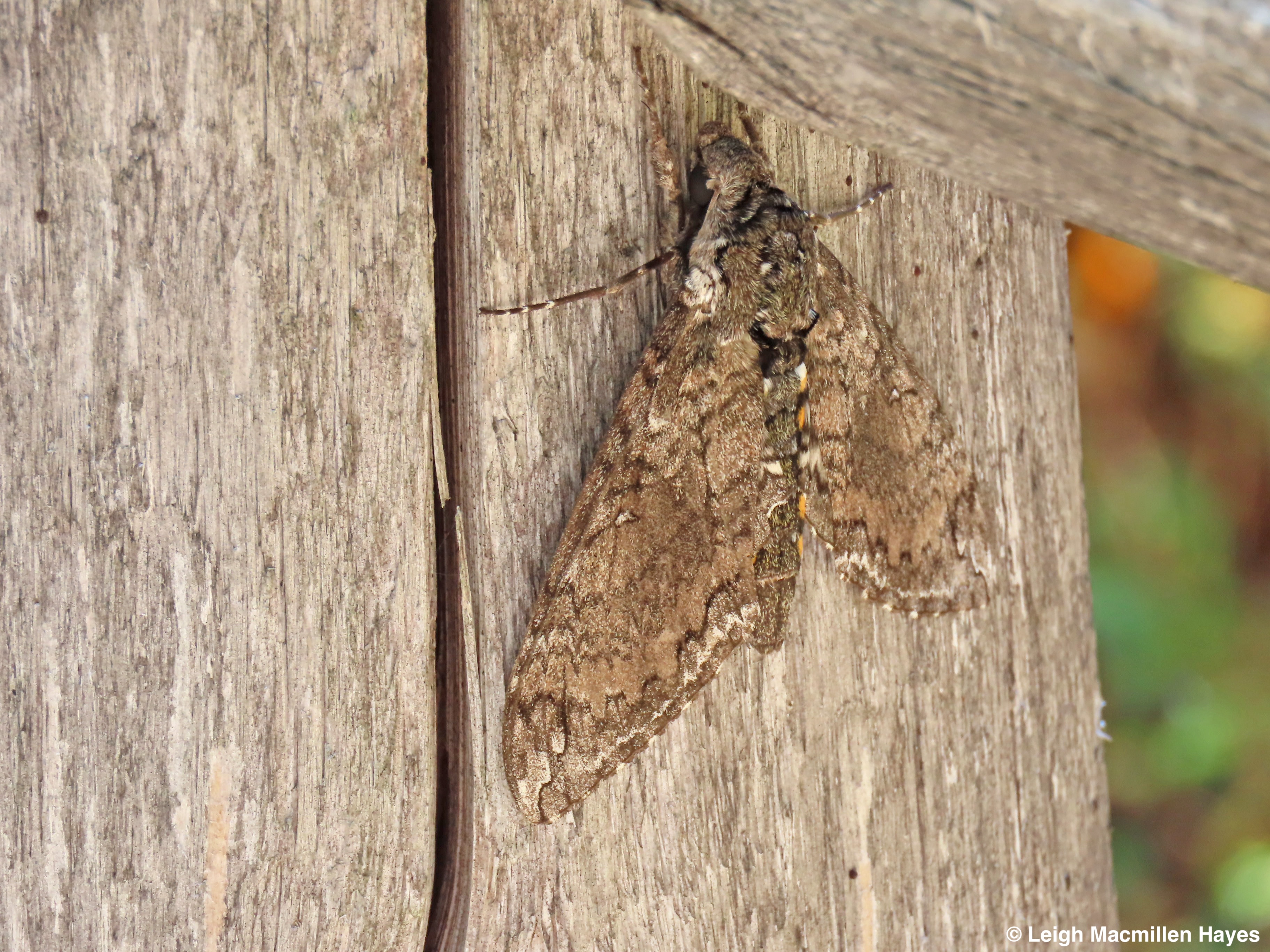
A few more steps and I must backtrack,
for something large garners my attention,
its mottled pattern resembling the post
upon which this Carolina Sphinx moth rests.
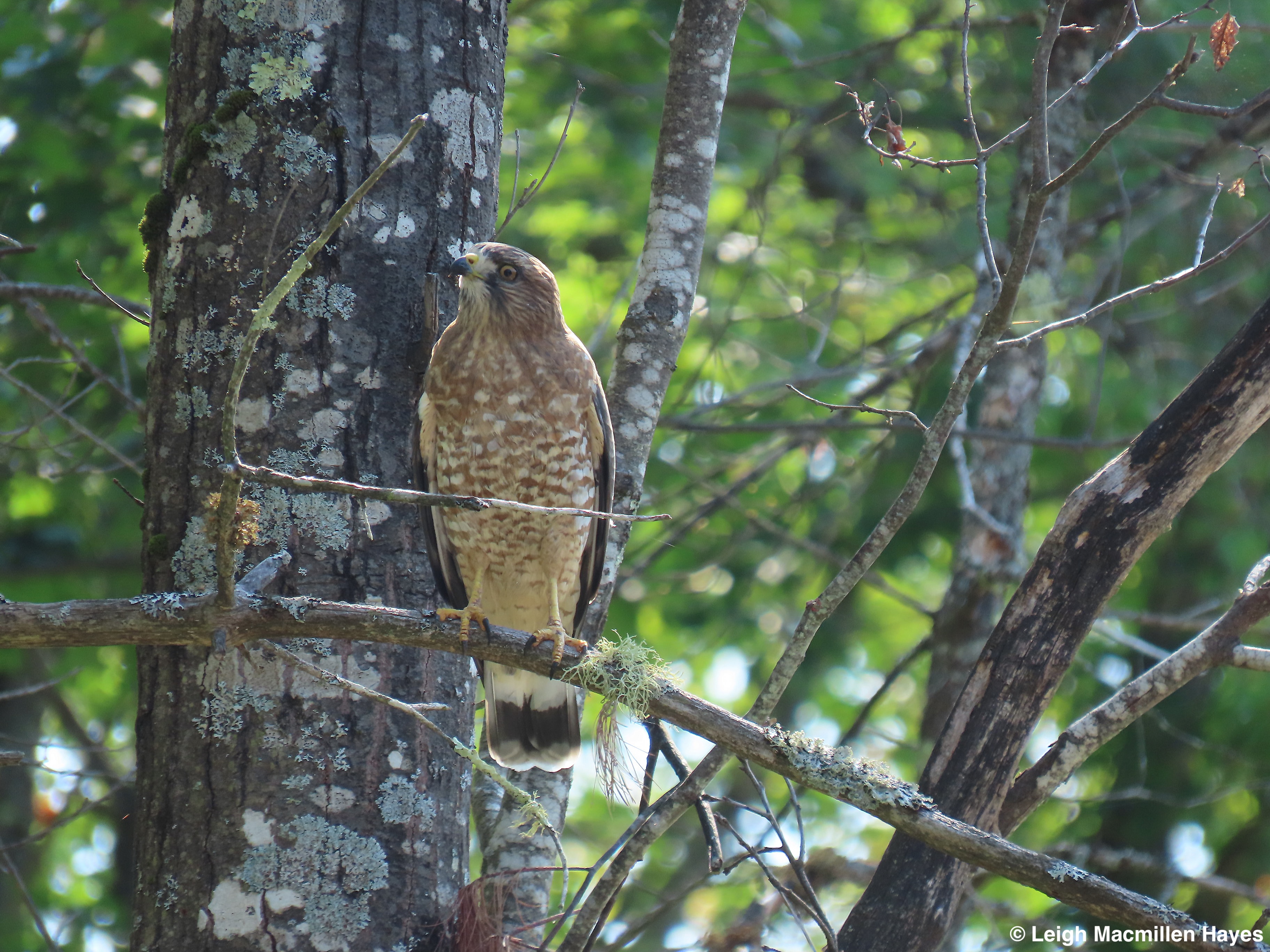
A rustle and wing beats cause me to turn my gaze upward,
and I spot a Broad-winged Hawk landing,
and surveying the territory
for a consumable meal.
Intently, it looks down,
and all around with ten times the focus of my sight,
those predator eyes fixed as they are,
it must turn its head to see.
As I move the telescopic lens
I begin to wonder if it thinks its a creature
and I must admit that I duck
when it flies off . . . first toward me before swerving.
All of these sights I spy
in the course of forty-five minutes
and maybe three quarters of a mile
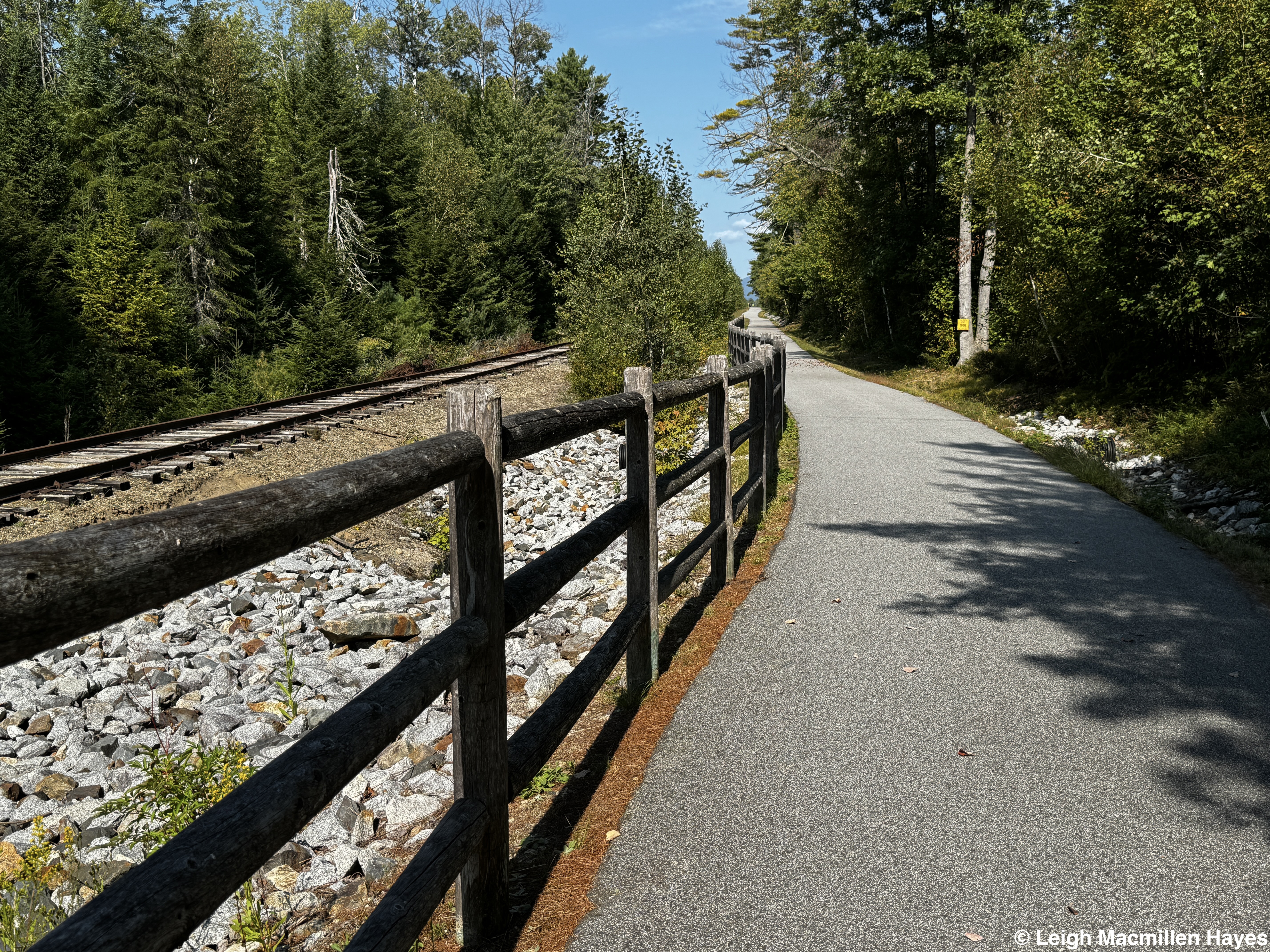
along the Mountain Division Trail.

On this day,
I develop a love affair
with the fence posts and all who gather there.
Can you imagine if I'd gone any farther?

Basking in the Sights

“This won’t take us long,” My Guy said moments after we launched our kayaks onto a small pond in New Hampshire.

“Oh, I think I can make it last a while,” I replied.

I knew there were Pitcher Plants to look for and I could see by the color of the trees on the far shore that there were wetlands to explore and there was the potential for so much more in this very quiet spot.

A friend who kayaks here often had told me where to park and some of the things to look for along the way. What was most impressive from the start is that there were flower pots on the dam and by the kiosk. Well tended, at that.

And a rather large Little Free Library, where one can take a book or share a book.

I unlatched the door and it even smelled like a library. What’s not to love?!

But, we’d ventured there to paddle.

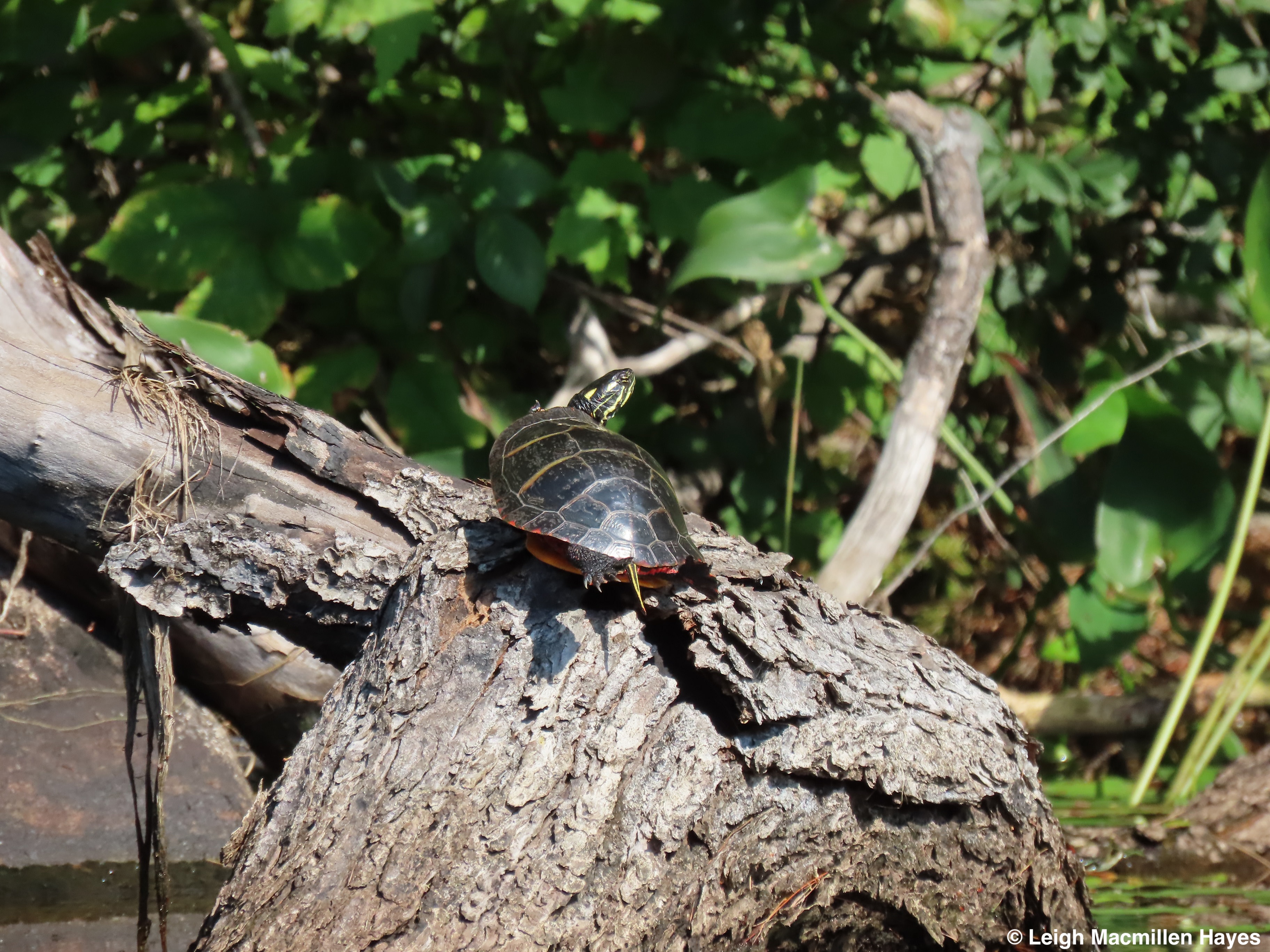
Or better yet, to dawdle. To be like the Painted Turtle and enjoy the sunshine of a perfect September day.

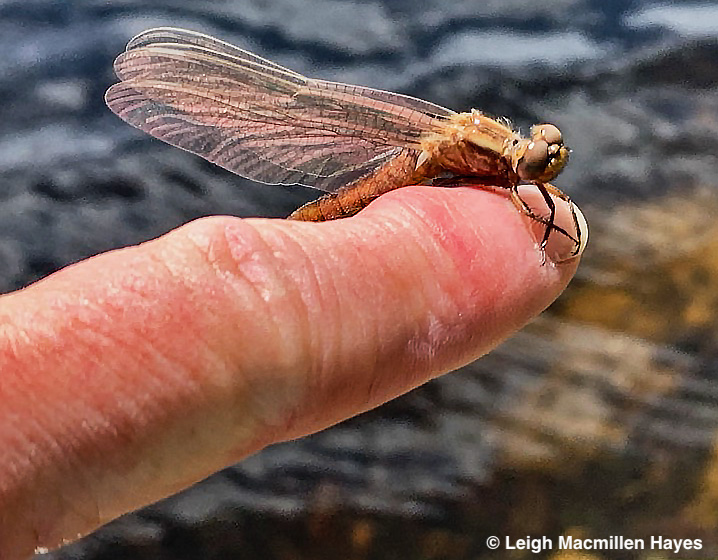
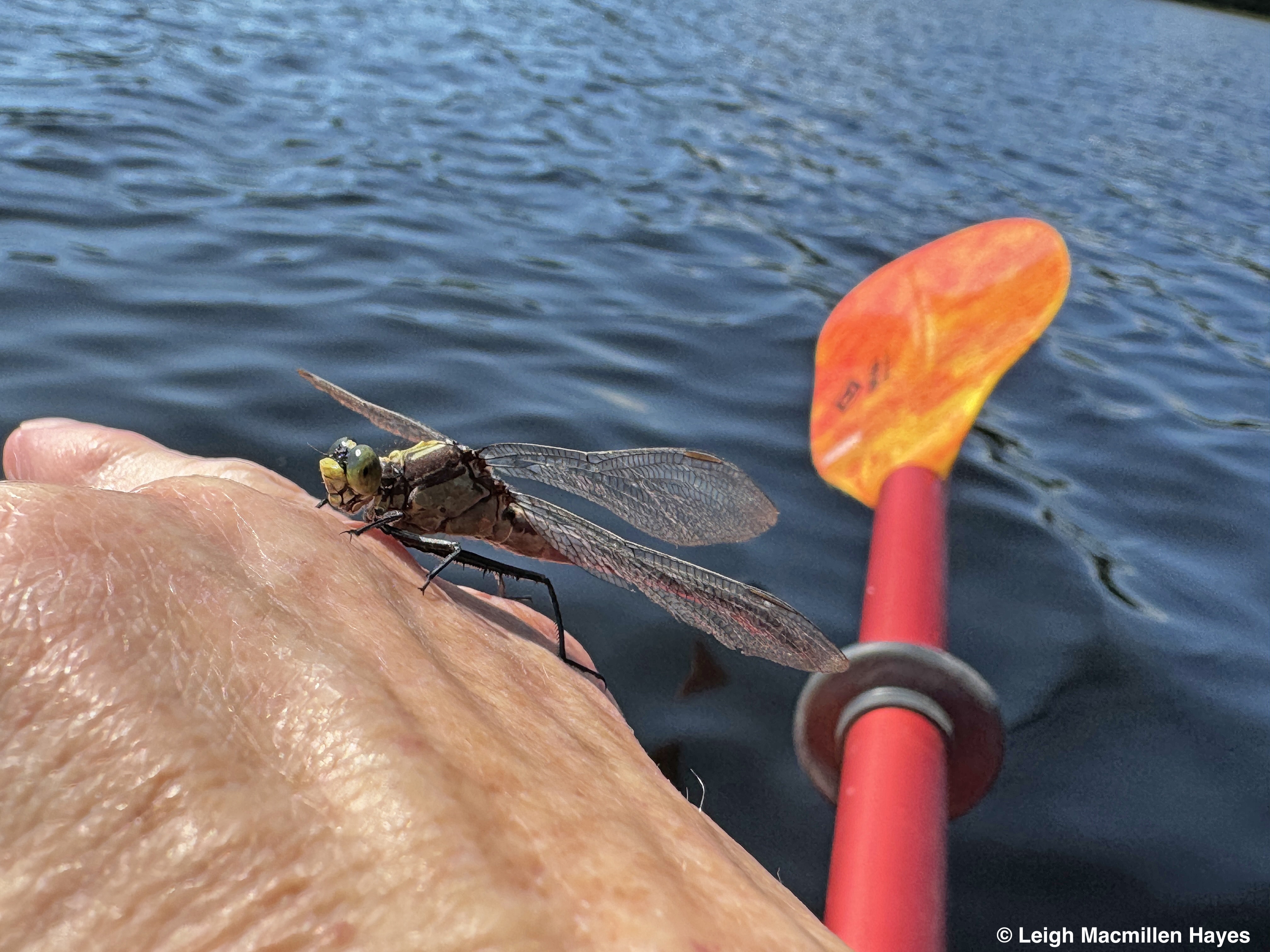
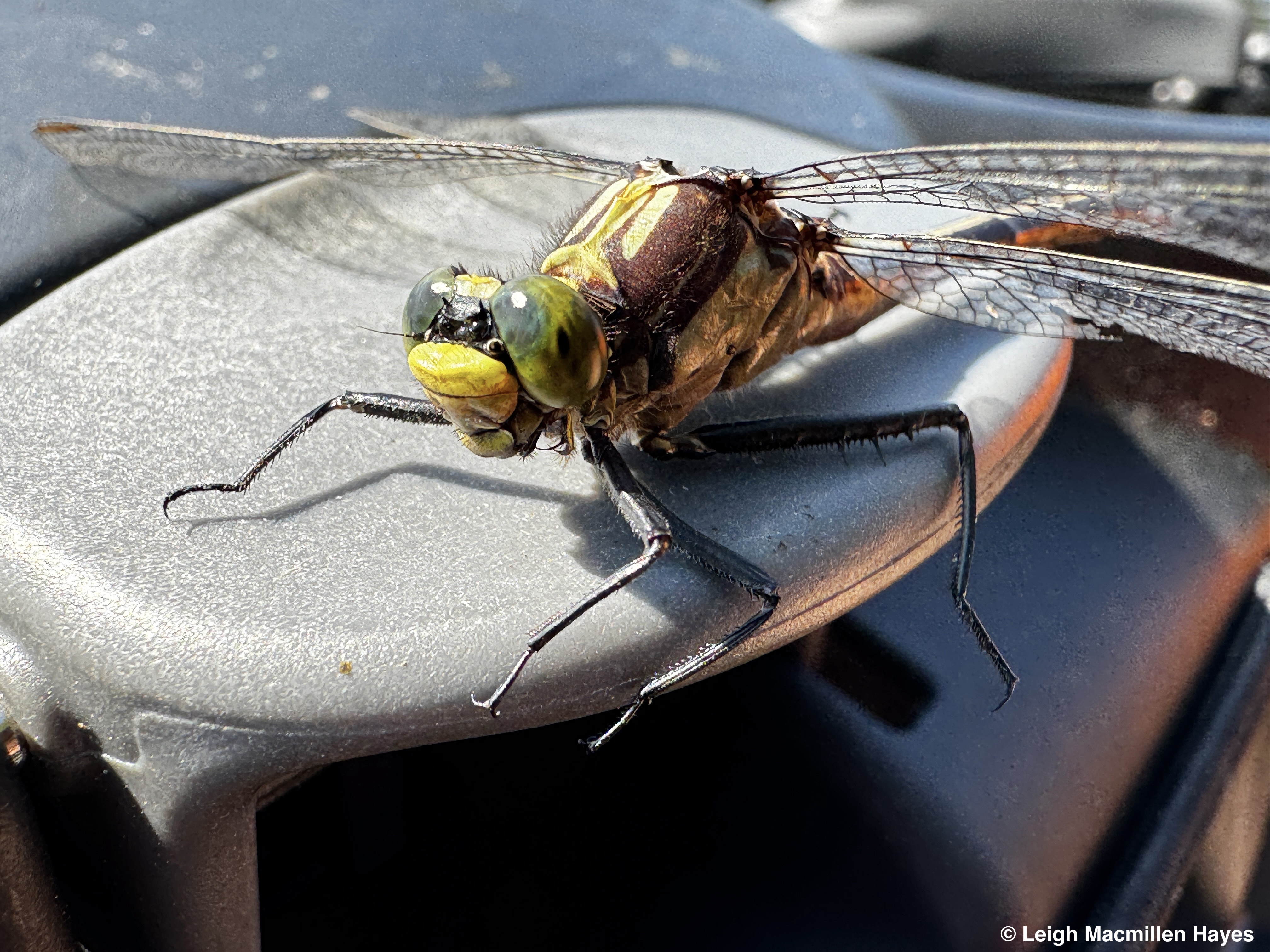
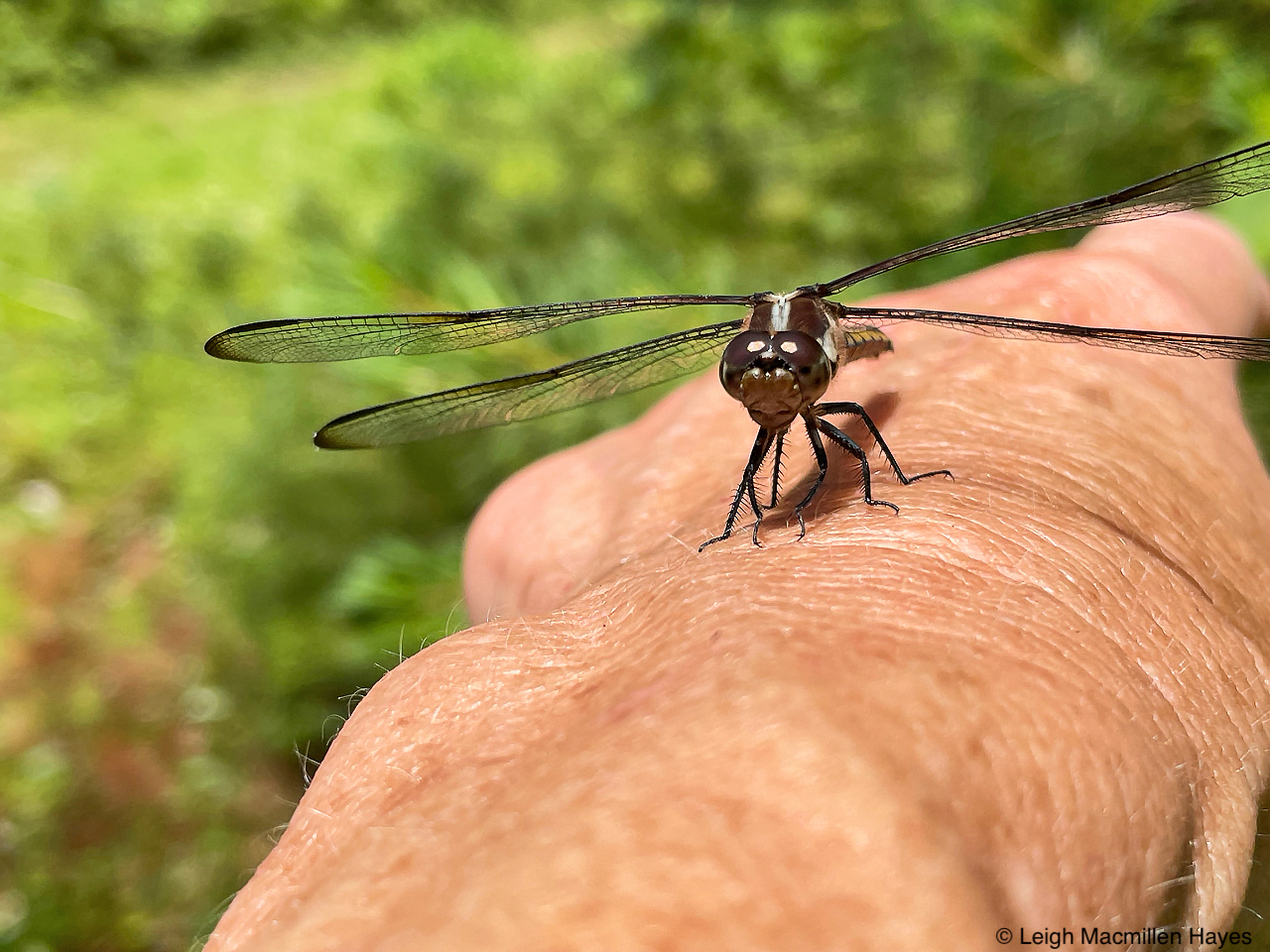
And then one of my favorite things happened. A dragonfly in the clubtail family landed on my knee and I coaxed it onto my hand for a better look. It was perfectly content to be there. Which made me think of a darner on another day on another pond this past week that I rescued as it flailed in the water. The moment I picked that darner up, it tried to take a nip out of my finger and was frantic, even when I set it on the edge of the boat. I wanted to give it a chance to dry its wings. It wanted only to fly. And so it did with wings still wet and back into the water it landed, slipping under a lily pad. I rescued it again and this time it didn’t bite and it did sit for another minute or two upon the boat, but not long enough for me to get a good look at its colors and patterns for identification, or to snap a photo and then suddenly it flew and I can only hope survived.

My new friend, however, allowed me to move him from my hand to the boat, the better to take a look.

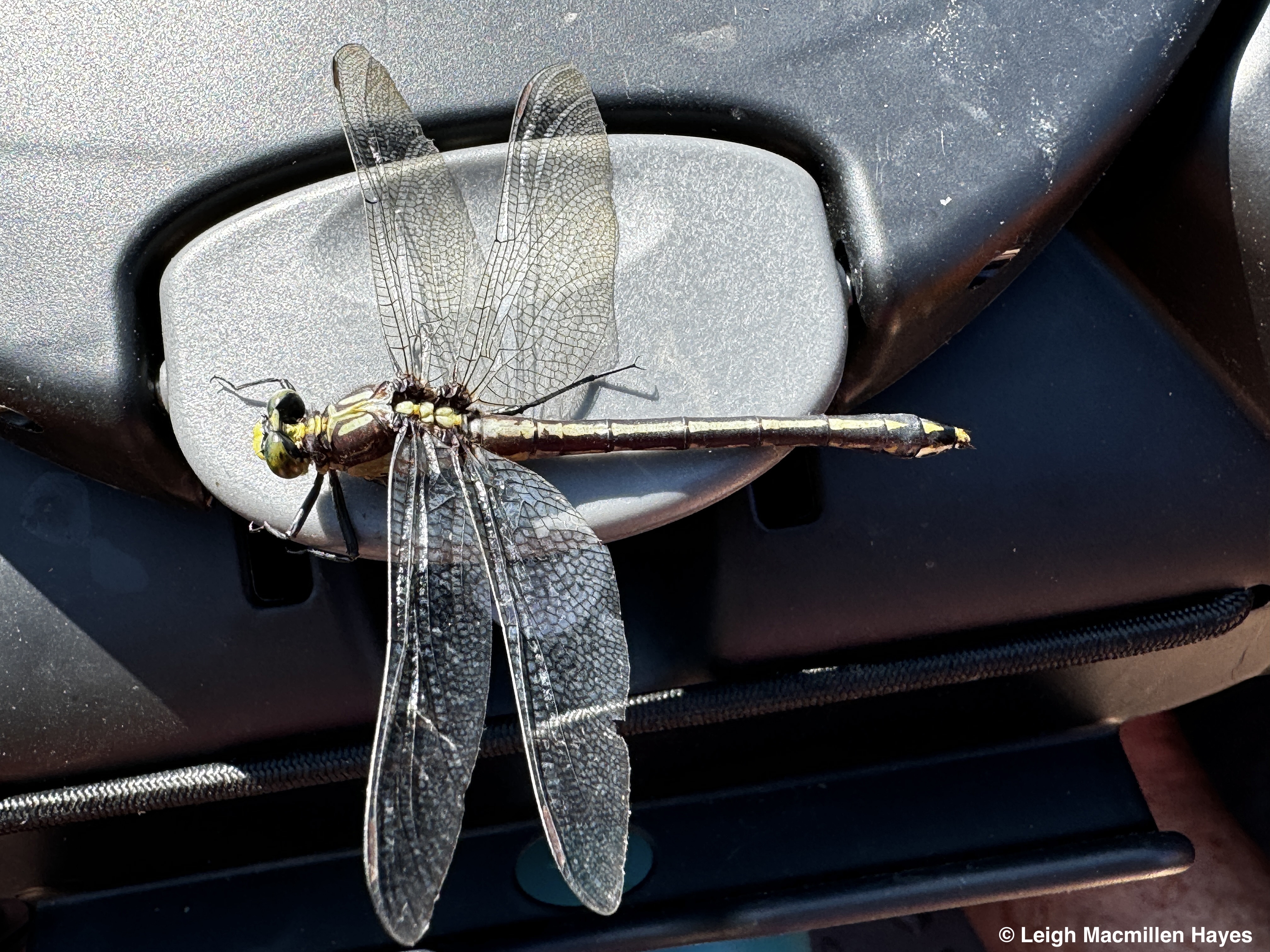
This one didn’t speak its name immediately, until I looked at its spiny back legs. As a Black-shouldered Spinyleg it is commonly known, and it’s in the clubtail family, but I’m not exactly convinced that the shoulders are actually ebony in hue. To me, they seem to be chocolate brown.

Another characteristic is the thorax pattern: two long ovals on either side with a yellowish I-shaped mark in between them. 

It was the pattern on the abdomen that also helped me confirm ID, with the yellow stripes on each segment becoming triangular shaped on segments 8 and 9, while the final segment, #10, was almost completely coated with splash of yellow.

With each minute that passed I fell more and more in love as my new friend let me enter its personal space. Such big eyes–compound as they are. But then there are the ocelli, or three small black “eyes” located on top of the head–to us they look like three little bumps, but according to the field guides in my own library, they “may serve to measure light intensity.”

And all those body hairs. They work like sensors–detecting odors, temperature, humidity, and most likely wind direction.

If you have a loupe or magnifying lens, I encourage you to look at insects and plants–it’s a hairy world out there.

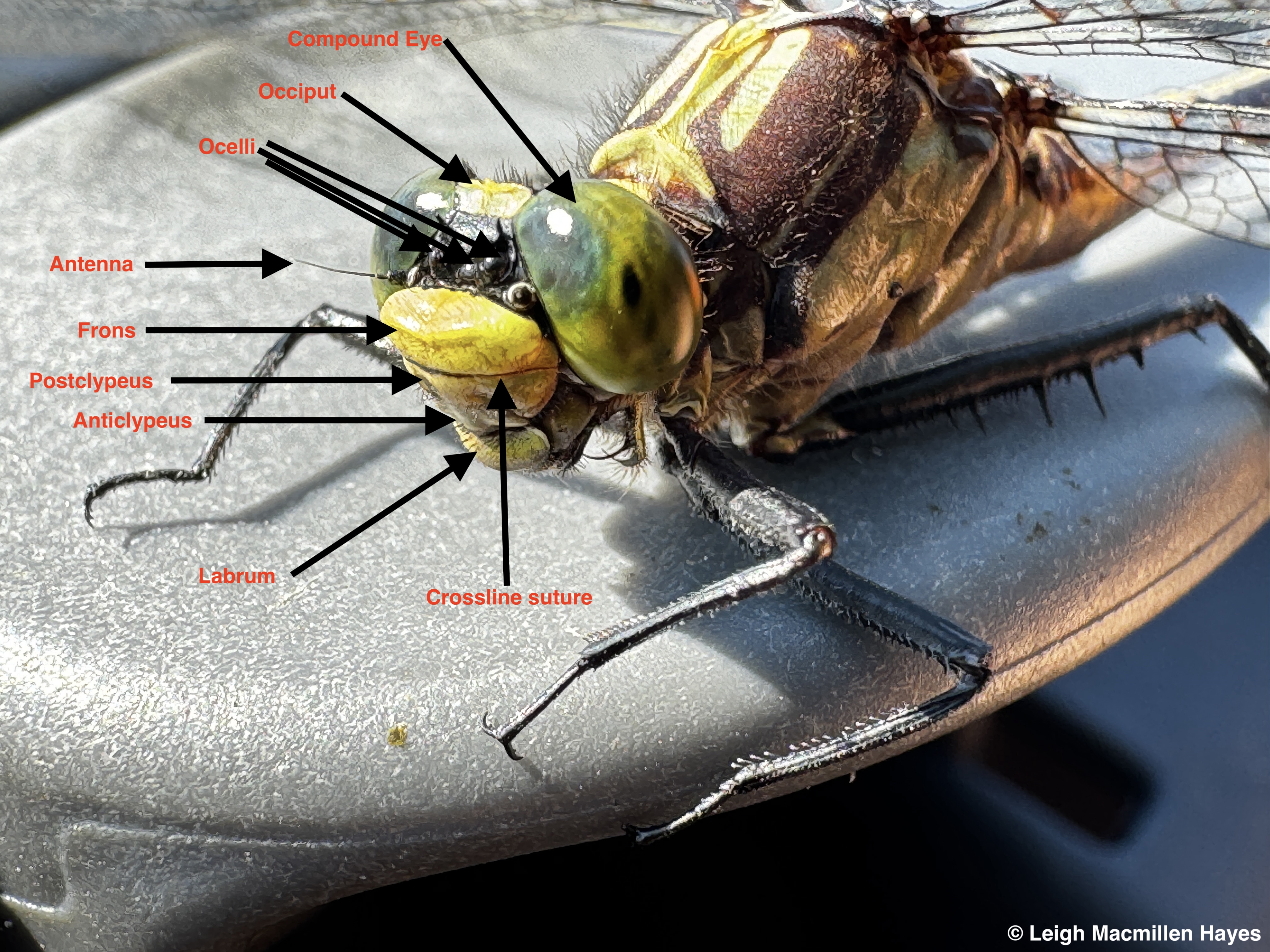
Let’s take a closer look at that face. It’s rather other-worldly in structure. Two dragonfly families feature eyes that don’t touch each other along any margin: Clubtails and Petaltails. I’m not sure I’ve ever met a Petaltail, so that already narrows it down for me when trying to figure out the species.

Beginning with the large compound eyes, we’ll work our way down. But first, can you imagine seeing the world through 30,000 lenses or facets? I’m happy to have moved on from progressive lenses (three lenses) that threw me off, especially when hiking or walking down stairs. 30,000?!!! A dragonfly certainly has no excuse for not seeing even the tiniest of insects on the move.

And notice how the eye is two toned, the darker being above.

Between the eyes is a plate called the occiput, which covers the upper part of the head. You might also notice, though I didn’t label them, that there are occipital horns.

Below that is the triangle of ocelli, or three tiny and simple eyes as compared to the two compound eyes. These may measure light intensity.

And then there are two antennas, perhaps for measuring wind speed. All of this and we haven’t reached the face yet.

Ah, the dragonfly face–beauty is definitely in the eye of the beholder.

Dragonfly faces consist of plates and the upper plate is the frons. In some species there are certain dark shapes or lines that help with ID. Not on this one, however.

Below the frons a crossline suture is a seam that separates the frons from the postclypeus, an upper plate that we might think of as the upper lip.

And below it, the anticlypeus, a lower plate located about where our tongue might be on a human face.

Finally, the labrum, or lower lip, and below that the mandibles, not labeled.

Such complexity for an insect that spends months to a few years as an aquatic naiad, growing through several molts, and then crawls out of the water and slowly ecloses upon vegetation, pumping insect blood into its wings and body, before flying off to control the airways and the insects who bug us. And within two months of emerging from the water, it’s life cycle comes to an end.

And to think this one simply landed on my knee and now you have all this information to digest. Don’t worry, there will be a quiz at the end.

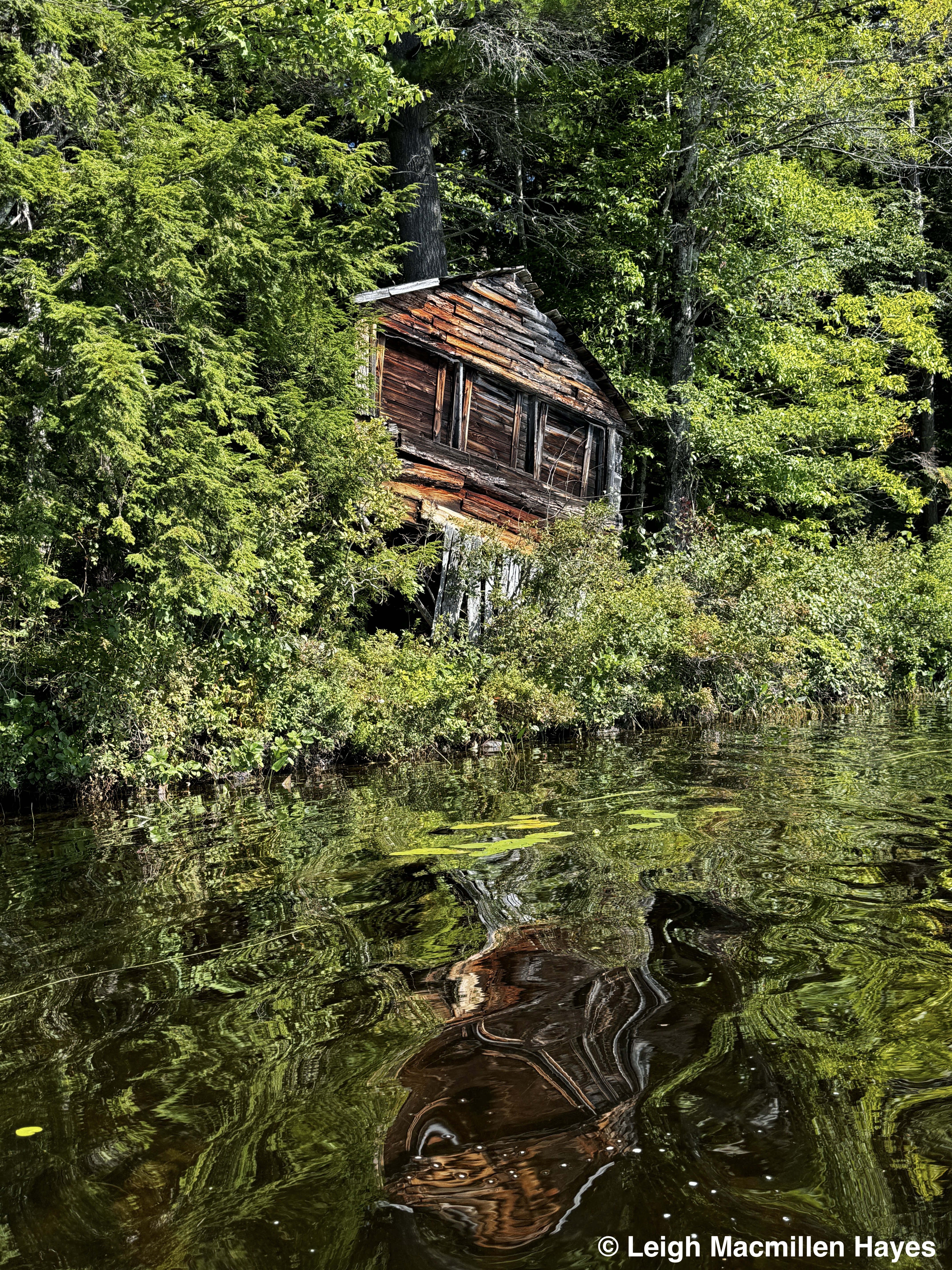
Suddenly, the dragonfly flew off. And my focus returned to the pond. If you’ve paddled here, then you know that we hadn’t gone far as we’d only reached the third of the crooked houses.

My Guy was ready to purchase one and fix it up. I just want to paint this scene when I have time for so beautiful was it despite its lack of TLC and the reflection was equally delightful as lines were interrupted by the water’s current.

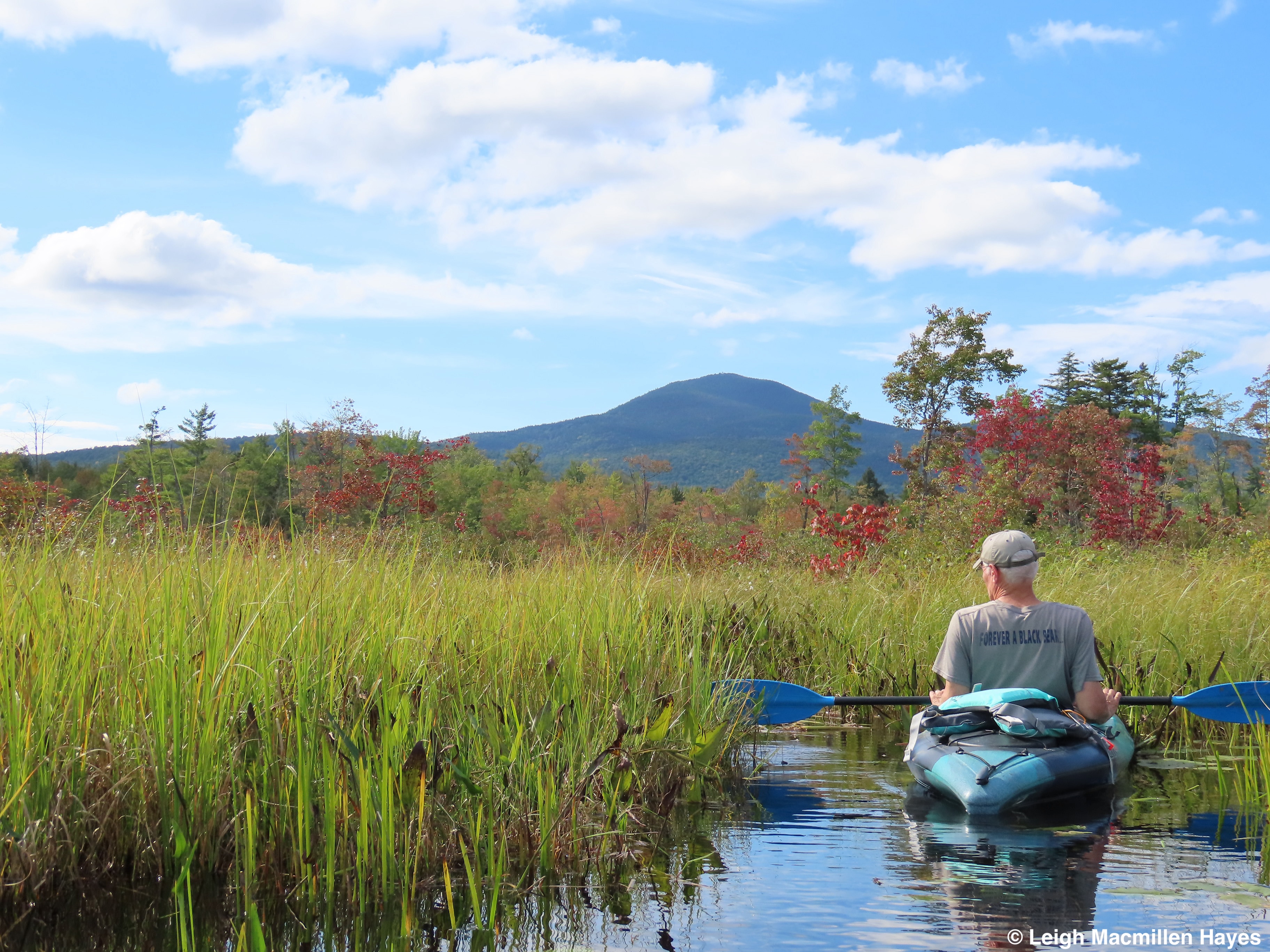
At last we reached the opposite end of the pond from which we’d begun our journey and the colorful leaves of the Swamp Maples told me we were in a different sort of wetland.

The layers. From Pickerel Weed leaves to grasses and sedges, including Cotton Sedge, to the Swamp Maples, actually being Red Maples with very wet feet which are among the first to turn as fall approaches and days shorten, to a backdrop of deciduous and conifers.

Just the colors made me happy as I followed My Guy who followed a brook as far as we could until the growth was too thick and we could hear water flowing over what was probably a beaver dam ahead. And so we turned around, but first honored Mount Kearsarge North, the pyramid mountain in the distance.

I extended the telescopic lens on my camera farther than I should have, but I wanted to see the fire tower at the summit of Kearsarge. It was incentive enough for us to decide to hike there again soon.

As we continued our clockwise journey around the perimeter of the pond, I was on a hunt–for those Pitcher Plants I’d been promised. But what caught my eye in the meantime was the late afternoon sun glowing on bowl and doily spider webs. And a beaver lodge in the background.

It always amazes me to find so many of the same type of spider webs in any one area. The spiders who wove these are rather small, but their web is incredibly complex.

They weave a sheet web system consisting of an inverted dome or “bowl,” suspended above a horizontal sheet web, or “doily,” hence its common name. And then they wait for a meal to announce itself. Should the meal fall through the bowl, the doily serves as a safety net, thus the spider makes sure to not miss a bite.

Before turning my boat to follow the shoreline again and continue my PP quest, I realized that a Tamarack grew upon the lodge. And there were several others nearby. I love these trees because they aren’t every day sights. And because they are kinda like me–beings that can’t make up their minds. Thus, they are deciduous conifers, meaning they are cone bearers who shed their needles (leaves), unlike other cone bearers in our neck of the woods who are evergreen.

I had only turned a wee bit when two structures standing above other plants caught my attention and I knew my quest had come to an end. Pitcher Plant flowers.

And below them the pitchers (leaves) for which they were named. That ruby red rim. The tree-of-life venation. And downward facing hairs. “Here little insects. Come check me out. I have a special drink I made just for you.”

At the base of the Pitcher Plant grew Sphagnum Moss and Leatherleaf, and . . . Sundews! Round-leaved Sundews–another carnivorous plant like the Pitchers. It’s a plant eats insect world out there.

As we rounded a bend nearing the end of our journey, a flock of Canada Geese honked and cackled.

And suddenly lifted off. My Guy counted 30.

At last we approached the launch site, but truth be told it took us about twenty more minutes to go the short distance because there were so many more turtles to spot. Do you see the second one in this photo?

And one climbing atop another as is their habit since turtles are ecothermic and the sun’s rays help raise their body temperature. So if your brother is on top of the log, why not climb on top of him to get even closer to the sun?

I spotted twelve in all, and love that the one on the right upon this log waved–as if to wish us farewell, for really, it was time for us to leave.

So we did, but first we gave a quiet thanks to our friend, Pam K., for recommending this delightful pond and telling me about a few of its highlights.

And I did promise a quiz, so here ’tis. Can you name at least one part of this dragonfly’s face? And can you name the species? Don’t worry if you don’t get all of the parts–that’s why I write a blog–so I can go back and remind myself.

Basking in the sights. That’s what we did much the same way the turtles basked in the sun.

Oh, and that line that the journey wouldn’t take us long–ahem. It was at least a two and a half hour tour. After all, it’s a wonder-filled world out there.

Fall After Fall Mondate

At the start of today’s hike I met a rock. A rock covered in soft green broom mosses. A rock that invited a caress. And so I did. Repeatedly.

When I mentioned that it was the perfect pet rock to My Guy, he reminded me that it wouldn’t fit in my pocket. Details. Details.

And so our hike continued through a wet area where we gave thanks for the boardwalk system. And for the opportunity to change out our hiking uniform from winter to spring. Oh, we had Muck boots in the truck, but welcomed the opportunity to wear hiking boots, and summer hiking pants, and sweatshirts, and baseball caps instead of winter gear.

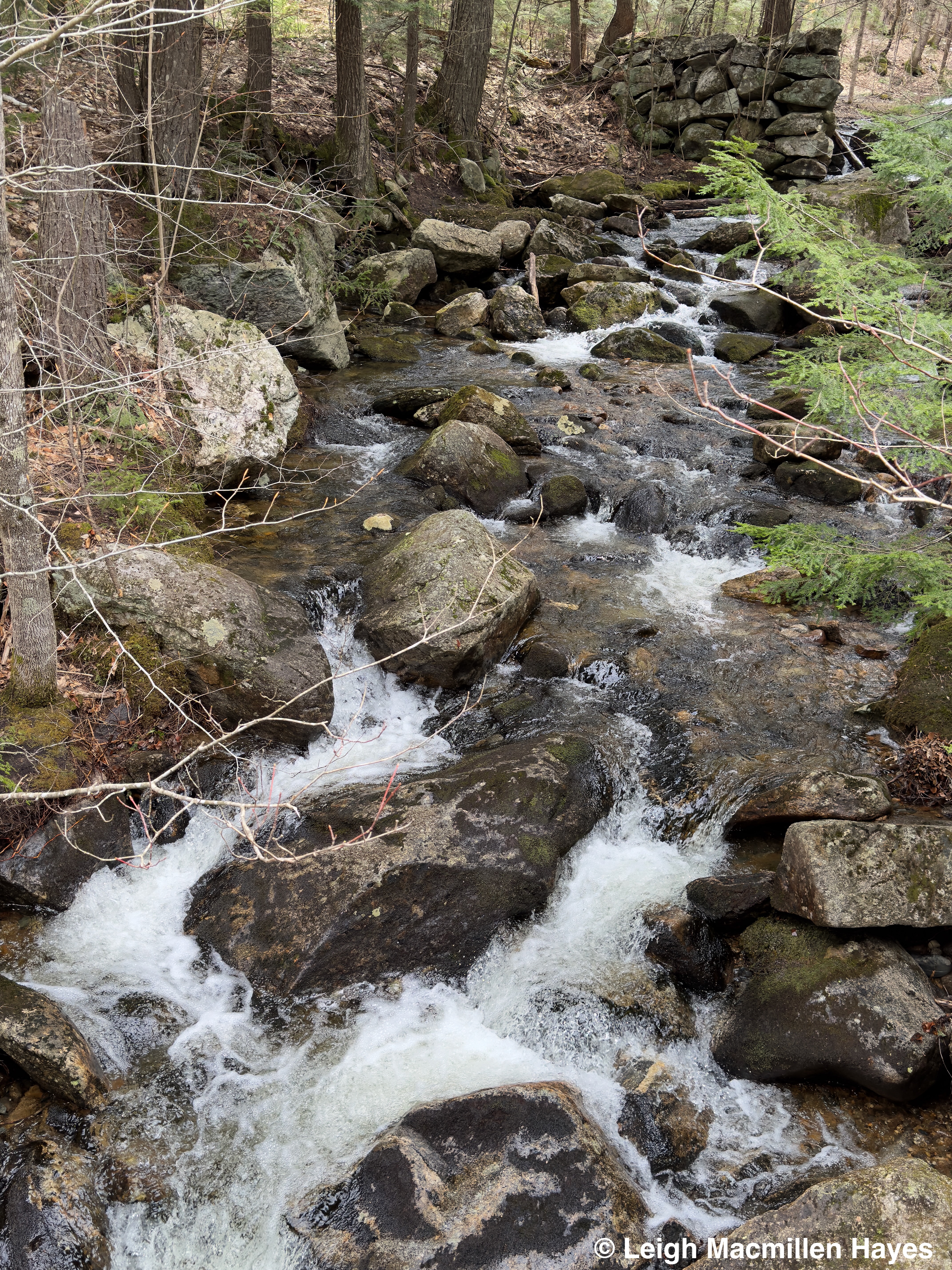
The wetland wasn’t so wet, but the water swirled around rocks just below an old mill as we crossed a bridge over the brook known as . . . Mill Brook.

In its lower reaches, we paused to rejoice in how the water swirled around and over and under the boulders and reveled in the fact that their faces were smoothly carved as can only happen in places where so much H20 has flowed for eons.

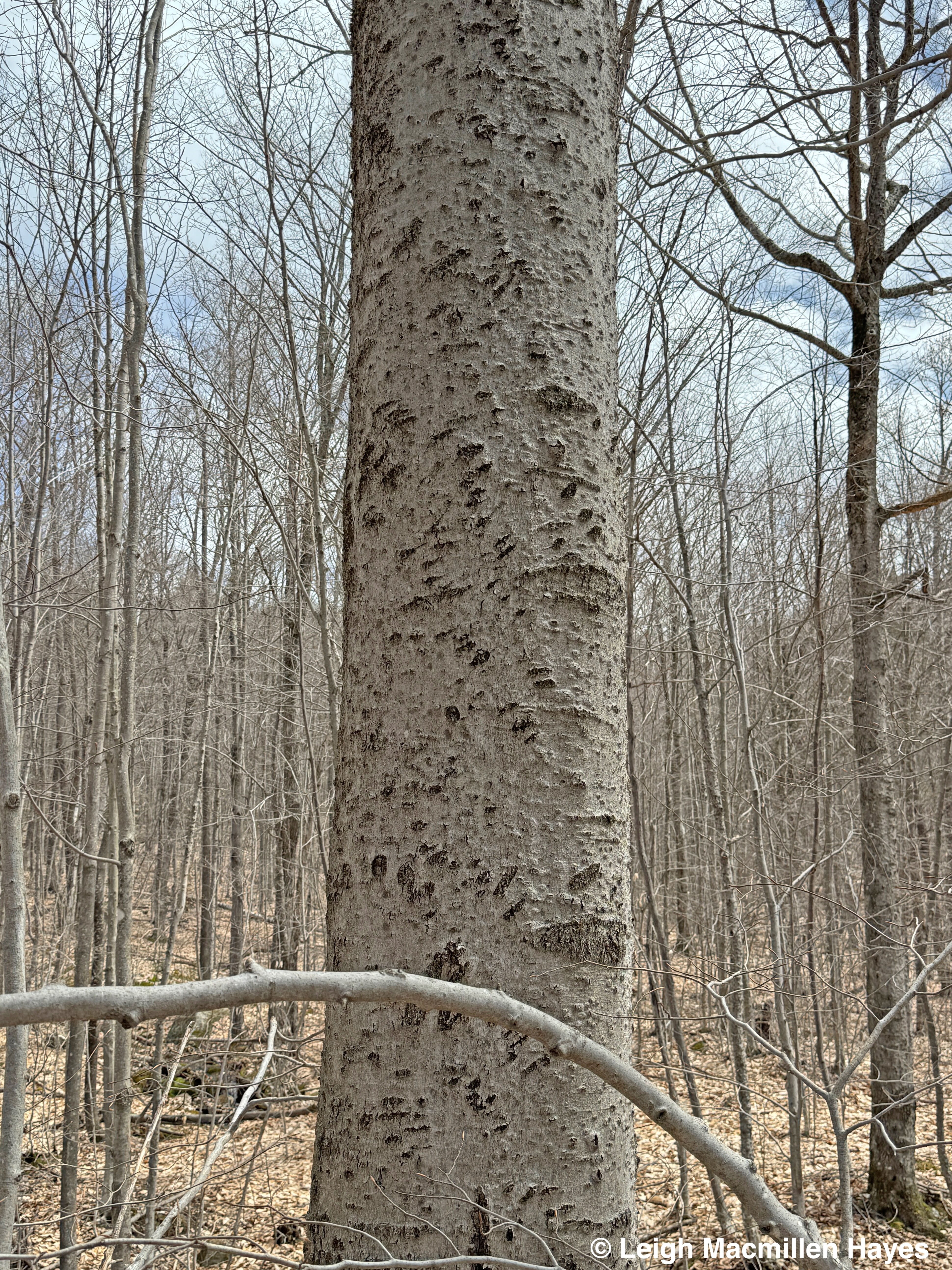
Leaving the water behind for a time, we met some friends. Beech Trees. Particular American Beech Trees. American Beech Trees more commonly known to us as Bear Claw Trees. And in this case, an oft-visited Bear Claw Tree.

Where there is one there is usually another. And another. And another. We found several, but imagined that many more exist given how many claw marks we found on these trees.

About two miles or more from the trailhead, we followed the spur trail to North Ledge (aka Lunch Ledge) and sat down to dine. Below stood a forest of hardwoods that we’d passed through and we had to wonder how many more Bear Claw Trees we might find if we actually took the time to go off trail and look. One of these days.

I did take time to examine a few fruticose lichens growing on the bark of a hemlock overlooking Lunch Ledge, this one being a Boreal Oakmoss, which is actually a lichen despite its mossy name.

And a Bristly Beard Lichen, with its short bristles decorating each branch.

From North Ledge, it’s at least a mile and a half across the mountain, with ups and downs and all arounds to get to the other side. Including snow. Given that we’d had two spring snowstorms, with the first being March 24, and both dumping a couple of feet upon the landscape, it was no surprise. Should we have donned our Muck boots?

Nope. I poked my hiking pole in at one point and discovered there was at least a foot of snow left in spots, but it was soft and easy to hike through and so we did.

At last we reached the southern side, where the trail turned and hugged the edge of the mountain. It was downhill from there.

But first, a quick break at the outlook, where we actually met the only other person who was on her way out as we were on our way in. Looking west, we could see snow showers in some surrounding mountains, but our day consisted of a few raindrops, sunshine, clouds, and a breeze. Perfect for hiking.

Also perfect for hiking: a delayed dessert of Dark Chocolate McVities! A favorite of mine since 1979 when I devoured their biscuits on a regular basis while attending school in York, England.

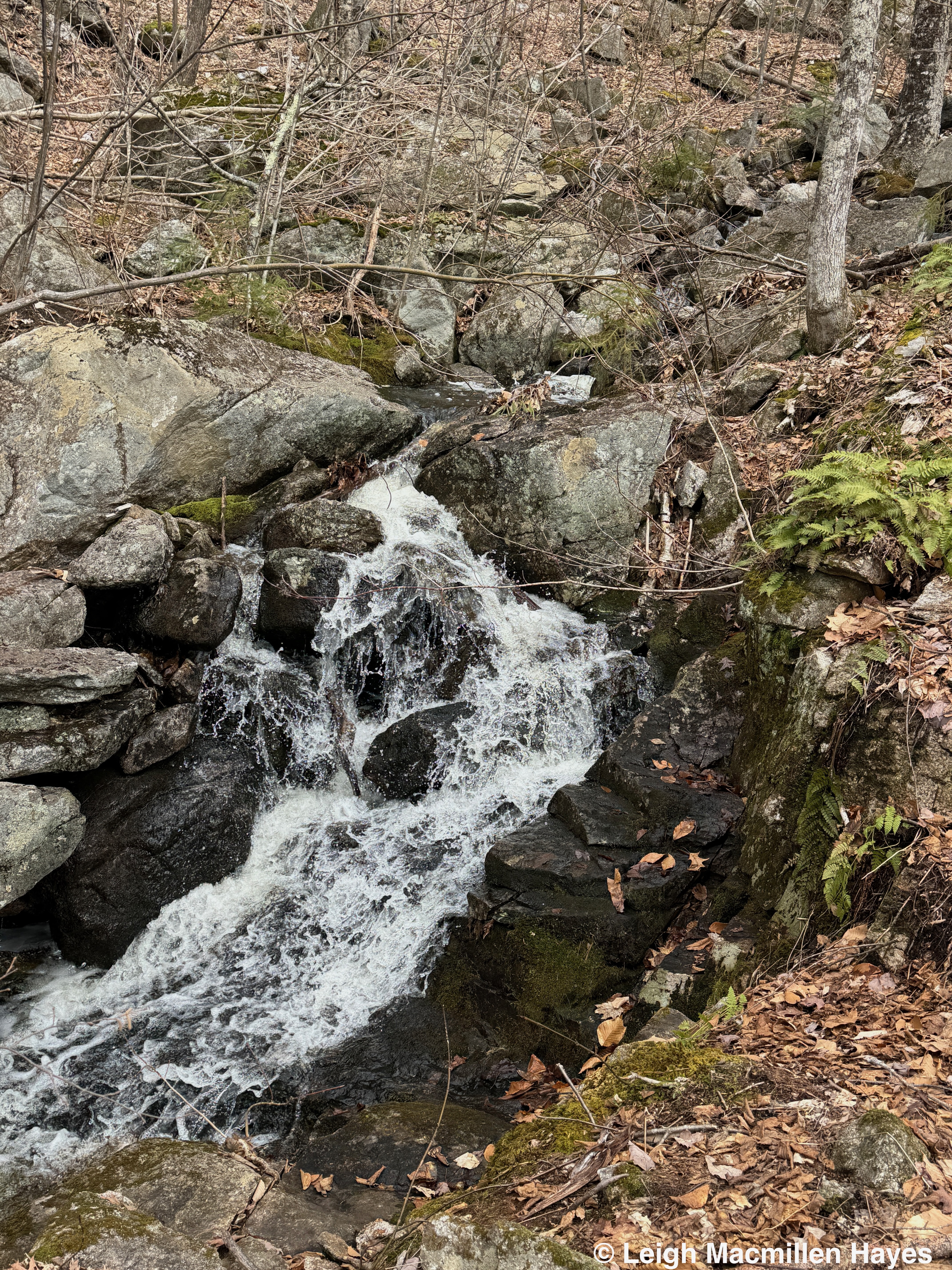
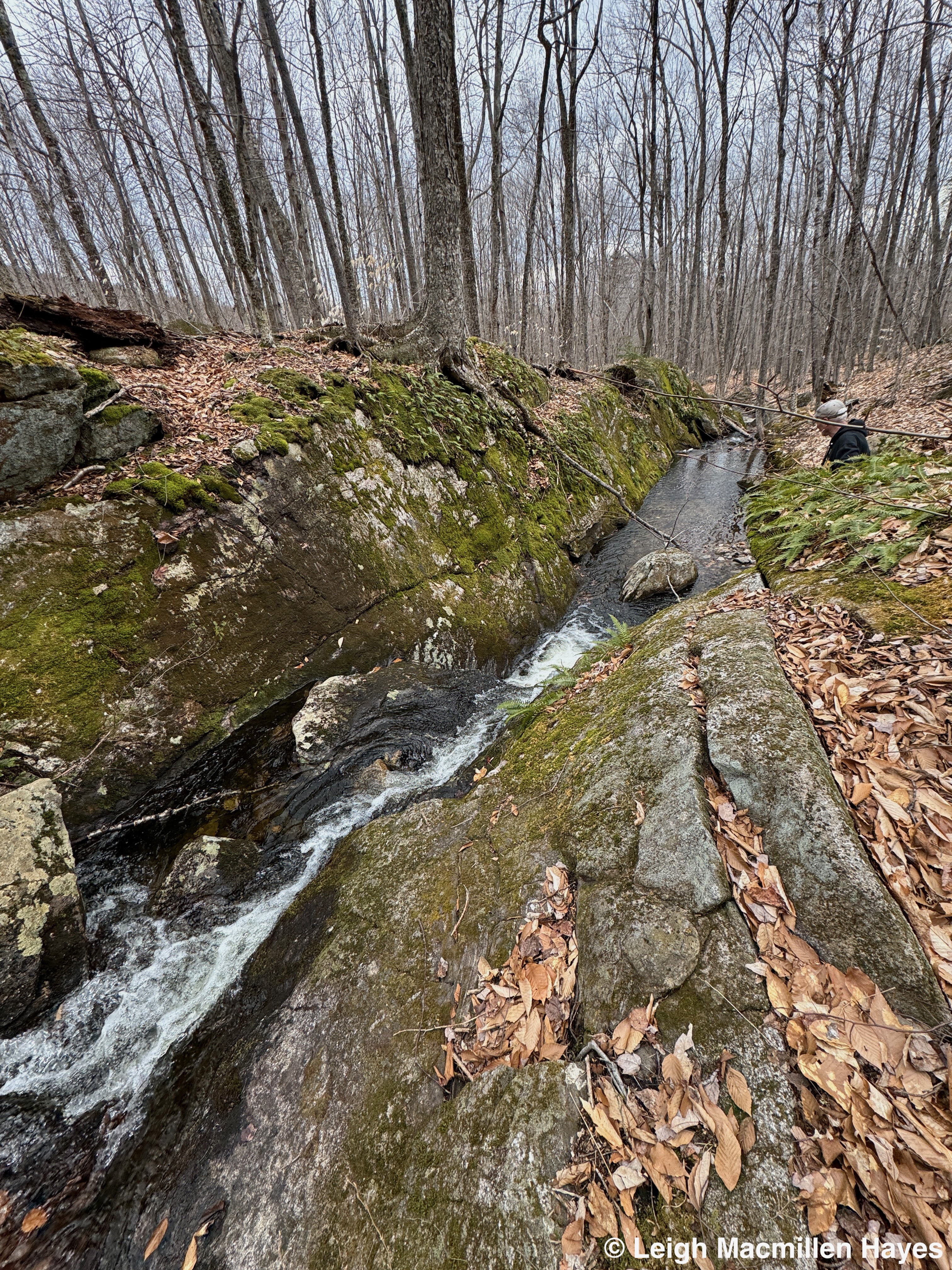
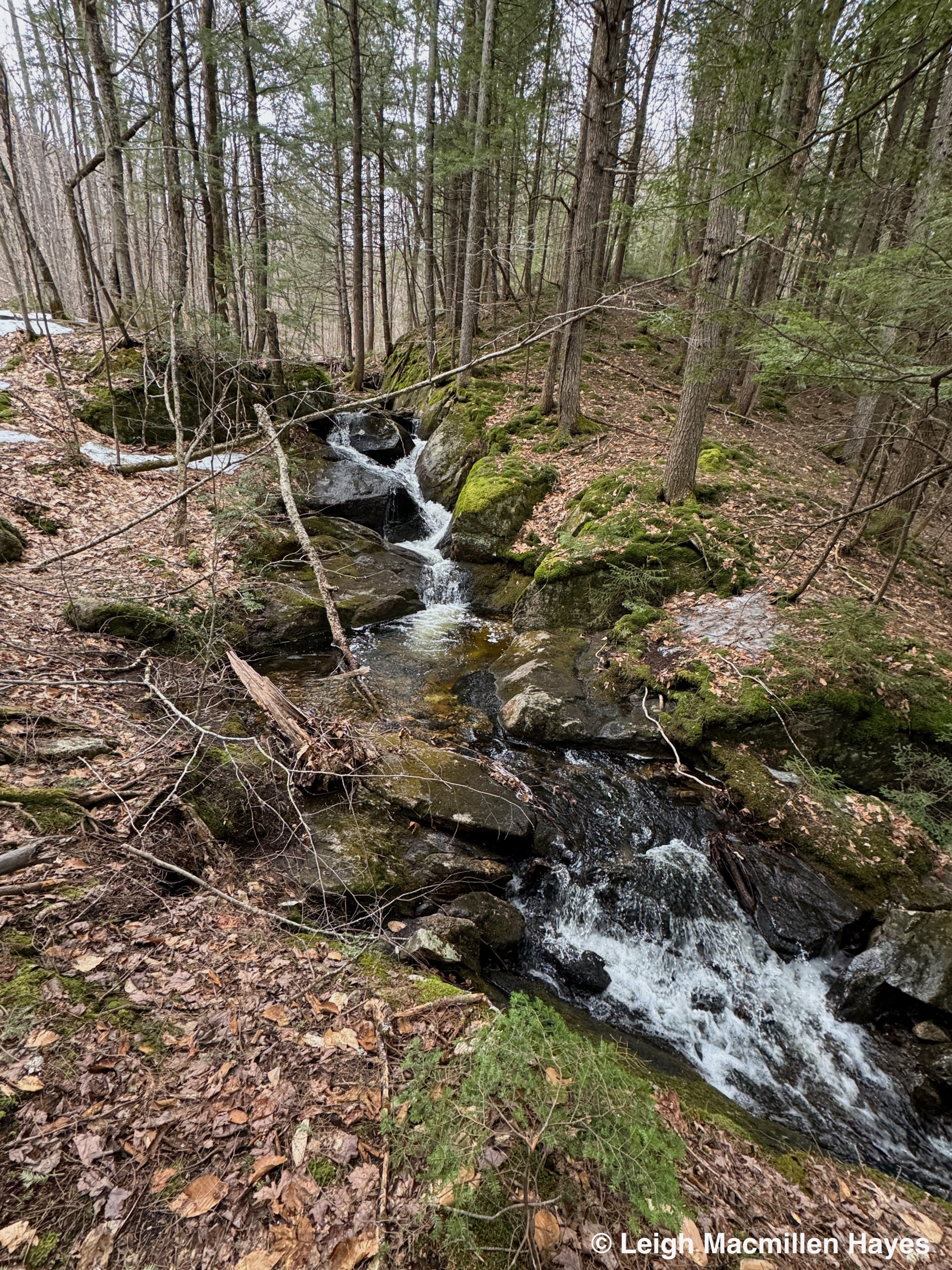
Downward we hiked and then we met Mill Brook again as it cascaded forth.

And forth.

And continued forth some more.

We followed as it flowed between a crevasse in the boulders–headed as you might note toward . . . My Guy.

And admired it repeatedly along its course.

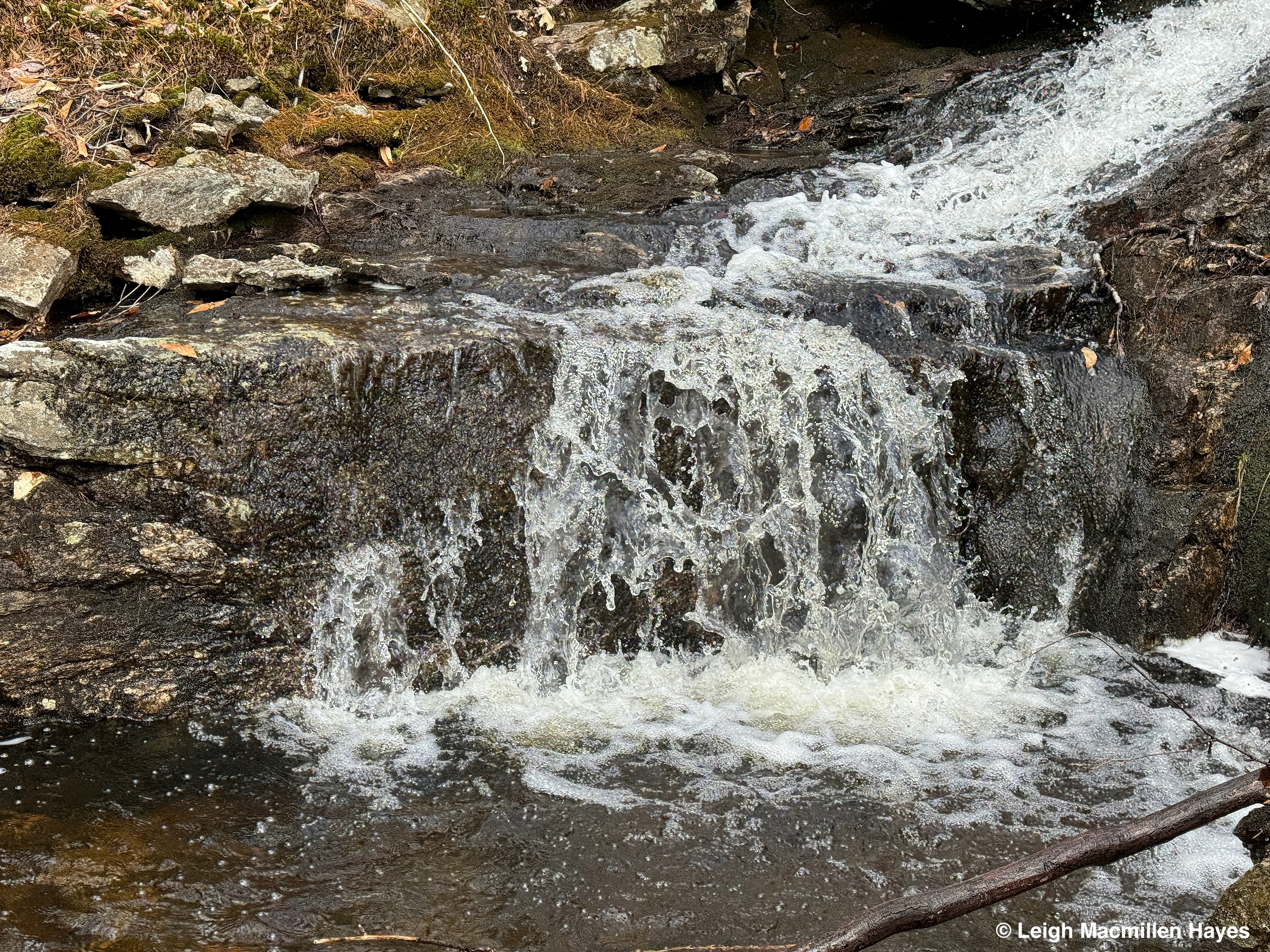
Occasionally it fanned out over boulders in its midst.

And plunged into pools.

It was a lot of water and we were thrilled to hike beside it and are still exclaiming over what a fun hike it was. Oh, there was mud. And ice. But those were secondary condtions. So far, we agreed, this was our favorite hike of the year.

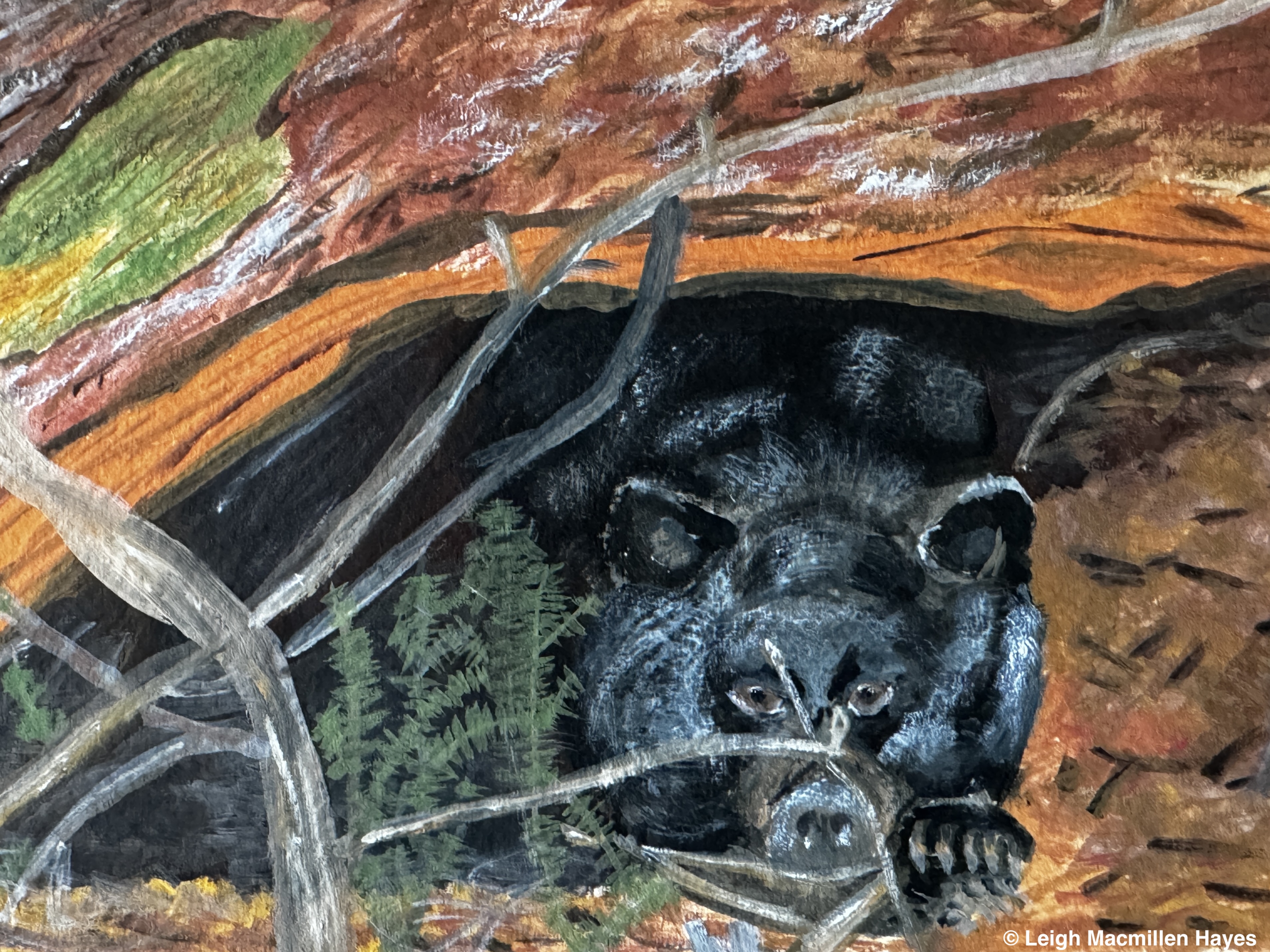
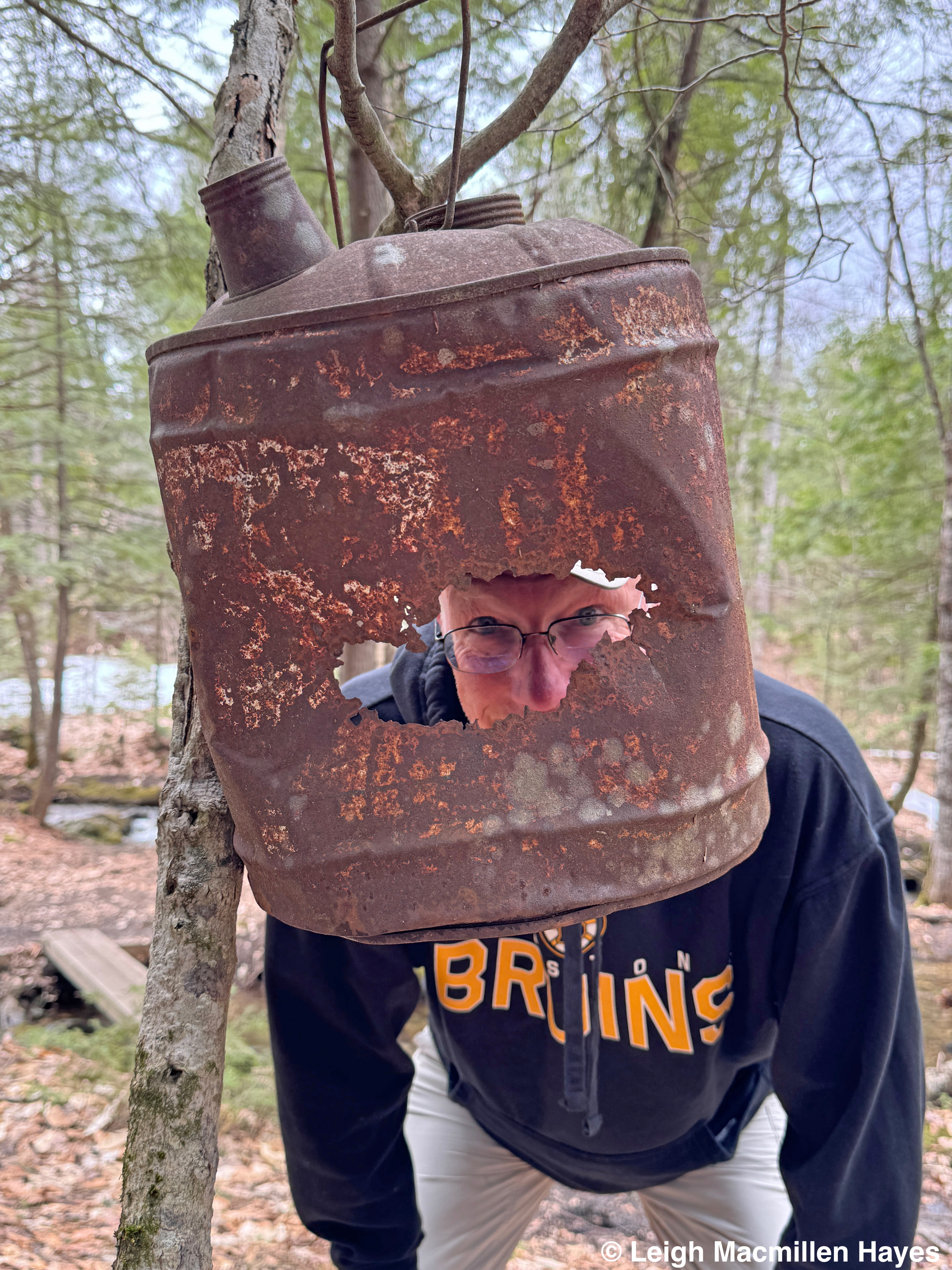
Where were we? Where bears of all types roam, including this crazy Bruin, who is usually a Maine Black Bear.

And no, we did not fall, though I know a few of you were wondering because you know my ability to do so at inopportune times. It was the waterfalls that we followed that made this Fall After Fall Mondate at Long Mountain so special.

Thanks as always to Mary McFadden and Larry Stifler. Through their generosity, many trails in the area are open to the public. And through the work of their employee, Bruce Barrett, those trails are well maintained.

Marching to the Beat of a Different Drummer

After three snowstorms this past week, the latest dumping over a foot of white stuff in western Maine, winter has finally arrived. Or, as a friend calls it, “Second Winter.”

In fact, there is finally so much snow, that my wee studio, the spot where I used to escape to write and sketch many moons ago, looks as if it’s being gobbled up and about to disappear into the landscape.

I love winter and so I’m thrilled to know that it’s not ready to give up on us yet. I also love how winter likes to play, creating tree boas that defy gravity.

In spite of all that, I do need a touch of color now and then and so I headed to a local brook where I know the Mallards gather.

And tread water as they wait for what, I don’t know. Perhaps for me to admire them: those shiny green heads, the sharp white necklaces, and cute little curly tail feathers. They tolerate our cold winters and as long as there is food and open water, such as this spot, I know where to find them.

I finally left the ducks behind and continued walking beside a second brook, pausing occasionally to reflect on the changes I’ve observed in this spot over the years, including one late November afternoon when I heard the water flowing as if over a fall and then spotted beavers hard a work, building a dam. Today, it was the spring ice that caught my attention and I know that as much as I want winter to last, spring is just around the corner and soon I’ll be peering into vernal pools.

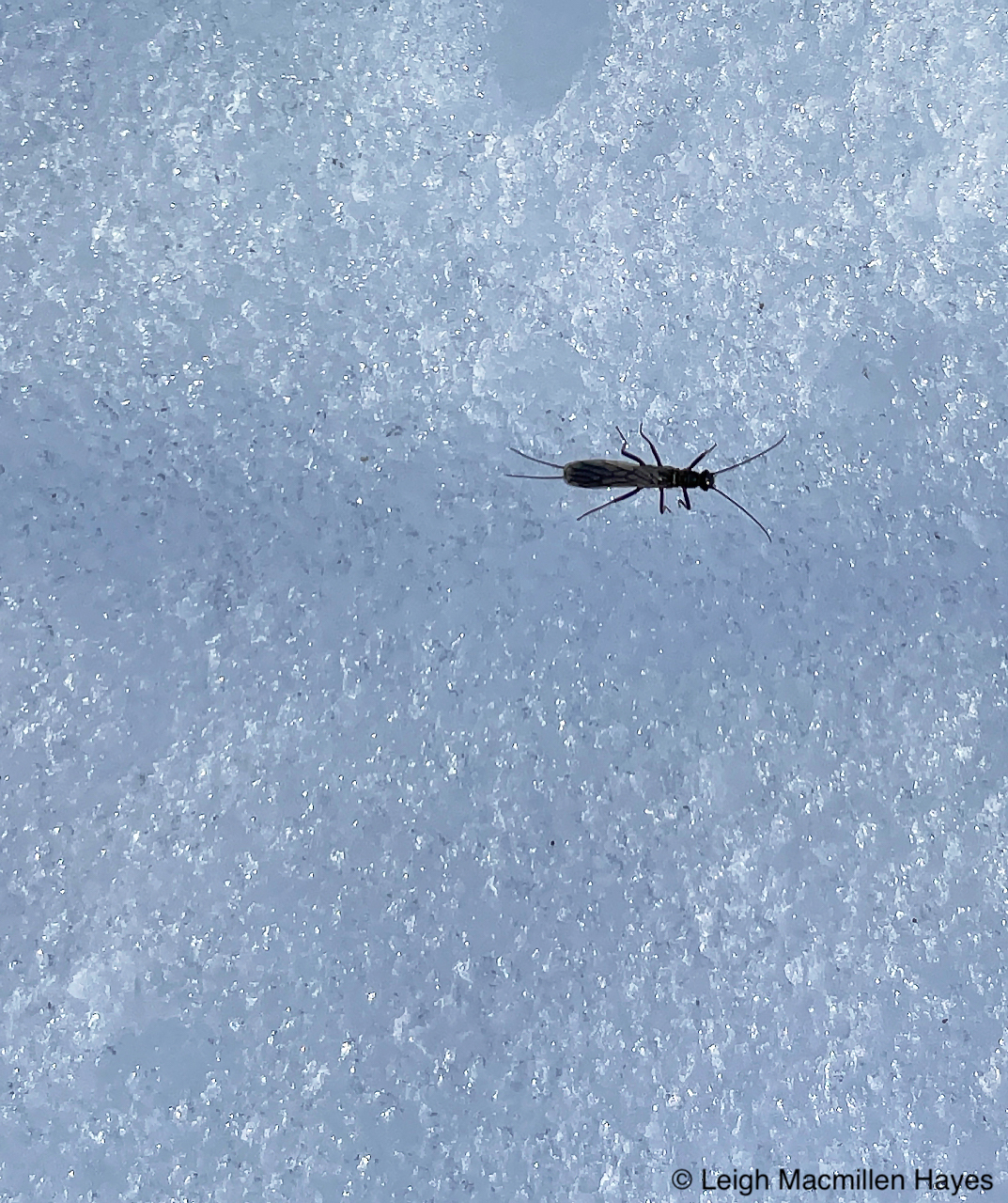
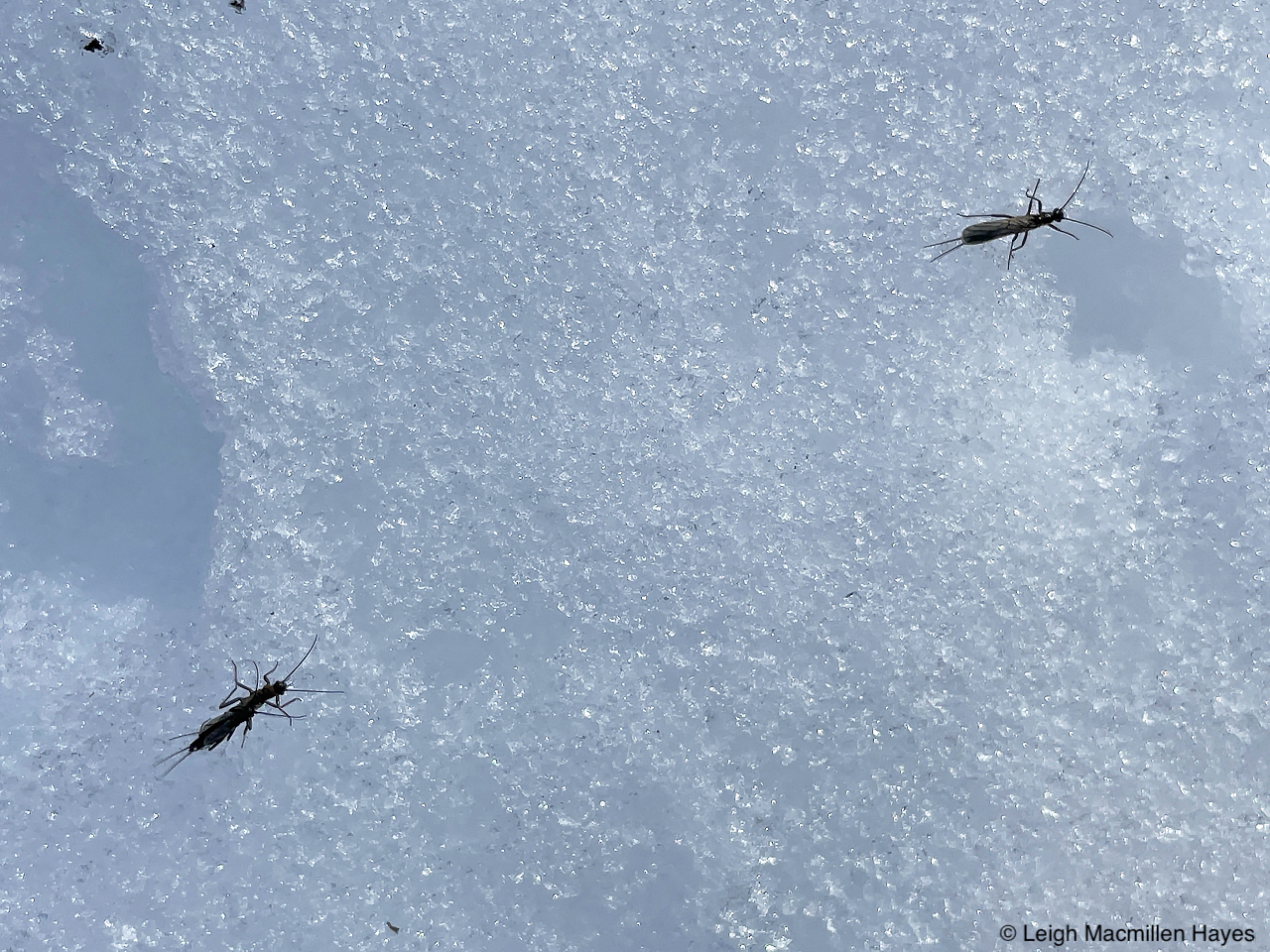
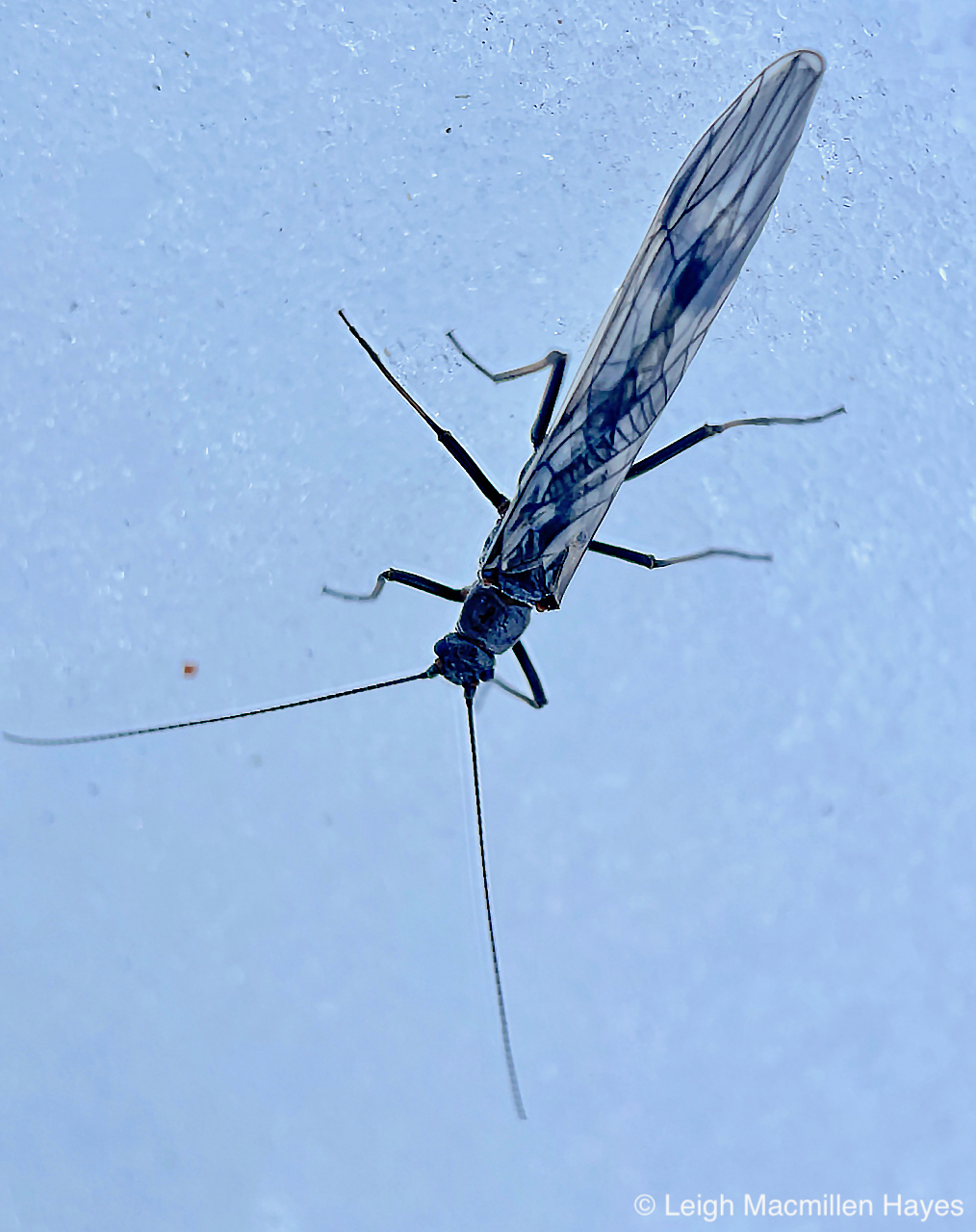
And then, something quite small captured my attention. A Winter Stonefly! Scurrying across the snow.

Suddenly, what began as one sighting turned into two and then . . . hundreds as my eyes focused. In winter, crazy as it may seem, the aquatic immature stage of a Winter Stonefly, aka naiad, crawls from the rocky bottom home of the brook where it has spent the last year or more maturing (going through as many as thirty molts)and shredding falling leaves, climbs up through crevices in the snow that covers the brook, finds a plant or some other spot to emerge as an adult, and leaves behind its shed skin, much like a dragonfly or damselfly.

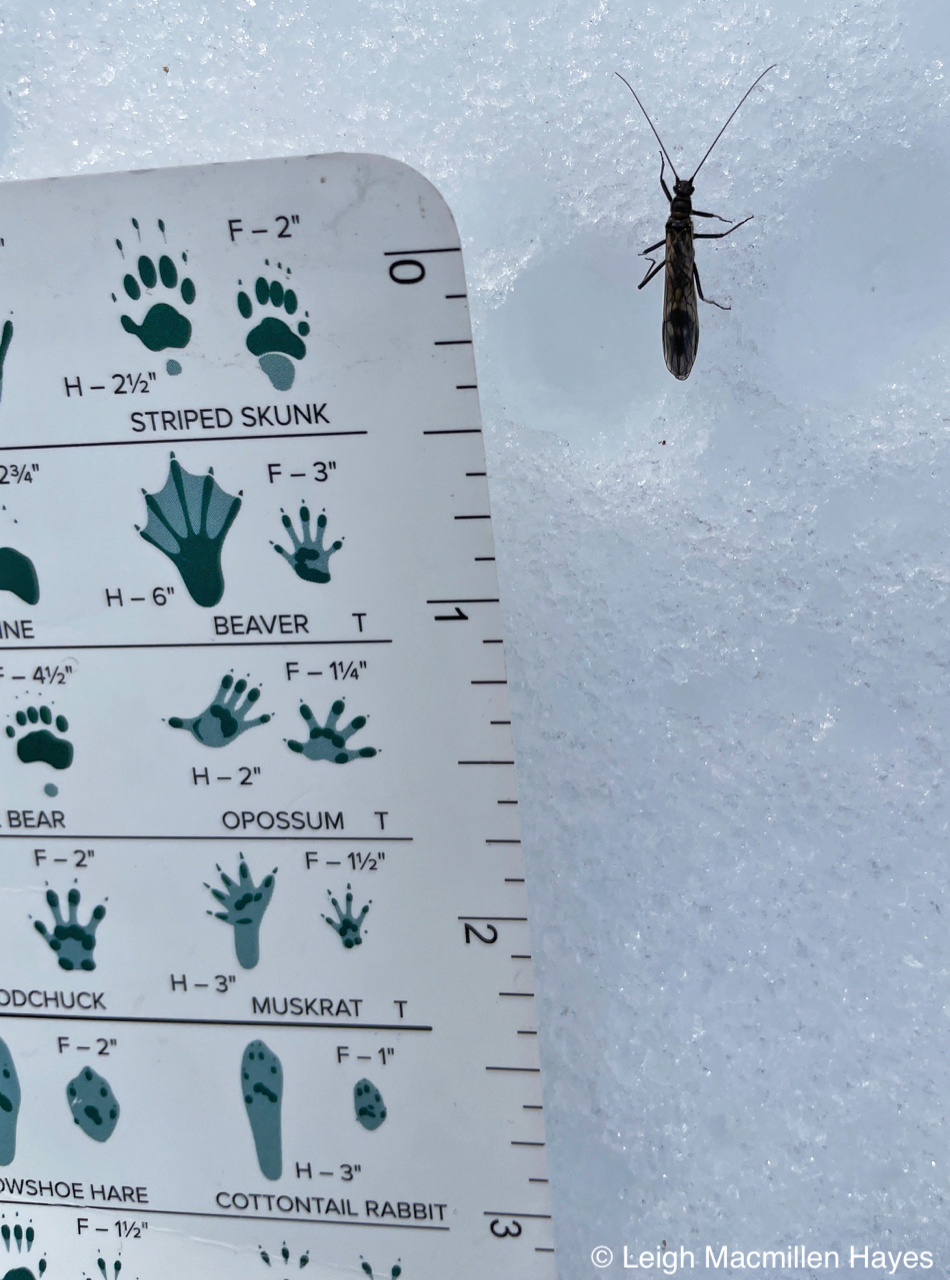
My attention in tune, I began to notice several things. First, there were large Winter Stoneflies . . .

and some much smaller, known as Small Winter Stoneflies in common terms. Their wings are non-functional, thus they crawl. But herein was the curious thing, at least to me. They all were headed west.

It didn’t seem to matter if I found them where the brook was to the east, or to the north, all of the Stoneflies walked in a westerly direction. Why?

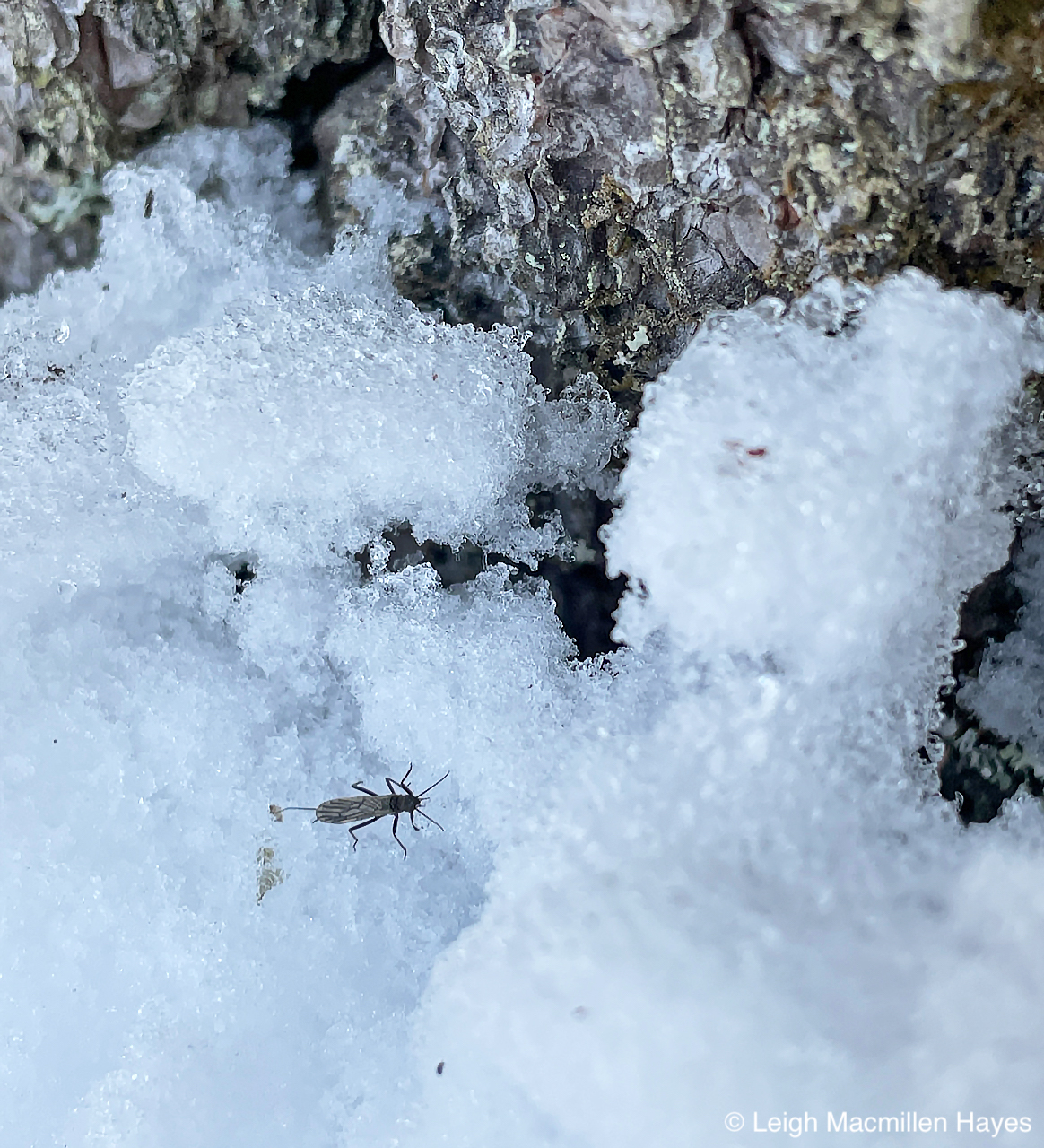
I began to wonder where they were headed, so . . . I followed them. To tree trunks. I’d say any tree trunk, for the species didn’t seem to matter, but maturity did and they all headed to older trees. At least, the insects I observed.

This Small Winter Stonefly had obstacles of ice crystals to work around, but it was on a mission to reach that tree.

Mission accomplished.

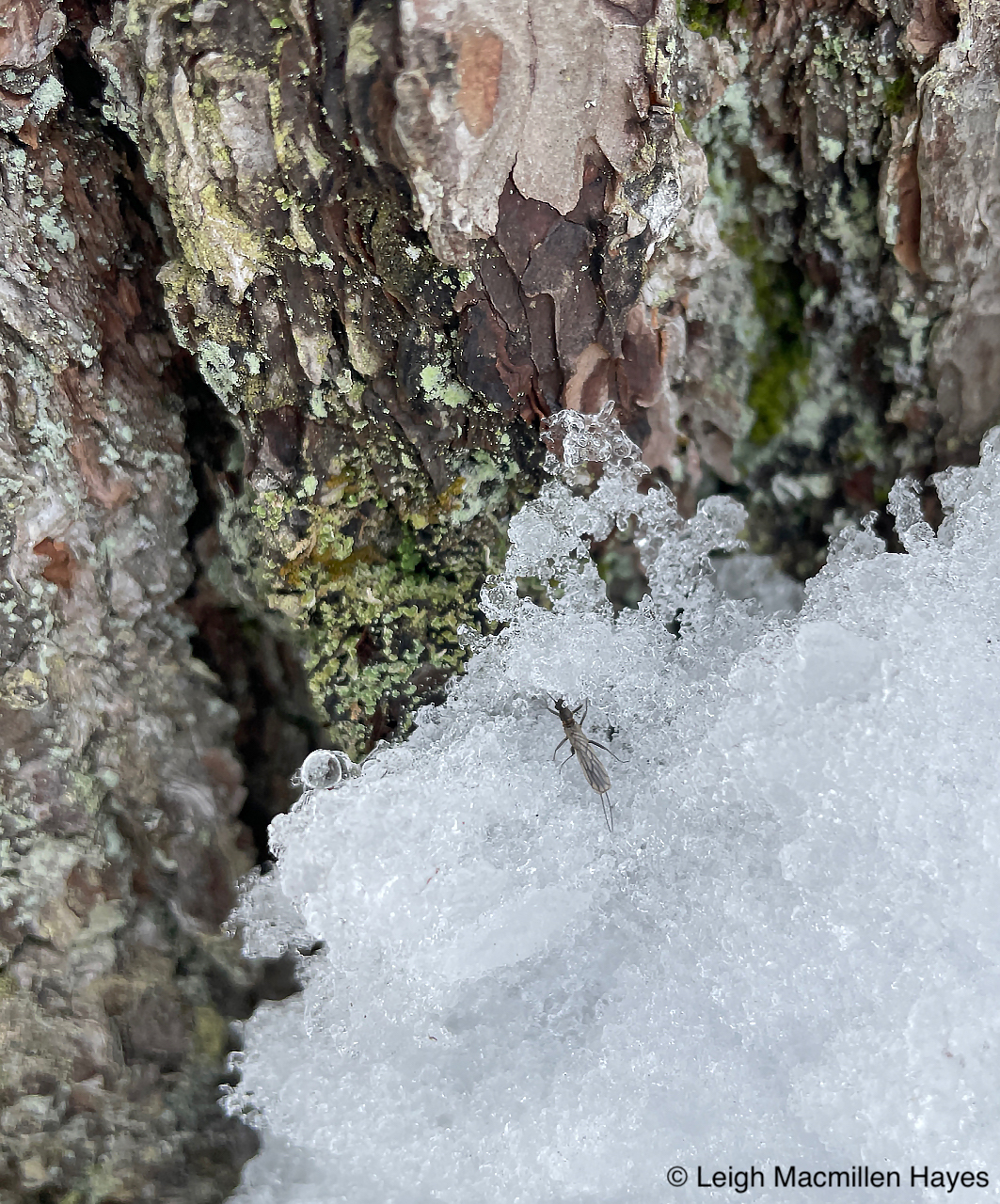
Once there, the insects crawled down under the snow beside the trunk and I had to wonder if a party was in the making. The bark is warmest in that spot, so it was a good place to get out of the weather.

Stoneflies have hammer-like structures on their abdomen that make noise when thumped against a surface, like a tree trunk or a twig or even the ground. This is a mating call. The males drum, and the females drum back, and voila, they find each other and canoodle.

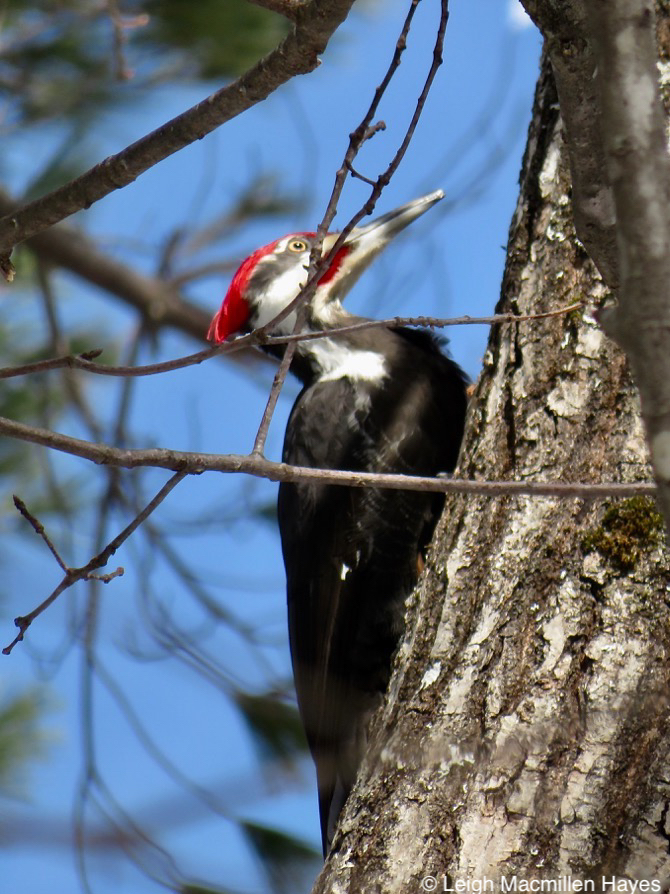
It’s not the same drumming sound as we hear daily from our resident Pileated Woodpecker. In fact, it’s made for Stonefly ears only and it’s not a party for which we receive an invitation.

Seeing so many Stoneflies made me want to celebrate anyway for they, like Mayflies, and Caddisflies, are particularly sensitive to pollution and serve as bioindicators of water quality. That means the brooks beside which I walked have excellent water quality.

And though I couldn’t hear the percussion instruments at the base of the trees, I am grateful to have spent some time with those who march to the beat of a different drummer.

Quill You Be Mine?

It’s not even Valentine’s Day and already I’m thinking of love. Don’t tell My Guy, but this is love of a different sort. And the story all began while tracking with friends earlier this week.

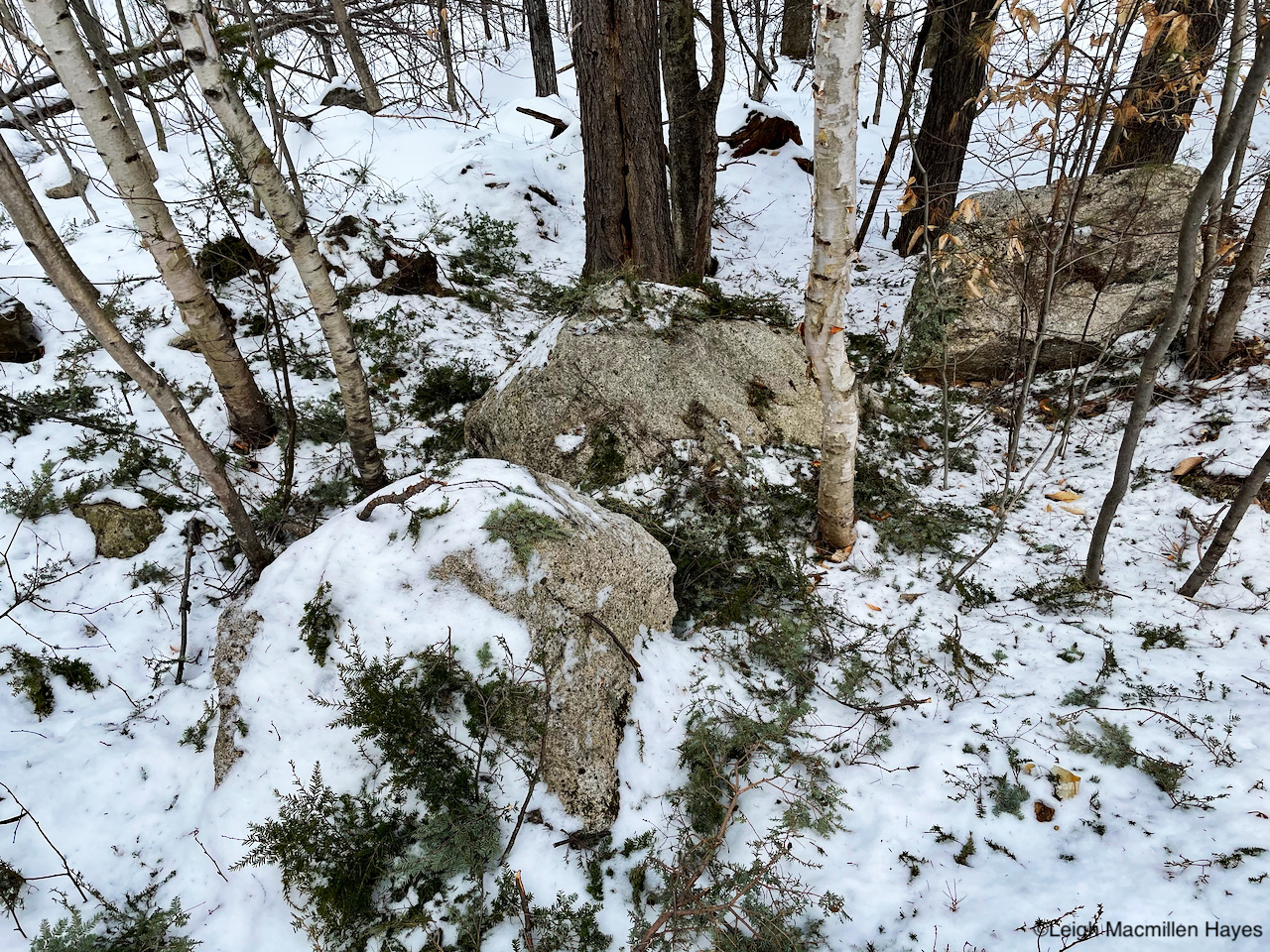
Just as we were about to finish up the program, we spotted the signs of a resident rodent, including downed hemlock twigs and then a den. The den did not entirely make sense due to its placement in what seemed like a wet area, but we decided the critter must have found a dry place above the moisture, for indeed there was scat.

Once spotted, I knew I needed to return, for almost nothing makes me happier than to spot sign left behind by this mammal.

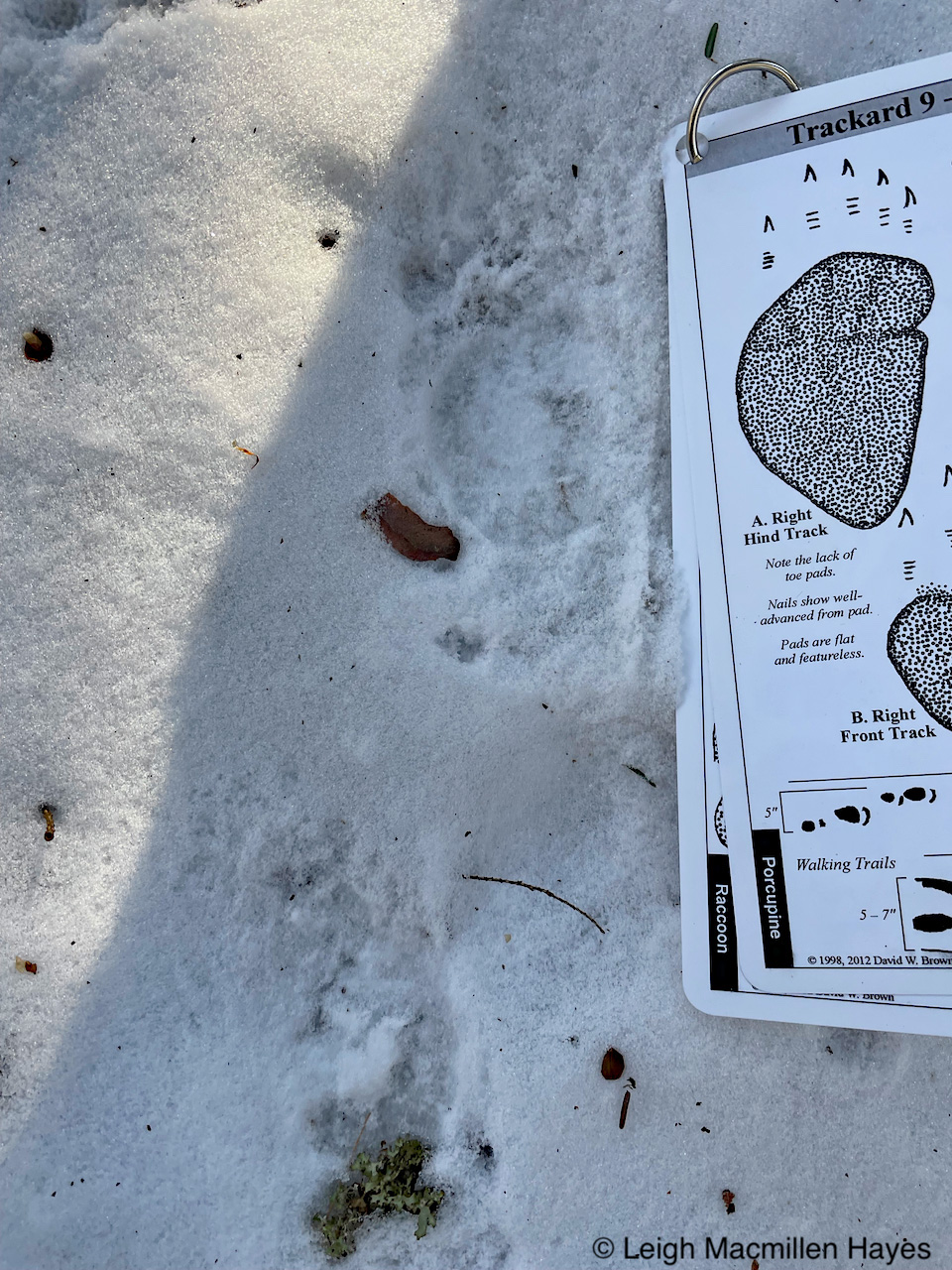
And so I did yesterday afternoon and while taking a different route to the den, I noticed the sashay of said critter as it had waddled through fluffy snow.

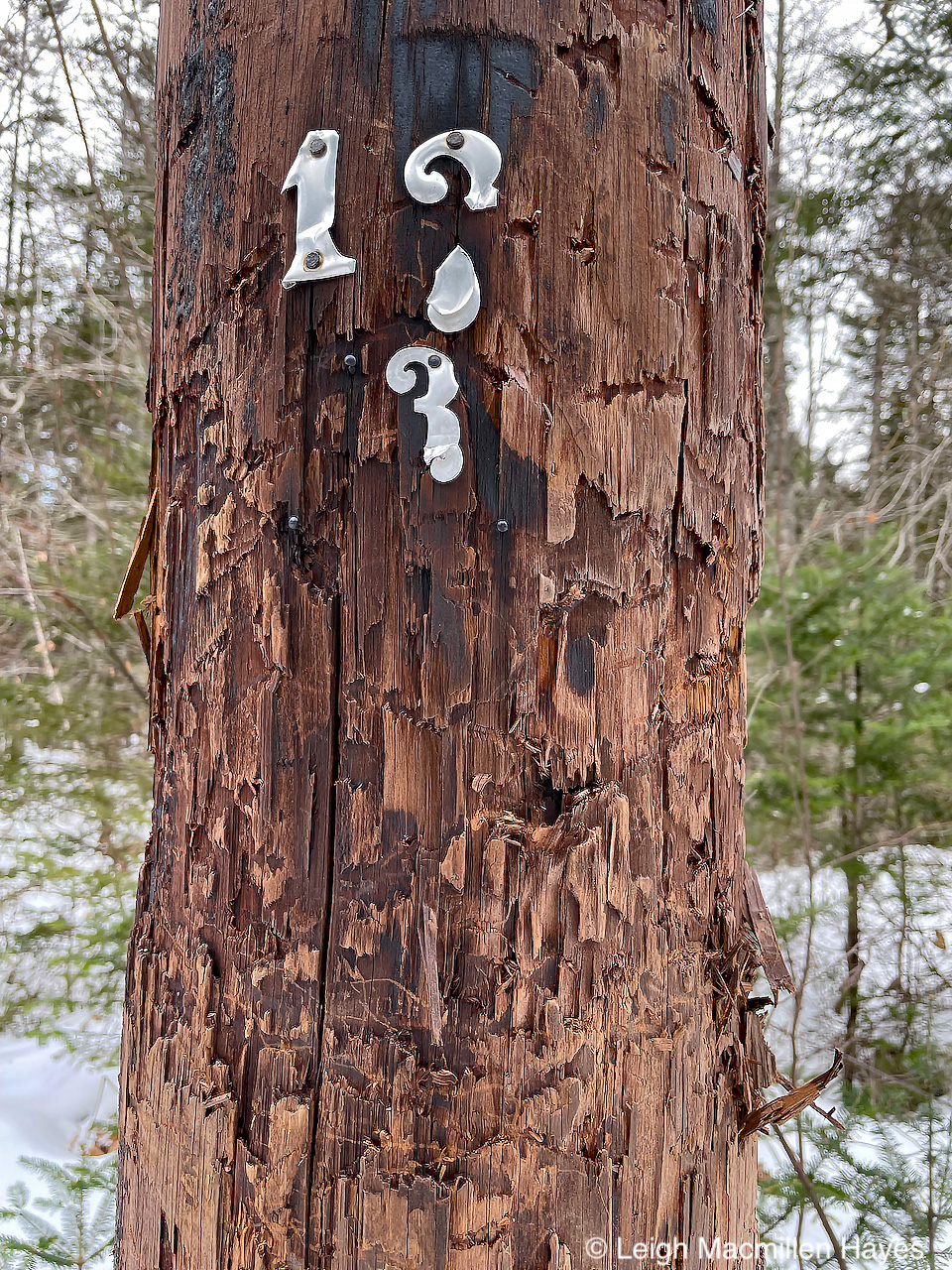
Next, I did what I do, and followed the tracks in a different direction than originally intended. And that’s when I saw these, the resident’s name carved on several wooden shingles. It’s an agile critter given that the shingles were posted all the way to the tip top of these pole trees.

Can you read it? Porcupine Lives Here is the inscription engraved on the tree. Actually, it’s a sign of winter feeding for porcupines, like beavers and deer, seek the cambium layer as one of their food sources. Each line shows where the porcupine’s incisors came together as it scraped away to obtain a meal.

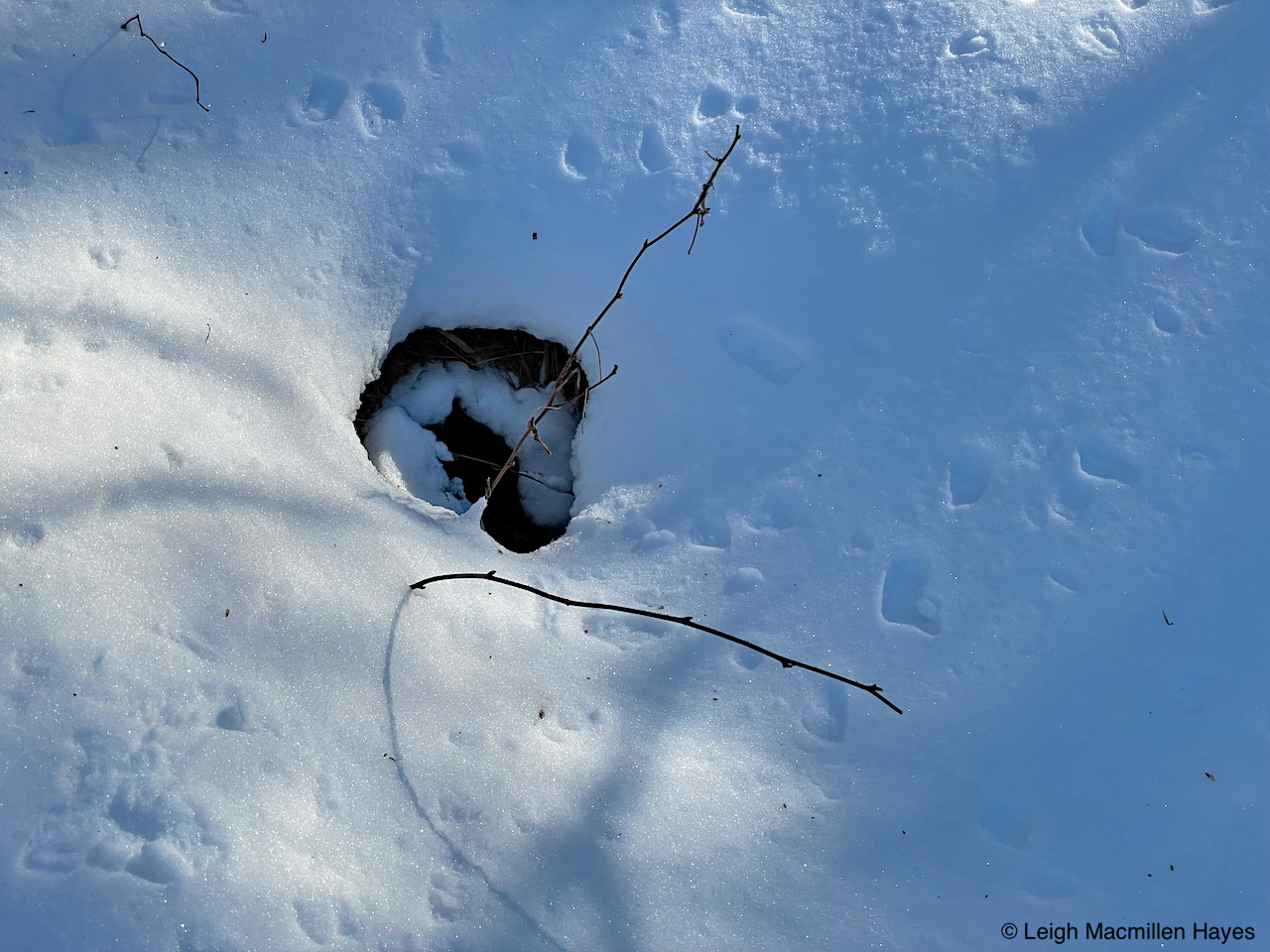
And just beyond those pole trees, I spotted a hole that I suspected could only be one thing. A den with tracks leading in and out and the required pee, for such is this mammal’s habit.

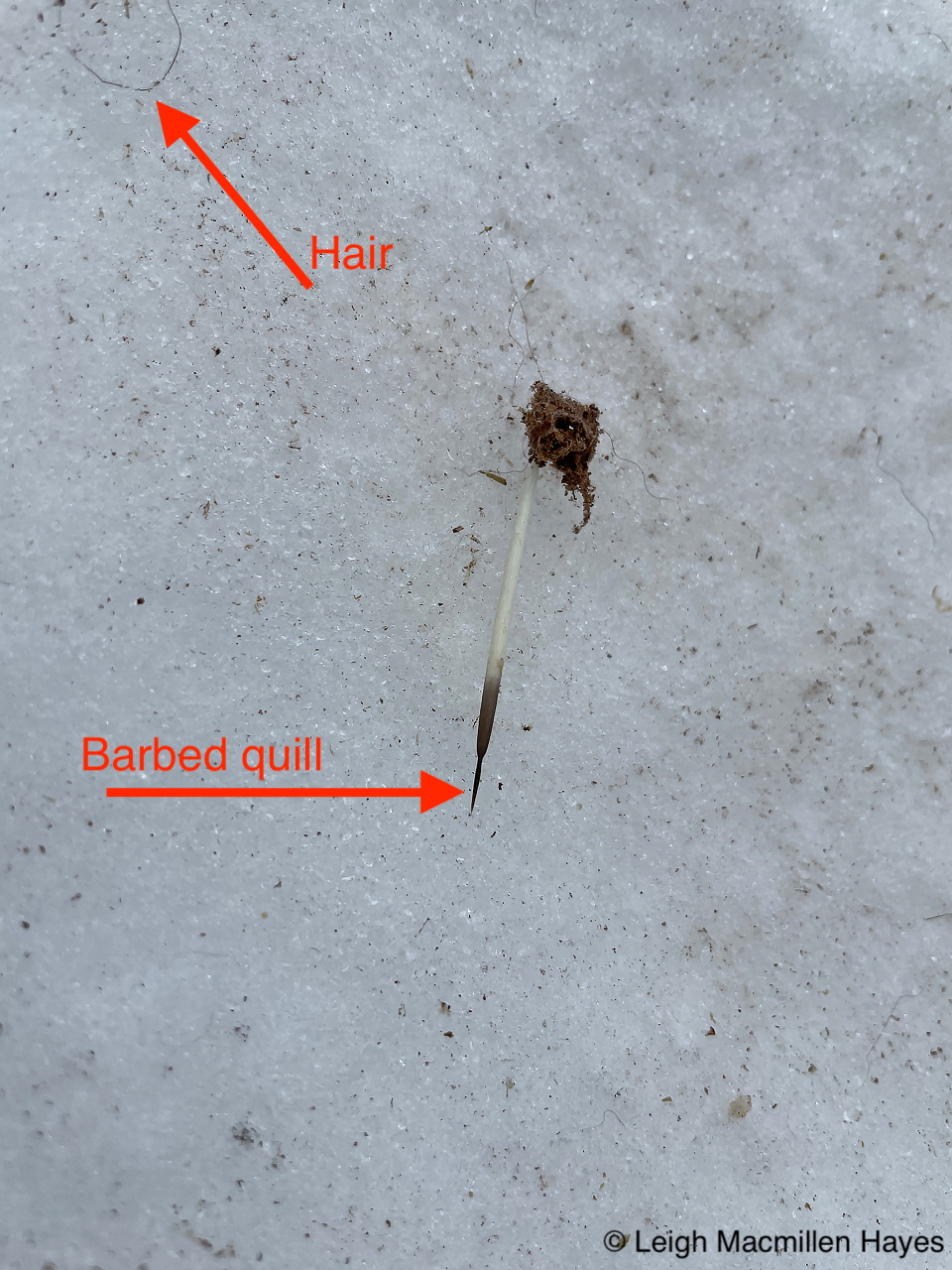
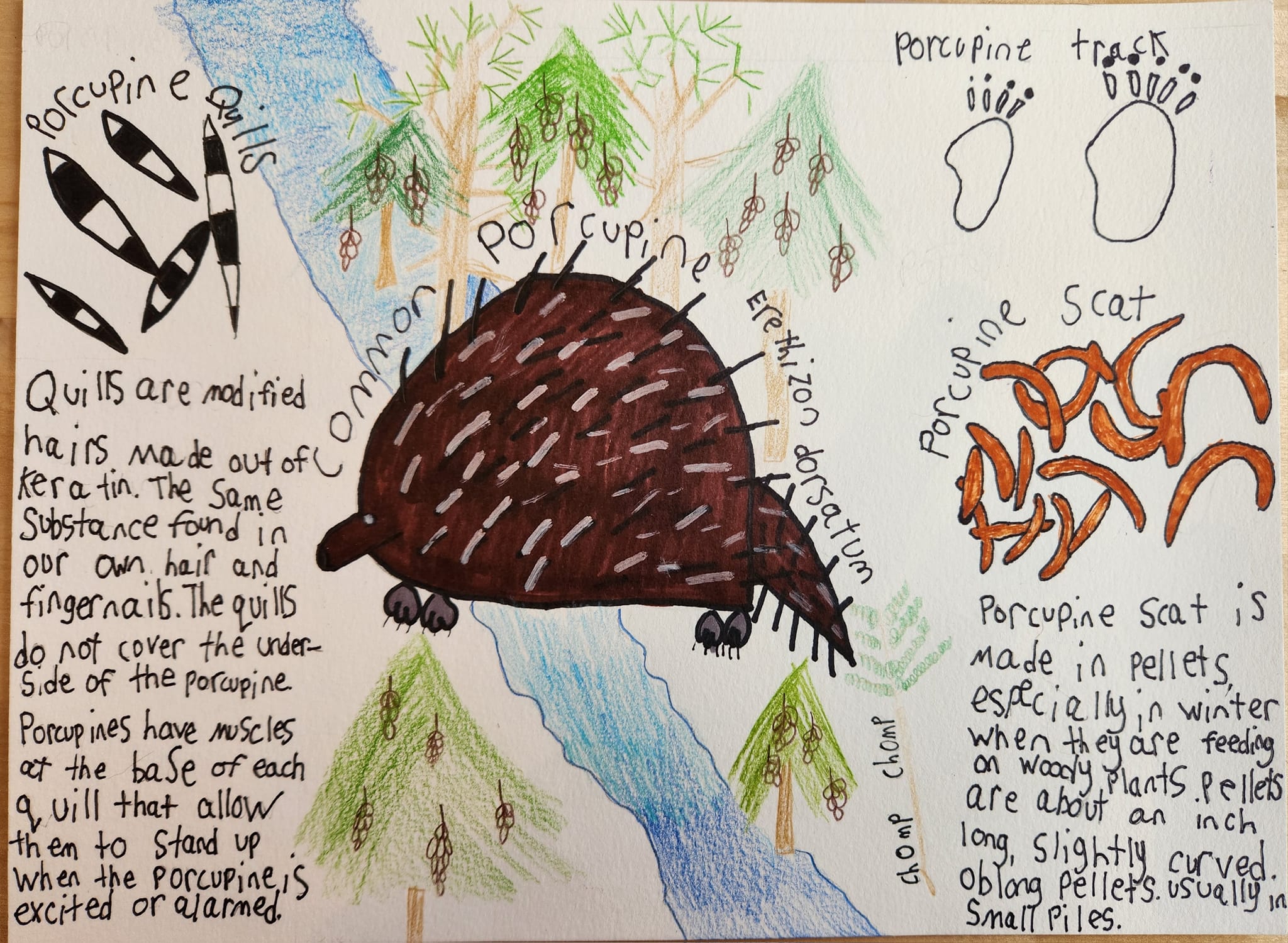
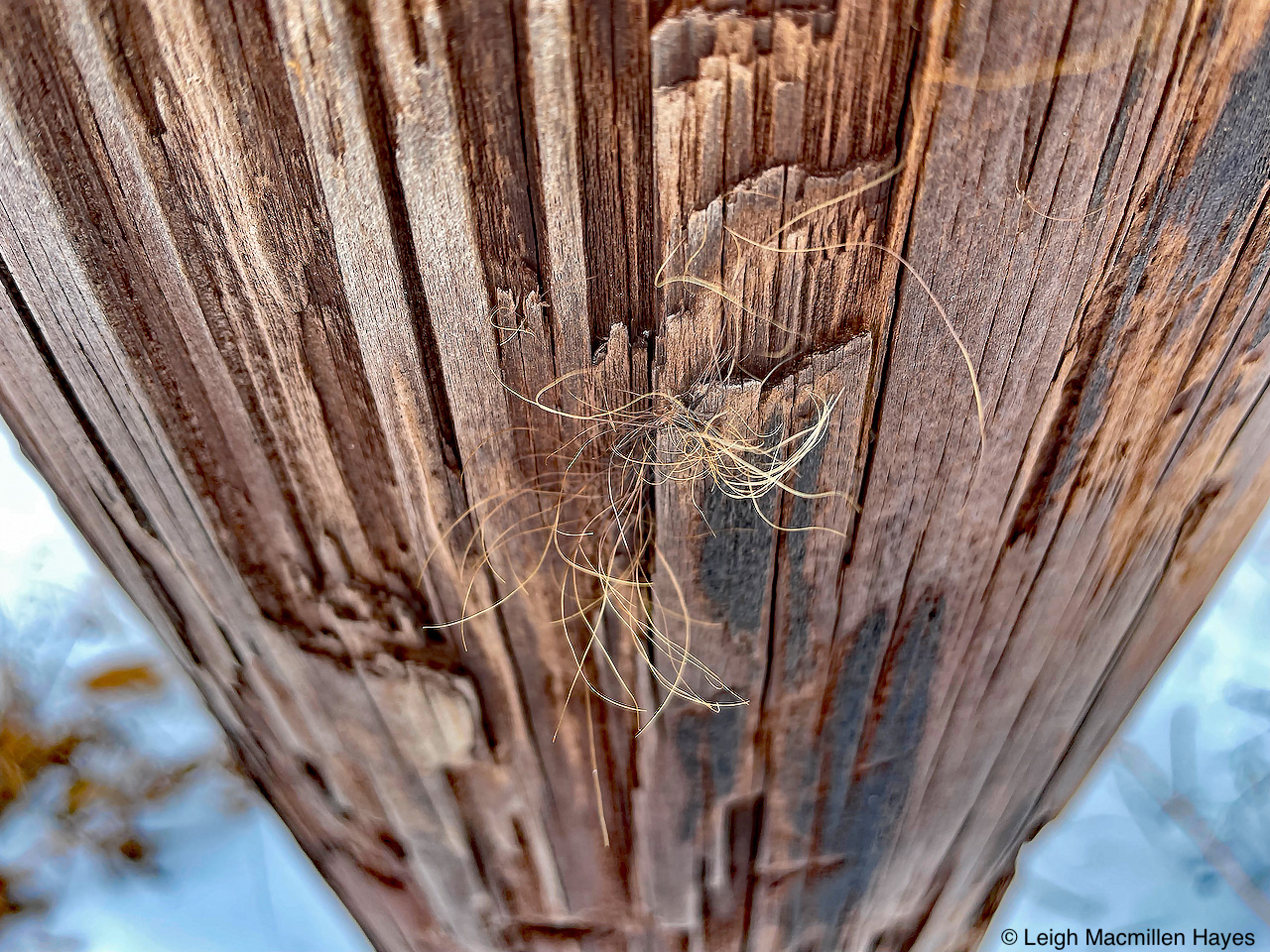
A closer look at the dooryard and I spotted a barbed quill and hair. Actually, quills are a modified form of hair.

Did you know that porcupines have a variety of hair? For winter insulation, they have dark, wooly underfur. In addition, there are long guard hairs, short, soft bristles on the tail’s underside, stout whiskers, and then there are those pesky quills.

They aren’t pesky to the porcupine; just us and our pets and any animal that might choose to or accidentally encounter a porcupine.

The quills are 1 – 4 inches in length and lined with a foam-like material composed of many tiny air cells, thus their round, hollow look. There are no quills on the porcupine’s face, belly, or inside its legs.

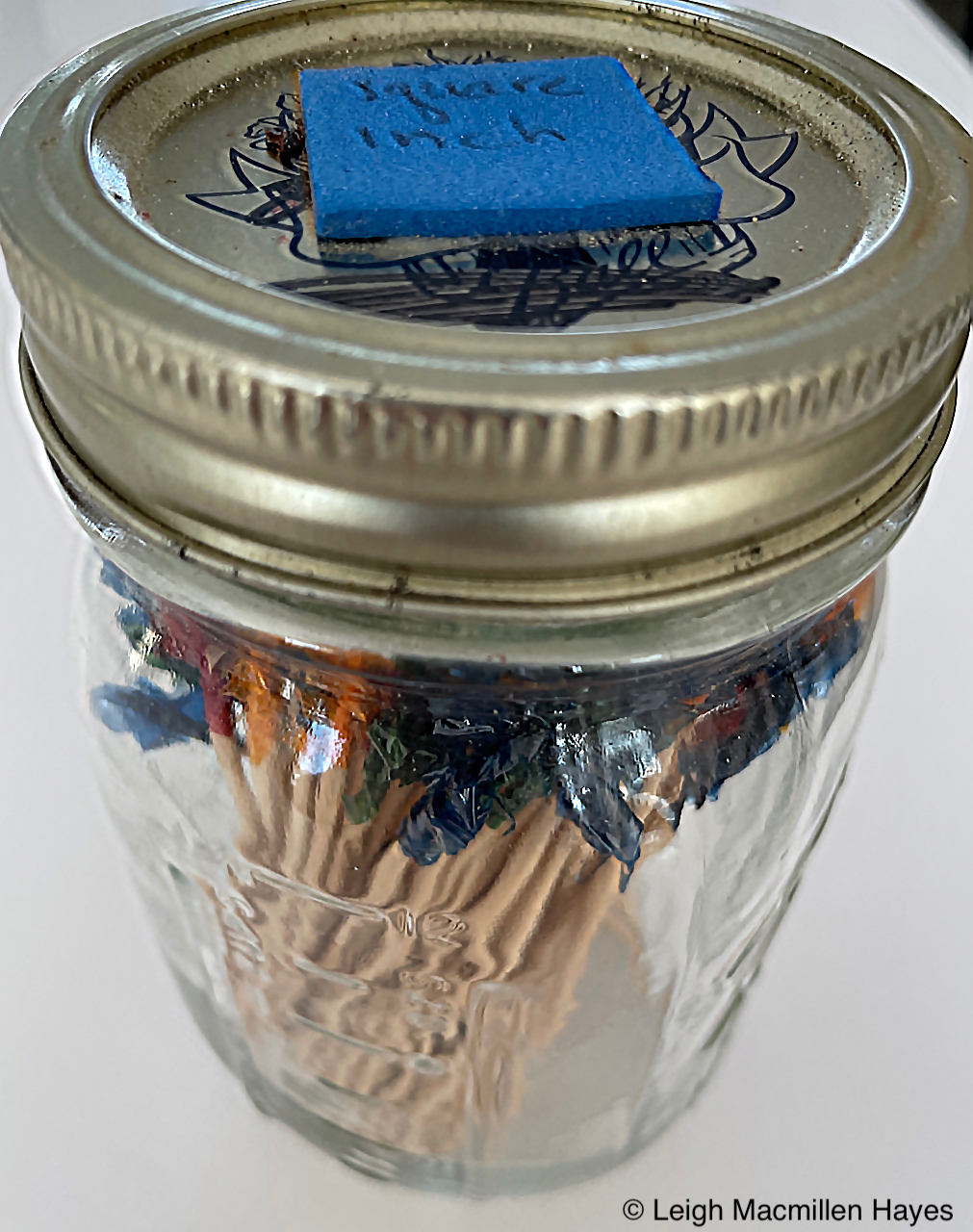
But on the upper portion of its head, down its back and along the top of its tail, oh my. Within one square inch, there are approximately one hundred quills.

All told, there are over 30,000 quills. But who is counting. Not me. Though I did count these fancy toothpicks, 100 in all, to represent the quills in a square inch.

Despite the myth, porcupines cannot throw their quills. Because the quills are loosely attached, they dislodge easily on contact and stick into a victim’s flesh. And because they are barbed, they are difficult to remove. Talk about a formidable defense!

Returning to the den, which was located within a hollowed tree, I knew the porcupine had visited within the last twenty-four hours but wasn’t so sure it was home at the hour I stopped by.

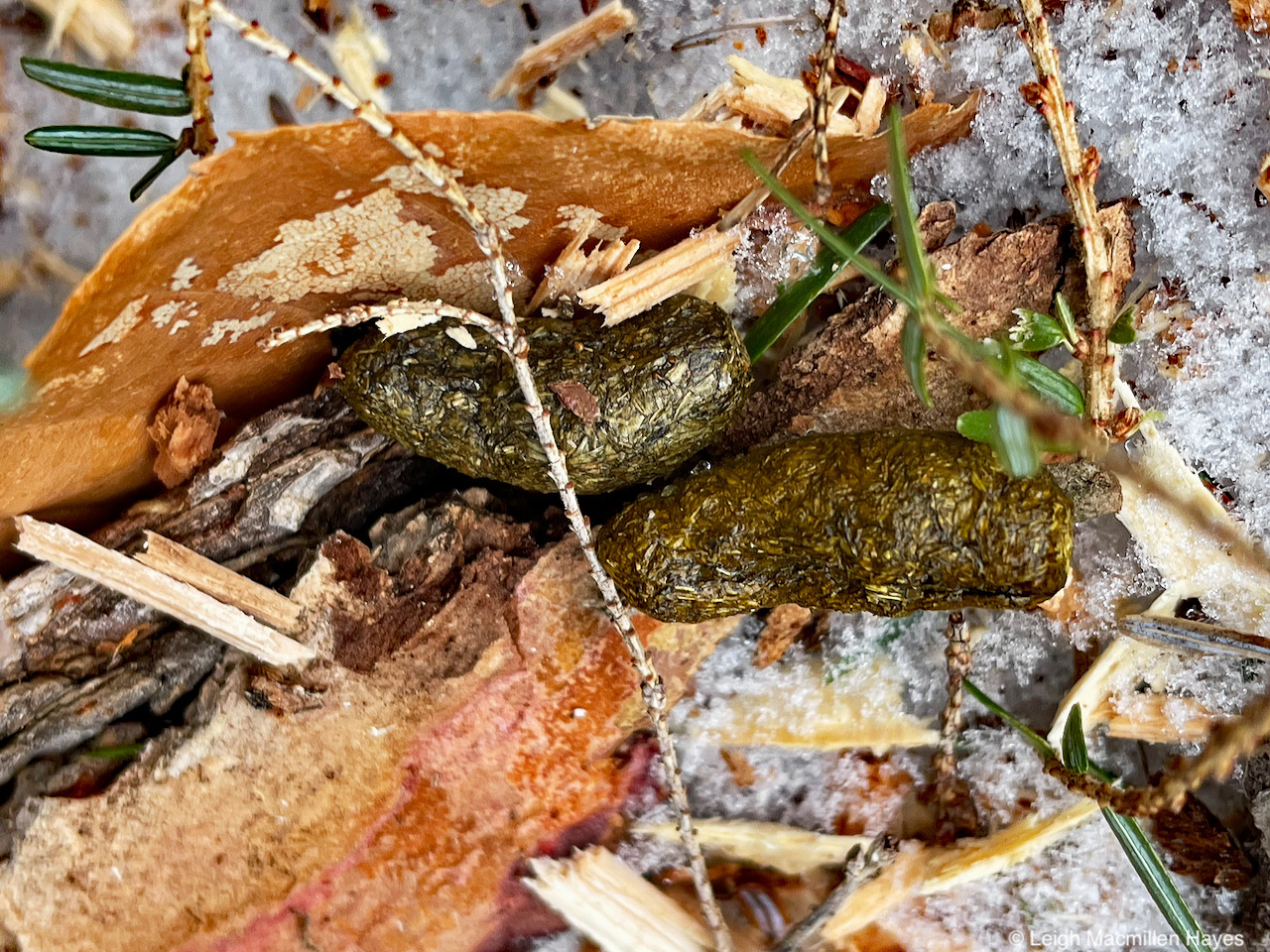
As I often say, “Scat happens.” And in the case of a porcupine, it happens a LOT! One porcupine evacuates 75 – 200 scats a day. And though this happens as it dines, most of the scat is deposited in the den. Why? Warm insulation on a night as cold as tonight will be with temperatures already in the negatives and wind chills expected to reach -45˚? Or a detractor for predators–do they get a whiff and realize its one they don’t want to visit?

I’m not sure, but this is an example of a winter scat–fibrous from that woody diet of bark and twigs. It’s comma shaped. And often there is a groove down the inside curve.

By spring, it may come as linked pieces, much like a necklace, for grass fibers from a change in diet help create the connection.

Having discovered this den, I decided to follow the tracks, which indicated the mammal had traveled in two directions. Where would it lead me?

Within a tenth or two of a mile, I realized I’d snowshoed back to the spot my fellow trackers and I had discovered two days prior. You can see our snowshoe tracks. But since our visit, the porcupine had happened along, climbed over the downed log and peed.

Did you know that pee plays an important role in a porcupine’s courting ritual. These critters are solitary most of the year, but between September and November they seek a mate. The male, in a bid to woe a female, often approaches and sprays her with his urine. Are you feeling the love? She apparently does, for if she likes the scent of his urine, they might rub noses, or walk on their hind feet before canoodling begins.

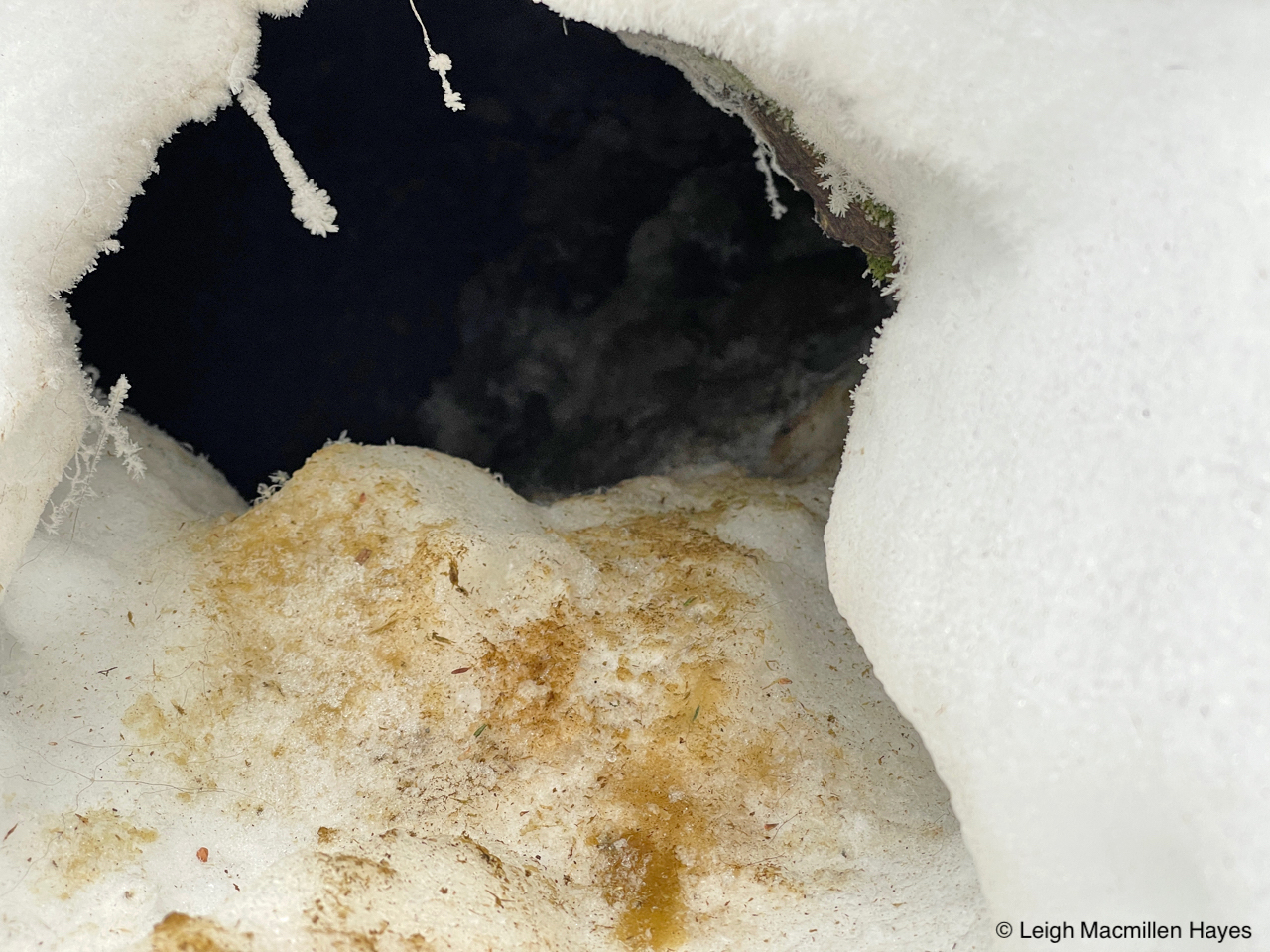
Right above the peed-upon log was the entrance to the den and by the sight of the pigpen approach, browner even that it had been previously, I knew this really was active. The soiled snow is from the porcupine walking across its scat to exit the den.

Unfortunately, I couldn’t get the camera lighting right, but believe me that this one is full of scat as well. And I suspect, though I couldn’t see it, that a porcupine was sleeping somewhere in there, with its tail facing the entrance just in case a predator happened along.

Another indicator of a resident in the house–hoar frost created by breath on a cold winter day.

Right above the den I discovered the tracks of another–enemy number one in a porcupine’s world view. A fisher will kill a porcupine with repeated bites to the face and head.

Coyotes have also been known to work in pairs to maneuver a porcupine onto its back, thus going for the belly, where the hair is wooly.

So the curious story to me was that the fisher passed through after the porcupine was already back in the den, but it didn’t approach the den. Perhaps it had hoped to find the porcupine out in the open and didn’t want to face a tail lashing if it stuck its nose into the house.

Since the pervious visit, there were also more hemlock twigs on the ground and lots more evidence of scat-dirty feet and pee.

Because a porcupine is a rodent, and a large one at that, only exceeded by a beaver in size, it has prominent top and bottom incisors and twig nips are at a 45˚ angle. Can you also spot the scat and hair?

The winter diet consists of needles and bark–favorite trees being hemlock, birch, beech, aspen, elm, oak, willow, fir, and pine.

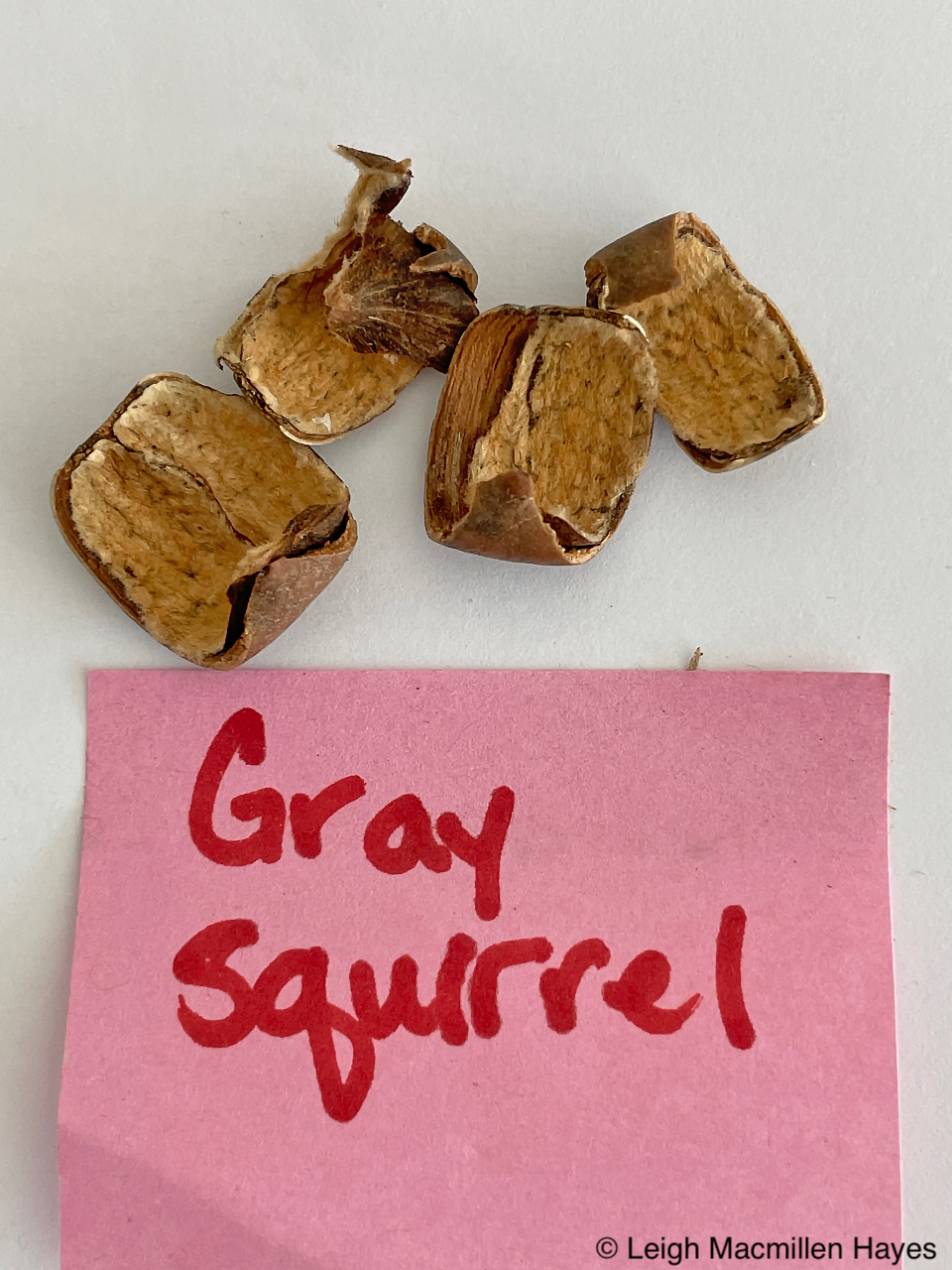
In spring and summer, a porcupine seeks out grasses and other green plants. And then in the fall, it looks for acorns, tearing into them in a rather messy manner.

In fact, a squirrel’s midden of opened acorns shows that it cuts the hard shell into much neater strips.

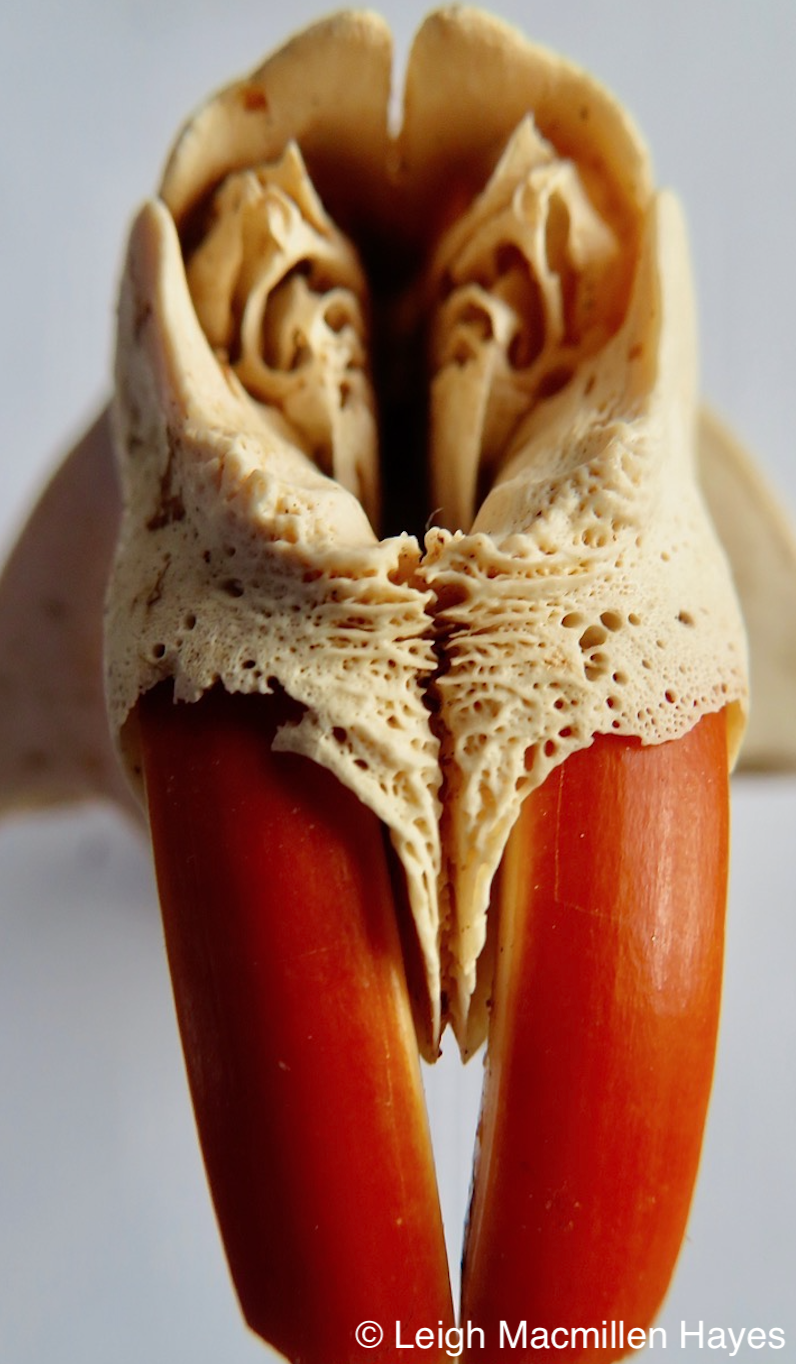
A porcupine’s cheek tooth pattern consists of one premolar and 3 molars on each side top and bottom. As you can see, the cheek teeth are modified for grinding since they are strict herbivores.

It’s those prominent incisors that are to be admired. A porcupine uses its large two front teeth for gnawing off bites of food. The incisors continue to grow throughout the porcupine’s life at a rate of twelve inches/year, and the constant gnawing keeps them worn down to the perfect size.

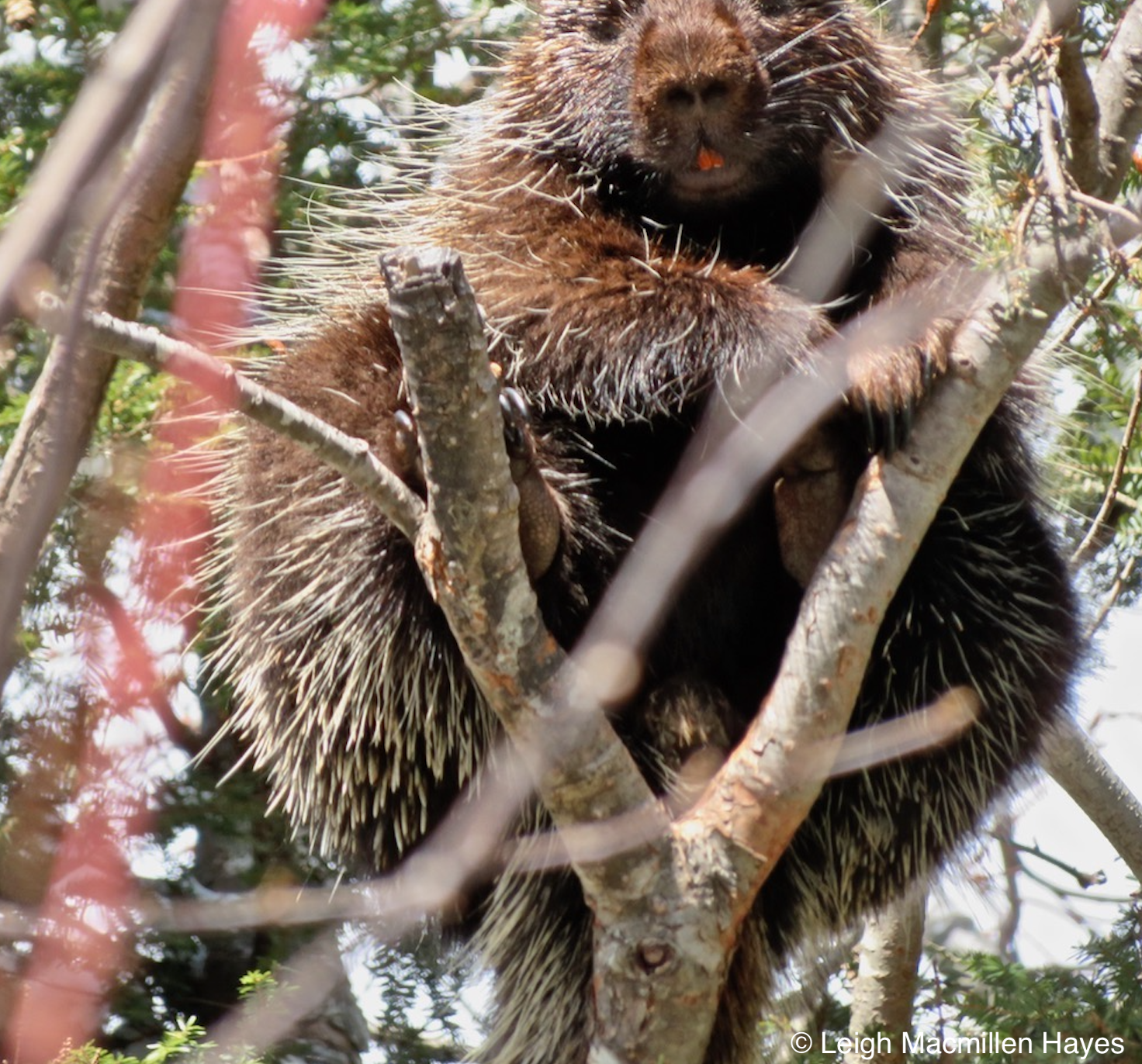
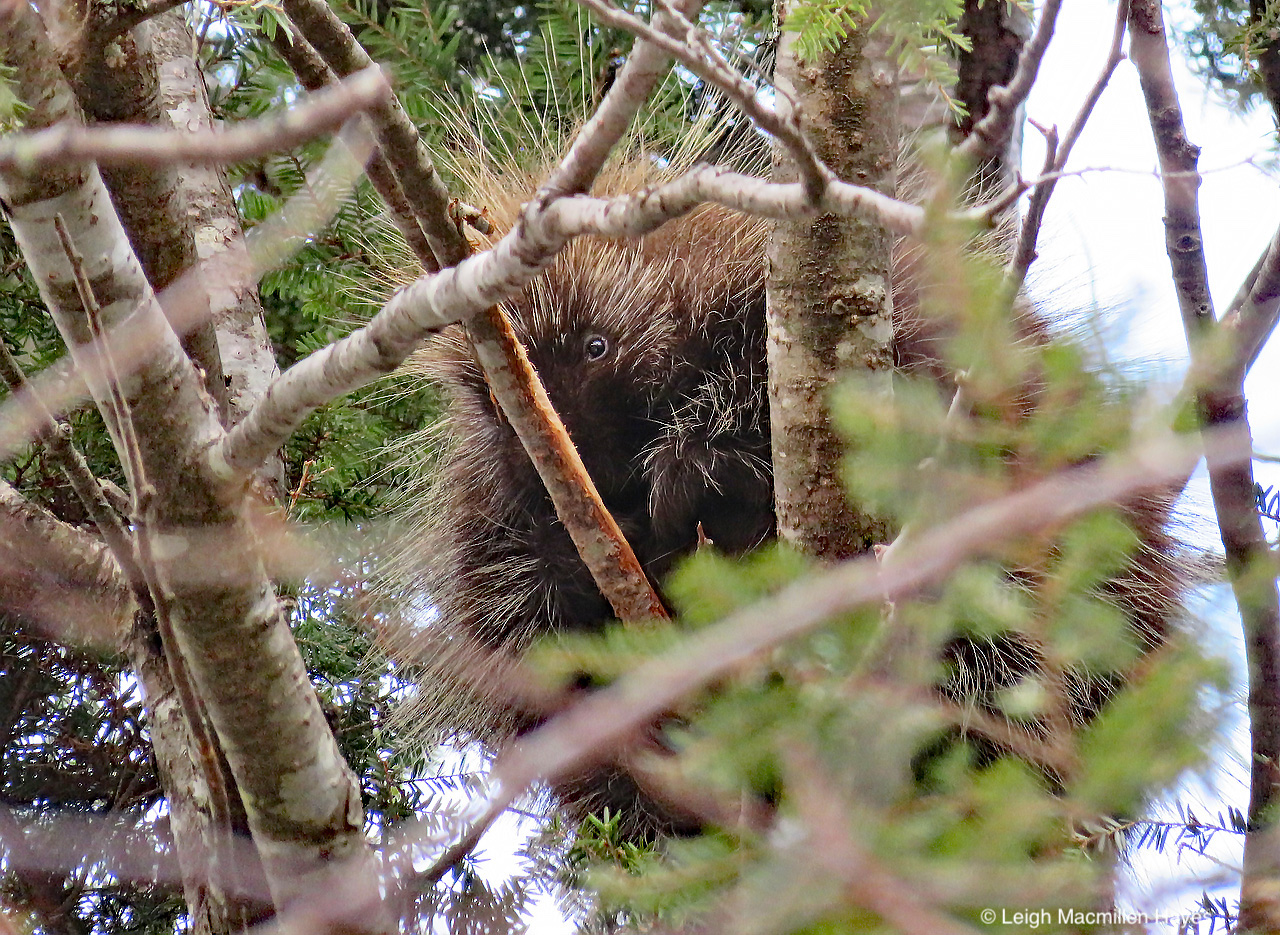
I did not actually see a porcupine yesterday, despite my best hopes, but sometimes it happens when I’m not looking intentionally so there may be a sequel to this story.

A porcupine has poor eyesight, so I’m not sure if it ever actually sees me when it’s up in a tree, especially if I’m standing sorta still, but it does have a good sense of hearing and smell, so I’m sure its aware of my presence. And the tail always faces the trunk in case I decide to climb up–it’s a great defense mechanism–having the tail at the ready to thwart a predator.

I will end this long story with a drawing by a dear friend and fellow naturalist, 8-year-old Aurora. She’s done her homework and I hope one day soon she’ll be able to answer the question: Quill You Be Mine? with a yes!

ABCs of the Garden

My garden. It’s a classroom. I’ve long been a teacher, but in this particular classroom I am the student. And I give thanks for the daily lessons. In fact, this past week, I’ve given thanks for hours on end as I’ve done my usual stalking, I mean research.

It all began when I started to circle one garden, that is hardly a work of art because I welcome all who grow there, especially several species of goldenrods, their composite flowers offering rays of sunshine on any summer day.

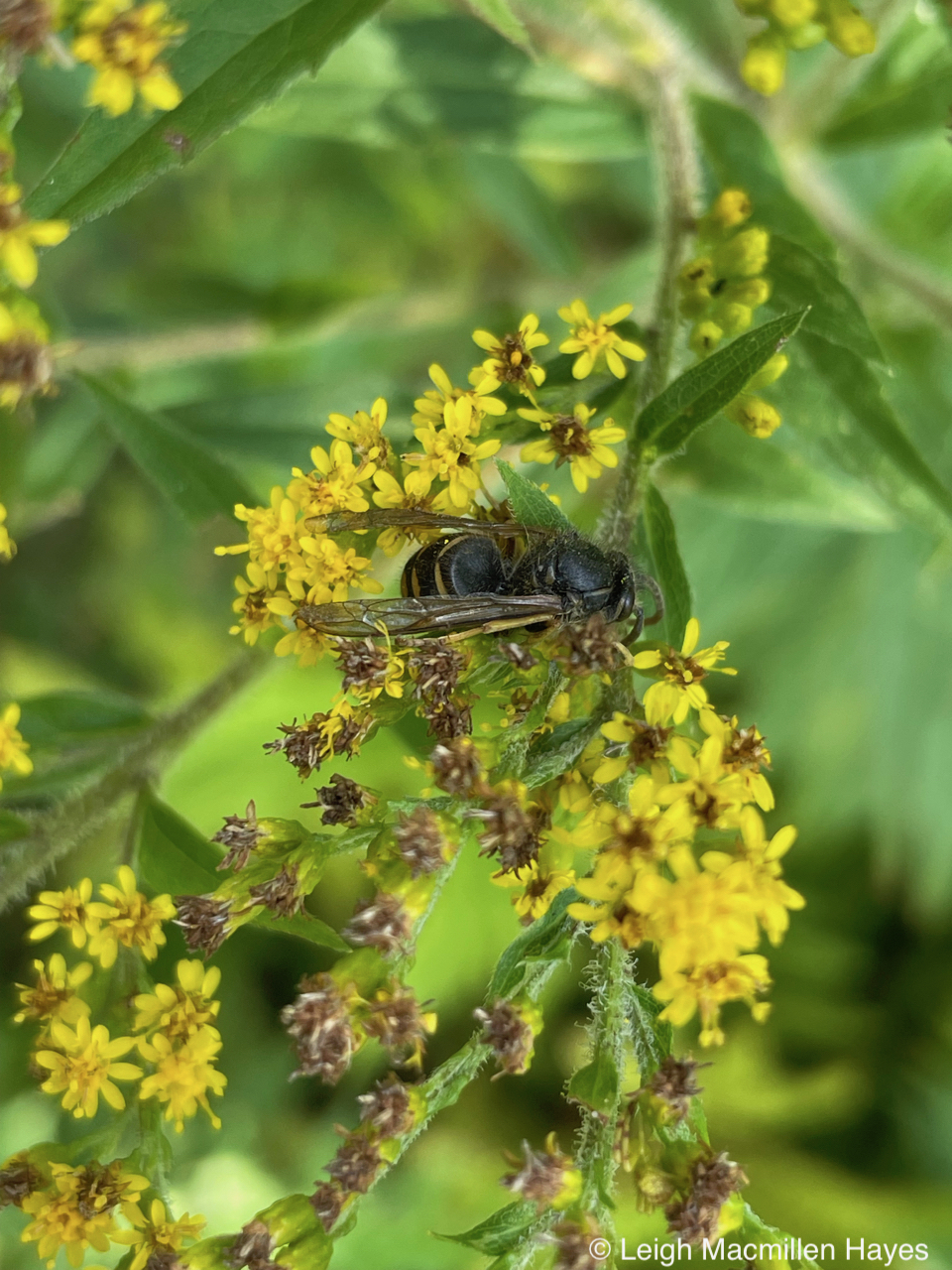
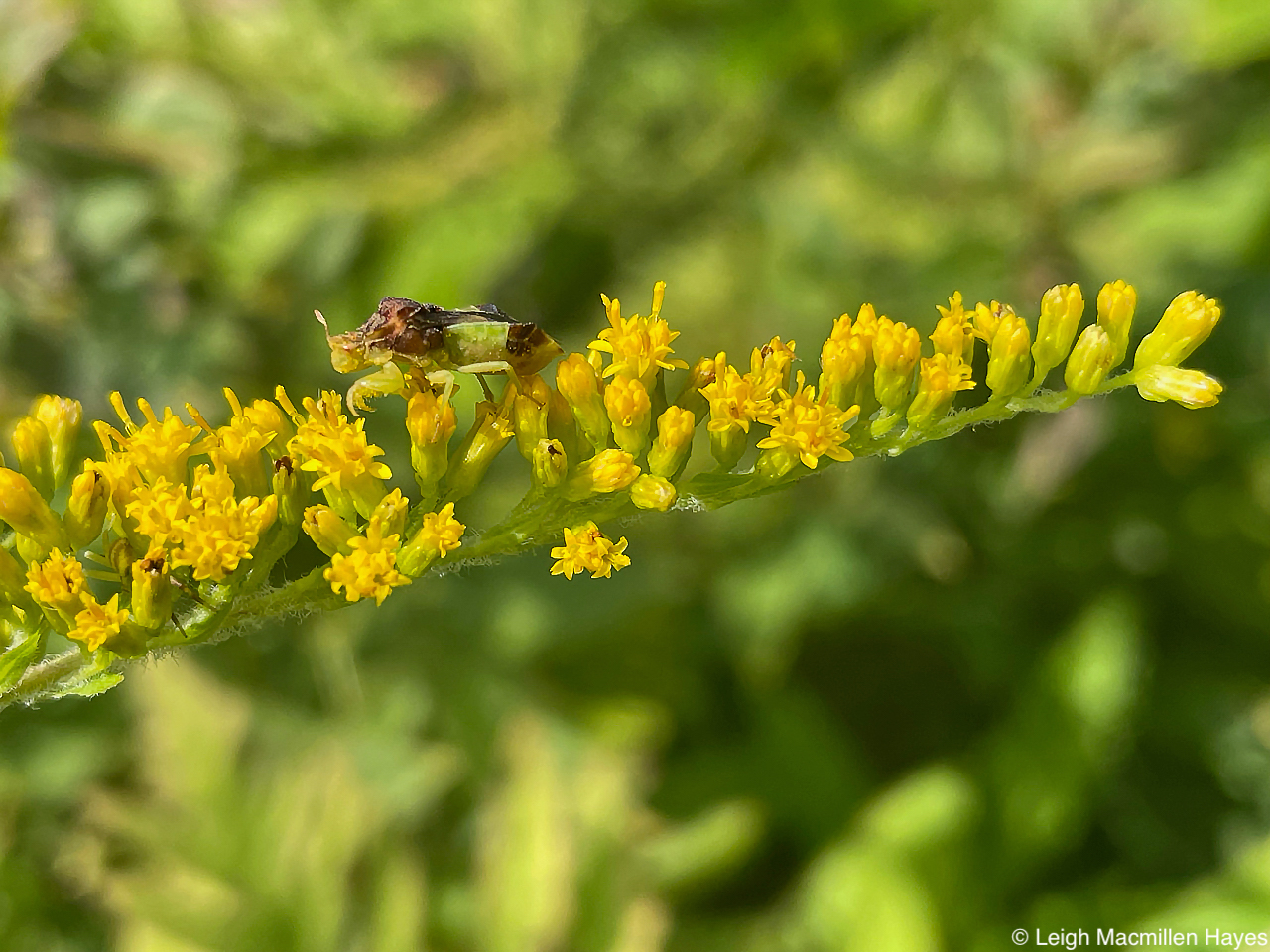
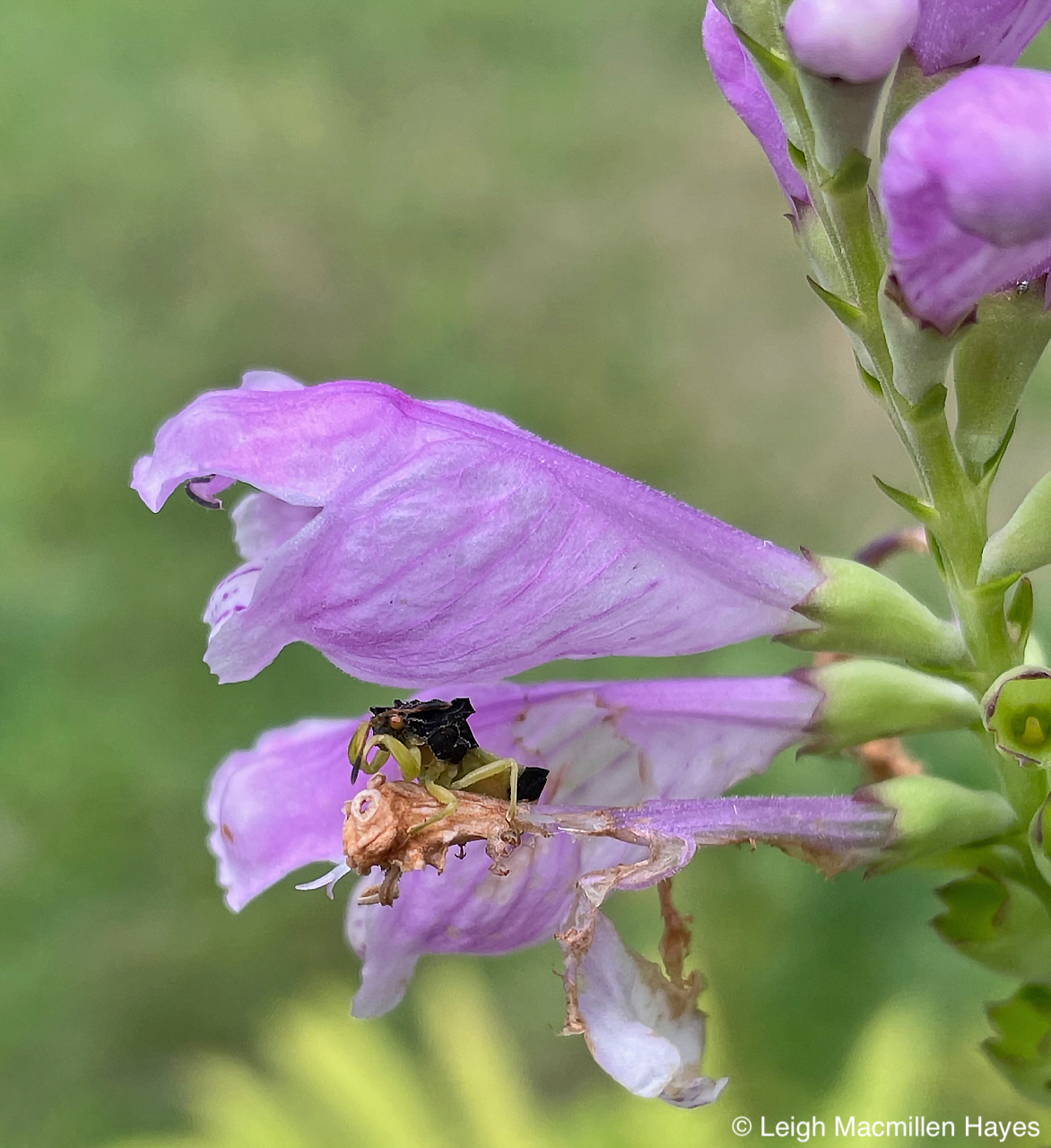
I knew I was in luck when I spied this flower fly . . . that wasn’t flying. That could mean only one thing.

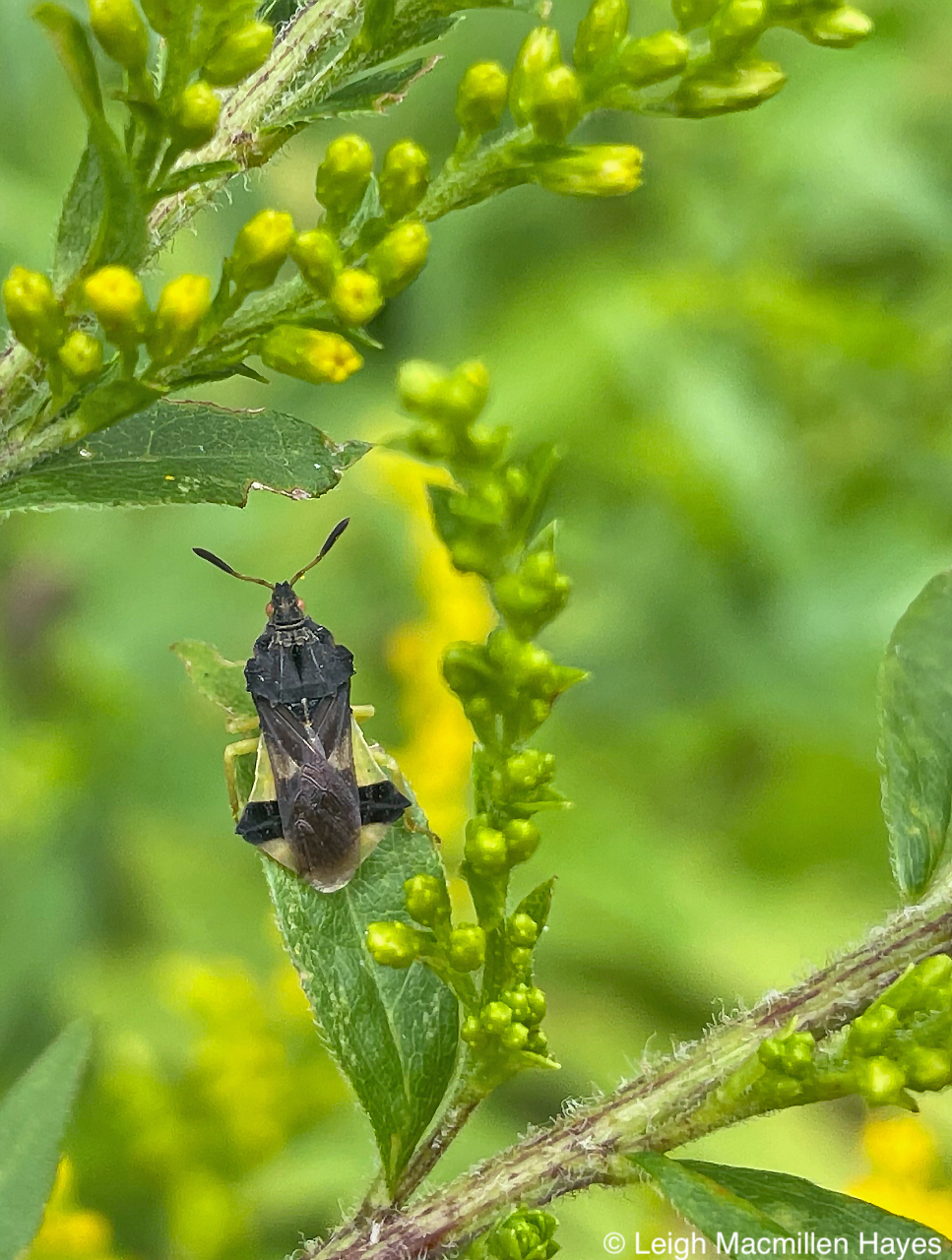
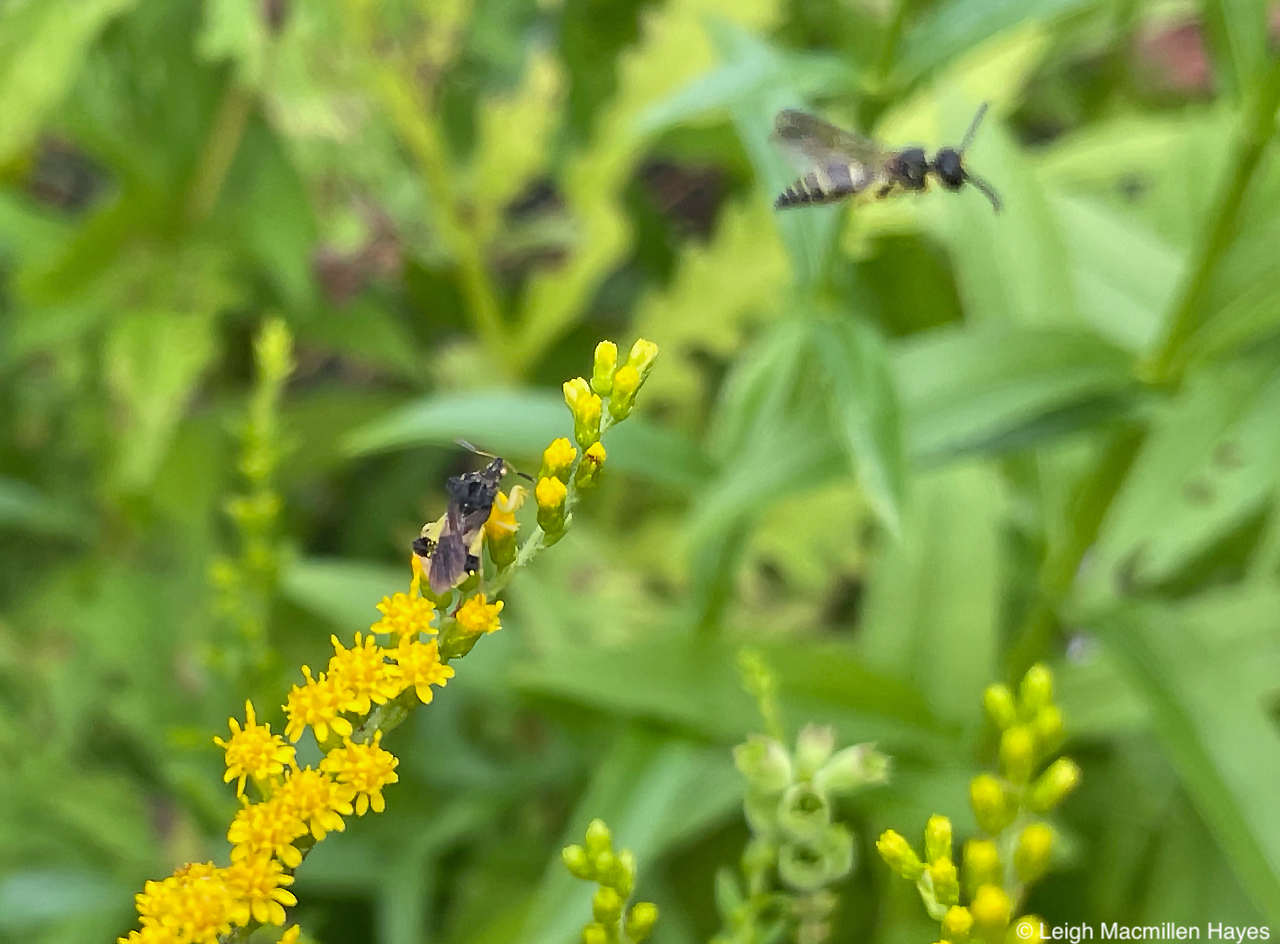
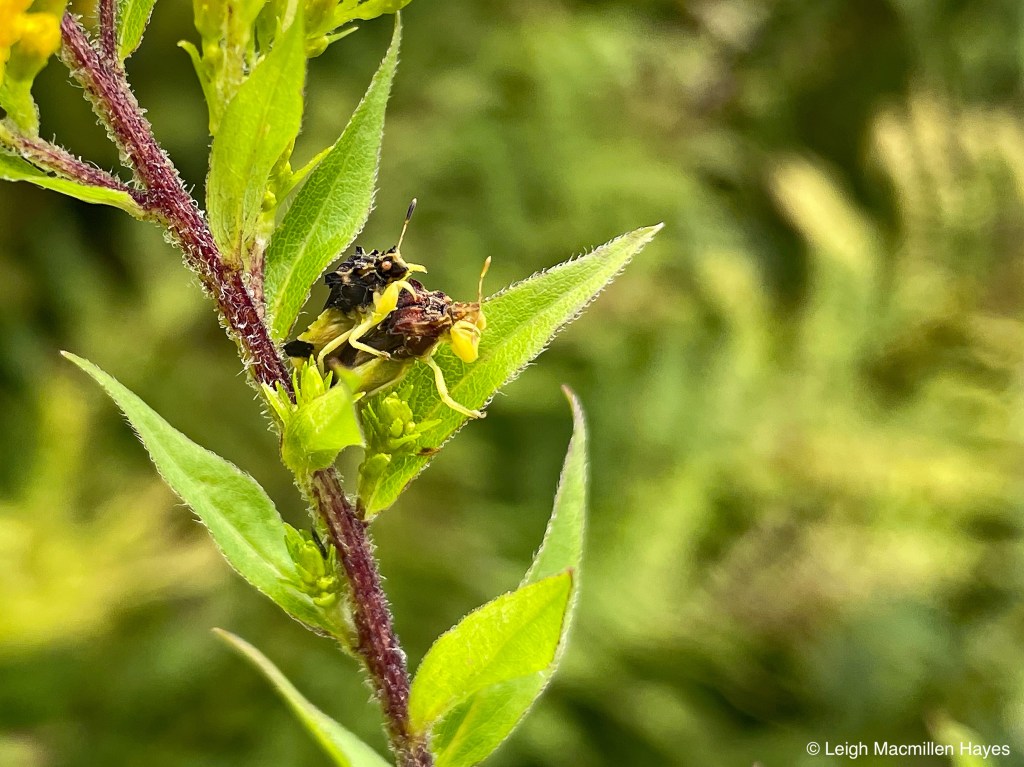
Ambush Bugs were in the area. And indeed they were. So . . . this pair of Jagged Ambush Bugs wasn’t canoodling as some of you probably think. One of the lessons I learned is that this is a prelude to the actual event, where their bodies face each other.

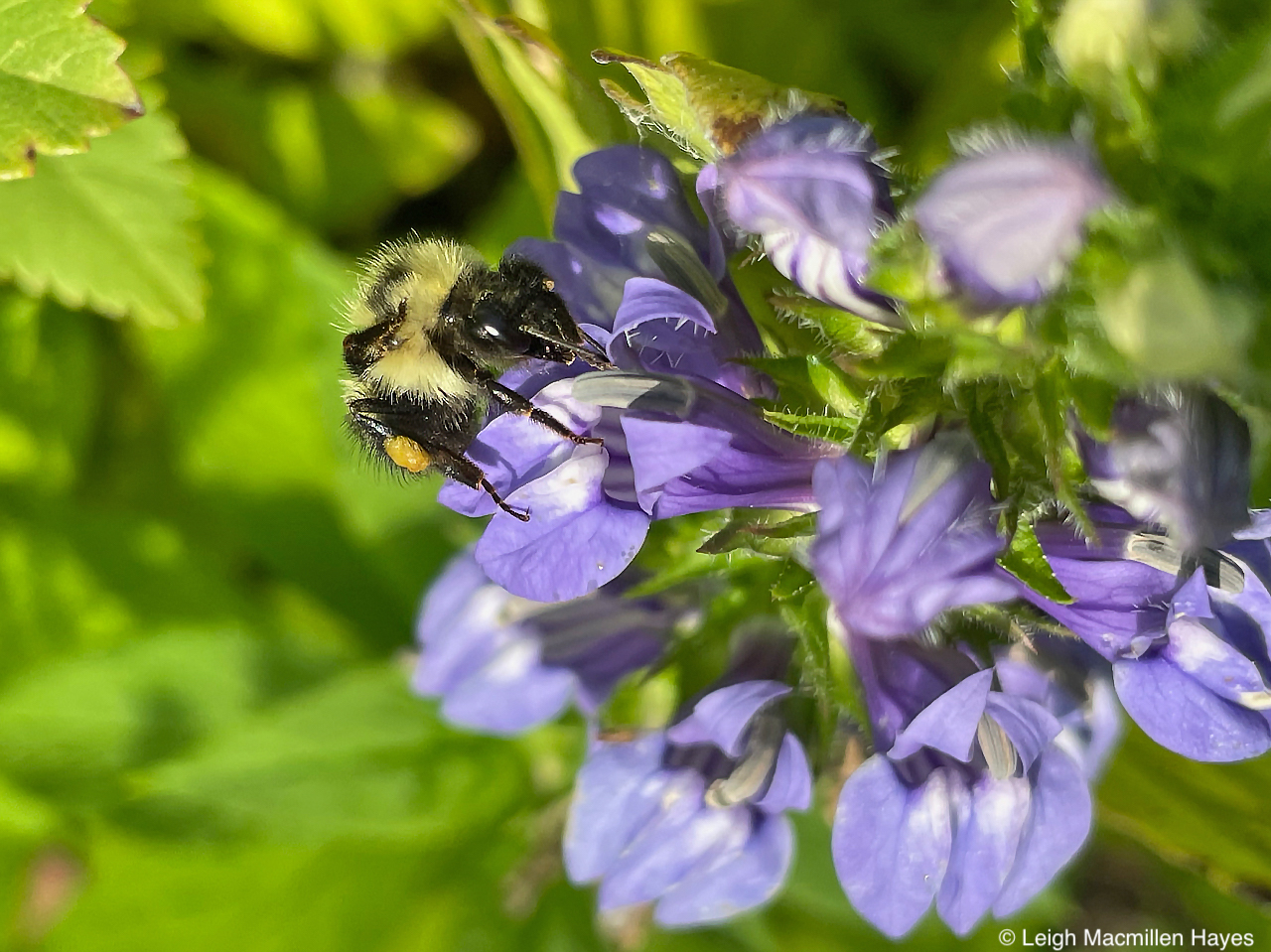
While the Ambush Bugs were busy getting to know each other better on the flowers above, closer to my knees a Bumble Bee buzzed in to gather some pollen and nectar from Giant Blue Lobelia flowers. Another lesson, that gets reinforced each year, is that If one stands still for a long period of time, the bees and wasps and other insects will fly in and out and leave you alone.

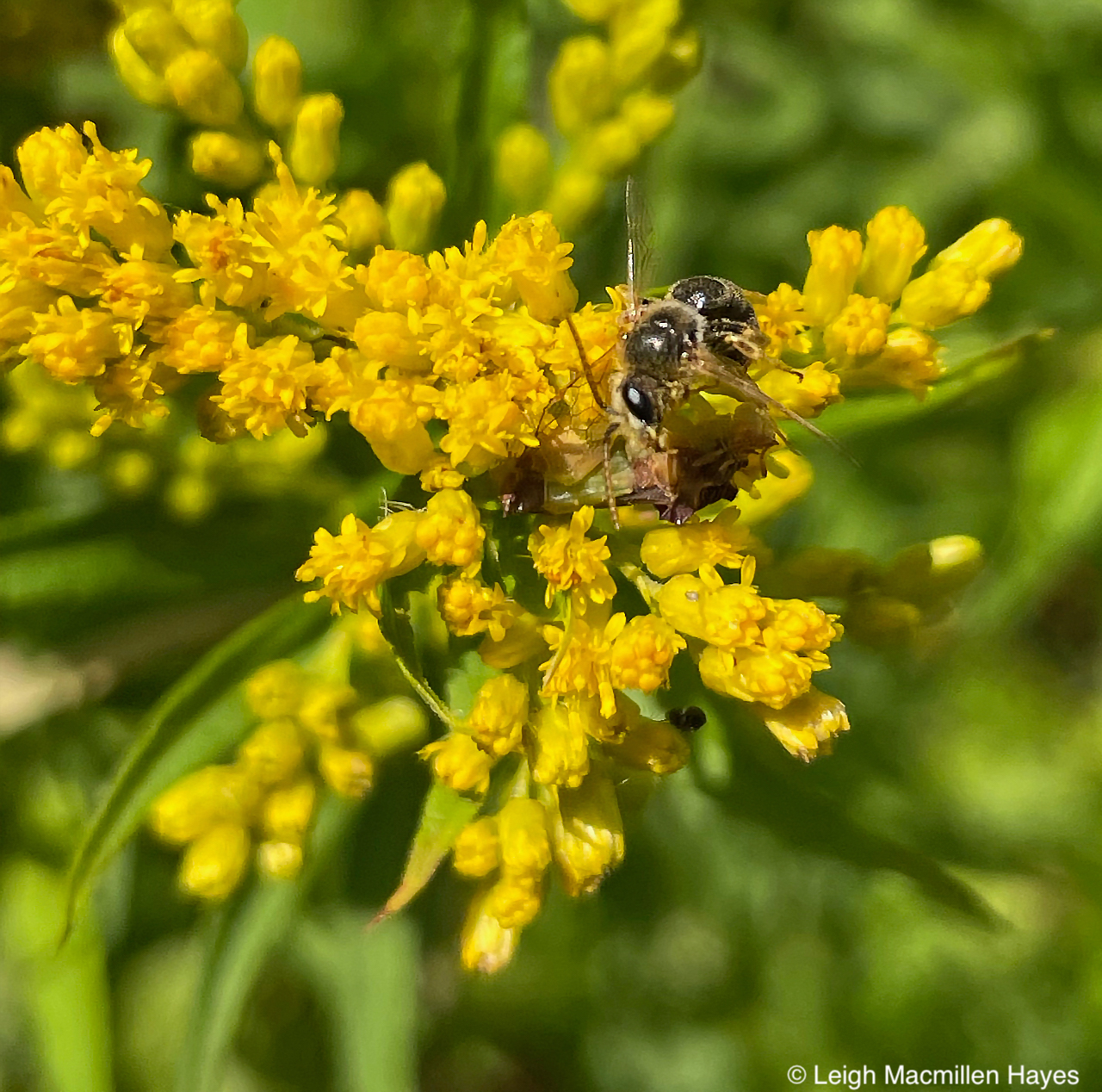
And when one looks up again, you’ll discover that the male Ambush Bug was still wooing the female. He’s the smaller, darker insect on top of her. Still another lesson is that when they are in this position, and, mind you, they don’t stay still, his antennae quiver with what I interpret as excitement. I’m sure it has some more scientific meaning or purpose, like maybe he was sending out a signal to her to stay with him or to other males to stay away, but still, how fast did those antennae move.

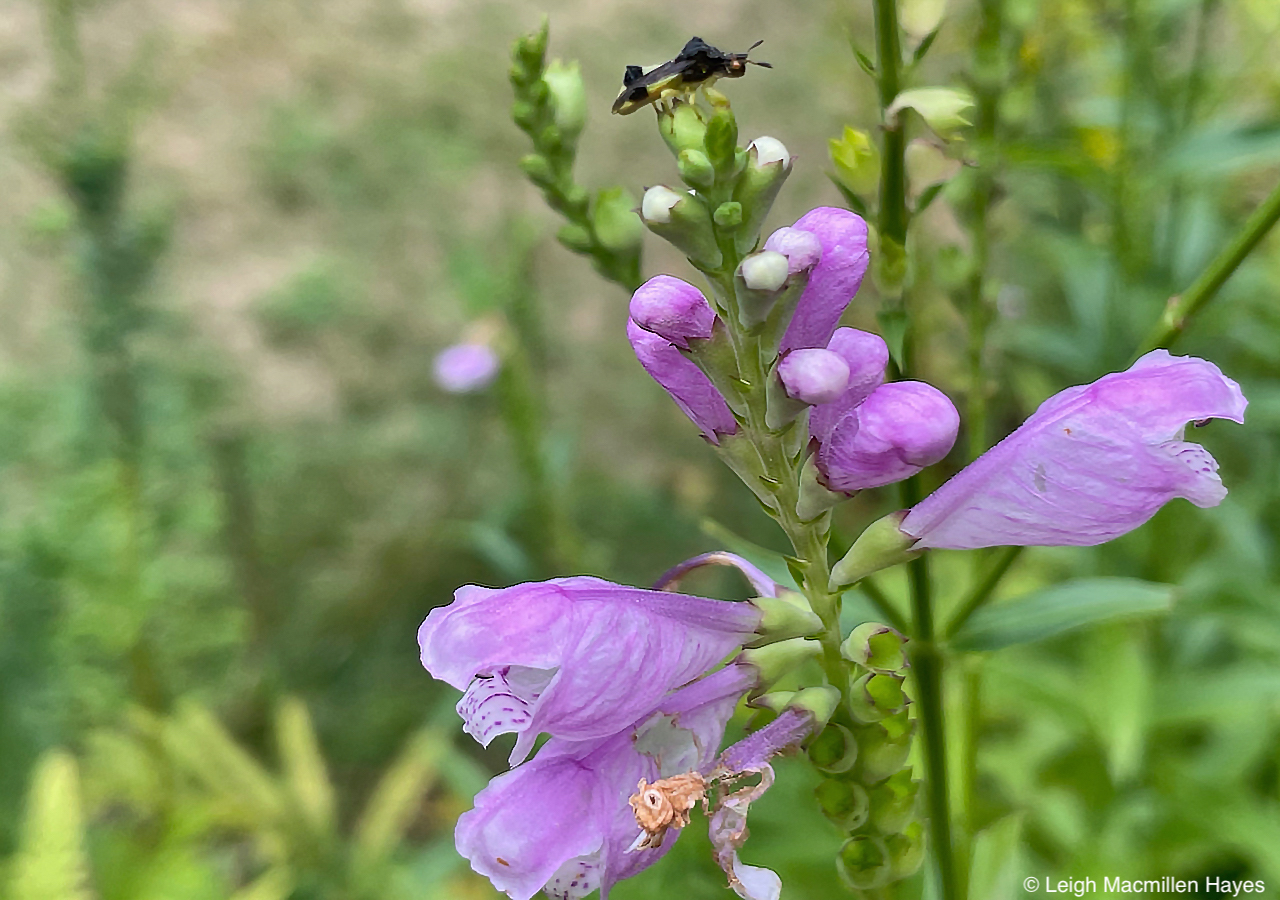
In the same garden does Turtlehead grow, and I knew it had a visitor when I heard a loud buzz as a Bumble Bee rustled about inside. This plant gets its common name from the flower’s long arching upper lip, or hood, which overlaps the lower lip like a turtle’s beak, minus the eyes of course.

Some say Bumble Bees exit Turtlehead head first but my experience is that they back out of the tight flower. Since this was very near the Ambush Bugs, I thought for sure they’d take a break from their canoodling preparation and try to capture a large meal.

They did not. And then when another flower fly bumped into them, I thought this would be the moment of separation. It was not. Though Ambush Bugs will feed while in this position, or at least the female might, what I observed over the course of five days is that they never did. I also noted that other insects frequently nudged them or came close to doing so, but quickly flew off. Perhaps they sensed danger?

As for the wooers, at about 6:00 on the morning after I first started stalking the goldenrods, I saw that they were still in their pre-nuptial position. At least I assumed it was the same two for it was the same spot and I’d last spotted them at about 7:00 the night before.

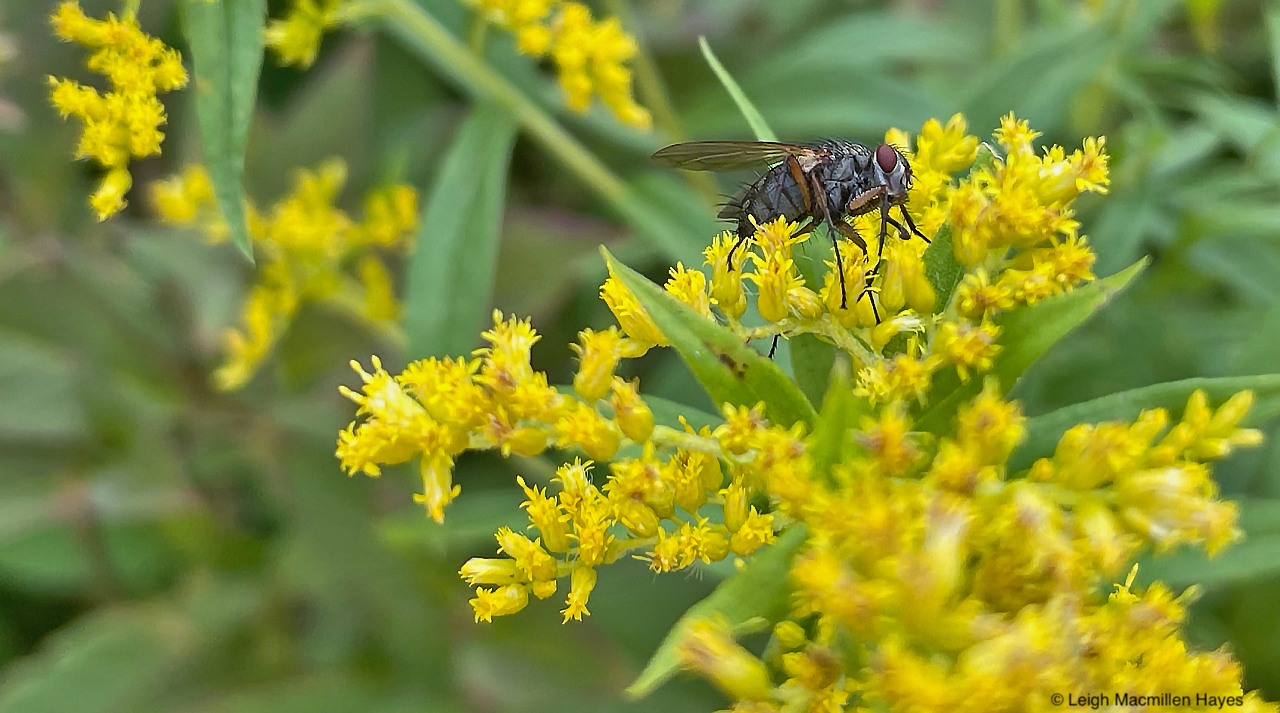
While it seemed all they could think about was their progeny, I kept thinking that they needed energy. There were so many options for food, from the black Midas Fly to the green Sweat Fly, but in the moments that I watched, and they were many, none of these became food.

Watching so many different species visit the flowers, I wondered if an Ambush Bug, which I knew could fly, though they seldom did, would attack in flight. But I learned that is not how they operate.

Instead, they wait. And sometimes walk about upon the flowers, perhaps in search of the right spot from which to attack. This is the female with her light colored face.

Notice her front legs, shaped as they are to capture prey, with a pincer that snaps back toward the second larger segment when in action. They remind me a bit of lobster claws.

And this is a male with his much darker suit and head. With those beady little eyes, it’s amazing that they can see insects twice or more their size. Or maybe that’s why they go for larger victims.

The more time I spent watching, the more it was reinforced that an on-the-fly capture was not going to occur. Even still, I kept encouraging such an attempt because it seemed to me that they don’t eat often.

The offerings continued to be plentiful each time I took a spin around and through the garden, but still, since first finding that skeleton of a body that started my quest to watch for more action, I hadn’t seen any evidence of a meal consumed.

And then. And then. And then, no not a meal. Well, maybe not a meal in that moment, but in flew something that I saw out of the corner of my eye and then couldn’t locate.

The Katydid’s camouflage was perfect, even better than that of the Ambush Bugs. Growing up in southern New England, I used to fall asleep to their Katydid songs, but here in western Maine I seldom see or hear one.

Back to the Ambush Bugs, another lesson I’ve learned before but that was reinforced is the fact that they don’t hang out just on Goldenrods, though their camo is certainly better on that flowerhead than on the False Dragonhead. Actually, the Ambush Bug looks more like a dragonhead than the flower does. But I can’t take credit for naming any species. Yet.

Watching the male Ambush Bug proved to be humorous for me, for he always seemed to have his back to any incoming insects such as this hover fly.

Maybe he saw the Bumble Bee approach?

But again, he turned his back on a potential meal.

Even as it drew closer.

Once the bee took off, the Ambush Bug turned again and I had to wonder if it questioned its positioning. Probably not as I’m not sure such a critter can question anything, but if I were an Ambush Bug, I’d like to think I would have done so.

Finally, on day three of my observations, I discovered a successful female. With those claw-like front legs, she’d captured her prey and pierced its body with her beak-like proboscis.

First she injected saliva into the victim’s body and paralyzed it. The fluid also broke down the interior organs and muscles, thus extending the abdomen of her prey. Then she sucked out those succulent digested innards. Yum!

It’s a process that takes time. And given her overall length of about a half inch, it’s impressive that she can take down bigger insect.

Interestingly, once I found one meal being consumed, on the same plant I began to find several.

The other curious thing was that all the predators seemed to be females. That doesn’t mean the males don’t eat, and I’ll certainly keep looking, but it was interesting to note.

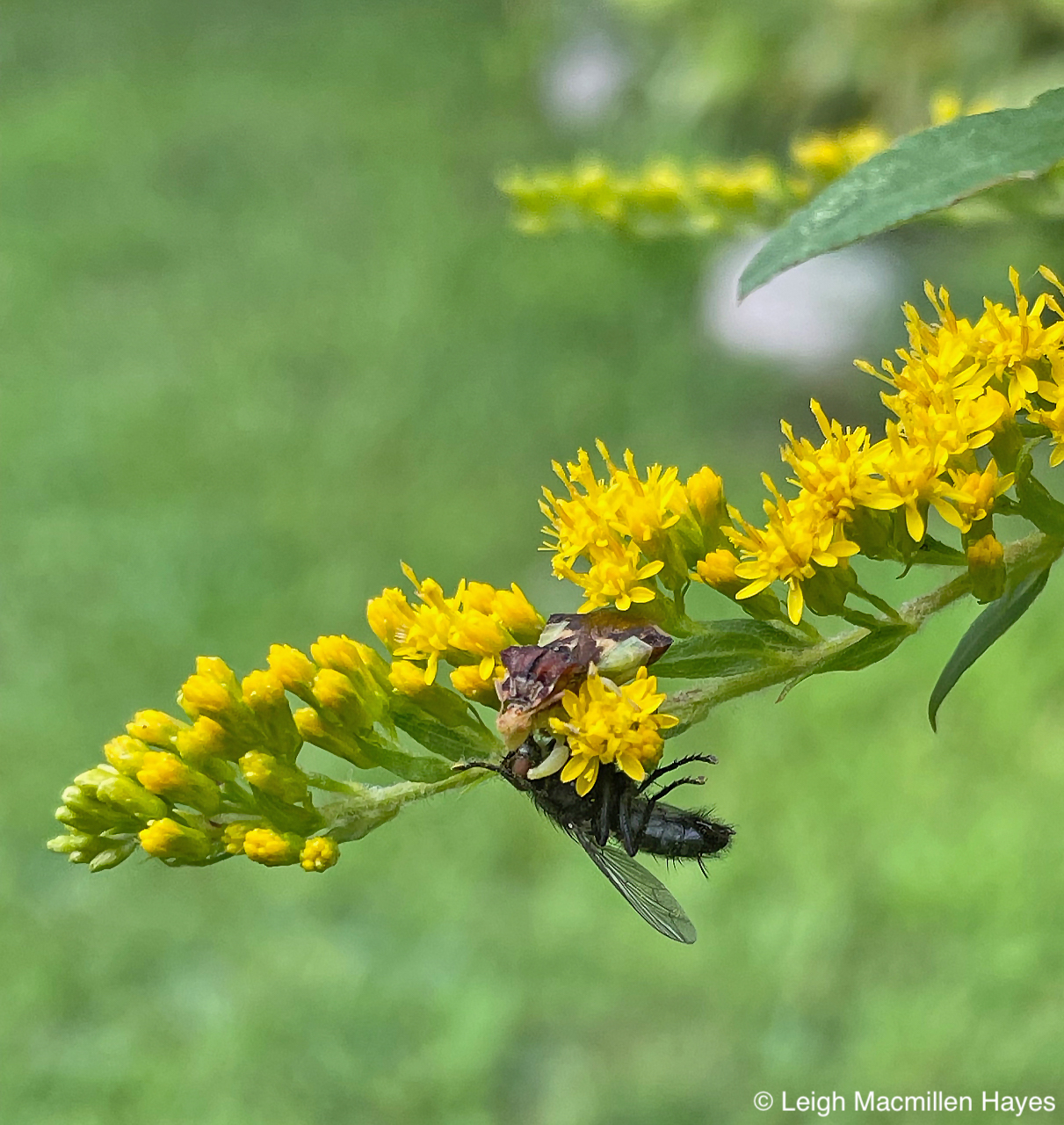
Today, on that same plant, I found two meals being consumed that gave a sense that Ambush Bugs really do hide within the flowers before making their ambush. If you look closely you should spy the legs of a fly in the center, and a moth dangling on the right.

Class isn’t over, for I’ll certainly continue to observe and learn and eventually I’ll have conquered my ABCs. Or at least my ABs, thanks to the Ambush Bugs.

The Otherworldly Buttons

Rooted in the spongy sphagnum moss of our western Maine wetlands, a certain shrub makes its home beside Highbush Blueberries and Maleberry and Speckled Alder. It’s a shrub of lax and loose form, its multiple stems sprawling this way and interlocking that way.

I was finishing up an exploration this morning when said shrub stopped me and for the next hour I walked back and forth covering a total of maybe twelve feet that equaled about a half mile all told while admiring the scene that played out before me.

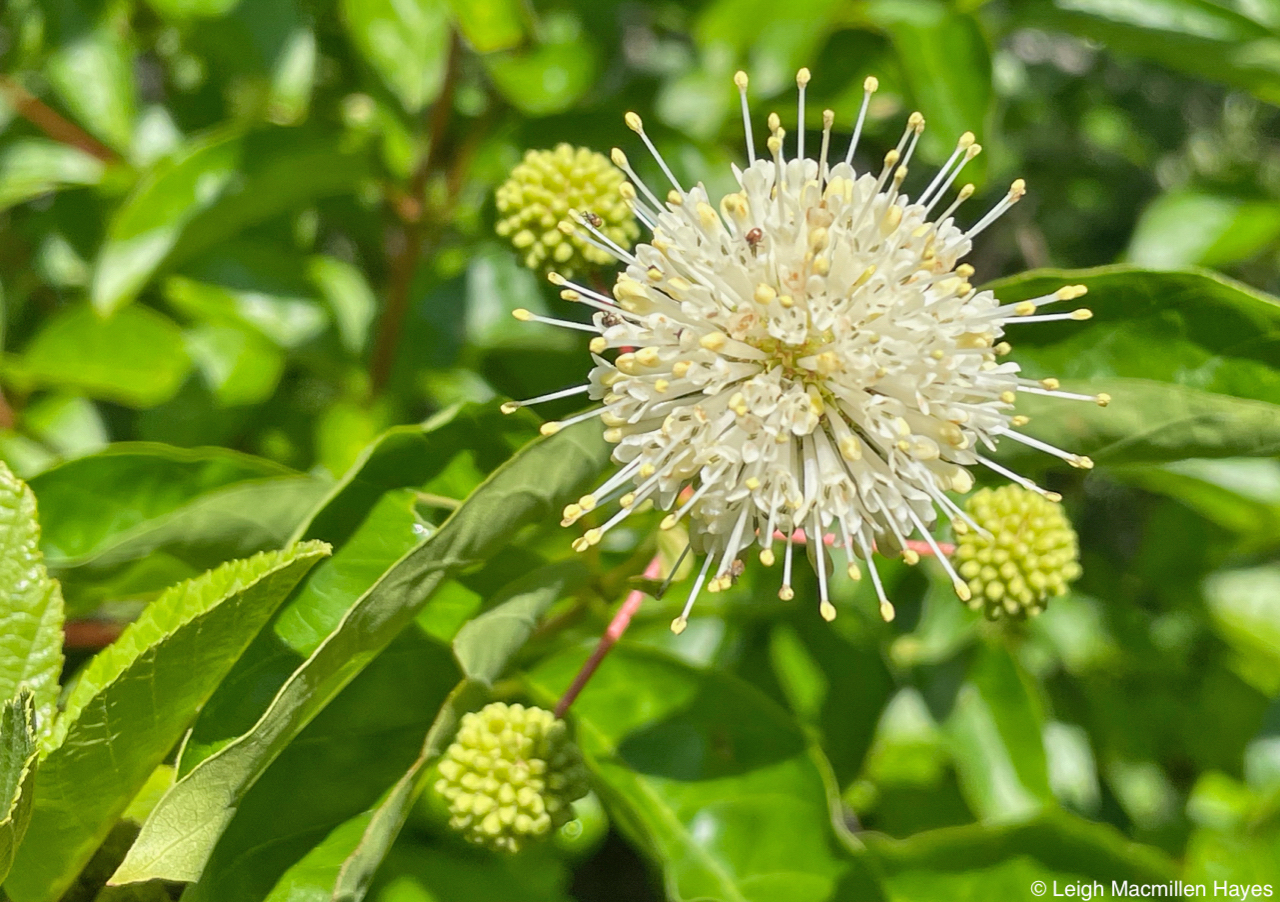
First, there were the conspicuous flowers that never cease to amaze. Dense, spherical, one-inch globes offer nature’s fireworks display in the middle of a summer day. Comprised of many creamy-white tubular flowers so closely packed into a ball, and fringed with protruding pistils that extend beyond the four anthers, the flowers remind some of a pincushion. Set against a backdrop both glossy and dark, the leaves in pairs or threes serve to highlight the fringed beauty of the inflorescence.

As insect magnets, the flowers attract many pollinators including a pair of Flower Longhorn Beetles who couldn’t resist the opportunity to canoodle among the scent so sweet.

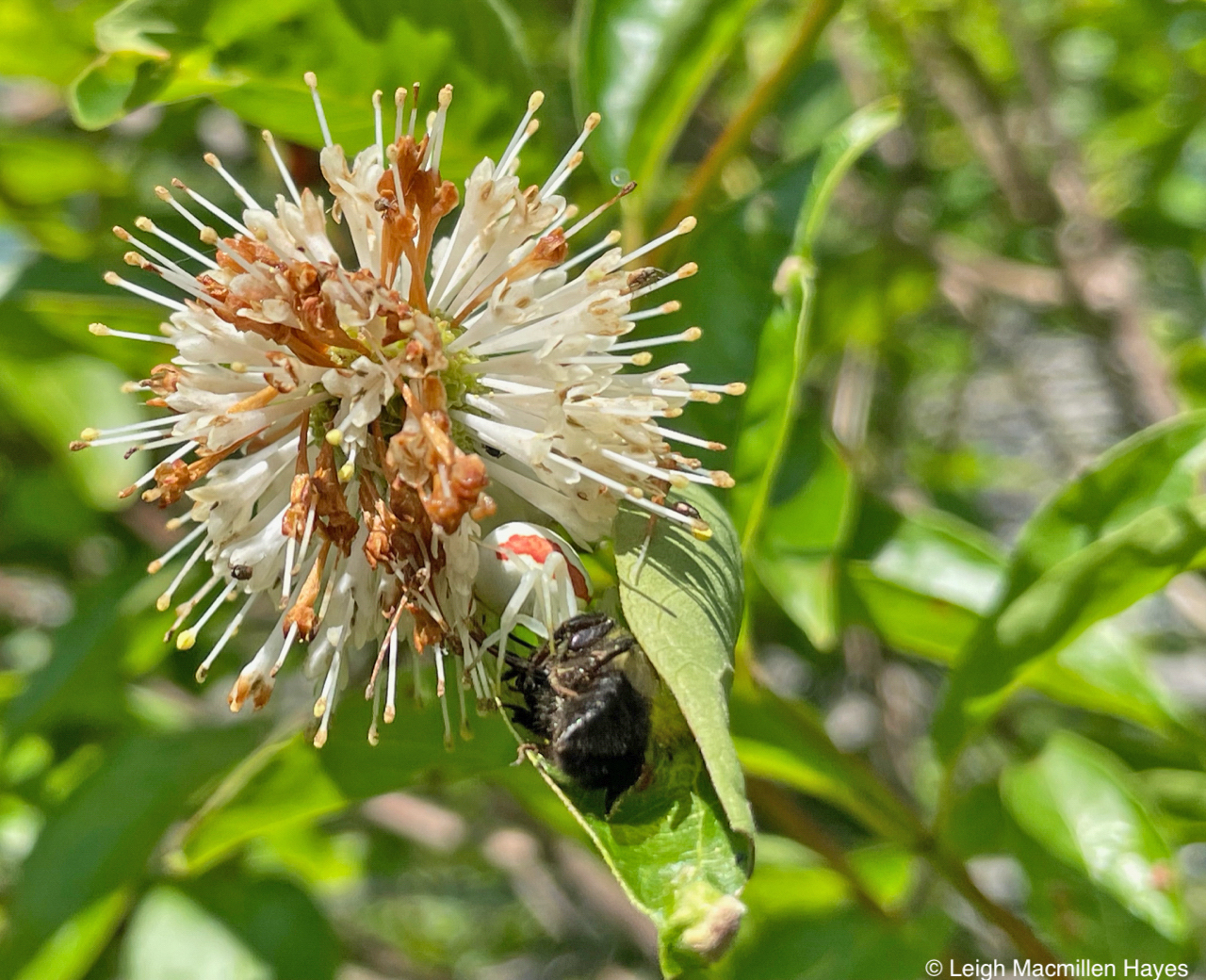
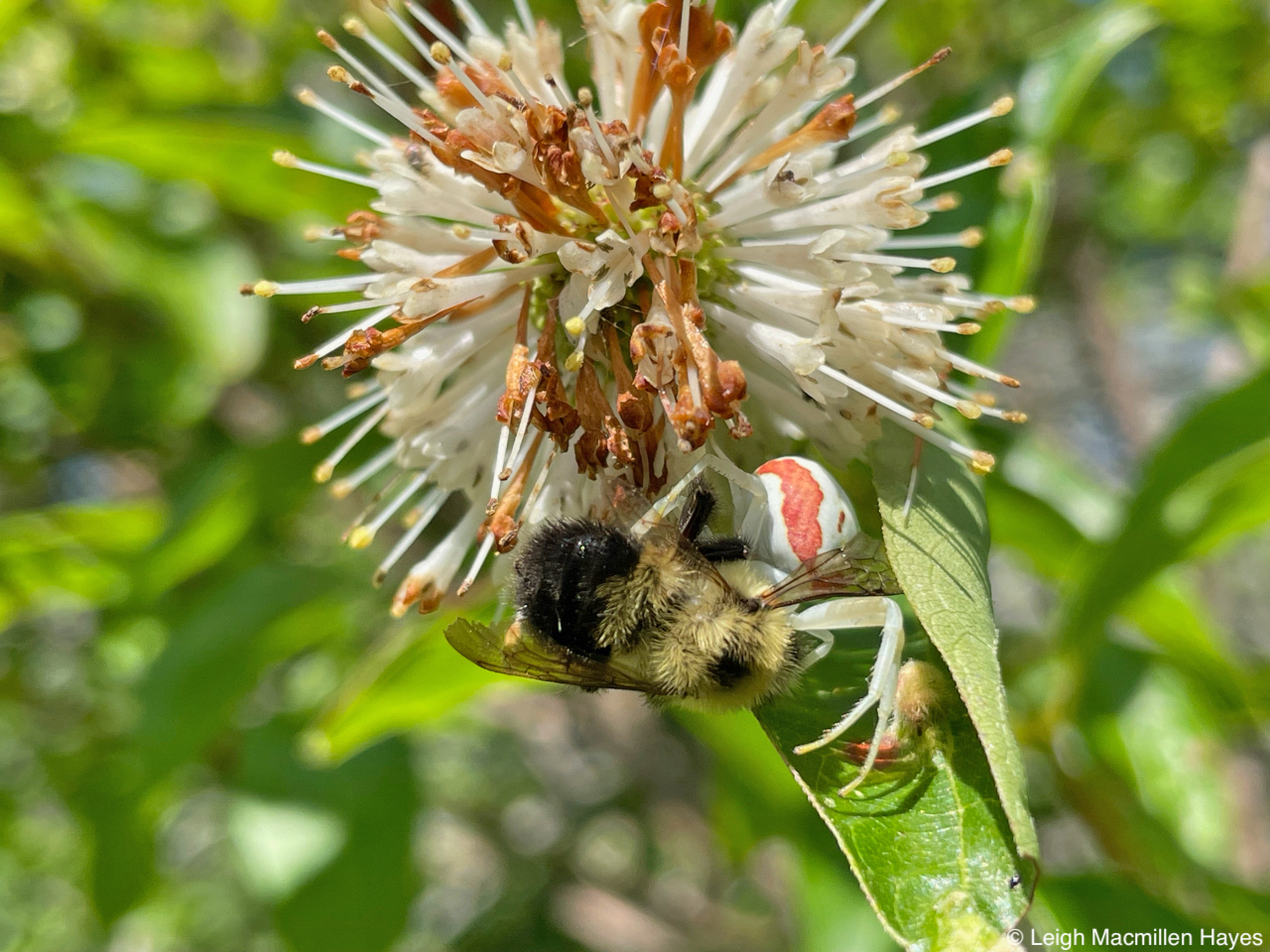
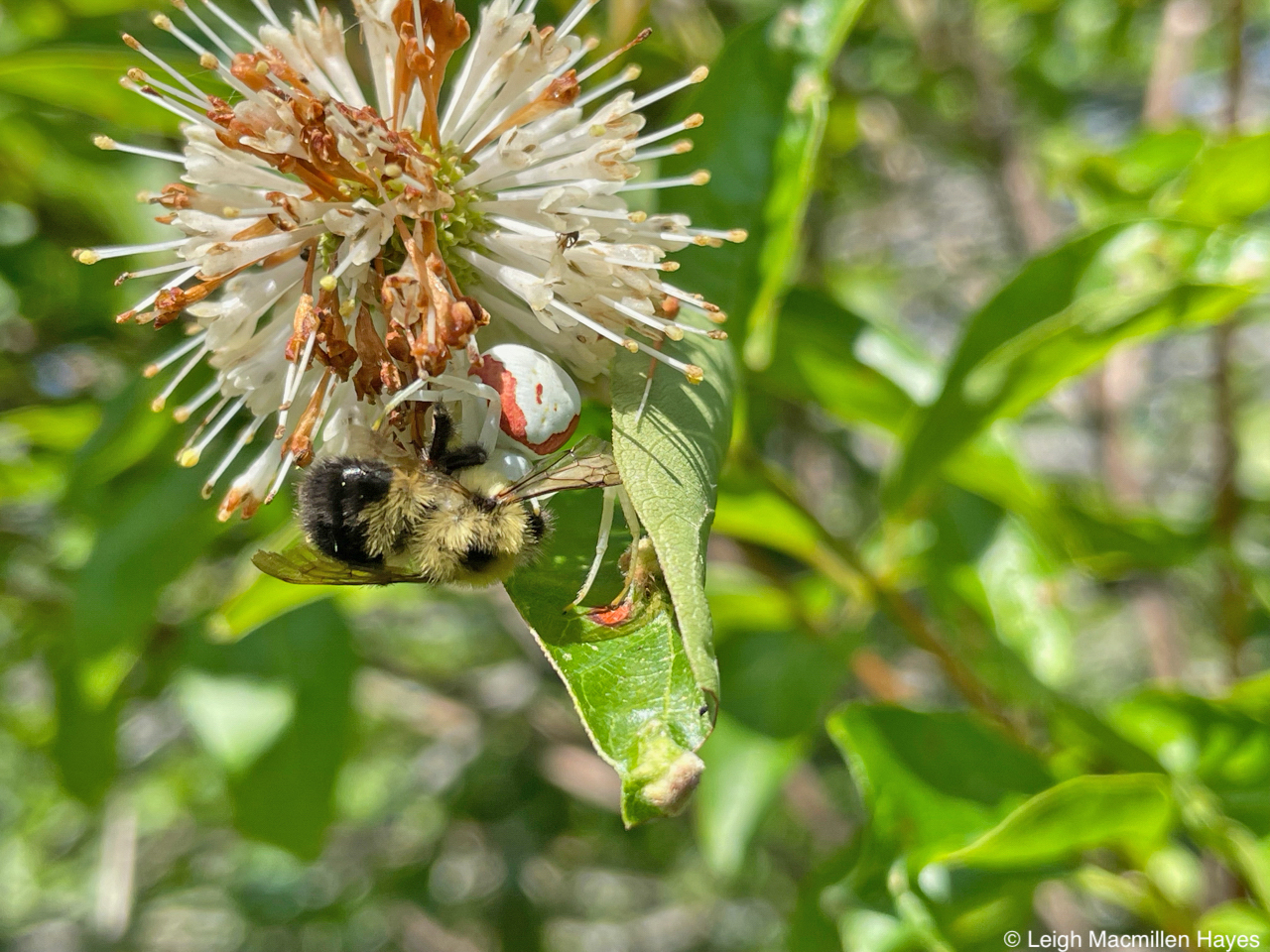
And then I spied another, a predator who had relied on its camouflage much like the flower’s color to keep from being seen in order to ambush its prey. Sit and wait. Sit and Wait. It apparently did so until success was achieved.

As I looked about, I spied a silken thread and wondered if it belonged to the Crab Spider. This species doesn’t build webs, but uses silk to attach drop lines to vegetation just in case in the midst of fervent action while attempting to capture a meal, it slips and needs to get back into position.

In the midst of my observation, in flew a pollinator that we all need to revere for its species is endangered and I felt blessed to have seen this one. It seems only yesterday, when our sons were mere tots, (think three decades ago) that we often spotted Monarchs all over flowering shrubs in August and September. But now, we celebrate each and every one and only this morning a friend sent a photo of a Monarch caterpillar feasting on her Milkweed and so we know we are among the fortunate few to share these special sightings.

Meanwhile, back at Lunch Leaf, I stalked. When its prey was close enough, the spider grabbed it with its two front legs, the longest of its four pairs, and bit into the victim.

Meanwhile, a Bumble Bee buzzed in, gathering its fill of nectar and pollen, nectar and pollen, until it needed to return to the hive before coming back to collect some more.

Back at Lunch Leaf, venom was injected to paralyze the meal.

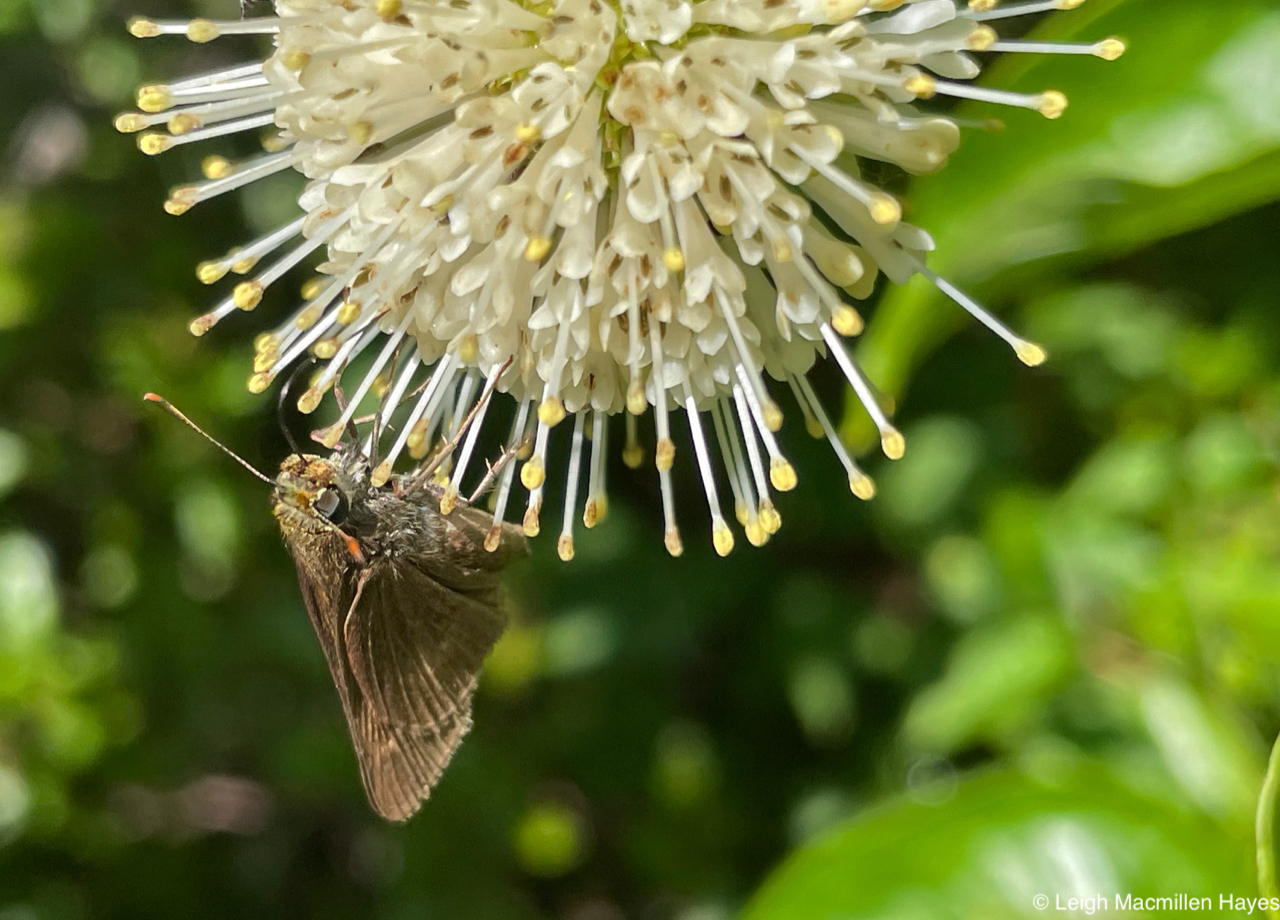
Next, a Dun Skipper made an entrance. Actually about three of them flitted and fluttered from one globe to another.

As for the Crab Spider, it seemed to work on positioning the meal just right.

When the Dun Skipper was positioned just right, I could see its body more clearly and loved how the proboscis stuck down into the flower’s tubular structure. With its deep tube, this inflorescence was designed for butterflies and bees.

Back at the lunch counter, another twist was made.

And atop a different flower head, a Transverse Flower Fly made an appearance, its eyes much bigger than its stomach.

It soon became obvious that prepping a meal takes much work.

The visitors upon the flowers were many and I suppose the lunch choices were as well. While I’m thrilled to have seen so many pollinators, the Crab Spider could only imagine its next meal.

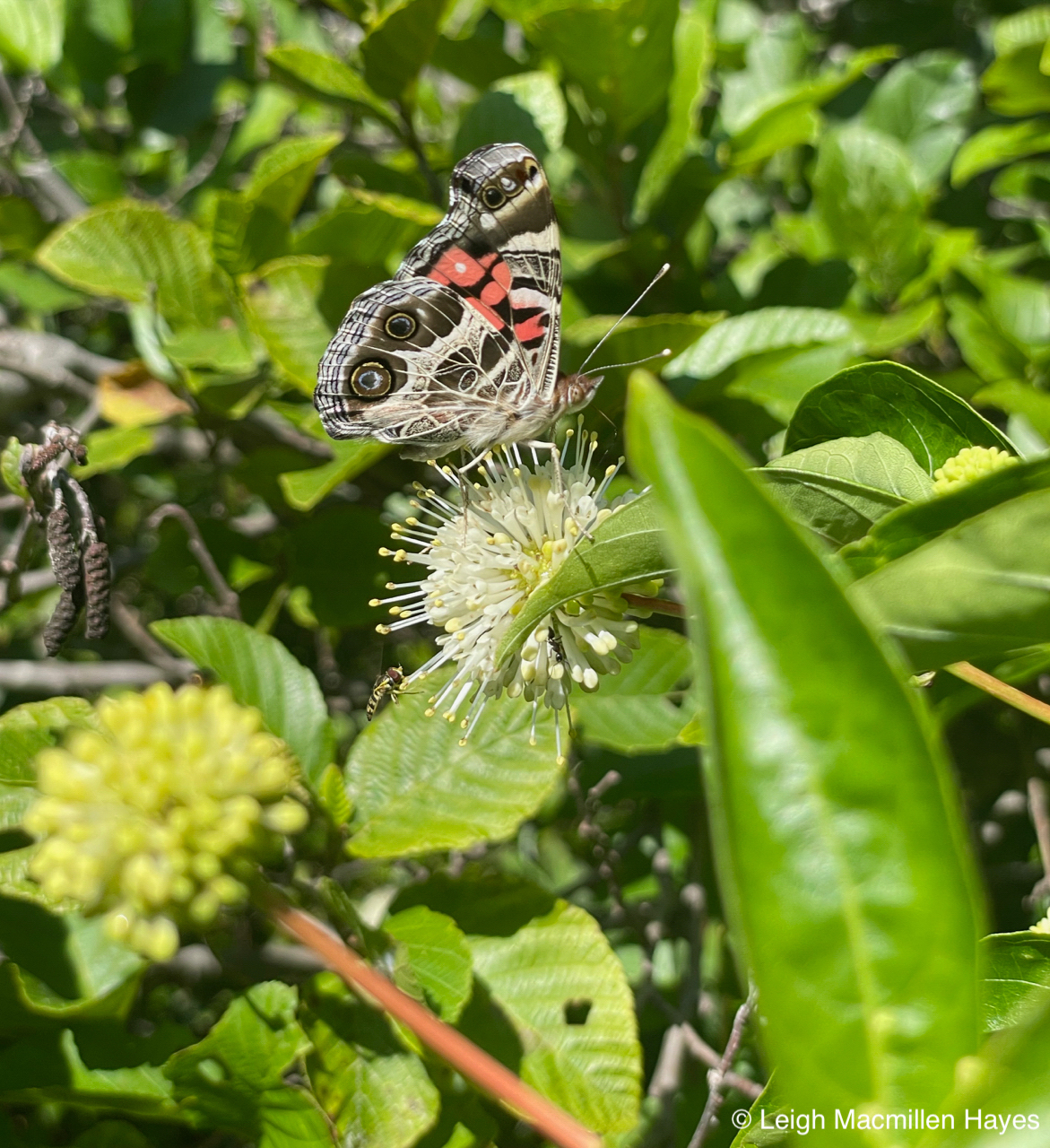
As our time came to an end just after an American Lady flew in, I looked down to make sure I hadn’t worn out the boardwalk and I thought about all the action I’d had the honor of witnessing. Though the flowers drew in smaller insects, they are designed to attract larger bees and butterflies. The Buttonbush (Cephalanthus occidentalis) flowers certainly provide copious amounts of nectar and pollen that make a visit worth the effort for all who stopped by . . . Including the Crab Spider.

I gave thanks to the latter for its diet is well diversified and they are known to contribute to biological controls, but . . . unfortunately, sometimes they feed on beneficial insects like bees.

But I especially gave thanks for all the bees and butterflies who shared their feeding frenzy with me.

Time spent pacing before the satellite-shaped Buttonbush flowers is time spent enjoying an otherworldly experience.   

Getting Inside a Dragonfly’s Head

First they transform from aquatic macro-invertebrates into flying insects. And then they perform flight rituals that include snagging a meal and mating. Dragonflies, as many of you know, absolutely amaze me.

And today, that amazement reached a new level.

For today, I took a closer look at the compound eyes of my favorite insects. I know from reading and listening to others, that large dragonfly eyes consist of 30,000 lenses . . .

each an individual light-sensing structure, but . . .

whenever I study them in situ, though I’m completely wowed by their colors . . .

and the arrangement of eyes that helps with identification . . .

always it seems, the eyes are splotchy with some areas glowing and others a slightly different hue.

Do you see what I mean? Dark blue-gray above and almost a streak of whiteness in this Ring-tailed Emerald, followed by another shade of blue-gray below?

And have you ever noticed that dragonfly eyes wrap around almost the entire head? The thing is, an insect can’t move its eyes like we can so it needs a different adaptation . . .

in the form of hexagon-shaped structures that sense light and are known as the ommatidium or those 30,000 lenses per eye. Can you see the hexagons? Each ommatidium is much longer than it is wide. The ommatidium narrows as it leads to the brain as I’ve learned from How Insects Work by Marianne Taylor. She states: “Each ommatidium is topped with a cornea and a crystalline pseudocone, which acts as a focusing lens, directing light into the rhabdom, a long, narrow, and transparent structure at the center of the ommatidium. It contains photosensitive pigments that respond to certain wavelengths of light. The rhabdom is formed by the combined inner parts of (usually) eight specialize nerve cells–photoreceptors. When the rhabdom’s pigments undergo chemical change in response to light, these cells send a nerve impulse to the brain. The ommatidium also contains six pigment cells, which absorb light that strikes the cornea at an indirect angle. This ensures that the photoreceptors only receive light that passes through the cornea directly . . . what the compound eye “sees” is, as far as we can tell, a scene formed by an array of colored specks (including, in some cases, ultraviolet “color”), each speck contributed by an individual ommatidium. In dragonflies, there are enough specks to form a detailed picture, but in insects with fewer ommatidia the compound image has little detail.”

Here’s a look inside the head of a dragonfly from a specimen I’d collected after it died two years ago. What I didn’t realize until today was that the head had fallen off the thorax because its such a delicate creature once dried. But . . . that was great news because it gave me an opportunity to see more. I thought you might like to do the same. Though we can’t really get inside a dragonfly’s head, we can certainly enjoy the view of the backside.

Worth a wonder!

Happy 7th Birthday to you, wondermyway!

Seven years ago today I gave birth–rather a record at my age. It was February 21, 2015, when I welcomed wondermyway into the world. It’s been quite an adventure that we’ve shared together and one of my favorite things to do each year to celebrate is to take a look back.

As I reviewed this past year, the reality hit home. I’ve written less than half the number of posts of any other year. That all boils down to one thing. Time. There’s never enough. Oh, I’ve taken the photos, and had the adventures, but I haven’t made the time to write about all of them. Sometimes, they sit off to the side in my brain and I think I’ll use some of them together in a cumulative post, and there they sit.

That all said, I’ve had more views and visitors this past year than any other. Views = 24,955; Visitors = 16,994. Followers = 701. And over the course of wondermyway’s lifespan, the blog has received 121,765 hits.

An enormous heart-felt thanks to all who have joined me for any or all of these journeys. I get excited to share with you and love hearing from you.

In case you are wondering, my guy and I did have a Mondate this afternoon–along Bemis River and then up to Arethusa Falls in Crawford Notch, New Hampshire.

It was here at the falls that we celebrated wondermyway.com with a couple of those Bavarian Haus chocolates we purchased last Monday.

And now for a look at a few excerpts from posts I made during the past year, beginning with March 2021. To read or re-read the entire post, click on the link below each photo.

The Invitation Stands

It took me by surprise, this change of seasons. Somehow I was fooled into thinking winter would hold its grasp for a wee bit longer because I don’t like to let it go.

Even Winter Dark Fireflies, who don’t carry lanterns like their summer cousins, and aren’t even flies as their name suggests (they are beetles), knew what was happening before I did for in their adult form they’d been tucked under bark in recent months, but in a flash are now visible on many a tree trunk as they prepare to mate in a few weeks.

But . . . this spring will be different.

How so? And what invitation still stands? Click on the link under the beetle’s photo to find the answers.

Whispers Along The Trail

“The way to be heard isn’t to shout,” said the Reverend Dr. Sam Wells of St. Martins in the Fields, London. “It’s to whisper.” But who are the whisperers?

Listen for the slightest murmur of Trailing Arbutus’s delicate blossoms beneath its leathery leaves.

Hear also the soft words of a rattlesnake-plantain explaining that its striking veins may suggest “checkered,” but it actually goes by “downy” in common speak.

You’ll have to click on the link under the photo of the Trailing Arbutus flowers to hear what other species had to say.

Surveying the Wildlife of Charles Pond

For the past two weeks at Greater Lovell Land Trust we’ve had the good fortune to conduct a wildlife survey in the waters that surround the newly acquired Charles Pond Reserve in Stow, Maine.

MDIFW maintains a comprehensive database on the distribution of Maine’s amphibians and reptiles, as well as terrestrial and freshwater invertebrates and the data we’ve collected will add to the bigger picture. What we discovered was just as important as what we didn’t find.

The survey began with a day of setting and baiting fifteen traps in the pond and associated rivers. What’s not to love about spending time in this beautiful locale, where on several occasions lenticular clouds that looked like spaceships about to descend greeted us.

Our favorite bird sighting was this bald eagle, who found a silver maple snag at the outlet of Cold River into Charles Pond. I was a wee bit nervous as that was Change The Trap Bait Day, and I had a bag of stinky old sardine cans in my lap as I paddled a kayak.

He was intent, however, on something else and barely gave us a glance.

This story of the survey would not be complete, however, without the absolute best sighting that occurred on the last day. Our mammal observations on almost every trip included a muskrat, plus occasional squirrels, and once a beaver. From our game camera set up at various locations, and from tracks and scat, we also know that coyotes, raccoons, otters, a bobcat and a black bear share this space.

But . . . you’ll have to click on the link under the Bald Eagle photo to figure out what our best sighting was.

The Saga of a Vernal Pool

Warning: Some may find parts of this post disturbing. But it is, after all,  about the circle of life. 

A climbing thermometer in March signaled one thing amidst many others: the time had arrived to check the vernal pool. 

Completely covered with ice at the start of my explorations, I noted puddling on top and knew it was only a matter of days. 

Not wanting to rush the season, though truly I did, I rejoiced when the edges melted because life within would soon be revealed.

And then one day, as if by magic, the ice had completely gone out as we say ‘round these parts. It was early this year–in late March rather than April. That same night I heard the wruck, wrucks of Wood Frogs, always the first to enter the pool. 

The next day he had attracted his she, grasping her in amplexus as is his species’ manner. 

Ah, but how does the story end? Click on the link under the photo to find out.

Consumed by Cicadas

I walked into a cemetery, that place of last rites and rest, looking for life. It should have been a short visit, for finding life in such a location hardly seems possible, but . . . for two hours yesterday I stalked the gravestones and today I returned to the same spot where I once again roamed, and then continued up the road to another that surprised me even more.

Upon the granite wall that surrounded the Hutchins plot, two small, but actually rather large in the insect world, nymphs crawled and paused, crawled and paused. And my heart sang as it does when I realize I’m in the right place at the right time.

Click on the link under the photo to see the story of the Cicadas unfold.

Not Just An Insect

Out of curiosity, and because it’s something I do periodically, I’ve spent the last four days stalking our gardens. Mind you, I do not have a green thumb and just about any volunteer is welcome to bloom, especially if it will attract pollinators.

There were millions of other insects, well, maybe not millions, but hundreds at least, flying and sipping and buzzing and hovering and crawling and even canoodling, the latter being mainly Ambush Bugs with the darker and smaller male atop the female.

But why the title, “Not Just An Insect”? Ahhh, you know what you’ll need to do to find the answer.

A Collection of Mondates

Every Mondate is different, which goes without saying, and the adventure always begins with a question, “What are we going to do today?”

The answer is frequently this, “I don’t know, you pick.”

The instantaneous reply, “I asked first. You need to figure it out.”

We did figure it out. Over and over again. This collection happens to include places that make us happy and many of our family members and just looking back puts a smile on my face. Oh, and the selfie–taken at the same place where we went today–only in September 2021.

Beautiful Maine

A vacation loomed in front of us. Where to go? What to do?

Click on the link, Beautiful Maine, to see what surprises awaited us as we got to know our state a wee bit better.

Pondering the Past at Pondicherry Park

Before today’s deluge began, I slipped into Pondicherry Park in Bridgton, Maine, to fill the innermost recesses of my lungs with November air, and at the same time my brain with memories of so many people who have traveled these trails with me from Ned Allen, former executive director of Bridgton Historical Society, to Loon Echo’s Jon Evans, and Lakes Environmental Association’s Alanna Yanelli and Mary Jewett, and friends and friends and friends, including the late JoAnne Diller, Sue Black, and Jinny Mae. But today’s journey also included memories of one I took two years ago with Becky Cook, who shared her remembrances of growing up along South High Street and romping through these trails as they were part of her backyard. If anyone ever had a sense of this place, it is Becky.

This post is full of information of an historic and natural nature. Go ahead, click on the link above to learn more.

Following the Circle of Life

Upon an aimless journey into our neck of the woods a pattern soon emerged, though I didn’t realize it at the time. Sometimes, it’s best that way. To be present is the key.

Click on the link to find out more about the pattern.

Good Hair Mondate

The temperature dipped overnight and wind picked up out of the WNW but given the destination we had chosen, we knew if we dressed appropriately we’d be fine because we’d be in the woods most of the time, unlike last week’s walk where we were completely exposed to the elements on Popham Beach. That said, it was cold today.

But what could good hair possibly have to do with this Mondate? You’ll have to read it to find out.

The Duck’s Tale

Dear Readers, This post may not be for the faint of heart, but it’s something those of us who track find incredibly exciting as we try to interpret the gory story. Yes, you read that correctly. Blood and guts are to follow. You are now forewarned, and if you decide not to read on, I totally understand.

So how is this stuffed beaver connected to a gory story?

Starring wondermyway, episode 3 on LRTV

Finally, settle into a comfy chair and click on the following link to listen to fourteen minutes of wondermyway: wondermywayIII.

Thank you. Thank you. Thank you.

I hope you’ll continue to wonder along with me as I wander through the woods.

Good Hair Mondate

The temperature dipped overnight and wind picked up out of the WNW but given the destination we had chosen, we knew if we dressed appropriately we’d be fine because we’d be in the woods most of the time, unlike last week’s walk where we were completely exposed to the elements on Popham Beach. That said, it was cold today.

Our plan was to follow the trail around Shell Pond at the Stone House property and do it with micro-spikes on our boots rather than snowshoes. Or at least on my boots. Given that there had been some foot traffic, we hoped that when we actually arrived at the trail we’d made the right decision.

As it turned out, most of the traffic had headed to the air strip, but a few had walked our way and really, there’s more ice than snow in this part of western Maine right now.

We cruised along at My Guy’s speed, which boded well for keeping our bodies warm and gave thanks that we were both quite comfortable as we began to circle the pond. Mammal tracks were numerous, but most muted and really, we didn’t want to take time to stop and measure so we only named to each other those we were certain we knew.

Well, one of us did walk a tad faster than the other, but that’s nothing new.

In what felt like no time, we greeted the Keeper of the Trail who gave us a smile from below his winter hat.

And then we reached lunch bench, which my guy cleaned of snow so we could dine on our peanut butter and jelly sandwiches in comfort. Well, sorta in comfort. It was here that we met the wind as it swept across Shell Pond from Evans Notch. So, it was a quick lunch.

And a quick journey to the orchard. As we crossed the bridge over Rattlesnake Brook I recalled once watching a muskrat swim beneath. My guy informed me that I’d probably not see such today–how right he was.

I was feeling a bit bummed that we’d circled so quickly but we did promise ourselves that by the Stone House we’d turn off the air strip and check out Rattlesnake Pool and Gorge, which we’d missed on a Thanksgiving Day hike when we journeyed up Blueberry Mountain located behind the house to Speckled Mountain.

Each time we pass this way I give thanks to the owners who long ago put most of the forested part of the land into a conservation easement with Greater Lovell Land Trust and allow hikers and hunters and rock climbers to use their trails.

And so up the Stone House Trail we went, passing the gorge to start so we could meet the brook at a spot above and watch as the water swirled under ice,

below boulders,

and down through a chute,

creating ice sculptures all along its journey.

Briefly it danced into Rattlesnake Pond, and then followed the course below.

The pool’s nature as forever emerald green never ceases to amaze me.

We met it again at Rattlesnake Gorge were the flow continued despite all the frozen formations.

Down it continued on its way to the point where I earlier showed it in its calm and completely frozen flatwater oxbow.

Click on the video to briefly enjoy the sound.

As much as I was thrilled to have visited the Rattlesnake sites because it was too dark to do so the last time we hiked here, it was the image in the negative space of the ice that really put a smile on my face today.

Do you see a bear?

Back at the air strip we turned right and headed back to the gate. After that, we still had another mile to walk because we’d parked closer to Route 113 since the road in to Stone House isn’t plowed.

And then we played my favorite Stone House Road game–checking telephone poles for bear hair. Black bears LOVE telephone poles. For the creosote? Maybe. Is it the soft pine that they can so easily chew and claw? Maybe. Is it a great place to hang a sign that you are available for a date or this is your territory? Probably, but maybe it’s the other two possibilities that lead the bears to the poles. I do know this. They are well marked along this road.

In the process of biting and scratching some hair is left behind. Mating usually takes place in late June or July, so possibly this hair was left then and has since bleached out in the sunshine.

Shiny numbers also seem to draw their attention, or perhaps the bear wants to hang its own sign and tear down the one left by a human.

Look at the horizontal dots and dashes–can you see them? Think of the bear turning its head and the upper and lower canine teeth meeting as it bites at the wood.

Closer to the truck one pole indicated that the bear won–it had almost totally remodeled the pole including removing most of the number.

As Mondates go, I have to say this one was a very good hair date! And I’m not talking about mine or my guy’s, since we didn’t care what we looked like as long as our warm hats smooshed our manes.

Ever A Sense Of Wonder

I thought I was losing it. Wonder, that is. I’ve hiked or walked many miles, taken thousands of photos, but haven’t been overly wowed by much lately.

This weekend, though, that all changed.

Maybe it was the fact that a friend and I spent a bluebird, yet brisk Saturday snowshoeing many miles as we tracked a couple of local mammals.

There were porcupine dens to explore. Well, not actually crawl into because we didn’t know who might decide to crawl out. We discovered two new ones that were obviously in use, but visited this older stump dump and found no one at home. Why? It had all the makings of a nice condo. Lots of room available, hemlocks growing right out the back door, beside a field with other offerings for a summer diet. Don’t you just want to move in?

We did discover other abodes that showed signs of life with tracks leading to the inner chambers.

How many inner chambers was the next question. Atop this much larger stump dump we counted at least seven holes coated with hoar frost around the edges–leading us to believe someone was breathing within. Did that mean there were seven porcupines living in this den? Do you know what a group of porcupines who share the same winter den, but sleep in their own bedrooms, is called? A prickle of porcupines. Don’t you love that?

By the amount of tracks, we couldn’t tell how many actually lived there, but in the fresh layer of snow we did note that at least one had gone outside to eat the previous night for we followed its tracks for a bit.

It also had visited another den, and by the amount of scat, it was obvious that this wasn’t the first day in a new house.

The porcupines weren’t the only ones we were interested in. For miles and hours, we also tracked a bobcat who’d paid a visit the previous night. Would we find evidence of what it had eaten? A kill site where a prey was attacked? Scat?

We knew by the fact that the bobcat track was atop the turkey prints that this bird lived to see another day.

The same was true for the squirrels that managed to avoid being consumed by the predator overnight as they huddled somewhere close by. But the bobcat apparently didn’t catch a whiff of their scent, though the former did check out holes by stumps and snags.

Sometimes we noticed that the cat picked up speed and we were sure we’d find the reason.

And then . . . and then it would pause and we did too. When the bobcat led us back out to the road we’d traveled on, and crossed to the other side, we knew our time with it had come to an end but enjoyed the journey, though still had questions. Did we miss a kill/feeding site?

We had noted an abundance of food available, much of it in the form of the squirrel or hare. This is my snow lobster, as I’ve mentioned in the past and love how the front feet, being the smaller two prints, land on a diagonal and form the lobster’s tail, while as they lift up to leap forward, the hind feet land in such a way that they appear in the front of the set to form the lobster’s claws. And I’m reminded that for ground dwellers like the hare, the front two feet tend to land on a diagonal, while for tree dwellers like the squirrels, whose front feet also appear smaller and at the back of the set of prints, are most often parallel.

That was yesterday. Today dawned with a sleet storm. When I ventured out the back door this afternoon, I noticed again an abundance of hare prints, these the larger set in the photo while the smaller ones belong to a red squirrel. When I said an abundance of food, these are two of the many choices and this year the hare is everywhere. EVERYWHERE. I find it hopping through communities I’ve not seen it in the recent past. Certainly the bobcat of yesterday will or did find one–we just didn’t stumble upon it.

After spending so much time tracking, a favorite winter activity of mine, I finally turned my focus to trees, another passion. I was actually looking for insects, but fell for this solid droplet of balsam resin that looked rather like a bug. I would love to see the colors of the dribble repeated in yarn.

Then there was the ice that mimicked the shield lichen attached to a branch of the fir.

At last I did find an insect. Well, at least the left-behind structure of a sawfly–where it had pupated and then once ready to emerge, cut its perfect circular escape hatch. How to remember this insect: think of it as a circular saw-fly.

And attached atop the pupating case–what looked like another insect pupating. I don’t know if I’ll ever be able to name its species, but I thrilled in spotting it.

Bark is cool, but especially when you begin to notice all the idiosyncrasies of life upon it, such as the fruiting disks of a couple of crustose lichens, but one of my favs is the braid-like formation of the liverwort Frullania. It has brown leaves divided into two lobes. Liverworts are cool because they are flowerless and lack roots and reproduce via spores. Frullania is abundant upon bark, but unless you slow down and look, you may not ever spy its spiderwebby structure.

Speaking of spying, yesterday’s brilliant sun shone upon the hairy twigs of paper birch, another sight easy to overlook.

Today’s natural community found me tramping through an area where gray birch, with their bumpy, hairless twigs, grow.

How did these two members of the same family develop such differences? I think about that and how it is true of all in the natural world. Maybe the hairs don’t appear in exactly the same line-up and the bumps are more or less bumpy on another twig, but they all are variations on the same theme. Mammals are like that as well. And flowers. And ferns . . . and well, everything. We can learn to ID them because generally they share the same characteristics from one dandelion to the next. But . . . what about us? As humans, there are familial similarities, but very few of us look exactly like another. Though perhaps somewhere in the world we all have a twin we’ve yet to meet. Alas, I’ve rambled on enough.

It all boils down to the bush clover–a species my friend Pam and I first met at Brownfield Bog a couple of falls ago and recognized almost immediately when we discovered it in a field in Stow, Maine, before encountering our first porcupine condo yesterday. Today, she informed me in a text message that a year ago we met it in the same field, and we shared a chuckle that neither of us had a memory of that moment. Uh oh.

But I was reminded this morning that it’s important to go forth with a child-like attitude, finding awe in all that we see and encounter and I realized then that I’ve been too busy lately to slow down and really look.

Here’s hoping I can ever renew and enjoy that sense of wonder and that you can as well.

Knowing My Place

I planned to accomplish so many things since I had time off this past week. And I did check a couple of items off my list, but . . . most of my time was spent wandering and wondering in the woods behind our house.

Sometimes I followed trails known only by those who like to zoom through this space and never really see.

Other days I bushwhacked, eager to discover what might present itself.

Always I was reminded that this has long been my classroom and its taught me many a lesson, including that the bracts of the Witch Hazel flower persist in the winter and offer a dash of color in the landscape. Notice how each flower consisted of four bracts that curl back. The ribbony flowers fell off in the fall. And I have to admit that there was a time when I thought these were the flowers.

While bushwhacking, debris on the snow drew my attention and of course I had to investigate.

Much to my delight, I found a couple of Pileated Woodpecker scats filled with insect bodies. And notice all the chiseled wood–it’s a lot of work, but I’m always happy to note via the scat that the attempt was successful.

Equally successful was the digging of a Red Squirrel who had cached a pile of hemlock cones and returned within the last few days to dine and leave behind a midden of cone scales–its garbage pile.

This is a truly wild place that serves as home to so many mammals and birds and I give thanks to them for leaving behind prints and other signs of their presence. Of course, I was looking for the resident Moose, who has eluded me so far, but the White-tailed Deer are everywhere, including sucking seed from our bird feeders every night.

The Turkeys haven’t discovered our feeders yet, but by their prolific tracks I know they are nearby.

I’ve also been noting many, many Snowshoe Hare tracks, some in places I don’t recall seeing them previously and methinks there is plenty of prey available for predators. One of the learnings these woods have offered is that the hare’s prints can throw one off on ID, especially when the snow is soft and its hind feet (top of photo as they always land in front of where the front feet landed and lifted off) spread out and leave more toe impressions than one typically sees.

Of course, no visit to these woods is complete without a check-in at the vernal pool. And this week I discovered two other pools to check on in the spring. But those are for another day three months away.

For all my wandering, actually spying wildlife is rather rare, but from inside our kitchen door sometimes we see so much. Every few nights a porcupine pays us a visit. And every night four healthy looking deer stop by as I said earlier. But on these stormy days, the feeders see the most action and today’s visitors included Tufted Titmice,

and American Goldfinches studying the scene.

Eventually, this male flew to the ground and dug in, much like the Red Squirrel in the woods.

Time and time again, he knew success.

Mr. Cardinal also dove in.

And his Mrs. came by as well. One day we actually spotted two Cardinal couples in the yard.

One of the joys of the feeders is that those who visit add color to the scene and it soon became apparent that red was the color of the day, this time with the spots on the back of the Downy Woodpecker’s head indicating it was a male.

Another male of another species also showed off his red coloration.

I was tickled to welcome a couple of House Finches. And do you see the deer hair on the snow to the upper right of his beak?

It’s that time of year when the Juncos also pay a visit and keep the red theme going with their pink beaks.

Not all birds are created equal or don’t tell the Gray Squirrel he’s not a bird because like the deer and porcupine, he’s sure that the seed and nuts are meant for his pleasure. Certainly.

This was my week, a week spent happily dilly-dallying in my place and giving thanks for past and present and future lessons. A week spent wondering and wandering alone. And it was topped off with this icy sculpture in the woods that reminded me of a bird’s head–it seemed apropos, but I did have to wonder how it formed. Ahhhh, not all is meant to be understood in this school of choice.

How well do you know your place?

Starring wondermyway, episode 3 on LRTV

Thanks to Evan Miller at Lake Region Television, wondermyway is on TV once again. For this program, Evan added music by pianist Abbey Simon.

Settle into a comfy chair and click on the following link to listen to fourteen minutes of wondermyway: wondermywayIII

Clicking on the photo won’t pull up the video, so be sure to click on the link above the photo.

May this bring you some moments of well being and peace.

Not Just An Insect

Out of curiosity, and because it’s something I do periodically, I’ve spent the last four days stalking our gardens. Mind you, I do not have a green thumb and just about any volunteer is welcome to bloom, especially if it will attract pollinators.

This image has an empty alt attribute; its file name is 1-2.jpg

iWhat I’ve discovered is that in sunshine and rain, the place is alive with action from Honeybees and Gnats . . .

This image has an empty alt attribute; its file name is 2-2.jpg

to Paper Wasps,

This image has an empty alt attribute; its file name is 5-1.jpg

and even several Great Black Wasps, their smoky black wings shining with blue iridescence as they frantically seek nourishment and defend territories (including letting this particular human know that she’s not welcome at the party by aggressively flying at her).

This image has an empty alt attribute; its file name is 8-2.jpg

Bumblebees were also full of buzz and bluster and it was they who reminded me of one important fact.

This image has an empty alt attribute; its file name is 4-2.jpg

The color of the storage baskets on their hind legs depends upon the color of the pollen grains in the plants they’ve visited.

This image has an empty alt attribute; its file name is 5-2.jpg

There were millions of other insects, well, maybe not millions, but hundreds at least, flying and sipping and buzzing and hovering and crawling and even canoodling, the latter being mainly Ambush Bugs with the darker and smaller male atop the female.

This image has an empty alt attribute; its file name is 14-2.jpg

And then, because I was looking, I discovered an insect in the process of being wrapped for a meal intended for later consumption. I’ve long been fascinated by Ambush Bugs and Assasin Bugs and this, the Black and Yellow Garden Spider, Argiope aurantia. What’s not to love? She’s an orb weaver, meaning she spins a complex circular web, in this case among tall plants, that features spokes which are non-sticky that she uses to walk upon, and round wheels that are sticky to capture prey. The web is the size of a platter. A large platter. And . . . every night she consumes the entire thing and rebuilds a new one for the next day. In the process of consuming the threads, she can take advantage of any little insects like mosquitoes that get caught in the stickiness, but it’s the bigger insects that she prefers to eat.

This image has an empty alt attribute; its file name is 15-3.jpg

Do you see the rather conspicuous zigzaggy line down the middle of the web? That’s called the stabilimentum and may have several purposes: providing stability; attracting insects with the multiple threads like an ultraviolet runway such as the colorful lines and dots on plants; or perhaps announcing to birds that they shouldn’t fly through the web. Whatever the reason, it’s in the center of the stabilimentum that the spider hangs in suspension, waiting for the dinner bell to announce ring.

This image has an empty alt attribute; its file name is 16-1.jpg

Though she has eight eyes, her vision is poor. But . . . her hairy legs may also help in the detection that a meal has arrived, perhaps signaling sound and smell, plus she can sense the vibrations.

This image has an empty alt attribute; its file name is 18-1.jpg

Once captured, she injects a venom (that is harmless to us bipeds) to immobilize her subject and then begins to spin a sac around it.

This image has an empty alt attribute; its file name is 23-1.jpg

Remember, I’ve been watching her for four days, while she’s hanging upside down playing the waiting game and showing off her egg-shaped abdomen with its asymmetrical yellow markings on the carapace (much like a turtle’s shell) to her silver-haired head.

This image has an empty alt attribute; its file name is 24.jpg

Some days I felt like she might just be Charlotte, writing a message only Wilbur could interpret.

This image has an empty alt attribute; its file name is 30.jpg

And one day she surprised me by turning right-side up. It was then that I was offered a closer look at those little bumps on her head that serve as eyes. And the pedipalps, those two little hairy appendages sticking up on her head that work like sensory organs.

This image has an empty alt attribute; its file name is 27.jpg

An hour or so after finding her upright, when I checked again, I thought she’d gone missing. Instead, I discovered she’d climbed to the top of one of the plants upon which she’d spun her web.

This image has an empty alt attribute; its file name is 28.jpg

Perhaps she was surveying the area as she waved her front legs, looking about her domain.

This image has an empty alt attribute; its file name is 31.jpg

A day later, a new web, and another meal packaged, and slowly my buzzers were being consumed. But, she also likes grasshoppers and crickets and the garden is full of them.

This image has an empty alt attribute; its file name is 32.jpg

And then this morning dawned, with T.S. Henri in the offing and a few raindrops upon a broken web announcing the storm’s intended arrival. Wait. The web–it had holes but had not been entirely consumed. That wasn’t all, yesterday’s meal also hadn’t been consumed. And the spider was nowhere to be seen. I looked up and down and all around and couldn’t find her. Had she meant to save the meal, waiting for her venom to pre-digest it by liquifying the internal organs and in flew something larger than her and dinner went uneaten? Had our time together come to an end just like that?

This image has an empty alt attribute; its file name is 33.jpg

I wasn’t going to let the issue go, and so I continued to search, and guess who I found about three feet away upon a new web?

Even more exciting was the discovery that I can see her from the kitchen window AND, the view is of her underside so I can actually see her brown spinnerets at the end of her abdomen and maybe I’ll get to watch her capture a meal.

This image has an empty alt attribute; its file name is 34jpg.jpg

Well, so I thought, but two hours later, when I next looked, I realized I’d missed the action and she’d already securely wrapped her latest victim–all that was still visible was a leg.

This image has an empty alt attribute; its file name is 35.jpg

Though the prey may be one, this is NOT just another insect in the midst of my quest. Actually, it’s not an insect at all for spiders are arachnids, with eight legs versus an insect’s six. She may be scary big, as well as carnivorous, but she is beneficial to the garden as she helps control insect populations, including some pests.

And how do I know she is a she? Her male counterpart I’ve yet to meet, but he’s much smaller and all brown, unlike her beautiful coloration.

There’s more to this story I’m sure and I look forward to learning more about her as I try to interpret the messages she leaves. If you have a chance, go out and stalk your gardens and be wowed by what you find.

Consumed by Cicadas

I walked into a cemetery, that place of last rites and rest, looking for life. It should have been a short visit, for finding life in such a location hardly seems possible, but . . . for two hours yesterday I stalked the the gravestones and today I returned to the same spot where I once again roamed, and then continued up the road to another that surprised me even more.

It seemed the Hutchins family was watching over the first little specks of my attention, keeping them safe at a most tender moment in their life cycle.

Upon the granite wall that surrounded the Hutchins plot, two small, but actually rather large in the insect world, nymphs crawled and paused, crawled and paused. And my heart sang as it does when I realize I’m in the right place at the right time.

Who are these land lobsters, for such do their claws remind me. Dog-Day Cicadas. They complete their life cycle in 1 – 3 years. As nymphs or larvae, they remain underground feeding on plant juices from tree roots. In July, the nymphs tunnel up through the ground and crawl onto tree trunks or other surfaces like gravestones, which they latch onto with those over-sized claws.

Tickled to see two who looked like they were about to burst into new life, I watched with intensity, noticing that this, the second one, had green wings forming. And really, its head was already emerging, for if you look closely, you’ll note a small set of brown eyes closer to its claws and the new eyes much larger and darker in color protruding.

Winged cicadas emerge from a slit along the back of the nymph’s exoskeleton.

Back to the first, you’ll notice the same is true. And do you see where the second cicada had that hint of green, this one is more rosy red in color.

I could say that within minutes I noticed more of the body bulging, giving the nymph a hunchback look, but this is a transformation that takes time. Lots. Of. Time. They begin the process by arching and expanding the thorax until the larval cuticle fractures and the adult’s thorax appears, soon, or sorta soon, followed by its head.

Ever so slowly . . .

the rest of the body . . .

comes to life.

Both red and green complete this process simultaneously as I squat and watch.

Eventually, legs and wings are visible. Do you see the proboscis, that elongated sucking mouthpart or stylet that is tubular and flexible, extending from its nose?

How about now?

As the abdomen extends, four wings take shape.

In continued slow motion, they begin to unfurl . . .

and the insect wiggles its legs . . .

ready to get a grip.

Next, it pumps insect blood into its body and wings, which takes even longer, as in hours. After the cuticle hardens for a while and muscles grow stronger, the cicada pulls itself out of its former self.

Before it can fly, those wings need to dry, some resembling a rainbow.

Teneral to start, a breeze creates an angelic quality befitting the setting.

In time, the wings will fold over the cicada’s back, but until that happens, the rose-version offers a lesson that not all Dog-Day Cicadas look like camouflaged leaves among which they sing–the tree-top males producing the droning whirr of a song we all associate with summer by using their tymbals or paired membranous structururs in their abdomens that vibrate through muscular action–it’s this song that attracts females.

Today, I visited yesterday’s cemetery and found not much action, but a few miles north it seemed the summer chorus was preparing to take in new members.


First, however, they had to finish donning their choir robes.

And as I’d noticed for the first time yesterday, not all robes are the same color. Variation apparently is normal among cicadas, which provide me a wonder-filled lesson.

My question is this: what determines color? It can’t be temperature as from the many I saw today and few yesterday, all emerged at about the same time. And it can’t be location, for they were all in the same locale.

In fact, some even morphed upon the same family plot corner stone, this being the Evans family in Center Lovell, and their transformation occurred within minutes of each other.

Then there was another question–if they were so close to each other in emergence, would they get along? I watched these two for a long time, and though they got quite close occasionally, they seemed rather territorial, using. a foot or tarsus to push the other away. That, of course, is my human interpretation of what I was observing. The reality may be different.

A few headstones away, another for the red variety.

There are other lessons, such as this–like dragonflies, some nymphs transform atop the discarded exuviae of their relatives.

And while I expect that they only climb a few feet off the ground to morph, I’m proven wrong when I have to use my warbler neck to spy at least two on branches high above. Do you see them? Are there others that I missed?

I have so many more questions, but pull myself away once again.

I do often wonder if my presence bothers then, but have to hope that they realize I’m there to protect them from predators and learn from them during this time of transition.

Note that the proboscis is tucked under their bodies, as it won’t be needed until these cicadas reach the tree tops. Once up there, where I won’t be able to spy them, males will produce the droning whirr of a song we all associate with summer by using their tymbals or paired membranous structures in  their abdomens that vibrate through muscular action–it’s this song that attracts females. After mating, the female lays her eggs in slits she makes in twigs. The young nymphs hatch, fall to the ground, burrow underground and feed on sap from roots for a year or two or three. 

And then the day I wait for happens and I once again roam places where I know I can find them, cemeteries being my place of choice, and I spend hours stalking one stone and then another and back to first and then the second, over and over again, consumed as I am by cicadas.

The Invitation Stands

It took me by surprise, this change of seasons.

Despite all the clues from fading otter prints . . .

and not so deep moose tracks . . .

to reverse tracks raised above the snow cover as a result of a frozen crust followed by wind and warmer temperatures.

But still, somehow I was fooled into thinking winter would hold its grasp for a wee bit longer because I don’t like to let it go. The faces hiding in the ice knew otherwise.

As did the constitution of pond ice that despite recent brisk days and nights began to react to the sun’s rays and display the tea-stained color of organic matter decomposing in the water below.

Even Winter Dark Fireflies, who don’t carry lanterns like their summer cousins, and aren’t even flies as their name suggests (they are beetles), knew what was happening before I did for in their adult form they’d been tucked under bark in recent months, but in a flash are now visible on many a tree trunk as they prepare to mate in a few weeks.

The same is true of the Winter Stoneflies who only recently started crawling out of the water. and drumming as an announcement that they too are ready to let the mating season begin.

The birch trees also knew before I did and made sure to let last year’s catkins release their scaled fleur de lis, thus scattering the seeds that look like tiny winged insects upon the snow where they’ll join the melt down and eventually find a moist spot upon which to germinate.

And so it is that spring snuck in a few days after St. Patrick’s Day as it always does, but still surprising me and now I join others and anticipate the changes to come.

But . . . there’s something different about this spring. Oh, I’ll still stalk vernal pools until they dry up.

I’ll marvel at each and every tiny bud preparing to bloom like those of Trailing Arbutus.

I’ll spy on spiders and insects for hours on end.

I’ll continue to look for fine specimens of scat, including otter filled with shiny, mica-like fish scales . . .

and coyote that at first glance I might think is bobcat, but the tapered ends offer one hint of its owner . . .

and the sight of bones and toenails tucked within remind me that bobcats are true carnivores who grind the contents of a meal so no bones are typically visible in their deposits, while such do show due to the omnivore appetite of a candid. I will be sure to question the meal based on the color of the fur as well as the contents.

But . . . this spring will be different. Yes, such was the same a year ago when we all moved into our bubbles. Now, though, there’s a glimpse of hope on the horizon and with that comes an assimilation to being with others and I can’t help but wonder, how will I react? I’ve become so accustomed to this forced insulation, and I have to admit that there are parts of it that haven’t bothered me, perhaps because I don’t mind being in my own space.

The question has been on my mind a lot lately and the answer flew in this morning as I listened in on a ZOOM church service. Just as it was to begin a small flock of Common Redpolls arrived to check out our birdfeeders.

“Invite in” were the words I heard another utter on the computer screen.

Indeed. Each day this past week, the variety of birds at the feeders grows, some species arriving at their breeding grounds, while others like the Redpolls pause before passing through. For the most part, our feathered friends accept the presence of others. An over-the-shoulder look being what it is, they remind me that I must behave like them and be open to opportunities.

As the snow melts, I realize that I must share space with all who wander here . . .

including the deer who tried to walk the labyrinth path.

The Invitation Stands. Spring is indeed here and I invite you to join me for a wander when you are able so we can wonder about nature’s communities together. I look forward to welcoming you back with a smile . . . though please don’t expect a hug.

Sharp Observation

I was early–a rare occasion as usually I’m the one who arrives at least ten minutes after the agreed upon time. It wasn’t always that way, but has become a bad habit. That said, it was a creature of habit that I went in search of because I had some time to spare.

And much to my delight a sign hanging from a tree announced what I’d hoped. Can you read it? The hemlock sprig dangling from the birch stating that So-and-So was in residence?

Suddenly I realized there were a million items shouting the obvious, scattered as they were upon the snow and rocks like neon signs on a city street: “So-and-So Slept Here;” “So-and-So’s Diner;” and “So-and-So’s Rest Rooms.”

Hemlock twigs with angled nips and singular scats spoke to So-and-So’s presence. Was So-and-So present? I could only hope so.

As I looked about, I noticed the signs dropped by one or two others, including one of whom I totally expected to surprise me as it has on several occasions in the recent past. While I didn’t startle the bird, I knew by its offering left on the rock that it continued to frequent the locale–do you see the “golden” cylinder among the brown scat? That would be a notice from the local grouse.

And then I stepped under the hemlock because there was more bird sign on the tree created by a Pileated Woodpecker and I hoped to find its scat. No such luck among the wood chips, but plenty more fresh pellets stating that the occupant was possibly in situ.

All the telltale signs were there. About one inch long. Comma shaped. Groove down the inside. Fresh. Did I say fresh?

From every angle the evidence was clear. I shouldn’t be standing below because just possibly that certain So-and-So might be resting above. And said being has been known to fall out of trees as I’ve told others while standing in this same spot on previous occasions. Did I say this is a creature of habit?

Whenever I visit I look up. But it’s not until winter that my sight is graced with that of such another. Can you see it? The anomaly in the canopy?

How about now? Do you see the dark blob sitting up there?

Porcupines are indeed creatures of habit and every winter I know certain places to locate a few locals, including this big guy. A guy? Yes, because it’s the males who tend to rest in trees during the day.

He was up there enjoying the cambium layer of the bark as witnessed by the goldeny color of the branch by his feet. All those downed twigs–apparently they were in his way so he nipped them off and dropped them to the ground in order to get to the nutrients he sought for his winter diet.

Check out his eye. We were both sharp observers as we eyed each other from a distance.