Witnessing the Past

We’ve traipsed through these woods before, My Guy and I, but always, there’s the old to see and the new to appreciate. And so today we visited both.
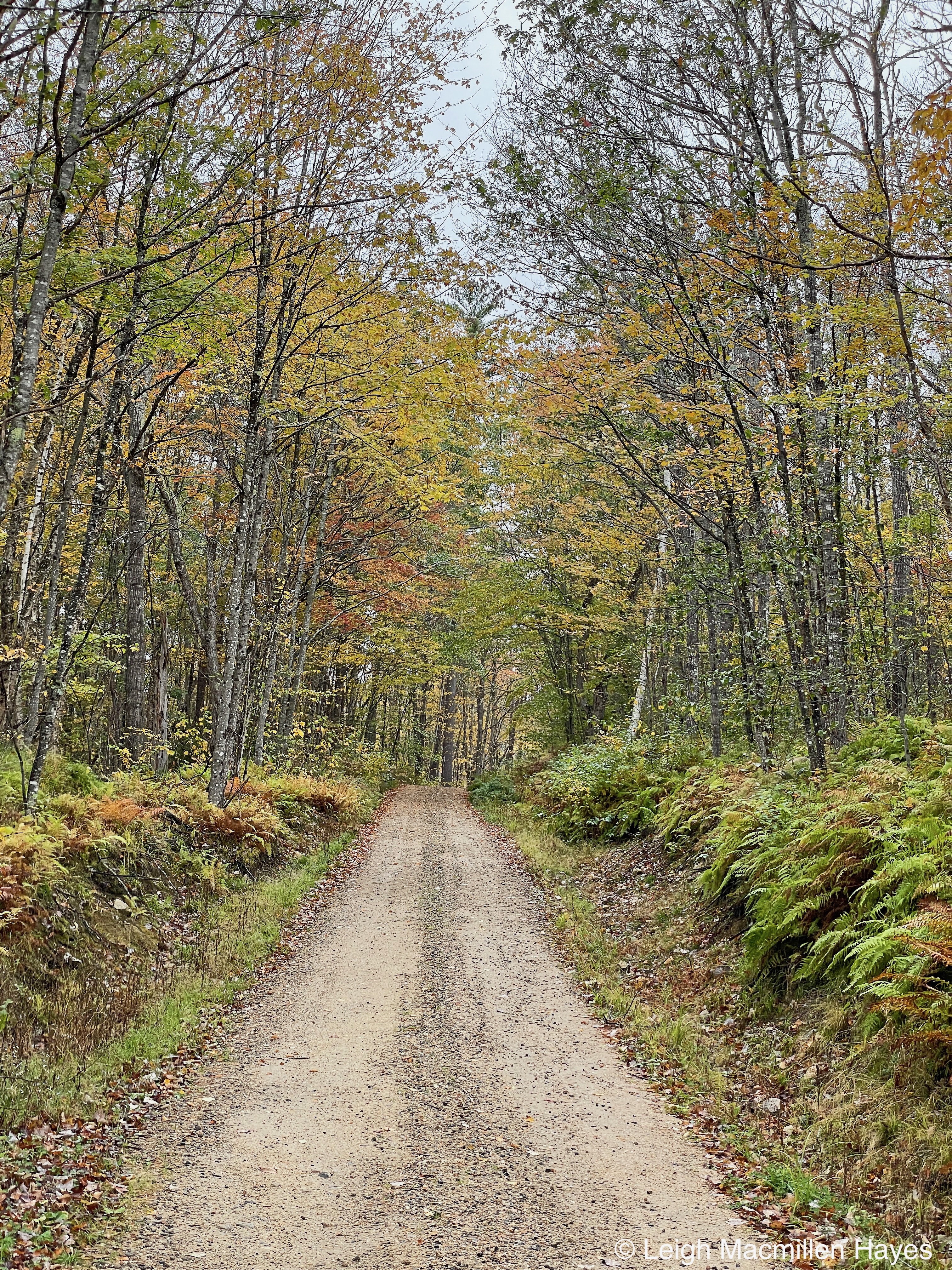
By the shape of the forest road we walked, I could have driven another mile before parking. But . . . I like to walk. And besides, you can’t appreciate all the beauty that surrounds you on a wet autumn day if you fly in at 60 miles per hour. Or even at 20!
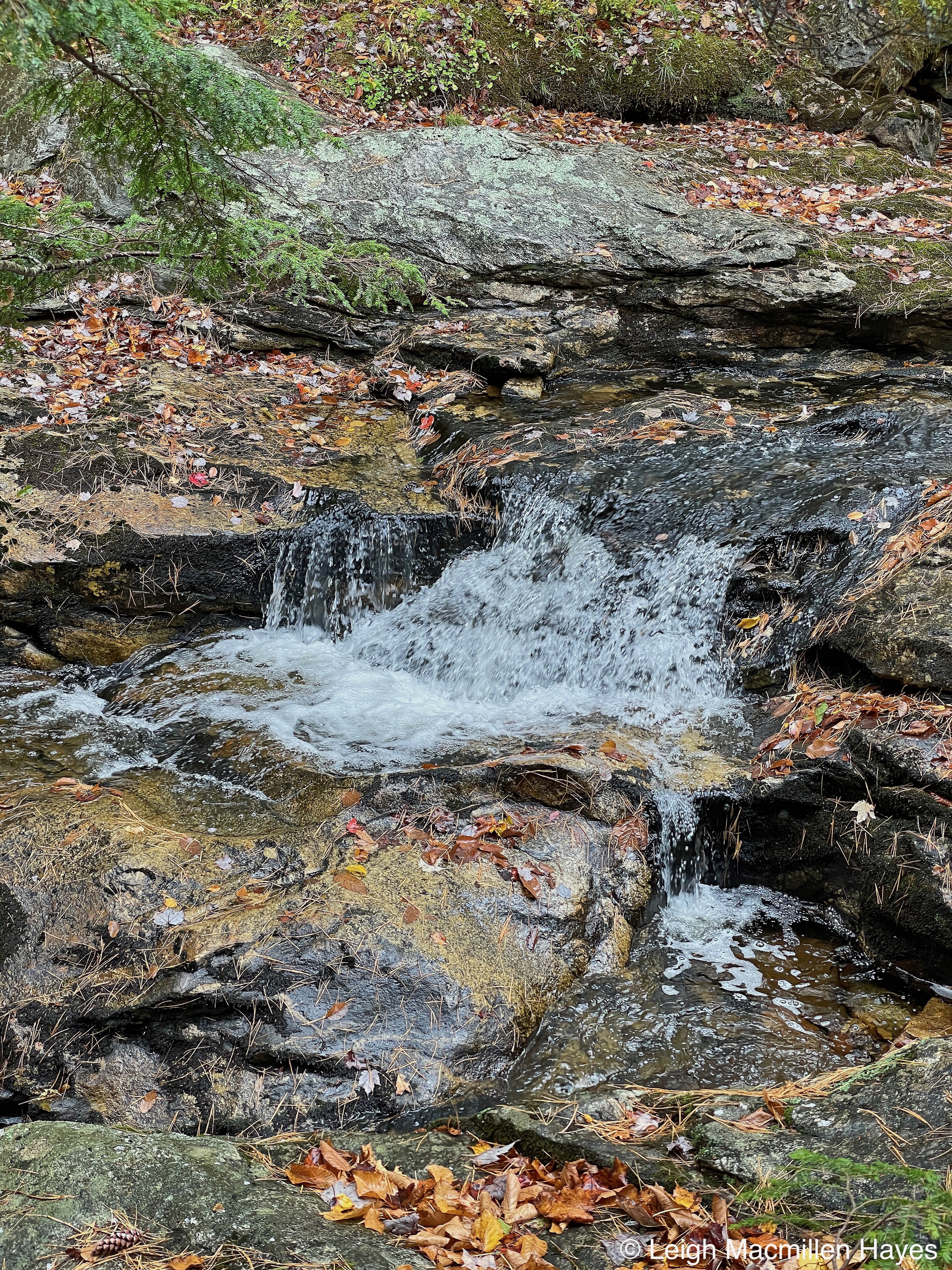
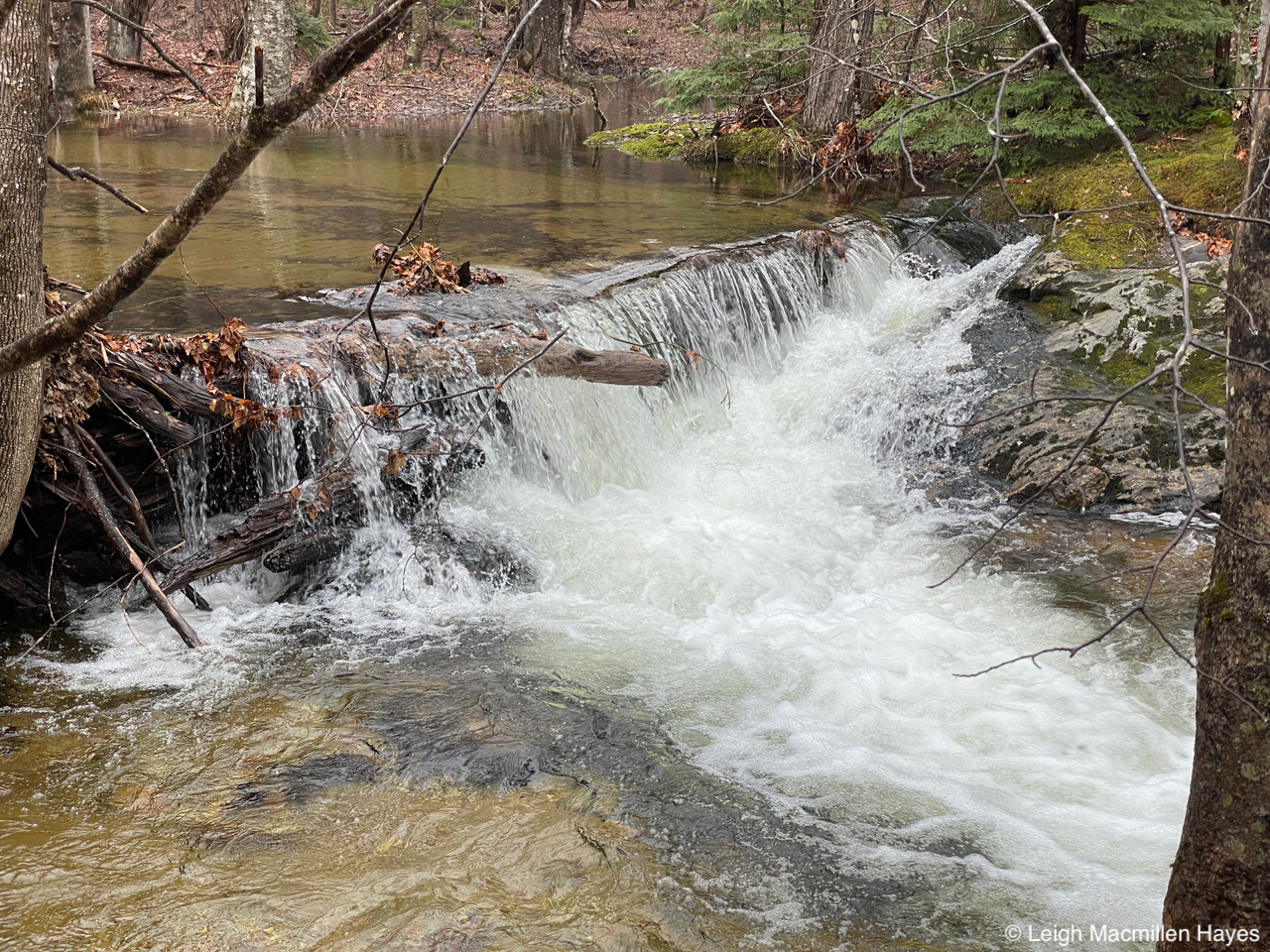
And because we walked, we found an off-shoot trail that led us to a sweet spot we’d not visited before along Great Brook, where we stood for a few moments watching and listening and smelling as the water cascaded over the rocks.

Once we got to the trailhead after passing around a gate, we followed another old road for a ways, up and down over a few little hills, and then, because memory was on our side, as the road curved to the right and the stonewall began on the left, we knew it was time to turn and begin a bushwhack up a road that hasn’t seen much use in decades. It was there that we spied the first witness. A tree standing over a marker. By the way the tree is growing around the sign, it’s obvious that it’s been keeping watch for decades.

So if that was the witness post, where was the survey marker? Atop a rock at the base of the witness tree. And 1965 would be the year that the sighting was first made.

Eventually we reached the first of the foundations because even when we are what seems to be deep in the woods, we’re in the middle of a place that was once somewhere — someone’s neighborhood. In this case, according to the 1858 map, we were visiting the Durgins.

My friend, Jinnie Mae (RIP), was an historian and tech guru and years ago she overlaid part of the bushwhack we did today on an 1858 map. You can see the name E. Durgin on that.
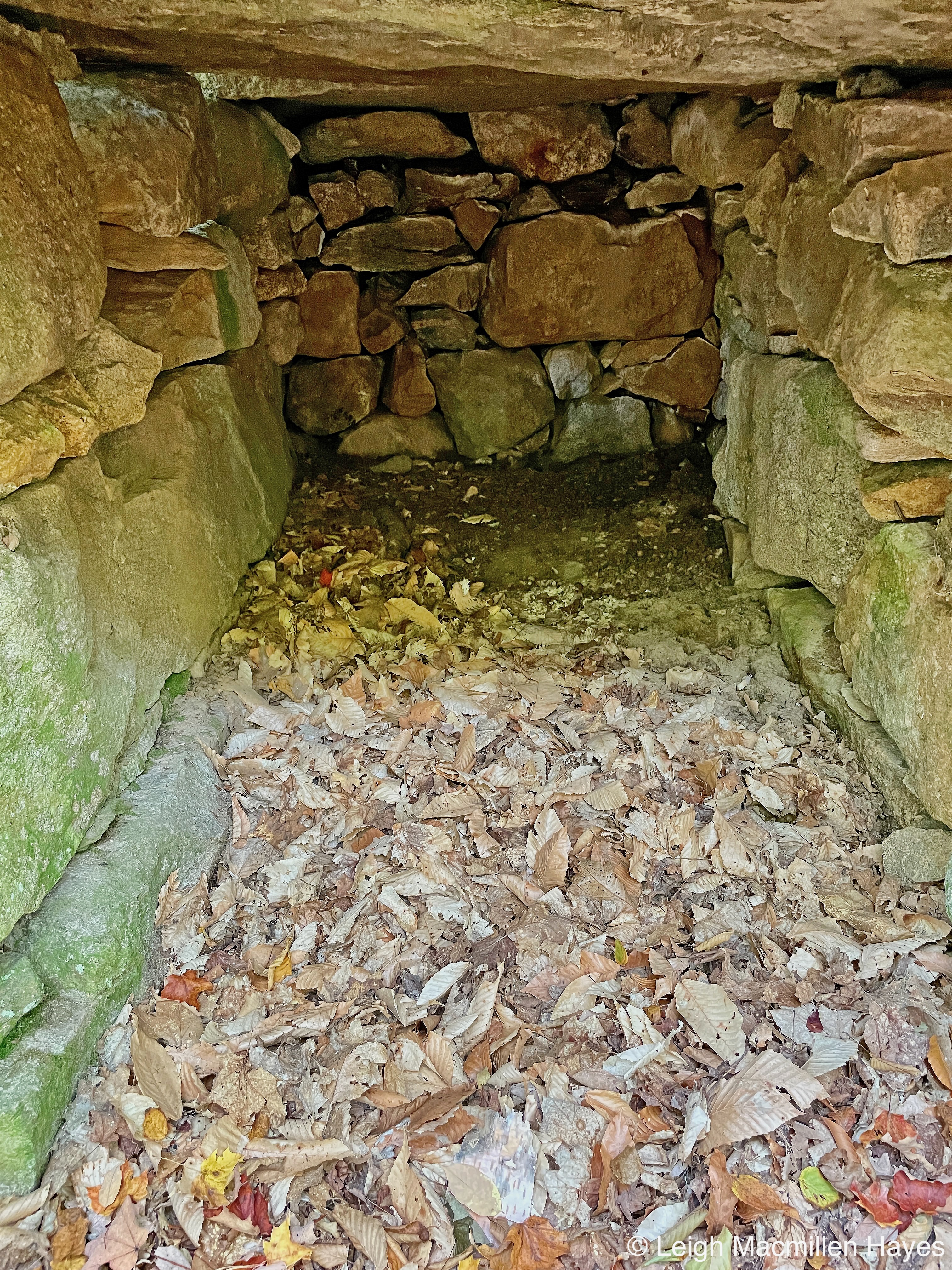
One of my favorite things about the Durgin cellar hole is the cold storage. In the cold to come, it will still serve as storage, so witnessed by the findings within today.

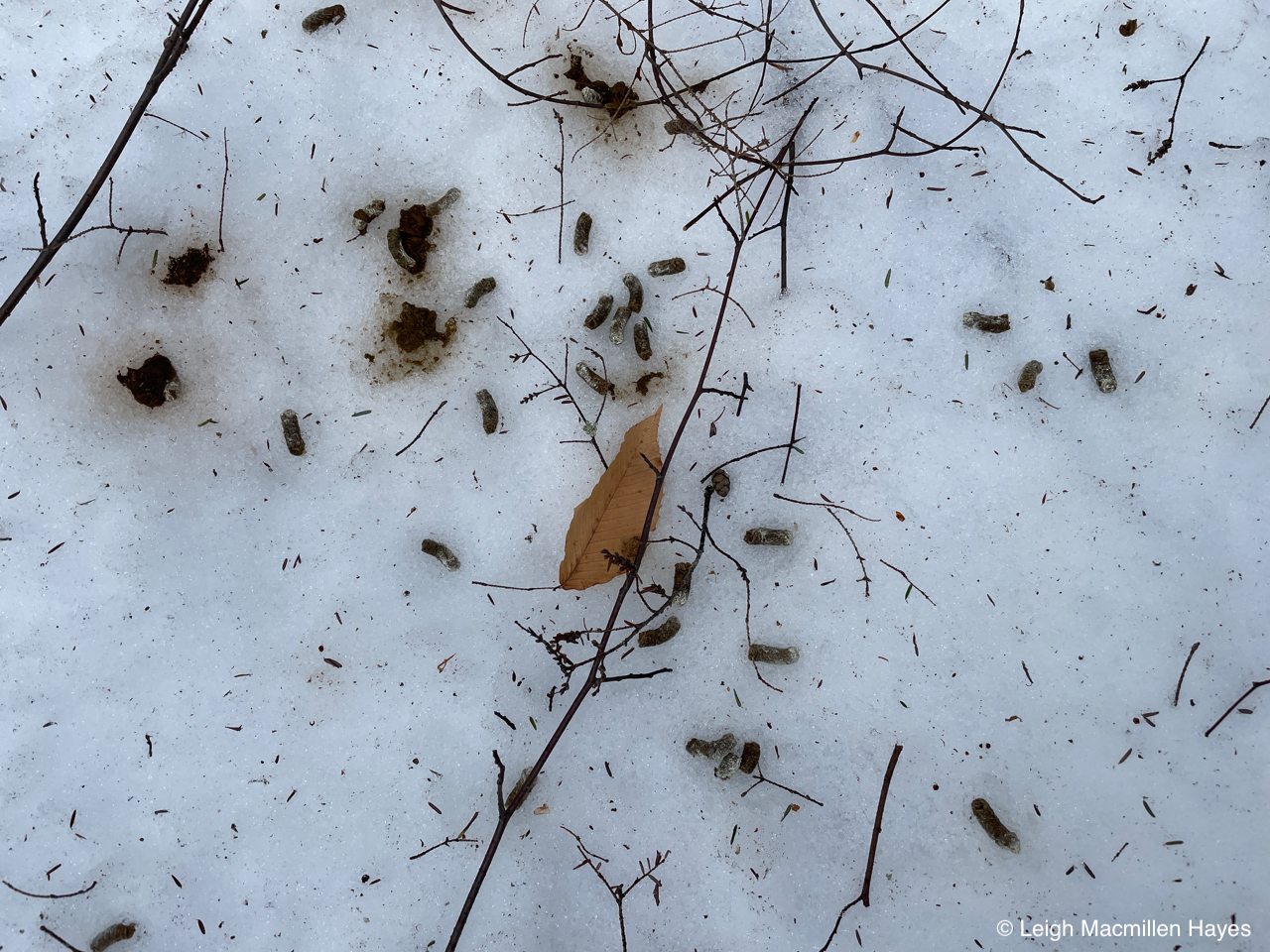
For the back corner has long provided protection from the elements for a porcupine, given the scat pile.

Because we were there, we decided to check on the Durgins who hang out a ways in the woods behind their former home and followed a stonewall to their locale.

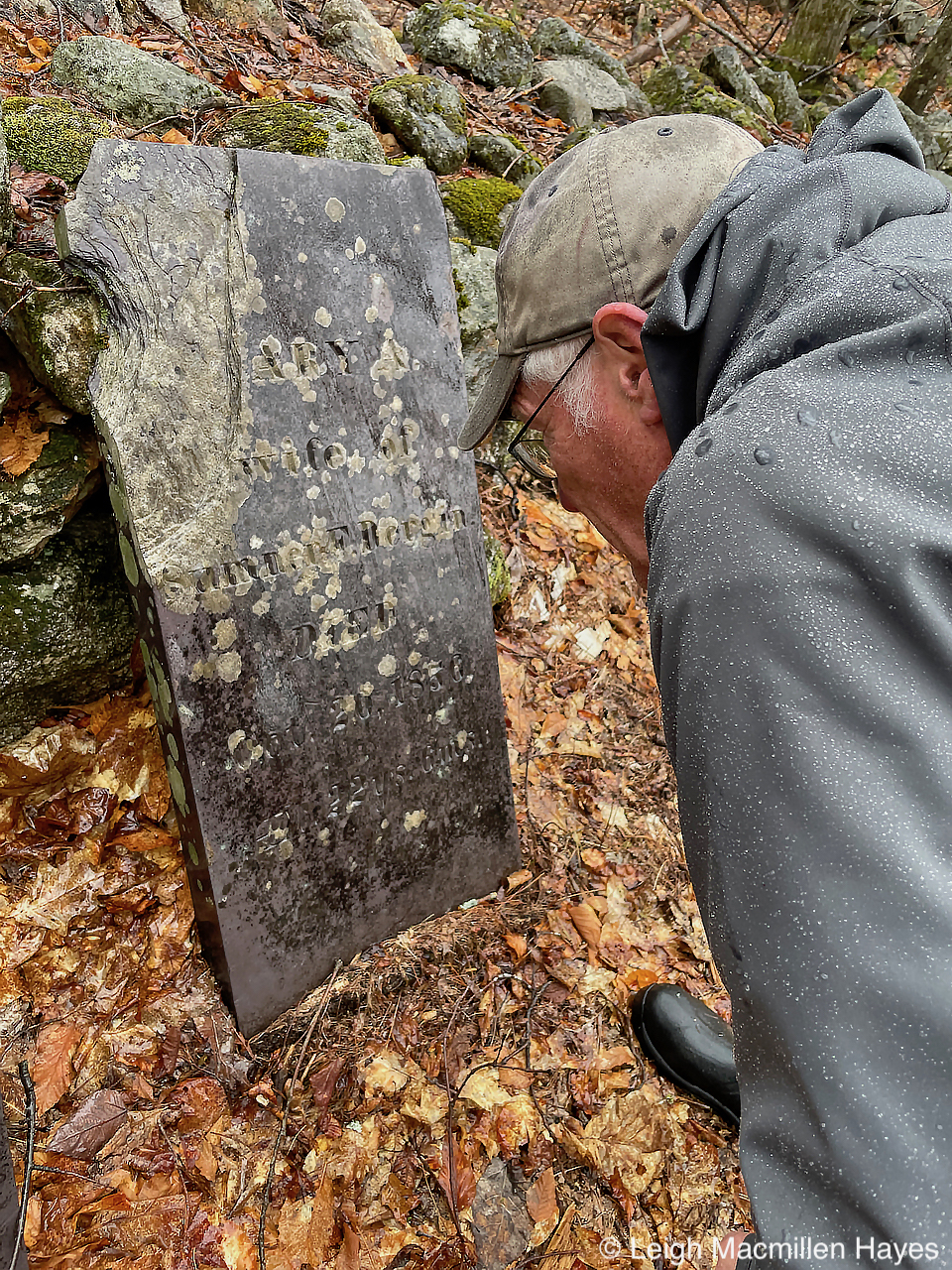
Three of them were still there. Sarah, daughter of Anna and Ephraim (E. Durgin on the map), died in 1858 at age 22.

Beside her stood Mary, wife of Sumner Dergin, who died before Sarah in 1856, also at age 22.

Our best guess is that Sarah and Sumner were siblings.

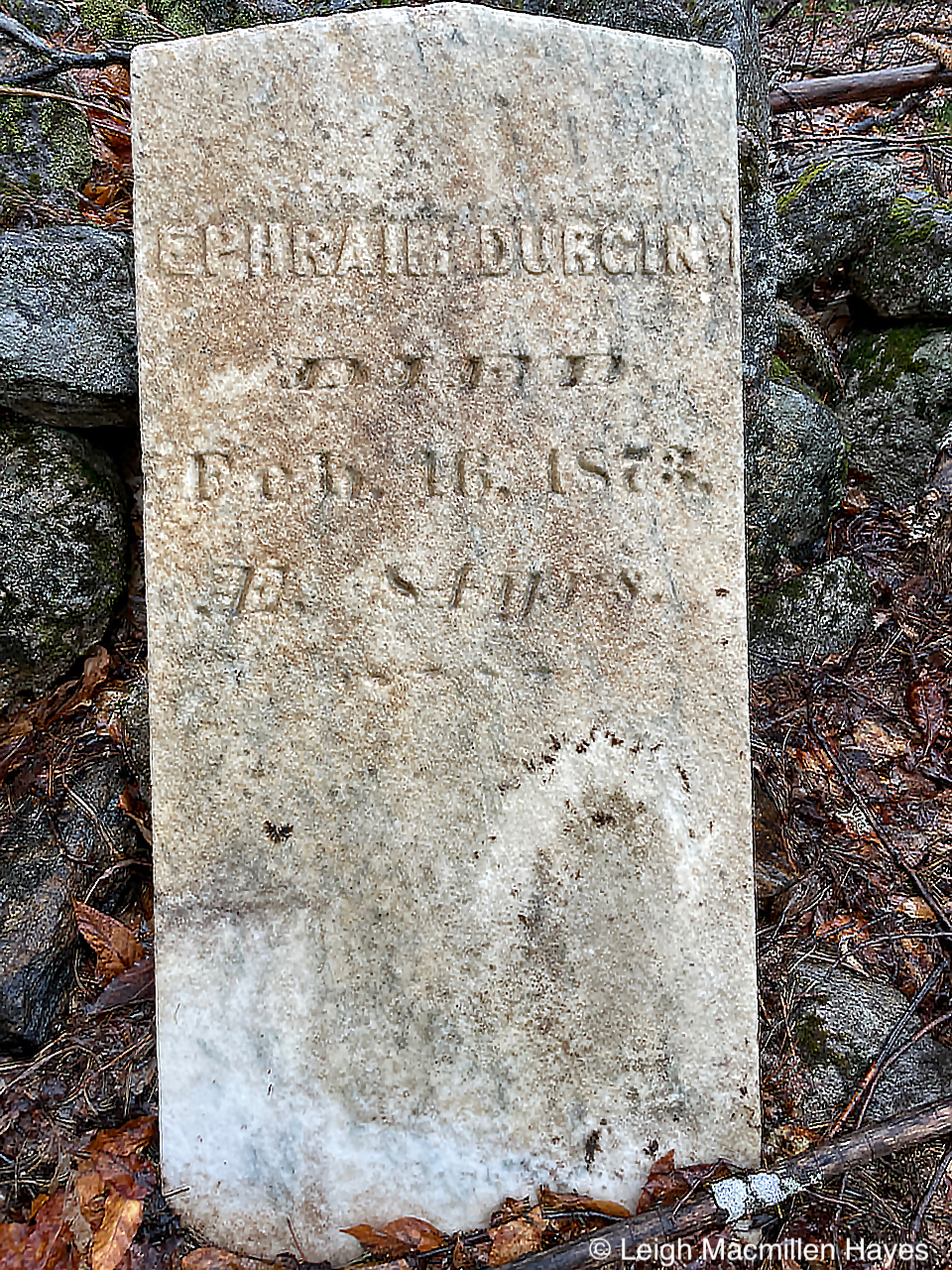
Ephraim, father of Sarah and Sumner, and husband of Anna, died in 1873 at age 81. Did you notice the difference in stone from the 1850s to 1870s? Slate to cement. And the name change–Dergin vs. Durgin. We’ve learned through geneology research that spellings often differ. I found the following a few years back on RootsWeb.

8. ANNA3 FURLONG (PATRICK2, JOHN1) was born 1791 in Limerick, Maine, and died 1873 in Stoneham, Maine. She married EPHRAIM DURGIN June 18, 1817 in Limerick, Maine14. He was born April 13, 1790 in Limerick, Maine, and died in Stoneham.

Children of ANNA FURLONG and EPHRAIM DURGIN are:
i.OLIVE4 DURGIN, b. 1811, Stoneham, Maine; m. DUNCAN M. ROSS, April 11, 1860, Portland, Maine.
ii.SALOMA DURGIN, b. 1813.
iii.ELIZABETH DURGIN, b. 1815.
iv.SALLY DURGIN, b. 1817.
v.SUMNER F. DURGIN, b. 1819, Of Stoneham, Massachusettes; m. MARY ANN DURGAN, July 11, 1853, York County, Maine; b. Of Parsonsfield, Maine.
vi.CASANDIA DURGIN, b. 1821.
vii.EPHRAIM DURGIN, b. 1823.
viii.FANNY DURGIN, b. 1825.

Sarah isn’t listed above. But . . . Sally and Sarah were often interchangeable.

We ate lunch with the family as we looked out at the view they enjoy every day–possibly once called Durgin Hill, and then maybe Sugar Hill.

After lunch, our journey continued a wee bit further until another witness stopped me in my hiking boots. It took me three bear hugs with arms fully outstretched to completely circle this ancient Sugar Maple. Can you imagine the tales stored inside this great, great, great grandfather?

And at his feet, a wee one to appreciate –a Many-fruited Pelt Lichen, the many fruits being the brown fruiting bodies or apothecia.

A few steps away, we reached the Willard family foundation. Two large granite slabs are visible in the back and I had to wonder if they originally formed the roof of another cold storage.

Again, I referred to Jinnie Mae’s research. By 1880, the Willards house was occupied by the McKeens. And the Durgins were no longer living there, which makes sense given that Anna and Ephraim both died in 1873. The Rowlands had moved in to their home.
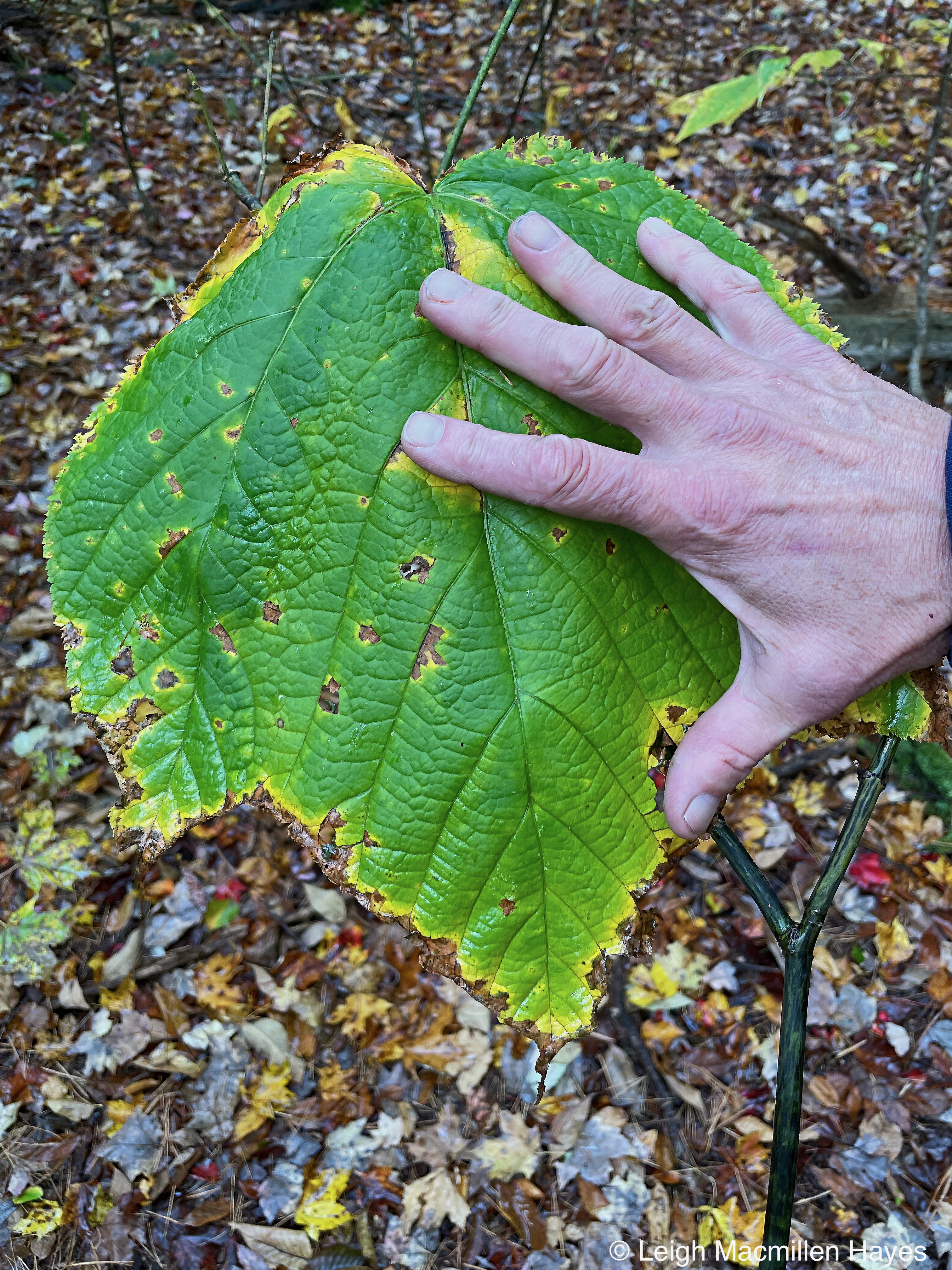
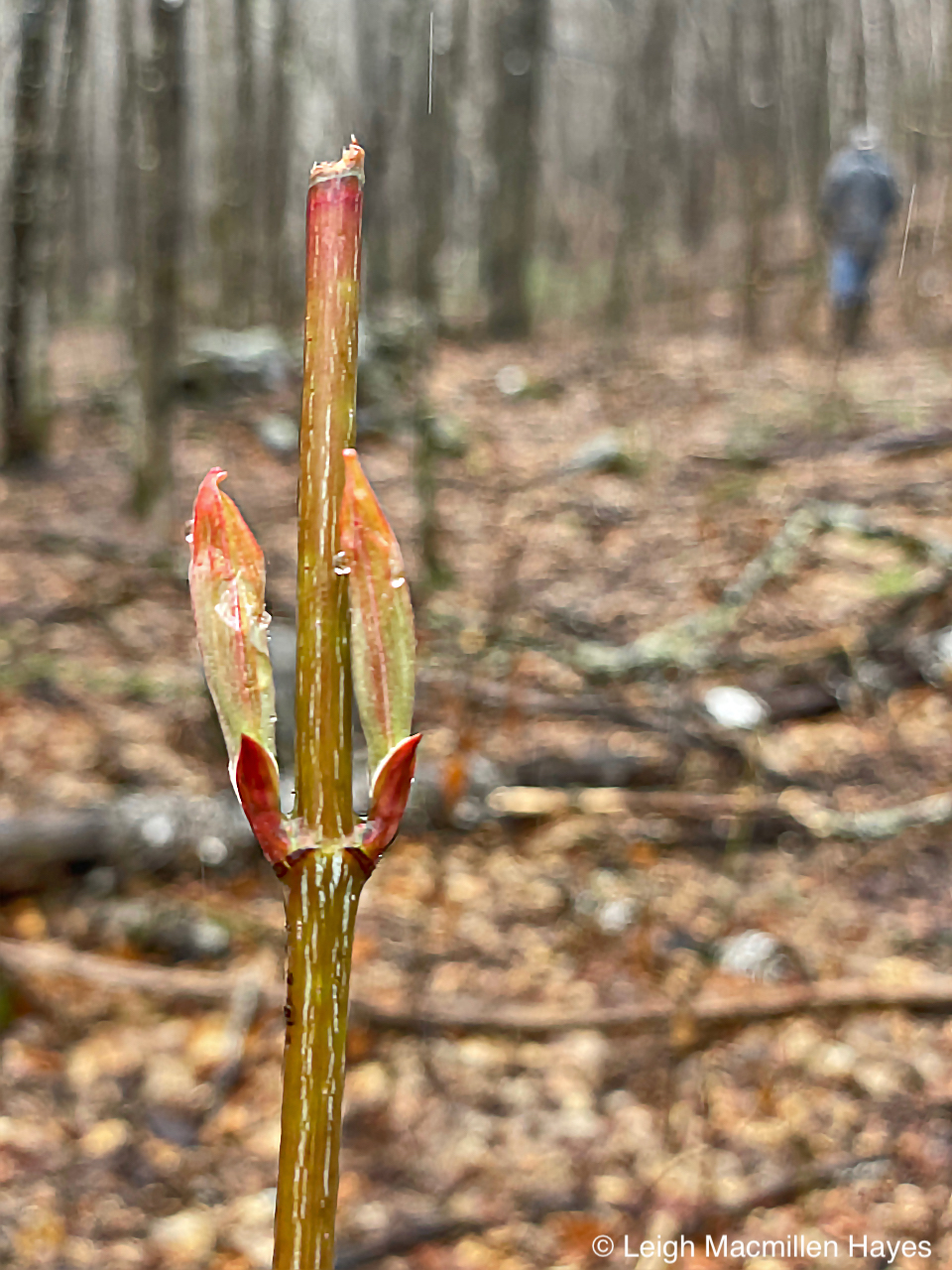
A newer member of the neighborhood, a Striped Maple, may not have known any of these occupants, but despite the full canopy of evergreens and maples and birches, it sure knew how to produce large leaves to increase its chances of survival.

Eventually, we turned west and followed an old road way bordered by stonewalls on either side. I remember when few trees grew there, but now one has to move through like a ball in a pinball machine, ricocheting off this tree and that rock along the way.
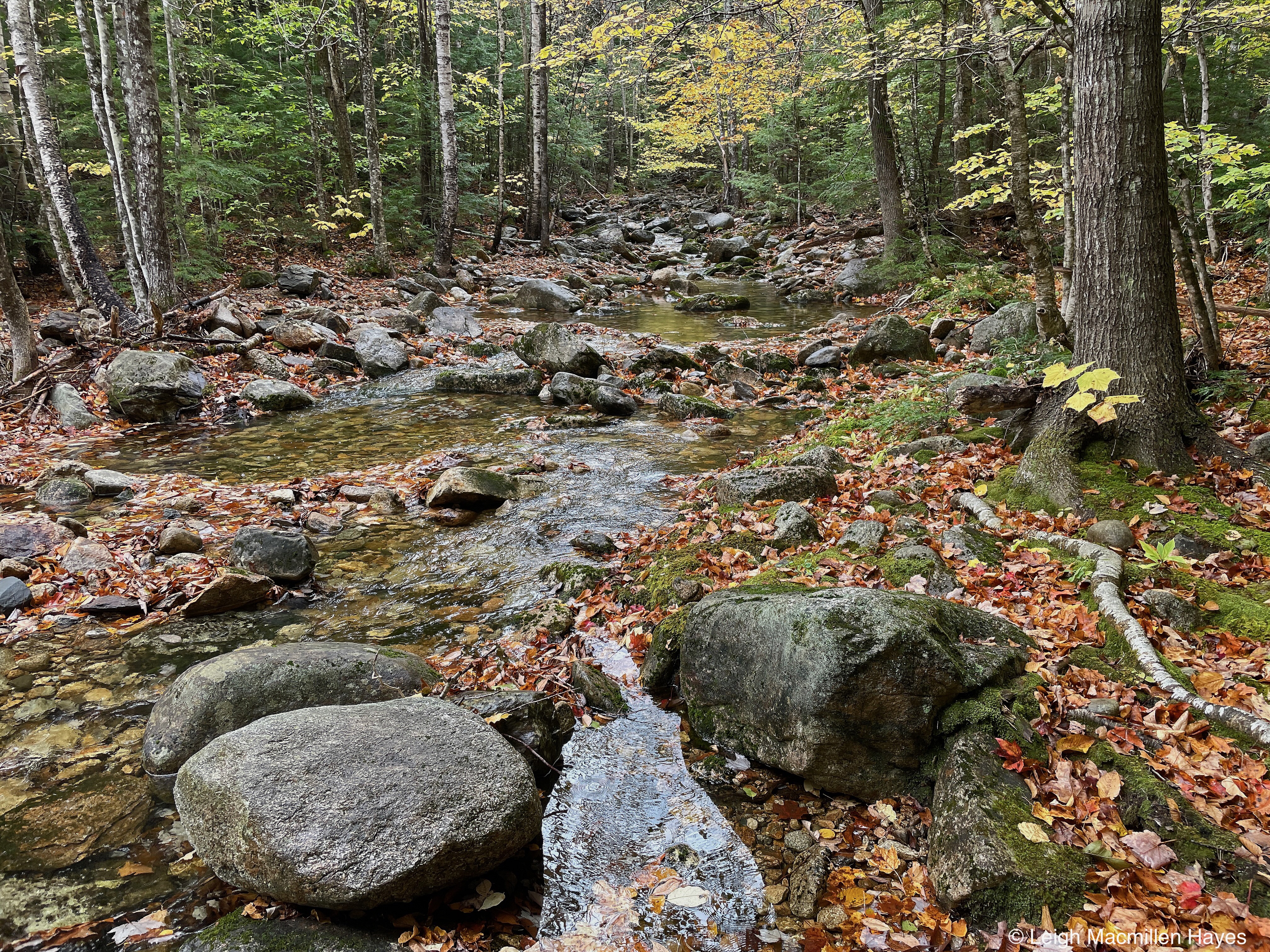
It’s well worth the effort because it leads directly to Willard Brook, which flows southward toward Great Brook , where we first began our journey.

Though I know the first part of the trip well, I sometimes get a bit mixed up with the second part and such was the case today. That said, as we scrambled up and down the sometimes steep hillside beside the brook, we came upon these wheels and bingo. We knew them as old friends we’d met on a previous trip.
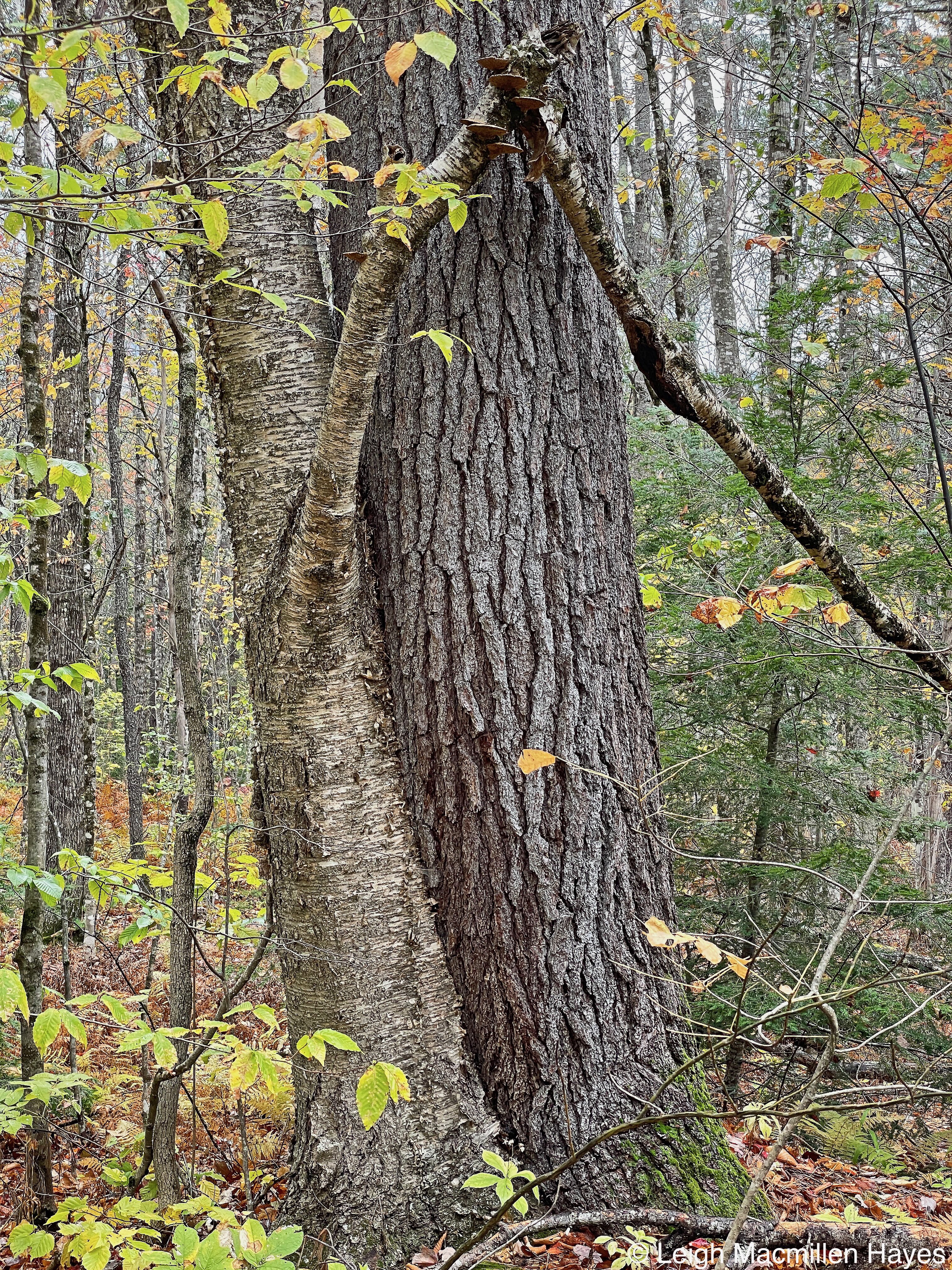
There is so much history tucked away in these woods, and I gave thanks for two more witnesses, who despite their differences, stood together and supported each other.

We live in unceded Wabanaki land and I’ve come to some understanding of the Native American presence that once existed here in this place between Great Brook and Willard Brook. And I’m sure still does.

After witnessing the past, we walked back down the road as raindrops fell. A perfect hush to end the journey.

Omnivore, Herbivore, Insectivore, Oh MY!

I walked out the door this morning and wandered down one trail and then another and intended to go farther into the woods, but as often happens, I was stopped in my tracks.

On granite at my feet, covered as it was with lichens of the crustose and foliose sort, I spied a rather large specimen of scat. High point. Center of trail. Classic.

Based on the size and hair and bones packed within, I knew the creator: a coyote. If I awake during the night I can sometimes hear the family members calling to each other, the youngsters learning to hunt so they’ll be ready when they disperse.

The trail narrowed by a small stream and I was wearing my muck boots so proceeded at will. It’s been a few months since I’ve traveled this way and was surprised at how grown in it had become this summer. While the Sugar Maples do not like wet feet from all the rain we’ve had, other species have thrived, including the Red Maples, and this shrub that bordered each side of the trail.

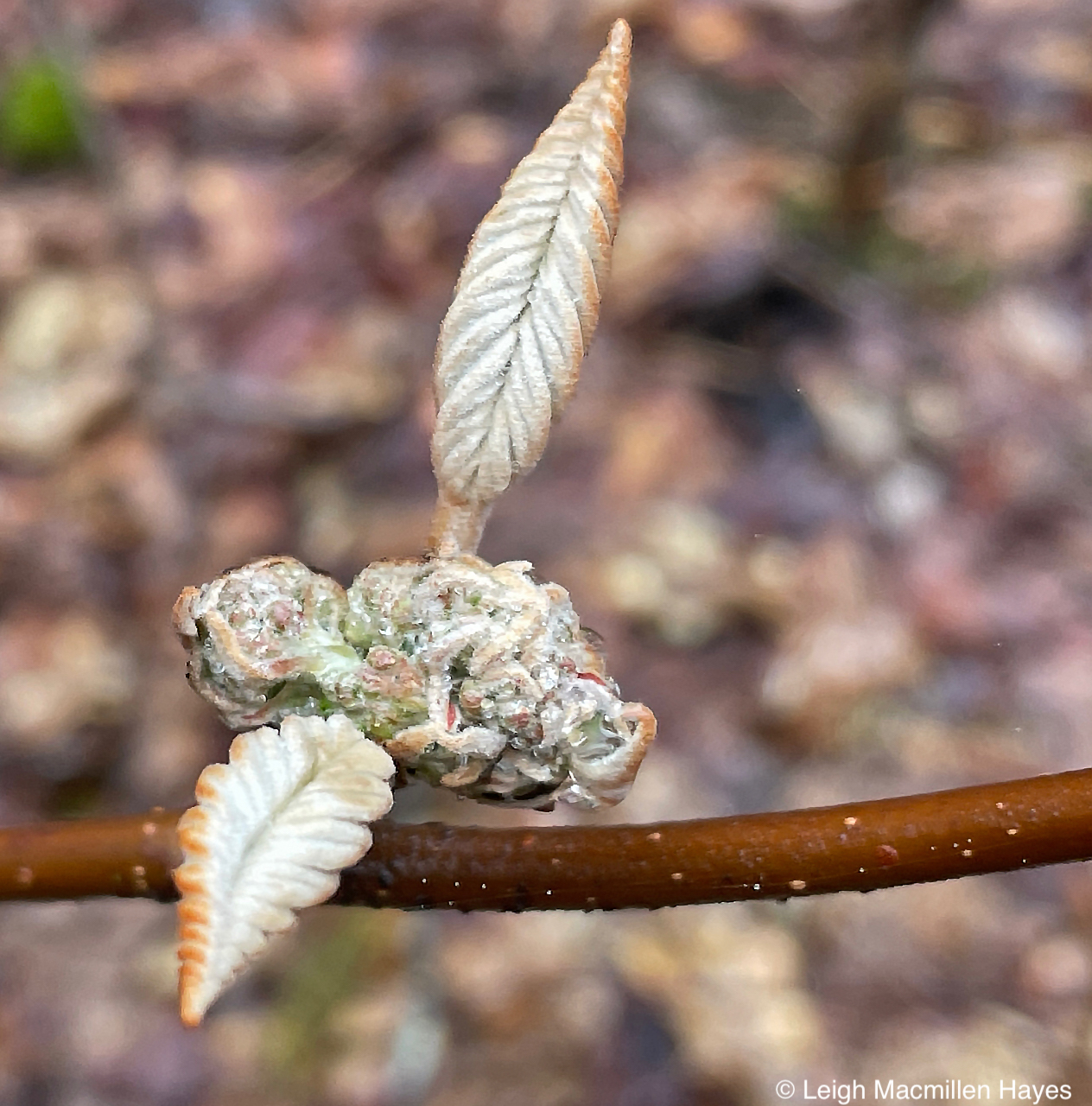
It’s leaves still entact showed off that they are doubly toothed in a rather random order. So each little “tooth” is like the edge of a saw, but if you look closely, you’ll note that there are bigger teeth made up of a series of smaller teeth before the leaf margin cuts in toward the main vein and then heads out again to form the next bigger tooth made up of smaller teeth. And those veins in between the main vein and those that lead to the margin–reminded me of the crinkles on an apple doll person, since it is apple season.

The leaf buds, which form in the summer for next year, are hairy and have only two scales. Because of recent warm weather, at least one decided to jump the gun and open now rather than waiting until next spring. I’ve seen that with other plants of late, including Blueberry, Daylily, Sheep Laurel, and Partridgeberry.

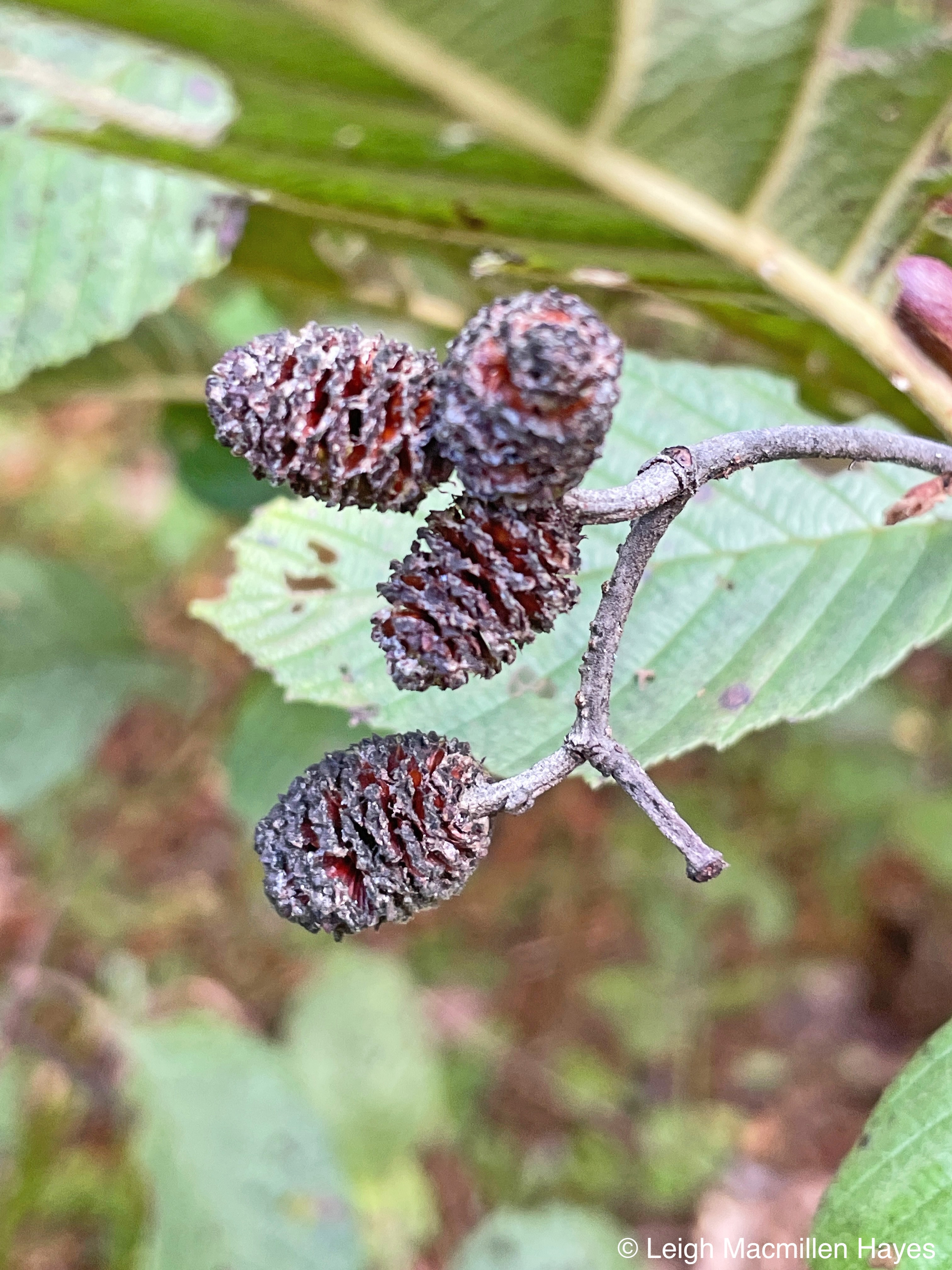
Others who best not jump ahead are the catkins of this species, the longer green and red being the male pollen carriers that will slowly elongate over the winter and turn more yellowish red in the spring. The female flowers are tiny magenta catkins located just above the males.

Once the females are wind pollinated, the males will drop off and the females will form into a fruit that resembles a cone.

The name of these shrubs, if I haven’t already spilled the beans, is Speckled Alder, so named for the white dots (think lenticels for gas exchange) that populate the bark. These shrubs love wet feet, which is why they are growing on either side of that small stream.

Some of the Speckled Alder cones hide beneath tongues imitating piles of snakes stretching out, made from galls caused by an infection to increase the surface for spores from a fungus to spout. It’s a smart strategy.

I also found a few Lady Beetles today, including one larval form. They were on these shrubs for one reason.

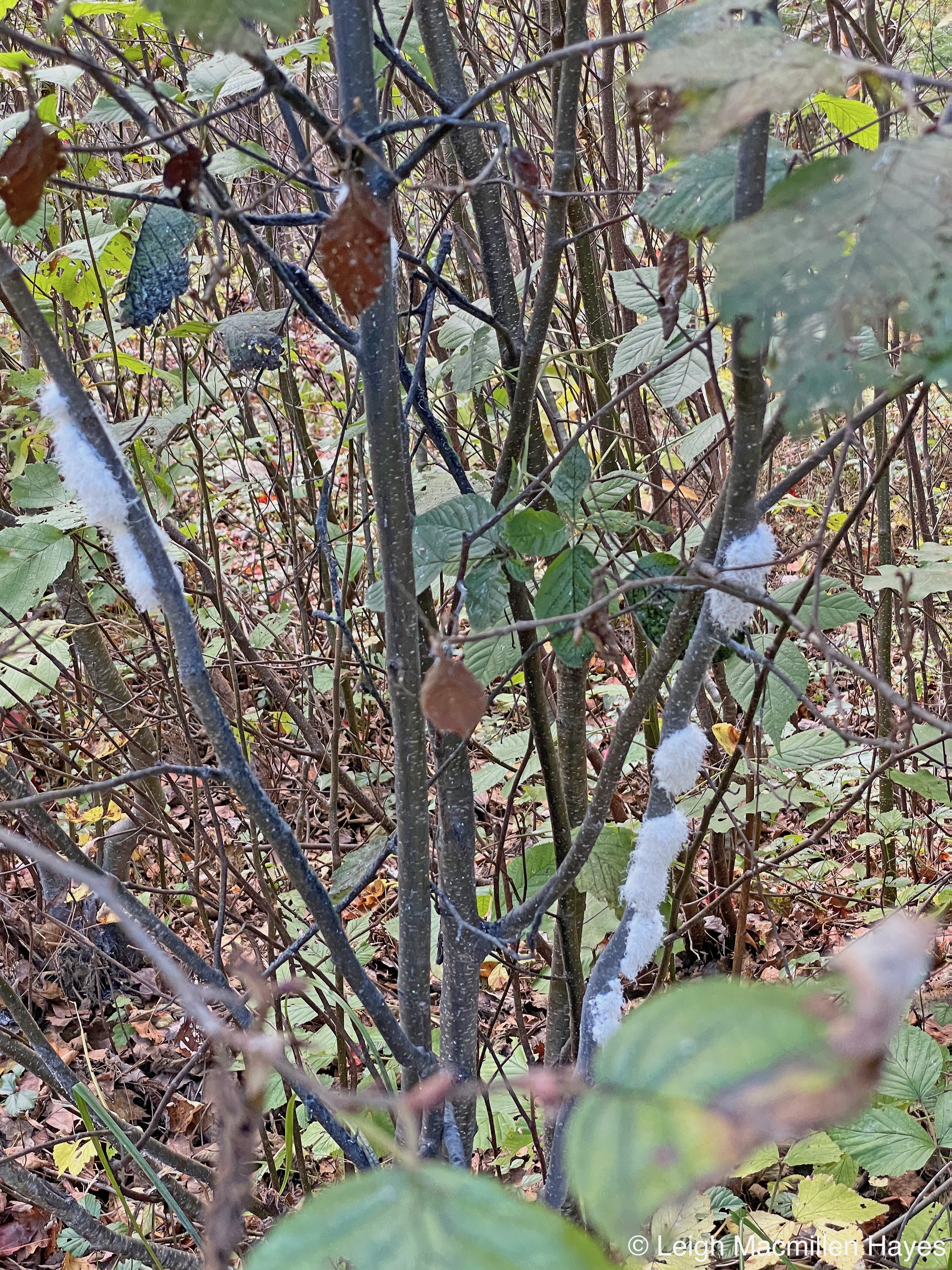
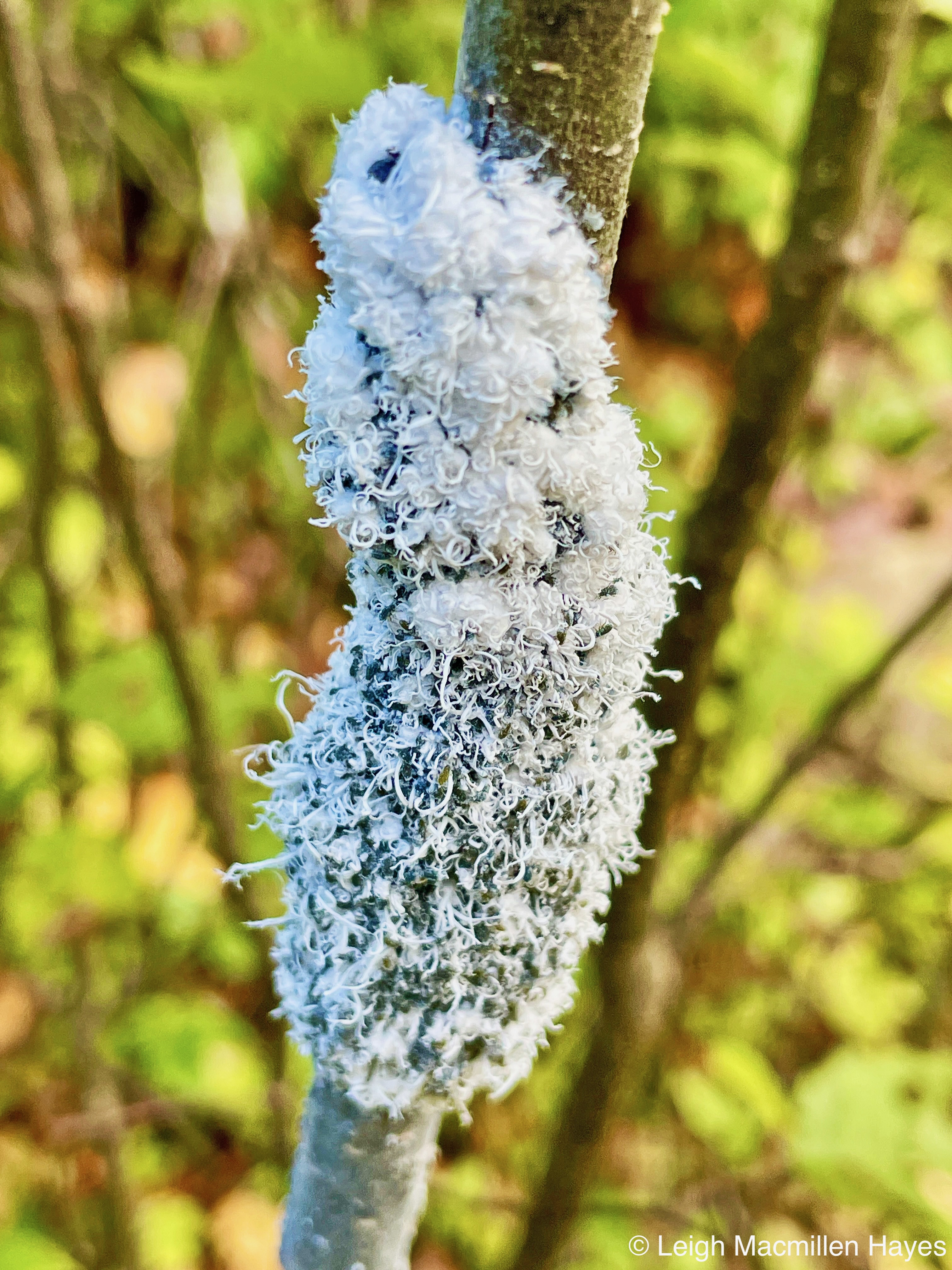
That reason being the Woolly Alder Aphids who live a complex life in which they alternate between a generation reproducing asexually (no guys, just gals), and one reproducing sexually with both males and females adding to the diversity of the gene pool. The males and females fly to Maple trees to canoodle, but those found on the Alders are all female.

They live such a communal life as they suck sap from the shrub, that one might think this entire mass is just one insect. Hardly. And do you see all that waxy wool that covers their bodies? If you watch these insects for even a few seconds, you’ll note that the hairs move independently. It’s almost otherworldly.

Since they’ll overwinter, I think of the wool as providing a great coat. In the summer, ants, and now Lady Beetles, and even a few other insects farm them to get the aphids to excrete honeydew from the sap.

The aphids don’t harm the the shrubs, but I saw so many today that that fact is hard to believe. I gave up on counting branches but over one hundred played host.

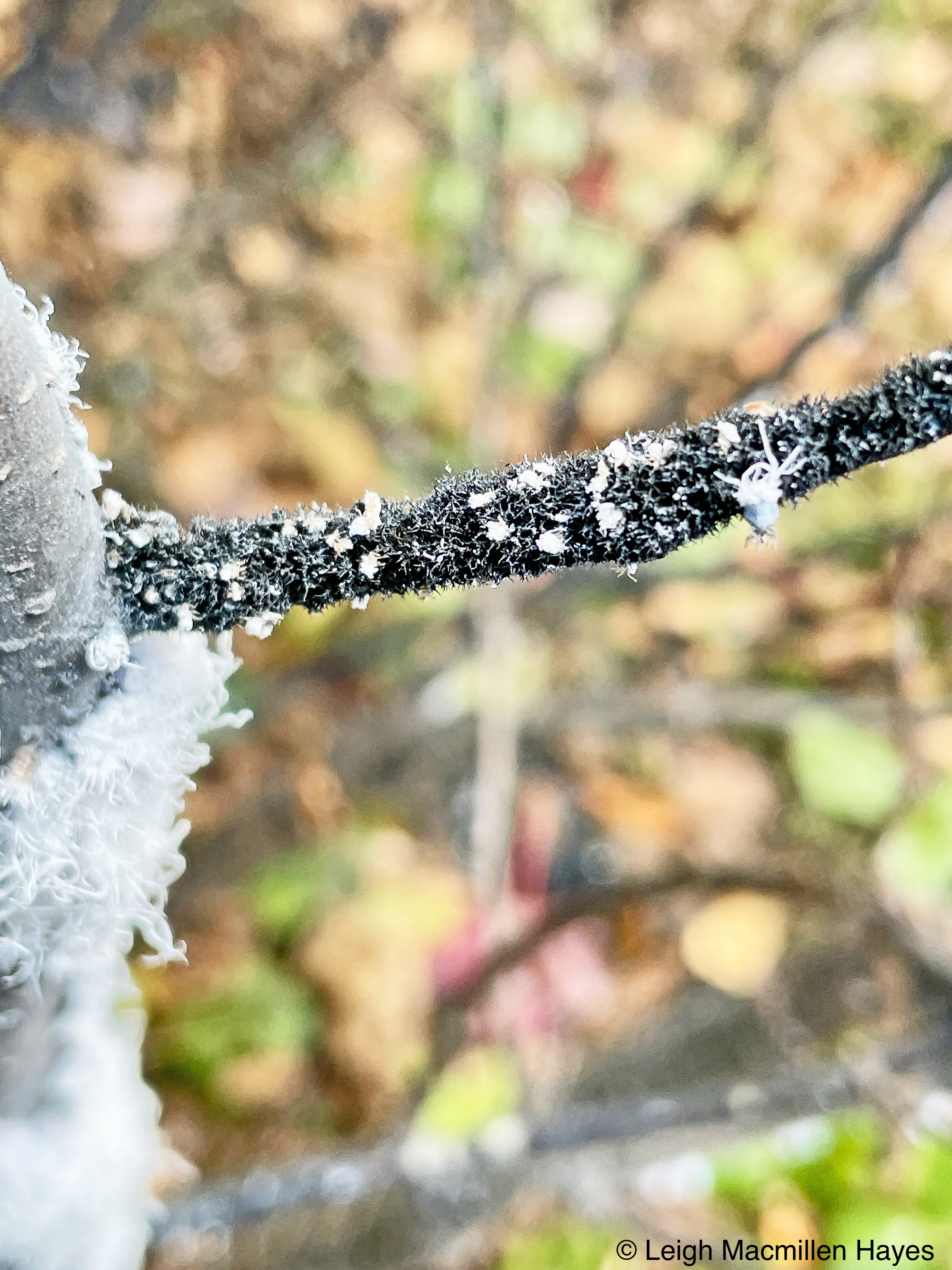
That said, there was another character in the mix. Do you see the top branch that leans out to the right?

The sweet honeydew I mentioned forms a substrate for a nonpathogenic fungus called sooty mold that blackens leaves and bark beneath colonies of aphids. The mold is known scientifically as Scorias spongiosa or, my favorite and drum roll please . . . Beech Aphid Poop-Eater: A fungus that consumes the scat (frass in insect terms) of a Beech Blight Aphid (not the same as Beech Scale Insect that causes Beech Bark Disease). Alders are in the Beech family.

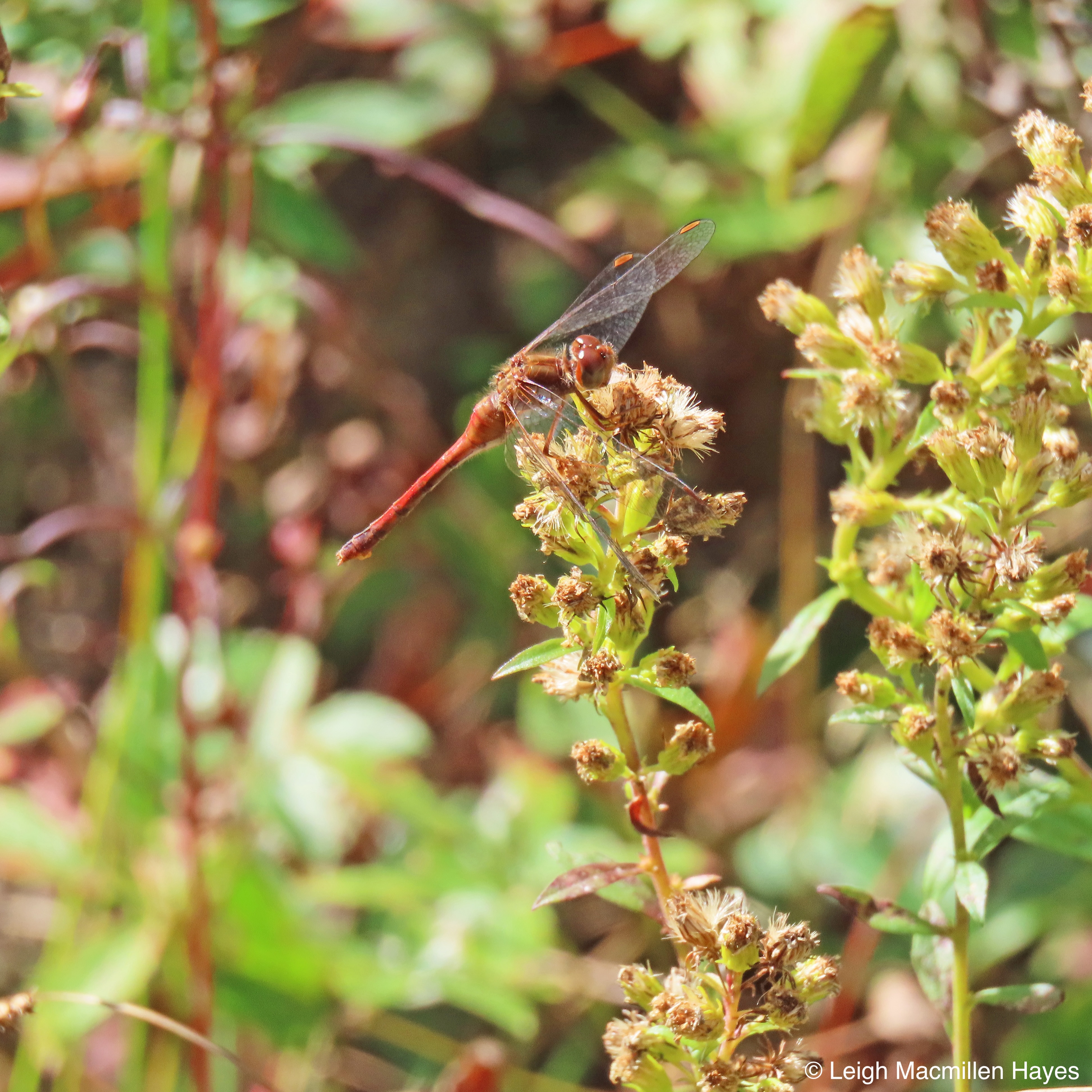
As I left a few Autumn Meadowhawk Dragonflies flew ahead of me on the path. They’re days are numbered, so I’m always thrilled to see them flying and posing.

Omnivore, Herbivore, Insectivore, Oh MY! And all of this within a ten-foot stretch of the trail.

Scouts on the Hunt

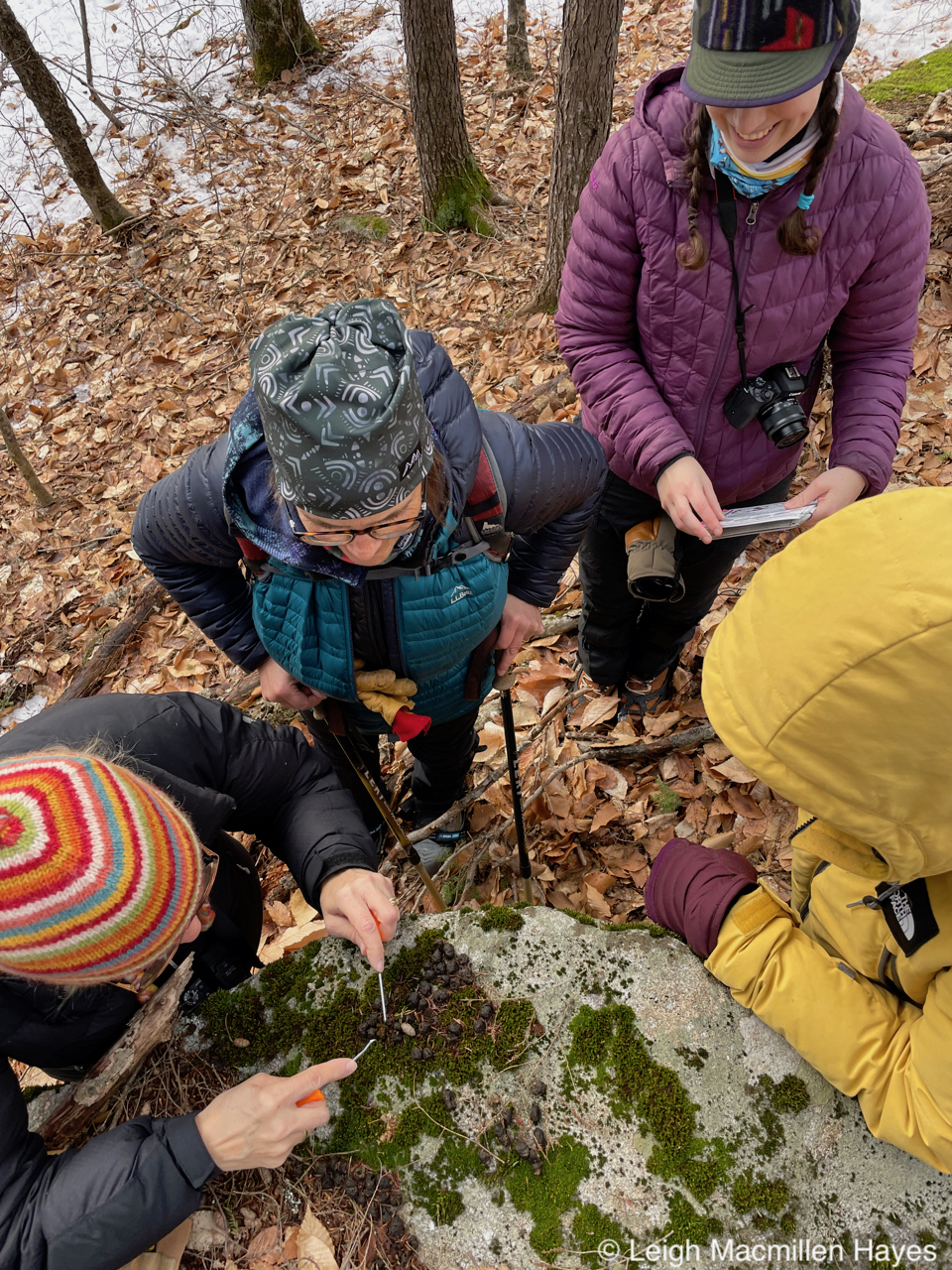
The morning began as Tuesdays do in my current world, with a visit to a Greater Lovell Land Trust property accompanied by a group of curious naturalists we know as docents who love to do deep dives on every little thing that we encounter and in the midst we share a brain. A collective brain is the only kind to have, in my opinion, because we each bring different knowledge or questions to the plate.

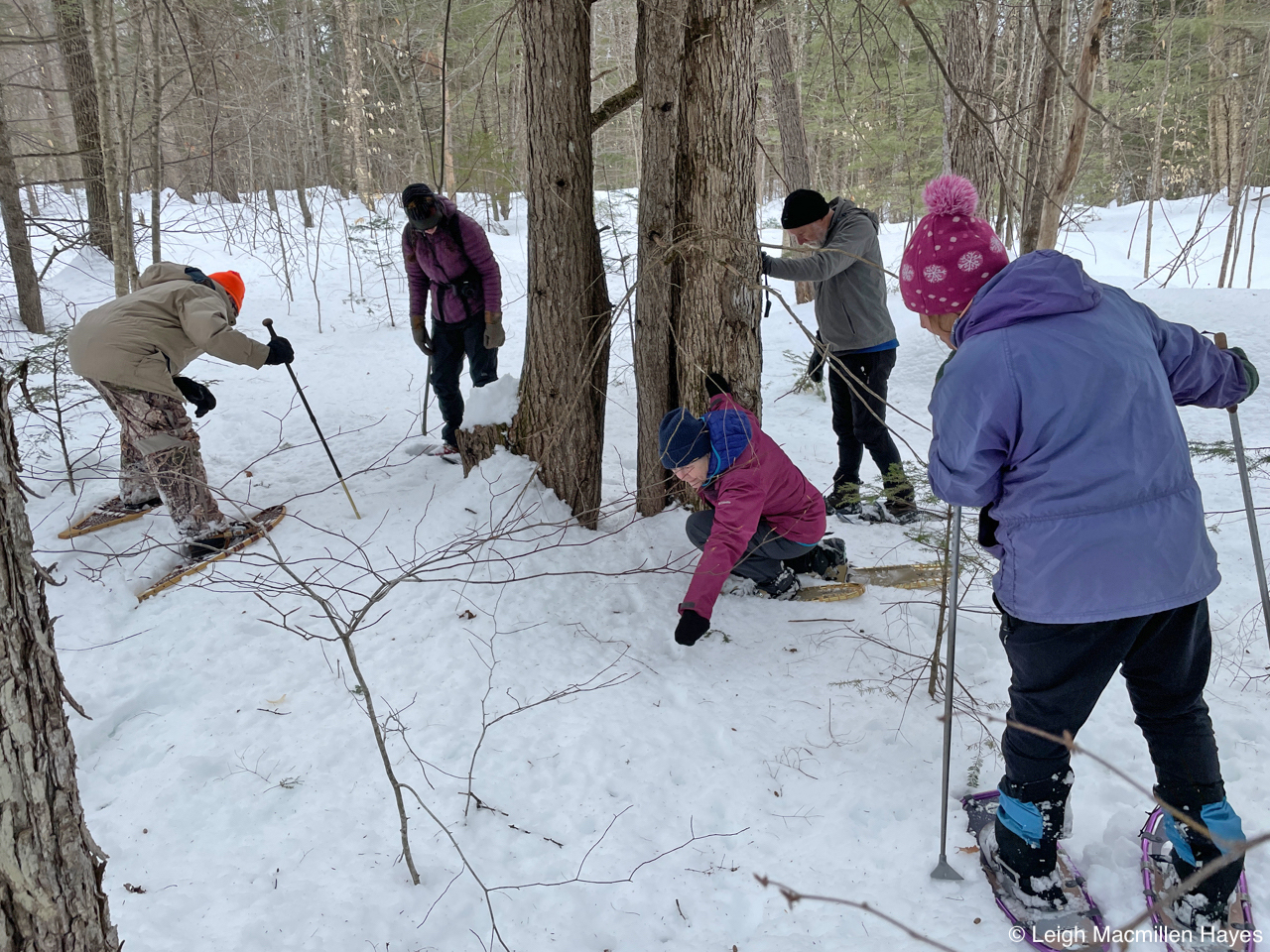
And so it was when we first encountered what could have been a hair ball of sorts and then discovered this hair-filled scat about a yard beyond. And near it another “hair ball.” Based on size and structure we determined the scat belonged to a bobcat, and thought that the hair balls made sense as maybe the cat had to cough up some of the hair of the mammal consumed. What did it eat? Well, we know both snowshoe hare and deer frequent this place and so it could have been either.

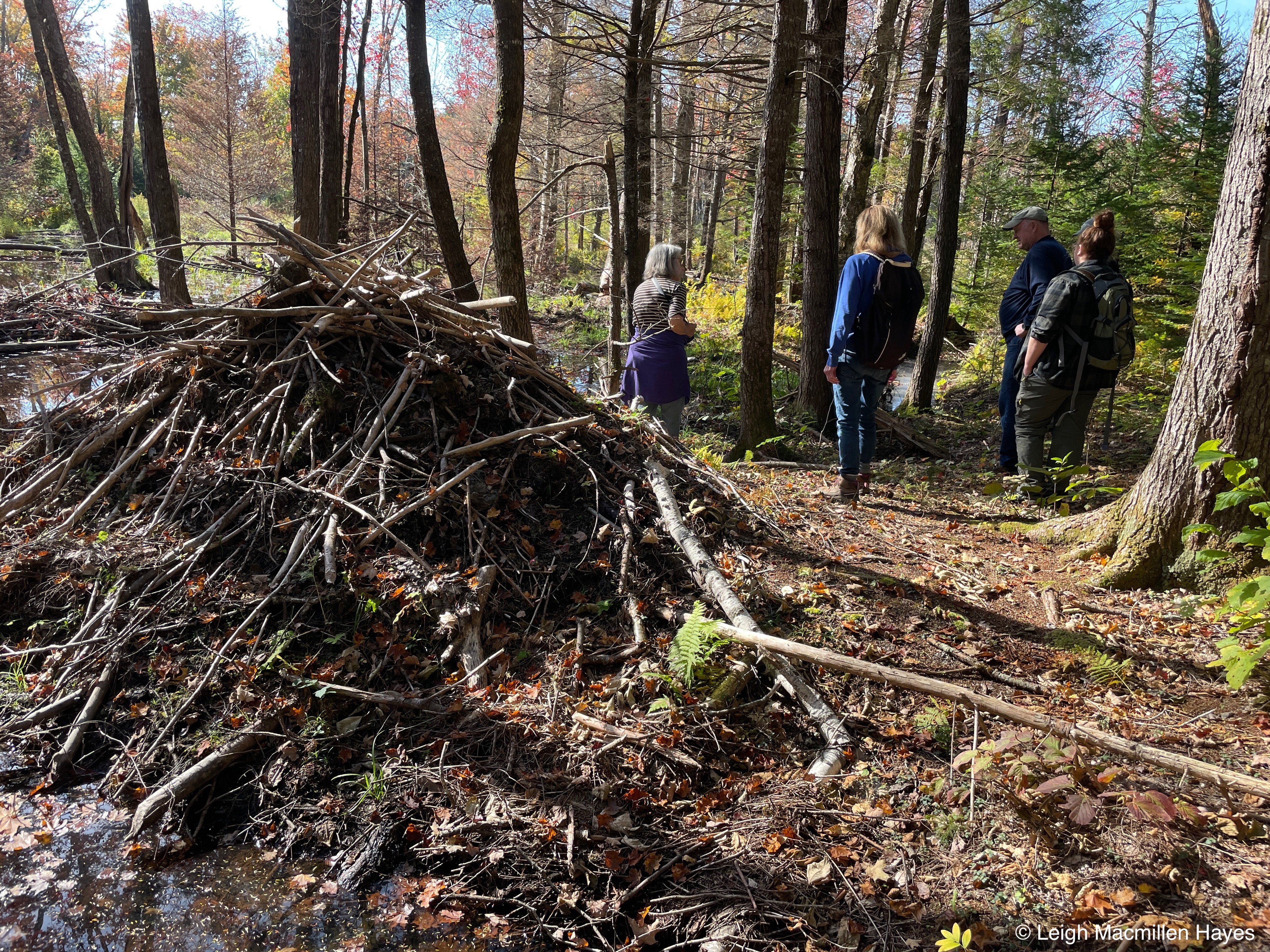
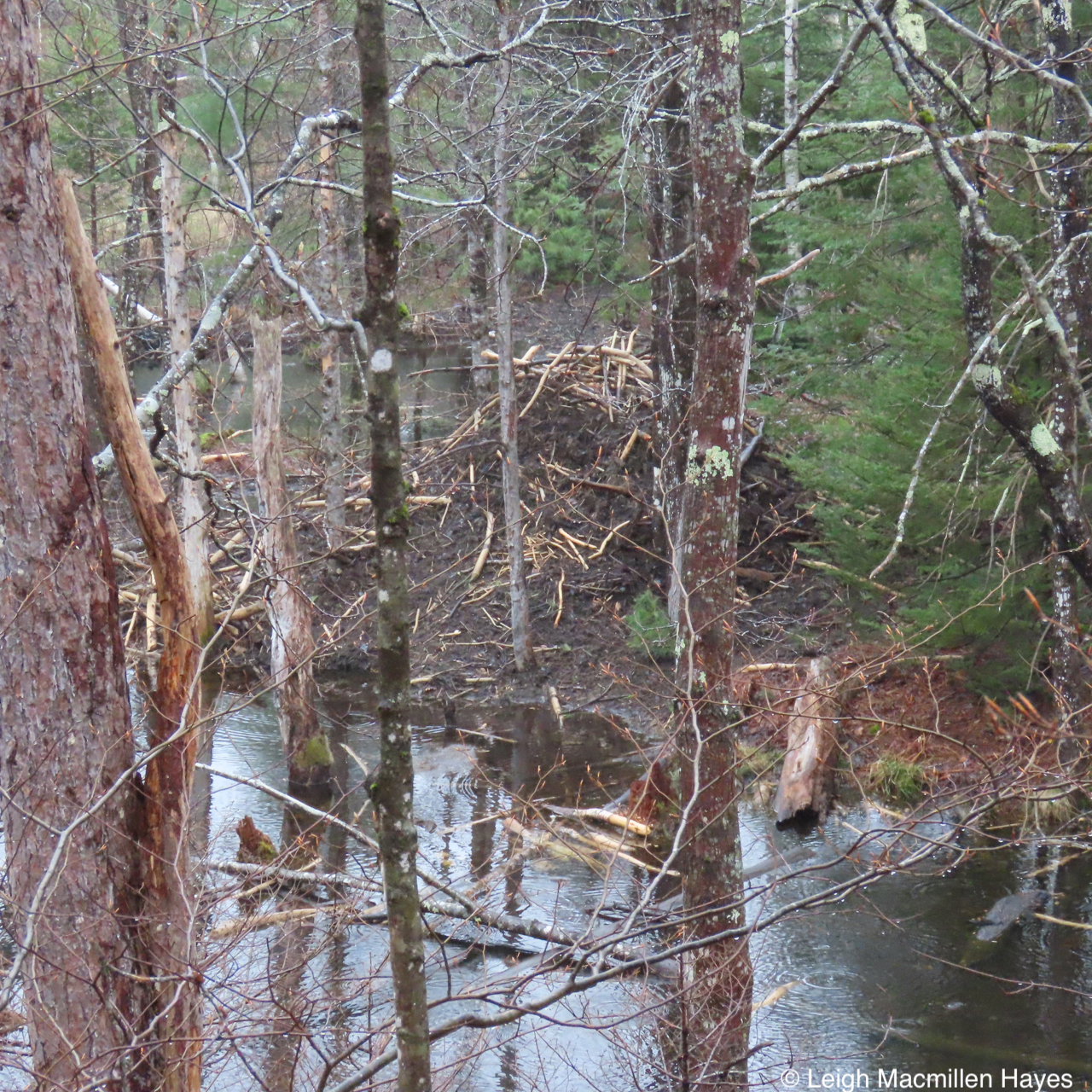
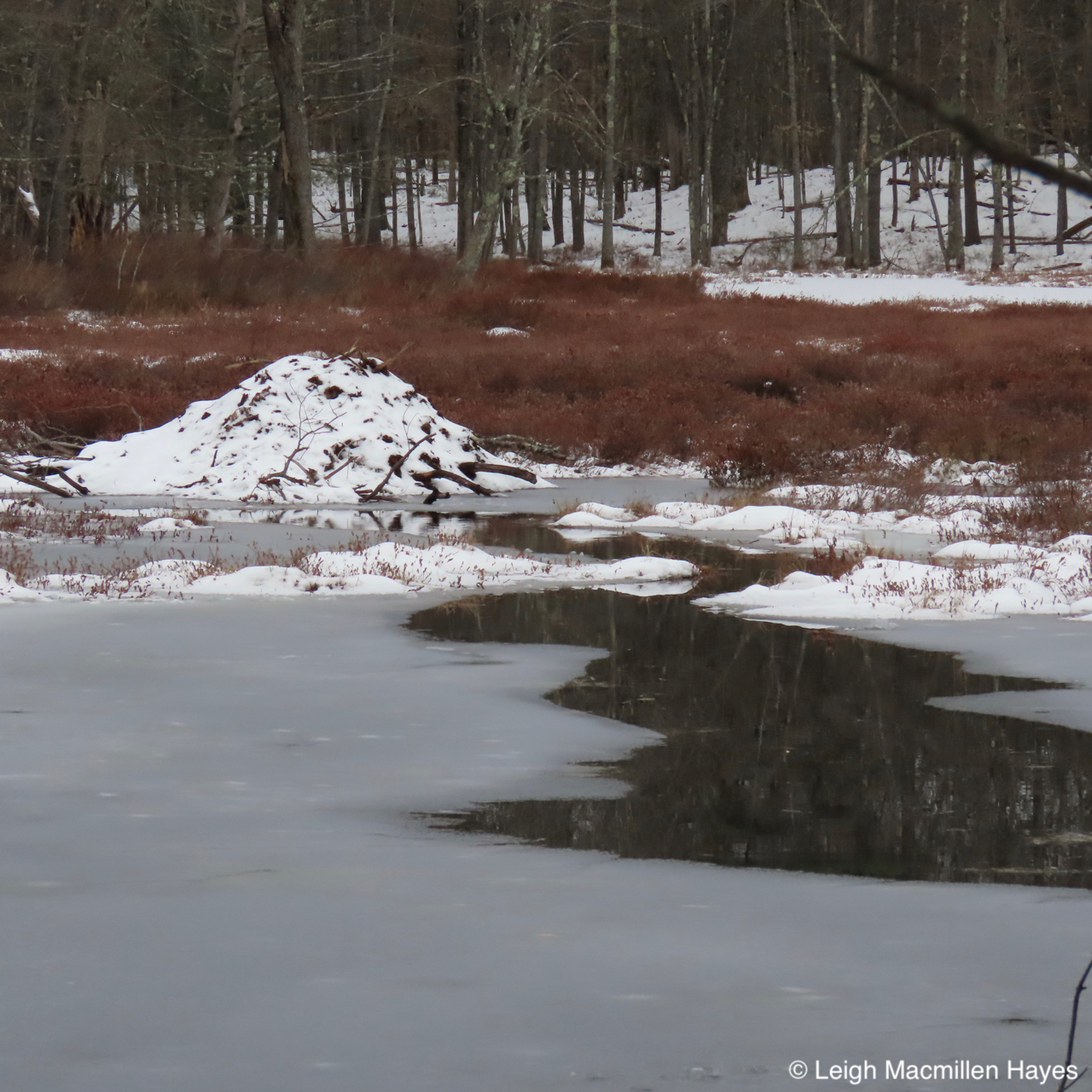
A little further down the trail we reached a beaver lodge that some of us had seen under construction in August 2022, and gathered game camera photos over the course of time, and spotted all kinds of sign of activity each time we visited, until that is, May. When it rained. And rained. And rained. In a torrential manner. And the dam the beavers had built was breached. And they disappeared. And we know not their fate.

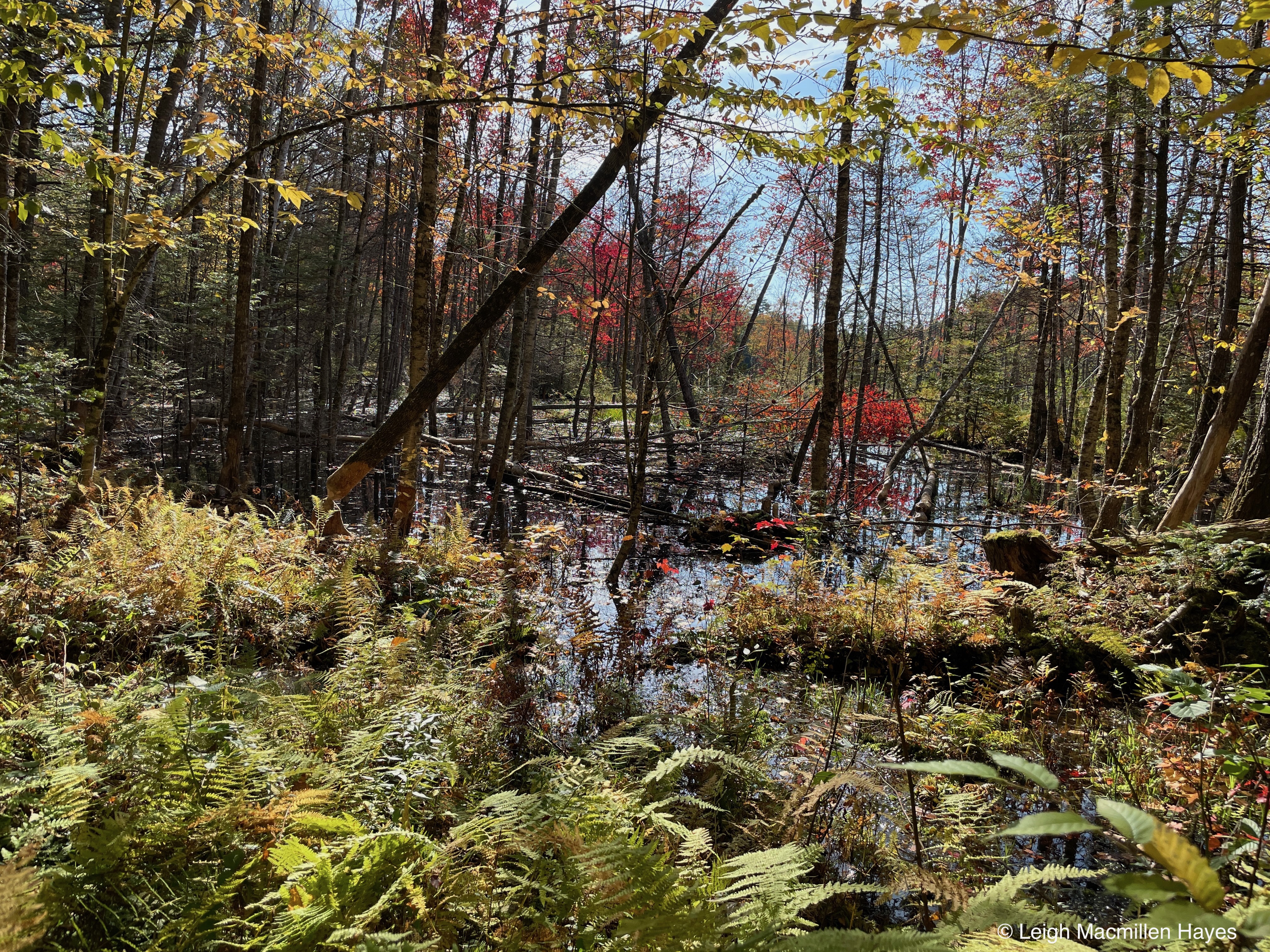
But the beauty of a beaver pond is that once breached, change happens and other critters take advantage of the space and there’s so much possibility and we can’t wait to watch how this space, one in which we could walk prior to August 2022, will evolve and other flora and fauna may move in until another beaver family takes up residence and changes it again.

About an hour or so after departing, a call came. Well, really, it was a typed message. But as my morning peeps know, shout, “Kill site,” and no matter what I might be focused upon, I’ll come running.

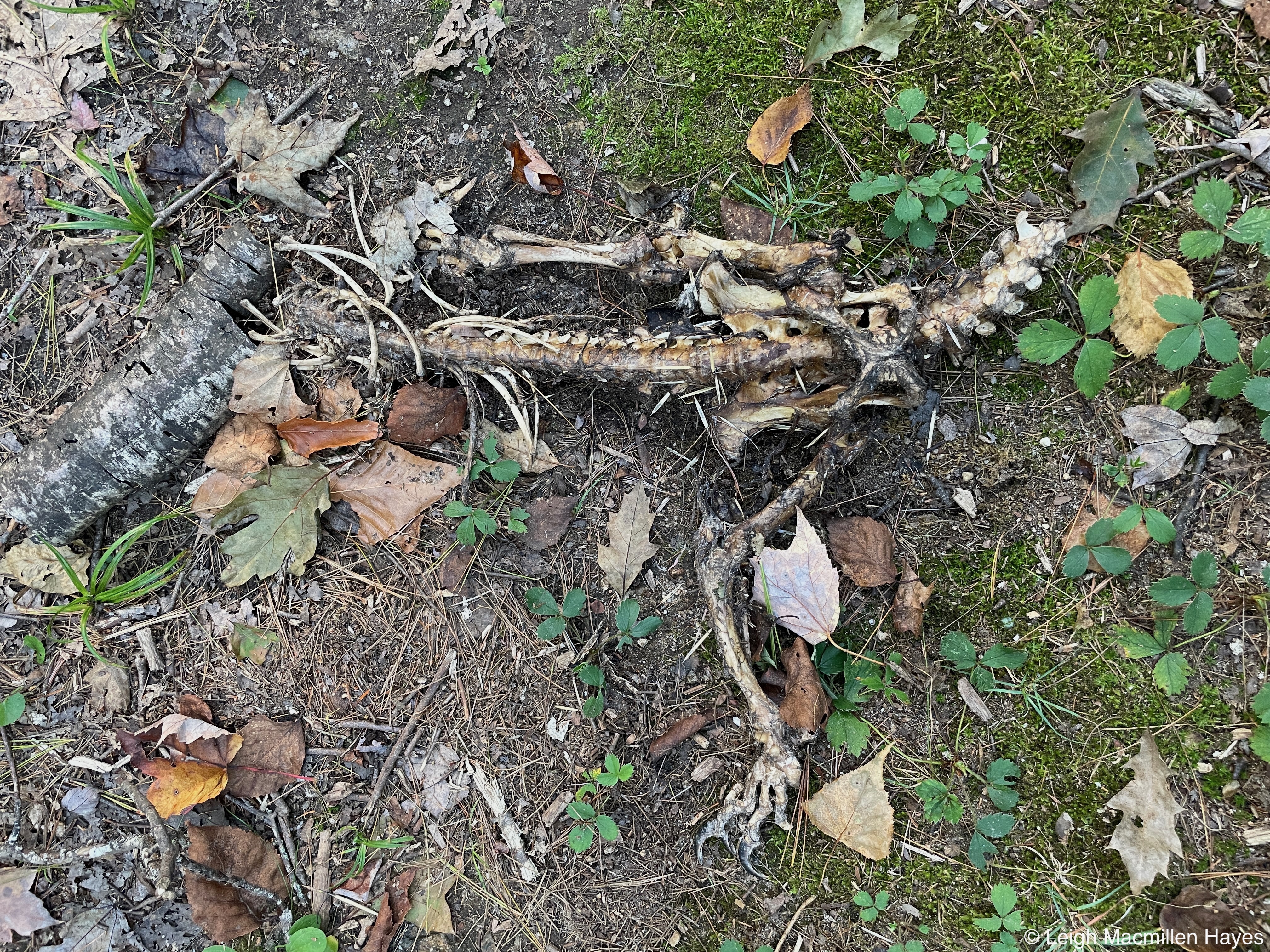
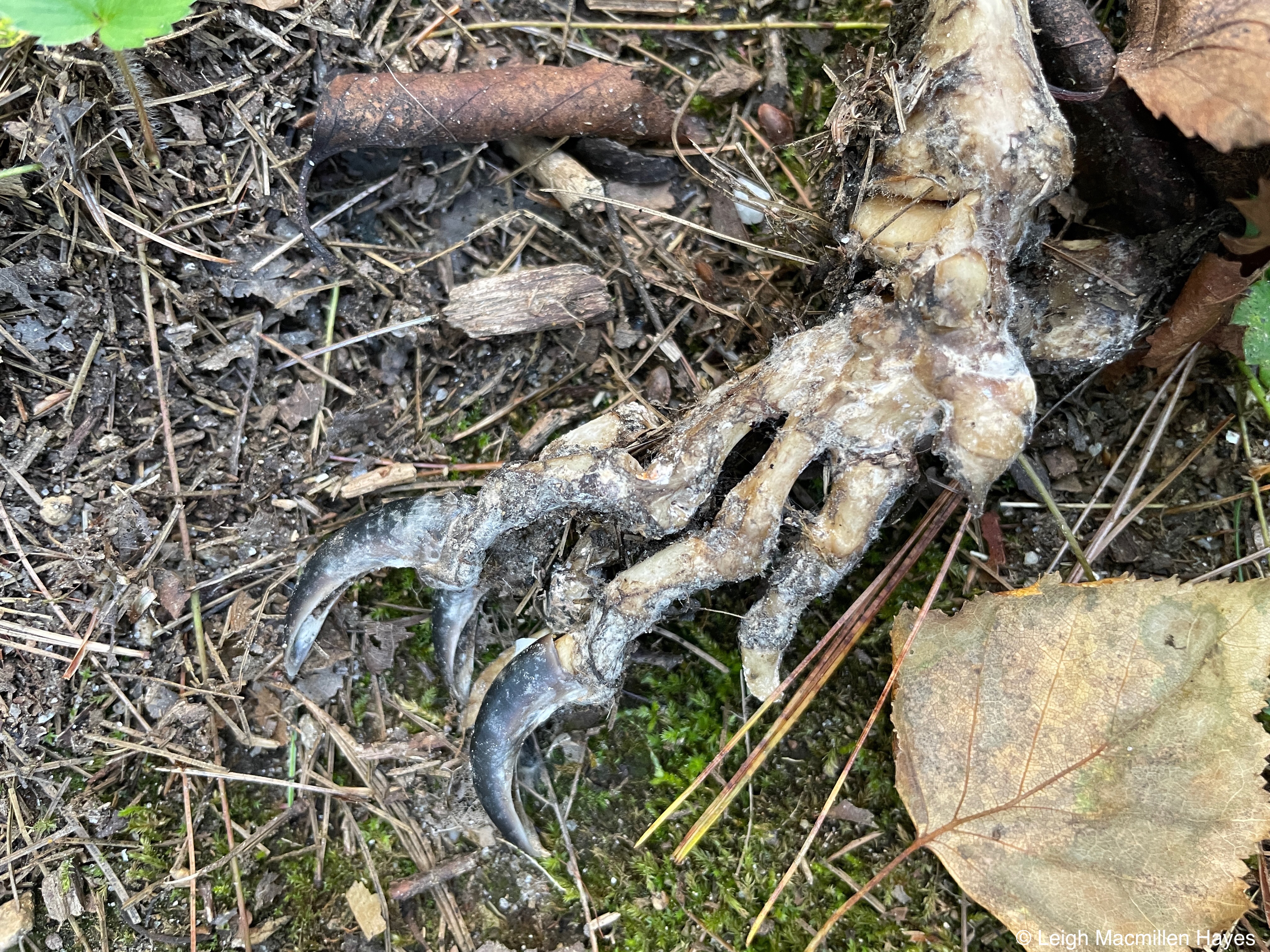
The message included a few photos of a mammal skeleton and a thought that it might be a beaver that had become the meal because it was located close to another beaver pond. Beaver ponds are plentiful in the landscape of western Maine.

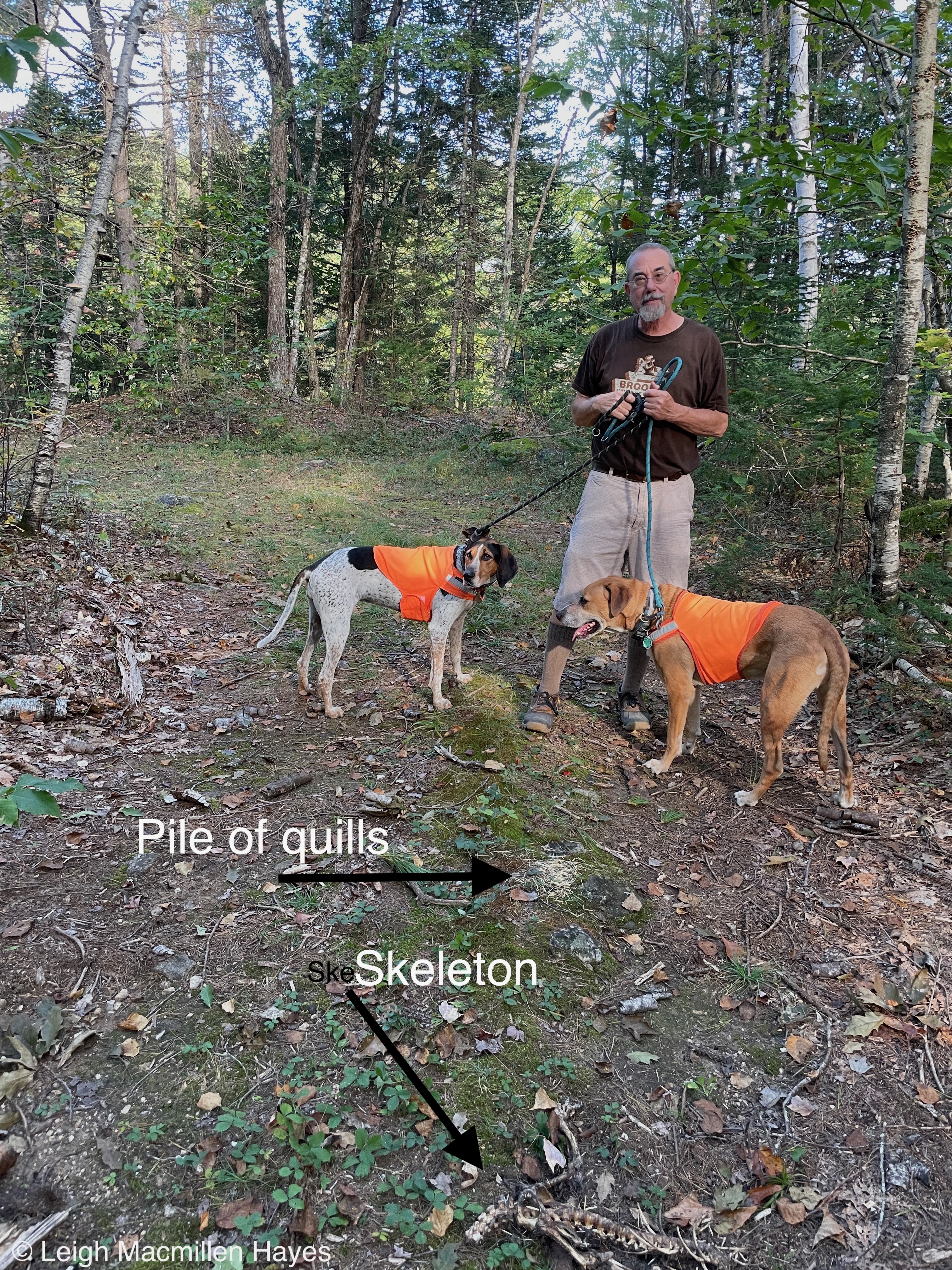
After a few messages back and forth, the writer and I agreed to meet and walk to this site. Take a look. The meal this skeleton became had been consumed months ago, I suspect in the winter, given how much was missing, including the head. And even after any hide and meat had been eaten, the bones continue to provide calcium for rodents seeking such.

Since my guide suspected beaver, I knew I had to slow my brain down and assess the evidence. My, what long toe nails. And though some were broken, it seemed obvious to me that they were all oriented to the front of the foot. Plus, there was no evidence of webbing.

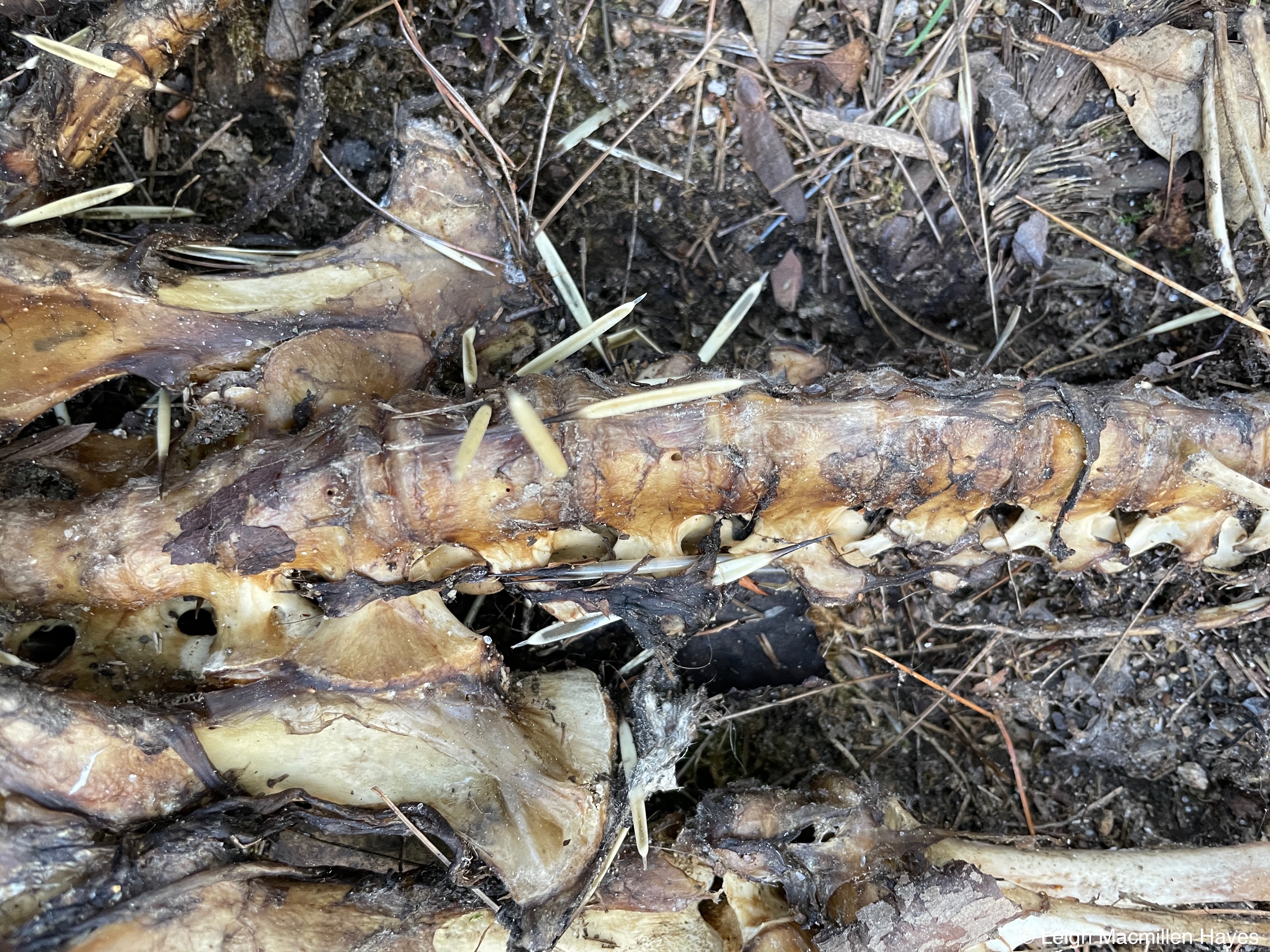
A bigger clue was observed with a closer look. Barbed quills sticking into the spine. I pulled one out and we examined it.

And about a foot away, a pile of quills, with vegetation growing through them adding to the age of the kill site.

And hiding there also, as if stuck into the ground, a quilled tail.

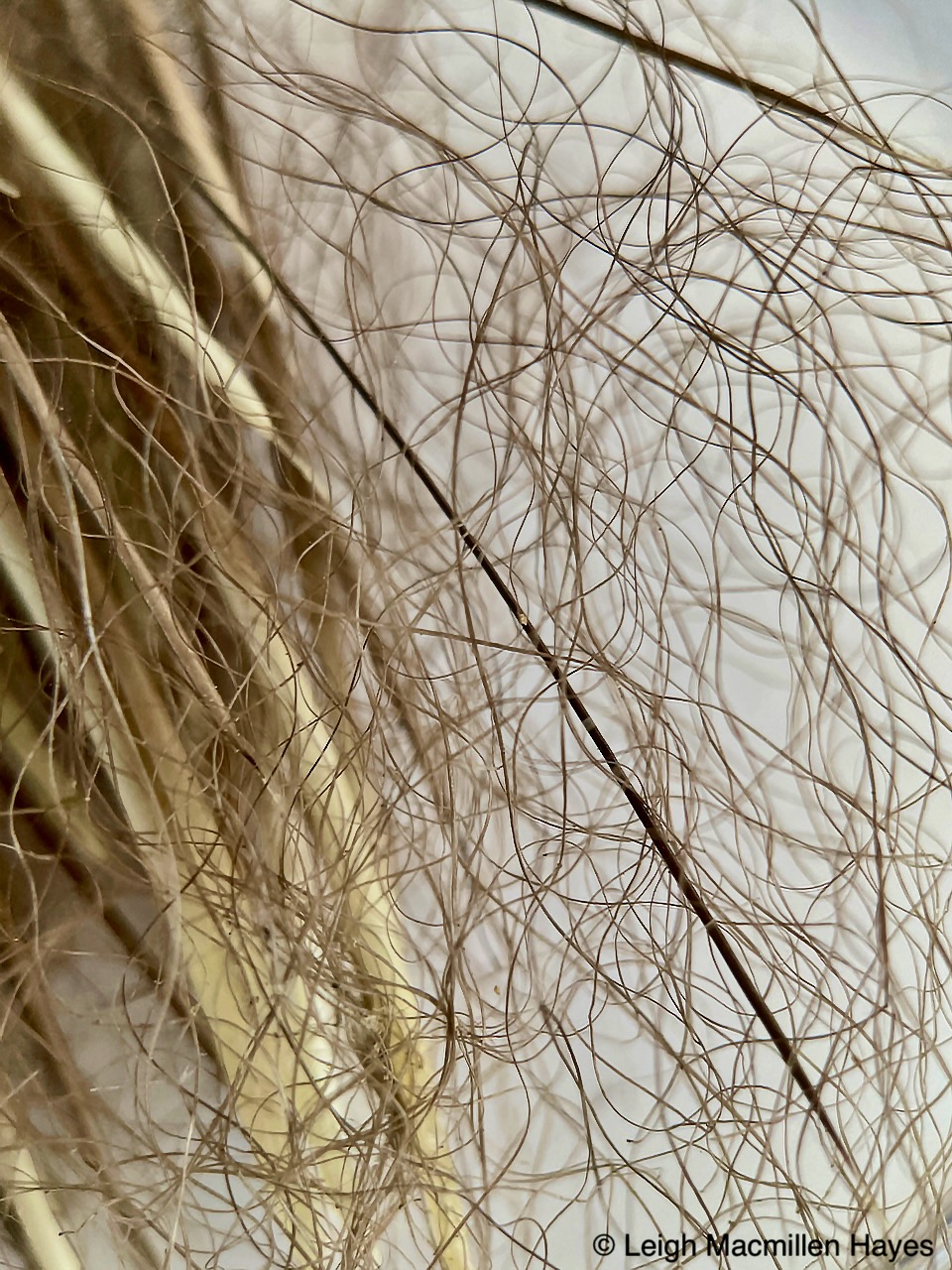
Did you know that porcupines have a variety of hair? For winter insulation, they have dark, wooly underfur. In addition, there are long guard hairs, short, soft bristles on the tail’s underside, stout whiskers, and then there are those pesky quills.

They aren’t pesky to the porcupine; just us and our pets and any animal that might choose to or accidentally encounter a porcupine.

Overall, a porcupine sports about 30,000 quills, and within one square inch on its back, you might count up to one hundred, as demonstrated by my jar of toothpicks.

The quills are 1 – 4 inches in length and lined with a foam-like material composed of many tiny air cells, thus their round, hollow look. There are no quills on the porcupine’s face, belly, or inside its legs.

Look at that nose. Soft hair indeed. As is the stomach. A fisher, which is a member of the weasal family and not a cat, will attack the porcupine’s face repeatedly.

Fishers and bobcats also have been known to flip a porcupine onto its back and then go for the belly. That doesn’t mean that they don’t get quilled, for in moments of danger, the porcupine instinctively raises its quills and positions itself with its back facing the predator, showcasing its formidable defensive strategy. but the predator does get a meal.

This dinner had long ago been consumed as I said. But was it a fisher or a bobcat who scored this meal? We’ll never know, but I give great thanks to Dixie and Red and their best friend Lee, for being such great scouts and sharing the results of their hunt with me.

Found a kill site? Give me a shout and I’ll come running.

My Reawakening

In any given year, 
I've said good-bye
to you, 
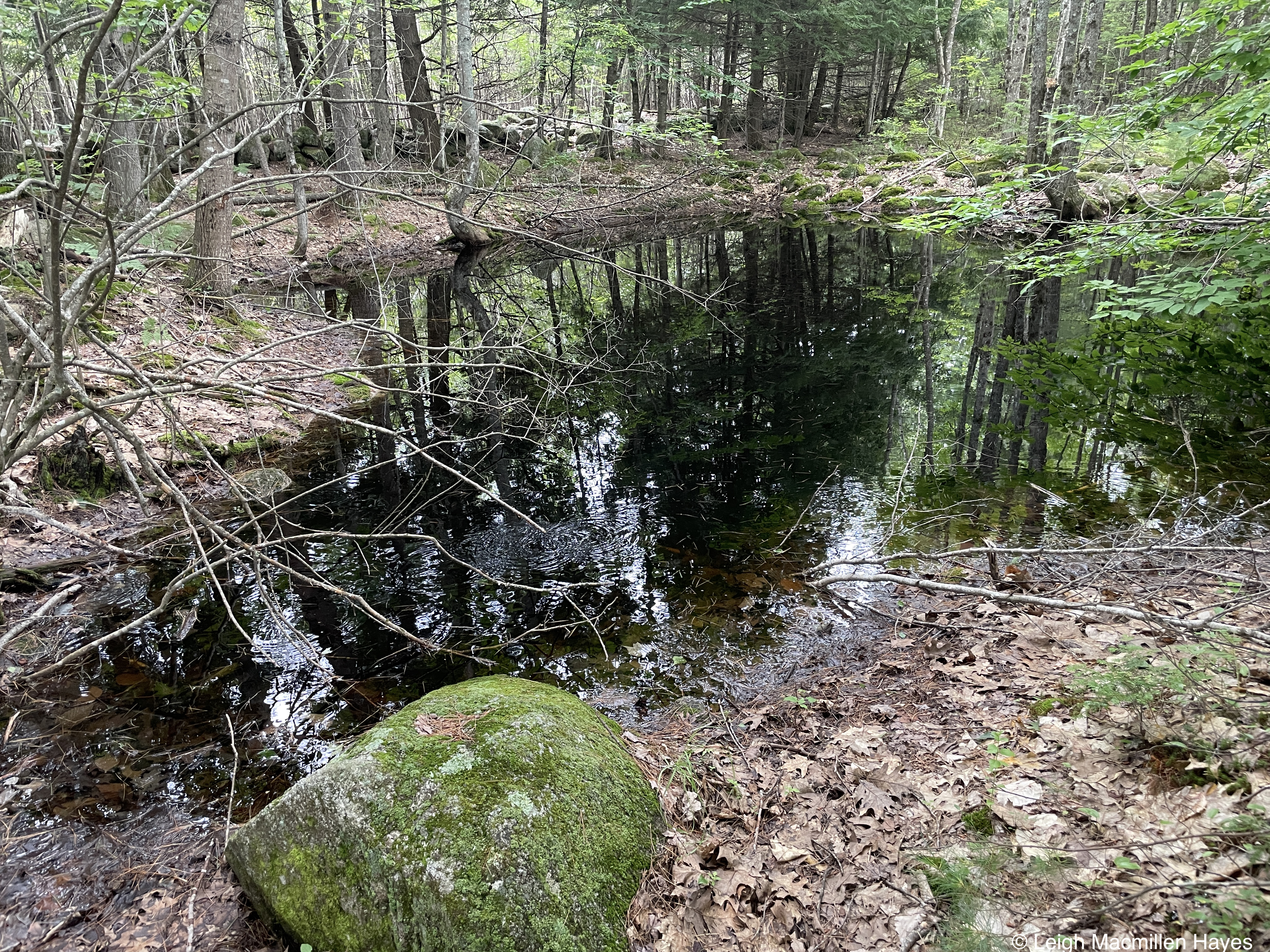
my dear vernal pool 
in late May 
or early June. 
But this year 
of Twenty-twenty-three
has been like no other
as you've retained water
beyond your ephemeral season.
When upon July 14
I peered into 
your shallow depth,
I was greeted
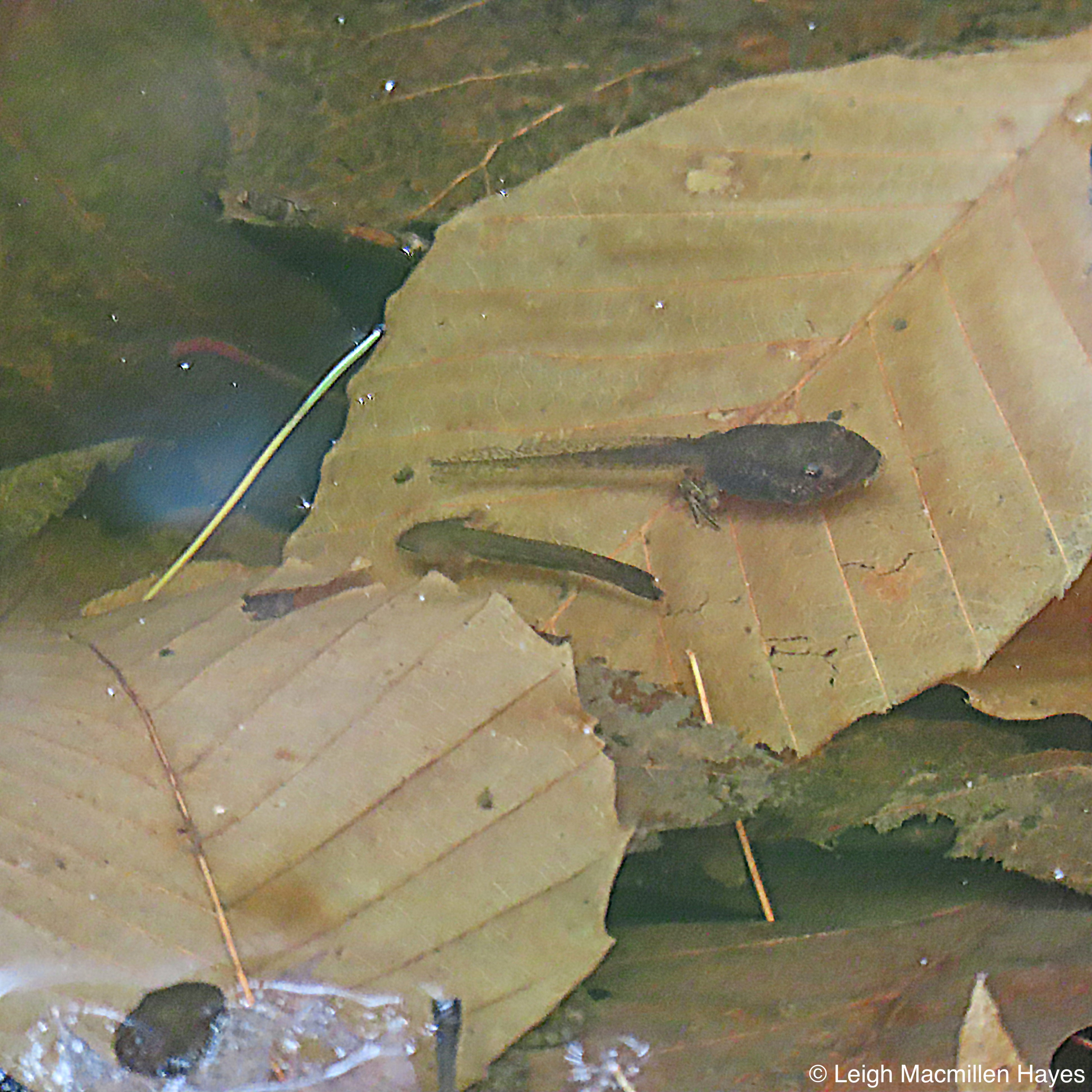
with frog legs
growing upon tadpole bodies,
a sight not witnessed
in your waters 
ever before. 
In years past
miniature amphibians
had to mature quickly
or become scavenged tidbits
supplying energy
to insects and birds,
but this year, 
the Wood Frogs 
and Spotted Salamanders
who share birthrights
of your pool
took their time 
to metamorph.
As I stood quietly
beside you,
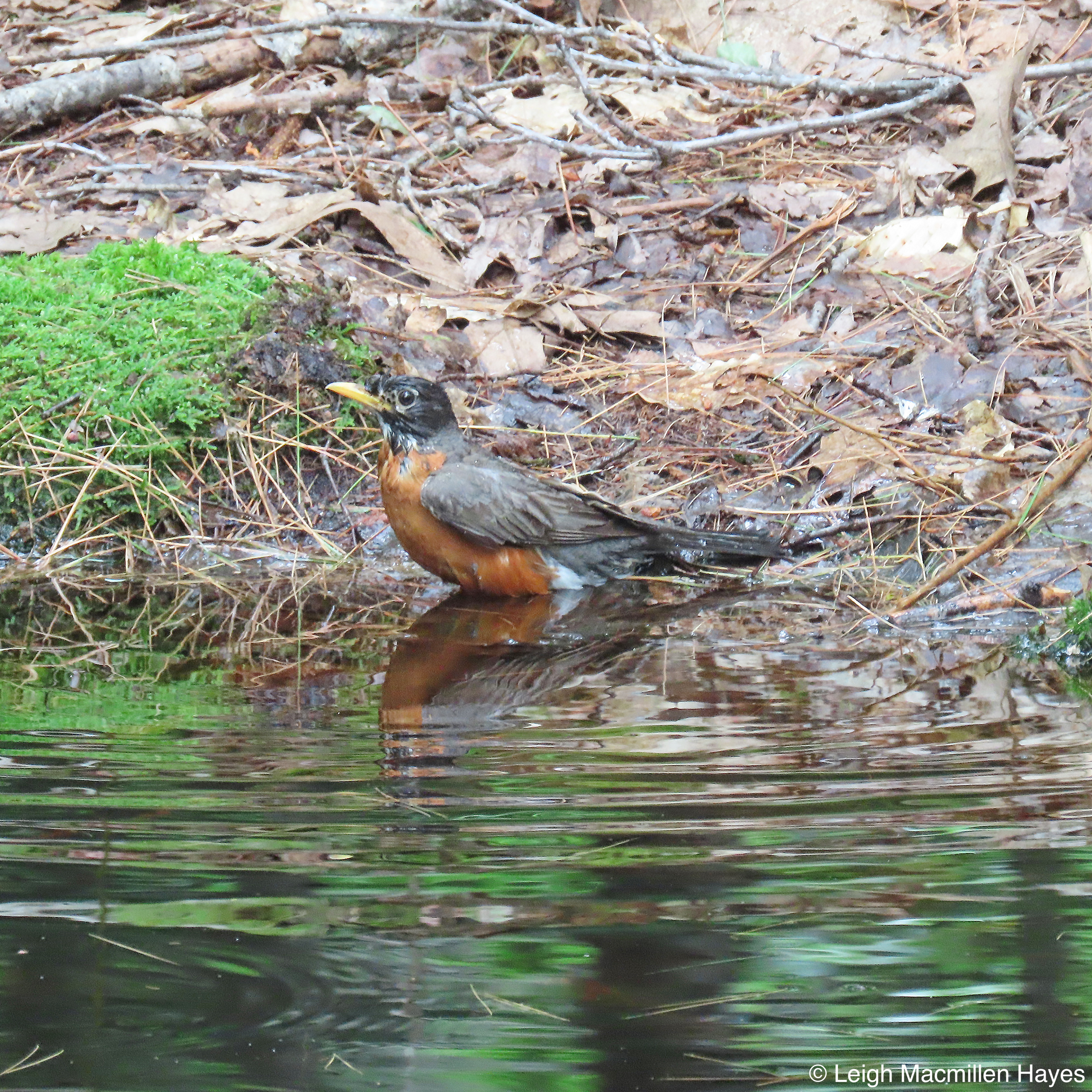
you invited an American Robin
to land on the opposite shore
and I could not believe
my good fortune 
to watch its behavior. 
Much to my amazement,
and despite my presence, 
for no matter how still 
I tried to be 
I still made noise,
the Robin
splished and splashed
in frantic birdbath form. 
It paused
and looked about . . . 
Then jumped in again
for a final rinse 
from your warm waters
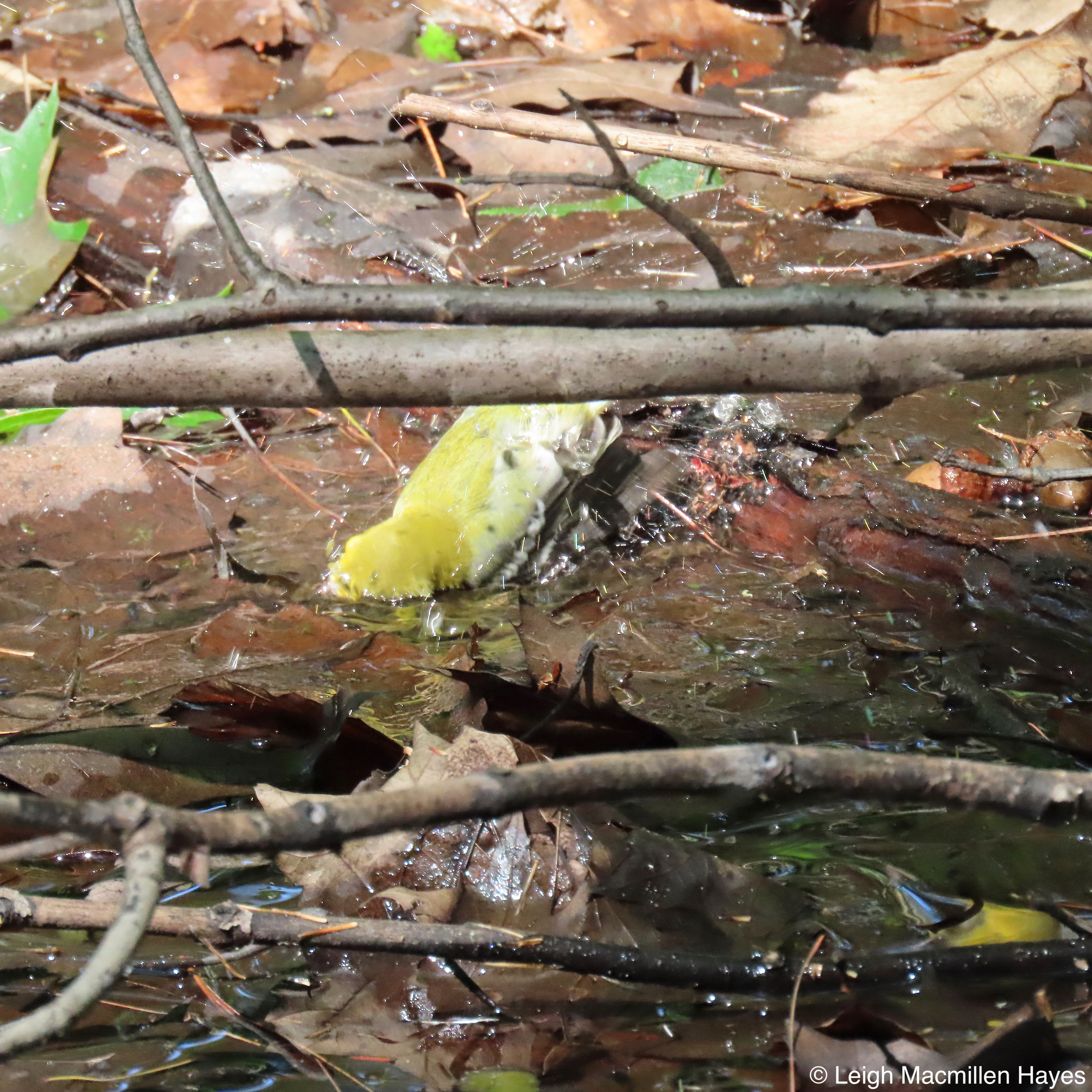
before taking time 
to preen. 
Finally cleansed,
the bird posed
upon a moss carpet
and then 
we both took our leave
fully sated from your offerings
of that day. 
When next I visited you
on August 9,
wonder accompanied 
my approach
and I knew 
sudden movements
and resulting ripples
meant I would not be
disappointed. 
Below your surface,
I spied a live frog,
its hind legs formed 
and front feet developing. 
And there was another,
and another, 
and more legs,
and sometimes even
the tiny suction-cuppy toes
and my heart was full again.
I last made my way
down the cow path
to the trail
leading to you
on August 18
and again
the amount of water
you held in your grip
far exceeded
my expectations,
but other than 
Mosquitoes,
all was quiet. 
And then today dawned,
 and after listening 
to this morning's homily
about Celtic Thin Places
offered by Ev Lennon, 
I felt compelled
to pay you a visit again. 
On the way
I slowed my brain
by intentionally stepping
along the labyrinth path
I created a few years ago. 
And then . . . and then . . . 
as I approached you, 
my dear pool, 
a pile of Black Bear scat,
full of acorn and apple pieces
from a neighborhood forage,
sat smack dab 
in the middle of the trail. 
And so it was 
that as I reached you, 
surprise again overcame me,
for though you are shrinking
to your traditional 
early June size, 
you still exist
on this day, September 3. 
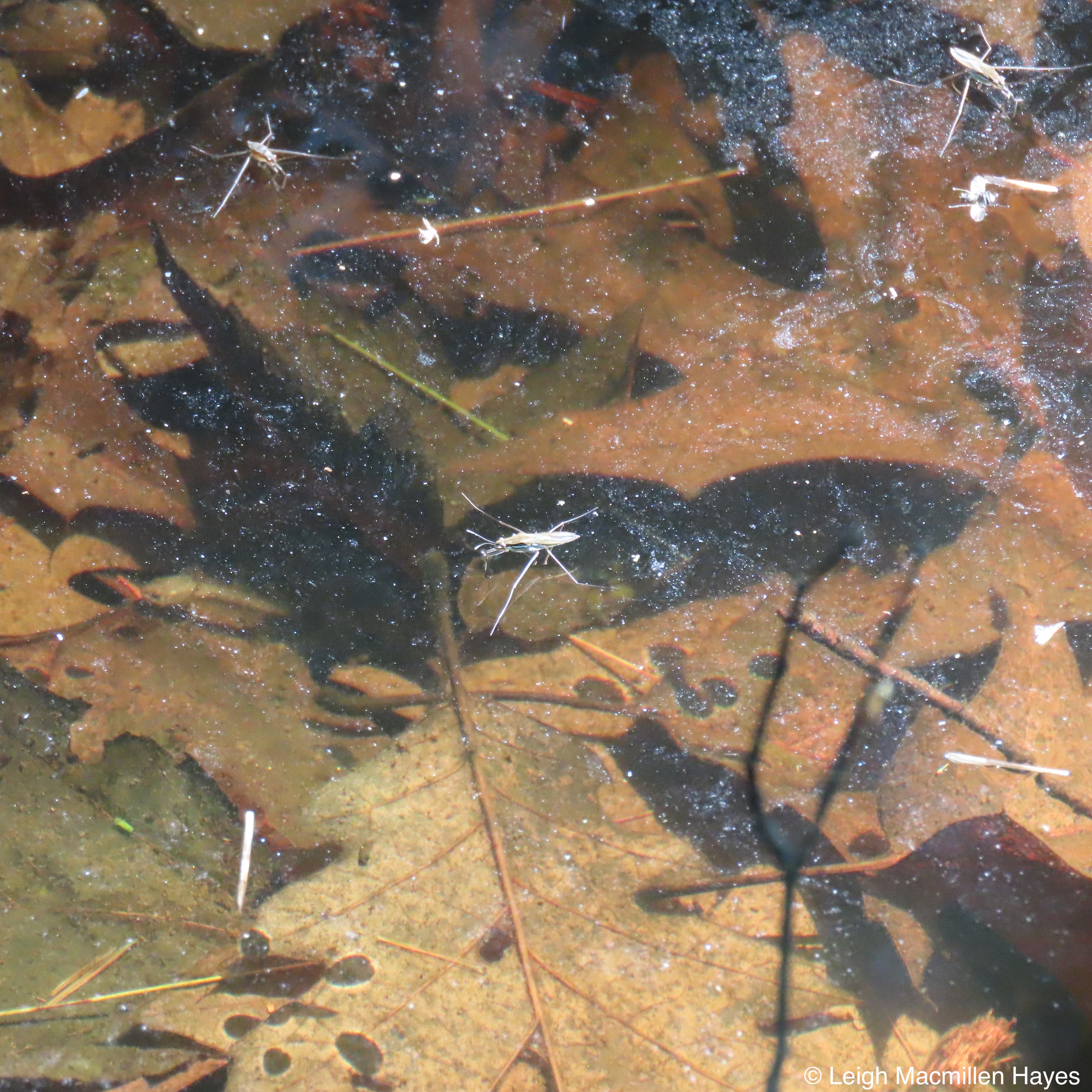
Small Water Striders skated
across your surface,
sometimes approaching others
who quickly
escaped any chance
for an embrace. 
As has been
my experience 
for the last month
you offered no evidence 
of Wood Frog or Spotted Salamanders
and I trust many 
hopped or crawled out
as is their manner. 
Green Frogs, however, 
squealed to announce 
their presence
before diving under 
the leafy bottom you offer, 
which makes a perfect hideout. 
When one frog resurfaced, 
we carried on a starring contest, 
until my attention
was drawn away. 
Ten feet from 
where I stood 
American Goldfinches 
poked the ground, 
foraging in the duff. 
Then one took a bath, 
and suddenly it 
occurred to me
that this was 
the third time this summer
I've had the honor 
of watching birds 
make use of the watery offering
your pool provides,
even as it is now
a not-so-vernal puddle. 

Before I finally
pulled myself
away from you, 
I offered great thanks 
for all the lessons 
of life and love and even loss
that you have
taught me all these years. 

And thank you,
Ev, 
for being today's inspiration
and for reawakening 
my wonder, 
which occasionally goes dormant,
as the pool will soon do as well. 

Thanking the Herons

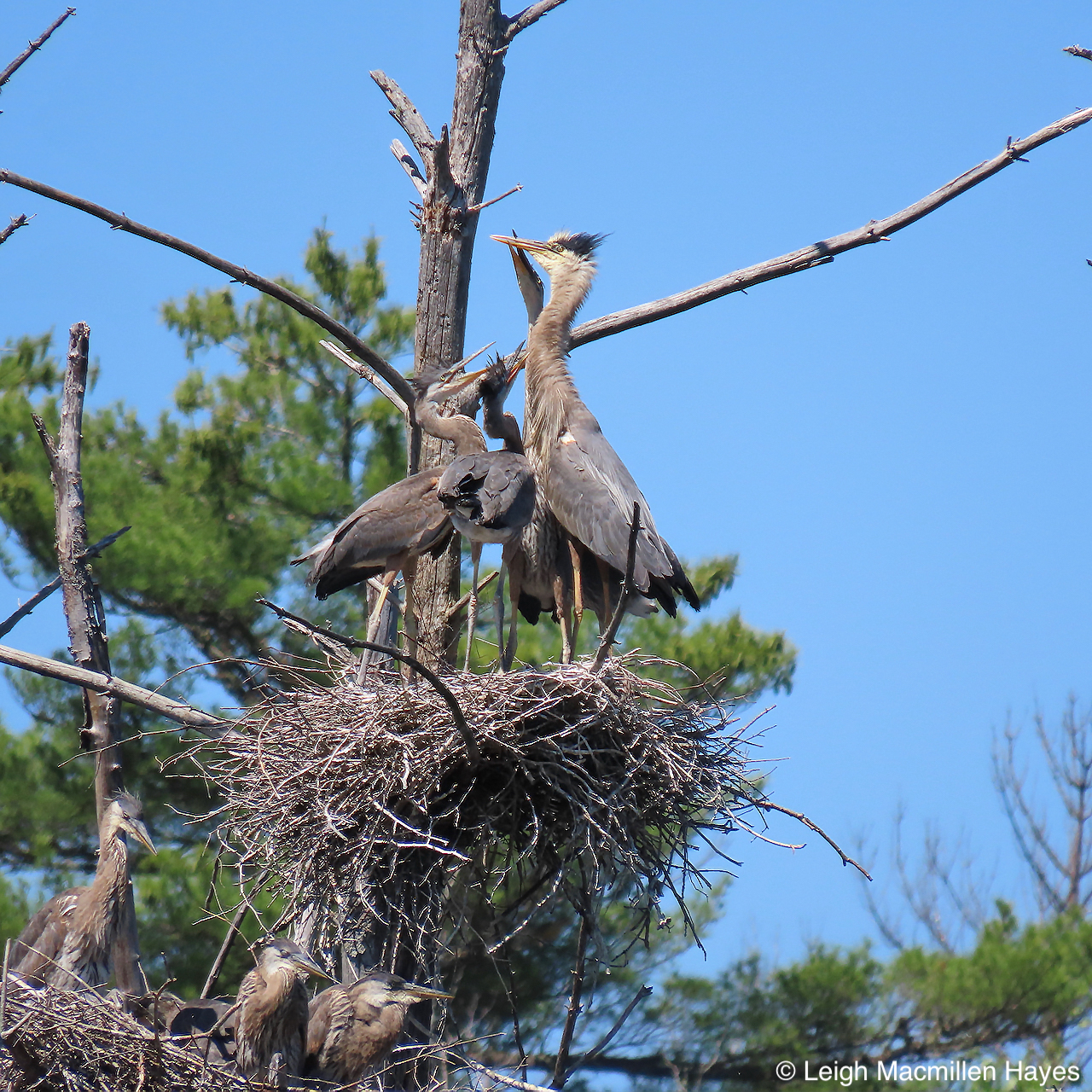
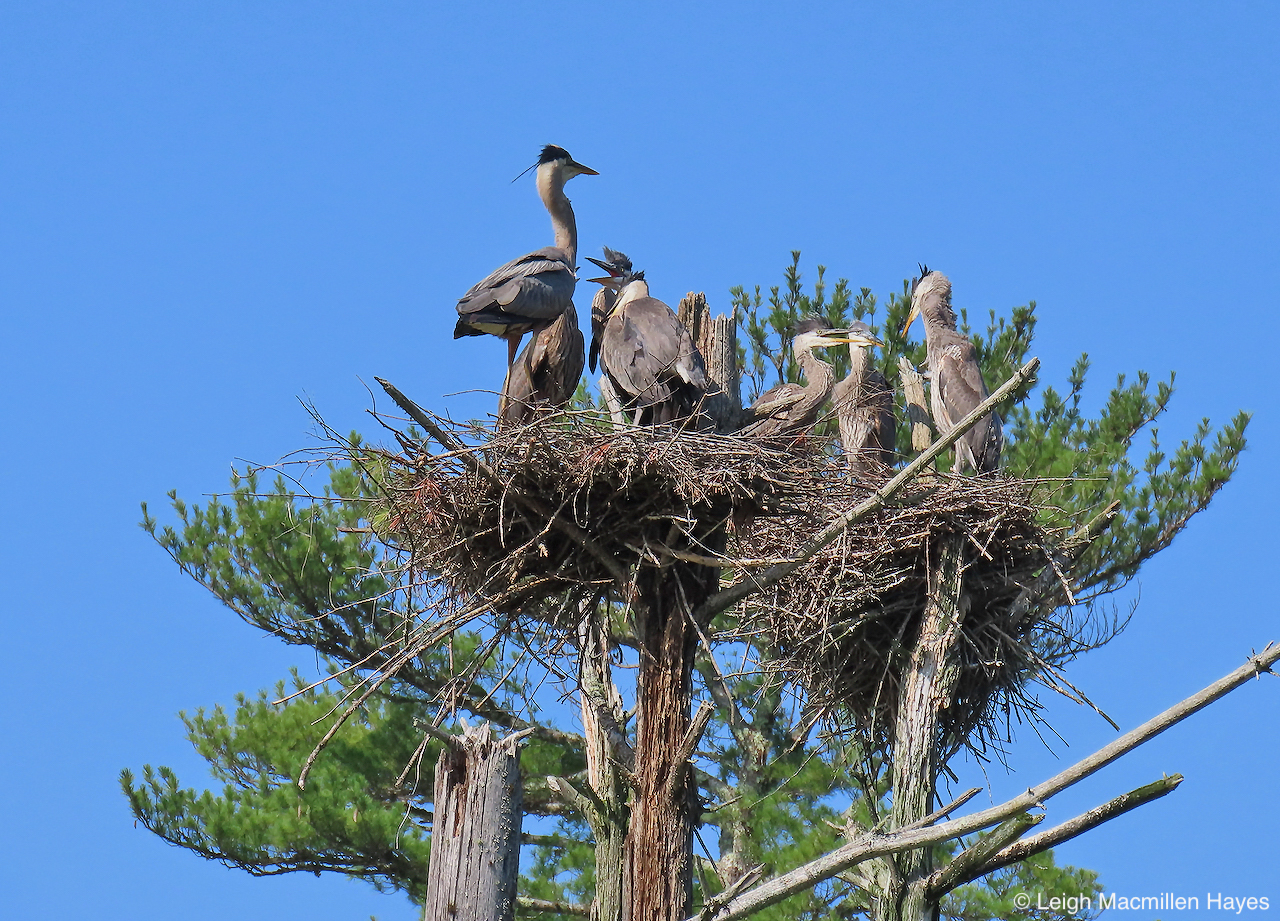
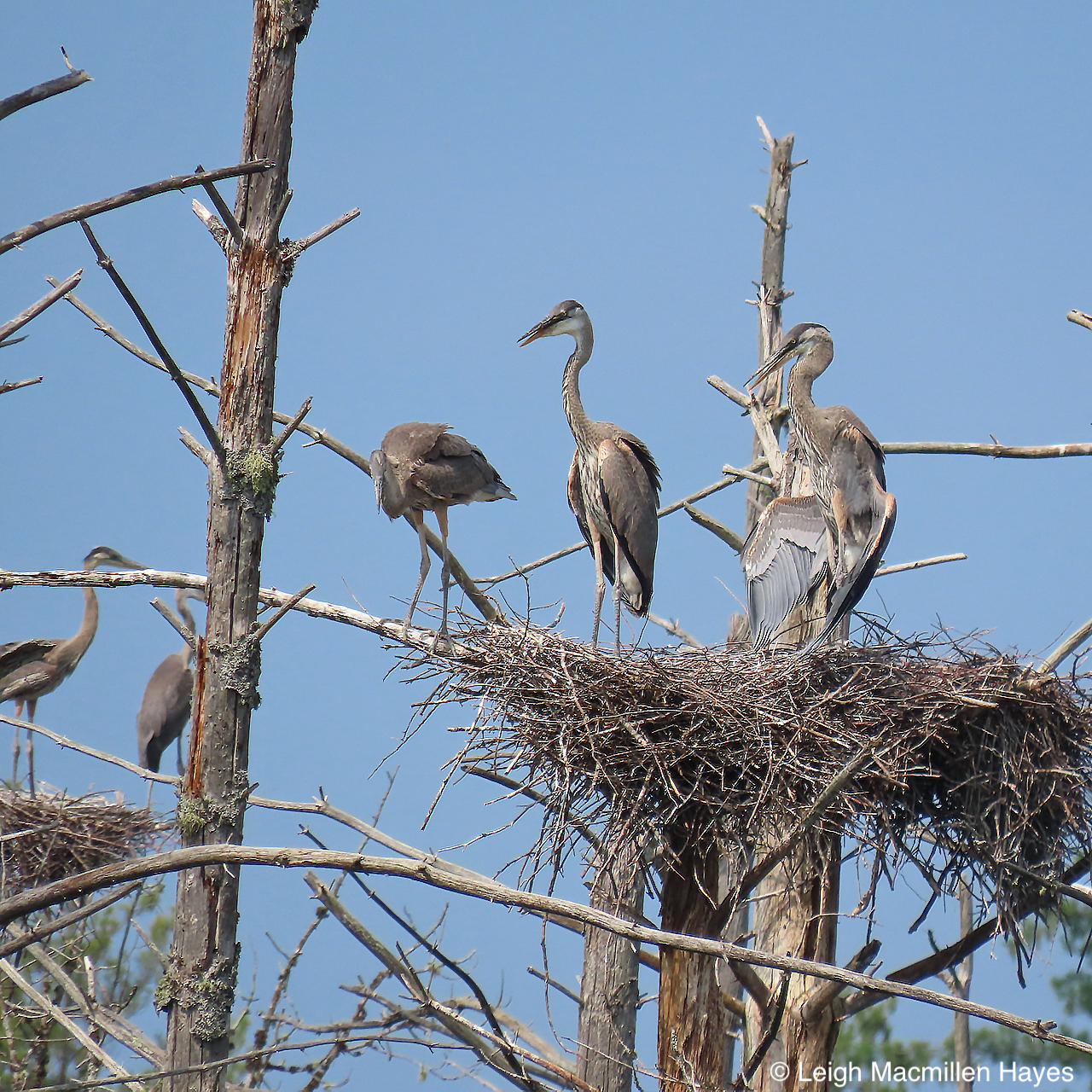
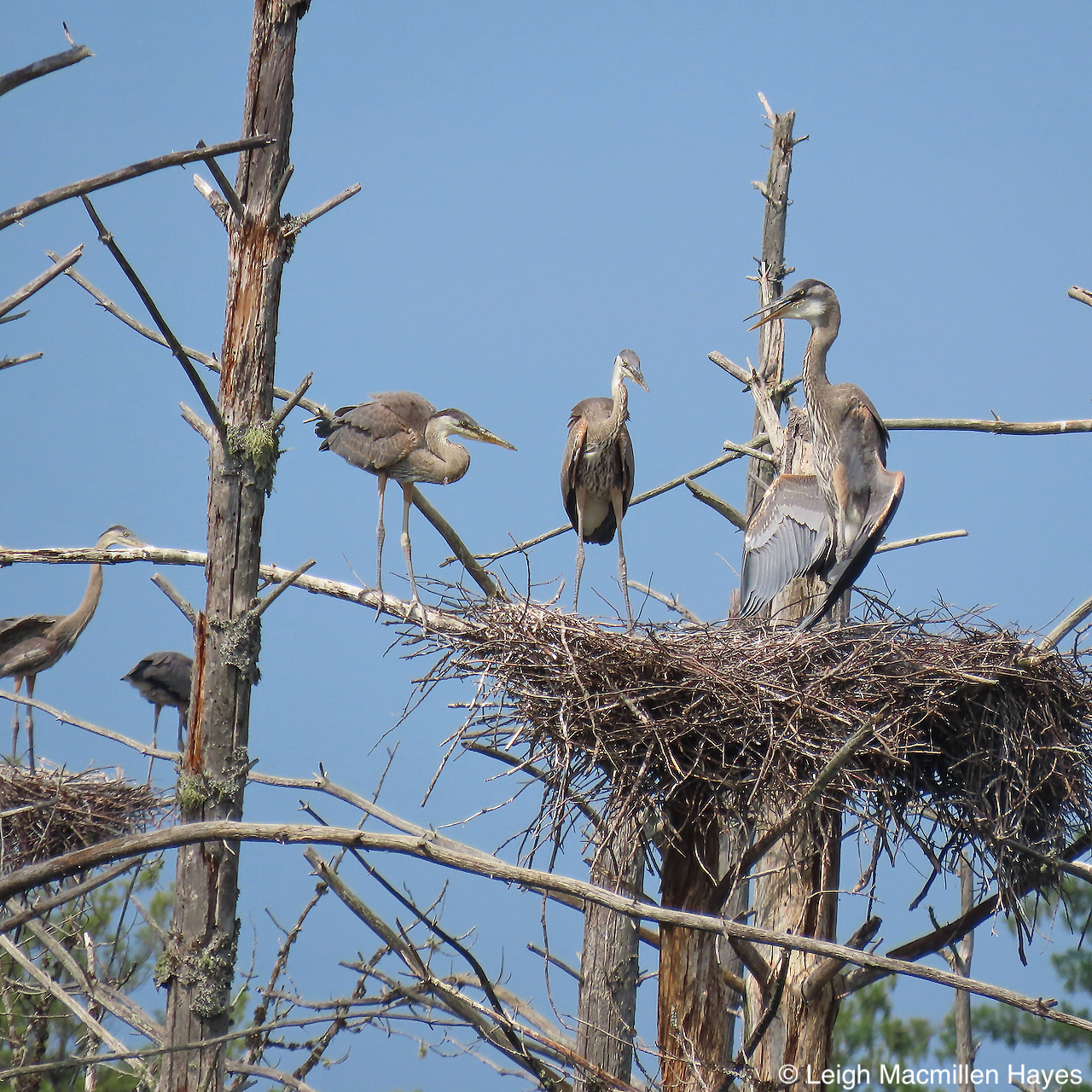
As a community scientist for Maine’s Heron Observation Network these past 14 years, I have the distinct honor of keeping track of several rookeries each spring/summer to monitor the number of active nests, inactive nests, hatchlings, young, and fledglings, plus any obvious disturbances. It’s a task that only takes a few hours every other week and the time span in total is about six weeks. Those few hours are some of the best hours that I spend outdoors because rookeries in this neck of the woods are located in or abutting wetlands and offer a rich abundance of wildlife.

From the HERON website: “The Heron Observation Network of Maine (HERON) is a citizen science adopt-a-colony program started by Maine Department of Inland Fisheries and Wildlife (MDIFW) in 2009 to help investigate the status of Maine’s nesting population of great blue herons. Since 1983, the coastal breeding population of great blue herons has undergone an 82% decline; and it is unknown whether that decline is a statewide phenomenon or whether it is restricted to only the coastal colonies. This is where HERON volunteers come in: they collect invaluable data on colonies statewide that will help biologists assess the population trend over time.

One of my rookeries has had no nests for the past two years since Bald Eagles wiped out the Great Blue Heron population three years ago.

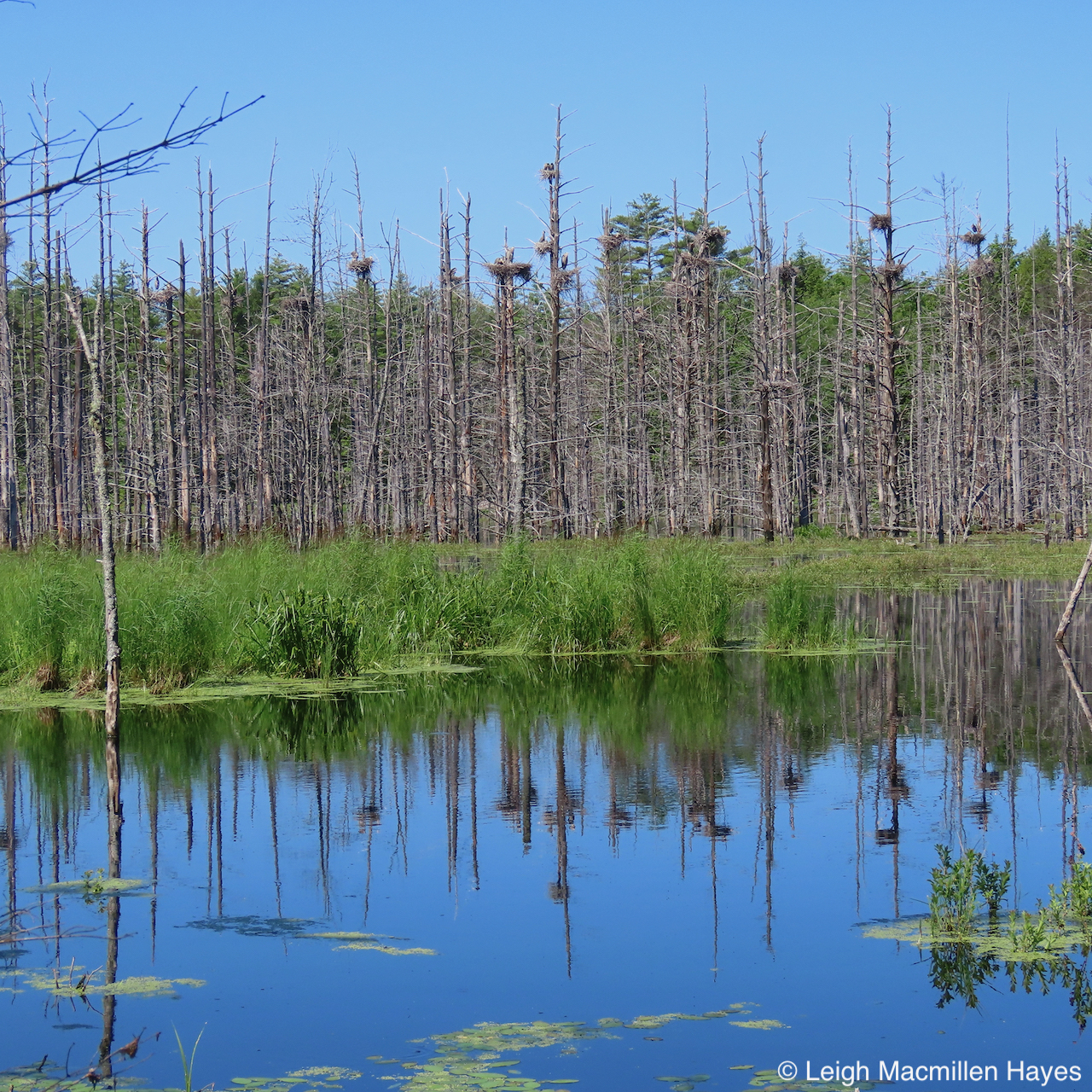
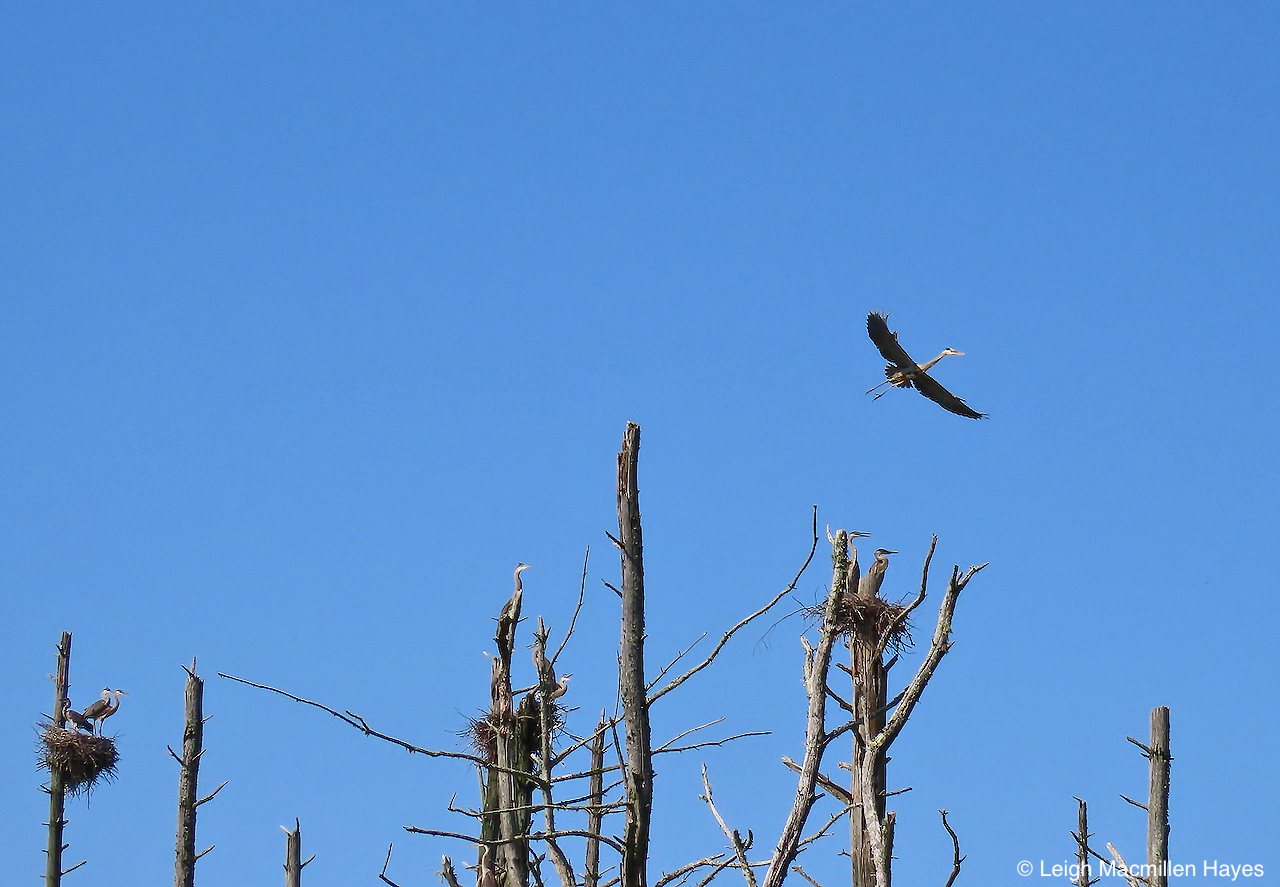
But the beaver pond in the photo above is making a come-back after peaking with about 30 I think about ten years ago, then crashing to a single digit number. This year, we counted 12 nests, all of which proved to be active over the course of the six-week time span.

Observing means making ones way quietly to the edge of the wetland, listening as the youngsters squawk for an incoming meal, then finding a good spot to see the nests with binoculars while not disturbing the birds, and begin counting.

We avoid publicly sharing the locations of these sites for as it is stated on the HERON website: “If you are not the landowner or colony monitor, please refrain from visiting colonies during nesting season to minimize unnecessary disturbance.”

This third rookery we thought had crashed after discovering two nests two years ago and then none last year. But . . . we knew the birds had to be somewhere in the vicinity because, though several rookeries in the area were no longer active, there were still adult birds visiting local ponds and lakes and rivers.

It wasn’t until Maine State Waterbird Specialist Danielle D’Auria completed a flyover this spring and sent an email with the subject: “Your colony is THRIVING!” and two friends joined me and we explored the wetland from a different vantage point than in the past, that we knew just how big the colony was. In total, there are over 40 nests and over 30 of them were indeed active.

Counting so many can be a real challenge, and even with three pairs of eyes, we still needed to restart several times with this larger colony, but figured out a system to identify certain nests as a given # and then restart from there and move from left to right, though sometimes we had to dip down and then look up again to find the next nest.

What added to the counting confusion was that my peeps and I suffer happily from Nature Distraction Syndrome (I used to call it Disorder, but really, it’s such a good thing that it deserves a new name), aka NDS rather than NDD.

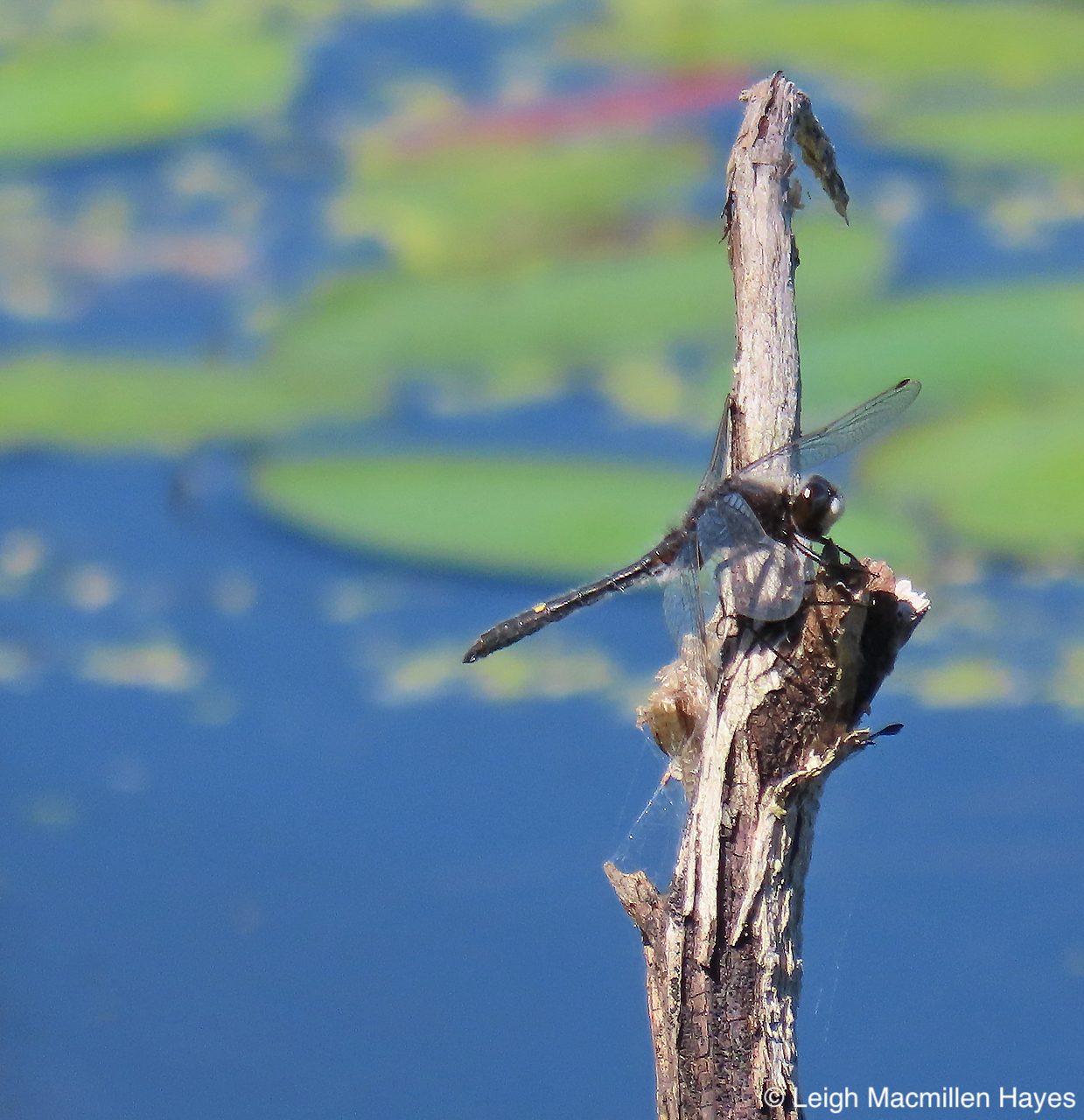
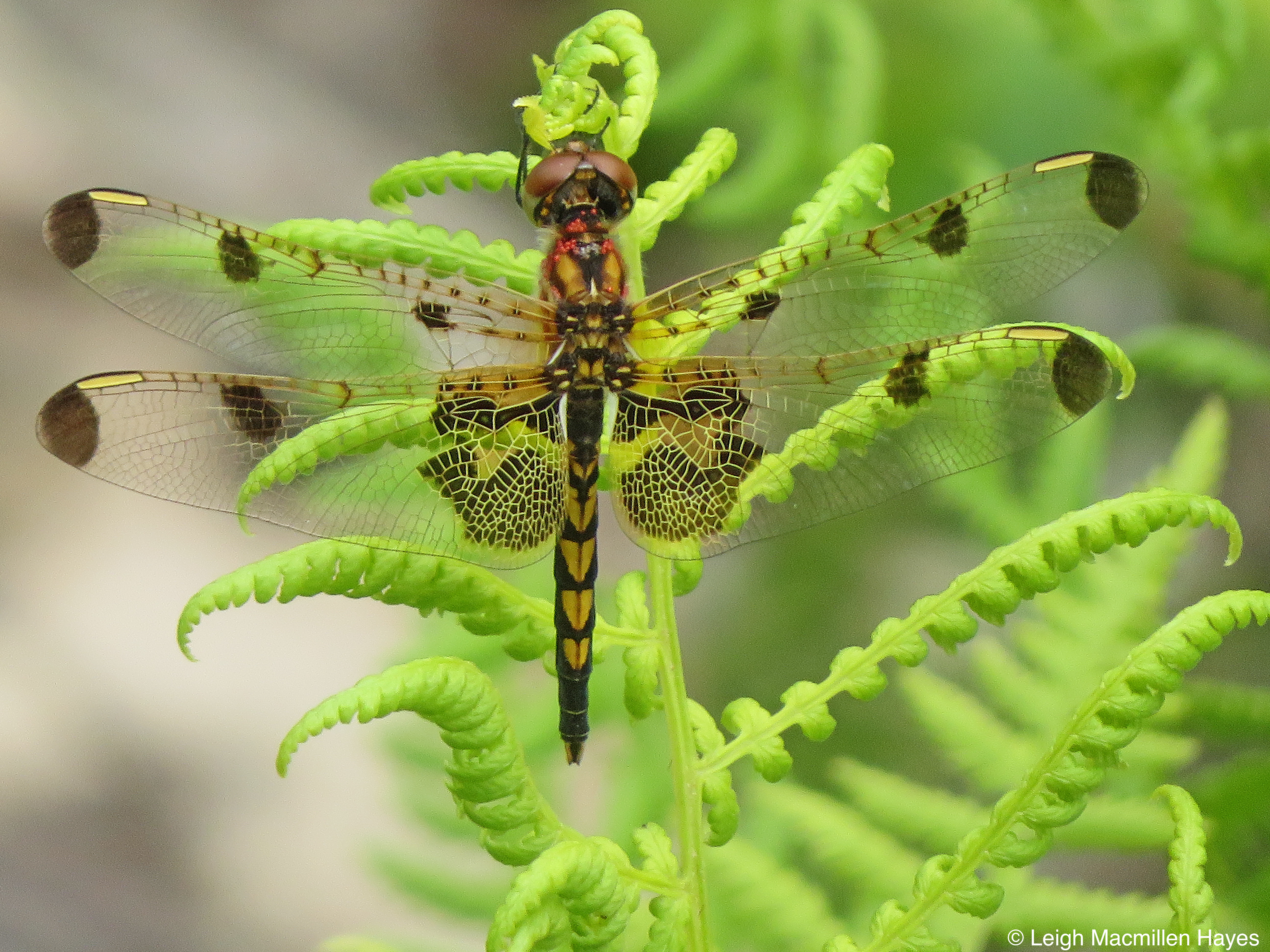
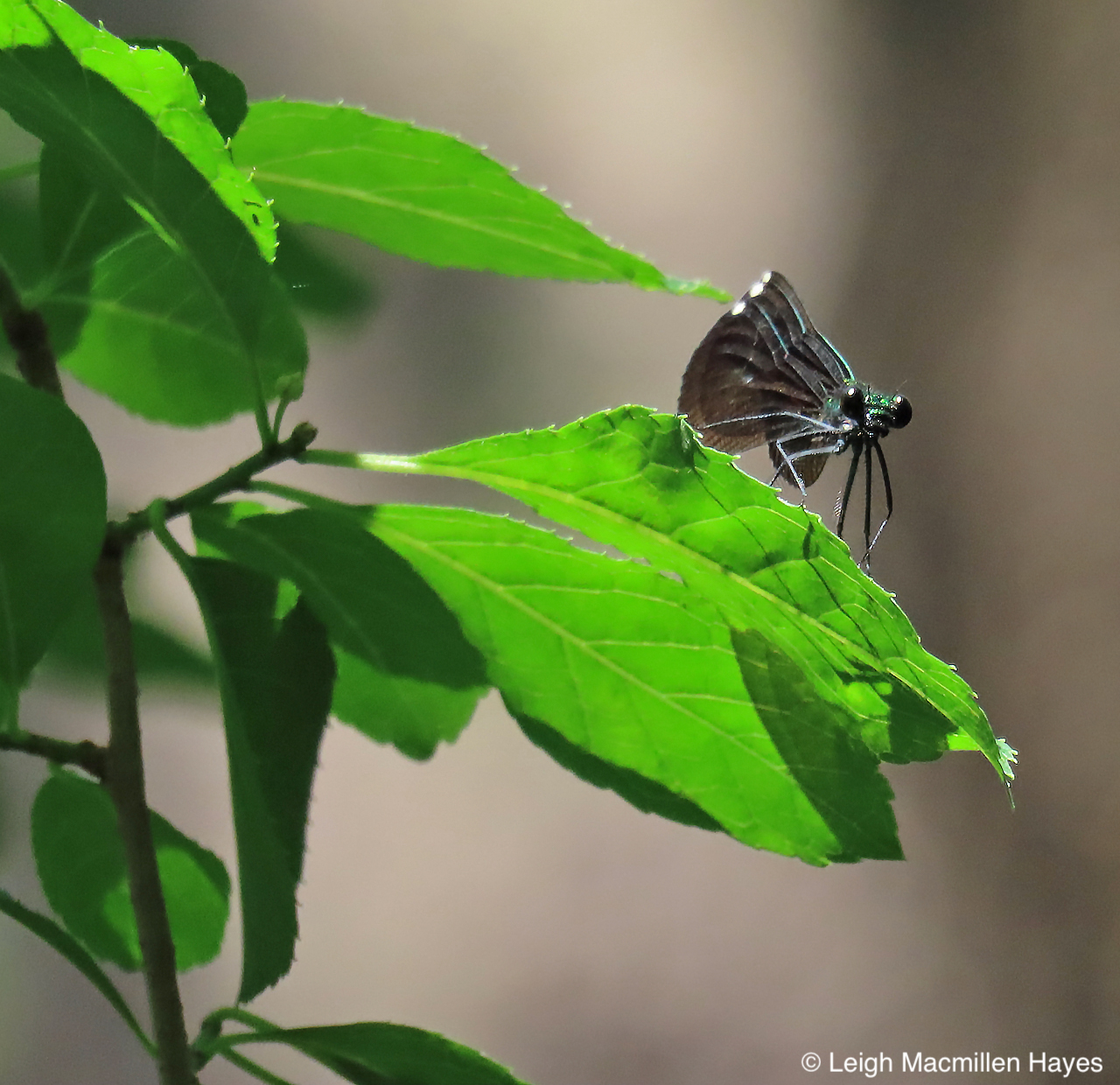
And so this is a Dot-tailed Whiteface Skimmer, its name reflecting its features.

Looking up again, we’d spot hatchlings, those fluffy little balls that we could barely make out unless they popped up . . . definitely one of the many joys of those special mornings.

Sometimes the youngsters were difficult to spy based on how well they blended in with the snags upon which the nests were built.

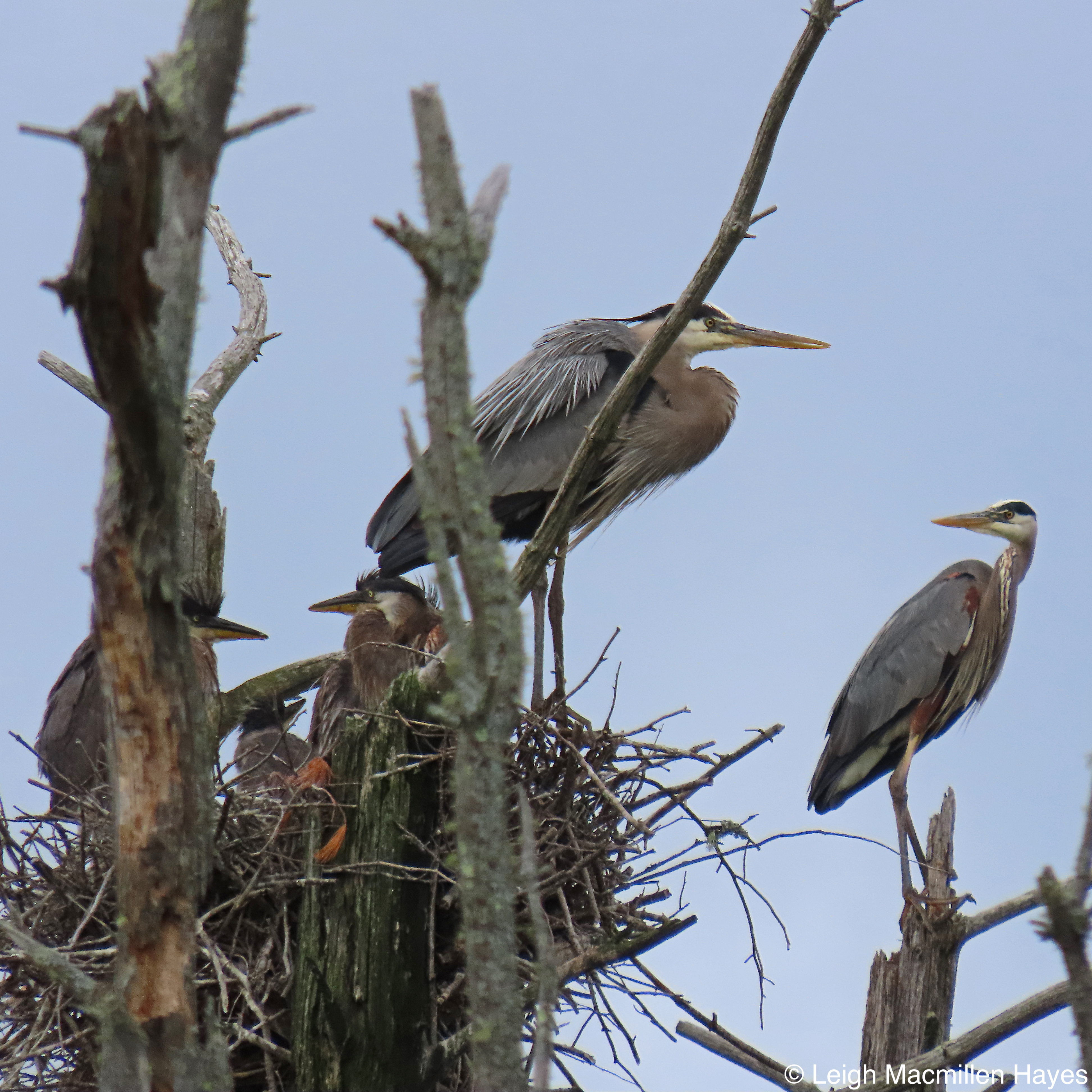
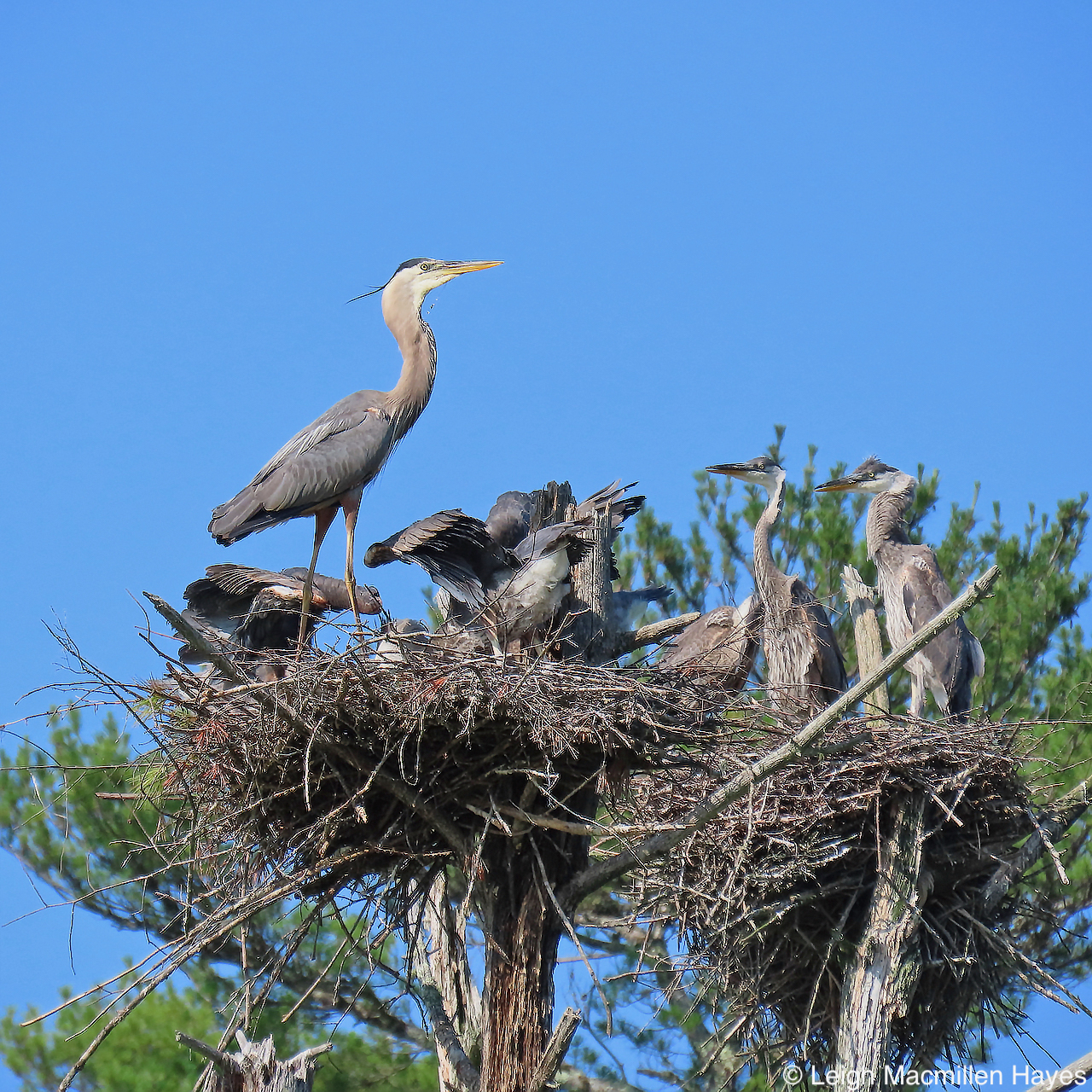
And then it was a matter of deciding: is that a bird or part of the tree? And is there another lump in there? Do you see three or four young, plus the two adults?

Often, several adults stood sentry, keeping an eye on the entire rookery, rather than heading off to fish and feed the youngsters. This one stood on one leg, which I’ve read is a way for birds to reduce the amount of heat loss on their unfeathered limbs.

One of the things I always found amazing is that by week #3, the youngsters seemed to know that their parent was approaching with a feast to share, while those in the condo below waited patiently and quietly for their meal on wings to fly into the nest.

Meals were regurgitated, with those prehistoric croak-like squawks perhaps encouraging the parent to pass the food to its youngsters.

And then it was time for the kids to fight over who got the best and biggest bite, while momma or poppa stepped aside to let them assert their birthright. The question remains, did the first born always get the worm? Or in this case fish or amphibian or whatever the meal might be?

And how could we not admire the Green Frogs that “Ga-dunked” their banjo strings as they surrounded us and kept moving in closer making us think we might become a meal while we stood there and counted?

Feeding time continued to be the birds’ favorite time and as they grew bigger, they certainly became more assertive.

Vying for position continued to stymie us for we didn’t understand which mouths received first dibs. But of equal importance, how did all of those birds remain in their treetop nests without falling over during such squabbles? And how did the nests and birds withstand the rain and wind that marked our spring and summer here in western Maine?

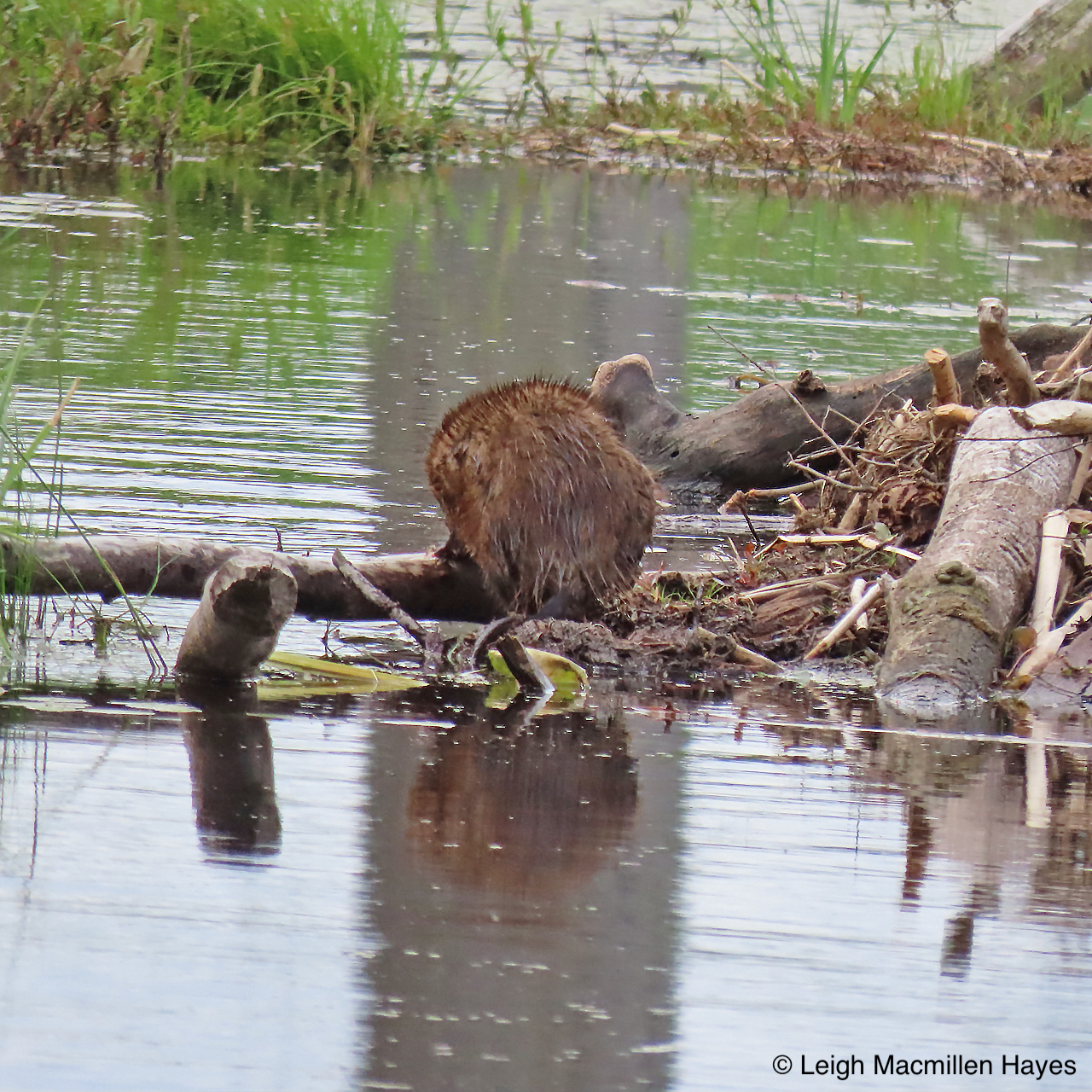
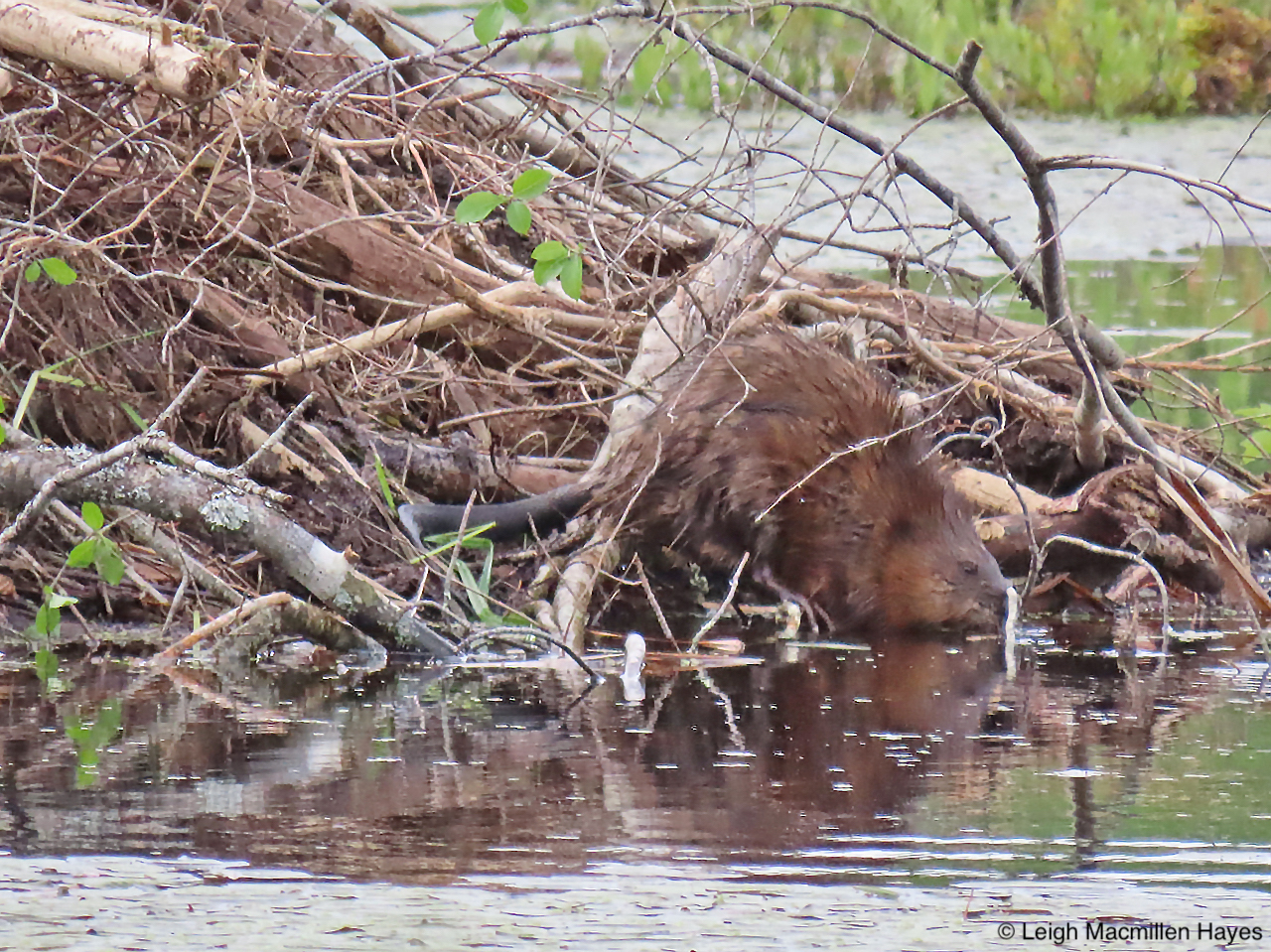
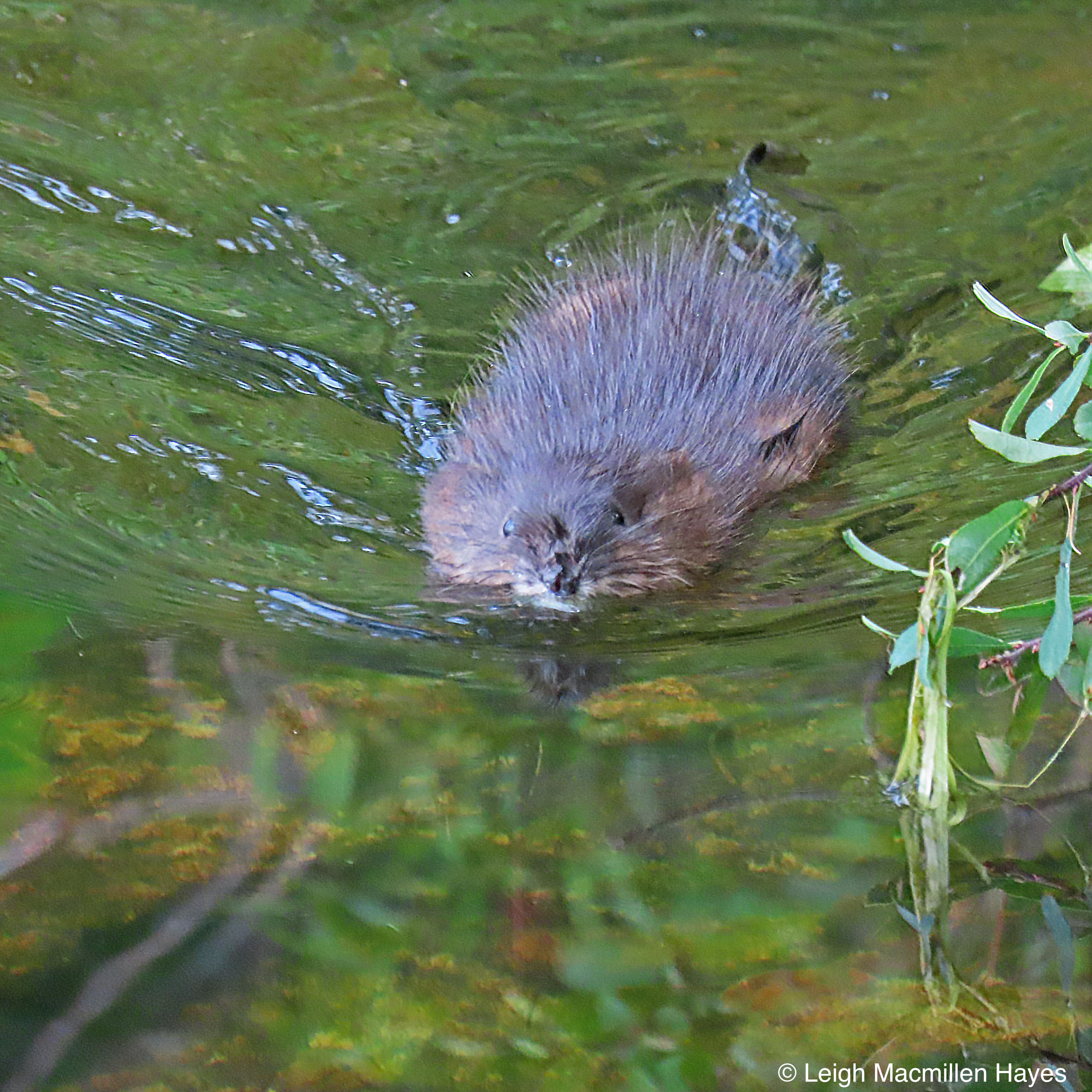
Motion below the nests caught our attention once again, and what we first thought was a Beaver because it explored a beaver lodge, morphed quickly into a Muskrat when we spied its rat-like tail.

It went about its business as we watched, probably in search of food, maybe to feed its own youngsters.

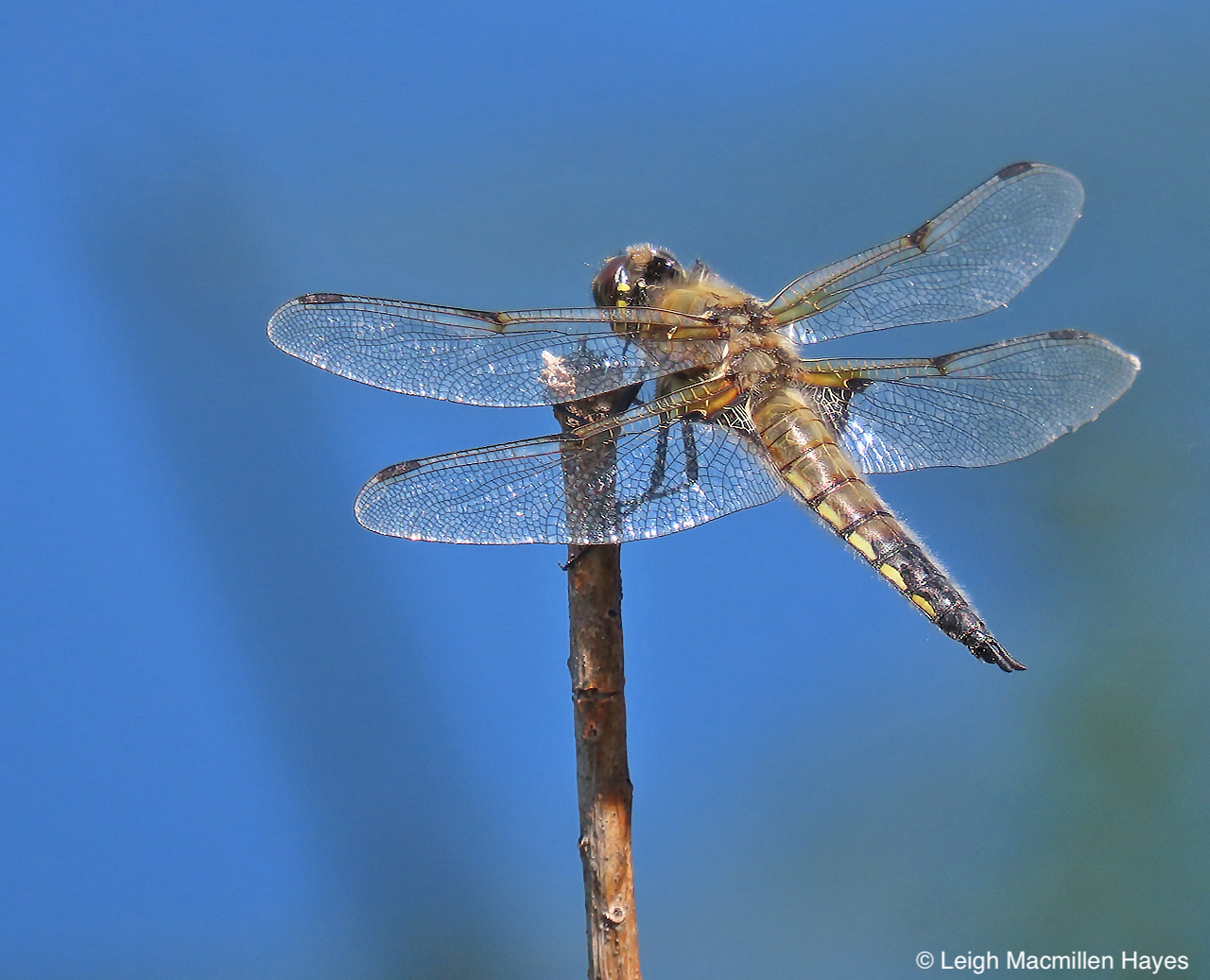
And then there was the ever lovely Four-spotted Skimmer Dragonfly.

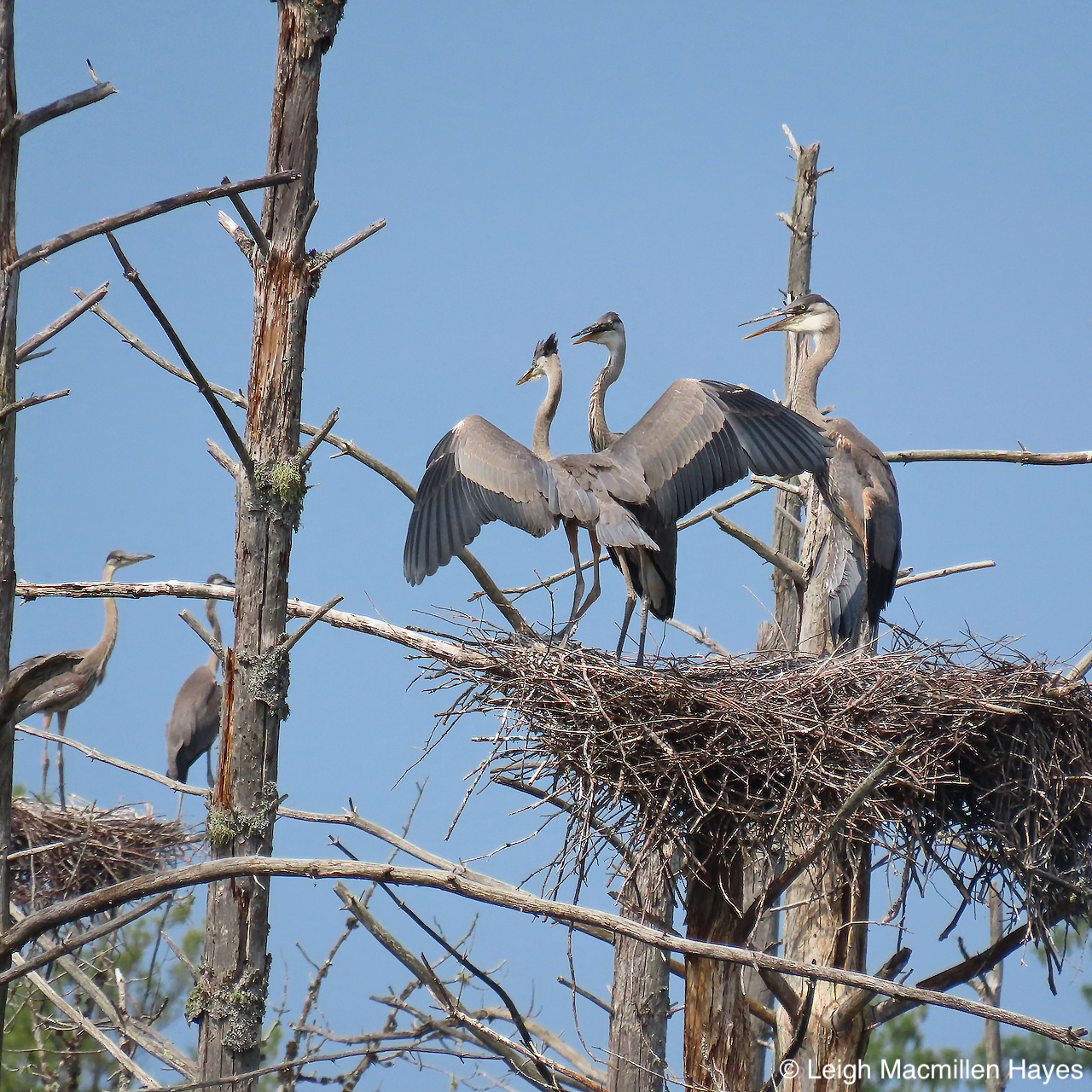
By week #6, most of the kids were tweens, and those in the left-hand duplex watched intently for their lunch box to arrive just as their neighbors to the right were about to eat.

We labeled this double-nest “The Squawkers” because anticipation of the lunch box contents in both places was extra loud.

Once the right-hand duplex had finished eating, they turned their attention next door, though nary a beg did they offer and nary a tidbit did they receive.

Still they looked on.

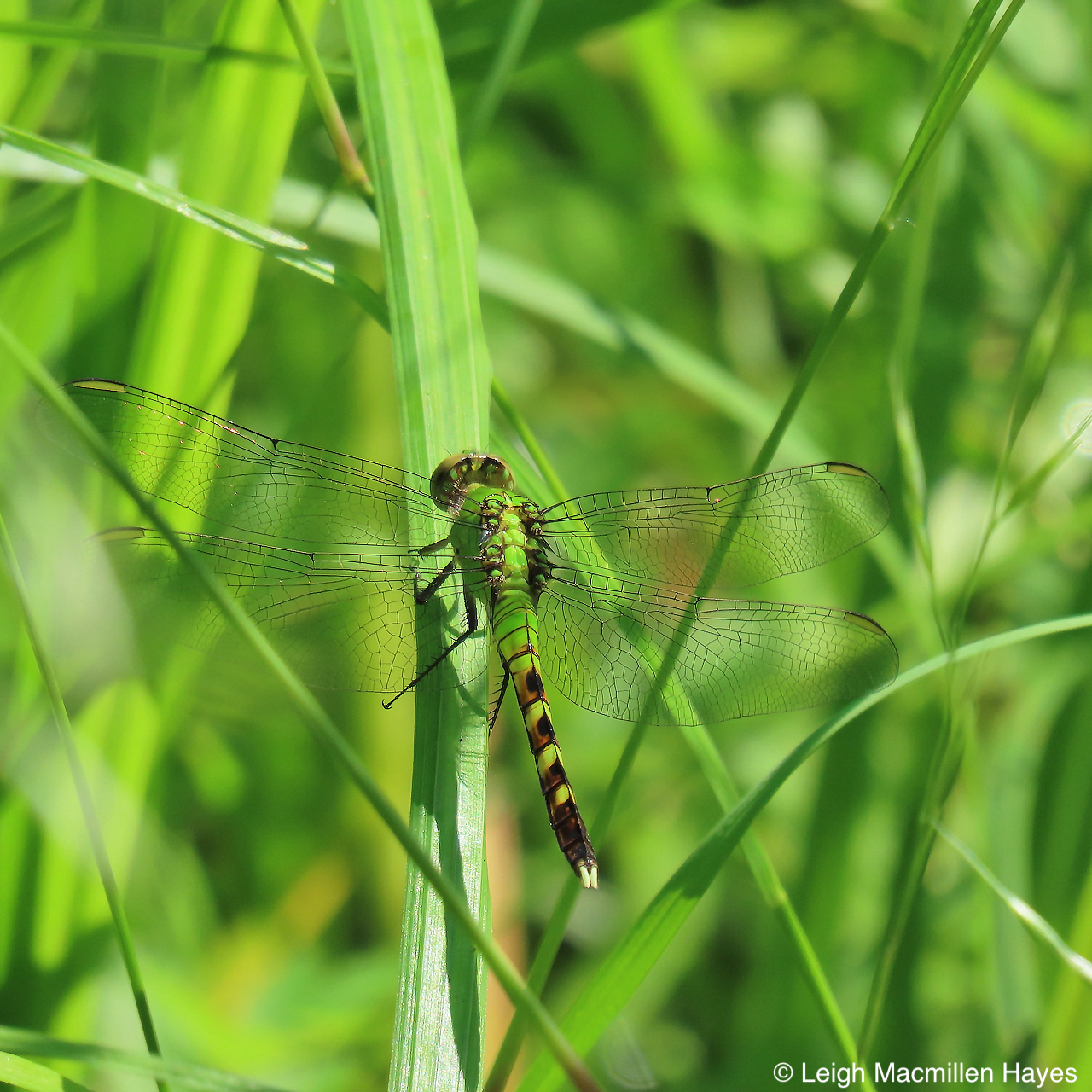
And so did we . . . at this female Eastern Pondhawk Skimmer dragonfly with her bright green thorax and pair of white cerci (terminal appendages).

During week #6 the moment arrived, when encouraged by others a teen got up the gumption . . .

to step out on a limb . . .

and then turn back to say, “Hey, look at me. I did it.”

And then, in an instant, first flight!

So where did the herons go once they no longer needed to remain at their breeding grounds? Well, I took off in my kayak to see if I could answer that question. And a Slaty Blue Skimmer posed on my boat much like a figurehead, this one in obelisk form with its abdomen raised toward the sun to offer some relief from the heat.

I also found the Eastern Pondhawk’s mate. Look at that green face, and powder blue abdomen, or the hints of color on its wings.

I was equally excited when I spied him again, this time with a frontal views. I hope your “Ohs” and “Ahs” match mine.

Another “Oh” moment: A Water Snake peering out from under its lilypad-shaped sun umbrella.

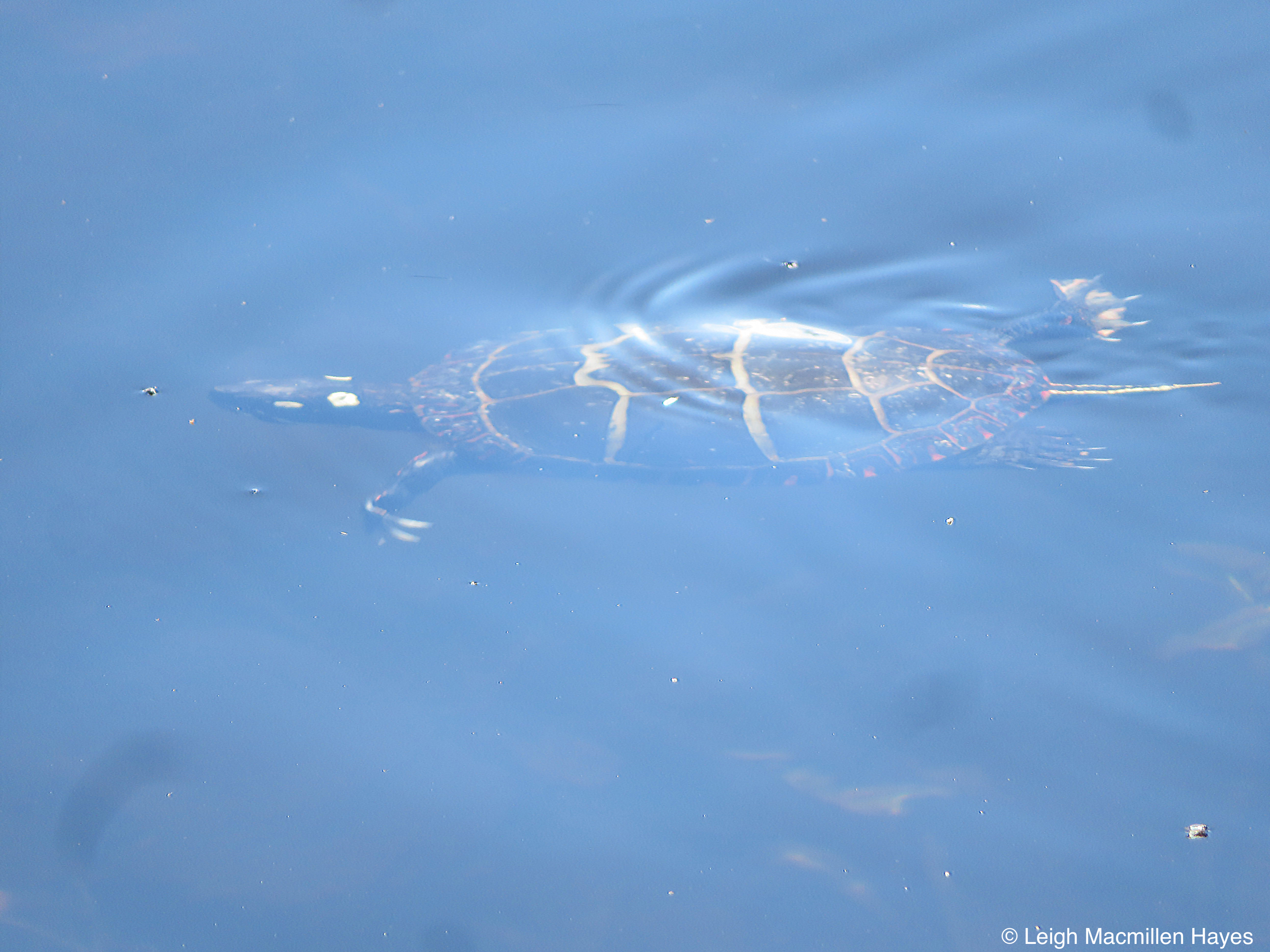
And a couple of Painted Turtles basking upon a rather shaded rock.

Plus a pair of juvenile Mallards in preening mode.

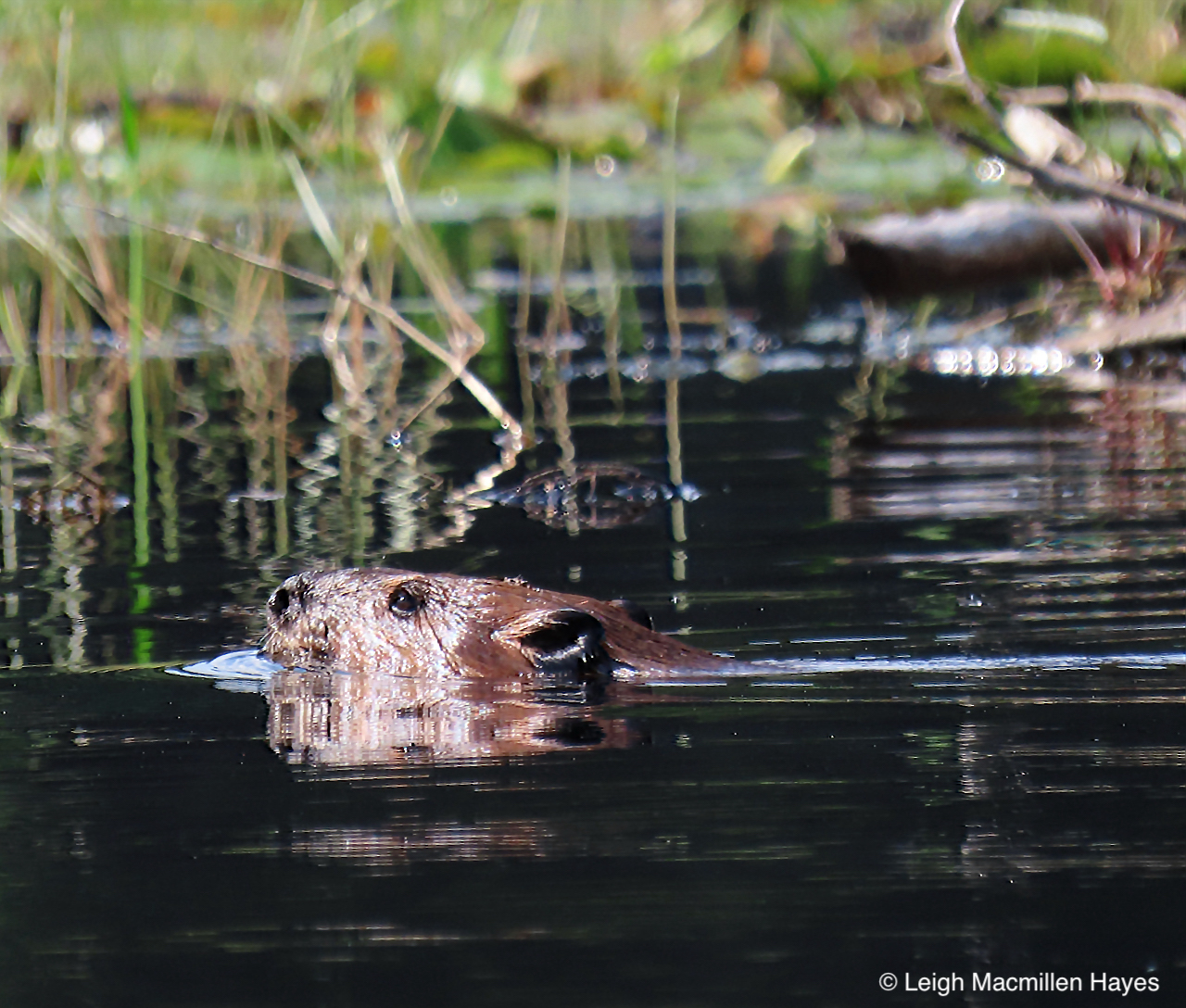
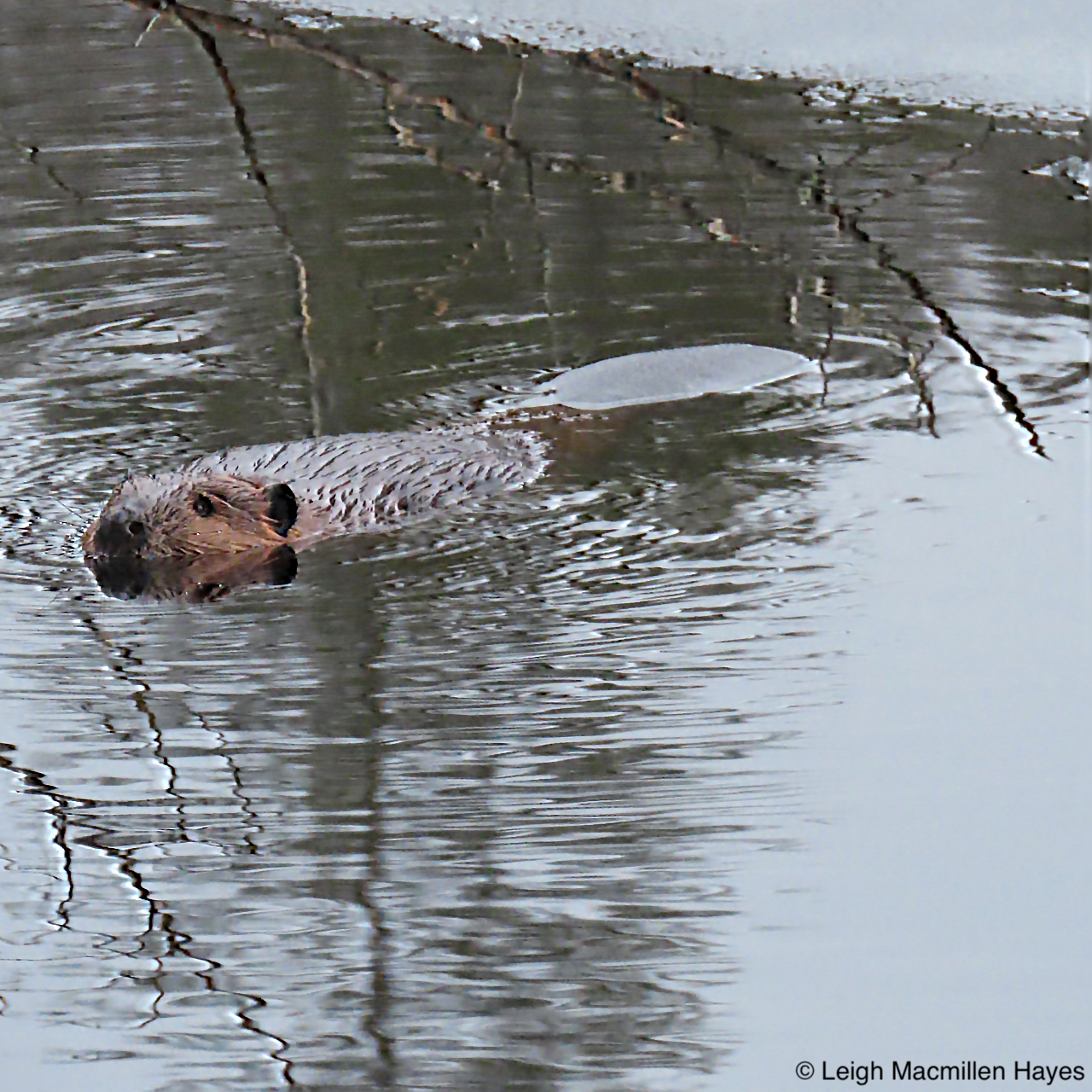
And among my favorites, okay, really, they are all my favorites, but I was quite surprised to spend a few minutes with this Beaver while searching for herons one recent day.

Tada. The search has ended and going forward I’ll probably spot them more and more frequently for I know how successful at least two local rookeries have been this year.

I give great thanks to this Great Blue Heron and all of the others because they offered a chance to not only contribute to research, but also to spend some delight-filled hours standing still and observing. Your breeding and food-gathering habitats are my favorites too.

Our Blue Greed Mondate

Somehow that time of year always sneaks up on us. And yet today dawned and the writing was on the wall: This is that time of year-kind-of-day. But the question remained: Would we be rewarded?

Well, we had to find out and so this morning we set off in search of this small mountain nestled in the midst of so many behemoth uprisings. It took us several wrong turns before we finally shared that sudden “Aha” moment that indeed the pasture road was the correct road. It was all rote from there.

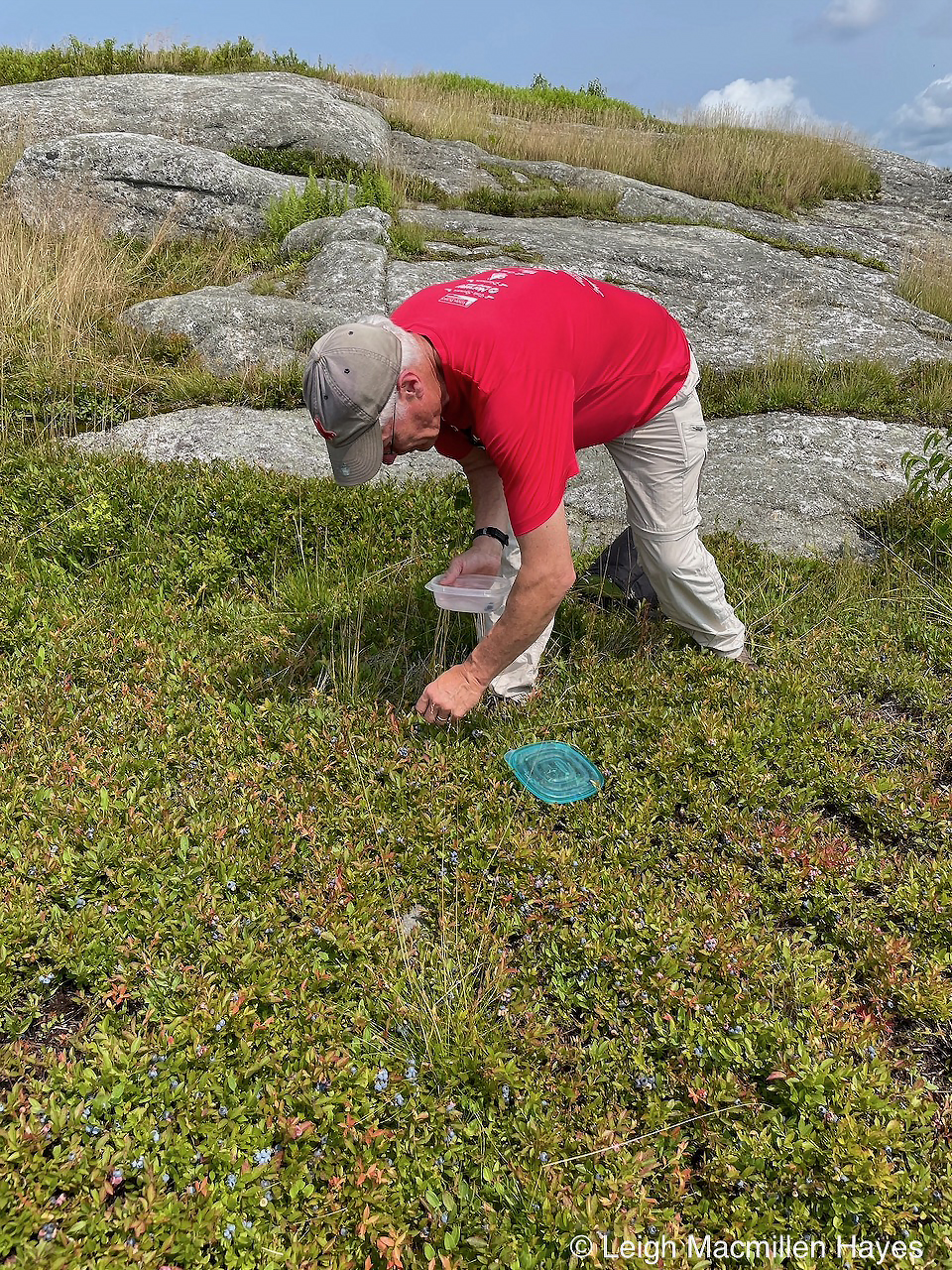
Last year we discovered the mountain top had been cut back and there were no little specks of blue to glean, but that cutback lead to this year’s abundant offerings. My Guy was in his happy place.

Well . . . one of his happy places. This one offering such sweetness in a manner all blue.

I chuckled when I overheard a mom commenting, “This is just like Blueberries for Sal.” I immediately texted our friend Kimmy for she and I know otherwise. Drop the “S” from Sal and you’ll know what I mean.

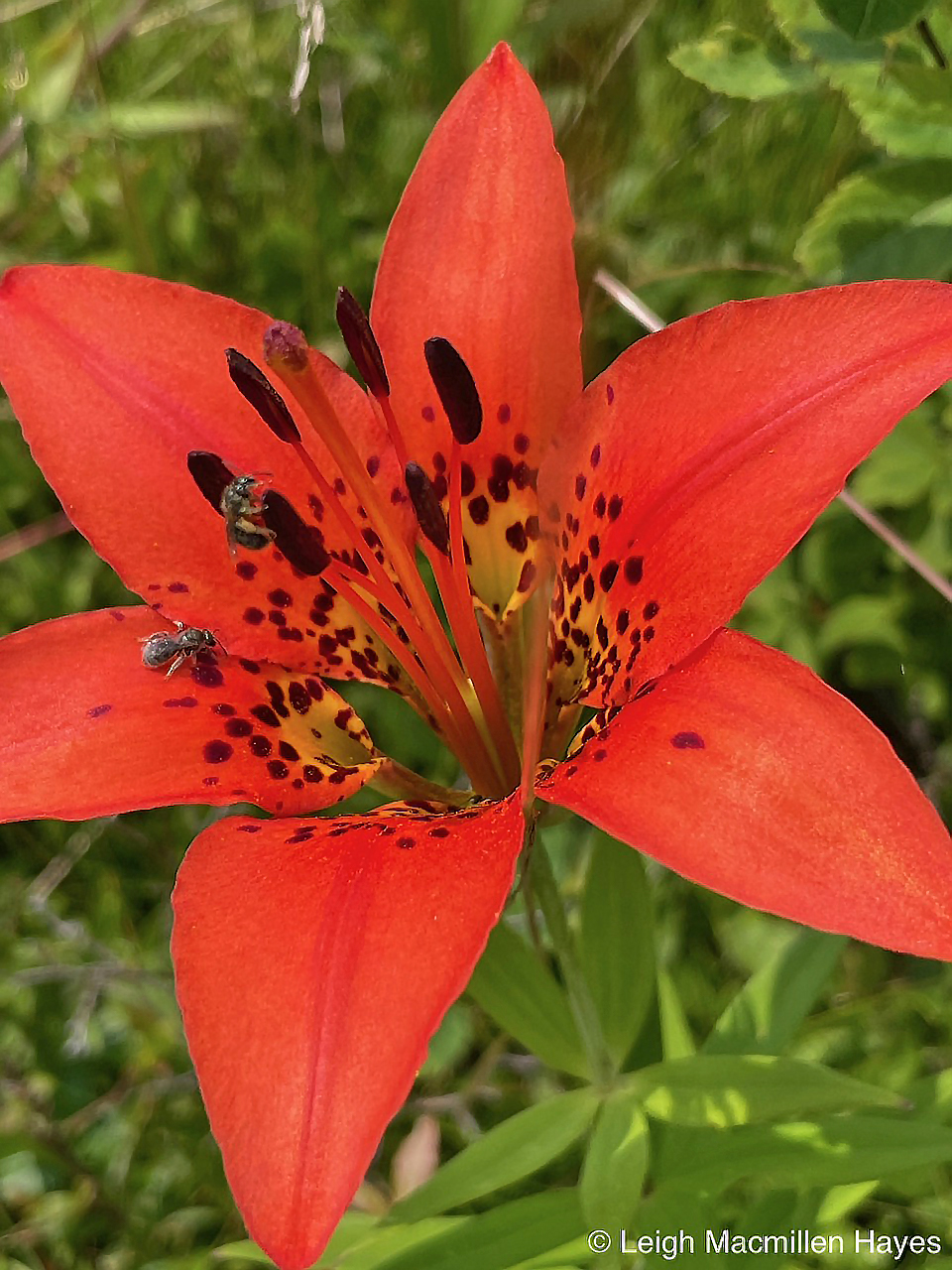
That said, his blueberries are my pollinators and with pollinators you have flowers, this one being one of many, many Wood Lilies.

There was also the Red-shouldered Long Horn Pine Borer, so frantic in its activity upon the Steeplebush flowers.

Plus a Paper Wasp upon Yarrow, . . .

And Flower Longhorn Beetle on Bristly Sarsaparilla. The season is short and there’s so much work to be done and the rain may have slowed things down so when the sun doth shine, it’s all insects on hand.

We finished up our hike, grabbed a to-go lunch at a locally eatery and then took off in the tandem kayak, with the same mission on our minds. Picking more blueberries for him, of course.

And checking out the local wildlife activity for me. We watched a beaver pass by our dock two nights ago, so we knew there was an active lodge somewhere in the area.

We actually found two new lodges and other older ones that were turning into islands. But we didn’t spy any beaver activity, probably given that it was the middle of the afternoon.

I, however, spotted a couple of species that envied My Guy’s blue greed, this being a male Slaty Blue Skimmer pausing in the midst of defending its territory.

And my heart was glad for we also spent some time with this tiny male Blue Dasher, another Skimmer who posed longer than I expected.

Only yesterday, I included his mate in Hunting for Dragons. Suddenly, here he was, albeit with a few Red Mite hitchhikers attached to his thorax.

While My Guy’s Blue Greed may be low and highbush blueberries, mine is definitely insects, and the bluer the better.

Rewarded were we, indeed!

Something’s Always Happening . . .

This is a tale that I’m so excited to share and it’s actually a month or two in the making. Each year I write about the saga of the vernal pool in the woods behind our house and how it begins as a “Wruck, wruck” love affair, but by the end of May fizzles into a stinky puddle full of dried up Wood Frog tadpoles and flies and Scarab Beetles mating and laying eggs.

Not so this year. It’s been a wet spring and now a wet summer and that, my friends, is fantastic if you are a Wood Frog or Spotted Salamander. For the first time in my 30+ years of visiting this pool, there is still plenty of water in it.

It is my understanding that if a pool dries out too fast, the frogs and salamanders sense this and some metamorph into their adult upland forms quickly in order that they may hop or crawl out and be representatives of the next generation. I have to believe that is true since despite the pool usually not lasting long, come April 7 or 8 or 9, when the ice “goes out,” the love songs begin and eggs are fertilized and laid.

This year, however, the frogs have been given the opportunity to slow the process down and perhaps that will make them stronger, as well as increase the numbers that leave the pool.

It’s not just the frogs, but the salamander population might also be on the rise.

So here’s the other thing. Walking to and fro the pool offers numerous other distractions of the natural sort, like this rather handsome White Admiral Butterfly.

And a female Ebony Jewelwing Damselfly, the white stigmas or marks on her wings providing a hint of her gender.

But then there was the day that I heard baby peeps as I headed out there and suspected I knew the species to whom they belonged because they’ve nested in our yard before.

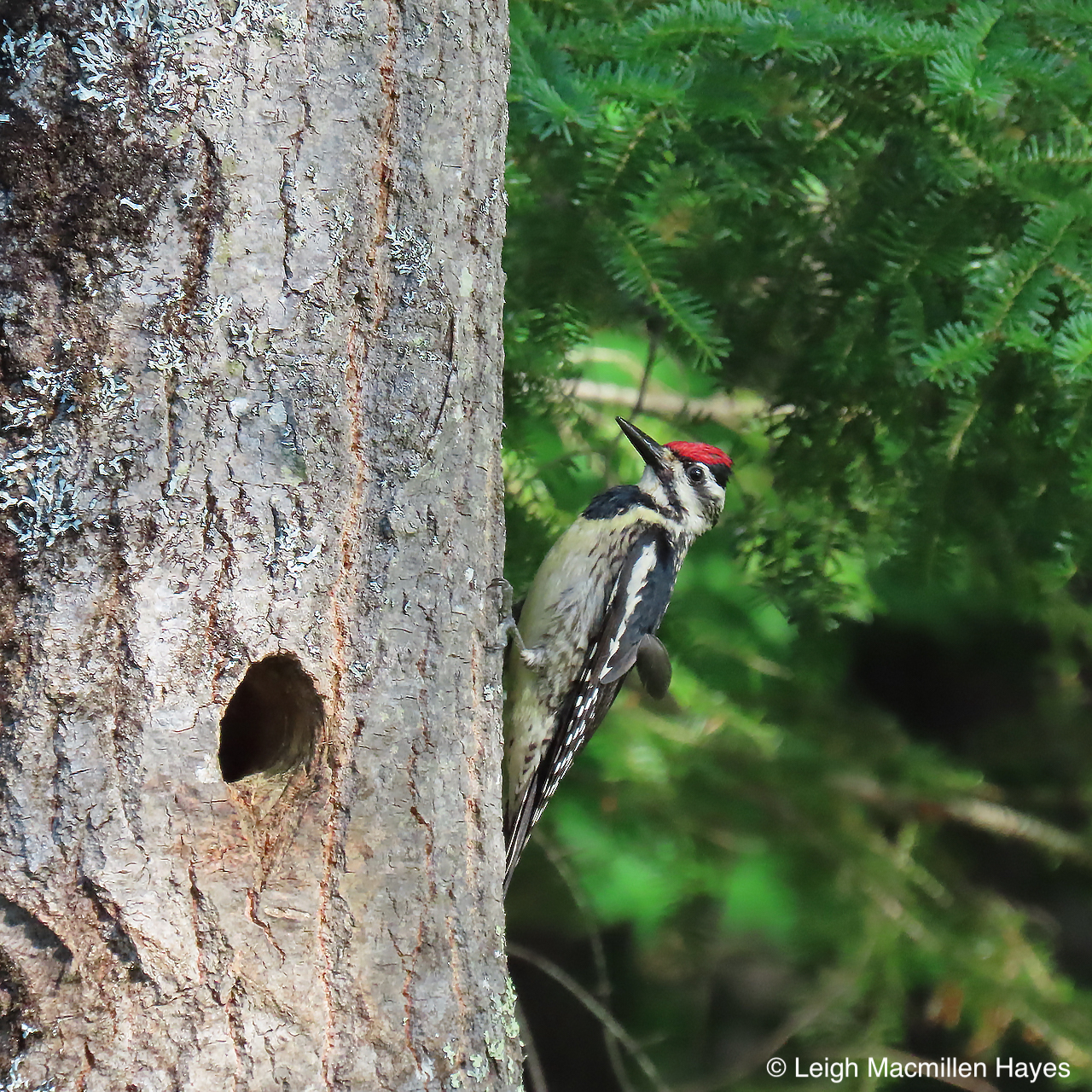
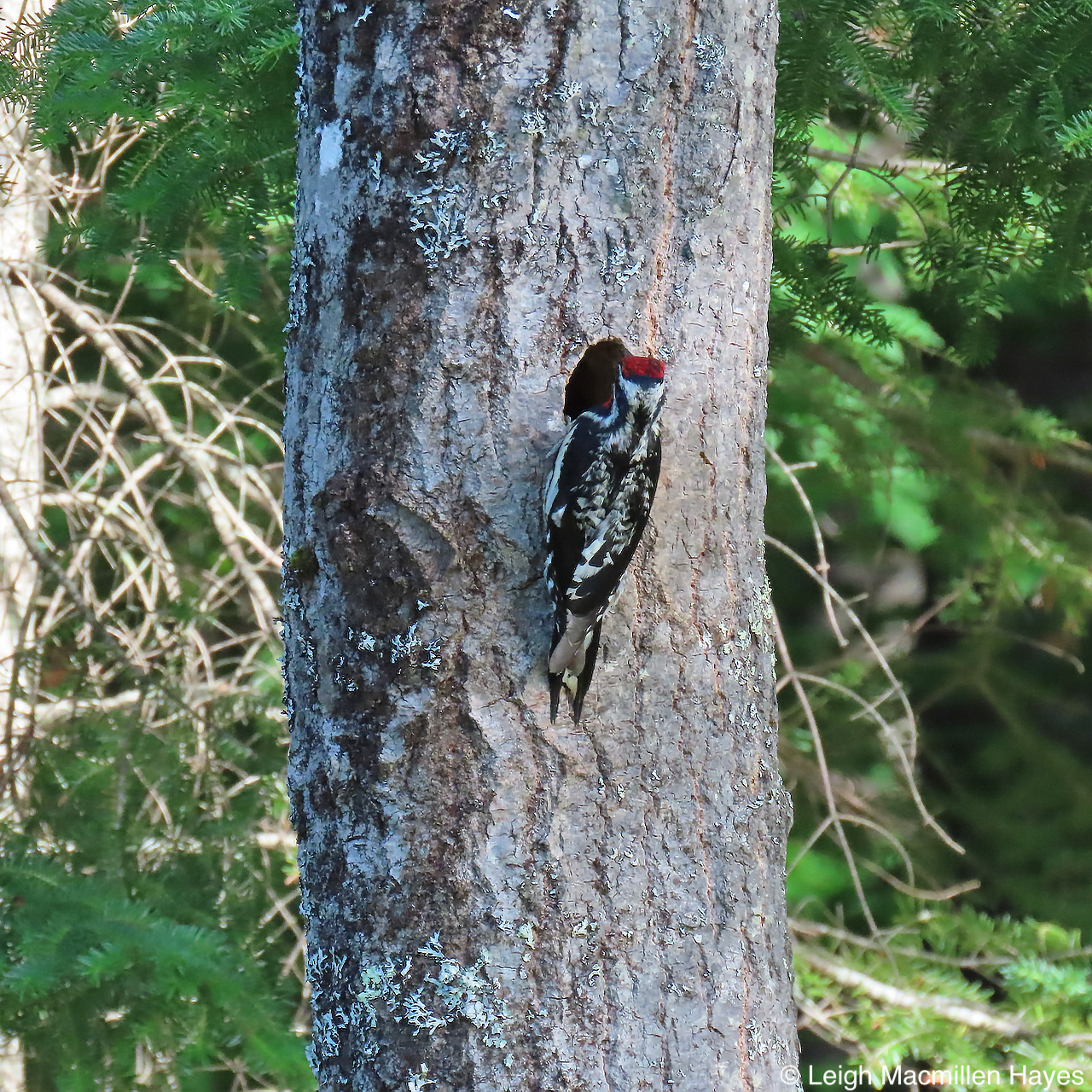
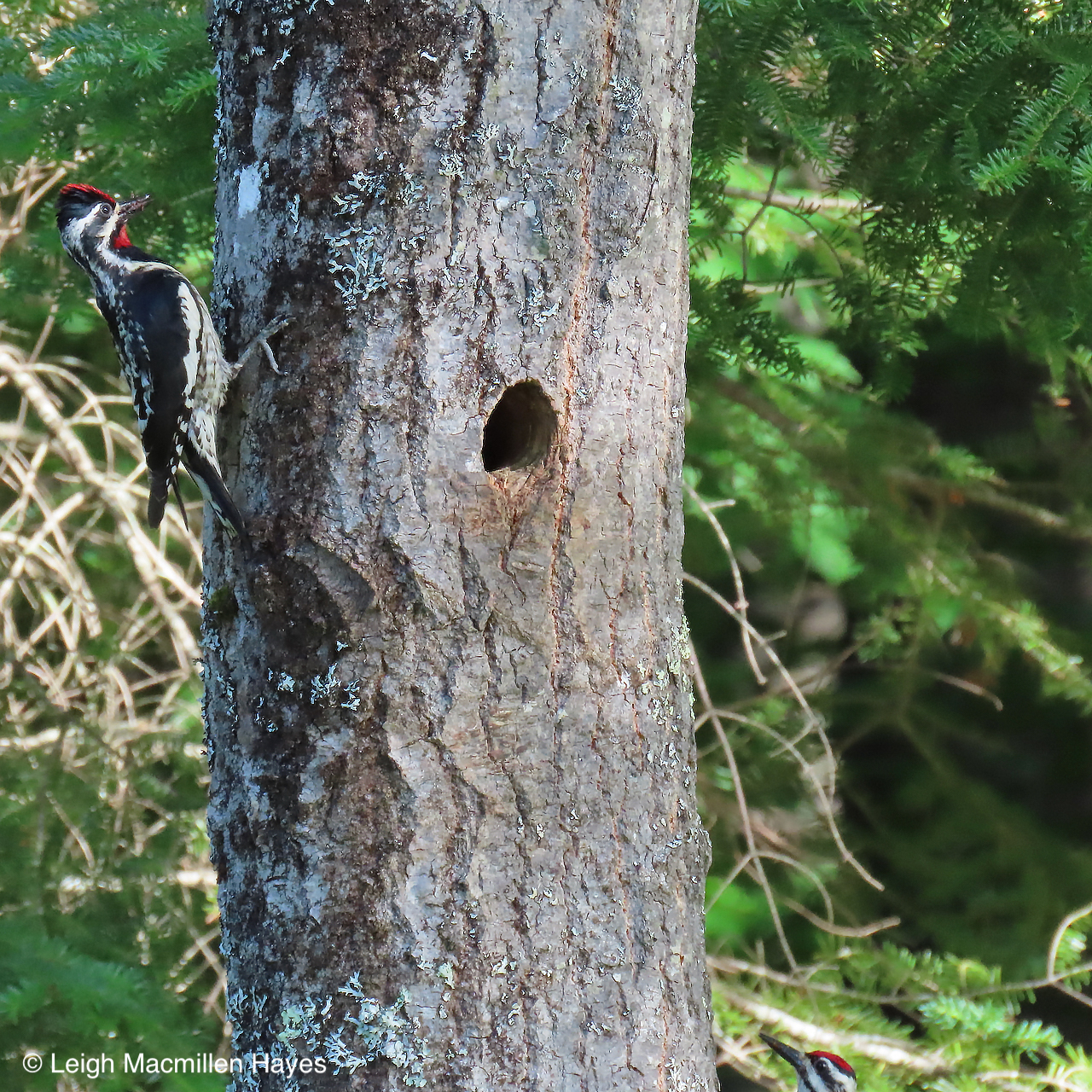
Crossing through a gap in the stonewall, I found the tree and Momma Yellow-bellied Sapsucker gave a hint as to the location. At first, however, I couldn’t find the hole where the babes waited for meals on wings to arrive.

Until I did because I passed back through the gap in the stonewall and went to the oak tree located in the far corner of the yard beside our woodlot and there they were: Papa on the right, Momma below, and the hole in between. These were two extremely attentive parents.

Momma would fly in rather silently and surprise me as I stood behind another tree about ten feet away. But the kids always seemed to sense the arrival of a parent and their peeps would rise in a crescendo and I’d look up and there she or he would be.

And then it was a matter of delivering the meal. To the hole the adult would move in its woodpecker manner.

And into the hole its head would duck, presumably delivering an insect of choice either into a beak or two or three or at least into the nest for the kids to fight over.

Right after the delivery was made, the insistent peeping would begin again. “More, more. We want more food,” the chicks seemed to proclaim.

And the parents delivered before flying off to find the next morsel to nourish their young.

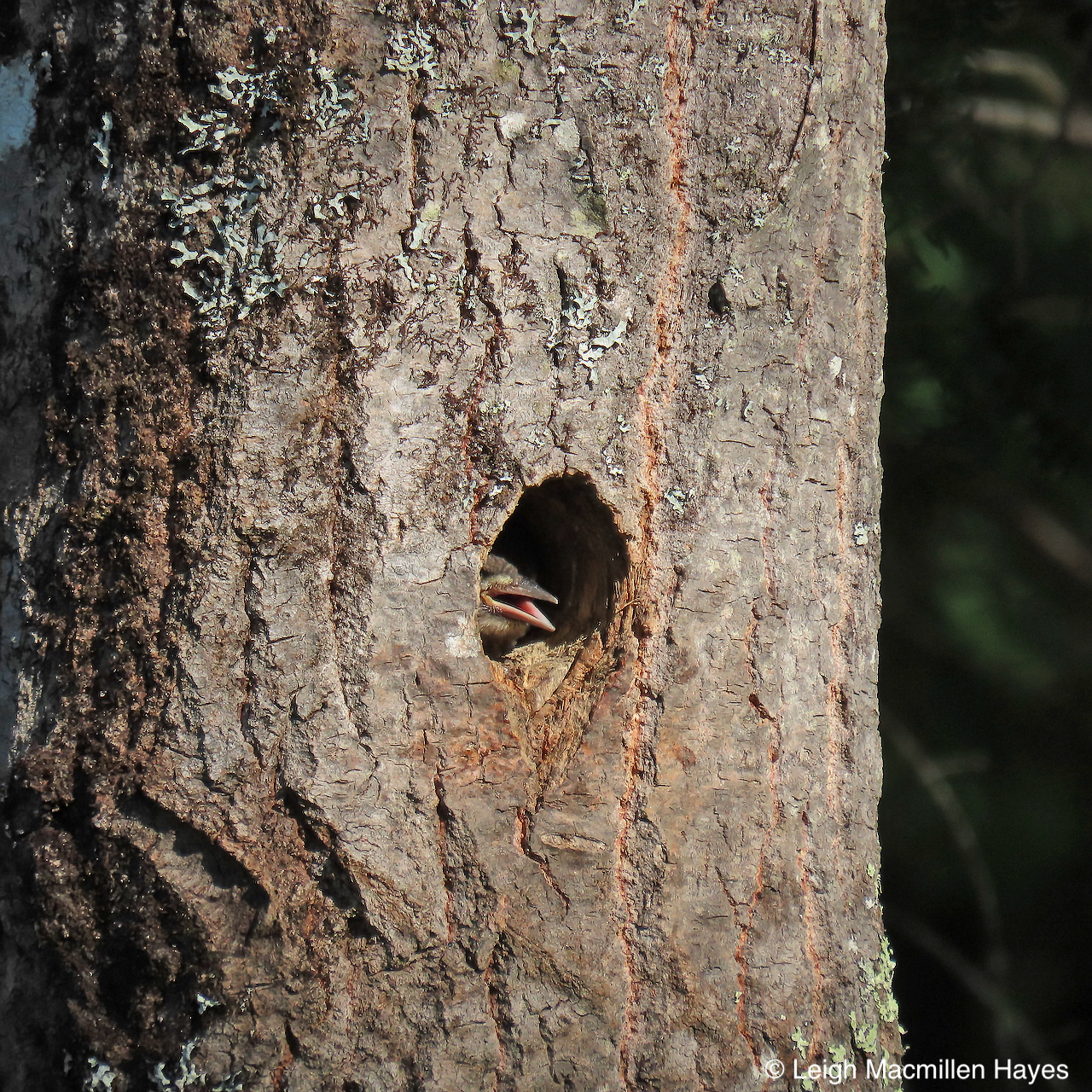
Still they did peep and occasionally showed their heads in the process.

By the end of the week that I spent watching, this youngster stuck its head out and made that insistent cry. Its parents disappeared for longer periods of time, which I’ve noted in the past and it makes me wonder if they have to go farther afield to find food, or if they want the kids to understand that instant satisfaction isn’t always the name of the game. Within a day or two and when I wasn’t looking, the chicks fledged and now I hear them learning the art of tapping to mark their territories.

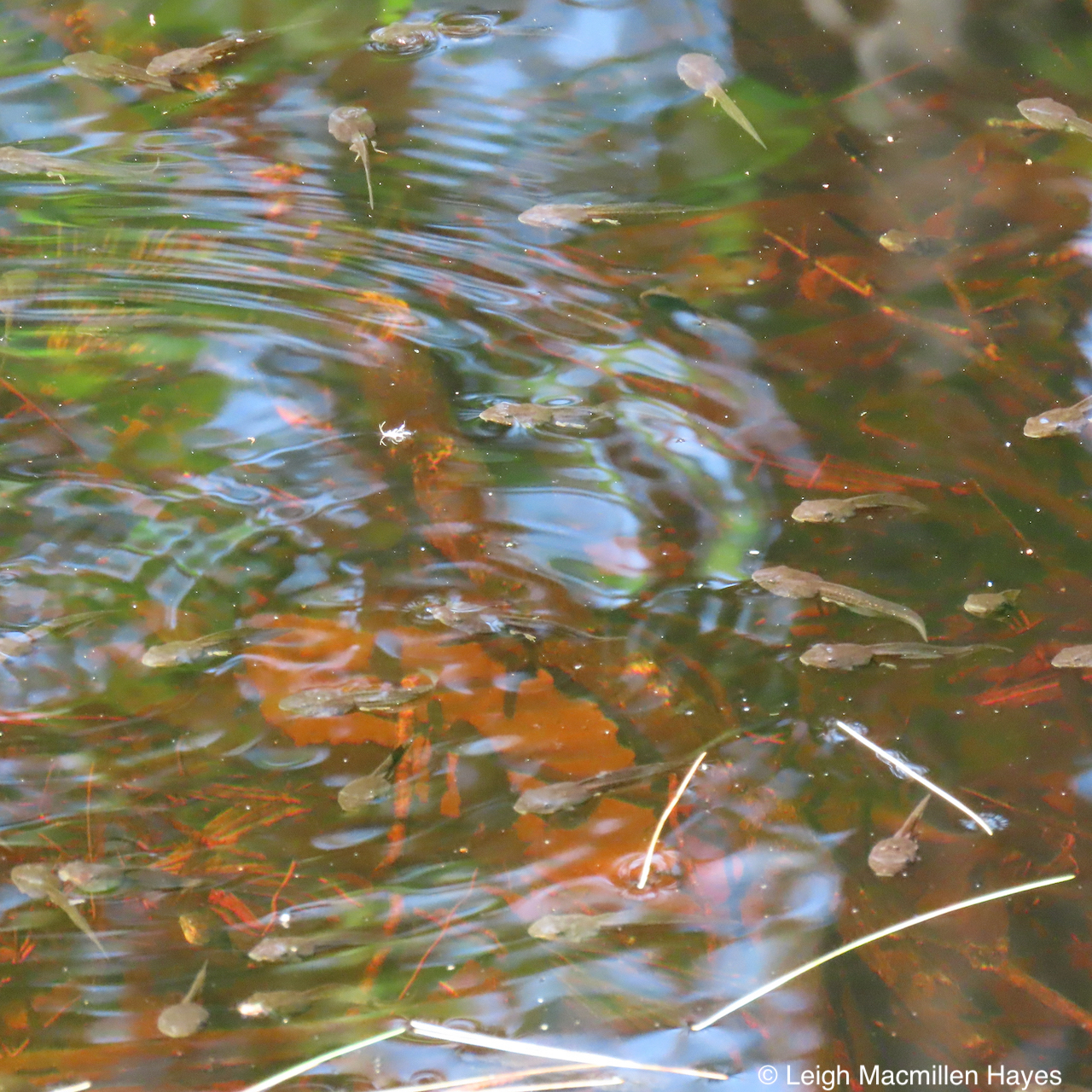
Oh, but wait, this is the tale of a vernal pool. And there too, there were changes like I’ve never seen before in this one. For one thing, the water teemed with activity.

Up for air they’d come and then dodge down again, leaving ripples in their wake.

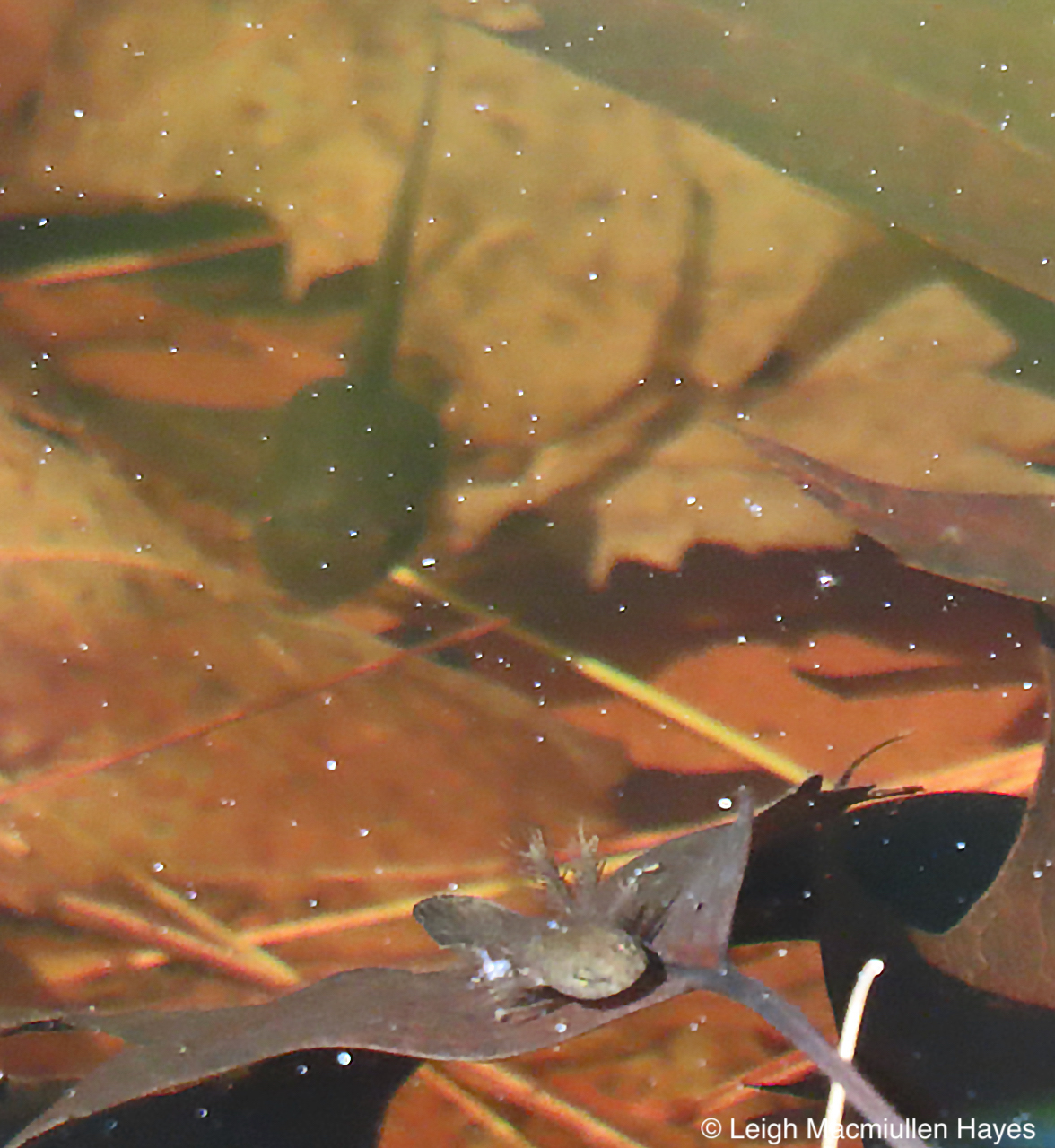
But . . . do you see what I saw during today’s visit? Legs! My frogs are growing legs. I’m so excited for them. I have to be as, unlike the Yellow-bellied Sapsucker chicks, they don’t have parents watching over them, feeding them, and teaching them froggy ways of living.

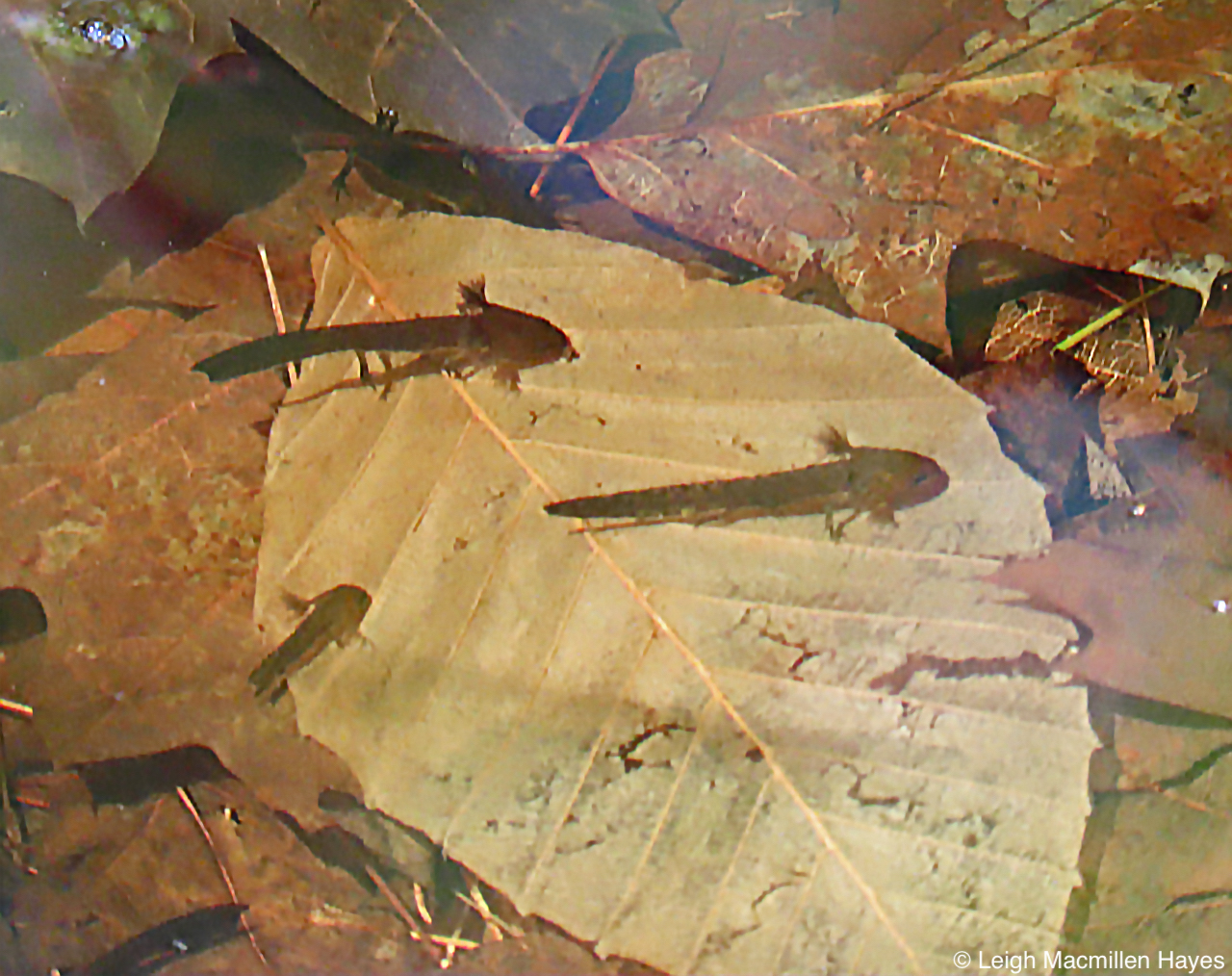
The same is true for the Spotted Salamanders who are breathing through those feather gills behind their heads for as long as they are aquatic in nature.

It was on my way home this afternoon when something else moved in the woods not far from my labyrinth and I thought at first it was a bird.

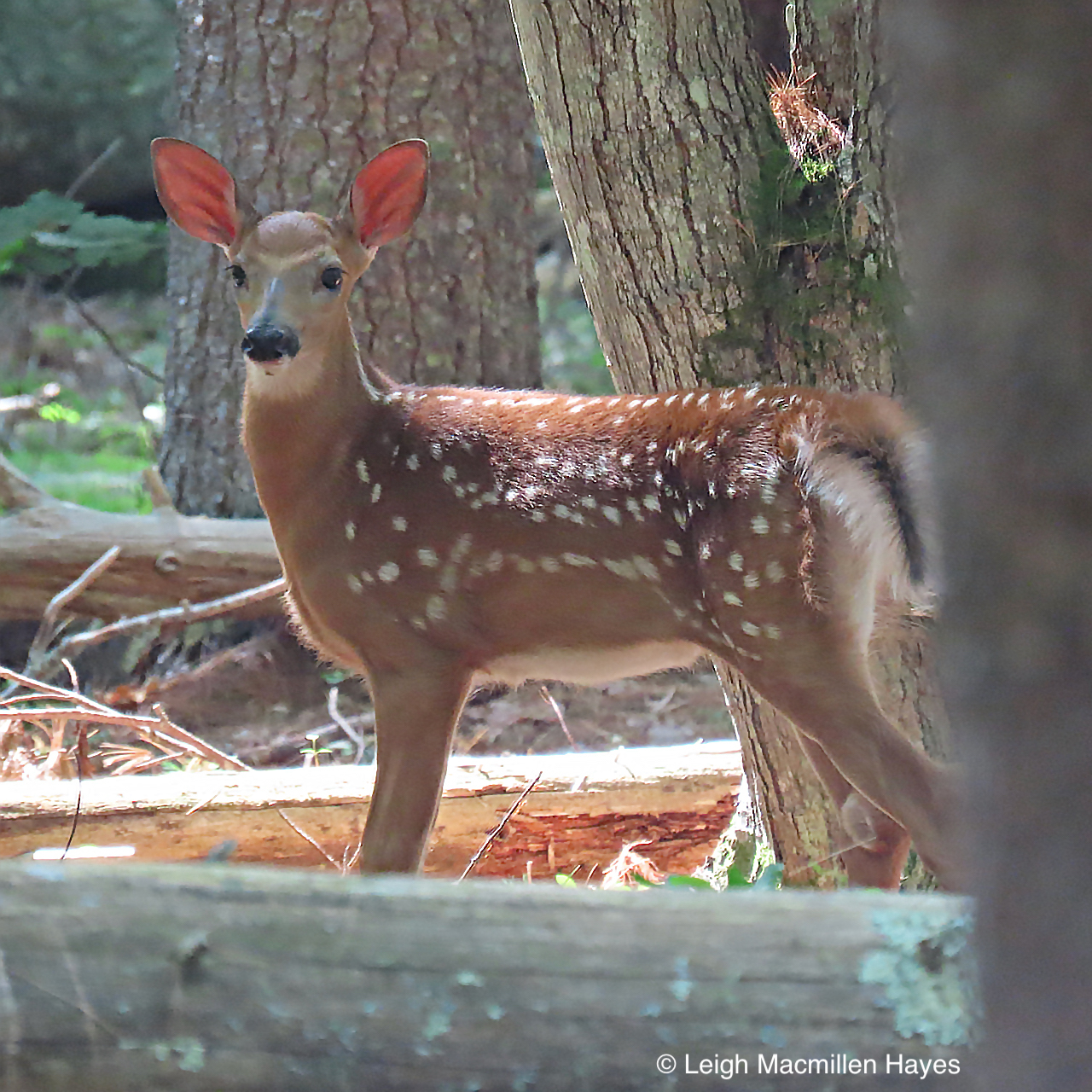
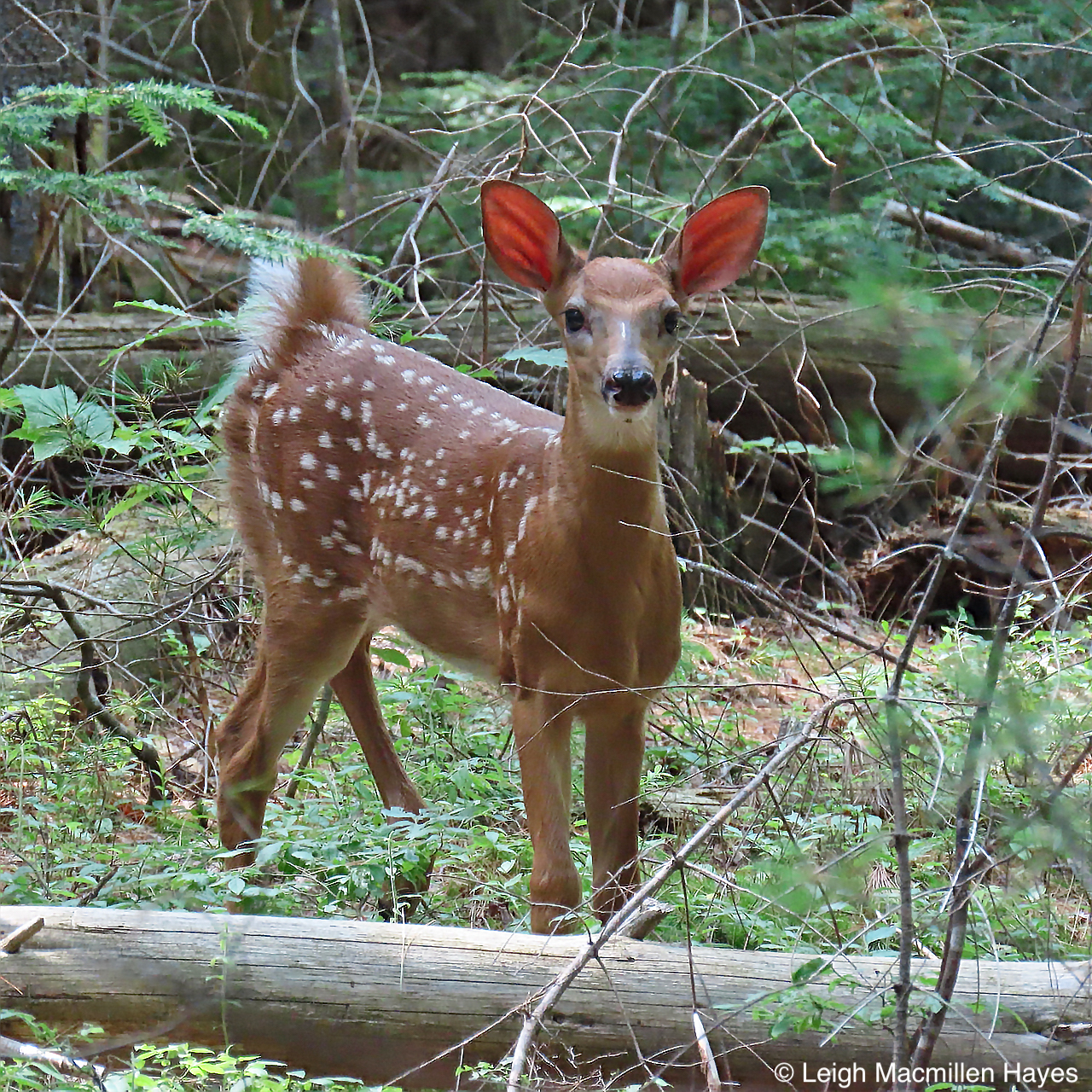
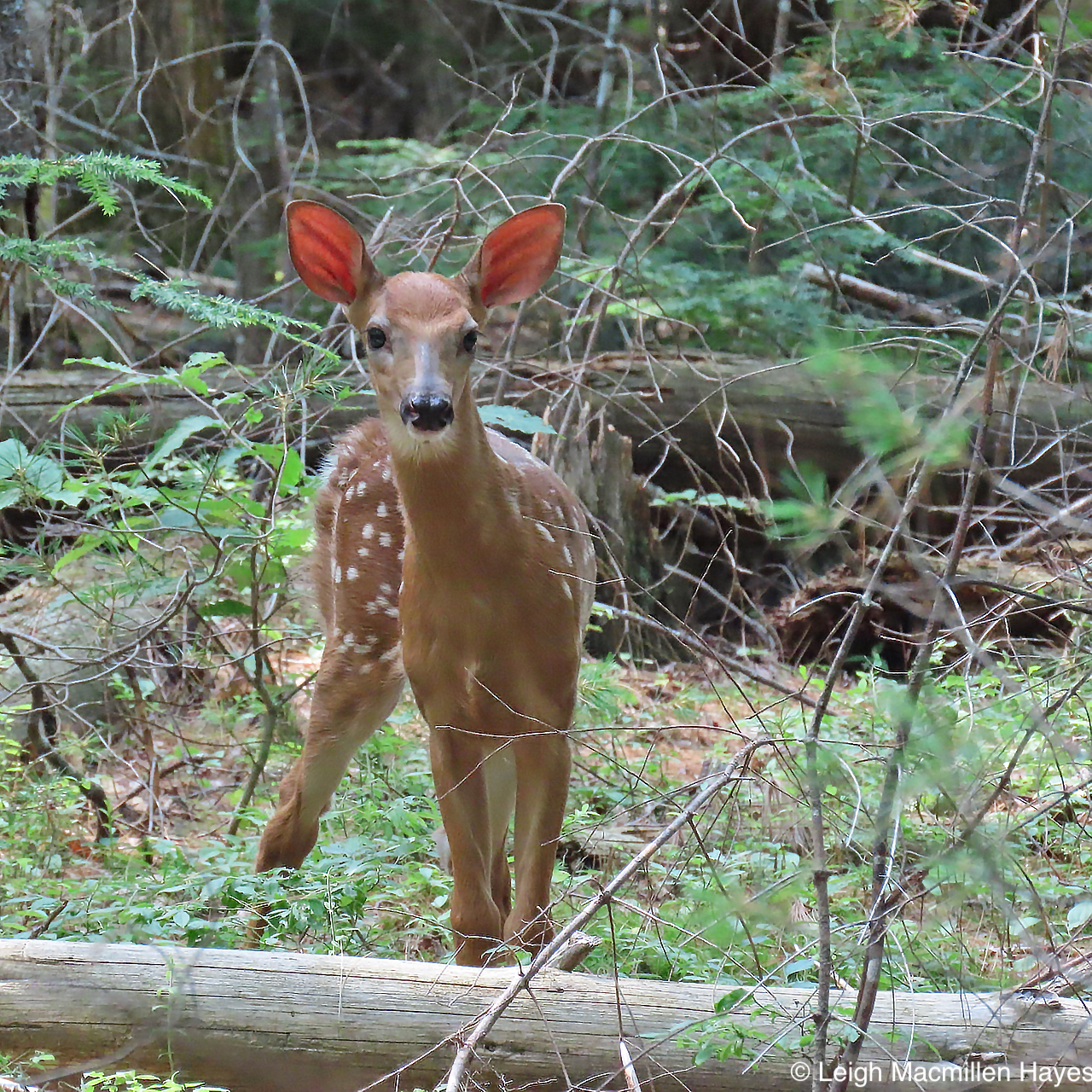
Until it too morphed . . . into a fawn licking its chops. And then I recalled that on the way to the vernal pool, I’d startled a doe in about that same spot and she’d leaped away and in the last few weeks I’ve seen the doe visit a spot in the field over another stonewall and I’ve stood on a kitchen chair with my binoculars trying to see if she might have a fawn. Apparently she did. I am tickled except for the fact that they are eating flower buds in my pollinator gardens.

That face. Those ears. And spots galore. How can I not share the buds with this rather chunky youth?

We spent about ten minutes together, each curious about the other, until it occurred to me that again, like the Sapsucker chicks, its parent was probably nearby and waiting for me to move on.

And so I did.

Still, I can’t stop smiling because something is always happening and it’s right outside my backdoor when I take the time to listen and notice.

A Moosed-Up Mondate

Some stories are best told in the wrong order and this one is such. Or at least that’s what I think. You see, My Guy and I headed north today, not far north either. Maybe a little over a half hour from home.

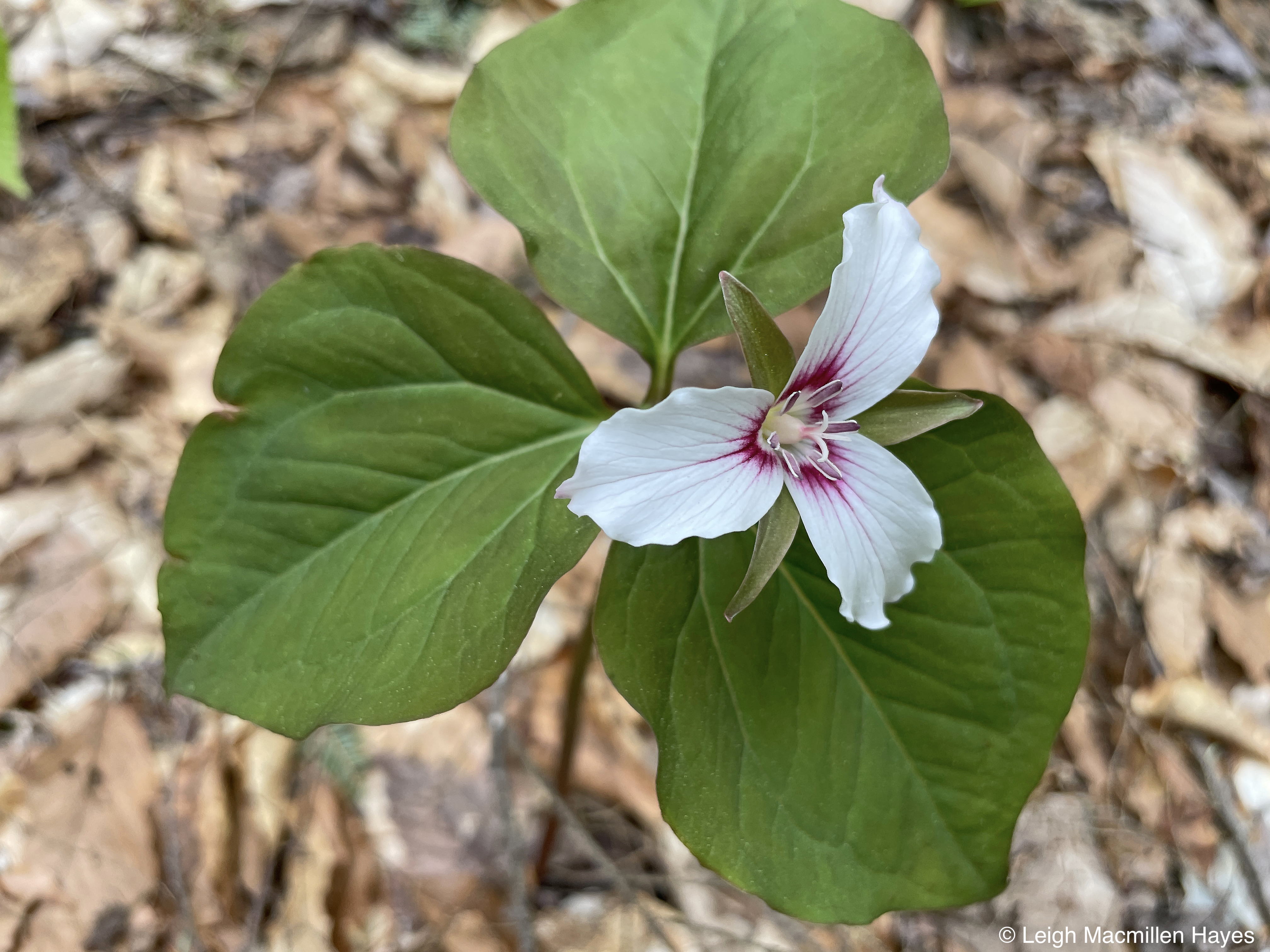
We went in search of one of his quests–Lady’s Slippers. We knew it was too early for them to be blooming in our area of western Maine, but thought we’d look anyway. Along the way, I decided to count Painted Trillium because My Guy always comments that there are a trillion trillium blooming near trails at this time of the year. And I need to honor so many of them with a photograph. I wanted to know if he is right and we’ve never counted trilliums before. He didn’t join me on this mission, but I did notice he frequently paused near one.

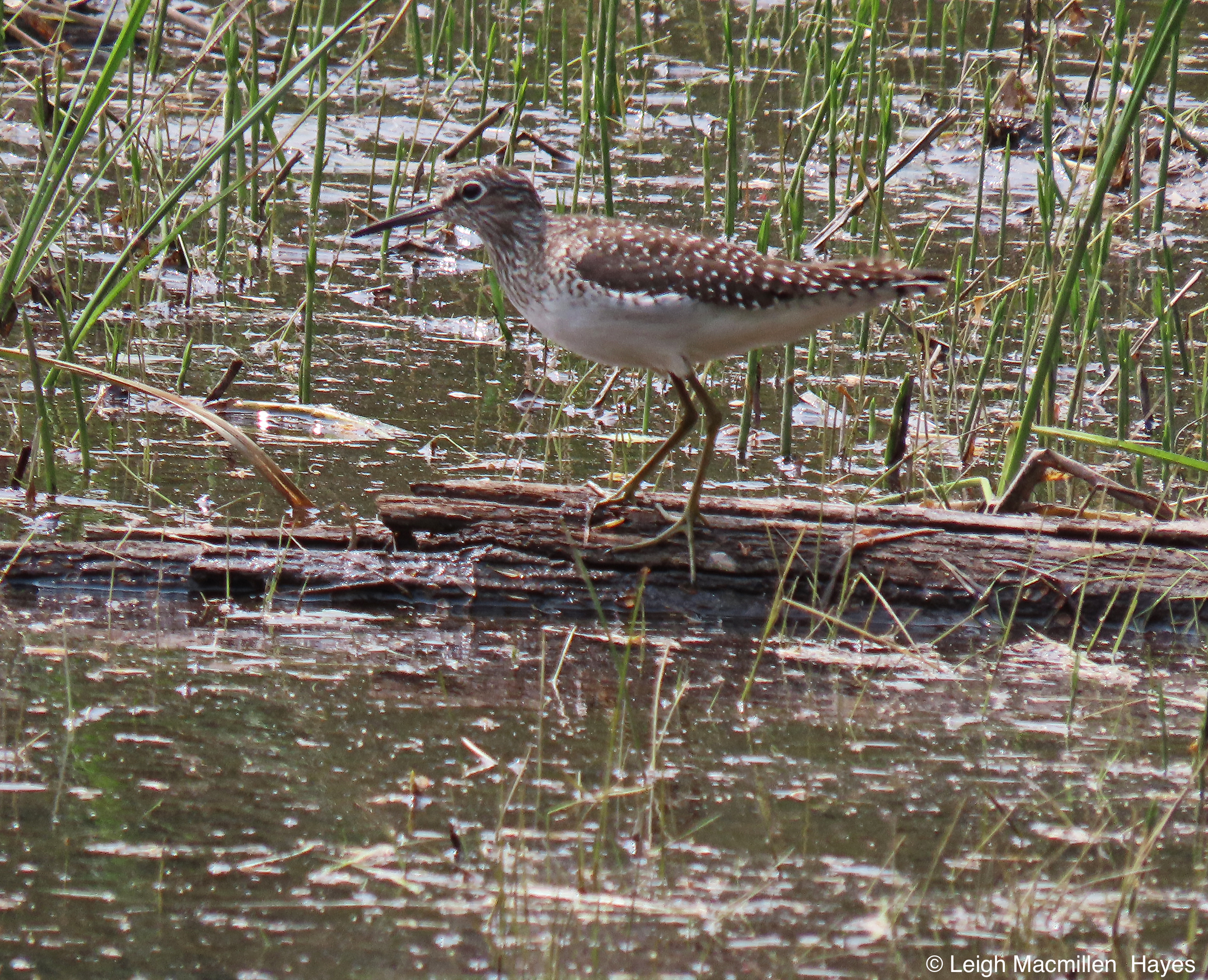
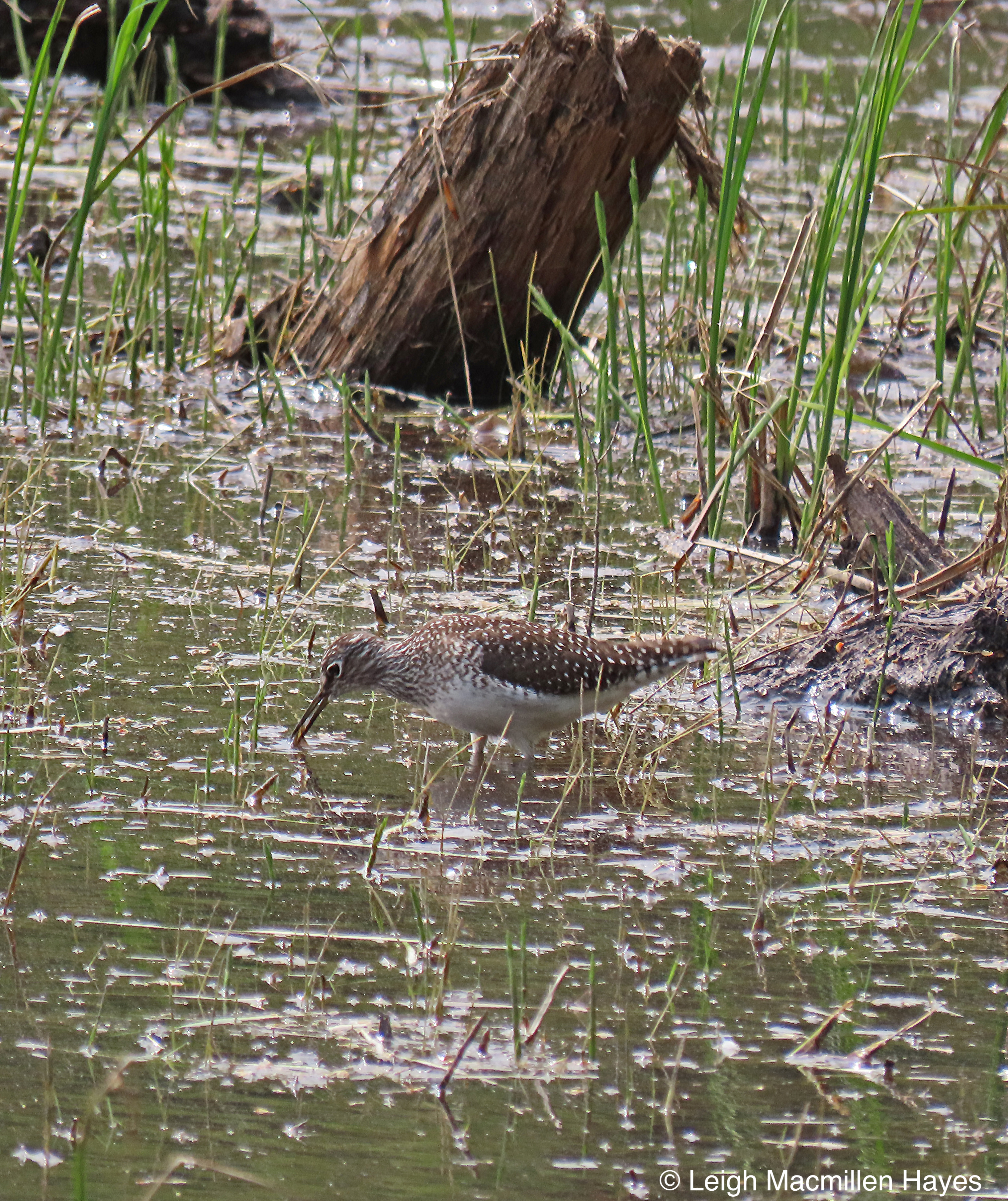
In the midst of our journey, we stopped beside a wetland and didn’t spot the Solitary Sandpiper at first, but then it moved. Constantly. As is its habit to provoke its food source into moving.

What it saw with those be-speckled eyes, I’m not sure, but I do think aquatic insects and amphibians were on its menu.

After a wee bit, we came to the beaver dam that bisects the trail, where fresh mud indicated someone was at home. It’s a tricky crossing, but I’m here to say we were successful on the way up and back.

Onward and upward, my count continued and while most often the Painted Trilliums were solitary like the sandpiper, these five represented numbers 41, 42, 43, 44, and 45.

We also found a few Red Trillium, aka Stinking Benjamin, to honor.

Approaching the summit, My Guy checked on his favorite Lady’s Slipper bouquet, but it’ll be another two or three weeks before we’ll be counting their blossoms.

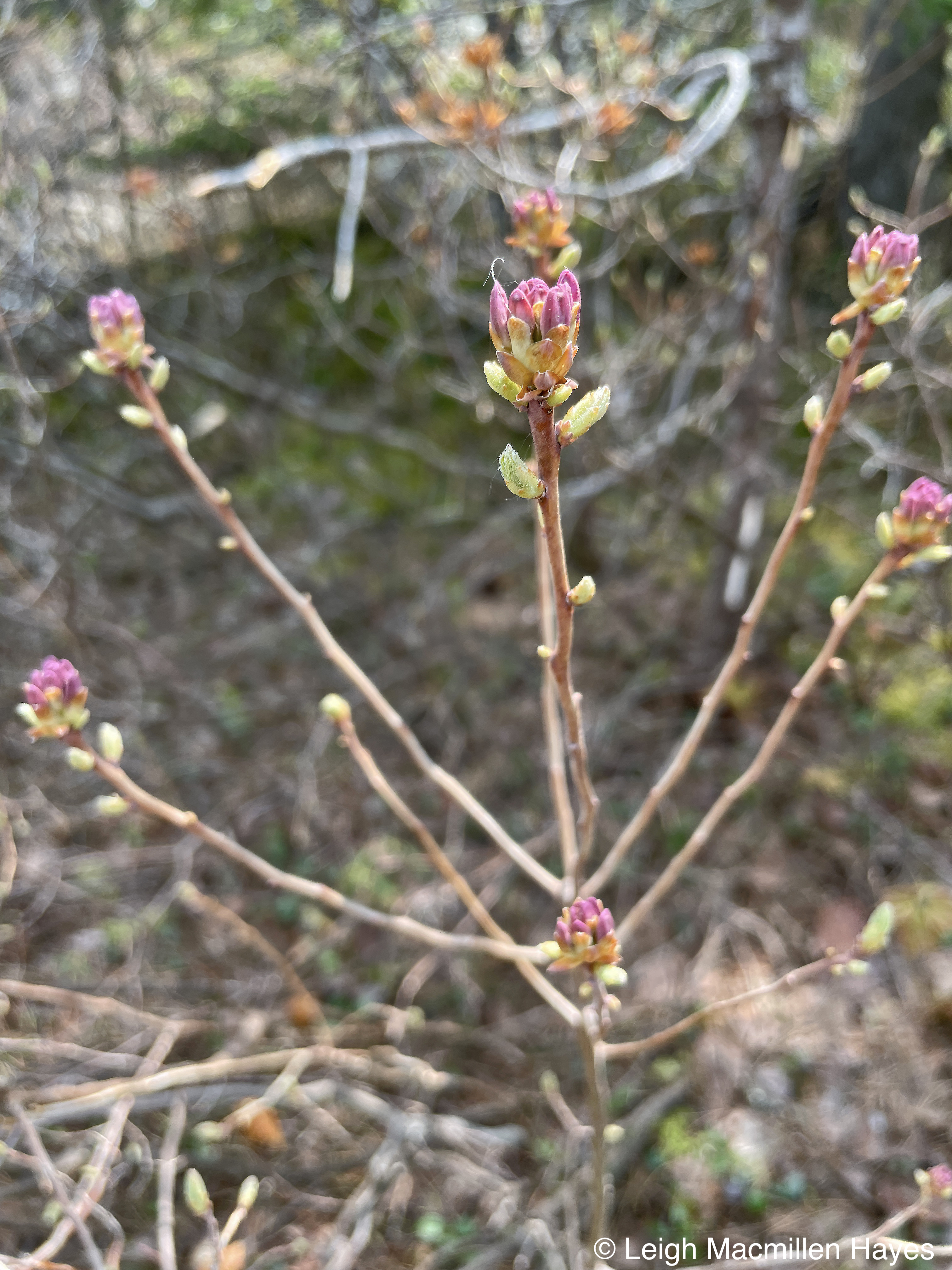
And I checked on the Rhodora, also offering a peek into the future.

Lunch upon lunch rock offered a hazy view of the mountains beyond. And it served as our turn-around point as this is an out and back trail.

BUT . . . remember at the beginning of this tale I said I was presenting things a wee bit out of order? Back toward the beginning we approached the beaver dam silently because sometimes we are treated to moments with the beaver as it tries to rebuild the dam. As we rounded a corner, we heard water dripping. It was just not quite in a beavery sort of way.

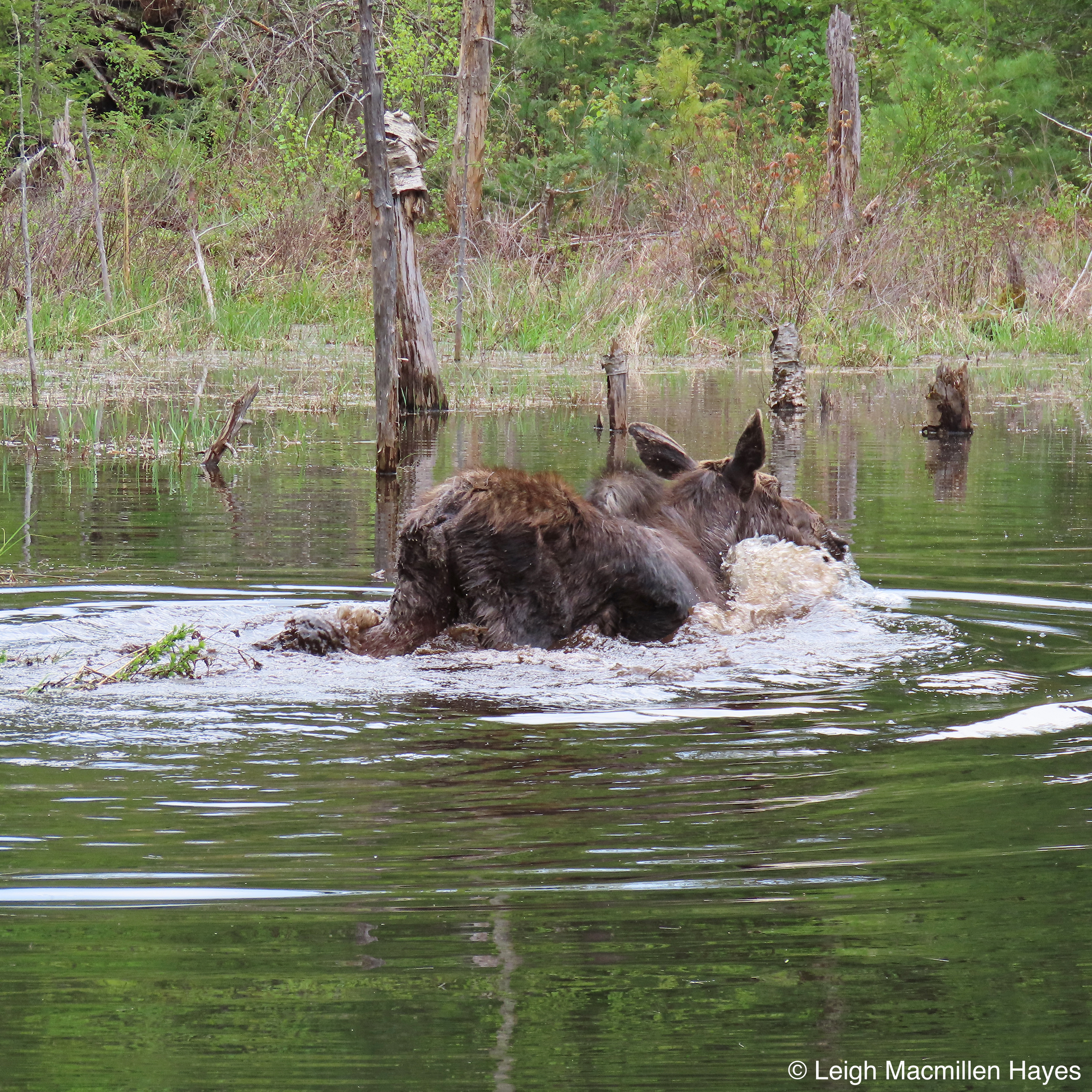
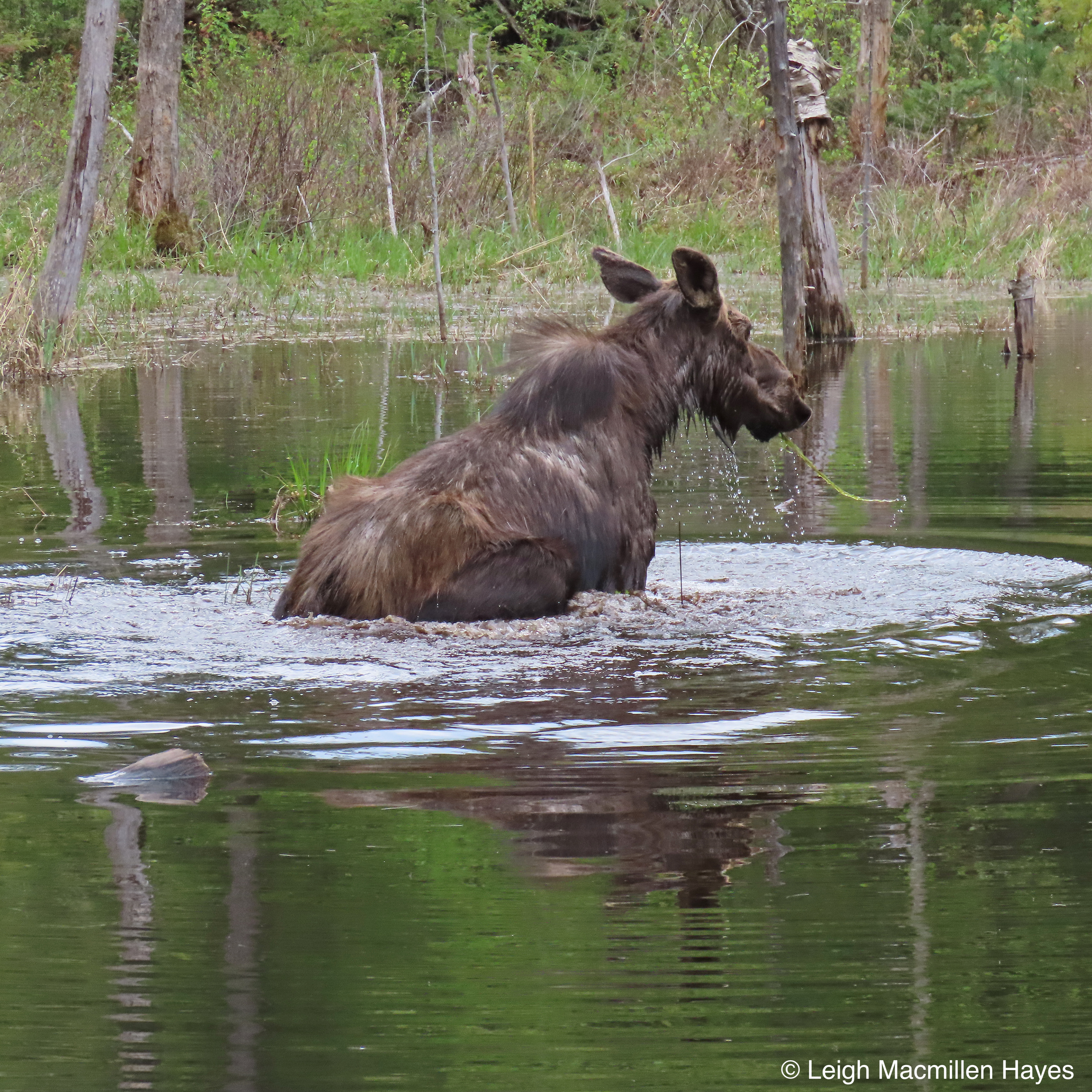
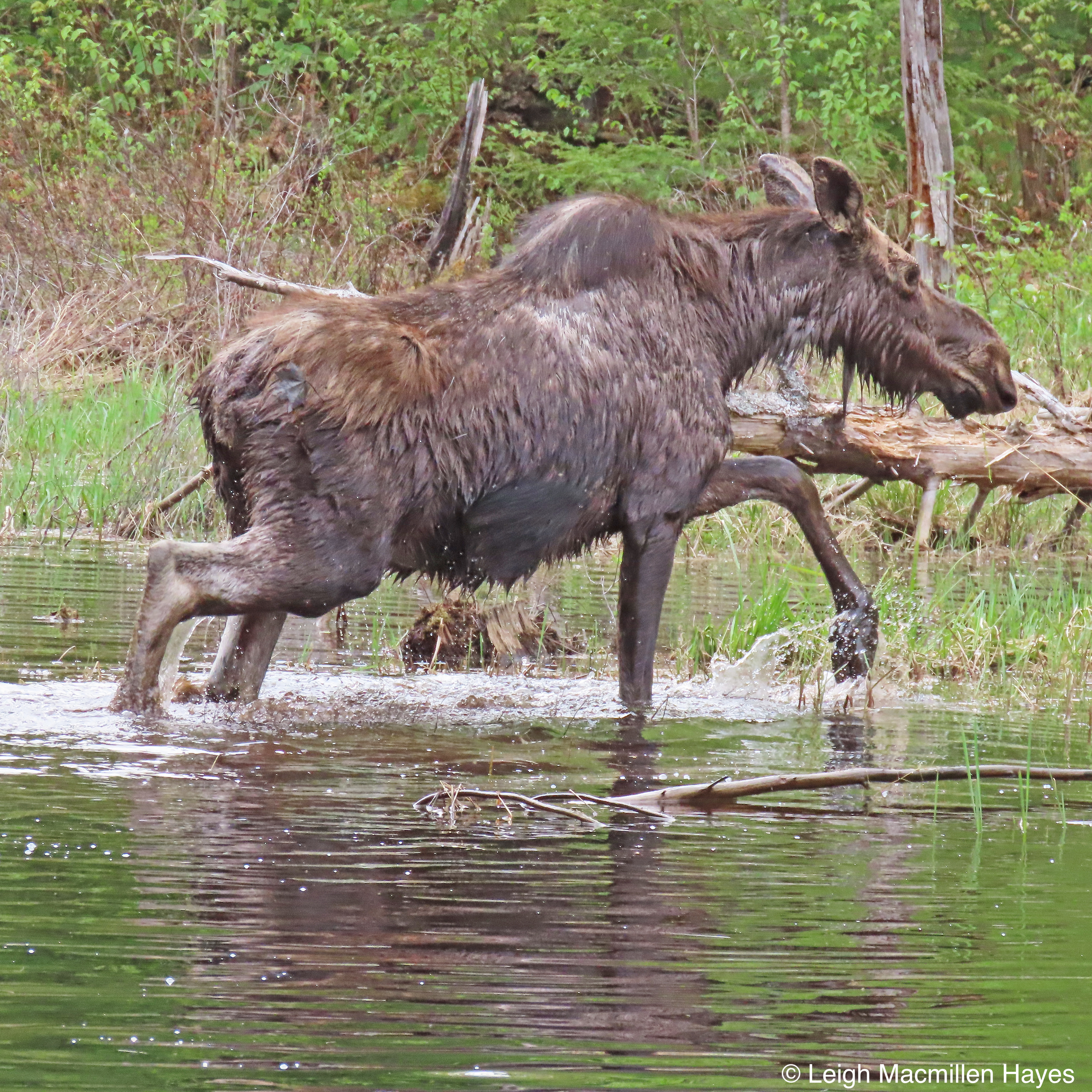
That’s because it wasn’t a beaver, but rather a Cow Moose. This photo was taken just moments after she and I looked at each other from her spot about fifteen feet from where I stood. It took me a second to realize that I was starring into her eyes, and another second to silently alert My Guy and grab my camera. And then she turned and started across the water, not an easy task in a beaver pond filled with many fallen trees.

She’d been dining as you can see from the vegetation dangling from her mouth.

Look at that face, one only a mother can love. That oversized upper lip. And those warm brown eyes. She did look rather mangy, but that’s a spring thing as she sheds her winter coat.

As she moved off, in her tippy-toe ungulate manner, water dripped from her body.

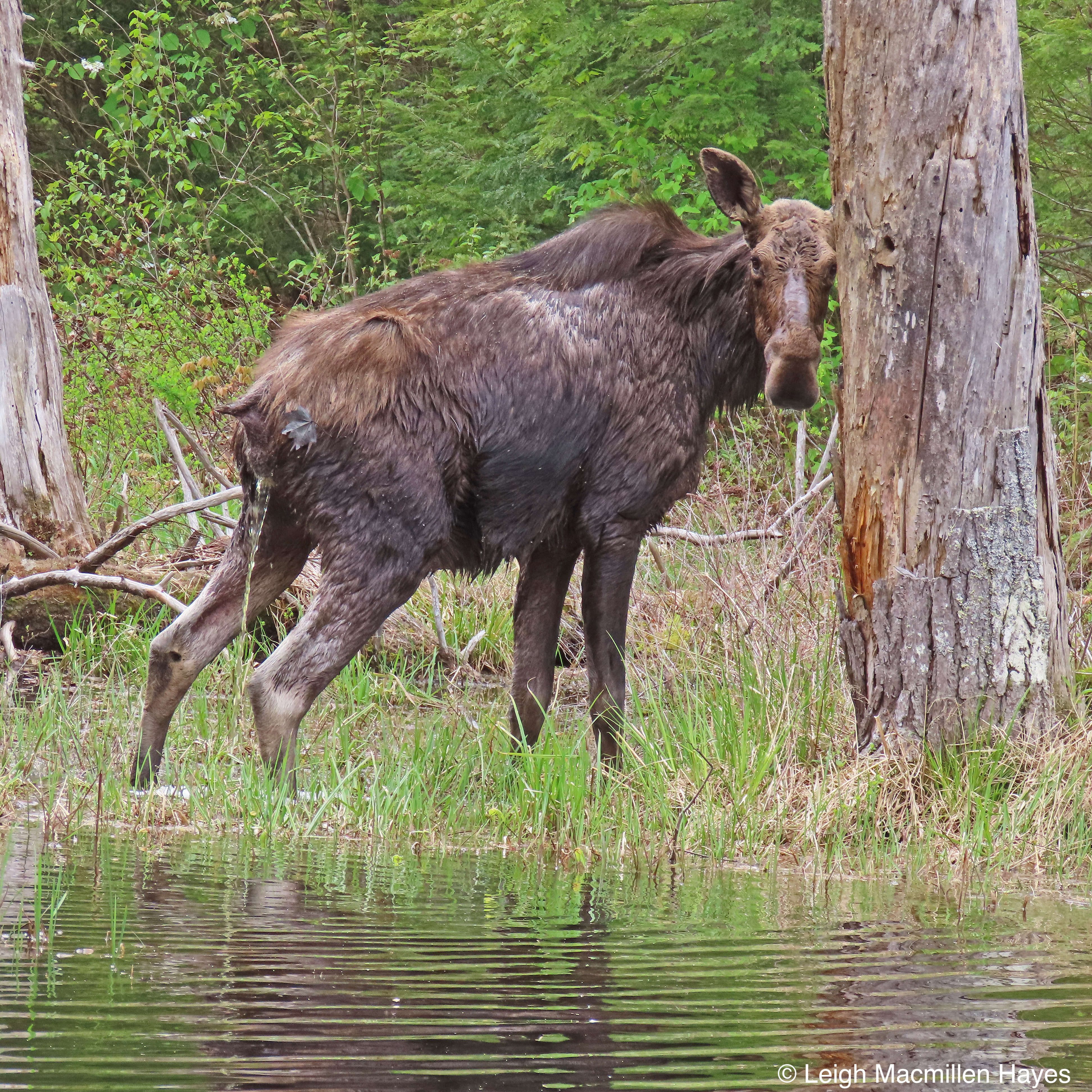
And then she looked back at us and peed. We felt the same way about her–it was a pee-in-your-pants moment.

Finally, she began to disappear into the woods.

And blended right in with her surroundings. How often, we always wonder, is there a Moose in the landscape that we just don’t see.

Especially when it looks like this? Can you spot her now?

We may not have counted Lady’s Slippers on today’s Mondate hike, but we certainly didn’t moose it up, either.

Final count:

Painted Trillium 59

Red Trillium 3

Cow Moose 1

One was certainly enough!

Where The Moose Led Us Mondate

It seems there are never enough rainy days to complete home chores so when today dawned as such I thought that all the contents I’d been sorting from a closet would finally make their way to new homes like the dump store or community clothing closet or back into containers to be stored for another rainy day.

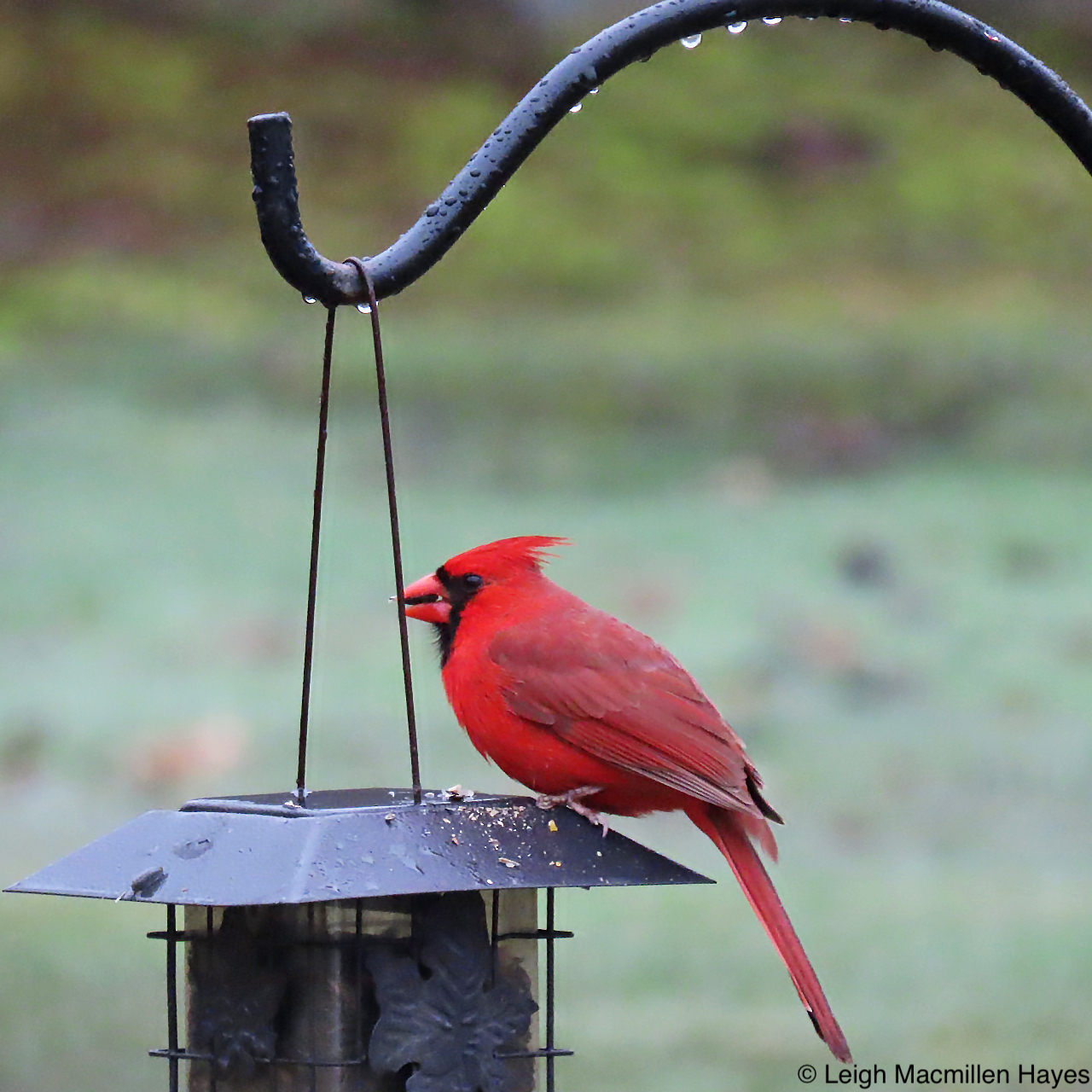
Apparently, I thought wrong for the Cardinal beckoned and we answered the call to head out the door.

When I mentioned a location for today’s hike to My Guy, he agreed that it sounded good, though come to find out, in reality he thought we were going someplace else and even when we arrived at Great Brook, he couldn’t recall our last visit, which was in 2016. Fair enough. I’ve been there many more times.

It soon became apparent that we were in Moose territory and our excitement rose. Actually, on another trail in this same neck of the woods we once spotted a Moose, so all we could do was hope that today we’d receive the same honor.

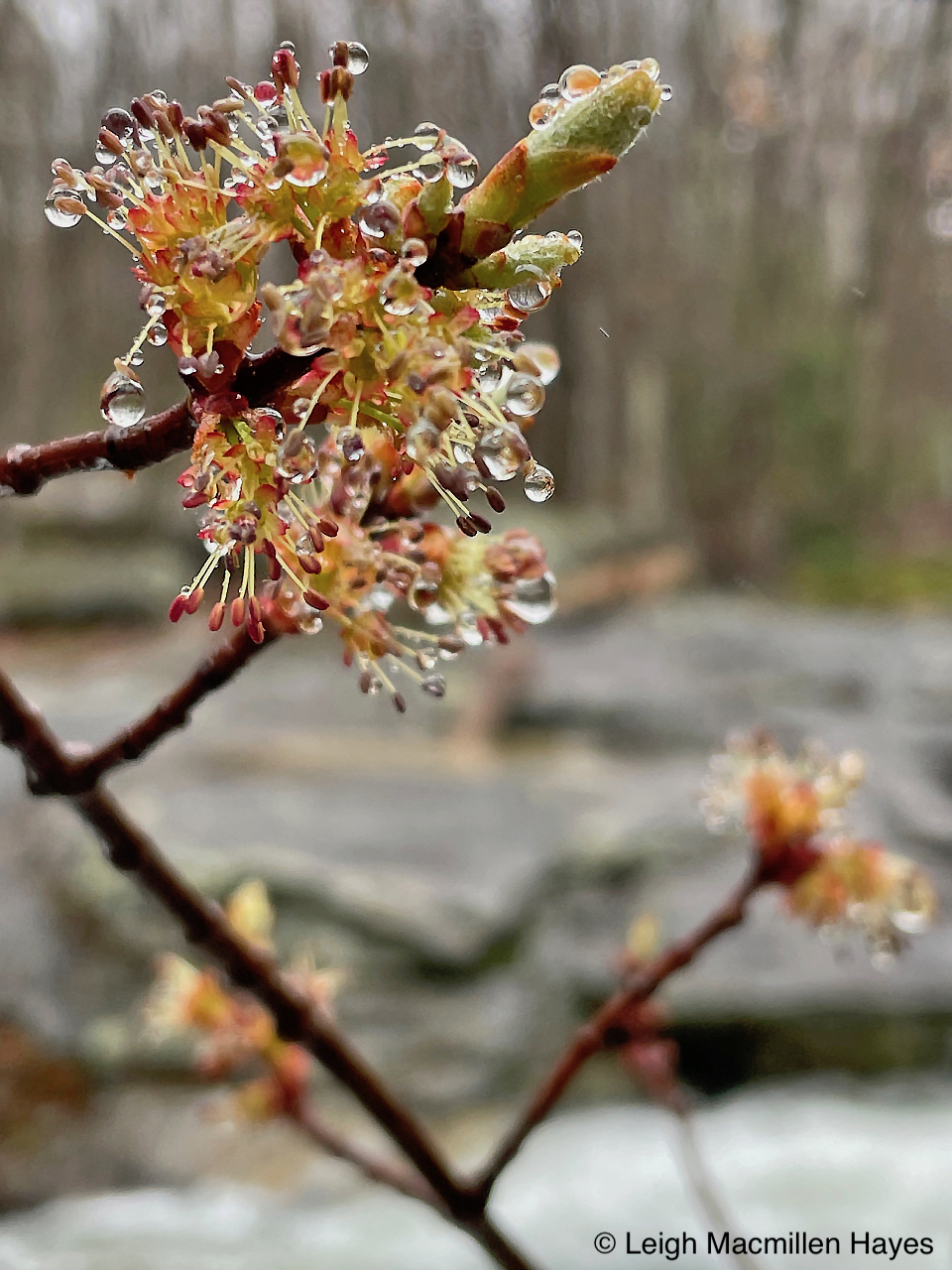
But first, there were other honors to receive, such as this bouquet of flowering Red Maple.

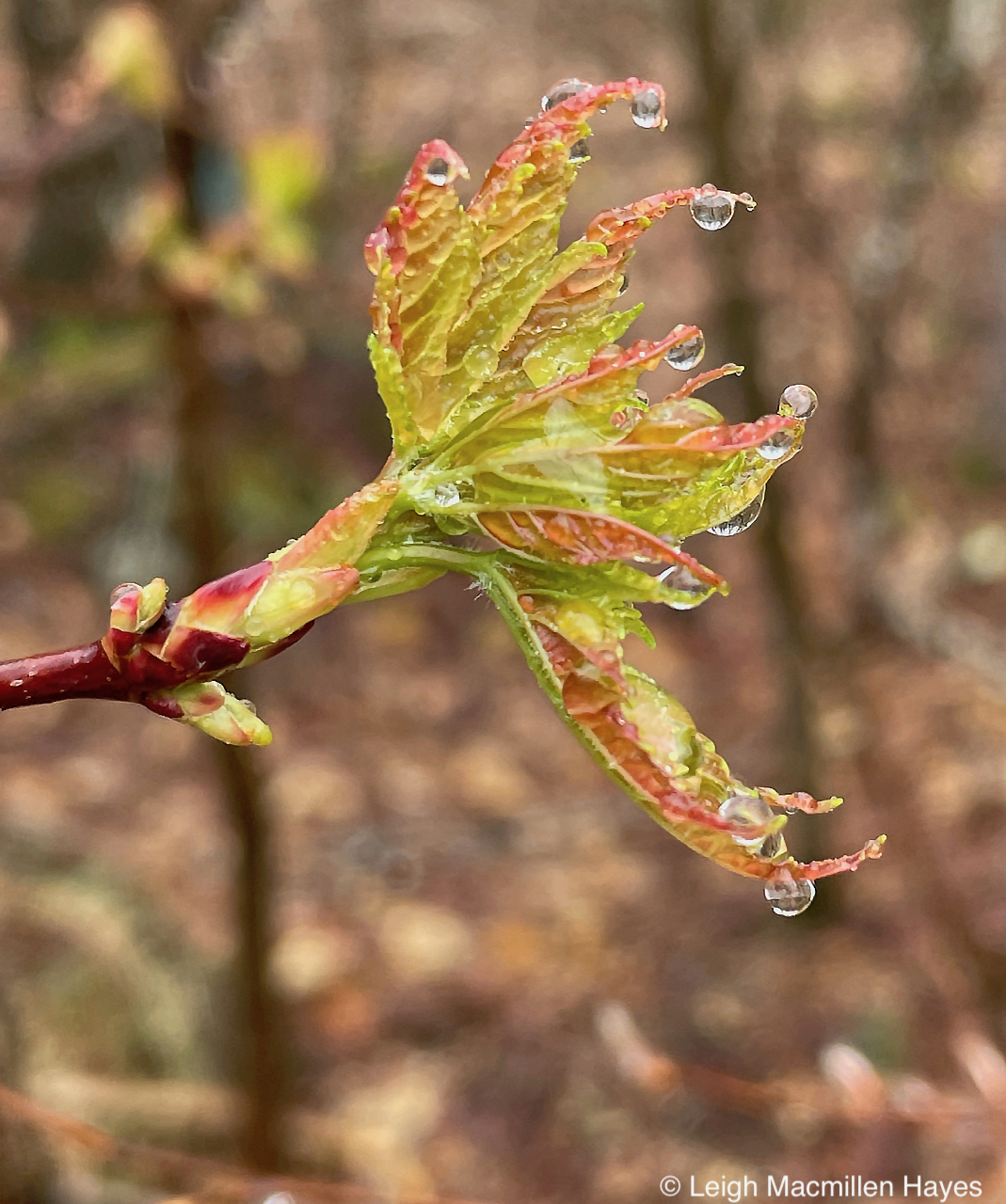
And the first of the season for us, maple leaves bursting forth in all their spring glory of color.

Onward we hiked deeper into the woods where a place one might think of as no place was once some place. This particular foundation has long been a favorite of mine because within is a root cellar.

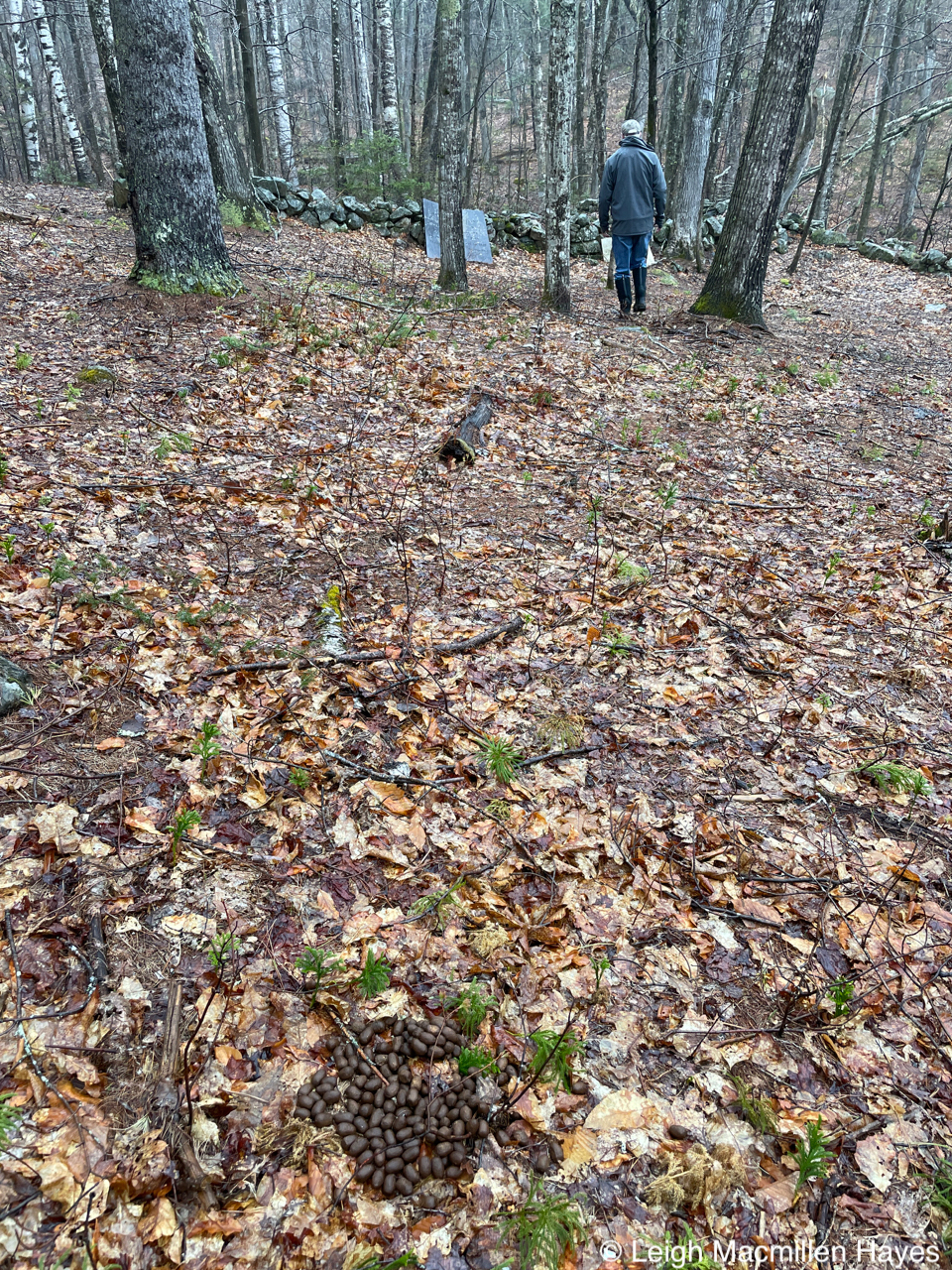
It’s one I can’t resist stepping into because you never know what tidbit might have been left behind.

Porcupine scat! Rather old, but still.

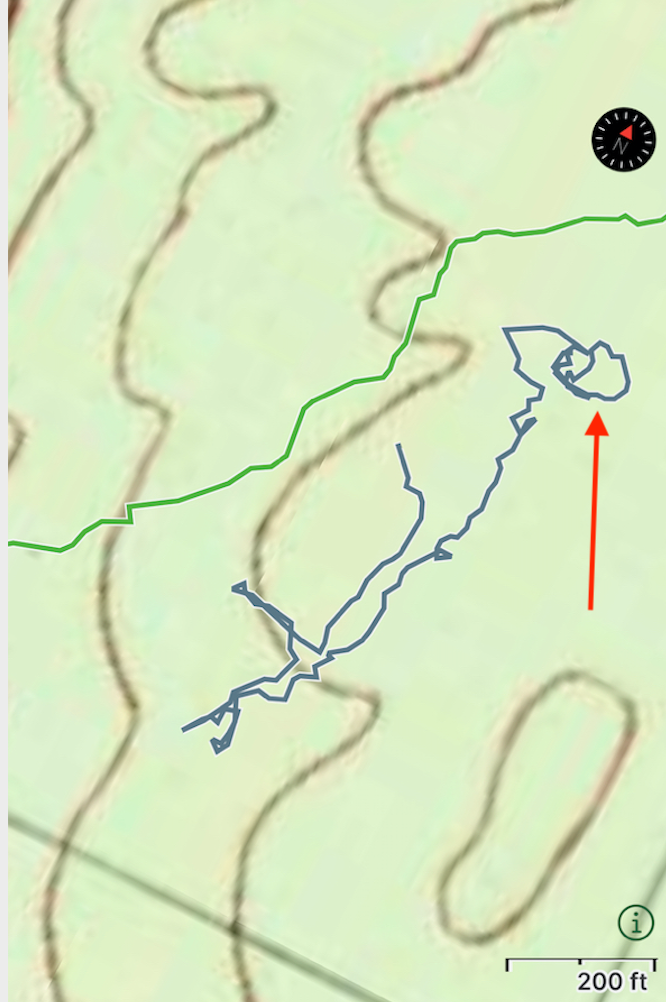
My friend, Jinny Mae (RIP), was a talented techie and though the red line isn’t the entire route we followed today, it’s one she and I explored back in 2016. The map is from a section of the 1858 map of Stoneham. And we were at E. Durgin’s old homestead.

Knowing that there were some gravestones in the woods behind the house, we once again followed the Moose who led us directly to the family cemetery. Someone has cleared the site a bit, so it was easy to spot, especially since the trees haven’t fully leafed out.

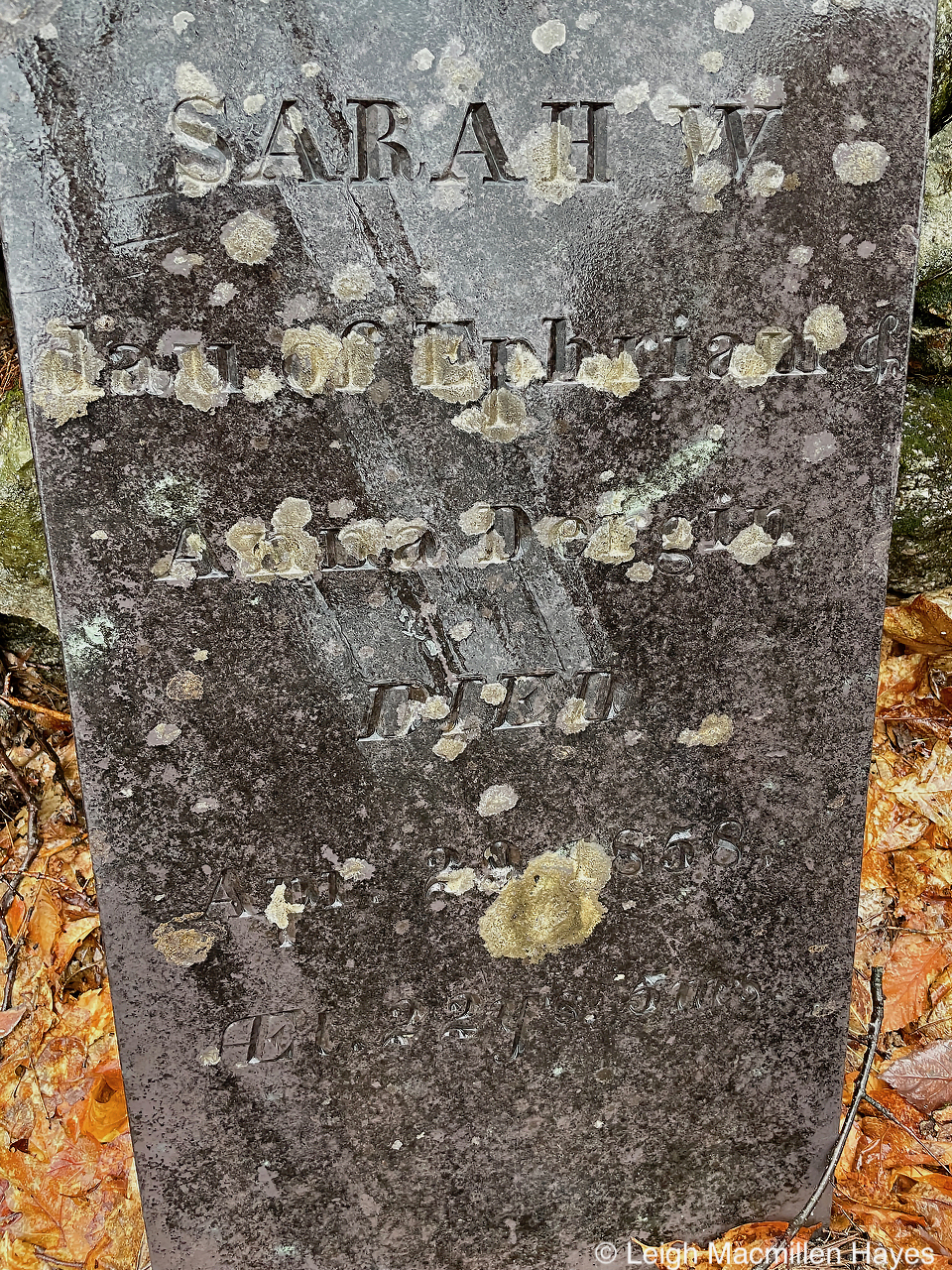
Sarah, daughter of Anna and Ephraim Durgin, is the first tombstone. She died in 1858 at age 22.

Beside her is the stone for Mary, wife of Sumner Dergin, who died before Sarah–in 1856. She, too, was 22 years old. As best I can tell, Sarah and Sumner were siblings.

And Ephraim, Sarah’s father, died in 1873 at age 81. Notice the difference in stone from the two girls to Ephraim? Slate to cement. And the name spelling–Dergin and Durgin. As genealogy hobbiests, we’ve become accustomed to variations in spelling.

I found the following on RootsWeb:

8. ANNA3 FURLONG (PATRICK2, JOHN1) was born 1791 in Limerick, Maine, and died 1873 in Stoneham, Maine. She married EPHRAIM DURGIN June 18, 1817 in Limerick, Maine14. He was born April 13, 1790 in Limerick, Maine, and died in Stoneham.

Children of ANNA FURLONG and EPHRAIM DURGIN are:
i.OLIVE4 DURGIN, b. 1811, Stoneham, Maine; m. DUNCAN M. ROSS, April 11, 1860, Portland, Maine.
ii.SALOMA DURGIN, b. 1813.
iii.ELIZABETH DURGIN, b. 1815.
iv.SALLY DURGIN, b. 1817.
v.SUMNER F. DURGIN, b. 1819, Of Stoneham, Massachusettes; m. MARY ANN DURGAN, July 11, 1853, York County, Maine; b. Of Parsonsfield, Maine.
vi.CASANDIA DURGIN, b. 1821.
vii.EPHRAIM DURGIN, b. 1823.
viii.FANNY DURGIN, b. 1825.

Sarah isn’t listed above. But . . . Sally and Sarah were often interchangeable.

By 1880, there had been a change in ownership of the neighborhood homes and the Rowlands had moved into the Durgin house.

Again, we followed the moose, this time in the form of a Striped Maple browsed upon, curious to see what might be ahead.

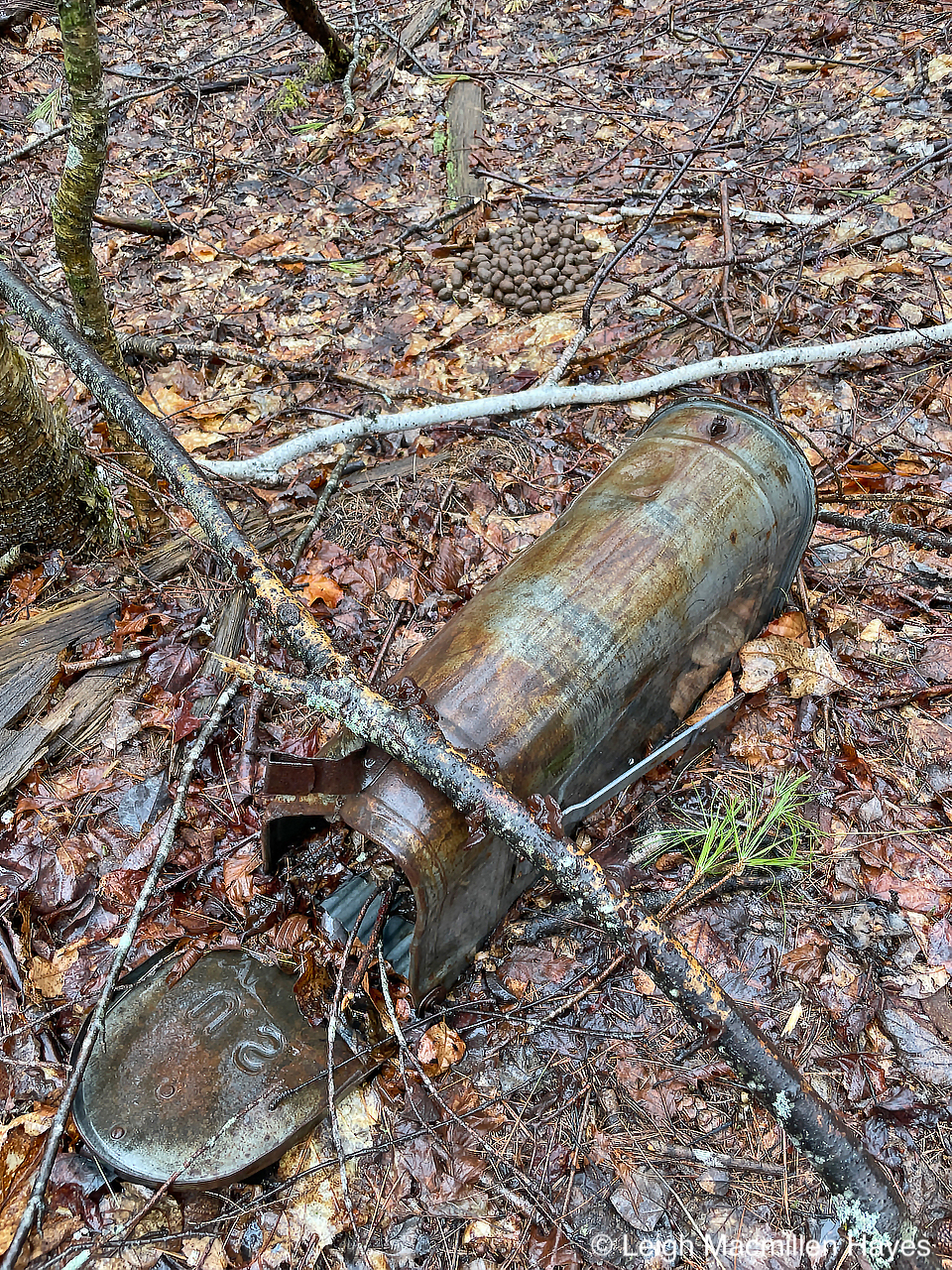
A chuckle. Yes, a mailbox in the middle of nowhere, this spot being a place where someone once had a camp. Our Moose tried to send a letter, but missed by a couple of feet.

Willard Brook was our next stop and I was reminded that when I first started wondermyway.com, a post about this brook initiated some discussion about the Indigenous stonework found throughout the area. I’ve explored it looking for such and convinced myself in the past that I saw the turtles in most of the stonewalls. In fact, I see them everywhere, but today I was looking at different subjects.

Beside the brook, lots of Hobblebush looked ready to burst into life and we thought how fortunate that the moose hadn’t decided to dine. Yet.

There were even tiny Hobblebush leaves to celebrate for their accordion style.

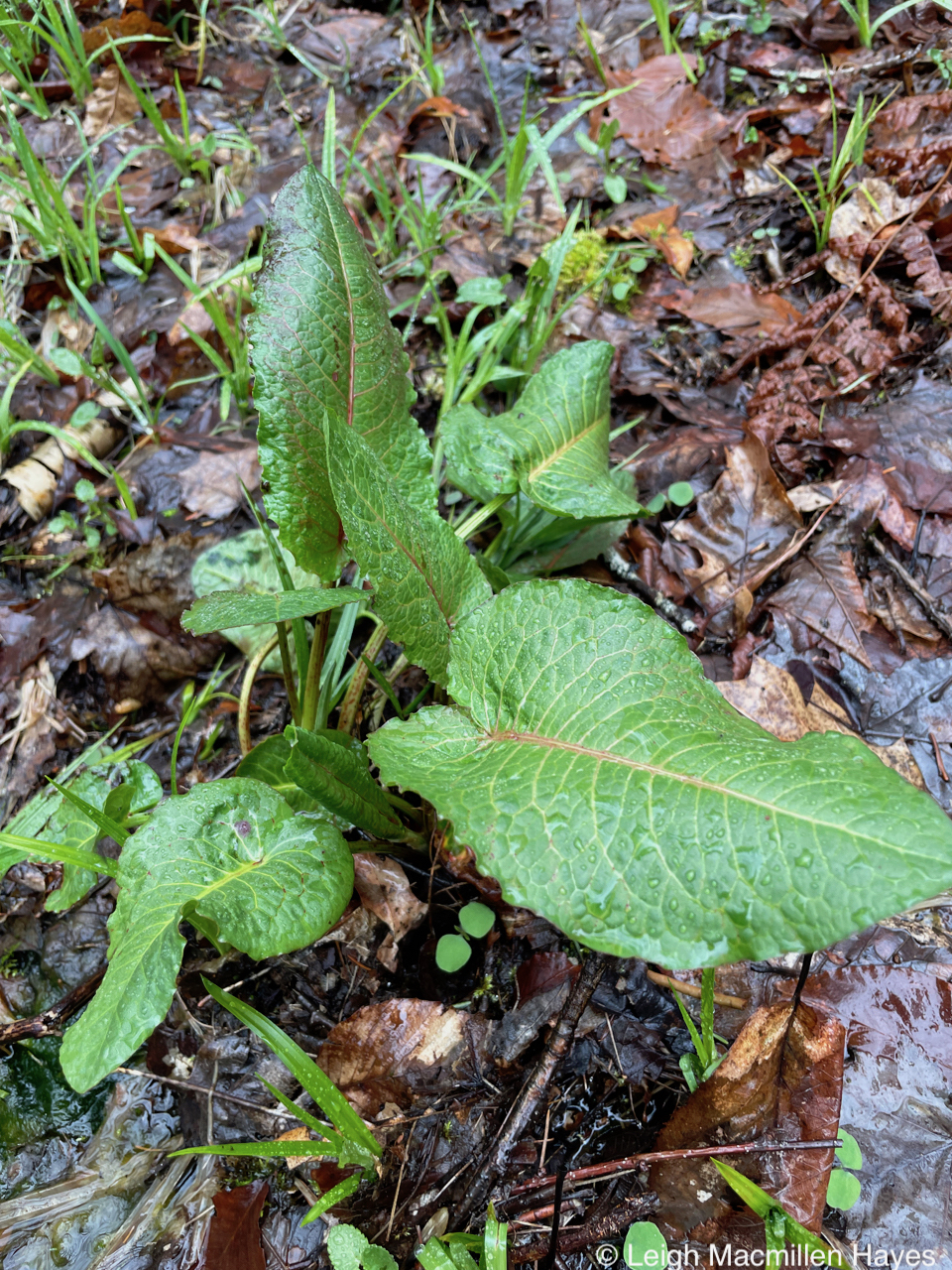
And Broad-leaved Dock looking quite happy and healthy.

Back to Great Brook we eventually wandered, still with no actual Moose in sight.

But beside the brook I did spot some Trailing Arbutus buds preparing for their grand opening.

As we walked back on the dirt road we’d walked in on, we paused beside a beaver pond where Spring Peepers sang their high-pitched love songs. I made My Guy scan the area with me because just maybe . . .

or maybe not. We did spot a Mallard couple. Oh well, We still had fun discovering everything else where the Moose led us on this rainy day.

And when we arrived home I had an email from an acquaintance double-checking with me that the print he found on his shore front of Kezar Lake was a moose print. Indeed it was!

(And now it’s time to prepare for Big Night. Finally. The temperature is in the 40˚s; it’s been raining all day and will continue tonight; and though lots of amphibians have moved to their native vernal pools, I think there will be some action tonight and we’ll be able to help them cross the road safely.)

The Luck Of The . . .

Any day spent outside is a day well spent and such was my case on this Saint Paddy’s Day.

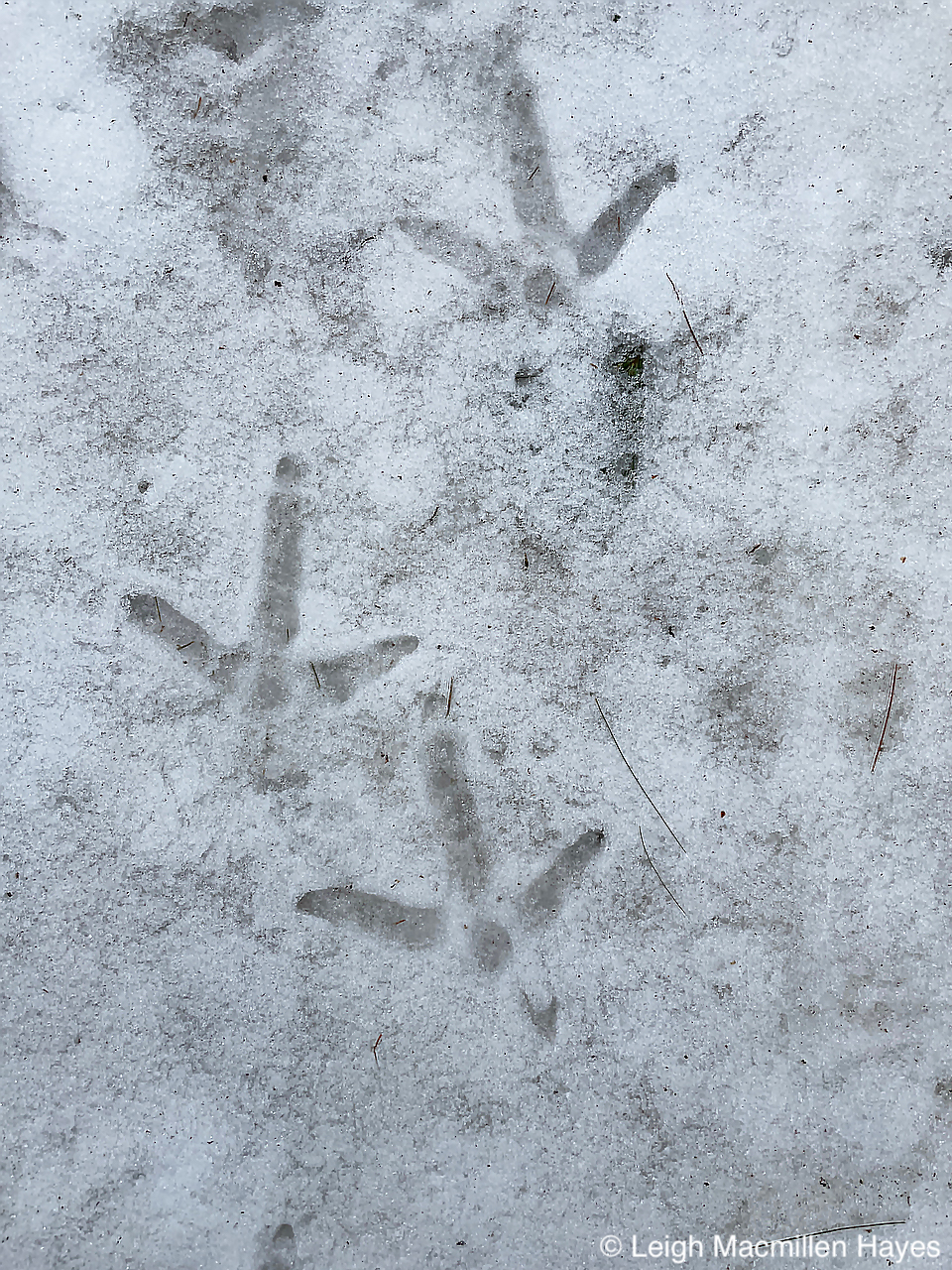
I first followed the oversized bird prints of some Turkeys, which led to . . .

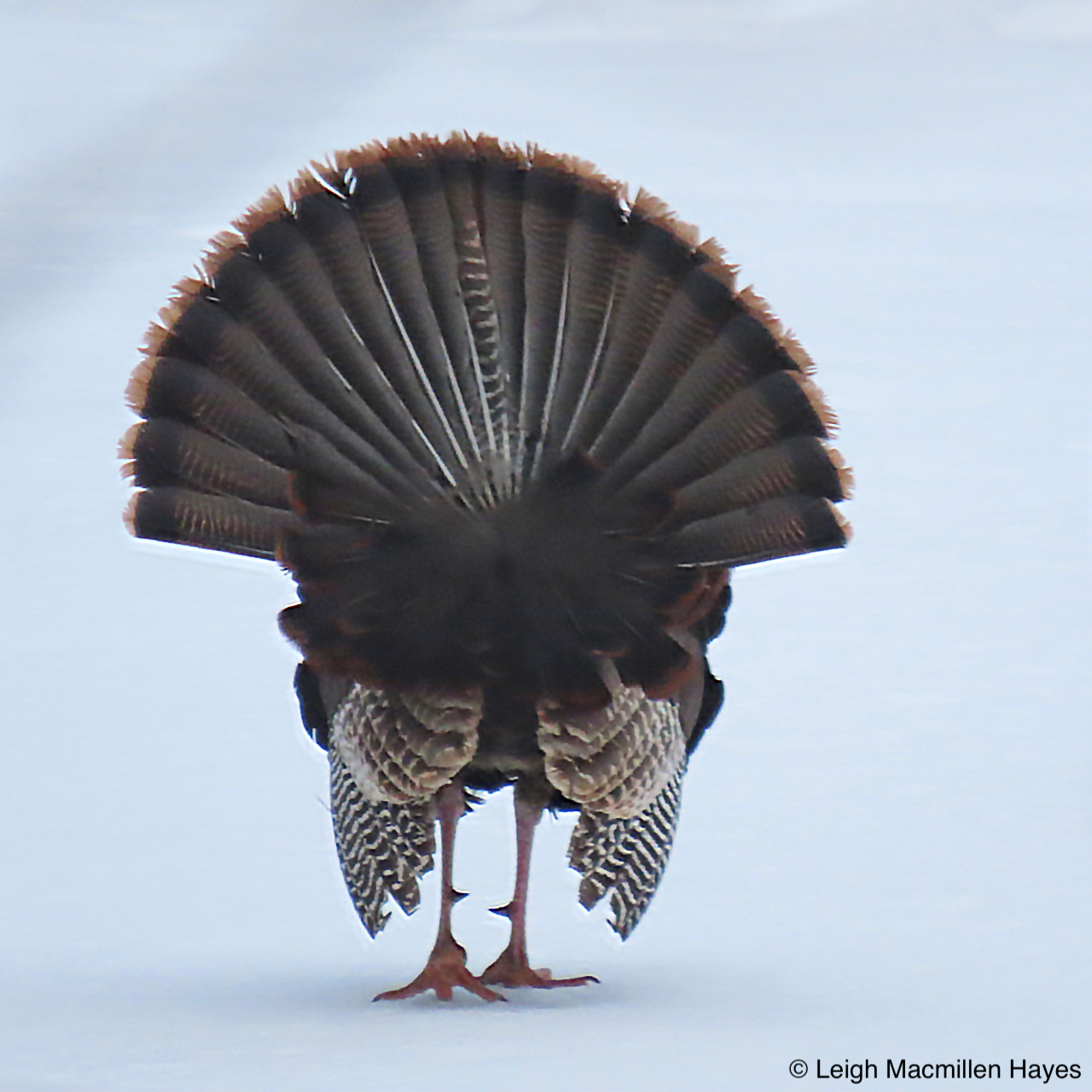
Tom in full display . . .

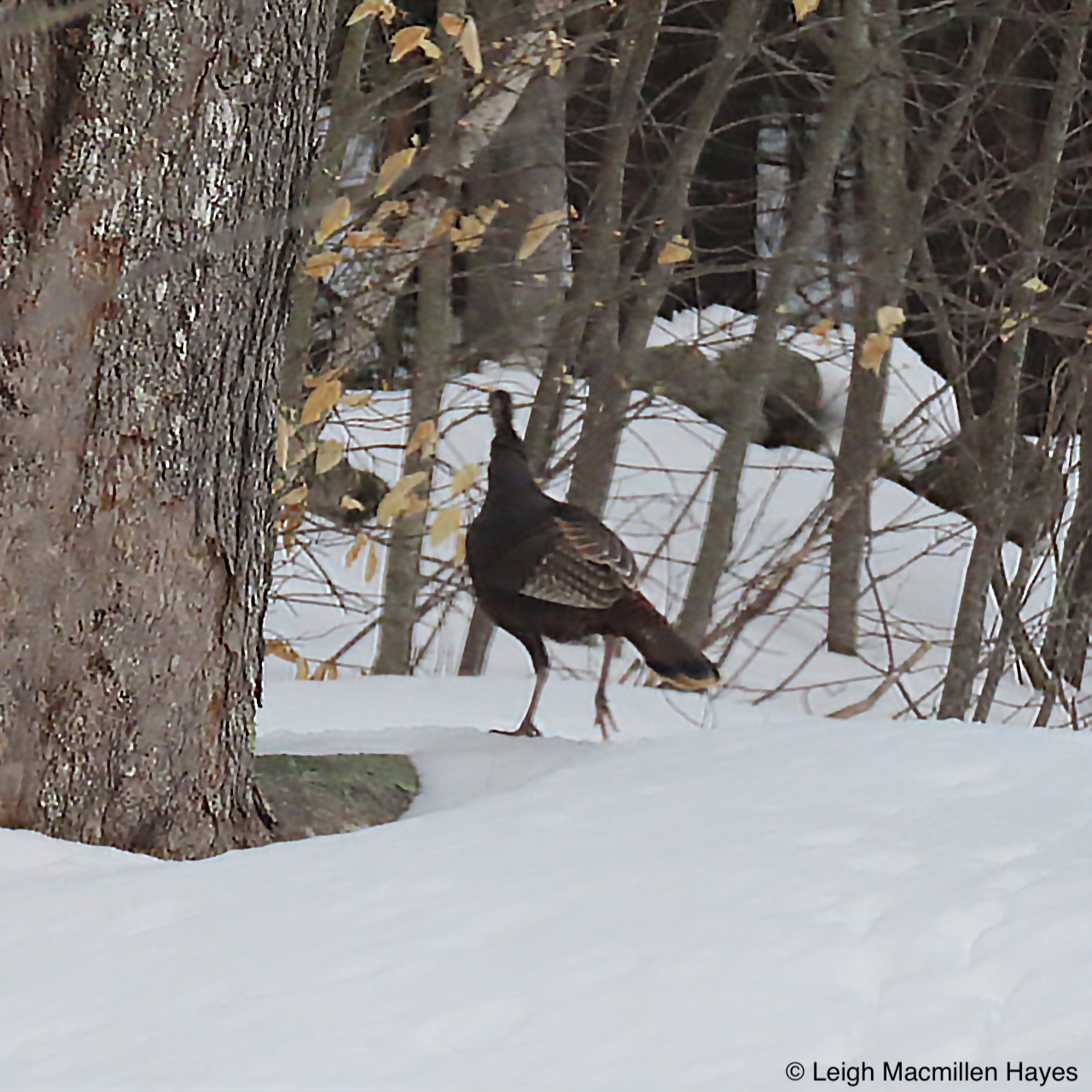
As he strutted before a few ladies, which led to . . .

Total nonchalance on the part of the ladies as they passed by, which led to . . .

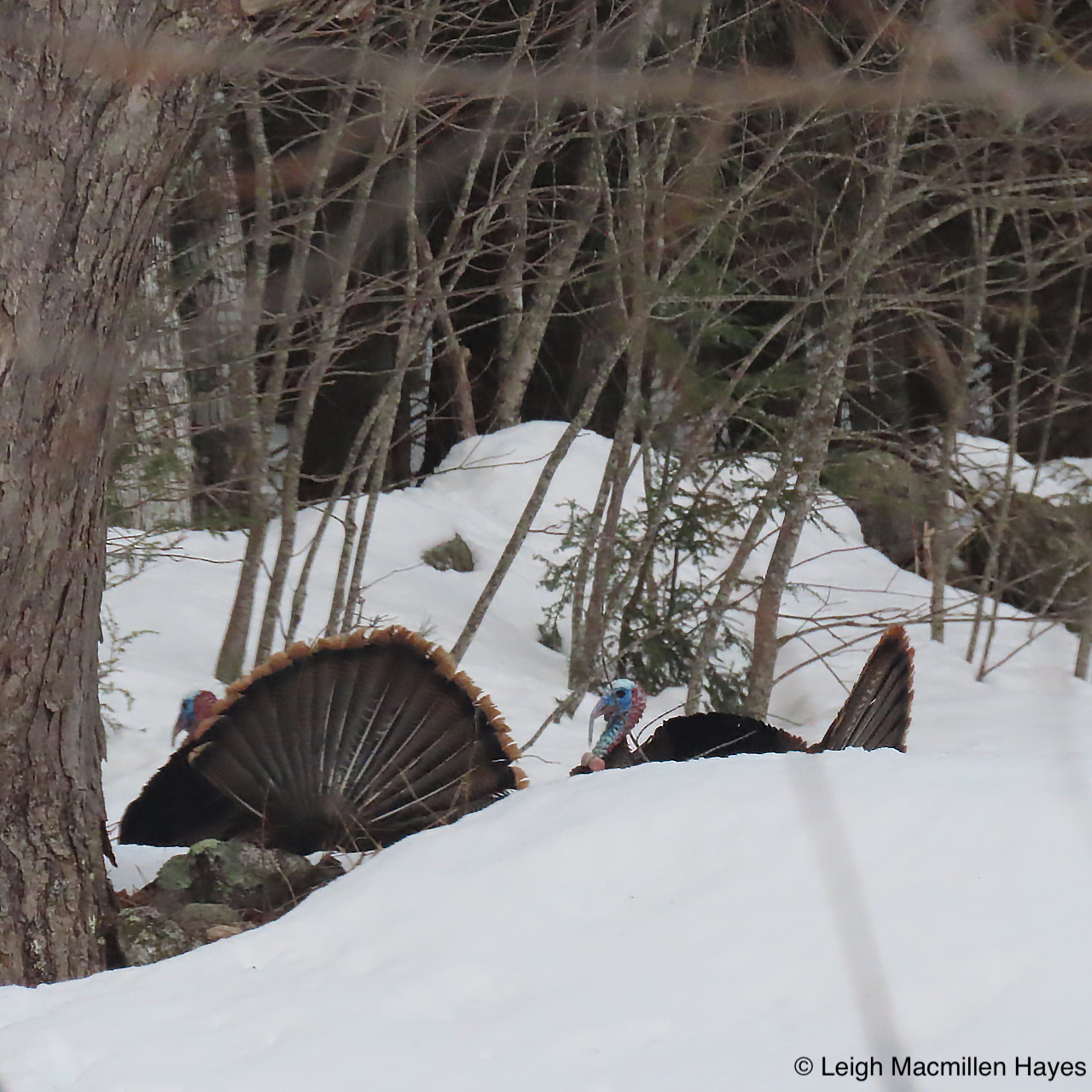
Tom and his brother, Tom, giving chase, which led to . . .

the realization that a Bobcat had crossed the Turkey trail, which led to . . .

a tree with branches scattered on the snow below, which led to . . .

taking a closer look to make sure the twigs were snipped at a 45˚ angle, which led to . . .

following a familiar and fresh trail of pigeon-toed prints, which led to . . .

a sign carved into the cambium layer of a Beech tree, indicating a certain mammal lives near here, which led to . . .

an open door with more signage on either side announcing the resident, which led to . . .

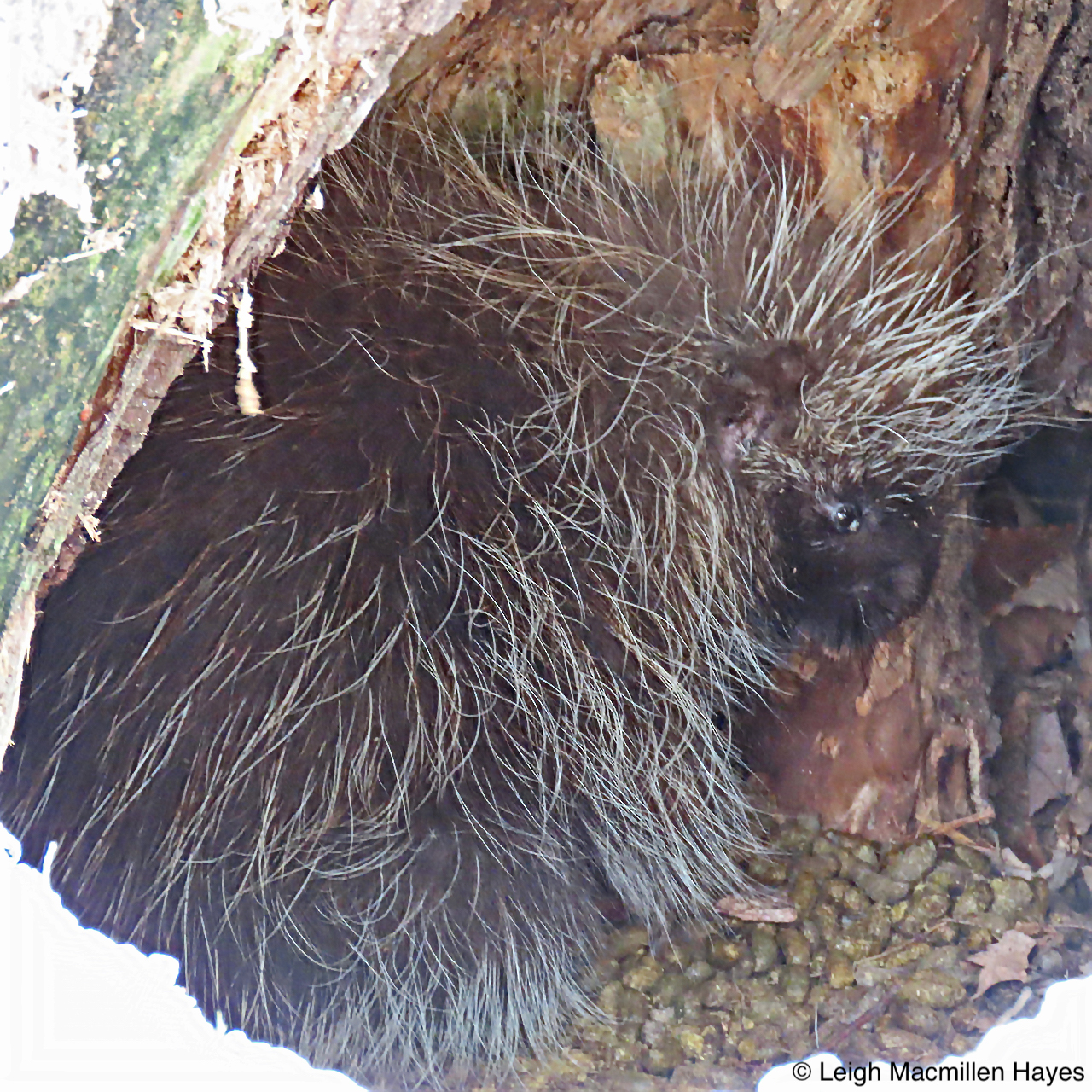
a peek inside and today’s great discovery of a Porcupine at home, which led to . . .

the realization that though St. Patrick is the patron saint of Ireland, which My Guy celebrates, he was born in Scotland and thus today’s finds were due to the Luck of the Scottish.

Oh, and check out that fine pile of scat the Porcupine is sitting upon.

Phone Tag

We headed into the wilds today where we didn’t have cell coverage which was quite okay with us. It was a favorite hike, though we weren’t sure what the conditions would be so we brought both snowshoes and micro-spikes.

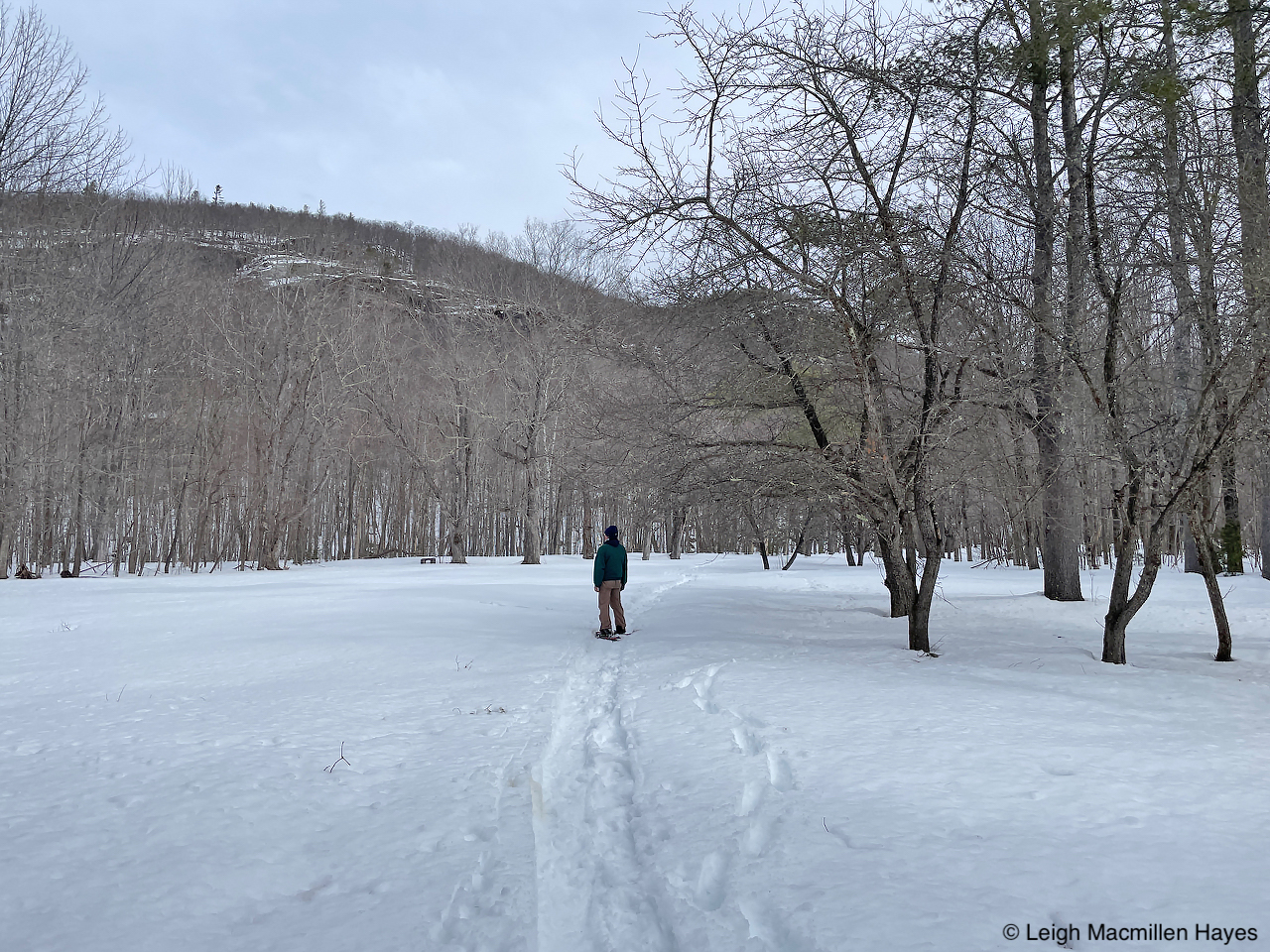
From the get-go, it was obvious that snowshoes would be the necessary item and so we donned them and headed down the road.

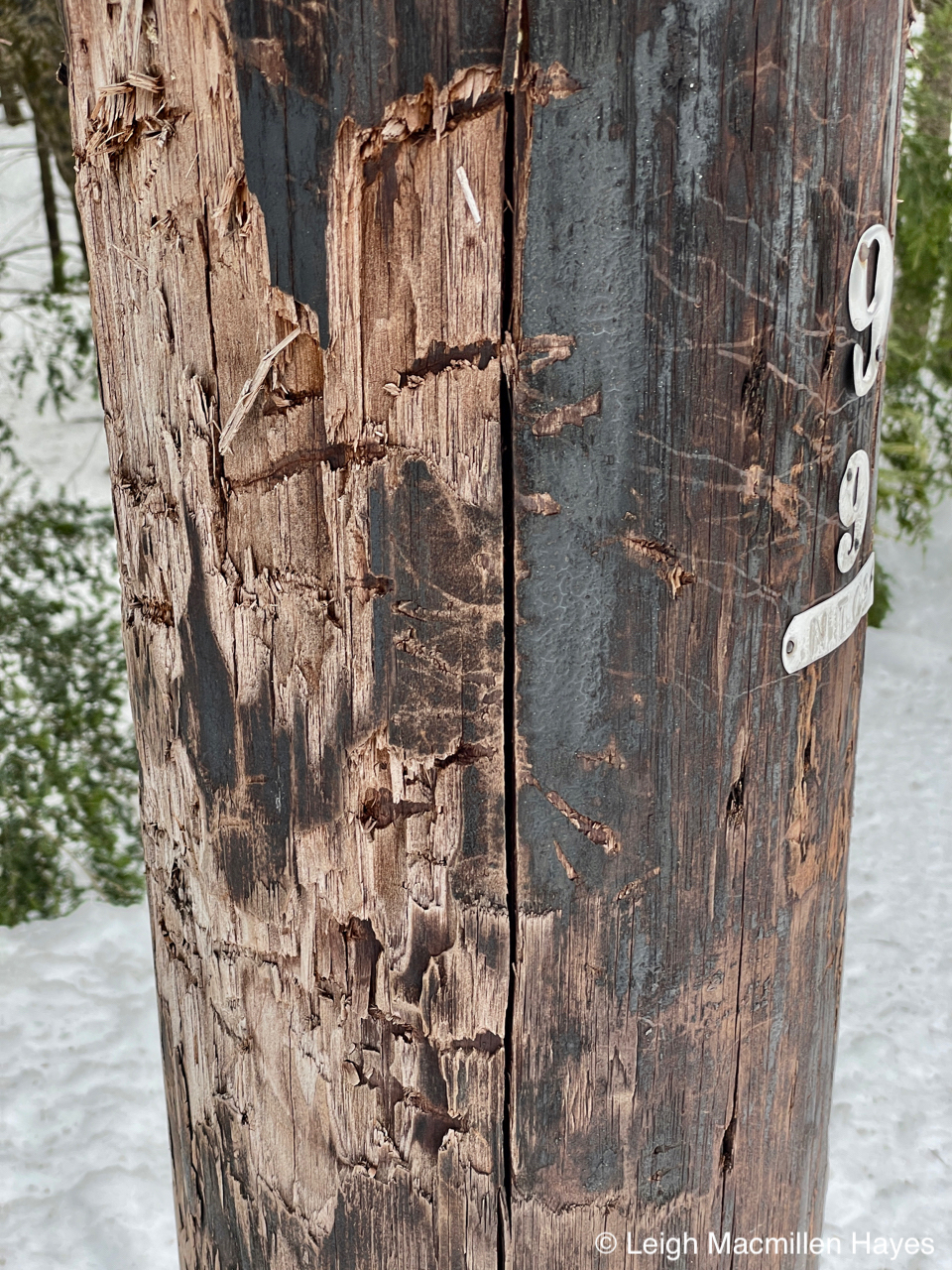
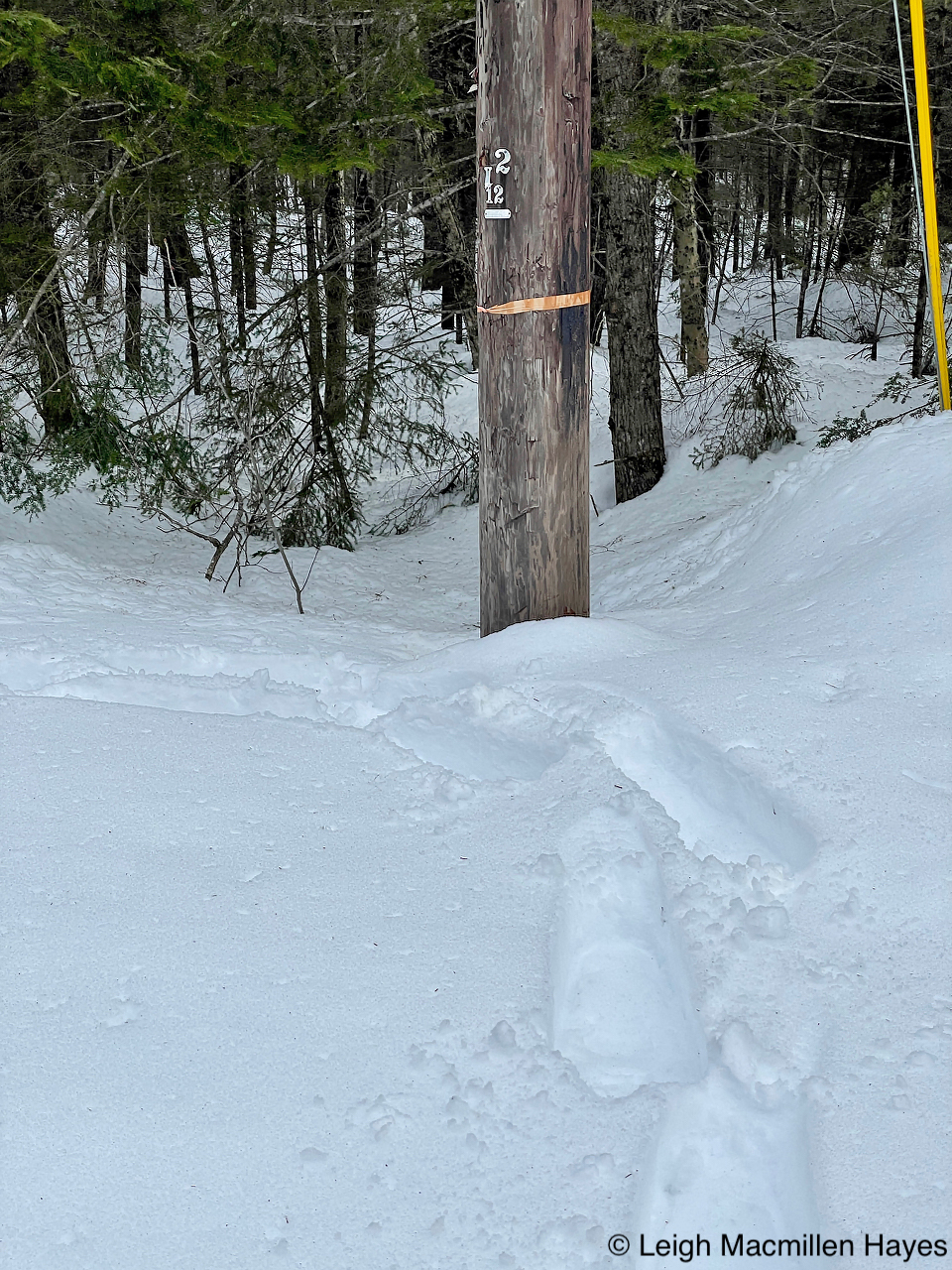
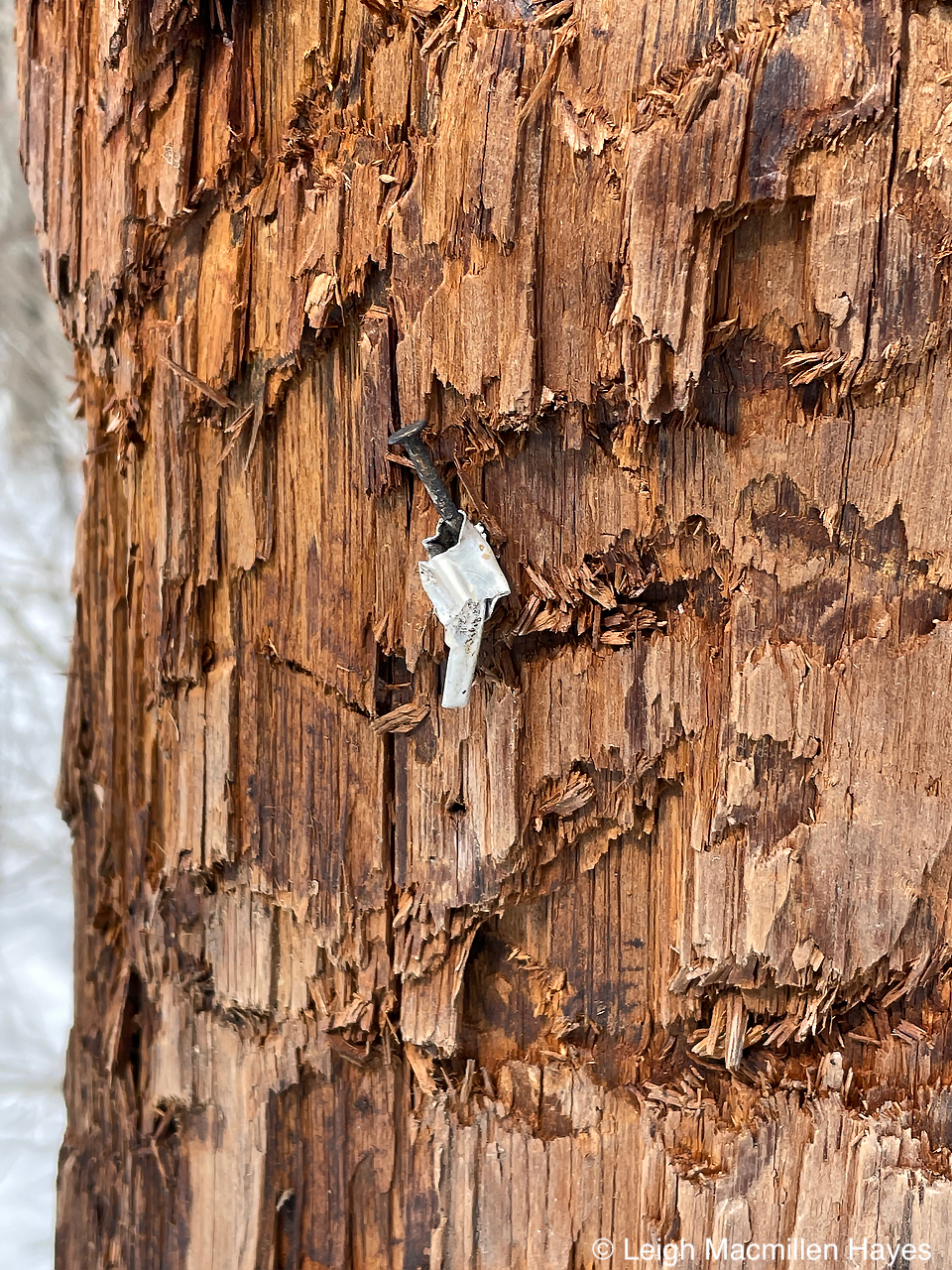
It’s a road I LOVE to walk rather than drive down because there are telephone poles that call for my attention. Do you see what I saw? Nice shiny numbers, yes. But even better, the scratches.

And on this one scratches plus bite marks. All the work of a Black Bear. Whether it’s the creosote on the pole, the hum of electricity riddling high above on the wires, or something new and shiny in their territory, Black Bears are attracted and rub their backs against the object as they turn their heads to nip and bite. The jagged horizontal lines speak to the upper incisors scraping the wood as they reach toward the lower incisors.

Almost a mile in we reached the starting point for our expedition. Much but not all of the Stone House property is conserved under an easement with Greater Lovell Land Trust.

Typically we circle the Shell Pond trail system in a counter-clockwise fashion, but we decided to do the opposite today and so once we reached the airfield, I had to turn back to take in the view of the mountains from part of the runway built in the 1960s by Henry Saunders so that he could fly into the Stone House property. Saunders Brothers owned this property at that time and had a dowel mill in Bridgton, but their main mill was in Westbrook, Maine.

The airfield passes by the Stone House and hikers must stay on the trail. In Cold River Chronicle, local historian David Crouse wrote recently: “The Stone House, located on the Stone House Road (formerly known as the Shell Pond Road) in North Stow, Maine, was built about 1840 of split granite blocks quarried on nearby Rattlesnake Mountain by Abel Andrews (1807-1884), who settled there with his family in the 1830s. Abel’s wife, Lucinda Brickett (1817-1884), was daughter of John Brickett of the so-called Brickett Place at North Stow. The homestead passed to Abel’s son Elden (1836-1914) and then to Elden’s son Ira Augustus (1863-1942), who sold it in 1917. Since 1917, this property has had a succession of owners other than the Andrews family. Between 1951 and 1986 it was owned by Saunders Brothers Company of Westbrook, ME, who built a private 1600 foot airstrip in the field south of the stone house. Saunders Brothers used the stone house as a hunting lodge for their employees and guests. In 1986, the property was purchased by David Cromwell. The Stone House farm property is still in private ownership and is completely surrounded by land owned by the U. S. Forest Service’s White Mountain National Forest.”

Each time we pass this way I give thanks to the owners who allow hikers and hunters and rock climbers to use their trails.

We continued on through the orchard, where we had to start breaking trail as others had turned back.

Rattlesnake Brook flows beside the orchard and in a couple of months wildflowers and ferns will emerge, but for now there’s a lot of snow, with a Nor’easter sitting on the doorstep waiting to enter in a couple of days.

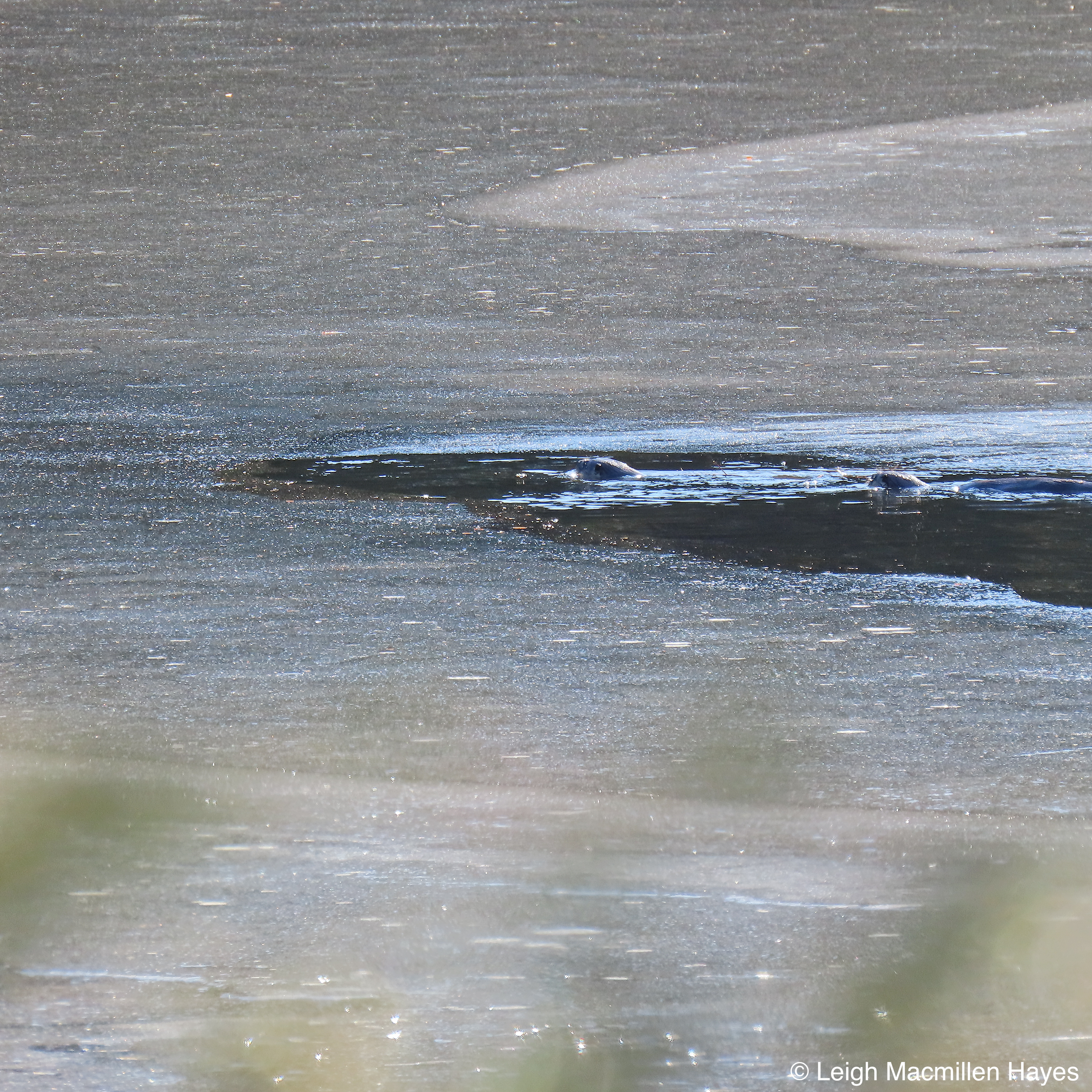
Everywhere, there were Otter trails a few days old and I could only imagine the fun of sliding across the orchard, through the woods and in and out of the water.

As custom has it, we stopped at a bench overlooking Shell Pond and realized it was time for a Double Chocolate Brownie–energy needed to continue the journey.

At another stream crossing, I had to pause again. Spring will come and I will love it, but I’ll miss this.

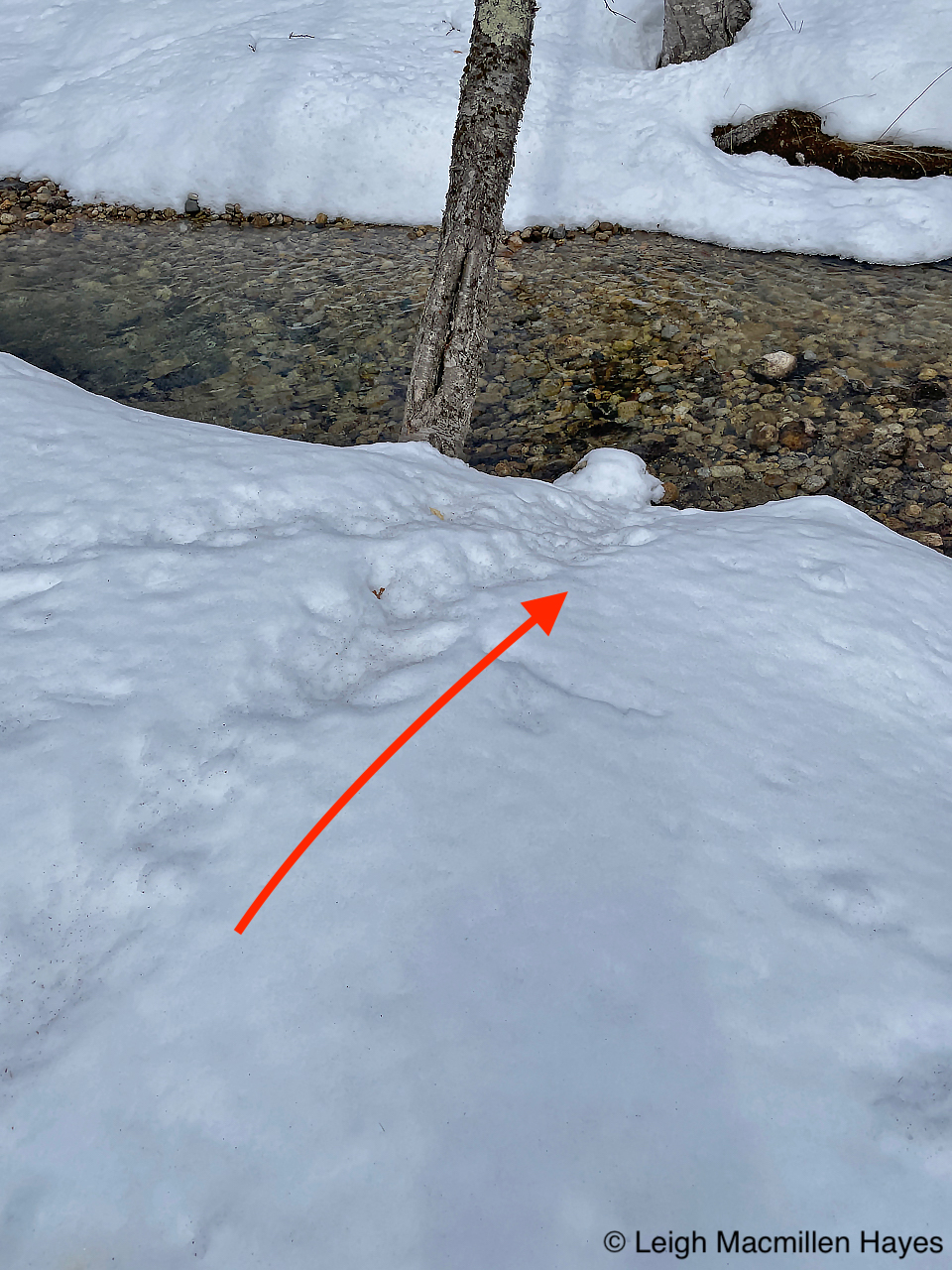
And I’ll miss having the opportunity to spot sights like this–the track of a Mink. I didn’t have Trackards with me for this trip so I grabbed chapstick from my pocket for size. The chapstick is 2.5 inches in length and the trail width was a wee bit longer.

Hiking backwards, well, not literally walking backwards, but you know what I mean, I was afraid I might miss this guy, but there T-Rex was, donning a winter hat.

Onward and upward my own guy and I trudged, pausing occasionally to take in the view. If you decide to go in the next day or two, we packed a great trail for you to follow.

At a second bridge crossing Rattlesnake Brook, we paused again.

Another Mink track exiting the brook. Probably the same critter.

But this one was even better because a deposit had been made.

In the form of scat, of course.

After several hours of hiking, we found our way back to Shell Pond Road, and I picked up where I’d left off with my game of Phone Tag, checking each telephone pole that I’d skipped on the way in.

Pole number 7 was especially chewed up.

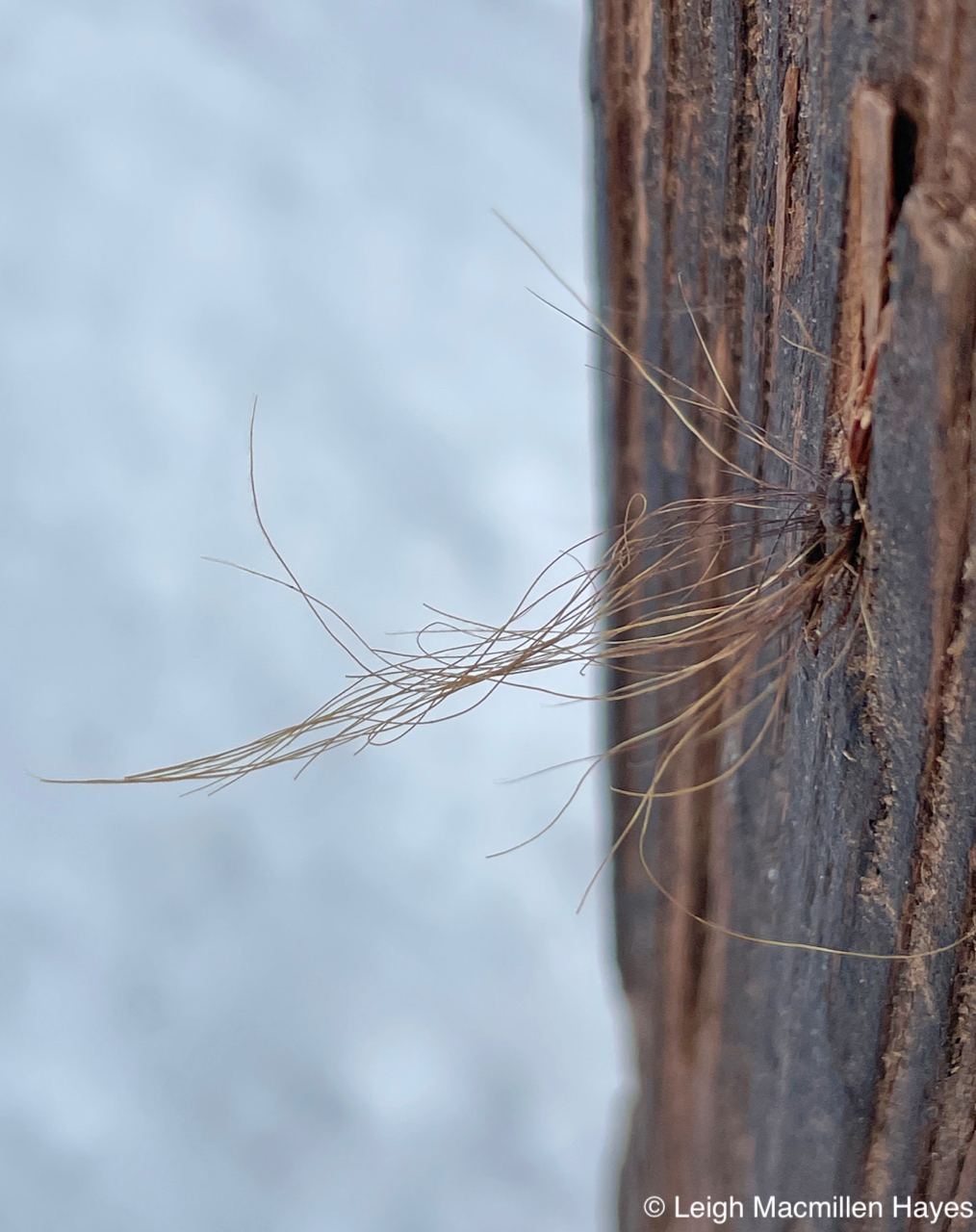
But, the real joy of the game was finding the phone message I’d sought–Bear hair. The color was such for it was bleached by the sun which causes a Black Bear’s hair to turn ginger.

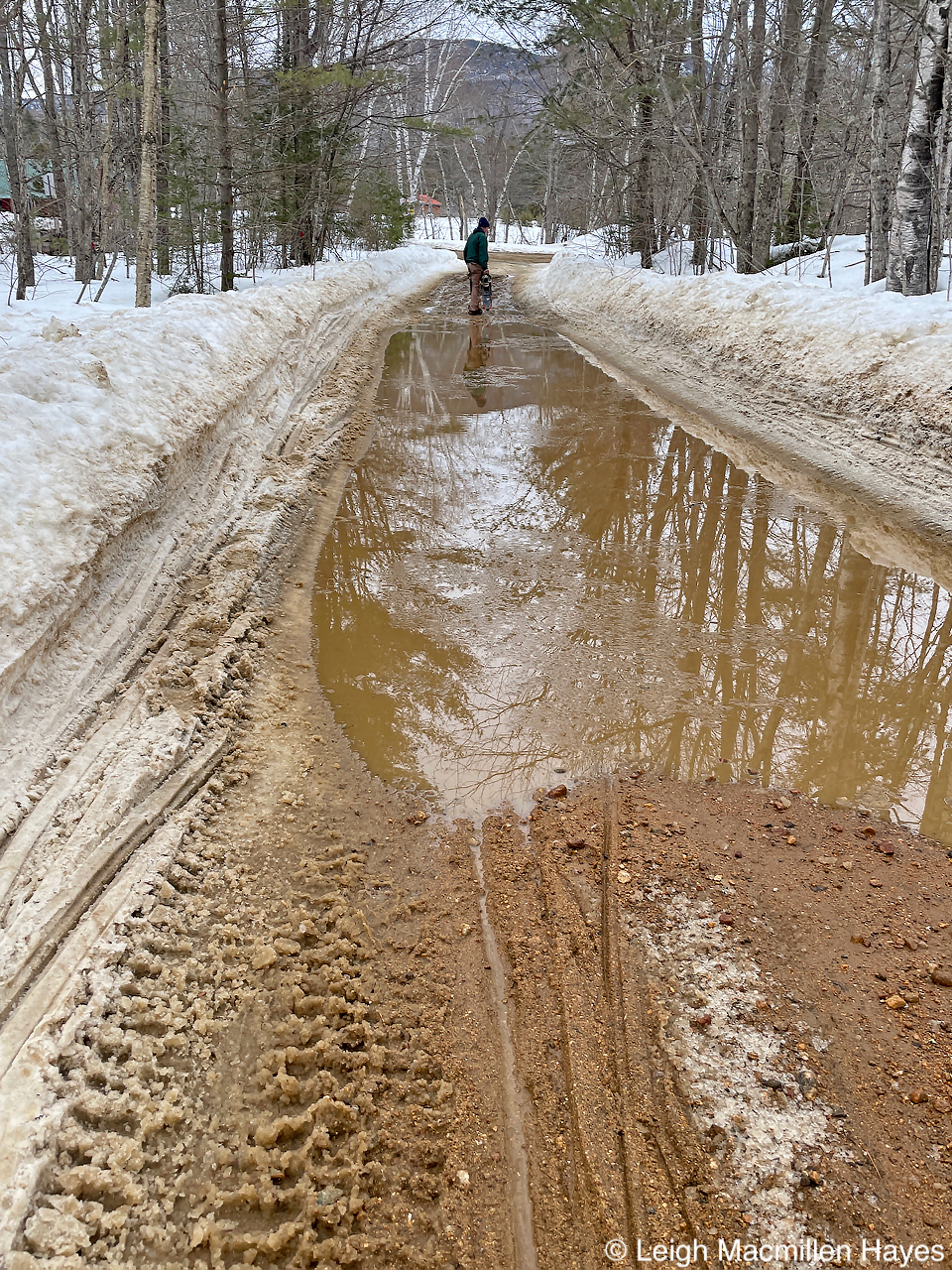
If you do decide to go to the Shell Pond trail and play your own version of phone tag, be aware that you’ll need to park by the first field just over the bridge that crosses Cold River and walk in–trying not to swim in the pool along the way.

Who needs cell coverage when you’ve got such a party line of poles to follow?

The Tail of Two Days

On March 7, a group of us known as Greater Lovell Land Trust’s Tuesday Trackers, headed off into the woods at a local reserve in search of what tracks we might find. We’d barely started (and could still see where we’d parked our vehicles, which is always our joke because we’ve been known to spend three hours exploring and only cover a quarter mile) when we happened upon the tracks of a Wild Turkey. It was a fun quiz because the bird had post-holed in the deep snow and we had to pay attention to not only the pattern of the trail it left behind, but also the characteristics of individual prints. Once determining this was a heavy, three-toed critter, we knew the identity of the track maker.

Deer tracks also drew our attention and we looked at the shape as well as the depth and finally found two cloven toes deep in the snow.

But then . . . our job became more difficult. By the size of the stride of the next mammal we followed, our measurements came up with a toe-to-toe length of 14 inches repeatedly. But the print looked like that of a critter with a much longer stride–20 – 22 inches typically. We followed it for a while, and kept looking for a perfect print, which wasn’t easy to find given that Saturday’s storm, followed by melting temperatures and lots of wind since then, created a lot of tree plops (aka ploppage in our group) and melt out so there were nothing clear to read.

At last we found one, and given the size of the print, which measured the same each time at about 2.5 inches, and the symmetry of the toes, plus the X between toes and metacarpal pad, we know were were following an Eastern Coyote.

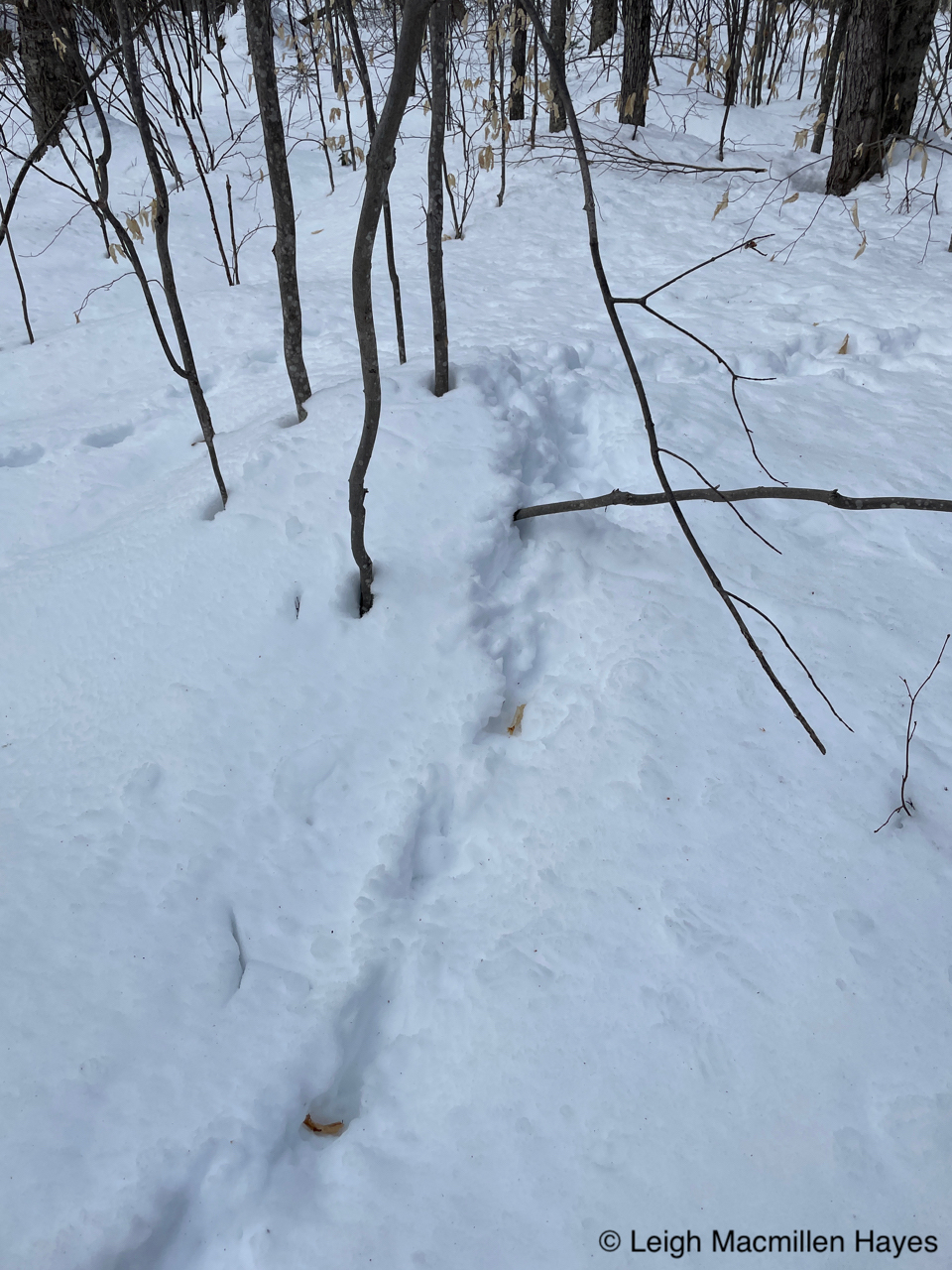
Eventually we found a track that had a bit of a sashay to the pattern, but at times it looked like the Coyote had walked on top of it. We were a bit confused, until we found a sign that confirmed the sashayer–a piece of a Porcupine’s hide–with belly hairs and short quills.

It doesn’t take much to excite us and this indeed did.

But . . . what happened here?

Our time together was drawing to a close, so rather than pursue more action, we chose to hike out, making a plan for a few of us to return today.

Special thanks to Mark and Sue, who drove all the way from Farmingdale, Maine, to join us, plus some of our regulars: Jessie, Tom and Paula, Dawn, and Sarah.

Bee-lining in on the trail this morning, Pam, Dawn, Sarah and Steve, joined me for the reconnaissance mission. We began by measuring the depth of hole where it appeared a coyote had dug at the spot where we recovered the hide piece yesterday. Total depth, a foot.

A little digging produced nothing else much to our disappointment. We were looking for body parts. Or blood.

Finally, we moved from yesterday’s ending point forward–backtracking the Coyote or so we thought, as we followed the Porcupine’s sashay, that had melted out even more in the last 22 hours. Suddenly, we had trails going in various directions.

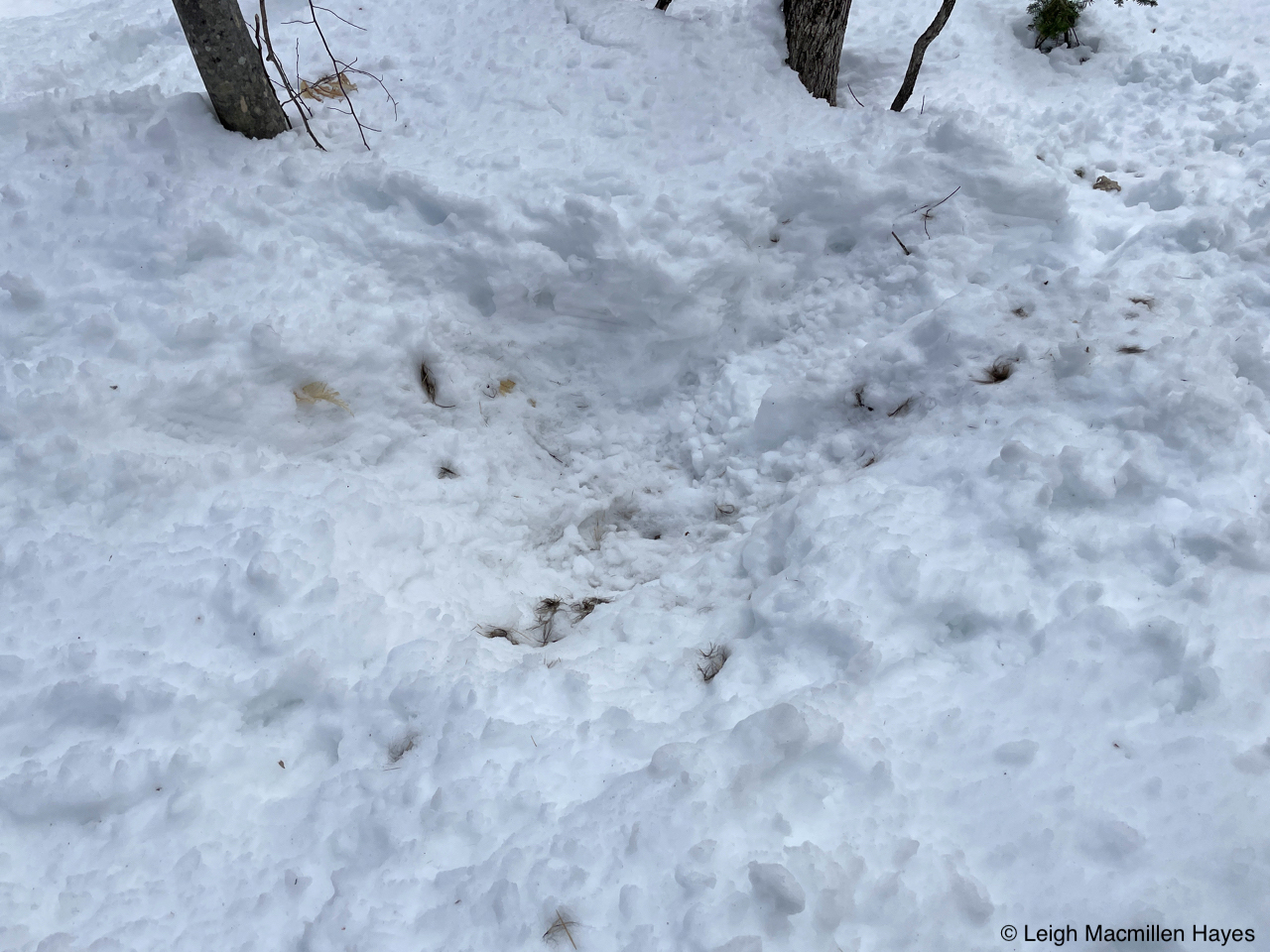
Again, we questioned: Was it a Coyote or was it a Bobcat? And then we found this large depression filled with Porcupine hair and quills.

Again, the shovels came out, but we found only ice below the snow.

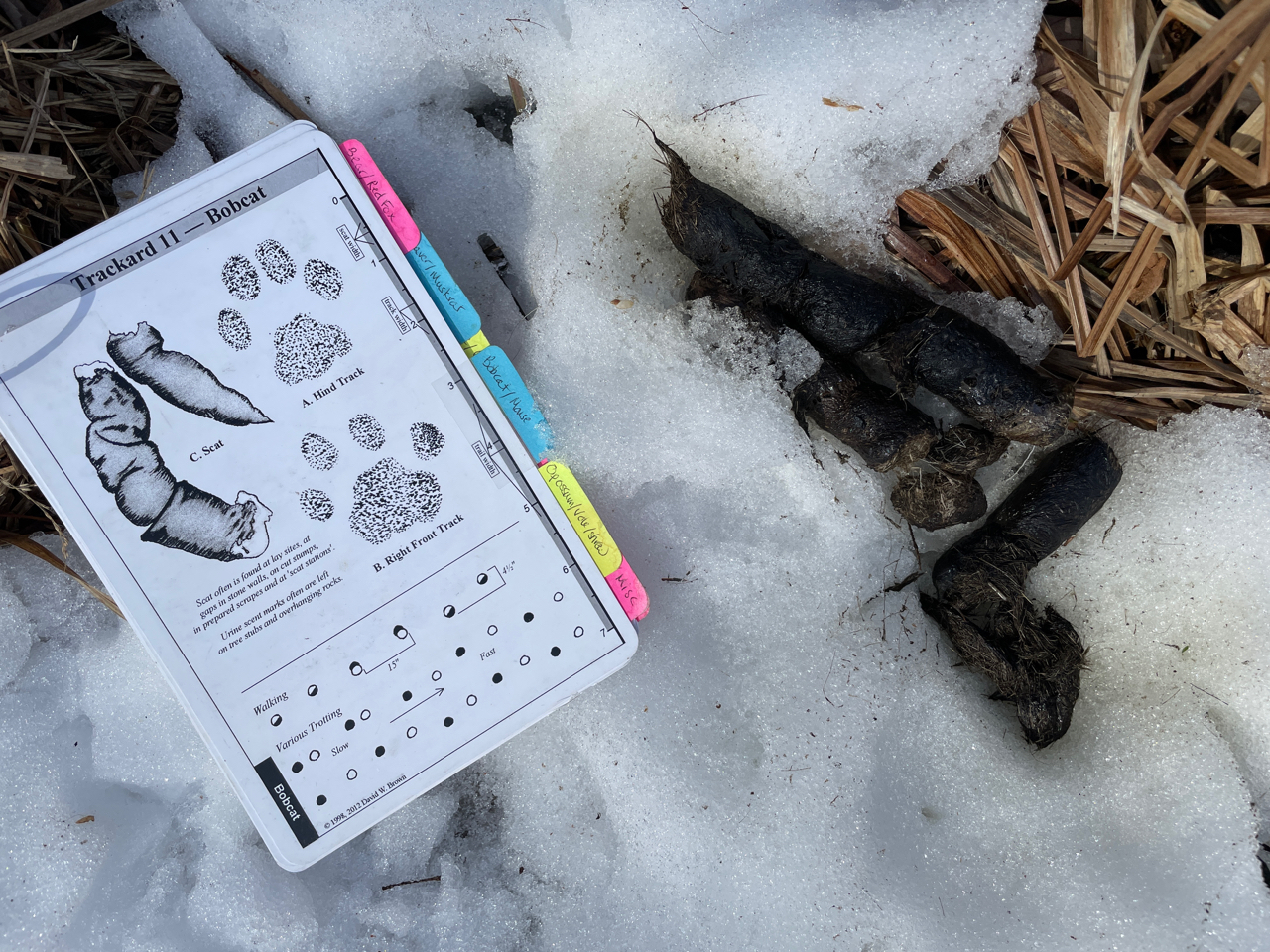
There was a calling card at the edge of the depression, however, and we knew that one of the predators was indeed a Bobcat, given the segmented scat. And if you think the white in some of the chunks is bone, we believe you would be wrong. It struck us as perhaps being the lining of an organ.

We moved beyond that site and found some tracks that also lead us to solidify the Bobcat ID. But . . . we began to wonder: Did the Bobcat cache the Porcupine and then return to dig it up? Did the Coyotes also come upon this pantry item and take advantage of the Bobcat’s food?

As we considered all of this, suddenly, in the not too far distance, we heard Coyotes calling. Did they have another meal that the Alpha pair were calling the youngsters to visit?

Eventually we made a decision to make our way back to where we’d gone off trail and see what might have happened on the north side. Again, we kept finding what we thought were Coyote, and then some prints that were Bobcat.

The Bobcat prints frequently led to buried rocks or stumps where it could pause and look out on the scene in hopes of finding more prey. The thing is, this has been a tough winter in some places such as Oxford County, Maine, because we’ve been through two summers of a major Spongy Moth outbreak and the trees had all they could do to put out a second set of leaves after the first set had been consumed. That means that there isn’t a lot of fruit in the forms of cones and beech nuts available, thus there aren’t a lot of rodents, a prime source of winter food for predators such as these.
For a while, we split up, each following a different trail, but quite often they came back together again. And so did we. And still. we were seeing the prints of both of our friends. Until, we realized, the Bobcat was traveling in one direction, and the Coyote in the opposite, one using the prints of the other for easier traveling, just like we had been able to beeline in on the tracks we’d made yesterday, saving energy, which is important when the snow is deep and food scarce. The Coyote sunk down more than the Bobcat, and the stride for both made sense.

We were just about done, but knew that our way back to the main trail was not a direct line, because there was a ledge in front of us that our friend the Bobcat had traveled upon and even left a bit of a trough from frequent use.

Instead, we traversed down and around the ledge and discovered what may be the Bobcat’s den.

The round prints led right into it.

And out again. We all took a turn peaking in, but it went deeper than we could see.

We did notice that there were several trails of Bobcat tracks leading up the slippery ledge to the lookout spot above.

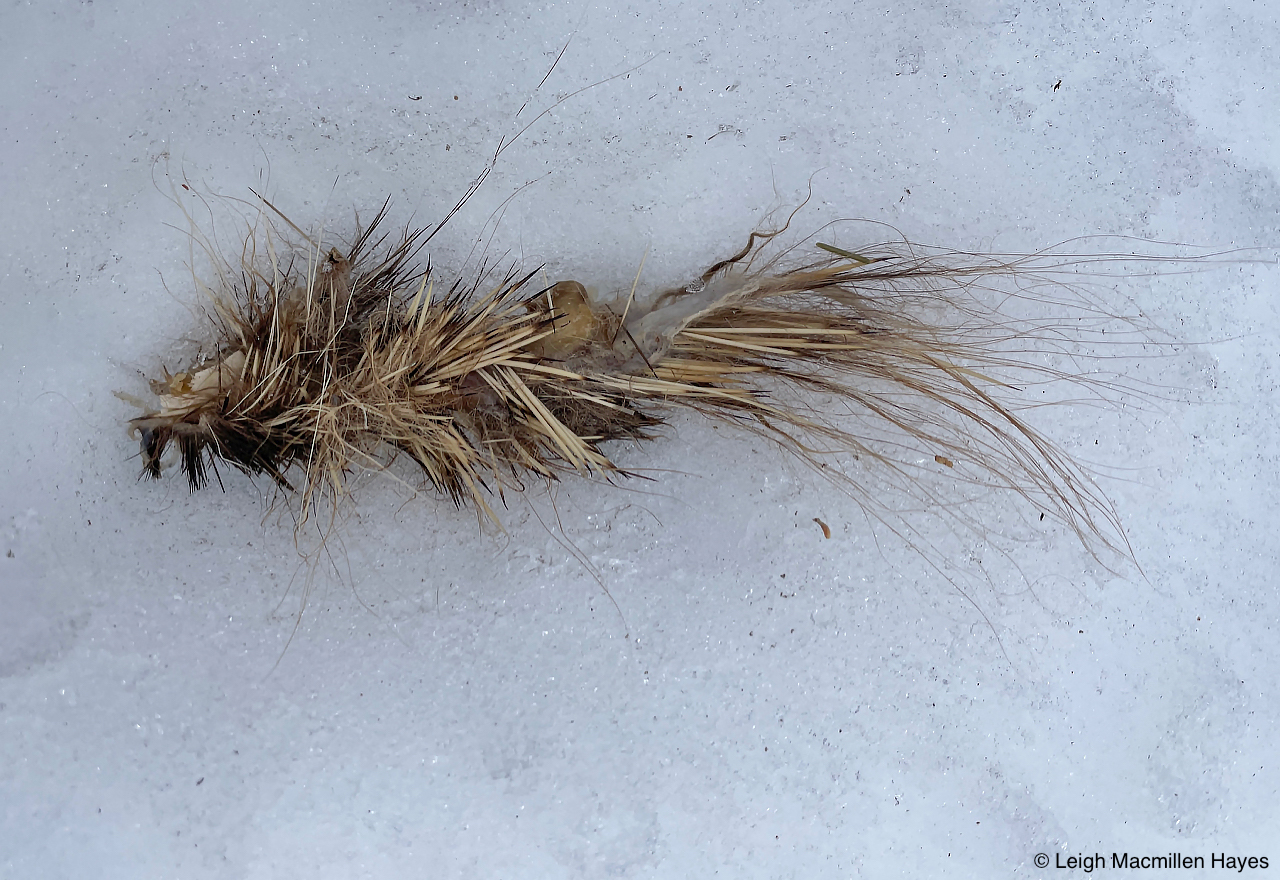
At the end of this journey, it became obvious that this was the Tail of Two Days–for we were so happy to have shared the trail with so many others on Tuesday, but grateful to have returned today to check out more. And where we’d found the bigger depression with quills and hair and Bobcat scat, we also found another depression that contained this –the Porcupine’s tail.

How cool is that?

Not to Cache or To Cache?

That is the question. But the answers aren’t always obvious.

Before I go further I need to warn you. There are some photos that may disturb you because friends and I have recently stumbled upon fresh mammal kill sites–the work of other critters and not by human hand.

But as one friend said recently when I asked if she and her husband wanted to visit one of the sites, “A kill site! Yes, we want to join you. A kill site is even better than scat!” And so they turned their car around and changed their afternoon plans.

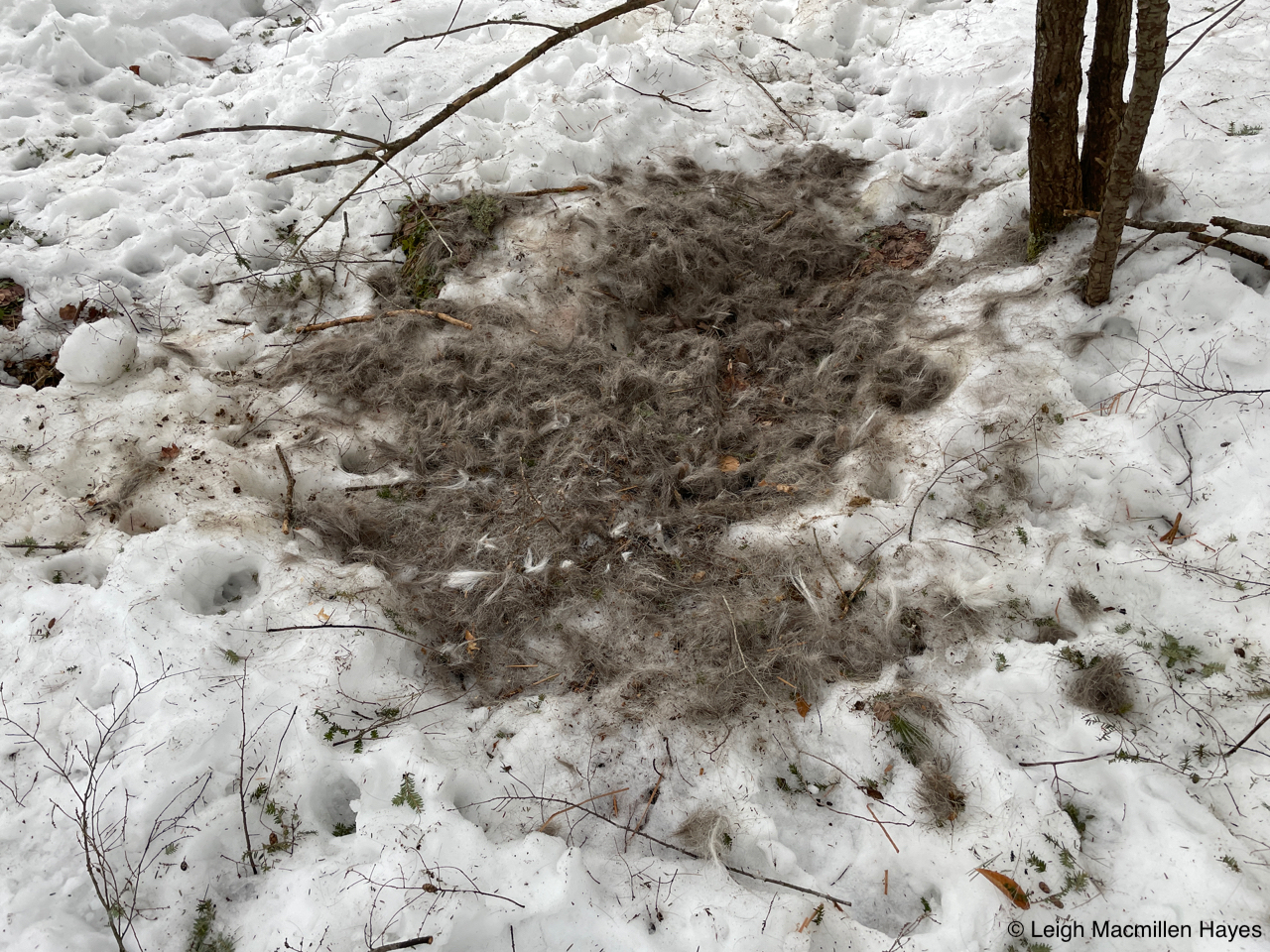
I had actually been told about this spot about five days before my first visit, and probably a lot had changed since it was initially spotted. But still, look at all that hair. And all the footprints surrounding it.

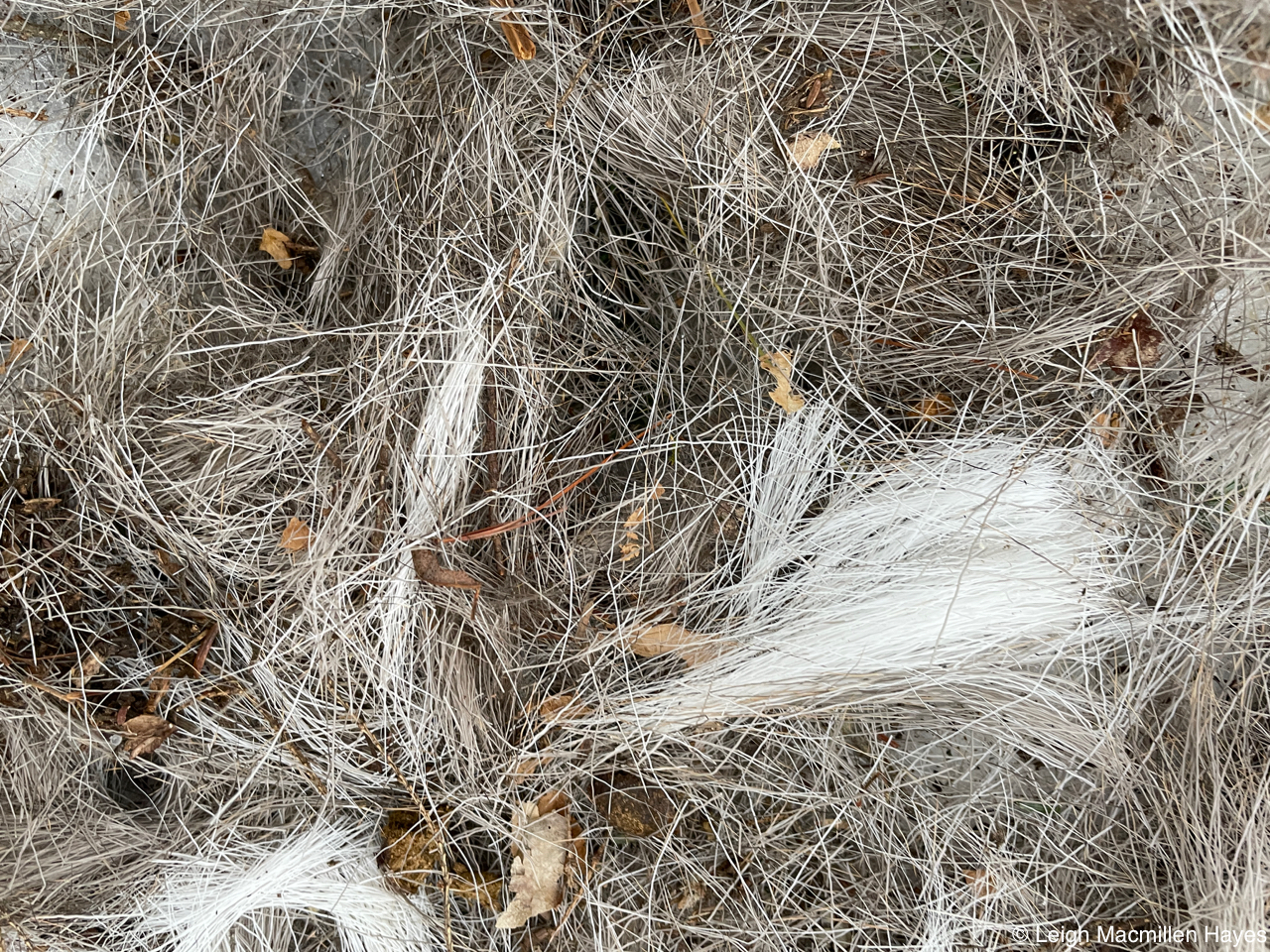
It was deer hair. Winter deer hair. Hollow hair that helps trap air and keep them warm during cold winters in New England. While in the summer, their coats are reddish-brown, in winter, the color may be brown or grayish-brown. Possibly the darker color helps them absorb more sunlight, adding to the warmth factor.

Looking about, it was obvious that a lot had happened in this spot. There was hair everywhere, and blood, and scat, and bones, and even mud as the perpetrators traveled through the adjacent wetland, which given the ice/water conditions, was too treacherous to follow.

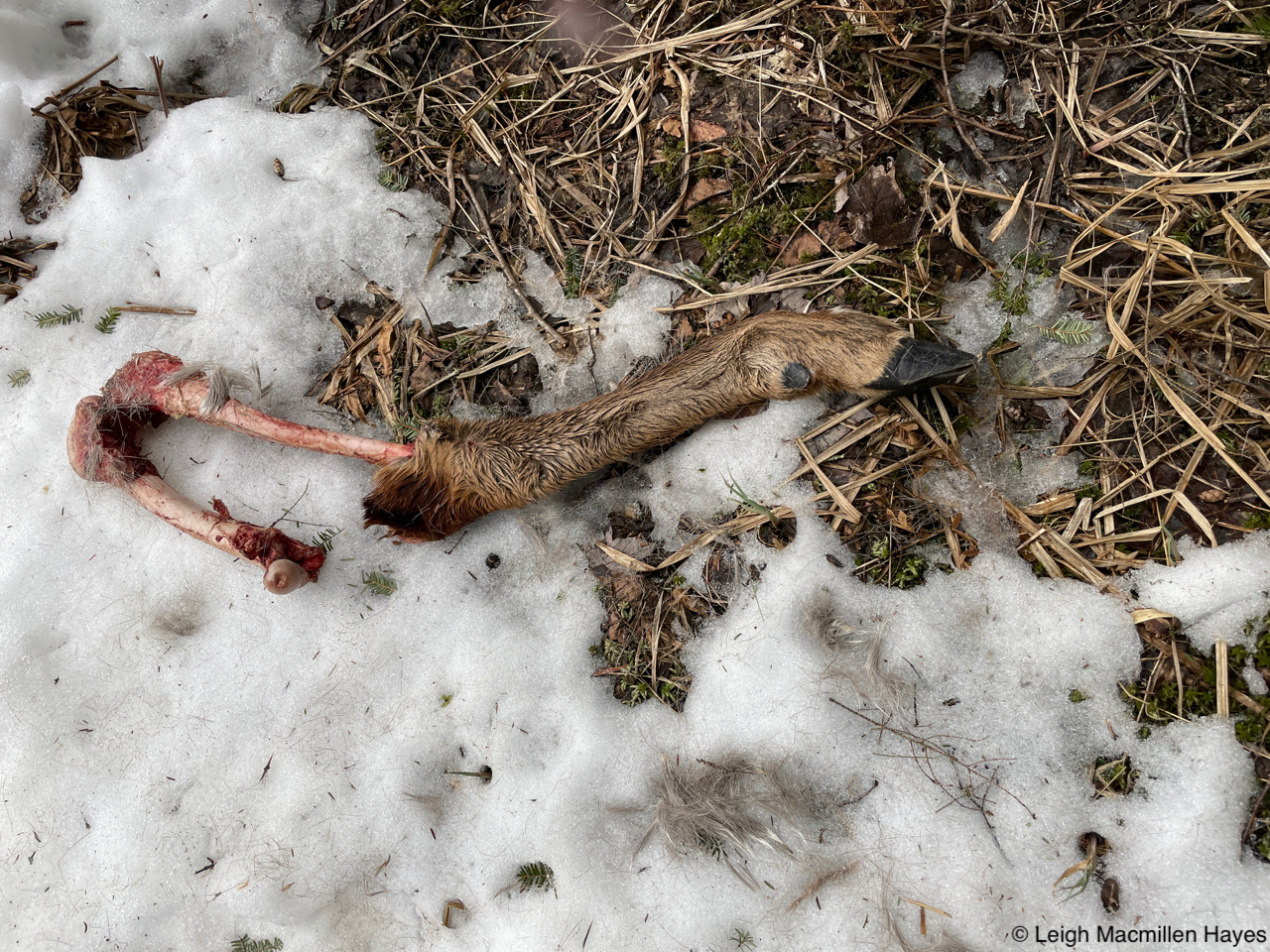
But at the scene, leftovers, like this leg and foot.

And part of the hide with more bones to nosh on.

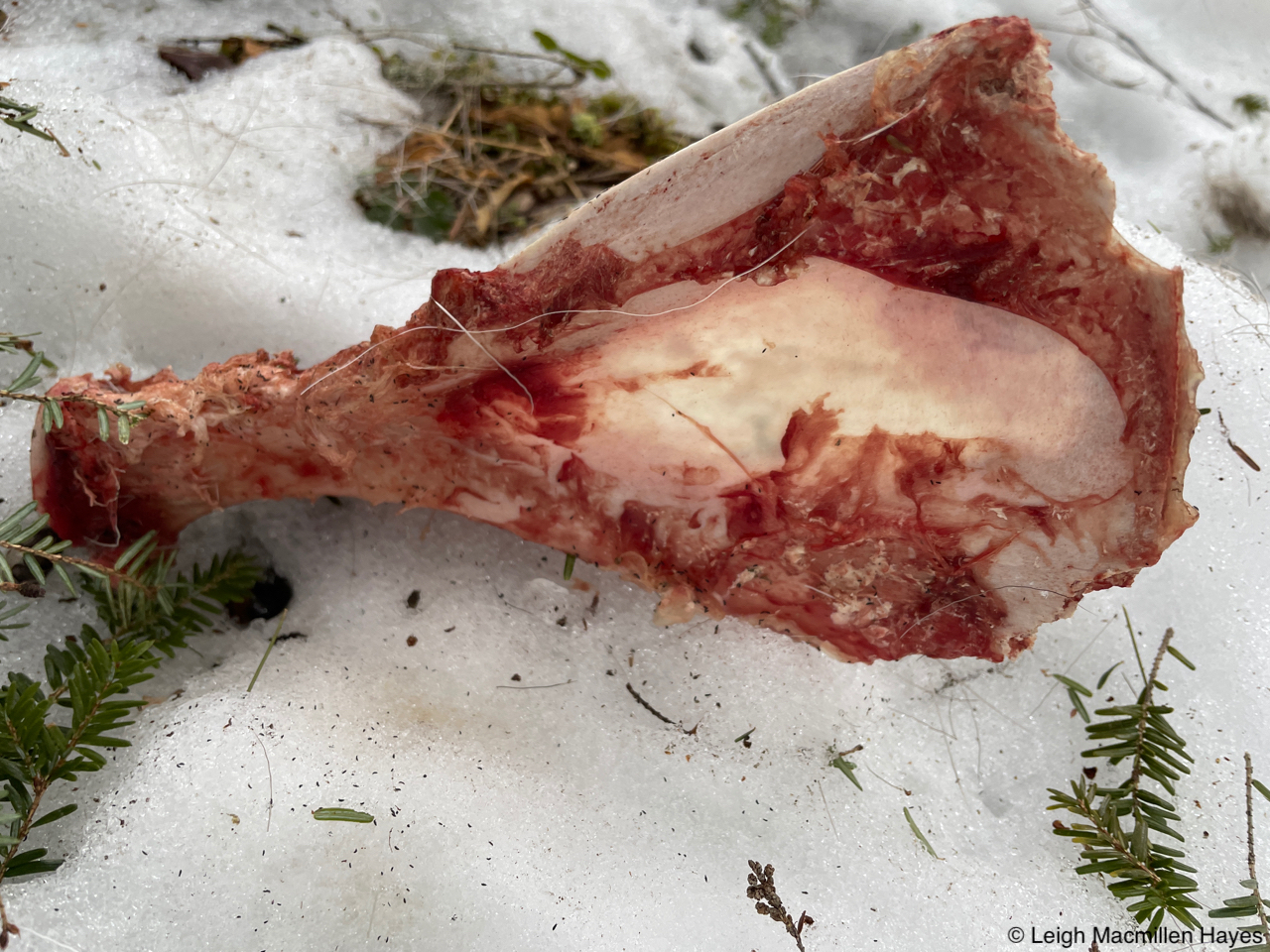
A scapula, that was outlined with teeth marks.

The top of the head, spine and ribs, plus another leg. Do you see that whitish oval on the leg? That is the tarsal gland, a key for deer communication. It is found on both bucks and does. Each hair in that oval secretes an oily substance and when a deer rubs-urninates, bacteria living within the gland mixes with the urine and the deer leaves behind its own unique odor–possibly providing important information like age, health, and other characteristics.

A few feet from the top of the head, the lower mandible sat, completely stripped of any meat and skin that had covered it.

About fifteen feet away lay the rumen, or stomach contents. In Mark Elbroch’s Mammal Tracks & Sign, he writes: “Coyotes tend to open a carcass from the rear and then move into the ribs and cut out the internal organs. They often remove the rumen right away; this may be an indicator of the original kill site or the place  where the carcass was encountered. Within a short time, the carcass is dragged and moved several times, and it is cut into smaller pieces and dragged in different directions by different coyotes seeking a spot to feed in solitude.”

It turned out, however, that it wasn’t just a coyote family enjoying this grand feast. The print with the asymmetrical toes indicated another, more solitary figure had entered the scene.

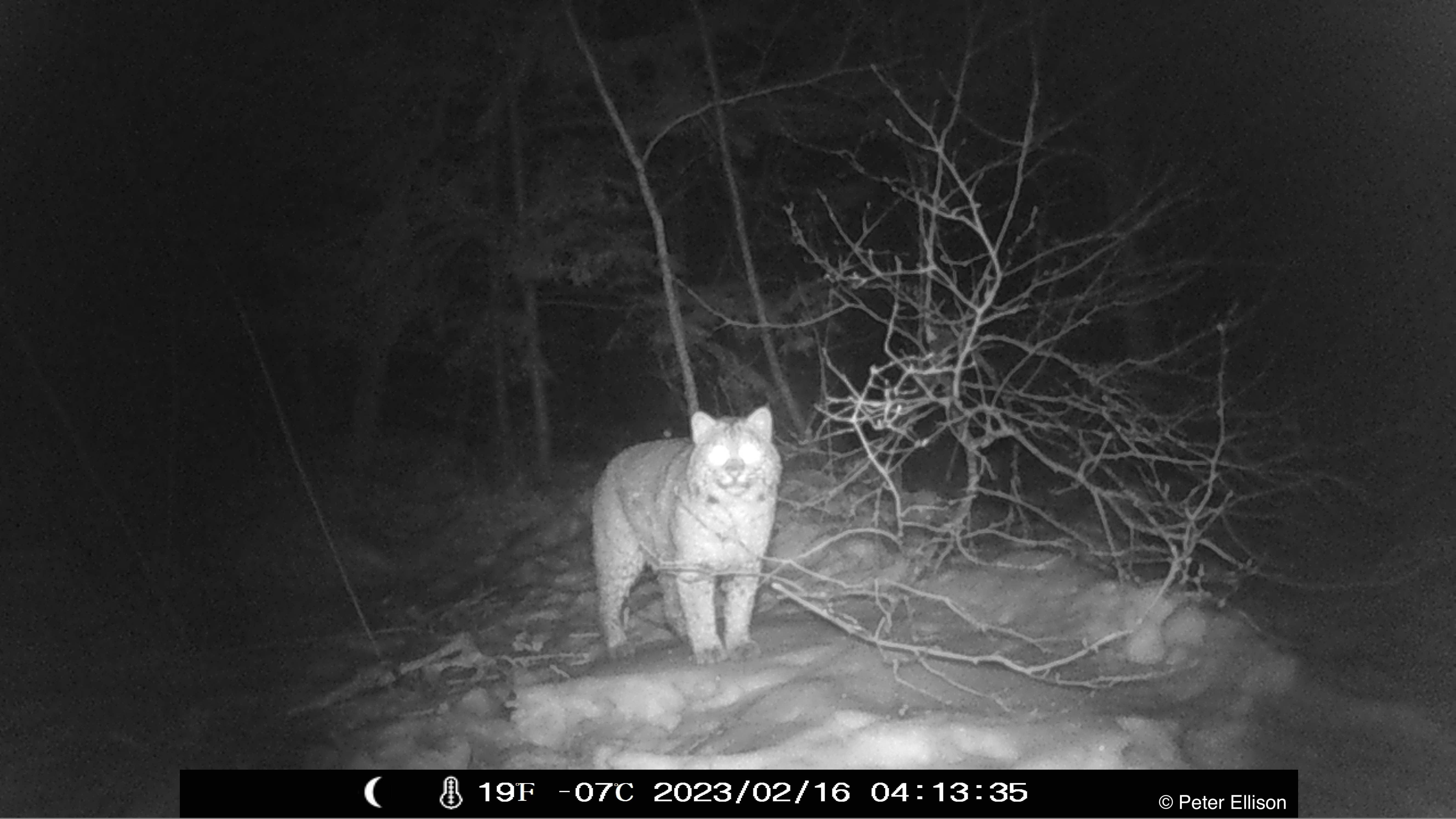
A friend placed his game camera on a nearby tree and captured some of the action by the one with the bobbed tail.

Click on the white arrow and watch the bobcat dine.

He looked quite healthy and sated after partaking in such a meal.

And left plenty of tarry, segmented scats behind–as a parting thank your note.

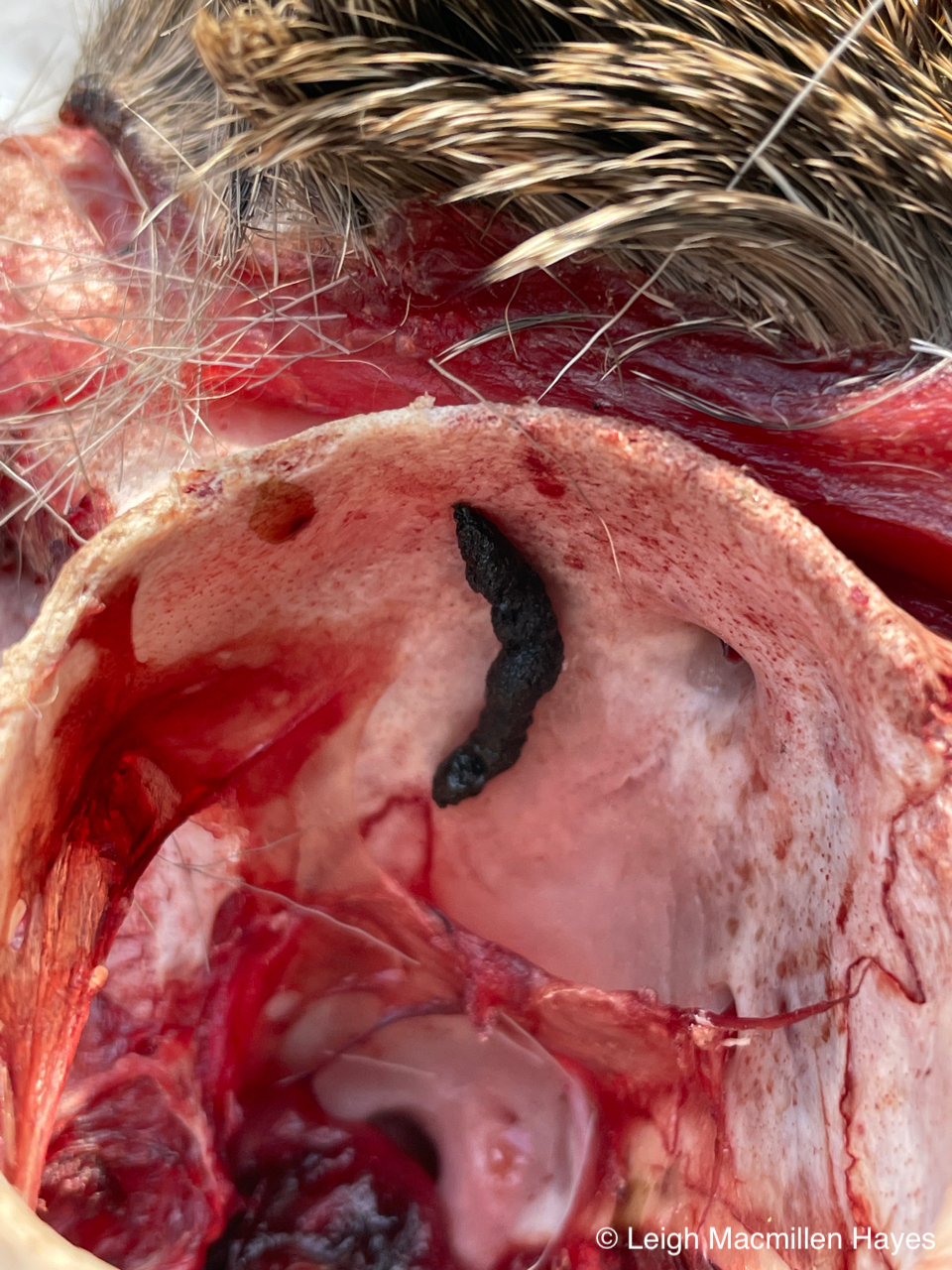
The bobcat wasn’t the only one to leave his calling card. If you take a look inside the eye orbit, you might spy the mark of another.

It was a small deposit, the sign of an ermine or long-tailed weasel.

So, the story of this deer’s tale goes something like this: “A neighbor told us that a couple of days before the deer carcass was found, a deer was chased out of the forest onto the pond by two coyotes. When the coyotes saw the neighbors they ran off and the deer ran down the pond to the outlet. The deer had been wounded and left an intermittent blood trail. We are thinking this was the same deer that was killed on the nearby trail,” wrote Paula, the one who’s face lit up when I invited her to change her afternoon plans and visit the site.  

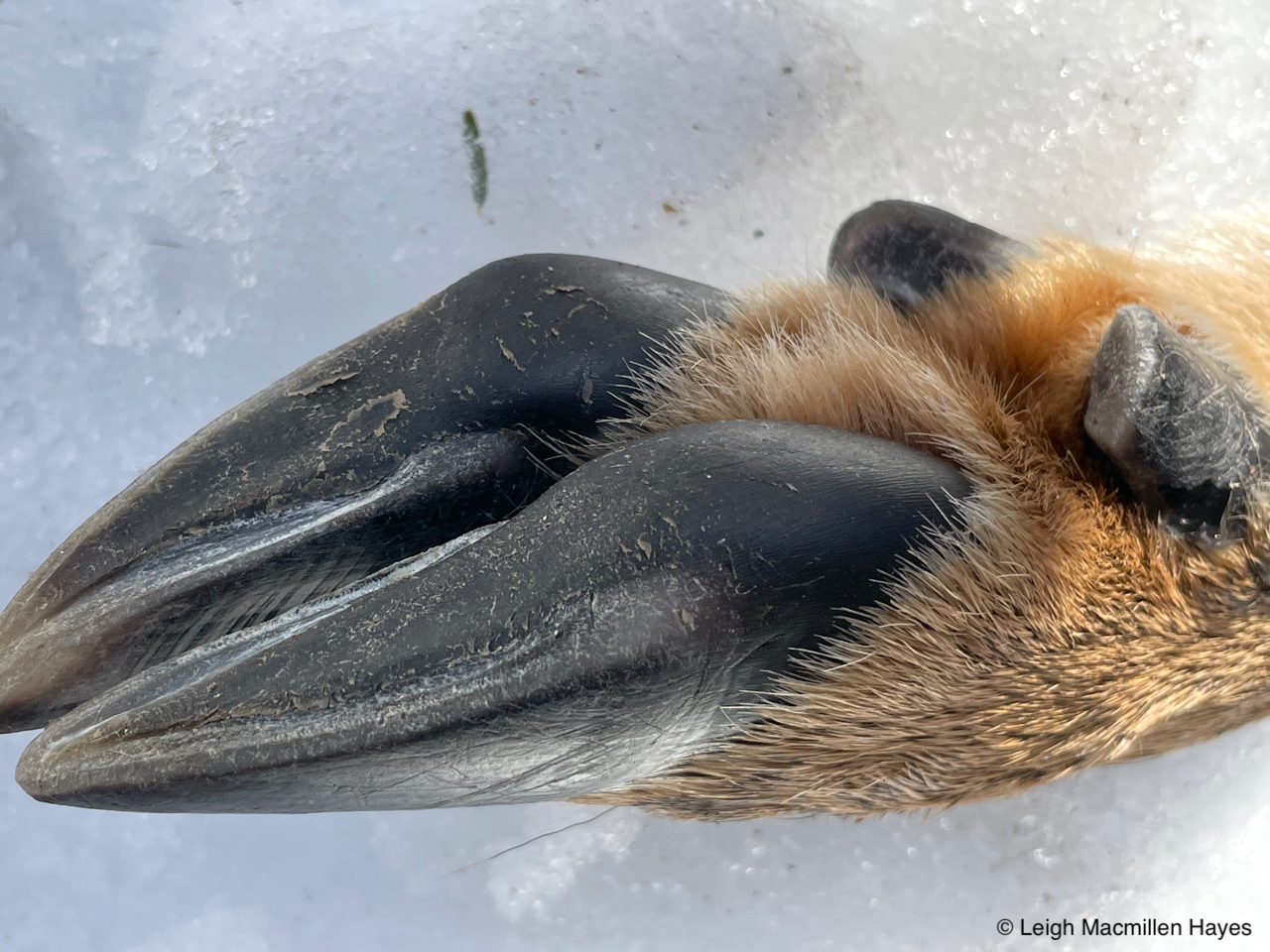
One final look at the tippy toes and dew claws of the deer–can you imagine walking on your tippy toes all day as ungulates do?

And then it was on to another place on another day–after a recent fluffy snowstorm. The storm had ended during the previous day, but then there was a dusting overnight, followed by gusty wind. Two friends and I met at a trail system and within minutes one set of tracks led to another and that set led to a half dozen others, all traveling together. Like a pack. Or a family. Mom, Dad. And the kids.
At first we thought domestic dog, but then we found a tuft of fur. And so we continued on, spying something amiss in the track ahead.

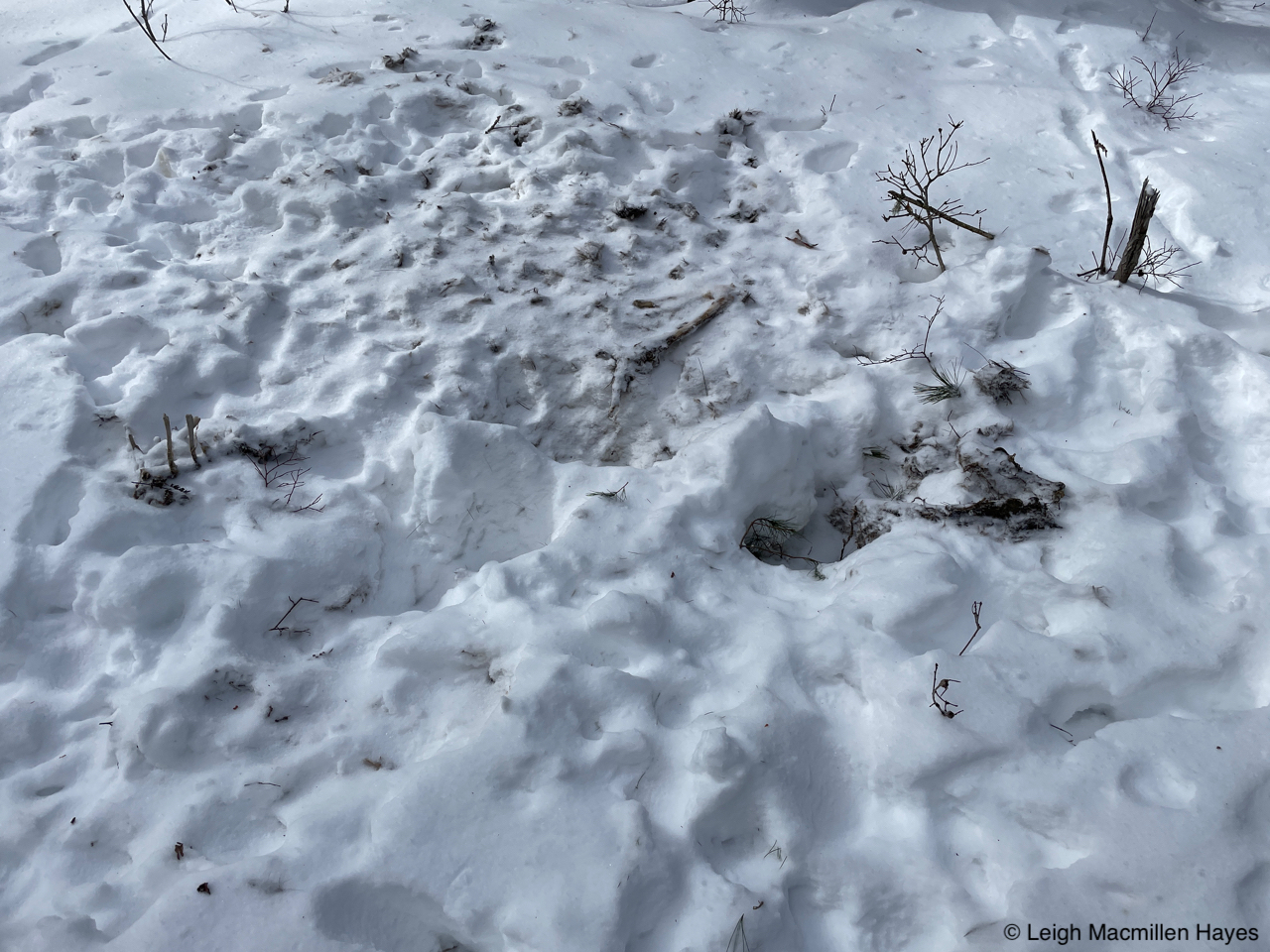
Another kill site. If you know us, you can imagine our glee. Who did it? And what happened next? What we noticed: the area had been visited by many, who had then taken off in different directions. The meal had been buried under a pine sapling. There was some urine deposited by the midnight raiders. We found some hair of varying colors. And we had lots of questions.

On one side, a rib cage well cleaned.

On the other side of the hole, a second rib cage that at first we considered had been torn from the first, but then decided it belonged to a different critter.

And there was a leg by the hole. To whom did the leg belong? The foot was gone, which would have provided a clue. We did spot some reddish hair still clinging to it.

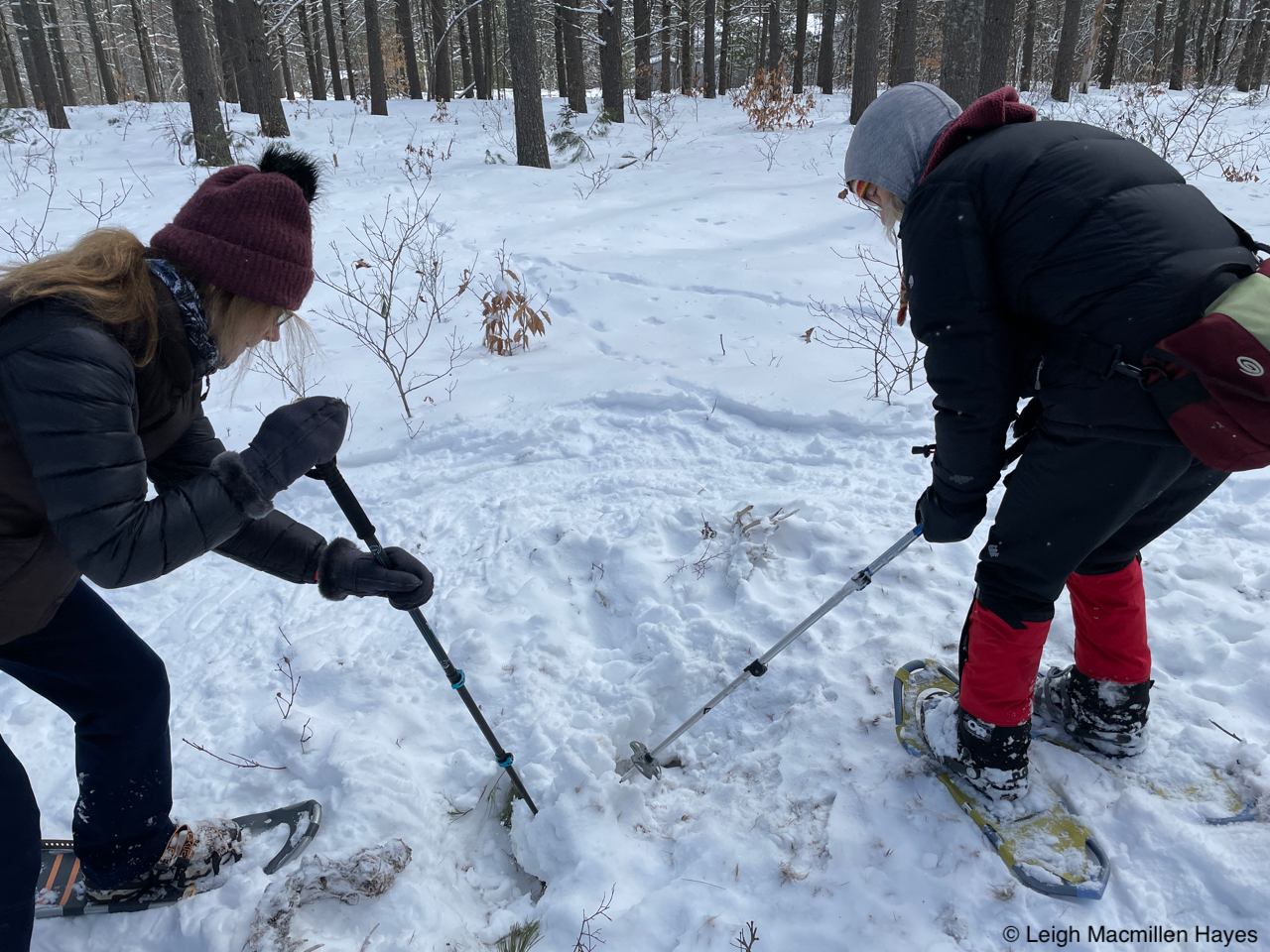
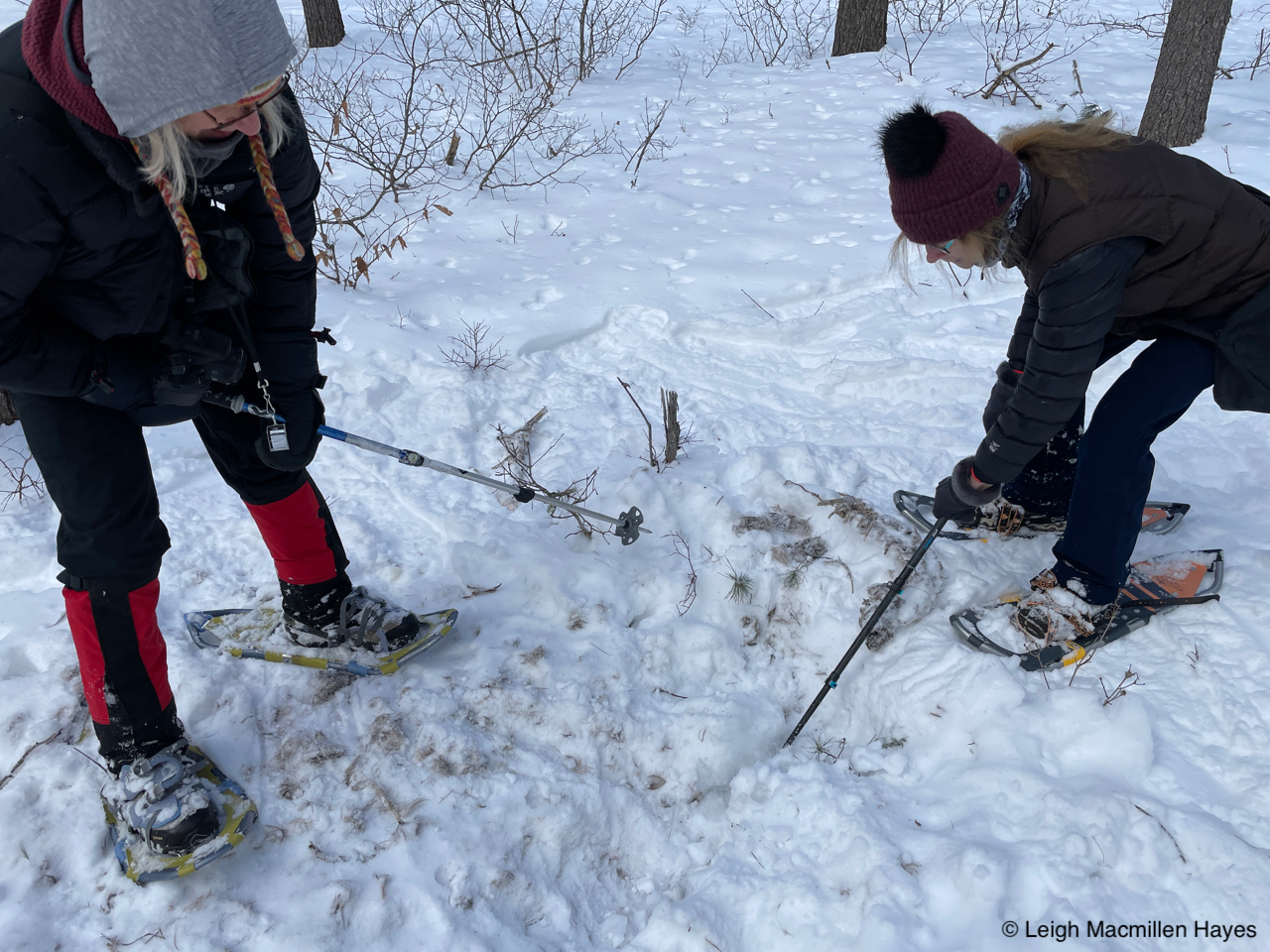
All appeared to have been excavated from the hole so we decided to take a closer look.

Up close, there didn’t seem to be anything else of note.

But, we’re a curious sort (in more than one way) and so Joan and Dawn used the tools we had to dig in.

To our discerning eyes, there was nothing more, though we could have missed a clue.

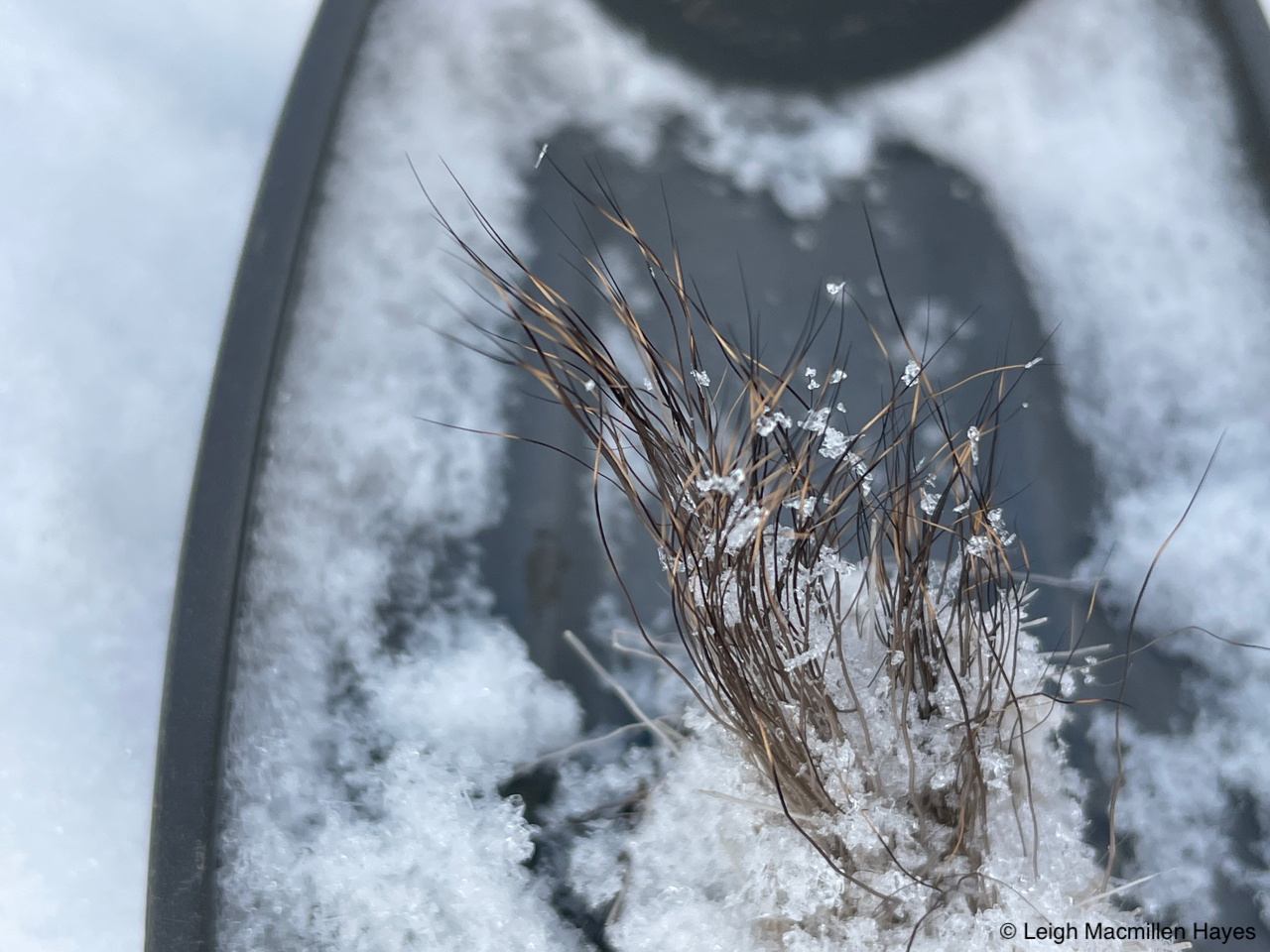
What we did find curious, was that upon closer inspection of a tuft of hair that looked grayish at first glance, it was really black and orangey tan. We had talked about a young deer at first, then switched our minds to a fox. but if you look back at the head of the deer at the other site, there is a lot of similarity. And the leg was long–which we thought could perhaps be the hind leg of a fox, but maybe it makes more sense that it belonged to a young deer.

We didn’t reach a definitive conclusion, but what we did think about was that the first site had been the work of coyotes, which a bobcat had visited. It occurred to us that the second site was probably the work of a bobcat, which coyotes had visited. As Elbroch writes, “Bobcats cover their prey and often move the carcass and recover it on successive nights. They appear to be unable to break the large bones of mature deer, so they sever and separate them from the carcass at the joints as they feed. A cleaned carcass with intact large bones is a good indicator of a bobcat kill.”

Not to cache or to cache? That is the question. But, occasionally coyotes will cache too. Tracking. It’s not a simple, straightforward art and each time we practice it, we come away with questions and learn a wee bit more to store in our brains for the next time.

Mondate with a View

I’ve been wanting to take My Guy to a certain place in North Chatham, New Hampshire, for the last few years and today was the day that the stars lined up.

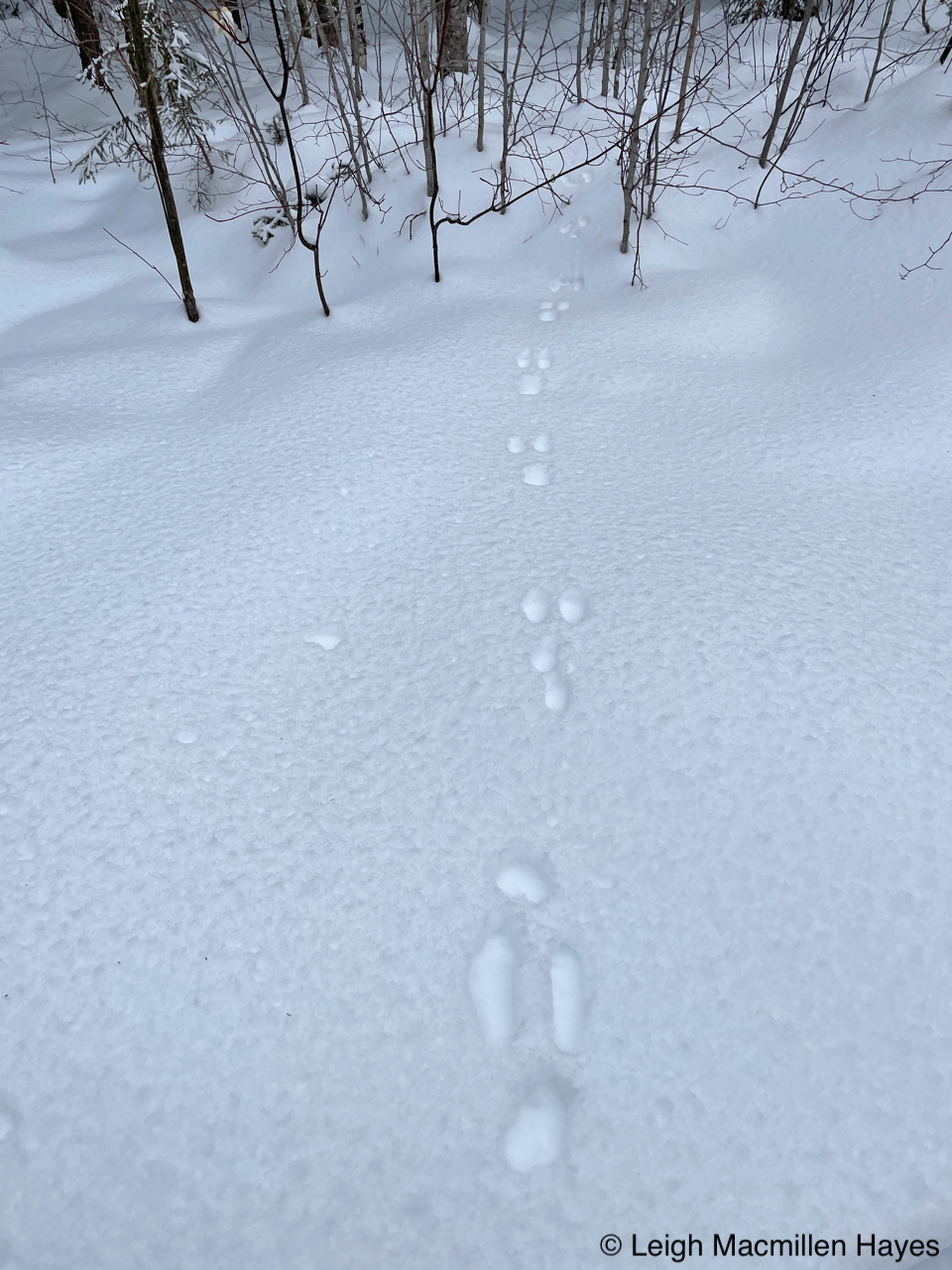
Though it appeared we were the second and third humans to head out on the trails this morning, for at the start we spotted only one set of snowshoe tracks, it was obvious that so many others had followed or crossed before us–such as this vole, who tunneled through the fresh inch or two of snow that fell yesterday and then changed its gait.

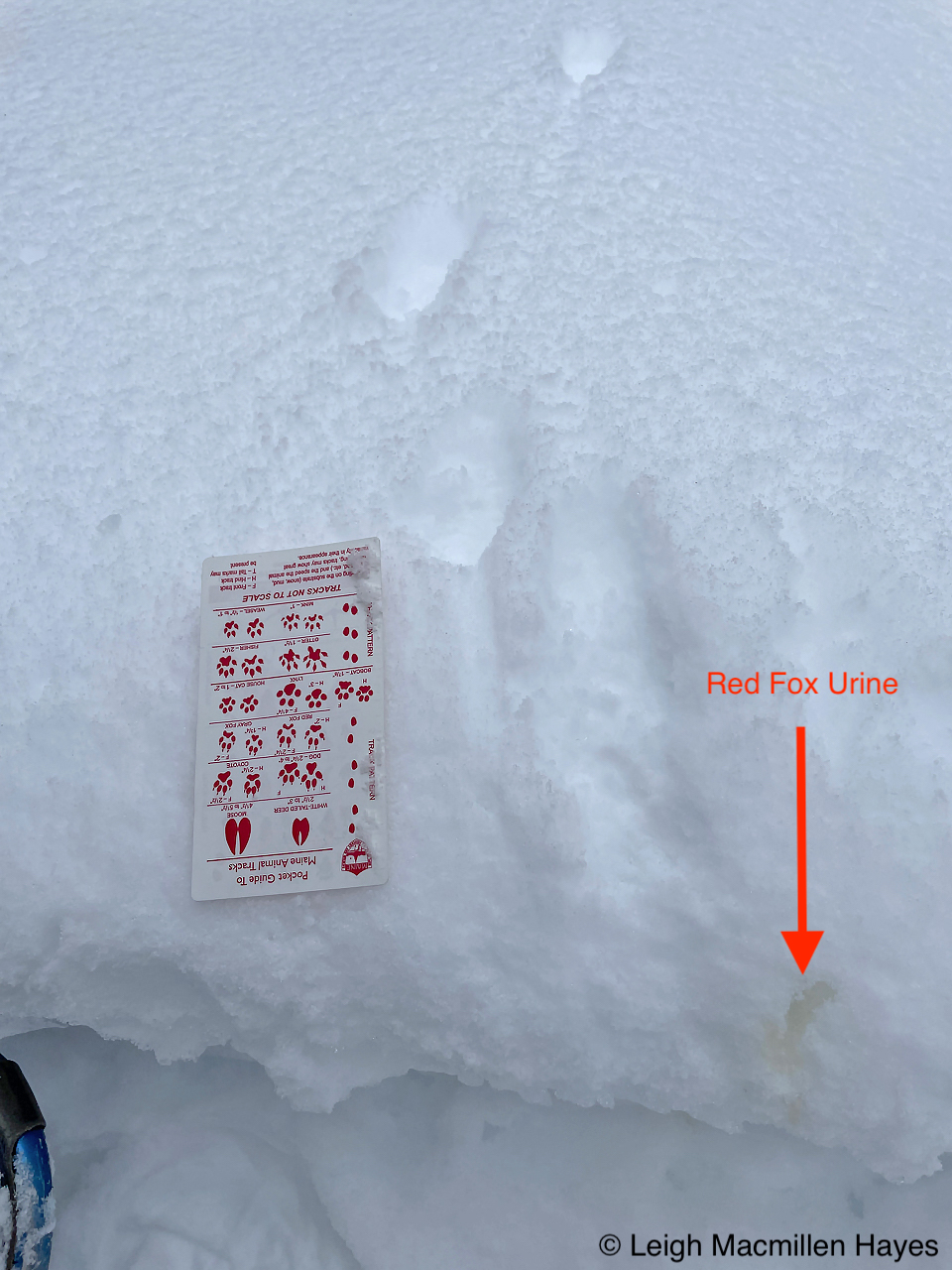
And then I spotted a sign that always brings me to my knees–fox prints and a dash of urine, probably that of a male in search of a date. Confirmation that it was a fox, and a red one at that, came in the form of the urine’s scent–rather skunk-like. I asked My Guy if he wanted to take a sniff, but he passed on the opportunity.

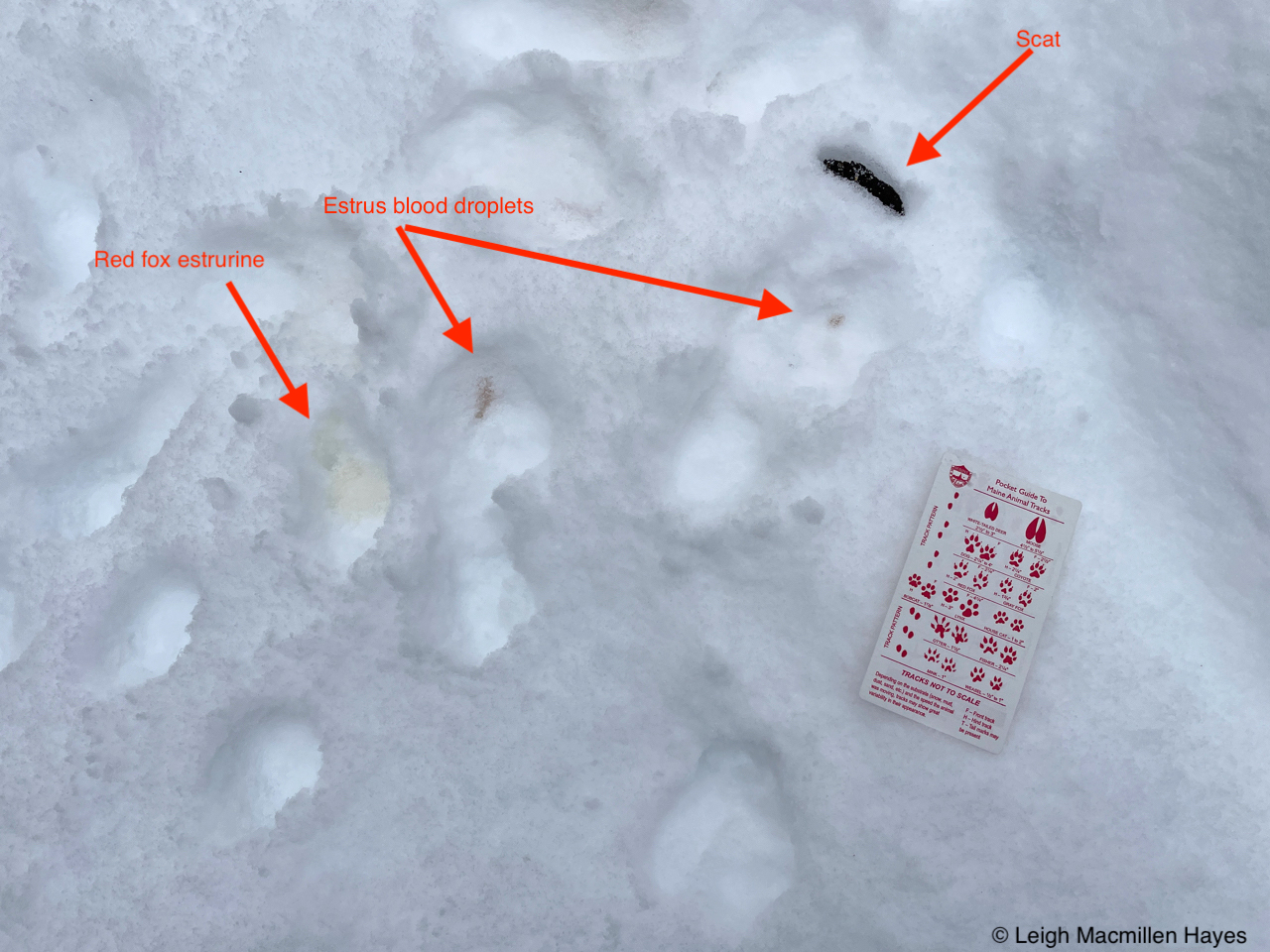
A wee bit farther and we came upon a smattering of activity, where two foxes had left their dancing cards and I think at least announced their intentions for each other as a date.

These classified ads could be that of the male stating his desire, while the vixen left her own marks of estrus blood as she perhaps investigated his intentions and decided to say yes. The scat? It came from one of them. Another advertisement of health and age and vitality.

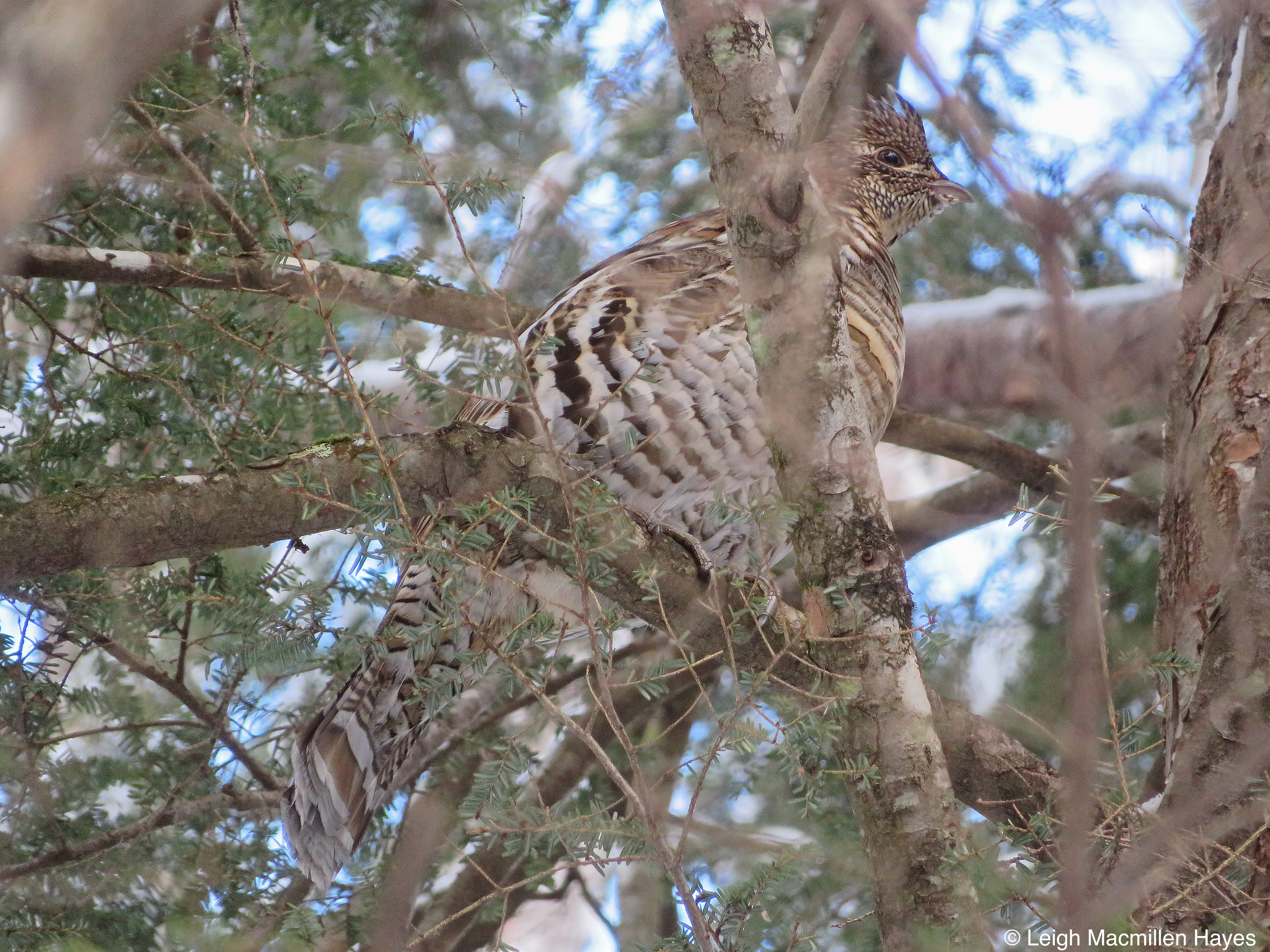
While I suspected a meal was not on their minds as she’s only ready to mate for about a week or less, by the amount of snowshoe hare tracks we spotted, we knew that there was plenty of food available. Other offerings on the pantry shelf included ruffed grouse and red squirrel.

Most of the trails at this place are well-groomed by the owners, but we also tried one or two that weren’t.

For the first time in the four or five years that I’ve traveled this way, I finally found the Old Sap House. The owners still tap trees, but obviously this is not where they boil the sap to make maple syrup.

So . . . this was my first journey on the network of trails with My Guy as I mentioned. And I had no idea that it is possible to circle Moose Alley in under an hour. In the past, when I’ve gone with a couple of friends, it has taken us hours and hours because we stop to look at every little thing. And go off trail to follow tracks. And make all kinds of discoveries. But today was different, and that was fine.

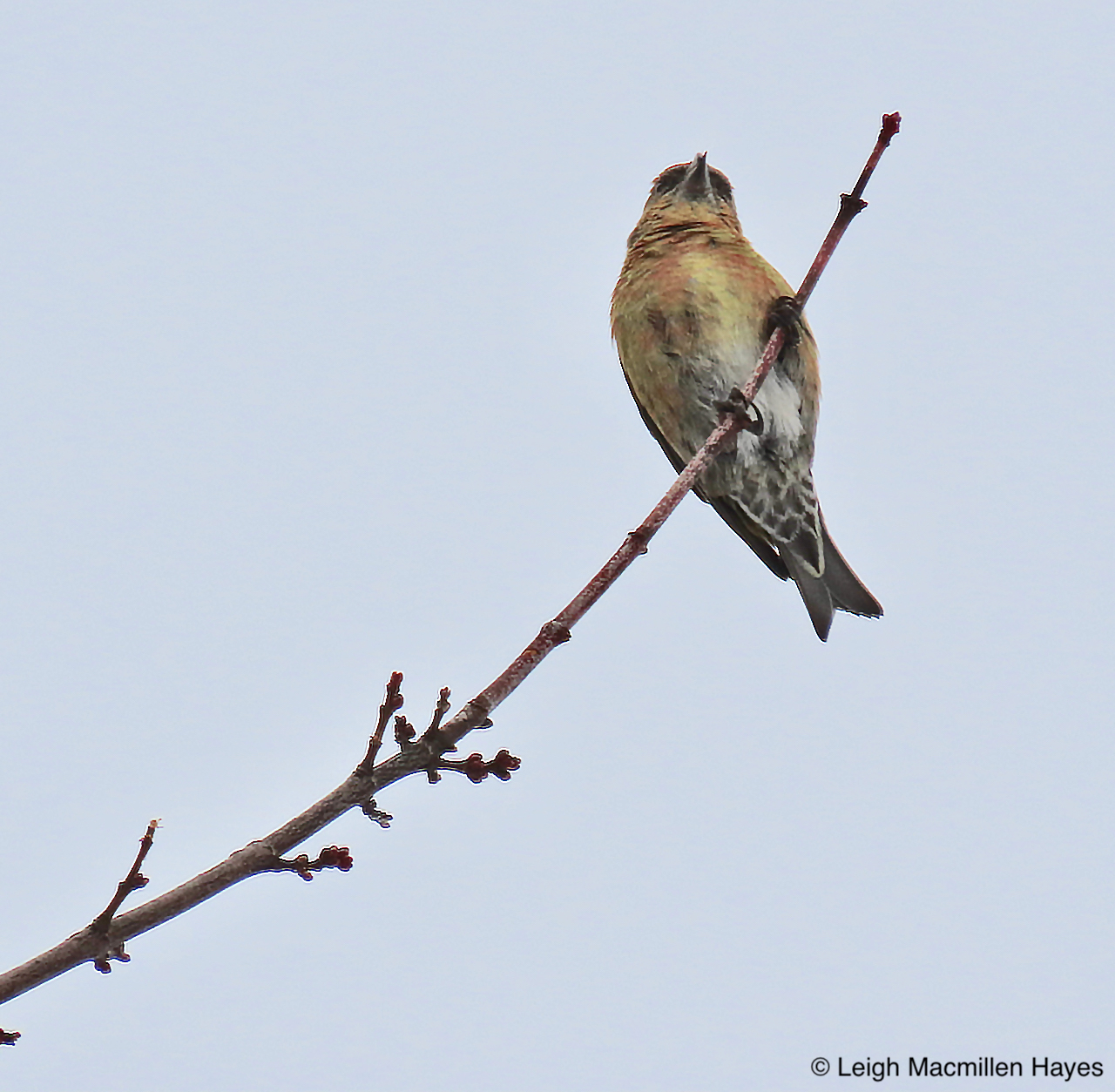
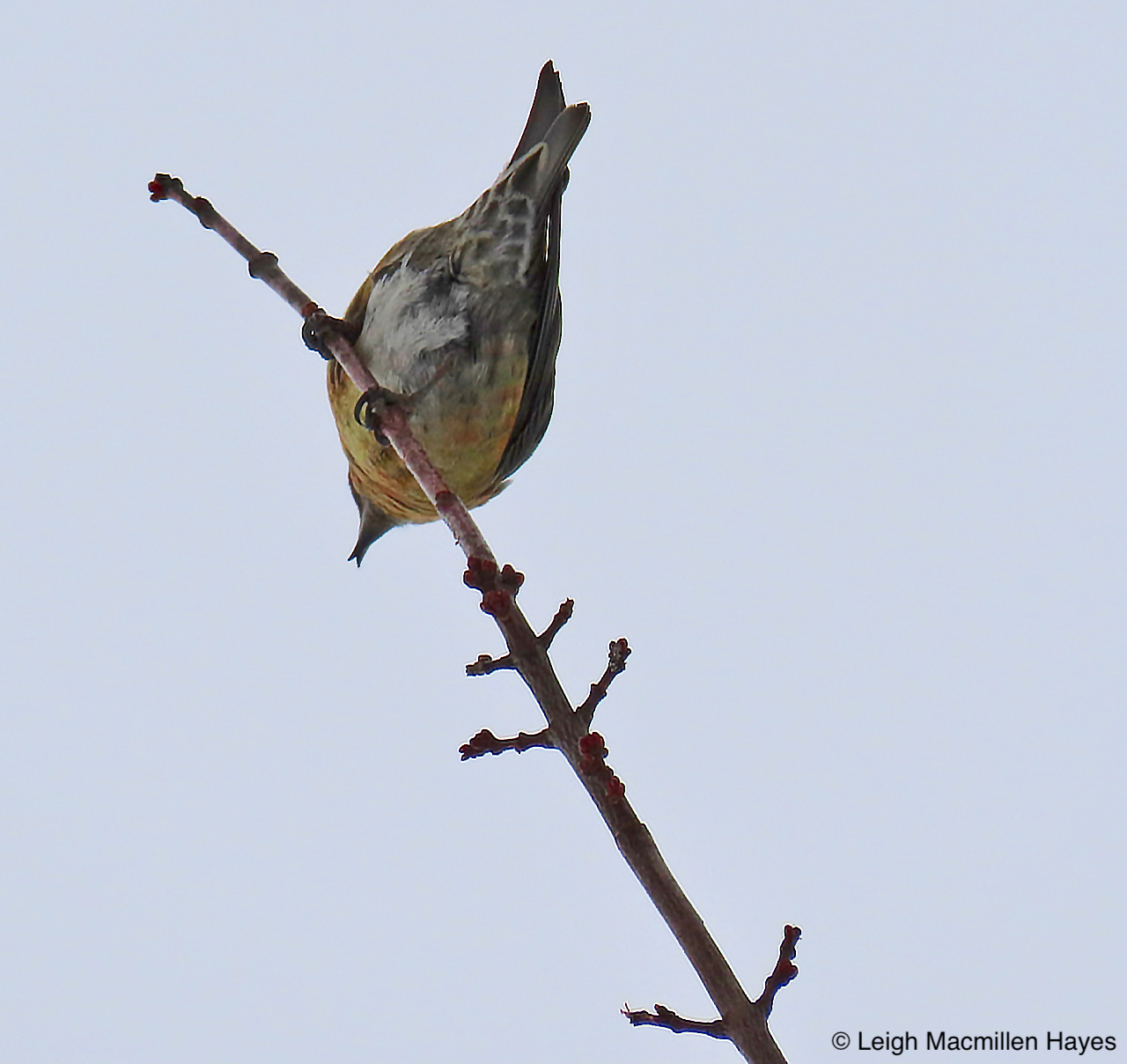
I’d also never been on the Sugarbush Trail, which brought us back to the Route 113 and an intersection with Snowmobile Corridor 19. It was here that we heard Chickadees and Red Crossbills singing and I finally located one of the latter in a maple tree.

Crossbills are finches with specialized bills that let them break into unopened cones. Can you see how the top of the bill cross over the bottom?

My intention was that we would eat lunch at one of the benches along the trail system, but we’d hiked most of the system before I knew it and so we sat on the back of my truck and ate. And then we headed back out on Corridor 19, a super highway through Evans Notch.

Only about a quarter mile from the farm boundary, we spotted moose tracks showing two had passed this way recently. We knew they’d been seen on the farm and hoped we might get to spy them, but just seeing their tracks and knowing they were still in the area was enough.

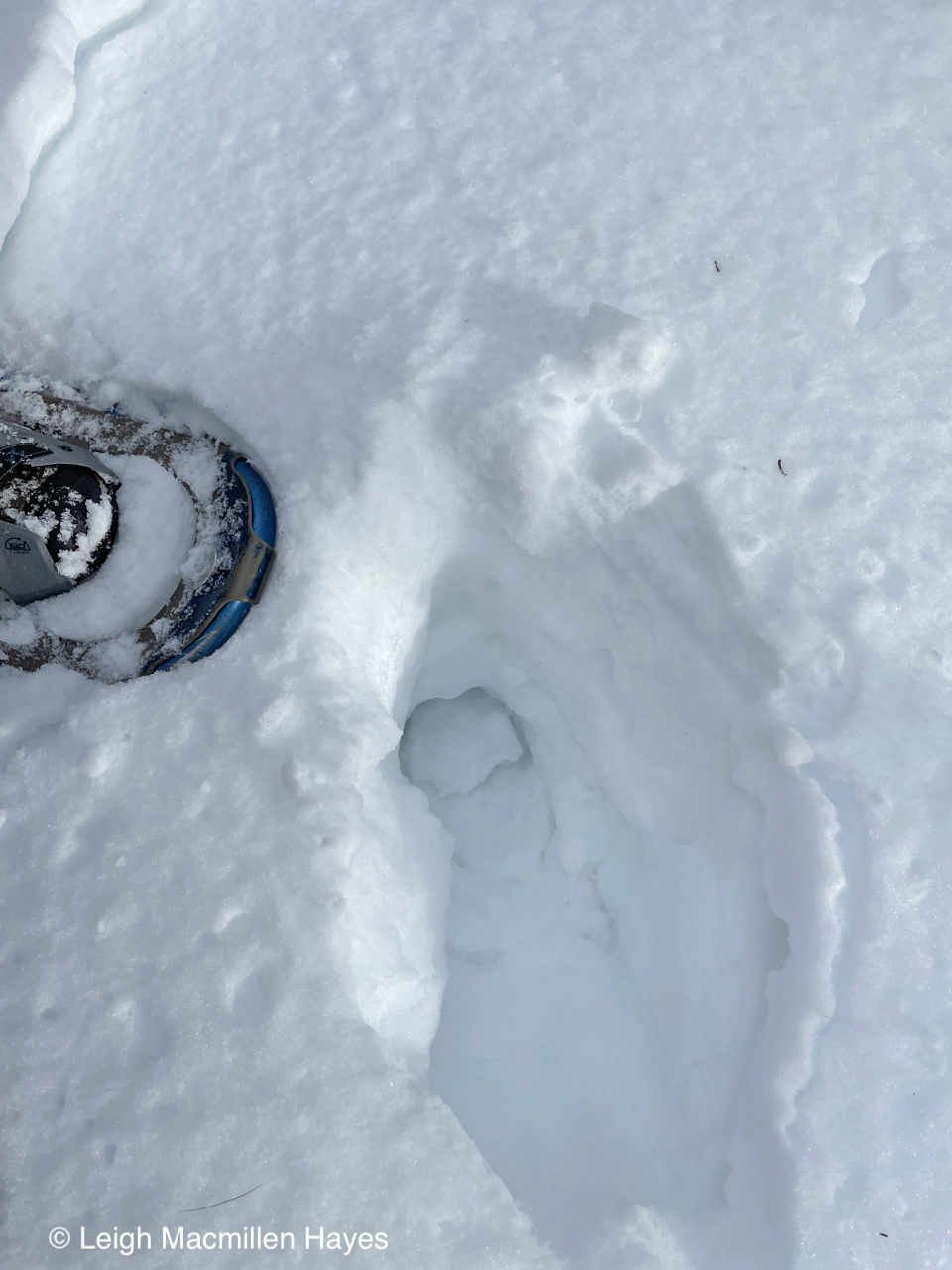
Can you imagine sinking two feet down with each step? Well, actually I can, because I’ve post-holed through snow many a time, but moose and deer must do this daily. For them, it’s routine.

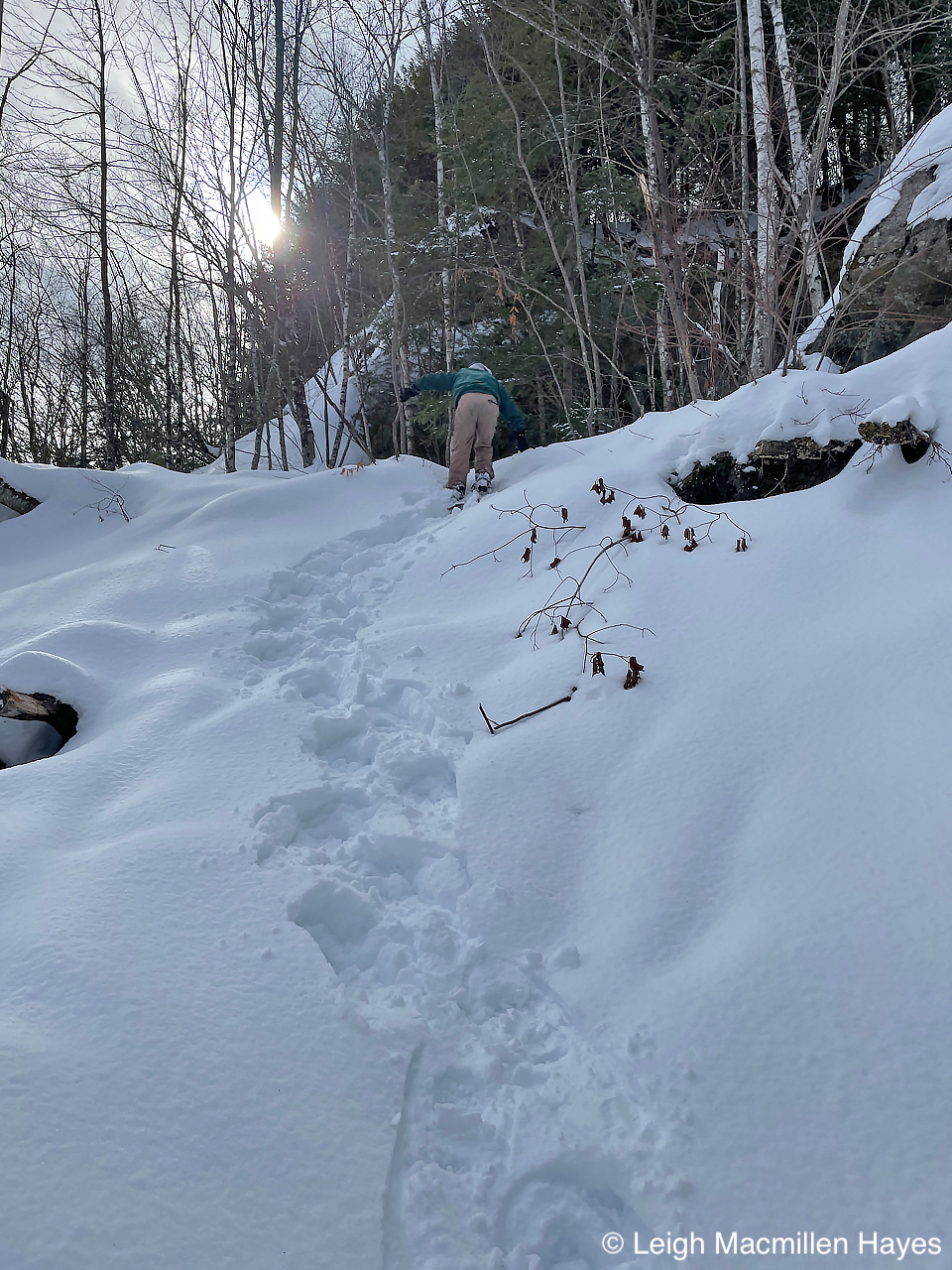
Our reason for continuing on the snowmobile trail was that we had a destination we wanted to reach, that we hadn’t even thought about before reaching the intersection of Corridor 19 just prior to lunch. Eventually, we had to break trail again, and this time it was all uphill, and rather steep at that.

But our real plan was to climb to the Millard Chandler Feldspar Mine (aka North Star Mine) in Evans Notch.

Millard Chandler was a descendent of one of the founding families of Chatham. Originally, mica was mined from the pegmatites but prior to World War II, Whitehall Company, Inc, focused on feldspar.

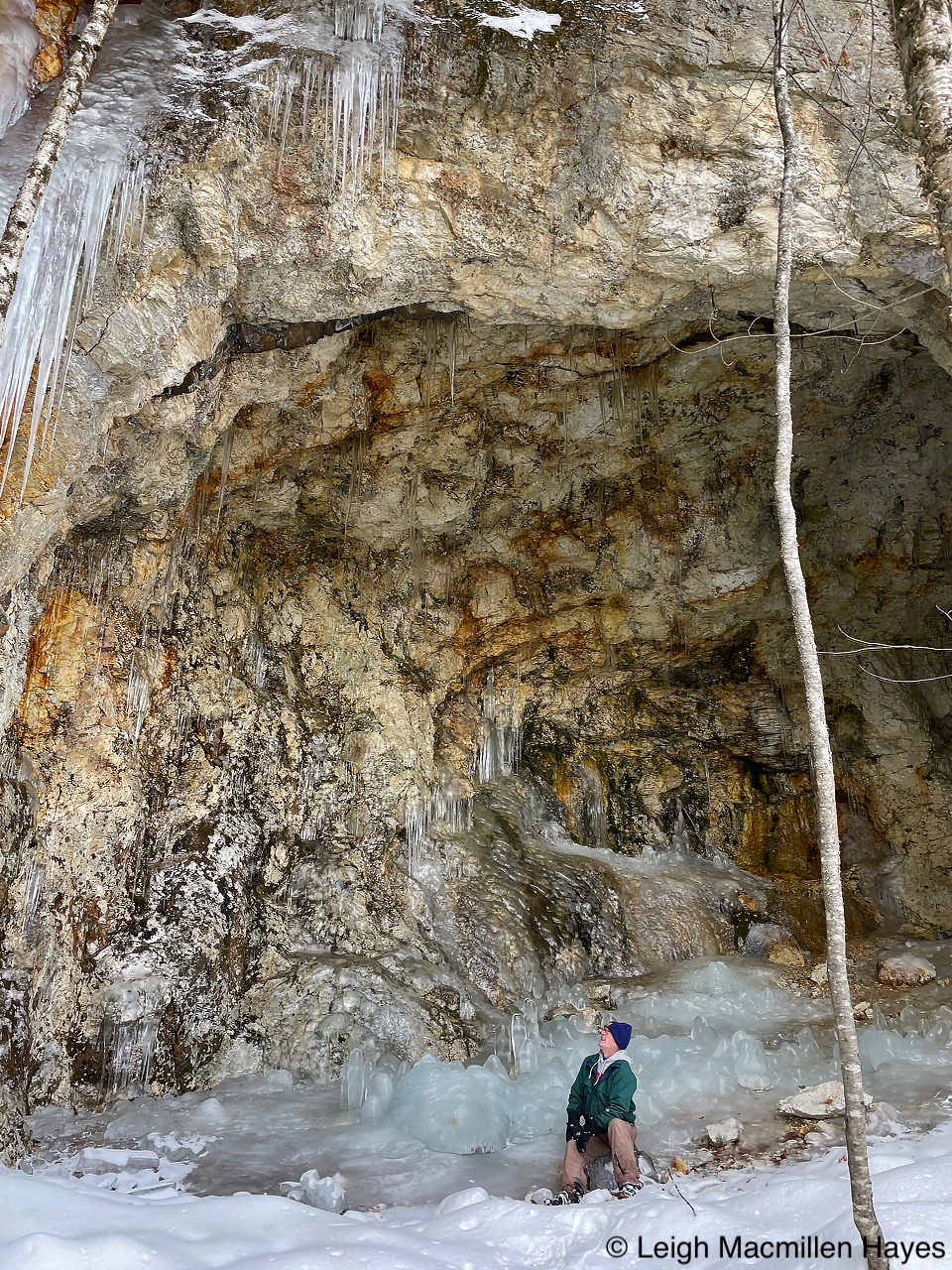
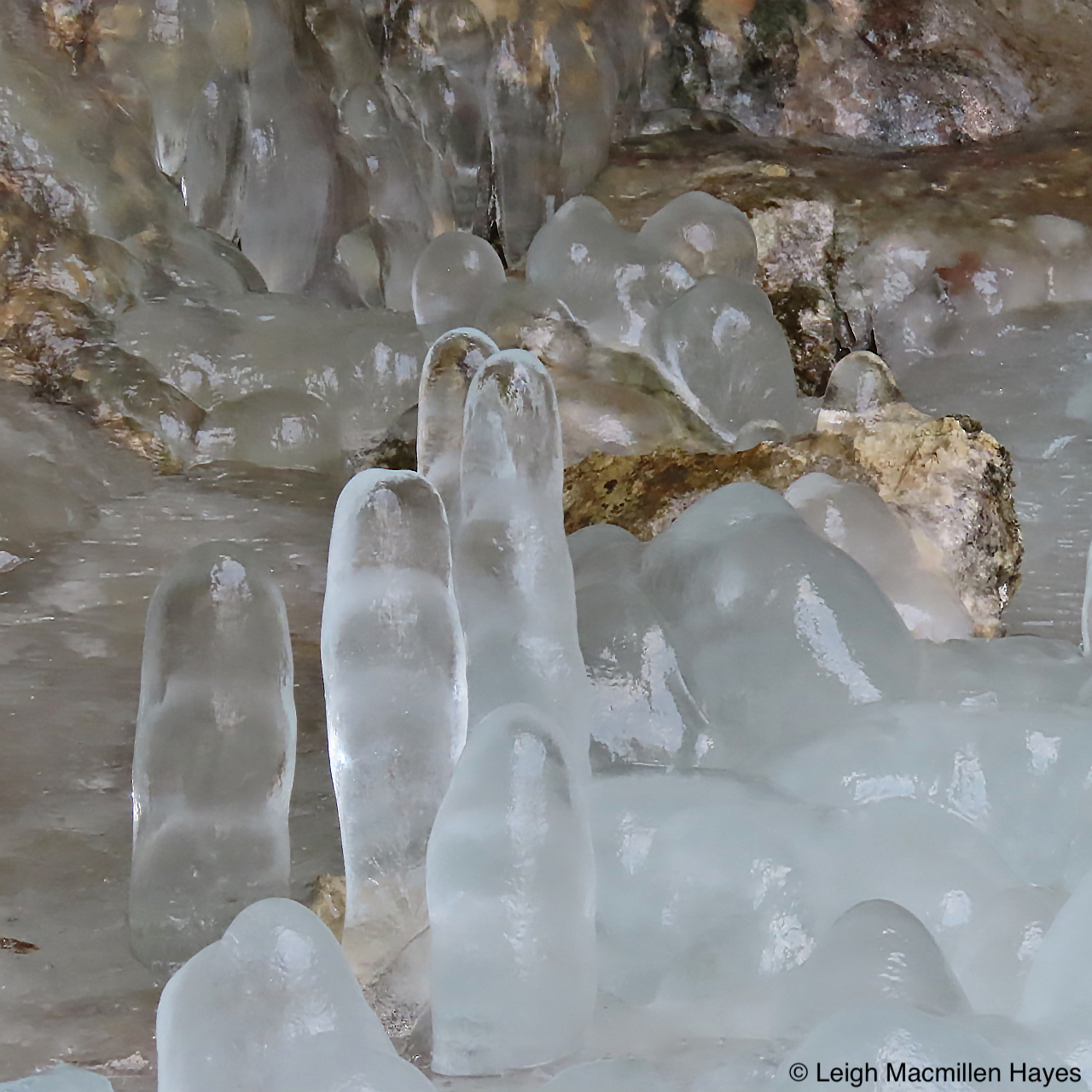
From the top of the cavern, where life on a rock was evident as the trees continued to grow up there, the water flowed and froze and formed stalactites of sorts. Icicle sorts.

StalacTites grow down from the ceiling of the cavern–think T for Top.

StalaGmites, on the other hand, grow up from the floor–Think G for ground.

In this case, they looked like little fingers reaching up.

This was definitely a Mondate with a view, including Evans Notch from the mine . . .

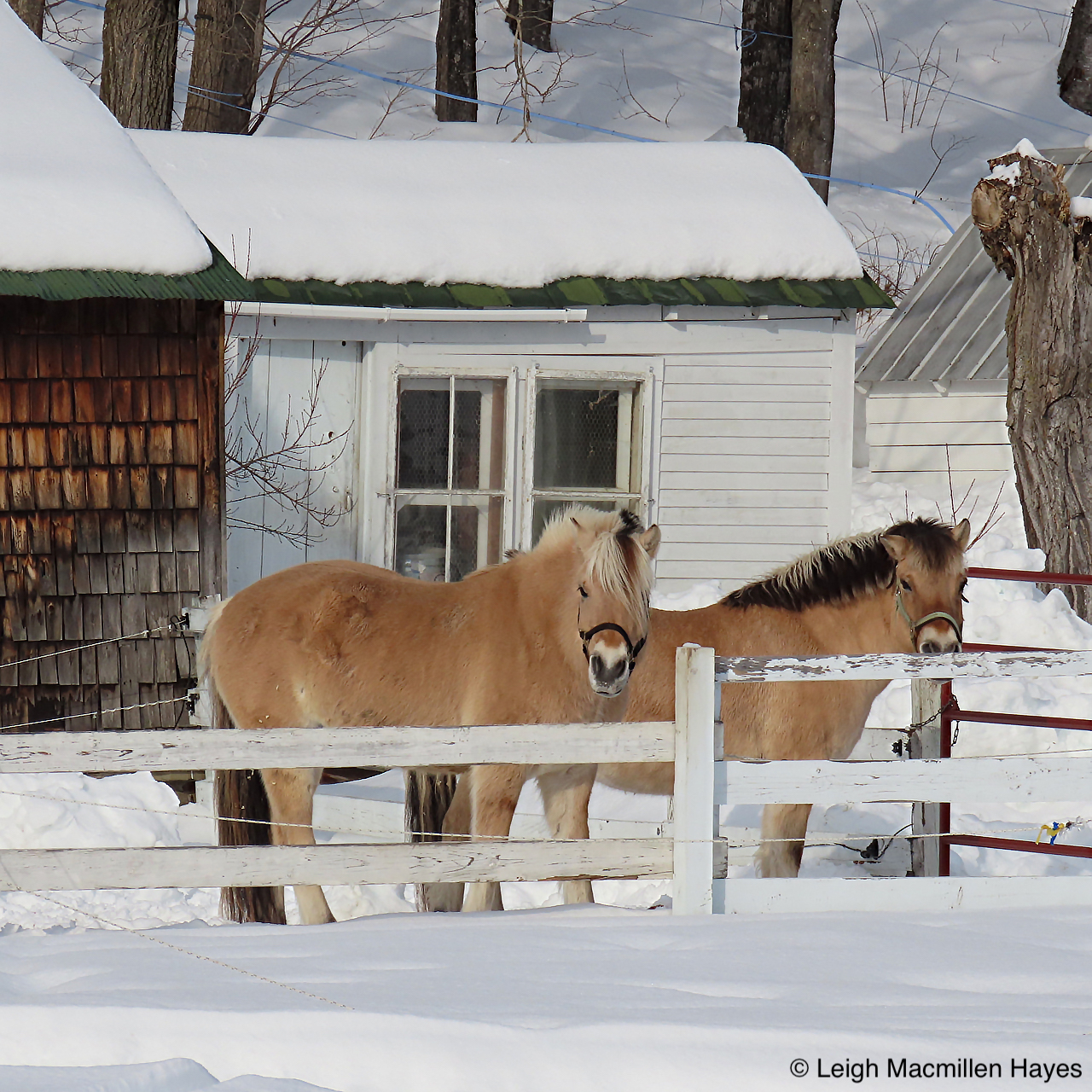
Norwegian Fjord horses Kristoff and Marta at the farm . . .

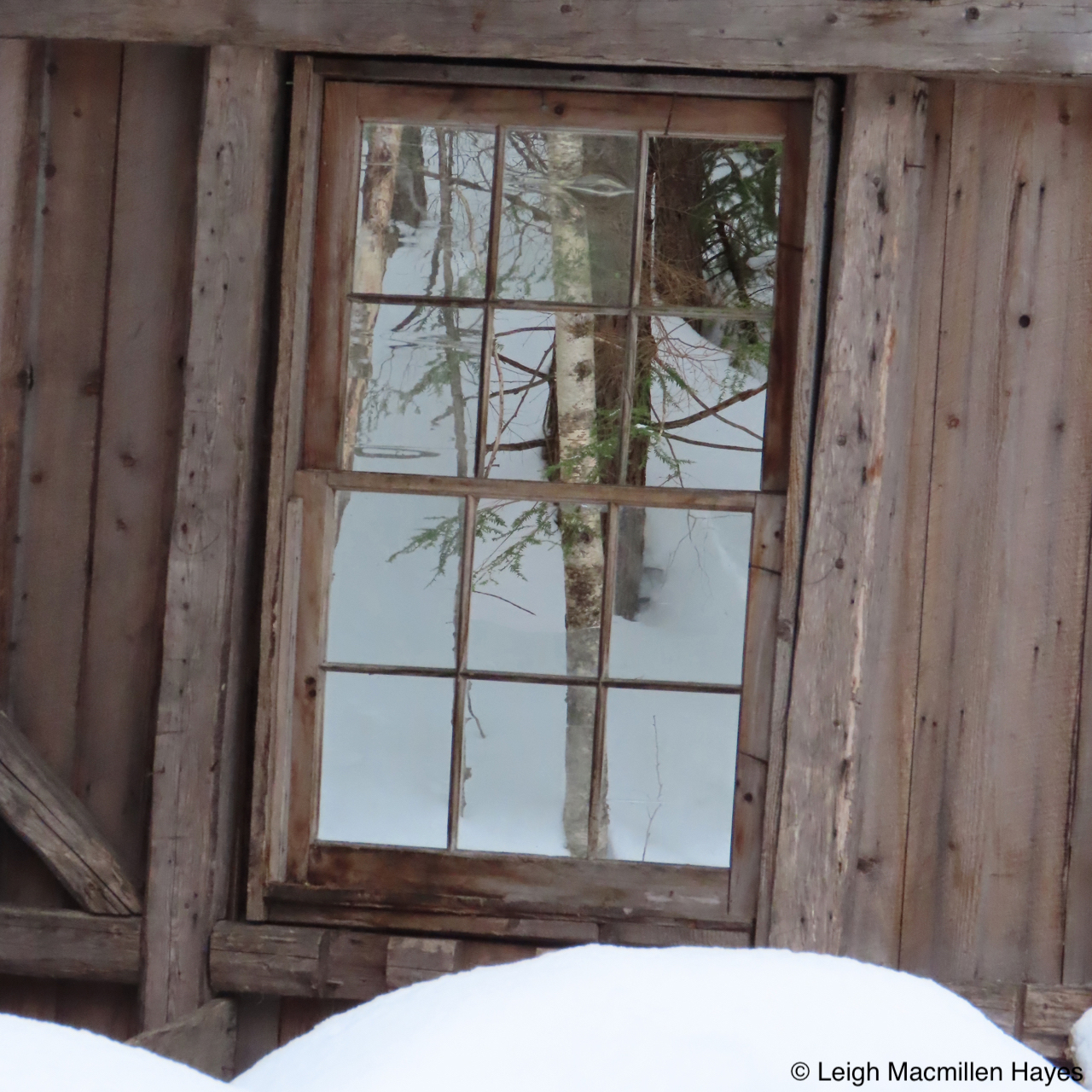
and a window that caught my fancy at the sap house.

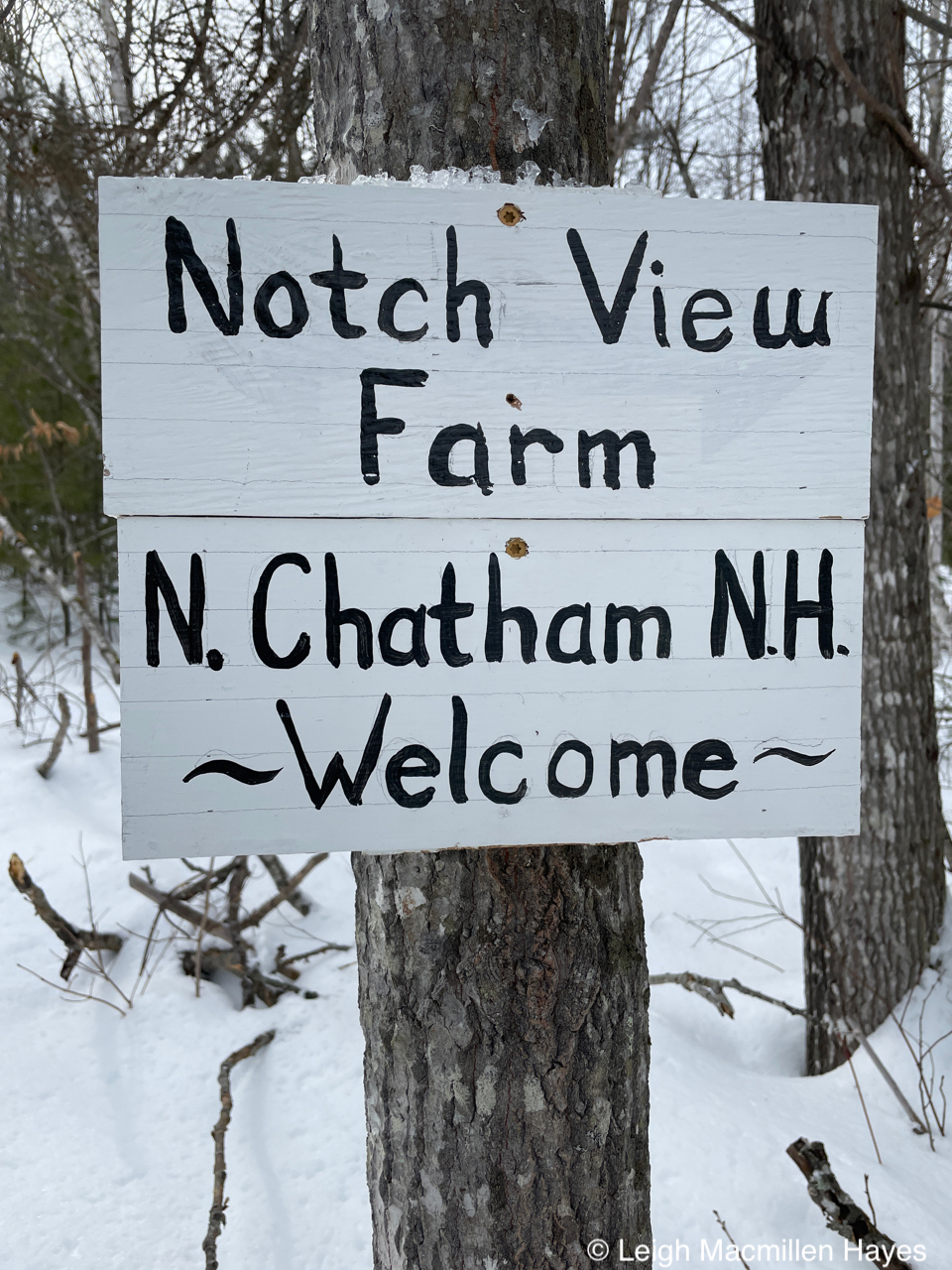
Our many, many thanks to Becky and Jim for sharing Notch View Farm with all of us. And thank you to Jim for chatting with us twice today. I’m still chuckling about the story of the women from Lovell who visit several times a year and spend hours upon hours on the trail. And then one of them writes long prose and includes pictures of every little thing spotted along the way. Yes, that would be Pam, and Pam, and me! Once, Becky even came looking for us on the snowmobile because we’d been out there for so many hours.

Today, with My Guy, it was a different adventure, but still a fun one and we appreciate that both of you work so hard to share your land with the rest of us.

Finding Food Is The Name of the Game

Winter finally arrived in western Maine this past week in the form of three snowstorms, the last ending with a coating of ice. Between storms, I’ve been teaching others the art of tracking mammals and birds through my work at Greater Lovell Land Trust, as well as a two-day class I taught for a local Senior College, and a day-long class for Maine Master Naturalists.

I love, love, love watching others experience joy as they begin to notice the nuances of print and patterns and scat and sign.

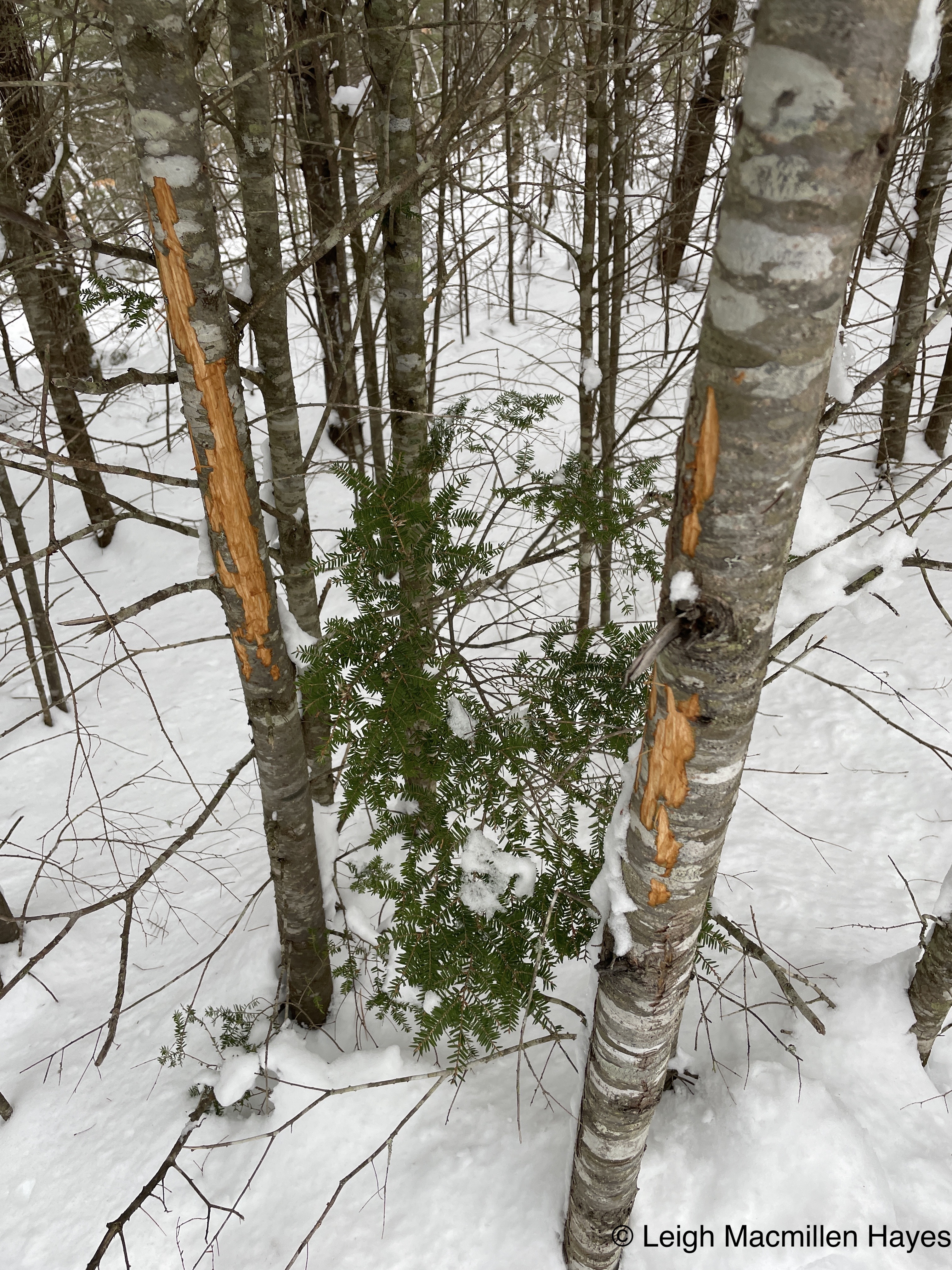
This being the work of a White-tail Deer who scraped its lower incisors up the bark of a tree to get at the cambium layer where the sugars and starches flow. The tags at the top of the scrape are a tell-tale sign because ungulates like deer and moose do not have upper incisors or canines, but rather a hard palate, and yank at the wood as they press their lower incisors against the palate to pull the bark off a tree–mostly Eastern Hemlock or Red Maple.

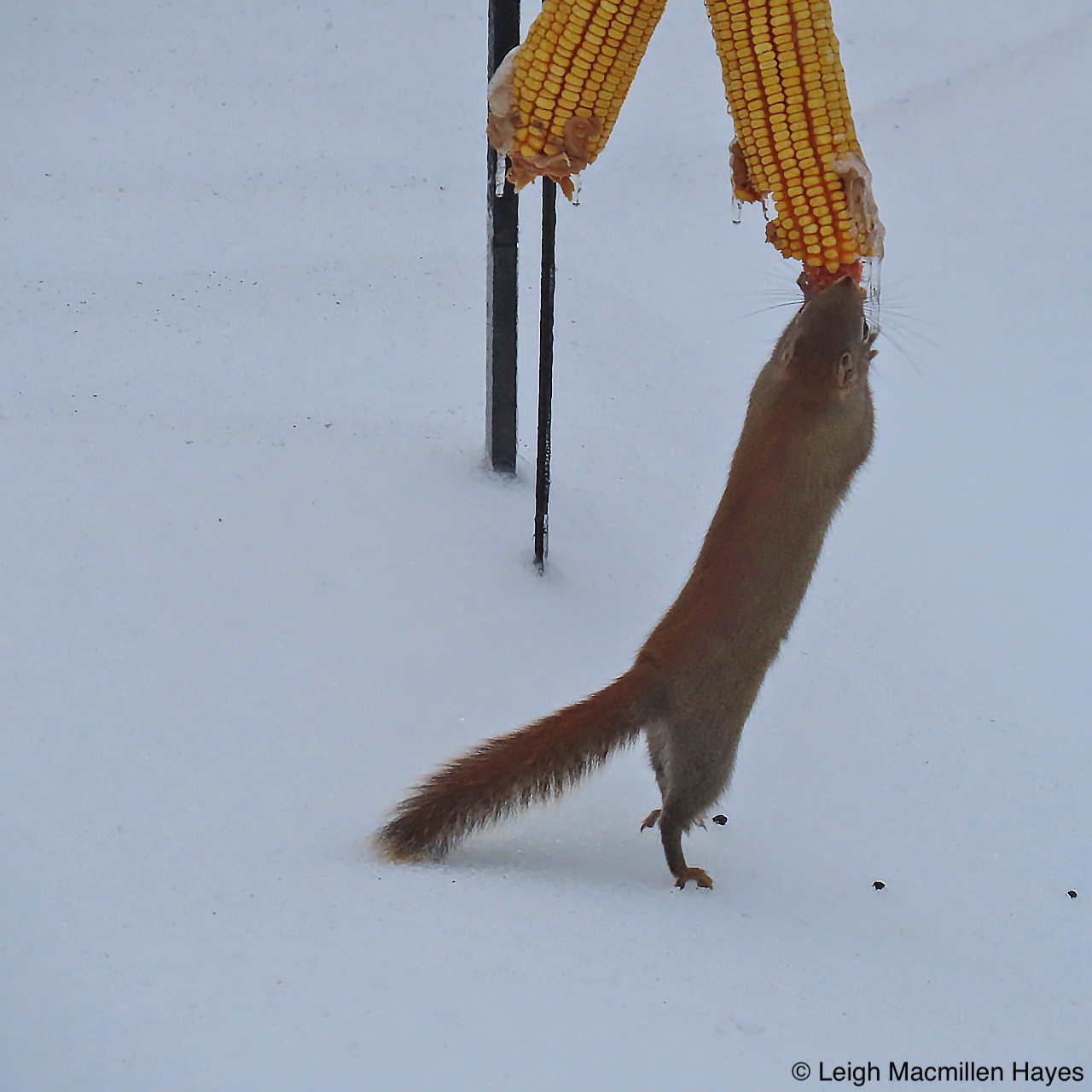
It wasn’t long after the Senior College outing on Wednesday that snowflakes announcing the third storm began to fly and one of our resident Red Squirrels stopped by to check out the offerings at the bird feeders.

This hearty sole is Ed and as you can see, he’s lost an eye–probably in a disagreement with a sibling, but that doesn’t stop him. He’s perfectly capable of finding food, seeking cover when necessary, and fighting off his brothers.

Ed wasn’t the only one out in the snow, for a male Downy Woodpecker made frequent trips to the suet feeder.

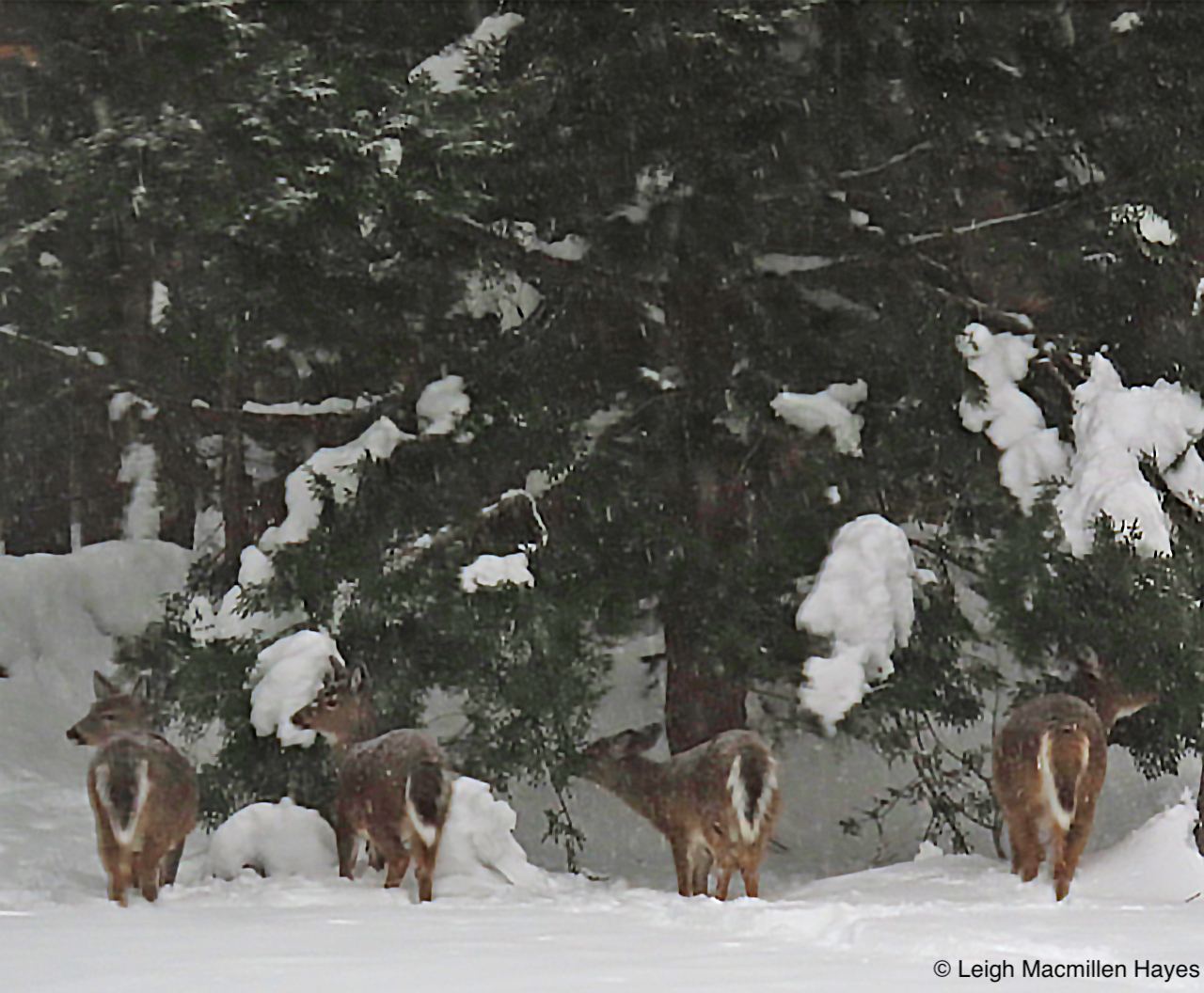
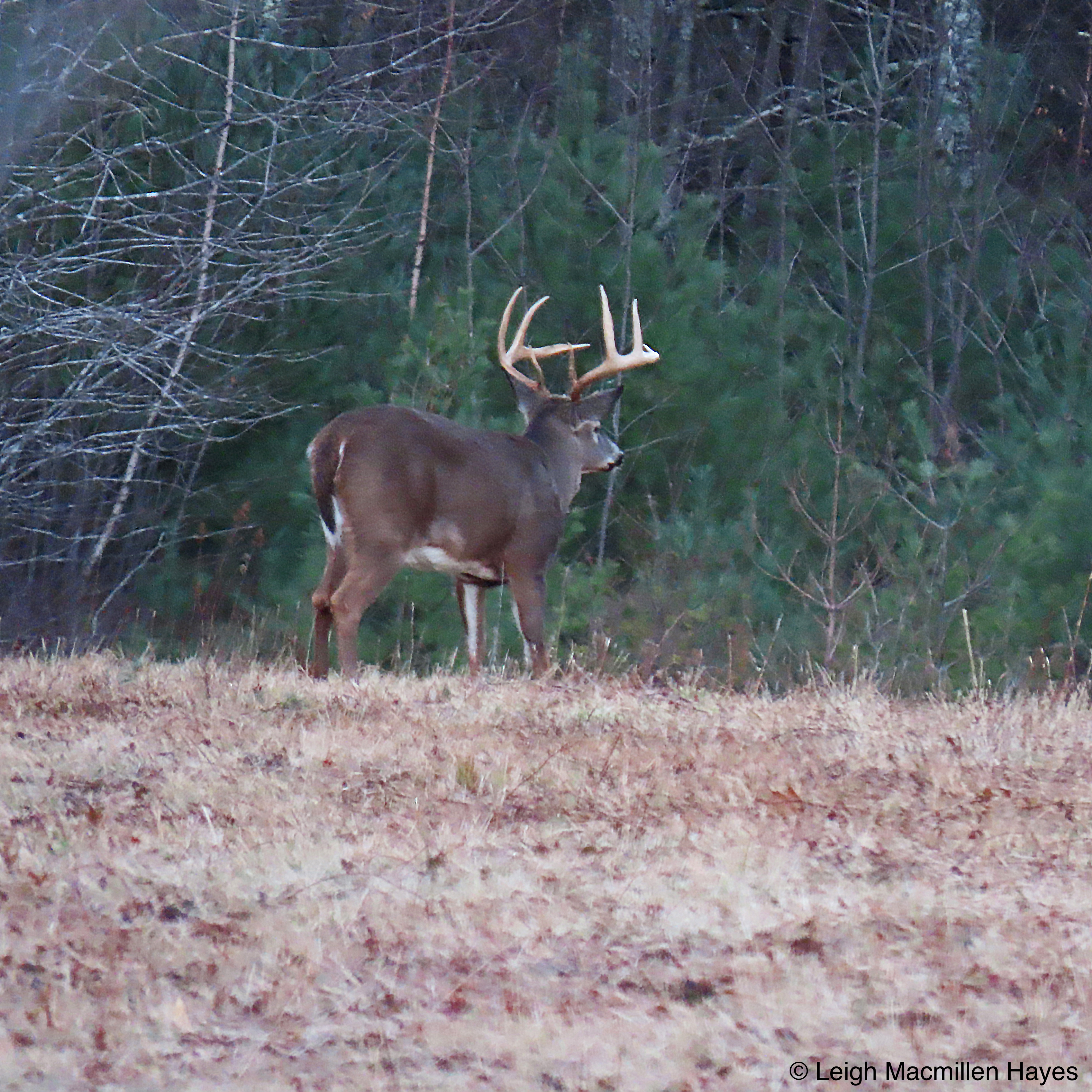
And then, just before twilight the Deer began to appear. The first walked to a Squirrel feeder I was gifted recently, with some peanut butter added to the corn as an enticement. She didn’t seem impressed. I thought that was weird because if you’ve ever made a bird feeder out of pinecones smothered with peanut butter and sunflower seeds, you might notice that the Deer lick everything off within hours of hanging the cones from a branch.

Following the arrival of the first Deer, a sibling came in with mom, but they too, were not impressed.

So the thing about watching the Deer, was that they provided a photographic lesson–beginning with the two cloven toes that form the heart-shape of the impression they leave in the snow–with the pointed end of the heart always indicating the direction of travel. And further up the foot are the dew claws, which sometimes show in a print. If you look at the two hind legs, you can see the dew claws just above the snow. I’ve been told that if the dew claws appear, then it is a buck. I’m not 100% convinced of that. I think it has more to do with snow conditions.

And sunflower seed is not their only form of nutrition, for one of the Hemlocks by the stonewall between our yard and woodlot offered some delectable needles full of vitamin C. Do the Deer know that?

Following the storm, a coat of ice covered the tree branches and even the corn, but that didn’t stop Ed’s brother, Fred, from grabbing a kernel. Actually, the corn had originally been placed about two feet off the ground in an area we’d shoveled, but the snow had piled up again, making the meal easy to reach.

I spent yesterday shoveling what felt like cement. The first two storms offered a much fluffier take on snow consistency. Periodically, like Ted, another brother of Ed, I’d duck into the house. His home is a network of tunnels near the feeders, and so far it has provided good protection.

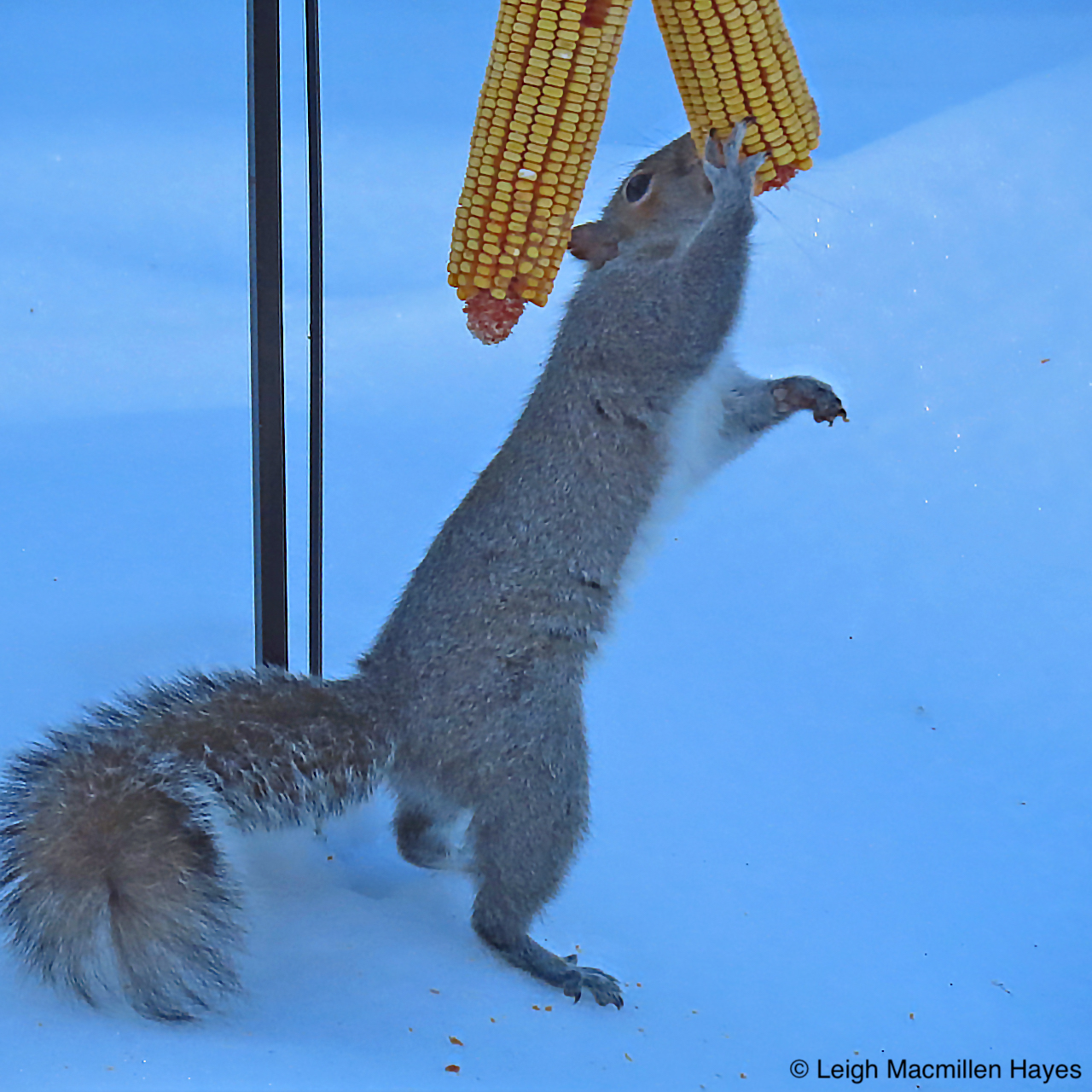
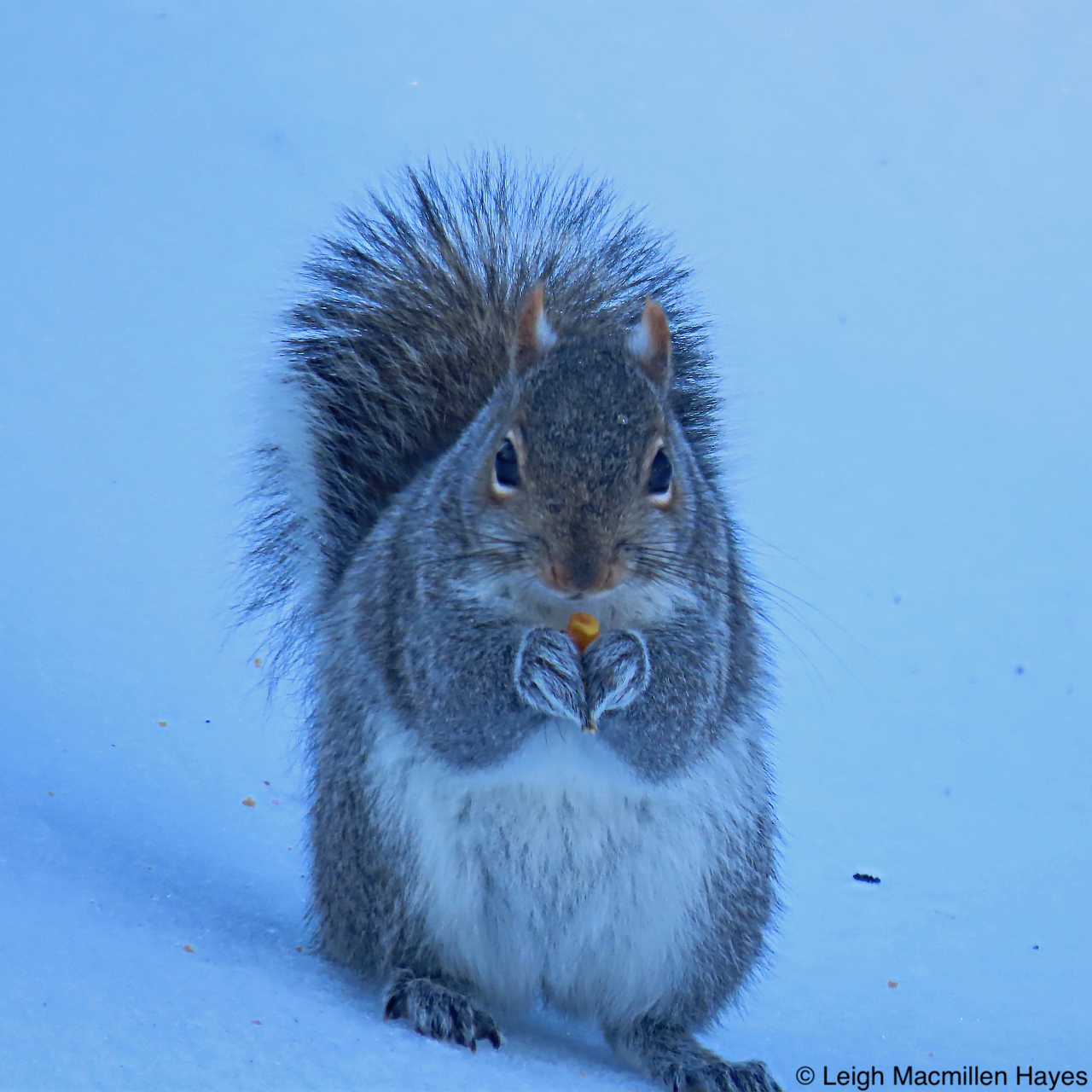
This morning dawned brighter, and a bit frosty to start. While Fred, Ted, and Ed, ate birdseed and chased each other round and round, a Gray Squirrel stopped by to get a handle on things.

The perfect meal was garnered.

As it turned out, today was a super busy day at the feeders, which Black-cap Chickadees and Nuthatches making frequent visits.

And the puffed up feathers of a male Downy bespoke the temp in the teens. Birds fluff up in the cold to trap as much air in their feathers as possible. The more trapped air, the warmer the bird.

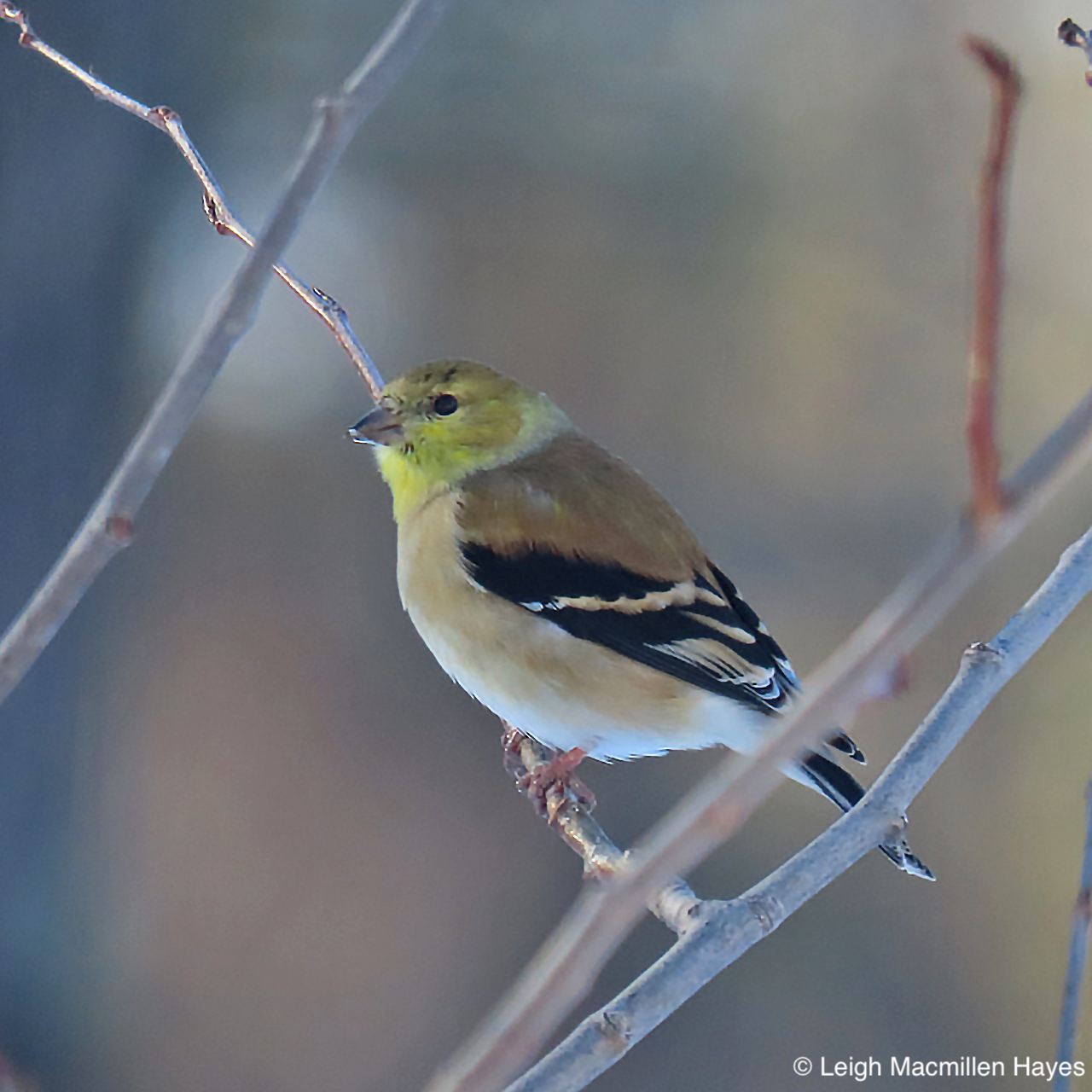
A couple of American Goldfinches were early morning visitors as well, and I love that unlike the Chickadees, Finches are much calmer and stay in one spot for a bit.

Probably my favorite visitor was a surprise for as I was watching the Hairy Woodpeckers, in flew a Red-bellied who worked at a chunk of suet and finally flew off with it.

When I finally headed outside this afternoon, donning my snowshoes to stay atop the 2.5+ feet of snow, I couldn’t believe that for the most part I could stay on top of it, for such was the crusty coating from yesterday’s rain finale. And with each step I took, I heard the crunch below–sounding much like breaking glass.

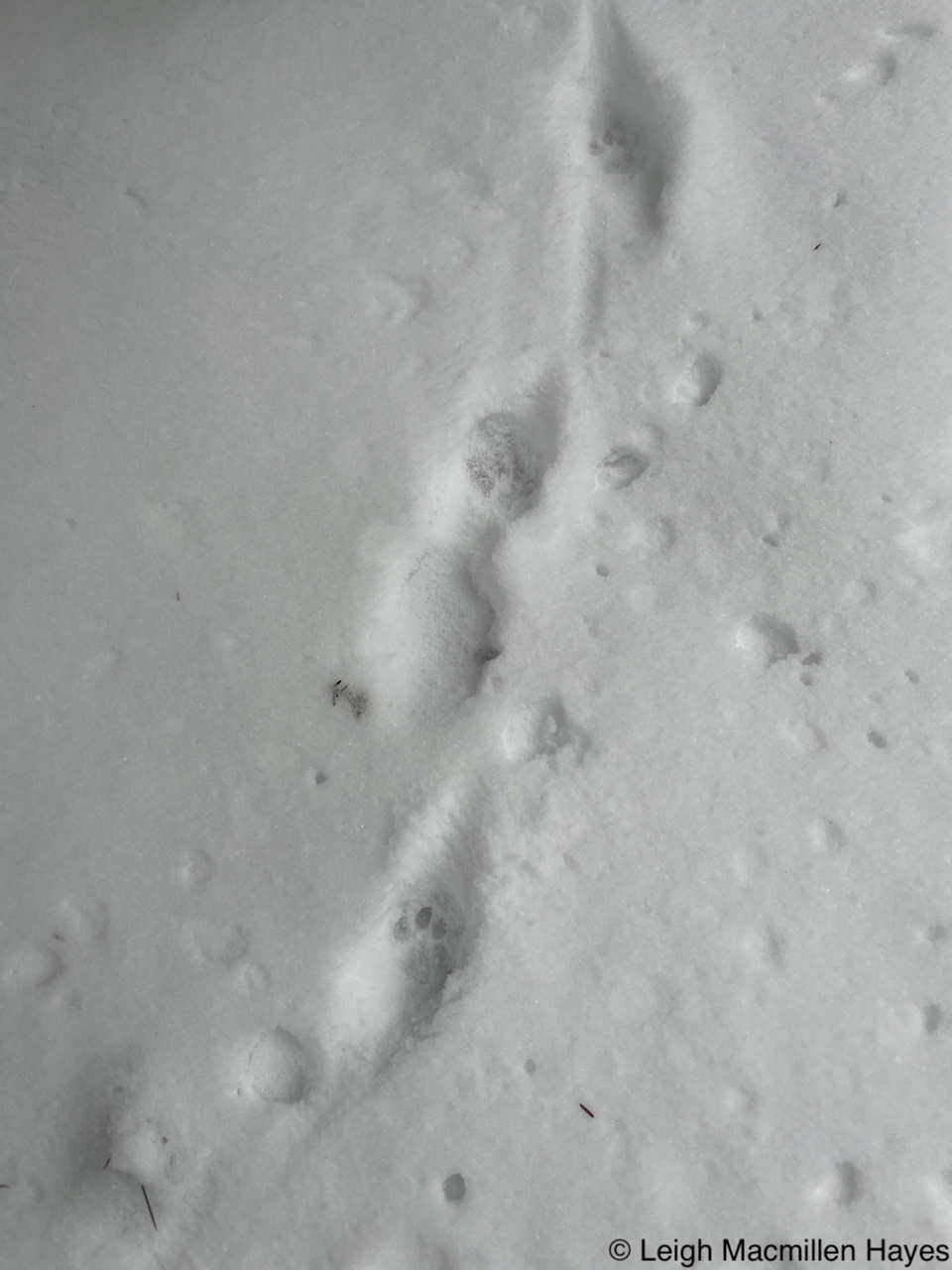
Much to my surprise, I found the track of a Ruffed Grouse, who did break through the snow.

Of course, it was no surprise to find the figure eight of a deer print, with the foot impression about two feet down. This is a difficult time of travel for them. And I suspect mine will be back by the feeders during the night looking for an easy meal.

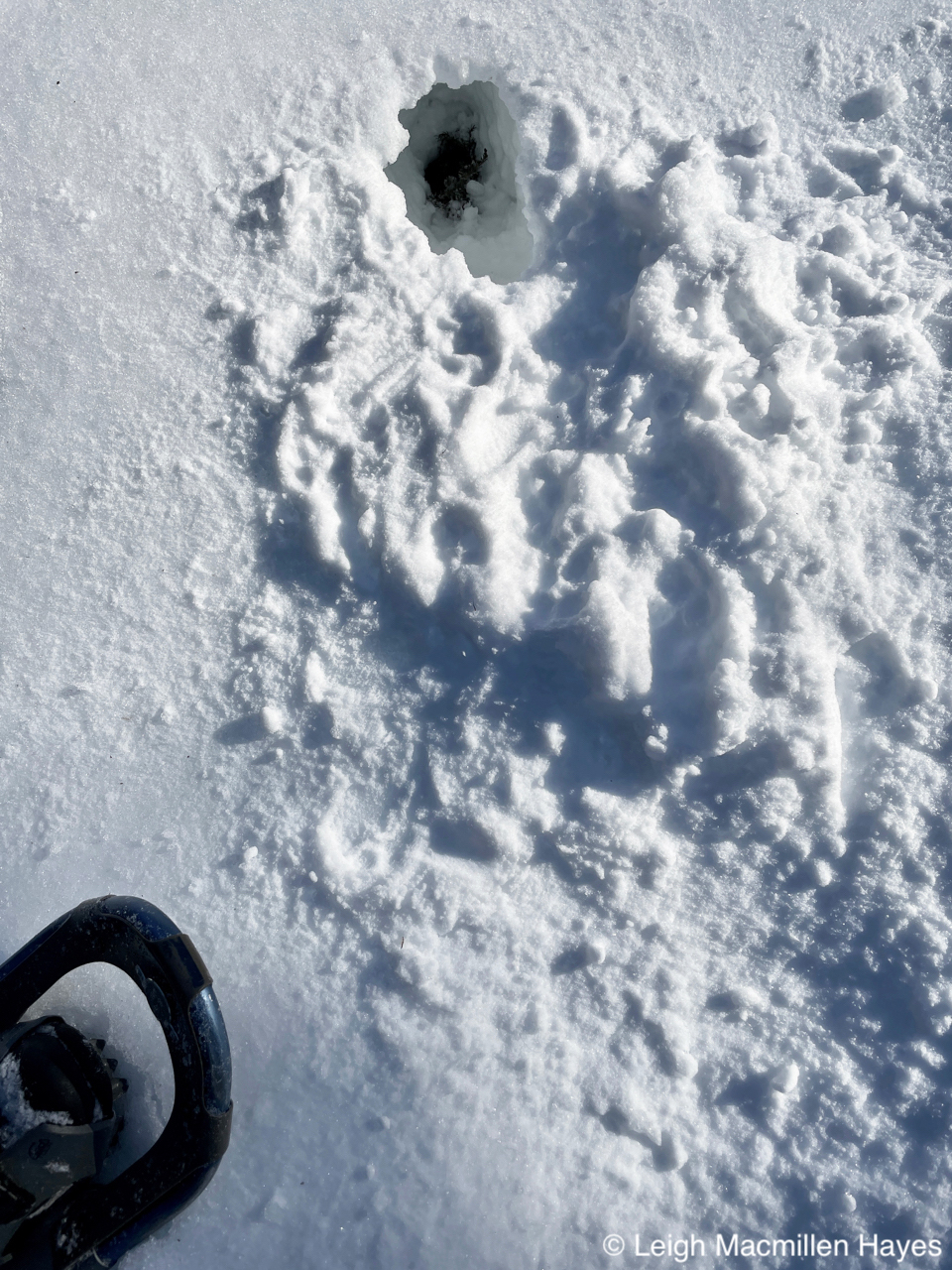
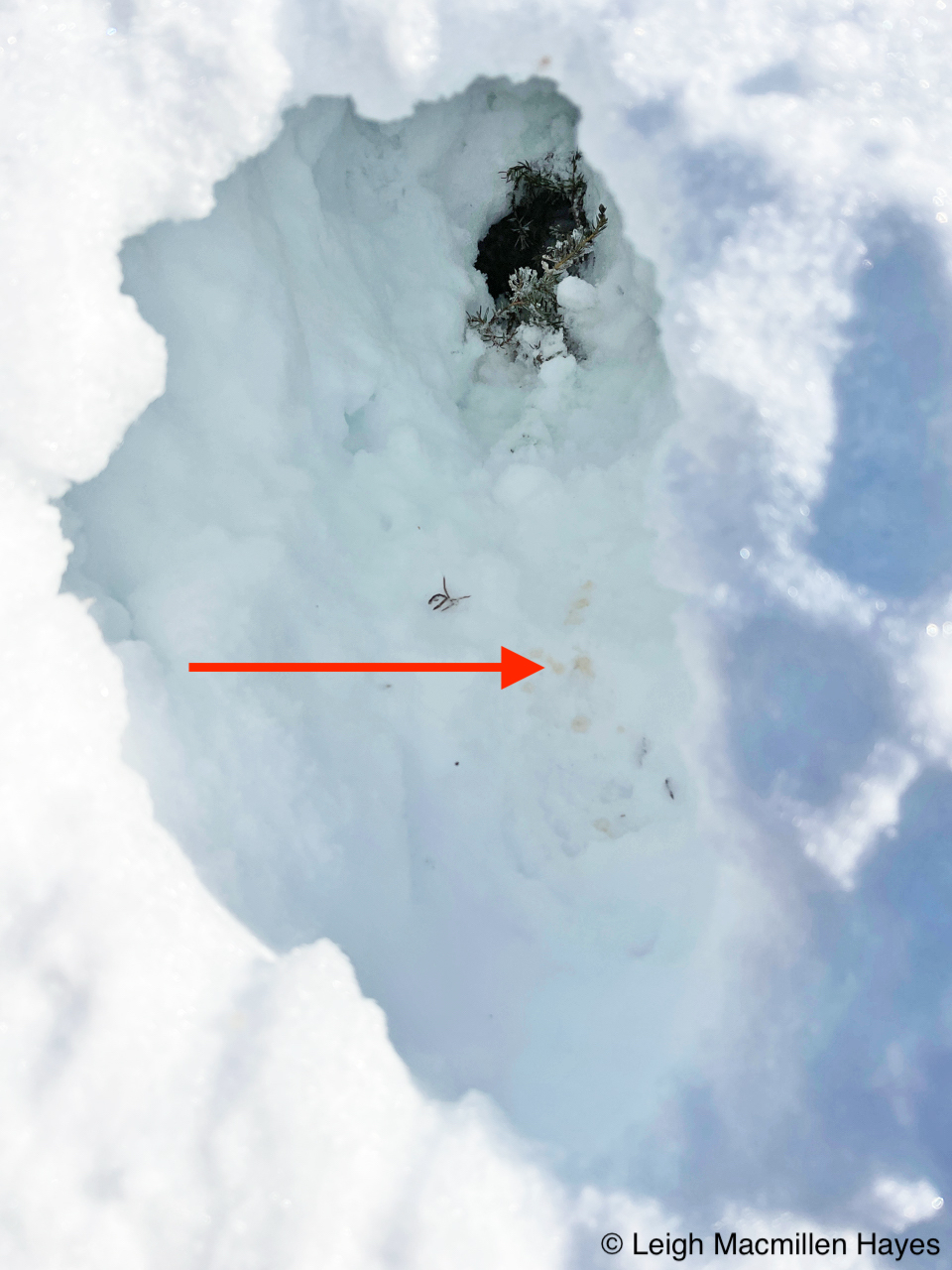
And then I discovered a disturbance that I had to investigate. A deep hole had been excavated.

A look at the size and X between the toe and metacarpal pads and I knew who had done the job: an Eastern Coyote.

What it consumed I could not say, but there were some drops and I wonder if they were blood that had darkened a bit as they aged. It’s funny, because I was so sure that I’d come upon a Ruffed Grouse’s snow cave and totally expected to see the bird’s scat in the hole. That was not the case at all, but I don’t know who the victim was that provided the Coyote with a meal. Or at least a snack.

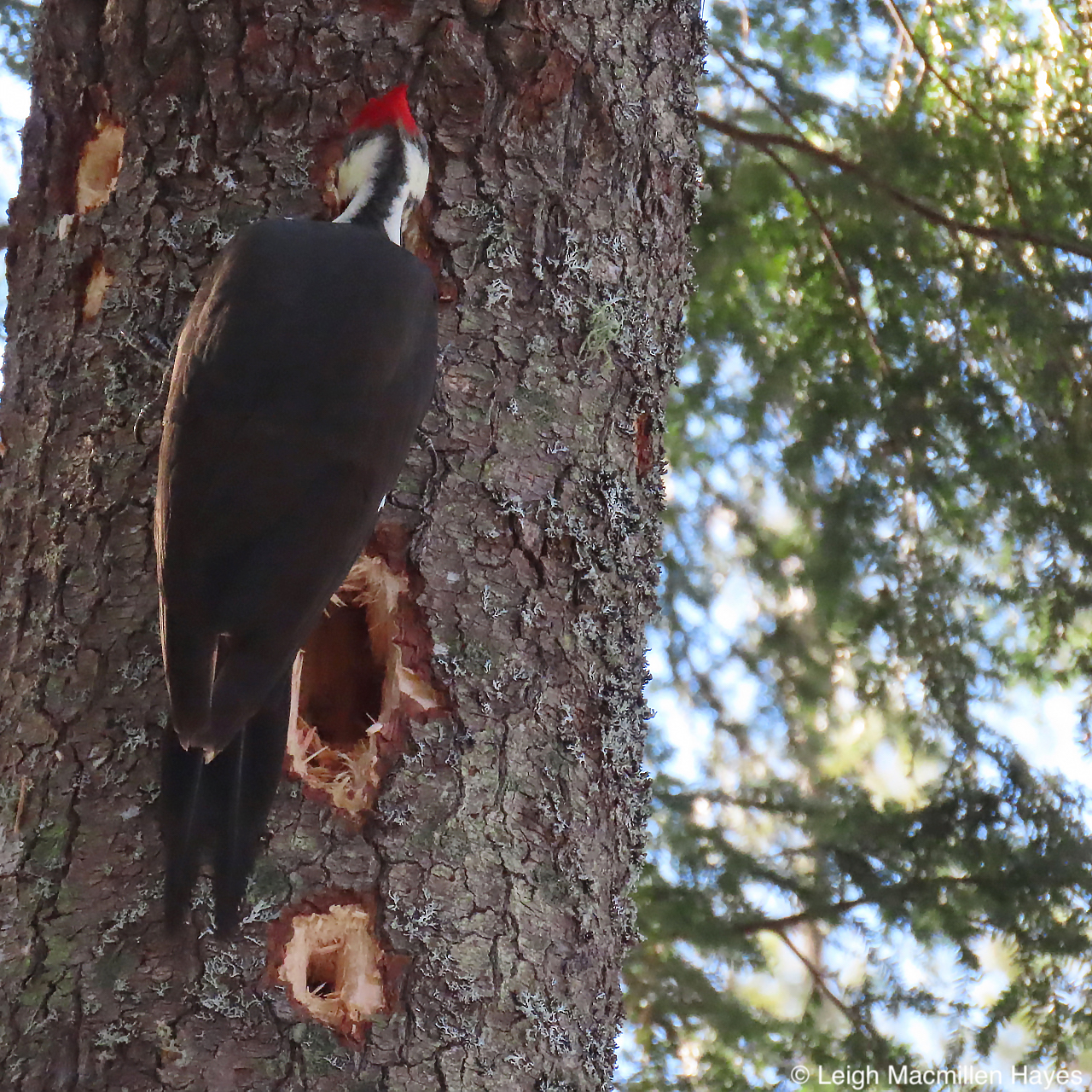
Back in our woods, I met an old friend who has graced these woods for years–or at least members of his family have done so.

He, too, was looking for food. And so intent upon his job was he, that I stood only about fifteen feet away while he worked.

I didn’t step under to check the scat because I didn’t want to scare him off, so I’m not sure if the Pileated Woodpecker’s needs were fulfilled, but given that he had worked on the tree for a while and some of the holes were quite deep, I suspect he had dined on his favorite meal of Carpenter Ants.

Finding food is the name of the game, though it’s hardly a game at all–especially when it’s cold, the snow is deep, and there’s a crust of ice atop it. And that’s just for the critters. Never mind people who have to deal with the elements on a daily and nightly basis.

Support your local food pantry,

Tracking Glee

We finally have a decent amount of snow on the ground after Friday’s storm and another storm is expected to begin in a couple of hours. That meant it was time to don the snowshoes. And so I did. And headed into the woods behind our house.

Immediately I was greeted with nature’s art work, and seeing snowflakes dangle like this will always capture my fancy.

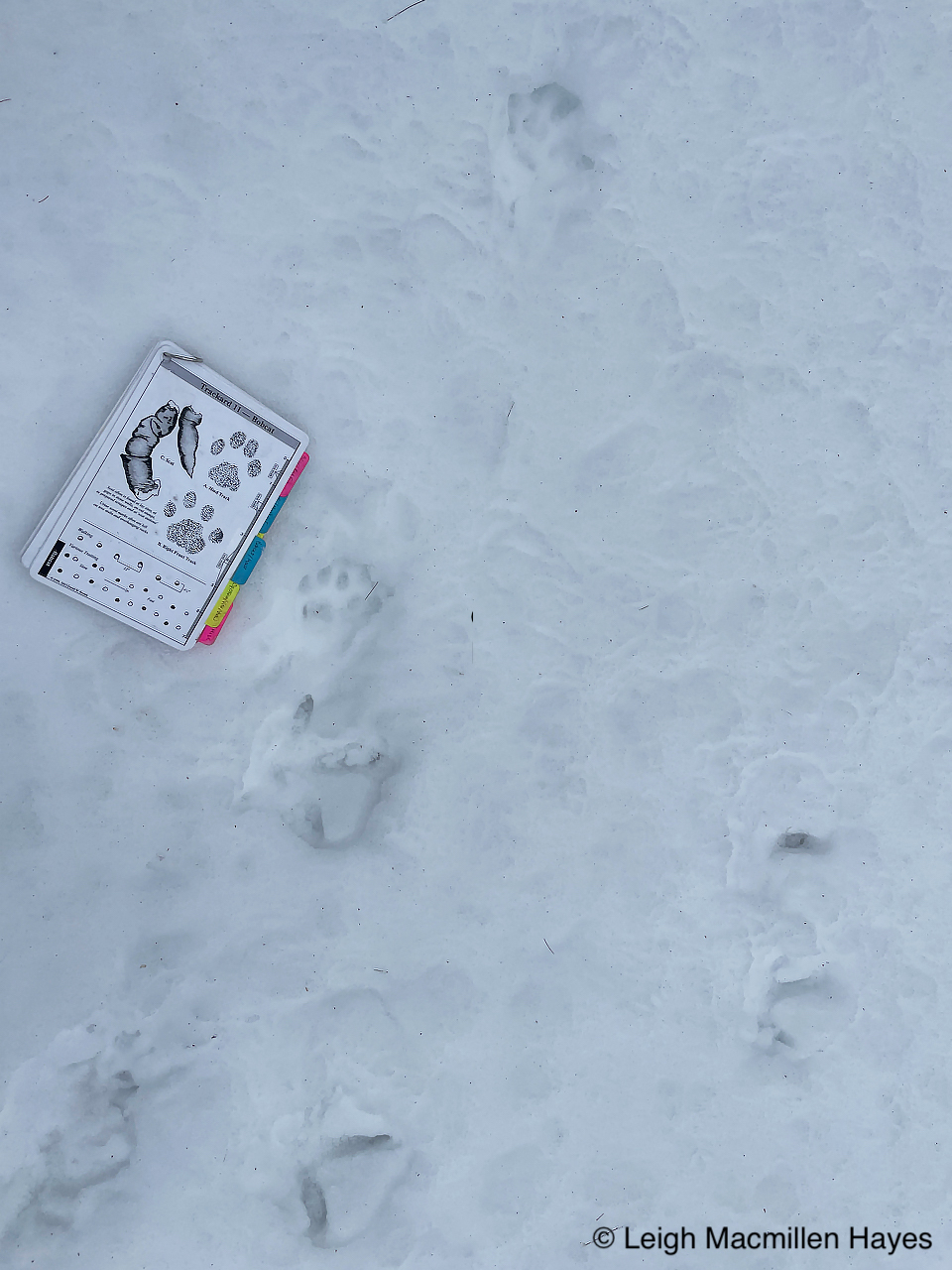
But that wasn’t all that captured said fancy, for at a point where I’d been dealing with trying not to fall into water since it’s quite a wetland out there, I suddenly spotted bobcat prints. And knew I had to follow them.

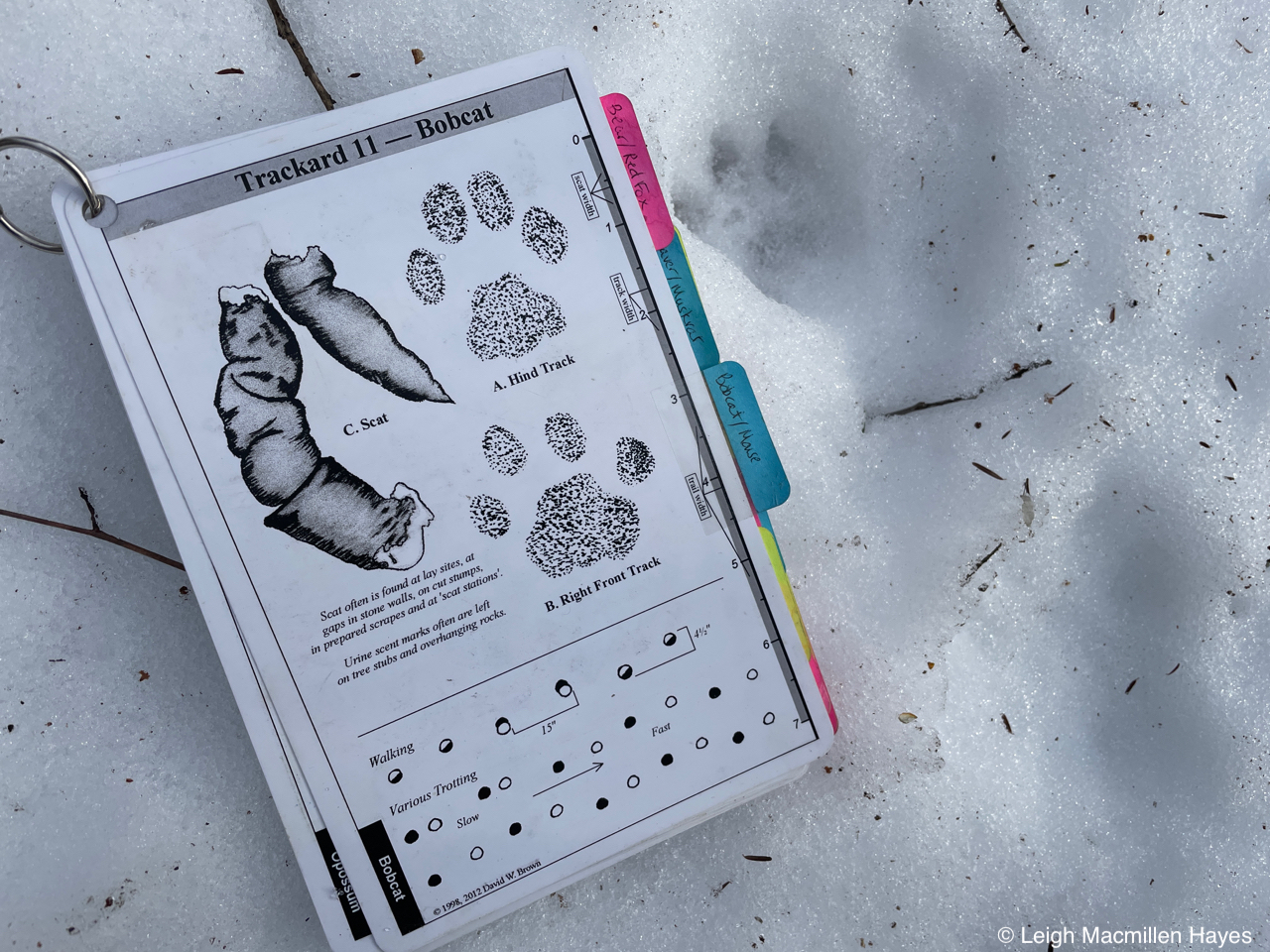
I hadn’t bothered with my tracking bag full of gear, but did think to stick this little card into my pocket for reference. Can you see the C-shaped ridge between the toe pads and metacarpal pad? And the lead toe–making the overall print asymmetrical. Take a look at your hand. It’s also asymmetrical with a lead finger.

The snow is such a depth that there was foot drag. I got thinking about what the bobcat was hunting for and had seen plenty of snowshoe hare and deer runs so knew there was food available. Where would this cat lead me, I wondered.

It was at that point, however, that I thought about a tracking lesson I taught to future Maine Master Naturalists yesterday–if the prints look fresh, backtrack rather than follow them forward, so you don’t put pressure on the animal. I heeded my own words and turned around.

Of course, there was more art work to spy, like this candy cane dangling from a branch.

In my backtrack exploration, I spotted where the bobcat had climbed over a fallen tree. There were other spots where it went under trees and I had to find a different way around.

Back on track, there were more intersections with deer and even mice. But all continued to live for the moment.

And then my journey led me to another I’ve been looking for all winter because usually I see so much evidence of this critter–a porcupine had sashayed through the snow over night.

I found what I think is its den, given the amount of scat, and a hole. And I’m just now making sense of the story. The hole was not large due to snow in front of it and the scat was a bit frosted. BUT . . . what might have happened is that as the day warmed up, snow fell from the limbs above and the porcupine will dig its way out–in fact, it probably already did about an hour ago, for they emerge during twilight.

I followed the tracks, which led to a hemlock tree where there were a couple of twigs below.

And the bark and cambium layer had been chewed on the main trunk and another branch above.

So at some point in my journey, while I was following the bobcat and off my regular trail, I decided to turn on my GPS until I knew where I was. What surprised me is the circle I made as I followed the porcupine’s trail. I need to make time to visit it again, for it seemed to be a new resident to this spot and there wasn’t any more evidence that it had dined in the area.

It took a few minutes, but eventually I found the bobcat tracks again. Only . . . this time I was following the cat forward. What?

They led me to a spot at the base of a tree where the bobcat took a break and must have curled up. And then it turned around.

And it suddenly became apparent to me: I’d followed the forward track on the left to the turnaround point and on the way back I noticed the backtrack trail I’d previously been following. I never did find the bobcat or the porcupine, but seeing evidence of their activity was enough and it was getting late so I followed an old logging road home.

There were still more baubles to spy, including this one upon a Red Maple that had provided food last winter in the form of buds–a fav of the deer.

And when I returned to our woods, I discovered that four deer had bedded down last night under a raised sleeping platform our youngest son had built about eleven years ago when he was in high school. Look for the smooth edges and you’ll realize each one is oriented in a bit of a different direction, the better to see that bobcat, or even the coyotes, whose tracks I also saw today.

Just for fun, I’ve added these photos of the MMNP students channeling their inner child–each mentor group was assigned a mammal. This group needed to become a bobcat and though you may not quite see it, the bobcat was walking in the zigzag pattern with the hind foot landing where the front foot had packed down the snow, thus each print representing two feet, and conserving energy. And those fingers on the bobcat’s head–ear tufts. Plus the “person” in the back was holding a mitten to serve as the bobcat’s tail.

There was a pigeon-toed porcupine as well that waddled through the snow.

And then it gnawed on the branches of a tree.

They had fun with the assignment. My hope is that these students will get a sense of the tracking glee that I feel every time I follow a trail. Even if I don’t get to see the critter, which is most of the time, just developing an understanding of their behavior makes me so happy.

The Beaver’s Tale

Once upon a time . . . no wait. This isn’t a fairy tale.

Rather, it’s about changes in the landscape that one might observe, such as a brook suddenly overspilling its banks as was the case in this location upon a December visit. We’d had rain, but that much?

It wasn’t long before a friend and I spotted the reason for the high water. Some new residents had moved into the area and built a lodge of sticks. Unlike the story of the three little pigs, one of whom built a house of sticks that the big bad wolf came in and blew down, the makers of this structure took special care to make it solid and strong and weatherproof. Yes, a beaver or two or six had taken up residence with the intention of spending the winter. Beaver families usually consist of a monogamous couple, plus their two-year-old (almost adult) kids, and yearlings. Mating occurs in the water during the winter and kits are born inside the lodge in the spring.

In order to move into the lodge, a dam needed to be constructed as well. If you look closely, you’ll see that above it there was a bit of an infinity pool with the ice at level with the dam, while below it some water flowed at a much lower level. Though we couldn’t walk along the ice to measure the length of the dam, it was quite long. and made of sticks and leaves and mud. Typically, the family works on this project by creating a ridge of mud and probably the herbaceous plants of the meadow, and then they use the mud and sticks to stabilize it. Maintenance is a constant as water or other critters or humans have a way of breaching the dam.

We, too, build dams to serve similar purposes, such as this one originally constructed to operate a saw mill. Hmmm.

Getting back to the lodge: it also needs nightly work as long as conditions allow and this has been a winter of despair for those of us who love cold temperatures and snow and even ice if it’s in the right place, like on a pond or lake and not in the driveway.

Take a look at how the beaver is holding the small twig.

A beaver’s dental formula is this: 2 incisors on top, 2 incisors on bottom, 0 canines on top, 0 canines on bottom, 2 premolars on top, 2 premolars on bottom (that look like molars), 6 molars on top and 6 molars on bottom, for a total of 20 teeth. Recently, I was able to sketch the upper part of the skull of an older family member, who’d lost some of its molars.

These large, semi-aquatic rodents are gnawers like their relatives. To that end, their incisors are highly specialized for chewing through really, really tough things and they grow continually throughout the critter’s life.

And like all rodents, the front surface of their incisors is coated in enamel reinforced with iron (hence the orange color), which makes it resistant to wear and tear from gnawing. When the chisel-like teeth chew and fell trees, the much softer white dentine layer (the section behind the enamel) is ground down quicker than the enamel, thus creating a sharp chisel surface.

But to me the coolest aspect is that their lips close behind the incisors, thus permitting them to gnaw and carry sticks underwater without choking.

And bingo, you can see the stick being carried in that gap between the incisors and molars. Food sticks become lodge or dam sticks once their nutritional value has been consumed: a true plan of repurposing.

As it turns out, that wasn’t the only beaver family at work in town. This next family, however, chose to park their tree in a spot the fire department lay claim to for filling a water tank. But . . . reading is not on a beaver’s talent list.

In this other place, so many trees have been felled, but not all have fallen as intended, getting hung up on other trees instead. Not wanting to anthropomorphize, but I have to wonder what expletives flash through a beaver’s brain when trees don’t hit the ground as planned.

As strict herbivores, a beaver’s diet varies with changes in the season. During spring and summer, they are drawn to waterlilies, algae, grasses, sedges, herbs, ferns, shrub leaves and shoots. By late summer, however, tree cutting begins as they gradually change their dietary habits from herbaceous to woody materials. Twigs, roots, bark and especially inner bark become the source of nutrition. Aspen, birch, alder, and willow are favored species, but beavers will cut almost anything including conifers.

Imagine this. A beaver cocks its head to the side as it gnaws, thus the consistent angle of the half inch groove as the upper and lower incisors come together.

Likewise, porcupines gnaw, but their incisors are much narrower and the pattern more random.

So, the question remains. Where were the parking lot beavers living? In the past, a family has inhabited the northern most reaches of this pond, but in this case, they had built a lodge on a point not far from the southern end.

The top of the lodge is the only section not covered with mud, for it serves as a “smoke stack” of sorts, a place for beaver breath to escape. Visit a lodge on a cold winter day and you might observe the vapors rising.

And then it was on to another locale, where beavers have inhabited the same lodge for a number of years. When beavers choose to live in a pond or lake or sometimes even a river, there’s no need to build a dam for the water is usually deep enough for their underwater movement.

I often tell people that beaver prints are a rare find because they are either wiped over by the tail or by trees being hauled to the water. Once in a while, however, I’m proven wrong and the sleety snow on a recent day awarded just the right conditions for the webbed feet to be observed.

Tree work and broken ice added to the story of the critters’ journey to and fro the pond. While quite adept at time spent in the water, they are rather clumsy on land and most of their work is within a hundred feet of the edge.

Winter food is cached close by the lodge entrance so that they can swim under the ice to retrieve a stick. A beaver’s ears and nose have a valve that closes when it is submerged and they can stay underwater for up to fifteen minutes. Back at the lodge, there is a raised chamber surrounded by a moat that leads to the entrance tunnel. It’s upon the raised area that they dine, and groom, and even give birth.

At this particular pond, My Guy and I noted two lodges connected by an open channel between. Given the number of tail slaps that announced our presence near both lodges, we thought perhaps both were active and inhabited by the same family.

And then, and then . . . finally, we spotted a beaver that spotted us. We kept expecting it to slap the water with its tail in a manner of warning so other family members would seek deeper water or cover. Instead, it swam past us.

The thing is that a rodent relative, namely the muskrat, exhibits many similarities, but also differences, including a skinny, snake-like tail.

The beaver’s tail is a source of wonder. While its furry body consists of long, shiny guard hairs covering dense and softer hair that traps air and helps protect the critter from the cold, the tail is broad and flat and scaly. It’s used for a variety of reasons including stability when standing upright on land (think tripod), as a rudder for propulsion in water, as fat storage and thermal regulation, and how we are most familiar, as a warning device.

A beaver’s tale indeed.

Sworn to Secrecy

I’ll let you in on a tad bit of a secret . . . eventually.

But first, today was a tracking day and so five of us did just that. When we arrived at the intended location, due to snow conditions, I think we had low expectations. I know I did.

We had just stepped off trail to begin our bushwhack excursion when we spotted this Ruffed Grouse scat. So the curious thing about this is that there are two kinds of grouse scat, the typical cylindrical packets coated with white uric acid, but also a juicier, brown dropping. And I regret that I didn’t take a photo of the juicier, yet slightly frozen stuff we saw dripping from some twigs above. At the time, I knew the brown stuff was significant because I’ve looked it up before, but couldn’t bring it to mind. Thanks to Mark Elbroch and Eleanor Marks, I found an explanation in Bird Tracks and Sign: “Interestingly, after producing these lower-gut-generated solid evacuations, some game birds, such as a grouse, often then evacuate a semi-liquid brownish mass from the upper gut, or cecum, with the two types of droppings coming out sequentially; the more liquid, almost liver-colored scat comes out second and is spread on top of the solid matter. In Ruffed Grouse, it is common to find the hard, fibrous scats at one roost and the soft, brown cecal droppings at another.”

But not uncommon to find them together!

We stood for a long time discussing the grouse scat and when we finally moved on, it wasn’t too far that we discovered bobcat prints. Given that the prints were not super fresh because there was some debris in them, we decided to follow the track forward. Had they been fresh, we would have backtracked so as not to put pressure on the animal. Though secretly, we all love it when we do actually get to spot a mammal. Or a grouse, for that matter.

Eventually, we lost track of the bobcat, because as you can see, there were spots with no snow. But then we stumbled across a sighting that confused us. White-tail Deer scat on the edge of a boulder. Dawn has some new tools she was gifted for Christmas, and so she was excited to pull them out. Our confusion, despite the fact that it looked exactly like deer scat, was caused by the location. On top of a boulder. On the edge of said rock. We came up with a few stories, but will let you try to interpret this on your own.

Back in the snow, we found canine rather than the feline prints we’d been looking for and so out came the tape measure to determine species. Based on the fact that the print measured less than two inches at the widest point and that the stride, or space between where two feet touched the snow (toe to toe), we determined it was a Red Fox.

Everywhere, we spotted Red Squirrel holes and middens, indicating the squirrel had cached a bunch of hemlock cones in numerous pantries and returned since the snow fell to dig them up and dine, leaving behind the cone cobs and scales in trash piles. What struck us was that for all the middens we saw, we never heard or caught sight of any squirrels. In fact, we didn’t see any animals . . . until we did. Huh? You’ll have to read on.

Our next great find close to the pond we walked beside, was more scat! Of course, it was. This being the works of a River Otter and filled with fish scales, all those whitish ovals embedded in it. Like a small pile of Raccoon scat we’d spotted earlier, but again, I forgot to photograph (the sign that we were having fun making all these discoveries), otters tend to defecate in latrines, using the same places over and over again.

Our movement was slow, and every once in a while we’d spread out until someone made a discovery and then we’d all gather again.

Which was exactly what happened when this Snowshoe Hare scat was discovered. Three little malt balls.

After the hare find, we followed a couple of canine trails that took us back to the water. Domestic dog or Coyote? We kept questioning this, but never saw human prints. And the animals did seem to be moving in a direct line on a mission. The warm weather we’ve been experiencing may have been enough to make their prints look larger than they typically would so I think I’m leaning toward Coyote.

But in following those, we discovered a sign from another critter by the water’s edge: Mink scat!

When our time was nearing an end and we bushwhacked back to a road near the trailhead, we were all exclaiming about our cool finds. And then a little birdie we encountered asked, “Do you want to see a bear?”

We don’t need to be asked that question twice, though now that I think back, I’m pretty sure we asked the birdie to repeat the question. YES! She gave us directions and we decided we needed to take an immediate field trip. We each hopped into our vehicles, drove almost to the destination, parked, and walked as quietly as we could toward the den site.

We got us a bear! A Black Bear! The birdie said it has been there since sometime in December.

Now that I’ve shared it with you, I’ll say no more for the five of us are sworn to secrecy about its location.

Stocking My Wonders

My fingers reach in, wondering what marvel I might pull out of the wool sock, one I knitted when my guy and I first tied the knot so many moons ago.

Of course I shouldn’t be surprised that the first thing my fingers grasp is a dragonfly, this being a Common Whitetail male in the Skimmer Family, with those broad crossbands on the wings and black streaks at the base of each.

Calling it “common” strikes me as such an understatement and I’m thrilled when I next pull out an immature male of the same species. I mean, look at those wing markings. And the spots along the sides of the abdomen segments. And the difference in color from immature to mature. Surely, next it will be a female that falls into my hands.

It is quite a shock, however, to realize it is fur that tickles my hand, and voila, out of the sock comes a Red Fox. A Red Fox who settles for Black-oil Sunflower Seeds, not quite the next best thing to capturing a squirrel.

When I next reach in, I am sure I’ll pull out a female Common Whitetail, but . . . instead it is a much smaller, and even more extravagantly decorated female Calico Pennant Skimmer. The same family, but this is one of my favorite species (please don’t be offended Whitetails, I really do think you are more special than common), with those heart-shaped markings along its abdomen segments and basal wing coloration reminding me of a stained-glass window, which seemed apropos for today’s celebration.

And then there are two with similar colors and equally delicate, puddling as is their habit, these Eastern Swallowtail Butterflies sticking their proboscis seeking nutrients from the gravel road. The chemical make-up of the site is key, for the butterflies are looking for something specific: salt (sodium) and minerals

Most puddlers are males, who ingest the salts, minerals and amino acids that the source provides, especially after it has rained. They store these nutrients in their sperm so that when the time comes to mate, the male passes these goodies as a nuptial gift along to the female. This gives the female an extra boost, which she then passes along to her eggs. It’s an important gift because eggs that receive the extra nutrients have a greater chance of success than those that do not.

Back into the sock do I dip, this time finding a Little Copper Butterfly seeking pollen and nectar upon Pearly Everlasting flowerheads. Little Coppers, tiny as the name suggests, thrive in areas disturbed by either human activity or natural events and it seems almost an oxymoron to think that as teeny and delicate as they are, they are right at home in waste places.

Once again, there is a significant change between the Little Copper and the next species that my hands discover. “Who cooks for you? Who cooks for you all?” hoots the Barred Owl much to my delight. Only two nights ago I heard it calling out the back door, so to find it in the sock is a treasure indeed.

Almost immediately after, a Muskrat swims out of the sock, moving quickly toward me with its rat-like tail acting like a rudder in the rear. I love its questioning look as we meet each other for the first time.

Enough fluff about the Muskrat. It is a feathered friend. who next pops up out of the sock. One of the most amazing things to me about this gift is the color of its eyes and how they reflect the sky above and water below.

Still pulling from the leg of the sock, this Gray Seal floats forth, as if on the incoming tide. Sometimes called “horseheads,” because of their long snouts, Gray Seals scientific name, Halichoerus grypus, literally means “hooked-nose sea pig.”

Not the prettiest of names, not the prettiest of species, but I am still excited to realize this one is my own to keep.

Suddenly, there seems to be a theme to the gifts, and a life on or in the water makes sense. The next item in the sock is one we think of as nature’s engineer, and though not everyone is thrilled with their prowess at felling trees, building dams and lodges, and changing waterways for their own benefit, it’s good to realize that they also benefit other species in the process, including humans. This particular Beaver is active during the day because hikers like my guy and me keep ruining its dam as we cross over it to access a trail.

Still on the water theme, but much diminished in size, is a female Fairy Shrimp. Just sighting one such species is enough to make its vernal pool habitat significant. The way to identify a female is to look for her two dark brood sacs that are positioned just under her legs or appendages.

So here’s the thing. Fairy Shrimp have a short life span, but . . . their eggs must dry out and freeze before they can respond to environmental cues such as reflooding to hatch.

The eggs, known as cysts, can remain dormant for years, and only a small portion of cysts hatch each year, thus leaving plenty more for the future. And temperature plays a key role in hatching.

I’m beginning to realize how much I am enjoying the variety hidden within this sock, and the next gift turns out to be a Blinded Sphinx moth, a species one doesn’t ofter encounter during the day. Or at all, for it’s a night flyer. But those markings and folds, and the overall design. Oh my.

With the next item I choose, I am reminded that one must look for anomalies in the landscape. And so I do. It is the horizontal line of the back that gives away the fact that I am starring at a White-tail Deer. Otherwise, I might think that the legs are sapling trunks and the face maybe a few bleached beech leaves.

My next surprise–comes as a trio. And I might not even realize they are there if I hadn’t heard them first–chattering to each other as they swim and play and fish and sometimes sit on the ice before slipping quickly back into the water in what can only be known as River Otter delight.

Once again, I suspect I know what I’ll pull out next, only to be surprised to discover that it is not a prickly friend, but rather a feathered one who roosts high up in a tree–this being a Ruffed Grouse.

But the prickly one doesn’t disappoint, and makes its own appearance in a different tree and place.

That is to be followed by another I often spot basking in the sun with friends, but it is great fun to spot a Painted Turtle swimming below the water’s surface of a shallow pond.

The water theme begins to appear again, maybe because the one who filled the sock knows I spend a lot of time peering into the depths, and sometimes I’m rewarded with sightings such as this of tadpoles forming into their mature frog beings.

And then there is another that requires a stretch of my neck as it stretches its neck to feed its young high up in a nest.

Having regurgitated a meal, the mature Great Blue Heron stays with its young a wee bit longer before heading off to replenish the pantry.

No sock of mine would be complete without a couple of canoodlers, he atop her. Water striders can walk on the surface because they have very fine hairs on the undersides of their legs that trap air and repel water, a technique called superhydrophobic. They move so quickly because what they are doing is more like rowing, vigorously rowing, creating little swirls in the surface that help propel them forward.

When I slip my hand down into what feels like the toe of the sock, I pull out the largest gift of all and a totally unexpected sighting–a buck. Actually, there are two, but this was the larger and definitely mightier. I feel blessed to have received such a gift. In fact, to have received all of these gifts. To have been present for these presents.

It’s actually toeless, this wonder-filled stocking of mine. And could go on forever. But I’ll pause here and rejoin my family. I do, however, wish you all warmth and peace and electrical power and good health this holiday season.

Cheers.