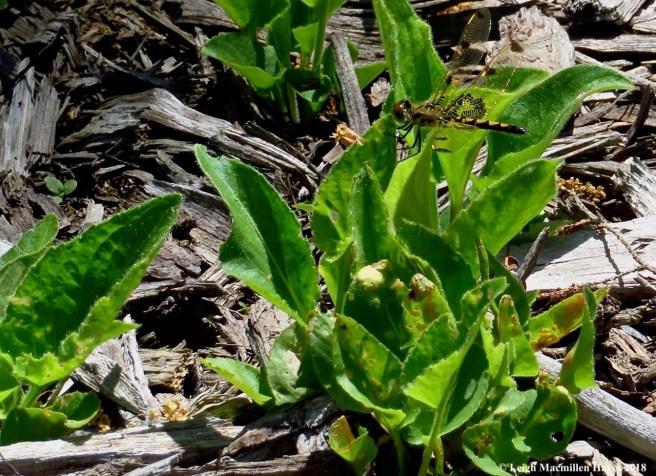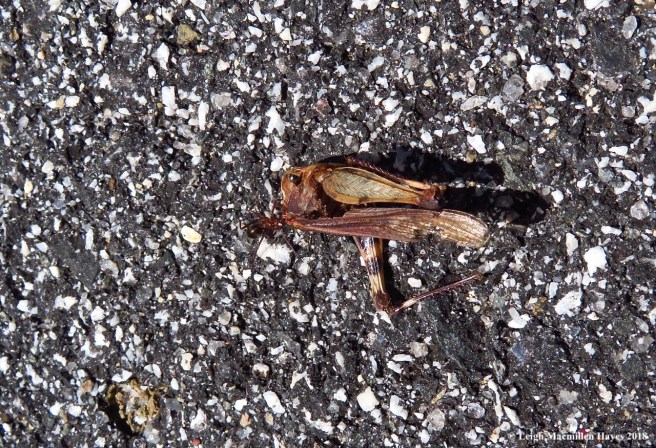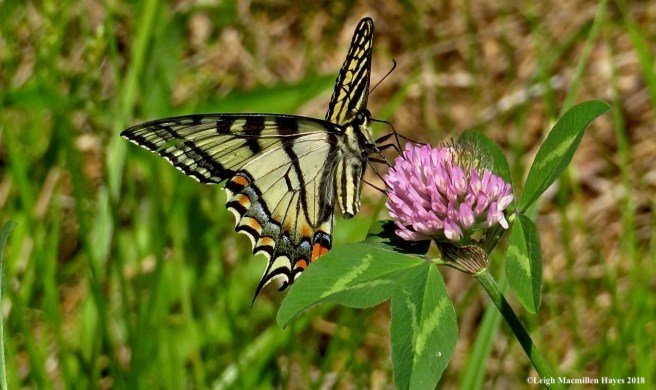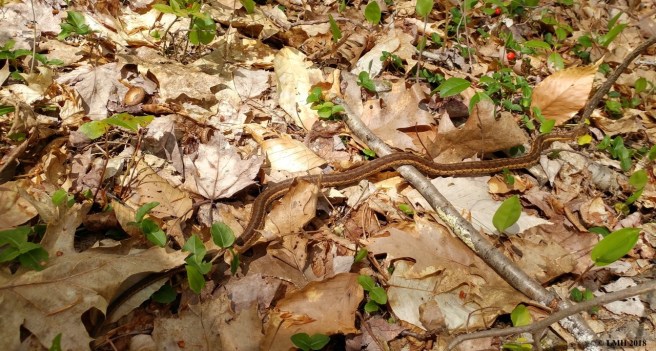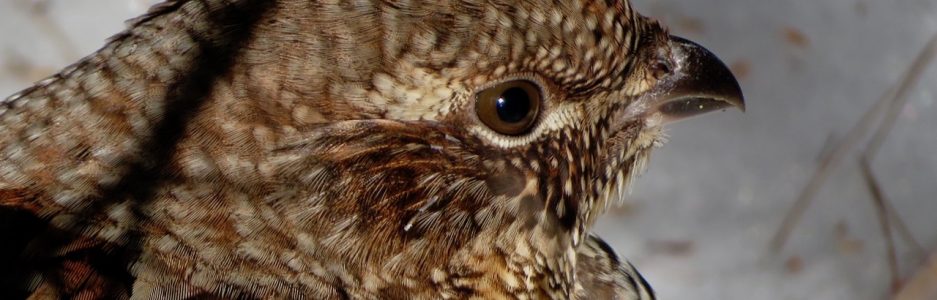
A “Fen-tastic” Afternoon

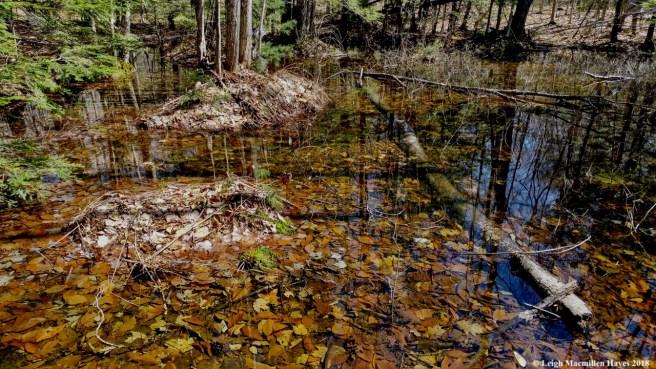
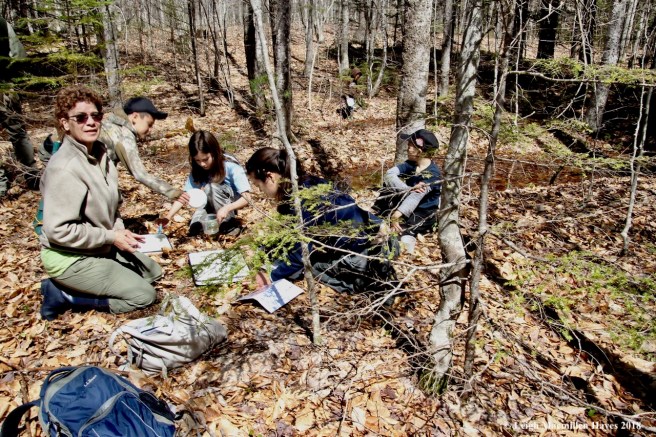
I was on a reconnaissance mission this afternoon for next week I’m leading some middle school students into a wetland and talking about forest ecology before sharing the joy of foraging with them.

1-Into the jungle

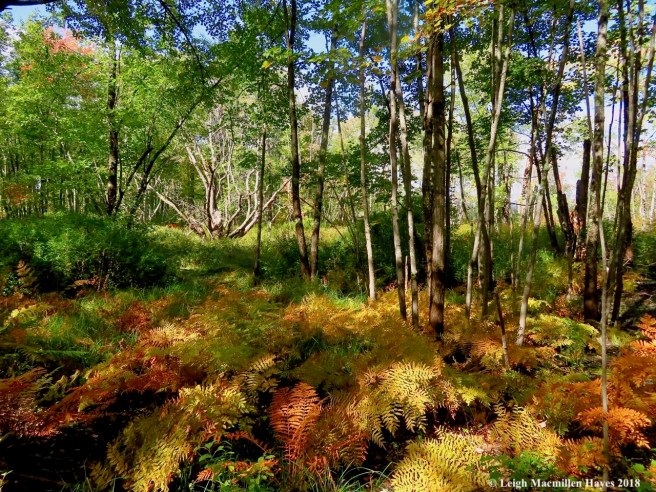
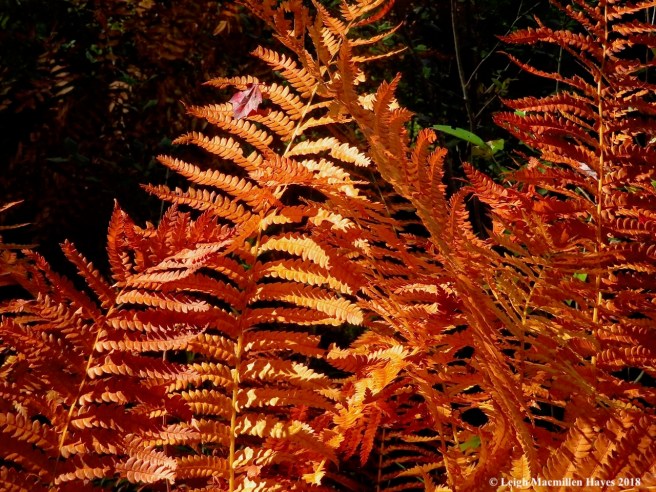
To reach the wetland, it was like walking through a jungle where the ferns grow tall, their fall coloration enhancing the scene. Cinnamon Ferns are a species that easily grow in medium to wet soils in part shade to full shade. The moist, rich, acidic soils, I walked through were much to their liking.

1a-cinnamon fern

It appeared that they were named for their autumn presentation, but really it refers to the cinnamon-colored fibers found near the frond bases.

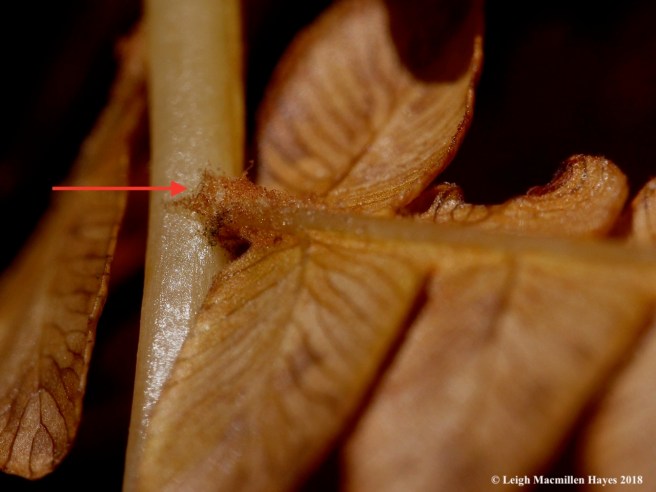
1b-hairy underarm

Because they look so similar to their relatives in the Osmundaceae family, the Interrupted Fern, I looked to the back of the frond for confirmation. Sure enough, where the pinnae (leaflet) met the rachis (center stem), a tuft that we refer to as the hairy underarm was present.

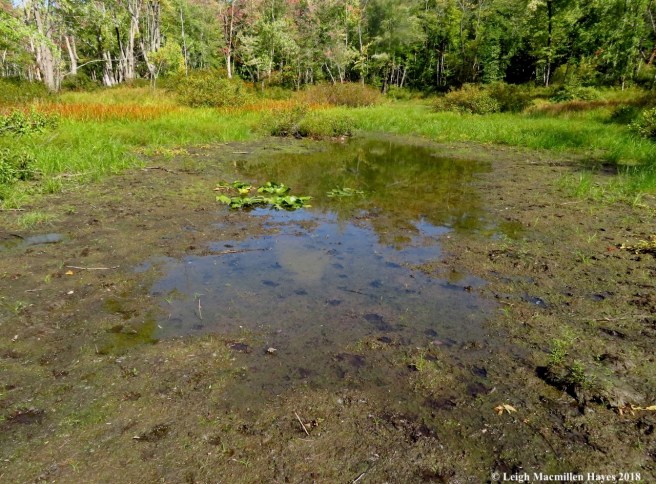
2-kettle

Onward I continued, not sure what the moisture situation might be. So, in the past, I’ve paused by the kettle hole, but never actually entered it. All that changed today and my plan is to take the students into this special place. A kettle hole is a basin created when a large block of glacial ice was left stranded and subsequently melted in place, producing a basin or depression. These basins fill with water up to the depth of their surrounding water table, which currently happens to be rather low.

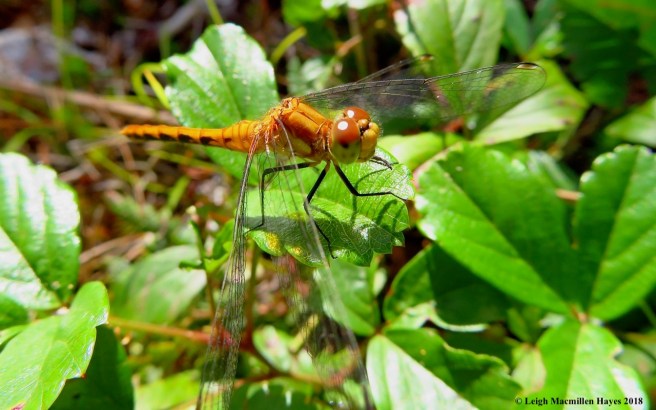
3-white face meadowhawk

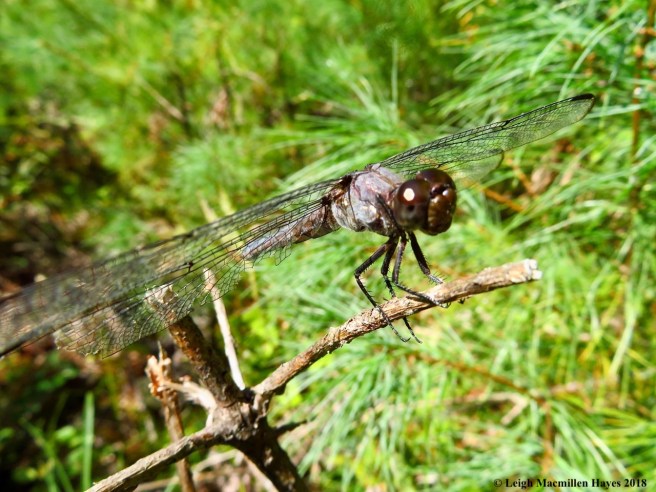
Because the temperature had risen after a damp, chilly start to the day, the meadowhawk dragonflies flew . . . and landed. This one was a White-faced Meadowhawk, aptly named for that face.

4-white face meadowhawk abdomen markings

Its abdomen markings of dark black triangles also help in identification.

4b-autumn meadowhawk dragonfly

Flying in the same airspace where the Autumn Meadowhawks, with their light-colored legs. All other meadowhawks have dark legs.

4c-autumn meadowhawk love

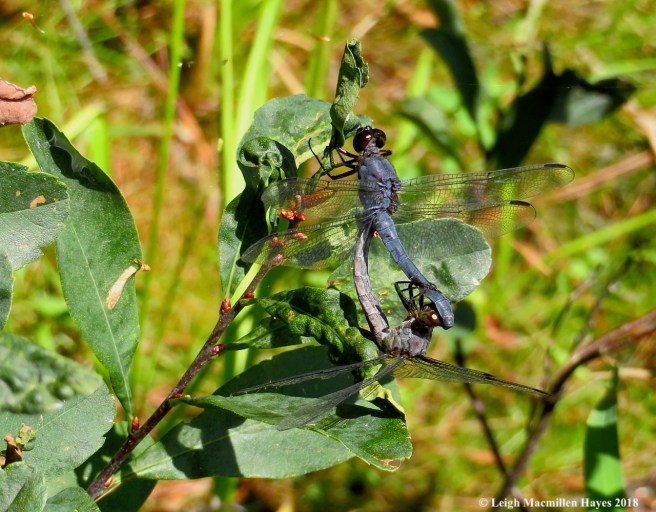
Love was in the air and on the leaf as a pair of Autumns took advantage of the warm weather to canoodle in the sunlight.

4c-dragonfly love everywhere

They weren’t alone.

7-kettle 2

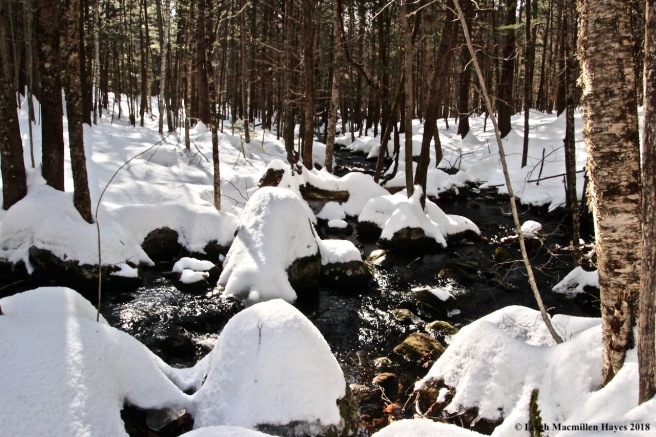
What I learned as I explored was that the kettle was actually a double pot for a second one had formed behind the first. Notice the layered structure of the area from trees on the outer edge to shrubs to grasses and flowers to water.

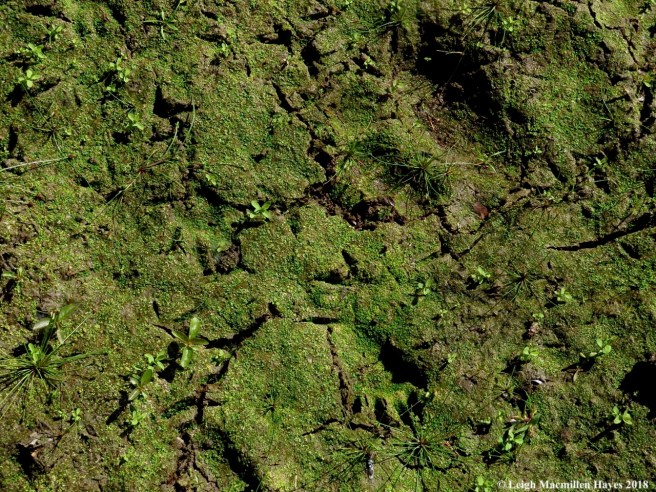
5-mammal tracks

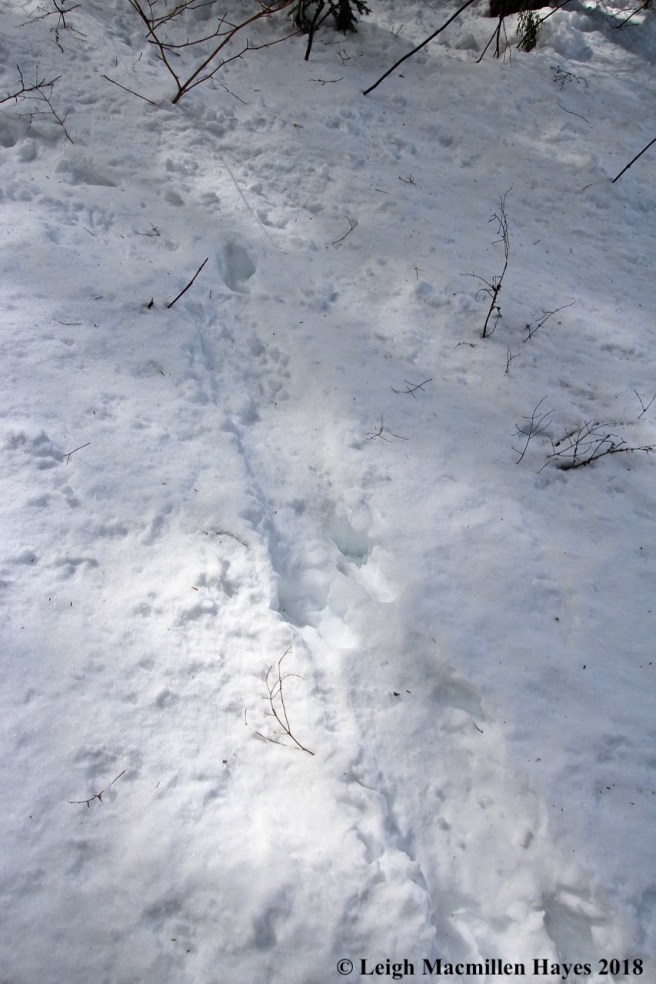
And everywhere–deer and raccoon tracks crisscrossed through mud and water.

5a-racoon and bird tracks

Bird tracks also joined the mix among the raccoon prints.

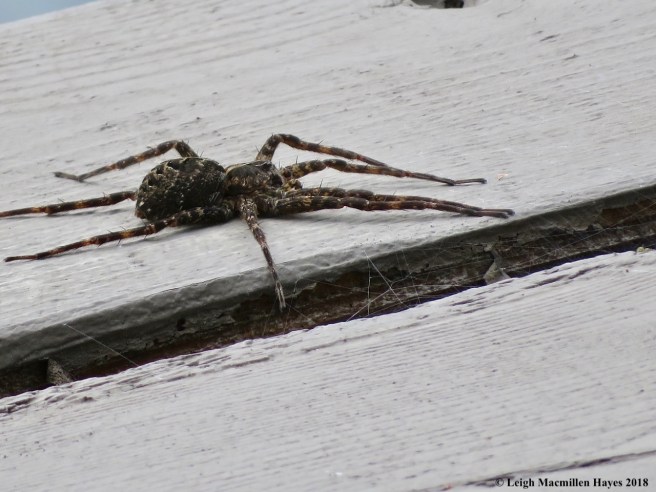
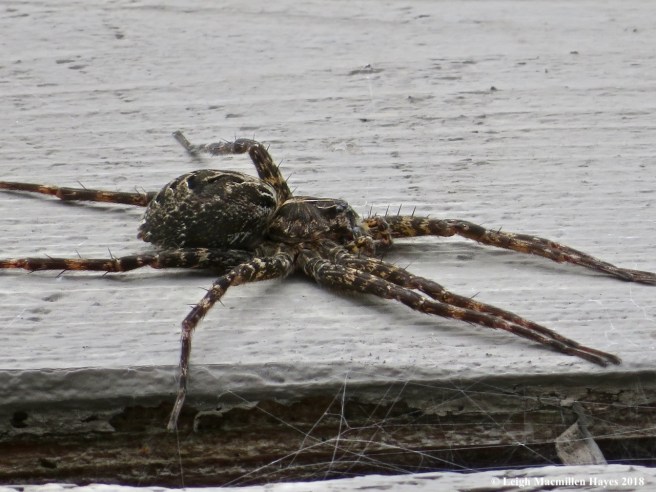
6-six-spotted fishing spider

And because I was interested in learning who lived there, I had to pay homage to the six-spotted fishing spider.

8-spatterdock leaves and root

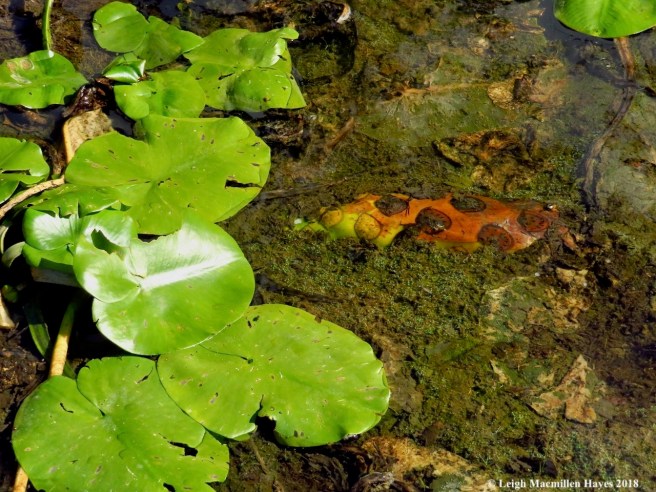
The spider flirted with me as he moved quickly among the spatterdock leaves that sat in the wee bit of water left in the center of the kettle.

9-another kettle

I finally left the kettle only to discover another and again the formation of layers.

10-green teal ducks

The water was a bit deeper and a family of Green Teal Ducks dabbled.

11-bottoms up

Bottoms up!

12-my destination

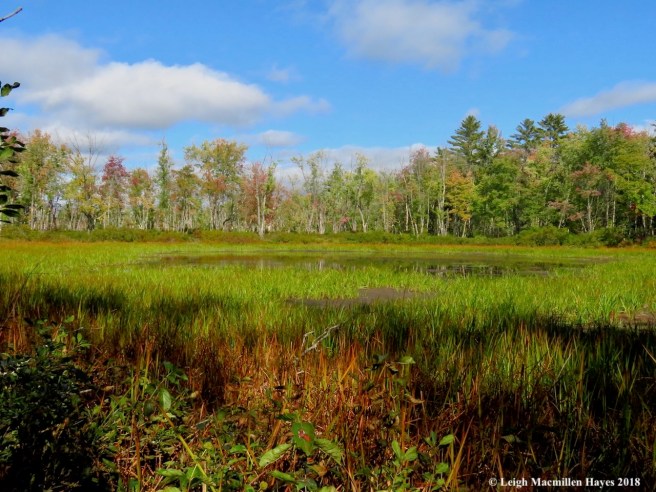
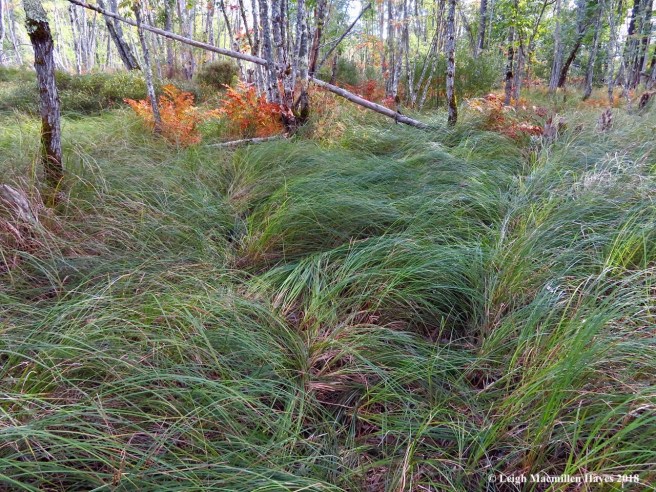
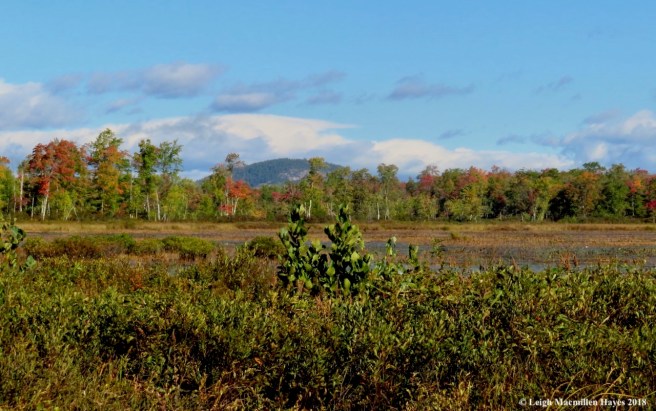
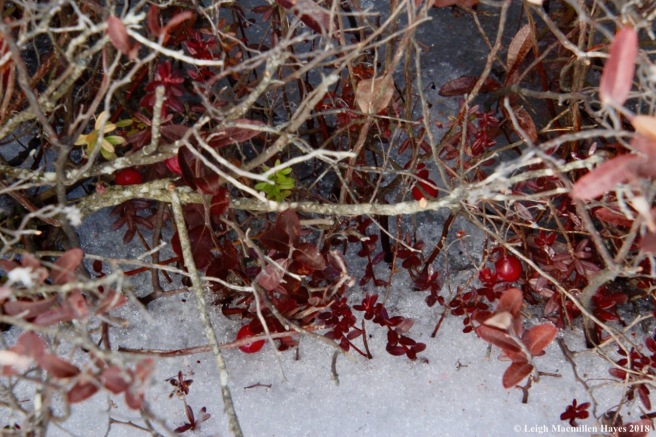
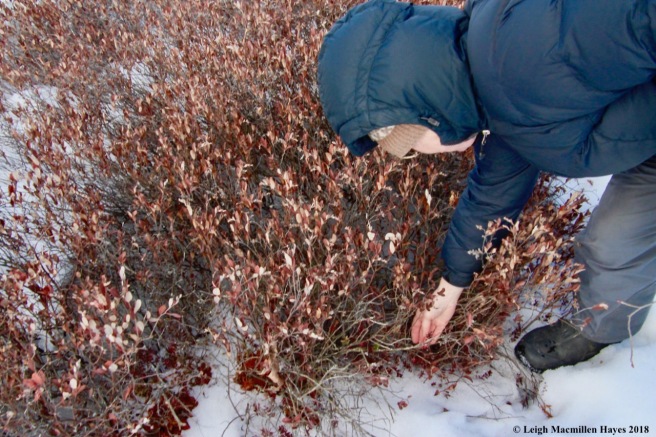
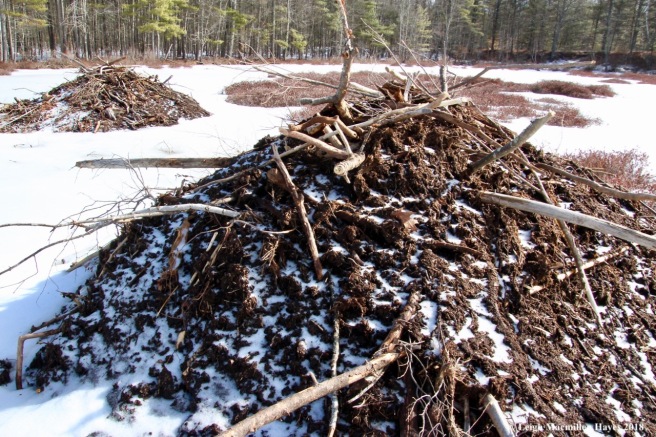
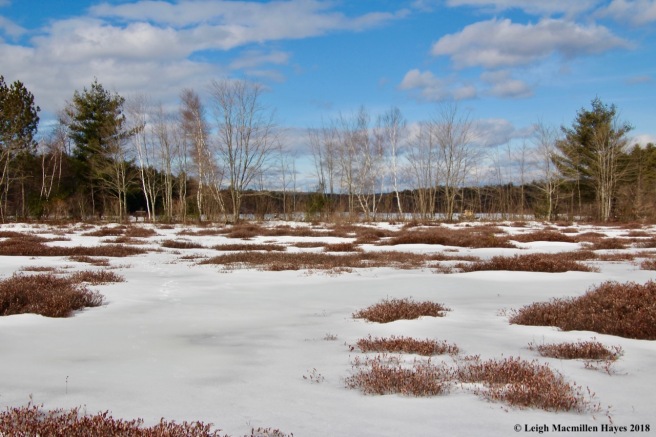
It took some time and steady foot placement as I climbed over downed trees hidden by winterberry and other shrubs, but at last I reached my intended destination, a cranberry bog.

13-cranberries

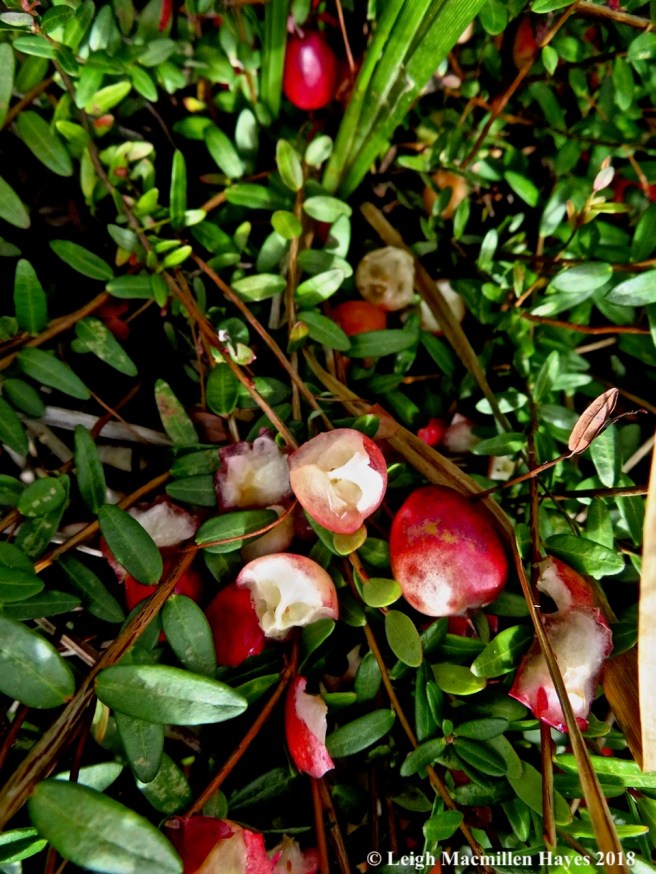
And then I spent the next hour or so filling my satchel for so abundant were the little gems of tartness. The best where those hidden among the leaves–dark red and firm were they.

14-some nibbled cranberries

As I picked, I realized I wasn’t the only one foraging. It appeared that either chipmunks or squirrels also knew the value of the flavor–though they only nibbled.

15-October colors layered

Occasionally, or even more often, I looked up to take in the colors and layers that surrounded me–from leatherleaf bronze to blueberry red to Gray Birch and Red and Silver Maples with a few White Pines in the mix.

16-buttonbush

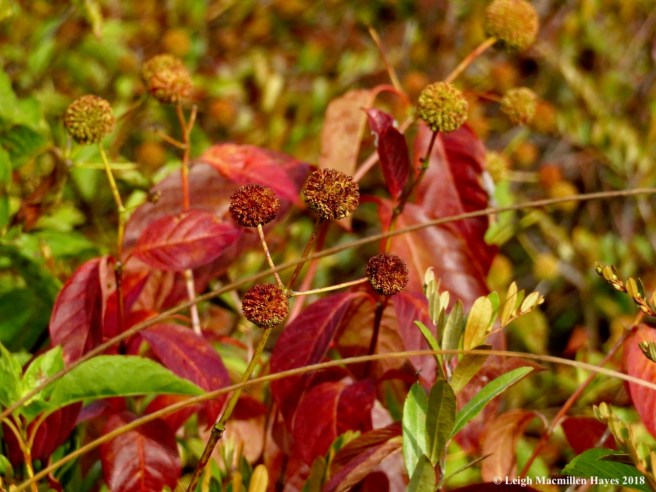
Buttonbush added its own color and texture to the scene.

17-finding my way out

At last I decided to find my way out. (Sorta for I did get a wee bit disoriented.)

18-royal fern fertile fronds

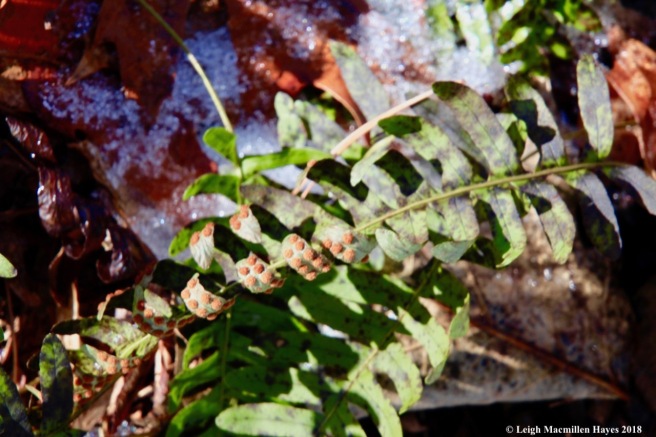
Among the offerings were ferns of a different kind–though still related to the cinnamons I’d seen earlier. The Royal Fern’s fertile crown had months ago shared its spores with the world and all that was left were salmon-colored structures.

21-buttonbush galore, but more

I picked my way carefully and eventually found one of the kettles. And . . . drum roll please . . .

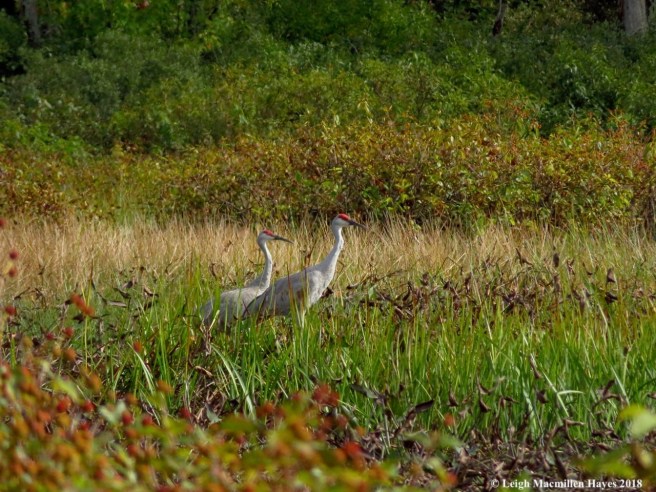
22-two sandhill cranes

two Sandhill Cranes. Others can tell you better than I how long the Sandhills have returned to this area, but it’s been for a while now and some even saw a nesting pair this past summer. My sightings have been few and so it’s always a pleasure.

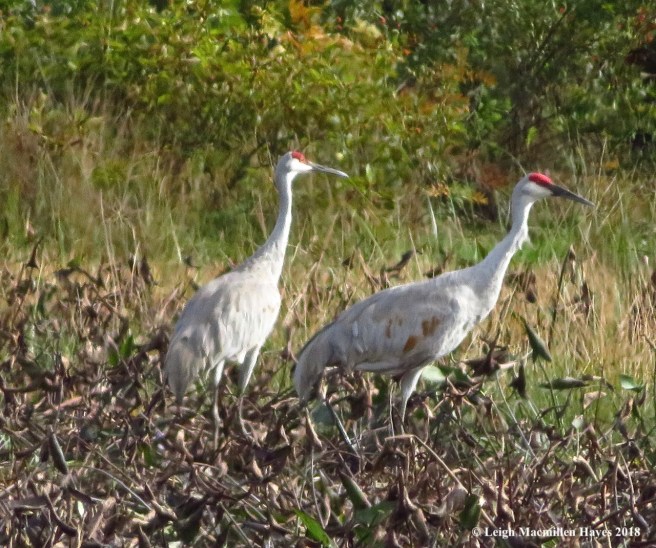
23-sandhill cranes

I stood still as they moved about and they didn’t seem to notice my presence.

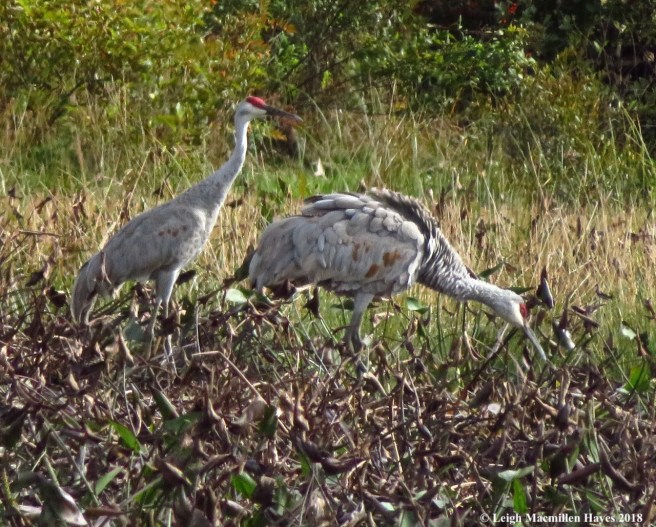
24-sandhill cranes

While they foraged for roots, another also watched.

25-great blue heron

The Great Blue Heron was cautious as they strolled in his direction.

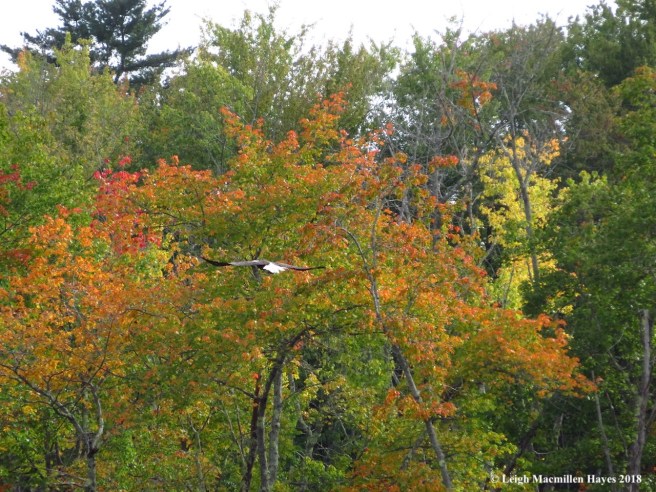
29-bald eagle

And then . . . and then . . . in flew a Bald Eagle. And out flew the heron.

30-cranes flew out

The cranes waited a couple of minutes and then they flew, bugling on the wing.

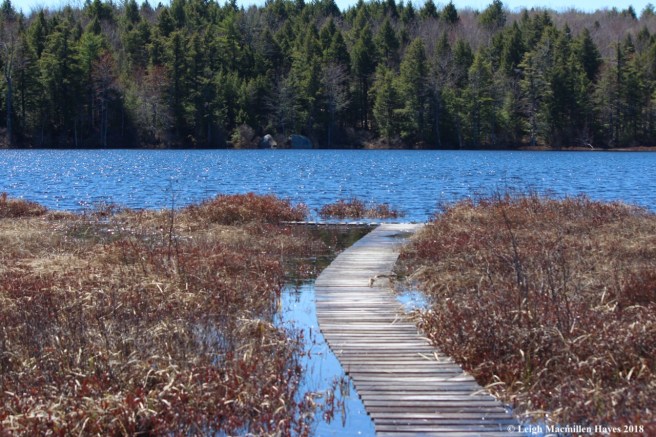
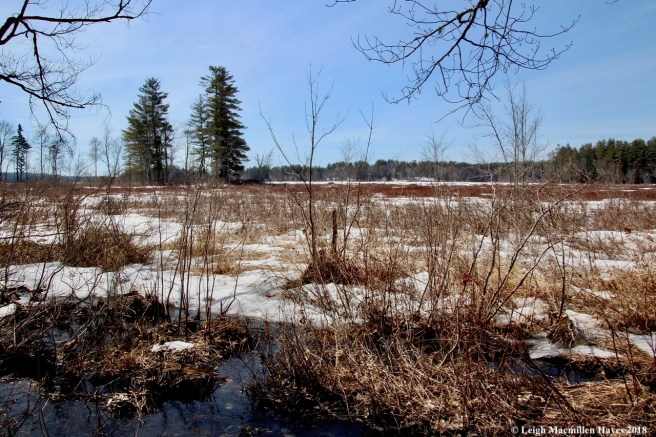
And I rejoiced. Oh, I still had to find my way out and did eventually cross through a property about a quarter mile from where I’d started. But, all in all from kettles to cranberries to birds, it was a Fen-tastic afternoon as I explored an outlet fen.


Making Connections

“The Great Maine Outdoor Weekend is a series of events led by outdoor-oriented organizations and companies to celebrate the how, where, and what of being active outside in Maine. Our goal is to connect our friends and neighbors with the natural world, to promote fun, physical activity, & good health.”  ~greatmaineoutdoorweekend.org

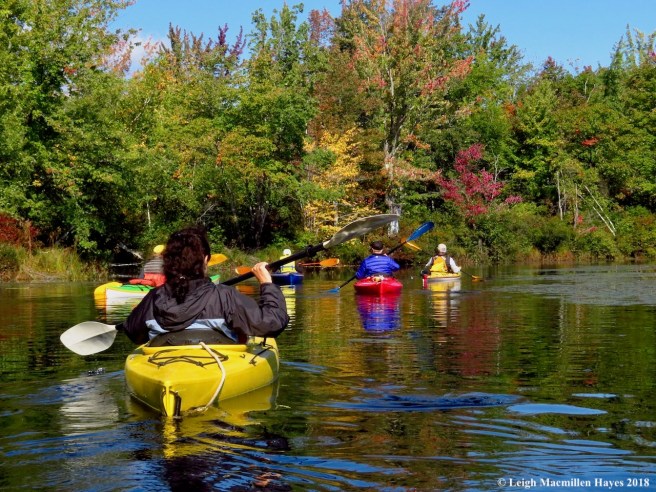
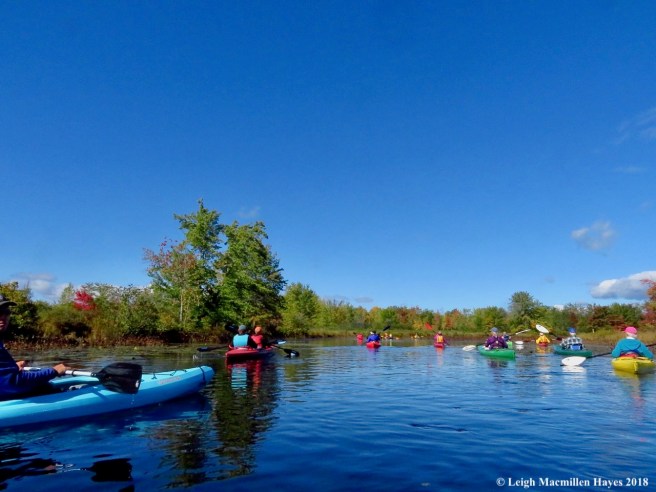
In the spirit of the GMOW, the Greater Lovell Land Trust and Upper Saco Valley Land Trust co-hosted a paddle at the Major Gregory Sanborn Wildlife Management Area, aka Brownfield Bog, in Brownfield today.

1-fine fall morning

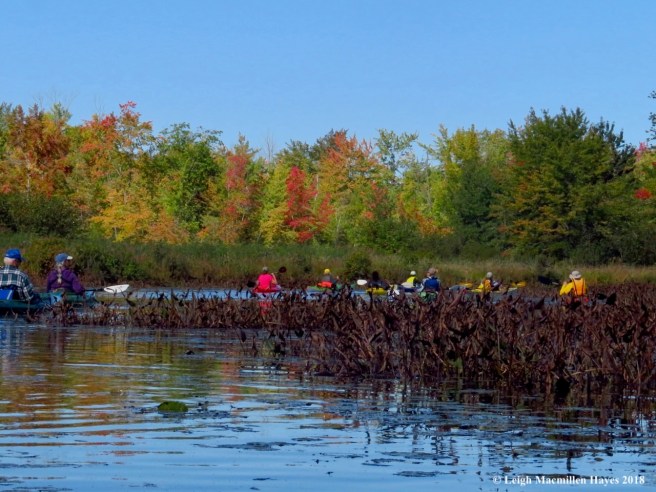
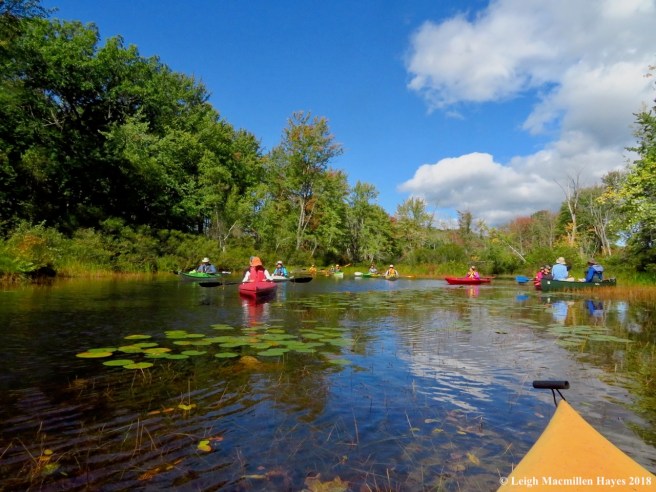
Though the temperature was a bit nippy, as in mid-50˚s to start (and colder in the shade), we couldn’t have asked for a better autumn day, especially given that we first began planning this event last winter.

b-Kathy's sign 1

In what seemed like perfect timing for they didn’t all pull in at once, vehicles laden with kayaks and even one canoe, arrived and folks who’d never met before helped each other carry boats, paddles and personal floatation devices down the road. Then we stood in our traditional circle, where Erika of USVLT and I welcomed everyone and introduced our two organizations. By the tile sign created by Maine Master Naturalist Kathy McGreavy, I pointed out our location and destination along the Old Course of the Saco River.

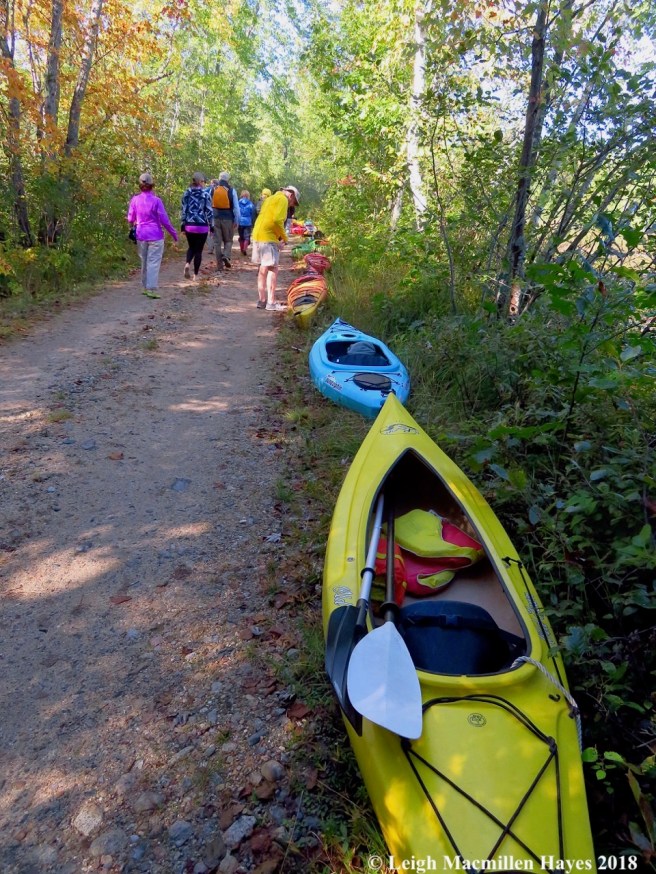
2-walking to the put in

And then we all walked down the road to the put-in site . . .

3-kayaks on parade

where our parade of kayaks awaited the adventure.

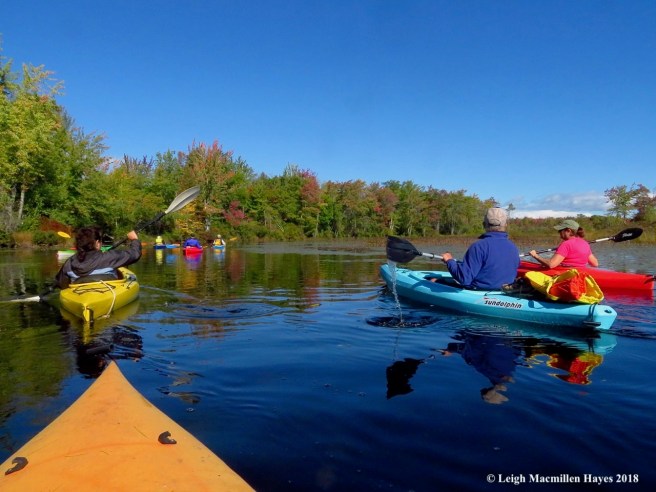
4-onto the old course

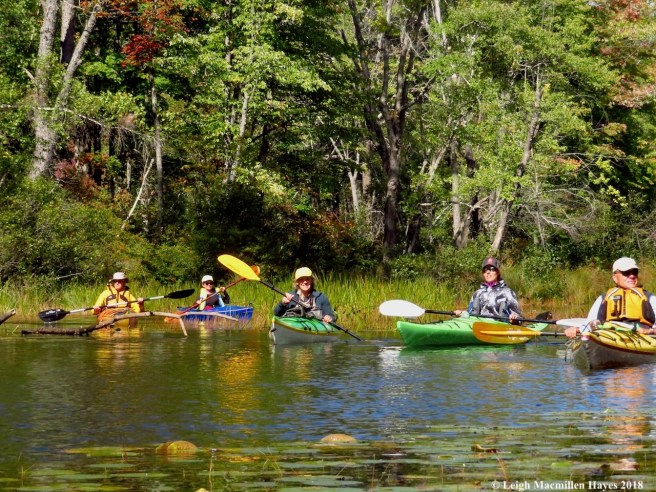
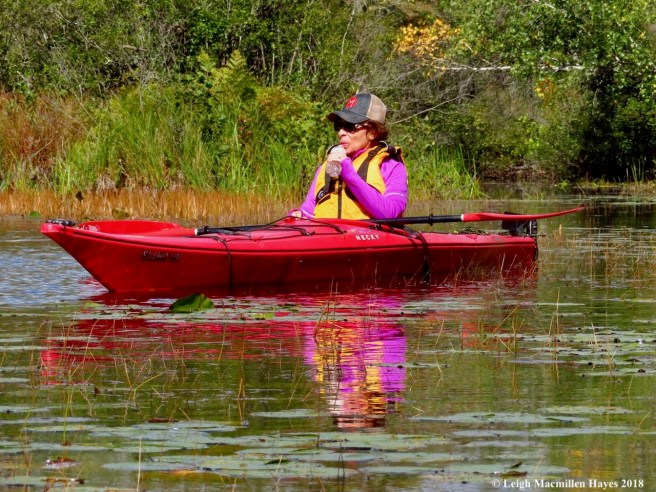
One at a time the boats were launched. And then the magic began. It was two-fold in that I’d challenged our twenty participants, some of whom had learned of the event via our advertising efforts locally and were already members of our organizations, and others who discovered the event via the GMOW website and wanted to try something new. The challenge was to spend some time chatting with people they’d never met before. And they did. Conversations ranged from living in New York to termite mounds in Africa.

Folks came from Fryeburg, Bridgton, Lovell, Standish, Jackson and North Conway, as well as Westbrook, Portland, and Cape Elizabeth. But that wasn’t all, for one joined us from Philadelphia and two came from Houston. Our furthest traveler hailed from London. Well, truth be told, she’s a long-time GLLT member, docent and board member who spends at least four months in Lovell. ;-) Thanks Moira.

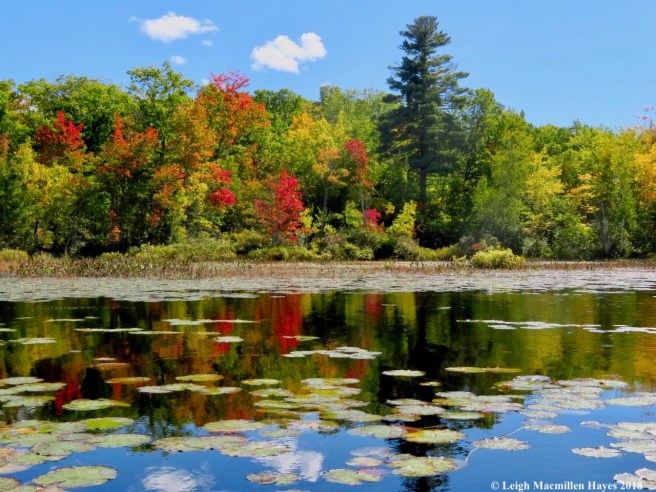
5-tapestry of color

The tapestry of colors was the other magical element. We chatted about the colors and the carotenoids (yellows and orange pigment) showing up as the leaves stop producing sugar and starch for the tree, and the chemical process that produces the anthocyanin or red coloration.

14-lily pad aphids and yellowjackets

We mentioned the lily pad aphids that sought nutritious sap and noted how the yellowjackets took advantage of the honeydew secretions the aphids offered.

12-soaring above--bald eagles

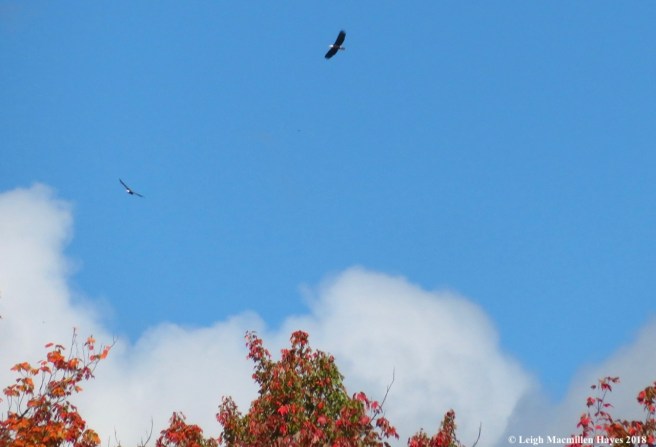
And some of us had the joy of watching two Bald Eagles soar on the thermals above.

16a-beaver works

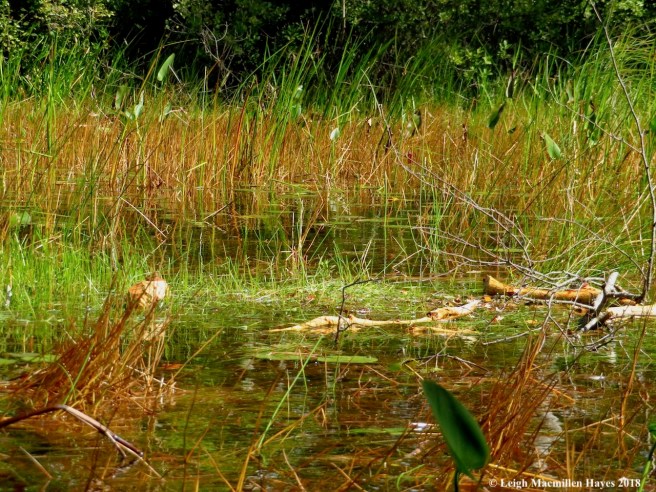
There were some fresh beaver works to note and we did spy a few lodges, though none looked active.

7-duck hunters

And for most of the trip we heard the duck hunters’ gunshots as they took aim, though I think we scared a few of them off. The hunters that is. Well, we know we scared a few ducks off as well.

6-ahhhhh

But, what the day was really all about was an enjoyment of being outdoors and sharing a place many had never explored before.

8-around every bend

Around every bend, we discovered different threads, our own colors sewn into the tapestry.

9-the tree

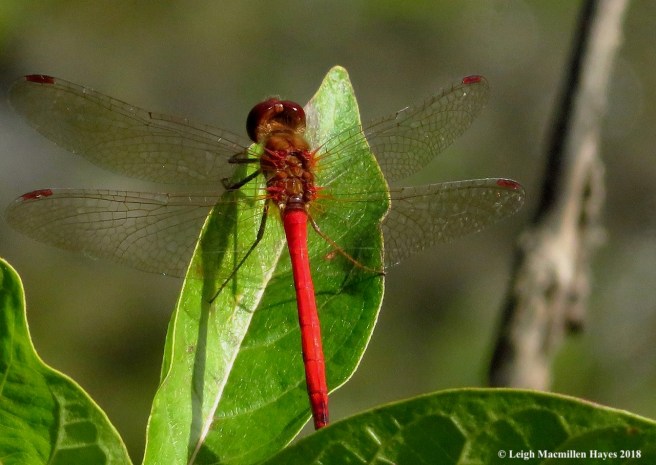
One of my favorites is what I’ve come to call “The Tree.” It’s a perfectly shaped Red Maple that protects a beaver lodge–if you peak below the lower branches on the left, you may see the pointed top of the lodge.
10-the tree's reflection

Even The Tree’s reflection was worth several expressed “Ahhs.”

11-color enhanced by clouds

Though the clouds weren’t many, some enhanced the scene.

15-more color

With each stroke of the paddle it seemed we reached new vantage points where the artwork was similar . . .

16- and more reflections

yet different.

How could it get anymore beautiful?

13-lily pads upturned

Even the lily pads stood out as if seeking recognition for their presentation.

17-turn around point

At last we reached the end of the road, or rather Old Course. That was our turn-around point.

18-preparing to head back

And so we did . . . turn around.

20-taking a break

Before heading immediately back, however, we paused for a few moments to sip some water.

21-enjoying lunch

And a few new friends even enjoyed rafting up while they ate their picnic lunches.

26-the tree again

The trip back passed by much more quickly, as it always does. But still, The Tree called for attention.

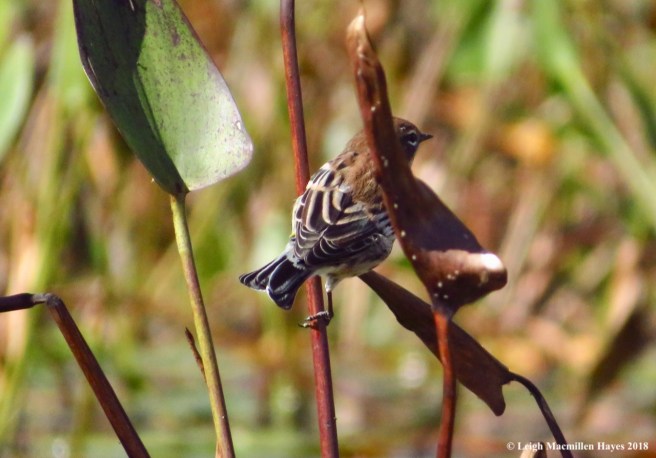
23-yellow-rumped warbler

And so did the young Yellow-rumped Warblers that flew in and out among the Pickerel Weeds.

25-yellow-rumped warbler

They moved in a flock from weeds to the shrubs and back again and a few of us recalled the thicker than thick mosquito population we’ve encountered at the bog in the past, but exalted the insects because of the birds they feed. Today, we were mosquito free and thankful for that. The birds seemed to find what they needed to sustain them. There are still plenty of insects about, just not bothersome ones.

30-pulling boats out

Three hours later, we found our way back to the launch site and once again helped each other stabilize boats and bodies and then carry the boats and gear back to the vehicles. Our journey together had ended, but . . . we had all chatted with a variety of people and left with smiles on our faces and in our hearts for the morning we’d spent together.

29-layers

We’d connected in the most beautiful setting thanks to everyone’s effort of choosing to celebrate Great Maine Outdoor Weekend.

For help making those connections, thank you Jesse Wright of USVLT for initiating this paddle with me so many moons ago, and to Trisha Beringer of USVLT for the time we shared walking and paddling in preparation, as well as taking the lead on the sign-up process, and to Erika Rowland of USVLT for transporting boats, taking up the lead when Trisha got sick, and being flexible along the way.

What a great day and great way to spend time outdoors in Maine.


Speaking to the Future, Jinny Mae

As a kid, science and history eluded me. Reading, and writing, and even, ‘rithmitic, I embraced. Well, only a wee bit of the latter, though my father thought my abilities were far greater than they were and he saw a bank position in my future. He was the mathematician. It wasn’t a subject for me to pursue. And so I became an English teacher.

And then one day I woke up and found I’d developed an interest in the how and why and the science of stuff. Added to that was a desire to know more about the past. And voila, here I am, some days spending way too many hours pursuing insects in the garden or bark on tree or dragonflies buzzing about. Other days, its following trails of yore and trying to understand the lay of the land and those who came before that interests me. My favorite days are probably those that find me pursuing the two subjects simultaneously.

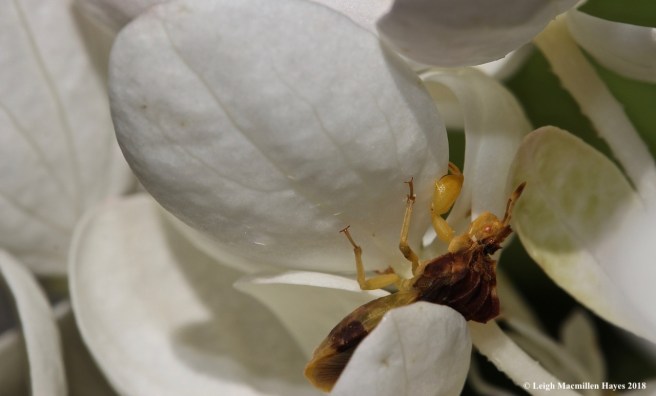
1-Ambush Bug on Hydrangea

Today, I devoted spurts of time to a hydrangea bush that we rescued from a shady spot in our yard about fifteen years ago and transplanted to a sunny spot. What once was a dying shrub that rarely produced more than one flower is now a healthy specimen laden with blooms. And the insects love it.
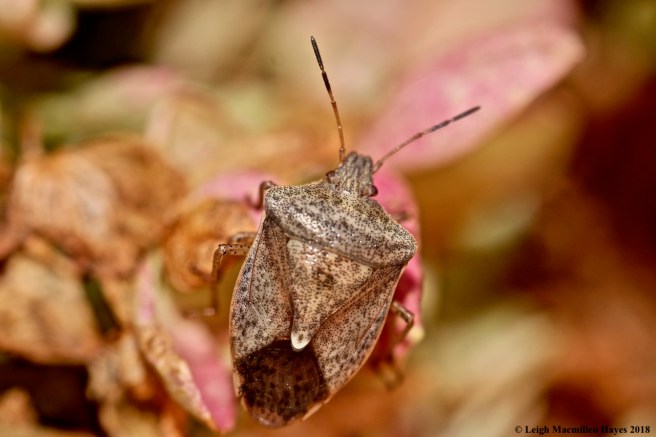
My biggest surprise, however, was to find an Ambush Bug sitting atop one of the newly opened white flower petals. For the first time since I’ve been paying attention, the bug was on something other than a goldenrod and I could truly see its body. I’ve always thought it exhibited a hint of a smile, and do believe I’m correct.

An Ambush Bug is my “iguana” insect for its body structure always brings to mind a neighbor’s iguana that got loose one day and never was spied again when we were kids. (Or was it? Didn’t we find a dead iguana on the old dump road, Kate and Lynn? Was that Rob’s lizard?) Anyway, I think the Ambush Bug resembles an iguana, on a much smaller scale, of course. MUCH smaller.

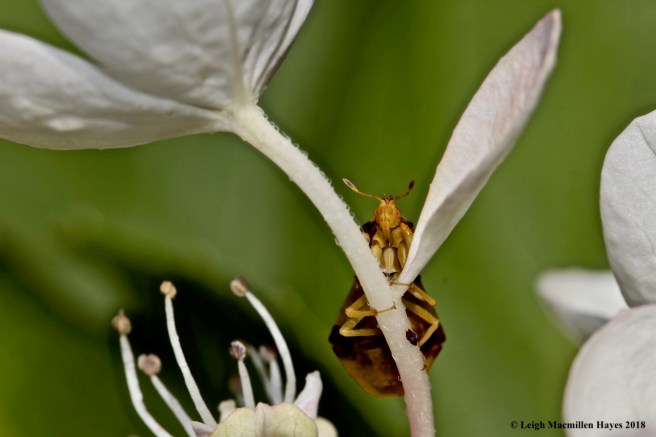
2-Ambush Bug

Seeing the bug on the white petals really threw me for a loop. Why was it there? What would it ever find to eat? The pollinators no longer bothered with the shrub on which it stood. They’d moved on to the goldenrods and asters below.

And how could this insect behave as one who ambushes when it was hardly camouflaged on the white petal? It must have questioned the same (if Ambush Bugs can question) for it turned this way, then that, and back again, and then moved from petal to petal and flower to flower. Usually, it hardly seems to flex a muscle as it remains in one spot for hours or days on end.

3-eye to eye with Ambush Bug

We studied each other, eye to eye, or perhaps more correctly, lens to lens, until I blinked and it flew off. I trust it landed on a nearby goldenrod, where a meal wasn’t too long in the making.

4-Tiger Moth Caterpillar

Just after the Ambush Bug and I parted ways, I noticed a subtle movement below and watched a tiger moth caterpillar that reminded me of a soft boa scarf one might wrap around a neck quickly slither down another flower on the shrub until . . .  it reached the edge of the final petal and fell to the ground, climbed up a fern frond, found its way back to the shrub and moved on to the world within.

7-grasshopper 1

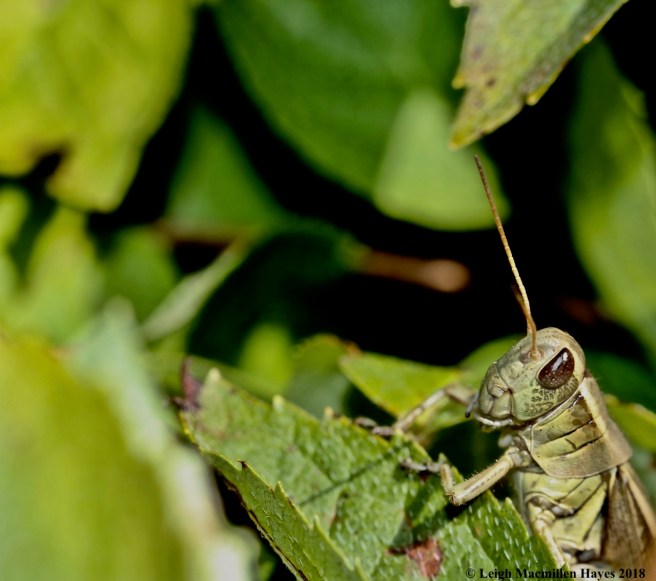
I was beginning to think that all of the insects on the hydrangea would move on or in, but then I met the Red-legged Grasshopper. He set his elbow on the leaf bar and we consulted each other. Would he fly away if I moved into his personal space, I wondered. He wanted to know why I stalked him.

8-red-legged grasshopper

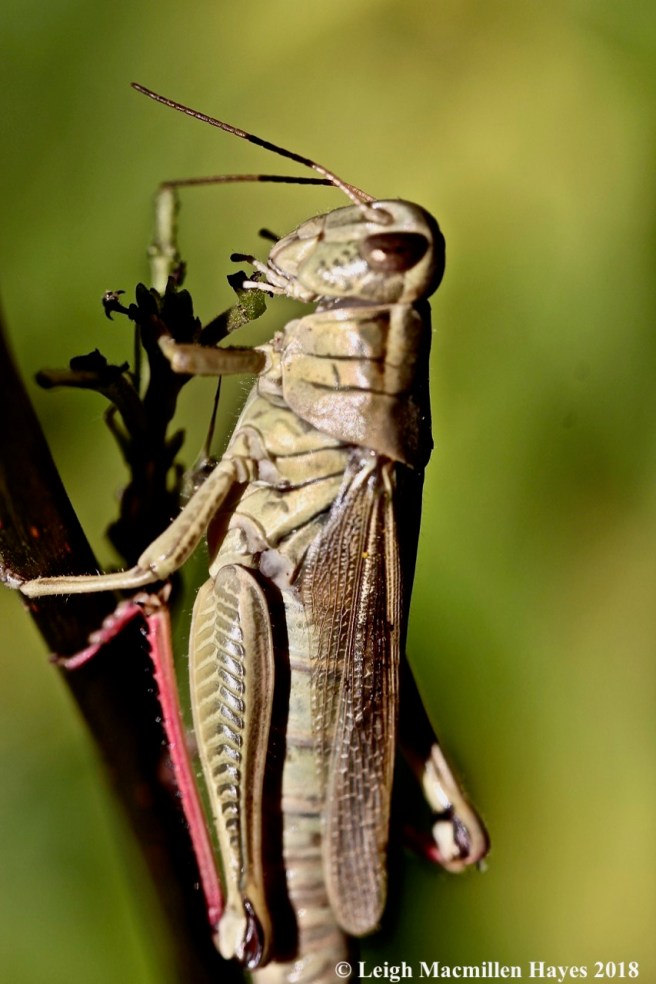
I mentioned his body of armor and the herring bone design and the leg joints and the spurs on its legs that drew my awe.

9-grasshopper

As a solo traveler, I knew it didn’t appreciate that I wanted to share the space. But, I couldn’t resist. Notice its feet and the segments on its abdomen and even the veins in its wings. Did I mention its mandibles?

10-caterpillar scat

As it turned out, there may have been a reason it wanted to be alone, but I was there. To. Witness. The. Poop. A blessed moment. It would have been more of a blessed moment had it pooped on me. Oh, and did I mention that grasshopper poop, like all insect poop, isn’t called scat. Rather, it is frass. Thanks go to Dr. Michael Stastny, Forest Insect Ecologist in New Brunswick, Canada for reminding me of that term. Cheers Mike.

14-shield bug

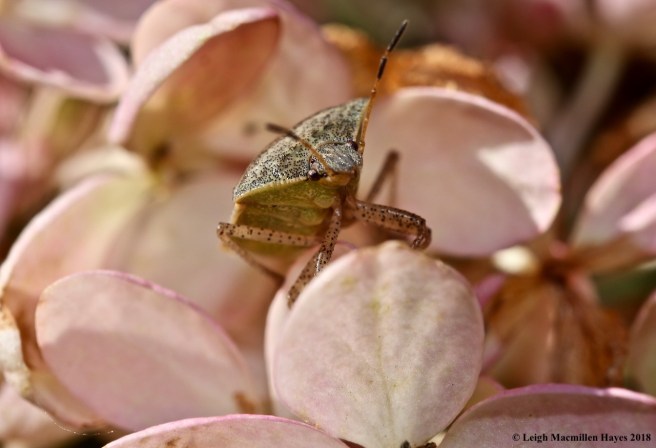
Another moving about was a shield bug, so named for the shield on its back. It does make me think of a piece of metal one might use as protection. Combine the shield with the grasshopper’s suit of armor and you might think you were spending time in an earlier era. Much earlier.

15-shield bug

But this shield bug didn’t care about the Middle Ages. Instead, it had one thing on its little mind.

12a-shield bug eggs?

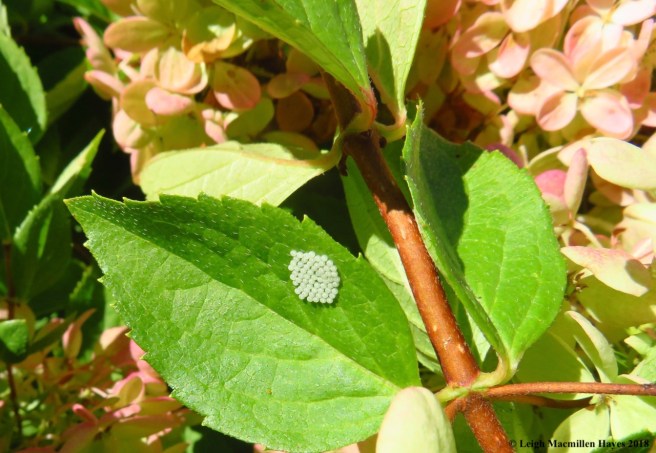
Depositing eggs.

13-shield bug eggs?

Its offering was almost minute, yet pearl-like in structure.

16-wasp within

The world I watched on the outside of the hydrangea made me wonder what might possibly go on within. As much as I wanted to break through the branches and take a better look, I knew I’d ruin everything and after all, it wasn’t my place. I did, however, get to witness one moving about briefly for a paper wasp left the goldenrods and heading under the hydrangea leaves to move the pollen about on its body. Why did it go under? Why not pause atop a leaf for such behavior? And how did it escape the inner world without . . .

16a-spider web

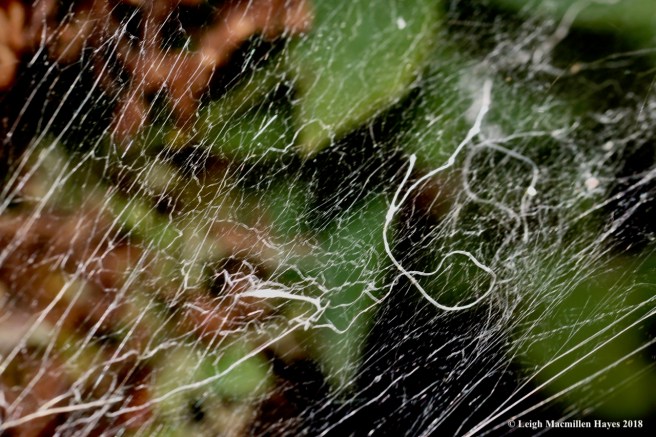
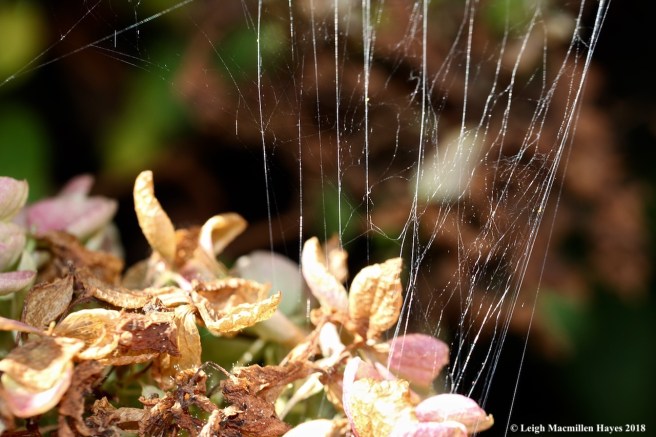
encountering a spider web? Funnel spiders had practically veiled the entire shrub with their silken structures.

16b-web anchors

Though anchored with strength, they were extremely soft to the touch.

17-spiders

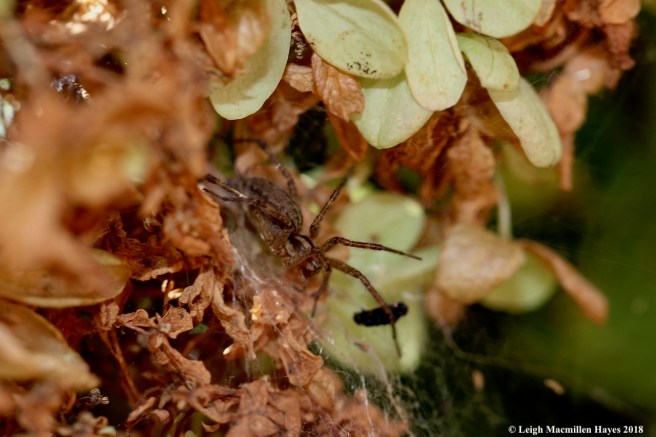
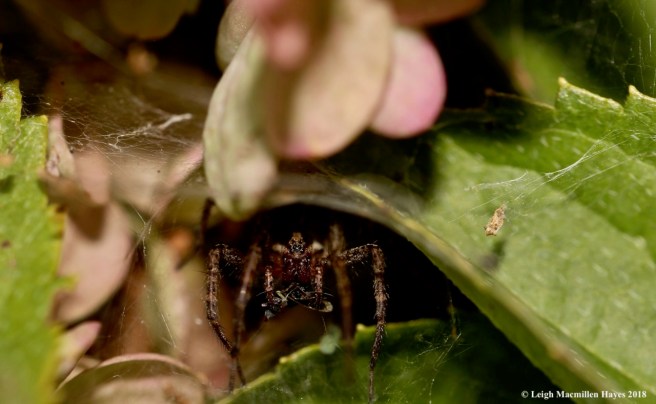
As the day progressed, I kept tabs on three funnel spiders, the mighty weavers that they were. All were wary of daylight.

18-food in front

But one had set up its home on the eastern side of the shrub and so it spent the day in the shade and enjoyed fine dining on a small bee that I assume made a mistake of pausing while shifting some pollen on its body.

19-dining

There wasn’t much left of it by the time this spider had finished its meal.

21-dinner in hand

Later in the day, a web weaver on the western side began to show itself–and it also had a meal secured.

All of the insects and arachnids I saw, and I had to assume even more enjoyed the inner structure of the condo that the shrub certainly was, all spoke not to the past, but to the future.

And with that, I dedicate this blog entry to you, Jinny Mae. You have a better eye and understanding and ask better questions than I ever will. Here’s to the future!

So Many Advantages Along the Mountain Division Trail

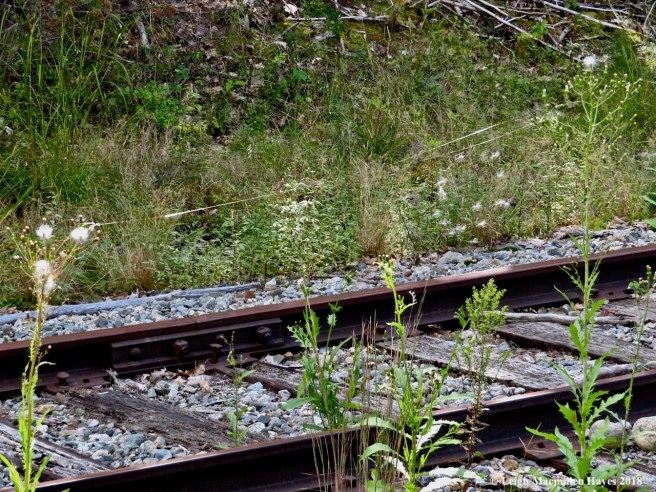
When opportunity knocks, so they say, open the door. Today, it wasn’t really a door that I opened, but rather a trail that I explored. And it wasn’t a new trail to me, for I’ve ventured along the Mountain Division Trail in Fryeburg many times before.

1-trail sign

But my morning and afternoon plans changed and I happened to be in the vicinity and I don’t think I’ve ever walked that way in late summer before–so I did what I love to do best and set off down the path beside the now defunct railroad track. And I was curious to discover who else might be taking advantage of it on this fine September day.

2-monarch caterpillar

Within minutes, I made my first discovery–a monarch butterfly caterpillar crawled along the paved trail. I’d actually chosen this spot for I hoped to see a few monarchs and my chances suddenly increased.

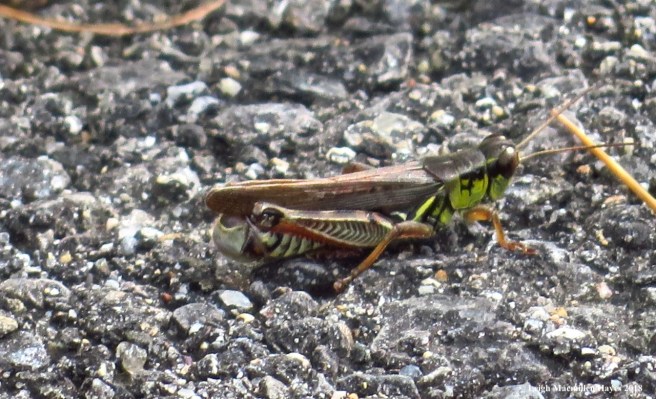
3-red-legged grasshopper

Also using the asphalt were innumerable grasshoppers of several types including this red-legged, and crickets galore. In fact, between them and cicadas, I could almost not hear the traffic on Route 302 at the start. Almost.

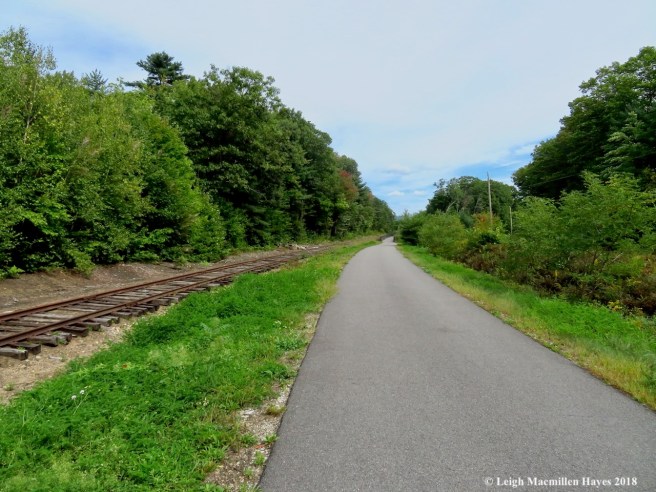
4-rail trail

Within minutes, however, the trail passed behind several businesses and then curved away from the road and toward Eastern Slope Airport. It was occasionally flat, occasionally straight, occasionally curved, and occasionally hilly. But always paved. And much quieter.

5-spotted knapweed and web

Constantly, the offerings changed. Knapweed with its pineapple-like base, which loves disturbed areas, had made itself at home. And a spider had used the structure to create its own home.

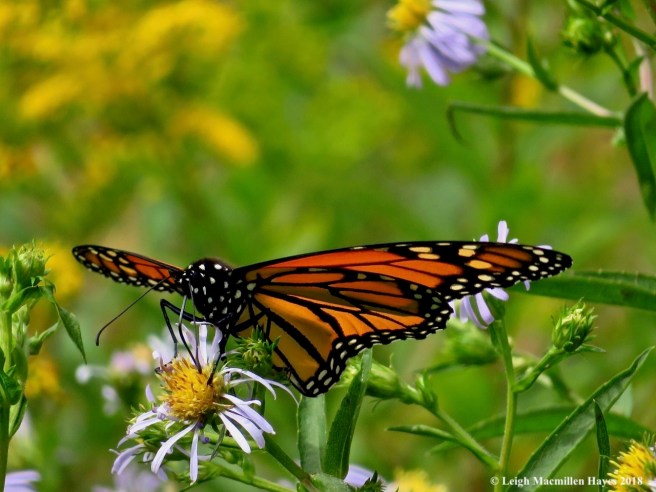
6a-monarch

As I walked, I began to notice them–a monarch fluttering past here and another there. At last, I found one that had paused to take advantage of the nourishment offered by an aster.

6-monarch on aster

I stood for as long as it would allow . . .

7-monarch on aster

enjoying every pose presented.

8-crystalline tube gall

A little further, I found something I only remember seeing for the first time a few weeks ago–I think it’s a crystalline tube gall on the oak leaf, but urchin gall would be my second guess.

9-banded tussock caterpillar

On the same leaf, either a banded-tussock moth caterpillar or a Sycamore tussock moth caterpillar munched away, so similar are they. Check out all the bristles by the head–both an extra set of black and a more subtle set of white.

10-water

By what I assumed was an old mill pond fed by a small brook, the watery world quietly intercepted all other communities found along this path.

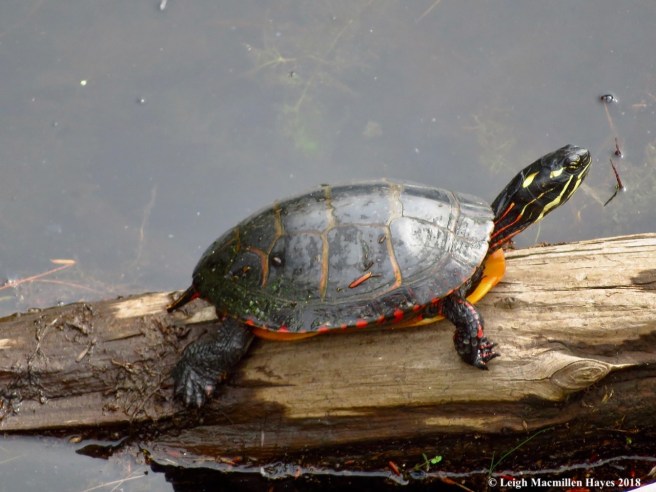
11-painted turtle

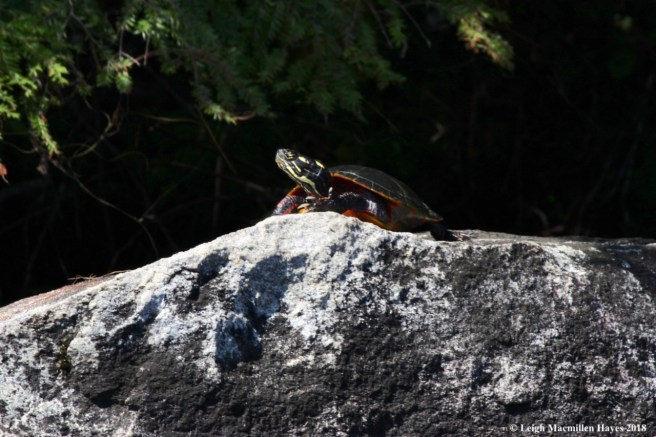
And today, a painted turtle watched nonchalantly from a log in the pond as the world passed by–runners, walkers and bikers on the path above . . . some who hardly noted his presence.

12-male blue dasher

And dragonflies,  including this mighty handsome green-eyed blue dasher, below. Do you see the hint of amber in his wings? One of the telltale signs.

13-pokeweed poking through the fence

Continuing on, I was surprised by a sight I’d seen before because I’d forgotten its presence. Pokeweed flowered and fruited and . . . poked through the fencing that formed a boundary along parts of the trail.

14-northern white cedar

There’s also a short section where northern white cedar formed a wall, its woody cones all opened in an expression of giving forth new life and its leaves scaled like skinny braids.

15-pipewort gone to seed

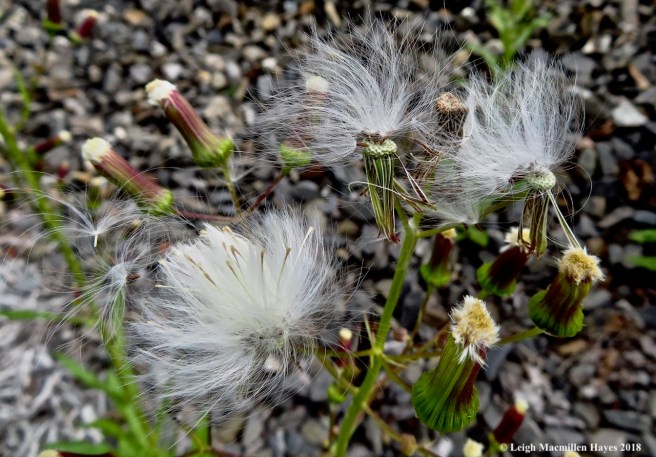
Being a greatly disturbed zone, pilewort grew in abundance and its seeds danced and twirled and sashayed through the air like ghostly angels blowing in the wind. Actually, the graceful seedheads were much more attractive than the flower in bloom.

16-Queen Anne's Lace

Queen Anne’s Lace had also bloomed profusely, but today showed only its winter weed form full of tiny seeds edged with rows of bristles. The better to ground itself somewhere when the time comes, I supposed.

17-Bristly sarsaparilla fruits

Speaking of bristles, bristly sarsaparilla sent its many-fruited umbels out through the fence, perhaps in offering to those passing this way.

18-into infinity

So many offerings I’d seen by the time I reached about the three mile mark and I knew there would be even more on the way back so I used my own imaginary turntable and began the return trip.

20-spider web between pipewort

It was then that a web strung with great and amazing strength between two pileworts caught my attention. First, I couldn’t believe the distance between the two plants or the thickness of the anchoring web. And then I noticed something else . . .

21-seeds caught in web

An orb about two thirds of the way across, decorated with pilewort seeds that will take a little longer than usual to get established on the ground. Will they be viable, I wondered.

23-funnel spider

Another industrious arachnid had used one of the fence pipes to make himself a home. Can you see the funnel spider waiting in the tunnel for delectable prey to land on his web?

22-goat

And then there were the goats, this one and two others who munched beside the trail. I called their owner because I feared they’d broken out of their pen (or someone had opened the gate). Her number was on a board attached to a tree as she’d advertised her daycare business to all who passed by. We enjoyed a pleasant conversation and I learned that she lets them out for an hour or so each day to feed on the weeds. Weeds? What weeds. All I saw where wildflowers aplenty. Anyway, if you go, do know that you may encounter the goats and they are not gruff at all.

24-cabbage white butterfly

While I saw a few more monarchs as I wandered back, a few other butterflies at least half the size of the royal ones moved with dainty motions. For the cabbage white butterfly, the asters were all the thing. But like so many of the wildflowers that have taken root in this disturbed place, this butterfly also disturbs people because it has a penchant for damaging crops.

26-northern cloudywing skipper butterfly

Even smaller was the northern cloudywing skipper that stopped atop a red maple sapling. Males perch near the ground awaiting females, so his chosen spot made sense. His wing scales gave him such a satiny look as he shown in the light and his earth-tone colors included hints of purple.

It was all about the earth, I noted, as I walked along the Mountain Division Trail. Years ago, the path that I followed today had been used to construct the railroad track. And then in the 2000s, the rail trail had been built beside it. Over the years, I’m sure the railroad track had been enhanced. So the land was indeed disturbed . . . repeatedly.

And now, just as I took advantage of it to follow the well-constructed trail, so many others had done the same–both human and non. Not all were beneficial, but still they eeked out a life in that place. From insects and “weeds” to turtles and tree, there are so many advantages available along the Mountain Division Trail in Fryeburg, Maine.


Our Home is Their Home

As I sit in my rocking chair on the camp porch, the cicadas still buzz, with chirps of crickets thrown into the mix and somewhere in the background a constant trill from another. Tree frog? Perhaps, but it seems to carry on for longer than usual. Grasshopper? Maybe. And then there is the occasional call of the loon.

1-camp

What truly attracted my attention earlier today, however, were the other members of the household. Whose home this is, I think I know. Or rather, I thought I did. I thought it belonged to my guy and me. But really, I should have known better for it has never just housed the two of us. There were the boys growing up, and family, and friends, and renters, even. Actually, the latter three knew it before the boys. (Oops, I suppose I should call them young men, mid-twenty-somethings that they now are.)  But, through all these years, it has also housed many others. And so today, I got acquainted with some of its other residents. Rather than the mammals that we know also share the space, e.g. mice, squirrels, and bats, it was the insects and arachnids that I checked out.

2-cicada exuviae

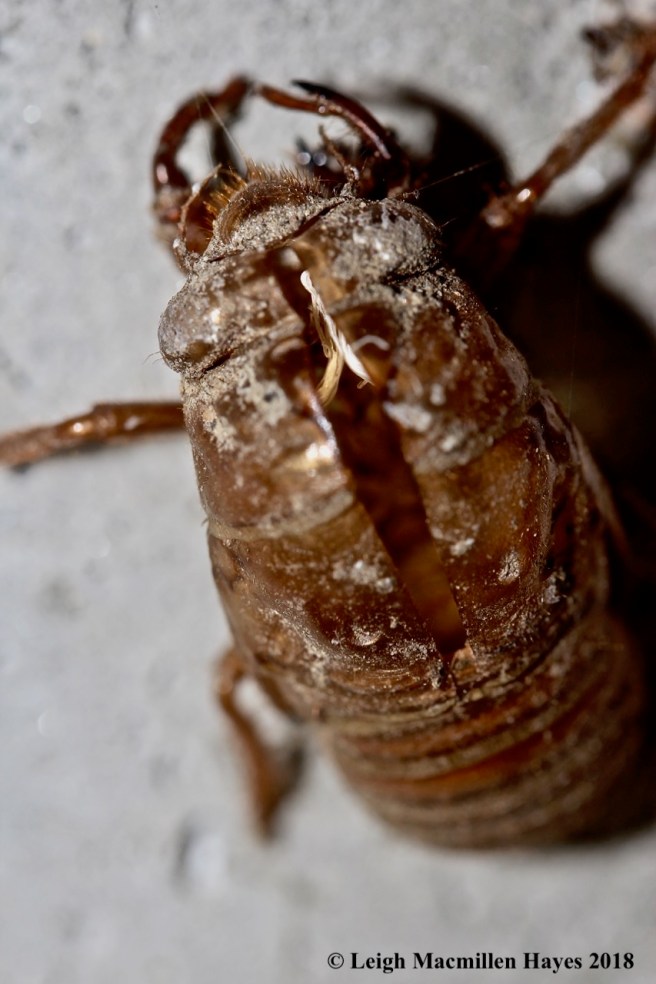
My first find along the foundation was an exuvia of one I listen to day and night–that of a cicada. In their larval stage, cicadas live down to eight feet underground. When the time comes to metamorphose into winged adults, they dig to the surface, climb up something, in this case the foundation, and molt. The  emerging winged insects leave behind their shed skin, aka abandoned exoskeleton or exuvia. It’s a rather alien looking structure, with the split obvious from which the adult emerged.

3-cruiser 1

The cicadas weren’t the only aliens along our foundation. It seemed like every few feet I discovered a dragonfly exuvia dangling from the porch floor and now encased in spider webs.

3b-cruiser

One of the cruiser exuviae had dropped to the ground below. But still the structure remained intact. And I now realize that my next task is to head out the door once again in the morning and collect these beauties, the better to understand their nuances.

4-cruiser hiding

I found cruisers hiding under the logs . . .

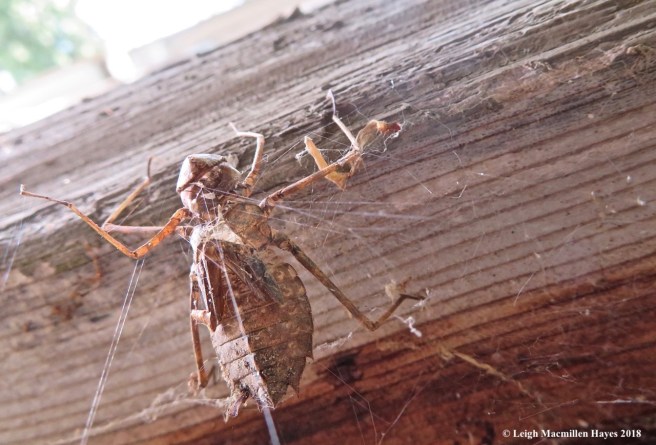
6-cruiser and cast off spider

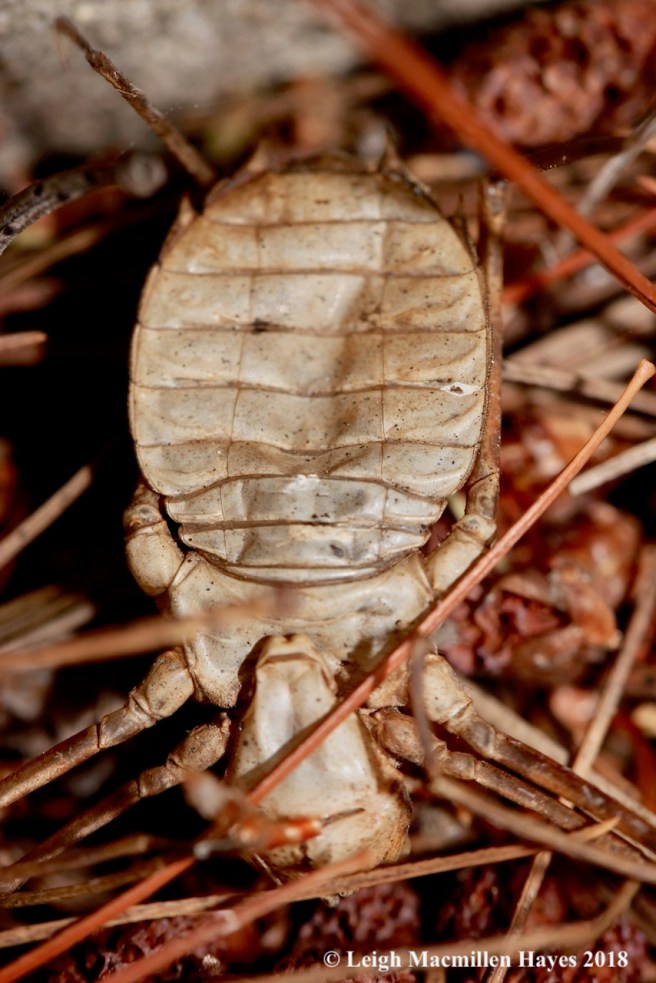
and even one tucked in by a basement window that had a shed spider exoskeleton dangling from it.

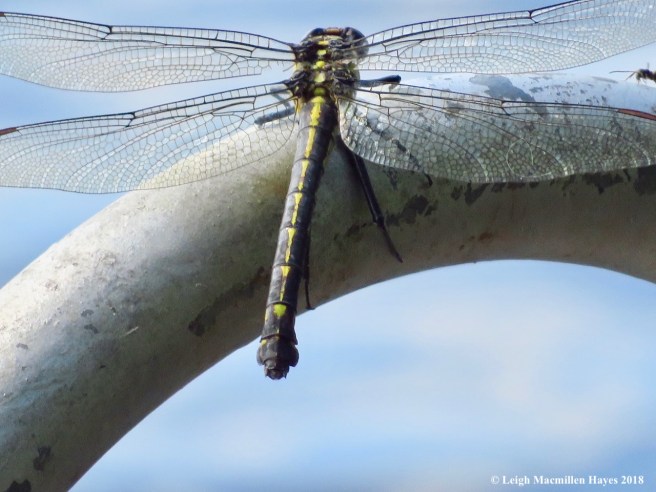
6a-lancet clubtail dragonfly

There were others as well, but nowhere did I find the exuvia of the one with whom I’ve spent the most time, Sir Lance(t) Clubtail. I suspect his shed skin is attached to some aquatic vegetation for he spends so much of his time by the water, even today, pausing only briefly to rest on the dock ladder.

7-bag worms and pupal case of a pine sawfly

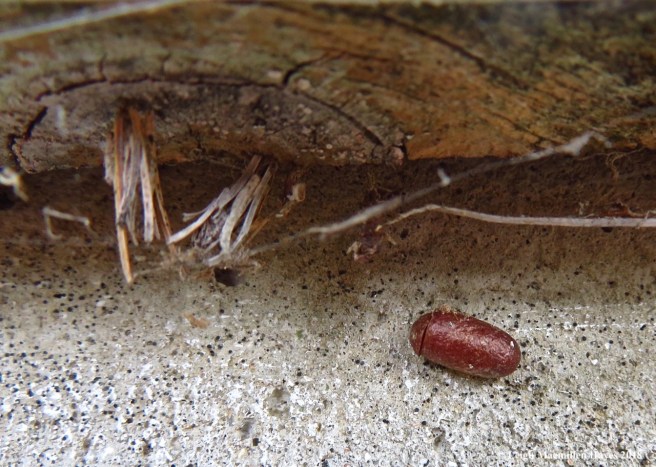
There were other species to meet, including the most interesting of structures, those of the evergreen bagworm cases. I assumed that the young had already emerged, but their homes consisted of material from the trees on which they fed, e.g. pine needles. They struke me as the terrestrial form of the aquatic caddisflies.

And beside the two bagworms was a small, rounded brown case–the pupal case of a pine sawfly. The sawfly had already pupated and in this case no one was home.

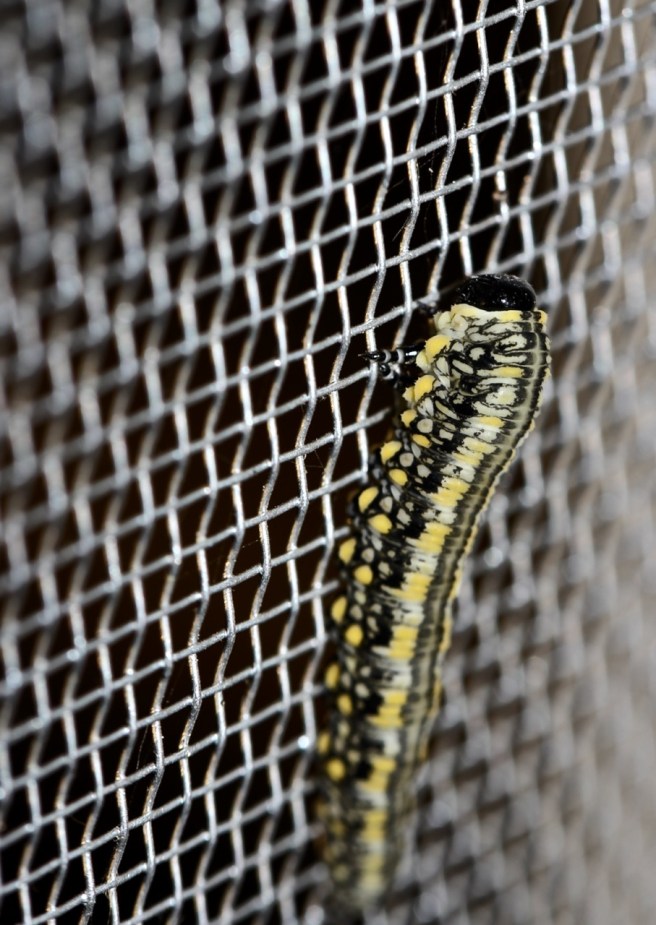
8-pine sawfly caterpillar on screen

Oh, but they were and have been for a few weeks. I first realized we had an infestation when what sounded like the drip-drop pattern of a summer rain on a perfectly sunny day turned out to be little bits of green caterpillar frass falling from the trees. Everything was decorated. And then I began to notice the caterpillars–many falling out of trees and landing on the surrounding vegetation, and the house. As would be expected, they climbed toward the sky, hoping, I suppose, to reach the top of the trees. Good luck with that.

9-pine sawfly caterpillars

Some didn’t make it above the foundation, where they encountered spider webs and soon had the juices sucked out of them. Such is life. And today, a winter flock of birds including chickadees, nuthatches, goldfinches, hairy woodpeckers, young robins, and even a brown creeper flew in and some fine dining took place. The raindrops have nearly ceased.

10-Northern Pine Sphinx

That wasn’t the only pine-eating caterpillar to make its home here. On the chimney, I found a northern pine sphinx caterpillar moving full speed ahead.

11-orbweaver

And around the bend, where the chimney meets the camp, an orbweaver spinning some silk in the hopes of fine dining.

14a-calico pennant dragonfly in web

One meal had obviously been consumed–a calico pennant dragonfly. I’d seen a few of those on the vegetation a few weeks ago, but none recently. Apparently, one flew too close to the building. The only way I could ID it was by its wings for the head, thorax and abdomen had been eaten. But the wings have no nutritional value.

11a-Northern Pine Sphinx 2

A short time later I returned to the chimney in hopes of locating the northern pine sphinx caterpillar again. I did. And he wasn’t. He’d apparently turned the sharp corner on the chimney and met his fate.

13- Northern Sphinx 4

Eye to eye. I’m amazed at the size of the insects that find their way to her web. It’s not like they are attracted to it. Instead, they come upon it quite by surprise and she makes fast work of their mistake.

14-pine tree spur-throated grasshopper

Rounding the corner back toward the porch door, one last insect drew my attention. And again, it was related to the pines, such is the local community: a pine tree spur-throated grasshopper on one of the logs that forms the outer wall of our wee home.

Our home is their home and we’re happy to share the space with them. Provided, of course, that they leave space for us to live as well. So far, all is well.


Insects of Lovell

To say the insects of Lovell are the insects of Maine . . .  are the insects of New England . . .  is too broad a statement as we learned last night when Dr. Michael Stastny, Forest Insect Ecologist at the Atlantic Forestry Centre in Fredericton, Canada, spoke at a Greater Lovell Land Trust talk  Mike helped us gain a better understanding of the relationship between trees, invasive insects and climate change in our grand State of Maine.

And then this morning, he led us down the trail on land conserved through the GLLT as a fee property and one held under conservation easement work.

1-what's that?

From the get-go, our curiosity was raised and we began to note every little motion above, at eye level, and our feet.

2-not an insect

Sometimes, what attracted our attention proved to be not an insect after all for it had two extra legs, but still we wondered. That being said, the stick we used to pick it up so we could take a closer look exhibited evidence of bark beetles who had left their signature in engraved meandering tunnels.

4-leaf miner scat

A bit further along, Mike pulled leaf layers apart to reveal the work of leafminers and our awe kicked up an extra notch. Leafminers feed within a leaf and produce large blotches or meandering tunnels. Though their work is conspicuous, most produce injuries that have little, if any, effect on plant health. Thankfully, for it seems to me that leaves such as beech are quite hairy when they first emerge and I’ve always assumed that was to keep insects at bay, but within days insect damage occurs. And beech and oak, in particular, really take a beating. But still, every year they produce new leaves . . . and insects wreak havoc.

6-leafminer pupa

Leafminers include larvae of moths (Lepidoptera), beetles (Coleoptera), sawflies (Hymenoptera) and flies (Diptera). I’m still trying to understand their life cycles, but today we got to see their scat when Mike pulled back a leaf layer! How cool is that?  Instantly, I recognized a new parlor trick that I can’t wait to share with the GLLT after-school Trailblazers program we offer through Lovell Recreation.

7-grandma and granddaughter

As for today, Mike’s mother-in-law, Linda, tested the wow factor on her granddaughter and we knew we had a winner.

8-hickory tussock moth caterpillar

Our attention was then directed to the tussock moth caterpillars, including the hickory tussock moth that seems to enjoy a variety of leaf flavors.

9-another tussock

And we found another tussock entering its pupating stage. We didn’t dare touch any of them for the hair of the tussocks can cause skin irritation and none of us wanted to deal with that.

11-leaf roller

Our next find was a leaf roller, and for me the wonder is all about the stitches it creates to glue its rolled home closed.

12-meadow goldenrods

Eventually we reached a wildflower meadow where our nature distraction disorder shifted a bit from insects to flowers, including local goldenrods.

12a-up close

There was much to look at and contemplate and everyone took advantage of the opportunity to observe on his/her own and then consult with others.

13-silvery checkerspot butterfly

One insect we all noted was the Silvery Checkerspot Butterfly. It’s a wee one and in the moment I couldn’t remember its name.

14-checkerspots mating

But . . . it remembered how to canoodle and we reveled in the opportunity to see such.

15-bees on Joe Pye Weed

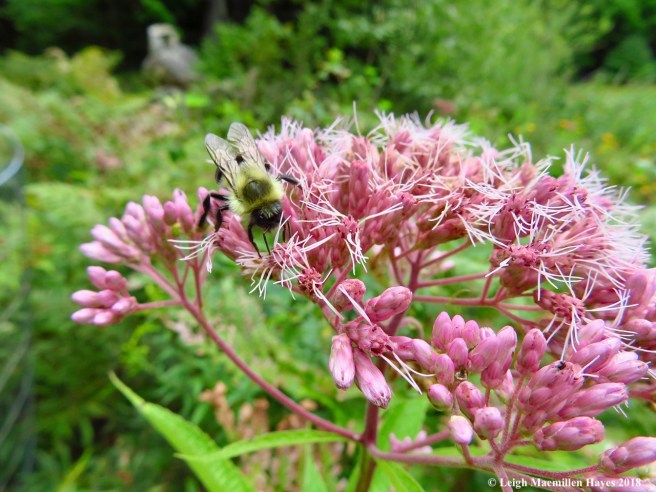
Our final insect notification was a bumblebee on the Joe-Pye-Weed. A year ago we had the opportunity to watch the bumblebees and honey bees in this very meadow, but today there were no honeybees because a local beekeeper’s hives collapsed last winter.

15a-Beside Kezar River

Our public walk ended but the day continued and I move along to the Kezar River Reserve to enjoy lunch before an afternoon devoted to trail work.

15b-darner exuvia

Below the bench that sits just above the river, I love to check in on the local exuvia–in this case a darner that probably continues to dart back and forth along the shoreline, ever in search of a delectable meal.

16-Autumn Meadowhawk Dragonfly

Landing frequently for me to notice was an Autumn Meadowhawk Dragonfly, its body all ruby colored and legs reddish rather than black.

17-milk snake

My goal was to slip down to the river level like the local otters might and as I moved along I startled a small snake–a milk snake. Not an insect . . . but still!

19-Mrs. Slaty Skimmer

Because I was there, so was the female Slaty Slimmer Dragonfly, and she honored me by pausing for reflection.

18-slaty skimmer dragonflies

Apparently I wasn’t the only one to notice her subtle beauty, for love was in the air and on the wing.

20-female ruby meadowhawk dragonfly

Lovell hosts many, many insects, but I certainly have a few favorites that change with the season and the location. Today, Ruby Meadowhawks were a major part of the display.

21-female ruby meadowhawk dragonfly

Note the yellowish-brown face; yellowish body for a female; and black triangles on the abdomen, and black legs.

Our findings today were hardly inclusive, but our joy in noticing and learning far outweighed what the offerings gathered.

Ruby, Slaty, Miner, Tussock, Checkerspot, so many varieties, so many Insects of Lovell, and we only touched on the possibilities. Thank you, Mike, for opening our bug eyes!


The Day The World Passed By

I love those days when I have a few moments and can pay attention to the world around me. It never ceases to fill me with awe and wonder. And today was such as I had a free hour that I chose to spend on the dock.

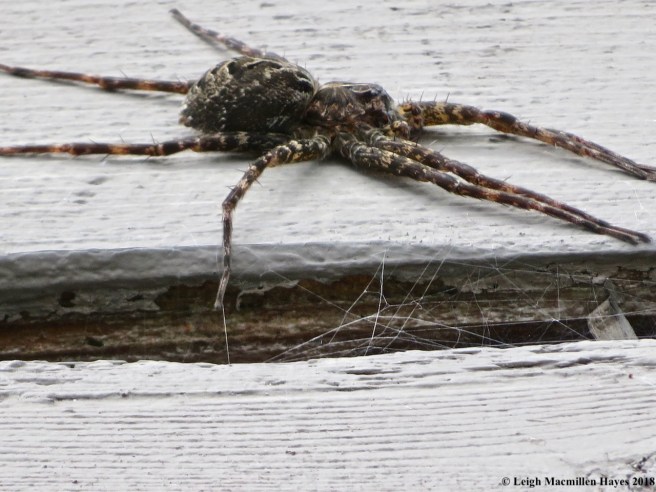
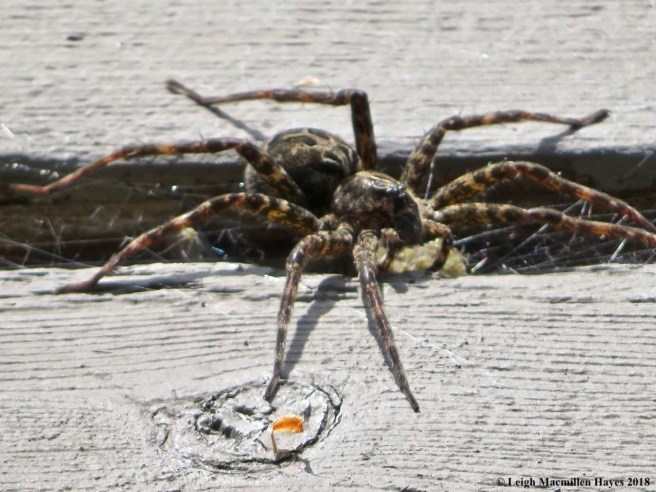
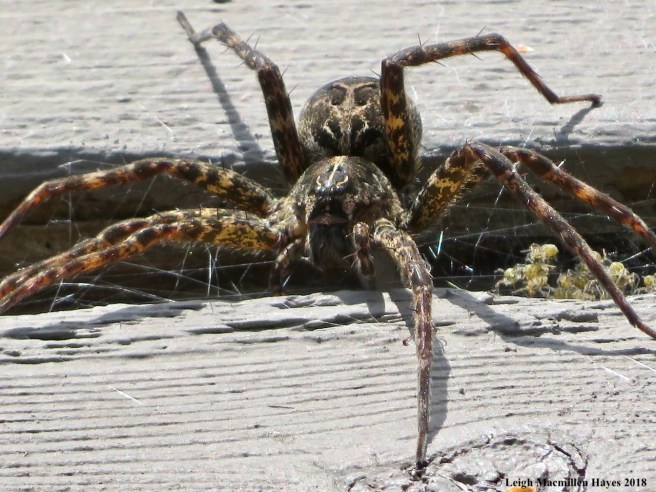
1-fishing spikder

I shouldn’t have been surprised to see a fishing spider the size of my palm resting there, but I was for it was my first sighting of one this year. True confession, indoors I’m not a huge spider fan and as a kid I used to holler for someone to come kill any arachnid I spied. But . . . with age comes appreciation. And perhaps understanding.

2-fishing spider bristles

And so I appreciated this spider’s pattern and understood the need for its hairy body that gave it such a scary look. Fishing spiders hunt by sensing vibrations. The hair is hydrophobic, meaning it repels water. It also allows the spider to actually walk on water to get its prey. Those bristly hairs also trap air bubbles that the spider uses to breathe when it waits underwater to ambush a meal, be it insects, tadpoles, or other invertebrates.

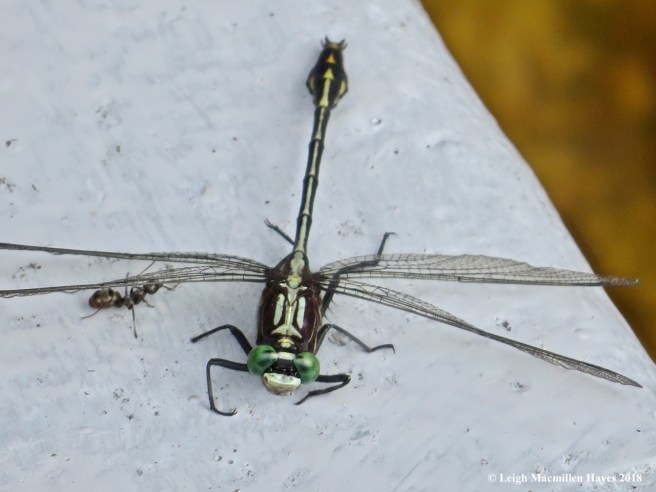
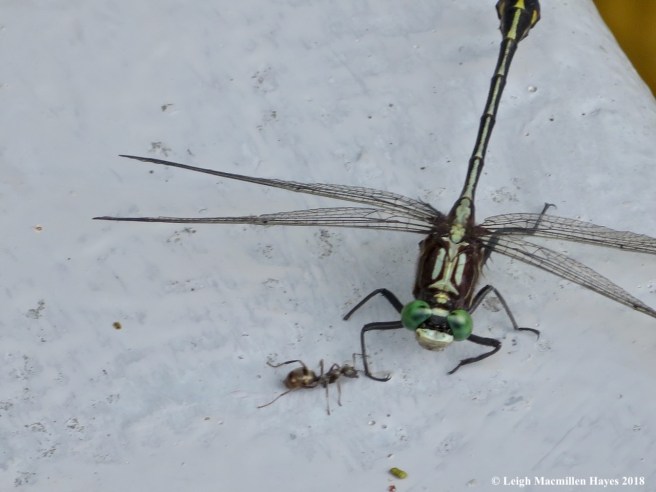
3-lancet clubtail and ant

When I heard wing beats behind me, I turned my focus away from Charlotte and toward a Lancet Clubtail dragonfly that had landed on a seat of My Guy’s boat. An ant marched right over to check it out.

4-ant tickling dragonfly

And I fully expected the Lance to eat the ant. But . . . he didn’t. Drats.  I like watching them consume their prey.

5-lancet minus one tarsus

The more I looked at this guy, and it was a guy based on its cercus, the more I noticed, including the fact that it was missing the tarsi or claw-like foot of one leg.

6-dragonfly_anatomy

It was his face though, that I really wanted to study. I found this simplified picture at arizonadragonfly.org, and though it’s not complete, it provided enough information for my purposes.

7-facial features of a dragonfly

There’s so much to learn, that to add more detail would be more than overwhelming. Look at the mouth parts. And those eyes–each is composed of 30,000 lenses. Apparently, they can see ultraviolet and polarized light. And then there’s the ocelli, or visual organs, that probably work along with the antennae. Prey don’t have a chance.

8-fishing spider

When the Lance flew away, I checked on Charlotte again. Still she sat, one leg dangling below the dock board and touching a web. I figured she was waiting for movement to announce that a meal had arrived.

9-Ted had arrived

And then I noticed that it wasn’t a meal, but perhaps a mate she’d been expecting.

11-spider movement

Suddenly, he darted under the dock and she started across the gap–toward me!

12-Charlotte the spider

Then she stopped, seemed to make an adjustment,  and quickly disappeared.

13-spider nursery

I moved in for a closer look and made a discovery.

14-spider nursery

Her nursery! Fishing spiders are nursery web spiders. She must have wrapped her eggs in a silken sac and carried it to the gap between the outer two boards of the dock, where she constructed the web. And she was standing guard waiting for her spiderlings to emerge–until I came along. Now the question remains, will I be around when they do hatch and disperse on their own silken threads?

15-bubble on water

I don’t know. But today, I was there to notice so much in such a short time–as the world passed by.


Self-Guided Tour of Sabattus Mountain

As stories go, Sabattus Mountain in Lovell offers plenty of lore. For starters, there’s the name of the mountain. I’ve heard at least two tales and seen three spellings, but basically the legend is the same–about a Pequawket named Sabatos, Sabatis, or Sabattus, who guided hunters and one day killed a lynx, or was it a mountain lion, before it sprang upon him.

In a July 14, 2017 article, Ed Parsons of the Conway Daily Sun wrote: “Sabattus was born in St. Francis, Canada, and with the influence of French missionaries, was named for St. John the Baptist, shortened to Sabattus. When Roger’s Rangers destroyed St. Francis in 1759, Sabattus was about 10 years old. He was kidnapped and went south with the rangers. Later, he went to Fryeburg with one of them, and spent the rest of his life in the area.

Sabattus had two children with the well-known area healer, Molly Ockett. In 1783, an earlier wife of his returned from a long trip to Canada, and claimed to be his spouse. To settle the dispute, Sabattus took them to the house of Mr. Wiley in Fryeburg so there would be a witness, and the two women fought, “hair and cloth flying everywhere.” Mrs. St. Francis, as Molly Ockett called the former wife, was stronger and won out. Molly Ockett left and moved to Andover, Maine.

There’s also the Devil’s Staircase, but that’s for another day.

s1-sign

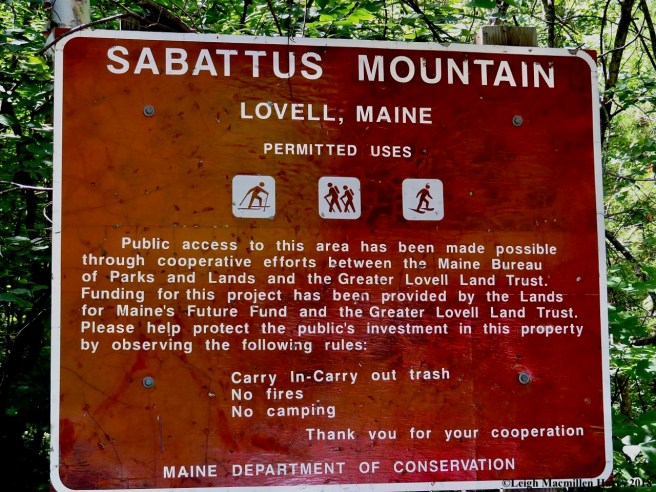
Two Land for Maine’s Future program grants, along with funding from the Greater Lovell Land Trust, enabled the State of Maine to purchase 177 acres on and around Sabattus Mountain, protecting hiking access to Lovell’s highest peak. The trail is a 1.6-mile loop to and from the 1,253-foot summit. Sabattus Mountain is now owned and managed by the Bureau of Parks and Lands. The land trust, however, has taken a keen interest in upkeep of the trail system recently because there had been much erosion ever since Hurricane Irene and the State seemed to back off maintaining it. Last year, the GLLT’s three interns built numerous water bars, especially on the eastern trail.

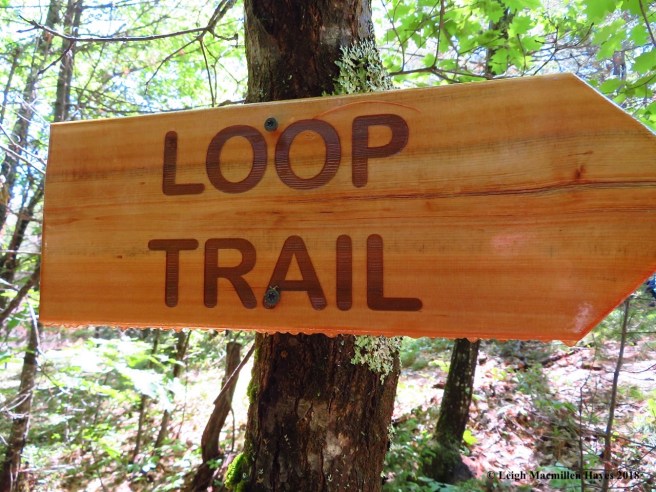
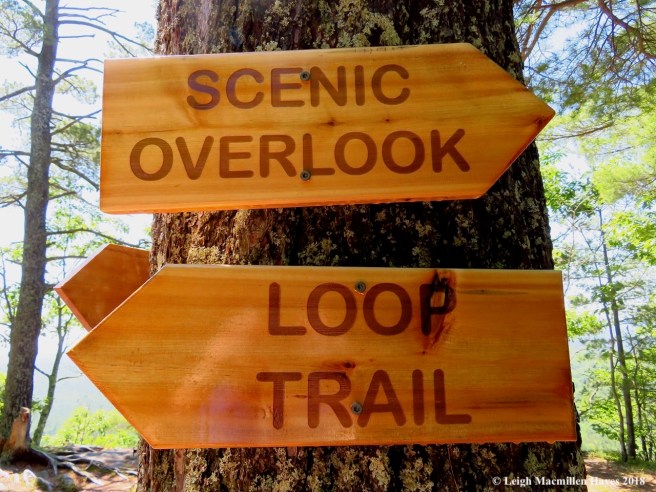
s6-Brent's Loop Trail Sign

Last week, Brent Legere of Lovell Box Company and Western Maine Slabworks, installed new signs to guide hikers on the trail system.

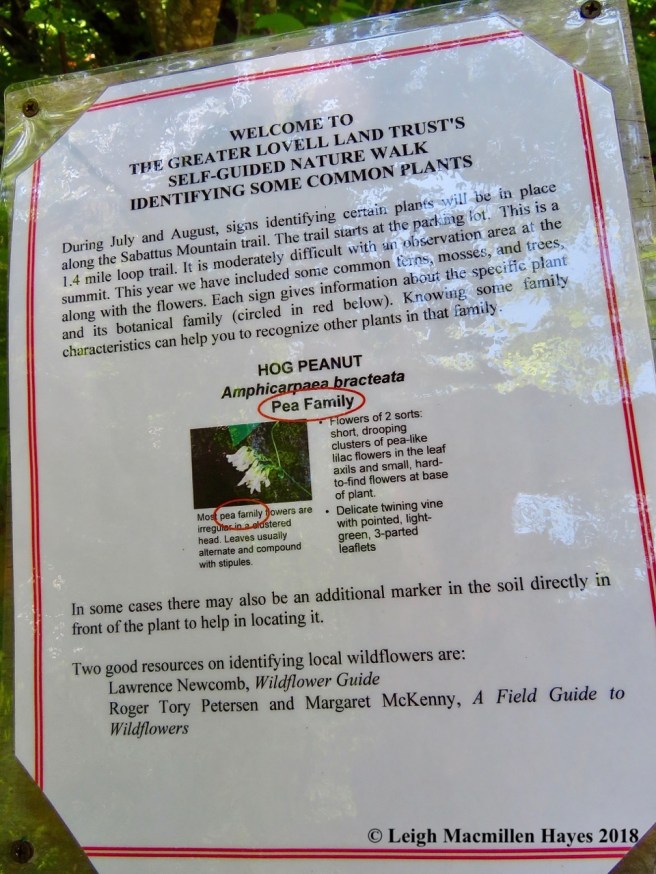
s2-self-guided nature walk

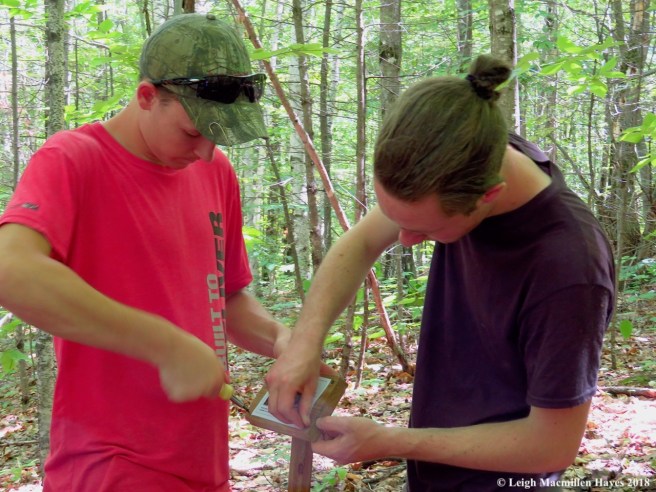
Today, a team of docents, associates and this year’s intern, under the well-organized leadership of GLLT Docent and Maine Master Naturalist Joan Lundin, installed informational signage along the loop.

s3-explaining the plan

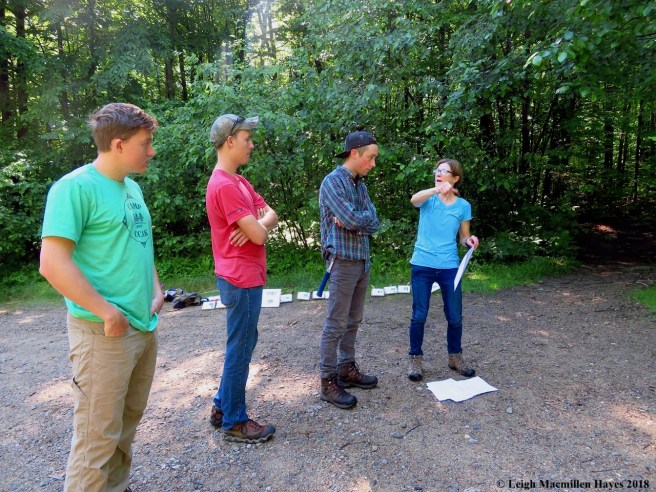
The morning began as Joan divided the team into two groups. First she instructed Intern Isaiah (in red) and Stewardship Associate Dakota (in plaid), to take one set of signs up the western trail and leave them beside examples of particular species on the way.

s5-all smiles to go

Then she prepped Associate Director Aidan, and GLLT Docents Nancy and Pam in the plan for the eastern trail.

s4-signs

All signs were laid out and ready to be hauled up the trails for installation.

s12-hi ho

And so, in true Seven Dwarf style, it was hi ho, hi ho and off to work we went.

s7-installing the first sign

Because she’d climbed the trail so often in order to prepare for today’s undertaking, Joan knew right where each sign belonged. At the start, she did most of the installing, showing off her muscle power on this steamy day, despite her petite physique.

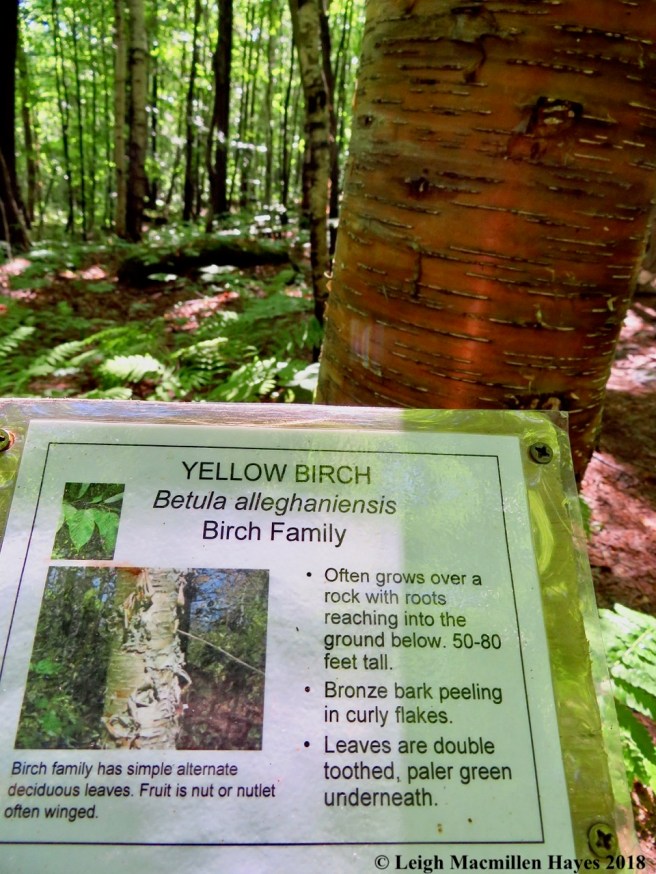
s8-yellow birch

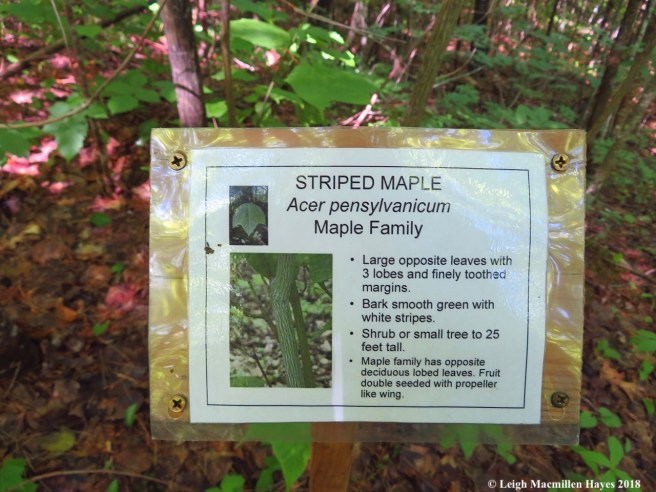
Each sign included common and scientific names, plus only a few key characteristics so not to overwhelm those who might stop to read them and look around to locate the particular species. It’s a technique decided long ago by the full team of docents who have undertaken this task each summer for years–always along a different GLLT trail.

s9-striped maple

The natural community along both trails on the loop system transitioned about two-thirds of the way up. For the lower portion, the community consisted of a variety of deciduous trees.

s13-hemlock

Suddenly everything changed. Light turned to shade. Dry turned to damp. Leaves turned to needles. And conifers showed off their unique characteristics.

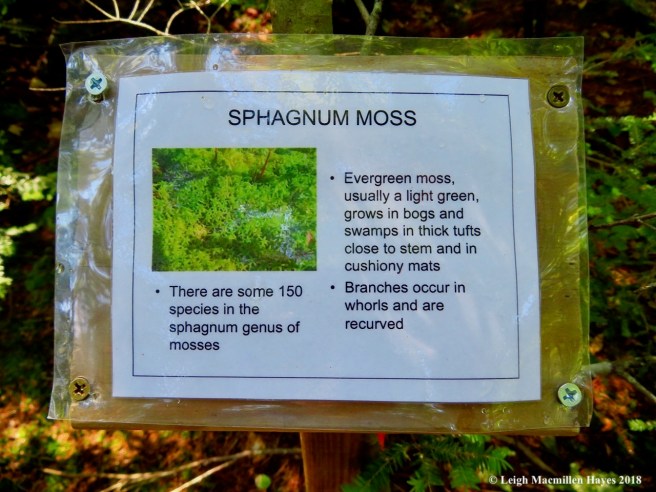
s14-sphagnum moss

Even the forest floor changed from dried leaves and wildflowers to green mosses, including sphagnum, with its pom-pom shaped heads.

s15-loop trail sign at ridge

As we hiked up the eastern trail, Dakota and Isaiah swung along the ridge line and came down to find us for they had only placed their signs along the western trail as instructed by Joan, and hadn’t yet pounded them into the earth. We chatted as we moved upward, talking about the turn ahead to the ridge, and Dakota told us we’d be pleased with how obvious it was since Brent had installed the new signs. Indeed!

s16-glacial erratic

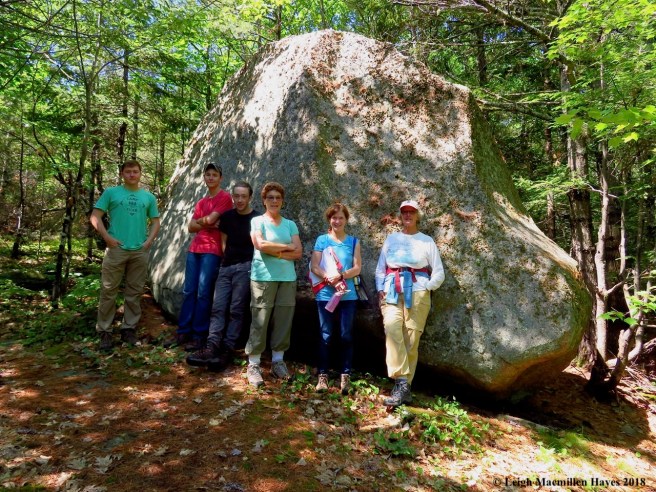
Of course, we were a group that failed at following directions, and so off trail we went to check on the glacial erratic that we knew stood just beyond a downed tree.

s17-porcupine scat

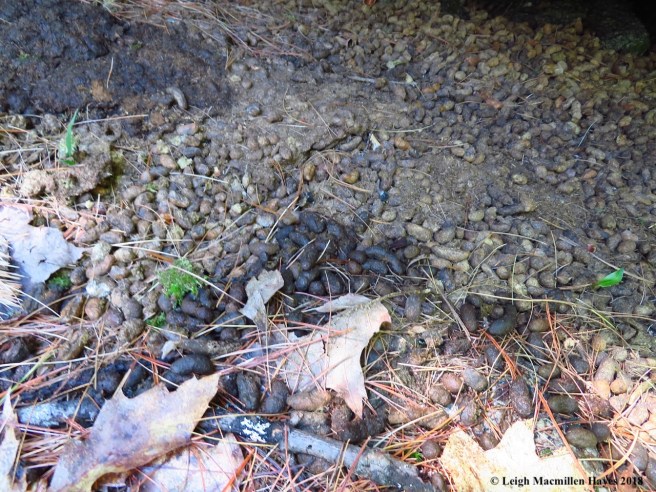
We also checked underneath, for who doesn’t like to look at porcupine scat. New and old, though not especially fresh, it’s been a winter den for at least 30+ years that I’ve been climbing this mountain.

s18-Canada mayflower

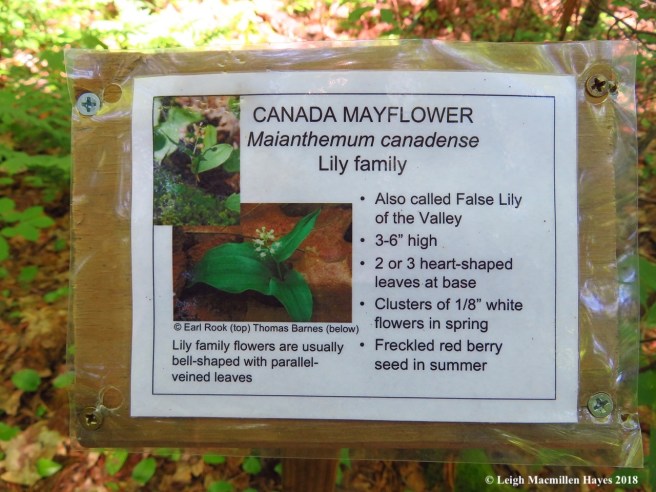
And then Joan redirected us, pulling us back into the mission of the morning and finding a place to post the Canada Mayflower sign–between the granite slabs at our feet.

s19-window on the world beyond

Making our way across the ridge, we paused for a second to look out the window upon the world beyond. It’s from heights like this one that we always appreciate how much of Maine is still forested. At a recent gathering with District Forester Shane Duigan, he said that the state is 85% forested–down from 90% not because of urban sprawl, but instead increased farming.

s20-main summit signs

A few minutes later we reached the main summit, where Brent had posted more signs. They’re nailed to a White Pine and mark the intersection of the ridge trail and western loop, with a spur to the western-facing ledges and scenic overlook.

s21-white pine

That very White Pine was also on Joan’s list as an excellent example, and so it will be noticed for a while.

s22-Keyes Pond and Pleasant Mtn

For a few minutes, we took in the wider view to the south–noting Keyes Pond in Sweden and Pleasant Mountain in Bridgton, both part of the great beyond.

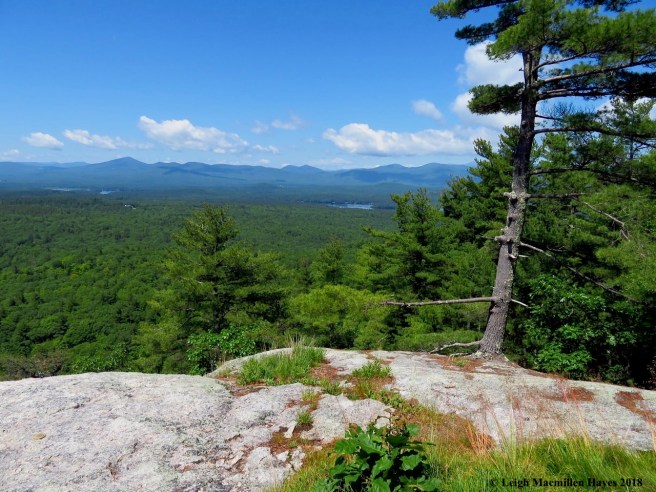
s23-scenic view

And then a quick trip out to the scenic overlook, where the sweeping view included the Lower Bay of Kezar Lake and pyramid outline of Mount Kearsarge in North Conway.

s24-scenic view 2

Turning a wee bit to the north, the view also encompassed more of Kezar Lake, and the White Mountains.

s25-chipmunk

On the way down, we continued, or rather, the rest of the team continued to install the signs while I watched, and one quiet chipmunk with a piece of a leaf dangling from its mouth looked on with approval. We assumed it approved, for it didn’t chatter at us.

s26-teamwork

It seemed the signs on the western trail went into place far more quickly than on the climb up, but maybe it was because there weren’t as many. We did pause for a few minutes as Isaiah and Dakota changed out one sign for another because the species Joan wanted to feature wasn’t as prominent as hoped. But, she was prepared with extra laminated cards and quickly produced a description of an alternate species.

s27-plank

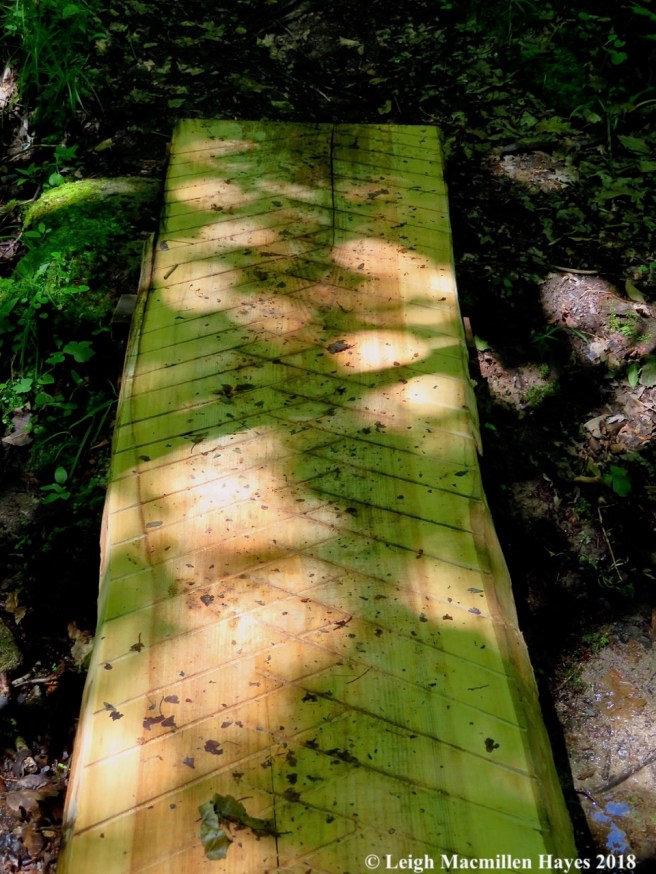
We were nearly finished with our morning’s work when we reached the new plank bridge Brent had placed across a small stream.

s28-white admiral

Back at the parking lot, we were wowed by the sight of pollinators upon the Staghorn Sumac, including a White Admiral Butterfly.

With that, our tour was done for the day, but we’d met several people along the way who were thrilled with the work we’d done. We hope you, too, will partake of the pleasant hike up Sabattus Mountain, and stop along the way to enjoy the self-guided tour. It will be in place until Labor Day weekend.

And be sure to stop by the office on Route 5 and make a contribution to the Greater Lovell Land Trust for we are a membership-driven organization and can’t do such work without your continued support.

P.S. Thank you Self-guided Tour Docents and GLLT staff, plus Property Steward Brent.


The Ayes Have It

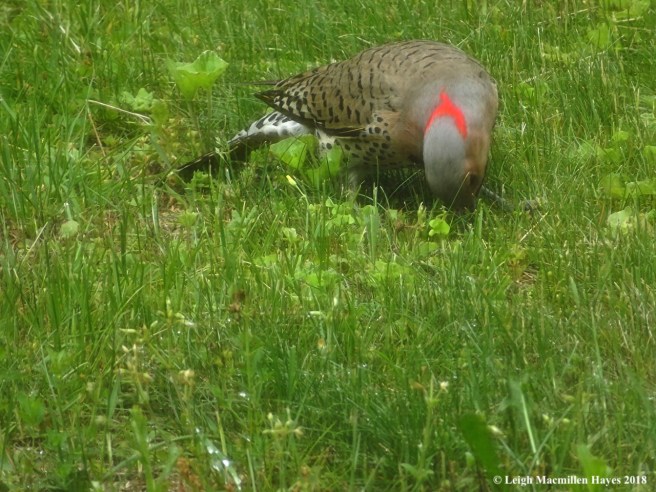
I knew I was blessed when I spied a Northern Flicker in the backyard early this morning. This is the one woodpecker that doesn’t behave like a typical family member for it forages on the ground rather than a tree trunk.

e1-northern flicker

From the kitchen window, I watched this guy for a while as he looked for food. I knew it was a male because of the so called black mustache on either side of its bill. But . . . it was the bird’s eyes I was most curious about . . .and their placement on the side of its head.

e2-flicker feeding

Like mammals, birds with eyes on the side are born to hide . . . from predators. His field of vision, therefore, was wide and the ants on the ground were the ones who needed to scurry and hide.

e4-tachinid fly

After dining for a while, the flicker flew off and I stepped out the door–in search of other  sets of eyes to behold–like the red ones of a tachinid fly,

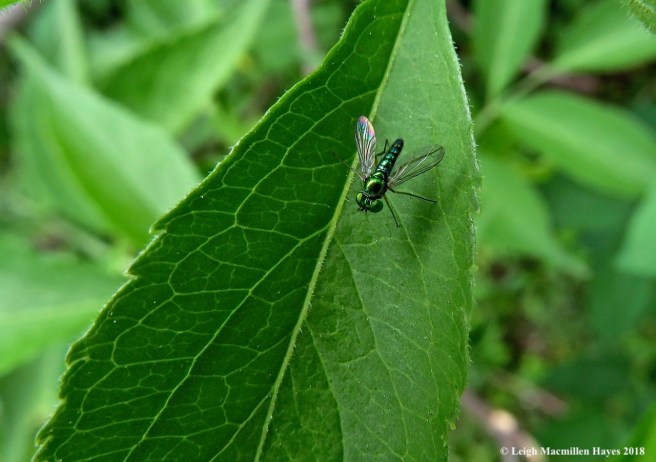
e8-long-legged fly

and metallic green on a long-legged fly. Like the flicker, flies also have a wide field of vision due to the fact that they have compound eyes. Each eye consists of thousands of individual visual receptors, or ommatidia, (singular ommatidium) (om·ma·tid·i·um, äməˈtidēəm.) Each hexagonal-shaped ommatidium (think honeycomb) is a functioning eye in itself. With thousands of eyes on the world, it’s no wonder flies and other insects see us coming–especially when we have a flyswatter in hand.

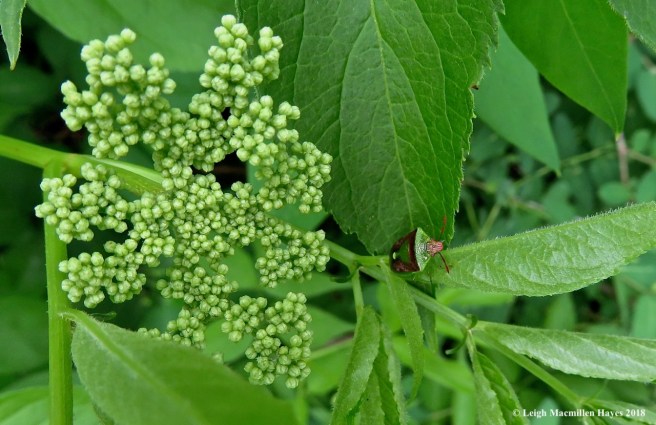
e7-green and brown stink bug

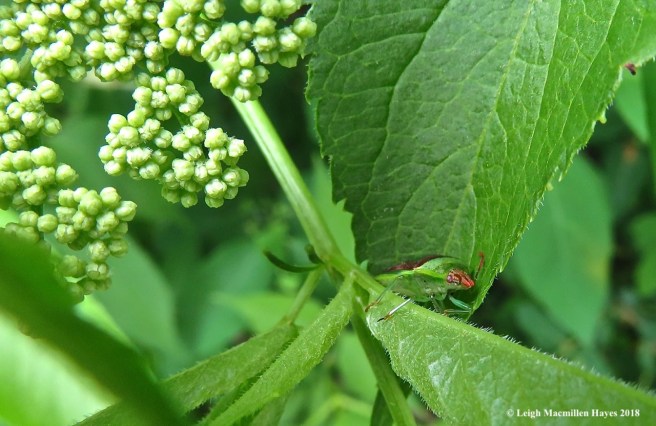
I kept looking and among the elderberry shrub leaves I found a strikingly beautiful green and brown stink bug, or shield bug, if you’re looking for a more pleasant name. Like all insects, it featured those compound eyes, but I was struck by how tiny they were. Apparently, it was enough to see movement and kept trying to hide from me.

e8-stink bug eyes

Despite its efforts, I could zero in on it even after walking away and returning.

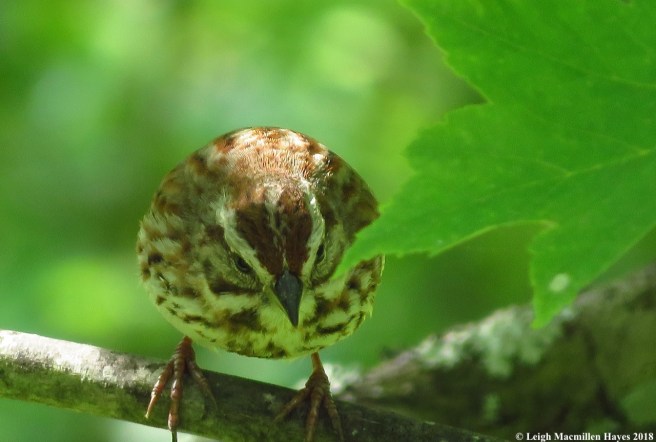
e9a-song sparrow

Eventually I moved my focus to Pondicherry Park, where a variety of eyes greeted me, including those of a Song Sparrow.

e7a

What did he seek? Insects and other invertebrates, such as weevils, leaf beetles, ground beetles, caterpillars, dragonflies, grasshoppers, midges, craneflies, spiders, snails, and earthworms.

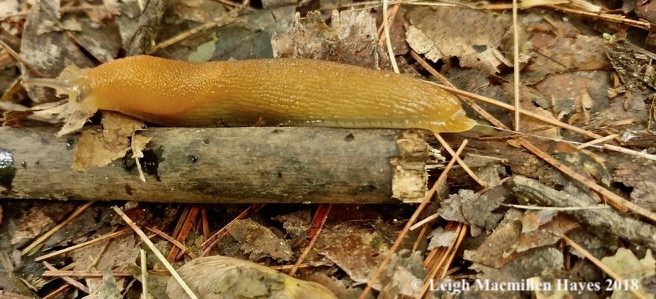
e11-slug eyes

What about a slug? I suspected the sparrow would enjoy such and today was a decent slug-like kind of day. But, how does a slug see?

A slug has two pairs of retractable tentacles on its head. The upper, optic tentacles, feature light-sensitive eyespots on the ends. And just like a deer can move each ear independent of the other, slugs can do the same with each eye-stalk. Another cool fact: an eye stalk can be re-grown if something attacks it.

e11a-spider eyes

Further along, I found a wolf spider hanging out on last year’s fertile frond of a sensitive fern. Did you know that spiders have eight legs AND eight eyes? Two of them are large and prominent–the better to see you with.

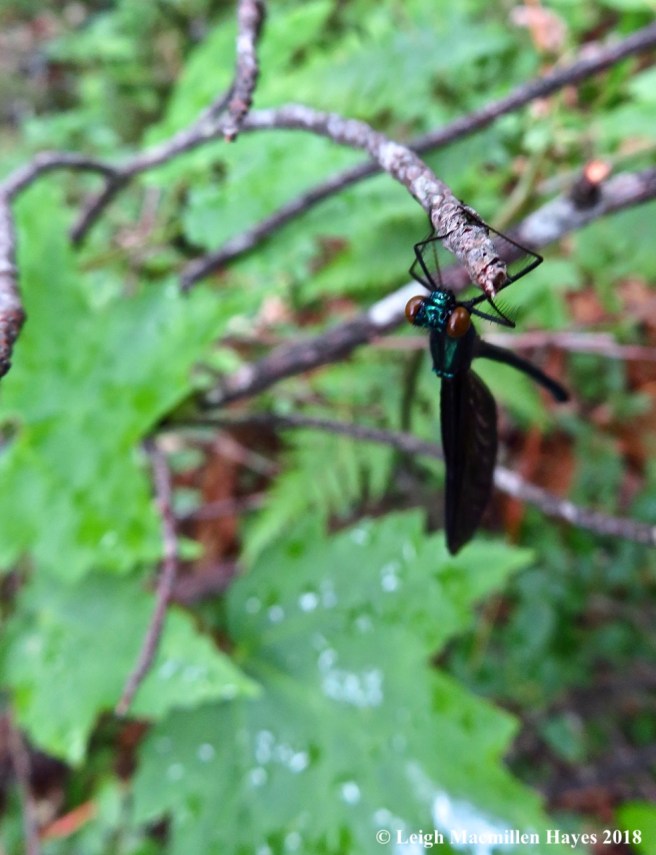
e11-ebony jewelwing

As I continued to look for the sparrow’s prey, I discovered an ebony jewelwing that I determined had just emerged for it posed as I took numerous photographs. Usually, they flit about like woodland fairies. Unlike its larger dragonfly cousins who have eyes in front in order to hunt, the damsels’ are on the sides. Though zoom-and-swoop attacks may not be possible for the damselfly, it can see all-round–including above and behind– giving it control of its airspace.

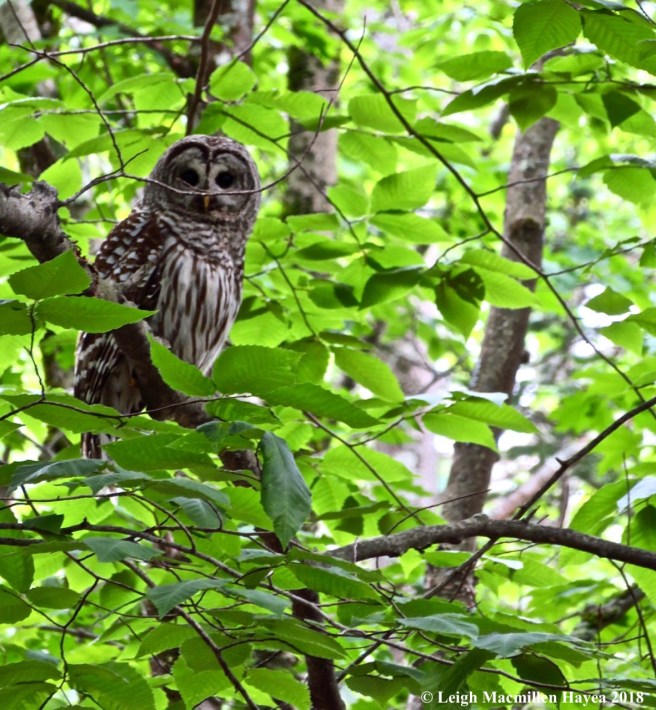
e12-barred owl

My wander continued and then I heard a sound and saw some action in a tree about thirty feet off trail. And just like that, in what felt like a miracle of miracles, I realized I was in the presence of the wise one.

With his eyes in front, a Barred Owl is born to hunt. For several minutes we starred at each other and I was honored by his presence. Of course, I hoped he might cook for me tonight, but he let me down. Possibly he had others more in need of supper than I was at the time.

In the end my vote was aye in favor of all the peepers I’d met along the way, both in the yard and the forested park, for I knew that the eyes had it.


Flexing My Wings with Jinny Mae

It’s been a while since Jinny Mae and I had wandered and wondered together, but this afternoon the opportunity finally arose. And so we agreed on a time and place (though she did change the time ;-) ), and pulled into the parking lot of the Mountain Division Trail located closest to the Eastern Slopes Airport on Route 5 in Fryeburg, Maine.

m6-Mtn Division Trail

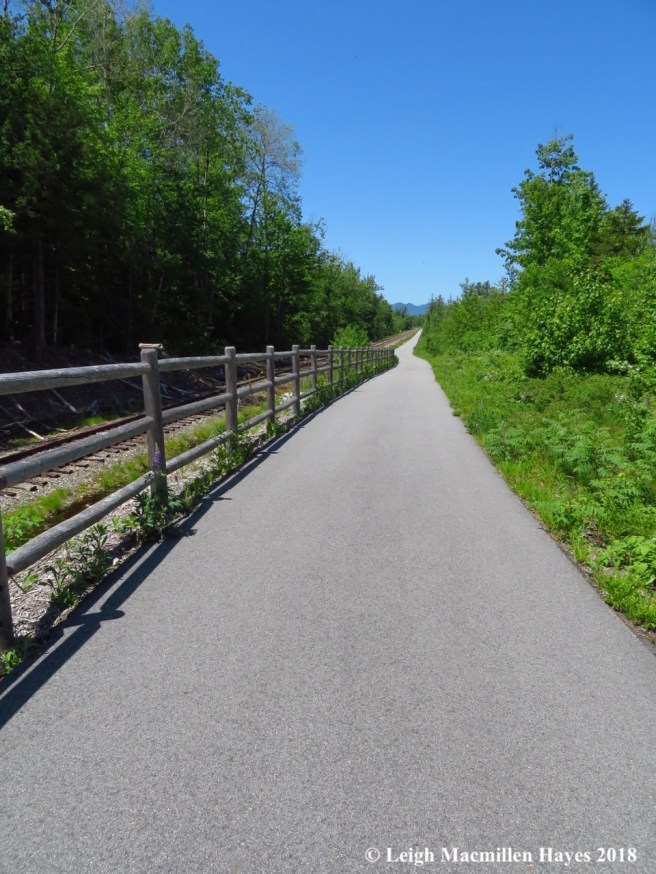
Rather than a rail trail, this is actually a rail-with-trail even though the rail is not currently active.

m2-lupine

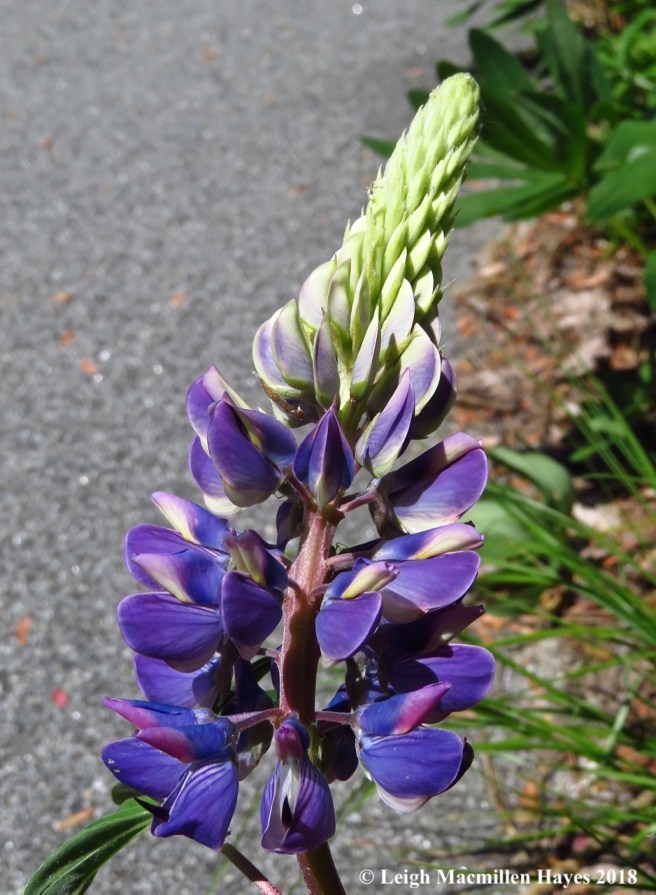
From the start, we were surprised and delighted to see so many lupines in bloom along the edge. Lupines are members of the pea or legume family, Fabaceae. As such, the flowers have a distinctive upper banner, two lateral wings, and two lower petals fused together to form a keel. Those lateral wings earned the plant’s place in this contemplation.

m2a-lupine aphids

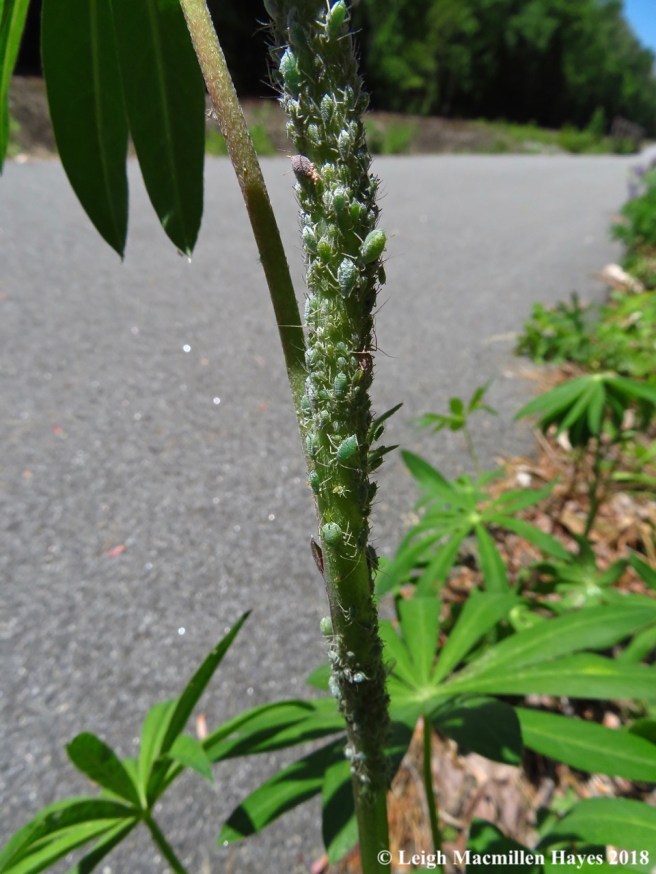
Of course, being that not everything in nature is as perfect as we might desire, we did discover destruction in action on a few stems and flowers. Lupine aphids seeking honeydew suck the juices from a plant. They’ll continue to feed until midsummer, even after they’ve destroyed the flower.

While there isn’t much to celebrate about these garden pests, it is worth noting that all aphids are female and give birth to live young, without mating. And another cool fact–once the population grows too large, they will develop wings and fly to a new host plant.

m3-chalk-fronted white corporal

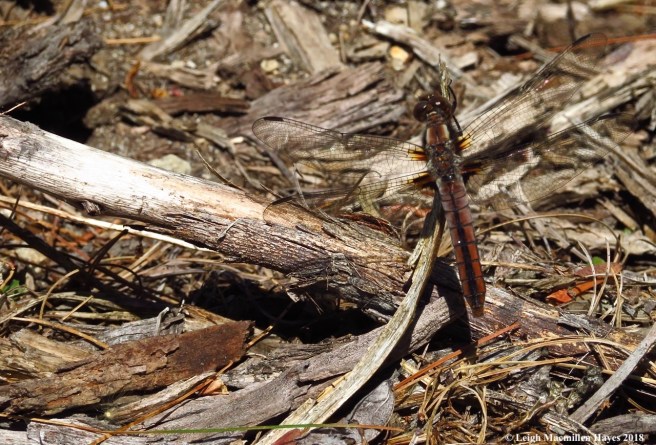
We continued our journey at our typical slow pace and stopped frequently to admire the dragonflies. There were quite a few species, but many spent time patrolling in flight and so we couldn’t photograph them. We did, however, give thanks for the work of all for we felt the sting of only a few mosquitoes. And we appreciated the perchers as well, for by letting us get a closer look we could learn their characteristics, and therefore ID: Chalk-fronted Corporal;

4-four-spotted skimmer

Four-spotted Skimmer;

m5-calico pennant

and Calico Pennant.

m7-ant dragging grasshopper

We also noted a crazy ant act. The ant apparently got a great deal at the grocery store and somehow managed to single-anticly drag the remains of a grasshopper home–that’s one flier we won’t see in the air again.

m8-wood sower gall wasp gall

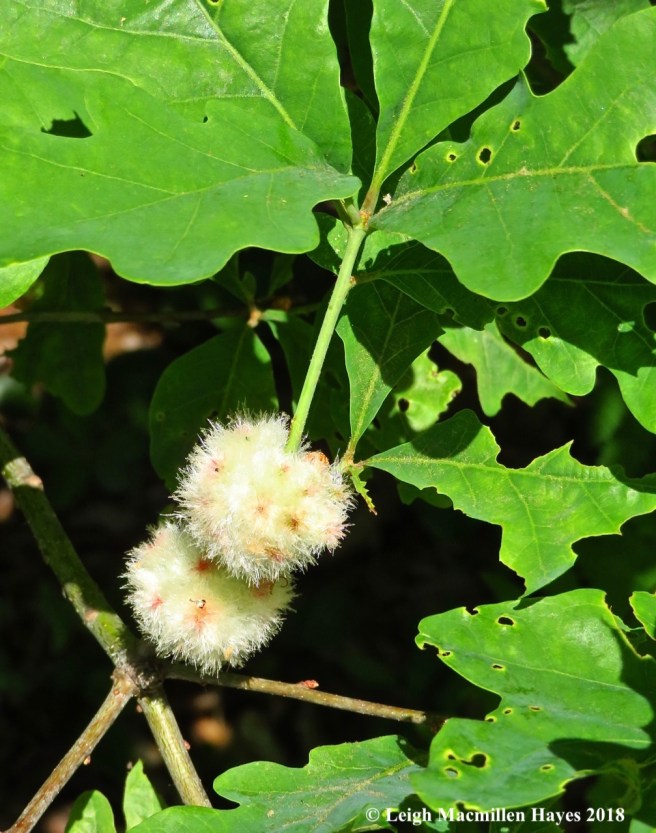
We also stumbled upon another interesting find–the galls of a wood sower gall wasp. As I told Jinny Mae, I’ve seen them before and knew they were associated with oak trees, but couldn’t remember the name in the moment. Maybe if I say it five times fast and spin around three times I’ll remember its name the next time I encounter it. Doubtful.

m8-wood sower gall wasp

The cool facts about this fuzzy white gall with pink polka dots, which is also known as oak seed galls: it only grows on white oak; the fuzziness is actually secretions from grubs of the gall wasp; and within are seed-like structures that cover the wasp larva.

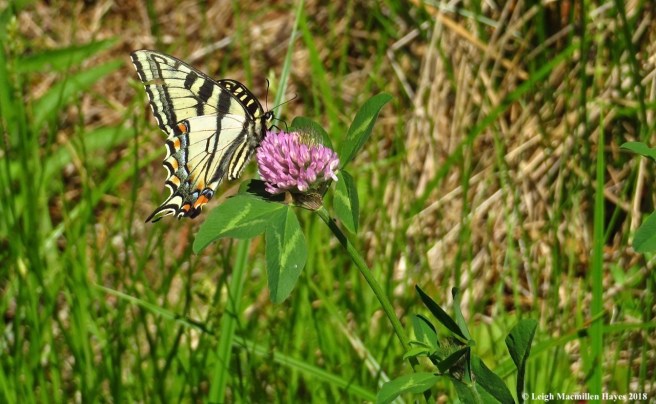
m9-tiger swallowtail

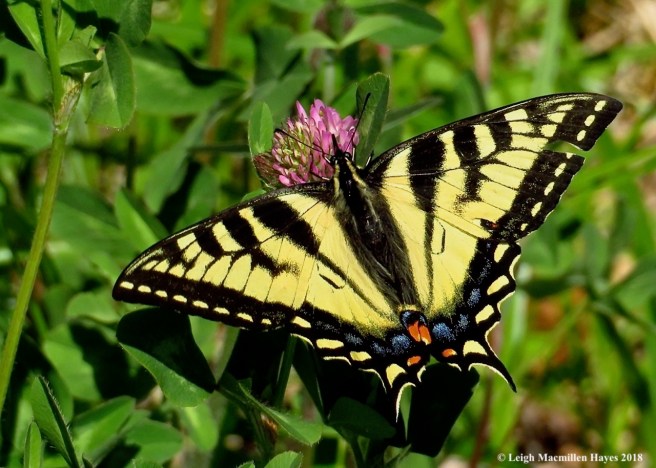
Finally, it was a swallowtail butterfly that stopped us in our tracks and mesmerized us for moments on end. The question was this: which swallowtail–Eastern or Canadian, for both fly here.

m11-eastern tiger swallowtail

Earlier in the day I’d photographed an Eastern Tiger Swallowtail in the backyard. Tiger comes from the four black stripes, while swallowtail refers to the long tails extending from the hind wings that these butterflies often lose to their prey as spring gives way to summer.

This was a female given that her hind wings featured blue with bright orange accents when viewed from the top. The areas that are blue on the female are black on the male.

And notice her main body, which is a rather muted combo of black and yellow.

m10-canadian tiger swallowtail

Now look at the butterfly Jinny Mae and I each took at least fifty photographs of and do you see the darker body? The Canadians have more black hairs covering their bodies.

m11-probiscus

Also look at the underwings. I regret that I didn’t get a shot of the Eastern’s underwings, but for the Canadian this matches the pattern: Note the yellow band just inside the outer edge on the underside of its forewings. Had it been an Eastern, it would have featured a series of disconnected yellow spots on the black band. The Canadian has a continuous yellow band. And then there are the orange and blue markings.

m13-canadian tiger

At the end of the day all that detail really didn’t matter–Eastern or Canadian, both were tiger swallowtails.

And I gave thanks for the opportunity to flex my wings beside Jinny Mae. It felt so good to fly along the path together again. For those who don’t know, Jinny Mae’s journey has been one of varied wing beats as she’s lived with cancer for the last three years. Her current treatment is going well and we look forward to more flight paths.


Petals and Wings: A Window of Opportunity

Spring ephemerals. Those species that take advantage of the short stretch of time between snow melt and leaf out. We celebrated such today at the Greater Lovell Land Trust’s Heald and Bradley Ponds Reserve as we ever so slowly walked along the orange trail from the Flat Hill parking lot and then looped around on Perky’s Path.

S1-GATHERING

But first, we gathered in the parking lot where Docent Peter explained that he thought I was crazy when I suggested a May date for a flower and bird walk. He’d not been in Maine during May previously and only this week learned the joys of birding with minimal leaf cover. I think he’s hooked. And I’m still crazy.

S4-WILDFLOWER GUIDES

Our journey began with Docent Linda locating wildflowers that are opportunists who bloom early, get pollinated and produce seeds before the deciduous trees blanket the floor of the forest in shade.

S2-STINKING BENJAMIN

Among those early bloomers was one that stinks! And yet, it’s exquisitely beautiful. Stinking Benjamin is one of its common names because of the flower’s malodorous scent. Of course, you need to get down on your hands and knees to get a whiff.

S5-HAND LENS

Our focus wasn’t just on flowers and birds as we all soon realized, for it seemed that many things caught our attention, including the seeds of deer tongue grass. As a collective group, we suffered from Nature Distraction Disorder.

S6-WILD SARSAPIRILLA LEAVES

Because of such, we observed more than just the flowers that were in bloom. In one instance, the flower was yet to come, but the leaves in their early stage were worth noting. Linda pointed out that the color of wild sarsaparilla’s new leaves was reminiscent of poison ivy. But, poison ivy has leaves of three.

S7-BEECH LEAVES

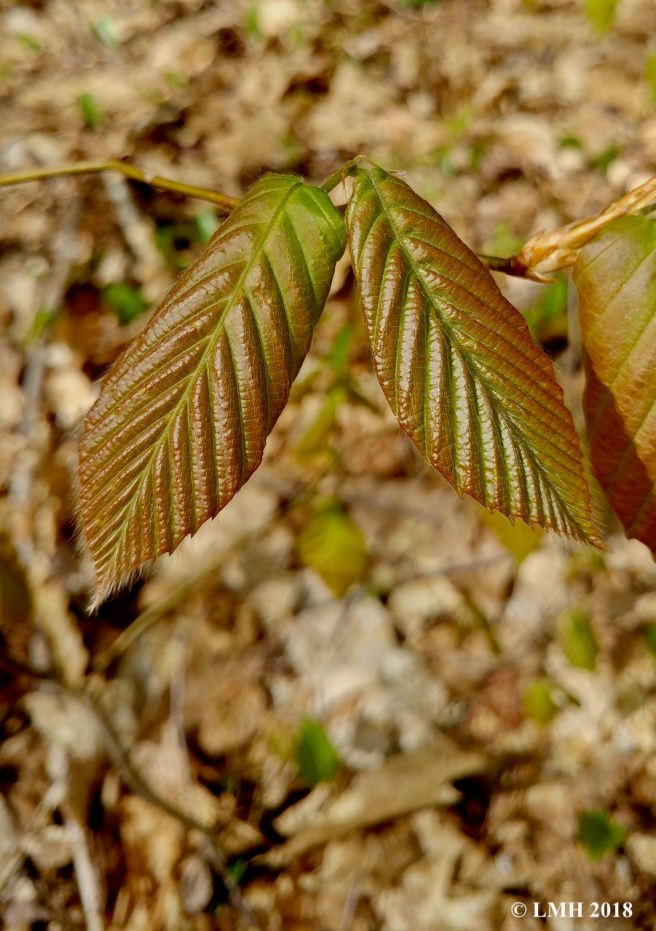
And that reddish tint that we saw in the sarsaparilla, beech and other leaves? The various hues of color in leaves was caused by the presence of pigments called anthocyanins or carbohydrates that are dissolved in the cell sap and mask the chlorophyll. As our spring temperatures rise and light intensity increases, red pigment forms on a leaf and acts as a sunscreen to protect the plant from an increase in ultraviolet rays.

S8-BIRDING

We’d been looking down for a while, but then bird song pulled our attention to the tree tops. Without the use of my Cannon Rebel, which is currently enjoying what I hope will be a successful rice bath :-( , I couldn’t capture the many warblers we spied. Some, as Peter, and his wife Molly, told us, were only in the area temporarily to fuel up on insects before continuing the journey to their breeding grounds in Canada.

S10-GARTER SNAKE

And looking at our feet once again, another in search of insects. We saw a garter snake who stayed as still as possible while we ogled it. Was it cold and trying to soak up warmth from the sun? Or did it stay still in hopes we wouldn’t spy it?

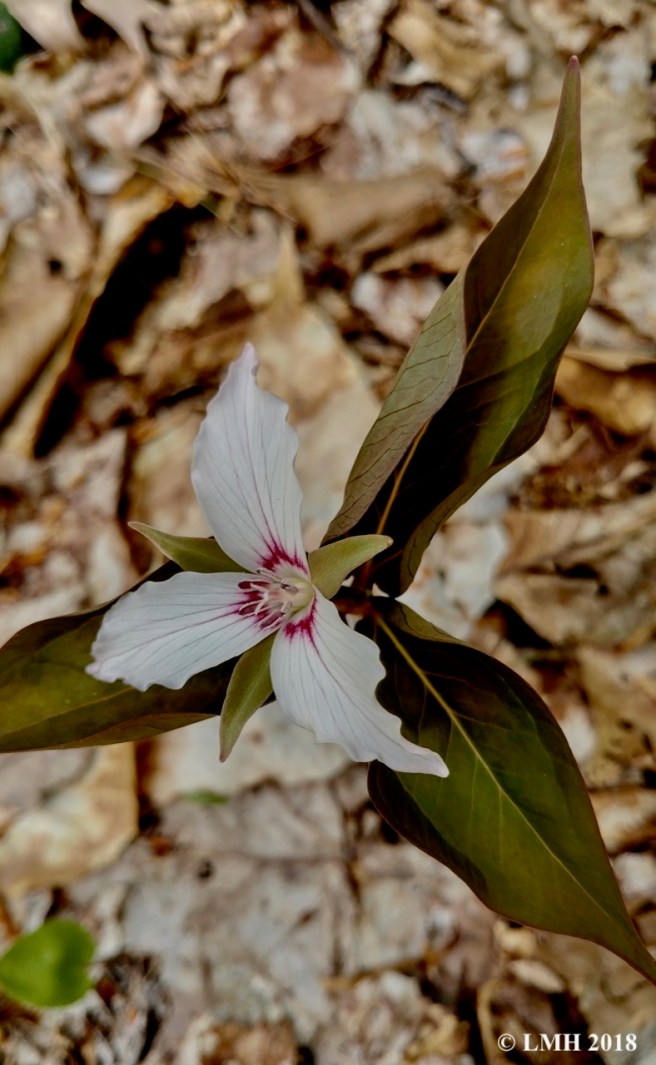
S11-PAINTED TRILLIUM

We finally left the snake in peace. And paused next to gaze upon a painted trillium.

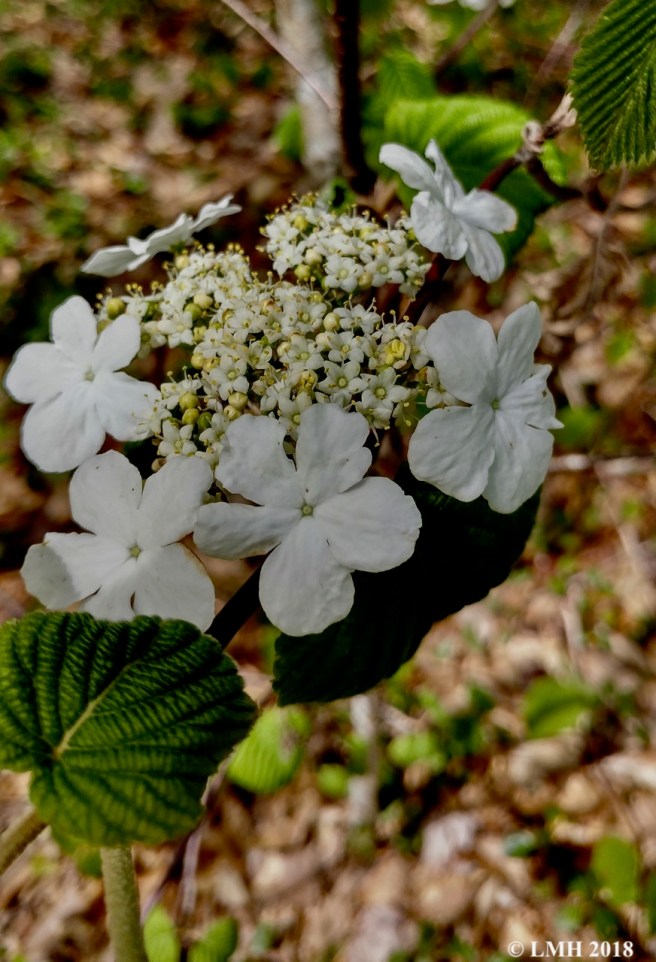
S12-HOBBLEBUSH FLOWERS

Almost two hours after our start, we approached the wetland and overlooking bench. It was there that a hobblebush laden with blossoms caught our attention in the shrub level. The hobblebush bouquet was really an inflorescence or lacy cluster of tiny fertile flowers surrounded by a halo of showy, yet sterile bracts. Those larger, sterile flowers attract insects while the tiny fertile flowers do all the work of seed production. Nature has its way.

S13-BIRDING BY THE BENCH

It was at the bench that bird song again greeted us and we looked above the shrubs toward the tree limbs above.

S14-BIRDING

For many of us, we looked through our binoculars at birds we’d only heard of before, including a Bay-breasted Warbler. Peter explained that he’s participating in the citizen science project to update the Maine Birding Atlas and so he uploaded the 38 species identified today to the e-bird website.

S15-LINDA TURNS HER FOCUS UPWARD

Even though she’d spent a lot of time directing our attention to the beauty at our feet, Linda was also in awe of those who moved above, however, she was heard to comment that it’s a whole lot easier to ID flowers that stand still.

S16-BEECH FERN

As our journey finally continued, we found a patch of beech ferns with their own variation of today’s theme, for each leaflet attached to the rachis in a winged formation.

S18-FRINGED POLYGALA

Another that spoke to the theme was a flower that hadn’t quite yet bloomed–fringed polygala, aka gay wings.

S17-SPRING PEEPER

Despite all the flowers and birds, our NDD followed us right to the end–when we spotted a tiny spring peeper . . .

S21-GREEN FROG ON A LOG

and then a green frog.

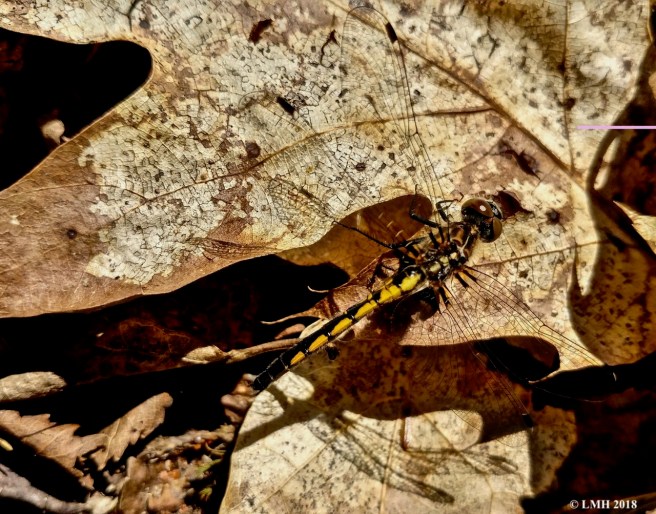
S22-FEMALE WHITEFACE SKIMMER

While the frog marked the end of our journey, I moved on to the GLLT’s Kezar River Reserve, where another winged critter flew at the flower level–the first dragonfly of the season: a female whiteface skimmer.

Today was filled with petals and wings and all things ephemeral. I hope you’ll have a chance to take advantage of this short window of opportunity.


Mayday Alert

Each time we explore a Greater Lovell Land Trust property, we have no idea what we might discover and this day was no different. For today’s Tuesday Tramp I suggested we visit the Cohen Property near the Lower Bay of Kezar Lake, which was the last acquisition under the direction of the late Tom Henderson. We’d only been there once before–and that was a few months ago when we explored via snowshoes. At that time we discovered ice-covered depressions and so a journey to check them out as vernal pools seemed apropos.

m2-moose print ID

There are no trails yet and so after parking, we followed the road back a ways to the area of our winter expedition. And what to our wondering eyes did we spy on the road? Moose prints! One should always look through a magnifying glass to make certain the ID is correct. Wes confirmed our suspicion.

m2-scooping

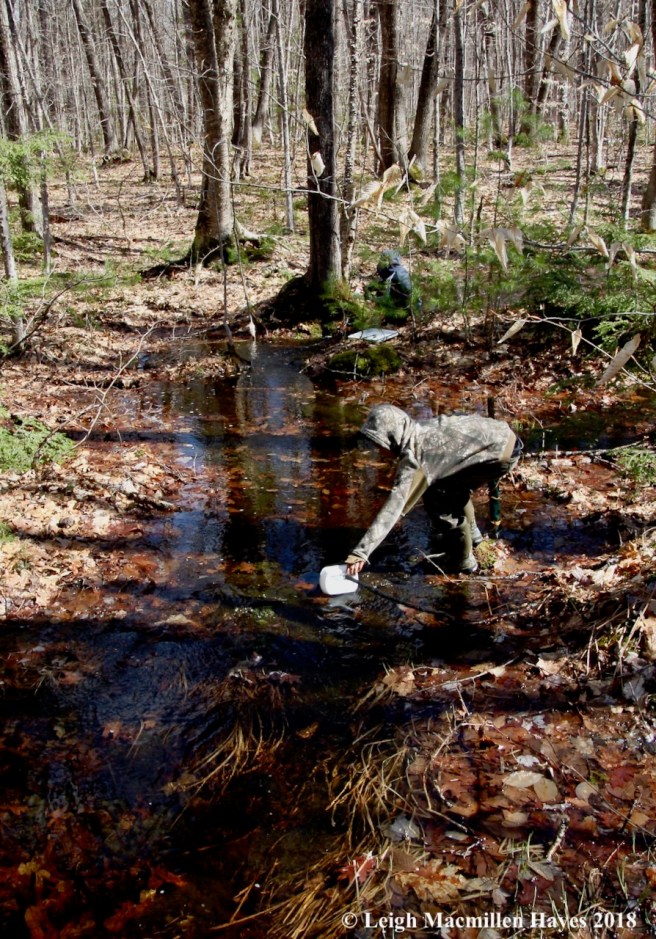
We found sitting water and running water and began to wonder about the wetland and whether what we thought might be a vernal pool really was, for we knew that a v.p. shouldn’t have an inlet or outlet. As the first dips of the day were made, black flies began to swarm around us. We hoped to pick up their larvae in the moving water, but instead we found many springtails.

m3-what did you catch

And a few mosquito larvae as determined by Caleb, Linda and Nancy.

m5-blob and algae

In another spot, we also found a mystery. At first we thought it might be some sort of egg. And maybe it was, but how was it related to the algae that seemed to be a host? We didn’t know, but now that we’re aware of it, we’ll continue to wonder and perhaps become enlightened.

m6-pool?

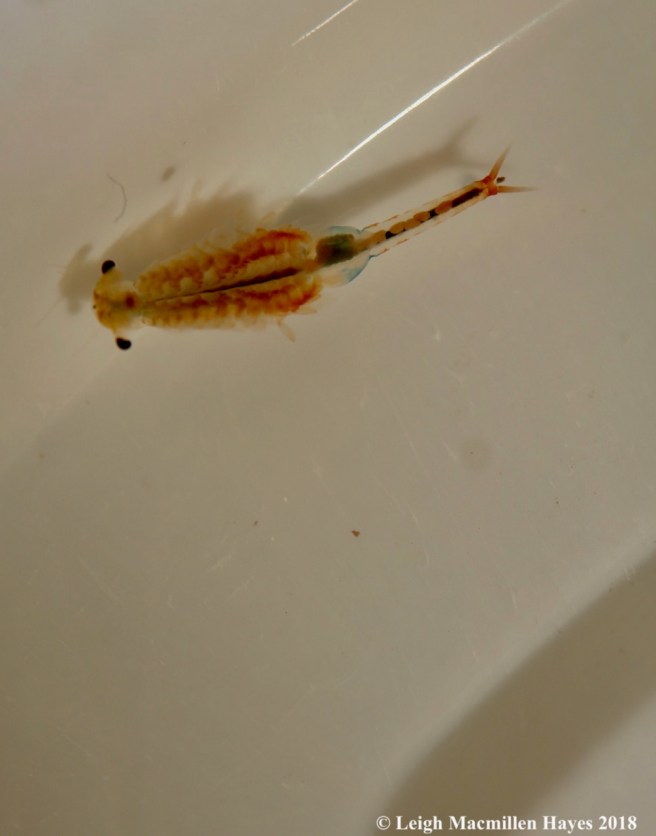
We checked out “pool” after “pool” and found not one egg mass (except for a false start that fooled us momentarily), which rather disappointed us. Were these really vernal pools? We suspected so as they were shallow and looked like they’ll dry up in the summer, if not before, plus they supported no fish. Were they significant vernal pools? Definitely not. To be a significant vernal pool, the body of water must contain one of the following obligate species: 1 fairy shrimp or 10 blue-spotted salamander egg masses or 20 spotted salamander egg masses (yellow spots) or 40 wood frog egg masses. Fairy Shrimp? No. Salamander egg masses? No. Frog egg masses? No.

m7-examining species

Despite the lack of indicator species, we scooped up water to determine what did live there.

m8-mosquito larvae

The most abundant residents found–mosquito larvae. And do you see the small jar in Ellie’s hand? She created a mosquito larvae aquarium and discovered that they seemed to like the algae she’d added. Perhaps they’d found microorganisms we couldn’t see.

m8a-pointing out antics of mosquito larvae

Watching the acrobatics of the larvae entertained us for a while. They twisted and turned somersaults and wriggled in the water and we soon realized that eggs left behind by last year’s females who had sucked our blood before breeding, must have remained dormant all winter until the snow melted and spring rains began.

m9-chironomid midge larva

We did find another species to admire, that also wriggled in a constant state of contortion–this one being a chironomid midge with blood-red coloration. According to A Field Guide to the animals of Vernal Pools, the color is “due to a hemoglobin-like pigment that helps them retain oxygen. This pigment allows the larvae to survive in water that is very low in dissolved oxygen, as is common in vernal pools as drying proceeds throughout the seasons.”

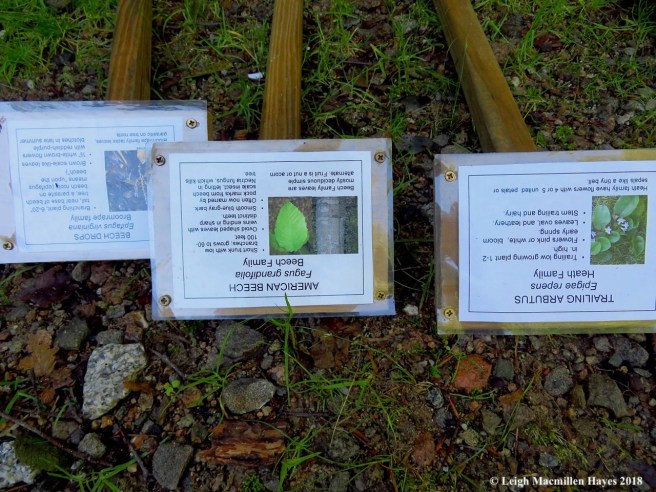
m10-Trailing Arbutus--May flower

Because I had to meet someone at noon, and Dave knew that it would take us at least a half hour to make the short trek back to our vehicles due to our incessant nature distraction disorder, we had to cut our journey short. Dave was right–as he often is–and we were forced to stop several time, including to sniff a couple of mayflowers, aka trailing arbutus or officially: Epigaea repens.

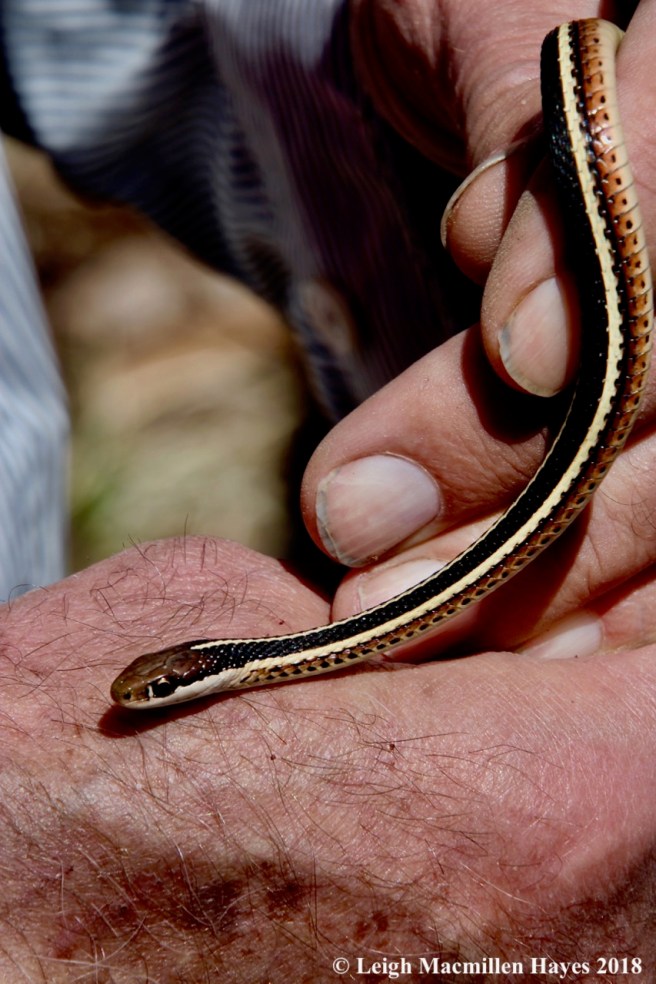
m11-ribbon snake 1

We finally reached the spot where we’d parked with fifteen minutes to spare when Linda sighted movement beside the tires of my truck and our hearts jumped with joy.

m12-ribbon snake captured

We didn’t want to run it over as we backed out and so Heinrich captured it. What is it? An Eastern ribbon snake, which is a species of special concern in Maine. According to the Maine Inland Fisheries and Wildlife website, “A species of special concern is any species of fish or wildlife that does not meet the criteria of an endangered or threatened species but is particularly vulnerable, and could easily become, an endangered, threatened, or extirpated species due to restricted distribution, low or declining numbers, specialized habitat needs or limits, or other factors. Special concern species are established by policy, not by regulation, and are used for planning and informational purposes; they do not have the legal weight of endangered and threatened species. The Maine Department of Inland Fisheries and Wildlife reviews the list of special concern species at the beginning of each calendar year, and, based on criteria in the Maine Endangered and Threatened Species Listing Handbook , revises the list as appropriate.”

m13-ribbon snake 2

And that is why it’s so important to protect the land. I knew Tom was smiling down upon us due to this find. Interestingly, we also spotted a ribbon snake at the John A. Segur Wildlife Refuge on Farrington Pond Road in early May 2015.

m14-paper birch superhero

Finally, we all departed and I was only ten minutes late for my quick meet-up, after which I headed back down Route 5 to reconnect with my favorite little naturalists at the Kezar River Reserve across from the Wicked Good Store. There’s a tape across the road, which I suspect was put in place by the local snowmobile club when the ice was questionable on the river, but it remains, which given the recent rain is probably a good thing. We’ll take it down soon, but it has prevented the road from becoming more rutted than normal.

Anyway, Wes climbed out of the family’s vehicle with his paper birch armor. He’d spied it in a V between to birch trees on our morning trek and his mom climbed up to retrieve it for him.

m15-brother bomb

Birch Man posed again and again, until his older brother Aidan, sporting a missing front tooth, jumped in front.

m16-root art

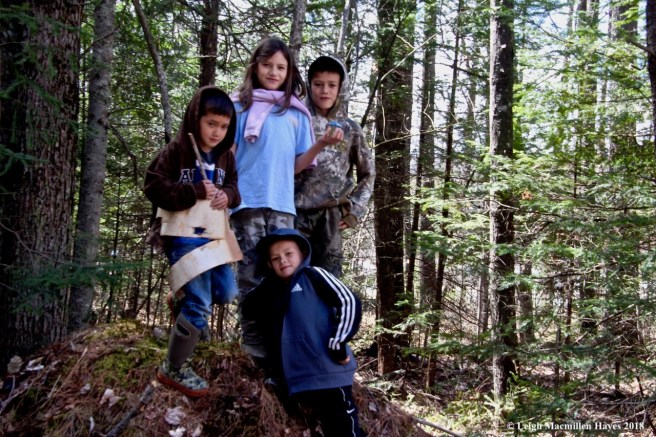
The boys stood on a hump of earth beside a tree root. And it was through their eyes that we noticed some interesting finds among the tree’s former life support.

m17-canister cover

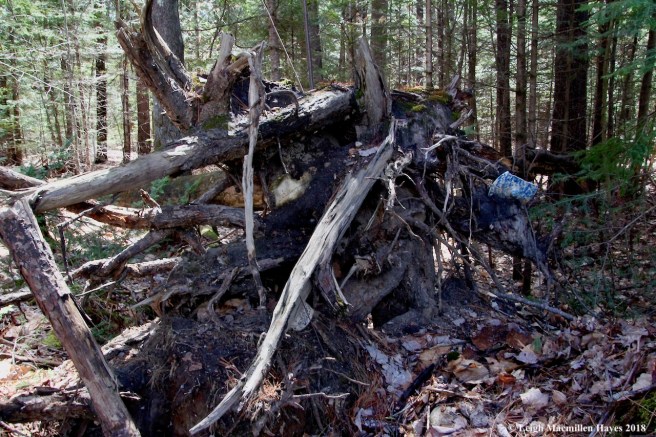
We found pottery and cast iron and realized the tree had grown upon an old dump site.

m19-VW

And that hump of earth–the four siblings were sure that it hid a Volkswagen Beetle.

m23-Kezar River

It took us a while to walk down the “roadway” and then the left-hand loop. We made a few discoveries, including coyote scat filled with bones, and the kids did some trail work. At last we reached the canoe/kayak landing at the Kezar River and noted some otter scat and a few slides, plus some fishing lures and line stuck in the trees. It was at that point that the family had to leave, but before they left they asked me what I’d do before I had another meeting in the afternoon. I told them I planned to hike the second loop, which happens to be longer and dips into an interesting ravine.

m23-salamander eggs

That never happened. As it turned out, I stood at the boat launch for about an hour. First, I spied one small clump of salamander eggs.

m24-equisetum

And then realized that the raft before me, which filled the small cove, was equisetum. Where it came from I didn’t know for I couldn’t recall ever seeing it at this property.

m24-Mayfly 1

But, regardless, it provided a perfect camouflage for aquatic insects. It took me a while to key in on the species before me, but I knew they were there because every once in a while, one took flight. Do you see the mayfly subimago that had recently emerged? The teenager stood atop its nymph exuvia. Mayflies are unique in that after the nymph emerges from the water as the subimago (that fishermen call a dun), they seek shelter before shedding their skin for the final transformation.

m25-mayfly 2

I really had to focus in order to spot them.

m27-Mayfly

But once I did, they were . . .

m28-mayfly

everywhere.

m29-mayfly larva

And in all forms, including a nymph.

m30-Mayfly up close

The cool thing is that thirteen mayflies are also on the list of species of special concern. Was this one of the species? I have so much more to learn.

m31-water scorpion

As I continued to watch, there was an incredible amount of activity. And then I saw a predator that was about two and half inches long. Do you see it? Not atop the vegetation, but rather under it in right-hand center of the photo. Behind it, almost to the right edge of the photo, was a bubble at the end of its long breathing tube.

m33-water scorpion

As I watched, it continued to swim forward, the vegetation providing it’s favorite type of habitat. Again, you have to look carefully.

m34-water scorpoin

And again. It was a water scorpion with an oval-shaped abdomen. Do you see it?

m35-ribbon snake

Finally, it was time for my next meeting, but as I walked back up the trail I reflected upon the wonders of the day and the work of the land trust under Tom’s leadership. Creating corridors is important for mammals, but also for all critters that share the various habitats.

There was no need to put out a distress signal today. Indeed. With others and alone, I was thankful for the opportunity to be gifted with such sightings: Mayflowers and Mayflies! And a water scorpion. Topped off with a ribbon snake. May Day Alert of the best kind.


Sallie Savers Celebrate Big Night with LEA

The initial email was sent by Mary Jewett of Lakes Environmental Association in Bridgton, Maine, on Tuesday:

Hello everyone!

Many amphibians have already crossed and laid eggs but there are still some waiting in the woods. Tomorrow evening looks like it will be perfect conditions for an amphibian migration and I would like to get a group together to go out with me. My plan would be to meet at the office at 8pm. With sunset being at 7:40 I really wouldn’t want to start any earlier since the frogs and sallies won’t move when it’s light out.

I want to get an idea of who would be able to come out with me. I have a reporter and videographer coming out from the Bangor Daily News and they would like to get shots of actual people (not just me) and possibly get some quotes from participants. I know that it’s tough to get out with kids since it starts so late but I hope that we can get a diverse group. We also may have the opportunity to check out egg masses that are already in the water!

And then this afternoon, Mary sent this follow-up message:

I have heard from a handful of people who are able to come out tonight so I’m going for it. Here are some details:

Meet at the LEA office building (230 Main Street) at 8pm
We will caravan up to the Masonic Hall and walk to Dugway Road from there.
Bring high powered flashlights/headlamps
Wear warm clothes and rain gear. It looks like the rain may be pretty heavy when we are out there. Good for amphibians but not so great for people trying to stay dry.
Wear reflective clothing if you have some. I have vests available if you don’t have your own.
Do not wash your hands with soap or put on hand lotion or hand sanitizer.
I have spoken to the police and they are going to try and send someone out. They have a training program this evening so we might not see them. This makes it extra important that kids stay with their parents at all times!

b3-amphibian crossing sign

And so we did just that–met at the LEA office first, and then moved on to the Masonic Hall to park before beginning our journey into the wet and wild world of the amphibians.

b1-redbacked

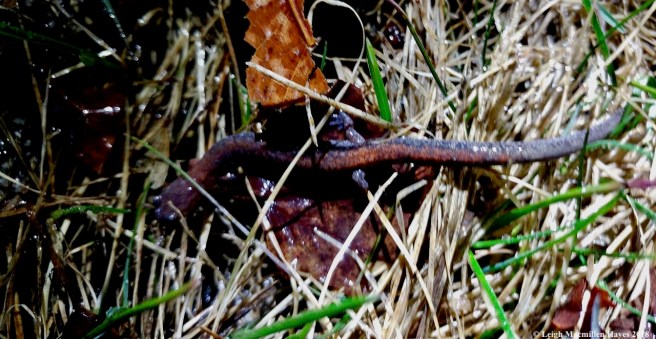
Right away, we noticed worms. And even better, a red-backed salamander. Red backs don’t use vernal pools to mate, but they sure do love rainy nights that offer great opportunities to roam about seeking food.

b2-red backed salamander

We crossed the field from the Hall to Memory Lane, our eyes ever looking for more redbacks, but instead we noted a kazillion worms, each the size of a young snake. And then, after only a few minutes on the road another redbacked graced us with its presence.

b4-Mary explains rules of the road

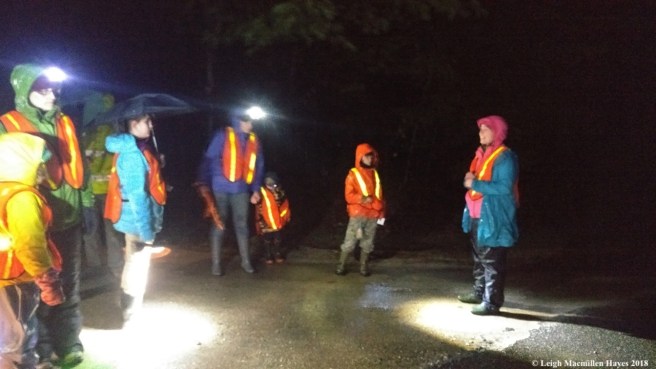
Finally, we reached Dugway Road, our destination, and Mary took a few minutes to remind folks of safety rules. Some years the Bridgton police are able to join us and either shut the road down or at least slow traffic. Such was not the case tonight and so it was important that our crowd of at least twenty ranging in age from four years old to 70+ be cautious.

b4-walking the road

And then the real fun began. We spread out across the road with flashlights and headlamps, walking with care as we tried to notice the little things in life who chose this night to return to their natal pools in order to mate.

b6-spring peeper

Right away, the good times got rolling as we began to spot spring peepers. Really, it was those with eagle eyes who spotted the most, which wasn’t easy given the asphalt conditions. Though we knew better, we did have to wonder if the amphibians chose this road because it provided good camouflage.

b5-first catch- spring peeper

Being the first of the night, Mary demonstrated the fine art of capturing the peeper, explaining first that her hands were damp and had no soap or cream upon them.

Outstretched hands of one of the younger set awaited a transfer.

b5-pass off

The mission was to help the peeper get to the other side of the road. Typically, once captured, we transport them to the side in which they were headed.

b5-final pass off

The release was made into the youngster’s hands and then onward the child holding frog went. Lucky for the frog, there was a culvert at the side and that seemed like the safest place to release it.

b14-into the vernal pool

Further down the road, the songs of the wood frogs and peepers were almost deafening. As we looked into the vernal pool that was still half covered in ice, there was some movement, but the frogs all continued to sing despite our presence, unlike what happens when we approach a pool during the day and they dive under the leaf cover for a few minutes.

b7-spotted salamander

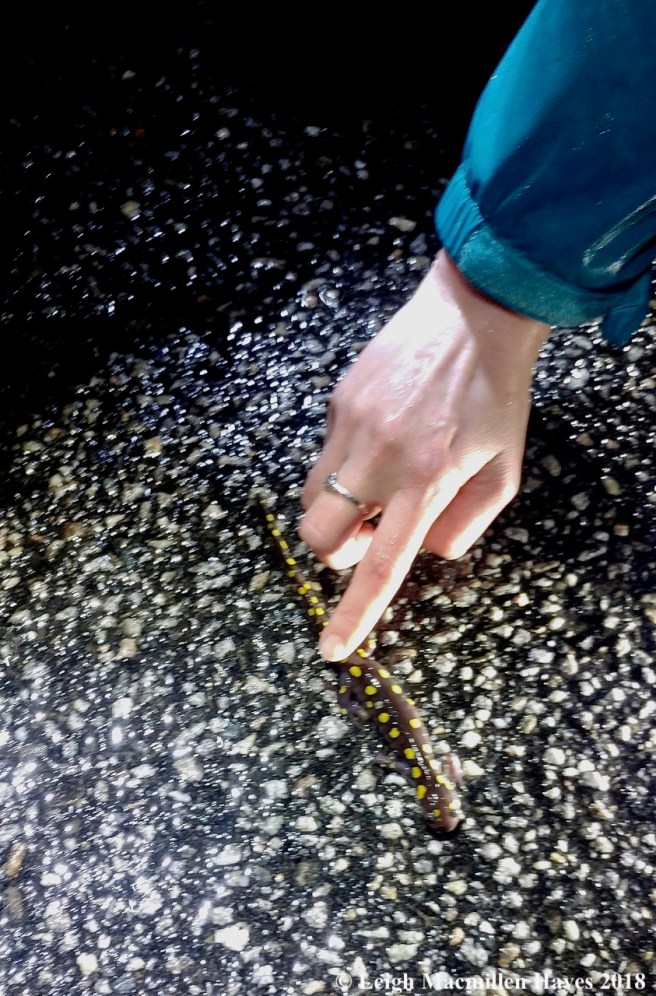
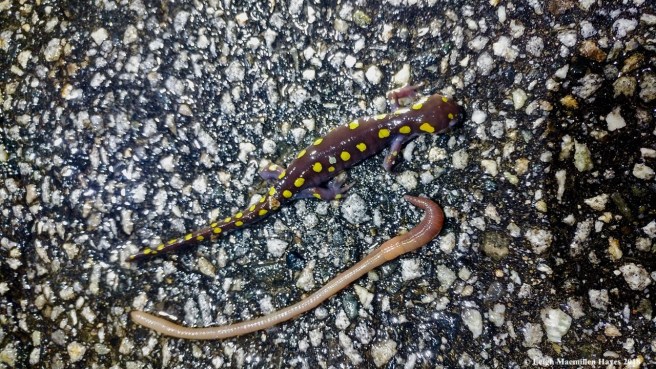
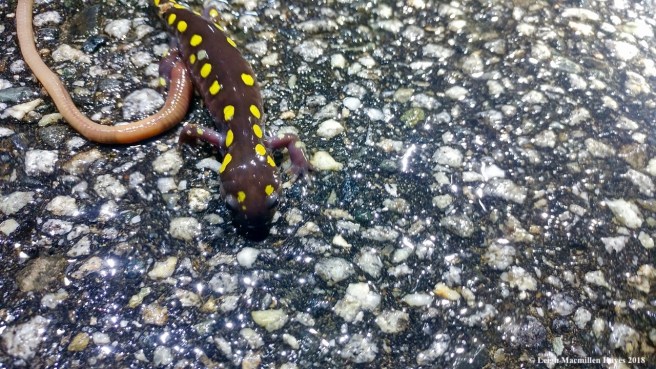
We found enough peepers, but the stars of the night were the spotted salamanders.

b8-sally and worm

The youngest among us picked up one of the ubiquitous worms that marked the night and laid it down beside a sallie.

b9-sally eyes

Sallie didn’t care. It was on a mission and just wanted to move on without our interference. There was only one thing on its mind and we suddenly stood between it and that goal.

b12-salamander

It had a dance to perform before the sun rose and we had a heck of a nerve for getting in the way. I’m always in awe of these creatures who spend at least 11.5 months under the leaf litter and maybe a week or two in the pool. Our rare chance to catch a glimpse of them is on such a rainy night as tonight.

b10-sally on card

Our intentions were in their favor. We only wanted to help save them from the vehicles that passed by.

b11-sally's world

In the end, though, I had to wonder–is this what the salamander’s world looked like as we scooped it up and helped it across.

Possibly, but still, it’s always a thrill for tots, tweens, teens, and all the rest of us to celebrate Big Night with the Lakes Environmental Association. We are the Sallie Savers.

Book of April: Take a Wetlands Walk

Those of you who have followed me on the trail or through wondermyway for a while know that I’m not only drawn to mountaintops, but wetlands as well. And I have a few that I frequent including several vernal pools, Holt Pond Preserve, Perky’s Path, and Brownfield Bog.

w1

Book of April

Therefore, when I spotted Take a Wetlands Walk by Jane Kirkland at Maine Audubon’s Nature Store a few years ago I wasn’t surprised that it jumped into my hands and dragged me to the checkout. Since it’s April and the snow is slowly melting in western Maine, and some afternoon in the near future I look forward to receiving an email announcing our local Big Night celebration, it seemed apropos that I should feature Take a Wetlands Walk as the book of the month.

w-Holt P 2

Holt Pond boardwalk

This is a children’s book and I like how the author divided it into three sections, using a phrase often heard at the starting line.

Get Ready–encourages kids to gain a better understanding of wetland terminology in an easy to understand manner. In fact, it’s as if the author is sitting beside you, so conversational is the tone.

w-fairy shrimp

Fairy Shrimp

w-tadpoles

Tadpoles

w-wood frog

Wood Frog

w-painted turtle

Painted Turtle

w-water snake 1

Water Snake

w-water snake 2

Water Snake (notice his tongue)

Get Set–introduces amphibian and reptile species associated with wetlands.

w-pitcher plant

Pitcher Plant

Go!--sends the children outside to read the signs of nature and jot down their observations.

w-Holt Pond quaking bog

Quaking Bog at Holt Pond

In the Go! section, Kirkland describes what the kids might discover in such places as bogs, estuaries, salt marshes, freshwater marshes, streams, rivers, lakes, vernal pools, swamps, and the Everglades.

w-Red-winged Blackbird

Through sidebars, illustrations, and photographs, Kirkland touches on many topics related to wetlands, but constantly encourages further research, including of course, heading out the door. She also includes a wee bit of information about citizen science projects and wetland careers.

w-pileated woodpecker

Pileated Woodpecker

Each time she first uses a technical term, she adds a pronunciation key. One of my favorites: The Pileated Woodpecker (Py-lee-ata-id or PILL-e-ate-id). I prefer the latter, but occasionally hear the former uttered. “You like to-may-toes and I like to-mah-toes!”–Although in that sense, I prefer the former tomaytoes.

w-spotted sallie 2

Spotted Salamander

Throughout, Kirkland shares personal experiences as well as those of her acquaintances. Finally, she includes pages filled with photos to help you identify birds, plants, reptiles, amphibians, mammals and insects related to wetlands.

w-pond dipping

Pond Dipping

Yes, this is a children’s book, but adults can also benefit from reading it. And then heading outside.

Get Ready, Get Set, Go! Pick up a copy of Take A Wetlands Walk and visit your nearest wetland.

Take a Wetlands Walk by Jane Kirkland, Stillwater Publishing, 2011

Eyes of Wonder

On the first and third Tuesday of each month since the snow first flew in 2017, I’ve had the privilege of tramping through the woods with our Tuesday Trackers group. As it happened this month, we were also able to tramp together today–the fourth Tuesday.

Each week, the participants vary as they come when they can. But no matter who shows up, by the end of our two-four hour exploration, we are all wiser for the experience–and filled with gratitude for the opportunity to spend a winter morning in the Maine woods. We are also grateful for the wonder that is right in front of us, not only materializing in the form of mammal tracks, but all manner of things that make up the web of life.

j1-otters romping across the snow

Usually the age of our attendees ranges from 50-something to 80-something. But today we were joined by four little otters who reminded us what it’s like to be a child again as they bounded across the snow’s crust, and rejoiced at the sight of any and every little thing that presented itself from squirrel and chipmunk holes to fungi.

j2-squirrel prints

Of course, we were there to track and though most prints were bleached out from the sun’s March rays, we did find a few that showed well their finer points such as toes.

j14-measuring straddle

And with any discernible prints, the kids reminded us to take time to measure straddle, in this case that of a gray squirrel. We also found what we believed was a bobcat track based on the round shape of the somewhat melted print and the stride.

j3-ice and water

Most of us began the journey with snowshoes, but soon joined the kids and shedded them as we moved from frozen snow to bare ground and back again. And then we discovered water. Actually, a few of us were a wee bit behind, when one child ran up to her mom and said, “A vernal pool.” If it does turn out to be a vernal pool, we feared it will dry up too soon, but that doesn’t mean the amphibians won’t take advantage of the spot in a few weeks. It was half covered in ice, which offered a challenge because two of the boys wanted to break through it with a stick. The third boy did break through–much to his dismay. But as his calm mom said, ” Well, now he’ll know next time.” (Juli–I can’t help but smile–you are the best.)

j4-helping hands

Fortunately, for his sake, we came upon a maple tree with a huge burl on which he sat while others on the journey came to his aid and squeezed a gallon of water, or so it seemed, out of his socks. His mom had an extra pair of mittens in her pack and those covered his toes for the rest of the trek. He wore his boots, of course. While we were there, we wondered about burls and tried to remember what created them. I suggested insects and another thought perhaps fungi. It turns out we were both correct. They may also be caused by bacteria or a virus. What the young lad sat upon was a reaction of the tree to the infestation which resulted in abnormal growth due to changes in the tree’s hormones. Think of its vascular system as a twisted ball of yarn.

j5-sucker brook outlet into Kezar Lake's Lower Bay

After the sock ringing and mitten fitting episode played out, we turned around to take in the beauty of the Sucker Brook Outlet at the Lower Bay of Kezar Lake for we were on the John A. Segur East Wildlife Refuge on Farrington Pond Road.

In the distance, one lad spied a beaver lodge. You might see it as a brown dot on the snow-covered ice directly above a swamp maple snag in the center of this photo.

j6-wintergreen and spring tails

We also looked at our boots, where we rejoiced in the site of wintergreen plants evolving from their magenta winter coats. And spring tails jumping about on the leaf litter like performers in an unorganized circus.

j9-squirrel table

Upon a downed birch tree, a certain young lady found the perfect spot to set up a dinner table for a squirrel. She was kind enough to include a dessert treat by stuffing pieces of a wintergreen leaf into an acorn cap.

j10-ice bridge

Much to the delight of the younger set, they next discovered an ice bridge and took turns walking across it. The rest of us decided to pass on that opportunity, sure that we’d ruin the effect.

j11-tree stump examination

Getting up close and personal was the theme of the morning and everything drew their attention and ours, including a decaying trunk of a hemlock that was downed by a lightning strike several years ago.

j12-tree holes

Because we were curious, we noted holes of the tree’s decayed xylem, the system of tubes and transport cells that circulate water and dissolved minerals. One of the boys decided to see if it worked and poured water onto the stump, which immediately flowed into the holes. We’ve viewed tree stumps and rings many a time, but this was the first time we recalled seeing the holes. No tree stump will go unobserved on our path from now on.

j13-lodges reflect mountains

Our turn-around point was at another spot along Sucker Brook where three beaver lodges reflected the mountains in the backdrop.

j21-beaver lodge

A few of us walked across the ice for a closer look because one appeared to serve as this winter’s home site. We trusted the family within included their own young naturalists.

We were certainly thankful for our time spent with four children who allowed us to look at the world through their eyes of wonder.

(On behalf of Joan, Dave, Steve, Dick, Jonathan, and I, we thank you, Caleb, Ellie, Aidan and Wes. Oh, and your mom as well, or especially–thank you Juli. We’re all in awe of you and the gifts you’ve passed on to your kids.)


Beside Browns Pond

One should not work from home for then it is much too easy to do an about face with plans for the day and hit the trail before meeting deadlines. But alas, that is how I found myself on the Chessey Property this morning. It just seemed to make more sense to head out early in the day, rather than wait until the end to reward myself.

c14-map

The 100-acre property Chessey Property was forever protected from development under a conservation easement with the Presumpscot Regional Land Trust. Though I’d passed by numerable times, I had never before ventured that way.

c1-trail sign

And so this morning I decided to rectify that and drove to the trailhead. Actually, I drove past the trailhead, spotted the large cemetery on my left and turned around. The sign was facing in the opposite direction and easy to miss. Because the trail was only a half mile long, I figured it would be a quick trip. Apparently, I don’t know myself very well.

c2-snowshoes

I hadn’t tramped far when I realized I was moving in the opposite direction of one whose ancestors had inspired my own mode of transportation.  The start of the trail is a field in early succession and so it made sense to find snowshoe hare prints crisscrossing the opening.

c3-red fox

But . . . it wasn’t just a hare that had moved atop the snow. The print size and stride told me a red fox had also traveled there–and not too long before I’d arrived. To add to my identification was the chevron visible in the front foot print. Do you see what the arrows indicate?

c4-red fox track

I didn’t follow the track, and so I wasn’t sure if I was looking at prints made by one fox or perhaps two. My gut told me one and that the back foot didn’t always land exactly in the impression of the front.

c5-hare and fox cross tracks

Nor do I know how the story ended–for the fox crossed the hare’s tracks. Did the two ever actually meet?

c12-speckled alder

In the same area I found speckled alder, so named for its bark speckled with pores or lenticels. Its red and maroon catkins grew longer–well, at least the male catkins. The shorter catkins are the females, for alders are monoecious–male and female flowers grow on the same plant. As March gives way to April, the male color will deepen to burgundy, while the females will turn bright red–in full blush.

c13-pussy willows

Another color also caught my attention–pussy willows with their furry little silver flower buds just opening. The soft tufts earned their common name due to their resemblance to tiny kitten paws.

c6-my tracks

All of that, and I hadn’t gone far from my truck. But, by the depth of my impressions, you can see that my travel would be slow for no one had packed the trail before me.

c7-water obstacle

I journeyed on, stopping every ten to twenty steps to look around, listen, and catch my breath. Tracking was almost impossible once I ventured into the forest for snow drops from the trees created their own random impressions. Water obstacles were a bit of a challenge, but I managed to manipulate around all four. And bird song included the throaty caws of Ravens. At one point I heard their powerful wing beats and looked up to see three chasing another bird that I couldn’t identify.

c10-face in the snow

But never fear, though I couldn’t find tracks as I continued, I found plenty of other things to look at, including a tilted snow mask, and . . .

c11-snow art

snow sculptures. How does snow do that? Worth a wonder, indeed.

c8-otter tracks:slide

I’d almost reached the turn around point when I recognized a pattern by my feet and realized an otter had passed that way–probably yesterday based on the state of the slides, prints, and scat. One really cool thing that I learned as I followed its trail was that every once in a while it tunneled under the snow. I don’t know that I’ve ever noted that behavior previously. Most of its tunnels were about ten feet long and then it emerged again to bound and slide.

c9-Browns Pond

At last I turned my attention to the 110-acre pond that opened before me. It’s my understanding that it remains undeveloped–a rare feat in these parts. I wanted to stay and explore, but knew I had to save it for another day because work really did sit at home awaiting my attention. I trust I’ll return in another season when the traveling isn’t quite as difficult, but until then this morning’s moments beside Browns Pond will sustain me.


Brain Share–Naturally

I was thankful I’d thrown my winter coat into the truck for I had a feeling it would be a better choice than a vest given the group I’d be traveling with this morning. And sure enough, though the sun felt warm, a breeze added a chill to the air. Plus, I knew we wouldn’t travel far and would spend much of our time standing around.

r0-life on a rock

Well, not exactly standing, for as Maine Master Naturalists, we’ve been trained to get down for a closer look. Our first stop–to check out the life on a rock that was revealing itself as the snow slowly melted. Karen is on the left, an Augusta grad, and Sarah and Anthony to her right, both South Paris grads.

r0a-polypody

The focus of our attention was common polypody, a fern with leathery leaves and spherical spore clusters on the underside. Rocks are their substrate and they often give a boulder a bad-hair day look.

r1b-speckled alder

Moseying along, we reached a point where we knew we wanted to spend some time–at a wetland beside one of the Range Ponds (pronounced Rang) at Range Pond State Park in Poland, Maine. Because it likes wet feet, we weren’t surprised to find speckled alder growing there, but what did throw us for a loop was the protrusions extending from last year’s cones.

r1a-speckled alder

It was almost like they had tried to flower atop the cones and all we could think of was an insect creating a gall. Indeed, it appeared that the cones were also experiencing a bad hair day. After a little research, it may be alder tongue gall–resulting from a fungus rather than an insect infecting the female catkins. Apparently, the tongue-like growths are green to begin, but transform to orange, red and finally brown. It was certainly a new one for the four of us.

r2a-leatherleaf and sphagnum moss

On we moved down to the wetland where the snow surprisingly held us for most of the journey and we didn’t leave behind too many post holes. Leatherleaf and sphagnum moss showed off their winter hues at our feet.

r4-cranberries

We also spied cranberries hiding underneath.

r3-cranberries among the leatherleaf

And sampled them. A few were tart, while others had fermented.

r1-two lodges

In the middle of the wetland, two well built lodges stood tall. They had fresh wood and had been mudded in the fall. One did look as if the vent hole had been enlarged, so we wondered if anyone still lived there. We heard no noises, but had to assume that we were bothering the residents so we didn’t stay long.

r2-wetland and pond beyond

One last view of the wetland and pond beyond, then we turned and walked toward the opposite side.

r5-bird nest

Just before climbing uphill, we spotted a bird nest in the winterberry shrubs. It was filled with dried berries, and we again made an assumption, that a mouse had cached its stash for the winter and maybe dined there in peace and quiet while the nest was covered in snow. That’s our story and we’re sticking with it. Whose nest it was prior to the mouse? We don’t know, but it was made of twigs. If you have an answer, please enlighten us.

r6-bone

Back up on an old railroad bed, we again stopped frequently, including to talk about the beech scale insect and nectria fungus that moves in and eventually kills the trees. And then something else came to our attention–it wasn’t a broken branch hanging down like an upside-down V on the beech tree. No indeed. It was a bone. A knee bone. And it had been there for quite a while given its appearance.

r7-Introduced Pine Sawfly pupal case

Because Anthony was with us and he’s our insect whiz, we spent a lot of time learning from him–including about the pupal case of an introduced pine sawfly. The sawfly had already pupated and in this case no one was home.

r8-Introduced sawfly pupal case

As the morning went on, we became quite adept at locating more cases of other sawfly species, including one that wasn’t yet opened. We each channeled our ten-year-old selves as we tried to be first to find the next one. But really, Anthony won for he had insect case eyes.

r9-going in for a closer look

And eyes for other things as well.

r10-old spider web case

This time we examined a delicate, almost lacy structure under a branch on a young beech. Anthony suspected a pirate spider, which tickled our fancy for we imagined them raiding the goods of others. But later he e-mailed with another option: “The old spider egg case could also be from an orbweaver of the araneidae family.” Either way, we were happy for the sighting; for taking the time to slow down and notice.

r11-beech leaves

And there was more. Sarah had to leave us a wee bit early, so she missed our finds on the backside of beech leaves.

r12-maroon dots on beech leaves

They were dotted with raised bumps that under our hand lenses reminded us a bit of the sori on common polypody.

r13-maroon dots on beech leaves

Leaf rust? Was it related in any way to the splattering of tiny black dots also on the leaves? We left with questions we haven’t yet answered.

r14-hair on beech leaves

Taking a closer look did, however, remind us of how hairy beech leaves are–do you see the hairs along the main vein? And that reminded us of how the tree works so hard to protect the bud with waxy scales all winter, keeping the harsh conditions at bay. In early spring, slowly the leaves emerge, ever hairy, which strikes me as an adaptation to keep insects at bay, and then . . . and then . . . it seems like every insect finds a reason to love a beech leaf and in no time they’ve been chewed and mined and you name it.

r15-oak gall

We made one more discovery before heading out–a gall formed on oak twigs. Do you see the exit hole? It’s in the shape of a heart–apparently the insect that created the gall loved the oak.

r15-pine tube moth

As we made our way back to the parking lot, I kept searching all the pine trees because I wanted to share an example of the tube created by a pine tube moth. Of course, there were none to be found, but as soon as I arrived home, I headed off into the woods for I knew I could locate some there. Bingo.

Notice how the lumps of needles are stuck together in such a way that they formed a tube. Actually, the tube is a tunnel created by the moth. The moth used silk to bind the needles together, thus forming the hollow tube. And notice the browned tips–that’s due to the larvae feeding on them. Eventually the overwintering larvae will pupate within the tube and emerge in April. Two generations occur each year and those that overwinter are the second generation. Fortunately, they don’t seem to harm the trees–yet.

Three and a half hours later we hadn’t walked a great distance, but our findings and learnings were many and we talked about how we’d added more layers to our understanding. Now if only we can remember everything. Thanks to Karen, Sarah and Anthony for sharing your brains me with–naturally.

P.S. Lewiston MMNP grads, et al, I’ll be in touch. Look for a doodle poll soon so we can get out and do the same. Or if you want to take the initiative, please feel free to go for it.


Distracted by Nature

A morning message from my dear friend Carissa set the tone for today. Her Lenten devotional is based on the poetry of Mary Oliver and she thought of me when she read “The Summer Day.”

The Summer Day
Who made the world?
Who made the swan, and the black bear?
Who made the grasshopper?
This grasshopper, I mean-
the one who has flung herself out of the grass,
the one who is eating sugar out of my hand,
who is moving her jaws back and forth instead of up and down-
who is gazing around with her enormous and complicated eyes.
Now she lifts her pale forearms and thoroughly washes her face.
Now she snaps her wings open, and floats away.
I don’t know exactly what a prayer is.
I do know how to pay attention, how to fall down
into the grass, how to kneel down in the grass,
how to be idle and blessed, how to stroll through the fields,
which is what I have been doing all day.
Tell me, what else should I have done?
Doesn’t everything die at last, and too soon?
Tell me, what is it you plan to do
with your one wild and precious life?
~Mary Oliver

A perfect beginning, indeed.

w-Horseshoe Pond

A short time later I joined a couple of other friends and we traveled together to the Greater Lovell Land Trust’s Wilson Wing Moose Pond Bog Preserve. Our snowshoe journey began beside Horseshoe Pond where we paused to enjoy its beauty and recall trips up Lord Hill, whose face was obscured to the left.

w-hemlock cones and seed below

Once we got onto the trail, it was the little things that we noticed, like the hemlock cones with partially opened scales, their seeds all released. One tiny seed sits atop my name in this photo, but we wondered together why we’ve always seen the cones only in their closed up formation, whether fresh or old. Had they always looked like this one in late winter and we just never realized it previously?

w-frullania liverwort with new growth

And then we paused beside yellow birches where the liverwort Frullania eboracensis grew in abundance. Again, a new realization for us. We knew it to have brown stems, but today spied the green. As it turns out, in his book, Mosses, Liverworts and Hornworts, author Ralph Pope begins his description with this: “Plant dark green to brown . . .” Our eyes were opened.

w-crowded parchment laterally fused

Next there was the Crowded Parchment fungus that threw us off momentarily. We recognized the cap, but were unsure about the part of the fungus that was spread out flat like a crust. It turns out, the flat parts or fertile surfaces of this mushroom laterally fuse or join together at the dark ridges. This behavior certainly spoke to its name of crowded. In Fascinating Fungi of New England, Lawrence Millman refers to it as “One of the most common fungi as well as one of the most crowded in New England . . . It’s not unusual to see several hundred gregarious fruiting bodies laterally fused or in dense clusters on a single branch.” Common or not, we were wowed.

w-script lichen

And because we stopped to gain a better understanding of the Crowded Parchment, another gift was offered in the form of script lichen writing its own story on an adjoining branch.

w-nectria fruiting bodies?

Nearby, there was a similar cinnamonish color on beech bark. This particular beech was dotted with the waxy exterior winter coating of the beech scale insect. As I’ve noted before, the scale insect or more technically, Cryptococcus fagisuga, is a tiny insect that sucks sugar and other nutrients from beech trees only.

Soon, the beech scale insect will molt into its second, legless nymph stage and emerge. Immediately, it will start sucking sap through its tubular mouthpart or stylet. That instar stage doesn’t last long, and quickly it will become a mature female. For the rest of its life it will remain sedentary, but repeatedly remove and reinsert its piercing stylet, wounding the tree and providing entry points for fungi to enter. An interesting fact about beech scale insects–its a world of females who reproduce by parthenogenesis; there are no known males.

w-closer look

But what about that cinnamon color? Was it a fungus? Or was it related to the insects? Yes and yes. As some further research revealed, two species of nectria fungi are associated with beech bark disease, Nectria coccinea var. faginata and Nectria gallengiaIt is now my understanding that what we examined was a large area of the former’s fruiting bodies. Oh my.

w-lichen garden1

We also paused frequently beside gardens dominated by lichens. Crustose, foliose and fruticose varieties completely enveloped the bark of this toppled tree, their individual colors and textures adding to the visual display.

w-mink 1

And then . . . and then . .  . as we looked, a motion captured the attention of one in our group. I only wish my focus had been better, but still, it was enough.

w-mink 2

We were blessed with the opportunity to spend a few moments with a mink as it bounded down the hill before realizing it had an audience.

w-mink measurements

Of course, after it disappeared down a hole into a stream and we’d waited a bit, we checked out the tracks it left behind. The size of the prints and length of the straddle or measurement from the outside of one print to the outside of the other confirmed our ID.

w-mink prints

From that point on, we continued to find evidence that the mink had traveled to and fro over the course of several days. Our hearts were grateful to have shared such a moment.

w-hairy, bony find

And as we took measurements, we spotted something else on the snow. Something hairy and bony found about three or four inches from the fresh mink tracks.

w-hairy, bony--scapula

A scapula from a little brown thing, possibly a vole. Dropped from the mink or from above by a bird? We’ll never know. But we do know that someone consumed someone else–as it is in the natural world.

w-Sucker Brook

Seeing the mink made perfect sense because we traveled on and off trail beside Sucker Brook.

w-hobblebush flower and leaf buds

It was there that the naked but hairy hobblebush leaves and flower buds reminded us that spring isn’t far off. The three of us don’t necessarily want winter to end for we love how it forces us to notice other things such as the nectria’s fruiting bodies. And we love to track. But . . . we also love the other seasons, so we’re happy exploring at any time of the year.

w-suds

Beside the water, the icy formations kept calling my name and I honored many by snapping a photograph. But, then we met the suds. Water foam is caused by the decay of twigs and plants and occurs naturally in streams and brooks. As they release compounds, the interaction breaks the surface tension, allowing air to mix in and create bubbles. And just as we found the Crowded Parchment living in a large community, we also found this congregation of bubbles–creating a design all its own.

w-Wilson Wing Moose Pond Bog

Despite the short trail, it took us forever to reach the point where the brook becomes Moose Pond Bog, but we did.

w-stream with rattlesnake liverwort

And then we beelined (sort of, for still we kept stopping) to the final stream crossing on the trail for we wanted a glimpse of the rattlesnake liverwort we’d discovered growing there last year. Alas, it was buried under snow. And that means we’ll have to return again. Darn.

w-sucker brook reflections

In the end, it was a morning well spent as we dillied and dallied over the littlest of things. And watched a mink. We got to see a mink!

No, it wasn’t a summer day. But . . . we were distracted by nature. As Mary Oliver asked, “What else should we have done?”


The Books of February: The HIDDEN LIVES of OWLS & OWLS of the NORTH

“Who cooks for you?” was the question I heard being asked as I fell asleep last night. And “Who cooks for you all?” the response I awoke to this morning.

‘Tis the season for owl mating calls, in this case Barred Owls, and therefore the season to promote two books about some species that hoot in our neighborhoods.

o-The Hidden Lives of Owls

The first, The HIDDEN LIVES of OWLS: The Science and Spirit of Nature’s Most Elusive Birds by Leigh Calvez, provides a fun and informative read. Perhaps I like it so much because we share a name and an interest in nature. But really, it’s the stories she tells about her experiences in the night world that make me feel as if I’m sitting on a tree stump or rock wall beside her–waiting and watching.  Listening and learning.

Calvez begins her book with silhouettes for eleven owls and a list that includes the scientific name of each, overall length, and wingspan.

s-screech owl 2

The first chapter is about Northern Saw-whet Owls, a new favorite for me since I was honored with the opportunity to meet one at the end of 2017 as I snapped my way through a thicket of hemlock trees, twigs breaking with each movement. Despite all the noise, this owl flew in and our eyes connected. Like Calvez, that sighting quivered in my mind and heart as I tried to remain calm and maintain my focus. I felt like a little kid wearing big girl boots, such was my excitement.

It’s through Calvez that I learned the origin of this bird’s name: the rasping call reminding those who named it of the sound made when “whetting” or sharpening a saw against a file.

And did you know that within mated pairs of these little birds, minute members of the owl family as they aren’t much bigger than a robin, the female sits on the nest for an almost one-month incubation period, while the male dutifully brings food? He actually continues this process even after the young’uns fledge, while momma goes off to the spa in order to regain her strength (or start another brood).

Since she first became fascinated by owls, Calvez had the good fortune to travel to a variety of locations and learn from others–as well as from the owls. She delved into the science of the species and the spirit of some individual birds; her stories are all tucked into this 205-page book. While some are species we may not see in the Northeast, for she writes about those she most familiar with in the Northwest, there’s still plenty to be gained from reading this book.

The book ends with the following: “Notes from the Field: Insights from an Owl.” I wish I could share it with you, but don’t have permission to do so. Let me just say–this list and the silhouettes and comparisons at the beginning make the book well worth the purchase. And the stories in between, filled with wit and wisdom, make it well worth the read.

o-Owls of the North

The second book, which I purchased the same day, is OWLS of the NORTH: a naturalist’s handbook by David Benson.

This book is more of a guide, filled to the brink as it is with photographs and facts about ten owls. For each species, Benson includes a global map and quick list of the following: description, range, size, wingspan, other names, diet, a brief personal story about an experience with the particular owl, identification, sounds, habitat, food, hunting, courtship and nesting, juveniles, and behavior. Almost every page features one or two action shots.

And then there are the sidebars, highlighted within an orange box on each of the odd-numbered pages. One included information about pellets, whitewash and skulls.

o-owl pellet

Of course, that reminded me that I have an owl pellet in my collection of all things natural. I found it in March 2016 at Brownfield Bog. According to Benson’s sidebar: “Owls usually swallow their prey whole. An owl catches a mouse, kills it with its talons or by biting its neck and then bolts the whole thing down. Much of the mouse is not very digestible though–the bones, fur and other tough parts don’t provide much nutrition. These are compacted together in the owl’s digestive tract. Then, about six hours after the meal, a pellet of these indigestible parts is coughed up and it drops to the ground beneath where the owl is roosting.”

o-pellet critters--voles

I’ll probably never dissect the pellet I found, but did dissect one for the Maine Master Naturalist Course–and determined that the owl had consumed two voles. (Don’t look too closely for I know that I put a couple of bones in the wrong place–nobody’s perfect.)

We have an Owl Prowl coming up at the Greater Lovell Land Trust and I’m trying to learn as much as I can. The two books, The HIDDEN LIVES of OWLS by Leigh Calvez and OWLS of the NORTH by David Benson, have proven to be valuable resources. I purchased both at Bridgton Books, an independent book store.

If you want to learn more, I encourage you to check out these books, join us for the Owl Prowl, or step outside–tis mating season and the calls can be heard. You might even think about responding. Go ahead–give a hoot.

The HIDDEN LIVES of OWLS: The Science and Spirit of Nature’s Most Elusive Birds by Leigh Calvez, published 2016, Sasquatch Books.

OWLS of the NORTH: a naturalist’s handbook by David Benson, published 2008, Stone Ridge Press.

Make Your Own Impressions

A couple of us were honored this morning to share the trail with ten homeschooled kids ranging in age from about four to teenagers. There was even a babe in his mom’s arms, but he choose to sleep through most of our journey as we looked for tracks at Western Foothills Land Trust’s Shepard’s Farm Preserve.

s1-into shepard's farm family preserve

I was wowed by these kids for their knowledge about the natural world was impressive. It was obvious that they’ve spent a lot of time outside not only due to all they had observed and the stories they told me, but also because it was quite cold and they never complained.

s2-the bog and deer tracks

Through a mixed forest and into the bog we searched for and followed tracks–of mice and deer.

s3-into the bog

We so wanted to see those left behind by a predator and thought for sure we would since the deer tracks were plentiful, but today that wasn’t meant to be. We did find where the deer had browsed, peed, scatted and slept.

s4-curious kids

The kids’ curiosity was for more than just tracks and so we stood in awe of a pileated woodpecker tree.

s8-hornet's nest

And a hornet’s nest.

s9-hornest nest in flight

The nest was flying high–on the underwing of a bird sculpture–reminiscent of a certain Tesla Roadster on a rocket.

s10-flying squirrel tracks

After showing them some plaster casts of prints and my scat collection back in the parking lot, we said our goodbyes and I drove on to meet my friend, Jinny Mae.

Not long into our time together, we squealed with delight when we thought we’d made a new discovery. We found squirrel tracks that started about ten feet from any tree and as we looked at the overall pattern we noticed that there were arced lines between the sets of prints that appeared different from the lines behind the sets that we typically encounter. Our brains and hearts worked in unison and we determined that we’d found a trail left behind by a flying squirrel. It was a first for both of us. But . . . as we continued on we began to question our conclusion and we switched back to red squirrel. I don’t know. What I do know is that it was a squirrel. And maybe that’s enough.

s13-beaver dam

We made our way to a beaver pond, again hopeful for interesting tracks, but our best finds were squirrel and mice. Oh, and a domestic dog and its skiing partner.

s22-beaver lodge

We did spy a lodge that we thought might be active, but didn’t risk the journey to check on it for we found ourselves sinking deeper than our comfort zone.

s12-steeple bush gone awry

As we made our way off of the pond, a steeple bush came to our attention–its erect structure gone awry. Uh oh. Had it done something wrong?

s14-pileated woodpecker

And then we heard a pileated woodpecker that we finally spied on a distant tree. Though we both have the good fortune to see them often, we were still thrilled and amazed at its size.

s15-brook

Our next stop was beside the brook that flows out of the pond. I was with Jinny Mae so it was no surprise that we stood for a long time, listening and admiring.

s17-ice

Ice and water always fill us with wonder . . .

s23-ice 3

and awe.

s20-shadows

Shadows and textures do as well.

s19-lungwort

And not to be left out, lungwort.

s5-creating a snow angel

The tracking wasn’t so great, but at the end of the day we’d all delighted in the discoveries and questions and understandings and connections we’d made. And the fun we’d had in doing so.

s7-snow angel

When life gives you snow–make your own impressions.