Something’s Always Happening . . .

This is a tale that I’m so excited to share and it’s actually a month or two in the making. Each year I write about the saga of the vernal pool in the woods behind our house and how it begins as a “Wruck, wruck” love affair, but by the end of May fizzles into a stinky puddle full of dried up Wood Frog tadpoles and flies and Scarab Beetles mating and laying eggs.

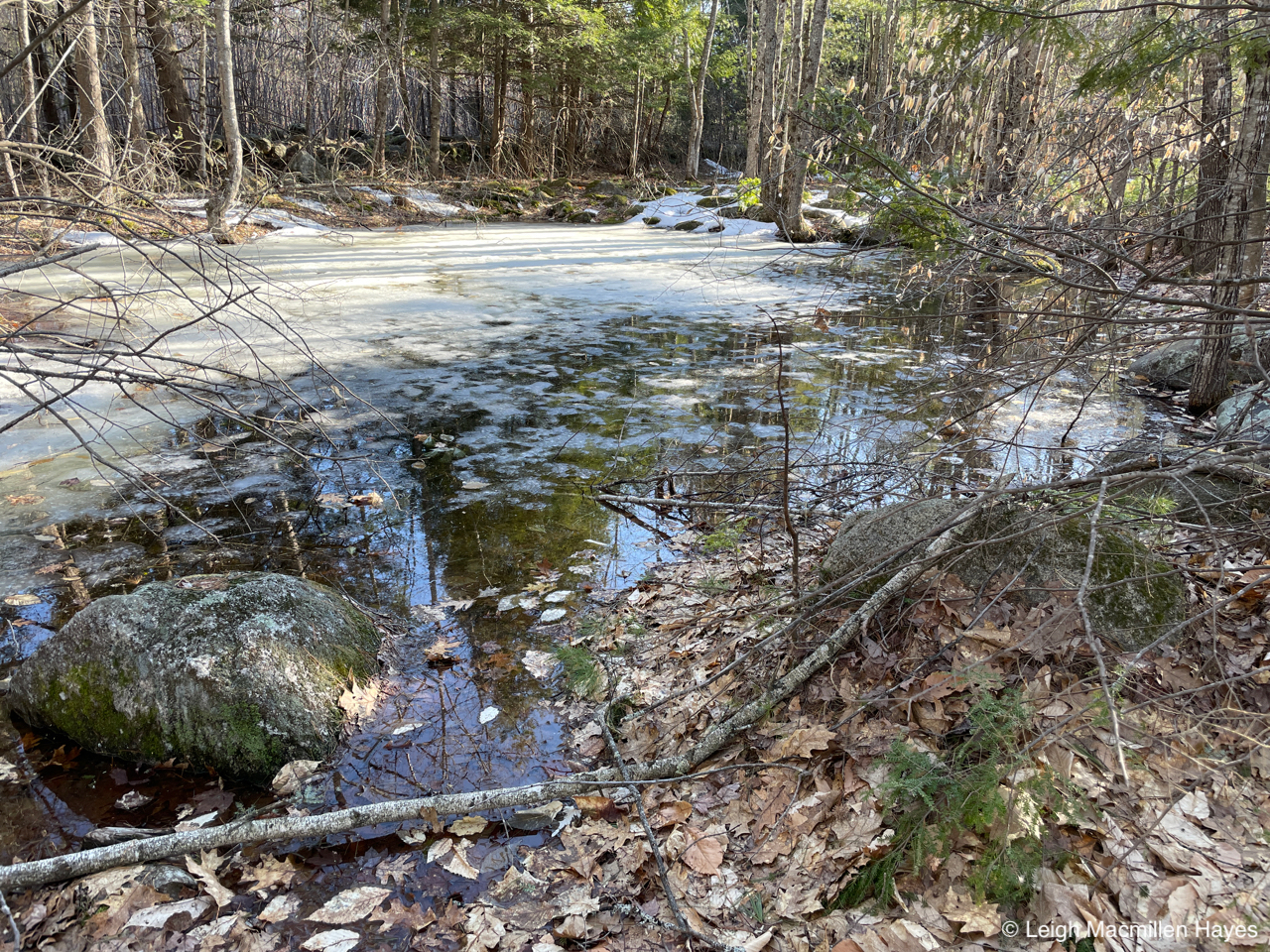
Not so this year. It’s been a wet spring and now a wet summer and that, my friends, is fantastic if you are a Wood Frog or Spotted Salamander. For the first time in my 30+ years of visiting this pool, there is still plenty of water in it.

It is my understanding that if a pool dries out too fast, the frogs and salamanders sense this and some metamorph into their adult upland forms quickly in order that they may hop or crawl out and be representatives of the next generation. I have to believe that is true since despite the pool usually not lasting long, come April 7 or 8 or 9, when the ice “goes out,” the love songs begin and eggs are fertilized and laid.

This year, however, the frogs have been given the opportunity to slow the process down and perhaps that will make them stronger, as well as increase the numbers that leave the pool.
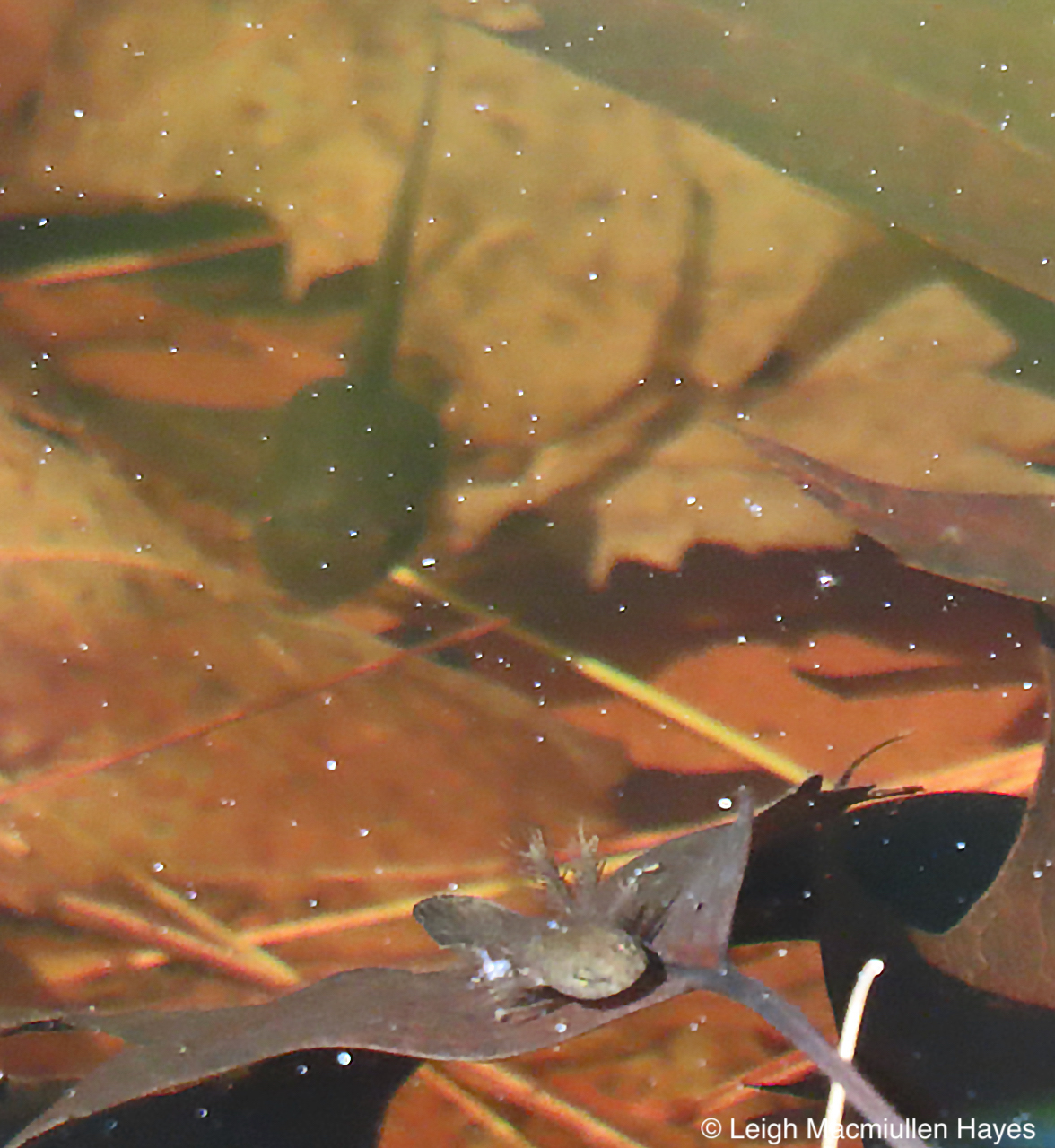
It’s not just the frogs, but the salamander population might also be on the rise.

So here’s the other thing. Walking to and fro the pool offers numerous other distractions of the natural sort, like this rather handsome White Admiral Butterfly.
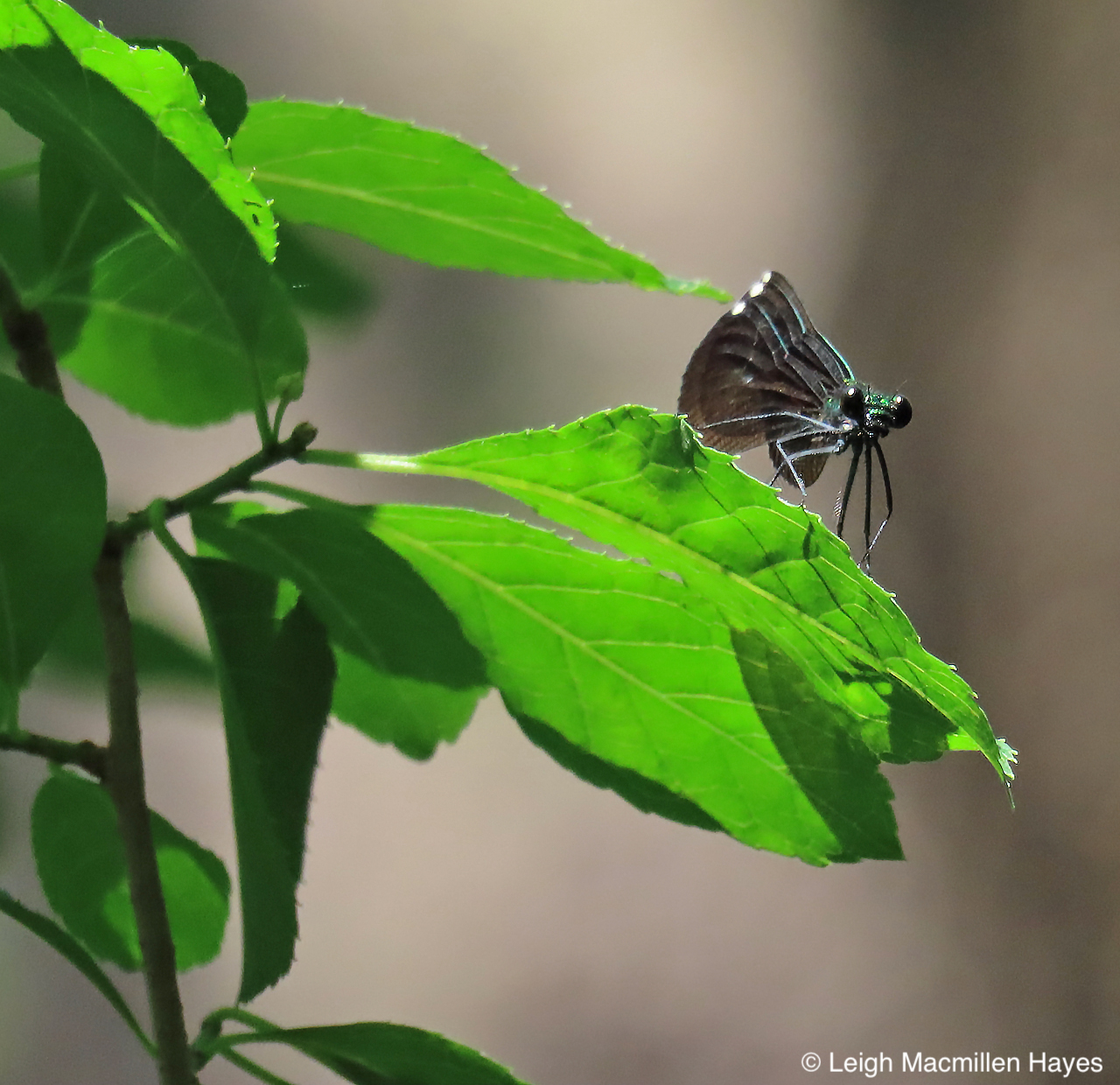
And a female Ebony Jewelwing Damselfly, the white stigmas or marks on her wings providing a hint of her gender.

But then there was the day that I heard baby peeps as I headed out there and suspected I knew the species to whom they belonged because they’ve nested in our yard before.

Crossing through a gap in the stonewall, I found the tree and Momma Yellow-bellied Sapsucker gave a hint as to the location. At first, however, I couldn’t find the hole where the babes waited for meals on wings to arrive.
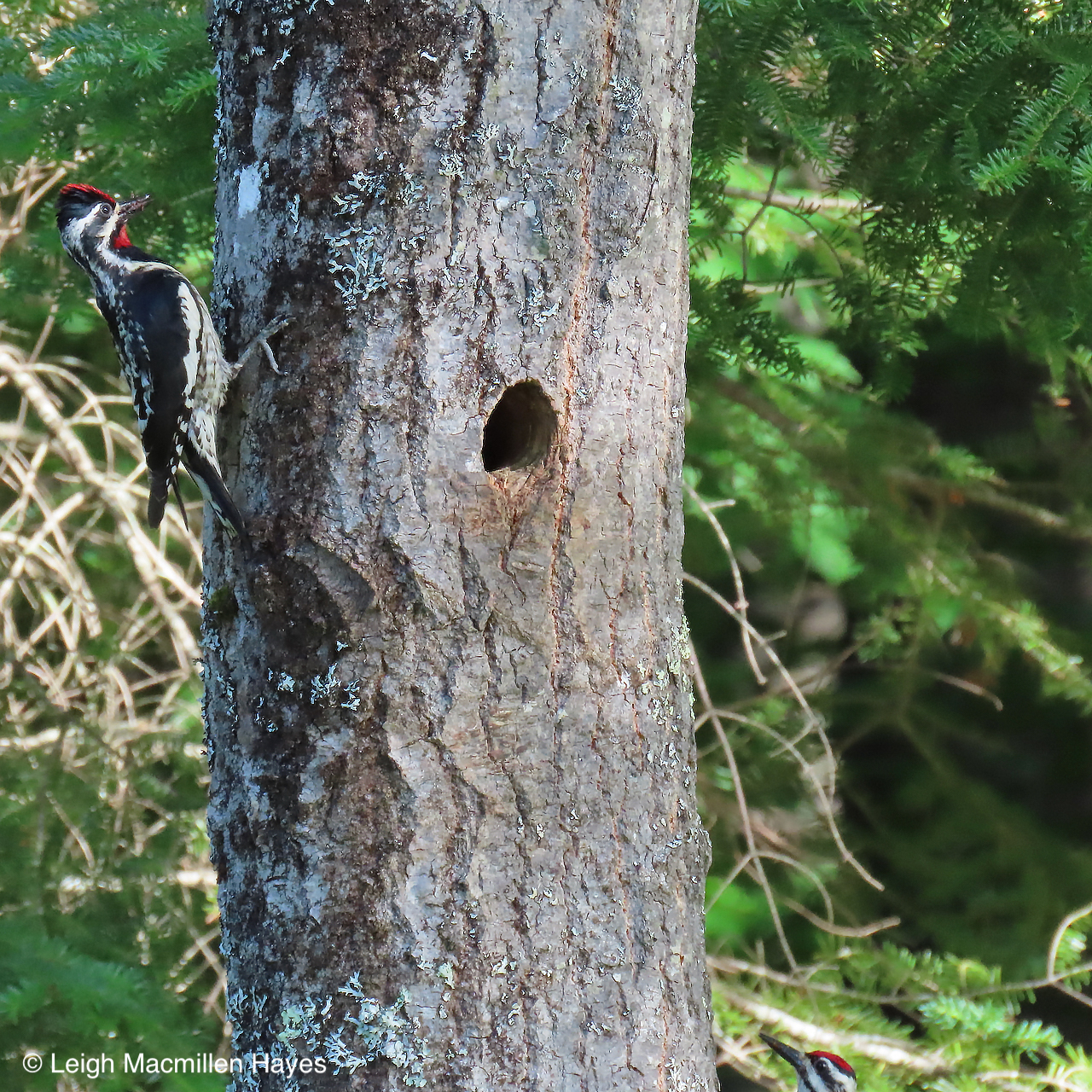
Until I did because I passed back through the gap in the stonewall and went to the oak tree located in the far corner of the yard beside our woodlot and there they were: Papa on the right, Momma below, and the hole in between. These were two extremely attentive parents.
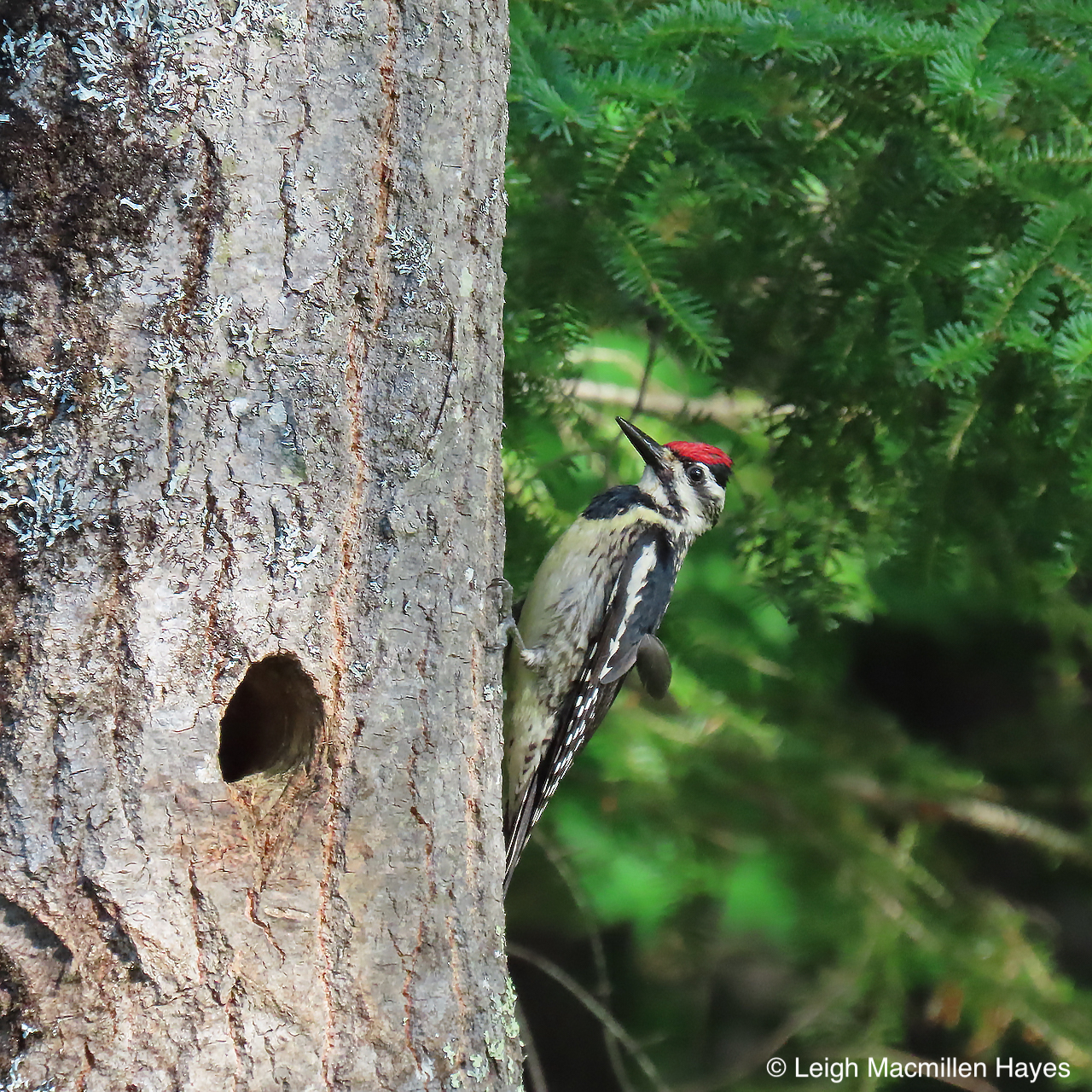
Momma would fly in rather silently and surprise me as I stood behind another tree about ten feet away. But the kids always seemed to sense the arrival of a parent and their peeps would rise in a crescendo and I’d look up and there she or he would be.
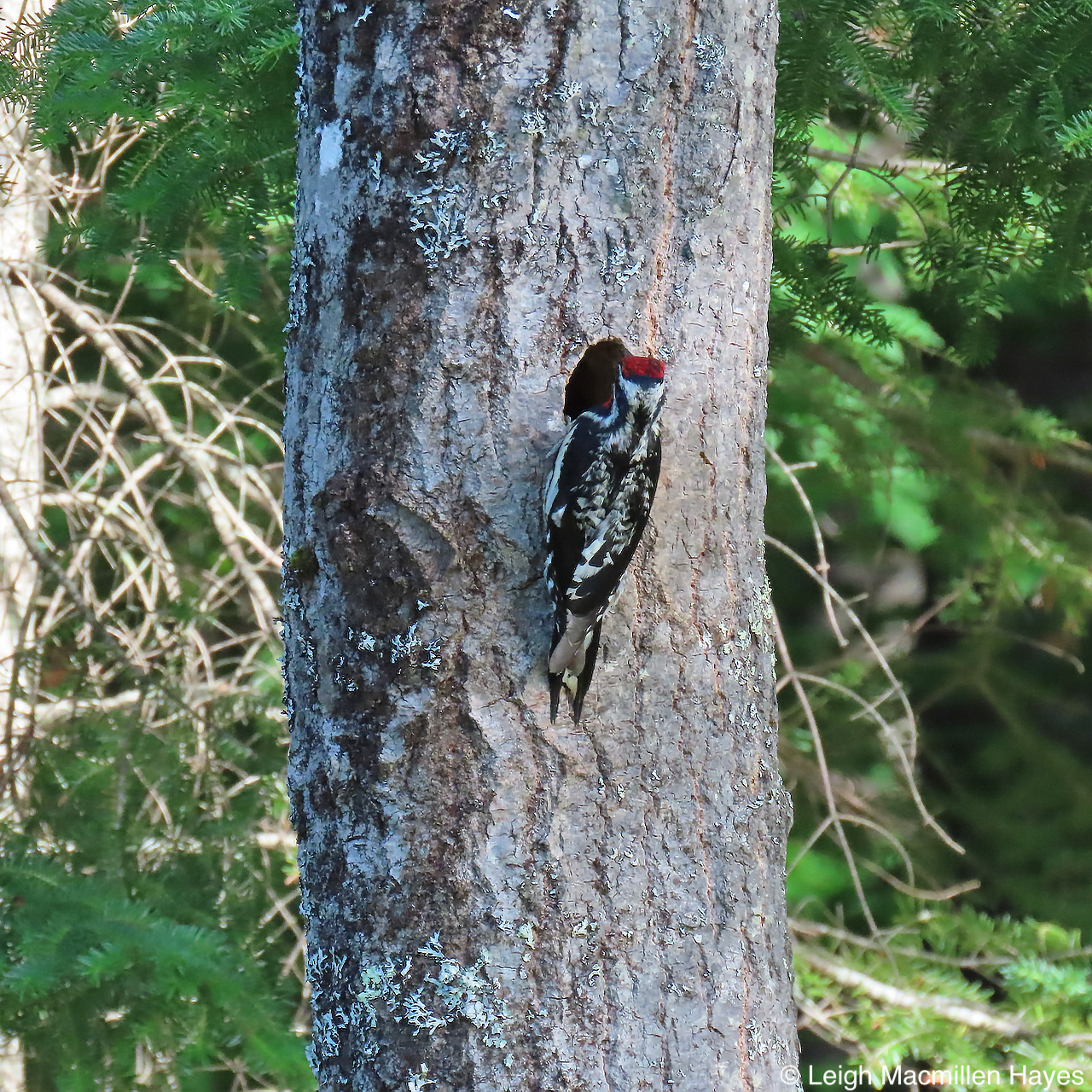
And then it was a matter of delivering the meal. To the hole the adult would move in its woodpecker manner.

And into the hole its head would duck, presumably delivering an insect of choice either into a beak or two or three or at least into the nest for the kids to fight over.

Right after the delivery was made, the insistent peeping would begin again. “More, more. We want more food,” the chicks seemed to proclaim.

And the parents delivered before flying off to find the next morsel to nourish their young.
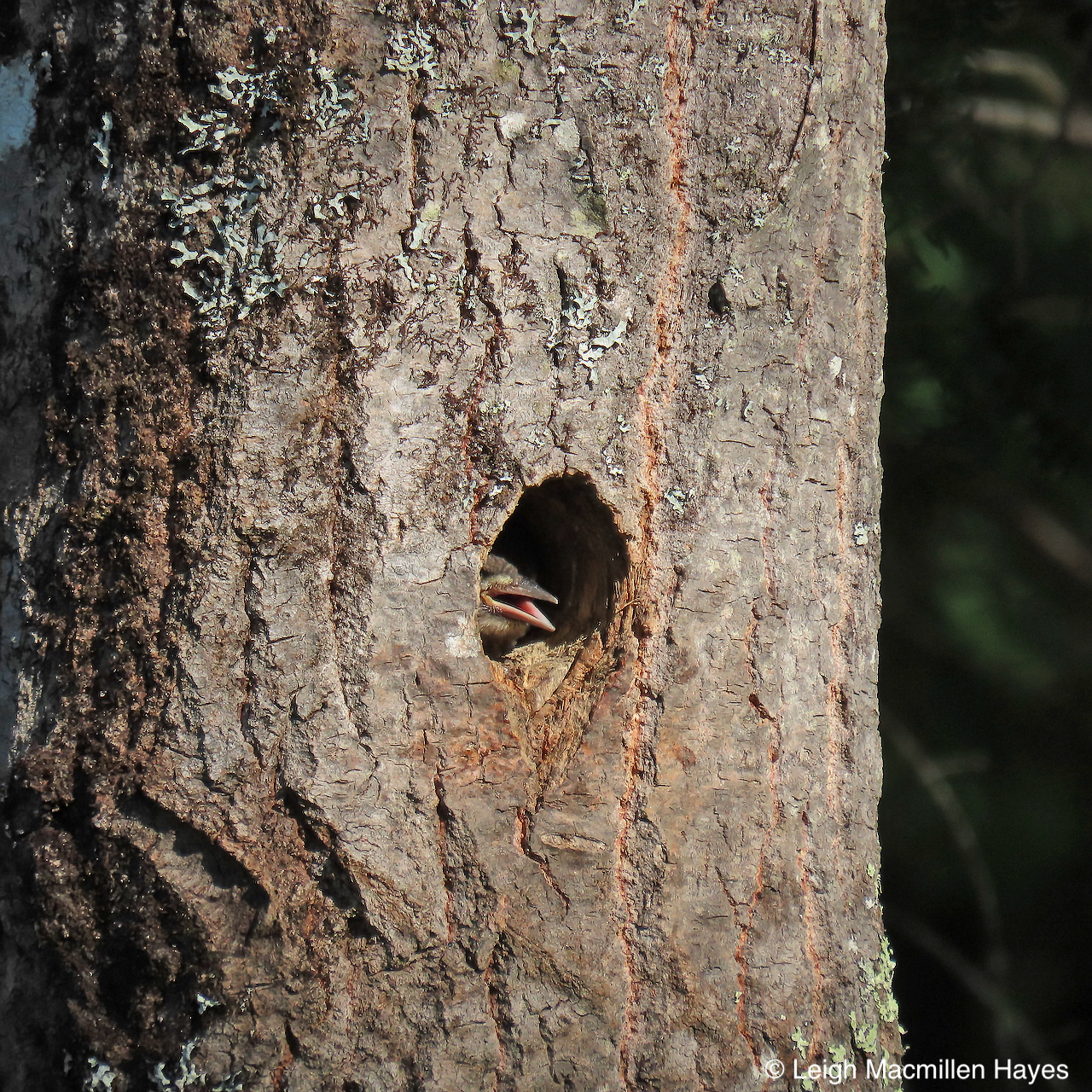
Still they did peep and occasionally showed their heads in the process.

By the end of the week that I spent watching, this youngster stuck its head out and made that insistent cry. Its parents disappeared for longer periods of time, which I’ve noted in the past and it makes me wonder if they have to go farther afield to find food, or if they want the kids to understand that instant satisfaction isn’t always the name of the game. Within a day or two and when I wasn’t looking, the chicks fledged and now I hear them learning the art of tapping to mark their territories.

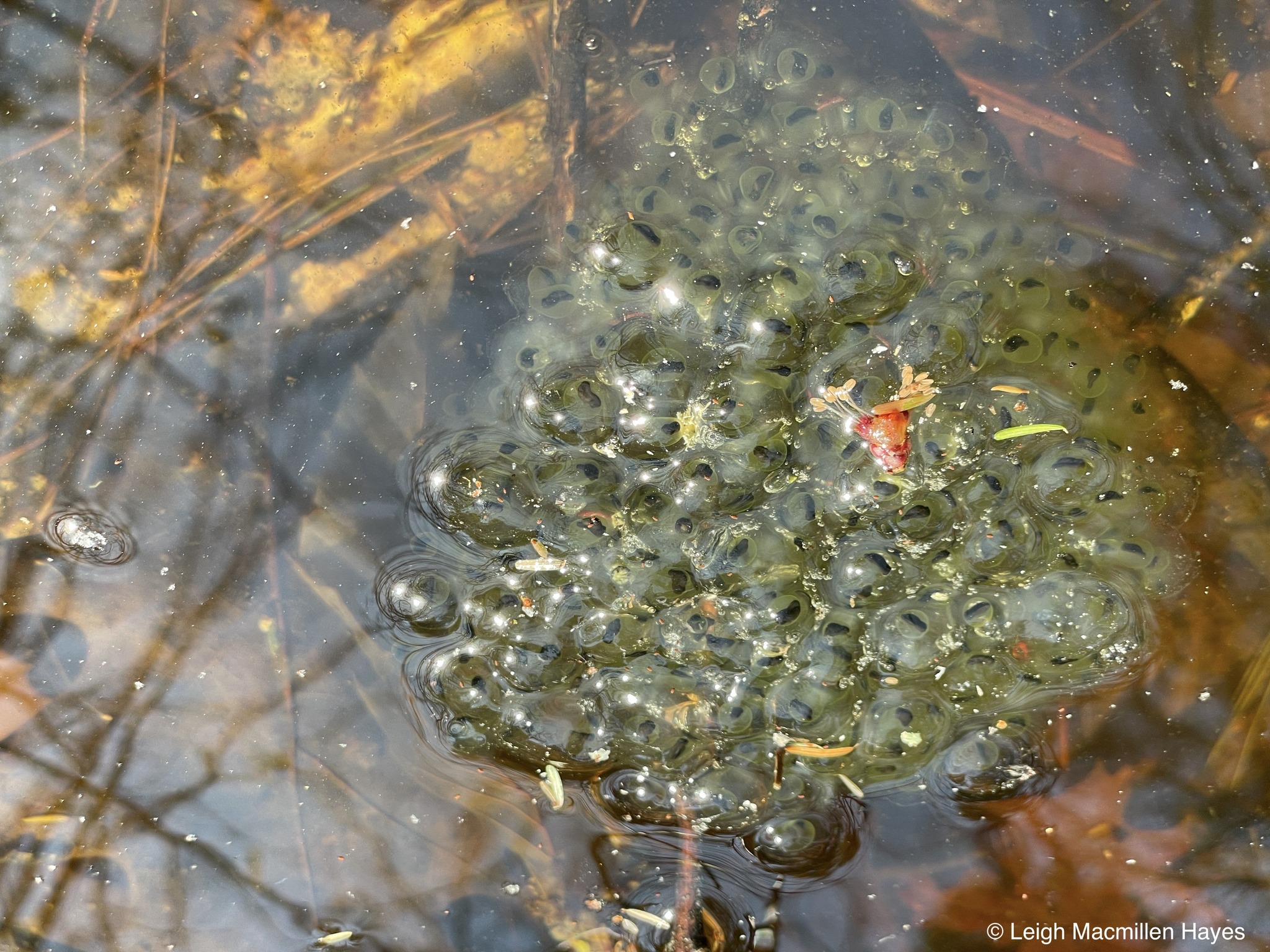
Oh, but wait, this is the tale of a vernal pool. And there too, there were changes like I’ve never seen before in this one. For one thing, the water teemed with activity.
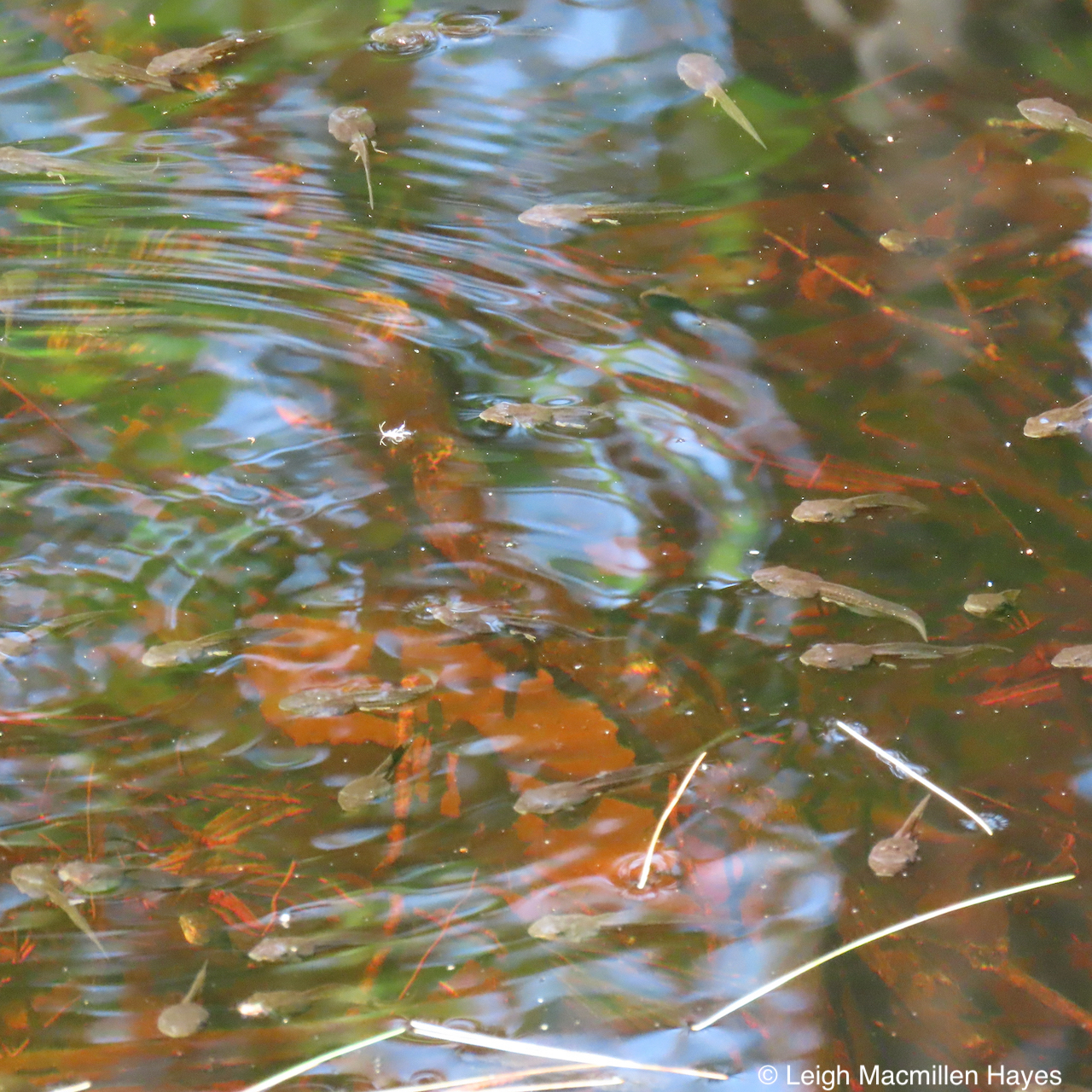
Up for air they’d come and then dodge down again, leaving ripples in their wake.

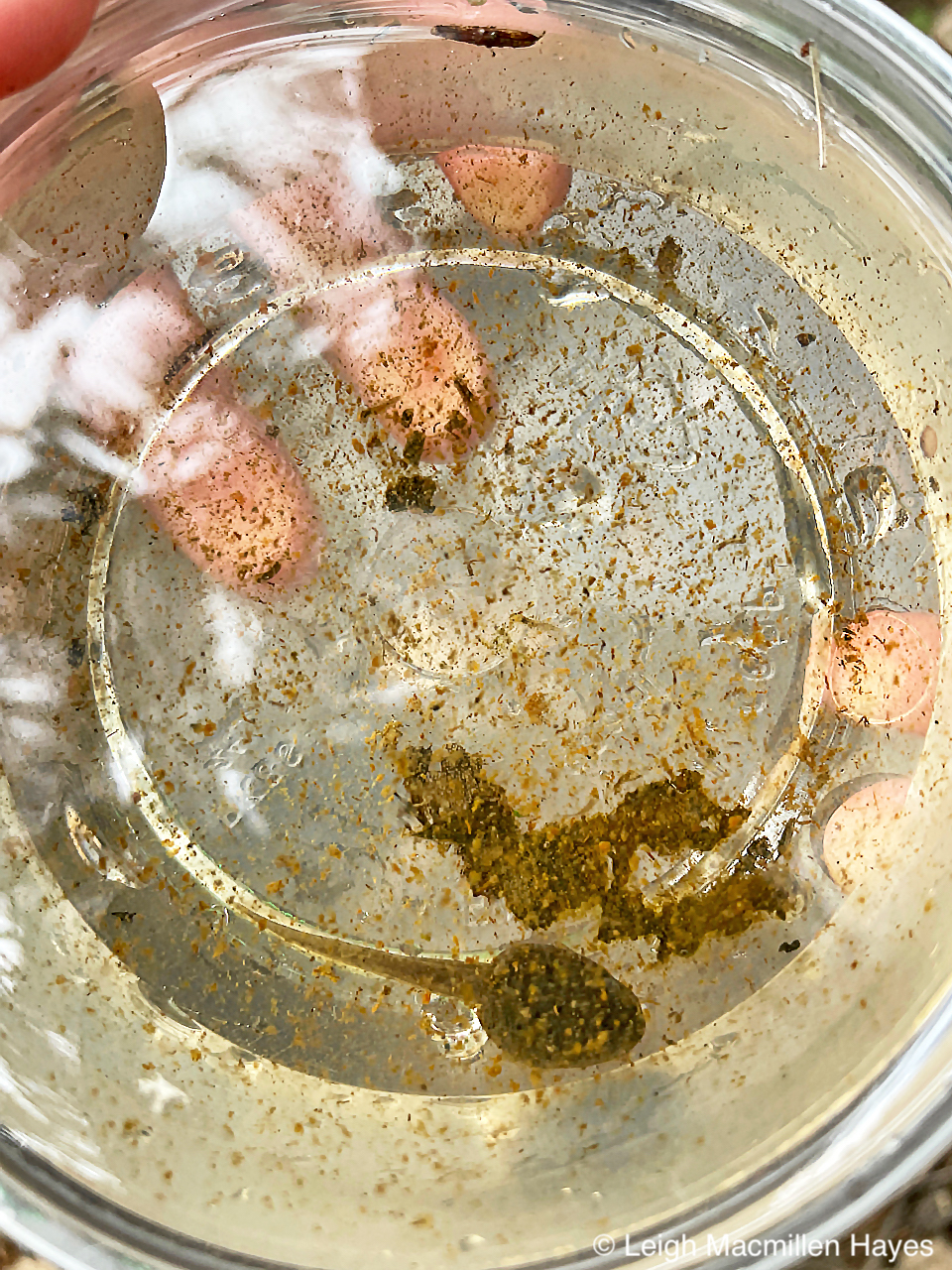
But . . . do you see what I saw during today’s visit? Legs! My frogs are growing legs. I’m so excited for them. I have to be as, unlike the Yellow-bellied Sapsucker chicks, they don’t have parents watching over them, feeding them, and teaching them froggy ways of living.
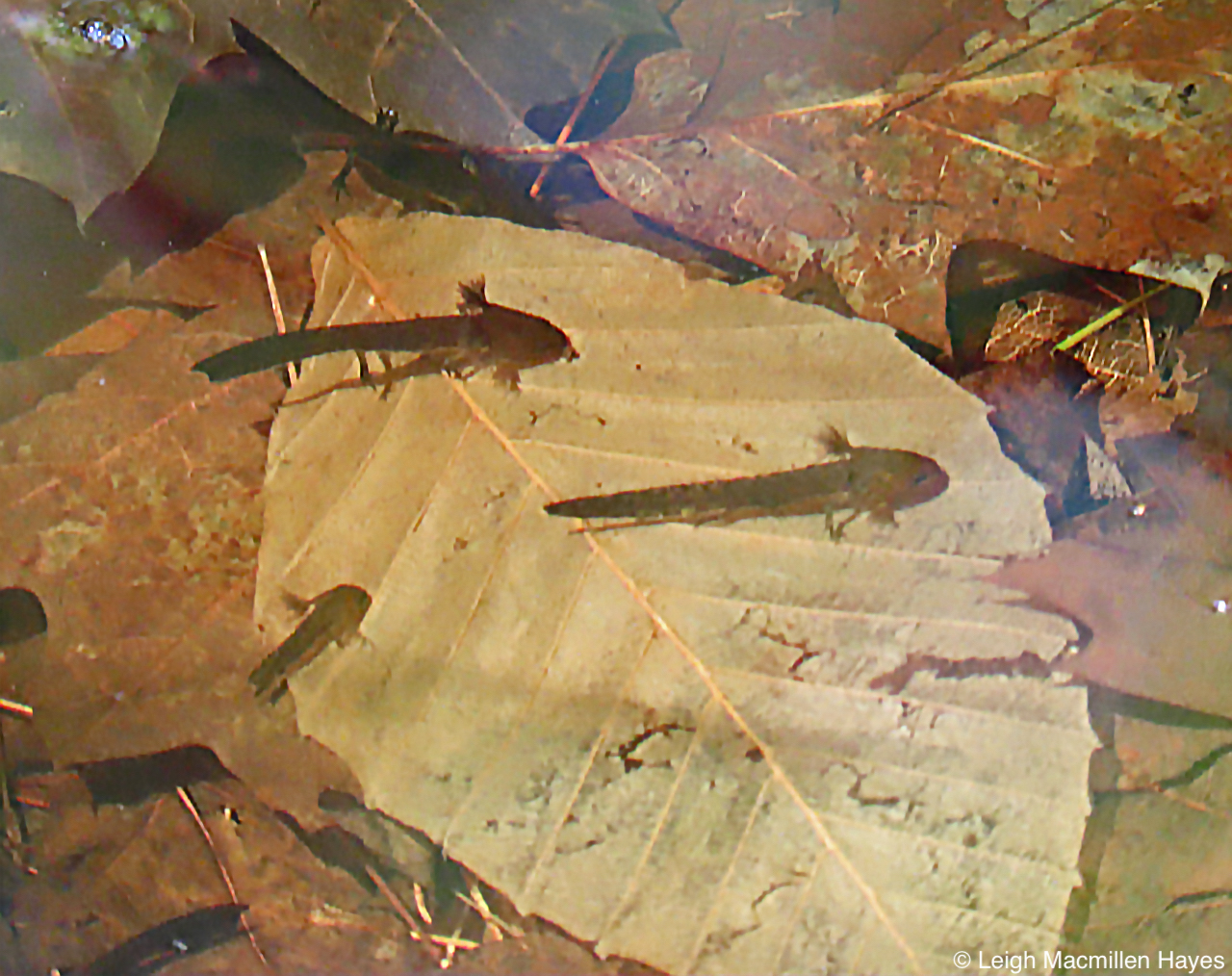
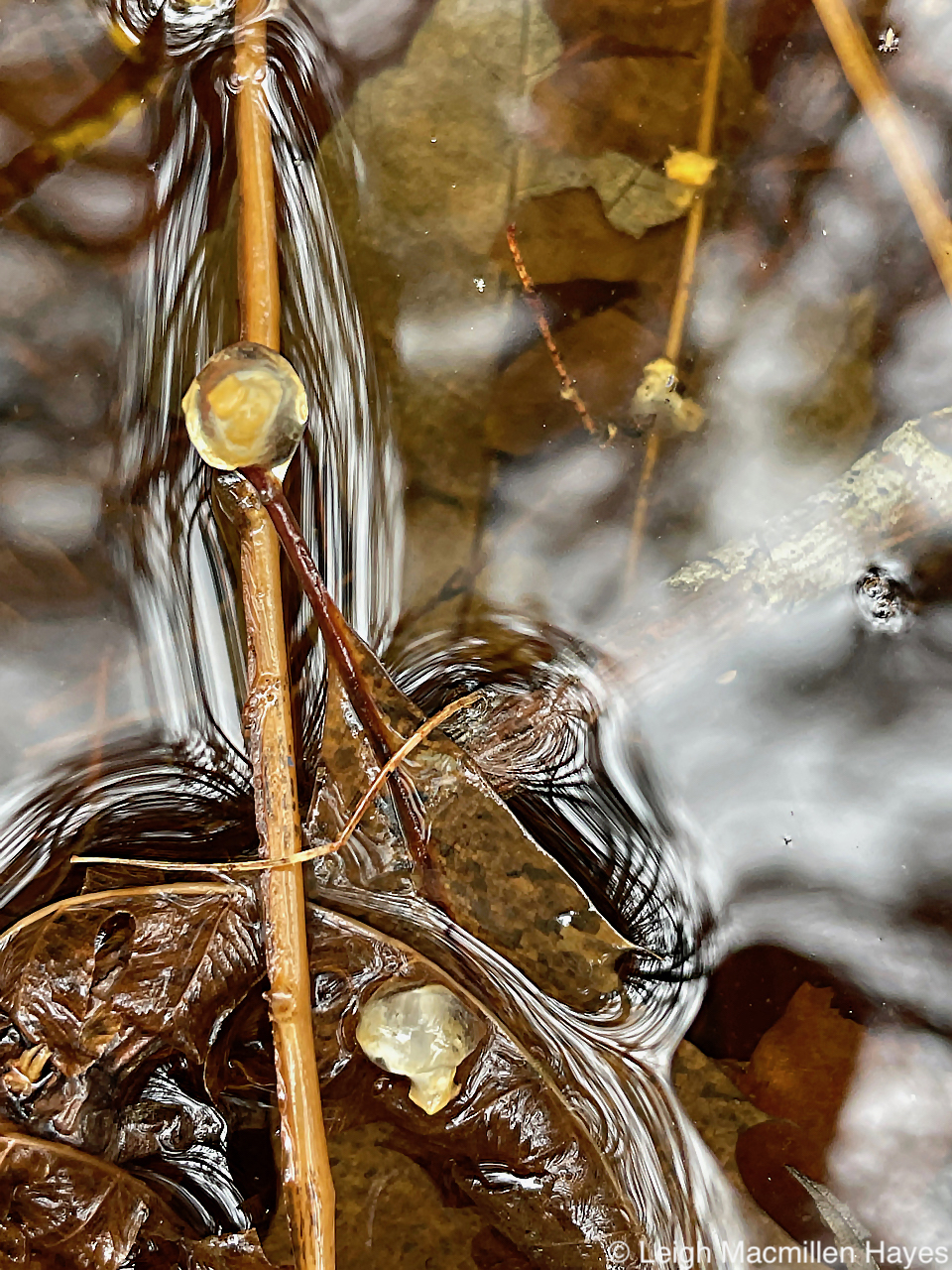
The same is true for the Spotted Salamanders who are breathing through those feather gills behind their heads for as long as they are aquatic in nature.

It was on my way home this afternoon when something else moved in the woods not far from my labyrinth and I thought at first it was a bird.

Until it too morphed . . . into a fawn licking its chops. And then I recalled that on the way to the vernal pool, I’d startled a doe in about that same spot and she’d leaped away and in the last few weeks I’ve seen the doe visit a spot in the field over another stonewall and I’ve stood on a kitchen chair with my binoculars trying to see if she might have a fawn. Apparently she did. I am tickled except for the fact that they are eating flower buds in my pollinator gardens.
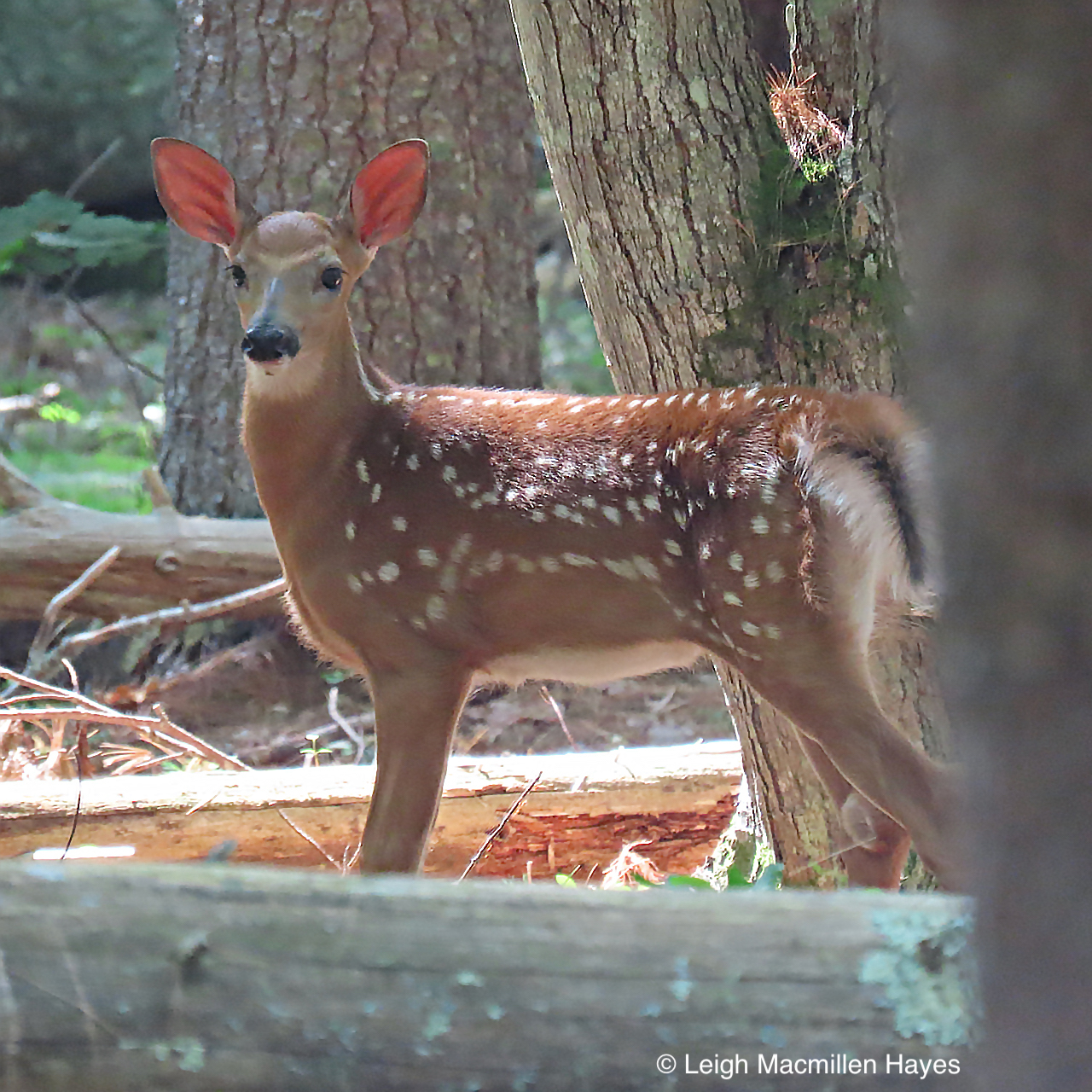
That face. Those ears. And spots galore. How can I not share the buds with this rather chunky youth?
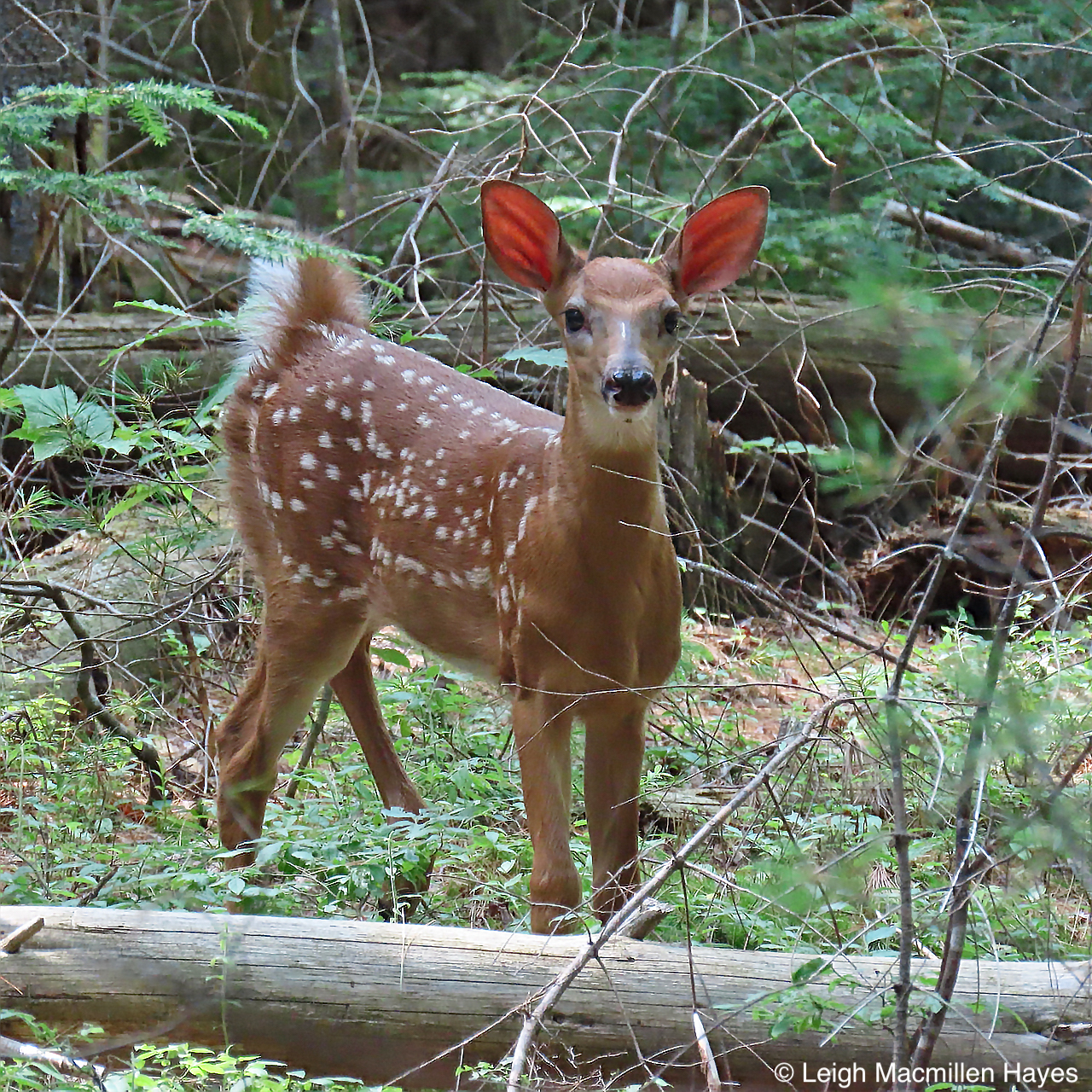
We spent about ten minutes together, each curious about the other, until it occurred to me that again, like the Sapsucker chicks, its parent was probably nearby and waiting for me to move on.
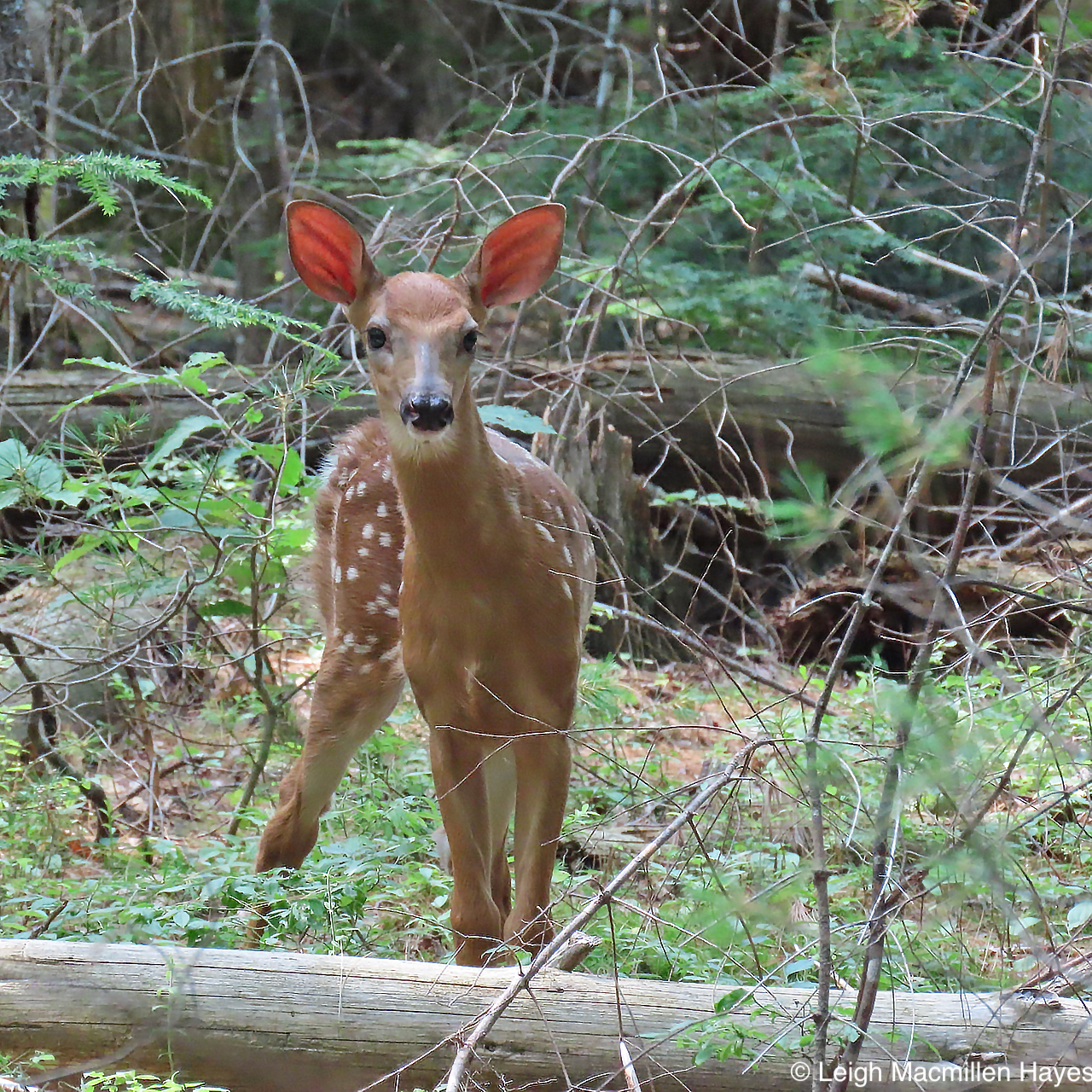
And so I did.

Still, I can’t stop smiling because something is always happening and it’s right outside my backdoor when I take the time to listen and notice.

Lake Living Summer Issue 2023

With twists and turns along the way, somehow we once again pulled off a summer issue of Lake Living magazine.

This one is super cool because not only are all the articles written by women, but they each feature women. And one was actually written by a high school student; while another is about an fabulous twenties-something naturalist who is also an artist. I wrote an article about the middle school class I have the pleasure of working with each week during the school year. And another about Maine women who support an incredible group of women in Zambia. There’s another about The Summer Camp, a camp for girls from Maine and beyond who are at-risk (and an organization I worked for years ago). Plus, there’s one about mushrooms, because as most of us know, mushrooms are most intriguing. The issue also includes everyone’s favorites: The Summer Bookshelf list of recommendations by the owners and staff of Bridgton Books.

I hope you’ll take some time to savor this issue. And I hope this link works as intended because we don’t have it on the Lake Living website yet and that may take a bit.

Read it here: Lake Living Summer 2023

Beauty and the Brawn: Two Kingdoms

It's a mix of both realms in the natural world;
a kingdom of beauty and a kingdom of brawn; 
and sometimes a kingdom that includes both, 
in such a way that it's all about one's perspective. 
Beauty fluttered in one recent day,
Upon hairy wings of orange and gray. 
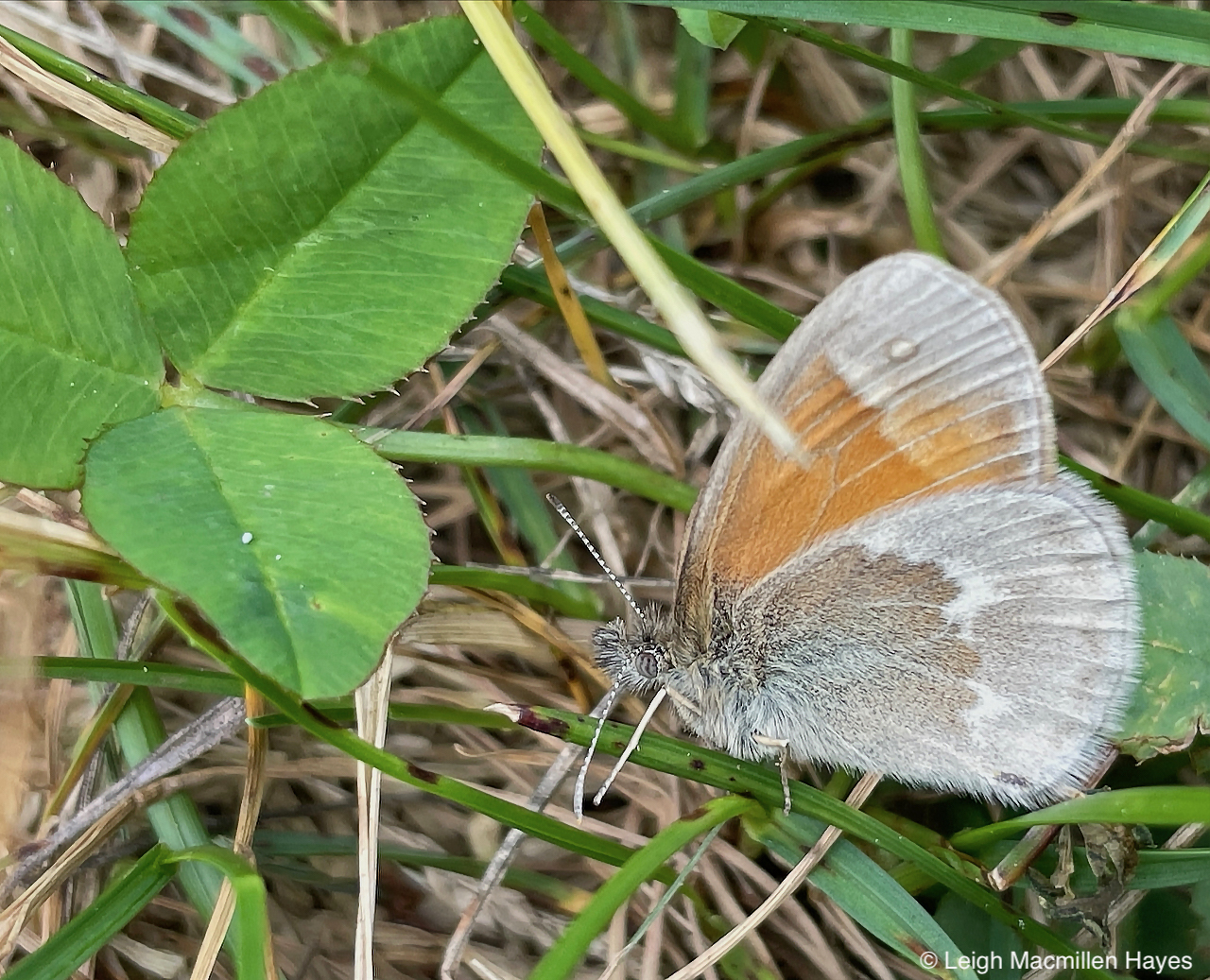
The Inornate Ringlet Butterfly
May have lacked adornment, 
But its textures and lines and colors
From the zebra-striped antennae 
To fringed wings gave pause
In its teeny exquisite way. 
On a much larger scale, 
Upon a clover posed, 
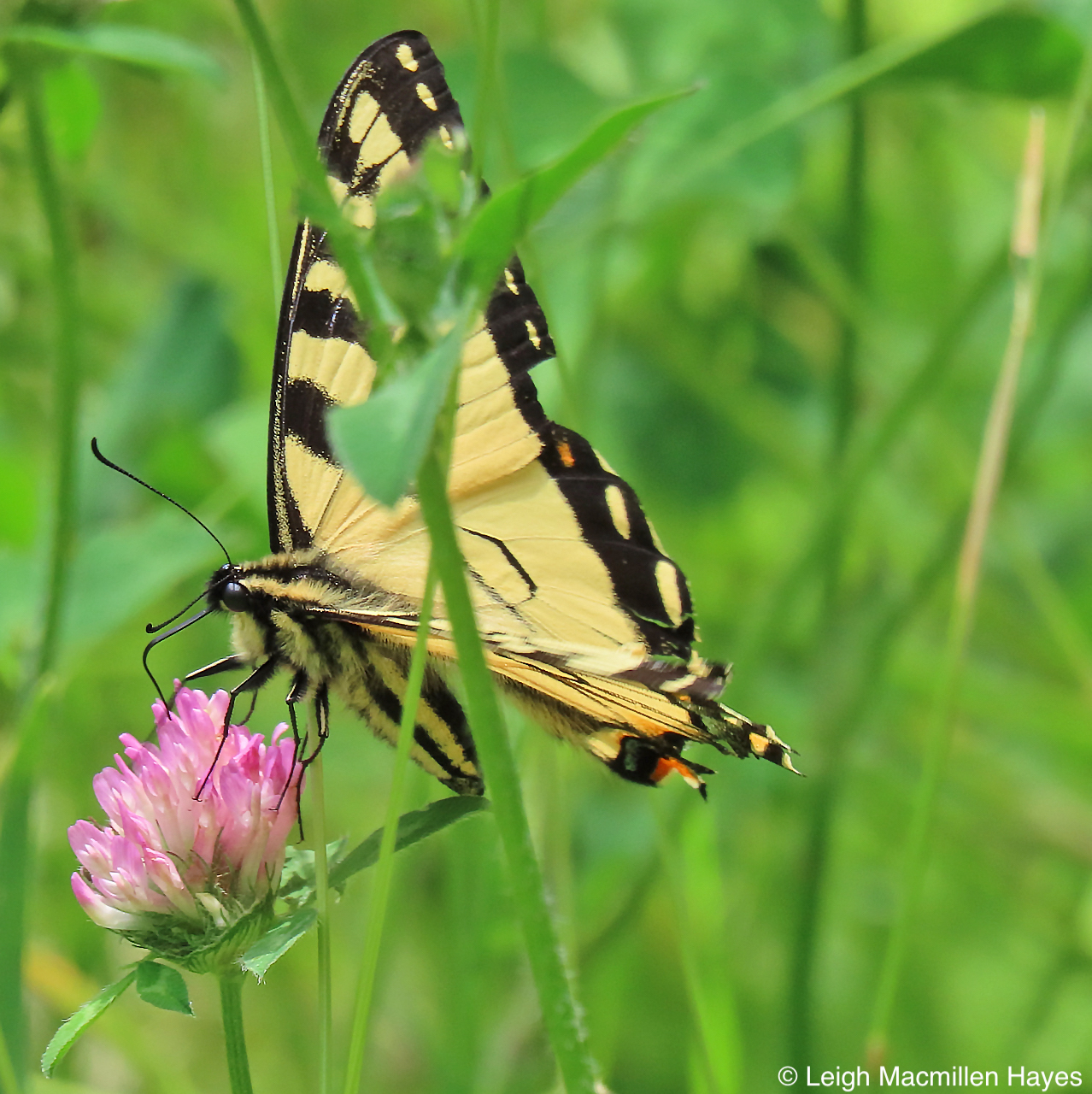
A Tiger Swallowtail seeking sugary nectar
For a quick dash of energy 
As sucked through its extended proboscis. 
While the nectar provides nutrition,
It's not enough for that which is 
Utmost upon the butterfly's mind, 
If it is a mind they have, 
Or perhaps pure instinct
That urges them to reproduce. 
A stronger drink is indeed necessary.
The White Admirals
Embraced the same "thought" 
As they congregated 
On a small pile of scat. 
Mud. fermenting fruit, and carrion
Provide the same, 
That stronger drink
A source of sodium and minerals
That males store in their sperm
And pass on as a betrothal gift 
When they canoodle with loved ones, 
Ensuring that a little extra zing
Gives her eggs a better chance of success. 
Canoodling is also
At the forefront of 
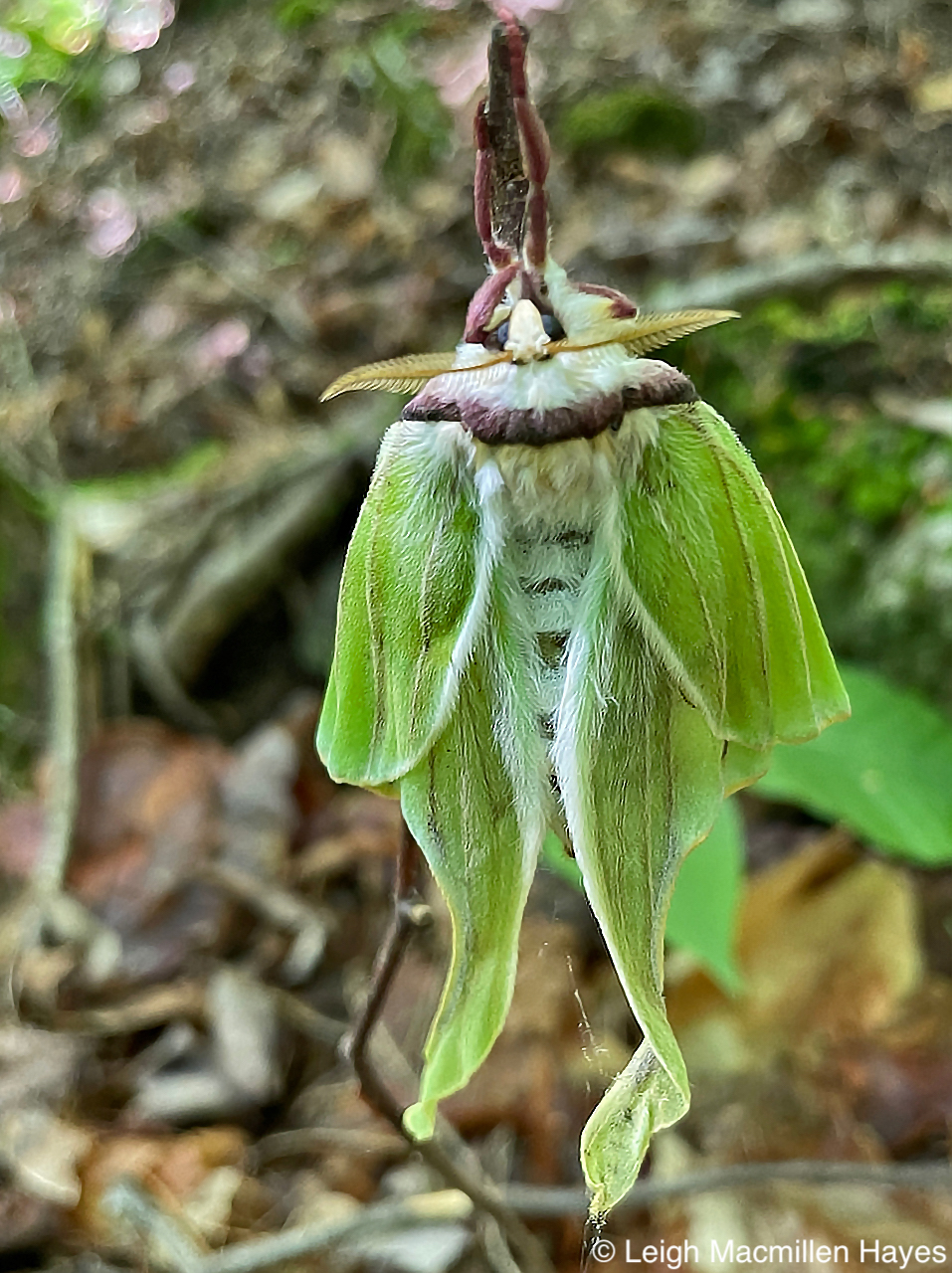
The Luna Moth's adult form,
So much so, 
That it has no mouthparts 
Or digestive system
Despite its large body. 
With less than a week to mate,
This large silkworm moth
Must smell the pheromones 
Of a female counterpart,
and then . . . and then, 
Death doth come 
As is visible by this find. 
But still it provides an opportunity
To note those broad feathery antennae, 
The light green wings that match the color of leaves, 
And the reddish-brown forewing edges 
Branching out like twigs
In an attempt to avoid predators.
Another nectar feeder, 
The Clearwing Hummingbird Moth,
Hovers with its body stationary
As its transparent wings beat
In such a quick manner 
That they are nearly invisible. 
Unlike most moths, 
These take to the air 
Throughout the day. 
The subject matter transitions
From butterflies and moths 
To others such as a female Metallic Green Sweat Bee,
So named for her color 
And preference for seeking salts upon our skin.
Thankfully, unlike some bees, 
She isn't aggressive.
Rather, she's a buzz pollinator,
One who grabs the anther 
Of a flower with her mandibles, 
Curls her abdomen around it,
Vibrates her wing muscles, 
And relishes with glory 
As the anther releases its pollen, 
Which she gathers
Upon her hairy hind legs.
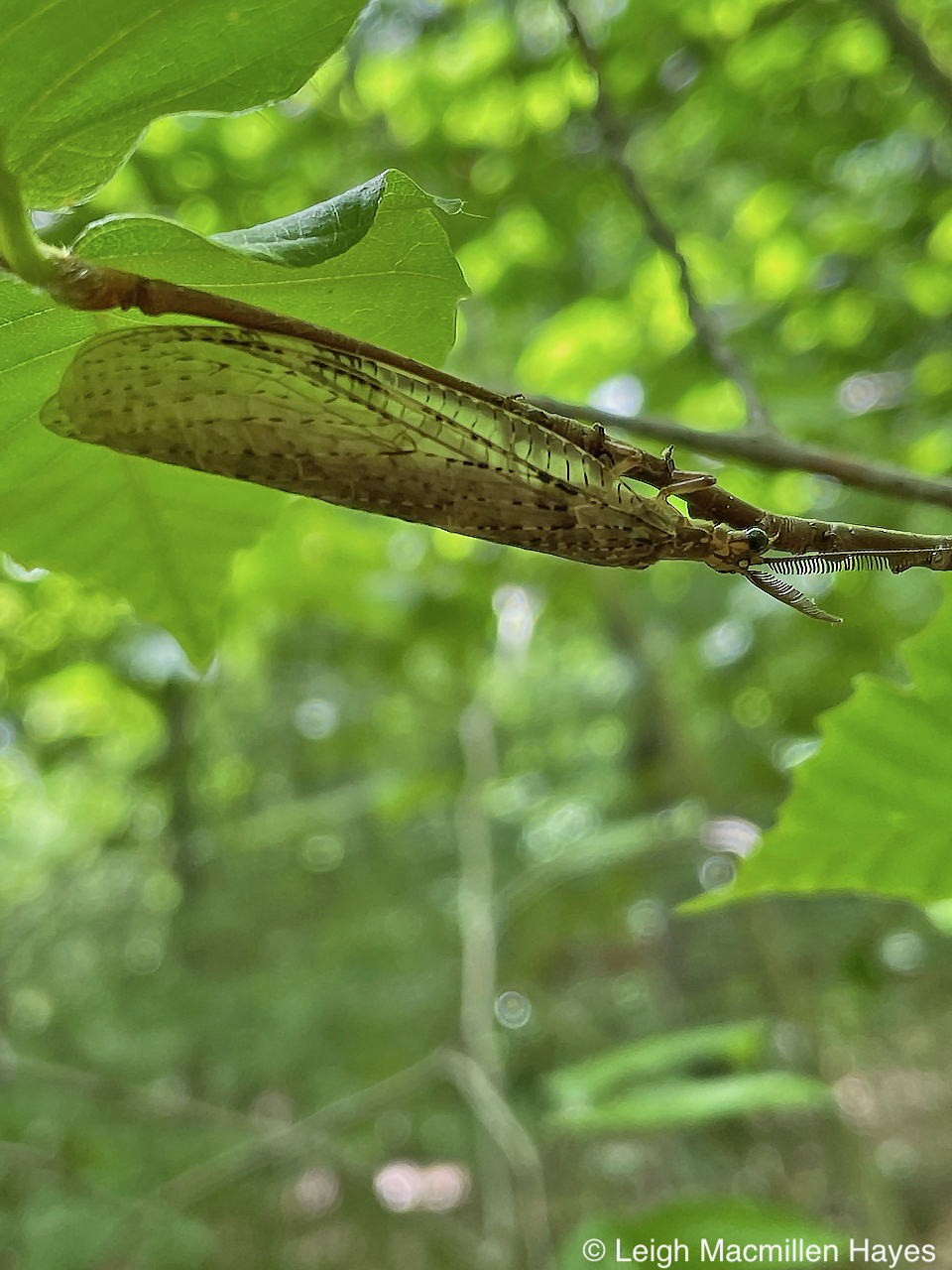
A Spring Fishfly 
I accidentally agreed was a Lacewing
In the field, 
Rests upon a twig 
As is its daytime habit, 
Wings pleated and folder 
Over its shorter abdomen. 
Like the Luna Moth, 
It only lives a few days as an adult. 
The feathery antennae 
Identify it as a male,
One with a twinkle in its eyes. 
Though kind of creepy in nature, 
The Woolly Alder Aphids 
Lead an interesting life. 
Eggs are laid upon Silver Maples, 
And as leaves burst in spring, 
Feeding takes place along the midribs. 
A winged generation soon follows,
Taking advantage that it looks like airborne seeds, 
As it floats through the airways
Until it reaches a Speckled Alder. 
Each little insect is coated 
With waxy streamers that shed water. 
As they imbibe on the Alder's juices
In an effort to gather sufficient nitrogen, 
They release unwanted carbs
In the form of honeydew,
And ants kick into action,
Farming the aphids 
To take advantage 
Of the sweet secretion. 
All is not pretty
In the natural world
Where though some 
Don't have a meal on their minds, 
Others must dine,
Such as this spider, 
That spent several hours
Wrapping a damselfly
For a future meal 
Upon an American Beech leaf. 
That was the first example of brawn, 
An exhibition of physical and muscular strength. 
In the case of the spider, 
I'm not sure I spotted an equal amount of beauty. 
But this Stream Cruiser, 
With its Oreo Cookie coloration
Was a sight to behold,
Despite the fact
That it beheld a meal of it own. 
And finally there was
The Dragonhunter, 
A clubtail dragonfly
Revered for its wide tail,
Large size,  
And bright colorations,
But feared for being 
The Monster of the Dragonfly World 
Due to its aerial ambush
Upon other dragonflies and anything else it can eat. 
It appears there is possible meal 
Dangling below the feet and wings of this one. 

It truly is a world of beauty,
but I recognize also 
that eating for the sake of reproduction
means that brawn is an important part of the mix
in this world of wonder. 

Two kingdoms indeed. 

Looking Through A New Lens

I have a new toy. While I’m still learning how to use it, I’m having the best time making discoveries. And trying to understand what I see. Actually, it’s two new toys. One that sees. And a second one that sees what the first one sees. Now that you either need to know more, or have already clicked out of this blog, let me explain.

It all begins with a Tiger Swallowtail butterfly, one of exquisite color and form. This is one I spotted recently.

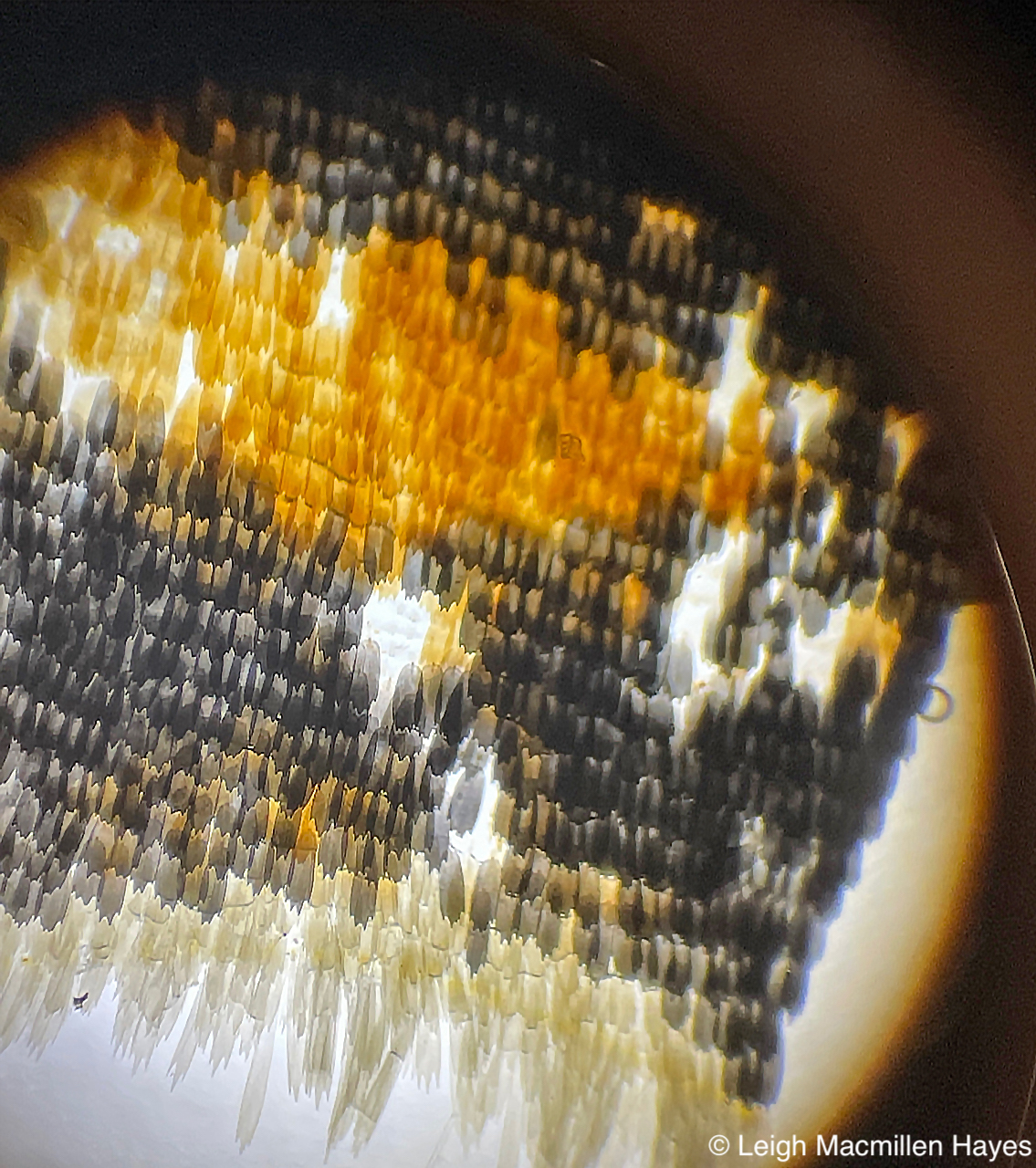
But one of my Pam friends, being Pam M., tells a story of finding a tattered one that still had some life and how she tended it for a few days and hoped it would fly, but alas, the other day she found it did not survive. So she did what good friends do and saved a piece of the wing for me to look at under my new microscope. Check out each of those scales, which put together form the color pattern we see.

The wings consist of thousands of tiny scales that overlap. If you were to touch the wings of a butterfly, and I don’t encourage that unless it is dead, it might feel like you have powder on your hands. That powder is actually the scales, so if handling a butterfly, you may be removing some of these delicate forms that together make up the mosaic which becomes the color pattern we recognize.

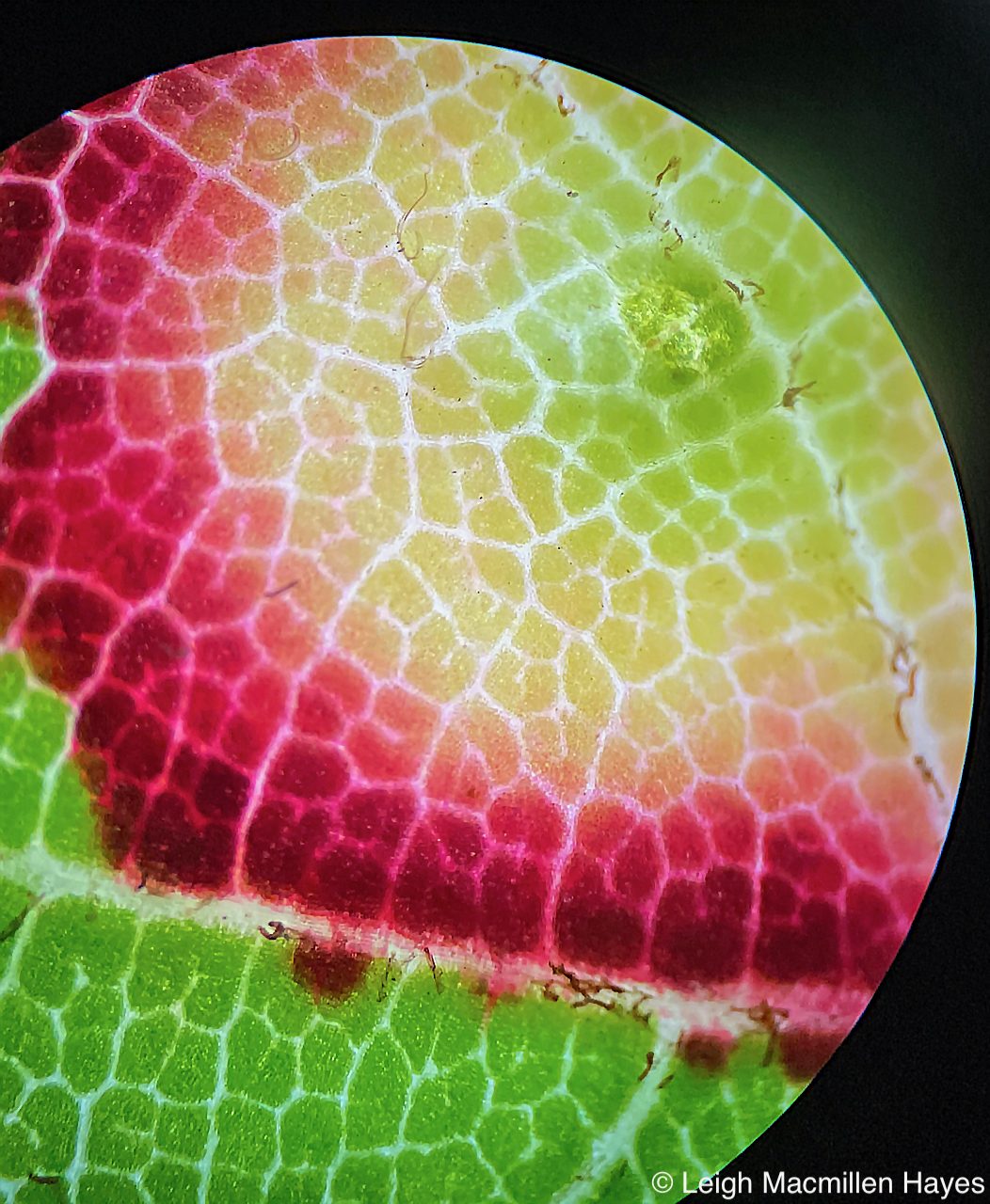
Our next look is at a leaf I gathered last week while tramping with some friends. I regret that I didn’t take a photo immediately. Instead, the leaf spent a week in a bag in my truck and when I took it out yesterday, the bag was full of insect frass. This is an upper view of the leaf.

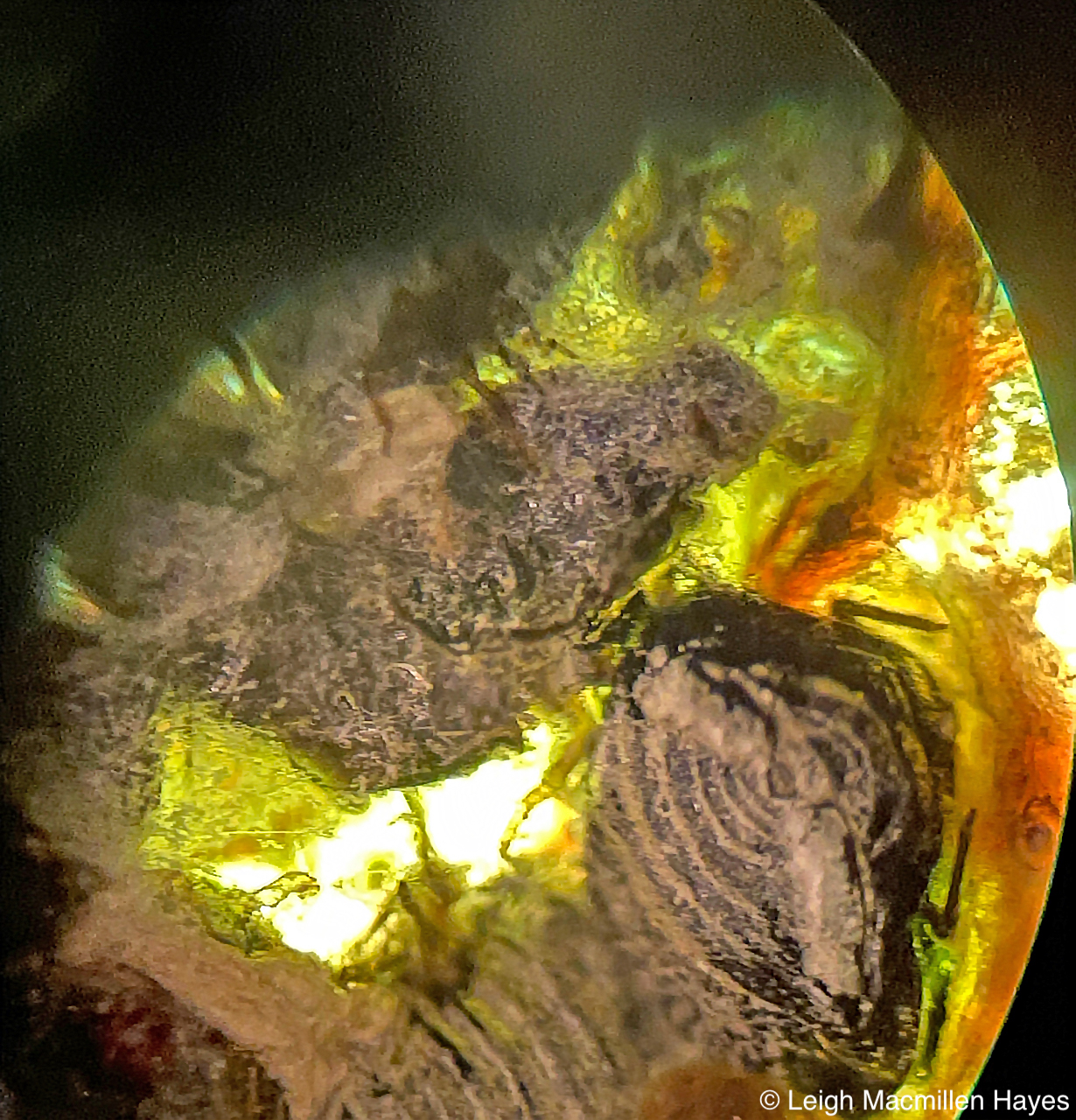
And this is the underside. When we spotted it last week, we all used our loupes to take a closer look and what we saw intrigued us, but we didn’t quite understand what we were seeing. Where the leaf is brown-gray on the left-hand side and a bit deformed, there was a series of structures all in a row. They seemed to be a bit raised. Sad to say I cannot share that image with you because I did not take it.

But . . .

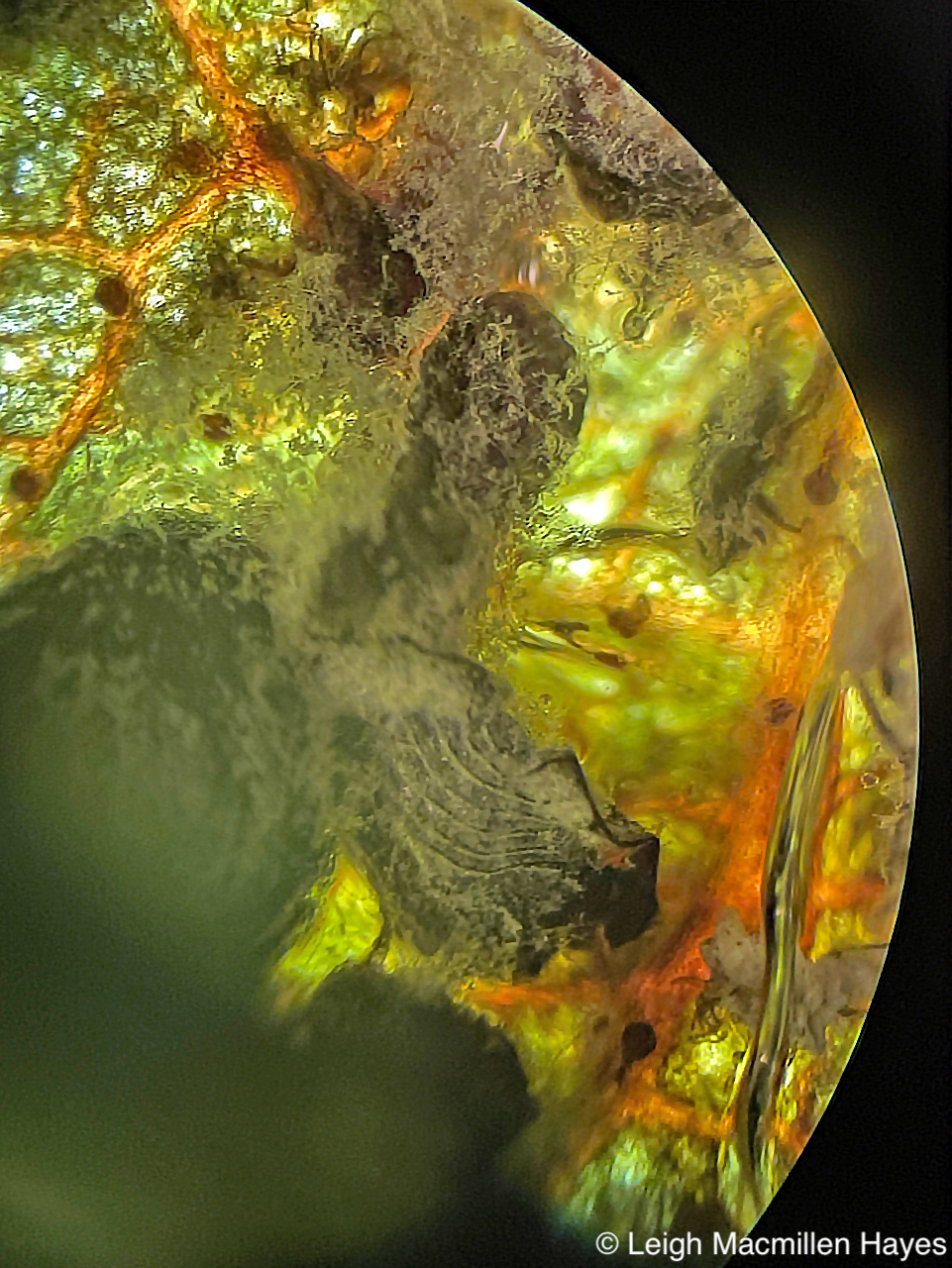
When I looked through the microscope, these critters appeared. they are minute, and some sort of leaf eater.

As best I can describe it, you are looking at several insects, some frass (think mammal scat or bird poop), leaf veins and tissue and colors that don’t appear to the naked eye.

I’m not the best with using the second toy I mentioned earlier, which is an adapter so I can take photos through the microscope with my phone, but at least I have something to work toward. And understanding all that I’m seeing will also take time. In the meantime, I’m just enjoying it for the sake of the different world it has opened up to me.

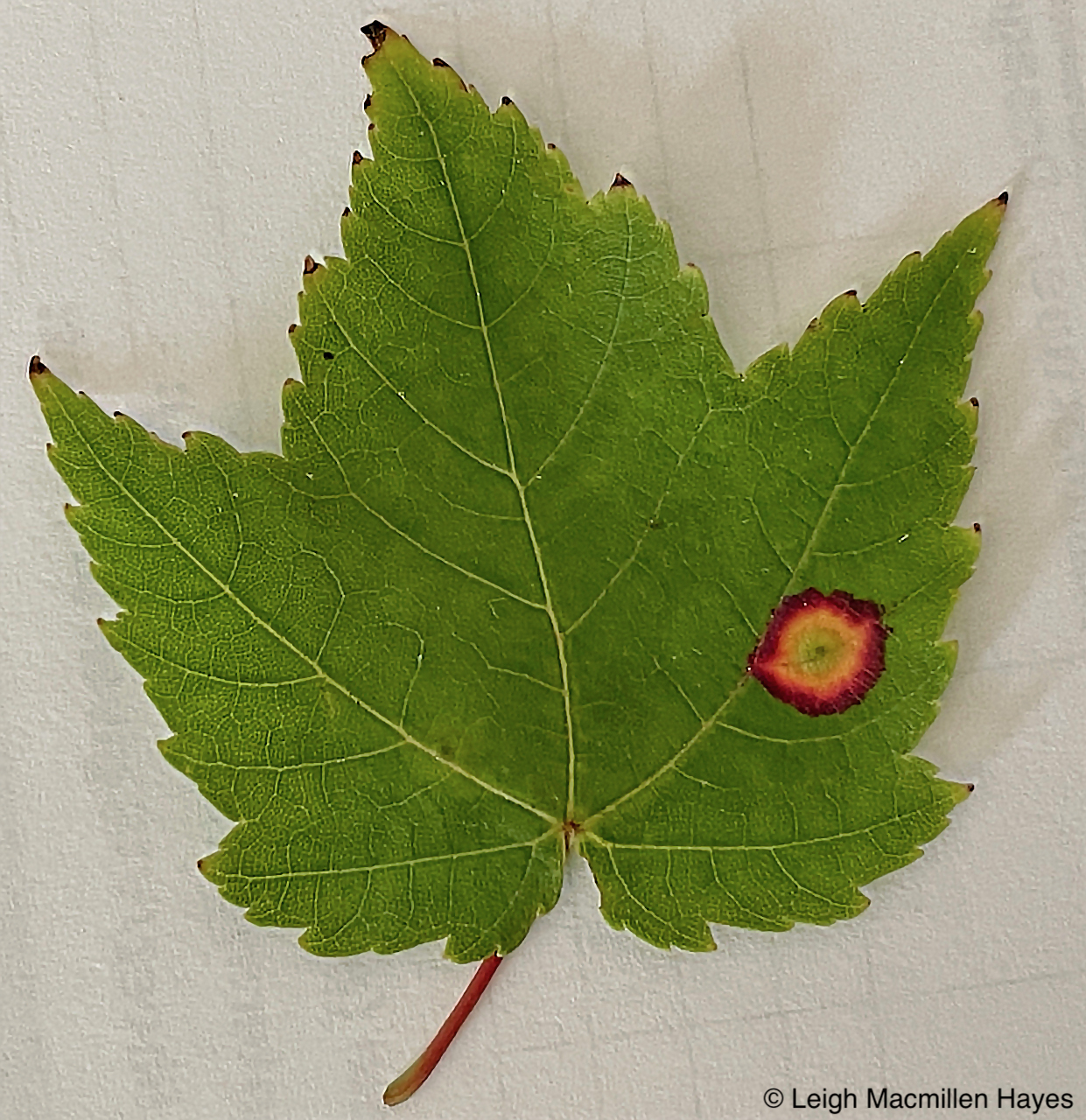
The final selection was found by a group of us today and it’s a Maple Eyespot Gall created by a Maple Eyespot Gall Midge (Ocellate Gall Midge). The curious thing about this fly midge is that larvae develop in leaves, but after about a week during which time the gall forms, the larva falls to the ground and burrows under the leaf litter to pupate.

This is a view of the top side of the leaf. I’m in awe not only of the colors of the gall, but of the intricate structure of the leaf as well. The midge larva had been in the upper right-hand corner until recently based on the vivid colors, which will fade with time.

Here is the underside, and that same area that had stored the midge, now visible toward the center, appears to be an open hole, meaning the larva had moved from tree to earth, but this also gives a sneak peek at the cellular structure of the leaf. A topic to explore more down the road.

That’s all for my first attempts at taking a closer look with the microscope and then trying to capture what I saw with a phone, but I had to share this little critter because I don’t often get to see the actual creator of the Snake Spit. Yes, I grew up believing that all that plants that had this foamy white “spit” on them had been visited by a snake. It’s actually the protective covering for the larval form of a Spittlebug.

This was a first attempt to wonder with the help of some new technology. I don’t know about you, but it’s opening a whole new world to me so stay tuned for occasional closer looks through the lens.

Slippery Eyes

Exactly one year ago on a fine sunny day, My Guy and I drove to Wolfe’s Neck State Park in Freeport to fill the inner most recesses of our lungs with salty ocean air.

Today dawned rainy as has been the forecast now three days old, but we returned to the park with one quest in mind.

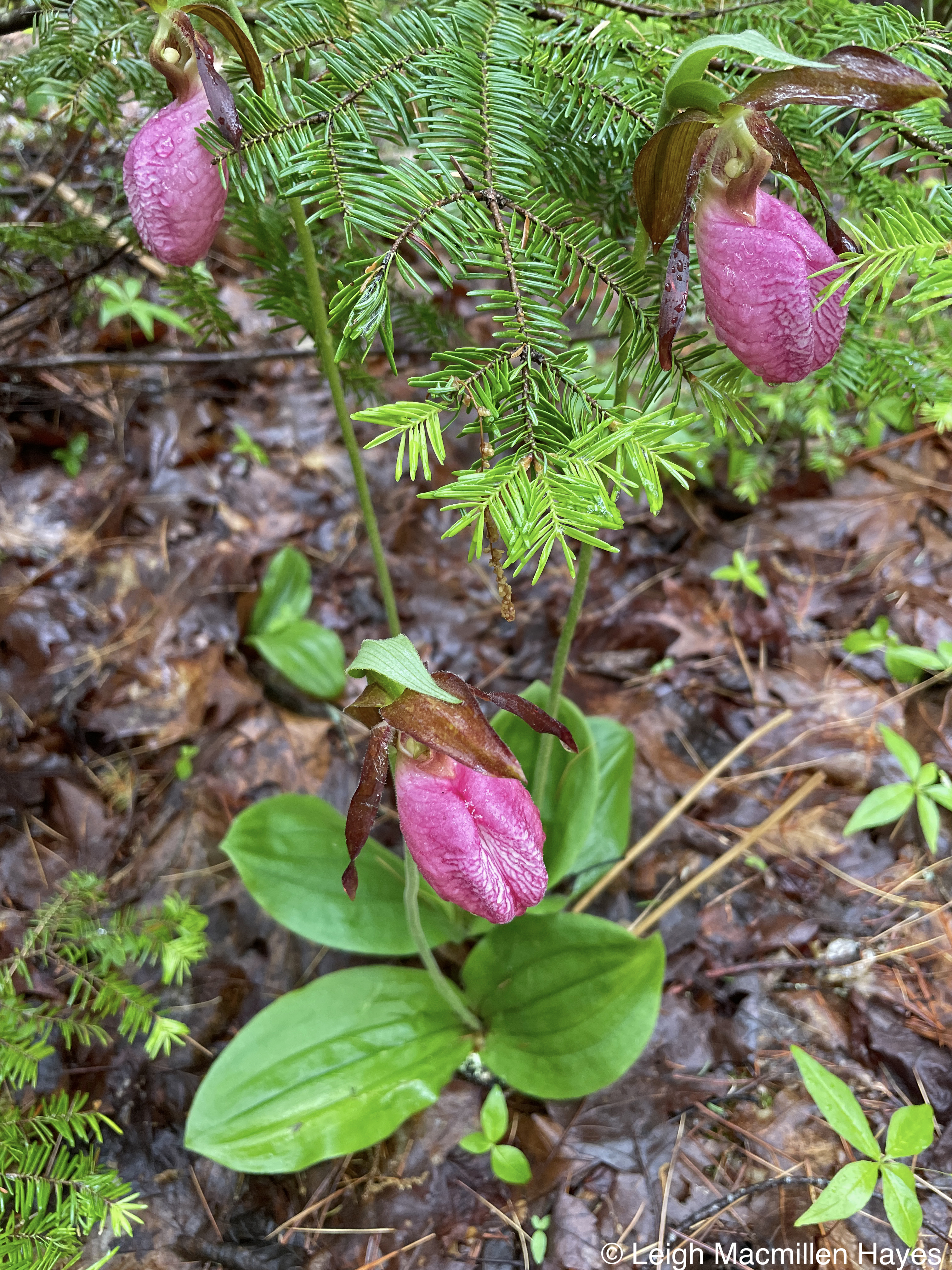
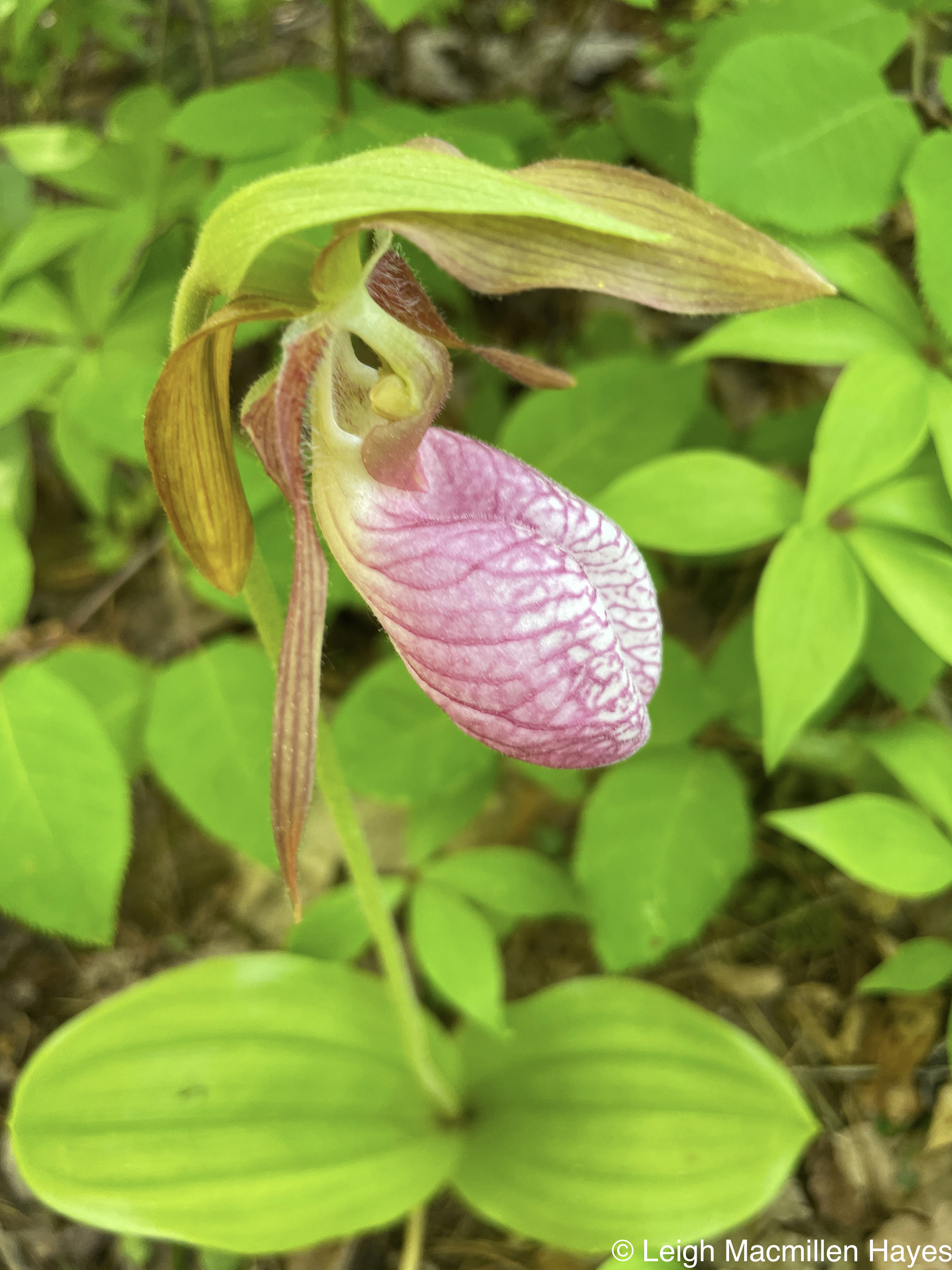
To see if we could match the count of Lady’s Slippers we encountered last year and Nature did not disappoint.

But, she also presented others to honor in their wet formations like a few remaining dandelion seeds and translucent bracts offering a sunshiny display.

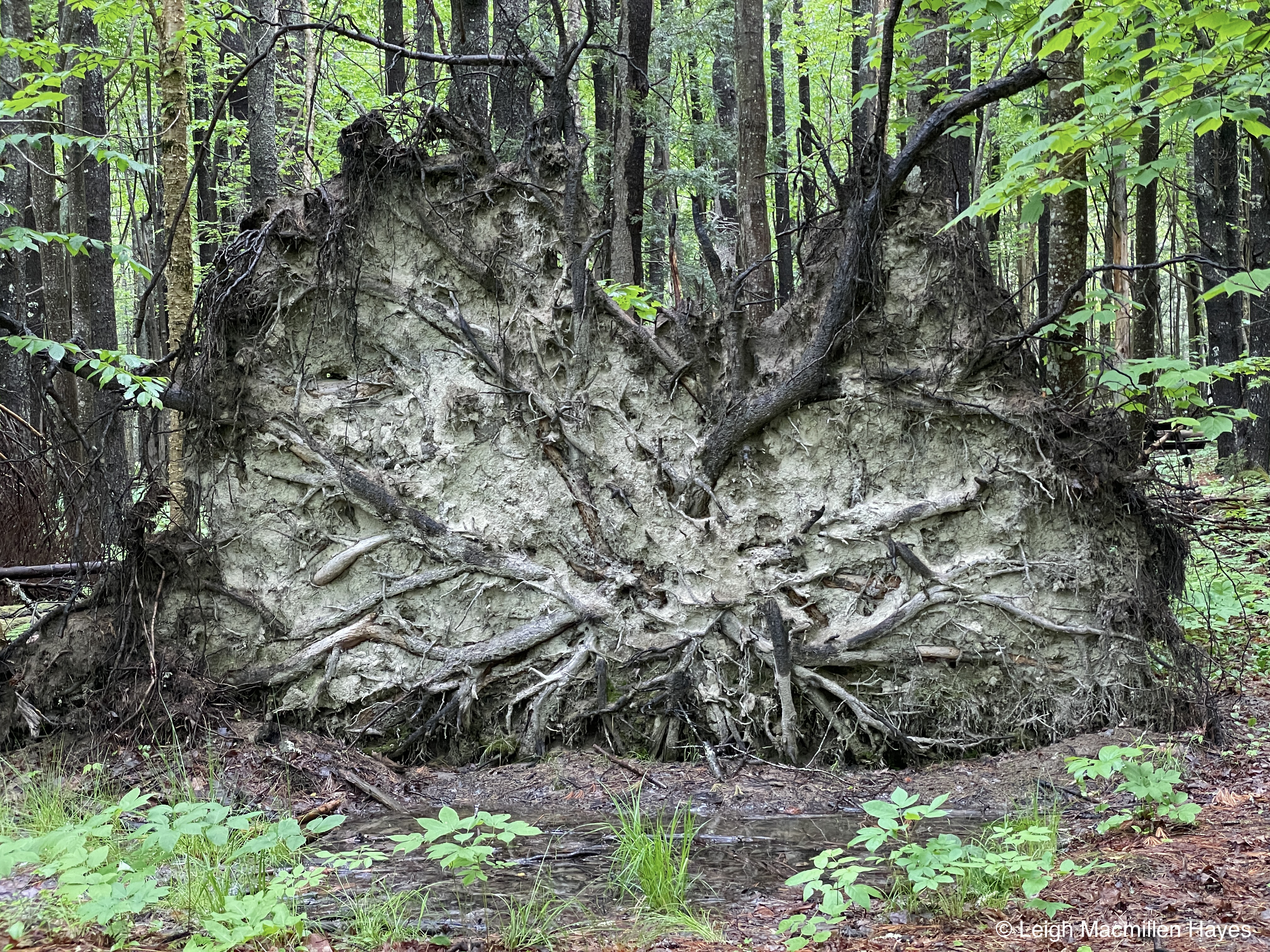
Even the underside of a windblown tree, one of many, showing off its shallow root system created an artful design to admire.

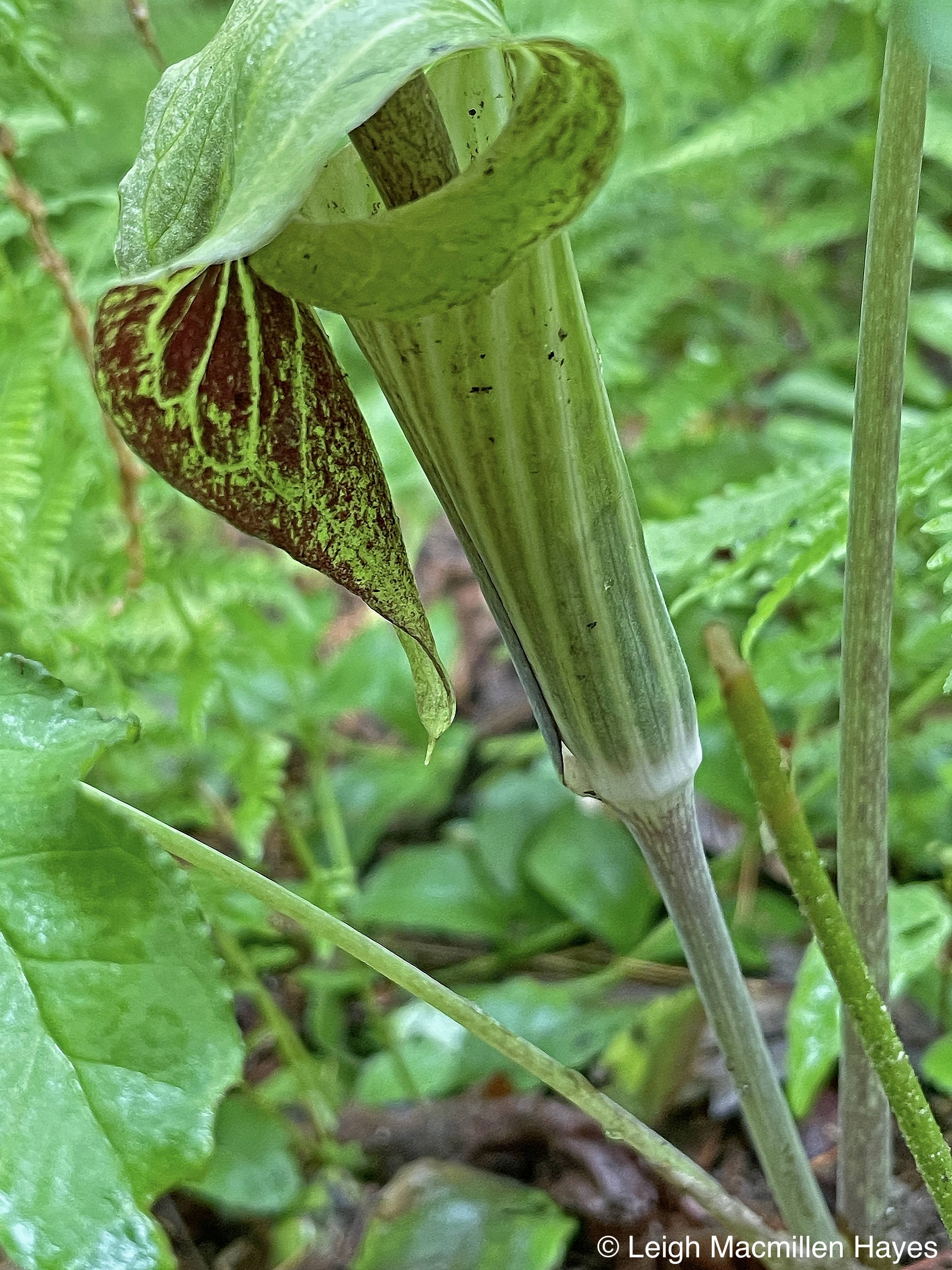
Hiding beneath two three-part leaves, a long club or spadix sitting in a hooded base or spathe known as a pulpit indicated that Jill and not Jack was doing the preaching in these woods.

Though the weather changed from drizzly to dry, or maybe because it did so, White Baneberry celebrated with a show of fireworks.

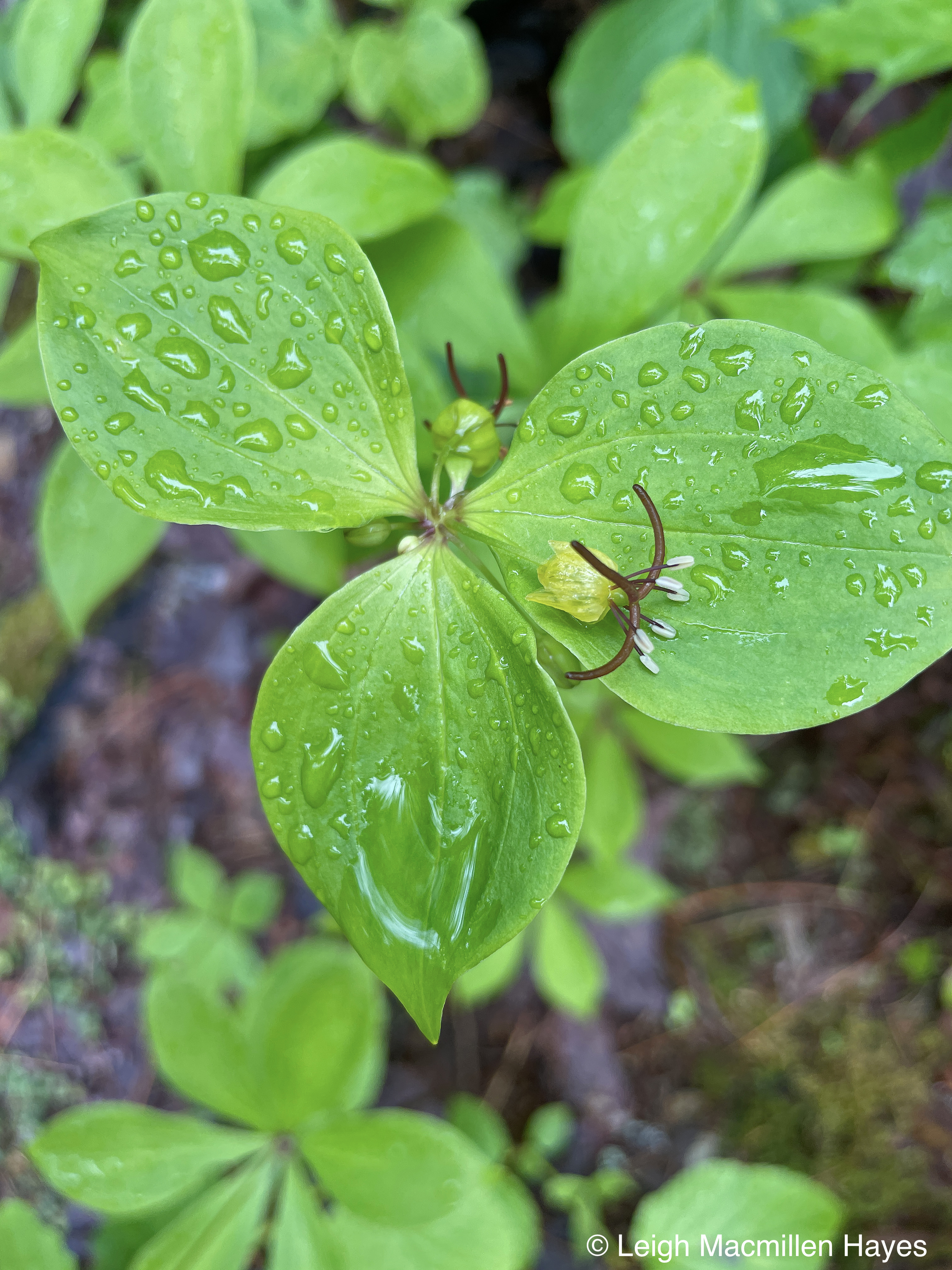
And Indian Cucumber Root began to take the next step in its two-tiered story, for at least one flower had been pollinated and rather than dangle below the leaves, rose above in anticipation of a fruit forming.

There was all that to see, but My Guy, whether walking along the yellow brick road or over rocks and roots, only had his sight on one species that actually slowed him in his tracks.

Looking left and right, and peeking under and over, he kept count of his Lady’s Slippers.

Whether they grew in groups or singly, including this one that surprised even him, for it had sprouted from a mossy substrate upon a rock, each one mattered.

When at last we departed the park, I paused the truck beside a small pond outlined with Lupines.

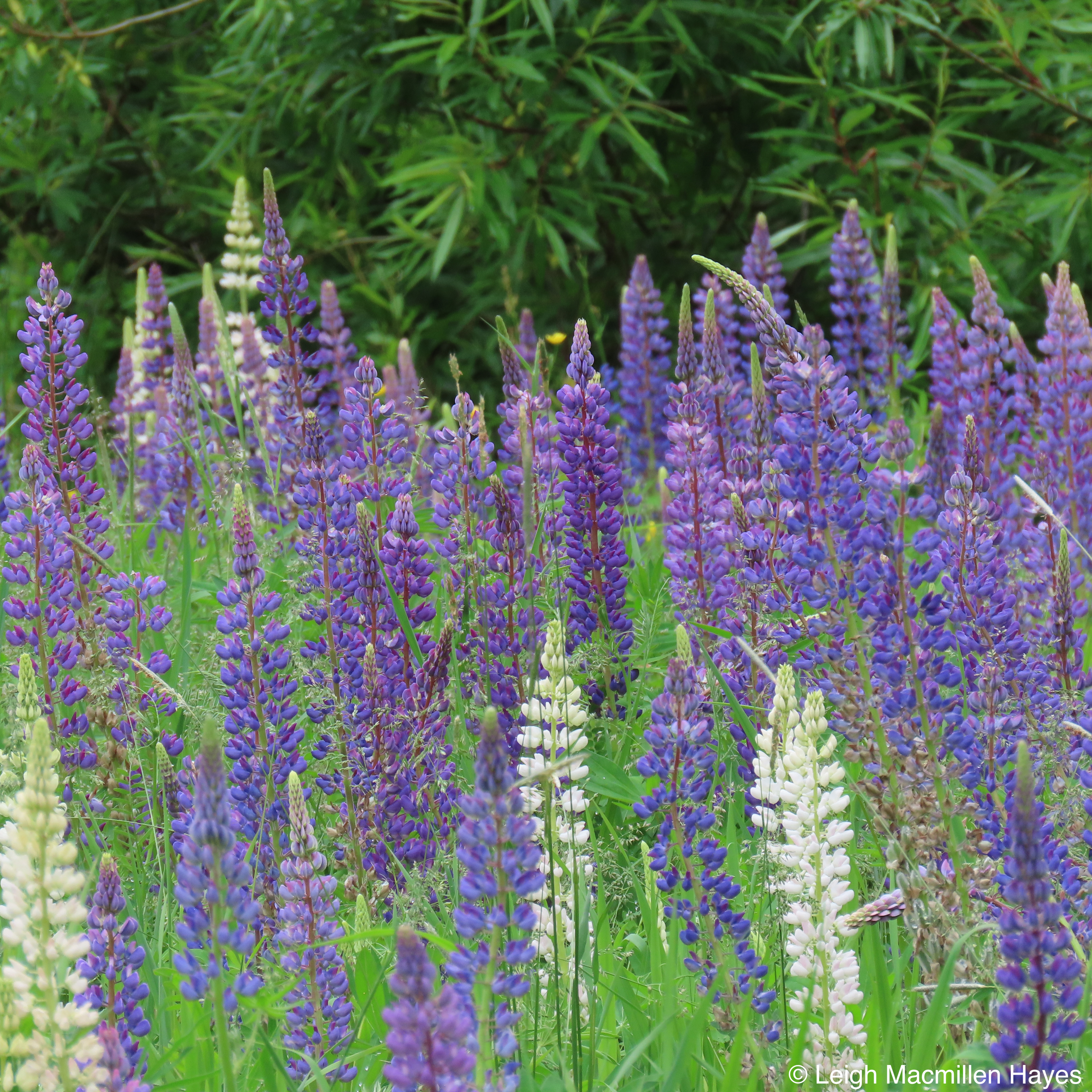
They may not be Lady’s Slippers, but their own unique design and colors deserve to be honored as well.

We didn’t count the Lupines, but our Slippery Eyes took in 324 Lady’s, a total of 87 fewer than last year, but still we gave thanks.

Craning for the Fliers

It all began with a fishing spider moving across the surface of a river. But there was more to the story, as in a meal being consumed. And so a few of us recently went in for a closer look.

It was then that we saw wings below the spider that reflected the sun’s light. And very long, spindly legs unlike the spider’s rather robust and hairy deck of eight.

And it suddenly occurred to us that the spider was dining on a crane fly. Crane flies intrigue me for a variety of reasons. They are true flies and go through complete metamorphosis from egg to larva that molts several times to pupa to adult, but like some other adult species (think mayfly), they don’t have true mouth parts and their sole purpose at this stage is to mate and procreate.

Some folks are afraid of crane flies, and it’s understandable. They look like giant mosquitoes. And are attracted to light so if you leave an outdoor lantern on by the front door, you might find them hovering and then sneaking into the house. But, only the larval form eats and they are decomposers of organic material.

In that same river, it soon became evident that there was a lot of crane fly activity taking place. Tipula caloptera larvae are aquatic and so it makes sense that they would choose some river cobbles to support them while they canoodled.

Click on the arrow to take a peek at their efforts.

And a few cobbles over another was depositing eggs by sticking her ovipositor into the river bed repeatedly. Some crane flies deposit eggs in water and others in moist soil near water.

Again, you may click on the arrow to watch her in action.

It wasn’t enough to enjoy them in their river setting, but here at home as well. So the river action was with a large group of students on Thursday. And on Friday, a couple of hours before a major thunderstorm (that thankfully transformed 97˚ to this morning’s 48˚ and I feel alive again), I looked out a kitchen window and spied this beauty.

Meet Tipula trivitata. It’s by wing venation that a crane fly can best be identified to species.

Since crane flies are true flies, they have only two wings. But do you see the little knob at the tip of what appears to be a filament that the arrow points to? And a second on the other behind the wing on the right-hand side? Those are considered reduced wings or halteres.

Spotting these this week made me think of crane flies I’ve met along this journey, including Tipula tricolor depositing eggs among mosses.

And another of the same species resting upon the fertile frond of a Cinnamon Fern. Adult crane flies rest most of the time, that is when they are not cannot engaged in the art of begetting offspring. As adults they don’t eat. So any energy they have must be saved up from their larval form. Within a few days of mating they die, so their adult life span is not long. Maybe a week or so.

Lest we think they are only spring and summer fliers, there is also a winter crane fly, and this one made the mistake of flying too close to the winter works of a Pileated Woodpecker’s hole that had flowed with sap.

As cool as all of these species are, my favorite crane fly is the Phantom Crane Fly, Bittacomorpha clavipes.

Their wings are much shorter, but those legs! And to watch one fly almost like a little square block carried by the wind–it’s a sight worth seeing and one which you won’t forget.

I do love dragonflies, but I’ll also be craning for these other fliers as spring heads toward summer and even into the fall.

Honoring the Lady’s Slippers

It’s become a tradition for us to spend Memorial Day or at least a day during this weekend searching for one of My Guy’s favorite blooms. I don’t even remember how the count began, but now he cannot not count them.

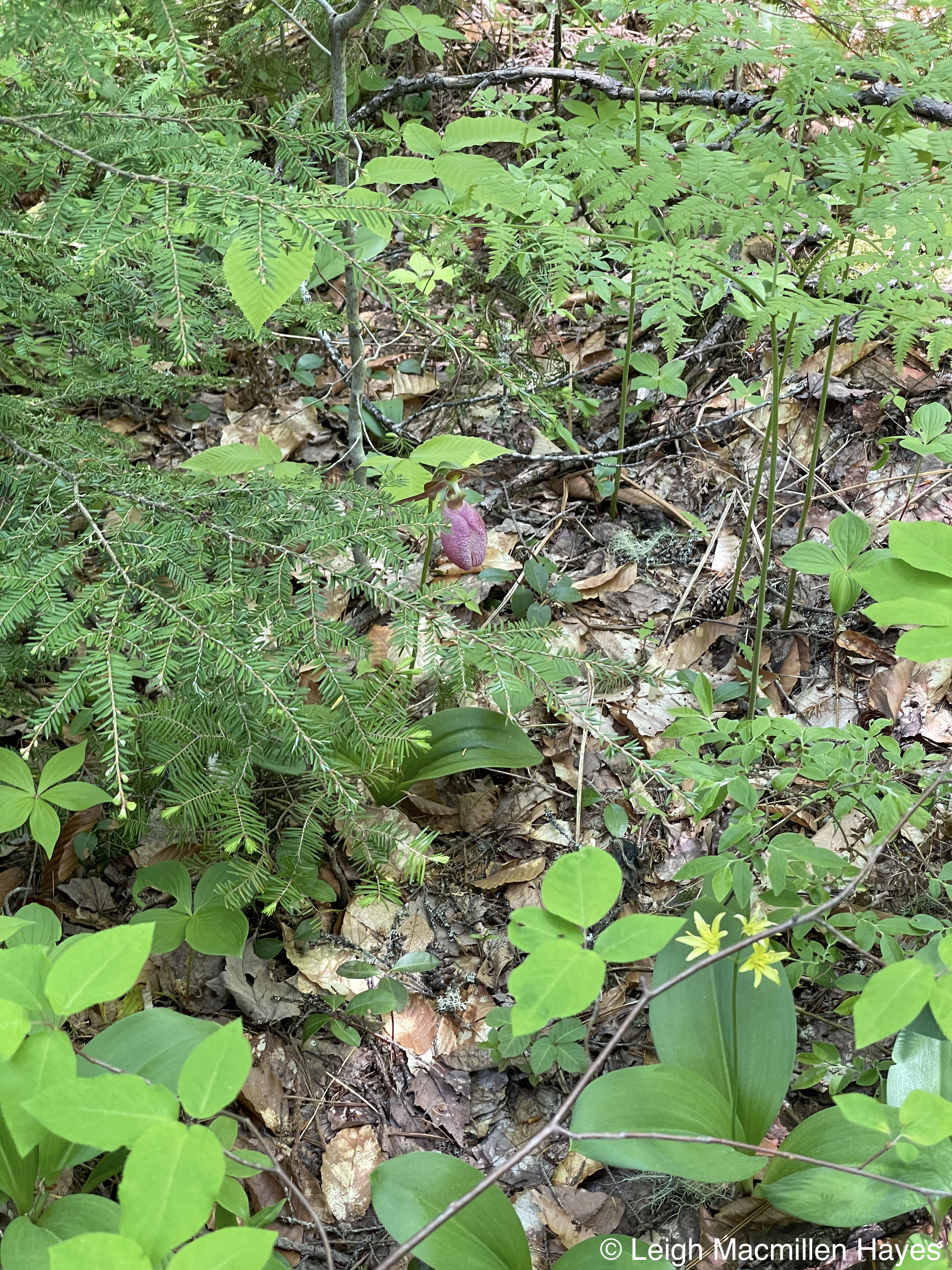
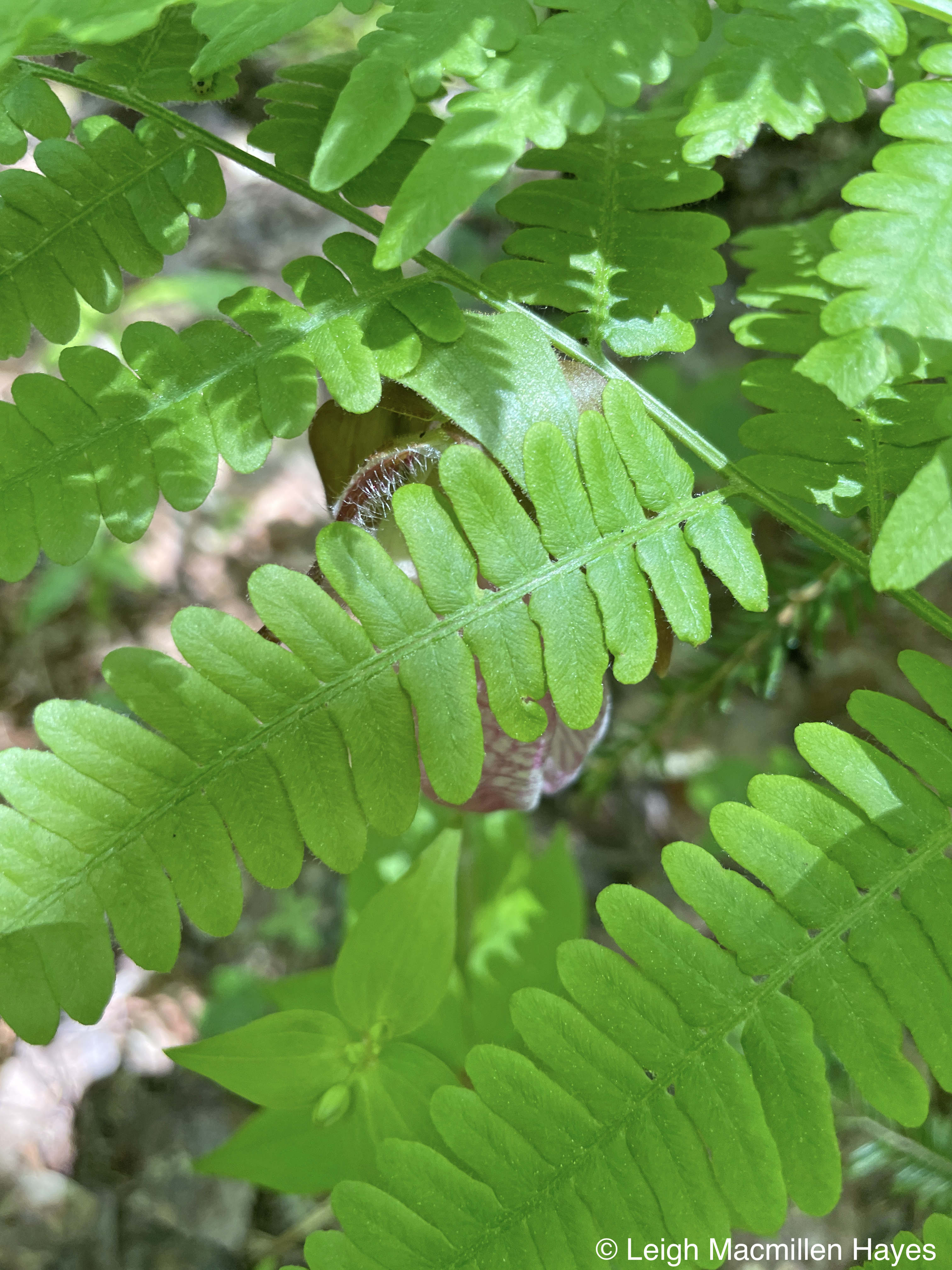
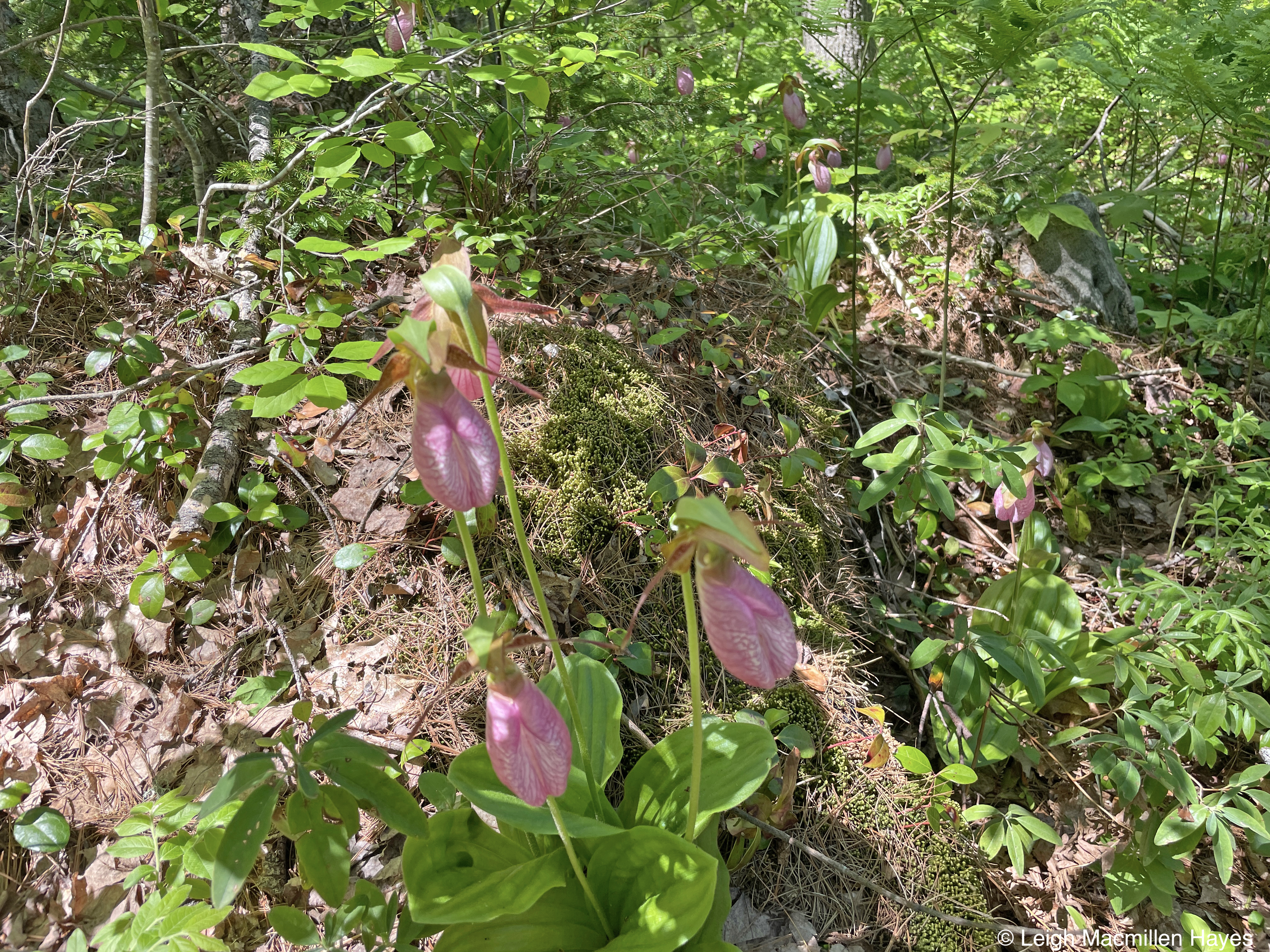
What we’ve learned over the years is that they like a variety of habitats. from dark forests to bogs, and even mountain tops. And they like to hide. So we must really don our Lady’s Slipper eyes (just as I’ve been donning my dragonfly eyes lately) and look for them.

I mean . . . really hide.

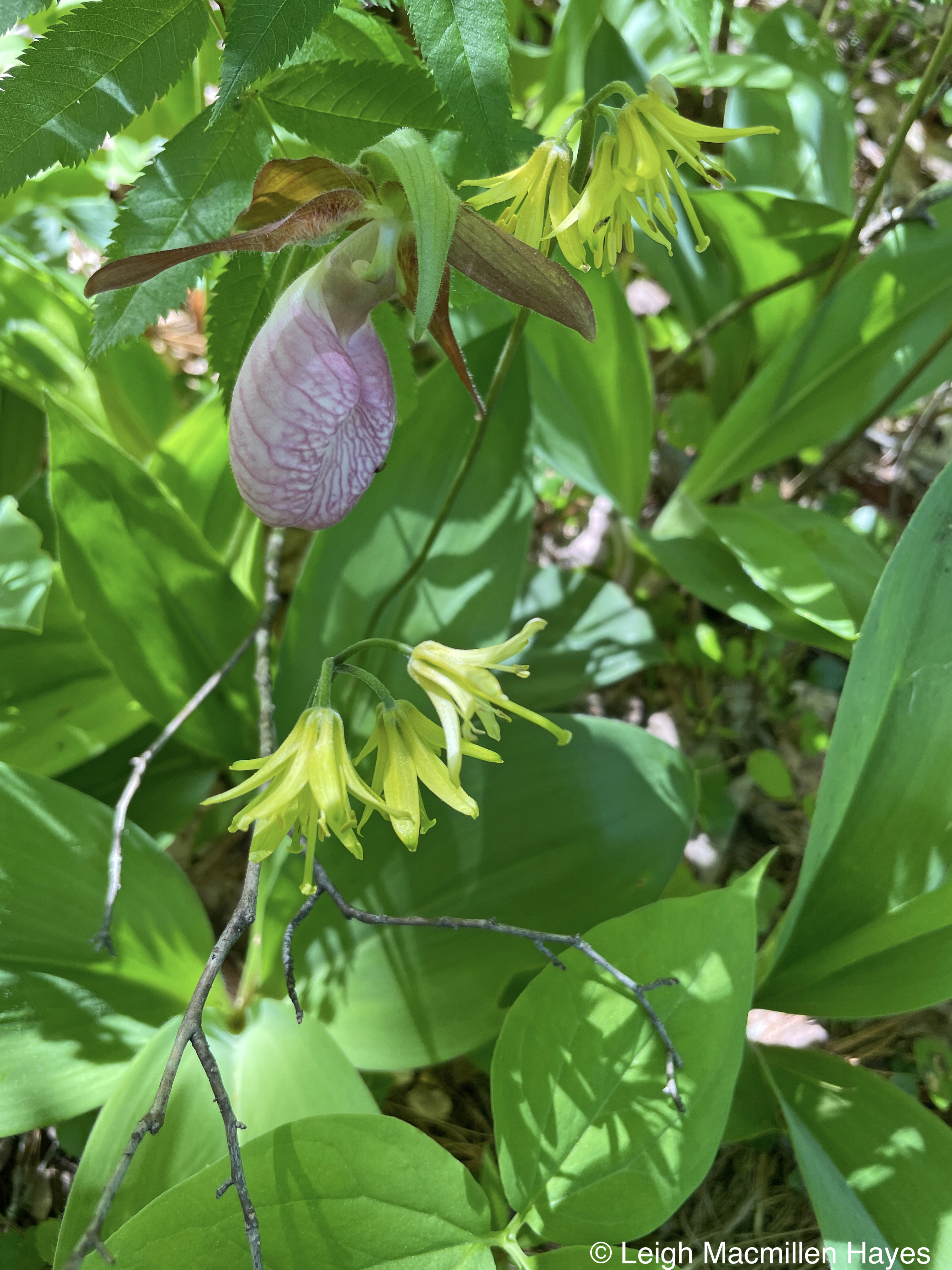
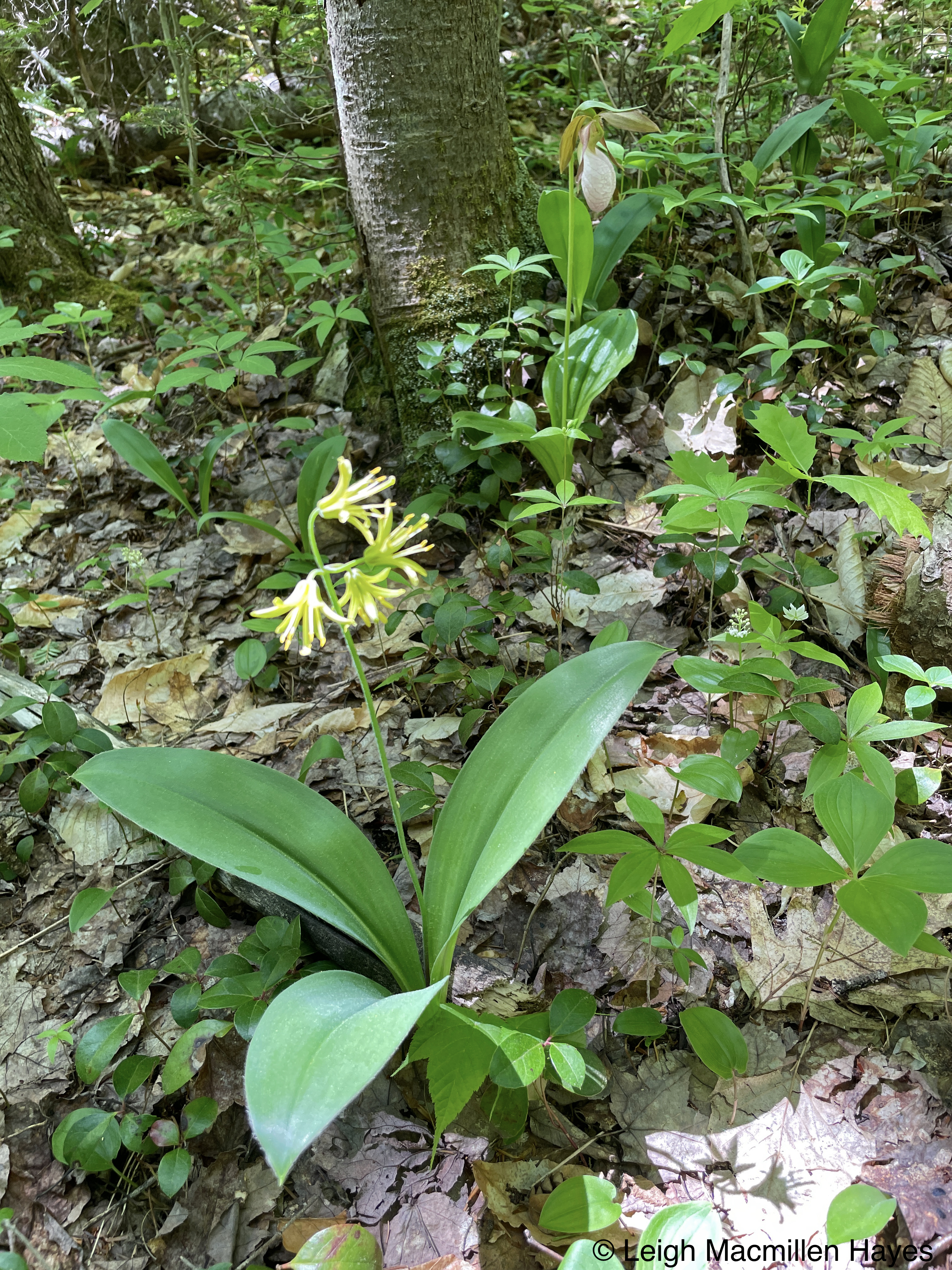
It’s acidic soil that they are rather fond of, just like Yellow Clintonia, the beacons of many a forest trail. But while Clintonia seems to bloom anywhere and everywhere, Lady’s Slipper need Rhizoctonia fungi in order to grow and show off a blossom. According to Jack Sanders, author of The Secrets of Wildflowers, “Unlike most seeds, the minute and dustlike Lady’s Slipper seeds contain no food to allow them to grow. However, the outside of the seed is susceptible to attack by Rhizoctonia fungi, which digest the outer cells. If things balance out just right, the inner cells escape digestion and absorb some of the nutrients the fungus obtained from the soil. Not until this happens can the seed germinate and begin growing . . . The symbiosis with the fungus doesn’t end there. In order for the infant corm (or ‘proto-corm’) to obtain minerals and other soil foods, it must use the ‘go-between’ services of Rhizoctonia fungi. The fungi, in turn, take from the seedling Lady’s Slipper foods that are photosynthetically manufactured. These sensitive and complex relationships make native orchids of all kinds relatively uncommon . . . What’s more, in the wild, it takes from 10 to 17 years for a Lady’s Slipper seed to become a mature plant capable of blooming.

So here’s the thing. Yellow Clintonia and Pink Lady’s Slipper flowers look nothing alike. But their leaves–that’s a different story and when there are no flowers to confirm, one like me, must slow down and notice the features. Do you see what I mean? Clintonias are members of the Lily Family, with six lily-like tepals (segment of the outer whorl in a flower that has no differentiation between petals and sepals). And their leaves can be folded in half with the inner vein forming the fold line.

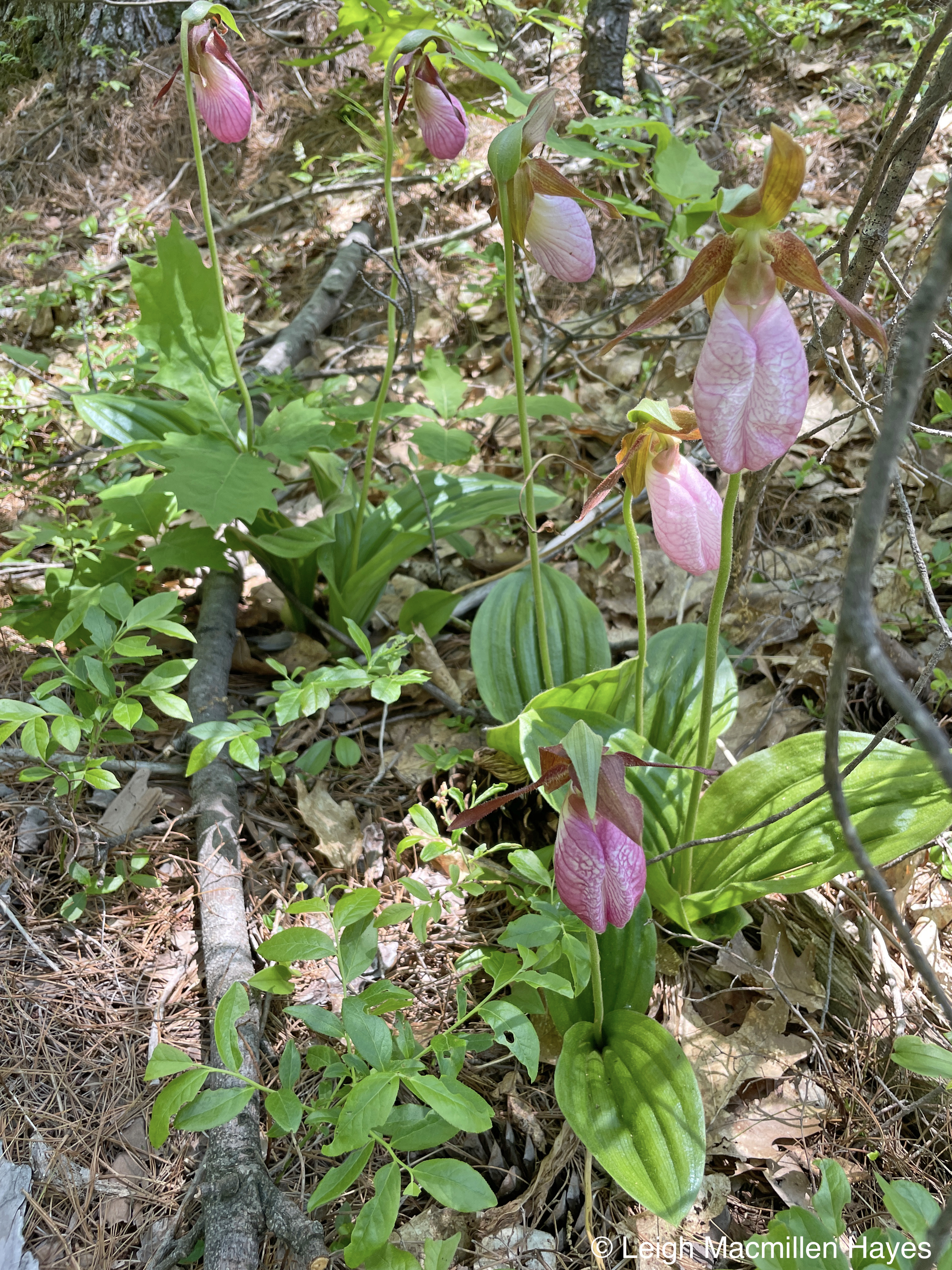
Lady’s Slippers, on the other hand, are orchids. The flower is a moccasin-shaped, inflated pouch, but also two lateral petals that twist outward. And the leaves–take a look. Remember folding paper in an accordion-like manner to create fans, or tissue paper to create flowers? That’s what Lady’s Slipper leaves look like to me. Multiple pleats.

Lest you think nature didn’t distract us, there was a male swallowtail puddling in a wet seep that we had to pause and admire.

And we certainly didn’t want Indian Cucumber Root, in the same lily subfamily as Clintonia, to think we were ignoring it for it has just begun to offer its unique flower to the world.

But our real focus, of course, were the slippers, even those decorated in white, which is a form of the pink.

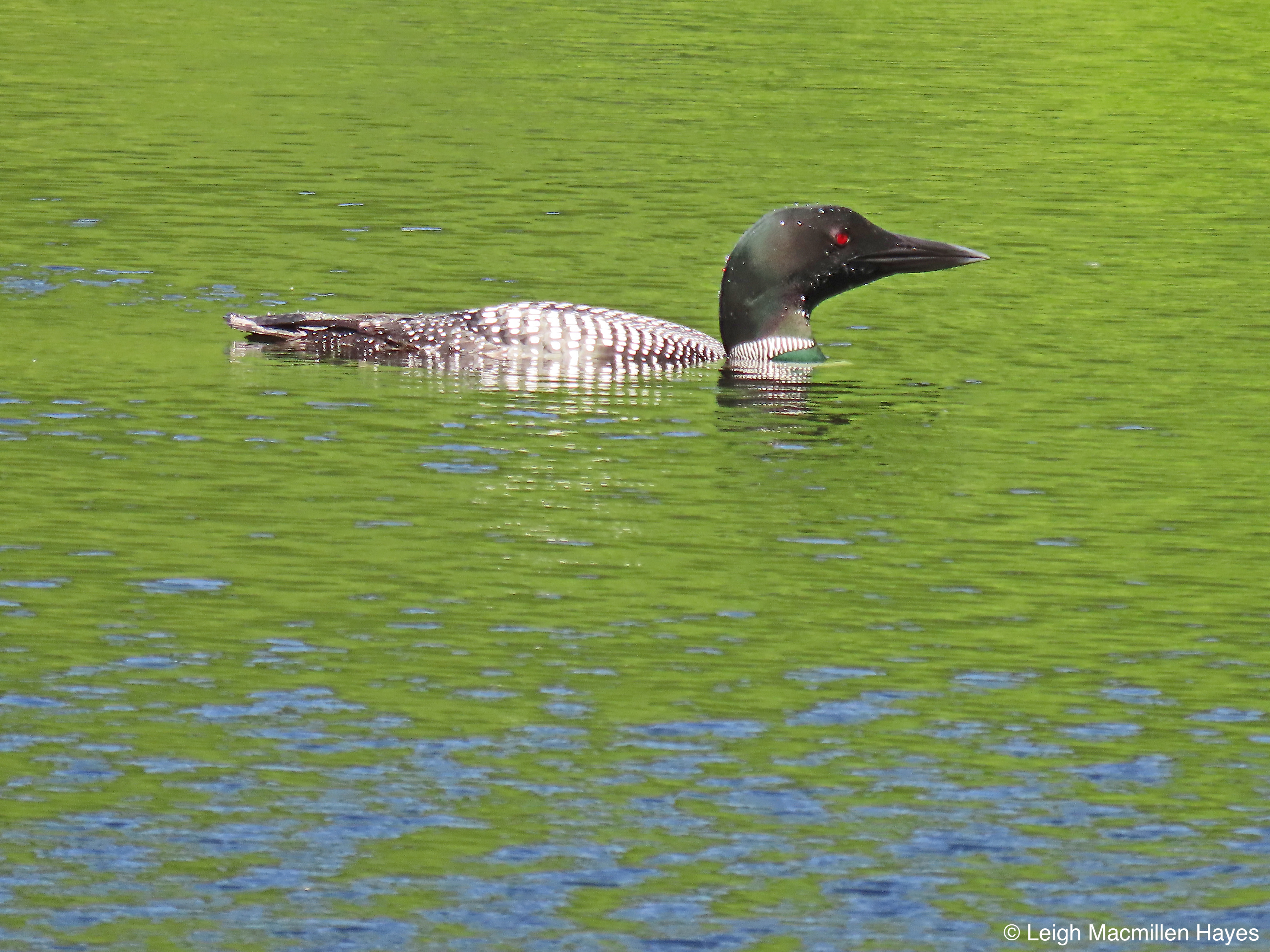
Until, that is, the Common Loons begged to be noticed and so we did.

A few miles into the hike, we reached one of My Guy’s favorite spots. Just the other day I heard him describe it as a field of Lady’s Slippers. I’m pretty sure he was thinking football field. I happen to think it’s closer to the size of my office. But, it does produce about fifty flowers each year.

While he was meticulously counting those fifty, a Bald-faced Aerial Yellowjacket flew in and started chewing some wood. My attention was indeed diverted.

Heading to the summit, we didn’t find as many, but still they were there and we paused to admire this grouping. I wonder if there was a nurselog below them that offered the right growing conditions and thus the line.

At the summit, after finishing dessert (we’d eaten our sandwiches below by the pond), someone had to survey his kingdom.

It’s always worth a look.

We found some more as we descended and then followed a different trail out, where another lady made herself known.

Meet a female Common Whitetail Skimmer dragonfly, who is hardly common with her tail markings, and spots on her wings.

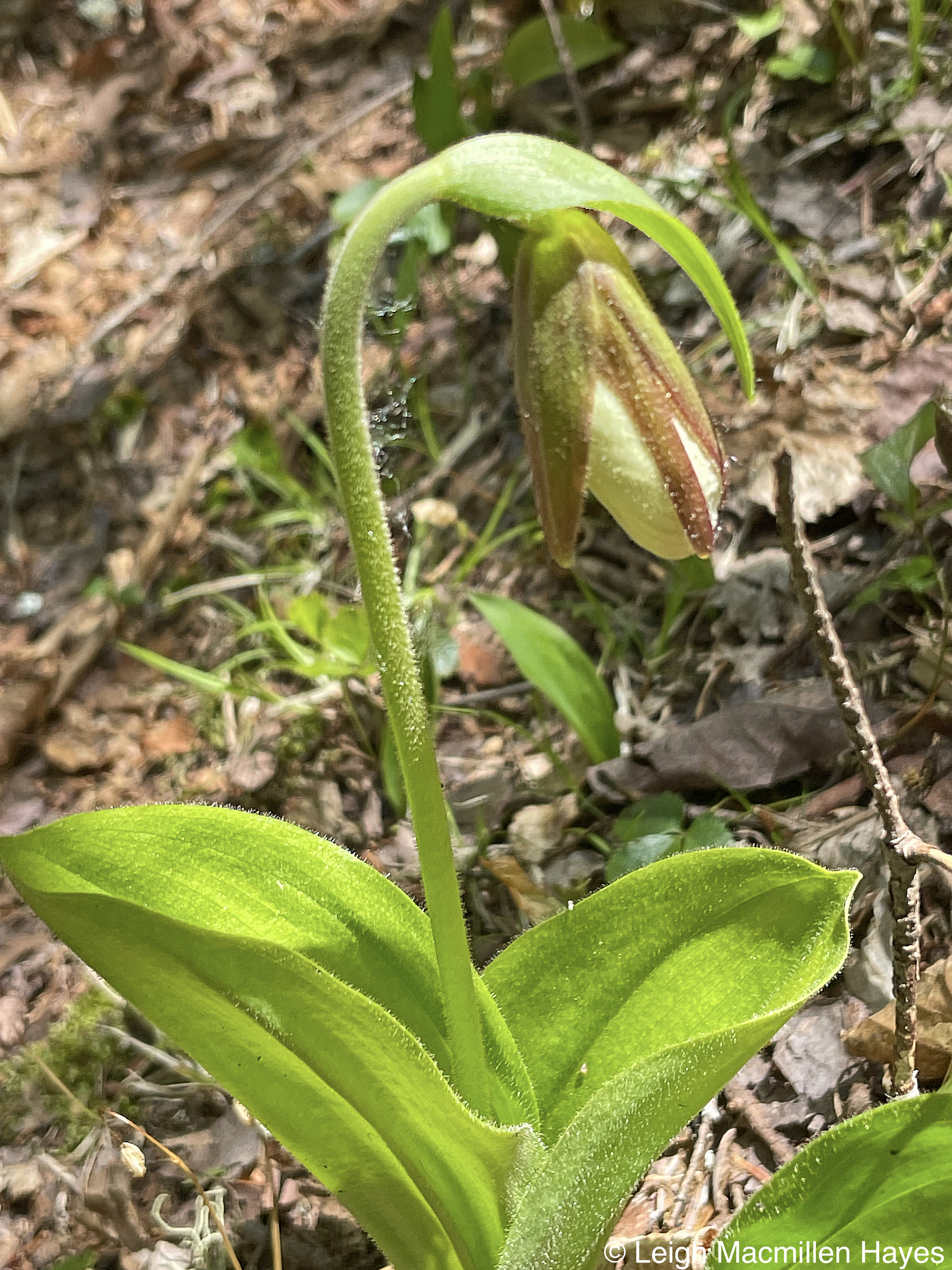
We were almost finished when we spotted this Lady’s Slipper blowing in the breeze. Note the curve in the stem, and the closed moccasin.

I don’t know if removing the leaf will help the flower to fully develop, but it made me think of today, Memorial Day, and the fact that so many have in the past and do presently work so that we can enjoy the freedom of going for a hike in the woods–thank you to all who have served our country, past, present, and future, including our dads, uncles, cousins, and friends.

The question remains: How many Lady’s Slippers did we honor on this Mondate? 351. And those were only the ones we could spot from the trail. I’m sure we missed some. Can you imagine how many more might be out there.

Developing Dragonfly Eyes

Standing beside quiet water in so many places this past week offered rewards for those of us who took the time to look.

The first order of business was to watch for large aquatic insects moving quickly toward the shore or vegetation. Hormones send the signal that any give day is THE day to begin the quest. In Kurt Mead’s Dragonflies of the North Woods, he explains that just prior to THE day, the aquatic insect rests (goes into a state of diapause), “while the final changes are made inside the larval exoskeleton.”

Once out of the water, it can be quite a journey to cross land and find the right plant or tree. I’ve seen some travel more than ten feet for just the right spot upon which next to pose.

Should a boardwalk get in the way, scampering across it is of utmost importance. When one is on a mission, road blocks must be overcome.

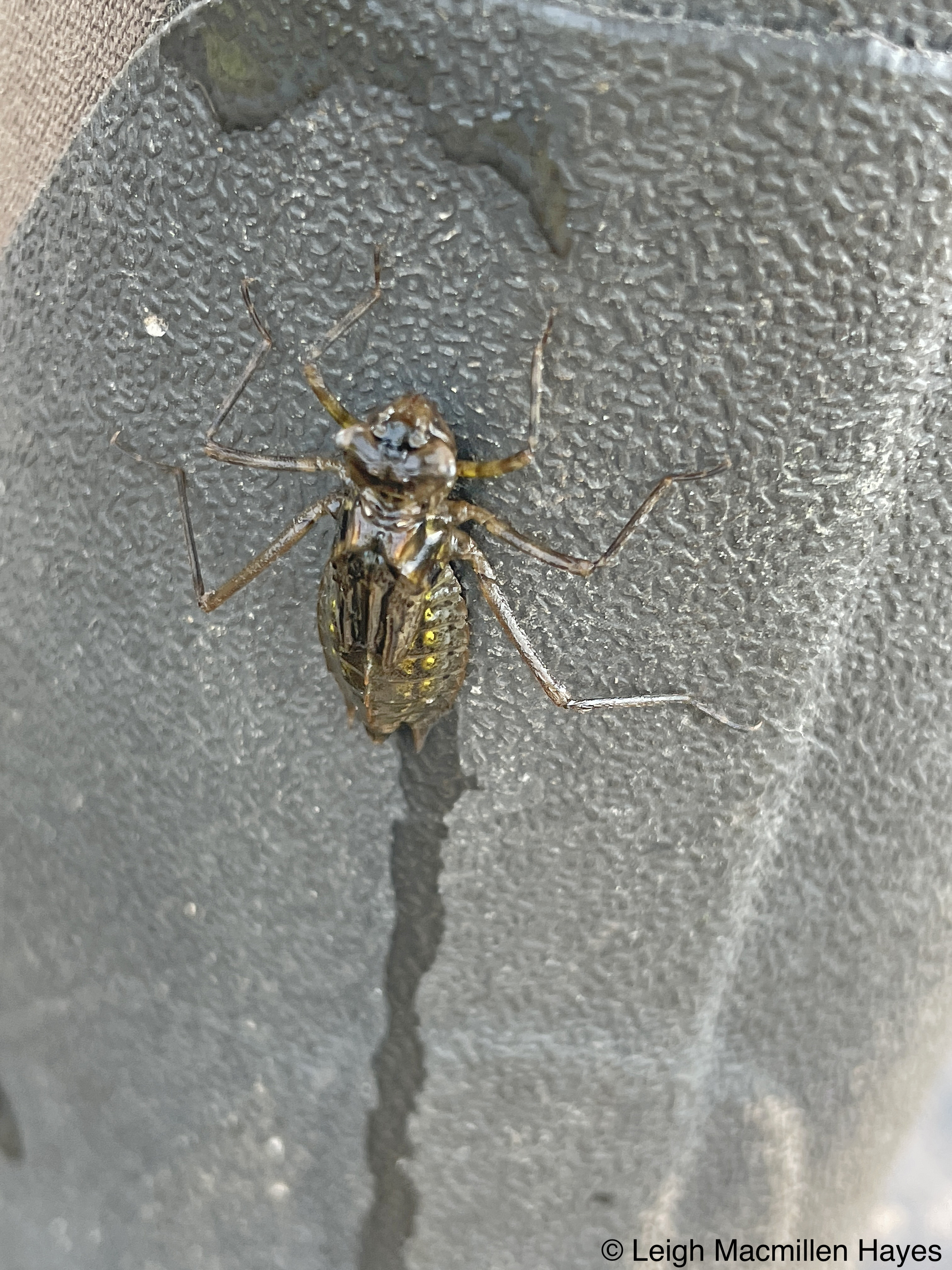
I do have to say I had to relocate a few who thought my boot, green as it is, offered the right opportunity. Certainly I would have protected it from any predators at the period of time when a dragonfly switches from aquatic predator to teneral land prey before becoming a terrestrial flying predator. For hungry nesting birds, these could become quick snacks.

Searching for the perfect spot upon which to perch.

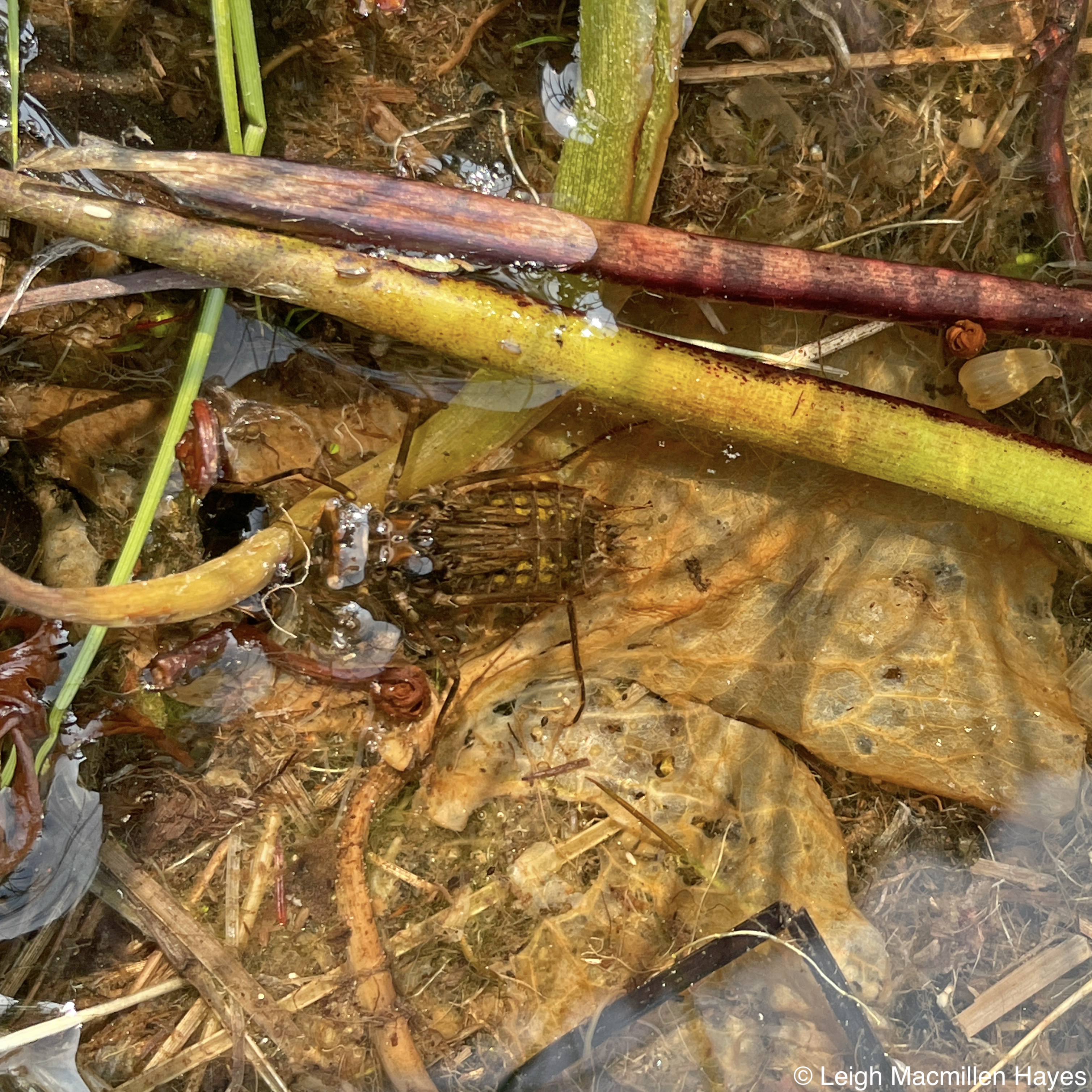
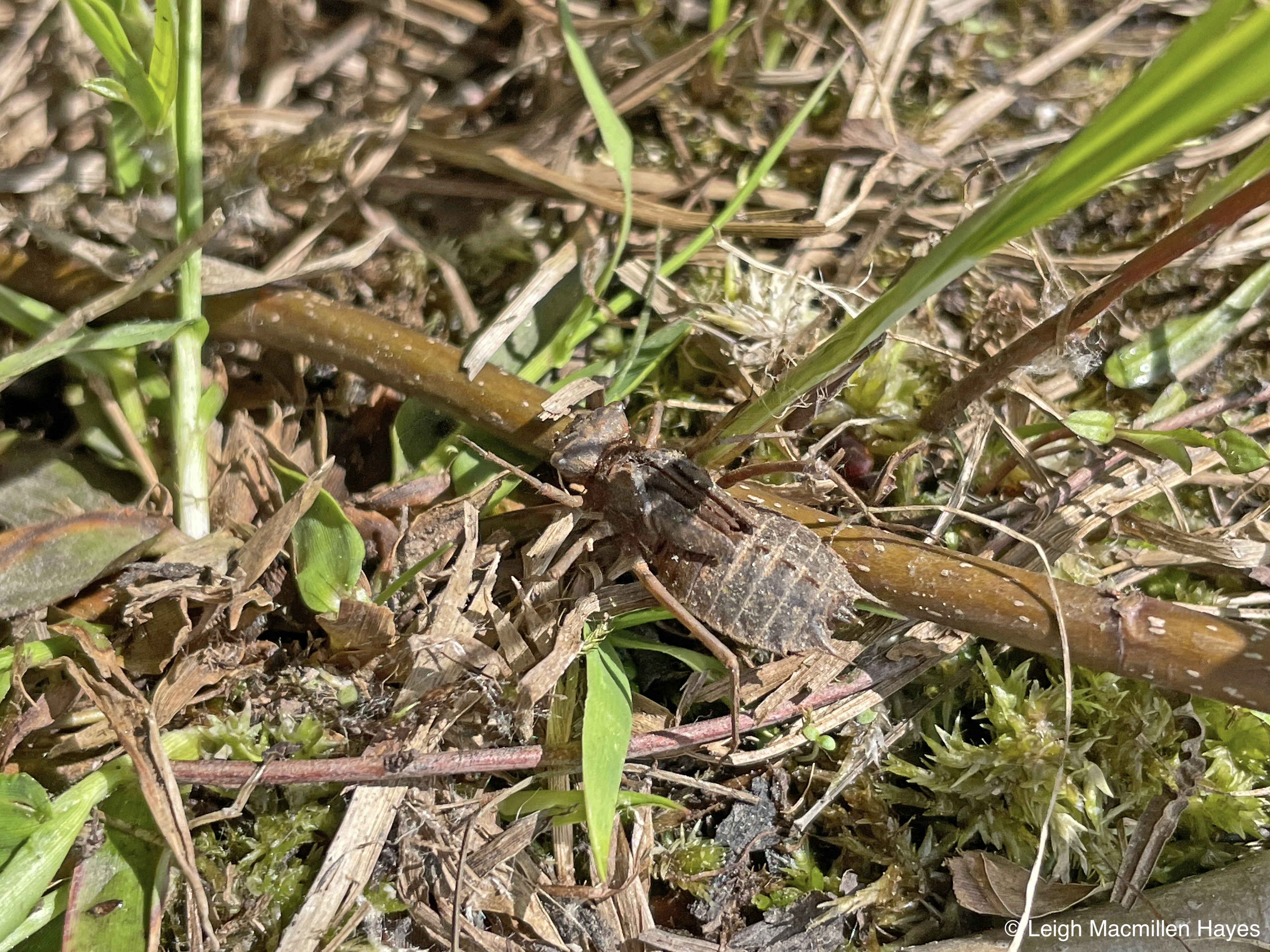
Once the perfect substrate is chosen, it takes a while before the insect begins to undergo metamorphosis into an adult. Then the magic begins. The skin at the back of the head cracks open, and ever sooooo slowly the head, thorax with wings that had been stuffed into little packages on its back, legs, and abdomen begin to emerge. This process of emerging from the larval skin is called eclosing.

With all the effort it can muster, it briefly pumps its body as it arches backward away from the vegetation. The pumping is followed by periods of rest because this process takes so much energy.

Over time, as in at least an hour, more and more of the body pulls free and its aquatic breathing tubes are no longer needed.

Colors are drab throughout the process making it difficult to ID to species, but that will come.

Ever so slowly, the legs harden and the dragonfly begins to extend them. If you look closely at this photo you might notice one emerging and another climbing up the vegetation to find its own spot for emergence.

Just before fully pulling its abdomen free, the dragonfly reaches up and grabs its shed skin or exuviae. And then it begins to unfurl its wings while pumping hemolymph, aka bug blood, into them. Once elongated, the wings are cloudy. It’s actually one of the easiest times to spot the process, for the cloudy grayish brownish wings become obvious among the foliage.

It’s rather like a “Where’s Waldo” moment when you do start to look. One here, another there. And, and look, yet another.

The next step, while still clasping the shed skin, is to extend the wings out, pumping the bug blood back into the body so the abdomen can extend and colors begin to emerge. At this point, the spread wings take on a shiny sheen as they dry.

This is the second most obvious way to spot a newly emerged dragonfly, for the shiny wings glisten with hints of rainbow colors.

Remember the naiads making a quick exit from life spent below water? Many of them stalk their prey among the underwater vegetation, and it seems sometimes the vegetation stalks them. Can you see a stem sticking through the body of this larval form?

I have to wonder if it’s the reason some wings are folded and never quite open all the way, thus leaving the insect unable to fly. Well, maybe it’s one reason.

Those who do fly off find that first flight to be a bit tenuous, lift off happening suddenly and the insects act like balloons floating toward the heavens. Within a day, however, the sheen begins to dry and true colors, like those of this Belted Whiteface form.

The same was true for this Stream Cruiser, the only cruiser species in our neck of the woods (at least to date). But, the right hind wing was stuck to the front wing and flight was difficult. That said, this particular species was found at least a quarter mile from water and it got there somehow.

All this being said, I highly encourage you to head to the water’s edge and take a look. I wasn’t rewarded each day this week, but more often than not, and I suspect you will be too. If nothing else, you might discover the papery remains of a discarded exuviae and once you locate one, you’ll surely see a bunch of others.

Go ahead. Take a peek.

The best part of this week for me was that not only did I don my own set for another year, but I had the pleasure of sharing the opportunity with so many people, young and more mature (nice way to say old), who developed their own set of dragonfly eyes.

Stars Among Us

Saturday found My Guy and me doing some trail work in the rain along a local path that we’ve helped maintain for probably close to twenty years. On Sunday we went on one of the buggiest hikes we’ve endured in a while. But there was a prize to be had. And today. Ah today. What a gorgeous day. And few bugs. There was a reason for that.

We were in a wetland where the dragonflies were emerging. So this is a member of the Baskettail family. I’m just getting my dragonfly eyes back on and need to refresh my memory.

Looking at it from a different angle, my brain wants to call it a Spiny Baskettail rather than Common for it seemed dark behind its head and the dark basal marks on the wings seemed to match up, but . . . if you think otherwise, I’m open to clarification.

We also spotted Belted Whiteface Skimmers seeking meals, and there were damselflies on the hunt as well. If these Mosquito/Black Fly/Deer Fly-eating predators haven’t reached your backyard yet, know that help is due to arrive any day.

Not all the sights we saw were predatory and so we delighted that a few new butterflies of the season were in our midst, including this Mustard White, with its striking venation a feature of the spring brood. The coloring has to do with developing in the chrysalis during shorter spring days versus the pure white or mustard-color which occur in summer broods.

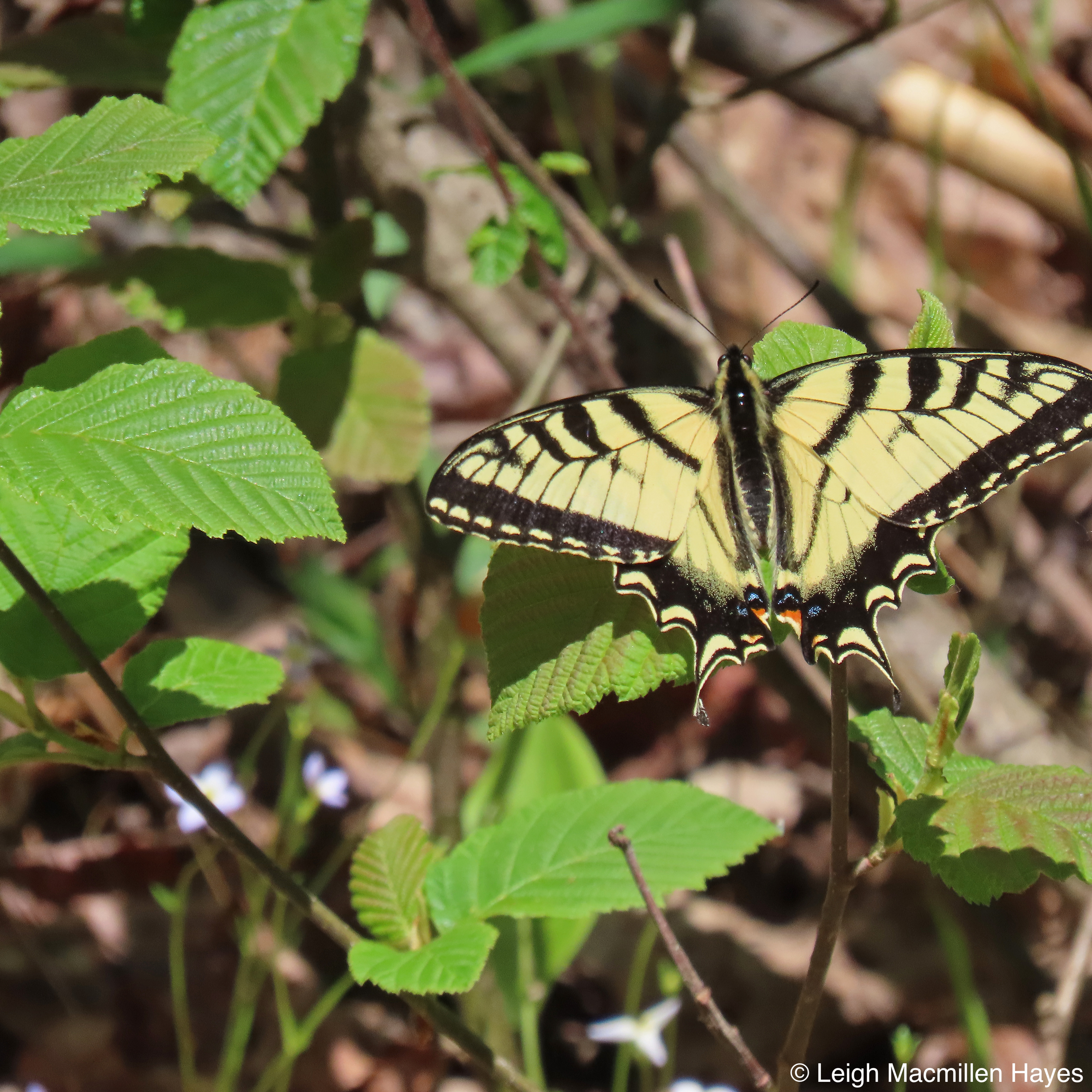
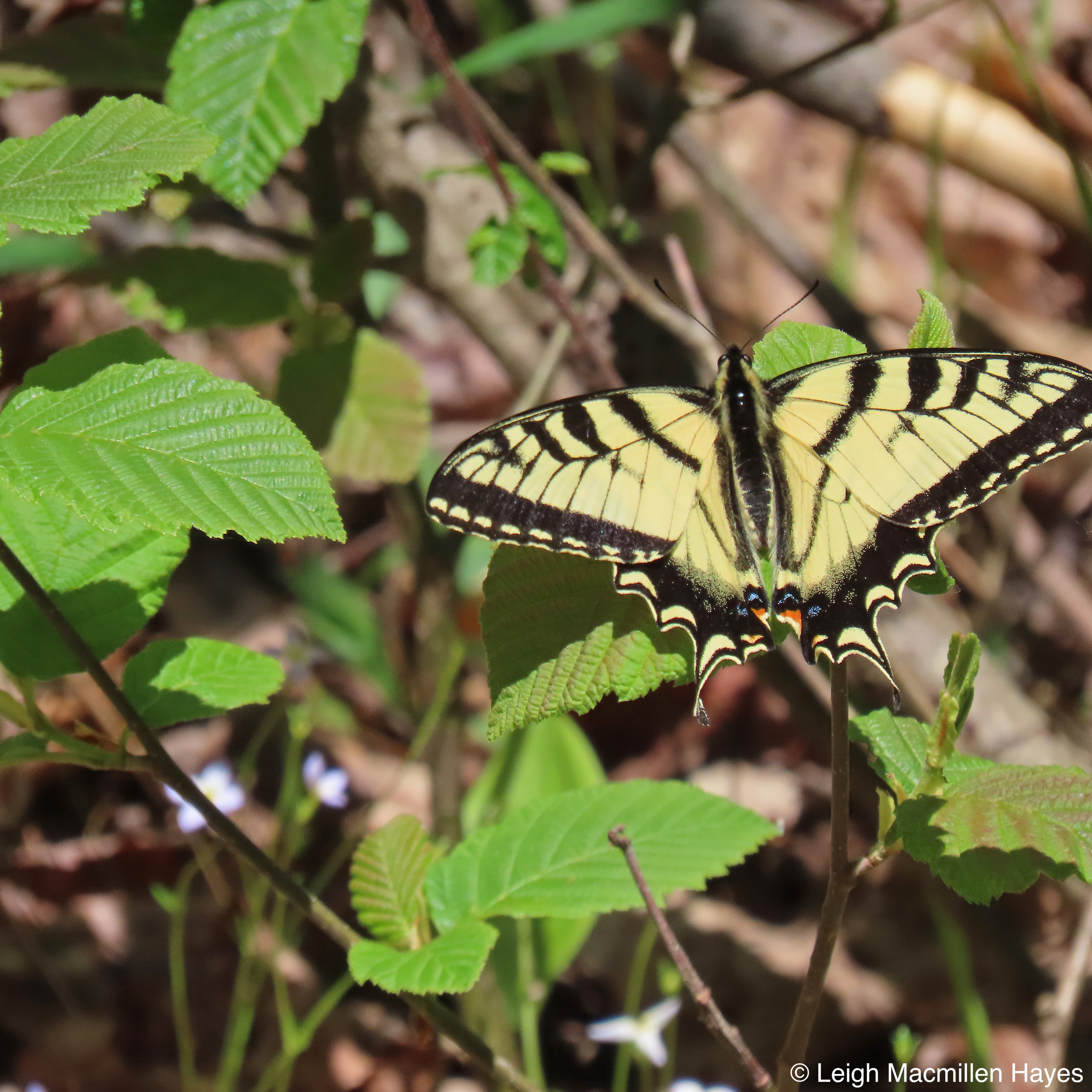
Also fluttering about were a few Canadian Tiger Swallowtails, adding bright dashes of color in a woodland growing ever so green.

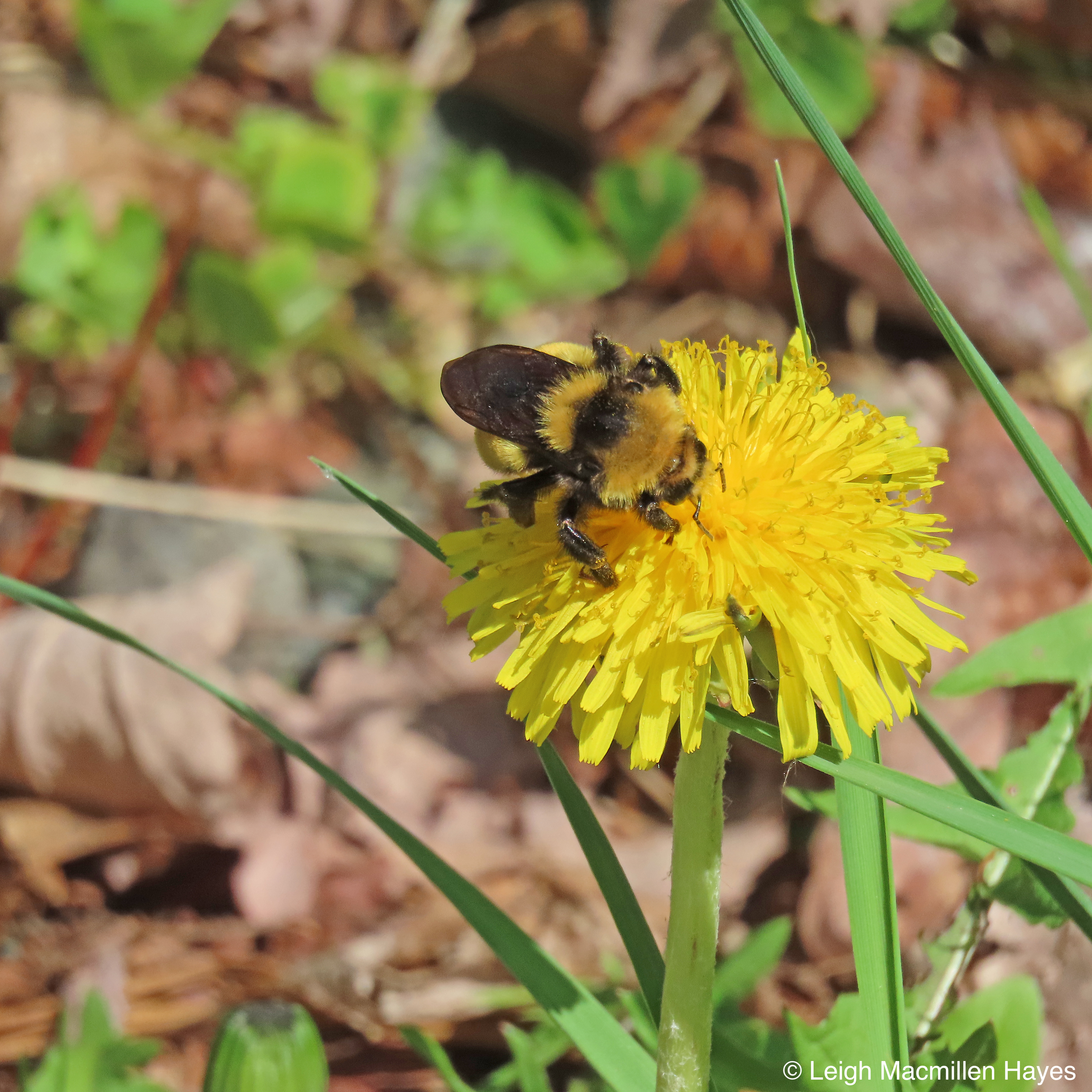
While the butterflies help with pollination, this humongous Bumblebee was hosting a pollen party for one and if you look closely, you may see the yellow specks flying in the air and all over its face.

It was no surprise to see the pollen sacs on its hind legs filled to overflowing.

There was so much to take in everywhere we looked and we were glad we’d driven an hour and a half to spend time in this special place where one of My Guy’s favorite flowers grows. Though not in bloom yet, they are preparing and we can’t rush the season. I know some have blossomed closer to home, but think our location a bit further north meant things are delayed by a week or so.

Equally as fun to find was evidence of last year’s flower in the form of a football-shaped seed capsule–and we can only hope that some of those seeds will find the right conditions and show off their showy blossoms. Of course, those seeds might remain dormant until conditions are just right, so it could be years before we can enjoy them. We’re willing to wait.

Today’s journey found us enjoying the mountains and wetlands in Whitefield, New Hampshire, where there was still some snow on distant peaks. Look below the clouds and you’ll see what I mean.

So many stars we enjoyed and really have only honored a few here.

But the real star among us we spent some time with yesterday . . . until the insects drove us home, literally!

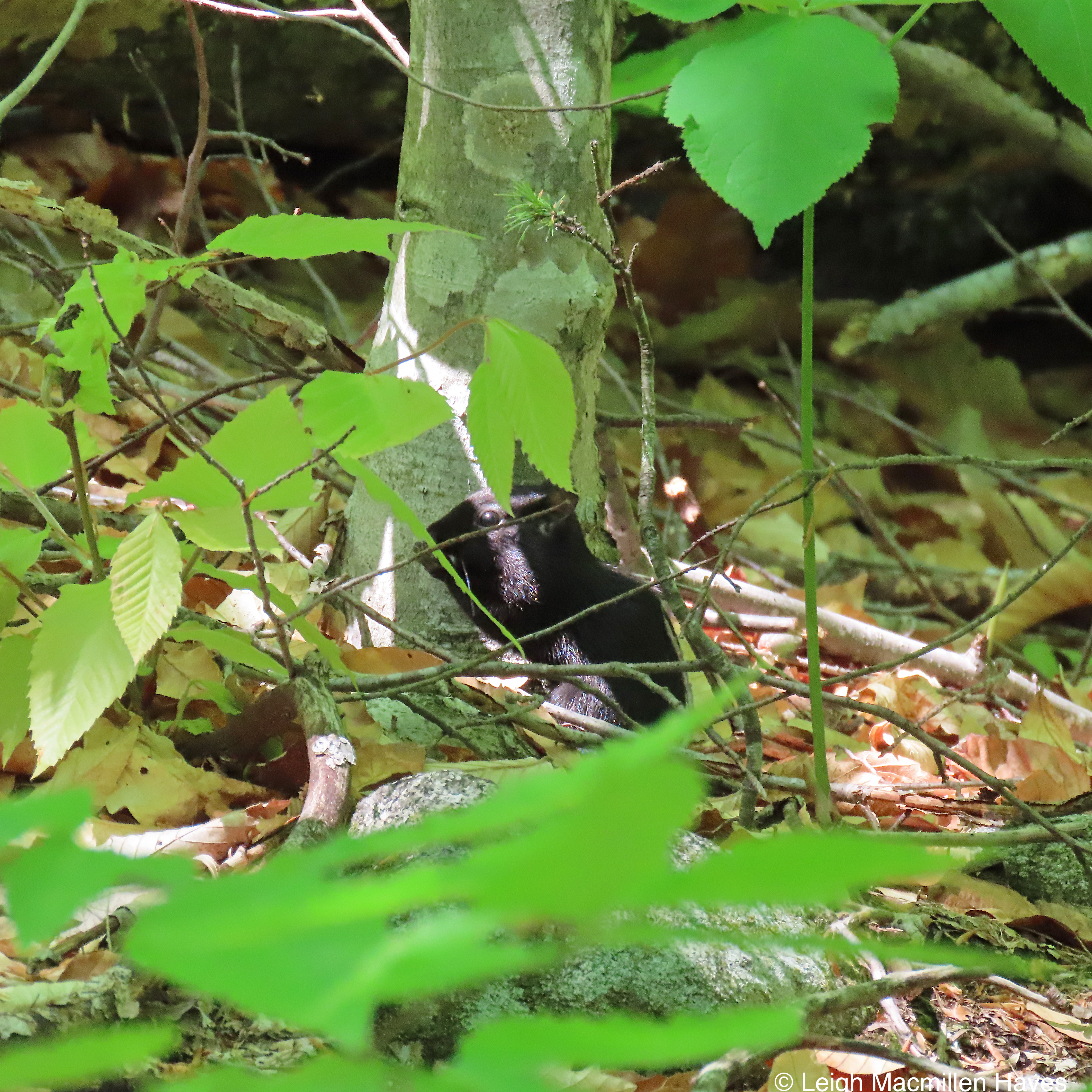
This Black Chipmunk and its forebears have been rather reliable residents on a certain trail and though I don’t spot one every year, it’s always a treat to meet it again. This was the prize.

As we watched, the chipmunk behaved as one would expect, dining upon seeds it had cached, then running along a log, jumping down to the ground, and disappearing into a hole beside a tree. I have to wonder how many more it may be feeding with its stuffed cheeks. And having observed 315 15-second game camera videos of a Red Squirrel a couple of years ago, and watching this particular chipmunk, as well as those who live around our house, I know that it repeated its routine from hole to food source and back to hole from sun-up to sun-down.

Melanistic mammals have an increased amount of the dark pigment melanin in their hair, and though they are considered rare, I know of at least three local areas where Black Chipmunks have been spotted for years.

There may be stars in the sky as this beautiful day gives way to night, but indeed there are many more stars at our feet if we take the time to notice.

A Moosed-Up Mondate

Some stories are best told in the wrong order and this one is such. Or at least that’s what I think. You see, My Guy and I headed north today, not far north either. Maybe a little over a half hour from home.

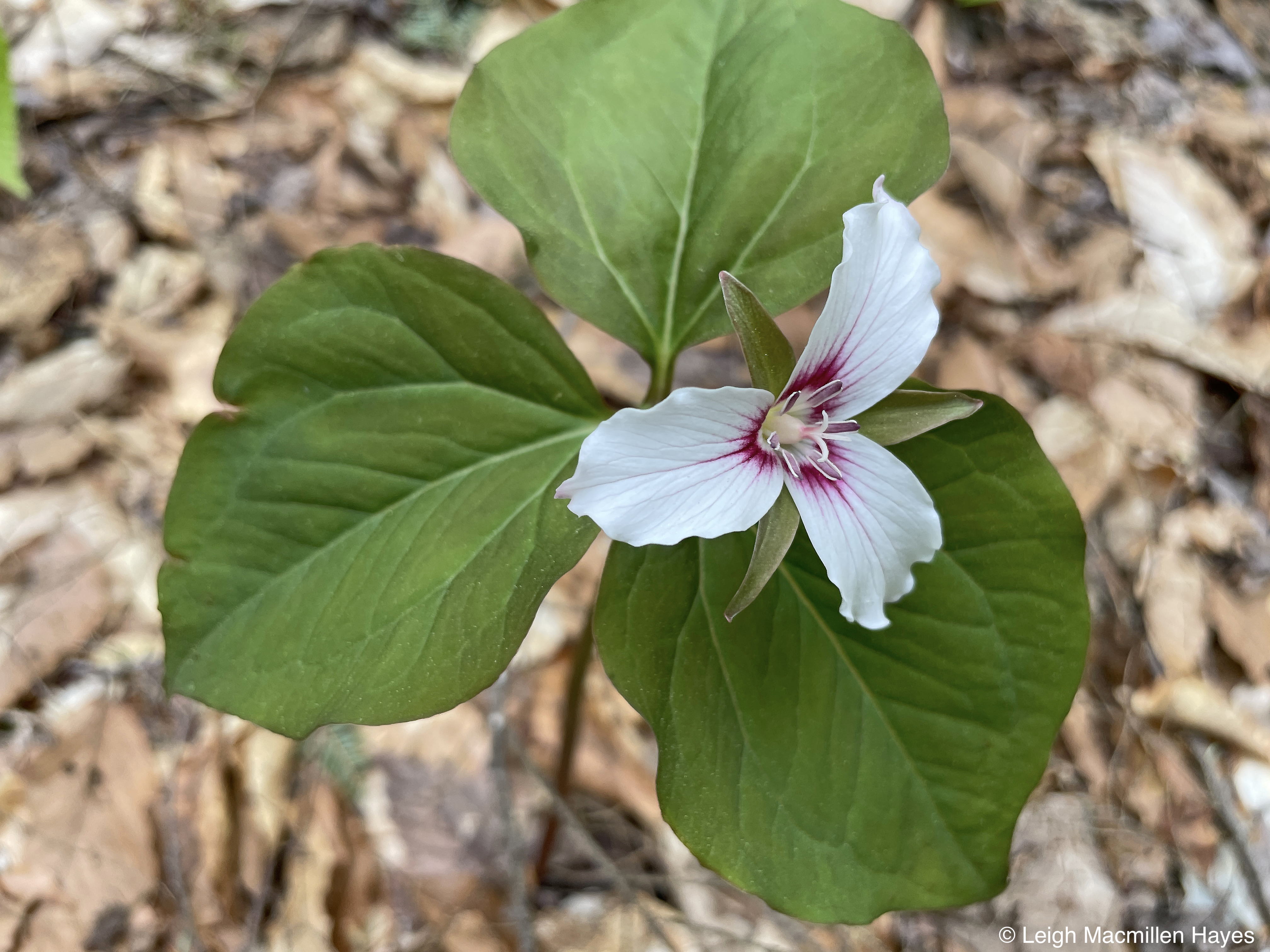
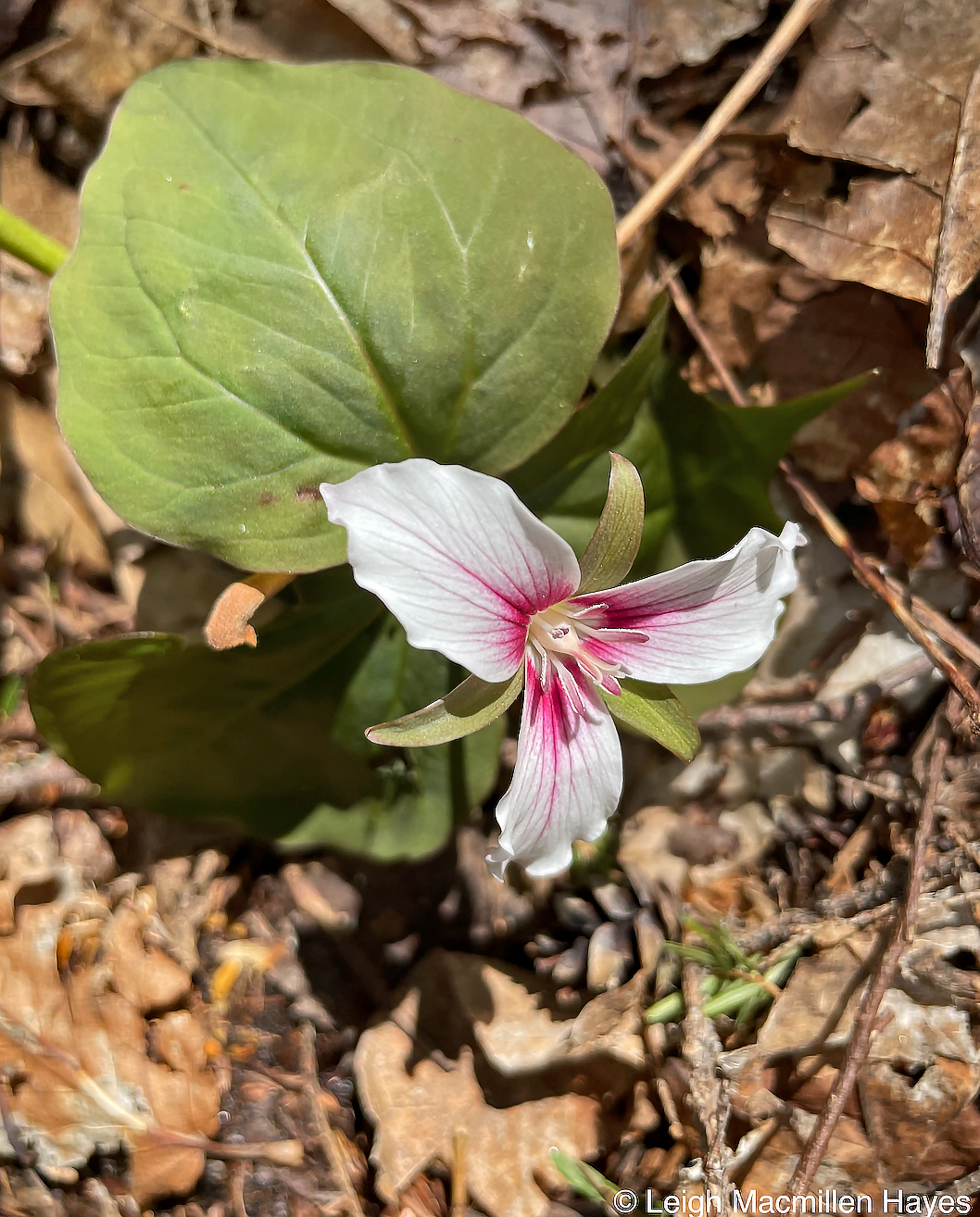
We went in search of one of his quests–Lady’s Slippers. We knew it was too early for them to be blooming in our area of western Maine, but thought we’d look anyway. Along the way, I decided to count Painted Trillium because My Guy always comments that there are a trillion trillium blooming near trails at this time of the year. And I need to honor so many of them with a photograph. I wanted to know if he is right and we’ve never counted trilliums before. He didn’t join me on this mission, but I did notice he frequently paused near one.

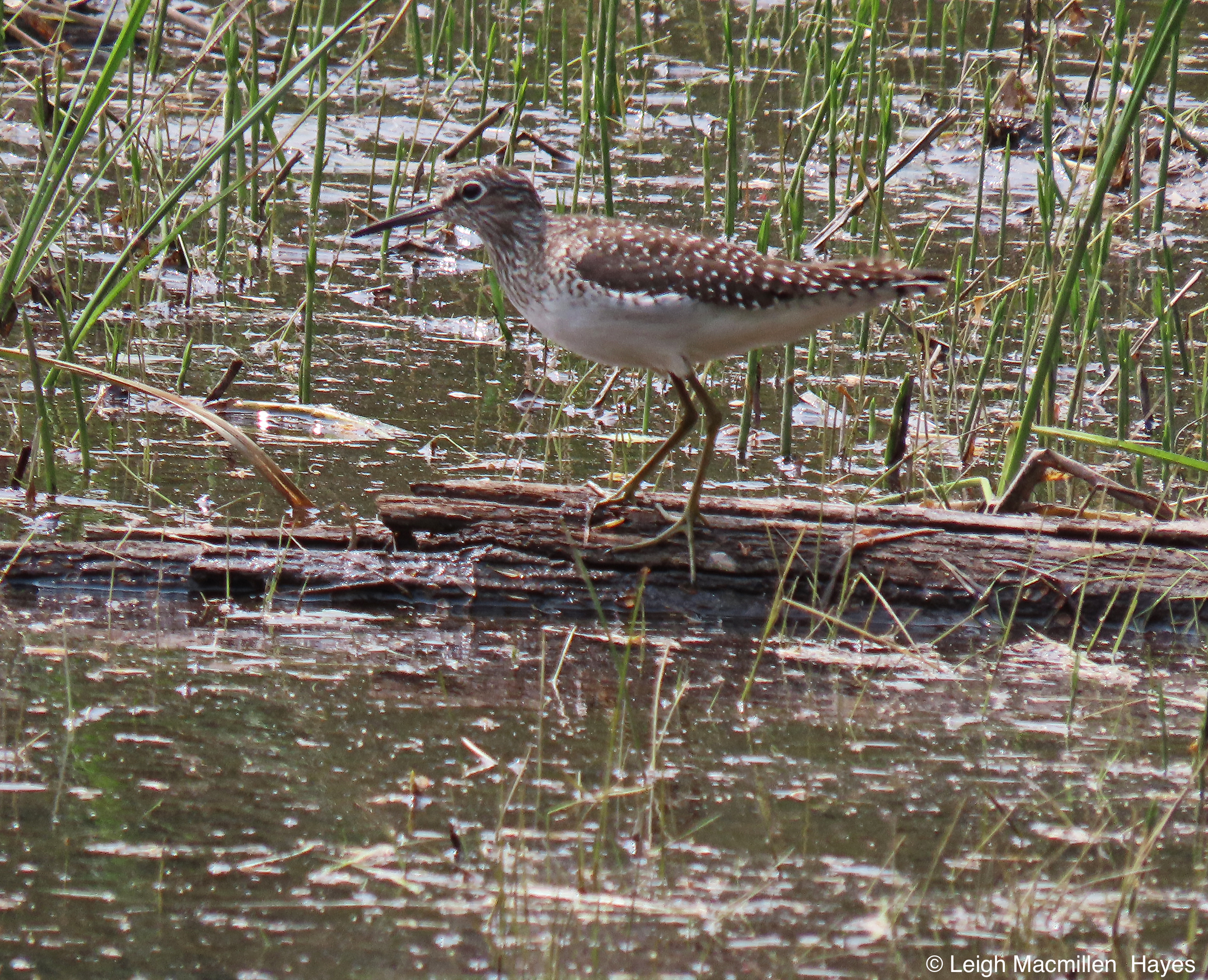
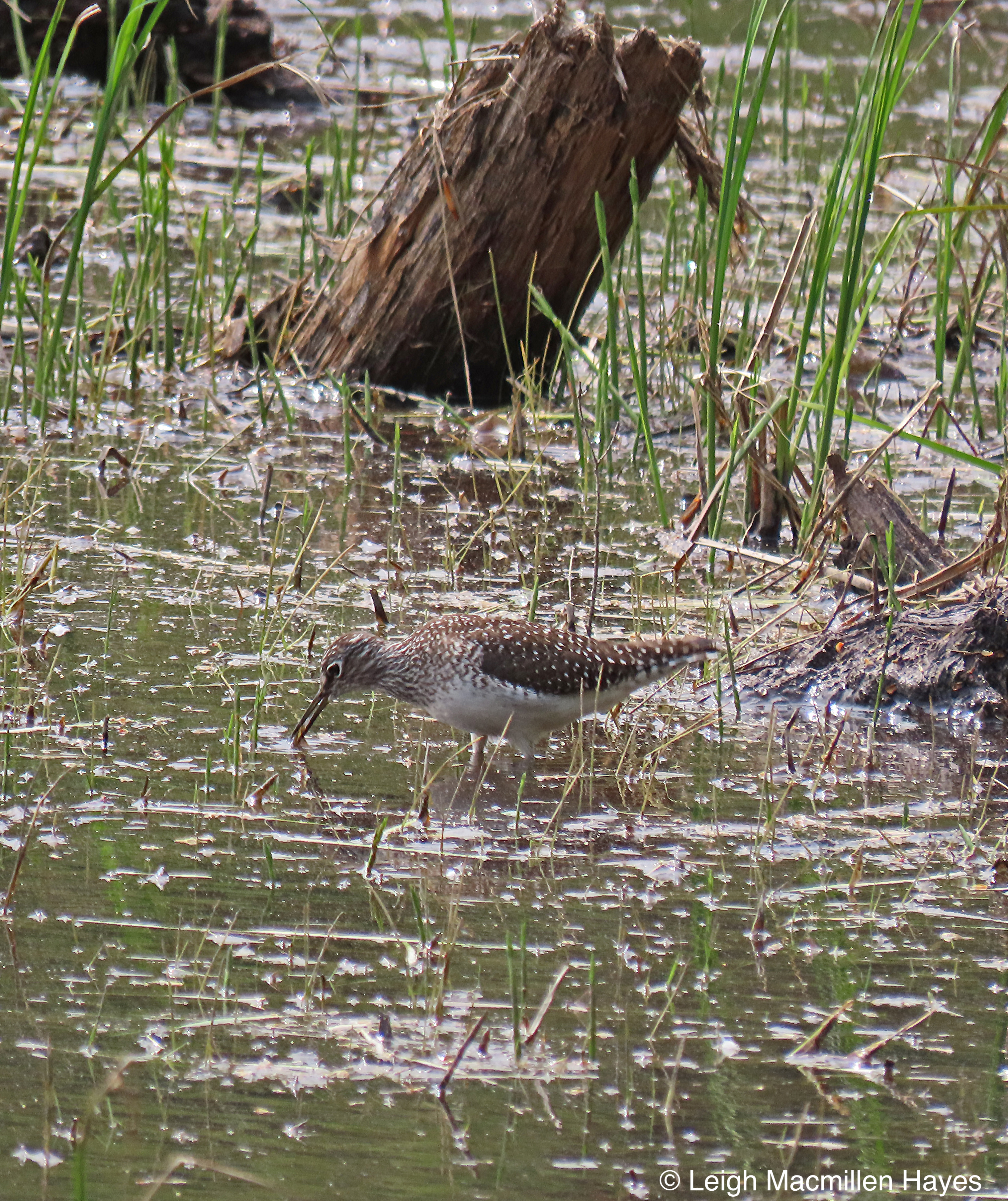
In the midst of our journey, we stopped beside a wetland and didn’t spot the Solitary Sandpiper at first, but then it moved. Constantly. As is its habit to provoke its food source into moving.

What it saw with those be-speckled eyes, I’m not sure, but I do think aquatic insects and amphibians were on its menu.

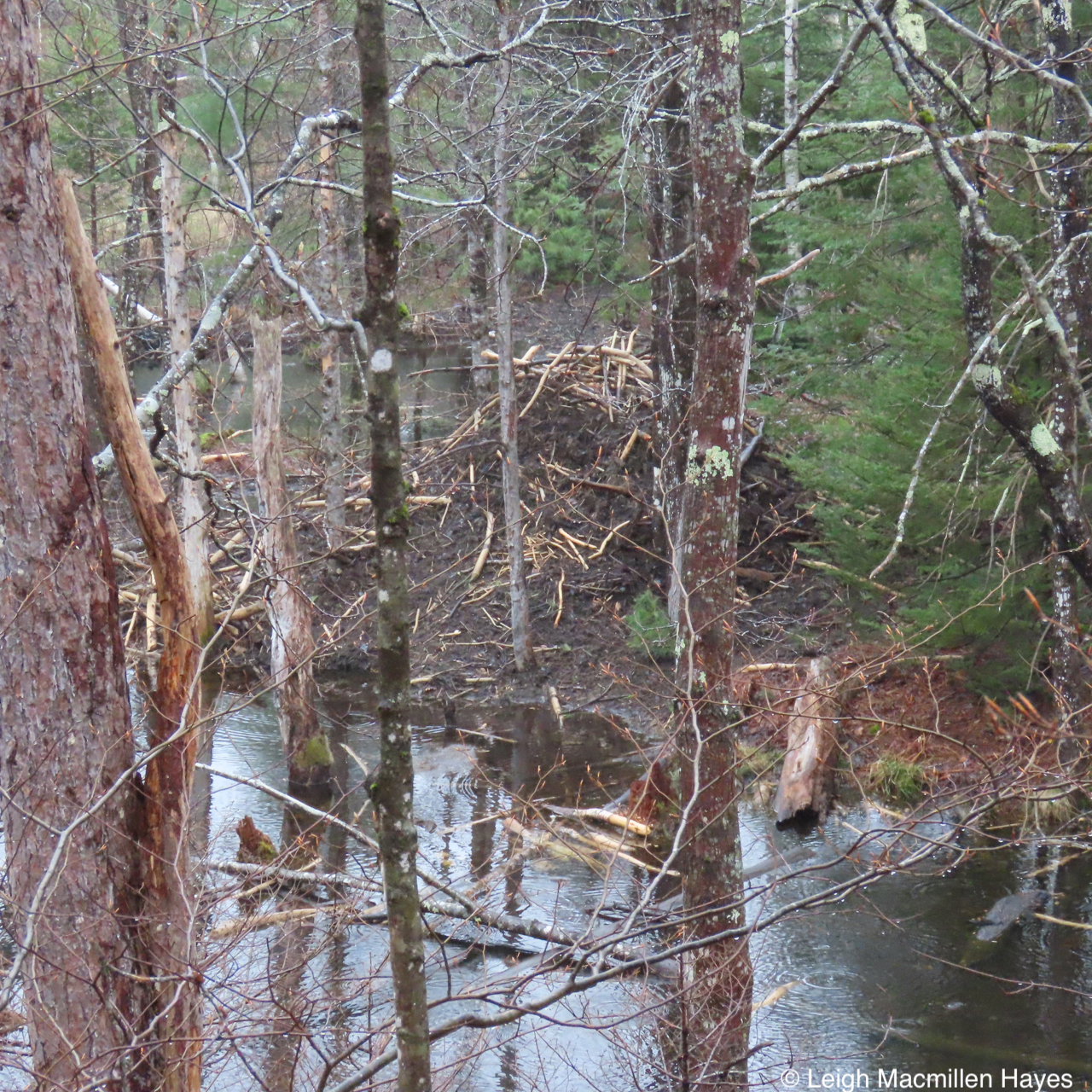
After a wee bit, we came to the beaver dam that bisects the trail, where fresh mud indicated someone was at home. It’s a tricky crossing, but I’m here to say we were successful on the way up and back.

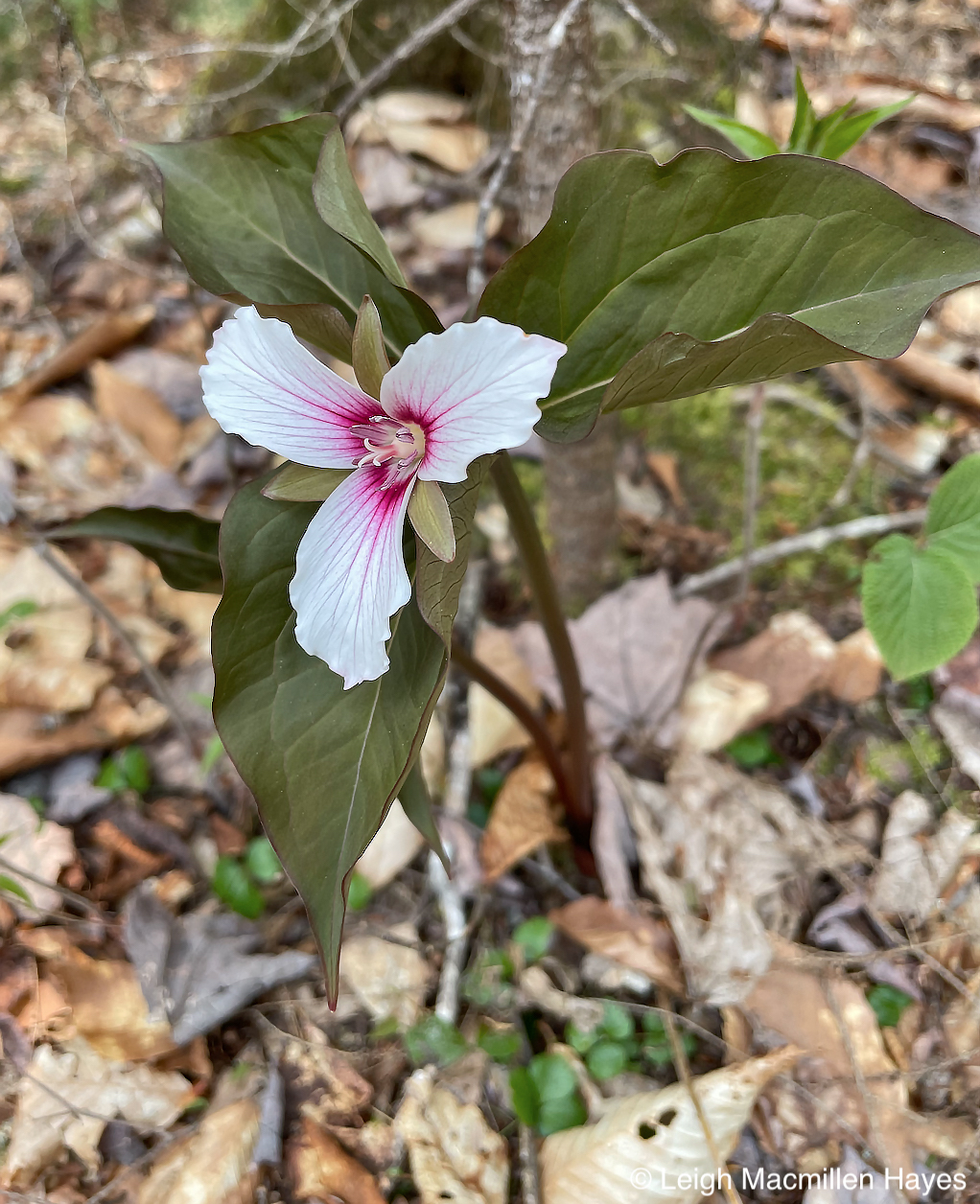
Onward and upward, my count continued and while most often the Painted Trilliums were solitary like the sandpiper, these five represented numbers 41, 42, 43, 44, and 45.

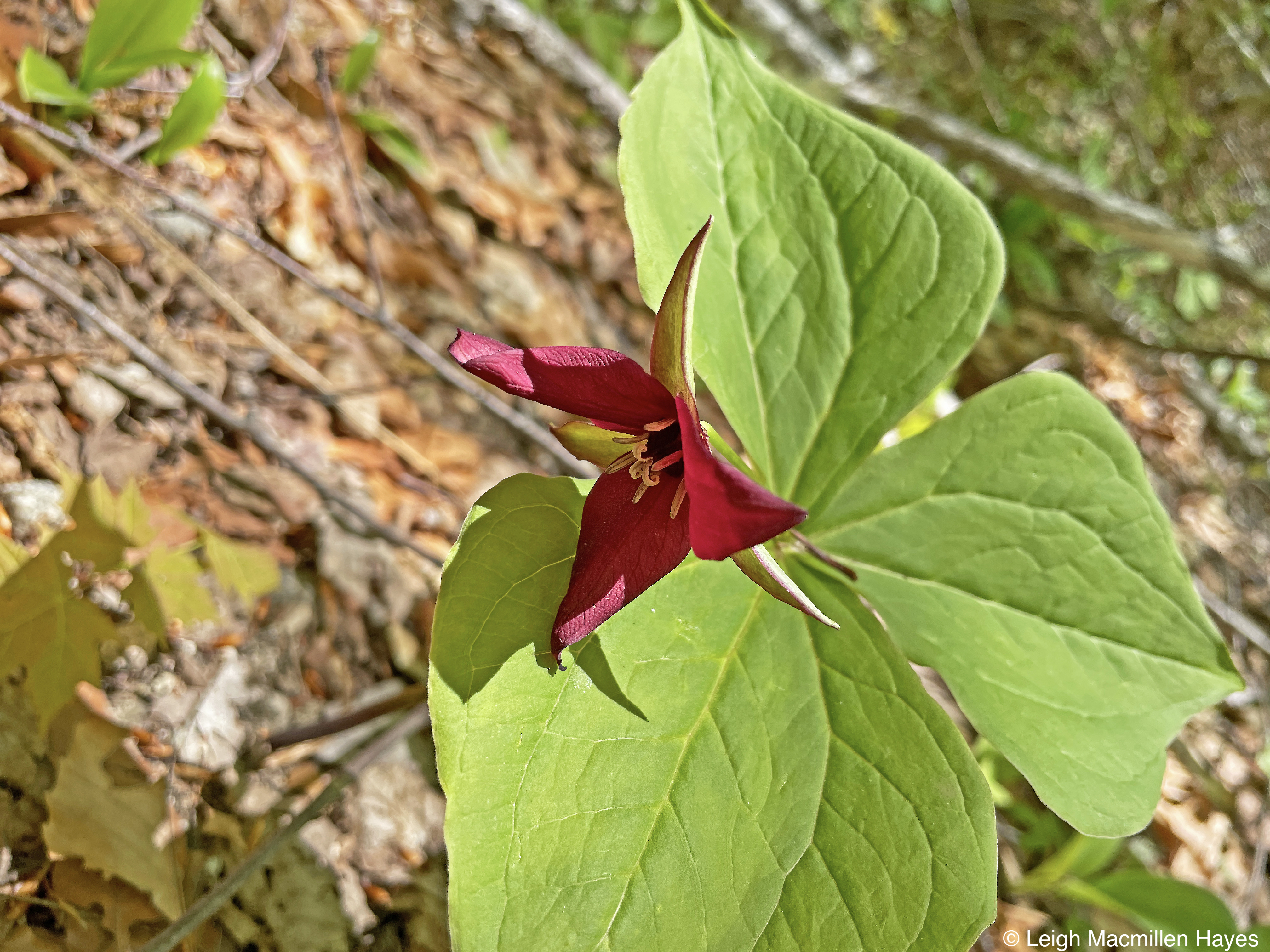
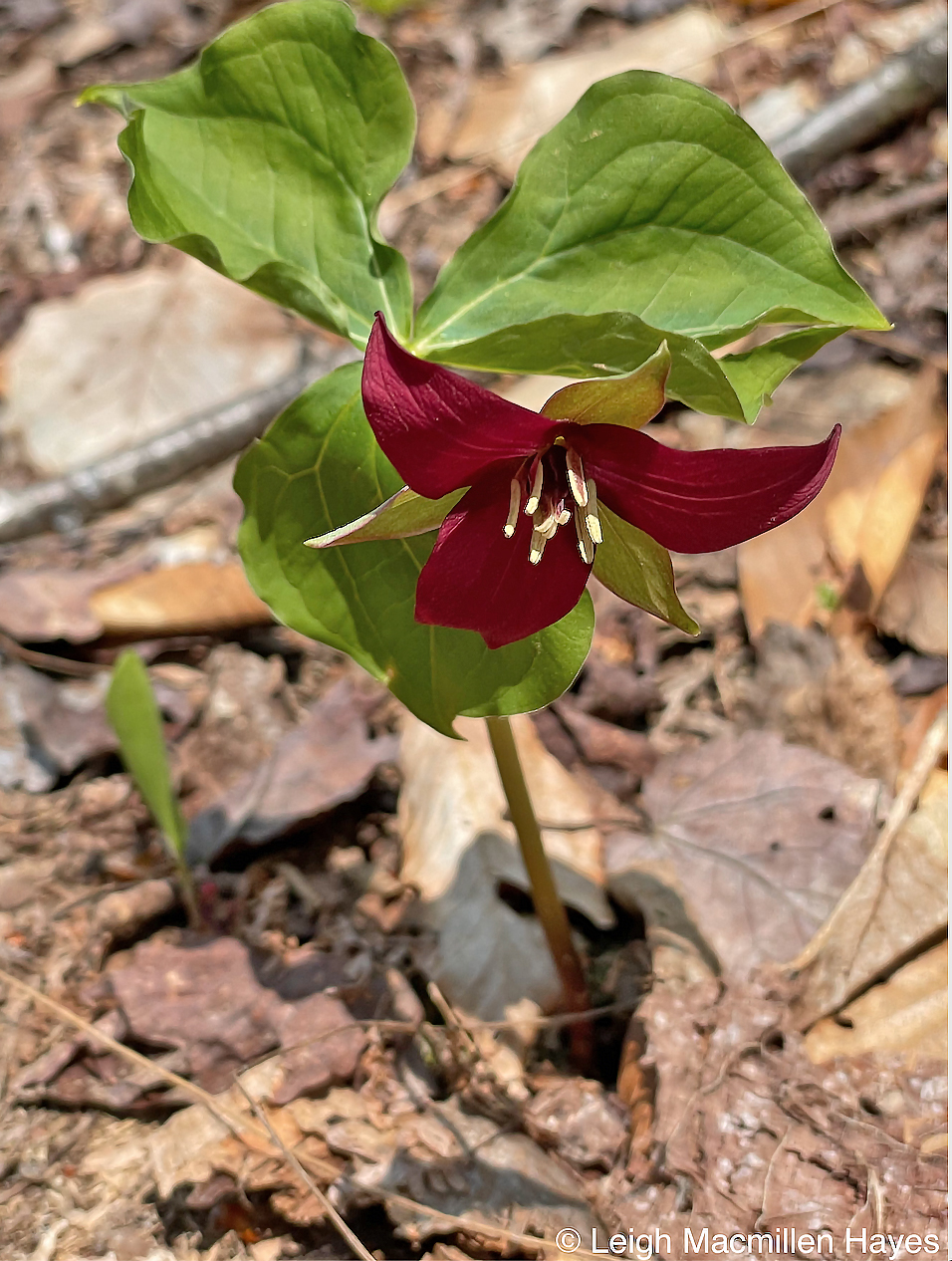
We also found a few Red Trillium, aka Stinking Benjamin, to honor.

Approaching the summit, My Guy checked on his favorite Lady’s Slipper bouquet, but it’ll be another two or three weeks before we’ll be counting their blossoms.

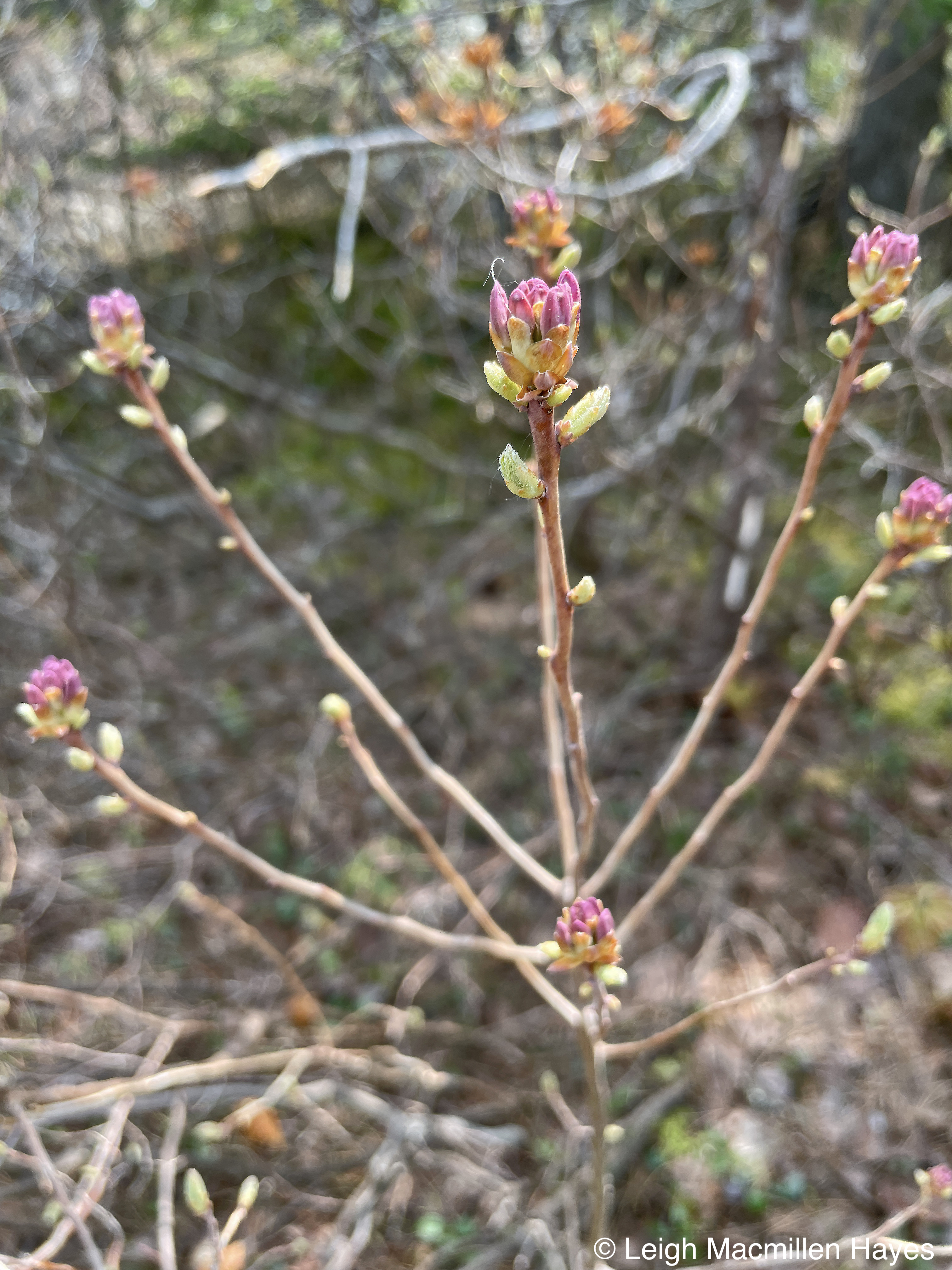
And I checked on the Rhodora, also offering a peek into the future.

Lunch upon lunch rock offered a hazy view of the mountains beyond. And it served as our turn-around point as this is an out and back trail.

BUT . . . remember at the beginning of this tale I said I was presenting things a wee bit out of order? Back toward the beginning we approached the beaver dam silently because sometimes we are treated to moments with the beaver as it tries to rebuild the dam. As we rounded a corner, we heard water dripping. It was just not quite in a beavery sort of way.

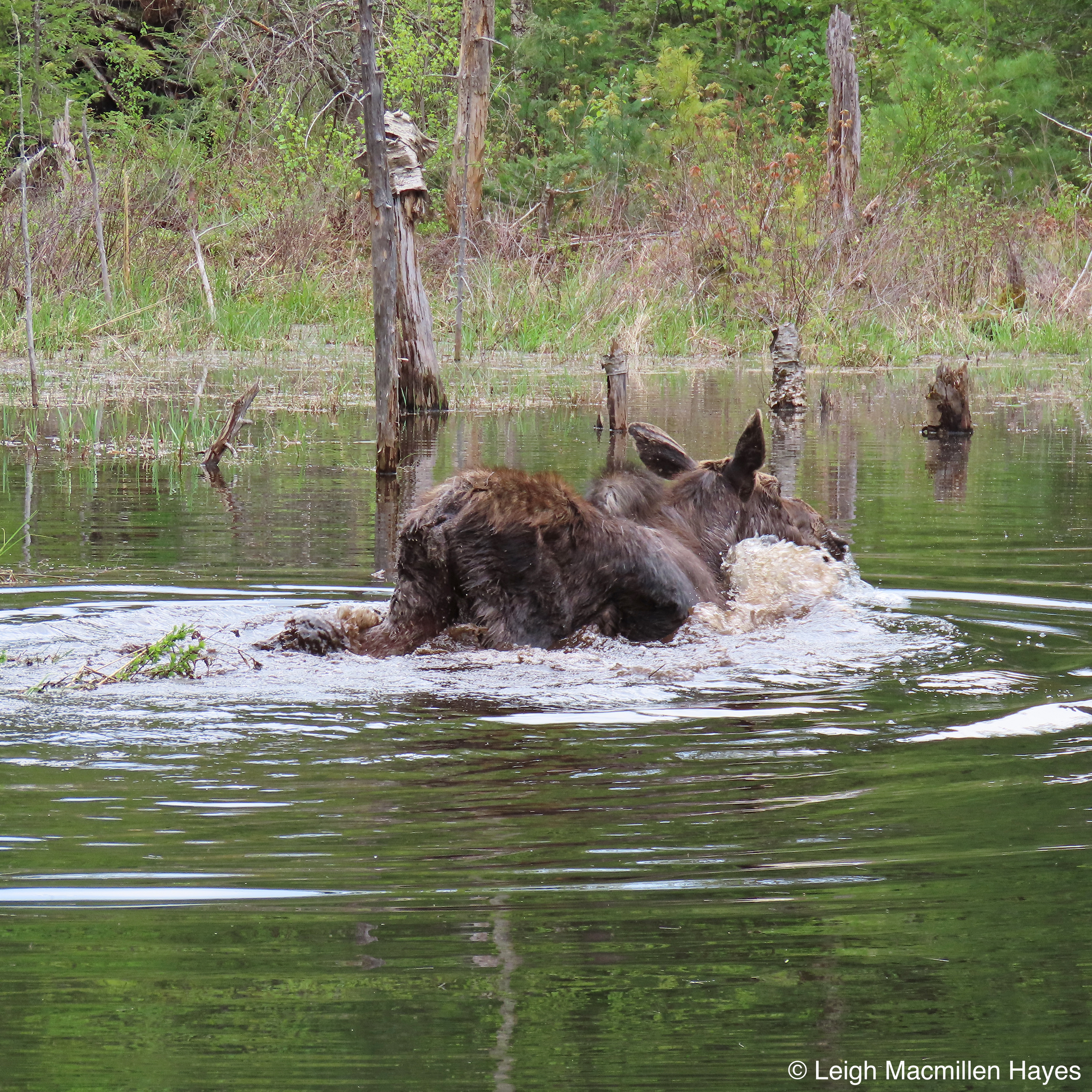
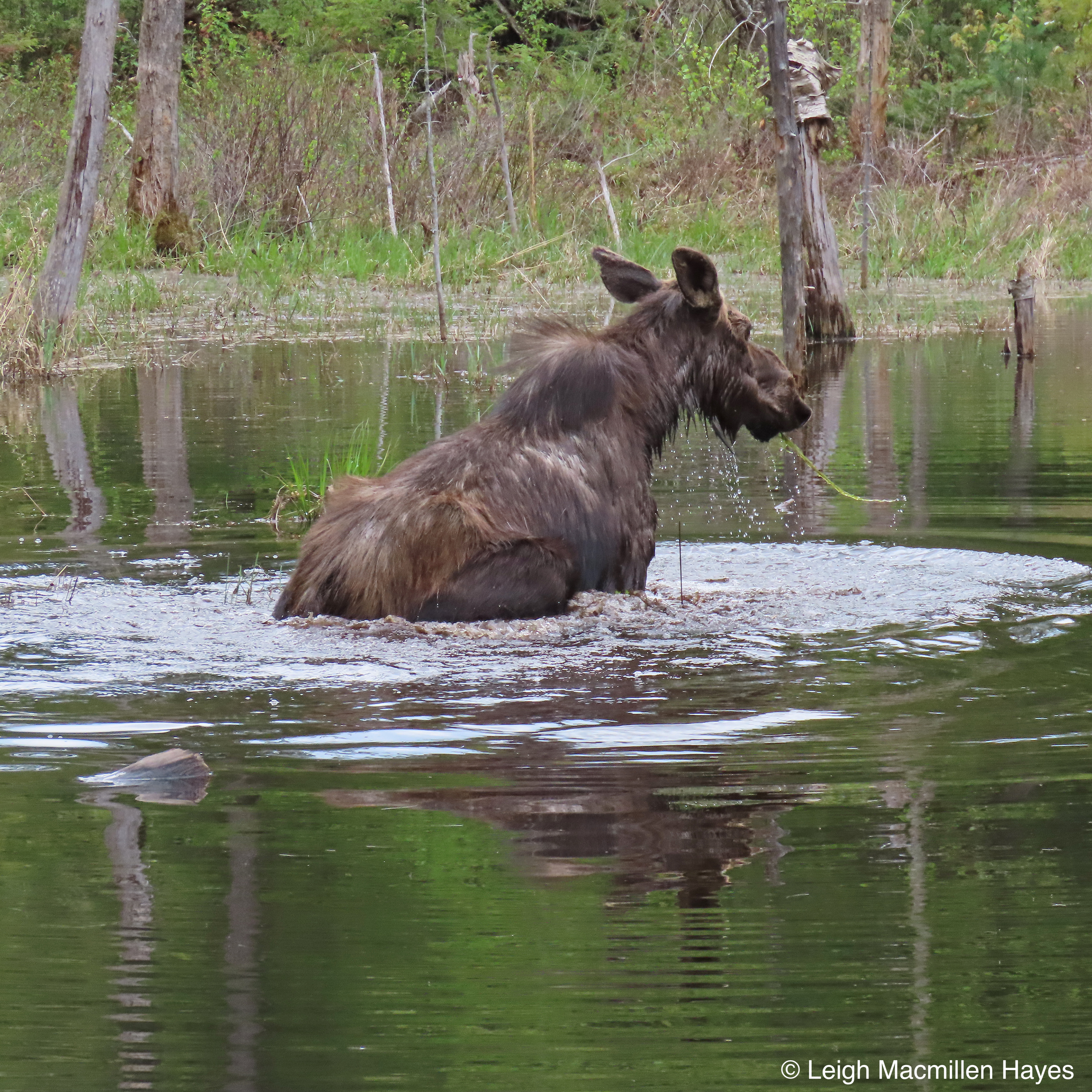
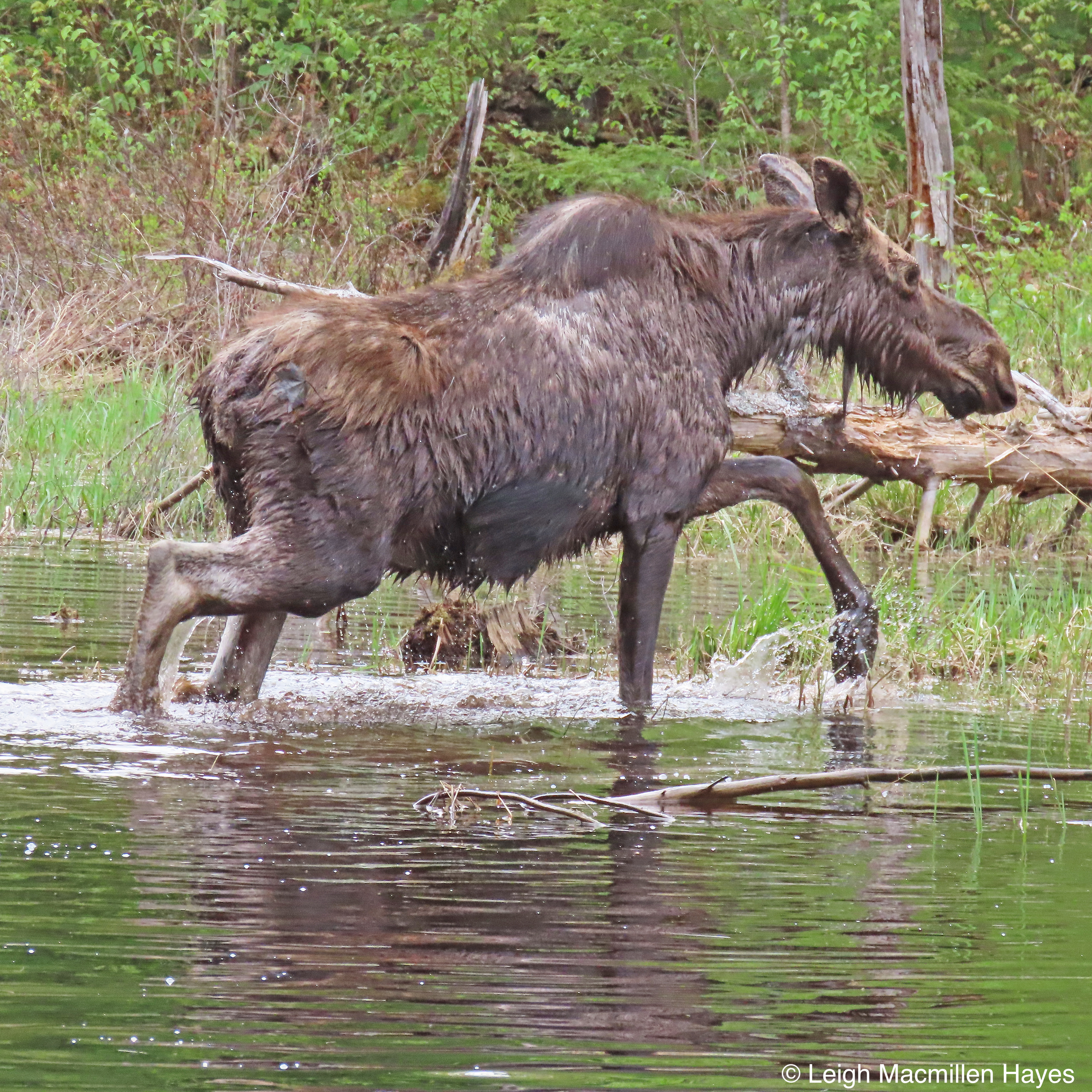
That’s because it wasn’t a beaver, but rather a Cow Moose. This photo was taken just moments after she and I looked at each other from her spot about fifteen feet from where I stood. It took me a second to realize that I was starring into her eyes, and another second to silently alert My Guy and grab my camera. And then she turned and started across the water, not an easy task in a beaver pond filled with many fallen trees.

She’d been dining as you can see from the vegetation dangling from her mouth.

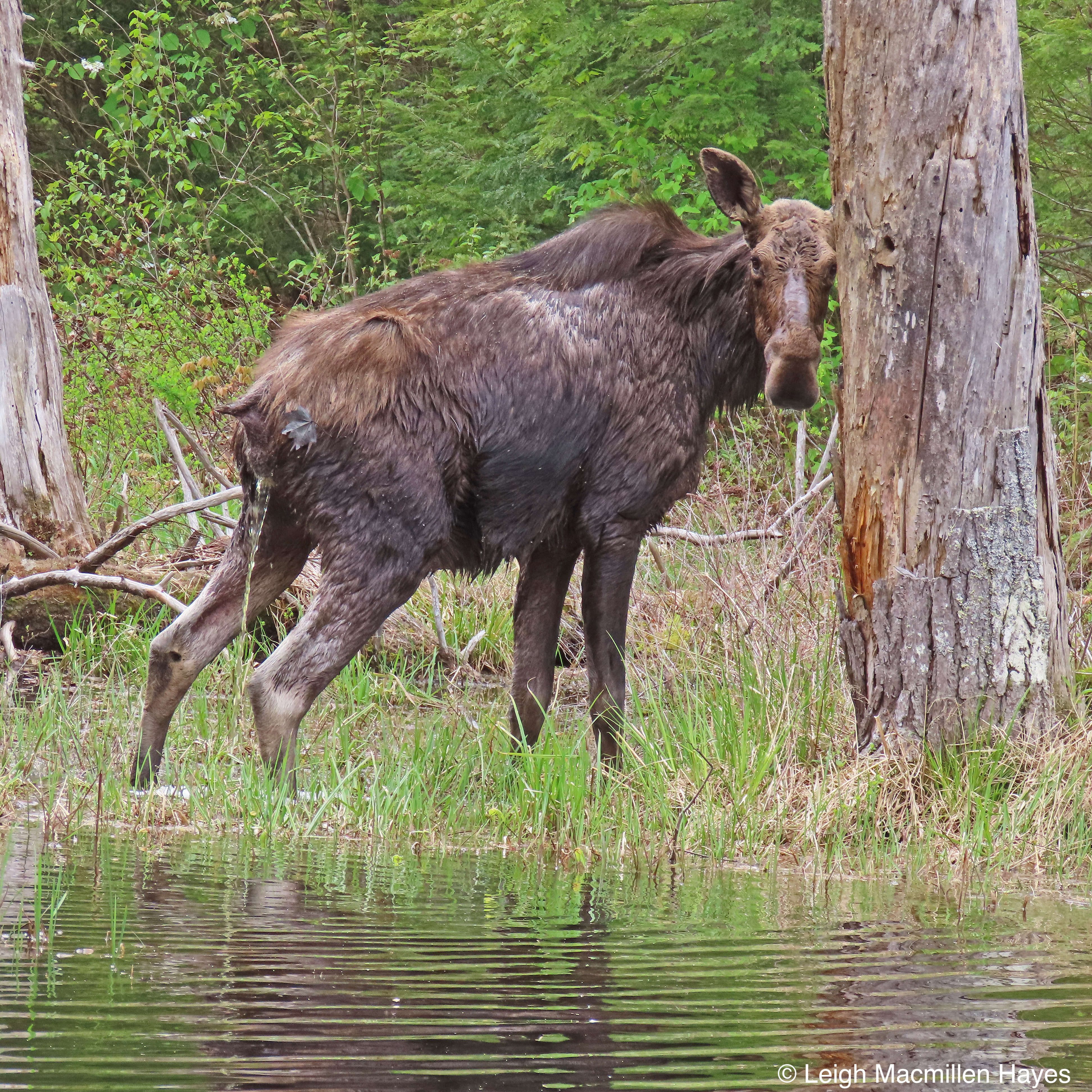
Look at that face, one only a mother can love. That oversized upper lip. And those warm brown eyes. She did look rather mangy, but that’s a spring thing as she sheds her winter coat.

As she moved off, in her tippy-toe ungulate manner, water dripped from her body.

And then she looked back at us and peed. We felt the same way about her–it was a pee-in-your-pants moment.

Finally, she began to disappear into the woods.

And blended right in with her surroundings. How often, we always wonder, is there a Moose in the landscape that we just don’t see.

Especially when it looks like this? Can you spot her now?

We may not have counted Lady’s Slippers on today’s Mondate hike, but we certainly didn’t moose it up, either.

Final count:

Painted Trillium 59

Red Trillium 3

Cow Moose 1

One was certainly enough!

Colored By A Mother’s Love

I wasn’t sure I wanted to be a mother, but was blessed with two sons more than two decades ago.

When the boys were young, I soon discovered that each day there was something to rejoice about beginning with those early accomplishments like rolling over, blowing bubbles, learning to walk, loosing a tooth, tying a shoe, zippering a jacket, skipping down the road, whistling a tune, or riding a bike without training wheels.

Always, it was traditions that we shared which brought great delight. S and I had a secret hand code that meant “I love you.” P would say, “Ding, ding, snuggle time,” at the end of many meals and climb onto my lap to cuddle.

At bedtime, there was that sense of relief because these two dynamos were finally going to sleep, but special moments occurred each night as we shared important memories of the day with thanksgiving and snuggled some more while reading books.

For P’s first two years, I was convinced he and S were twins. It took me that long to accept that we had two individuals. By looks it was obvious with S’s coarse, curly hair and P’s much finer curls. But there was more.

At age six, S loved science, reading, writing, swimming, mazes, Winnie-the-Pooh, the computer and pretending to be a Private Eye. He constantly planned businesses and designed buildings. S was our organizer and enjoyed figuring out strategies. He was intense with a wonderful sense of humor.

Four-year-old P loved sports, knights in shining armor, super heroes, and dressing as a police officer, fireman, or postman. He loved to tell long, embellished stories. And P learned by observing and taught himself how to ski, skate, and ride a bike. He was quick to smile and loved to joke.

As teenagers, some things had changed. S’s passions included reading, theme parks, roller coasters, computers, Walt Disney, cinematography, geography, research, stocks, and business adventures. He was a member of the honor society, three sports teams, drama club, and Boy Scouts. In addition, S loved to volunteer for our local access cable station where he’d film events as well as work on audio and production. He had grown more intense than ever, but his humor provided a balance.

P’s interests included more sports, writing, drawing, fixing things, playing games, creating meals, playing percussion, yard work, hiking, any outdoor activities, and time spent with family and friends. He had developed a definite sense of justice and he was thoughtful. P participated on three sports teams, drama club, and Boy Scouts. In addition, he and three friends formed a rock band and played at school and community events. He continued to tell great stories and loved a good joke.

As I wandered today, I thought of how proud we are of our sons. After graduating from college with a degree in communications and thinking he was going to work in the newspaper industry, S decided instead to pursue a career dealing with hardware. And for those of you who know, that apple did not fall far from the tree as he has recently returned to town and is in the midst of taking the reins at My Guy’s store.

P also surprised us and chose to major in film, an avenue we thought his brother might have followed. And he has made waves in the film editing business in New York City, a location we never envisioned as being part of his future.

Going back to my story, while carrying S, I remember sharing concerns with other soon-to-be parents. I was most worried about what my child would be like as a teen because at that time I was teaching and knew the struggles teenagers faced daily. Eventually I learned not to focus on that, but rather to worry more about getting the boys safely to that point. A strange thing happened to me along the way. I stopped worrying about them becoming teenagers and adults because they taught me to live in the here and now.

My Guy and I worked hard to give them the right tools to deal with situations as their lives evolved. We nourished them and in return they nourished us.

I remember having a great need for my mother’s ongoing presence and love. I can only hope our boys will always have the same need for us. And that their lives will forever be colored by that love.

As it says in Robert Munsch’s Love You Forever, “I’ll love you forever. I’ll like you for always. As long as I’m living, My babies you’ll be.”

Happy Mother’s Day to all, even those who are not mother’s because I’m sure your acts have nourished others on more occasions than you realize.

Celebrating 31,536,000 Seconds

Dear BS,

I’ve spent the past few days shopping for gifts that make me think of you, and you know how I love to shop. But I think I found just the right selections to celebrate your day.

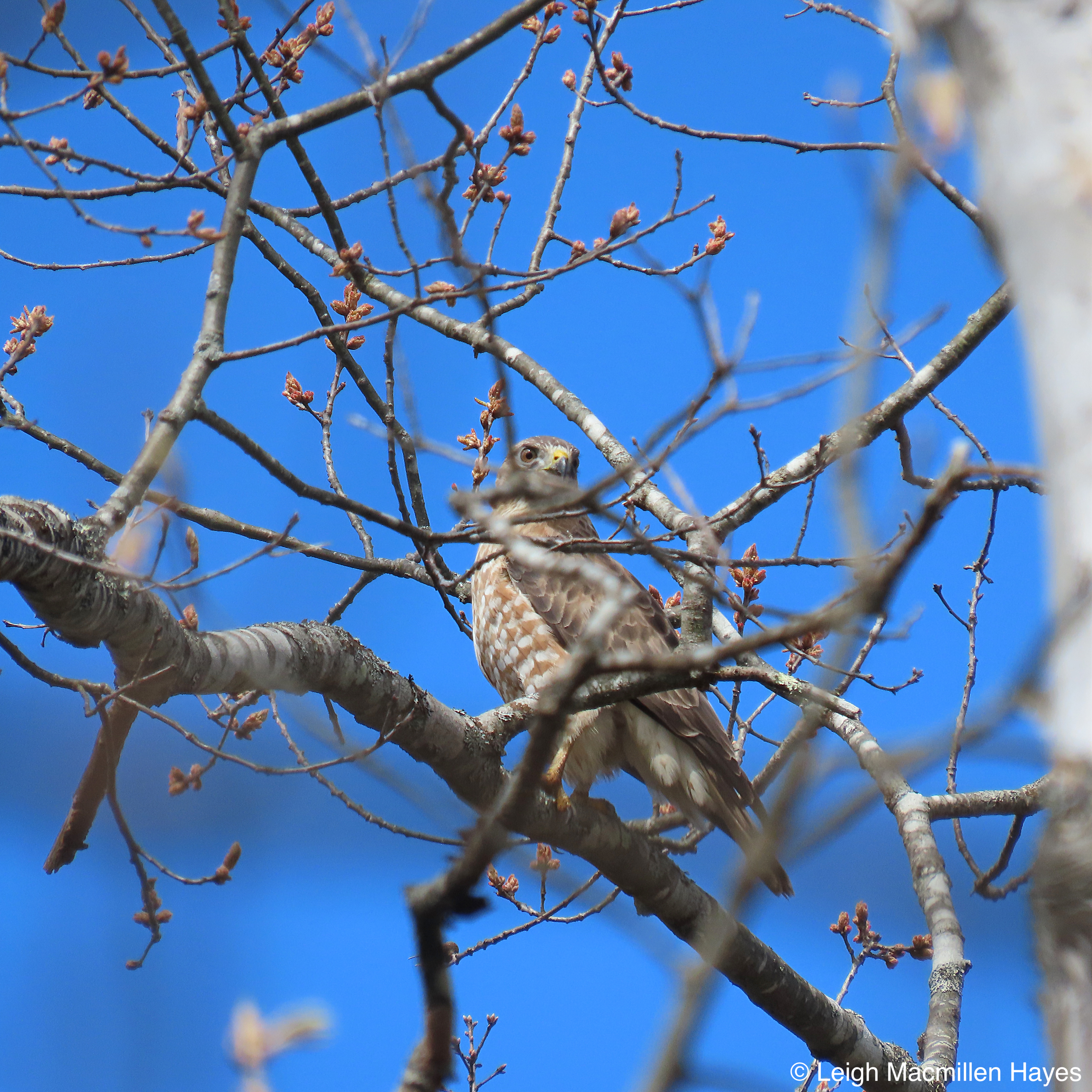
Of course, I needed to cast my broad wings and use my hawk eyes to survey the choices.

The first was as easy to make as it was difficult, for I knew that if I was purchasing one for you, I should also buy another for me since we’ve always had similar tastes for so many things.

But, there were a trillion Painted Trillium from which to choose and I can only hope these two will work for us.

Stinking Benjamin, aka Red Trillium, also demanded a look. I threw one into the cart because every room needs a dash of red and I thought you could perhaps find the perfect spot for it. Just don’t put it near your bed since the odor may not appeal to you, especially at night.

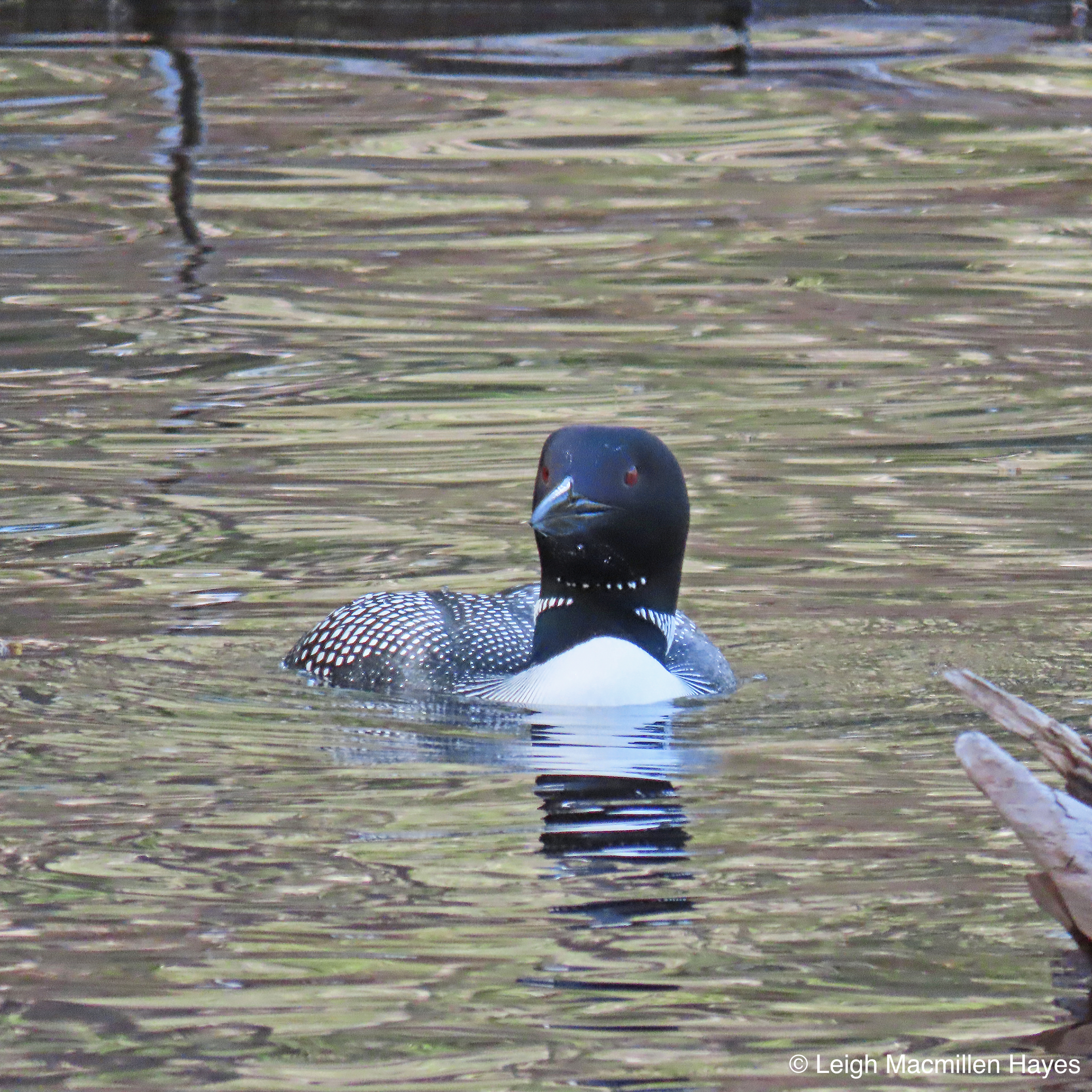
One of the biggest purchases occurred when My Guy and I stood near a body of water and a loon surfaced by our feet. Its velvety black texture reminded me of your baby doll with the china head and black velvet dress. If you recall, the dress had a lacy white collar. Of course, you remember, because if memory serves me right, she’s still a part of your life.

The next gift took me back to your college days. I’m getting old too, but didn’t you participate as a bell ringer in college? The Sessile-leaved Bellwort brought that memory to mind. I can see that performance in my mind’s eye. But, what you may not know is that I was in a bit of hot, soapy water at home when I asked at the dinner table, “Who the hell are the bell ringers?” I thought the rhyme was quite clever. That thought was not shared by all present.

On a more cheerful note, spring beauty is realized in Spring Beauty and when I espy such I know there is even more reason to celebrate spring ephemerals–YOU!

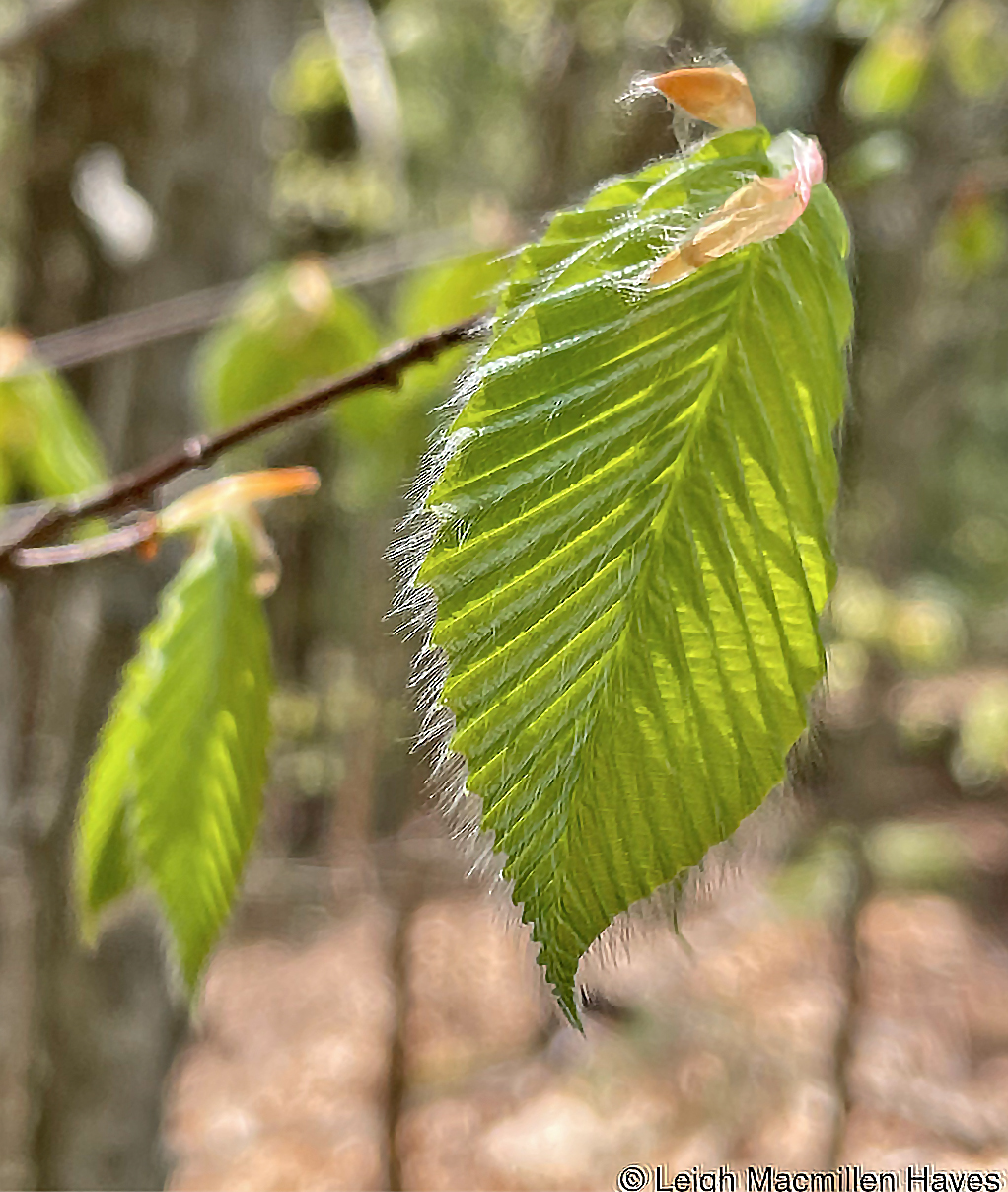
That special day always arrives when the beech leaves burst open and show off their fringed hemline. Being the seamstress and beach girl that you are, this should be your favorite tree, even if you don’t know it.

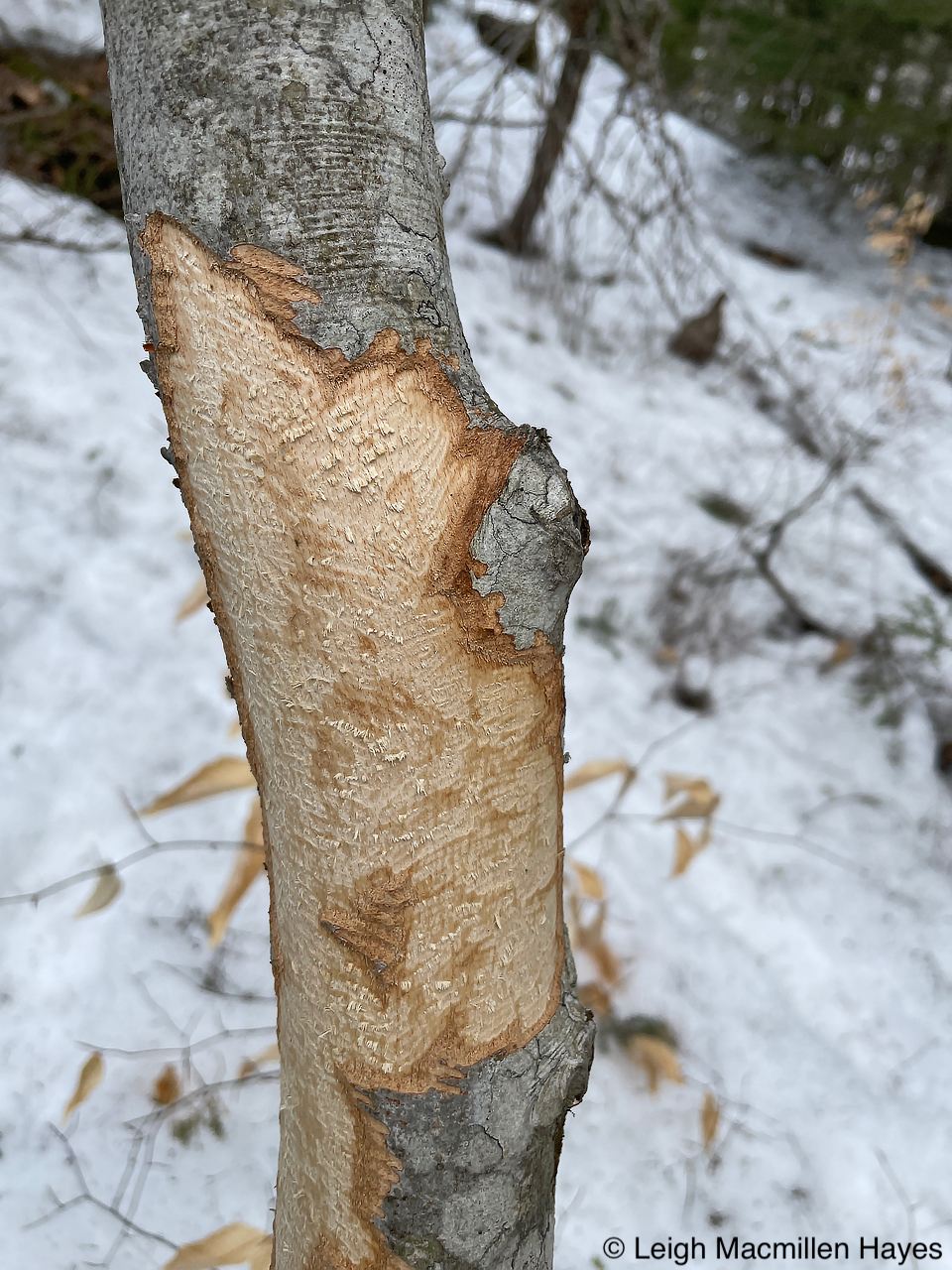
And My Guy found you another who had admired “your” tree repeatedly in the past. Bear claw marks are a favorite of ours and so they must be a favorite of yours as well.

As your day comes to a close, BS, I leave you with the subtle, ephemeral foliage color scheme to decorate your celebratory cake.

No cake is complete without sparkling candles, these in the form of Dwarf Ginseng.

At last, the gift giving must come to an end and so it does with the perfect choice–the floral display of a Hobblebush with its sterile flowers encircling tiny fertile flowers just beginning to open. Though these shrubs may make you hobble and trip as you make your way through the forest of life, they beg you in any season to stop and notice because they always have something to share. This is the gift that keeps on giving as you celebrate another 31,536,00 seconds of the year.

Happy Birthday, BS!

Love, LS.

Keeping an Eye on the Nursery

We are between rain storms and last night’s was a whopper and I’m willing to take the blame because like I wish for snow, so was I wishing for rain. After all, there are vernal pools to tend to and since the mamas and papas have all either hopped or crawled out and headed back to their upland habitat, someone has to watch over the young’uns.

I’ve accepted the responsibility, knowing full well that there will be heartbreak in a month or two, but with the hope that a few days of rain might fill the pools for now to give frog and salamander embryos a chance to grow and emerge and feed and grow some more.

And so as the sun shone in the midst of major flooding, I stood sentry and took note of my various wards.

My peeps include the larval and pupal forms of mosquitoes because they do, after all, play an important part in the food web, especially in the ephemeral pool where my kids need food. And later, my other young’uns who emerge as dragonflies and damselflies will also benefit from dining on such biting insects. Birds, too, will find nourishment with these tiny morsels. And so, when I go pond dipping with others, I always encourage them to return the mosquito-ridden water back to the pool rather than following their instinct to pour them onto the ground and let them dry out and die in an attempt to keep the population down.

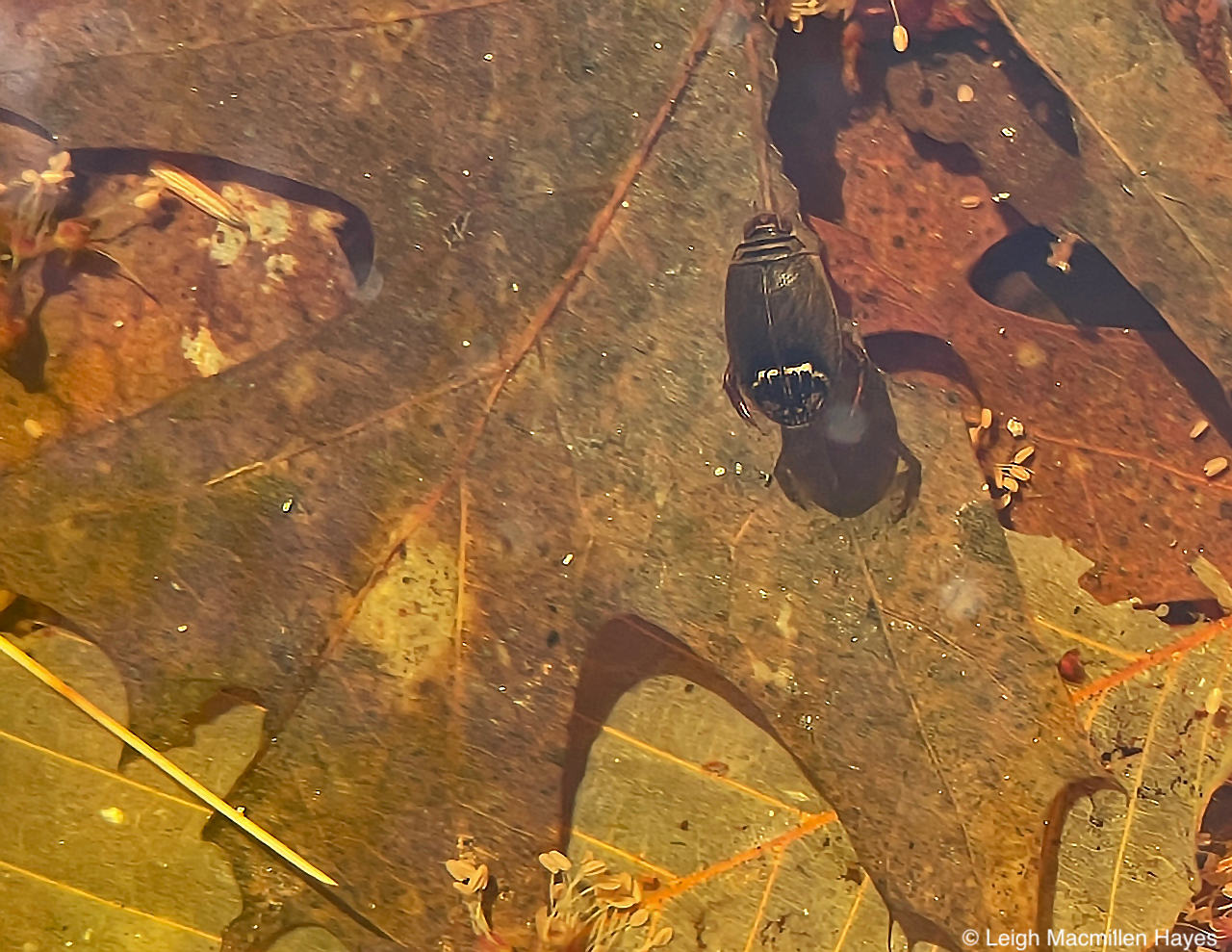
With focused attention today, I watched as the bubble-butts also drew attention, for Predacious Diving Beetles, who head to the surface to trap oxygen-filled air between their wings and body, prolonging their time under water. and thus can stay under for long periods of time, were chasing after each other, thus extending their need to stay below for some canoodling efforts.

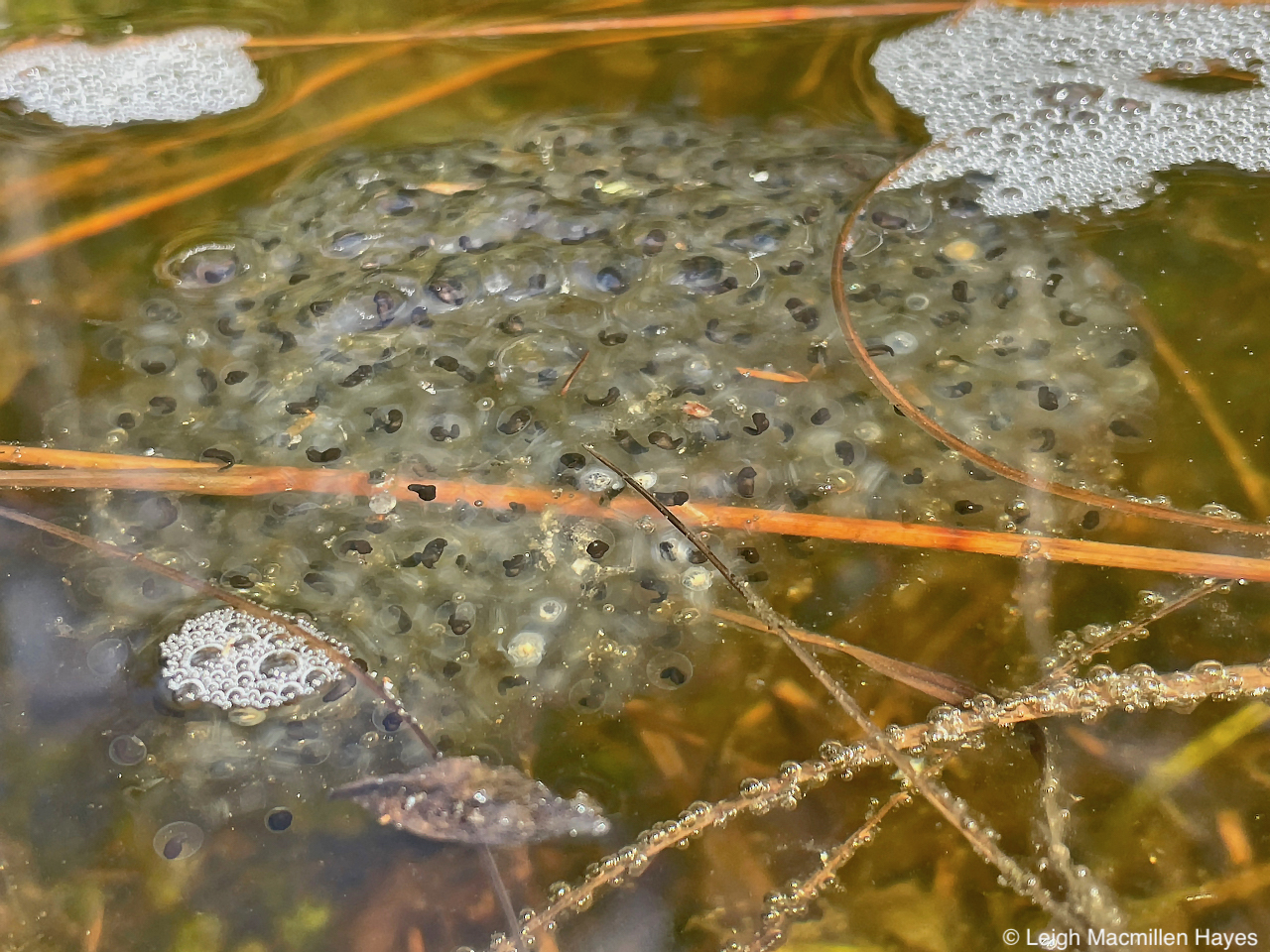
At last I reached my babes, some of them still forming within their bubble-shaped egg sacs. Wood Frogs will these become. In time.

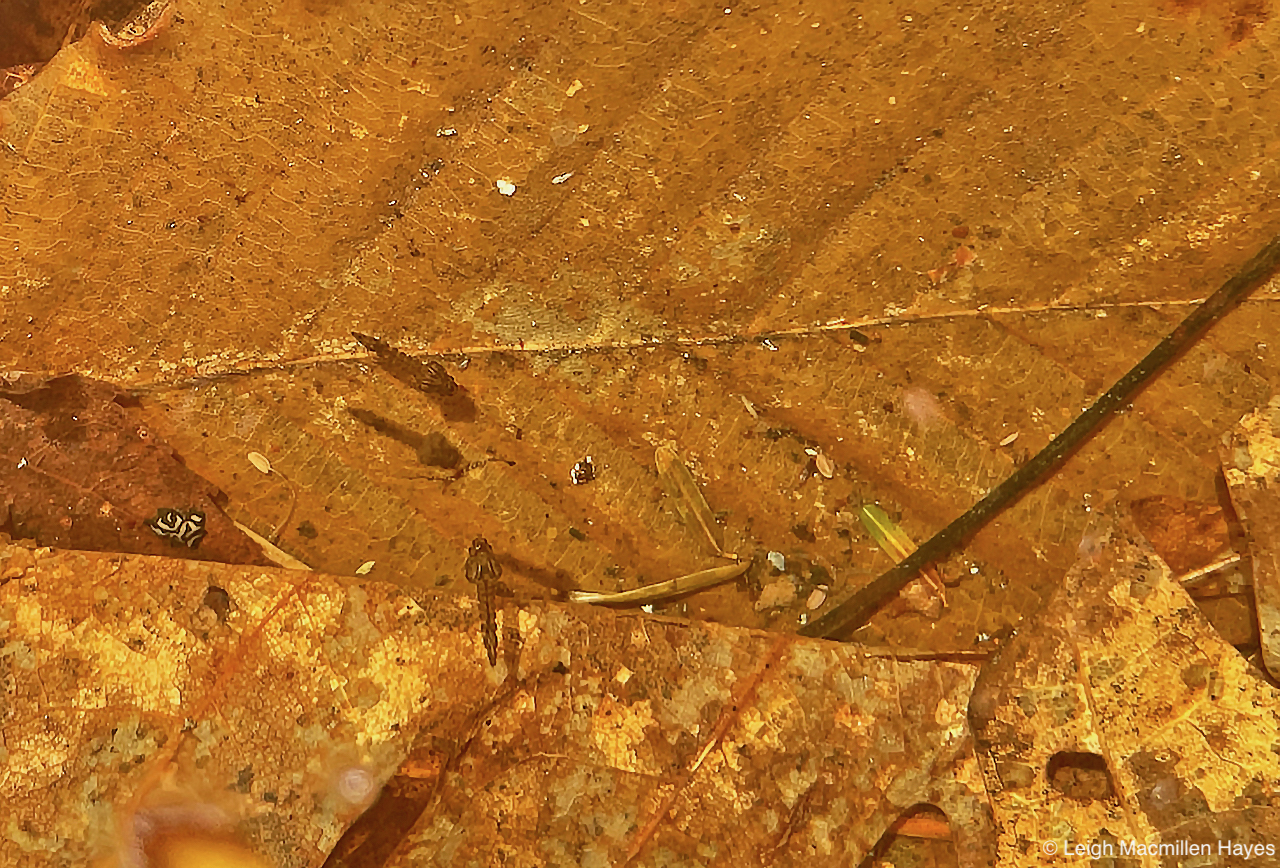
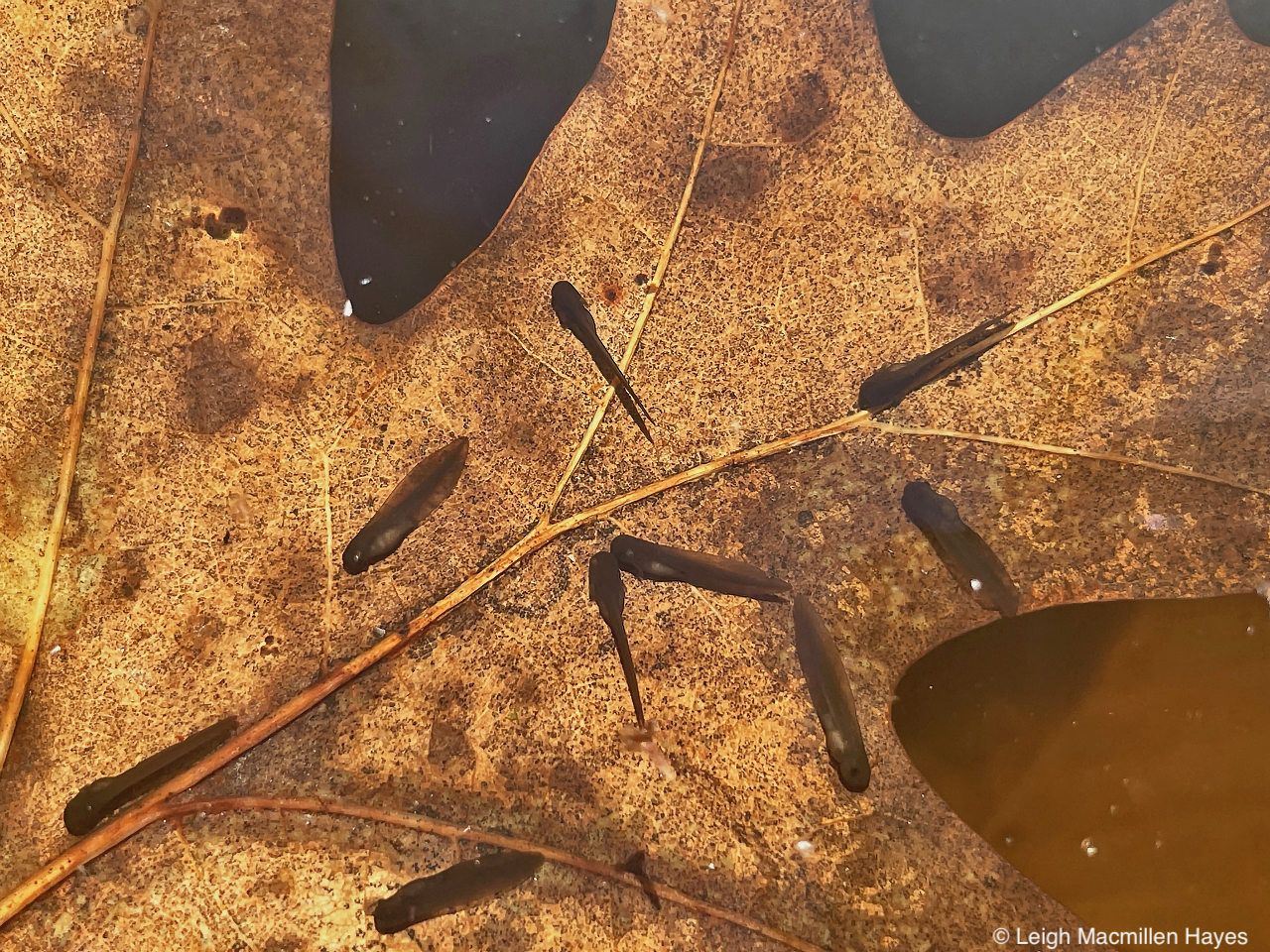
Older siblings hung out on the leaves that form the pool’s lining, their diminutive tadpole size contrasted by the background of a Northern Red Oak leaf.

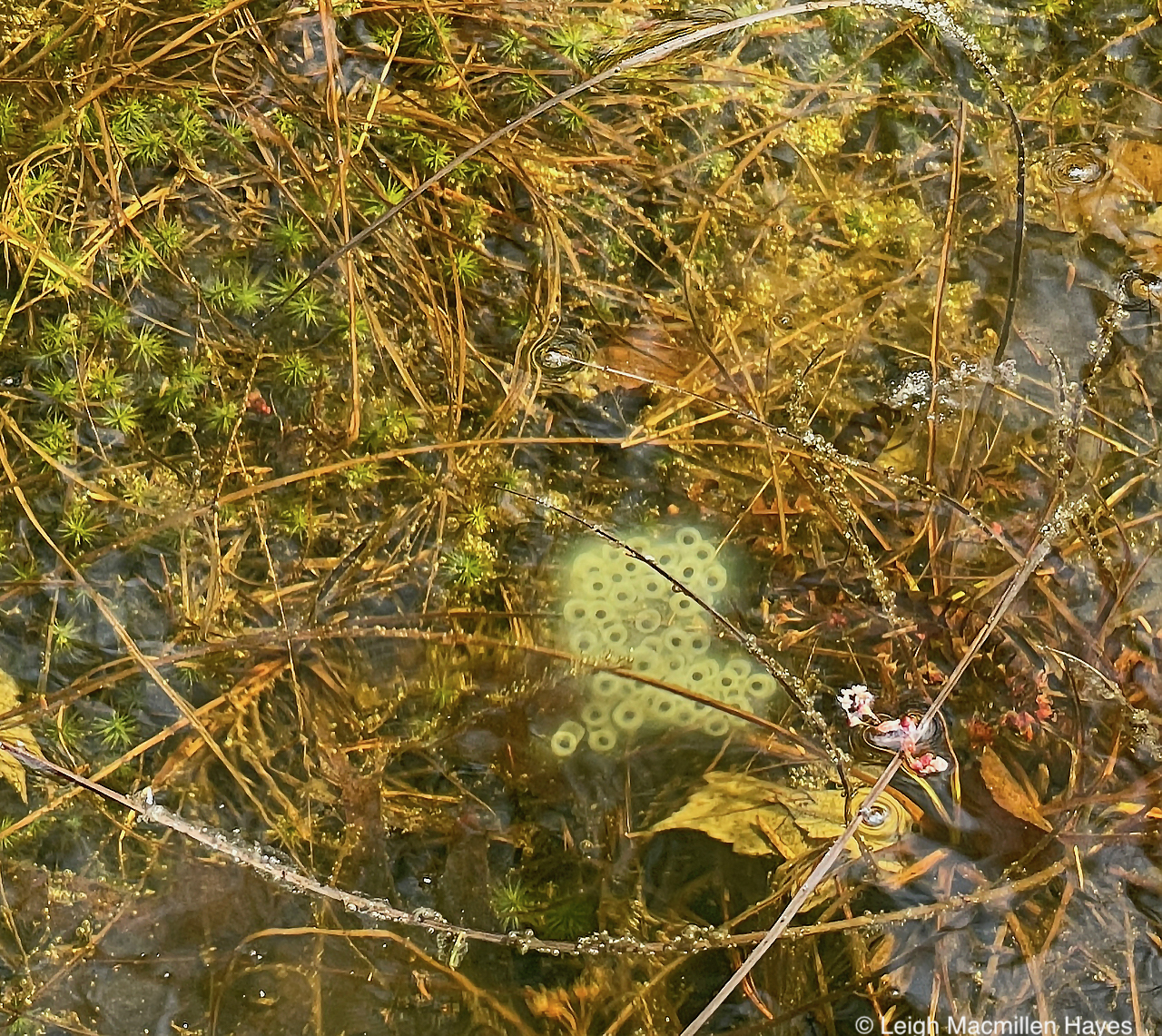
As was to be expected, my Spotted Salamander tykes have yet to emerge as they grow stronger within their gelatinous matrix. It always strikes me as being impenetrable, but is it?

Right now, however, the most prolific members of the pool appear to be the half-inch Midges, who swim on the water’s surface, and skitter and fly about on leaves and any other vegetation.

Click on the arrow and watch these crazy little, non-biting flies. One of my favorite posts from last year was Midges I Have Known. And I’ve known a few. In case you are wondering, she still shares a room with us.

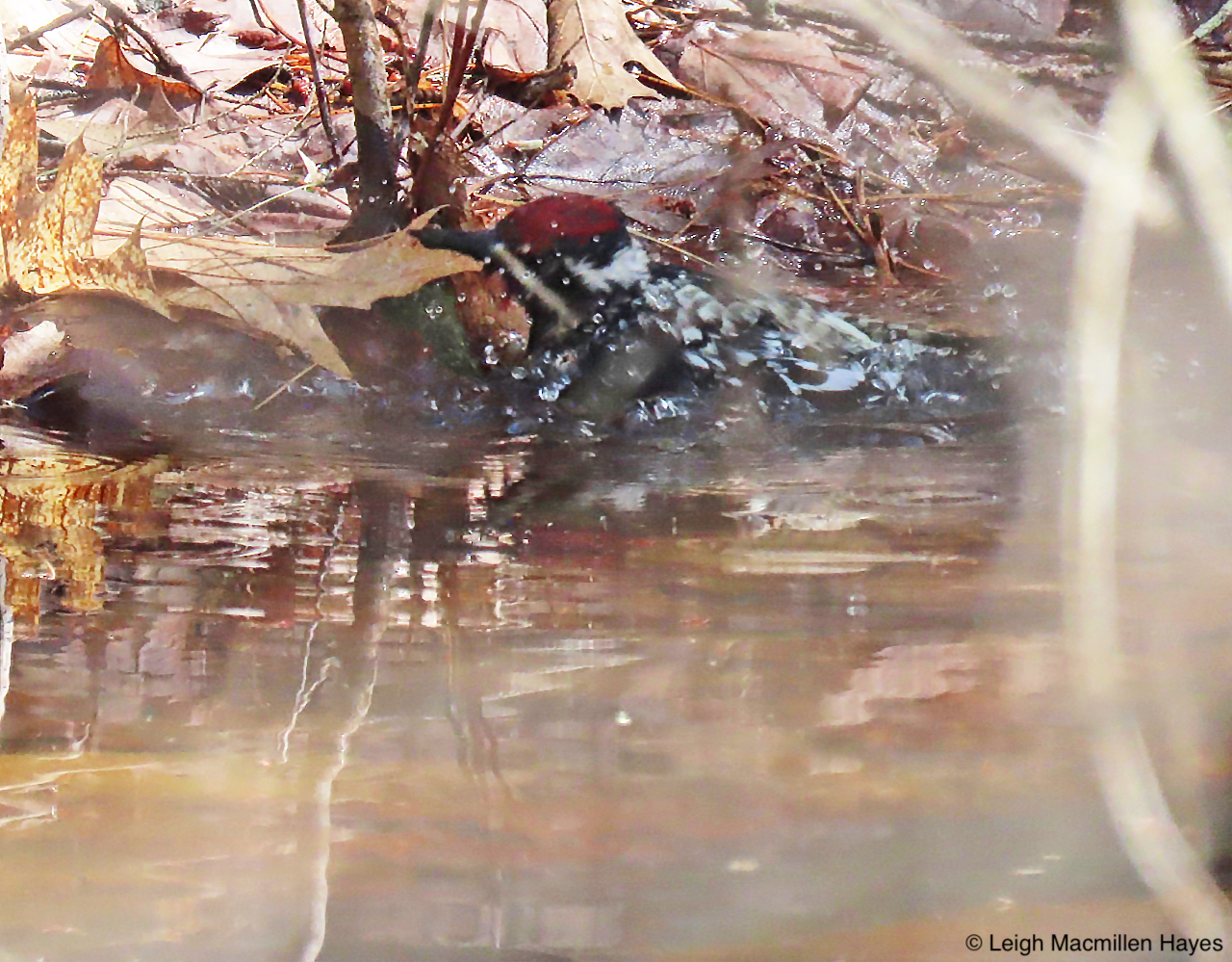
As I stood silently guarding my little friends of many, a surprising event occurred. The local Yellow-bellied Sapsucker makes its presence known each time I am out there. But today, today was bath day.

And I had the good fortune to be standing on a rock across the way, hidden by branches that create the blurry effect, serving as a bit of a bird blind, while the woodpecker splashed about.

I could not believe my good fortune to spend time with this male making himself more handsome by the moment.

His splashes, mixed with today’s breeze, created ripples that sometimes distorted my view of Wood Frog egg masses, but at the same time created a work of art I can only imagine my friend Jessie painting.

It is my job to keep an eye on the nursery and it’s a job I am honored to hold.

Honing My Focus

On April 10, the ice had started to melt on the little vernal pool behind our house. And I got excited.

Suddenly it was time to start paying attention on a daily basis.

Within a few days, following a long winter of being frozen under the leaf litter, male Wood Frogs arrived at the pool. I heard their “Wruck, wruck” quacks as I approached and recognized that love was in the air. But the moment I stepped to the edge, all went silent and the frogs dove to the bottom. Standing as still as possible, I watched as they slowly began to resurface.

A few days later, it was in the pool. Love that is. The females had arrived, their abdomens swollen with eggs. And tada, the Wood Frogs were in business. A male, and it could be more than one, jockeyed for a chance to grasp a female around her waist in a long embrace and fertilized her eggs externally as she laid them.

A week or so later, and all was quiet again on the vernal pool front, for momma and papa had exited the water and returned to the forest floor in search of food, and the nursery was left to develop on its own in the form of a lumpy mass of eggs with a single embryo elongating within each.

About a week later, Spotted Salamanders crossed the road with a little help from some human friends, and they (the salamanders) also sought out their natal vernal pools in which to breed.

To do this, the salamanders performed a dance in which he stimulated her rather than participate in amplexus like the frogs. Then he deposited little packets of spermatophores consisting of mucus and a sperm capsule, and enticed her to crawl over such. According to Mary Holland’s blog, Naturally Curious, the female “positions her vent, or cloaca, so as to allow the lips of her cloaca to detach the sperm capsule . . . she collects his sperm into her body and internal fertilization takes place.”

If you look closely at the two plugs attached to the leaf, you’ll notice that the one to the right still had a sperm capsule attached.

I always think of them as little bundles of cauliflower.

And another tada, the eggs were laid and began to swell up, surrounded as they were by a gelatinous mass (and this one momentarily lifted into a container at the surface of the water for educational purposes), and the parents returned to the their mole-like life below the leaf litter, to be spotted rarely until next year’s Big Night.

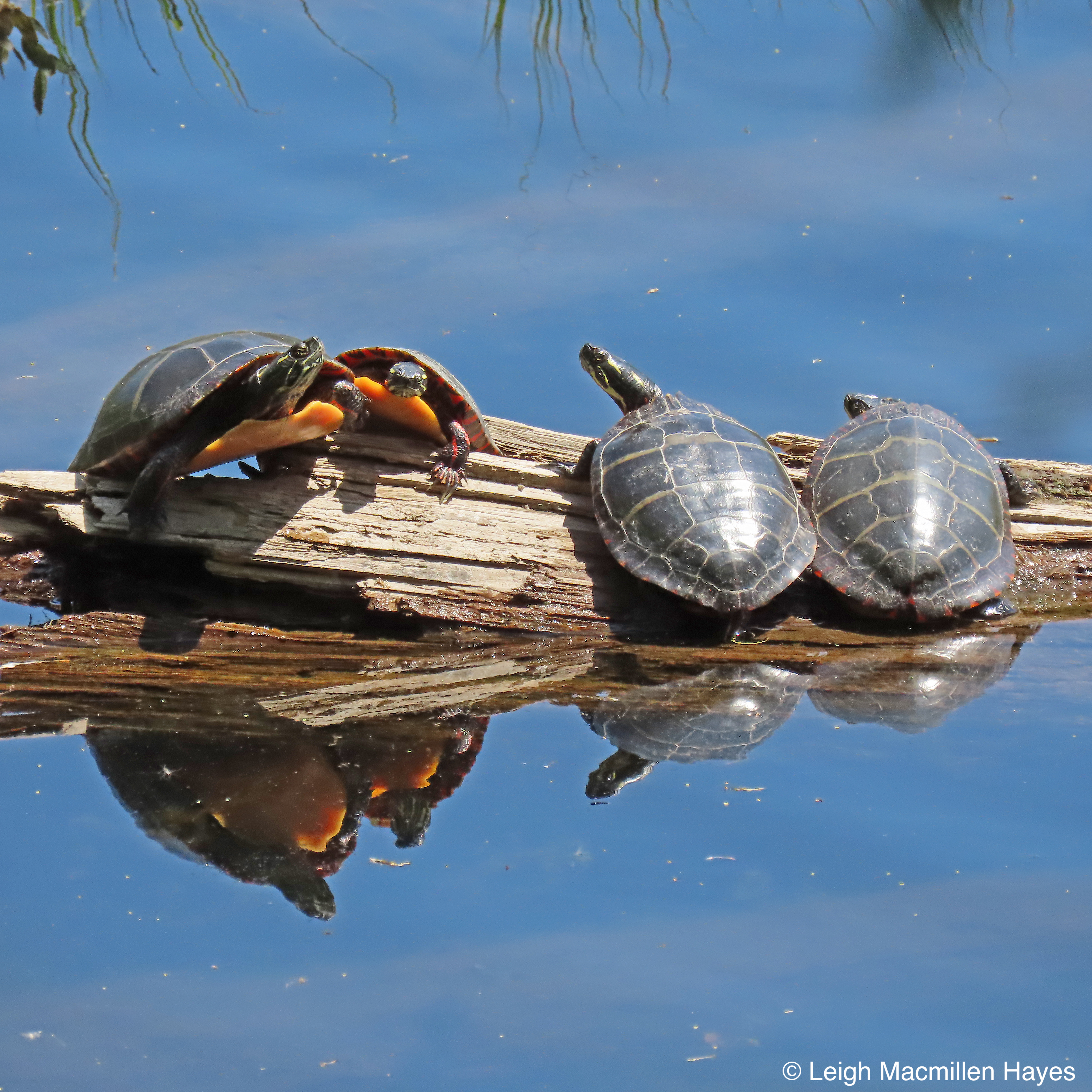
In yet a different wetland locale, I found Painted Turtles basking together on a log. Being ectothermic, or cold-blooded, their body temperature depends upon the environment and in the spring they need the sun’s rays to warm them up to an internal temperature of 63˚ – 73˚.

Because the spot where I saw the turtles was not a vernal pool, but rather a bog, I didn’t spy any Wood Frog or Spotted Salamander egg masses, but there were tadpoles of another type upon which to dine, like this Bullfrog, which takes two years to mature.

And leeches. A plethora of leeches floated past the rock upon which I stood. Not all leeches suck human blood. Many prefer that of amphibians and reptiles.

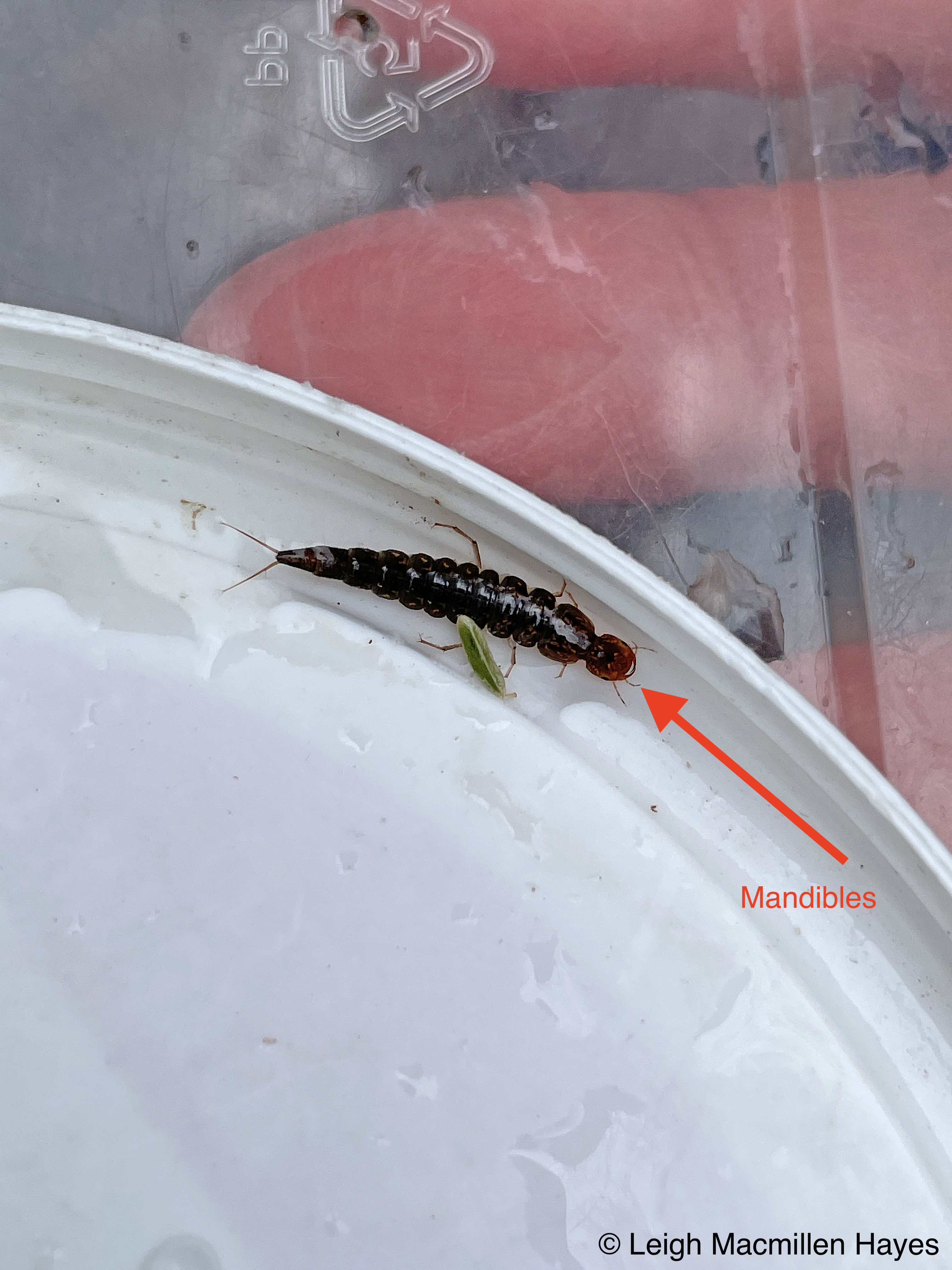
Visiting several other vernal pools, Predacious Diving Beetles soon made themselves known in several forms, from this, the larva, aka Water Tiger, with its strong mandibles, ready to grasp prey at any second . . .

to an adult.

The body of a Predacious Diving Beetle is oval with oar-shaped hind legs that feature fringed hairs to increase stroke power. So here’s a thing I learned last week and now try to pay attention to: when swimming, Predacious Diving Beetles kick both hind legs simultaneously, whereas Water Scavenger Beetles, which look similar, kick their hind legs alternately.

Oh, and do you see the Mosquitoes wriggling behind the beetle?

Speaking of behind, look at the beetle’s behind–it’s an air bubble. They trap oxygen-filled air between their wings and body, prolonging their time under water. and thus can stay under for long periods of time, returning to the surface when it runs out.

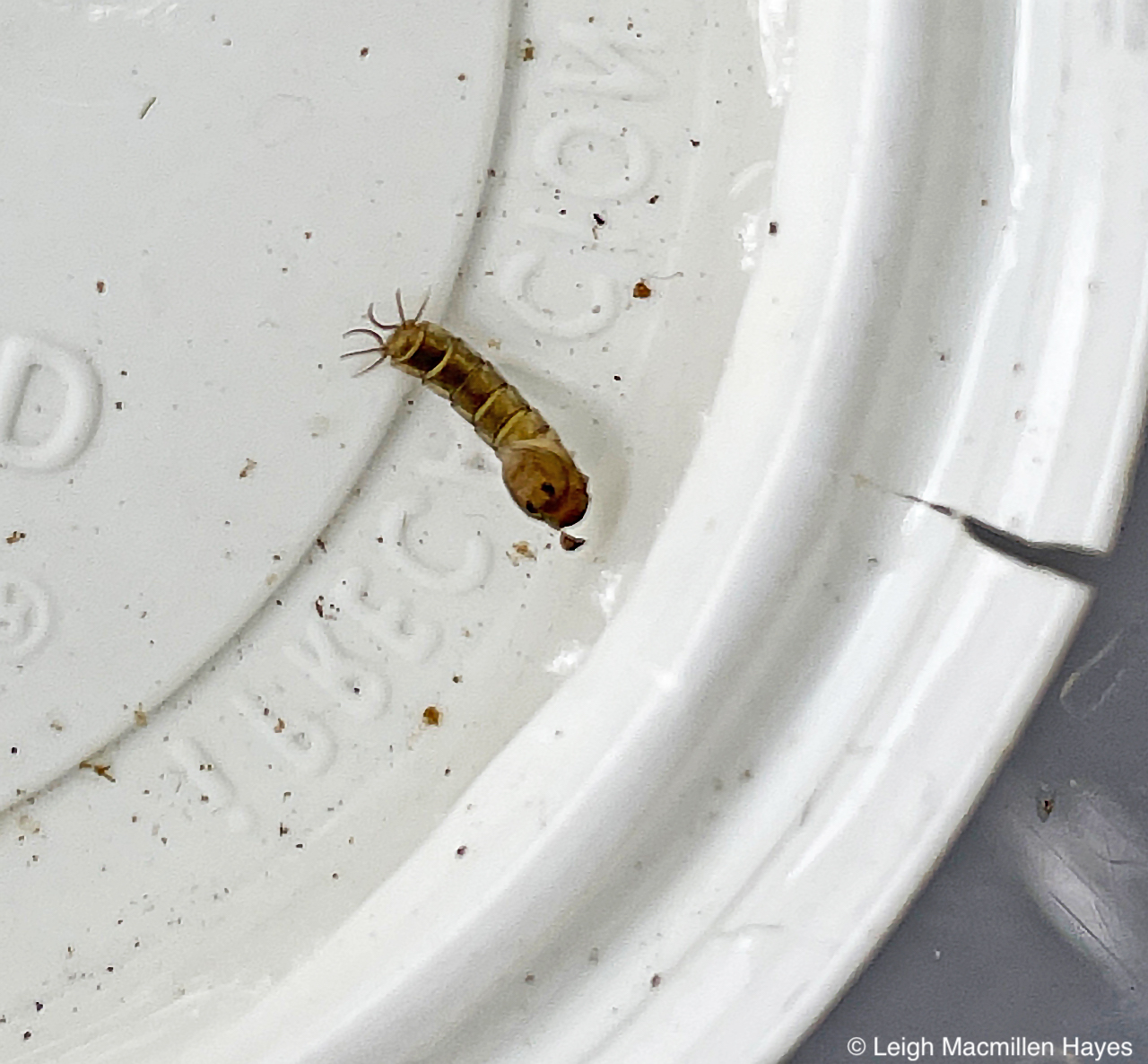
So back to the Mosquitoes. Meet the third stage in their life cycle (egg, larva, pupa) known as a tumbler. Tumblers lack mouth parts because they don’t eat while undergoing the magical transformation into an adult. Spying this means that very soon biting female Black Flies and Mosquitoes will be part of the landscape. They’ll annoy us, but we need to remember that they are food for others, like tadpoles and birds and dragonflies.

As for the biting insects, I’ll try to practice mind over matter because I can’t resist the opportunity to learn more and be present as I hone my focus above and below the water’s surface.

Where The Moose Led Us Mondate

It seems there are never enough rainy days to complete home chores so when today dawned as such I thought that all the contents I’d been sorting from a closet would finally make their way to new homes like the dump store or community clothing closet or back into containers to be stored for another rainy day.

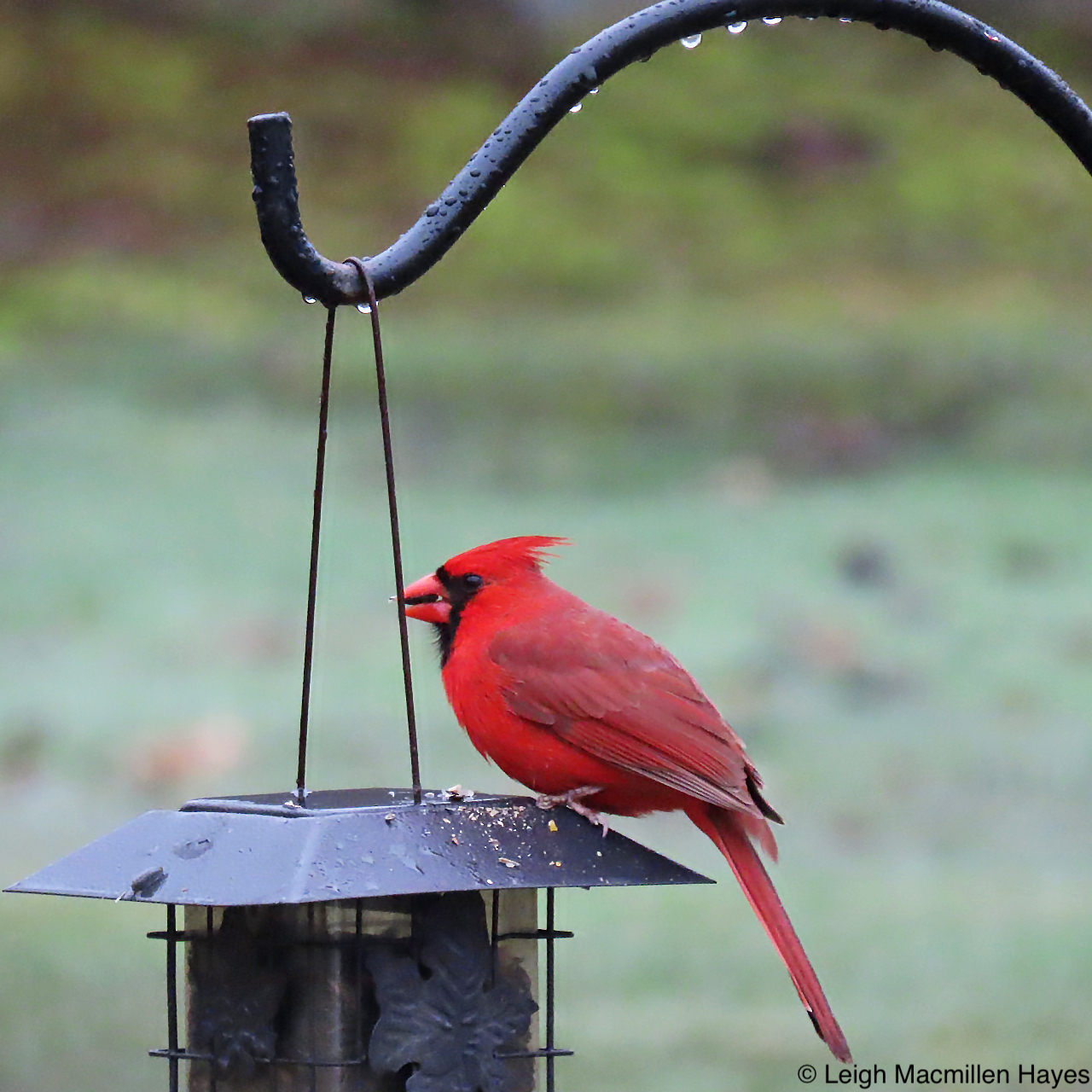
Apparently, I thought wrong for the Cardinal beckoned and we answered the call to head out the door.

When I mentioned a location for today’s hike to My Guy, he agreed that it sounded good, though come to find out, in reality he thought we were going someplace else and even when we arrived at Great Brook, he couldn’t recall our last visit, which was in 2016. Fair enough. I’ve been there many more times.

It soon became apparent that we were in Moose territory and our excitement rose. Actually, on another trail in this same neck of the woods we once spotted a Moose, so all we could do was hope that today we’d receive the same honor.

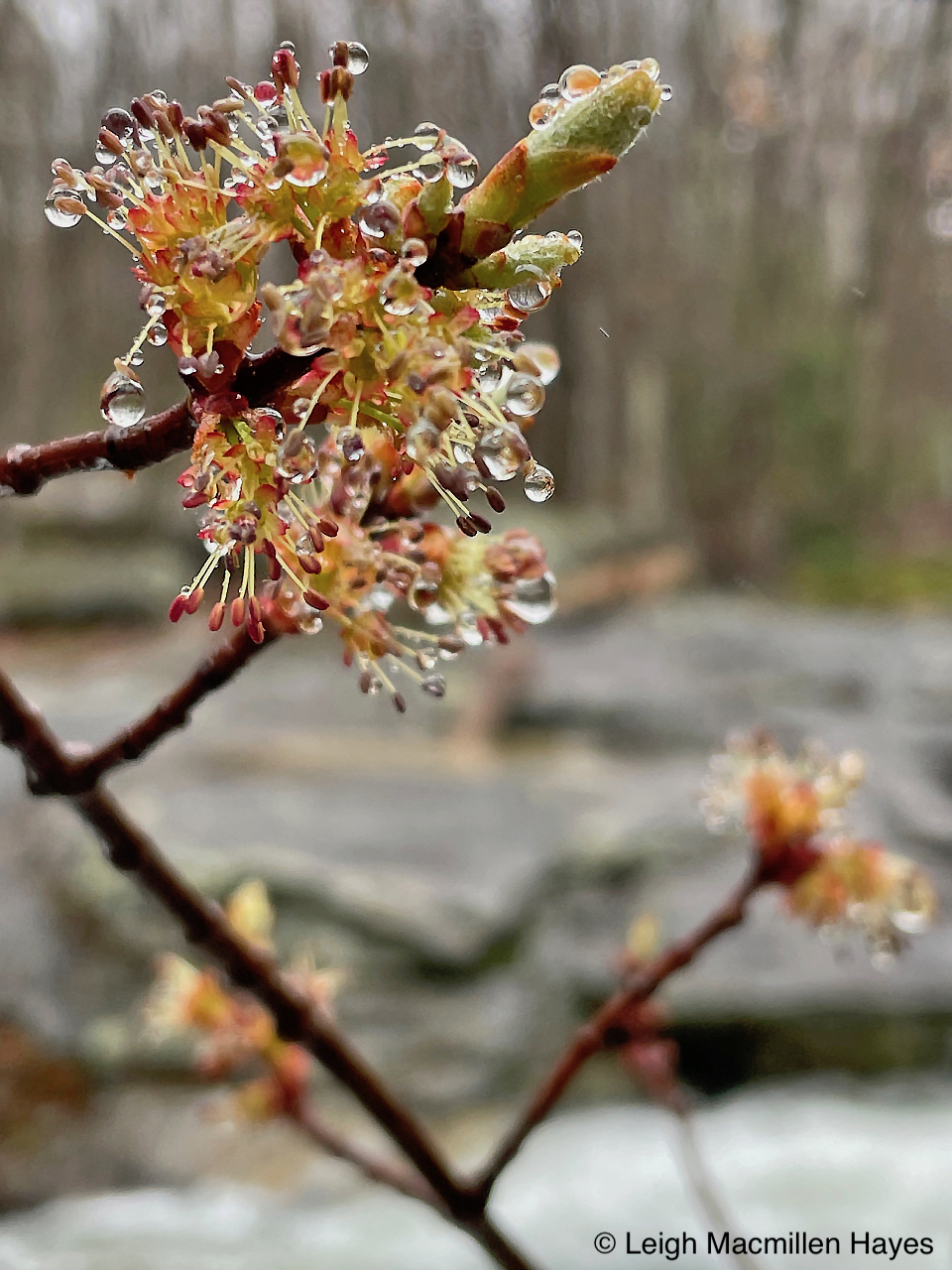
But first, there were other honors to receive, such as this bouquet of flowering Red Maple.

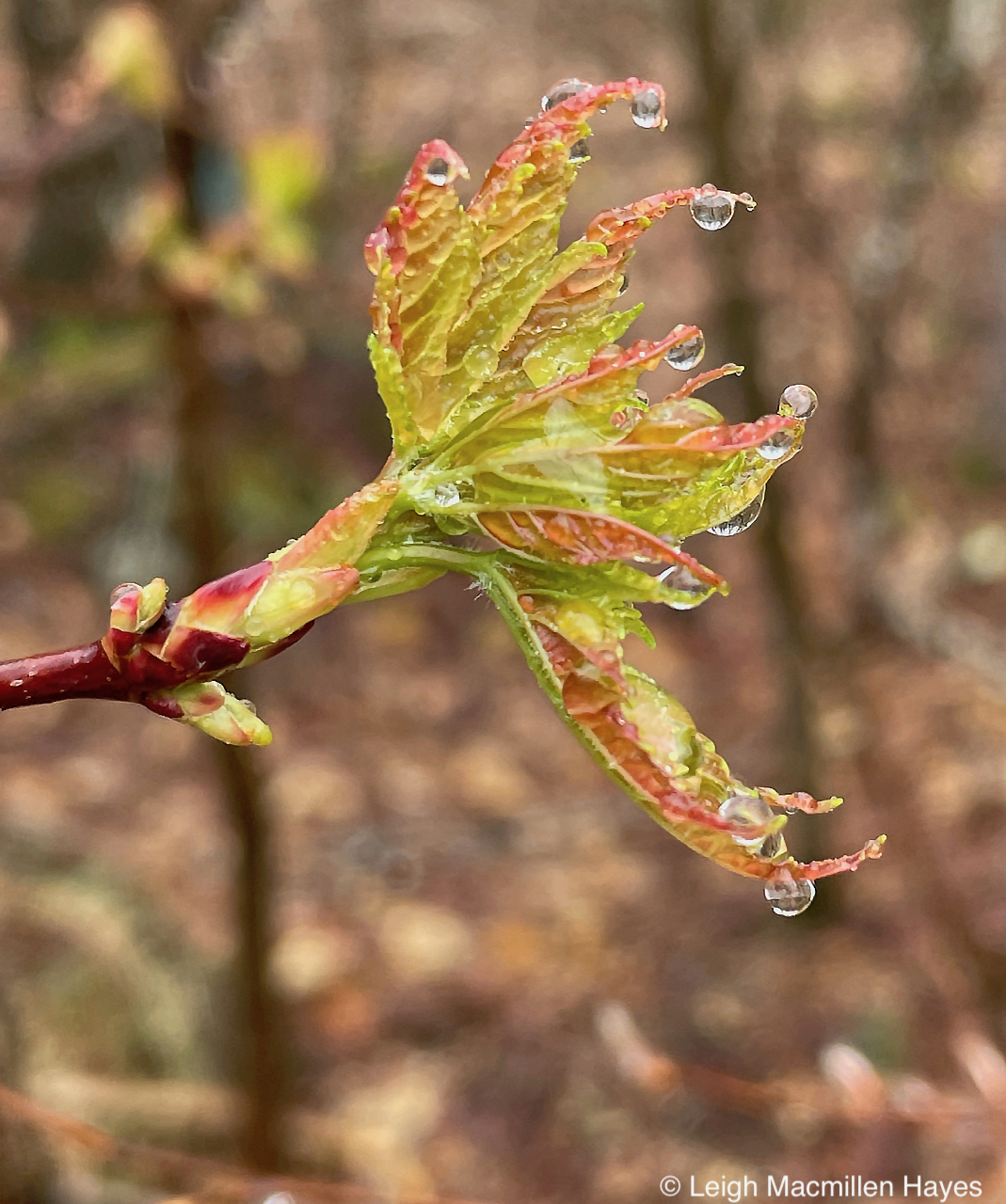
And the first of the season for us, maple leaves bursting forth in all their spring glory of color.

Onward we hiked deeper into the woods where a place one might think of as no place was once some place. This particular foundation has long been a favorite of mine because within is a root cellar.

It’s one I can’t resist stepping into because you never know what tidbit might have been left behind.

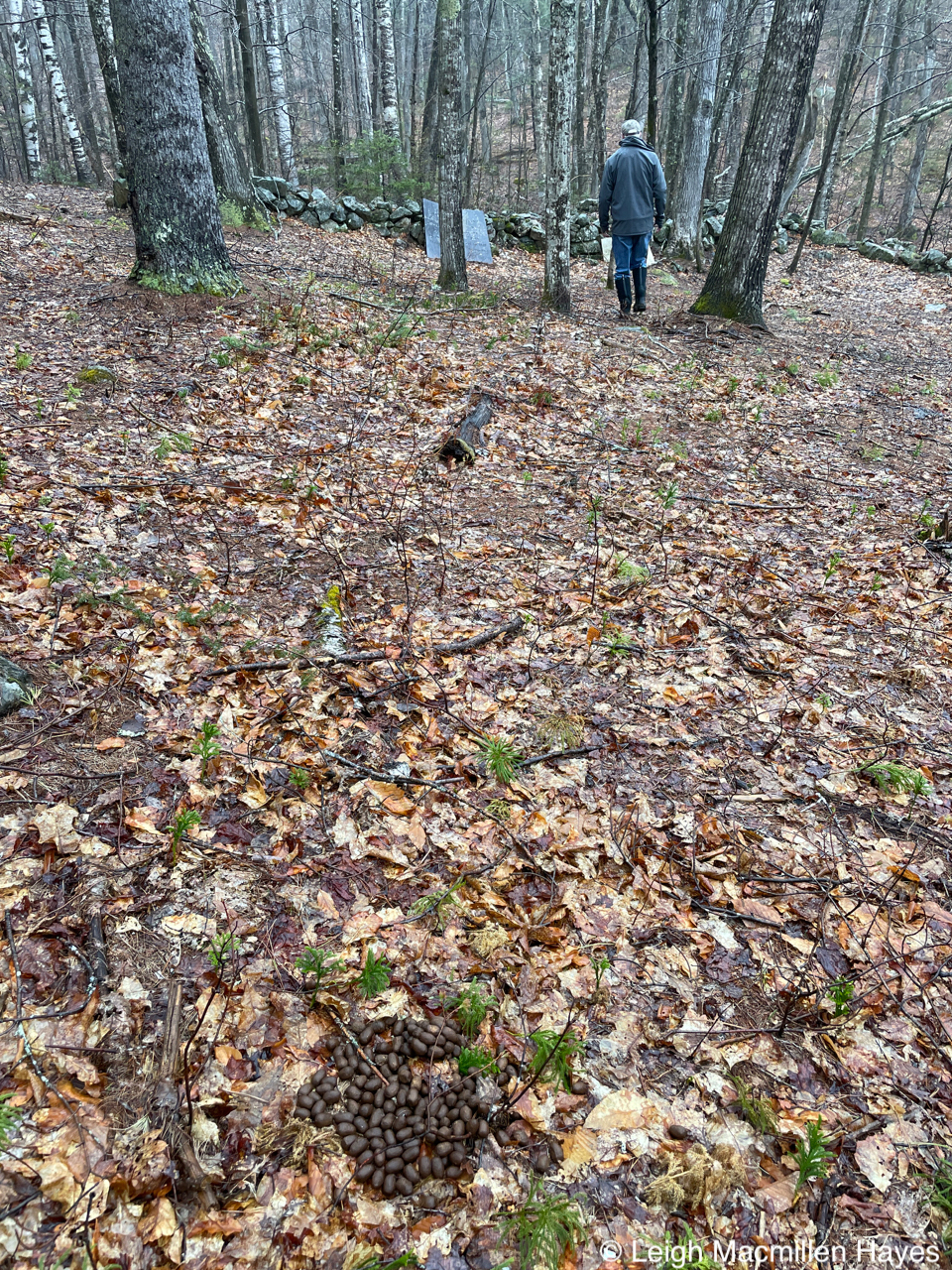
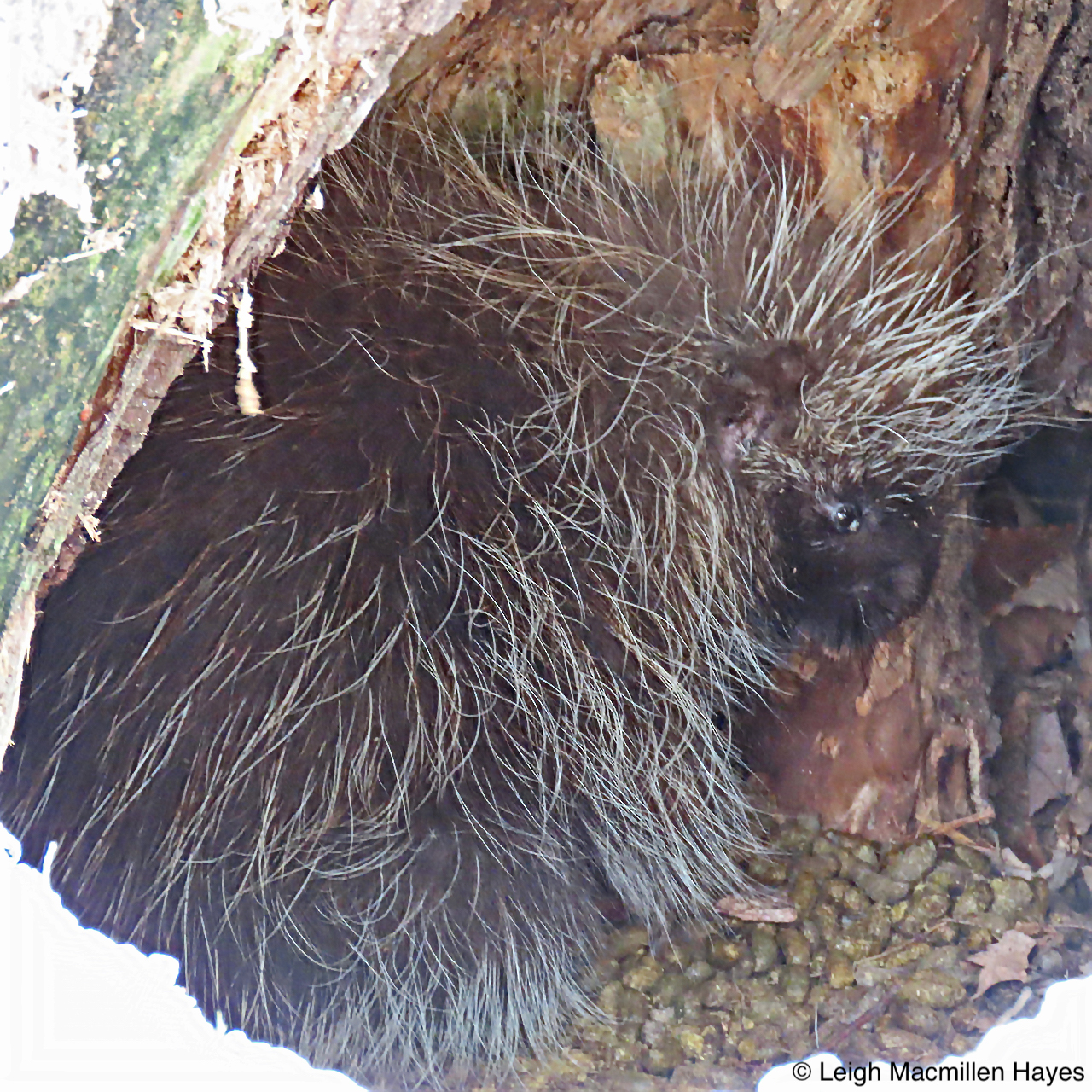
Porcupine scat! Rather old, but still.

My friend, Jinny Mae (RIP), was a talented techie and though the red line isn’t the entire route we followed today, it’s one she and I explored back in 2016. The map is from a section of the 1858 map of Stoneham. And we were at E. Durgin’s old homestead.

Knowing that there were some gravestones in the woods behind the house, we once again followed the Moose who led us directly to the family cemetery. Someone has cleared the site a bit, so it was easy to spot, especially since the trees haven’t fully leafed out.

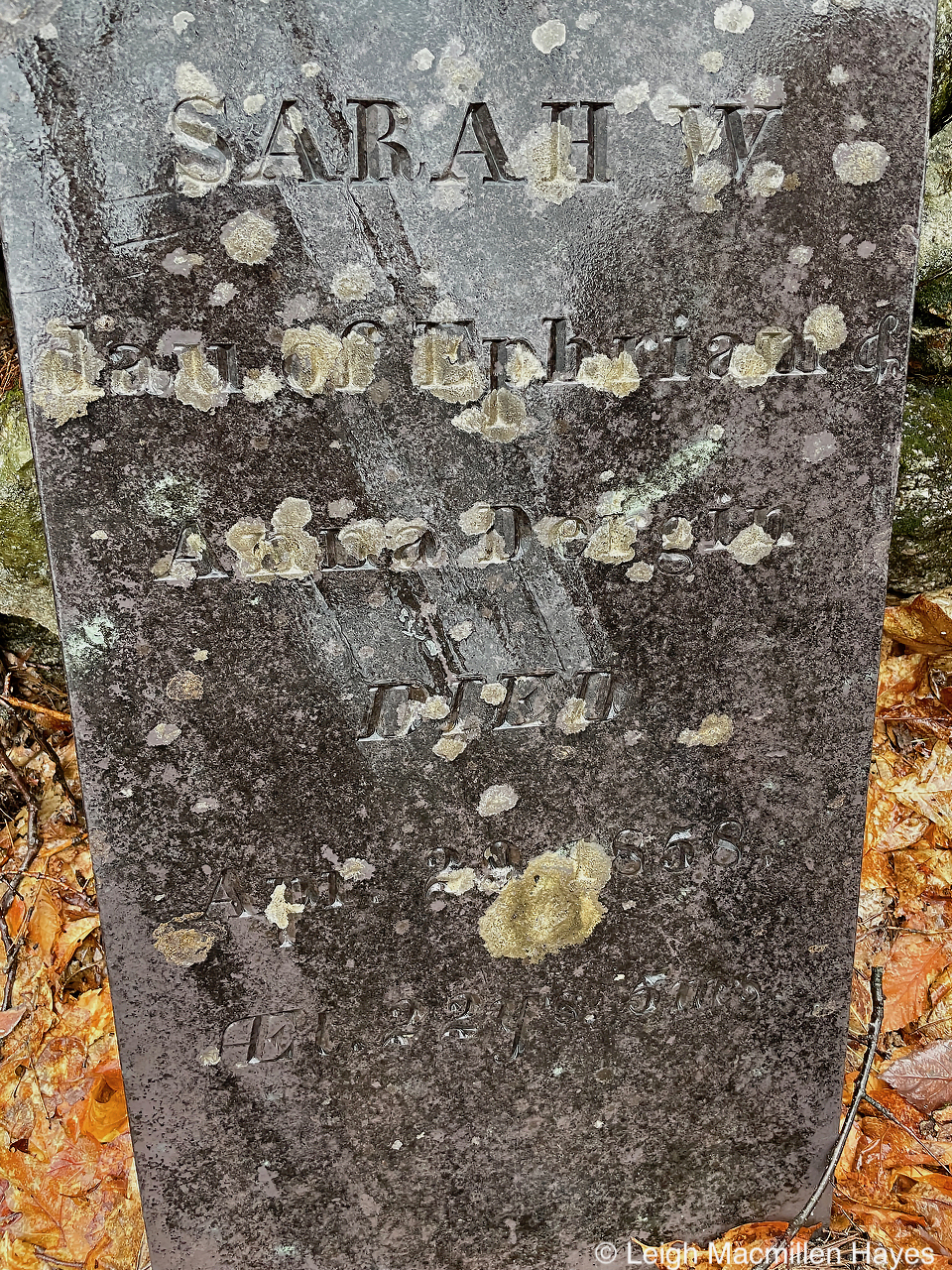
Sarah, daughter of Anna and Ephraim Durgin, is the first tombstone. She died in 1858 at age 22.

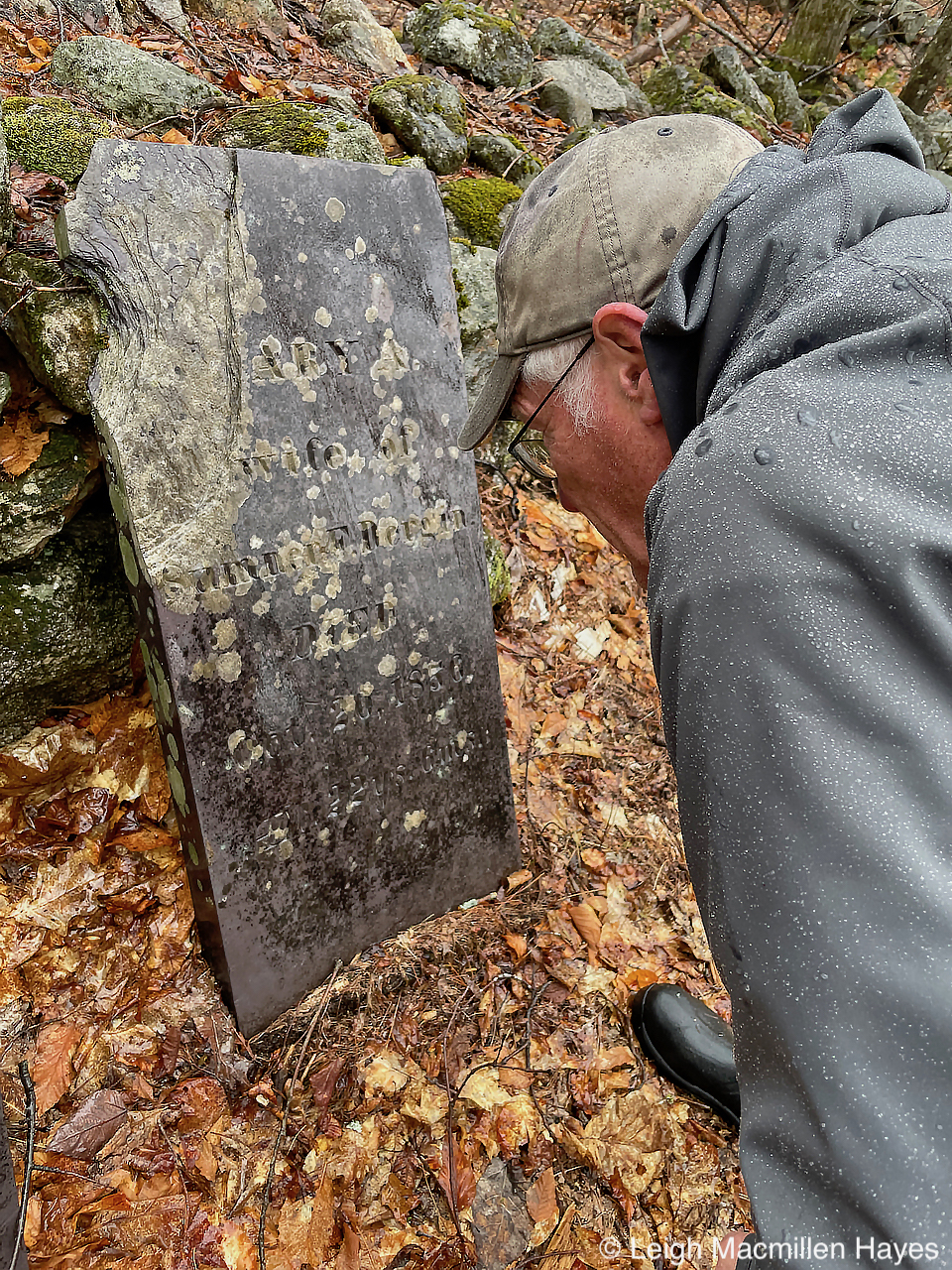
Beside her is the stone for Mary, wife of Sumner Dergin, who died before Sarah–in 1856. She, too, was 22 years old. As best I can tell, Sarah and Sumner were siblings.

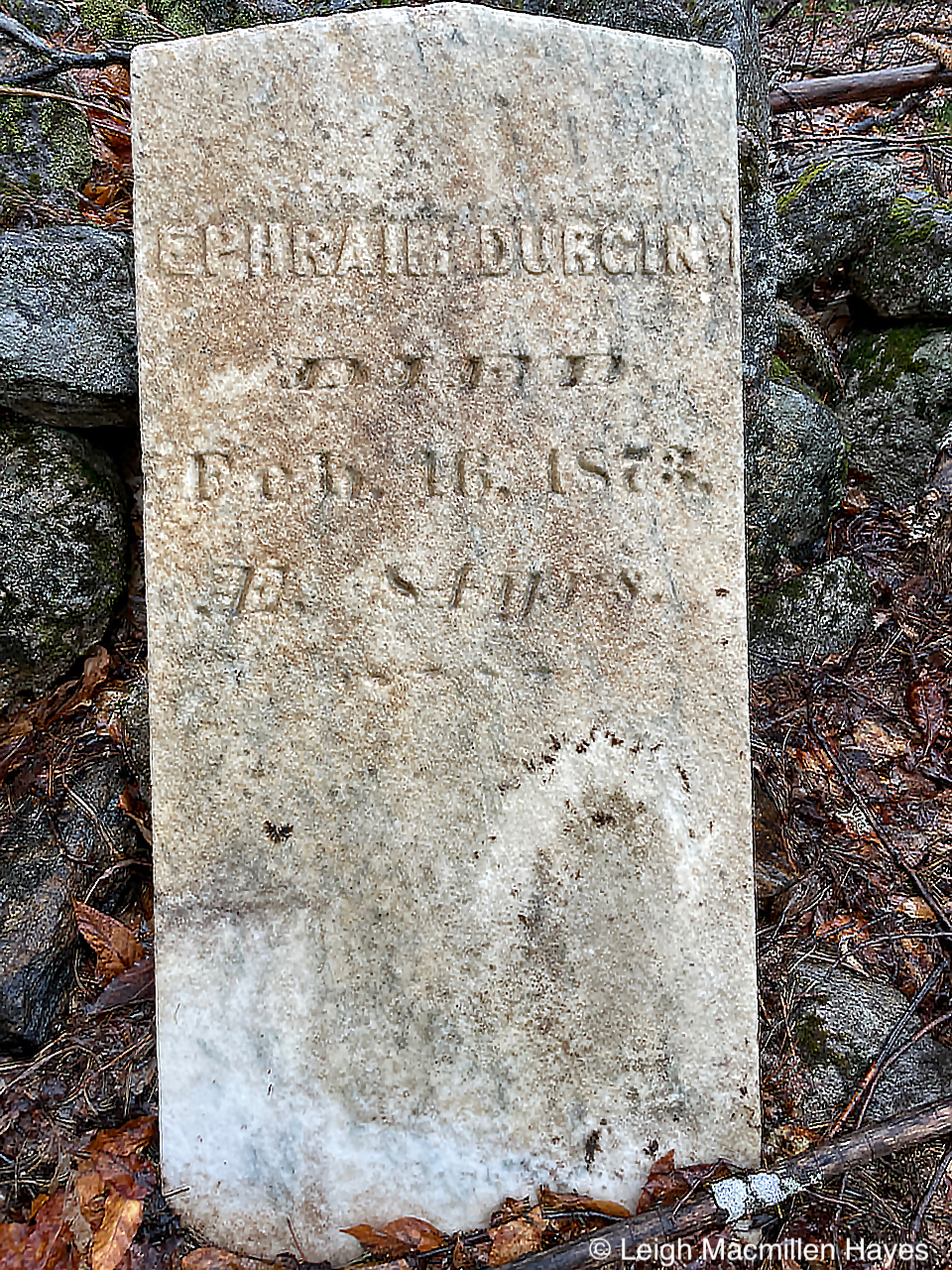
And Ephraim, Sarah’s father, died in 1873 at age 81. Notice the difference in stone from the two girls to Ephraim? Slate to cement. And the name spelling–Dergin and Durgin. As genealogy hobbiests, we’ve become accustomed to variations in spelling.

I found the following on RootsWeb:

8. ANNA3 FURLONG (PATRICK2, JOHN1) was born 1791 in Limerick, Maine, and died 1873 in Stoneham, Maine. She married EPHRAIM DURGIN June 18, 1817 in Limerick, Maine14. He was born April 13, 1790 in Limerick, Maine, and died in Stoneham.

Children of ANNA FURLONG and EPHRAIM DURGIN are:
i.OLIVE4 DURGIN, b. 1811, Stoneham, Maine; m. DUNCAN M. ROSS, April 11, 1860, Portland, Maine.
ii.SALOMA DURGIN, b. 1813.
iii.ELIZABETH DURGIN, b. 1815.
iv.SALLY DURGIN, b. 1817.
v.SUMNER F. DURGIN, b. 1819, Of Stoneham, Massachusettes; m. MARY ANN DURGAN, July 11, 1853, York County, Maine; b. Of Parsonsfield, Maine.
vi.CASANDIA DURGIN, b. 1821.
vii.EPHRAIM DURGIN, b. 1823.
viii.FANNY DURGIN, b. 1825.

Sarah isn’t listed above. But . . . Sally and Sarah were often interchangeable.

By 1880, there had been a change in ownership of the neighborhood homes and the Rowlands had moved into the Durgin house.

Again, we followed the moose, this time in the form of a Striped Maple browsed upon, curious to see what might be ahead.

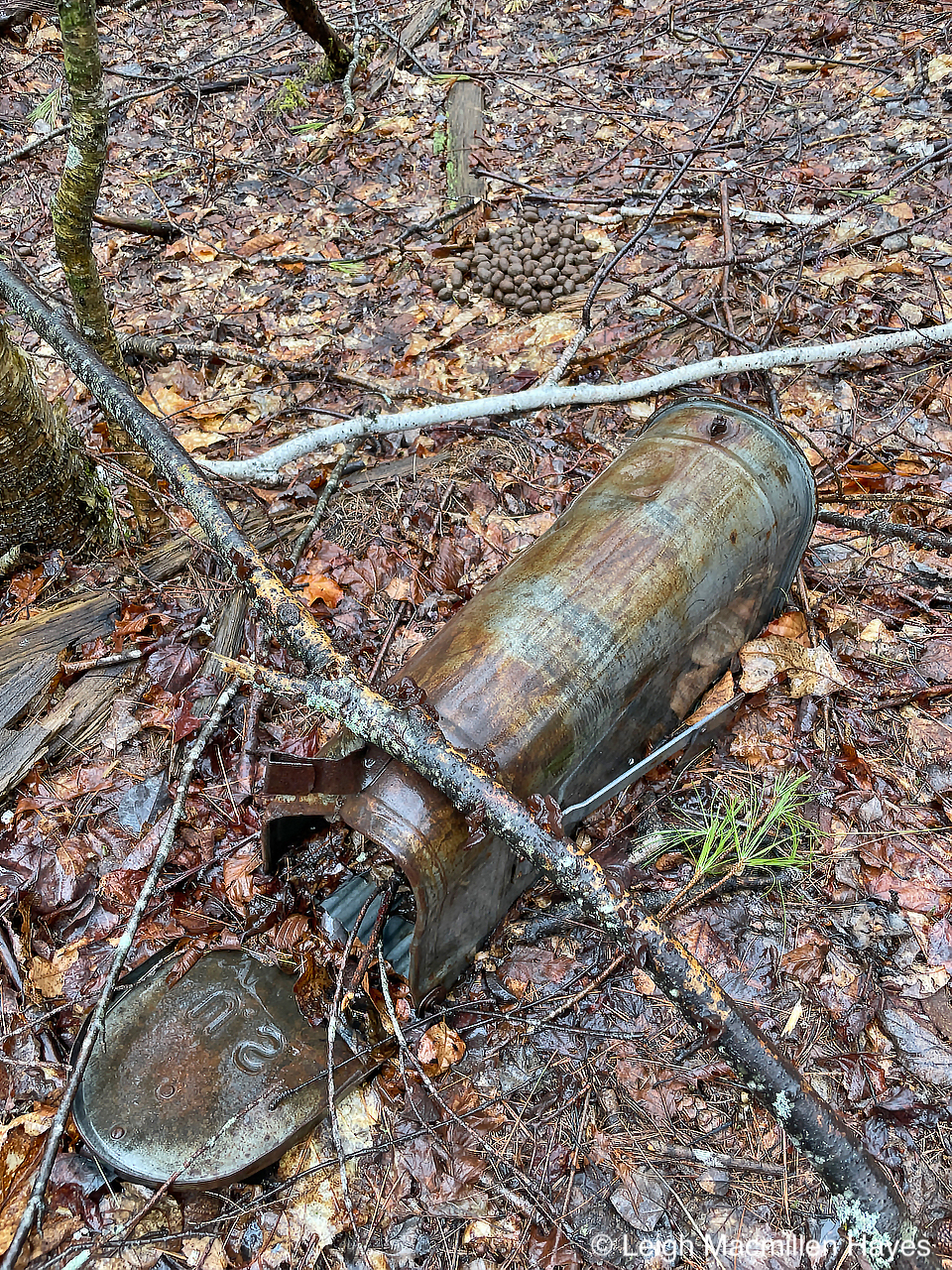
A chuckle. Yes, a mailbox in the middle of nowhere, this spot being a place where someone once had a camp. Our Moose tried to send a letter, but missed by a couple of feet.

Willard Brook was our next stop and I was reminded that when I first started wondermyway.com, a post about this brook initiated some discussion about the Indigenous stonework found throughout the area. I’ve explored it looking for such and convinced myself in the past that I saw the turtles in most of the stonewalls. In fact, I see them everywhere, but today I was looking at different subjects.

Beside the brook, lots of Hobblebush looked ready to burst into life and we thought how fortunate that the moose hadn’t decided to dine. Yet.

There were even tiny Hobblebush leaves to celebrate for their accordion style.

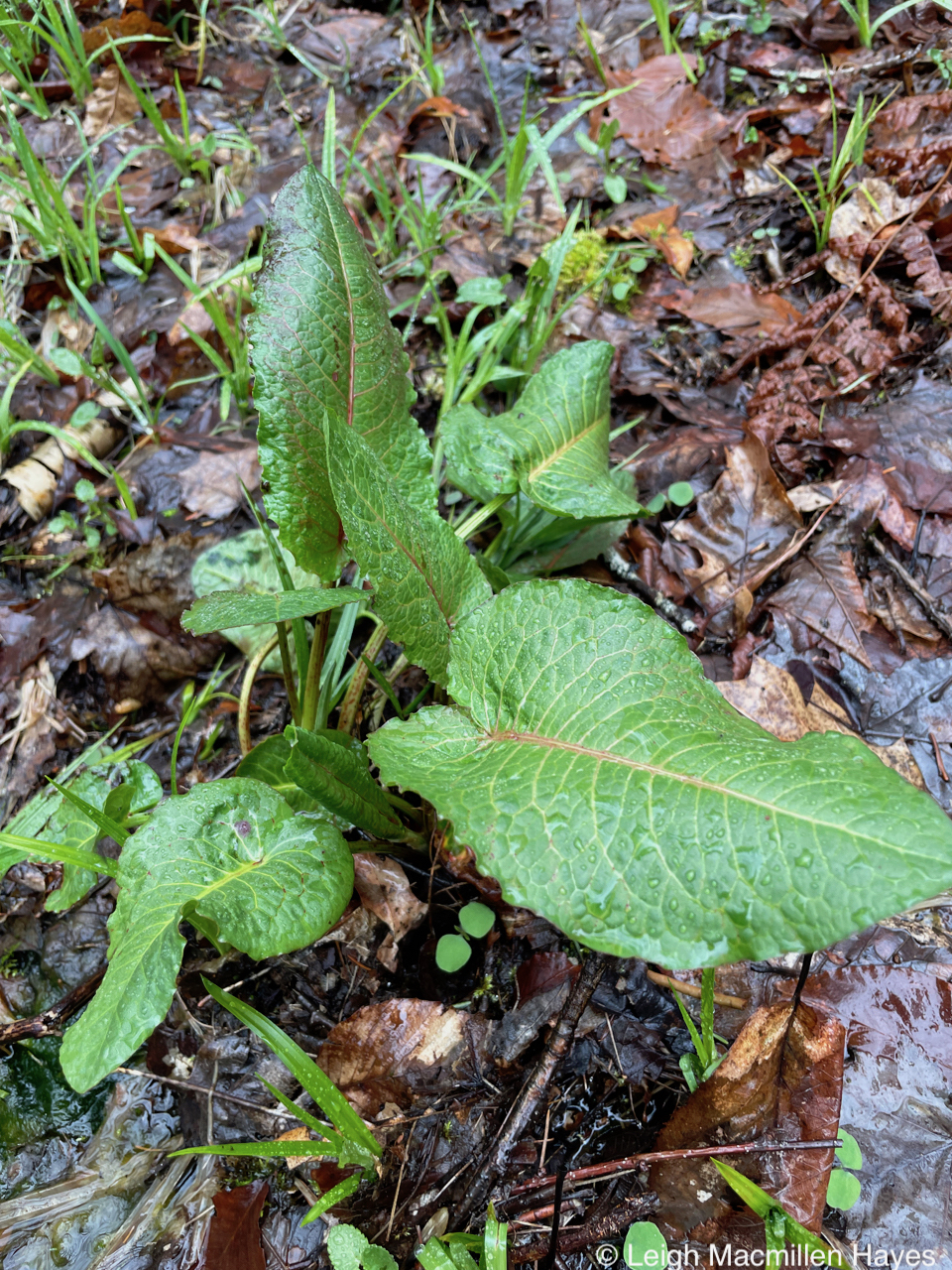
And Broad-leaved Dock looking quite happy and healthy.

Back to Great Brook we eventually wandered, still with no actual Moose in sight.

But beside the brook I did spot some Trailing Arbutus buds preparing for their grand opening.

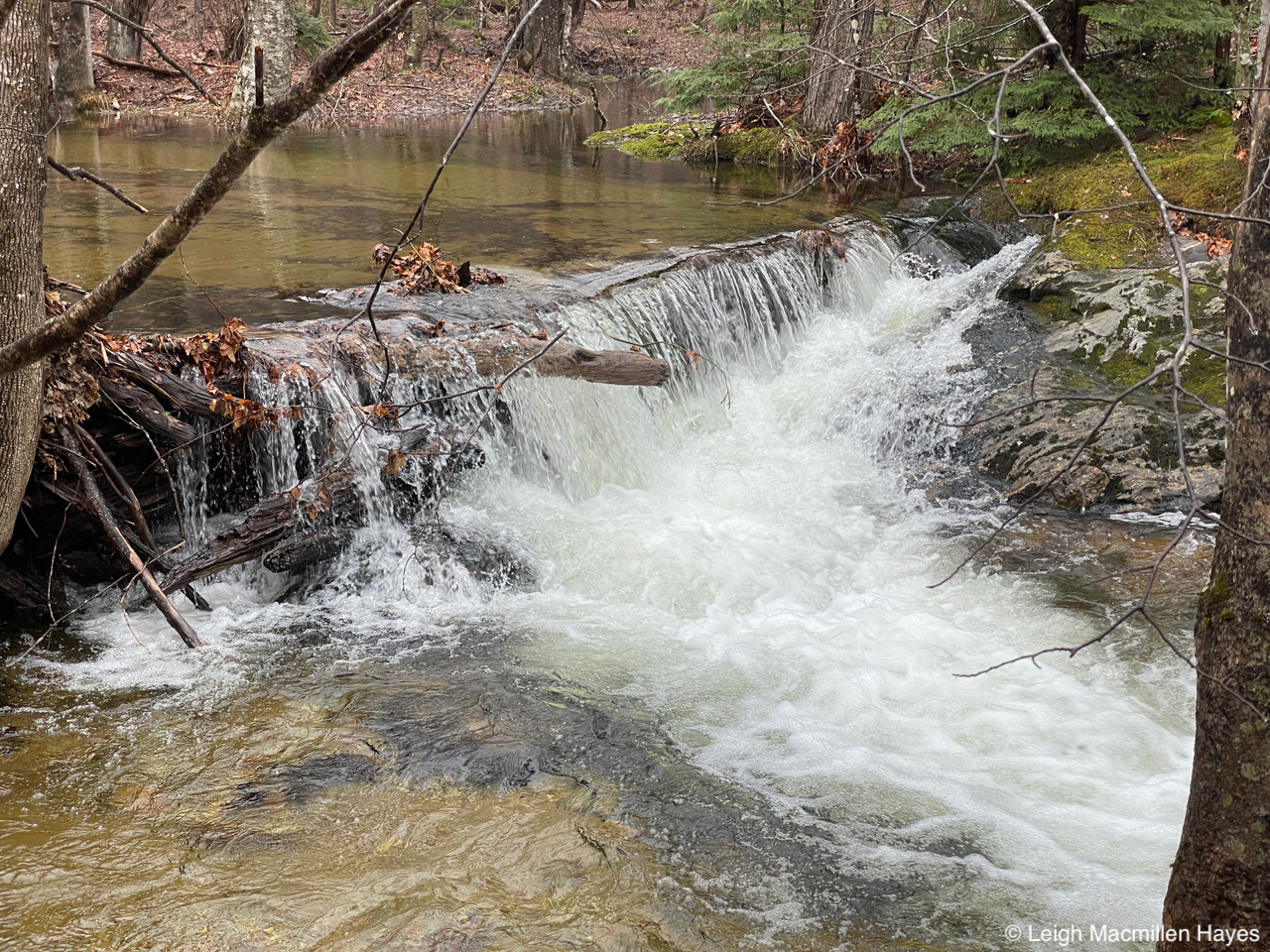
As we walked back on the dirt road we’d walked in on, we paused beside a beaver pond where Spring Peepers sang their high-pitched love songs. I made My Guy scan the area with me because just maybe . . .

or maybe not. We did spot a Mallard couple. Oh well, We still had fun discovering everything else where the Moose led us on this rainy day.

And when we arrived home I had an email from an acquaintance double-checking with me that the print he found on his shore front of Kezar Lake was a moose print. Indeed it was!

(And now it’s time to prepare for Big Night. Finally. The temperature is in the 40˚s; it’s been raining all day and will continue tonight; and though lots of amphibians have moved to their native vernal pools, I think there will be some action tonight and we’ll be able to help them cross the road safely.)

The Other Season

Most people think there are four seasons in the northern hemisphere: spring, summer, autumn, winter. In Maine, many would argue that there’s a fifth: mud. And maybe even a sixth: road construction season.

I beg to differ on all accounts. In my wee world view we just came out of tracking season, which began at the beginning of December and lasted through the end of March.

And now, we have entered The Other Season. While tracking season doesn’t involve much color, it does offer an insider’s look at the animals with whom we share this space, and the habitat in which they live.

But now . . .

one’s eye needs to focus on what is different. The anomaly. Really focus. For there is a special snake making an appearance upon an old stump by the water’s edge. It looks rather like the saplings that have made this nurse log their home, but if you look closely, you might spy three light yellow stripes that contrast against a dark background and a bit of a curved tail.

Zooming in even closer, look at the snake’s head and the light colored spot in front of its eye. This is a key ID feature for an Eastern Ribbonsnake, an uncommon species in Maine, and one of special concern, which according to the maine.gov website means ” particularly vulnerable, and could easily become an endangered, threatened, or extirpated species due to restricted distribution, low or declining numbers, specialized habitat needs or limits, or other factors.”

Then there’s the Backswimmer who spends its life rowing about, belly up. Each set of legs is used for a different function – the front pair for catching prey because they are voracious predators, the middle pair for holding the prey tight, and the flattened, hairy third pair acts as oars, much like those used with a rowing shell.

As piercer-predators. they kill and suck the bodily fluids out of any prey they can subdue – invertebrate and vertebrate alike – including tiny tadpoles and fish fry. They remind me of terrestrial assassin bugs. But, Backswimmers also become fish food.

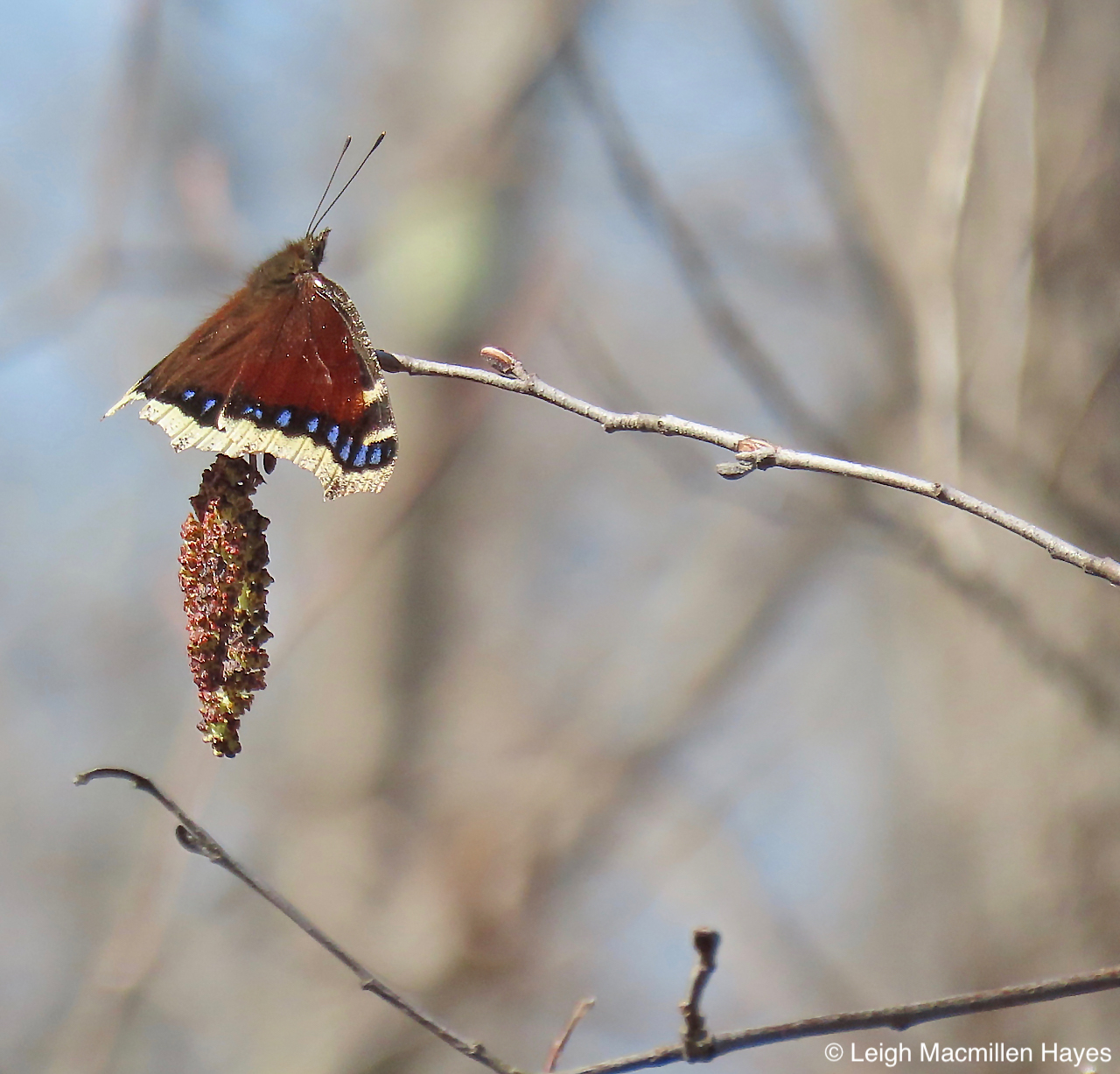
In this same habitat, one of the first butterflies to grace our airwaves is the Mourning Cloak because it overwinters as an adult. It’s an easy one to ID, perhaps the easiest for its rich brown wings are accented by vibrant blue dots and a bright yellow border along the trailing edge. Seeing mourning cloaks flutter out of the leaf litter is a sure sign of the other season.

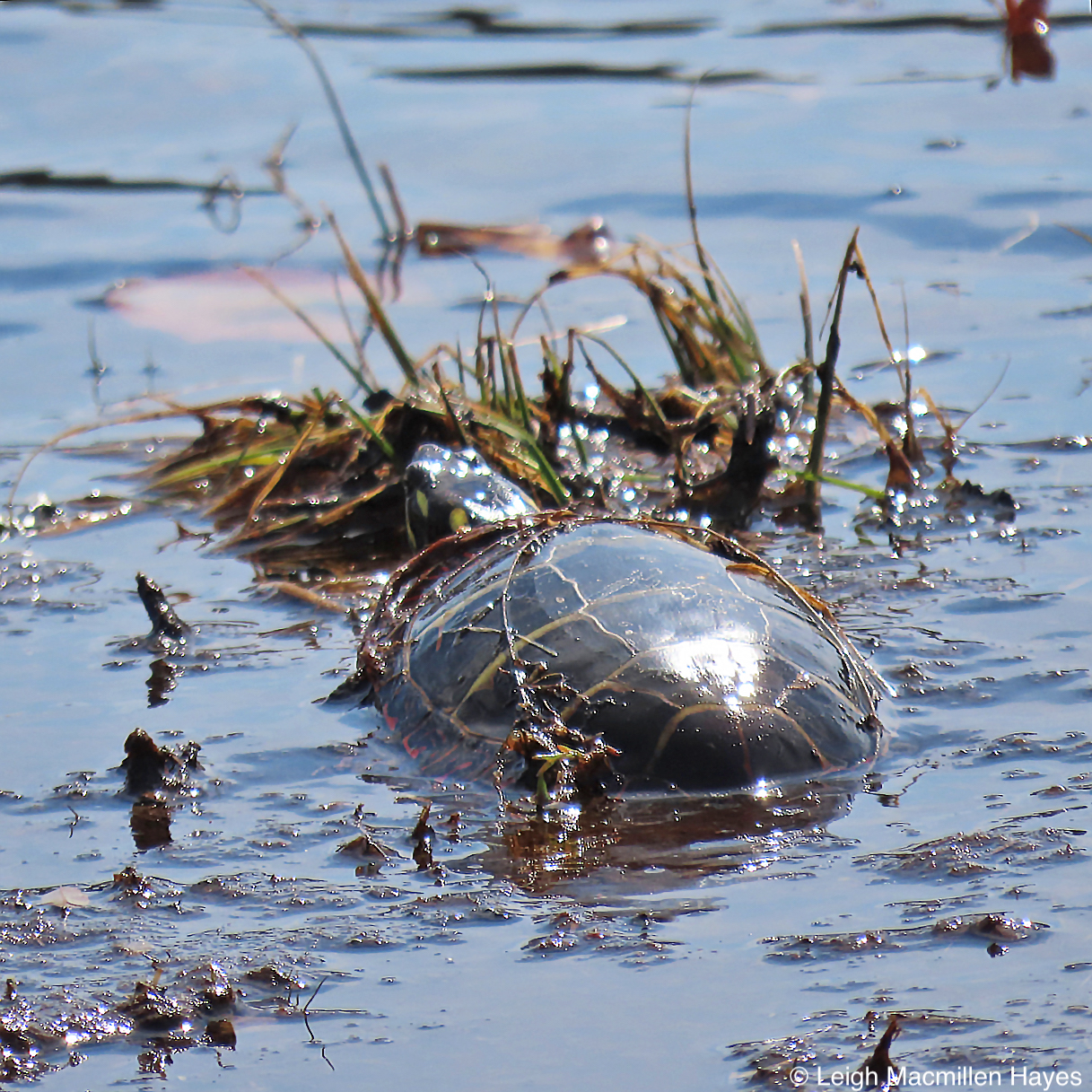
In the same space, moving swiftly from one body of water across a cobbly road to another wetland was a Snapping Turtle. Though Snapping Turtles appear to pose a threat to humans, they are not as aggressive as we think. Instead of swimming, these turtles spend most of their time crawling along the bottom of shallow water.

On land, however, Snappers often act like the nastiest characters that you ever want to encounter. Have you ever tried to help one cross the road? With its long neck, that is almost as long as its shell, it’ll swing its head and lunge with open jaws.

I have read that even though they hiss and strike out with their formidable jaws, they will usually not bite. Supposedly, they’ll close their jaws just before they reach your hand. I don’t intend to verify this. Their act is enough to keep me at a safe distance. It’s best to leave a Snapping Turtle alone and treat it with respect.

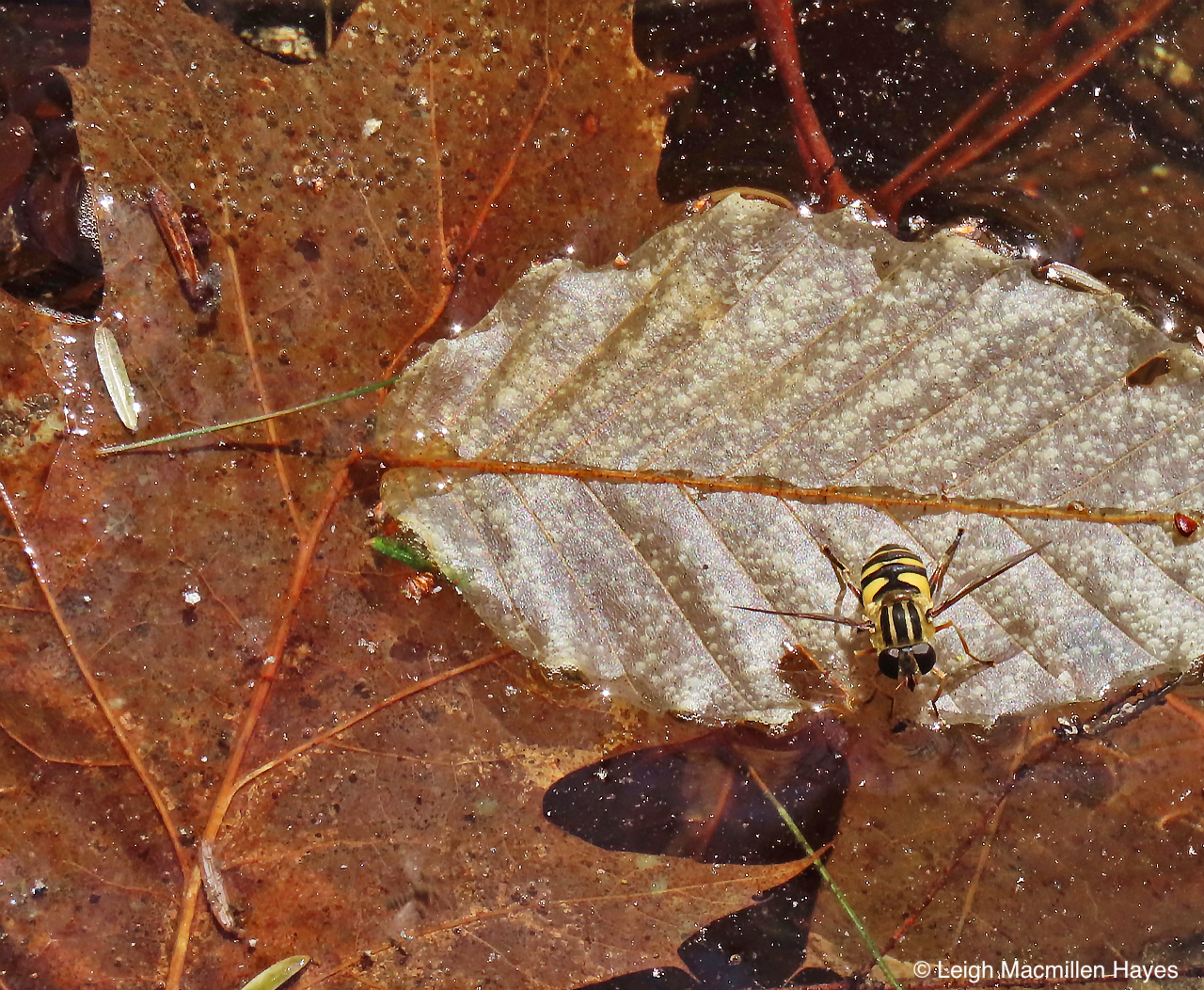
Because I was beside water, upon floating leaves, an insect flew in that could easily have been mistaken for a wasp, such as is its tendency to mimic such. The Masquerading Syrphid Fly, aka a hover fly, has longitudinal stripes on its thorax that resemble those on the back of a Paper Wasp, but a wasp it is not. For one thing, it has only one pair of wings, where bees and wasps have two pairs.

Away from the water but within the nearby leaf litter, and easy to find if you roll a log or move some downed tree bark, you might discover the high population density of Red-backed Salamanders who often maintain small territories that they guard and in which they exclusively forage.

The forest floor is a sophisticated, perennial cycling system of leaf litter, fungus, minerals and soil extending from tree trunks down into the earth. Scores of critters travel in between, eating, moving, and transforming the layers as they go, like Red-backed Salamanders who feed on a wide variety of invertebrates and to whom we give great thanks.

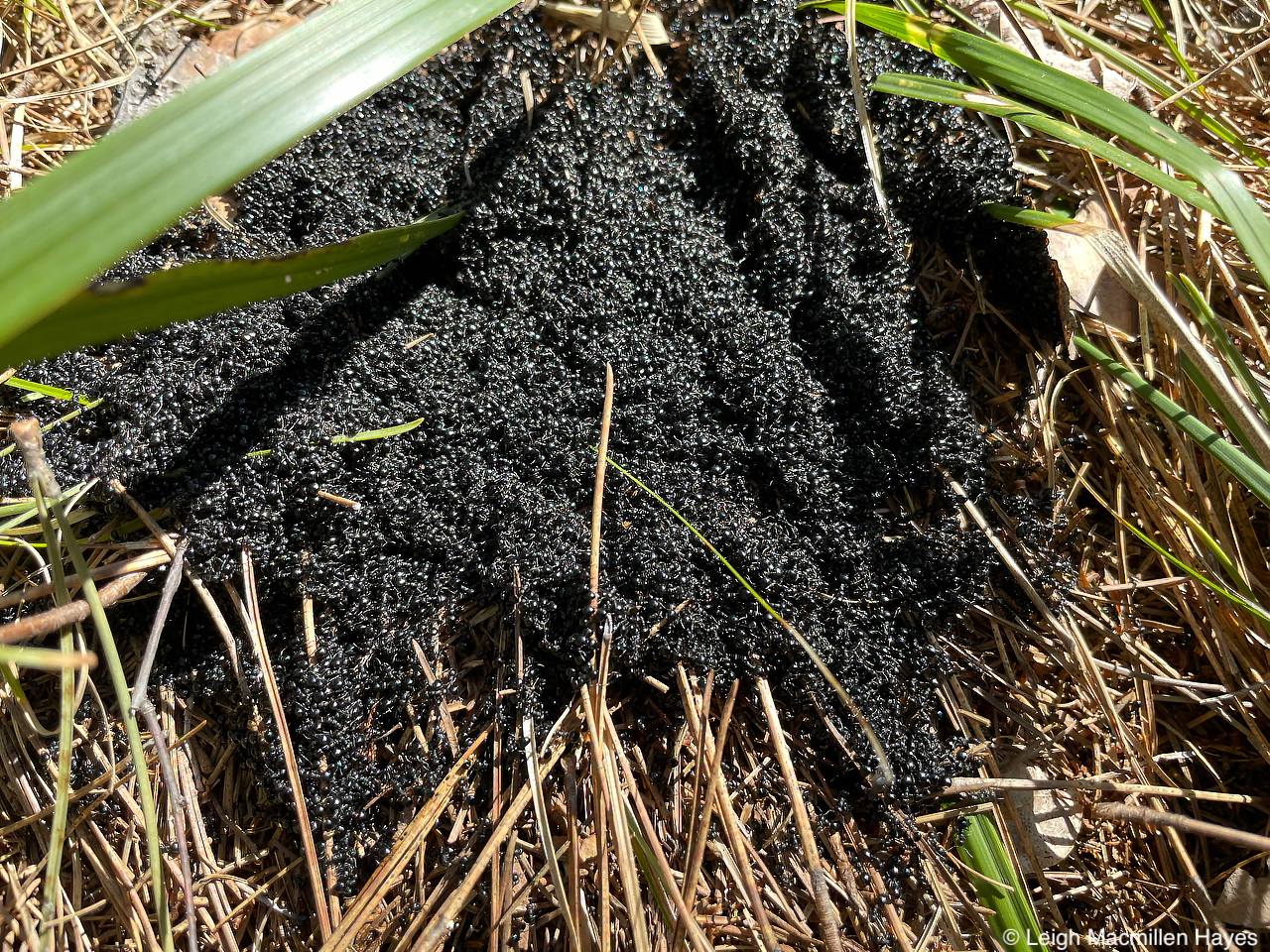
Among their meals, Red-backed Salamanders feed on of invertebrates including ants, but have you ever seen anything like this: an ant convention? And not one focused on a sweet treat you accidentally dropped?

According to Donald Stokes 1983 A Guide to Observing Insect Lives, “The other situation is where hundreds of ants seem to be crawling all over each other . . . These masses are probably involved in an aggressive encounter, possibly over the position of nest sites. They could be termed ‘territorial battles’ or even ‘wars.’ In contrast to our wars, they are conducted entirely by females. lf you look closely at the ants, you will see individual battles — ants using their pincers to dismember the bodies of other ants. On the battlefield may be cutoff legs or heads.”

We may be in a new season as witnessed by all the finds commented upon, but where there’s mud or wet sand, there will be tracks and so there’s some carry-over. Do you see the baby hand prints? At least two Raccoons had passed the way of some of the other critters in this post.

But the time has come to emerge from the depths of winter and shed a few weeds and head into the other season: Standing Beside the Water Season.

If you are looking for me in the next six months — I’ll be holding true to this next season.

The Mayfly Challenge on April Fool’s Day

It’s April Fools Day and the weather tried to trick us into thinking it is still winter by adding at least two inches of snow to our world that is for the most part . . . still covered by at least a foot of snow. In some places it is even deeper. In others, bare ground and leaf litter are visible. And evergreen plants like Goldthread and Wintergreen and Partridgeberry show off their shades of green.

But this isn’t about snow or flowers. Instead, I want to take you into the water. YES. It’s time to stop tracking on a regular basis and begin squatting beside open water and peering in, which a friend and I did just this week when we were checking on beaver activity.

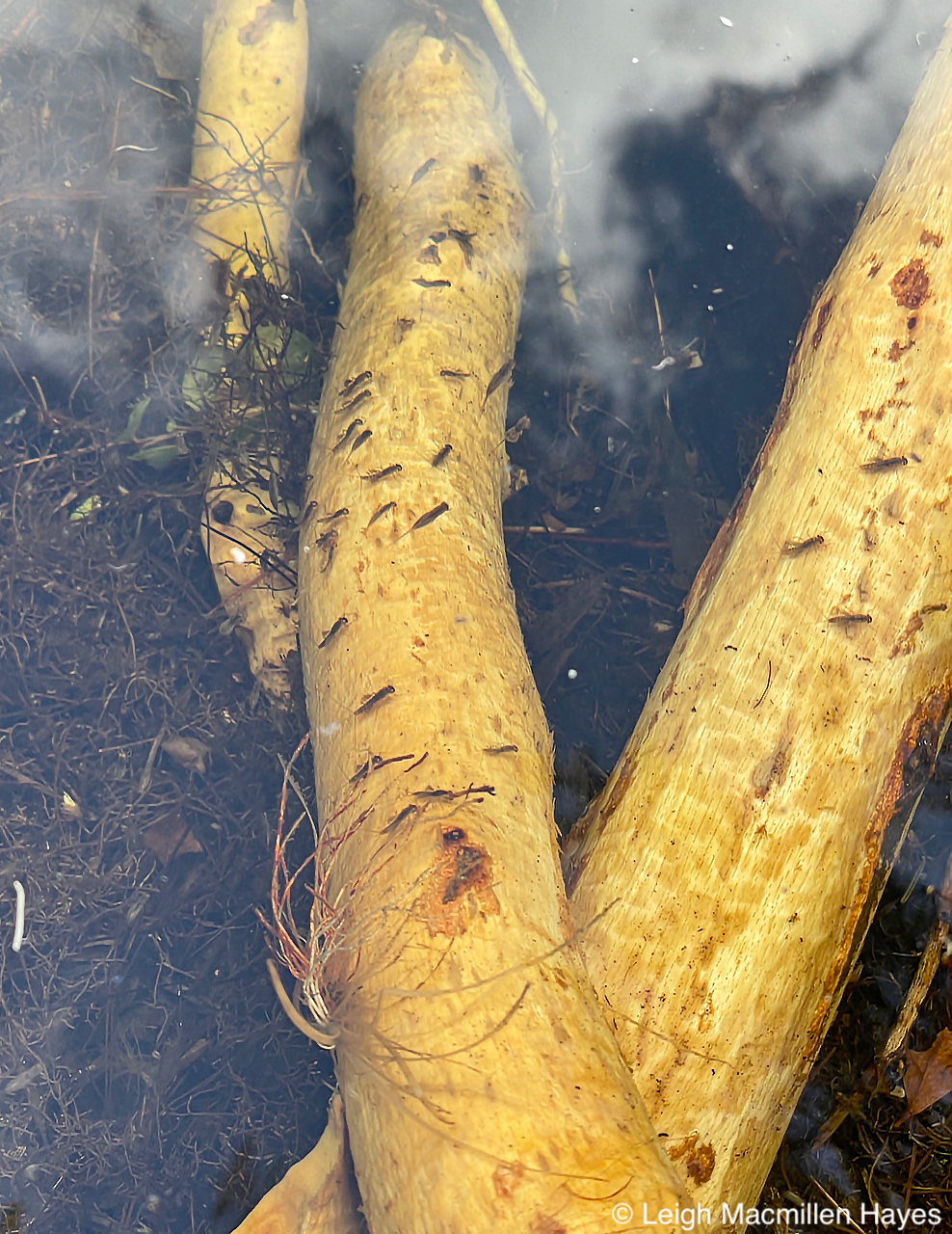
We didn’t spy any beavers, though there was lots of activity including these logs underwater, which told us the family was still in residence. But . . . take a look at the logs. Yes, you can see the chew marks left by the beavers as they dined on the cambium layer. There’s so much more though.

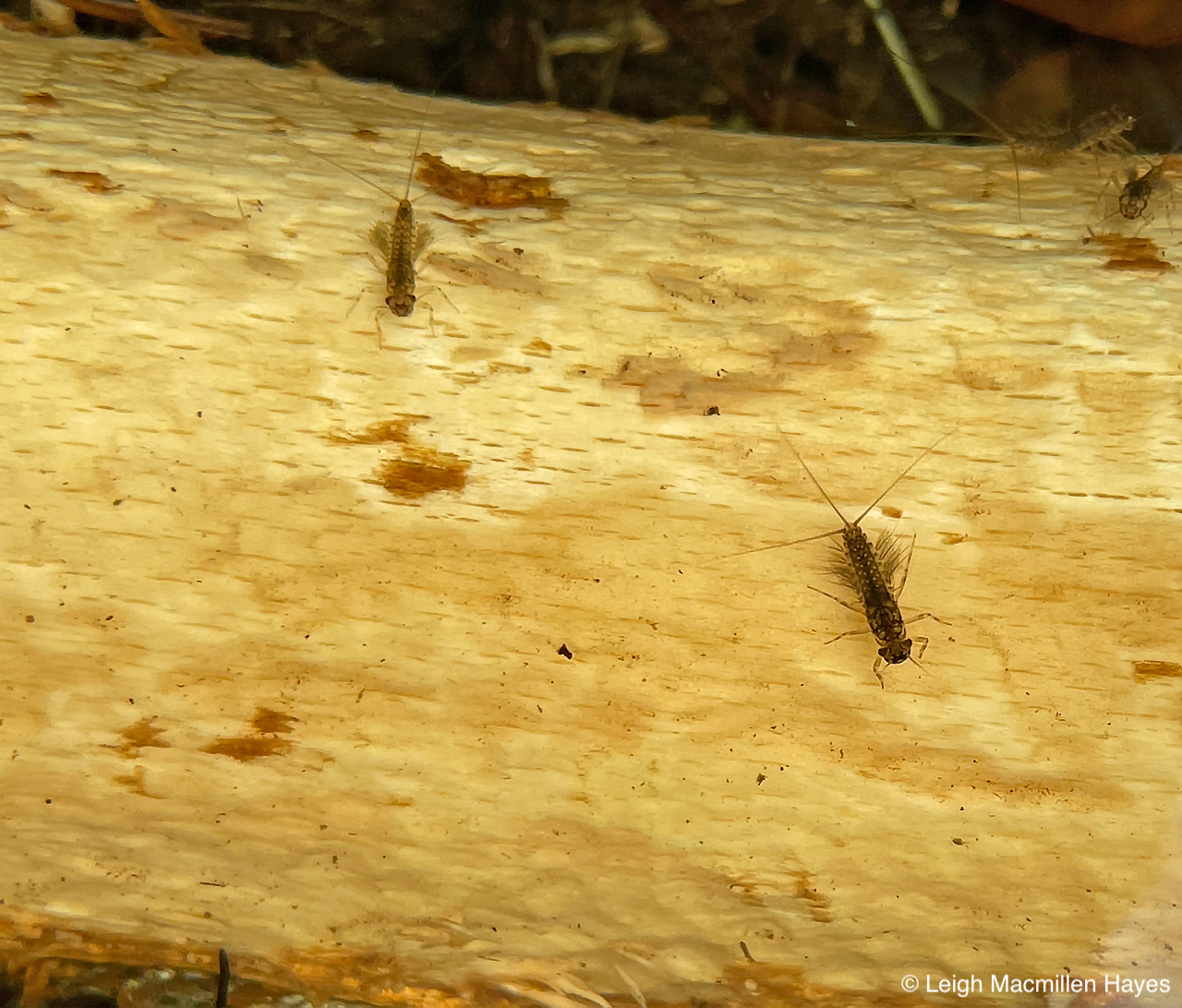
Each of those dark spots on the logs . . . Mayfly larva! A fly fisherperson’s delight. Ours as well. We know from experience because this past year we’ve dipped D-nets into streams in all seasons, that the larval forms of aquatic insects are alive and well whether there is a foot of ice or no ice. But where the ice has started to melt (and that’s not everywhere yet, though this week is supposed to warm up), life that has been there all along is emerging before our eyes.

Did you know that there are 614 species of Mayflies in New England? Eggs are laid in the water, where the larval form or nymph develops. #1.Shows the egg that had been deposited on the bottom maturing into a nymph. #2 is the nymph growing  in stages called instars until it matures. By #3, the mature nymph or emerger swims to the surface. Some species shed their skin and becomes a dun or subimago on the water’s surface. First It floats until its wings are dry enough for flight. This is a unique stage in the insect world as only Mayflies are fully winged before the adult stage. Others climb upon vegetation or an upright object to everge. For #4, you can see that the dun flies into bushes or trees along the water’s edge, where it sheds its skin and, #5, becomes an adult known as a spinner or imago. #6. The spinner flies off to join the mating swarm. #7. After mating, the female spinner dips her eggs on the water’s surface, and they fall to the bottom where it takes anywhere from ten days to months to hatch. Finally, #8 depicts the end for both male and female spinners fall to the water’s surface and die after mating. Keep in mind, this is a general description of a Mayfly’s life cycle. 
If you look with a keen eye you can see some of what I found one day–at least ten Mayfly nymphs on a leaf. I’ve used black arrows to point to some of them. 

Here’s your challenge. Quiz #1: I’ve done the squatting for you. See if you can locate at least one Mayfly nymph in this photo.

Not all nymphs are equal–in size that is. Remember, there are 614 species. Again, if you look closely, you’ll see that this one large nymph is surrounded by two smaller ones. Notice the tails. Mayflies have elongated bodies with 2 – 3 very long, tail-like appendages called cerci at the end of their abdomens.

Here’s another reference for size as the large beetle is a Predacious Diving Beetle and there are three small Mayfly nymphs in the picture.

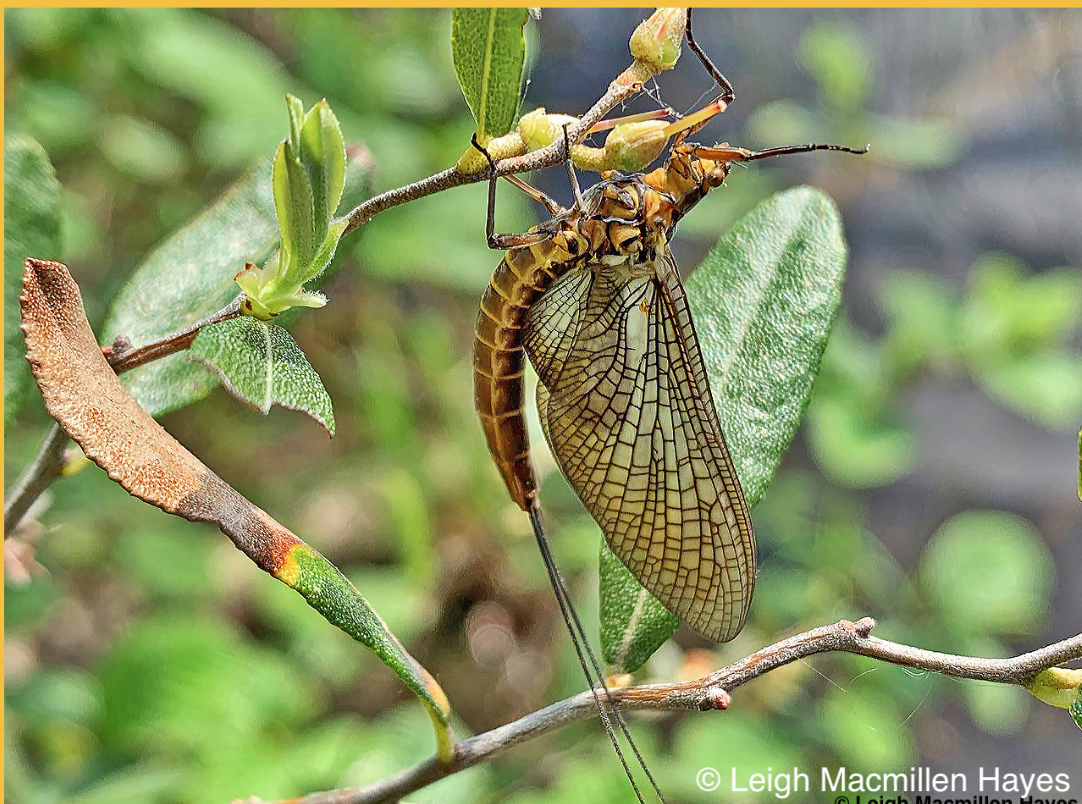
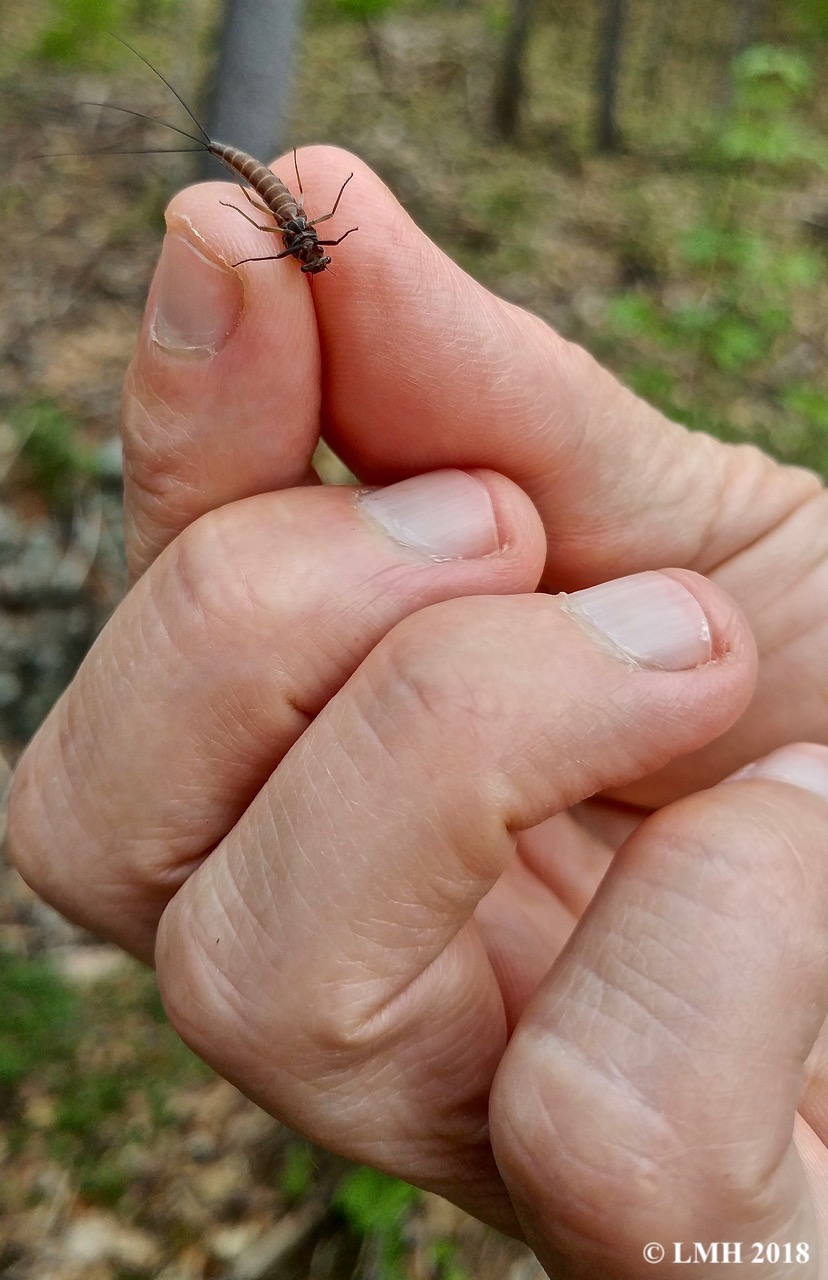
This is a dun or subimago who had just flown from the water. Well, I should correct that as I had picked it up from the water’s surface and let it dry its wings while resting on my finger. And then I helped it to a nearby shrub. Look at those wings.So many people don’t like Mayflies, but I find their structures and life cycle to be amazing. Take note of how “cloudy” the wings are. That’s how I know this is a dun. 

Mayflies, of course, don’t just land on bushes and trees, but some species may choose stems or rocks upon which to transform. Others meet obstacles along the way, including my pants. But again, notice those wings–another dun or subimago. And notice how the hind wing is so much shorter and rounder than the forewing.

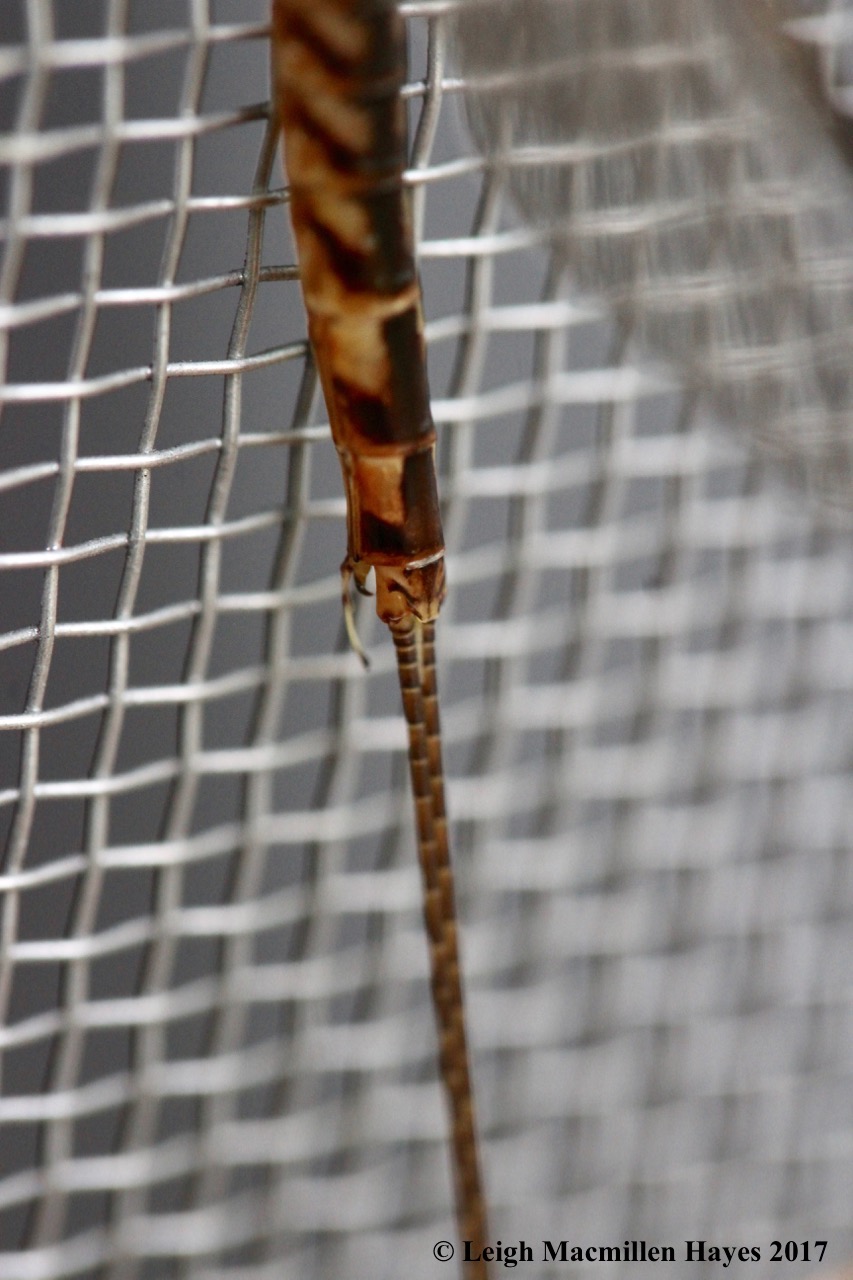
A little bit about Mayfly anatomy. Like all insects they have a head, thorax, and abdomen, whether as a nymph, subimago, or adult (imago). The head typically is for seeing and feeding, though while Mayflies feed in their nymphal form, any mouthparts in the adults are reduced or non-functional. The thorax is the section of the body that supports three pairs of legs and two sets of wings–a forewing and a hindwing and therefore it’s located in the center of the body. In the larval or nymph form, the abdomen features gills, which are absent in the older two molts. And you can see the tails attached to the end of the abdomen. Notice, too, the gender ID. So the abdomen bears the reproductive structure and in some insects it also carries the digestive tract. 

So, Quiz #2: Male or female?

Sometimes the safe place isn’t a shrub or some other natural setting for a final molt, but rather the screened porch at our camp. Often, early in the morning, as I sit in a rocking chair to sip coffee, I’ll notice a visitor on the outside of the screen. And not just in May. These were in August.

Mayflies often molt at night by breaking out through the top of the thorax. In the process, the Mayfly pulls a fresh set of wings from inside the subimago wing cuticle. How cool is that? 

Here’s a look at the discarded exuvia or shed skin and you can see the adult to the left.

Here is a clearer view of the adult or imago, which, you remember, will only live long enough to join the mating swarm, mate, and then die.

Notice how clear the wings have become.

And those conspicuous eyes. They are like a mini-set of dumbbells. But no mouth because with such a short life-cycle, there is no need to feed.

This is a shed skin I found on the surface of a swampy section of a river.

And right next to it, the dun or subimago crawling away as its wings dried.

Quiz #3: What stage is this? And is it male or female?

Quiz #4: And what stage is this?

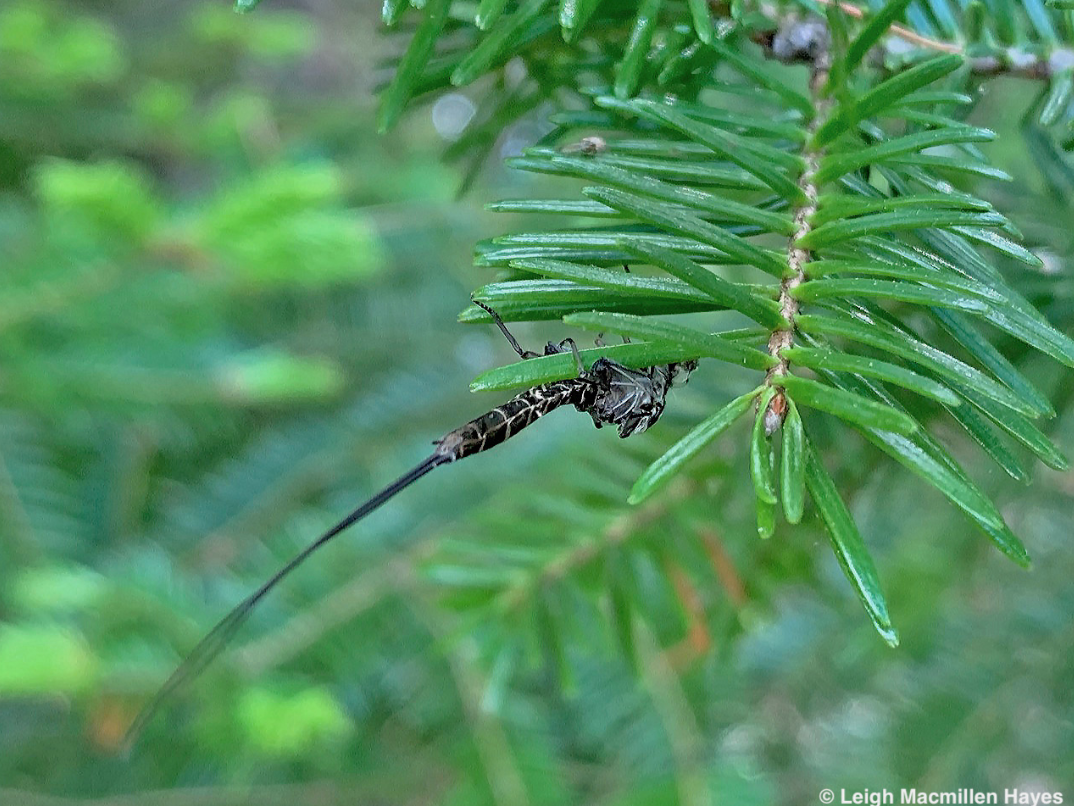
Not all Mayflies die on the water as there are other hazards one might encounter such as this very sticky spider web.

That’s all I have to say about Mayflies for today, but going forth, expect more of these tiny critters to appear in this space. Along with others like dragonflies and cicadas and robberflies and . . . I can’t wait. Oh yeah, and it’s almost vernal pool season too.

Thanks for taking the Mayfly Challenge on this April Fools Day.

Lost and Found Mondate

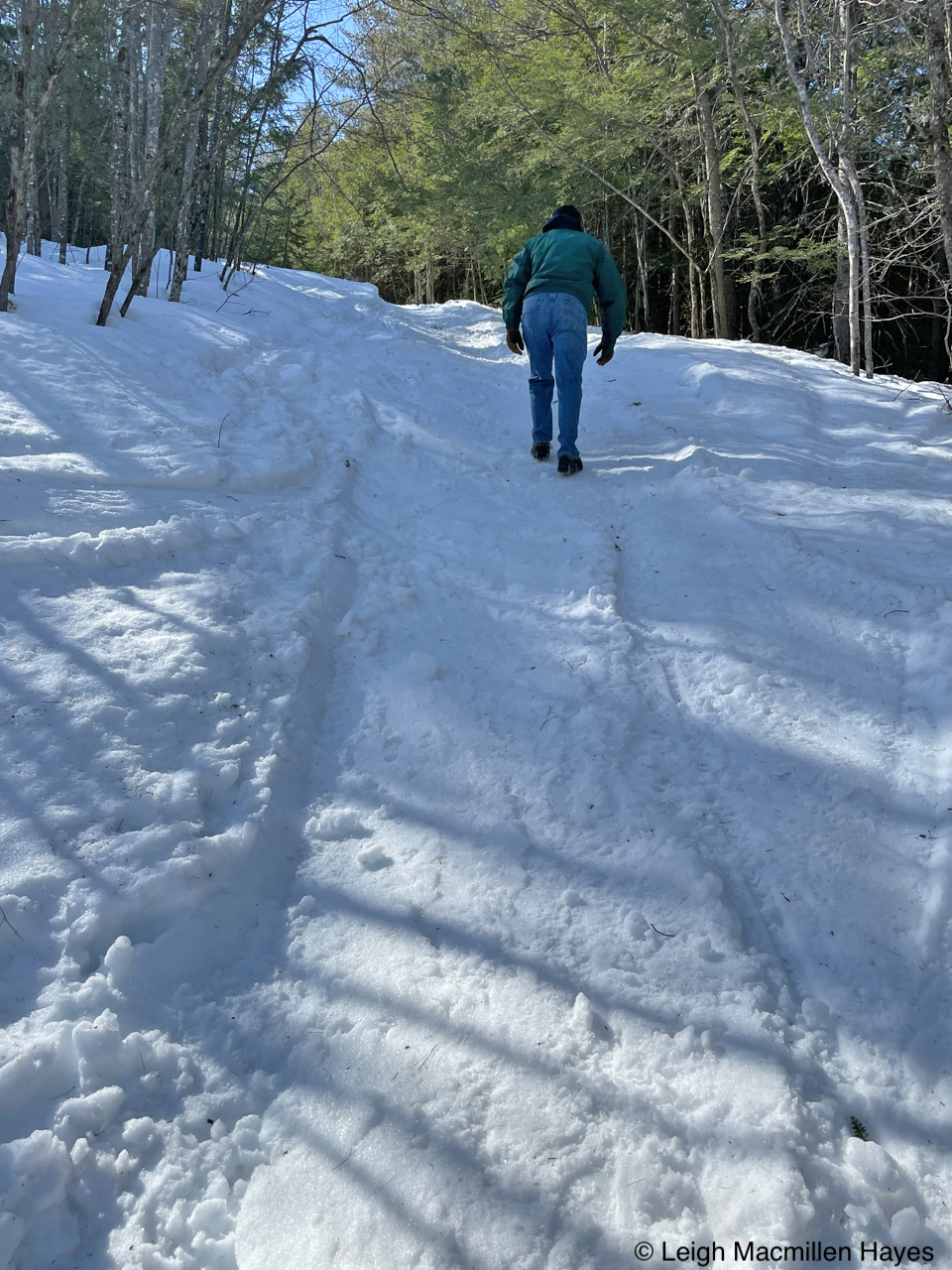
We chose a trail we’ve never hiked before, though we’ve conquered this mountain from two other trails many times over the years. Today’s choice was based on an email from Allen Crabtree, leader of the Denmark Mountain Hikers. The lovely thing about it was we walked along a snowmobile trail to the summit and so were happy to be on micro-spikes and not snowshoes or postholing. And the temperature was crisp enough to keep the snow firm, at least on the way up Burnt Meadow Mountain.

After passing by what I think was an old barn foundation, the trail continued on fairly level ground for a bit and we worried that I may have misunderstood the directions.

But that didn’t really matter because we were in the woods, together, and enjoying the fact that a fisher had loped across the landscape probably last night when the snow was still soft enough to leave impressions before this morning’s temp of 17˚.

At last the trail began to get steeper and I gave great thanks that it was such a packed trail for it made for an easy ascent. We had no idea what conditions might be under the snowmobile trail, but I suspect on a summer day this isn’t an easy way to go. Not that the other two trails are either.

My real reason for suggesting this hike to My Guy was because I wanted to revisit this site, which we’d reached previously on a exploration down from the summit in 2012.

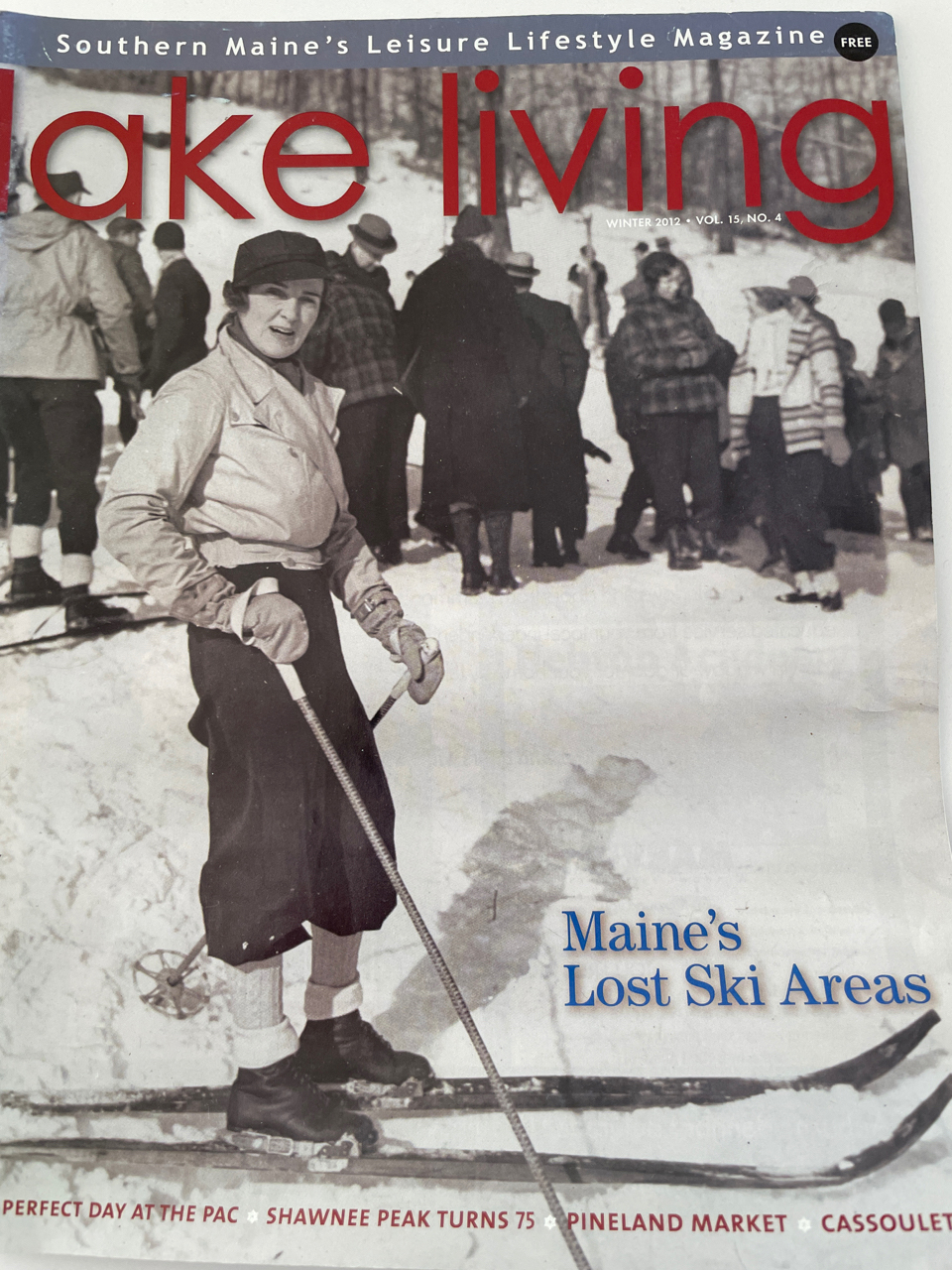
At the time I was working on an article for Lake Living magazine entitled “Maine’s Lost Ski Areas” and interviewing various skiers and making MG tag along with me as I visited the former ski areas. “Trails hidden in the forest provide us with clues that our town fathers worked hard to create recreational areas, but also to boost the local economy,” I wrote in the article. “You can still find some of the trails and remnants of rope tows and chair lifts. When you unexpectedly come upon cement pads and towers while hiking, it’s a bit like entering a ghost town, a place that has seen a livelier day. So many people have a history with these legendary ski areas. They learned to ski at this one, met their spouse at that one, or won first place in a race.
The skiing industry began in the lakes region in 1936 when a group of ten businessmen each invested $25 and considerable labor to build the first rope tow in Maine. The Jockey Cap Ski Tow helped make Fryeburg ‘The Ski Capital of Maine’ for a brief time.

According to newspaper articles and brochures preserved by the Fryeburg Historical Society, the Fryeburg Winter Sports Committee hired Paul Lamere, a ski instructor, to run a branch of the Lamere School of American Skiing. Lessons were offered one day a week.

Because the Maine Central Railroad had a station in town, Fryeburg residents saw the ski area as a means to support businesses during the Depression. Leaflets proclaiming “Weekends for Your Winter Sports” mentioned “good motels, good restaurants, good rooms in private homes, all prices reasonable . . . use the lighted ski-tow, Friday and Saturday nights, a brilliantly lighted slope and rope to pull you up the hill, a new thrill for winter sports enthusiasts” were distributed in the Portland area. The cost for a ride on the snow train from Portland to Fryeburg was $1.50 and a ski ticket was about $1.00.” (I should mention that the photo above was made possible to Lake Living by the Fryeburg Historical Society.)

But we weren’t at Jockey Cap today. And this ski area was a wee bit newer as I quoted former Lake Region High School principal Roger Lowell telling me he’d skied at Burnt Meadow Mountain, which had one lift and a lodge. If you look below the arrow, the top tower was the end of the line and skiers had to exit off the T-bar at that point.

From my article, “According to NELSAP (New England Lost Ski Area Project), in 1967 the Burnt Meadow Mountain Recreation Area received a loan from the Farmer’s Home Association to create a ski area that opened for the 1971-72 season, but saw its demise when several bad snow years followed. In 1980, Wendell Pierce, owner of a northern Maine ski area, purchased Burnt Meadow and renamed it Zodiac Skiway.”

“‘It had pretty good skiing from the top,’ recalls Roger, ‘but three quarters of the way down it flattened out and you had to get up steam to make it all the way without poling.’ He and his team got into trouble for going too fast. ‘WE were bombing the thing so we wouldn’t have to skate to the lift,’ he says.

While there on his own one day, Roger learned about a race. After discovering he couldn’t inspect the course, he found himself last in line. ‘I figured what have I got to lose so I went fast. It didn’t matter if the gates were down a bit. You would have thought I was Jean-Claude Killy.’

Roger won the race and received a blue ribbon similar to what they award at the Fryeburg Fair. ‘I think it said something like FIRST on it,’ he says, a wry look on his face. ‘It was very generic. A conversation piece.’ That was the last race held there. The ski area continued to lose money and closed in 1982. The T-bar still stands intact.” That was 11 years ago, but today’s photos speak to the fact that it still stands intact.

It didn’t take long for us to reach the summit, where we walked around taking in the views beyond, this a look toward Stone Mountain, which is accessible via the Twin Brook Trail.

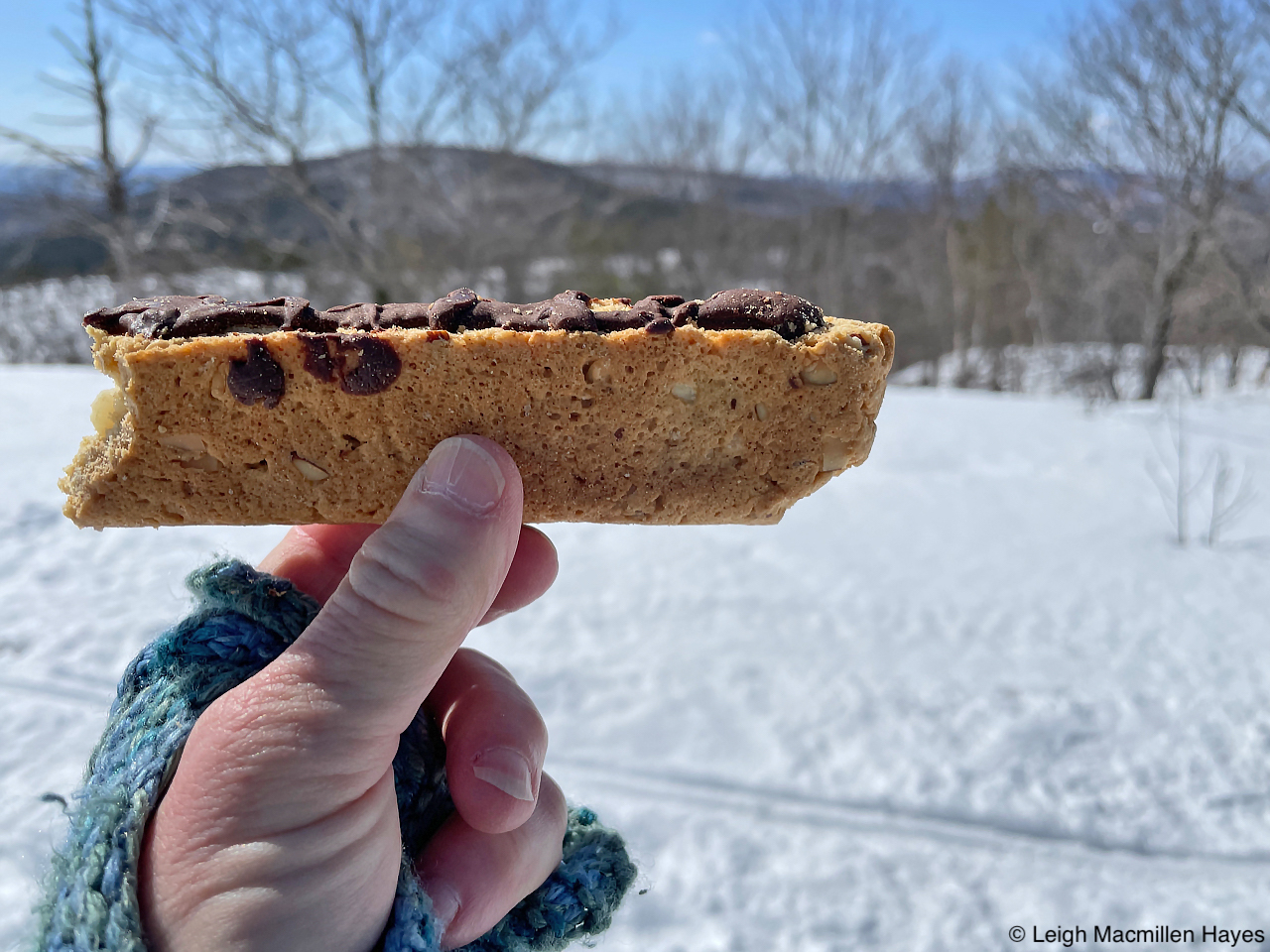
Finally, we sat upon lunch rock to enjoy our sandwiches, followed by Fly Away Farm’s Almond Biscotti with Mocha Drizzle. MG just thought it was chocolate so let’s keep that secret between us.

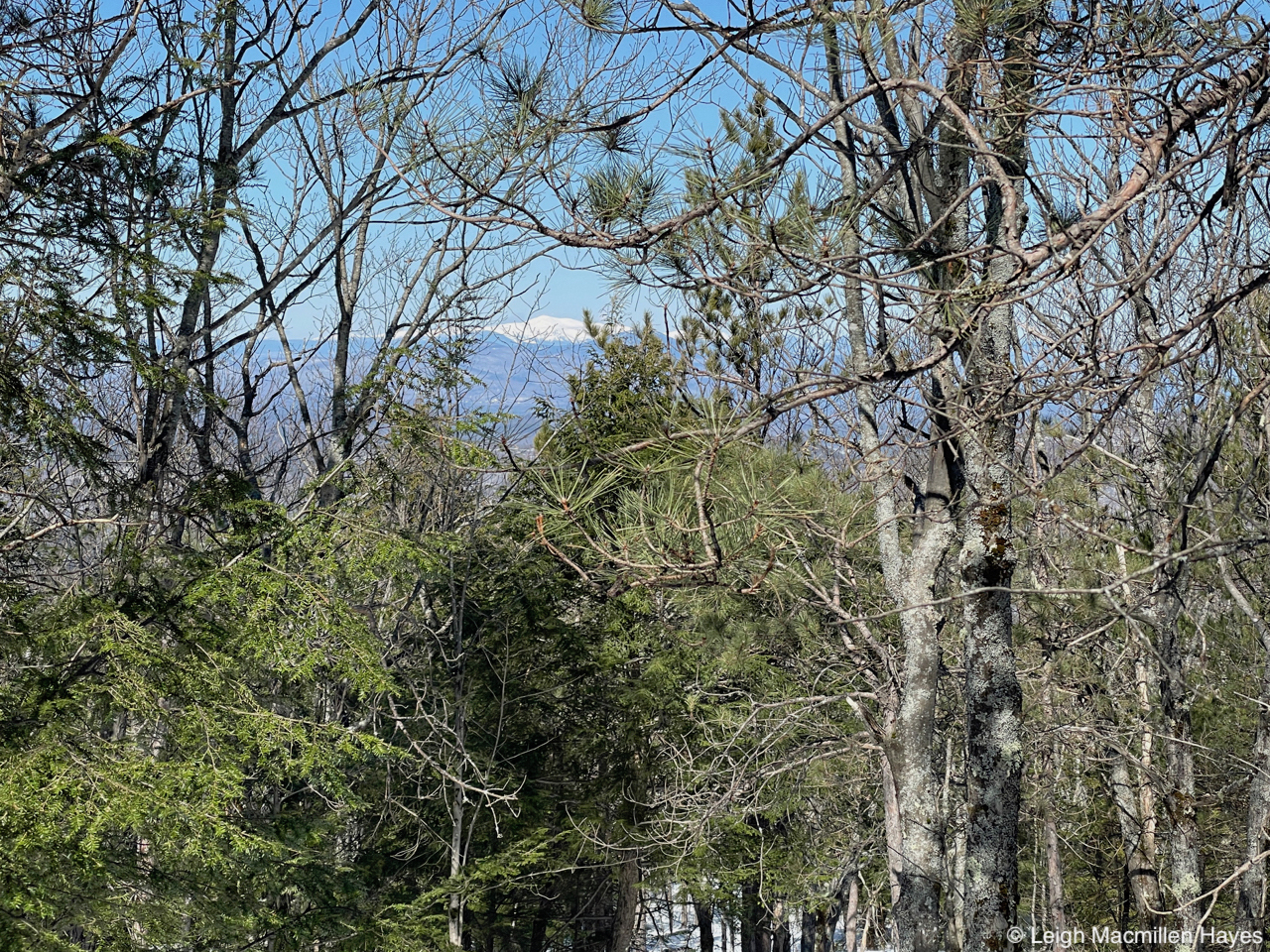
At last we began our descent, with a goal to find Mount Washington. And we did. Do you see it between the trees?

And then we found it again when we slipped off trail to take in the scene from a ledge. We always love to know where we are in the world. Our little world.

As we continued downhill, I was stopped in my tracks. That happens occasionally. (Insert smiley face) But this tree that leaned across the trail begged to be noticed and I’d missed it on the climb up the mountain.

Its manner of growing needles upon the trunk like no other evergreen that I know of gave me an immediate identification.

Add to that the number of needles that grow in short individual bundles: 3. Three strikes and you are out. Pitch Pine. Get it?

In the end, we thought we’d lost winter, but we found it alive and well and holding on for a wee bit longer. And even longer than that if you are at the summit of Mount Washington.

At the same time, because we are on the cusp of a seasonal change, we found spring in the form of swelling Red Maple buds . . .

and Striped Maple.

We also found some stuff left behind by other recent hikers. We left the sunglasses on a cairn at the summit.

And a glove at the trail intersection.

In fact, just after putting the glove on the sign we found an optic cleaning clothe–maybe to clean the sunglasses?

This was indeed a lost and found Mondate.

Oh, and thanks again to Allen Crabtree for his write-up and directions to the trailhead and mention of my friend Marita Wiser’s book: Wrote Allen: “The origin of the name “Burnt Meadow” is not clear.  Most trail guides attribute the lack of large trees on the mountain to the Great Fires of 1947 which also burned more than 80% of the old homes in Brownfield.  Marita Wiser, in her Hikes in and around Maine’s Lake Region says,”…the name of Burnt Meadow was established long before [1947].  It is shown on…an 1858 map of Brownfield.’”

Sweet Dreams

Once upon a time . . . there was a season named Winter. Now winter isn’t typically capitalized unless it falls at the start of the sentence, but for the sake of our story, it shall be so.

And there was a young woman . . . well, she’s old actually, but don’t tell her that because her twelve-year-old self still lives within her heart. This young woman decided to check on Winter. But she didn’t want to wear snowshoes and so she did a lot of postholing, making her feel more her actual age.

The young woman’s search led to islands such as this, but still Winter persisted and made its presence known.

Everywhere, the young woman heard the drumming of Pileated Woodpeckers, all friends of Winter, but because she was postholing, she couldn’t get a good look at the birds.

She did, however, find scat! Of course she did. This one seemed to be full of insect bodies and some seed capsules. And if you look closely, you too might see something else in this photo in the form of even smaller insects–Springtails. They also adore Winter.

The next stop on the young woman’s tour was a visit to the neighborhood vernal pool, where soon she’ll spend hours staring into its shallow depth and watching all of the activity that takes place there. For now, Winter still has a slight hold on the pool.

After some more postholing, the young woman finally reached a well-packed trail and paused as she often does beside a small stream where the dappled sunlight highlighted at least ten shades of green. But still Winter was there.

In another location, the young woman discovered the blues and grays of the sky above reflected in the brook below and the sight of more color tested her love of Winter.

But Winter wasn’t ready to go to bed just yet and a coat of thin ice on quiet water proved that point.

Behold, however, in the sky above, a Turkey Vulture’s raised its wings in its dihedral habit as it rocked back and forth on the brisk wind that marked this day. Winter saw this as well and began to wonder.

And this Pussy Willow the young woman paused beside added to Winter’s wonder.

“Should I stay or go?” asked Winter.

The young woman thought and thought. It was a most difficult question to answer because of her love for Winter. But in the end, she said, “Sweet Dreams, Winter. Stay under your covers and when you wake up next December, we shall meet again.”

The Luck Of The . . .

Any day spent outside is a day well spent and such was my case on this Saint Paddy’s Day.

I first followed the oversized bird prints of some Turkeys, which led to . . .

Tom in full display . . .

As he strutted before a few ladies, which led to . . .

Total nonchalance on the part of the ladies as they passed by, which led to . . .

Tom and his brother, Tom, giving chase, which led to . . .

the realization that a Bobcat had crossed the Turkey trail, which led to . . .

a tree with branches scattered on the snow below, which led to . . .

taking a closer look to make sure the twigs were snipped at a 45˚ angle, which led to . . .

following a familiar and fresh trail of pigeon-toed prints, which led to . . .

a sign carved into the cambium layer of a Beech tree, indicating a certain mammal lives near here, which led to . . .

an open door with more signage on either side announcing the resident, which led to . . .

a peek inside and today’s great discovery of a Porcupine at home, which led to . . .

the realization that though St. Patrick is the patron saint of Ireland, which My Guy celebrates, he was born in Scotland and thus today’s finds were due to the Luck of the Scottish.

Oh, and check out that fine pile of scat the Porcupine is sitting upon.