Of Stumps and Snags on this St. Patrick’s Day

Stump: the base of a tree that has been chopped down or fallen, but is still connected to its roots.

Snag: a standing dead or dying tree; or part of a tree that is dying.

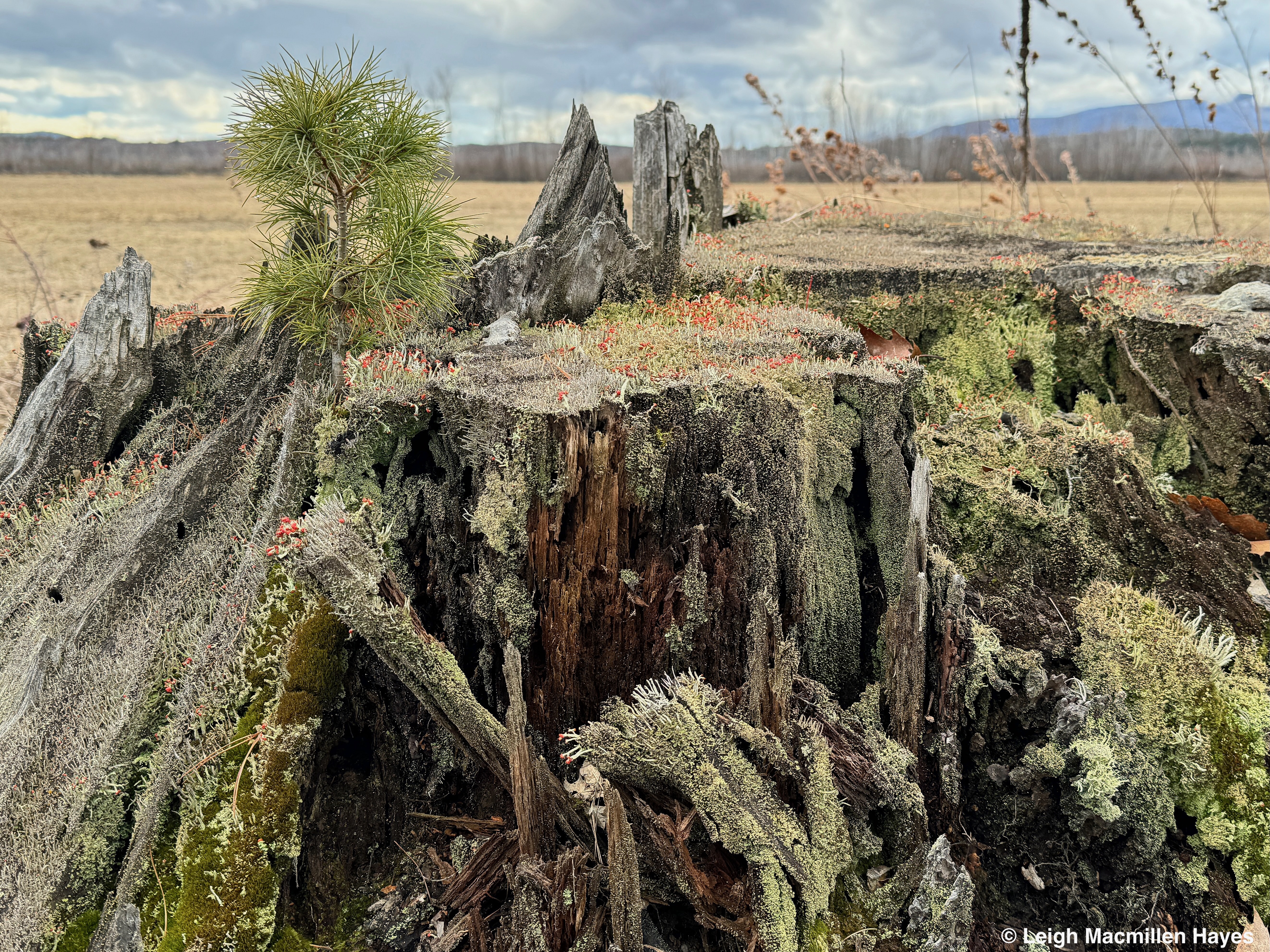
To visit a stump presumed dead
is to find life that comes in many forms.
Mosses and lichens colonize in a manner all their own,
and saplings find a new spot upon which to grow.
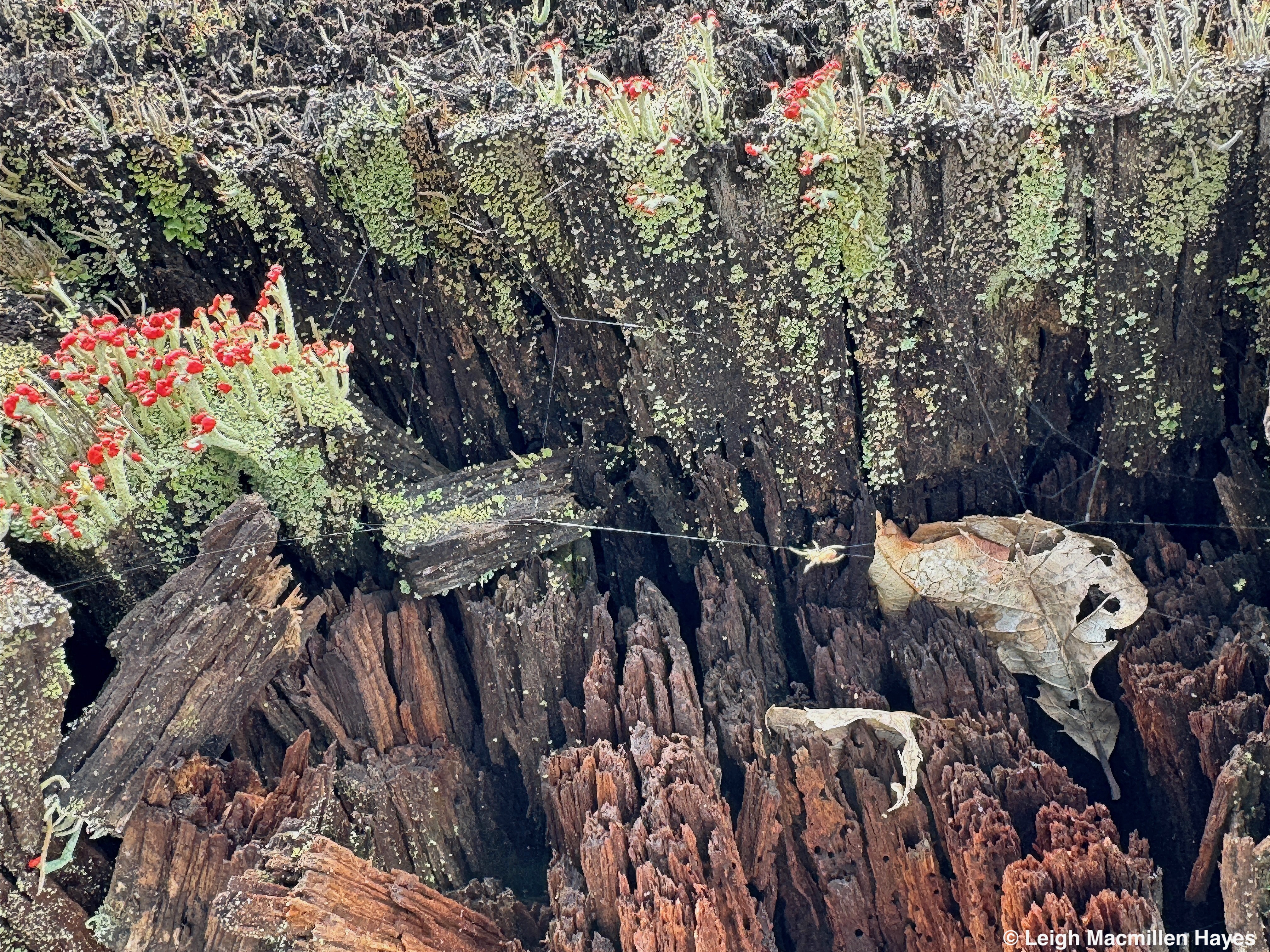
British soldiers crowd the scene,
their red caps marching toward the future
with fruiting spores planning to form
more of the same.
In their midst
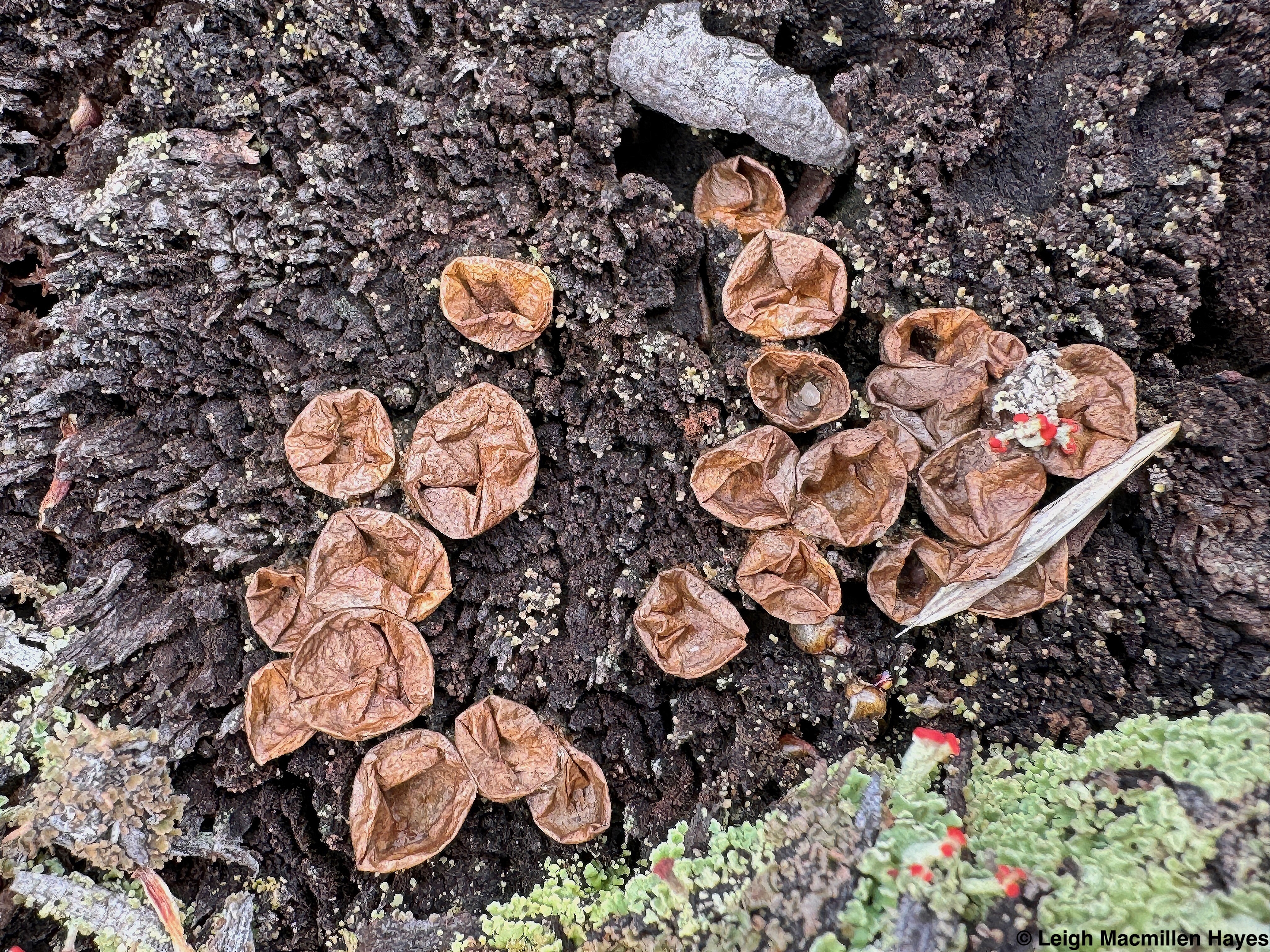
others who are deflated,
the papery remains of puffball fungi
having already spread their wealth.
And a tiny White Pine
who chose this spot
upon which to germinate
at least seven years ago.
Stopping beside another stump,
it is not the residents who call this home
that attracts my attention,
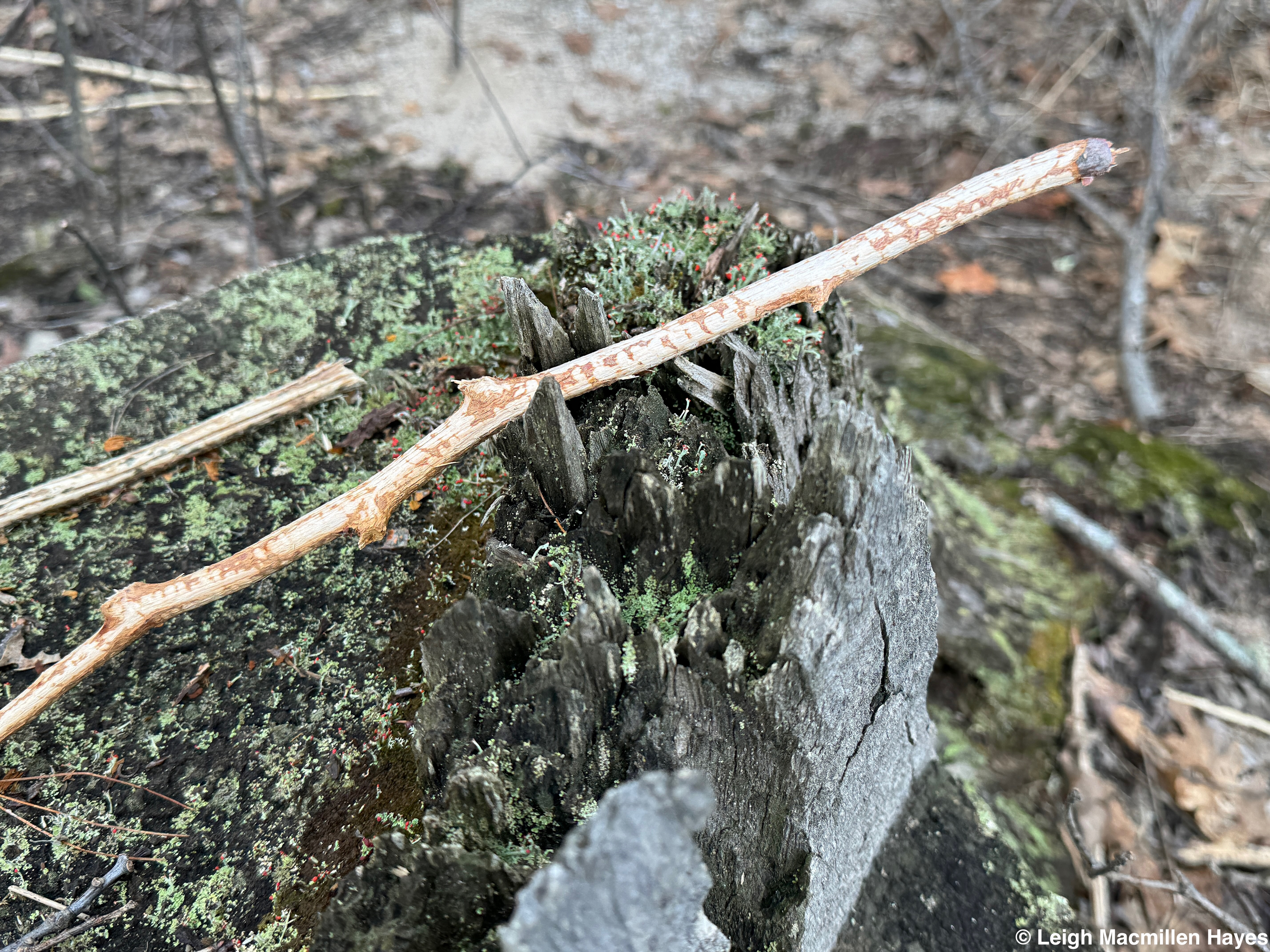
but rather the sign of another who had paused here.
Beaver nip sticks, a source of winter food, 
were on display,
the trees from which they came
now skinny stumps in the background.
And growing on this stump,
scaly-surfaced trumpets
blaring Irish tunes
for all to lichen.
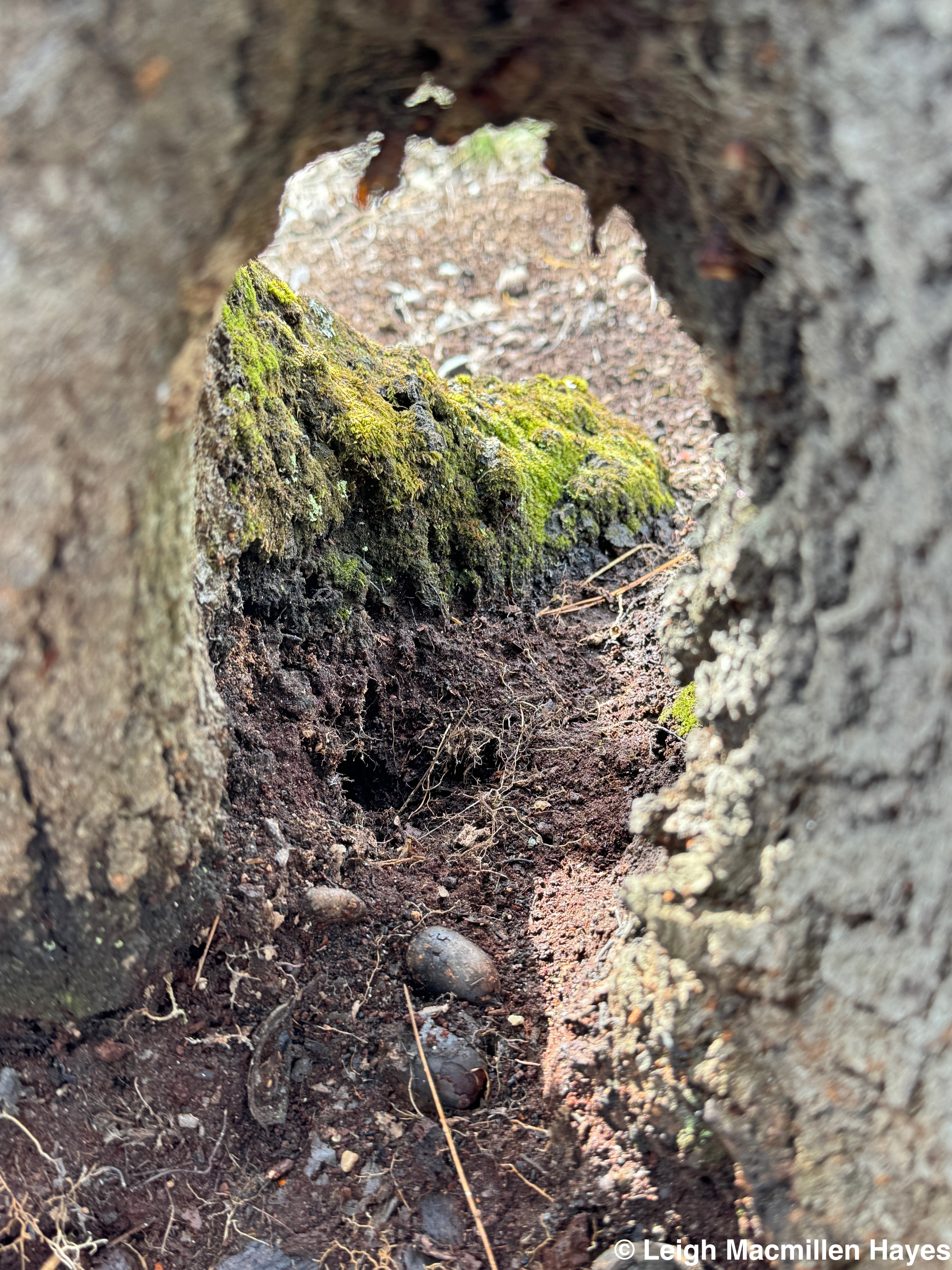
The next stump in my survey
had rotted from the inside out
and humus formed within
its castle-like chambers.
It even had an arched doorway
for leprechauns to enter
or pass into the next world
and the stump itself was leading the way.
There was another, 
which though the wood had already decomposed,
offered a substrate for a few
to set up housekeeping.
I was struck by the contrast
of a small clump of British Soldiers
on this one, whilst its neighbor
supported an entire army.
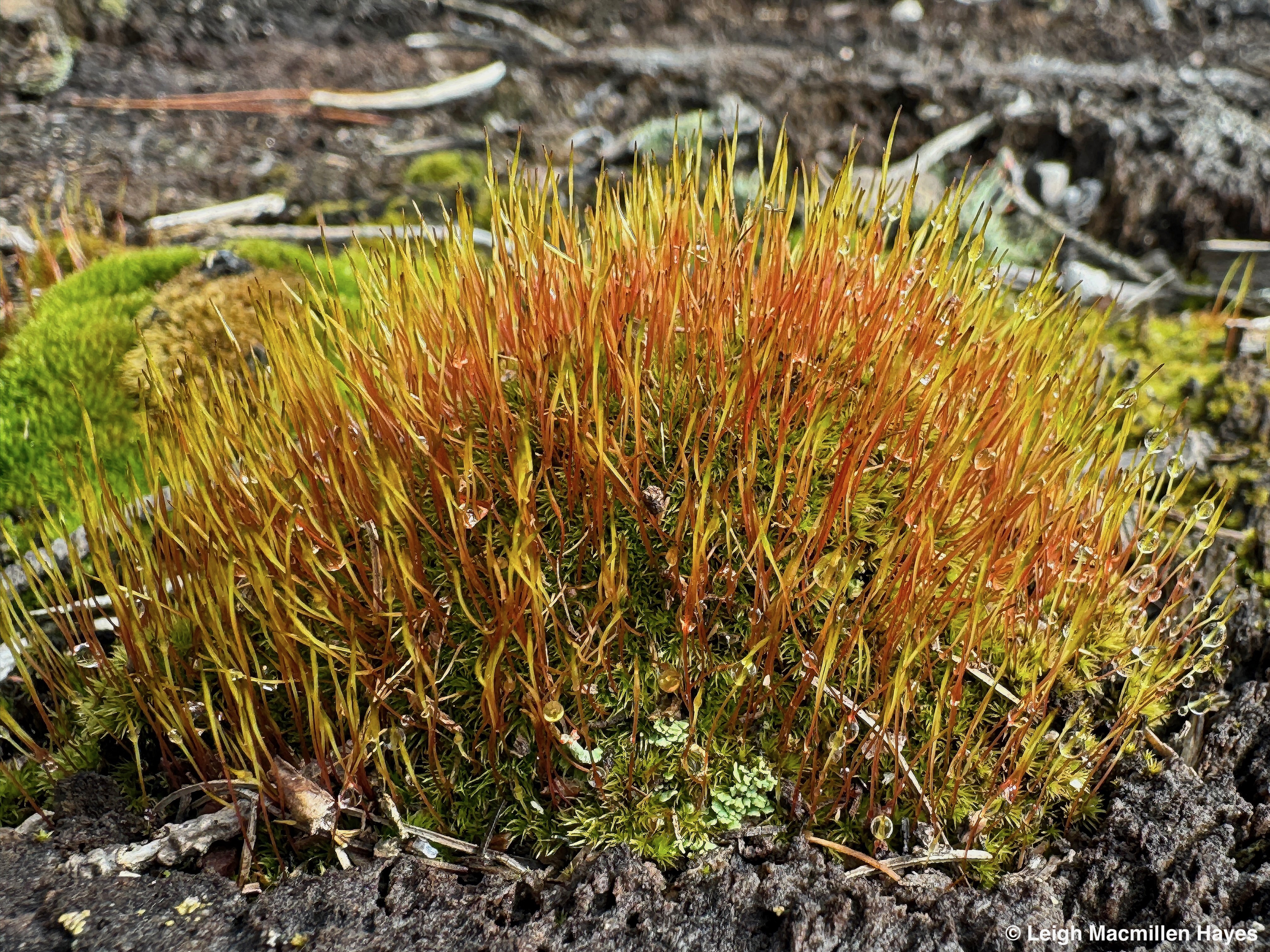
And only one small clump 
of Four-tooth Moss,
decorated with raindrops
in a salute to our March weather.
It's when one takes 
the time to look,
that the tiniest residents
make an appearance.
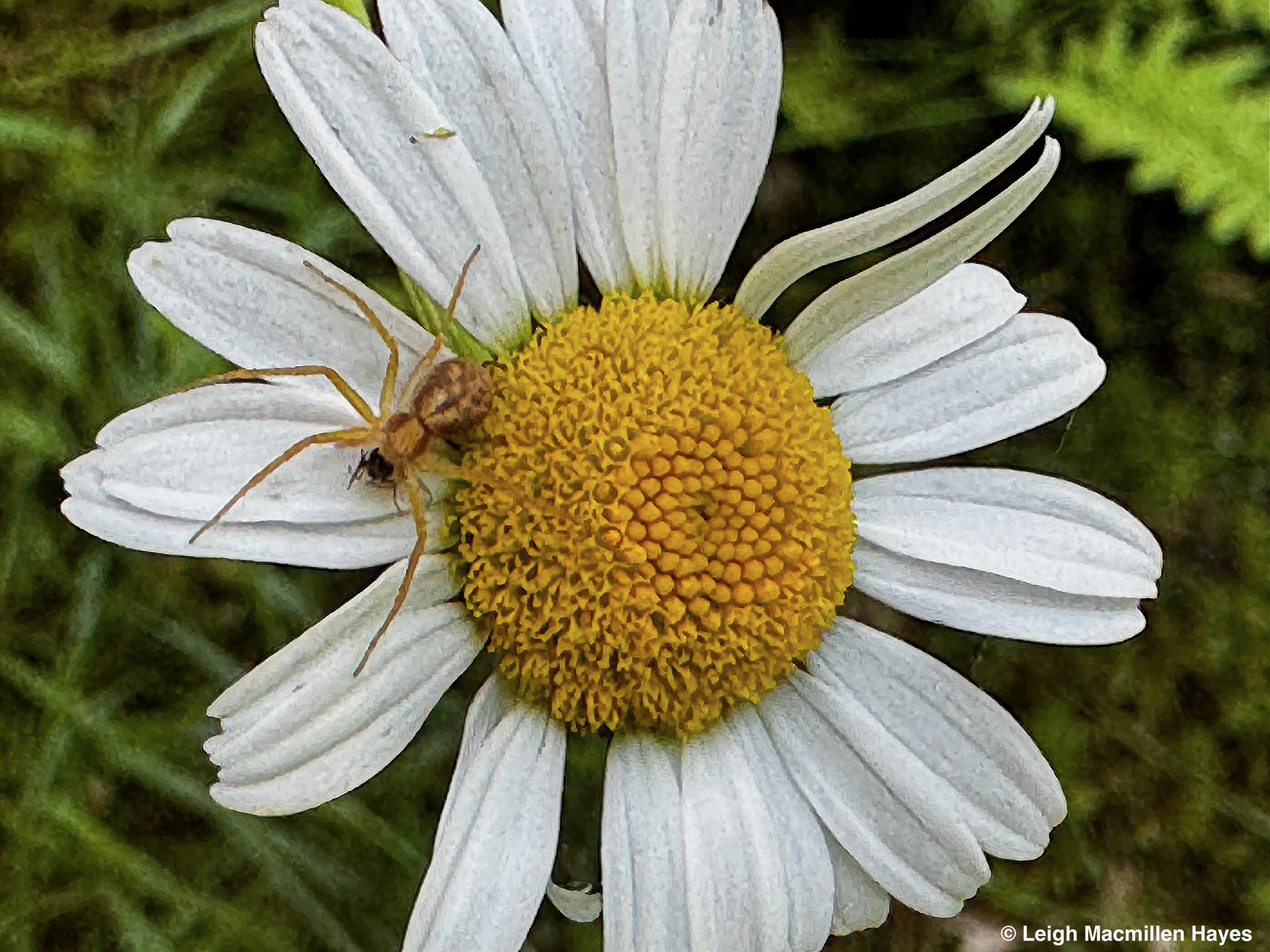
And so I watched this tiny spider
works its magic
of building guide lines
and creating a snare in hopes of a grand capture.
Not all stumps in this river-side location
were the result of man's intervention,
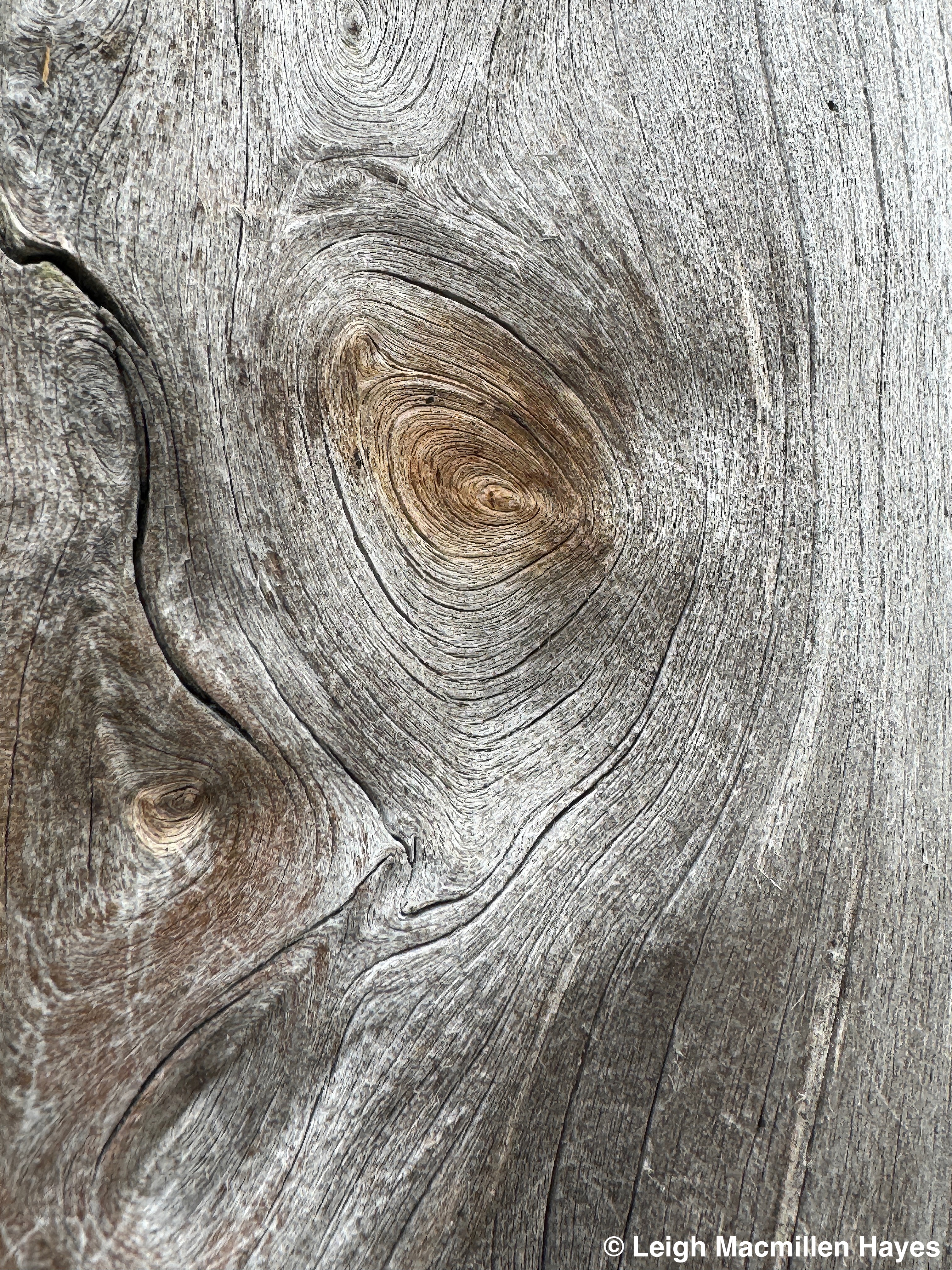
for old beaver works
highlighted tree spirits in the curvature of the lines.
Switching my attention to snags
brought the vision
of more artwork
upon the skeleton of a tree trunk.
And a display of the (w)holiness of this place,
for such were the portals
carved by beeltes in the past
that had breached the bark.
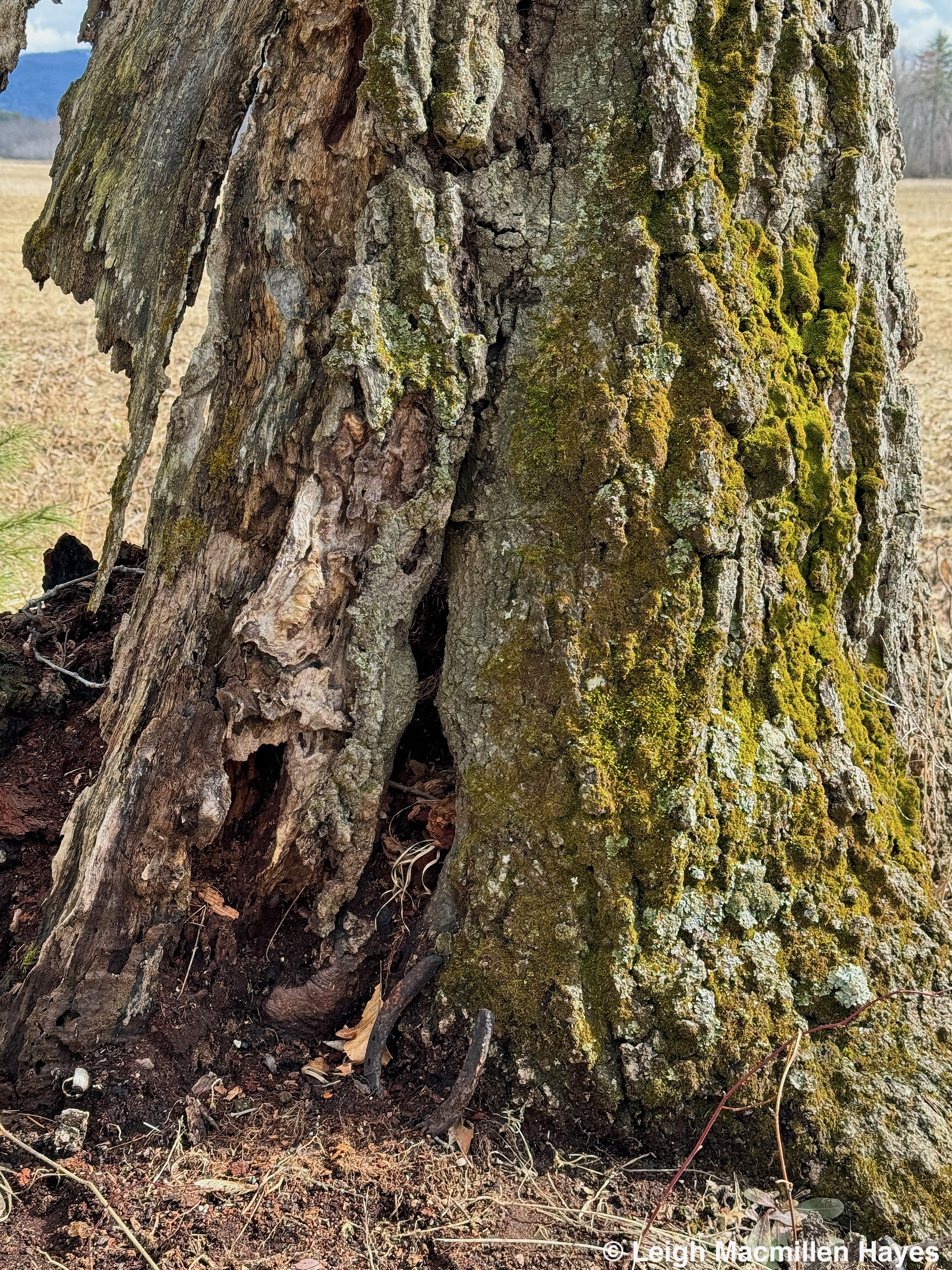
Finally, I stood by one mighty snag
that is a marvel of this natural world,
so much of it decomposed
yet replenishing the soil.
Looking skyward from within,
one can see branches
and marcescent leaves above
speaking to the xylem and phloem still in operation.
What bark is left,
serves as armor for this old oak,
and as scaffolding
upon which mosses and lichens can grasp.
It's what I spy inside,
however, that takes my breath away.
Oddly enough, it is named
for the breathing structure of another.
And when I compare it to 
the nose of my oldest son's furbaby,
I can see the resemblance, sorta.
Dog Nose Fungus.

As for stumps and snags, I must give thanks
for they are hardly useless in the landscape,
but rather hosts of many a forest life,
and I'm sure St. Patrick would approve.

Oopsy of a Mondate

Knowing it was going to be warmer today, we decided to venture to a local park where the snow pack would be less. That doesn’t sound right coming from this snow queen, but we didn’t feel like postholing or having snow stuck to the bottoms of our snowshoes.

This is a place where we know beavers are active. And I, of course, went with expectations. And convinced My Guy that we should begin and end at the bog.

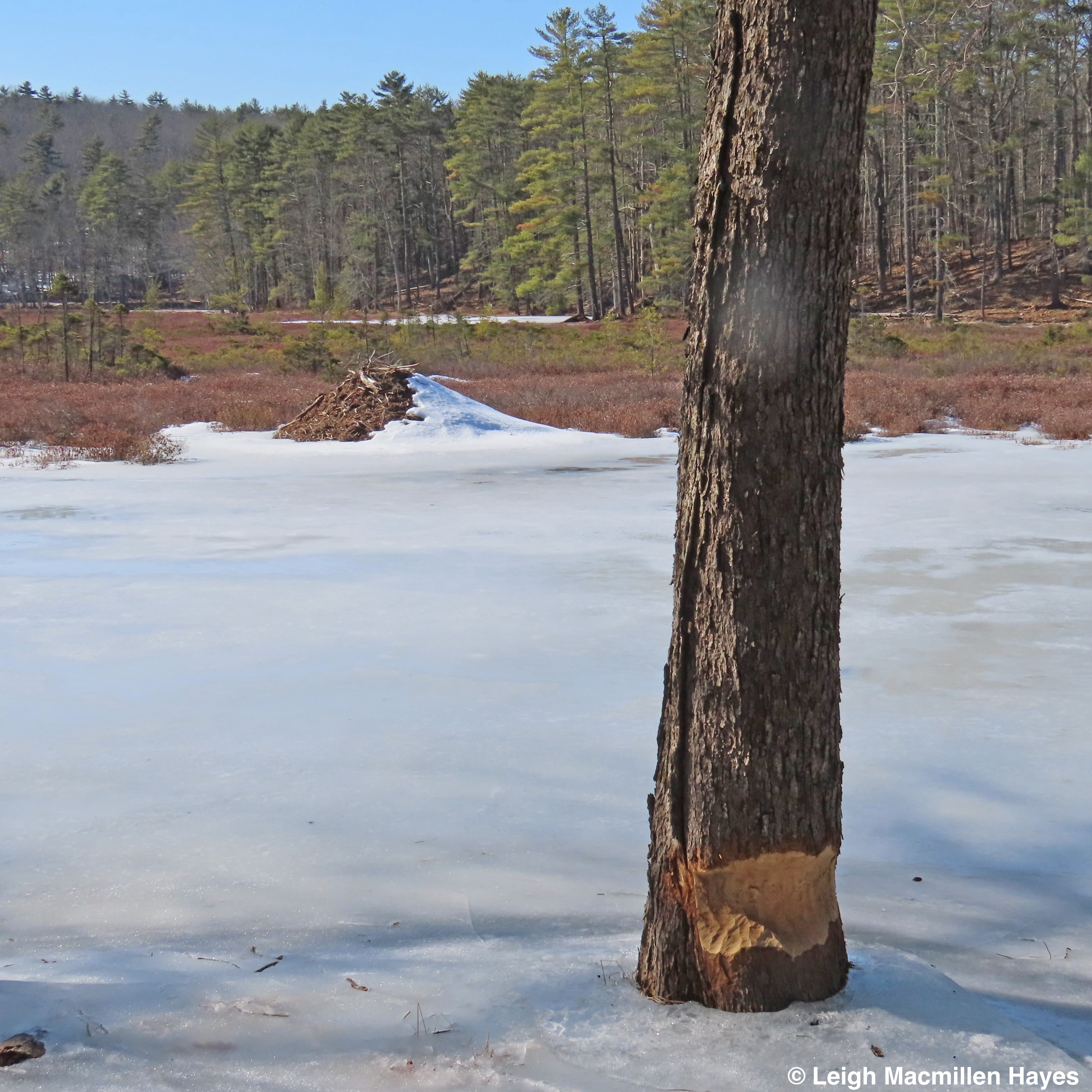
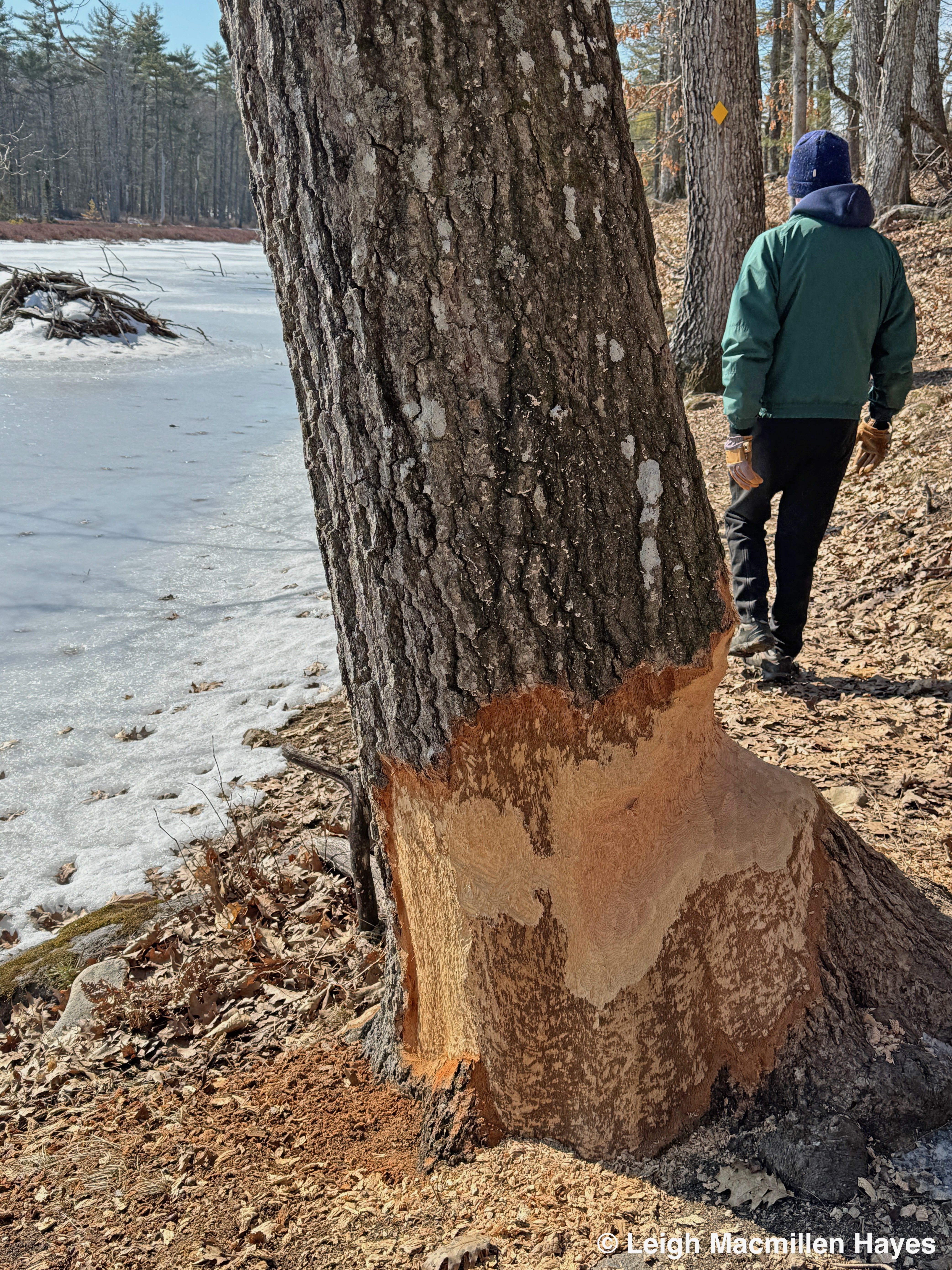
And bingo–a beaver-chewed tree that had probably been munched upon this past fall based on the color of the sapwood greeted us immediately.

But do you see the lodge in the background?

Here’s a closer look. Fully iced in and no mud on the exterior. This one had been active for several years, but today we learned that that is no longer the case.

Still, as we moved past it, there was another tree (on the left) that had been equally munched upon this past fall, while the color of the wood on the tree to the right indicated activity from a previous year.

There was even a dam, but I was beginning to lose hope. And to kick myself for coming with expectations. When will I ever learn?

Because we were in a park, there were structures and behind one close to the path, we found an Eastern Phoebe nest upon a platform placed there for the very bird to set up housekeeping each spring.

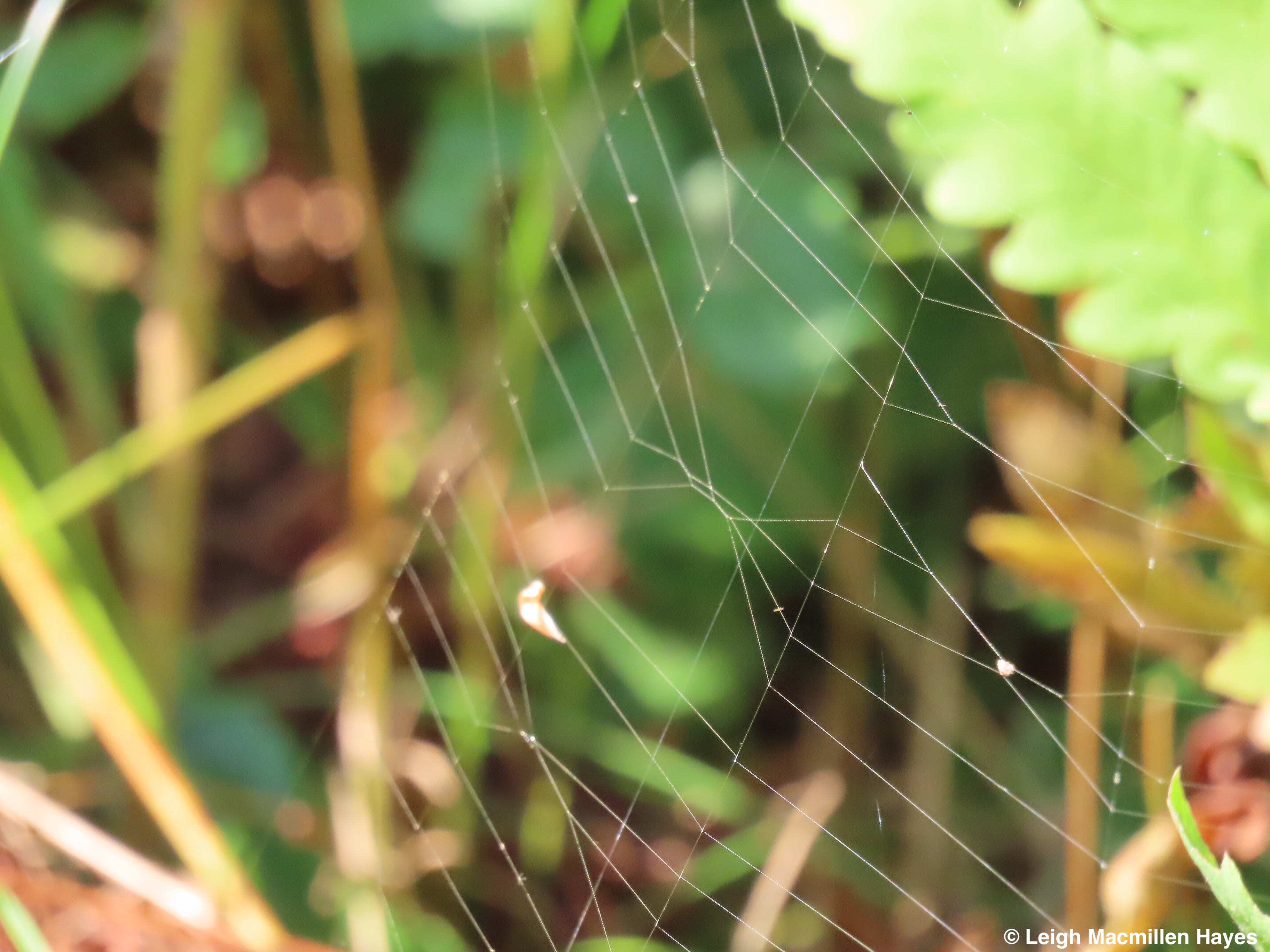
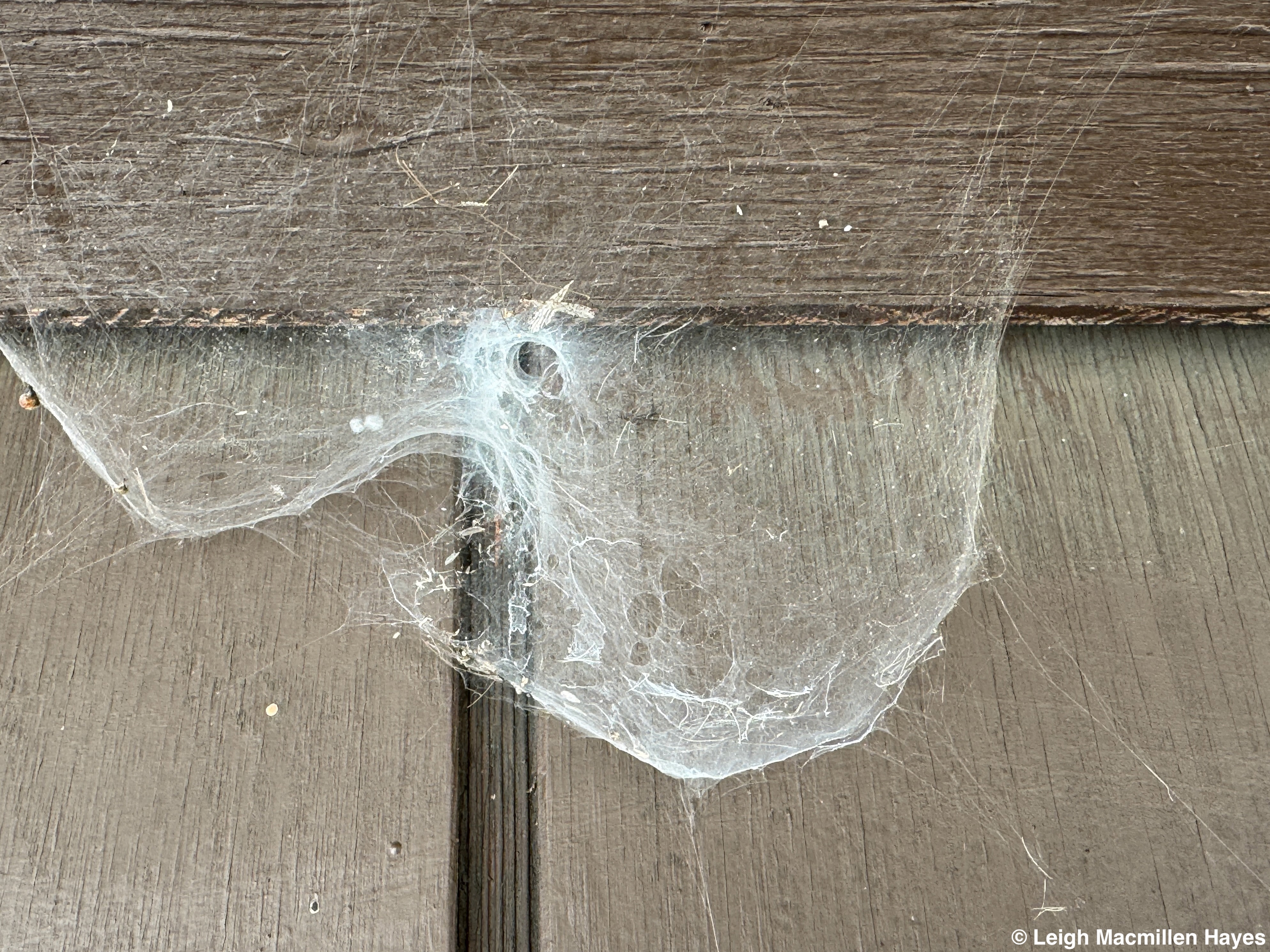
The cool thing was that the Phoebe wasn’t the only structure dweller, for directly below her nest a Funnel Weaver Spider had constructed an intricate home. I love all the guylines meant to keep the web intact, in fact it worked so well, that the winds of the fall and winter didn’t seem to have touched it. Well done, spider!

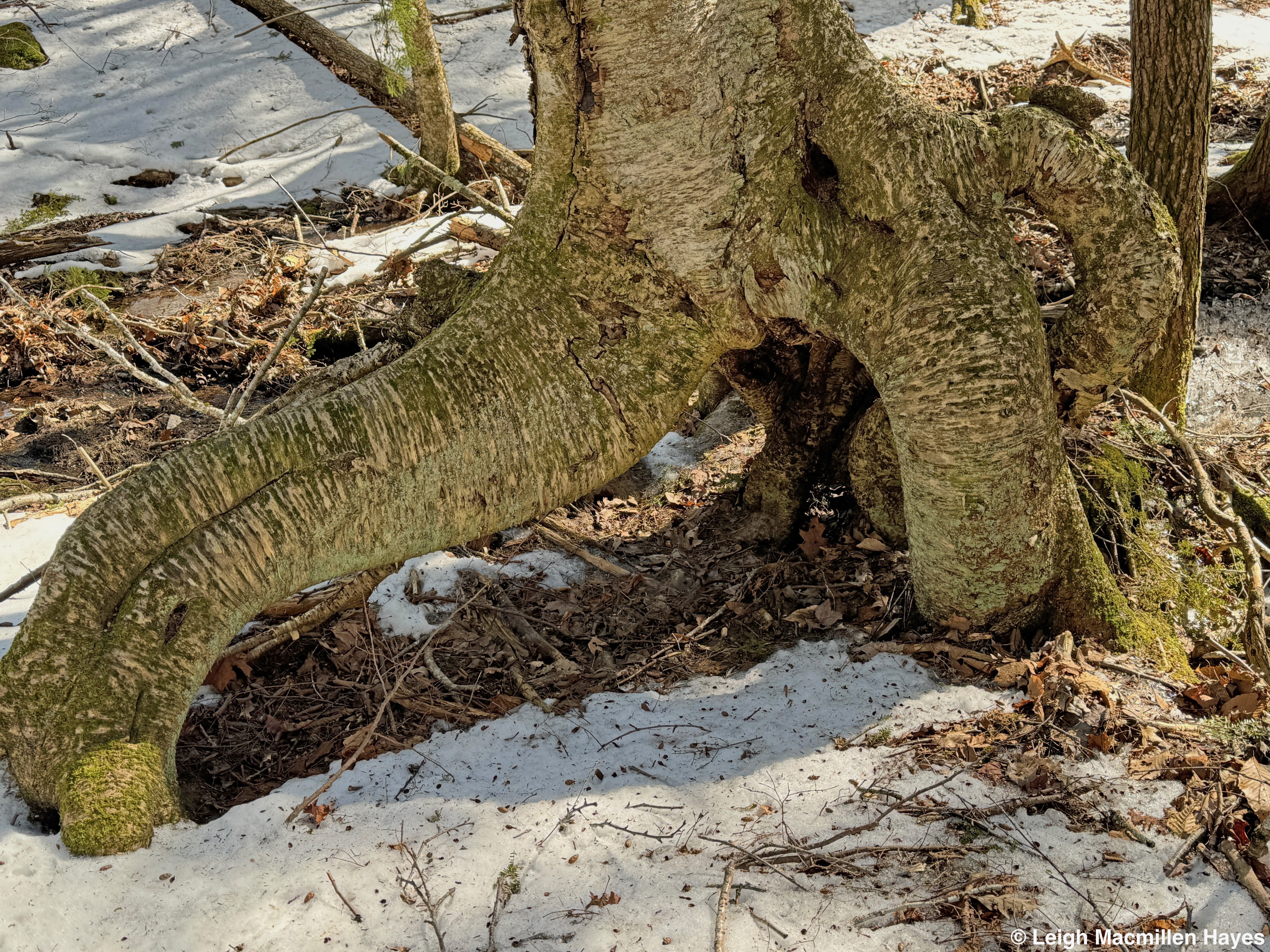
As we continued on, I thought about the gems this place offers, including this beautiful old Yellow Birch standing on stilts. As I noted in Becoming Tree Wise, the seeds of Yellow Birch, like Eastern Hemlock, struggle to germinate on the forest floor, but give them a moss-covered rock, or tree stump, or nurse log, and bingo, a tree grows on it. As it continues to grow, the roots seek the ground below and if it is upon a stump or log that eventually rots away, you have a tree in the forest that appears to stand on stilted legs. Tada!

Our trail was sometimes bare and other times snowy or icy, so we did don microspikes, which turned out to be the perfect choice most of the time.

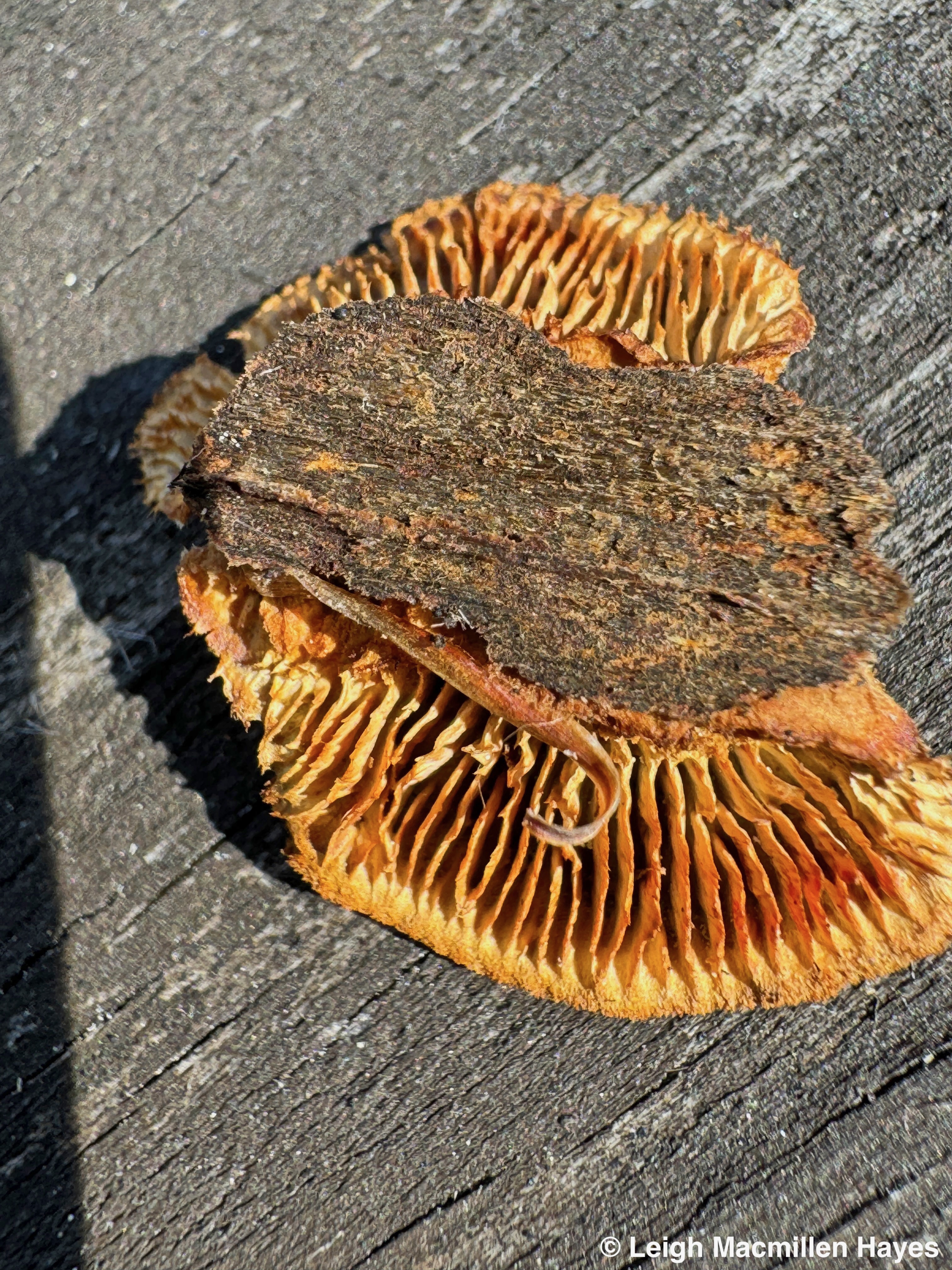
At the summit of what is known as Lookout Trail, the view is of the forest beyond, but we did look down at the picnic table and discovered mushrooms growing on the wood. The cap was like a tapestry of oranges and yellows and rosy browns.

It was the underside, however, that aided ID: Gloeophyllum sepiarium (Rusty-gilled Polypore or Conifer Mazegill).

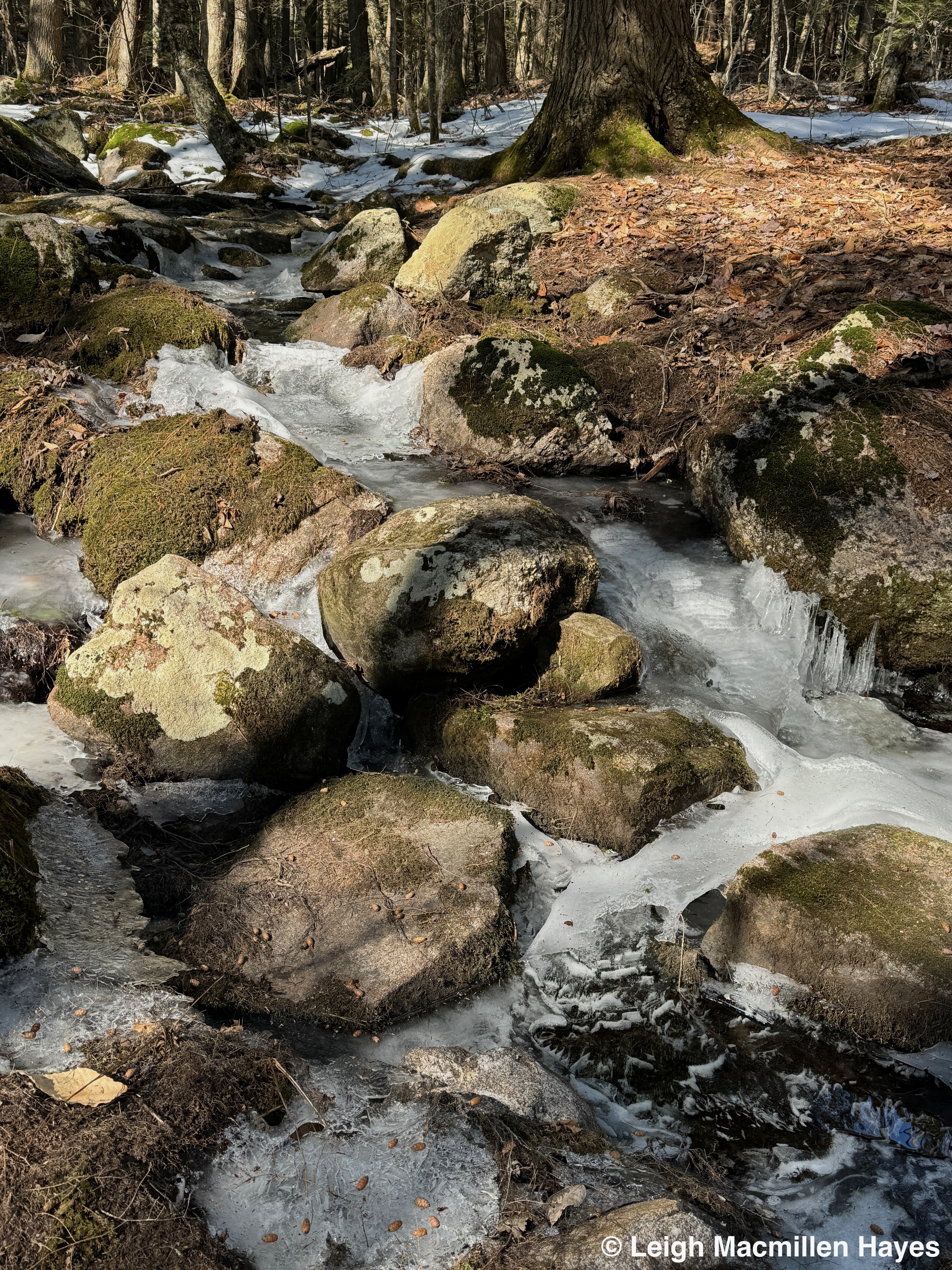
Occasionally there were brooks to cross and icicles to admire and sounds of percolating water flowing beneath the ice to encourage stopping for a few minutes to take it all in.

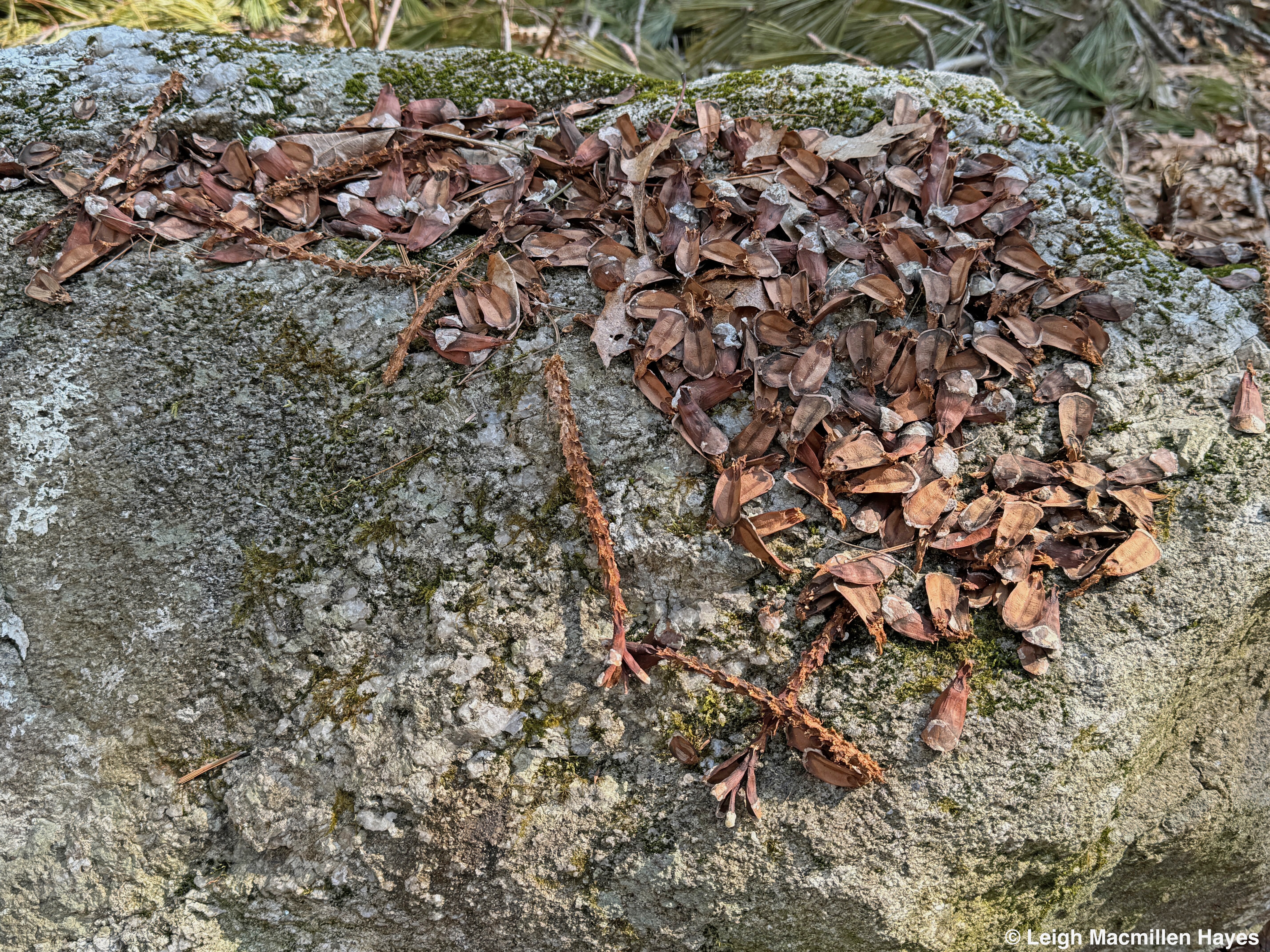
Heading downhill, in a boulder field below a granite ledge we discovered the territory of one very busy Red Squirrel. Middens covered numerous rocks.

And I could only imagine what the original cache had looked like. Since it takes two years for pinecones to mature, next year this squirrel may not be so fortunate, but living in the here and now, life is good.

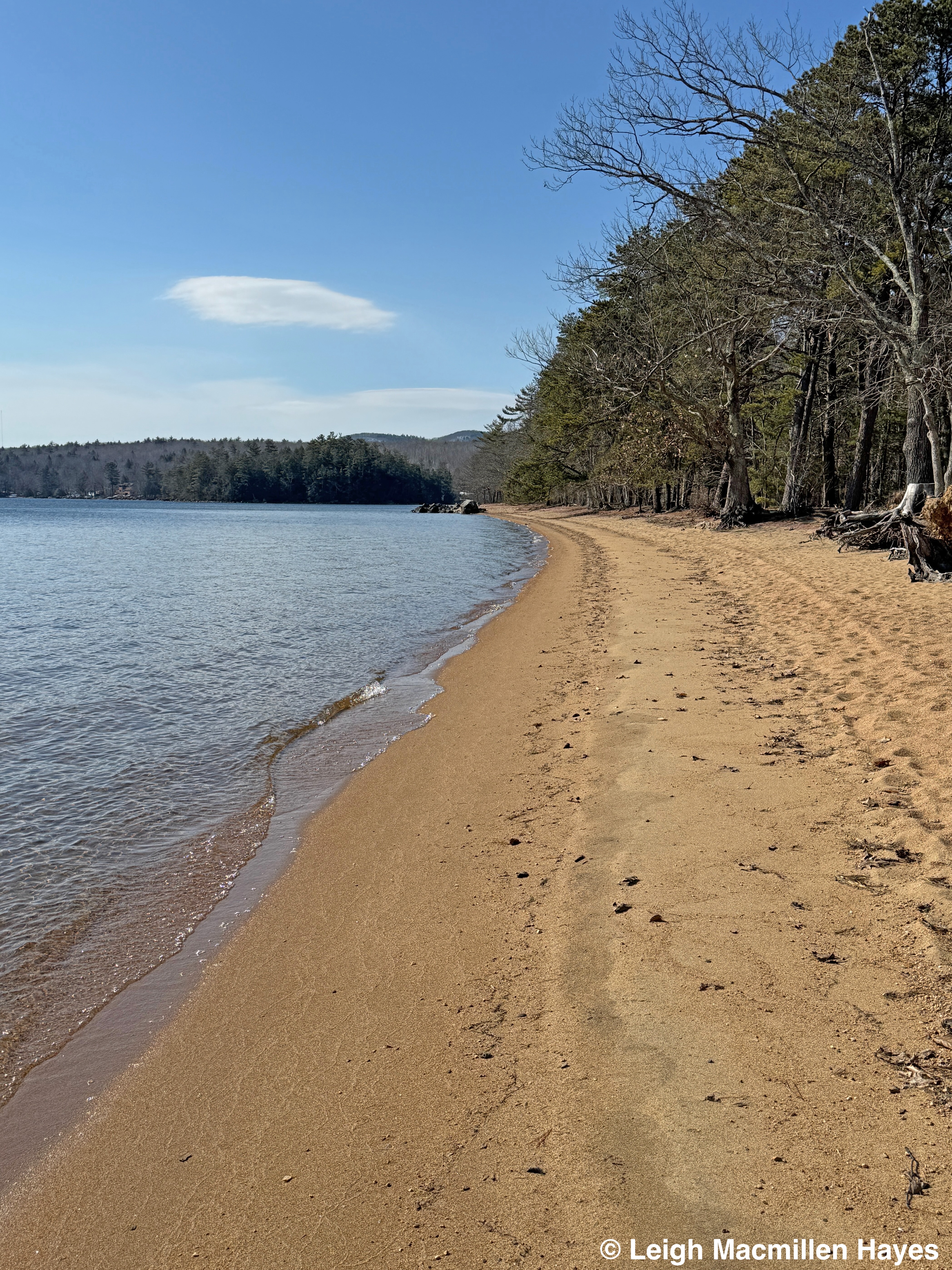
At last we reached the lake for which the park is named and for the second year in a row, it did not freeze this winter. Being the second largest lake in Maine, it covers 45 square miles and at its deepest hole is over 300 feet in depth.

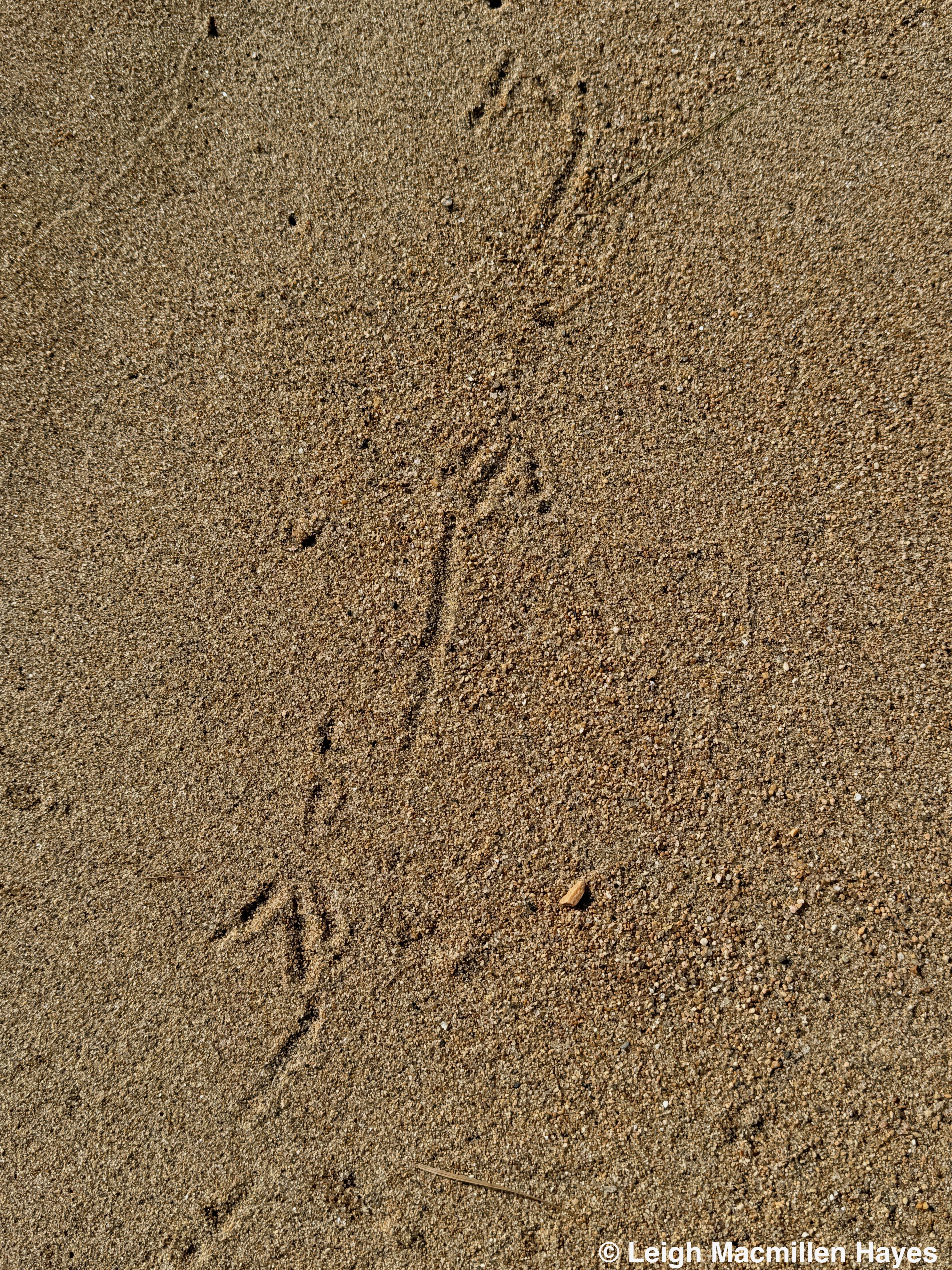
We backtracked a birds trail along the water’s edge and found our way to the perfect lunch spot.

The view from lunch rock found us dining with few words shared as we took in the vastness of this space while small waves broke along the shoreline and we realized we could have been at the coast.

Back on the trail, we hiked a couple more miles before returning to the bog’s opposite shoreline. Surely, the beaver would not let me down.

And there is was. The lodge that is. With mud on it. That meant a family could have overwintered in this one.

Wouldn’t you feel warm and cozy inside that building?

And there was evidence that another tree had been dined upon in the fall. But . . . no signs of smaller trees being cut for a food supply. Are they still home? I do not know, but maybe another visit in a month or so will reveal the truth.

There was, however, lots of sign that humans had been cutting trees: to clear trails so people like us could enjoy them.

And we did as we journeyed the West Side of Sebago Lake State Park.

So you must be wondering why this was an Oopsy of a Mondate. No, I didn’t fall. Nor did My Guy.

In fact, we had a wonderful time exploring and loved every minute of our adventure.

But . . . there was some logging going on and it wasn’t until we got home and I looked at the Sebago Lake State Park website that I discovered this message: February 25, 2024 | Campground infrastructure improvements begin tomorrow, Monday 2/26/2024. While heavy trucking activities occur, State Camping Rd. in Naples will be closed to foot-traffic for public safety. However, the Day Use Area, found at 11 Park Access Rd. in Casco will remain open to visitors. Thank you for your patience and understanding while these improvements occur.

Oopsy. Don’t follow our footsteps, but rather go to the Day Use Area instead.

A Week of Wonders

Every. Little. Thing. Captures. My. Attention.

Whether wandering along the board walks at Holt Pond for six hours with a friend, or . . .

hiking up the new Patterson Hill Trail with My Guy, there’s always something to look at.

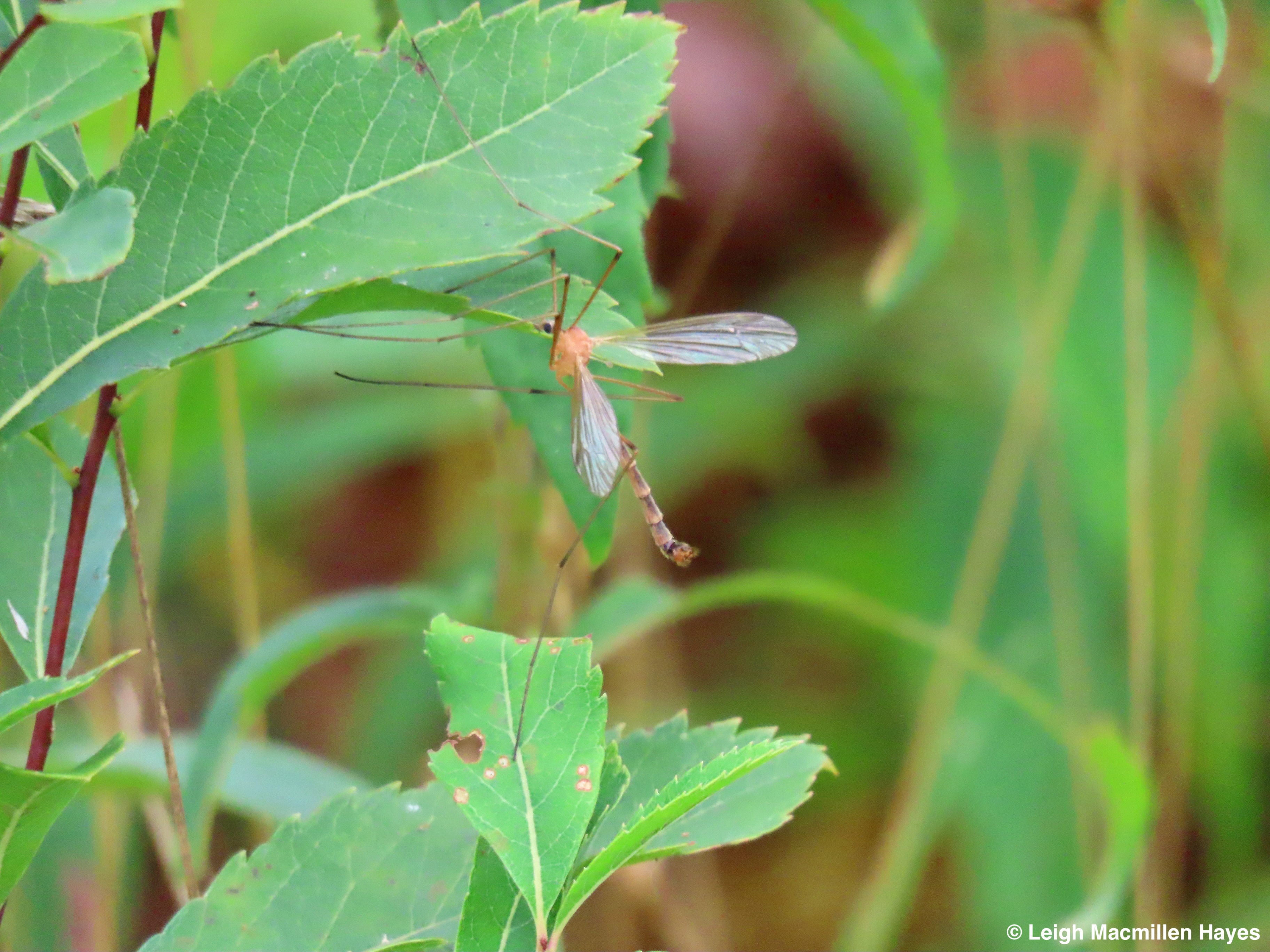
One of the most beautiful, and also most difficult to spot, is the Phantom Crane Fly, so named for its black and white markings. As it floats through the air, for I swear it looks like a little box adrift rather than an insect that is flying, its presence is so subtle that it is easy to miss because it blends in with both light and shadows. Shady edges of wetlands are its preferred habitat and that’s exactly where this specimen and a bunch more were spotted . . . at least in the moment. Finding them to photograph is not easy.

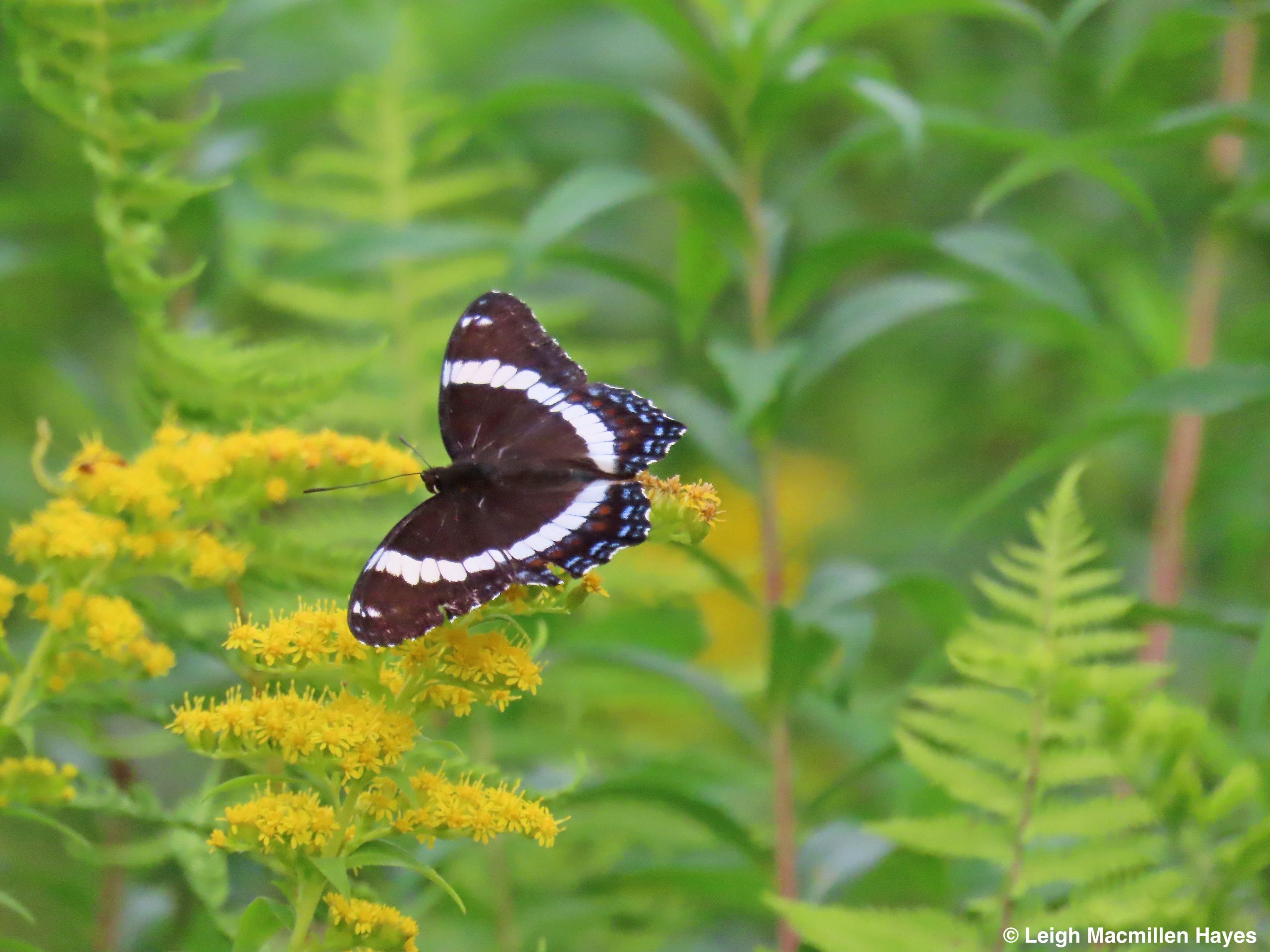
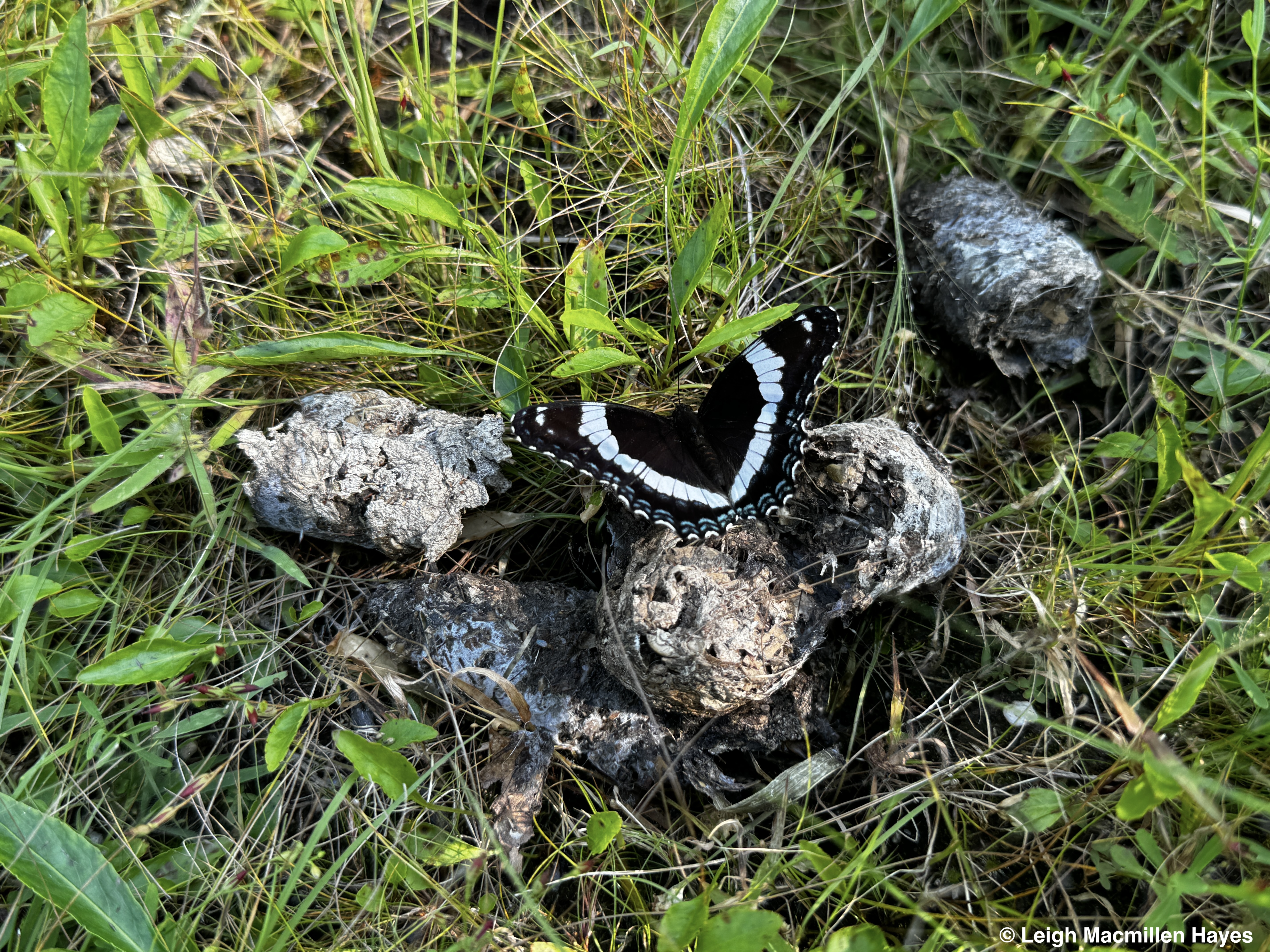
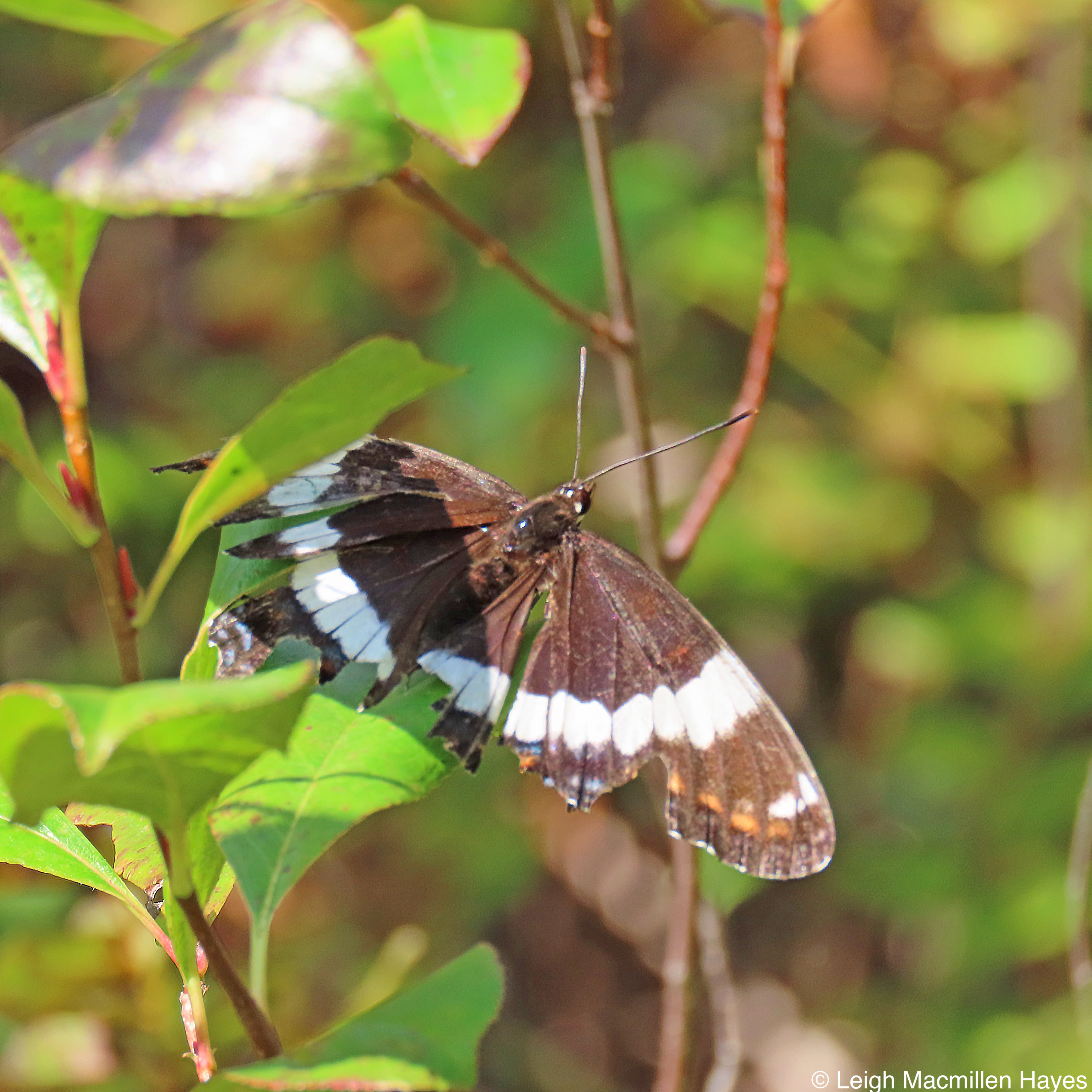
While the black and white coloration seems to help the crane fly disappear into its landscape, the White Admiral Butterfly, who utilizes those same colors, but with a different pattern, plus a few other hues in the mix, is hardly inconspicuous. And by the tattered wings, it seems this insect has escaped becoming a meal on more than one occasion. That, in itself, is reason to celebrate.

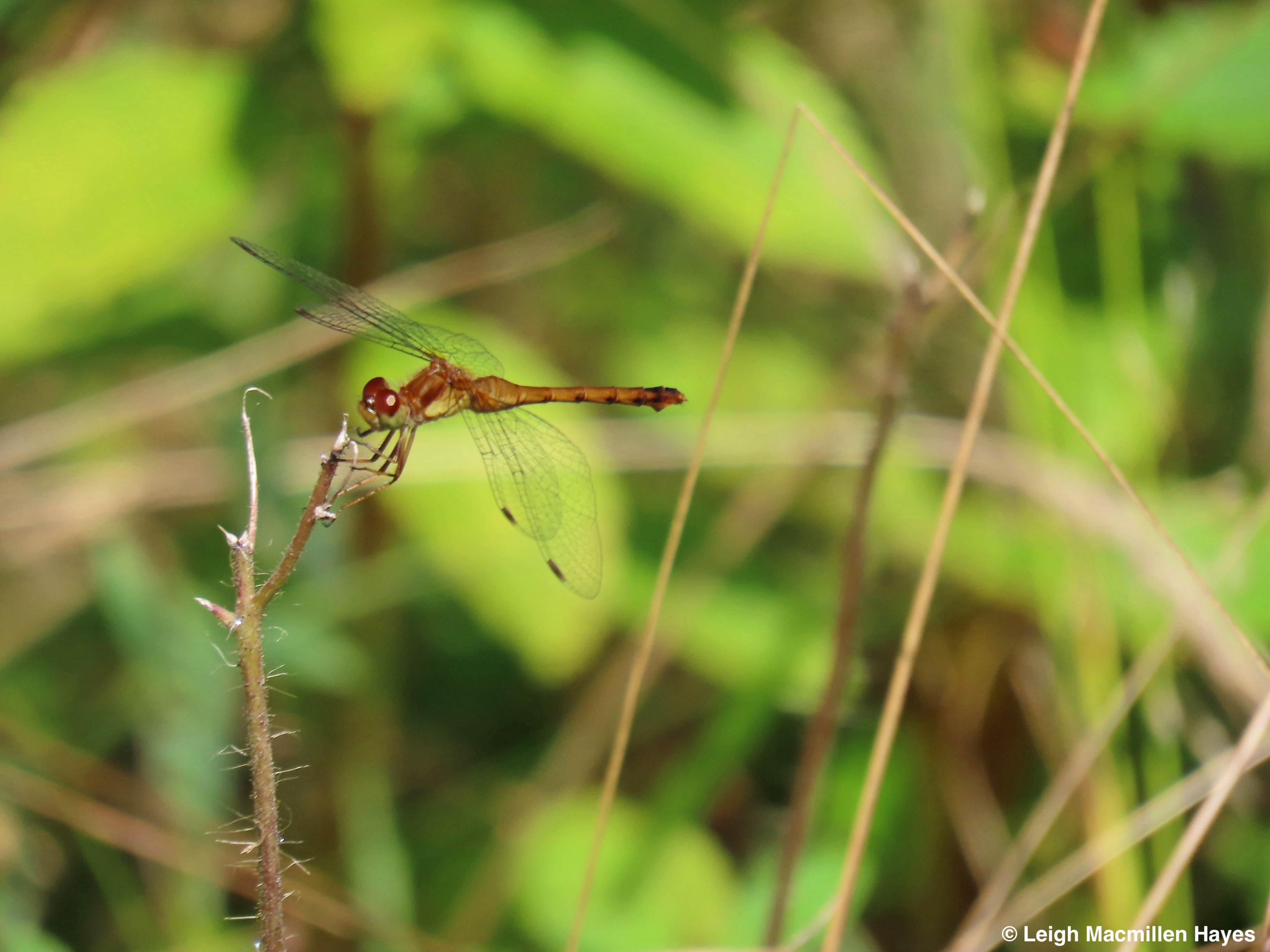
Of course, if you are a follower of this blog, you are hardly surprised to spy a dragonfly. It’s Meadowhawk Season, for those who thought the season is actually autumn. And take my word for it because you can’t see it, this is a Cherry-faced Meadowhawk, one of the most common species, along with White-faced Autumn, and Ruby Meadowhawks.

If you near water, be on the lookout for a bunch of pairs in tandem flight as he continues to grasp her behind her head while she dips her abdomen on the surface of water in the act of ovipositing eggs. Sometimes, many tandem pairs will oviposit simultaneously, for there is safety in numbers.

In addition to the Phantom Crane Flies, I’ve been looking for this species, a Pale Green Assassin Bug for months, and tada, a nymph makes an appearance. While its name sounds intimidating, this is actually an insect to admire for it eats flies, wasps, aphids and other small insects that you might consider pesky things.

This was another for whom I’ve been searching, stalking actually, as I pace around gardens. And then, the other day a colleague invited me to join her behind our land trust office, and there Charlotte was, writing a message in her orb-shaped web. Now to find Wilbur. But he’s probably busy getting ready for the Fryeburg Fair.

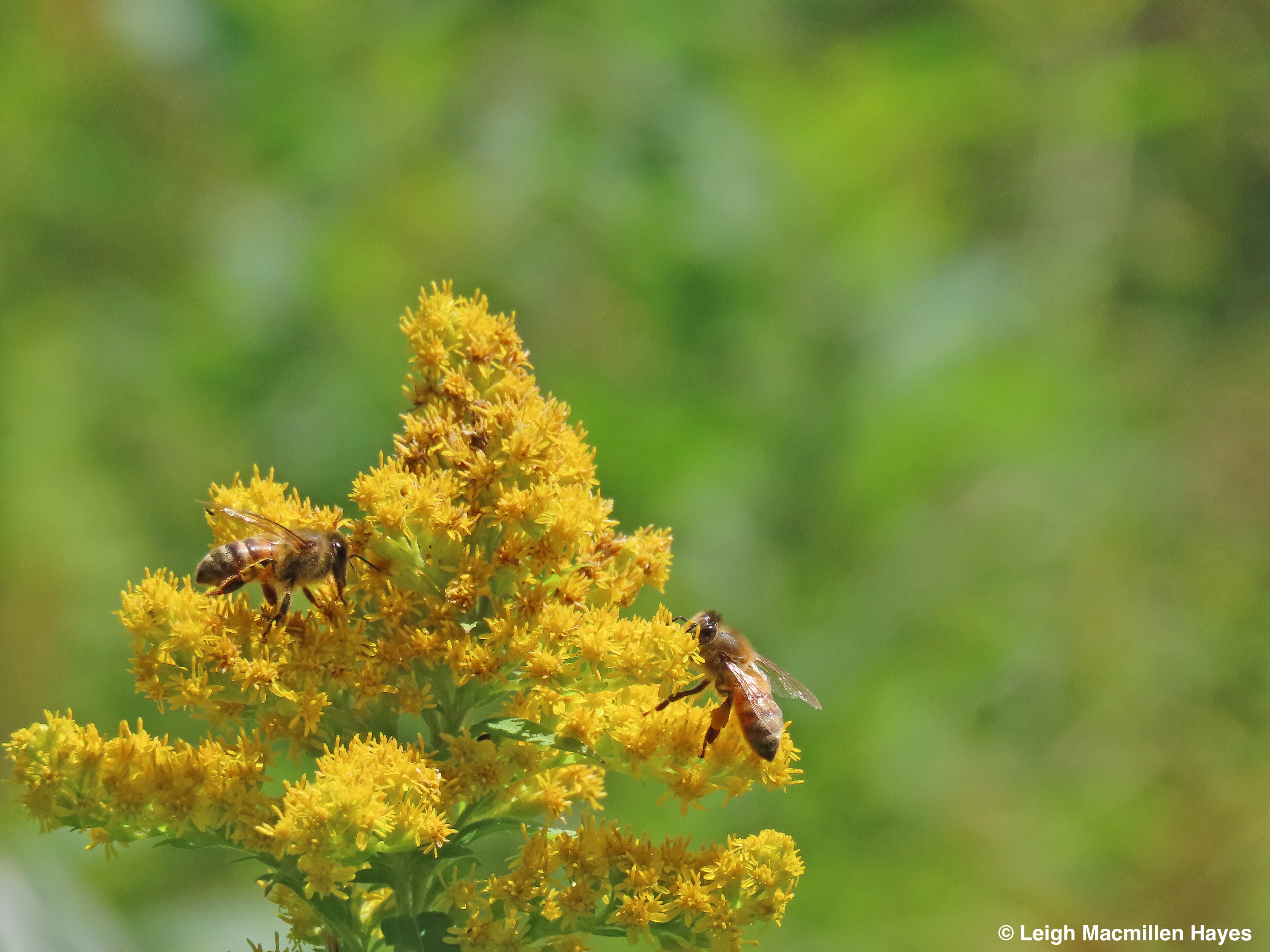
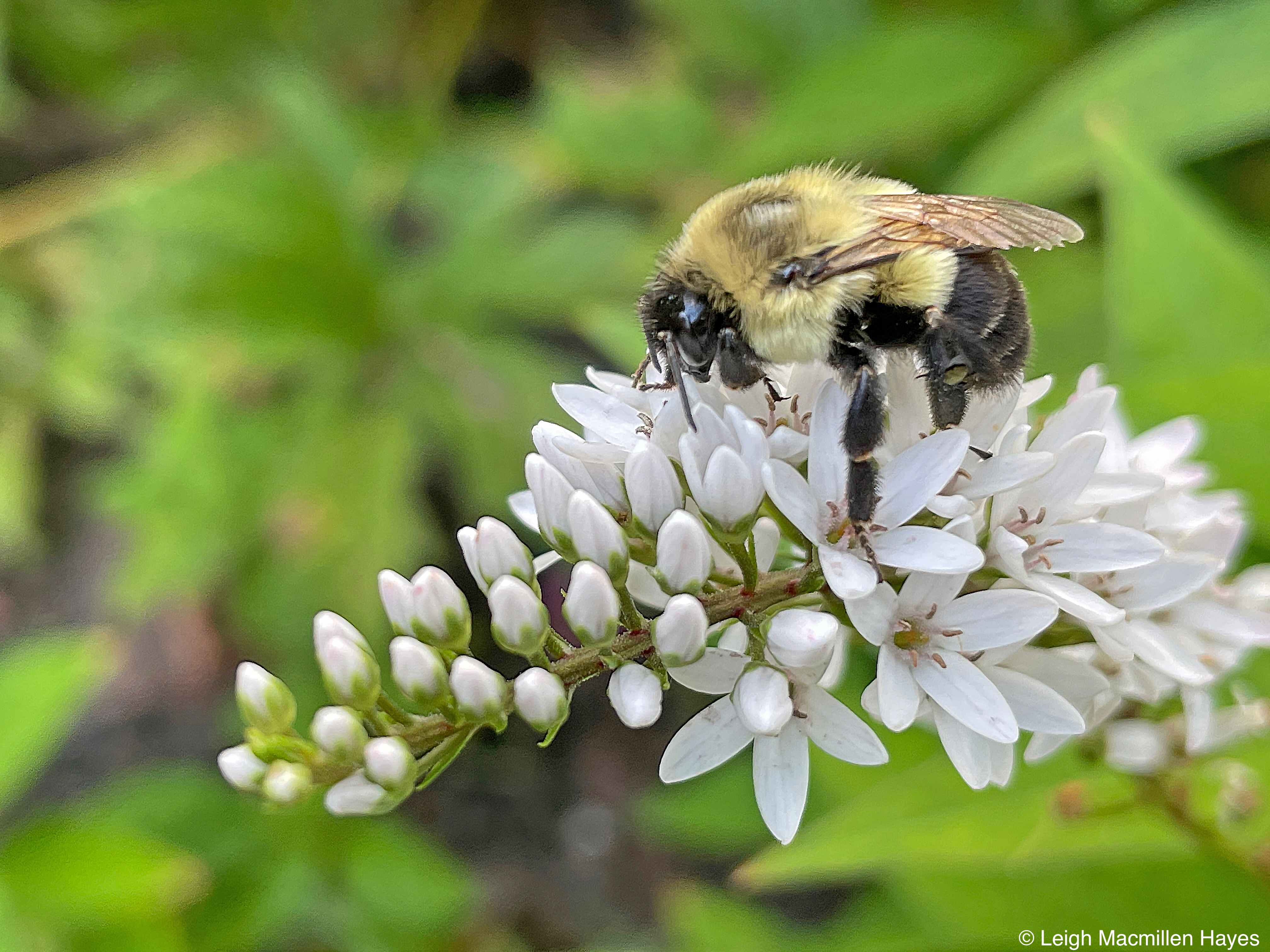
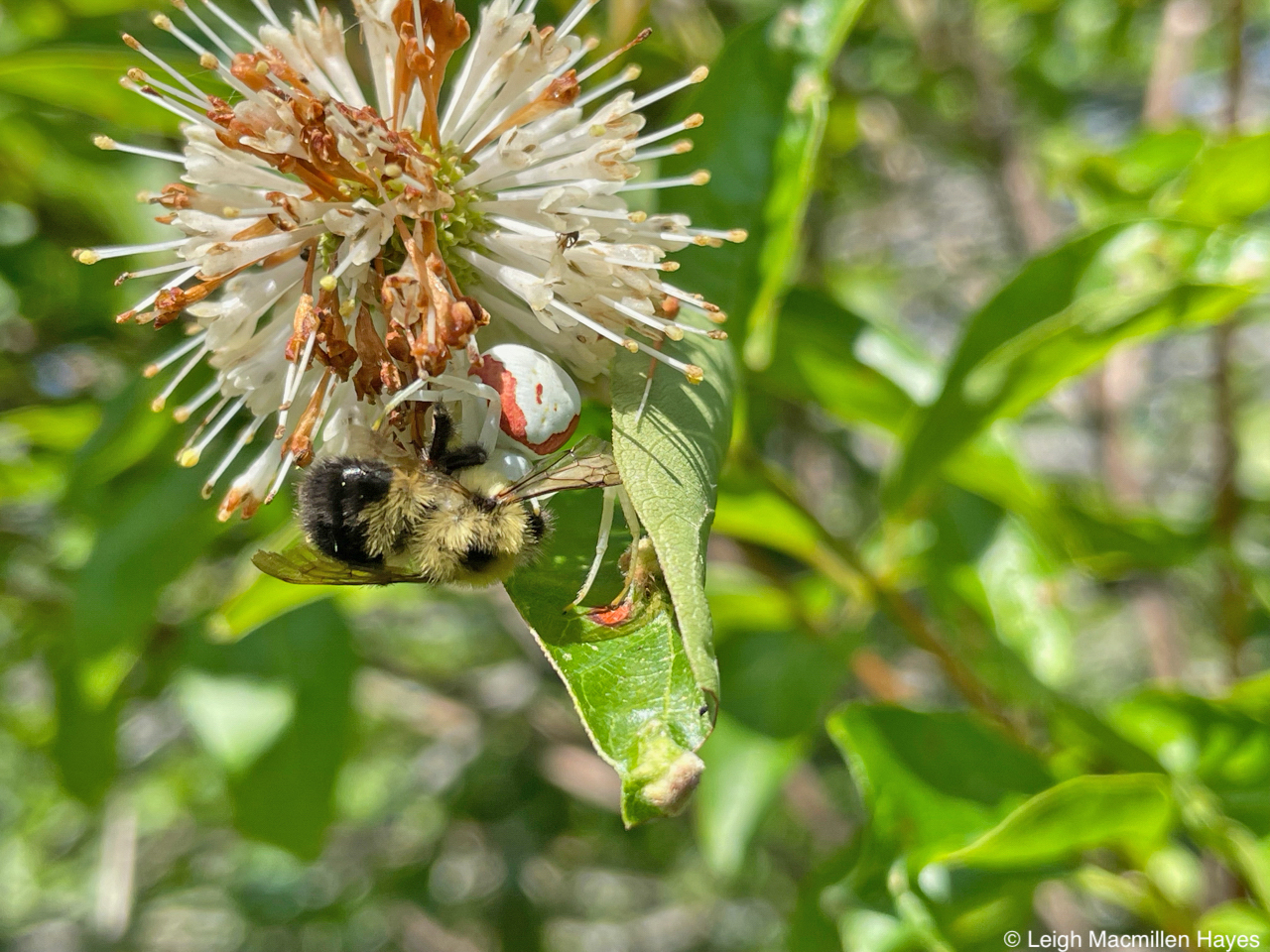
And today, it was this big Bumblebee that surprised me for though it moved its antennae and abdomen, it seemed to remain in one spot on the Gooseneck Loosestrife.

In fact, it stayed so still, that I was able to get into its face, without worry of being stung. Did an Ambush Bug have hold with its claws? Or was a Crab Spider somehow involved? I walked away several times and returned to find it in the same spot, unlike all its other cousins who were busy as . . . bees! But, on a final visit, it had disappeared. I looked under the plant and on the ground below, thinking it might just be a skeleton if a predator had sucked its guts, but found nothing, so can only assume that it finally flew.

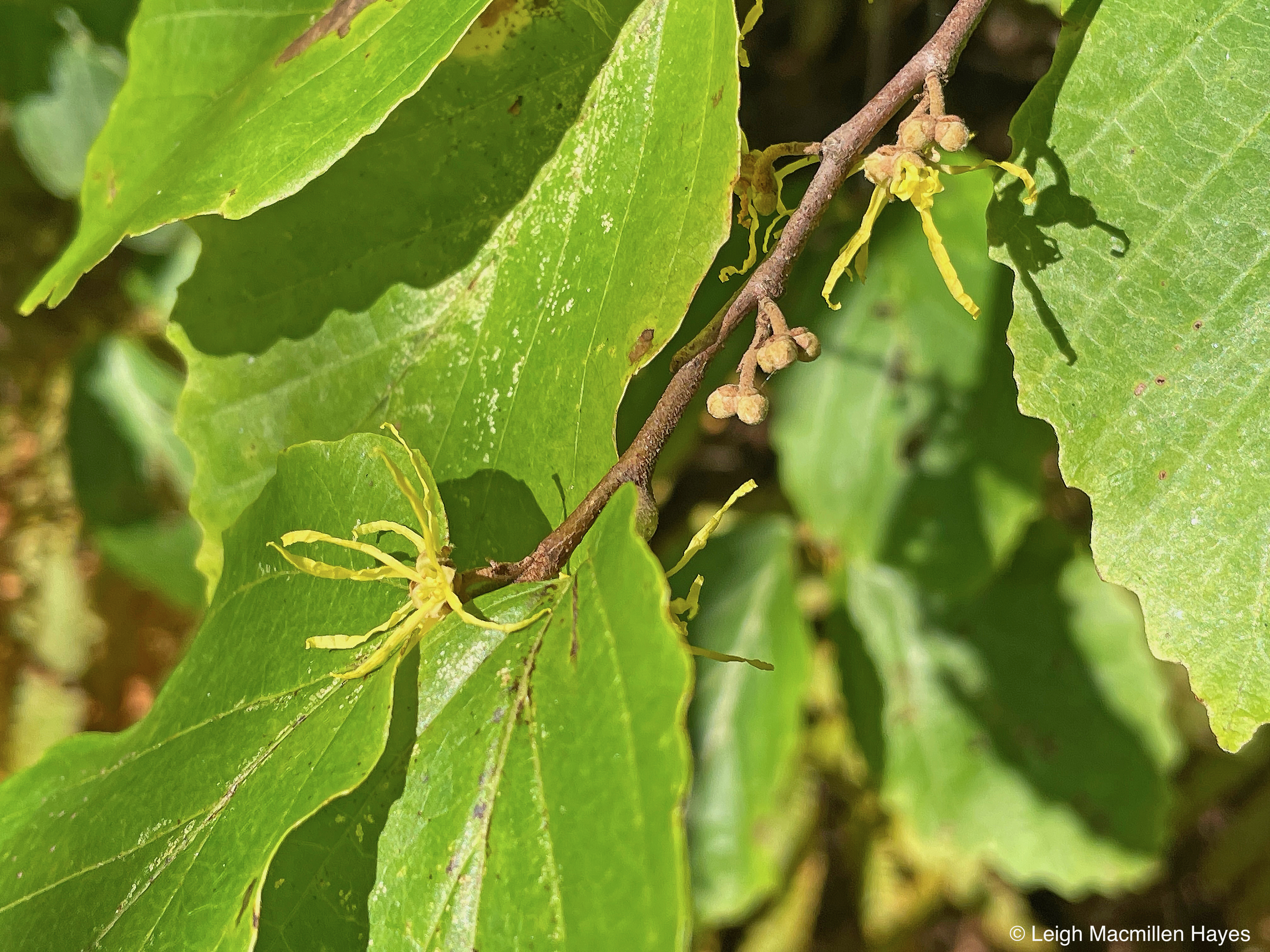
The next two photos are of flowers and not insects. Actually, there are fewer and fewer flowers in bloom right now as we enter the early phase of autumn, but Witch Hazel has started to show off its ribbony display and that made me happy to think that all is right with the world.

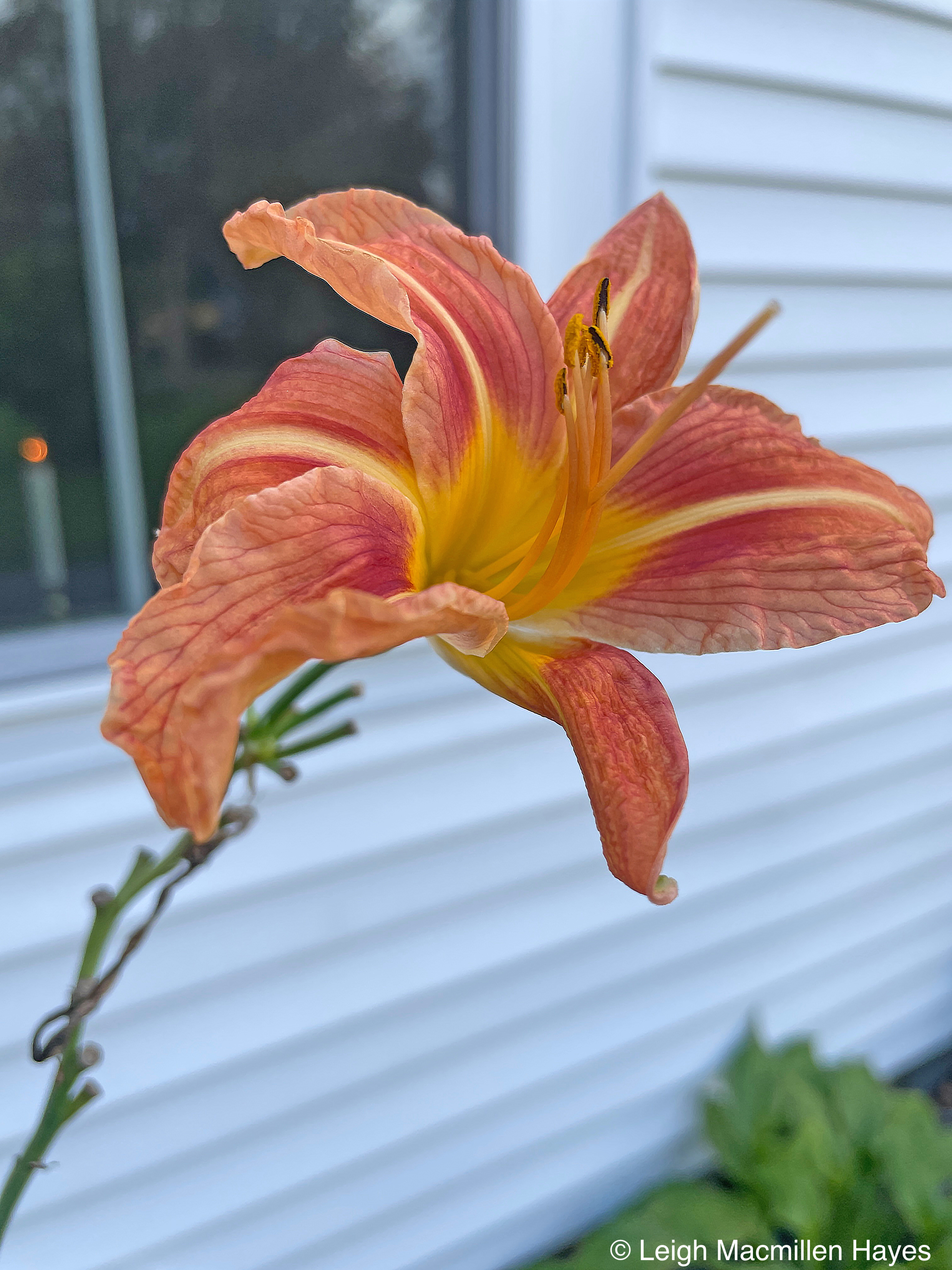
Until, that is, I arrived home a few days ago and found a Day Lily blossoming in mid-September, which is quite late, especially considering all of its brethren had had their day in the spotlight back in early July. Houston, we have a problem. (And maybe sending more aircrafts into space isn’t the wisest decision.)

That said, dear readers, I leave you with something that I hope will bring a smile to your face as it did to mine. My Guy returned from a business trip toward the end of last week and said he had a gift for me. He opened his backpack and pulled out this box of Jelly Slugs! For those who know me, you’ll know that he knows me as well!

It’s been a week of wonders indeed, and though these are only a few samples, I’m grateful for every little thing that captures my attention.

The Rest of the Story

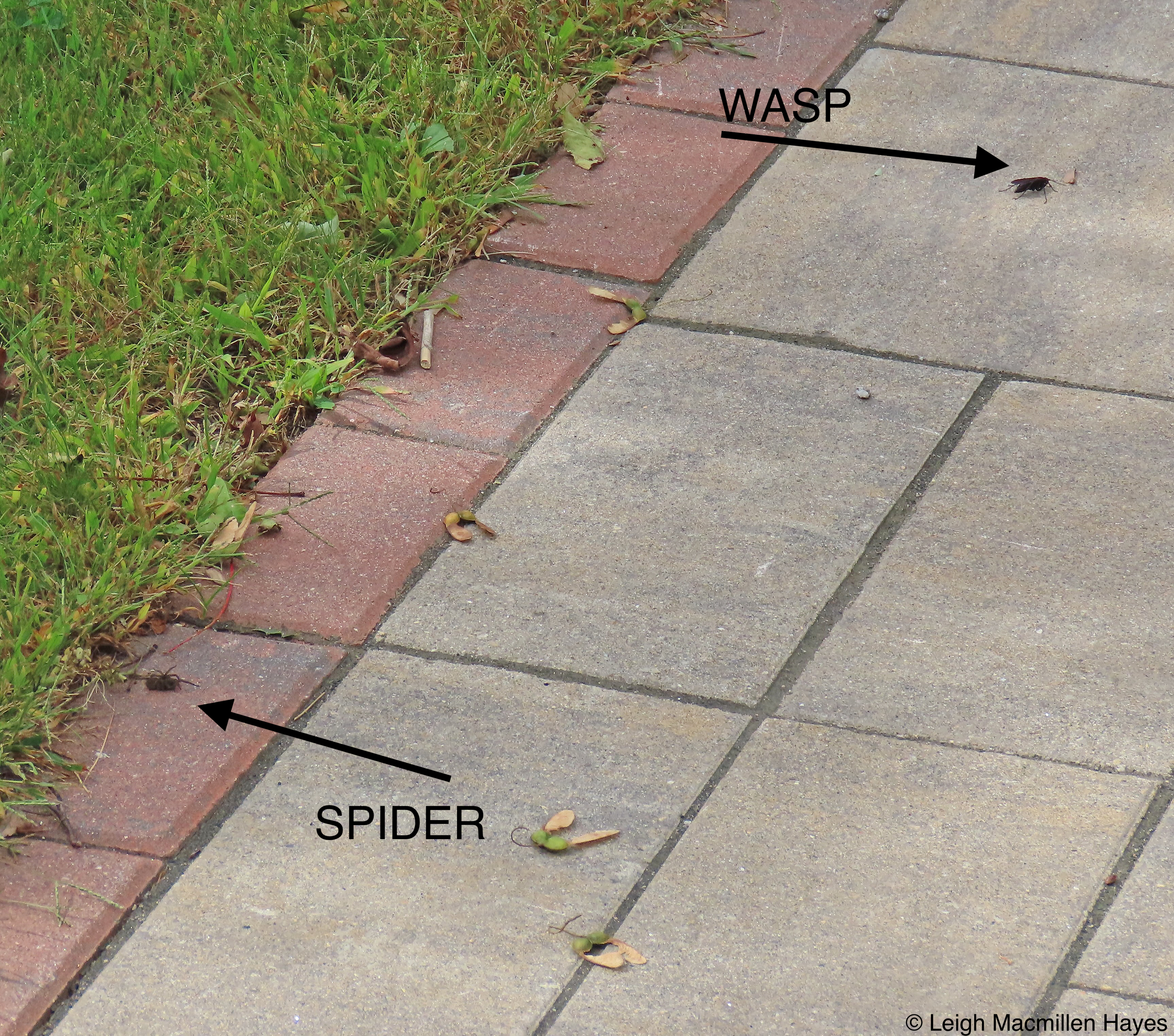
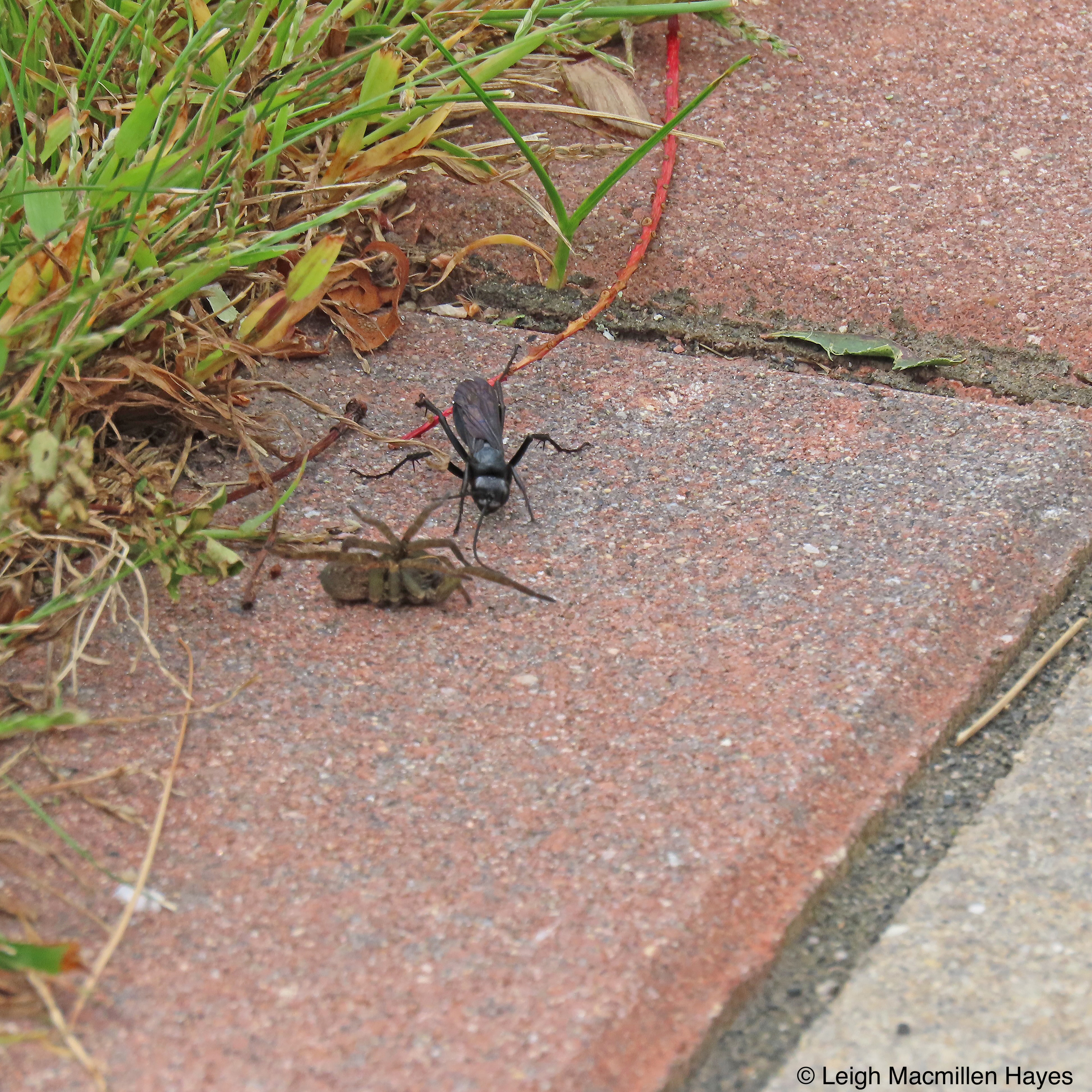
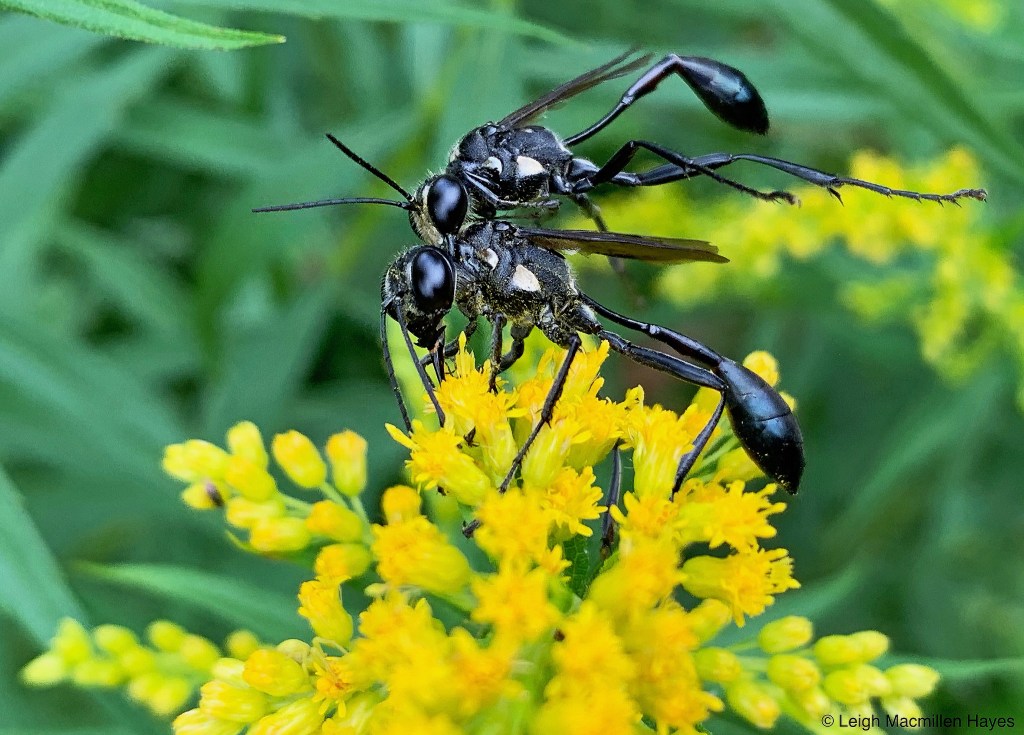
I had only one intention when I stepped onto the patio this afternoon, but that changed quickly when I spotted a Great Black Wasp behaving in what I thought was a peculiar manner . . . until it wasn’t.

Rather than flying around the flowers, where I usually find these large wasps, who may be aggressive in terms of flying at me to let me know I need to take a step back, but never actually stinging me, this Great Blue was walking frantically through the grass. Well. we call it grass. I guess I should say “across the lawn,” but that sounds too fancy for our yard.

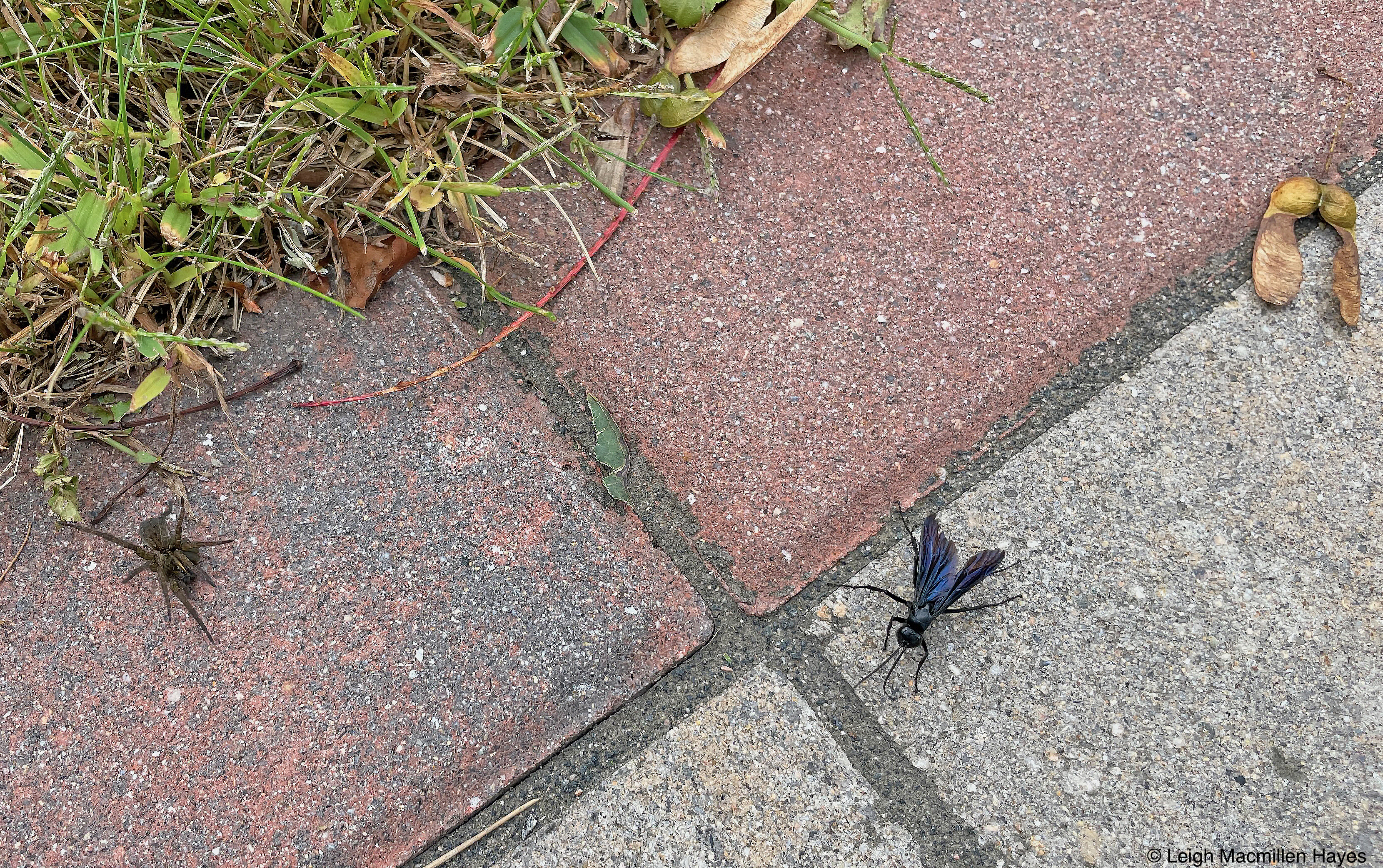
Do you notice something strange about the wasp? It was actually carrying a spider. I was stymied at first, until I read that they bring home treats for larvae to feed on. This I wanted to see.

What I observed was that the wasp dropped the spider on the edge of the patio and then the wasp scrambled around on the ground for a bit before flying off. The spider stayed dead still . . . cuze it was dead! Apparently, the wasp won the struggle, if there was one, and paralyzed the spider.

Since the wasp had flown off, I decided to give it some time, though I was curious to know if it would return. Dragonflies defend territories, but do wasps know where they dropped a meal?

Instead, I turned my attention to the flowers that are still in bloom, including this Oregano I let go to flower because though I love its flavor, I equally love the insects it attracts, like this Thread-waisted wasp.

That got me to thinking how I often see the insects in situ, but don’t get to follow their daily lives.

That said, I poked around some more and found Bumblebees on Sedum,

Great Blue Lobelia,

Plus Turtlehead . . . going in,

And backing out.

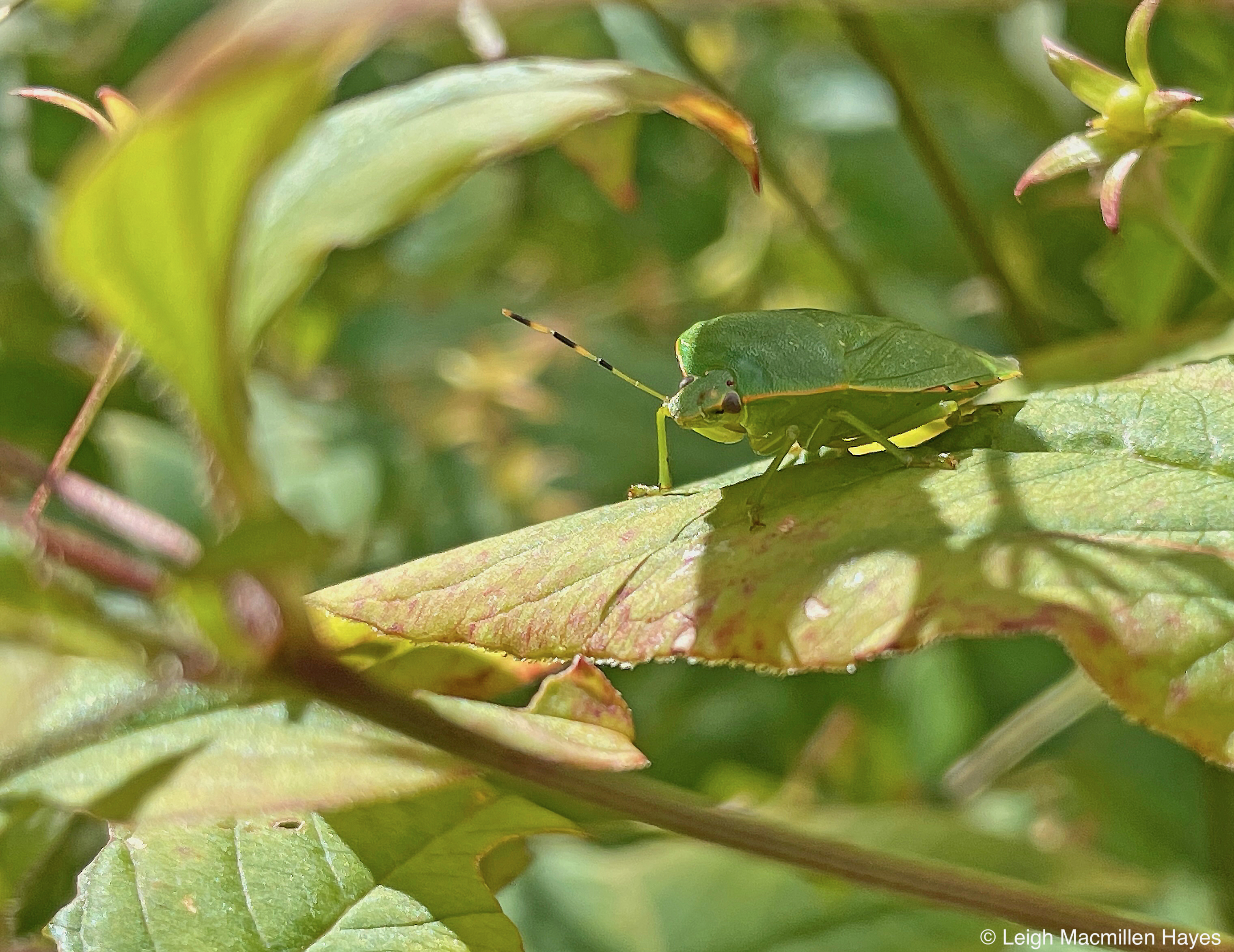
There was even a Green Stink Bug trying to trick me into thinking it was just part of the leaf.

But I let it know that I was aware of its existence.

There were even a couple of canoodling wasps who flew out of the herb garden and landed on a window screen before moving on.

I, um, moved with them to the corner of the house, where they frantically walked across the ground as well. But when they finally flew off toward the driveway, I decided to give them some space.

(Note: Do you see the brown maple leaves? Who would think that after last year’s drought we’d have too much rain this year, but that’s exactly what happened and the Sugar Maple leaves in some places are drying up and dropping. Fall foliage? I’m thinking it’s not going to be as spectacular a show as we’d like.)

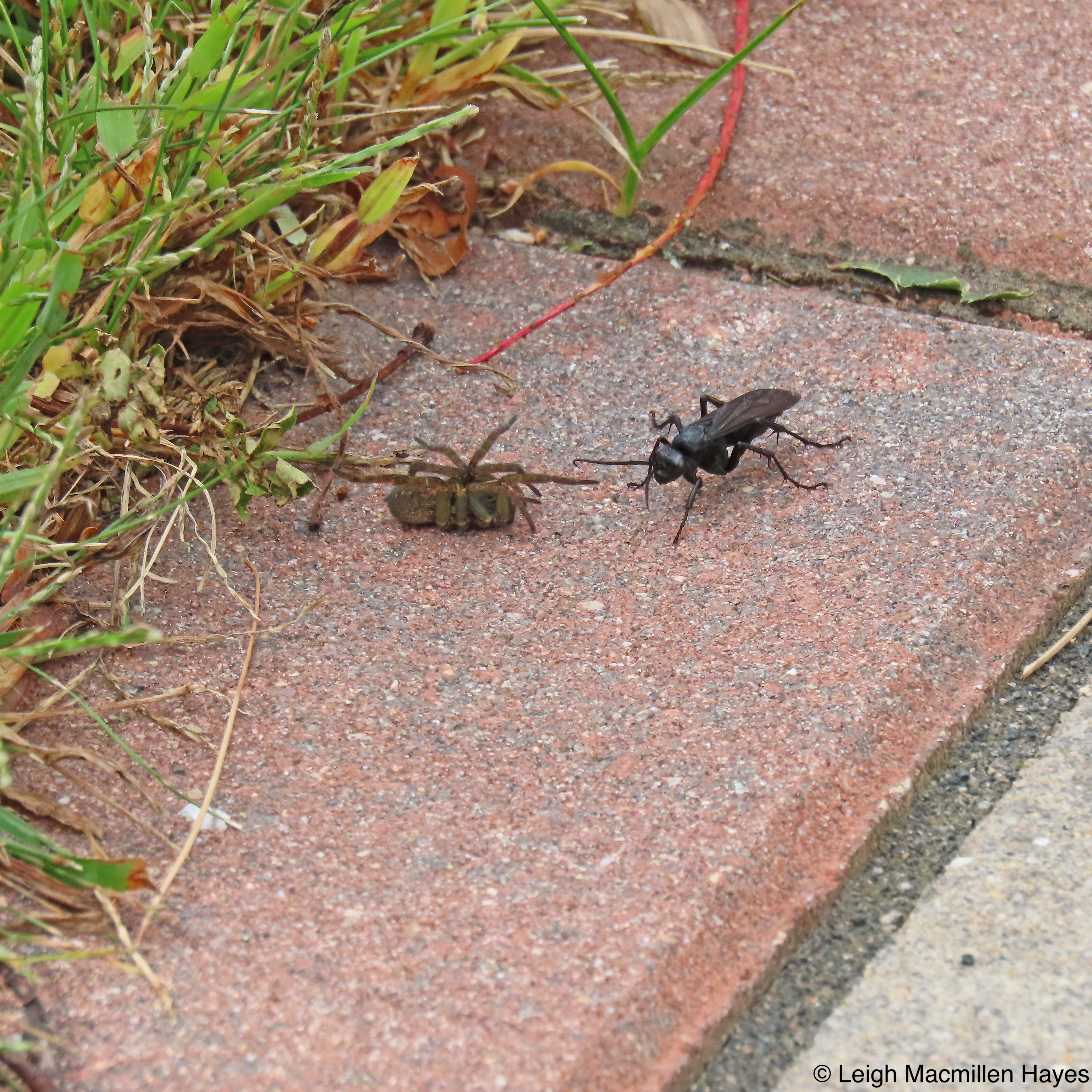
When I returned to the spider’s location, I noticed that the wasp had returned but was behaving in an odd manner . . . or so it seemed to me. Its legs on the right side appeared to have collapsed.

Eventually, however, it stood on all six and walked back toward the spider.

I was amazed to think that this insect had flown off, but knew where it had left the intended meal. All I can think of is that there has to be a scent involved.

The wasp proded the spider with its antennae before grasping it again.

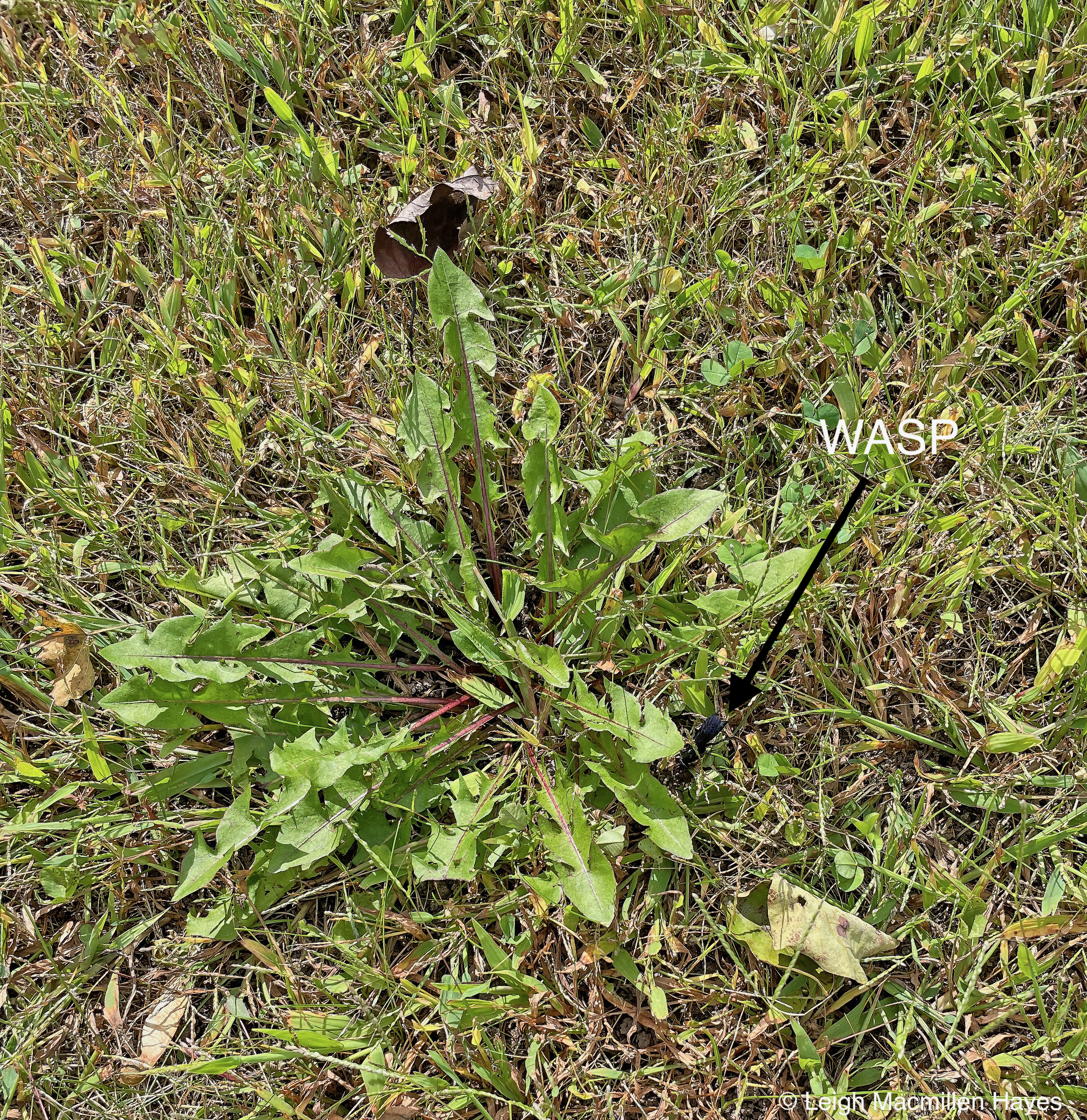
And then the two headed off in the same direction of travel as I’d earlier observed (north). Until, that is, the wasp passed under the dandelion leaves and somehow dropped the spider. Off the wasp flew, but again, a minute or two later, it returned to the exact spot and located the spider that I couldn’t even see.

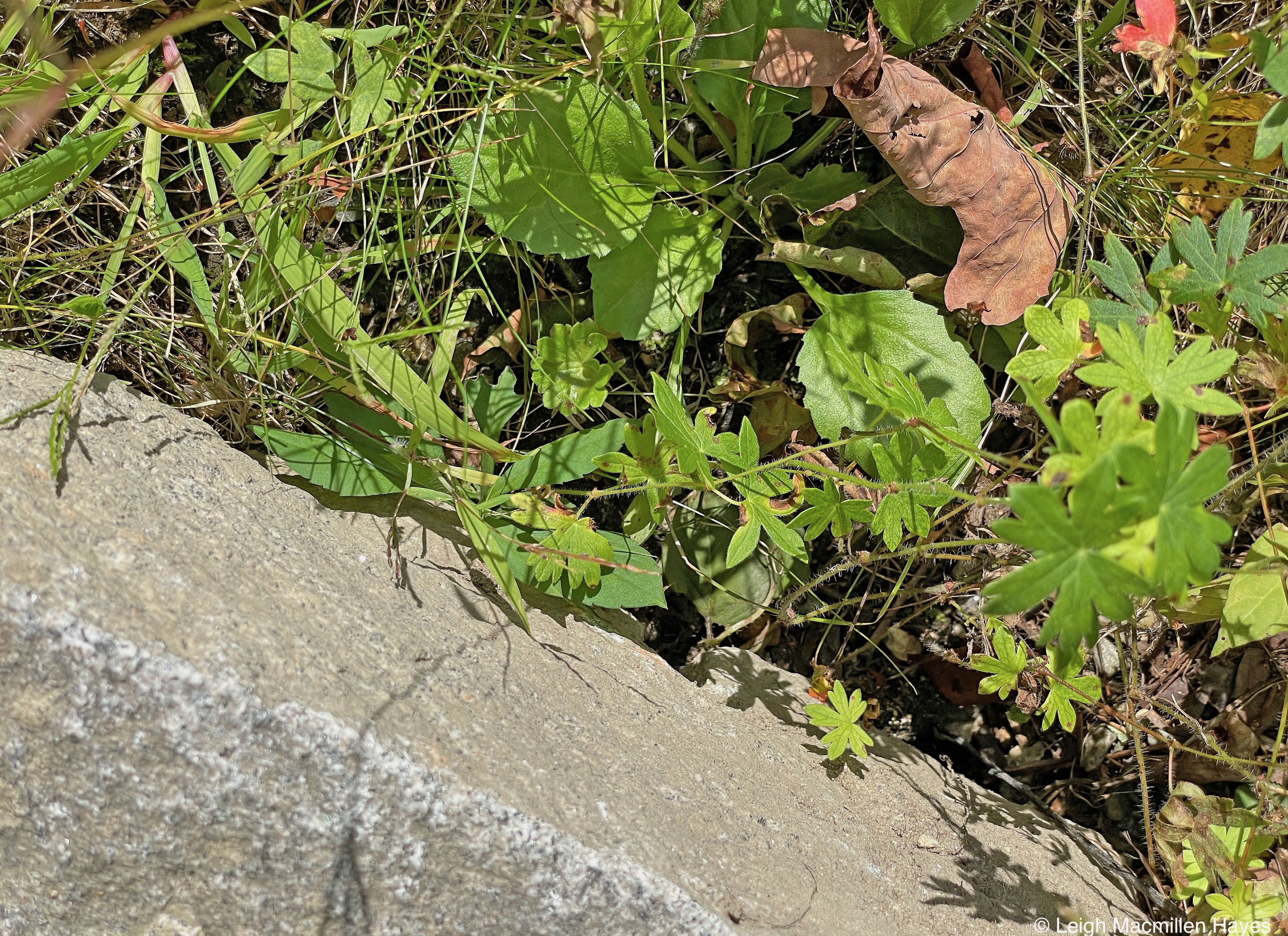
Then the march began again and I followed the two until the wasp reached the edge of another garden. It climbed over the granite stone, taking the spider with it, and then disappeared below the foliage and that’s the last I saw of them.

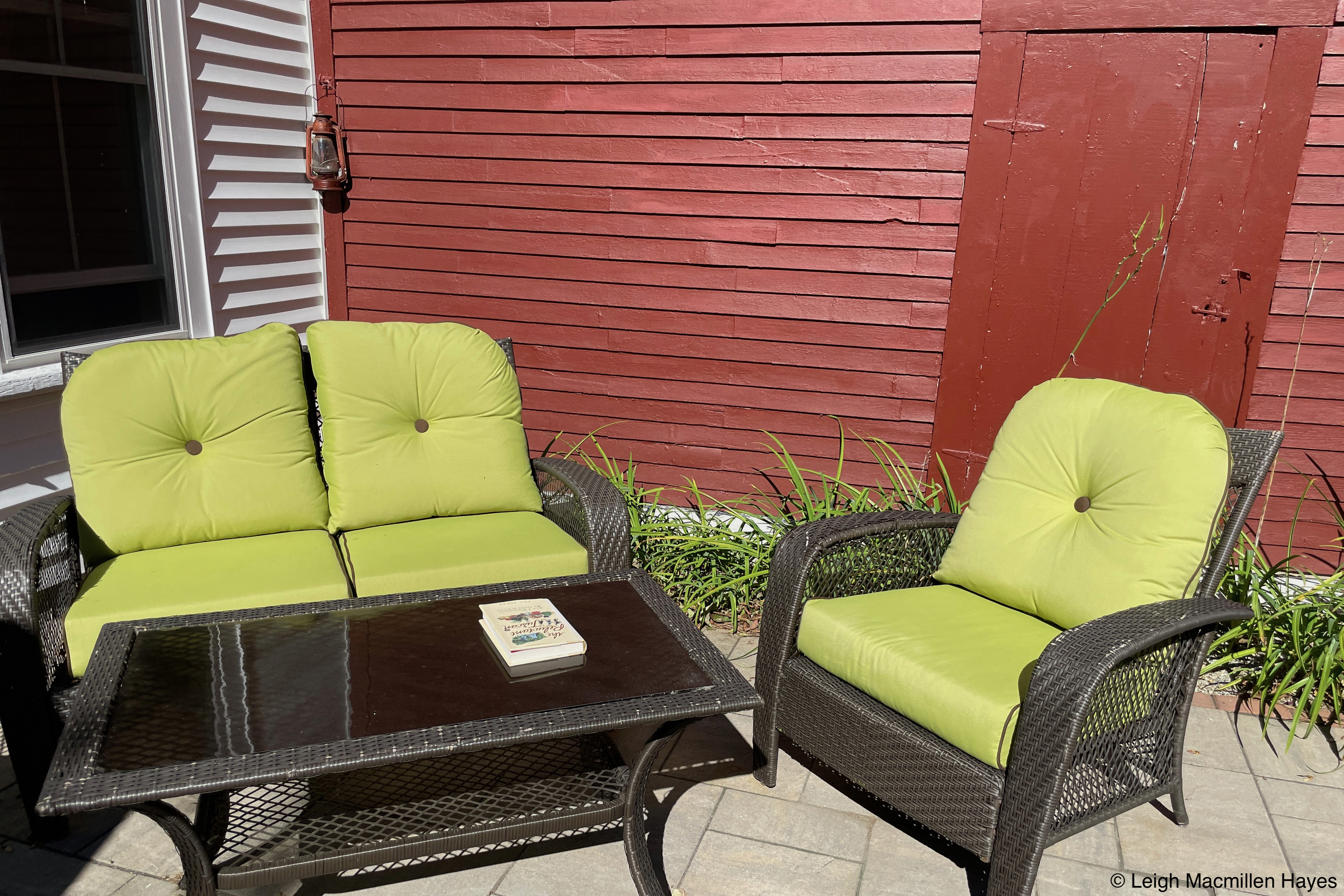
I’d gone outside originally to sit on the patio and start rereading a book I read about 30 years ago. That never happened.

And I don’t know the rest of the story for the Great Black Wasp, but I sure wish I did. I wish I knew what happened between the wasp and the spider because I imagine that would have been a great show. And I wish I knew where the wasp’s hole was and its larvae were waiting for a meal, as I assumed.

One of these days, I’ll open that book and maybe the rest of the wasp’s story will be revealed or another story will attract my attention.

The Otherworldly Buttons

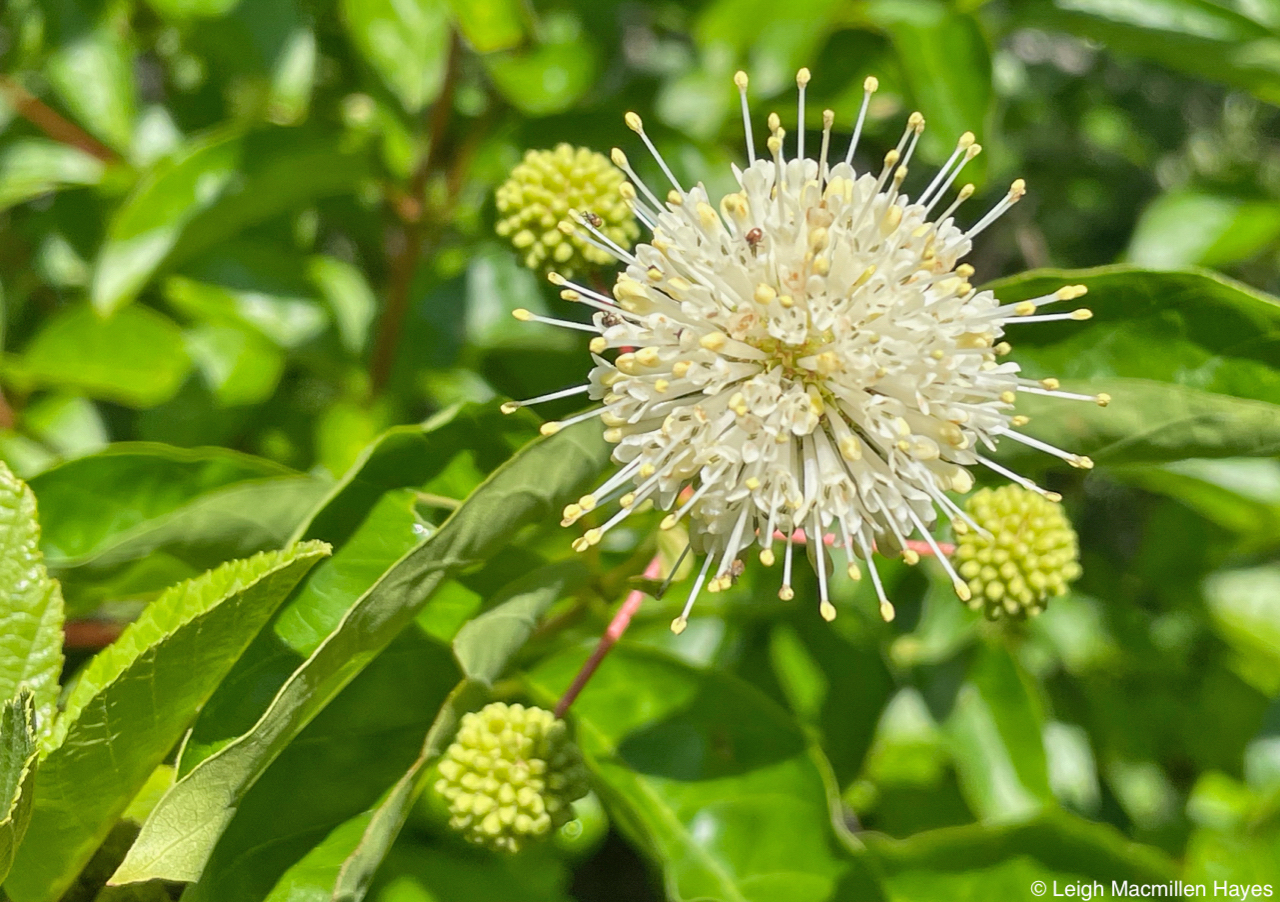
Rooted in the spongy sphagnum moss of our western Maine wetlands, a certain shrub makes its home beside Highbush Blueberries and Maleberry and Speckled Alder. It’s a shrub of lax and loose form, its multiple stems sprawling this way and interlocking that way.

I was finishing up an exploration this morning when said shrub stopped me and for the next hour I walked back and forth covering a total of maybe twelve feet that equaled about a half mile all told while admiring the scene that played out before me.

First, there were the conspicuous flowers that never cease to amaze. Dense, spherical, one-inch globes offer nature’s fireworks display in the middle of a summer day. Comprised of many creamy-white tubular flowers so closely packed into a ball, and fringed with protruding pistils that extend beyond the four anthers, the flowers remind some of a pincushion. Set against a backdrop both glossy and dark, the leaves in pairs or threes serve to highlight the fringed beauty of the inflorescence.

As insect magnets, the flowers attract many pollinators including a pair of Flower Longhorn Beetles who couldn’t resist the opportunity to canoodle among the scent so sweet.

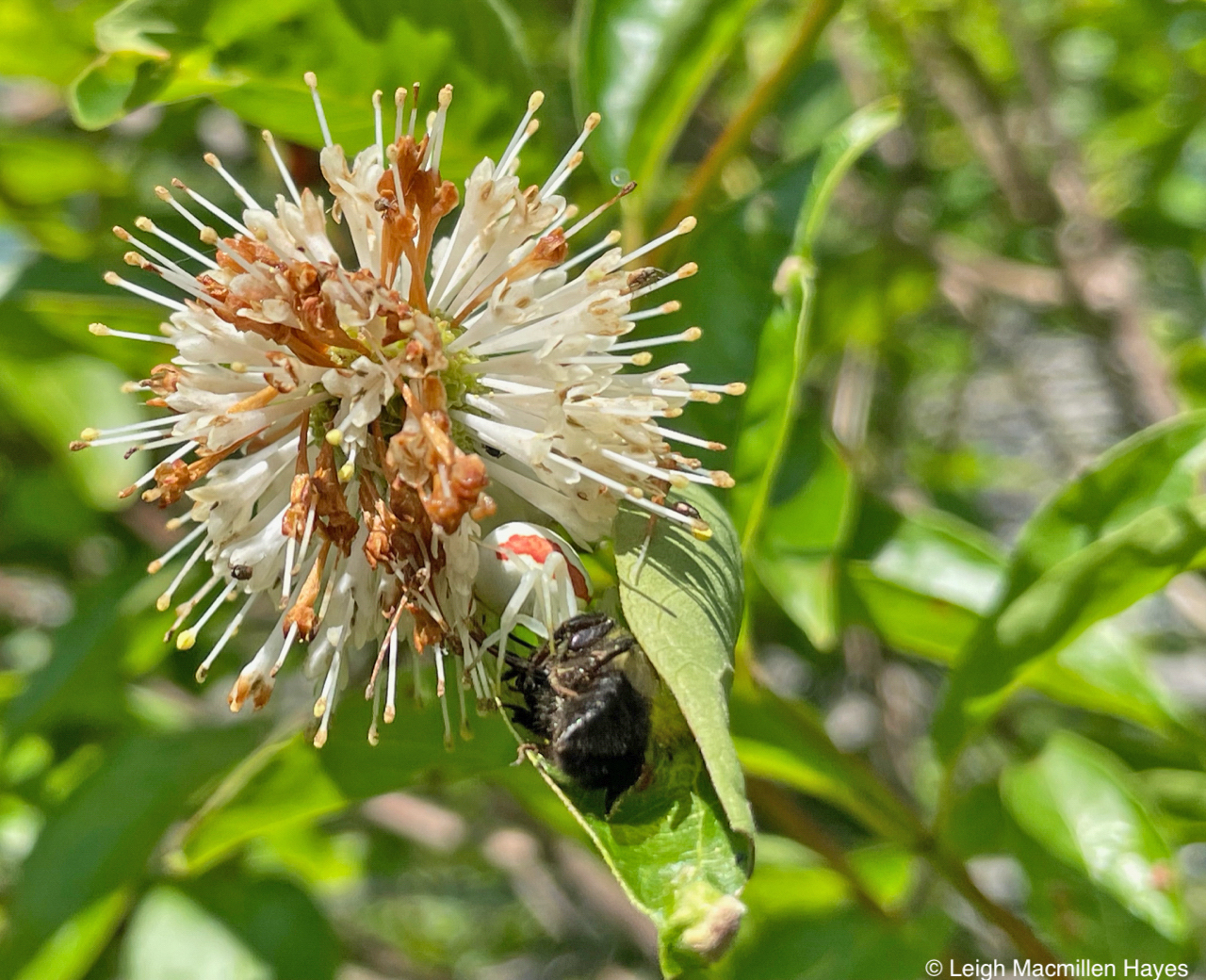
And then I spied another, a predator who had relied on its camouflage much like the flower’s color to keep from being seen in order to ambush its prey. Sit and wait. Sit and Wait. It apparently did so until success was achieved.

As I looked about, I spied a silken thread and wondered if it belonged to the Crab Spider. This species doesn’t build webs, but uses silk to attach drop lines to vegetation just in case in the midst of fervent action while attempting to capture a meal, it slips and needs to get back into position.

In the midst of my observation, in flew a pollinator that we all need to revere for its species is endangered and I felt blessed to have seen this one. It seems only yesterday, when our sons were mere tots, (think three decades ago) that we often spotted Monarchs all over flowering shrubs in August and September. But now, we celebrate each and every one and only this morning a friend sent a photo of a Monarch caterpillar feasting on her Milkweed and so we know we are among the fortunate few to share these special sightings.

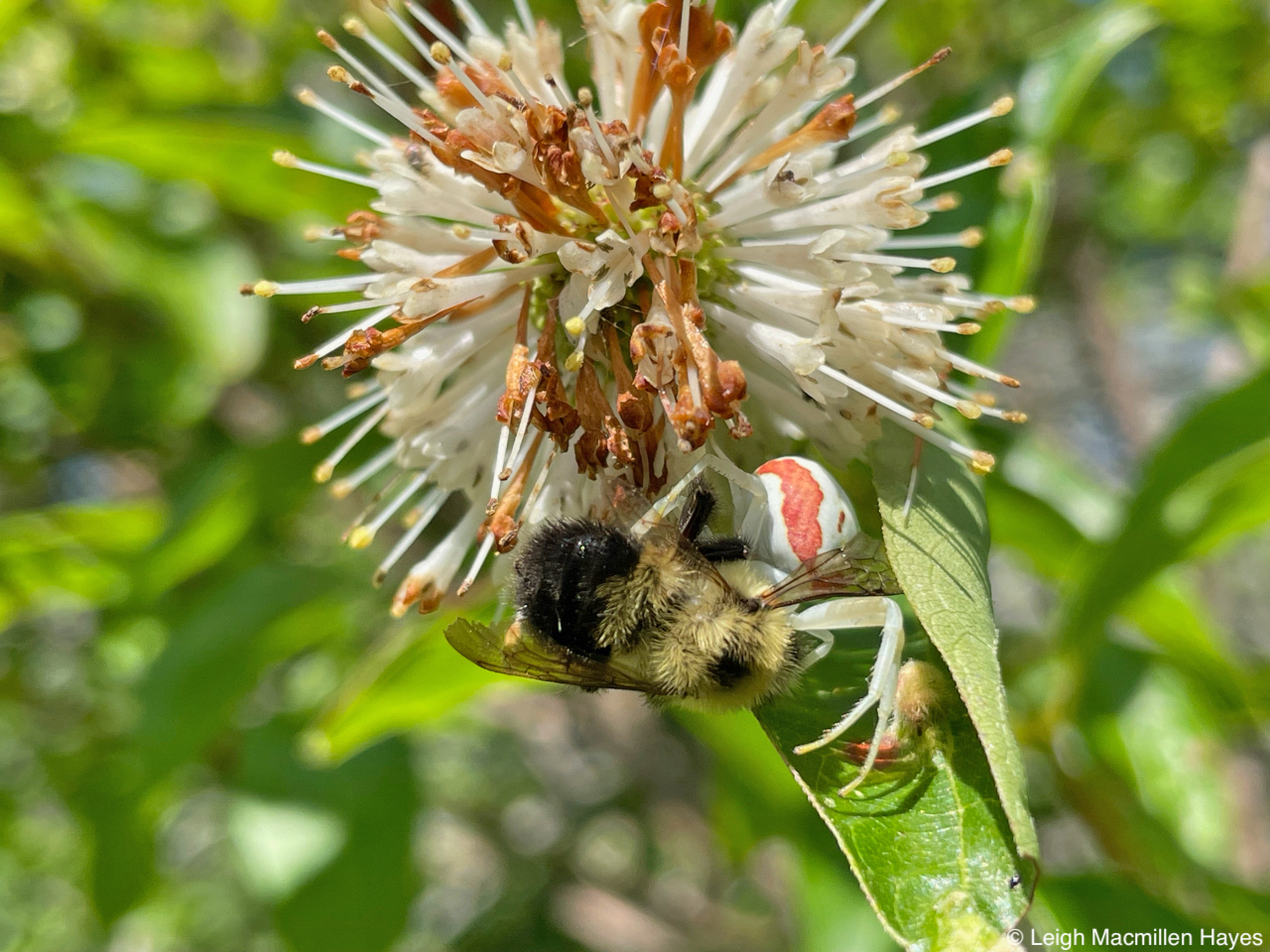
Meanwhile, back at Lunch Leaf, I stalked. When its prey was close enough, the spider grabbed it with its two front legs, the longest of its four pairs, and bit into the victim.

Meanwhile, a Bumble Bee buzzed in, gathering its fill of nectar and pollen, nectar and pollen, until it needed to return to the hive before coming back to collect some more.

Back at Lunch Leaf, venom was injected to paralyze the meal.

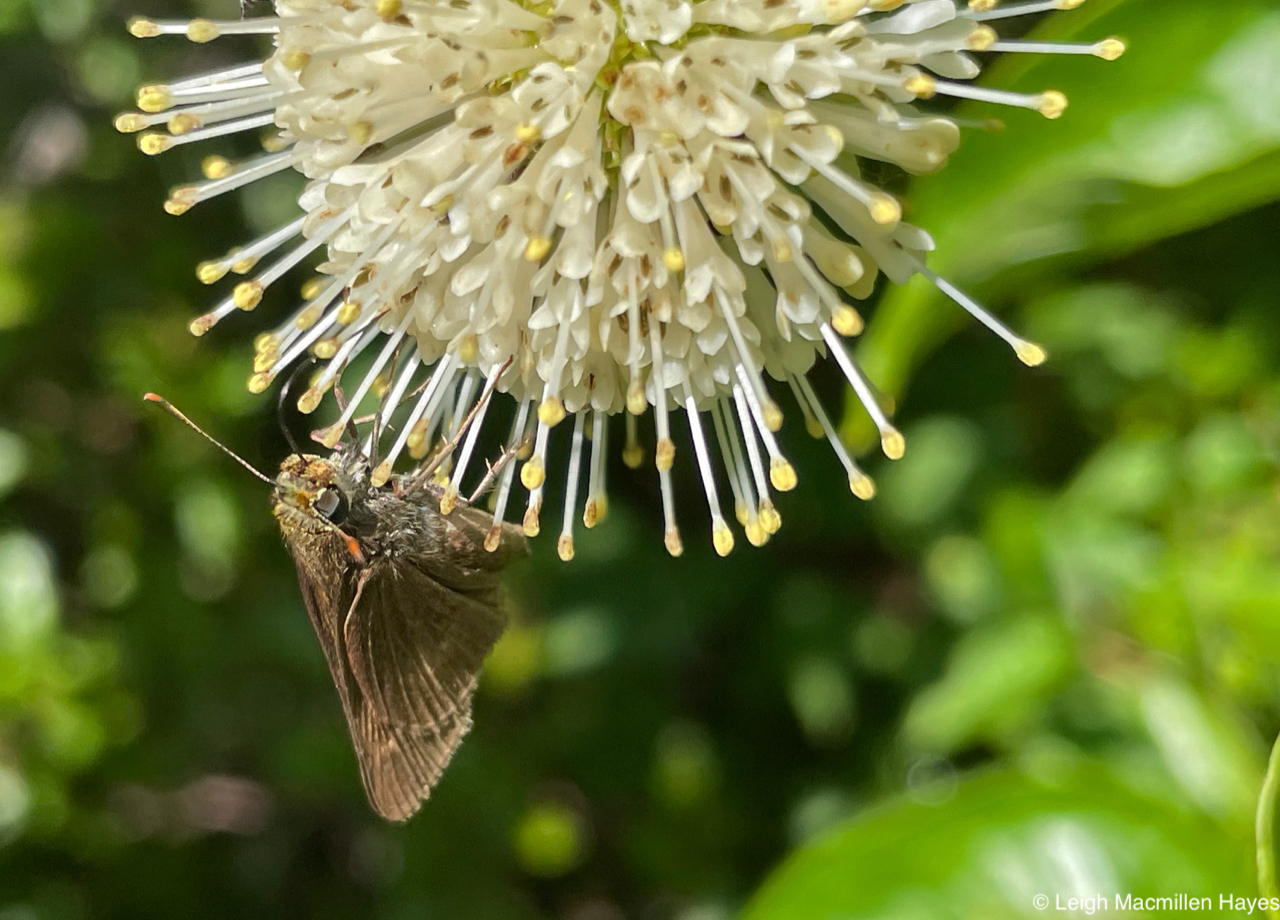
Next, a Dun Skipper made an entrance. Actually about three of them flitted and fluttered from one globe to another.

As for the Crab Spider, it seemed to work on positioning the meal just right.

When the Dun Skipper was positioned just right, I could see its body more clearly and loved how the proboscis stuck down into the flower’s tubular structure. With its deep tube, this inflorescence was designed for butterflies and bees.

Back at the lunch counter, another twist was made.

And atop a different flower head, a Transverse Flower Fly made an appearance, its eyes much bigger than its stomach.

It soon became obvious that prepping a meal takes much work.

The visitors upon the flowers were many and I suppose the lunch choices were as well. While I’m thrilled to have seen so many pollinators, the Crab Spider could only imagine its next meal.

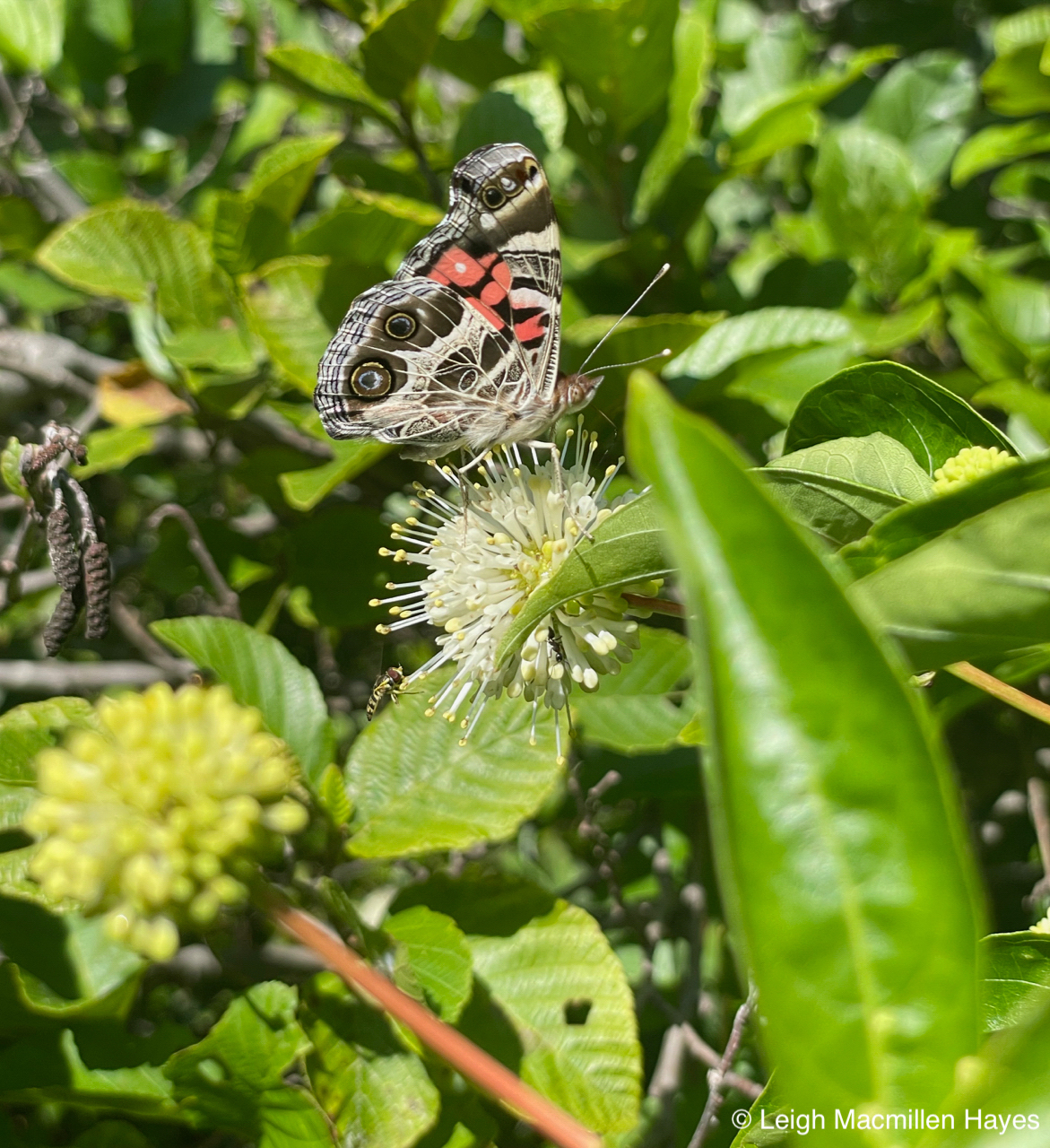
As our time came to an end just after an American Lady flew in, I looked down to make sure I hadn’t worn out the boardwalk and I thought about all the action I’d had the honor of witnessing. Though the flowers drew in smaller insects, they are designed to attract larger bees and butterflies. The Buttonbush (Cephalanthus occidentalis) flowers certainly provide copious amounts of nectar and pollen that make a visit worth the effort for all who stopped by . . . Including the Crab Spider.

I gave thanks to the latter for its diet is well diversified and they are known to contribute to biological controls, but . . . unfortunately, sometimes they feed on beneficial insects like bees.

But I especially gave thanks for all the bees and butterflies who shared their feeding frenzy with me.

Time spent pacing before the satellite-shaped Buttonbush flowers is time spent enjoying an otherworldly experience.   

Happy 7th Birthday to you, wondermyway!

Seven years ago today I gave birth–rather a record at my age. It was February 21, 2015, when I welcomed wondermyway into the world. It’s been quite an adventure that we’ve shared together and one of my favorite things to do each year to celebrate is to take a look back.

As I reviewed this past year, the reality hit home. I’ve written less than half the number of posts of any other year. That all boils down to one thing. Time. There’s never enough. Oh, I’ve taken the photos, and had the adventures, but I haven’t made the time to write about all of them. Sometimes, they sit off to the side in my brain and I think I’ll use some of them together in a cumulative post, and there they sit.

That all said, I’ve had more views and visitors this past year than any other. Views = 24,955; Visitors = 16,994. Followers = 701. And over the course of wondermyway’s lifespan, the blog has received 121,765 hits.

An enormous heart-felt thanks to all who have joined me for any or all of these journeys. I get excited to share with you and love hearing from you.

In case you are wondering, my guy and I did have a Mondate this afternoon–along Bemis River and then up to Arethusa Falls in Crawford Notch, New Hampshire.

It was here at the falls that we celebrated wondermyway.com with a couple of those Bavarian Haus chocolates we purchased last Monday.

And now for a look at a few excerpts from posts I made during the past year, beginning with March 2021. To read or re-read the entire post, click on the link below each photo.

The Invitation Stands

It took me by surprise, this change of seasons. Somehow I was fooled into thinking winter would hold its grasp for a wee bit longer because I don’t like to let it go.

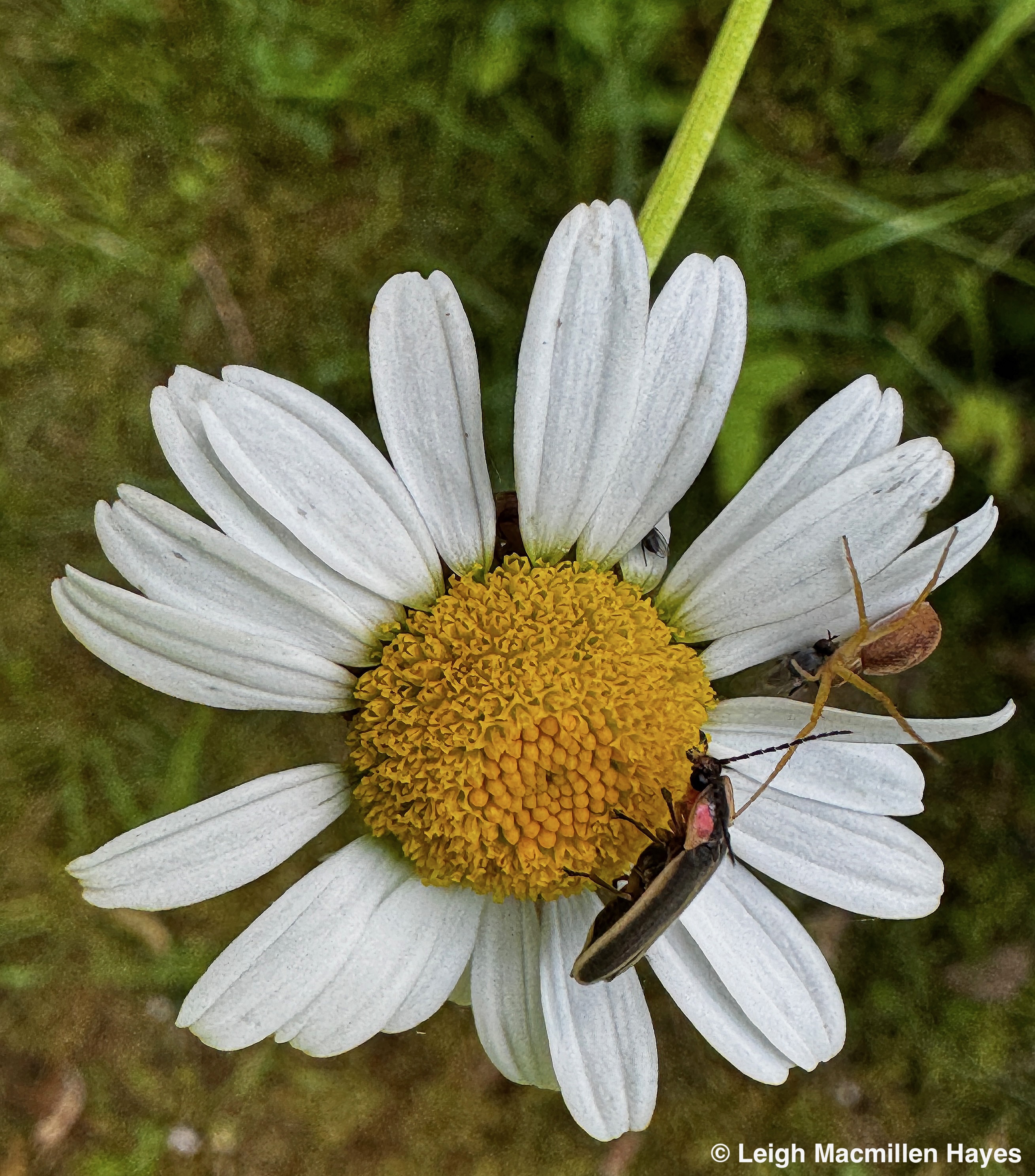
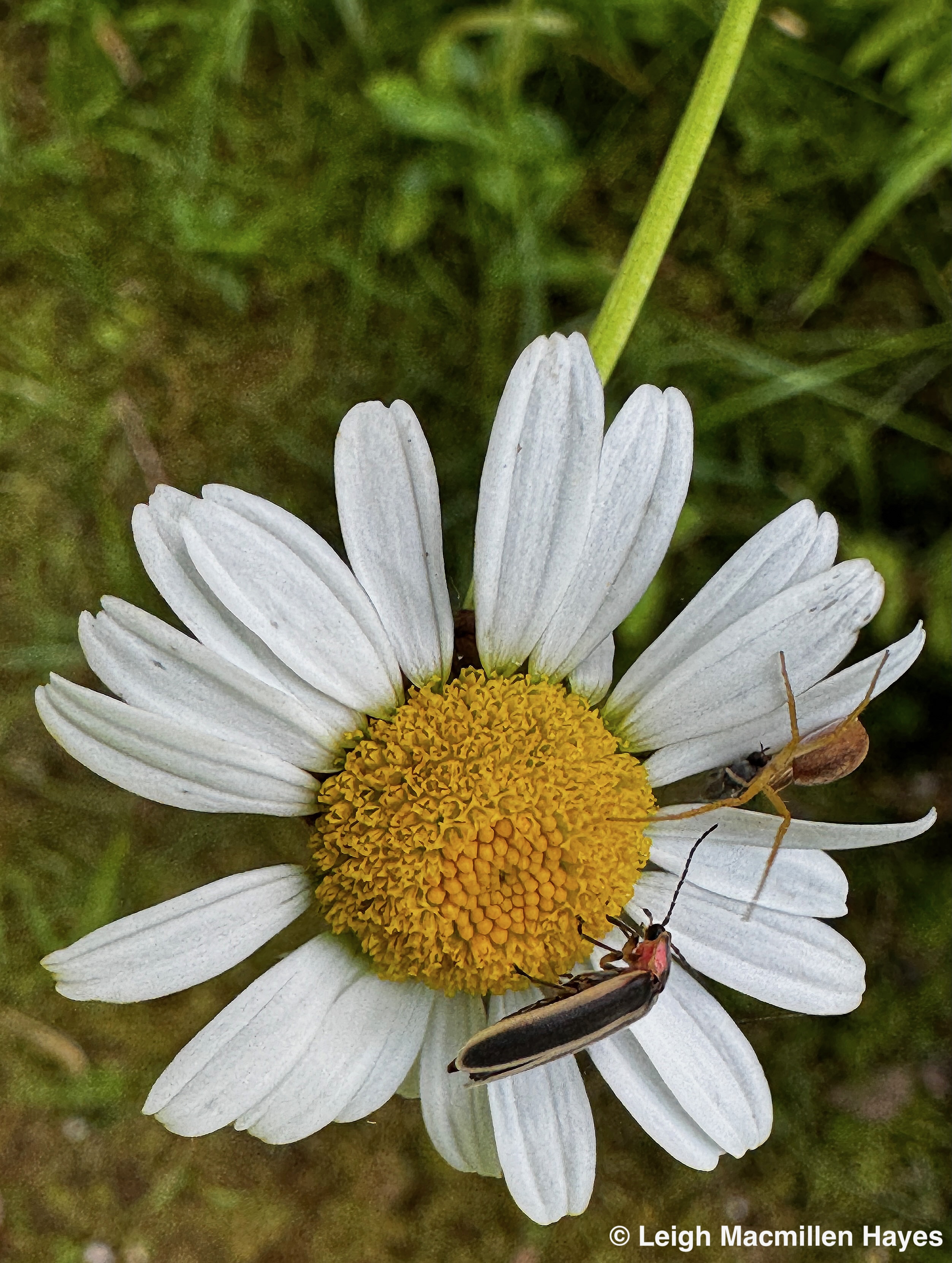
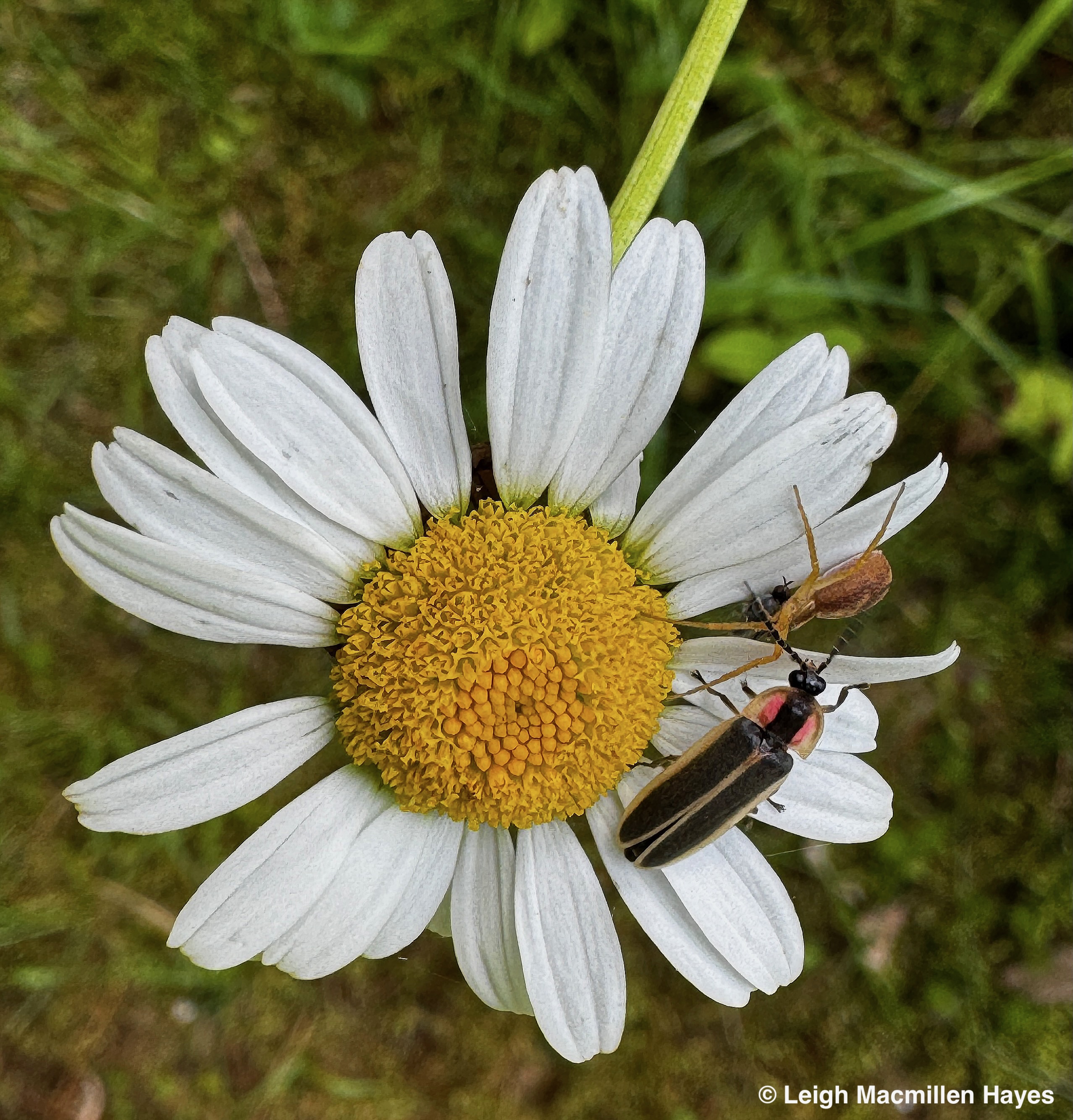
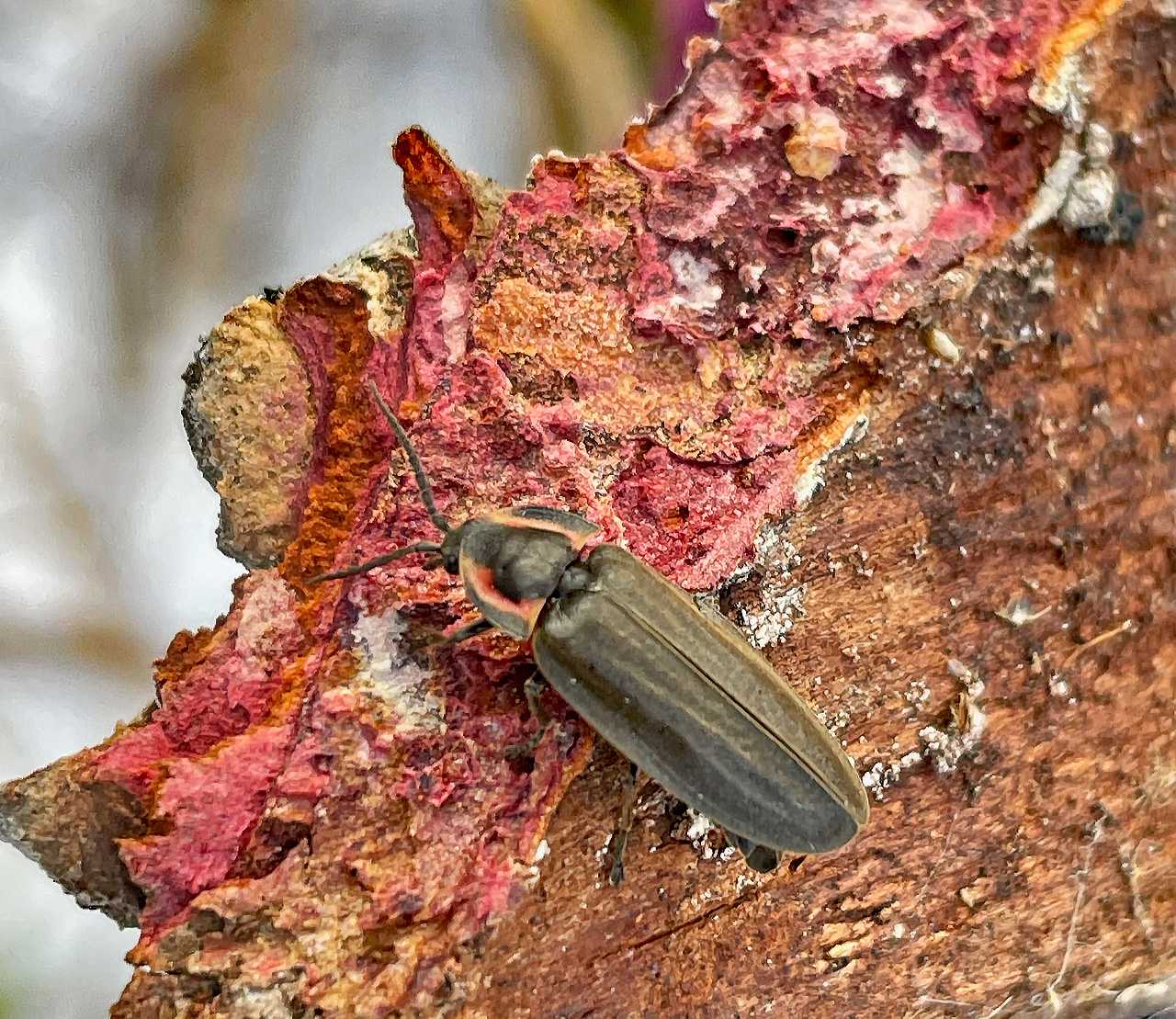
Even Winter Dark Fireflies, who don’t carry lanterns like their summer cousins, and aren’t even flies as their name suggests (they are beetles), knew what was happening before I did for in their adult form they’d been tucked under bark in recent months, but in a flash are now visible on many a tree trunk as they prepare to mate in a few weeks.

But . . . this spring will be different.

How so? And what invitation still stands? Click on the link under the beetle’s photo to find the answers.

Whispers Along The Trail

“The way to be heard isn’t to shout,” said the Reverend Dr. Sam Wells of St. Martins in the Fields, London. “It’s to whisper.” But who are the whisperers?

Listen for the slightest murmur of Trailing Arbutus’s delicate blossoms beneath its leathery leaves.

Hear also the soft words of a rattlesnake-plantain explaining that its striking veins may suggest “checkered,” but it actually goes by “downy” in common speak.

You’ll have to click on the link under the photo of the Trailing Arbutus flowers to hear what other species had to say.

Surveying the Wildlife of Charles Pond

For the past two weeks at Greater Lovell Land Trust we’ve had the good fortune to conduct a wildlife survey in the waters that surround the newly acquired Charles Pond Reserve in Stow, Maine.

MDIFW maintains a comprehensive database on the distribution of Maine’s amphibians and reptiles, as well as terrestrial and freshwater invertebrates and the data we’ve collected will add to the bigger picture. What we discovered was just as important as what we didn’t find.

The survey began with a day of setting and baiting fifteen traps in the pond and associated rivers. What’s not to love about spending time in this beautiful locale, where on several occasions lenticular clouds that looked like spaceships about to descend greeted us.

Our favorite bird sighting was this bald eagle, who found a silver maple snag at the outlet of Cold River into Charles Pond. I was a wee bit nervous as that was Change The Trap Bait Day, and I had a bag of stinky old sardine cans in my lap as I paddled a kayak.

He was intent, however, on something else and barely gave us a glance.

This story of the survey would not be complete, however, without the absolute best sighting that occurred on the last day. Our mammal observations on almost every trip included a muskrat, plus occasional squirrels, and once a beaver. From our game camera set up at various locations, and from tracks and scat, we also know that coyotes, raccoons, otters, a bobcat and a black bear share this space.

But . . . you’ll have to click on the link under the Bald Eagle photo to figure out what our best sighting was.

The Saga of a Vernal Pool

Warning: Some may find parts of this post disturbing. But it is, after all,  about the circle of life. 

A climbing thermometer in March signaled one thing amidst many others: the time had arrived to check the vernal pool. 

Completely covered with ice at the start of my explorations, I noted puddling on top and knew it was only a matter of days. 

Not wanting to rush the season, though truly I did, I rejoiced when the edges melted because life within would soon be revealed.

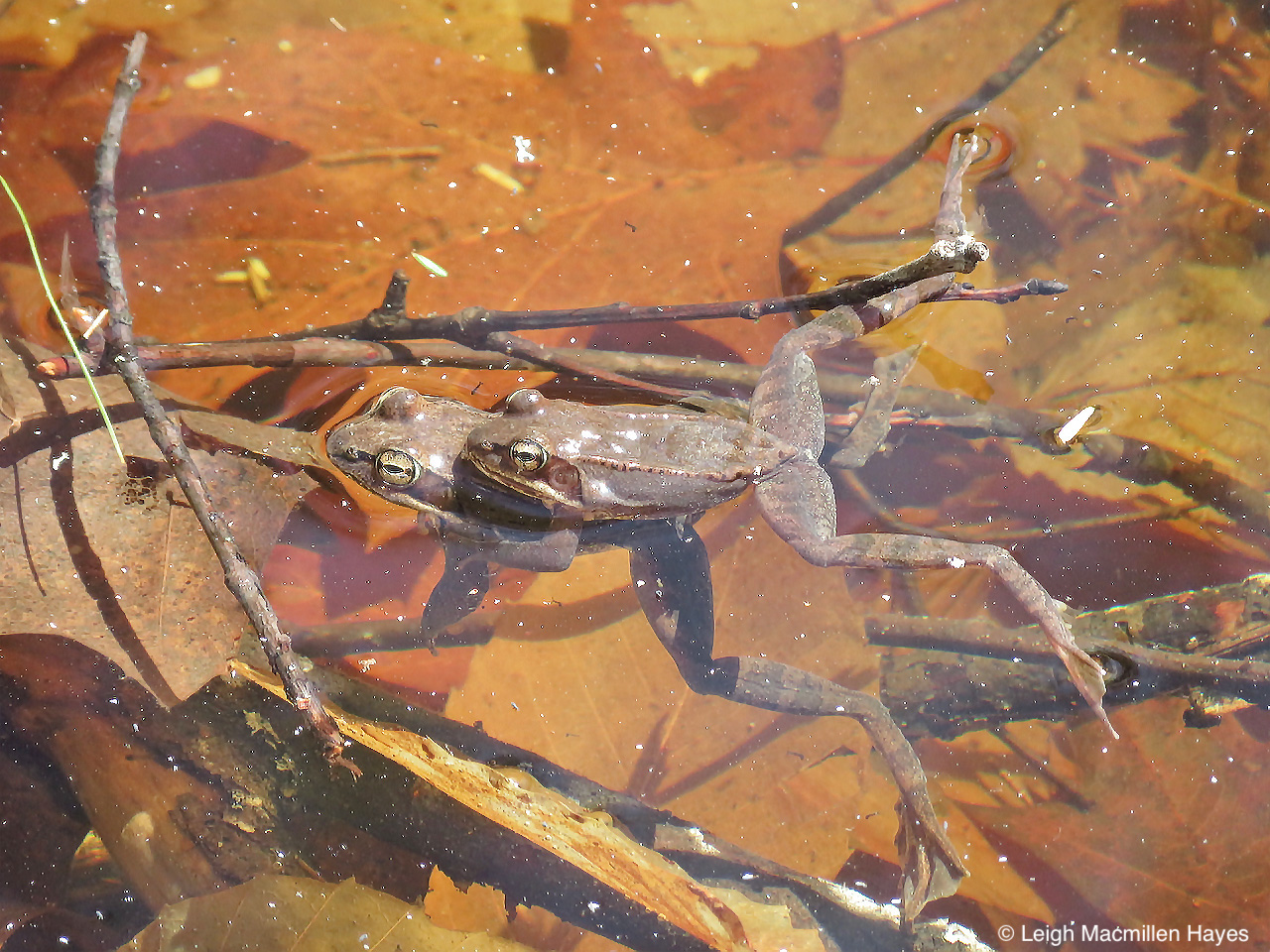
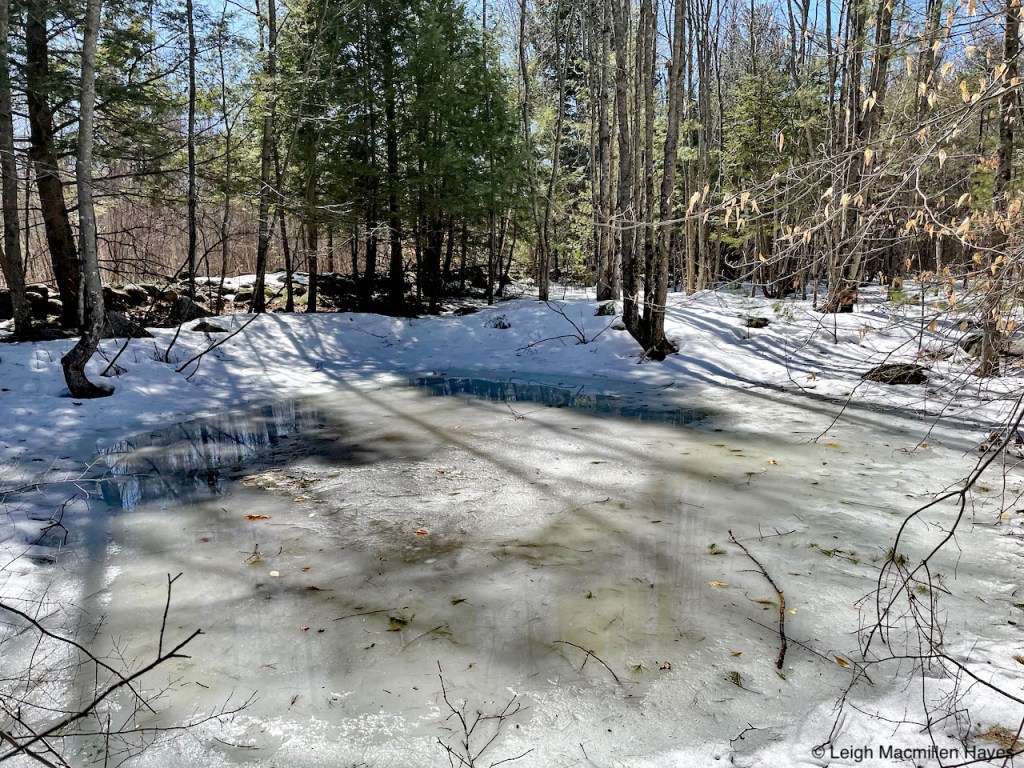
And then one day, as if by magic, the ice had completely gone out as we say ‘round these parts. It was early this year–in late March rather than April. That same night I heard the wruck, wrucks of Wood Frogs, always the first to enter the pool. 

The next day he had attracted his she, grasping her in amplexus as is his species’ manner. 

Ah, but how does the story end? Click on the link under the photo to find out.

Consumed by Cicadas

I walked into a cemetery, that place of last rites and rest, looking for life. It should have been a short visit, for finding life in such a location hardly seems possible, but . . . for two hours yesterday I stalked the gravestones and today I returned to the same spot where I once again roamed, and then continued up the road to another that surprised me even more.

Upon the granite wall that surrounded the Hutchins plot, two small, but actually rather large in the insect world, nymphs crawled and paused, crawled and paused. And my heart sang as it does when I realize I’m in the right place at the right time.

Click on the link under the photo to see the story of the Cicadas unfold.

Not Just An Insect

Out of curiosity, and because it’s something I do periodically, I’ve spent the last four days stalking our gardens. Mind you, I do not have a green thumb and just about any volunteer is welcome to bloom, especially if it will attract pollinators.

There were millions of other insects, well, maybe not millions, but hundreds at least, flying and sipping and buzzing and hovering and crawling and even canoodling, the latter being mainly Ambush Bugs with the darker and smaller male atop the female.

But why the title, “Not Just An Insect”? Ahhh, you know what you’ll need to do to find the answer.

A Collection of Mondates

Every Mondate is different, which goes without saying, and the adventure always begins with a question, “What are we going to do today?”

The answer is frequently this, “I don’t know, you pick.”

The instantaneous reply, “I asked first. You need to figure it out.”

We did figure it out. Over and over again. This collection happens to include places that make us happy and many of our family members and just looking back puts a smile on my face. Oh, and the selfie–taken at the same place where we went today–only in September 2021.

Beautiful Maine

A vacation loomed in front of us. Where to go? What to do?

Click on the link, Beautiful Maine, to see what surprises awaited us as we got to know our state a wee bit better.

Pondering the Past at Pondicherry Park

Before today’s deluge began, I slipped into Pondicherry Park in Bridgton, Maine, to fill the innermost recesses of my lungs with November air, and at the same time my brain with memories of so many people who have traveled these trails with me from Ned Allen, former executive director of Bridgton Historical Society, to Loon Echo’s Jon Evans, and Lakes Environmental Association’s Alanna Yanelli and Mary Jewett, and friends and friends and friends, including the late JoAnne Diller, Sue Black, and Jinny Mae. But today’s journey also included memories of one I took two years ago with Becky Cook, who shared her remembrances of growing up along South High Street and romping through these trails as they were part of her backyard. If anyone ever had a sense of this place, it is Becky.

This post is full of information of an historic and natural nature. Go ahead, click on the link above to learn more.

Following the Circle of Life

Upon an aimless journey into our neck of the woods a pattern soon emerged, though I didn’t realize it at the time. Sometimes, it’s best that way. To be present is the key.

Click on the link to find out more about the pattern.

Good Hair Mondate

The temperature dipped overnight and wind picked up out of the WNW but given the destination we had chosen, we knew if we dressed appropriately we’d be fine because we’d be in the woods most of the time, unlike last week’s walk where we were completely exposed to the elements on Popham Beach. That said, it was cold today.

But what could good hair possibly have to do with this Mondate? You’ll have to read it to find out.

The Duck’s Tale

Dear Readers, This post may not be for the faint of heart, but it’s something those of us who track find incredibly exciting as we try to interpret the gory story. Yes, you read that correctly. Blood and guts are to follow. You are now forewarned, and if you decide not to read on, I totally understand.

So how is this stuffed beaver connected to a gory story?

Starring wondermyway, episode 3 on LRTV

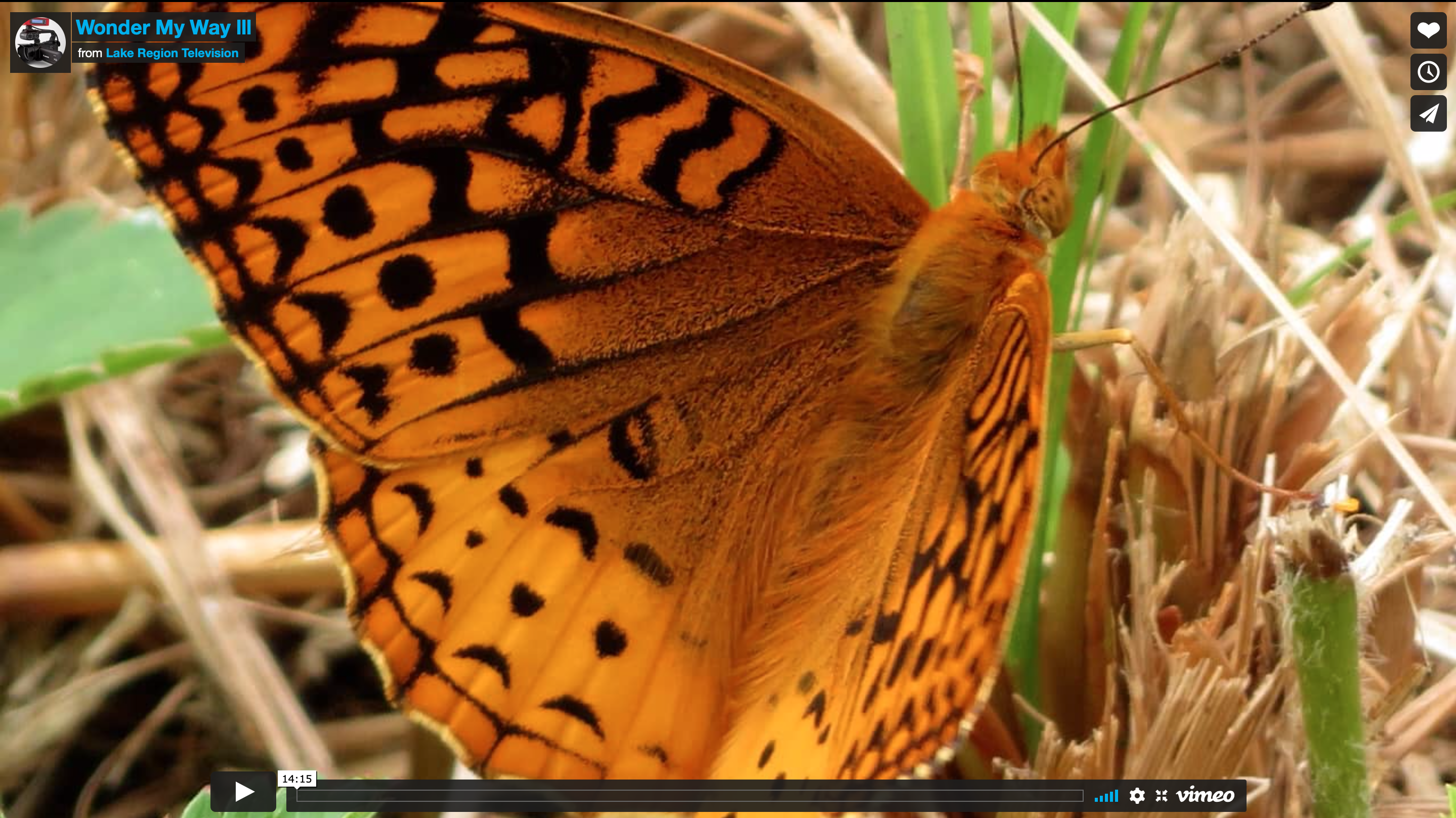
Finally, settle into a comfy chair and click on the following link to listen to fourteen minutes of wondermyway: wondermywayIII.

Thank you. Thank you. Thank you.

I hope you’ll continue to wonder along with me as I wander through the woods.

Not Just An Insect

Out of curiosity, and because it’s something I do periodically, I’ve spent the last four days stalking our gardens. Mind you, I do not have a green thumb and just about any volunteer is welcome to bloom, especially if it will attract pollinators.

This image has an empty alt attribute; its file name is 1-2.jpg

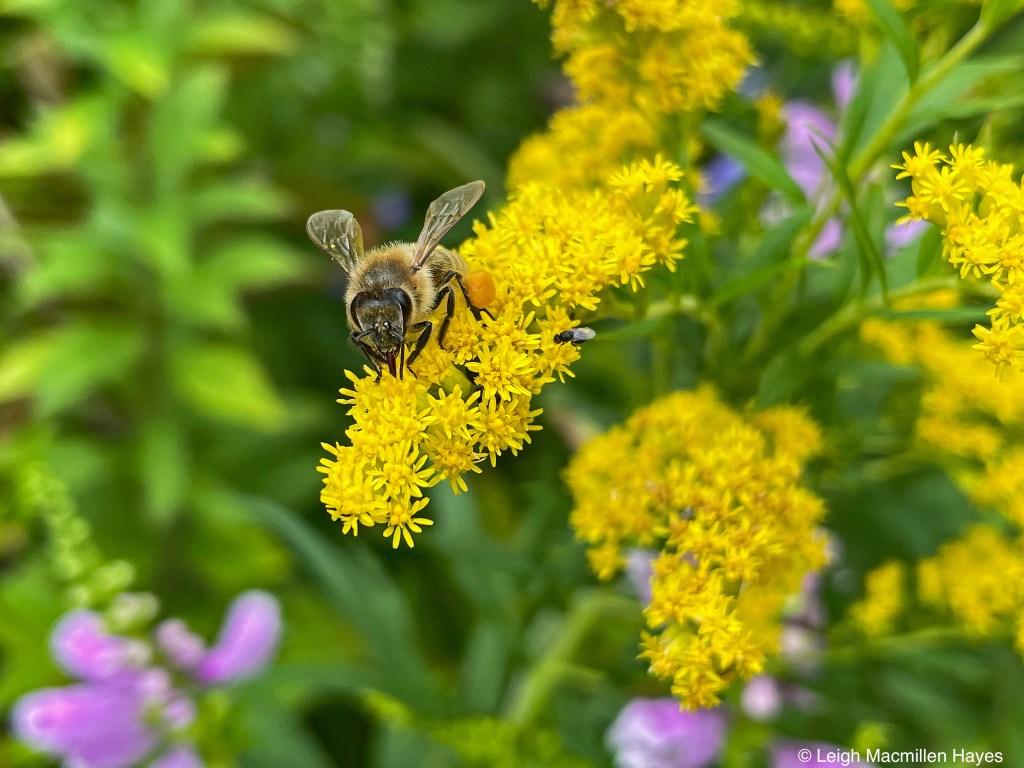
iWhat I’ve discovered is that in sunshine and rain, the place is alive with action from Honeybees and Gnats . . .

This image has an empty alt attribute; its file name is 2-2.jpg

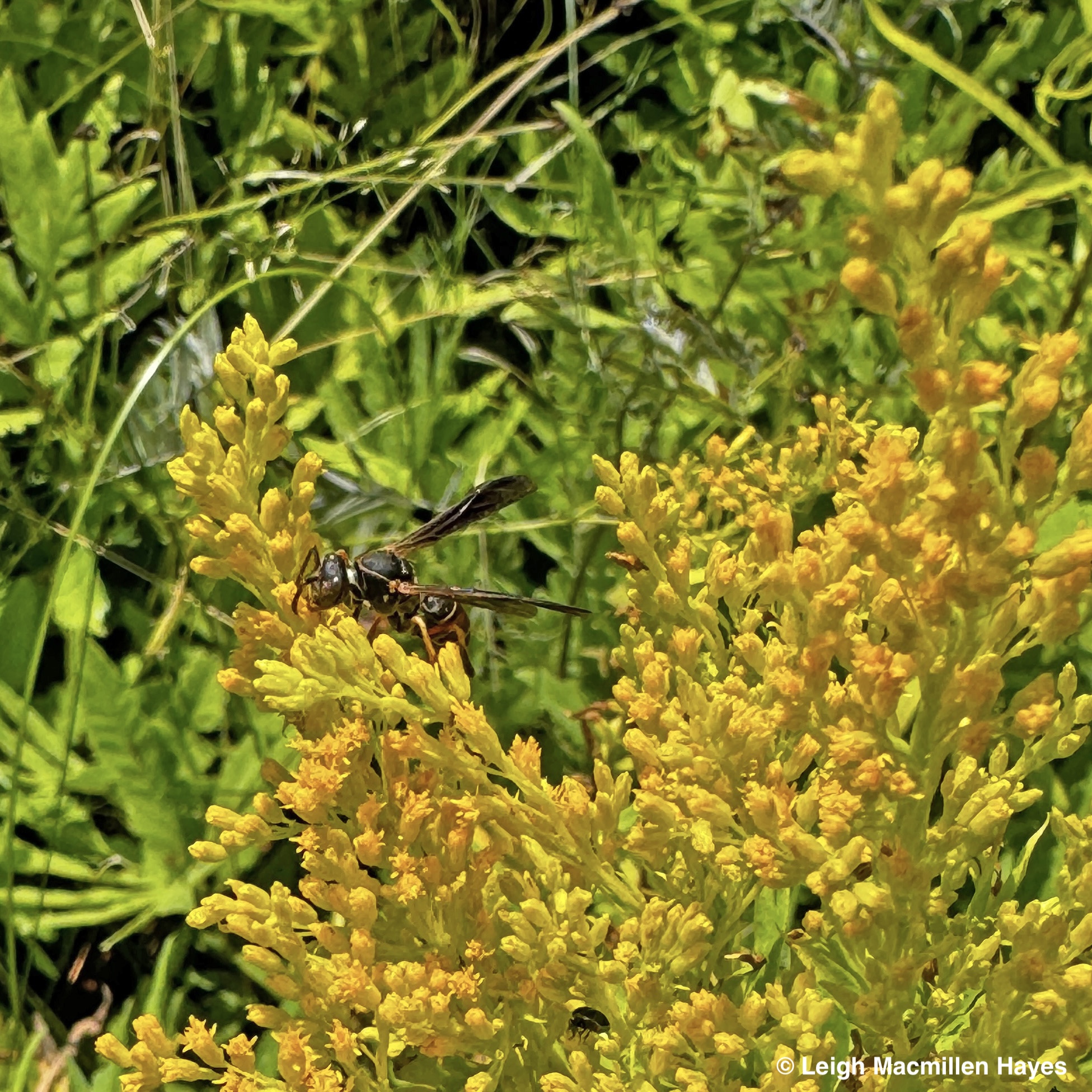
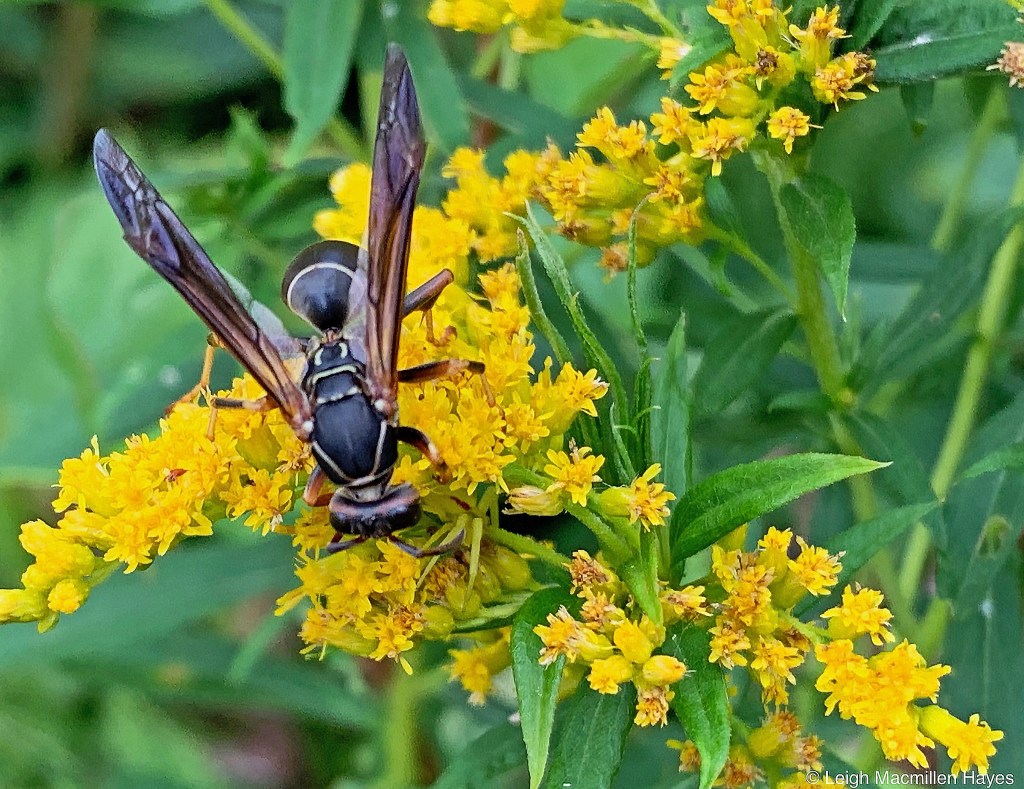
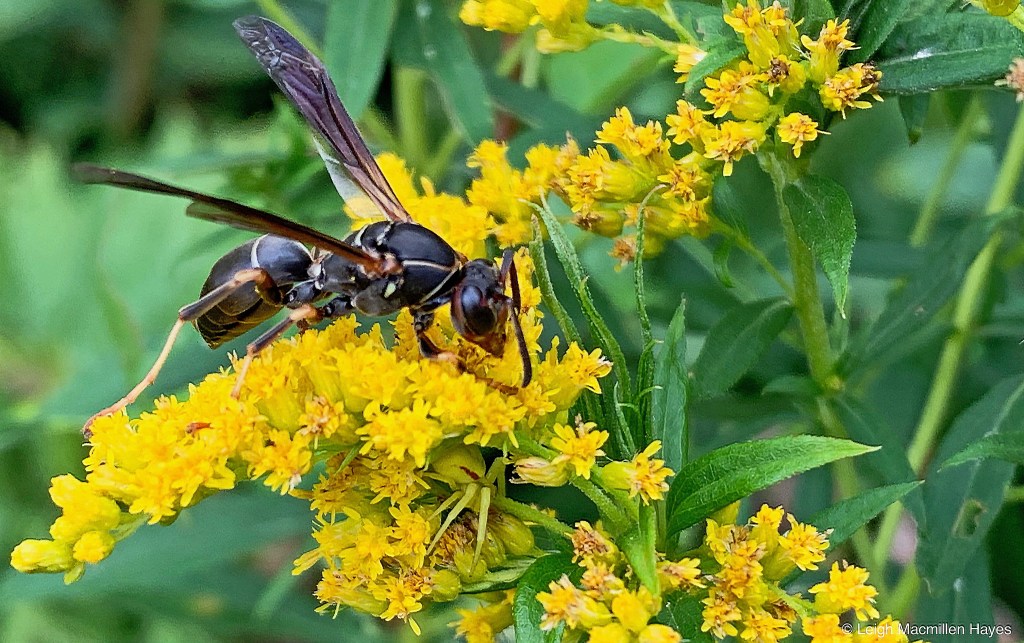
to Paper Wasps,

This image has an empty alt attribute; its file name is 5-1.jpg

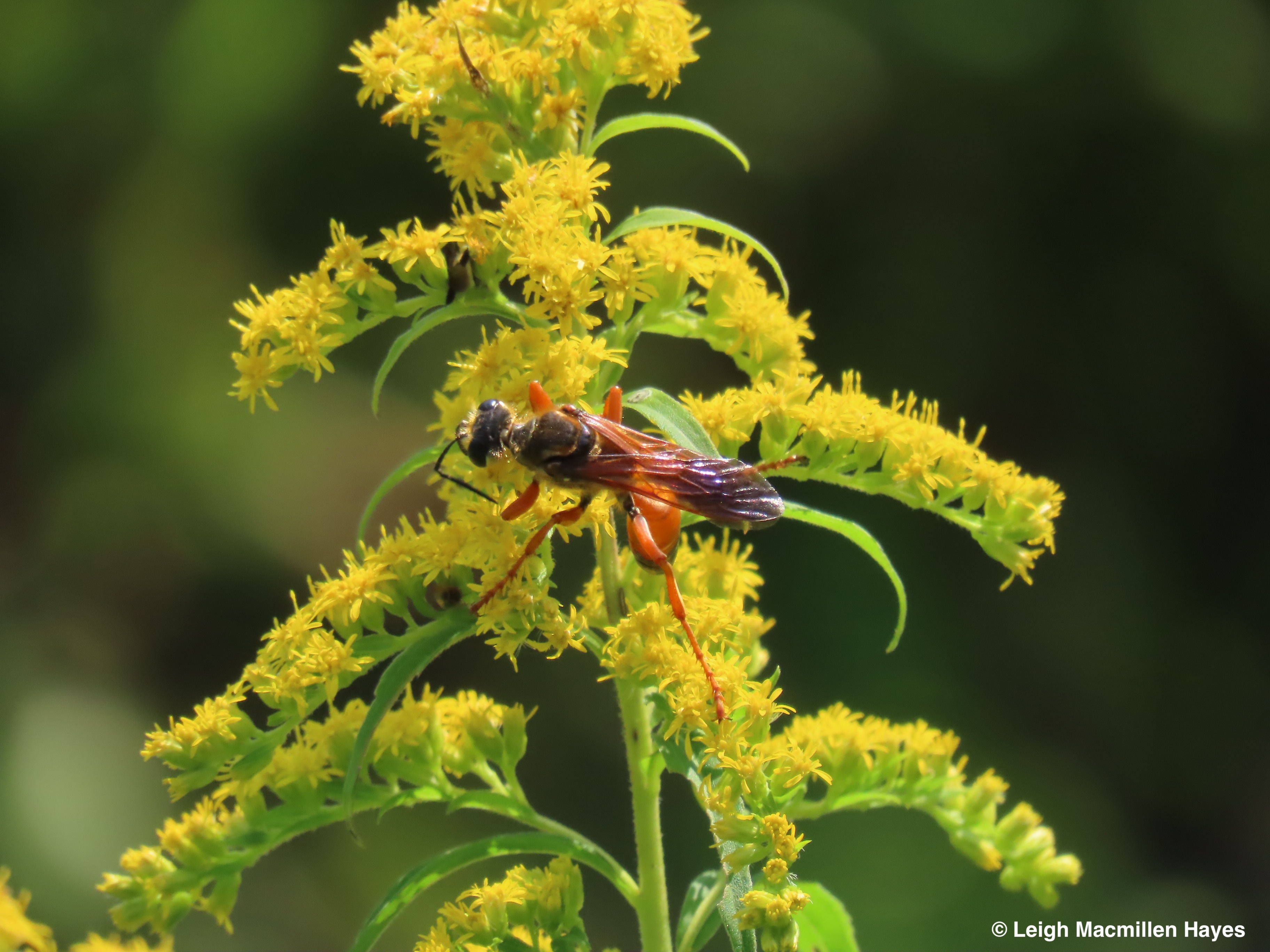
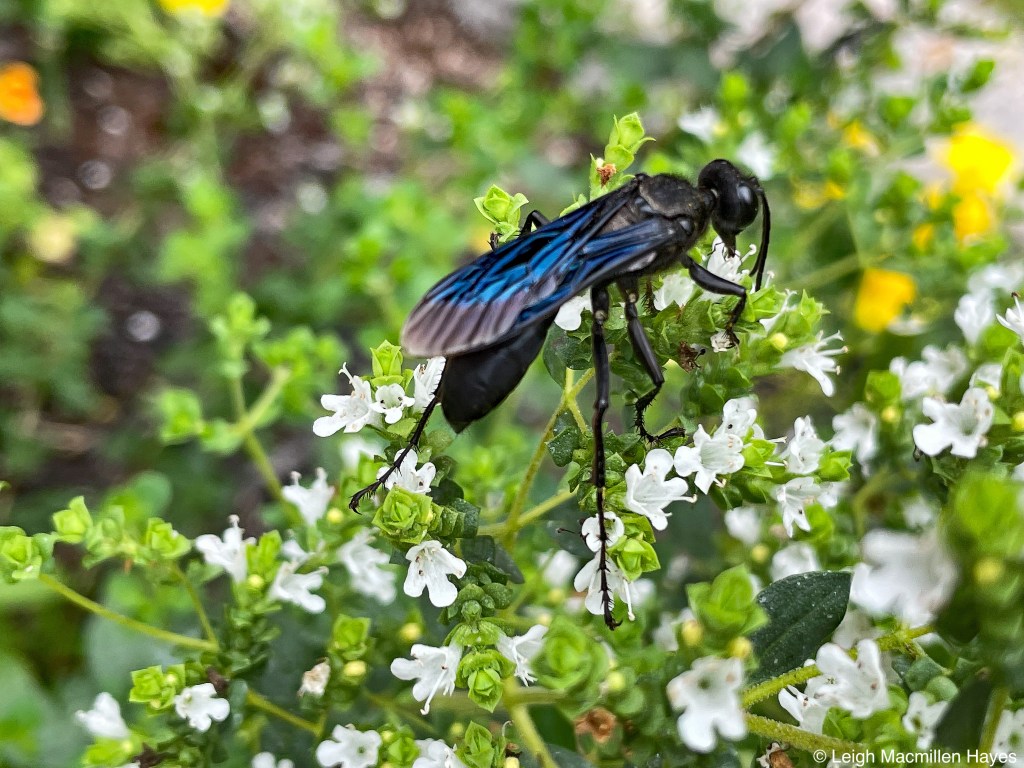
and even several Great Black Wasps, their smoky black wings shining with blue iridescence as they frantically seek nourishment and defend territories (including letting this particular human know that she’s not welcome at the party by aggressively flying at her).

This image has an empty alt attribute; its file name is 8-2.jpg

Bumblebees were also full of buzz and bluster and it was they who reminded me of one important fact.

This image has an empty alt attribute; its file name is 4-2.jpg

The color of the storage baskets on their hind legs depends upon the color of the pollen grains in the plants they’ve visited.

This image has an empty alt attribute; its file name is 5-2.jpg

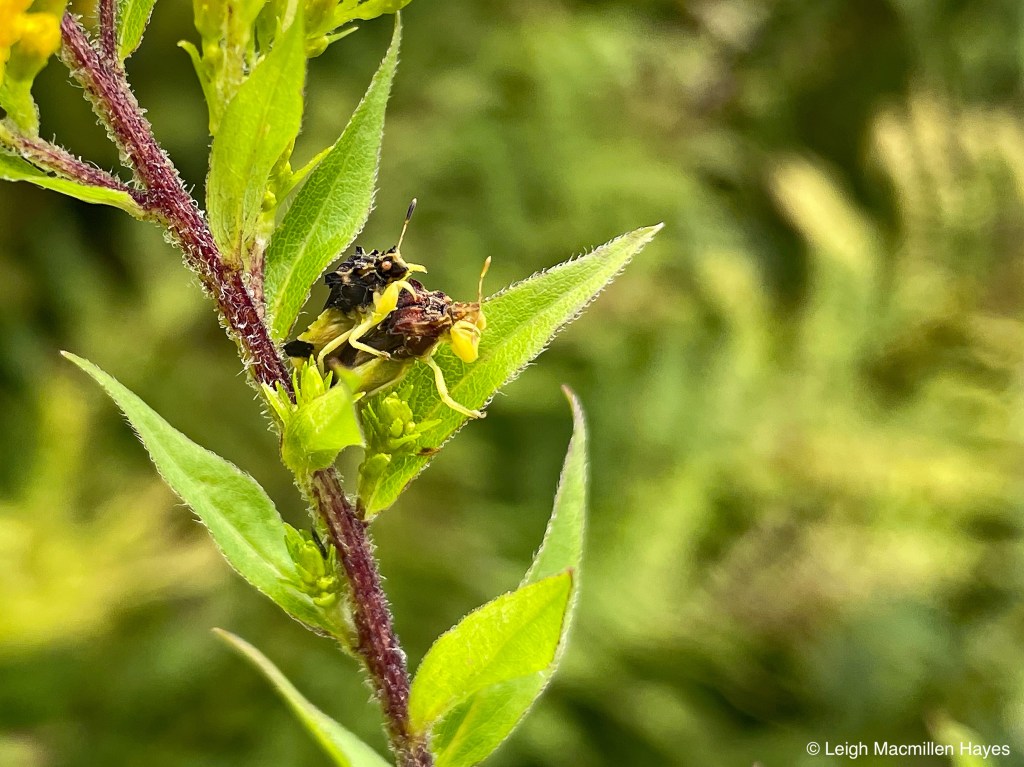
There were millions of other insects, well, maybe not millions, but hundreds at least, flying and sipping and buzzing and hovering and crawling and even canoodling, the latter being mainly Ambush Bugs with the darker and smaller male atop the female.

This image has an empty alt attribute; its file name is 14-2.jpg

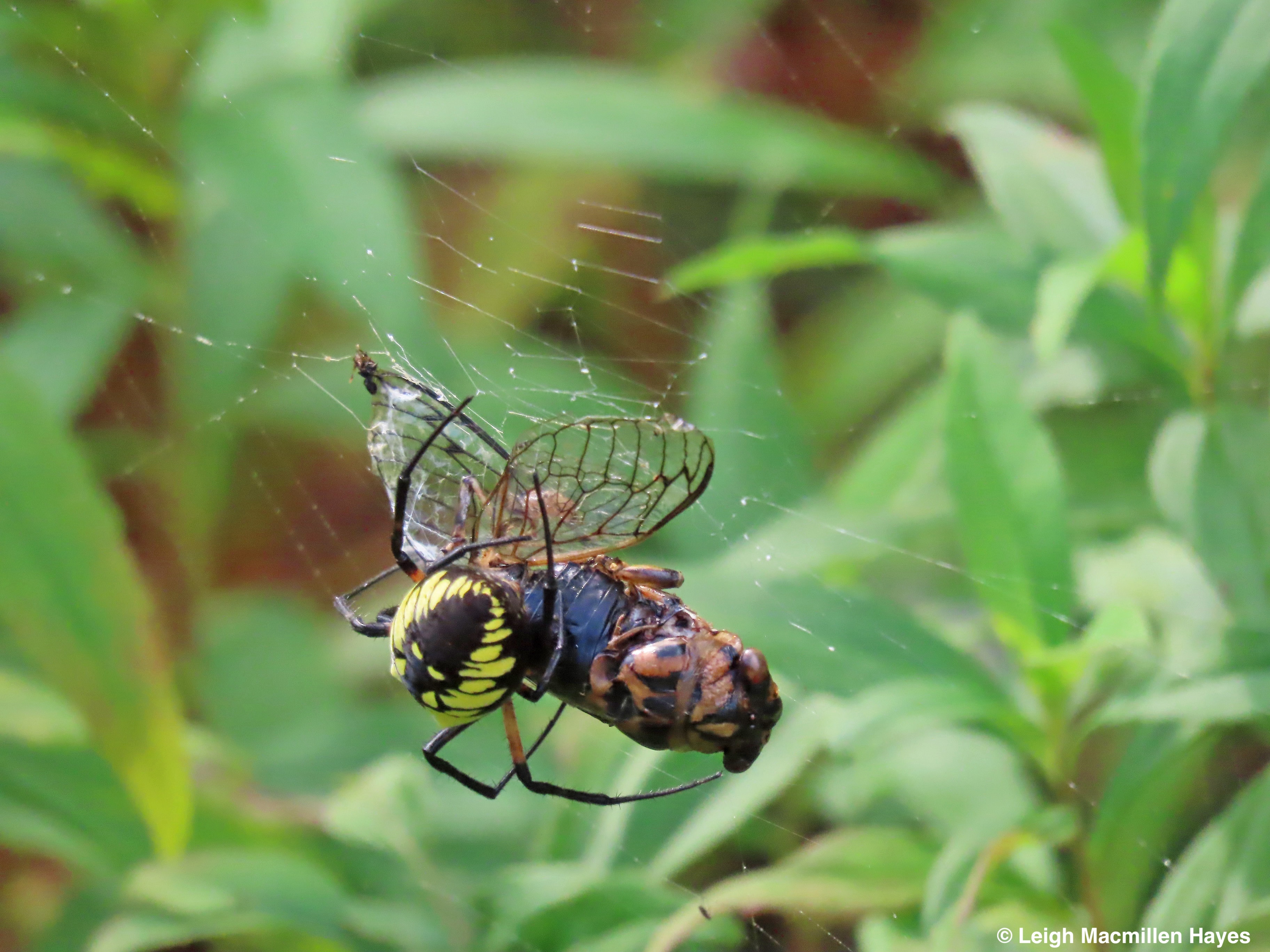
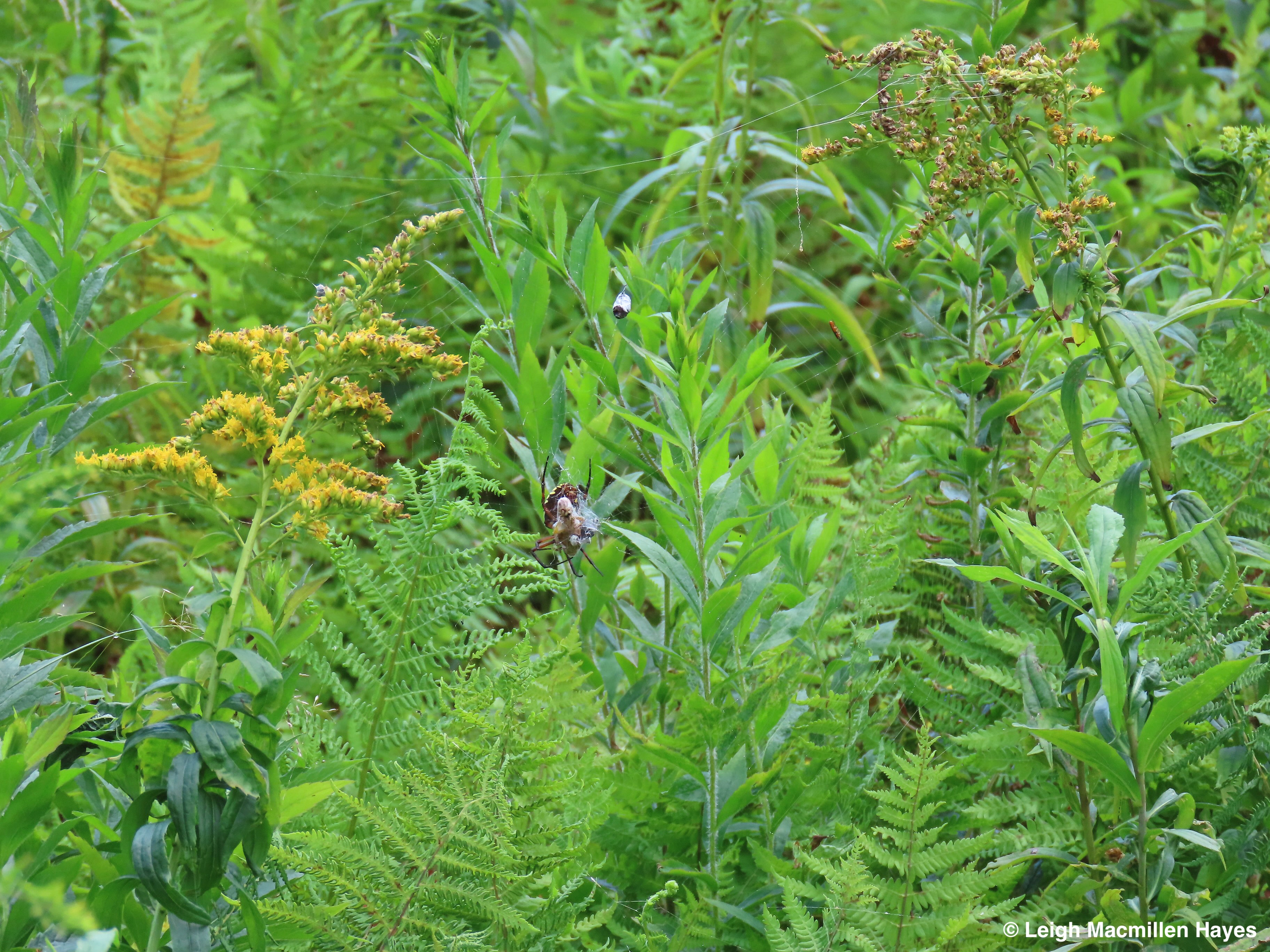
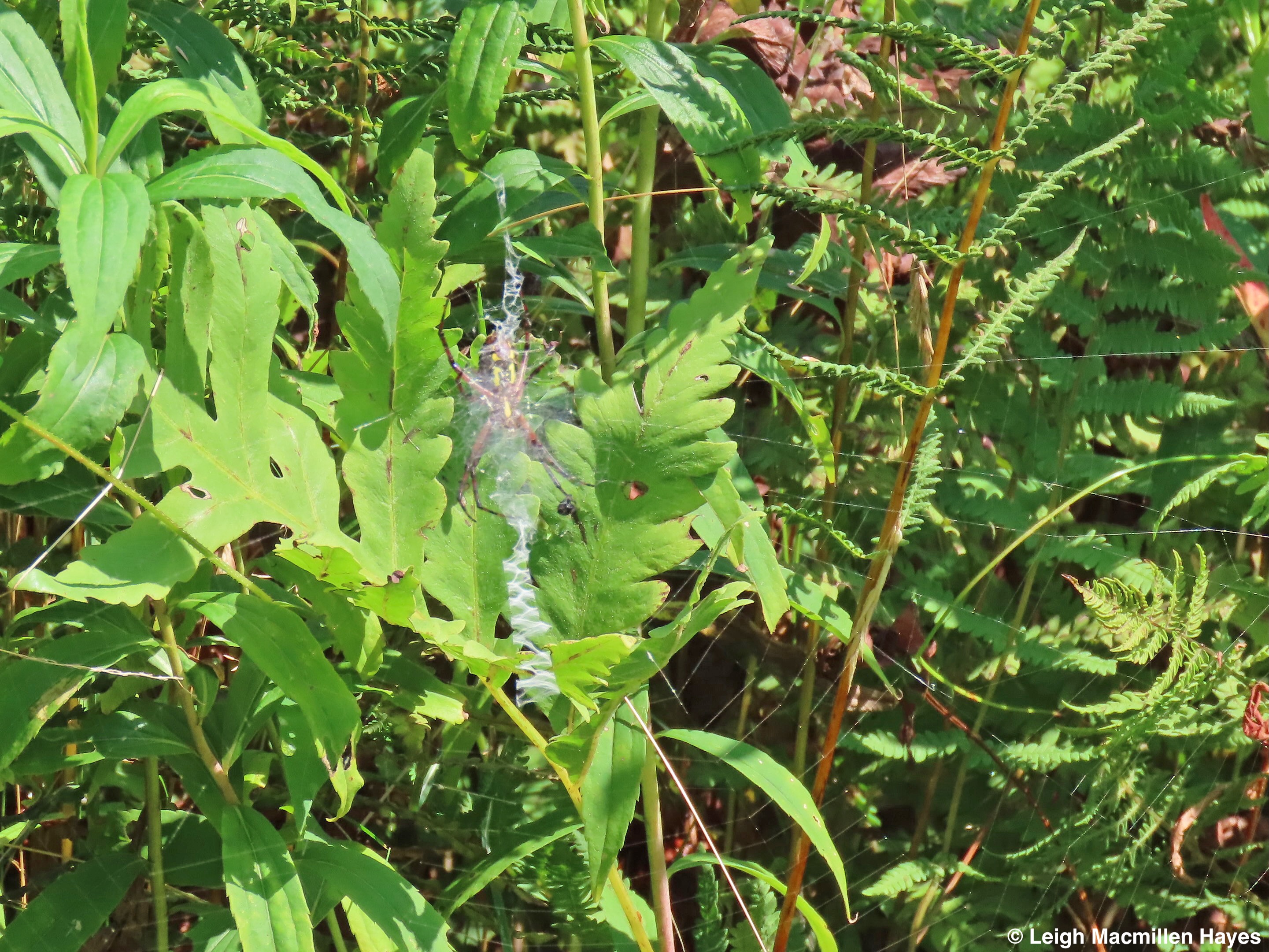
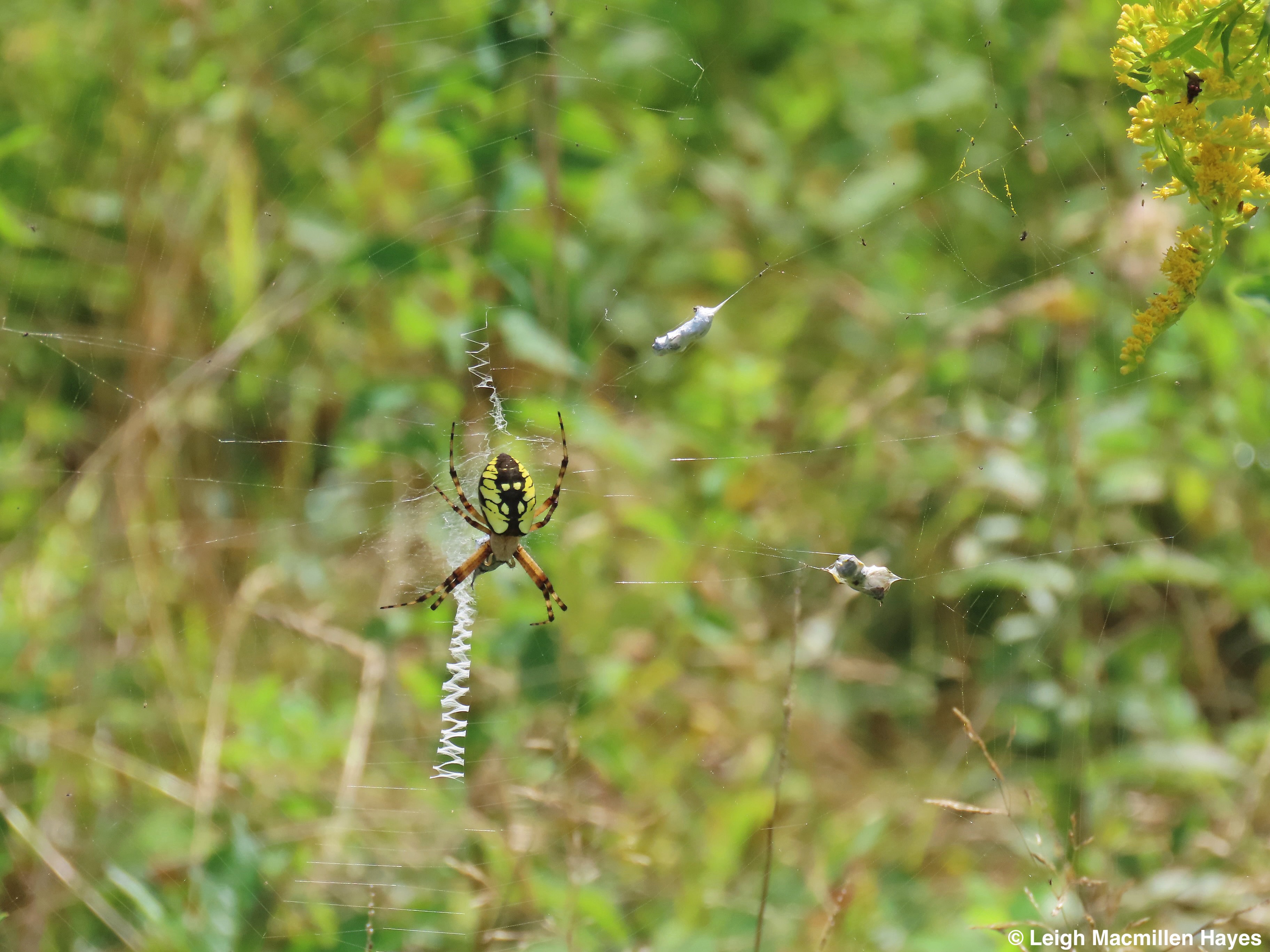
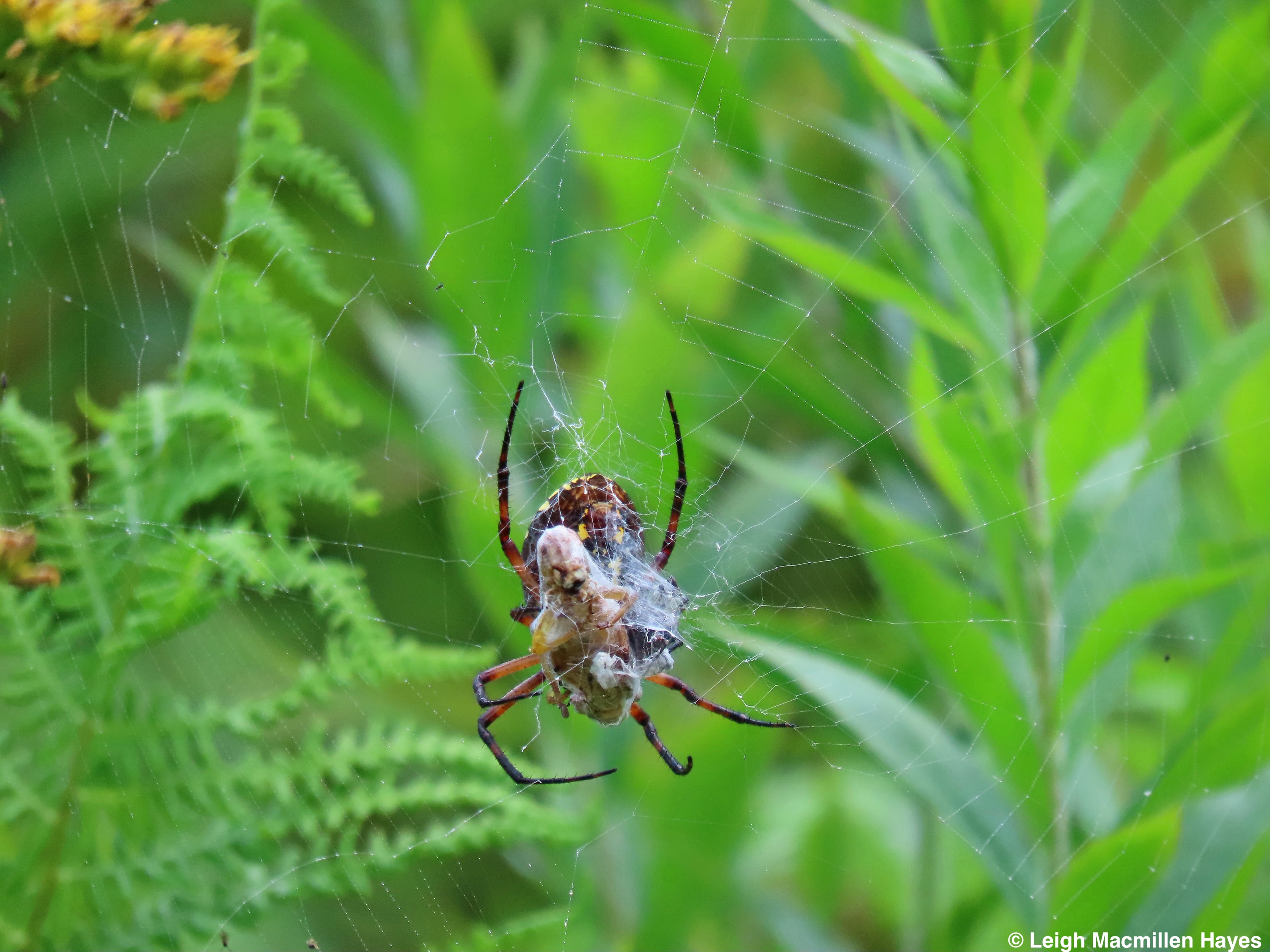
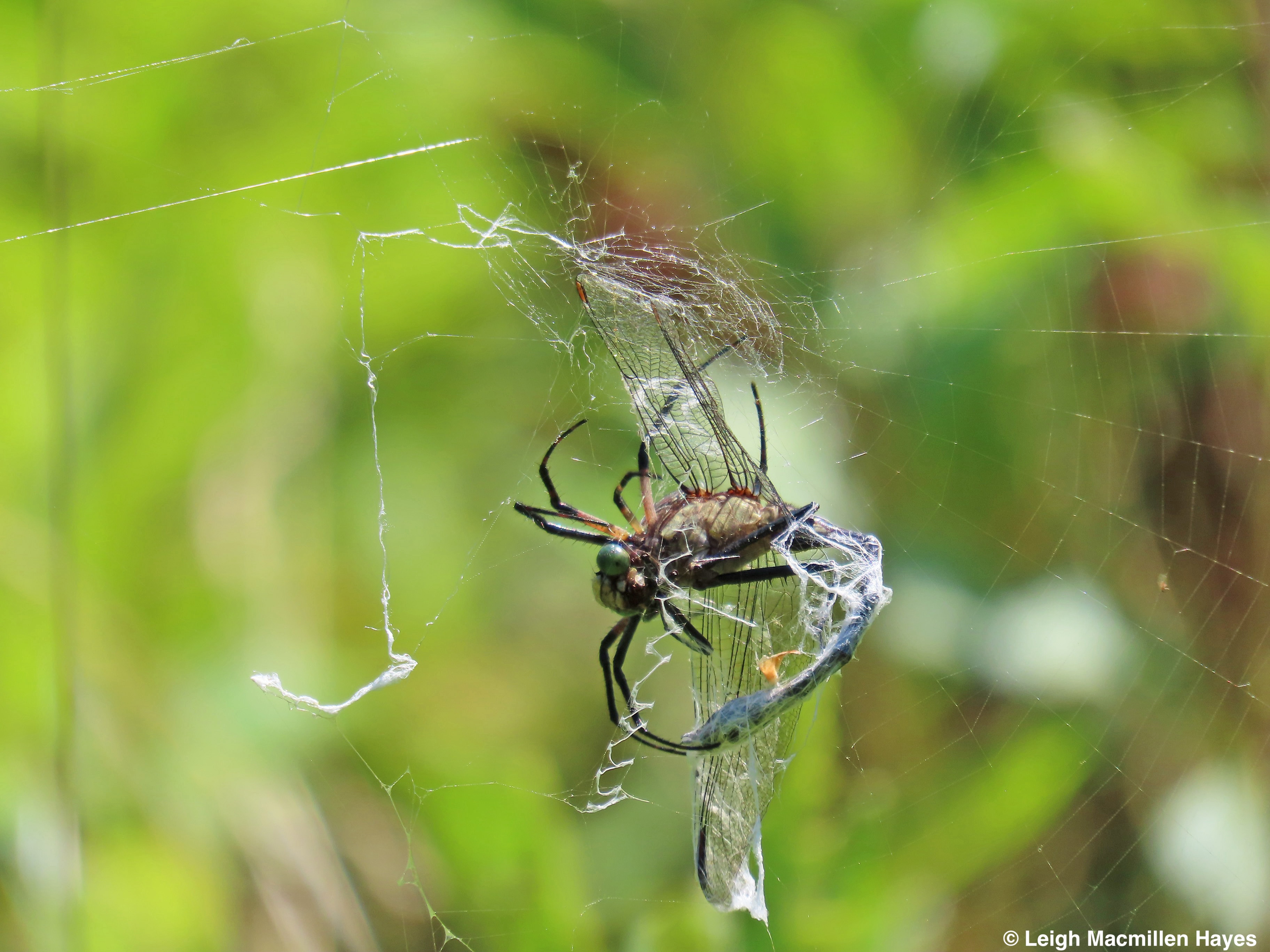
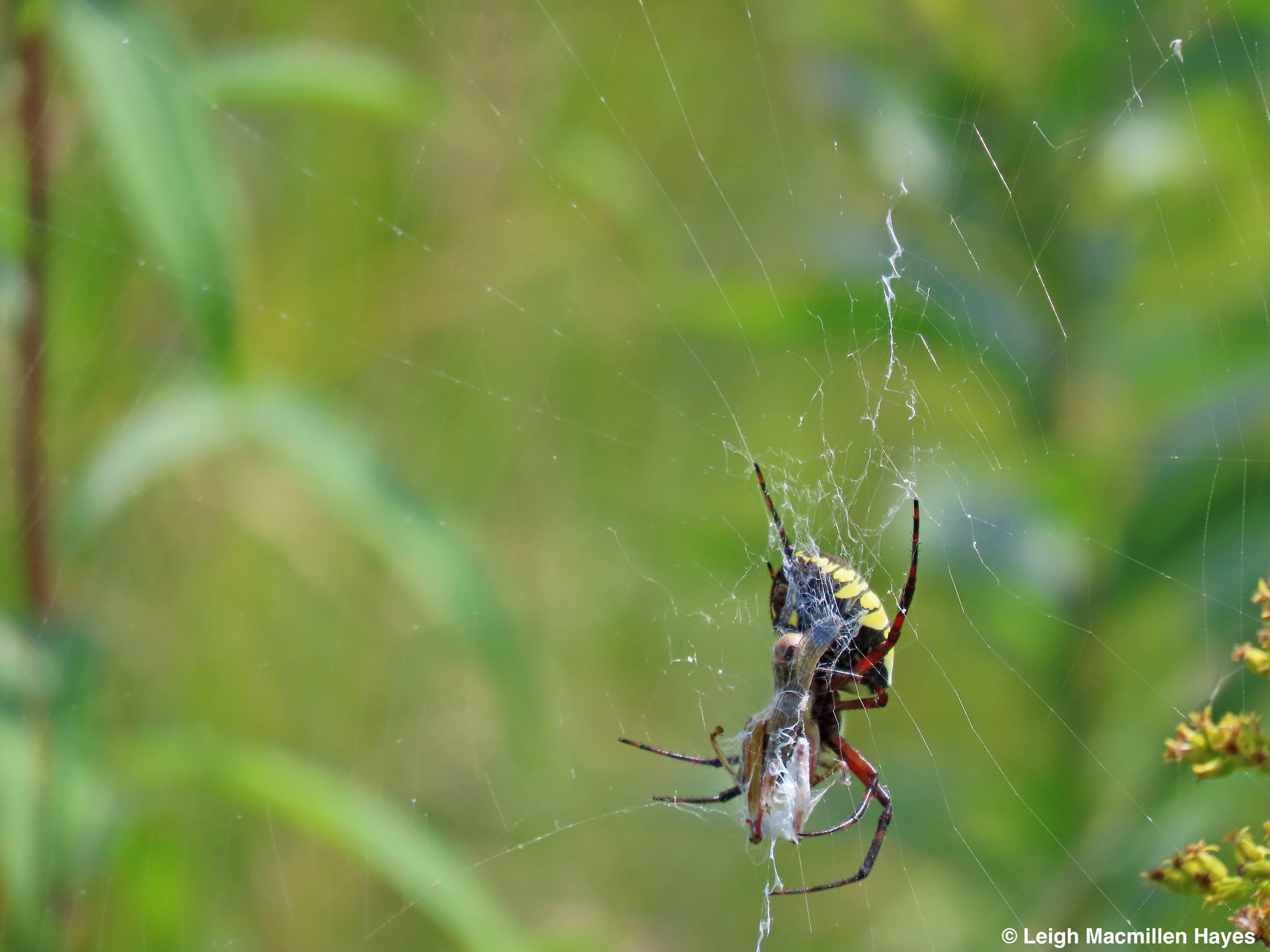
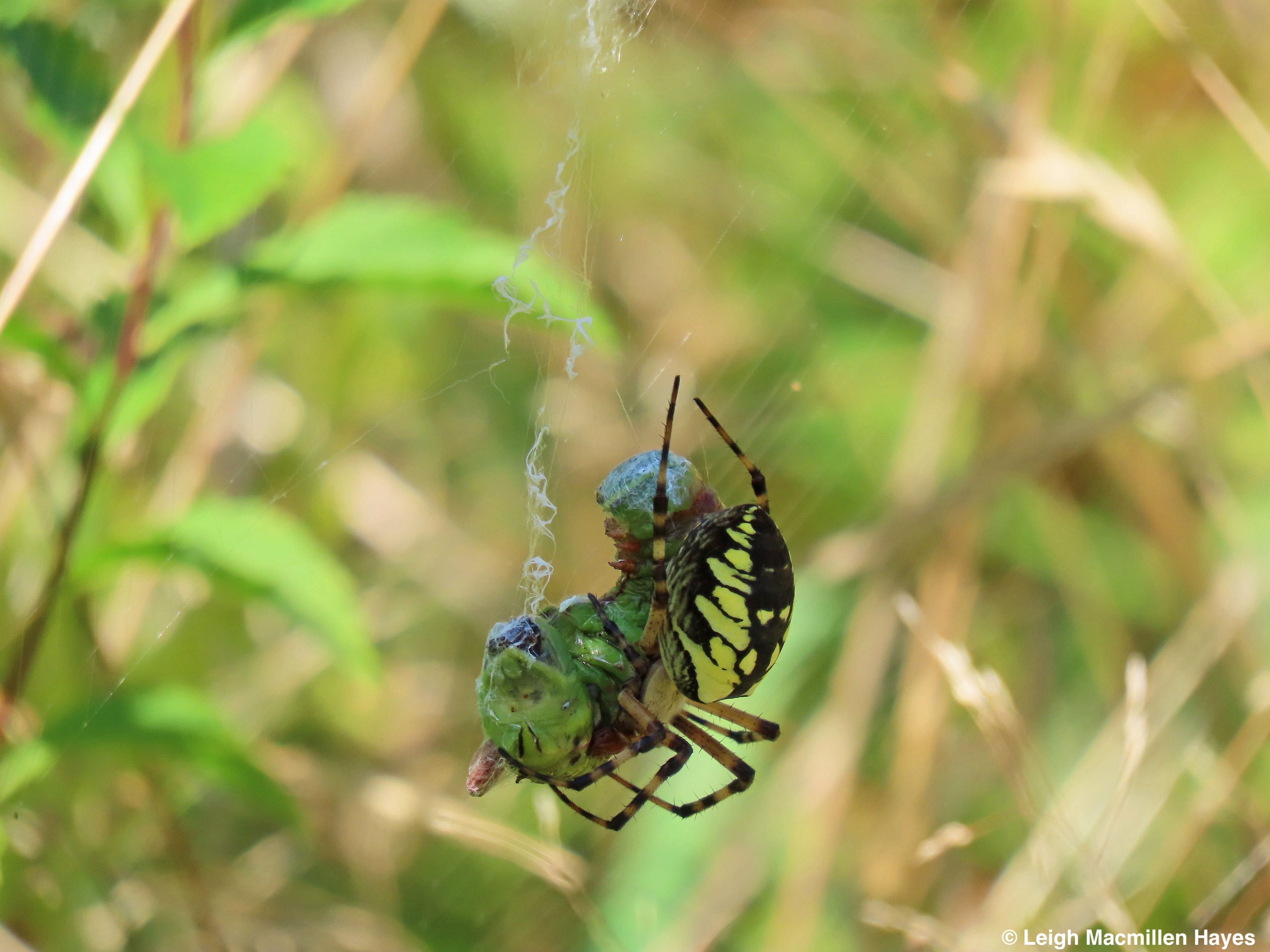
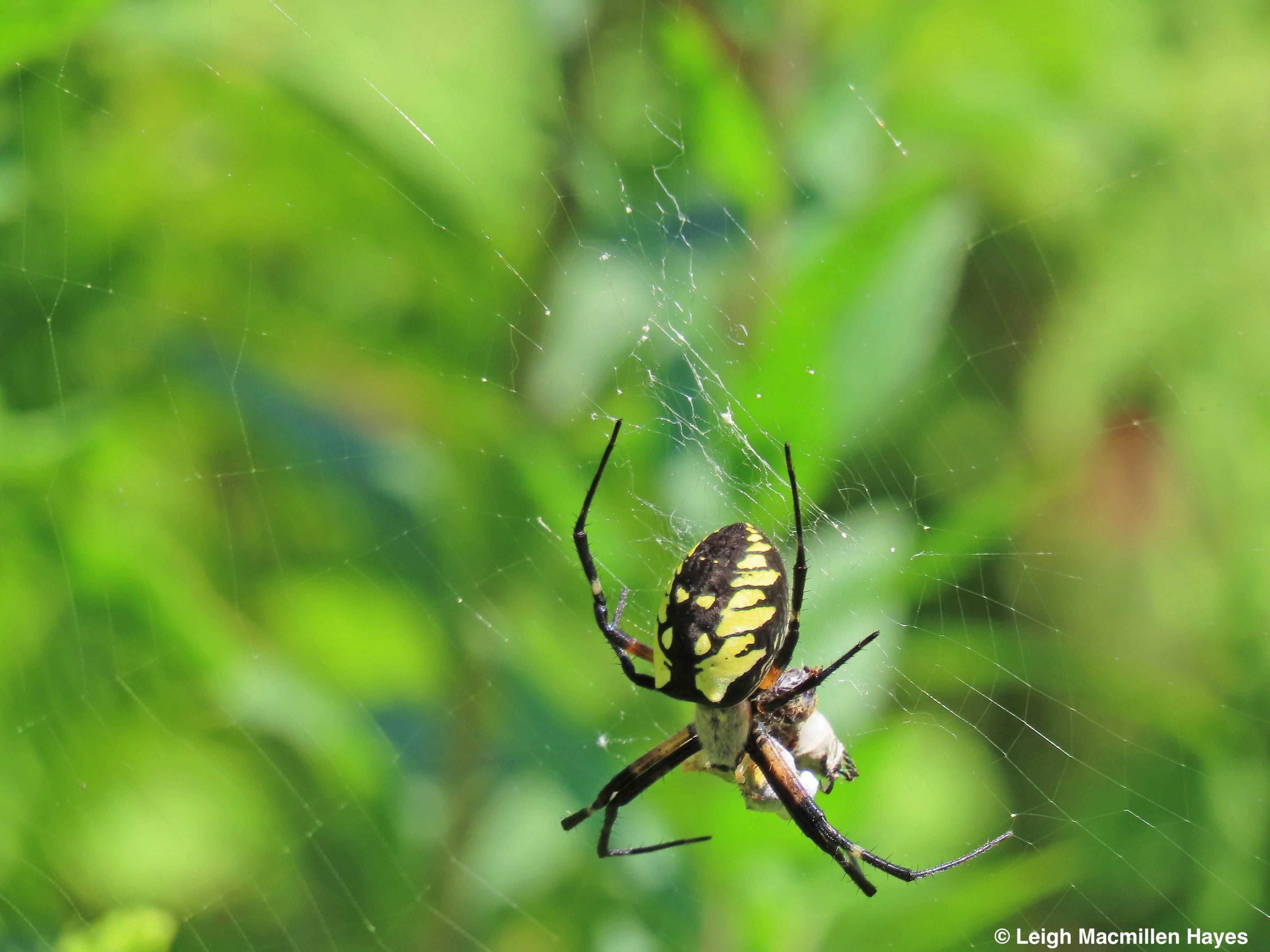
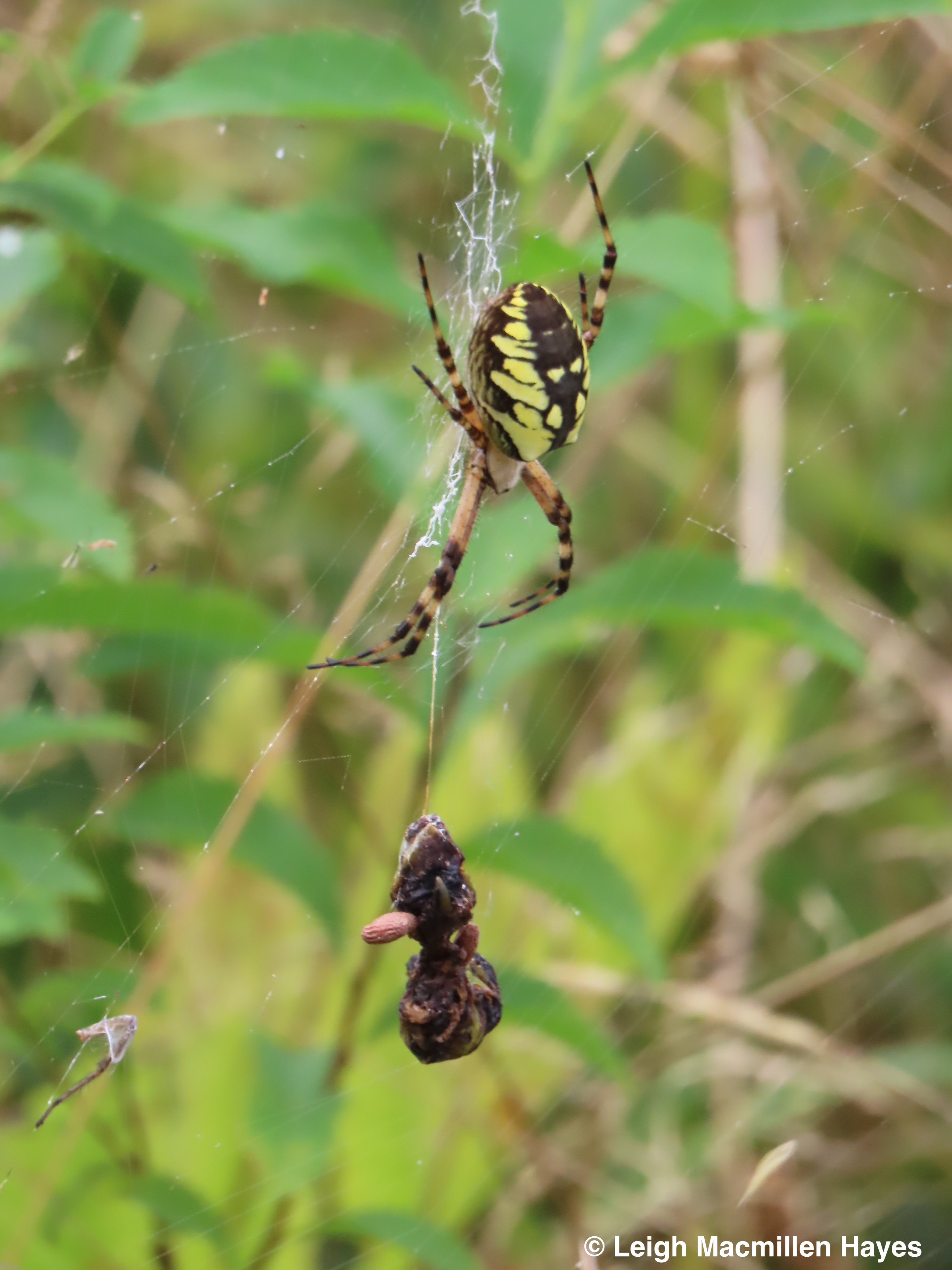
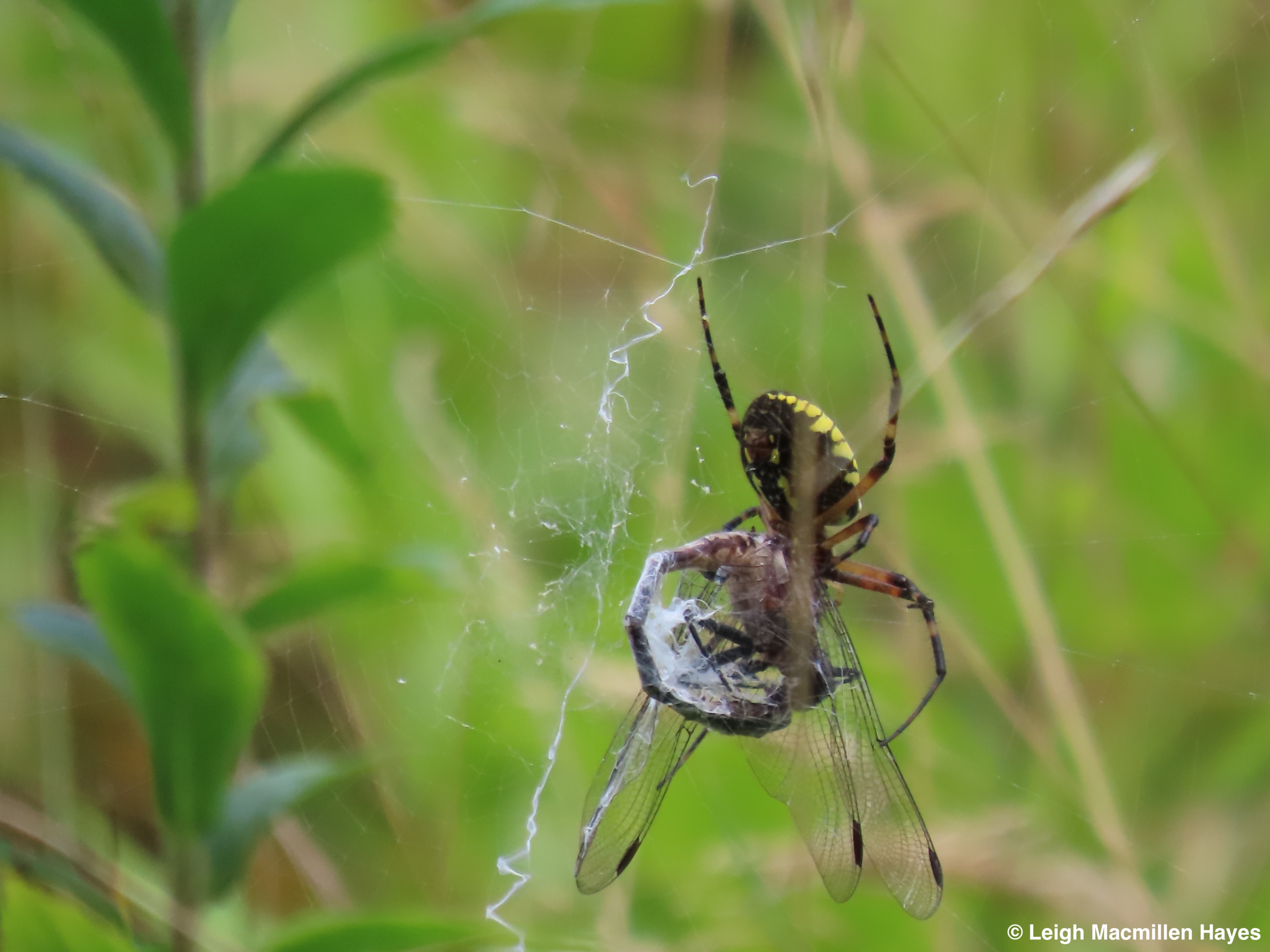
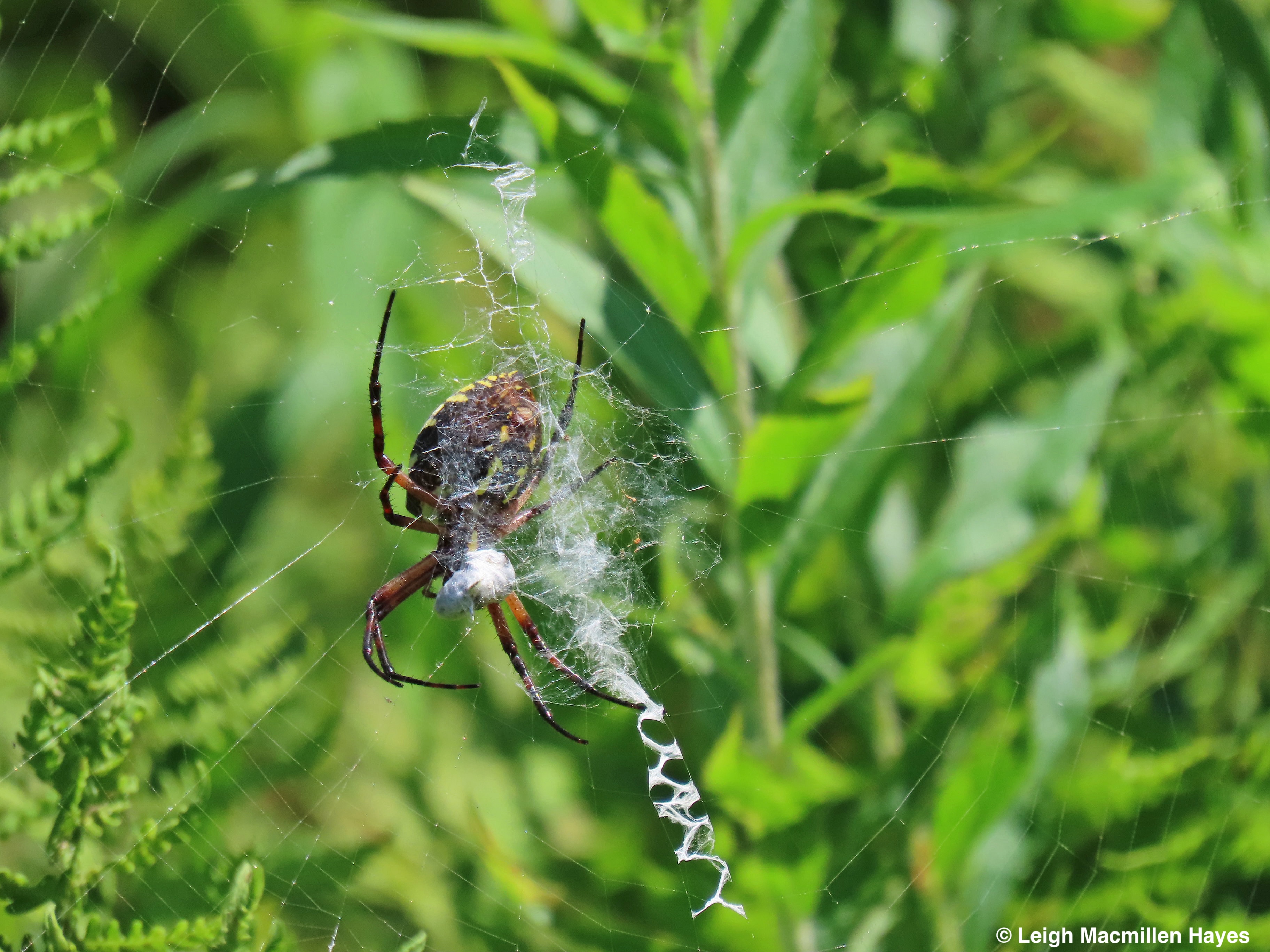
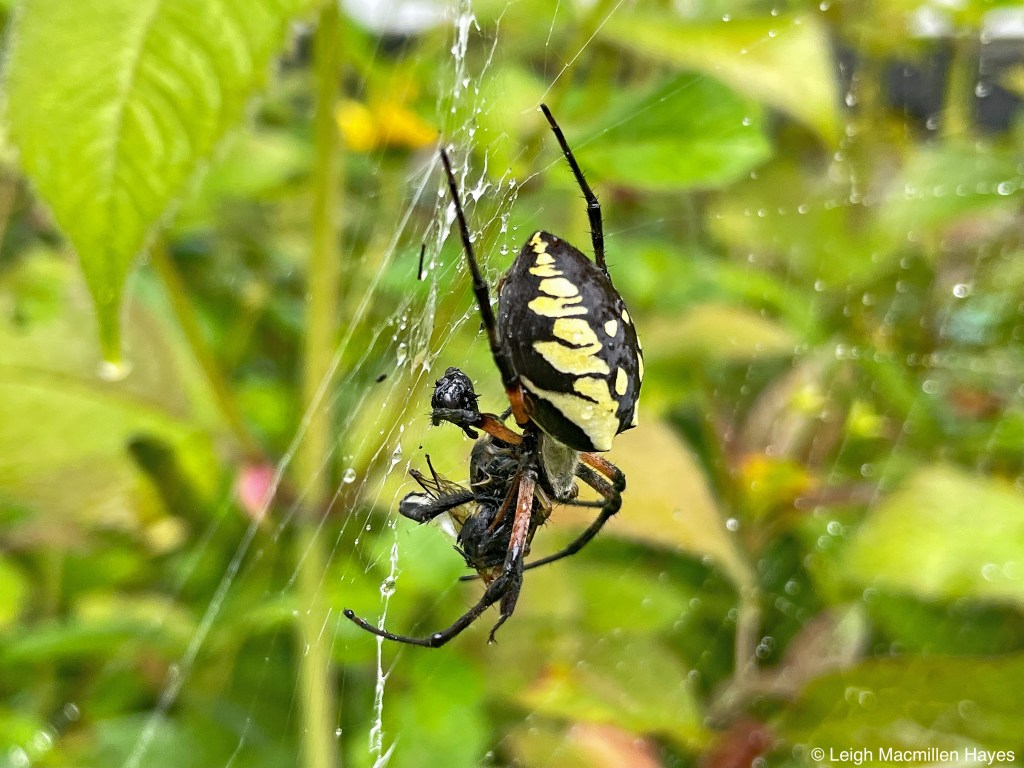
And then, because I was looking, I discovered an insect in the process of being wrapped for a meal intended for later consumption. I’ve long been fascinated by Ambush Bugs and Assasin Bugs and this, the Black and Yellow Garden Spider, Argiope aurantia. What’s not to love? She’s an orb weaver, meaning she spins a complex circular web, in this case among tall plants, that features spokes which are non-sticky that she uses to walk upon, and round wheels that are sticky to capture prey. The web is the size of a platter. A large platter. And . . . every night she consumes the entire thing and rebuilds a new one for the next day. In the process of consuming the threads, she can take advantage of any little insects like mosquitoes that get caught in the stickiness, but it’s the bigger insects that she prefers to eat.

This image has an empty alt attribute; its file name is 15-3.jpg

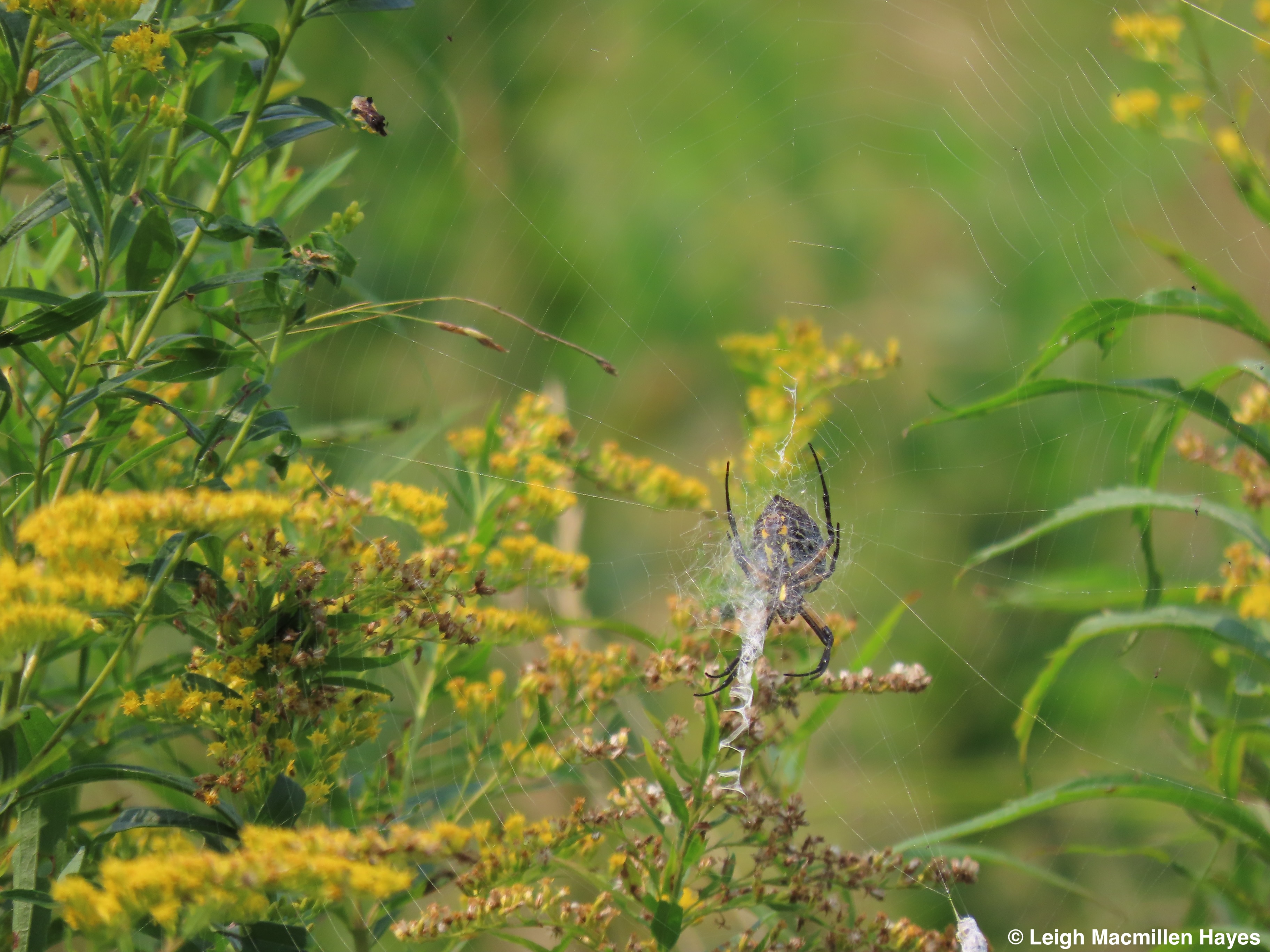
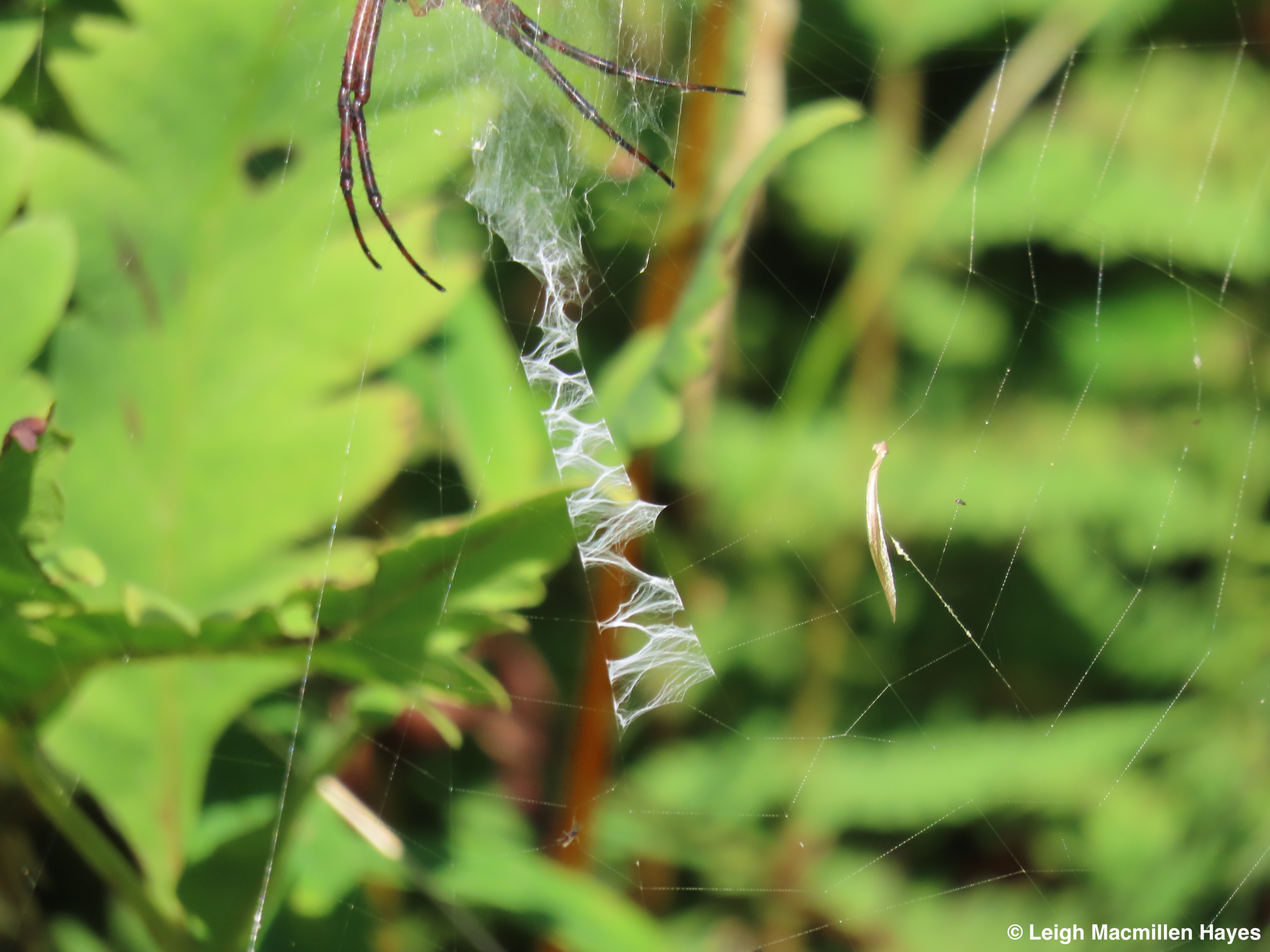
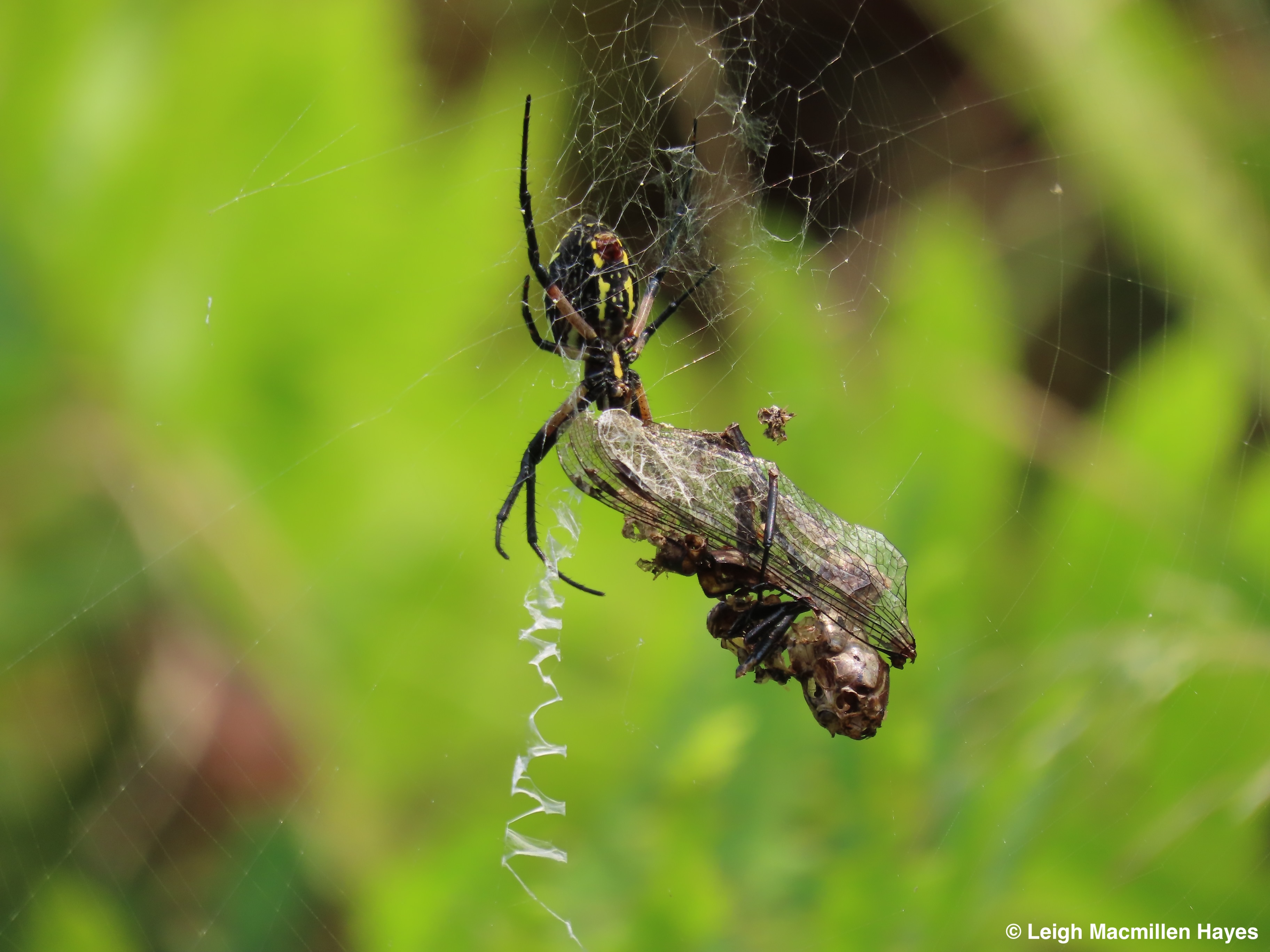
Do you see the rather conspicuous zigzaggy line down the middle of the web? That’s called the stabilimentum and may have several purposes: providing stability; attracting insects with the multiple threads like an ultraviolet runway such as the colorful lines and dots on plants; or perhaps announcing to birds that they shouldn’t fly through the web. Whatever the reason, it’s in the center of the stabilimentum that the spider hangs in suspension, waiting for the dinner bell to announce ring.

This image has an empty alt attribute; its file name is 16-1.jpg

Though she has eight eyes, her vision is poor. But . . . her hairy legs may also help in the detection that a meal has arrived, perhaps signaling sound and smell, plus she can sense the vibrations.

This image has an empty alt attribute; its file name is 18-1.jpg

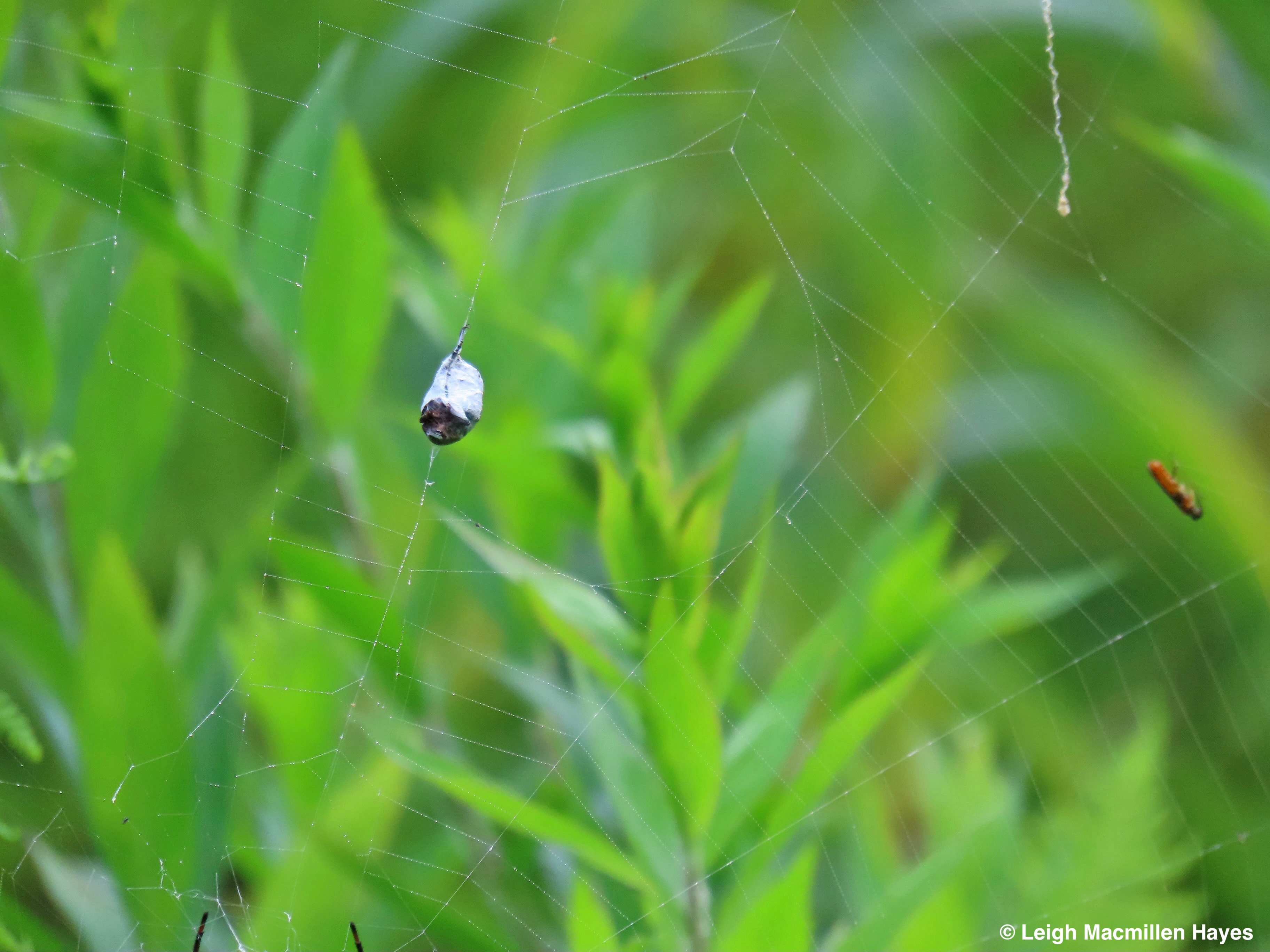
Once captured, she injects a venom (that is harmless to us bipeds) to immobilize her subject and then begins to spin a sac around it.

This image has an empty alt attribute; its file name is 23-1.jpg

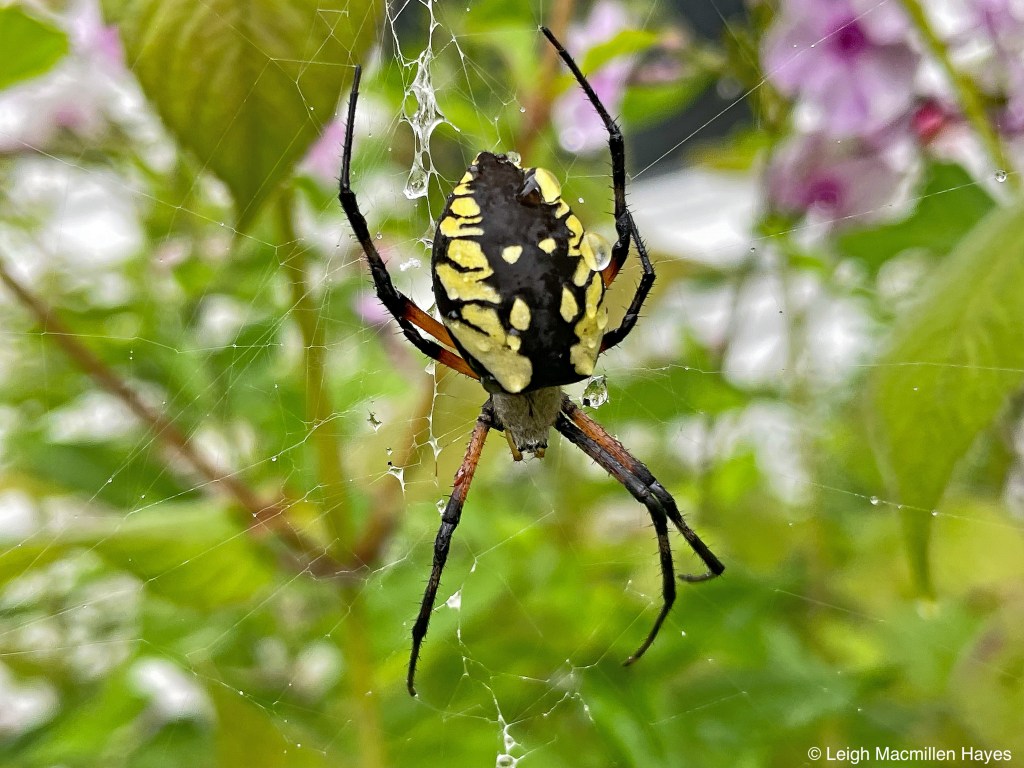
Remember, I’ve been watching her for four days, while she’s hanging upside down playing the waiting game and showing off her egg-shaped abdomen with its asymmetrical yellow markings on the carapace (much like a turtle’s shell) to her silver-haired head.

This image has an empty alt attribute; its file name is 24.jpg

Some days I felt like she might just be Charlotte, writing a message only Wilbur could interpret.

This image has an empty alt attribute; its file name is 30.jpg

And one day she surprised me by turning right-side up. It was then that I was offered a closer look at those little bumps on her head that serve as eyes. And the pedipalps, those two little hairy appendages sticking up on her head that work like sensory organs.

This image has an empty alt attribute; its file name is 27.jpg

An hour or so after finding her upright, when I checked again, I thought she’d gone missing. Instead, I discovered she’d climbed to the top of one of the plants upon which she’d spun her web.

This image has an empty alt attribute; its file name is 28.jpg

Perhaps she was surveying the area as she waved her front legs, looking about her domain.

This image has an empty alt attribute; its file name is 31.jpg

A day later, a new web, and another meal packaged, and slowly my buzzers were being consumed. But, she also likes grasshoppers and crickets and the garden is full of them.

This image has an empty alt attribute; its file name is 32.jpg

And then this morning dawned, with T.S. Henri in the offing and a few raindrops upon a broken web announcing the storm’s intended arrival. Wait. The web–it had holes but had not been entirely consumed. That wasn’t all, yesterday’s meal also hadn’t been consumed. And the spider was nowhere to be seen. I looked up and down and all around and couldn’t find her. Had she meant to save the meal, waiting for her venom to pre-digest it by liquifying the internal organs and in flew something larger than her and dinner went uneaten? Had our time together come to an end just like that?

This image has an empty alt attribute; its file name is 33.jpg

I wasn’t going to let the issue go, and so I continued to search, and guess who I found about three feet away upon a new web?

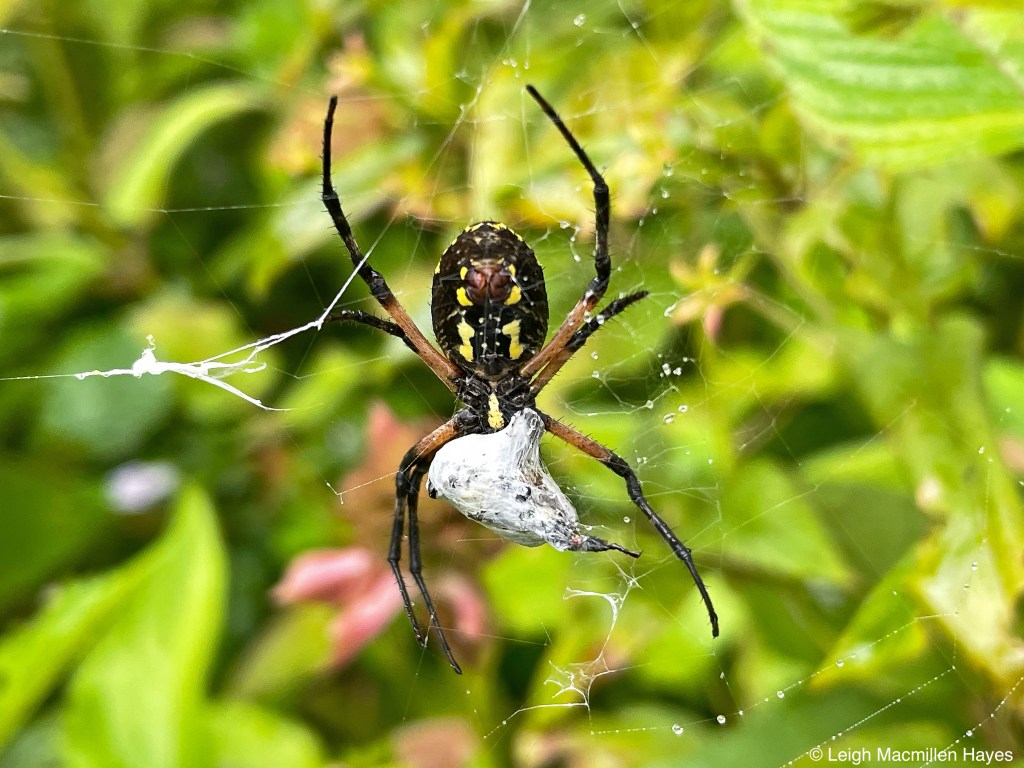
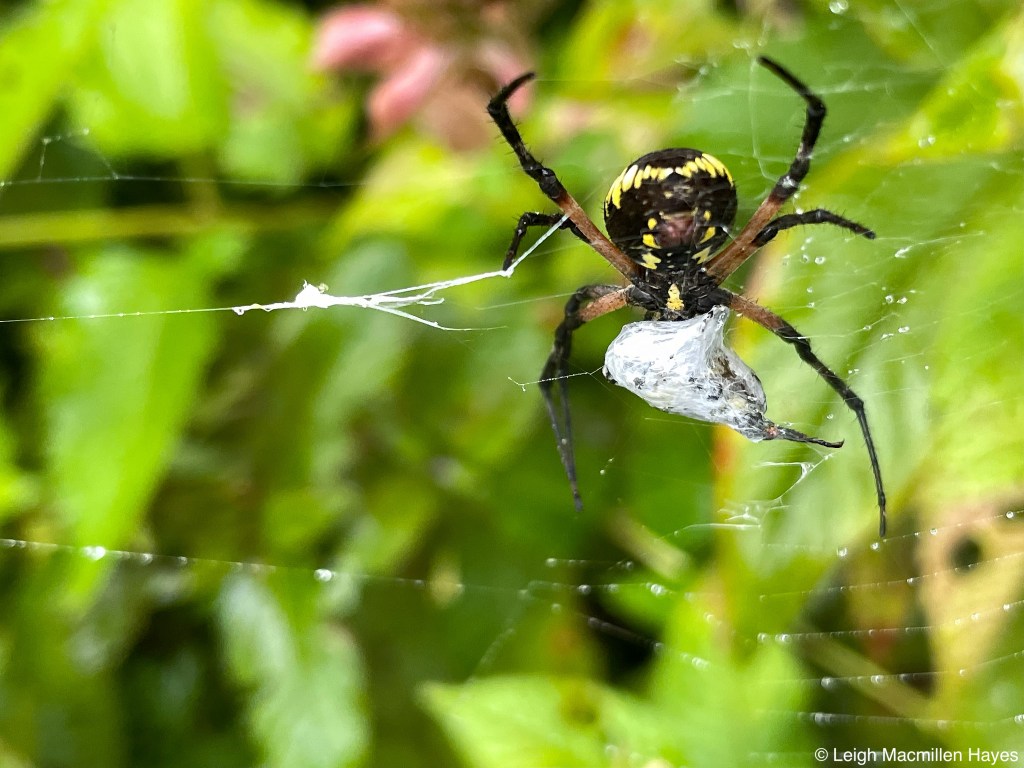
Even more exciting was the discovery that I can see her from the kitchen window AND, the view is of her underside so I can actually see her brown spinnerets at the end of her abdomen and maybe I’ll get to watch her capture a meal.

This image has an empty alt attribute; its file name is 34jpg.jpg

Well, so I thought, but two hours later, when I next looked, I realized I’d missed the action and she’d already securely wrapped her latest victim–all that was still visible was a leg.

This image has an empty alt attribute; its file name is 35.jpg

Though the prey may be one, this is NOT just another insect in the midst of my quest. Actually, it’s not an insect at all for spiders are arachnids, with eight legs versus an insect’s six. She may be scary big, as well as carnivorous, but she is beneficial to the garden as she helps control insect populations, including some pests.

And how do I know she is a she? Her male counterpart I’ve yet to meet, but he’s much smaller and all brown, unlike her beautiful coloration.

There’s more to this story I’m sure and I look forward to learning more about her as I try to interpret the messages she leaves. If you have a chance, go out and stalk your gardens and be wowed by what you find.

Aligning the Stars

Sometimes it happens. Well, more than sometimes. One steps out of a vehicle to go for a walk in the woods, and tada . . .

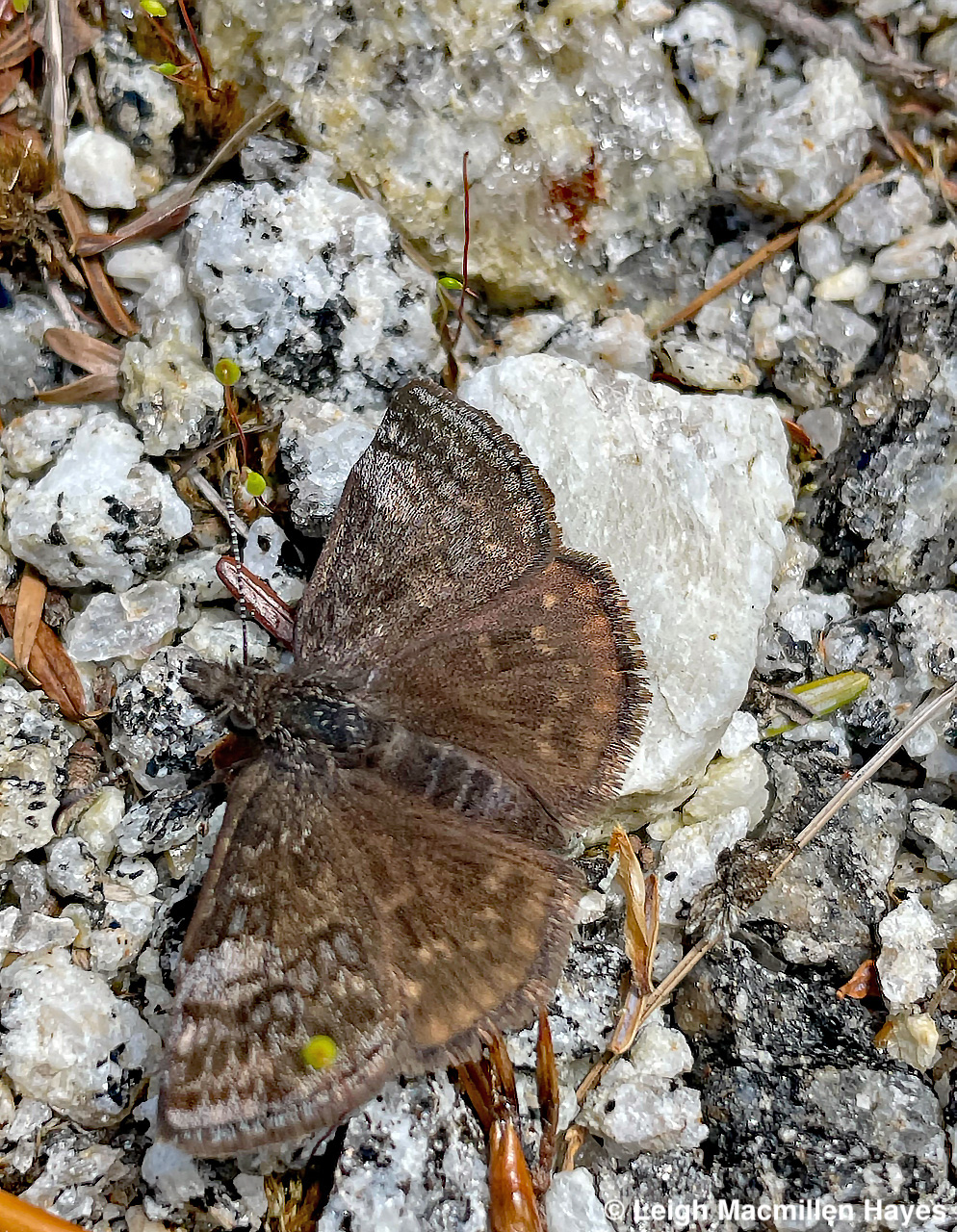
A diminutive butterfly rapidly and erratically skips from stone to stone in the parking lot, before it final settles down for a few moments. Meet a dustywing, a member of the spread-wing skippers who hold forewings and hindwings open when landed.

And then upon a pine sapling, another tiny offering, this one of the click beetles.

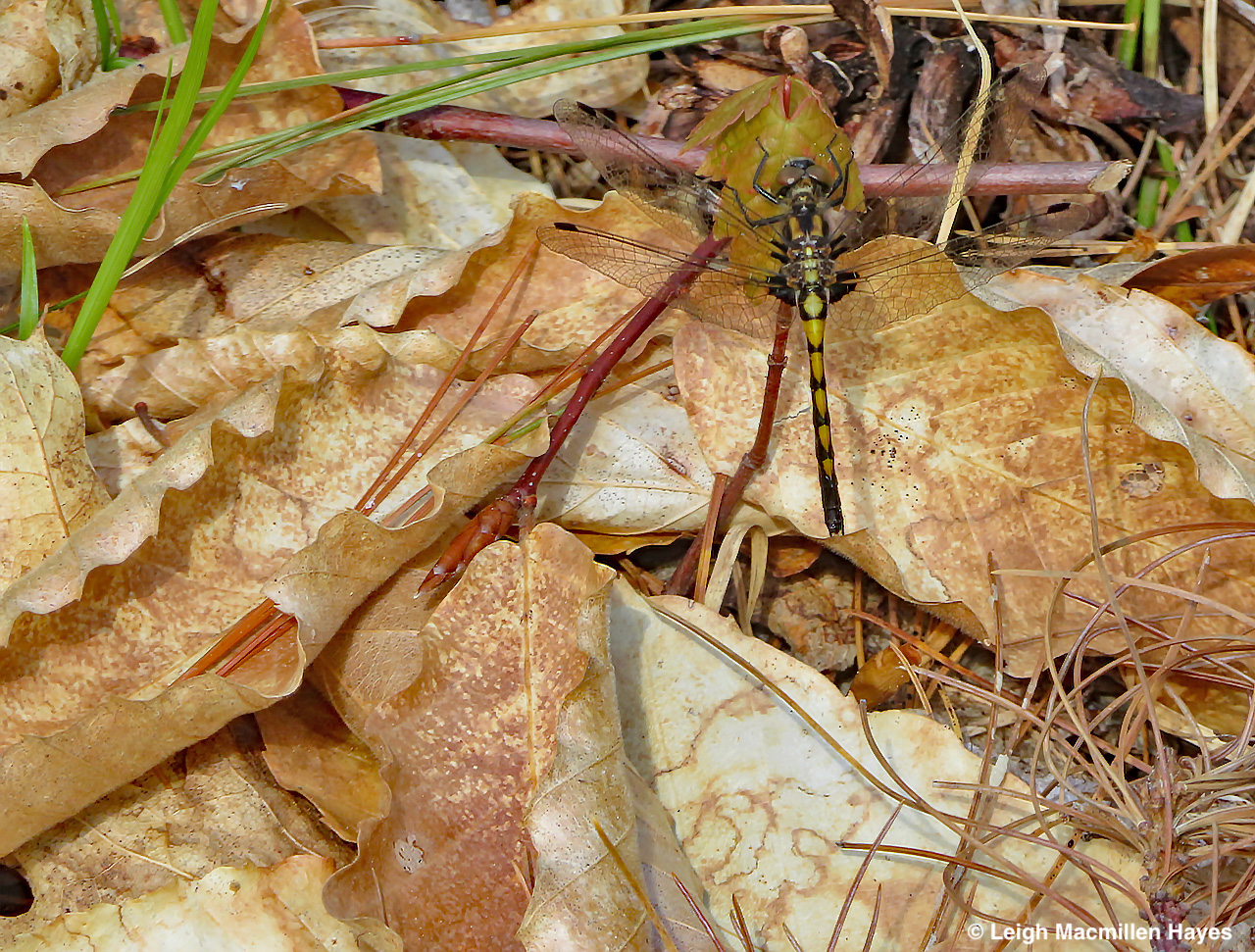
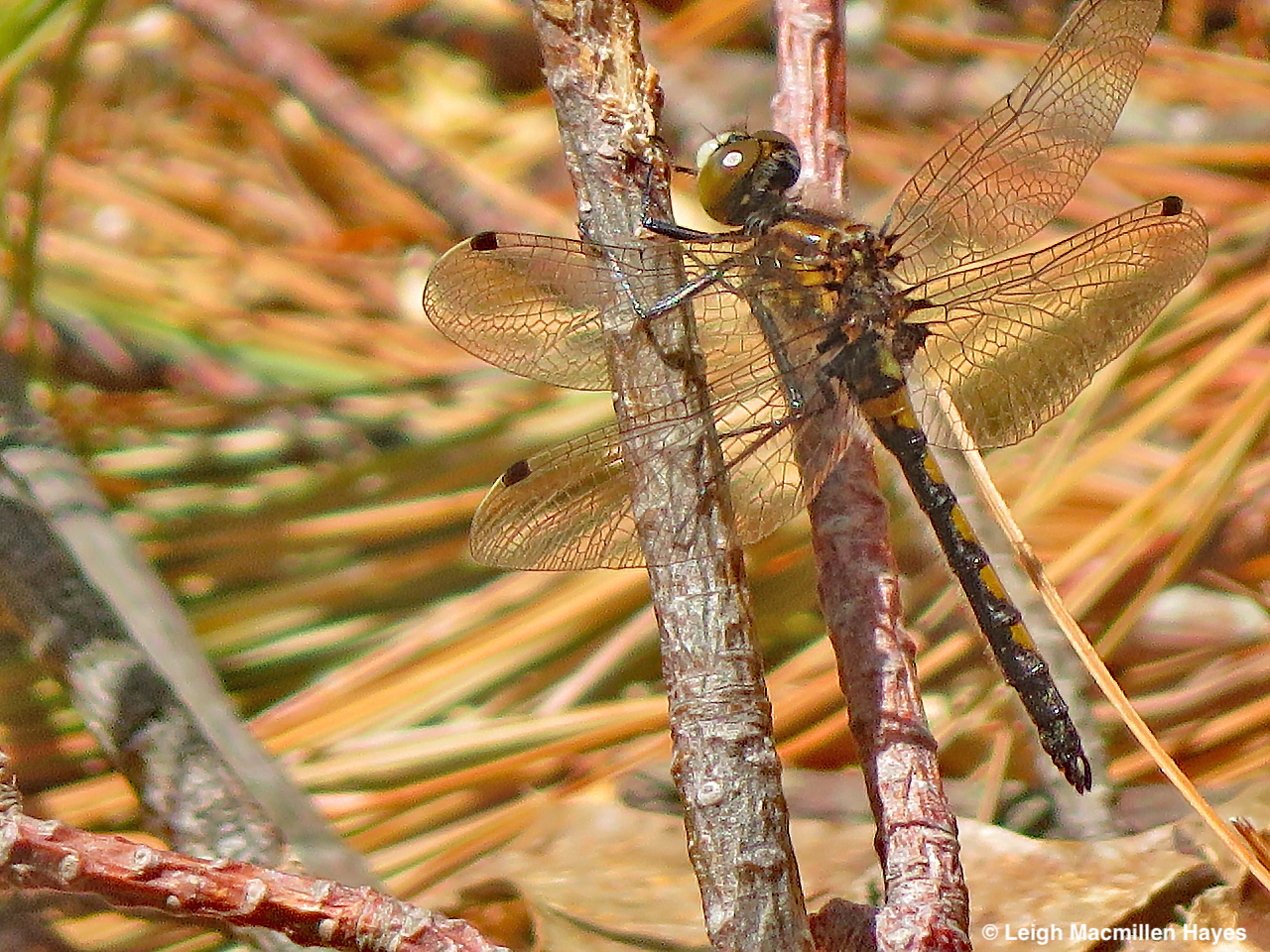
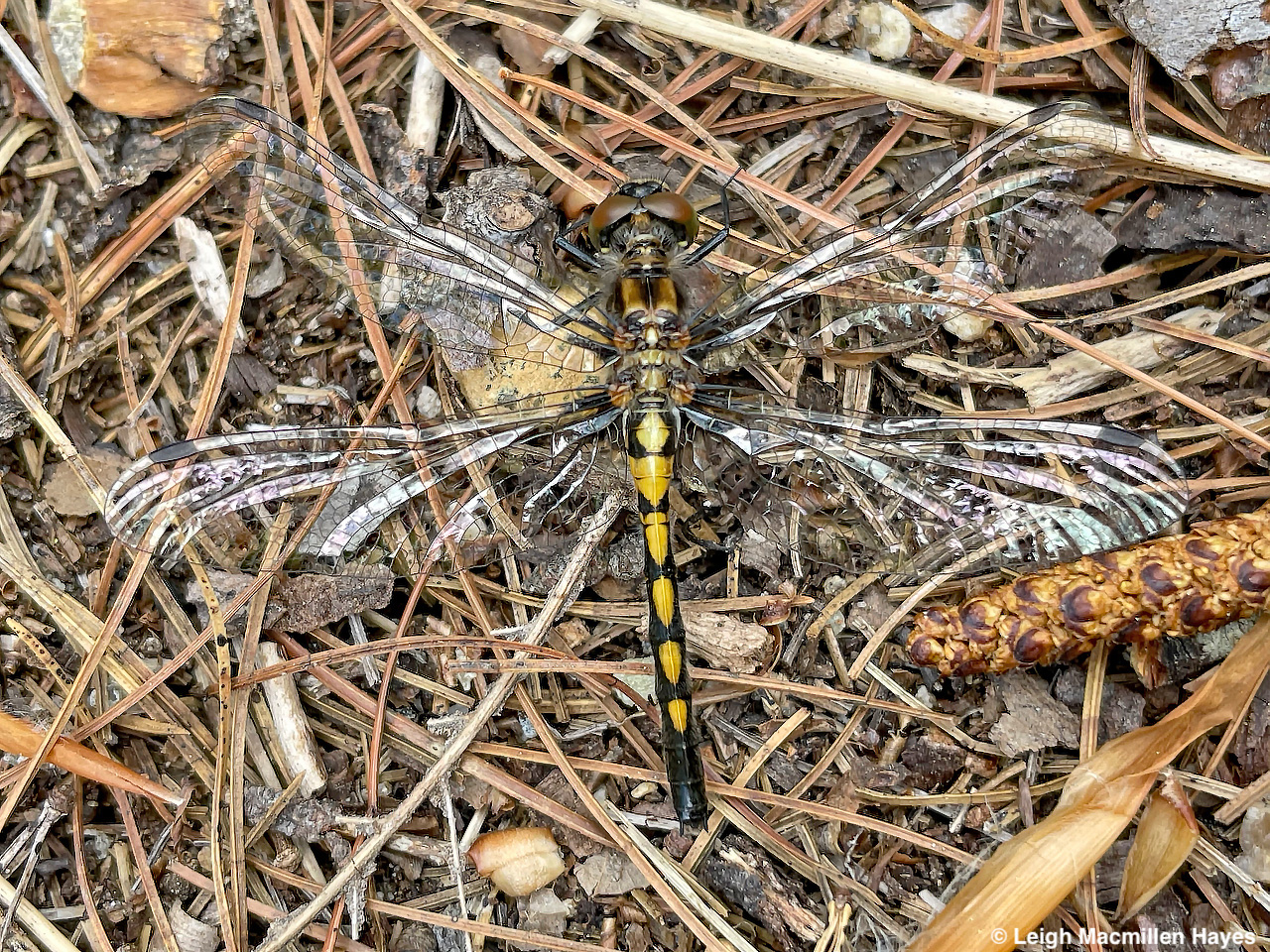
The day already feels complete when another winged insect suddenly flies up from where we are about to step and then lands a few feet ahead. We have to have look closely to spy it, but finally do–dragonfly that’s only just over an inch long. The sighting is special because just a couple of hours prior I’d taught a senior college course about Mayflies, Cicadas, and Dragonflies. But the test is on us. Who is this? In some ways it resembls a Calico Pennant Skimmer–the female of the pennant being black with yellow markings. But the shape of the pennant’s yellow on the abdomen is heart-shaped and these are more variable.

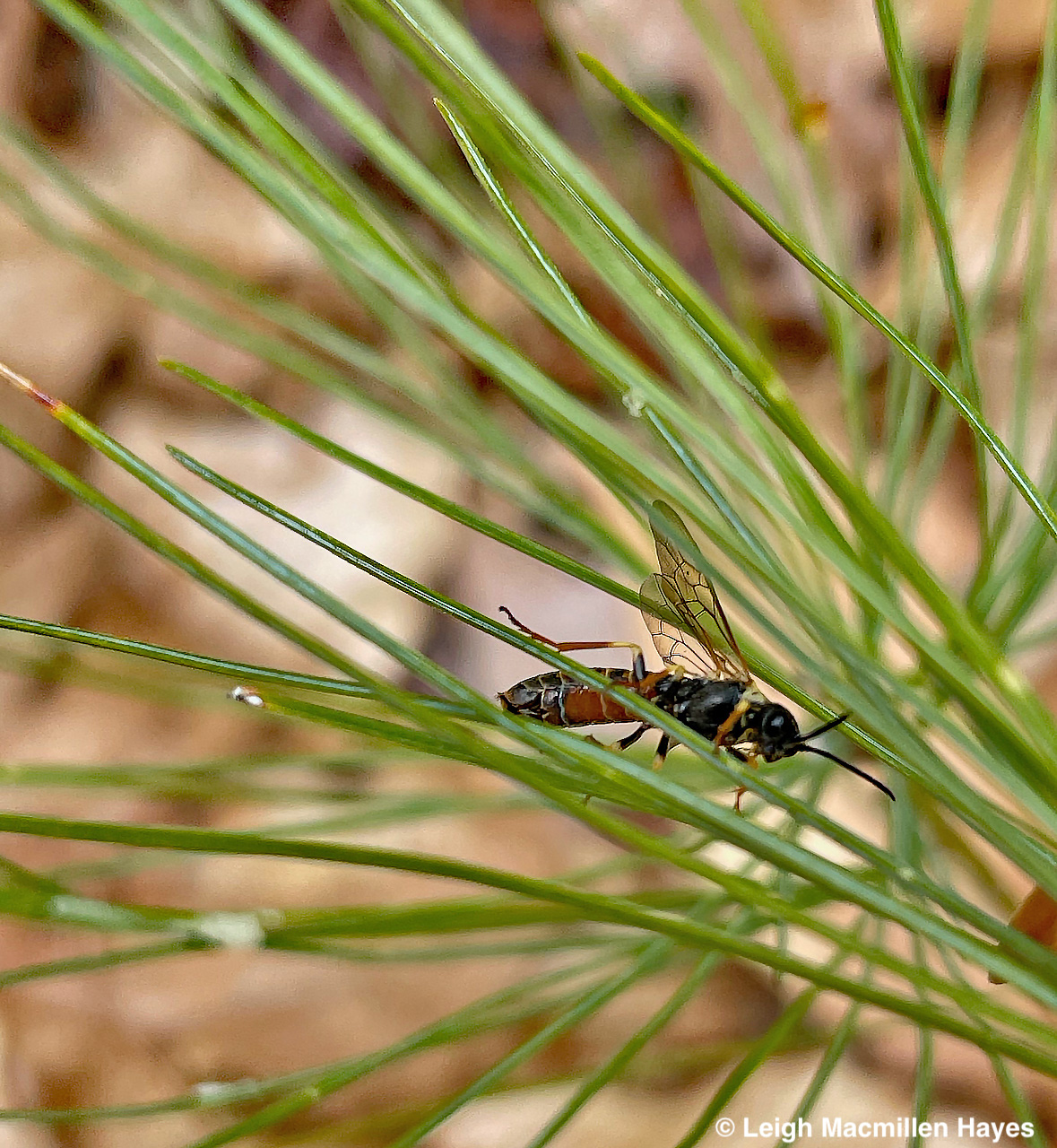
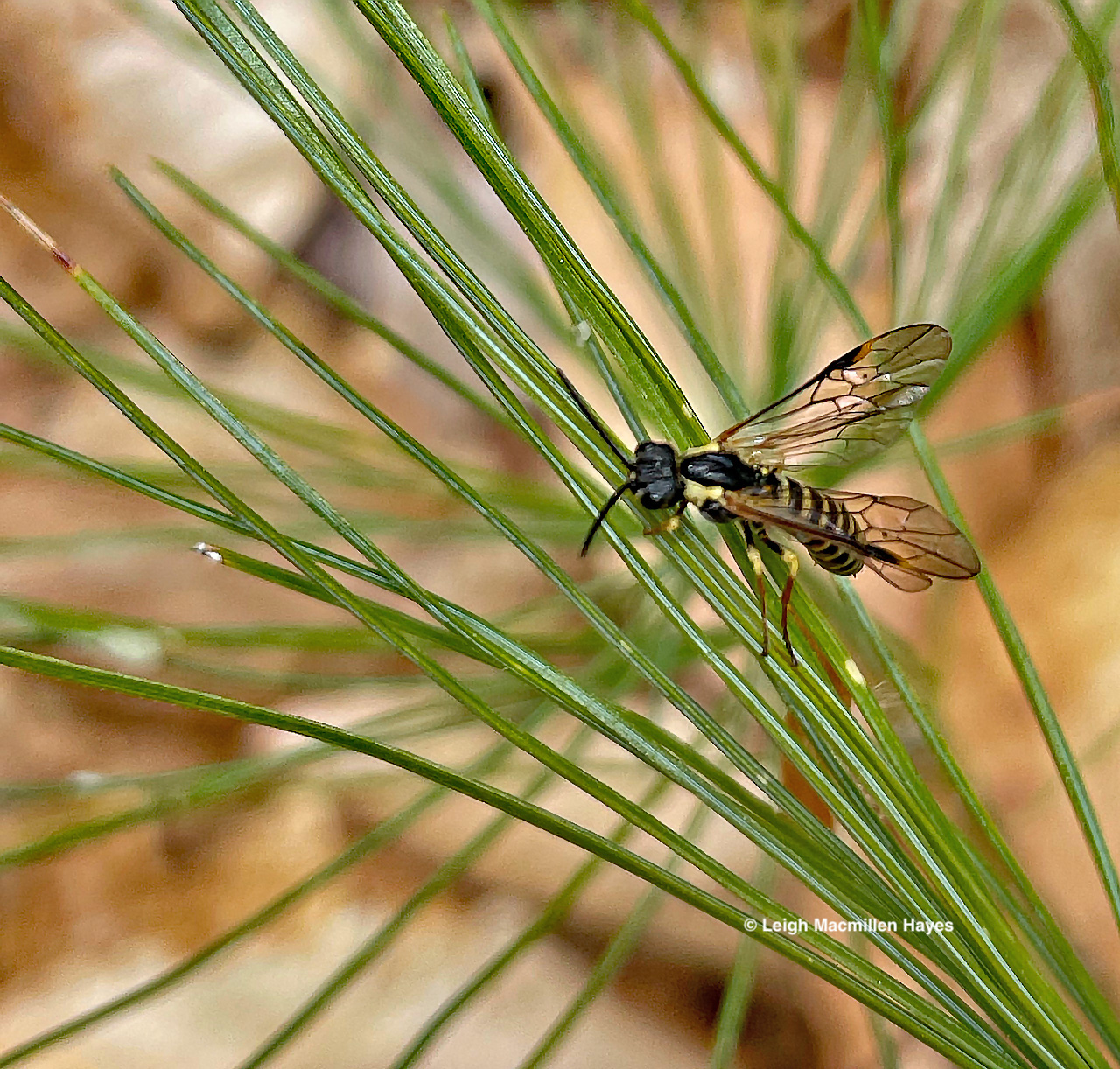
We take a few more steps when another wee one garners attention and by its membranous wings and abdomen broadly joined to the body, plus it’s chosen plant, it must be a member of the sawfly family.

A few more steps and we meet it’s cousin, another sawfly on another pine.

As we continue, so do our encounters with our little dragonfly friend and we begin to realize there are many and they are all the same species. But the question remains. What species is it? It can’t be the Calico Pennant because all four of her wings have dark patches at the tips and her hindwings are decorated with blotches of yellow and black at the base that remind me of stained glass. This dragonfly only has small dark patches, at the base, the hindwing’s more triangular shaped and larger than the forewing. And those hindwing patches feature light venation, not colored like a Calico’s.

At last, though it’s not all that far, but takes us at least an hour and a half, maybe two hours, we reach a brook where an orbweaver does just that–weaves.

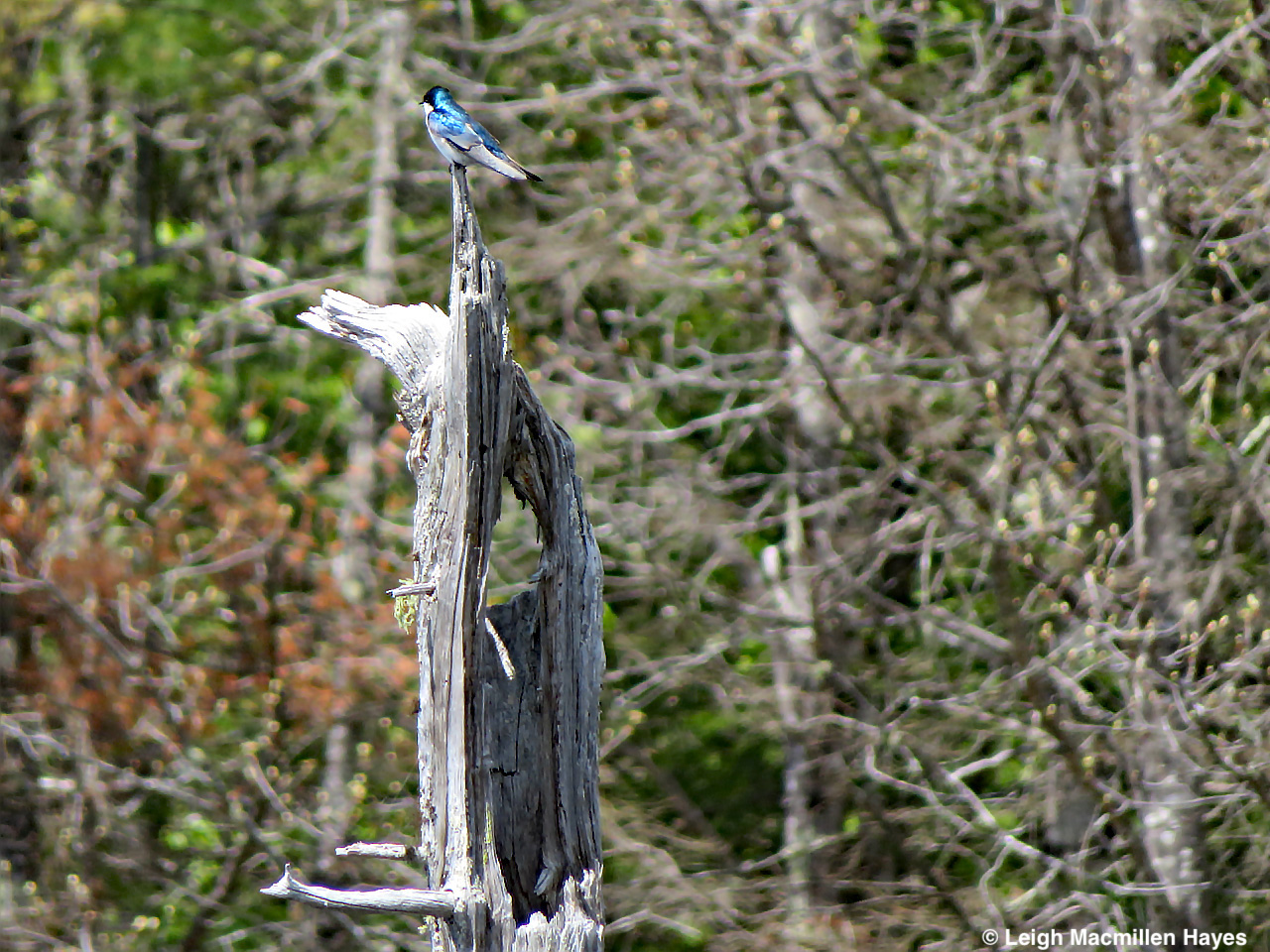
Farther out in the water, a Tree Swallow poses at the top of snag, intent upon its surroundings. We pose as well, though our intention is upon all the vegetation for we seek the exuviae left behind by the dragonflies when they transformed from their aquatic life to terrestrial. We find none, and determine that vegetation in the brook must have served as their life-changing substrate.

Finally leaving the water behind, we once again meet our dragonfly friends. What species is it? Well, the face adds another clue for where the face of a female Calico Pennant is yellow like the hearts along her abdomen, this dragonfly has a white face.

So be it. Continuing along, Striped Maple flowers dangling like a lantern with a string of shades, light the path in a place or two.

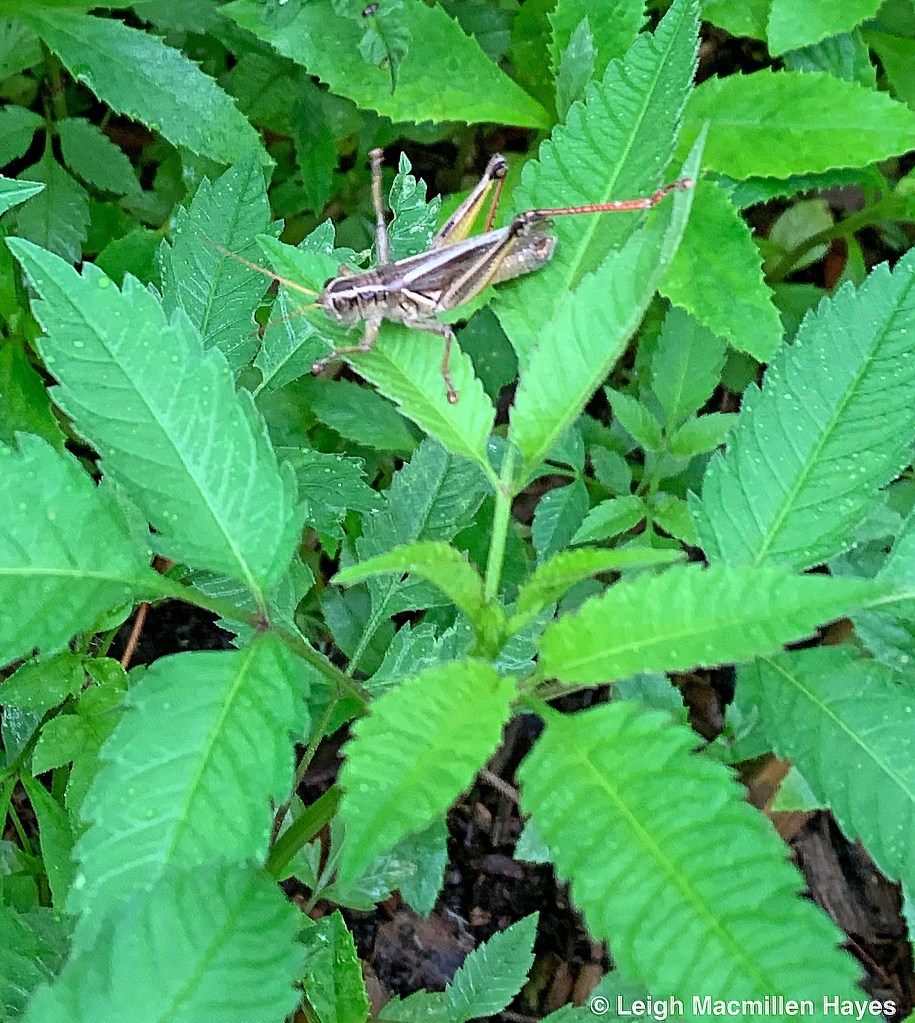
And then as we pause upon a bench for a moment, our eyes are drawn to movement upon the ground and we spy a grasshopper who is so well camouflaged that we’re grateful when it finally climbs onto a fallen branch and poses.

At last it is time to walk back to our parked vehicles, but again, along the way we are greeted over and over again by our new friend. Occasionally, we can see the sheen of the wings and realize that the molt had occurred within the last few hours as they hadn’t completely dried.

It’s not until we get home, however, and respectively pour through ID books and bounce ideas off of each other, that we realize the name of our new friend. Meet Hudsonian Whiteface, a member of the Skimmer family. For a bit, we consider Dot-tailed Whitface, but Hudson’s yellow spot on segment seven (dragonfly abdomens consist of ten segments) is triangular in shape, whereas Dottie’s is more like a square.

So many stars align, and except for not finding the dragonfly exuviae, we will always celebrate this day (actually yesterday, May 13) as First Dragonfly of 2021 and give thanks that the real star was a new learning for us.

The Invitation Stands

It took me by surprise, this change of seasons.

Despite all the clues from fading otter prints . . .

and not so deep moose tracks . . .

to reverse tracks raised above the snow cover as a result of a frozen crust followed by wind and warmer temperatures.

But still, somehow I was fooled into thinking winter would hold its grasp for a wee bit longer because I don’t like to let it go. The faces hiding in the ice knew otherwise.

As did the constitution of pond ice that despite recent brisk days and nights began to react to the sun’s rays and display the tea-stained color of organic matter decomposing in the water below.

Even Winter Dark Fireflies, who don’t carry lanterns like their summer cousins, and aren’t even flies as their name suggests (they are beetles), knew what was happening before I did for in their adult form they’d been tucked under bark in recent months, but in a flash are now visible on many a tree trunk as they prepare to mate in a few weeks.

The same is true of the Winter Stoneflies who only recently started crawling out of the water. and drumming as an announcement that they too are ready to let the mating season begin.

The birch trees also knew before I did and made sure to let last year’s catkins release their scaled fleur de lis, thus scattering the seeds that look like tiny winged insects upon the snow where they’ll join the melt down and eventually find a moist spot upon which to germinate.

And so it is that spring snuck in a few days after St. Patrick’s Day as it always does, but still surprising me and now I join others and anticipate the changes to come.

But . . . there’s something different about this spring. Oh, I’ll still stalk vernal pools until they dry up.

I’ll marvel at each and every tiny bud preparing to bloom like those of Trailing Arbutus.

I’ll spy on spiders and insects for hours on end.

I’ll continue to look for fine specimens of scat, including otter filled with shiny, mica-like fish scales . . .

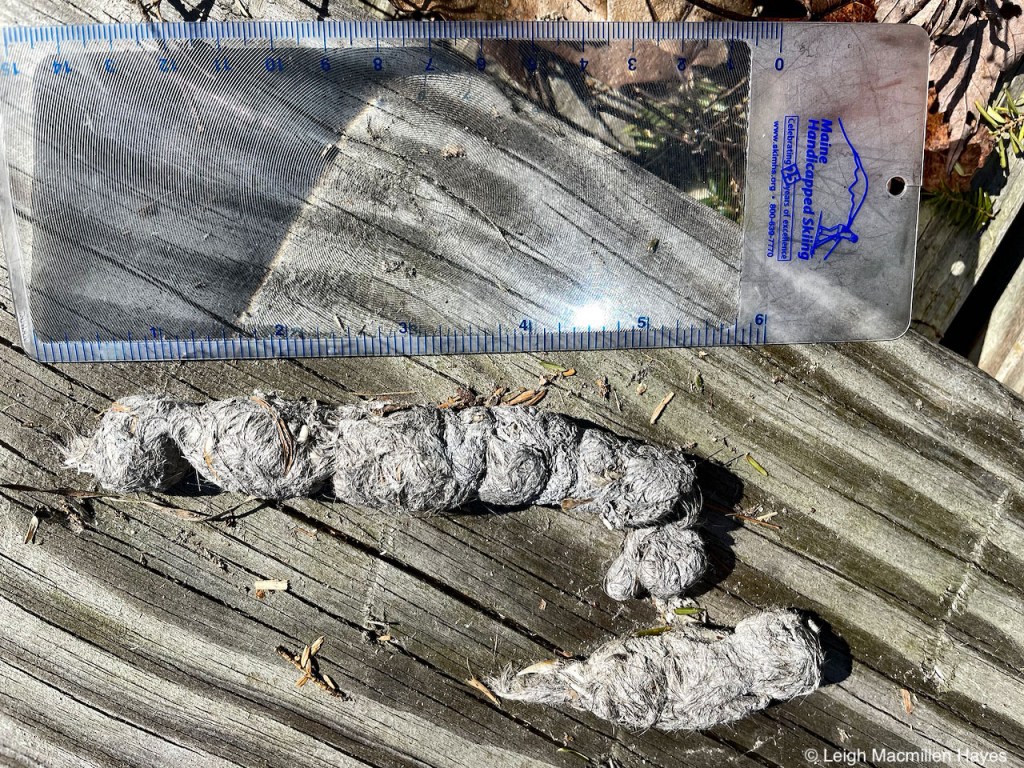
and coyote that at first glance I might think is bobcat, but the tapered ends offer one hint of its owner . . .

and the sight of bones and toenails tucked within remind me that bobcats are true carnivores who grind the contents of a meal so no bones are typically visible in their deposits, while such do show due to the omnivore appetite of a candid. I will be sure to question the meal based on the color of the fur as well as the contents.

But . . . this spring will be different. Yes, such was the same a year ago when we all moved into our bubbles. Now, though, there’s a glimpse of hope on the horizon and with that comes an assimilation to being with others and I can’t help but wonder, how will I react? I’ve become so accustomed to this forced insulation, and I have to admit that there are parts of it that haven’t bothered me, perhaps because I don’t mind being in my own space.

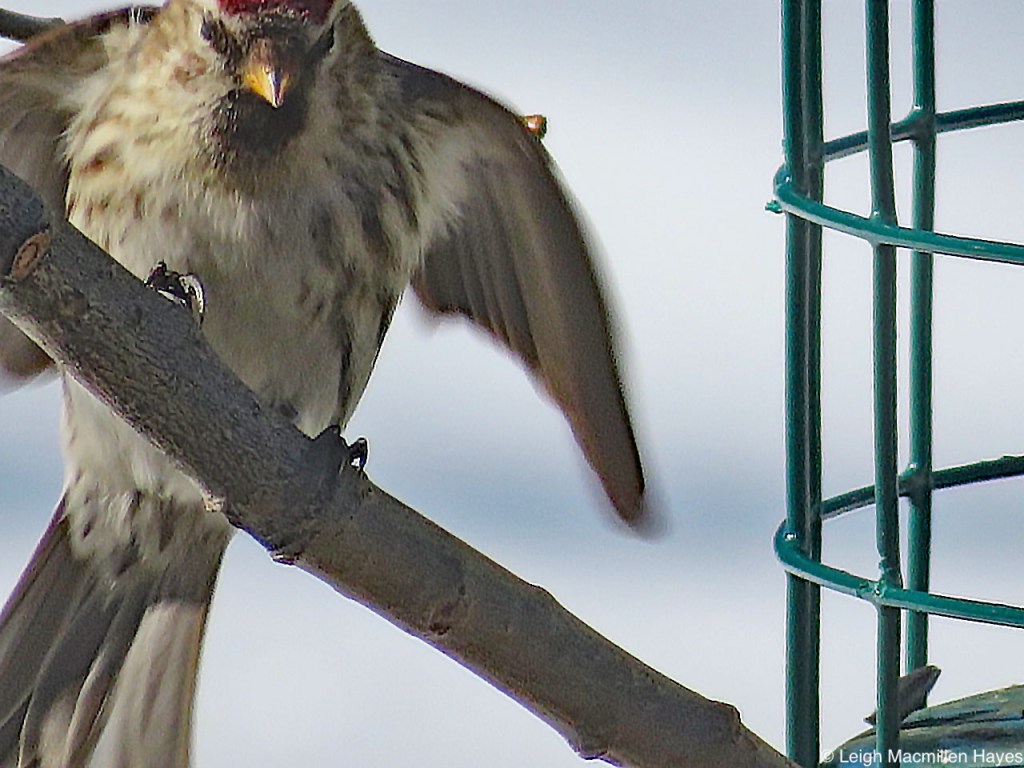
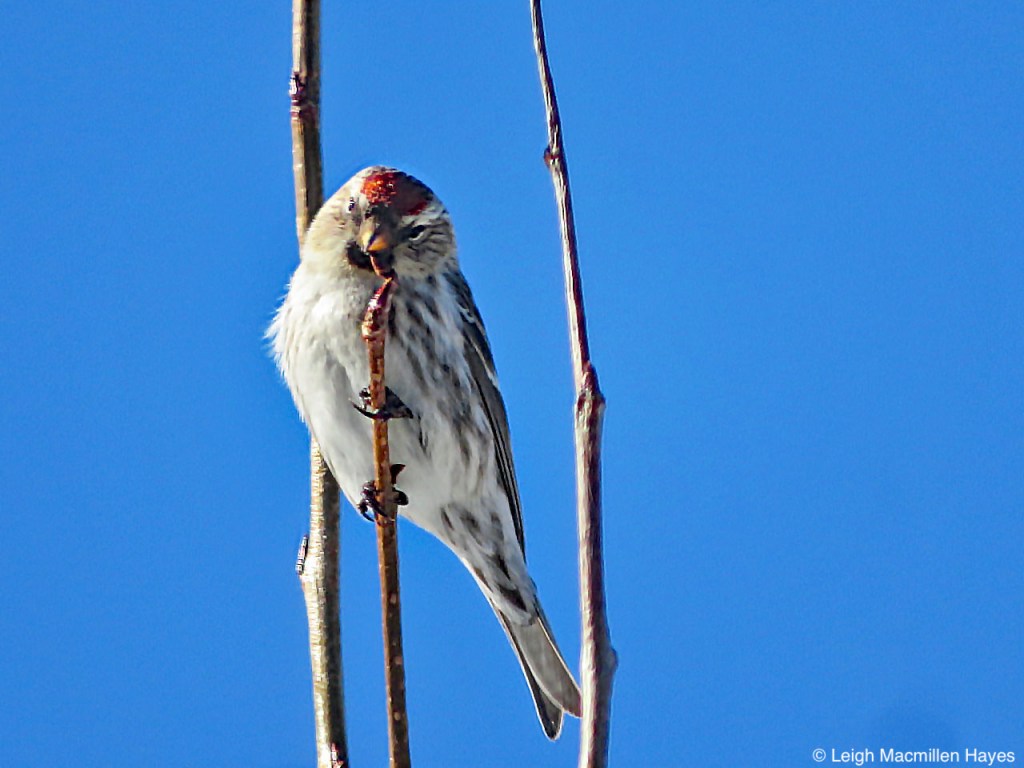
The question has been on my mind a lot lately and the answer flew in this morning as I listened in on a ZOOM church service. Just as it was to begin a small flock of Common Redpolls arrived to check out our birdfeeders.

“Invite in” were the words I heard another utter on the computer screen.

Indeed. Each day this past week, the variety of birds at the feeders grows, some species arriving at their breeding grounds, while others like the Redpolls pause before passing through. For the most part, our feathered friends accept the presence of others. An over-the-shoulder look being what it is, they remind me that I must behave like them and be open to opportunities.

As the snow melts, I realize that I must share space with all who wander here . . .

including the deer who tried to walk the labyrinth path.

The Invitation Stands. Spring is indeed here and I invite you to join me for a wander when you are able so we can wonder about nature’s communities together. I look forward to welcoming you back with a smile . . . though please don’t expect a hug.

Happy 6th Birthday, wondermyway

It’s hard to believe that six years ago I gave birth to wondermyway as a means to record the natural world and all I met along the way.

There’s no need in reminding everyone that since last February it has been quite a year, but I have to say that I’m especially grateful to live where I do, in a place where I CAN wander and wonder on a regular basis.

As I look back through posts of these expeditions, I realize how often nature presents itself in such a way that moments of awe make everything else going on in the world seem so foreign. If only everyone could whisper to a dragonfly upon his or her hand; watch a cicada emerge from its larval form; and even appreciate a snake or two or three.

Join me for a look back at some of my favorite natural encounters of the past year. If you want to remember a particular adventure, click the titled link below each photo.

Transitioning With My Neighbors:

From sun to rain to sleet and even snow, it’s been a weekend of weather events. And like so many across the globe, I’m spending lots of time outdoors, in the midst of warm rays and raw mists.

I’m fortunate in that I live in a spot where the great beyond is just that–great . . . and beyond most people’s reach. By the same token, it’s the most crowded place on Earth right now.

We’re all in transition, my neighbors and me. What the future holds, we know not. The best we can do is hope we come out on the other side–changed by the experience, of course.

Under the Bubbles

Wander outdoors if you can and let the anomalies pull you into their realm. I promise, your eyes and your mind will be opened to so many wonders that you’ll resist the urge to move along for so enamored will you be by your finds. Slow down and look and be wowed.

In the end, may it not be an end. May it be a beginning. May you live under the bubbles and give thanks that your bubble is attached to so many others as you share a brain.

Dragonfly Whisperer Whispers

We had no intention of eating lunch in this spot today, but while looking for a mountain to climb, we kept encountering full parking lots and so our backroad meander put us beside a bog at lunch time and voilà, we managed to walk all of less than two tenths of a mile. Total.

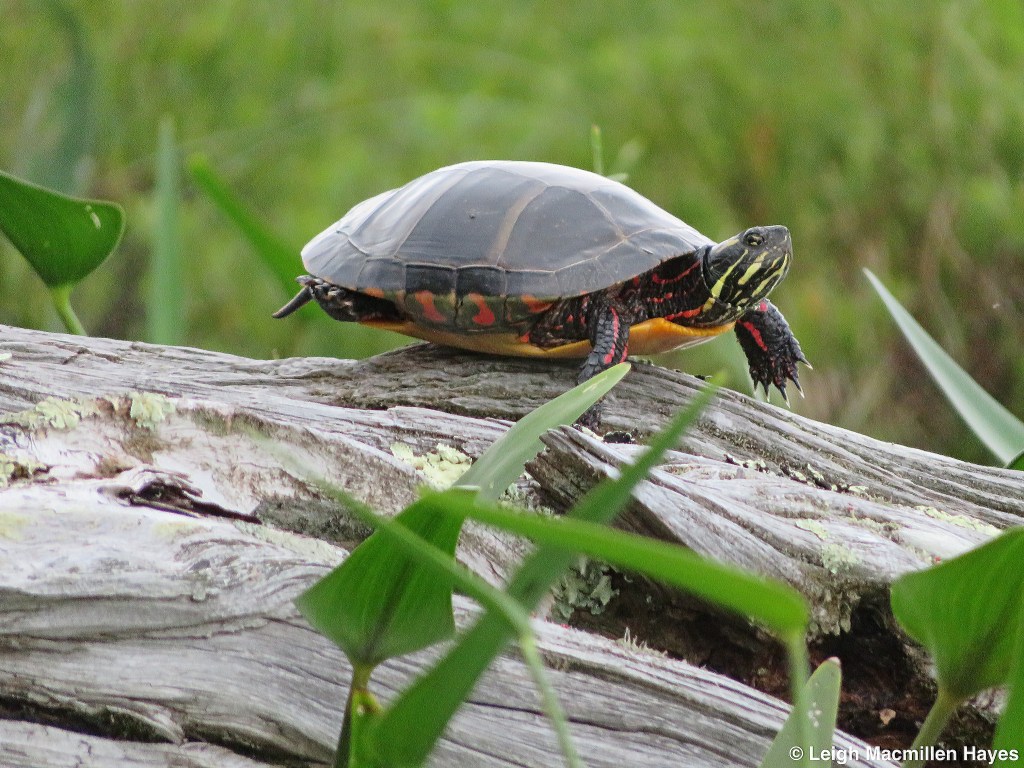
But in that short distance, our eyes feasted. First it was all the Painted Turtles basking in the sun. And birds. And dragonflies.

I just had to find out. Would he or wouldn’t he? He would and did. Yes, I quietly placed my finger on the leaf and he climbed aboard, then struck a rather relaxed pose. The Dragonfly Whisperer whispers once more.

Marvels of the Meadow

“My lupine meadow is in full glory!” a friend wrote in an e-mail. And she encouraged visitations. So . . . I went. Actually, we went, for I invited another friend to join me.

Fortunately, I guess, though unfortunately on some levels, we pulled ourselves away by mid-afternoon. But our bug eyes were wide open. In the end, we offered up thanks to our hosts, Linda and Heinrich, for inviting us to enjoy the full glory of their lupines and all the marvels of the meadow.

Celebrating Cemetery Cicadas

Beings who once walked the Earth
support new life as summer's serenade
begins to take shape 
upon stones that memorialize the past...

On this summer day, hollow cast(ket)s left behind
provide a memory of vulnerable forms.
From soft pastel bodies to wide-faced creatures with bulging eyes,
I get to celebrate cemetery cicadas. 

Frog Alley

I’m pretty sure I said to the friend whom I met on the dirt road that I never see frogs there except for the painted boulder that has faded with age and I no longer even think to honor with a photograph.

But still, she reminded me, “I’m sure we’ll see something interesting.”

No way.

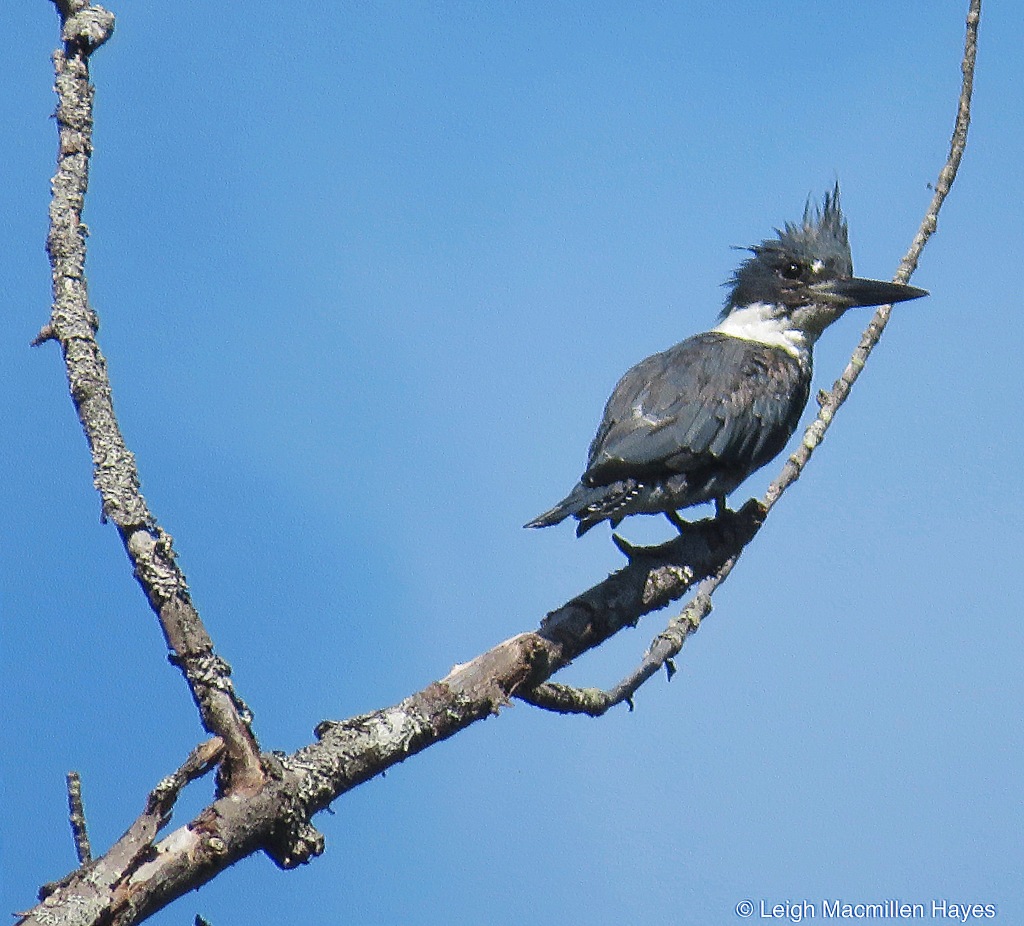
After walking one stretch of the road and only pausing a few times in the hot sun, we hopped back into our vehicles and made our way to a much more shaded location. As we stepped toward the river, in flew a Kingfisher. And we knew we were in for a treat or two or three.

Crowning Glory

The theme of the week didn’t dawn on me immediately, but a few days into it and I knew how blessed I am.

It was a week for me to realize how important all the young people in my life are from our sons whom I can chat with on the phone to those who have chosen to make this area of western Maine their home and to get to know their place in it. And then to go beyond and share it in a way that benefits the wider community.

Thank you, Hadley, for the opportunity to celebrate your birthday. And thank you Rhyan, Parker, Dan, Jon, Mary, Brent, and Alanna: it’s my utmost pleasure to share the trail with you whenever we can. And to know that the future is in your capable hands.

We are all blessed. Today we crowed Hadley, and in so doing, gloried so many others.

Making Sense of Scents

Last week, while walking along a trail I later intended to share with some local kids, a subtle movement caught my attention.

About two thirds of the way along the trail, exactly where I’d spied it two hours prior, the Garter Snake still posed. And the kids got to examine it. And wonder. And exclaim. They went in for a close-up look, thus the snake stuck out its tongue repeatedly in an attempt to get a better sense of who or what might be in its midst.

Snakes have poor eyesight and their hearing ability is limited. Thus they use their nostrils and tongues to pick up scents of prey or predator. By flicking the tongue, they collect odors that the forked prongs relay to two holes in the roof of their mouths, aka Jacobson’s organ. With information transferred from the organ to the brain, they can interpret scents.

For the kids and me, it was this sense: Best. Moment. Of. The. Afternoon.

For the snake: it decided we weren’t worth getting excited about as it made sense of our scents.

All In A Day’s Walk

My mission was two-fold. Hike up a small mountain and capture a one minute video to post on a work website next week, and retrieve a game camera so we can download the photos and then place in a different location.

First there was the porcupine den, then a beaver tree, and along the way a fungi.

My final sighting of the day, that still has me smiling, occurred in the middle of the adventure, but I wanted to save it for last. Do you see what I saw?

Who cooks for me? I wish this Barred Owl would, for I must now prepare dinner. But that’s okay because I’ll take him with into the kitchen in spirit and give thanks that I had the opportunity to spend a few minutes with him . . . all in a day’s work.

My Heart Pines

Fourteen months ago I wrote Ode to Pinus Strobus, showing my respect for the mighty pines that inhabit our woods. Curiously, it was a rainy day then. And today dawned the same, though even more curiously, today we turned the calendar to December 1, yet the temperature rose to 57˚, like a summer day as we approach winter in western Maine. Because of the temp, the day offered some incredible wonders.

For those who love to wander and wonder, I hope you’ll be still and have an experience similar to what this tree offered me today.

My heart pines . . . naturally.

Sharp Observation

I was early–a rare occasion as usually I’m the one who arrives at least ten minutes after the agreed upon time. It wasn’t always that way, but has become a bad habit. That said, it was a creature of habit that I went in search of because I had some time to spare.

He was up there enjoying the cambium layer of the bark as witnessed by the goldeny color of the branch by his feet. All those downed twigs–apparently they were in his way so he nipped them off and dropped them to the ground in order to get to the nutrients he sought for his winter diet.

Check out his eye. We were both sharp observers as we eyed each other from a distance.

Ghost of the North Woods

For almost thirty years I’ve roamed this particular wood and for the most part you’ve eluded me.

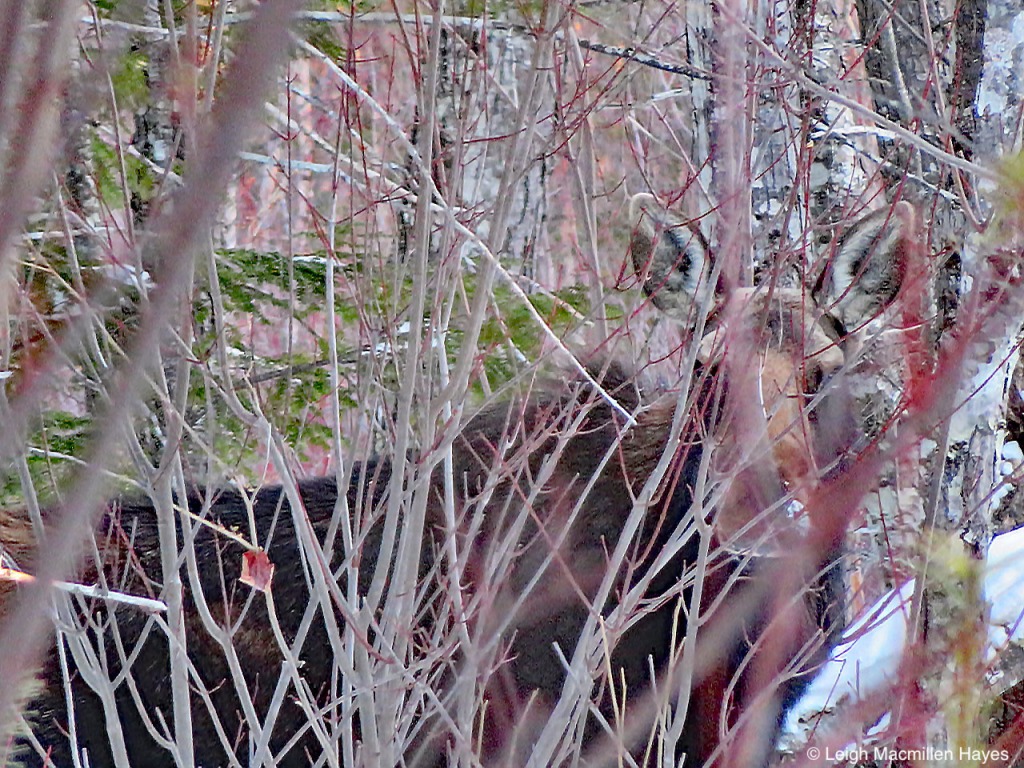
After finding so many signs year after year, today . . . today I spied an uprooted tree at the very spot I thought might be a good place to stop and spend a few hours in silence. As I made plans to do such in the near future, the tree moved.

And transformed into you!

When at last you and your youngster departed, despite your sizes, it was as if you walked through the forest in silence. My every move comes with a sound like a bull in a china shop, but you . . . Alces alces, you weigh over one thousand pounds, stand six feet at your shoulder, and move through the forest like a ghost. For that reason and because you let me spend some time with you today, February 11 will henceforth mark the day that I celebrate the Ghost of the North Woods.

Thank you to all who have joined me for any or all of these journeys. With each learning or sighting, I get excited and can’t wait to share it with you. I’m not only grateful to be able to wander and wonder, but I’m also thankful for all of you who take the time to read these posts.

Winter Bug Safari

I’m a winter gal and snow and tracks and scat and bark and buds all pull me out the door on a daily basis as I try to understand who has traveled where and why, and through what natural community the journey has been made.

But now . . . I have another reason to slip outside: Bugs. And how they overwinter. And where.

On one tramp through the woods this past week, with eyes peeled for the tiniest movement on the snow or twigs or tree trunks, I spotted the fresh work of a Pileated Woodpecker. Though I would have loved to see the bird, I was equally thrilled to see the pile of debris below the hemlock tree. (And that gorgeous magenta-colored inner bark, of course.)

The fresh wood chips on the snow invited a closer examination. And you thought this post would be about bugs. But indeed it is for it’s Carpenter Ants that the bird sought. By the two clumps of bird scat that I found, it was obvious the woodpecker had been successful.

For you see, within the cylindrical casing coated with uric acid were body parts.

Ant body parts. Now, here’s the thing that I need to learn more about. I’ve watched Pileated Woodpeckers land on trees and pause, sometimes deciding to excavate, but other times moving on. And I’ve been told that they test the tree out and listen for the ants. I’ve never been able to prove that. But here’s the thing: what I learned today is that Carpenter Ants not insulated by snow or the warmth of your home enter diapause, a low-energy state that allows them to survive the cold and go for long periods without eating. So the question remains, how does the woodpecker know which tree to pick on, or is it a lucky strike?

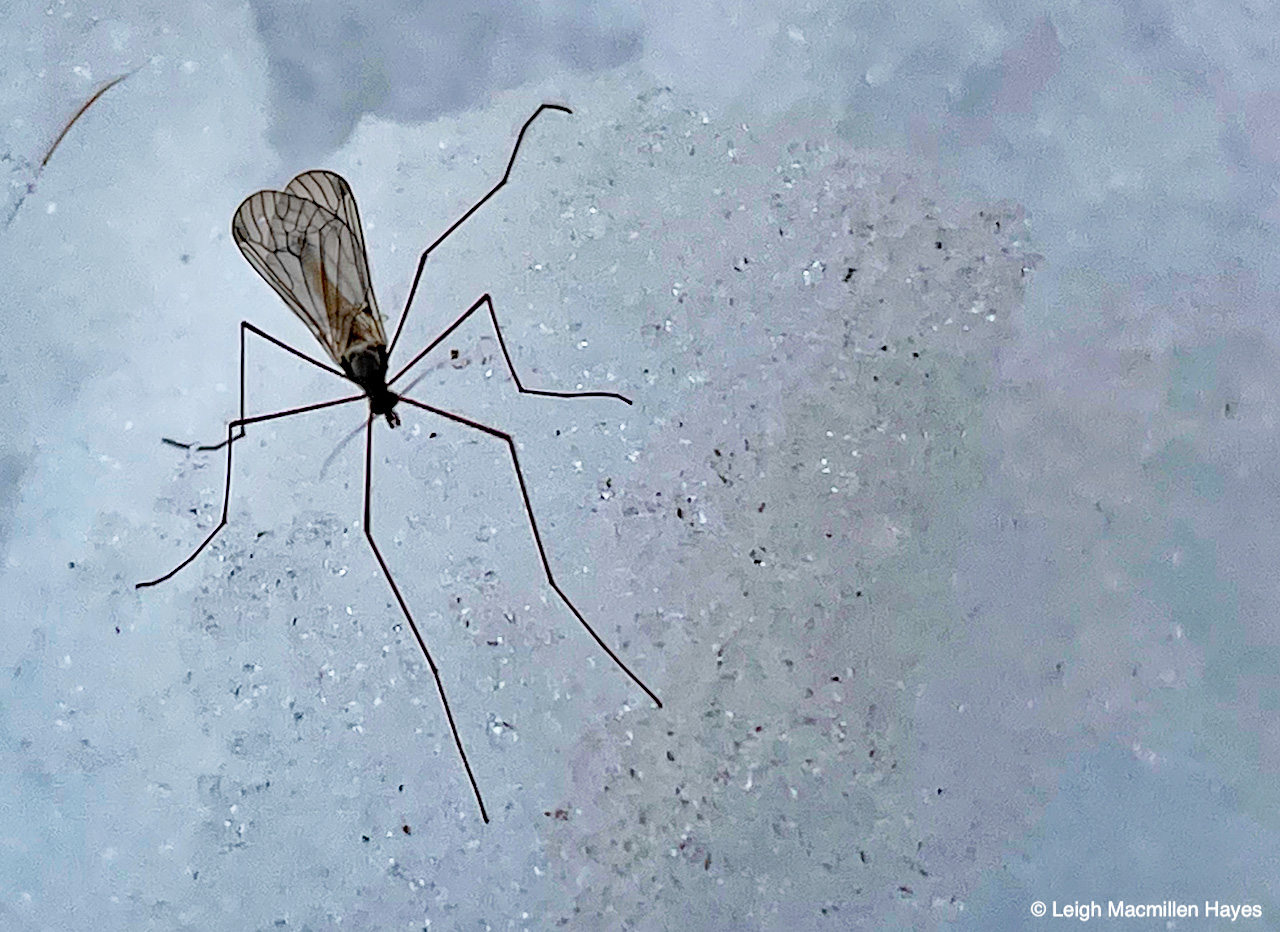
Further along that same trail, I came upon the prints of a horse that had stymied me a few weeks ago when I tried to mentally turn its track pattern into either a bear or a moose, knowing full well that what I was seeing didn’t quite fit what I knew to be true of those species. Horse manure would have helped, but there was none to be seen . . . until the other day when a fresh plop in the middle of the trail offered an invite to look for insects seeking minerals upon it. I saw one small fly that I couldn’t identify, but beside the manure was this Winter Cranefly. It was a brisk day and today I learned that this species is only active when the temperature is below freezing. My kind of bug, indeed.

On another day and another trail, it was a Winter Firefly that drew attention. First, fireflies are not flies; they are beetles.

Second, unlike many beetles, Winter Fireflies overwinter as adults.

Third, Winter Fireflies are diurnal and don’t have lanterns to light up the night sky.
And fourth, though I find most tucked into the bark of maple trees, the first one this week was on a hemlock. After that, it seemed to be maples upon which I found others.

As the temperatures rise bit in the next month, they’ll become more active and will be visible crawling up the tree trunks and eventually flying. By summer, you’ll see not a one but their nocturnal cousins will light up the night.

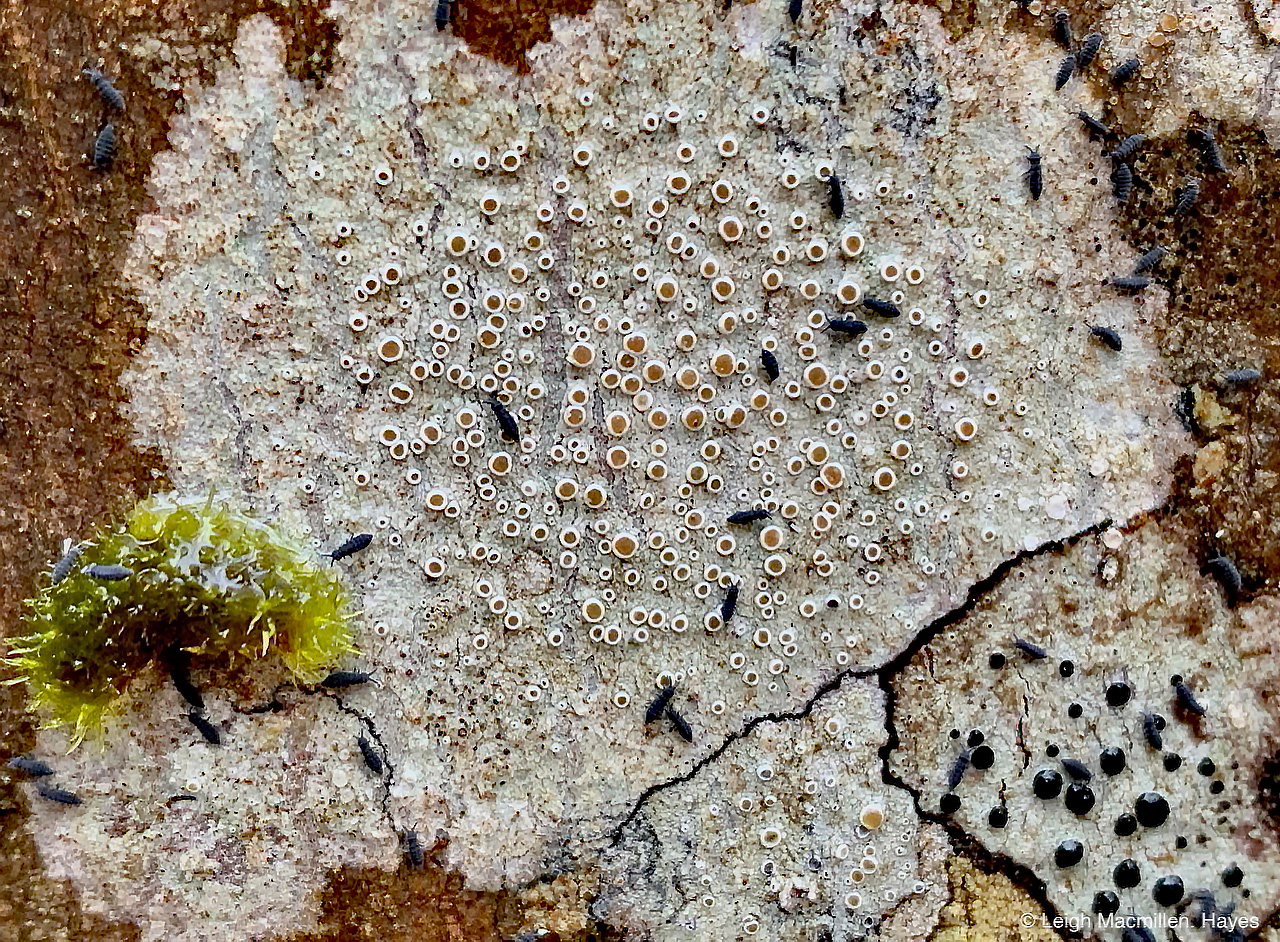
One day, it was Snow Fleas, aka Spring Tails upon lichenized bark that garned a look.

And another day, upon another crustose lichen on a maple tree, shed larval skins of possibly Twice-Stabbed Lady Beetles were visible. Kinda creepy, especially when you are looking up-close and personal with a hand lens, but oh, so cool.

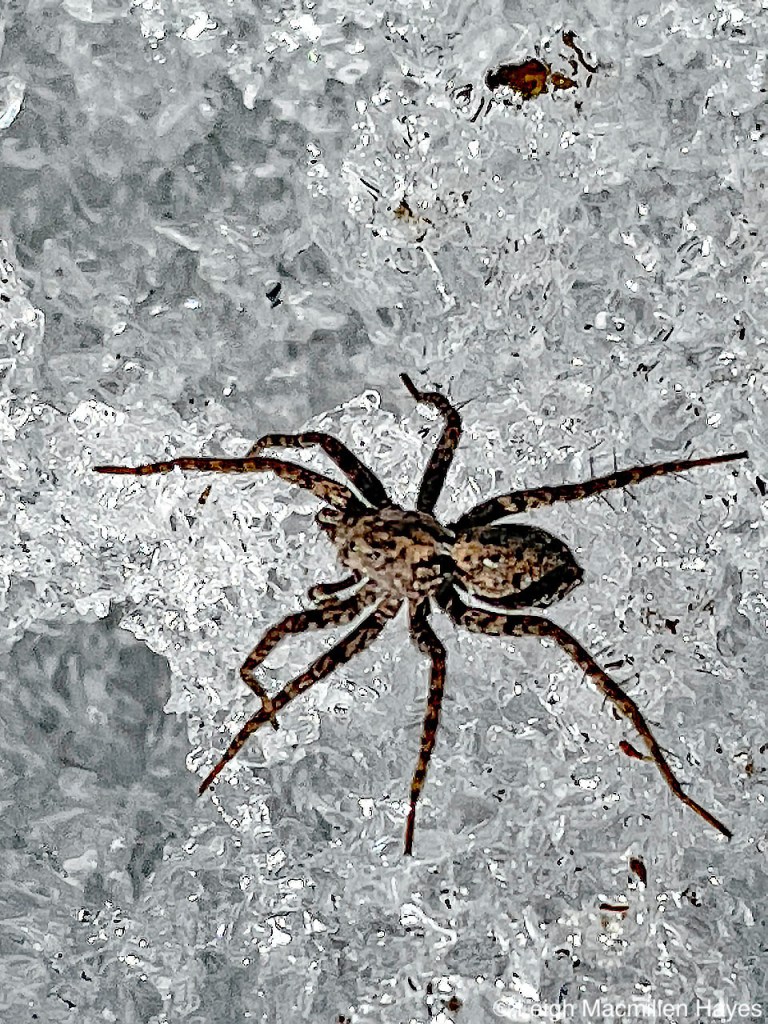
And then there were the spiders, thus the reason this isn’t just an Insect Safari. This minute eight-legged creature that practically ran across the bark must have had antifreeze in its blood.

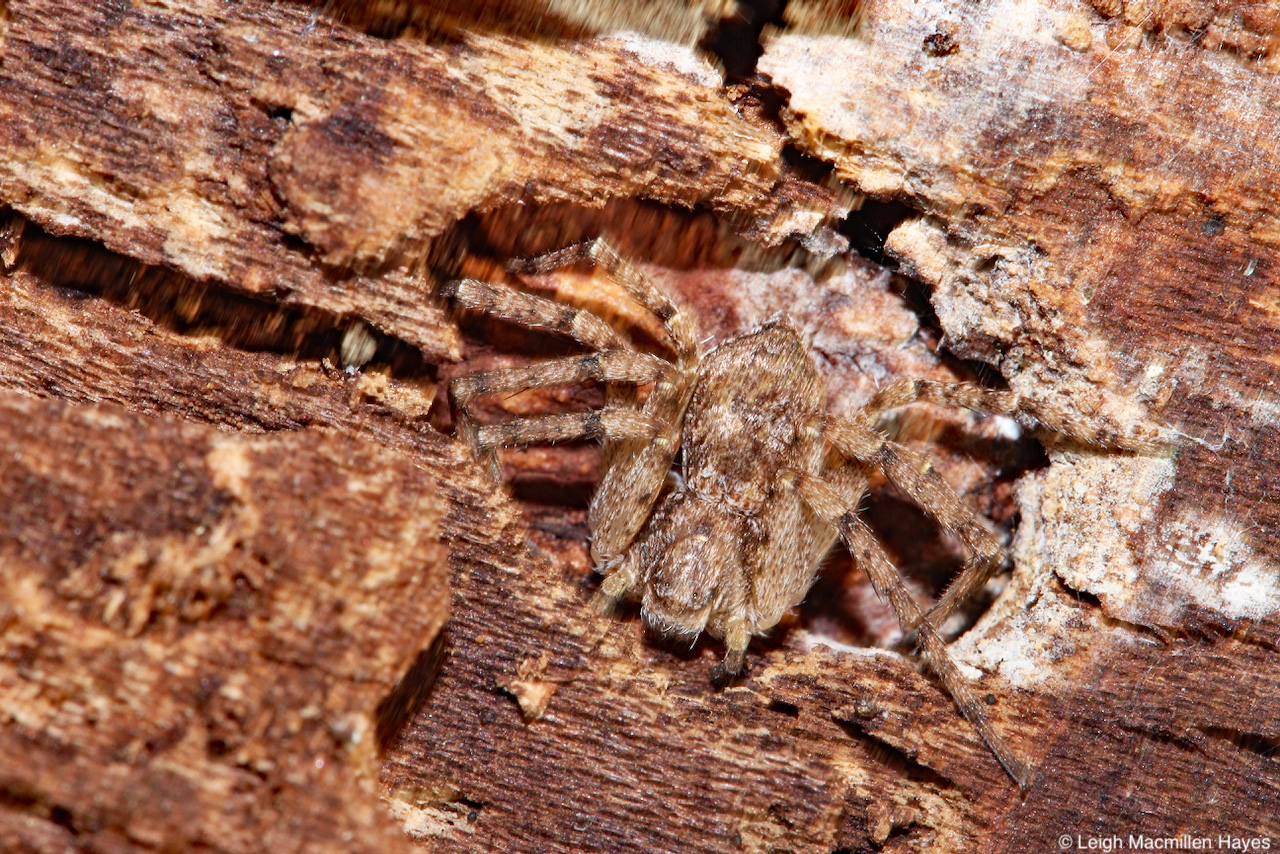
Behind another piece of bark was this slightly active crab spider . . .

and its more dormant relatives hunkered down who had probably supercooled through the process of accumulating glycols in their blood (antifreeze again). Apparently, despite the below freezing temps, their tissues remained unfrozen and they won’t become spidercicles. How in the world did spiders and other critters physiologically adapt via the antifreeze compounds so that they won’t turn to ice?

It’s all a wonder to me.

Before I finish, let me leave you with one last image. It’s some sort of beetle, I know not what. And I don’t know what is on its wings–perhaps some sort of mite or parasite? When class reconvenes again, I will ask the instructor.

I am so excited to be taking Bugs In Winter, taught by Charley Eiseman, author of Tracks and Sign of Insects and Other Invertebrates: a Guide to North American Species. Thank you to Maine Master Naturalist Anthony Underwood for suggesting it to me (perhaps so I’d stop sending him photos of mystery bugs and asking his advice).

The course has only just begun and a few naturalist friends are taking it with me. We have tons to learn and so I invite you to tag along cuze for the next two months I’m going to be on a Winter Bug Safari, which will then turn into Spring Bug Safari, and after that . . . you get the picture.

Goldenrod Gala

As many of you know, I’ve never been a party girl, much preferring to hide in the wings and be the wallflower at the edge of the crowd, but when the invite arrived today, how could I resist?

It didn’t give an actual location, but by the photo I suspected I knew where in the yard would I meet my friends.

Immediately upon entering, I wished I’d waited a bit for the Ambush Bugs had already discovered each other and chose the corner I preferred as their hide-away spot in which to mate. Really, shouldn’t they have gotten a room?

At last, however, I discovered others who like me were solo for the party, this being a Mason Wasp. His eye was on the bar and nectar was the drink of choice.

While I inquired about something to sip upon, into the middle of the space danced a pair of Thread-waisted Wasps. She seemed rather oblivious to his advances.

They maneuvered this way . . .

and that. No matter which way they swayed, he clung on.

At times I wondered if she really appreciated his clingy mannersim.

At best, she seemed to tolerate him. But never did she let him get any closer.

For over an hour, we all watched from the edges as they sashayed back and forth across the dance floor. Maybe he clung so close because he hoped to get lucky in the near future, or maybe they’d already finished canoodling and he wanted to make sure that it was eggs he’d fertilized that she laid, much the way male dragonflies hold on until the female of their intentions do the same.

Meanwhile, back in the corner, the Ambush Bugs began to separate as he climbed down off of her. And below them, another insect that might become their choice at the buffet table lingered.

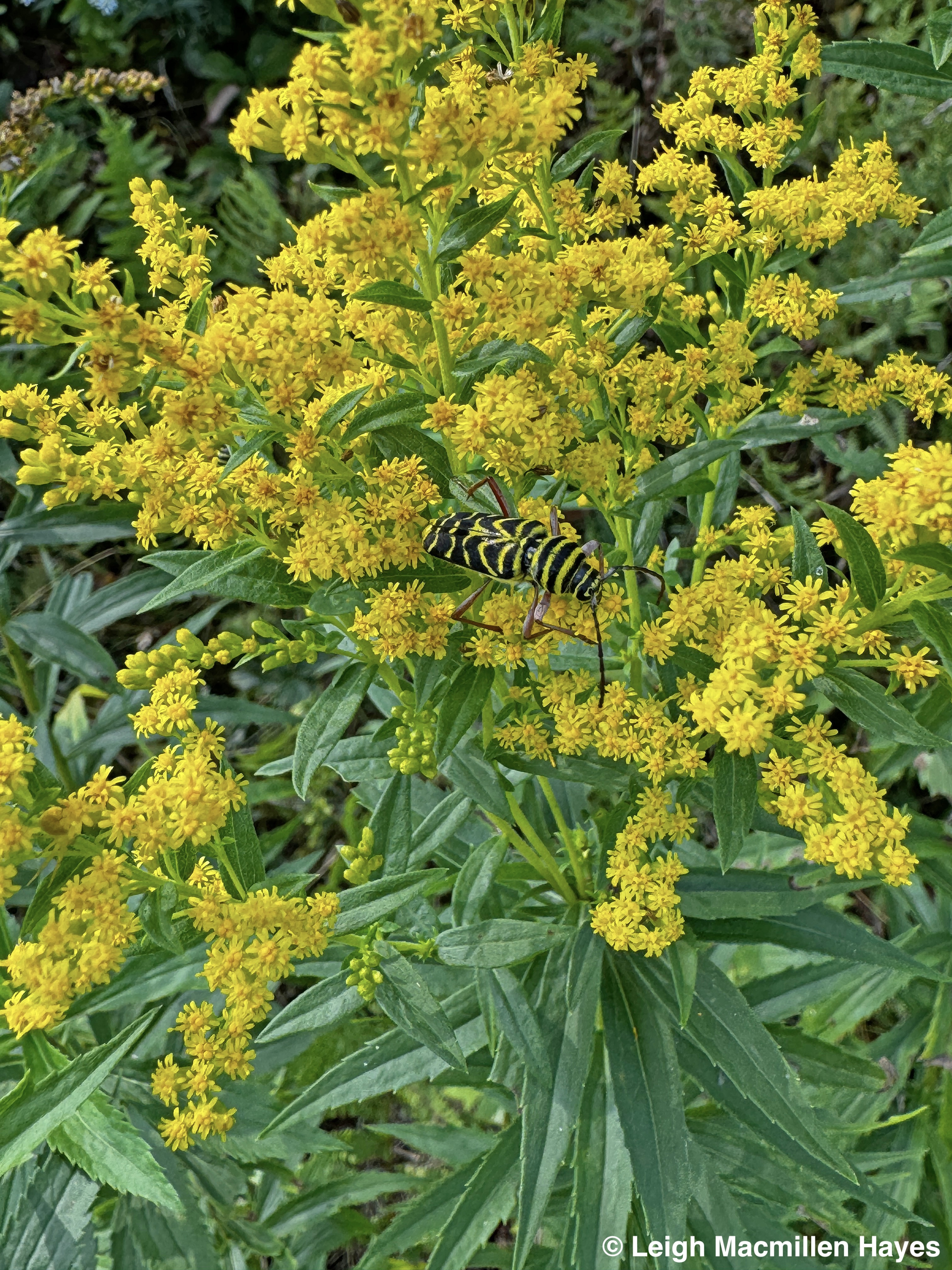
Finding a stem all its own upon which to practice its own dance steps was a Locust Borer decked out in fancy dress clothes.

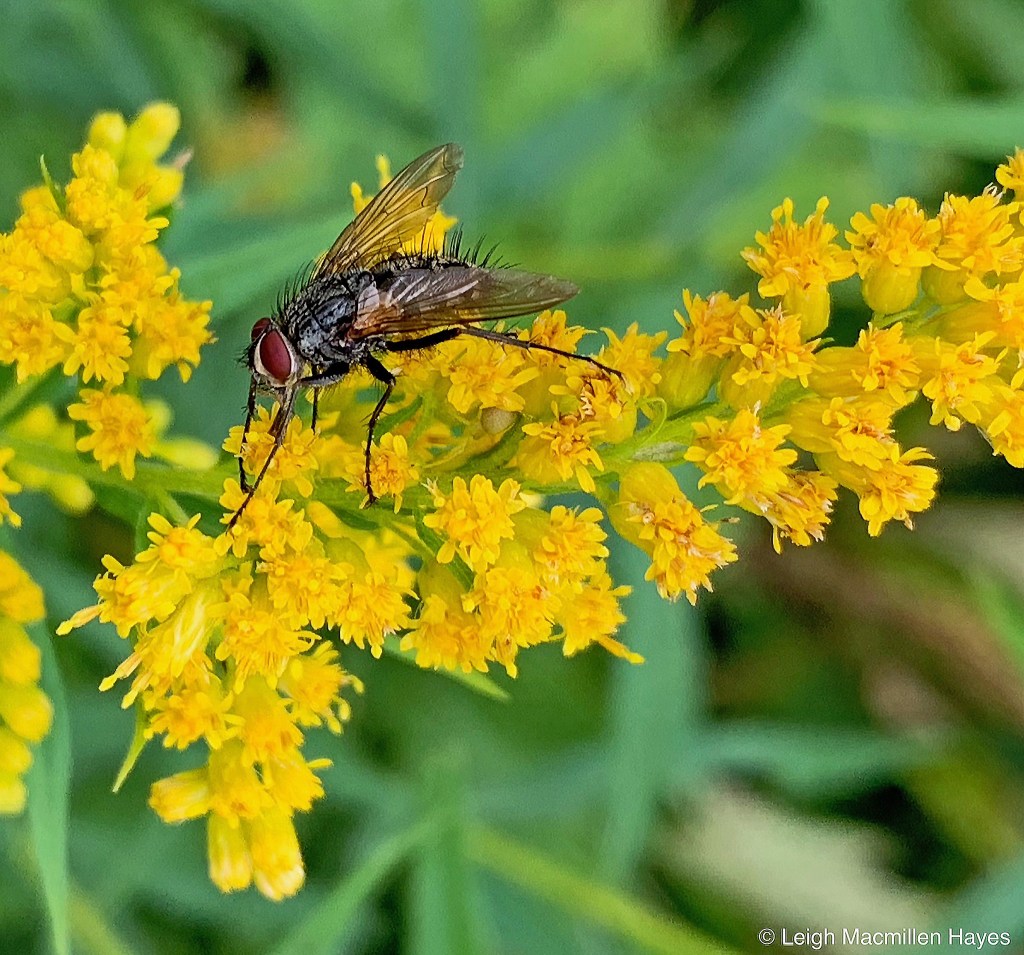
Also dressed to the nines was a Flesh Fly wearing gray pin stripes.

As the party continued, I soon realized that the Mason Wasp was a tease.

Or so it seemed as its antennae played with a shy Crab Spider waiting under the buffet for a morsel upon which to dine.

I couldn’t help but feel sorry for the spider–who was certain it was about to score, only to discover it had been outsmarted. But that’s the way it is in these social affairs as a variety of personalities come together to greet each other and yet satisfy their own needs.

At last the hour had chimed and it was time for all of us to depart. As I stepped through the doorway, a final greeting was bestowed . . . by an Assassin Bug Nymph completely camouflaged by the flower’s greenery.

With that, my visit to the two-hour Goldenrod Gala was completed and I gave thanks for the invite to such a pop-up event. A social gathering of my type, indeed.

Katydid, Didn’t She?

I have the extreme pleasure of being in touch with my first two playmates, the sisters who lived next door, on a somewhat regular basis. And even when we don’t see each other for a long time (Girls, we still owe ourselves a lunch in Newburyport), like any great friendship, we pick right up as if no time has passed.

While they both love the natural world, for that’s where we spent much of our childhood, one in particular frequently shares photos of her finds with me. And so I took her along, riding on my shoulder this morning when I headed out into the rain because I know that she, too, likes rainy days as much as, if not more than sunny days. So does her garden and she’s got a green thumb to envy.

Since my thumbs aren’t great at turning the soil, I support a local farmers’ market and had time to pass waiting for my turn to pick up the pre-ordered produce, bread, chicken, flowers, and treats. Thus, as we started to hike, a grasshopper known for its two stripes greeted us.

Not far along, at the base of a certain pine tree, I showed her the Pippsissewa now in bloom. Not only do I love to say this plant’s name, but the blossoms . . .

oh my. We both squatted for a closer look at the anthers within. And sniffed its sweet scent.

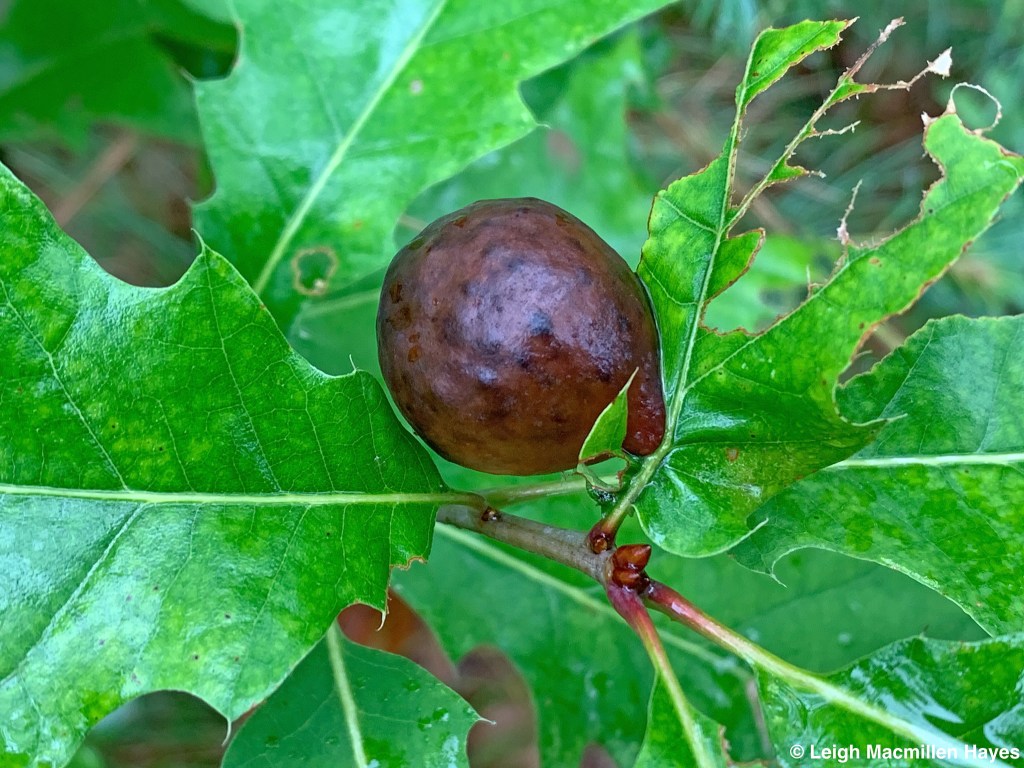
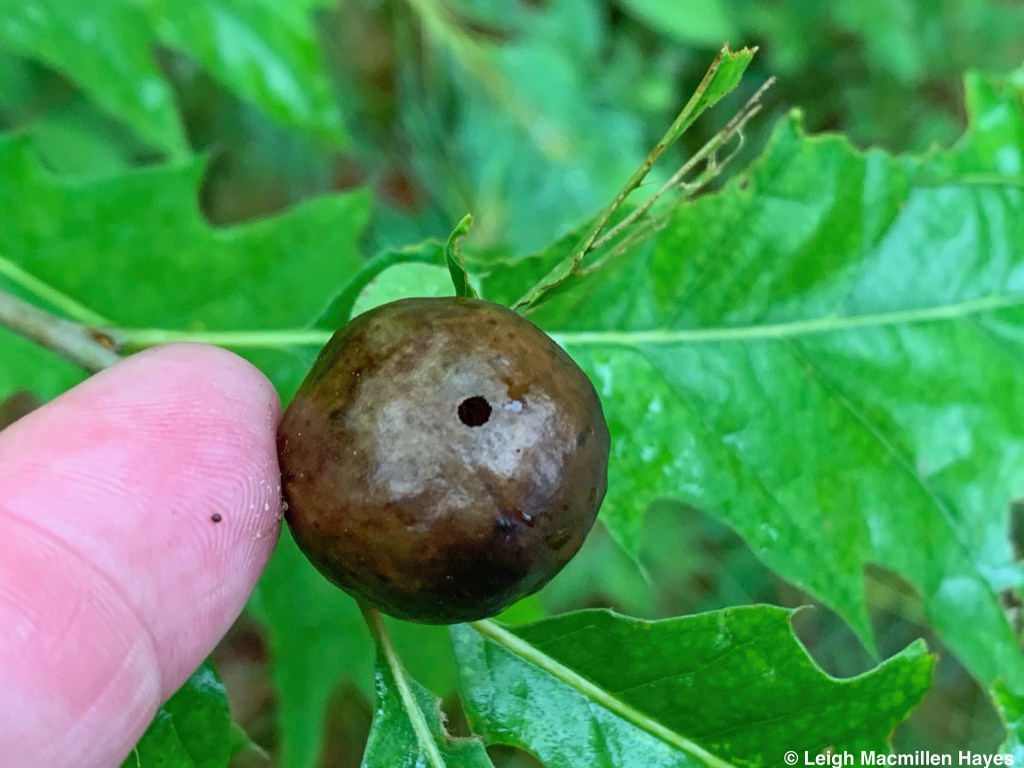
Our next great find was an oak apple gall and of course I had to tell her that a non-stinging and wingless female wasp injected an egg into the veins of the leaf as it was just beginning to grow. Chemicals released by the tiny larvae that developed within altered the growth and over a few weeks, the little orb formed.

By the circle hole on the underside, I explained that the wasp had pupated and chewed its way out and was probably now feeding on the very roots of the same tree . . . that is if it hadn’t been consumed by birds or small mammals.

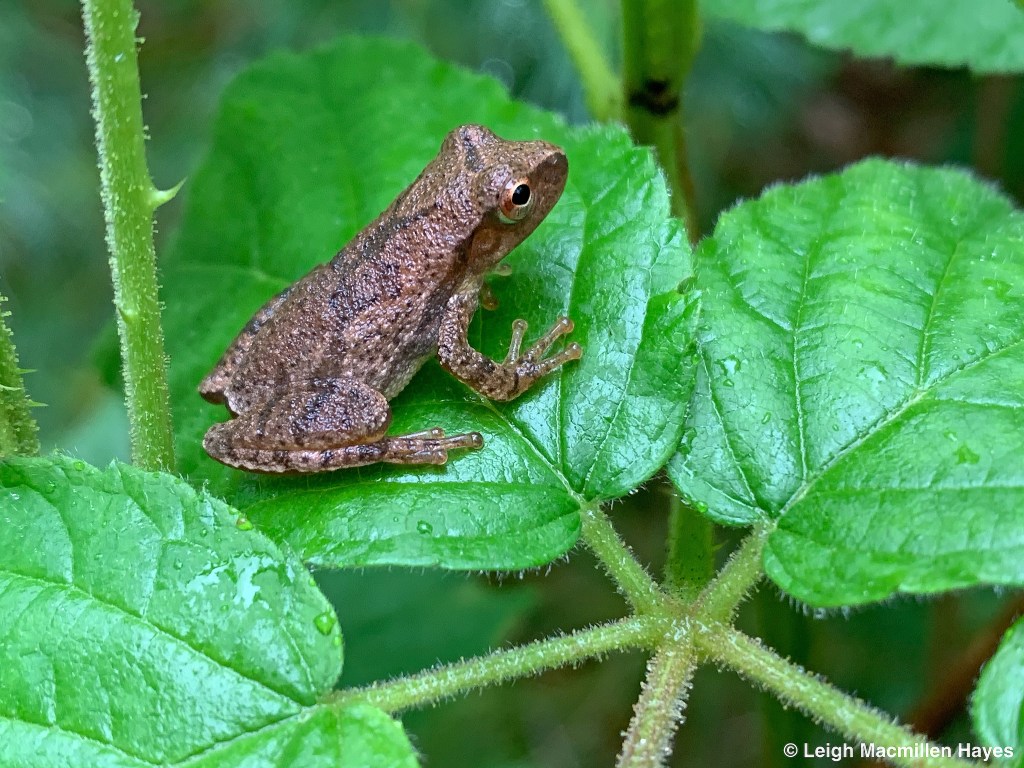
We moved on, but a tiny spot of brown on a berry leaf was the next to beg for our attention. Check out those toes. Sticky toe pads on their webbed feet provide support for these plant and tree climbers known as spring peepers.

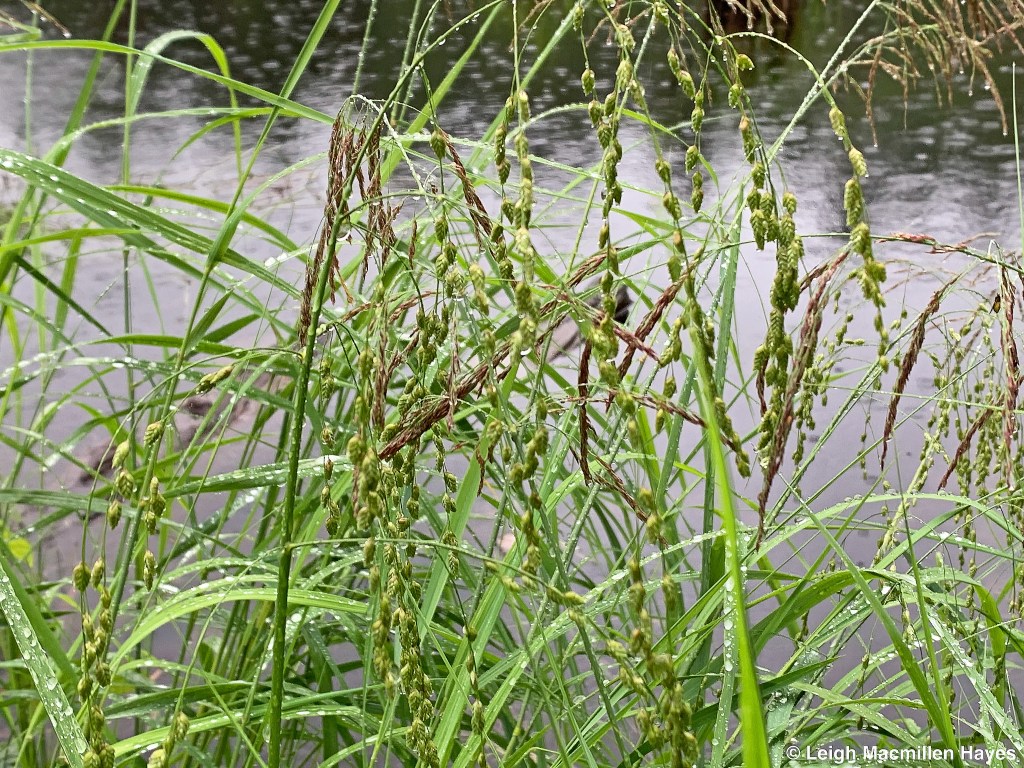
At last we reached a wetland and that’s when the rain really began to fall. And so my friend and I . . . we stood and looked about and enjoyed the raindrops on the grasses and sedges, the water’s surface, and us.

For a while, we left the path, and slipped into the woods, trying to follow a recently created trail, but mostly meandering about in the land where nurse logs provide a start for so many others as they decompose.

As it turned out, that wasn’t the only nursery in town. Once we returned to the trail, which by the way, she was impressed that I could find my way back . . . and so was I, I took her to a nearby meadow where we spotted a momma tending her young’uns.

I knew my friend would love this sighting because she not only saves salamanders and deer, but also spiders from any demise. This momma wasn’t so sure about us, however.

As large as she was, we were even bigger so she continued to work on her web to make sure her children stayed safe.

When she wasn’t looking, we did peek inside and saw a few of the babies.

We spotted another spider of a much more diminutive size upon one of the meadow flowers. You might see it, though it is a master of camouflage. Two insects also hung out as if they were trying to stay dry. Though the beetle is quite obvious, a discerning eye will spy the legs of the other.

We had actually gone to the meadow to see the Canada lilies that tickled our fancy for they looked like streetlights in the midst of the rain drops.

All of our finds had been great, but the best one of all . . . a Katydid. My friend’s name is Kate or as she was known when we were kids: Katy. And when quizzed by our moms about who was responsible for something, the rest of us always said, “Katy did it.”

While standing in the meadow today with Kate on my shoulders, my cell phone rang and suddenly I was looking at . . . my dear friend via FaceTime.

“Did I call you, or did you call me?” I asked as I looked at her beautiful and familiar grin while she stood aboard her cabin cruiser on Long Island Sound.

“You tried to Face Time me twice and so I called you back,” she said as she looked a me–soaking wet and rather bedraggled but happy (except maybe for the mosquitoes and deer flies).

I’d been using my phone to snap most of the photos but kept putting it in my pocket and I think I may have inadvertently contacted a few people.

So maybe this one time I did it and not Katy, but forever when I see a Katydid and many other things in the natural world, she’ll be right there with me as we were so many moons ago–Katy got me then and thankfully she still does.

Pond Friends

My day began with an exploration of the edge. The edge of a favorite place I hadn’t explored much lately. And so it was to old pals that I had a chance to say hello.

=

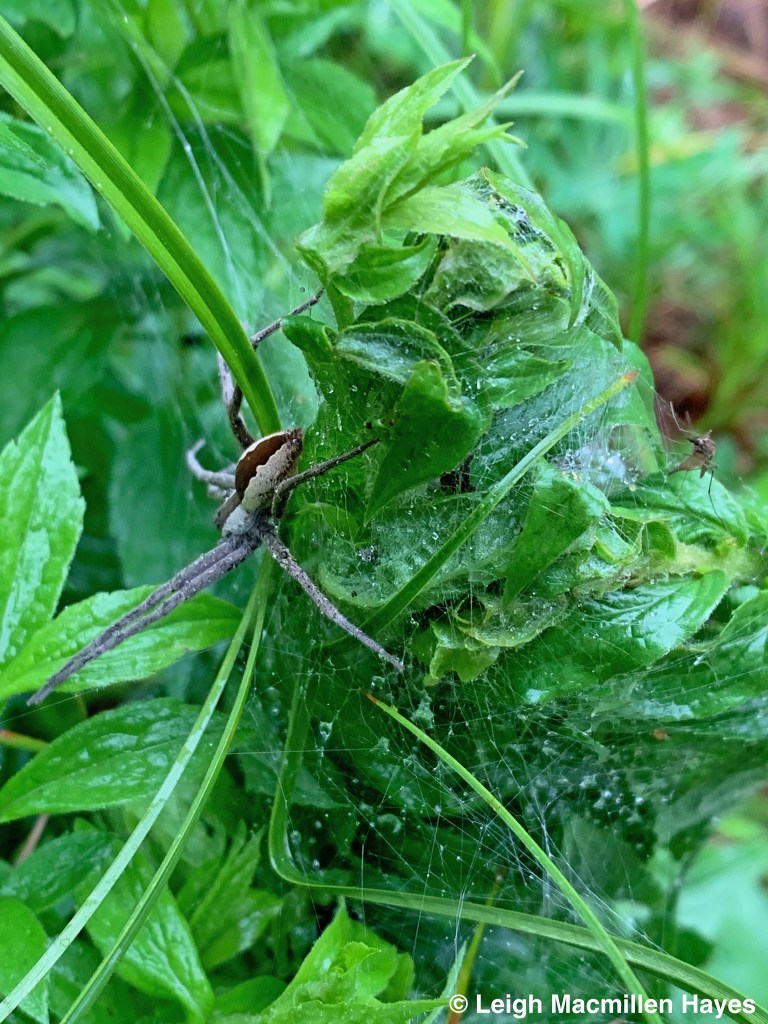
The first was so old that it almost wasn’t. Okay, so that makes no sense, but it was no longer the Fishing Spider it had once been . . . and since become. Rather, it was the exuviae of the spider–a shed skin dangling by the water’s edge.

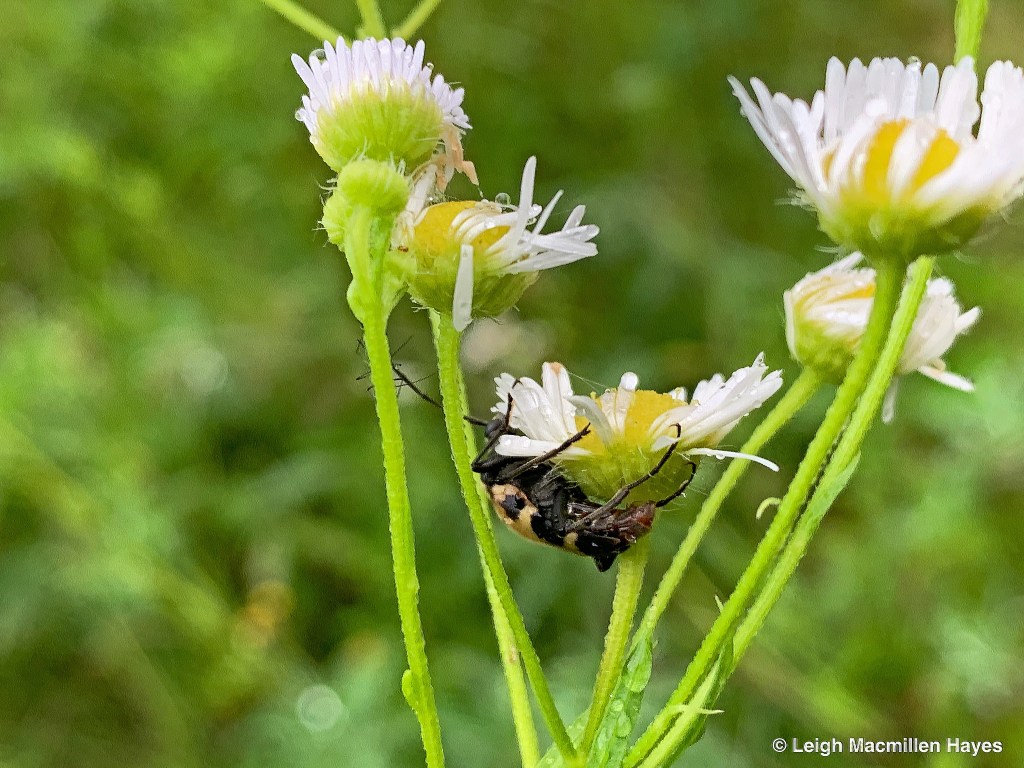
Much tinier by comparison was a Jumping Spider, its spotted patterned-body contrasted in size upon the Bracken Fern leaflet upon which it quickly moved.

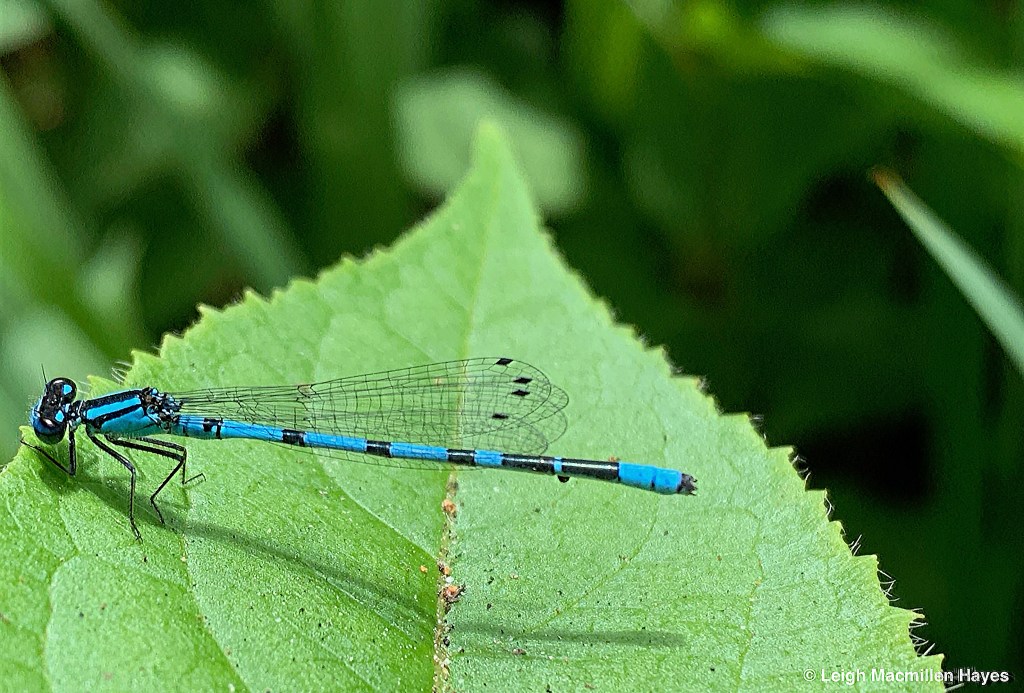
In the same space Northern Bluet damselflies graced the landscape and I realized I need to give them more notice for they are as important as their dragon cousins I spend much of my summertime focusing upon.

And so . . . I present to you another old friend, a male Eastern Forktail. This is one of my favorites for I love the contrasting coloration with bright greens and blues offset by black.

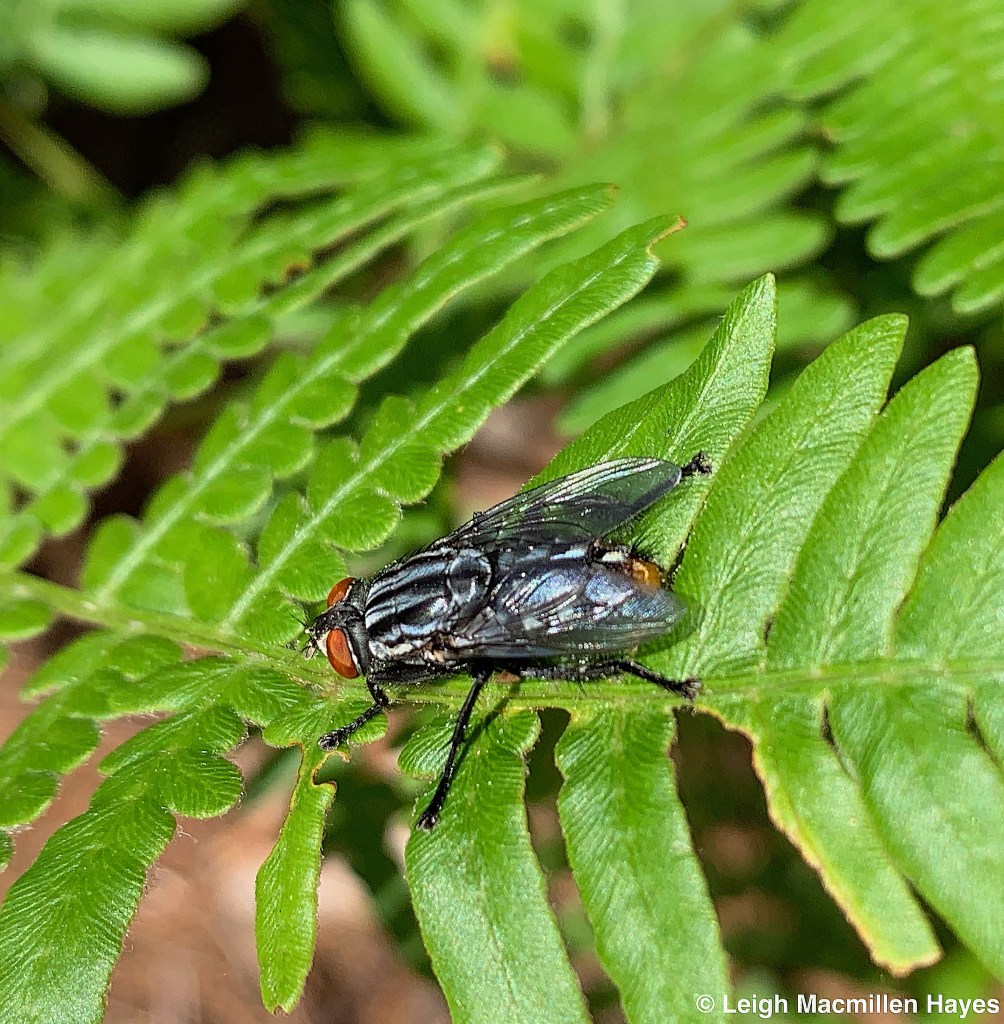
Among the Brackens another did fly . . . and land. This Flesh Fly is known not only for its red eyes, but also its red “tail” or butt.

Speaking of red, by mid-afternoon, my guy and I headed off in the tandem kayak as the sky darkened.

After making the acquaintance of a daughter and son-in-law of an old friend and recalling the tornado we all survived three years ago and sharing favorite spots on the pond, we paused ever so briefly by an active beaver lodge. Do you see the fresh mud? Don’t let that and the ripples in the water lead you to believe that the beavers came out to greet us.

I was with my guy, remember, and he has a need to be as active as the rodents within. Oh, the mud wasn’t his doing, but the ripples were.

The beavers present activity was, however, noted by the Spadderdock roots floating upon the surface of the pond. That’s a carbon-loading beaver treat.

A treat for my eyes is always a turtle sighting and though this painted one seemed to be surfing, as I explained in my ever-knowledgeable way to my guy, it was basking in the sun as a means to absorb the UV rays of the sun. He was sure it was just preparing to slip back into the water and as we approached it of course did so, thus proving him right. Um, but I was as well.

All the friends I’ve mentioned till now we’ve met before. And actually, I’ve had the privilege of meeting this last one once before, but sometimes it’s the second meeting that drives the characteristics home.

I mean, seriously, how many times have you met someone for the first time and forgotten their name? But upon that second meeting you focus on how their nose sticks out further and they have such a dark shell and a line of yellow dots under their double chin and they hang out in the shade more than the sun and you realize you do remember them: Common Musk Turtle.

I love my pond friends who are my best friends, whether we met for the first time or again and again and again.

Under the Bubbles

Wander outdoors if you can and let the anomalies pull you into their realm. I promise, your eyes and your mind will be opened to so many wonders that you’ll resist the urge to move along for so enamored will you be by your finds. Slow down and look and be wowed.

May it begin with an oval-shaped structure sitting atop a tree stump and filled, curiously, with a red maple samara, the latter’s own shape a decaying, many-veined wing.

Creating an oval by touching your thumb to your pointer finger, may you know the size of this leafy building created to protect a luna moth’s cocoon. Sadly, it seems, the pupal stage that had started life within had been predated. Still, the structure adds a lesson–to notice one that reminded me of an oak apple gall, but wasn’t because of its shape being more oval than round and much tougher than the gall’s papery construction. If you are like me, you’ll need to stick that in the back of your mind the next time you encounter such.

And then may you encounter one whom you know well, but still, each time you greet the Striped Maple twig and bud a sense of awe simply overwhelms you because of its striking beauty demonstrated in the pattern of leaf and bundle scars topped by growth rings over and over again.

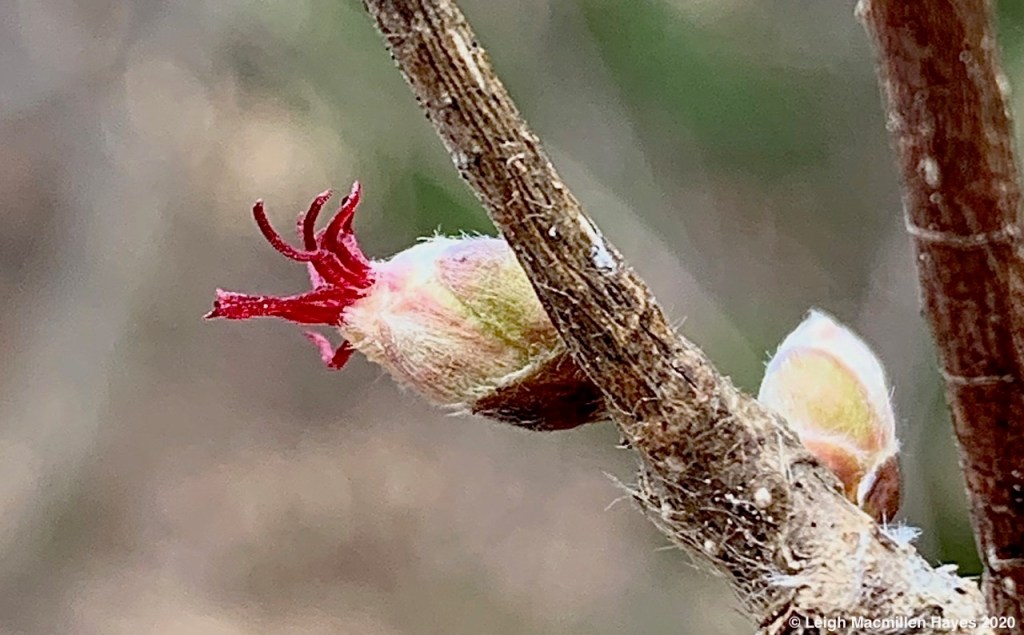
As your eyes tune in, may you notice another who is easily overlooked for its diminutive size and may it remind you of work upon the ceilings of cathedrals that is oft under appreciated for so few can view. Each time you come to recognize the tiny, magenta blossoms of Beaked Hazelnut, may you celebrate their existence matched by your noticing.

With your awareness of the hazelnut’s flowers, may you be equally wowed by the occasional presentation of last year’s fruits, beaked as they are.

In the midst of your adventure may you meet a slab that poses a story featuring warriors of the past and may you have fun recreating the saga by letting your imagination flow. What happened here?

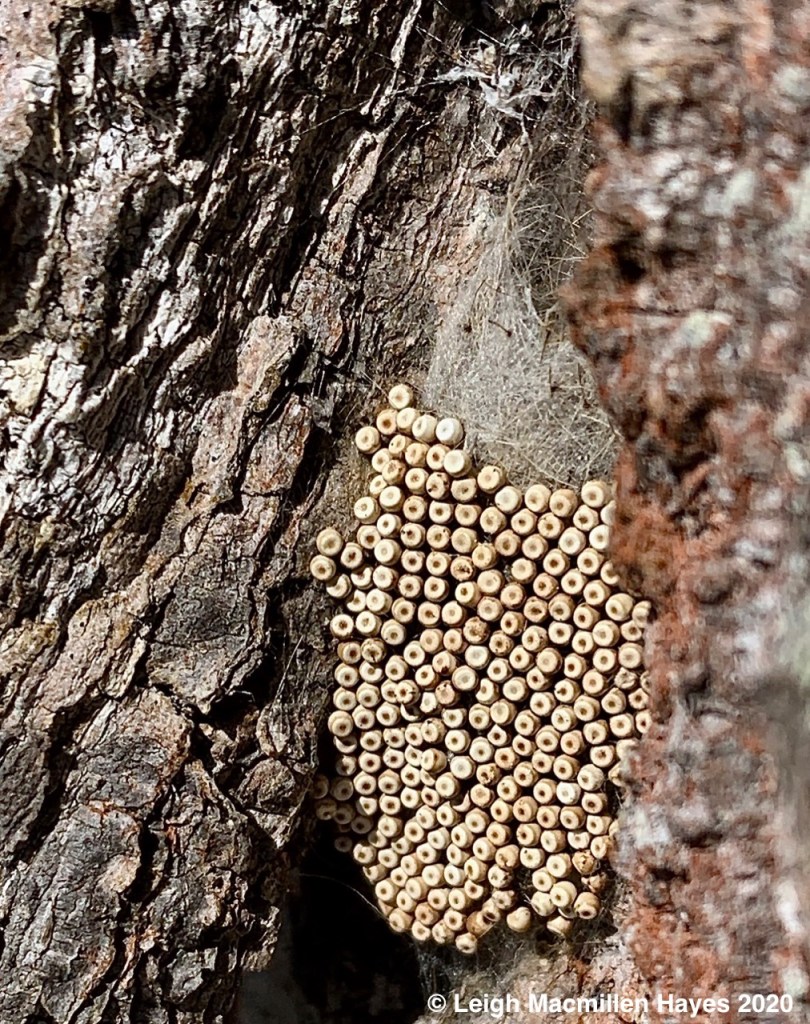
And just when you are thinking that there can’t be anything else to spy, may you suddenly spot the barrel-shaped egg cases of Wheel Bugs and wonder who lives within–Ambush Bug or Assassin? What you may know for sure is that the residents are Hemiptera or True Bugs.

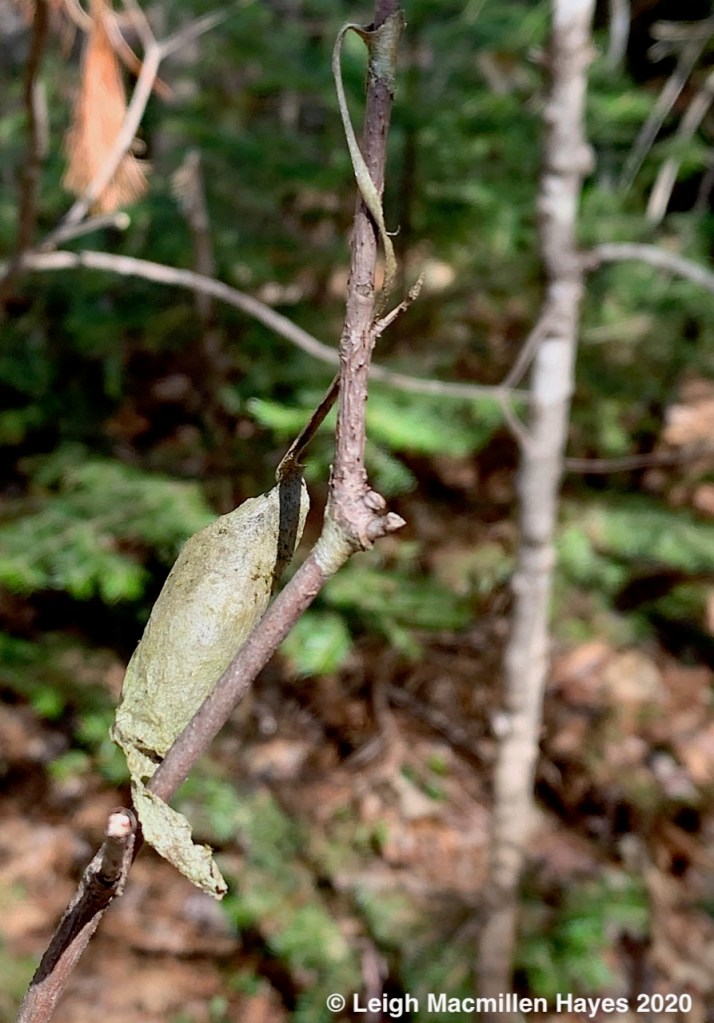
Walking five more steps before stopping to wonder again, and then five more and so it goes, may you stumble upon a tussock moth cocoon with life formulating within and consider its possibilities–perhaps a White-marked Tussock Moth?

Next, may a long silky string with a cocoon swaying at the bottom capture your attention.

As you peer within, may you spy a Prometha Moth peering out.

May your viewing opportunities be enhanced by others who also look, including the Six-spotted Fishing Spider, who’s six spots are hidden below its upper abdomen that features twelve.

As you continue to develop an understanding may a forked tongue sniff you out as you sniff the snake out.

In the end, may it not be an end. May it be a beginning. May you live under the bubbles and give thanks that to your bubble are attached so many others as you share a brain.

I speak for myself when I say that I appreciate those who answer my questions as Anthony Underwood did today with my many insect photos (and others have done as well on a variety of topics) and I equally welcome your questions about what you are seeing. We may all live under a bubble, but may our bubbles continue to be connected.

Something to Pine Over

I set off on a mission this afternoon: to spy another Tetragnatha viridis, the green long-jawed orb weaver. I last spied one on December 17th, and was sure the task would be a piece of cake today.
On the plot of land that I roamed, which had been owned by a paper company until about thirty years ago, stood towering pines, but also some that were about 20 years old and others mere saplings. I’d love to say each one captured my attention, and really, they all did, but there are still a million more to examine.

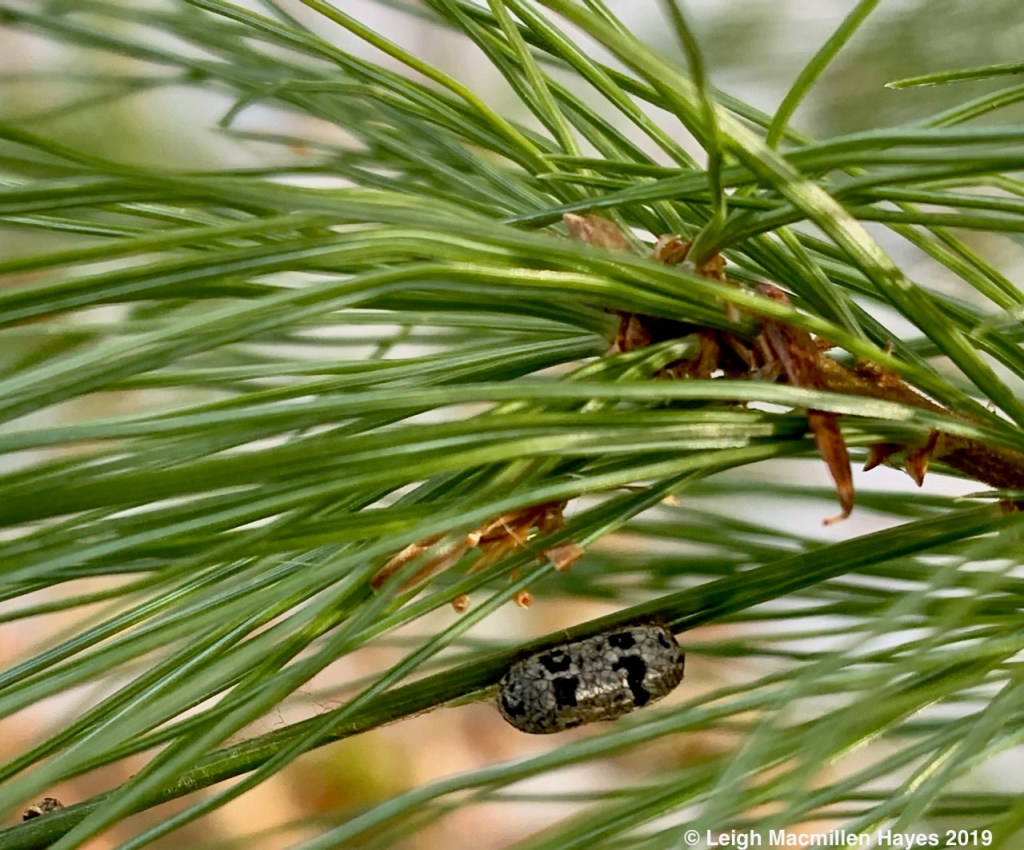
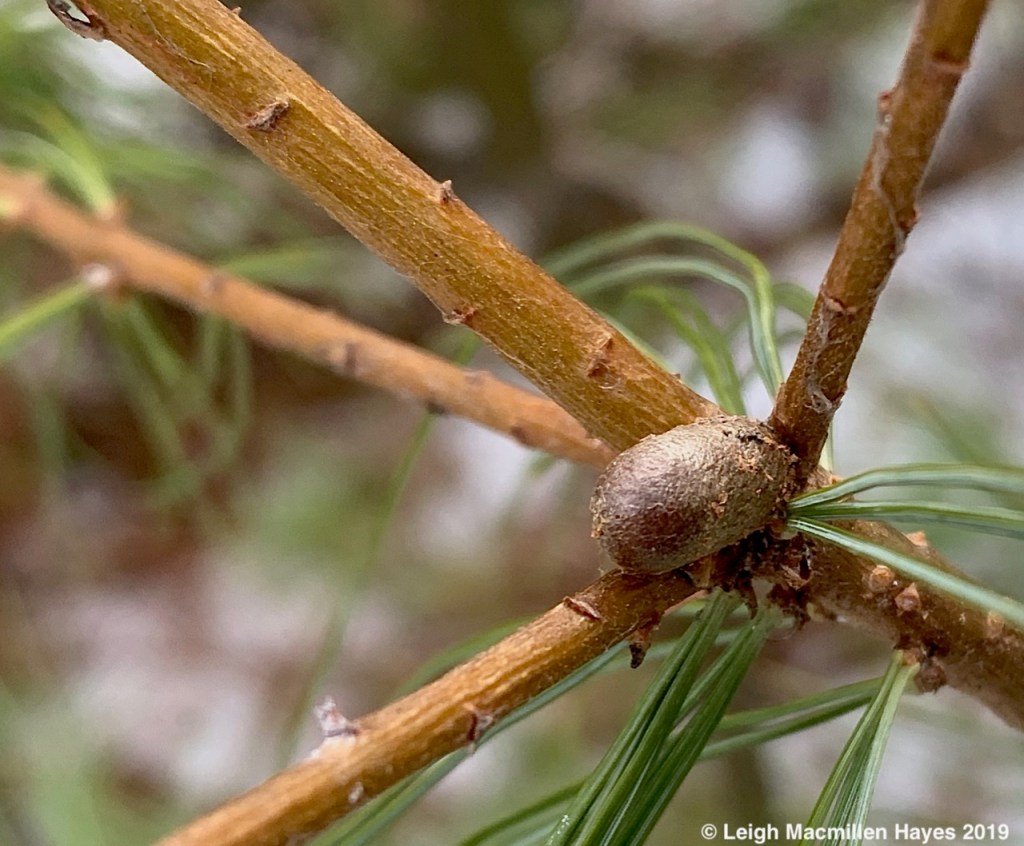
In the process, I began to notice that it wasn’t just the spider that would give me reason to wonder. First there was the ichneumon wasp cocoon. In size it was the same as another that I’ll share later in this post, but the metallic color and spotted pattern made it stand out. Presumably the larva that created it is a parasitoid of some caterpillars that feed on conifers.

Mind you, I was in the woods and there were patches of snow and certainly other patterns to pay attention to so I let my mind wander in the moment. And rejoiced with this find: an opossum track.

An opposable inner toe on each hind foot looks like a human thumb. In a shuffling motion as it waddles along, an opossum places its back feet just behind the front feet.

I followed this guy’s track for a bit until it disappeared into leaf cover and I suspected it might be up a tree.

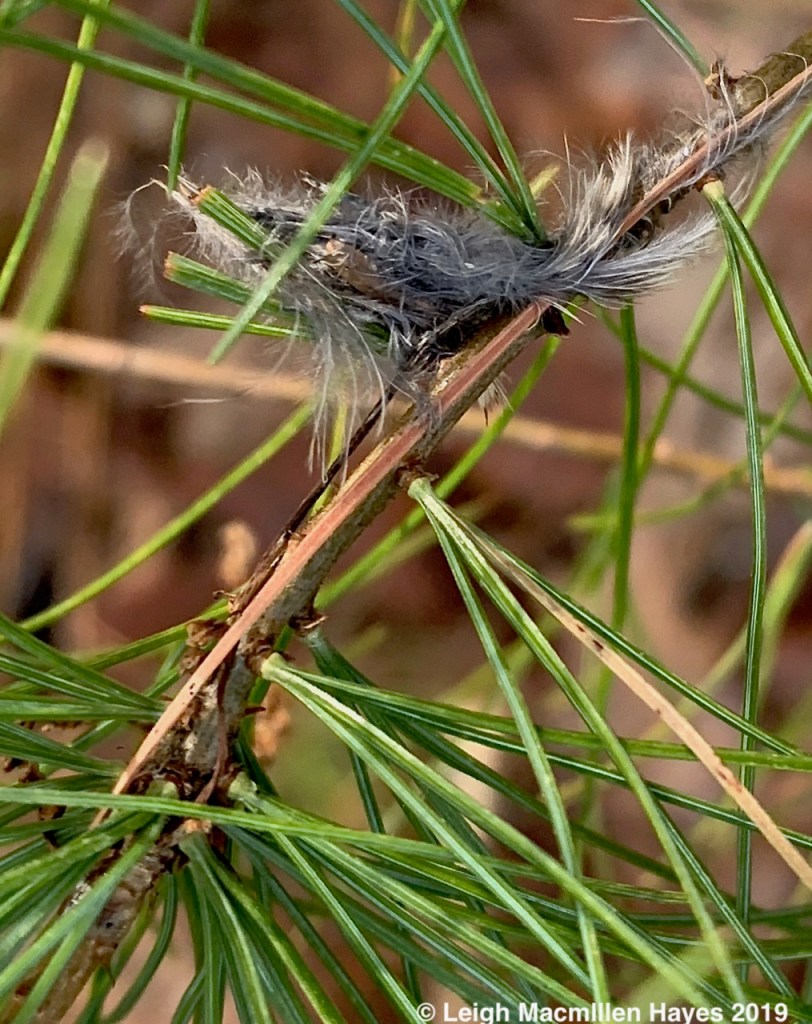
And so my spider expedition continued. My next find: a tiny clump of bird feathers. But no spider in sight.

Again, I digressed, however, for on an old snag, I found lungwort growing over a burl in a formation I’ve not seen before. I’m used to finding it on the trunk of a tree, but wrapped around the rounded growth was a new presentation.

Back to the task at hand, and I suspected this was a molt of what may have been a tiger moth caterpillar. No spider yet, but I was getting more and more excited with each find.

Practically tripping over a downed tree I came upon another sight new to me. Here’s how I’m reading this story: the green capped mushrooms, violet-tooth polypore, had begun life when the tree was standing. Once it toppled, new fungi grew perpendicular to their parents so that their spores might drop downward. While I’ve seen this with other mushrooms, where new growth emerges from old, I’ve never encountered it with this species before.

Certainly that called for the reward of a spider. A dried up caterpillar molt would have to suffice in the meantime.

And then, in another patch of snow, another waddler had shuffled through. Remember the opossum pattern of the hind foot overlapping the front? Well, a raccoon’s pattern is offered in a series of alternating diagonals. One front foot and hind on the first angle, the other front and hind the opposite. And so it continues.

What made me chuckle about the raccoon was that it chose to walk on a downed tree rather than the more stable ground. Why not?

Refocusing my attention, upon another pine was a pupating ladybug beetle. Its structure strikes me as unique until I realize all insects are idiosyncratic in any stage of life. Still no spider.

Traveling through the woods was a bit difficult at times as there was no path and there were either clumps of trees growing in each others space or downed and rotting trunks. It was upon the later that I spied a bit of color from a thin-maze flat polypore, Daedaleopsis confragosa.

Its underside gave the name meaning. Can you follow the maze?

At last I turned my attention solely to the pines for the hour was getting late and the sun sinking lower and I still had to find my way out and walk home. It was then that I met an old friend in a new form. Remember the ichneumon wasp cocoon at the start of this story? Well, the pine sawfly cocoon is similar in size and shape. This one I refer to as an old friend for I encounter these on any type of tree or shrub all the time, but given that there was no opening, I knew that within the sawfly was pupating. Still no spider.

Then I found examples of those that had been sawed open. Given that the cut is always uniform, a few friends and I have taken to calling it the circular-saw fly. The fly would have emerged in the spring. Still no spider.

Finally, I found another sight new to me: double sawfly cocoons. Surely a two-seater.

I never did find the spiders I sought. But there was certainly plenty to pine over as I tramped the woods. And all of it was worth a wonder.

Wandering and Wondering the Jinny Mae Way

This morning I chose to channel my inner Jinny Mae in honor of my dear friend who has been in isolation for medical reasons since last January. That meant I had to try to slow down and be sure to notice. And ask questions. Mostly it meant I needed to wonder.

She’s a lover of fungi, so I knew that she’d pause beside the Violet-toothed Polypores that decorated a log. The velvety green algal coating would surely attract her attention. Why does algae grow on this fungus?

I didn’t have the answer in my mind, but a little research unearthed this: “As is the case for lichens, the algae on top of a polypore arrangement appears to benefit both partners. The algae (usually single-celled ball-shaped green algae), being filled with green photosynthetic pigments, use sunlight to make sugars out of carbon dioxide gas. Some of these leak out and are absorbed and consumed by the fungi as an extra source of energy-rich organic carbon. The fungus, in turn, provides a solid platform upon which the algae can set up shop and grow into dense green communities.” (~rosincerate.com)

The next stop occurred beside the fall forms of asters where the seeds’ parachutes could have easily passed as a flower. What’s a seed’s parachute and why does it have one? The parachutes are made up of hair-like structures. As an immobile parent plant, it needs to disperse its young so that new plants can grow away from those pesky competitive siblings. And maybe even colonize new territories. At this stage of life, the seedy teenager can’t wait to fly away from home and start its own life. Do you remember that time in your life?

And then, it was another fungus that asked to be noticed. Those gills. That curly edging. And crazy growth structure. Jinny Mae would have keyed in on it right away, but it took me a while. I think it’s a bioluminescent species, Night Light aka Bitter Oyster (Panellus stipticus). But as I often say, I don’t know mushrooms well, so don’t look to me as the authority. What would Jinny Mae ask? Hmmm. What makes it glow? That’s even further beyond my understanding than naming this species. But I can say that it has to do with enzymes that produce light by the oxidation of a pigment. And have I ever actually seen such a glow? NO. But one of these nights ;-)

As I continued to walk along, I noticed movement and realized I was in the presence of a butterfly. A butterfly I don’t recall ever meeting before. It had the markings of several familiar species, but it wasn’t until I arrived home that I figured out its name. Do you see its curled proboscis?

Jinny Mae would have been as wowed as I was by this species that I can confidently call a Faunus Anglewing or Green Comma. Typically it flies from May to September, so why today? I got to wondering if this week’s Nor’easter caught it in a more southern clime and forced it north on the wind? But I discovered that its a boreal species and was perhaps at the southern end of its range. Maybe the storm did have something to do with its presence today after all.

Eventually the journey became a mix of following a trail and bushwhacking. Both provided examples of the next moment I knew Jinny Mae would love. Dead Man’s Fingers, all five of them, in their fall form, the lighter color spores having dispersed and the mushroom now turning black. Why the common name for Xylaria longipes? According to Lawrence Millman, author of Fascinating Fungi of New England, “Certain African tribes believe that if you’ve committed a crime, and you rub the spore powder from an immature Xylaria on your skin, the police won’t identify you as the culprit.”

It seemed these woods were a mushroom garden and one after another made itself known. I could practically feel Jinny Mae’s glee at so many fine discoveries. Resembling cascading icicles (I was wearing a wool hat and my snowpants actually, which turned out to be overdress after three hours), I wanted to call it Lion’s Mane, but to narrow down an ID decided to leave it at the genus Hericium. I suspected Jinny would agree that that was best and it should just be enjoyed for its structure no matter who it really was.

Nearby, another much tinier, in fact, incredibly teenier fungus could have gone unnoticed had the sun not been shining upon it. I was pretty certain 2019 would be the year that would pass by without my opportunity to spy this one. But, thankfully, I was proven wrong. Forever one of my favorites, I knew Jinny Mae also savored its presence. The fruiting body of Green Stain are minute cup-shaped structures maybe 1/3 inch in diameter. I used to think when I saw the stain on wood that it was an old trail blaze. And then one day I was introduced to the fruiting structure and rejoice each time I’m graced with its presence. There was no reason to question these delightful finds. Noticing them was enough.

In complete contrast, upon a snag nearby, grew a much larger fungus.

Part of its identification is based on its woody, shelf-like structure projecting out from the tree trunk. Someone had obviously been dining upon it and based on its height from the ground and the tooth marks, I suspected deer.

The pore surface, however, is the real reason to celebrate this find for it stains brown and provides a palette upon which to sketch or paint, thus earning it the common name of Artist Conk. But the question: while some mushrooms fruit each year and then if not picked, rot and smell like something died in the woods, what happens with a shelf fungus? The answer as best I know: A shelf fungus adds a new layer of spore tissue every growing season; the old layer covered by the new one, which look like growth rings in a tree.

A lot of the focus on this morning’s walk tended to be upon the fungi that grew in that neck of the woods, but suddenly something else showed its face. Or rather, I think, her face. A Wolf Spider. Upon an egg sac. Super Mom though she may be for making a silk bed and then enveloping her young in a silk blanket, and guarding it until her babies hatch, this spider did not make the slightest movement, aggressive or not, as I got into its personal space. Usually the mother dies either before or after her babies leave the sac. What would Jinny Mae think? Perhaps that for some reason Momma waited too long and maybe the cold weather we’ve experienced upon occasional lately got the better of her?

I don’t know entirely what Jinny Mae would think, but I have a pretty good idea because the reality is that today, she and I traveled the trail together for the first time in forever. For each of these finds, it was like we played trail tag–first one spying something wicked cool and then the other finding something else to capture our attention as we tried to capture it with our cameras.

We caught up. We laughed. We noticed. We questioned. We laughed some more.

Our three-hour journey drew to a close as we revisited the Stair-step Moss that grows in her woods.

I’m still giddy about the fact that I got to wander and wonder the Jinny Mae way today.

P.S. Jinny Mae returned to Super Momma spider a couple of days later and as she paused to take a photo, Momma scooted into a tree hole, carrying her sac. She LIVES.

The Story in the Web

When I invited friends Pam and Bob to join me at Lakes Environmental Association’s Holt Pond Preserve for a reconnaissance hike, I had no idea what might await us. But isn’t that true of every day, no matter what path in life we choose to follow? With each step we take, doesn’t a surprise await?

Today’s path found us making a few detours for fun, but it was when we followed the route long ago laid out by LEA that we made the most interesting discoveries.

The boardwalk through the Red Maple Swamp led us to the hummock that leads out to Muddy River, where fall’s colors were ablaze on the far side. Red Maple is an early harbinger of autumn as it turns color well in advance of other eastern deciduous trees, especially when it is located in wet sites.

As we continued, we found ourselves on the new/old boardwalk to the Quaking Bog by Holt Pond. The boardwalk is new in that its old self has recently undergone a renovation with corrugated culverts added below in hopes that come high water in spring or fall, the water will flow and the structure will float above.

We were excited to see such a change, but especially wowed by the Pitcher Plants that grew there.

As wild as the Pitcher’s leaves are, the fall structure of the flower was equally astonishing. I’ve forever found it a wonder that the extremely large style of this flower sits below the rest of the structure in order to capture pollen in its upside-down umbrella shape. With leathery sepals above, the large swollen ovary below may house as many as 300 tiny seeds.

At the end of the boardwalk, we stood beside Holt Pond for a bit and did what we frequently found ourselves doing: listened; looked; lollygagged.

At last we pulled ourselves away; but still there was more to see.

Because we were noticing, Pam spied Charlotte, a yellow garden spider, aka Argiope aurantia.

You might think we weren’t actually in a garden, but indeed, we were. Just prior to meeting Charlotte, we’d munched on tart cranberries, and sniffed and tasted Bog Rosemary leaves.

There was also a Lake Darner Dragonfly to admire. Especially given the tattered nature of its wings. Really, the dragonflies controlled their territory throughout much of our journey and sometimes appeared to brazenly want to gobble us up. I’m here to say that they didn’t succeed and we’ll never tire of being in their presence.

Leaving the quaking bog behind, we walked through a huge hemlock grove and noticed one noticing us. Do you see the Chipmunk? He remained still for moments on end, sure that we wouldn’t spy him. And then when we made a sudden movement, he darted into a safety hole.

At the edge of the hemlock grove, the natural community switched immediately to another wetland and offered new opportunities. This time, you need to locate the Phantom Cranefly. Do you see its black and white legs?

At last we reached Tea Garden Bridge, so named if I remember correctly, because the water in Sawyer Brook resembles the color of tea.

What drew our attention was the Water Strider Convention. The shadow of the Water Striders tells their story. To our eyes, it looked like their actual feet were tiny and insignificant. What we couldn’t see were the fuzzy little hairs that both repel water and trap tiny air bubbles, thus allowing them to float or skate along the water’s surface. But still, why was the foot shadow so big while the body shadow was more relative to the strider’s size? Did the movement of the foot against the water create the larger shadow?

Continuing on into the land of abundant Winterberry, we thought about all the birds who will benefit from its red fruit in the coming months.

And then our eyes cued in again. First on a Katydid, with its beady eyes so green.

And then another Phantom Cranefly. And another. And another. I met my first Phantom Cranefly in the spring, but today they seemed to appear from out of nowhere everywhere.

And finally, a male Ruby Meadowhawk Dragonfly pausing and flying; pausing and flying; all within a small territory it had claimed.

At last it was time for us to turn around and head out, but I gave great thanks for the opportunity to travel slowly and wonder with Pam and Bob as I prepared for a private hike I’m leading tomorrow. Some folks chose to bid on a walk with me in support of camperships (aka full scholarships camp) for Camp Susan Curtis, a camp for economically disadvantaged Maine youth who attend at no cost to their families. I’m honored to lead them and pleased that local kids will benefit from this offering.

I can only hope that I’m able to weave a story for them as Charlotte did for us today. She even signed it. Do you see her zigzag signature?

Stepping Out For Others

With the most recent snowstorm now history, I strapped on my snowshoes this morning with a sense of eager anticipation about the possibilities. And then it hit me like the snow plops that fell from the trees and landed on my head or slid down my neck: I could do this while others could not and it was for them that I needed to focus. 

I hadn’t gone far when my first moment of wonder stood before me. Actually, just prior, I’d been looking at some pileated woodpecker works–ever on the search for the bird’s scat, and in the process had noticed other bird scat soiling the snow. But . . . what was all the amber color? 

Had snow collected on mushrooms that decorated the bark? If so, why hadn’t I seen them yesterday or the day before? 

Upon a closer look, I realized it was sap. But why the big clumps? And why so much on a dead snag? 

I poked it with my finger and found it to be of snow consistency. And so . . . the mystery remained. But it was certainly worth a wonder and I knew that those I was intentionally walking for would appreciate the sight. And yes, I did see plenty of other examples of dripping sap at the base of trees, but nothing like this. As usual, if you know what was going on, please enlighten me.

My next moment of wonder was one that always gives me pause–and again I knew that my friends would feel the same. A miniature evergreen world momentarily encapsulated in a droplet of melting snow. 

Everywhere, the meltdown offered a variety of shapes and designs, each worthy of reverence . . . and a photograph, of course. 

One of my favorites was plastered to a tree in such a way that it looked like it was flat against the bark until further study revealed otherwise. As it melted before my eyes, its ever changing formation resembled a series of little flowers scattered here and there. Just maybe you have to see that through my eyes. 

And then I stumbled upon another mystery–a web of sorts like Charlotte might have woven? I studied the shrub and found numerous examples of a similar pattern, but no arachnids in sight. Besides, the silky lines seemed too thick. But, what could it be? It took me a while as I studied the area and then I remembered. Before the snowstorm, I’d taken some photographs of the winter structure of a thistle. The storm had knocked down the fruiting form, but I think my gaze was upon the filaments that had served as parachutes for the thistle’s seeds. 

My journey into the winter wonderland continued, though not all the trees along the way were fortunate to withstand the weight of the snow that was quickly melting. It sounded like a rain storm as I walked under the arched branches. 

At the the other end of the snow tunnel, I emerged into a field with its own offerings. Typically, I pass by, but today I was inspired by those who virtually walked with me to explore. And I don’t think they’ll be  disappointed by the findings. First there was the Goldenrod Ball Gall. The round gall occurred in the middle of a stem, the top of which had broken off. In the spring, the Goldenrod gall fly laid her eggs on the stem. Hatched larvae chewed their way into the stem and the gall started to develop. And from the looks of the hole on the side, it appeared the creator had chewed its way out and flown off. 

Also in the field, a Rose Bedeguar Gall, aka Robin’s Pincushion Gall on Meadowsweet, which happens to be a member of the rose family. Burrowing in to the leaves and stem of the plant was a two-fold offering for the fly larvae it hosted, for the insect benefited from the nutrients while it was simultaneously protected from predators. 

There were also numerous examples of a structure that might baffle the onlooker. Beaded formations of the fertile stalk from a Sensitive Fern poked up through the snow. Typically, the beads or capsules remain intact with their brown dust-like spores waiting inside for the structure to break open during the rains of early spring. 

I moved on from the field and eventually reached a wetland that I couldn’t cross. But, I could stand and listen and so I did. All around me the forest orchestra performed its Plop, Plop, Swish, Plop, Splash symphony. 

 At first, it sounded and looked like I was surrounded by a million wild animals, but really . . . all the sound and sights were a result of snow falling, either gently with a whisper of the wind or harshly with a thud and splash. 

As I stood there looking for the million wild mammals, my eyes focused on the works of something much smaller. Insect egg tunnels on a dead snag’s trunk read like a story on paper. 

The longer tunnels were bored by a female Bark Beetle. From the sides of her tunnels, larval mines radiated outward. The overall design could have been an abstract drawing. 

At last  I started for home, thankful that I was retracing my steps for often new sights are revealed when one does that. And so, I believe it was a crust fungus and perhaps it was an oak curtain crust fungus, but let it remain that I discovered a fungus I don’t think I’ve seen before, with a warty, rust-colored underside and dark upperside. Suffice it to say, it was a mushroom of some sort. 

Along the way was a script lichen, which looked to me like someone had doodled. Commas and apostrophes decorated that page. 

And then, and then, Tetragnatha viridis, a green long-jawed orb weaver. I actually saw two of them. Typically, the translucent green color helps them camouflage amongst pine needles, their usual habitat, but they can frequently be seen on snow, especially if the temperature is in the 25˚-35˚ range as it was this morning. 

The orb weaver’s characteristics: eight eyes in two parallel sets of four; long chelicerae (jaws); enlarged pedipalps; long legs with spines; and that color–oh my! 

It was for eight parallel eyes that I walked today, the eight representing Jinny Mae, Dick, Kate, and Carol. 

Where trees didn’t cover the trail the snow was about fourteen inches deep and as you can see I chose the wrong boots and forgot my gators. But that was okay because I knew that I would eventually wander home and change my sopping wet socks. What mattered more was the fact that I was honored to step out for others when they couldn’t necessarily do the same. Here’s to the four of you–thanks for letting me be your eyes.