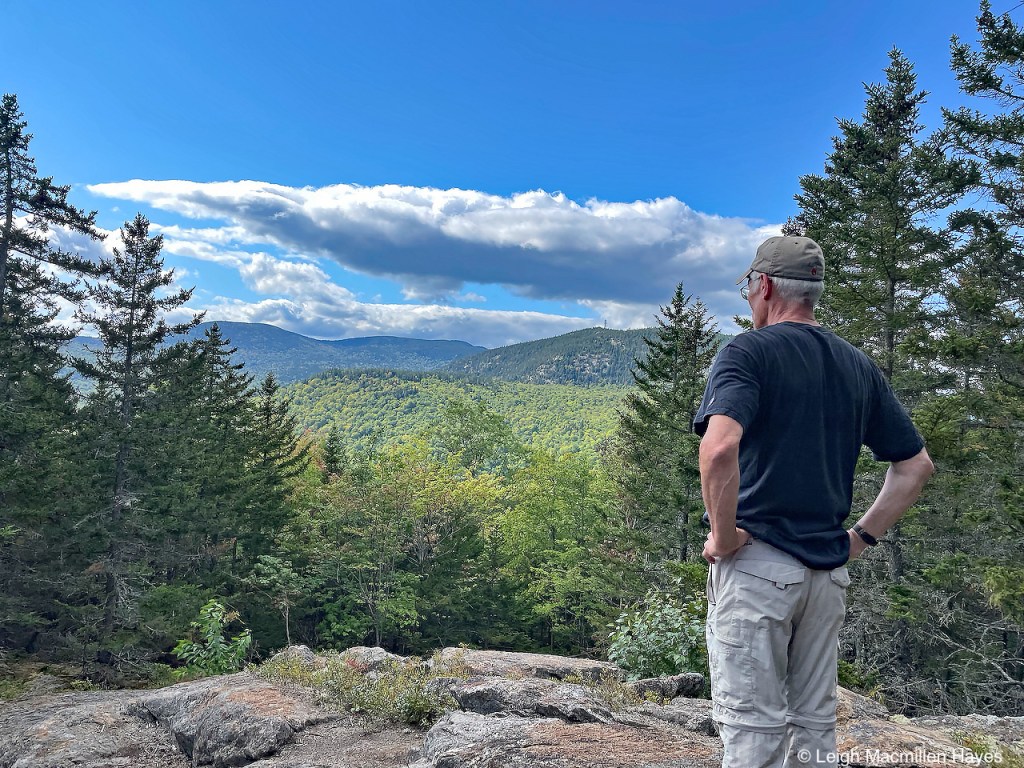
Becoming Tree Wise

So here’s the deal. A friend and I were supposed to lead a tree workshop today, but the weather didn’t cooperate. I’m not complaining about the few inches of snow–it’s the sleet that came first and the rain that is now eating up some of the snow that bothers me.

That said, I’m going to take you on a deep dive to meet some of the trees of Maine in their winter format. We are so fortunate to live in a section of the country where there is such variety, but that doesn’t mean we all know a species with just a quick glance. Oh, maybe you do. I know I sometimes have to slow my brain down before my mouth makes an announcement.

I found a drawing of a tree “cookie” on the internet this past week and decided to recreate it in one of my sketch books this morning. I like it because it helps me better understand how a tree works.

The key factor here is that trees are made of . . . wood. You knew that. But, what exactly is wood? Think scaffolding and plumbing. A tree needs structure to grow so tall, but it also very much needs food and water. Two components, therefore, make up the wood: Xylem and Phloem. Xy (think sky high) transports water from the roots, while Phloem (Think flow low) moves the sugar made in the leaves via photosynthesis during the summer down through the trunk.

As you can see from the sketch, the Phloem is only present on the outer layer of a tree–right under the bark. The Xylem makes up the majority of the wood.

And all those Xylem cells–they are made up of an outer wall of lignin, which gives the trees structure, and an inner layer of cellulose, which provides flexibility. Some trees, like Gray Birch, have a high concentration of cellulose, thus allowing them to bend under the weight of the snow, usually, but not always, without snapping.

The Xylem actually acts as a bunch of straws pulling up water, along with nutrients and minerals, from the soil. But can we actually see this action occuring in the trees? The answer is a resounding, “No.” It’s not at all like we might use a straw to slurp up a frappe, but rather a passive flow, where the water molecules evaporate through the stomata (holes in a leaf surface, similar to our pores), they draw other water molecules upward from the soil to the roots, and the roots to the Xylem, and the Xylem to the leaf, and the leaf to the air (Think water vapor = Transpiration).

Going back to the sketch above, the early wood of each year, which occurs in spring and summer, is much lighter in color than that of the late wood, but the two together create a ring documenting that particular year.

The heartwood, which isn’t labeled, is the inner core. It provides support for the trunk and is actually dead because over time the Xylem gets clogged up with resin. And each year more of the tree dies from the inside out.

If you are still with me, let’s get to the actual trees I want you to meet.

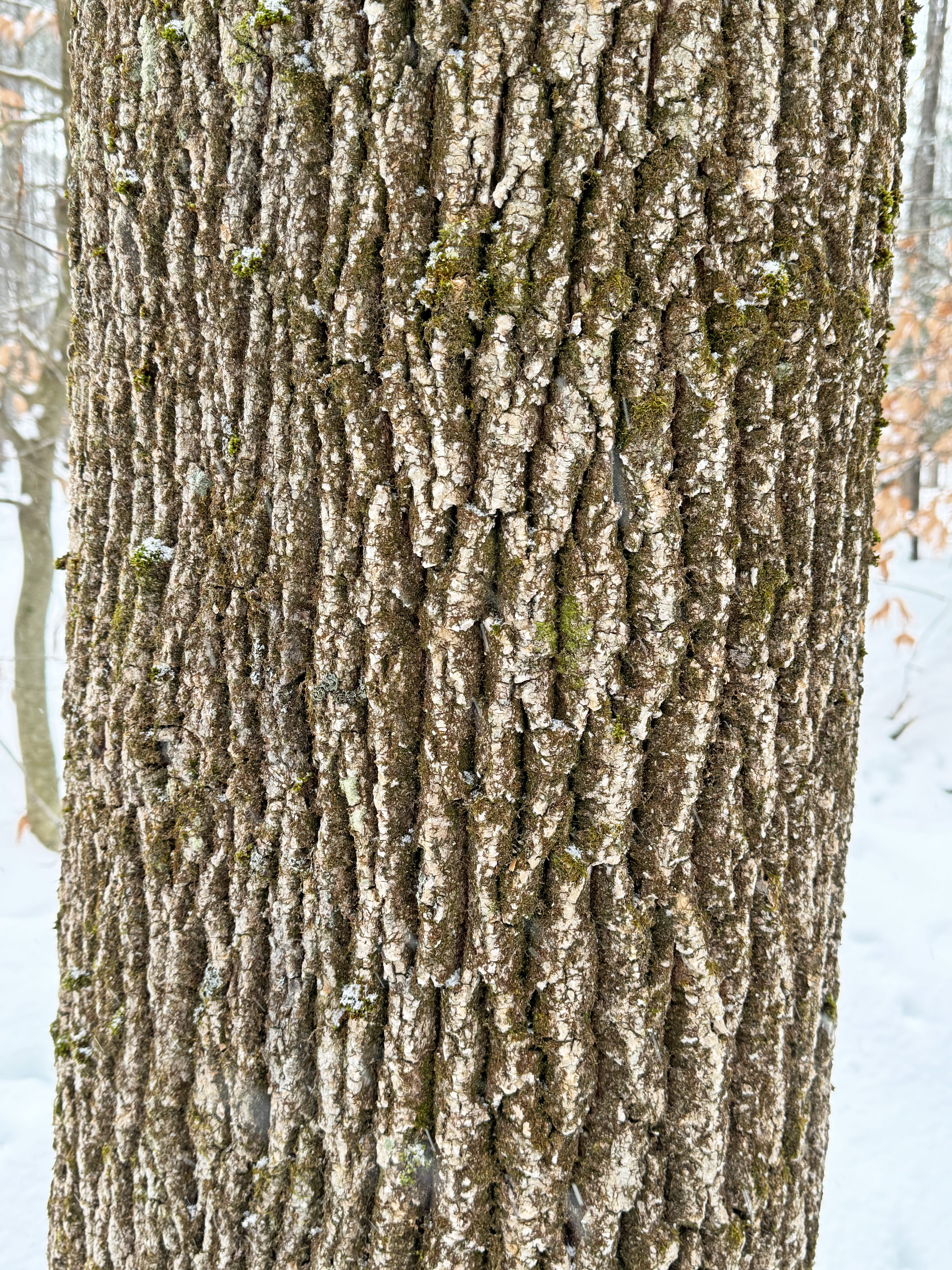
Up first is a White Ash, Fraximus americana. This is one of those species that once you get to know it, you spot it from a distance because of the pattern of the bark. What exactly is the pattern? Well, I see intersecting ridges that form obvious diamond-shaped furrows which appear as an X or cantaloupe rind, but others see an A for Ash, and still others see a V, and some even spy a woven basket. The thing is, whatever pops out for you and will help you identify it in the future should be your go-to image stored in your brain.

One of my favorite things about Ash bark is that it is corky and after a storm, you can pinch water out of it or stick a fingernail into it.

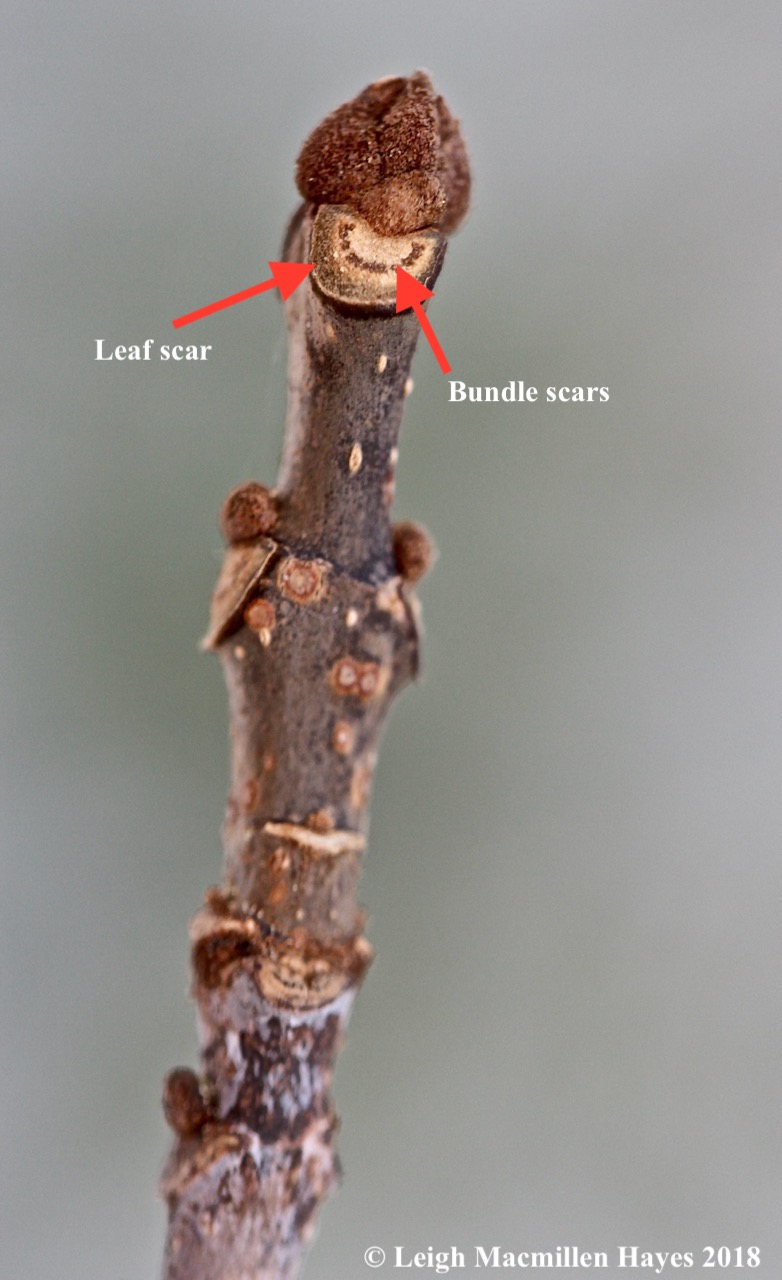
The twig is quite stout and ashy-gray in color. The buds are opposite, and the terminal bud at the tip of the twig is rounded or dome-shaped.

One of the features that speaks to the color of this Ash is the shape of the leaf scar below the new bud. A leaf scar is where last year’s leaf was attached until the end of the growing season. At that time an abscissa layer formed between the petiole (stem) and the twig. The leaf fell off and the tree healed the wound quickly with a protective cork. The bundle scars are part of the pipeline as they were the vascular tissue contained in the petiole of the leaf. Each tree has its own number of bundle scars located within each leaf scar.

Back to the shape–can you see how the bud dips a bit down into the leaf scar rather than sitting across the top of it. This tells us it is a White Ash and not a Green Ash. Add to that the fact that the terminal bud is not hairy.

And my rendition of White Ash bark.

Up next is another favorite. Oh never mind. They all are my favorites. This is a Red Maple, Acer rubrum.

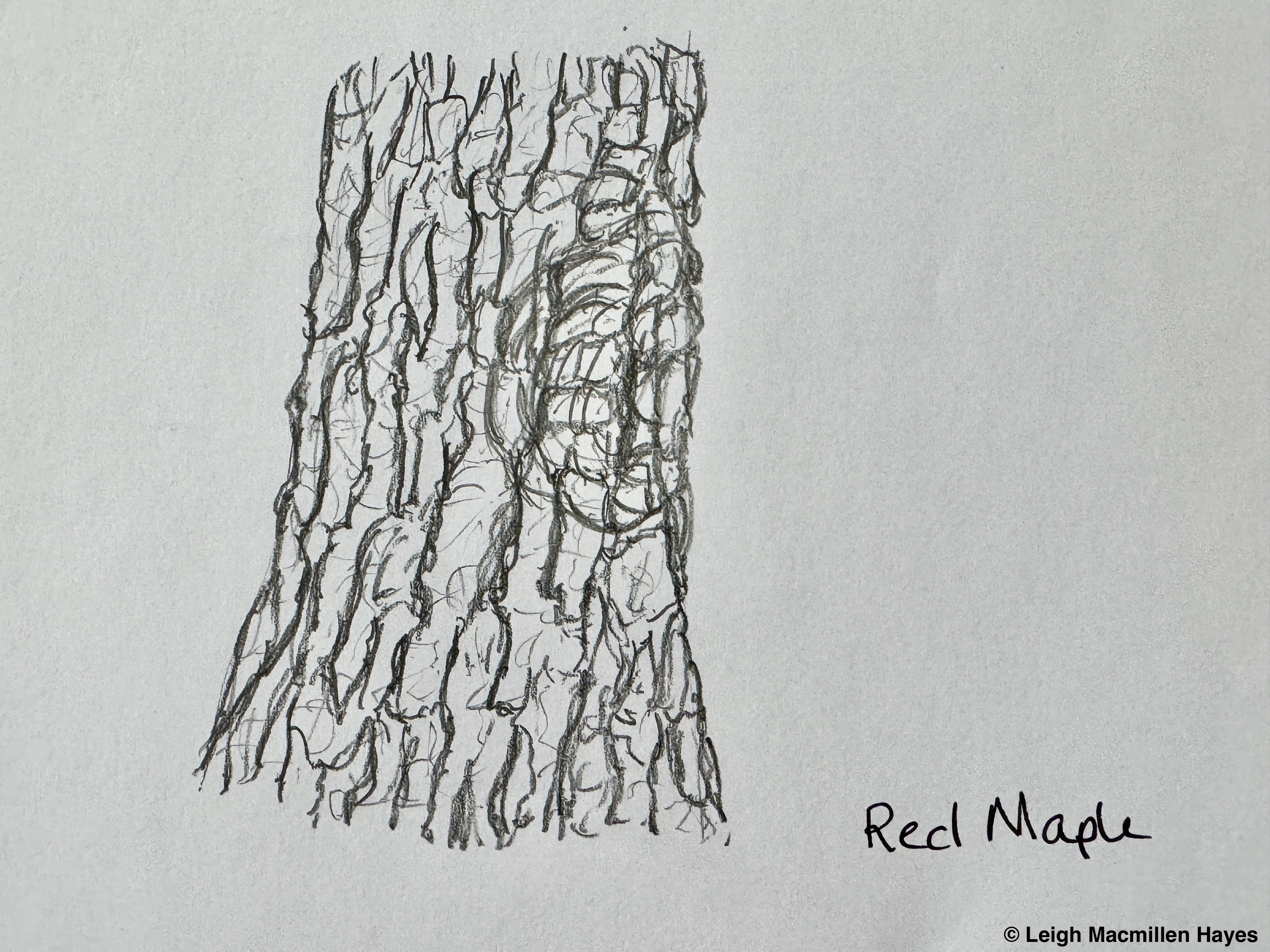
The bark is light to dark gray in coloration and almost smooth with crackled, vertical, plate-like strips. It curls outward on either side, and on older trees, look for tails to curl out on ends of strips.

Sometimes, it is difficult to determine if a maple is Red or Sugar, but one of the clues I look for is the Bull’s Eye target on the bark. There are several on this one, can you see the rounded patterns that aren’t completely formed? The target is formed as a reaction to a fungus.

Again, this is a tree with opposite branching. So one of the keys to tree ID is to know if the branching is opposite or alternate. I love this mnemonic devise: Very MAD Horse. Trees/shrubs with opposite branching include Viburnums like Hobblebush; Maples; Ash; Dogwoods (unless it’s the Alternate-leafed Dogwood); and Horse Chestnut.

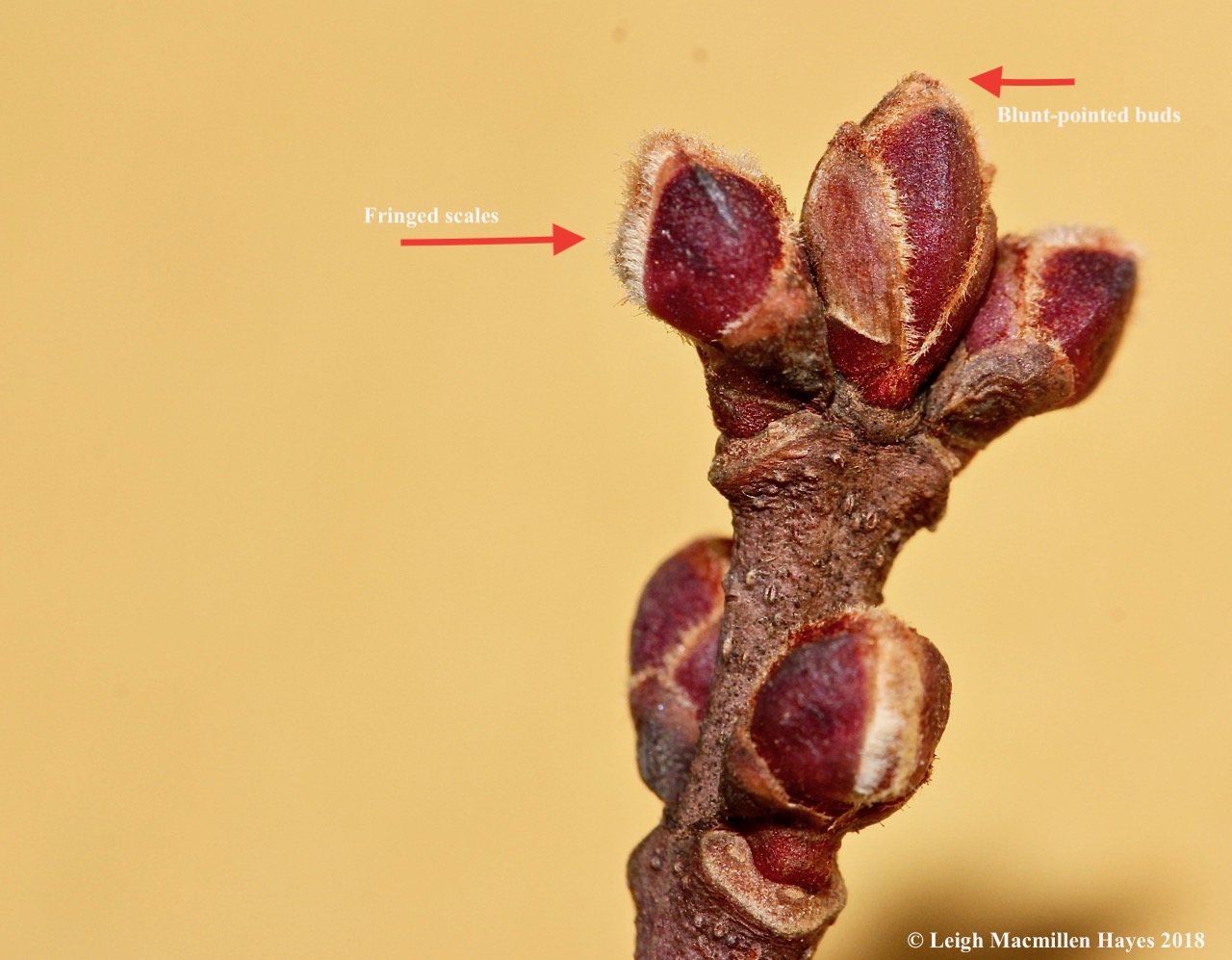
As you can see, the buds are red. This is another clue that it’s a Red Maple: there’s always something red on the tree. Sugar Maple buds are much smaller and brown.

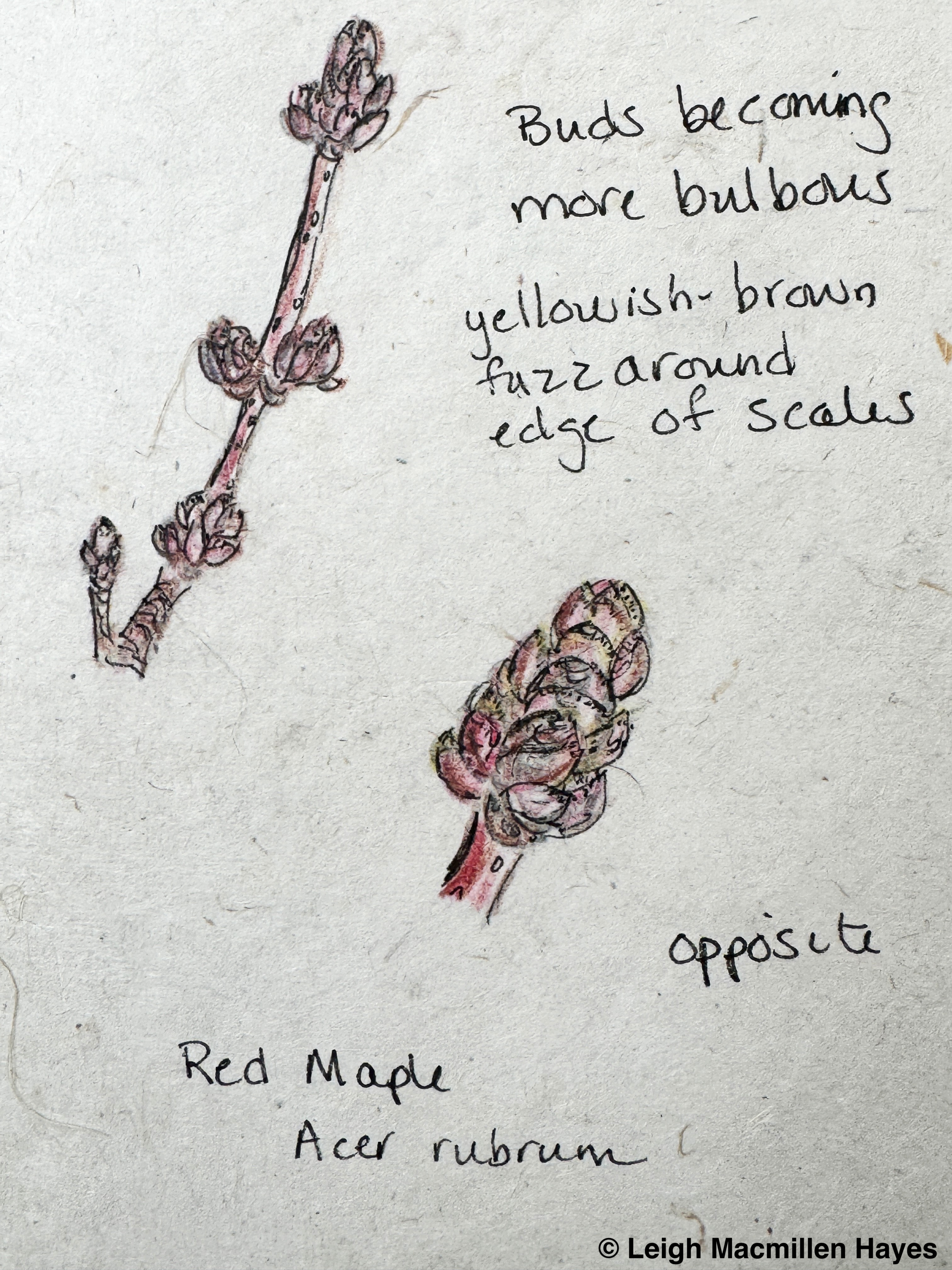
Each bud has 3 or more scales and each scale is fringed with little hairs. The twigs are straight and also red, especially newer wood.

My rendition, though I do need to work on the target.

And the twigs/buds, which are already becoming more bulbous. I have to be honest with you. As a kid and young adult, I did not know that buds for the next year form in the previous summer and overwinter under those toasty scales for protection. I suppose I never actually thought about it. But of course they do, because that’s when the tree has the most energy. In April, they will flower, and by May the leaves will begin to form.

But right now, it is snowing again–YAHOO!

American Beech, Fagus grandifolia, is our next exhibit. These trees can tolerate shade and I will never forget when a local forester showed some students a tree cookie that was about two inches in diameter and he asked one to count the number of tree rings. Sixty years old. Yes, they tolerate shade.

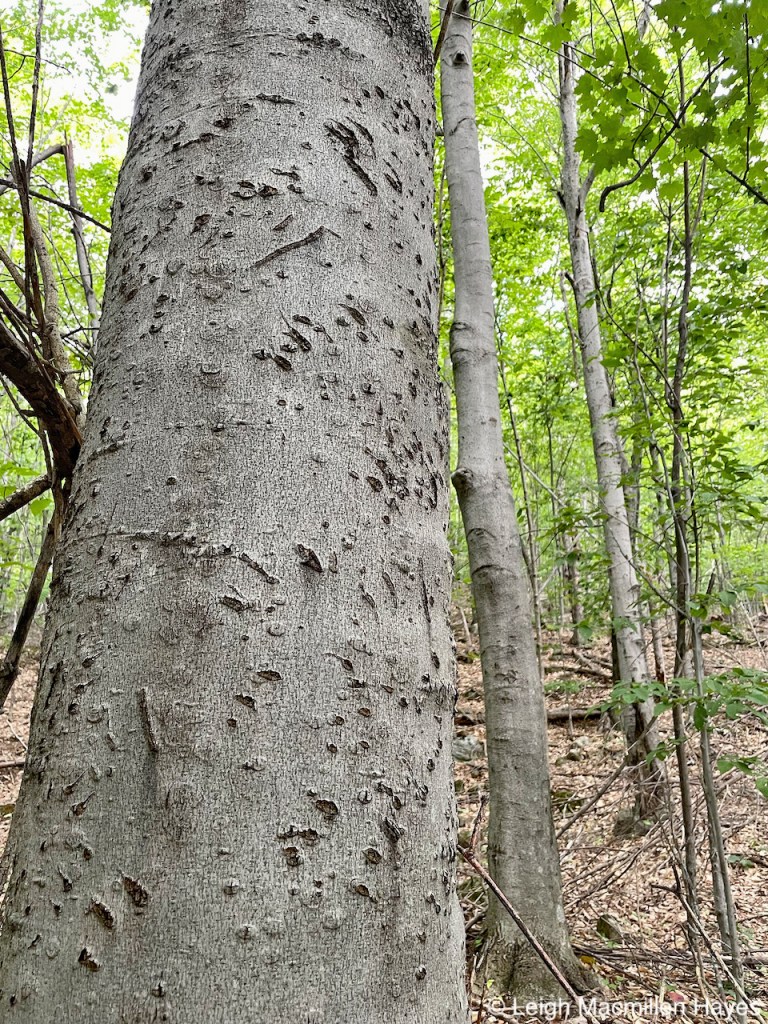
In fact, Beech trees tolerate a lot. Typically, the bark is smooth, unless . . . there are cankers or blisters dotting it that are caused by the tree’s reaction to a fungus that gains access via a tiny puncture made by Beech Scale Insects. The insects are teeny little things, with fluffy white coatings, and they congregate on the bark for 50 weeks, where they pierce the tree repeatedly to get sap. For two weeks of their lives, they can fly. The rest of the time, they stay put and sip.

Another thing that Beech trees tolerate is Bear Claw marks and if you are a follower of wondermyway, I need say no more. If not, search for bear claw trees in the search bar.

They also tolerate humans carving initials. More than they should; And those initials and those bear claw marks will always be present as long as the tree lives. In fact, they’ll be in the exact same place at the same height that they were originally made, but they’ll have widened a bit each year.

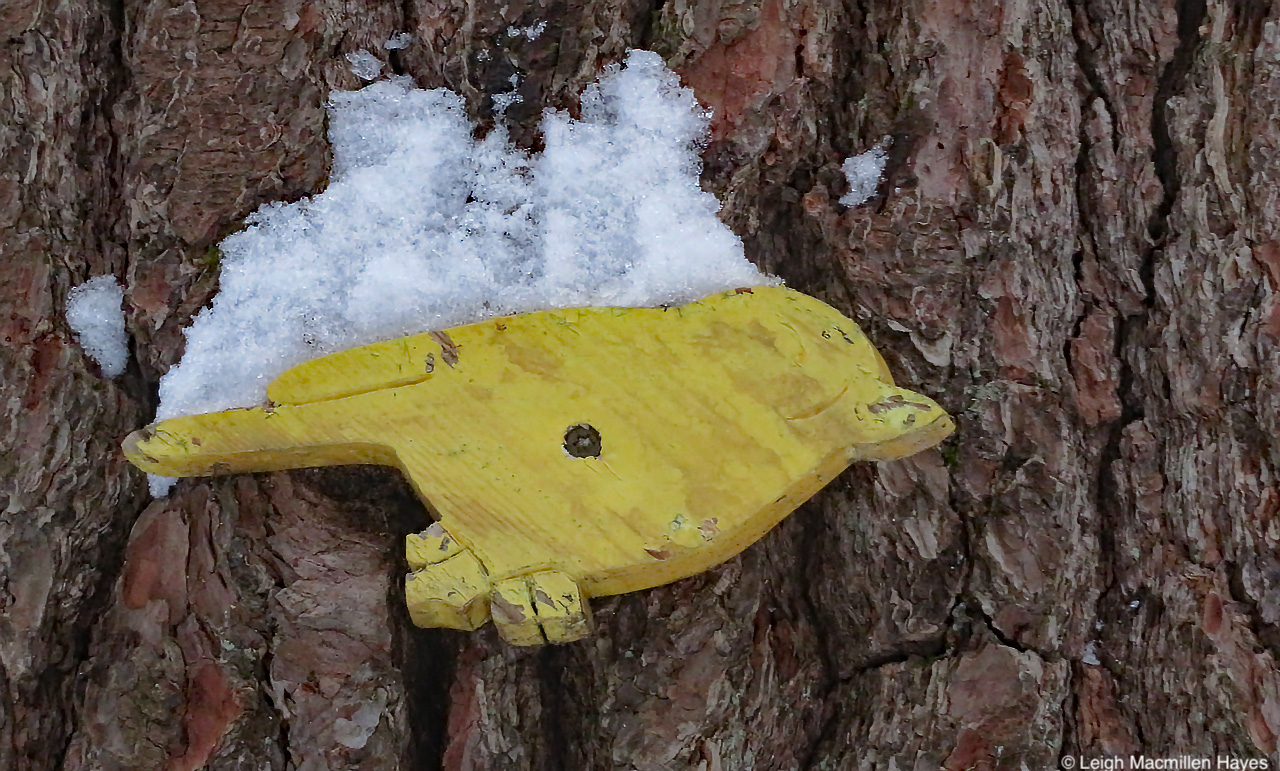
All trees grow out from the heartwood, and up from the uppermost branches. So if you place a trail blaze on a tree, it will always be in the same spot, you just need to make sure that you don’t screw it all the way into the tree or the tree will grow around it eventually. (Rule of thumb: leave about two inches between the sign and the tree; and check it each year)

Beech twigs are deep brown with white lenticels. Oh yikes. We haven’t talked about lenticels yet. All trees have them. A lenticel is like the pores in our skin and allows the tree to exchange gases. Lenticels come in a variety of shapes including raised circular, oval, and elongated. (Remember, leaves have stomata for the same purpose.)

As you can see, the bud is sharp-pointed, covered with many scales, and a delightful golden brown. Some see it as a cigar. That description doesn’t work for me, but it is tapered at both ends. And really, nothing else looks like this in the north woods. While this photo is of a terminal bud, the twigs and buds are alternate.

Leaves on Beech are marcescent and wither on the trees over the winter. In fact, if there is a sudden breeze and the leaves start to rattle, I’ve been known to become rattled, thinking there is something or someone else in the woods with me.

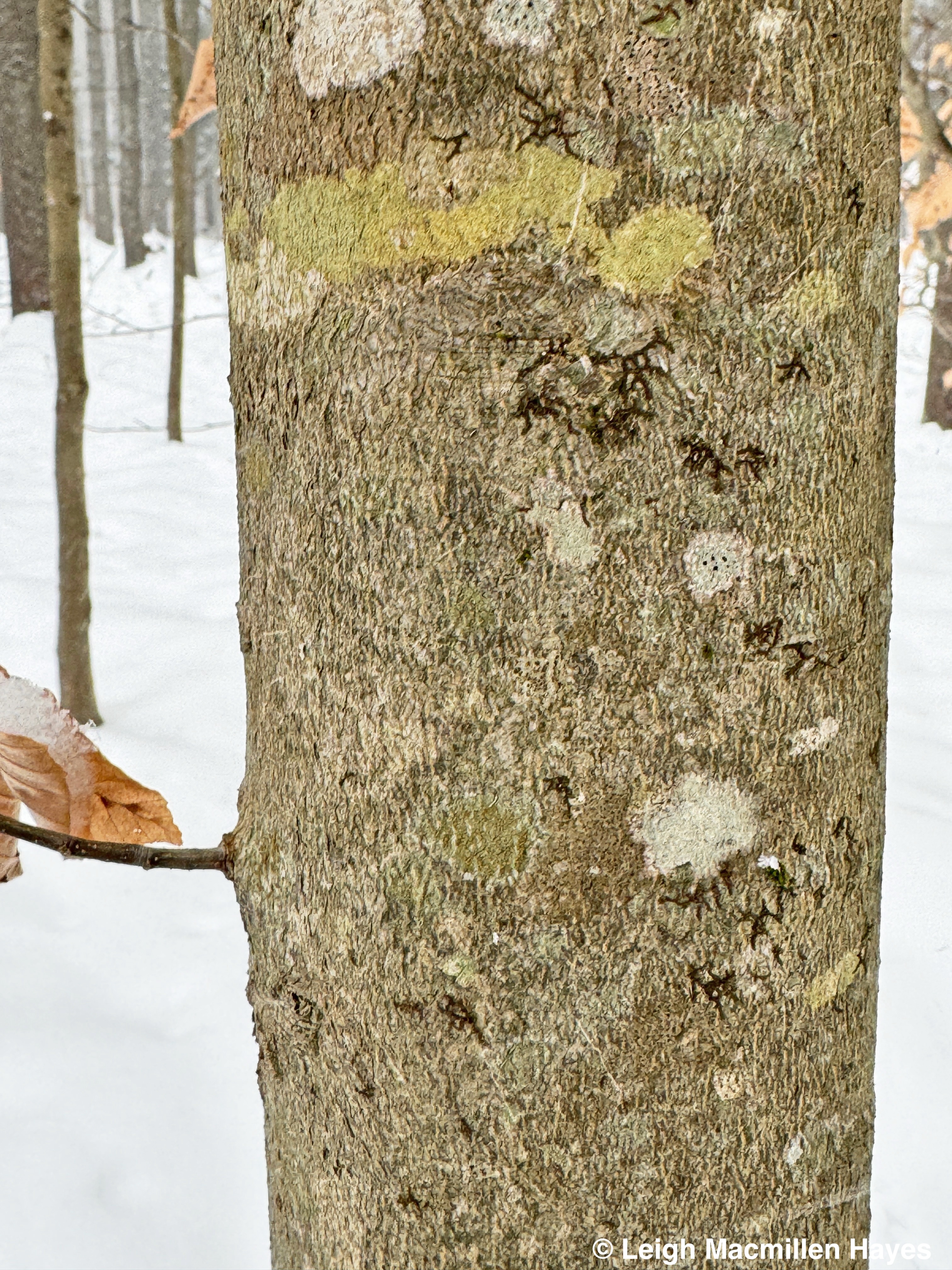
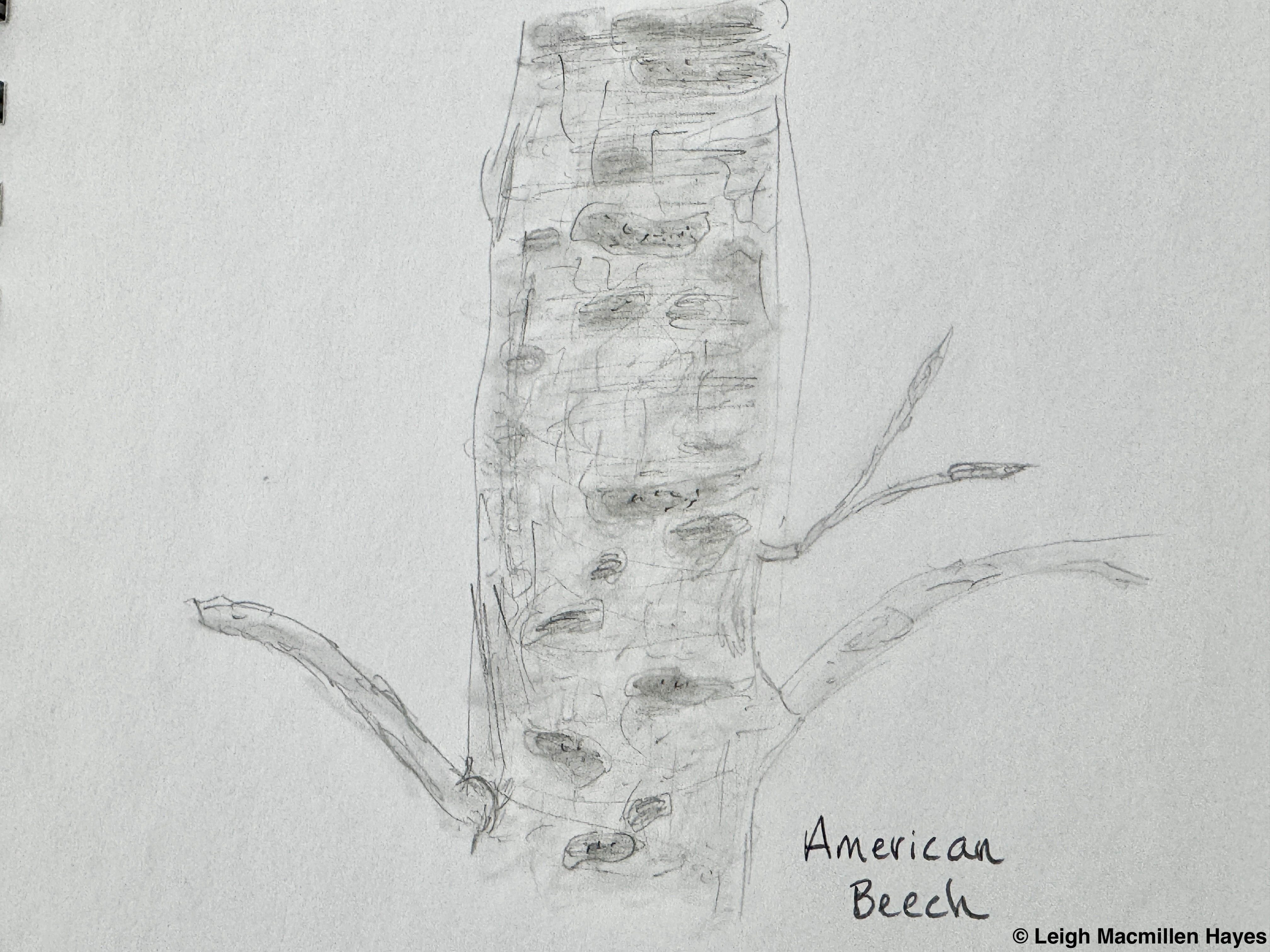
And this time I present American Beech, which can be blotched with crustose lichens (look like they’ve been painted onto the bark).

And a twig, showing the growth rings, which occur where the previous year’s terminal bud had been.

And now for an upclose look at the bark of Northern Red Oak, Quercus rubra. (I almost wrote Maple, and for some you’ll know that as “my mouth or in this case my fingers before my brain”–like when I call a Beech, that I know darn well is a Beech, a Birch. Such is life.)

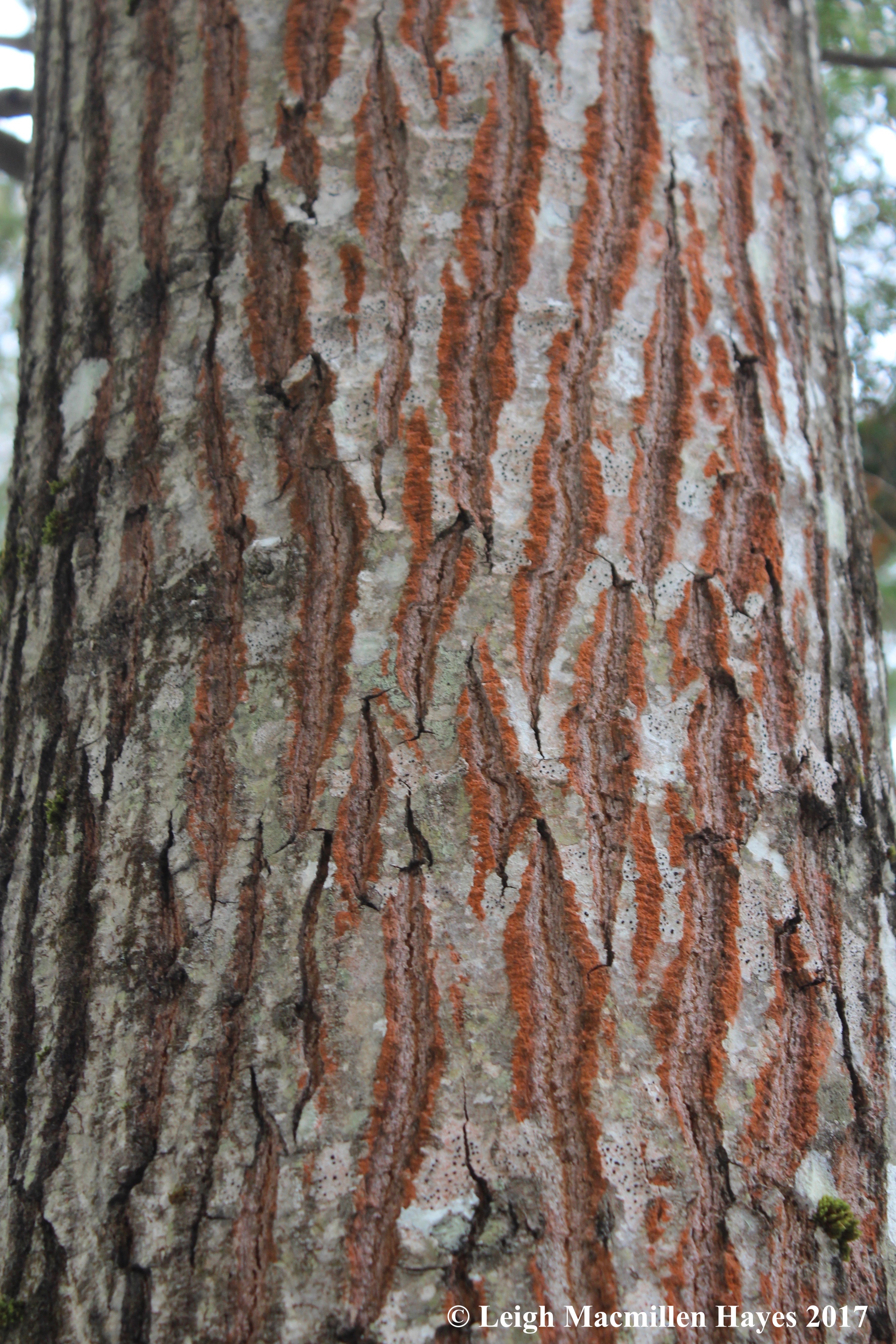
Red Oak bark is greenish brown or gray and has rusty red inner bark. When I look at it, I see wide, flat-topped ridges that run vertically parallel but also intersect like ski tracks. Shallow furrows separate the ridges.

The red inner bark is especially noticeable in winter.

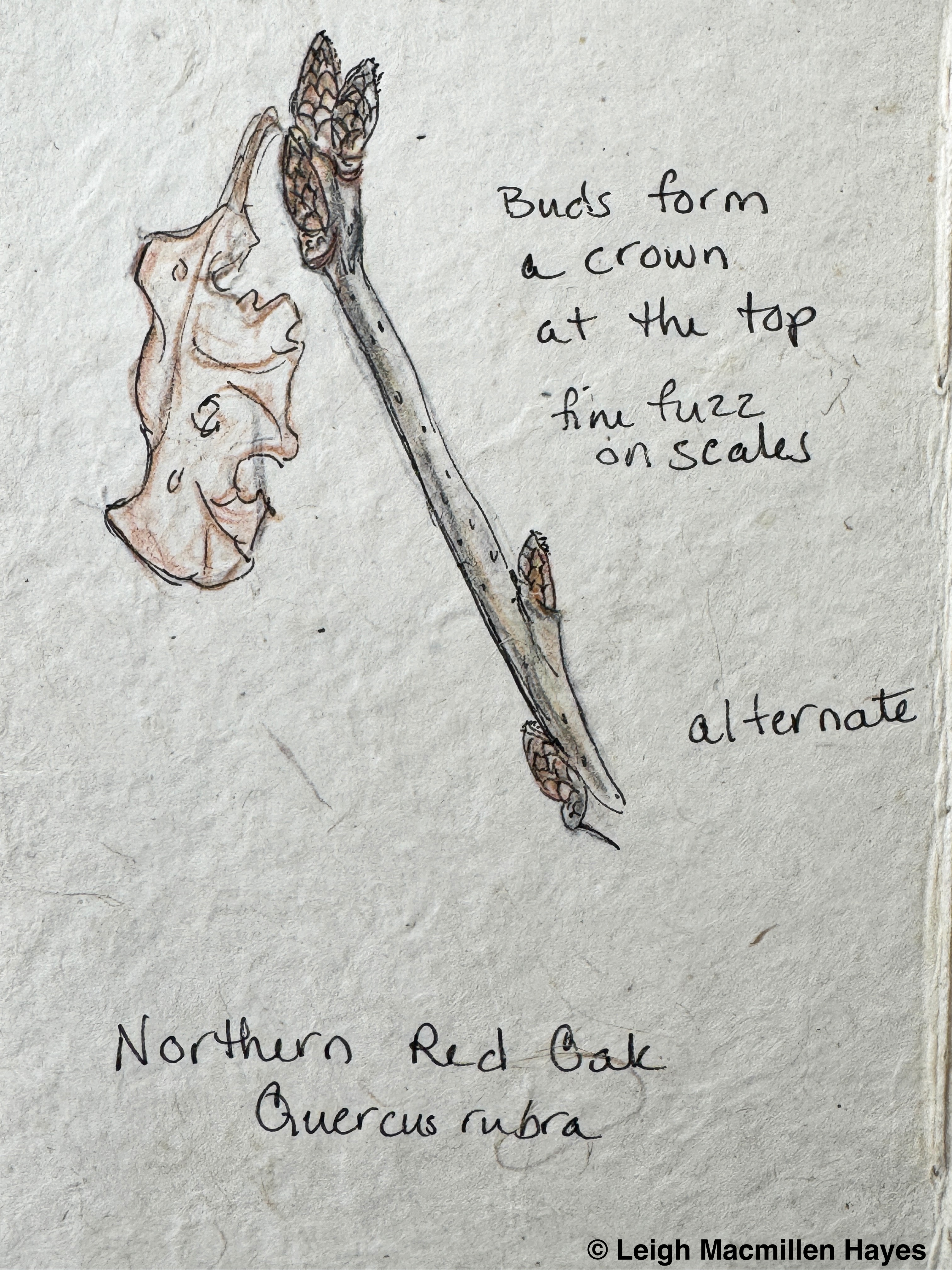
The twigs and buds are alternate in orientation. The twigs are smooth, and greenish brown, but the buds are much more intersting as they occur in a crown at the tip of the twig. Each bud has many scales and matted wooly hairs. I love their chestnut brown color.

My rendition of a Northern Red Oak.

And the twig. As you can see, there are also buds along the twig, not just at the tip, and they do grow alternately. Also, Oaks have marcescent leaves as well, though most fall off before spring. I did spot a very mature Red Oak the other day that is overwhelming full of dried leaves.

And now let’s meet several members of the Birch Family. Up first is the Paper Birch, Betula papyrifera. You may know this commonly as a White Birch, but I prefer Paper, and will explain why after introducing you to its kin.

Betulin is a compound in the cells of the outer bark that is arranged in such a way as to reflect light and make it appear white. The betulin crystals provide protection from the sun as well as freeze/thaw cycles. It also protects the tree from pests. And to top it off, betulin is the reason the bark is a good fire starter as its highly flammable and waterproof. Your go-to for a rainy day fire. It was also used to build birch bark canoes.

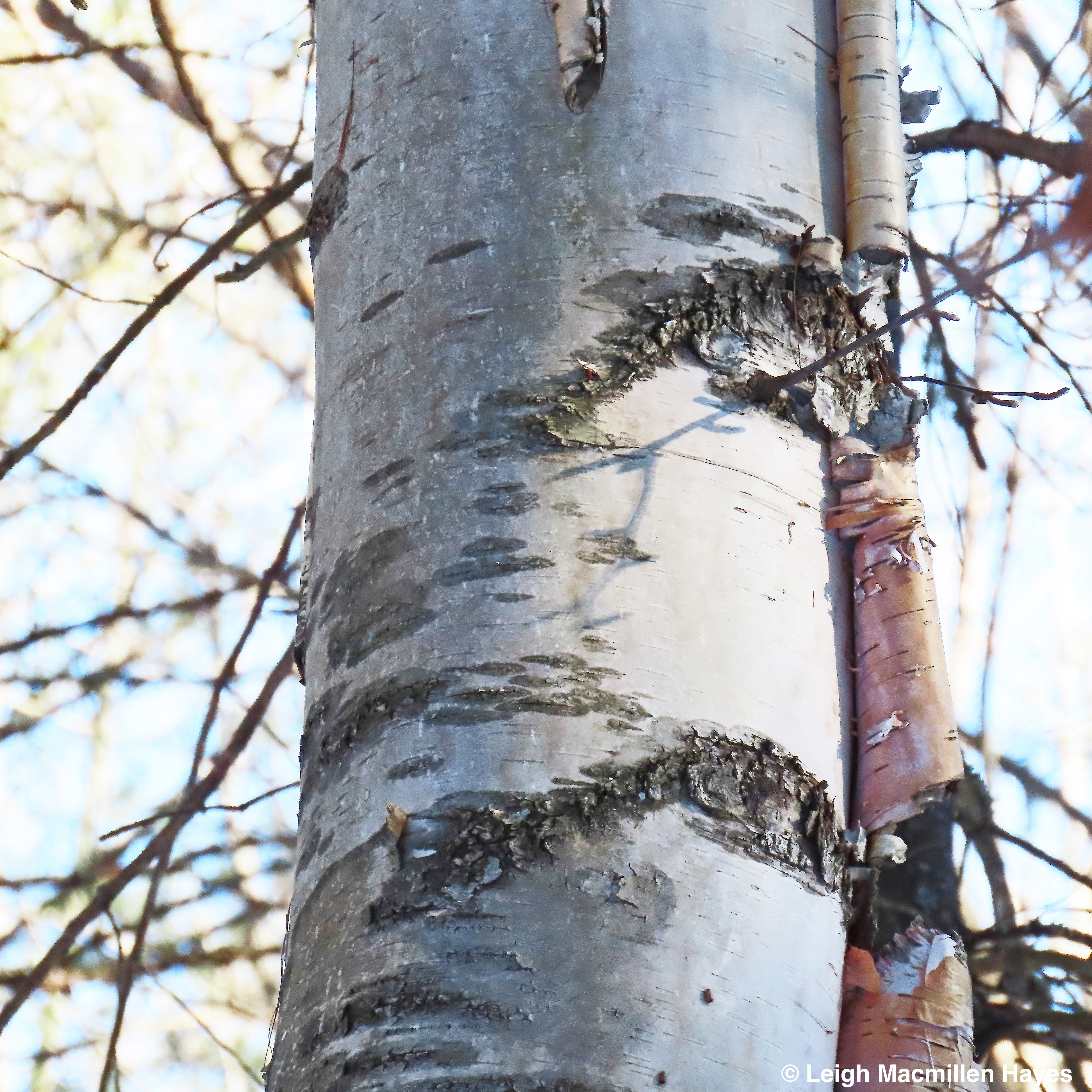
Young Paper Birch bark is white, but often with an orange and pinkish tinge. It has thin, horizontal, light-colored lenticels. As it matures, the bark changes from white to creamy white. Sometimes I even see the colors of a sunset in it, including some blue in the winter.

The outer layers separate from the trunk into curled sheets, thus the paper nomenclature. But, I caution you not to pull it off, as prematurely exposing the cambium layer may harm the tree.

Older bark can sometimes make this tree more difficult to identify because it has gray sections of rough, irregular designs, especially around the base.

One of the features I look for on a Birch to determine if it is a paper, besides the curly bark, is the mustache that is drawn over the branches on the trunk. In the photo above, the branches are no longer there, but do you see two mustaches? Sometimes both ends droop down even more.

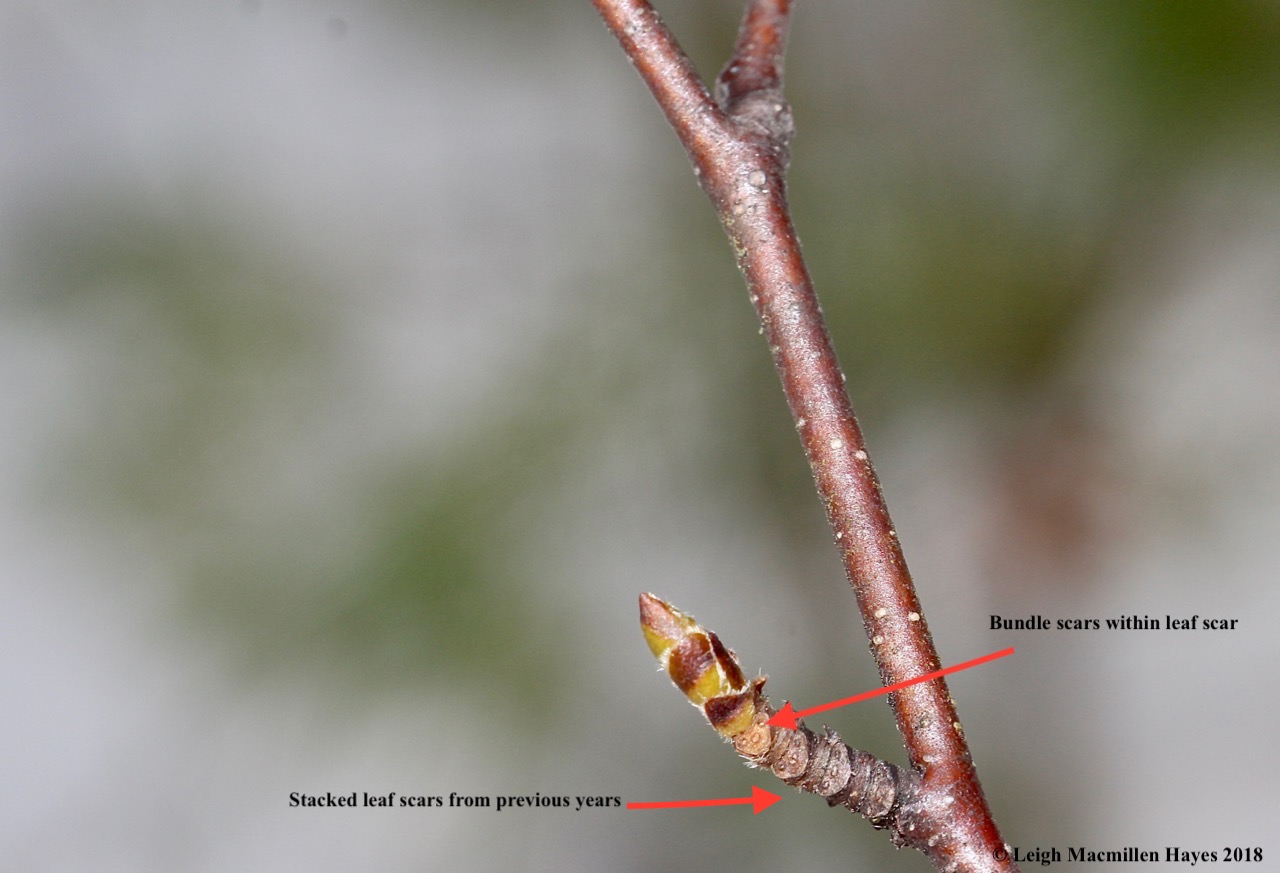
The twigs of Paper Birch are alternate, as are the buds. New growth on a reddish brown twig is usually hairy. And buds may grow on shoot spurs, which I’ll show you in a minute.

Paper Birch buds are covered with scales that are sticky, especially if squeezed. And for the most part, they are not hairy.

Their flowers are in the form of catkins, with tiny seeds protected by fleur de lis-shaped scales. Paper Birch catkins appear mostly in clusters of three.

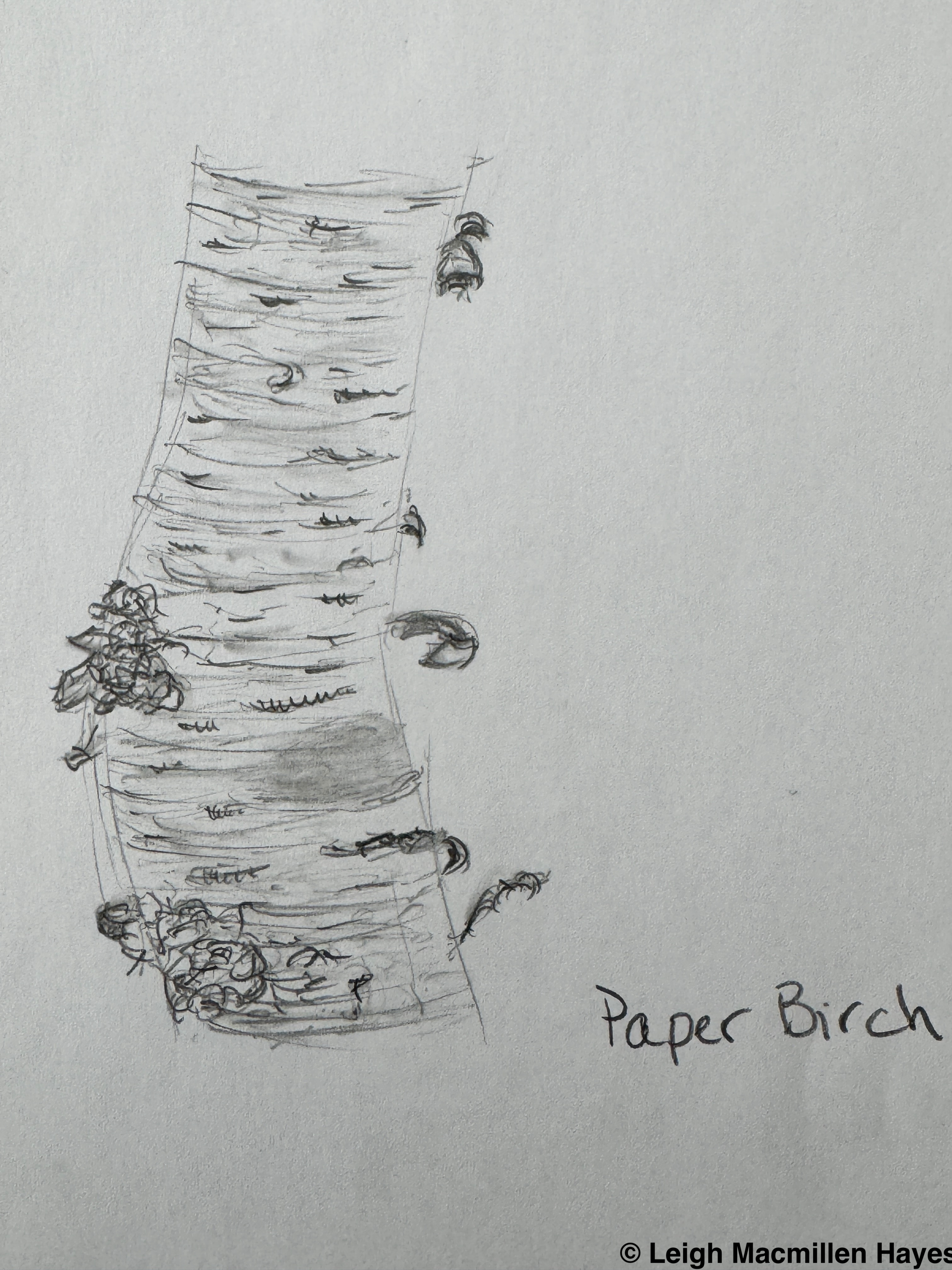
My rendition, though I need to sketch one with the branches and mustaches. Another day.

This sweet tree has long served as a reminder to me to go off trail and look for a mesmerizing spring of water. Oh, not every Yellow Birch reminds me to do that, but I know where I took this particular photo and the spring is about an eighth of a mile behind it.

Yellow Birch, Betula alleghaniensis, has bronze to yellowish-gray bark that is shiny. And it too curls, but this time it curls away in thin, ribbony strips, giving the bark a shaggy appearance.

One special note about Yellow Birch, and the same is true for one of our conifers that I’ll discuss soon, is that the seeds struggle to germinate on the forest floor, but give them a moss-covered rock, or tree stump, or nurse log, and bingo, a tree grows on it. As it continues to grow, the roots seek the ground below and if it is upon a stump or log that eventually rots away, you have a tree in the forest that appears to stand on stilted legs.

So I mentioned for Paper Birch that they have spurs of stacked buds and so do the Yellow Birch. The bud appears at the end of the stack and by the leaf scars left behind you can count the age of the spur.

The twigs are not hairy, but they have their own unique distinction. I wish I could share this with you, but you’ll have to go out on your own and find a Yellow Birch twig–the distinction is a scratch ‘n sniff test. If you scratch it and smell wintergreen, then you have found a Yellow Birch.

Three to four catkins appear on Yellow Birches, but they are not clustered, so that’s another clue as to the color/name of the tree.

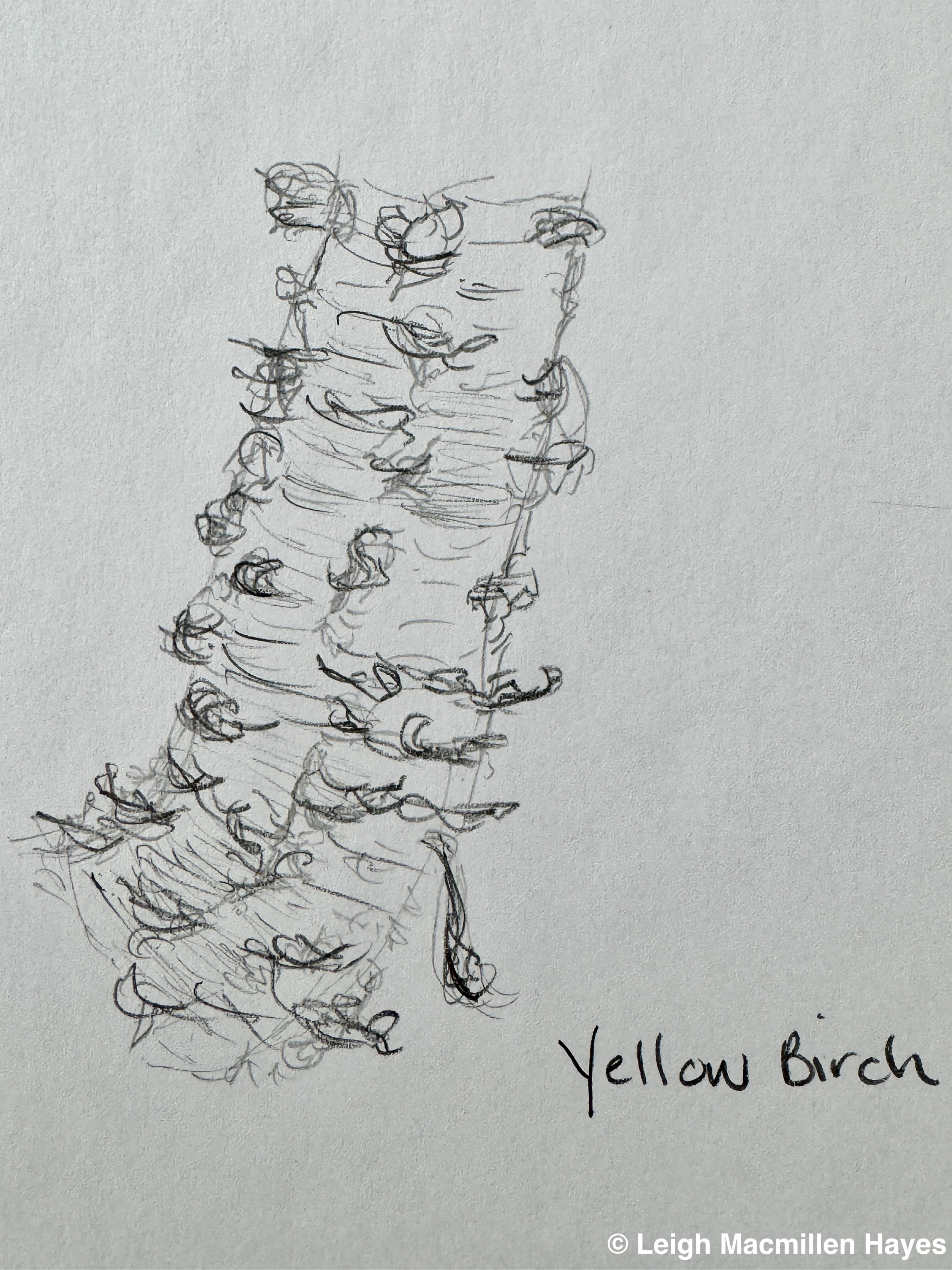
My Yellow Birch.

Gray Birch, Betula populifolia, is an early succession tree, meaning when an area has been cleared, this is one of the first trees to grow. Unlike Paper Birch, which can live to the ripe age of 90 or so if conditions are right, and Yellow Birch that can survive over 200 years, Gray Birches are not long lived and many only survive 30 – 60 years.

Often these trees are leaning, even if they don’t have snow piled upon them. And their lower branches remain on the tree, where Paper Birch tend to self-shed. The branches are pendulum, leaning toward the ground in an arc. And below each branch or where a branch had been, is a triangular shaped gray beard.

I mentioned earlier that I prefer Paper over White for a Paper Birch, and one reason is because Gray Birch also appear white. But Gray does tend to have a dirtier look to it and it has little to no peeling.

Gray Birch twigs are very fine, and super warty. In fact, it’s fun to run your fingers over them and feel the lenticels, like someone glued salt crystals to them. Their coloration is dull gray to brown and they are not hairy, nor do they smell like wintergreen when scraped.

The red brown to greenish brown buds are short, with scales that also lack hairs, and they are not sticky.

As for catkins, most appear in early spring as a single one or a pair. If you spot a single one in the fall/winter, then it is usually a solitary male.

Tada. A Gray Birch.

The final deciduous tree is a Quaking Aspen, Populus tremuloides. (I bet you are thinking, “Oh phew, she’s almost done, but never fear, I have four conifers to share with you.)

Quaking Aspens are also early succession trees, and they can grow from seeds, but also like to root sprout. One tree in Utah has over 50,000 stems from one root and covers over 100 acres.

The bark is grayish-green, and more so green on a wet day like today. It also has horizontal bands that become more evident as the tree matures.

The buds of the Aspen are alternate, shiny and dark brown. They aren’t sticky like its cousin, the Big Tooth Aspen. I think the most defining feature of these buds is their varnished appearance. My experience is that Porcupines love them.

The twigs are thick, smooth, and chestnut brown.

I haven’t sketched this tree yet, so I’ve added it to my to-do list.

Balsam Fir, Albies balsamea, smells like a Christmas Tree. This is a conifer that stands straight and tall as if in military fashion.

Its bark is pale gray and smooth, but covered with small dash-like raised lenticels and blister bumps filled with a sticky resin. Pick up a stick when there are puddles nearby, poke a blister and let the resin ooze onto the tip of the stick and then place the stick into a puddle and watch the essential oils form and change shape on the water’s surface. This works best on calm water.

Being an evergreen, Balsam Fir have leaves (needles) that are always on them, though they lose some each year. And gain new ones, of course. If you were to remove all the needles, you’d find a smooth twig.

The needles appear to be arranged in a flat manner, but actually spiral around the twig. They are shiny above and have two rows of white lines below, which are actually the stomata.

At about an inch in length, they attach directly to the twig and some have notched tips.

Their cones are 2 – 4 inches in length, and are dark purple before maturity. The unique thing about Balsam Fir cones is that they stick up from the twig rather than hanging down like other conifers.

I think I found the only Balsam Fir in the forest that wasn’t military straight, but as I always say, “Not everything reads the books we write.”

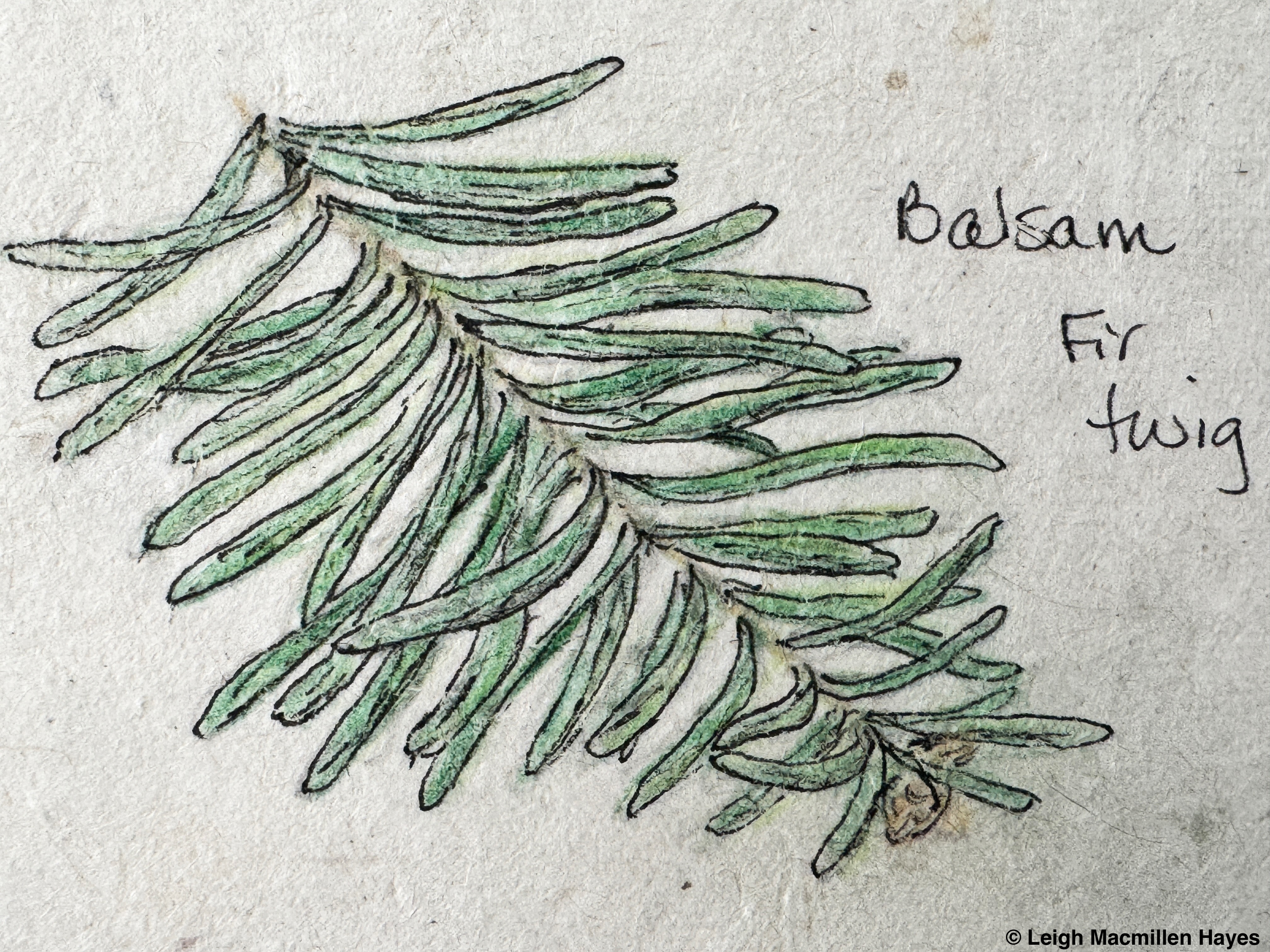
And my offering of the twig.

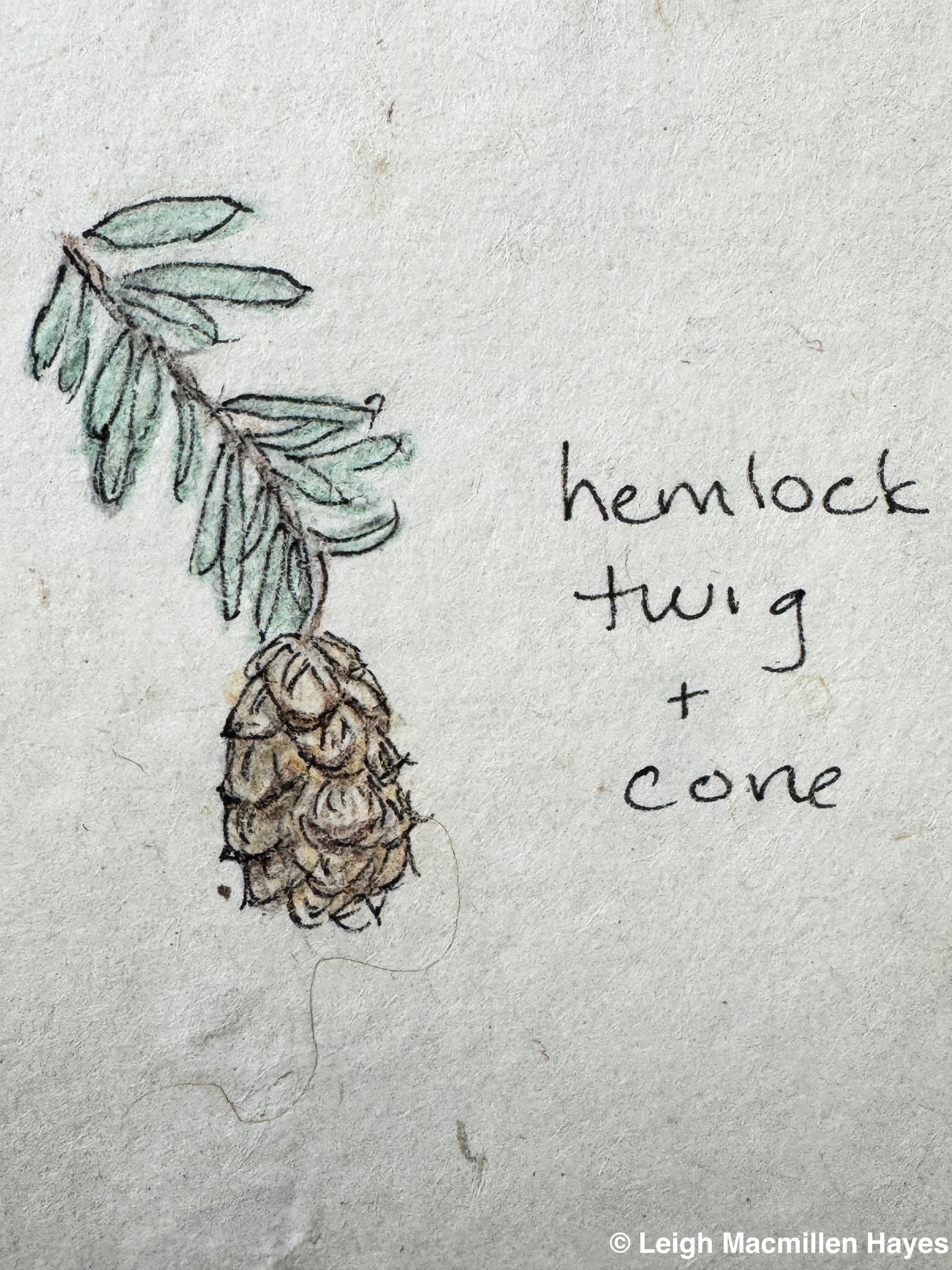
Eastern Hemlock, Tsuga canadensis, has cinnamon red to gray bark. As the tree matures, the bark features narrow, rounded ridges covered with scales that look like they could flake off, but they are rather sturdy.

Overall, the tree has a lacy look and its leader bends over making it appear to dance in the forest.

Hemlocks are like Yellow Birches, in that they need a moist area to set root and often grow on moss-covered rocks or tree stumps or nurse logs, so called because they are rotting trees that provide nurturing places for other things to take form.

While the Balsam Fir needles are about an inch long, Hemlock needles are about a half inch in length. And whereas the Fir needles are directly attached to the twig, Hemlock needles are attached via tiny petioles or stems. And the underside also has two rows of stomata, but so close together, they may appear as one.

The twigs are very fine and very flexible.

Hemlock cones are about 3/4 inch in length ( I got carried away with the size of this one, or you could say its a macro look at the cone) and oblong in shape. They are pendant, meaning they hang off a slender stalk. And small rodents and birds love to eat their seeds that are attached as a pair to the underside of the scale.

Oh, did I say they are all my favorites? Well, maybe my favoritist of all is the Red Pine, Pinus resinosa.

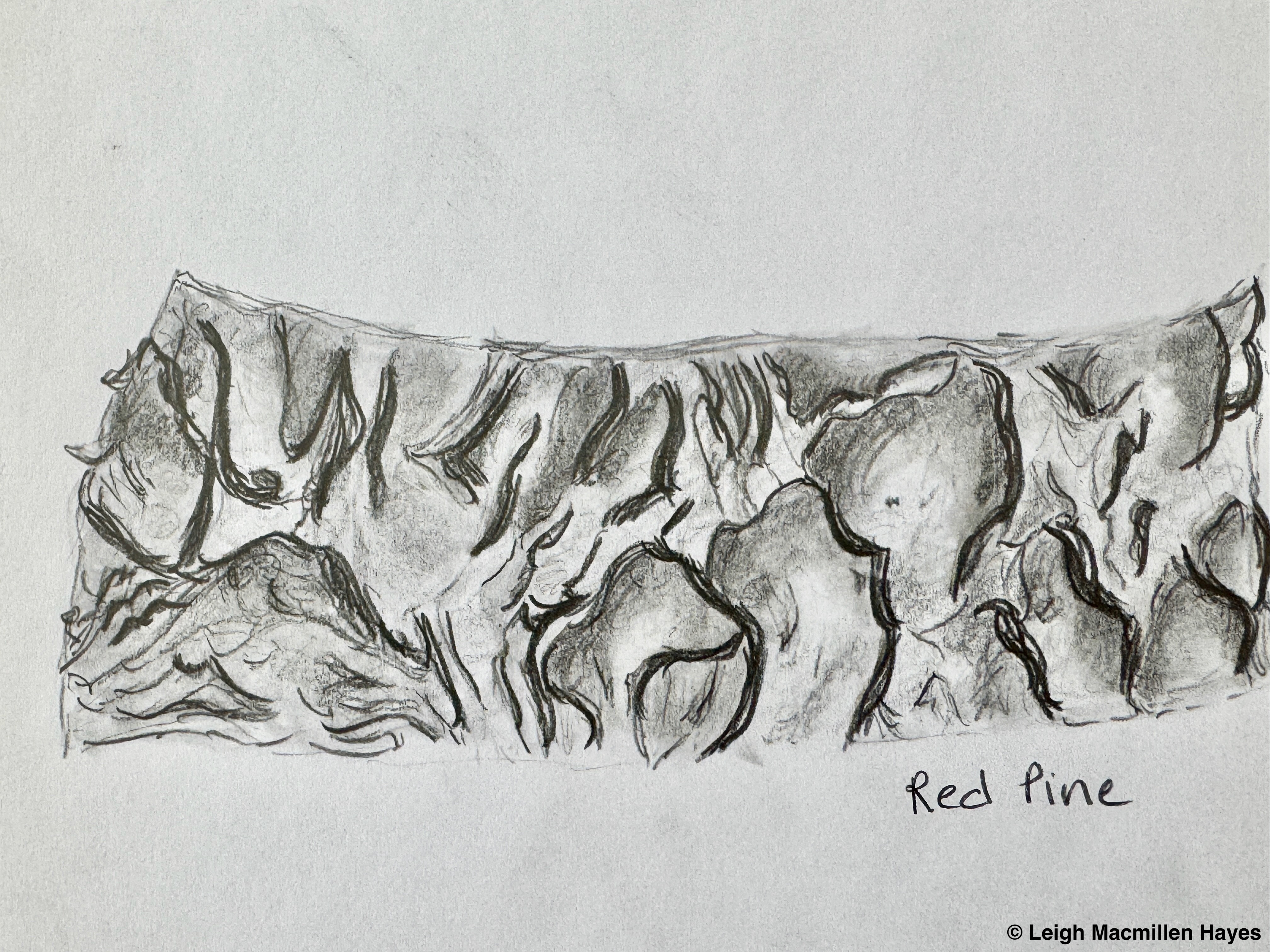
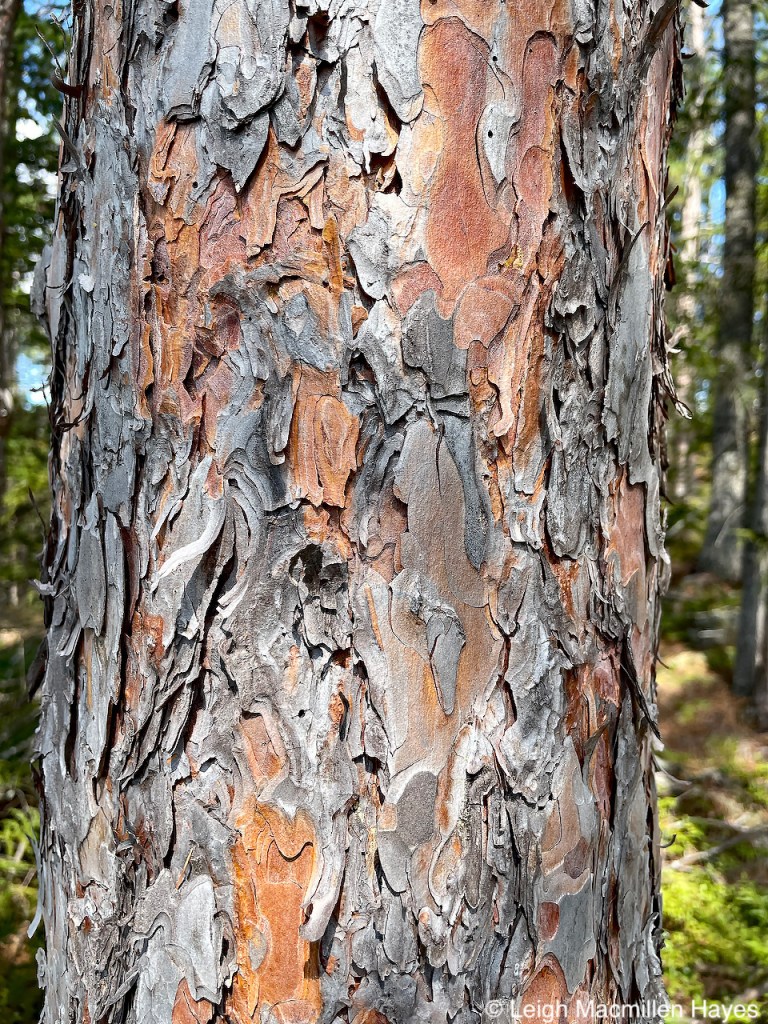
The bark is reddish brown to pinkish gray. I see it as a jigsaw puzzle, but my friend and fellow naturalist Dawn, sees it as a topo map.

Its broken into irregular, thin, flaky scales, that you may see on the ground surrounding the trunk.

As the tree matures, those scales are broken by deep fissures into irregular looking blocks.

Red Pine was of particular importance during the 1930s to 1960s, when the Civil Conservation Corps (CCC) planted plantations of this species on former pastureland as a reforestation project. Once in a while I stumble upon a grove of Red Pines planted in rows and realize that I’m in such a plantation. They were considered a cash crop for telephone poles.

The orange-brown twigs of the Red Pine tend to curve upwards and if you look upward you’ll notice that the needles are all clustered at the end, giving them the look of bushy chimney sweep brooms.

The needles are in bundles of two, and they are about 4 – 5 inches long. If folded in half, they break cleanly.

Red Pine cones are egg-shaped, about two inches in length, and lack prickles like some other species sport. It takes two years for them to mature.

What do you see? Jigsaw puzzle? Topo map? Or something else entirely?

Finally, we have reached the last species for today, White Pine, Pinus strobus. I’m showing you the bark of a mature tree, but if you look at a young pine you’ll note it is very different with its smooth, pea green bark.

Mature trees, such as this, have dark gray to brown bark, with long flat ridges, and deep, dark furrows. What I love about mature White Pines is that the flat ridges have lines that resemble writing paper and I love to write.

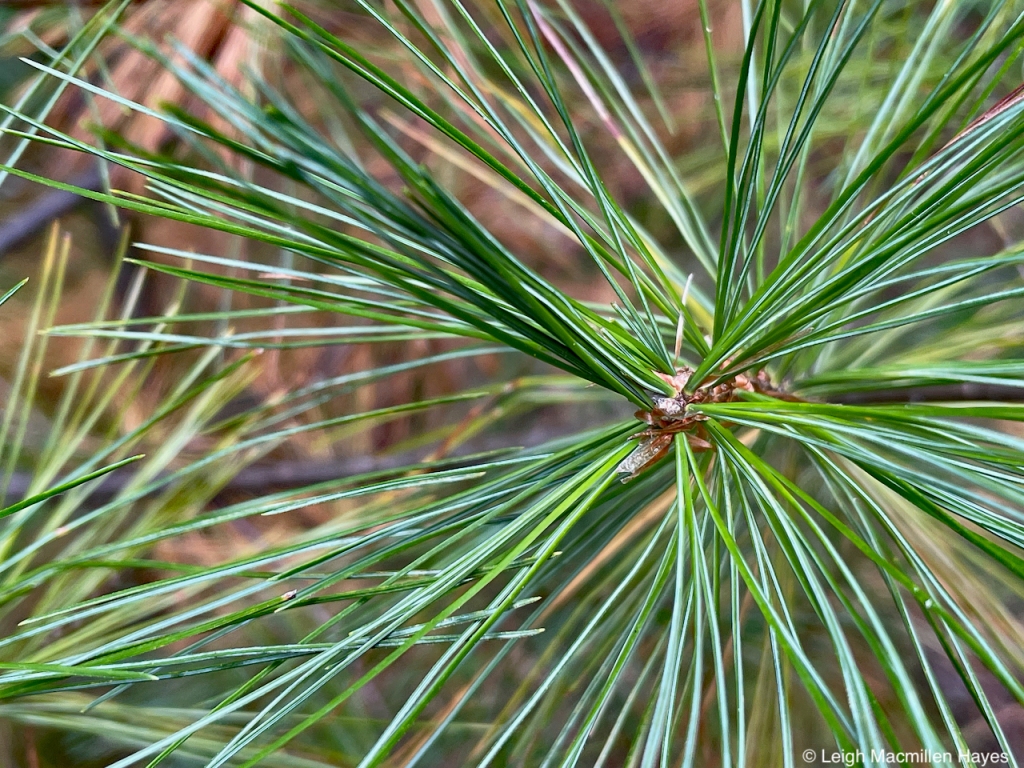
White Pine twigs are slender and gray-green to orange-brown. Bundles of five needles is the count for White Pine, which is cool because it spells its name: W-H-I-T-E, or M-A-I-N-E, since it is our State Tree. (Please remember that Red Pine has only two needles in a bundle, and doesn’t spell its name.)

Cones are 4 – 8 inches long, cylindrical, and also take two years to mature. And it takes a Red Squirrel about 2 minutes to peel back the scales and eat all the seeds as if they were corn kernels on a cob.

Dear readers, if you made it this far, I thank you for sticking with me. I do love to write and maybe I’ve written too much.

But I hope you’ll venture out and get to know these trees better by studying their idiosyncrasies and coming up with your own mnemonics to remember their names.

May you become tree wise and may I continue to learn about and with the trees.
Pileated Woodpecker Works

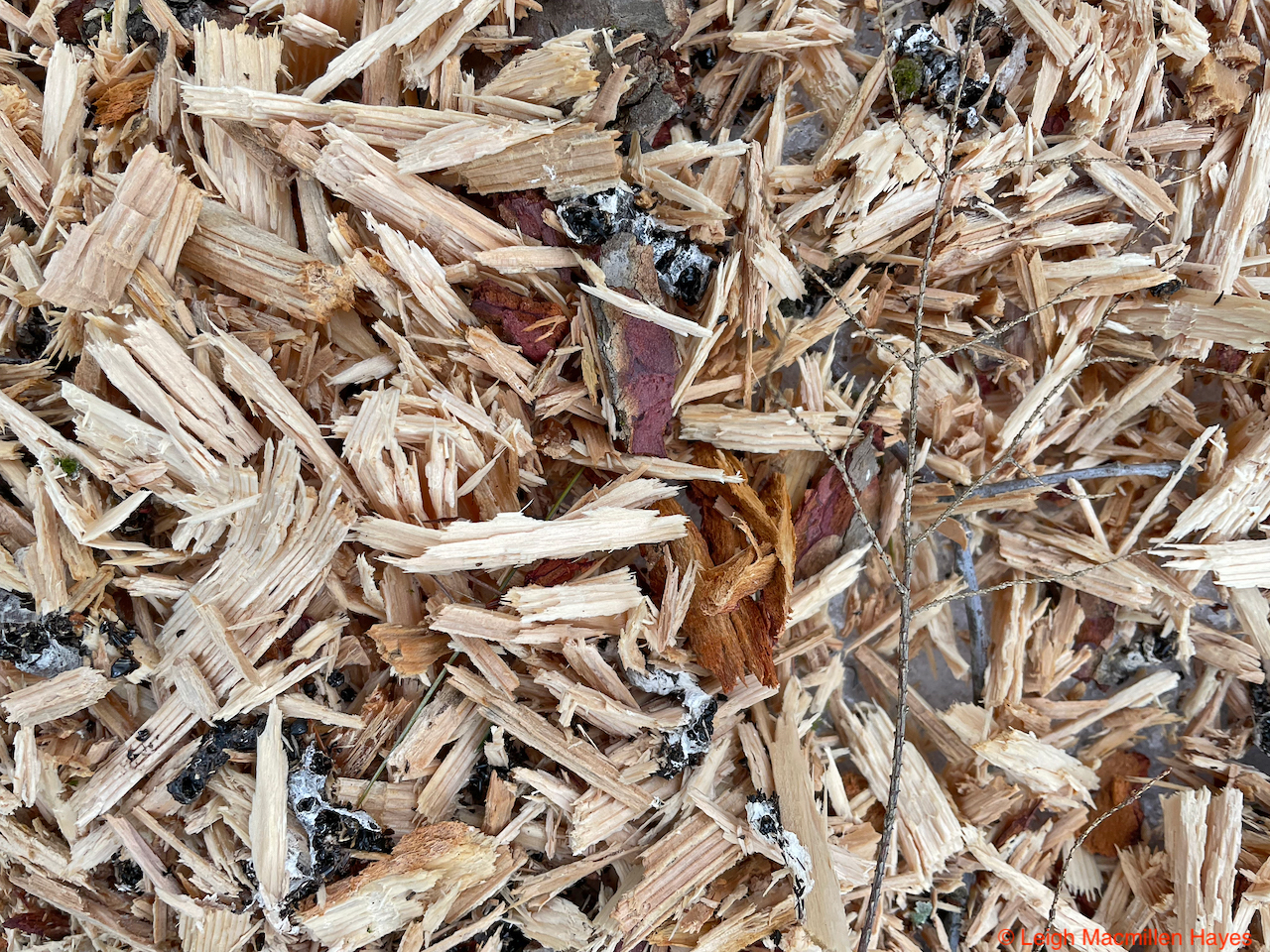
Pileated Woodpeckers often take the rap unfairly for killing trees. In fact, even though they drill holes into the bark and excavate wood in order to reach the galleries of Carpenter Ants, the trees are both dead and alive. Huh?
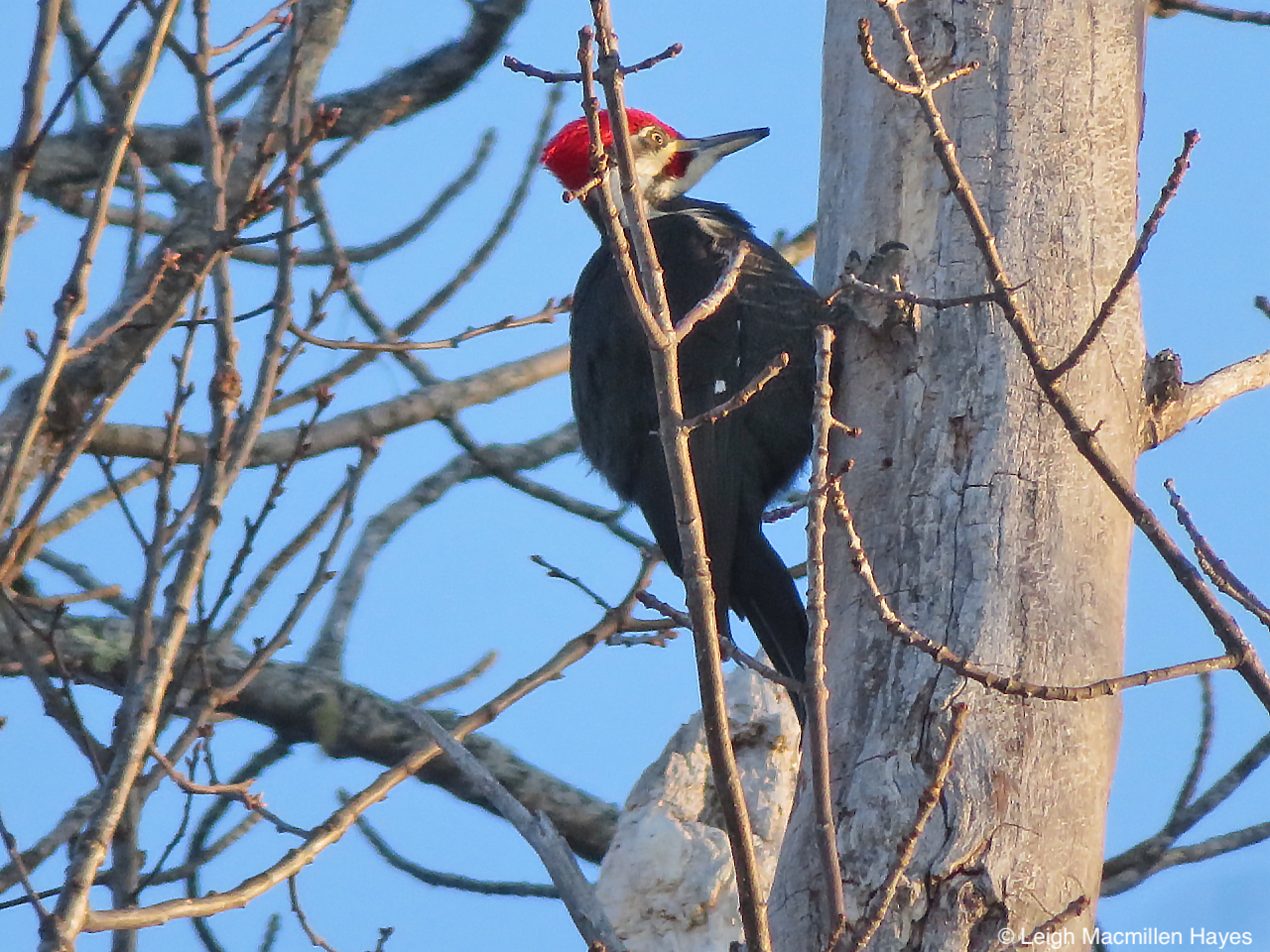
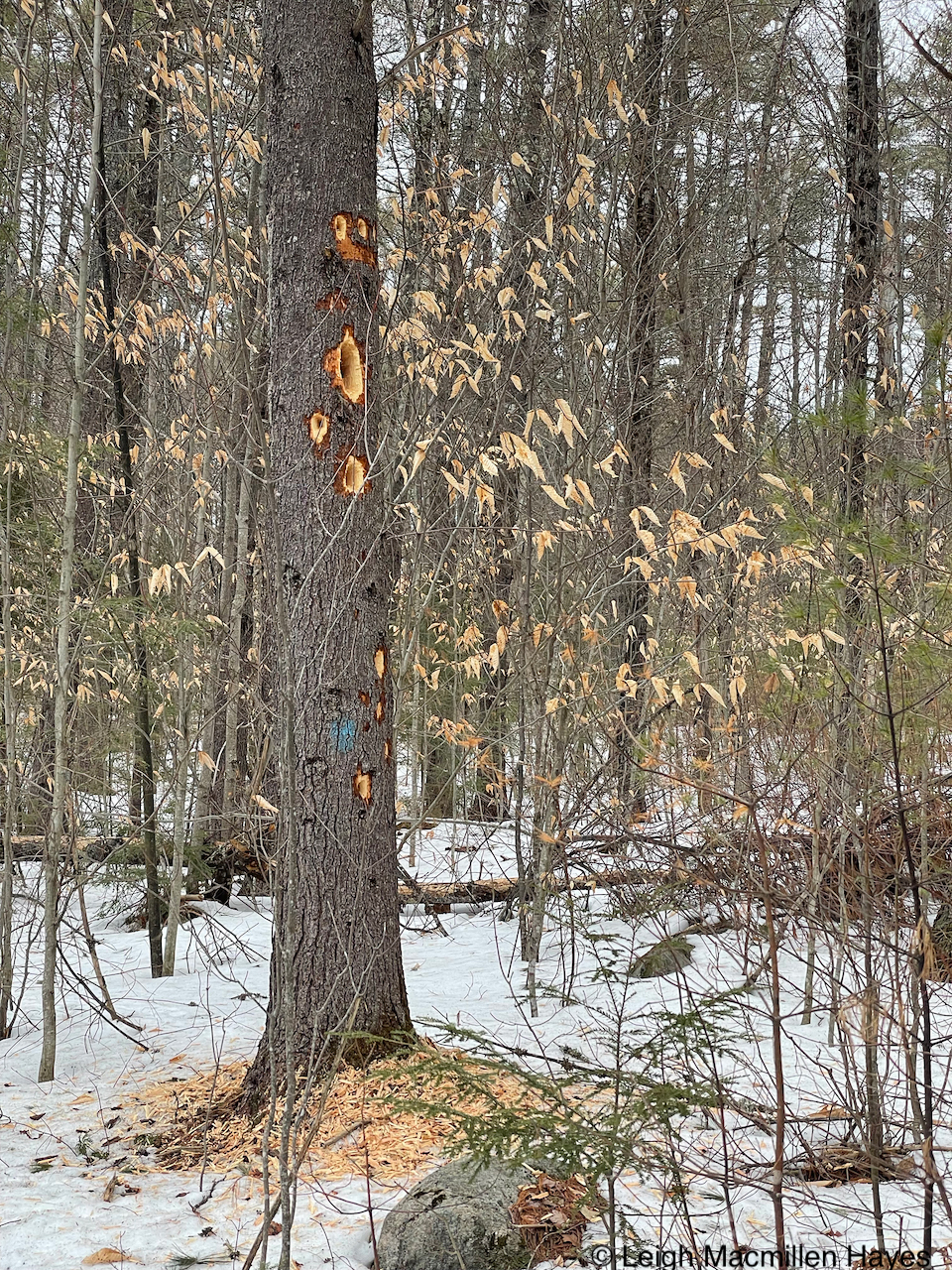
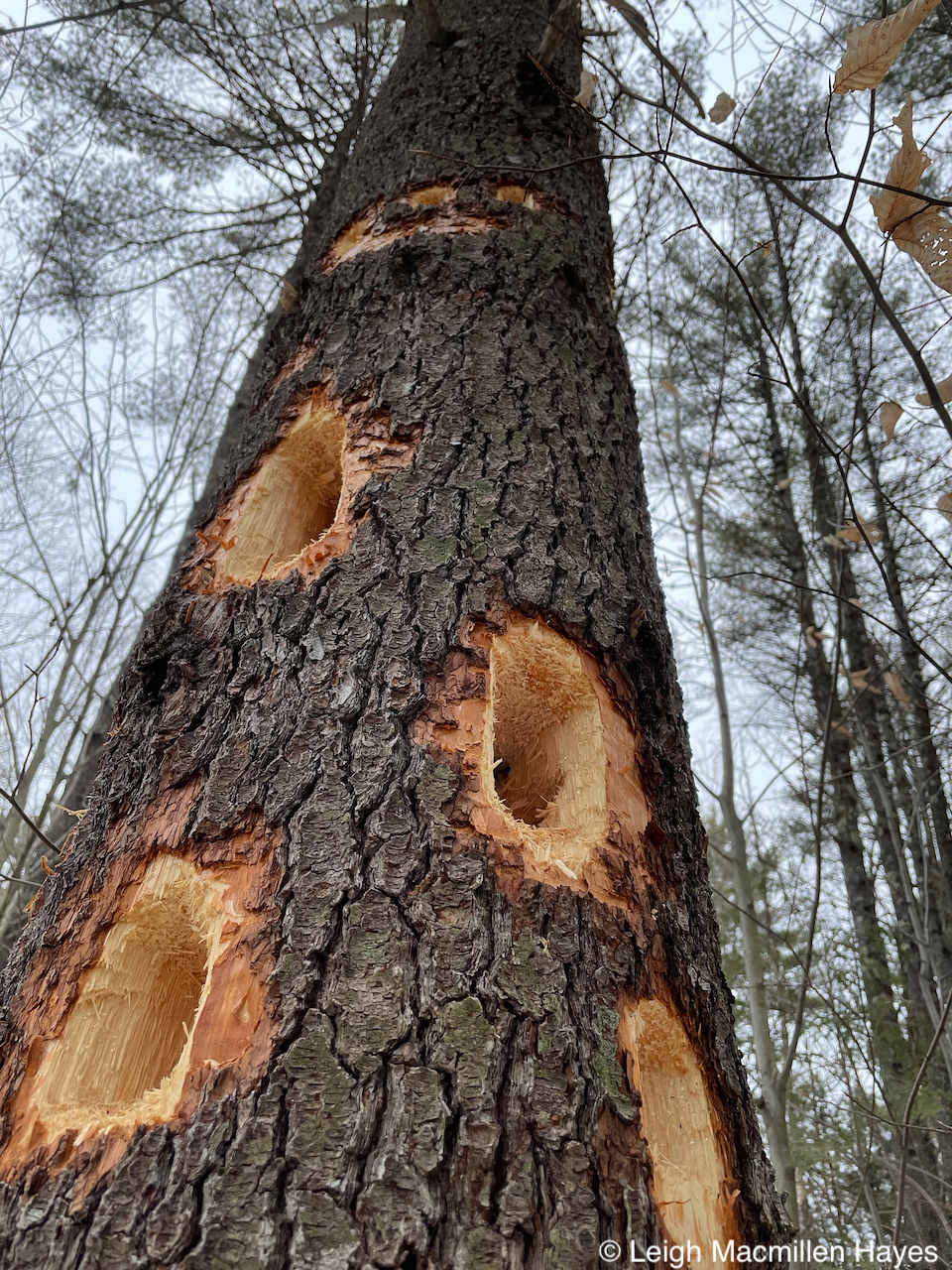
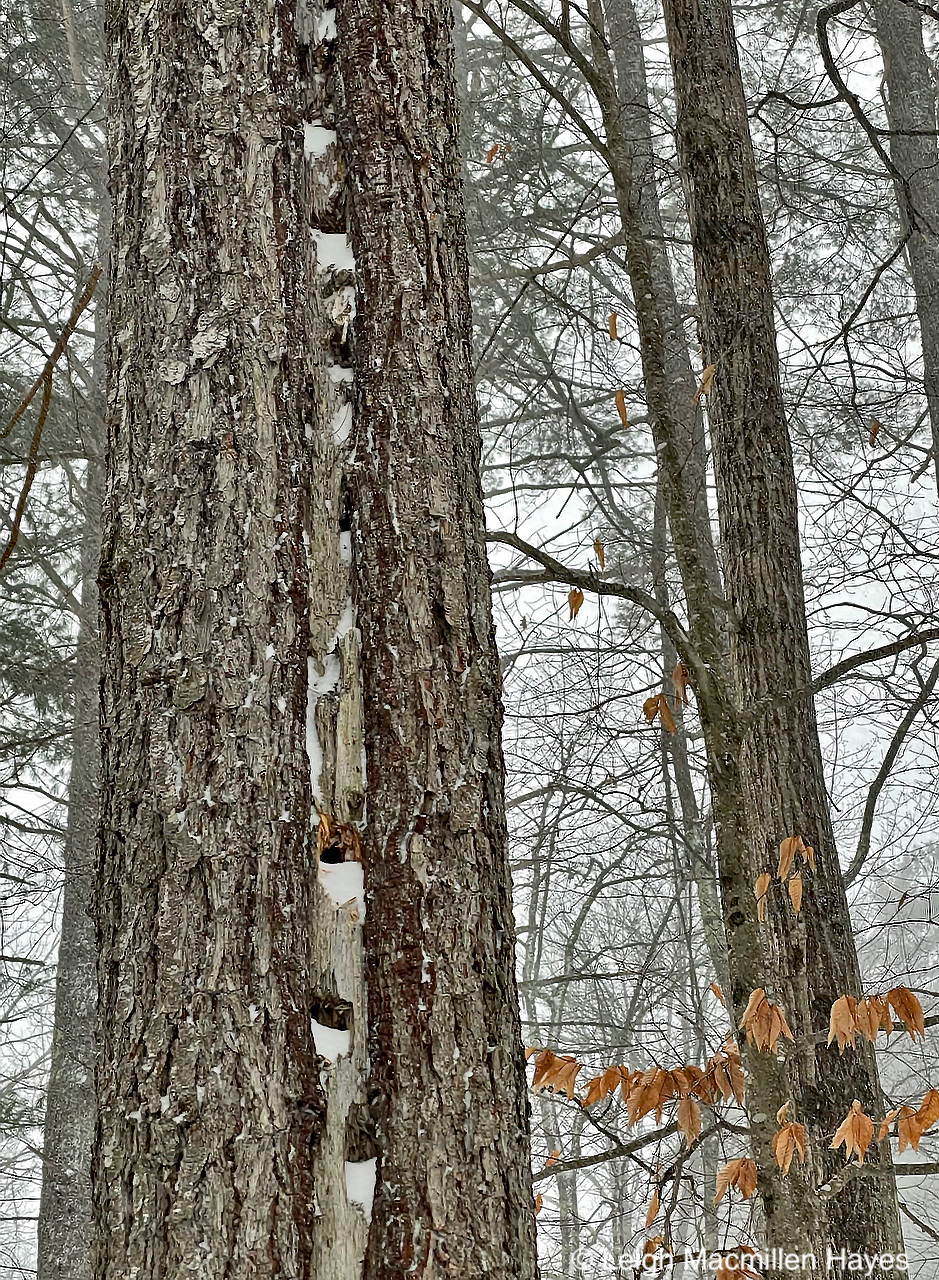
Take for instance this Eastern White Pine along the cowpath in our woods. While the Pileated Woodpeckers have riddled it with holes, its still standing and still producing needles and cones, because there’s enough bark left to protect the cambium and sapwood.

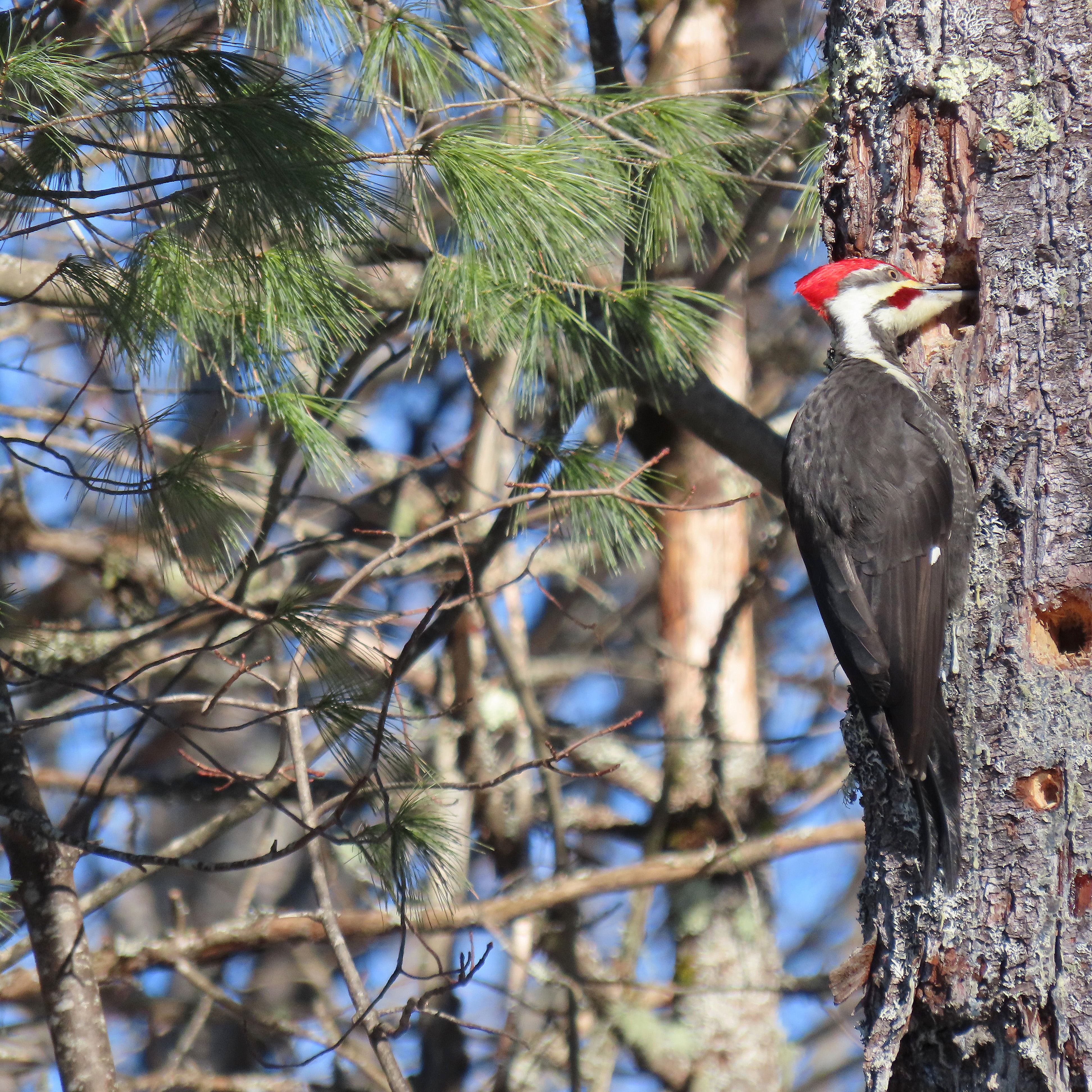
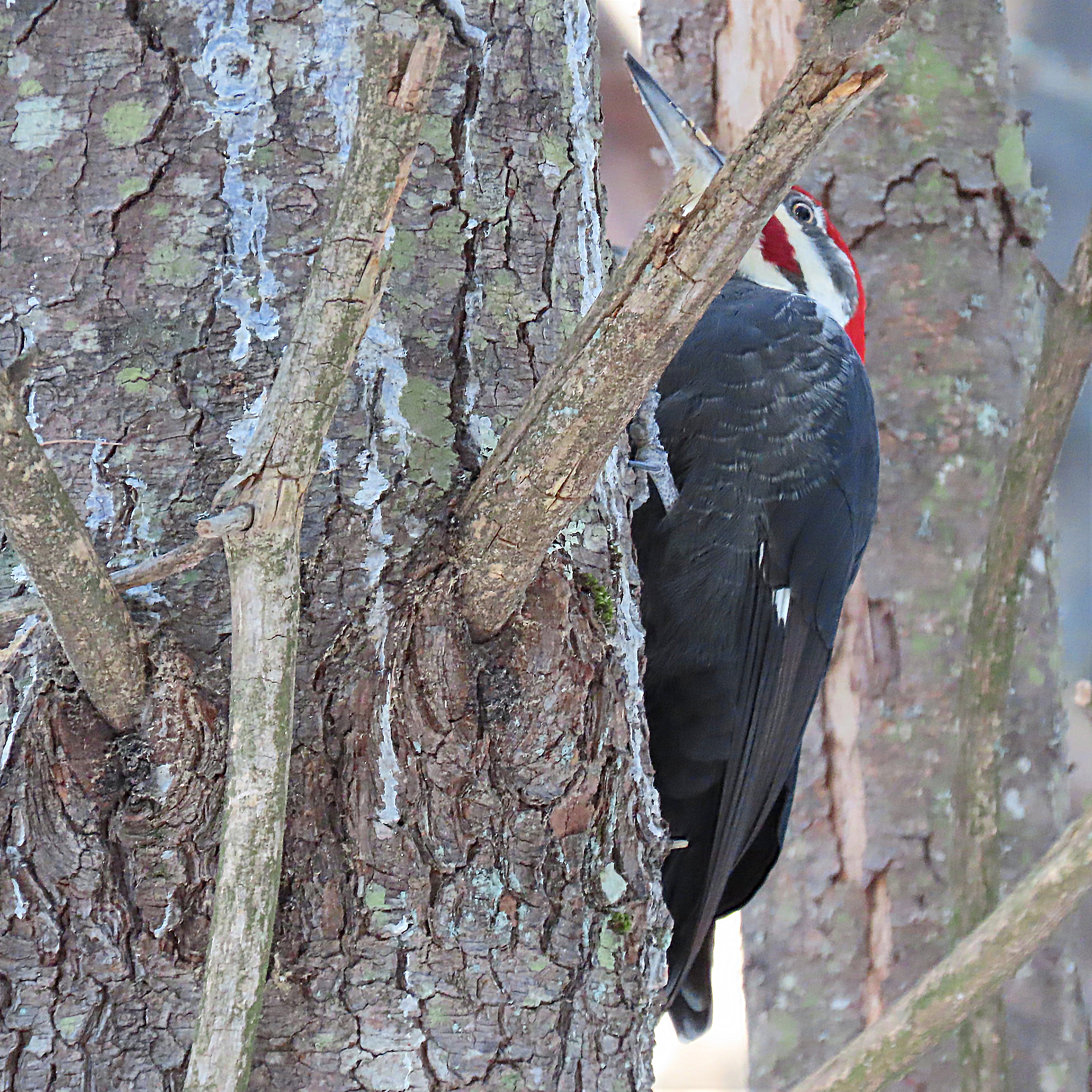
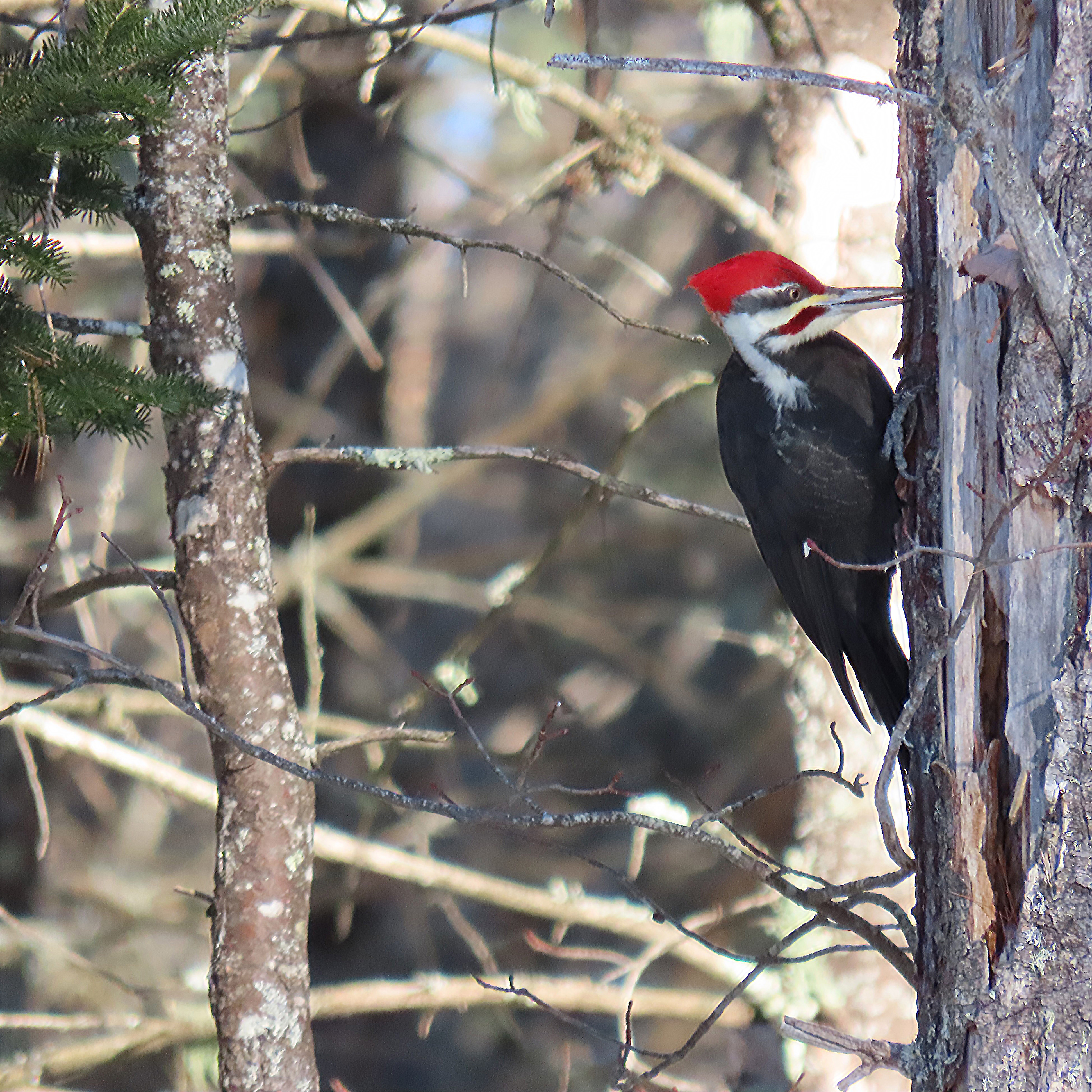
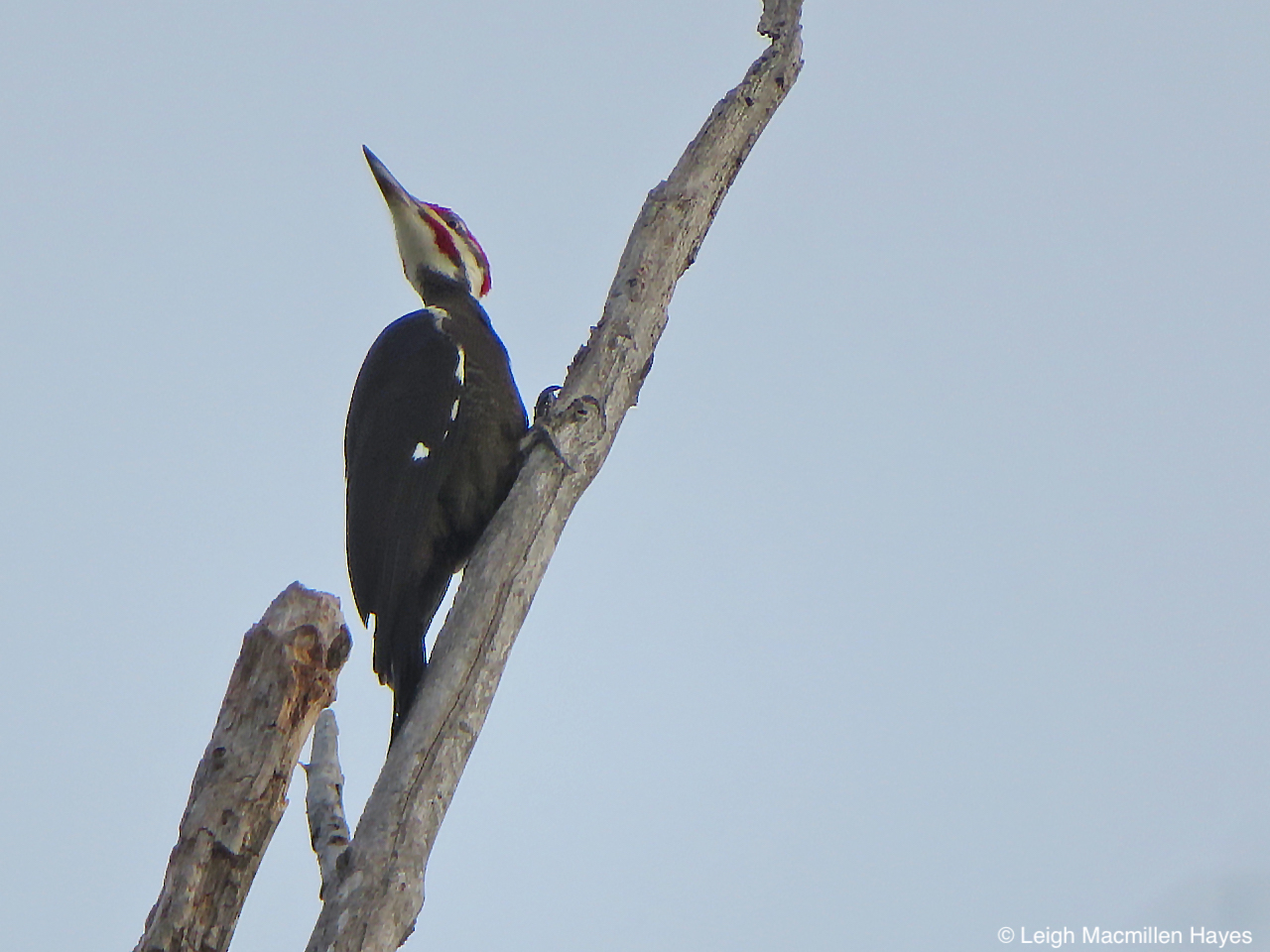
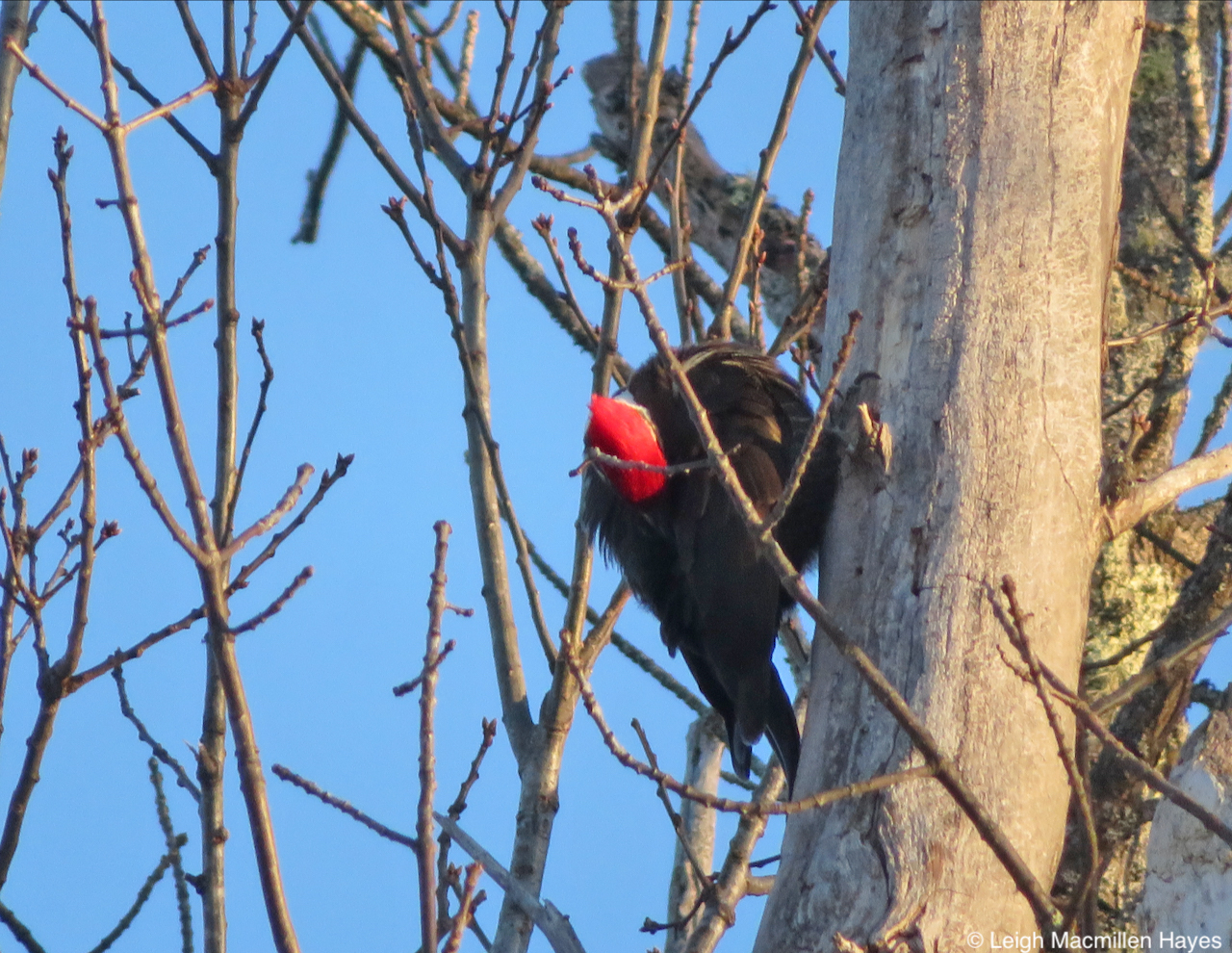
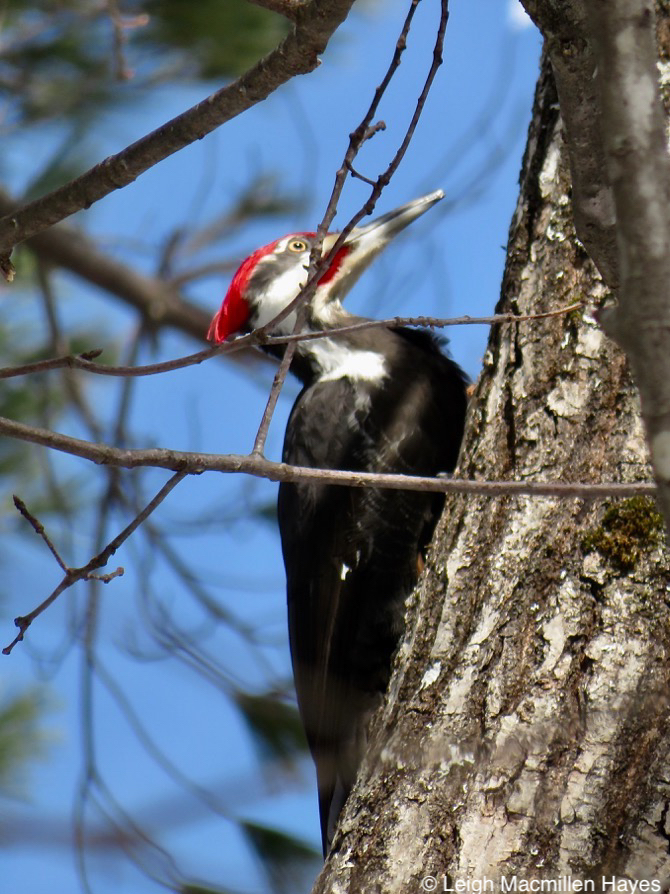
There was a time years ago when hearing or spotting a Pileated was a rare occurence, but now it seems that every day I either find evidence of habitat, hear their drumming and Woody Woodpecker calls, or actually spot one such as this that I spent some time with by the cowpath today.

And it’s not just holes that they drill. Quite often, I’ll see a tree that appears to have been chisled and shredded. This to is also Pileated Woodpecker sign.

Some trees receive only one visit, but others must be a huge source of food for multiple squarish to rectangular holes are drilled.

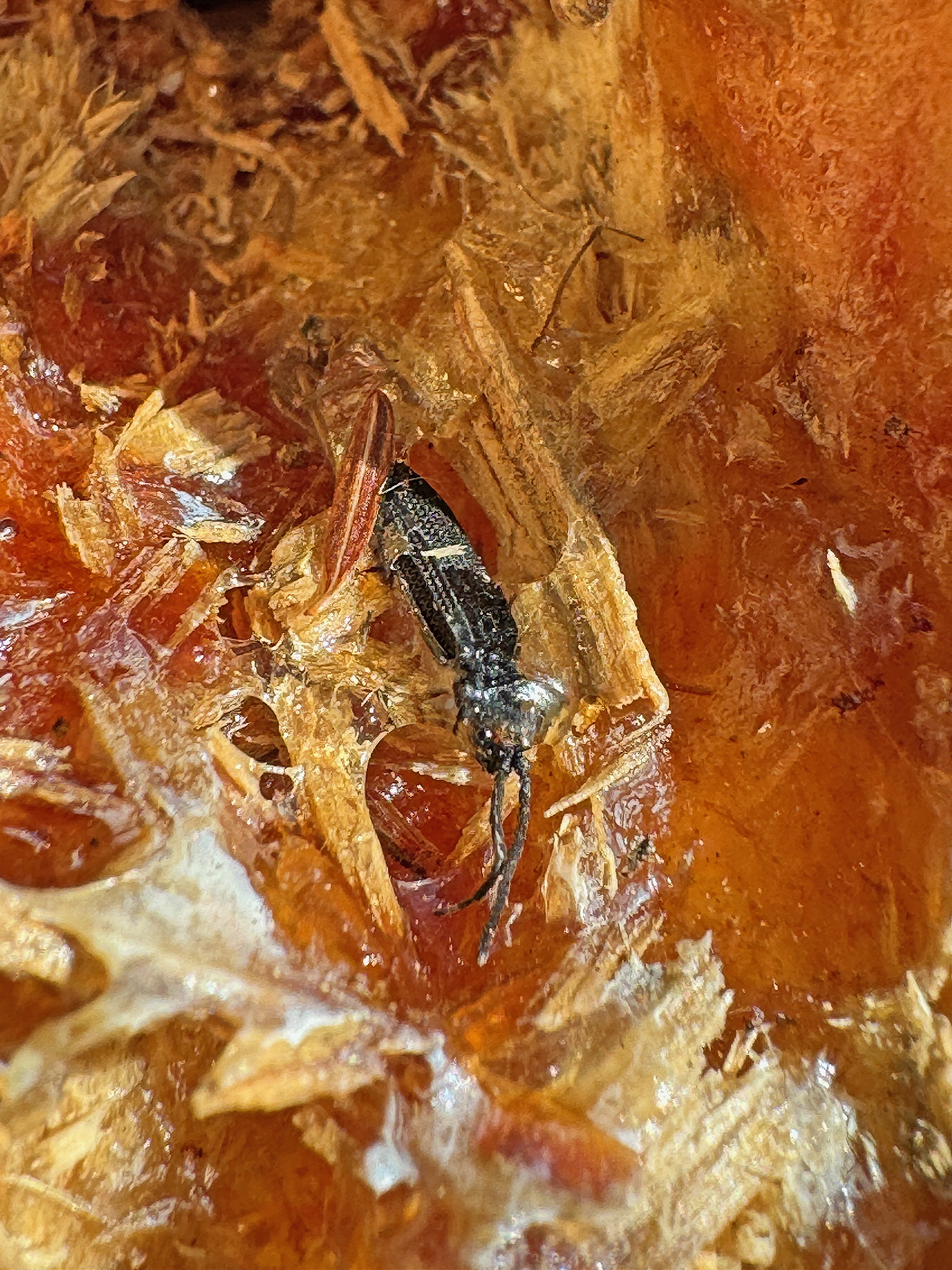
I love to peer into the holes because sometimes I’m rewarded with sightings such as this . . . a long-horned beetle that got stuck in the sap and is now frozen in situ.

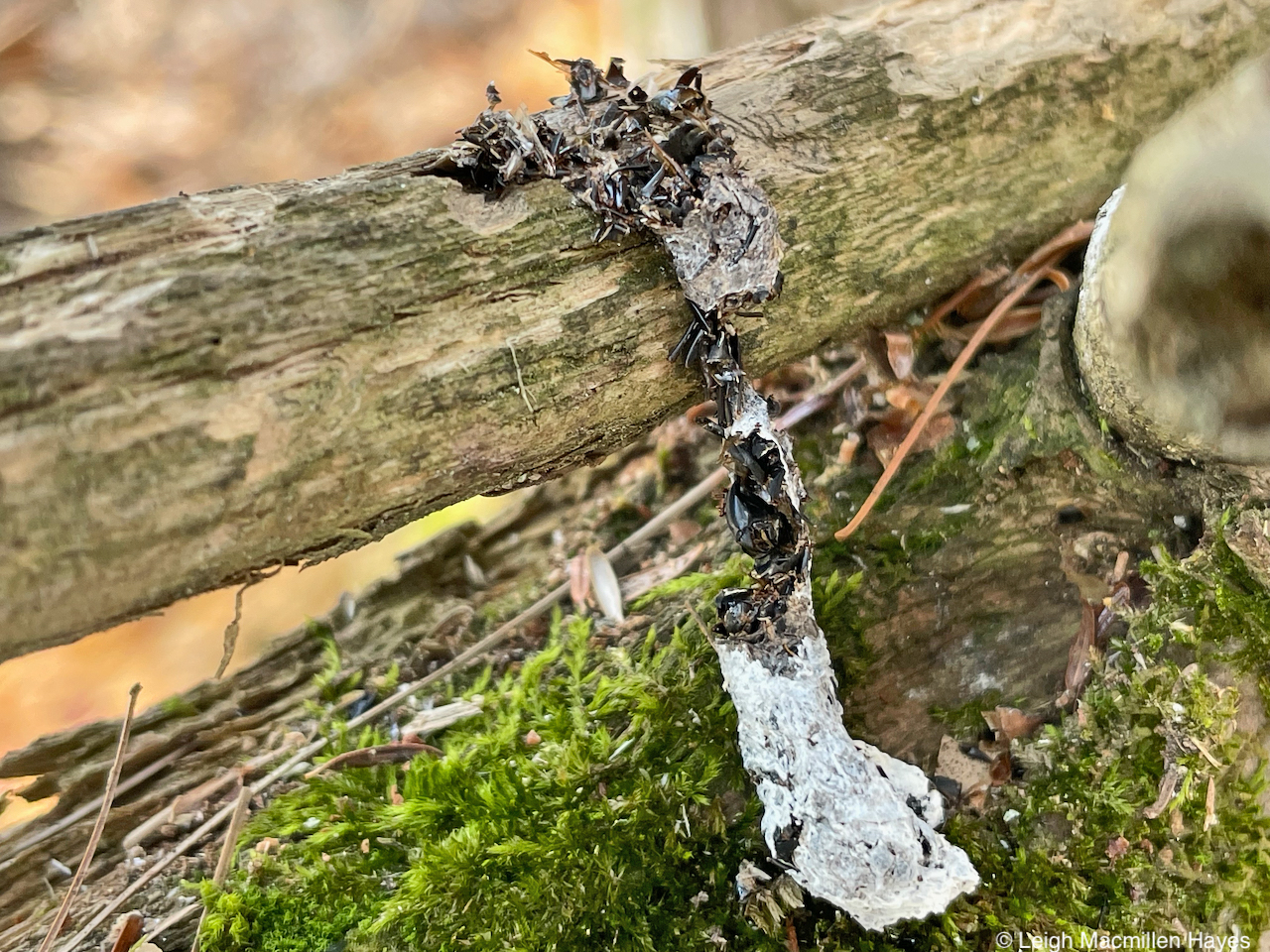
Though we can’t see it, Pileated Woodpeckers have sticky tongues, which they probe into the tunnels the delicious (to a woodpecker, that is) ants have created. Their bodies don’t process all of the ant, and so their scat is another sign I love to find. It’s like a treasure hunt at the base of a tree and let’s me know if the bird was successful in dining or not.

Their scat is made up of the Carpenter Ant exoskeletons, and some wood fiber, and white uric acid.

If you haven’t looked for this, I highly encourage you to do so. Any scat is fun to encounter because it helps us determine who passed this way, but there’s something extra special about seeing those body parts and knowing better the critter’s diet.

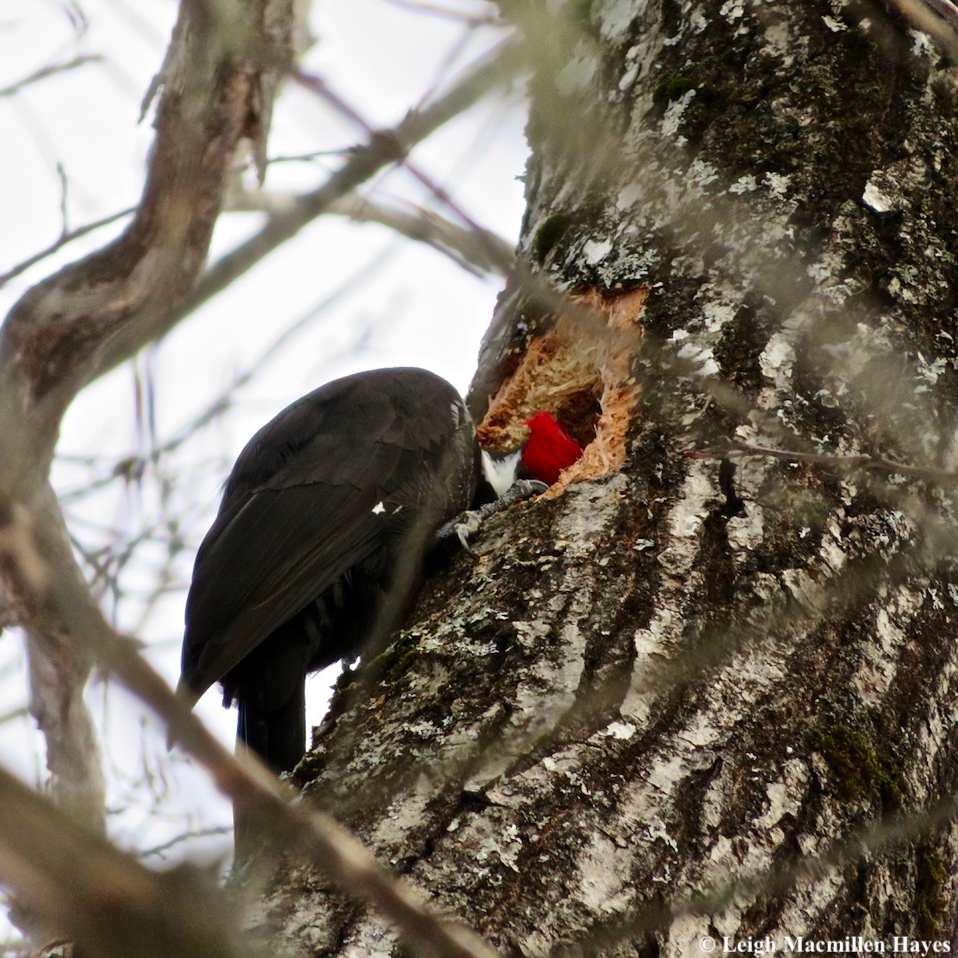
Pileated Woodpeckers excavate from any spot on a tree, including at the base, so if you see large woodpecker holes there, you’ll know the creator. The cool thing is that they use their long tail feathers as the third leg on a tripod in order to stay steady while smacking their beaks into a tree.

Don’t worry, their brains don’t get rattled. While it was long believed that they had a shock absorber to protect their heads, new research states this: “Their heads and beaks essentially act like a stiff hammer, striking and stopping in unison.” You can read more here: New Study Shakes Up Long-held Belief on Woodpecker Hammering.

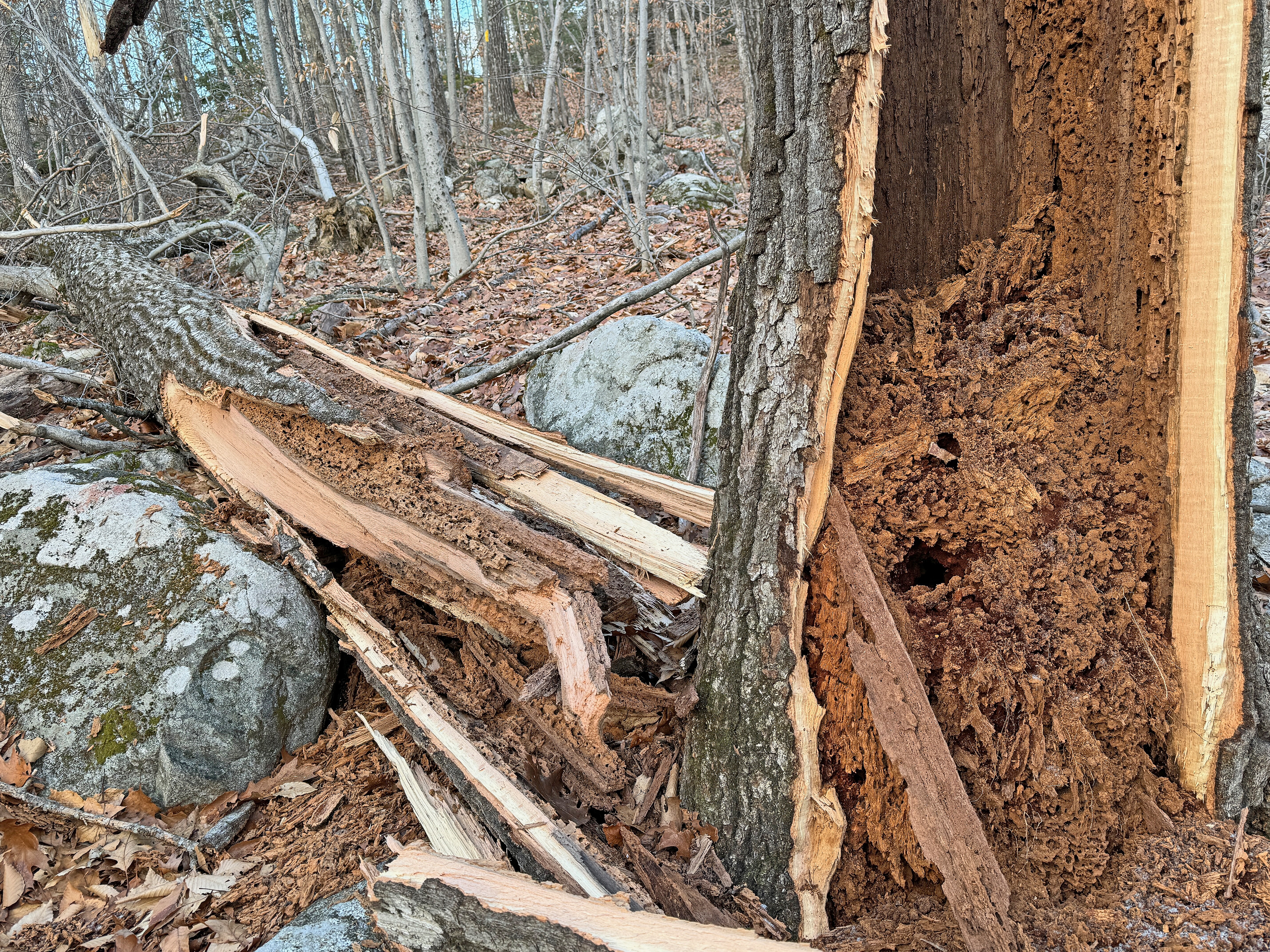
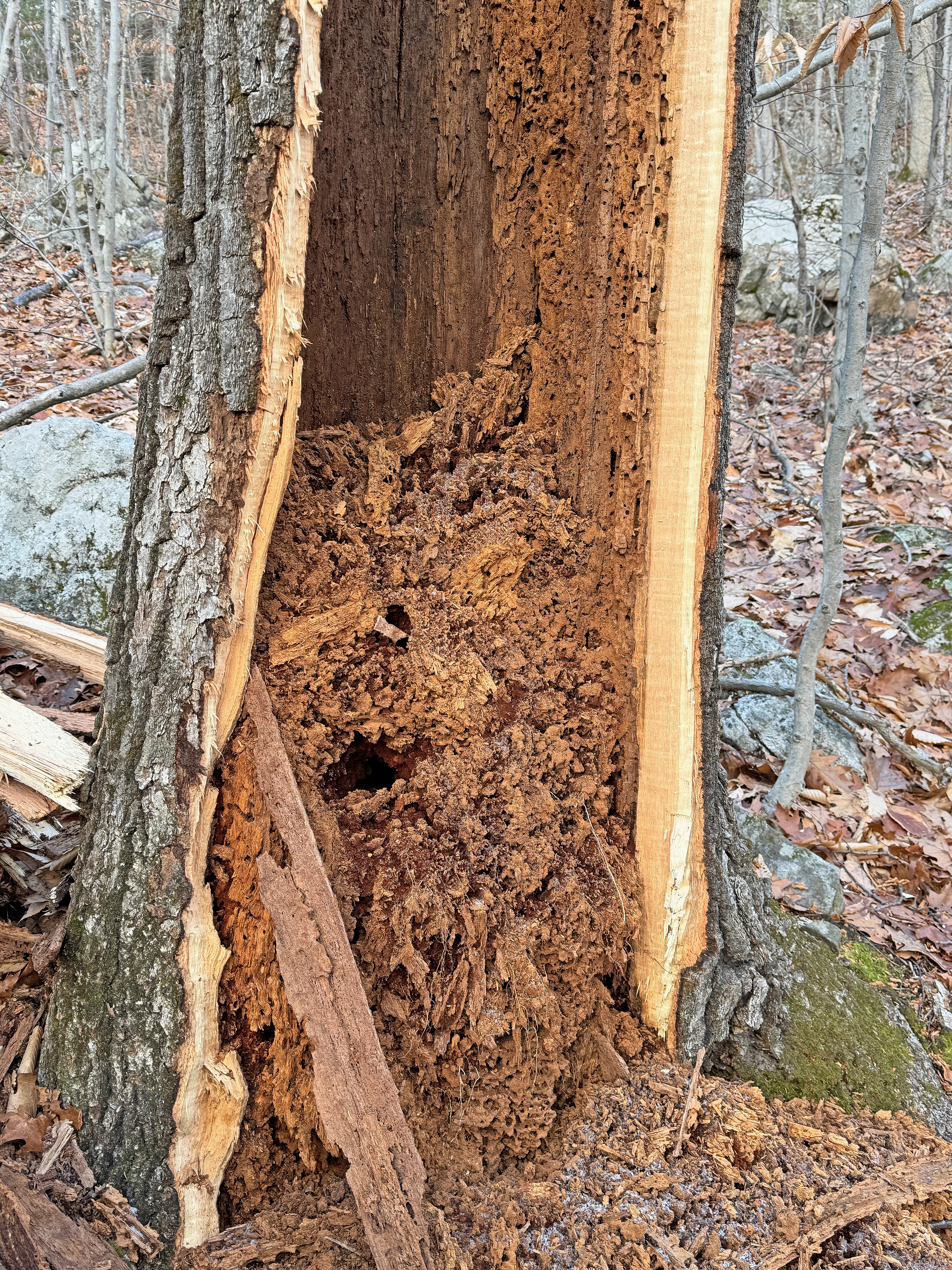
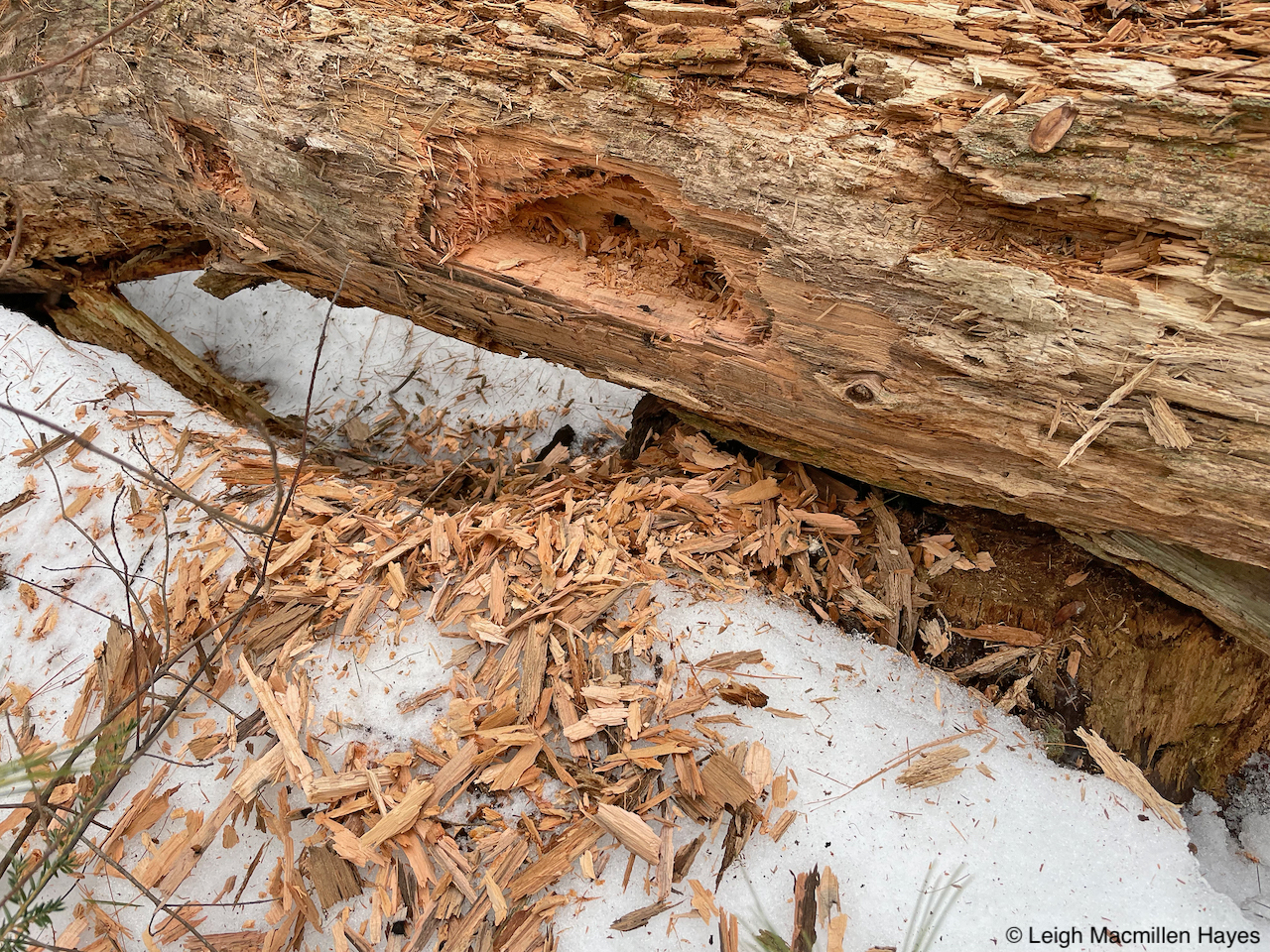
So I stated earlier that not all trees are dead, until they are like this one, even though the Carpenter Ants have set up their own woodworking shop. The heartwood, at the center of the tree is deadwood and its pipelines that served as the xylem and phloem, servicing the tree with water, minerals, (xy rhymes with high pulling these up from the roots), and sugars (phlo rhymes with low, pulling sugars down from the leaves), become clogged with resins and that’s where the ants take up residence. A storm knocked this particular tree over on Burnt Meadow Mountain where My Guy and I hiked about a month ago. It was so overcome with the ants that the core could no longer support the tree.

If you look closely, you can see the galleries or tunnels the ants had created. That’s a lot of ants and a lot of work.

My woodpecker seems to be hanging out in a small part of its territory these days. A Pileated Woodpecker’s territory can reach up to 200 acres, and there’s certainly more than that available to him here (the red mustache indicates this is a male), but he appears to have found his pantry closer to our home.

I don’t mind because it means I get to witness him on a more intimate basis.

Pileated Woodpecker works. Indeed.

The Forever Student, Naturally

This story begins . . . at the beginning. Okay. Early morning, not enough coffee, humor. Rather, this story begins at a bird feeder located about twenty feet from our back door.

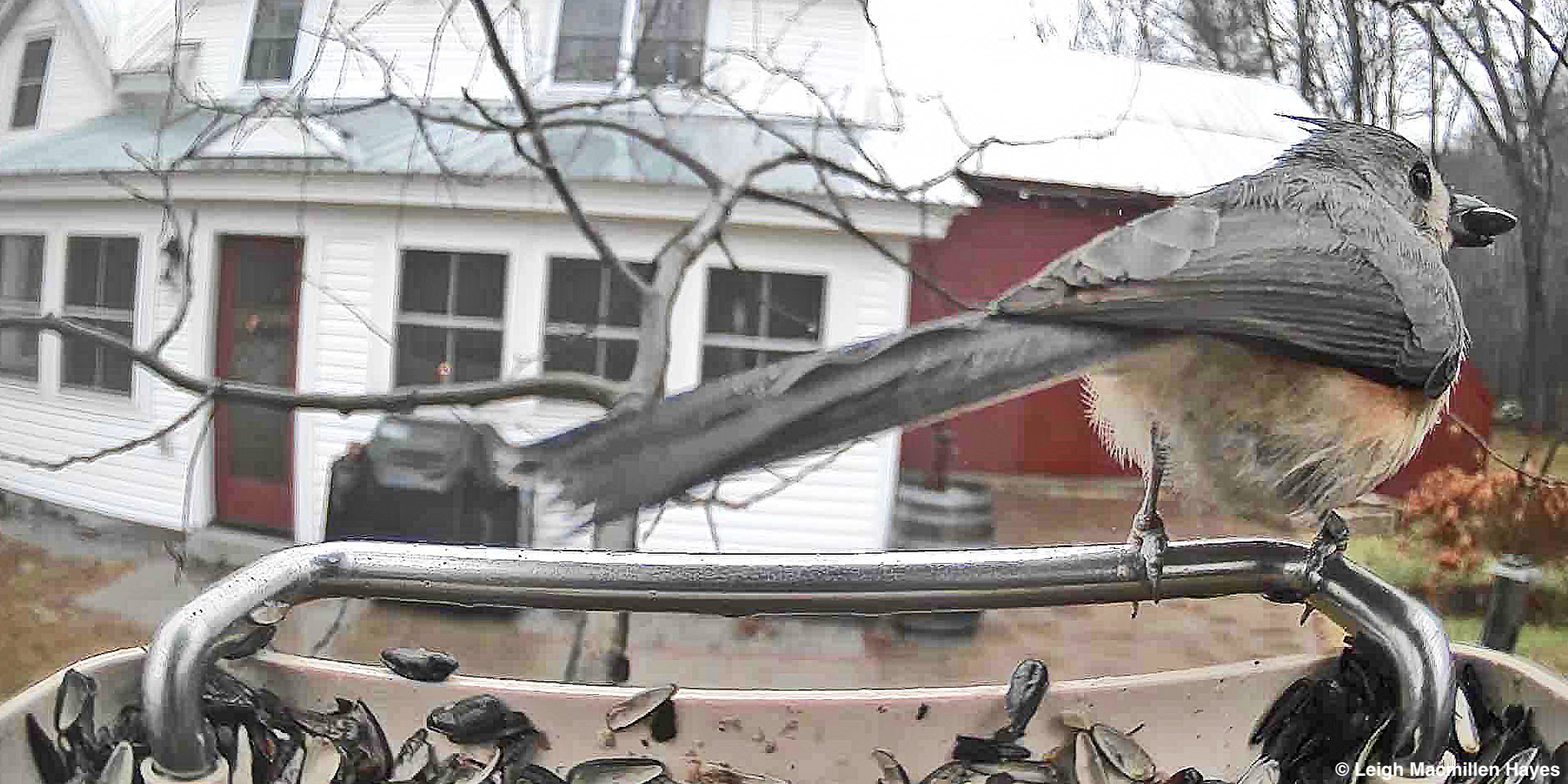
Birds, like this Tufted Titmouse, frequent it, especially on rainy days, which seems to be the norm this December. In fact, this year. Sadly.

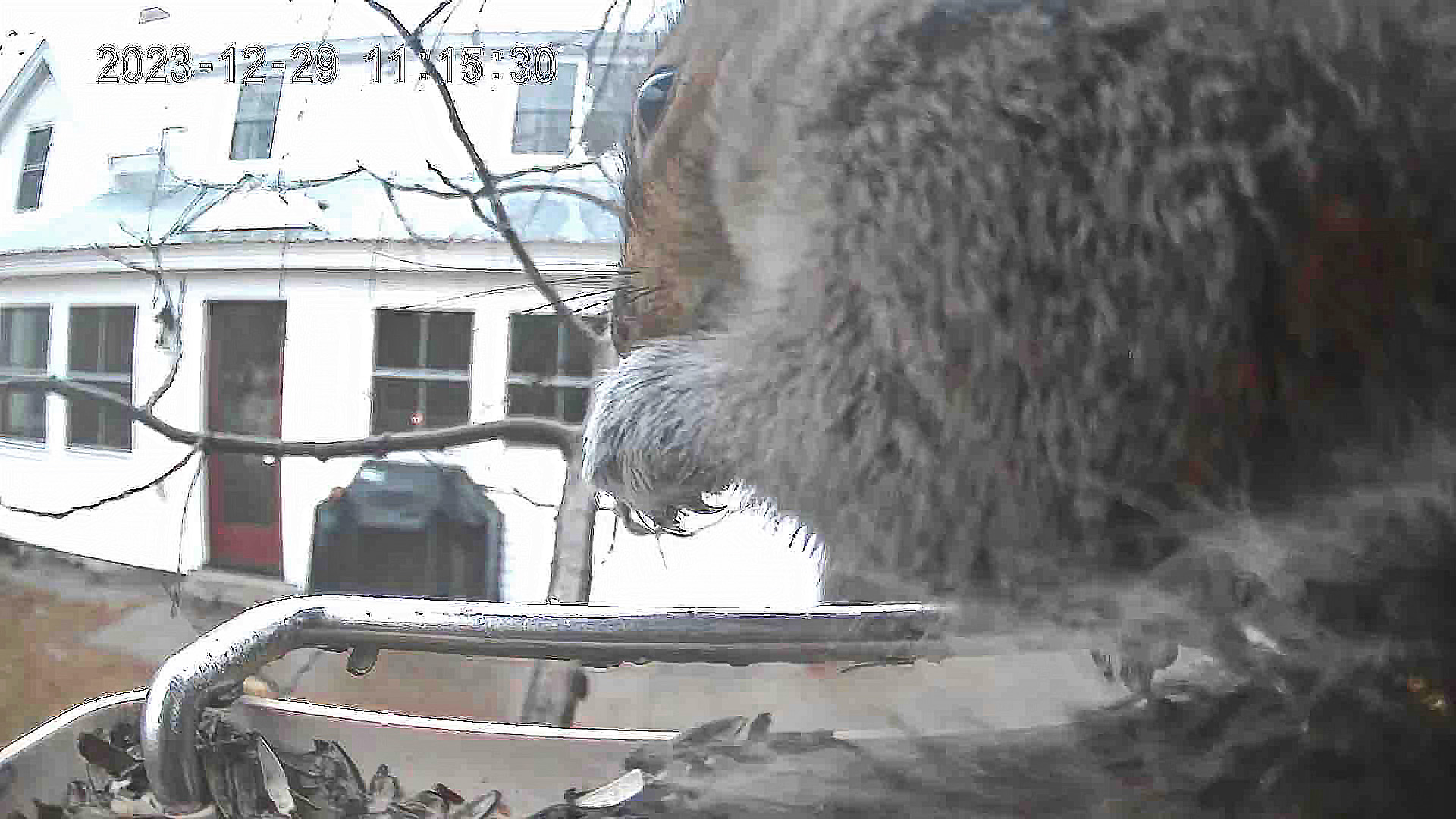
But, there’s another visitor, who thinks its a bird. If it had the membrane that stretches from the wrist of a front paw to the ankle of a rare paw, we could at least call it a Flying Squirrel. It does not. It just thinks its entitled to the bird feeder selection, despite the fact that I spread plenty of seed on the ground and have a dangling corn feeder intended for such uses.

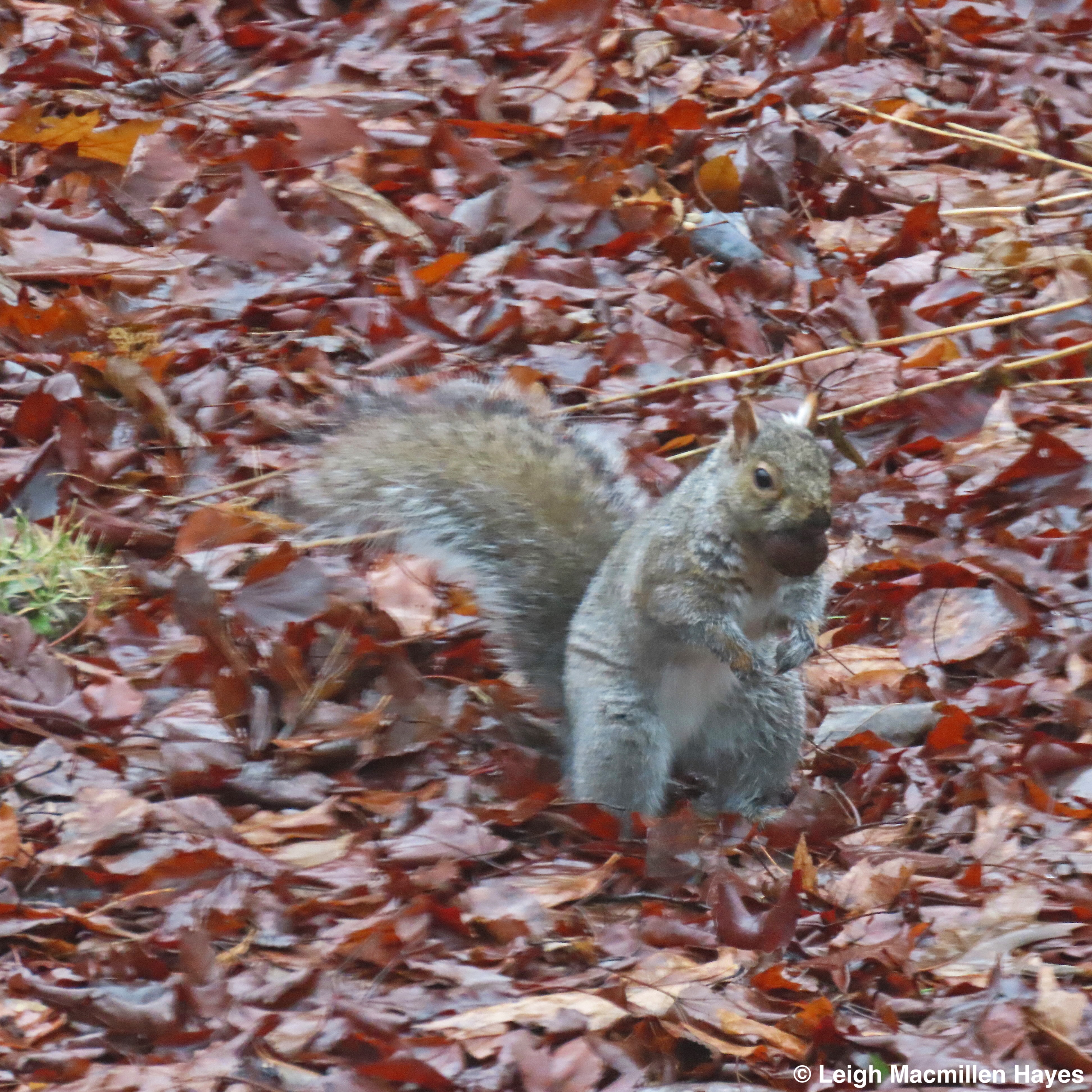
Eventually, it did resort to normal Gray Squirrel behavior and fetched an acorn, then frantically searched for a spot to cache it. And taught me a lesson.

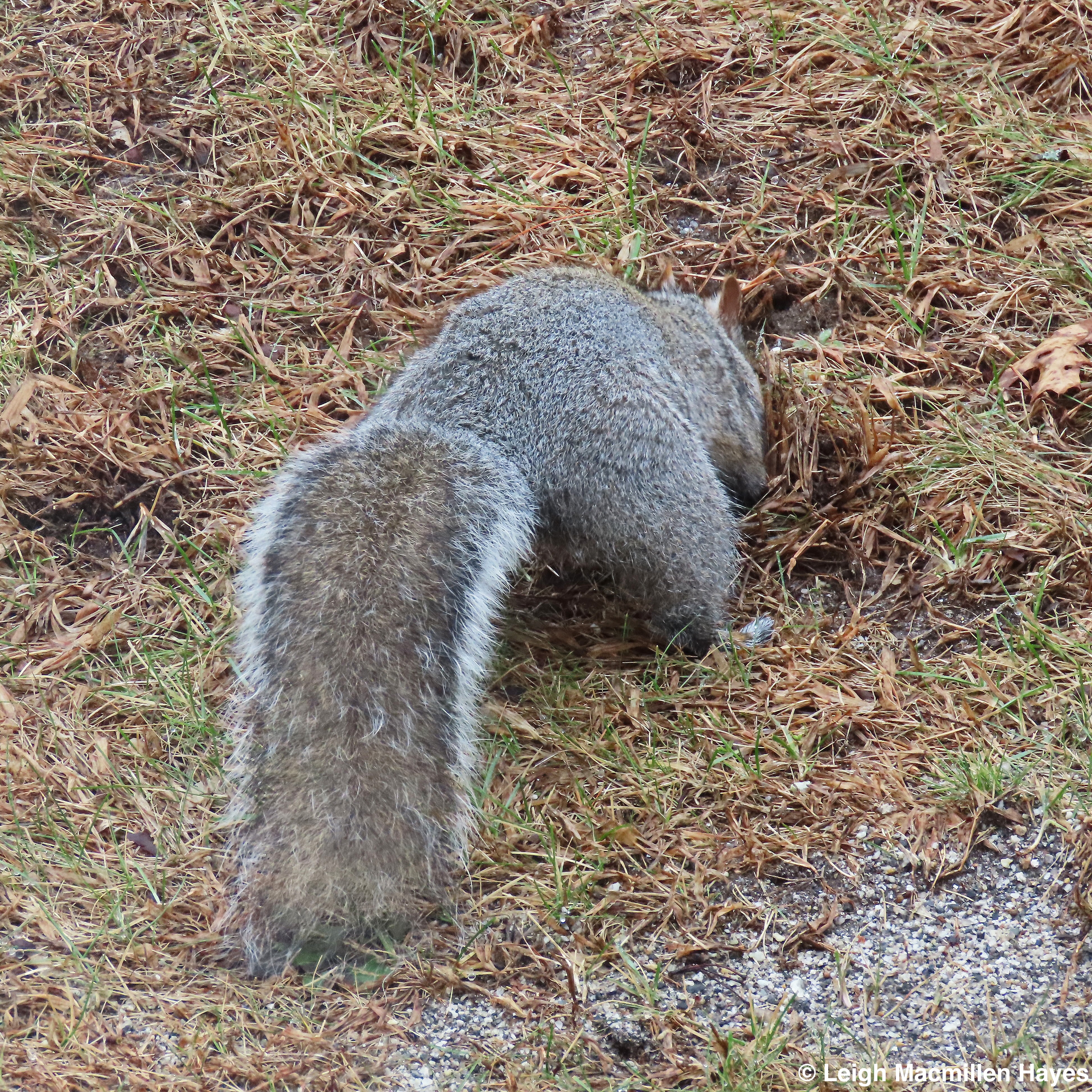
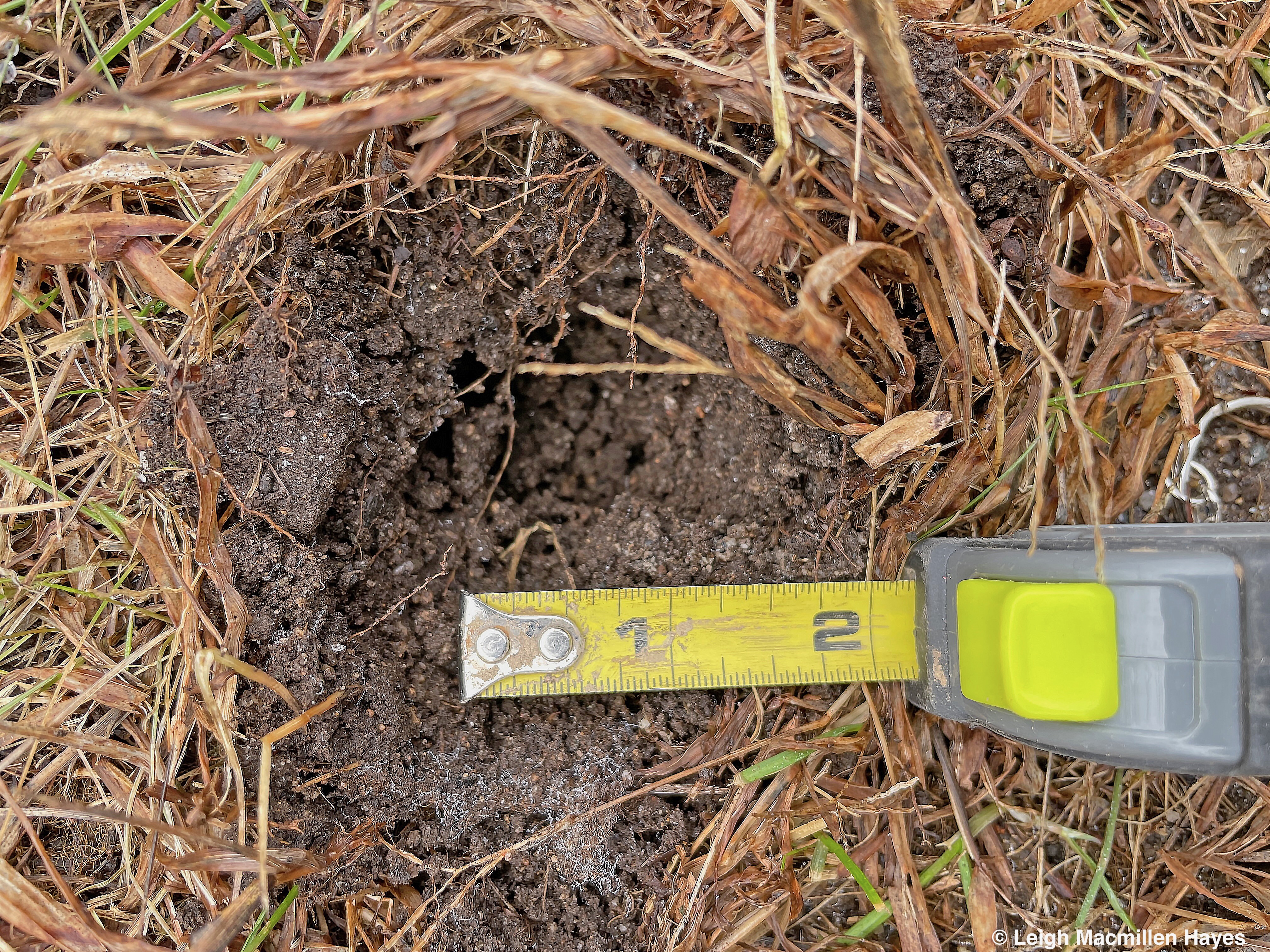
I realized I’ve never paid particular attention to a Gray Squirrel caching acorns, one here, one there, for future food sources, or a future oak sapling if not dined upon. I knew they did that. But what I didn’t realize is that much consideration goes into location of said single cache. The squirrel moved through two gardens, across the yard, and paused about three feet from the back door to dig, all the while holding the acorn between its lips.

And in the end, that wasn’t the right spot and so it moved on.

And I stepped out the door. The hole was just deep enough and wide enough for that single acorn, but the last I saw of the squirrel , it still hold the nut tight as it pranced along the stone wall and then into the field beyond. Funny thing is that when I returned home an hour or two or three later, there was a second hole excavated but equally empty. Why dig here twice and not make a deposit?

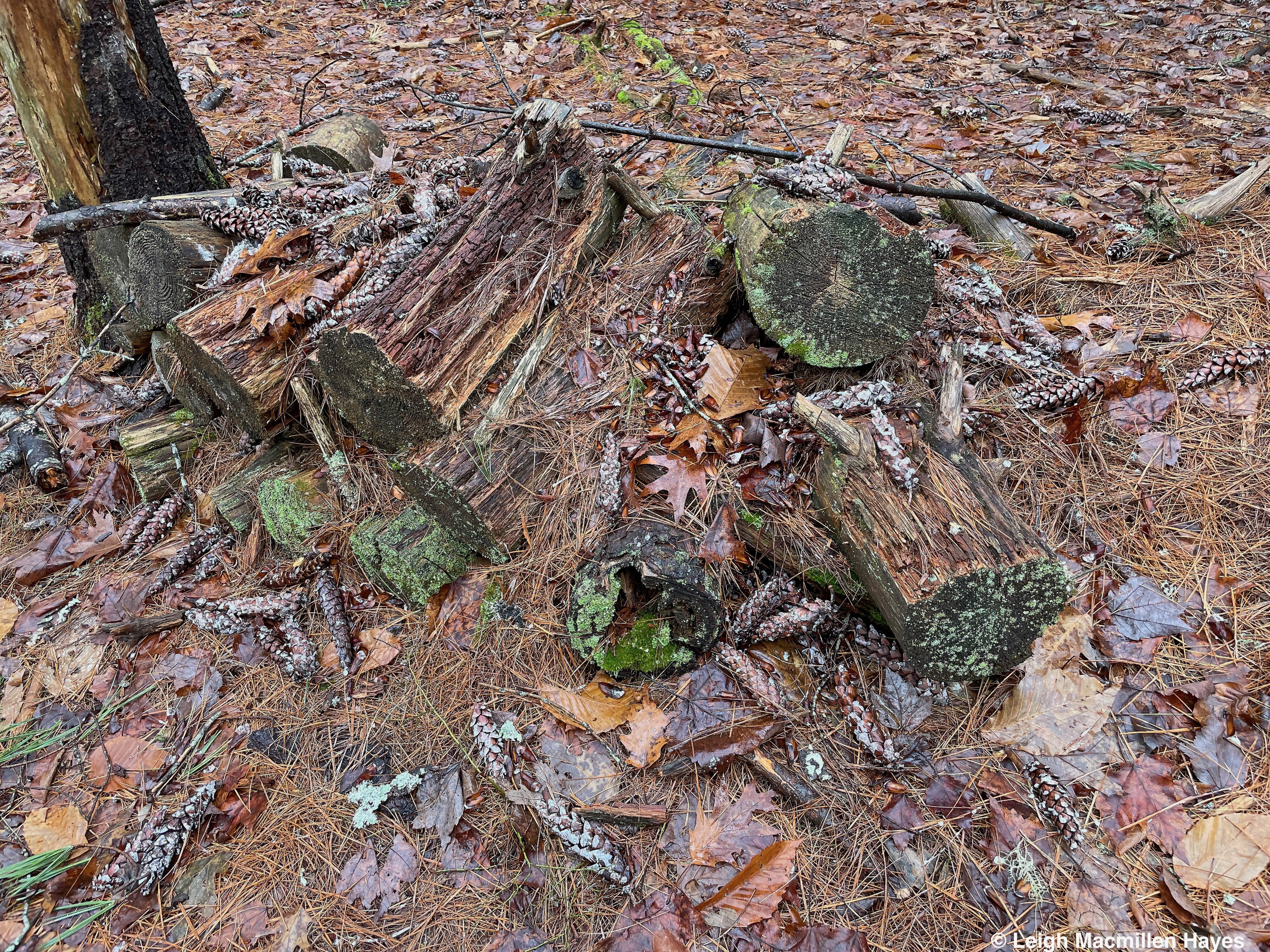
The Gray Squirrel’s activity inspired me to step into our woods and check on the activity of my friend Red. He doesn’t disappoint and each day that I visit I notice new middens (garbage piles of discarded cone scales) and new cones added to the cache (food cupboard).

My favorite cache is now a foot tall and the cool realization is that he doesn’t dine upon this pile. Like the Gray Squirrel burying his acorns for future consumption, Red is dining on plenty of pine cone seeds, but saving up for that day when we have so much snow (will that day ever come again?) that he has a food supply available and doesn’t have to tunnel through the white stuff in search of a meal. Considering how many pine cone seeds he must consume each day, I have to wonder how long this source will last and will it grow taller and wider in the coming weeks?

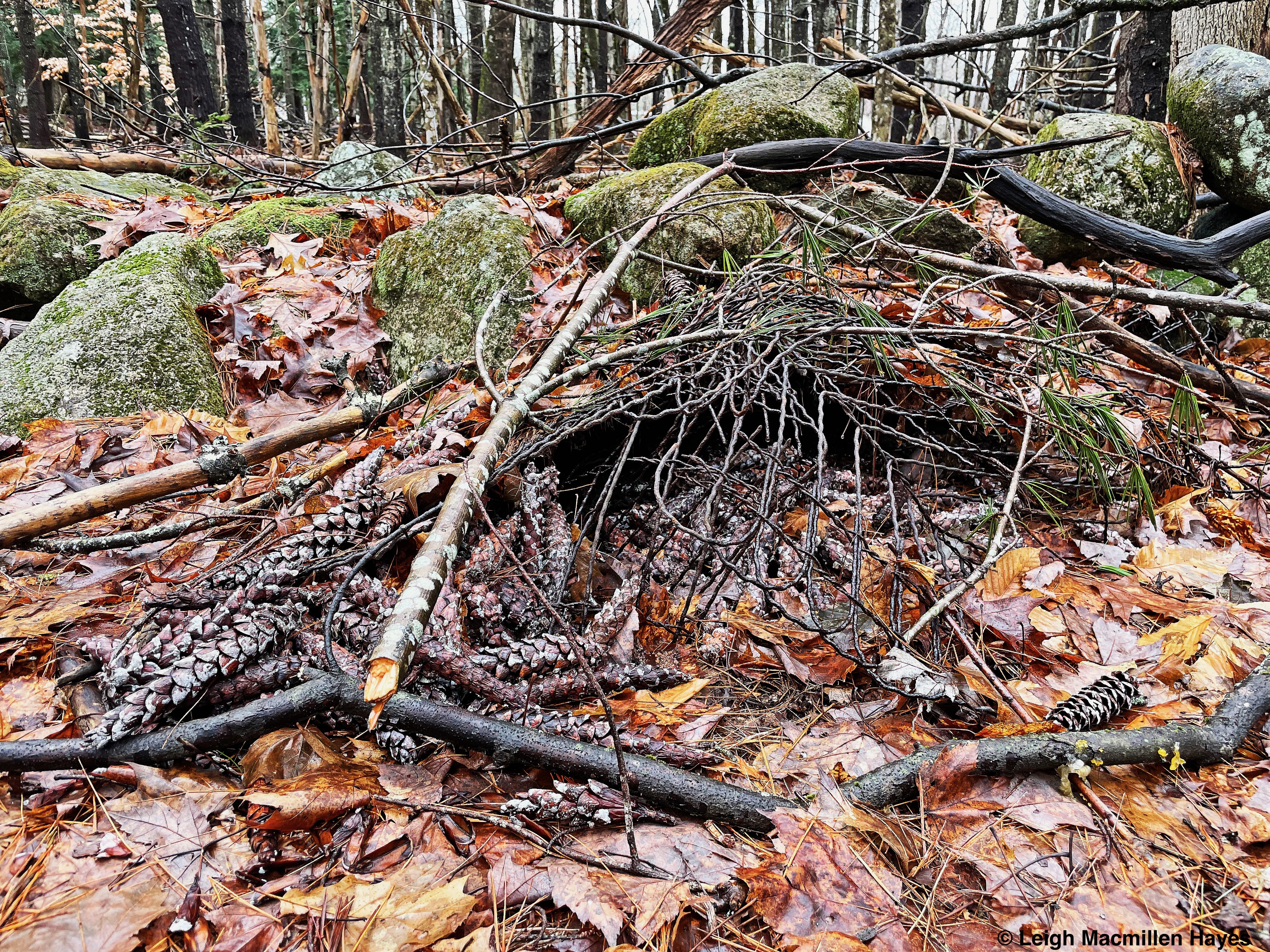
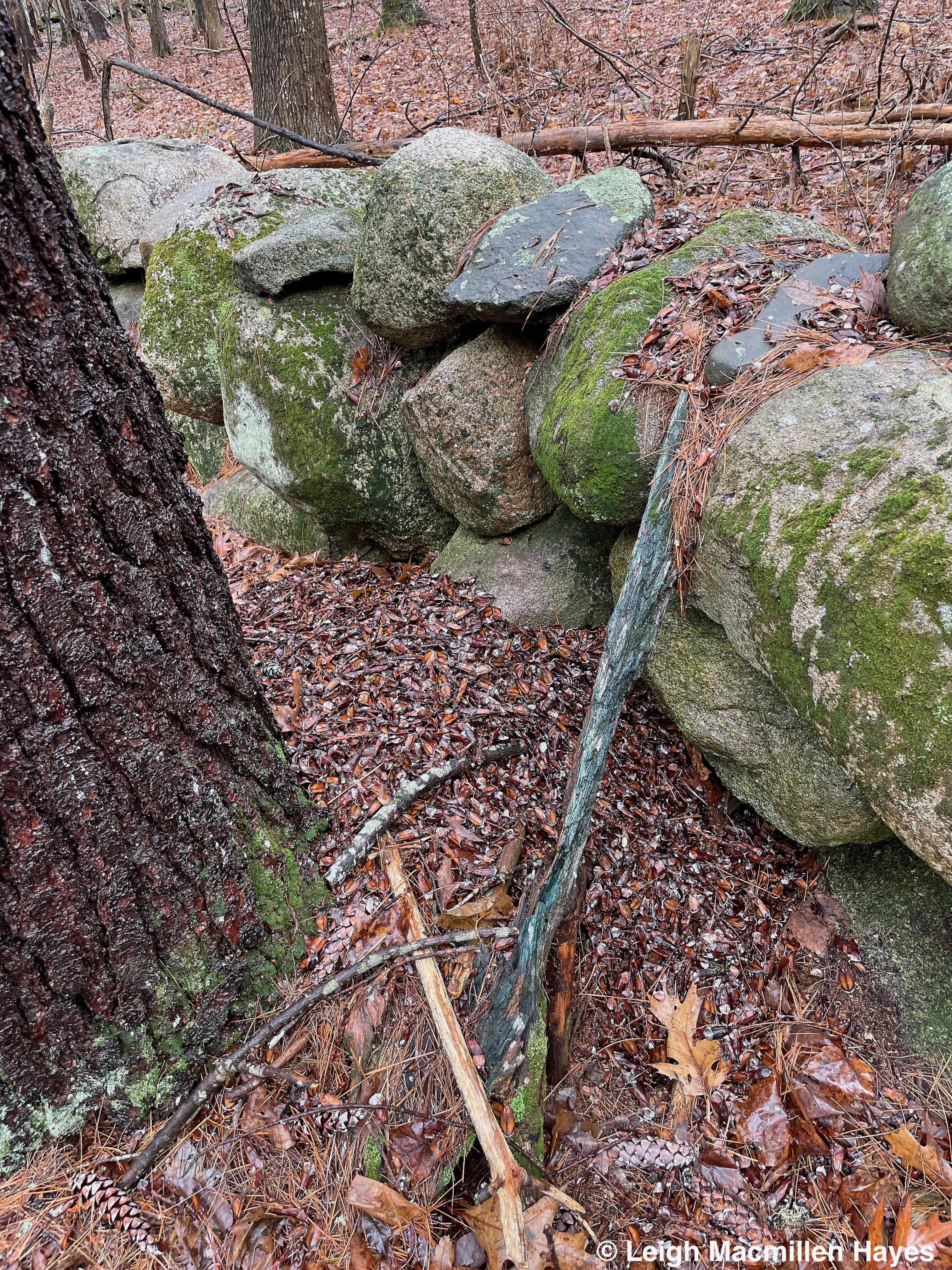
On the other side of the cow path, for that is where the tall pile is located, I realized he’s started another cache, this one located under some discarded garden fence left behind by previous owners of the land. It’s actually a great spot in my squirrely mind, for its beside the wall so he can easily access it from a dry spot within and the fencing and sticks and leaves have created a shelter.

Much to my delight, I spotted Red on a pine branch, a perfect high spot on which to dine and keep an eye on invaders of his domain, such as me. My presence, however, did not stop him from peeling each scale to seek the two seeds tucked close to the cob.

And as is the custom, its only the seeds that he cares about, scales discarded because their usefulness is no longer important.

The base of the tree shows just how many scales he’s discarded over the last few months as his midden contiunes to grow. Considering this year was a mast pinecone production year for Eastern White Pines in western Maine, this is one well fed squirrel.

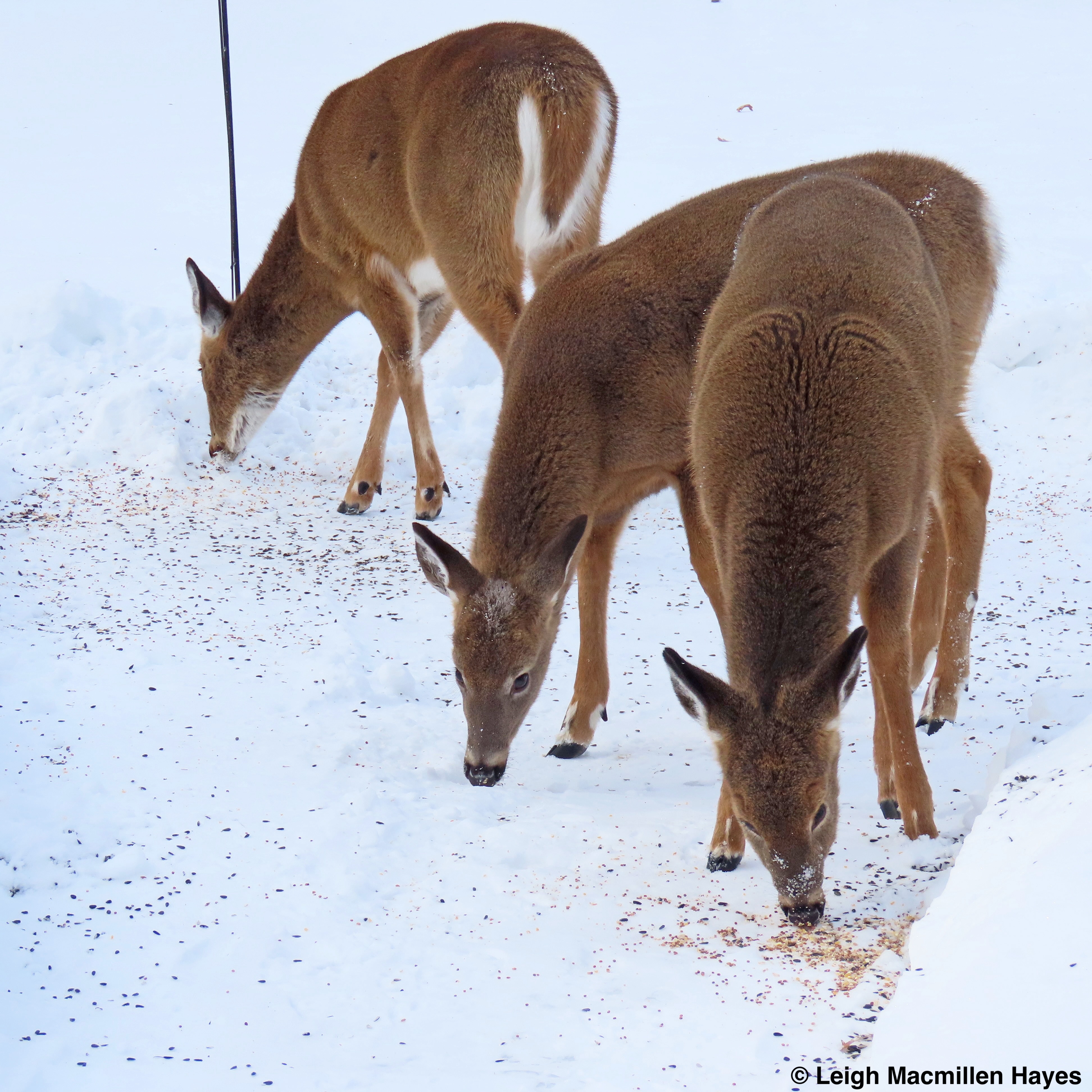
Another tree that produced a mast crop is the Northern Red Oak and the abundance of acorns has been a food source for the squirrels, especially the Gray, Porcupines, and White-tailed Deer.

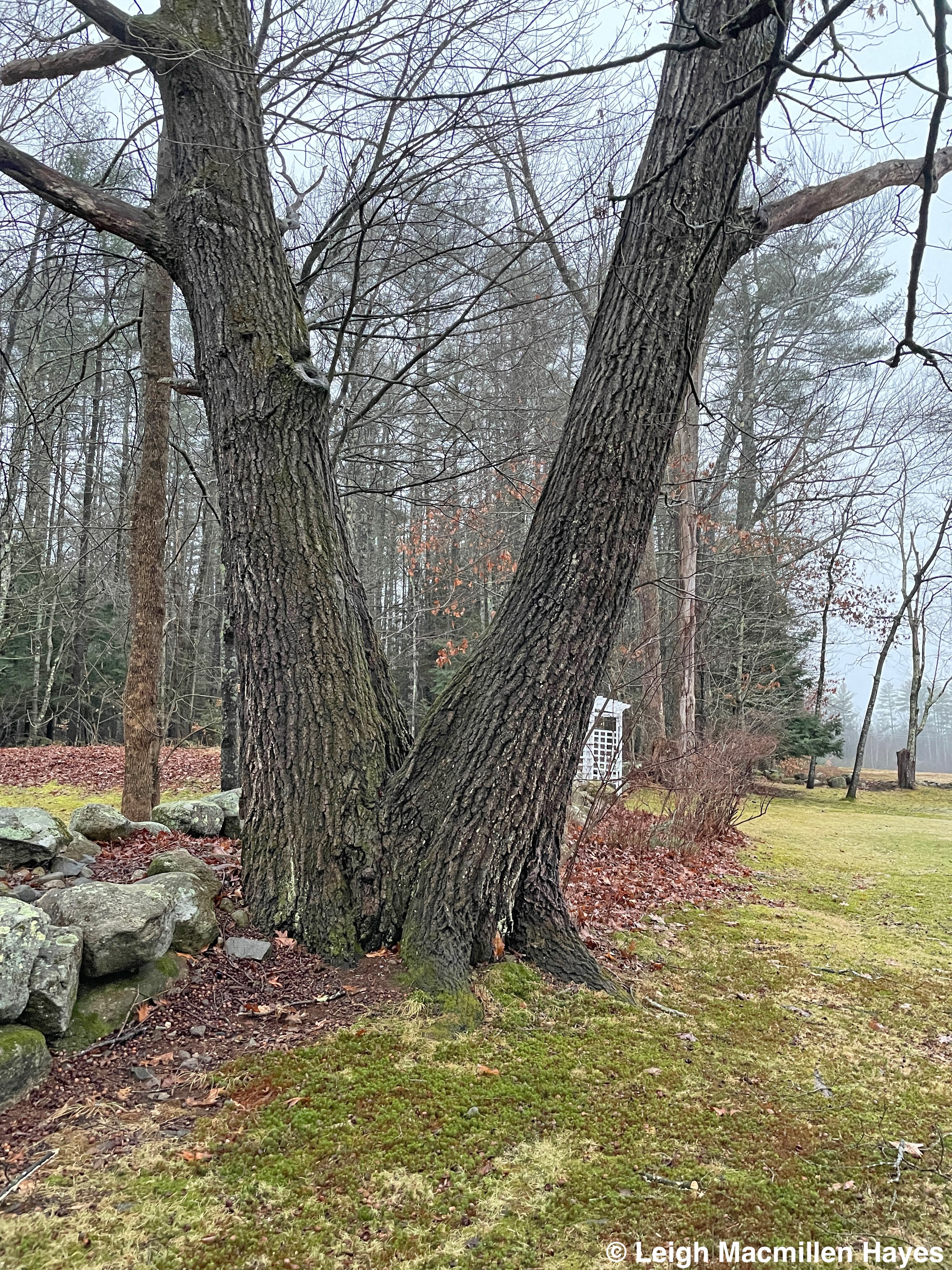
The tree behind our barn is massive, with a coppiced base and therefore three large trunks. Our sons once built a fort in that space between.

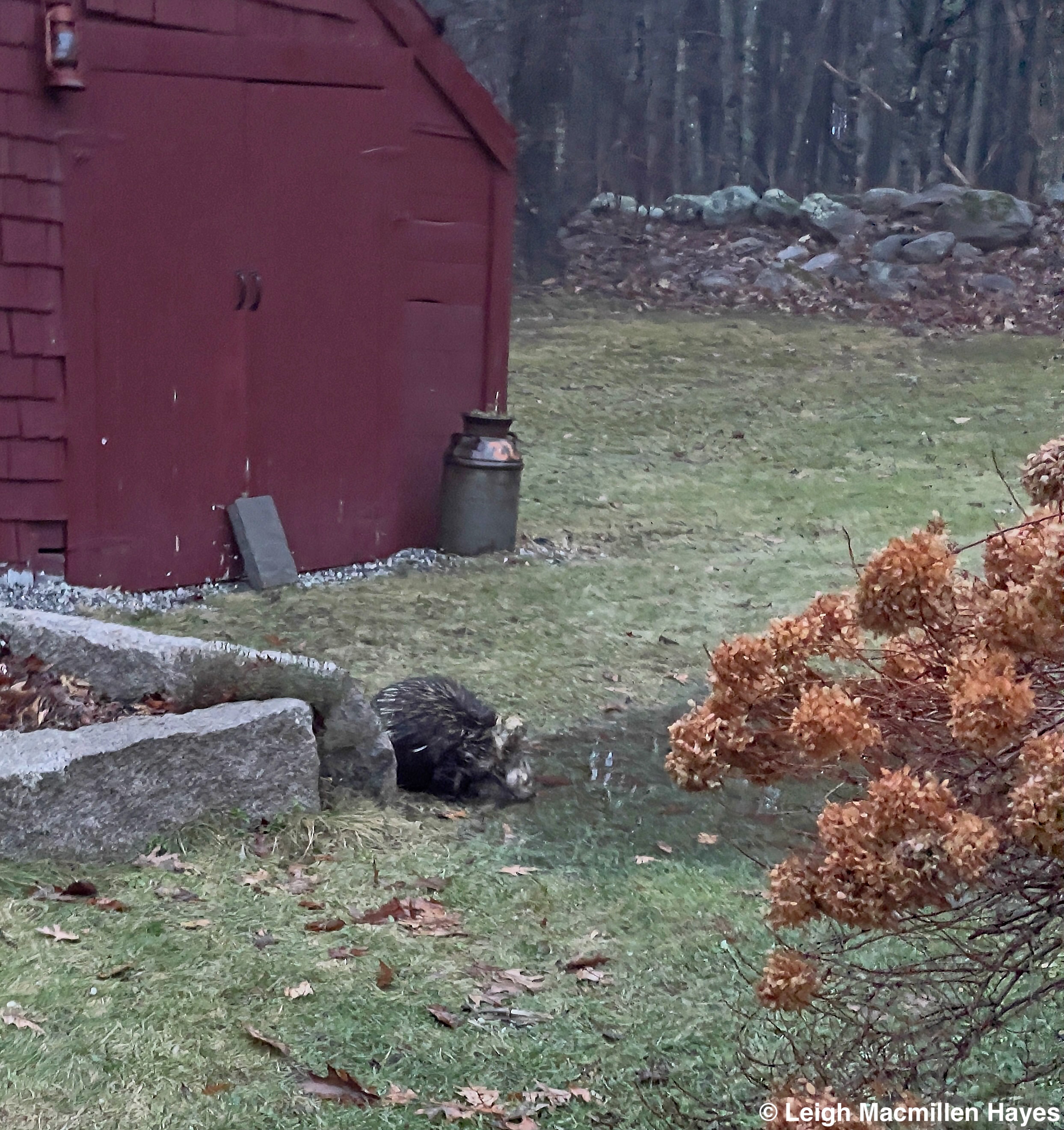
At about 4:15pm the day before, our youngest son, his gal, and I watched Bandit, the local porcupine come from the acorns to a puddle beside the herb garden and pause for about five minutes as he sipped from it. That was another first for me. And them as well. In fact, for his gal, just seeing a porcupine in the wild was a first.

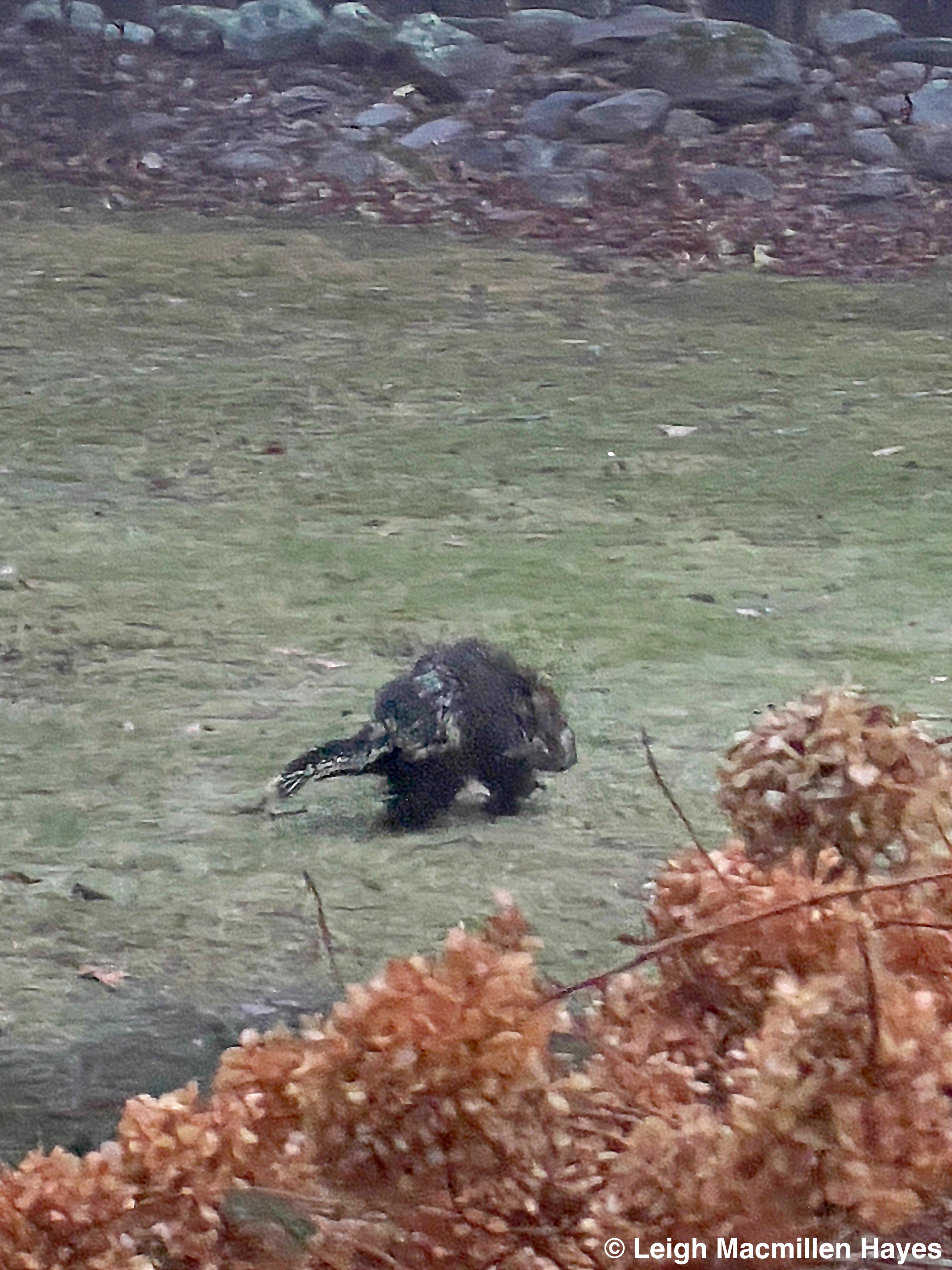
Then he waddled off to the woods on the other side of the stone wall, and probably found an Eastern Hemlock upon which to dine for the night. I found a few trees with downed twigs, but none that cried out, “I’m Bandit’s food source,” so I suspect I need to expand my search on another day.

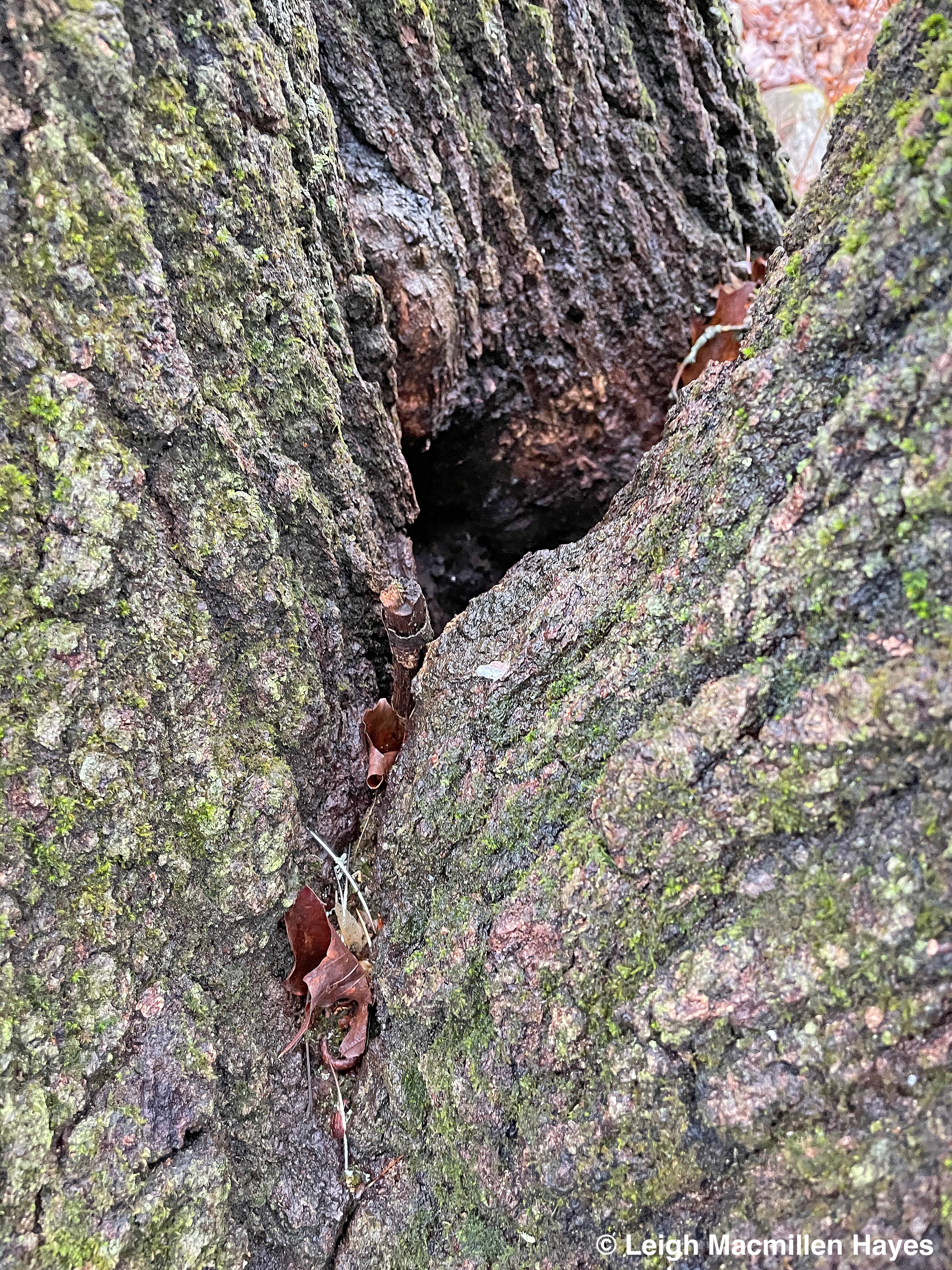
Instead, I made a different discovery. We know that Bandit has spent time under the barn, and he’s left tracks when we did have snow that led to a neighbor’s shed, but I have wondered about the old oak tree and the hollow within its three trunks And today, I spied evidence that he has inspected the hollow. Do you see it?

How about now? Quills! I found them on both sides of the trunk.

And on the ground below.

About two inches in length, and some were longer, I love how his brownish hue is similar to that of the bundle of dried pine needles.

The hollow is dark and deeper than my camera could see. The curious thing is that there is no scat. Yet. You can rest assured that I will keep an eye on this spot.

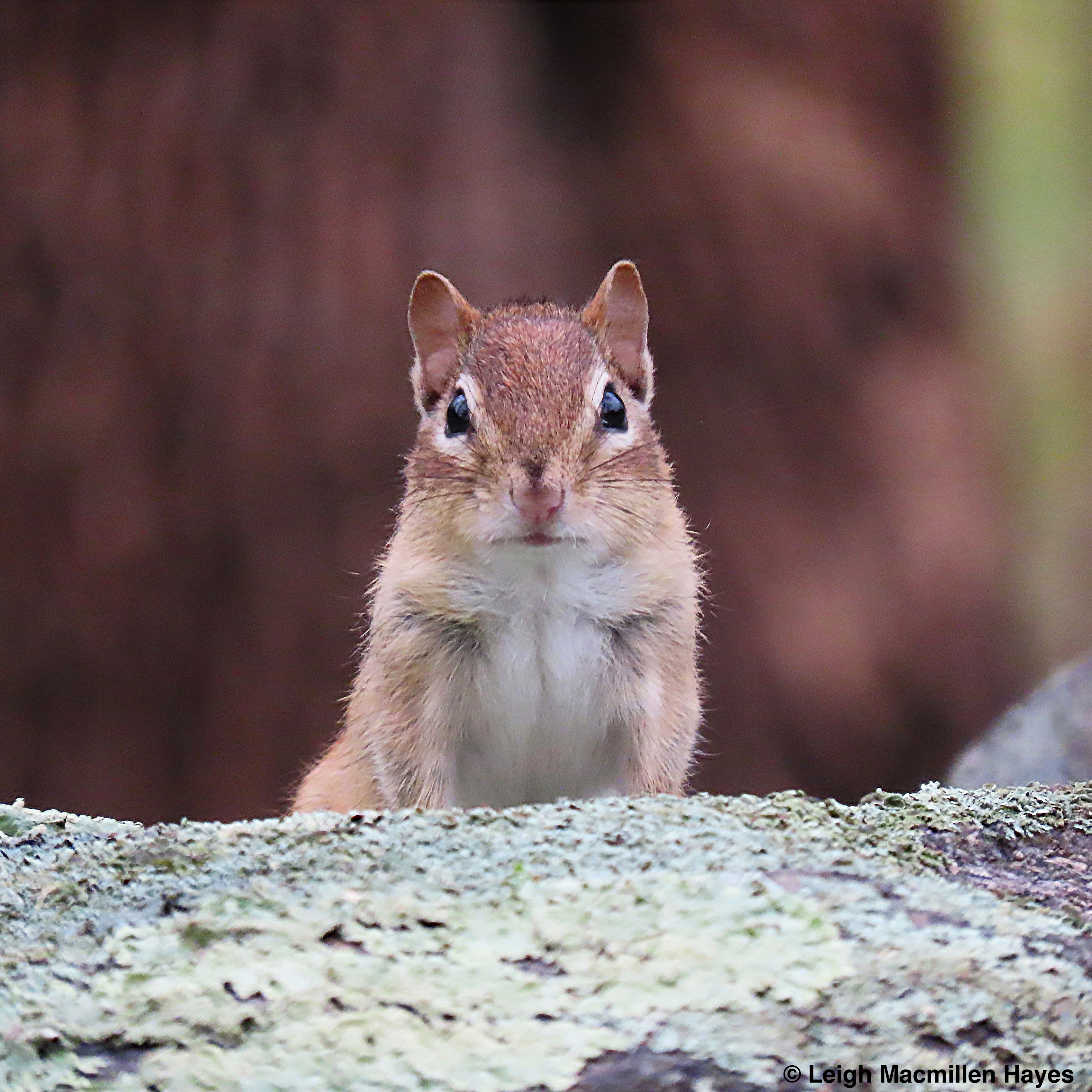
I decided to hang out not too far from the tree and barn as day turned to dusk in hopes of spotting Bandit emerging. Much to my surprise, an Eastern Chipmunk appeared on the wall behind the tree. Wait. What? Shouldn’t he be in torpor? Yup. But chipmunks will make an occasional appearance on warmer days and we’ve had way to many of them this year.

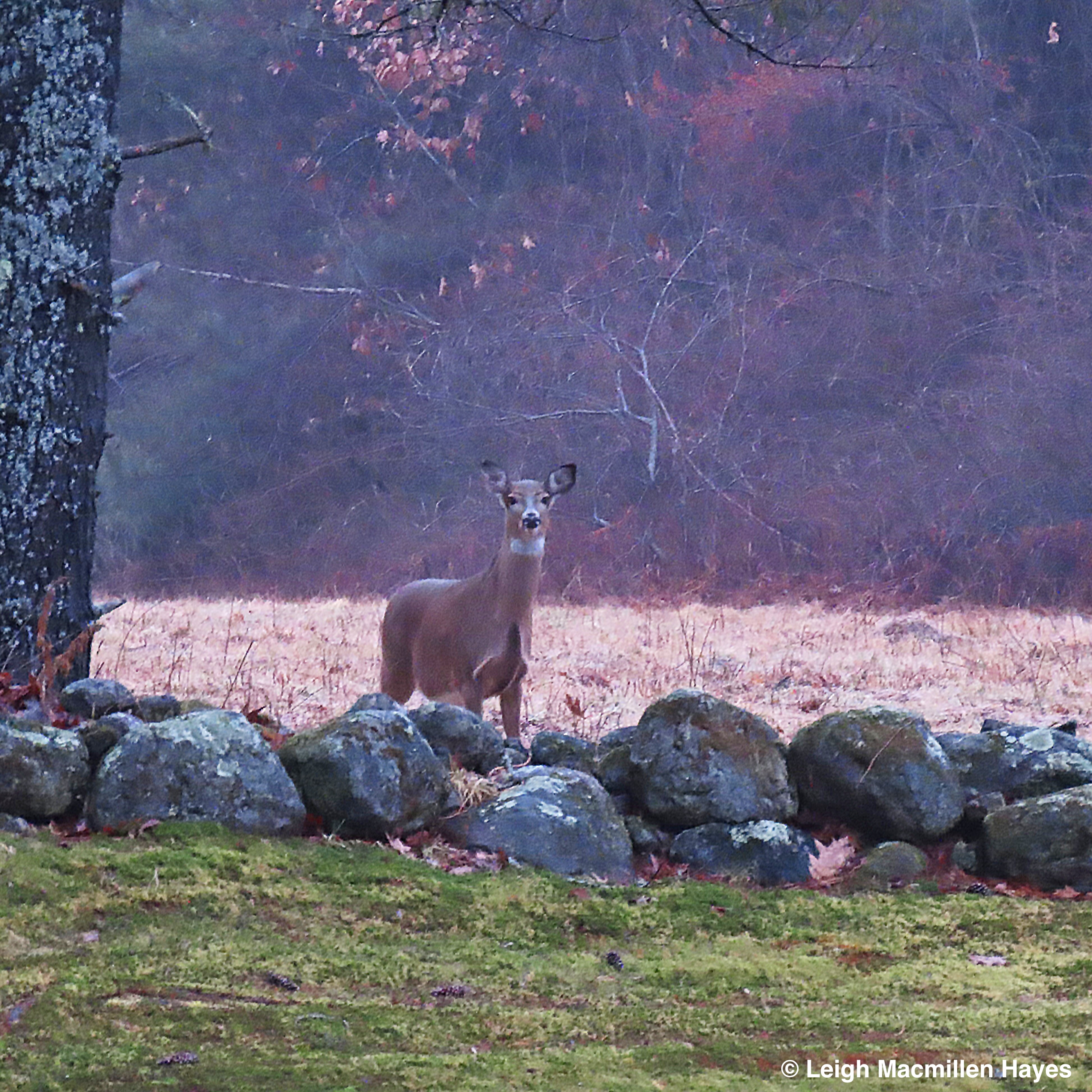
A doe and her two skippers also appeared and watched me from the edge of the field, or at least listened to my movements, which I tried to minimize as much as possible, but those ears were on high alert.

About a month ago, when we did have snow, I discovered blood beside her tracks on this side of the wall and knew that she was in estrus. A day later, I noticed a young buck in the field and by the way he kept his nose to the ground and moved frantically, I knew he was on a mission to find her. Did he? Is she with child? Only spring will tell.

In the meantime, her twin skippers are still with her. They ran off before I headed in, but I suspect it wasn’t long before they returned under the blanket of darkness and munched on a bunch of acorns.

Bandit never did appear during the time that I waited. Who knows? Maybe he had spent a night and day or two in the hemlock of his dining choice. I’ll continue to search for evidence of his activities because it’s what I most enjoy doing.

There’s always something wild going on outside our back door, rain or shine or snow or sleet, and I’m grateful for each lesson they take the time to teach me. I am a forever student, naturally.

Slippery Slope Mondate

My Guy and I took in an old fav from a different perspective today. That’s because I always thought that the Micah Trail at Loon Echo Land Trust’s Bald Pate Mountain Preserve was for Camp Micah only. This morning I learned that anyone can begin the ascent via this sweet trail and so we made it our mission to do so this afternoon.

There is room for about four vehicles to park at the trailhead on the left-hand side of Moose Pond Cove Road off Route 107 in South Bridgton, Maine. Maps are available at the kiosk located a few steps in from the parking area.

Afew more steps and we met new bog bridging, always a welcome sight and so we crossed and then continued on up the trail, pausing frequently to search for bear claw trees among the American Beeches.

No such luck in the bear claw department, but we were serenaded by a flock of Chickadees singing their rather wispy fall songs, if they are songs indeed.

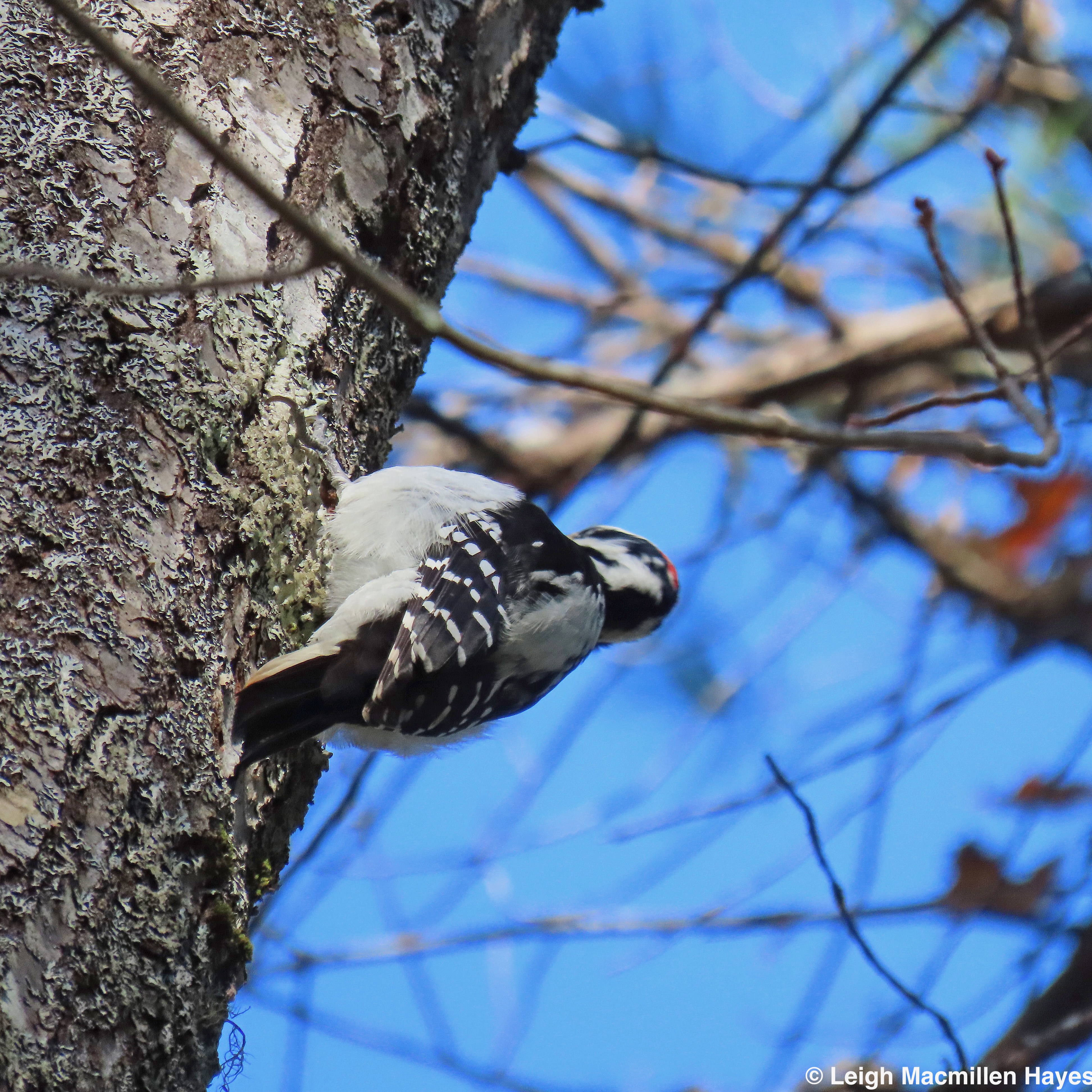
And a Hairy Woodpecker or two did what woodpeckers do . . . it pecked. This is a male as you can see by the hint of red at the back of its head. And he’s all puffed up, in reference to the brisk temperature of the day. Trapping air between his feathers helps him to warm up. Wearing several layers helps us do the same.

Once we reached the South Face Loop Trail, it was a quick ascent to the summit. Just before the summit, we paused to honor the bonsai tree–which is really a Pitch Pine. The summit of the pate is home to a Pitch Pine Forest. Though these trees can stand straight and tall, on mountain tops they take on a contorted structure.

The “pitch” in its name refers to its high resin content, thus making it rot resistant.

The needles are bundled in packets of three–making it easy to remember its name: Pitch–three strikes you’re out!

Another easy way to identify Pitch Pine is to look for needles growing right out of the bark–both on the trunk and branches.

Pitch Pine cones take two years to mature and upon the tip of each scale is a pointed and curved prickle.

They open gradually but depend upon fire for their seeds cannot be released until they are heated to an extremely high temperature.

That being said, this is the only native pine that will re-sprout when damaged.

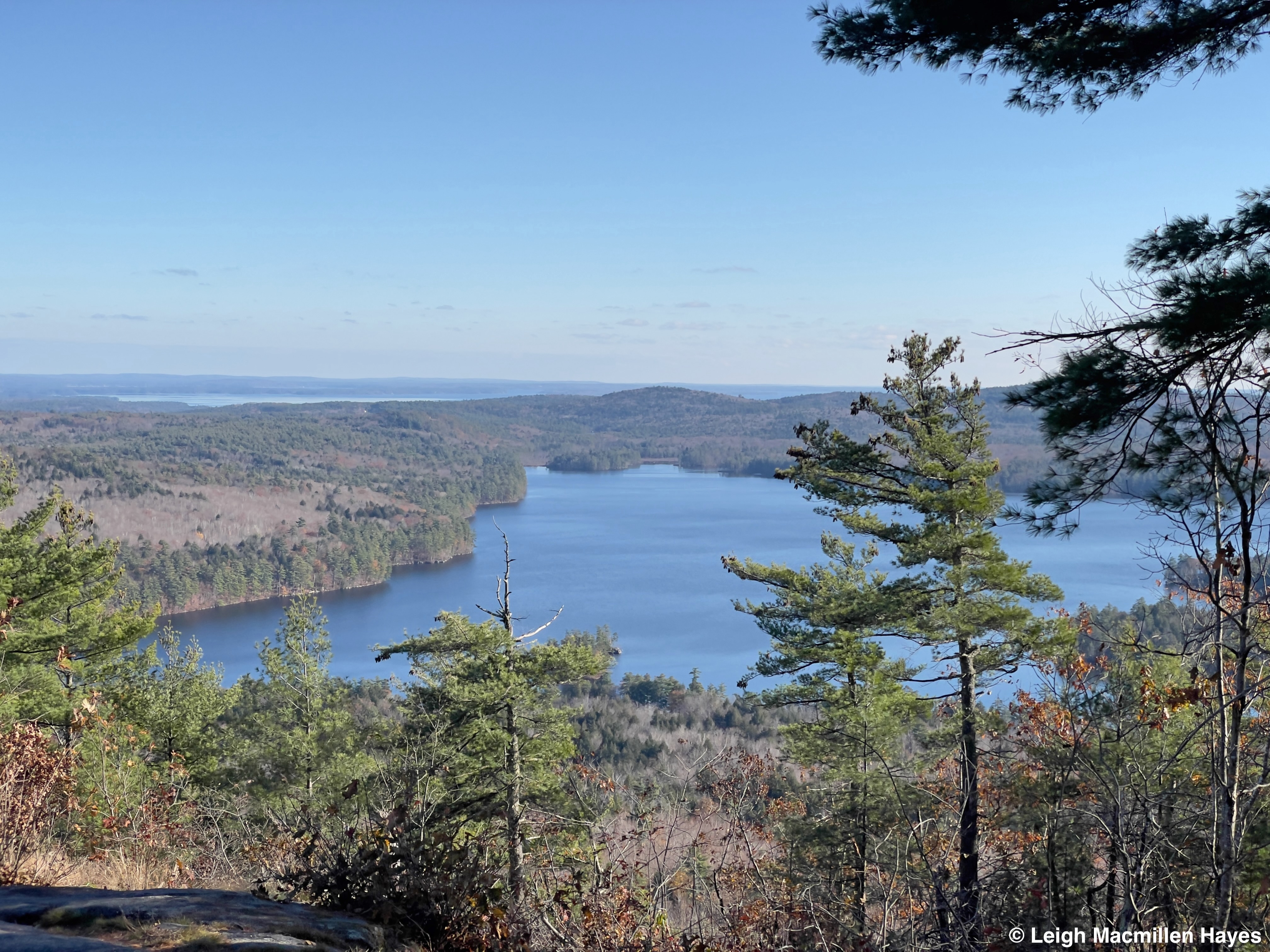
I was told this morning that there had been some view openings and we were thrilled to discover a couple of them, includng this one overlook Peabody Pond with Sebago Lake in the distance.

And no visit to the summit is complete without paying homage to our friends Faith and Ben by taking a photo of their beloved Hancock Pond.

You may note the difference in the sky view from one pond to the next–snow showers are in the forecast for tonight so as we looked to the west, we could see the front moving in. No accumulation is expected, but any day now it will be most welcomed by us.

Though most of our foliage has dropped to the ground, another view at the summit included the scarlet colored blueberry leaves turning any day into a cheery one.

A quick loop we made next around the Bob Chase Trail, noting that we could almost see Mount Washington located in the saddle of our other beloved: Pleasant Mountain. On a clear day, this view is spectacular.

At last it was time for us to return to the South Face Trail and continue to follow the loop down. This section of trail we don’t often use so we did have to backtrack once and locate the orange blazes again.

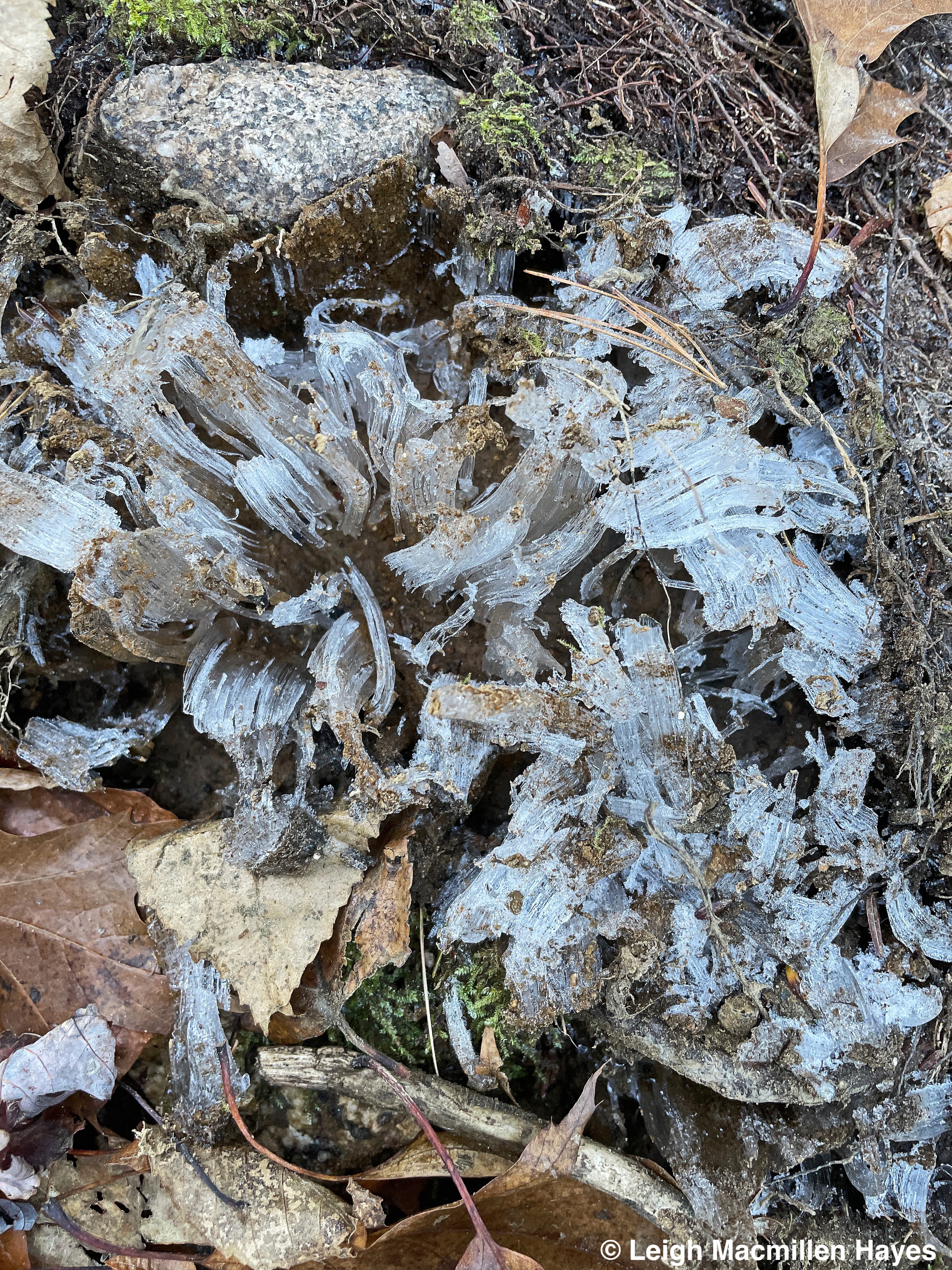
You might think that upon our descent it would be the ice needles that gave us a difficult time. The six-sided slender ice constructions form in moist soil and can take on a variety of presentations from straight to arching curves. And yet, they grow perpendicular to the ground’s surface.

But, they were no bother and only crunched under our feet if we stepped on such in the trail.

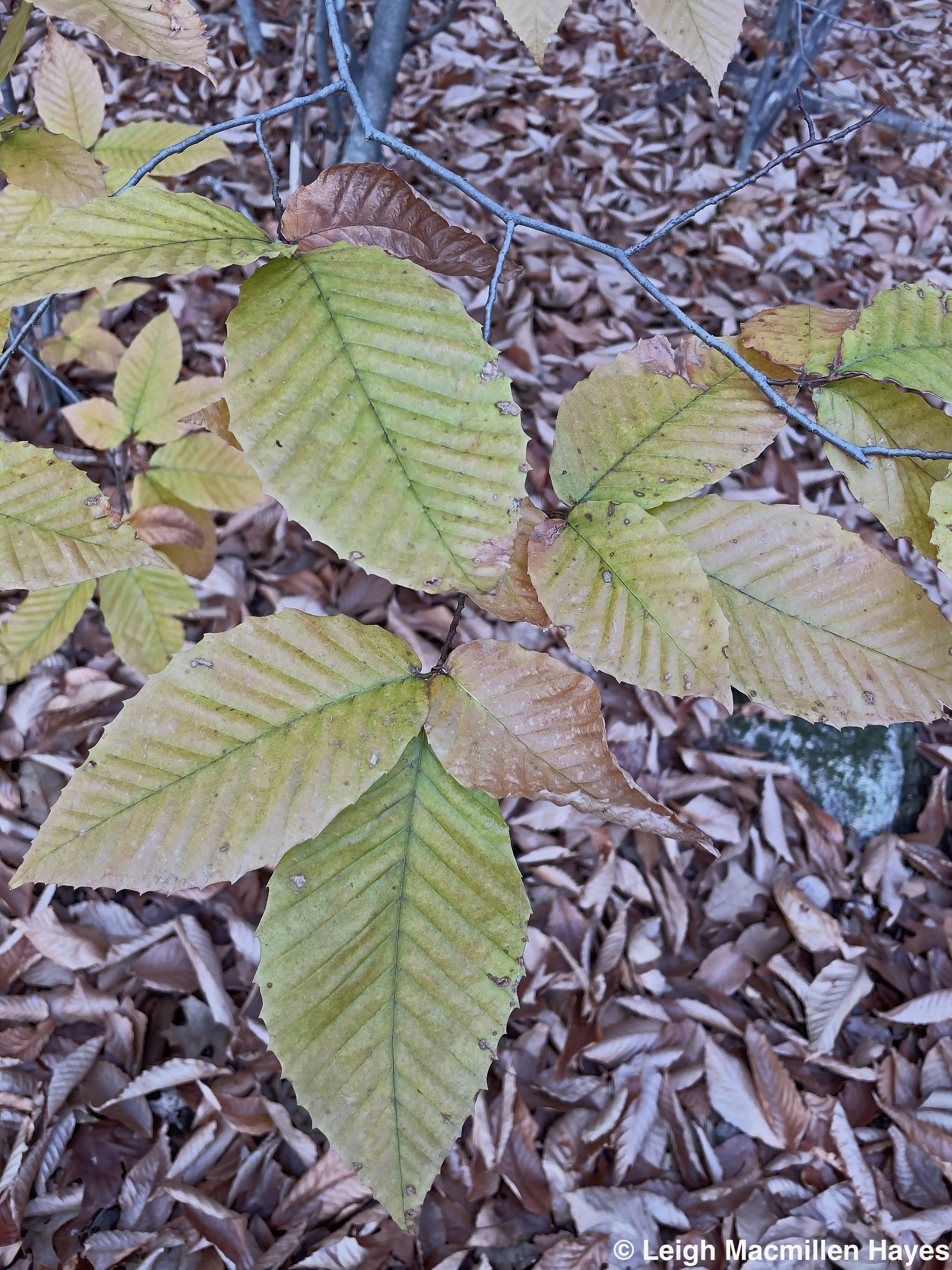
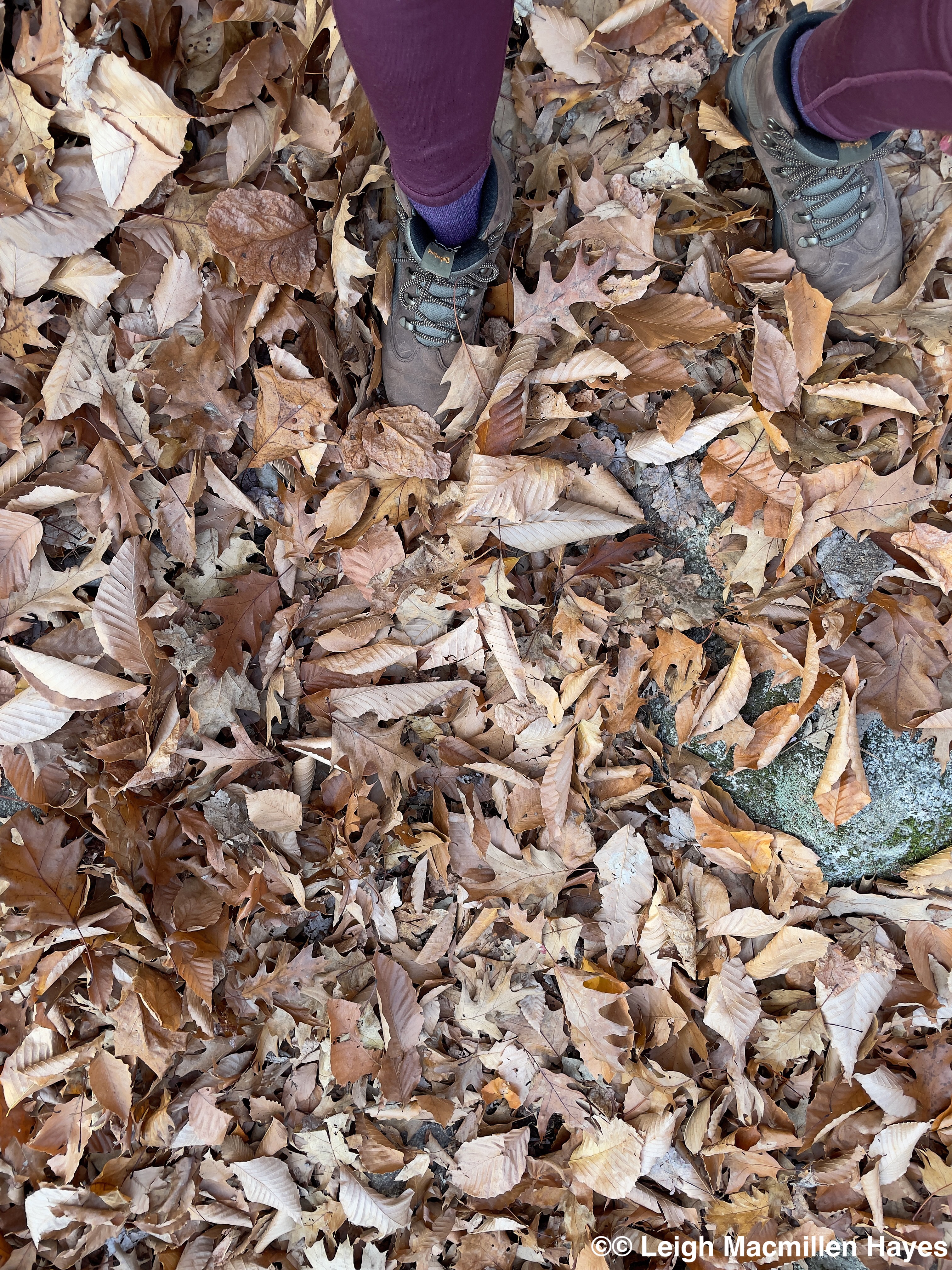
The leaves, however, offered a different story. We had to make sure we weren’t fooled by the fact that many American Beech leaves still have some greens and bronze hues.

And others, though dried up, will wither on the trees until spring as they are marcescent (mar-CESS-ent). Some trees, such as the beech, especially those that are younger, choose to hang on to their leaves until spring.

Most deciduous trees drop their leaves in autumn, when cells between the twig and the leaf’s petiole create an abscission layer, thus causing the leaf to fall off. Not so in the case of marcescence, and I know that many will rattle and initially startle me all winter long. But, they also provide another hue in the winter landscape.

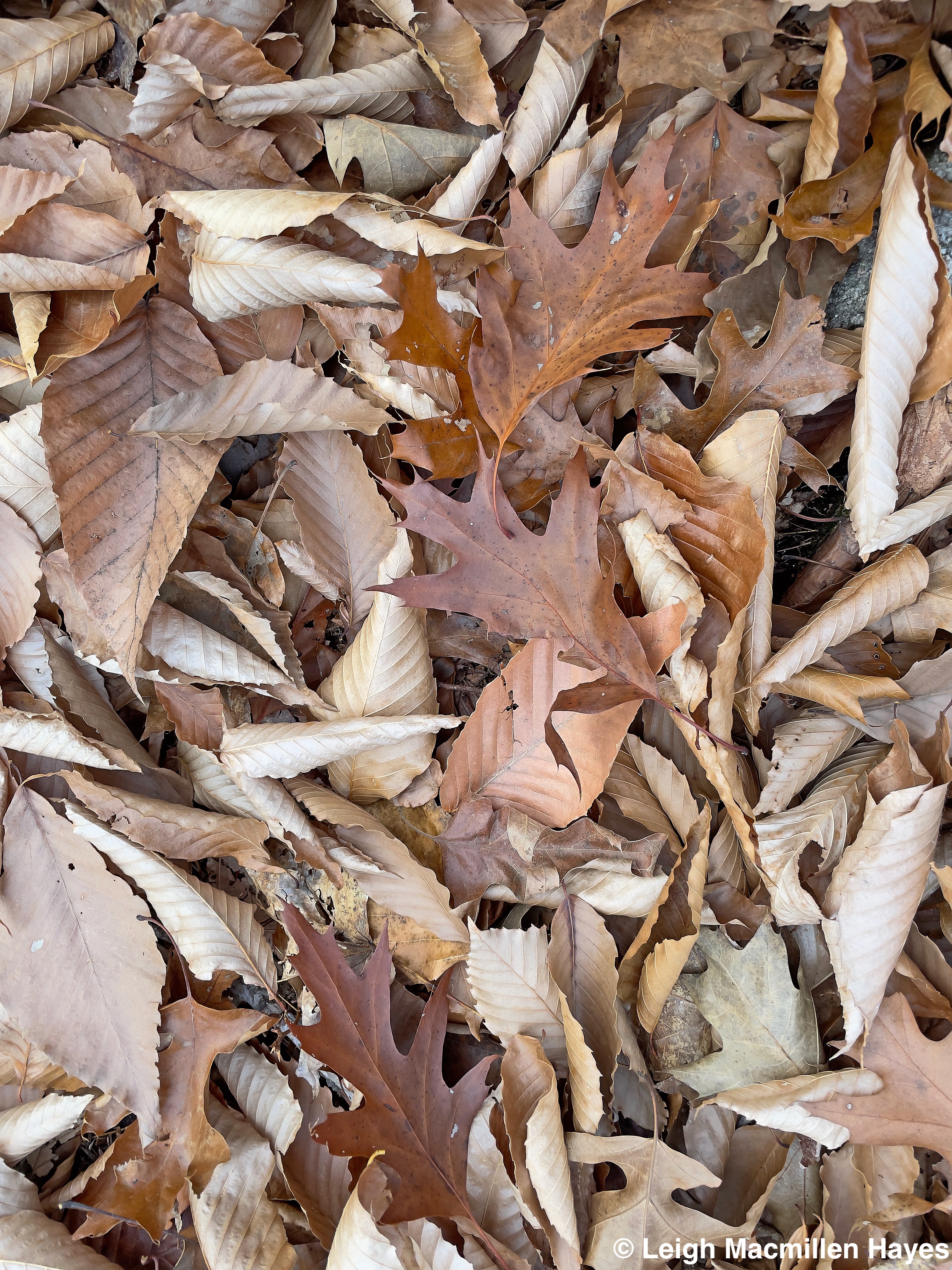
Northern Red Oaks also do the same, though in my observations, many are loosing their leaves with November winds, but some will remain throughout the winter.

Today, three seemed to play Tic-Tac-Toe on the trail before me.

So, young beech may retain their leaves, but look toward the sky and you’ll notice bare branches and look at your feet and you’ll see where they have all landed. A word of warning if you are hiking in New England right now–these leaves make for a very slippery slope, especially upon your descent. Hike with caution. Even My Guy has learned to do this.

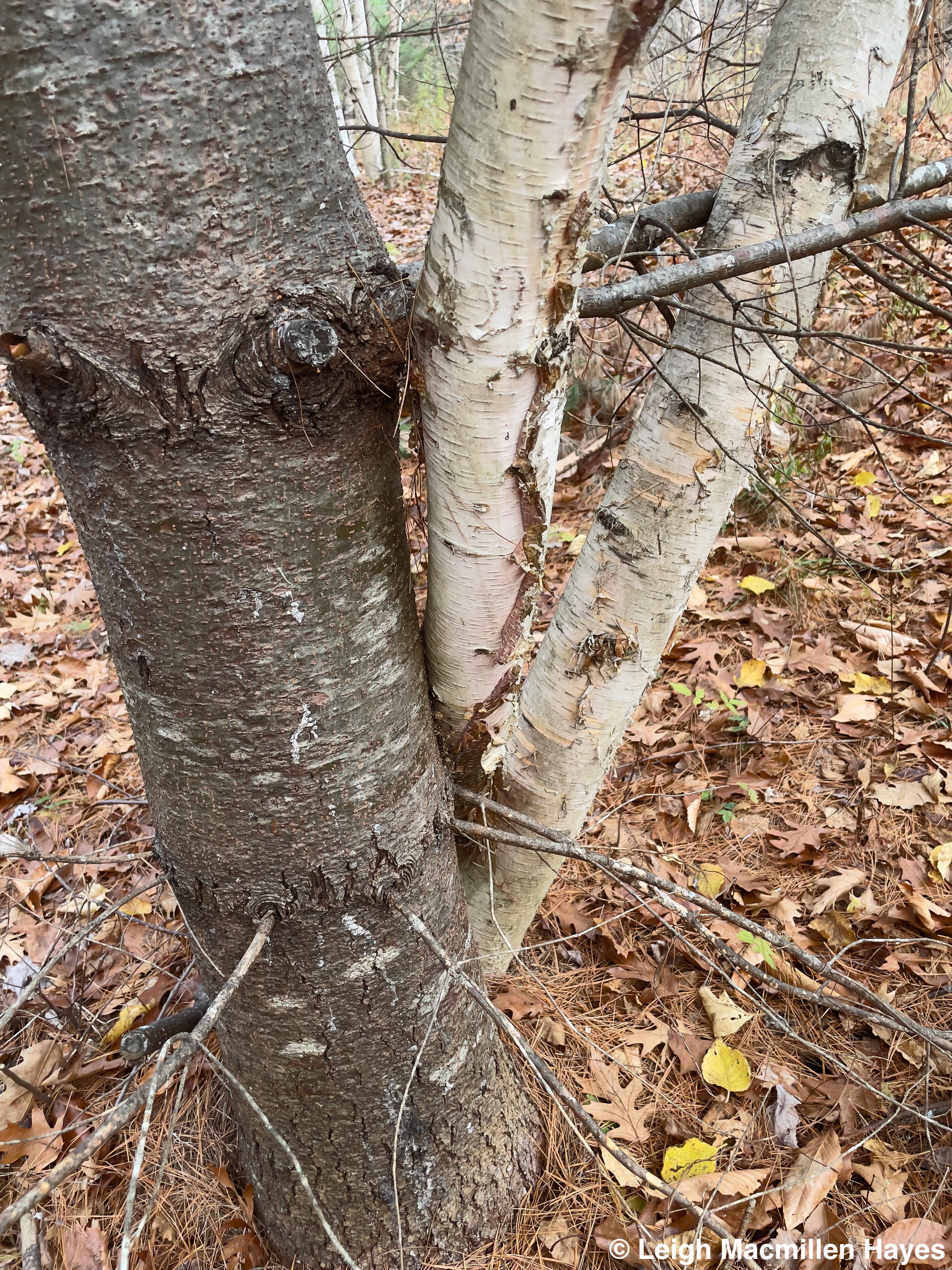
As our hike came to a close, I noticed two trees close to the trailhead that I’d missed on the way in. An Eastern White Pine and a Paper Birch. Do you see what I see?

They had found a way to grow in the same space and actually fused together. Wind must have caused frequent branch movement. It probably took many years for the surfaces to gradually abrade, with the cambium of the trees touching and forming an adhesion, necessary for a graft union, and the trees fused.

It always strikes me when trees do this, especially those of different species. My Guy and I had been on a slippery slope on this Mondate, but the world seems to be on an even slipperier slope these days.

Maybe we all need to be like the trees and figure out a way to live together without so much conflict.

Dissing Fall Foliage?

It rained. And rained again. And rained some more. All spring. Seemingly all summer. And then we had a wee bit of a break as summer turned to fall. But . . . as important as rain is to trees, they didn’t necessarily appreciate so much of it. At least, that’s been the case for some species, in particular Sugar Maples.

Typically, the leaves on this Sugar Maple in our front yard don an orangey-yellow hue and add a glow to our front rooms in mid-October. Not this year. I took this photo on October 1, and as you can see, many of the leaves had dried up and fallen off prematurely.

The reason. The rain. Well, not the rain but related to the rain. Between all that water saturating the roots, high humidity, and warmer than normal temperatures, fungal spores attacked the leaves, causing them to turn brown and dry up since their photosynthesis had been slowed and they no longer had the energy to carry on into foliage season.

Probably adding to this particular tree’s stress was the fact that it had produced prolific fruits. It did look rather odd to see so many samaras dangling and nary a leaf. But, the silver lining, the fruits speak to future generations and next year’s buds are present and ready to overwinter for emergence in the spring.

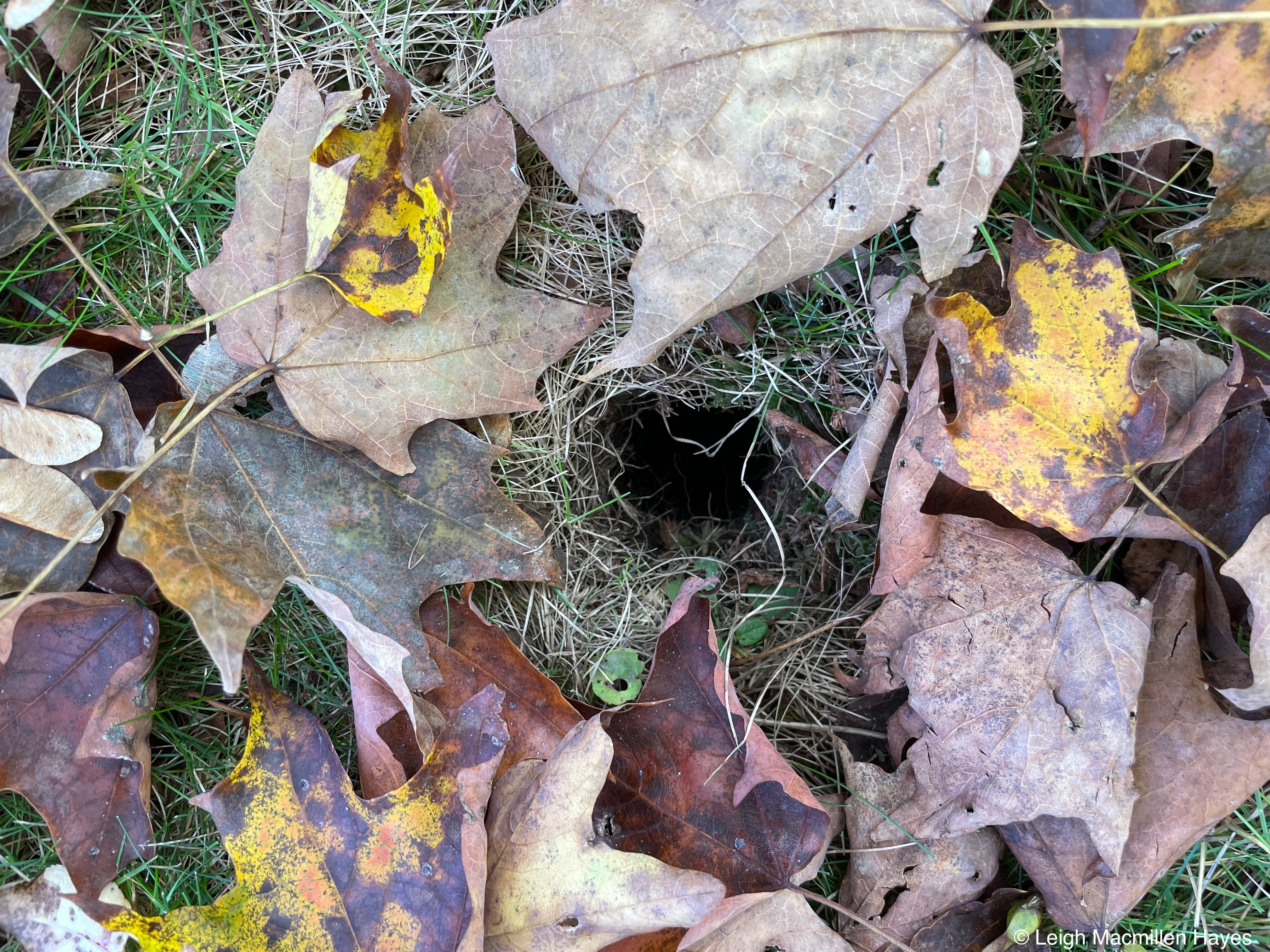
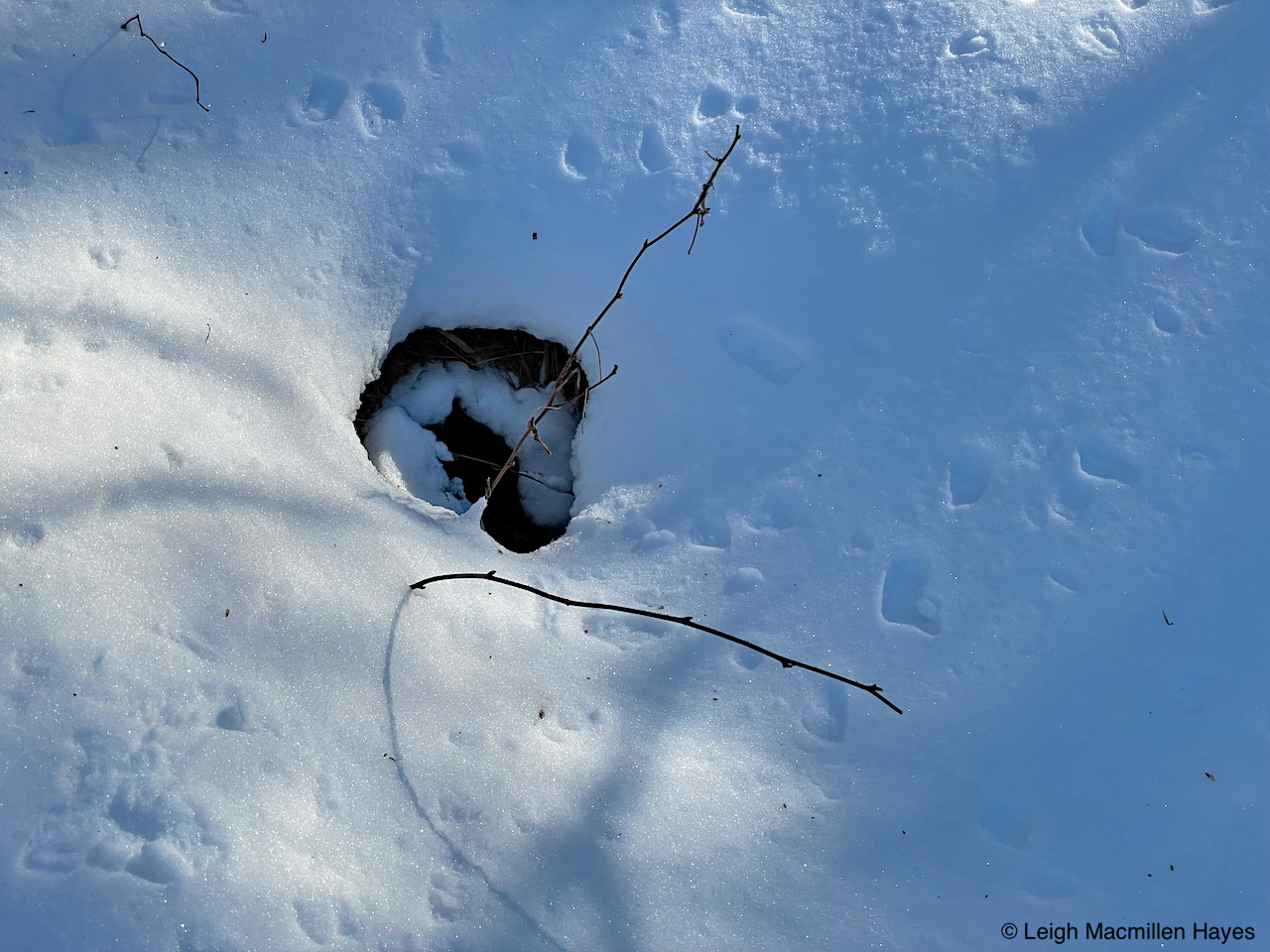
That said, the front yard doesn’t look all that pretty with a pile of dried up leaves, but the chipmunk hole tells me that some local residents are thrilled–they’ve had leaves available for longer than is the norm to fill their nursery/bedding chambers and now that the seeds are finally dropping, they have an abundance of food as well.

With that in mind, my mind has formed a negative take on this year’s foliage. Oh, it’s been pretty in little pockets, but nothing to rave about and I was getting frustrated with Peak Foliage Reports telling leaf peepers how beautiful it is.

And so I wondered as we headed across a boardwalk to Long Mountain this afternoon, what we might encounter for color on our climb.

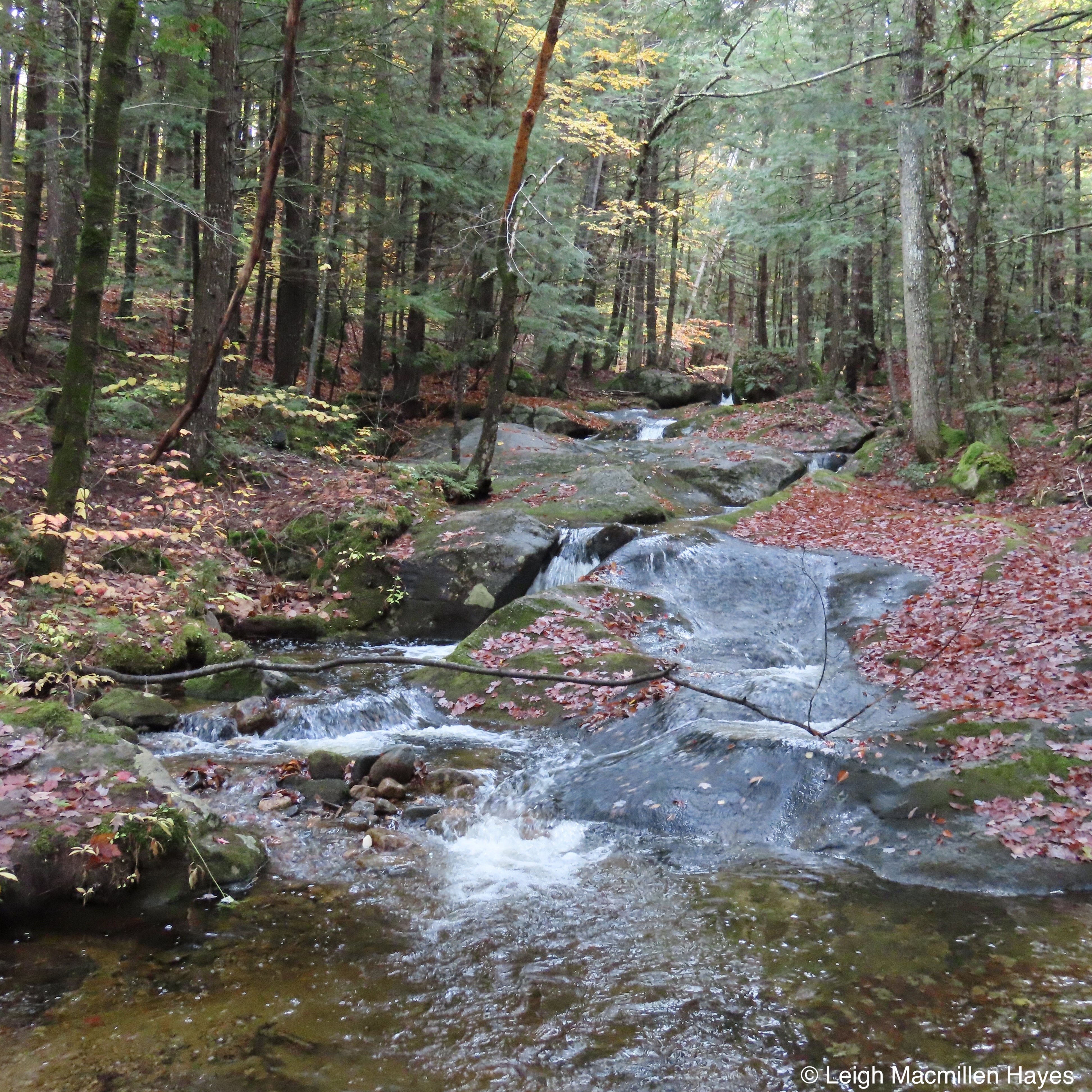
During much of the hike, Mill Brook babbled insistently . . .

flowed intensely . . .

and even roared immensely.

So much water, mimicking spring run-off, was the result of several more inches of rain that fell this past weekend.

Accompanied by the sound of the rushing water, and perhaps calmed by it as well, I began to notice the colors that surrounded us.

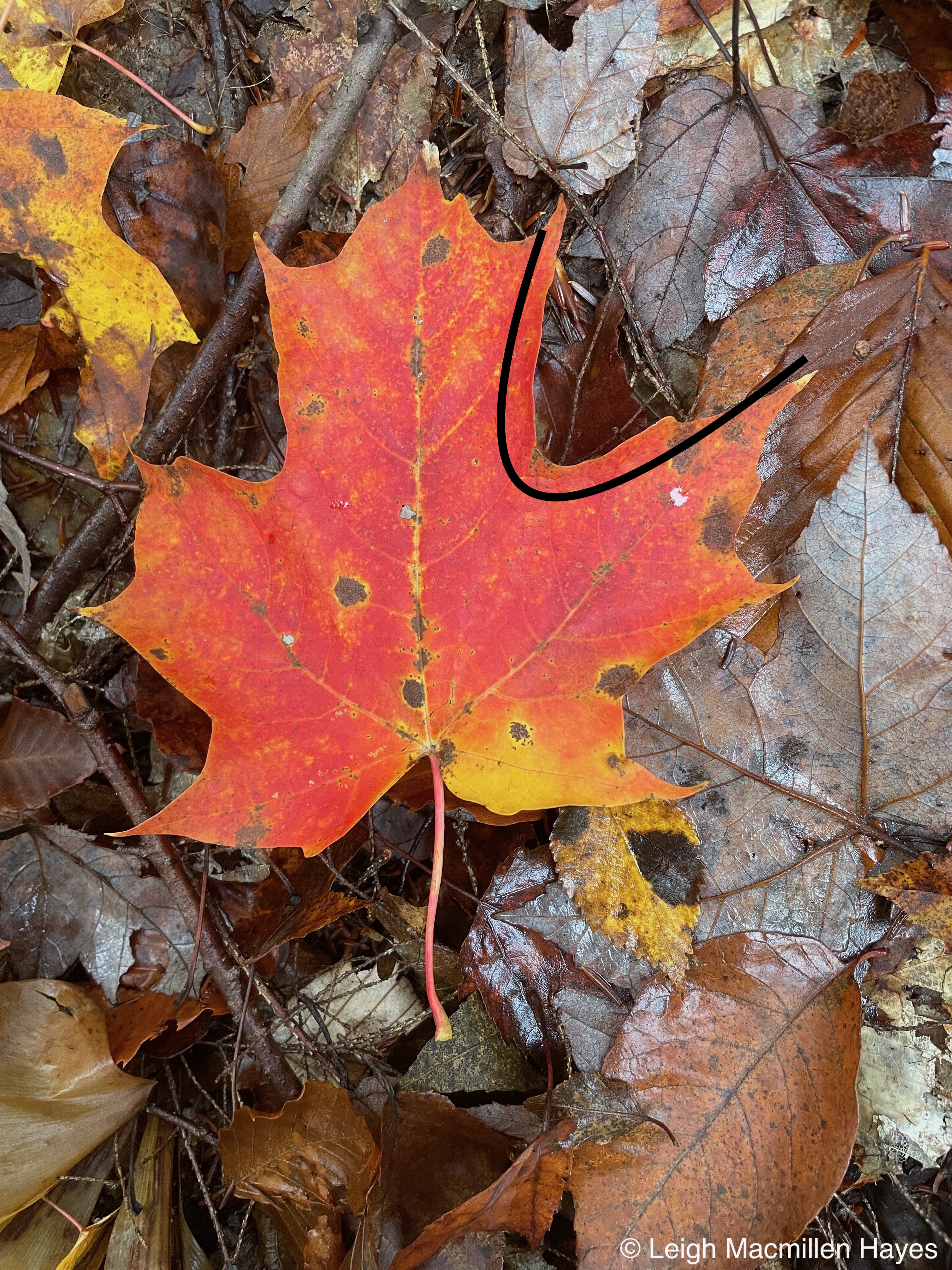
And when I looked down, there were jewels to be admired, like this Red Maple. Notice the V I added to the gap between the leaf’s pointed lobes? Red Maples offer a V-shape in the gap because they are VERY abundant in the Maine woods.

Fortunately, the Sugar Maples in this forest faired better than the ones on our road, which made me happy. So . . . how to tell the difference between the Red and the Sugar. The U-shaped gap can be thought of as a scoop. Get it? A scoop of sugar?!

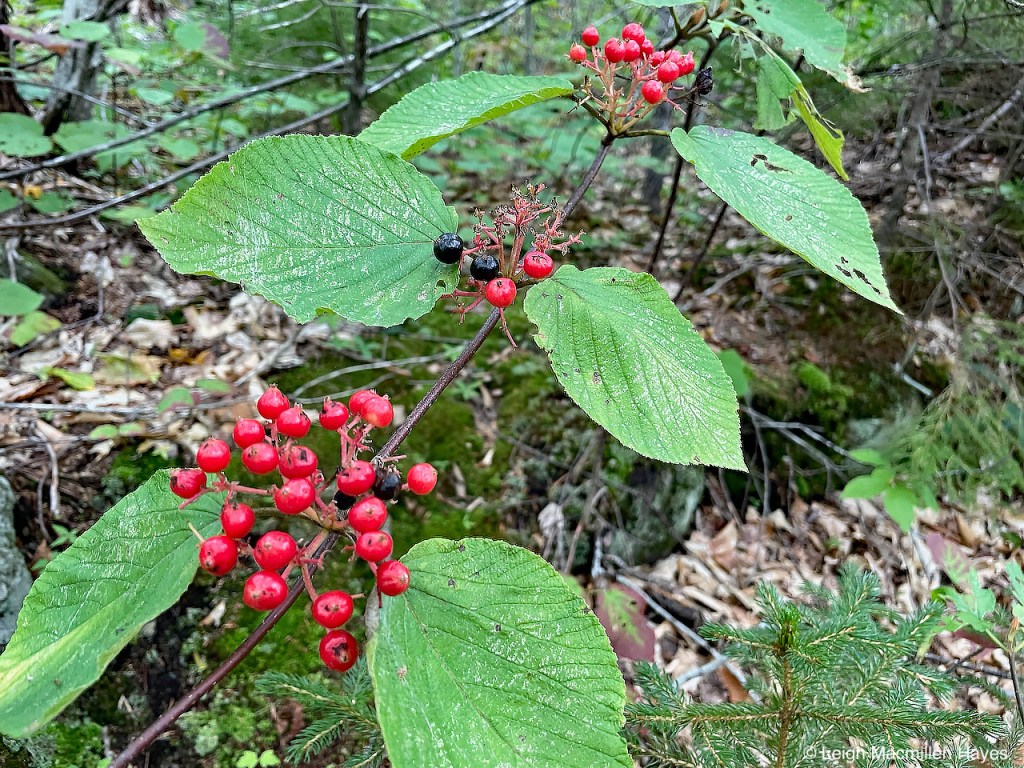
Maple-leaf Viburnum, a shrub in the understory, had its own hues to offer. Usually I see these leaves in their mulberry shade, but either we were too late today, or this one decided to be much more pastel in hue. It doesn’t really matter because it was still beautiful, had fruits left for wildlife, and bright red buds preparing for the future.

It is a bit early for Northern Red Oaks, but some in the understory had given up their need to continue to produce energy and change is in the air, or at least along the veins.

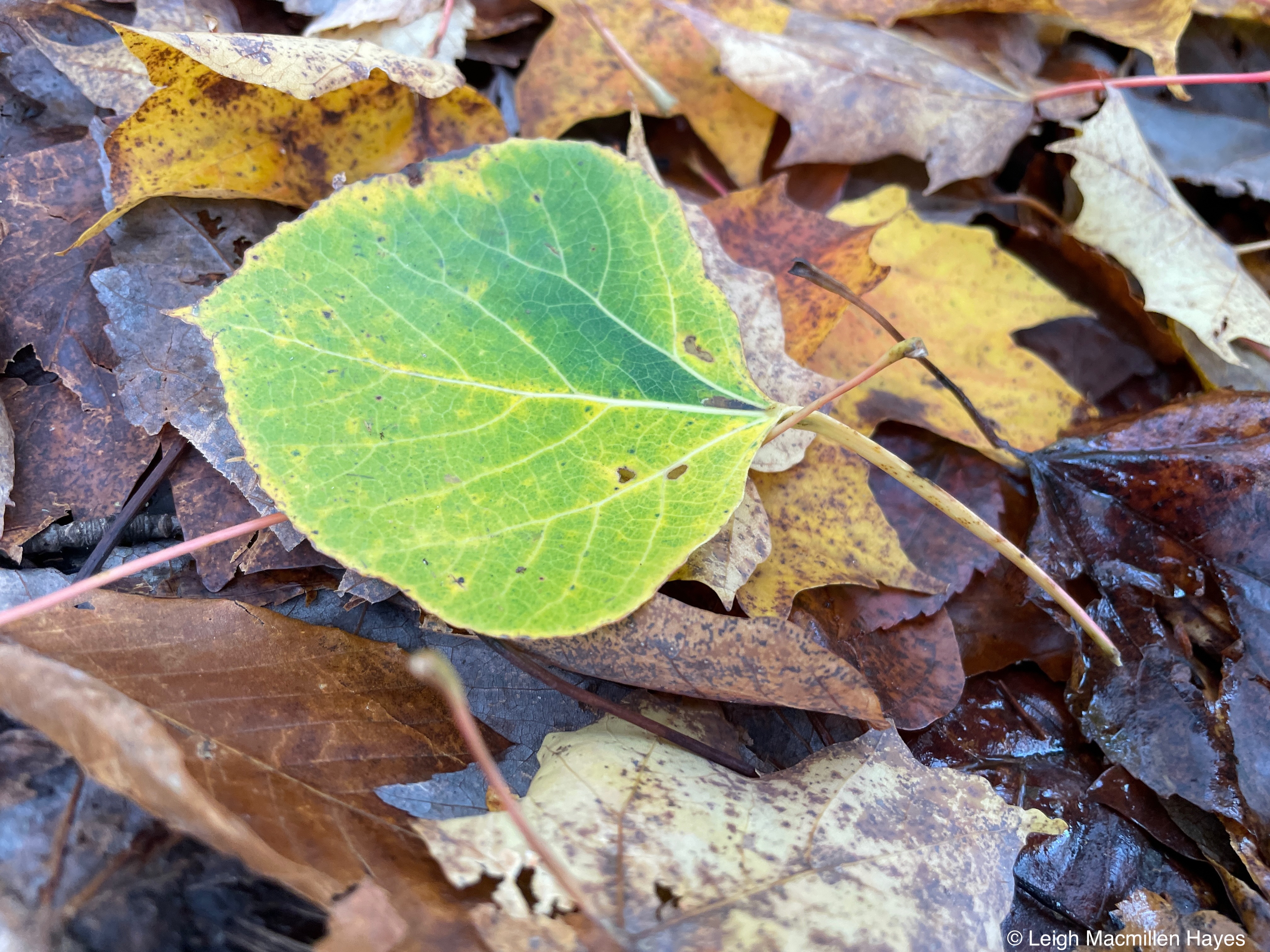
A Quaking Aspen with its flat petiole (stem), was the greenest of the species we encountered today.

I think one of my favorites was the Quaking’s cousin, a Big-tooth Aspen, which also features a flat petiole. Oh, and what big teeth along the leaf’s margin.

I was reminded as I looked at this leaf that yesterday we learned of a man who when in kindergarten many decades ago, was allowed to use only one color of crayon. I suppose the same teacher also told him to stay within the lines.

As the Big-tooth Aspen can attest, nature is a much better teacher in that and so many other regards.

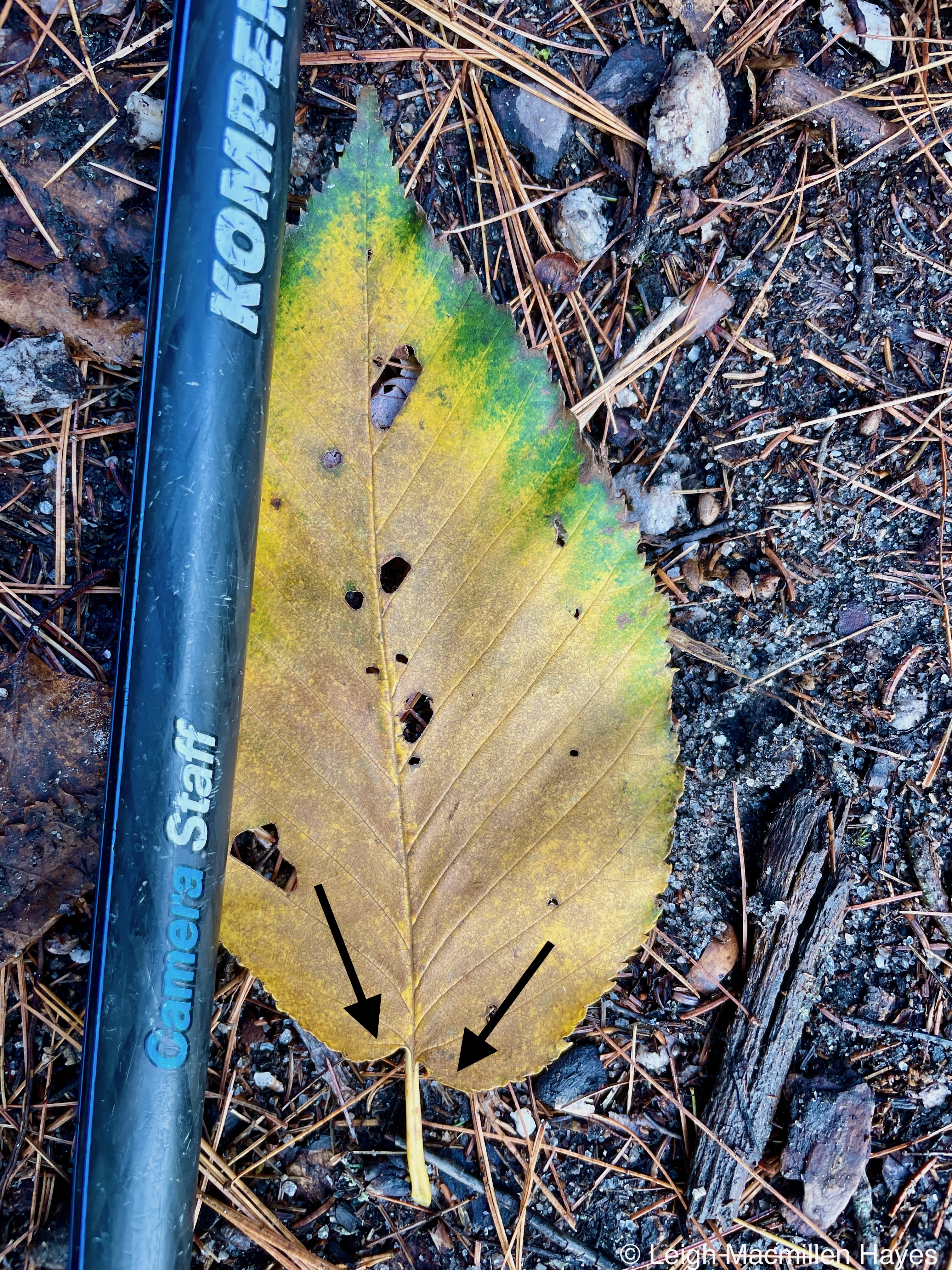
Okay, so I called the Big-tooth my favorite, but then I spotted an Elm. It didn’t feel quite like an American Elm to me lacking as it was that gritty sandpaper feeling, but being with My Guy, I didn’t have time to look around for more leaves or locate the tree. One day I will. The other choice is a Slippery Elm, but this isn’t actually their habitat. But then again, another lesson or two from nature–she doesn’t always read the books and there are no absolutes.

The cool thing, besides the tie-dyed coloration of this leaf’s edge, is the asymmetrical base, one side dipping longer down the petiole than the other.

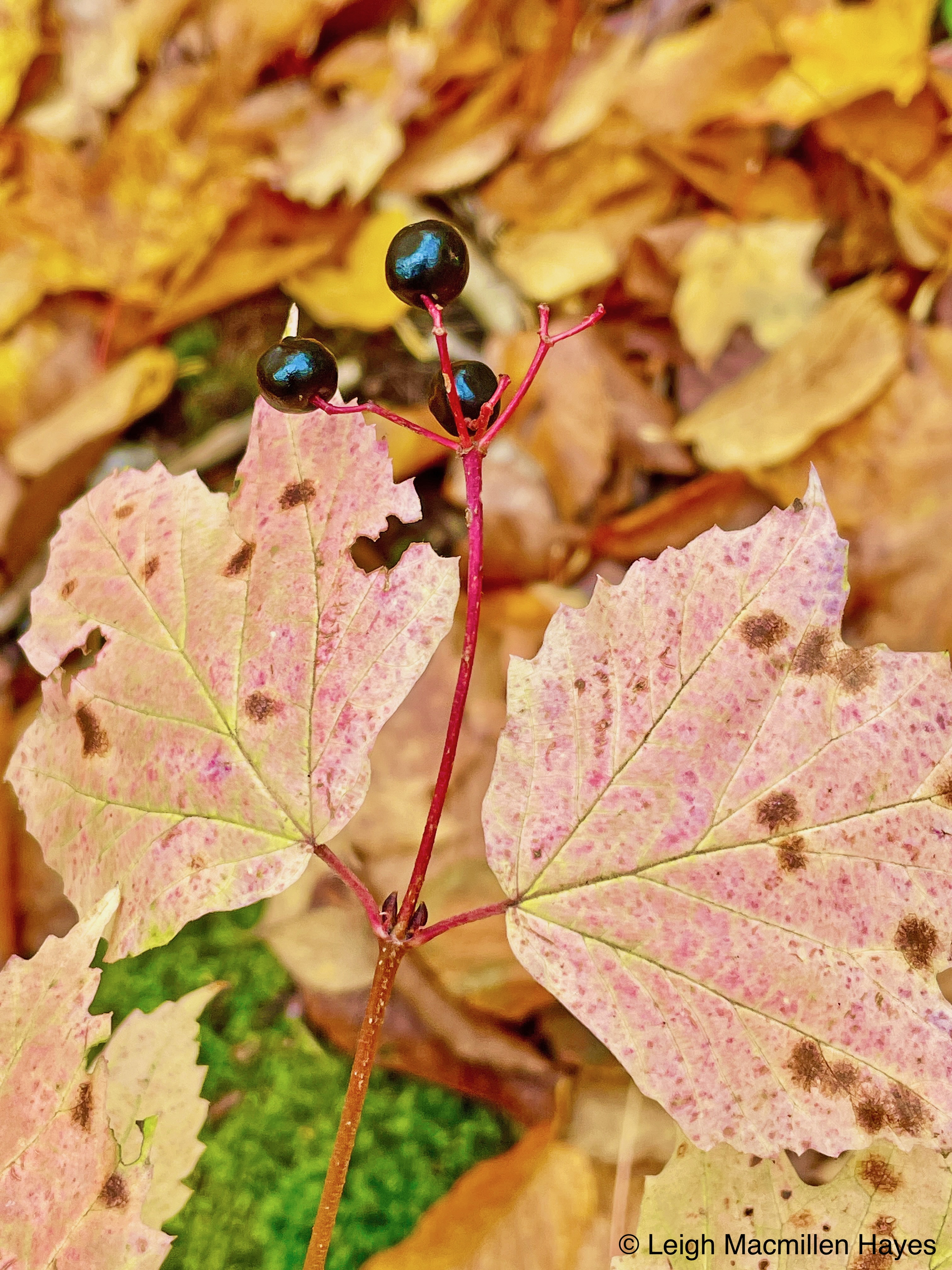
And then there was the Indian Cucumber Root. I think what caught my eye as much as the red on the leaves and the fruits waiting for a critter to dine, was the negative space between the upper tier of leaves, creating a five-pointed star. Maybe they always look like that and I’ve just never noticed before.

Today’s hike began to give me a change of heart about the foliage. Whether at our feet . . .

or flying above us . . .

or forming a tapestry before us . . .

it was beautiful in its own way . . .

and I’m grateful that this turned into a Not Dissing Fall Foliage Mondate.

The Beaver’s Tale

Once upon a time . . . no wait. This isn’t a fairy tale.

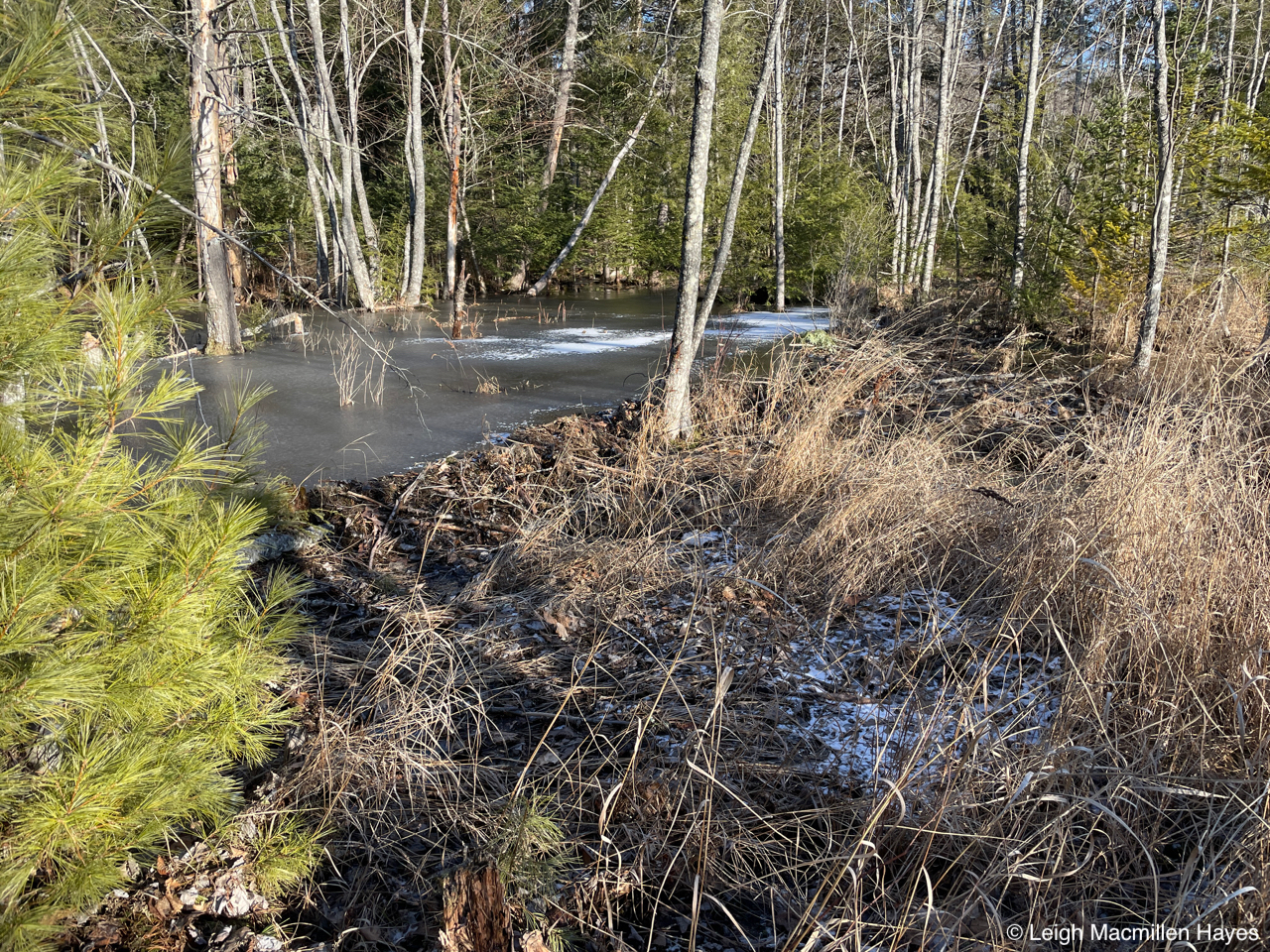
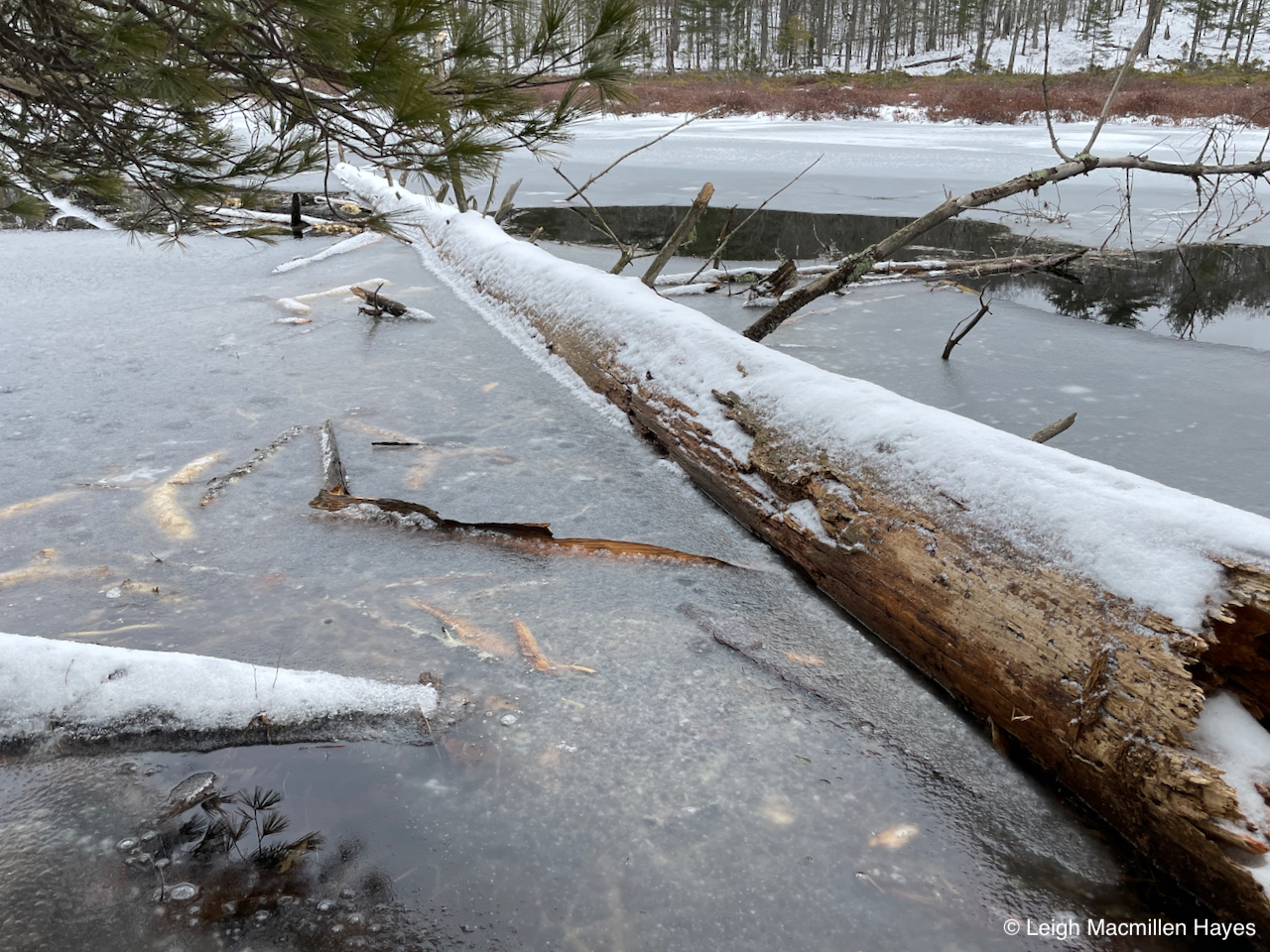
Rather, it’s about changes in the landscape that one might observe, such as a brook suddenly overspilling its banks as was the case in this location upon a December visit. We’d had rain, but that much?

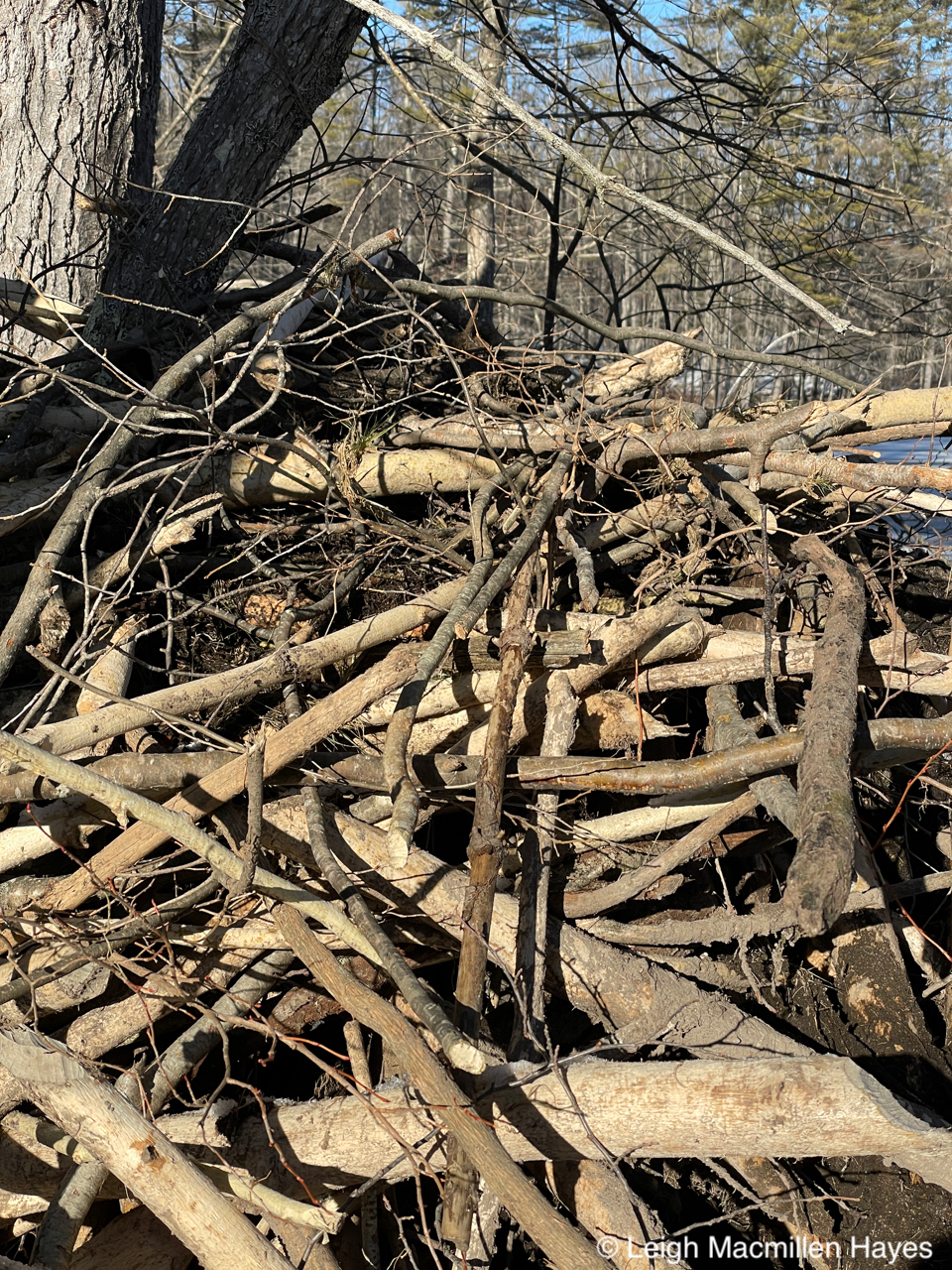
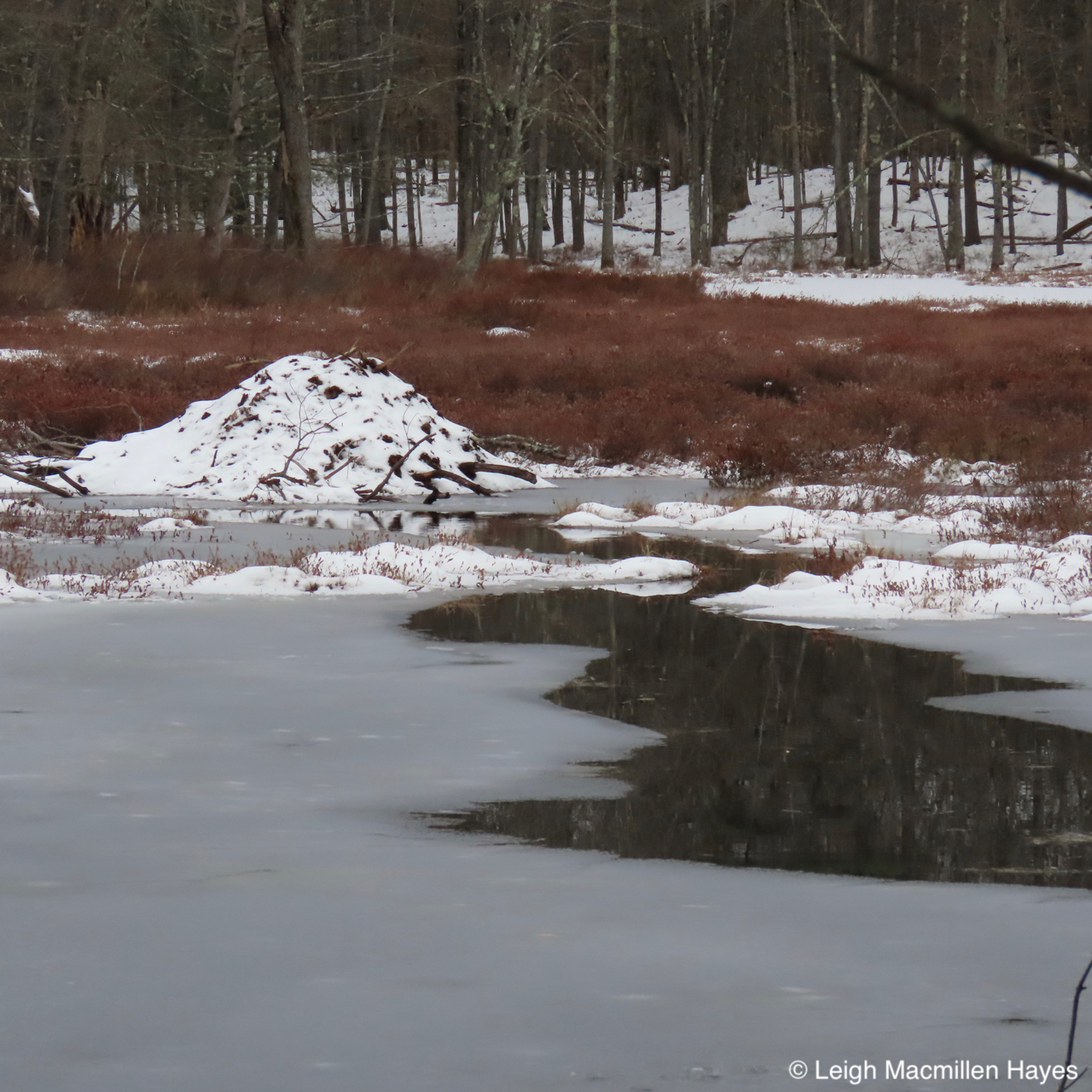
It wasn’t long before a friend and I spotted the reason for the high water. Some new residents had moved into the area and built a lodge of sticks. Unlike the story of the three little pigs, one of whom built a house of sticks that the big bad wolf came in and blew down, the makers of this structure took special care to make it solid and strong and weatherproof. Yes, a beaver or two or six had taken up residence with the intention of spending the winter. Beaver families usually consist of a monogamous couple, plus their two-year-old (almost adult) kids, and yearlings. Mating occurs in the water during the winter and kits are born inside the lodge in the spring.

In order to move into the lodge, a dam needed to be constructed as well. If you look closely, you’ll see that above it there was a bit of an infinity pool with the ice at level with the dam, while below it some water flowed at a much lower level. Though we couldn’t walk along the ice to measure the length of the dam, it was quite long. and made of sticks and leaves and mud. Typically, the family works on this project by creating a ridge of mud and probably the herbaceous plants of the meadow, and then they use the mud and sticks to stabilize it. Maintenance is a constant as water or other critters or humans have a way of breaching the dam.

We, too, build dams to serve similar purposes, such as this one originally constructed to operate a saw mill. Hmmm.

Getting back to the lodge: it also needs nightly work as long as conditions allow and this has been a winter of despair for those of us who love cold temperatures and snow and even ice if it’s in the right place, like on a pond or lake and not in the driveway.

Take a look at how the beaver is holding the small twig.

A beaver’s dental formula is this: 2 incisors on top, 2 incisors on bottom, 0 canines on top, 0 canines on bottom, 2 premolars on top, 2 premolars on bottom (that look like molars), 6 molars on top and 6 molars on bottom, for a total of 20 teeth. Recently, I was able to sketch the upper part of the skull of an older family member, who’d lost some of its molars.

These large, semi-aquatic rodents are gnawers like their relatives. To that end, their incisors are highly specialized for chewing through really, really tough things and they grow continually throughout the critter’s life.

And like all rodents, the front surface of their incisors is coated in enamel reinforced with iron (hence the orange color), which makes it resistant to wear and tear from gnawing. When the chisel-like teeth chew and fell trees, the much softer white dentine layer (the section behind the enamel) is ground down quicker than the enamel, thus creating a sharp chisel surface.

But to me the coolest aspect is that their lips close behind the incisors, thus permitting them to gnaw and carry sticks underwater without choking.

And bingo, you can see the stick being carried in that gap between the incisors and molars. Food sticks become lodge or dam sticks once their nutritional value has been consumed: a true plan of repurposing.

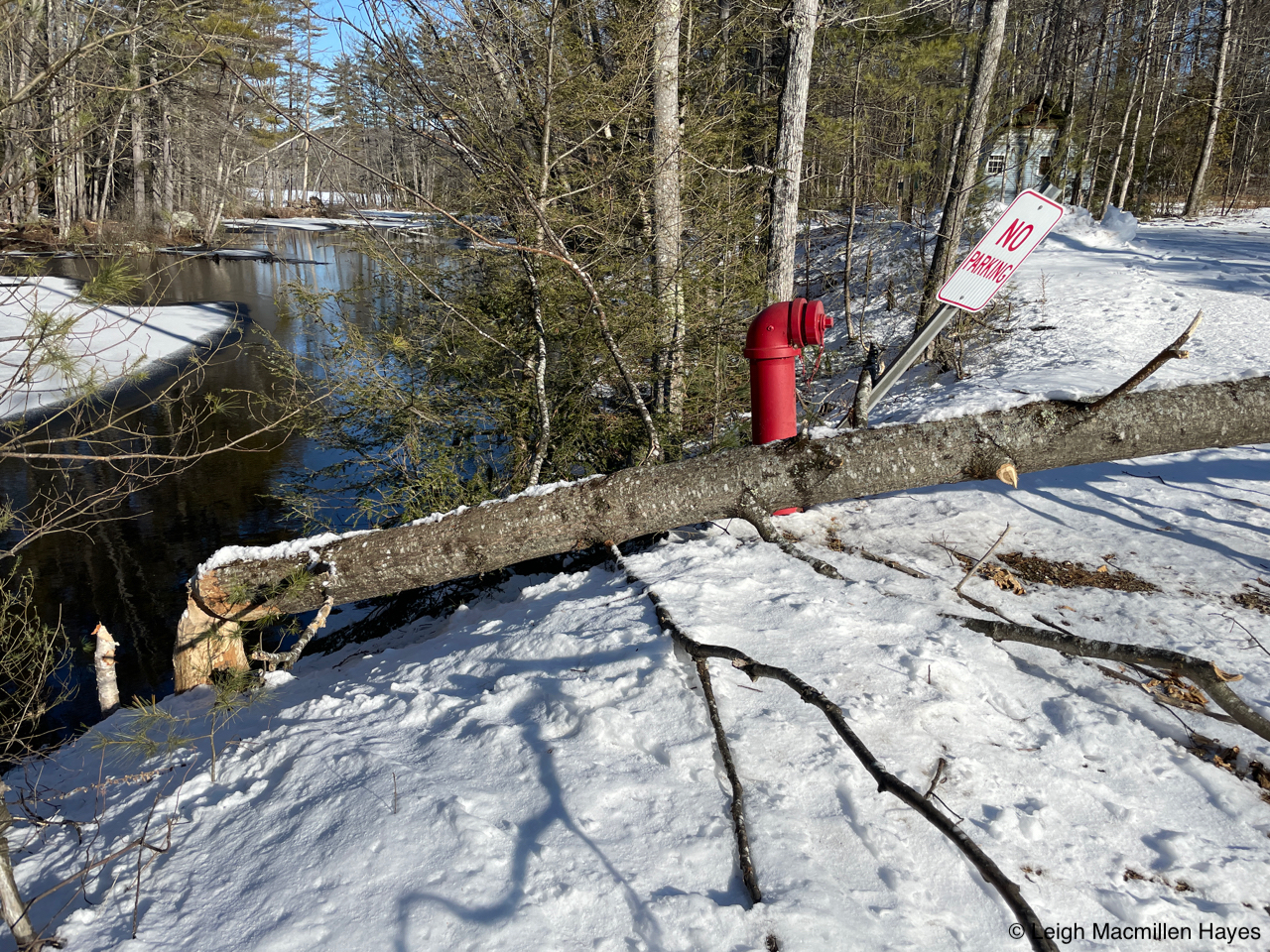
As it turns out, that wasn’t the only beaver family at work in town. This next family, however, chose to park their tree in a spot the fire department lay claim to for filling a water tank. But . . . reading is not on a beaver’s talent list.

In this other place, so many trees have been felled, but not all have fallen as intended, getting hung up on other trees instead. Not wanting to anthropomorphize, but I have to wonder what expletives flash through a beaver’s brain when trees don’t hit the ground as planned.

As strict herbivores, a beaver’s diet varies with changes in the season. During spring and summer, they are drawn to waterlilies, algae, grasses, sedges, herbs, ferns, shrub leaves and shoots. By late summer, however, tree cutting begins as they gradually change their dietary habits from herbaceous to woody materials. Twigs, roots, bark and especially inner bark become the source of nutrition. Aspen, birch, alder, and willow are favored species, but beavers will cut almost anything including conifers.

Imagine this. A beaver cocks its head to the side as it gnaws, thus the consistent angle of the half inch groove as the upper and lower incisors come together.

Likewise, porcupines gnaw, but their incisors are much narrower and the pattern more random.

So, the question remains. Where were the parking lot beavers living? In the past, a family has inhabited the northern most reaches of this pond, but in this case, they had built a lodge on a point not far from the southern end.

The top of the lodge is the only section not covered with mud, for it serves as a “smoke stack” of sorts, a place for beaver breath to escape. Visit a lodge on a cold winter day and you might observe the vapors rising.

And then it was on to another locale, where beavers have inhabited the same lodge for a number of years. When beavers choose to live in a pond or lake or sometimes even a river, there’s no need to build a dam for the water is usually deep enough for their underwater movement.

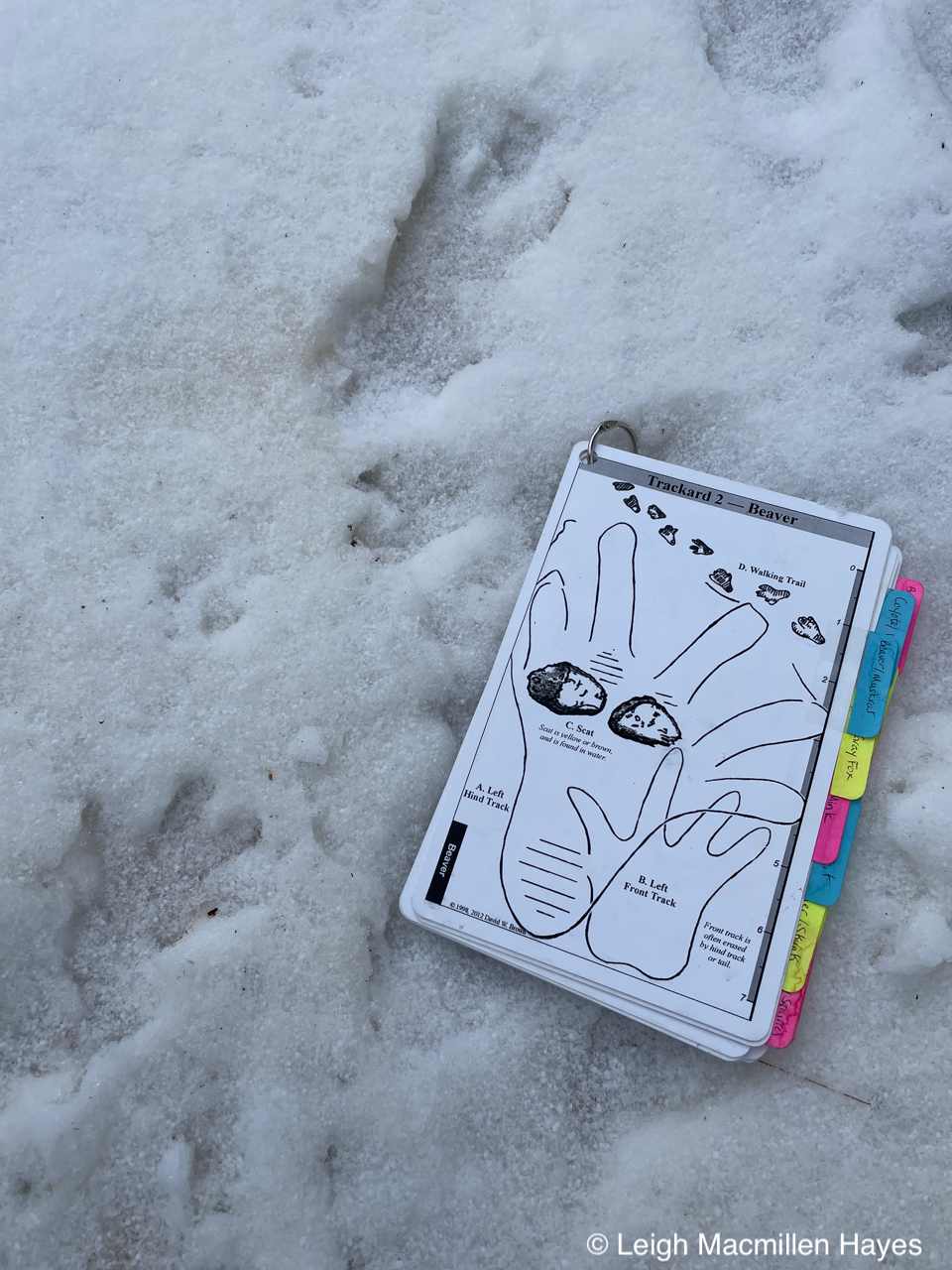
I often tell people that beaver prints are a rare find because they are either wiped over by the tail or by trees being hauled to the water. Once in a while, however, I’m proven wrong and the sleety snow on a recent day awarded just the right conditions for the webbed feet to be observed.

Tree work and broken ice added to the story of the critters’ journey to and fro the pond. While quite adept at time spent in the water, they are rather clumsy on land and most of their work is within a hundred feet of the edge.

Winter food is cached close by the lodge entrance so that they can swim under the ice to retrieve a stick. A beaver’s ears and nose have a valve that closes when it is submerged and they can stay underwater for up to fifteen minutes. Back at the lodge, there is a raised chamber surrounded by a moat that leads to the entrance tunnel. It’s upon the raised area that they dine, and groom, and even give birth.

At this particular pond, My Guy and I noted two lodges connected by an open channel between. Given the number of tail slaps that announced our presence near both lodges, we thought perhaps both were active and inhabited by the same family.

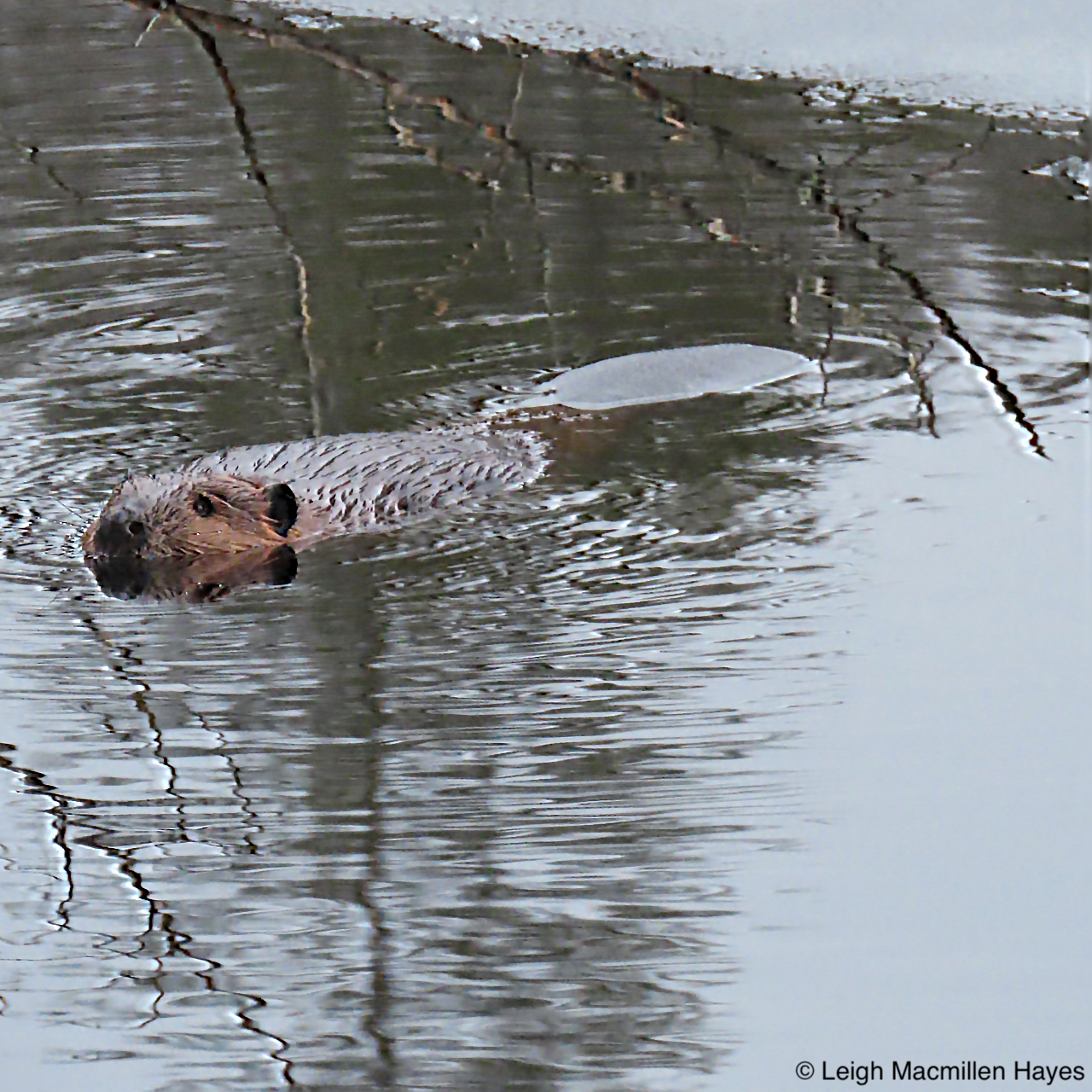
And then, and then . . . finally, we spotted a beaver that spotted us. We kept expecting it to slap the water with its tail in a manner of warning so other family members would seek deeper water or cover. Instead, it swam past us.

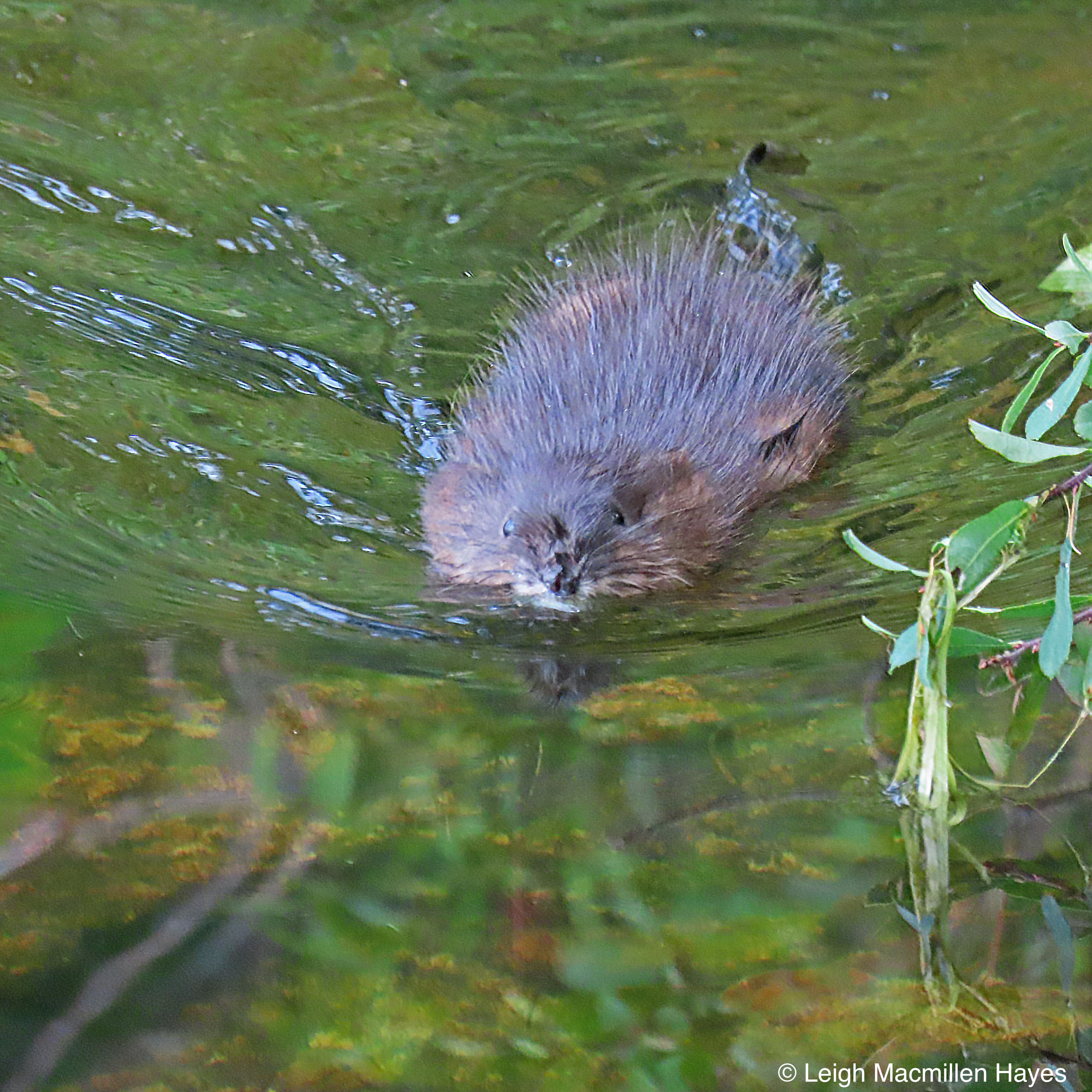
The thing is that a rodent relative, namely the muskrat, exhibits many similarities, but also differences, including a skinny, snake-like tail.

The beaver’s tail is a source of wonder. While its furry body consists of long, shiny guard hairs covering dense and softer hair that traps air and helps protect the critter from the cold, the tail is broad and flat and scaly. It’s used for a variety of reasons including stability when standing upright on land (think tripod), as a rudder for propulsion in water, as fat storage and thermal regulation, and how we are most familiar, as a warning device.

A beaver’s tale indeed.

Reading the Signs

Make each mind-filled step count as it presents reminders of wonder . . .

whether beside rushing waters that nourish with sight and sound,

or along mountain ledges where one is reminded that gravity holds us down.

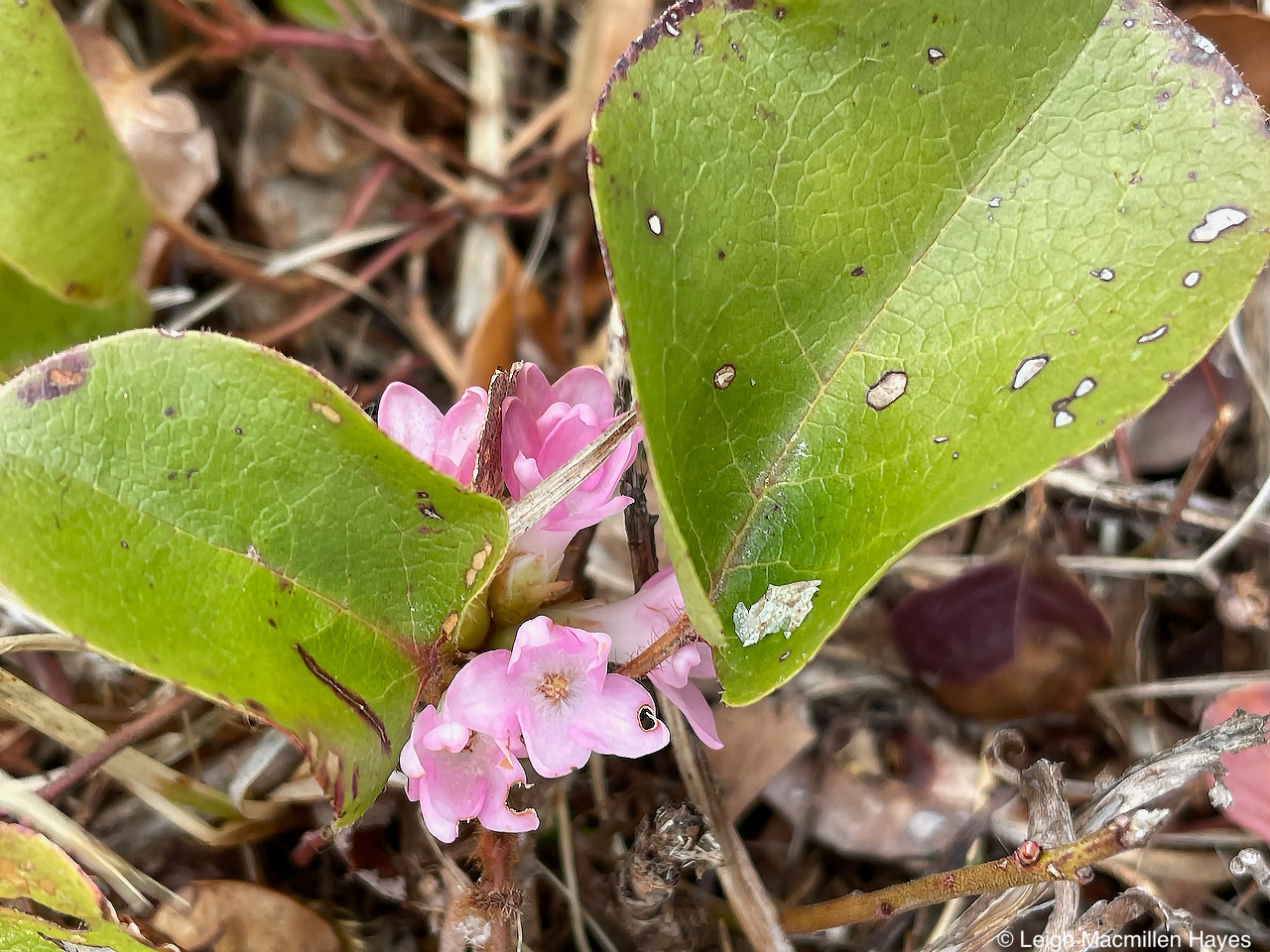
Admire first the Trailing Arbutus as you drop to a knee to take in the sweet scent of spring enclosed within its delicate petals.

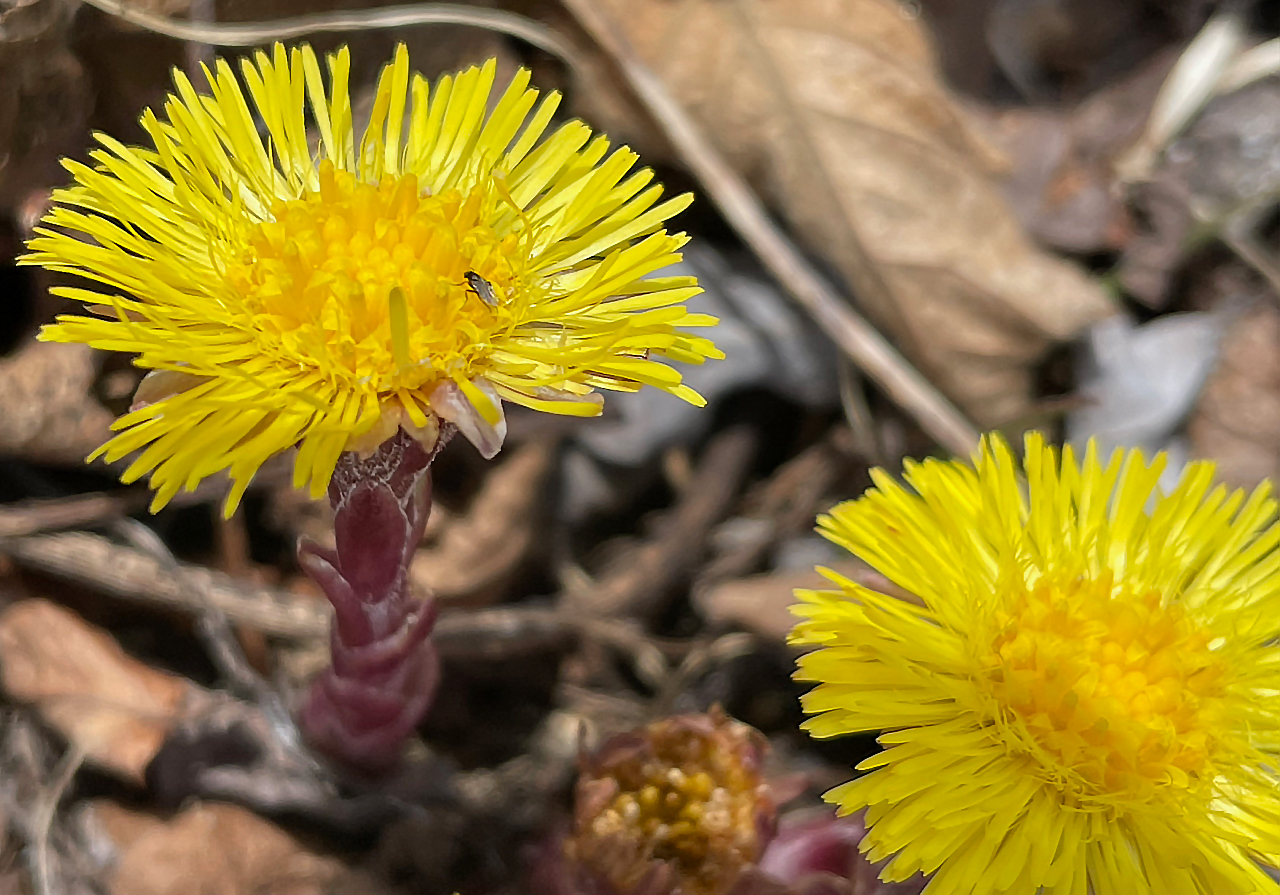
Don’t overlook the tiny fly seeking nourishment from Coltsfoot, pollinator at work upon a flower whose modified leaves give it an otherworldly appearance.

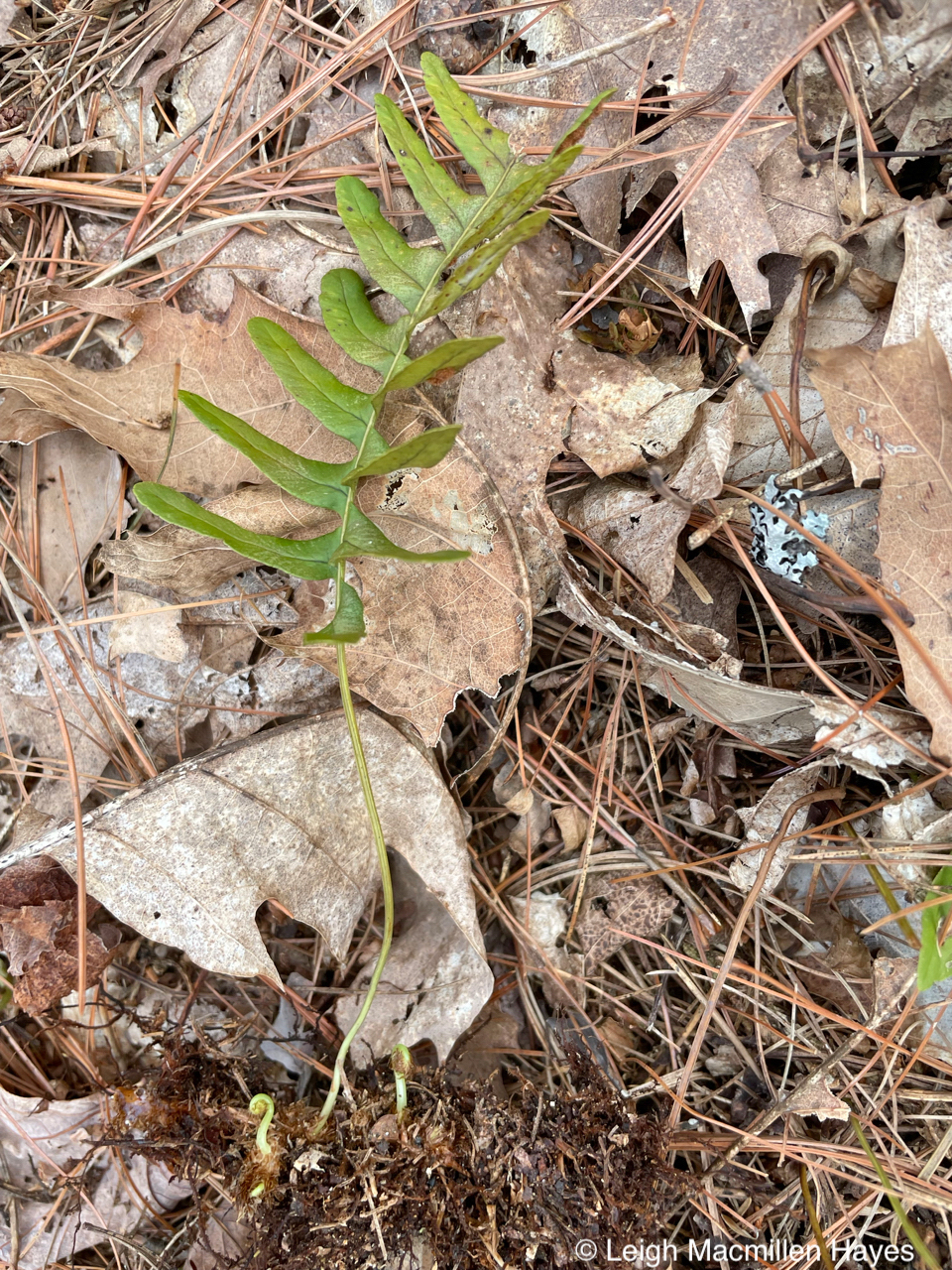
Notice the wee fiddleheads rising up beside Polypody ferns,

their hairy crosiers so minute that if you don’t search under leaves and moss, you’ll surely miss them.

Let the Eastern Comma Butterfly entertain as it dances up and down a forest trail,

occasionally pausing to allow onlookers to spot the tiny white comma, for which it was given its name, on its hind wing.

Let the past also astound in the form of last year’s Ghost Pipe flower appearing now as an intricate woody capsule.

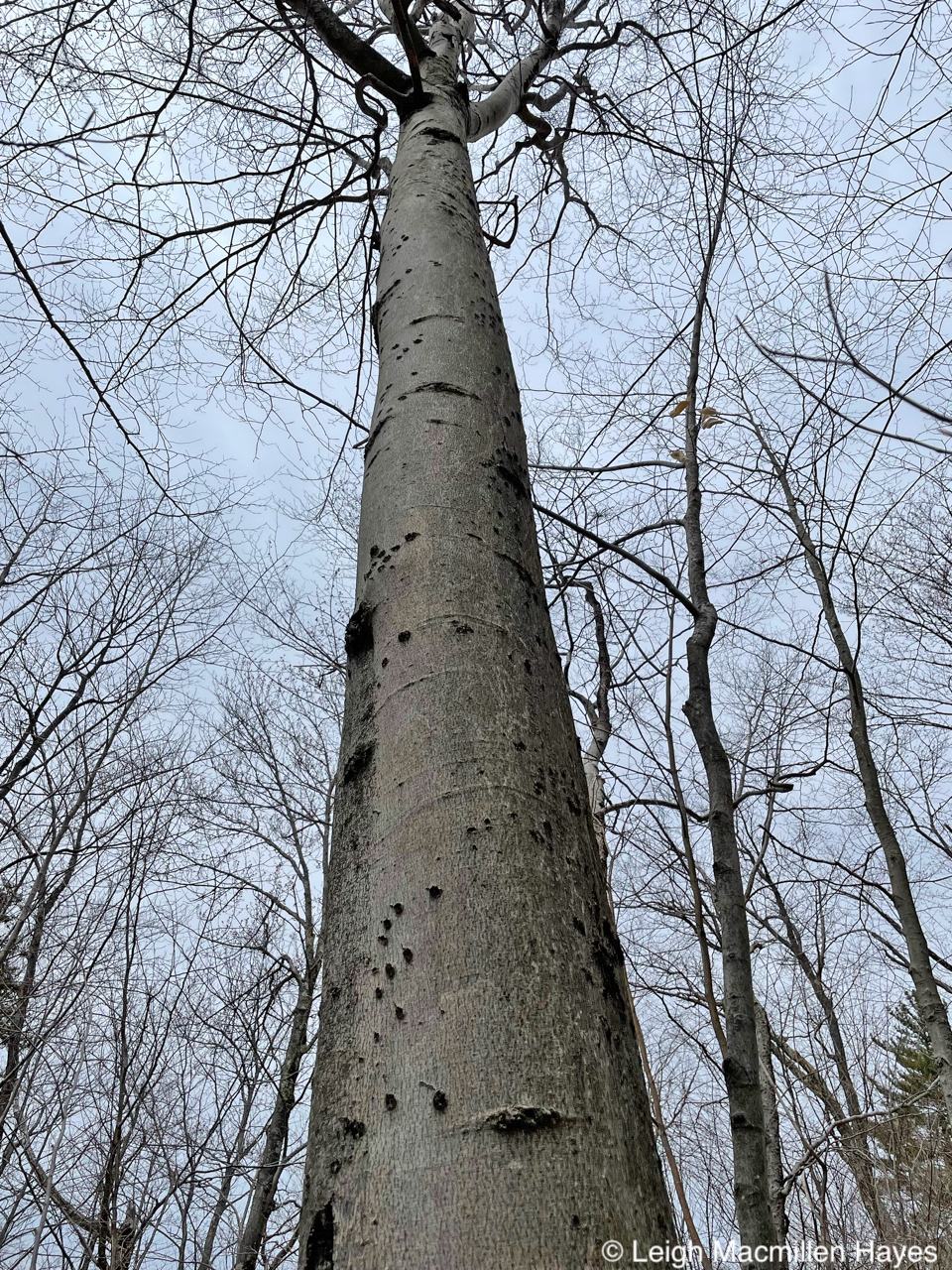
Consider the American Beech with its canopy a bit askew, especially when compared to its neighbors.

And then gaze down the trunk until claw marks left behind years ago by a very hungry Black Bear make themselves visible.

Look with awe at the granite so evenly and naturally sliced and delight in the hues once hidden within now on view.

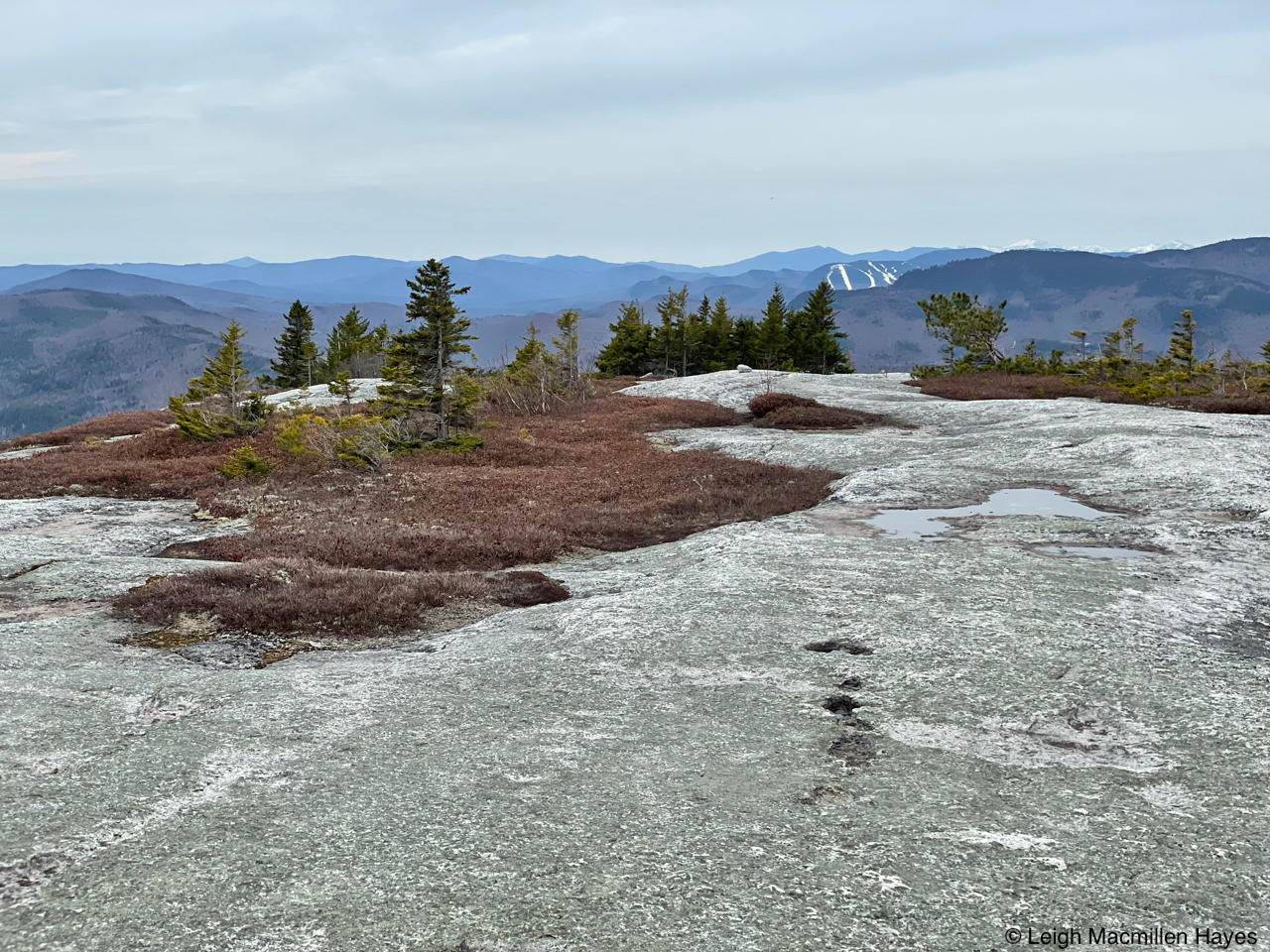
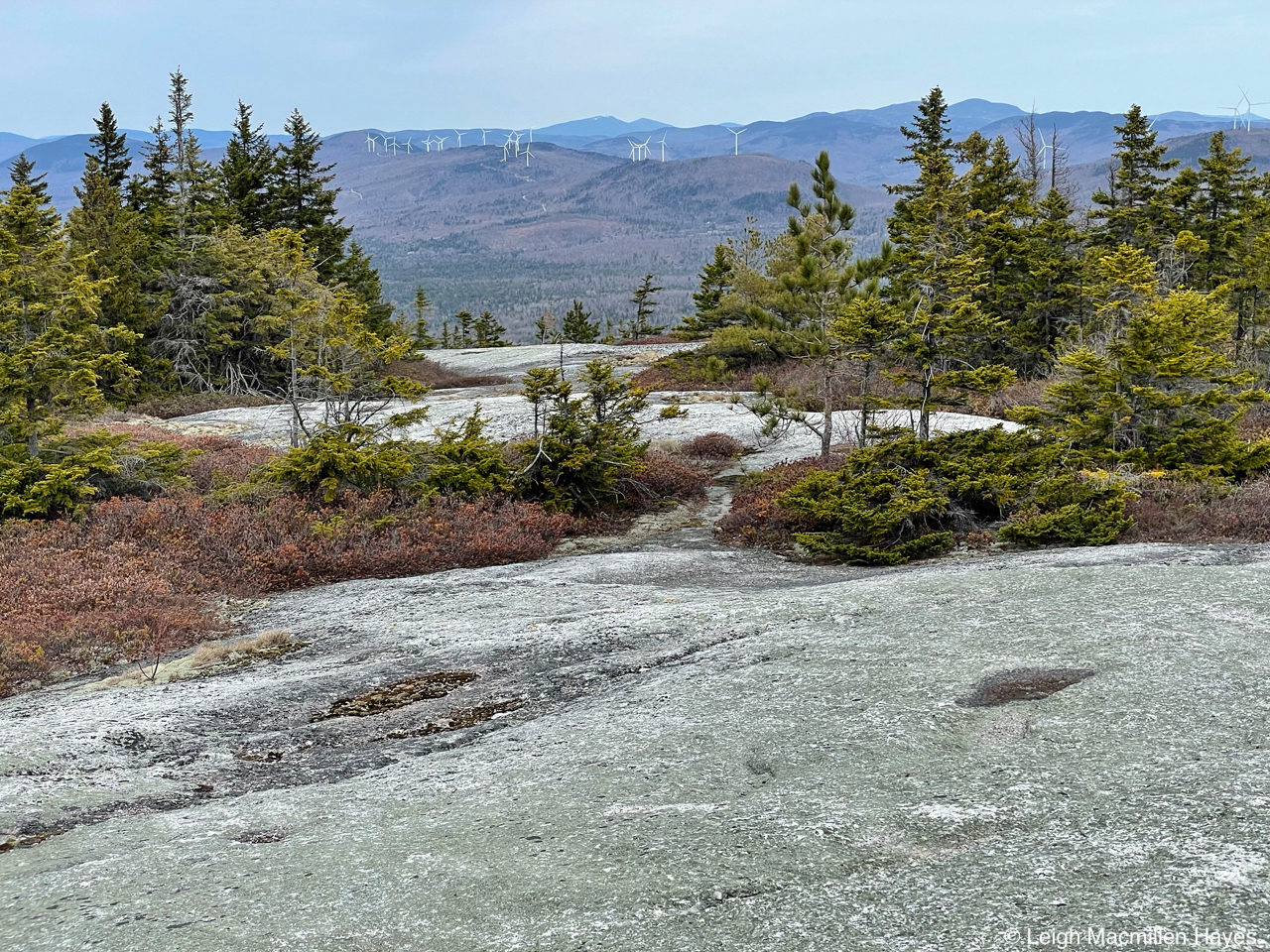
Embrace the panorama from a windswept summit where turbines producing energy define a nearby ridge line.

See also the old mill town that continues to produce paper products from its location nestled among mountains.

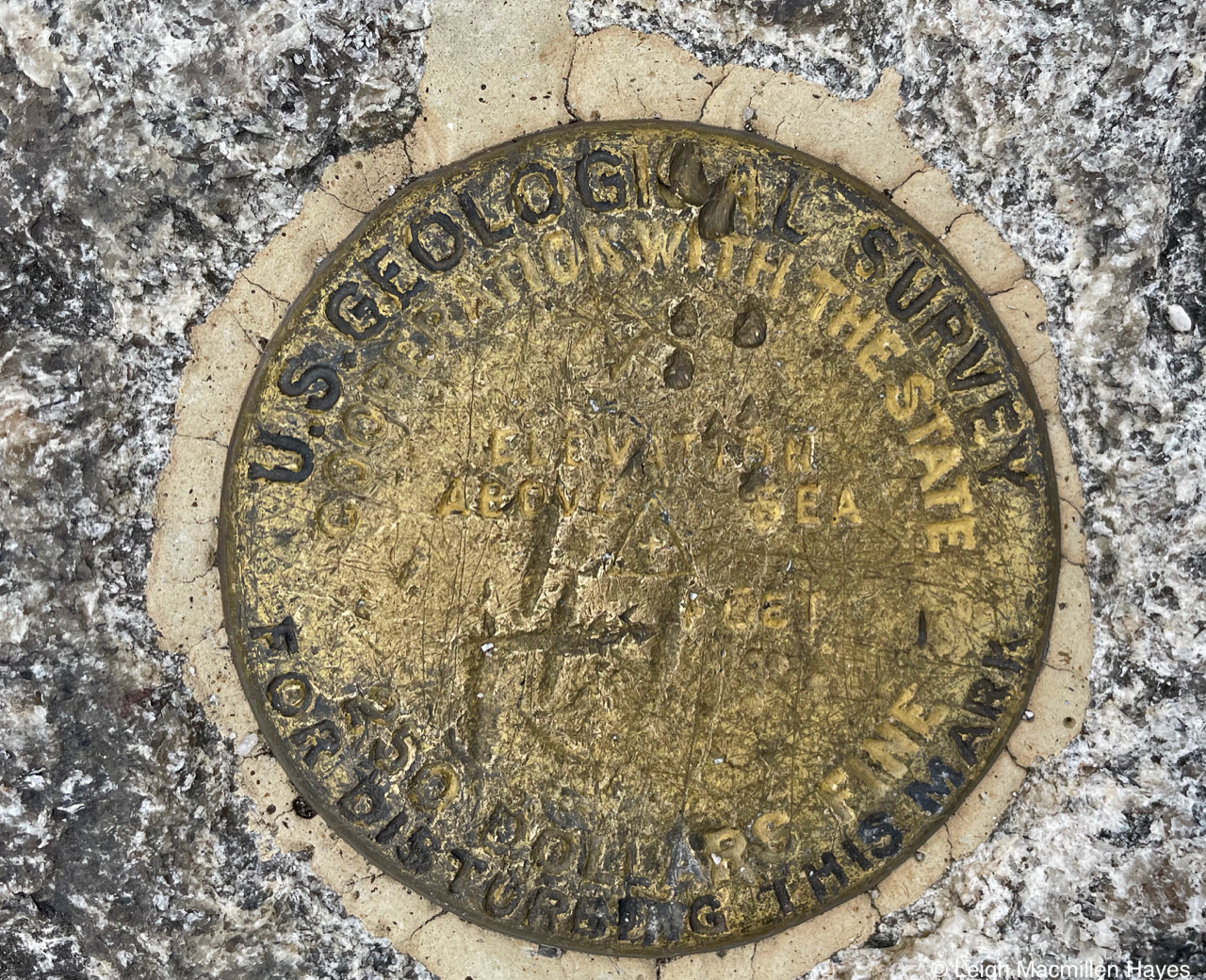
Note also the bronze geological monument used by surveyors since 1879 for mapping purposes as our forebears laid stake to the land that we can never truly claim.

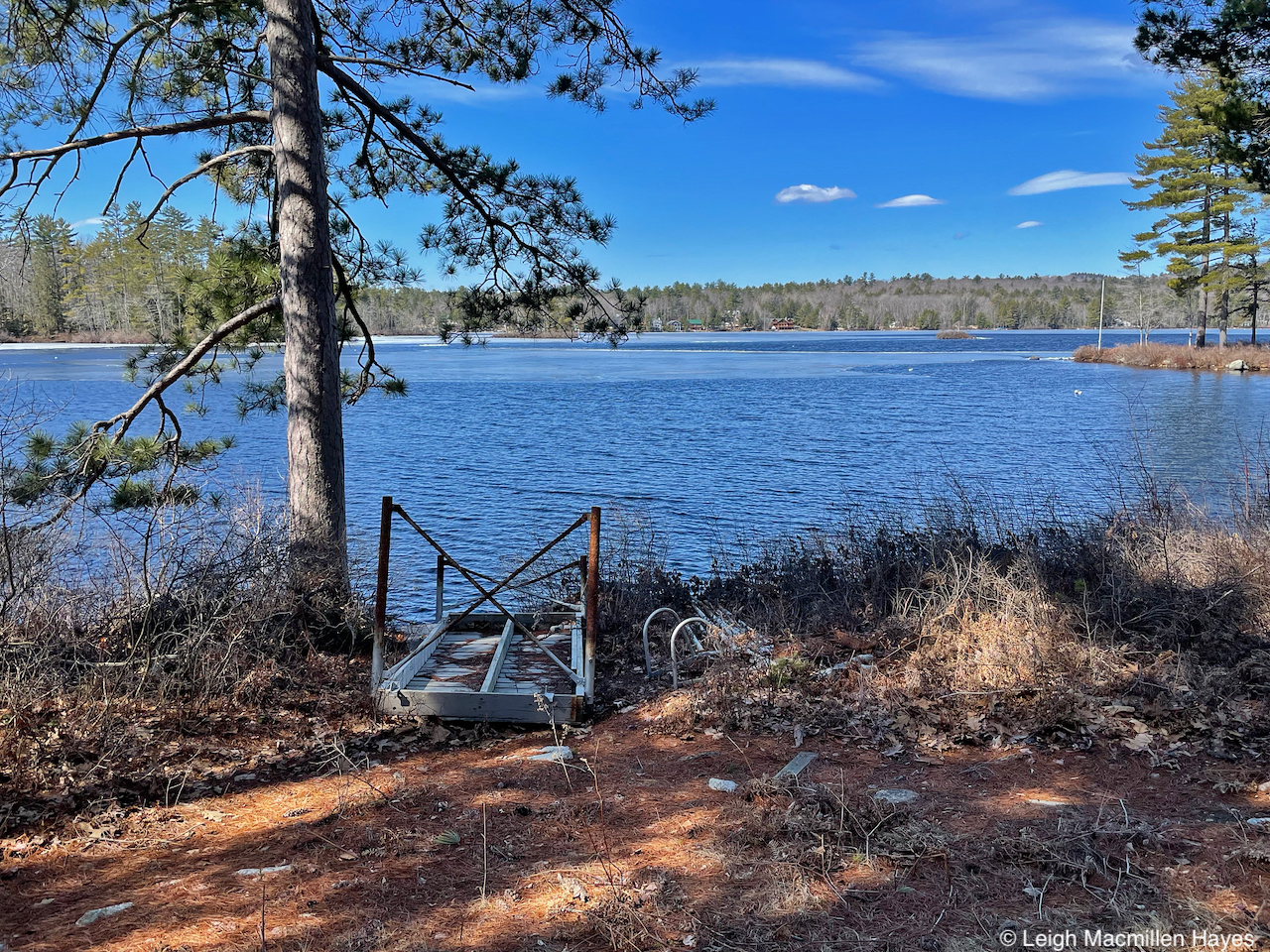
And on the way home, don’t forget to take a few steps toward the barn that features memories of the past.

Try to make time to be present in the moment and see the wonders of life that surround us. Be awakened by reading the signs and not just whizzing by, no matter how or where you travel across the Earth.

Hug An ASH Mondate

My guy and I began this day with a list . . . of things to do and places to go, all within about 15 miles from home. Our starting point was our camp, where I wanted to do a few things inside, while he picked up branches that had fallen over the winter.

Once our chores were completed, we paused for a moment and enjoyed the view of Shawnee Peak Ski Area at Pleasant Mountain and the almost iced-out northern basin of Moose Pond.

Maybe the ice finally went out this afternoon, but the longer it stays, the better in my opinion. Not all that long ago we could predict the event to occur in mid-April, but sadly everything is happening earlier than it should.

From there we hiked up a hill on some land we own behind his store because he’d recently spotted a site he knew I’d appreciate: a carpet of Eastern Hemlock twigs. We looked up, but no porcupine was in sight.

Following a quick lunch at home, we headed off for a quick hike up Mount Tir’em where another porky tree greeted us beside the trail.

From the summit, we spied first Keoka Lake to the east, its ice still in.

And Bear Pond to the south, also still covered in ice. And yes, toward the west, that is Pleasant Mountain and the ski area of the earlier photo.

No trip up this mountain is complete without a visit to the glacial erratics that our sons, back in their youth, called The Castle. I’ve always thought of it as offering a great bear cave and so we went in search.

We did find the neighborhood bear who has been keeping an eye on this spot for a number of years now. My, what long, sharp claws you have.

In the best cave though, only this momma bear emerged and she seemed kinda friendly ;-).

Our final adventure of the day found us following several Yetis into the woods.

They led us to this tree, which bespoke a long and gnarled history.

On one side it sported a burl, that strange-looking collection of tree cells. Known as callus tissue, the burl forms in response to an environmental injury such as pruning, disease or insect damage.

On the other side, a tree spirit smiled. They often do if you take the time to look.

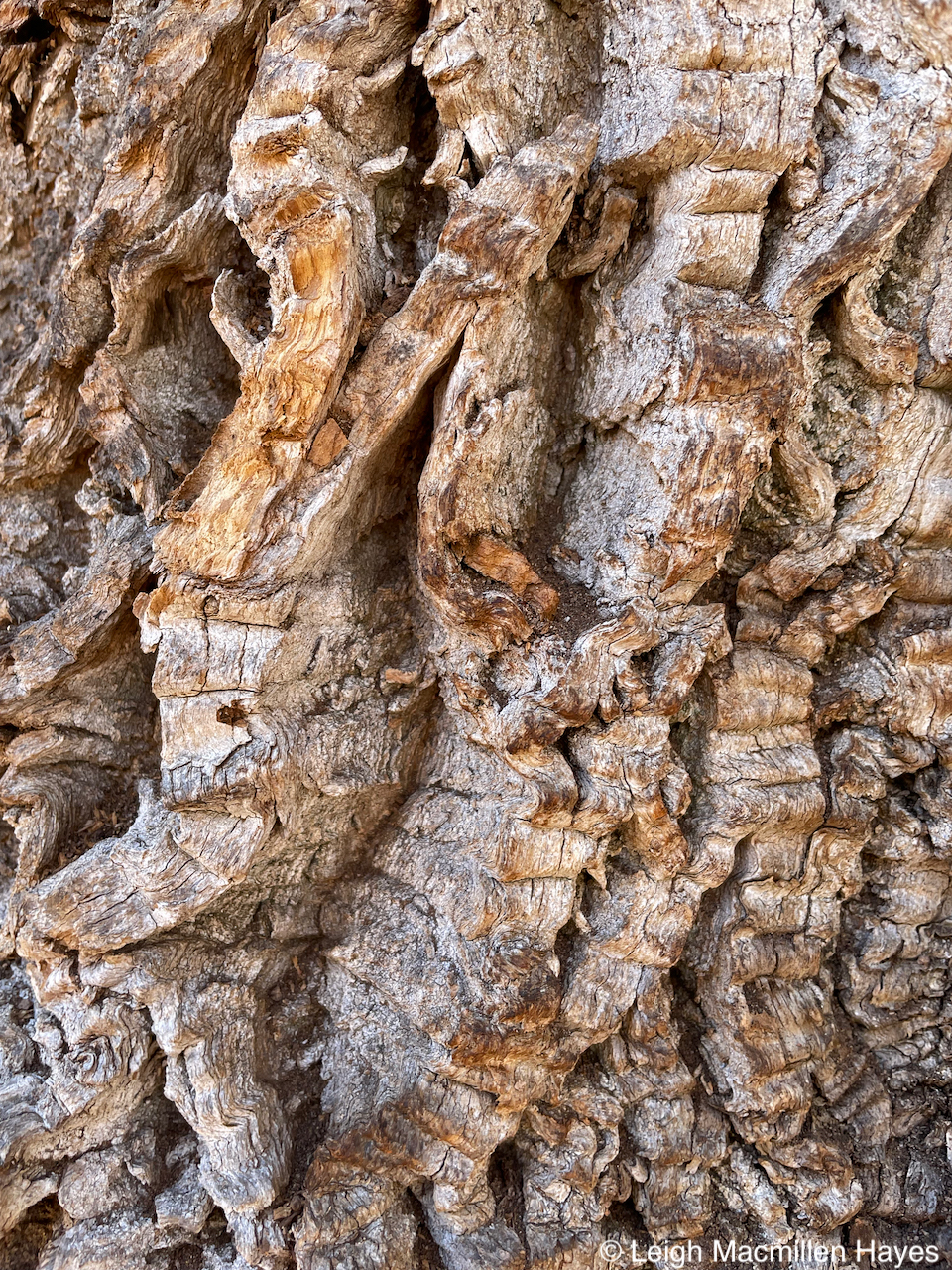
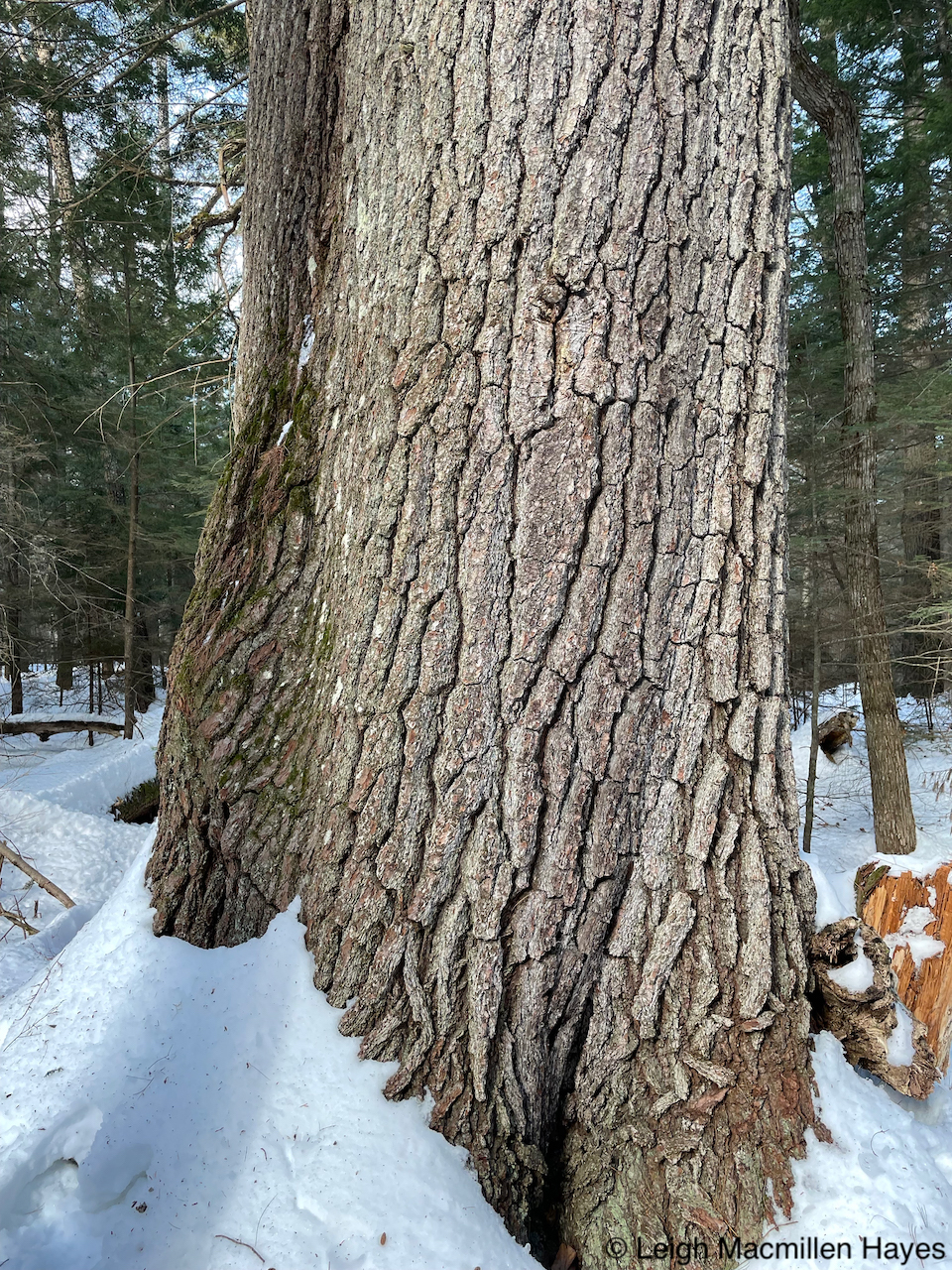
Its bark was so stretched that though it remained a bit corky, its diamond pattern had stretched into sinewy yet chunky snakes of furrows and ridges.

Upon the ground a shed limb ready to give nutrients back to the earth that will continue to aid the tree sat in its shadow.

Holes in the tree offered further intrigue . . .

and so my guy climbed up and looked in first.

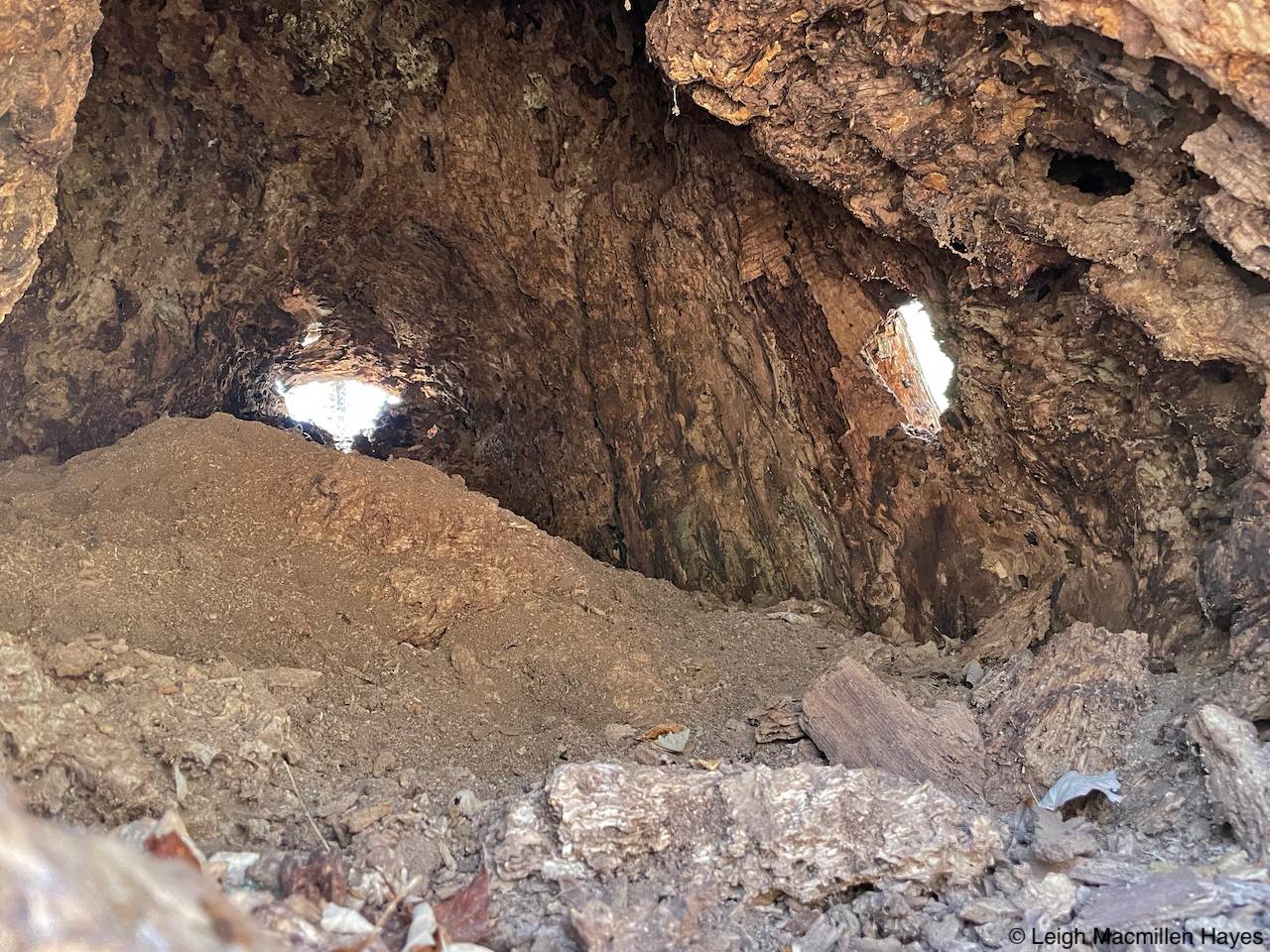
I followed and couldn’t believe the site within. This tree is still producing leaves, thus the xylem and phloem still function, but almost entirely hollow and I fully expected to see a bear or two or a slew of raccoons in residence. Certainly, it would have created a delightful hideaway to sit and read and sketch, and watch . . . life inside and out.

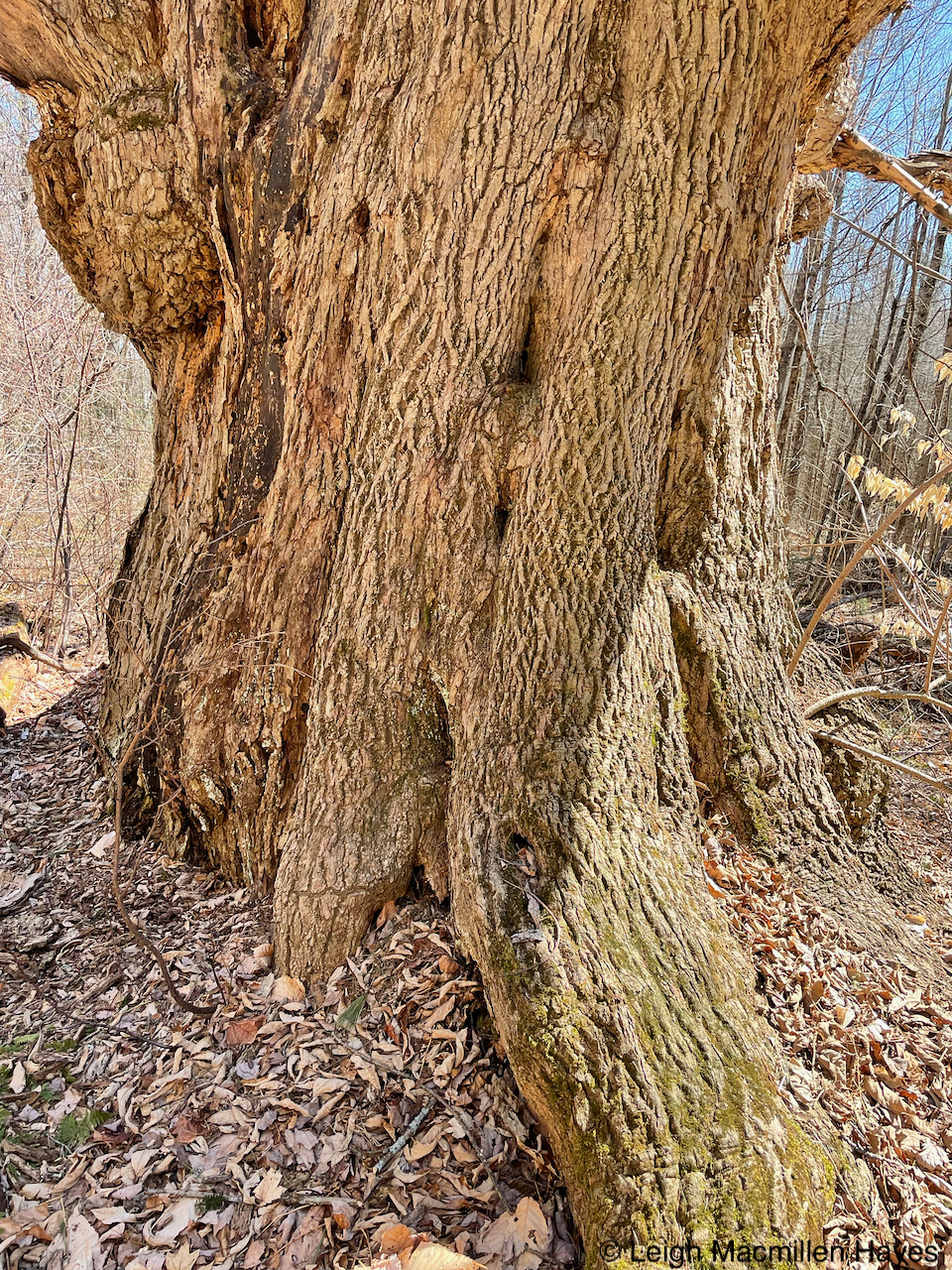
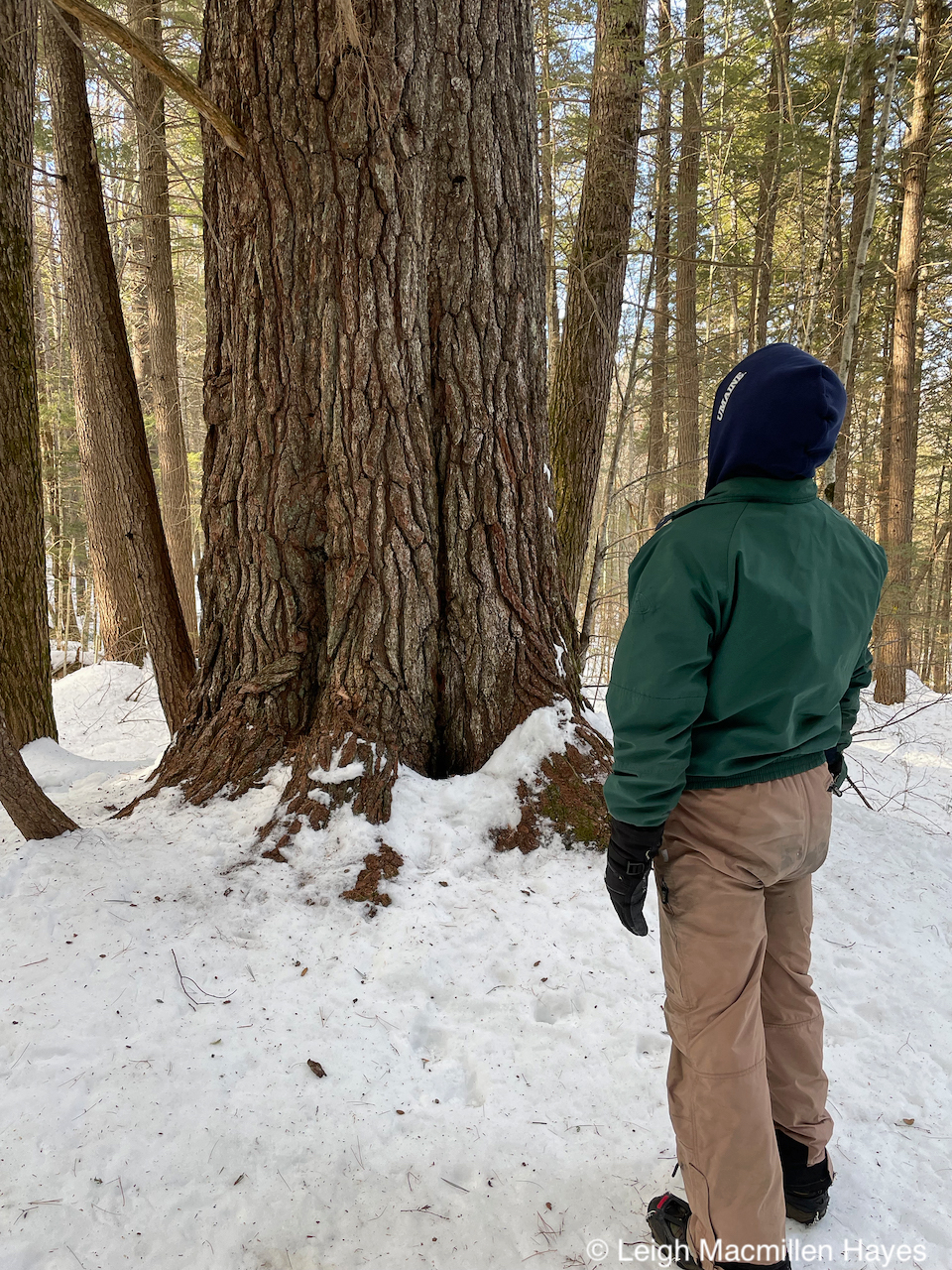
By now you’ve possibly figured this is one mighty big tree . . . and I found this information about it: On October 30, 1969, the Maine Forest Service stated that it was the largest of its species in the state. And in 1976, the bicentennial year, it still held that honor. The dimensions in 1969 were these: circumference 17′ 81/4″, height 70′ and crown spread 77′. I’m not sure if any of those measurements have changed, but I learned last week that is still the biggest of its kind.

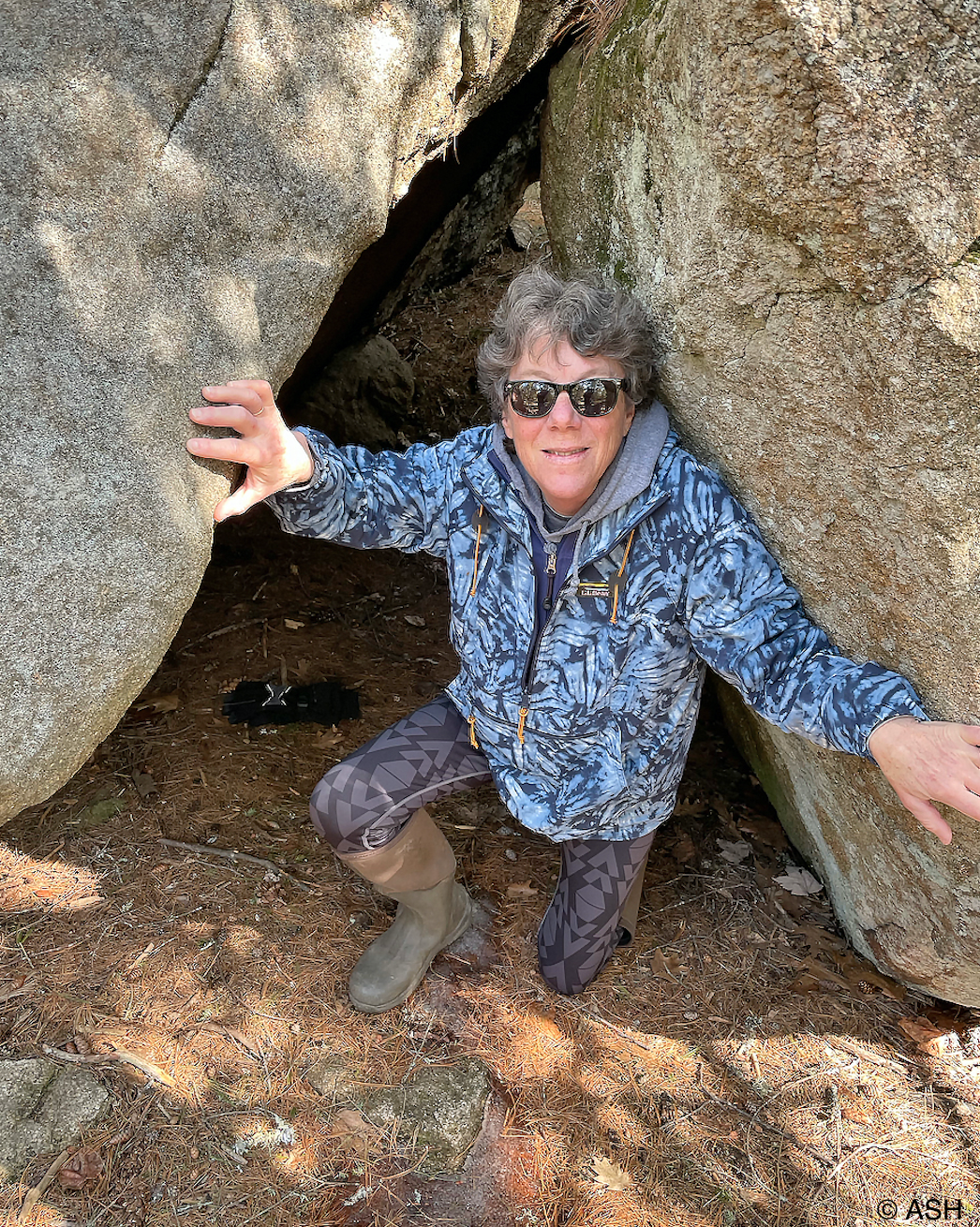
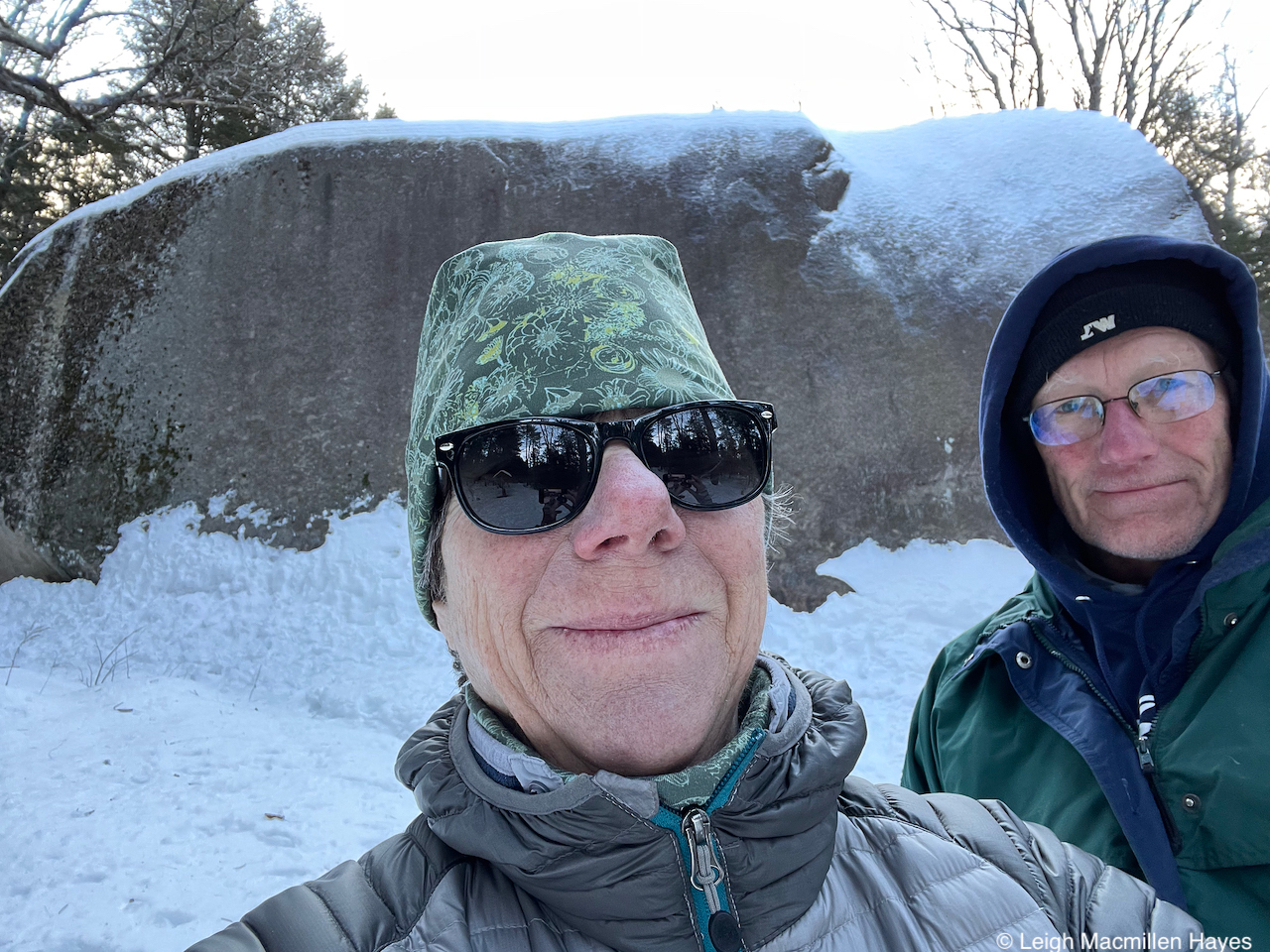
So this blog post is entitled “Hug an ASH Mondate.” I actually hugged two ASHes today–this White Ash that deserves to be honored for who knows how much longer it will be around and I was so excited to meet it, but my own ASH as well for if you look at the watermark on the two photos of me you’ll see © ASH. You may have thought that my guy’s initials were M.G., but really they are A.S.H. Hug an ASH. In any form, what an honor.

Dear Mr. Pileated

Dear Mr. Pileated,

I’ve been meaning to thank you for serving as our morning rooster all these years. In a couple of months, as the days dawn earlier than on the cusp of this vernal equinox, I know my guy will curse your call, but I admire your tenacity to return morning after morning and practice your drum roll on a snag by the stone wall closest to our bedroom.

Your sounding board of choice resonates with each strike of your beak and I’m sure the volley of taps, sounding like someone is rapping on the back door, can be heard at least a half mile away.

What is amazing to me is that you have the ability to tap at all. But I’ve learned that your tongue actually wraps around your skull, thus dissipating and directing the energy around the brain. Plus, you have a sponge-like bone positioned in the fore and back of your skull to absorb much of the force from the repeated impact of constantly hammering against wood. 

After several rounds of repetition, you take a break and stretch your neck away from the snag . . .

and sway your head . . .

in a 45˚ arc, a movement known as a bill wave. It seems to serve two purposes: as an announcement of your territory to another of your kind; or a message to the one you are trying to woo with hopes she’ll accept a date.

Of course, in the mix of all this action, you also make time to preen. After all, should a mistress fly in, you need to look handsome–an easy task on your part.

I’ve read that your territory ranges from 150 – 200 acres and give thanks that we live in an area that satisfies your needs and those of your kin.

In winter, your feeding trees are easy to spot, either by the oblong holes chiseled into the tree trunks . . .

or piles of wood chips at the base of a tree, providing a contrast with the snow.

I love it when you even rework a hole you’d started when the tree was standing. So many don’t realize that it’s not unlike you to use your tail as a third leg like a stool and stand on the ground to seek the goodness within.

When the opportunity to watch you work presents itself, I take it and stand silently below while you chip away.

What I can’t see is your method of feeding, as you pursue the tunnels of carpenter ants and snag them with your long, barbed tongue covered as it is with a sticky solution that works rather like tacky glue.

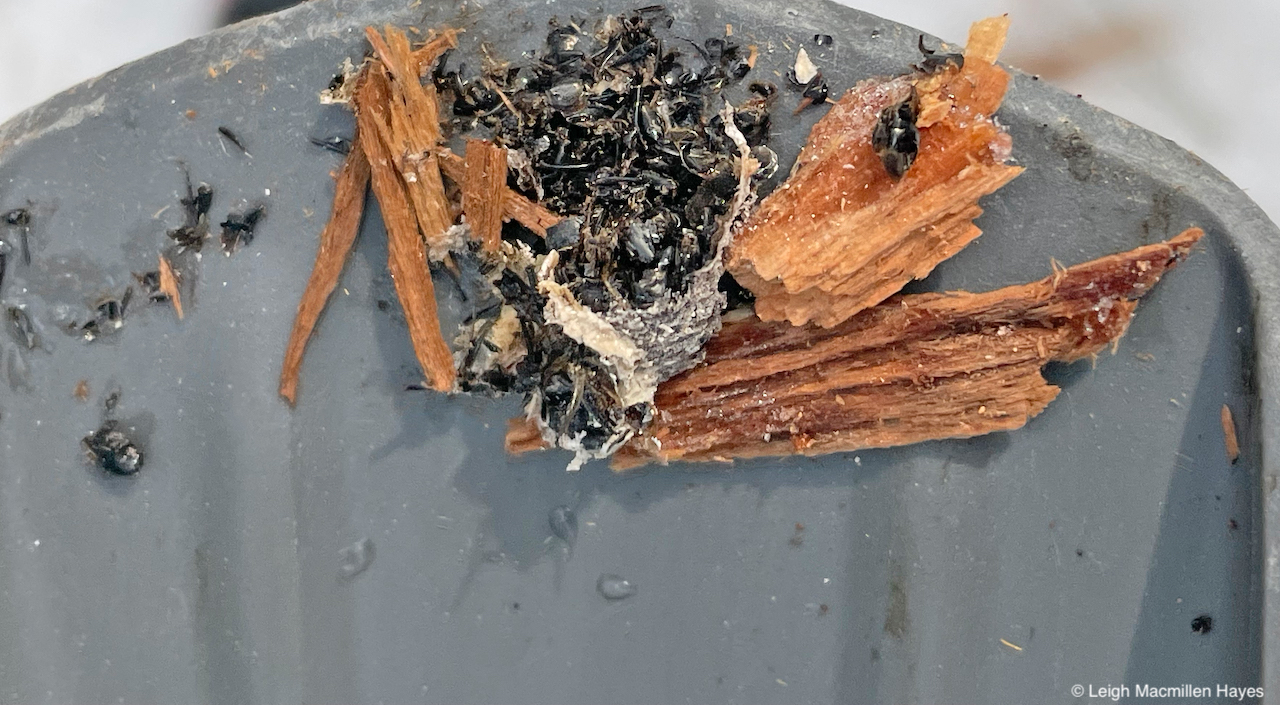
BUT, one of my great joys, as some know, is searching among the chips you’ve excavated to discover if your feeding efforts were successful. Yes, Mr. Pileated, I actually feel well rewarded when I discover packets of scat you defecated. While we humans get rid of waste nitrogen as urea in our urine, which is diluted with water, I have come to realize that you cannot fly with a full bladder and therefore must dispose of uric acid, plus the indigestible parts of your meals in combination via the cloaca or vent located under your tail. Knowing this helps me locate your scat because I first look for the white coating, which is the uric acid, and then I spy the exoskeletons of the ants that you feed upon in winter located inside the cylinder.

Sometimes, your scat doesn’t make it all the way to the ground, but rather lands on a branch below your foraging site.

Of course, it’s great fun when others are present, to whip out my scat shovel and scoop some up so they may take a closer look.

I did that just yesterday with a group of students, some of whom fully embraced the experience, which also gladdened my heart.

Another thing I love to spot as a result of your foraging efforts, sir, is the winter coloration of sap that flows from Eastern White Pine trees you’ve excavated. In warmer weather, the sap is amber in color, but there must be some winter chemistry that I do not understand, which turns it shades of violet and blue.

Oh so many shades of blue. And once blue, it doesn’t seem to regain the amber hue, at least from what I’ve seen. But then again, somewhere in this world, there’s one that does. Or many more than one.

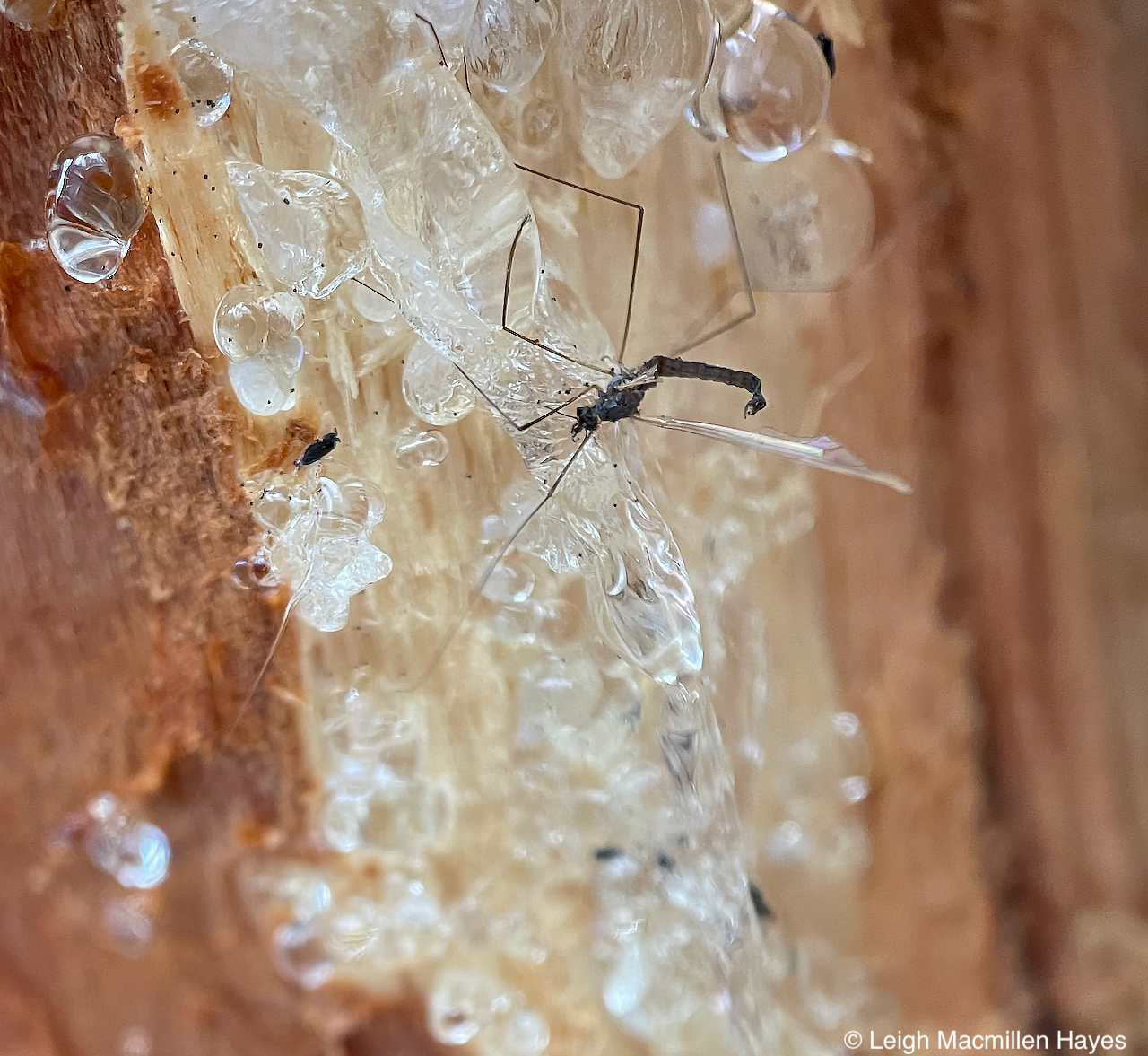
Noticing the droplets of fresh sap yesterday, I decided to take a closer look, and spied not only spring tails stuck to its sticky surface, but also a small winter crane fly that will be forever suspended . . . unless something comes along for a snack.

When I checked this morning, it was still stuck in place.

As I complete this letter to you, Mr. Pileated, I once again want to express my appreciation for your part in this world, for creating nesting sites that others, such as small songbirds, may use, and how you help the trees in the forest by contributing to their decomposition, for as much as some think that you and your kin are killing the trees, the trees are already dying due to insect infestations, and your work will eventually help them fall to the ground, add nutrients to replace what they had used, and provide a nursery upon which other trees may grown.

And I want my readers to know that your bill waving has paid off for this morning as I watched and listened to you, in a quick turn you flew off giving your Woody Woodpecker call as you sailed away and in flew your date. She landed on the same snag you always use, gave a few taps of her own, preened for a moment or two, and then she also turned and headed in the direction you had taken, and I can only hope that the two of you have been foraging together ever since.

Oh, and that if there are any offspring from this relationship, you’ll name your first born for me.

Sincerely yours,

wondermyway.com

P.S. BP, this post is dedicated to you. Hugs from your non-hugging friend.

Oversized Valentine Mondate

Our date began at the Bavarian Chocolate House in North Conway, New Hampshire, because we’d decided the other day to shop for a gift together and in our minds nothing defines love more than chocolate. It was a great surprise to find a friend of ours, who works in the local branch of the shop, behind the counter in New Hampshire and so we didn’t even have to say “dark chocolate” for each choice we made. And she introduced us to the chocolatier. Then she proceeded to fill the largest box for us. It will last a few days.

That done, we drove on to Big Pines Natural Area in Tamworth, New Hampshire, which I’d just learned about recently. After eating sandwiches at the trailhead, and topping those off with . . . chocolate, we donned our micro-spikes to begin our venture into this old growth forest of white pines.

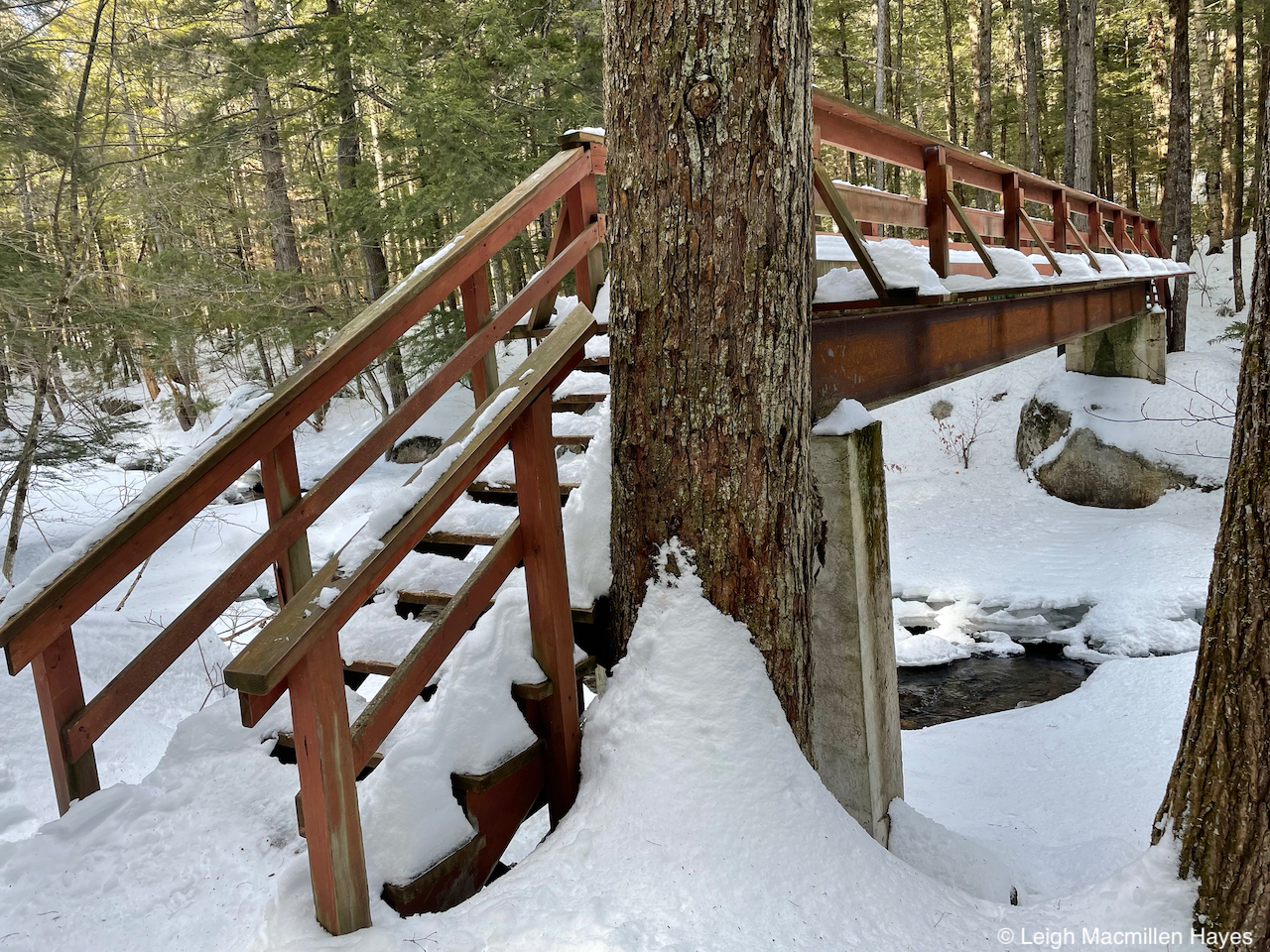
About one-tenth of a mile in, a bridge spans Swift River and on the other side, there’s a loop trail through the forest and along the river, plus a spur to the summit of Great Hill. Unfortunately, half the loop is closed until spring 2022 because of major erosion, so it was an out-and-back tour for us.

Hiking up, we soon found ourselves among the behemoths that are probably about 200 years old and about 150 feet tall. They are giants worthy of our admiration and so we did. And we hugged a few. Well, I told my guy we were just measuring it to see how many of our wing spans it took to encircle the tree. But really, it was a hug. For this one, 3 arm lengths plus one extra elbow to finger tip.

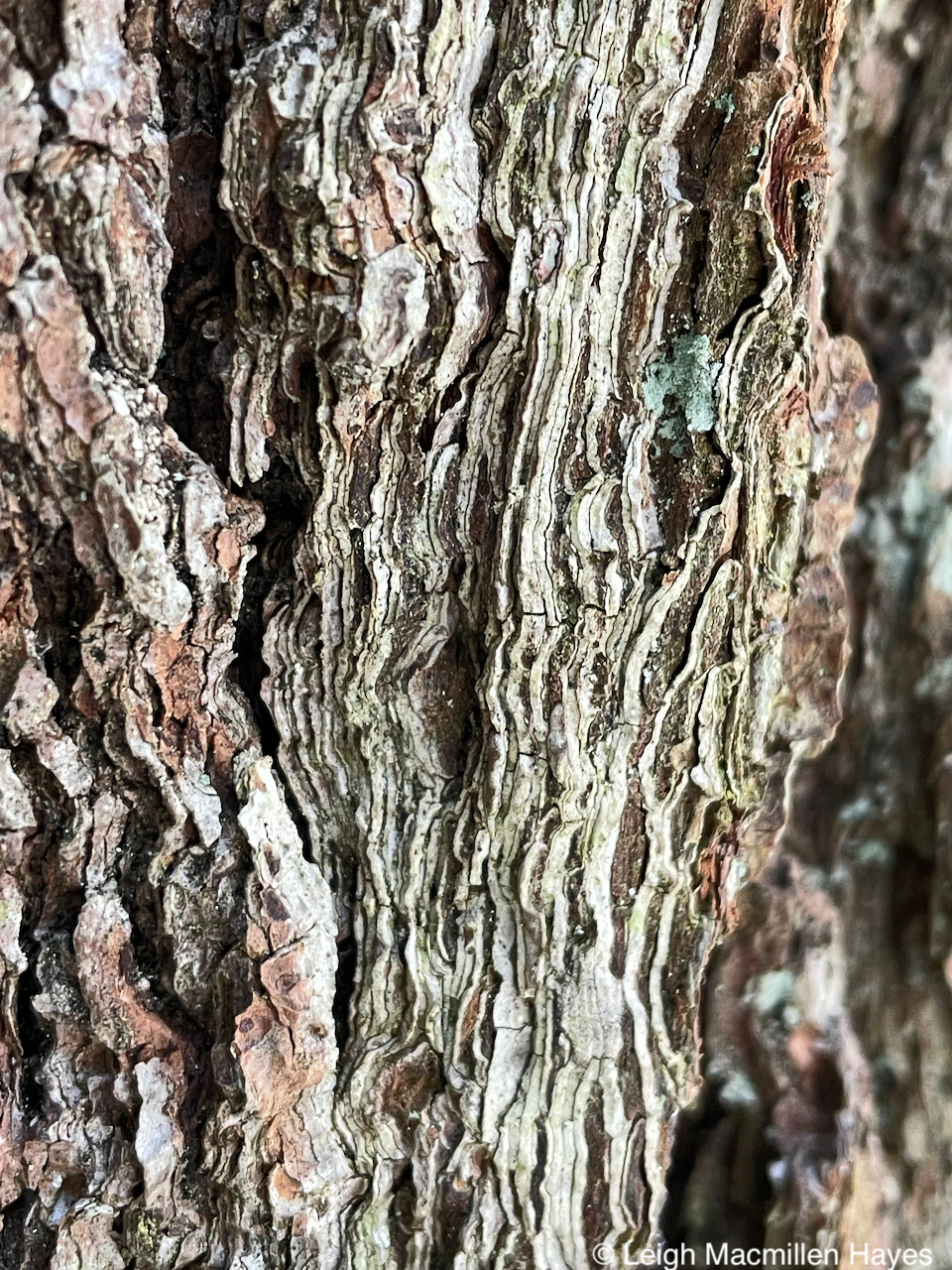
The bark of an extremely mature Eastern White Pine, aka Pinus strobus, (or perhaps it’s really the other way around), forms elongated plates that would make an interesting fabric pattern for a dress or skirt if I were so inclined to design and wear such.

In the furrows between the plates, layers upon layers of dead bark gather, each having served its purpose of protecting the tree from brisk winter days like today, and hot and humid days of summer before being replaced by the next. In a certain way, those layers reminded me of an oyster shell standing upright.

Had the tree that we stood before been about 50 to 100 years younger, the plates would have been covered with horizontal lines that are spaced so evenly they could almost be notebook paper. And perhaps that is their purpose–for they have noted so much during their lifetime and it’s all written down, we only need to decipher the story.

On this mighty tree, however, the lines had all but disappeared and in some places scales of bark had been shed.

Eventually, we moved on to another tree that was about 3 times our arm span plus half the distance from my elbow to the tips of my fingers in circumference.

We felt rather tiny as we looked skyward, and then we hiked along a spur to Great Hill and its fire tower.

I thought I’d taken a photo of the fire tower at the summit, but maybe my frozen fingers weren’t working in that moment and ran back into my mittens while missing the shot. We climbed up into the cab, where the Tamworth Conservation Commission has posted signs on all four sides of the surrounding mountains.

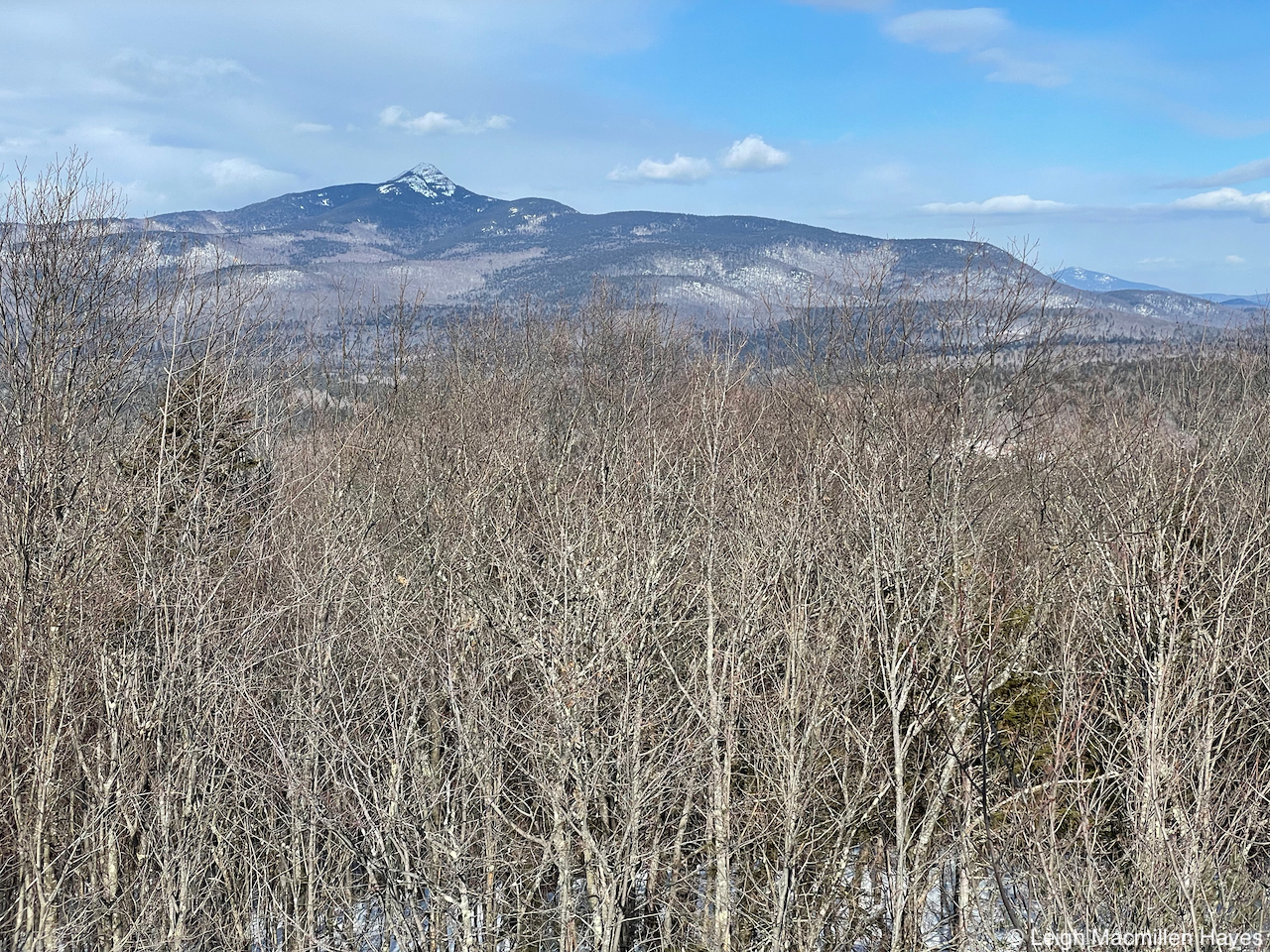
Mount Chocorua’s unique and craggy profile brought back memories of a summer hike up the Champney Trail to the summit, and my Nervous Nellie reaction.

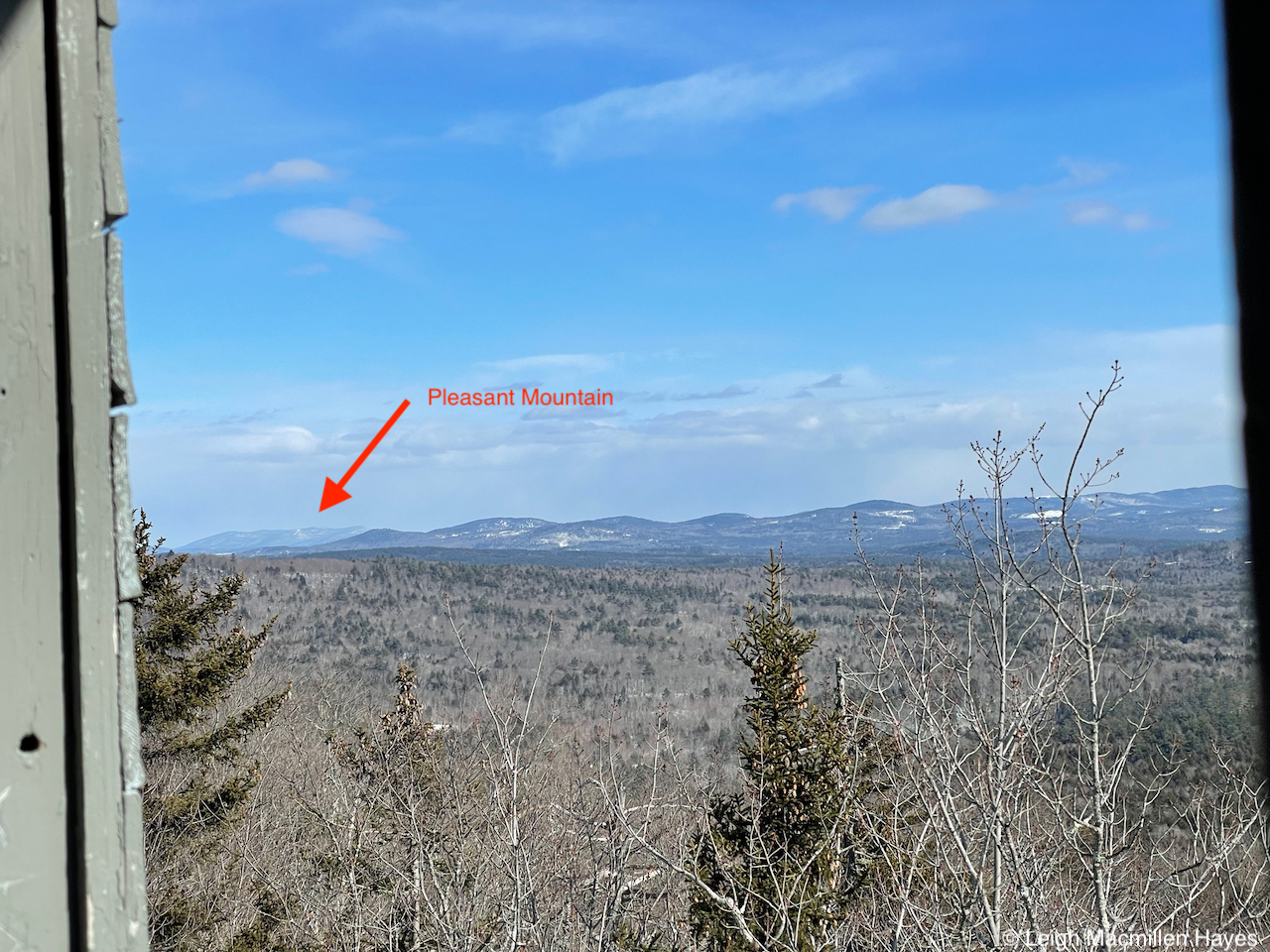
Through another window frame we spied our hometown mountain’s long ridge line. A few mountains always help us to gain our bearings, this being Pleasant Mountain, but Mount Washington, Mount Kearsarge North, and Chocorua also give us a sense of where we are in the world–at least in our little speck of the world.

On the way back down, we paused again at the pine of our initial admiration. My, what legs it has. And so many.

We snuggled into it, in hopes of showing off its immense size, but realized the photo didn’t do it justice.

At last we crossed over Swift River again, followed the “easy” trail, which wasn’t so easy since we were the first to travel it in the deep snow, and we wore micro-spikes rather than snowshoes, but anyway, we soon finished up and treated ourselves to a . . . chocolate.

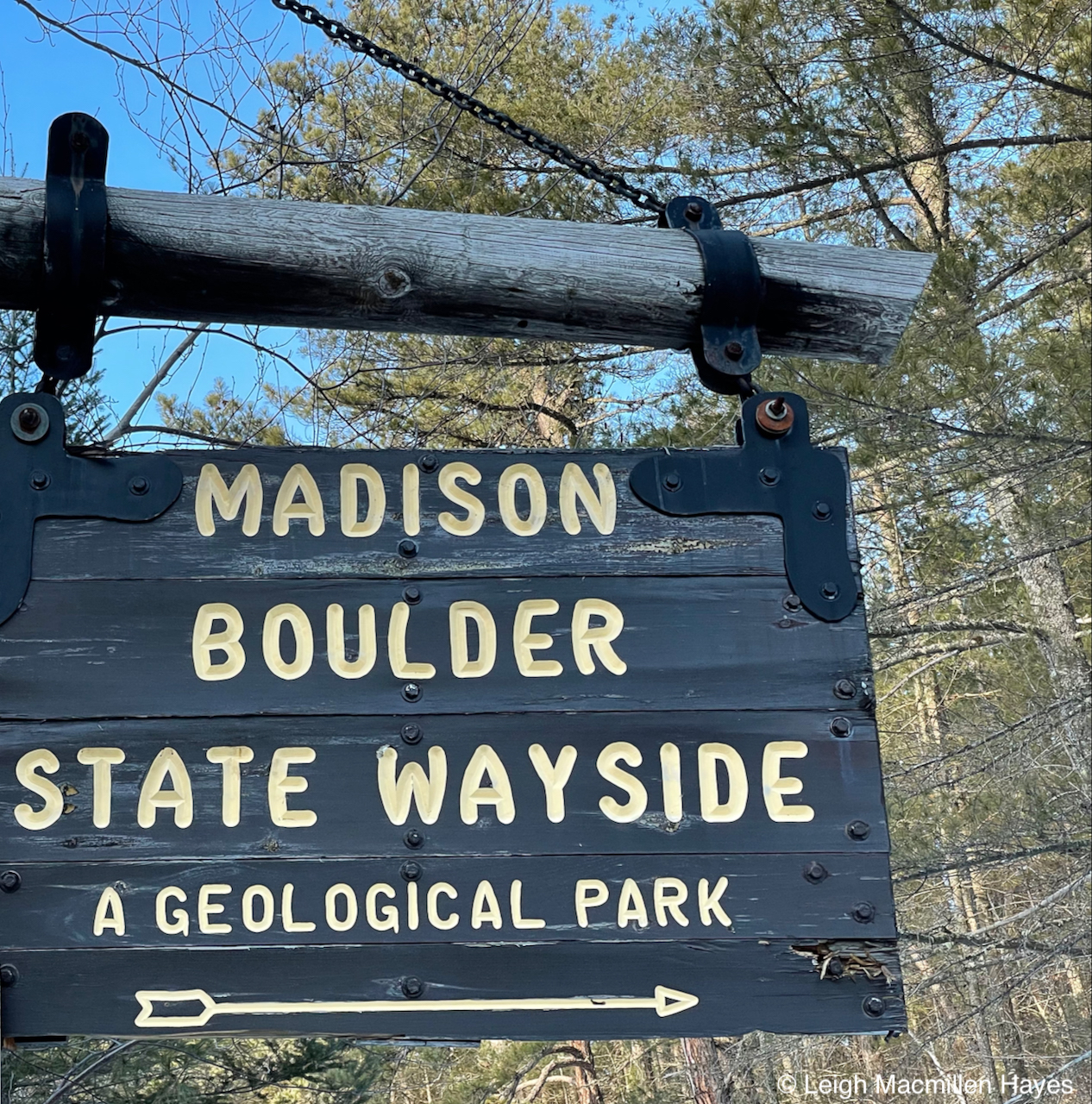
Driving home, I had an inspired moment. Neither of us had ever visited the Madison Boulder. In fact, we weren’t really sure where in Madison, New Hampshire, it was located, but decided we were up for the adventure. And . . . we found it.

We had no idea what to expect–certainly not a rock the size of a two-story house.

This glacial erratic was dropped during the most recent ice advance that began about 2.6 million years ago and ended 12,000 years ago.

Again, we posed in hopes of showing off the size of this boulder, but we knew it wasn’t the right perspective.

And so I hugged the boulder. Exactly how many hugs would it take for us to encircle it?

Well, consider this, which we learned from signs at the kiosk: In addition to the snow, “we weren’t able to see the entire thing because its base is buried up to ten feet deep in the soil upon which it rests. With this in mind, the Madison Boulder measures 23 feet in height, 37 feet from front to back, and 85 feet from left to right.” My guy did the math and said it would take 45 lengths of our arm spans to embrace it.

Do you want to know about weight? According to the kiosk sign: “Because a cubic foot of Conway Granite weighs approximately 164.86 lbs., we can calculate the approximate weight of this irregularly shaped object. Current estimates (I like that they state “current” because new information always emerges as we learn more) put its weight at 5,963 tons.”

“It’s believed that the Madison Boulder was probably plucked from Whitten Ledge, less than 2 miles to the northwest, which is made of Conway Granite. The ice transported the boulder, smoothing its edges, and left it on a different type of rock, called Concord Granite. A glacial boulder sitting on bedrock of a different type is known as a glacial erratic.”

Can you see my guy as he came around the bend of the boulder? It dwarfed him as it should because it’s the largest known glacial erratic in North America and a National Natural Landmark.

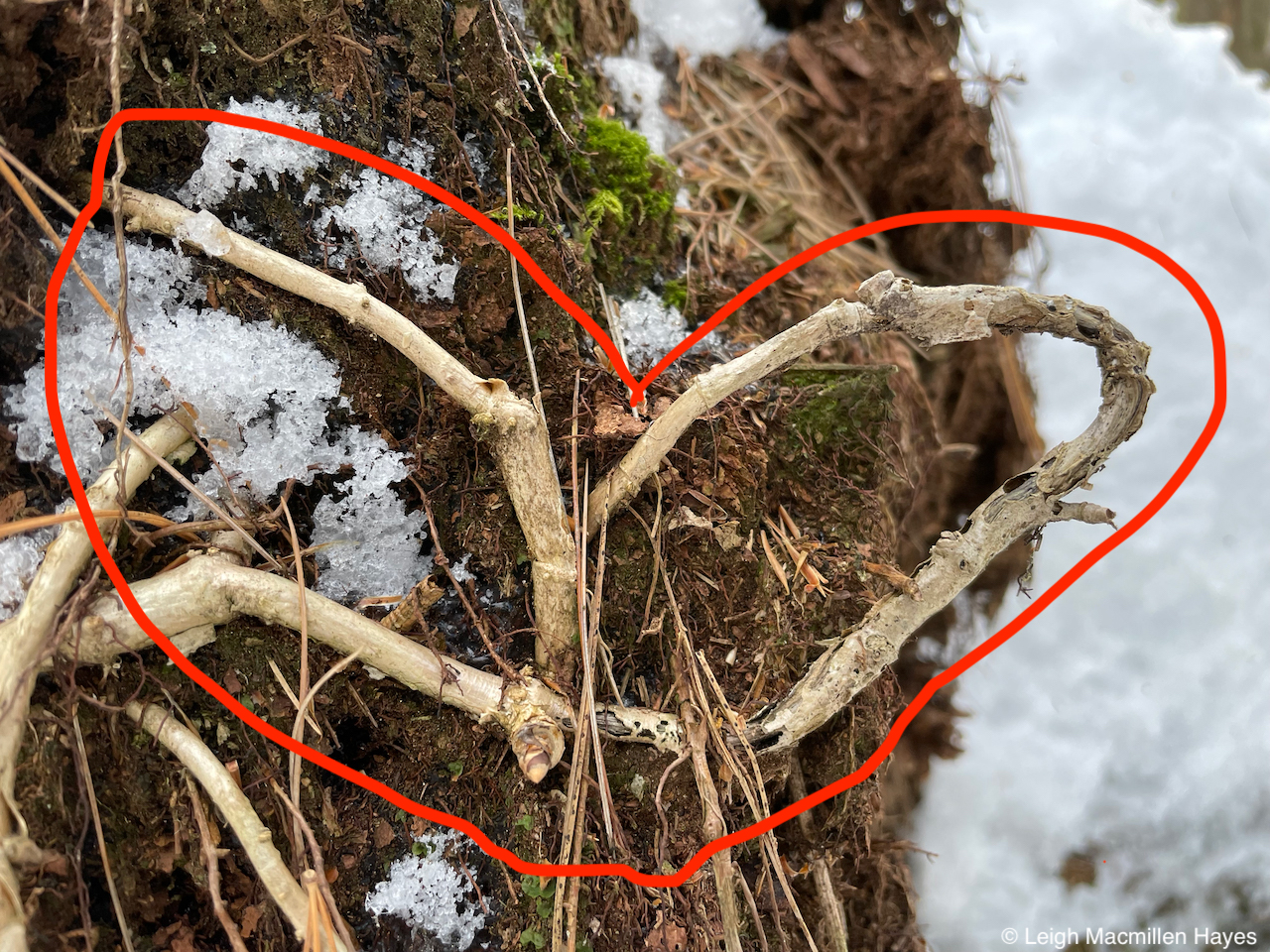
We were both dwarfed by the immensity of the trees and the boulder and certainly LOVE is something that will always make us feel smaller in the bigger context of the world. But a root entwined within the roots of a toppled Big Pine sent a message from the universe that no heart is perfect and yet all are precisely that.

The biggest box of chocolates. Big Pines. The largest known glacial erratic in North America.

From our heart to yours–Happy Oversized Valentine Mondate!

Smiling Our Way Through Winter Storm Kenan

Since Kenan hadn’t yet delivered the amount of snow we were hoping for in western Maine, and shoveling seemed like a task best saved for tomorrow, we had time on our hands today. So, what should an antsy couple do, but strap on snowshoes and head out the door. Well, actually, head out the door, and then strap on the snowshoes.

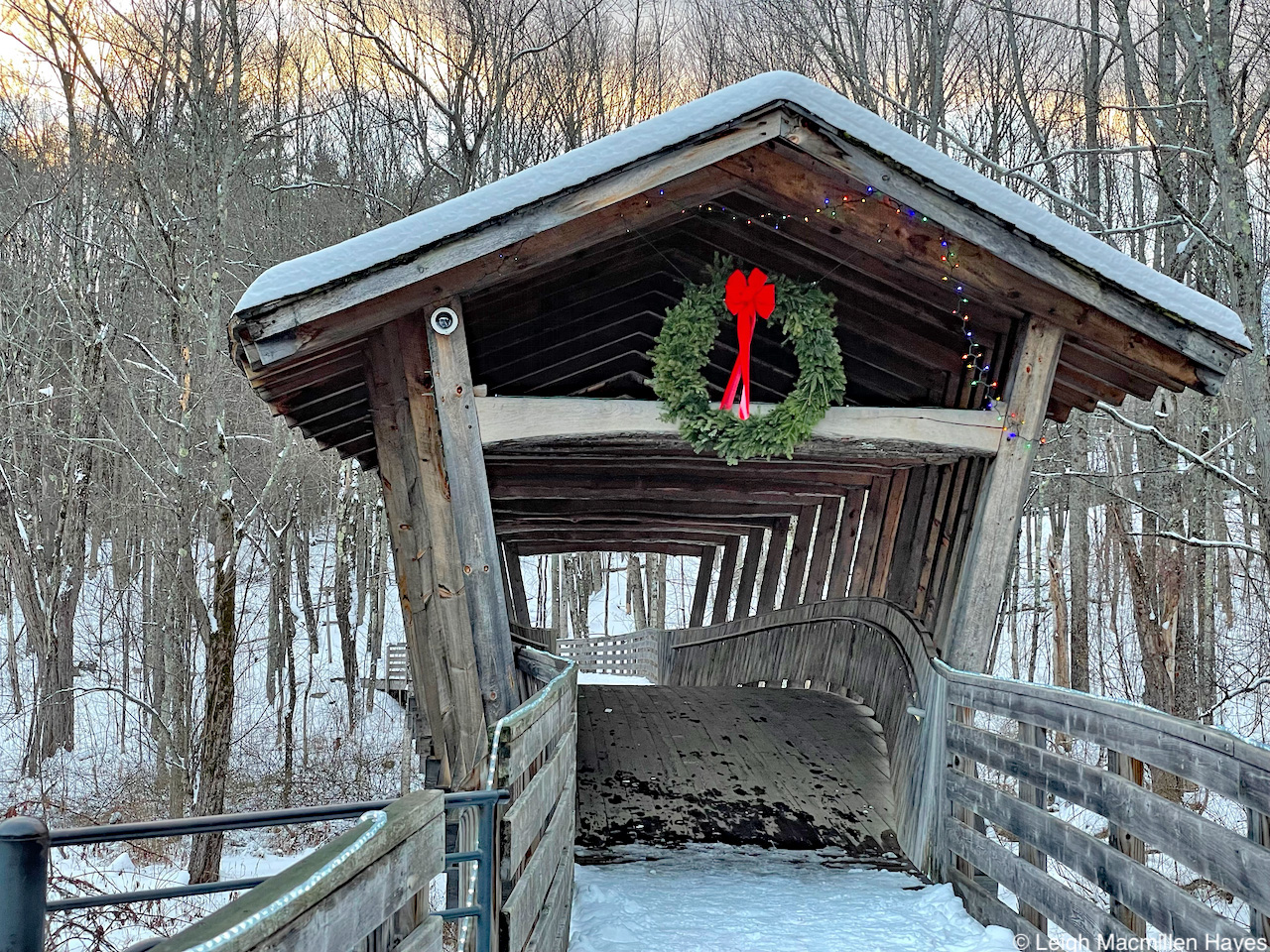
Into Pondicherry Park did we venture, where even the covered bridge couldn’t provide a safe harbor from the flakes that flew sideways on the northwesterly wind.

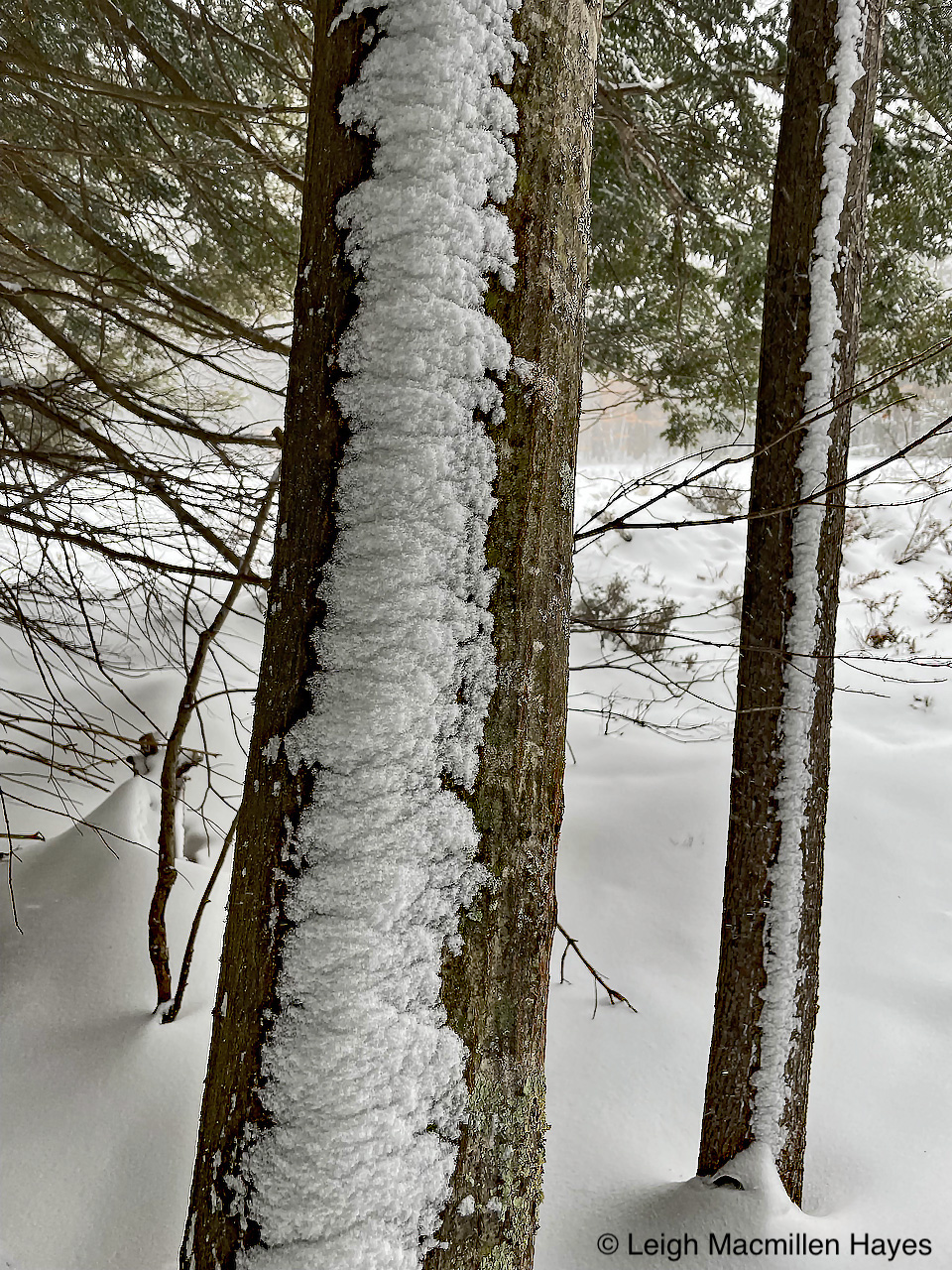
With that in mind, we began to make a game of noticing how the flakes stuck to the trees, like these filling ridges.

Some were positioned like stacked layers of cotton balls.

Others held on despite the curvature of the trunk.

And still more formed half-hole coverings that turned woodpecker excavations into my third grade recorder (which I still have).

And then we looked for art forms such as this tangle highlighted in white.

And the boardwalk that was almost completely disguised as it snaked through the wetland.

Because we were outdoors we looked for tracks as well, but found only these prints who announced their creators.

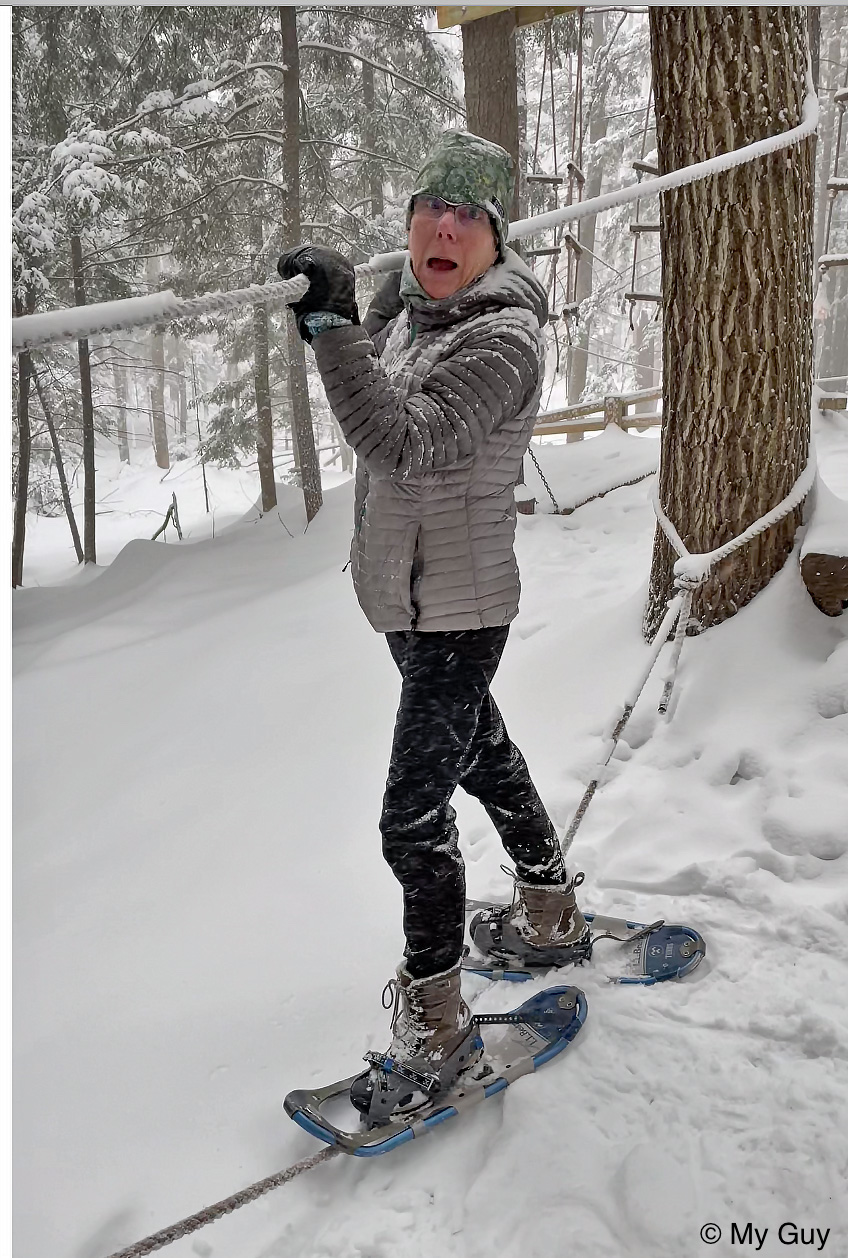
And I practiced my snowshoe tightrope crossing–surprising myself with my prowess.

I think you’ll agree that our rosy cheeks tell the story of the stinging snow flakes–so propelled as they were by the biting wind.

At last we returned to the peace of our home and gave thanks for the warmth inside.

And then we received a couple of photos of our oldest son, who found his own way to survive much more snow in Boston.

He’s a Maine boy through and through.

It did our hearts good to know that like us, he was smiling his way through Winter Storm Kenan.

I hope you are as well. It’s almost 8pm here, and the wind speed has increased, and I know many are not as fortunate as we are to find fun in this storm. Wishing you all safety and warmth.

Ever A Sense Of Wonder

I thought I was losing it. Wonder, that is. I’ve hiked or walked many miles, taken thousands of photos, but haven’t been overly wowed by much lately.

This weekend, though, that all changed.

Maybe it was the fact that a friend and I spent a bluebird, yet brisk Saturday snowshoeing many miles as we tracked a couple of local mammals.

There were porcupine dens to explore. Well, not actually crawl into because we didn’t know who might decide to crawl out. We discovered two new ones that were obviously in use, but visited this older stump dump and found no one at home. Why? It had all the makings of a nice condo. Lots of room available, hemlocks growing right out the back door, beside a field with other offerings for a summer diet. Don’t you just want to move in?

We did discover other abodes that showed signs of life with tracks leading to the inner chambers.

How many inner chambers was the next question. Atop this much larger stump dump we counted at least seven holes coated with hoar frost around the edges–leading us to believe someone was breathing within. Did that mean there were seven porcupines living in this den? Do you know what a group of porcupines who share the same winter den, but sleep in their own bedrooms, is called? A prickle of porcupines. Don’t you love that?

By the amount of tracks, we couldn’t tell how many actually lived there, but in the fresh layer of snow we did note that at least one had gone outside to eat the previous night for we followed its tracks for a bit.

It also had visited another den, and by the amount of scat, it was obvious that this wasn’t the first day in a new house.

The porcupines weren’t the only ones we were interested in. For miles and hours, we also tracked a bobcat who’d paid a visit the previous night. Would we find evidence of what it had eaten? A kill site where a prey was attacked? Scat?

We knew by the fact that the bobcat track was atop the turkey prints that this bird lived to see another day.

The same was true for the squirrels that managed to avoid being consumed by the predator overnight as they huddled somewhere close by. But the bobcat apparently didn’t catch a whiff of their scent, though the former did check out holes by stumps and snags.

Sometimes we noticed that the cat picked up speed and we were sure we’d find the reason.

And then . . . and then it would pause and we did too. When the bobcat led us back out to the road we’d traveled on, and crossed to the other side, we knew our time with it had come to an end but enjoyed the journey, though still had questions. Did we miss a kill/feeding site?

We had noted an abundance of food available, much of it in the form of the squirrel or hare. This is my snow lobster, as I’ve mentioned in the past and love how the front feet, being the smaller two prints, land on a diagonal and form the lobster’s tail, while as they lift up to leap forward, the hind feet land in such a way that they appear in the front of the set to form the lobster’s claws. And I’m reminded that for ground dwellers like the hare, the front two feet tend to land on a diagonal, while for tree dwellers like the squirrels, whose front feet also appear smaller and at the back of the set of prints, are most often parallel.

That was yesterday. Today dawned with a sleet storm. When I ventured out the back door this afternoon, I noticed again an abundance of hare prints, these the larger set in the photo while the smaller ones belong to a red squirrel. When I said an abundance of food, these are two of the many choices and this year the hare is everywhere. EVERYWHERE. I find it hopping through communities I’ve not seen it in the recent past. Certainly the bobcat of yesterday will or did find one–we just didn’t stumble upon it.

After spending so much time tracking, a favorite winter activity of mine, I finally turned my focus to trees, another passion. I was actually looking for insects, but fell for this solid droplet of balsam resin that looked rather like a bug. I would love to see the colors of the dribble repeated in yarn.

Then there was the ice that mimicked the shield lichen attached to a branch of the fir.

At last I did find an insect. Well, at least the left-behind structure of a sawfly–where it had pupated and then once ready to emerge, cut its perfect circular escape hatch. How to remember this insect: think of it as a circular saw-fly.

And attached atop the pupating case–what looked like another insect pupating. I don’t know if I’ll ever be able to name its species, but I thrilled in spotting it.

Bark is cool, but especially when you begin to notice all the idiosyncrasies of life upon it, such as the fruiting disks of a couple of crustose lichens, but one of my favs is the braid-like formation of the liverwort Frullania. It has brown leaves divided into two lobes. Liverworts are cool because they are flowerless and lack roots and reproduce via spores. Frullania is abundant upon bark, but unless you slow down and look, you may not ever spy its spiderwebby structure.

Speaking of spying, yesterday’s brilliant sun shone upon the hairy twigs of paper birch, another sight easy to overlook.

Today’s natural community found me tramping through an area where gray birch, with their bumpy, hairless twigs, grow.

How did these two members of the same family develop such differences? I think about that and how it is true of all in the natural world. Maybe the hairs don’t appear in exactly the same line-up and the bumps are more or less bumpy on another twig, but they all are variations on the same theme. Mammals are like that as well. And flowers. And ferns . . . and well, everything. We can learn to ID them because generally they share the same characteristics from one dandelion to the next. But . . . what about us? As humans, there are familial similarities, but very few of us look exactly like another. Though perhaps somewhere in the world we all have a twin we’ve yet to meet. Alas, I’ve rambled on enough.

It all boils down to the bush clover–a species my friend Pam and I first met at Brownfield Bog a couple of falls ago and recognized almost immediately when we discovered it in a field in Stow, Maine, before encountering our first porcupine condo yesterday. Today, she informed me in a text message that a year ago we met it in the same field, and we shared a chuckle that neither of us had a memory of that moment. Uh oh.

But I was reminded this morning that it’s important to go forth with a child-like attitude, finding awe in all that we see and encounter and I realized then that I’ve been too busy lately to slow down and really look.

Here’s hoping I can ever renew and enjoy that sense of wonder and that you can as well.

Christmas Bird Count 2021 and the Porcupine Morph

December 28, 2021, 7:13am

Good morning!

As many of you probably know, we are having some light snow at the moment. It looks like the snow will end soon and it is supposed to be a beautiful day today. I encourage you to assess the conditions at your house, and communicate with your co-counters (if you have them) about your comfort level going out. You can start later in the day if you need to.

Mary

Such was the message that Mary Jewett sent out for those of us covering Maine Audubon’s Christmas Bird Count in the Sweden Circle. Referring to Sweden, Maine, that is.

My assignment: Walk the trails in Bridgton’s Pondicherry Park and Lake Environmental Association’s Highland Research Forest, both highlighted in red, and count birds of whatever species presented on this winter day.

And so . . . into the park I went–from the backside because it’s the easiest way for me to access the park from our back door.

Looking about, I thought about Maine Audubon’s Forestry For Maine Birds assessment and how this spot checked off many of the needs noted:

  • Gap in the overstory
  • Trees over 30 feet tall
  • Trees 6 – 30 feet tall
  • Water
  • Some age variety
  • Snags over 6 feet tall
  • Large downed wood

I couldn’t speak for smaller downed wood or leaf litter or saplings, but still, this space is a bird’s paradise and in the spring the amount of song and color and flight bespeaks the wealth this community offers. It’s a wee bit quieter in winter. Or a whole lot quieter.

But quiet can be interrupted and by its chirps I knew a Northern Cardinal was in the neighborhood. His red coat provided such a contrast to the morning’s snowy coating. Notice how he’s all puffed up? That’s because birds can trap their body heat between feathers to stay warm in the winter.

I searched and searched for his Mrs. but never did spy her.

There was a different Mrs. to admire, however. And she stood out from the many as I counted about 43 Mallards all together, and it seemed they were divided almost evenly by gender, but most dabbled along Stevens Brook. I found this Mrs. on Willet Brook, where she was accompanied by her Mr.

Handsome as he was, she followed he in an act of synchronized swimming, for it seemed that with each swivel he took in the water, she did the same.

I walked the trail in slo-mo, listening and watching and hoping for the rare sighting. Other than the Mallards, and Black-capped Chickadees, and Red-Breasted Nuthatches, all was rather quiet.

After a few hours walking through the park and other than the aforementioned, plus a few Bluejays and American Crows, I headed north to Highland Research Forest (HRF) where I was sure a wetland would offer something special.

But first, I decided to treat myself to a visit to a set of trees at HRF known to host a porcupine. Porcupine sightings were hot topics of conversation at our home over the holiday weekend as the one who lives under our barn made its nightly appearance and even attacked a Christmas kissing ball hanging in a Quaking Aspen ten feet from the kitchen door.

In the scene before me at HRF, by the sight of the American Hemlock on the left, I knew porky had done much dining and I could see disturbance on the ground so I scanned the trees in hopes of spying him. I can use the masculine pronoun because it’s the males who occasionally tend to hang out in trees during the day.

A nipped twig dangling in a Striped Maple sapling smack dab in front of my face further attested to the porky’s occupancy of the area.

And under the tree–a display of tracks and scat all not completely covered by the snow that fell earlier in the day.

Porky had posted signs of its presence everywhere, including upon this American Beech. Can you read it?

In his usual hieroglyphics he left this message: I was here.

My heart sang when I saw the pattern of his tooth marks as the lower incisors scraped away at the bark to reach the cambium layer. If you look closely, you’ll begin to see a pattern of five or six scrapes at a time forming almost a triangular pattern. The end of each patch of scrapes is where the upper incisors held firm against the tree and the lower ones met them.

Because I once stood under these trees expounding about how porcupines are known to fall off branches to a group of people who from their location about fifteen feet away told me to be careful because there was one sitting above, I’ve learned to scan first before stepping under.

And to my utmost delight, I spied . . . not a porcupine, but a bird. A bird with a long striped tail.

Brain cramp. Which hawk could it be? Coopers? Goshawk? Rough-legged?

But wait. It’s feet weren’t talon-like as a hawk’s would be.

Feeling confident the porcupine wasn’t in the tree, I walked under and around for a better look and confirmed the identification. On Christmas Bird Counts in the past, I’ve always had brief glimpses of Ruffed Grouses as they explode from their snow roosts in such a manner that it causes my heart to quicken for a second. But here was one sitting in a tree!

Though I could have spent a couple of hours with the grouse, I had a task to complete and so eventually I ventured down to the wetland where nothing spectacular made itself known.

And on to Highland Lake. By then it was early afternoon, and again, it was more of the same to tally on the checklist.

A couple of hours later, I returned to Pondicherry Park, thinking I might make another discovery–and I did. By the Bob Dunning Memorial Bridge, a female Hairy Woodpecker must have sourced some Carpenter Ants because she vehemently excavated the tree.

Another great spot in this photo–do you see the robust Red Maple buds? Sometimes I think we forget that buds form in the summer and overwinter under waxy or hairy scales, depending upon their species.

It was in the park that I did finally spy a rare bird, and I couldn’t wait to report it to Mary. At first I wasn’t sure of the exact species, but once I looked up, I found it’s name almost immediately.

Snowy Pondicherry Loop Yellow Woodybird, complete with a sign and arrow showing others where to spot this special species not found anywhere else in the world.

With that, my day was done and it was time to complete the forms before turning them in to Mary. But . . . I must confess that back at Highland Research Forest, I did sneak back in to look for the Ruffed Grouse before I left there and an hour and a half later it was still in the tree, though starting to move about and coo a bit.

The snow is only about five or six inches deep, not enough for it to dive into and so I suspect the tree served as its winter roosting spot until conditions below improve. I have to say that this experience brought back memories of my time spent with ArGee in Lovell, a Ruffed Grouse a few friends and I met occasionally in 2018.

As the sun began to set upon Sweden Circle’s Christmas Bird Count 2021, I gave thanks for the opportunity to participate, and especially the great discovery of a porcupine that morphed into a bird!

Dedication: For my dear friend Faith on her birthday, especially since she once scanned photos of the very same trees at HRF in another blog I’d posted that included a porcupine, and struggled to see its form until I supplied close-ups. Happy Birthday, Faith!

Following the Circle of Life

Upon an aimless journey into our neck of the woods a pattern soon emerged, though I didn’t realize it at the time. Sometimes, it’s best that way. To be present is the key.

And so I began by walking slowly and breathing deeply as I followed the labyrinth in and out.

Eventually I met an old friend who shouted with glee that I had stopped by.

Behind said friend, her age lines were revealed and it was obvious that from time to time she’d hosted a variety of others who ate at her inner core in such a manner that her death provided a means for their life.

Similarly, her sibling showed off his own marks of healing and growing.

And then I moved into a different neighborhood, this one a conifer stand, where an obvious meal had been interrupted and I wondered why.

Upon another rock, another midden indicated an earlier meal consumed, perhaps in a safer place as maybe the barbed wire added some safety.

And then I saw them. Prints that is. Impressions in the snow. Created by not one, but two coyotes. Why did they change direction?

By the hair-filled scat one of them had left not long ago on another rock along the wall it was obvious they’d been here before.

A few steps more and I knew why. I’d discovered the crossroads–that intersection of life where red squirrel headed left, snowshoe hare in the same direction as my boots, and the coyotes circled about.

The red squirrel survived. This I know because it left fresh prints that led to a hemlock stand where, though I couldn’t see it, it scolded me from high above. Or perhaps it was telling me a tale of its heroic adventures to outwit the coyotes.

The coyotes’ trail indicated they’d moved north. The snowshoe hare? I’m not sure where it went.

As for me? I returned home to enjoy this gift I received from dear friends that now graces our kitchen wall. It was fun naming all the ornaments they’d bestowed upon the wreath from Northern White Cedar leaves to Evening Primrose, lichens, sensitive fern spores, an acorn, a hemlock cone, and Queen Anne’s lace in its winter form.

Taken all together, today’s adventure followed the circle of life and the circle of friends from trees to woodland critters to givers of the wreath. I am grateful for all.

Pondering the Past at Pondicherry Park

Before today’s deluge began, I slipped into Pondicherry Park in Bridgton, Maine, to fill the innermost recesses of my lungs with November air, and at the same time my brain with memories of so many people who have traveled these trails with me from Ned Allen, former executive director of Bridgton Historical Society, to Loon Echo’s Jon Evans, and Lakes Environmental Association’s Alanna Yanelli and Mary Jewett, and friends and friends and friends, including the late JoAnne Diller, Sue Black, and Jinny Mae. But today’s journey also included memories of one I took two years ago with Becky Cook, who shared her remembrances of growing up along South High Street and romping through these trails as they were part of her backyard. If anyone ever had a sense of this place, it is Becky.

My journey began at the Bob Dunning Memorial Bridge, the main entryway into the park if you approach from the town parking lot on Depot Street behind Reny’s Department Store.

Bob Dunning, who died suddenly in November 2007, was a builder, an artist, and among other things, a teacher–sharing his craft with students young and old. To honor Bob, who treasured traditional building techniques, his friends and fellow craftspeople designed and built this bridge in a true barn-raising fashion. To learn more about the bridge, check out this previous wondermyway post: Barking Up A Bridge.

The bridge spans Stevens Brook, the source of power when Bridgton was first founded and for many years thereafter.

But today’s tale is about the the land beyond the bridge.

And the three properties I tried to circle on this 1871 map.

They are the same properties circled above to give a sense of place. Well, I may be off a wee bit in my drawing techniques, but it provides an idea of the land that was first owned by Thomas Cleaves, Dr. Nathaniel Pease, and Osborn Foster.

According to the 1870 census, Mr. Cleaves had 20 acres of improved land. His farm was worth $2,500 and equipment $75. For animals, he had 2 horses, 3 cows, 2 oxen, and 1 swine. His crops included wheat, corn and oats.

Dr. Pease had 20 acres of improved land and 50 acres of unimproved land. The value of his farm was $2,000, while his equipment was worth $75. Likewise he had 2 horses, but only 1 cow, plus 2 oxen, and 1 swine. Corn and oats were his crops.

Mr, Foster owned 40 acres of improved land, and his farm’s value was also $2,000, with the equipment at the going rate of $75. He had 1 horse, 2 oxen, and 1 swine. He also produced corn and oats. (One might note that there was a corn canning shop on the eastern side of Stevens Brook)

As time went on, Henry Moxcey acquired the Cleaves house. His occupation was farming and traveling according to the 1930 census. He lived in the house valued at $10,000 with his wife, Hattie, and daughter Hazel.

Next door, Charles Kneeland had taken ownership of the Pease property in 1881. In 1919, it became the property of his daughter Florence, wife of Alfred Keene. They lived there with their young children, Adria and Maurice. I couldn’t read the value of their home on the census, but Alfred owned a radio set. The 1930 census reflected the emerging values of early twentieth-century America, in particular the growing influence of consumerism and mass culture, thus it included a question about radio sets.

I’m not sure of the exact year, but Osborn Foster’s house was sold to Edward Carman. Charles Hermann Cook then purchased the home valued at $5,000. Herman was overseer in the finishing room at Pondicherry Mill (wondermyway: Milling About Stevens Brook). He lived with his wife Lula, son Enoch, and Edith Foster, who was their housekeeper (she was 43 and widowed).

Looking a the open field in the park, the houses/field to the west are the subject of the journey. While the homes remain private, the land that became the park was purchased in a collaborative fashion by Loon Echo Land Trust and Lakes Environmental Association through the generosity of many donors, as well as grant monies. After placing it under conservation easement with LELT, constructing entry points and trails, it was gifted to the town of Bridgton in 2012. The park consists of 66 acres of quiet woodland and 3,200 feet of stream shore in the heart of downtown Bridgton, making it one special place.

If you’ve stayed with me, this is the point where Becky’s story will enhance the tale. She is the daughter of the late Enoch and Hazel Cook, and granddaughter of C. Hermann Cook. My guy had the privilege, like so many others, of being taught by Mrs. Cook and still loves to talk about her. She passed away a few years ago, or maybe it was a few years before that, but he last visited her on her 102nd birthday and listened as she shared stories of her classroom and students as if she had only stepped out of school yesterday.

One of the first stops Becky and I made two years ago was at Kneeland Spring, pictured above. The water bubbles through the sandy bottom and so the spring never freezes. Even in July, Becky said, she remembered the water being ice cold. Notice the moss-covered split granite–I didn’t take a photo of it today, but just above there are several rock samples that may have been the source as they feature drill holes a farmer would have created to split the stone. Pin and feathering was a technique that required a person to drill holes along the grain of the stone, fill each hole with two semi-cylindrical pieces of iron, and drive a steel wedge between them.

To Becky, standing by the spring and looking west (uphill toward South High Street) brought back memories of running through fields as a kid. Below the spring she recalled there being woods and a boggy area.

She told me that Mr. Kneeland had livery stables beside his house for his horses and cows. The Keenes, who inherited the land, didn’t have any horses or cows. But Bob Dineen, who lived across South High Street, used the pastures for his work horses and cows. “You could ride them,” said Becky. “And I wasn’t particular. I could ride a cow just as easily as a horse.”

For many years I thought it was local lore that Hannaford Brothers purchased water from the spring, but Ned Allen shared this document with me. Apparently, this was coveted water.

Throughout the park one might spot numbered Roosters. By using either the Bridgton Historical Society’s free app, or picking up a brochure at the kiosk, you can key in on descriptions of historic locations in the park. I’d spent a few years feeling that the info for #4 wasn’t accurate, but Becky set me right.

You see, according to the description, #4 states this: Barway, This gap was left in the stonewall to provide an opening to pass through. A log would be placed across the gap so it could be closed up again and continue to keep the livestock contained.

In my brain, the stones had been moved to create the gap so the park trail could pass through it.

According to Becky, this was the wall that formed the boundary between the Keene/Kneeland property and the Cook property. She remembered a much smaller gap, but still there was one.

Off trail there used to be an old rail on the ground that referenced the Narrow Gauge Train that ran beside what is now the park. After the train stopped running in 1941, either Becky’s father or grandfather or both took advantage of the old rails and used them when necessary, such as for the ties of bridges, this one having been located along what was a rough road from the Cooks’ home on South High Street down to their camp on Willet Brook, which meets Stevens Brook in the park.

Before going to the site of the camp, I traveled along a spur trail, which I often do because I love the reflection it offers . . .

in any season.

When I traveled the trails with Becky, I was so grateful because she opened my mind to some of what had come before, including the family camp, this photo from the Bridgton Historical Society’s collection.

In its day, it was a single family camp at 1360 Willet Brook Shore owned by C. Hermann Cook and his family. Becky recalled it having a couple of bedrooms on the western side, which you see here, a kitchen, and a long living room spanning the front. French doors opened from the living room onto the porch. And she remembered evenings when her parents would wind up the Victrola and people danced out one door, across the porch, and back into the living room through another porch.

All that’s left of the camp, sadly, is the chimney and a foundation wall. In 1968, some kids began to make a habit of partying in the camp. According to Becky, they figured if they created a fire in the fireplace someone might spot the smoke rising from the chimney. Instead, they created a campfire in the middle of the living room floor. Several time, apparently, this happened. Their frivolity ended, however, when they accidentally burned the camp to the ground on what became the final party.

Becky was sad to lose this beautiful place. She did recall with humor, however, the adventures she and her brother, Tim, shared as it was their responsibility to clean snow off the roof. With Tim at the helm, and Becky holding on for dear life, they’d zoom through the fields and woods on a snowmobile to reach the camp.

Standing with my back to the chimney, I tried to imagine another scene Becky painted for me: this once was a cove filled with water. Her grandfather Hermann kept a boat here and often fished.

It began to make sense because at that time the mills were in use and they would have dammed the water in various locations in order to have power to run turbines.

Looking west from the chimeny, one gets a sense of the camp road. Though it looks rather level now, roots were often an issue. Becky told me that the vehicles of yore were high-wheeled and high-bottomed so it wasn’t really a bother.

Continuing up the “road,” a visit to the park doesn’t feel complete with stopping by to say hello to the Yellow Birch growing on a pine nurse stump where life is richer than we can imagine. It turned out that Becky was also a frequent stopper at this statue. Some tree species, especially those with small seeds, cannot germinate on leaf litter and need high-porosity seedbeds. Yellow Birch is such a species that requires mineral soil or deadwood to germinate. Hemlock is the same.

A bit farther along, the stonewalls begin to state their presence. They are powerful reminders that land that is now forested was once cleared and cultivated. Somer are single walls, such as this, built with large stones, where the land below is much lower than the land above, suggesting that the “short” side was plowed regularly and much more frequently than the tall side. Plowing tends to push soil against a wall. I don’t know when these walls were constructed, but some intense wall building occurred between 1775 and 1850. The majority of New England walls were dry built, meaning the stones were kept in place by skillful arrangement and balance.

A short distance above is a different type of wall. It’s a double-wide wall with larger stones on the outside and smaller filling in between. These were indicative of a garden wall. They weren’t high so as to keep livestock in or out. Instead, they became the place to toss all the stones that pushed to the field’s surface with the annual freezing and thawing. The smaller stones would likely have been the spring “crop” over the course of many years that were removed from the field by women and children. Remember, these farmers were growing their own grains. From Becky I learned that her grandfather had a commercial strawberry field. Usually such fields were between 2 – 4 acres, thus being the optimal size for moving stones from the center to the edges.

What grows best here now is the invasive Norway Maple. It’s not native to Maine and is aggressive in nature. This type of maple was planted along roadsides as a shade tree after the demise of elm trees. The leaf is similar to a Sugar Maple, but much more rectangular (boxier) in shape. And . . . while the Sugar Maples have lost their leaves by now, the Norway Maples hold on to them for a much longer time period.
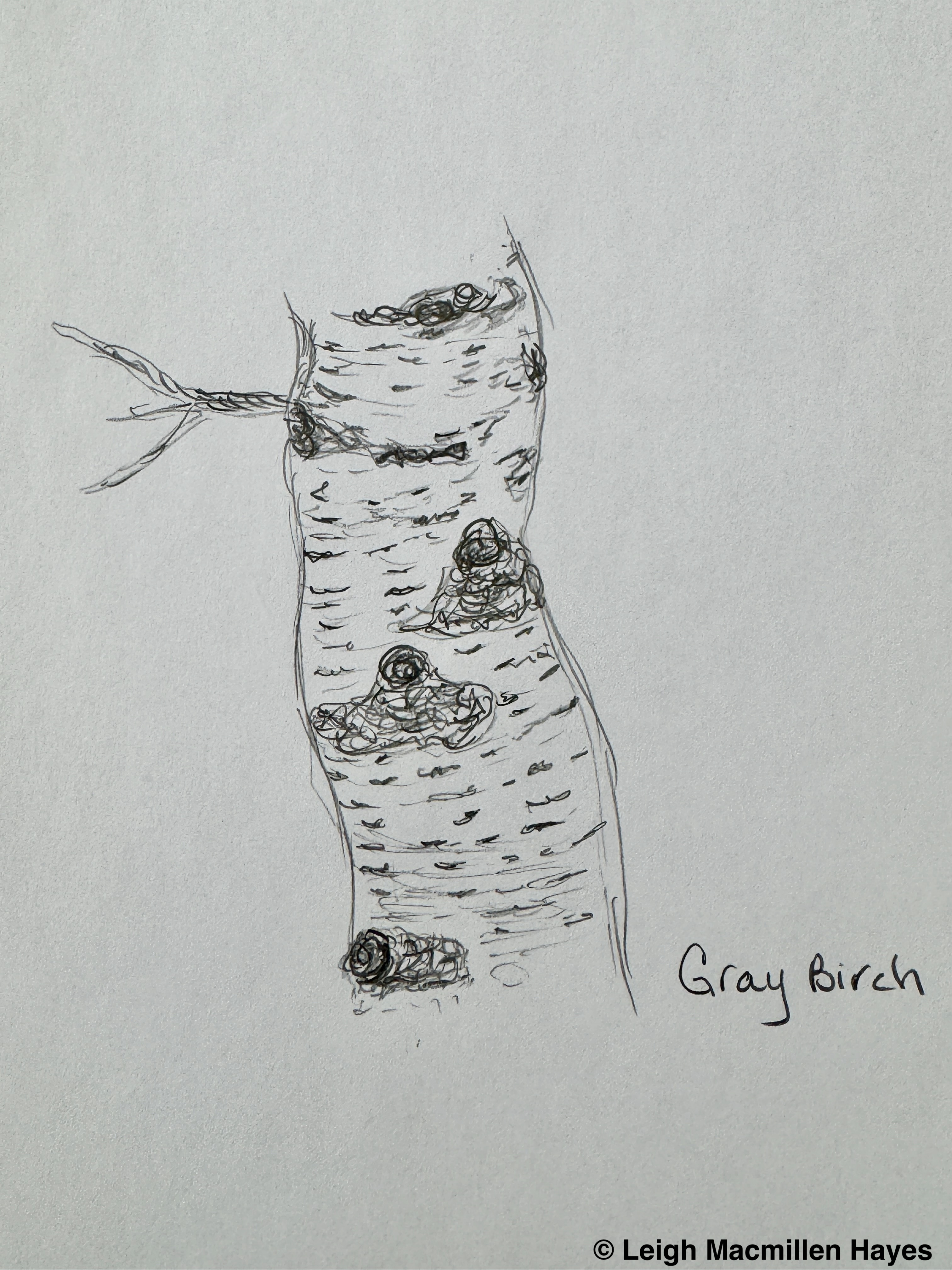
Because it had started raining in earnest and I could barely see through my glasses, I knew it was time to draw today’s journey to a close. But, there was one last place to pause–in a pasture with a small opening in the boundary. The Kneeland/Keene homestead can be seen through the opening. If I turned around, which I didn’t, I knew that I could follow another old “road” down to Kneeland Spring. And to my left as I looked up at the house, would have been the Cooks’ property (eventually they moved across the street), and to my right the Cram/Cleaves/Moxcey property now owned by the Russos, which actually serves as a farm today, albeit on a much smaller scale. (All have passed through one or two or more hands of ownership.)

One final note (or maybe two): It has been said that Pondicherry was the name of Bridgton before Moody Bridges surveyed the land for the proprietors. The source of the name has been questioned–was it so called for a union territory in India or for the cherry trees that grew by the ponds?

Perhaps there’s another choice to ponder–was it named by indigenous people before people of European descent thought the land was theirs to occupy and own? That’s another story that needs to be researched.

As for today, I’m so glad the rain didn’t keep me home and I once again made time to ponder the past in Pondicherry Park.

Starring wondermyway, episode 3 on LRTV

Thanks to Evan Miller at Lake Region Television, wondermyway is on TV once again. For this program, Evan added music by pianist Abbey Simon.

Settle into a comfy chair and click on the following link to listen to fourteen minutes of wondermyway: wondermywayIII

Clicking on the photo won’t pull up the video, so be sure to click on the link above the photo.

May this bring you some moments of well being and peace.

Not Just Another Tube Left In The Woods

Perhaps it’s a case of being in the right place at the right time. Or, taking the time to look. Really look.

You might stay there’s nothing extraordinary about pine needles, right? As you probably know, the needles (aka leaves) of Eastern White Pine, Pinus strobus grow in packets or bundles of five. W-H-I-T-E or M-A-I-N-E is a mnemonic we use to remember how many needles on the White Pine since they spell “white” for its name or “Maine” because it is the State tree.

A word of caution, however, in that department. If a White Pine has five needles, then a Red Pine, Pinus resinosa, must have three needles in a bundle, correct? False. They actually have two much longer and stiffer needles that break cleanly when bent in half.

Back to the White Pine of my attention. What I’ve been noticing is that suddenly there are clusters of needles bound together. This is the work of the larval form of a Pine Tube Moth, Argyrotaenia pinatubana. What typically happens is that the caterpillar uses between ten and twenty needles to form a tube or hollow tunnel.

This past week, for the sake of science and understanding, of course, a friend and I split a tube open to see if anyone was home. Indeed, we had our first view of the tiny caterpillar, which looked like it had an even tinier aphid atop it.

And then one day later in the week, I happened to spot some action at the tip of a tube. The caterpillars move up and down their silk-lined tunnels to feed on needles at the tip.

And once I spotted that, no pine has gone unnoticed. Much to my delight, I discovered a few more active caterpillars today.

One even honored me by demonstrating how it sews the needles to fasten them to the structure.

Back and forth it moved, excreting silk that formed a ladder-like web. When the time comes, the caterpillar will create another tube and do the same thing until it is ready to pupate overwinter.

The moth will emerge in April, when I’ll need to pay attention again. Two generations occur each year and those that overwinter are the second generation.

So now that you know, see if you can find a tube. Maybe you’ll be lucky as well and will get to see the caterpillar. It is only about one third of an inch long, so you’ll really have to look for a wee bit of movement at the tip of the tube. What I learned is that if I went in close with a loupe, it retreated.

This is certainly not just another tube left in the woods–now you know that these are the homes of the native Pine Tube Moths, who fortunately, are not considered a significant pest.

Slipping Into Fall

I went with intention for such was the afternoon. Sunny, cloudy, rainy, dry. Change. Constantly. In. The. Air.

Of course, my intention led to new discoveries, as it should for when I spotted the buttons of Buttonbush, a new offering showed its face–that of Buttonbush Gall Mites, Aceria cephalanthi. Okay, so not exactly the mites, but the structures they create in order to pupate. Mighty cool construction.

Continuing on, into the Red Maple Swamp did I tramp, where Cinnamon Fern fronds stood out like a warm fire on an autumn day. But wait, it wasn’t autumn. Just yet, anyway.

And then there was that first sighting of Witch Hazel’s ribbony flower, the very last perennial to grace the landscape each year.

And color. All kinds of color in reality and reflection beside Muddy River.

Even the fern fronds glistened, individual raindrops captured upon a spider web adding some dazzle to the scene.

Next on the agenda, a Goldenrod Rosette Gall created by the midge Rhopalomyia capitata. The midge formed a structure that looked like a flower all its own. What actually happened is that the midge laid an egg in the topmost leaf bud of Canada Goldenrod, Solidago canadensis, causing the stem to stop growing, but the leaves didn’t.

A few steps farther and I realized I wasn’t the only one who appreciated the sight (or nectar) of Jewelweed, Impatiens capensis, or Spotted Touch-me-Not. The latter name because upon touching the ripe seed pods, they explode. Try it. Given the season, the pods have formed as you can see behind the bee’s back.

Winterberry, Ilex verticillata, its fruits bright red also graced the trail in an abundant manner, but wait a few months and they’ll be difficult to spy. For a month or two we’ll enjoy their ornamental beauty, but despite their low fat content, birds, raccoons, and mice will feast.

All of these sights meant one thing.

The Red Maple swamp bugled its trumpet with an announcement.

The announcement was this: Fall freezes into winter, winter rains into spring, spring blossoms into summer, but today . . . today summer slipped into fall and I gave great thanks for being there to witness it all.

To Be Continued Sun/Mondate

We drove forty minutes north at midday on Sunday with the intention of hiking a trail we’d enjoyed only once previously. Our memories of it had petered a bit, but we did look forward to bear trees and cascading falls.

And we were not disappointed. Within minutes of beginning the ascent, a look up at the gnarled top of a Beech gave me reason to scan the bark below and by the number of claw marks left behind it was obvious that this had been a well-used source of nuts in the past.

We could just imagine the bear scrambling up, sitting upon the branches and pulling them in to form a “nest,” or so it looks when they’ve been broken and folded inward, foraging for beech nuts, and then, once all were consumed, scrambling back down and on to the next tree.

Bears weren’t the only animals that have known this land and beside a stone wall we paused for a second. Our first ponder was whether it was a boundary fence or meant to keep animals in or out. Until . . . we spotted a piece of barbed wire growing out of a tree. No wait, barbed wire doesn’t grow out of trees. Trees grow around it. And our question was answered: the wire would have been added to keep the animals in the pasture.
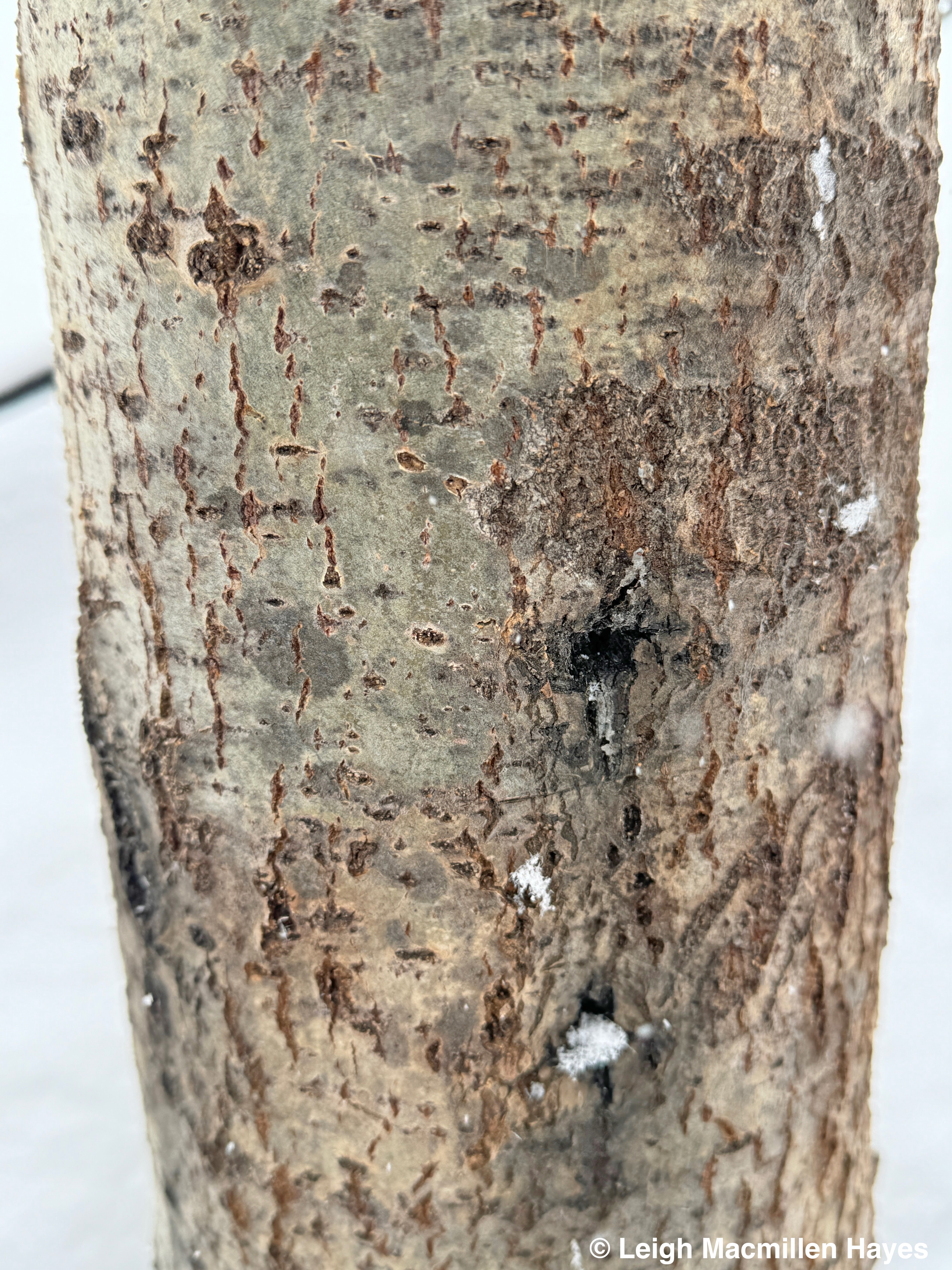
That said, it had been a while since the wire was installed and even longer than a while since the stone wall had been built, for the trees had had time to grow and mature and incorporate the wire into their souls and while one still knew the flow of xylem and phloem, this other was a source of new life for insects and birds.

Our next pause was at picnic knoll where two tables and two Adirondack chair invite hikers to take a respite and enjoy the view. We tarried not given that we had a football game to get home to and pizza dough to prepare. Well, one of us had a football game to get home to and the other the dough.

Onward and upward we hiked, keeping an eye on ankle biters (saplings not cut to the ground that caused us to stumble repeatedly if we weren’t paying attention) at our feet, while searching for more bear trees, not an easy task during leaf season. But our best reward was the sight of this oft-climbed tree and the realization that the two behind it had also been visited.

We know there are more like those in this forest thus giving us a reason to return in late autumn and search off trail to see how many we can count. If memory serves us right, from the trail we once counted over twenty such bear trees.
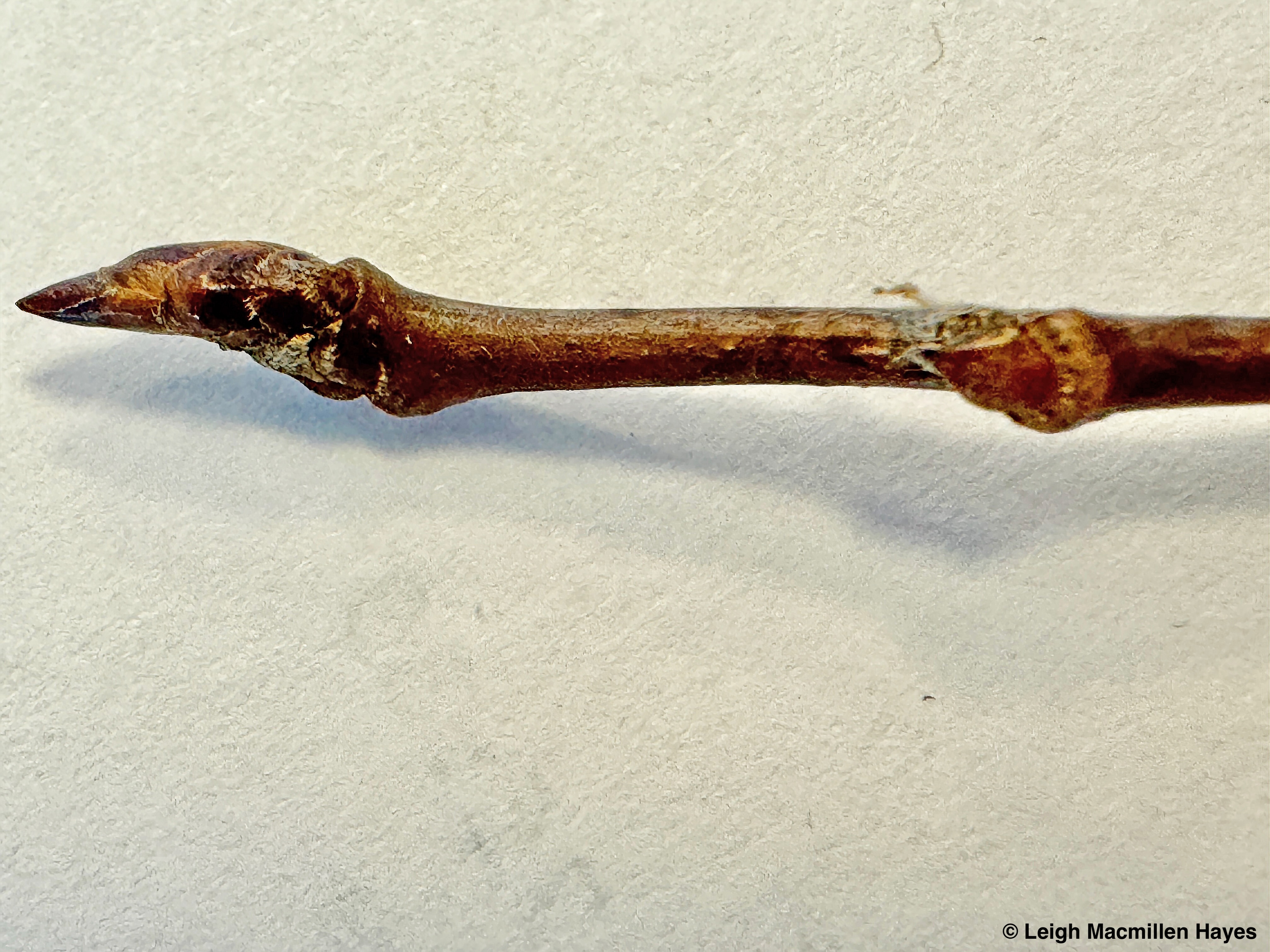
Oh, there were other things to see along the way, like the Hobblebush’s ripening berries . . .

and Bald-faced Hornets gathering nectar.

But the second object of our intention was eventually reached for we’d found the cascades, beginning with one named for the family that farmed this area: Chapman.

It was a bit of a scramble but we were well rewarded for our efforts.

Again and again. After viewing this final flow, Library Cascades, we practically ran back down the trail. Just in time to catch the start of the game on the radio. Pizza was a wee bit late, but we didn’t mind.

The story should have ended there, but while hiking on Sunday we came up with a plan for Monday. So . . . back into the truck for that forty-minute drive we did go. This time, in the same forest, we hiked up an esker, which I saw as the stick of a lollipop.

At a junction, we chose the Red Pine Trail, a tree with bark so rich in color and design, it creates an art gallery in the forest.

Along the way, we paused at openings to enjoy the views, but . . .

a ridge off-trail, and really off-property (Shhhh, don’t tell. The boundary was marked but not posted.) invited us and we couldn’t refuse. What view might there be that we would miss if we didn’t accept the summons?

We were rewarded with the sight of the surrounding mountains showing off their summits in crisp contrast to the sky above.

I’m pretty sure the invitation included lunch and so we sat down and dined.

Our off-trail pursuit offered one final gift as we headed back to the trail–galls created by a wasp upon a Northern Red Oak twig.

A few steps later and we startled a Garter Snake who flicked its tongue to get a better scent of us before deciding we weren’t worth the effort and slithering away.

Again, there was water to cross, but it wasn’t nearly as impressive as the cascades of Sunday.

And some porcupine work to acknowledge, though we had hoped to see a den, but determined it was probably in the ledges below.

One final view at the land beyond and then we completed the loop that formed the sucker at the top of the lollipop stick and began our descent. Again, this should have been the end of the story. But . . .

There was plenty of daylight left and this day’s football game wasn’t until much later and so we sought a third trail in the same forest. The natural community differed, which made us grateful because each trail had its own unique flavor, this one including Striped Maple dripping with seeds of the future.

Once again, we climbed toward the view.

One sight that caught our attention for it was the only one of its kind that we saw along any of the trails was a Lady’s Slipper, and we gave thanks that it had been pollinated for perhaps its future will spill forth in multitudes we can enjoy next spring.

A flock of nuthatches, woodpeckers, and chickadees entertained us occasionally, but it was the silent Hermit Thrush who paused that caused us to do the same.

At last we reached the end and stood for a moment to take in the range beyond, before turning around and retracing our steps for this last trail wasn’t a loop.

Nailed to a tree, was this sign: To Be Continued. As so it was on this Sundate/Mondate. We trust we’ll return to see where the trail may lead next.

March Madness

I awoke early, filled with concern for Greater Lovell Land Trust’s March Madness hike planned for today. The wind was blowing and the temperature had dropped significantly after several days of “Fake Spring.” Would volunteer docents and staff be ok in parking lots and summits at GLLT’s Heald and Bradley Ponds Reserve where we were encouraging people to climb one, two, or all three “peaks”?

We had it all planned–“snowman” passports available in the parking lots, along with trail maps, healthy snacks, magazines, and advice. Oh, and a donation jar ;-)

At each summit, participants would have their passports stamped and choose one GLLT/nature-related swag item.

But that wind. A check of the weather report, thankfully, promised that the wind advisory suggesting gusts up to 45 mph, would end by 10am. Our event was planned to begin at 9:30. As I wrote in an email to volunteers and staff, “Let’s go for it.” No one balked. One replied, “We’ll be there.” And another wrote, “They don’t call in March Madness for nuthin’.”

After making sure everyone was set, at parking lot #4 on Route 5 in Lovell I opened the back of my truck to display the offerings. Our talented executive director had created a snowman out of the three summits, one of them actually being the snowball, and the buttoned breast serving as connector trails.

For the first two hours or so, my only companions were chipmunks, which despite, or maybe because of the cold, ran frantically from one side of the trail to the other, in and out of holes, and disappearing at one section of stone wall, while a short time later reappearing at another. Or was that a different chipmunk?

I counted four, but really, there could have been more for they entered and exited so frequently. Meanwhile, I was also on the move in an attempt to stay warm. The wind may not have been gusting per se, but it was rather breezy and certainly quite chilly.

And so I walked (and sometimes ran) around the parking lot and about a tenth of a mile up the trail, over and over again. In a way I wish I’d tracked my trail, because it would have looked as if I was indeed mad.

But . . . I made discoveries, including raccoon prints in the mud,

Yellow birch catkins flying like flags upon their twigs over my head,

and their associated trunk showing off its curly bark.

A Red Maple sported the perfect target fungus that I often mention to others, who can’t always see the bulls-eye pattern.

And somehow, though I’ve walked this trail many times over many years, I’ve never spotted the burnt potato-chip bark of a Black Cherry right beside the path before.

I also learned something about chipmunks. They scampered for several hours, but early afternoon must be siesta time and I never did see any of them again, though I checked frequently.

By 11:30, participants began to pull into the lot and I felt a certain sense of relief. Being without cell phone reception, I had no idea how things were going with anyone else, but gave thanks that people wanted to participate in the hike and had learned about it from several forms of media.

As they hiked, my parking lot meandering continued, though the space to move shrunk due to their parked vehicles.

With the chipmunks no longer offering entertainment, I decided to add an examination of the kiosk to my point of view.

Upon it I found a bunch of larval bagworm moths, their structure such that they remind me of the caddisflies I’ll soon be looking for as waterways open.

Another frequent observation at any kiosk is the cocoon structure of tussock moths. This one didn’t let me down.

Speaking of down, it was down that my eyes were next drawn and I spotted an old apple oak gall that curiously sported two exit holes–or had someone dined upon the goods once forming inside. How it survived two feet of snow and retained its global shape stymied me. Another thought though is that it may have remained attached the tree for a long time and only recently blew to the ground.

While I considered that, something hopped. Seriously.

The hopper turned out to be a . . . grasshopper instar. A what? An instar is a phase between two periods of molting in the development of an insect larva or other invertebrate animal. Think of it as a nymph, if you will.

Spying one seemed an anomaly, but . . . I spied three more upon the snow.

They couldn’t yet fly, but they certainly could hop up to three feet despite their diminutive size of about 2 centimeters. Their direction wasn’t always forward, but sometimes more sideways.
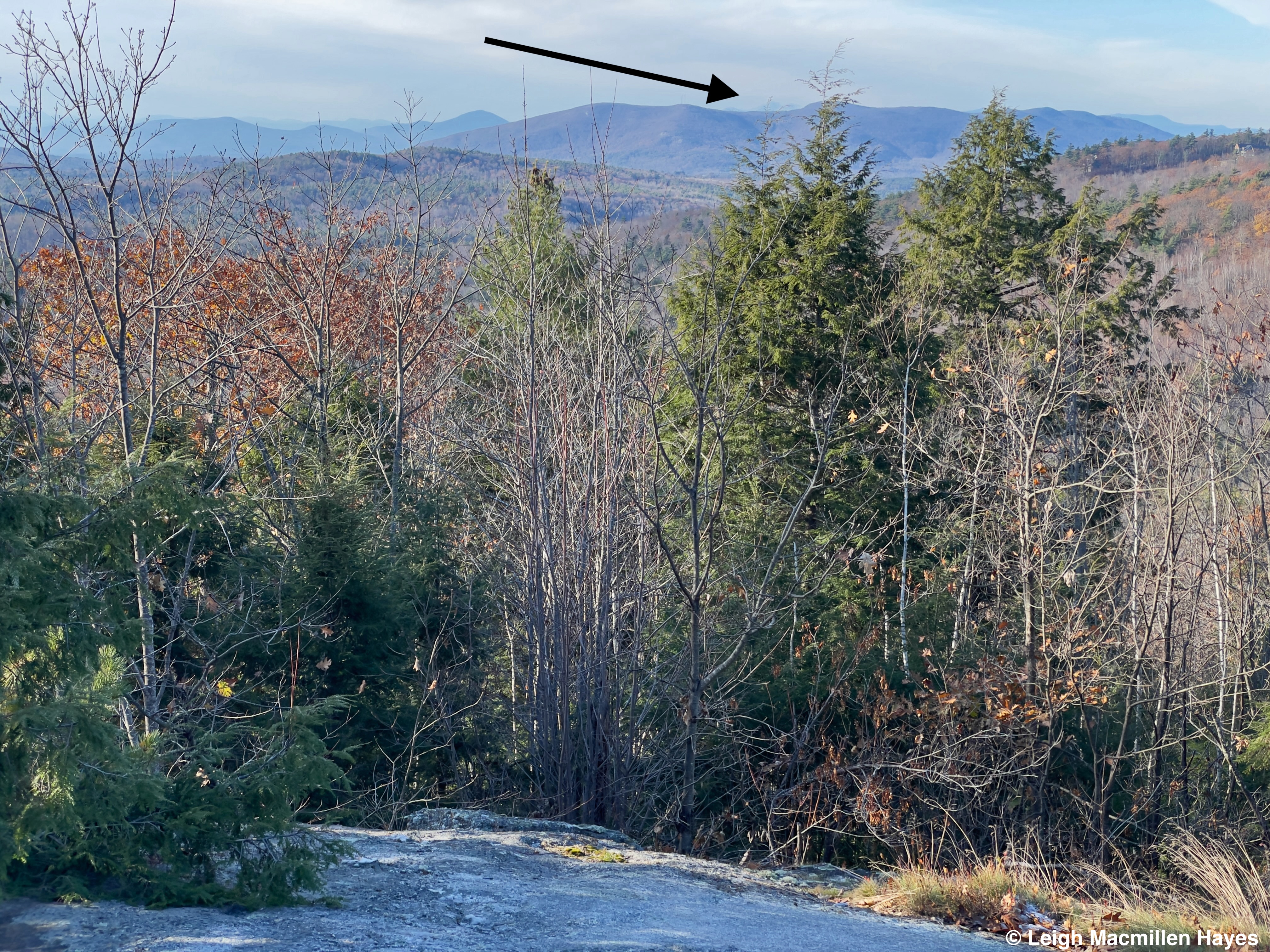
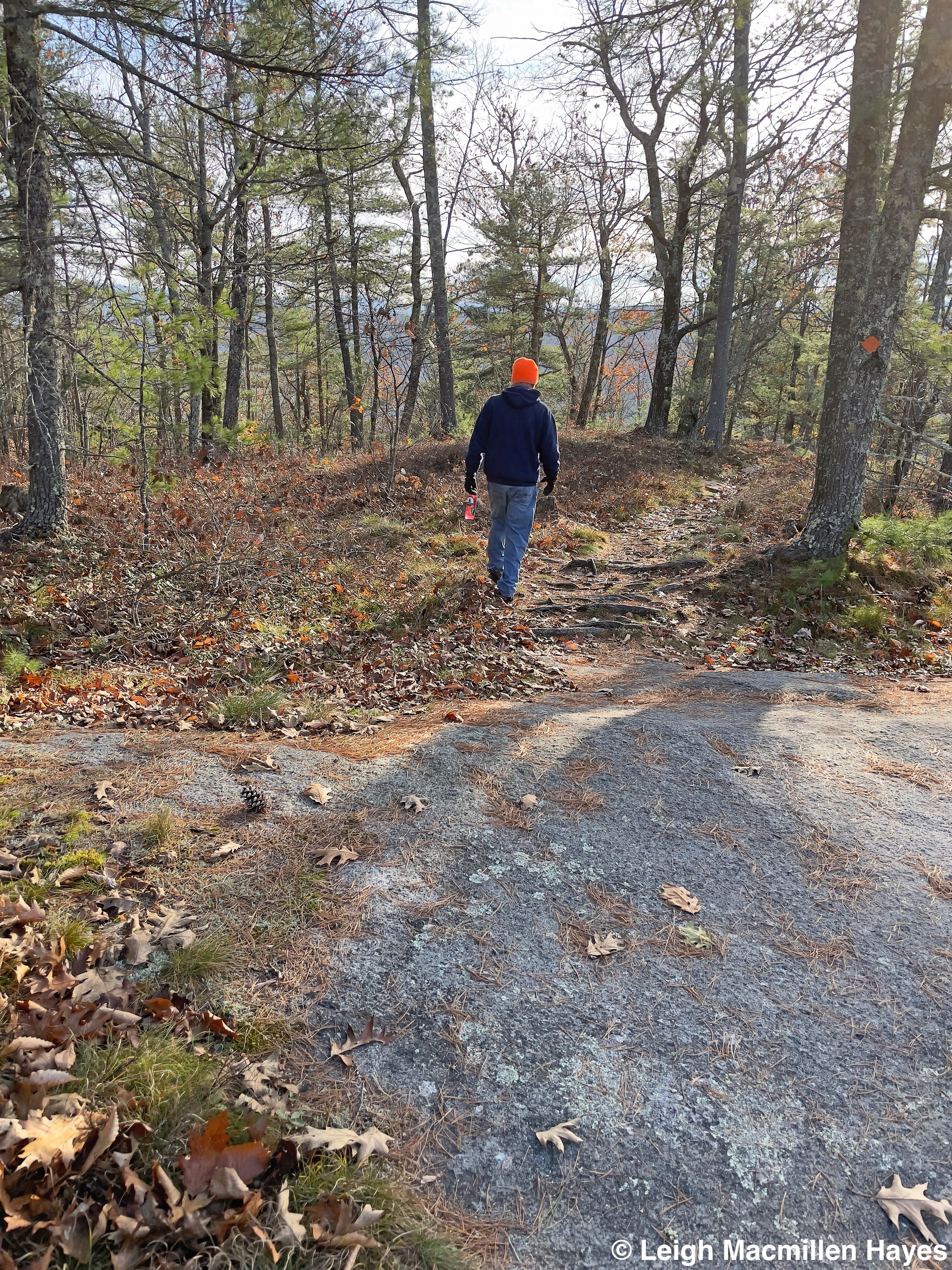
In the end, thirteen folks hiked from my lot and the others had 12 and 9, so I’d call the first annual March Madness a success. All volunteers and staff stayed sorta warm–each finding their own way to do so.

As for me, I somehow managed to cover 7.8 miles in a small space and found myself smiling frequently as March Madness was really March Gladness.

Grasshoppers?!!!