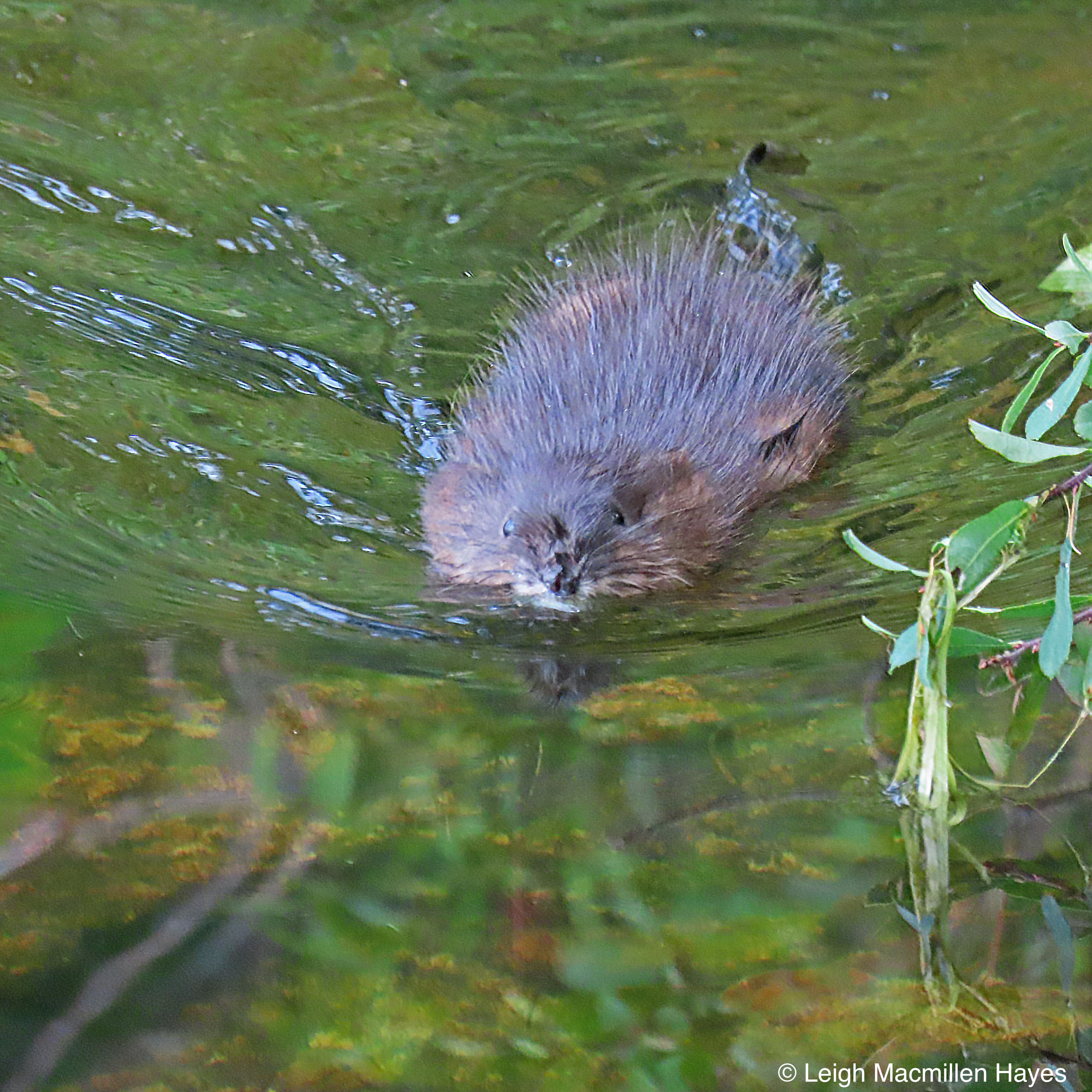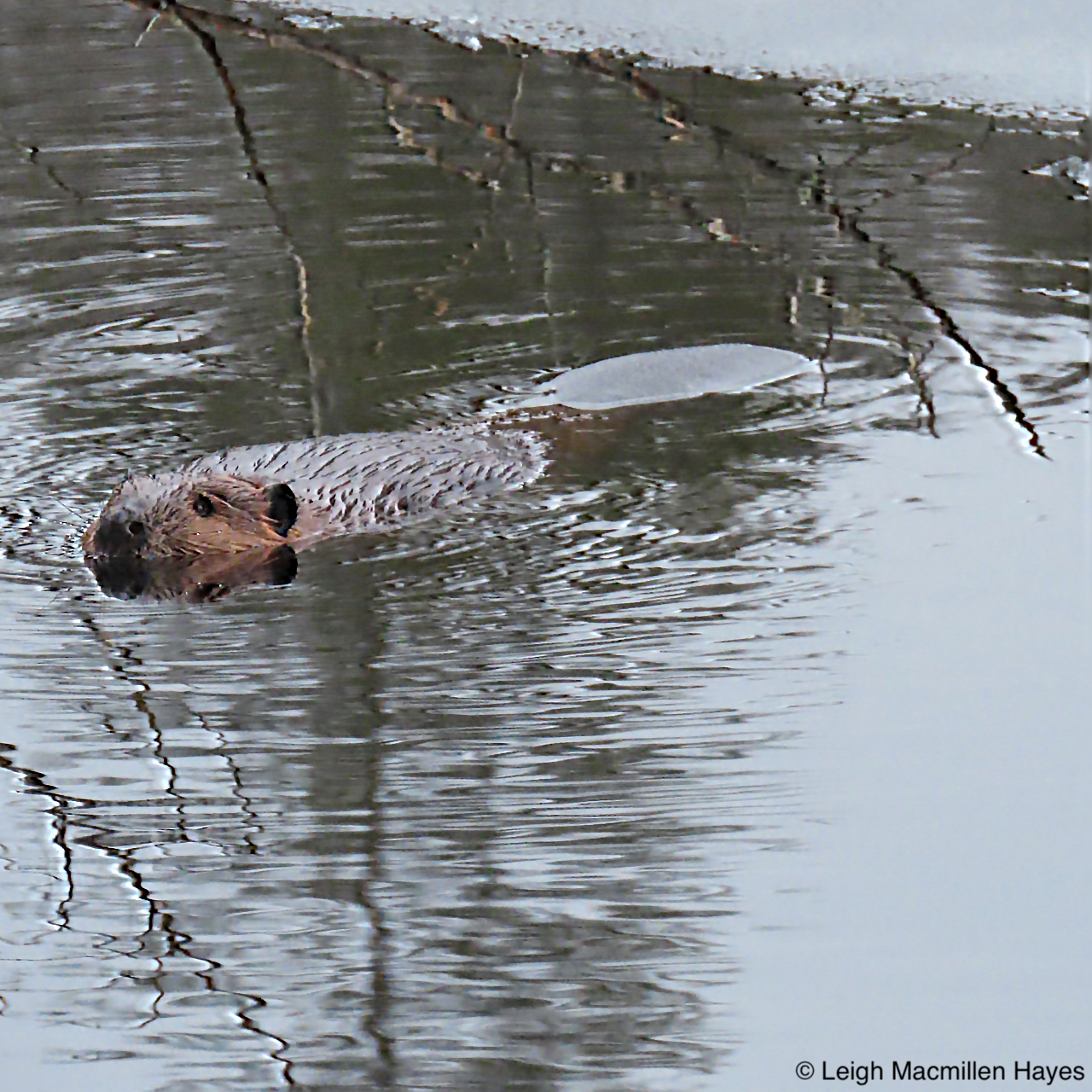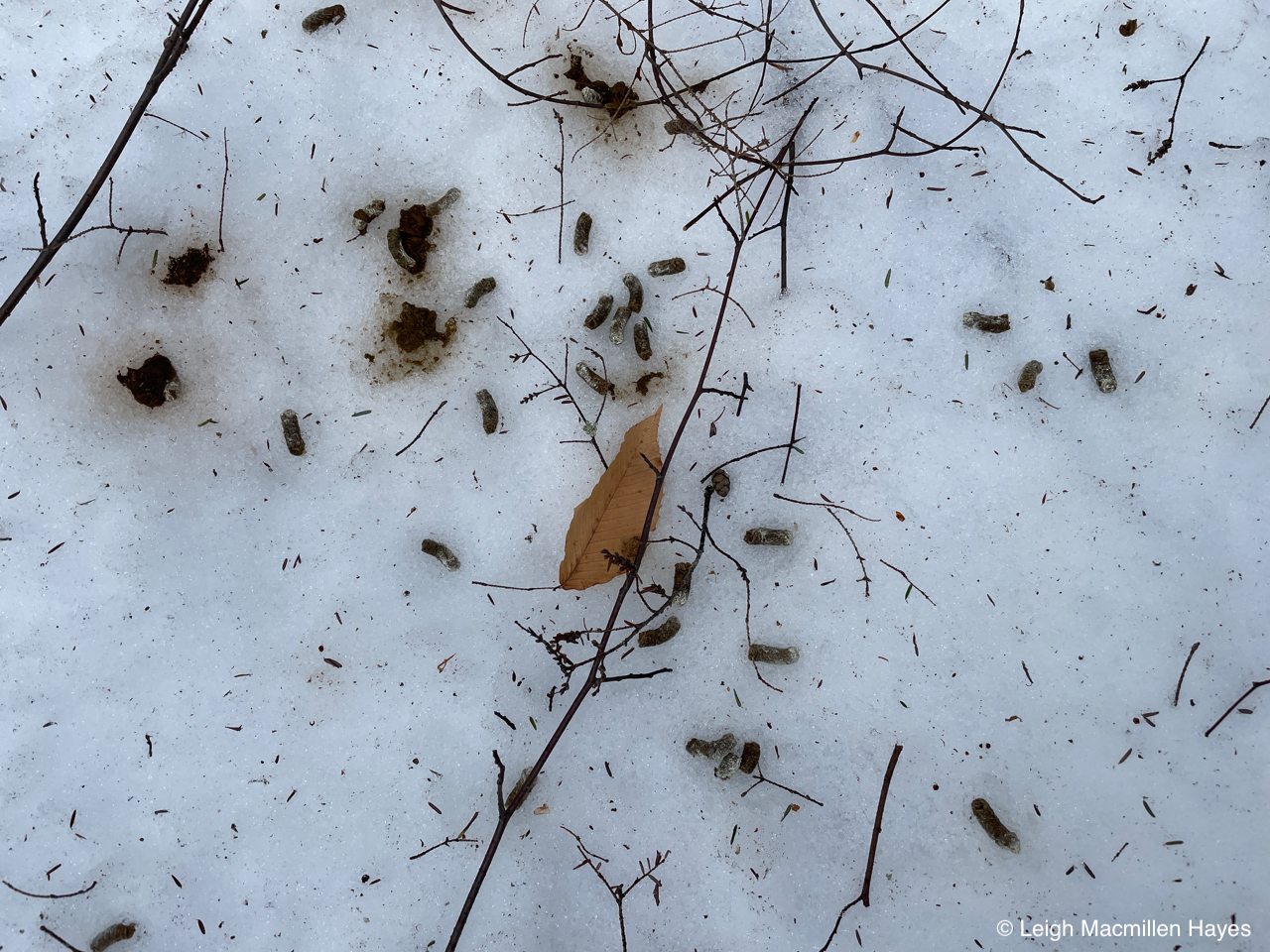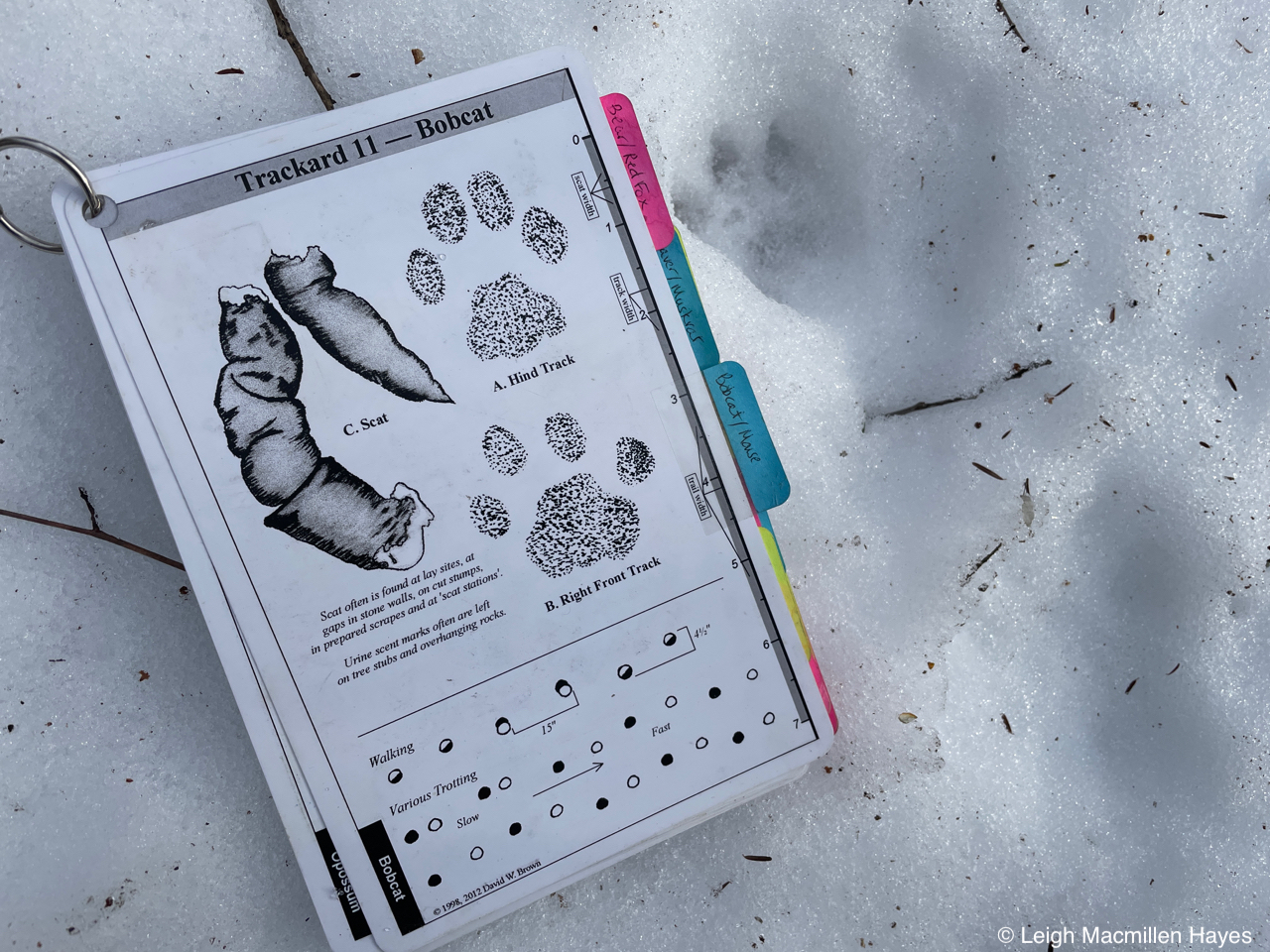
Wait. Watch. Wonder. Learn.

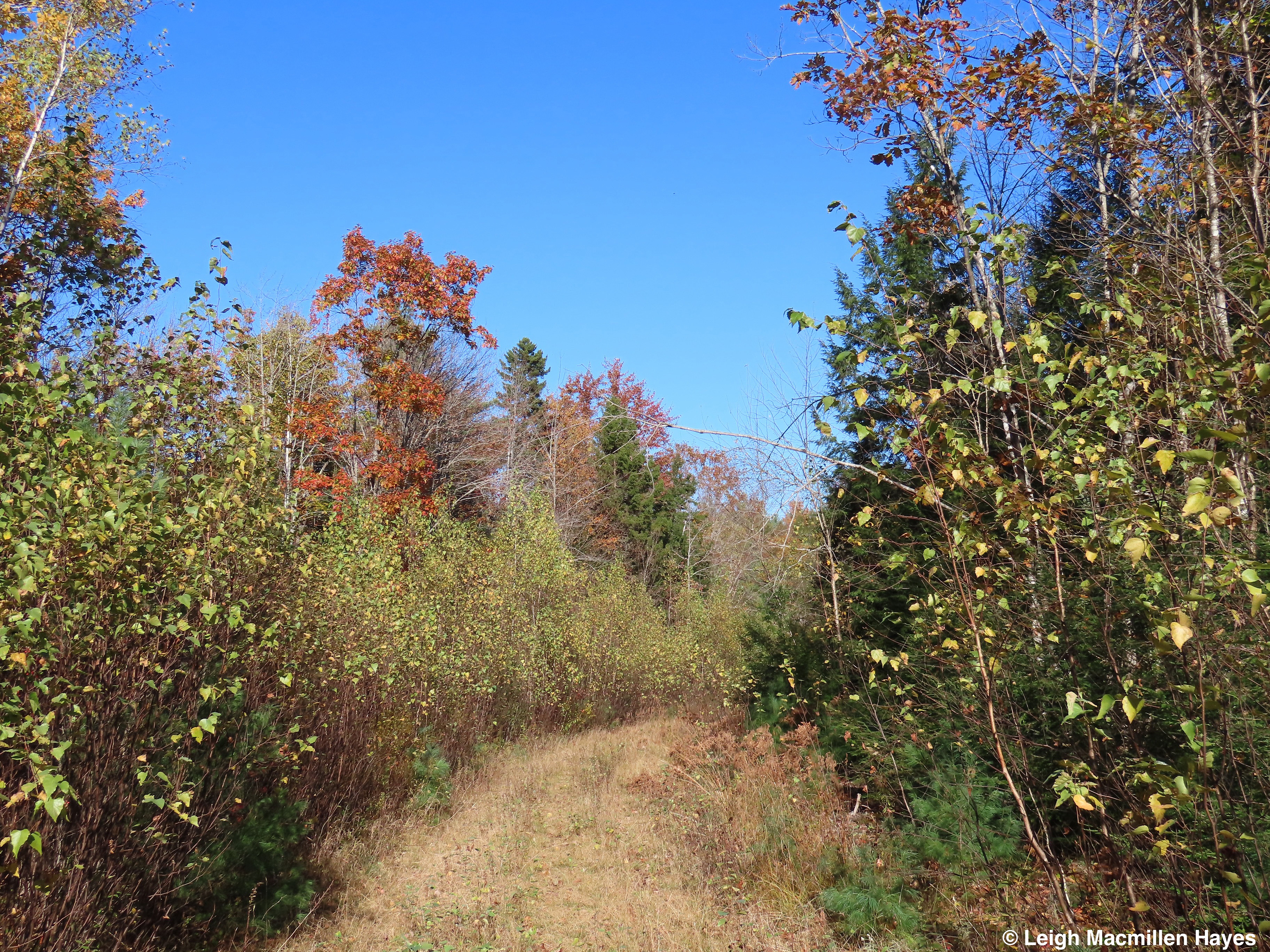
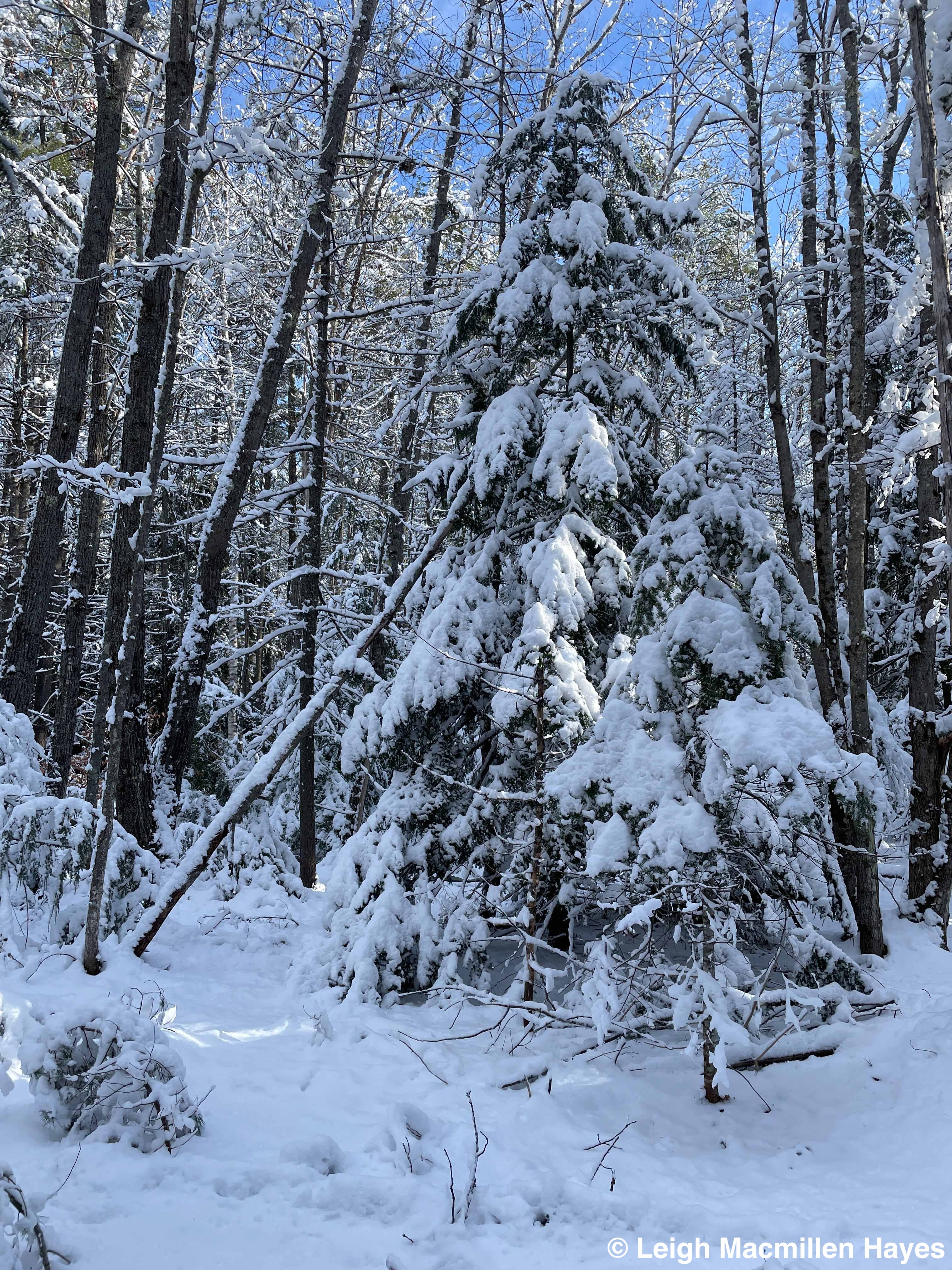
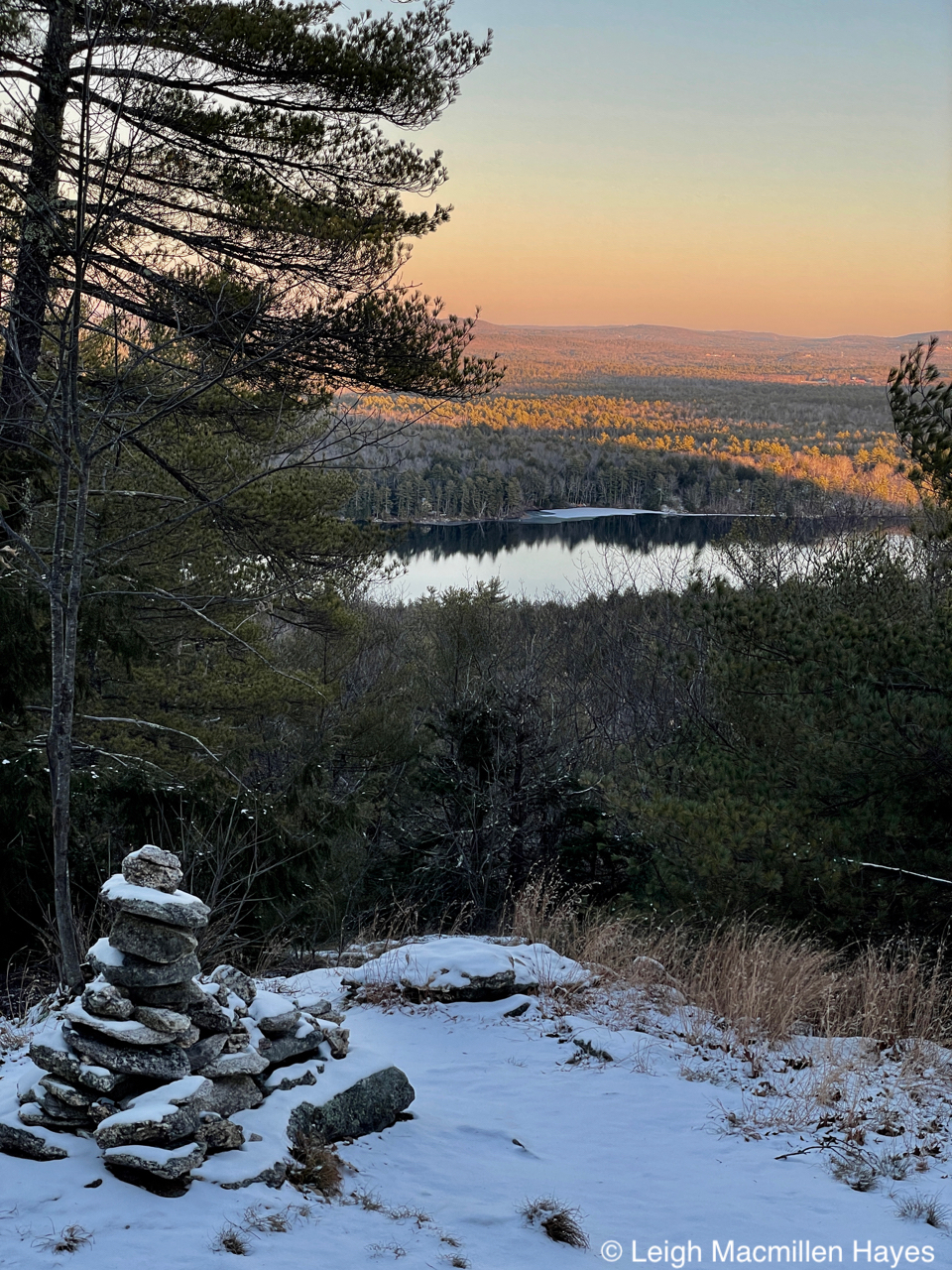
As I waited for the sun to rise on this final day of autumn 2024, before the dawning of the winter solstice, I watched the sky. It seemed late. Of course it seemed late. Tomorrow will be the shortest day of the year.

Ever so gradually, the sky brightened. First, there was barely a hint of light shining through the trees as if taking its time was a way to remind me to slow down.

And then I began to see it. Not the orangey-yellow I expected, but rather a blue gray that slipped out from behind the silhouettes of the tree trunks, who stand as watchers, observers, of every dawn every day.

Ever so slowly, a hint of pinkish purple rose in the East and the blue gray was transformed.

I, too, wished to be transformed. By this first light. By this new day.

And then it occurred to me that I do rejoice at each daybreak and look forward to its offerings.

Today, however, was a wee bit different as it was the day to enter a place I’ve barely visited since the spring and I felt drawn to part the hemlock boughs and venture forth into my own secret garden, that isn’t a garden at all, at least not if you expect it to be a place where flowers and vegetables are tended. Ah, but it is a garden from so many others. And its those others that I hoped to meet.

In her book entitled Church of the Wild: How Nature Invites Us Into The Sacred, author Victoria Loorz writes, “You wander slowly and intentionally. It is your full presence along the path that matters. It is an act of reverence, a saunter. John Muir hated the word hike. He urged people to saunter. ‘Away back in the Middle Ages,’ he told his friend once, ‘people used to go on pilgrimages to the Holy Land, and when people in the villages through which they passed asked where they were going, they would reply, ‘A la sainte terre,’ ‘To the Holy Land.’ And so they became known as sainte-terre-ers or saunterers. Now these mountains are our Holy Land, and we ought to saunter through them reverently, not ‘hike’ through them.”

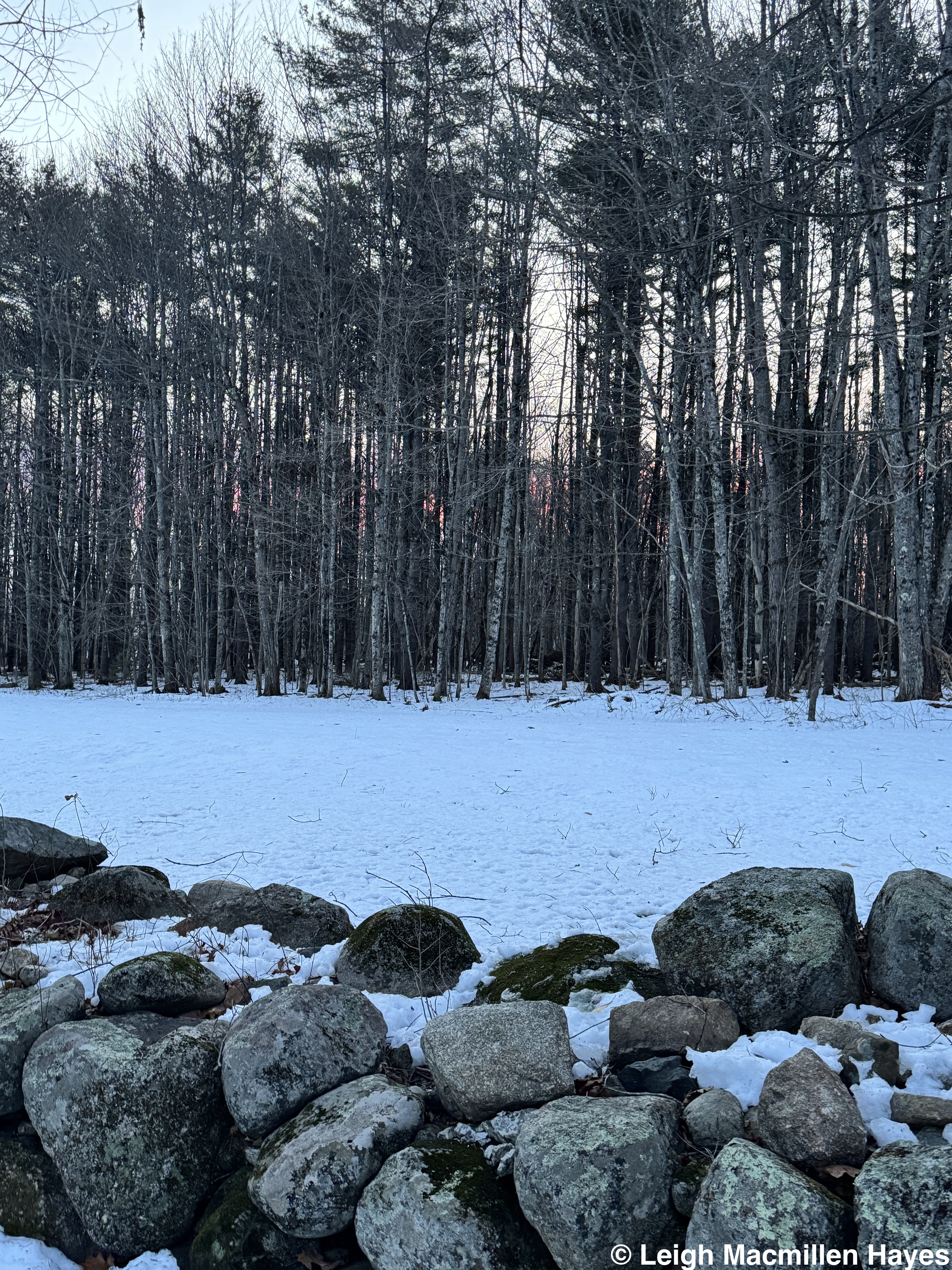
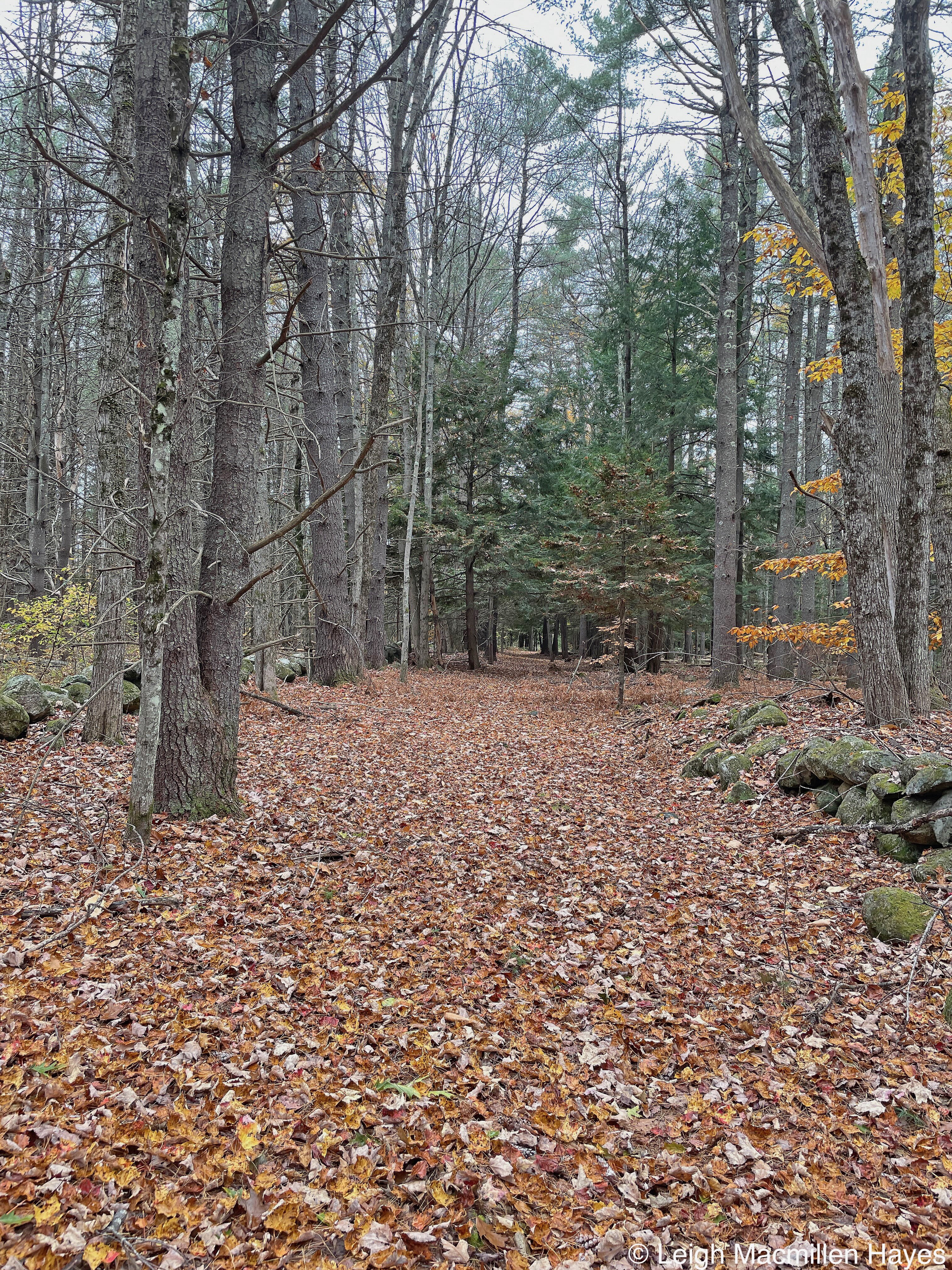
And so I sauntered, not letting the stone walls or barbed wire stop me from crossing over manmade boundaries.

All the while, I wondered, “Who will I interact with today?” and “Will I be able to shut down my inner ramblings and really wait, watch, and listen?”

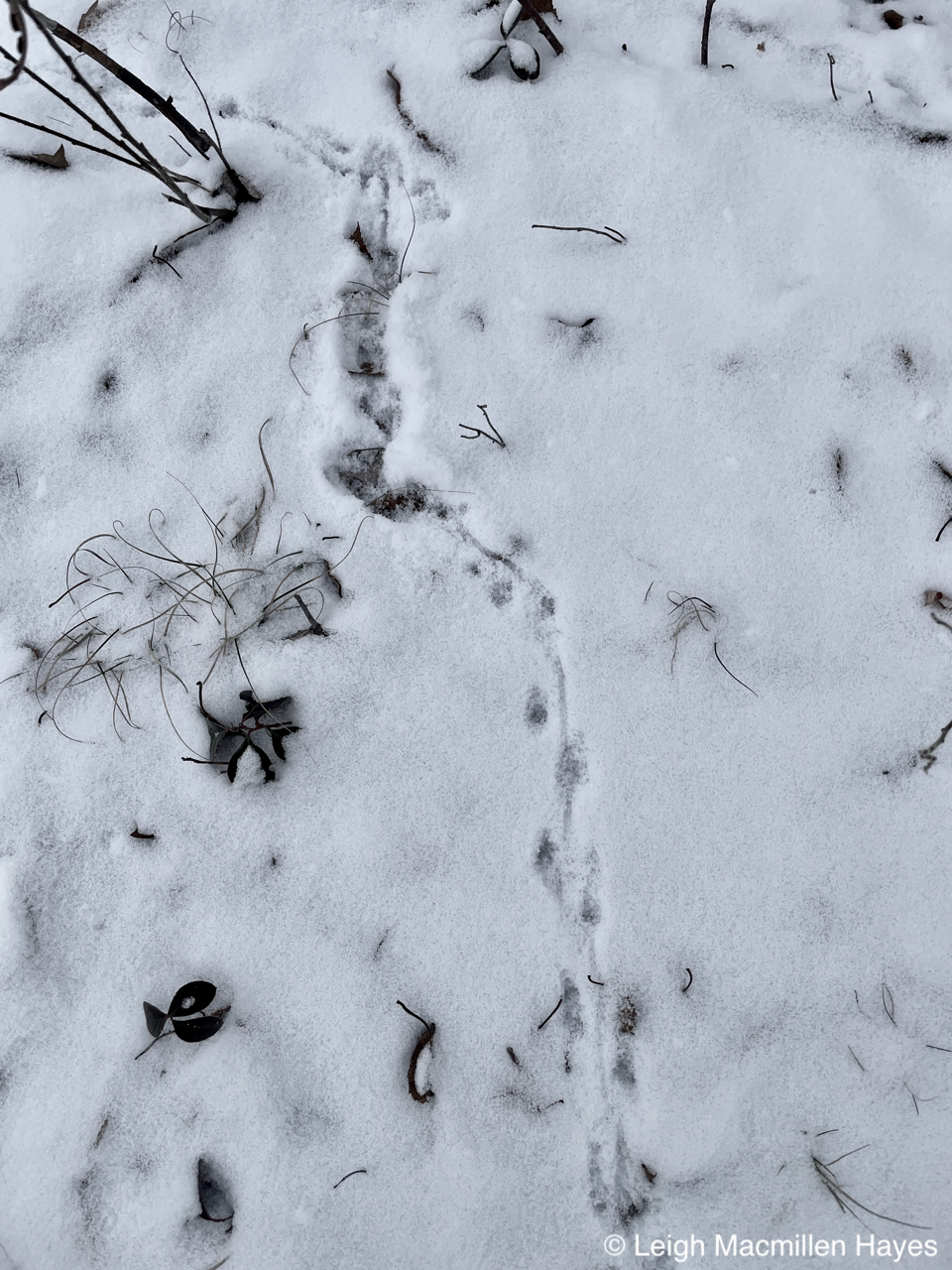
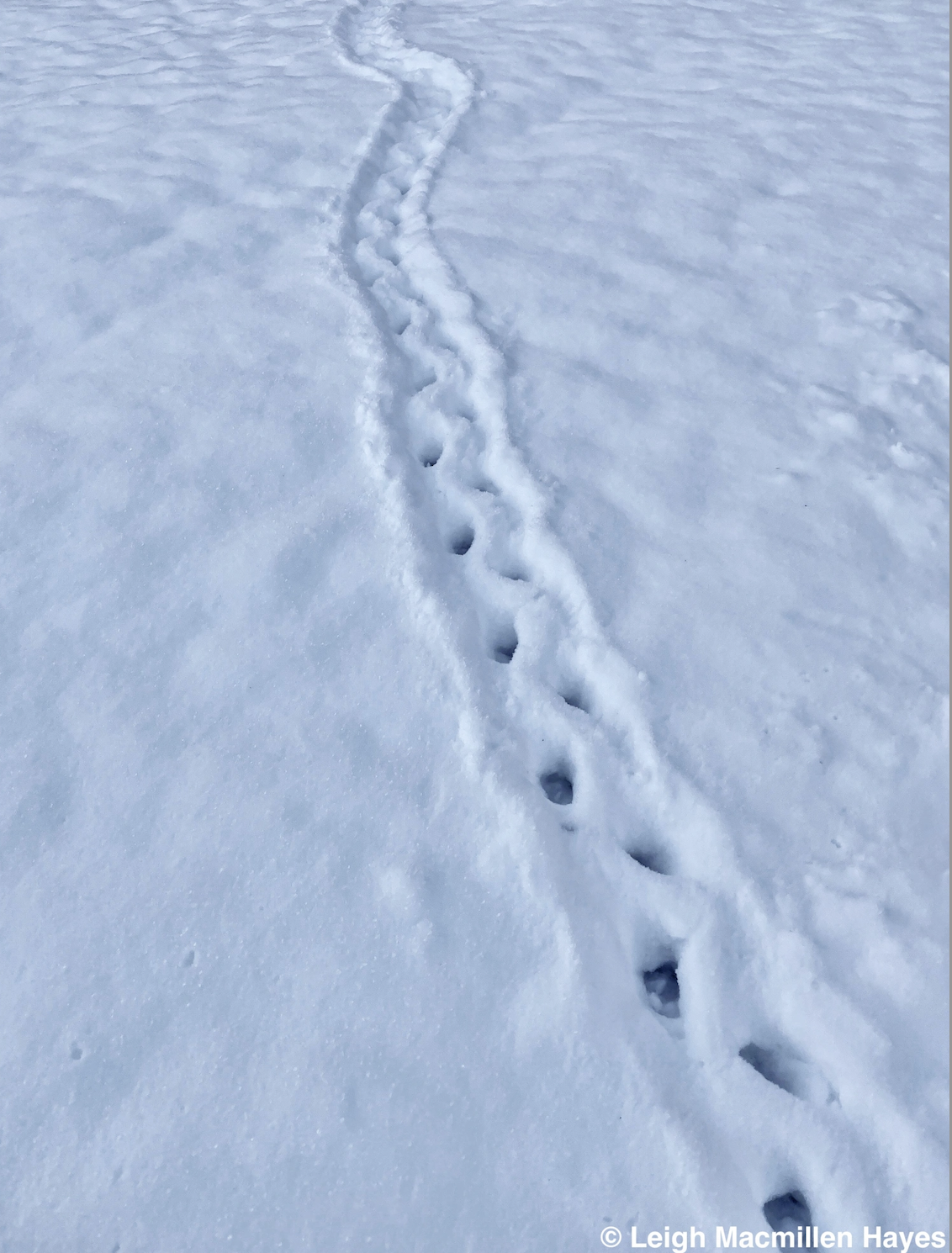
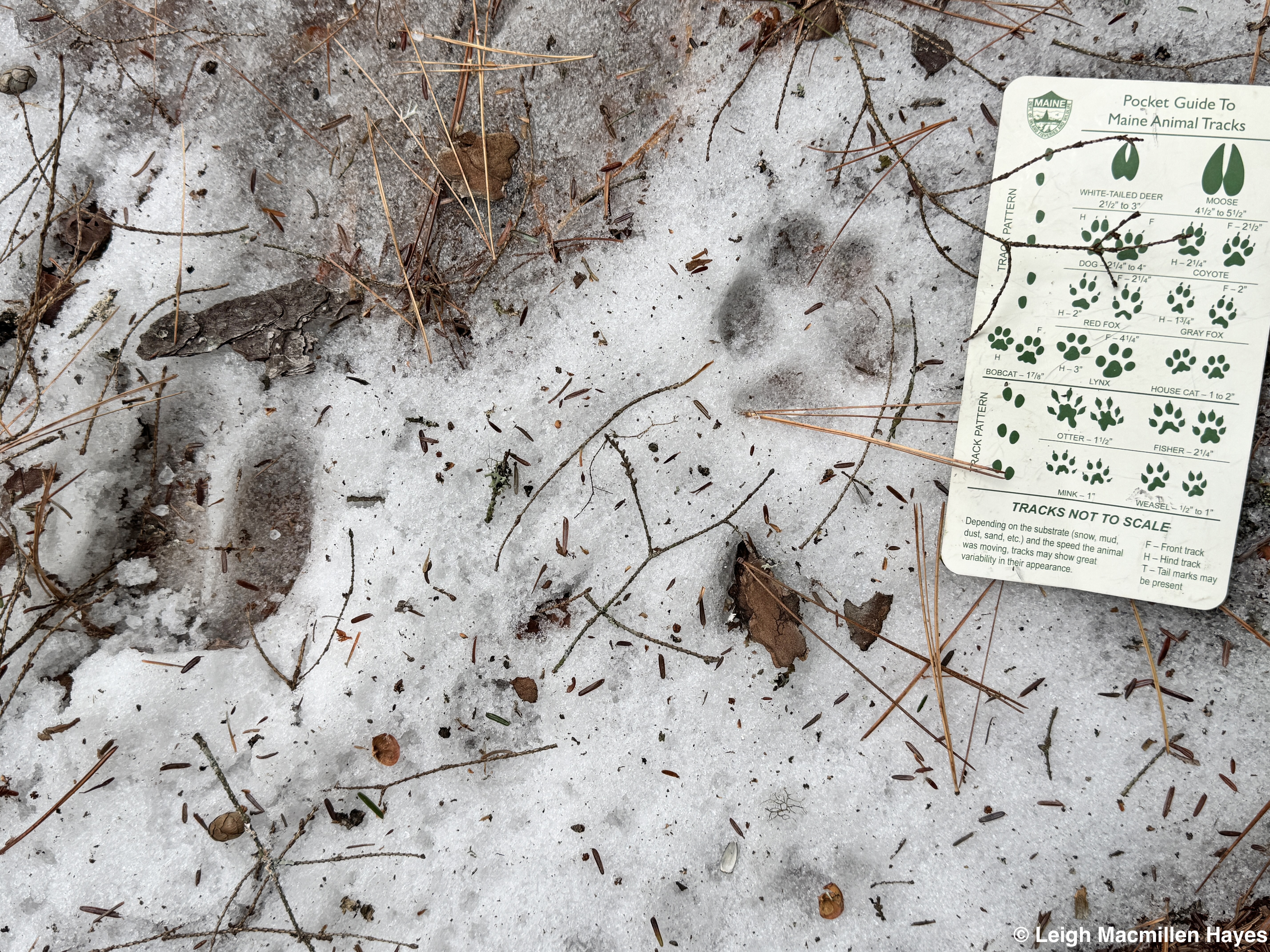
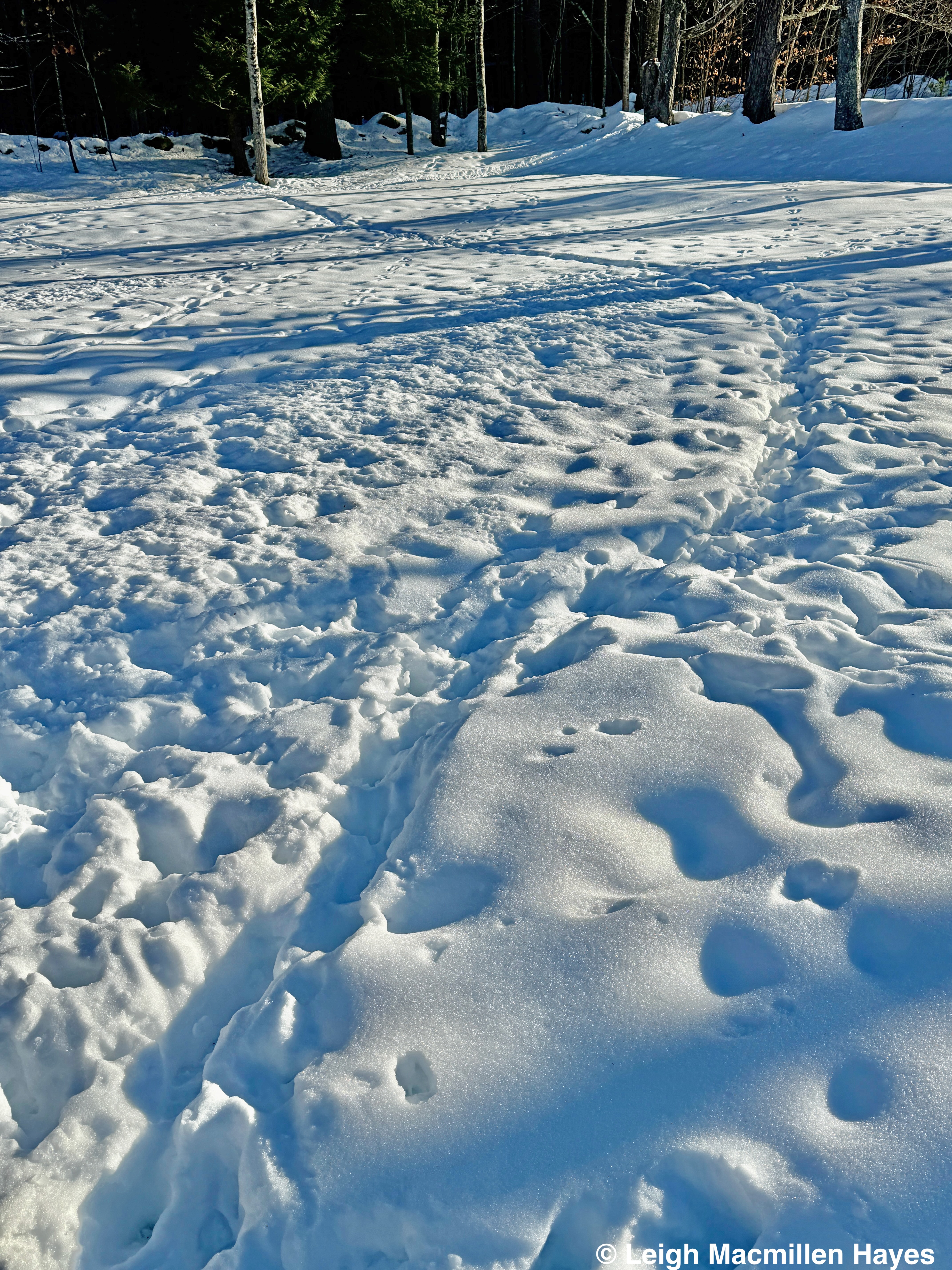
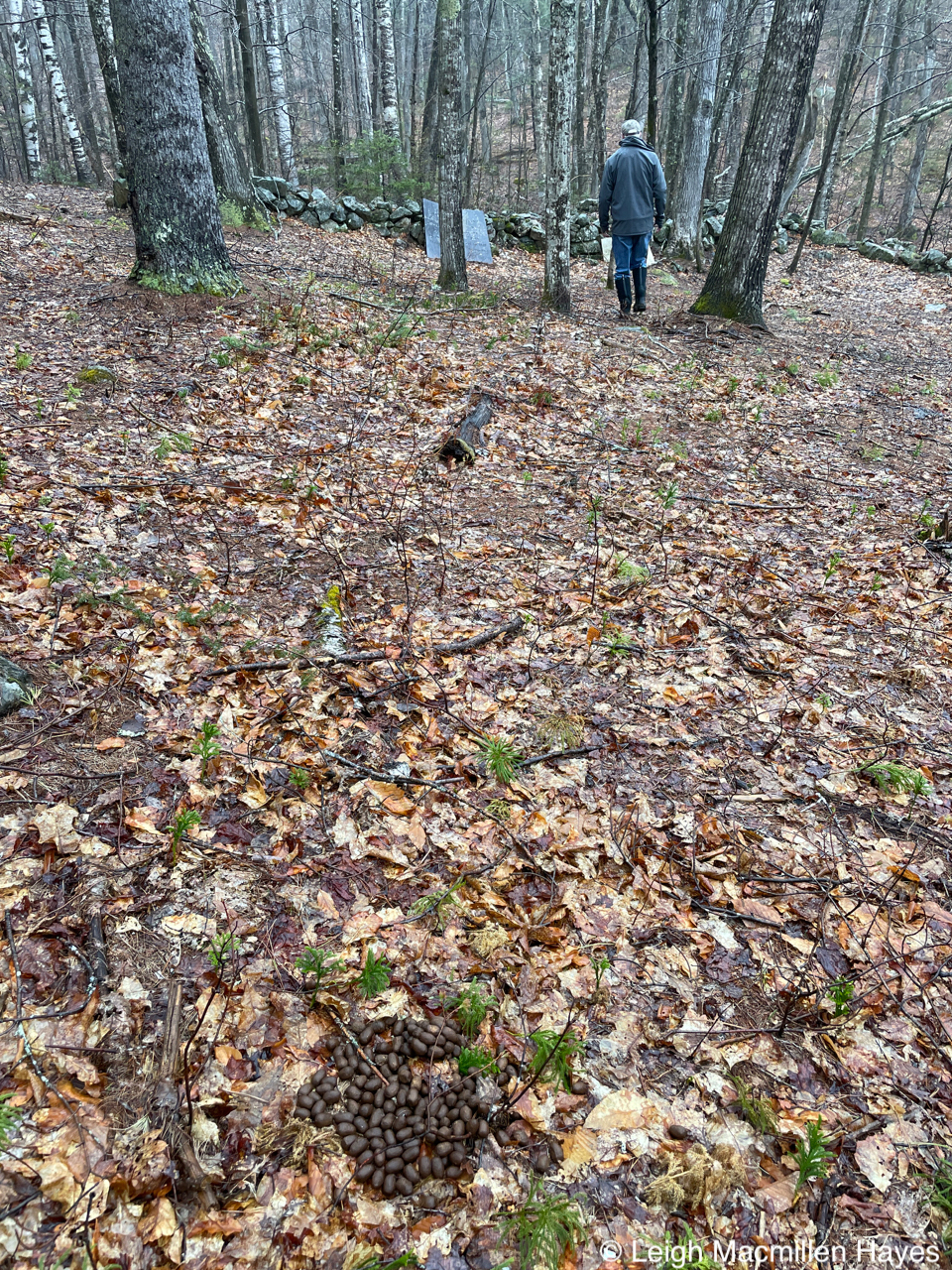
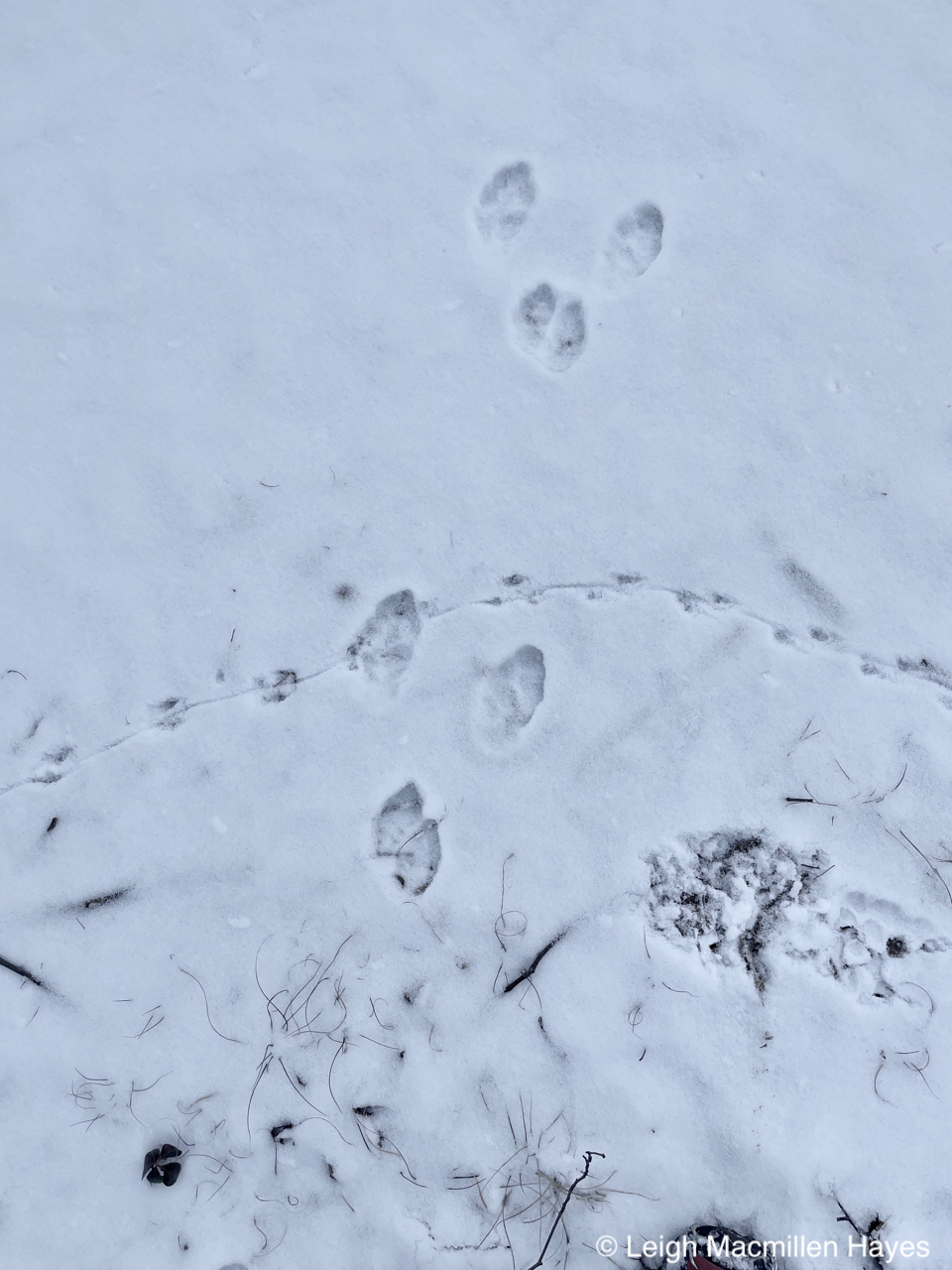
My heart quickened despite my efforts to slow my breathing, when I spotted not only the heart-shaped prints of White-tailed Deer who really own these woods, but also one who pursues them, the Bobcat.

Would I spot any evidence that though they travelled in opposite directions a day or so apart, their paths eventually crossed? That remained to be seen.

What I did know was that unless I sat for a time, I would not spot any critters because the snow conditions were such that I stood firmly on top–like walking on water–frozen water, and made a loud crunching sound with the fall of each footstep.

Those who know me well, know that I am a cradle Episcopalian. Among other things, I love the liturgy. But what I’m discovering I love the most is the shared fellowship with a diverse group of people.

And in the same way, I love the woods out my door and how each and every other-than-human being IS diverse, and how they aid and abet their neighbors, sometimes offering a helping tree limb or shared nutrients, and other times feeding upon others because they, too, need energy.

And in the forest, there is life and death, and a dead snag can be just as beautiful as a live tree. And in its death, offer space for others to live.

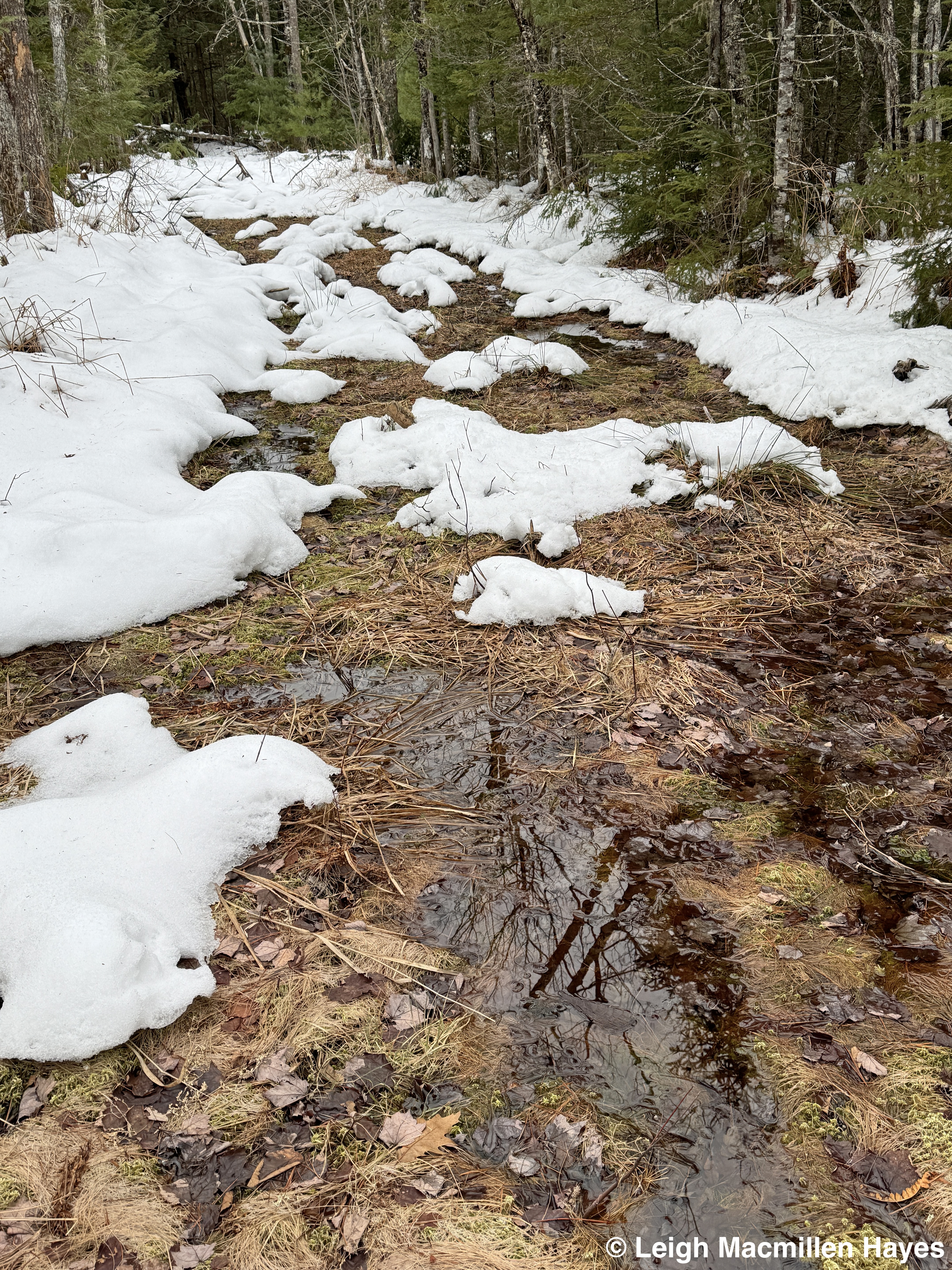
During today’s saunter, I bushwhacked sometimes and followed old logging trails in other moments. During all of my visit, I often encountered places that needed consideration for navigation, but in the pause as I gave thought to my way forward, I noticed reflections that reminded me of my desire to do the same. Take time to reflect.

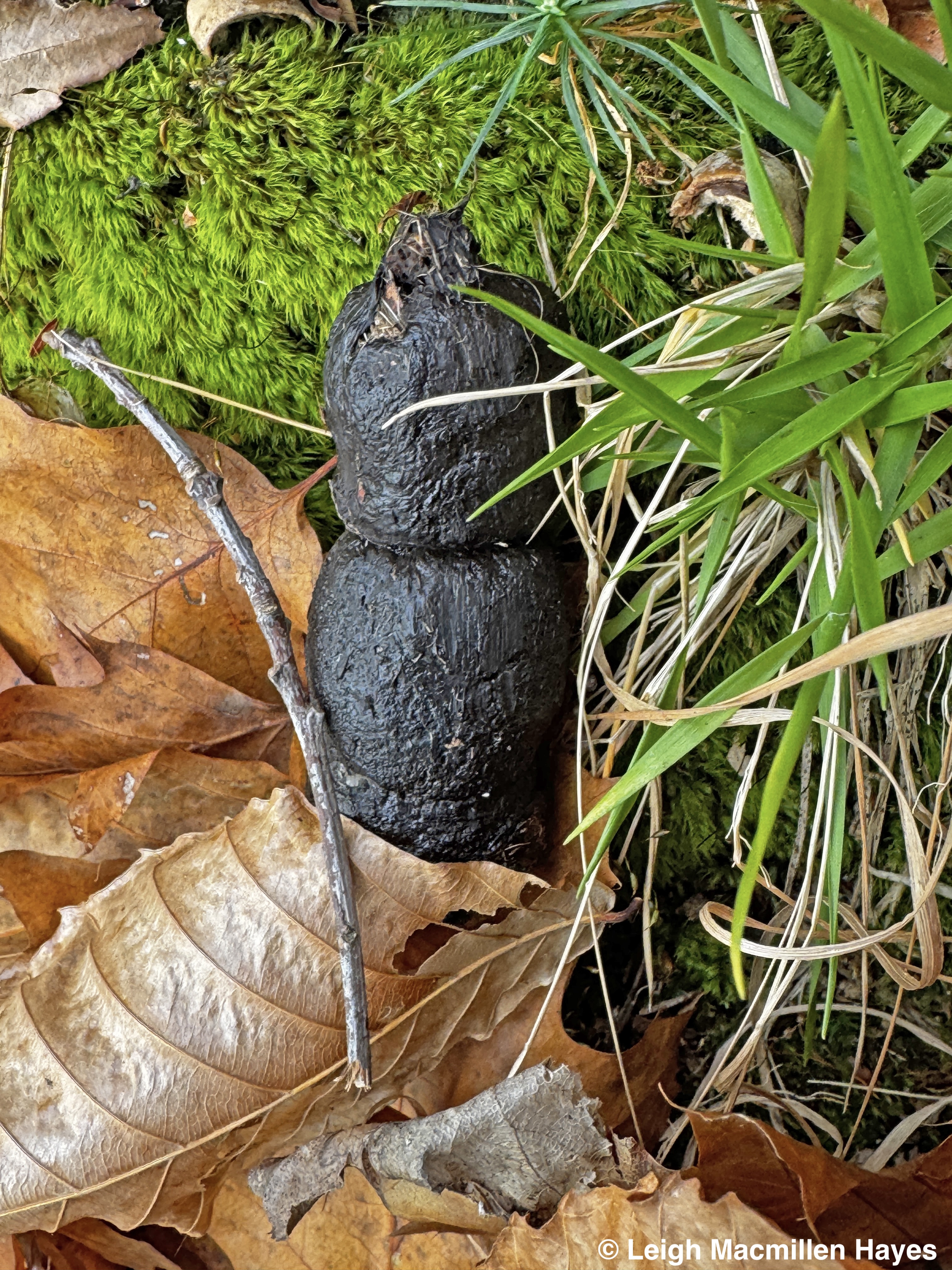
I made sure to look up and down and felt a need to celebrate discoveries, such as this perfectly round Snowshoe Hare scat. Last year there weren’t many hares in this part of the woods, so I can only hope that this year will be different.

Evidence of deer activity was everywhere, from well tramped routes that generations have followed for eternity to freshly rustled up Northern Red Oak leaves indicating a search for acorns to dine upon.

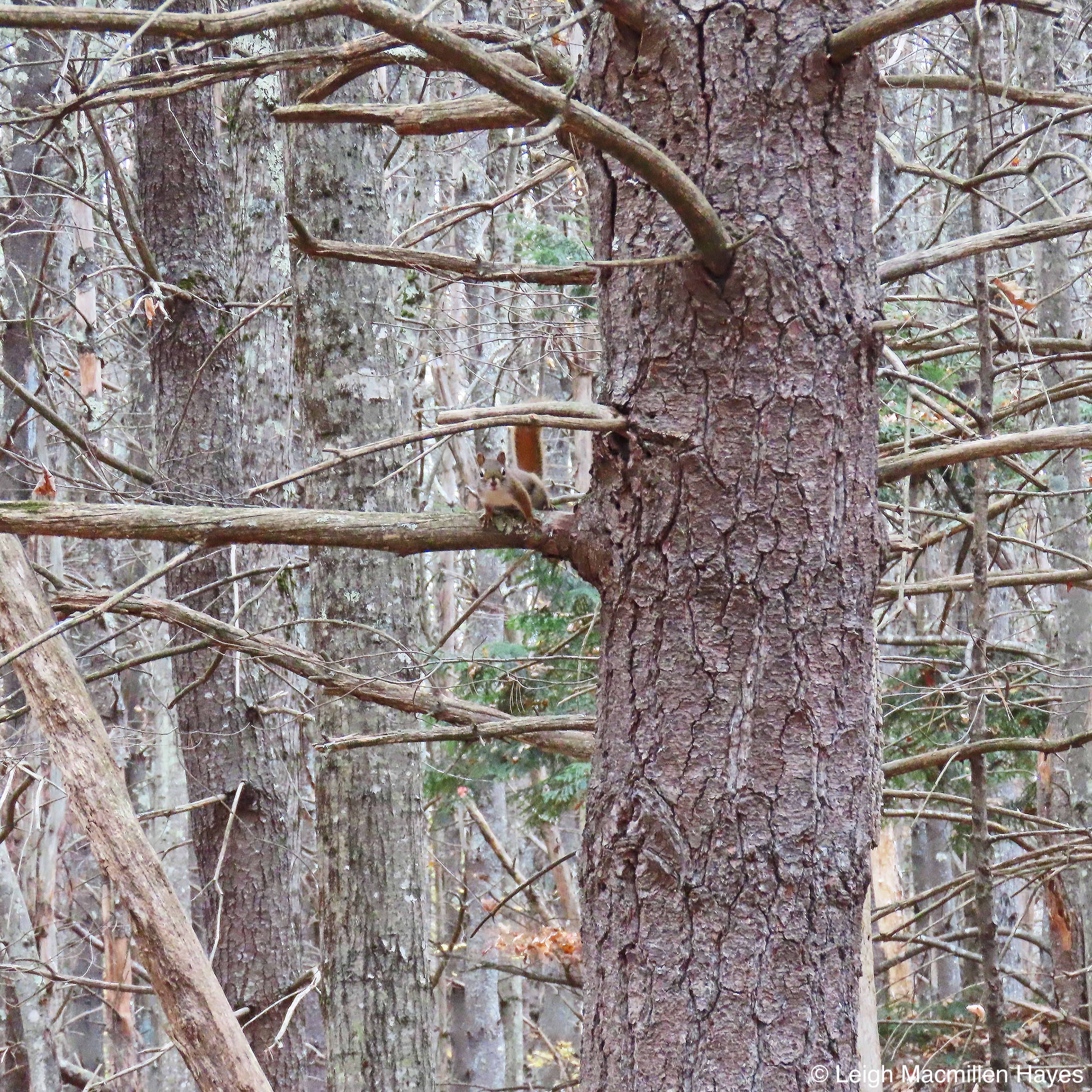
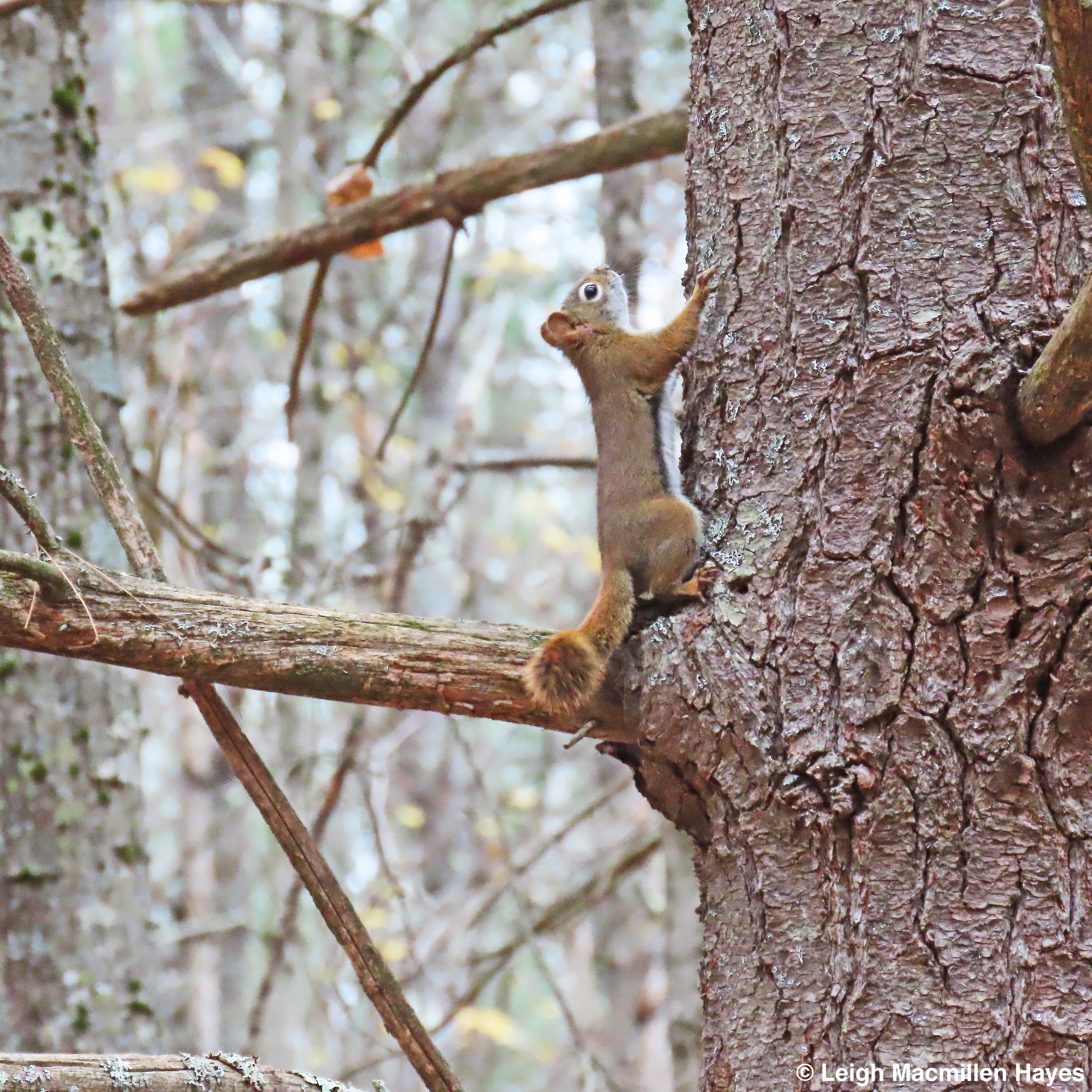
What made me chuckle, however, was the realization that it wasn’t just the deer who were taking advantage of an abundant acorn crop. A squirrel had cached one here and another there–that should serve as a meal for a later day.

After searching for a friend I doubted I’d meet, and I didn’t (Porky is saving our meeting for another day), I stepped out to an old logging road and instead met another I couldn’t recall from previous saunters. Perhaps it was because I was approaching it from a different direction than my norm.

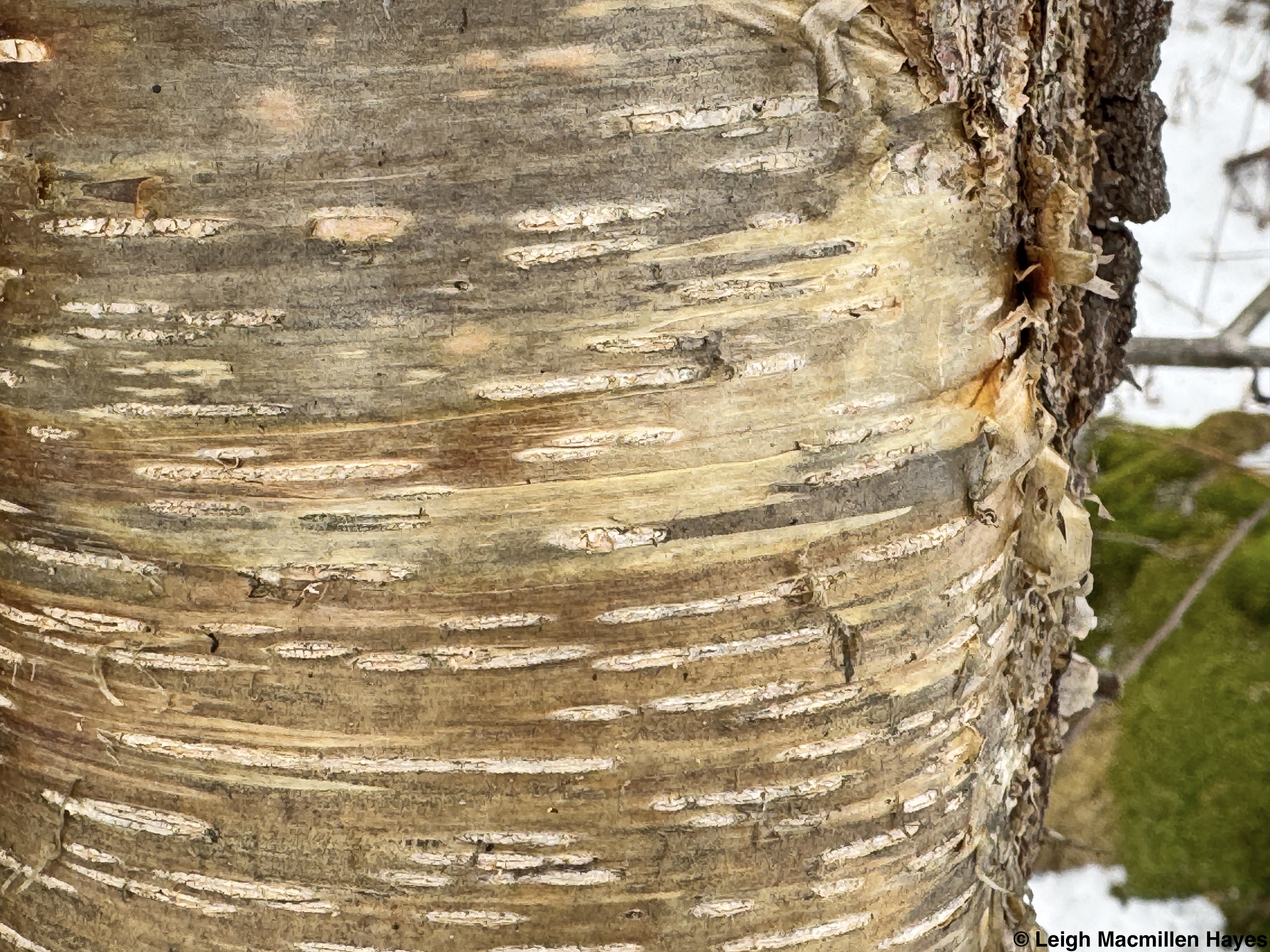
This Yellow Birch has apparently graced this spot on a boulder for many years. And though it looks as if it served as a turning tree during a logging operation about ten years ago, it still stands tall.

In fact, by the amount of catkins at the tips of its branches, it appeared the birch was full of life and love and ready to make more birches in the future.

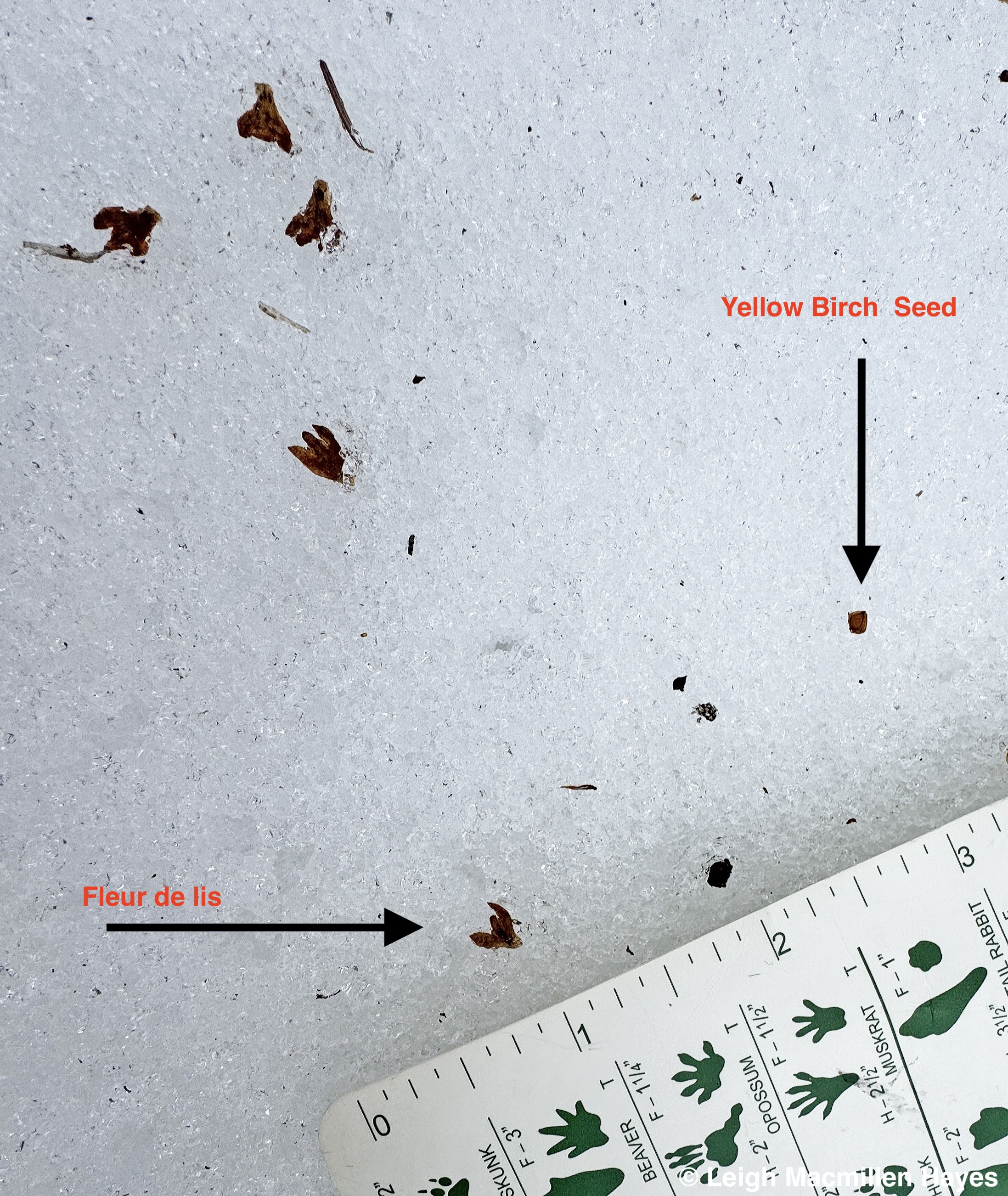
At its feet, fleur de lis scales that protected its tiny seeds had fallen from last year’s pollinated catkins and will eventually break down and add to nutrients to the forest floor.

What I am always wowed by, and today was no different, is the shape of a birch seed–which reminded me of a tiny insect with antennae. A future is stored in that wee structure and maybe this one seed will some day germinate on the boulder below it. Unless a bird eats it first. But then again, maybe it will germinate somewhere else when it comes out in the bird’s scat.

The bark of the birch made me think of landscape paintings I’ve seen from deserts far from this place in western Maine. And I realized I don’t have to go far to travel to other places.

Even as I left the Mother Birch behind, I turned back to see if I could remember it from so many other visits, because certainly it didn’t just appear today. Or did it?

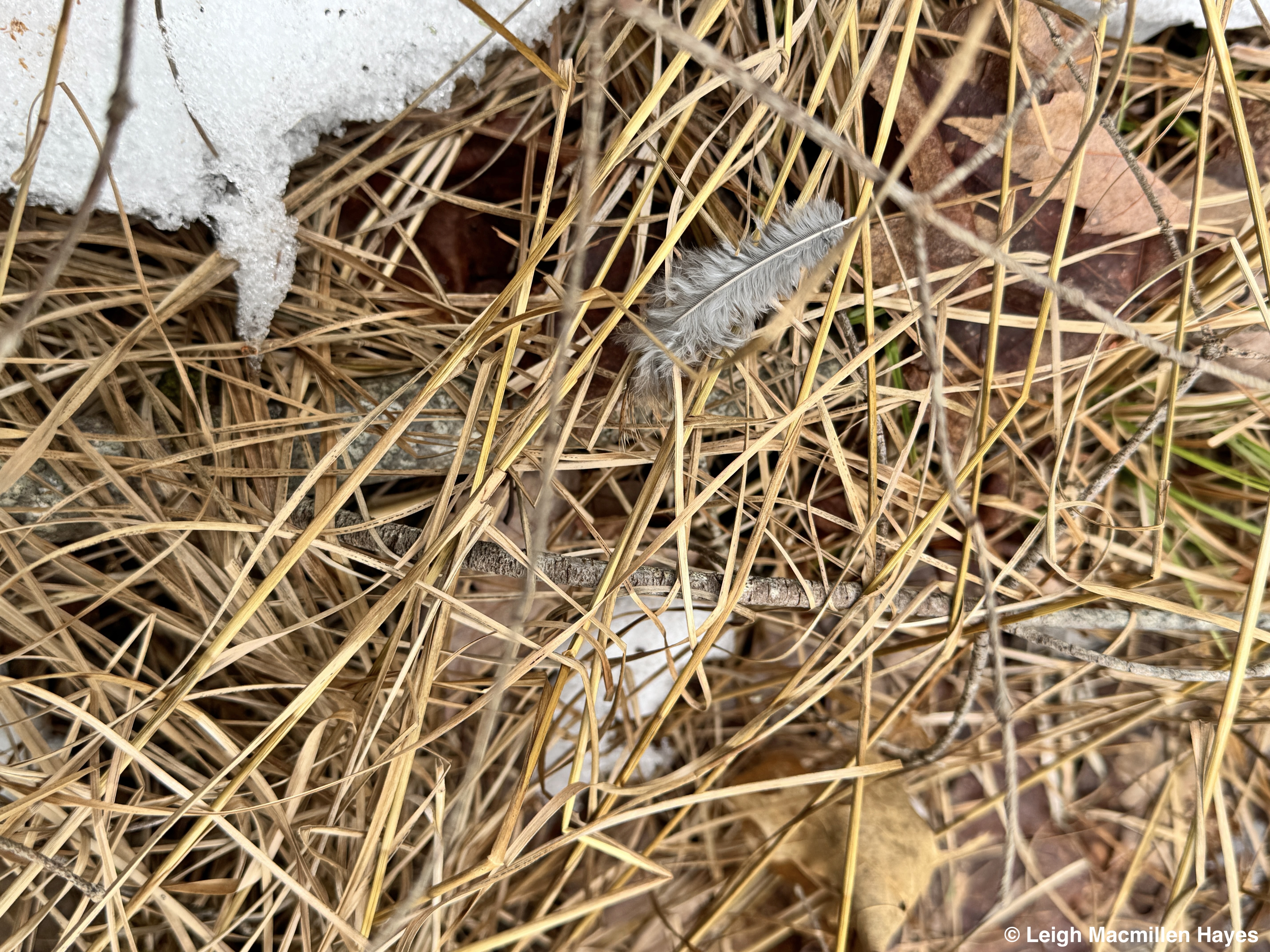
Turning around again, I nearly tripped over a few fallen twigs, but it was what stood out among the dying vegetation covering the twigs that drew my attention. A random feather?

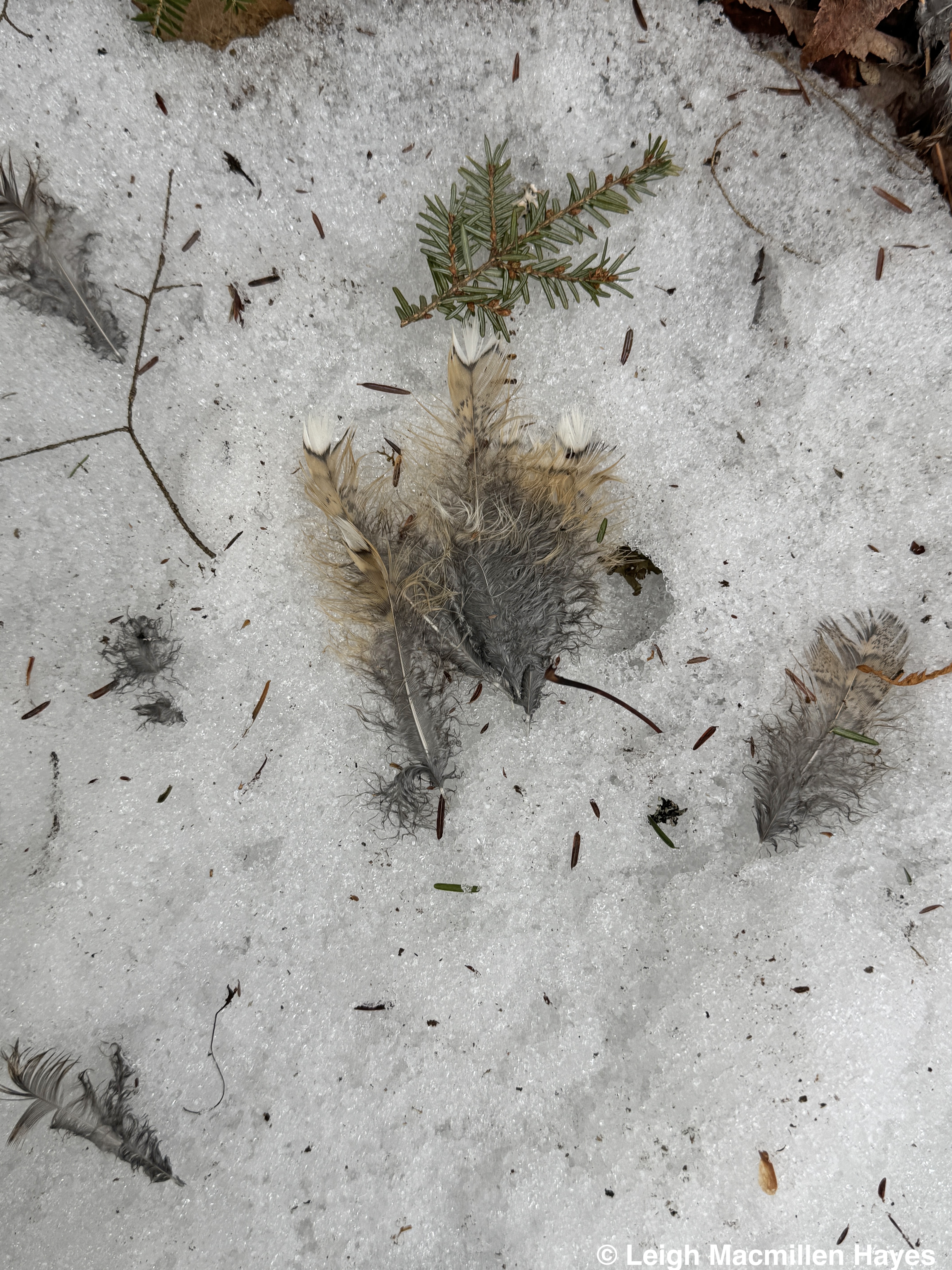
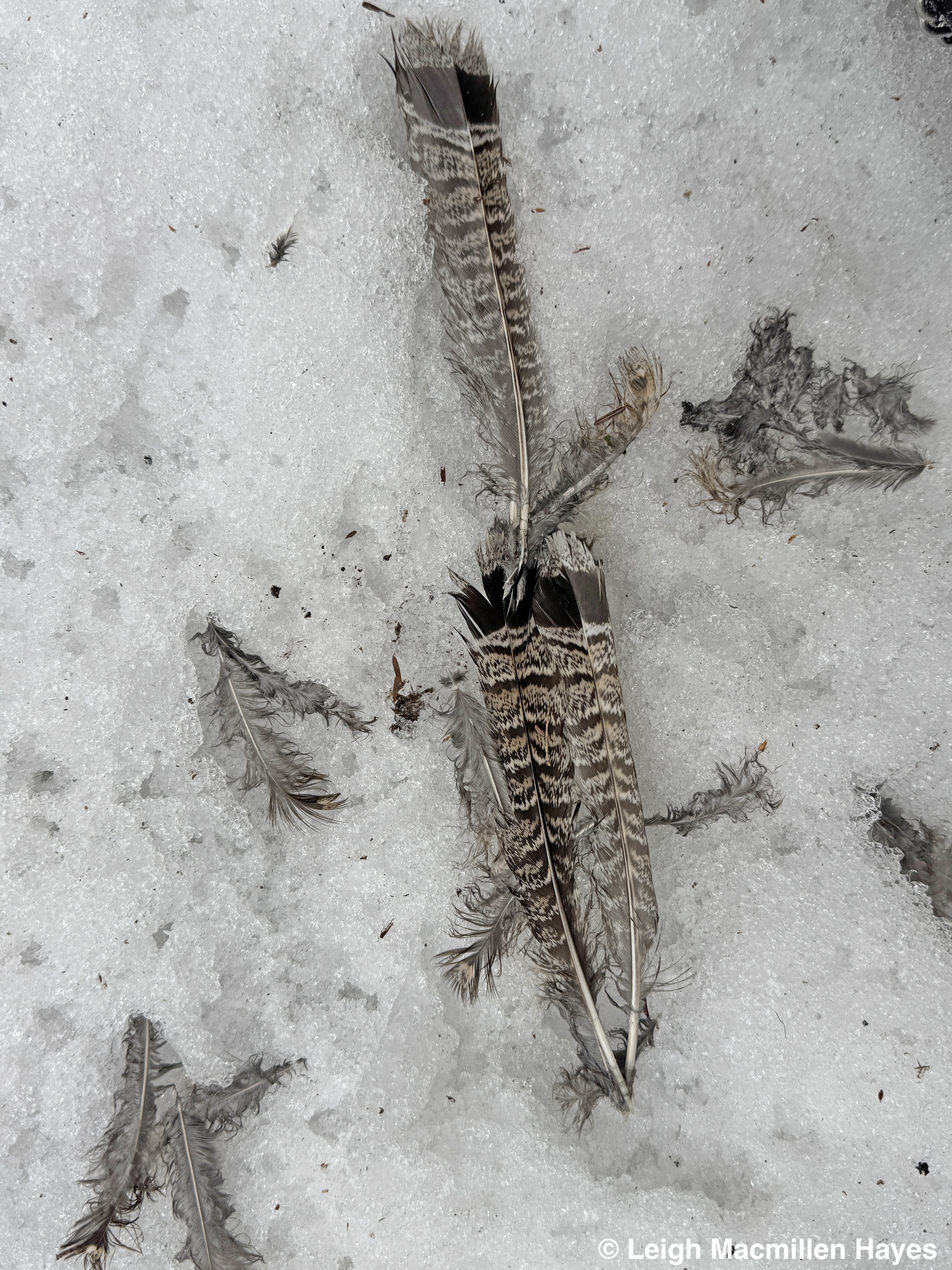
Not at all. I’d stumbled, rather than sauntered, upon a site where a bird had given up its last breath so that another critter could live.

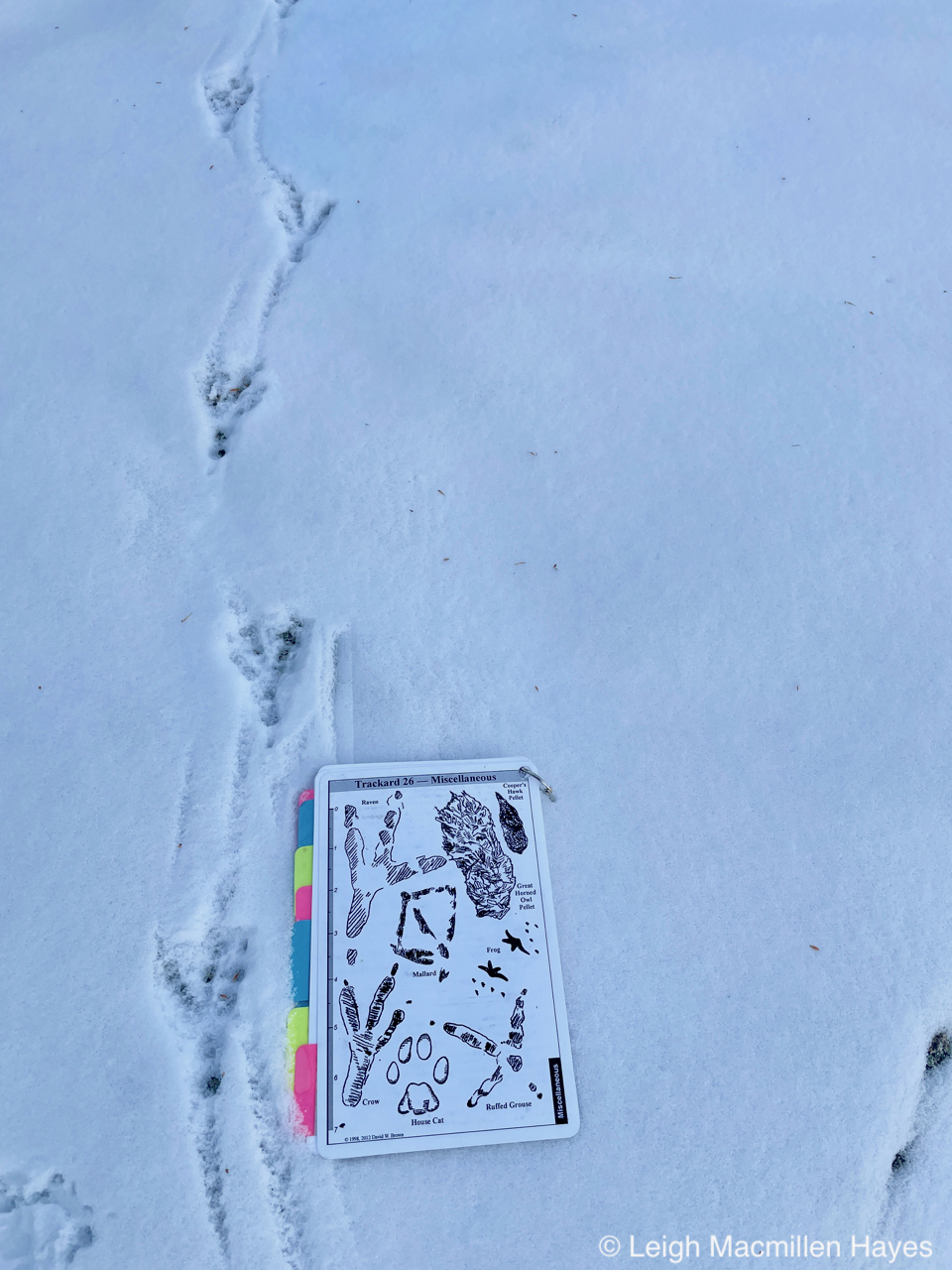
The bird happened to be a Ruffed Grouse, and I had to remind myself not to be sad about the loss because of the joule or energy units procured by another. In its death, sunshine and birch seeds and whatever else the bird had eaten provided sustenance in the form of a gift.

Of course, spotting the Ruffed Grouse’s track did give me pause for I suspected it to be the bird’s last impression.

Moving on toward a former log landing, I smiled again at the sight of another who took a risk of crossing the large forest opening, but knew enough to tunnel under the snow frequently. Was it frequently enough? Voles are everyone’s favorite food. Well, maybe not mine. But I’ve possibly eaten meat from some critter that dined on a vole and so maybe some of its joule had been passed on to me as well.

Frequently on my journey, as often happens in these woods, I encountered the one who greeted me at the start. Well, its footprints greeted me at least. But I always give thanks for such sightings for though Bobcats are solitary and elusive, knowing they are here and that we walk in the same woods and perhaps see and smell the same things makes me happy.

And then it occurred to me. I need to be more like the Bobcat and improve my waiting and watching and listening skills. I’m always in too much of a rush to see what might be next on the agenda. So much for sauntering.

As this last day of autumn 2024 gives way in the wee hours of December 21 to winter, and the sun once again rises in the East, I need to remember to be more like the saunterers. To be alert to offerings. To wait. To watch. To wonder. To learn.

Each day is a new awakening with teachings. Thank God for that.

The Inside Out Porcupine

This story begins at about 5:10am on November 5th. I awoke to a noise that immediately became plural–and the ruckus sounded like it was taking place in the barn that is attached to our old farmhouse. For about fifteen minutes things shifted and banged and dropped, and then all was silent. My Guy slept through it all.

At lunch time, however, he did as I asked, and climbed to the hay loft to find out what had happened. And that’s when he discovered that I really did hear things dropping, for the myriad trophies our sons “earned” years ago for soccer, and peewee football, and golf, and baseball, and basketball, and hockey, and Pinewood Derbies, and who knows what else, were astray.

I’m going to digress for a minute or two, but really, it was the more creative trophies they received that I like the best like these from Boy Scout Cake Bakes.

And this one for being the king of Nordic Ski Team ski waxing.

Now back to the barn: As My Guy poked around, and there’s a lot of stuff up there right now because we’ve torn up the floor boards on the first level in anticipation of saving the structure and making it safe to park a vehicle in there again, he made a discovery and quickly sent me a photo because I wasn’t home.

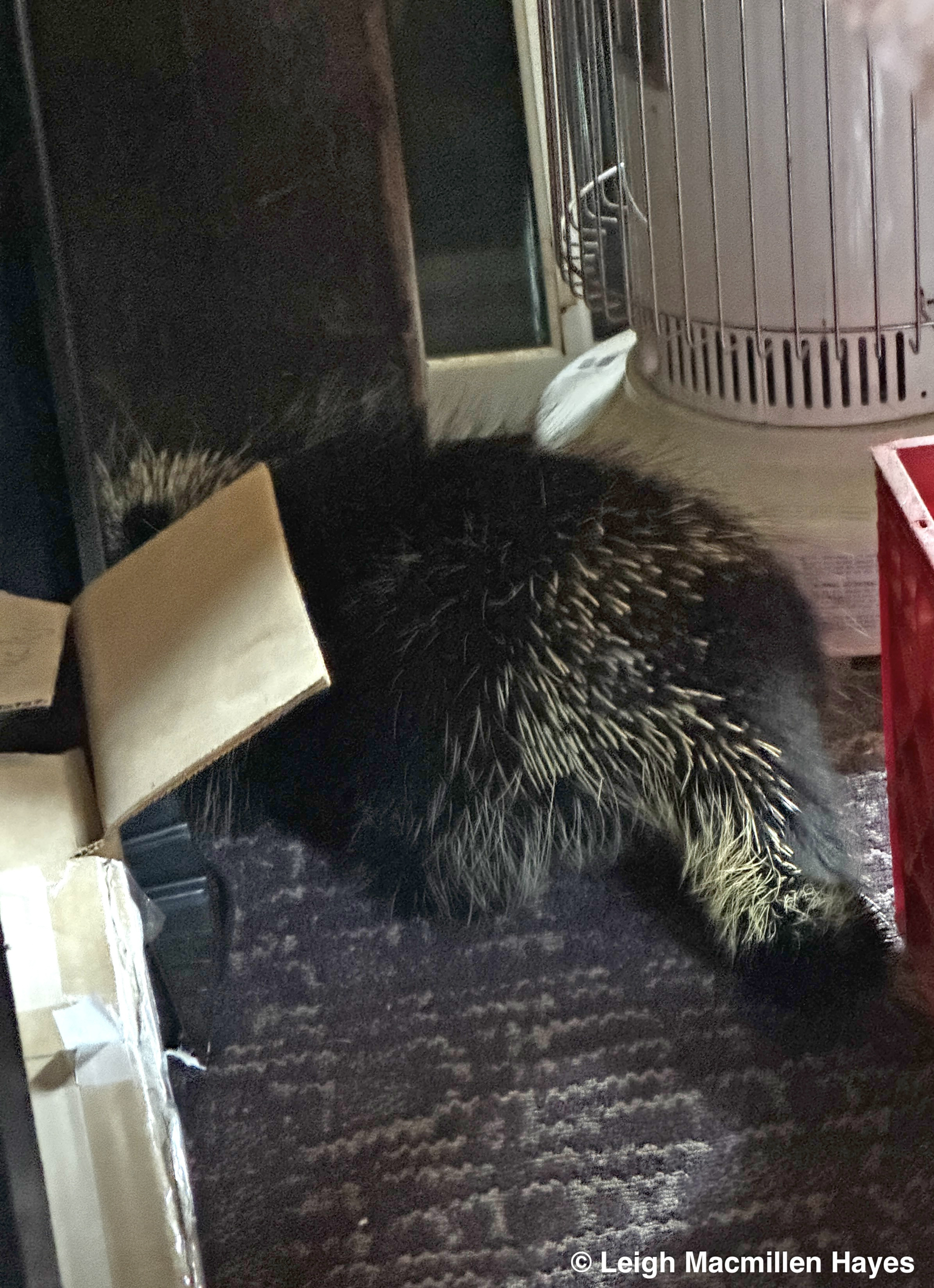
A porcupine was snoozing under the Air Hockey table!

We set a trap that I hoped the critter would evade. And it did. My Guy also made quite a lot of noise the next day and saw Porky move from under the table to below a chair. And then he couldn’t find it.

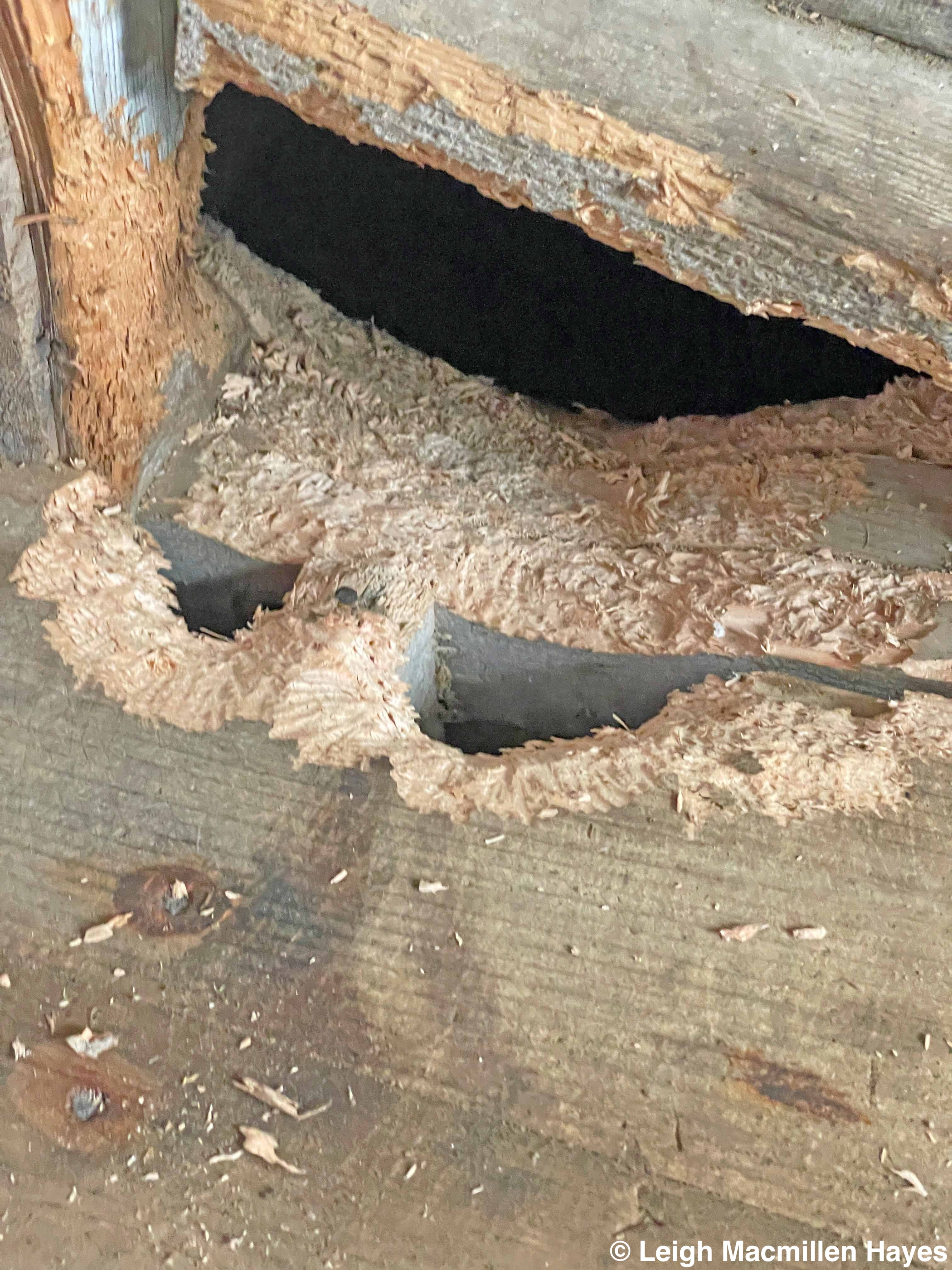
Checking on the situation again a day or so later, we discovered Porky had indeed done some work–beginning with chewing the window and sill.

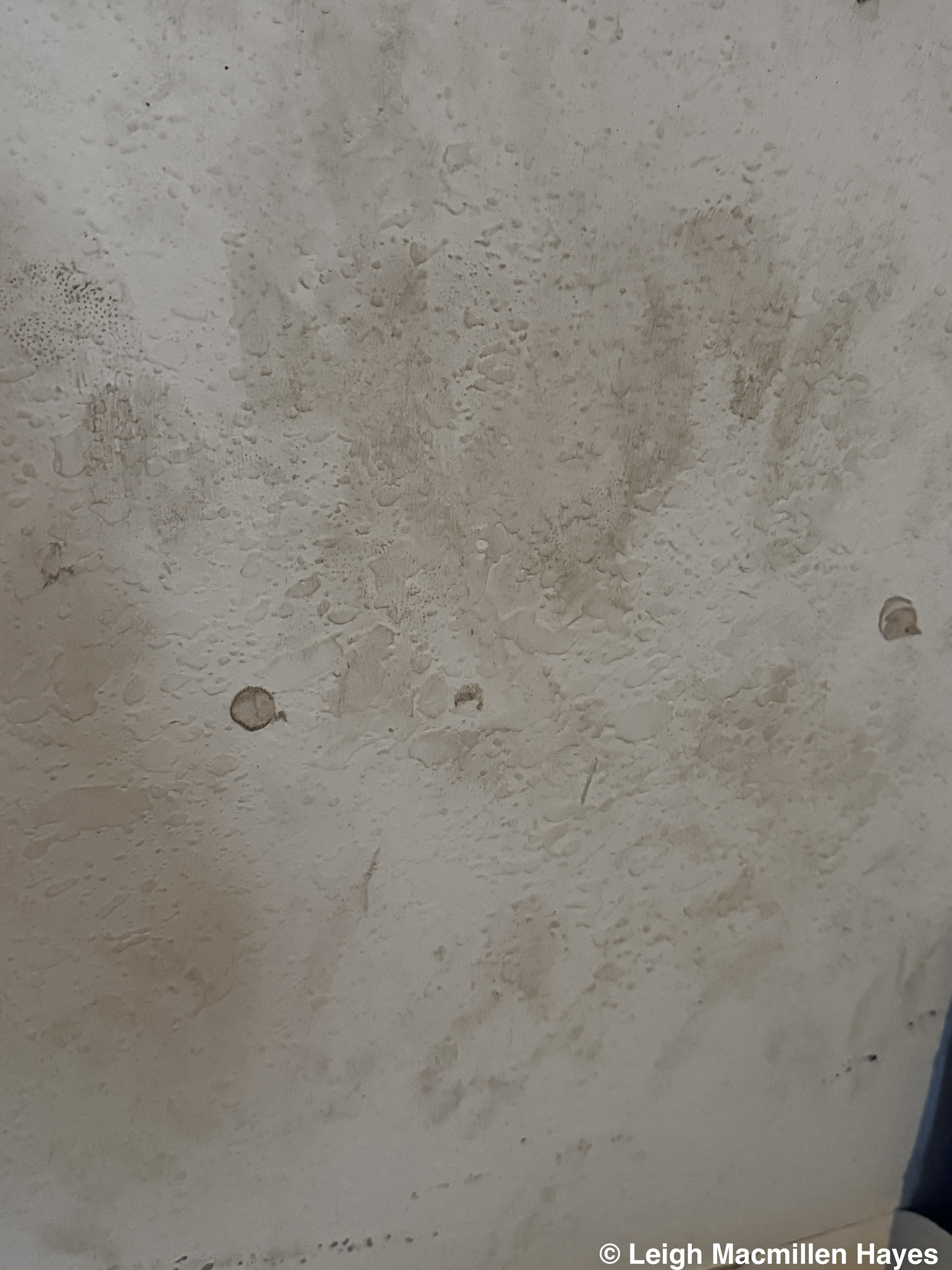
And he left signs of his adventures, including muddyish footprints on the wall below the window.

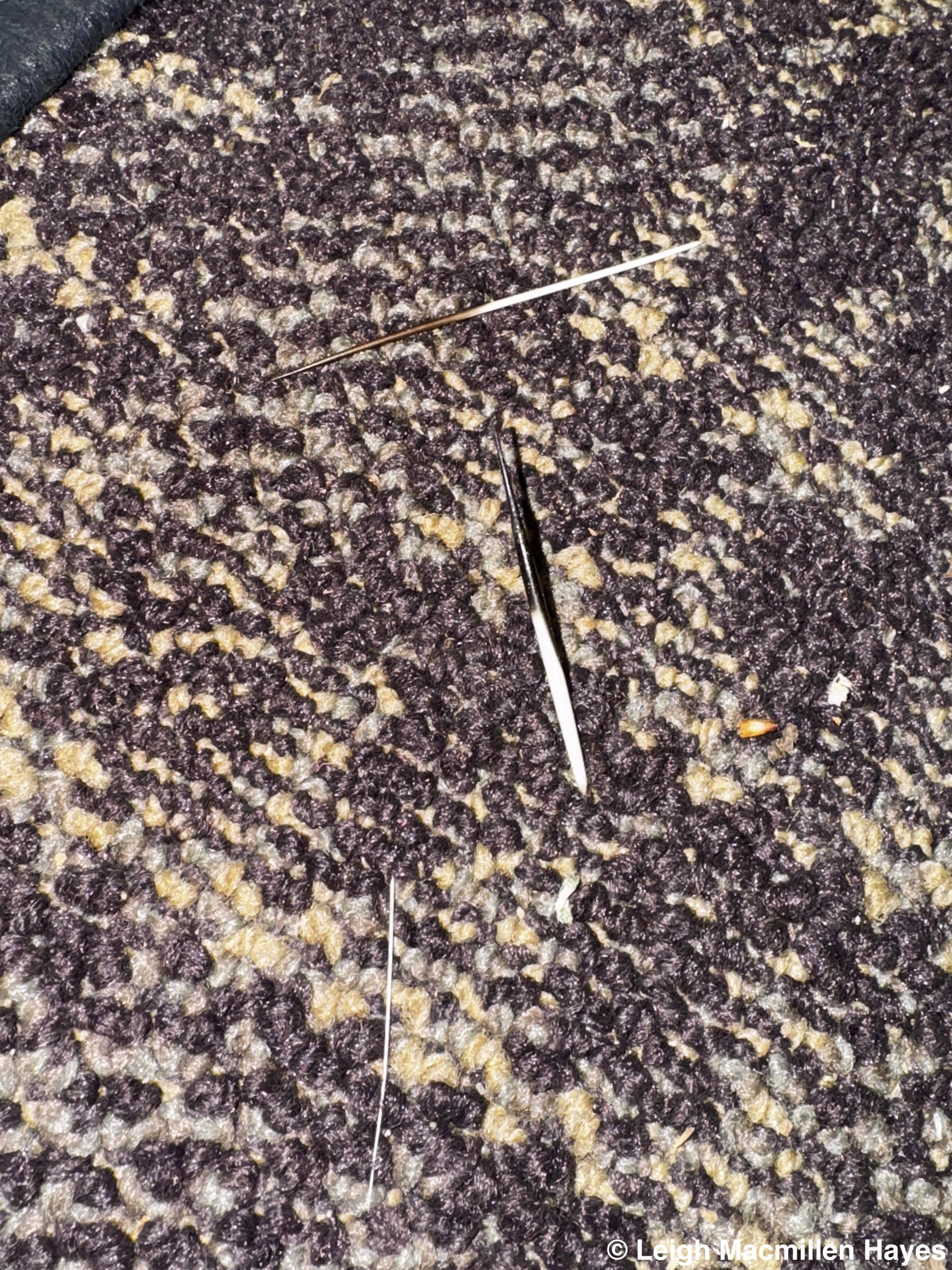
And quills scattered about, some even sticking into the rug originally placed because this had been a Rec Room back in the day when our sons were young. Right now it’s a Wreck Room!
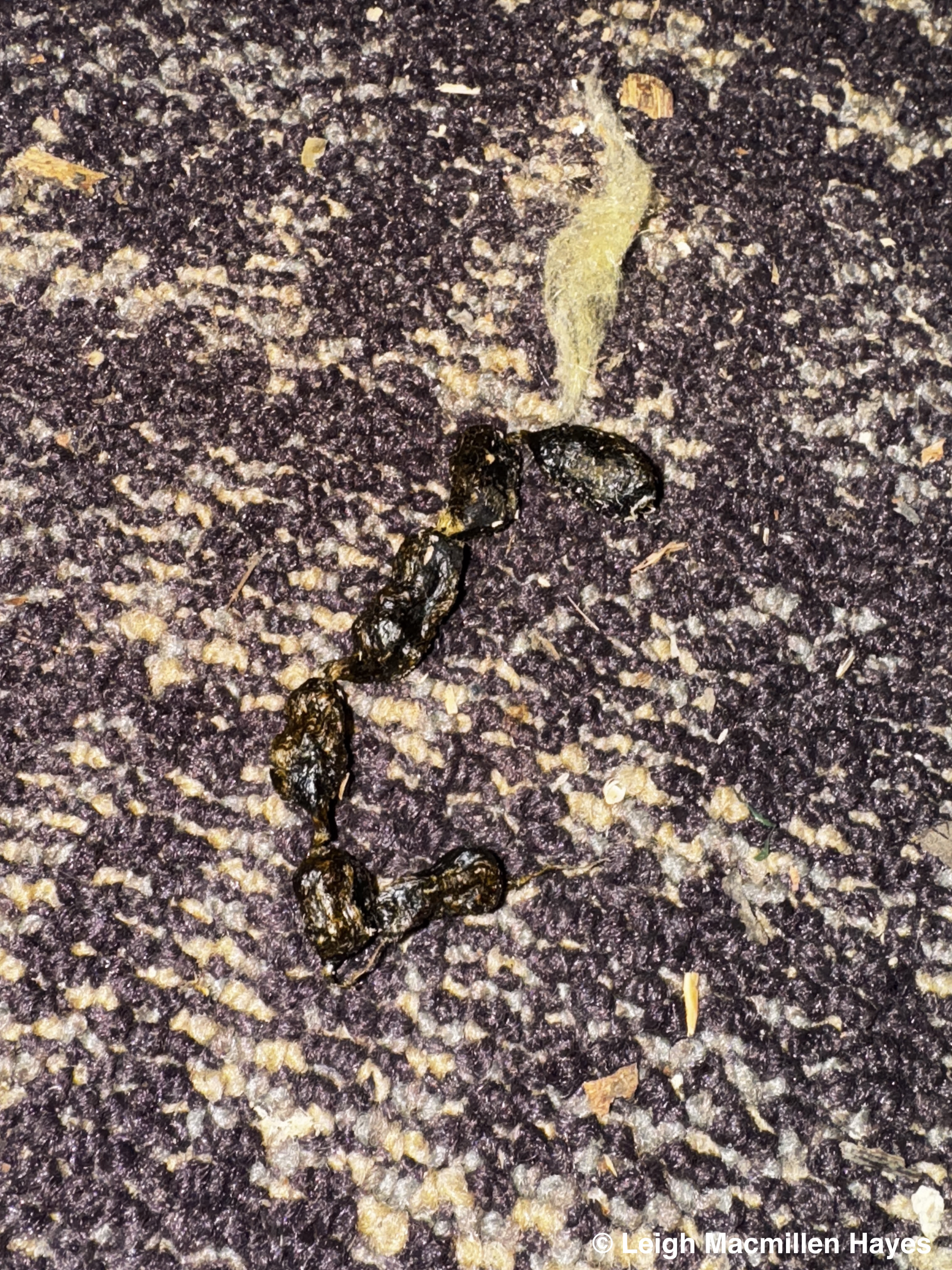
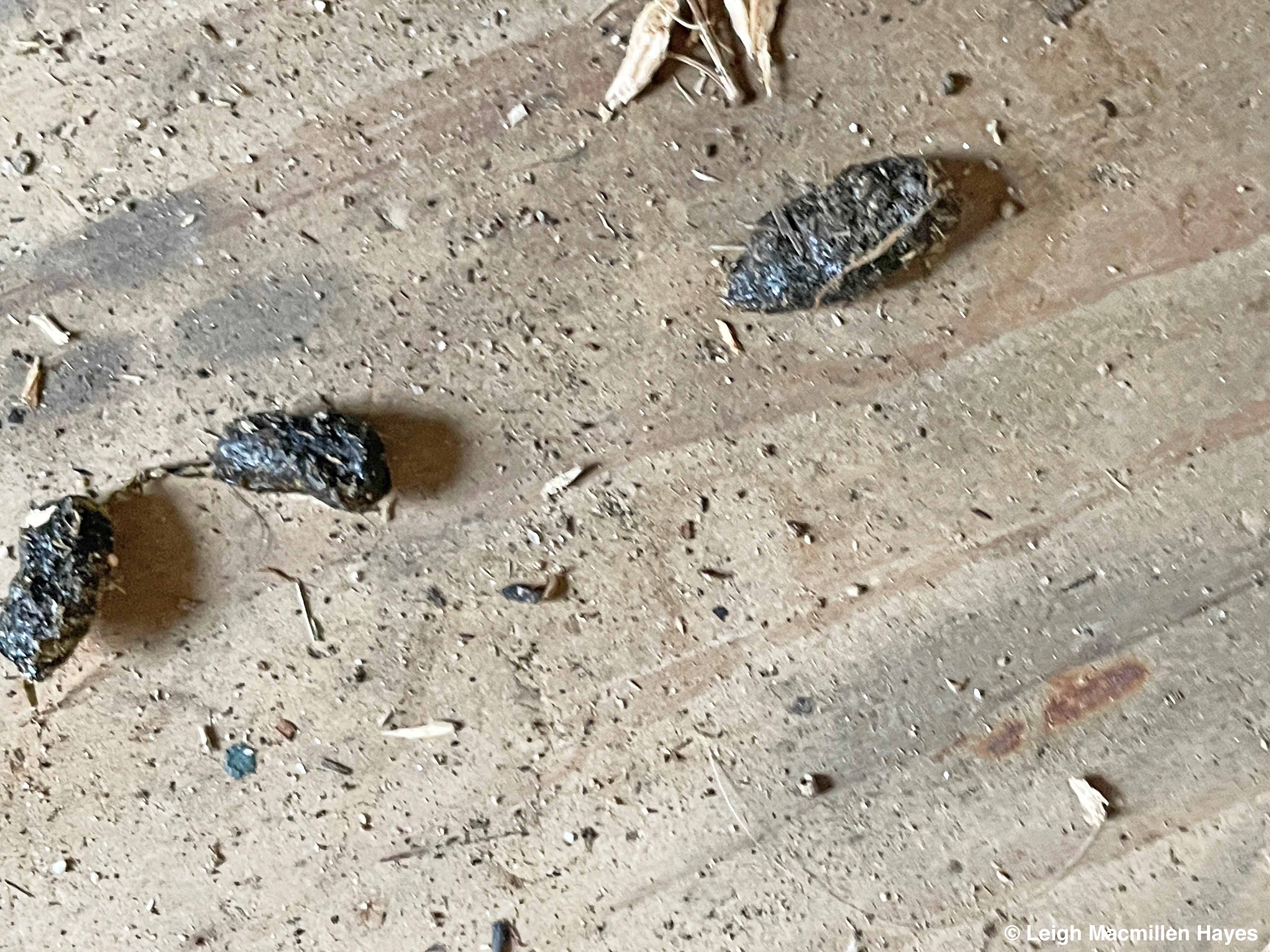
Was there scat? Yes, but not nearly as much as expected, and I could track his movements.

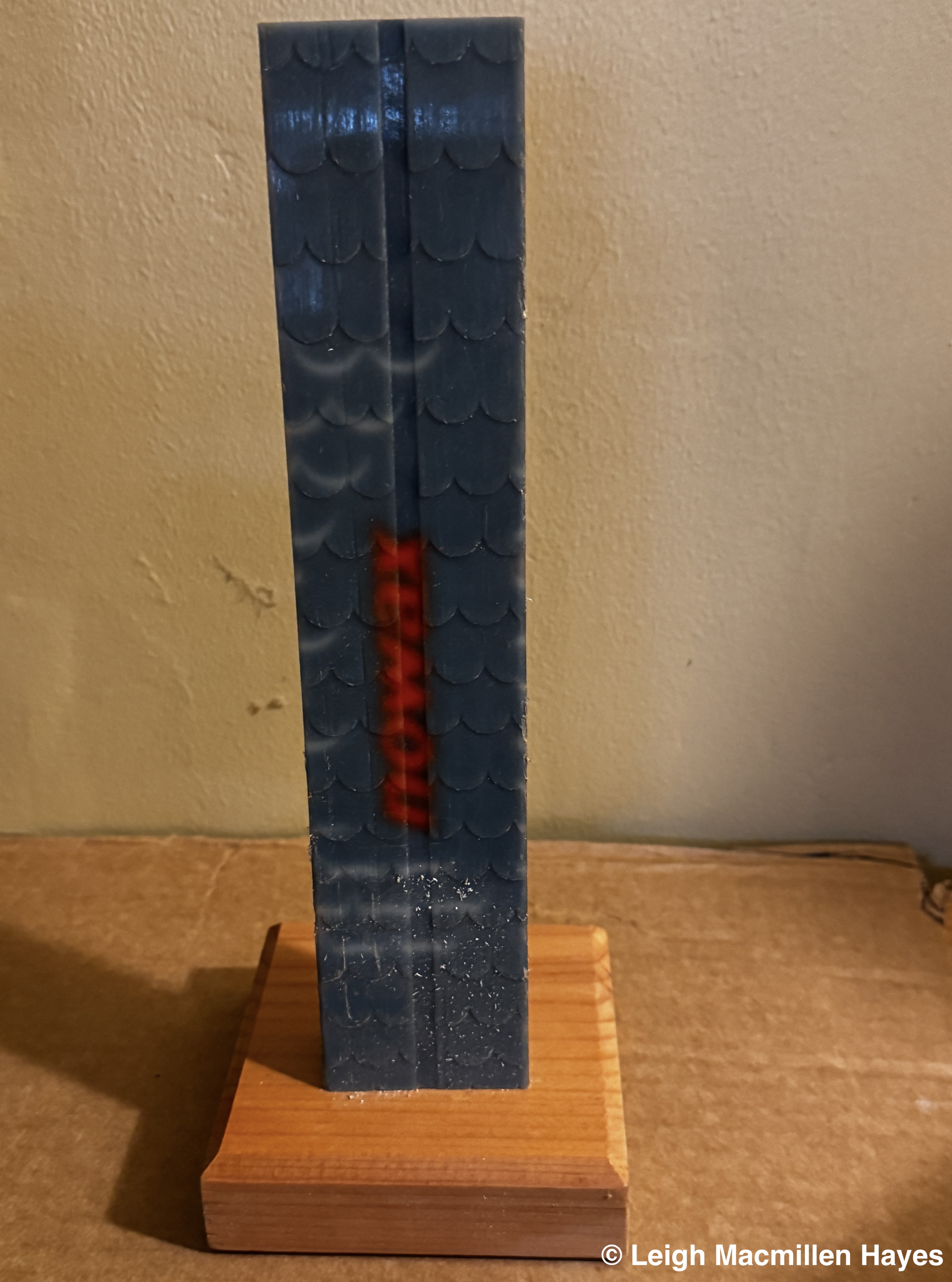
Today, I was out there looking for more evidence. So . . . I have a rather extensive collection of tree cookies and twigs and even some branches–all for teaching purposes, including this particular piece of a sapling I’d carried down a mountain because it was in the way on a trail, but deserved to be saved for it features a moose scrape.

But even better than that, this afternoon I noted some wood chips and scat below it and realized Porky had taken some samples.

I love how I can get a sense of the size of his teeth with the work that he did.

And I’m surprised but happy to announce that he didn’t touch any of the other samples stored up there.

I decided to follow his trail and found a few scat specimens on the stairs, and others along beams that are right now uncovered given the first floor changes planned for later this week.

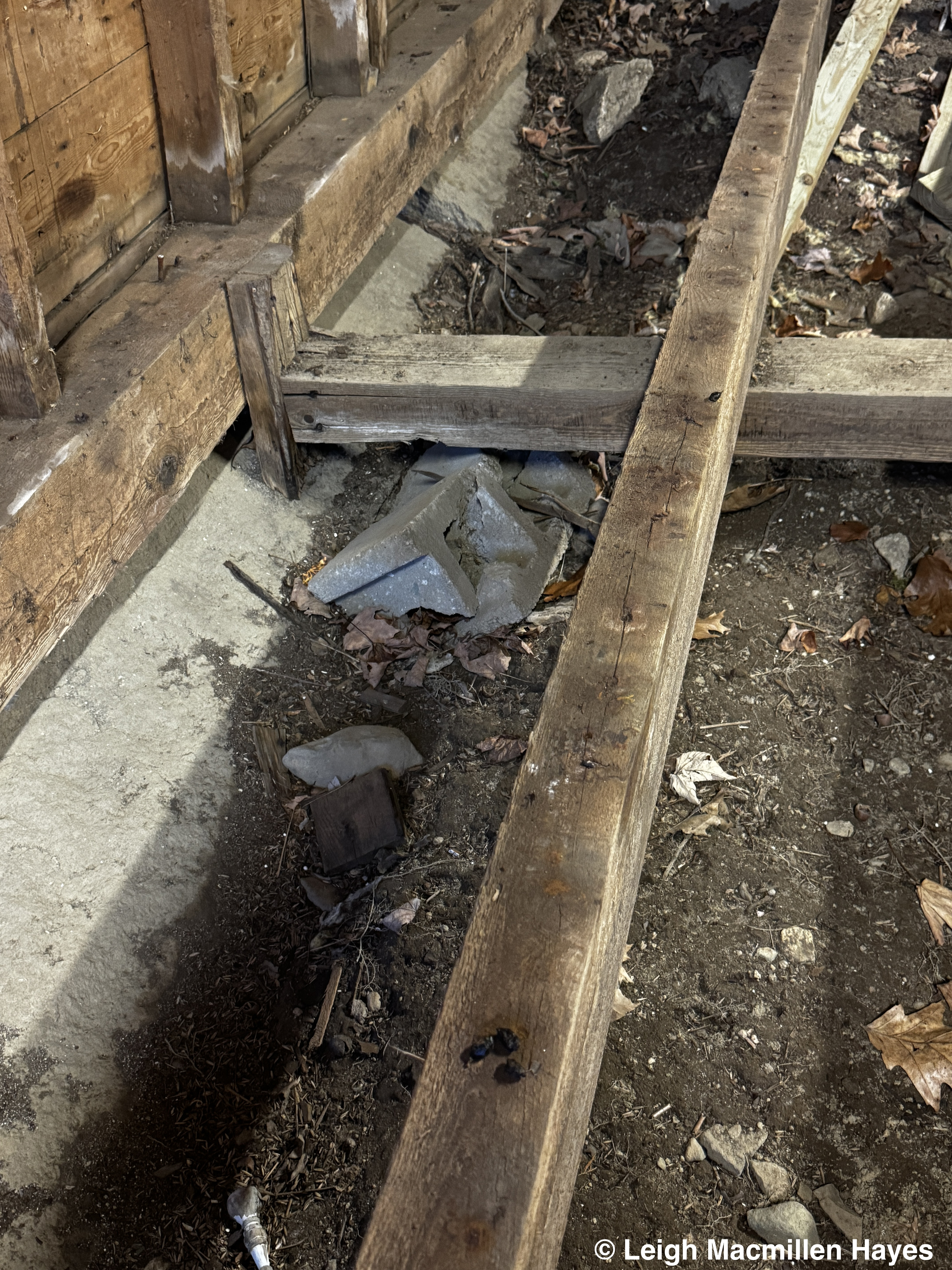
The question I haven’t answered yet and I suspect its because leaves have blown in and covered any evidence: which entrance did he use?

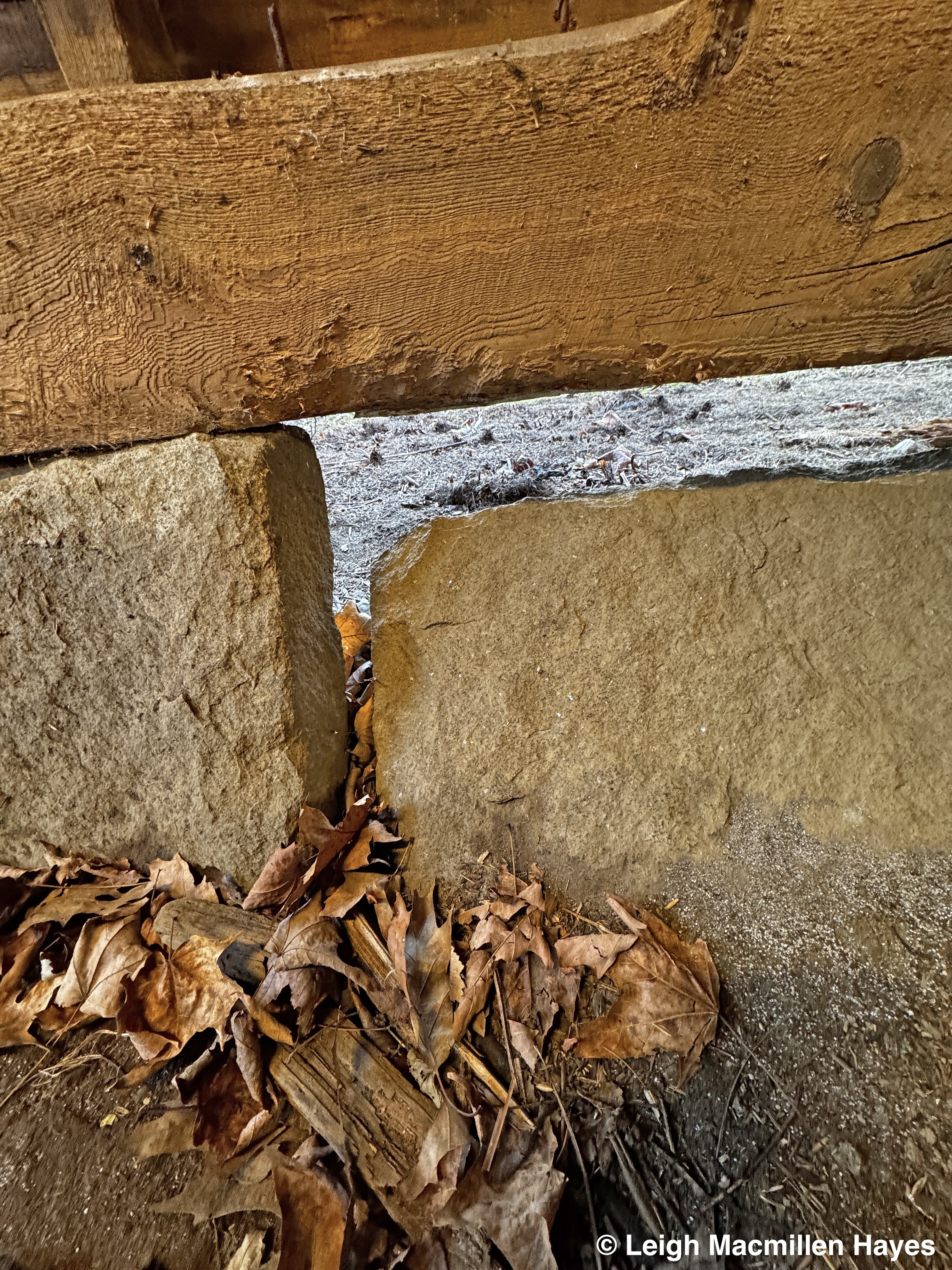
This is one he’s used for the past several winters. Okay, truth be told, we’ve owned this property for over 30 years and have housed a porcupine (and raccoons and woodchucks and opossums and anyone else) for all of those years. They used to have a different entrance, but we made some changes four years ago that forced them to find a new way into their abode.

If you look at the bottom of the beam, you can see where Porky has worked in the past to enlarge this hole over the split granite.

And just last year, he started another between the barn and an attached shed.

With all those years of co-existing, I was sure we’d find far more damage when we removed the floor boards. But . . . we did not. What we did find: Eight, yes eight, suet feeders that had disappeared over the years and I always suspected the raccoons had taken them under the barn because I couldn’t locate them in the yard, field, or woods.

All I can think is that Porky was sated when he entered and didn’t need to gnaw on the wood.

The funny thing about the latest Porky adventure, is that it could have been prevented if we’d thought to close the trap door at the top of the stairs. It took us a day or two to realize this and I feared that Porky would stay up there forever, given that he had plenty of wood to eat and a rather snug place to sleep with the only predators being us.

That said, the trap door does get closed now. And there is no new evidence of a visitation by my favorite rodent. And we didn’t trap him afterall. And he’s still in the woods somewhere. And I can’t wait to meet him–just outside, not in.

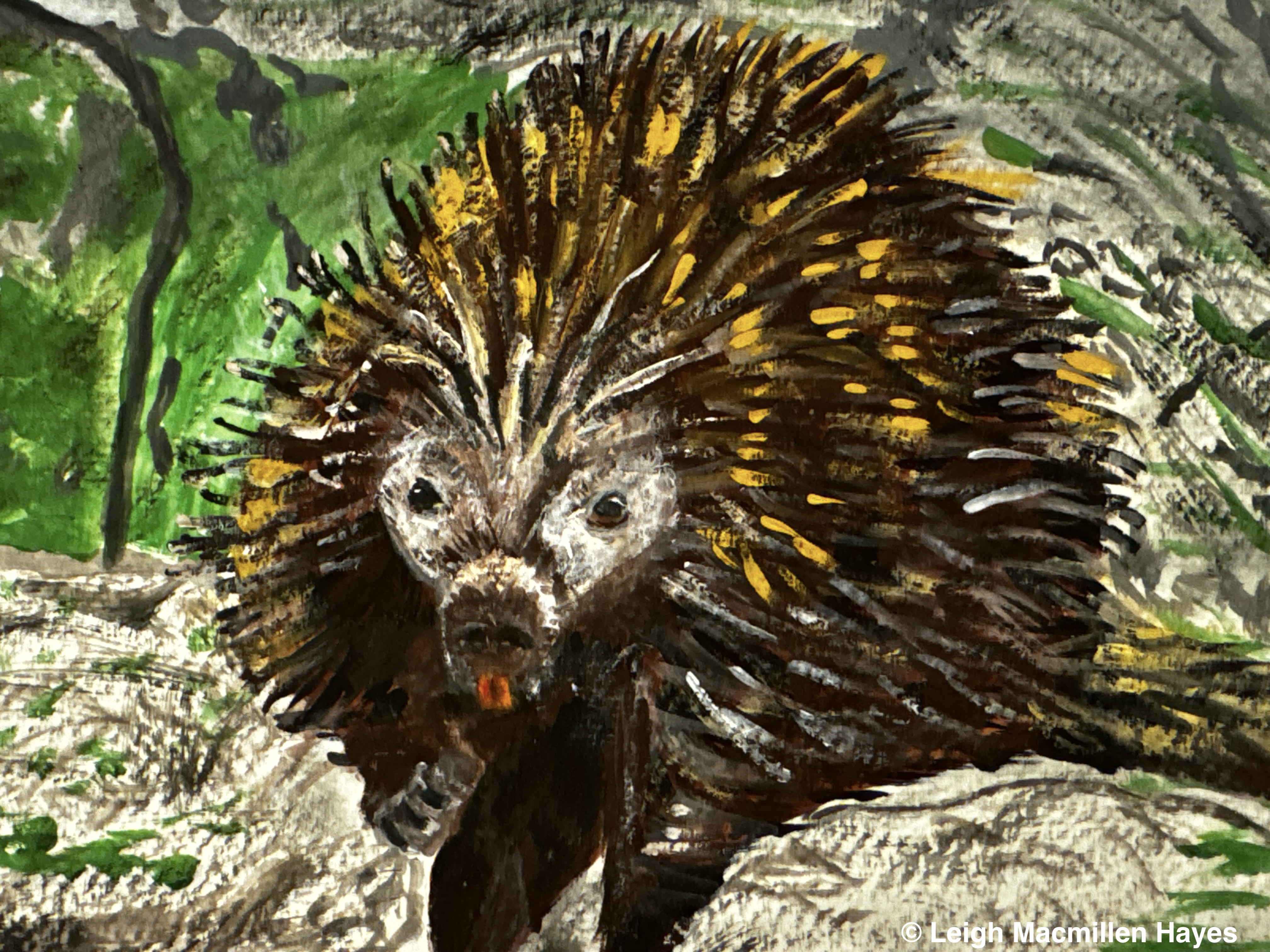
And when I do, I’ll be curious to see if it’s my old friend Bandit, for he and I met behind the barn last November and I’ve since honored him with a painting.

Here’s hoping the Inside Out Porcupine stays outside going forward. I’ll be looking for him.

A Squirrel’s Garden

A lot has happened this week on many different fronts, both personal and public, both positive and not so, some comical (like the porcupine that awoke me one morning because it had managed to climb to the second floor of the barn and toppled our sons’ many “earned” trophies) and others more serious, with some in between thrown into the mix, cuze life happens.

To that end, some of my best moments were spent looking and wondering. In the woods. Of course. In our woods, in particular.

I headed out onto the old cowpath in search of a dear friend, not certain if I’d meet him or at least spot signs of his passing. And it wasn’t a deer I was looking for–although, in a way it was because I haven’t seen a single one in several months and any scat along this trail is from last winter and spring and at that time it was so prevalent that with every step I took, it was there.

No, it was this little guy that I sought. This photo is from last winter when he and I spent hours eyeing each other.

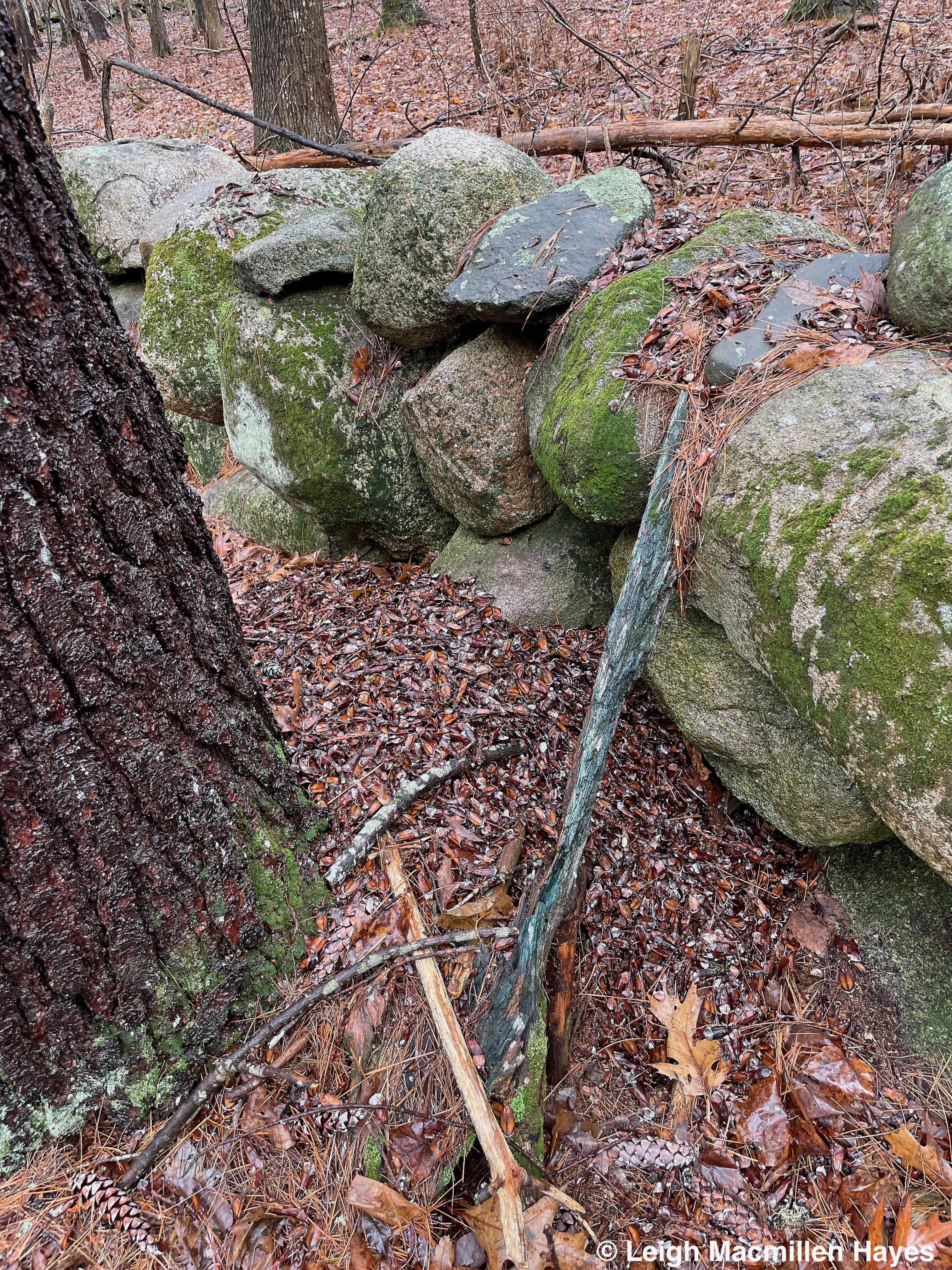
Though his territory could have been several acres and there’s plenty of land out there to inhabit, he, like me, preferred the cowpath, and especially the stone walls since they served as perfect spots to cache his immense supply of pine cones, and as dining room tables, the better to see any approaching predators.

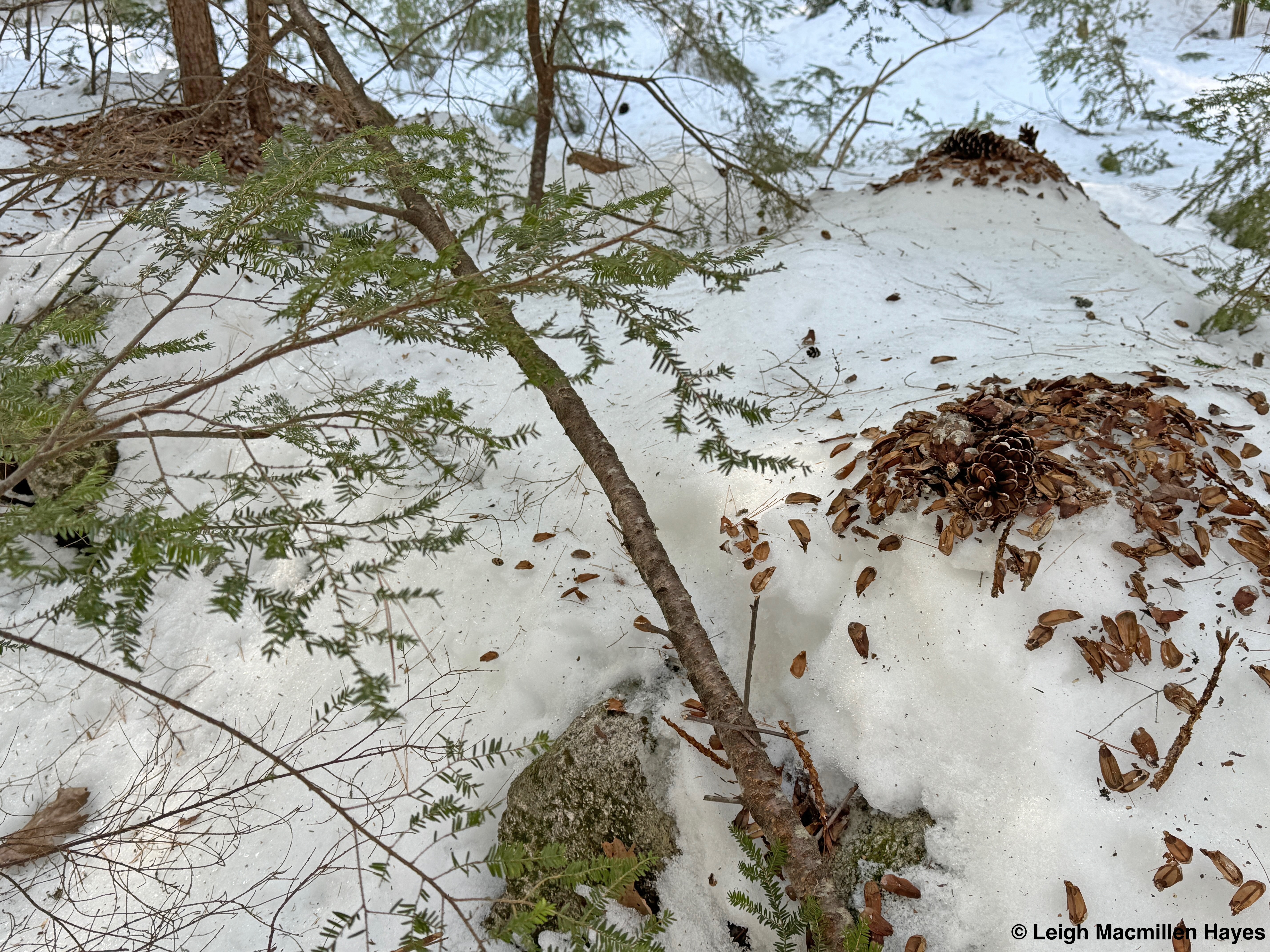
What he sought were the tiny winged seeds, tucked into each protective scale by the twos. If you’ve ever had the joy of watching him munch, you’ll know it’s fast paced as he deftly pulls the seeds out and discards the scales, getting right down to the “cob” of the cone.

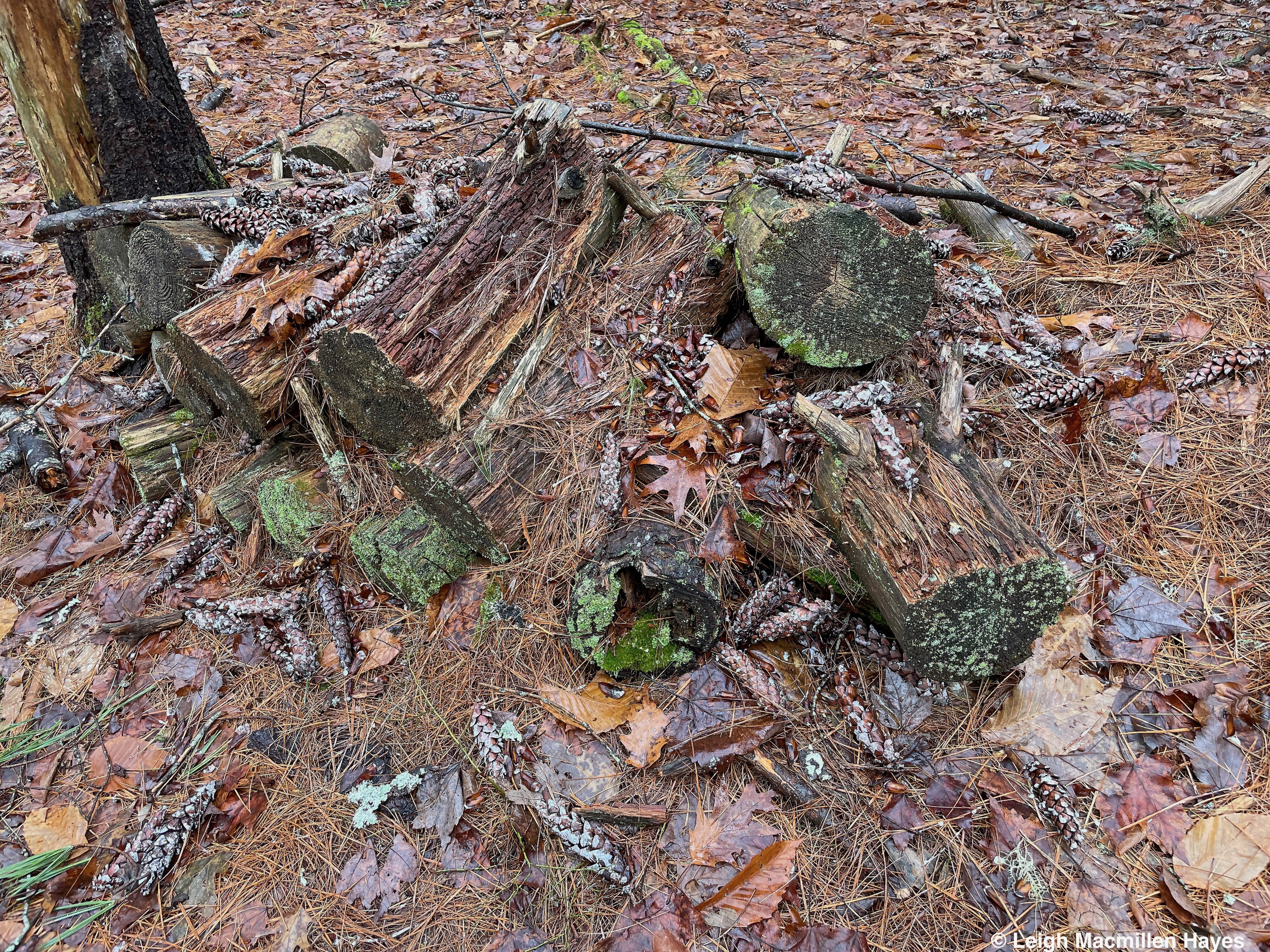
The result is a pile of half consumed scales and a few uneaten seeds and cones not quite yet opened and some scat and its all known as a midden (by us humans anyway) or the trash barrel.

Actually, any high place will do and if it has nooks and crannies to serve as storage shelves all the better. Last year was a mast year for the White Pines in our woods. It takes two years for a pine cone of this species to reach maturity.

This year, there are only remnants of Red’s garbage pails and even they are almost hidden by twigs and leaves and needles.

But, while I was exploring his old neighborhood, I discovered something else in this pile that he had used for refrigeration and dining purposes.

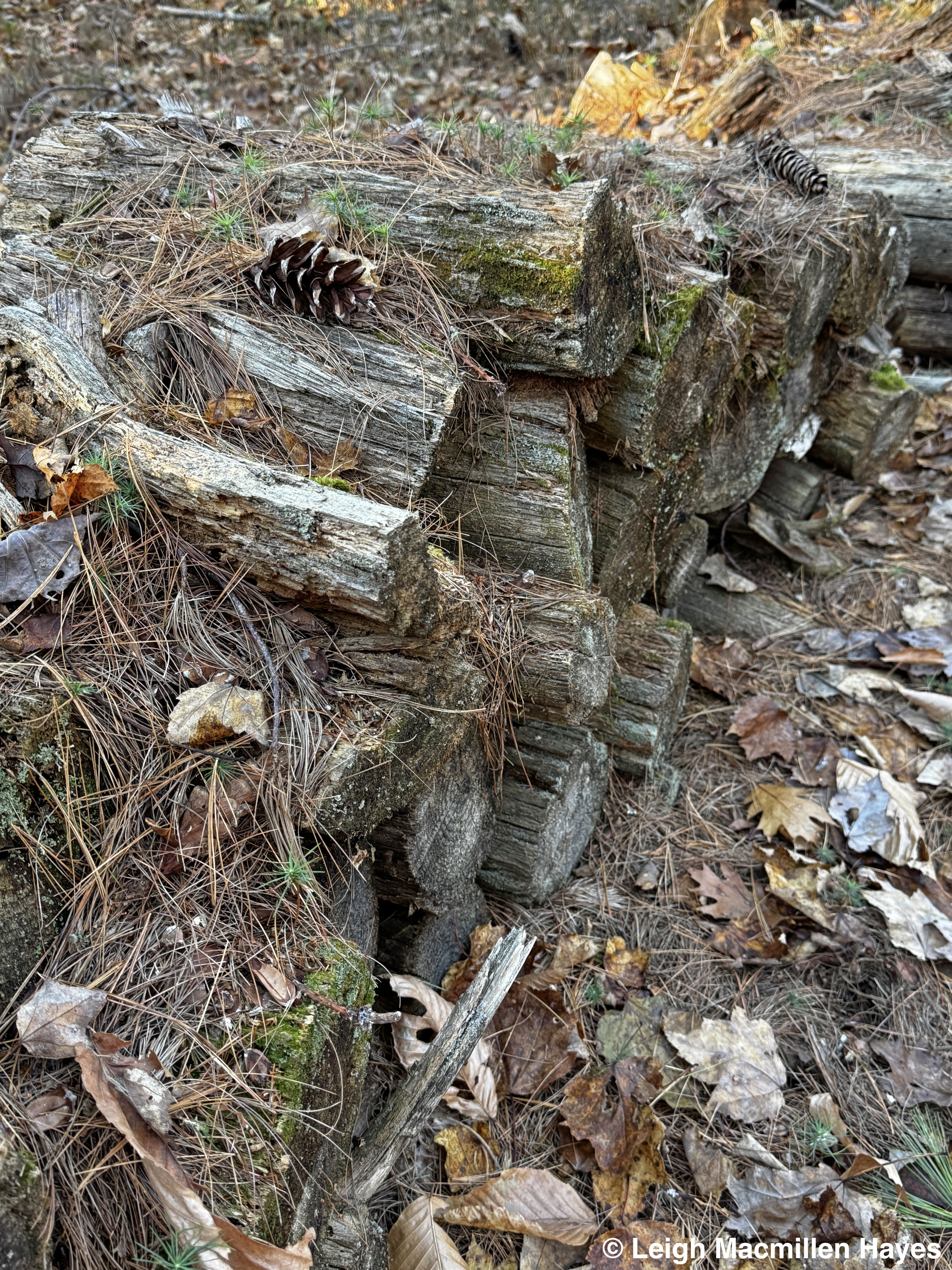
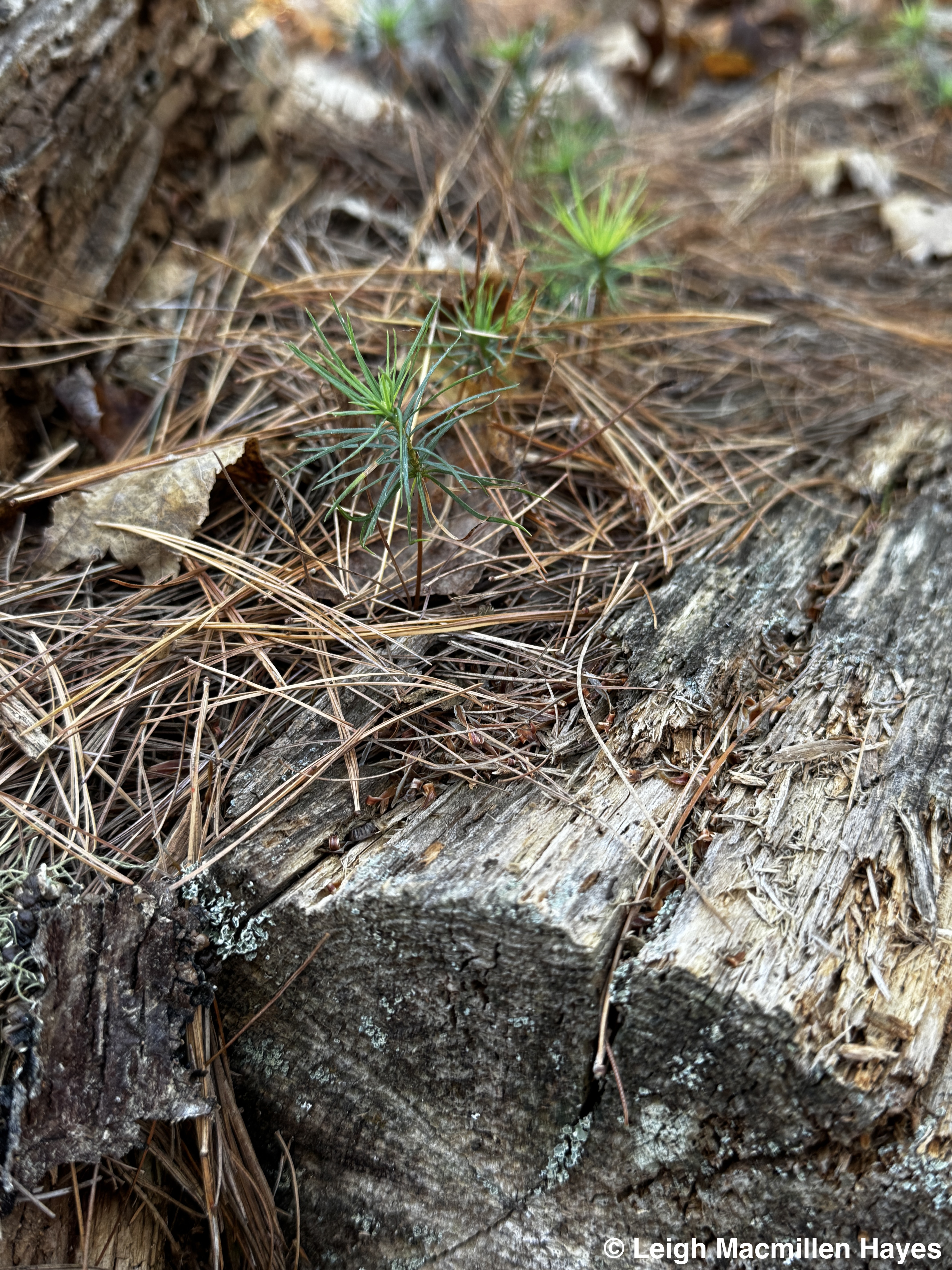
Do you see what I spotted? Babies! No, not squirrel babies. But rather: Miniature White Pines.

Once I saw those, I checked every stack that we’d cut years ago and found the same story written upon them. The seeds Red had left uneaten found conditions were right on the rotten logs. Will they survive? Maybe a few, but there are plenty more tiny saplings on the forest floor.

The thing is that I found no evidence of Red and not once did he squawk at me, so I suspect either he moved on to a better food source or became a meal for another, passing all of that energy and sunshine he’d consumed on to the next.

This year, it’s the Northern Red Oaks that have produced a mast crop–of acorns. Actually, they did so last year, and the year before as well. For those of us who frequent Red Oak woods, it’s like walking on ball bearings–and can be a wee bit treacherous as they roll under our boots.

Red Oak acorns are filled with tannins and so, unlike their White brethren which are gobbled up almost immediately by rodents and birds and deer among their consumers, it seems a little of this one is nibbled, and then a little of that one initially. Eventually, the tannins leach out, especially if the acorn has been buried for future consumption, and then the entire nut within may be eaten.

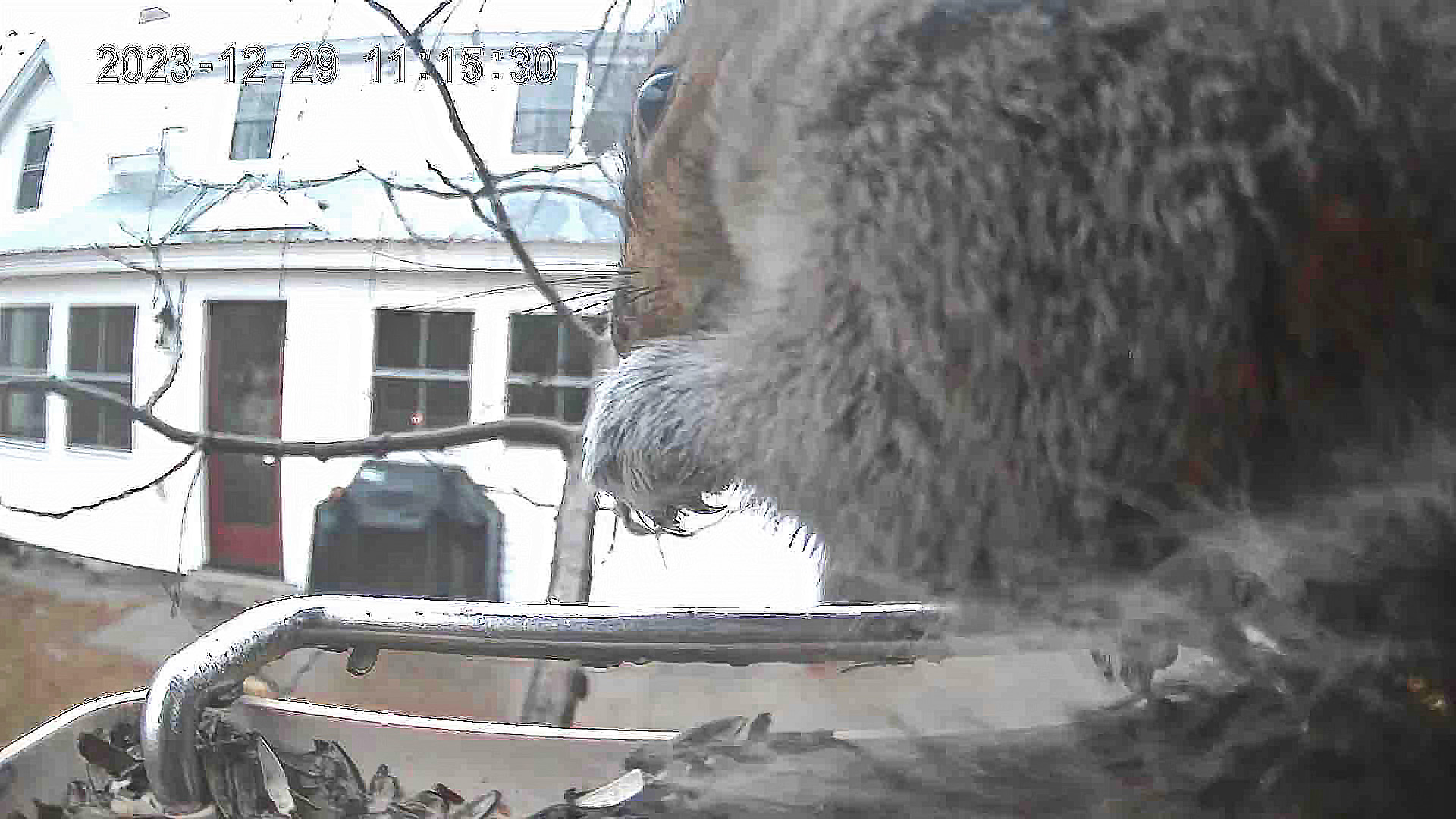
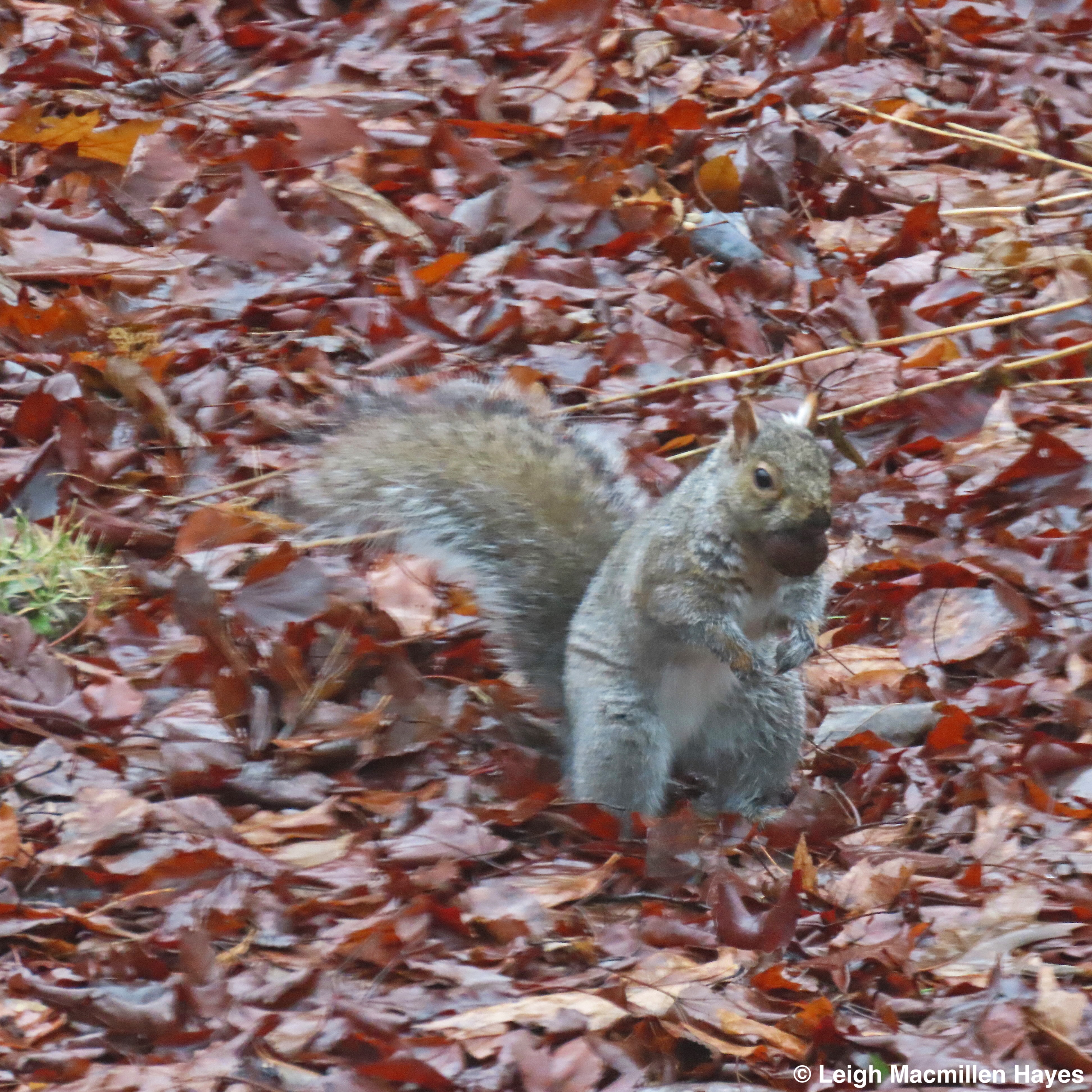
As I looked for Red this past week, I found instead his cousins, the Gray Squirrels in action. Where Red Squirrels are very territorial, Grays tend to have overlapping habitats, and there are at least three on our six acre plot of land.

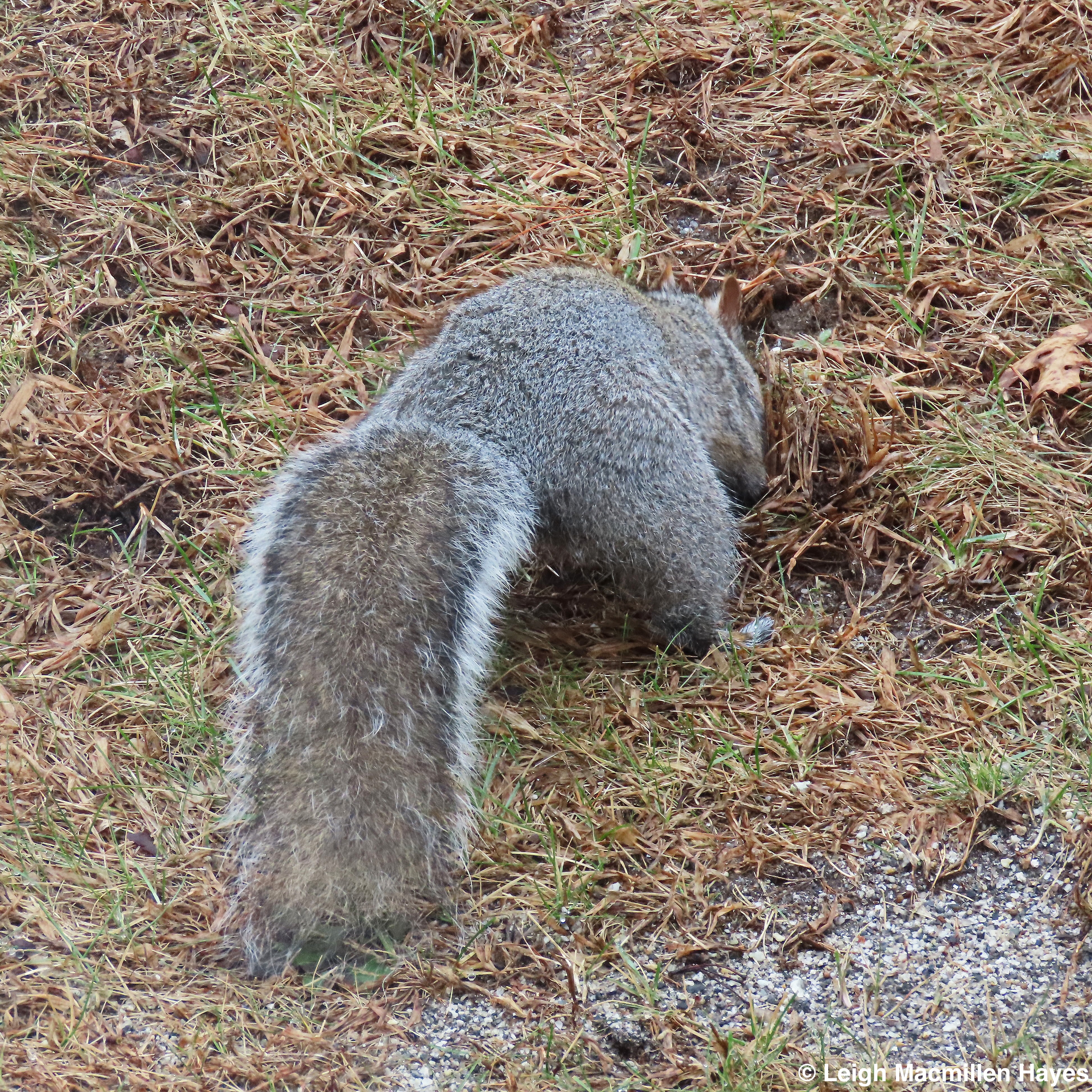
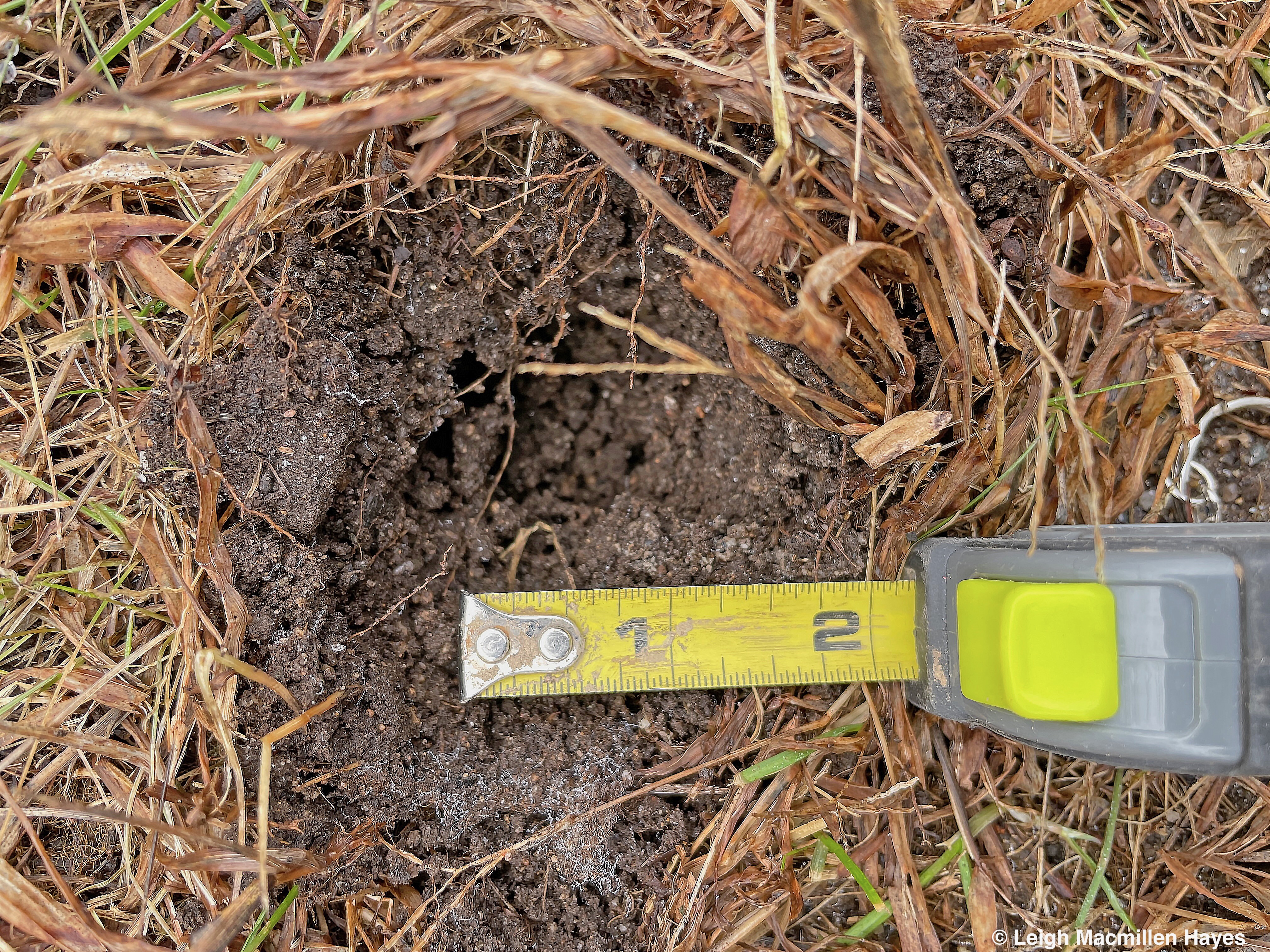
Burying acorns is their way of caching and it’s possible that what I observed was this squirrel leaving a scent mark with its nose so that come snowfall (and I have faith that it will fall–and can only hope abundantly), it can relocate the food supply. What this squirrel misses, another will find. And those that no one finds might turn into oak trees that will feed future generations, just as the pine saplings may someday do.

It’s for these critters and so many more that we ask that no motorized vehicles pass along the cow path, no matter how tempting it may be. (Thank you, Marguerite, for creating this sign for me.)

And if you are in there, you might happen along the rather rough labyrinth I created, a place that like the squirrels, I return to often.

It’s at the start of the labyrinth that brings a smile to my face each time, for Red had visited and his calling card is still there.

Thank you, Red, for planting your Squirrel Garden. And for capturing my mind and heart and soul this week.

Presents in the Moment

I went on a reconnaissance mission today in preparation for co-leading a Loon Echo Land Trust hike in about another month–once hunting season draws to end. This particular property, like several others that they own, probably sees more people hunting and riding snowmobiles than hiking or tracking. The latter two fall into my realm and today found me doing a bit of both.

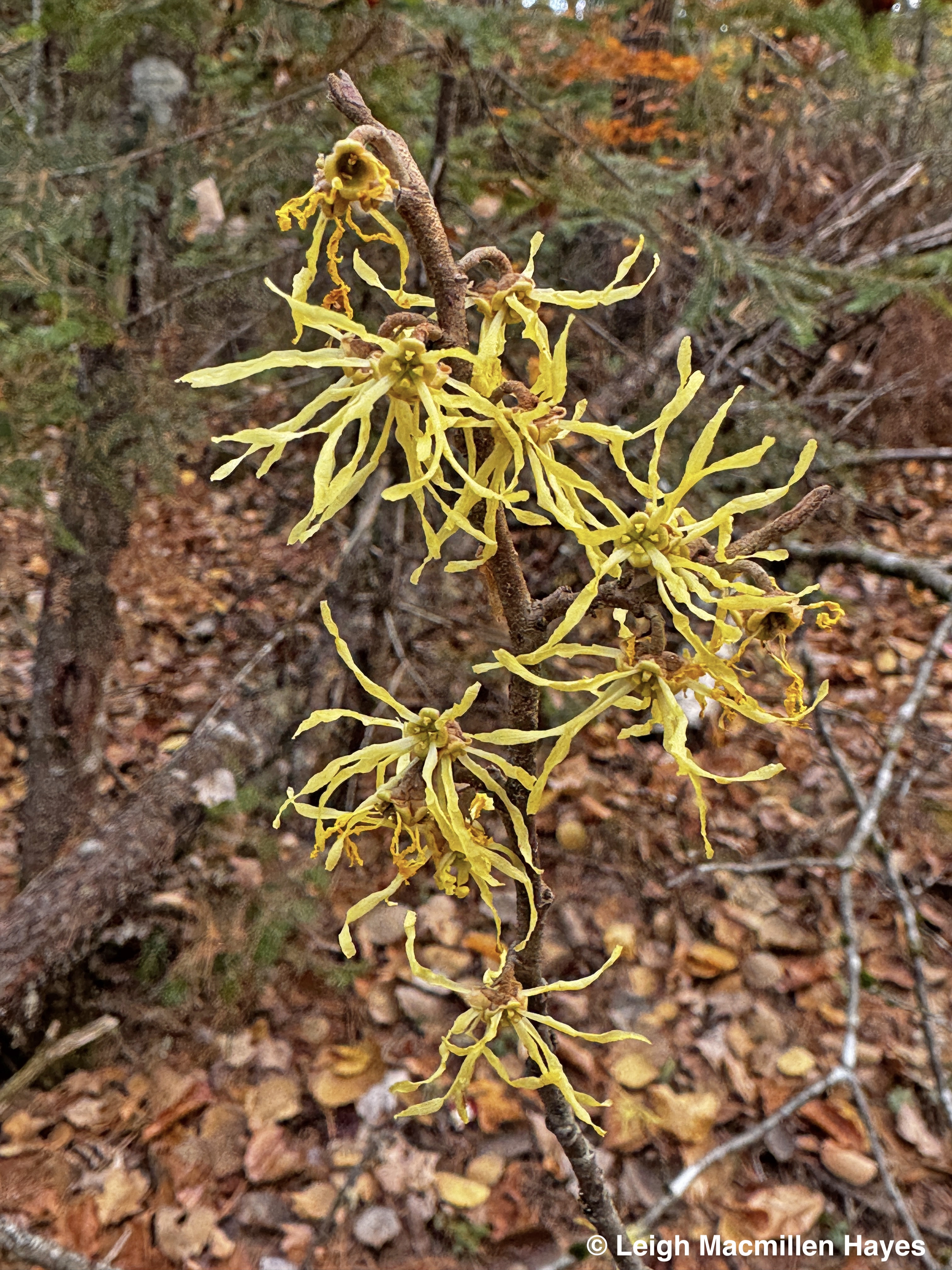
But first, I was stunned by the beauty of the ribbony flowers of Witch Hazel. I don’t know why these always surprise me, but maybe it’s the delicate petals that add bits of sunshine at this time of year when everything is else is dying back.

Their wavy-edged leaves also add color as October quickly gives way to November.

A bit farther along the first trail I followed, I found something else to stop me in my steps. Little packages of bird scat inside a hole excavated by a Pileated Woodpecker. If you follow wondermyway.com, then you know that I LOVE to find the woodpecker’s scat, but this was much smaller and I had visions of several smaller birds huddled inside on a cold autumn night.

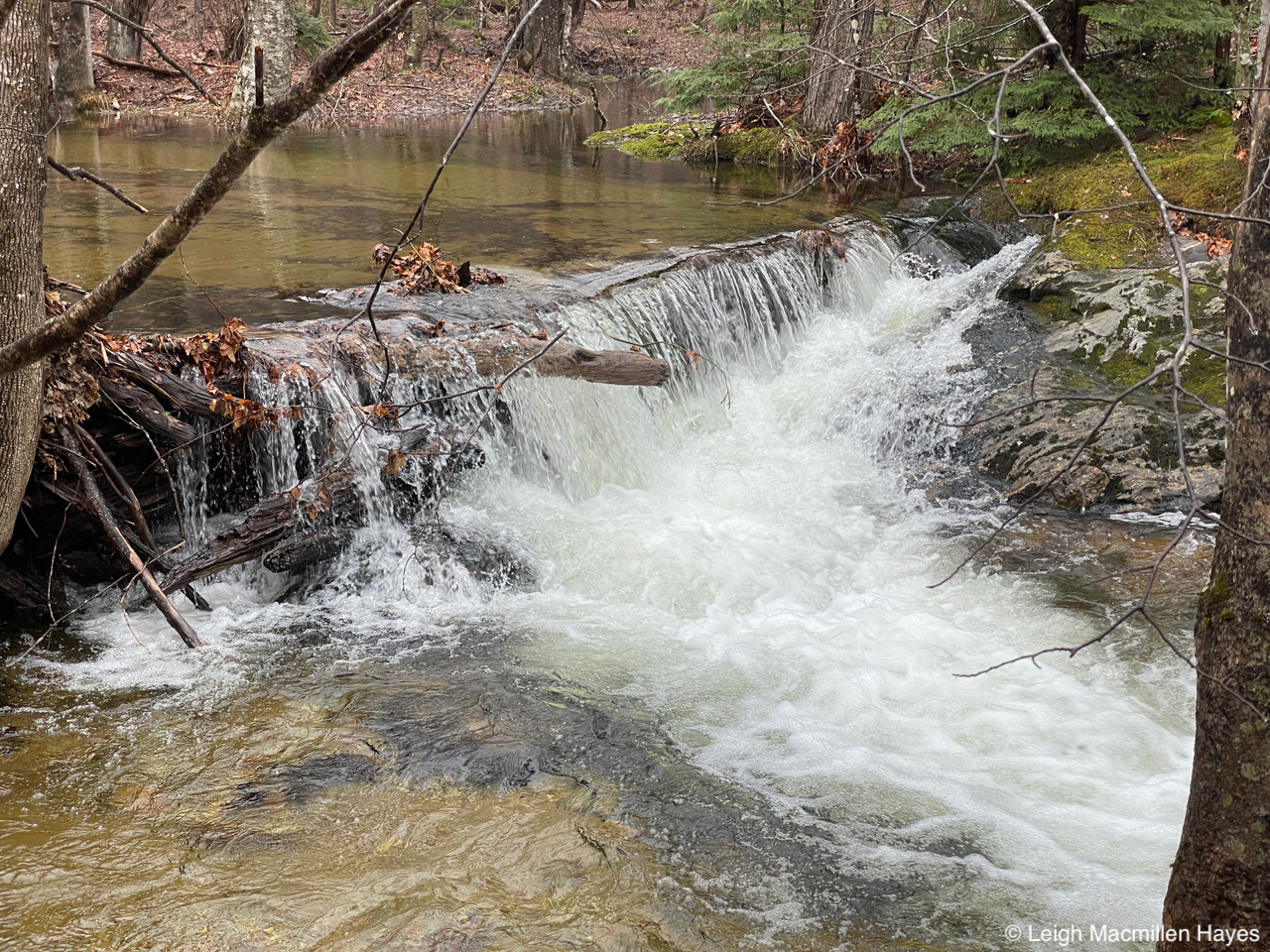
At the end of the trail I reached a brook that flows into a river. Today, it was a mere trickle. In fact, I took this photo from the high water mark and don’t think I’ve ever seen it this low. Well, not since I began exploring this property in 2020. But then again, since then, we’ve had some heavy rain years and this year has been a bit drier.

I knew once I spotted the trickle that the nearby Beaver dam would not be working to stop the flow.

But . . . in walking over to take a look at it, I spotted something else worth noting . . .

At first my brain interpreted this disturbed site as a bird’s dust bath. Until . . .

I spotted River Otter scat. A latrine, in fact. That’s when I knew (or think, anyway–okay, assume!) that the disturbed sight was a spot where the otter rolled around, or maybe two or three did as they most often travel as a family unit.

How did I know it was otter scat? Look at those fish scales in it. And it wasn’t all that old based on the leaves under and on top of it.

Feeling like I was in the right place at the right time, I doubled back on the trail because it ends at the brook, and then turned onto another to see what else I might find. Along this one, a second brook had a better flow and had me envisioning the land trust group dipping for macro-invertebrates in this spot we haven’t explored yet.

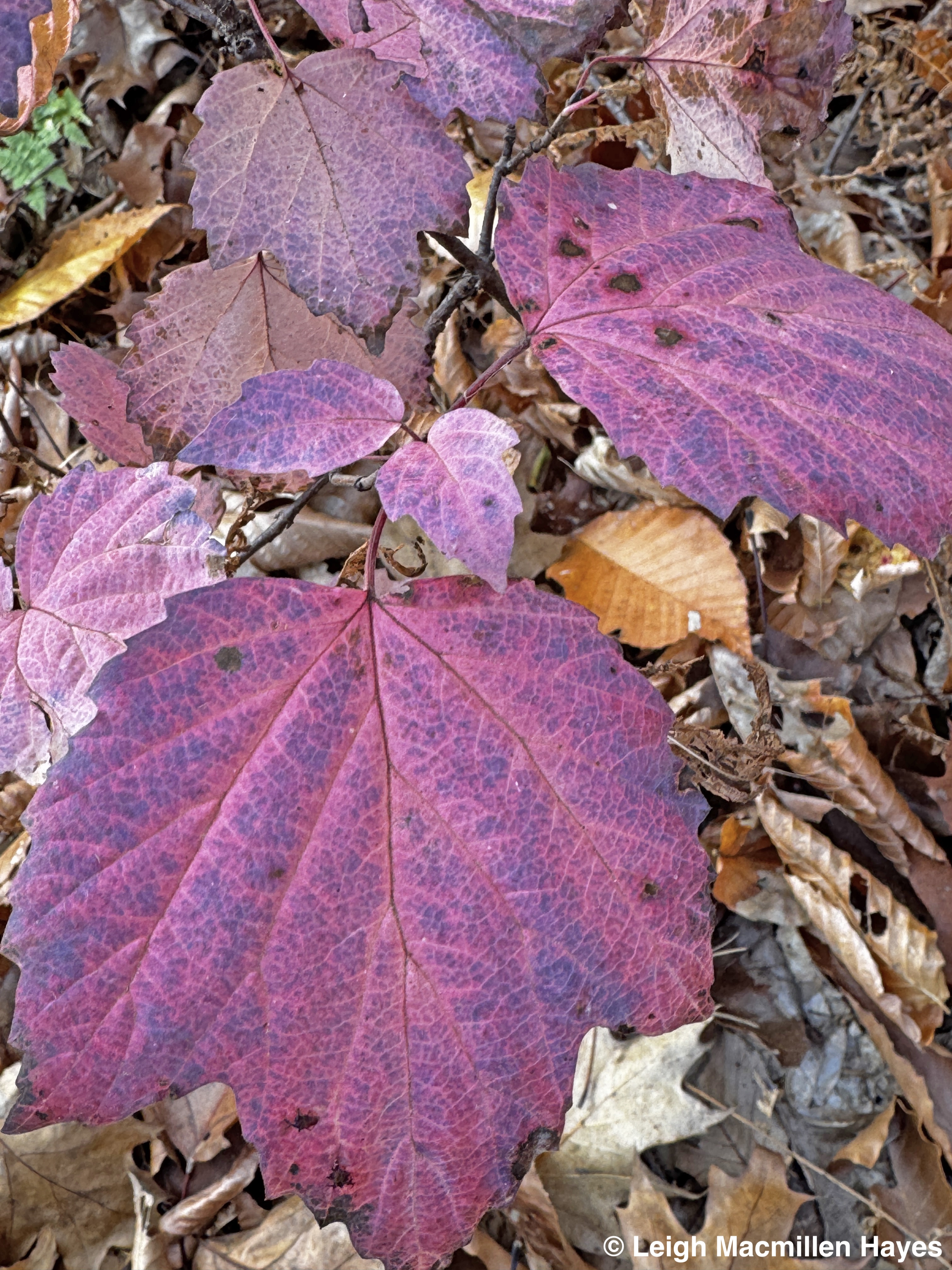
I also found another shrub that thrills me as much as the Witch Hazel. Also a shrub, I can’t pass by a Maple-leaf Viburnum in the fall without admiring its color. Mulberry? Heather? Sky-purple-pink? However you describe it, this I know–no other leaves feature these hues.

If you do spot one, take a moment and touch the leaf. I love the touchy-feely walks that are not about feelings, but rather about actually feeling something (as long as it isn’t poison ivy!).

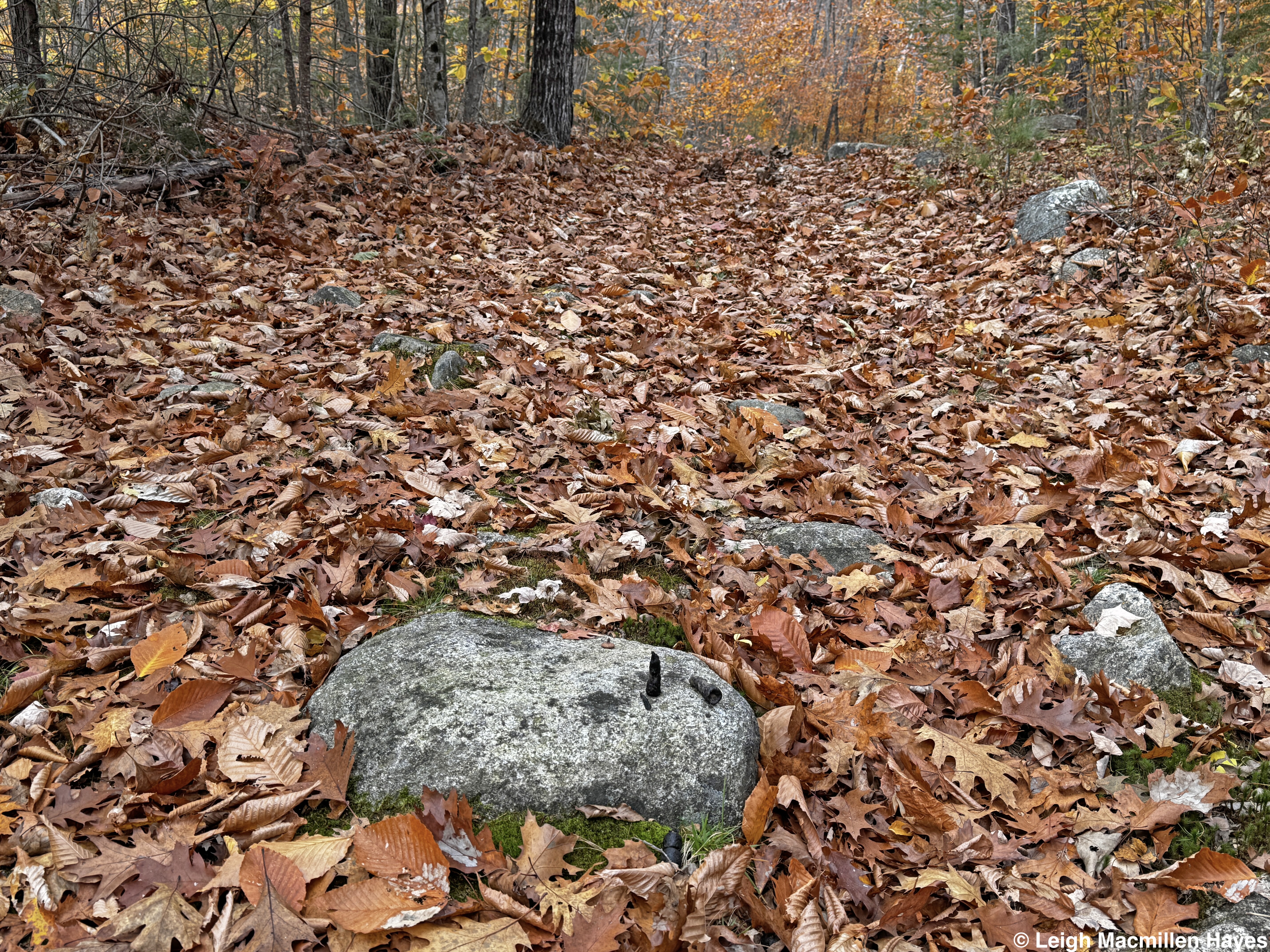
As luck would have it, I was following an old logging road by this point, which these days serves as a snowmobile trail. Despite its uses, rocks and boulders mark sections of it. And atop one, oh my! Do you see what I saw?

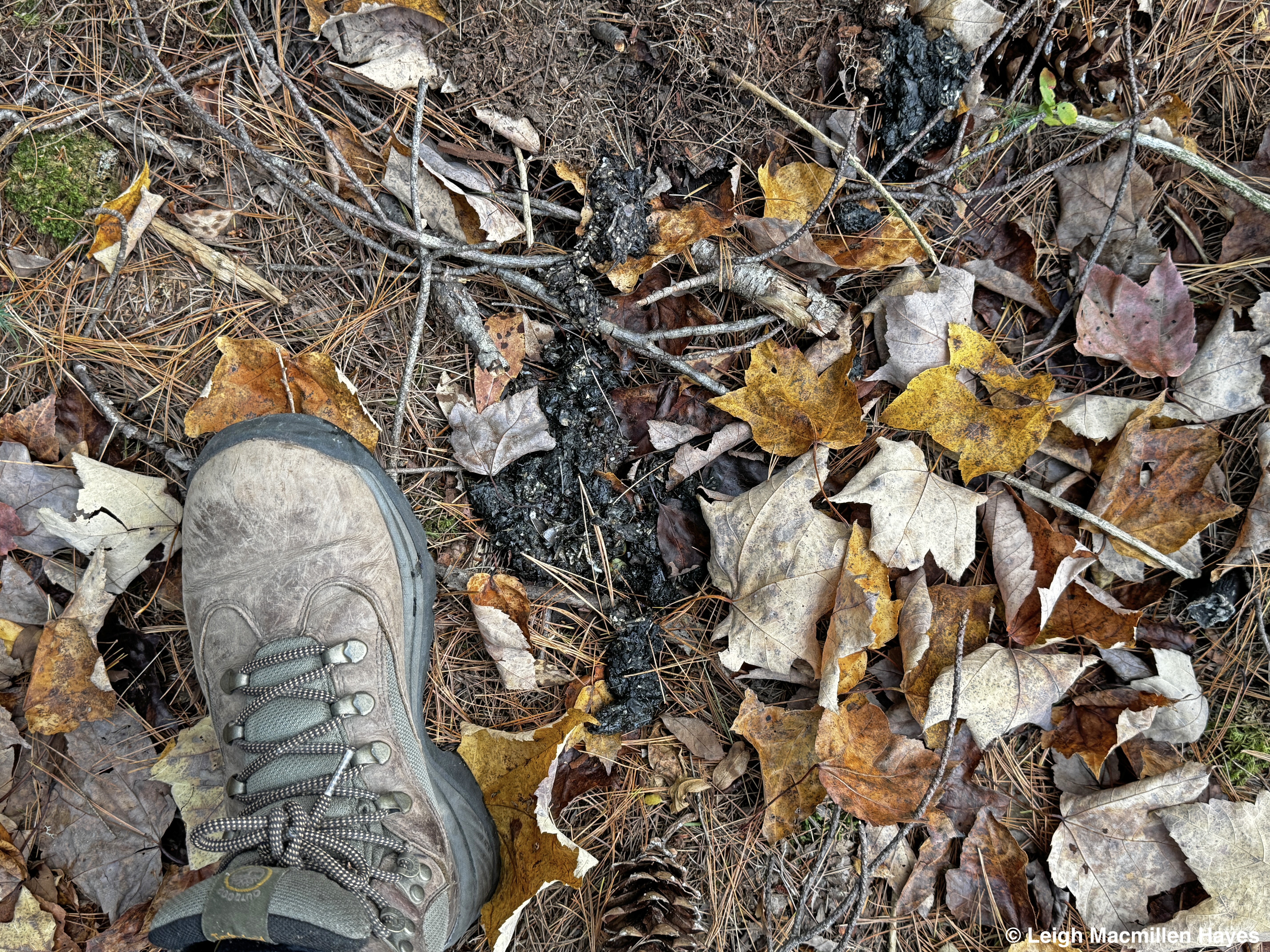
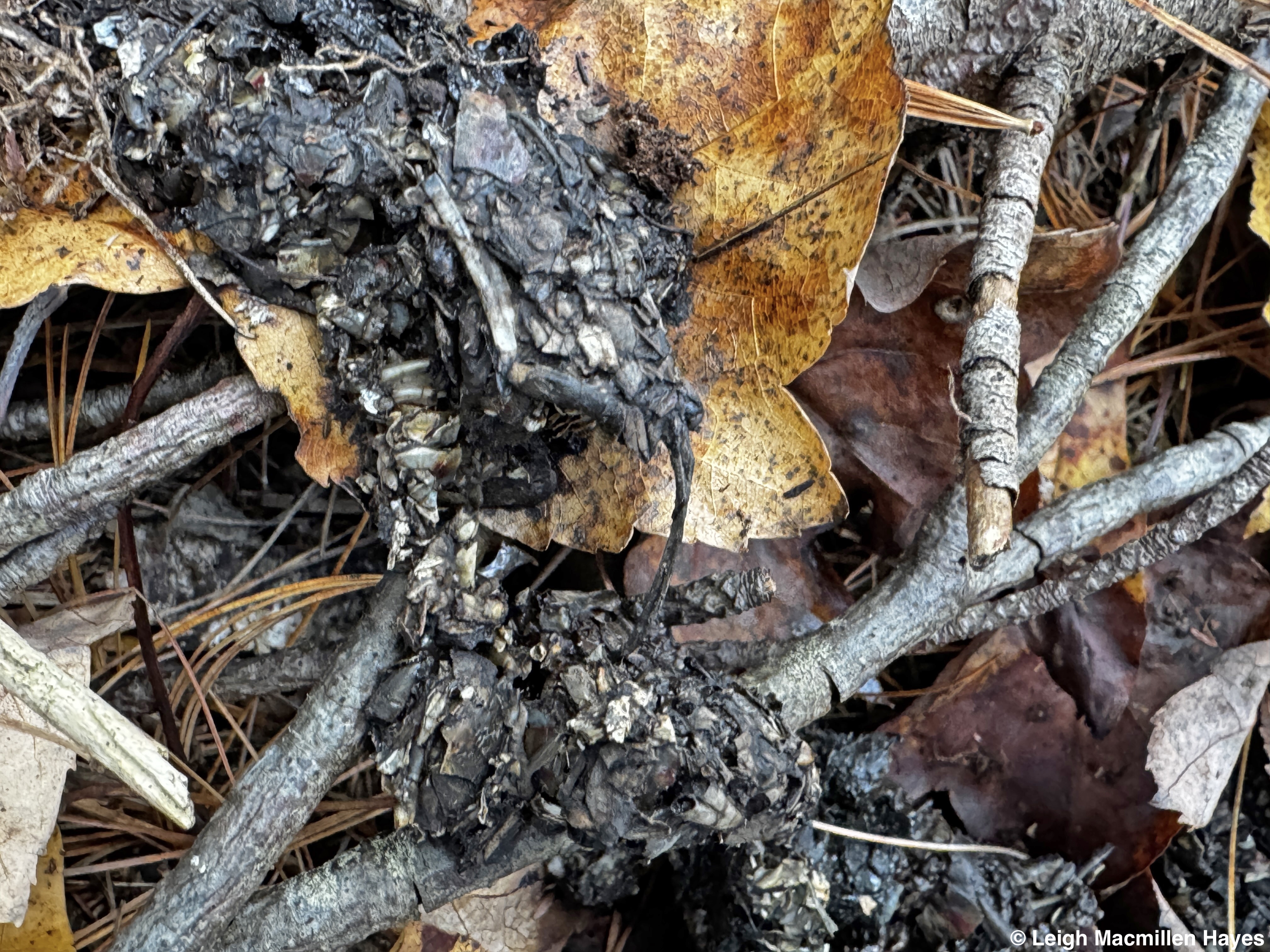
A LARGE Bobcat scat and a tiny weasel scat. Could life get any better than that? I think not. Well, unless I saw the actual critters and as I write this a local friend just texted me that she and her family saw a pair of eyes reflecting in their headlights as they pulled up to their house: “I thought it was our cat from a distance. I got out to investigate. It was a bobcat! And it wasn’t afraid. I couldn’t believe it! It was so close. I could see the face. I ran inside to get a flashlight. It just watched us as we watched it.” ~Amanda.

If she was someone else, she’d jump on social media and inform the world that the big bad wolf is in the neighborhood because that seems to happen any time someone spots a Bobcat or Fisher. But, she appreciates the gift of the sighting and I’m so thankful for that.

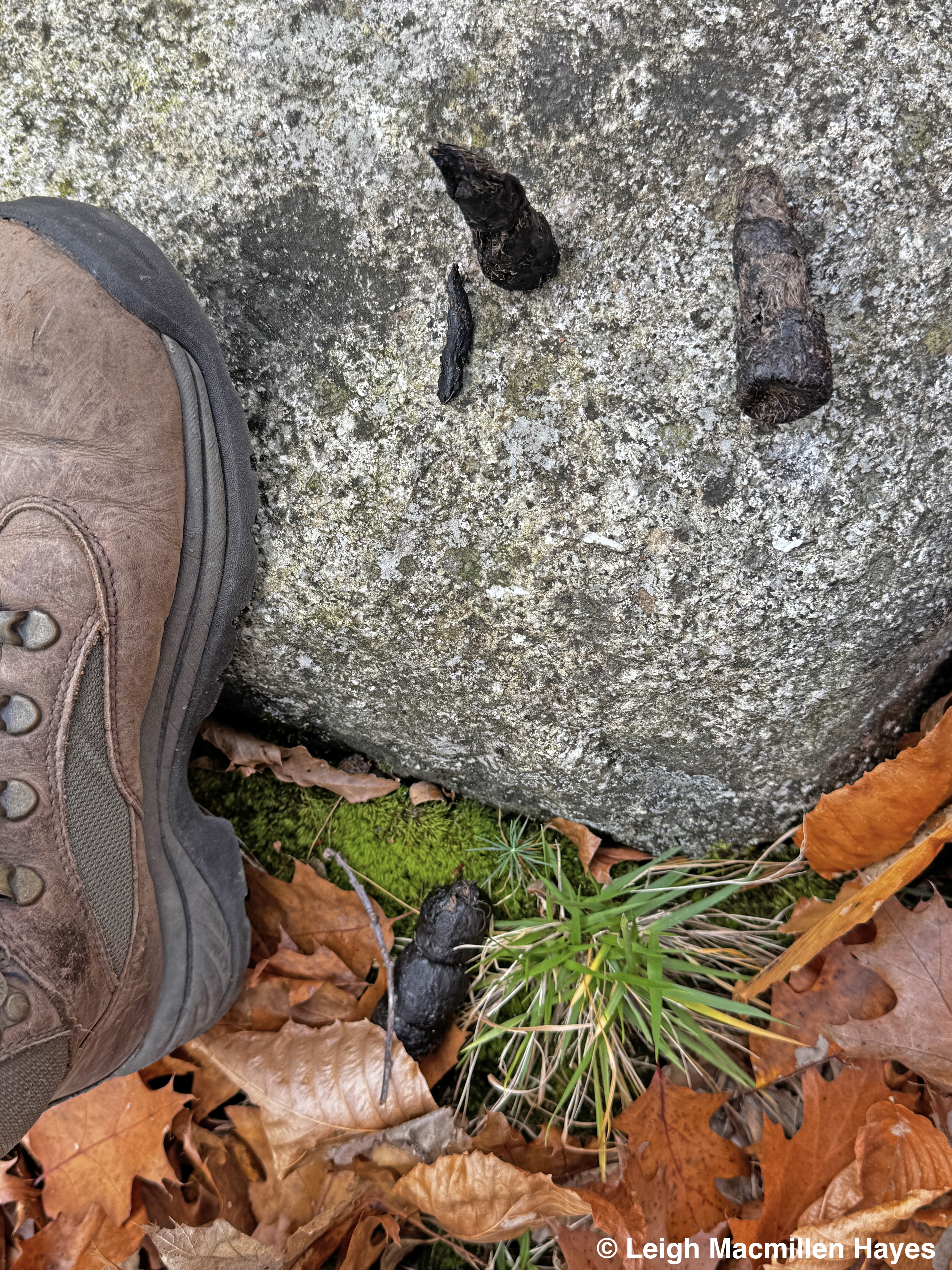
Back to my Bobcat, or rather Bobcat scat–it was classic! Segmented, tarry, and no bones. Ahhhh! What dreams are made of–at least my dreams.

It was also quite hairy. Squirrel? Snowshoe hare? Weasel? Pop goes the weasel? Into the Bobcat’s mouth? I’ll never know. But I love that one marked the rock in the middle of the trail and the other followed suit. And I also love how that one piece stands upright like a tower. I don’t think I’ve ever spotted such a presentation before.

No, don’t worry, we don’t have yet. But I took this photo of a Bobcat print, also classic in presentation, along the same trail last February. Same critter? Offspring? Sibling? Any of the above.

At last I reached what would become my turn-around point, again on an out-and-back trail. And once again, I slipped off the trail and made my way toward an expansive wetland that is actually part of the small brook I’d crossed.

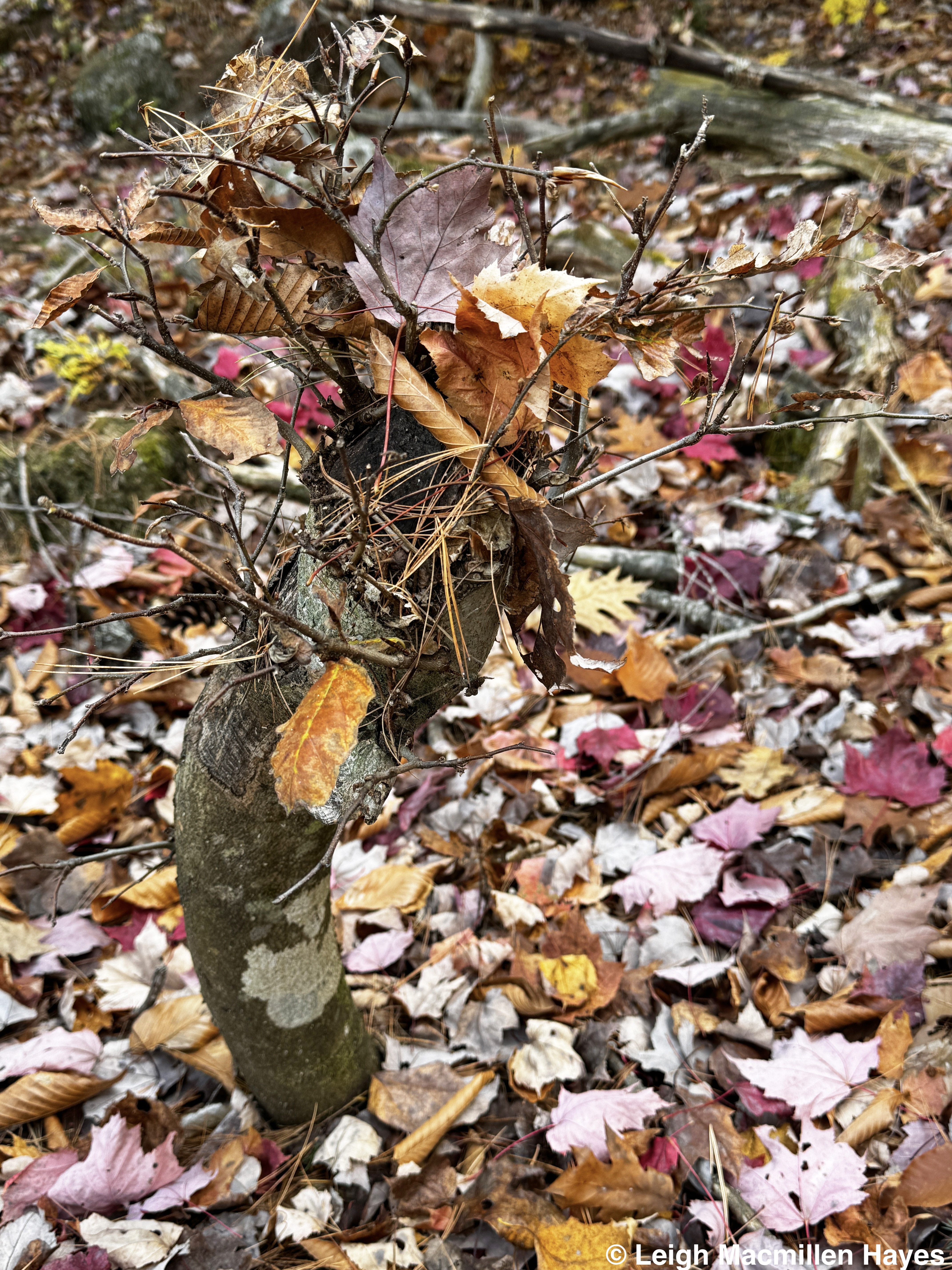
Old Beaver works, such as this American Beech with a bad-hair day from stump sprouting, were evident everywhere.

Other Beaver sculptures created a few years ago as indicated by the dark color of heartwood where the rodent had gnawed and cut the tree down, probably to use as building material, now sport fungi in decomposition mode.

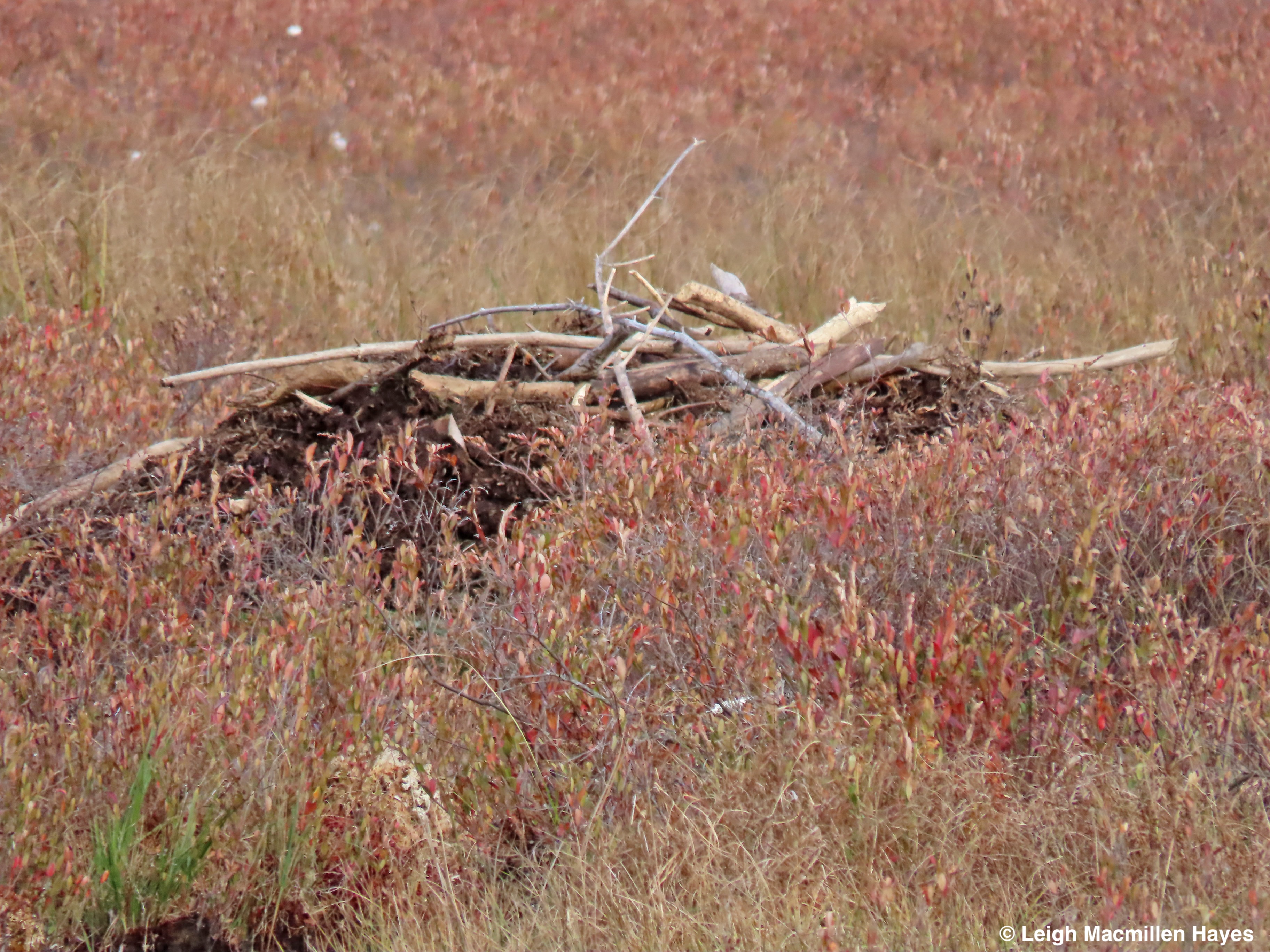
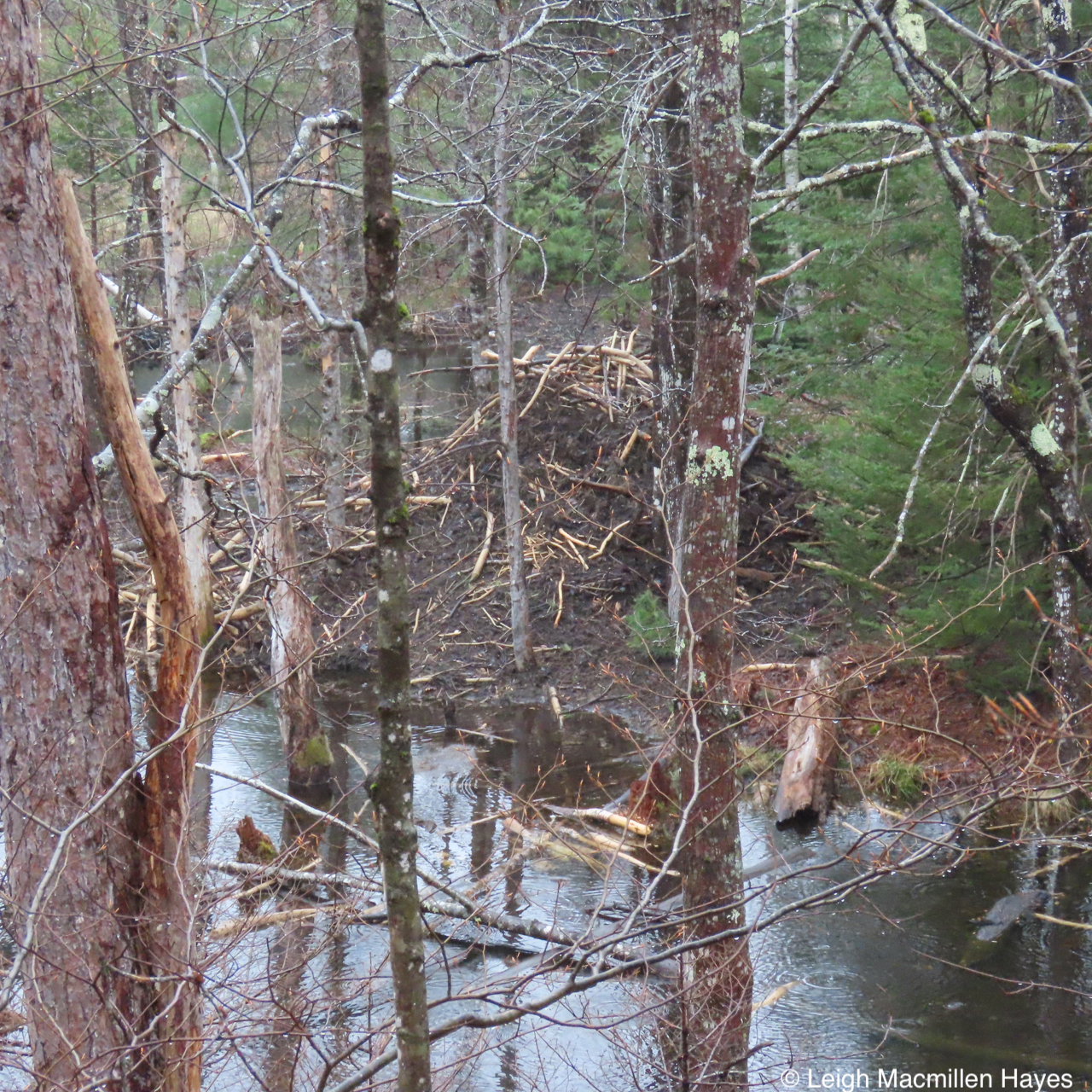
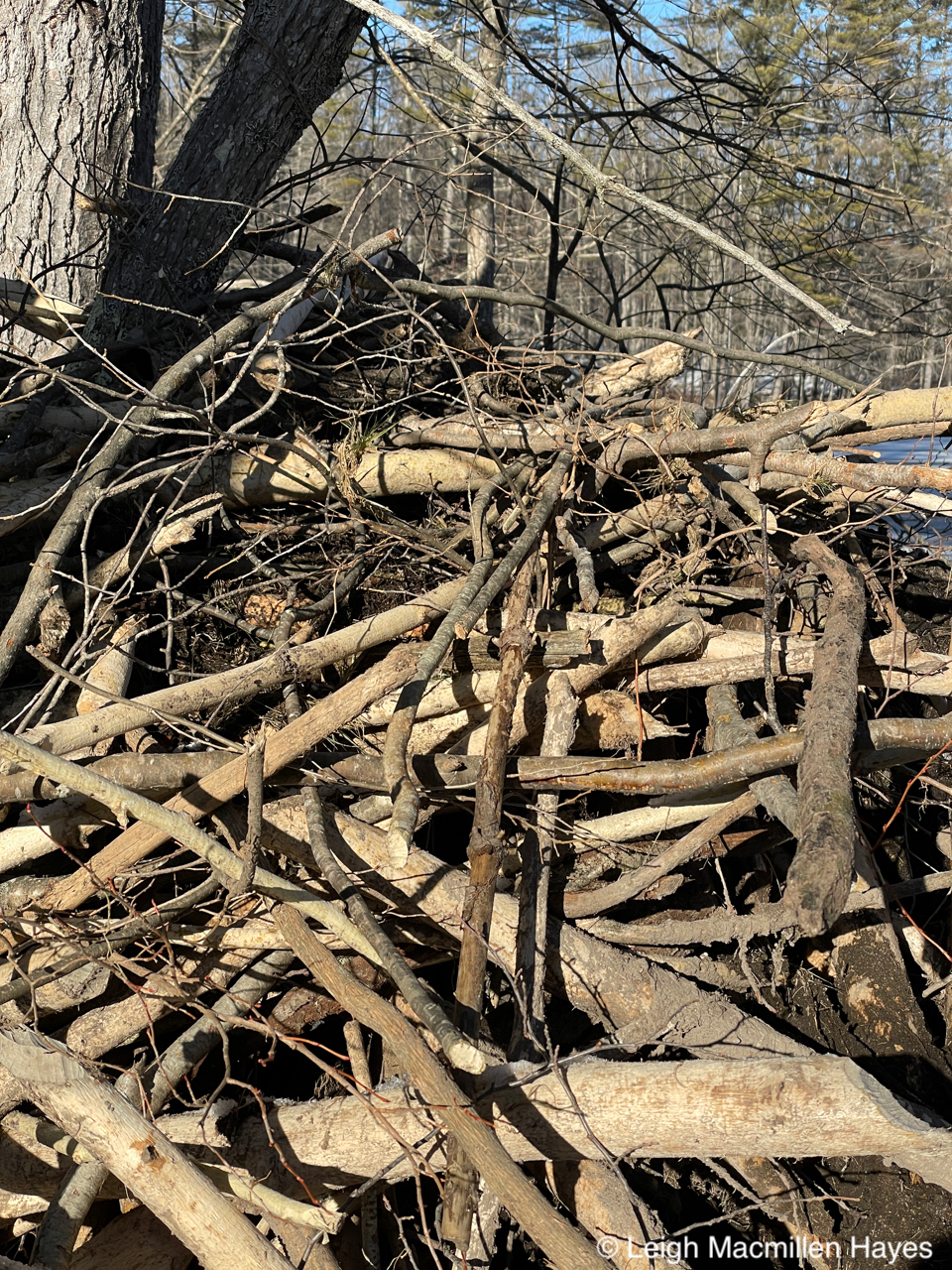
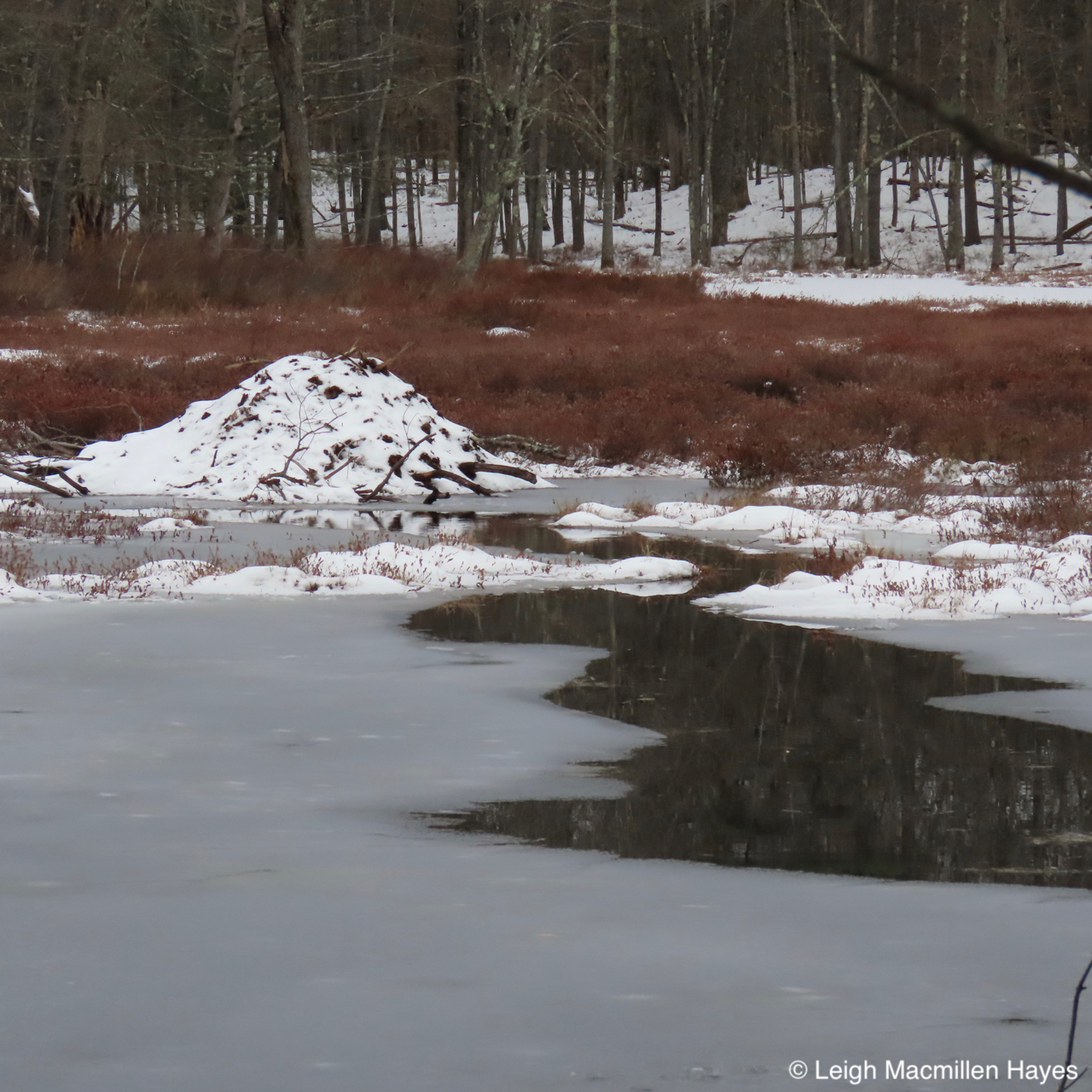
In the wetland, I spotted two Beaver lodges, both featuring some mud for winter insulation. There were two other larger lodges with no mud, so I suspect these are the residences of choice for this year.

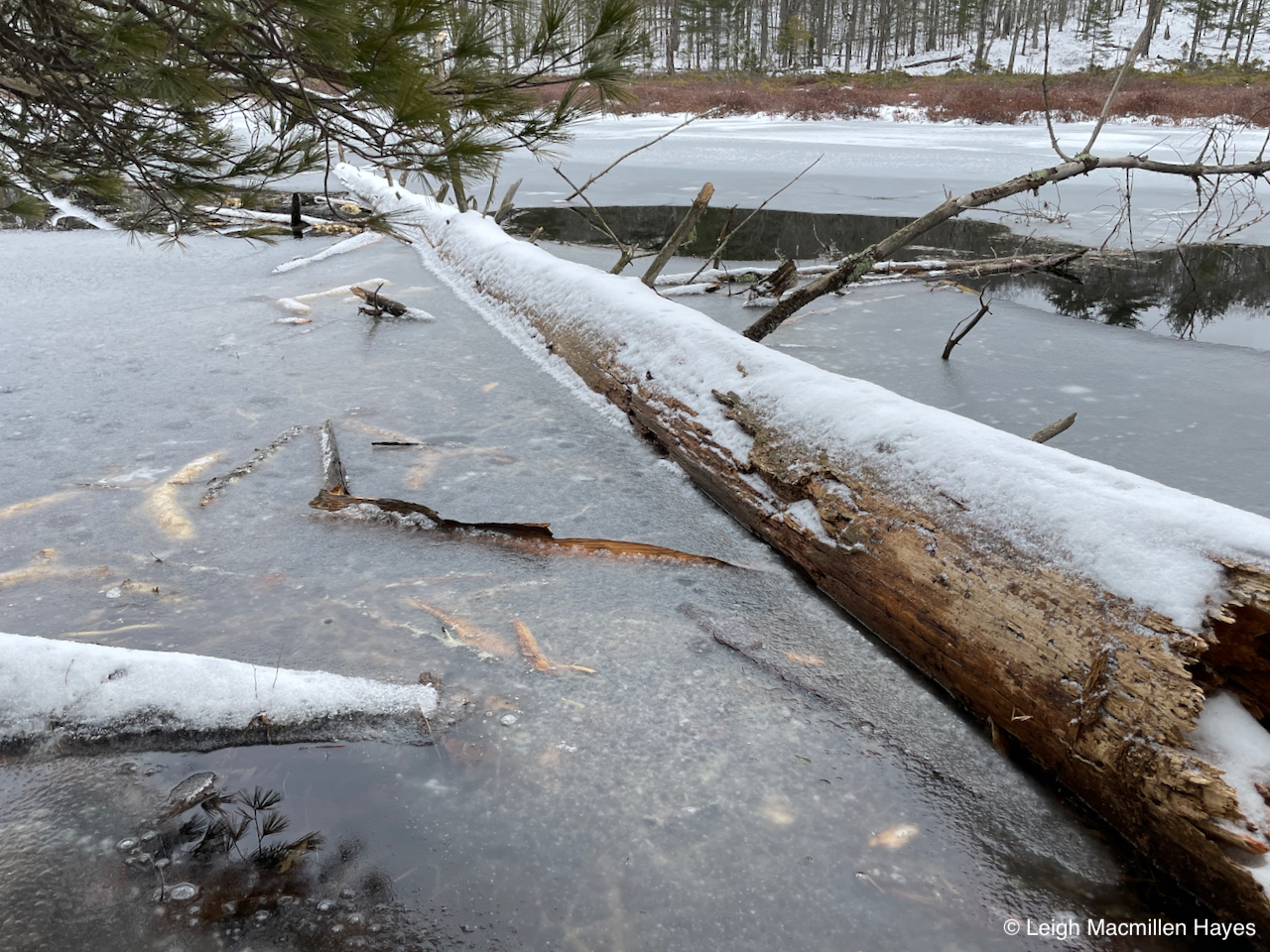
I also spotted a Beaver channel, but could find no new work on the land.

That surprised me given that there was new wood on top.

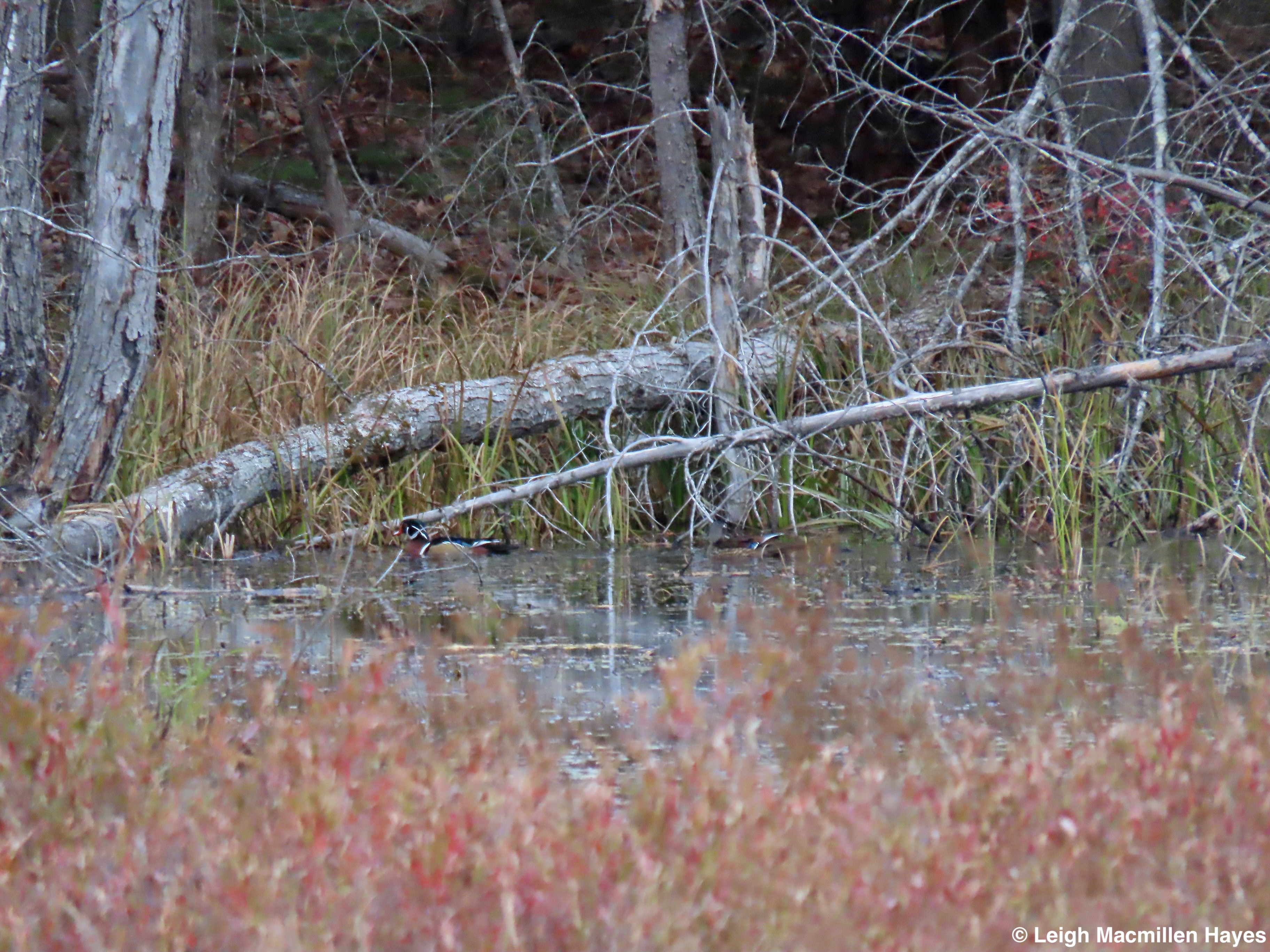
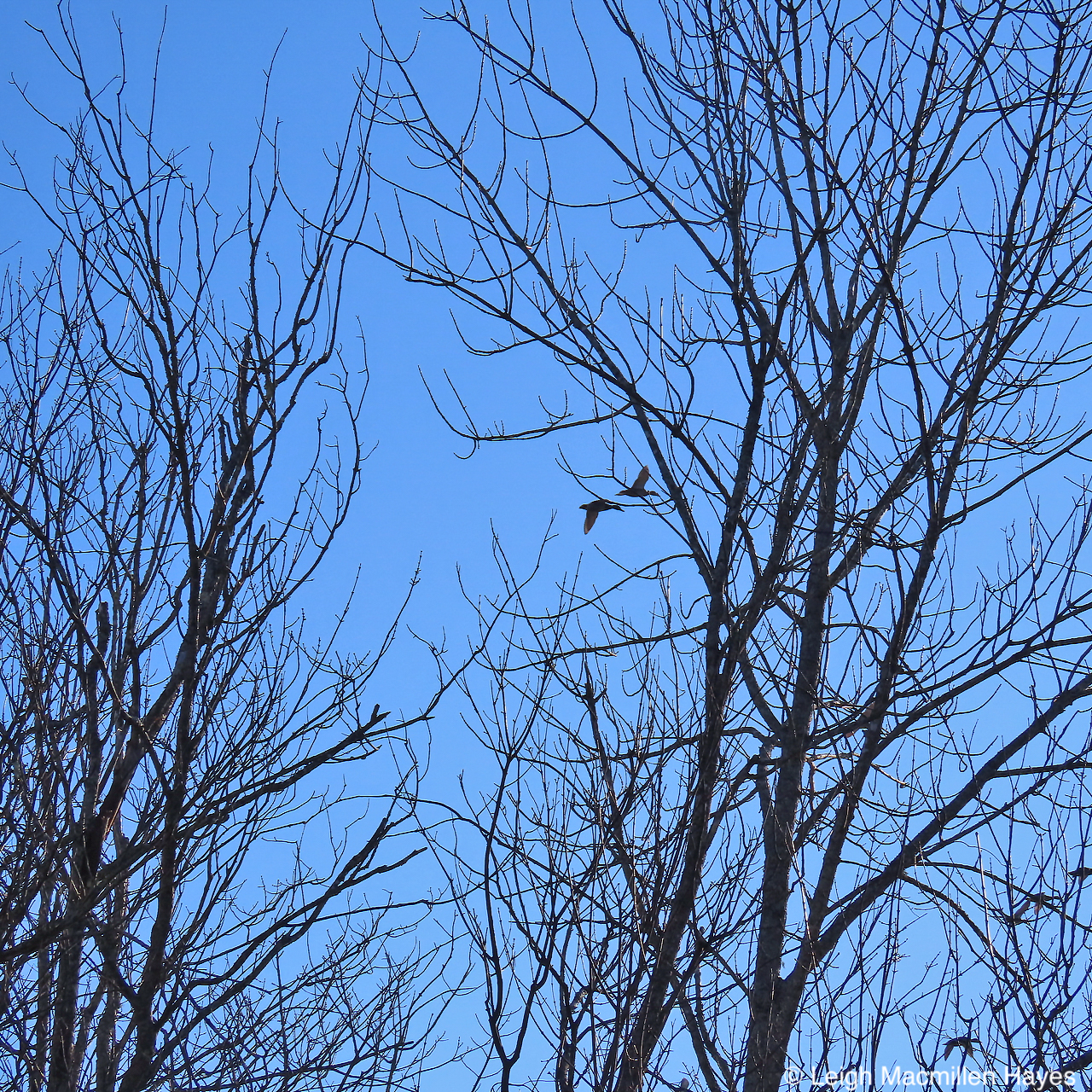
I could have walked farther along the wetland and may have spotted some freshly hewn trees, but when I spotted several Wood Ducks on the far side, I decided to stand still for a bit because they are easily spooked.

And my grand hope was that if I was quiet, I might get treated to a Beaver sighting. Or two.

For a half hour I waited. Nada. And so I climbed back up to the trail and walked out.

But, I was present in the moment today and received so many gifts, which may or may not be there when I bring others to explore. That’s okay, because together we’ll make other discoveries.

Thanks for stopping by, once again, dear readers. I leave you with this painting as a parting gift for being so faithful in following me as I wander and wonder.

Snow–Bugs and Flakes

Betwixt. Between. Be flowers. Be bugs. Be glad for there is so much to wonder about in the natural world. And I don’t even know the half of it. But I wouldn’t be happy if I wasn’t always learning.

It was 28˚ when I awoke this morning. Late this afternoon on this brilliant sunlight day, with temps at least 30˚ warmer, I walked out through our woodlot to the right and then looked back across the neighbor’s field toward our house, taking in the sea of seedheads and I was sure my insect hunting days had come to an end.

But much to my surprise, and really, I shouldn’t have been surprised, the chirps of crickets and grasshoppers, like this Red-legged example, filled the air. I might not have seen the grasshoppers if they hadn’t flown to a new spot occasionally, for so camouflaged are they in the current setting. Or always.

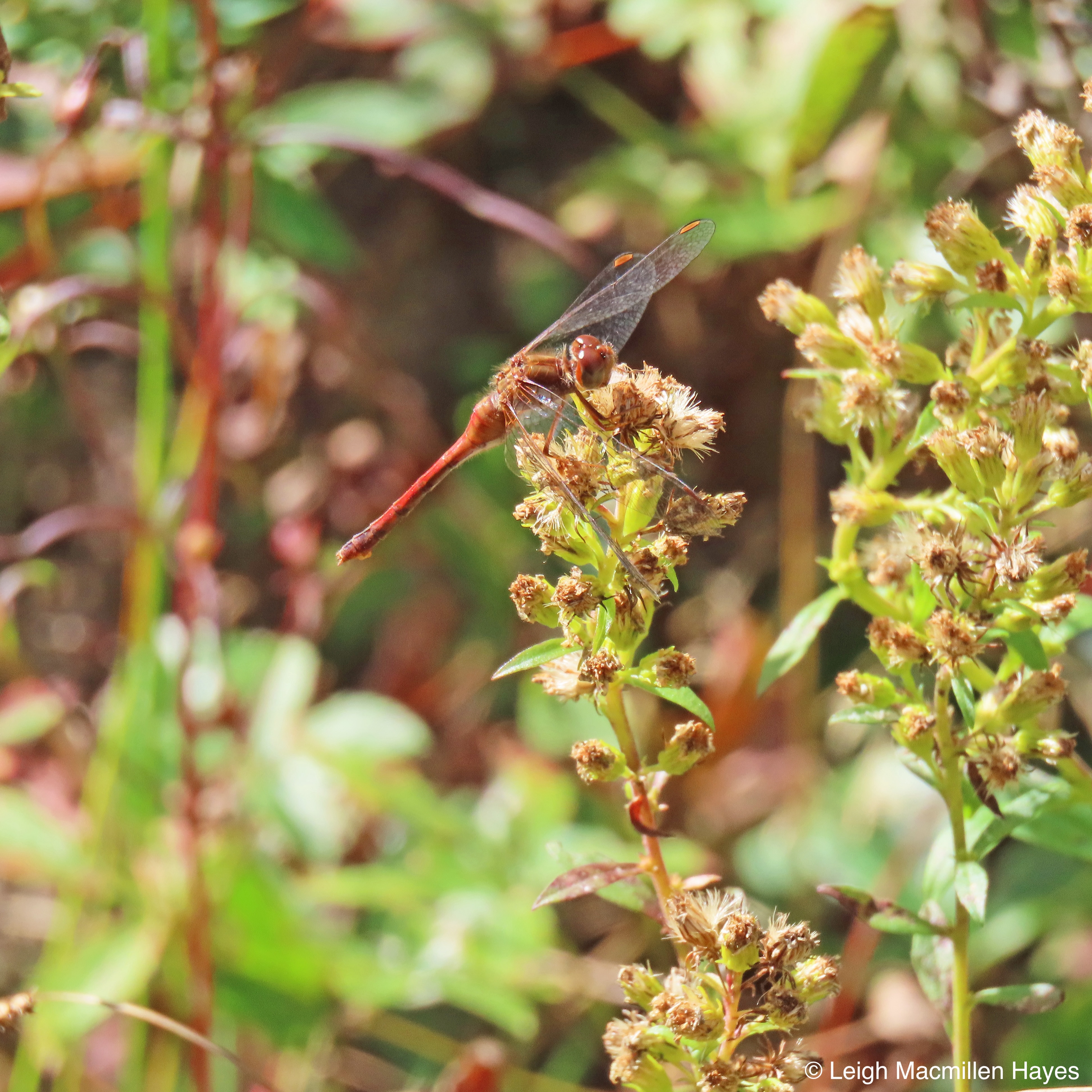
And then, much to my delight, I noticed a Saffron-winged Meadowhawk flying low and making frequent stops, allowing me to do the same. We live in a wet area, but still, I’m often surprised by some of species I meet here.

From the field, I decided to continue along the power line that crosses our property and the neighbor’s and many more beyond that and as I’d told my friend Meg from North Carolina the other day–Mount Washington, our mighty New England Rock Pile, is at the far end and it looks like we could walk right to it. Give or take a few days–or drive there in about an hour.

It’s along the path below the lines that I discovered Cotton-grass, which is a sedge, with its fluffy little heads speaking to the bogginess of this area.

Cottongrasses self-pollinate, their flowers being “perfect,” given that each contains both male (stamen) and female (carpel) parts. And the seeds are attached to parachutes waiting for a breeze (or animal) to move them to a new home.

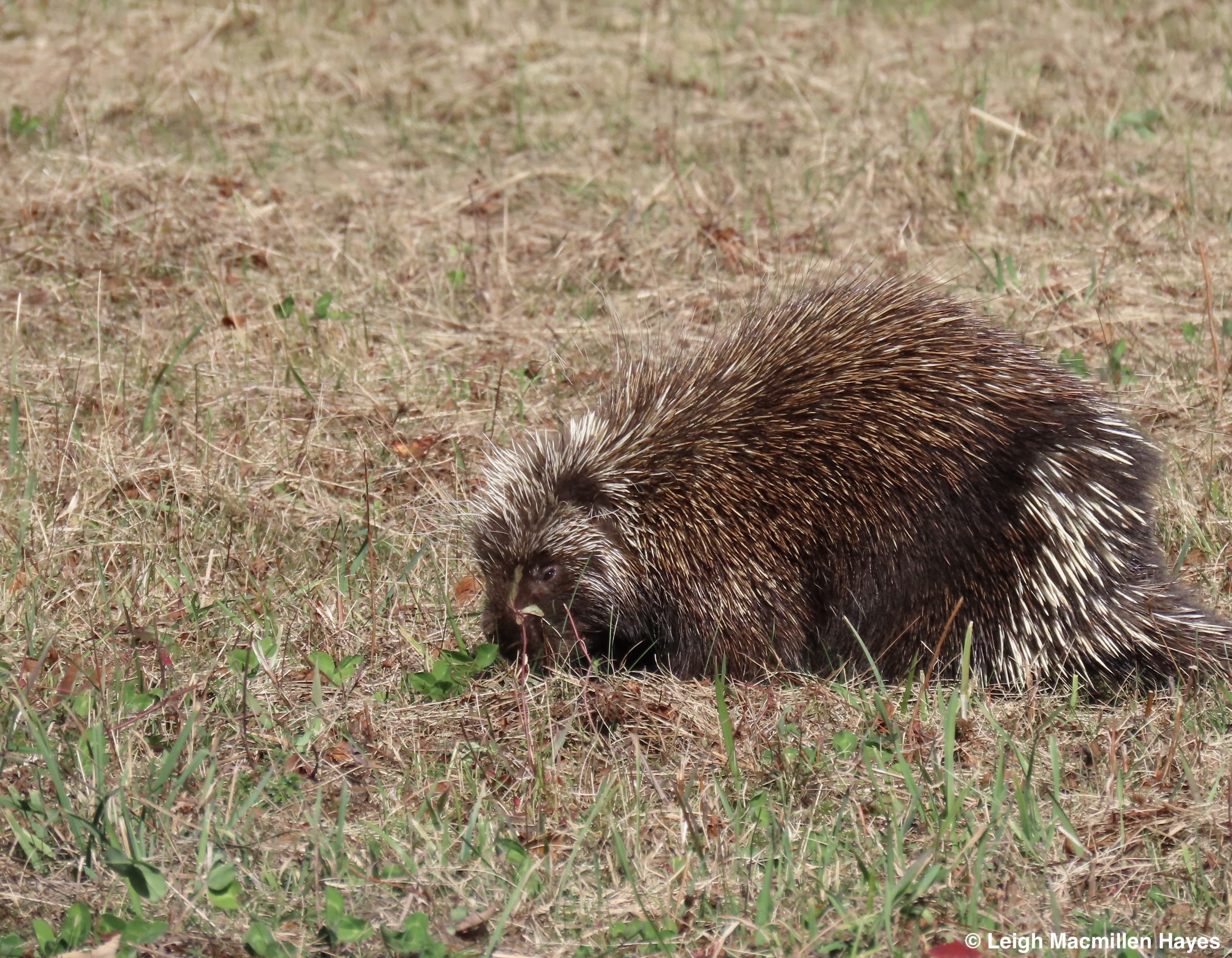
Spotting the curly, cottony-hairs reminded me of the belly hairs of porcupines, which of course, reminded me of the Porky some friends and I spotted in another field in town yesterday. The time is coming when these critters, whom I’ve come to adore, will transition from life in the field to life in forest trees.

Last November I wrote about this particular porcupine, Bandit, whom I met in our yard, along the same route I began today’s journey. Perhaps soon, we will meet again.

Getting back to today’s story, I left the power line, and headed out an old logging trail that I tend to frequent most often in the winter. But it was sunny, and I was enjoying that warmth, and wondered what else I might spy along the way.

For starters, there were the “dried” Pearly Everlasting Flowers, which I should have gathered because they do dry so well. Instead, I just admired them.

And I had frequent encounters with more Saffron-winged Meadowhawks, flying much like White Corporal Skimmers in early spring–always landing and then moving a couple of feet ahead of me whenever I made a move.

Helping with ID of this species, are the fine black lines in the sutures of the abdomen. And the red stigma toward the tip of each wing is outlined in black. Otherwise, I might confuse it for an Autumn Meadowhawk.

I also had the pleasure of meeting a female Shadow Darner, but then I went to offer a finger for her, thinking she might want to take advantage of my body heat, and instead she tried to bite me. So, I let her be and we went our own ways.

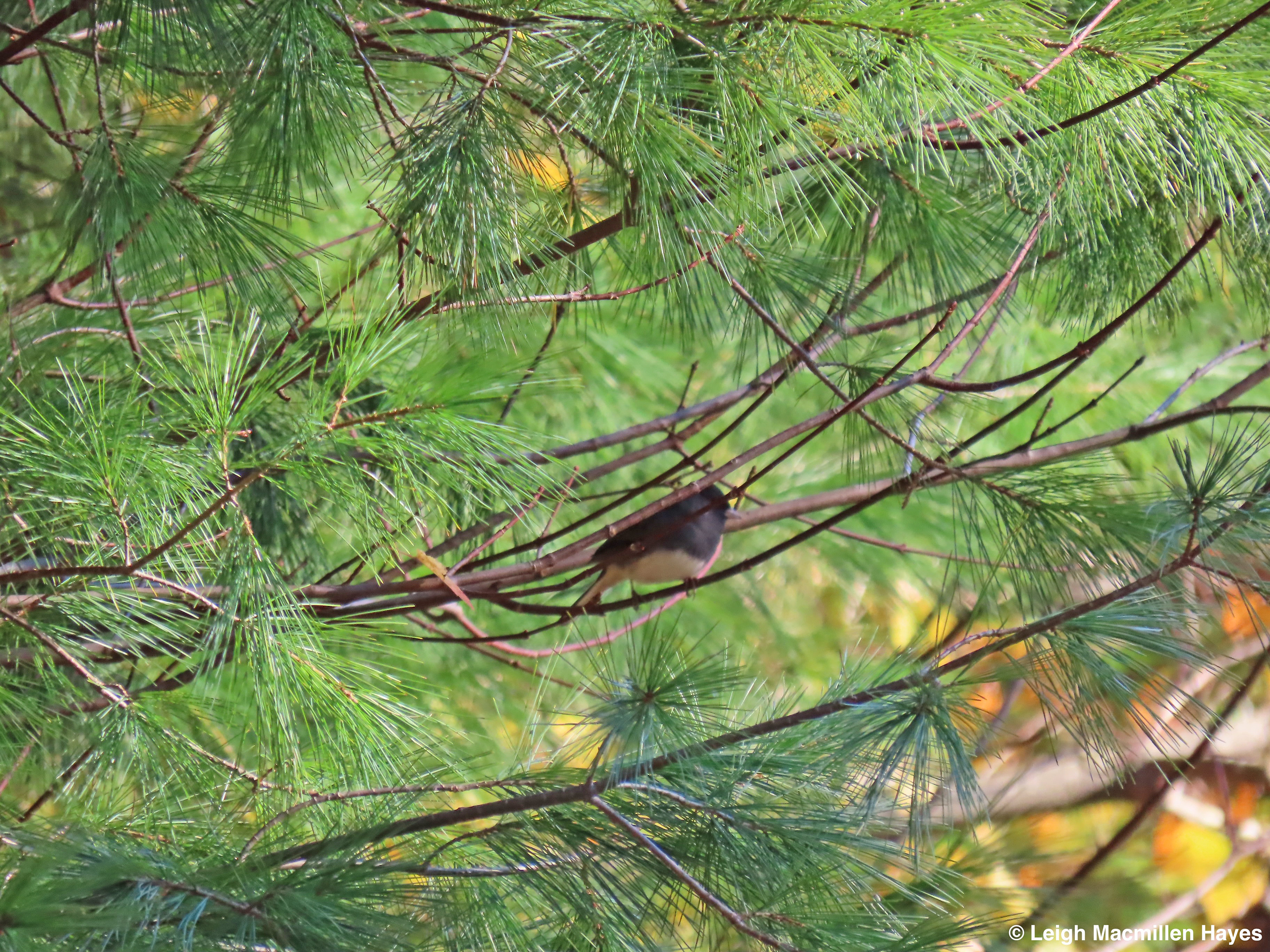
At a former log landing, Juncos were on watch, and given how much seed is available, I know they’re mighty happy with the current conditions. It seems like they just arrived in the past week or so, but the good news is that many will overwinter here.

Oh and a few will fly to Connecticut so that my dear friend, Kate, can watch them as well.

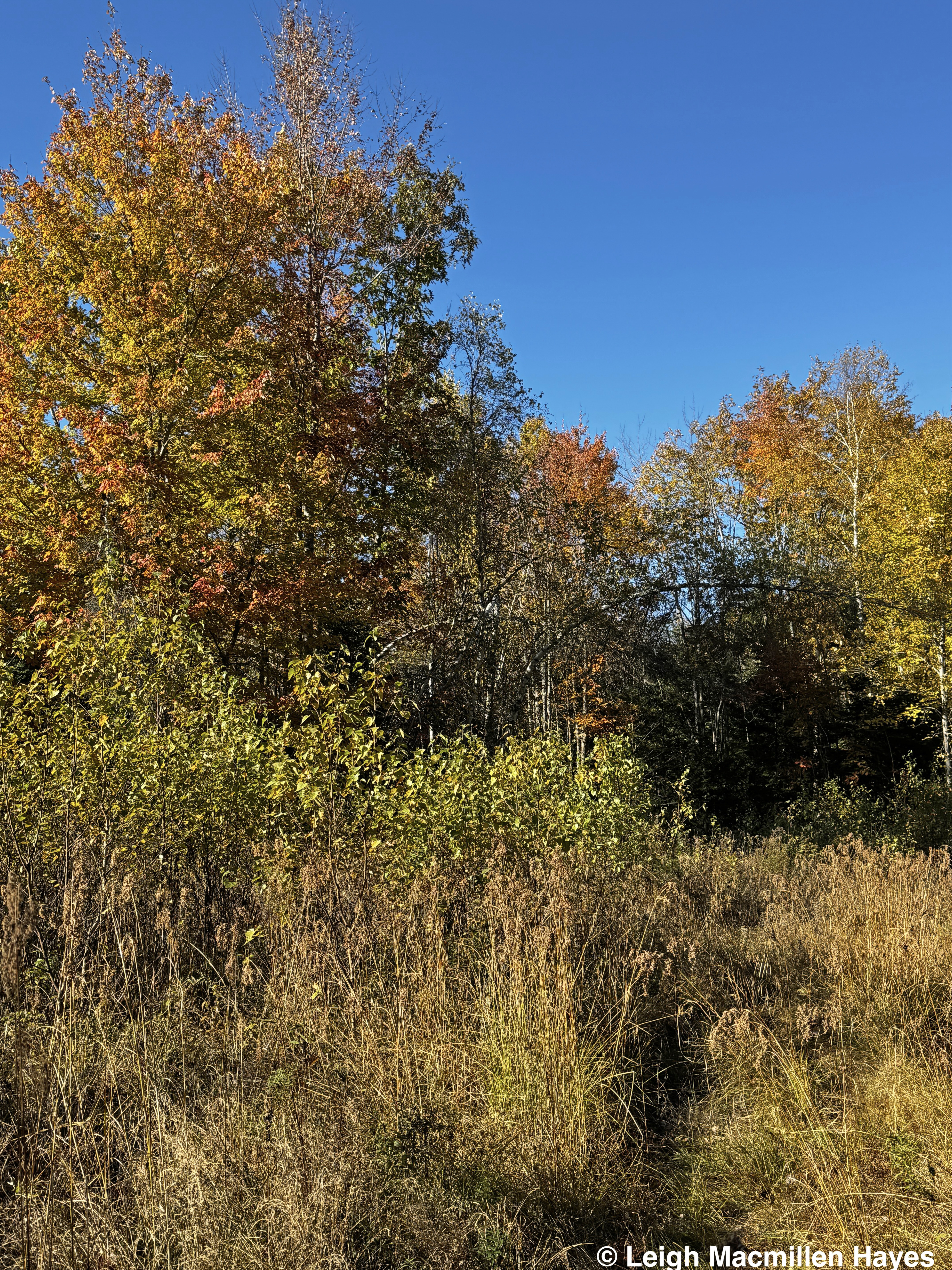
Being an old logging road and log landing, conditions were apparently ideal this past summer, and I paused for a moment to admire forest succession, with grasses and herbs forming the floor, and more grasses and sedges growing taller, topped by Gray Birch, and a backdrop of Red Maples, and Big-tooth Aspen, and Paper Birch.

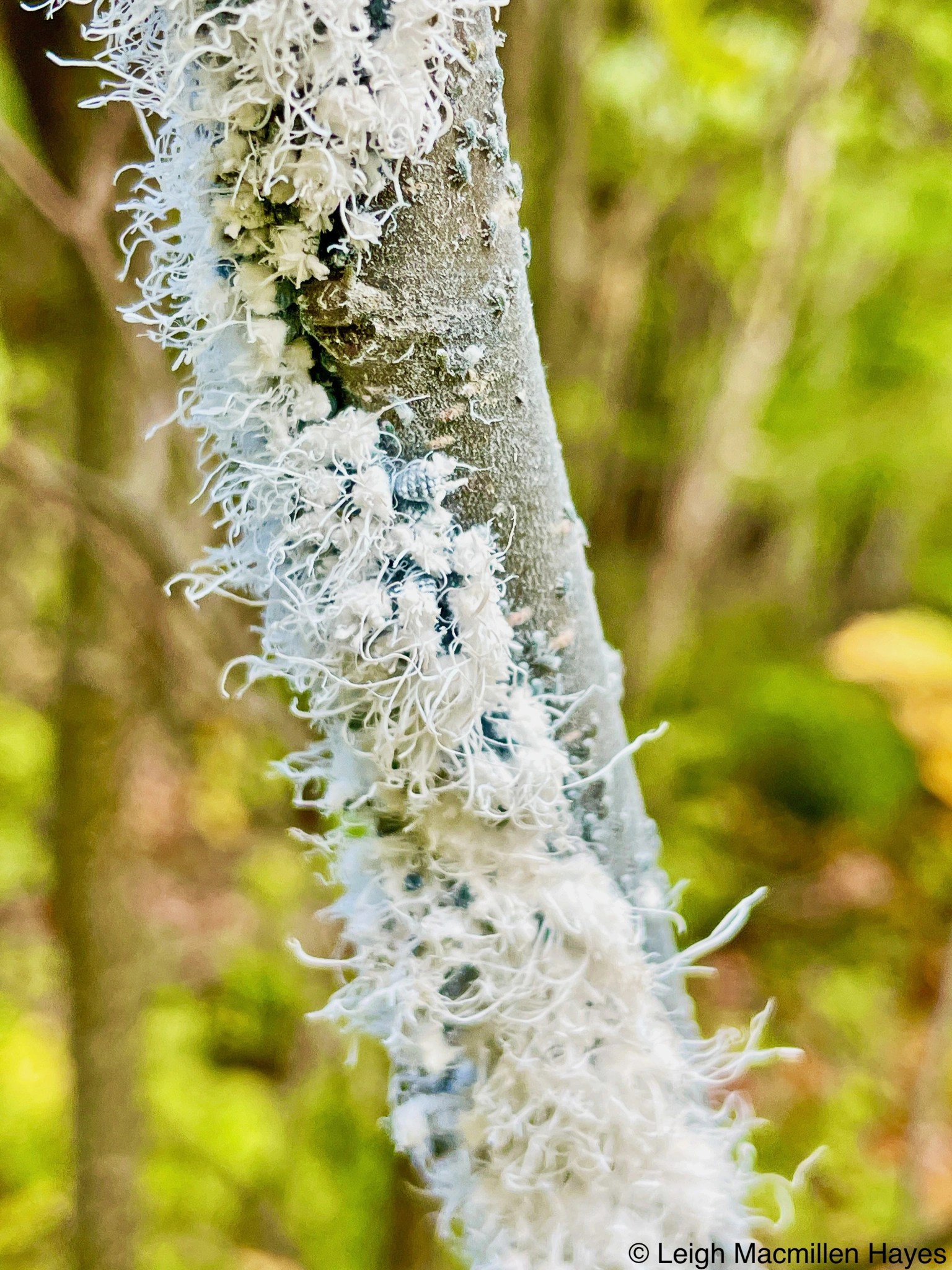
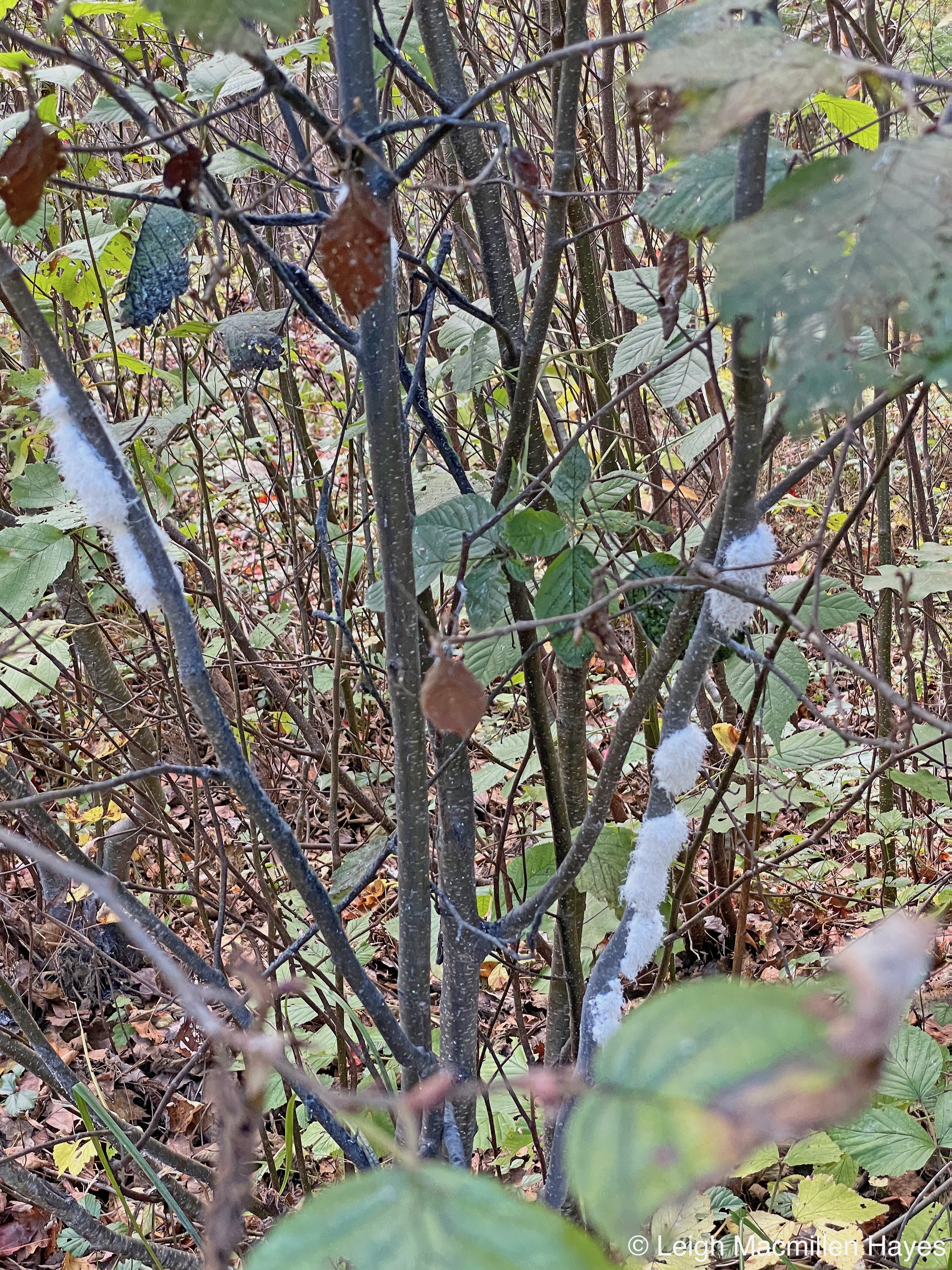
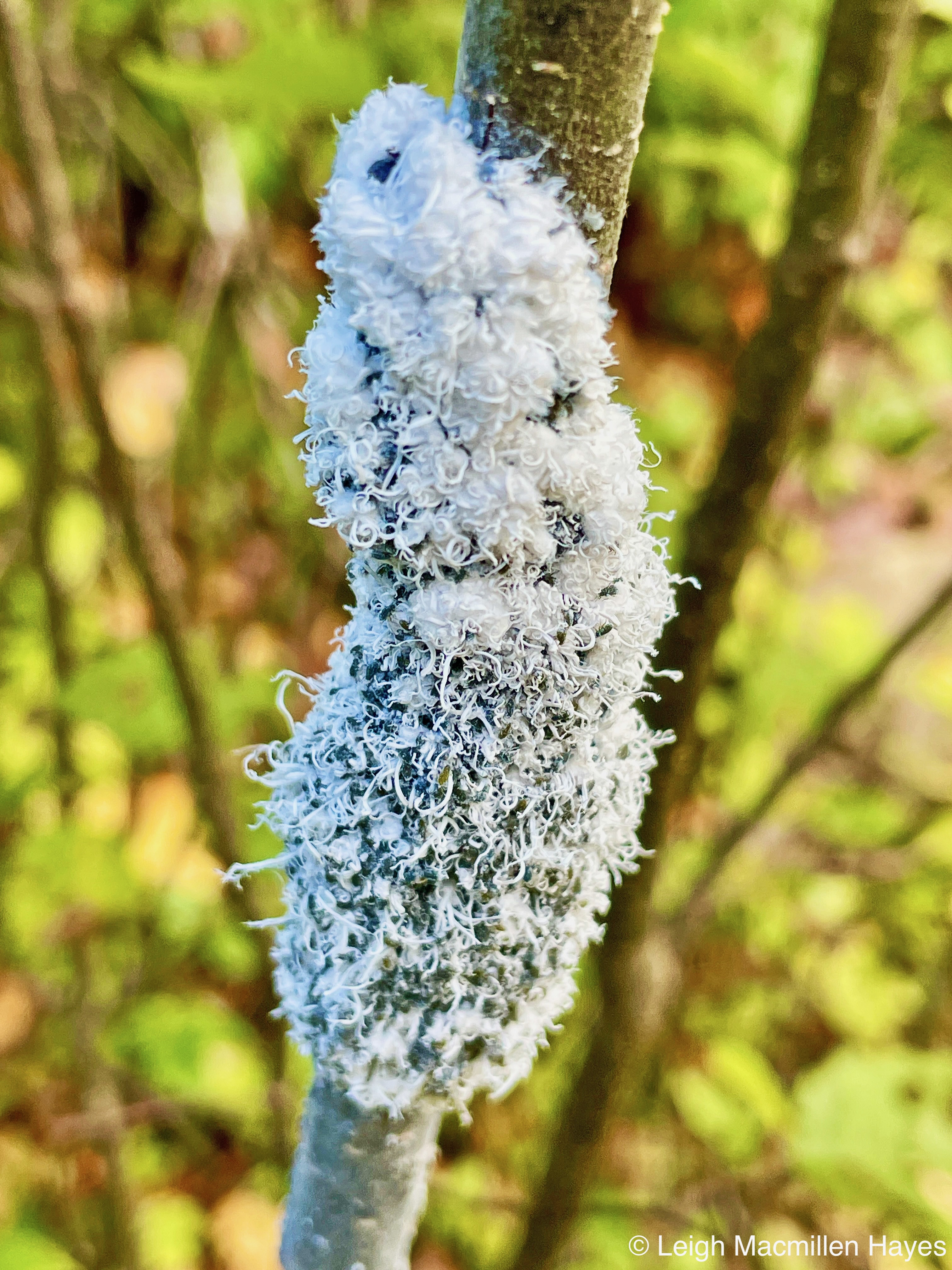
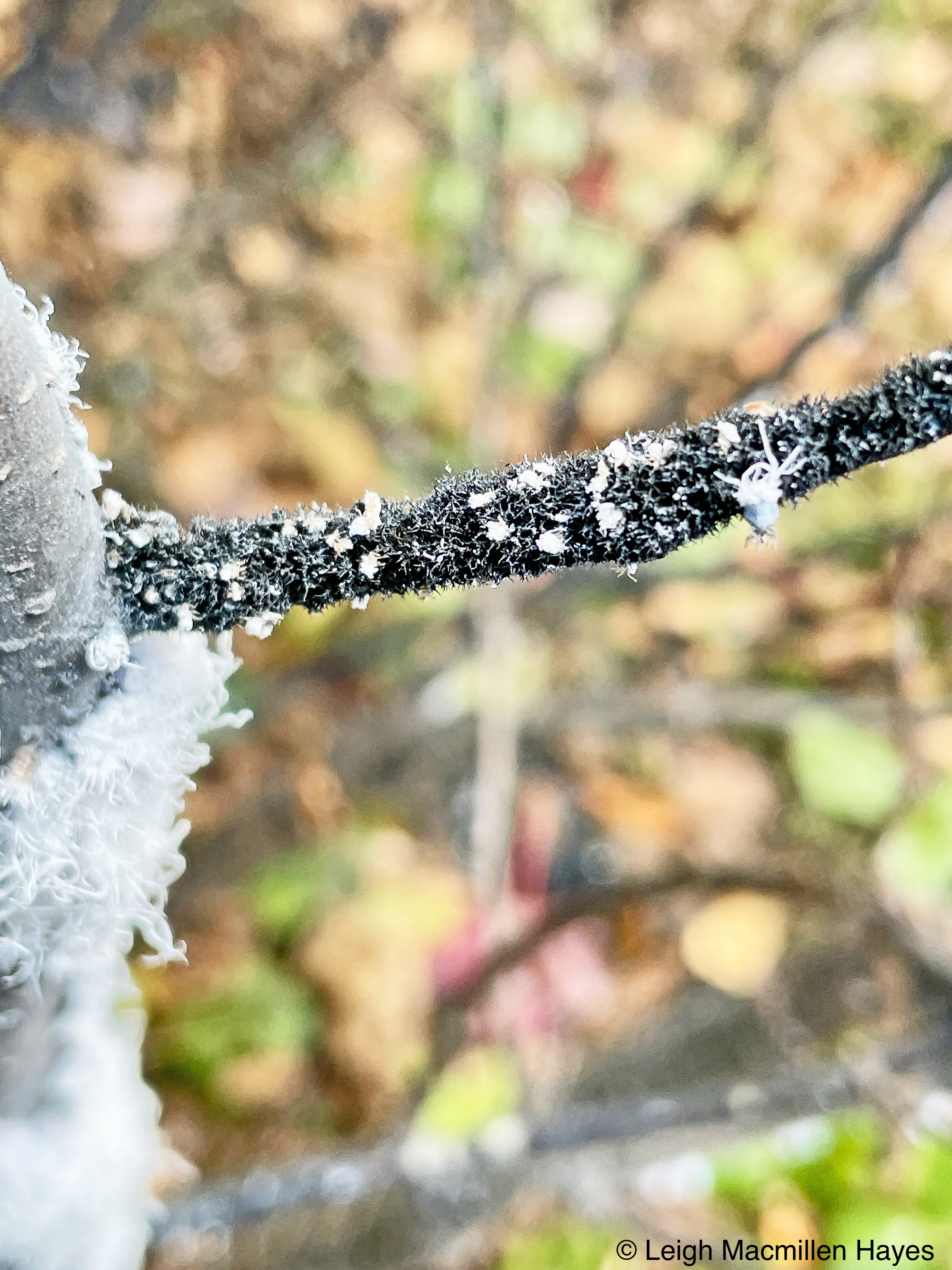
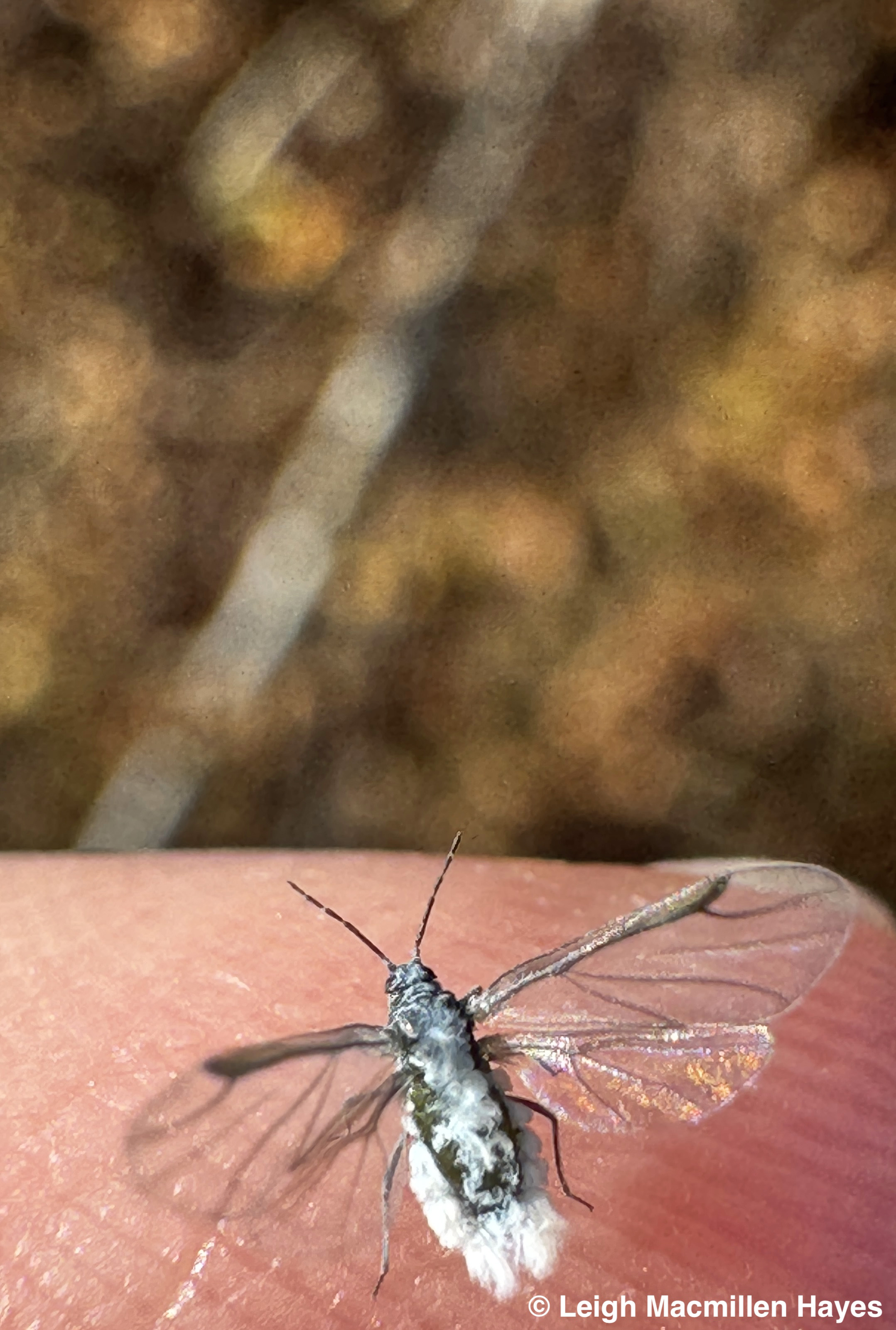
And then it was back to the now dry bed of a stream crossing where Speckled Alder shrubs are closing in on the trail, and Woolly Alder Aphids are living their best life seeking sap from the woody plants.

That Cotton Candy or even Cotton-grass look is actually a waxy material they produce from their abdomens, and when they group together like this, perhaps its meant to detract visitors. Or protect them from the weather. Had a I visited on a summer day, I’m sure I would have spotted ants trying to tickle them (it’s called farming) to take advantage of the honey dew the aphids secrete.

Speckled Alder Aphids live an interesting life style. Actually, according to Donald W. Stokes in his book, A Guide to Observing Insect Lives, “There are two life cycles in this species. In one, the aphids remain on alder trees throughout their lives. They are believed to overwinter as adults in the leaf litter at the base of an alder. In spring, they crawl up the plant and feed on its sap. There are several generations per year and adults of the last generation overwinter.

In the other life cycle, the aphids alternate between two plants. The aphids overwinter as eggs placed on maple twigs. In the spring they hatch into females, which feed on the undersides of maples leaves and reproduce. They are wingless, but in midsummer produce winged offspring, also females, which fly to alders. These females feed and reproduce on alders, and give birth to wingless young. Then in the late fall, they produce winged young, which fly back to maples and give birth to both male and female young. The males and females mate, and each fertilized female lays a single egg on a maple twig. Only the eggs overwinter.”

It’s things like this that add to my sense of wonder. Two life cycles? The adults of one life cycle overwinter while the eggs of the other are do the same? That’s amazing.

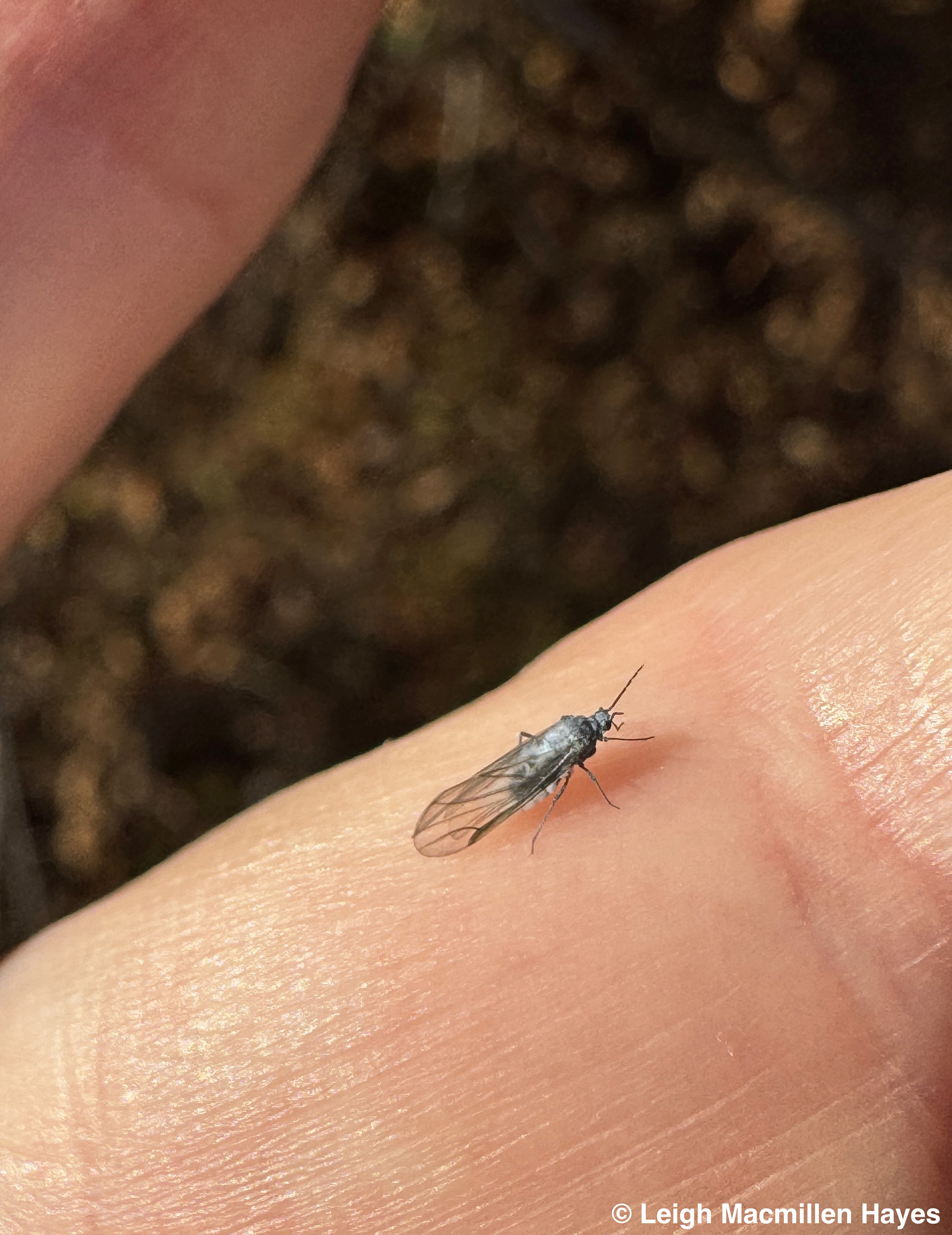
And on the fly in a bit of abundance right now for I saw a bunch today and I’ve been seeing them along many trails that I hike, are the flying aphids. If you stick your hand out and cup it, you can get one to land.

Don’t worry, they don’t bite. And they don’t even tickle, despite that waxy hair.

They’re actually kinda beautiful in their own way and as they fly they look like tiny flakes of snow, thus some refer to them as Snow Bugs.

So I have two forever-friends-since-birth and I’ve already referred to Kate earlier in this blog because she is a great lover of Juncos, along with everything else in the natural world, and so is her sister, Patty, who once told this joke when we were kids:

Q: What’s white and goes up?

A. A dumb snowflake.

One of these two is eleven months younger than me and the other is eleven months older and she and I just chatted yesterday and I’m so thankful to have them in my life all these years. Yes, B.S., I am also incredibly thankful to have you in my life.

But once again I digress. Except I had to tell that joke. Because it kinda reminds me of the aphids in flight.

Back to the power line, I decided to pull the Mighty Mount Washington in with the telephoto lens. Yes, dear readers, that is snow! Several inches of the white stuff has fallen over the last few days. And there is rime ice.

My favorite season is only a walk down the power line away.

Snow: Bugs and Flakes. It’s all wonder-filled.

Heron Accomplishments

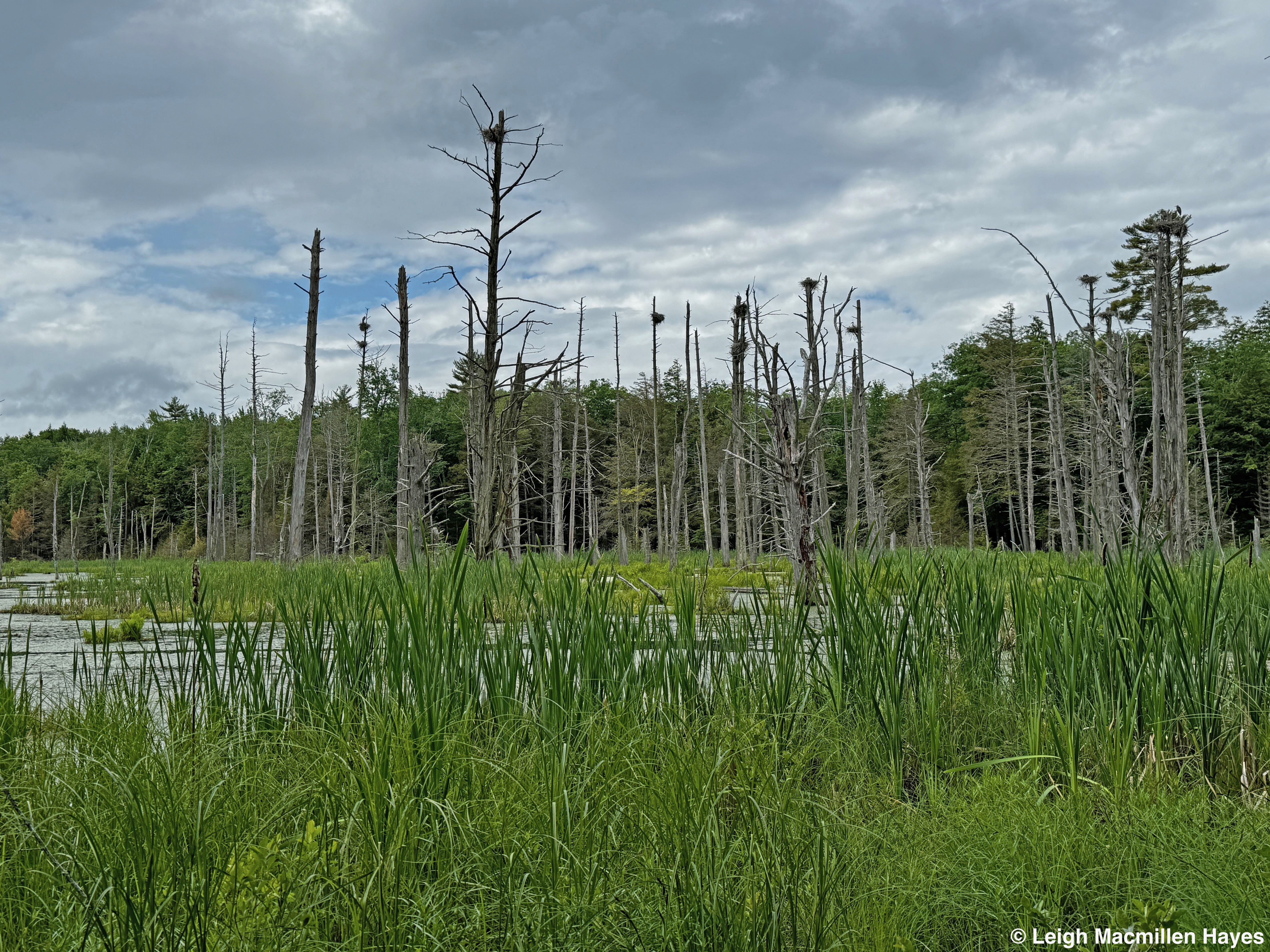
For the last fifteen years I’ve had the honor of stepping into a wetland or two early in the morning on a regular basis for at least six weeks to check on the activity of heron rookeries. It’s a community science program called HERON that the State of Maine runs: “HERON” is short for the Heron Observation Network, a network of volunteers across Maine who monitor nesting areas, or colonies, of wading birds such as the Great Blue Heron. HERON is managed by the Maine Dept. of Inland Fisheries and Wildlife.”

Herons are colonial nesting birds, meaning they nest in groups. Their nesting community is known as a rookery.

If I could get away with it, I’d spend all day in this place where the wild things go about their daily duties as co-observers and I stay on the edge in hopes of not disturbing them.

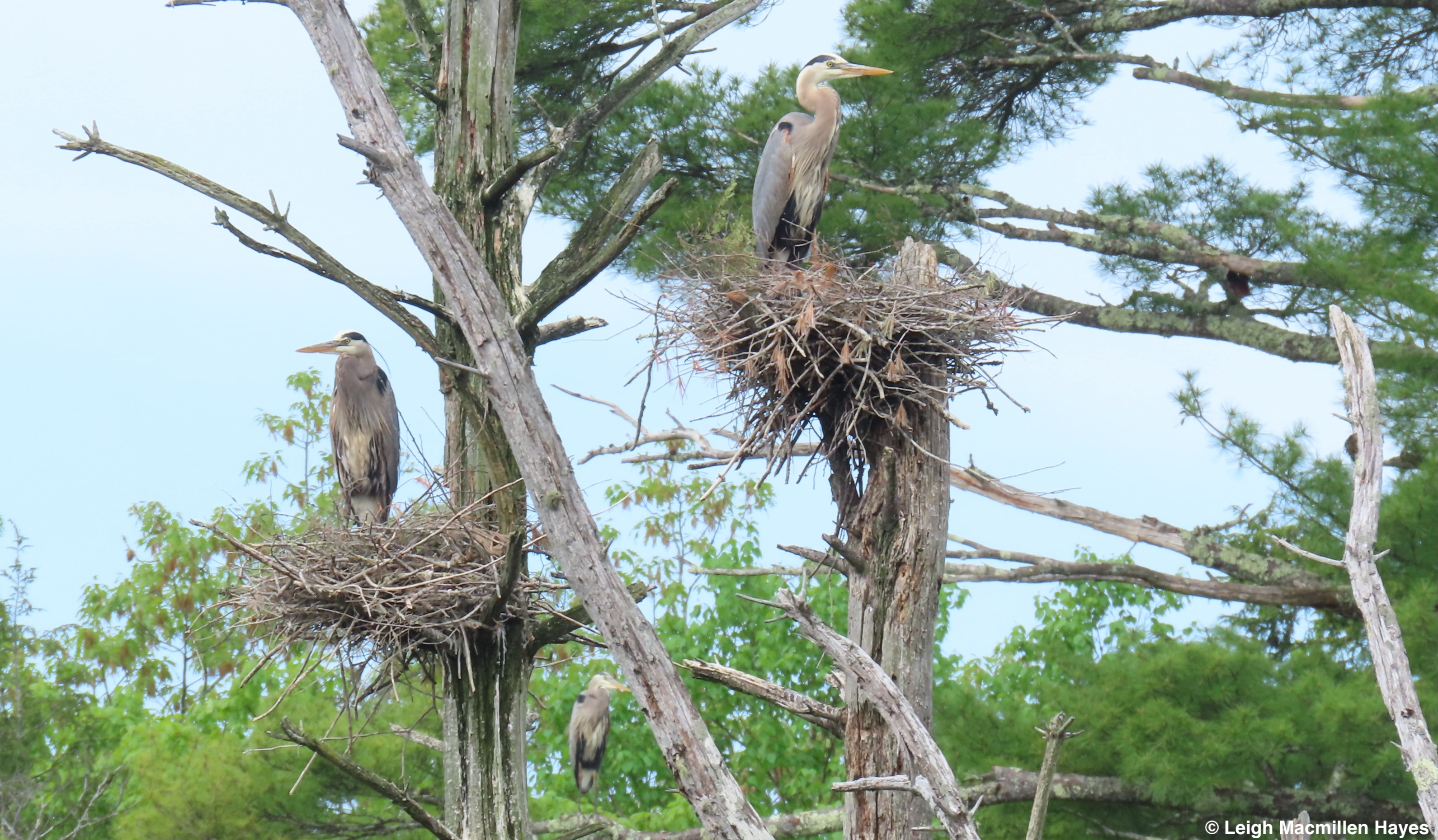
I think what amazes me most is that they build their stick nests high up in trees and I always expect the wolf in The Three Little Pigs to huff and puff and blow their homes down. Or at least the wind to do such.

The most difficult day of the count may be the first. May be. First, the number of nests must be counted. Then the number of active nests, those with birds in them. Next, it’s the number of adults and then young, if visible. If the adults are incubating, for how long?

And that’s where it gets tricky. If eggs aren’t visible because one cannot get close to the nests, since they are anywhere from about 50 to 200 feet from land, and high up in dead snags, this is a challenge. Spotting adults on the nest, however, indicates there possibly are eggs within.

Nest building and rebuilding is a constant, and a clue that there’s hope for a new generation. Adding sticks with one’s mouth sounds difficult to us, but it is the way of life for a bird.

Spotting little bundles of fuzz brings smiles to observers’ faces–as if we have given birth or are at least the grandparents of these bouncing babies.

Two weeks later and they already have Great Blue Heron markings and crazy hairdos and the counting gets a wee bit easier. Of course, the youngsters hop up and down and so nests have to be reviewed several times to make sure the number is at least close to accurate. It’s not unusual for a nest to support three, four, or five youngsters.

If you’ve never been near a heron rookery in those early days, you haven’t experienced the pterodactyl fly ins as adults arrive with food or the intense and loud and constant squawking of the youngsters demanding to be fed.

Once the adult has landed, the birds still must beg, sometimes for ten or more minutes and I can’t help but wonder if the squawking encourages adult regurgitation.

If you look closely at this photo, you’ll notice the two on the left are in one nest waiting ever so patiently for an adult to return with a meal, while the nest in the back to the right hosts two beggars waiting for the food to slide up the adult’s throat and down into their mouths.

Those awkward tween years only last a few weeks in a bird’s life, for so rapidly must they grow given the short season of our northern clime. Hairdos are a good indication to separate adult from young.

Remember when I said that the first day was the most difficult day to count. Well, that is debatable, for as the weeks go on and the youngsters grow, it becomes difficult sometimes to distinguish parent from child. If the plume on the head is spotted, then it’s an adult, but sometimes the lighting or angle isn’t right.

That said, the count is completed about six weeks after the first visit for the birds begin to fledge and the nests won’t be used again . . . until next spring.

There are so many joys about spending time in the wetland, but a few include dew upon spider webs,

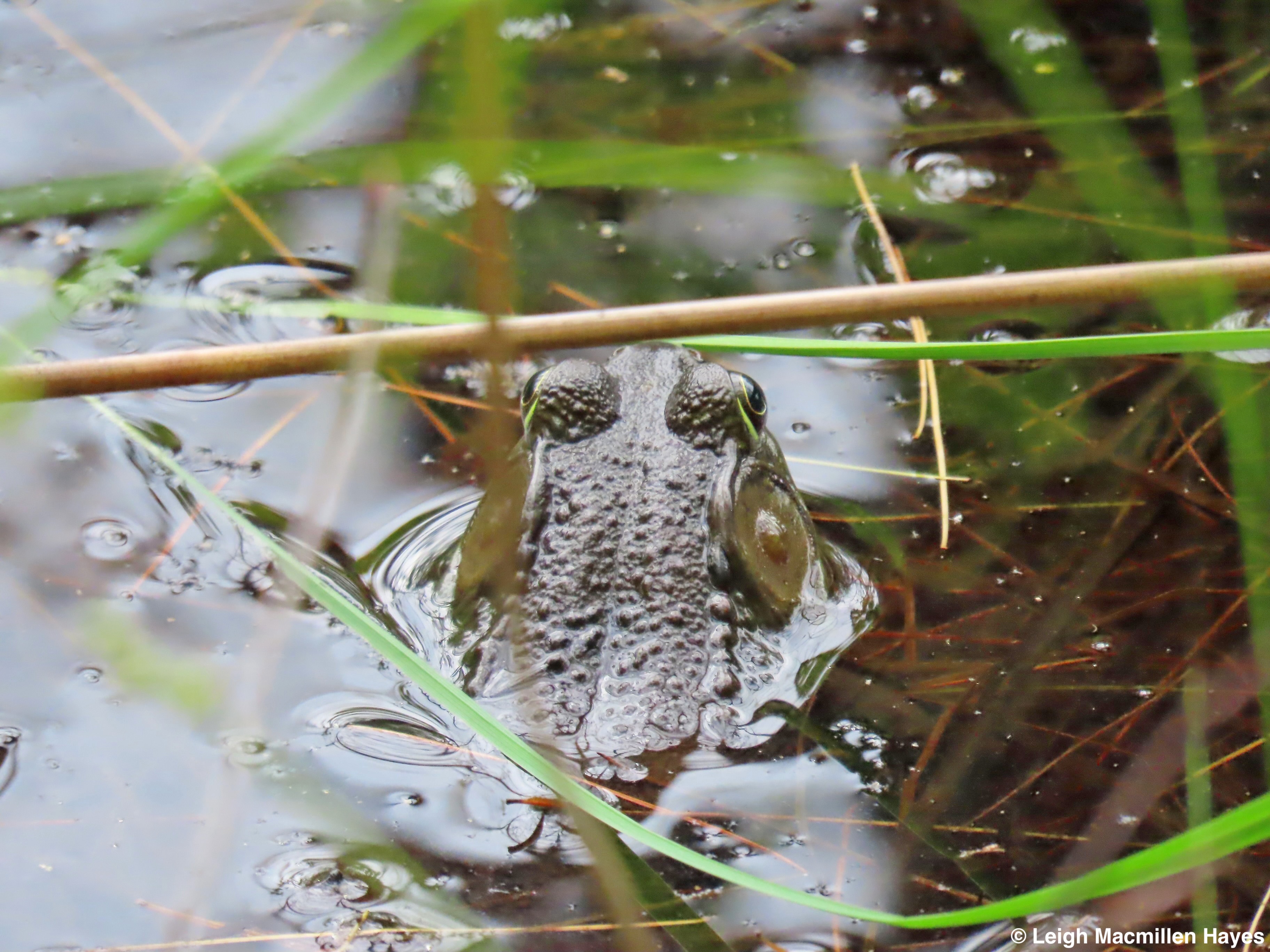
Frogs who ga-dunk, ga-dunk at our feet,

a young Robin calling for its parents,

and the spotting of four Wood Ducks on a snag.

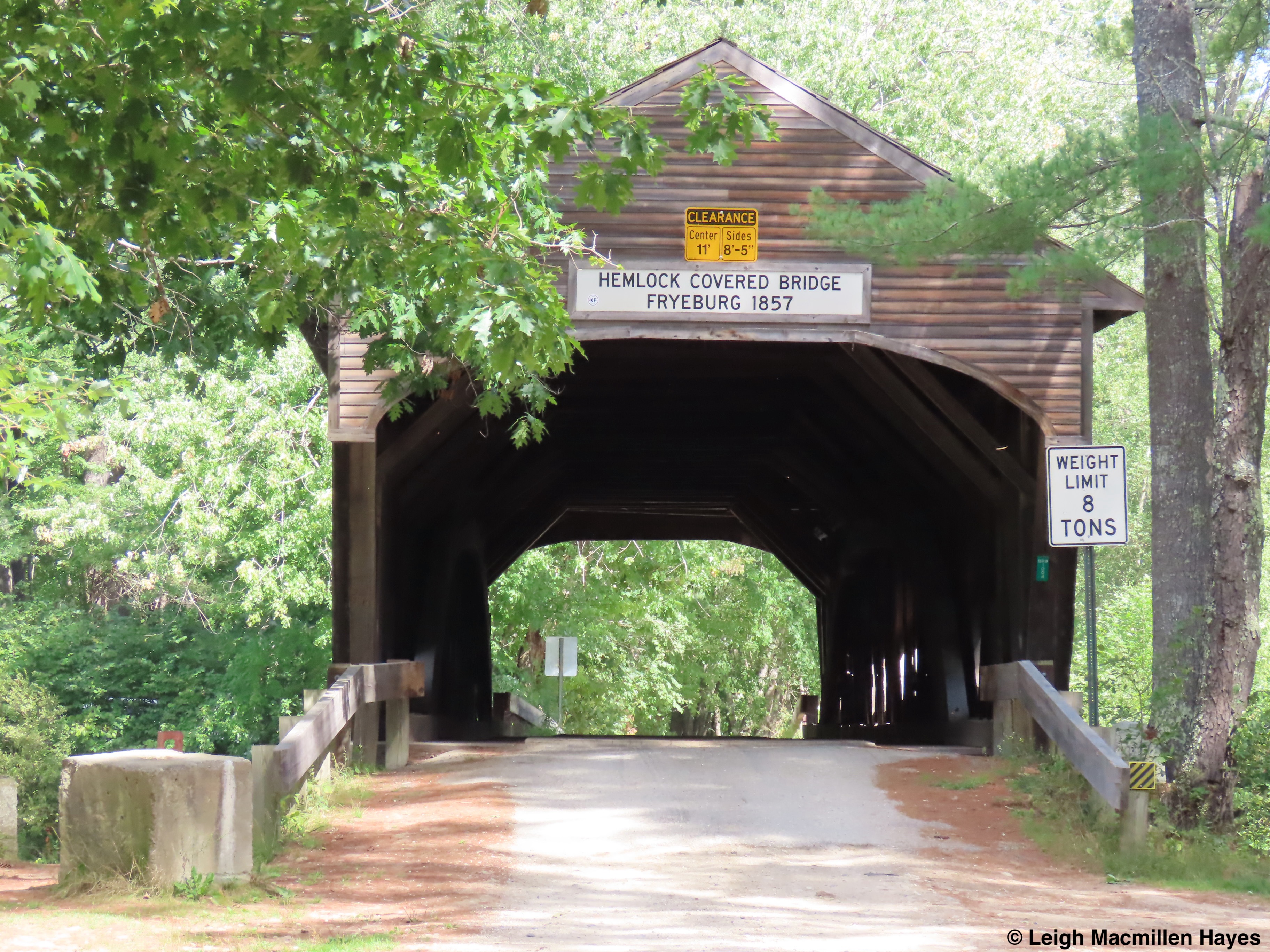
Fast forward two months and this afternoon found me walking the roadway on either side of Hemlock Bridge, my eyes darting here and there taking in flora and fauna with each step.

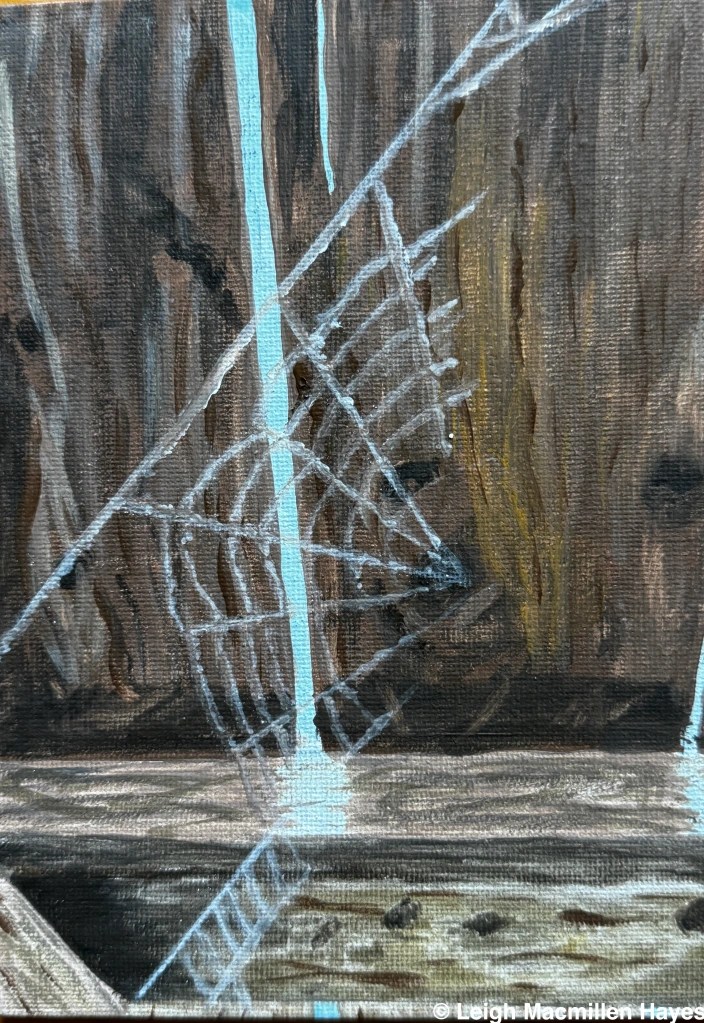
I love the Paddeford construction of this bridge. Or maybe it’s just that I love that we live so close to a covered bridge. And recently, because I’m taking a painting course, I tried my hand at showing off some of its beauty.

Spider webs did not go unnoticed by me. I didn’t spot the creator, but trust that an orb weaver was hiding somewhere nearby.

As I walked along the old course of the Saco River, I spotted a few Painted Turtles basking in the sun, but also noted all the debris clinging to branches, a sign of the high water we had this past spring.

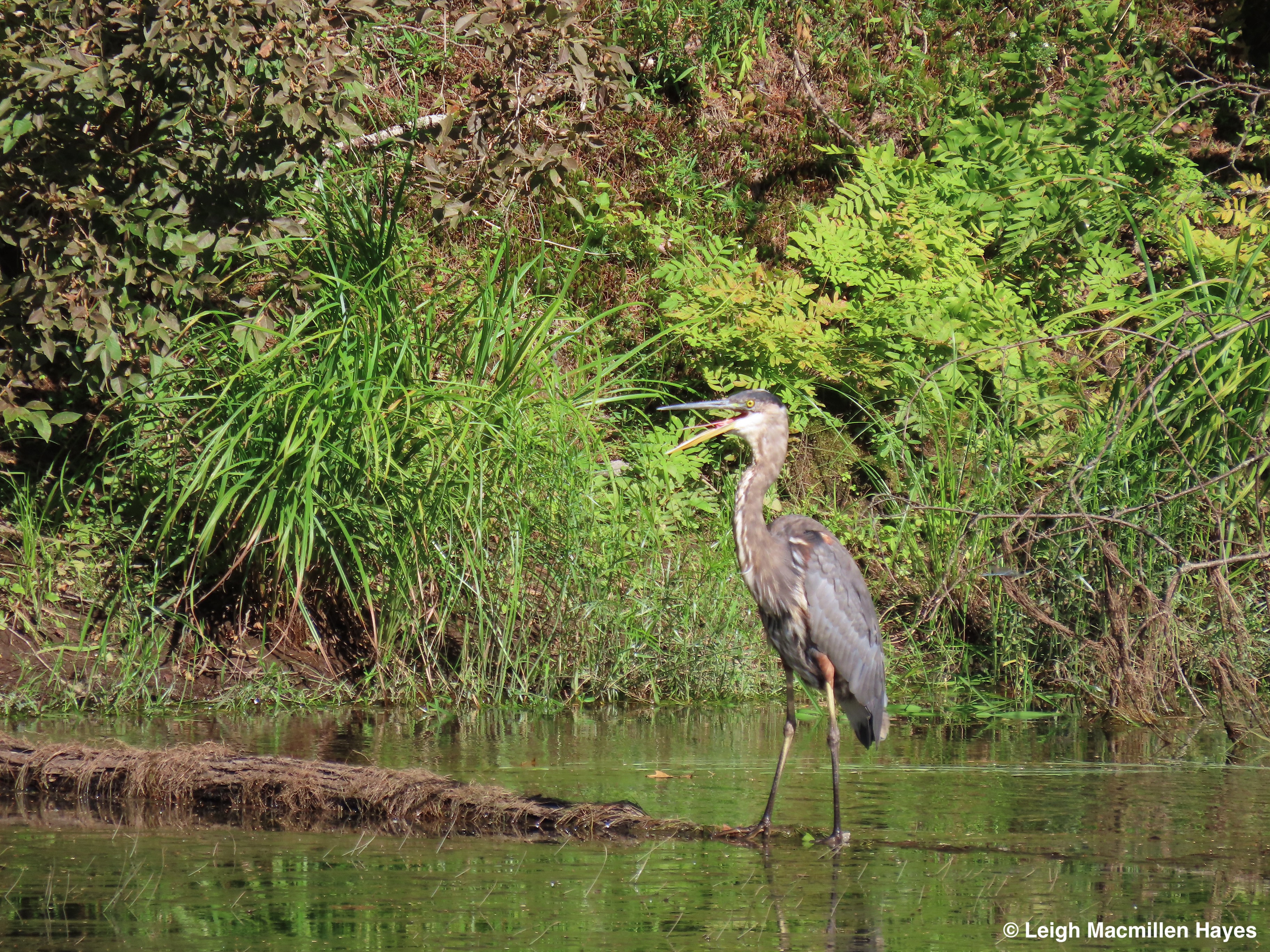
And then something else caught my eye. One of my teenagers was on a fishing expedition. And panting to cool down.

I got excited when it seemed he’d spotted a meal.

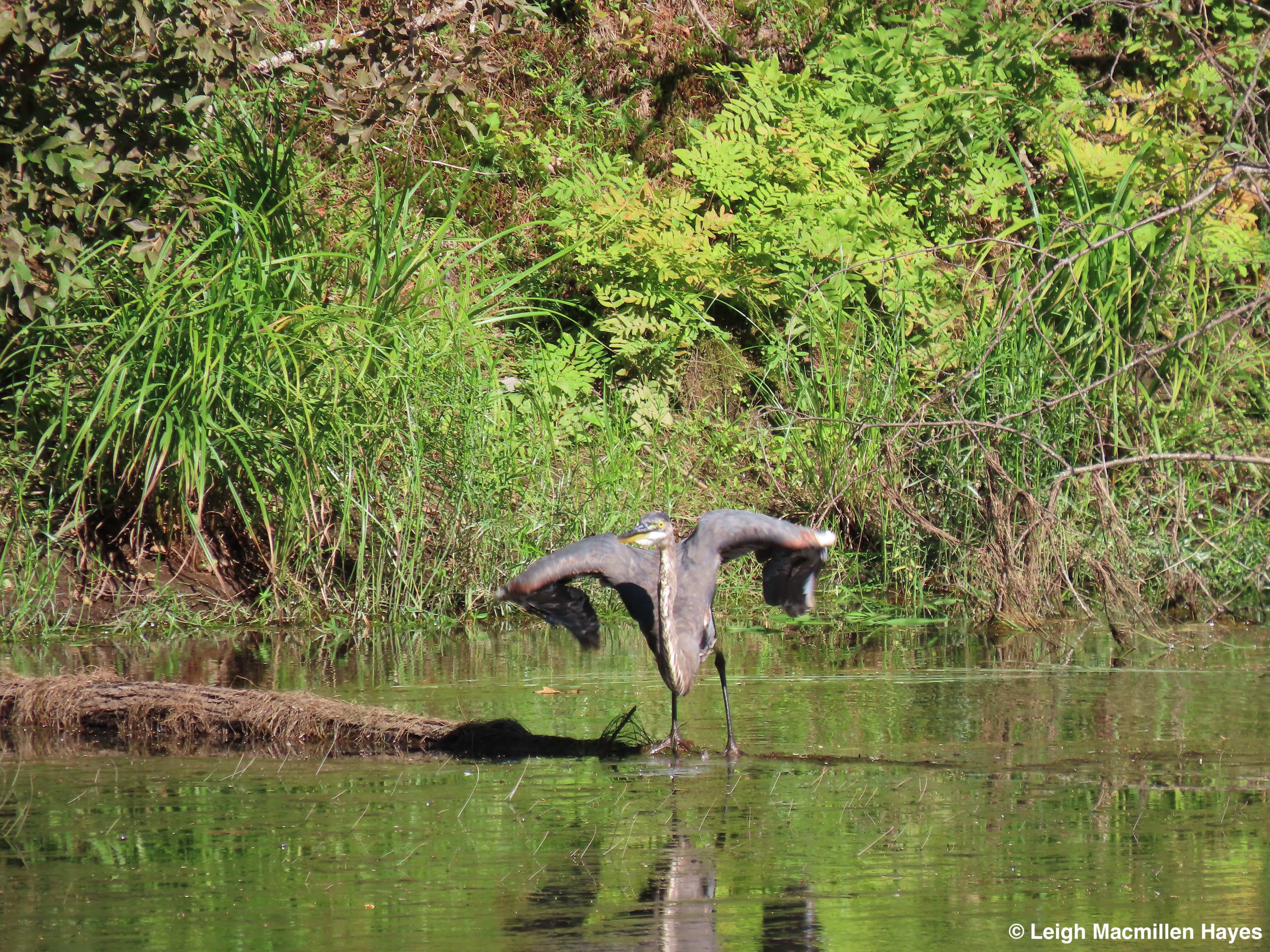
Apparently that didn’t pan out and he turned his attention in the other direction. As I watched, he tiptoed ever so gently for such a big bird, and I was certain he was on to something.

But then he stood there and panted some more.

Until there was a bit of a tussle and I realized he and a snake had a brief encounter. Both survived. And left each other alone.

And then the bird flew and I was bummed. I wanted to witness a meal being taken. But I have to have faith that it found success somewhere else upon the river. Just as I trust that the sun will rise tomorrow, and the day after that. This bird will not go hungry.

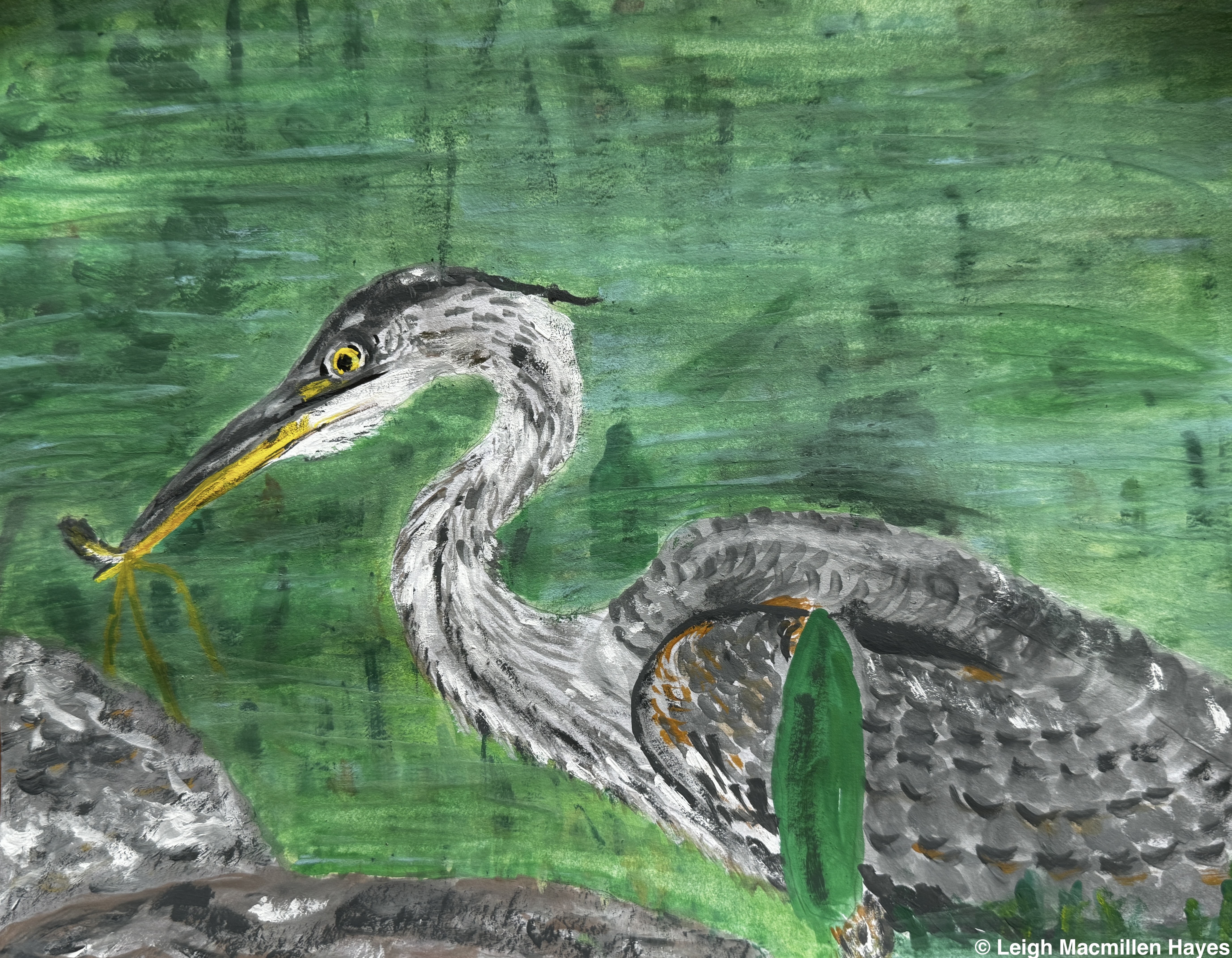
Instead, upon arriving home I pulled out a painting I completed a couple of weeks ago of a Great Blue Heron I watched snatch a fish last summer.

Just as the young heron’s accomplishments may take time, so do mine as a painter. But it sure is fun trying.

As for the count:

One rookery featured 19 active nests at the start, but only three toward the end, and I have to wonder if a predator found many a meal high up in those trees.

The other rookery featured 53 nests, with all but a few being active and lots of youngsters produced.

That, in itself, is a great heron accomplishment.

Winter Inventory

We live on the edge. The edge of a small town in western Maine. The edge of a neighbor’s field. The edge of a vast forest.

Our property only encompasses six acres, but it’s six acres that I love to explore and it’s been my outdoor classroom for a long time.

And so today, I invite you along to take a look; if you are a regular, you may have already met the friends I’m about to introduce, but their actions keep me on my toes, much like the deer who crisscross our yard on a regular basis.

Though the acorn crop was abundant in our area, the deer make several trips day and night to consume sunflower seeds and corn and they’ve worn a path (deer run) making it easier to travel. They don’t always follow it, as you can see, but do so enough that it’s much like my snowshoe trails.

The yard is full of tracks, for besides the deer, there are gray and red squirrels who also frequent the feeders, an occasional red fox that I’ve yet to see this winter, and our neighbors’ dogs and cats. Everyone has a place at this table.

Of course, the deer run does lead to another species they love to munch on, the needles of a Balsam Fir. They frequently pause here before climbing over the stone wall into our wood lot.

And so I paused too. And discovered yet another cache and midden created by one of our local Red Squirrels. I’m in awe because until yesterday, I wasn’t aware of this one and I can see it from the desk where I’m writing right now. And to top it off, yesterday was the first day since I filled the feeders at the beginning of December that I saw a Red Squirrel chasing the Gray Squirrels away.

I, too, climbed over the wall and look who I met. Always on alert and often either skittering along the ground or a stone wall, or chastising me from its branch of choice, Red doesn’t realize that I’m a fan.

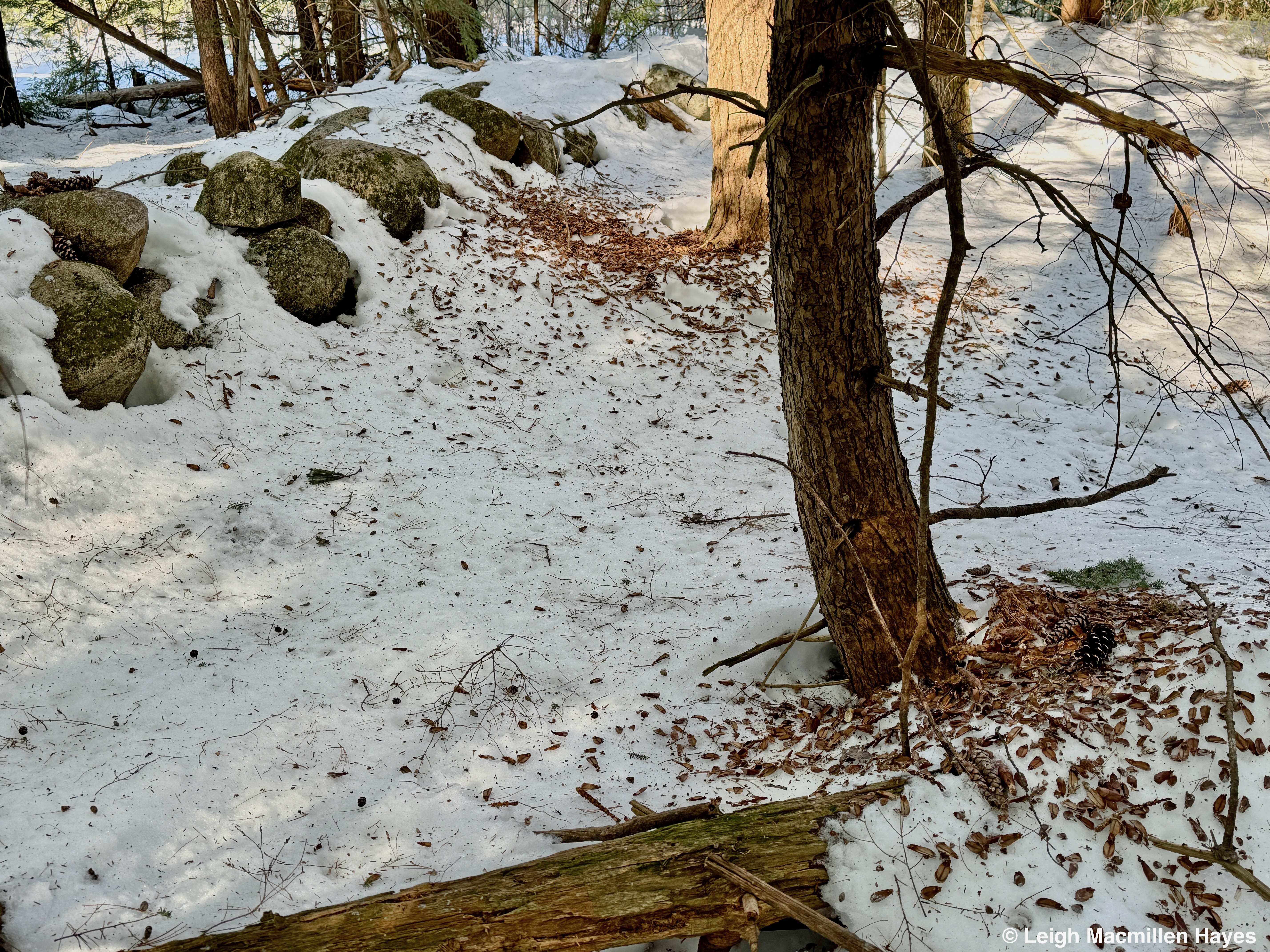
Next, I ventured over to the old cow path, bordered as it is by two walls, and checked on the cache and midden situation that’s become so familiar to me.

The cache or storage pantry of pine cones is located under the mound of snow the black arrow points toward. At last measurement as recordered in The Forever Student, Naturally, the pile was a foot high. As you can see if you look closely at the tops of the stones behind the snow-covered pile, you’ll spy several middens. So my question is this and I’ll have to wait until the snow melts to answer it: Are all of the cones the squirrel is consuming (well, seeds actually, for the midden is the pile of discarded scales that protect the seeds, plus the cob or core left at the end) coming from under the rocks, where I’m sure there was more storage space, or the bottom of the pile, because Red Squirrels do tunnel? I can’t wait to realize the answer in another month or so.

The pine tree beside the cache also provides a grand dining spot.

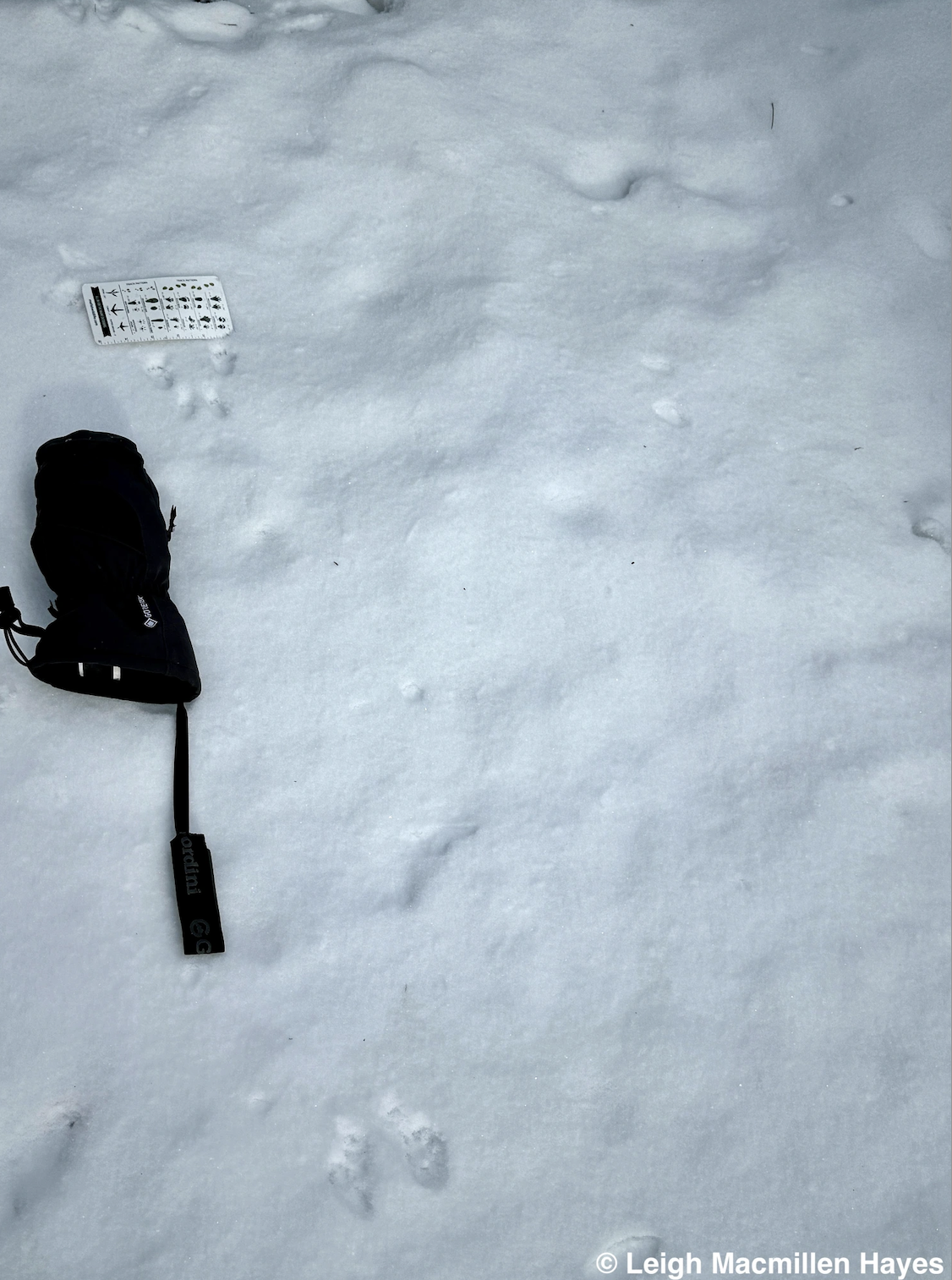
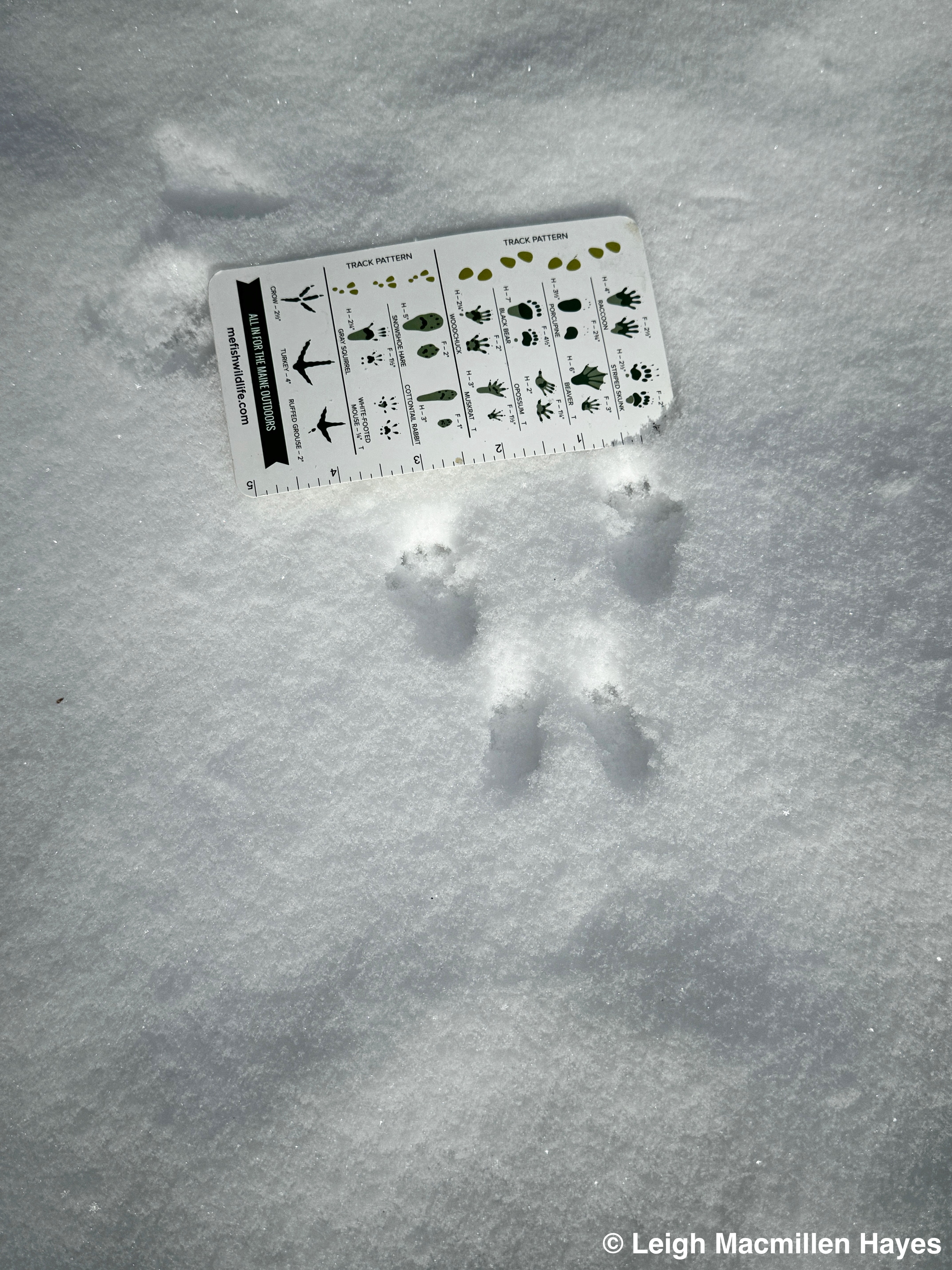
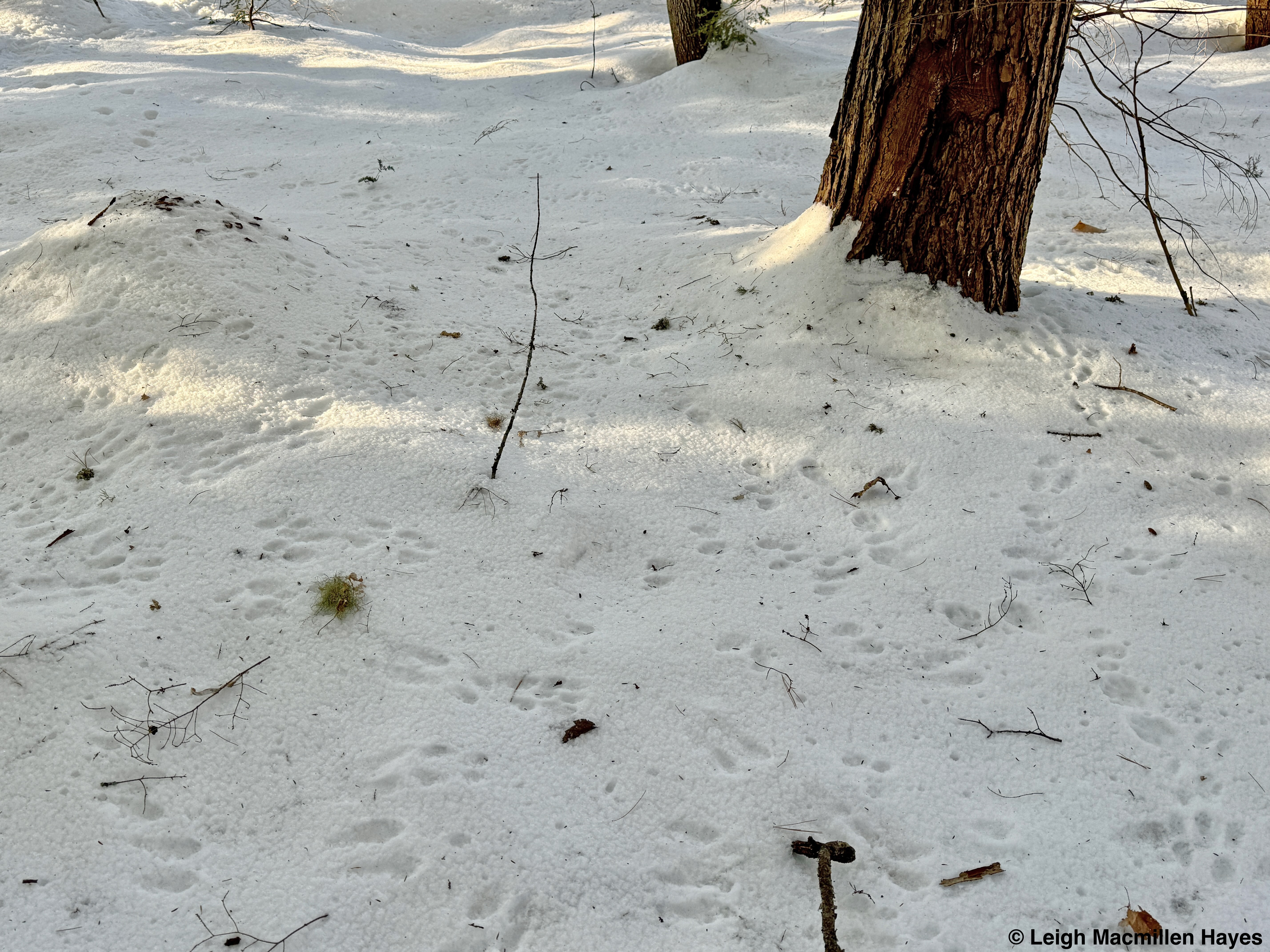
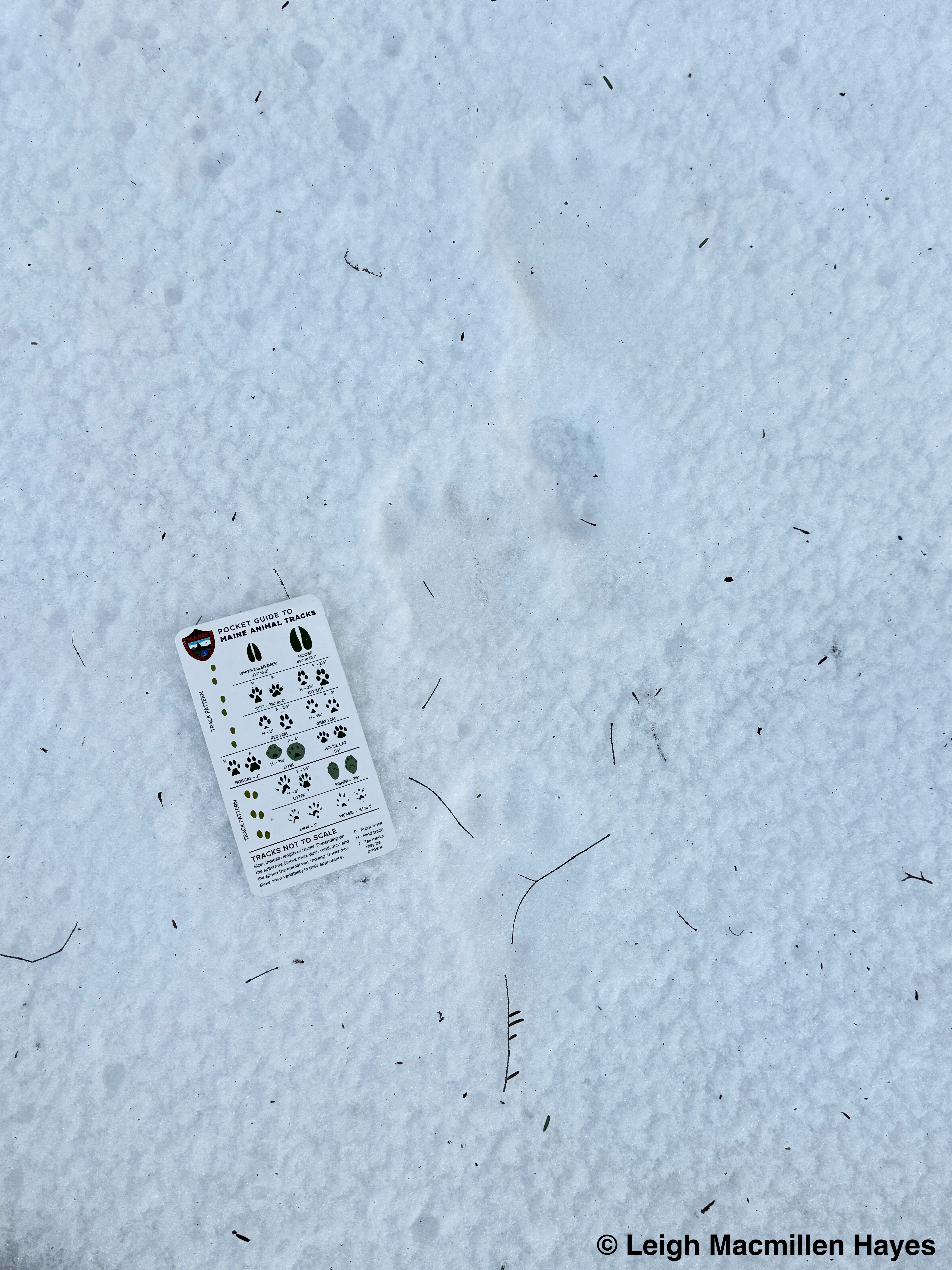
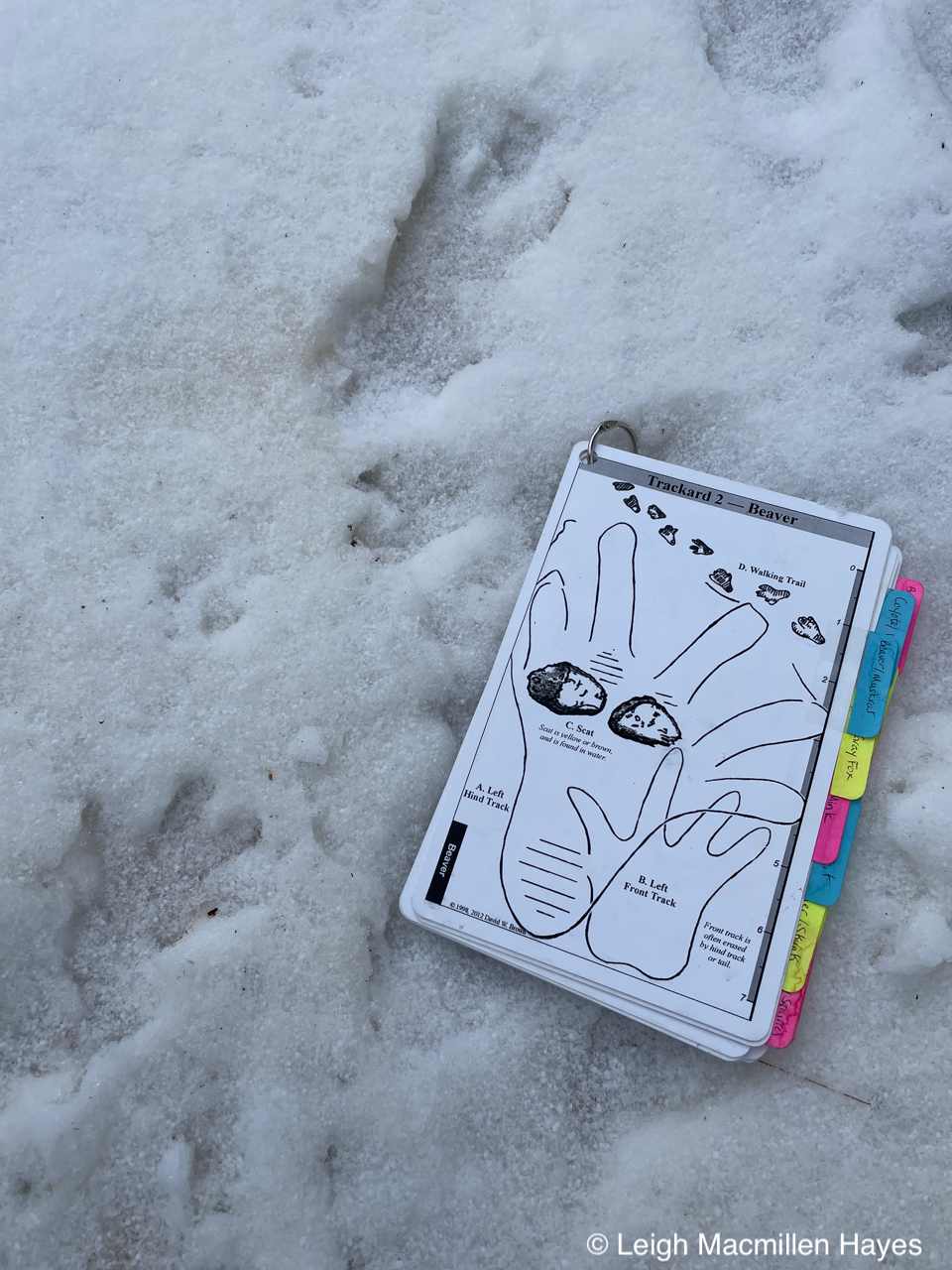
About an inch of snow fell overnight, so when I went into the woods this morning, I found fresh Red Squirrel prints, with the straddle or track width being the typical three inches. It was a bit nippy with the wind chill, so I didn’t get the card placed exactly as it should have been, but you get the idea. Its big feet in front are actually this hopper/leaper’s hind feet.

Okay, so I did risk the freeze for a minute because I spotted the set of four prints behind the first set I’d photographed and realized not only how close together the four were, but also the length of the leap from one spot to the next: My mitten and wrist holder are 19.5 inches in length and they didn’t cover the length of this motion–perhaps an attempt to quickly reach safety in the other wall or up a tree.

That action was on the eastern end of the path, but there’s more to see as I head west.

A few days ago, and probably because the night temperatures were more moderate, a family of rascals crossed from the other side of the wall and onto the path. By the baby fingers of the front foot, I know they were Raccoons.

As waddlers, Raccoons have their own pattern that is easy to recognize once you get it into your head. They don’t travel this way all the time, but most often I find their prints, with a front foot (baby hand) of one side and hind foot (a bit longer print) of the other side juxtaposed on opposite diagonals. If you look at the black lines I placed before each set of two prints I hope you’ll see what I mean. And notice the keys. It’s all I had in my pocket that day and I wanted something for perspective. I really didn’t expect to find the raccoon tracks.

I went back home and grabbed a tracking card to set on the ground. If you’ll look closely, you’ll note that it’s more than one animal, but all the same family. I followed them across the wood lot, over another stone wall, and into the field where they split up into four individuals before heading off in to the neighbor’s woods on the far side.

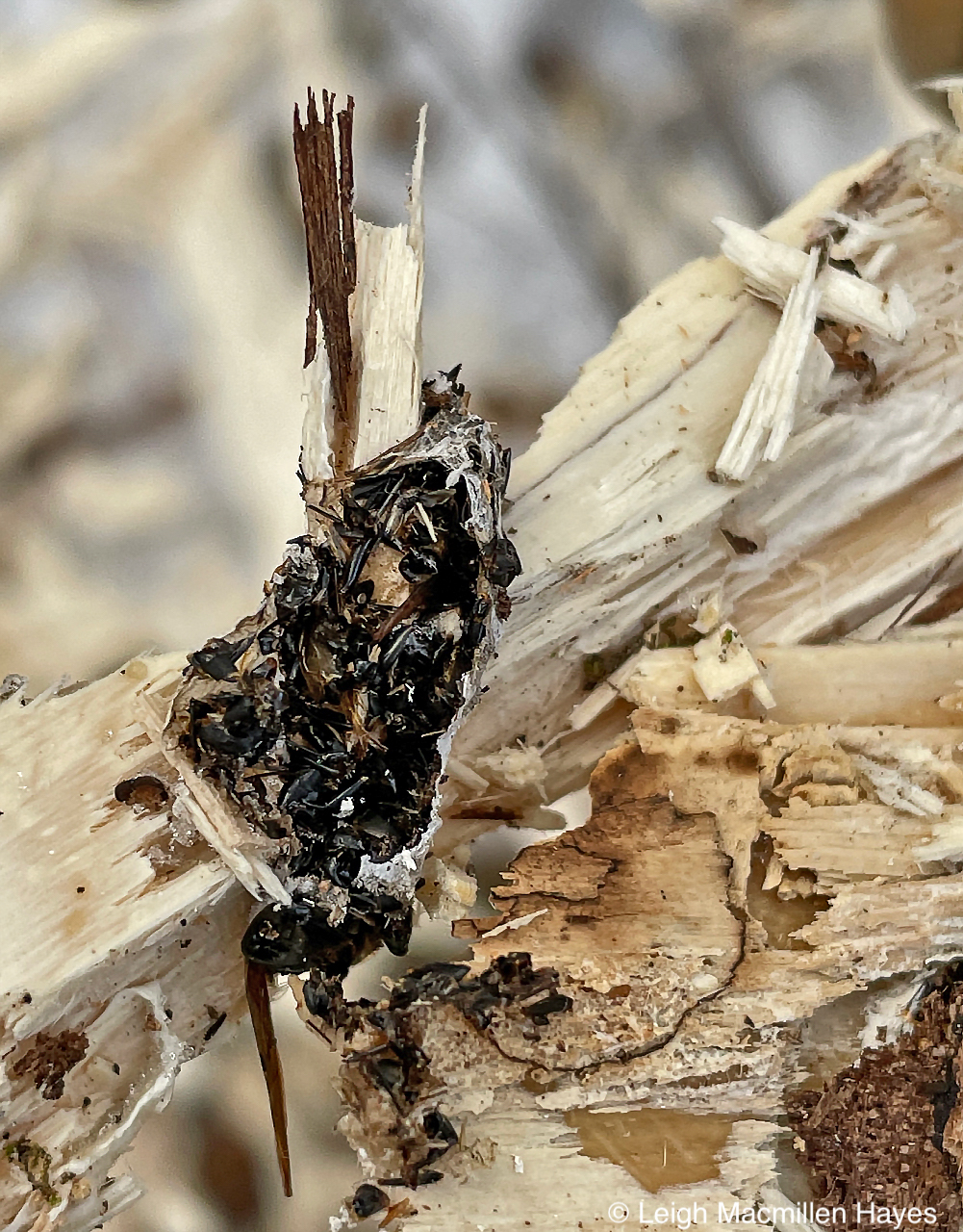
Back to the cow path I did return and this time it was a scene just off the path that drew my attention. Our Pileated Woodpecker has been active as evidenced by all the wood chips on the ground. That means one thing to me. Time to look for scat.

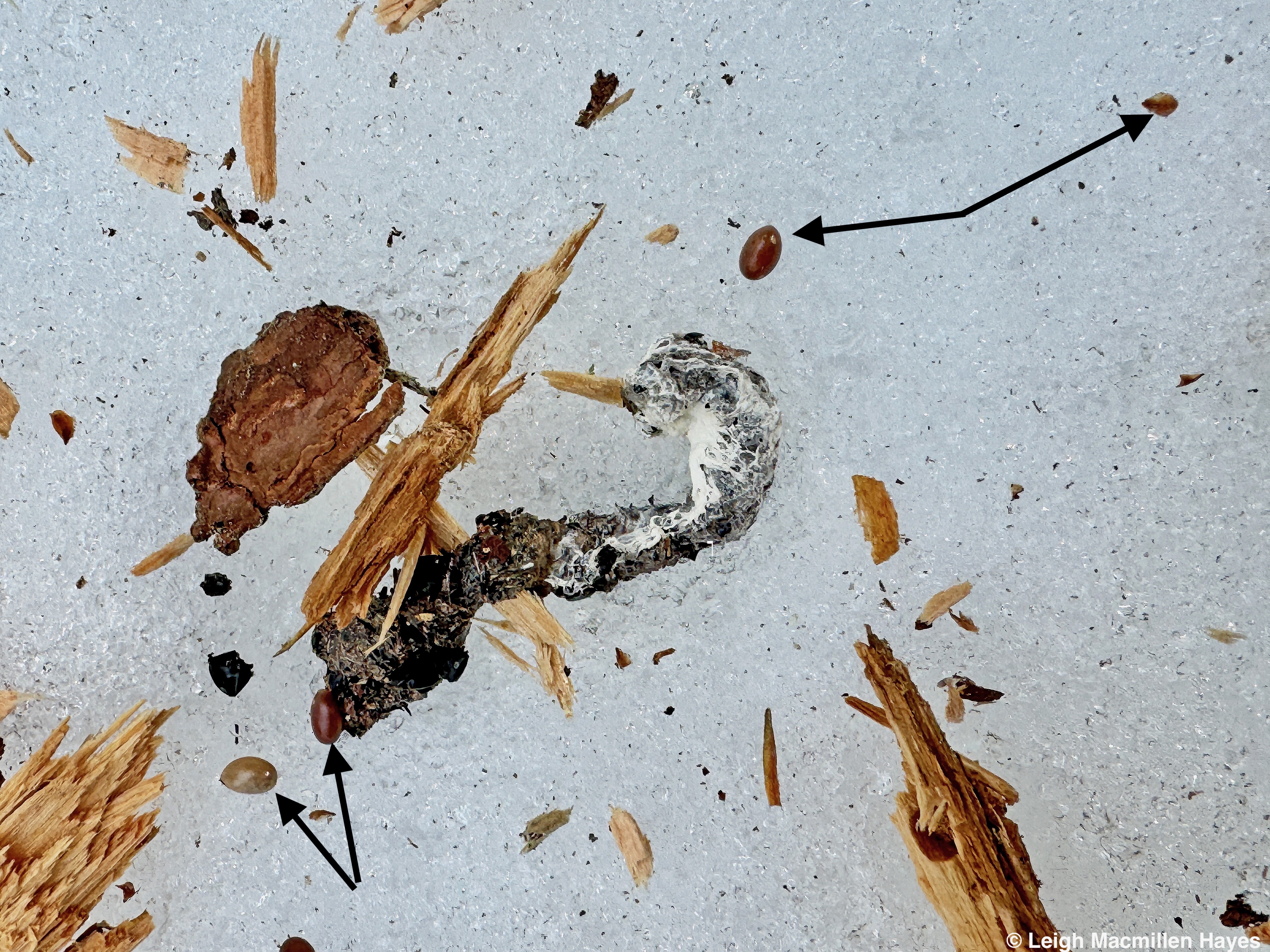
And I wasn’t disappointed. Check out that cornucopia stuffed chock full with insect body parts that the bird couldn’t digest.

Finding this is always like opening a Christmas present. The thrill never ends. But, curious spot here. Seeds. Staghorn Sumac seeds.

And on the pine tree and at its base, I found more of the Staghorn Sumac in bird droppings, a completely different form from the Carpenter Ant droppings.

Both followed me home! The Carpenter Ant scat is very fragile.

The sumac, being fleshier, held together better. Under the microscope I noted that there were some ant body parts mixed in with the sumac.

Here’s a closer look at one of the legs of a Carpenter Ant–notice the long “thorny” thing, which is the tibial spur located at the base of the tibia.

And an exoskeleton plus another leg. With lots of wood fiber in the mix. Lots of nutrients and fibers mean scat findings for me.

A power line bisects our property and I have a love/hate relationship with it. I do love that it looks like we could walk north to Mount Washington. But my destination was to the trees on the western (left-hand side), where we own at least one more acre enclosed by stone walls.

About half of that acreage is a combo of hemlocks and firs fighting for sun. In the end, the hemlocks will rule the world, but the firs are trying to compete.

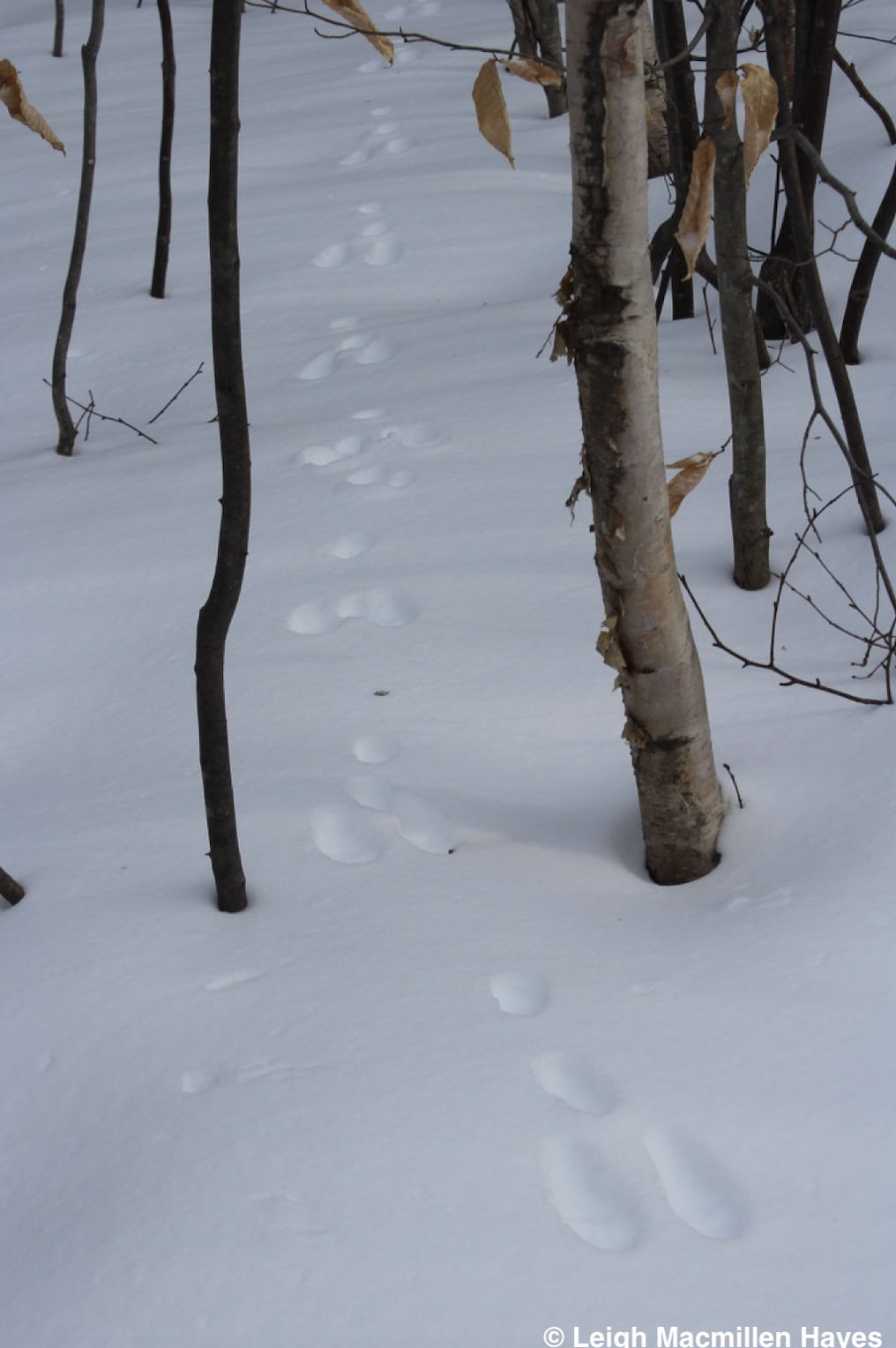
It is here that I discovered Snowshoe Hare tracks and my heart smiled again. There’s not much on this portion of our land for the hares to dine upon, such is the landscape when the trees block undergrowth. But on either side of the walls, there’s plenty available to them in areas that have seen timber cuts within the last twenty years.

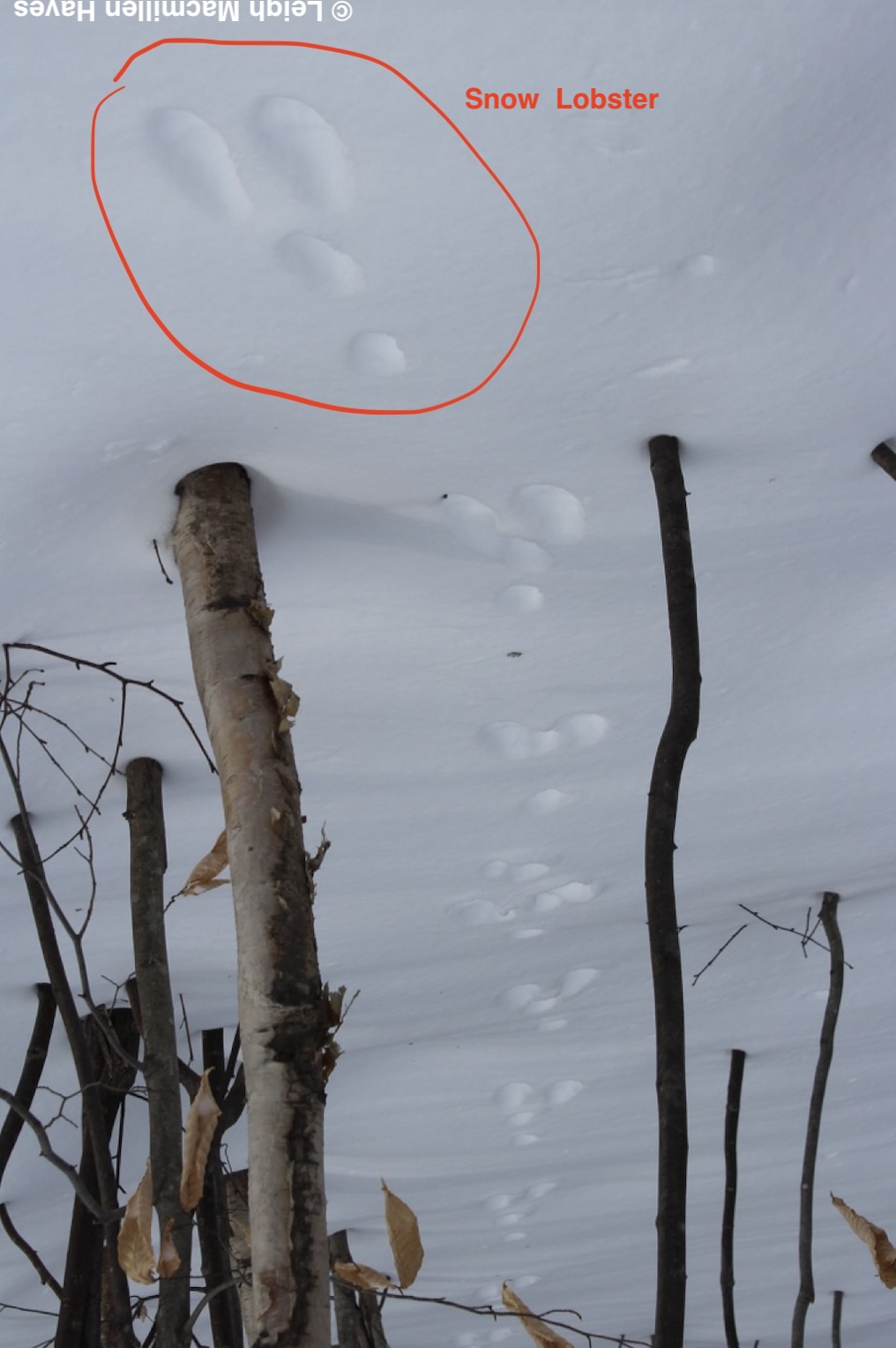
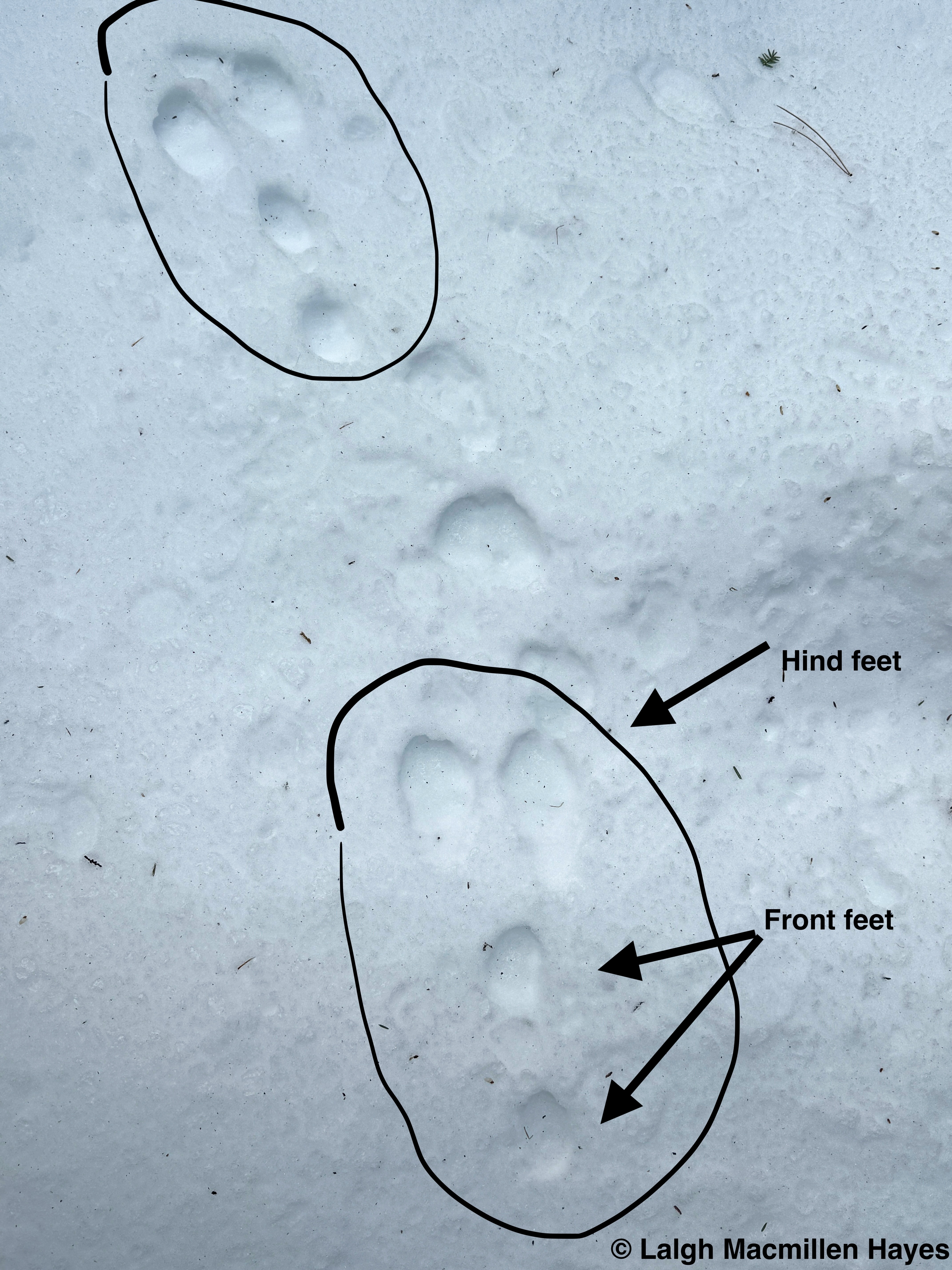
Here’s the thing about hare prints–as hoppers, the smaller front feet land first and often, but not always, on a diagonal. The much larger hind feet swing past where the front feet had been as the mammal moves forward, and thus appear to land in front when you look at the overall pattern. And my favorite part of this set of four footprints: the overall shape, which to me looks like a snow lobster with the front feet forming the tail and hind feet the claws. Do you see it?

This neighborhood on the other side of the power line also supports a Red Squirrel who in true squirrel tradition travels this way and that.

And like its relative on the other side, it took time to cache a bunch of cones and now feasts upon its supply.

And leaves its garbage for nature to recycle. Notice how the middens are often located on high spots such as the rocks along the wall–the better to be in a spot where you can see who or what might be approaching. Even those on the ground below trees mean that the squirrel probably did most of its dining from a branch above, and then let the trash fall.

What could a squirrel possibly fear in these woods? Besides coyotes and foxes and bobcats, oh my, think Fisher such as the one that left these tracks in the squirrel’s territory. As far as I could tell, the Fisher (and it’s not a cat, it’s a member of the weasel family) was only passing through, probably on its way to hunt down the hare. Though a squirrel would make a fine meal, as well.

Heading back across the power line, cases stood out on the White Pine saplings at the start of the cow path. The cases consisted of clusters of needles bound together. This is the work of the larval form of a Pine Tube Moth, Argyrotaenia pinatubana. What typically happens is that the caterpillar uses between ten and twenty needles to form a tube or hollow tunnel.

The caterpillars move up and down their silk-lined tunnels to feed on needles at the tip until they are ready to overwinter.

The moth will emerge in April, when I’ll need to pay attention again. Two generations occur each year and those that overwinter are the second generation.

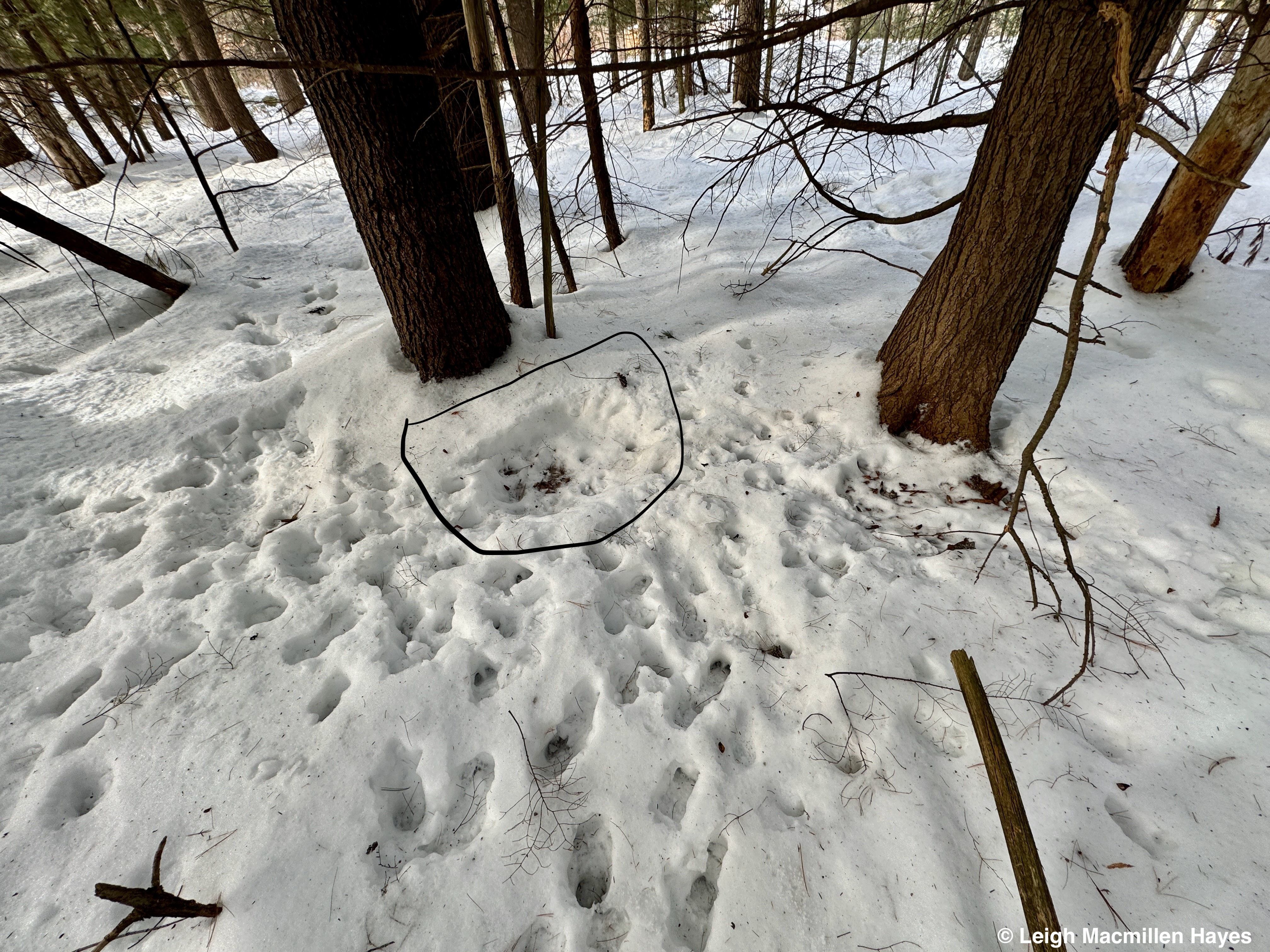
Walking home via a different path in our woods, I spot deer beds. At least a half dozen spread out under the pines and hemlocks, the spot where the evergreens keep heavy amounts of snow from reaching the forest floor, thus making it easier for the animals to move.

Finally back home, there’s one more member of our family to mention–a porcupine. This may be my friend Bandit, but I haven’t actually seen him in a while so I can’t be certain.

The porcupine did check out a tiny hole under the barn, but we don’t think it actually stayed there. Will it return. Probably, as the barn has long hosted this species; along with other small critters.

That’s a lot for now and at last I’m done counting the stock for our winter inventory. There’s more out there, but this is certainly enough to make me realize that they don’t live in our woods, but rather, we humbly reside in theirs.

The Forever Student, Naturally

This story begins . . . at the beginning. Okay. Early morning, not enough coffee, humor. Rather, this story begins at a bird feeder located about twenty feet from our back door.

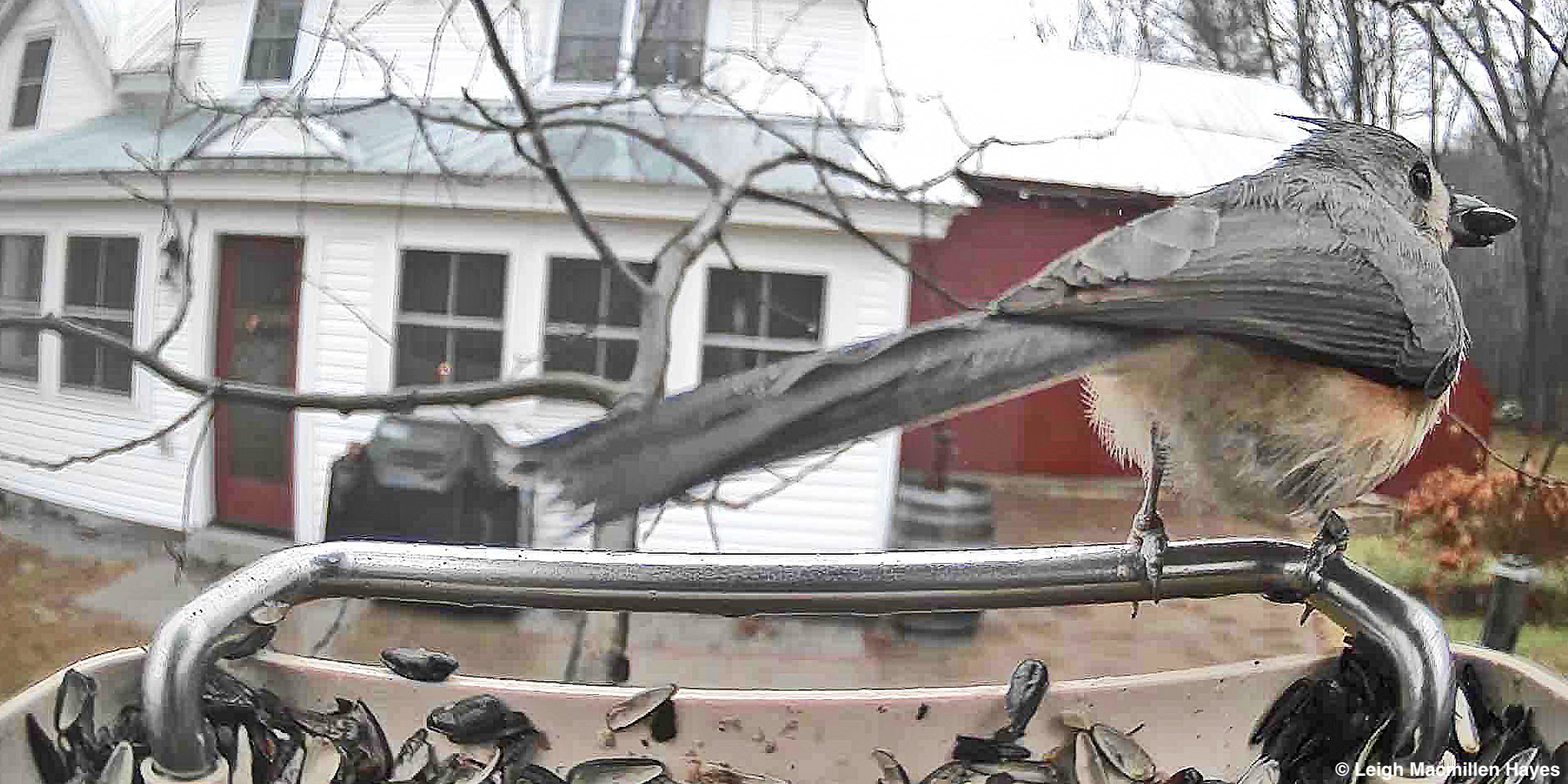
Birds, like this Tufted Titmouse, frequent it, especially on rainy days, which seems to be the norm this December. In fact, this year. Sadly.

But, there’s another visitor, who thinks its a bird. If it had the membrane that stretches from the wrist of a front paw to the ankle of a rare paw, we could at least call it a Flying Squirrel. It does not. It just thinks its entitled to the bird feeder selection, despite the fact that I spread plenty of seed on the ground and have a dangling corn feeder intended for such uses.

Eventually, it did resort to normal Gray Squirrel behavior and fetched an acorn, then frantically searched for a spot to cache it. And taught me a lesson.

I realized I’ve never paid particular attention to a Gray Squirrel caching acorns, one here, one there, for future food sources, or a future oak sapling if not dined upon. I knew they did that. But what I didn’t realize is that much consideration goes into location of said single cache. The squirrel moved through two gardens, across the yard, and paused about three feet from the back door to dig, all the while holding the acorn between its lips.

And in the end, that wasn’t the right spot and so it moved on.

And I stepped out the door. The hole was just deep enough and wide enough for that single acorn, but the last I saw of the squirrel , it still hold the nut tight as it pranced along the stone wall and then into the field beyond. Funny thing is that when I returned home an hour or two or three later, there was a second hole excavated but equally empty. Why dig here twice and not make a deposit?

The Gray Squirrel’s activity inspired me to step into our woods and check on the activity of my friend Red. He doesn’t disappoint and each day that I visit I notice new middens (garbage piles of discarded cone scales) and new cones added to the cache (food cupboard).

My favorite cache is now a foot tall and the cool realization is that he doesn’t dine upon this pile. Like the Gray Squirrel burying his acorns for future consumption, Red is dining on plenty of pine cone seeds, but saving up for that day when we have so much snow (will that day ever come again?) that he has a food supply available and doesn’t have to tunnel through the white stuff in search of a meal. Considering how many pine cone seeds he must consume each day, I have to wonder how long this source will last and will it grow taller and wider in the coming weeks?

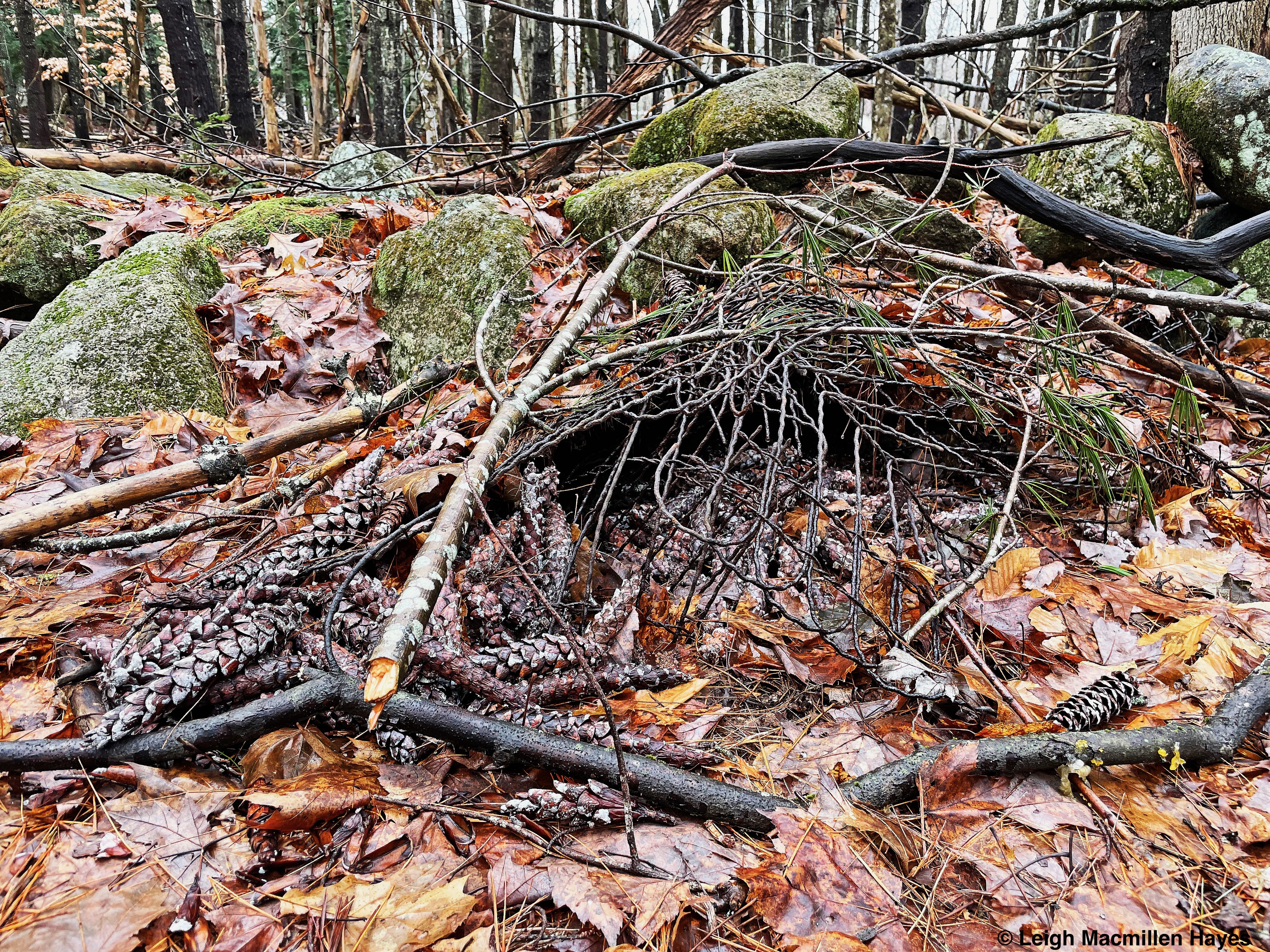
On the other side of the cow path, for that is where the tall pile is located, I realized he’s started another cache, this one located under some discarded garden fence left behind by previous owners of the land. It’s actually a great spot in my squirrely mind, for its beside the wall so he can easily access it from a dry spot within and the fencing and sticks and leaves have created a shelter.

Much to my delight, I spotted Red on a pine branch, a perfect high spot on which to dine and keep an eye on invaders of his domain, such as me. My presence, however, did not stop him from peeling each scale to seek the two seeds tucked close to the cob.

And as is the custom, its only the seeds that he cares about, scales discarded because their usefulness is no longer important.

The base of the tree shows just how many scales he’s discarded over the last few months as his midden contiunes to grow. Considering this year was a mast pinecone production year for Eastern White Pines in western Maine, this is one well fed squirrel.

Another tree that produced a mast crop is the Northern Red Oak and the abundance of acorns has been a food source for the squirrels, especially the Gray, Porcupines, and White-tailed Deer.

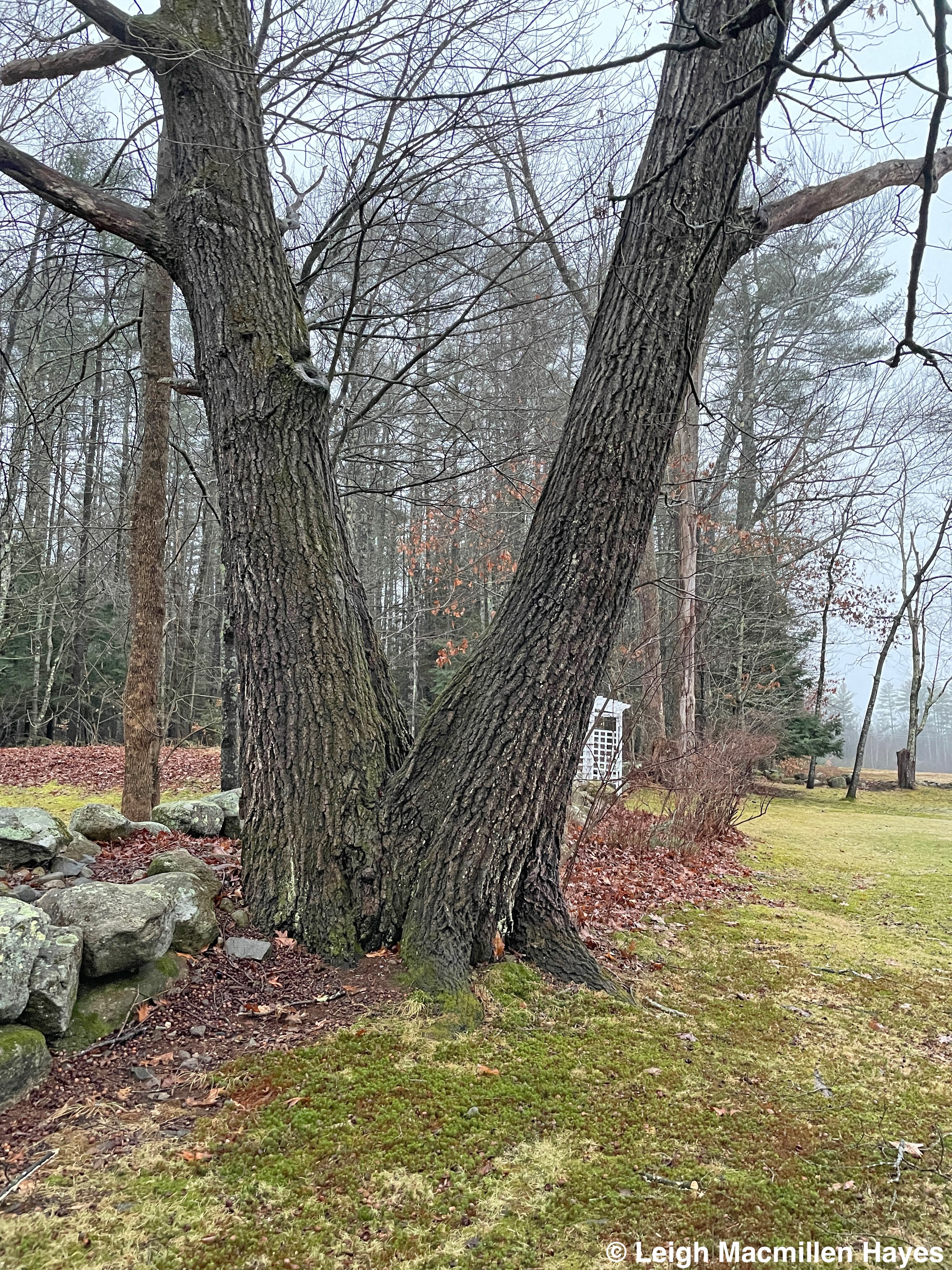
The tree behind our barn is massive, with a coppiced base and therefore three large trunks. Our sons once built a fort in that space between.

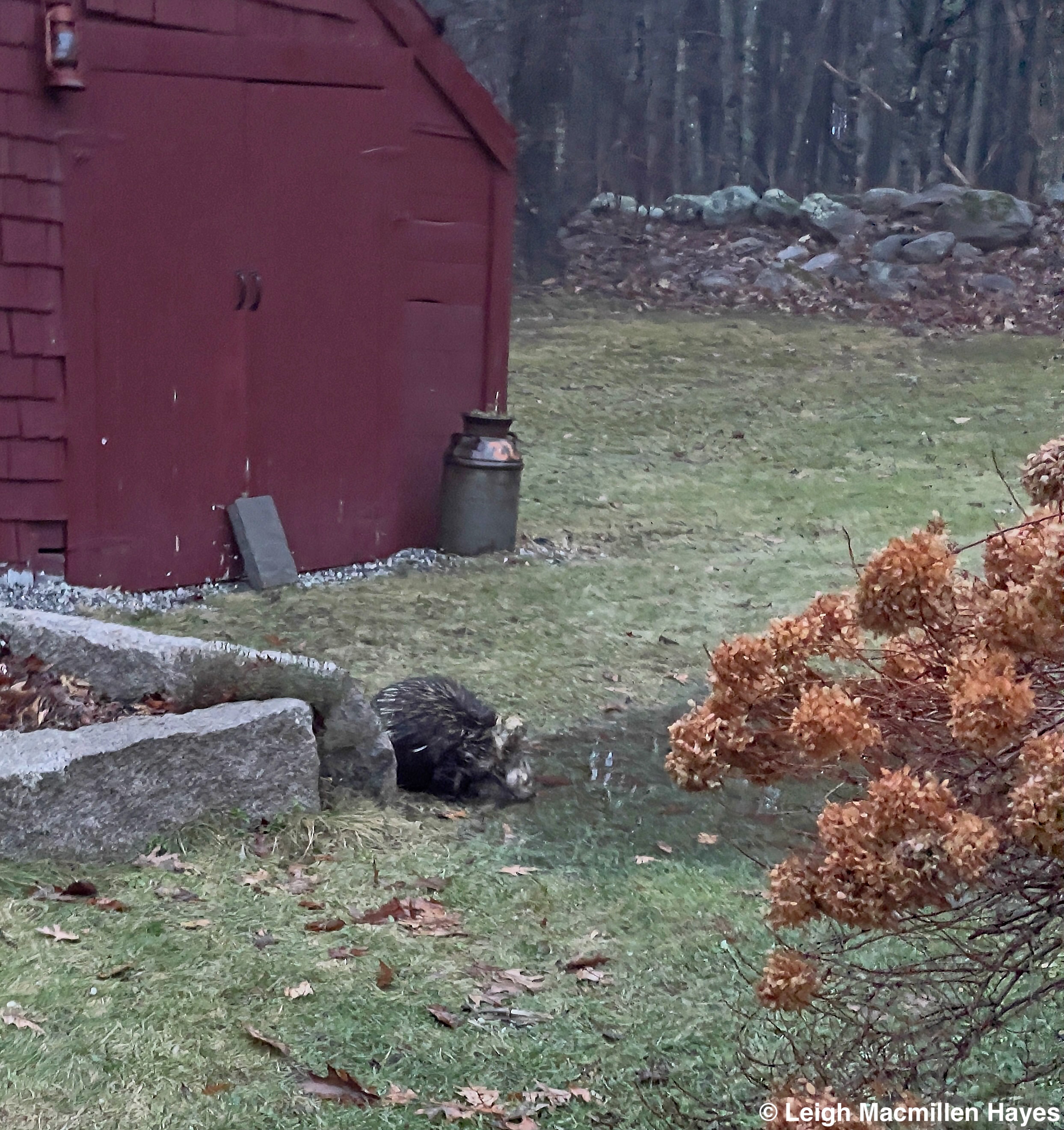
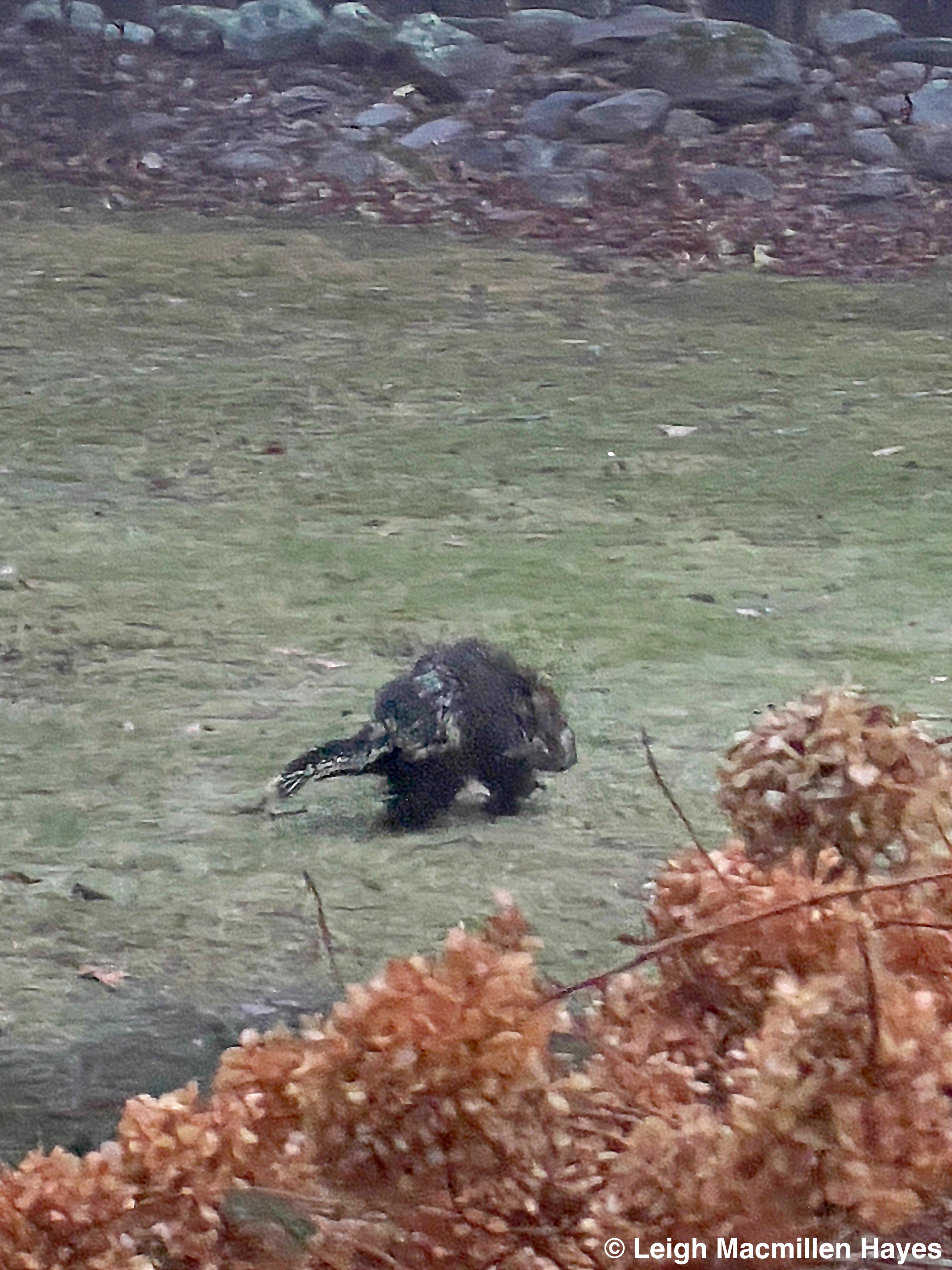
At about 4:15pm the day before, our youngest son, his gal, and I watched Bandit, the local porcupine come from the acorns to a puddle beside the herb garden and pause for about five minutes as he sipped from it. That was another first for me. And them as well. In fact, for his gal, just seeing a porcupine in the wild was a first.

Then he waddled off to the woods on the other side of the stone wall, and probably found an Eastern Hemlock upon which to dine for the night. I found a few trees with downed twigs, but none that cried out, “I’m Bandit’s food source,” so I suspect I need to expand my search on another day.

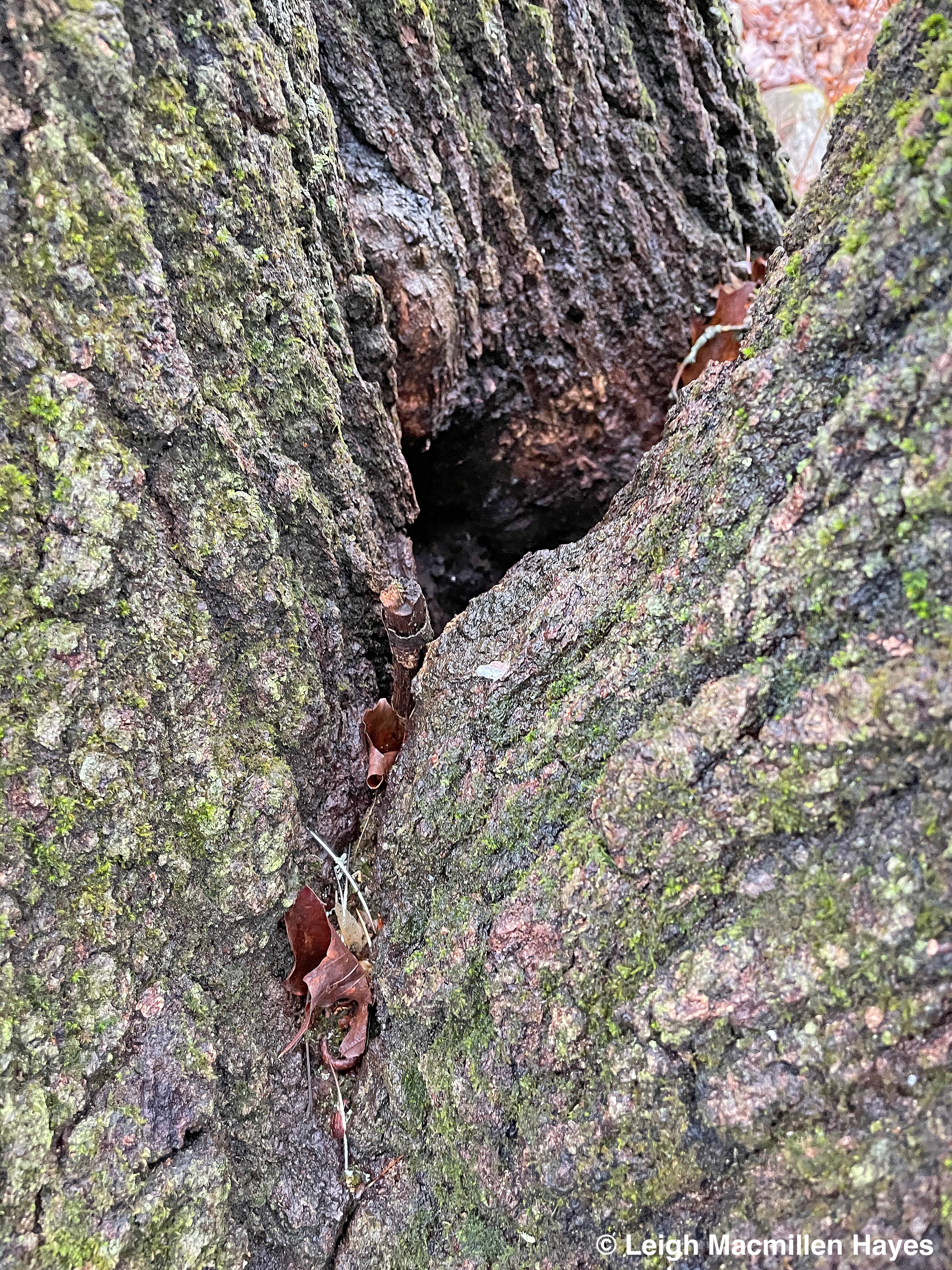
Instead, I made a different discovery. We know that Bandit has spent time under the barn, and he’s left tracks when we did have snow that led to a neighbor’s shed, but I have wondered about the old oak tree and the hollow within its three trunks And today, I spied evidence that he has inspected the hollow. Do you see it?

How about now? Quills! I found them on both sides of the trunk.

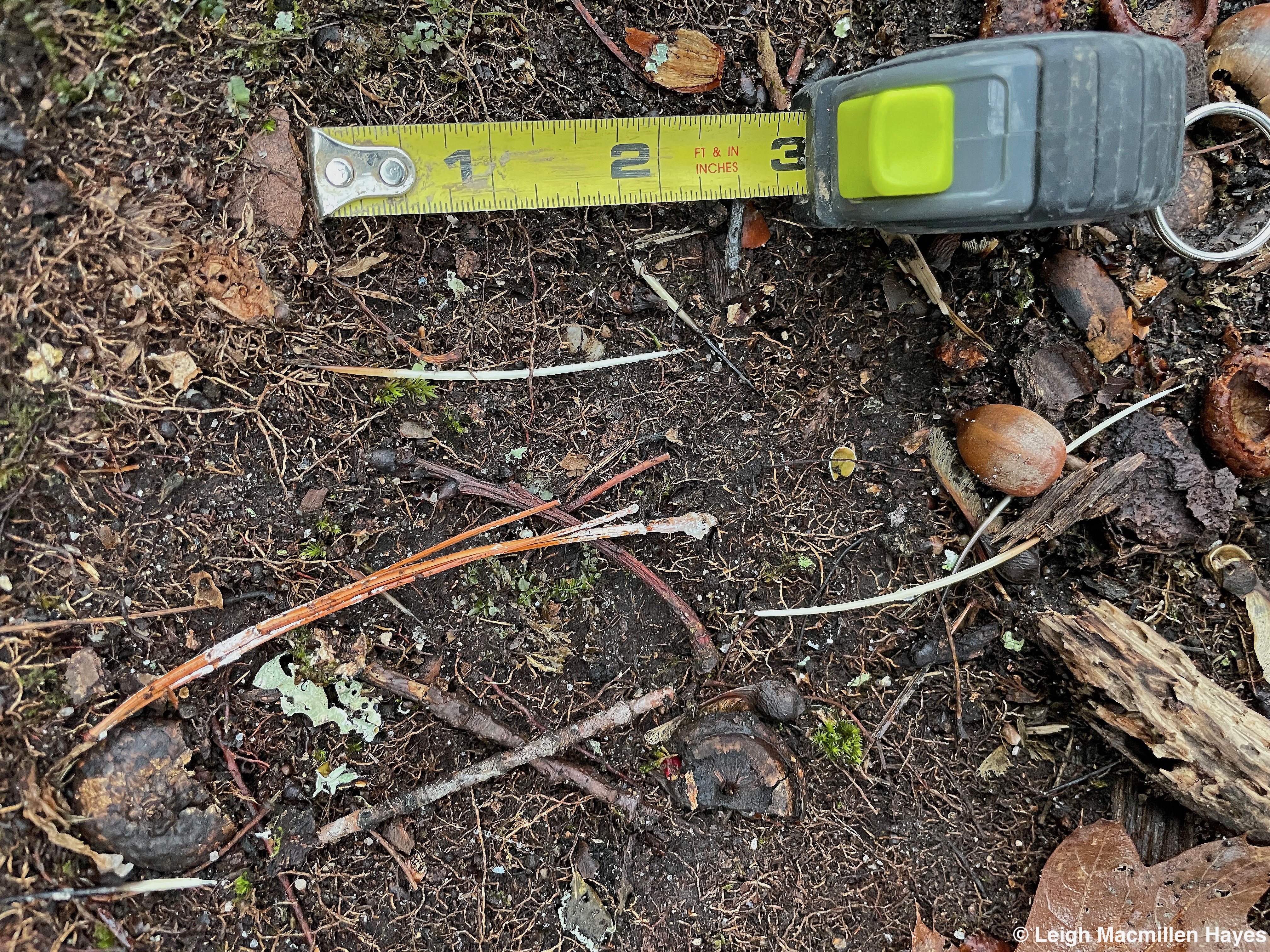
And on the ground below.

About two inches in length, and some were longer, I love how his brownish hue is similar to that of the bundle of dried pine needles.

The hollow is dark and deeper than my camera could see. The curious thing is that there is no scat. Yet. You can rest assured that I will keep an eye on this spot.

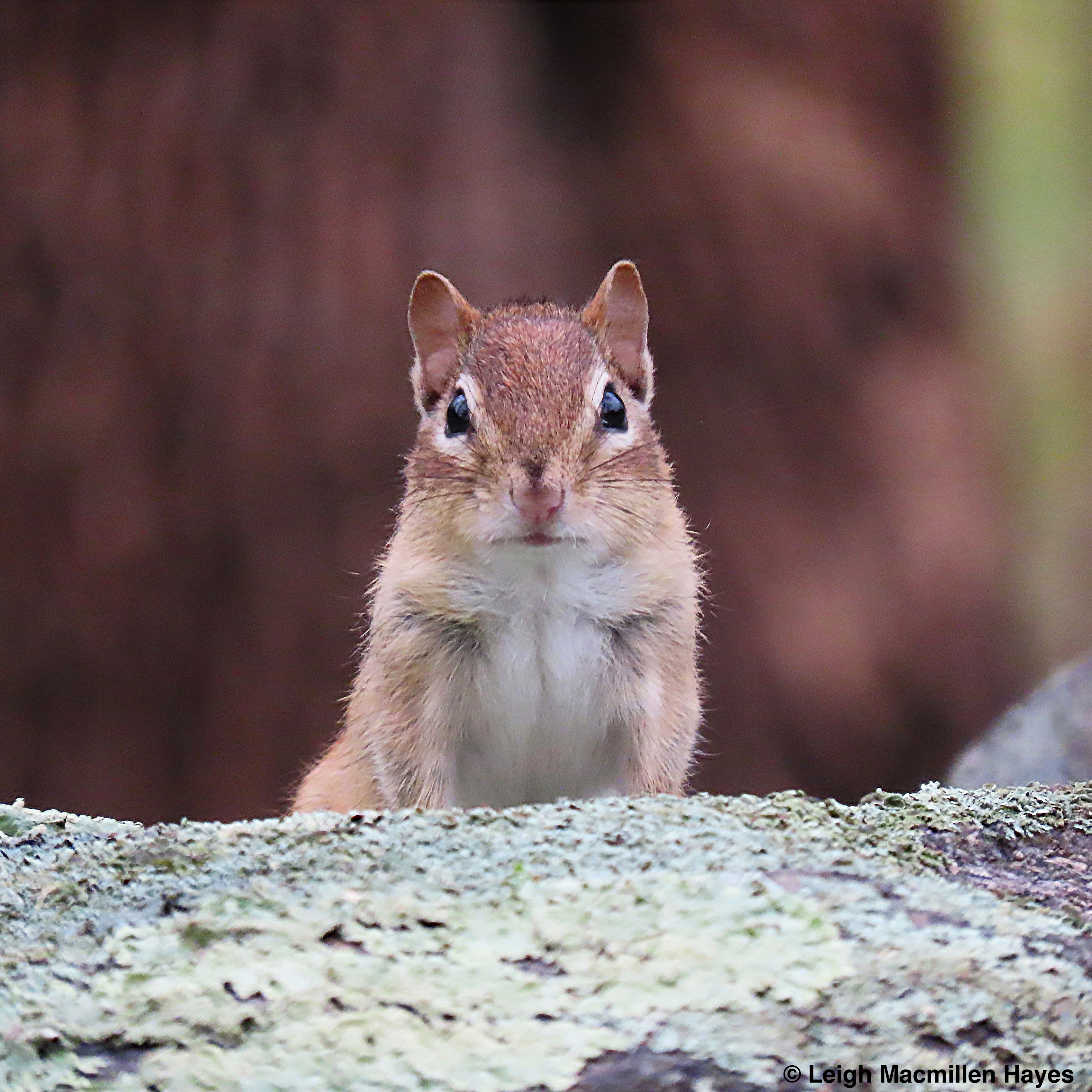
I decided to hang out not too far from the tree and barn as day turned to dusk in hopes of spotting Bandit emerging. Much to my surprise, an Eastern Chipmunk appeared on the wall behind the tree. Wait. What? Shouldn’t he be in torpor? Yup. But chipmunks will make an occasional appearance on warmer days and we’ve had way to many of them this year.

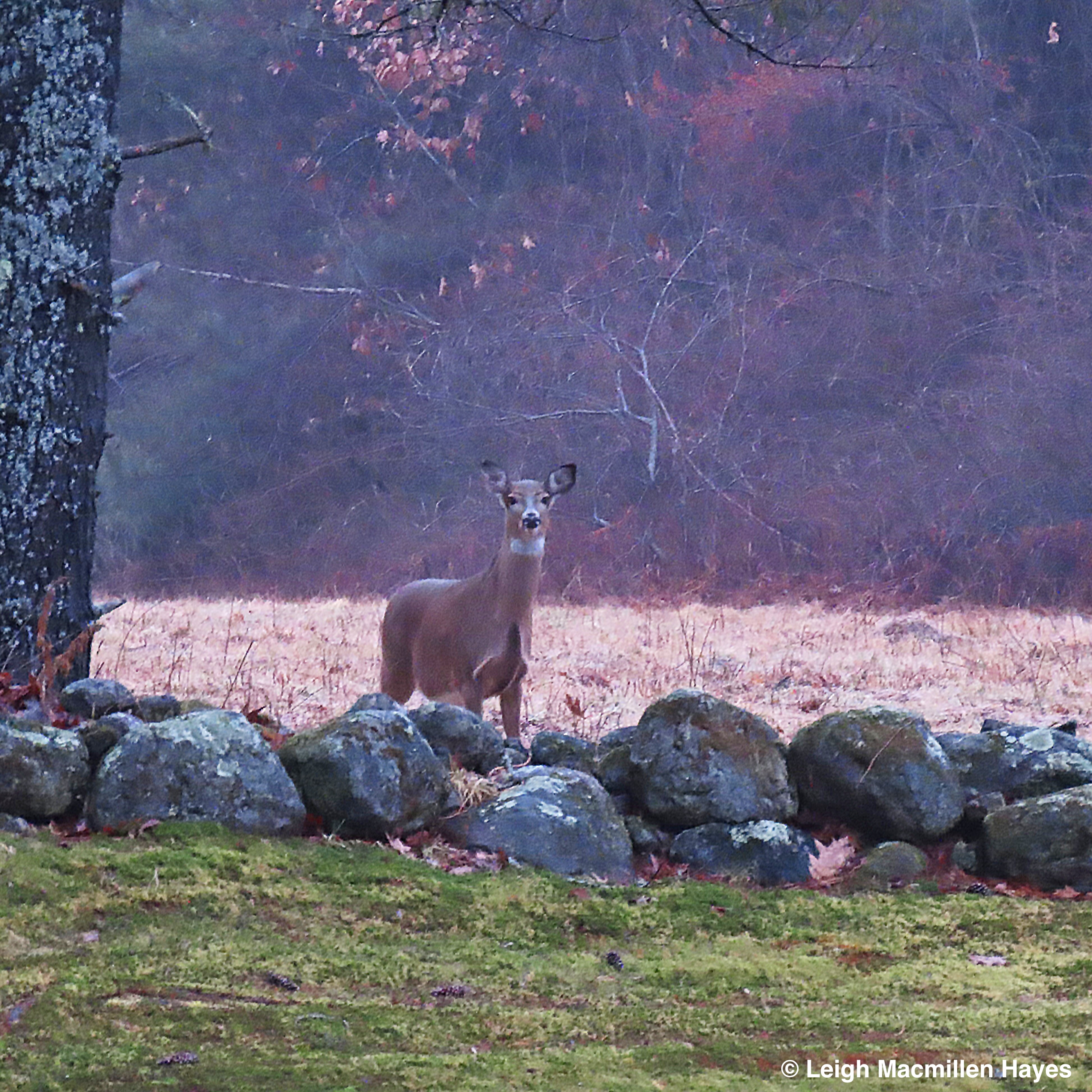
A doe and her two skippers also appeared and watched me from the edge of the field, or at least listened to my movements, which I tried to minimize as much as possible, but those ears were on high alert.

About a month ago, when we did have snow, I discovered blood beside her tracks on this side of the wall and knew that she was in estrus. A day later, I noticed a young buck in the field and by the way he kept his nose to the ground and moved frantically, I knew he was on a mission to find her. Did he? Is she with child? Only spring will tell.

In the meantime, her twin skippers are still with her. They ran off before I headed in, but I suspect it wasn’t long before they returned under the blanket of darkness and munched on a bunch of acorns.

Bandit never did appear during the time that I waited. Who knows? Maybe he had spent a night and day or two in the hemlock of his dining choice. I’ll continue to search for evidence of his activities because it’s what I most enjoy doing.

There’s always something wild going on outside our back door, rain or shine or snow or sleet, and I’m grateful for each lesson they take the time to teach me. I am a forever student, naturally.

Keeping Watch

Settling in 
for a long winter's night,
I know not what happens
beyond the back or barn door.
Until I do
for by the incisor marks
left upon the attached shed floor,
I eye the work of a gnawer.
Scat, too, has happened
in this space,
comma shaped
and even a bit of a necklace connection observed.
Out the door 
I tromp through the snow
sighting a pattern
that only a sashayer would know.
And so I follow, 
under branches,
around trees and over stonewalls,
from one neighbor's yard to the next.
Into the woods,
the critter leads the way,
and I go forth,
wondering where we might glimpse each other.
Upon a corner section
of a stone wall,
where rocks are arranged in a triangular fashion,
my heart beats faster when I spy hoar frost.
I observe not 
the works of a porcupine den as I'd hoped,
but rather evidence of another
who shares these woods with us.
And then upon a branch
I behold the other,
creator of the midden,
a Red Squirrel disguised as a gray for such was its coloring.
Because I'd wandered
into our back forty,
others make known their presence,
in the form of mouse and weasel prints.
And back by the barn,
the snow has been tussled,
by not one,
but at least three species: porcupine, squirrel, and deer.
Mostly, it is the deer
who have disturbed the ground,
scratching away as they do,
in search of acorns.
As much as I'm scanning
up and down for mammal sign,
the beauty of these past three days
does not escape me.
I'm grateful for the brisk air,
sunshine and lack of breeze,
and for snowflakes still on display,
and others melting into decorative gems.
I'm grateful
to be one who notices,
trying to discern
what has happened and will happen next.
I'm grateful 
to recognize others
who contemplate as well,
peering upon the world from on high, yet hidden.
And I'm most grateful
for the one who knows more than the rest of us,
the Tree Spirit,
an exemplary at keeping watch.

My Friend Red

It’s been two years since we’ve spent time together, and to be honest, I kind of doubt this is my friend from 2021, but perhaps an offspring. Anyway, what I do know is that last year was not a mast year in my woods and so there wasn’t much food available–the type my friend prefers to survive the winter months. But this year–pine cones and acorns abound.

As I headed down the cowpath that marks one of the boundaries of our property here in western Maine, I knew instantly by the chortling that greeted my ears that things had changed for the better.

You see, my friend is a Red Squirrel. And he spotted me before I spotted him. And then he let me know in no uncertain terms that I was not welcome. What kind of friend is that?

As I looked at the rocks along the inside path of the cowpath, I began to notice garbage piles Red had created, or middens as we prefer to call them, full of cone scales and the inner core or cob.

They were located in high places where Red could sit and eat in peace . . . that is until someone like me comes along, or worse . . . a neighboring squirrel, or even worse, . . . a predator. Given that a cone on this rock was only partially eaten indicated he’d been interrupted mid meal.

Maybe that’s why he continued to chastise me as he climbed higher up the tree.

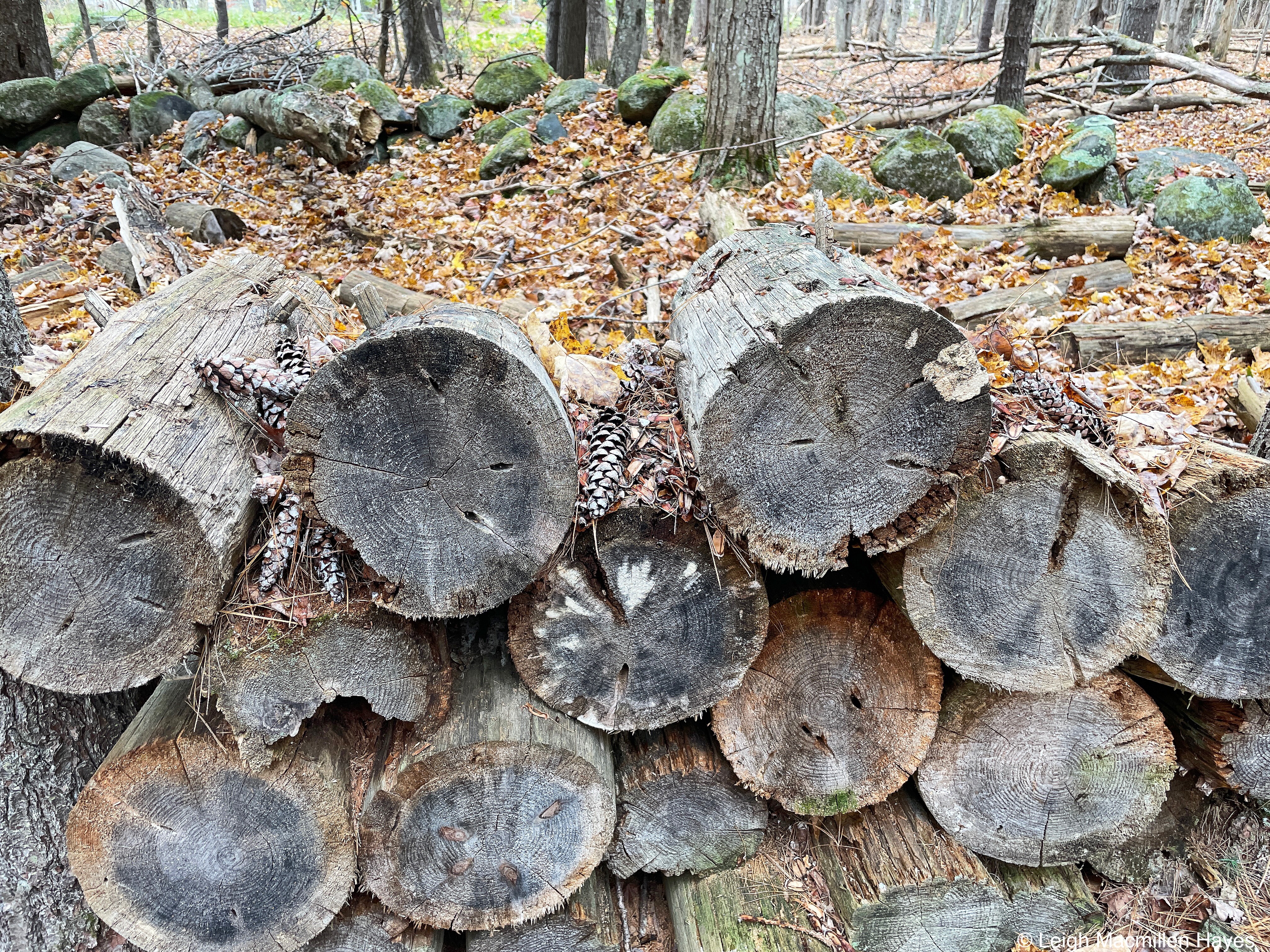
It takes at least two years for an Eastern White Pine cone to mature. And once they do, Red has a habit of squirreling his way out to the tips of twigs, gnawing the cone stem and letting it fall to the ground. If you spot a pine cone with closed scales such as this, count the number of scales and then multiply that number by 2. That’s the number of pine nuts the cone offers.

And trust that all are still tucked inside.

Pine cones are in a way like Common Polypody ferns and Rhododendrons in that they predict the weather. If it’s dry, the scales on cones will open. If rain and humidity are in the air, the former being today’s weather, the scales will close tightly, overlapping and sealing the seeds from the outside world.

While wet weather dampens seed dispersal, dry windy days are best and that allows the seeds to be carried away from the mother tree.

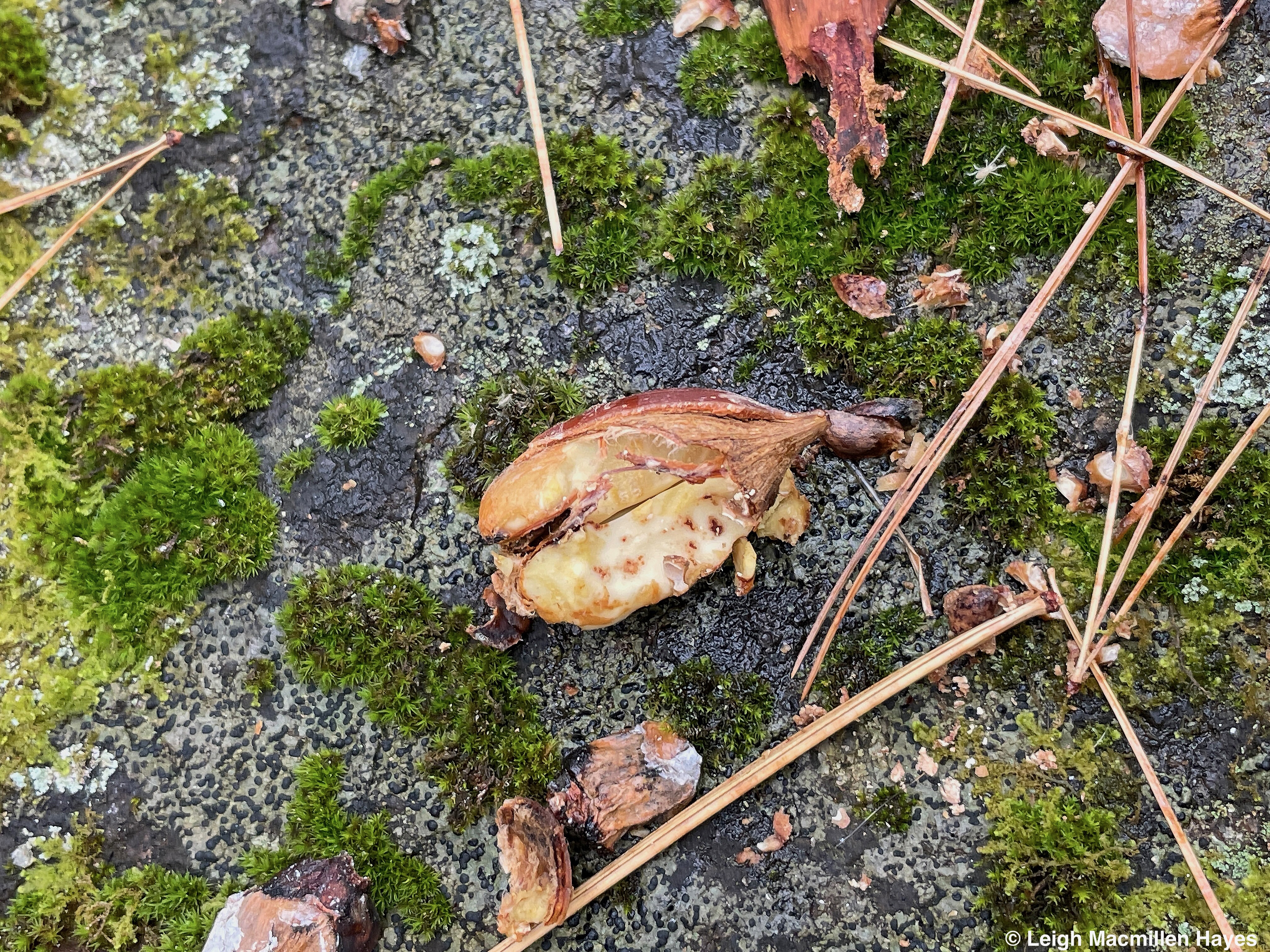
In the photo above, you can see where the two seeds had been tucked in, close to the the cob, while the lighter shade of brown indicates where the wings or samaras that help carry the seeds were attached to the outer scale.

And I can attest that the sap on the scales is still sticky even though this cone no longer had any seeds stored inside. The sap coats the cones because its the tree’s reaction of placing a bandaid on a wound when its been injured or in this case had a fruit gnawed free.

One would think that Red’s face and whiskers would be covered in sap, and that does happen, but just as it stuck to my fingers initially, eventually it wore off. And Red is much better at grooming than I’ll ever be.

To get to the seeds, Red begins by holding the cone with both front paws, and turns it in a spiral, tearing off one scale at a time. Quickly! And gnawing each tiny seed packet open. The seeds may be small, but they are highly nutritious.

He continued to watch, vocalizing constantly, as I explored his territory below.

Upon every high spot, including tree stumps, there was at least a midden, but also a few cones for possible future consumption, though I did have to wonder if some went uneaten because he realized they were open and thus not viable.

More of the same I found upon some of the cut pine stacks we created long ago that serve as shelter and . . .

Storage! I’ve been looking for a cache for the past few weeks, a squirrel’s food pantry, and today I located a few small ones that I know will grow in the coming weeks. Cool. moist locations like among the logs, but also in the stone wall, offer the best places to keep the cones from drying out.

As he backed up but still chattered at me, one thing I noticed about Red, which will help me to locate him in the future, is that he not only has a reddish gray coat, but between his back and white belly there is a black stripe. Maybe he’s disguising himself so he can go trick-or-treating this week and his neighbors won’t recognize him.

So here’s the thing. Red is an omnivore. And though we associate him with pine cones, especially in the winter, he also eats flowers and insects and fungi and even smaller mammals if given the chance. And acorns. And this year is also a mast year for acorns in our neck of the woods.

He’d peeled the outer woody structure away and had started to dine, but again, something or someone, and possibly I was the culprit, had interrupted his feeding frenzy.

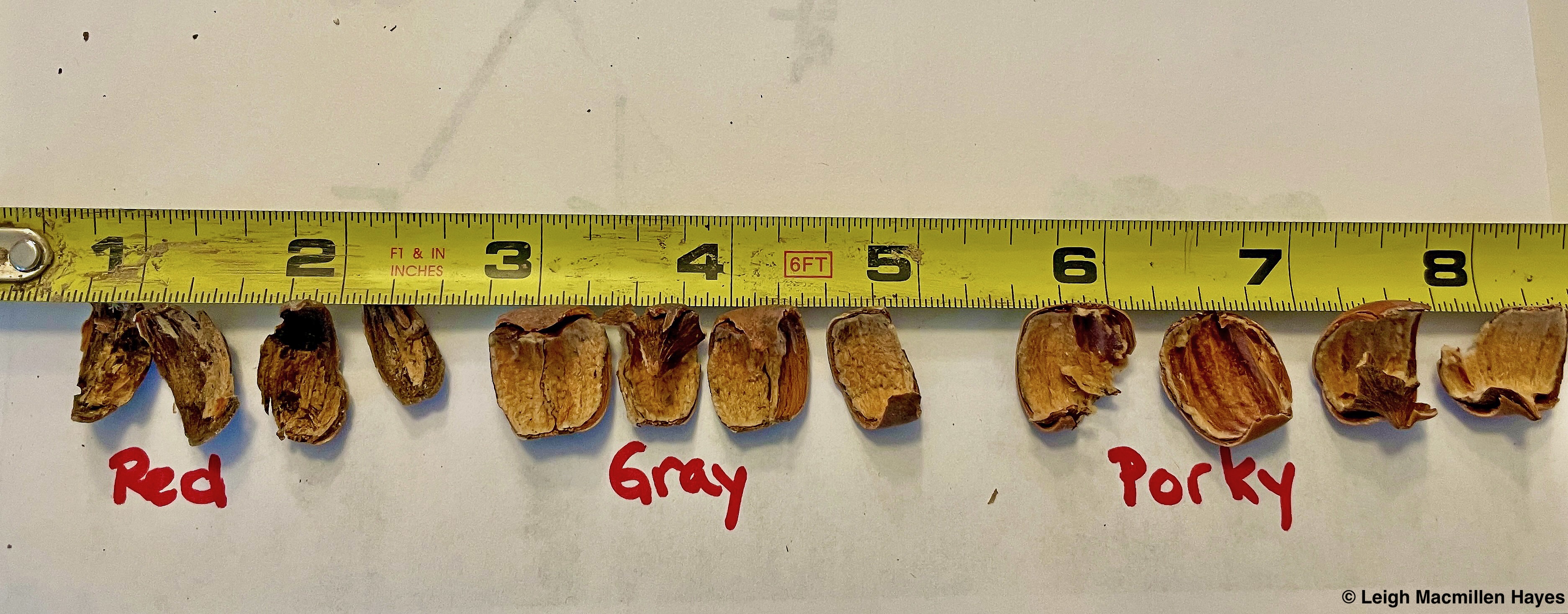
That said, I was delighted to find the acorn shell fragments because already in my collection I had samples from a Gray Squirrel and a Porcupine. Now I have all three and you can see by the tape measure how they compare in size, as well as the manner of stripping. As you can see, Red’s fragments are about a quarter inch in size, while Gray’s a half inch or so, and Porky’s are about three quarters of an inch. And the latter are much more ragged in shape.

Red. My Squirrel Friend. He just doesn’t know it. Maybe by the end of the winter he will because I intend to call upon him frequently to see what else he might teach me.

Omnivore, Herbivore, Insectivore, Oh MY!

I walked out the door this morning and wandered down one trail and then another and intended to go farther into the woods, but as often happens, I was stopped in my tracks.

On granite at my feet, covered as it was with lichens of the crustose and foliose sort, I spied a rather large specimen of scat. High point. Center of trail. Classic.

Based on the size and hair and bones packed within, I knew the creator: a coyote. If I awake during the night I can sometimes hear the family members calling to each other, the youngsters learning to hunt so they’ll be ready when they disperse.

The trail narrowed by a small stream and I was wearing my muck boots so proceeded at will. It’s been a few months since I’ve traveled this way and was surprised at how grown in it had become this summer. While the Sugar Maples do not like wet feet from all the rain we’ve had, other species have thrived, including the Red Maples, and this shrub that bordered each side of the trail.

It’s leaves still entact showed off that they are doubly toothed in a rather random order. So each little “tooth” is like the edge of a saw, but if you look closely, you’ll note that there are bigger teeth made up of a series of smaller teeth before the leaf margin cuts in toward the main vein and then heads out again to form the next bigger tooth made up of smaller teeth. And those veins in between the main vein and those that lead to the margin–reminded me of the crinkles on an apple doll person, since it is apple season.

The leaf buds, which form in the summer for next year, are hairy and have only two scales. Because of recent warm weather, at least one decided to jump the gun and open now rather than waiting until next spring. I’ve seen that with other plants of late, including Blueberry, Daylily, Sheep Laurel, and Partridgeberry.

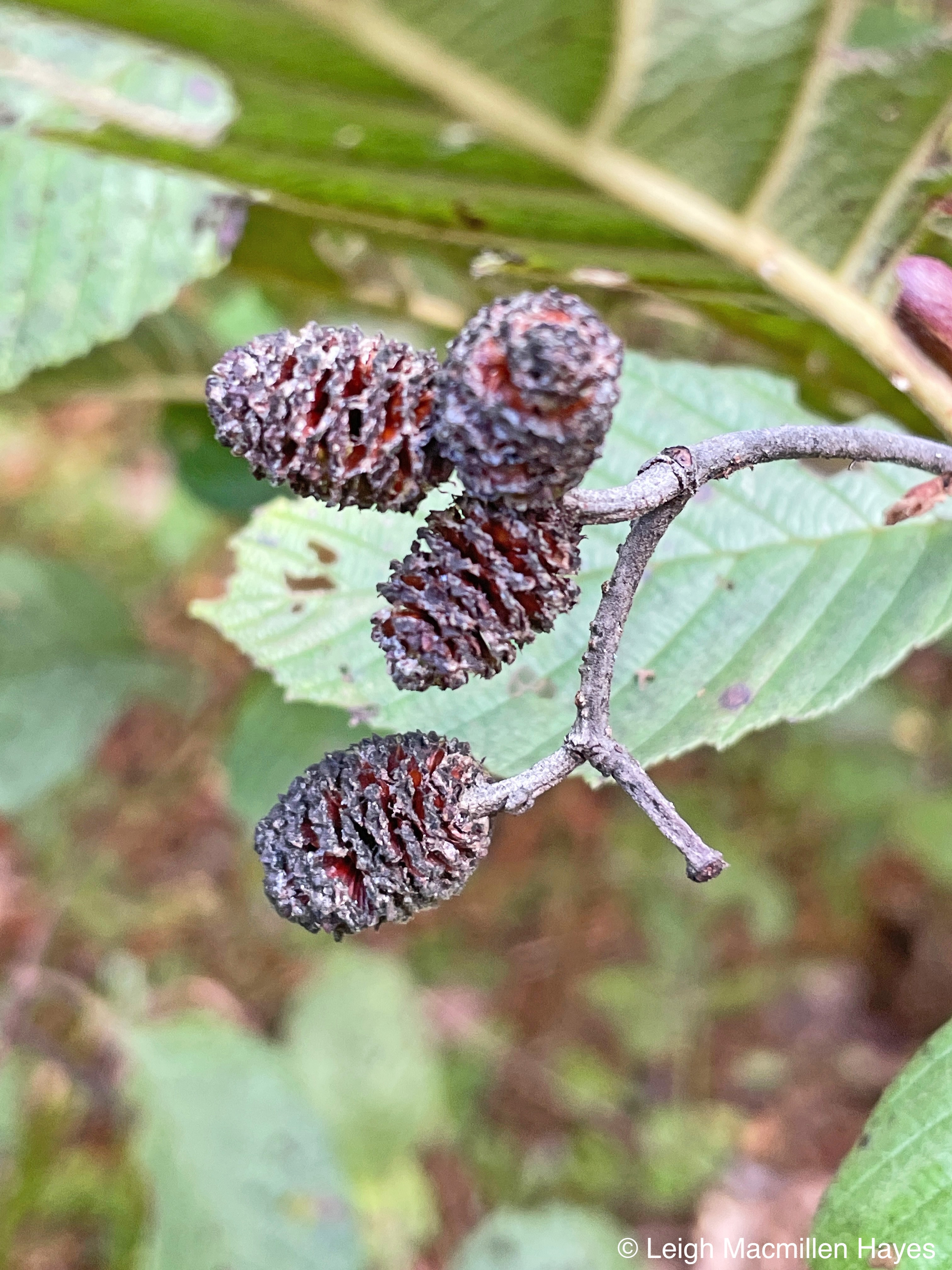
Others who best not jump ahead are the catkins of this species, the longer green and red being the male pollen carriers that will slowly elongate over the winter and turn more yellowish red in the spring. The female flowers are tiny magenta catkins located just above the males.

Once the females are wind pollinated, the males will drop off and the females will form into a fruit that resembles a cone.

The name of these shrubs, if I haven’t already spilled the beans, is Speckled Alder, so named for the white dots (think lenticels for gas exchange) that populate the bark. These shrubs love wet feet, which is why they are growing on either side of that small stream.

Some of the Speckled Alder cones hide beneath tongues imitating piles of snakes stretching out, made from galls caused by an infection to increase the surface for spores from a fungus to spout. It’s a smart strategy.

I also found a few Lady Beetles today, including one larval form. They were on these shrubs for one reason.

That reason being the Woolly Alder Aphids who live a complex life in which they alternate between a generation reproducing asexually (no guys, just gals), and one reproducing sexually with both males and females adding to the diversity of the gene pool. The males and females fly to Maple trees to canoodle, but those found on the Alders are all female.

They live such a communal life as they suck sap from the shrub, that one might think this entire mass is just one insect. Hardly. And do you see all that waxy wool that covers their bodies? If you watch these insects for even a few seconds, you’ll note that the hairs move independently. It’s almost otherworldly.

Since they’ll overwinter, I think of the wool as providing a great coat. In the summer, ants, and now Lady Beetles, and even a few other insects farm them to get the aphids to excrete honeydew from the sap.

The aphids don’t harm the the shrubs, but I saw so many today that that fact is hard to believe. I gave up on counting branches but over one hundred played host.

That said, there was another character in the mix. Do you see the top branch that leans out to the right?

The sweet honeydew I mentioned forms a substrate for a nonpathogenic fungus called sooty mold that blackens leaves and bark beneath colonies of aphids. The mold is known scientifically as Scorias spongiosa or, my favorite and drum roll please . . . Beech Aphid Poop-Eater: A fungus that consumes the scat (frass in insect terms) of a Beech Blight Aphid (not the same as Beech Scale Insect that causes Beech Bark Disease). Alders are in the Beech family.

As I left a few Autumn Meadowhawk Dragonflies flew ahead of me on the path. They’re days are numbered, so I’m always thrilled to see them flying and posing.

Omnivore, Herbivore, Insectivore, Oh MY! And all of this within a ten-foot stretch of the trail.

Our Blue Greed Mondate

Somehow that time of year always sneaks up on us. And yet today dawned and the writing was on the wall: This is that time of year-kind-of-day. But the question remained: Would we be rewarded?

Well, we had to find out and so this morning we set off in search of this small mountain nestled in the midst of so many behemoth uprisings. It took us several wrong turns before we finally shared that sudden “Aha” moment that indeed the pasture road was the correct road. It was all rote from there.

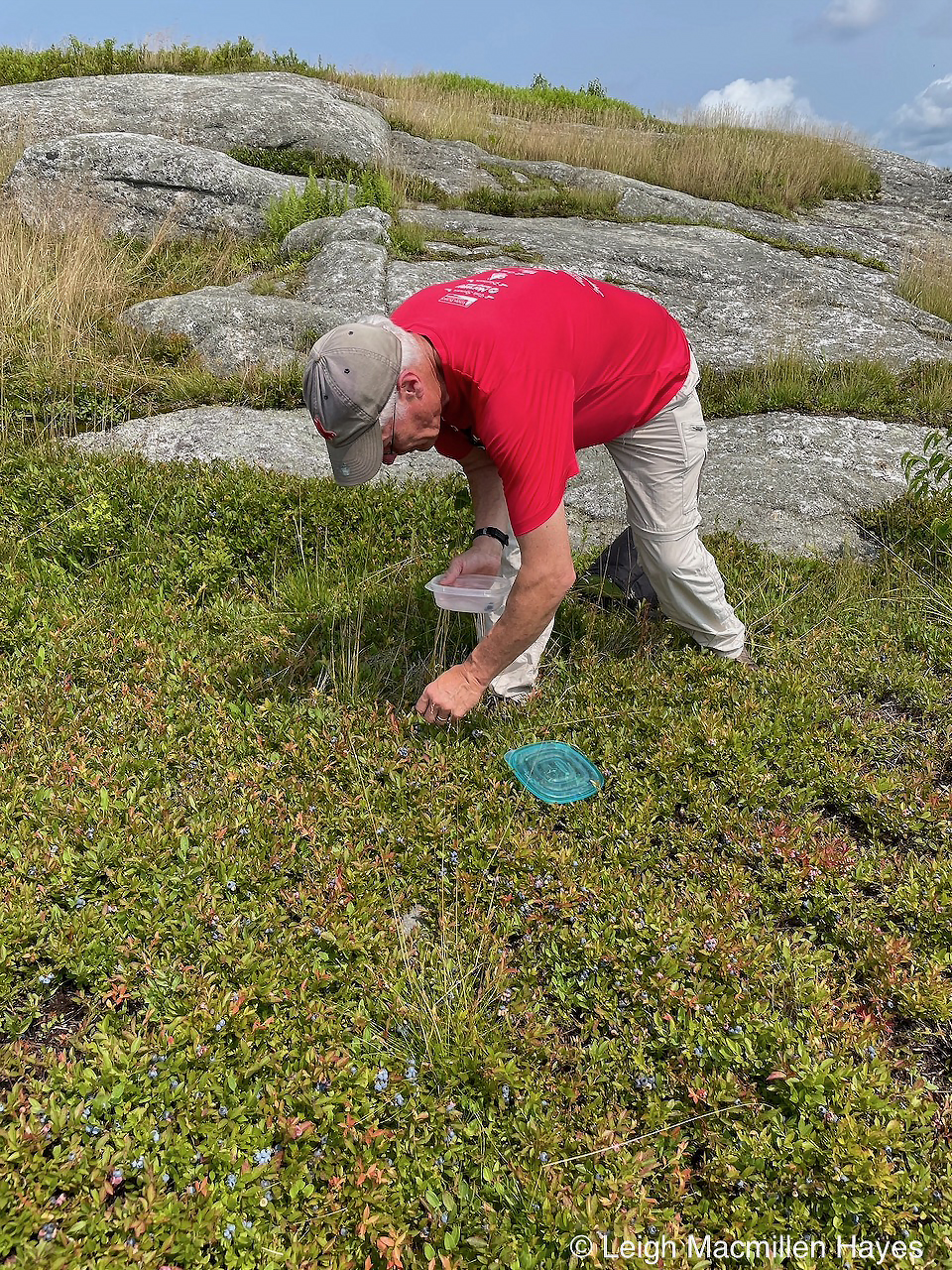
Last year we discovered the mountain top had been cut back and there were no little specks of blue to glean, but that cutback lead to this year’s abundant offerings. My Guy was in his happy place.

Well . . . one of his happy places. This one offering such sweetness in a manner all blue.

I chuckled when I overheard a mom commenting, “This is just like Blueberries for Sal.” I immediately texted our friend Kimmy for she and I know otherwise. Drop the “S” from Sal and you’ll know what I mean.

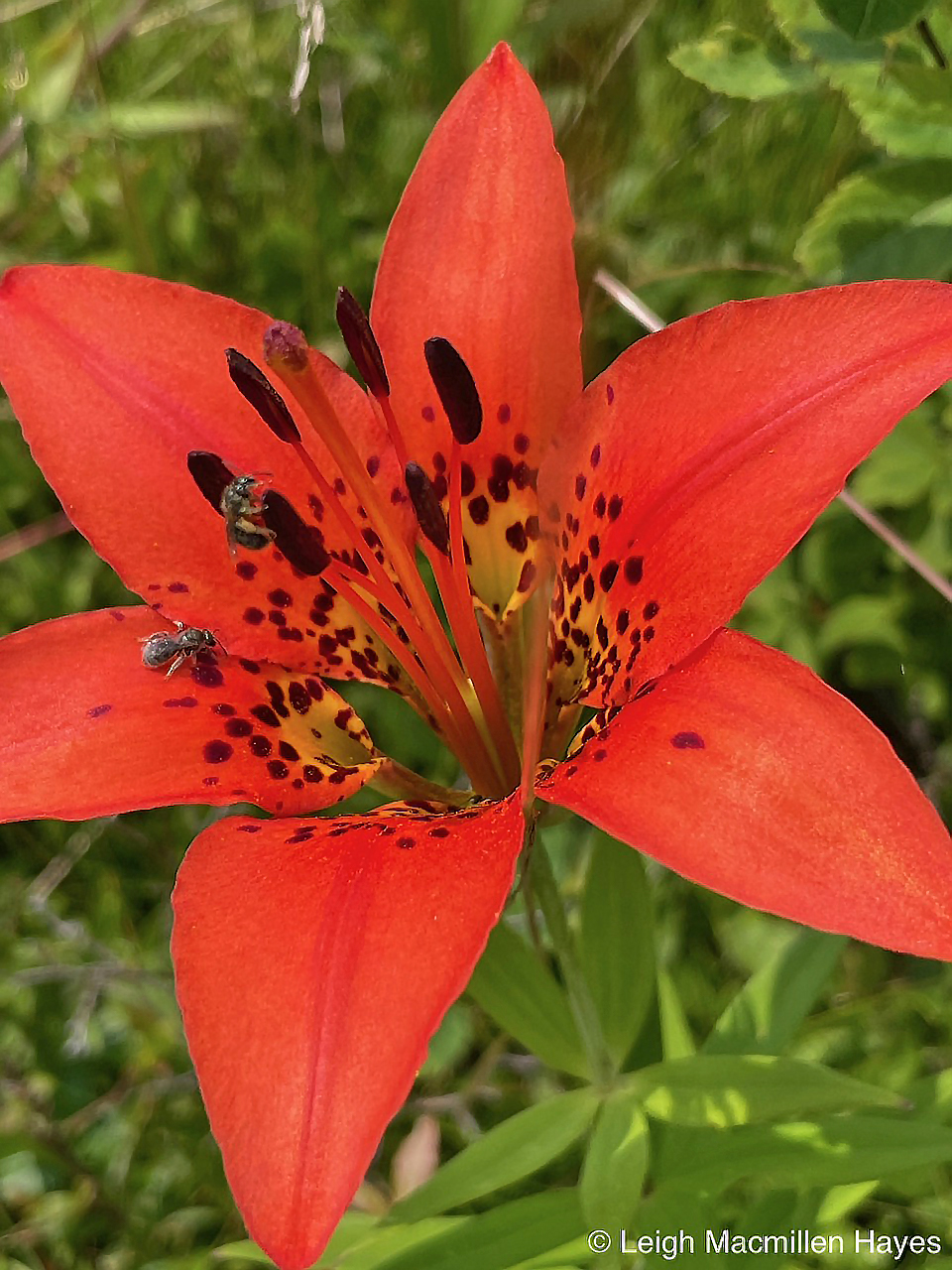
That said, his blueberries are my pollinators and with pollinators you have flowers, this one being one of many, many Wood Lilies.

There was also the Red-shouldered Long Horn Pine Borer, so frantic in its activity upon the Steeplebush flowers.

Plus a Paper Wasp upon Yarrow, . . .

And Flower Longhorn Beetle on Bristly Sarsaparilla. The season is short and there’s so much work to be done and the rain may have slowed things down so when the sun doth shine, it’s all insects on hand.

We finished up our hike, grabbed a to-go lunch at a locally eatery and then took off in the tandem kayak, with the same mission on our minds. Picking more blueberries for him, of course.

And checking out the local wildlife activity for me. We watched a beaver pass by our dock two nights ago, so we knew there was an active lodge somewhere in the area.

We actually found two new lodges and other older ones that were turning into islands. But we didn’t spy any beaver activity, probably given that it was the middle of the afternoon.

I, however, spotted a couple of species that envied My Guy’s blue greed, this being a male Slaty Blue Skimmer pausing in the midst of defending its territory.

And my heart was glad for we also spent some time with this tiny male Blue Dasher, another Skimmer who posed longer than I expected.

Only yesterday, I included his mate in Hunting for Dragons. Suddenly, here he was, albeit with a few Red Mite hitchhikers attached to his thorax.

While My Guy’s Blue Greed may be low and highbush blueberries, mine is definitely insects, and the bluer the better.

Rewarded were we, indeed!

Something’s Always Happening . . .

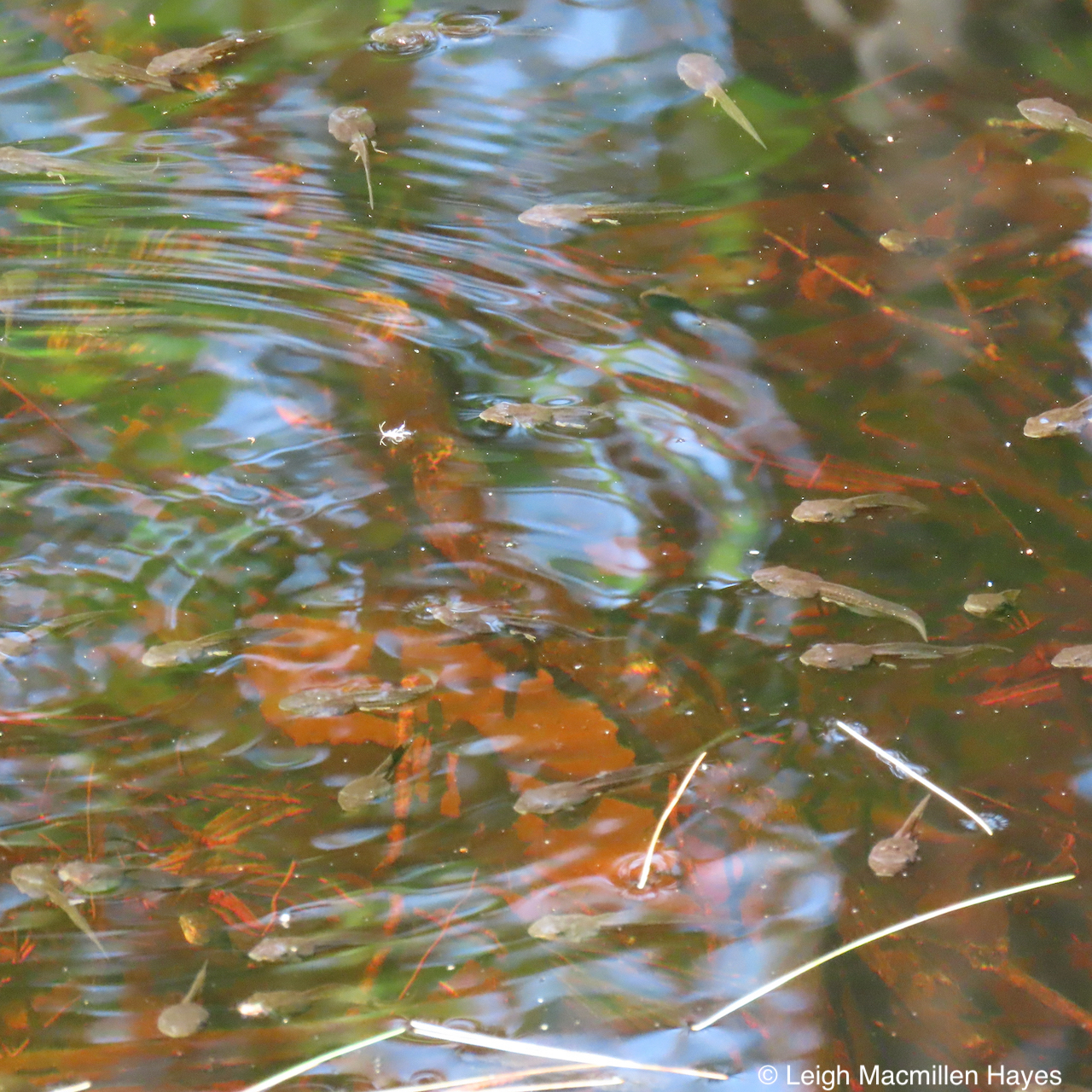
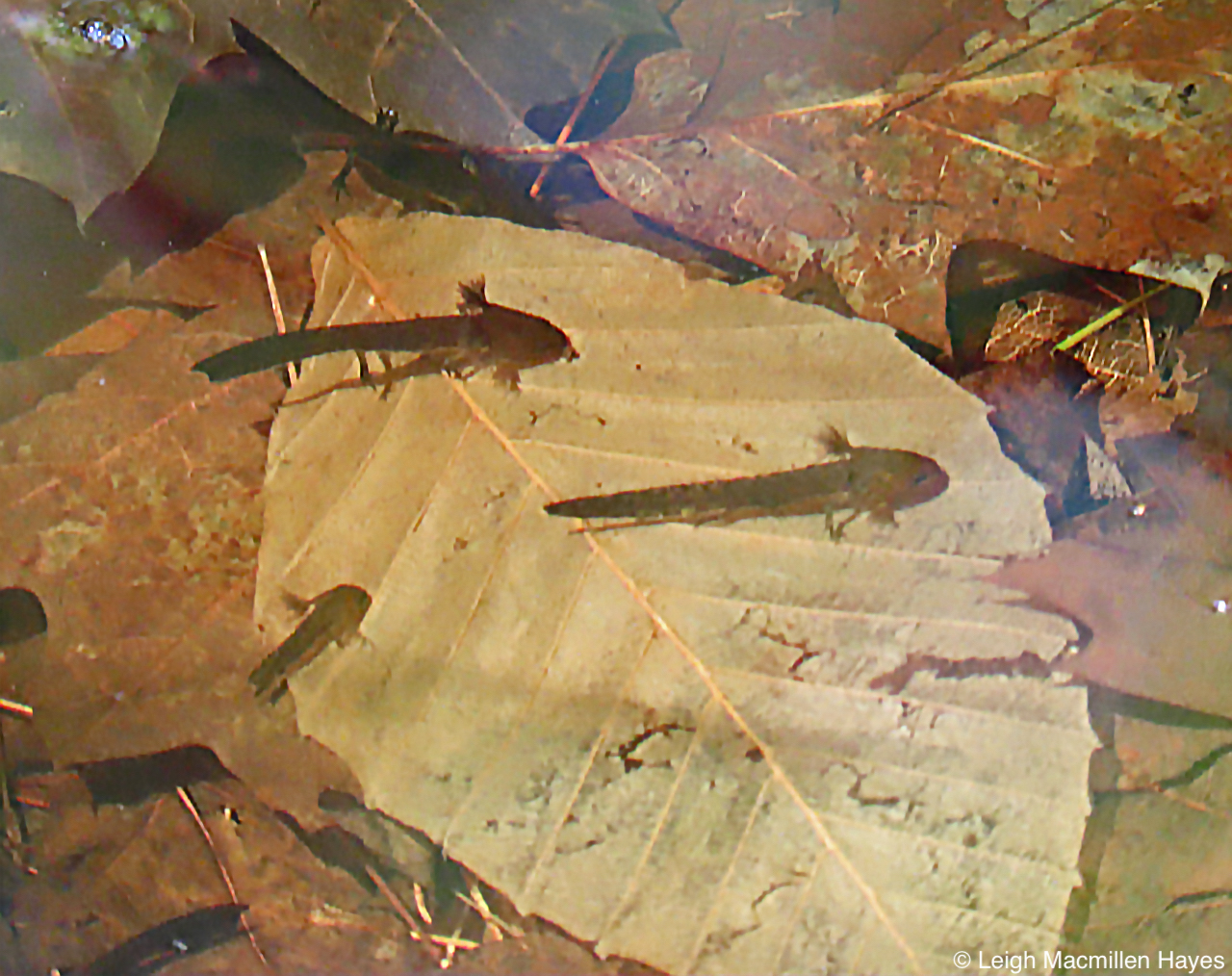
This is a tale that I’m so excited to share and it’s actually a month or two in the making. Each year I write about the saga of the vernal pool in the woods behind our house and how it begins as a “Wruck, wruck” love affair, but by the end of May fizzles into a stinky puddle full of dried up Wood Frog tadpoles and flies and Scarab Beetles mating and laying eggs.

Not so this year. It’s been a wet spring and now a wet summer and that, my friends, is fantastic if you are a Wood Frog or Spotted Salamander. For the first time in my 30+ years of visiting this pool, there is still plenty of water in it.

It is my understanding that if a pool dries out too fast, the frogs and salamanders sense this and some metamorph into their adult upland forms quickly in order that they may hop or crawl out and be representatives of the next generation. I have to believe that is true since despite the pool usually not lasting long, come April 7 or 8 or 9, when the ice “goes out,” the love songs begin and eggs are fertilized and laid.

This year, however, the frogs have been given the opportunity to slow the process down and perhaps that will make them stronger, as well as increase the numbers that leave the pool.

It’s not just the frogs, but the salamander population might also be on the rise.

So here’s the other thing. Walking to and fro the pool offers numerous other distractions of the natural sort, like this rather handsome White Admiral Butterfly.

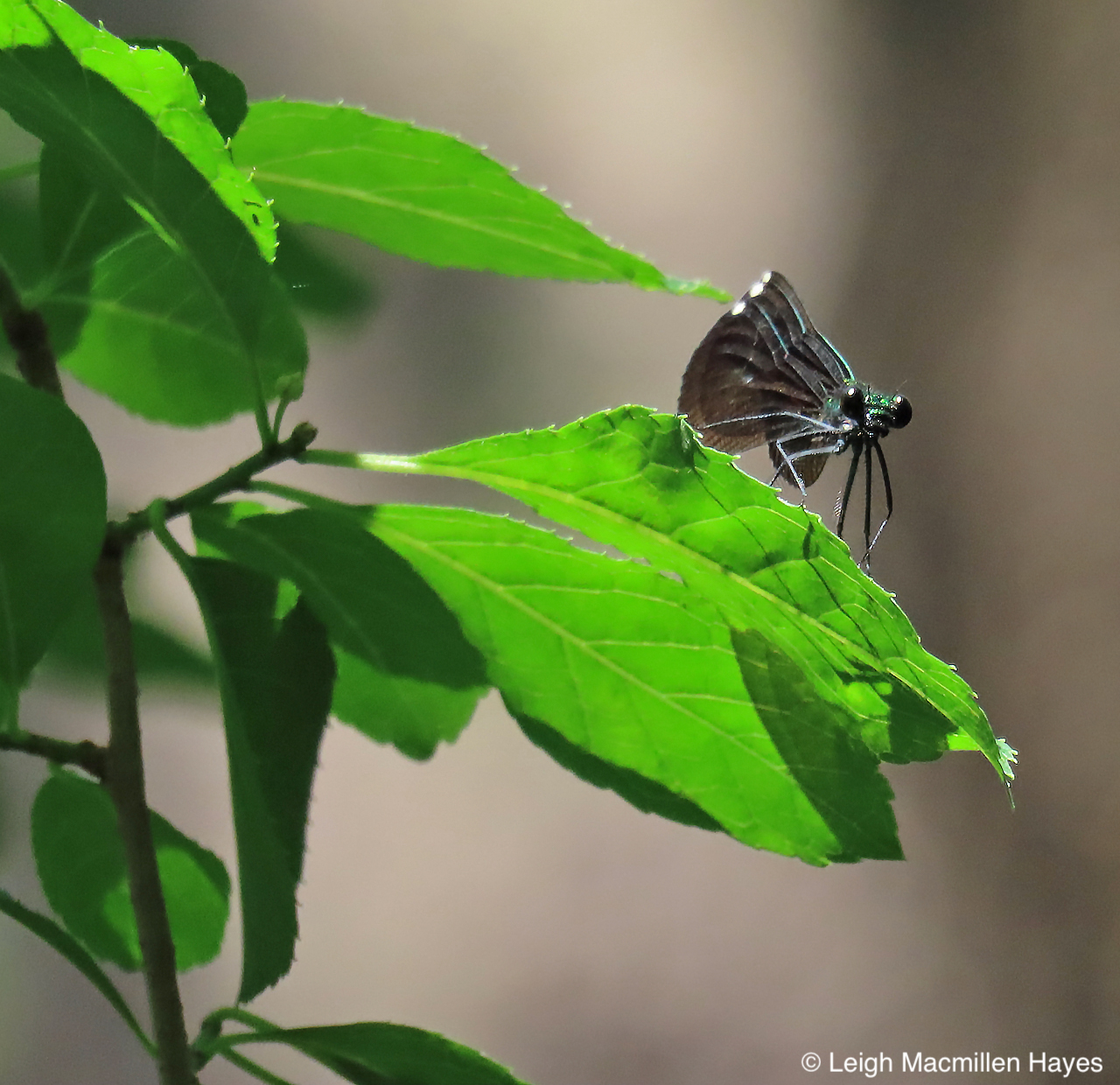
And a female Ebony Jewelwing Damselfly, the white stigmas or marks on her wings providing a hint of her gender.

But then there was the day that I heard baby peeps as I headed out there and suspected I knew the species to whom they belonged because they’ve nested in our yard before.

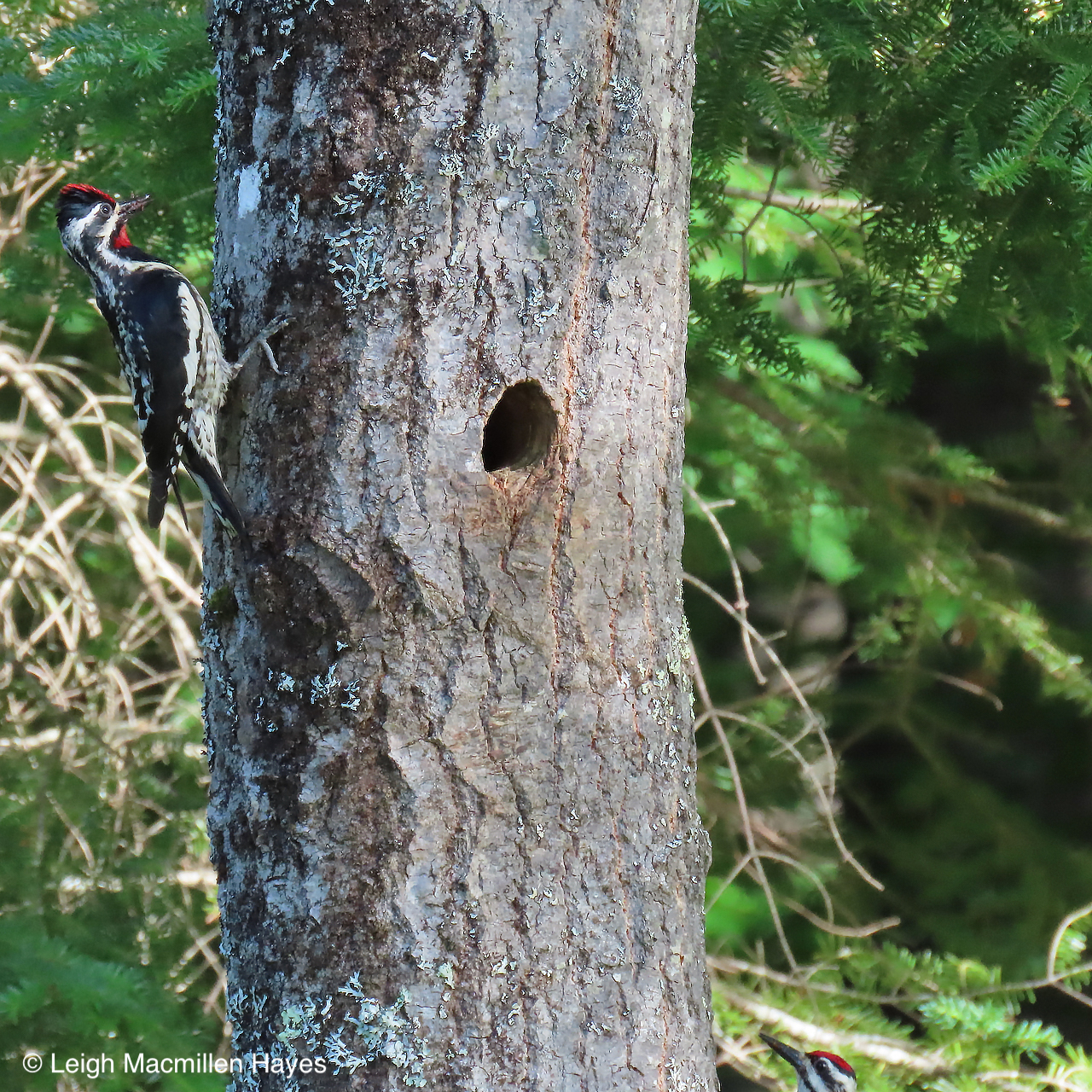
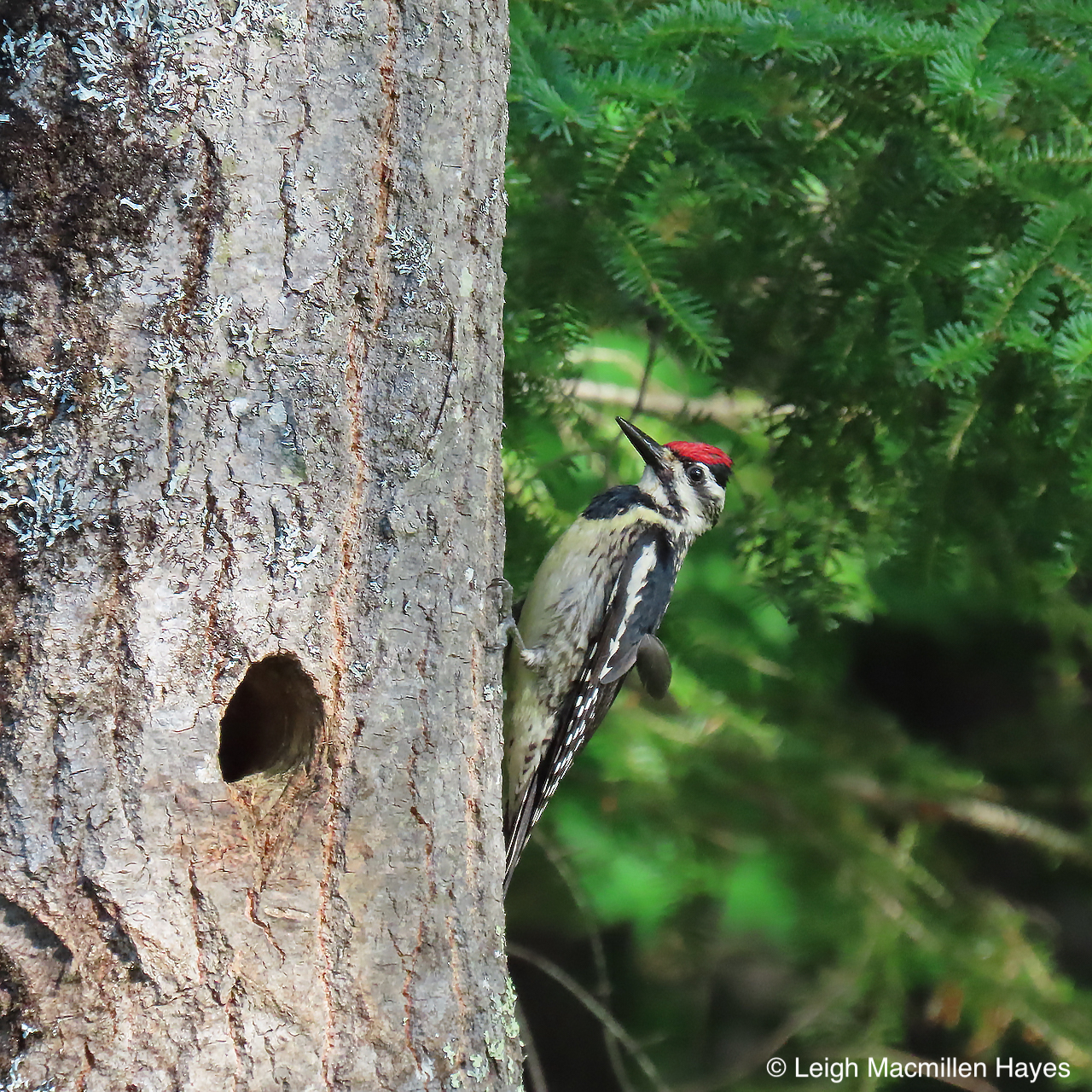
Crossing through a gap in the stonewall, I found the tree and Momma Yellow-bellied Sapsucker gave a hint as to the location. At first, however, I couldn’t find the hole where the babes waited for meals on wings to arrive.

Until I did because I passed back through the gap in the stonewall and went to the oak tree located in the far corner of the yard beside our woodlot and there they were: Papa on the right, Momma below, and the hole in between. These were two extremely attentive parents.

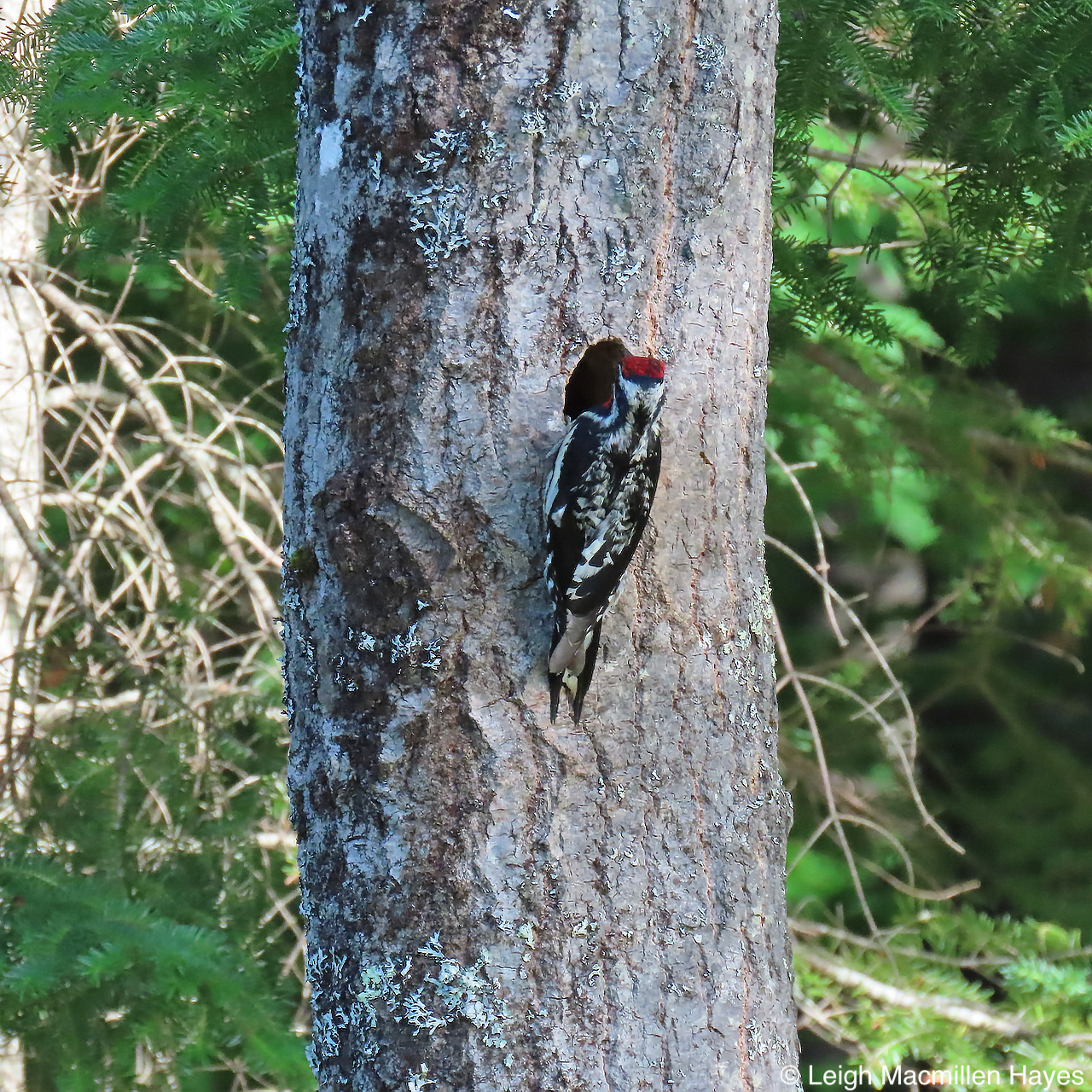
Momma would fly in rather silently and surprise me as I stood behind another tree about ten feet away. But the kids always seemed to sense the arrival of a parent and their peeps would rise in a crescendo and I’d look up and there she or he would be.

And then it was a matter of delivering the meal. To the hole the adult would move in its woodpecker manner.

And into the hole its head would duck, presumably delivering an insect of choice either into a beak or two or three or at least into the nest for the kids to fight over.

Right after the delivery was made, the insistent peeping would begin again. “More, more. We want more food,” the chicks seemed to proclaim.

And the parents delivered before flying off to find the next morsel to nourish their young.

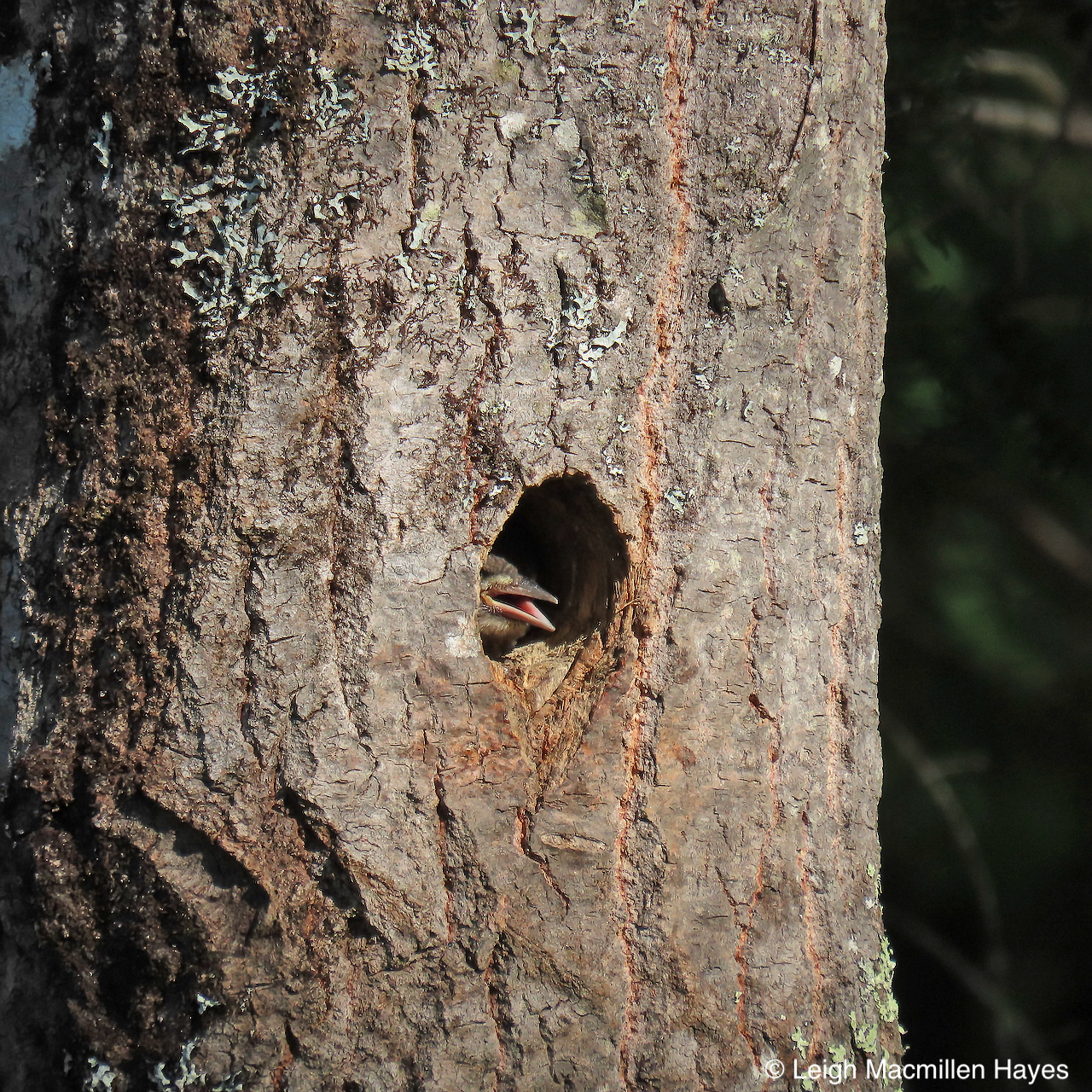
Still they did peep and occasionally showed their heads in the process.

By the end of the week that I spent watching, this youngster stuck its head out and made that insistent cry. Its parents disappeared for longer periods of time, which I’ve noted in the past and it makes me wonder if they have to go farther afield to find food, or if they want the kids to understand that instant satisfaction isn’t always the name of the game. Within a day or two and when I wasn’t looking, the chicks fledged and now I hear them learning the art of tapping to mark their territories.

Oh, but wait, this is the tale of a vernal pool. And there too, there were changes like I’ve never seen before in this one. For one thing, the water teemed with activity.

Up for air they’d come and then dodge down again, leaving ripples in their wake.

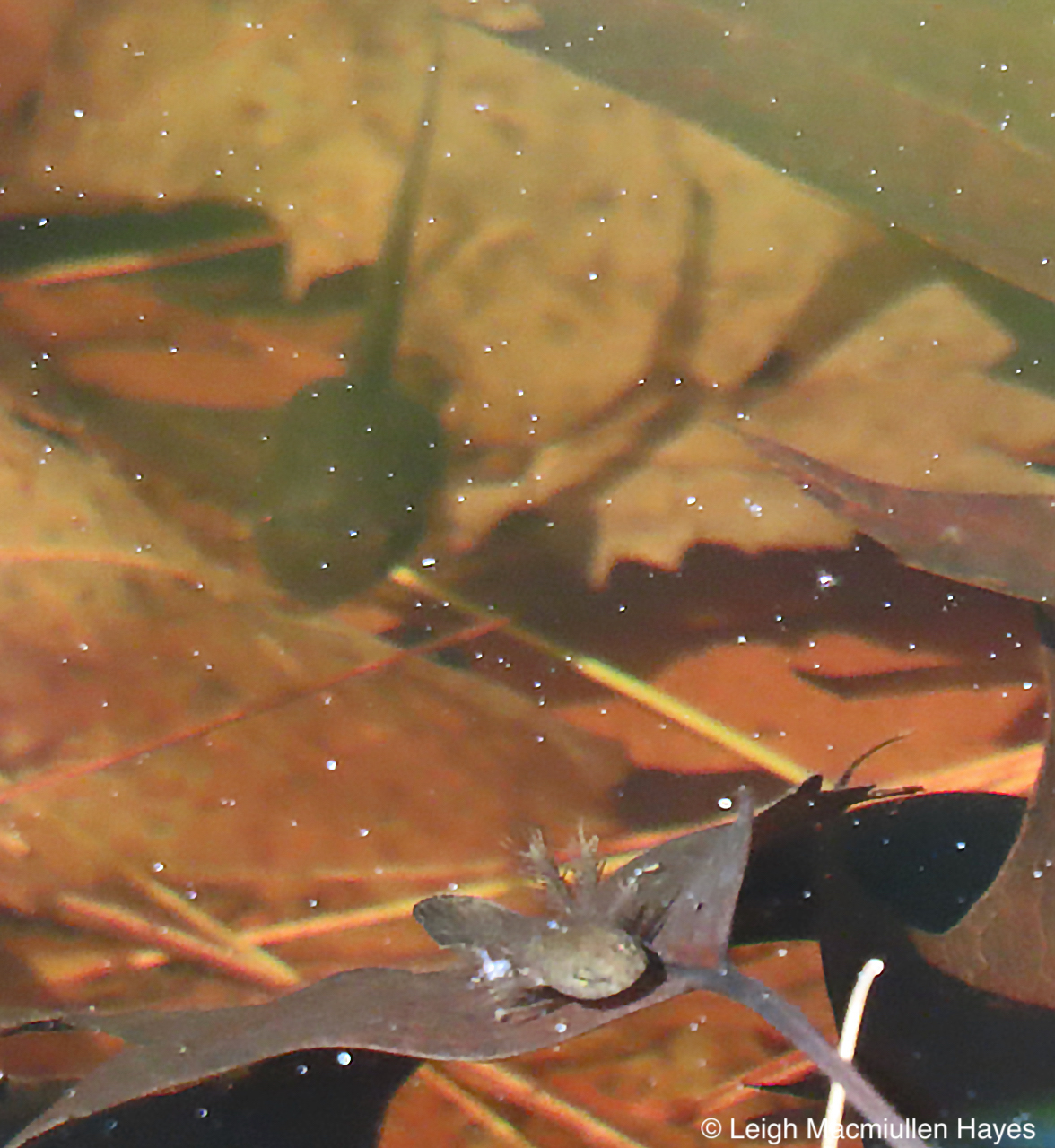
But . . . do you see what I saw during today’s visit? Legs! My frogs are growing legs. I’m so excited for them. I have to be as, unlike the Yellow-bellied Sapsucker chicks, they don’t have parents watching over them, feeding them, and teaching them froggy ways of living.

The same is true for the Spotted Salamanders who are breathing through those feather gills behind their heads for as long as they are aquatic in nature.

It was on my way home this afternoon when something else moved in the woods not far from my labyrinth and I thought at first it was a bird.

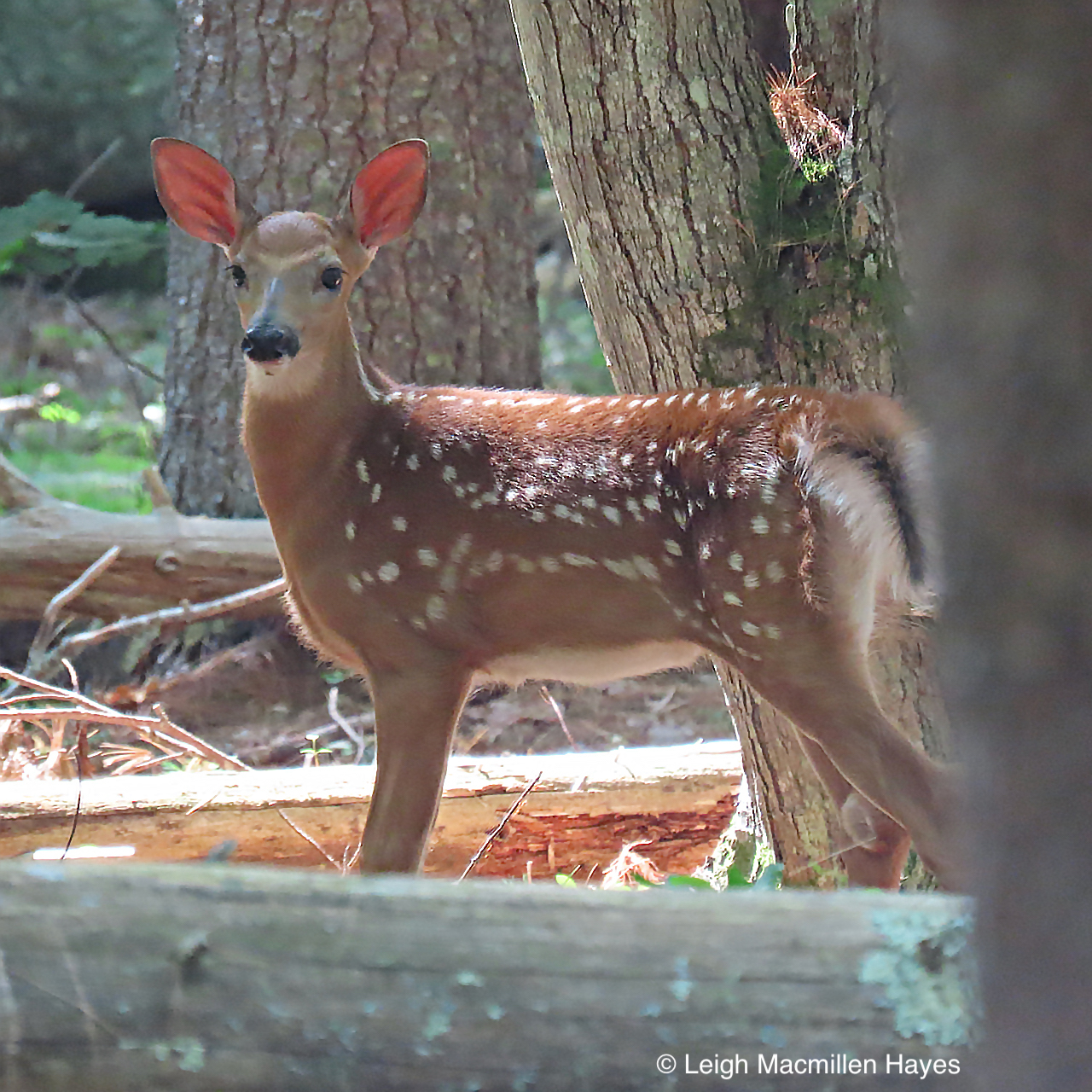
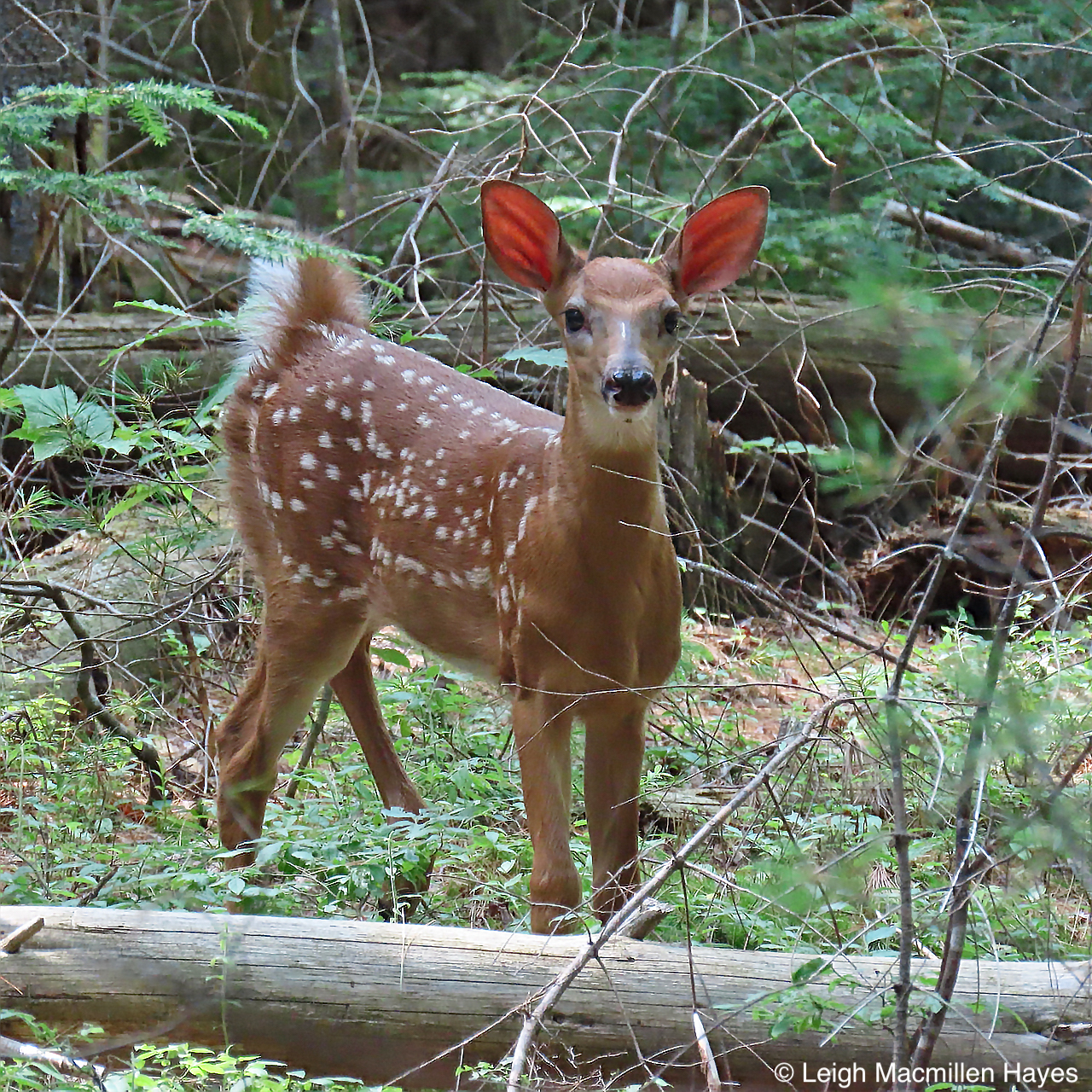
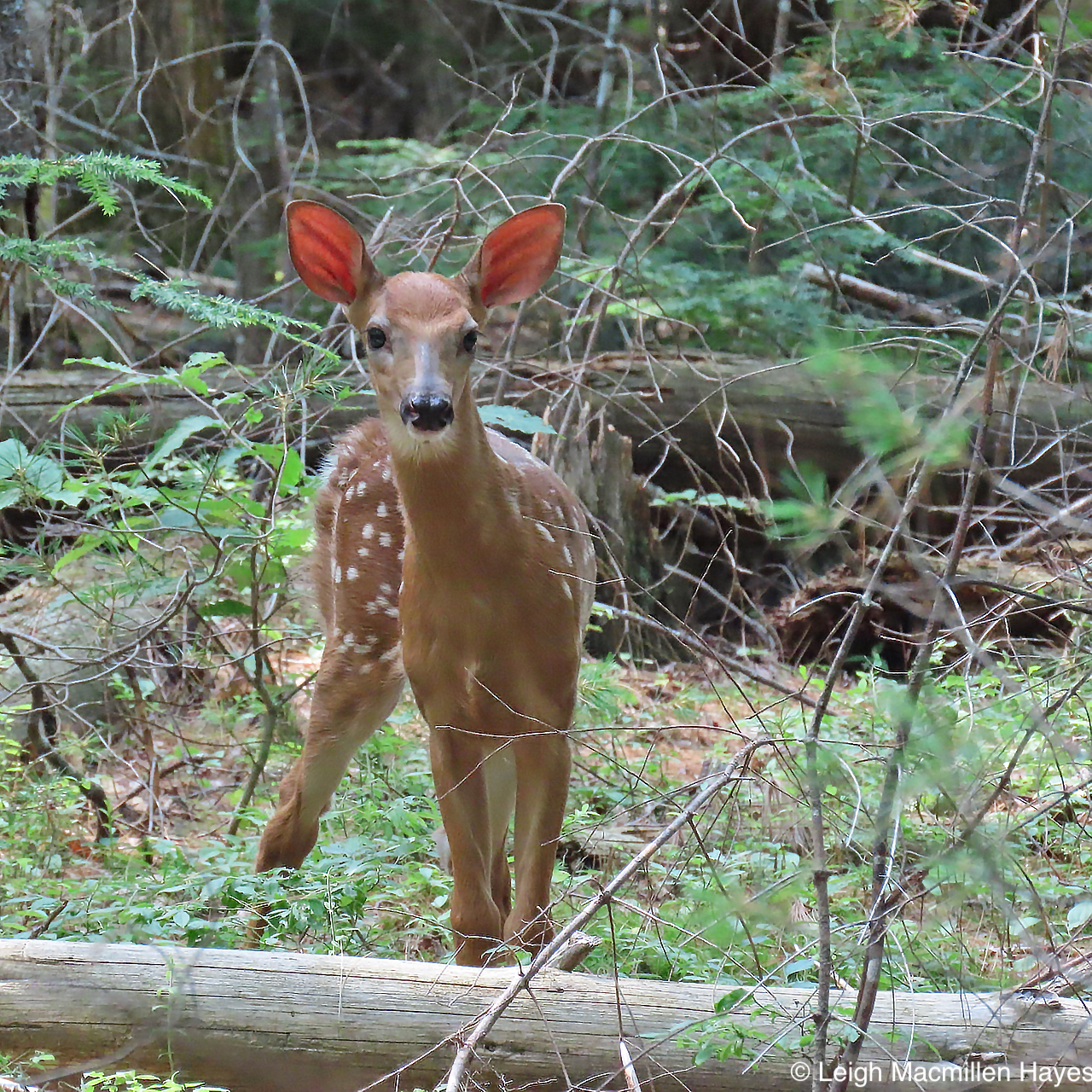
Until it too morphed . . . into a fawn licking its chops. And then I recalled that on the way to the vernal pool, I’d startled a doe in about that same spot and she’d leaped away and in the last few weeks I’ve seen the doe visit a spot in the field over another stonewall and I’ve stood on a kitchen chair with my binoculars trying to see if she might have a fawn. Apparently she did. I am tickled except for the fact that they are eating flower buds in my pollinator gardens.

That face. Those ears. And spots galore. How can I not share the buds with this rather chunky youth?

We spent about ten minutes together, each curious about the other, until it occurred to me that again, like the Sapsucker chicks, its parent was probably nearby and waiting for me to move on.

And so I did.

Still, I can’t stop smiling because something is always happening and it’s right outside my backdoor when I take the time to listen and notice.

Where The Moose Led Us Mondate

It seems there are never enough rainy days to complete home chores so when today dawned as such I thought that all the contents I’d been sorting from a closet would finally make their way to new homes like the dump store or community clothing closet or back into containers to be stored for another rainy day.

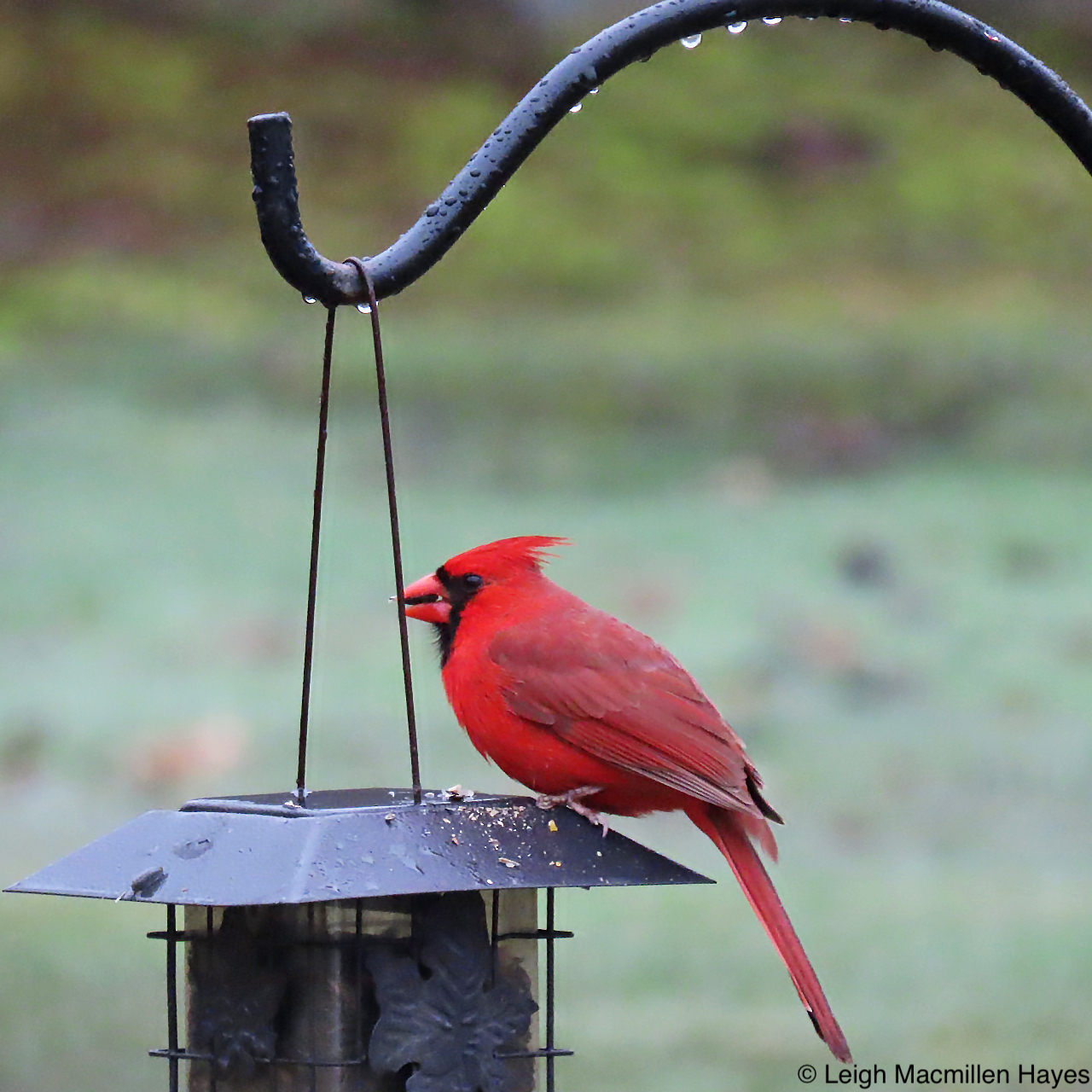
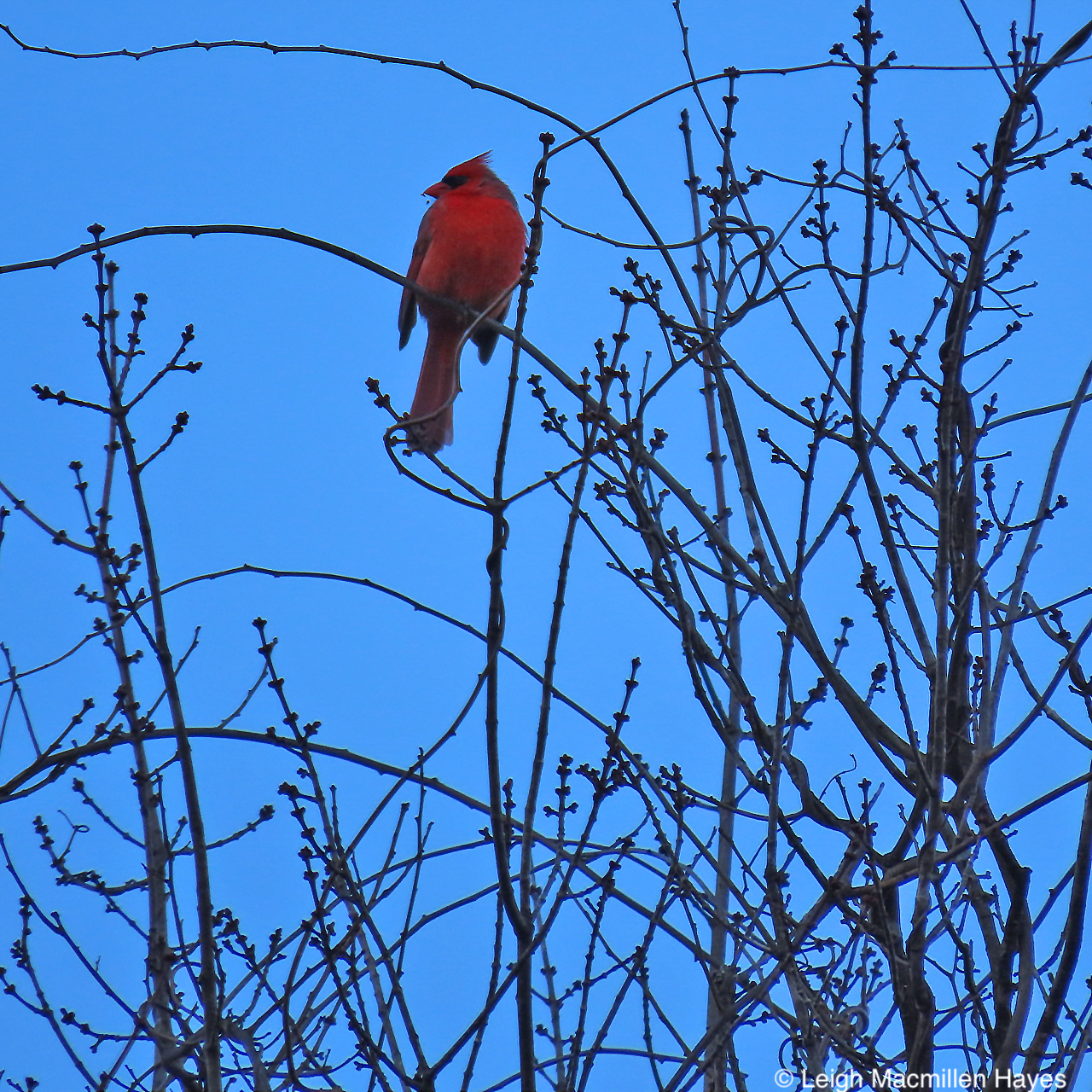
Apparently, I thought wrong for the Cardinal beckoned and we answered the call to head out the door.

When I mentioned a location for today’s hike to My Guy, he agreed that it sounded good, though come to find out, in reality he thought we were going someplace else and even when we arrived at Great Brook, he couldn’t recall our last visit, which was in 2016. Fair enough. I’ve been there many more times.

It soon became apparent that we were in Moose territory and our excitement rose. Actually, on another trail in this same neck of the woods we once spotted a Moose, so all we could do was hope that today we’d receive the same honor.

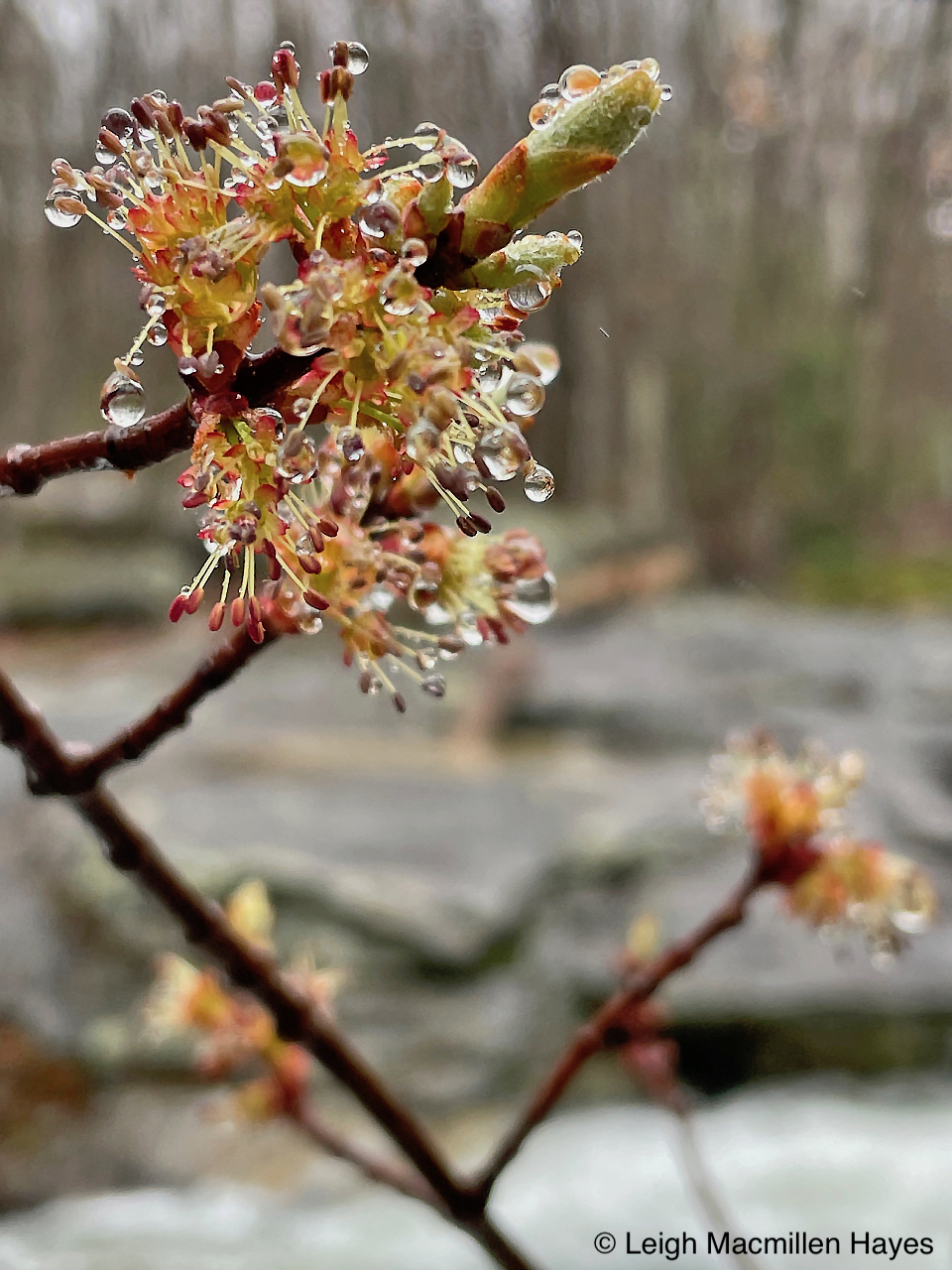
But first, there were other honors to receive, such as this bouquet of flowering Red Maple.

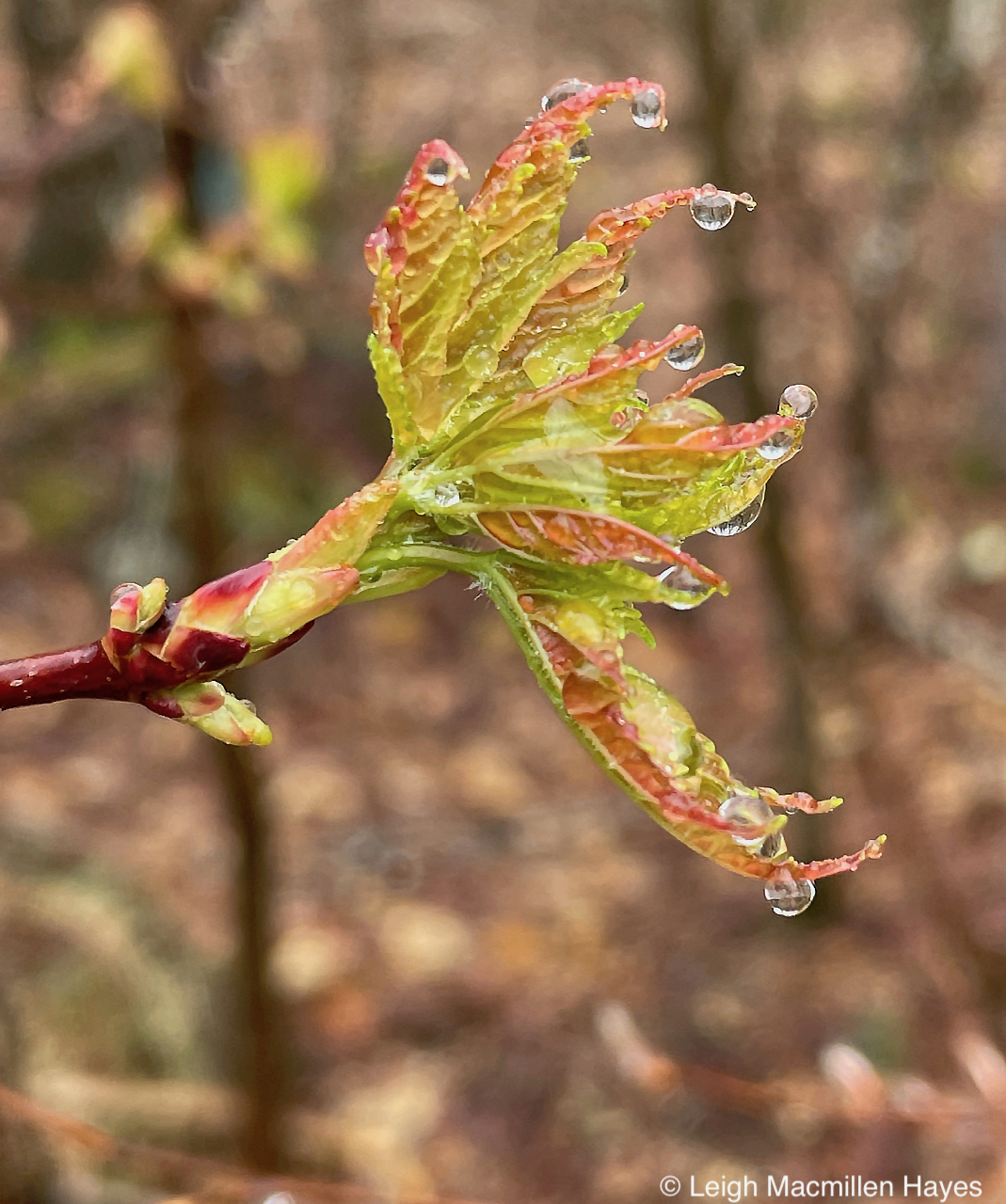
And the first of the season for us, maple leaves bursting forth in all their spring glory of color.

Onward we hiked deeper into the woods where a place one might think of as no place was once some place. This particular foundation has long been a favorite of mine because within is a root cellar.

It’s one I can’t resist stepping into because you never know what tidbit might have been left behind.

Porcupine scat! Rather old, but still.

My friend, Jinny Mae (RIP), was a talented techie and though the red line isn’t the entire route we followed today, it’s one she and I explored back in 2016. The map is from a section of the 1858 map of Stoneham. And we were at E. Durgin’s old homestead.

Knowing that there were some gravestones in the woods behind the house, we once again followed the Moose who led us directly to the family cemetery. Someone has cleared the site a bit, so it was easy to spot, especially since the trees haven’t fully leafed out.

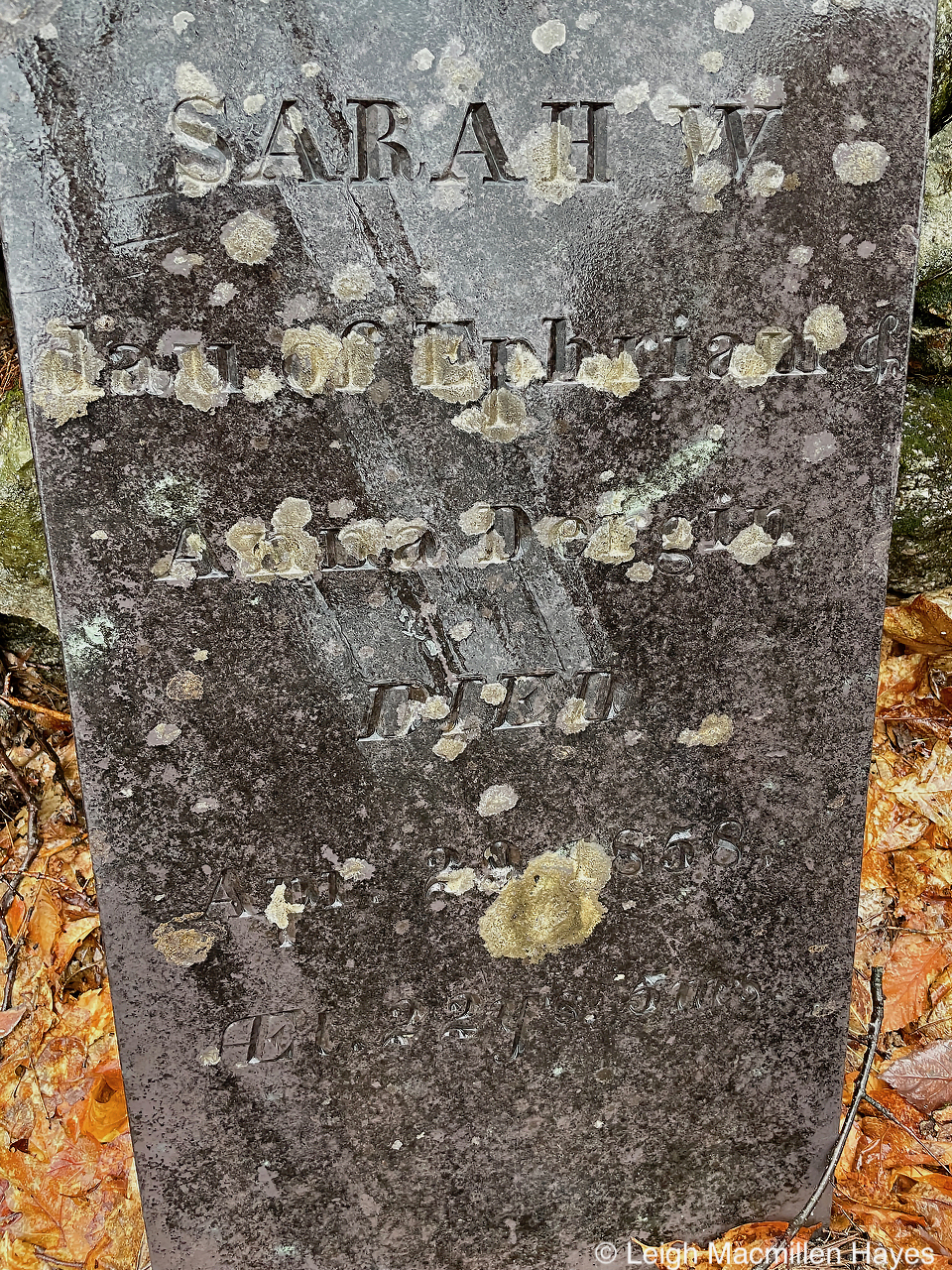
Sarah, daughter of Anna and Ephraim Durgin, is the first tombstone. She died in 1858 at age 22.

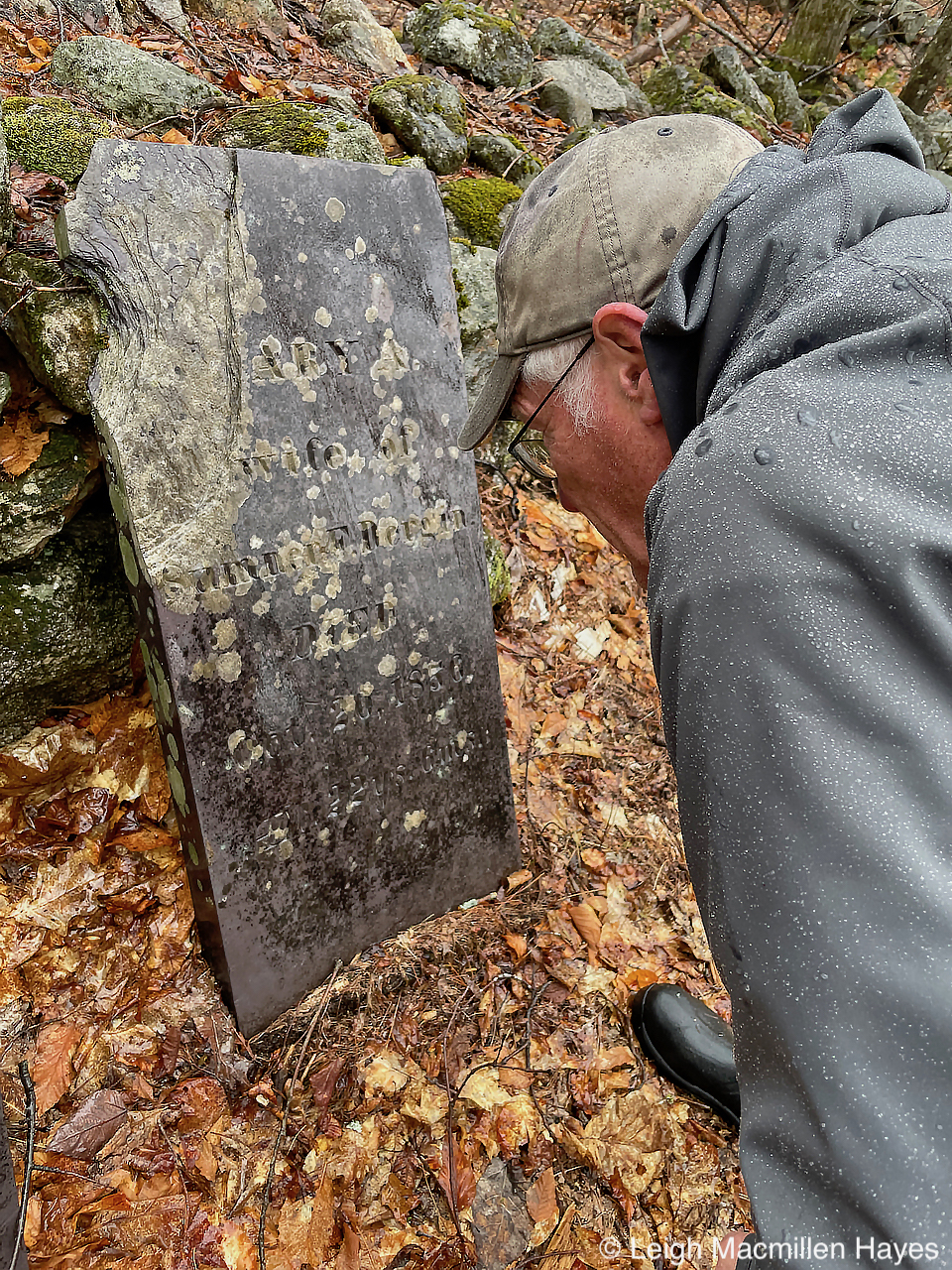
Beside her is the stone for Mary, wife of Sumner Dergin, who died before Sarah–in 1856. She, too, was 22 years old. As best I can tell, Sarah and Sumner were siblings.

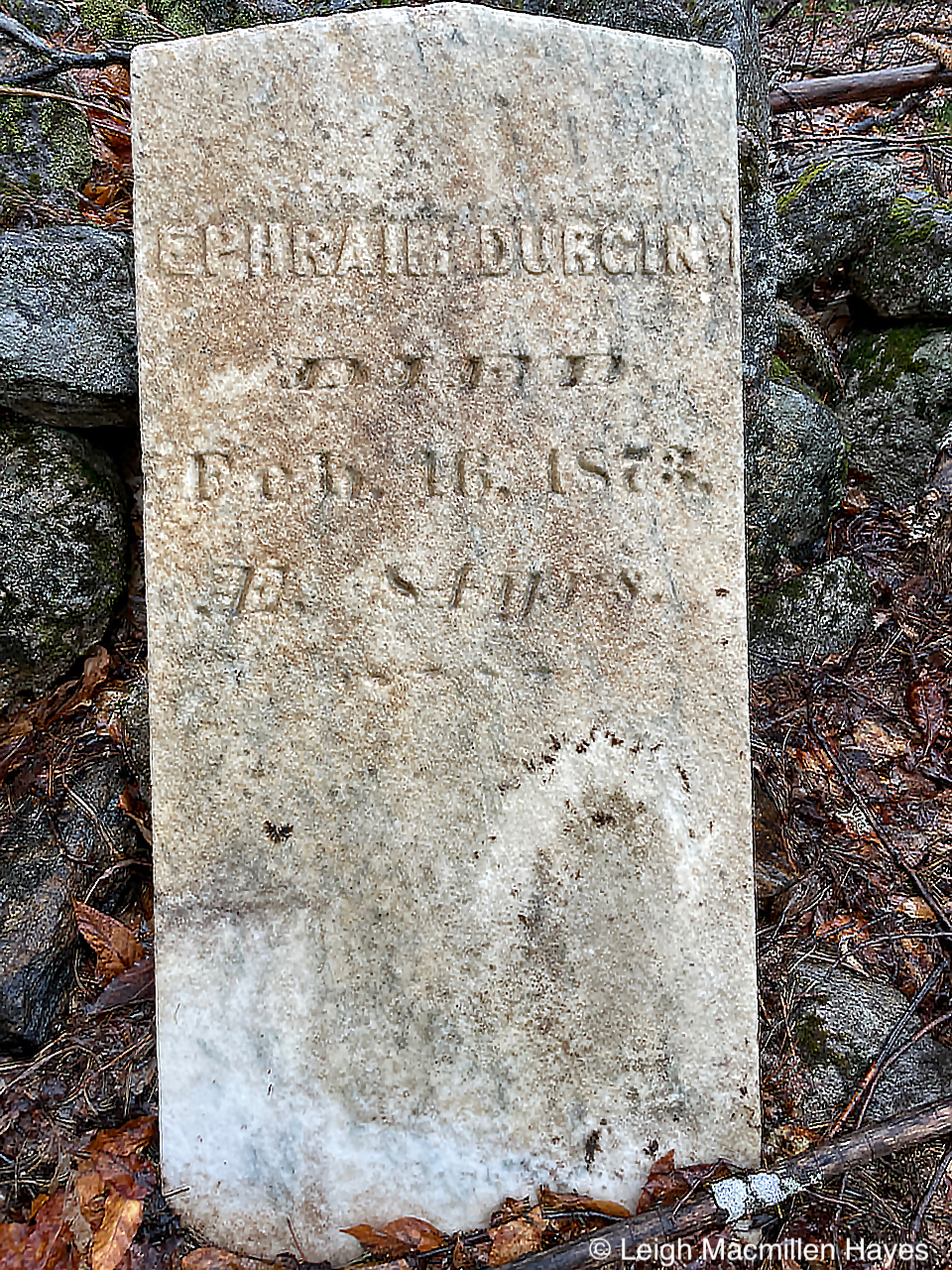
And Ephraim, Sarah’s father, died in 1873 at age 81. Notice the difference in stone from the two girls to Ephraim? Slate to cement. And the name spelling–Dergin and Durgin. As genealogy hobbiests, we’ve become accustomed to variations in spelling.

I found the following on RootsWeb:

8. ANNA3 FURLONG (PATRICK2, JOHN1) was born 1791 in Limerick, Maine, and died 1873 in Stoneham, Maine. She married EPHRAIM DURGIN June 18, 1817 in Limerick, Maine14. He was born April 13, 1790 in Limerick, Maine, and died in Stoneham.

Children of ANNA FURLONG and EPHRAIM DURGIN are:
i.OLIVE4 DURGIN, b. 1811, Stoneham, Maine; m. DUNCAN M. ROSS, April 11, 1860, Portland, Maine.
ii.SALOMA DURGIN, b. 1813.
iii.ELIZABETH DURGIN, b. 1815.
iv.SALLY DURGIN, b. 1817.
v.SUMNER F. DURGIN, b. 1819, Of Stoneham, Massachusettes; m. MARY ANN DURGAN, July 11, 1853, York County, Maine; b. Of Parsonsfield, Maine.
vi.CASANDIA DURGIN, b. 1821.
vii.EPHRAIM DURGIN, b. 1823.
viii.FANNY DURGIN, b. 1825.

Sarah isn’t listed above. But . . . Sally and Sarah were often interchangeable.

By 1880, there had been a change in ownership of the neighborhood homes and the Rowlands had moved into the Durgin house.

Again, we followed the moose, this time in the form of a Striped Maple browsed upon, curious to see what might be ahead.

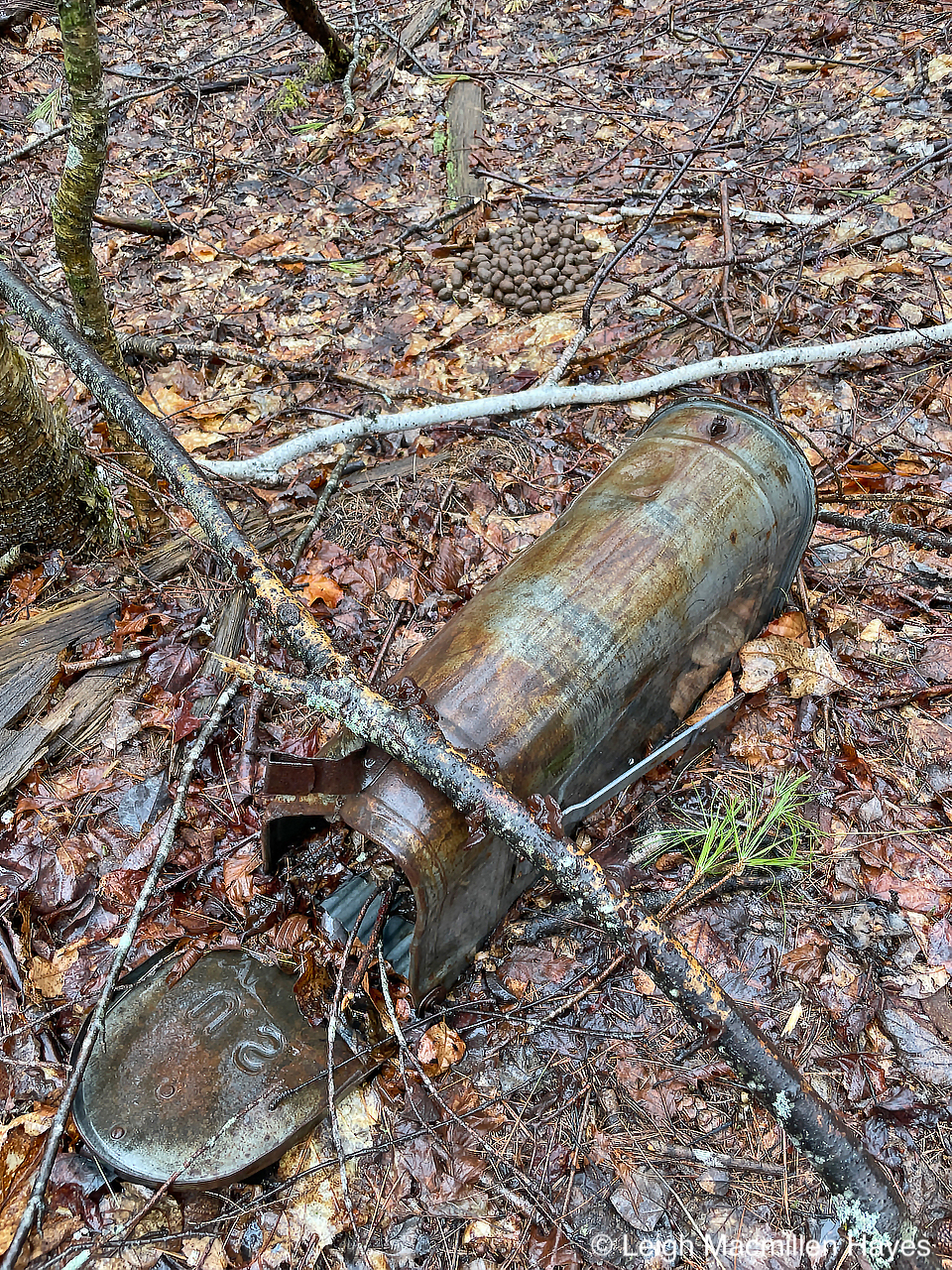
A chuckle. Yes, a mailbox in the middle of nowhere, this spot being a place where someone once had a camp. Our Moose tried to send a letter, but missed by a couple of feet.

Willard Brook was our next stop and I was reminded that when I first started wondermyway.com, a post about this brook initiated some discussion about the Indigenous stonework found throughout the area. I’ve explored it looking for such and convinced myself in the past that I saw the turtles in most of the stonewalls. In fact, I see them everywhere, but today I was looking at different subjects.

Beside the brook, lots of Hobblebush looked ready to burst into life and we thought how fortunate that the moose hadn’t decided to dine. Yet.

There were even tiny Hobblebush leaves to celebrate for their accordion style.

And Broad-leaved Dock looking quite happy and healthy.

Back to Great Brook we eventually wandered, still with no actual Moose in sight.

But beside the brook I did spot some Trailing Arbutus buds preparing for their grand opening.

As we walked back on the dirt road we’d walked in on, we paused beside a beaver pond where Spring Peepers sang their high-pitched love songs. I made My Guy scan the area with me because just maybe . . .

or maybe not. We did spot a Mallard couple. Oh well, We still had fun discovering everything else where the Moose led us on this rainy day.

And when we arrived home I had an email from an acquaintance double-checking with me that the print he found on his shore front of Kezar Lake was a moose print. Indeed it was!

(And now it’s time to prepare for Big Night. Finally. The temperature is in the 40˚s; it’s been raining all day and will continue tonight; and though lots of amphibians have moved to their native vernal pools, I think there will be some action tonight and we’ll be able to help them cross the road safely.)

Searching for a Tiger Mondate

We didn’t know what to expect when we headed off on a trail today. Or even what to wear on our feet–besides winter boots that is. And so we donned snowshoes initially in hopes that should we locate a Tiger, we’d be able to move easily across the snow rather than posthole and get slowed down.

Ah, but there were things that did slow us down. If you are a long-time follower of wondermyway.com, then you know I can’t resist a Pileated Woodpecker tree . . . among other subjects that repeatedly slow me down. This one was fun because it was obvious that the bird stood on the snow to excavate at least the bottom hole. In my mind’s eye, I could see it using its tail feathers as the third leg in a tripod while its beak pounded away at the tree, excavating a hole. Did it find any food?

Indeed it did and several healthy looking cylindrical scats full of the indigestible parts of the Carpenter Ants it sought were waiting to be discovered like little piles of treasure.

Was the Tiger hiding among the wood chips? No, unfortunately not.

The next great sight was the cocoon of a Promethea silkworm moth. When the caterpillar or larval form of the moth was ready to pupate at the end of last summer, it strengthened the stem, or petiole, of a leaf with silk, and then attached the silk to a nearby branch as you can see, assuring that the leaf would remain attached to the tree rather than fall off. It then spun the cocoon inside the curled leaf.

This species overwinters as pupae in a state known as diapause. During pupation, the larval structure breaks down into a soupy form and then restructures so that by the end of the process (in late May/early June) adult structures, including wings appear before its time to emerge and fly.

Was the Tiger hiding behind the cocoon? No, unfortunately not.

And then there was the Hickory Tussock Moth Caterpillar–climbing a tree to look for food on a winter day? Hardly. At a certain point in its growth, it lightly locked its legs into mat of silk it had produced on the branch. It then released enzymes that dissolved the inner layer of its cuticle, and a day or so later, much like a dragonfly or cicada emerging from exuviae, the caterpillar’s cuticle split above the thorax and the caterpillar literally crawled out of its skin. This is an old cuticle left behind.

Was the Tiger hiding amid the HTM’s cuticle? No, unfortunately not.

As we hiked along the snowshoe trail, we had to work our way around, over, and under downed trees, but this one encouraged me to pause for it’s one I don’t encounter on an everyday basis, much like its cousin with bristles on its leaf lobes. The cousin in Northern Red Oak, but the leaves we met today belonged to White Oaks. Oh, there were red oaks along the way, and I don’t mean to downplay them, but I’m forever in awe of the marcescent (leaves that wither but remain attached to the stem) of White Oaks. Those veins. That color. And the shape. Always curled in winter as if an open palm.

Was the Tiger masked by the downed tree? No, unfortunately not.

At an erratic the size of a small house, I had to take a closer look and convinced my guy to pause. He did and circled the boulder in search of the Tiger.

Did he find the critter? No, unfortunately not.

It was next to a Speckled Alder that our attention, well, my attention turned. What initially stopped me in my tracks was the woolliness of Woolly Alder Aphids. Those fuzzy aphids feed on the sap of the shrub and produce white wax, or “wool,” filaments from their abdominal glands.

They drink volumes of sap in order to get enough nitrogen, which they then exude as honeydew. In the summer, I find ants farming them to sip the honeydew.

But that’s not all that is interested in the sweet liquid. A Black Sooty Mold loves the honeydew as well.

The funny thing is that I was just discussing this yesterday with Land Steward Leah of Dartmouth Natural Resources Trust in Dartmouth, Massachusetts. The Black Sooty Mold is actually a Poop Eater! What? Yup. A poop-eating fungus. The natural world is more otherworldly than one can even imagine.

The Sooty Mold’s name comes from the dark threadlike growth (mycelium) of the fungi resembling a layer of soot or rather, a bit like elongated coffee grounds, and within my hands, its brittle structure quickly splintered into tiny specks.

Was the Tiger hiding among the Sooty Mold? No, unfortunately not.

Eventually, we returned from whence we’d come because one of the snowshoe trails is an out-and-back, found a rock upon which to sit for lunch, and the same served as a storage hide-away for our snowshoes while we donned micro-spikes, for the rest of the journey would be along a snowmobile trail. The thing about snowmobile trails in our area–they were closed a few days ago, just at the start of Spring Vacation, oops I mean Winter Vaca, but such have been the temps of late and the trails are not safe–especially where they cross waterways or boggy areas.

That said, I stepped off the trail and located this tree–a wonder unto itself. For those who know the species, it’s a Hophornbeam gone astray. Typically, these trees of sorta shaggy, yet tight bark, if one can be such, grow straight and strong, but obviously there was an interruption in the growth of this tree, though eventually it found its way skyward as is its normal behavior.

Was a Tiger hiding among the trees? No, unfortunately not.

I discovered the disfigured Hophornbeam because I’d gone closer to the water to spy on a couple of Beaver lodges. And I’m happy to report that based on the mud and fresh branches, they appeared to be active.

Was there an active Tiger in the area as well? No, unfortunately not.

Shortly after reaching Snowmobile Trail ITS 89, we noted the double-wide stonewall, a hint of days gone by when the property was probably plowed for agricultural reasons. We also noted that it’s been a while since that practice occurred for so old did the Eastern White Pine that grew atop the wall appear.

Was it large enough to hide a Tiger? No, unfortunately not.

So the next spot brought a smile to my face, for often, when I’m leading a hike my mouth gets ahead of my brain and I know I mean birch when I say beech, or visa versa, but here they were representing as one in the same for over time they had rubbed against each other for so long that they rubbed together.

Here’s a new word for me: Inosculation–when the friction between two trees causes the outer bark of each to scrape off at the point of contact. The trees respond by producing callus tissue that grows outward, thereby increasing the pressure between the two. This pressure, along with the adhesive nature of sap or pitch that exudes from their wounds, reduces the amount of movement at the point of contact. But the question remains: Does the cambia layer from the two trees come in contact and the vascular tissues become connected, allowing for the exchange of nutrients and water? Maybe if they are trees of the same species, but these were two different species and I suspect they are actually false grafts, which means the two trees have not formed a union of conductive tissues. Going forward, when I say Birch and mean Beech, or Beech and mean Birch–I shall remember these trees.

As for the Tiger, did he know them as well? No, unfortunately not.

As the sun began to shine, we found ourselves pausing beside Cold Rain Pond, where Sheep Laurel showed off its plans for the future. I want winter to continue, and apparently it might, for such is the forecast for later in the week when temperatures are supposed to dip to more seasonal numbers and snow is in the forecast, but note those buds.

Did they obscure the Tiger? No, unfortunately not.

As we backtracked our journey and followed the snowmobile trail out several hours later, I found the evidence we sought. A footprint. Certainly that of a Tiger. A very big Tiger for our area.

Your mission, should you choose to accept it, is to locate the Tiger. We knew it was there somewhere, but just like our Bobcats, it chose to remain elusive and hid among the shadows. Do you see it?

After all, we had traveled over 7 miles of Loon Echo Land Trust trails at their Tiger Hill Community Forest.

There must be Tigers in the midst, indeed. For why else would it be named such?

Disclaimer: the Tiger print is actually a bleached out Bobcat print–made larger as the temperatures rise.

The Beaver’s Tale

Once upon a time . . . no wait. This isn’t a fairy tale.

Rather, it’s about changes in the landscape that one might observe, such as a brook suddenly overspilling its banks as was the case in this location upon a December visit. We’d had rain, but that much?

It wasn’t long before a friend and I spotted the reason for the high water. Some new residents had moved into the area and built a lodge of sticks. Unlike the story of the three little pigs, one of whom built a house of sticks that the big bad wolf came in and blew down, the makers of this structure took special care to make it solid and strong and weatherproof. Yes, a beaver or two or six had taken up residence with the intention of spending the winter. Beaver families usually consist of a monogamous couple, plus their two-year-old (almost adult) kids, and yearlings. Mating occurs in the water during the winter and kits are born inside the lodge in the spring.

In order to move into the lodge, a dam needed to be constructed as well. If you look closely, you’ll see that above it there was a bit of an infinity pool with the ice at level with the dam, while below it some water flowed at a much lower level. Though we couldn’t walk along the ice to measure the length of the dam, it was quite long. and made of sticks and leaves and mud. Typically, the family works on this project by creating a ridge of mud and probably the herbaceous plants of the meadow, and then they use the mud and sticks to stabilize it. Maintenance is a constant as water or other critters or humans have a way of breaching the dam.

We, too, build dams to serve similar purposes, such as this one originally constructed to operate a saw mill. Hmmm.

Getting back to the lodge: it also needs nightly work as long as conditions allow and this has been a winter of despair for those of us who love cold temperatures and snow and even ice if it’s in the right place, like on a pond or lake and not in the driveway.

Take a look at how the beaver is holding the small twig.

A beaver’s dental formula is this: 2 incisors on top, 2 incisors on bottom, 0 canines on top, 0 canines on bottom, 2 premolars on top, 2 premolars on bottom (that look like molars), 6 molars on top and 6 molars on bottom, for a total of 20 teeth. Recently, I was able to sketch the upper part of the skull of an older family member, who’d lost some of its molars.

These large, semi-aquatic rodents are gnawers like their relatives. To that end, their incisors are highly specialized for chewing through really, really tough things and they grow continually throughout the critter’s life.

And like all rodents, the front surface of their incisors is coated in enamel reinforced with iron (hence the orange color), which makes it resistant to wear and tear from gnawing. When the chisel-like teeth chew and fell trees, the much softer white dentine layer (the section behind the enamel) is ground down quicker than the enamel, thus creating a sharp chisel surface.

But to me the coolest aspect is that their lips close behind the incisors, thus permitting them to gnaw and carry sticks underwater without choking.

And bingo, you can see the stick being carried in that gap between the incisors and molars. Food sticks become lodge or dam sticks once their nutritional value has been consumed: a true plan of repurposing.

As it turns out, that wasn’t the only beaver family at work in town. This next family, however, chose to park their tree in a spot the fire department lay claim to for filling a water tank. But . . . reading is not on a beaver’s talent list.

In this other place, so many trees have been felled, but not all have fallen as intended, getting hung up on other trees instead. Not wanting to anthropomorphize, but I have to wonder what expletives flash through a beaver’s brain when trees don’t hit the ground as planned.

As strict herbivores, a beaver’s diet varies with changes in the season. During spring and summer, they are drawn to waterlilies, algae, grasses, sedges, herbs, ferns, shrub leaves and shoots. By late summer, however, tree cutting begins as they gradually change their dietary habits from herbaceous to woody materials. Twigs, roots, bark and especially inner bark become the source of nutrition. Aspen, birch, alder, and willow are favored species, but beavers will cut almost anything including conifers.

Imagine this. A beaver cocks its head to the side as it gnaws, thus the consistent angle of the half inch groove as the upper and lower incisors come together.

Likewise, porcupines gnaw, but their incisors are much narrower and the pattern more random.

So, the question remains. Where were the parking lot beavers living? In the past, a family has inhabited the northern most reaches of this pond, but in this case, they had built a lodge on a point not far from the southern end.

The top of the lodge is the only section not covered with mud, for it serves as a “smoke stack” of sorts, a place for beaver breath to escape. Visit a lodge on a cold winter day and you might observe the vapors rising.

And then it was on to another locale, where beavers have inhabited the same lodge for a number of years. When beavers choose to live in a pond or lake or sometimes even a river, there’s no need to build a dam for the water is usually deep enough for their underwater movement.

I often tell people that beaver prints are a rare find because they are either wiped over by the tail or by trees being hauled to the water. Once in a while, however, I’m proven wrong and the sleety snow on a recent day awarded just the right conditions for the webbed feet to be observed.

Tree work and broken ice added to the story of the critters’ journey to and fro the pond. While quite adept at time spent in the water, they are rather clumsy on land and most of their work is within a hundred feet of the edge.

Winter food is cached close by the lodge entrance so that they can swim under the ice to retrieve a stick. A beaver’s ears and nose have a valve that closes when it is submerged and they can stay underwater for up to fifteen minutes. Back at the lodge, there is a raised chamber surrounded by a moat that leads to the entrance tunnel. It’s upon the raised area that they dine, and groom, and even give birth.

At this particular pond, My Guy and I noted two lodges connected by an open channel between. Given the number of tail slaps that announced our presence near both lodges, we thought perhaps both were active and inhabited by the same family.

And then, and then . . . finally, we spotted a beaver that spotted us. We kept expecting it to slap the water with its tail in a manner of warning so other family members would seek deeper water or cover. Instead, it swam past us.

The thing is that a rodent relative, namely the muskrat, exhibits many similarities, but also differences, including a skinny, snake-like tail.

The beaver’s tail is a source of wonder. While its furry body consists of long, shiny guard hairs covering dense and softer hair that traps air and helps protect the critter from the cold, the tail is broad and flat and scaly. It’s used for a variety of reasons including stability when standing upright on land (think tripod), as a rudder for propulsion in water, as fat storage and thermal regulation, and how we are most familiar, as a warning device.

A beaver’s tale indeed.

Sworn to Secrecy

I’ll let you in on a tad bit of a secret . . . eventually.

But first, today was a tracking day and so five of us did just that. When we arrived at the intended location, due to snow conditions, I think we had low expectations. I know I did.

We had just stepped off trail to begin our bushwhack excursion when we spotted this Ruffed Grouse scat. So the curious thing about this is that there are two kinds of grouse scat, the typical cylindrical packets coated with white uric acid, but also a juicier, brown dropping. And I regret that I didn’t take a photo of the juicier, yet slightly frozen stuff we saw dripping from some twigs above. At the time, I knew the brown stuff was significant because I’ve looked it up before, but couldn’t bring it to mind. Thanks to Mark Elbroch and Eleanor Marks, I found an explanation in Bird Tracks and Sign: “Interestingly, after producing these lower-gut-generated solid evacuations, some game birds, such as a grouse, often then evacuate a semi-liquid brownish mass from the upper gut, or cecum, with the two types of droppings coming out sequentially; the more liquid, almost liver-colored scat comes out second and is spread on top of the solid matter. In Ruffed Grouse, it is common to find the hard, fibrous scats at one roost and the soft, brown cecal droppings at another.”

But not uncommon to find them together!

We stood for a long time discussing the grouse scat and when we finally moved on, it wasn’t too far that we discovered bobcat prints. Given that the prints were not super fresh because there was some debris in them, we decided to follow the track forward. Had they been fresh, we would have backtracked so as not to put pressure on the animal. Though secretly, we all love it when we do actually get to spot a mammal. Or a grouse, for that matter.

Eventually, we lost track of the bobcat, because as you can see, there were spots with no snow. But then we stumbled across a sighting that confused us. White-tail Deer scat on the edge of a boulder. Dawn has some new tools she was gifted for Christmas, and so she was excited to pull them out. Our confusion, despite the fact that it looked exactly like deer scat, was caused by the location. On top of a boulder. On the edge of said rock. We came up with a few stories, but will let you try to interpret this on your own.

Back in the snow, we found canine rather than the feline prints we’d been looking for and so out came the tape measure to determine species. Based on the fact that the print measured less than two inches at the widest point and that the stride, or space between where two feet touched the snow (toe to toe), we determined it was a Red Fox.

Everywhere, we spotted Red Squirrel holes and middens, indicating the squirrel had cached a bunch of hemlock cones in numerous pantries and returned since the snow fell to dig them up and dine, leaving behind the cone cobs and scales in trash piles. What struck us was that for all the middens we saw, we never heard or caught sight of any squirrels. In fact, we didn’t see any animals . . . until we did. Huh? You’ll have to read on.

Our next great find close to the pond we walked beside, was more scat! Of course, it was. This being the works of a River Otter and filled with fish scales, all those whitish ovals embedded in it. Like a small pile of Raccoon scat we’d spotted earlier, but again, I forgot to photograph (the sign that we were having fun making all these discoveries), otters tend to defecate in latrines, using the same places over and over again.

Our movement was slow, and every once in a while we’d spread out until someone made a discovery and then we’d all gather again.

Which was exactly what happened when this Snowshoe Hare scat was discovered. Three little malt balls.

After the hare find, we followed a couple of canine trails that took us back to the water. Domestic dog or Coyote? We kept questioning this, but never saw human prints. And the animals did seem to be moving in a direct line on a mission. The warm weather we’ve been experiencing may have been enough to make their prints look larger than they typically would so I think I’m leaning toward Coyote.

But in following those, we discovered a sign from another critter by the water’s edge: Mink scat!

When our time was nearing an end and we bushwhacked back to a road near the trailhead, we were all exclaiming about our cool finds. And then a little birdie we encountered asked, “Do you want to see a bear?”

We don’t need to be asked that question twice, though now that I think back, I’m pretty sure we asked the birdie to repeat the question. YES! She gave us directions and we decided we needed to take an immediate field trip. We each hopped into our vehicles, drove almost to the destination, parked, and walked as quietly as we could toward the den site.

We got us a bear! A Black Bear! The birdie said it has been there since sometime in December.

Now that I’ve shared it with you, I’ll say no more for the five of us are sworn to secrecy about its location.

Crows Count

Really? Can birds count? It’s a curious thought and we impose so many of our attributes onto wildlife that we come to believe it all true and that they have feelings and abilities that match ours. And so on this day of the Sweden Circle Christmas Bird Count in western Maine, I set out with Dawn to seek numbers and answers.

The territories assigned to us are marked in red within the circle for we had the opportunity to explore Pondicherry Park in downtown Bridgton and LEA’s Highland Research Forest on foot, rather than driving along a bunch of roads.

Mere steps from where we’d parked we heard and then spotted Northern Cardinals. Not one, but two, then three, then four. Three being a male such as this one, with one female in the mix.

Below the cardinals were other birds that we heard first and shared a simultaneous thought, “I hear Wood Frogs.” Oops, that would be ducks. But the thing is that when we approach a vernal pool in the spring, and the frogs croak before they sense our trespass into their territory, they sound like ducks quacking.

We counted 45 Mallards who quacked and swam and preened and paused and dabbled and quacked some more. Her markings soon became important to us.

As did his. Notice the differences between the two from coloration of heads and bills and feathers. It’s been said that the male is much more handsome than the female. Maybe he is, but she offers her own sense of beauty and design. Again, pay attention to his markings.

Why? Because we noted this one hanging out for a while under some shrubs. And immediately, we realized that it was somehow different. Look at the color of its head–muted green and a hint of purple or mauve crowning its head. Like the female Mallard, there was an eyeline, but much more subtle in presence. We thought it might be a female, but like the male, the bill was bright yellow with a dark spot at the tip. Plus the overall plumage was different from either the female or male Mallard. And yet, it looked so similar.

The curled tail led me leaning more toward a male, but if you have information to clear up this identification, please don’t hesitate to share. We were just thrilled to be able to state definitively that this particular duck was a hybrid. And I’m still jazzed by the color hues of its head.

The point of it being a hybrid was driven home when the male Mallard and this other specimen shared the focal point of my camera. The hybrid even had a neck ring like the Mallard, though a bit creamier in color.

The Mallard collection in the brook below kept changing and what spooked them (other than us), I do not know, but fly they would and then land a wee bit further down the river before flying upstream again a few minutes later.

We eventually moved farther from the parking lot (maybe an hour later) and just after we’d made a turn on the trail, we saw a bird take flight. And a dog and its person move along the trail (not part of the dog trail, mind you, but people don’t seem to see the dog trail/no dog trail signs anymore). As it turned out, we gave a quiet thanks to the dog for it flushed out this bird and we were gifted the opportunity to get quite close to it. That opportunity made us realize that we probably often are in the presence of this owl, but its ability to not only fly in silence, but also perch in absolute silence, meant that it could hide from us–camouflaged as it was upon a tree limb. We felt like our day was done with that sighting, but we continued in the name of science for we were participating in an annual bird count for Maine Audubon.

A few hours and a few bird species later, we made our way back to the park entrance where this Mallard’s head color, accented by the sun as it was, captured my awe. But what was the duck doing? Quite possibly, it had tucked its bill into its feathers to retain heat. Bills obviously have no feathers, so they can loose a lot of heat. Think of it like warming your hands with hand warmers inside your mittens.

His Mrs. was doing the same nearby. Dawn asked if Mallards are monogamous. What I’ve learned in the hours since is that generally speaking they are. BUT . . . paired males are known to pursue females other than their mates.

Mixing it up, after lunch we moved on to Highland Research Forest where our first bird sighting was in the shape of . . . a Red Squirrel. Yes, a squirrel hide. Since it sat at our eye level, we knew the predator wasn’t a coyote, raccoon, or weasel, but rather an eagle, hawk, or owl. We really wanted to spy the perpetrator, and searched high and low with our binoculars, but came up empty handed.

Sadly, and much to our misunderstanding, as we moved along the trails, we spotted and/or heard few birds calling. But, much to our delight, we did find some sign, such as this, the excavating works of a Pileated Woodpecker.

In. the mix of wood chips below the tree, for the woodpecker consumes only a wee bit of bark in the process of seeking Carpenter Ants from the innermost paradise of a tree trunk, scat happens. And this offered a great opportunity for Dawn to make her first P.W. scat discoveries. Bingo, She found at least three displays upon the wood chips.

Pileated Woodpecker scat is most often coated in uric acid and contains the undigestible parts of the consumed ants. Of all the possible finds in the natural world–this is one of my favorite discoveries on any given day.

All that said, did I mention that much of our journey was beside water, my favorite place to be? And that over and over again we noted not only water levels from a few days ago when brooks and rivers overflowed in our region, and since have been enhanced by ice formations given frostier temperature? This sculpture brought to mind another with whom we shared today’s trails.

Do you see the match between the ice formation and tail feathers?

Our overall sums were low compared to years past, but the learnings we gained of this hybrid outnumbered what we tallied.

That said, when we heard an American Crow caw, our response was rather bland. Until . . . we looked at each other and Dawn said, “Crows count,” because of course they do as any bird does.

We departed ways about 3:30pm, leaving with questions about why numbers were so low. Oh, we counted chickadees, and nuthatches, and robins, and others, but overall, not so many species and not so many of said species.

Taking all of that into consideration and awaiting thoughts from others about the state of our winter birds in Maine, we were equally overjoyed that during today’s Christmas Bird Count we got us a Barred Owl. Can birds count? Certainly!

Making Tracks Mondate

A dash of snow and an opening in our afternoon. What better way to spend it than hiking? And so we did. On Bald Pate Mountain. We followed the Moose Trail to South Face Loop to the summit to Bob Chase to Foster Pond Lookout. And tucked in a few miles.

Though there were tire tracks in the parking lot, we soon realized we were the only ones who had ventured onto the trails today. Or were we?

Within seconds, we encountered Red Fox prints, that chevron. on the back of the feet appearing in the snow if you really look. And remember, a fox is a perfect stepper so typically one foot falls onto or almost onto the spot where another foot had been.

The pattern left behind indicates that like us, this mammal was walking and following the man-made trail. Or did it? Perhaps we followed the critter’s trail.

In a wet spot, we discovered the prints of another who chose the high road to avoid the ice and water–certainly a smart Red Squirrel decision, unlike those poor decisions made when trying to cross one of our roads.

Climbing up the South Face Loop toward the Bob Chase Trail was new for us, as we usually continue along the base of the mountain toward the eastern side before heading up to the summit. We struggled with slippery conditions on a few rocks and soon discovered we weren’t alone for this coyote had also slipped a few times.

Approaching the summit, we were still surprised to find that our prints were the first on this beautiful autumn day.

We enjoyed the view toward Foster Pond . . .

and the same toward Hancock (and yes Faith, we waved to your camp).

It was up there that we spotted not only more Red Squirrel tracks, but also these Chipmunk prints. And you thought the little ones had snuggled in for a long winter’s nap, but truth be told, they don’t go into true torpor and we’ve spotted them or their prints occasionally in winter. Plus, despite today’s chill, it’s been such a mild fall and we haven’t had a decent snowfall yet, so there’s still plenty of opportunity to gather food for a cache.

Finally heading out to the Foster Pond Lookout, we found Snowshoe Hare prints and a very classic track left behind by a Meadow Vole.

Meadow Voles intrigue me because they can hop like a squirrel or hare, or walk with the zigzag pattern of a perfect walker like a fox.

And furthermore, Meadow Voles tunnel! We usually don’t see the tunnel, which tends to be in that subnivean zone between the snow and the ground until spring melt, but with last night’s dumping of maybe an inch of snow, it was quite visible.

Continuing toward the lookout, we spotted more Coyote tracks intersecting with those left behind by a squirrel. Up to that point, the squirrel was still alive since their tracks were headed in opposite directions. Good luck, Red!

And then on a ledge just before the lookout, we spotted feather and foot prints. A bird had landed and then it went for a walk.

And turned and went the other way before lifting off again. Based on size, we agreed it was a Crow rather than a Raven, though we often hear Ravens, especially on the other side of the mountain.

Finally, we reached Foster Pond Lookout, where the setting sun behind us made it look like the forest beyond was washed with color.

We had reached Trail End, but it wasn’t the end of the trail. Not for us anyway. Turning 180˚, we retraced our steps and headed back toward the parking lot.

As the sign indicated, it was time to go home. But we rejoiced–for we were back in tracking mode on this Mondate and grateful for this opportunity to head out on a slightly snow covered trail and embrace the brisk air, which made us feel so alive.

The Happy Fox Trot

I know. I know. I should have taken the bird feeders down two months ago. But I blame it on My Guy because he keeps bringing damaged bags of bird seed home. And because of that, we’ve actually had a delightful time watching all the action at the feeders and below where I scatter plenty of seed on the ground so others can partake.

A pair of Northern Cardinals are the most frequent visitors, and lately he’s taken to making sure she’s well fed. Often she sits and waits rather than helping herself, taking notes on the kind of parent he will be to their offspring.

Chipping Sparrows have also participated in courtship feeding, and just maybe this behavior also strengthens the bond between the two genders.

He did look at me as if to say, “Hey, this is between the two of us. Skedaddle.” And I eventually did disappear.

But when I looked again, I spotted an Eastern Chipmunk filling its cheeks. While this is common behavior, what wasn’t quite so common is that fact that most of its tail was missing. Had a fight occurred or did it narrowly escape becoming a meal?

I’ll never know. Among the most frequent mammal visitors are the Gray Squirrels. And they, along with the Red Squirrels and Eastern Chipmunks have learned where we store the seed in the barn and no matter how many times we think we’ve outfoxed them, we soon discover that they’ve been chewing again. We’re now using small metal trash cans, but knowing the prowess of these critters, I doubt we’ve won this battle. And keeping them out of the barn is impossible because it’s an old barn with lots of secret passageways, some that I’m sure we’re not aware of . . . yet.

Some days there are five or six Gray Squirrels foraging for seeds and looking as if they own the place. I suppose they do. We’re merely itinerate tenants and we give thanks that they let us live here.

Oh, and then there’s the neighborhood fox. We haven’t discovered the den yet, but every morning we can expect two or three visits. If it isn’t successful at sneaking up on one of the other critters, and squirrels and chipmunks can outrun a fox, it, too, dines on some seeds.

And then pauses to lick its chops.

But what the fox really wants is a more substantial meal and I suspect it has kits nearby that need feeding.

Unfortunately for the fox, sometimes the American Crows announce its presence and all the little critters run up trees or fly away.

Soon, however, they return. And begin to forage again.

And from high positions, they’ll take a break, and actually pull seeds out of those puffed-up cheeks in order to dine.

And so this morning dawned with a light rain, and just as our Red Fox walked in front of the stones by the garden, I saw a flash of brown run across the flatter rock. R.F. jumped up, looked around, jumped down and gave chase. The fox was unsuccessful.

But that didn’t stop it from returning and though the crows didn’t alert us, the squeal of a Gray Squirrel made us raise our heads and look out the back door.

Breakfast had been secured and the last we saw of the fox, it was trotting away with a meal in its mouth.

The Happy Fox Trot indeed.