A Visit From Mom

We stood in her bedroom and peered into her closet, then I grabbed a shirt and was about to close the sliding door. It was Dad sitting on my shoulder, who reminded me, as he always does, to pull the string and turn off the overhead light.

Next I remember, she was getting ready to walk the three of us down the road to the bus stop. And grab the next-door neighbors on the way. We all always walked together.

That was my childhood neighborhood. My adult neighborhood is a wee bit different, but in a way, really the same. The length of our road is the same, with the same number of houses lining the street. We live at the dead end as my family did growing up. And it’s nothing but field and forest beyond.

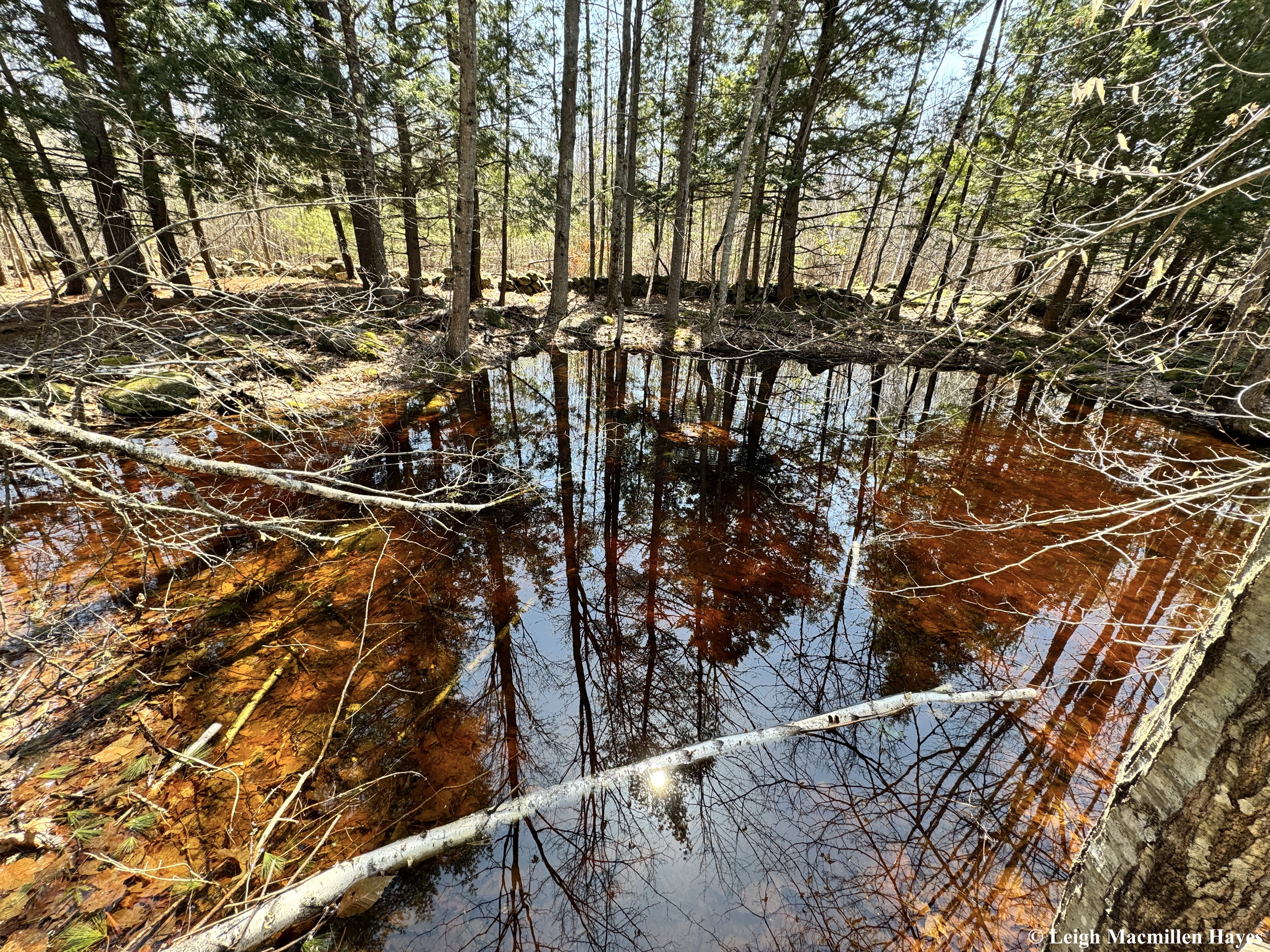
One of my favorite parts about my current neighborhood is the vernal pool that I refer to as “MY” vernal pool even though it’s on a neighbor’s property. So, neighbors are still an important part of my life.

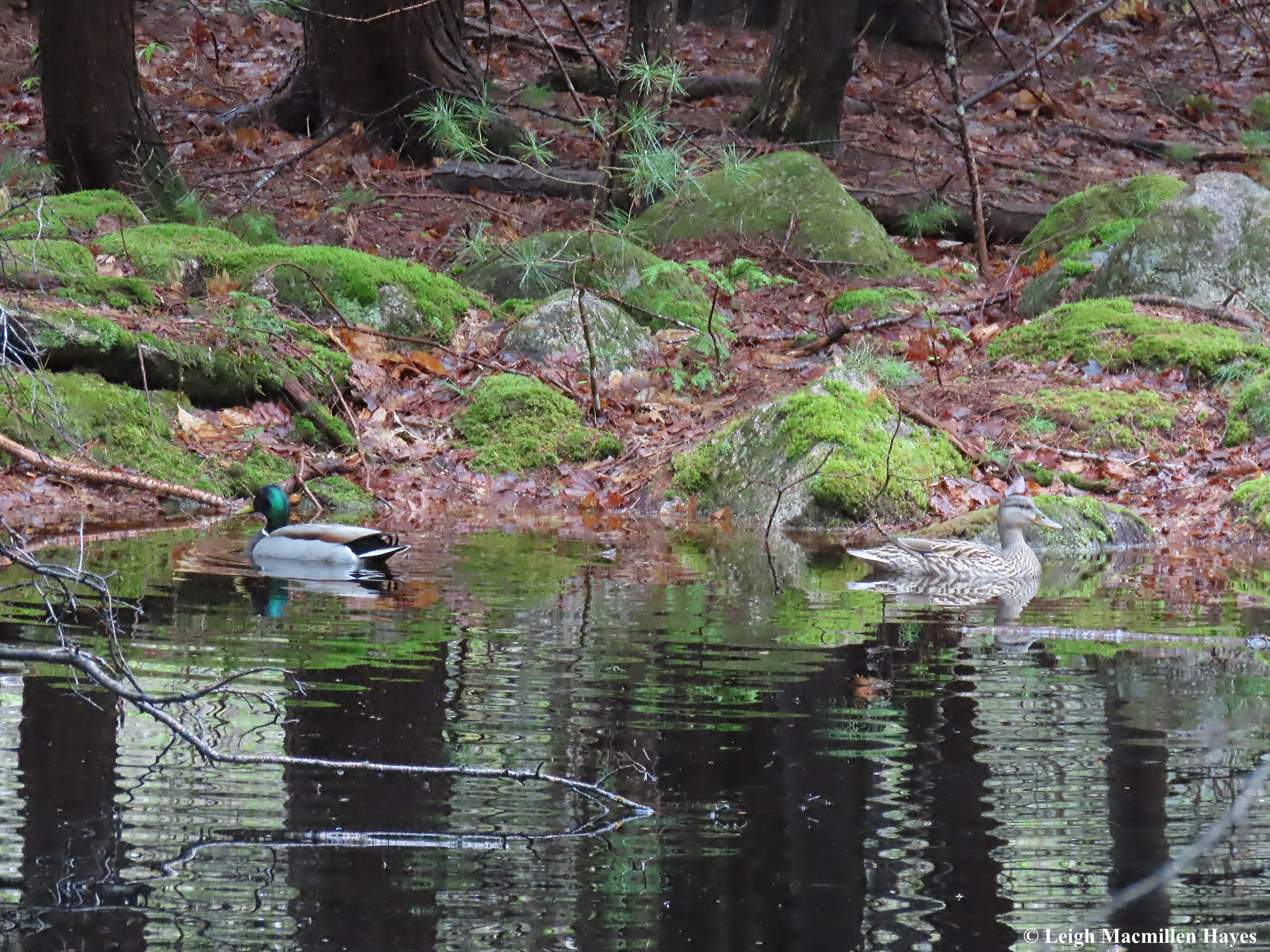
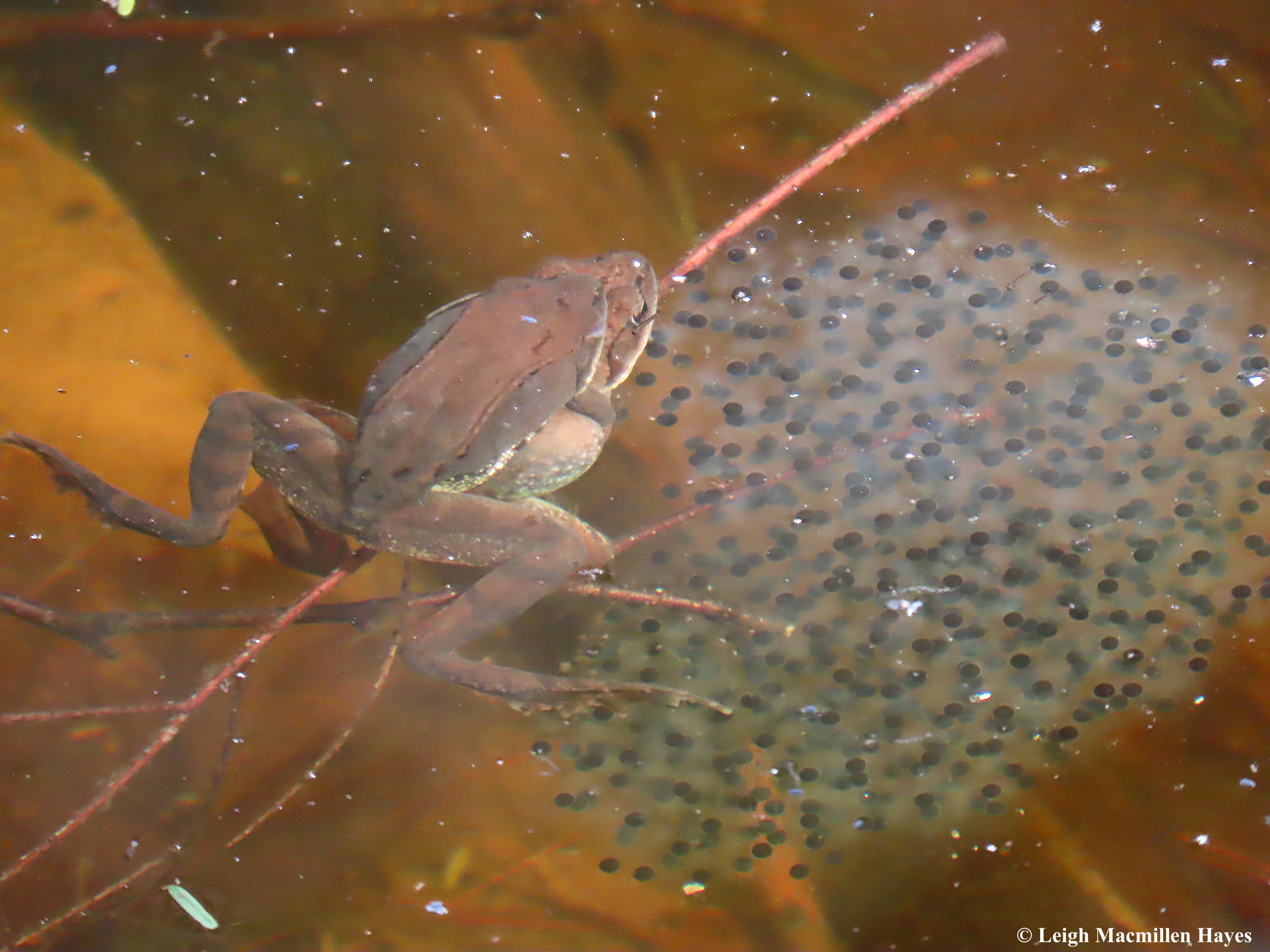
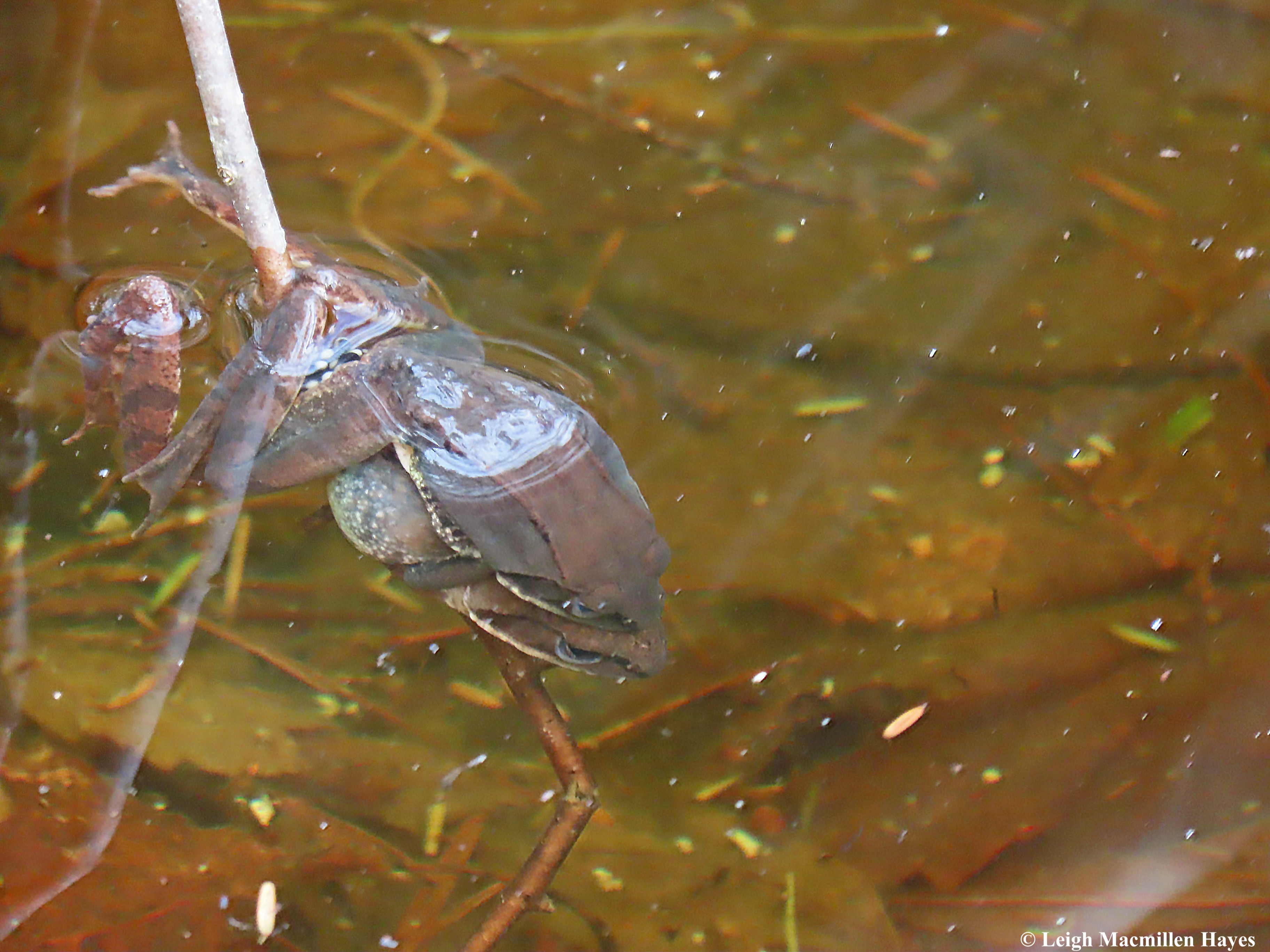
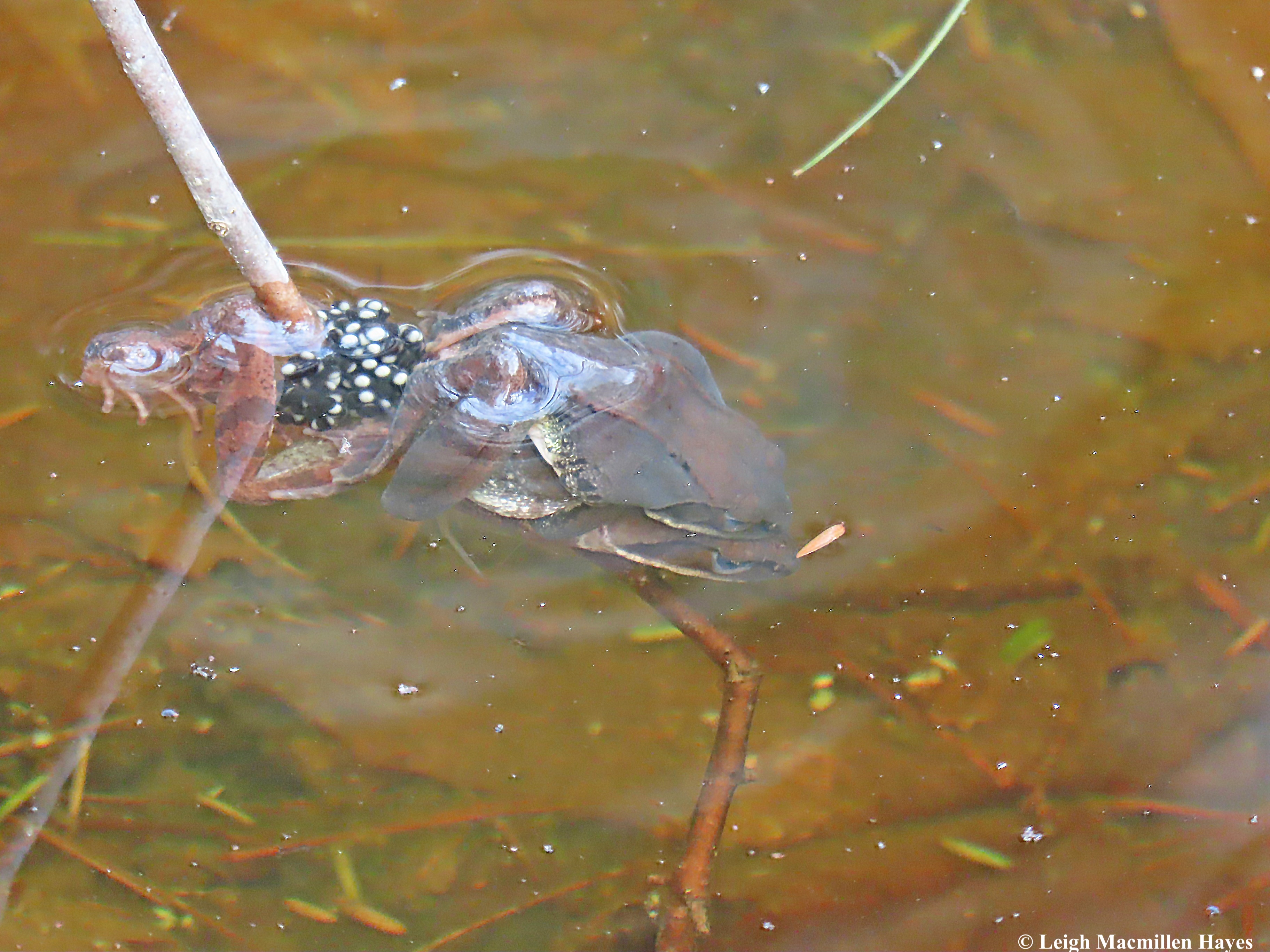
And while visiting the vernal pool to check on my amphibian friends yesterday as days of rain drew to a close, I discovered two new residents I hadn’t met in this space before.

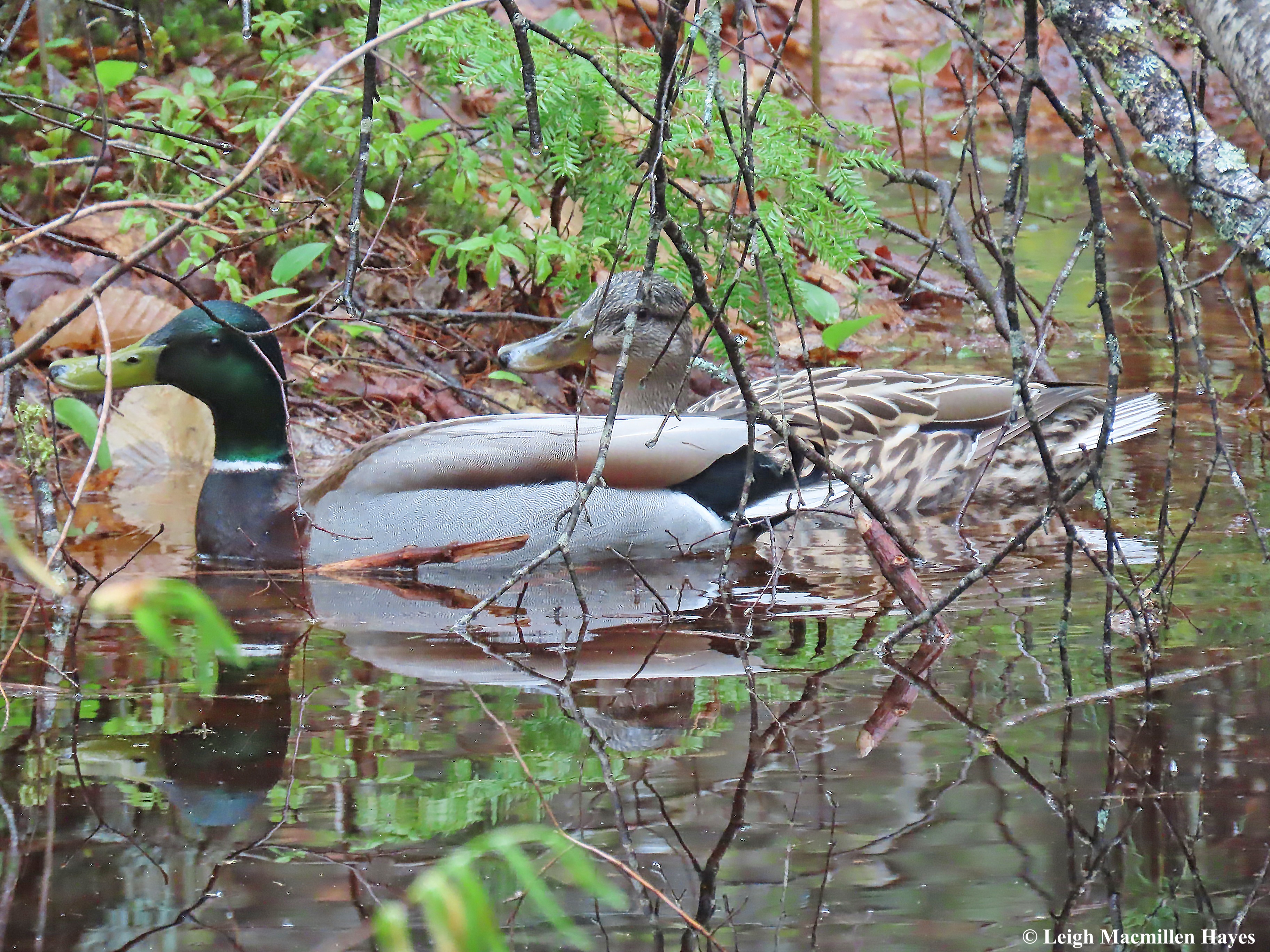
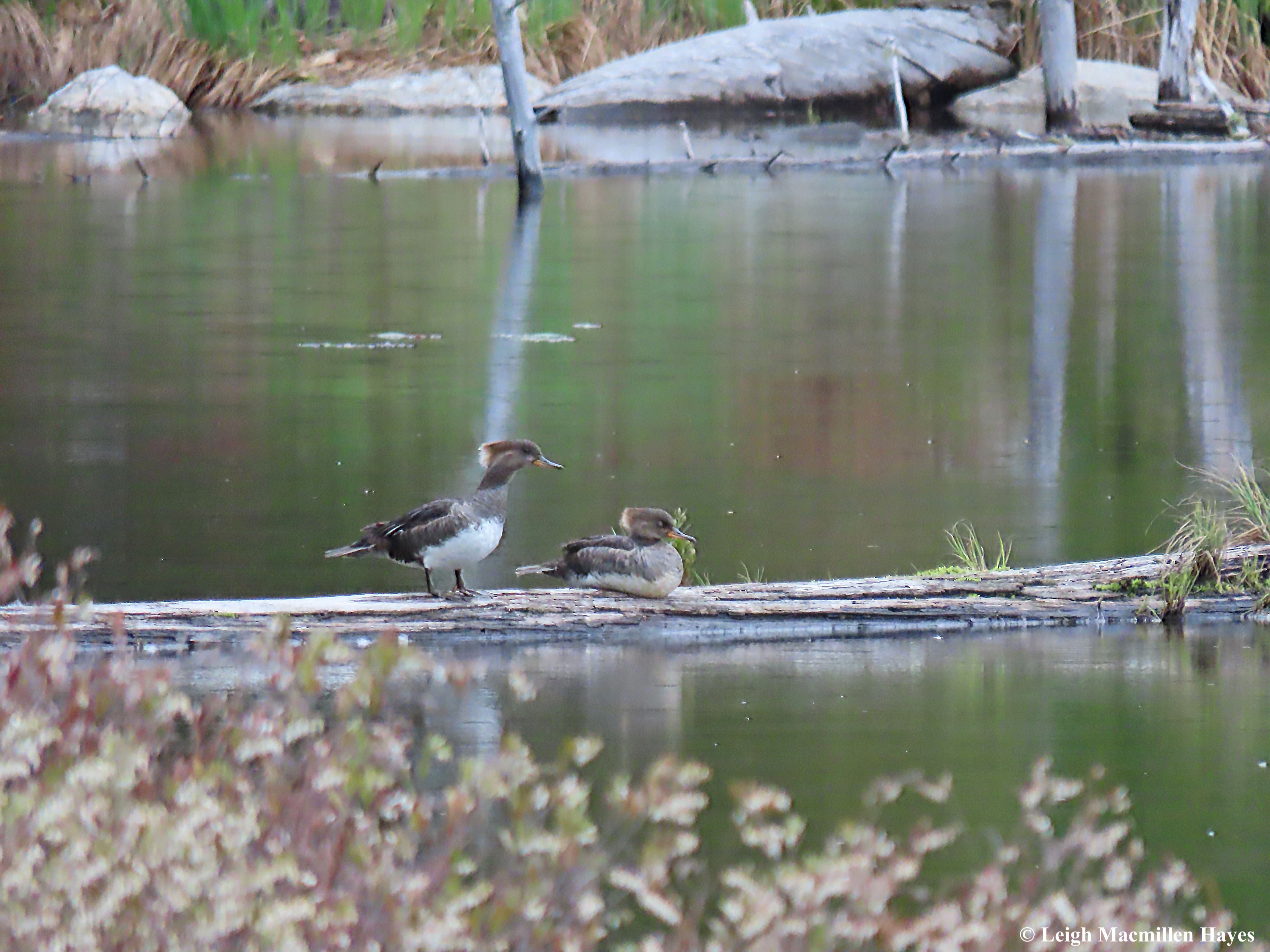
Maybe Mr. and Mrs. Mallard have visited before, but in 30+ years of my journeys to this spot, I’d never encountered them. My first response was to scare them away. Thankfully, I came to my senses quickly.

But in those first few moments, all I could think about were the tadpoles that were using the pool to develop. Their moms and dads had left the pool just after the eggs that contained embryos that turned into the said tadpoles emerged. And because those moms and dads only spend about two weeks in the pool and then return to their upland habitat for fifty more weeks of the year, I always feel it is my duty to watch over and protect them. And the ducks . . . might gobble them up.

But she excited the pool and looked tall and poised and I was certain their visit was just for a moment and so I gave thanks that I’d had the chance to spot them.

He added his own stature to the landscape. And my presence seemed not to annoy either of them.

Though my concern was that they’d gobble all the critters I chose to protect, I did think that if they had any interest in the larval Mosquito wigglers or their pupal tumblers that looked like little bullet forms, then have at it and eat away. Just don’t touch my Wood Frog and Spotted Salamander tadpoles. “MY” tadpoles. Synonymous with “MY” vernal pool. Located on a neighbor’s property.

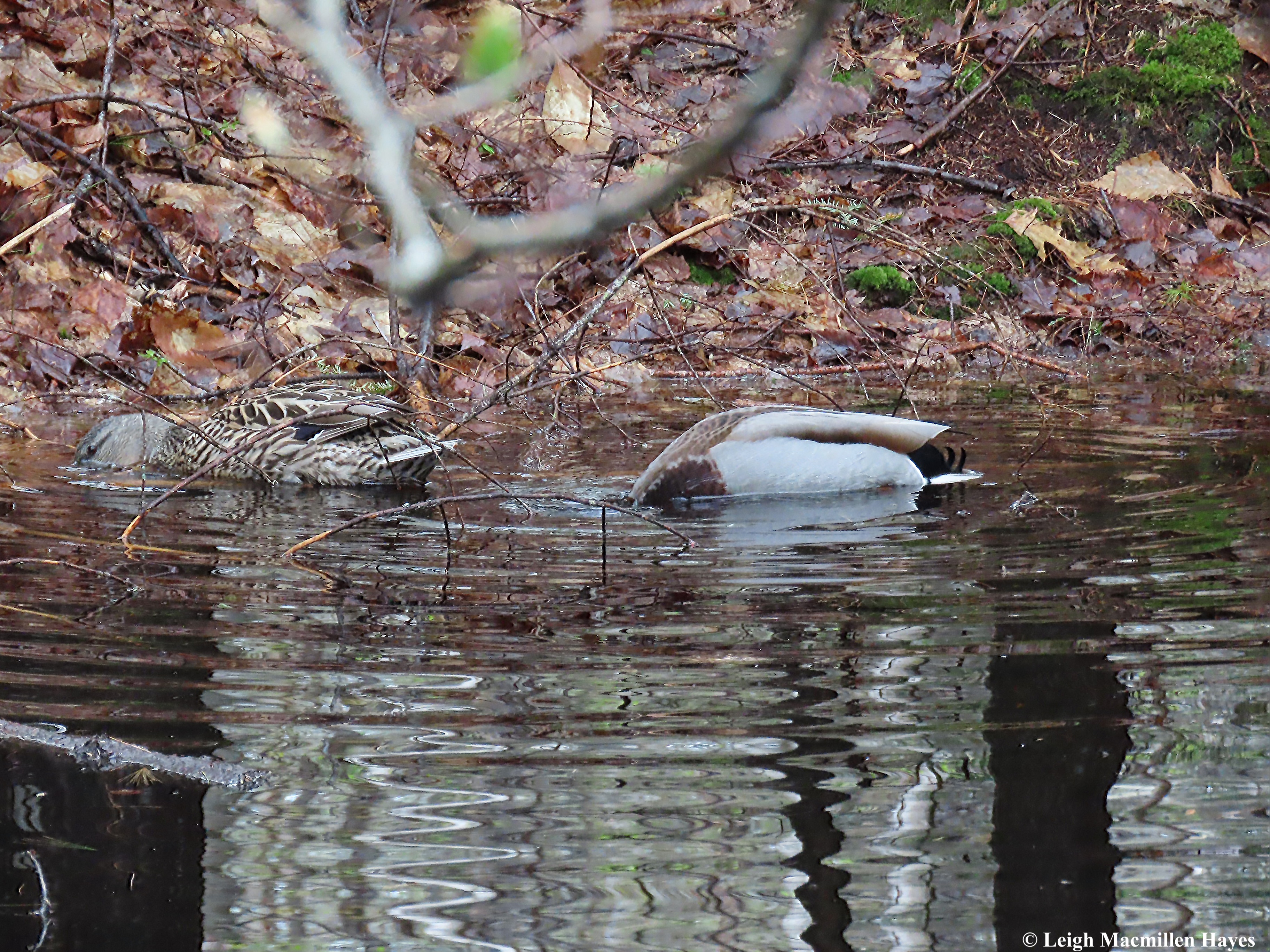
As I walked around the pool, the Mallards swam, and I realized that I’d forced them into the spot where the egg masses had been laid and I wondered how many they’d already eaten.

And then . . . they did start foraging. My only hope was that I know tadpoles quickly dart under leaves, so that might protect them. But what else could the ducks be consuming? Aquatic plants are few in this particular pool. Seeds, however, are abundant, so there was that thought. But really, I’m sure they were dining on my buddies as well as macro-invertebrates.

I tried not to think about it. Until I did.

Two years ago, we had rain all spring and summer and this pool, which typically dries out by mid to late June, was full until September, and for the first time in my memory of decades of visits, I witnessed the tadpoles developing hind legs first and then front legs.

Last year, however, due to drought conditions, all dried out in a short time, and if any tadpoles metamorphed, it was quick. And I think this year’s egg masses spoke to that for there were far fewer Wood Frog masses, but over forty Spotted Salamander masses. Perhaps the latter sensed the changing conditions last year and enough were able to develop quickly into adults.

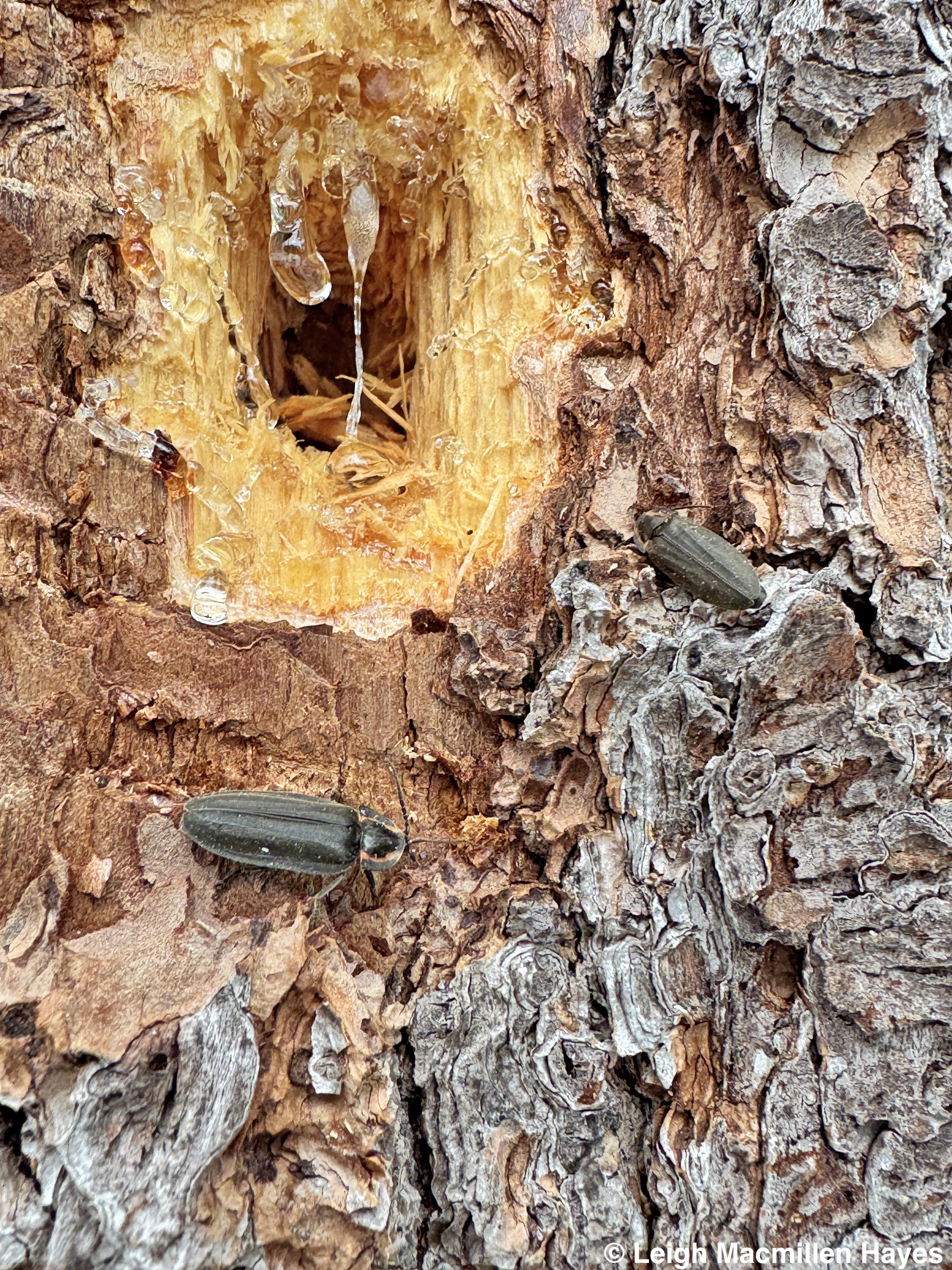
On the way home, I searched the trees in our woods and finally was rewarded with one showing off the suds of a rainy day–when pine salts turn into bubbles at the base of a tree.

The better surprise occurred just up the trunk, where I suddenly keyed in on intense activity, in the form of Crane Flies canoodling and jockeying for a chance to canoodle. They were fervent in their attempts.

Today dawned SUNNY, and after church I headed back out to the pool. At first I didn’t see the ducks, but within moments realized they were still present. And I began to come to terms with their presence because really I love them too. I just don’t want them to eat all my other friends.

While I looked down, a cat-like meow called my attention upward and there I spotted a female Yellow-bellied Sapsucker. And I was drawn back in time to watching Sapsuckers raise families in our yard and on land trust property and I wondered if this female was a momma and if so, where had she hidden her gang?

And then, because of the sunshine, I could peer into the water through my polarized sunglasses and tada, I still had tadpoles. This momma was pleased and proud. So, maybe I could share the space with the Mallards after all–as long as they promised to not eat all of my babies.

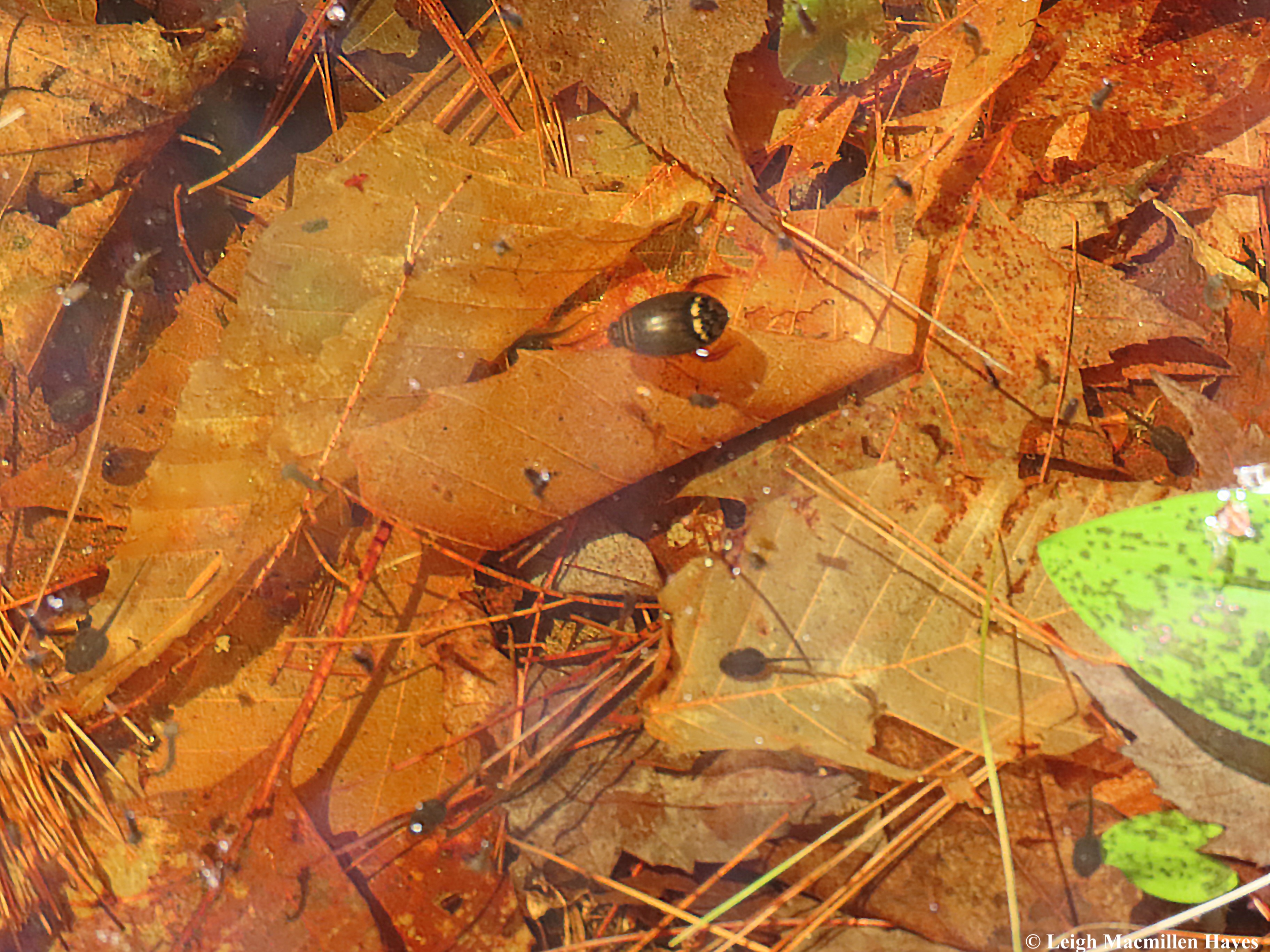
In the mix, I also spotted Predaceous Diving Beetles, and of course, the ubiquitous Mosquito larvae.

As for my ducks, ah yes, I’d now accepted them as mine. Really, they are a handsome couple. My next question for them is this: how long will they remain? That, I know, depends on how long the pool holds water. Which depends on how much precipitation falls from the sky. One thing leads to another, which leads to another, and so life goes on.

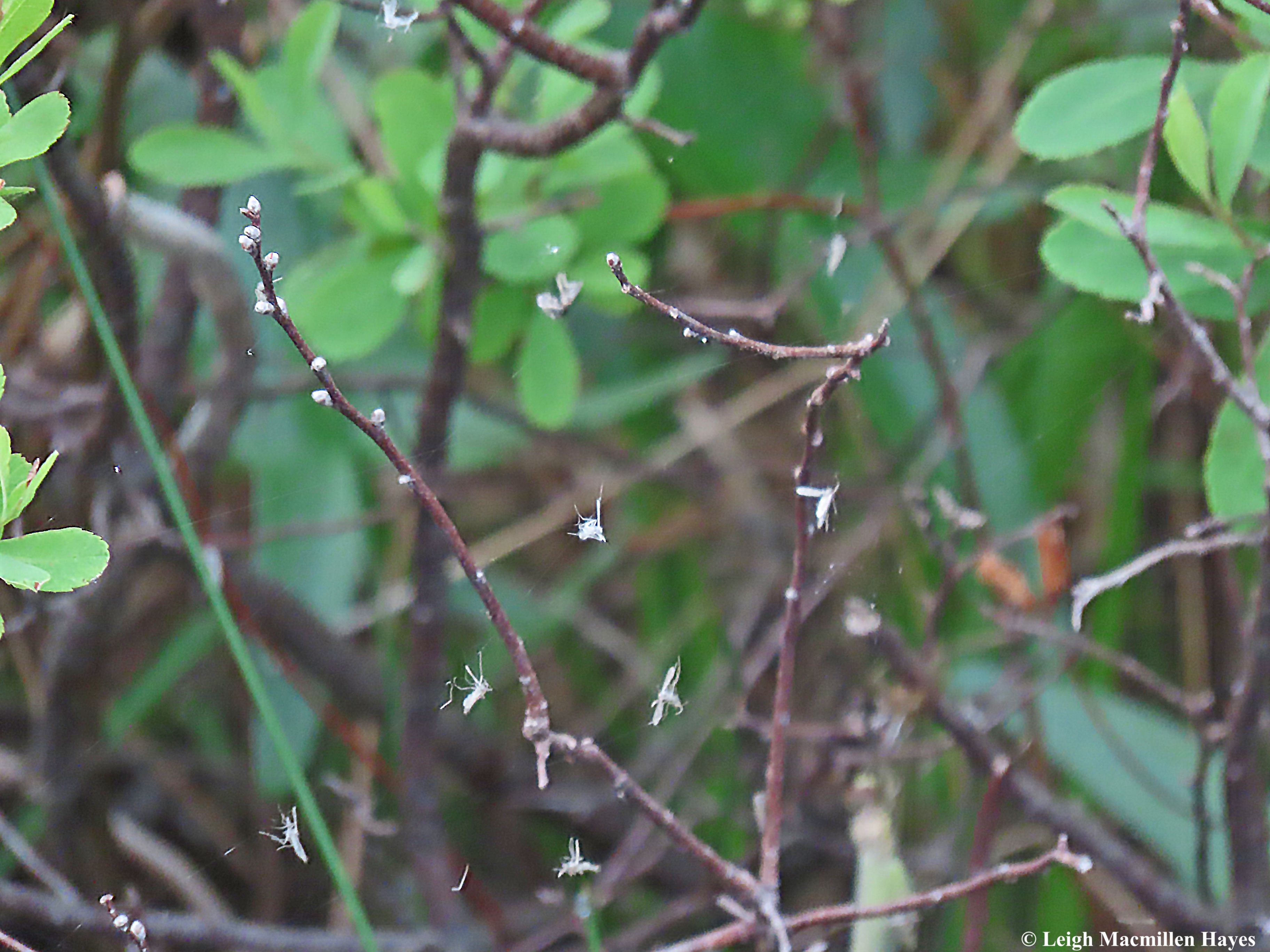
Upon a floating log within the pool, more life happened, this time in the Midges trying to canoodle with other Midges as a Crane Fly looked on.

As for the ducks, they again moved under the branches where the egg masses had been, but this time they preened.

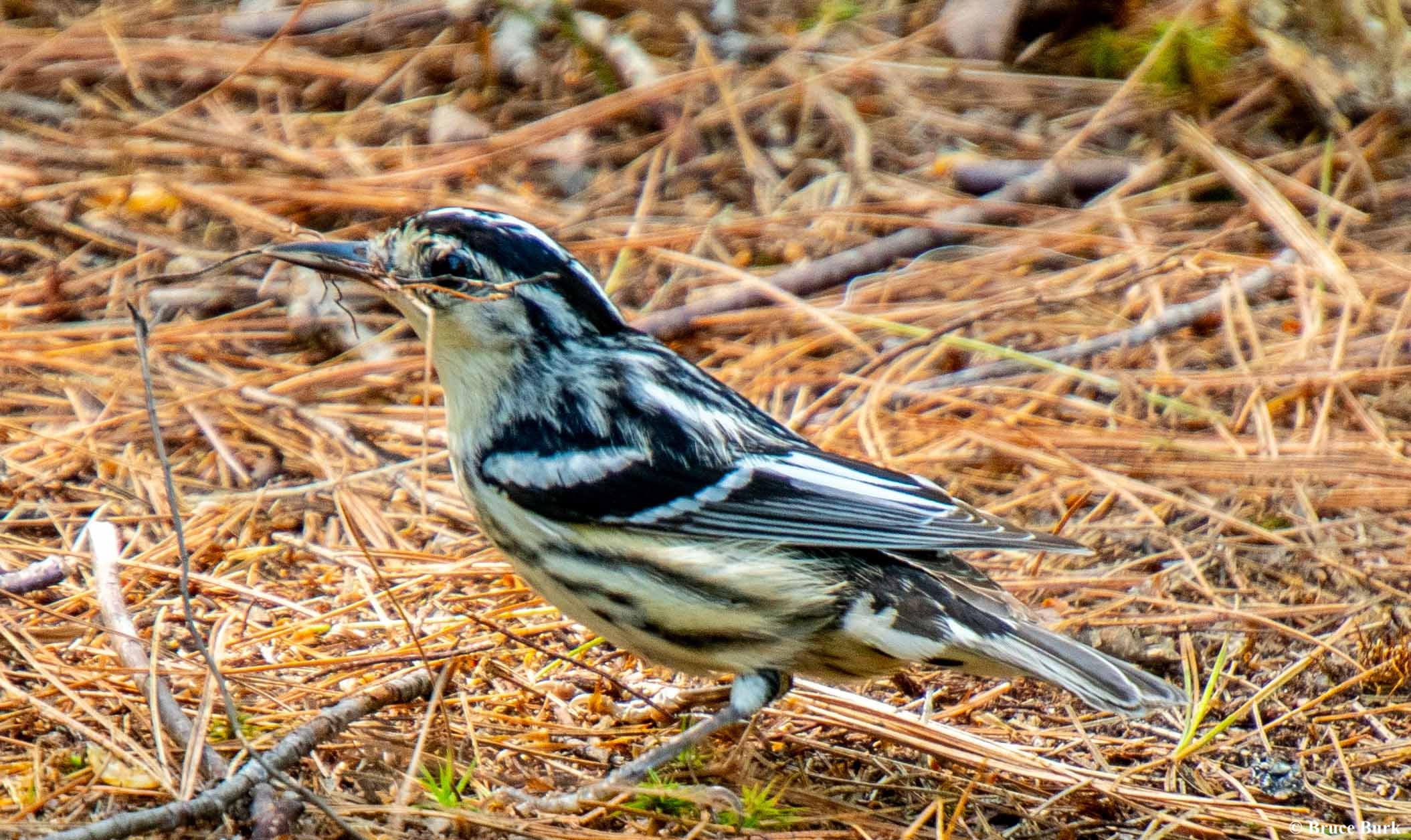
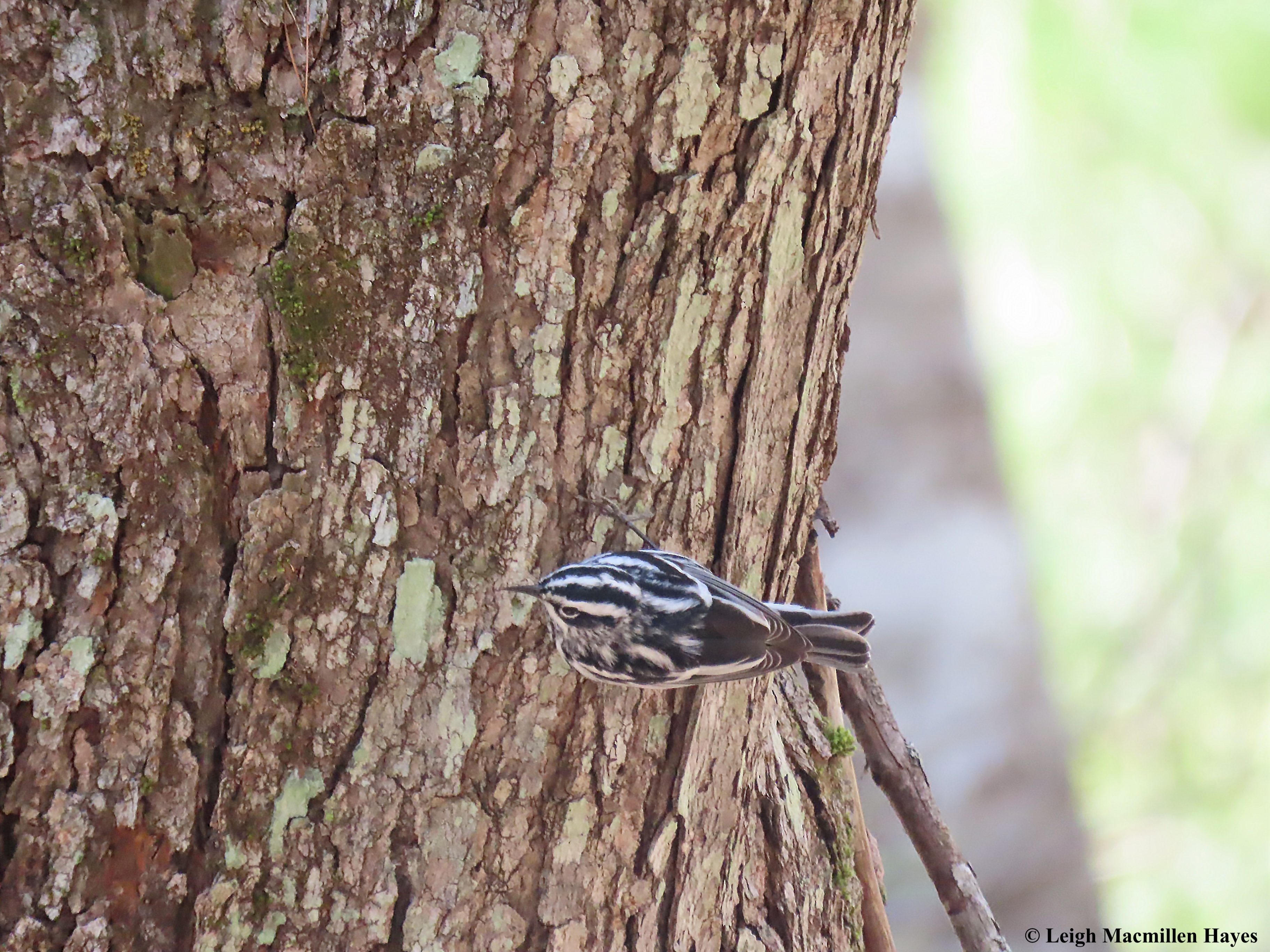
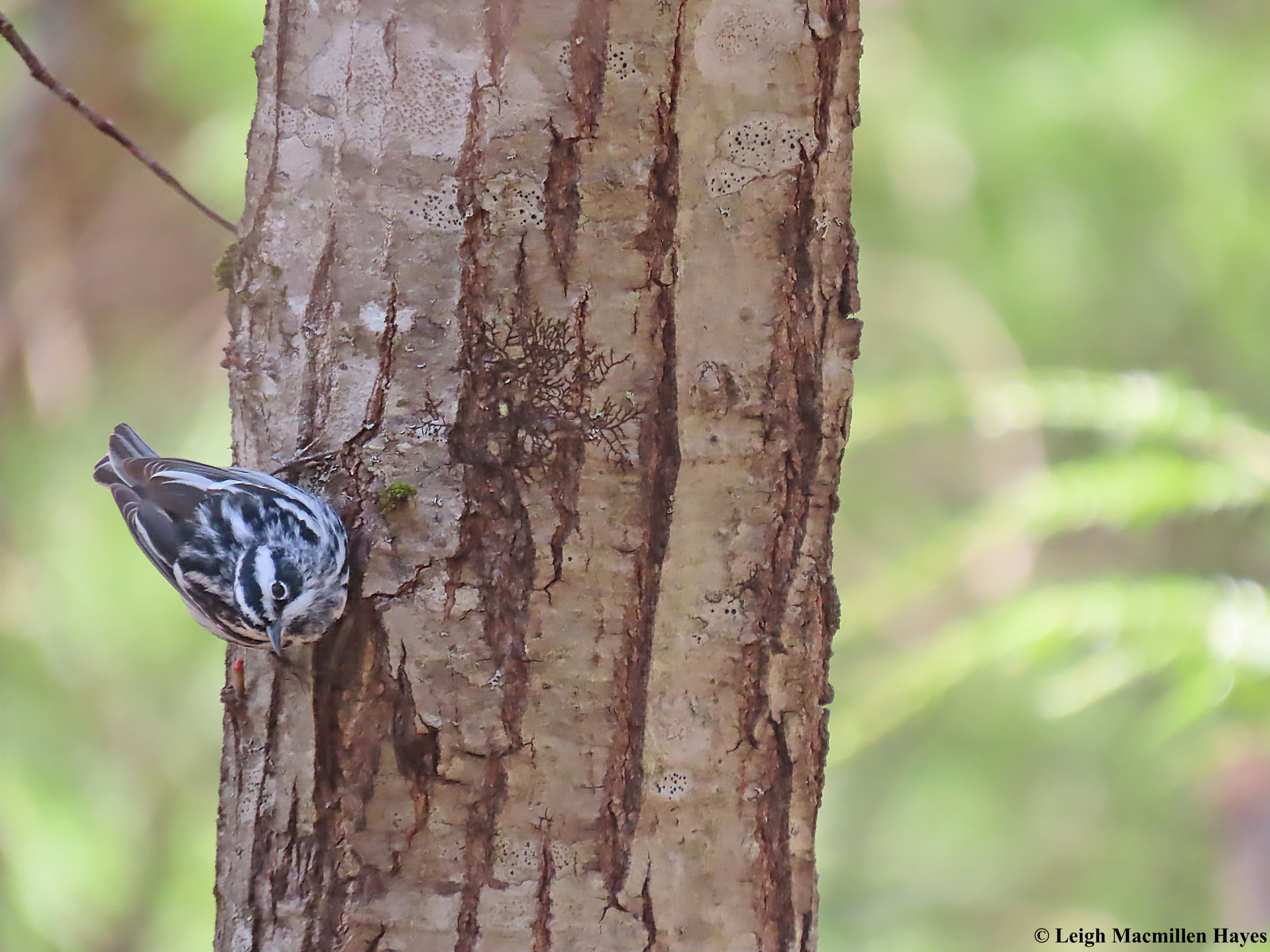
And into the midst of all, in flew a couple of Black and White Warblers, and I felt rewarded once again for being in this place at this time.

Zebra birds might be another suitable description.

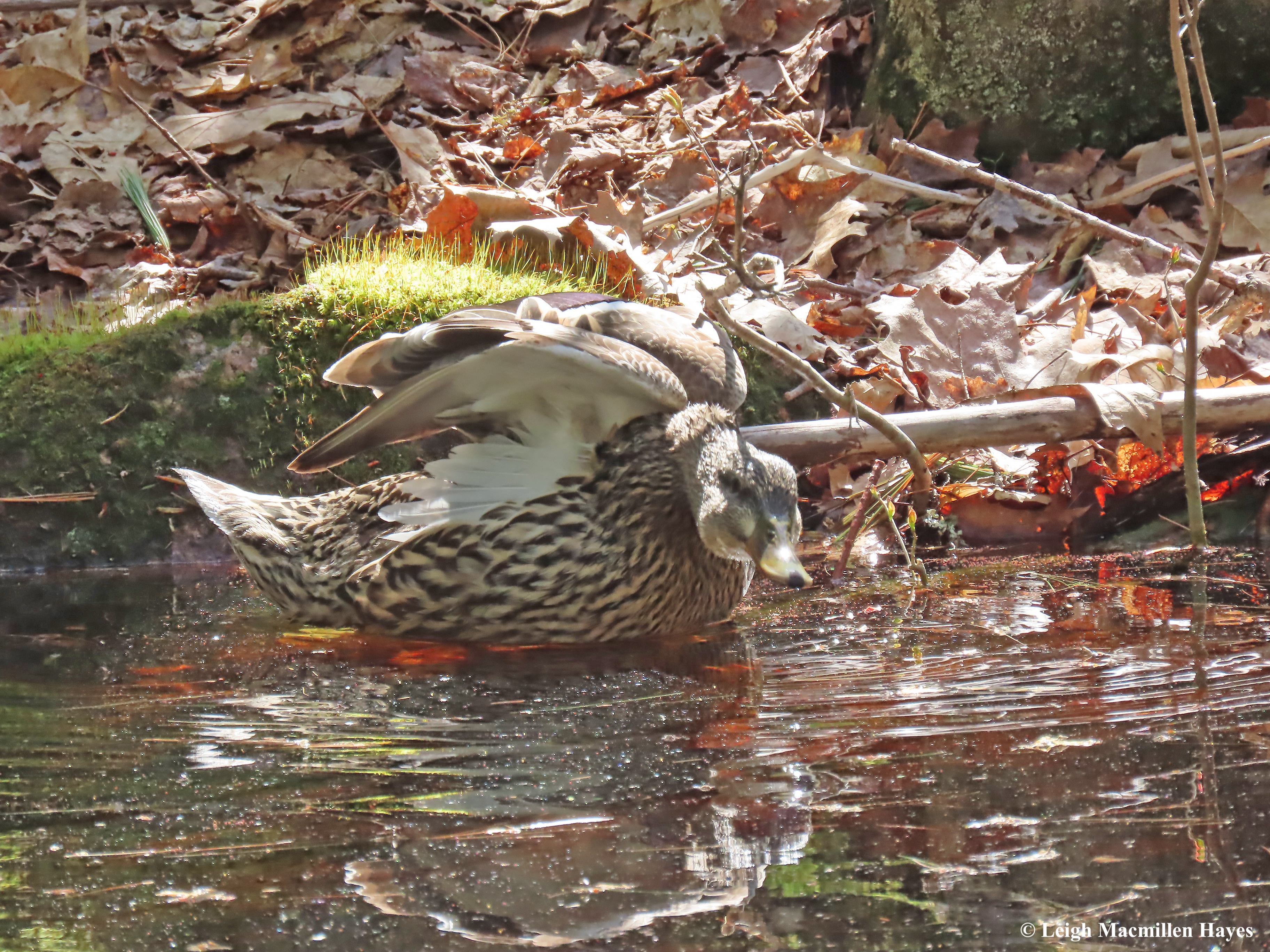
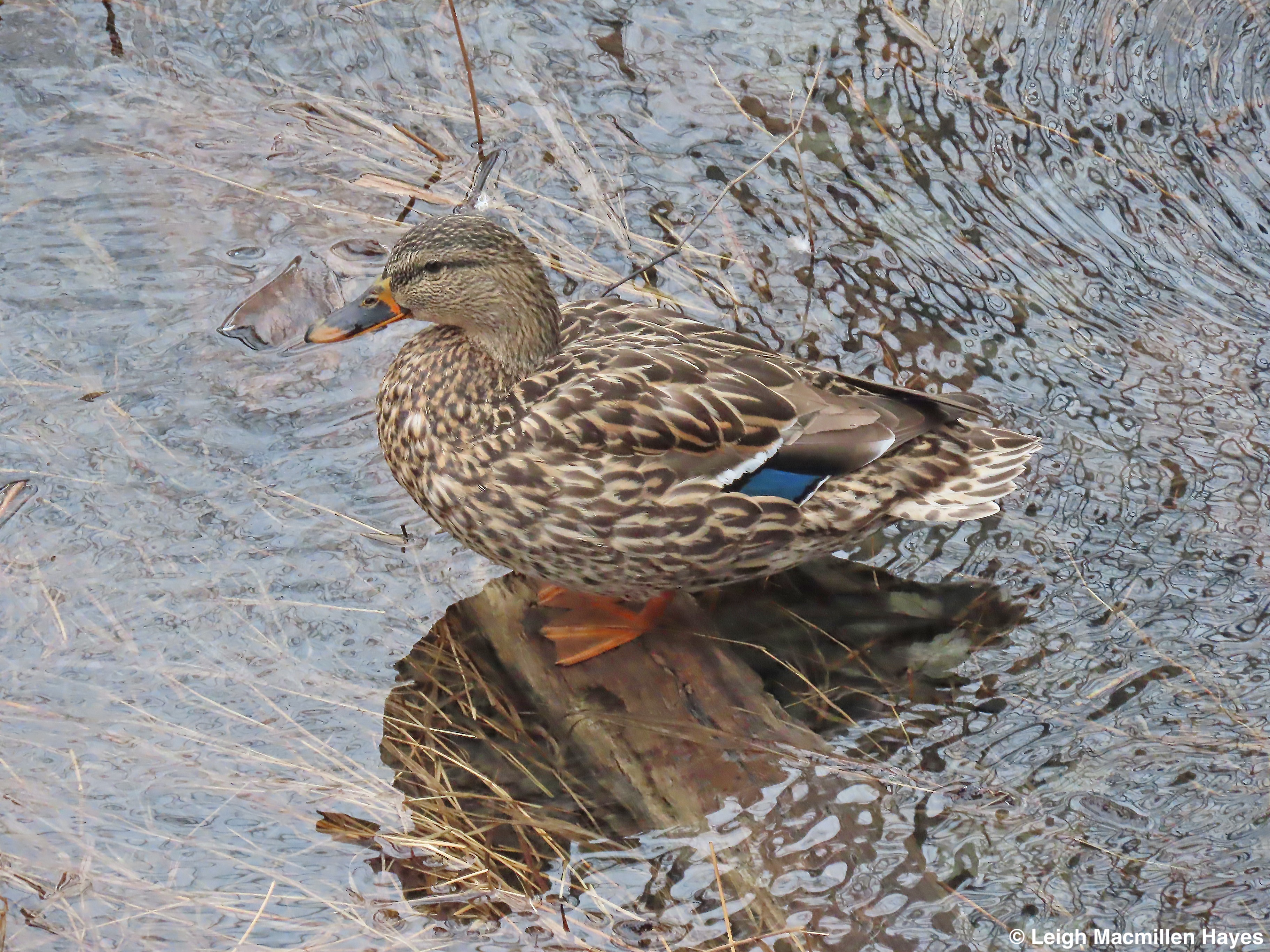
A few minutes later and Mrs. Mallard demanded my attention once again as she took a bath.

And then she climbed upon a rock in the pool, while he circled around for a while, protecting her or so it seemed.

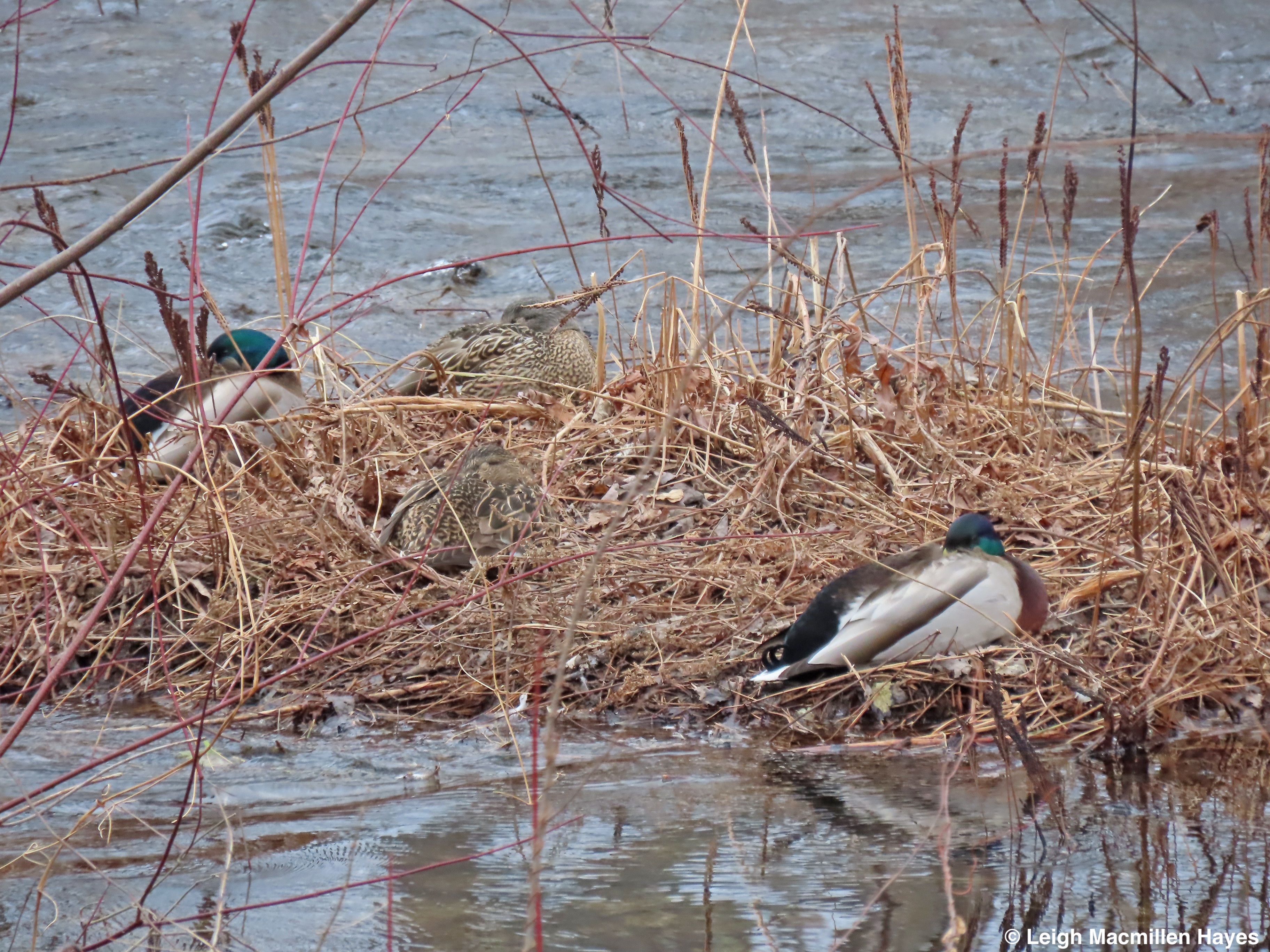
She finally settled and he joined her, pausing to preen.

And then they both took a nap. Apparently my presence wasn’t a concern.

Thank you, Mom, for your visit. It was so awesome to spend some time with you last night. And thank you for making me realize that we don’t have to necessarily be moms to human children, though I do give great thanks for our boys who have been in touch throughout the day even though we couldn’t be together, to be nurturing. To all who guard and watch over human babes, and amphibians, and birds, and insects, including monarchs, and furbabies, and you name it: Happy Mother’s Day. Your efforts are gallant. Your souls are brave. Your hearts are full.

I love it when my parents show up in my dreams, but couldn’t believe my good luck today to wake up after a visit from Mom.

Dragons of the Future

Spring is actually a combination of many seasons, beginning with winter that doesn’t want to let go, followed by mud, and then road-repair, with bug quickly taking form following several days of rain, and soon to come, my favorite of all–dragonfly season.

And so I thought I’d take some time to honor friends I’ve met in the past and try to get to know them better . . .

With my pencil first. Sketching is such a wonderful way to slow one’s self down and try to capture the essence of the object. Thankfully, with pencil and a good eraser, changes can be made and believe me, I have, and will continue to edit these.

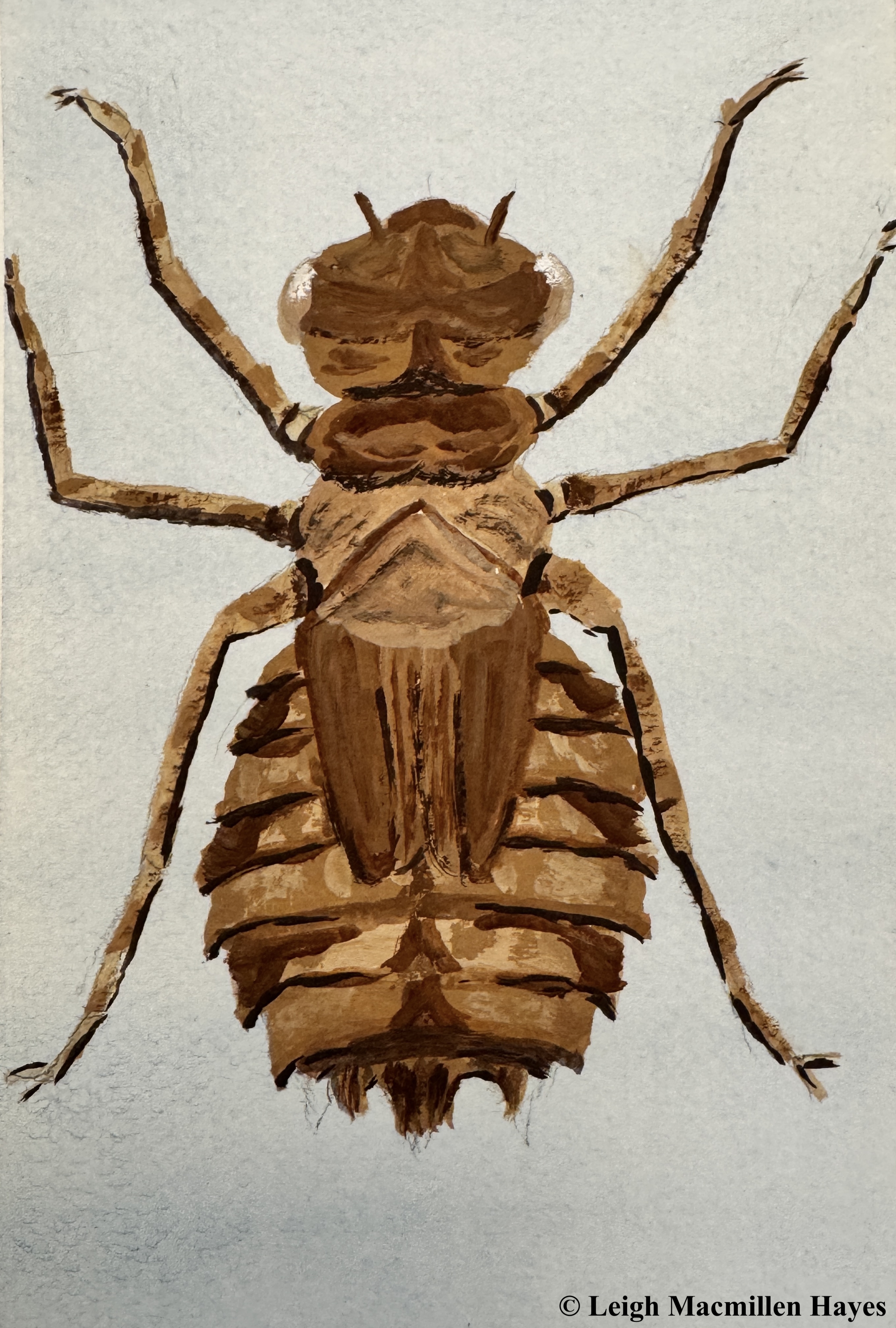
Darner Naiad

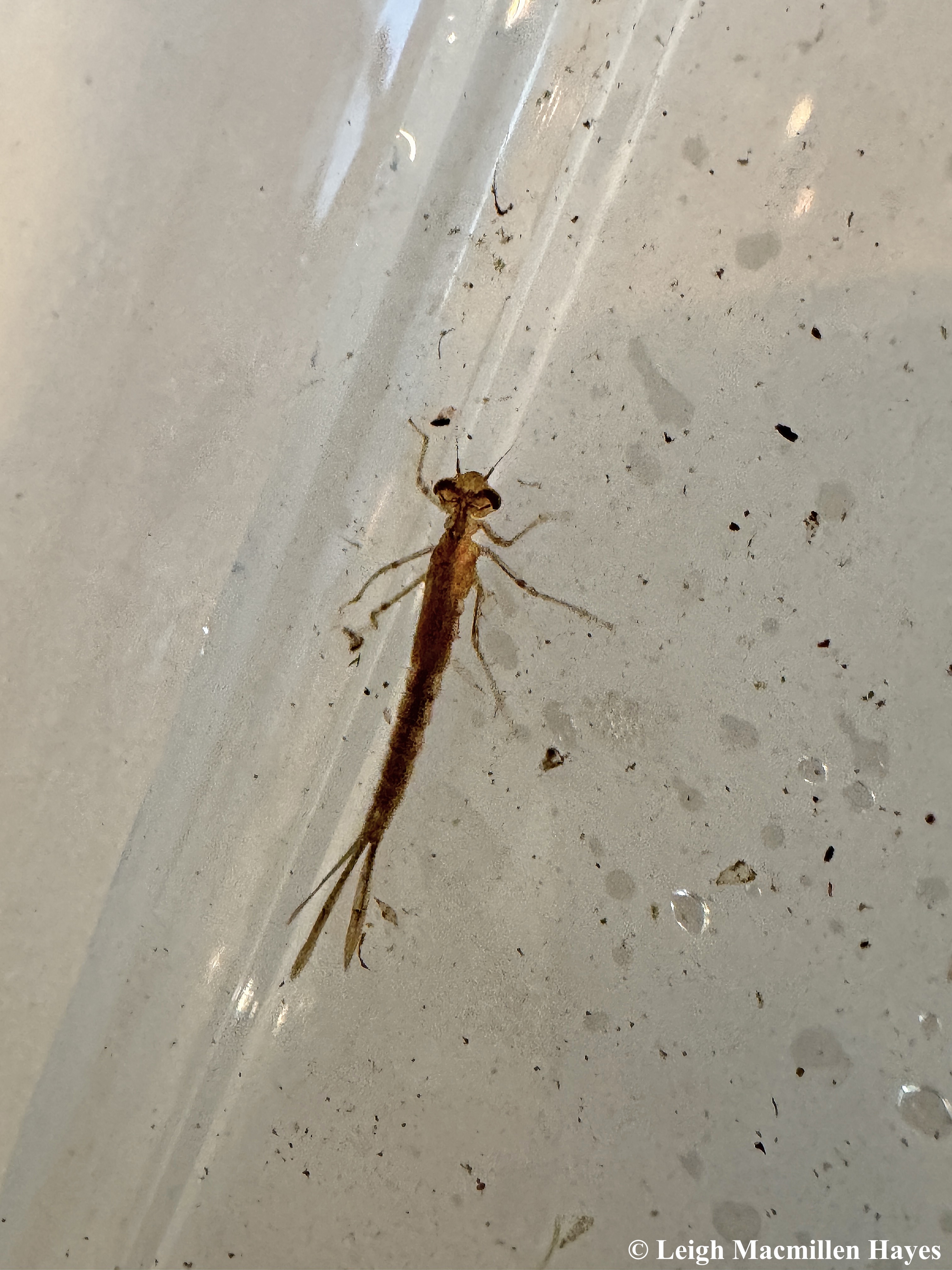
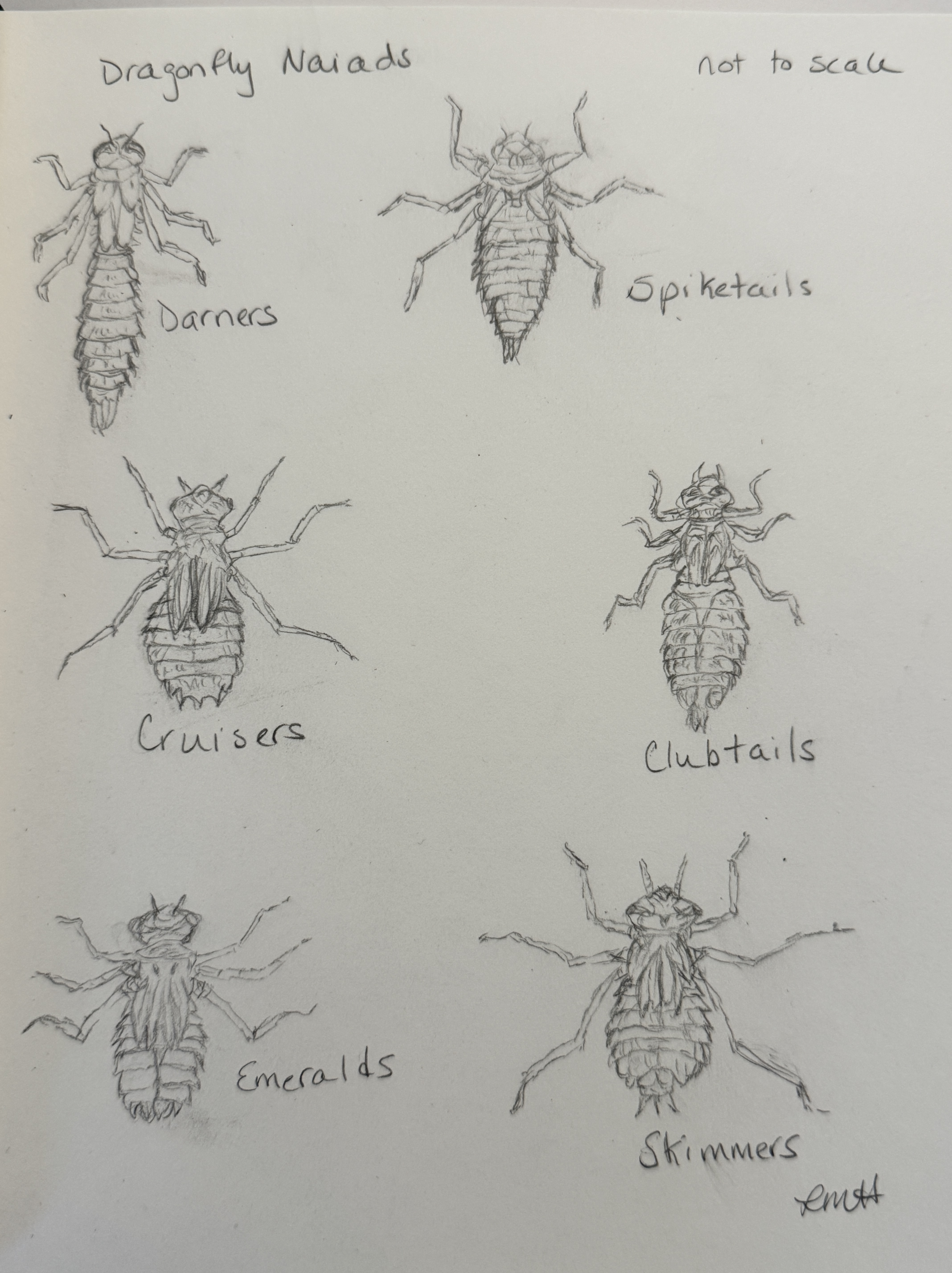
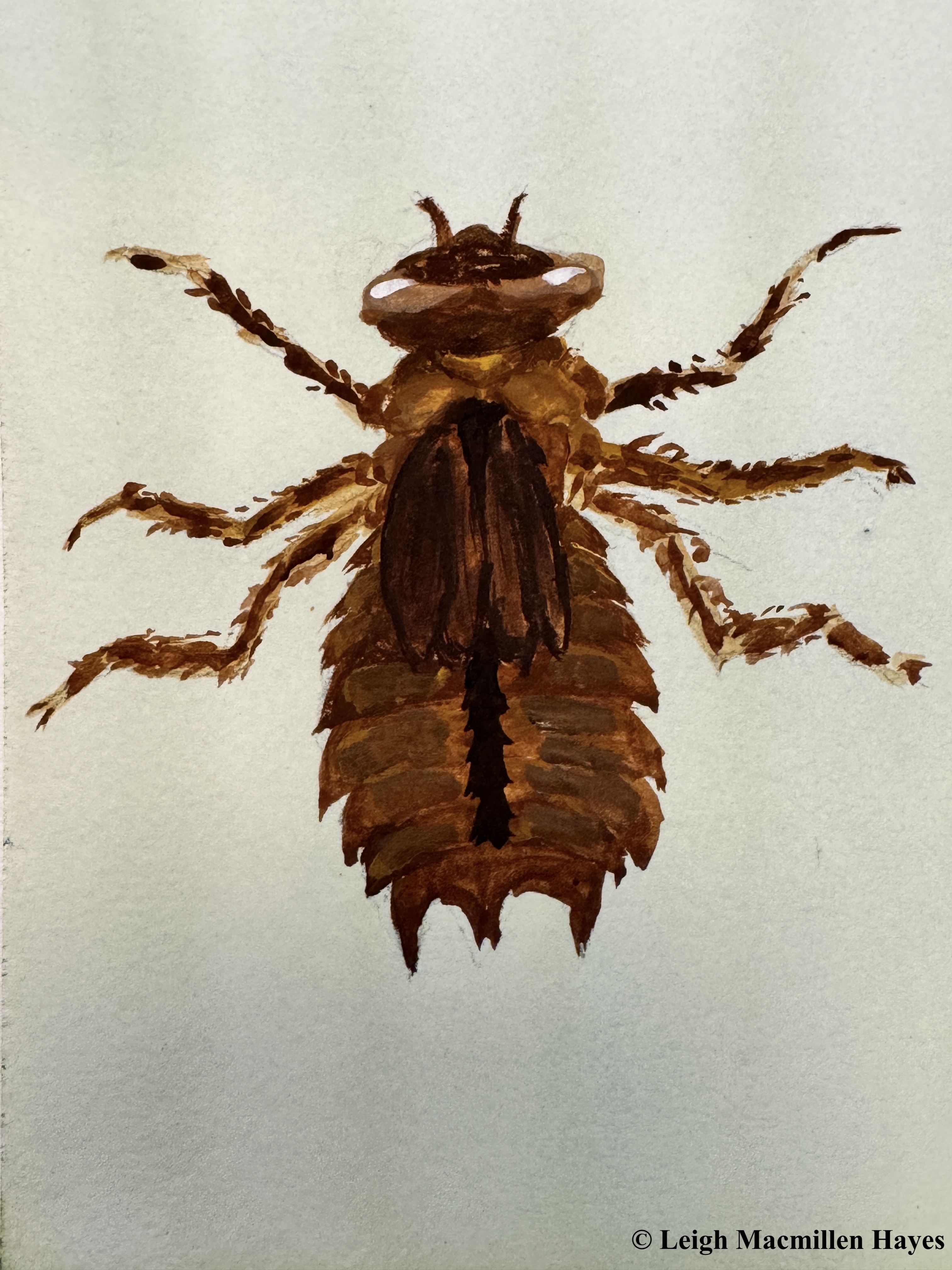
And then I decided to take it one step further–by painting the Naiads (larval form) of six dragonfly families.

One of the incredible wonders of this world is that the aquatic form of dragonflies become terrestrial and we anticipate and celebrate their emergence every spring, knowing that BUG season won’t last too much longer. Well, in some places. Right Jenn?

Usually, they begin to emerge by the end of May and then it’s an ongoing process, with some waiting until late summer or early fall to transition from one world to the next.

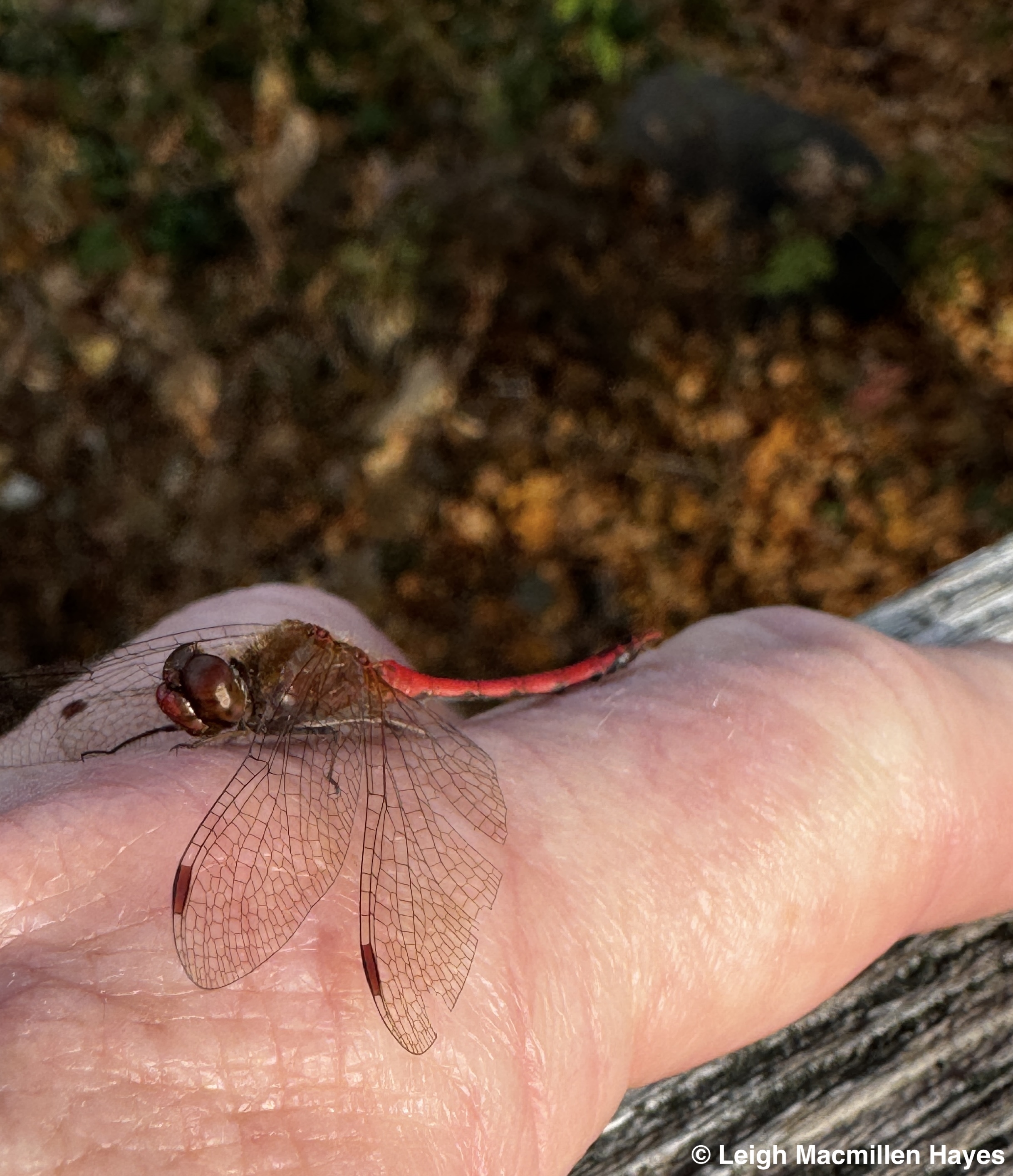
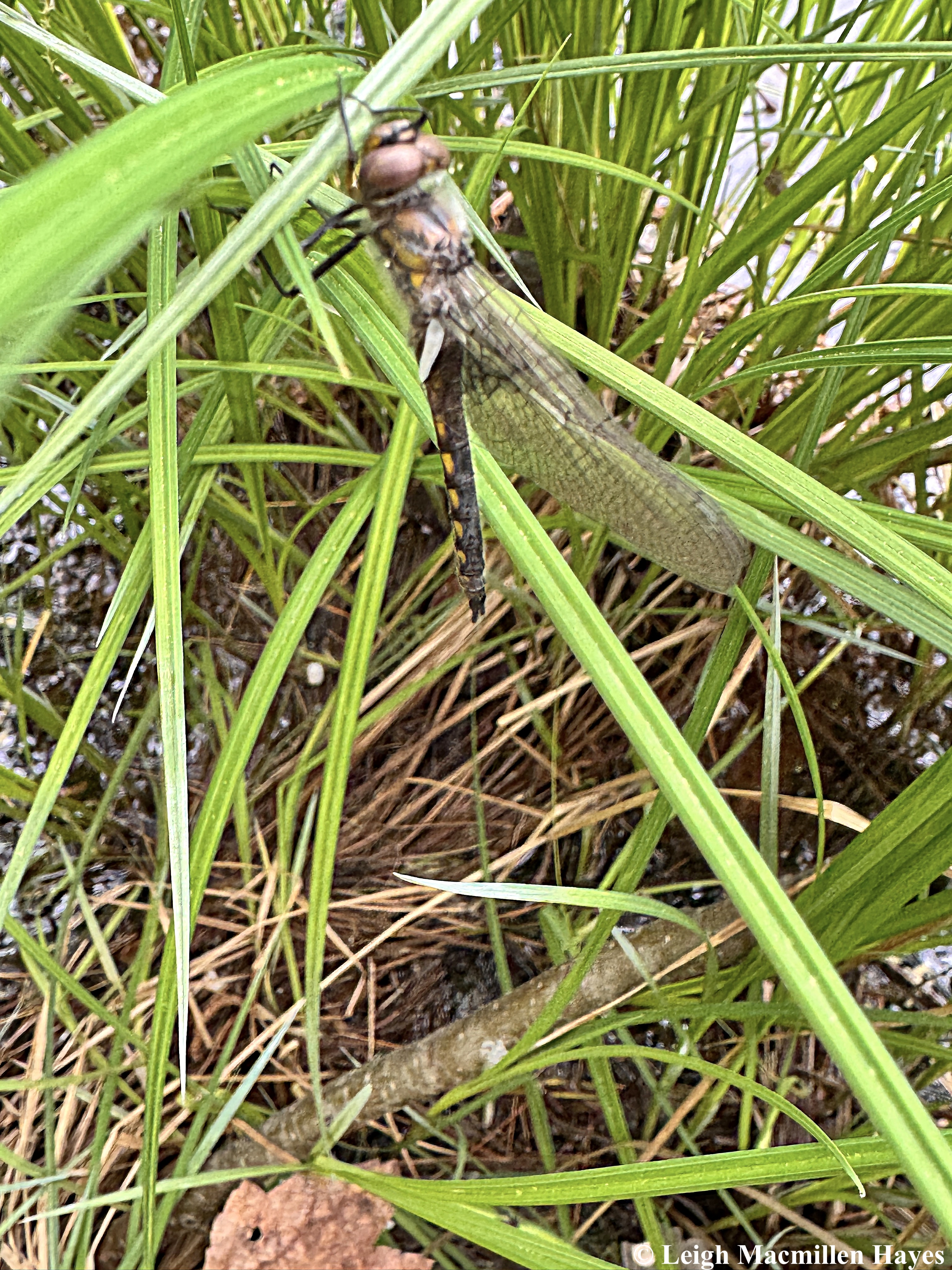
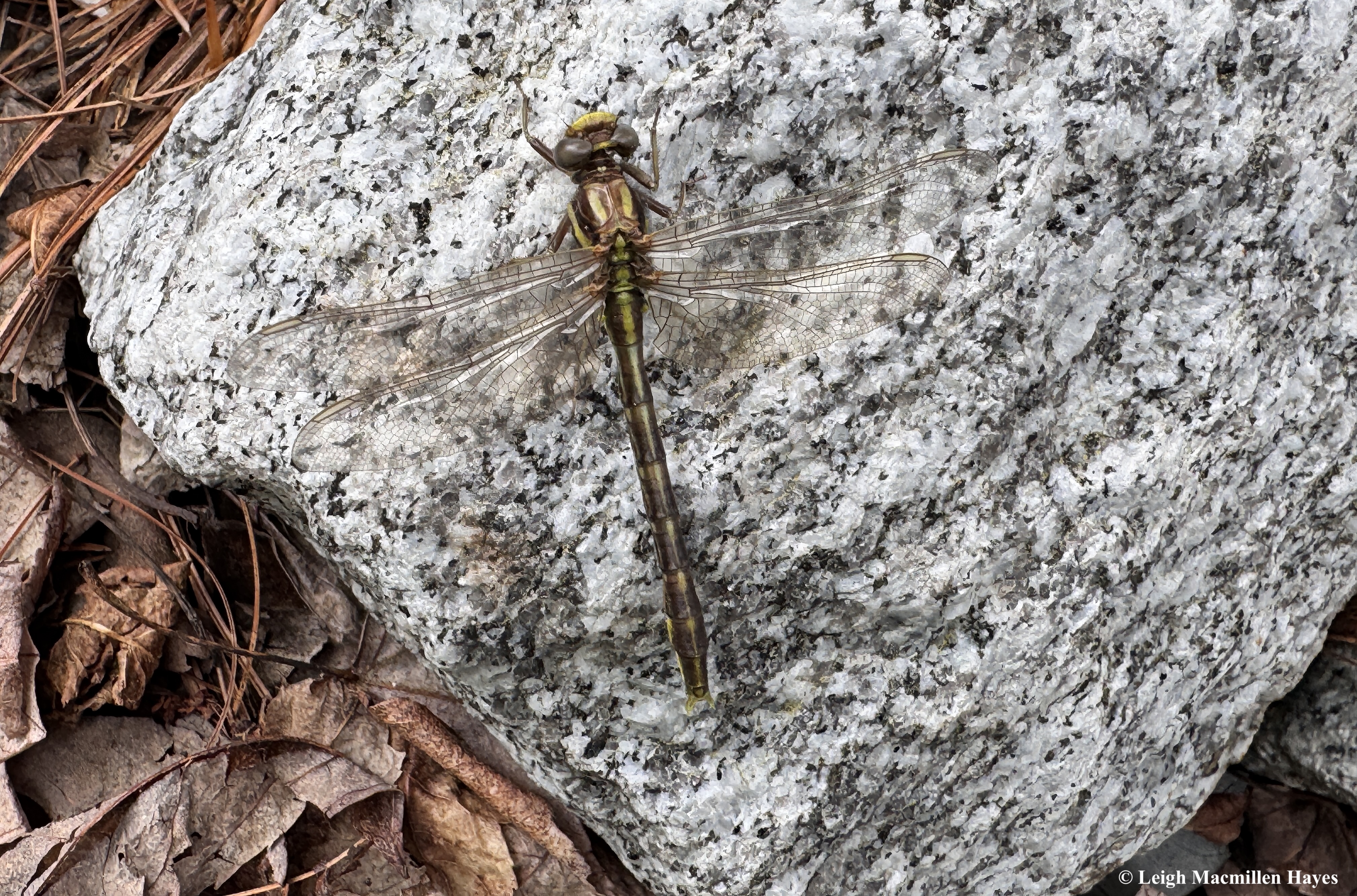
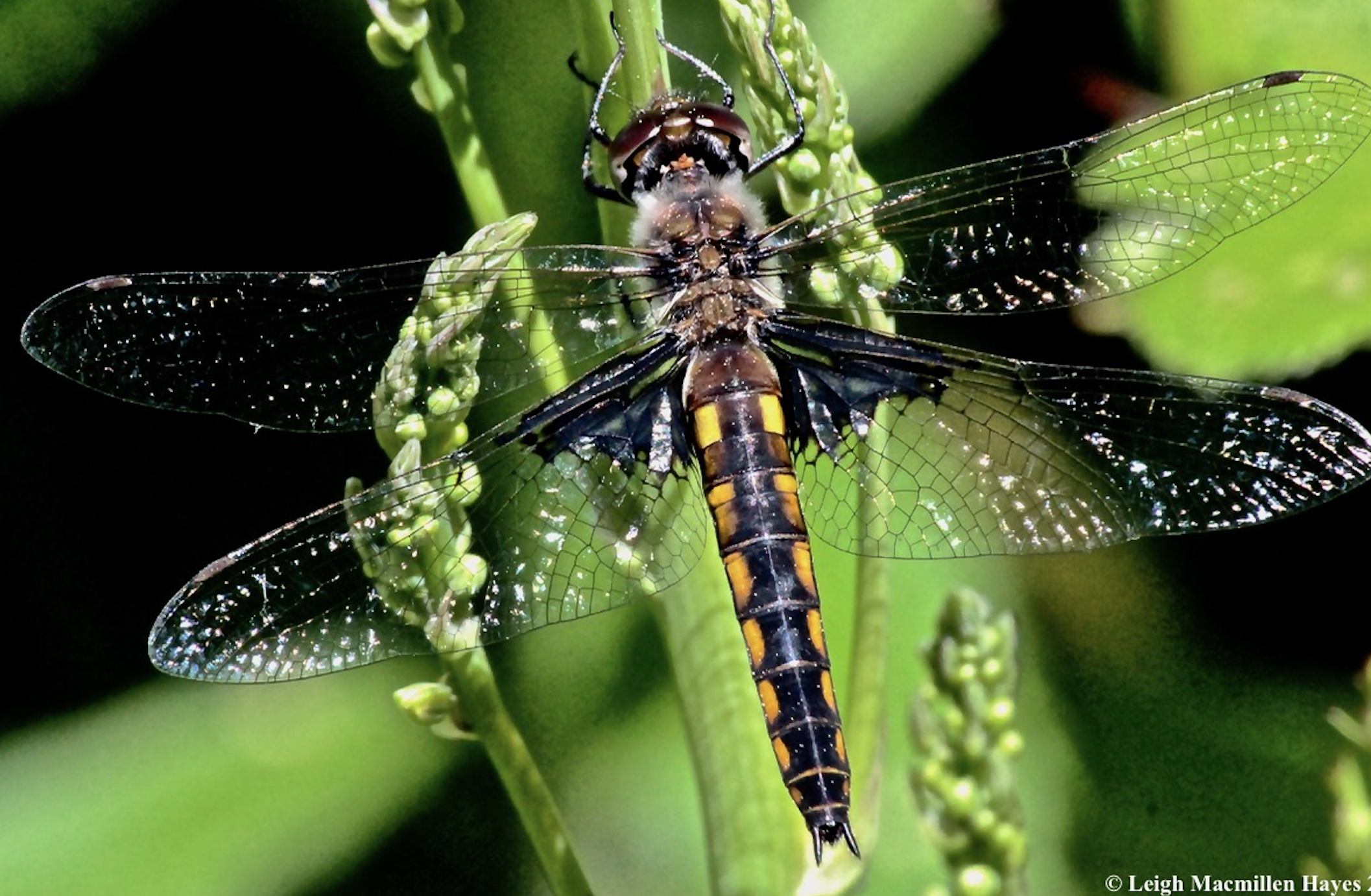
This is a Black-tipped Darner that I met in the fall a few years ago when it was barely alive. It was on the grass by the outlet of Deer Hill Bog in Stow, Maine, which is a typical habitat for this species, though it isn’t common.

Stream Cruiser Naiad

After painting the Cruiser Naiad, I thought I’d use the iNaturalist APP: SEEK on it and bingo, SEEK identified it as a Stream Cruiser. All the rest came up as dragonfly/damselfly, so at least AI knew I was painting insects, but I was excited that it could reach the species with this one.

When immature, Stream Cruisers remind me of Oreo cookies, or maybe an Ice Box cake, which is actually rather funny because a few days after my birthday last year, I was the surprise recipient of an Ice Box cake. Thank you, Deb!

There are not a lot of cruisers in the Cruiser family, and as far as I can tell, this and the Swift River Cruiser are the only two found in New England.

Emerald Naiad

Okay, so I tried to show the hairy body of the Emerald Naiad. If you’ve ever looked through a loupe or hand lens, you’ll know that the whole world is hairy!

Most Emeralds have greenish eyes and this Kennedy’s Emerald is no exception. In his field guide, Dragonflies of the North Woods, Kurt Mead writes, “Named for Dr. Clarence Kennedy, a professor at Ohio State University and a pioneering odonatologist.

Also in the Emerald family are the Baskettail dragonflies, this one being a COMMON Baskettail. I’ve commented before on the word “common,” and probably will again, but seriously, do you see anything common about this intricately-designed specimen?

Spiketail Naiad

So, um, I drew and painted this Spiketail Naiad, but to my knowledge, I’ve never encountered a Spiketail. I guess that should be one of my goals for the upcoming season. And I’m sure that having said that, I will start receiving photos of such from friends who have spent time with the adult members of this family.

Clubtail Naiad

Clubtails, however, I do know and meet often. They are so named because most adults have clubbed abdomens.

One of the ones I meet most frequently is the Lancet Clubtail–who loves to greet me on our dock or accompany me for a kayak ride. Do you see how the end of the tail is more club-shaped?

I will say that I often have to slow my brain down to differentiate between a Lancet, Dusky, and Ashy Clubtail.

I would be remiss if I didn’t mention the biggest Clubtail of all: Meet the Dragonhunter. Yes, he has a clubbed tail. But also yes, as his name implies, he eats other dragonflies. Oh, there are plenty of other things on his menu, but at up to 3.5 inches in length, this big guy may also eat butterflies and even other Dragonhunters!

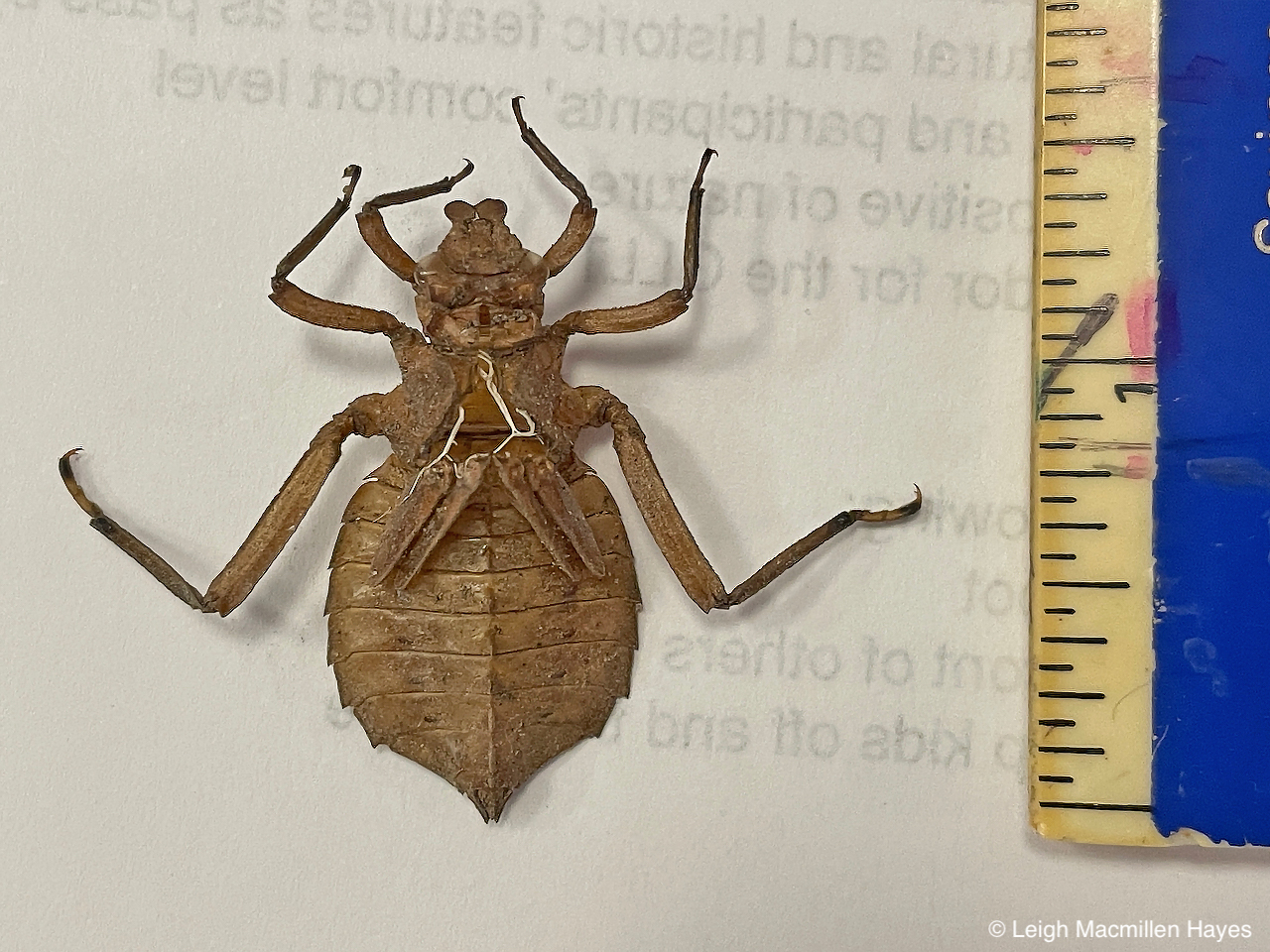
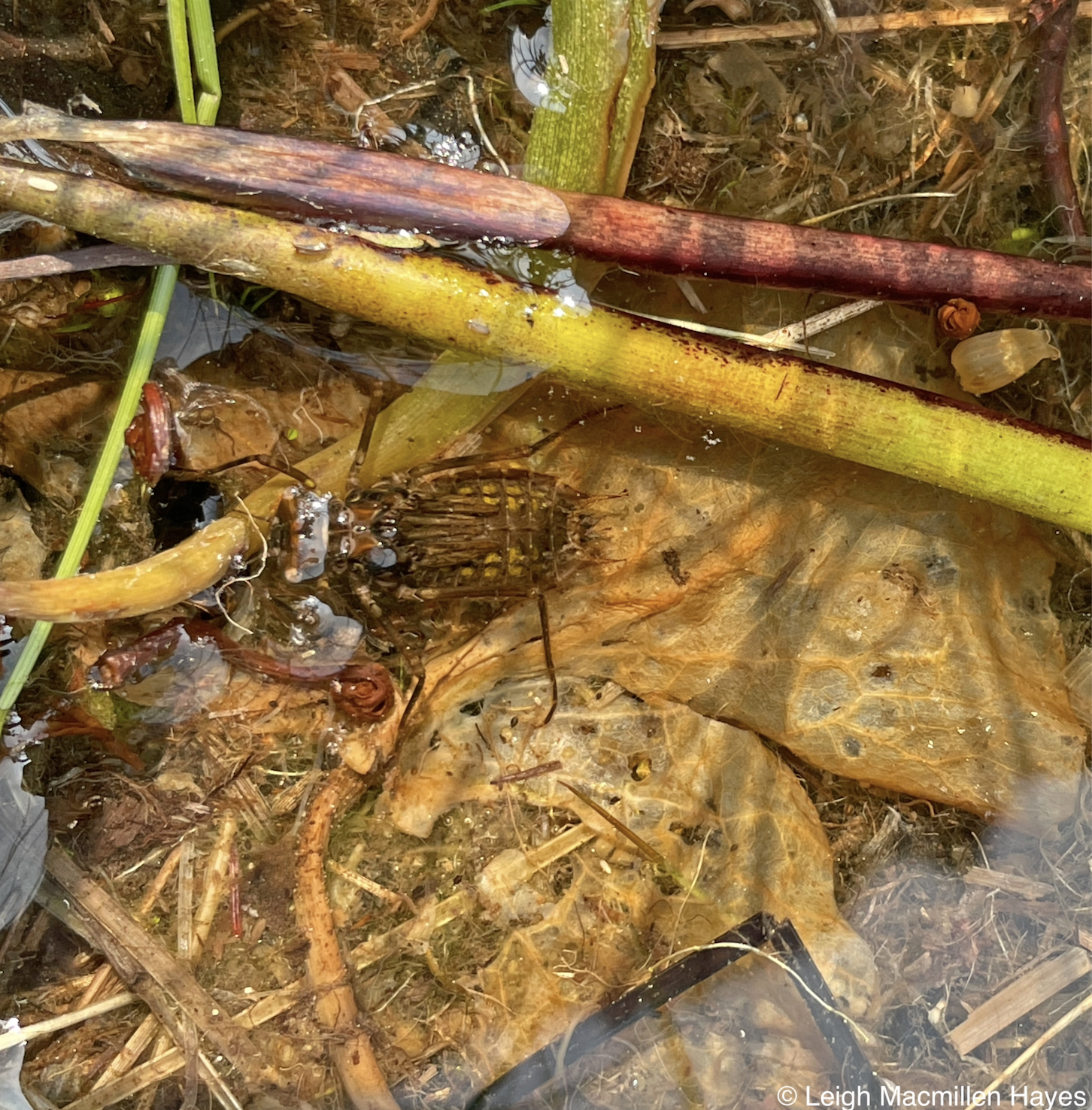
I would also be remiss if I didn’t share this photo of a Dragonhunter exuvia, which Dennis Paulson, author of  Dragonflies and Damselflies of the East describes as “wide, flat larva that resembles a wood chip.” The legs alone speak to its strength; formidable in the water and out.

And this is just a reminder to self that though I sketched and painted one form of a dragonfly naiad for six species, some may have other shapes. It’s the cerci at the tip of the abdomen that becomes key for identification to family.

Skimmer Naiad

My final painting completed this afternoon is that of a Skimmer Naiad. This is the largest family of dragonflies and every ID book includes a thick section for skimmers.

That seems apropos because not only are there a lot of family members, but their abdomens are also quite thick or chunky.

Pictured above is a male Calico Pennant Skimmer. His counterpart has all the same markings, but where you see red, she sports yellow. And soon, a pair of cousins will fly before the Calico Pennants. The cousins are the Hudsonian Whitefaces. Their abdomens are similar, but they have clear wings and as the name suggests, white faces.

That being said, I again have to slow myself down when I spot a Hudsonian because I often mistake it for a Calico at first glance.

I share thousands of photos (and probably have shared at least a million over the last ten years) of Skimmers, but thought I’d keep it simple and end with this one–a male Spangled Skimmer. Note the white stigmas on his wings. That I am aware, no other dragonfly has these white stigmas.

Thanks for stopping by to check on my current Naiad collection.

Naiads are the dragonflies of the future.
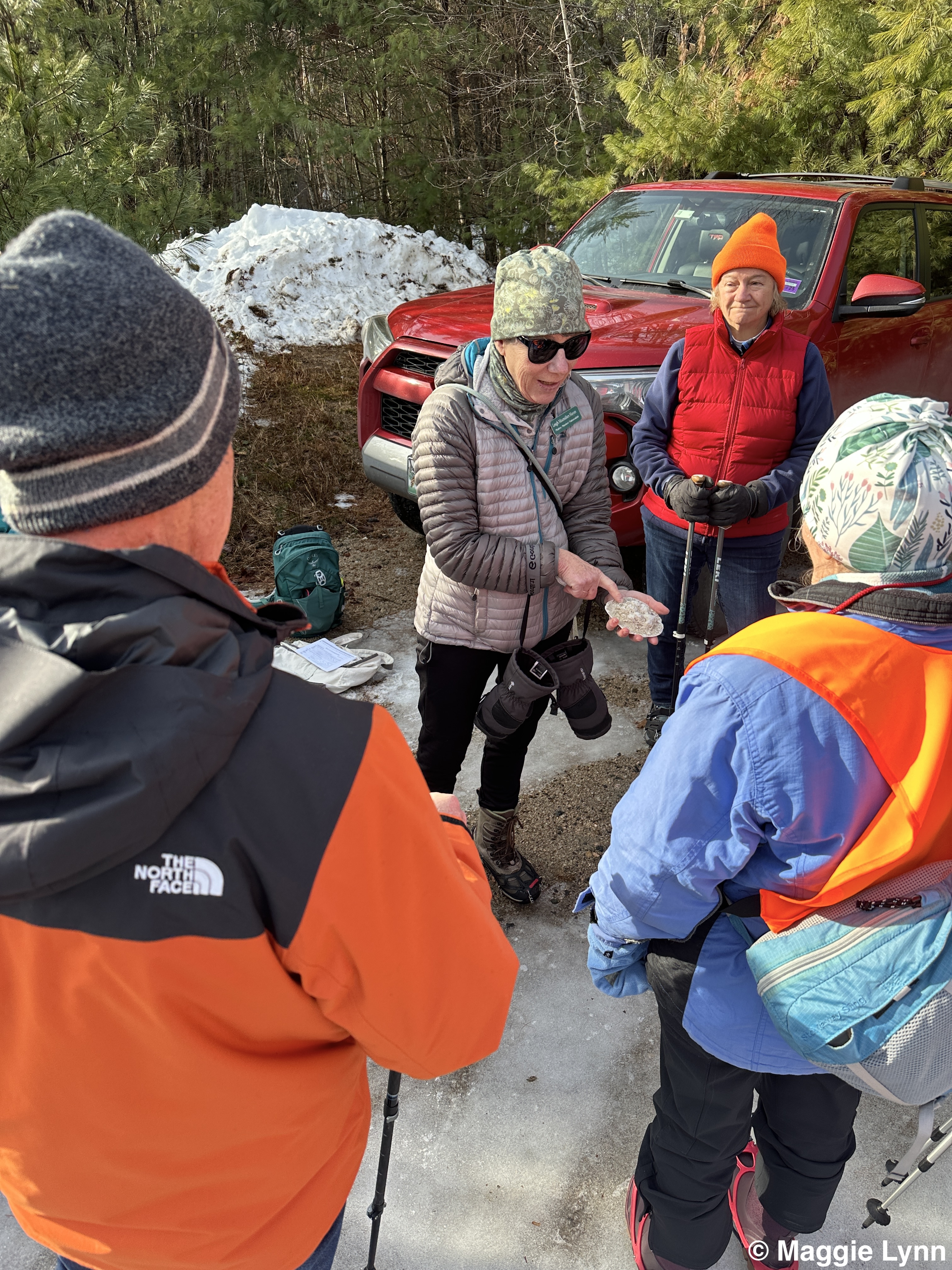
And the future is close at hand.

I can’t wait for spring 2025 to debut her dragonfly season.

Shout-out to the Universe

After he finished Yoga, and we both purchased veggies, eggs, flowers, jam, and goodies at our favorite farm market, aka Fly Away Farm, and picked up sandwiches at The Stow Corner Store, it was time to pull into a parking spot and head off on a journey, knowing full well that it would probably begin raining before we returned. That said, we left our rain gear in the truck. Wouldn’t you?

Our trail of choice this morning was actually a dirt road. One with a million names, but possibly most easily identified as Forest Road 9.

Because the gate is still locked, we had a two-mile walk ahead of us before we reached our lunch spot, but actually, that is my preferred way to travel this route. As I reminded My Guy, when we walk another road during the winter to a location very close by, we get to see bear hair on telephone poles. There were no poles along today’s road, but there could be other things worth noting.

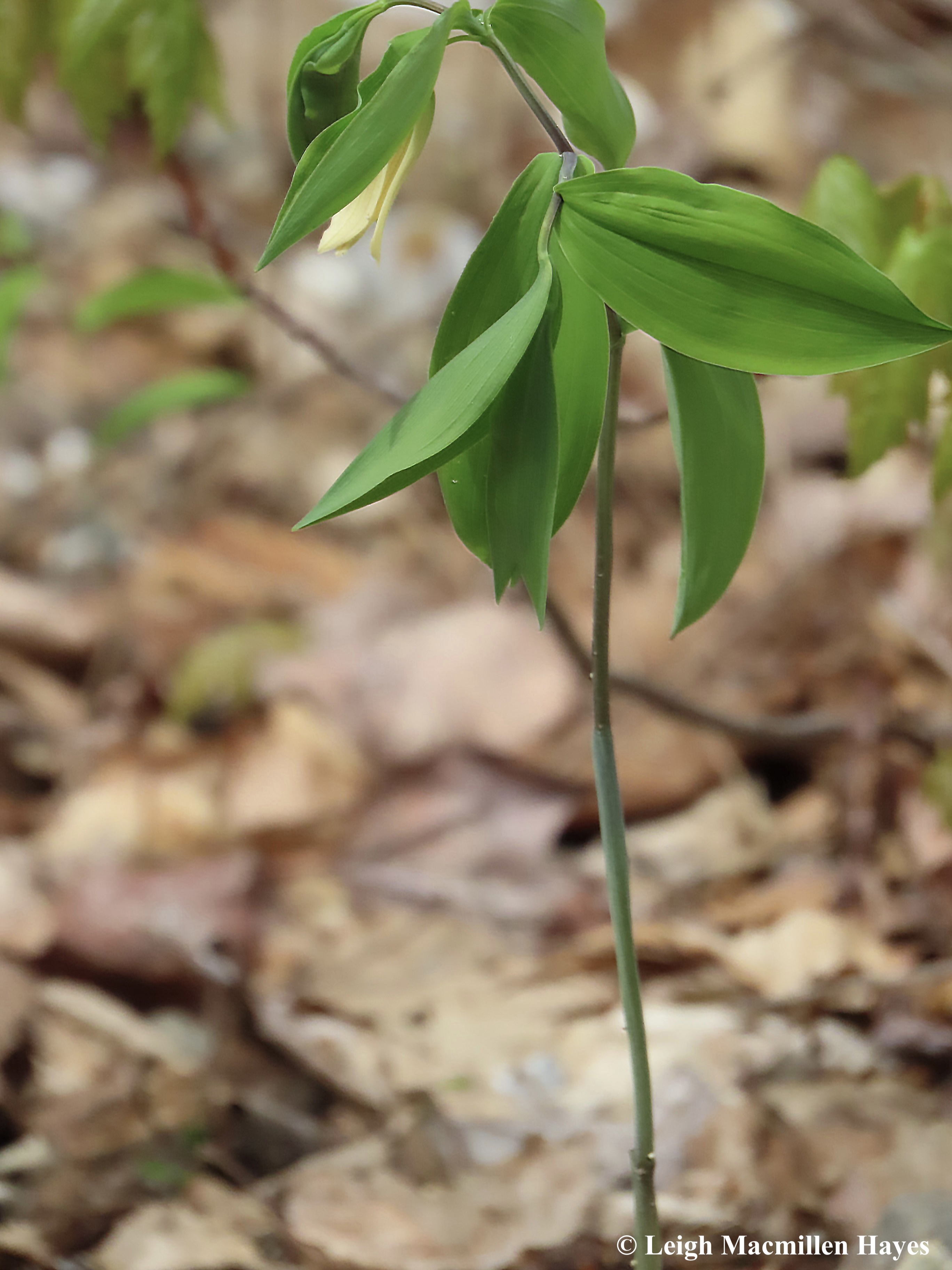
Like Sessile-leaved Bellwort, aka Wild Oat, showing off its drooping bell-like flower that almost blend into the roadside scenery and if you don’t know to look, you might miss it.

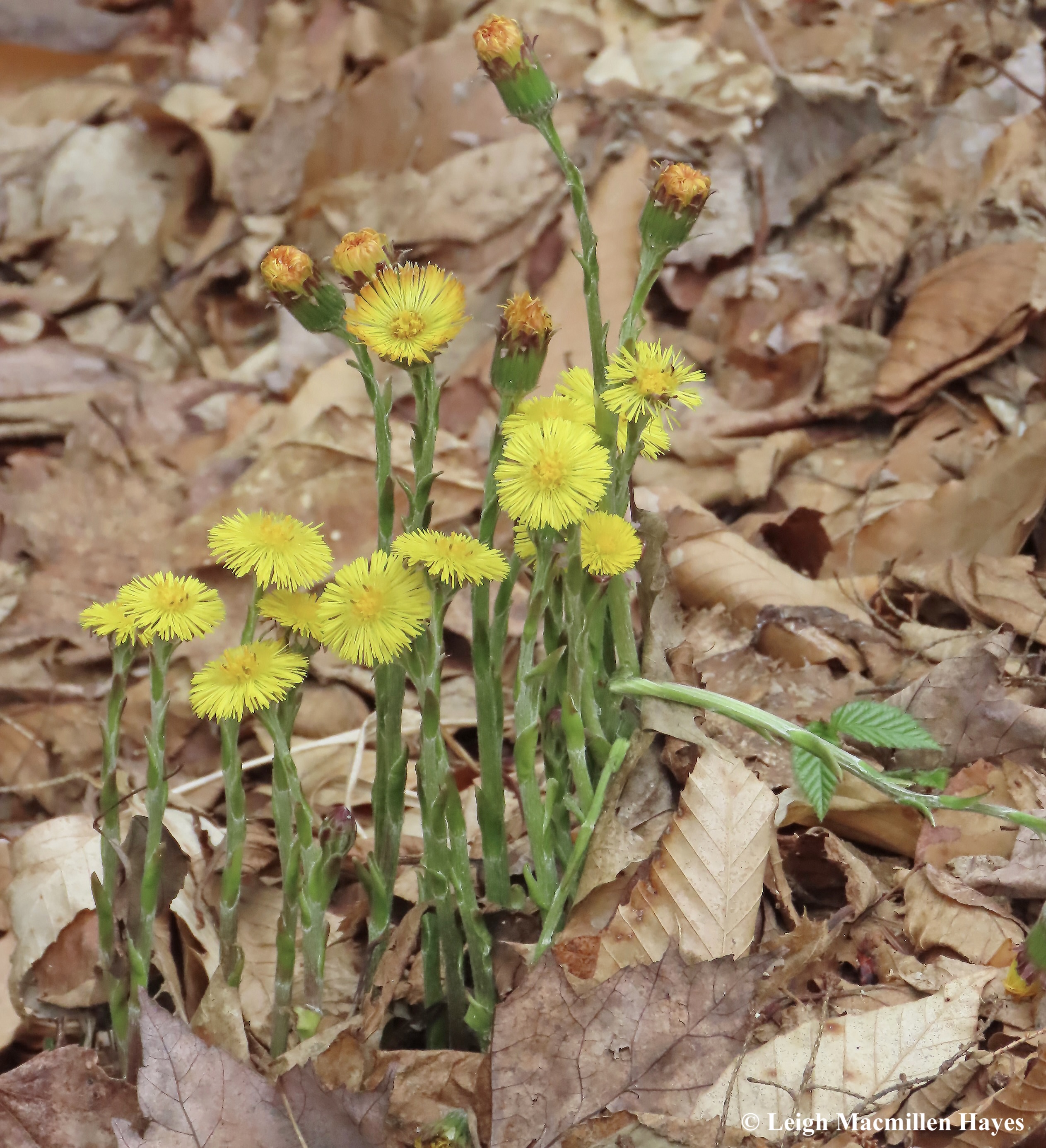
And Coltsfoot! What looks like a Dandelion, but isn’t a Dandelion? I LOVE this flower because like all spring ephemerals, it is so fleeting.

In the Aster family, the flowers can be distinguished from Dandelions by the presence of obvious disk florets and ray florets. The stems are unique in that they are covered in tiny bract-like, scaly leaves, and the actual leaves for which the plant received its common name, don’t grow out until after it has flowered.

At last we reached our destination, after, of course, My Guy showed me where the snowmobile trail turns to the left and comes close to a trail around Shell Pond that we’ve viewed while circling that body of water.

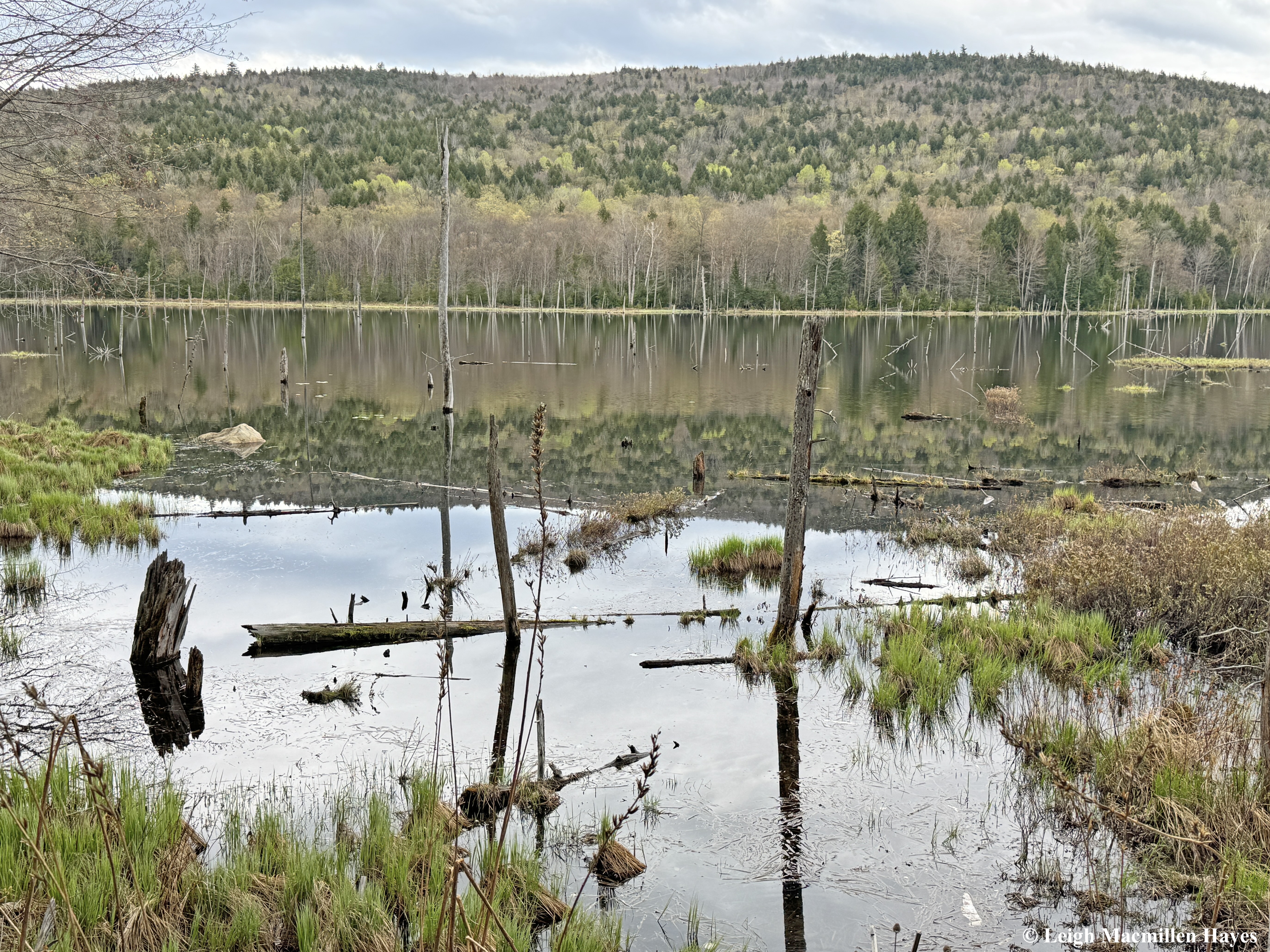
Today’s water body: Deer Hill Bog. One of my favorite places to go, especially when the gate is closed and there is no traffic.

But, I’ve been thinking about that descriptor: Favorite. It’s rather like this one: Common. So many species are named Common This and Common That. And I find nothing common about them at all. I guess it’s true for favorite places. On any given day, no matter where I am, it is my favorite. Unless it isn’t, of course, but that doesn’t happen very often. Thankfully.

Beside the water, we heard a loud BUZZ, and there was a huge Bumblebee nectaring among the tiny bell-like flowers of Leatherleaf and I’d forgotten that they should be in bloom already.

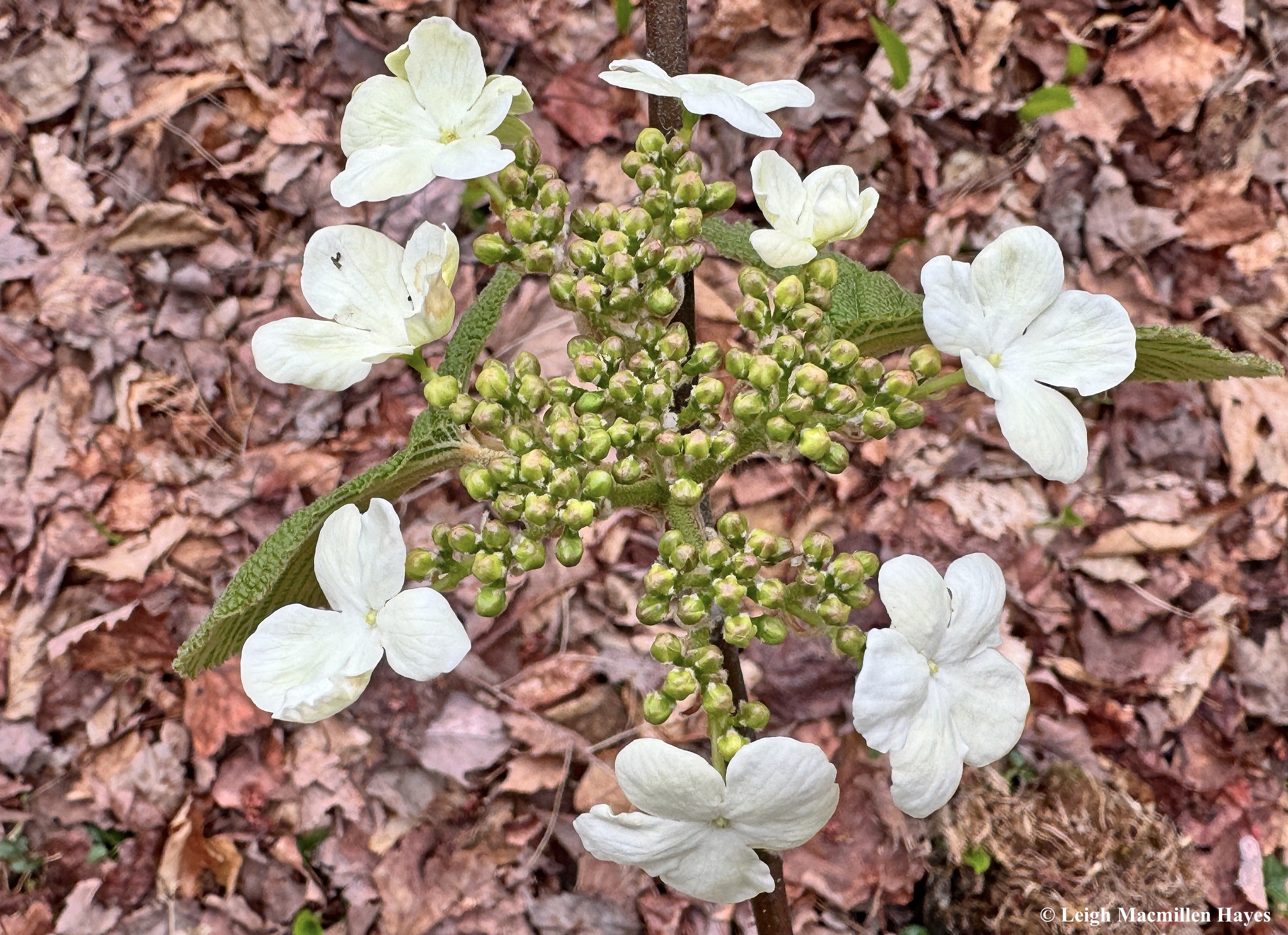
All along the road, and then right in front of the wildlife blind, was another fav that I can’t resist photographing: Hobblebush. I’ve yet to find one with the tiny fertile flowers open, to that means more photos to come.

While munching on my sandwich, I saw fast movement on the water surface as it appeared the critter was running. When I zoomed in with my camera lens, I realized it was a Fishing Spider, who has a hairy, water-repellent body that help it move across the water.

It was while looking down, that I heard a high-pitched whistle I recognized, but was surprised to look up and watch an Osprey land on a snag right in front of us. My, what intent looking eyes, most useful for detecting objects under the water, with fish being its main food source.

That said, the Osprey is a raptor, and I suddenly spied a Canada Goose on a nest atop an old Beaver lodge, and thought about the breeder’s camouflage and how well its wings blended in with the nesting materials making it not quite so noticeable from the air.

Really, though, I think I was the perceived threat since the Goose held its head low and pointed at me as it guarded what I assumed were eggs below its body. Thankfully, it didn’t hiss at me, and when I realized the situation, I moved on.

All the while though, I kept an eye on the Osprey who had flown across the bog and perched–looking in the opposite direction of the Goose. I didn’t want to find out if Goose eggs were on the menu along with a fish. Though it would have been great to have observed it catch a fish.
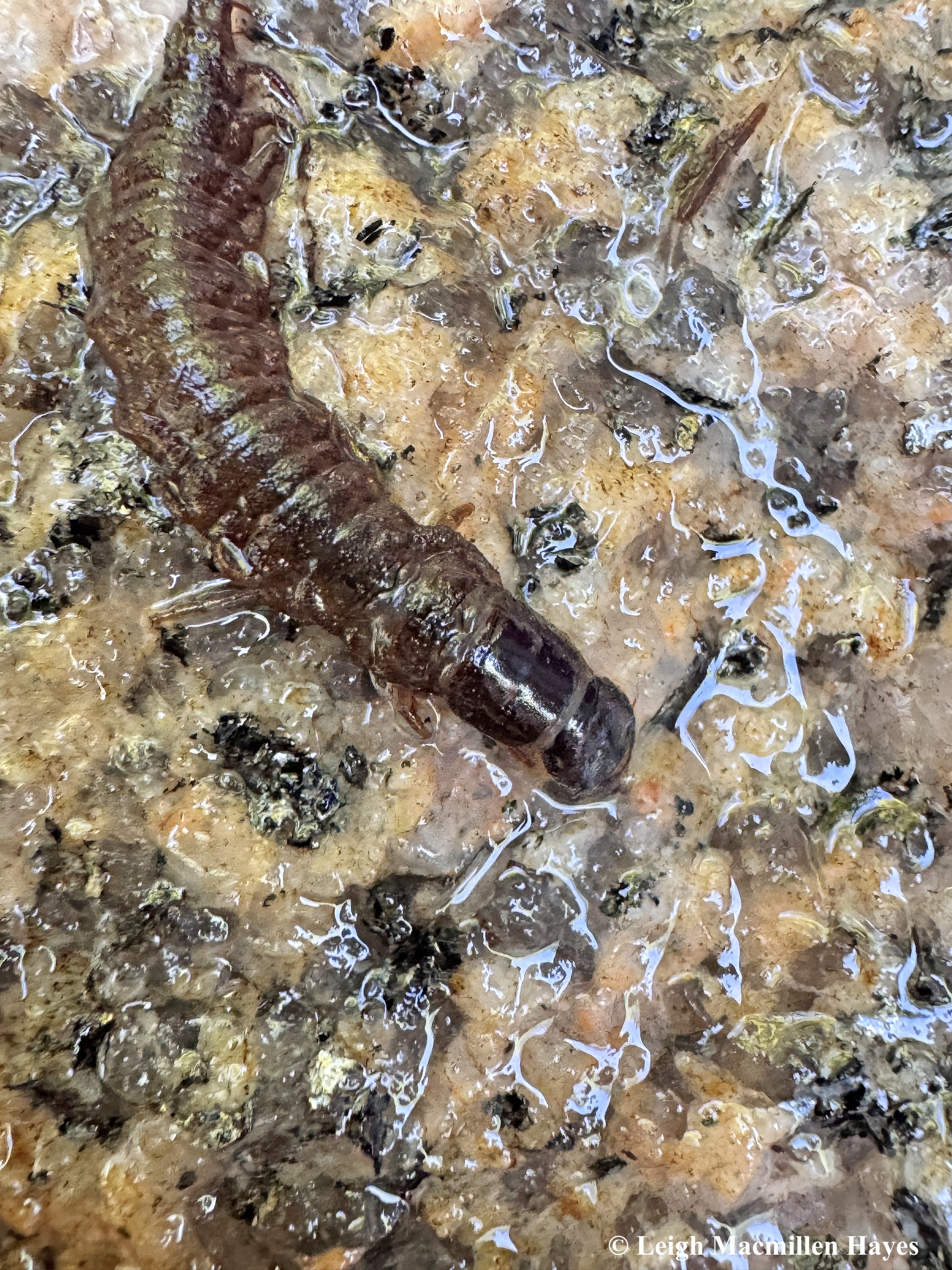
Mergansers were also out and about on the pond and these two vocalized, which drew my attention to their location upon a log where I fully expected to see Painted Turtles basking. But today wasn’t that day–basking day.

Instead, as had been predicted, it began to rain and we had two miles to walk out and unlike the ducks, could not oil our feathers and let the water roll off.

That said, it wasn’t a raw day and we really didn’t mind. I know I rather like rainy days. Besides, we both had extra clothes waiting for us in the truck.

As we walked out, I mentioned that I was surprised we hadn’t seen any Red Trilliums in bloom.

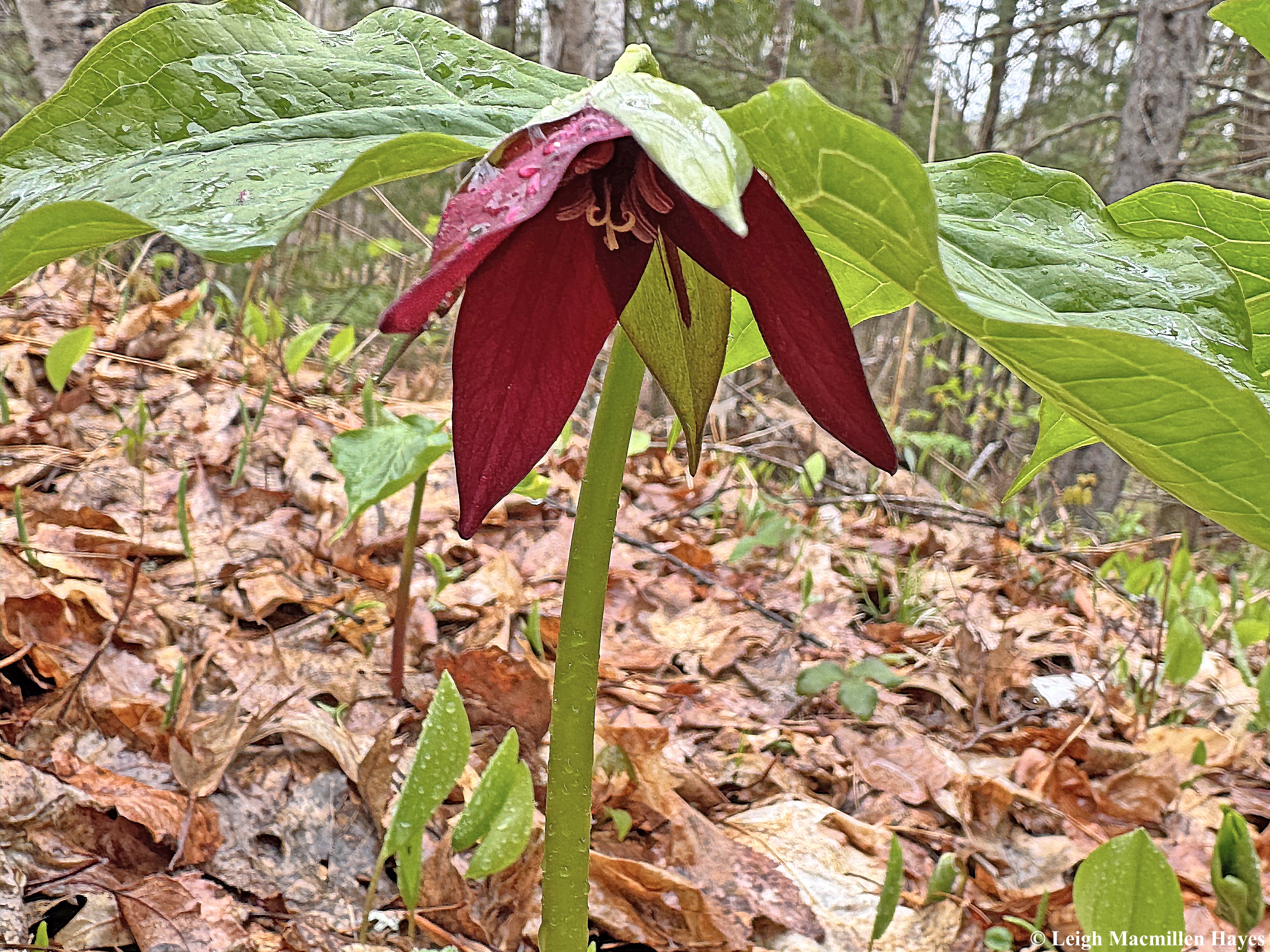
I kid you not, a minute later I spotted a Painted Trillium, the first of the season for me.

My Guy wasn’t surprised, but wanted to know if I could make a Moose appear.

No, but about a mile later . . . a Red Trillium. We had missed both of these flowers on the way in, which is another reason why though loop trails are wonderful, I don’t mind retracing my steps because there’s always something different to see.

As for the Moose, no sightings today, but . . . I still want to give a Shout-out to the Universe for what we did spot both at the bog and along the road.

My Guy, The Giant Butterfly Whisperer

It’s Monday. And that typically means a Mondate for My Guy and me. Especially if he’s worked all weekend. And a Mondate most often means a hike. So, that being that, we headed off to conquer two trails today. Neither was overly long, and one was rather easy, while the other was moderately difficult. But both offered sightings that have us still smiling.

I’ll start with the second hike of the day because this is my blog and I can do that sort of thing. We were in Shelburne, New Hampshire, and so on our way back to Maine, we stopped at the Shelburne Forest, a trail we tried to hike a year or two ago, only the Mosquitoes or Black Flies or both were so thick, that after about a quarter mile we turned around and raced out–treating ourselves to ice cream sundaes in Bethel, Maine, instead.

Today was different. Blue Sky. Slight Breeze. 75˚.

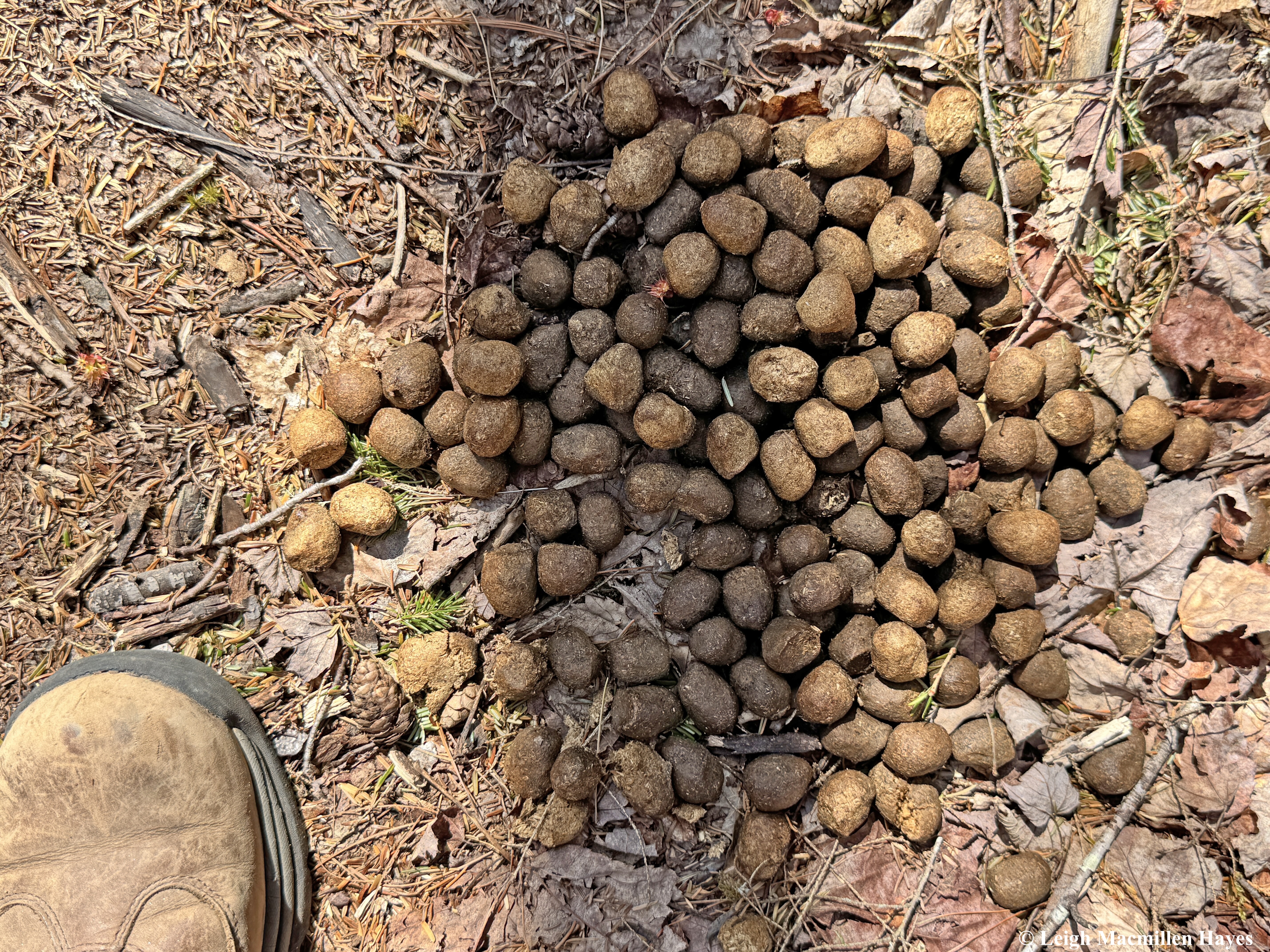
We soon began to notice a theme along the River Trail. First we encountered several Fox scats, indicating this spot may have marked a territory. It seemed like it was important enough to return and leave a sign again, and again, and again.

A wee bit farther and more Fox scat.

And several displays of Moose scat, this one being from this past winter, while another had more debris on it and was starting to break down, indicating a previous winter.

We also noted Beaver works in the form of a dam, plus some cut trees on the trail beside a steep embankment to the river. And deer prints and scat. And coyote scat.

I mentioned that I’d like to come back in the winter to see who spends time here.

My Guy’s response, “Anyone else might think you were talking about people, but I know you are not.”

He gets me!

I had two other favorite sightings along this “Scat” trail. The first being the leaves of Trout Lilies. NUMEROUS leaves of Trout Lilies. So now I know I need to return soon to see the flowers, rather than just wait until winter.

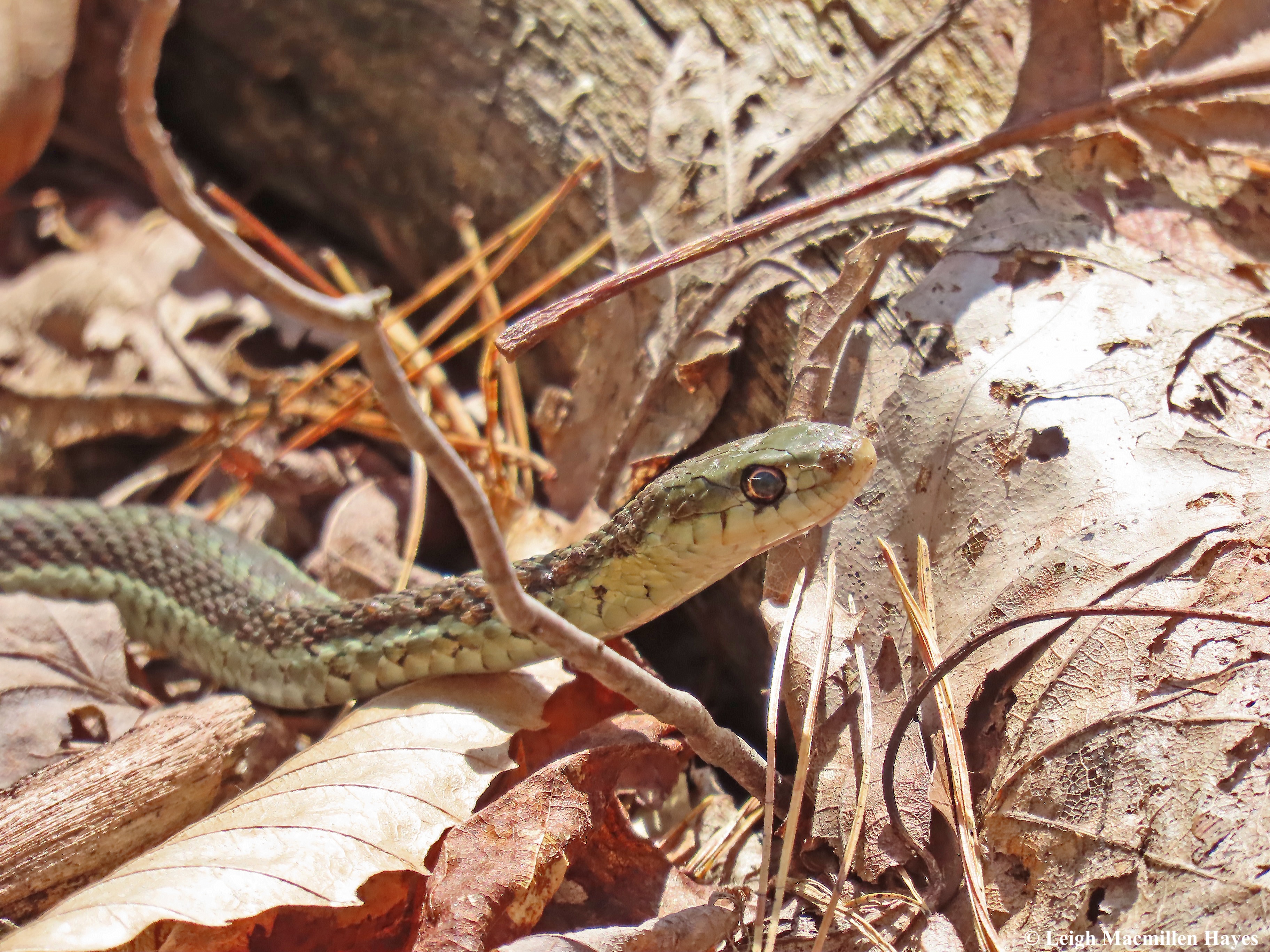
And a Garter Snake that surprised My Guy because it was in the middle of the Forest Trail as we completed a loop, but quickly slithered away.

I kept hoping it would stick its tongue out to get a sense of its surroundings, but for some reason it didn’t honor us with such.

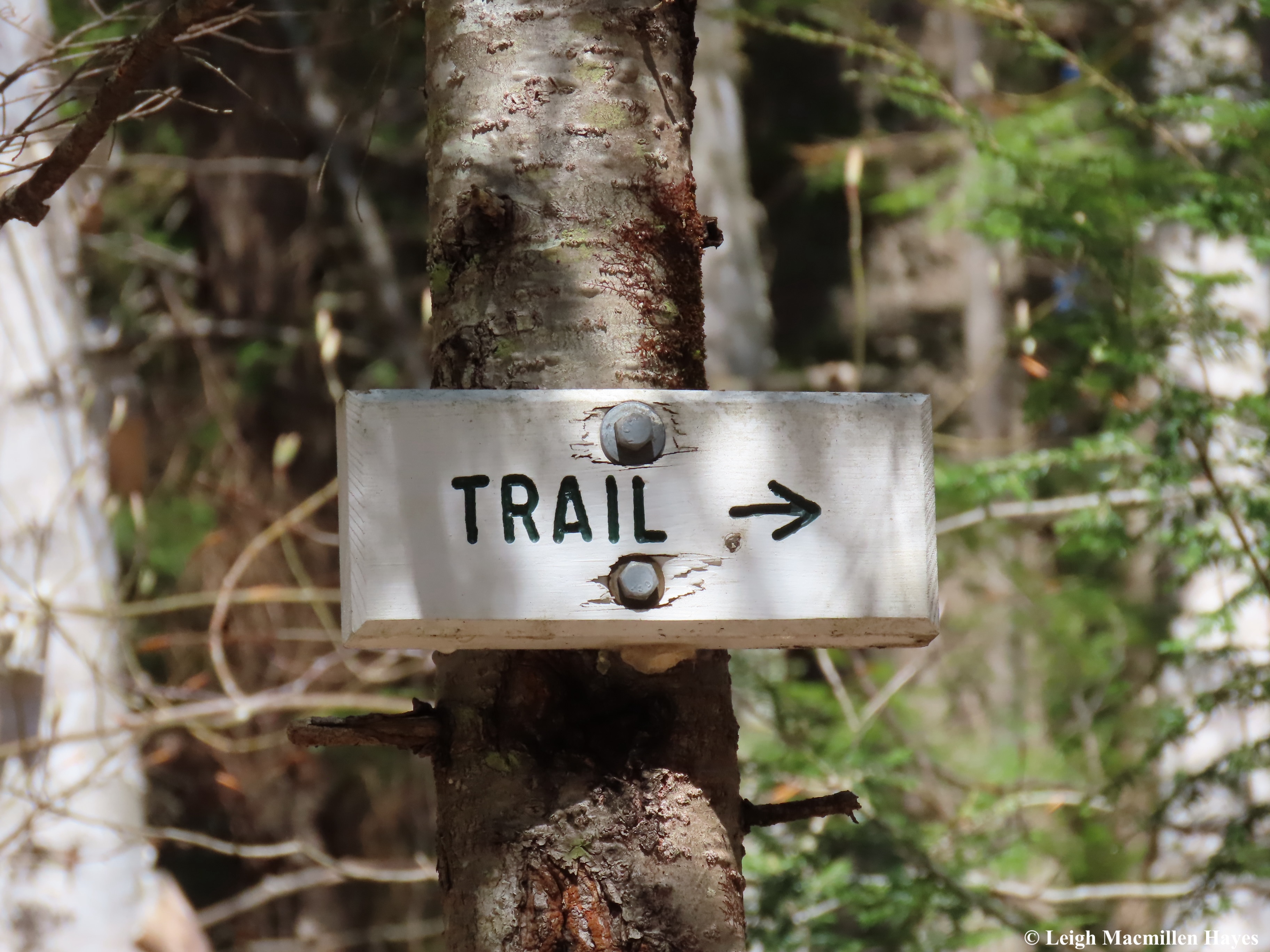
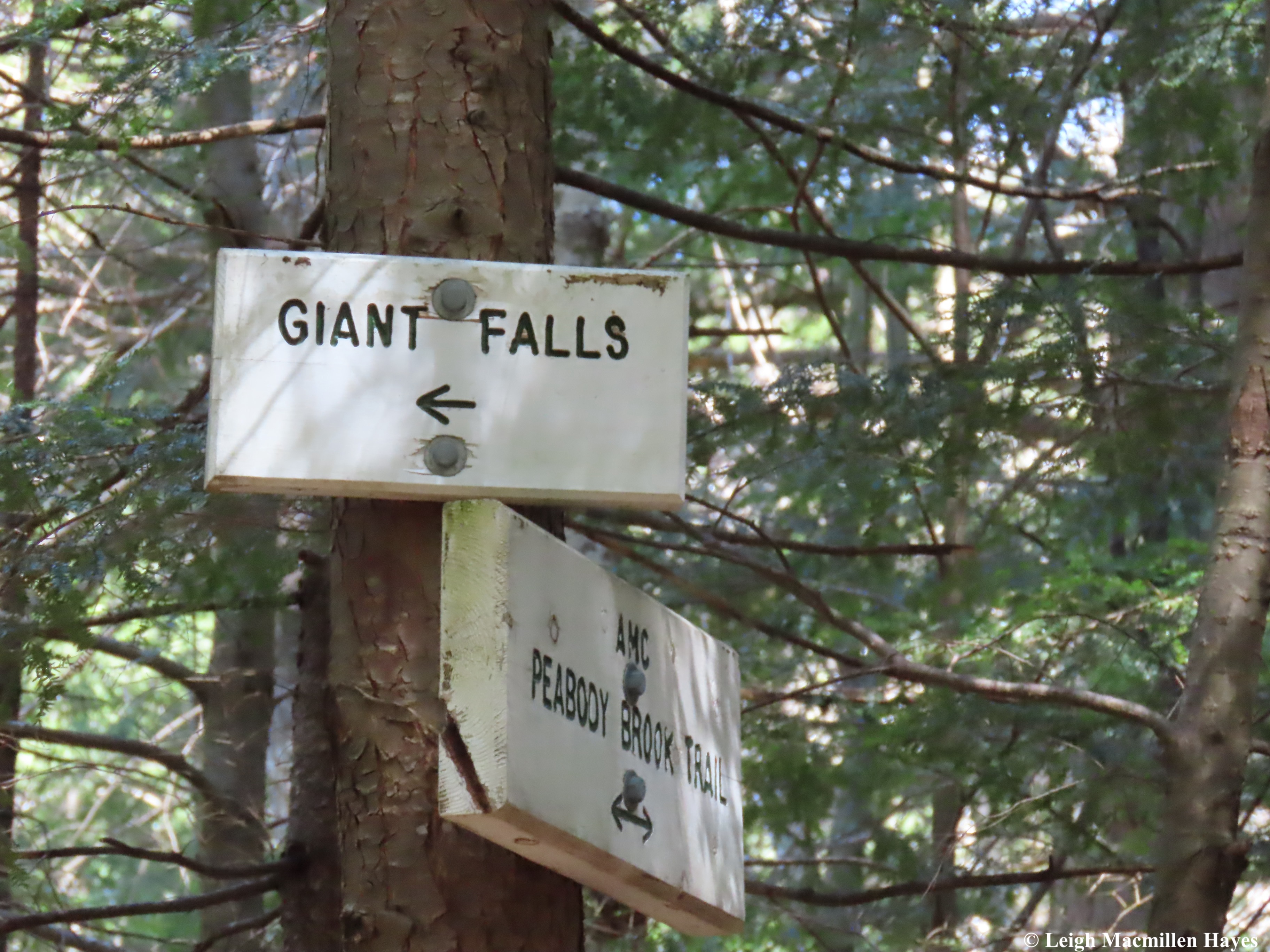
Now it’s time to turn back the clock and head off on the Peabody Brook Trail, which was our late morning hiking spot, the first hike of the dat. We were grateful for signs like this when the trail crossed a logging road.

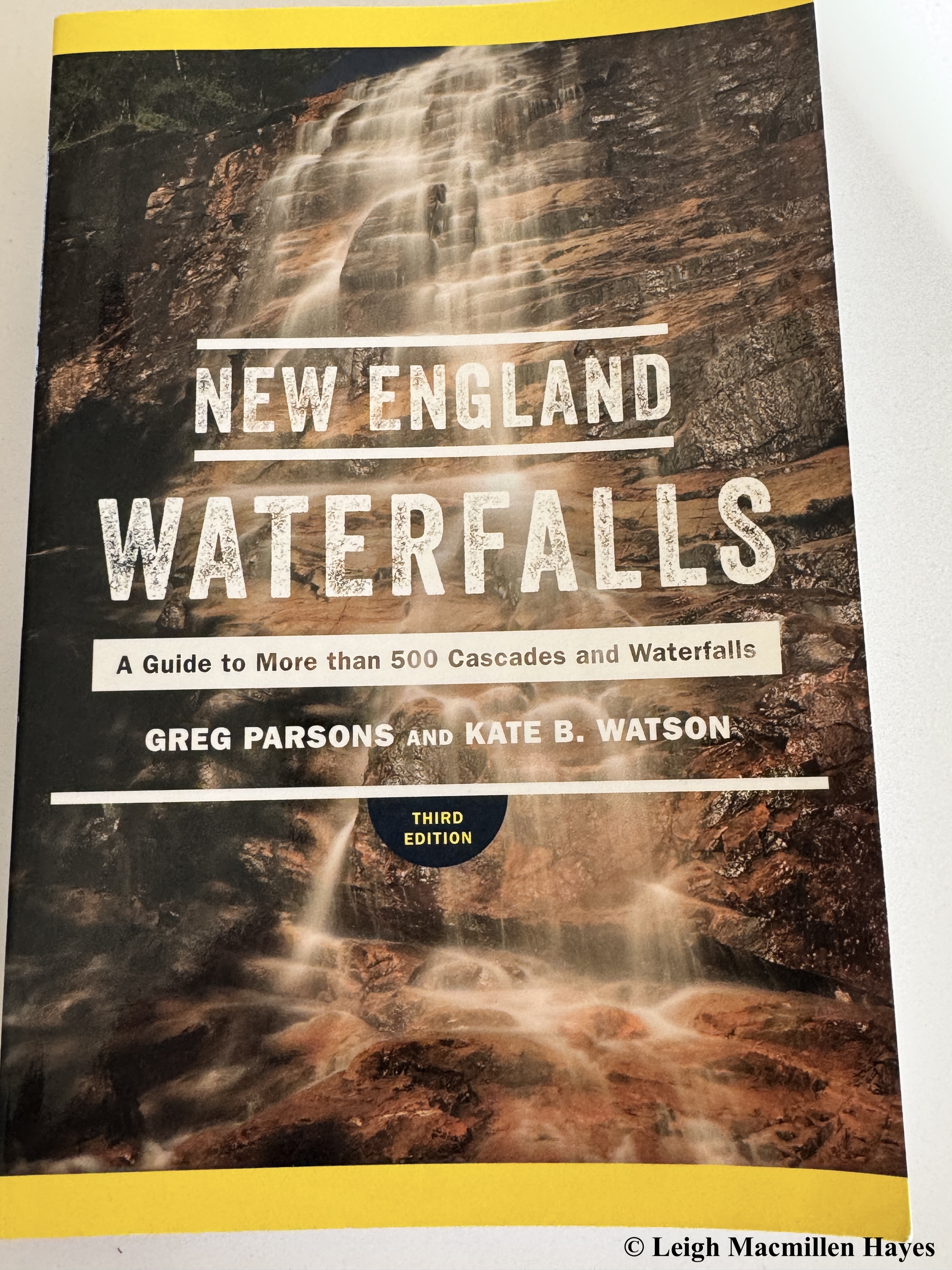
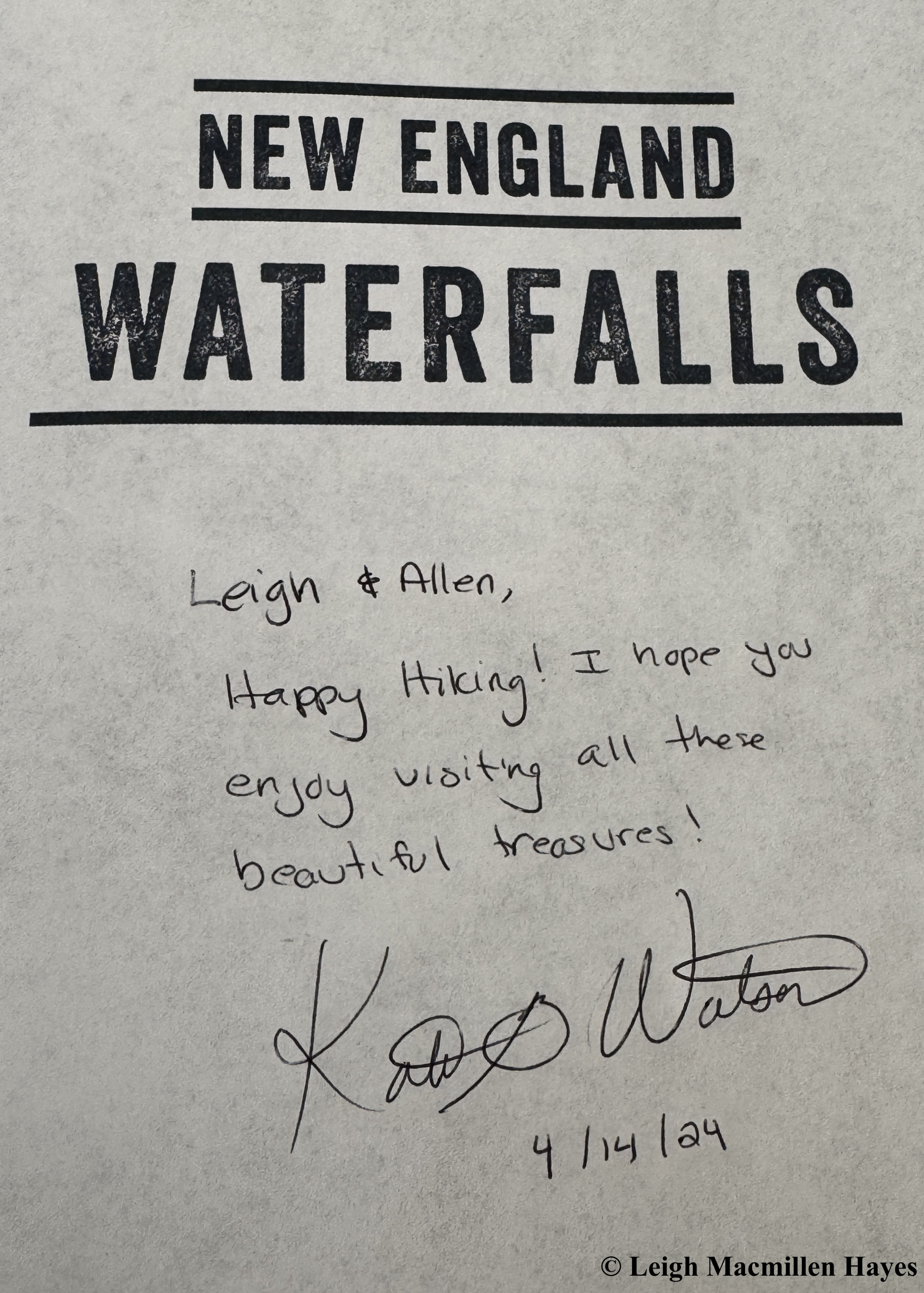
We chose this trail because we’d read about it in New England Waterfalls, by Greg Parsons and Kate B. Watson. I know Kate from church and love that these two visited waterfalls throughout New England to include in their comprehensive guide. We’ve visited some, but have so many more to do.

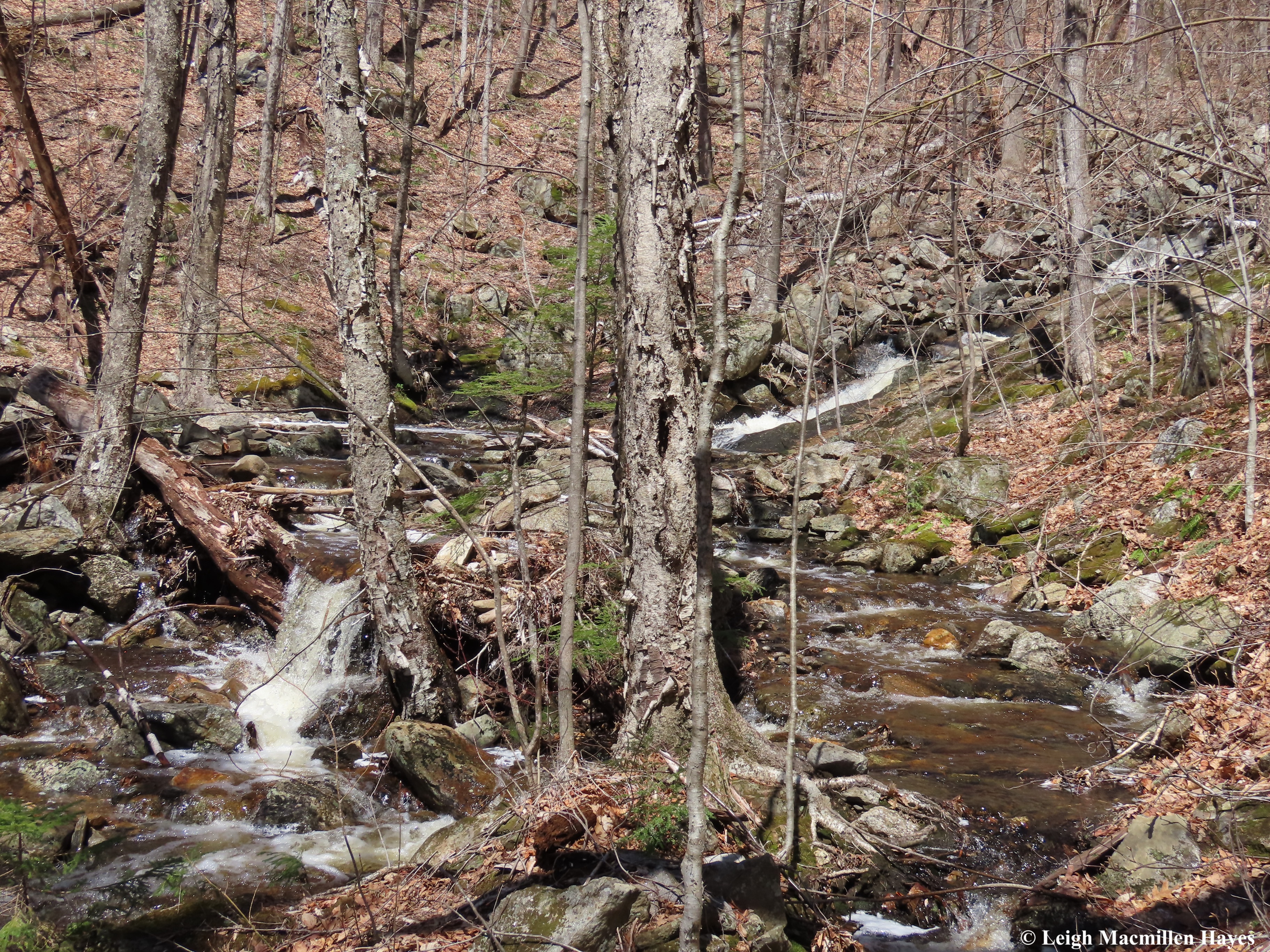
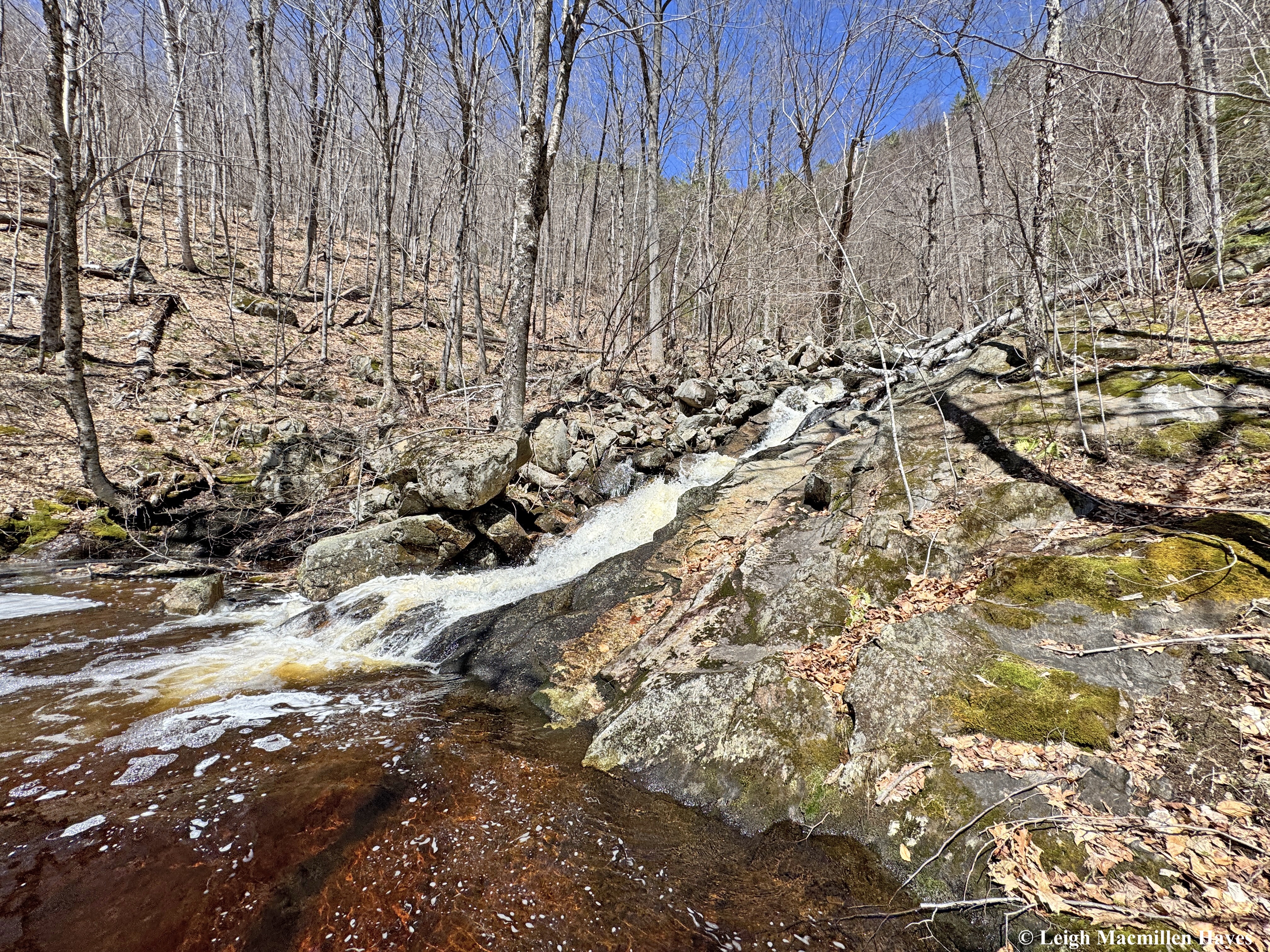
At the beginning, the Peabody Brook flows through a ravine and due to a rainy weekend, it cascaded over, around, and under the boulders, and was an ever-present companion for much of the trail.

Other companions included several Anglewing Butterfies, that I couldn’t identify until I saw their underwings, as the markings indicate either a Comma or a Question Mark.

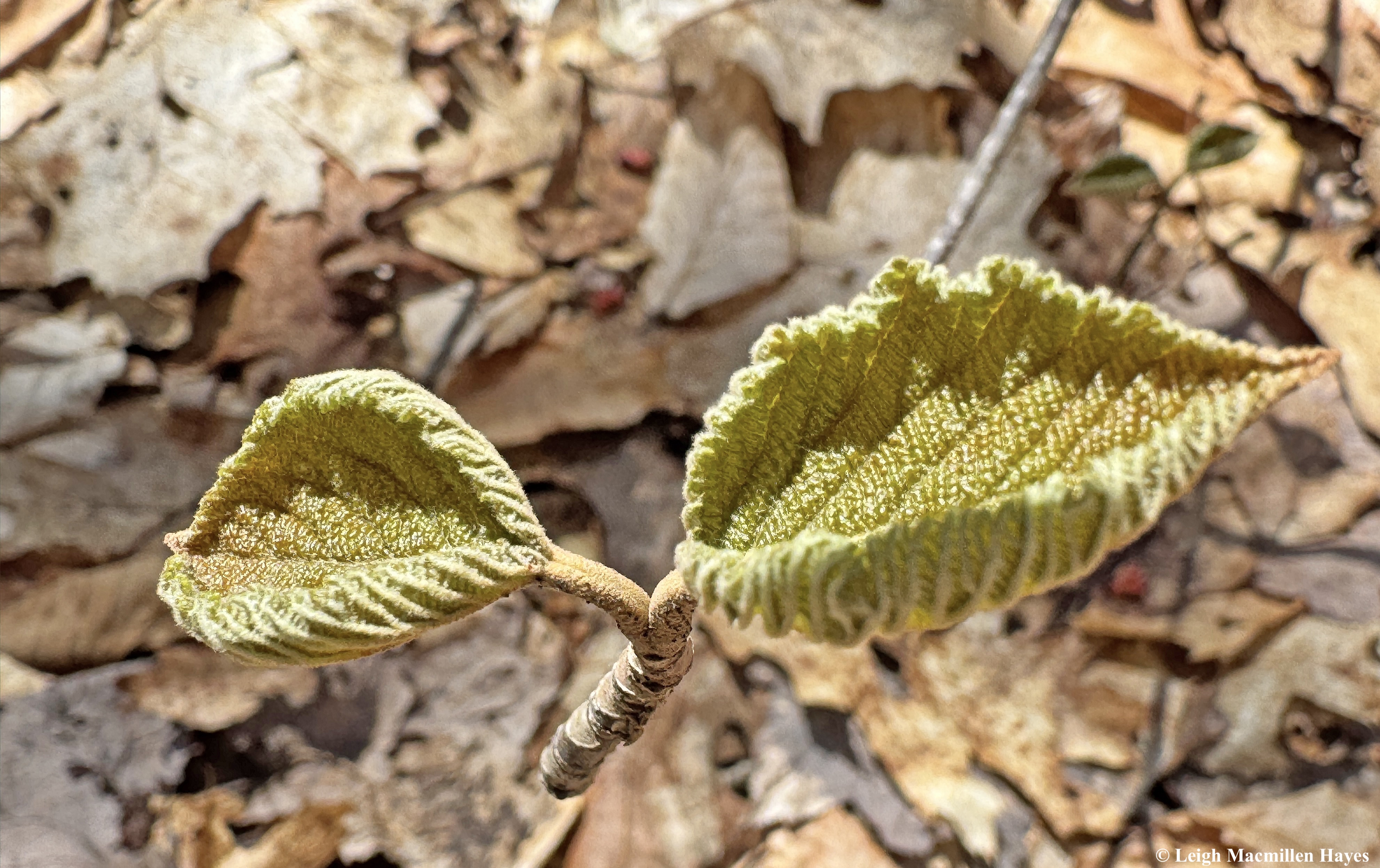
And there were Hobblebush leaves, with their corrugated presentation, beginning to unfurl.

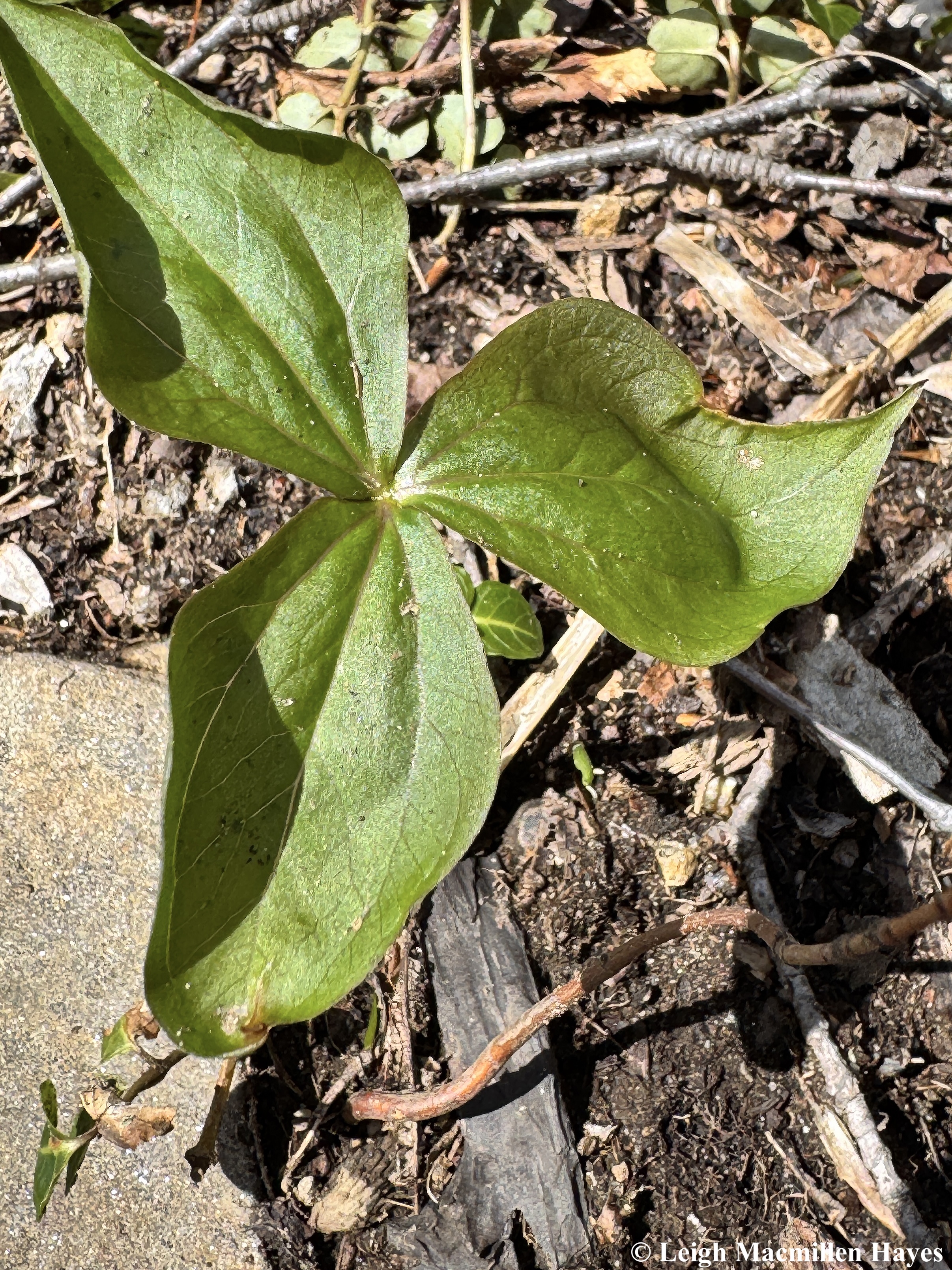
Plus a few Painted Trillium plants showing off their leaves of three, though no flowers yet, and causing My Guy to comment, “You’ll probably take a trillion Trillium photos again this year.” Did I say he knows me well?

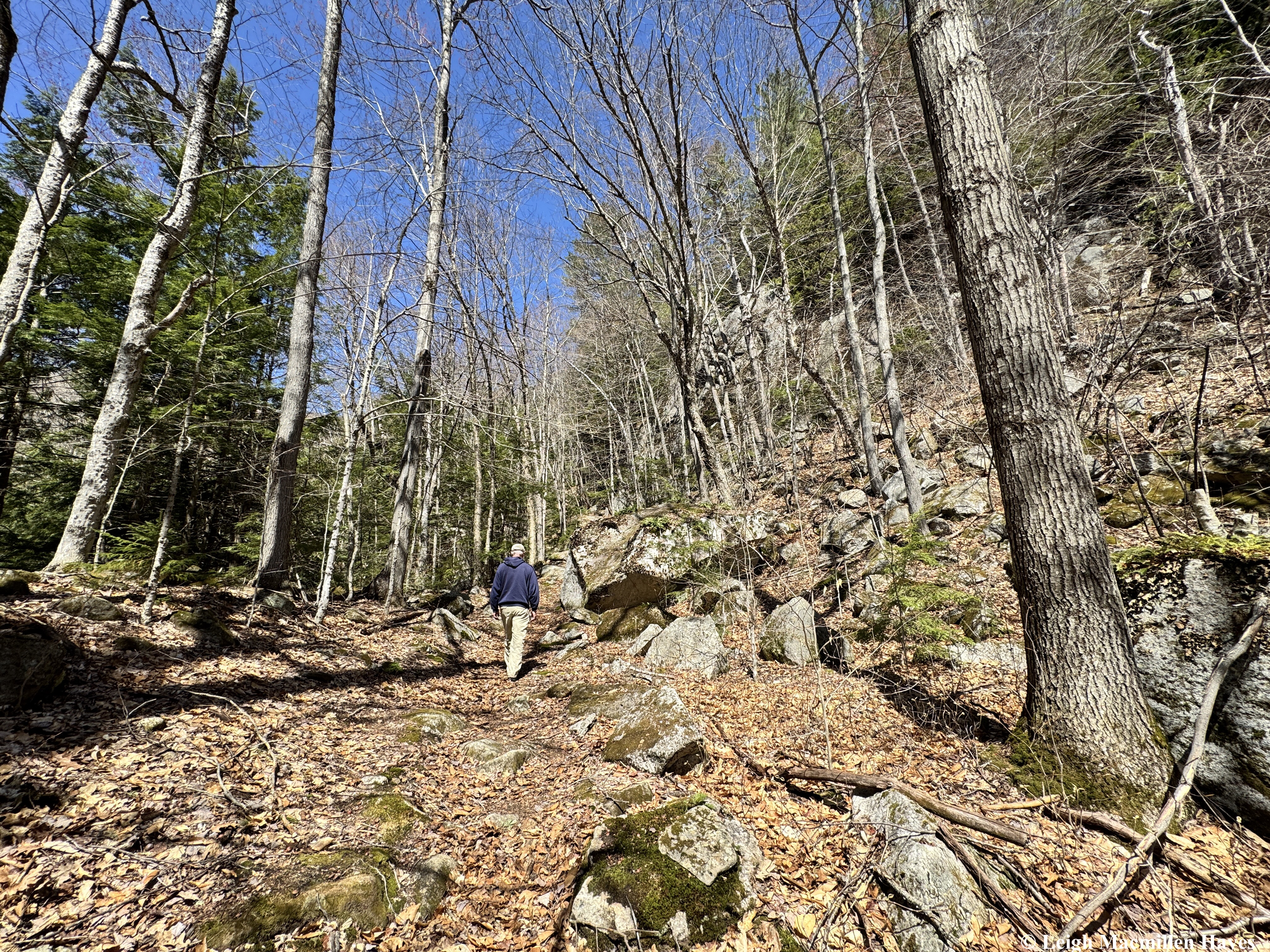
Upward we climbed into the great blue beyond, for so it seemed on this gorgeous day.

And then we reached a junction, and I, for one, was excited about what might be ahead.

Would we meet Devlin, the giant in my fairy tale, The Giant’s Shower? After all, he lives only a giant step away at Arethusa Falls.

I also thought we might see a few fairies, including Devlin’s favorite, Falda, for such was the neighborhood, with lots of mossy areas among the Hemlocks.

And then My Guy got excited when he spotted something? A giant? Maybe, but in the form of Giant Falls, and if you allow your eye to move a wee bit to the right of his pointer finger, you’ll see the white water through the trees.

Where we’d left the brook for a bit as we climbed up, the spur trail led us back down and suddenly there was fall after fall after fall beside us.

We considered eating lunch beside a large pool. But then reconsidered, but not before I noted some features of the brook that I’ve been sharing with a homeschool family this year. A POOL.

And EDDIES. And FLOWS.

And FOAM. And that very foam was being picked up by the breeze and “snowing.” Oh how my ten-year-old friend would love that.

Do you see the little white dots above the water and rocks?

We decided to hike farther up the steep trail to reach lunch rock so we could enjoy the power of the falls fanning over the boulders.

Take a moment to listen to this incredible force of nature.

After taking in the scene around us, it was time for lunch. And that’s when the magic began to happen.

A fairy flew in. I kid you not.

That’s just a butterfly, you might think. “Just”? No, no, no. I’m sure it was a fairy disguised as a butterfly, because the fairies don’t want us to know that they are present.

And . . . it landed on My Guy’s right leg.

As we both watched quietly, it walked down his pants to his hiking shoe.

And then it began to puddle. PUDDLE. ON. HIS. SHOE. LACE.

Puddling is a butterfly act intended to seek minerals and other nutrients from things such as scat, carrion, puddles, etc., but a shoe lace? And on My Guy’s shoe lace? What, indeed, could the lure be?

We’ll never know. But what we do know is that the Anglewing Butterfly was an Eastern Comma, based on the white comma shape on its underwing.

Spectacular.

The butterfly spent at least five minutes with My Guy: who seemed to appreciate that he had suddenly turned into a Whisperer. I don’t know that he’s ever held that status before.

When we finally departed, we had to hike back out along the same trail upon which we’d journeyed in, and . . . cross a bridge that bowed in the middle. Certainly the sign that a giant frequented it.

My Guy: The Giant Falls Butterfly Whisperer.

Worth a wonder.

P.S. No, there will not be a sequel to The Giant’s Shower. Self-publishing is expensive and I still have a bunch of books left from the second printing because I’m terrible at promoting it. It’s easy to do here on the blog, but not in real life.

There Is No Planet B

I was asked to give the homily at church this morning and have spent the past month or more reflecting on what to say. Of course, it was to my blog that I turned for inspiration for I knew that parts of the story were tucked within these posts.

Driving home from a recent Trail Snails walk, I spotted this statement on a roadside sign: “There is no Planet B.” And I thought it was an apropos title for what I want to share with you this morning.

On Sunday, March 23, in Forward Day by Day, Tyler Richards, a priest serving St. Anne’s Episcopal Church in De Pere, Wisconsin, responded to Exodus 3:vs 3-4: Then Moses said, “I must turn aside and look at this great sight, and see why the bush is not burned up.” When the Lord saw that he had turned aside to see, God called to him out of the bush, “Moses, Moses!” And he said, “Here I am.”

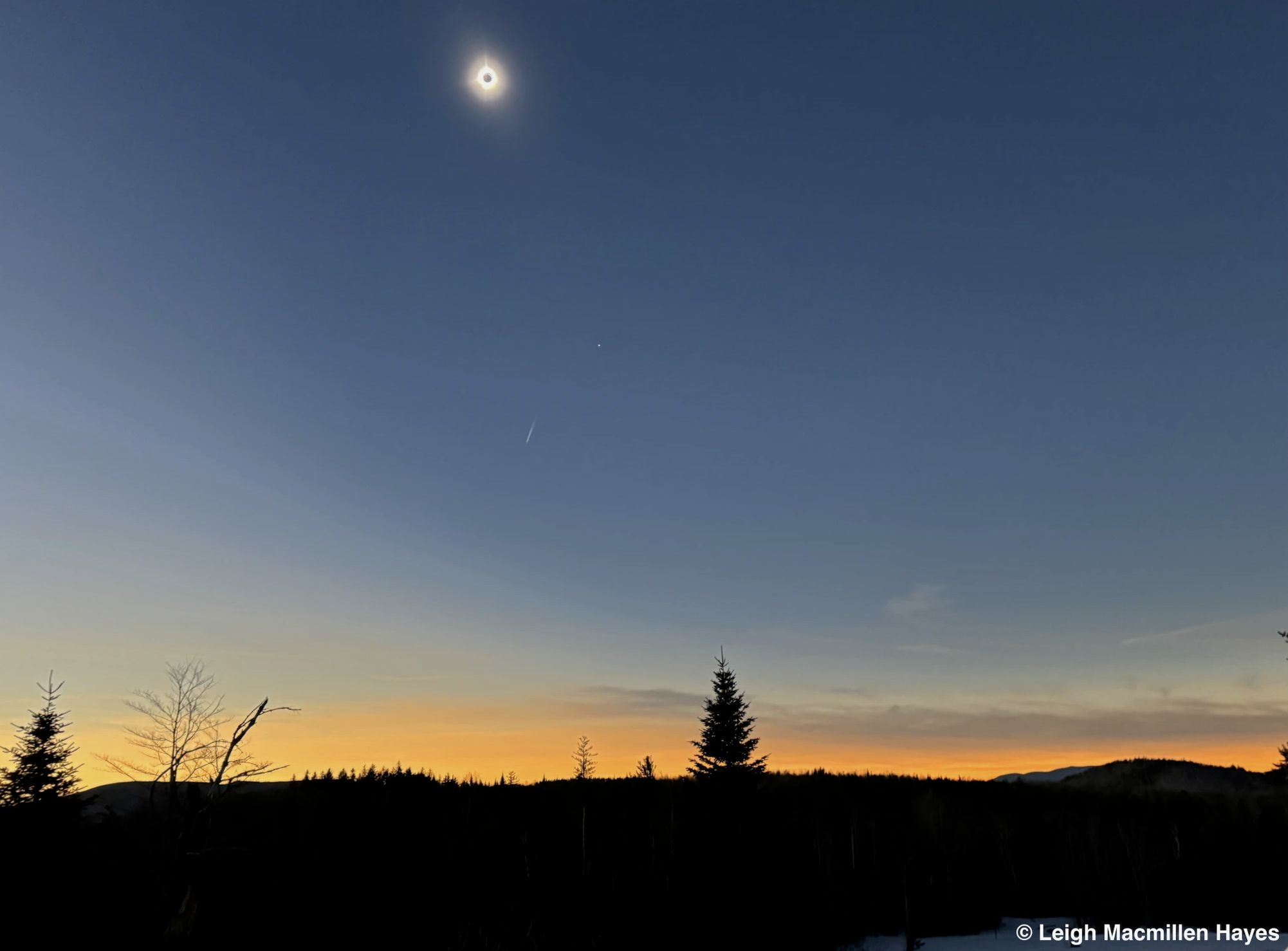
Reverend Richards commented, “I do not have an accurate account of the things that have caused me to stop and look again. Solar eclipses, northern lights, sunrises, and sunsets are a few of these.”

He continued, “God asks us to turn aside and experience wonder. God’s creation is a source of endless contemplation, and, at times, so is human ingenuity. But these great wonders that take our breath away prompt me to ask: What are they for? Are they an end to themselves, or are they there to remind us that God is even more incredible? Indeed, God is so great that God inspires and colors the very creation itself. It might not always be a burning bush that causes us to gasp at God’s greatness.”

In response to that I invite all of you to join me as I share a few of the thin places I have visited, where I see the light more on this side than the other. These are not burning bushes, but they do make me gasp at God’s greatness. The first I call “Emergence.”

Emergence

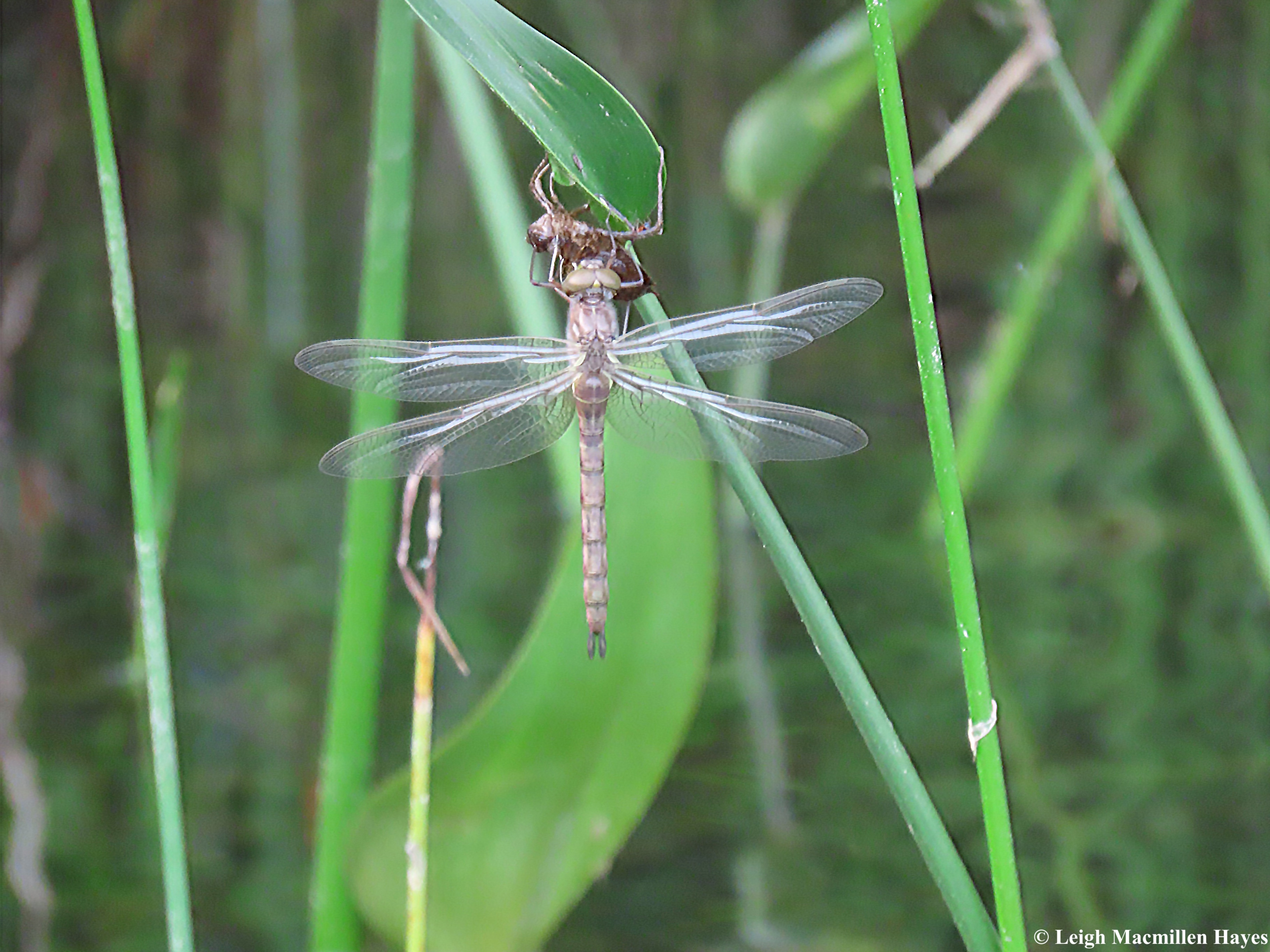
Oh dragonfly, oh dragonfly.
In your infancy,
You laboriously
Climbed upon a slender stem.
Ever
So
Slowly,
Seams split.
Soft and squishy,
You spilled forth
Into this sunlit world.
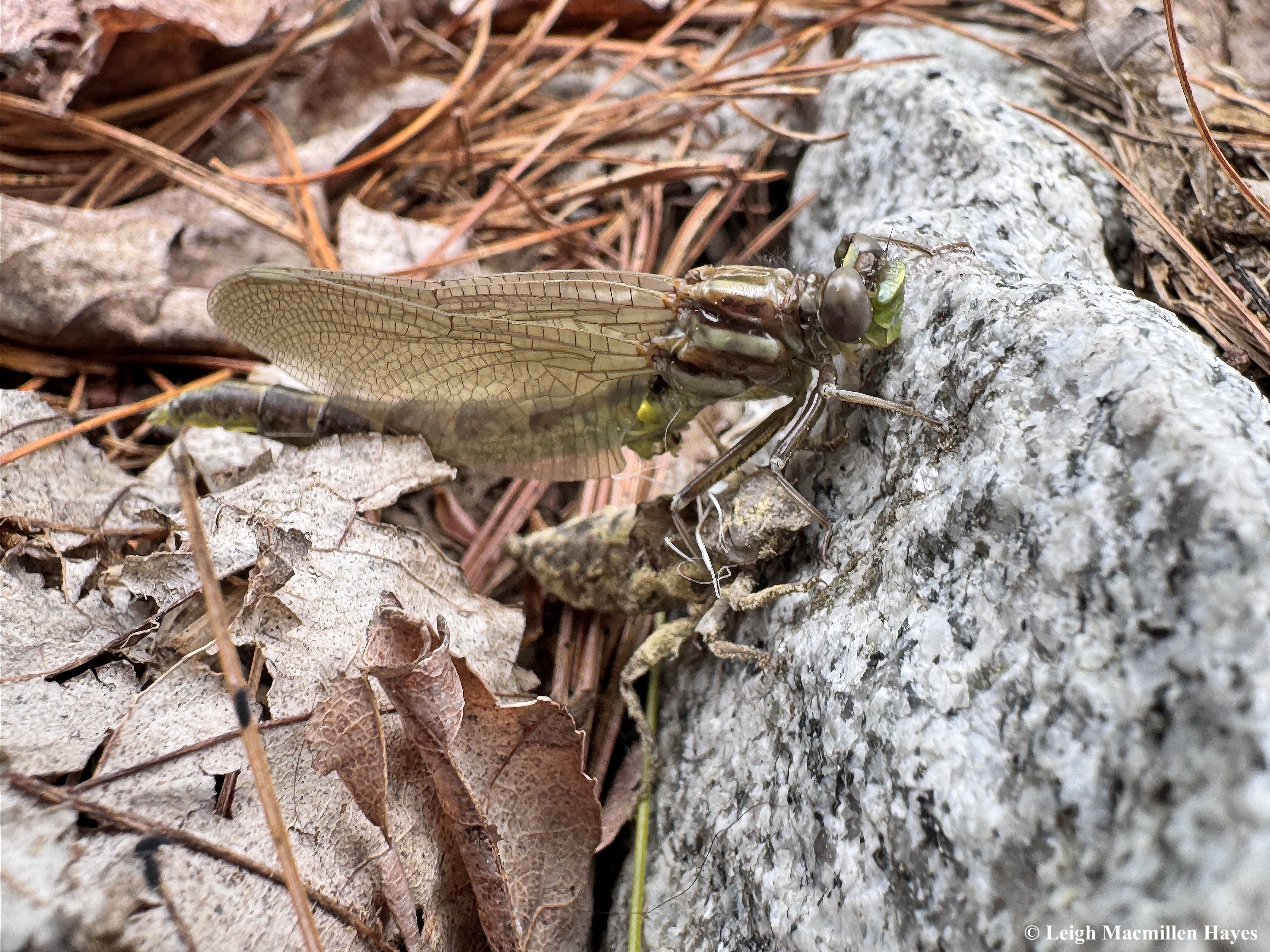
Perched upon your former self, 
Wispy strings recalled
Aquatic breaths.
Moments slipped
Into an hour.
Your body of velvet pulsed
As blood pumped
Into cloudy wings.
Standing guard watching you,
I noted preparations
For first flight.
Eyes bulging, 
You chose a spot
Of viewpoint advantage.
Colors changing,
You gained the markings
Of generations past.
Wings drying, 
You offered a reflection
Of stained glass.
Beyond understanding,
You flew,
A dance of darting restlessness.
Odonata, Odonata, 
You have known both worlds.
First playing beneath the watery surface.
Then in a manner so brave, 
Climbing skyward
To ride summer breezes
On gossamer wings.
Forever in awe
Of your transformation
From aquatic naiad
To winged adult,
I can only imagine
The wonder of emergence.

******

Drawn by the Sapsuckers is next.
Along a path
Through a cathedral in the pines,
It seemed apropos
That I should spy
The works of
An Oak Apple Gall wasp.
For it is believed
That circa 800AD
Irish monks used such galls
To create the green colorant
Of their artwork
As displayed
In the Book of Kells.
My first intention of wander
Upon this special day
Was soon verified when I was
About twenty feet
From a maple tree
For I could hear peeps
From the ever hungry
Babes within.

Only two weeks prior
Father Sapsucker entered
The nest hole every few minutes
To nurture his offspring, but today
Things had changed.
No sooner did he toss in a meal
When a nestling popped its head out
And begged for more.
Finally, with the urging 
Of the ever present deer flies,
I moved on
To the neighboring meadow
And gave thanks when
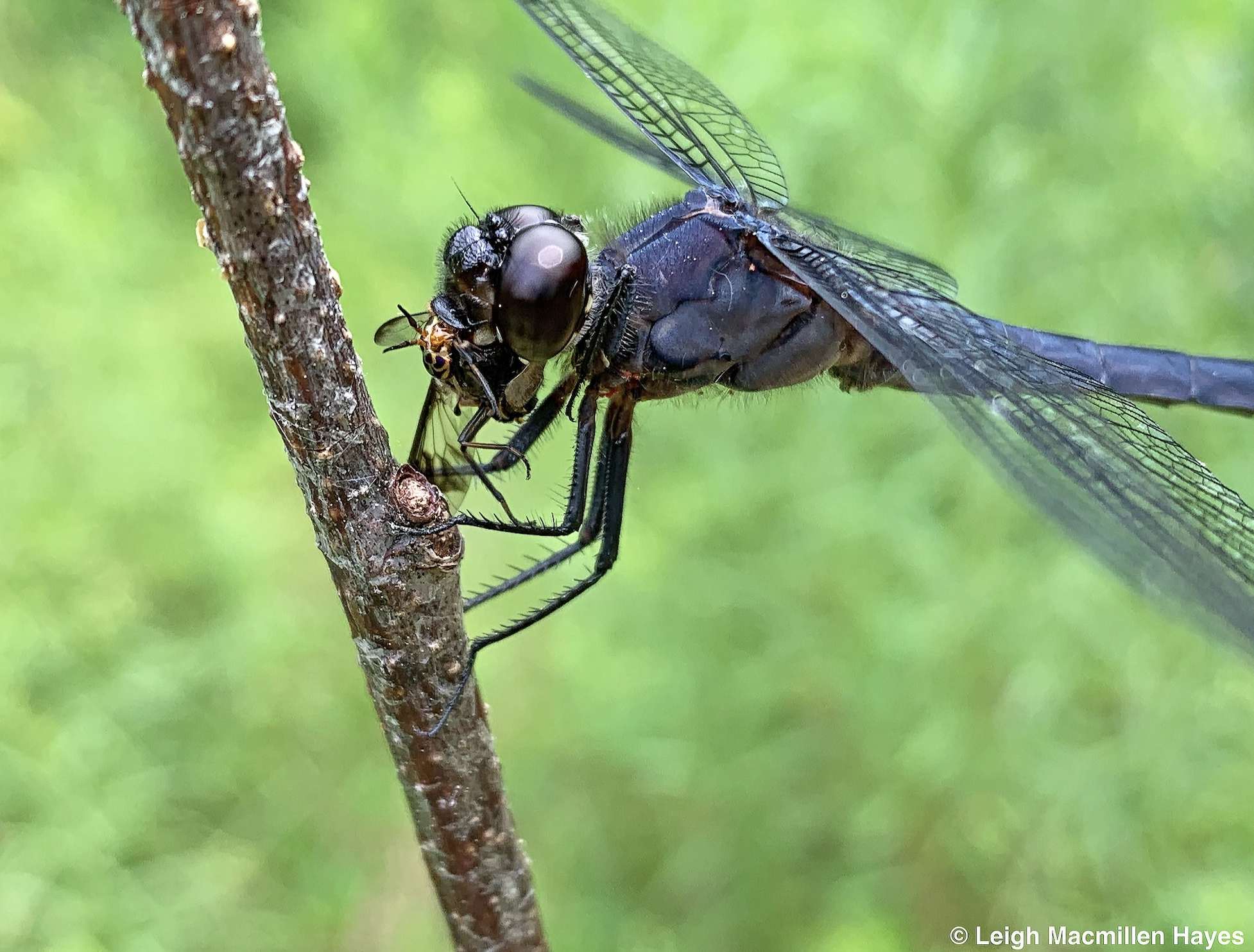
A Slaty Blue Skimmer Dragonfly
Snatched a pesky insect
From my head
And settled upon a stem to dine.
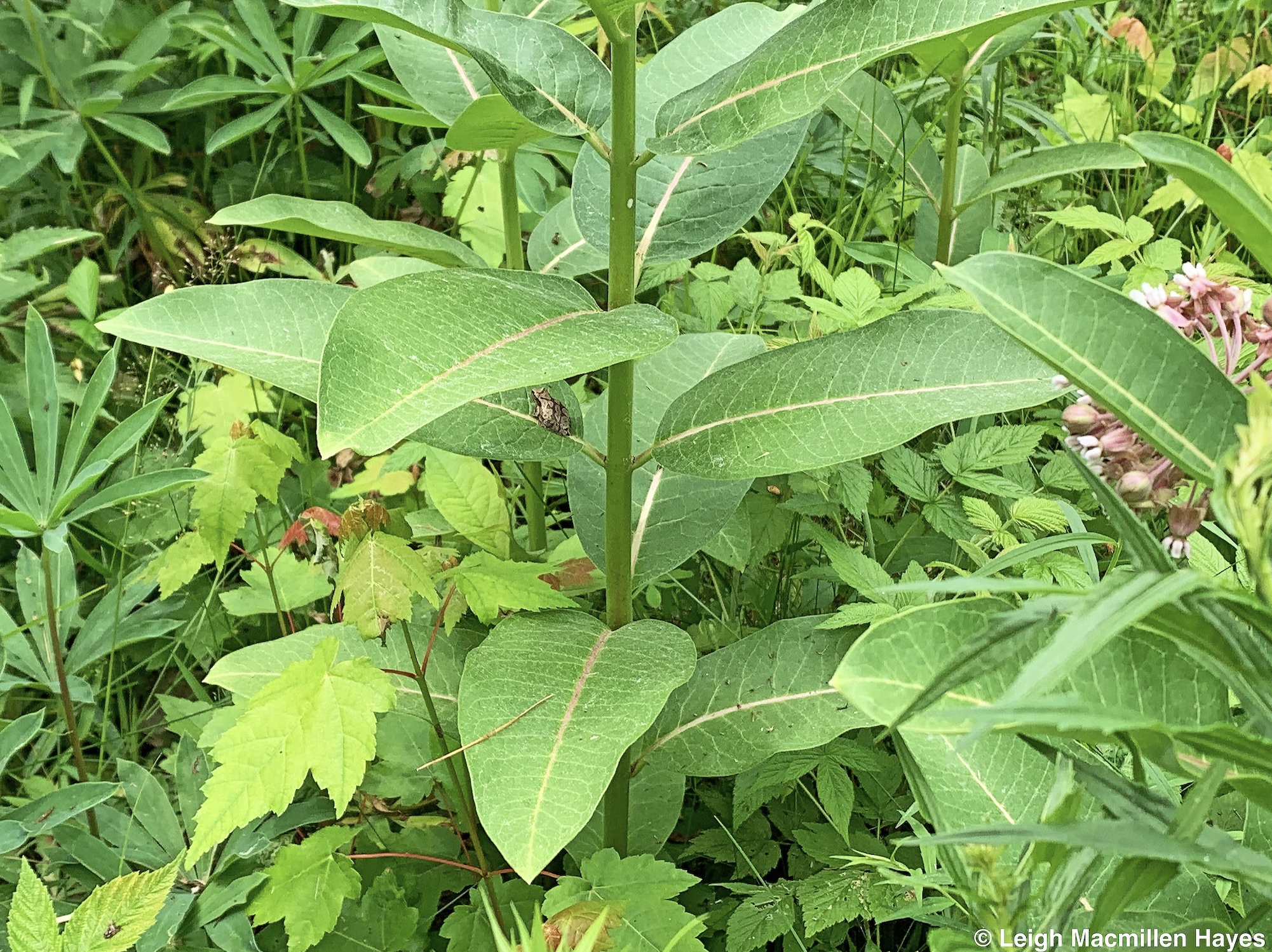
Nearby on a milkweed leaf
I spied something tiny.
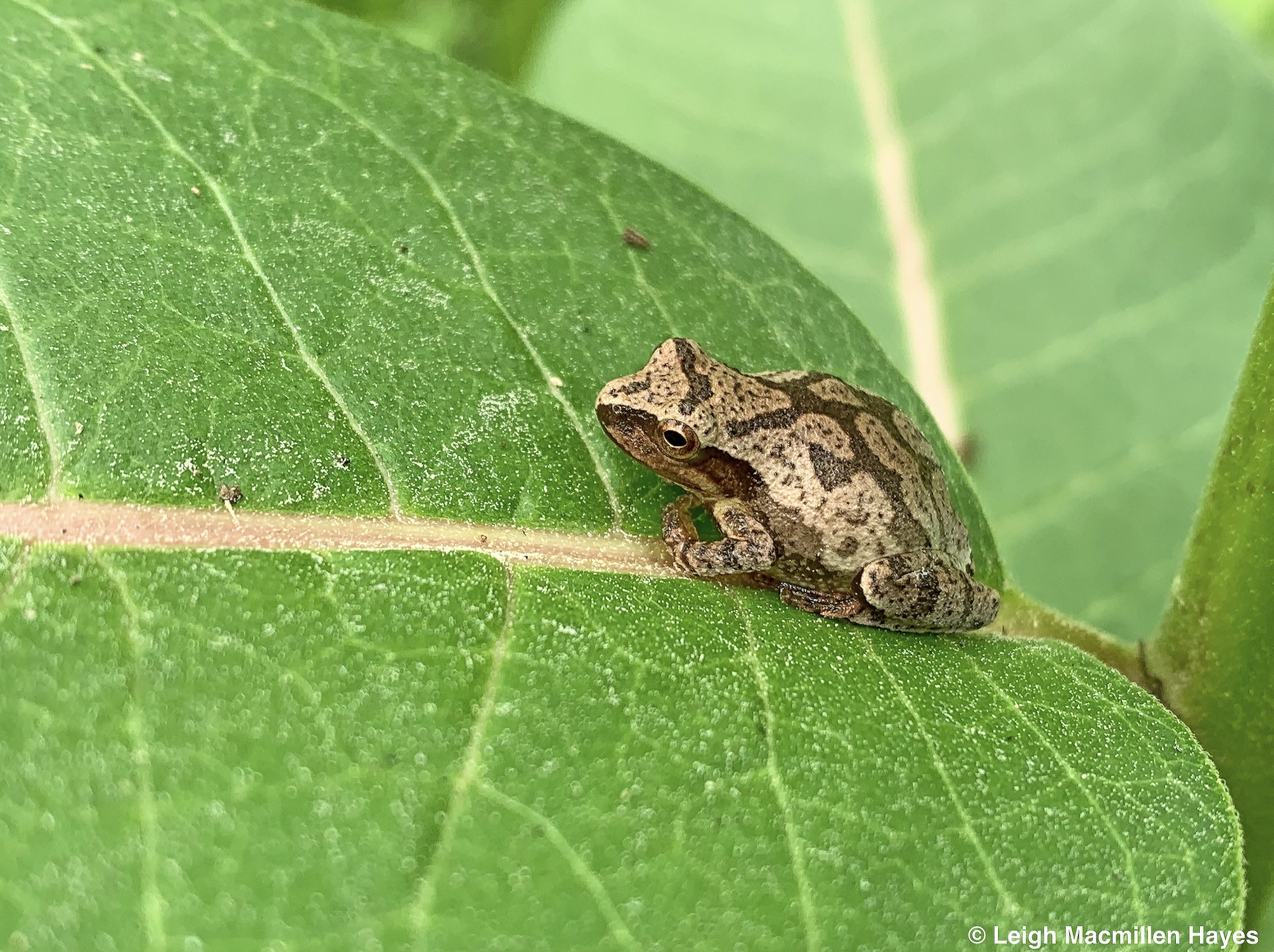
By the X-shaped pattern
On its back,
I knew it was
A Spring Peeper.
Sitting two feet
Above the ground,
This little frog
Hid from predators
During the day
As it waited for dusk
To crawl down
The plant's stem
And munch a meal
Of its choice.
Behind the wee frog
A dash of color
Brightened the background.
Bedecked in orange and black,
This being a Fritillary butterfly,
It flew
Down the path
And out of my vision.
In this same place,
Tiger Swallowtail butterflies
Added their yellow wings
To the tapestry.
Plentiful in number, 
Skimmer dragonflies,
Each with a uniqueness
All its own
From Spangled to
Dot-tailed and Great Blue
Chased down meals
And hunted for mates.
Before departing
I checked
On the nestlings
In the Red Maple trunk,
While their papa
Did the same
From a tree
Ten feet away.
Was he teaching them patience? 
Perhaps.
Sensing our time together
Was waning,
I gave thanks
That it was the Yellow-bellied Sapsuckers
Who drew me to this place.

******

Finally,

"The way to be heard isn't to shout," said the Reverend Sam Wells of St. Martins in the Fields, London. "It's to whisper."

But, I ask you, who are the whisperers?

As you go forth this spring . . .
Listen for the slightest murmur
Of Beaked Hazelnut
Sharing its most
Beautiful, yet minute
Magenta blossoms
That so many never see.
Hear also
The soft words
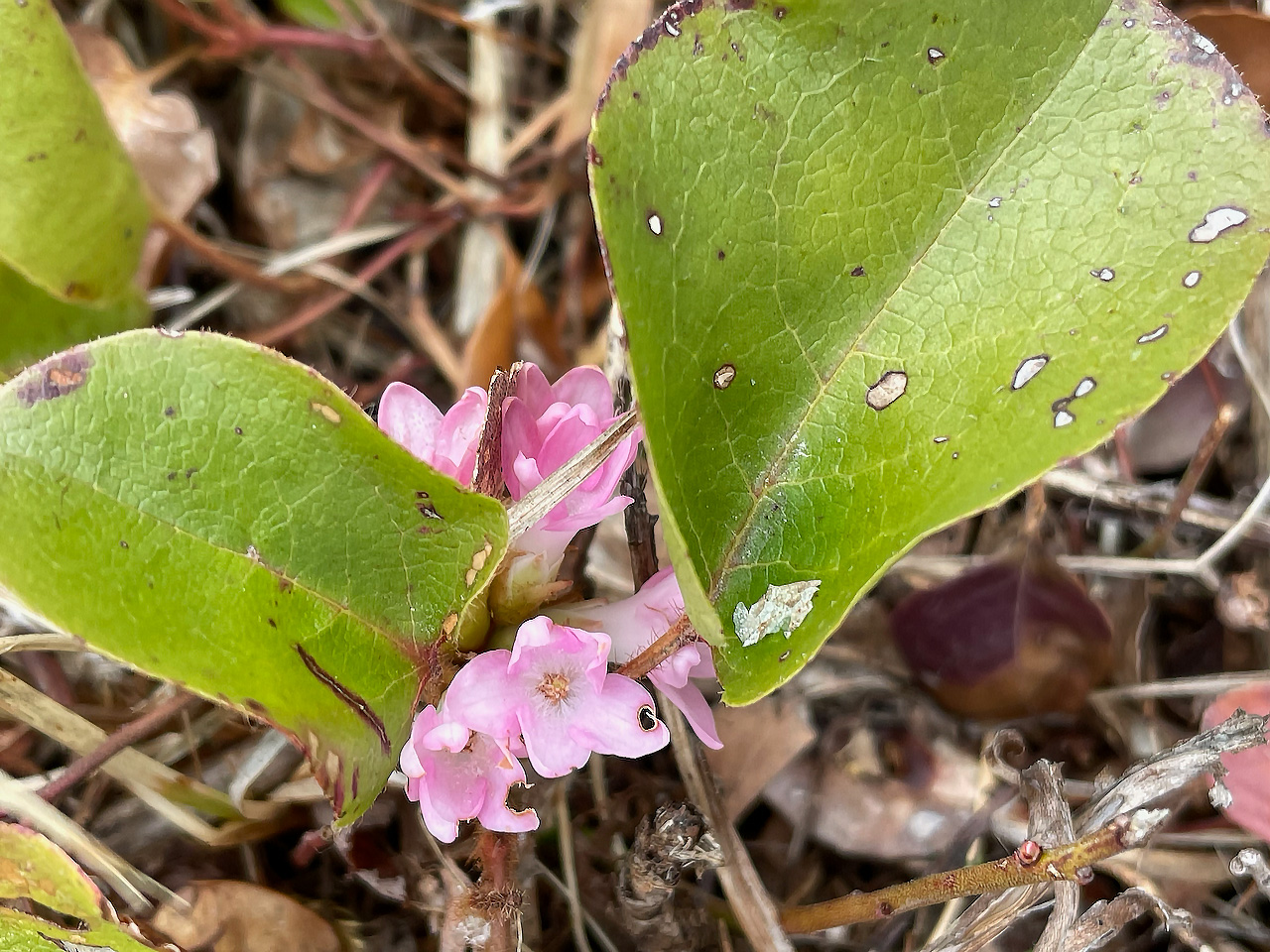
Of Trailing Arbutus
Hiding its delicate flowers
Beneath leathery leaves.
Be attentive to Hobblebush
No matter how much
It makes you stumble,
For it always
Has more to offer
Including corrugated leaves unfurling
And a flowerhead silently forming.
Give audience
To Rhodora's woody seed structure
Of last year
Before her brilliant pink flowers
Soon distract.
Pay attention 
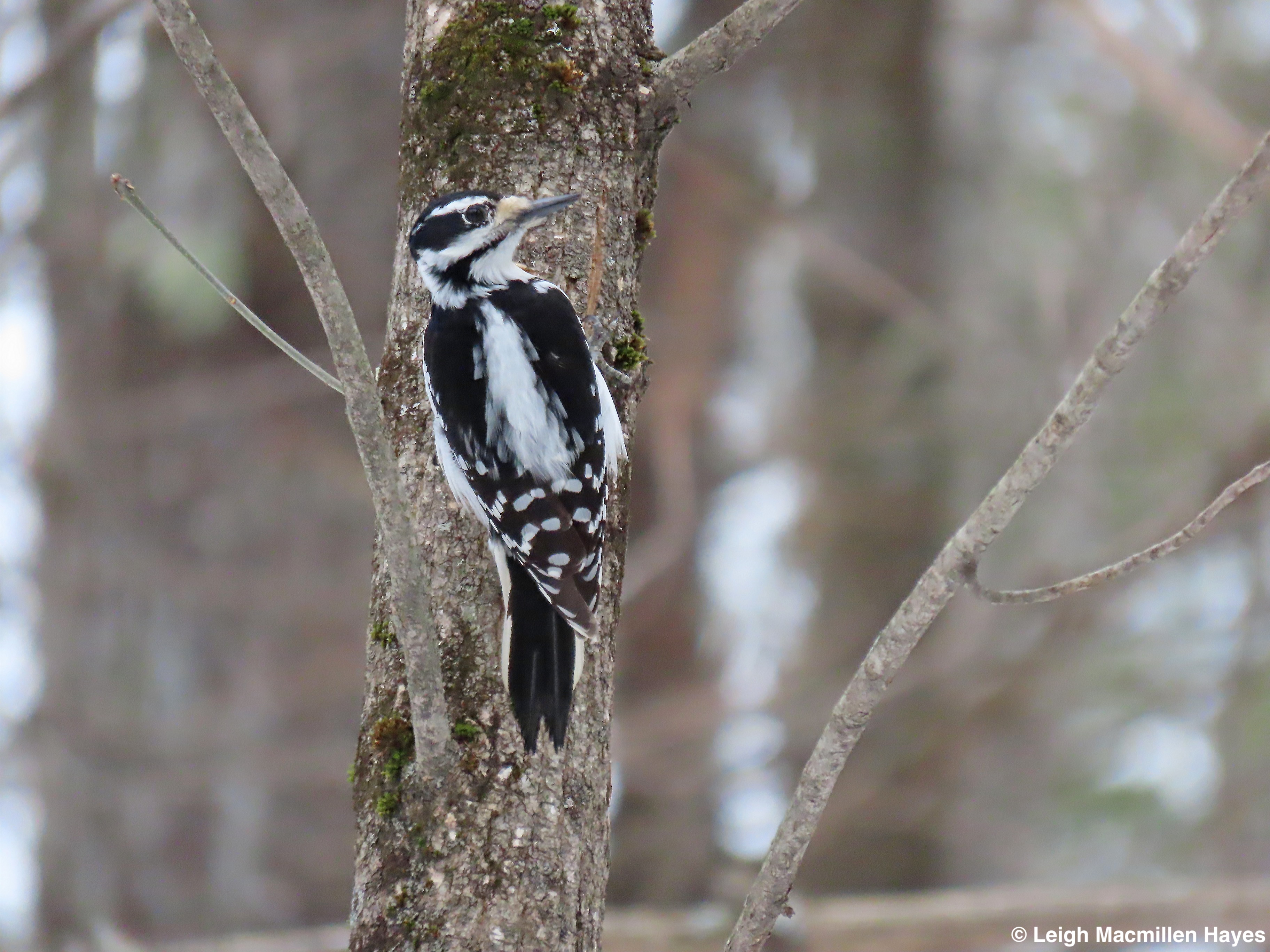
To the male Hairy Woodpecker
Who speaks
In hushed pecks
As two females
Squabble for his attention.
Focus on 
The soft cheers
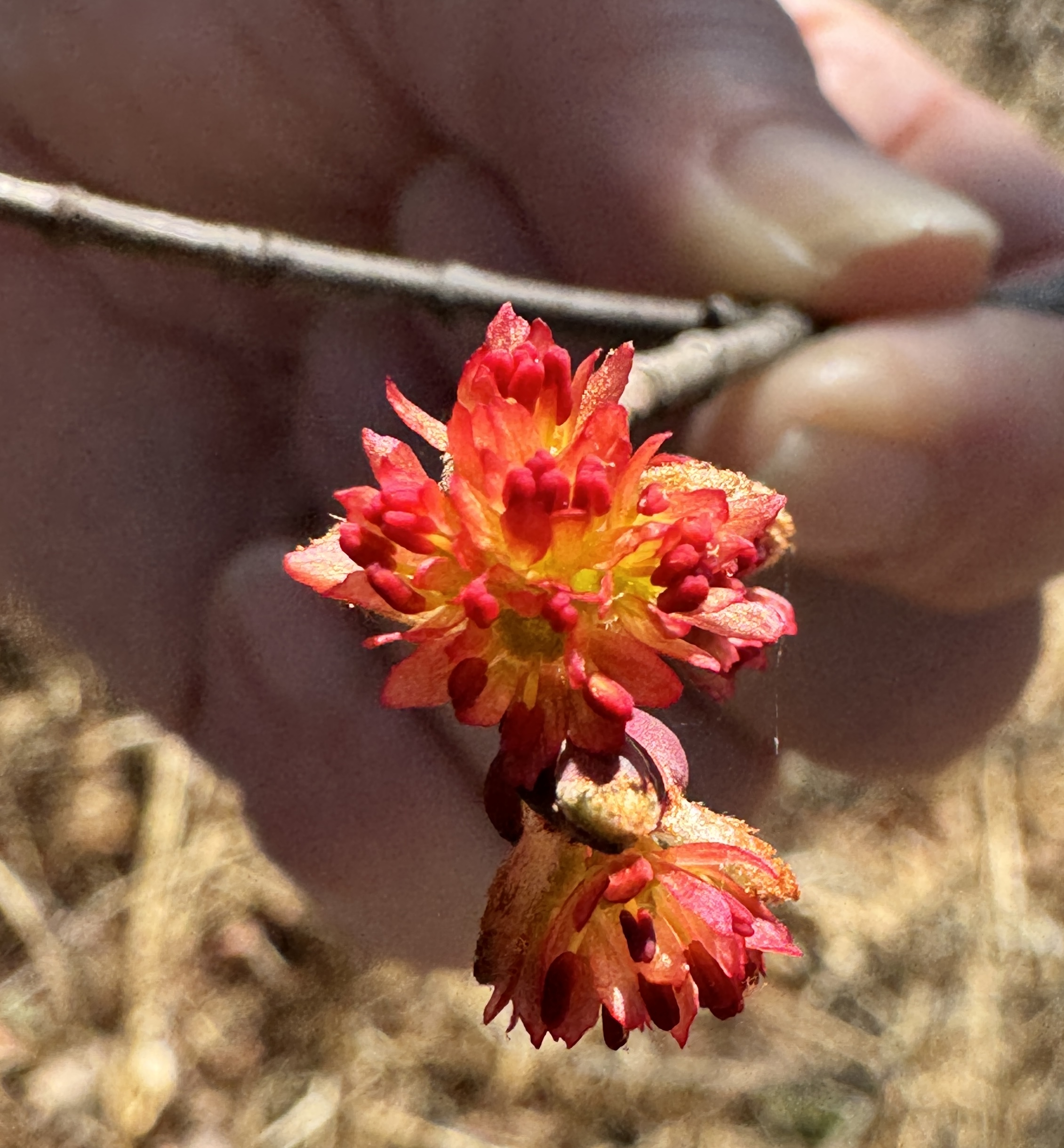
Of Female Red Maple flowers
waiving their pompom stigmas
in hopes of meeting . . .
Male pollen 
Blowing in the wind.
Remember to 
Keep your voice low
As you spy
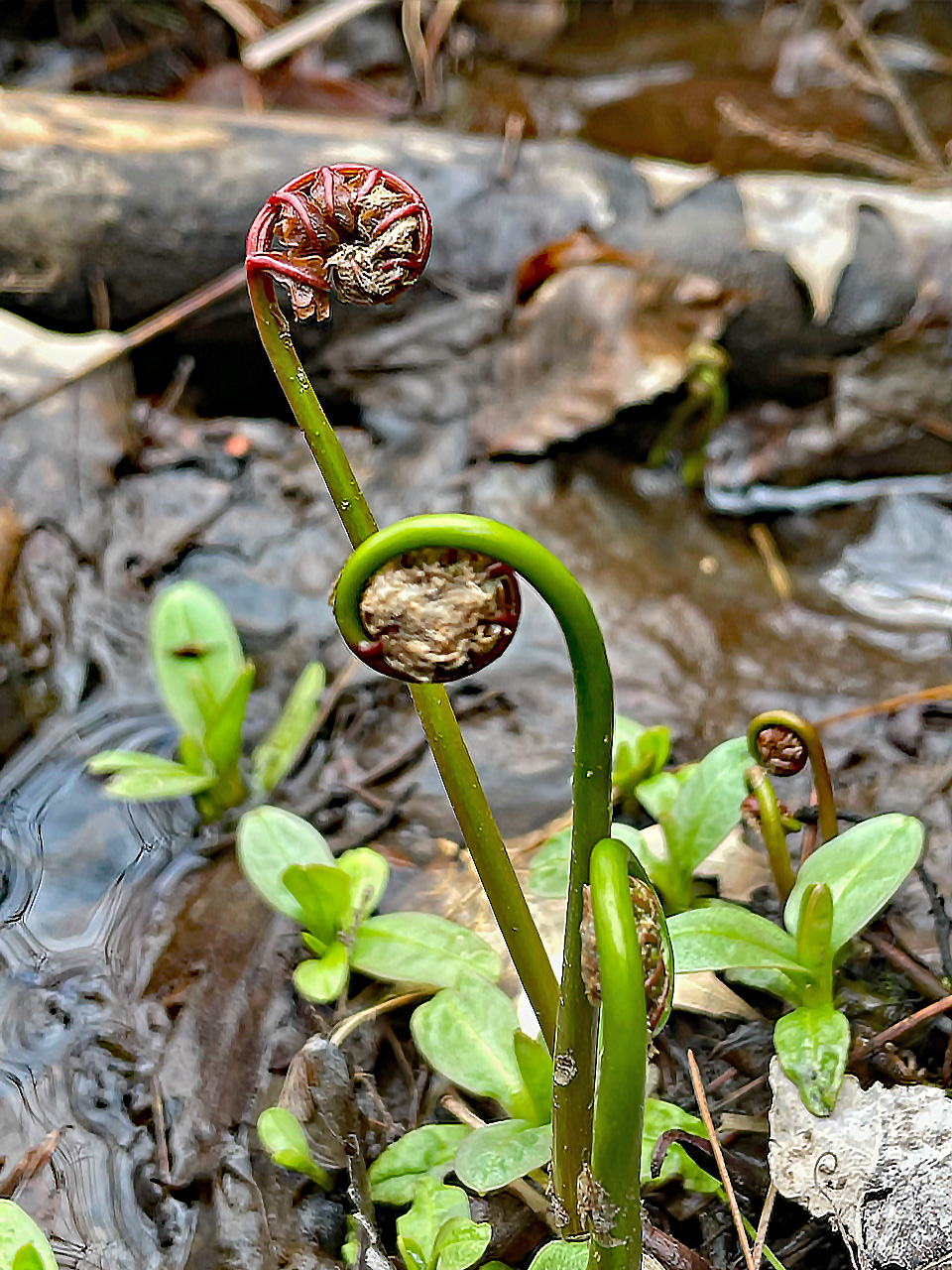
The first crosiers
Of the most Sensitive Ferns.
Heed the inner voice
Of Mystery
And Be Present
With your heart and soul.

I invite you
To walk in silence
Throughout the forest and wetlands
While listening intently
To all
Who whisper along the trail.

******

I’ll end with part of an entry from Creation Justice Ministries’ Seeking Creation: Lent 2025 Devotional.

Referencing Ezekiel 37:21-28, the authors wrote, “God’s goal is not to abandon Creation that God has made. It is to live with us among that Creation. A theology that suggests that God’s good Creation was made solely for us to deplete it and hoard resources from one another ignores the long line of biblical witness that cast a vision of a united humanity where the Creator lives among the creatures, us included.

That God would want to live among Creation should tell us something of Creation’s Worth to God. It is not disposable. It is not replaceable. It is not profane. The dream of a Holy God is to live among Holy people within the holiness of Creation. May it be so.”

And remember: There is no Planet B. This is all we have.

May hushed voices shout from every corner of the Planet AND as those voices uplift your spirits, may you realize God’s greatness and never lose your sense of wonder. ~Amen.

Easter 2025: An Interwoven Weekend Celebration

Hindsight being what it is in offering 20:20 vision, maybe I shouldn’t be surprised at how this weekend played out, but going forth without expectation always offers the best of the best.

The weekend began on Good Friday, when after completing some errands, I wandered along a local trail for far longer than I intended, and in fact, had to pull myself away to get home in time to attend a Taize service at church.

Walking alone gave me time to reflect on the past and be present in the moment.

And that’s when I spotted my first Painted Turtle of the season, who offered a reflection all its own.

I still have some of the man-made Turtles I collected as a kid, but love when the real deal presents itself. And by traveling alone, I wasn’t making much noise, and so the Turtle didn’t suddenly plop into the water and disappear.

Along the same trail I nearly stepped upon another Painted Turtle, who immediately pulled its head into the shell, as only this species can do. It was in a spot where cobblestones cover a culvert, and I decided I should help it cross to the other side.

But first, I insisted that it pause for a selfie. Based on the length of its nails, being on the shorter side, and flat bottom shell (plastron) as opposed to the concave bottom of a male, I decided this was a female.

And a beautiful female at that–in color and pattern and texture. Amazing.

It took her a few seconds to decide the world was still a safe place, but once she started to move, it was a quick journey to the water before she swam out of my life, and I wished her well while giving thanks for our short time together.

Once I cued in on there being turtles in this place, I quickly realized they were everywhere. I counted eight on one semi-submerged log. And in this photo there are two.

Can you locate the second one?

And then I had another surprise, and this was the main reason I probably overstayed my welcome.

At first I thought it was a beaver, until I looked at its thick rounded tail and knew I was in the presence of a Muskrat.

Usually Muskrats disappear in my presence, but I think again, because I was willing to stand still and be as quiet as possible, this one did not dart off.

It did, however, dine in places where I came to appreciate its camouflage coloration.

Other times it was in the open so I could better watch as it munched on vegetation, holding the plant matter with both small front “hands.”

As I finally walked back to my truck, I stopped one last time, to admire the buds of Trailing Arbutus, on the cusp of blooming.

And then on Holy Saturday, My Guy and I returned to the same trail system because when I’d first arrived on Friday I ran into a former colleague who mentioned an adjacent trail and I wanted to explore it.

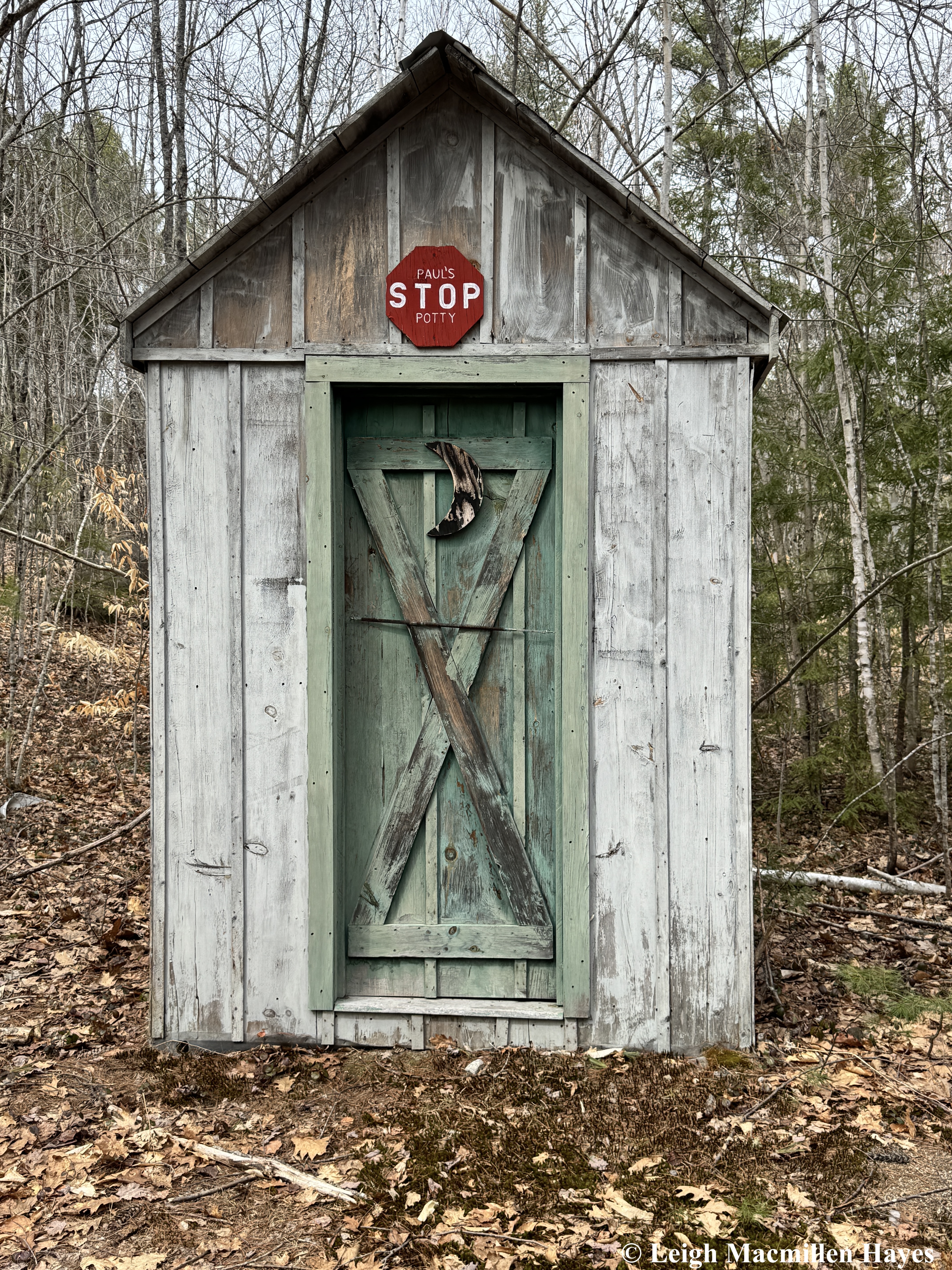
It’s actually part of the snowmobile system, and if you know where this privy is located, then you know where we were. Together we covered a lot of ground (as in 9 miles) and got a better understanding of the area and local ponds and wetlands near the privy.

But even better than that– (remember yesterday’s buds ready to burst?) another first for the season that again seemed apropos for the weekend: the first blossoms of Trailing Arbutus. So sweet and tender and fragrant.

Maybe instead of being known commonly as a Mayflower, this year it should be an Easter Flower.

On Easter, we had a late start for adventure and actually, we chose Plan B for our hiking destination because of the time–since we’d attended church in the morning and then dined at a local restaurant with three generations of our family, minus our two sons, their gals, and a nephew and his gal.

At the summit we did what we always do and waved to some friends who have a summer place on the pond before our eyes. And expressed our sorrow that they won’t be heading north this year. We can only hope that future plans include a return trip.

The wind was wild and brisk, but we took time to also admire the beauty of another pond and Sebago Lake in the distance and shouted, “Happy Easter, Alleluia!”

Eventually, we had to backtrack along another trail upon which we’d started our hike, and though we love loops, I also like it when we follow the same trail back because sometimes you see different things you missed.

Such was the case.

It had been a few years since we’d followed this trail named for a local brook, but it wasn’t until the return trip that I spotted this Scouring Rush. Again, it’s a case of structure and form and color and design and texture. The stem reminds me of an accordion and the top a cone. Or even Cancer Root. Just wow!

And then today found us exploring yesterday’s intended Plan A, where we circled a river for about 2 miles, enjoying the sounds as the water flowed and splashed and sounded so life giving–as it should because it is.

Our chosen spot for today’s lunch was upon steps after we crossed the river to head to a connector trail.

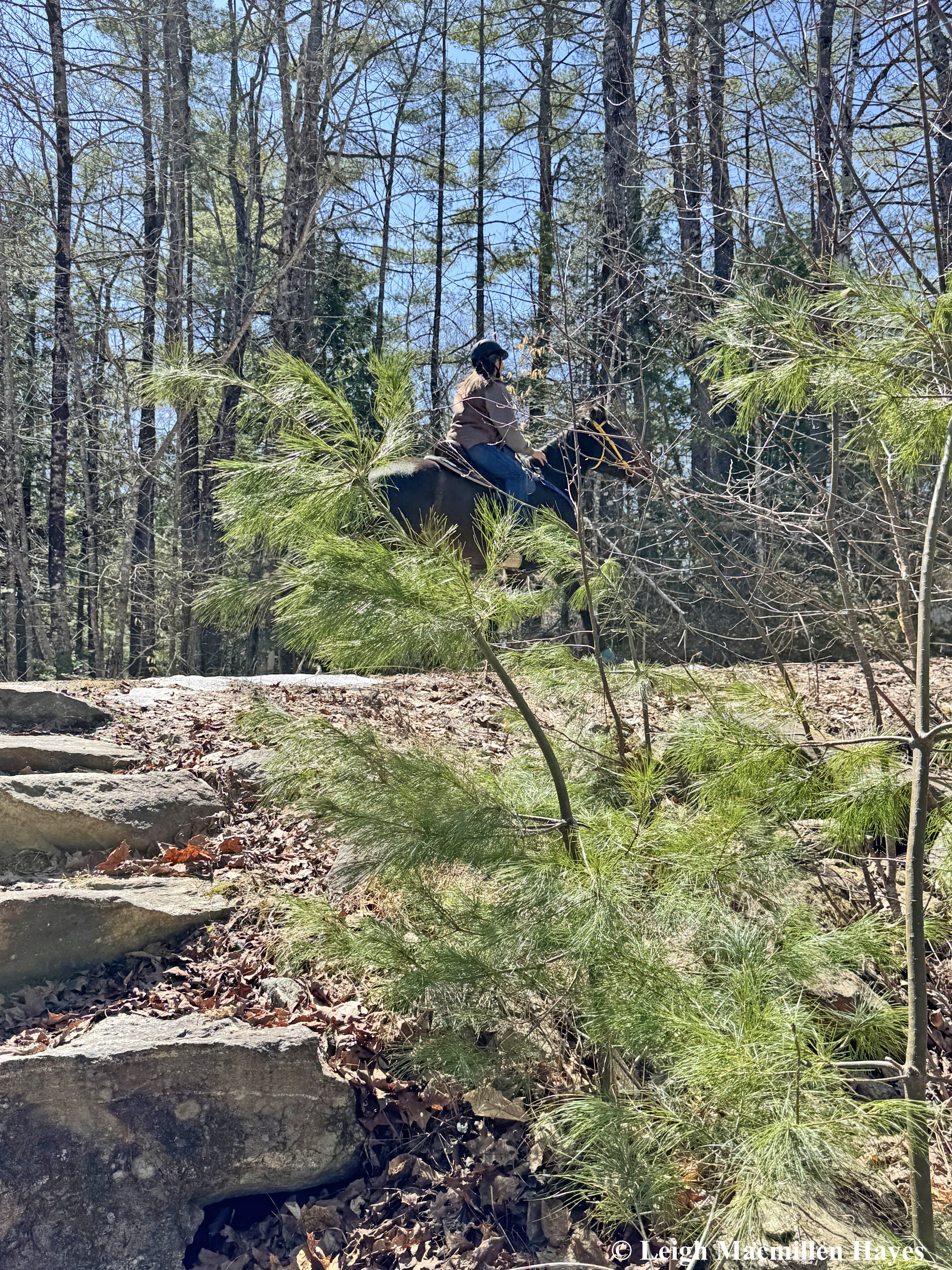
And it was there that we had a most pleasant surprise: a woman rode past on horseback. I only wish I’d been quicker to snap the photo.

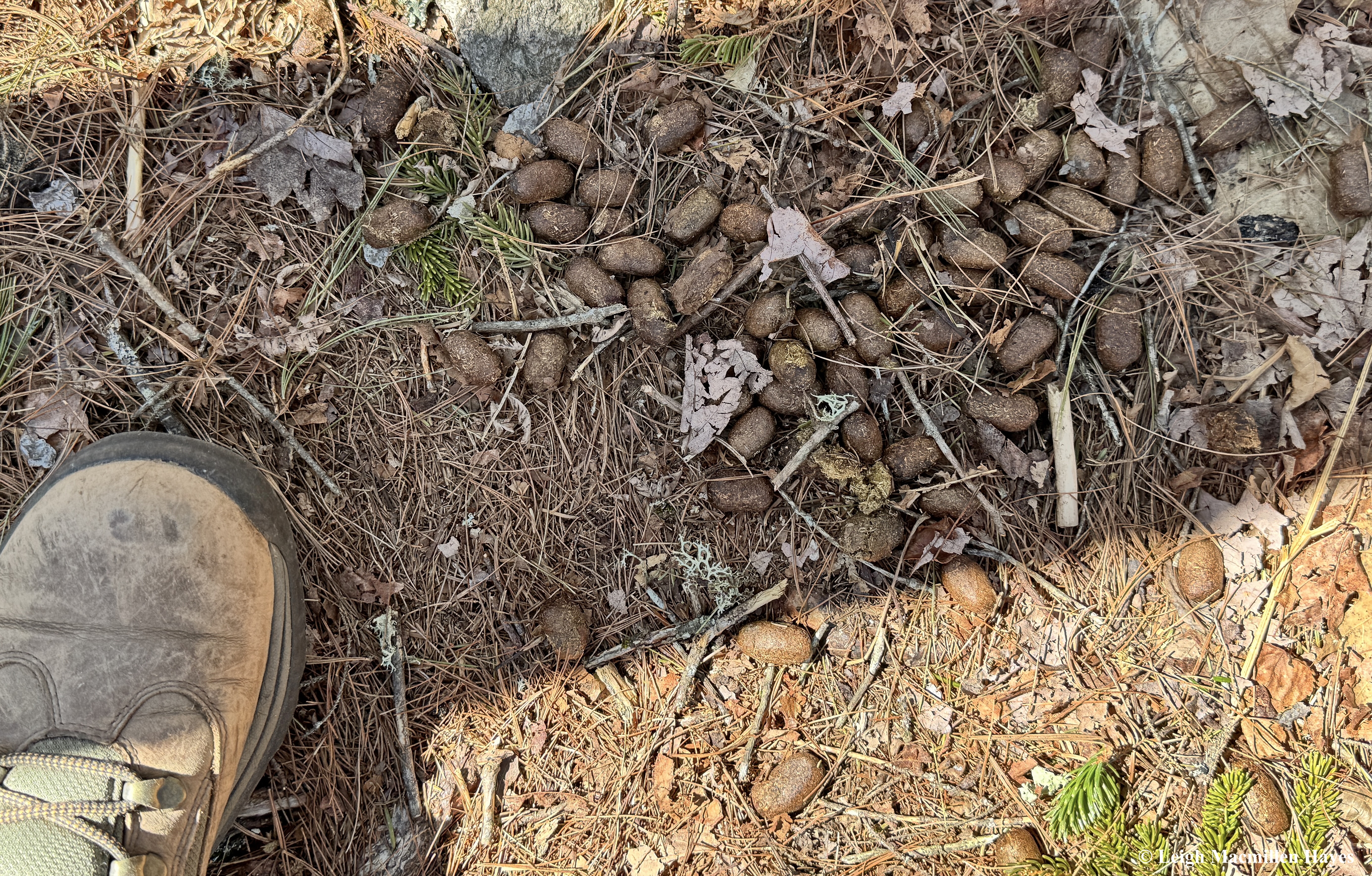
Our other surprise in this spot was the knowledge that this past winter a Ruffed Grouse had roosted overnight right here based on the pile of scat it left behind–which is its habit.

My Guy sat upon the rock above and I cautioned him about setting down his water bottle or sandwich.

And in a super sunny spot nearby, the first False Hellebore leaves of the season, at least for me, showed off their bright green and pleated presentation.

After crossing the connector trail we reached a pond with the mountain of our destination serving as the backdrop. I love it that often, even if there is a breeze, and slight it was today, this pond offers the most glorious reflection.

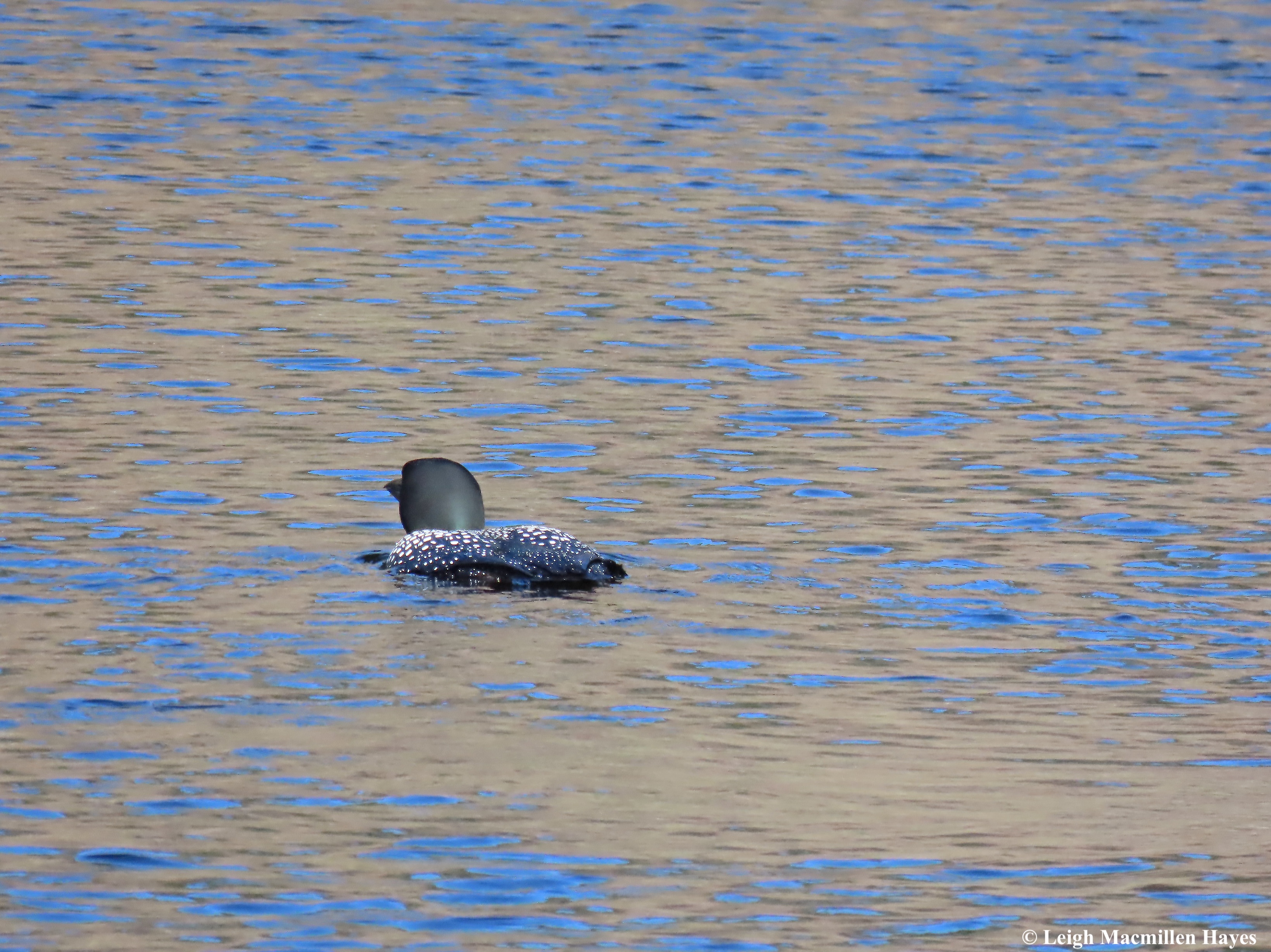
While we paused, we spotted two people fishing, but also another who had the same finned meal in mind, a Common Loon. We didn’t see another, and if memory serves me right, it’s rare that we’ve seen a pair on this pond.

I can only hope memory doesn’t serve me right this time.

Within the shallow depths there were also huge Bullfrog tadpoles and teeny tiny minnows. And probably so much more, but I didn’t look any closer.

Another fun find reminded us that we will return to these trails in another month for the Lady’s Slippers that call to My Guy will make their usual request for a count.

Finding the capsule is so rare considering that there are hundreds of Lady’s Slippers that bloom just along the trail, yet we only spotted two of these structures, which would have contained thousands of dust-like seeds that dispersed through the split sides.

Similar in shape to the capsule, but of a completely different origin, we found two piles of Moose scat–deposited possibly two winters ago based on its formation and the dried leaves and other debris that had landed upon it.

As we continued along the trail beside the pond before climbing up, we knew to look to the ledges for a rare sighting. It’s up there, but you may not see it until I share the next photo with you.

Do you see the cross? How apropos for Easter Monday.

The question remains for us: How did it get there? Or is it a natural formation? We know that we would not have the heart to climb down to that spot and install it, but perhaps others did.

Actually, we don’t want to know how it got there. It’s enough for us that it is. And persists.

And even more important today, the fact that we didn’t get here on Easter, but instead hiked this way on Easter Monday, the day Pope Francis died, one who cared about those marginalized and the Earth. All of Creation matters.

Our time at the summit of the mountain was brief because we needed to get home for My Guy had another event. But it’s never lost on us that the shape of the main basin of the pond is a heart.

Back at the truck, we celebrated the weekend with a treat from Fly Away Farm.

And gave thanks for how all that we saw and heard and experienced this weekend seemed to be interwoven into a beautiful Easter tapestry.

Happy Easter 2025!

Vernal Pool 1: Oh Baby(ies)

Once the snow and ice began to melt, I started making almost daily visits to “My” vernal pool, located about a quarter of a mile from our house, and only a hop, skip, and jump, well maybe a few hops, skips, and jumps, from the cowpath, and more importantly, on neighbors’ property.

I met the neighbors for the first time last November when I spotted them walking their dog through their woods as I looked for any insects on trees. They were breaking branches to create a sorta trail, and I encouraged them to walk the cowpath instead because it’s flat and I try to keep it cleared of downed branches.

It was upon our second encounter when they did actually use the cowpath (and have done so regularly since though our paths haven’t crossed in months) that I asked them if they knew about the vernal pool. They did not. The dog was a rescue and they’d only had her for a few months and she was the reason they were out walking in the woods.

Being my blunt self, I did ask that they not bring their dog to the vernal pool in the spring and explained about the Wood Frogs and Spotted Salamanders who use it as a breeding pond. Yeegads. But they didn’t take it to be rude, and instead told me that they think they have another vernal pool elsewhere on their land, closer to their house. Then they invited me to walk in their woods and explore anytime. Um, I thanked them and admitted that I’ve been doing that for years; I just don’t go close to the house.

At last, about two weeks ago, the ice went out. But . . . there was no action. It was cold and seemed to snow every other day and the ground was still frozen and the breeders just weren’t ready. I waited.

Finally, on Sunday, April 13, 2025, we had some rain, and our local Big Night celebration was announced via text and email messages. Big Night is that night(s) when it’s been raining in the afternoon and evening and the roads are wet, and volunteers head out to locations close to home to help amphibians cross the road without getting smooshed. Or help most of them.

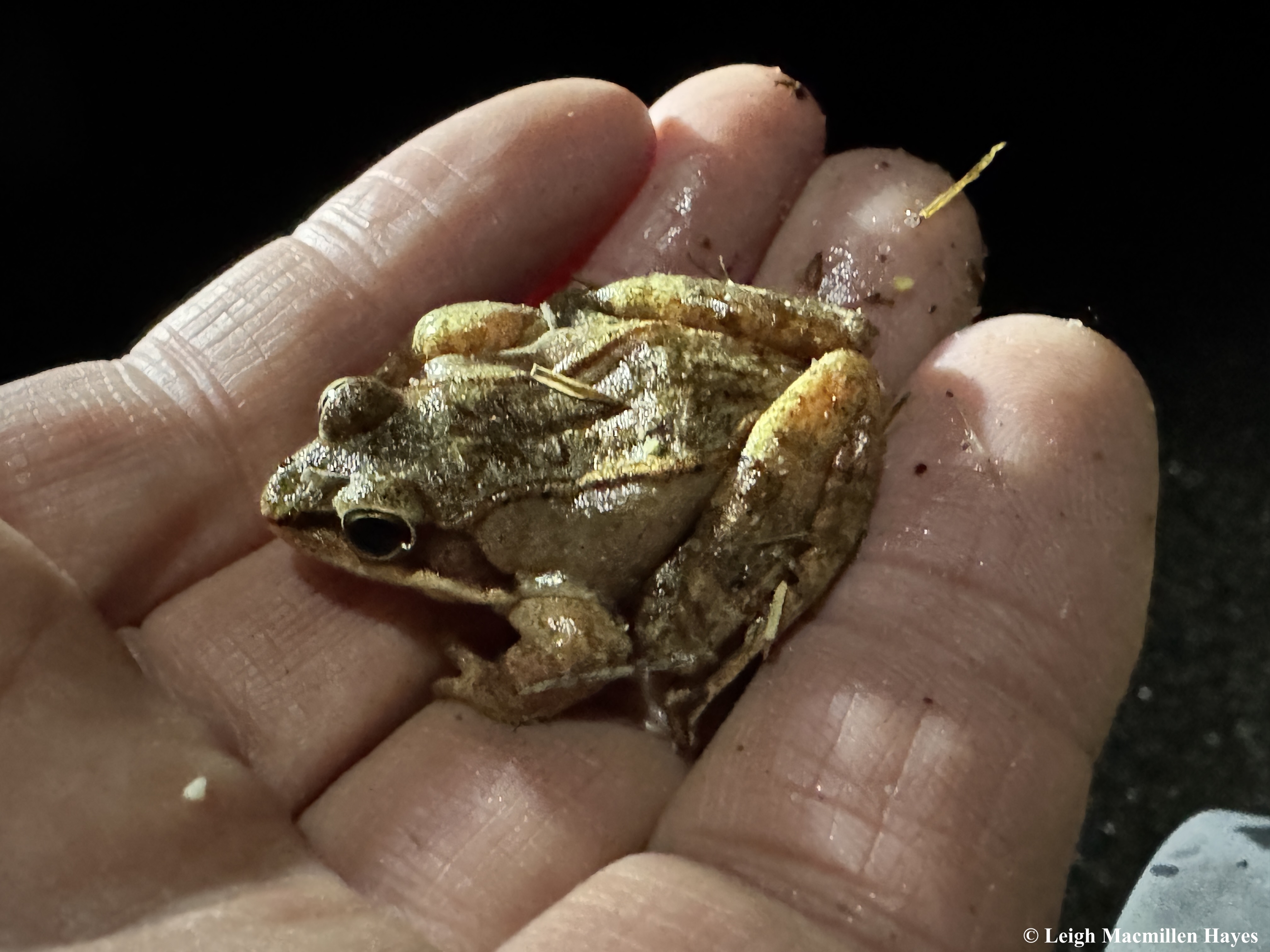
We didn’t hear any Wood Frogs or Spring Peepers as we approached the pool of our attention that night (not “My” vernal pool, which is thankfully not near a road), so we weren’t sure if we’d see any action. And others south and east of us had been posting for a week that they’d only found one or two frogs during any given rain event. Still, we went. And were glad we did because we helped a total of 158 Wood Frogs (including the one pictured above) and Peepers that night. There were still a few smooshed, but as always, we reminded ourselves that they become food for other critters.

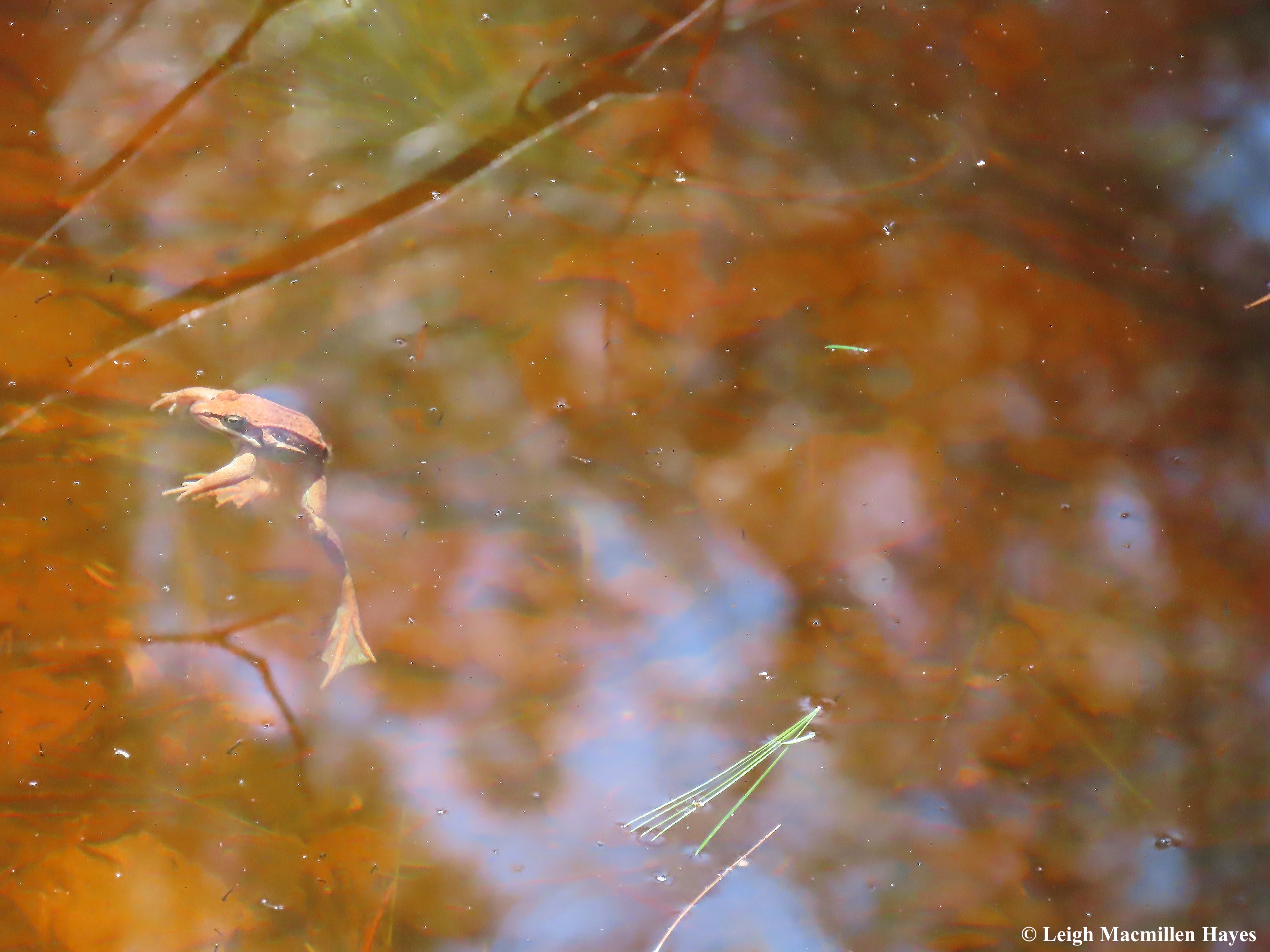
Given that success, the next afternoon I visited “My” pool and heard not a peep upon my approach. But I did what I do, and stood as still as possible upon a rock at the edge, and within a few minutes this male Wood Frog surfaced.

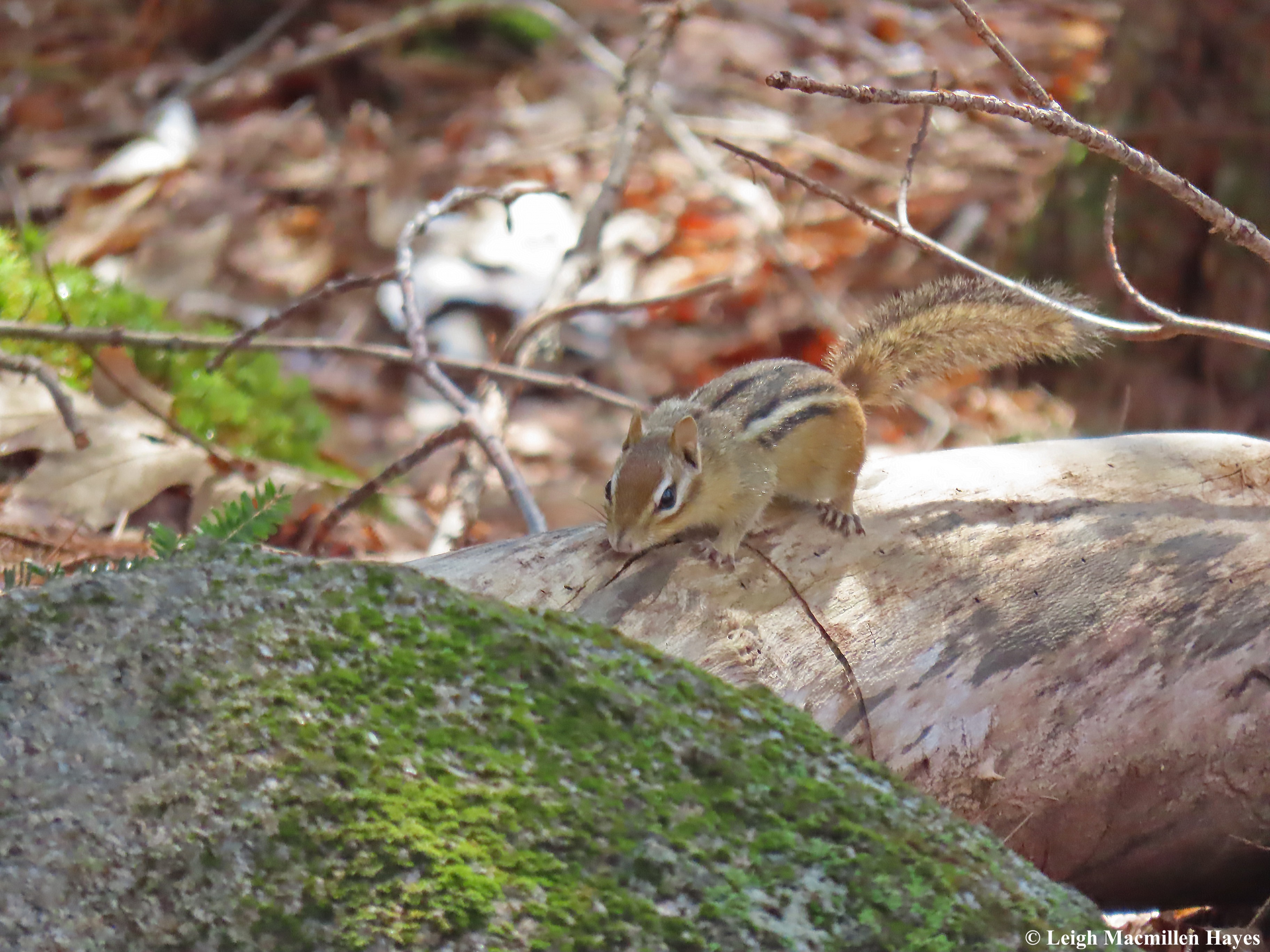
And I decided that this year I am going to try to be more present at the pool and try to get to know all who venture in and around it, including Chippy, on an eternal search for seeds to stuff into his cheeks.

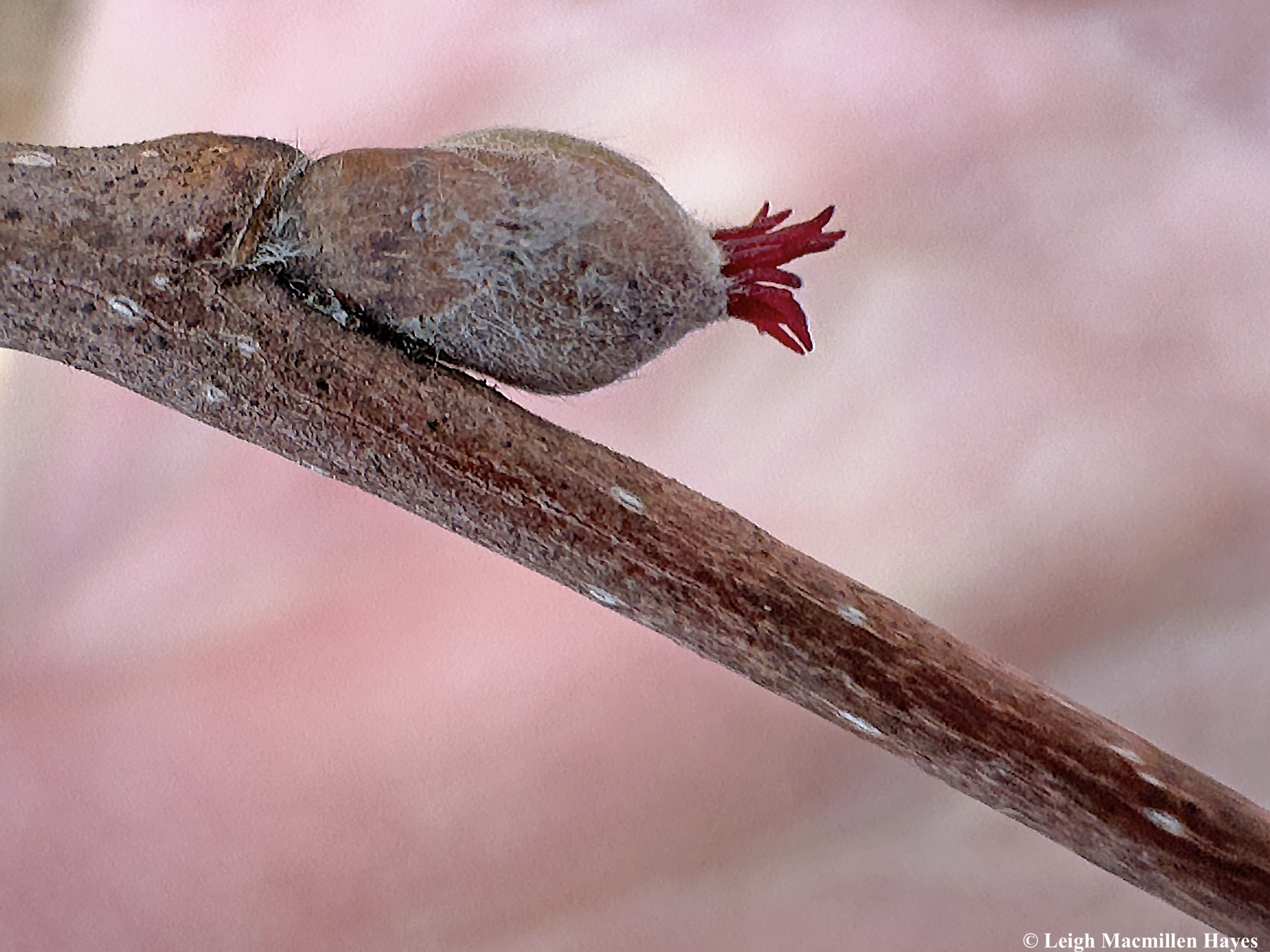
Mid-morning Tuesday found me making my way to the pool again and this time, I could hear the “Wruck, Wruck” calls of the male Wood Frogs as I approached. Spring has finally sprung. Oh, and the crocuses have finally bloomed. Beaked Hazelnuts with their tiny yet exquisite magenta flowers as well.

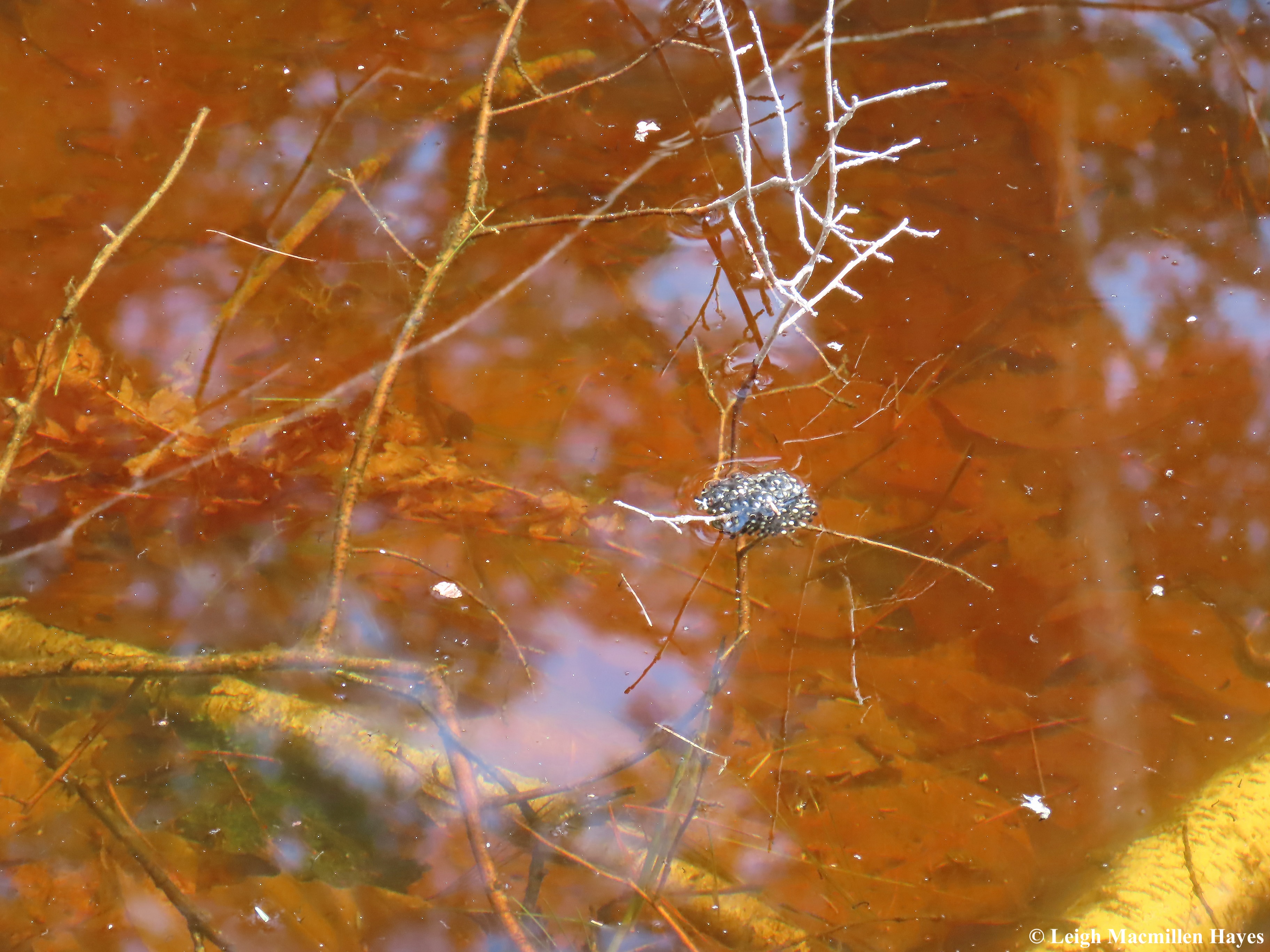
And then, my first peek into the pool, and there it was, a Wood Frog egg mass about the size of a wiffle ball and I wondered if it had been there on Monday and I just hadn’t seen it.

As always, I stood still, and as always, it took the frogs a few minutes to surface, but suddenly they were everywhere, and probably wishing, if frogs can do such a thing, that I would leave so they could begin their mating chorus again.

But I stayed. And wondered. Why is it that a Gray Squirrel, like the Chipmunk, can scamper about and rustle the leaves and make all kinds of noise and the frogs continue to float upon the surface, but the minute I flinch, they dive to the bottom and hide under leaves for minutes on end?

I did decide to change positions after a bit of enjoying the sight of so many frogs, because I wanted to see if there were any egg masses at the western end of the pool, but discovered none.

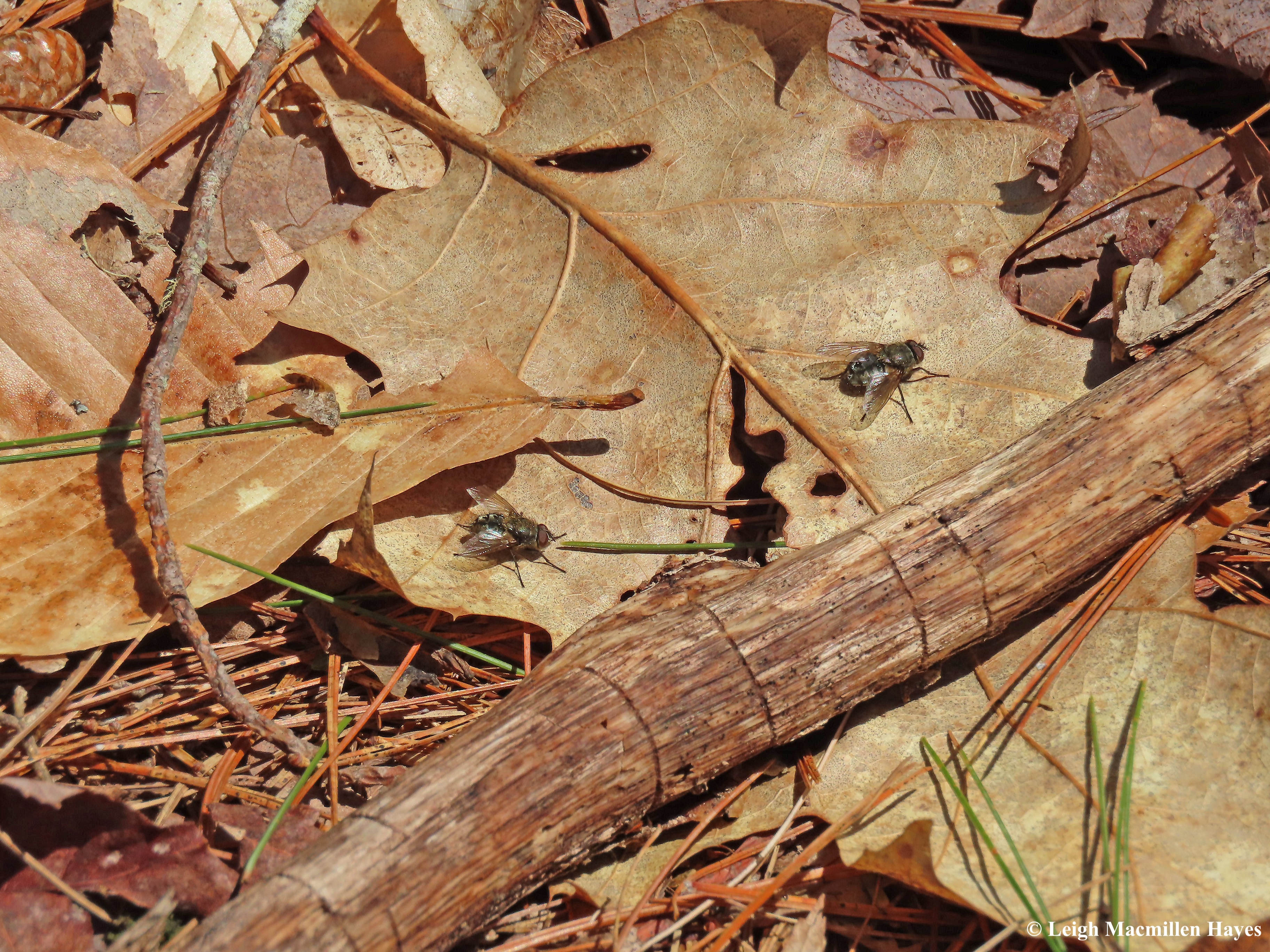
I did spy a bunch of Cluster Flies by the edge of the water.

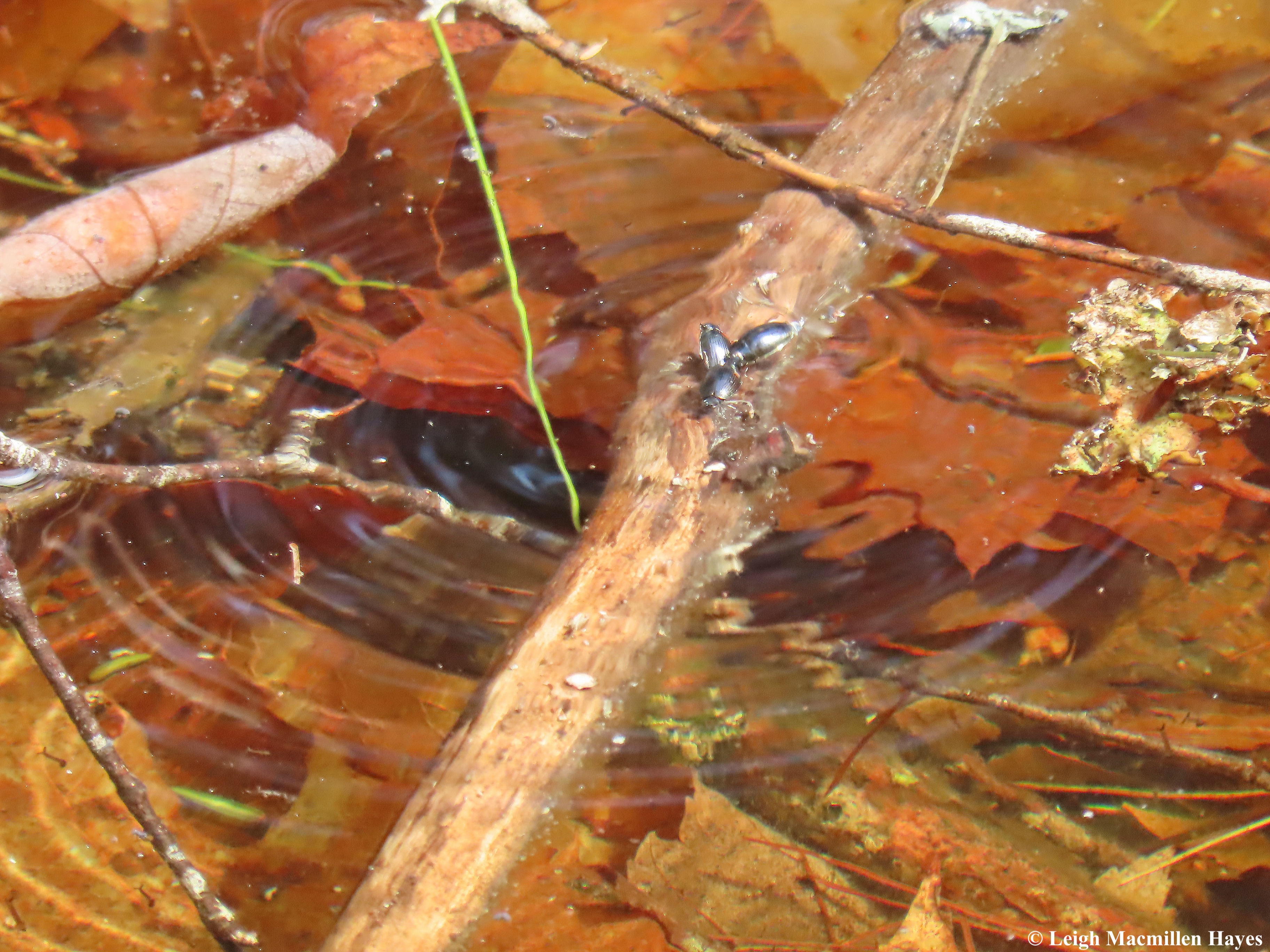
And in the water, I watched Mosquitoes larvae wiggle about and a Predaceous Diving Beetle lift its butt to the surface to fill the air bubble located under its wings or elytra.

And then the Beetle surprised me and after swimming under the small log, it climbed onto it and gave me a whole different perspective for I never think about them as fliers, but they have strong wings and can do such, especially if the pool they are in dries up and they need to get to another pool. Apparently they are also attracted to lights, another reason not to keep outdoor lights on all night.

My morning visit came to an end when the frog nearest to me dove down and hid under the leaf cover. Well, sorta hid. Do you see it?

I was so taken with the pool, that I returned again in the afternoon. And this time I spotted something I’d missed in the morning. A more recently deposited egg mass. I suspect it had been there for at least a few hours because it was already bigger than a quarter, which is the size they are at first.

During this visit, I also spotted Whirligig Beetles gyrating around each other in breakneck speed, creating ripples everywhere.

And male Wood Frogs ever on the look out for a date.

In fact, so anxious were they that sometimes one male tried to grasp another, but the one underneath quickly squealed and swam away.

Then I spotted another old friend or its relative and wondered if the Long-jawed Orb Weaver that had created a perfect web between branches over the water was one that I’d photographed on the snow this past winter. Probably not. But a woman can dream.

Later in the afternoon on Tuesday it began to rain and while the storm didn’t last too long, it was enough to wet the roads and again the word went out for Big Night #2. This time there were a few Spotted Salamanders on the move as well.

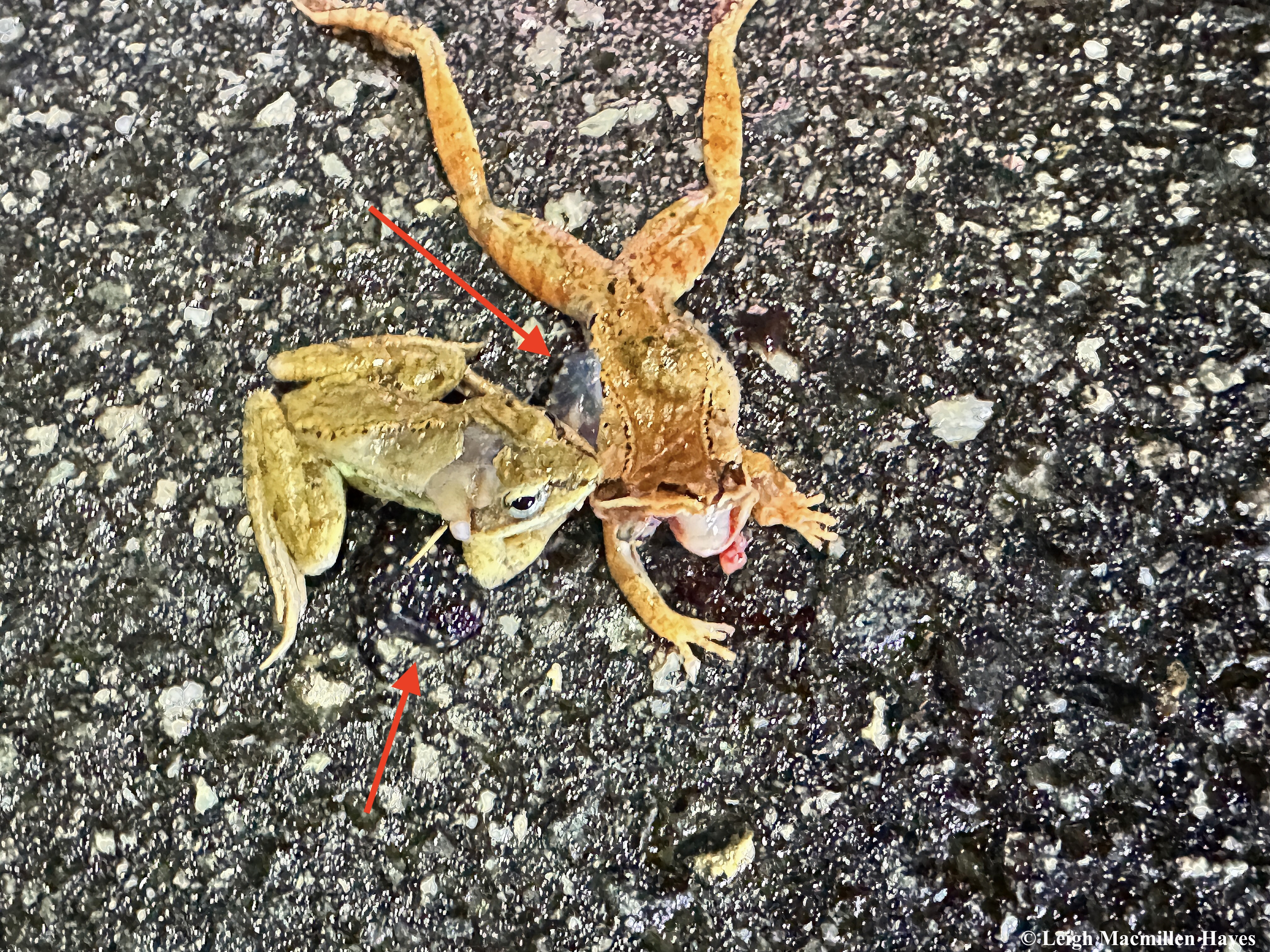
The next photo may disturb you, so you may want to skip over it.

I included this picture of two squished female Wood Frogs because this is what happens when we drive by vernal pools and other wetlands on rainy nights. And I added the arrows to show the egg sacs that had popped out as the tires drove over these ladies.

We let out a communal groan as we heard the pop, and then made this discovery, trying to ease the moment by reminding ourselves that they would become food for others, but still . . . reinforcing the reason why we’ve been celebrating Big Night(s) on this local road for at least 25 years of organized events and I suspect many more before that.

All told for saves on Tuesday night: 836 live Wood Frogs, Spring Peepers, Spotted Salamanders, plus at least one Green Frog and one Eastern Newt.

That was a BIG night! And many thanks to Dawn and Maggie for organizing it.

And from the sound of the “Wrucks” on Wednesday, which was louder than the day before, I knew the ladies had returned to “My” pool as well. And the guys were feeling successful.

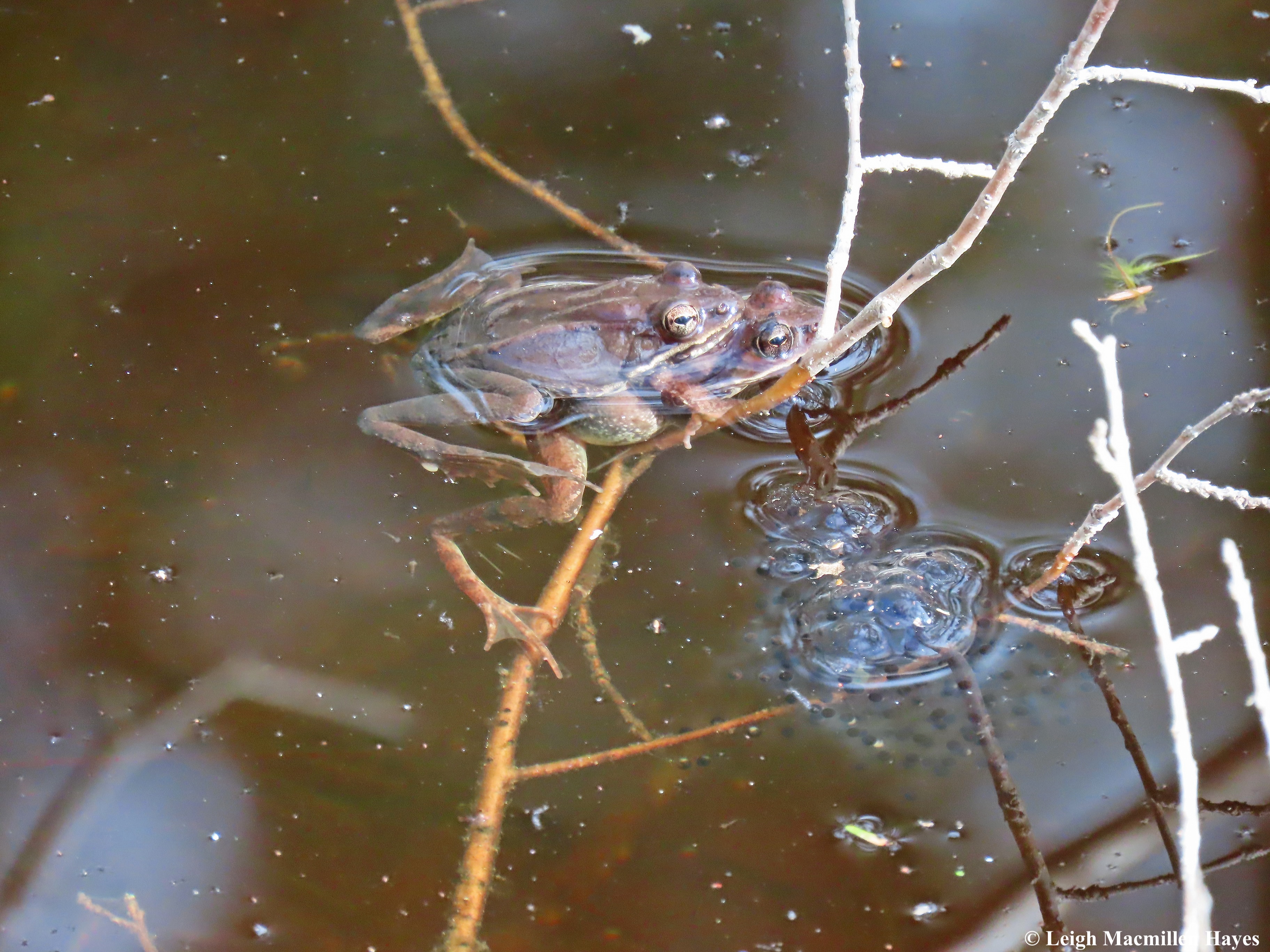
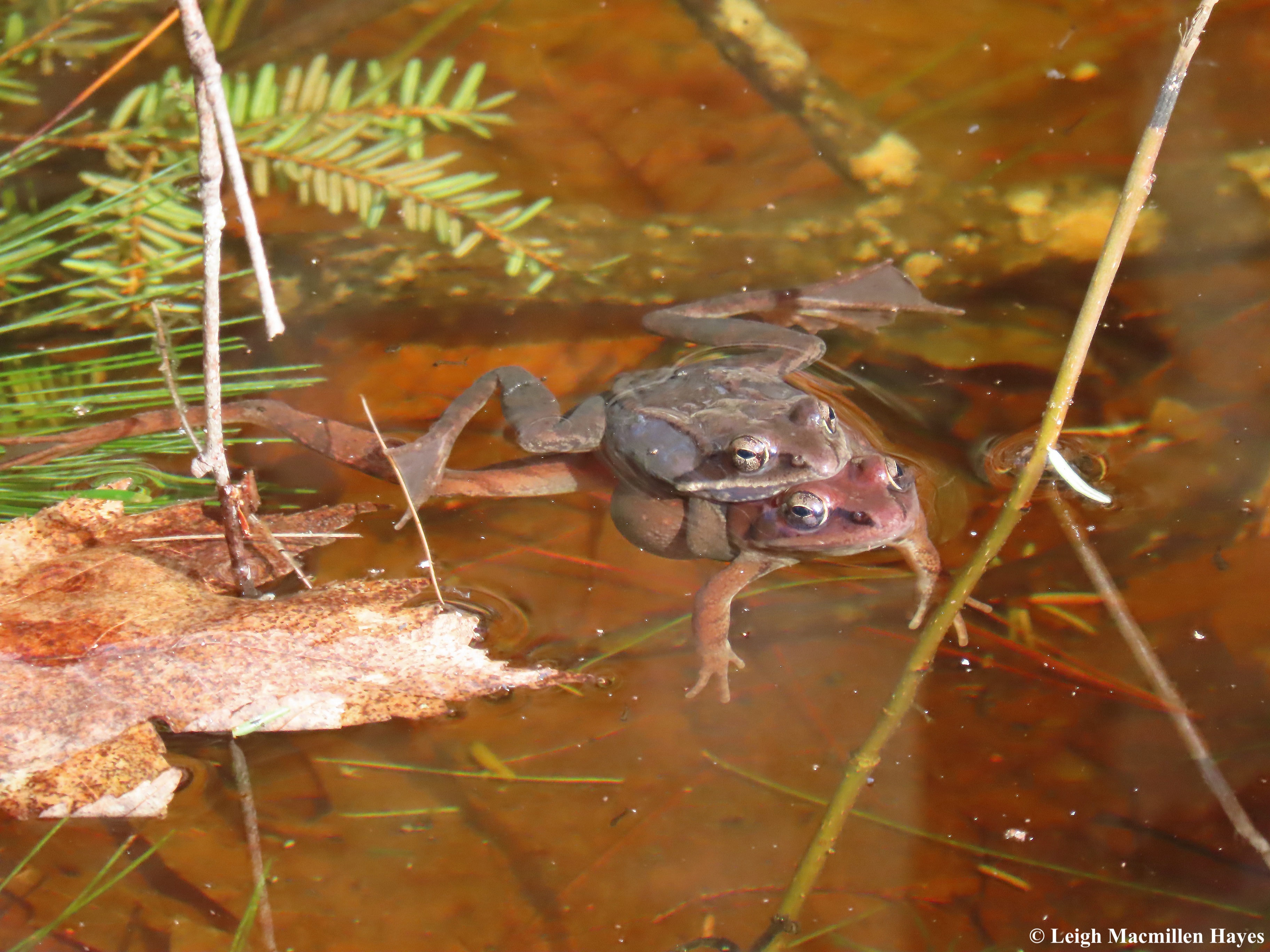
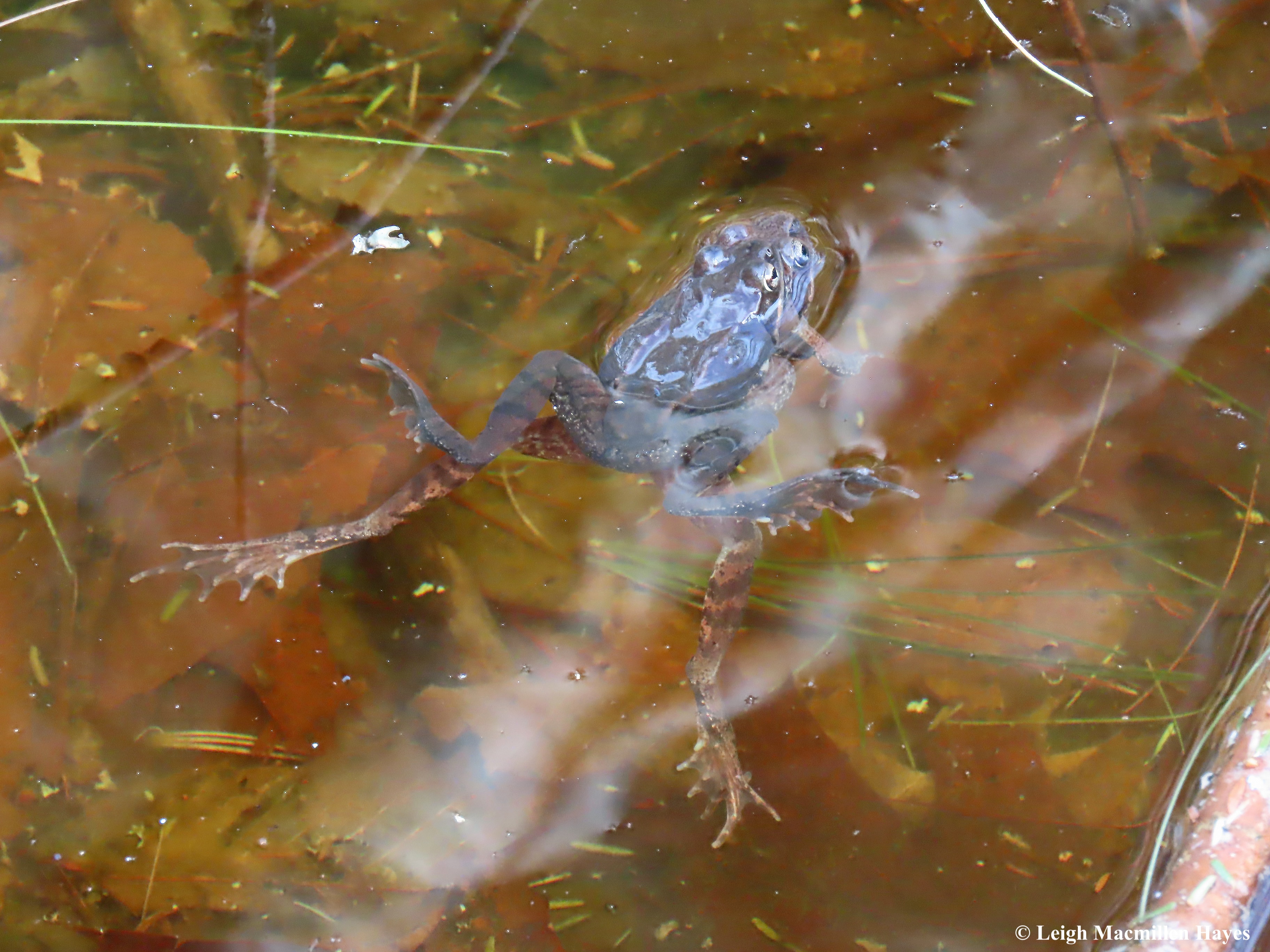
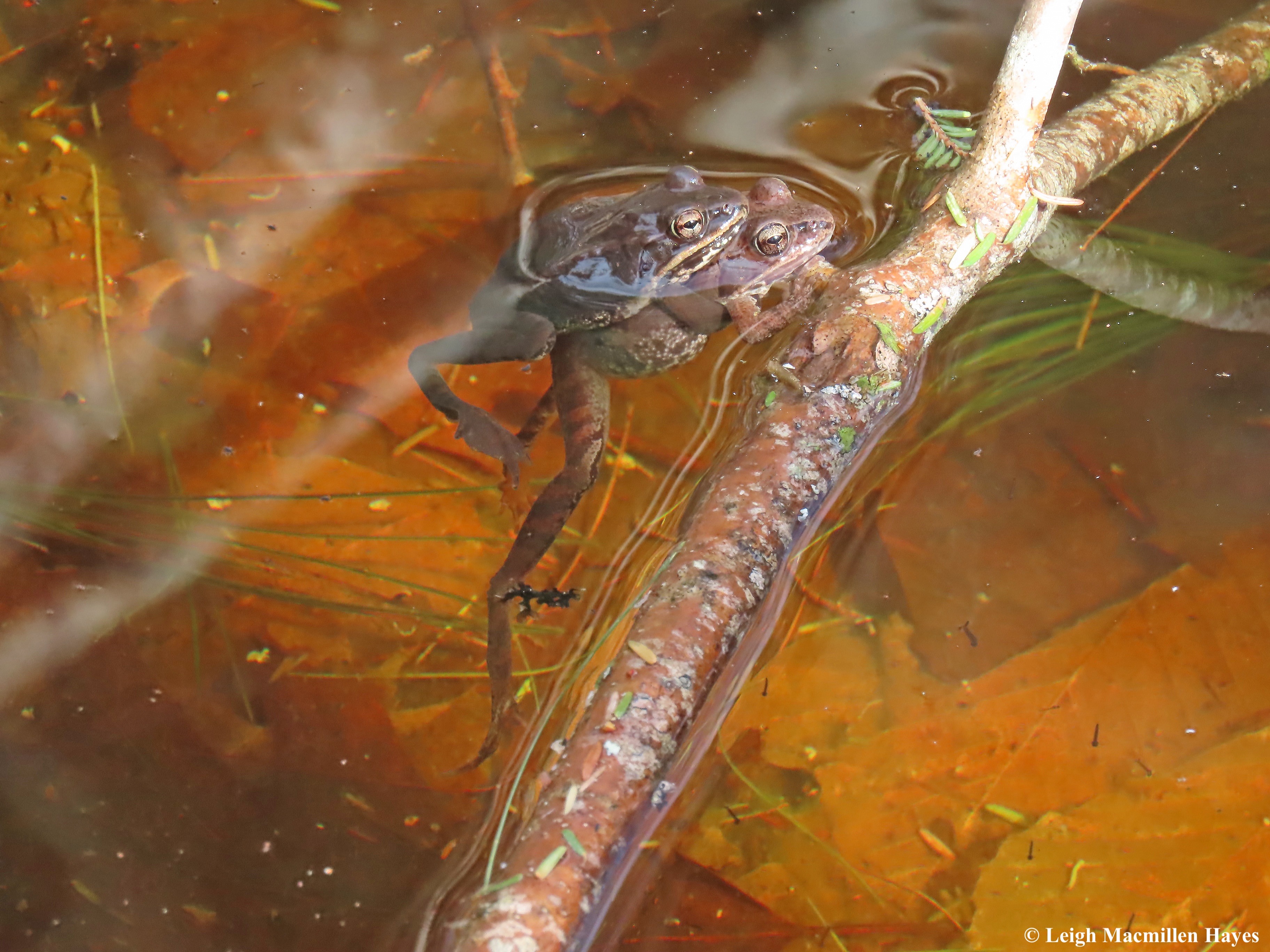
Within a minute of standing there, I looked down and spotted a couple embraced in what is known as Wood Frog amplexus, the smaller and darker male being on top with his forelegs wrapped around her, just above her enlarged belly.

She seemed to be in full control as she moved about the twigs, looking for a good location to deposit her eggs.

I thought the first spot was perfect because it was located near another egg mass and Wood Frogs tend to deposit their eggs in communal colonies, the better to avoid predation–especially if yours are among the first and are surrounding by other egg masses, and therefore protected.

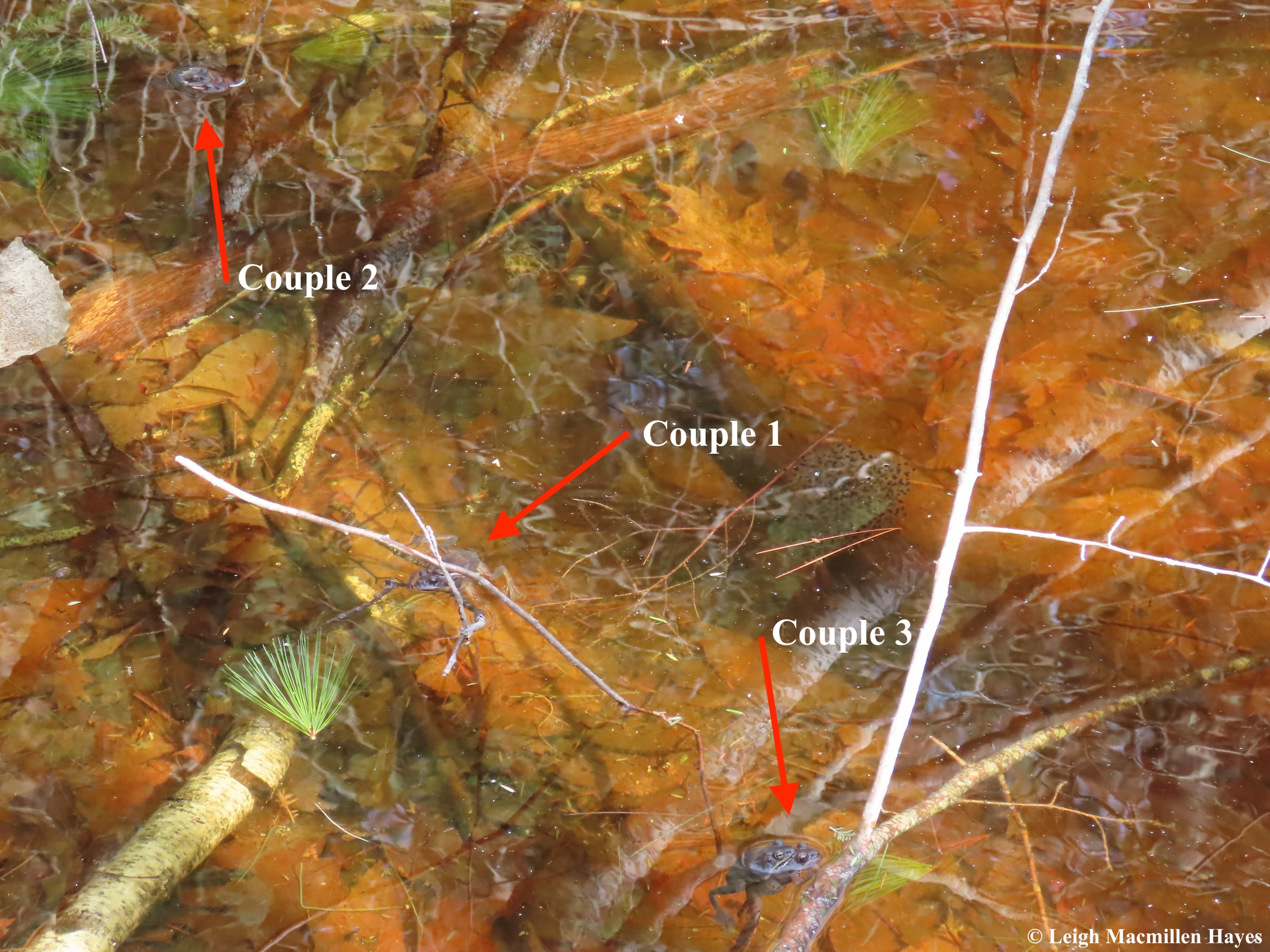
Scanning the pool, I spotted another couple and decided that going forward they need names, so this is Couple 2.

Meanwhile, Couple 1 continued to move about the same set of twigs.

And then near my rock, Couple 3 appeared.

There were also lone males, and because it was breezy, no one seemed to mind my presence. In fact, a couple of males in the western corner even “Wrucked” a few times.

Couple 2 found a larger branch and hung out there.

But Couple 1, they were on the move again.

This time testing a different set of twigs. All I could do was wonder exactly what she was looking for. What made a prime location prime?

I don’t have the answer and probably never will, but still couldn’t believe my good fortune to have all three couples right there by my feet.

And then . . . and then Couple 1 swam off and disappeared under a recently fallen tree and I thought, “That’s a good place because there are so many branches to choose from,” but at the same time I was disappointed because I figured I’d never see the rest of the story.

Until . . . they swam back out and approached the twig of their first choice.

And seemed to be making a move to settle upon it.

Only they didn’t. Instead, they swam to another twig that they’d tried earlier; one that had no other egg masses.

And suddenly, right before my eyes, she began to lay eggs, which he fertilized externally. Can you see the black and white dots between their hind legs?

I could not believe I was finally witnessing this amazing moment. Magic in the making.

My body was stiff from standing so still, but it was so worth the effort.

With her hind legs, and I may be wrong about this, she appeared to be wrapping the mass around the stick so it would be well attached.

The eggs are black and white, the Pied Pattern, the top of the egg being dark so predators from above may not see it because it more closely matches the dark leaves and muck on the floor of the pool, and white on the bottom so that predators within the pool will think it’s just sky.

So, as luck would have it, and I was feeling super lucky and grateful for the opportunity to observe, my camera battery died. And the back-up battery was at home. (Note to self: carry it in my pocket.)

I pulled out the next best thing and shot this photo with my iPhone. He eventually moved off of her, but not too far away, probably exhausted from all the effort. And she remained below the quarter-size egg mass for a few more minutes.

As for the other two couples, one disappeared under the fallen tree and the other went under the leaves below my rock, perhaps seeking privacy.

Finally, I took my leave. With a huge smile on my face.

Oh Baby(ies), I know your parents will leave the pool soon, but I’ll be there to watch over you. Maybe not daily, but frequently for as long as the pool holds water, being ephemeral as it is.

Collecting Birds

OK, I admit it. I’m a collector. Of things. But they are all special things. And many of them handcrafted. And most of them with a story to tell.

So, yes, I collect birds. No, not dead or dying birds. And certainly not living birds. Just . . . birds. My collection is actually quite small, and until today I hadn’t given it much thought, but it began a hundred years ago when I was a senior in college and my roommate and I hosted a student from Great Britain in our dorm room for a week.

I honestly cannot remember her name or too much about her. But I do remember that at the end of her stay she gave us each a bird.

And I remember she told us they were of the Tit species, which didn’t mean a whole lot at the time, but now that I see and hear Titmice on a regular basis, I have a better appreciation. This little bird has graced my desk for decades and the young woman’s name keeps flitting in and out of my mind, so maybe I’ll recall it by the time I finish writing. I now realize I haven’t thought about her in years, despite my fondness for the gift she bestowed upon me.

Another gift was the carving of a Chickadee, and I received this one about 35 years ago from a sweet little man named Carl and I only wish he’d lived long enough to know how much I still appreciate it.

Likewise with this Loon, crafted for us by my Godfather Russell because he knew My Guy and I love our encounters with these birds who symbolize Maine. And he loved to paint, among many other talents.

I also cherish these two ornaments that never made it to a Christmas tree because they pose instead from a vase of twigs in my study. The one on the left was created by Dr. Fred, a founder of the Maine Master Naturalist Program, and the Hummingbird was gifted to me by my friend Marita after she spent some time bicycling around Cuba last year.

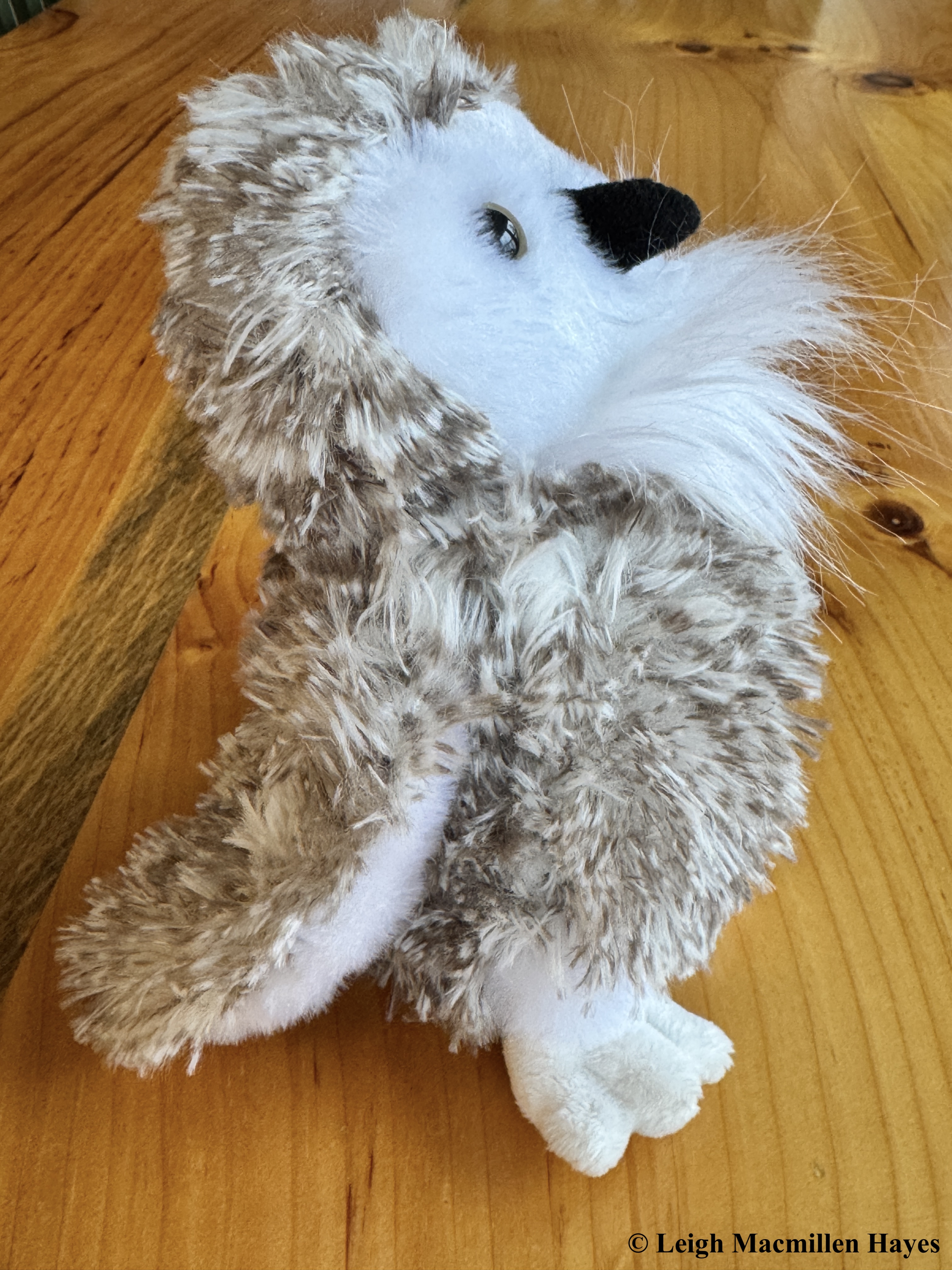
And then there is the Token Owl. Token, because if one is leading an Owl Prowl and there is no guarantee of spotting an Owl, it always pays to pull such a stuffie out of one’s pack so that everyone can leave saying, “I saw an Owl.” Sometimes you just need to make things happen.

All of this leads me to what I realized today is becoming quite a collection: my paintings of birds.

Pileated Woodpecker in our back forty, which is actually only five more acres beyond the house. One of his favorite trees, however, is at the edge of our yard before the woods, where we’ve left several super tall dead snags and he uses them to mark his territory early in the morning, and later in the day as he taps away. Every day.

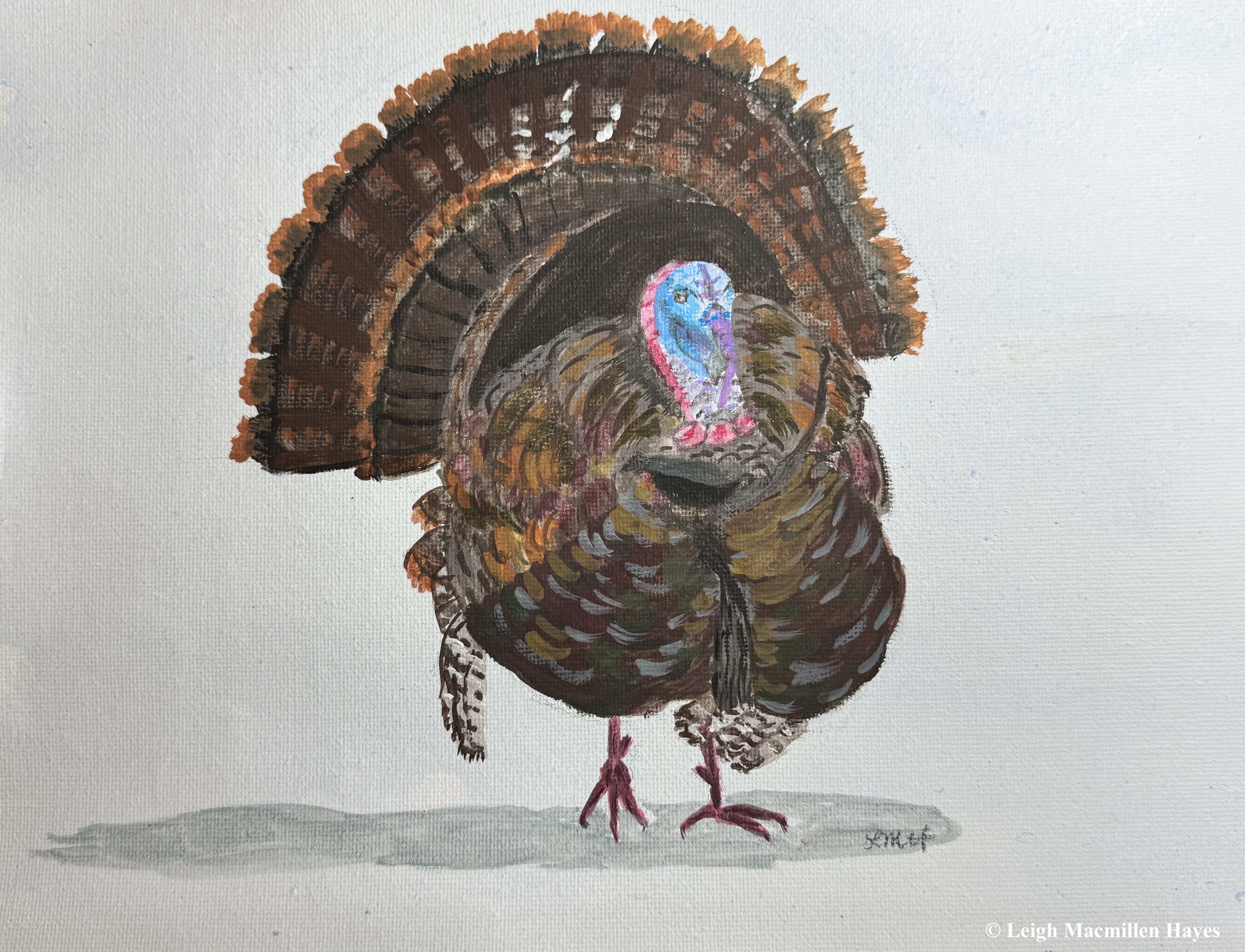
Tom Turkey strutting his stuff across the yard in hopes of wooing a hen. I can only assume he did though I never caught them in the act, but so large is the Turkey population round these parts.

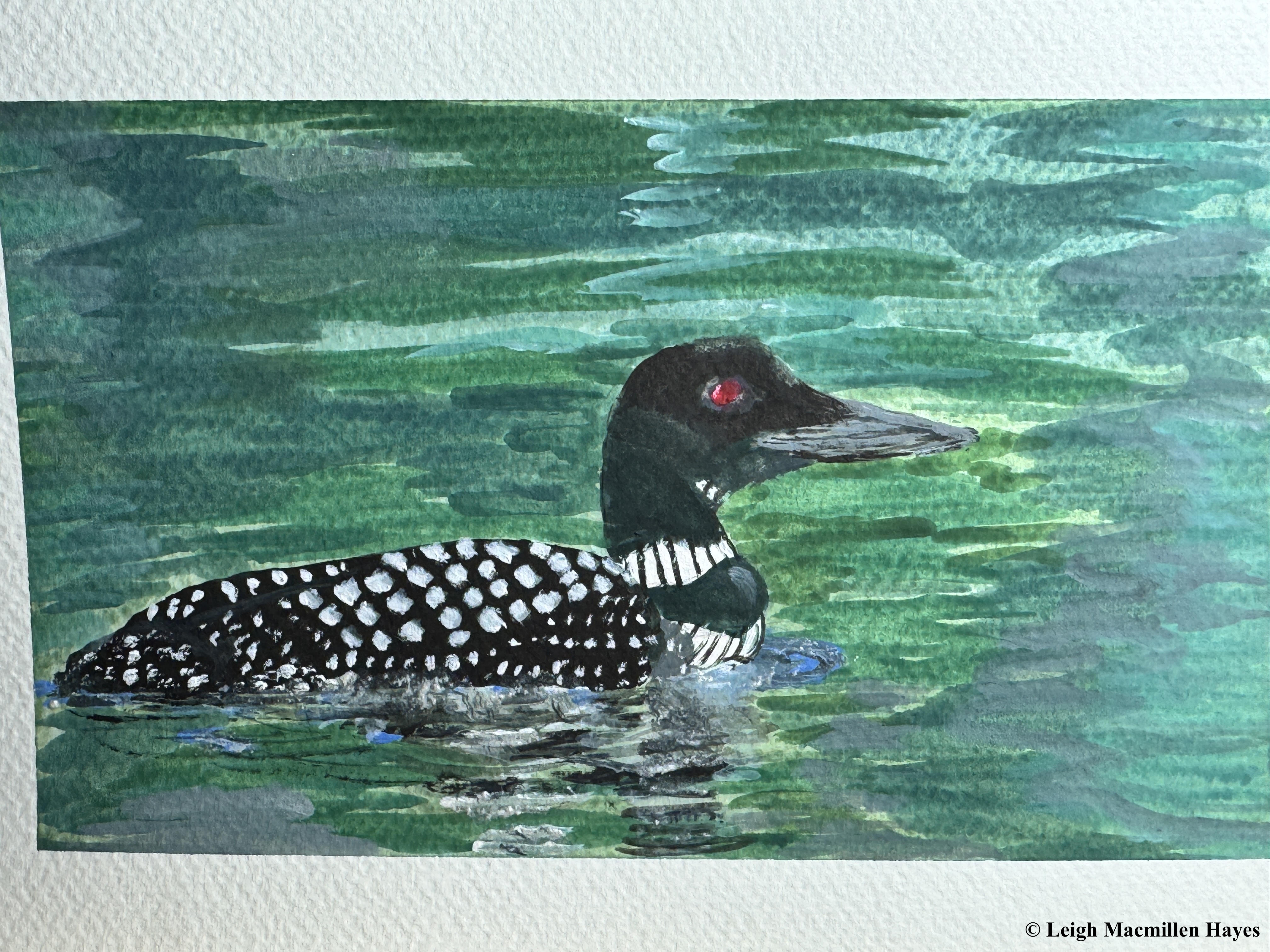
A Common Loon in front of the dock at camp. I admit that like dragonflies, I can never take too many photographs of loons.

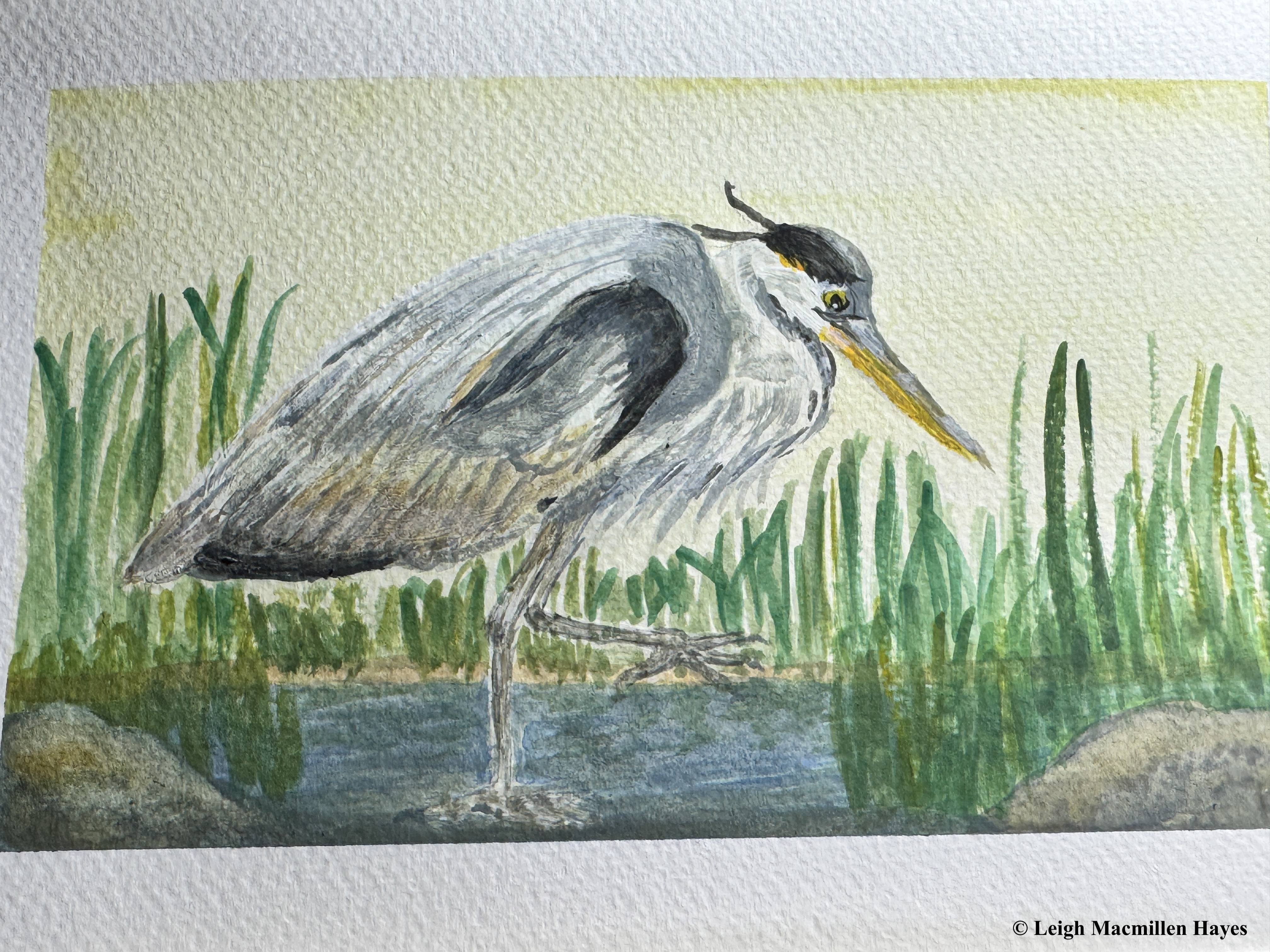
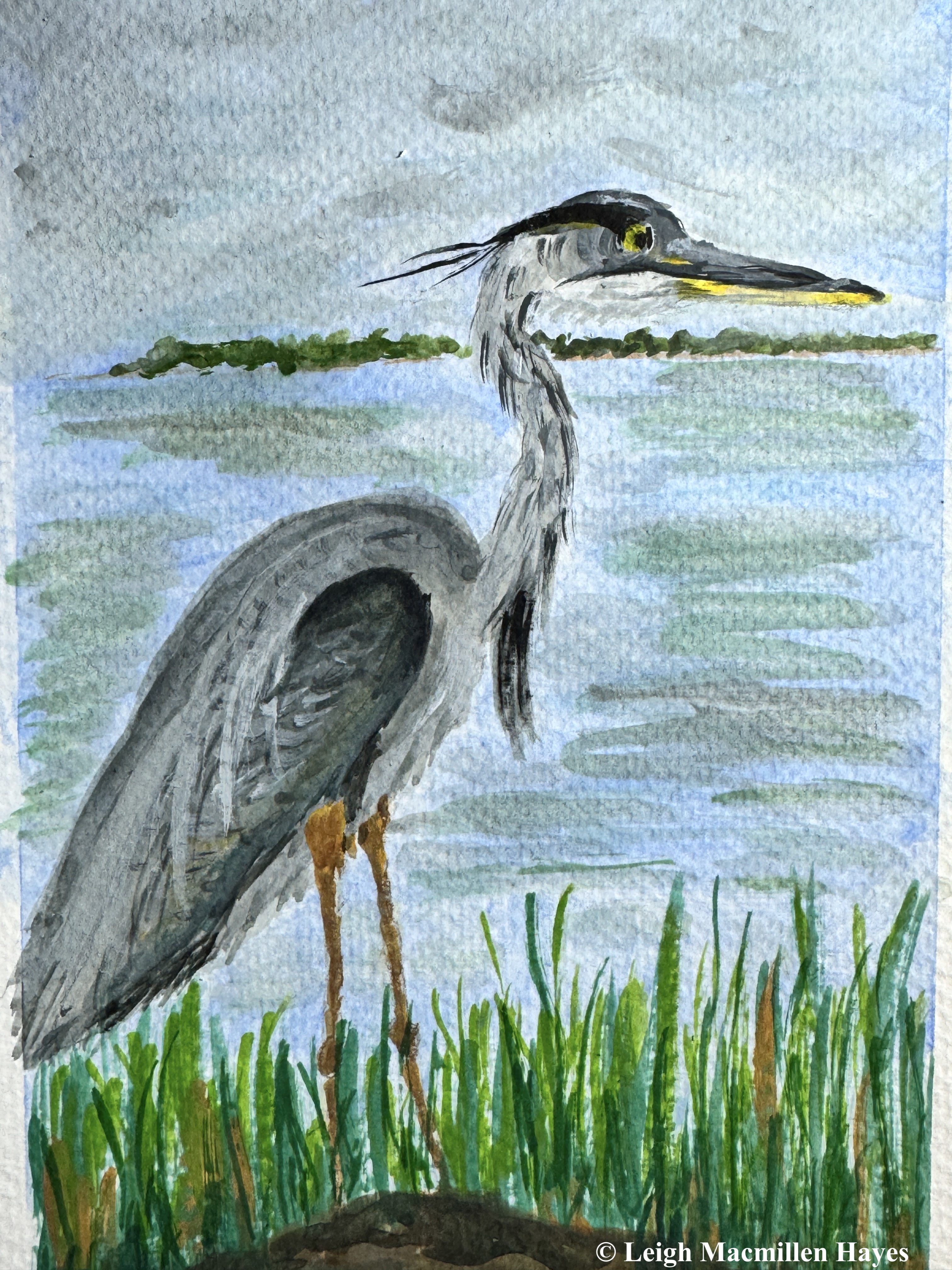
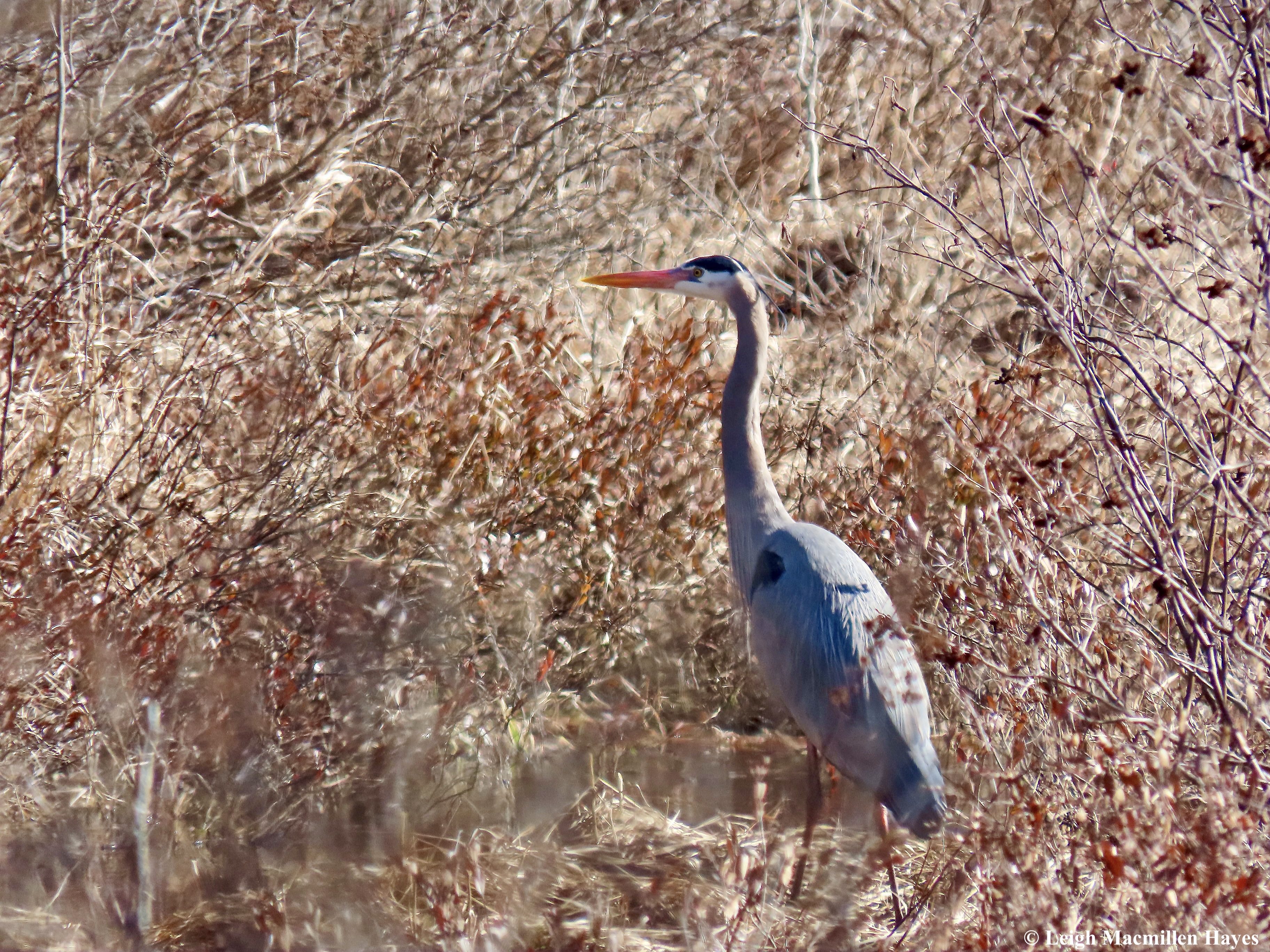
Great Blue Heron scoring a wee fish for a snack.

And another searching for another meal.

And still seeking more, its eyes always intent as it stalks its prey.

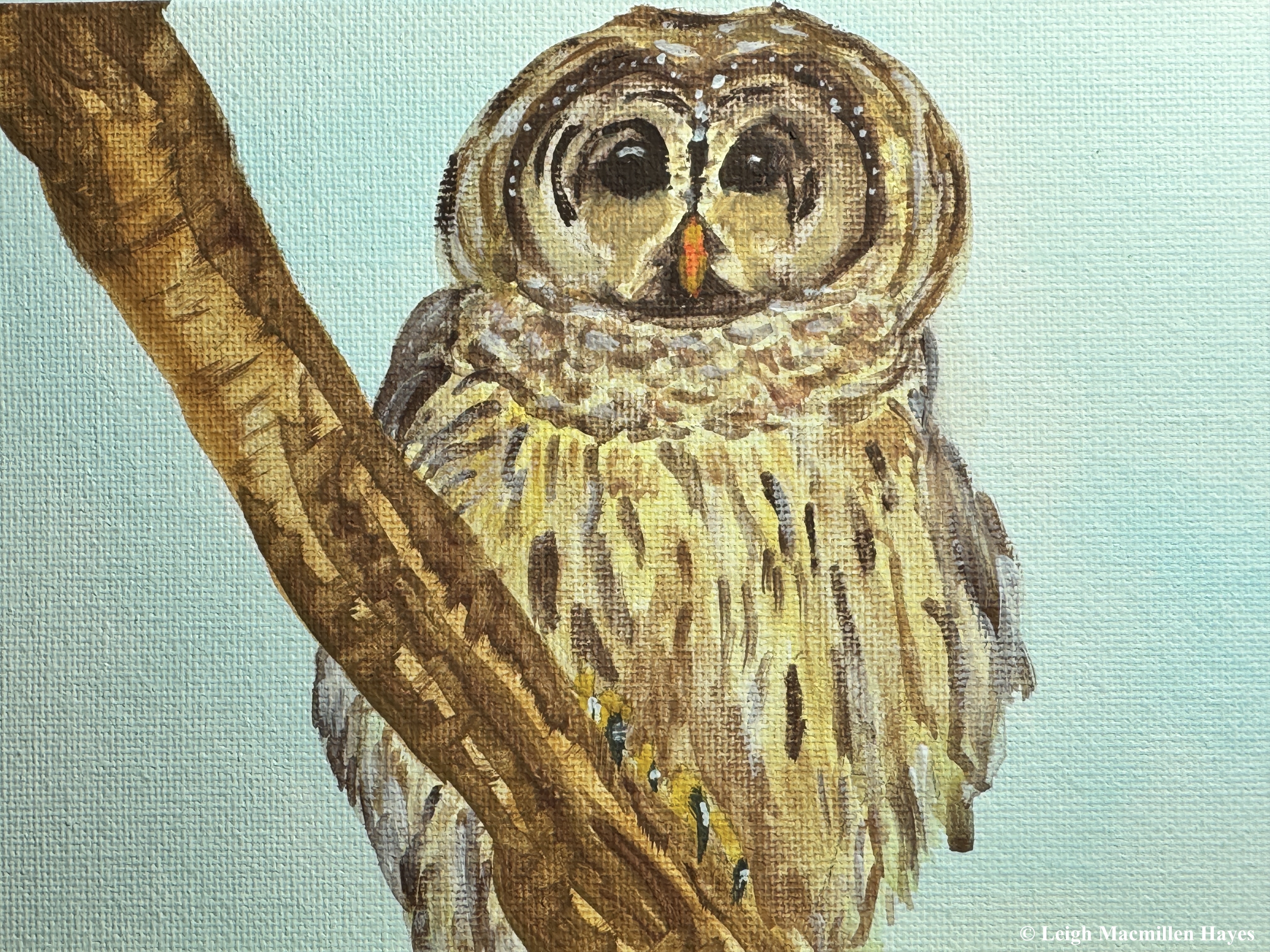
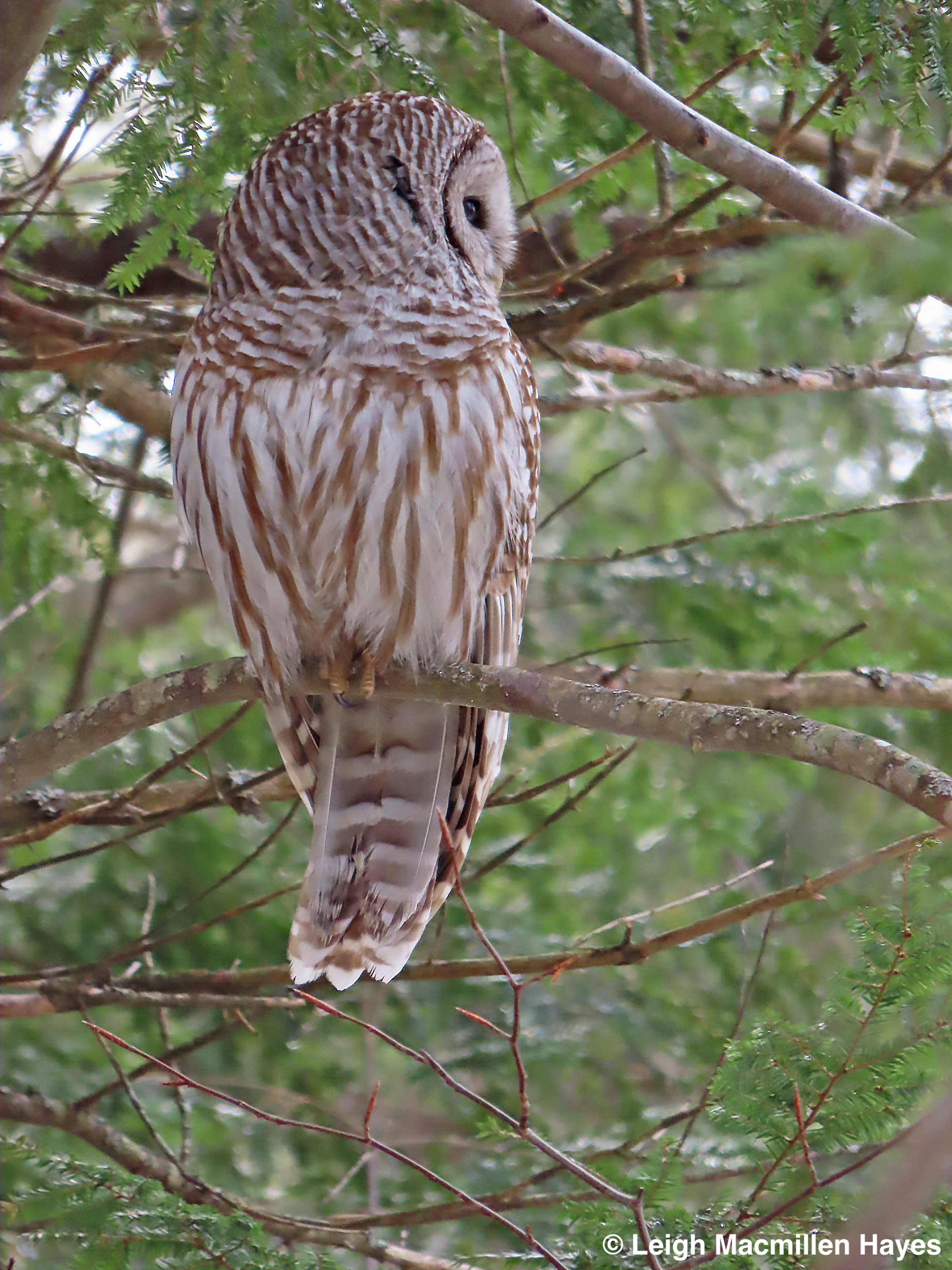
A Barred Owl near the vernal pool, thankfully when there was still ice on it about a month ago, but he’s in the area, so anything can happen.

Ah, but how I love to meet these critters, who unless they are calling, remain incredibly still and blend in with the scenery and I’m sure I pass by more than I actually spot.

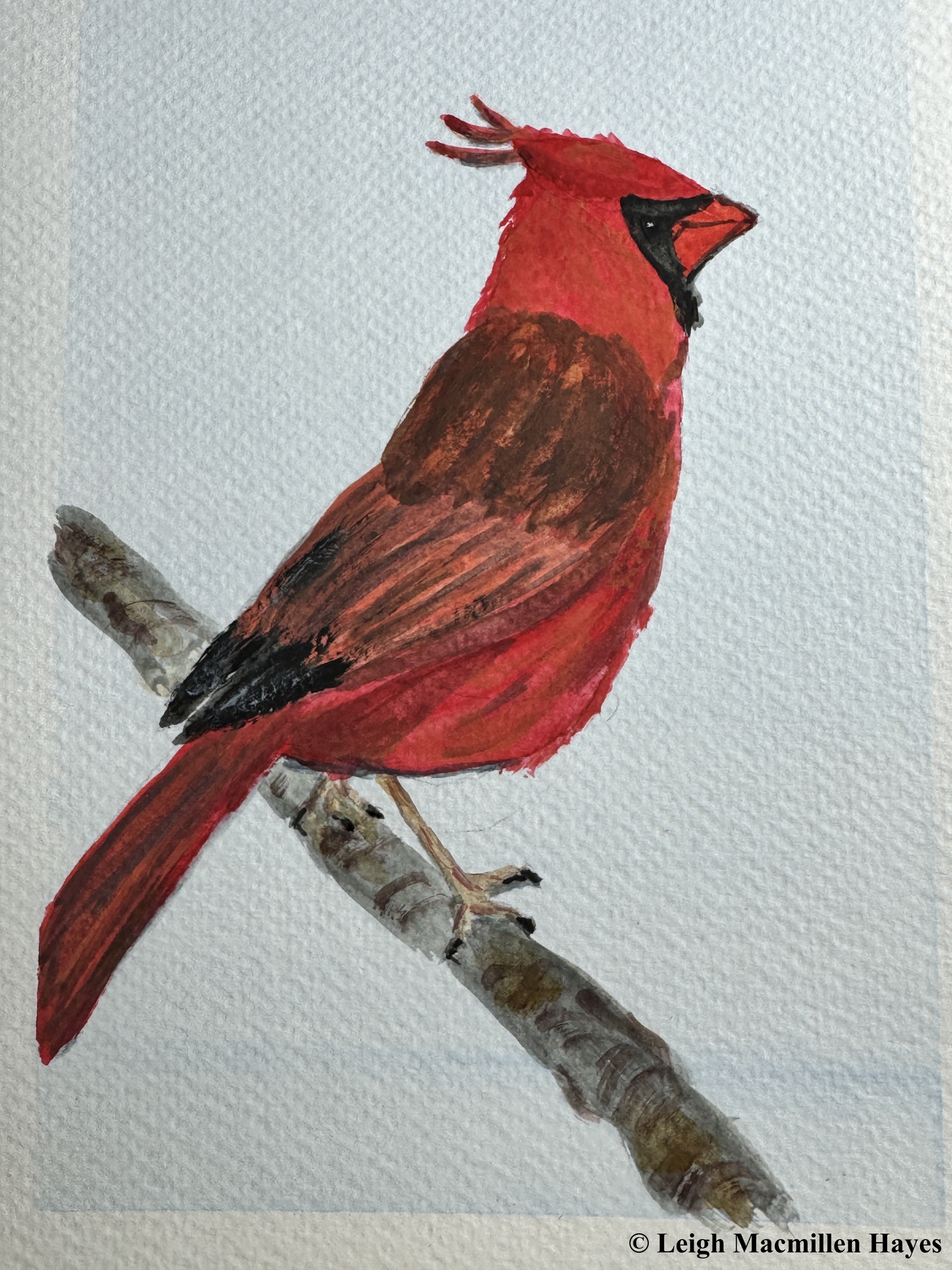
Mr. Cardinal, and I’ve been waiting for him to pass sunflower seeds on to his Mrs. because I’ve seen him do it in the past and it’s such a lovely gesture.

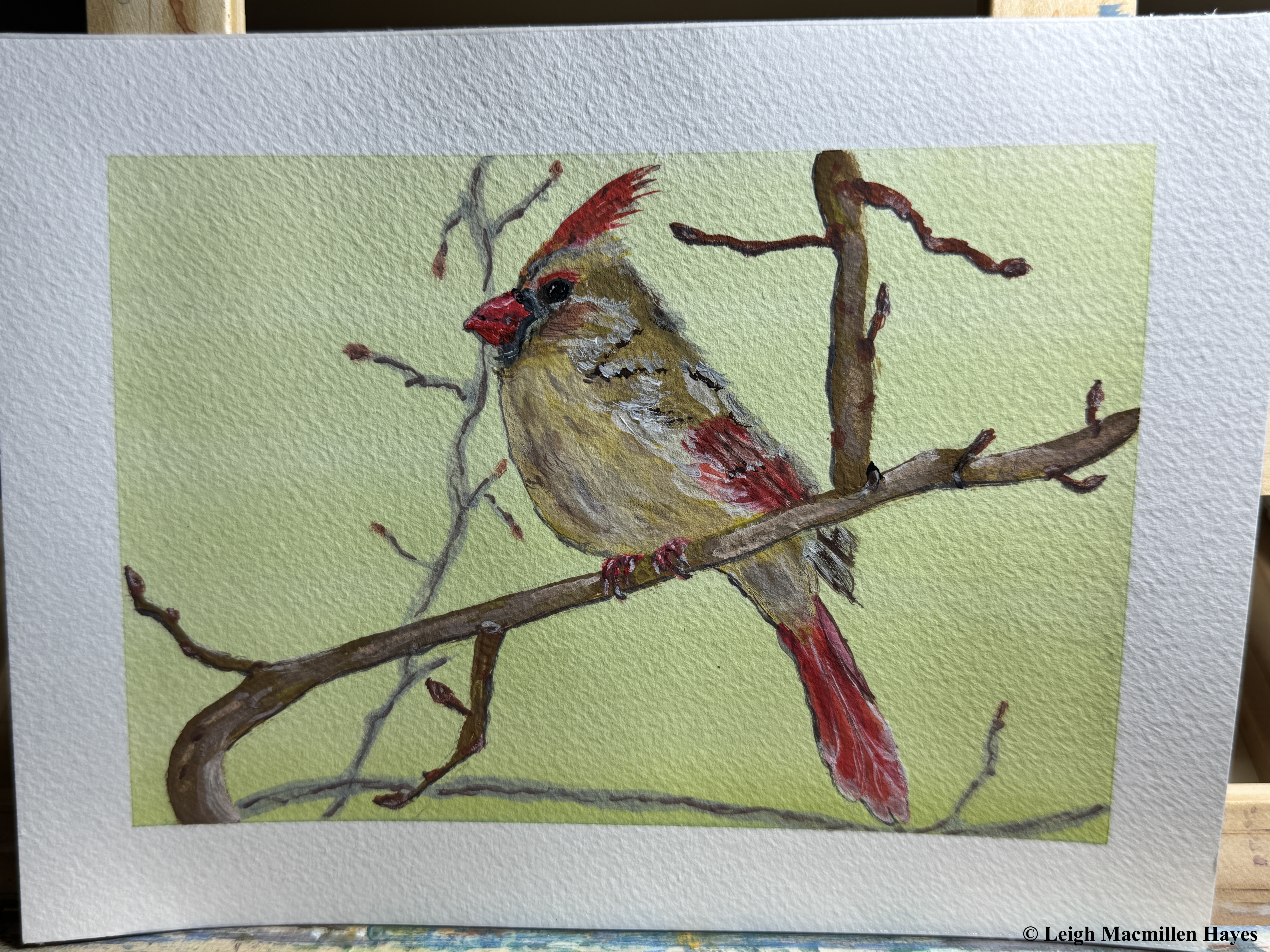
The Mrs. waiting for a gift from her betrothed. To my knowledge, she’s still waiting. One of these days he’ll surprise both of us.

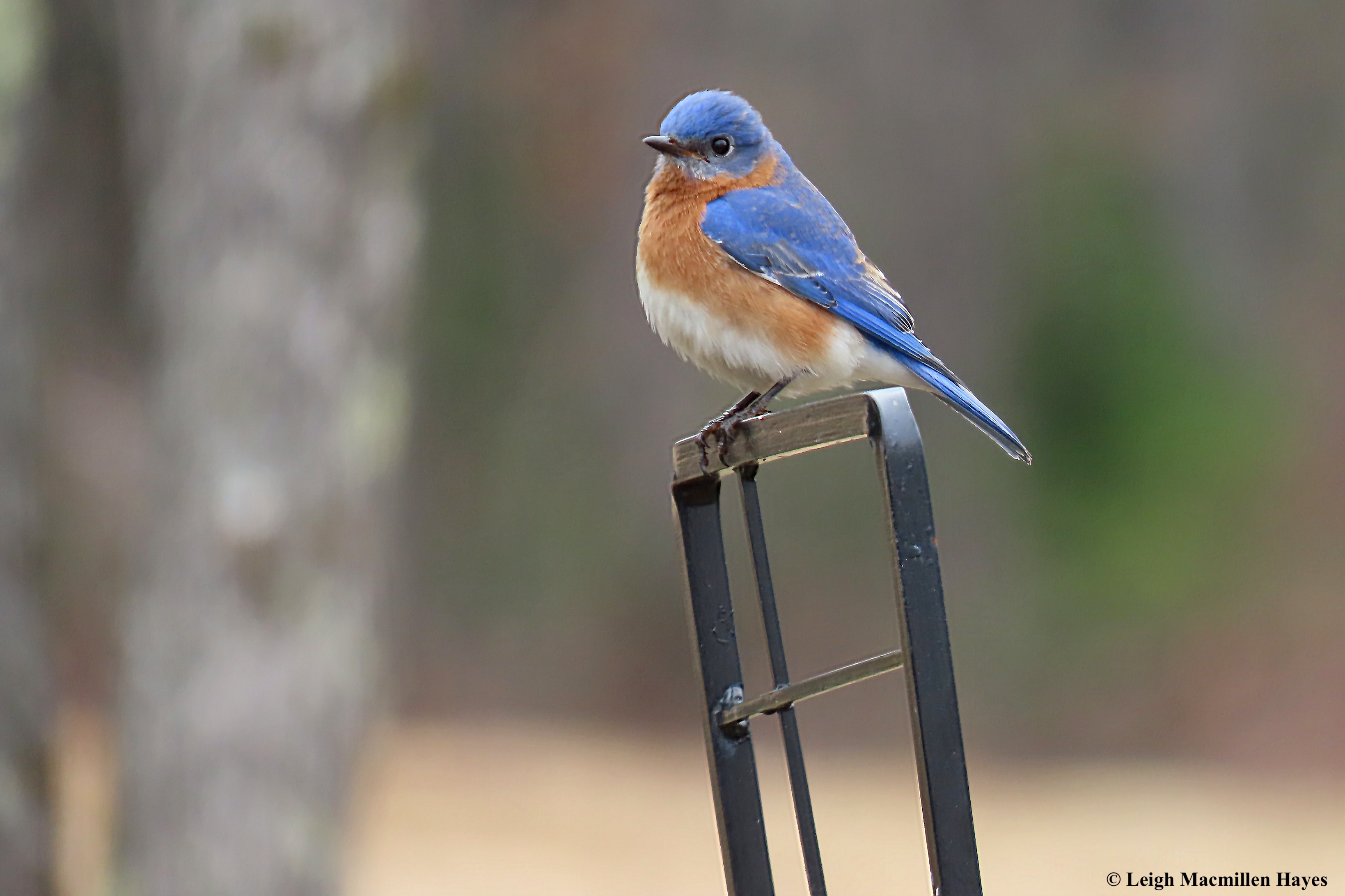
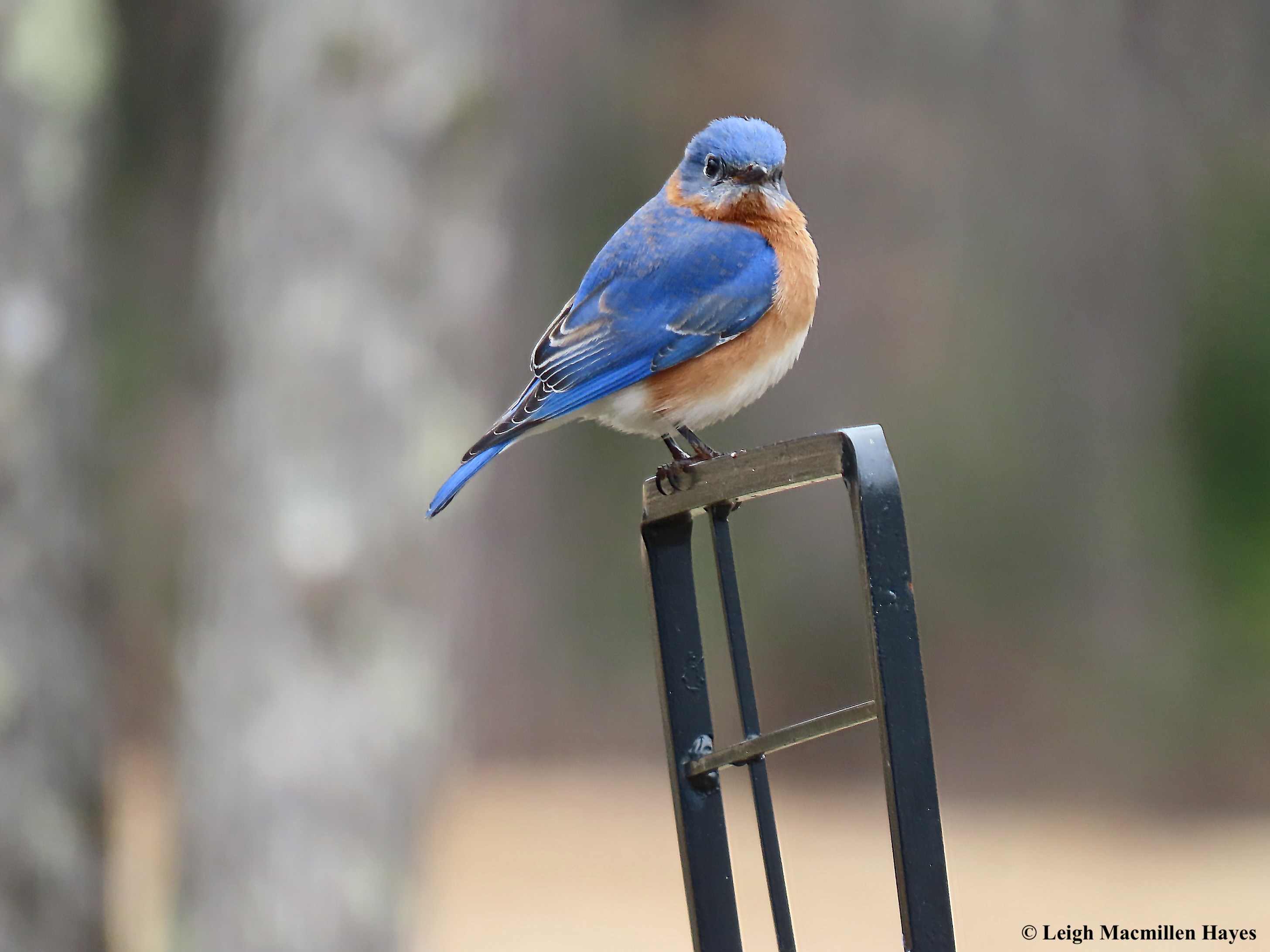
Mr. Bluebird, who also visits daily, as does his Mrs., and from the direction of their travel, I believe they are setting up housekeeping in a house my neighbor erected just for them.

One of the zillion Juncos my friend Kate sent up from Connecticut. They arrived the day she told me they were on their way. That was a few weeks ago. In a snowstorm the other day, we had quite a large flock, but I think most are continuing their journey north as now I only see a few at a time.

My first attempt at painting a Robin following instructions in a book.

And then trying to tweak the painting and turn it into an American Robin. I fooled SEEK, a free app developed by iNaturalist. It came right up with A. R.

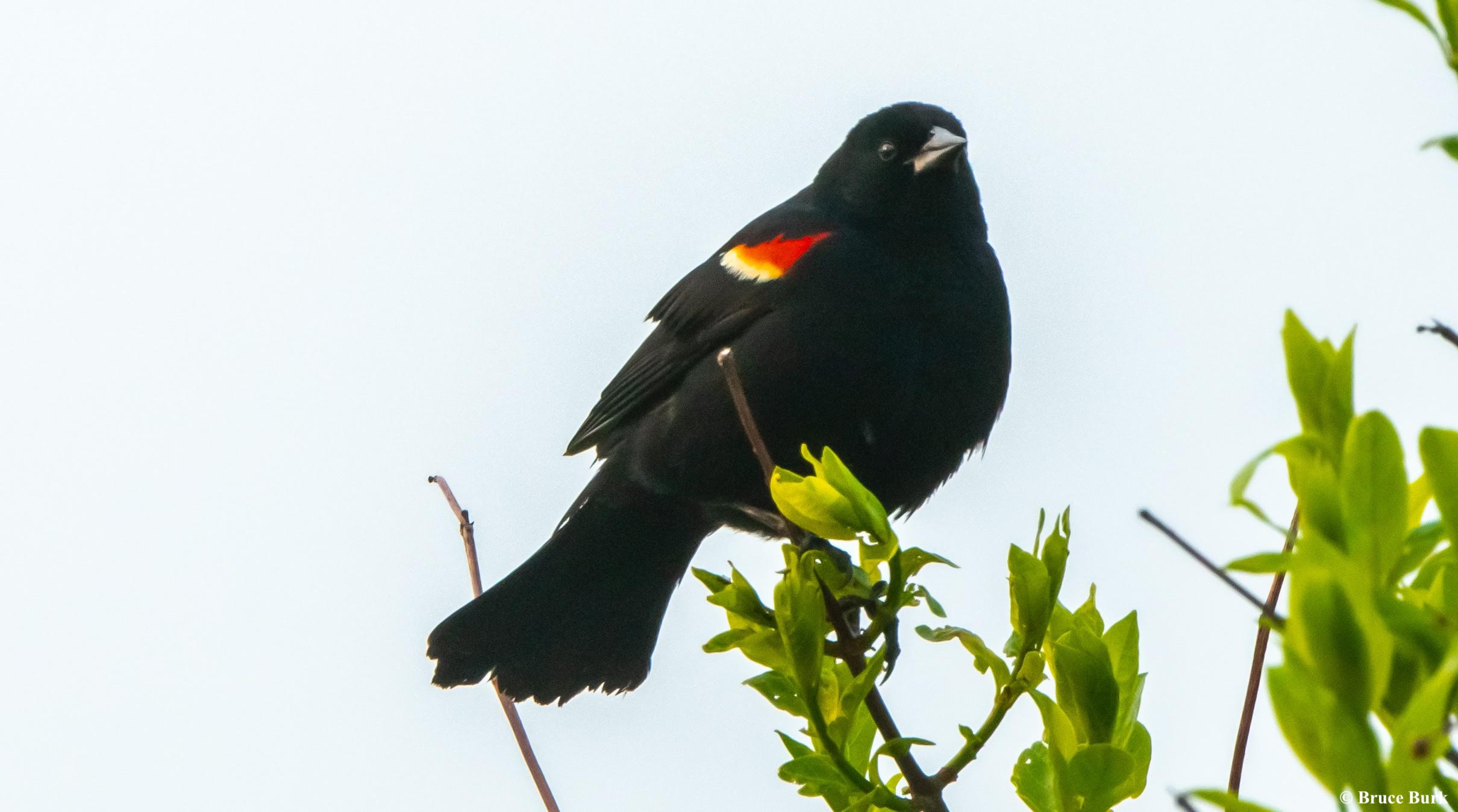
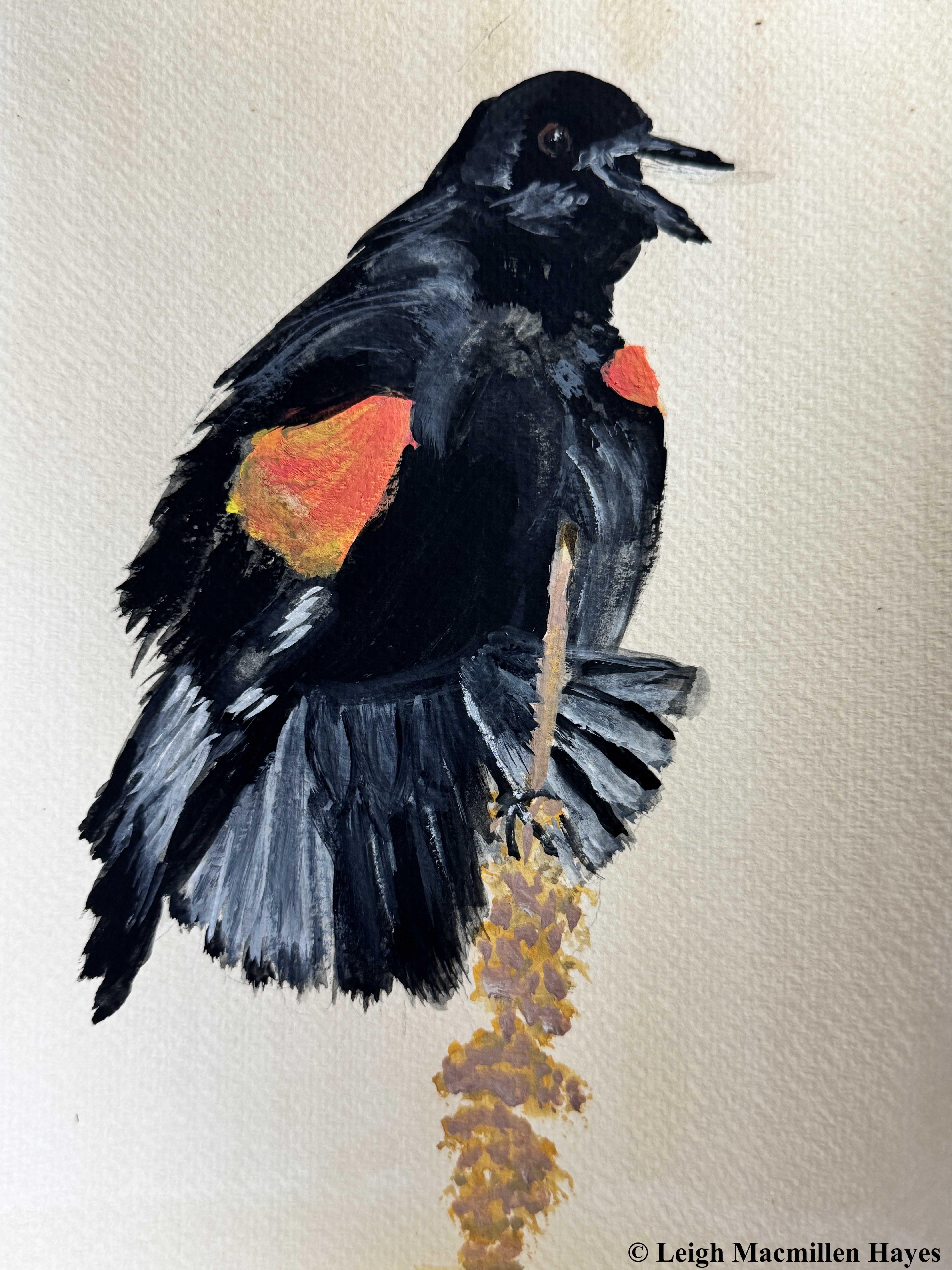
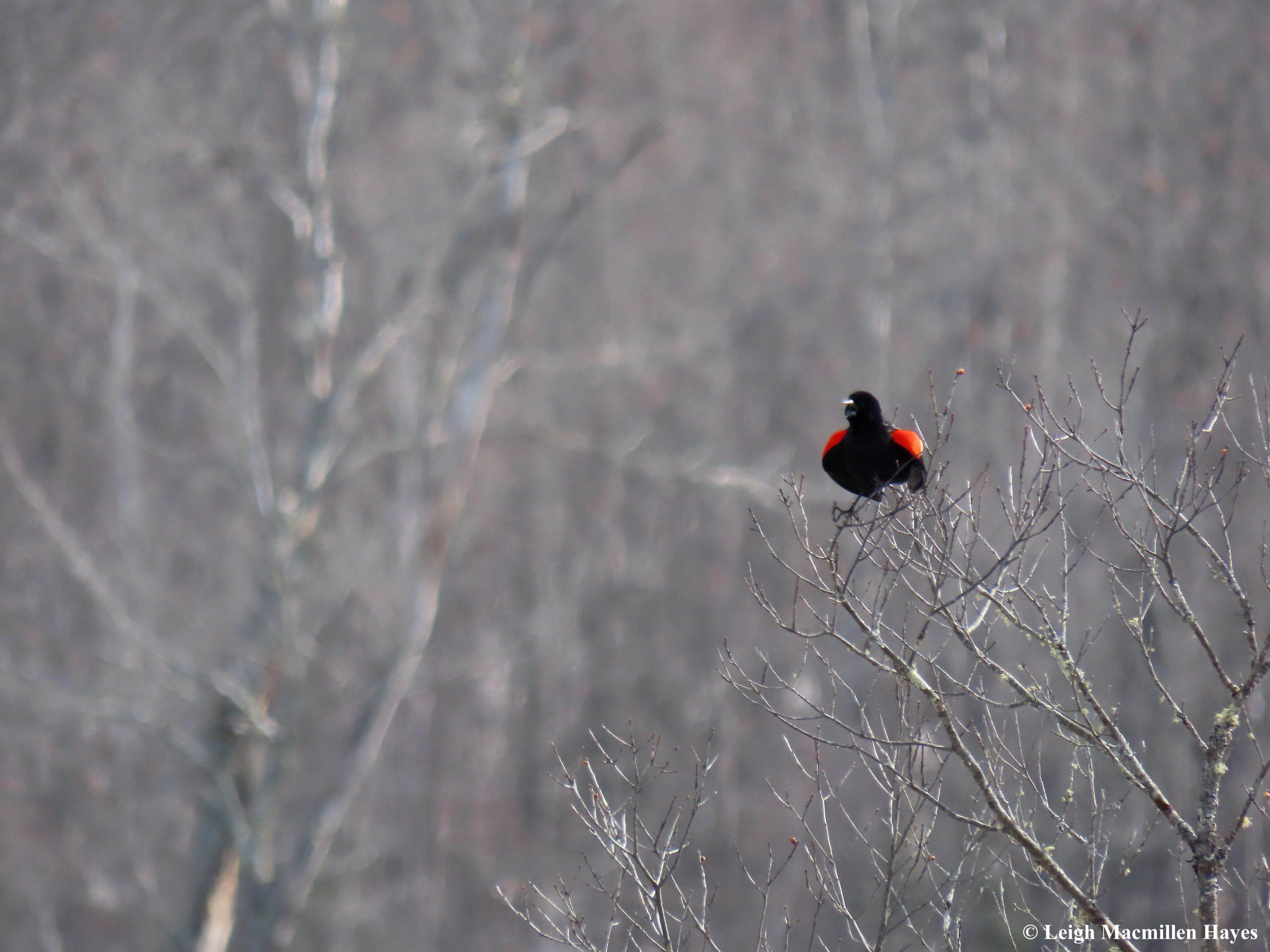
SEEK also knew this to be a male Red-Winged Blackbird. What it didn’t know is that it was one I saw calling a few weeks ago when there didn’t seem to be any females around.

And finally, my new friend, who has actually been in the neighborhood for a long time, but we only recently spent a few minutes together the other morning: Sharp-shinned Hawk.

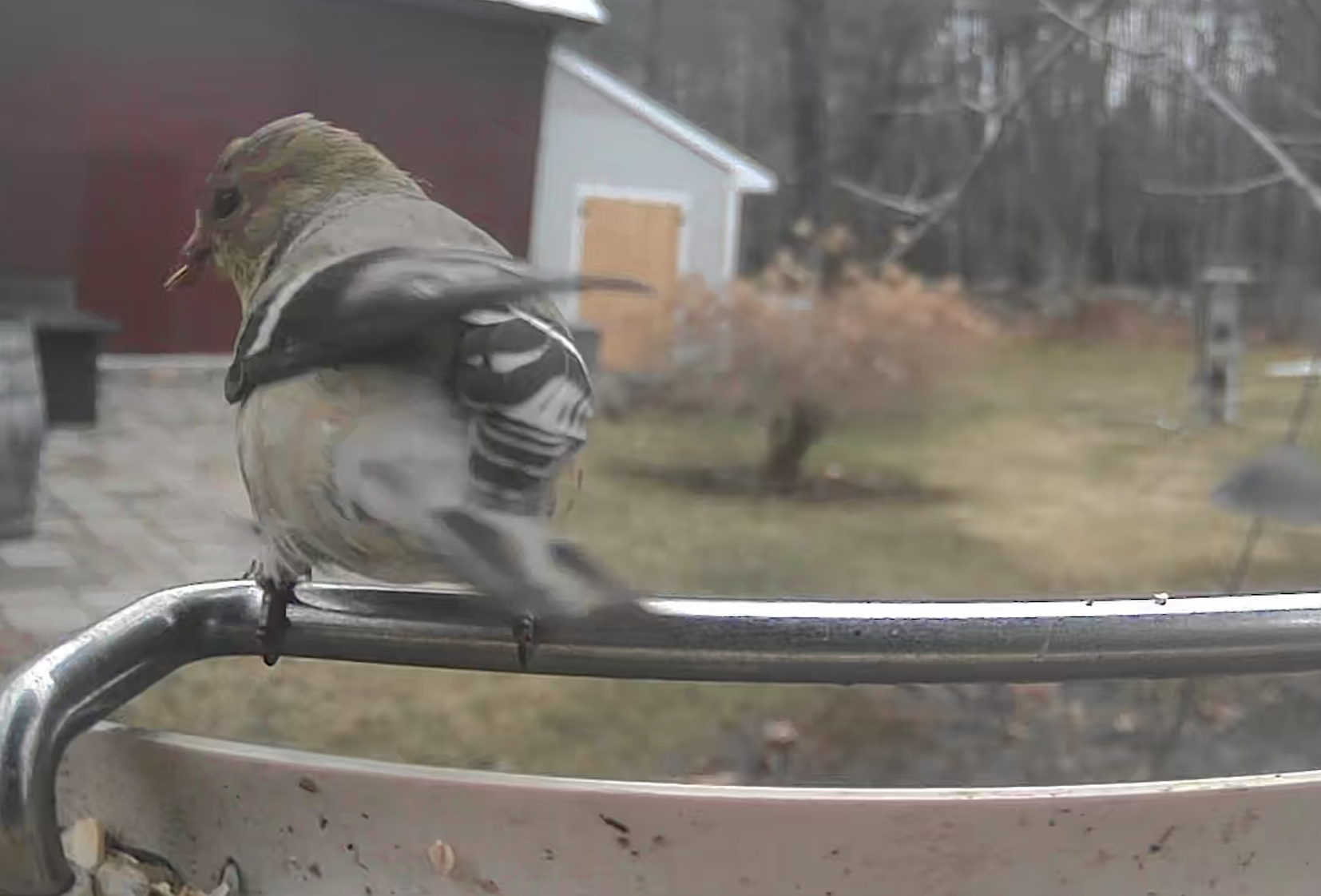
As I look out the window right now, besides this Goldfinch, the Bluebirds are both here, plus Robins, Juncos, Chickadees, Tree Sparrows, White-Breasted Nuthatches, and Mourning Doves. And actually, there are more Juncos than I expected.

That is the extent of my bird collection–at least for the moment. Thanks for stopping by to take a look.

The student from Britain: Jillian. It just came to me.

The Wild Out My Window

I know I should take in the bird feeders. After all, it is April 8. And a friend found bear tracks in her yard about seven or eight miles away on April 1st–and it was for real, though I did question if she was trying to fool me.

But I haven’t done so yet and the past two days have offered insights and outsights as I’ve stood at the back door periodically, ever ready to snap a photo.

Picture taking began early on the 7th–at about 6:15am, when the lighting was a bit dark and my camera encouraged me to use the flash, but I chose not to because I knew it would offer a reflection of light on glass and I’d never get a photograph of the critter of my intent.

Much to my surprise, a Sharp-shinned Hawk helped me greet the day. The bird perched about twenty feet from the back door, right in the midst of my feeding station–well, the feeding station I’d set up for birds, though my plan has always been for me to provide the food in the form of seeds and suet, not in the form of other birds.

We spent a few minutes together, Sharpie and me, and not a single bird flew in–thankfully.

The feeders were actually quite low on seed, but knowing the Hawk was around, I decided to wait to refill them and instead took off for a hike with My Guy, where we spotted Beaked Hazelnut in flower.

Back at home, I immediately filled the feeders and spread seed on the ground, and it seemed like within seconds, we had visitors.

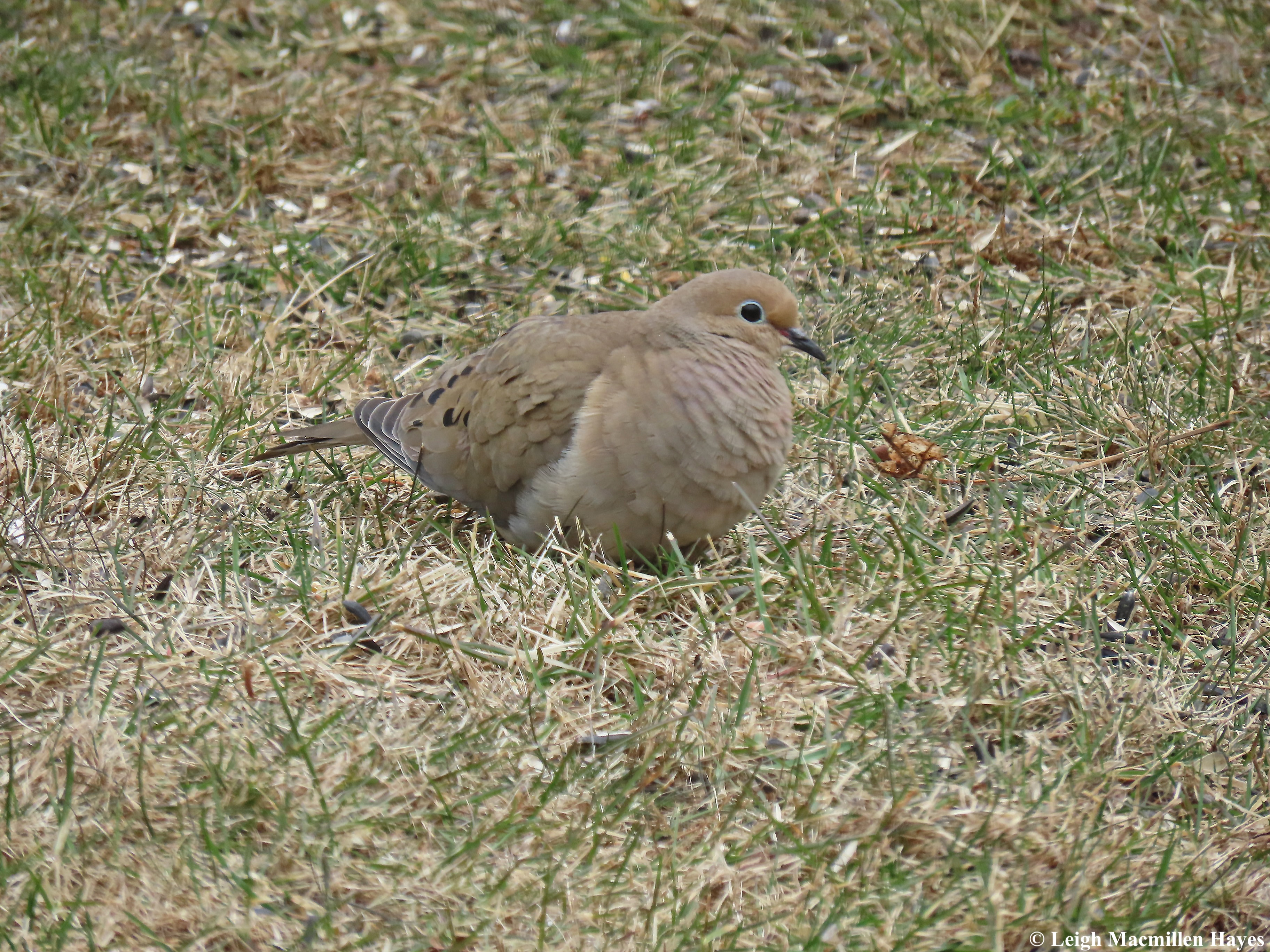
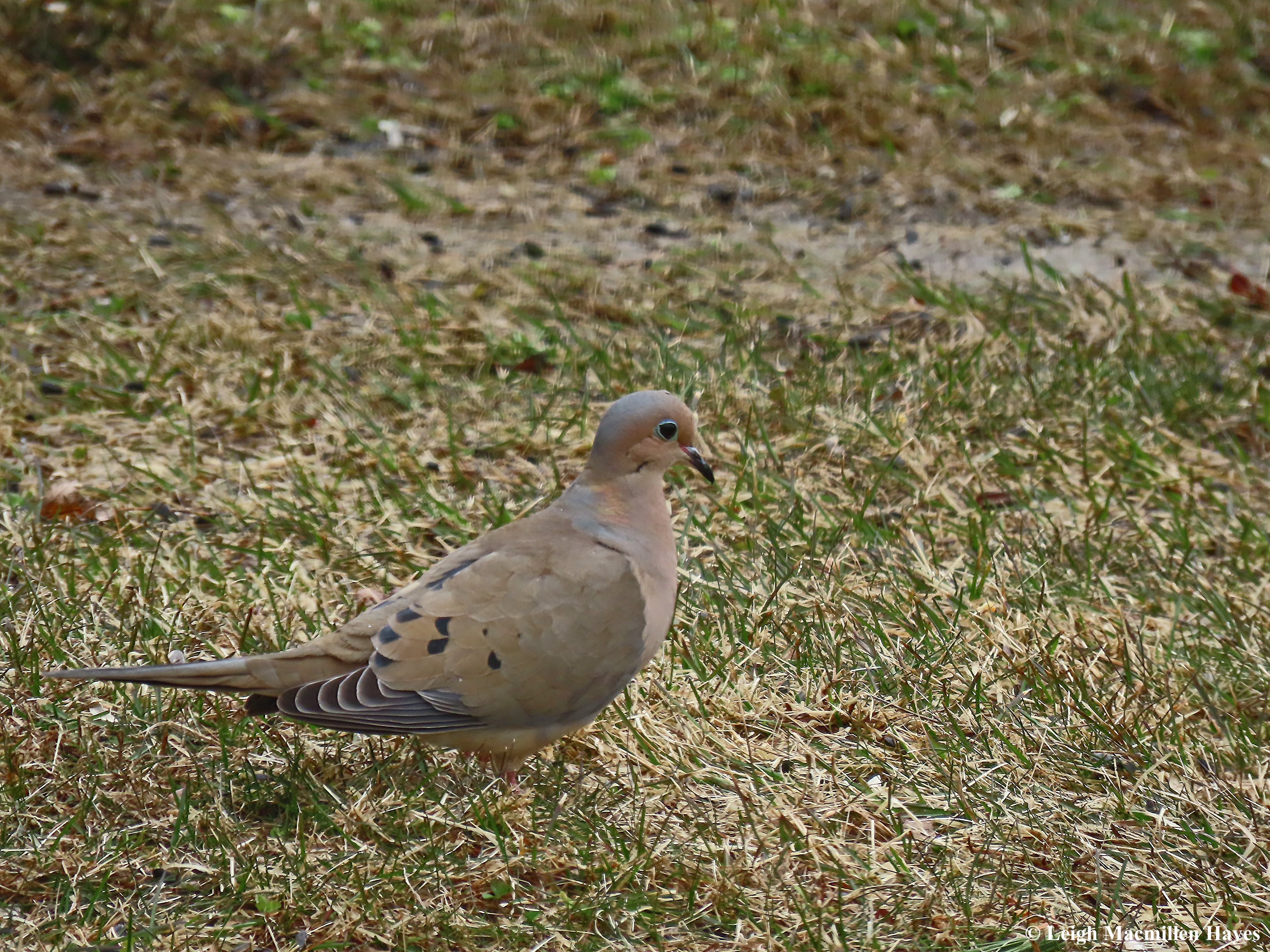
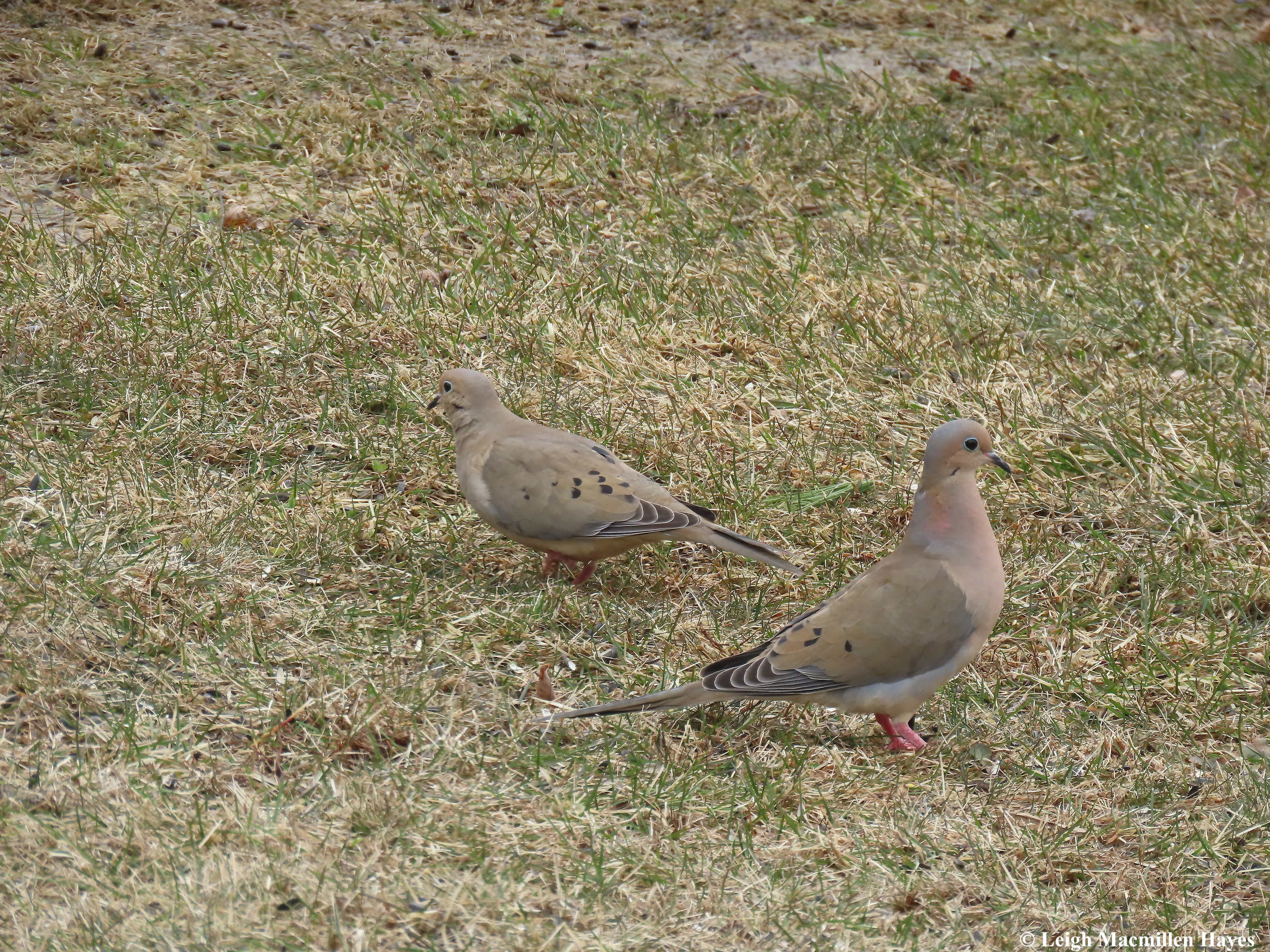
The female Mourning Dove was a bit of a hog–filling her crop non-stop.

Her male counterpart didn’t seem to care about eating and he marched about going this way and that.

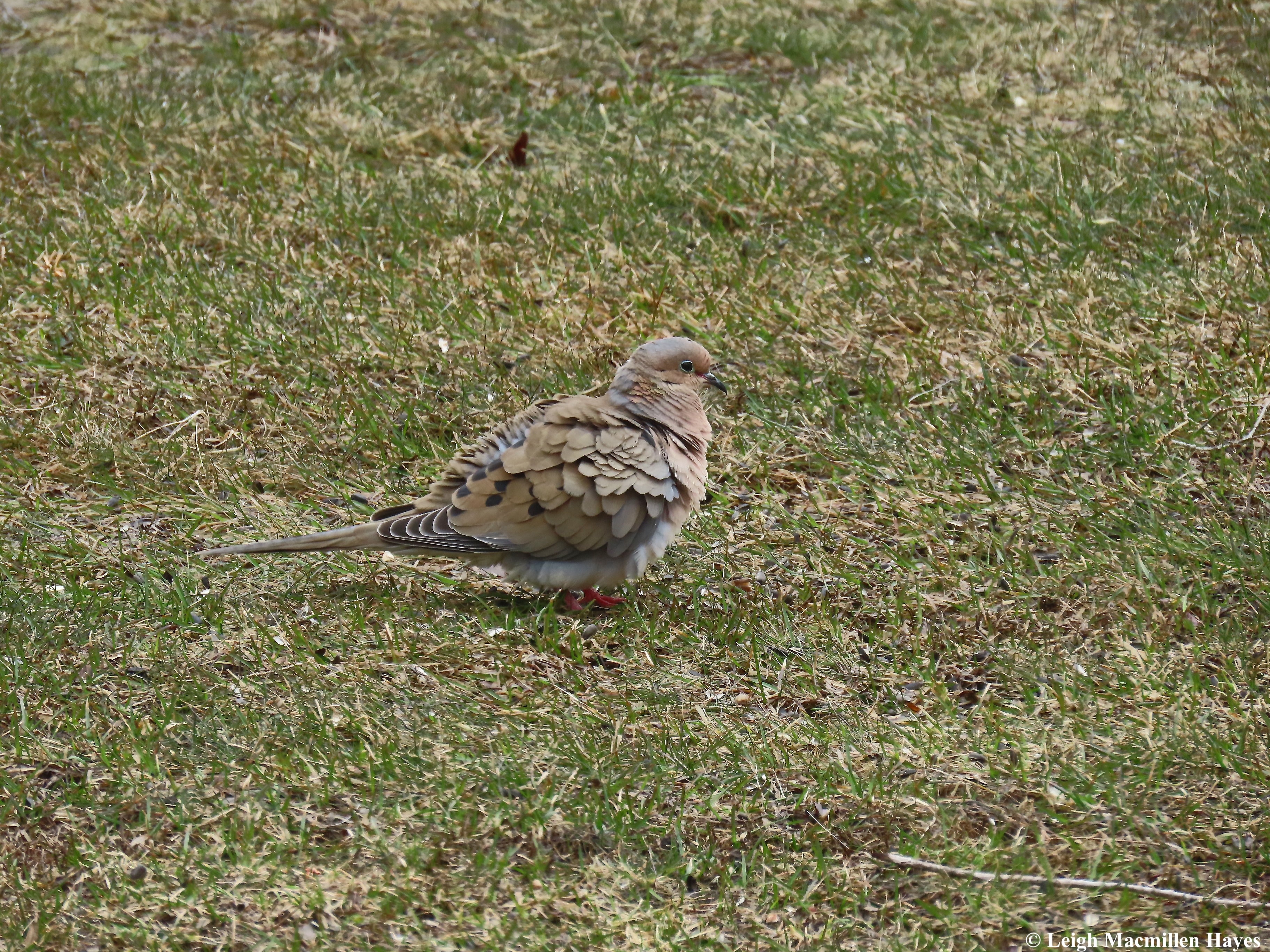
And then I noticed him begin to fluff out his feathers and all I could think of is a Tom Turkey and I suspected I knew what he had on his bird brain.

He’d fluff, then calm down and strut past her, but she didn’t seem to care as she stayed low and kept on gathering more seeds for later consumption.

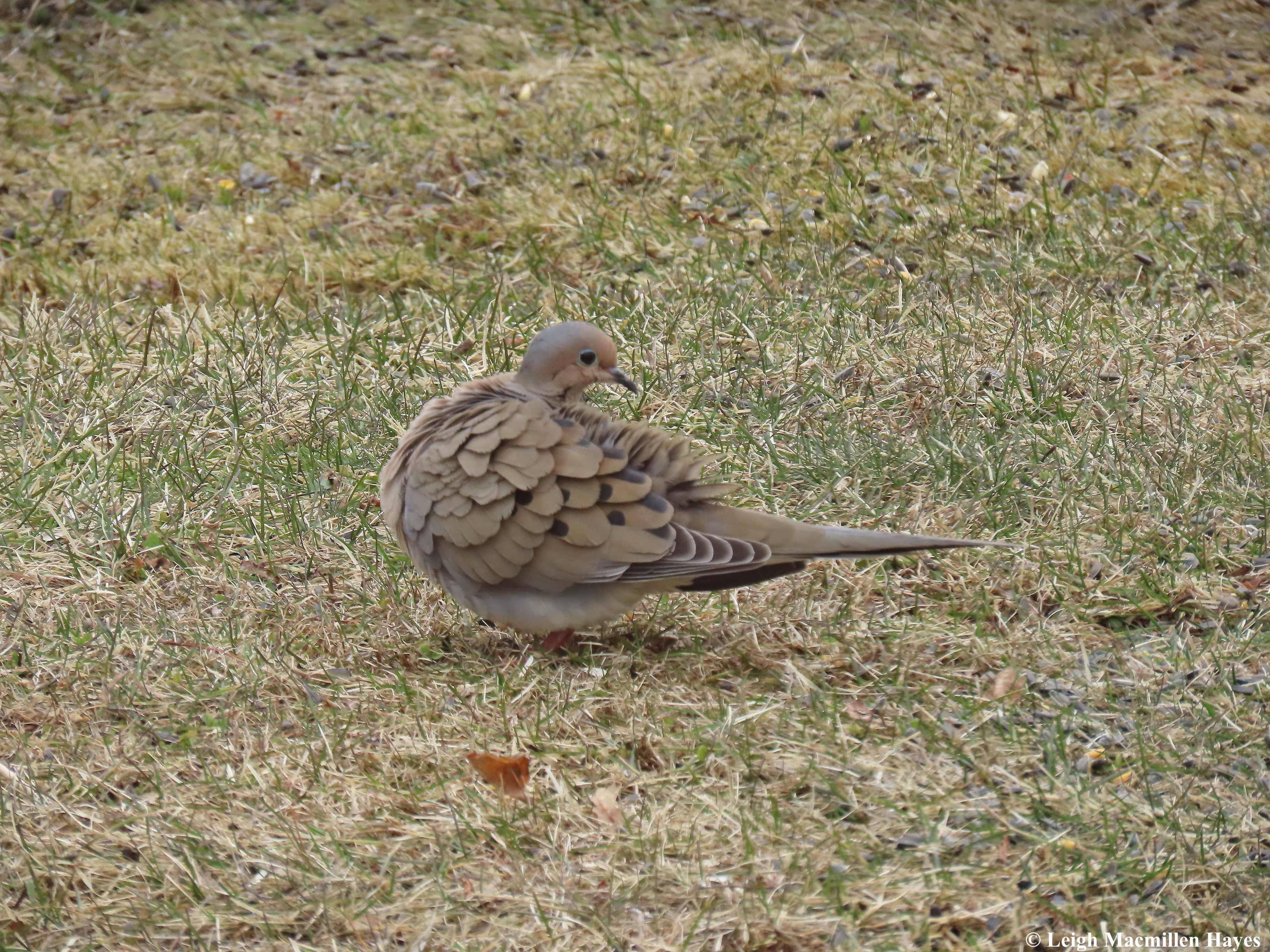
Then he’d fluff up again.

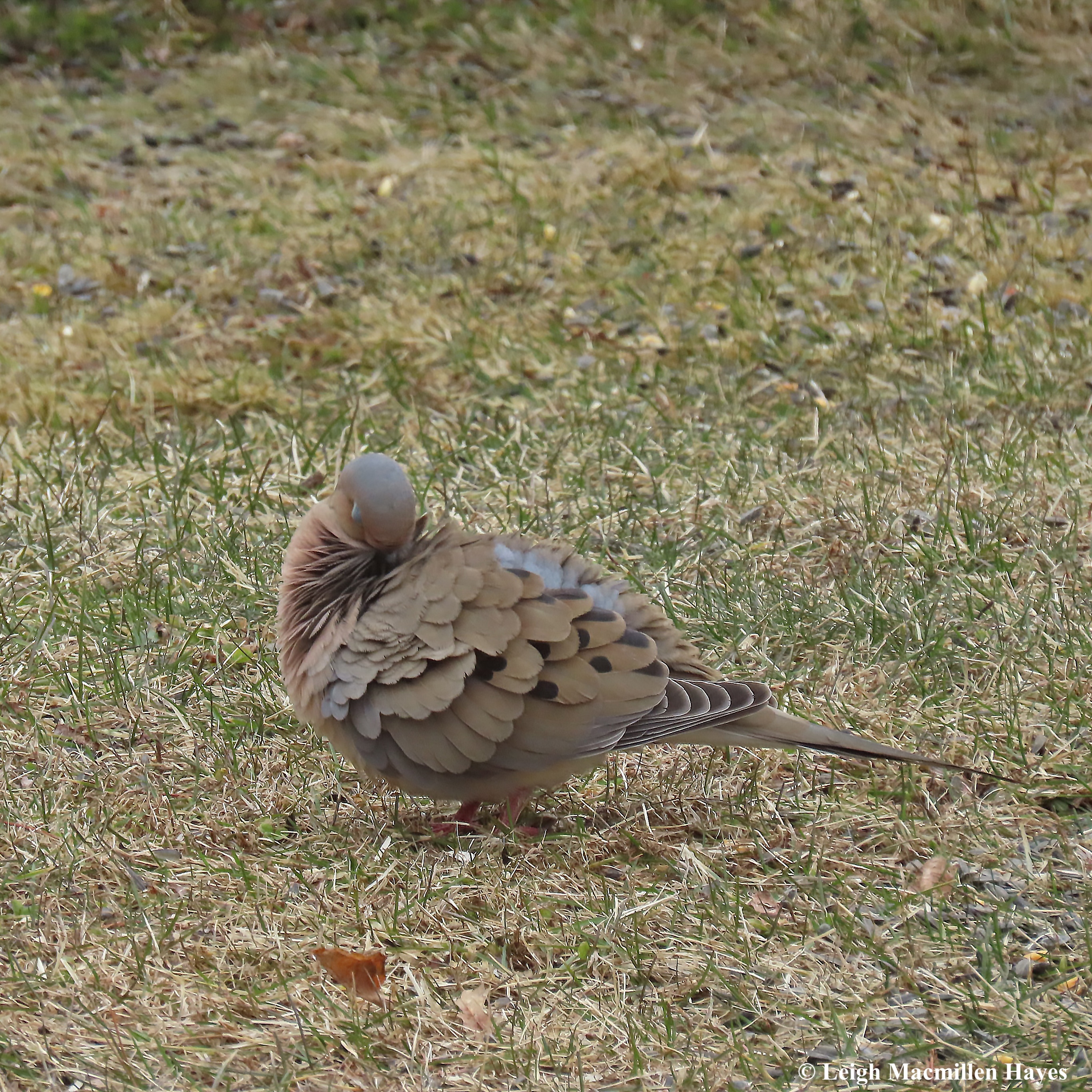
And preen to make sure he was looking his best. I was impressed.

She didn’t care.

Like her, I turned my attention in a different direction as at least three Song Sparrows splashed in a large puddle and also sought seeds. I’ve yet to hear their songs, but they’ve been back in Maine for at least a couple of weeks.

And then a female Bluebird joined the scene and made me give thanks for our neighbor’s field and the houses she has installed for these beauties.

Her mister also kept flying in, actually more often than his Mrs., but he only occasionally sought sustenance. The rest of his time, he watched and waited, and waited and watched.

When I did turn my attention back to Mr. Mourning Dove, he was fluffing up again.

And then he approached his true love.

And tried to jump on her back, but she quickly hopped away. It took him a while, but finally, he headed north, walking across the yard to I know not where. And she stayed and gathered more seeds.

At one point all three species, the Tree Sparrow, female Mourning Dove, and male Bluebird all occupied the same space, but then he flew–as birds are known to do, especially when I want to photograph them.

More interested in suet was the male Downy Woodpecker. I kept expecting his lady to arrive, but she never did appear.

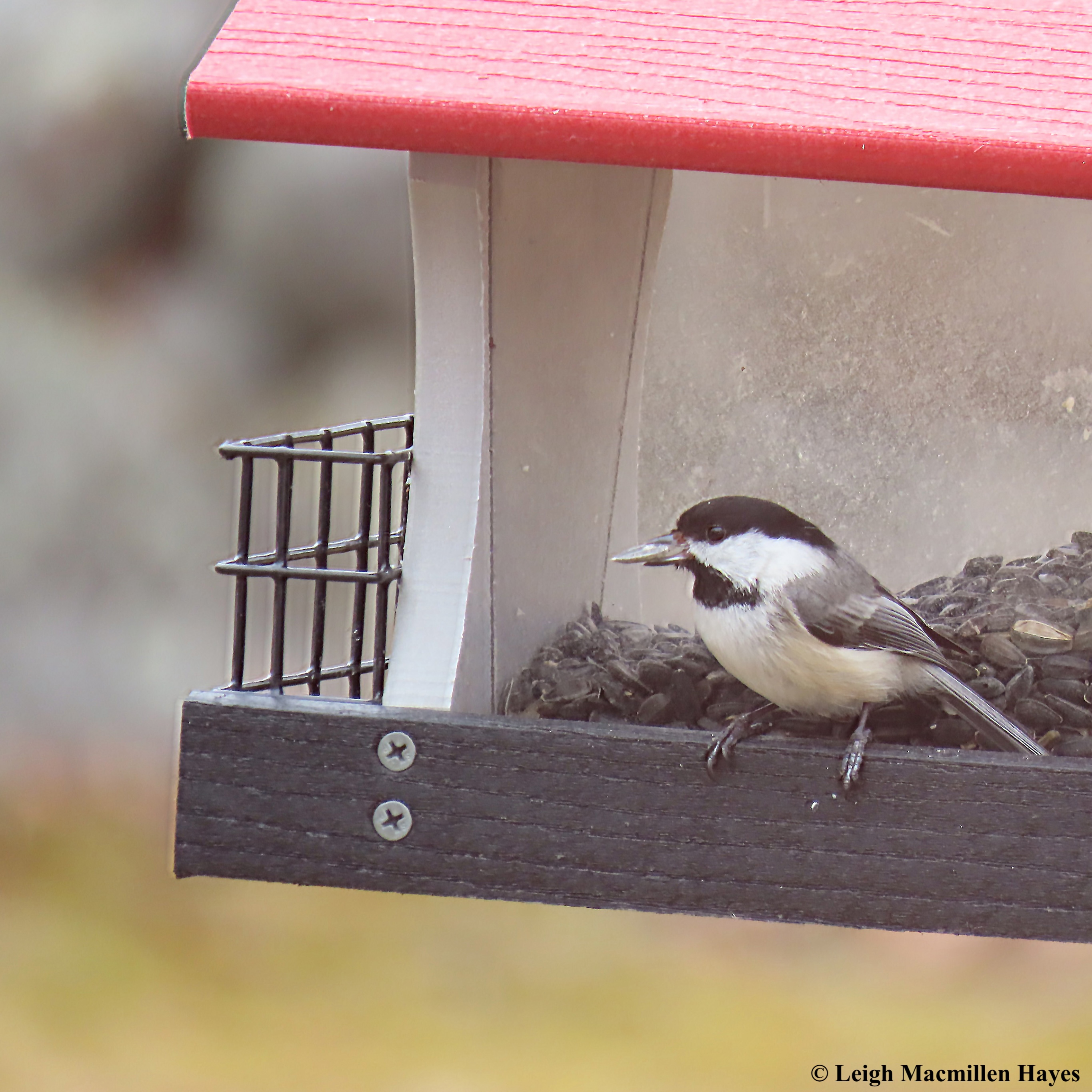
There was, however, a lot of Chickadee action, and I cannot say whether male or female, for to my uninformed eye, they all look the same.

White-breasted Nuthatches also came, seeking both suet and seeds in no particular order.

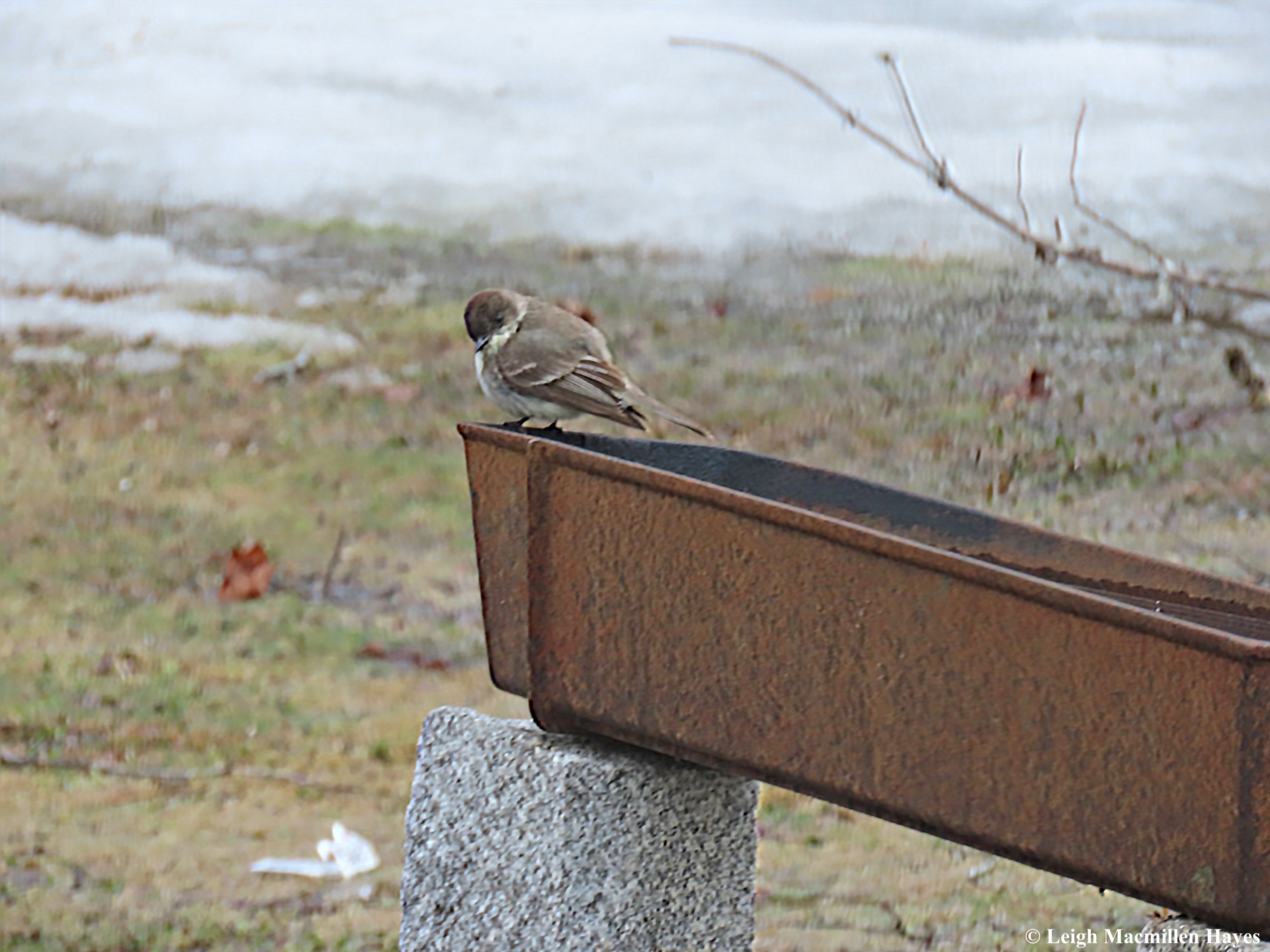
And for the first time this year, an Eastern Phoebe entered the scene. She’s tried to build a nest over our front door one year and on our back shed the next. I’m curious to see where she decides to locate her adobe this year.

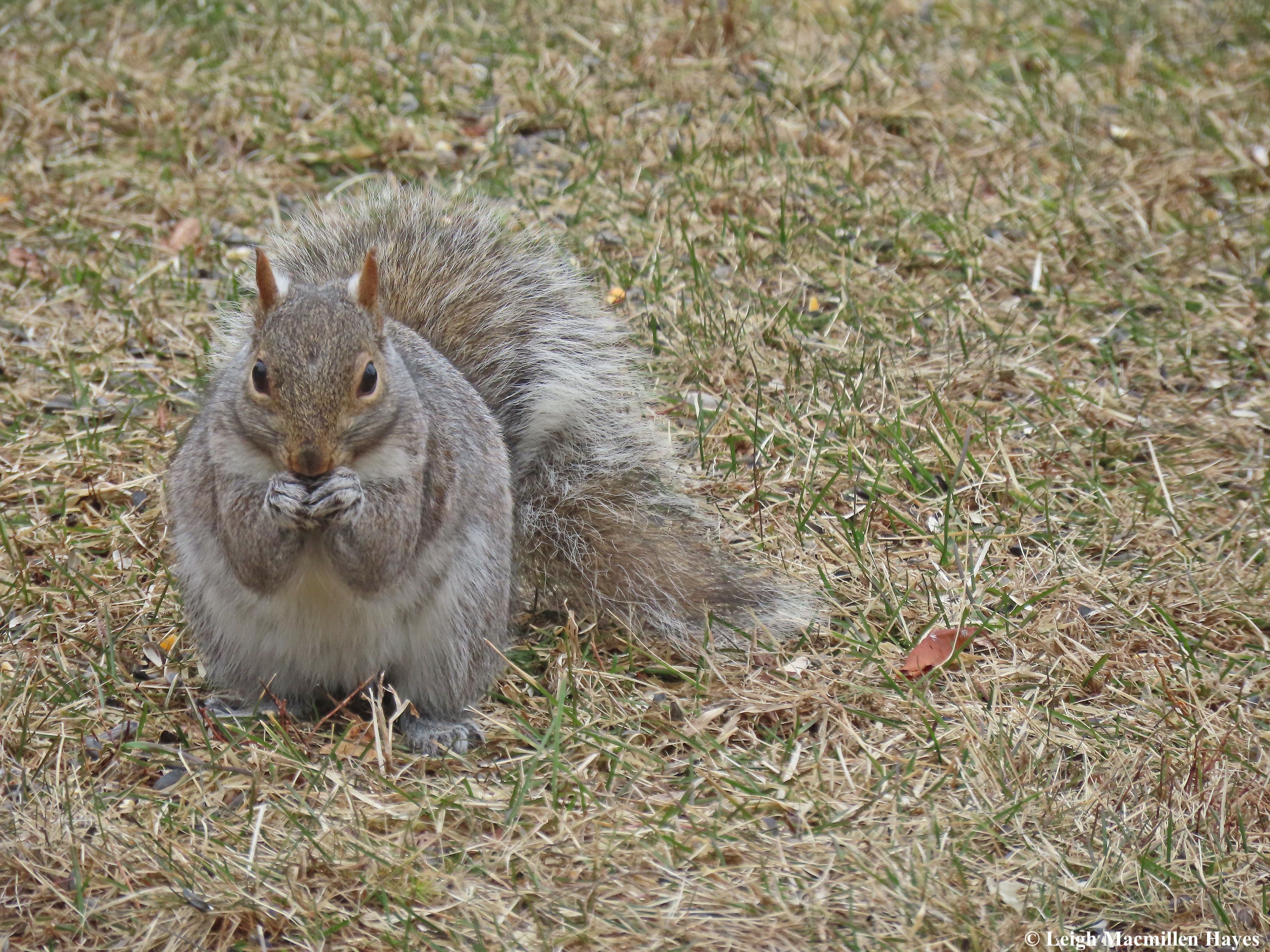
The final bird for yesterday was the Squirrel Spoonshovel, so deserving of its common name for all it seems to do is shovel seeds into its mouth. Nonstop. All day long. This one and six of its nearest kin.

But eating bird food apparently works, and I couldn’t believe it when I saw it take flight.

This morning dawned with the Bluebirds and all their neighbors back in residence. And I could not help but think of the patience this male has as he perches for minutes on end.

That is . . . until it began to snow and he looked at the first flakes with disdain.

And then back at me as if it was all my fault. Really, I tried to explain, I can’t control everything, despite my fervent attempts.

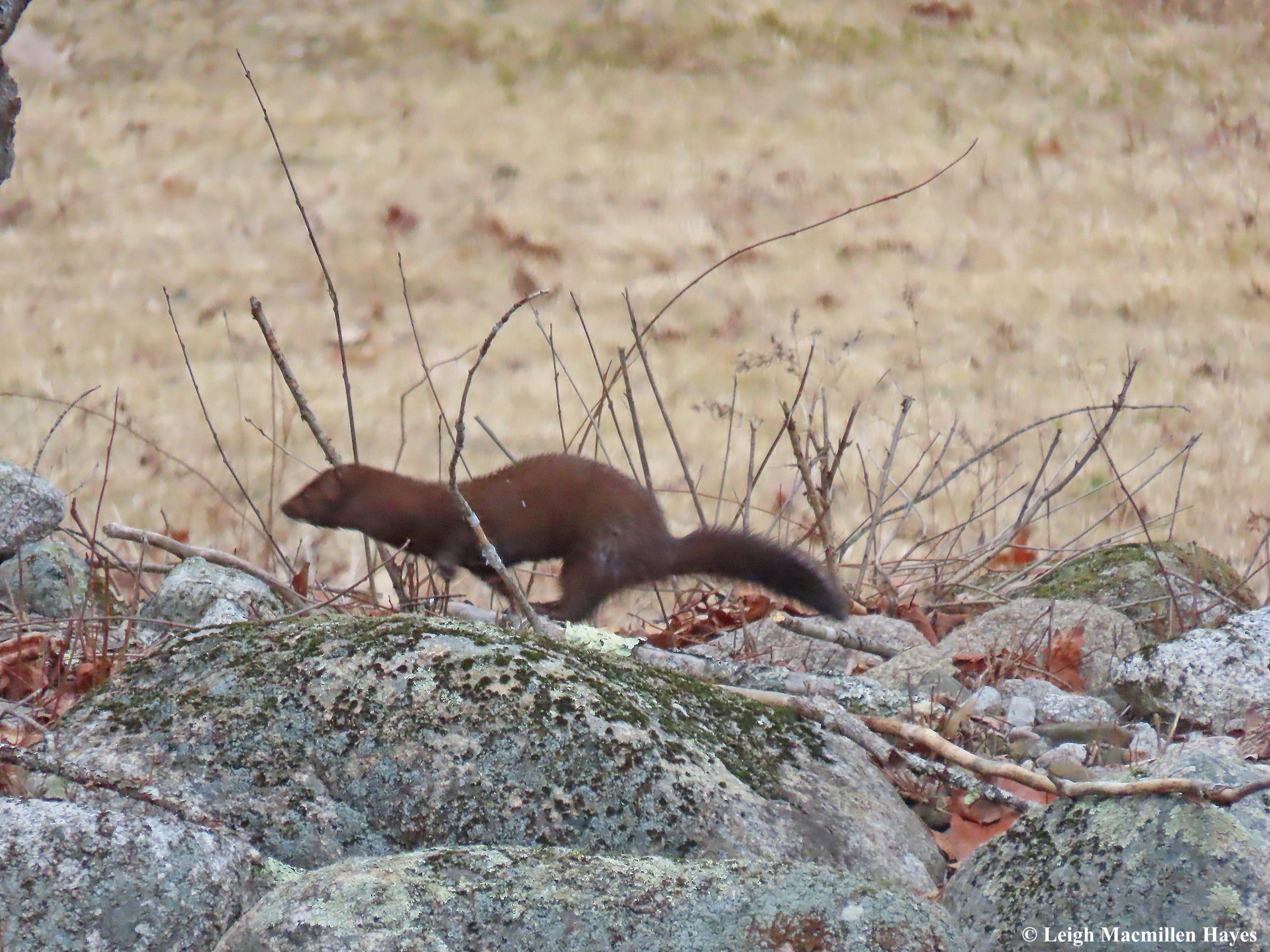
The star of the show today, however, was another unexpected visitor, this in the form of an American Mink!

My photos are not crisp for so quickly did he bound, but I couldn’t believe my good fortune to have spotted him.

I’ve seen fewer squirrels today and wonder if he might know why. Although, as I typed that, I looked out the window and tada, there was one, and then a second.

They fought for a chance to sit in the bird feeder . . . of course! Because after all, they are Squirrel Spoonshovels, that rarest of bird species.

The wild out my window . . . is truly wild here in western Maine. And each of these is just a snapshot of time, for honestly, I don’t spend every moment standing by the backdoor.

But just imagine if I did . . .

Deciphering the Porcupine Dance

When I least expect it, the Universe speaks. And suddenly all makes sense. Well, not all, but a few things become clearer and my understanding of the natural world grows.

So it was early this week when I walked down a forested road and met tracks well worth pondering.

To set the stage, we’d had a 5 – 6 inch snowstorm Friday night into Saturday, followed by some melting, and then rain and freezing rain on Sunday, and fog and rain on Monday. A smorgasbord of spring weather.

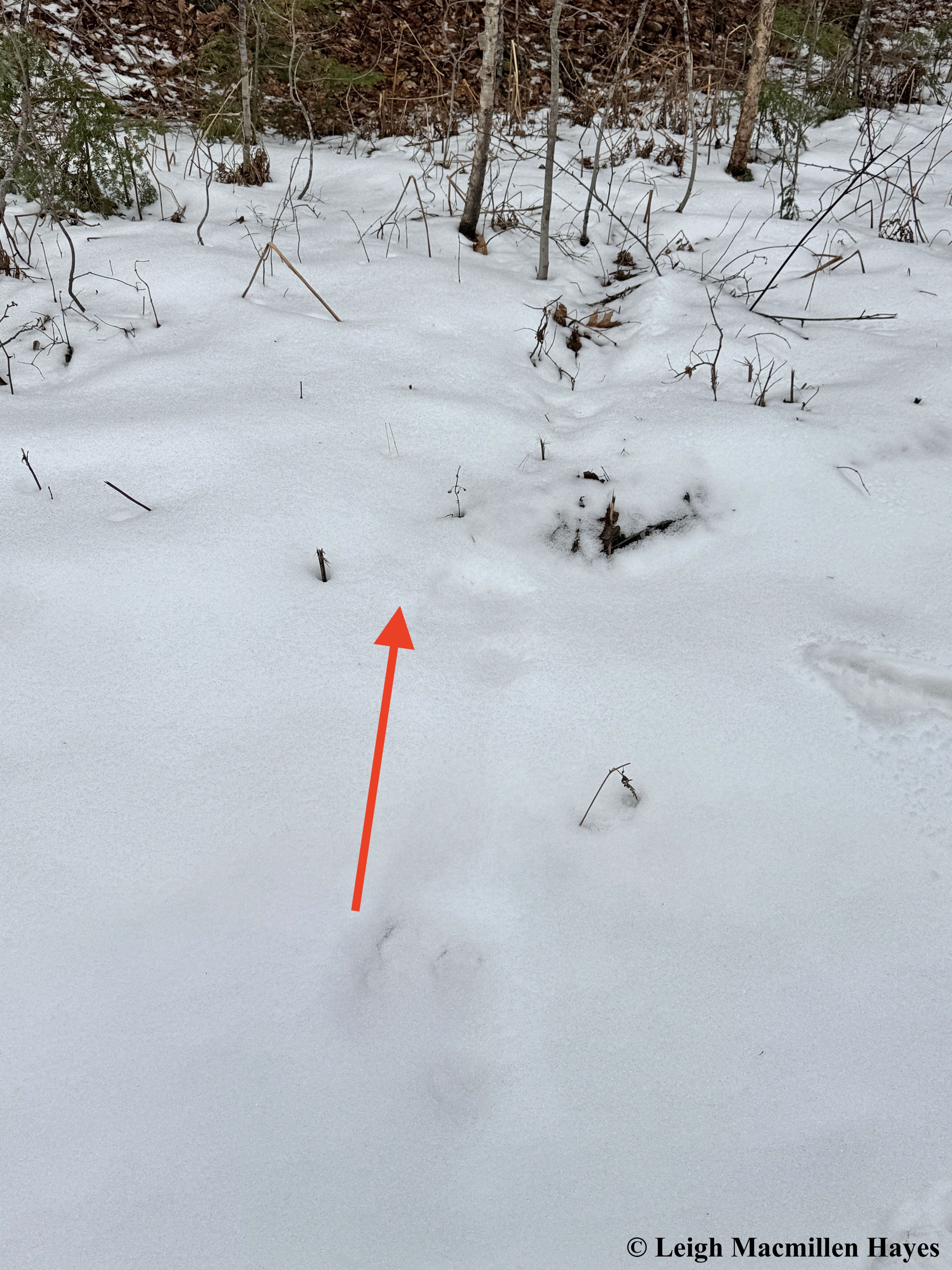
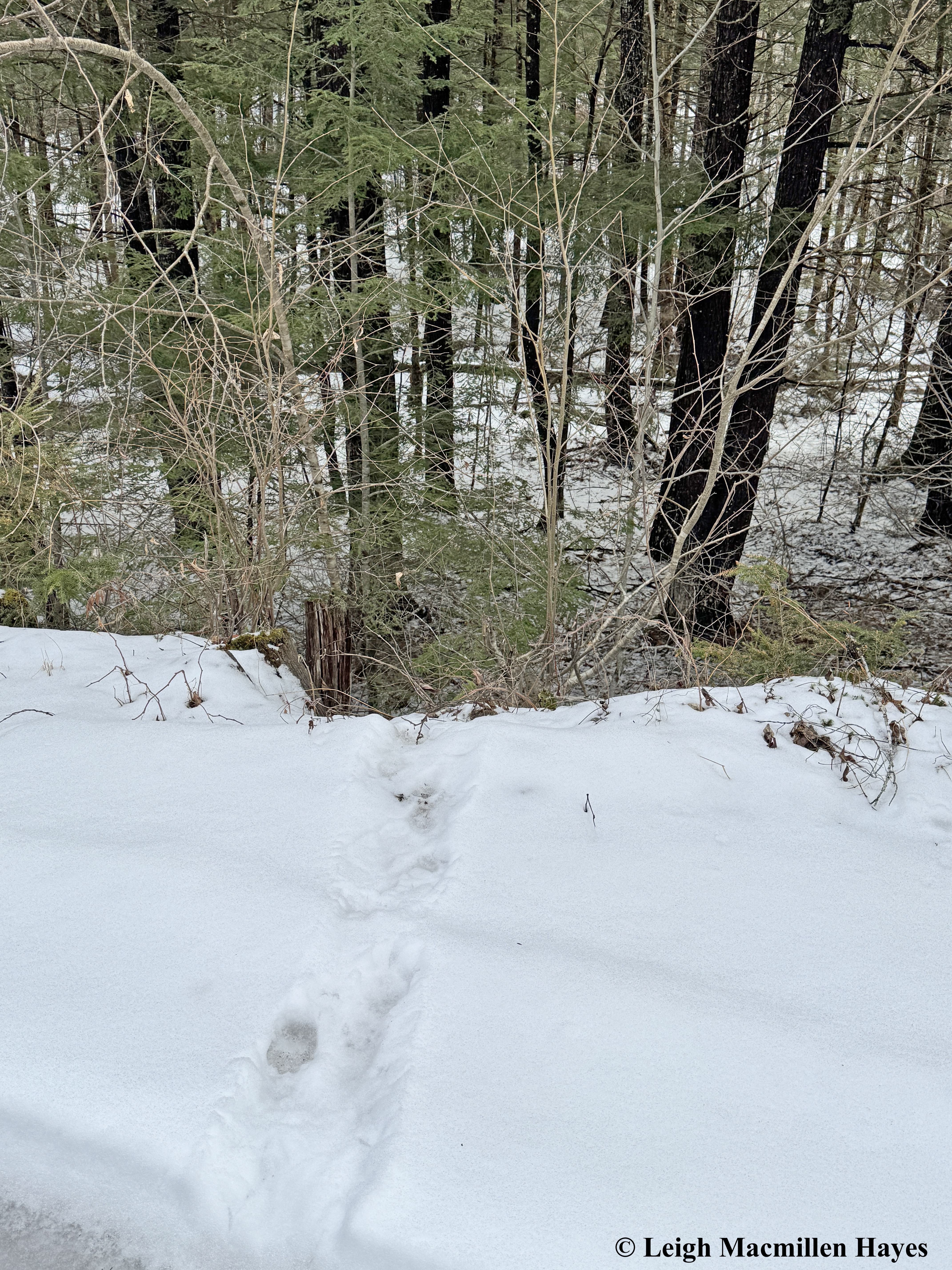
As I walked along, I noticed some disturbance in the snow and when I reached it, I noted that there were two disturbed sites almost parallel in orientation.

And my heart gladdened, for I immediately recognized these as representing the travels of a River Otter, or two or three. What’s more, they had been made over the course of at least two days.

The bounding slide on the left was first and probably occurred early Saturday as it still snowed. Such was the bound and slide so filled in, yet still representational.

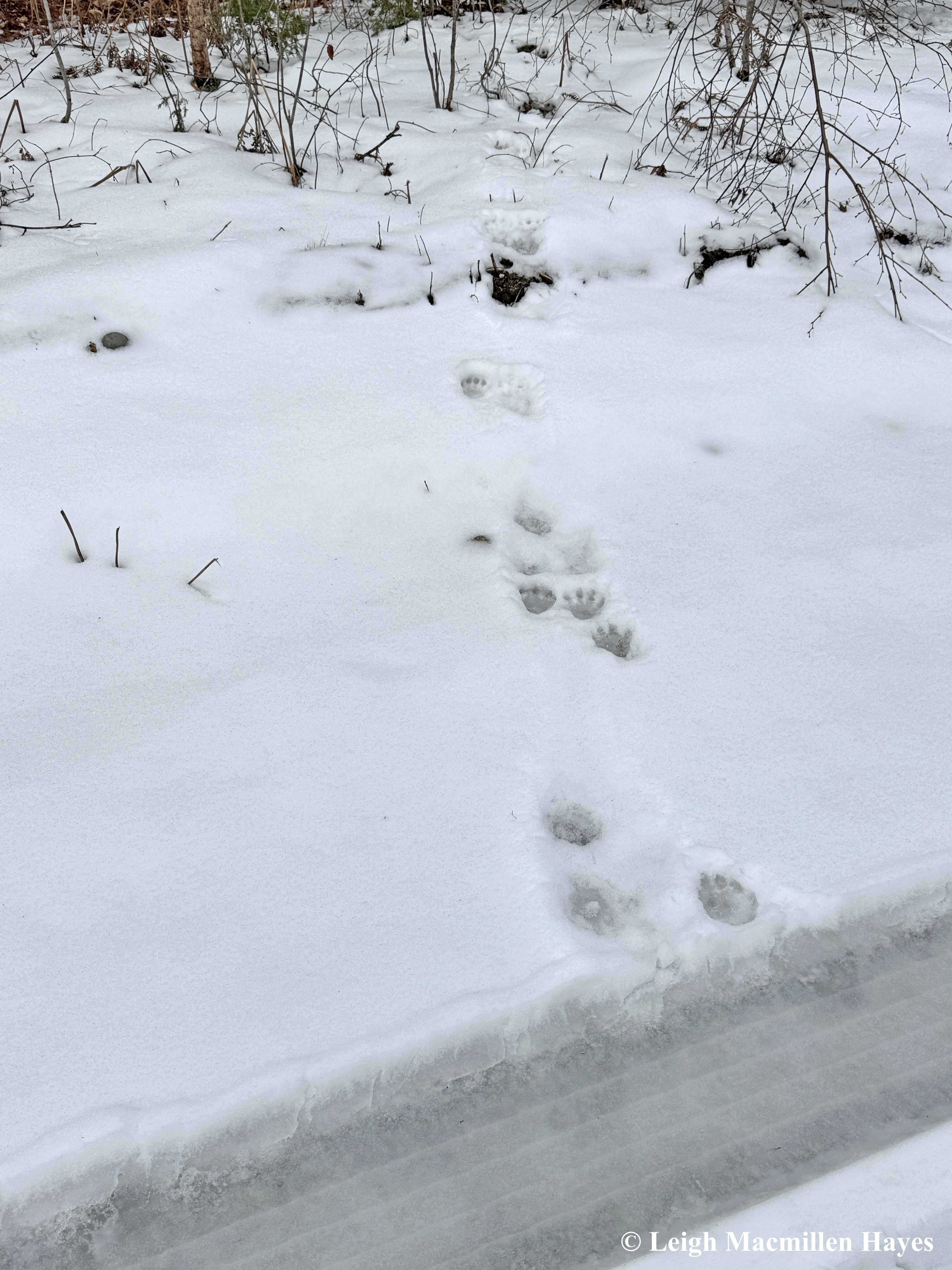
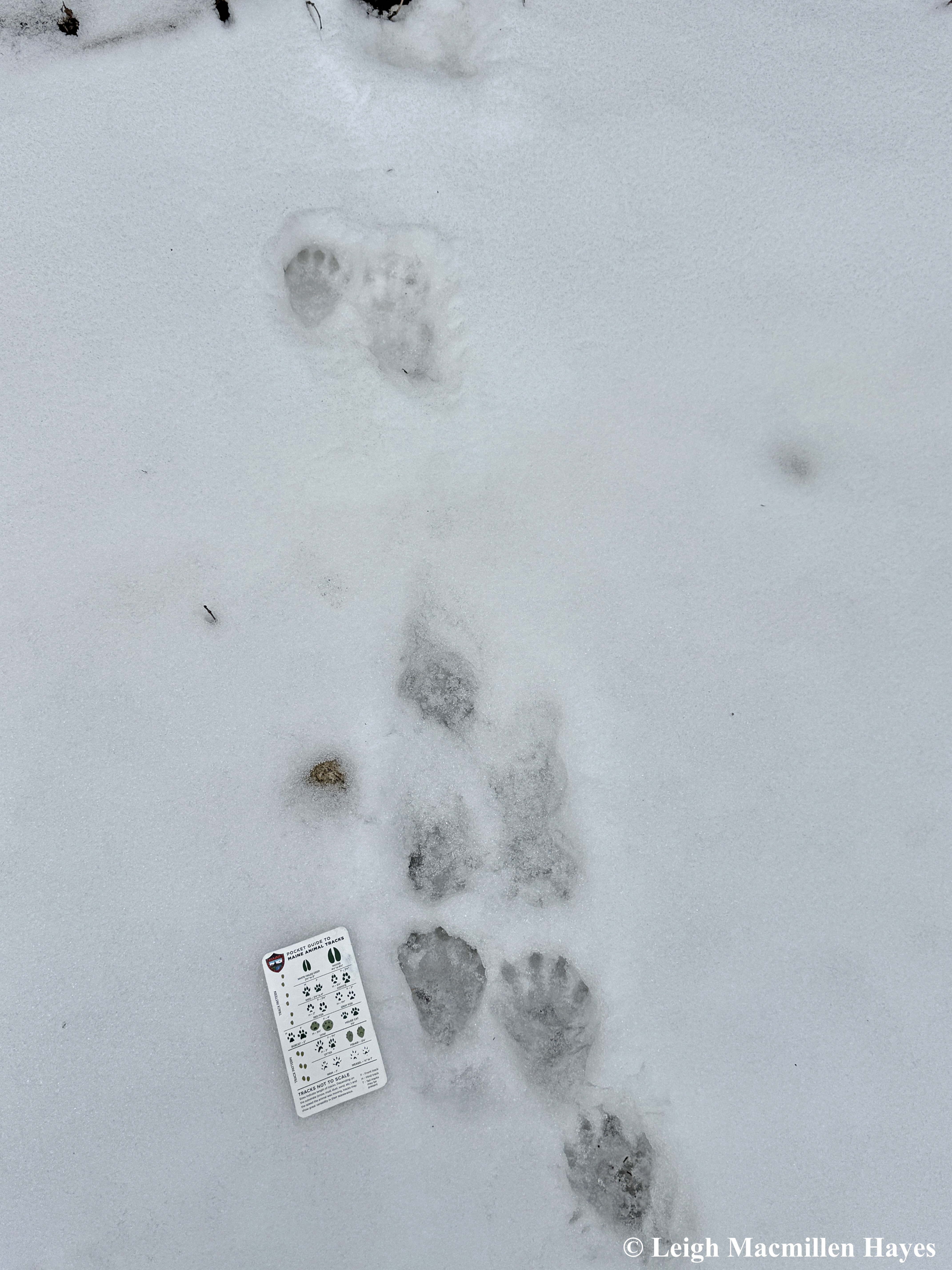
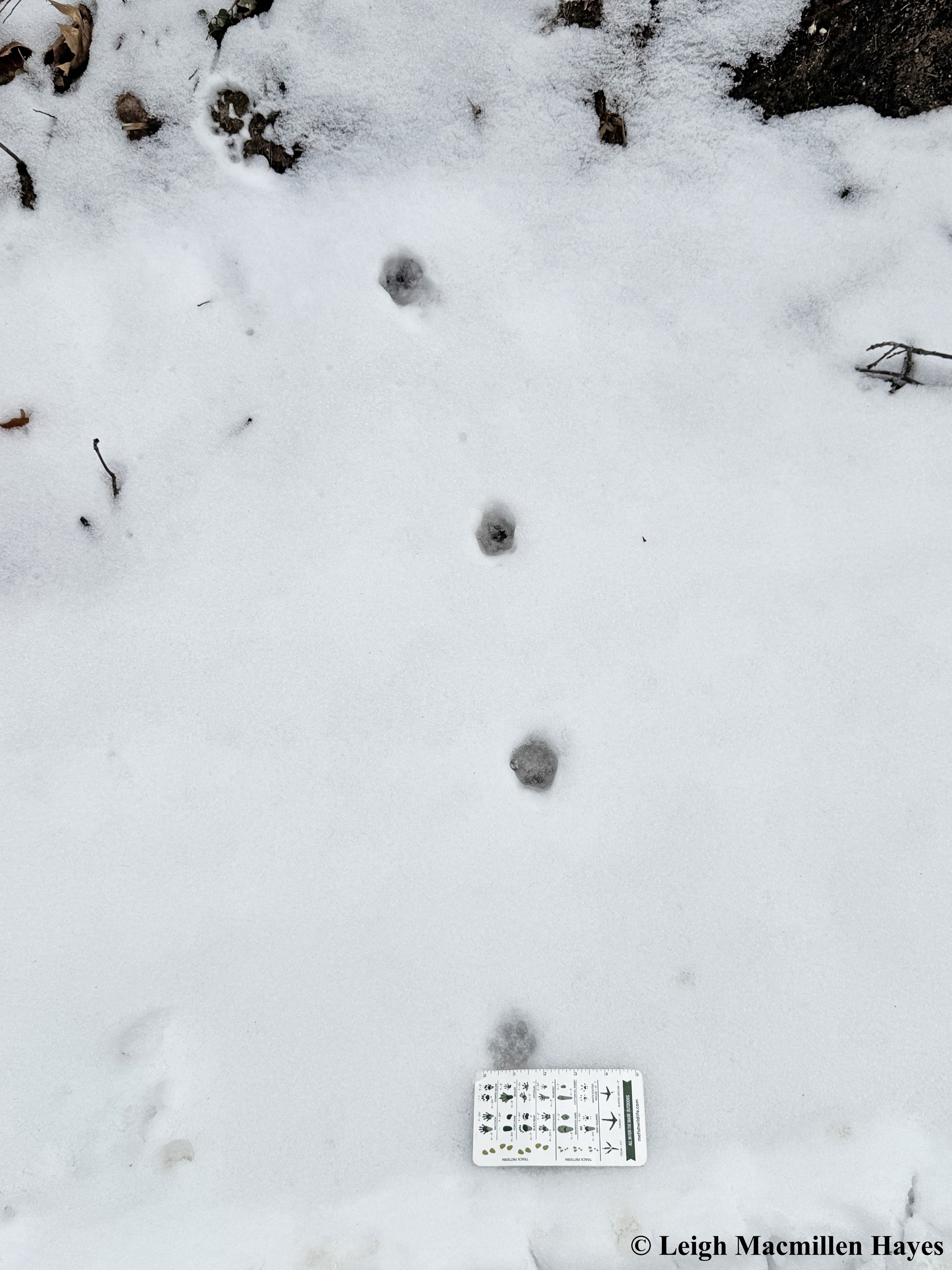
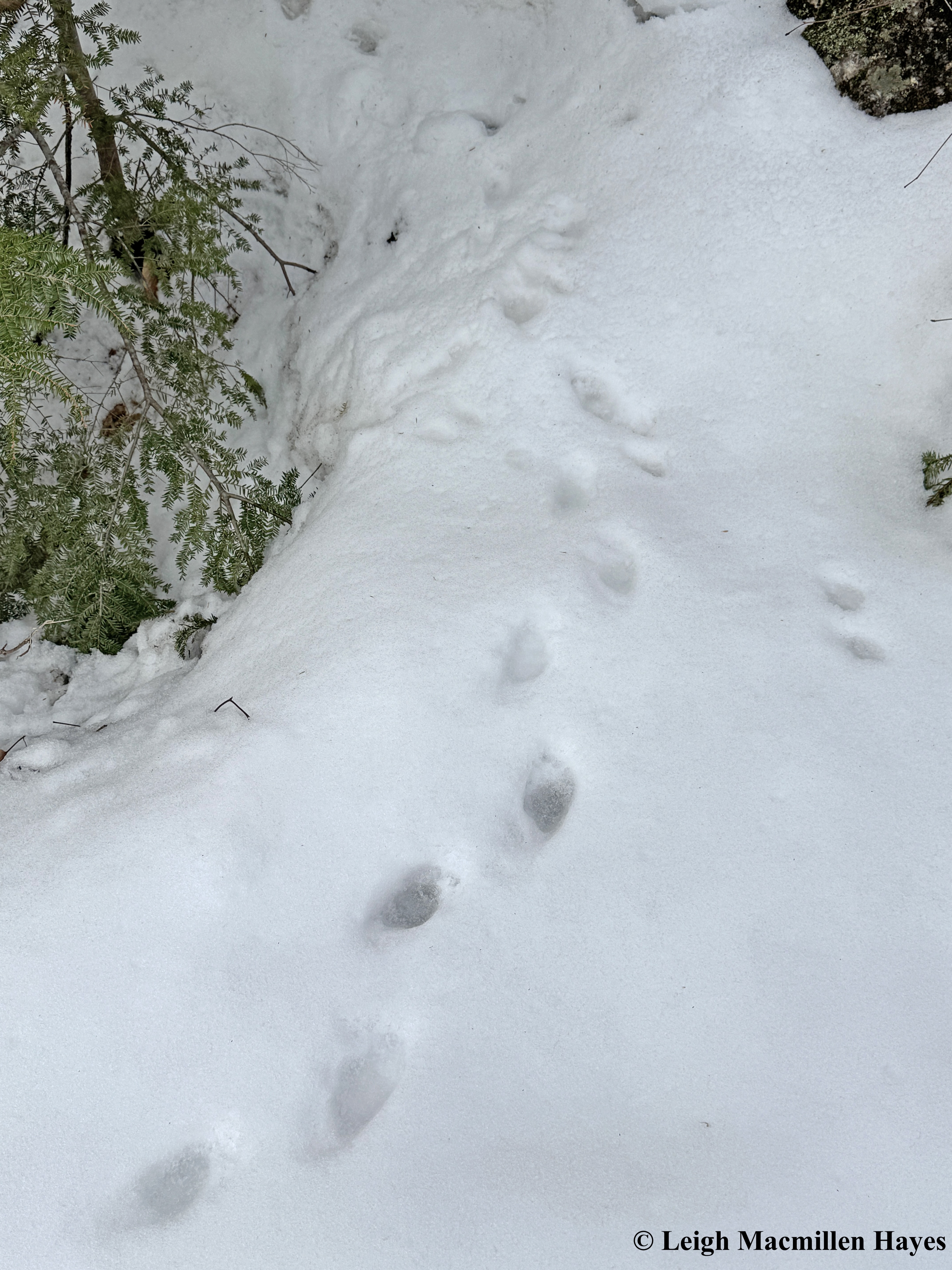
Do you see the diagonal orientation of pairs of prints in the above photos of the second set of tracks? And the five toes–tear-drop shaped as they were?

These prints were much clearer and appeared to have been made Monday.

Because I was traveling light, I only had my Maine IF&W card in my pocket to offer a sense of size. But a closer look revealed that this particular trail included the Otter(s) moving in opposite directions, again at different times due to the clarity or non-clarity of the prints.

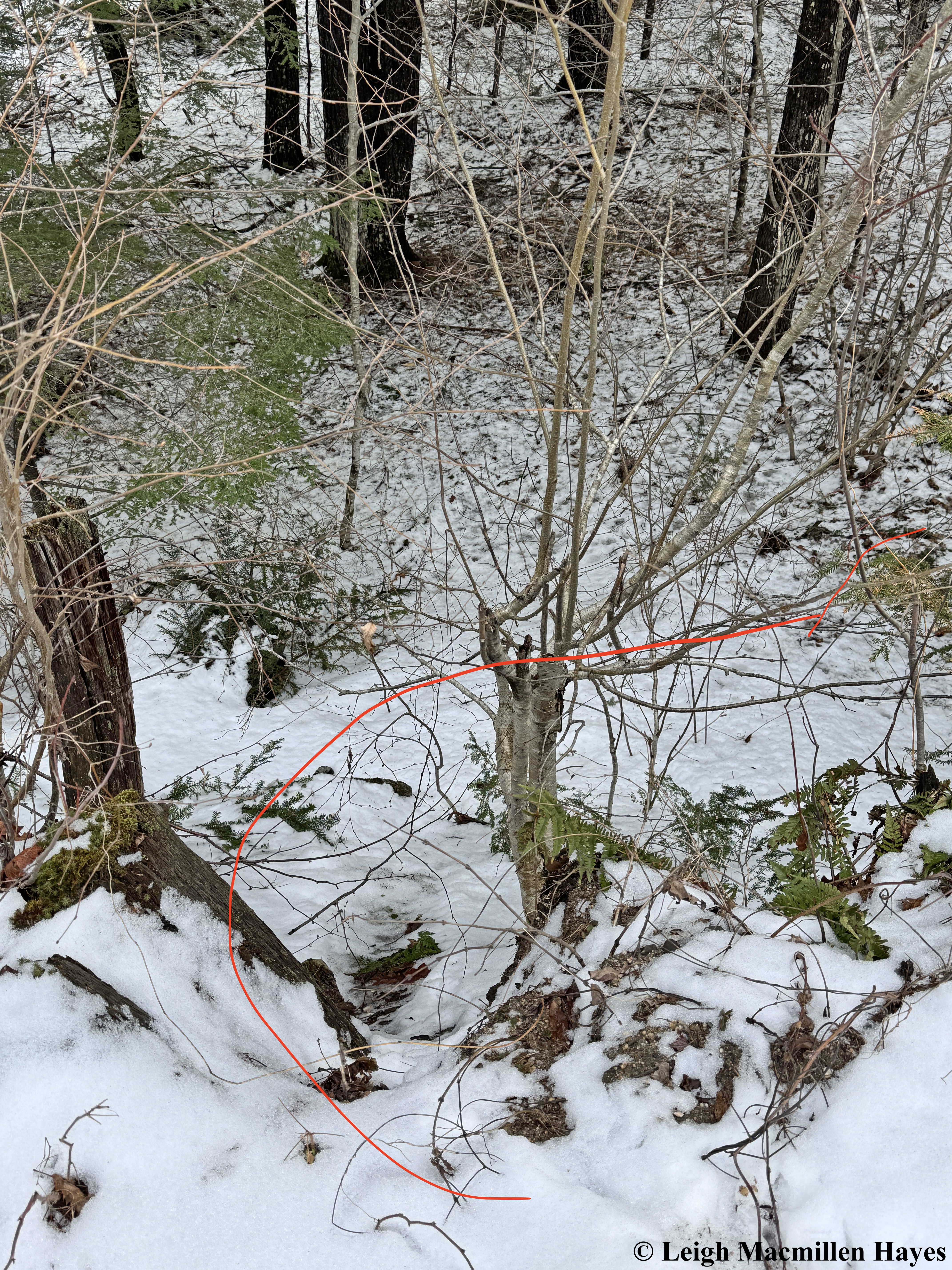
I looked across the road upon which I walked and saw that the bounders had come up and gone down to a stream via a very steep embankment. “Yeehaw!” I could almost hear them shout.

It was a rather circuitous route to the water, but that’s the way of an Otter. Why do straight when you can move in any direction you choose.

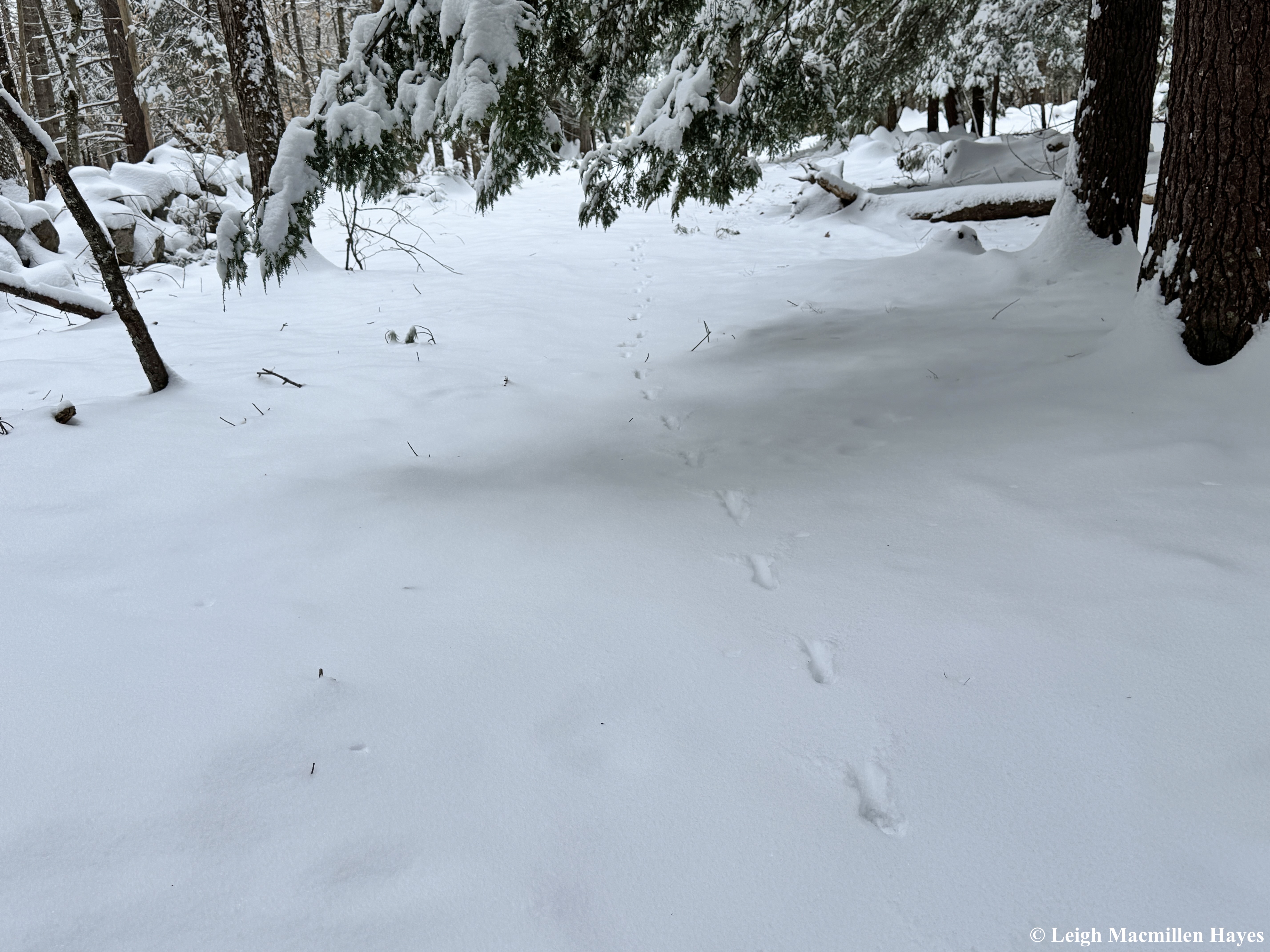
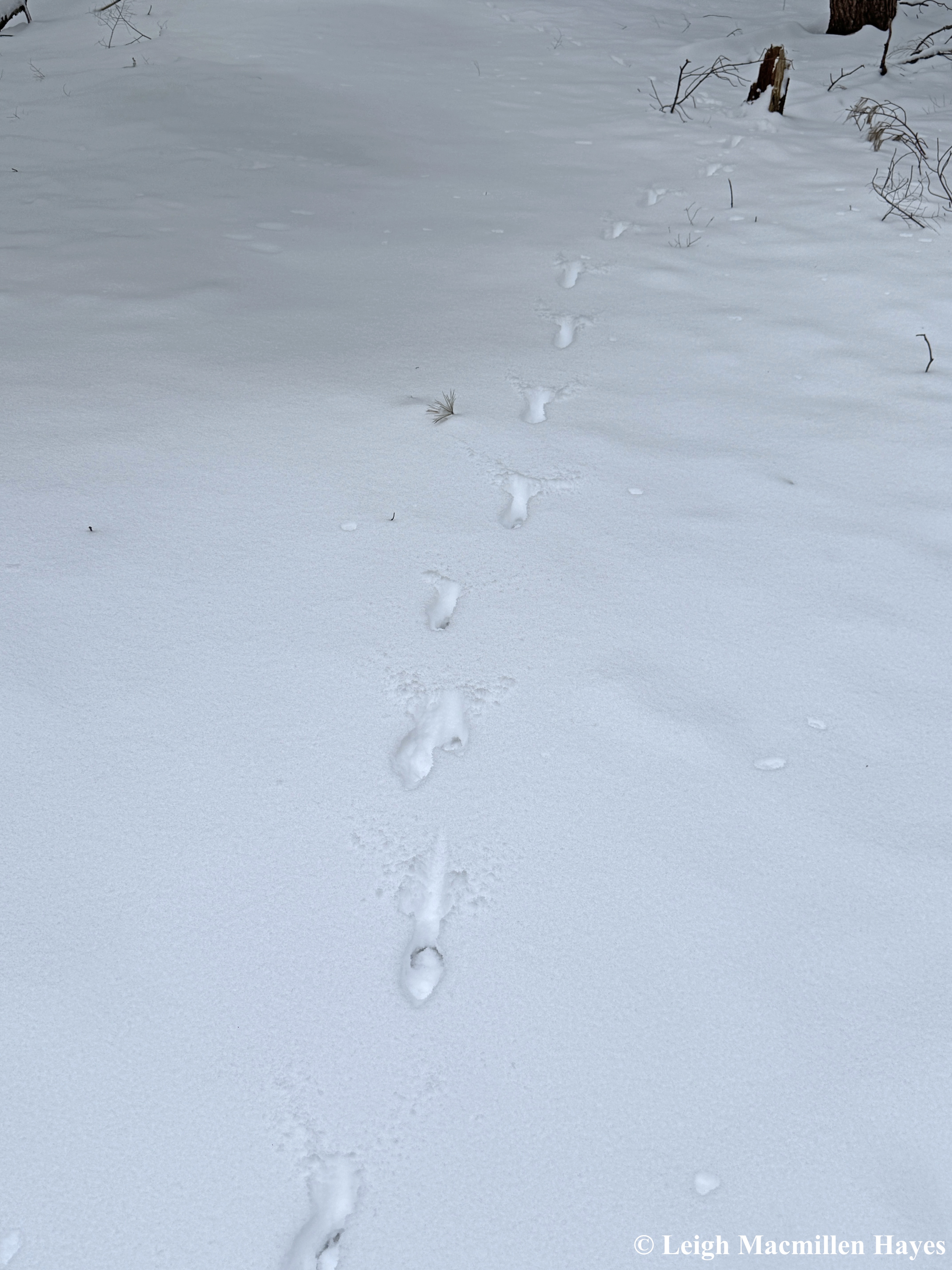
Eventually I moved on, and the next beauty to share a sign of its presence in these woods was a Snow Lobster, aka Snowshoe Hare. Remember, the two feet at the top of the photo are actually the hind feet, while the two behind, that form the lobster tail, are the front feet–as the hind feet swing around the front and land as this hopper leaps forward.

The snow conditions were such that the impressions were rather wide.

But not as wide as those I’d seen the day before. My, what big feet you have–indeed.

Continuing on, I began to notice the tracks of others who had passed this way, and the first clue to identification was the manner of movement–this being a rather straight line with a hint of a zigzag down the middle of the road. This was the track of a Red Fox.

And soon a Bobcat appeared. Well, it didn’t actually appear, but its track did.

Some prints were almost perfect–with a lead toe, much like our middle finger, and the C ridge between toes and heel pad.

That’s not all, There were more sets of prints oriented on the diagonal. Think back to the River Otter, who is in the Weasel family. This small critter is a member of the same family, but these are the prints of a Mink.

By this time I was feeling really rich. Especially since I didn’t expect to find so many different species in this space I walk frequently.

And then I met an old friend, the one and only pigeon-toed Porcupine. Actually, if you look closely at this photo, you might note the Mink bounding over Porky’s path, only actually, I think the Mink passed this way first. And it’s not a known predator of the quilled one.

I didn’t venture off trail to locate Porky’s den, but I knew it was among the boulders just beyond where I stood for I could see its tracks moving back and forth between them and suspect there is more than one home site in this locale.

As I moved on, I followed Porky’s path along the road for a while, before he moved off into the woods, toward what I assume to be its feeding site.

That said, you should note another critter also passing this way–another perfect walker, this one being a Coyote.

And then, and then, the creme de la creme:

A do-si-do dance, all the moves worked out, with a promenade forward and then a turn around several times until the Porcupine ended back at the spot where it began these fancy steps.

I knew at once what this represented and though I shared this video only a couple of weeks ago, upon seeing the fancy footwork in the snow, I knew exactly how to interpret it.

The video is from my game camera and after you click on the arrow, you can watch the prickly critter do a do-si-do dance before climbing a tree. This is the reaction to a predator in the area.

In both situations, it was the same cast of characters who could serve as a predator: Red Fox, Coyote, and Bobcat. Of all of them, the Bobcat would be of most concern. The largest concern would be a weasel whose tracks I did not spot–a Fisher.

The circular route that my prickly friend took gave it an opportunity to show off the quills on its back–a warning telling others to stay away. For the time being they did.

And I gave great thanks for the opportunity to see signs of so many critters, but especially to decipher the Porcupine dance. Just like that, it all began to make sense.

Marching into the Vernal Pool

I’ve lived in Maine for just shy of 40 years and can barely recall the month of March going out like a lamb, as the saying goes.

It’s certainly true that once again this year the ending of the month is more lion-like with an overnight and morning snowstorm, with freezing rain on the horizon for tonight and tomorrow, followed by a warm-up and rain on Monday.

That all said, March snow doesn’t last long.

But still . . . it has me dreaming. Remember, I LOVE winter, but am as ready for spring as the next person.

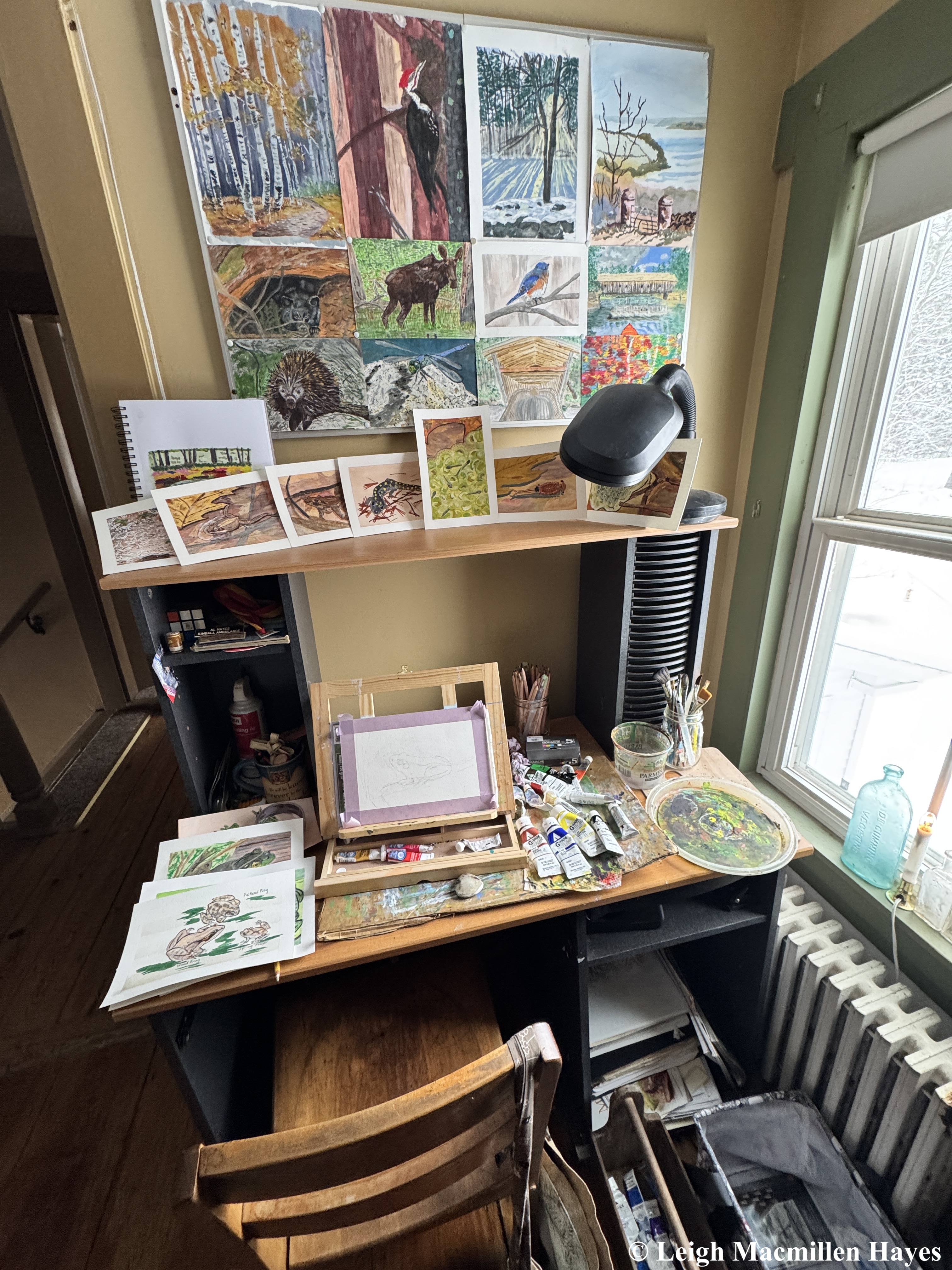
And so I spent much of today (when not shoveling, which really didn’t take long) holed up in my wee studio where I’ve been working on a vernal pool series of paintings.

The idea for this post actually came to me in a dream last night–why not turn those paintings into a blog post. Why not?

Because, it’s scary to share creative works with the world. But, I am probably my own worst critic. My instructor, Jessie, always reminds me to put my inner critic into a box, place the cover on top, and get to work. And besides, by sharing here, I can hide behind the screen. She wants those of us in her class to host an art show, but I refuse to do that. It’s much more comfortable for me this way.

I’ve only been painting since last May, but let’s not let that be an excuse. The thing is, working with gouache paints means I can easily edit, much like writing. And believe me, I have. My motto has always been that there’s no such thing as a final draft–whether it be an article for a magazine or a work of art.

Have you noticed that I’m procrastinating? And putting all of my excuses out there.

It’s snowing again.

All right, I’m almost ready. But here’s the other thing–in sharing these with you, may you be inspired to do something you never imagined and discover that the time you spend doing such is most enjoyable and it’s easy to get “lost” and just plain have fun and decide that even though the “end product” isn’t exactly what you first set out to create, it’s still half decent and you had the most delightful time sitting quietly as is my custom, doing just that: creating.

And now . . . for a look back as a way to look forward to a vernal pool as it emerges from winter or early spring, or mud season, or almost spring but still winter, or whatever season this is.

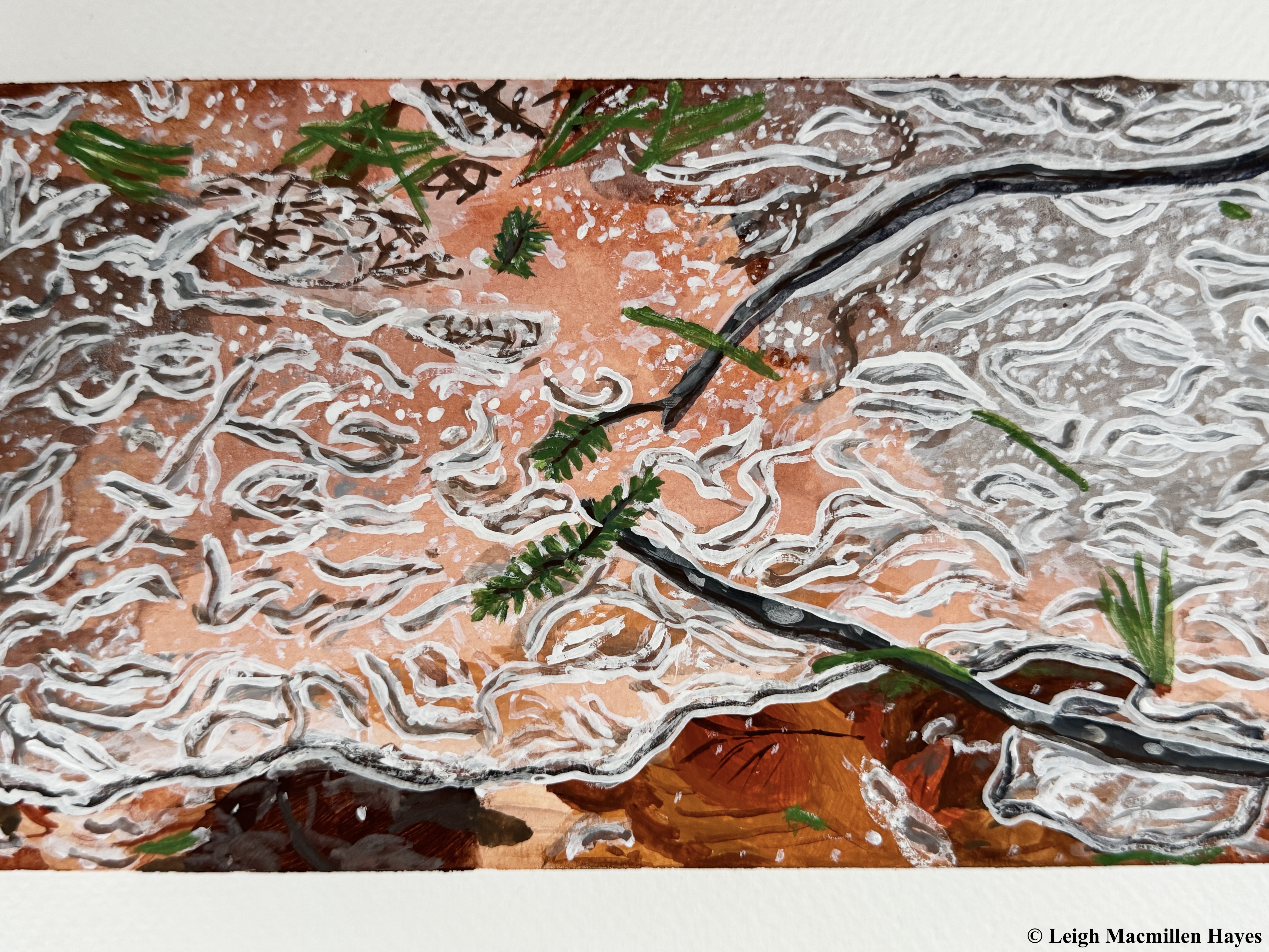
Pine and hemlock needles and branches from winter storms coat the ice as it slowly begins to melt along the edge of the pool, providing a glimpse of the sunken leaves below, where life awaits.

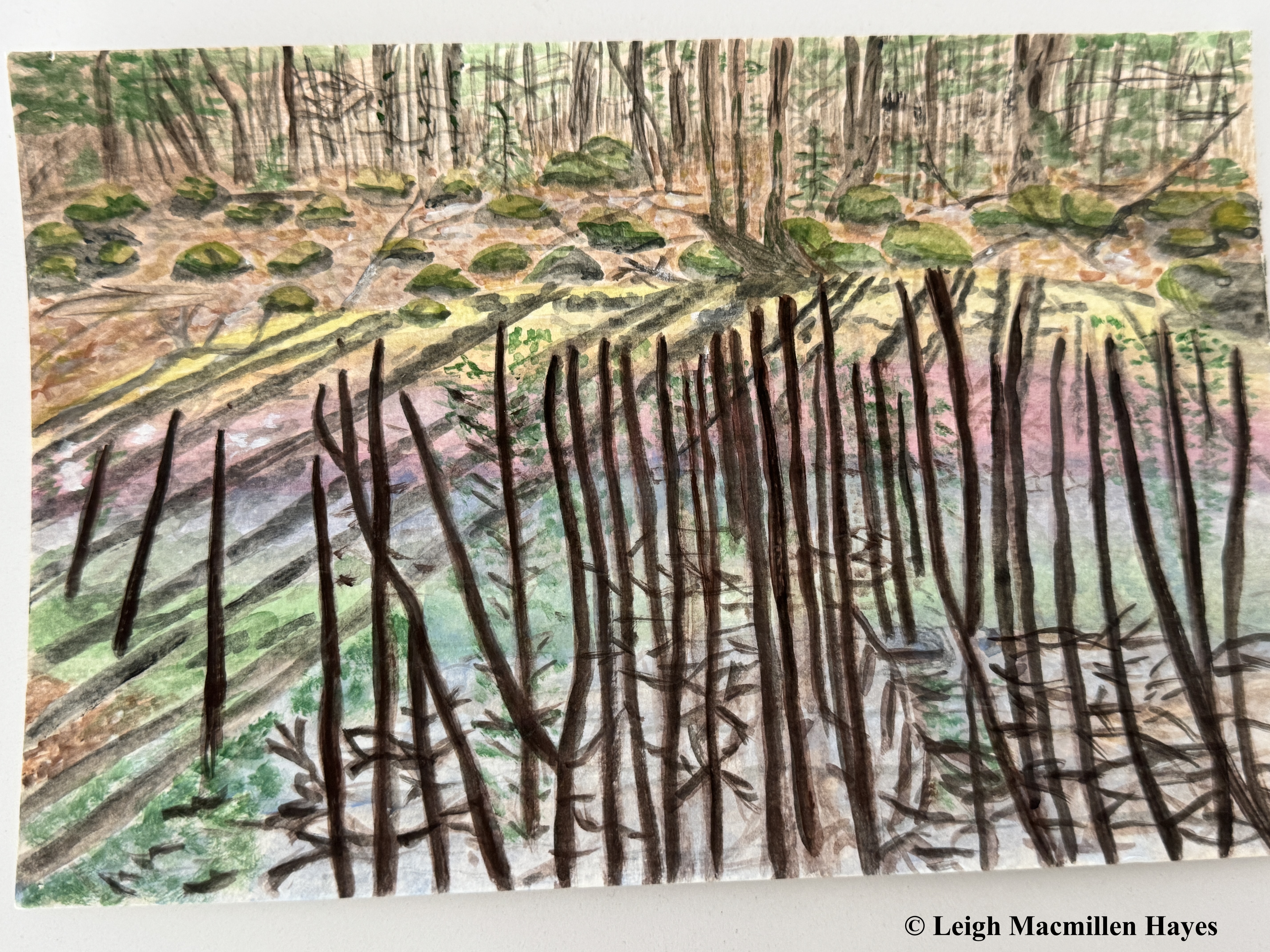
Once the ice finally melts, barren trees offer a reflection that speaks to winter, but there’s hope in their buds.

And no sooner has the ice gone out, when upon my approach I hear “Wruck, wruck,” and know that the Wood Frogs have returned to their natal breeding grounds. At first, they dive as soon as they hear me approach. But I stand still, sometimes for up to fifteen minutes, and ever so slowly, one by one, they rise to the surface and float.

It’s the lucky male who has the best “Wruck, wruck,” that finds a mate. He clasps her with his forelegs and as she begins to deposit eggs, he fertilizes them externally.

I return a couple of days later, in the late afternoon, and can’t believe my good luck. The pool is coated in pollen and the sun hits it in such a way that I see a rainbow of colors and love how the tree reflections are in two orientations upon still water.

A few weeks later, looking deep into the pool, which isn’t really all that deep, I notice blobs of eggs clustered together in a mass that has a tapioca-like shape to it and notice little life forms moving about in the shape of tadpoles. I feel like a proud momma. The thing is, the Wood Frogs mate, she lays eggs he’s fertilized and within two weeks, the parents are long gone, back to their woodland setting. And so I do feel protective parent–or maybe foster parent–keeping watch and celebrating achievements.

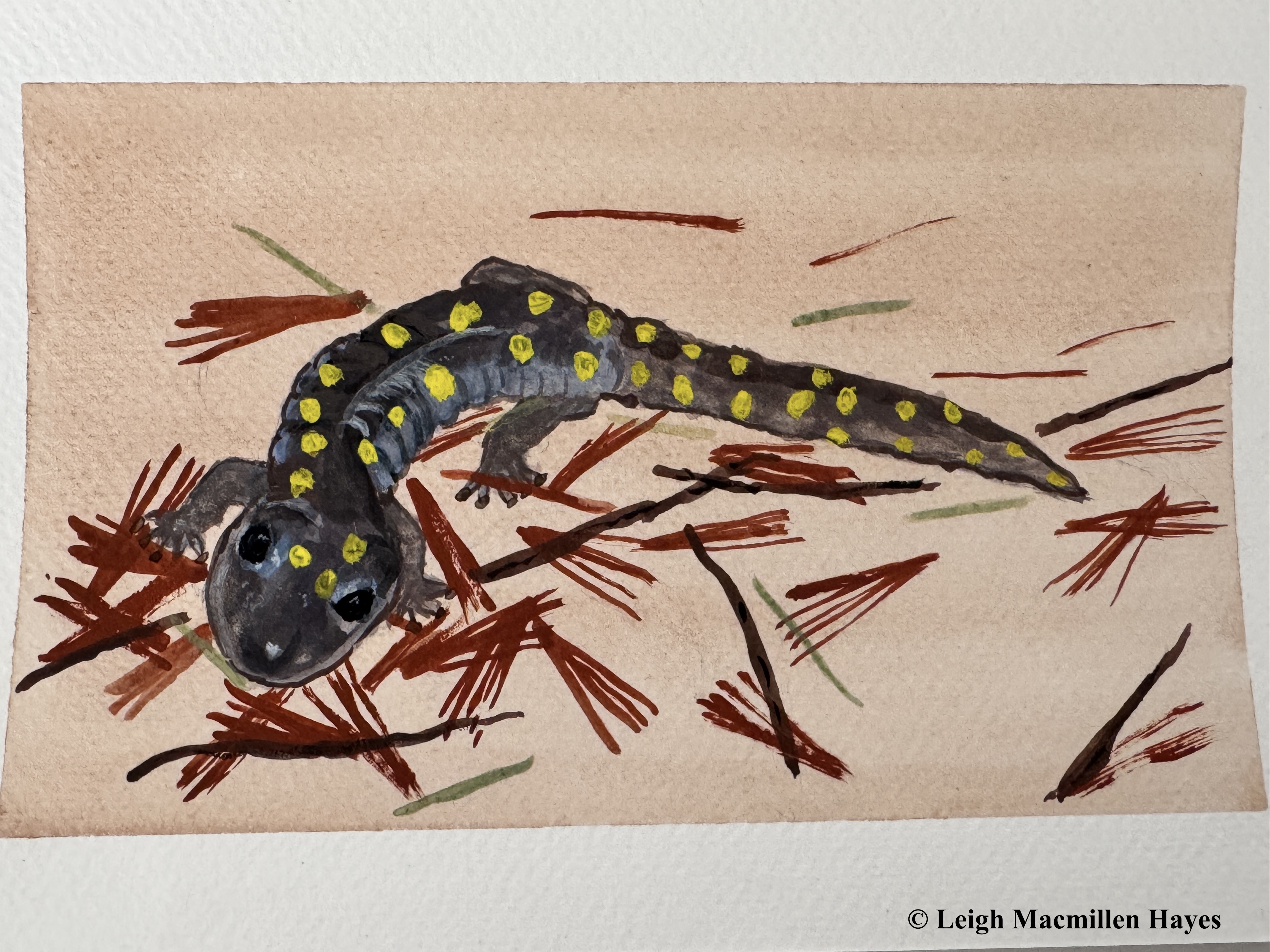
Another life form who uses the pool as a natal breeding spot is the spotted salamander and though I tend to mostly spy them on Big Night, I can tell by egg masses left behind that they have visited.

Their egg masses are a wee bit different from the Wood Frog masses, in that they have a gelatinous coating around the entire grouping, so they don’t look so tapioca-like. Mosquito larvae, tumblers at this stage, also wiggle about in the water.

And if I’m lucky, though this has never happened at the pool behind our house, I might see a fairy shrimp or dozens.

So here’s the thing: 40 Wood Frog egg masses make a pool significant; OR 20 Spotted Salamander egg masses; OR 10 Blue Spotted or Jefferson Salamander egg masses; OR a single, yes one, Fairy Shrimp. And this one is a female, as noted by the sac of dark eggs she carries.

Fairy Shrimp are cool because in order for eggs to be viable, the pool must dry out. And they can survive being dry for multiple years. And in any given year, not all eggs will hatch, thus saving some in the bank for another year or ten.

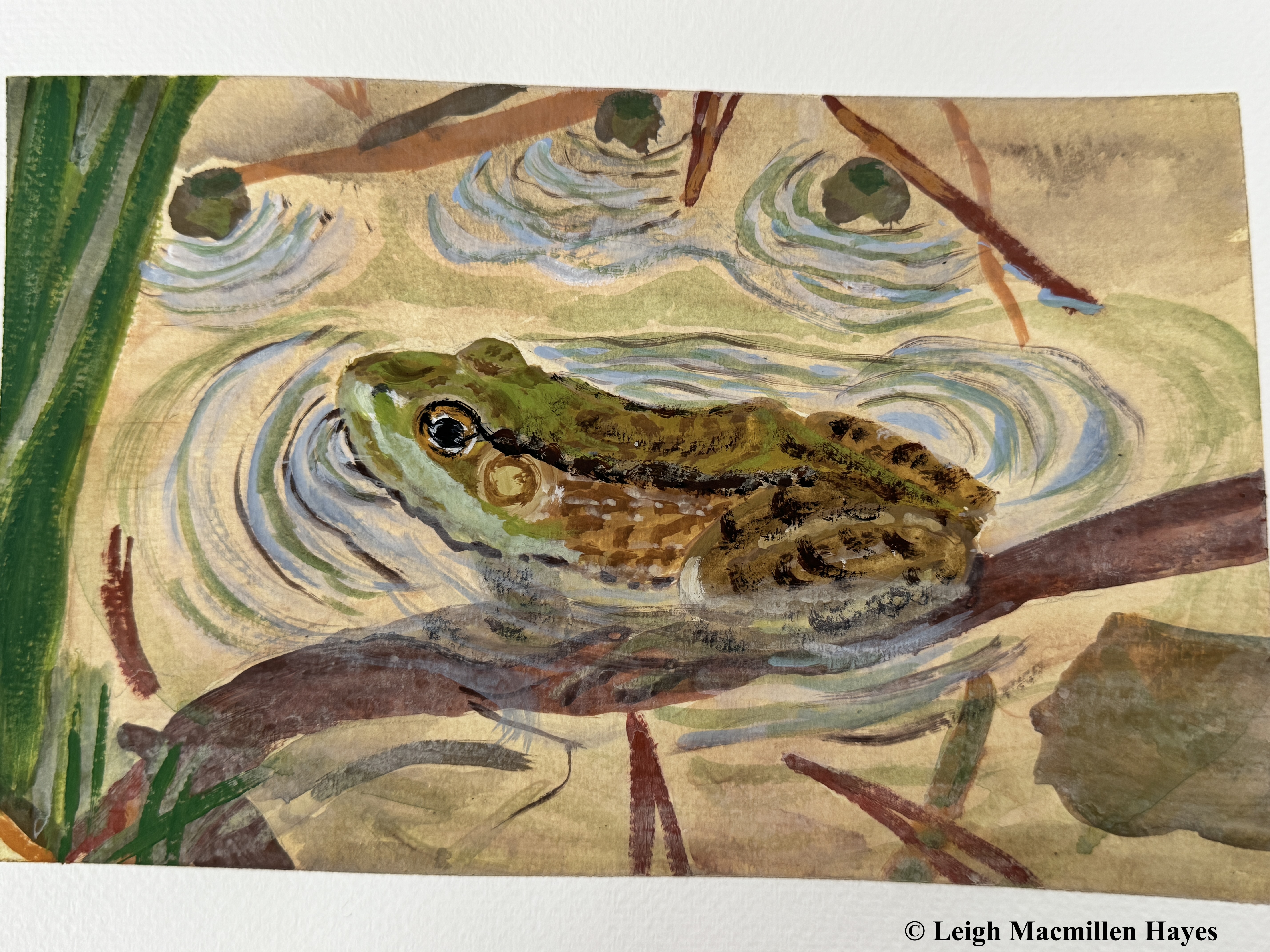
Hanging out by the pool, Green Frogs are always willing to dine on whatever is available. So the Green Frog has dorsal lateral folds (or bumps) along either side of its back that start behind the eyes.

The Bullfrog differs in that the line behind the eye circles around the tympanum (ear drum) and ends.

Here’s the other thing to remember: Males have tympanums larger than their eyes; females are smaller or equal to eye size.

And I like to think of this painting as a Frog-ersation.

This week I actually framed two paintings to send to friends, the Bullfrog being one of them.

There. I did it. Survived the art show.

As I bring this to a close, I realize there’s one more painting I should add to the collection, but I’ll save it to paint another day.

Thank you for marching into the vernal pool with me. I hope you are glad you did.

The Exclamation Point

The crossover from winter to spring is actually emulating the same from autumn to winter with fluctuating temperatures and snow. But still there is so much to see if you can get outside.

Yesterday, My Guy and I paid a visit to “our”vernal pool (located on a neighbor’s back forty) and noted that it was still ice covered. That said, I know I’ll start making almost daily visits because any time now the ice will begin to melt and tada, the action will start to happen.

The day before, we’d walked a local trail that still had areas of snow here and there, but were delighted to spot our first Great Blue Heron of 2025, which was apropos as this morning I received an email from the state biologist asking if I’m still willing to monitor three rookeries as I have done for the past 15 years. YES!

And the day before that, while hiking another trail in a different town where there was almost no snow, we had a quick sighting of an Anglewing Butterfly that I couldn’t name to species because it flew off before I could spot the markings on the underside of its wings.

Now those sightings seem like only memories and how could they have possibly occurred given that five inches of snow accumulated quickly yesterday.

But early this morning, the snow turned out to be a tracker’s delight, for fresh tracks showed details providing names for the creators who passed this way.

And so along our cowpath (where cows haven’t walked in years), I followed the Red Fox, wondering where it might lead me.

I knew I should have backtracked it so as not to put pressure on it, but knowing and doing are two different things.

If I had backtracked it, I might have discovered the source of its scat left in such a location beside a tree stump, that I thought it was a boundary marker the Fox had deposited.

And it may well have been, but I suspect there was other important information given off by the scat such as the fox’s gender, age, and health, for a few steps later it left a sign and scent of its availability in the form of skunky-smelling pee. I thought mating season had come to an end, but apparently I thought wrong and the fox knows best.

We stayed together for a bit, though there were a few downed trees I chose to walk over or around, rather than under like the fox did. When it reached the stonewall between our land and the neighbor’s field, I decided to turn around and head toward the vernal pool instead to perform my daily check.

The transformation from yesterday to today should not have amazed me–My Guy and I walked in sleet and then snow yesterday, but still . . . the vernal pool seemed like a whole other place–almost like December 25th rather than March 25th.

To the left of the pool I noticed tracks that I’ve seen frequently here and beside the cowpath and knew that the resident Porcupine had been out and back overnight. I love the sashay of its track pattern and will miss seeing that when the snow does finally melt.

I followed Porky’s track to a Hemlock and noted that it had climbed up and down. I know about where its den is because I followed its tracks a few weeks ago over a couple of stonewalls and then into the yard of a neighbor around the corner, but decided to not locate the actual spot cuze it might seem a bit odd that I was looking for such.

Can you imagine seeing this woman show up in your backyard because she wants to know where the Porcupine she displaced this winter is now denning?

On my way out today, I did grab the game camera because I fully expected to see the Red Fox on it. For some reason, it alluded the camera, but I did find a couple of Porky videos. The first was taken about a week ago and I encourage you to watch the ten-second demonstration of the mammal’s behavior.

Not only do Porcupines sashay, but they have other dance moves as well, and I only wish I’d seen these in snow, but if I ever do, I’ll have a better understanding of interpreting them.

This behavior is one of self-defense–as Porcupines don’t see or hear very well, but it must have sensed danger. The camera didn’t pick up on a predator, but those erect quills being flashed all around indicate something loomed in the night.

I’d love to call it a dance of joy, but know better. It was meant to be an intimidating dance. If a predator should get close, Porky could lash out with those 30,000 quills, which are easily detached and can become embedded in the skin of the attacker. Definitely not a dance of joy from the predator’s point of view.

A couple of days later, Porky was all business as he headed toward home, leading me to believe he felt no threat in that moment.

Here’s the thing. His den is the same den of the Porky by the vernal pool and I know he has sampled several trees poolside, as well as several trees cowpath-side, so I assume it is the same animal.

I left the pool behind and walked down the driveway of a local business and then slipped into a park where I again met Foxy Loxy on the move.

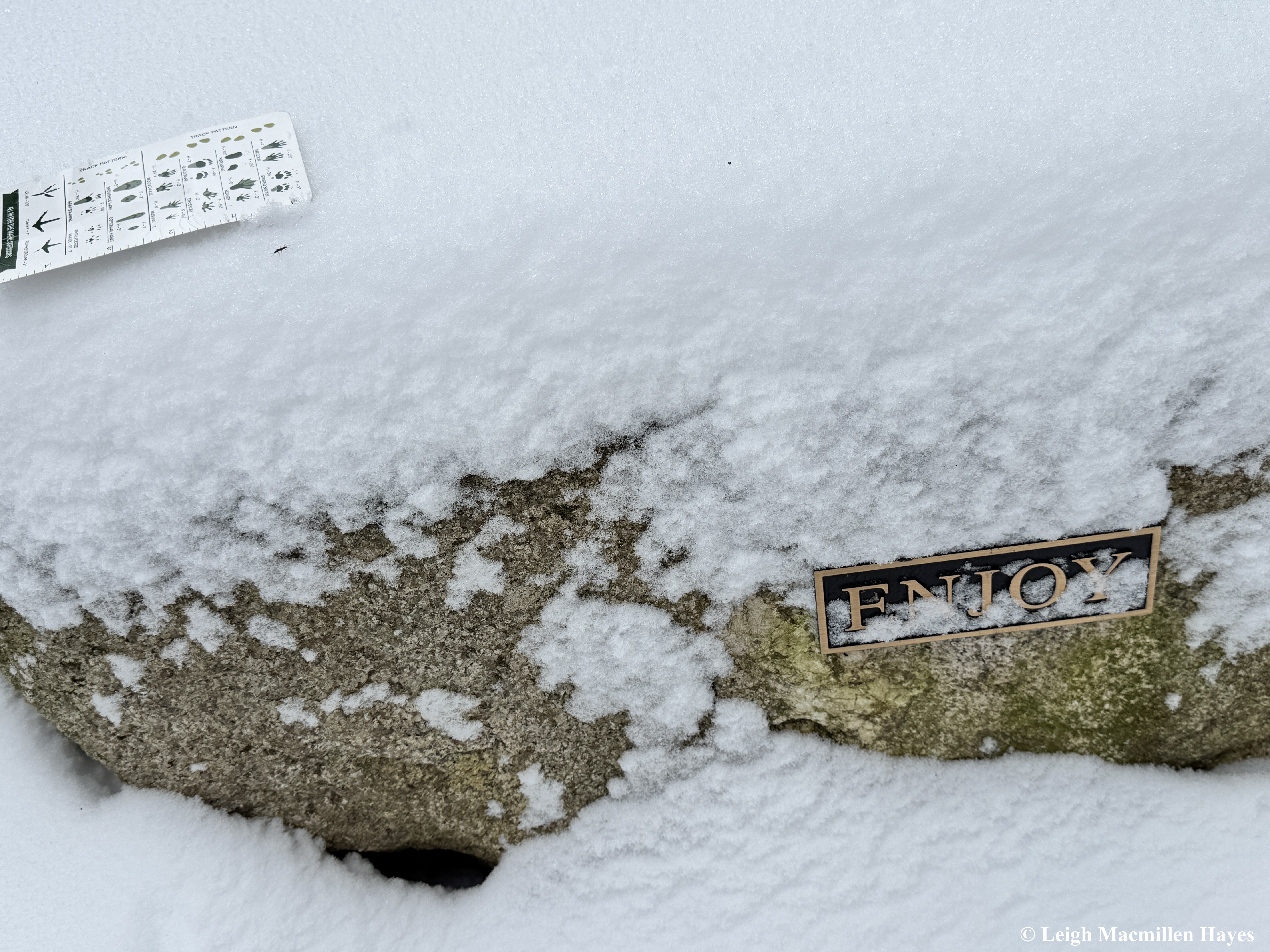
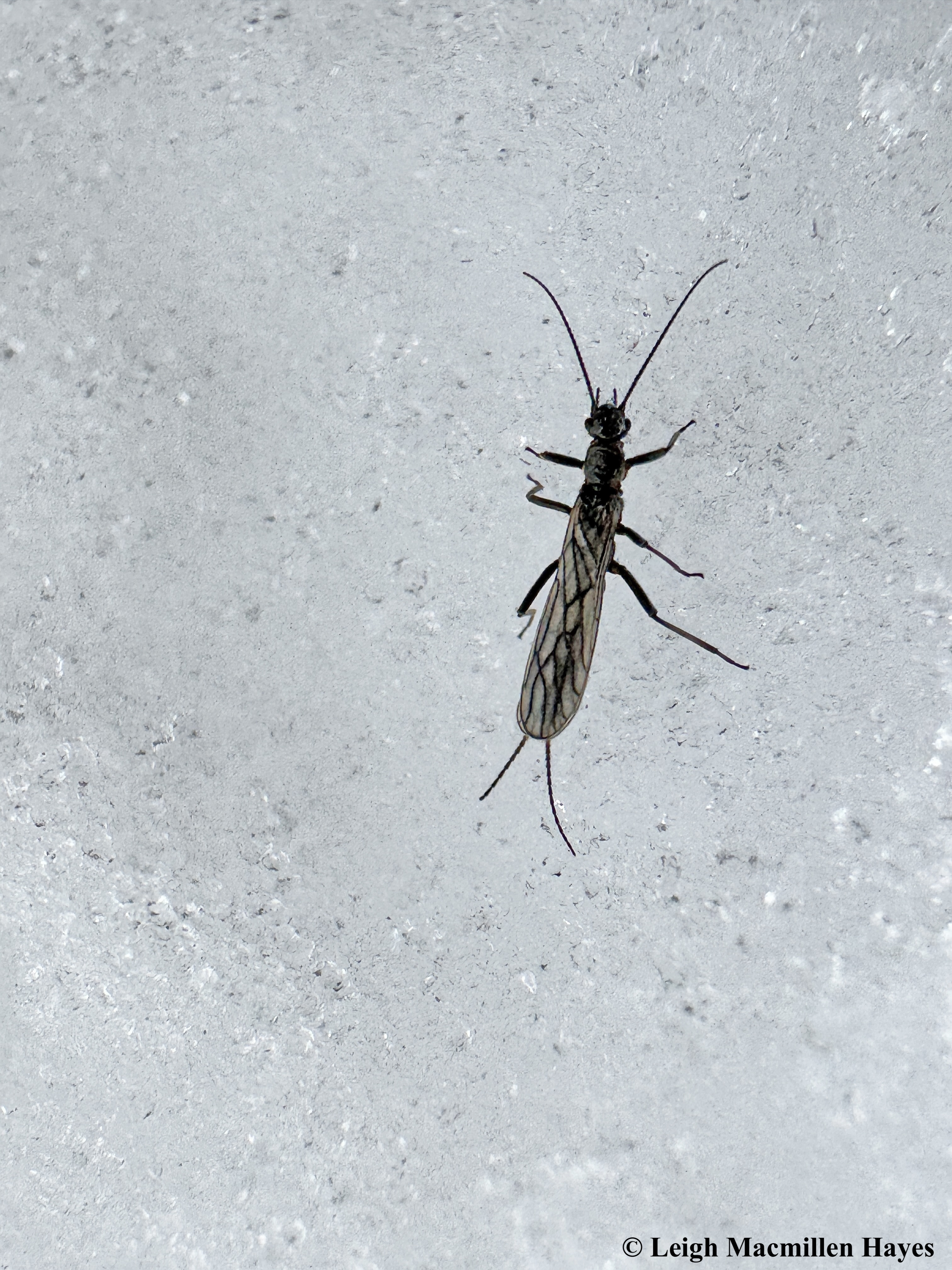
He wasn’t the only one moving, either. Do you see the tiny black mark by my tracking card?

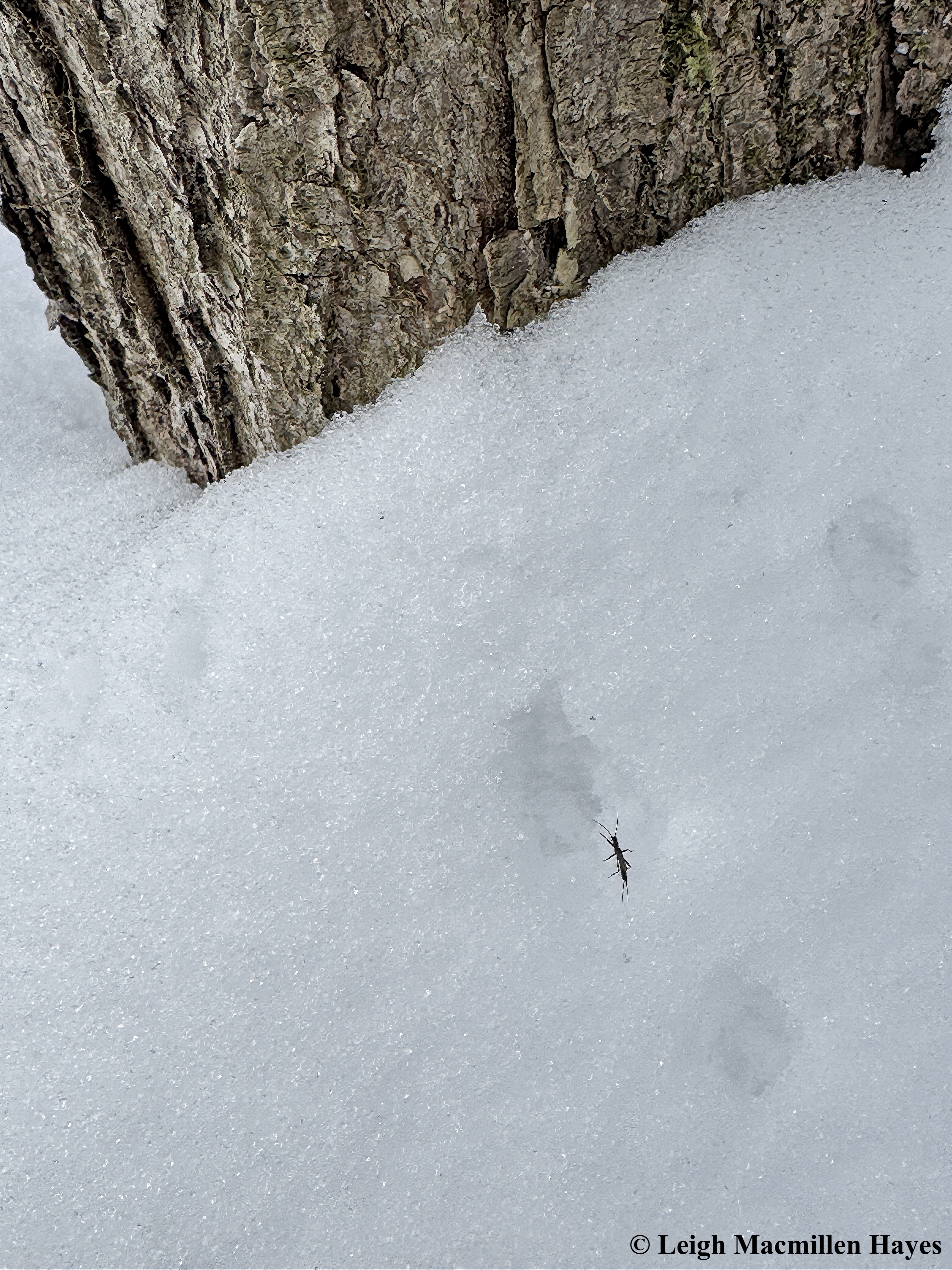
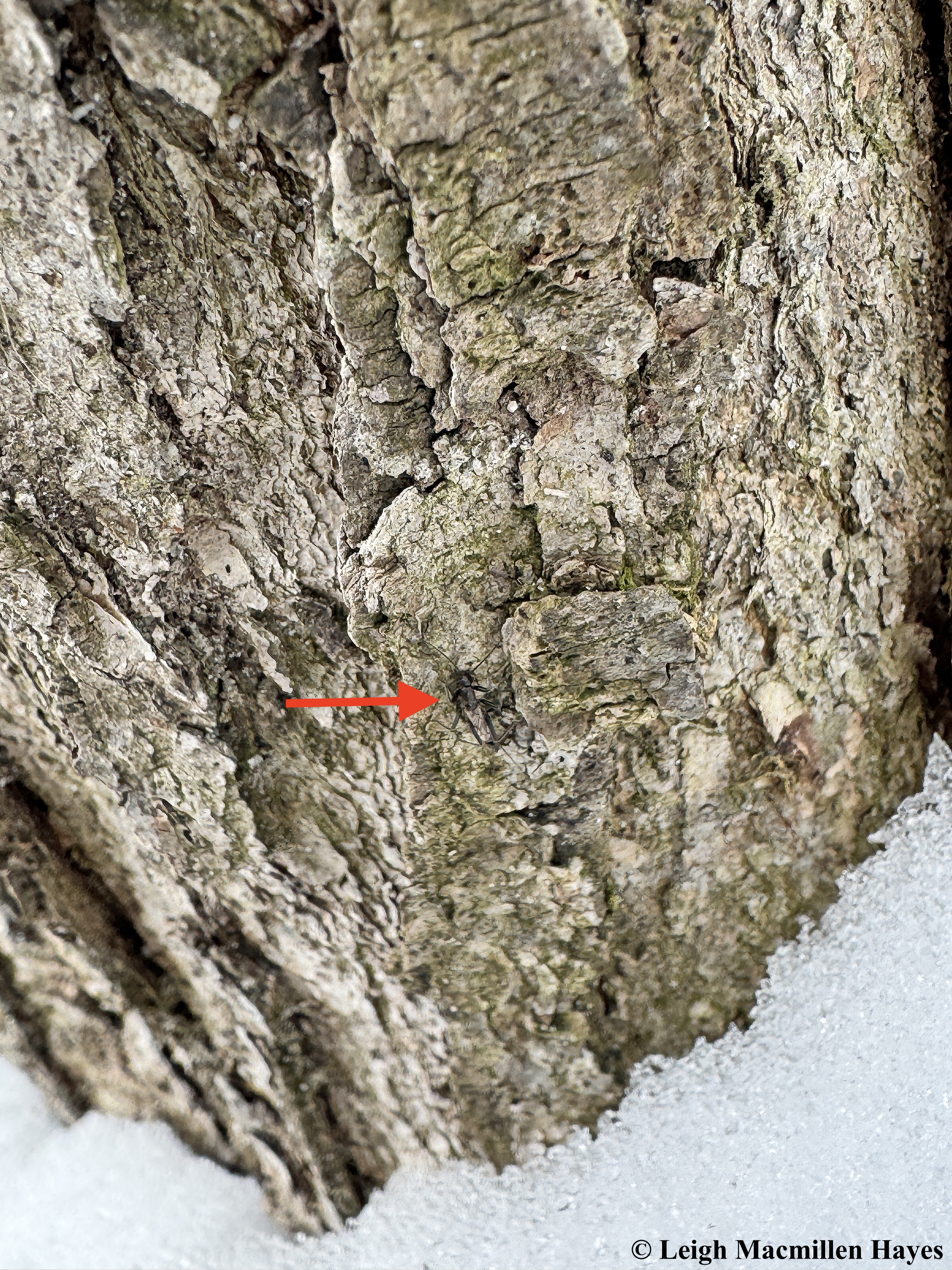
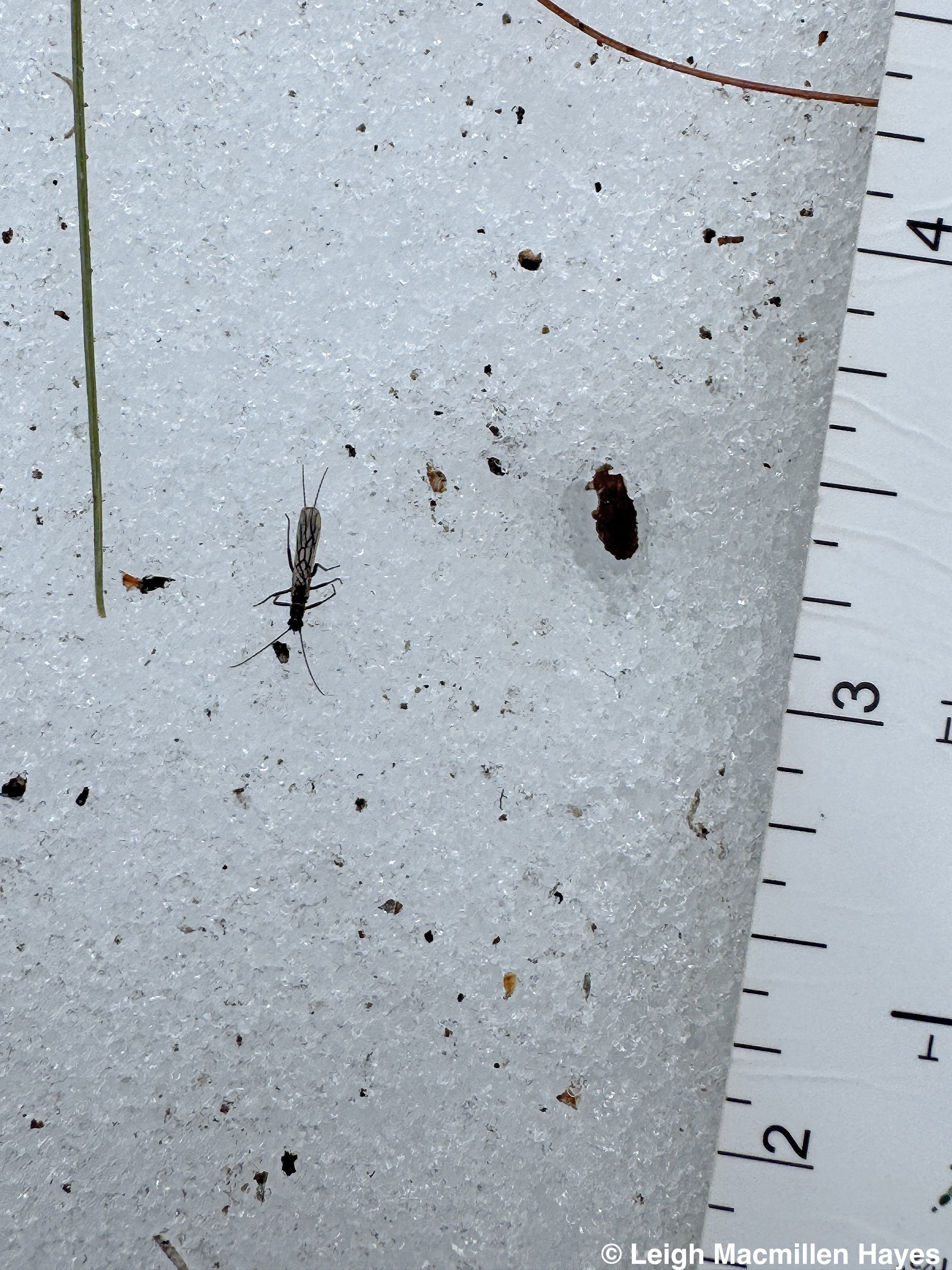
Winter Stoneflies were having a heyday this morning. It always excites me to see them because their nymphs require healthy, clean water and so to live in a area where these tiny insects are abundant means we are among the fortunate.

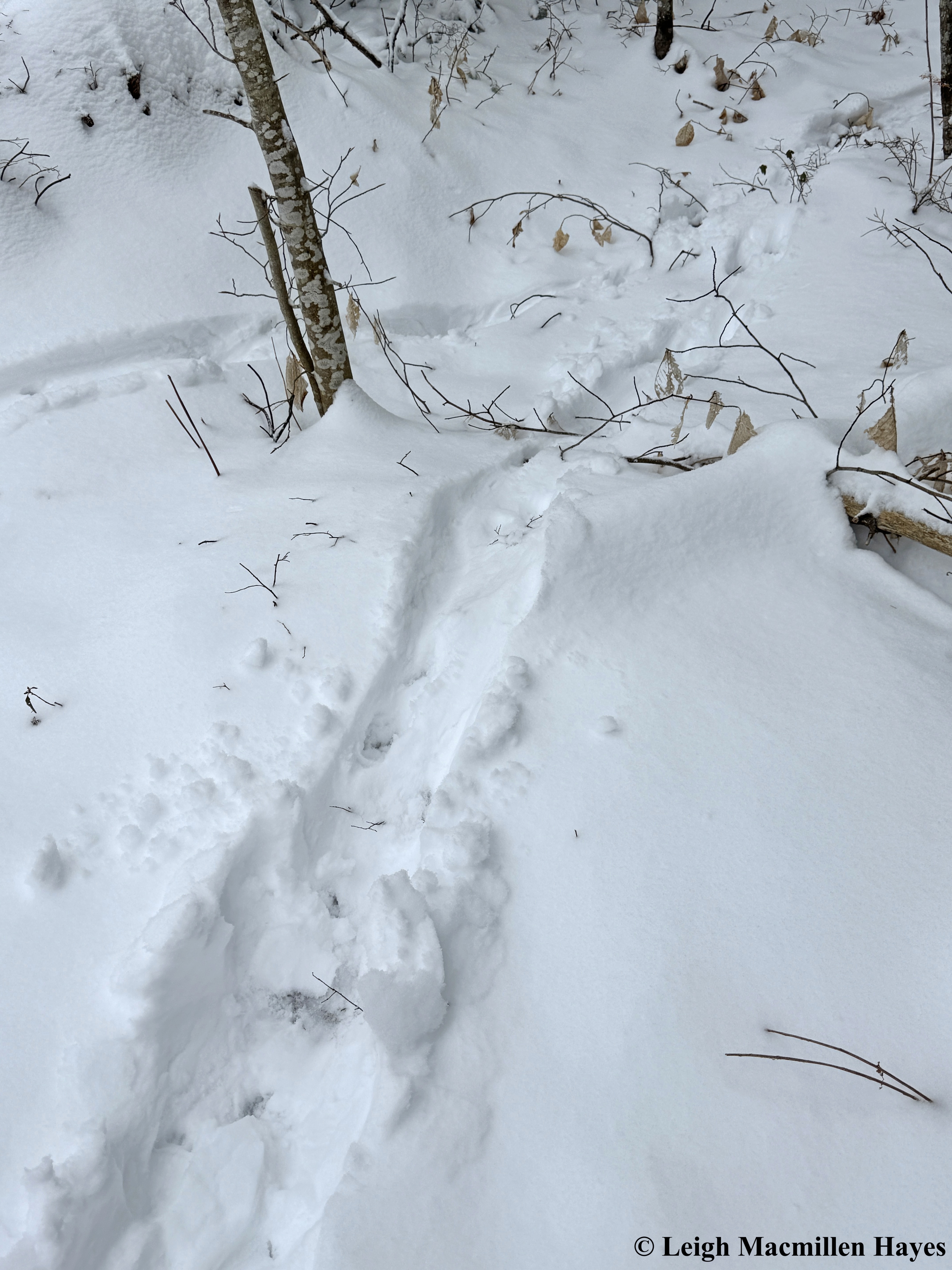
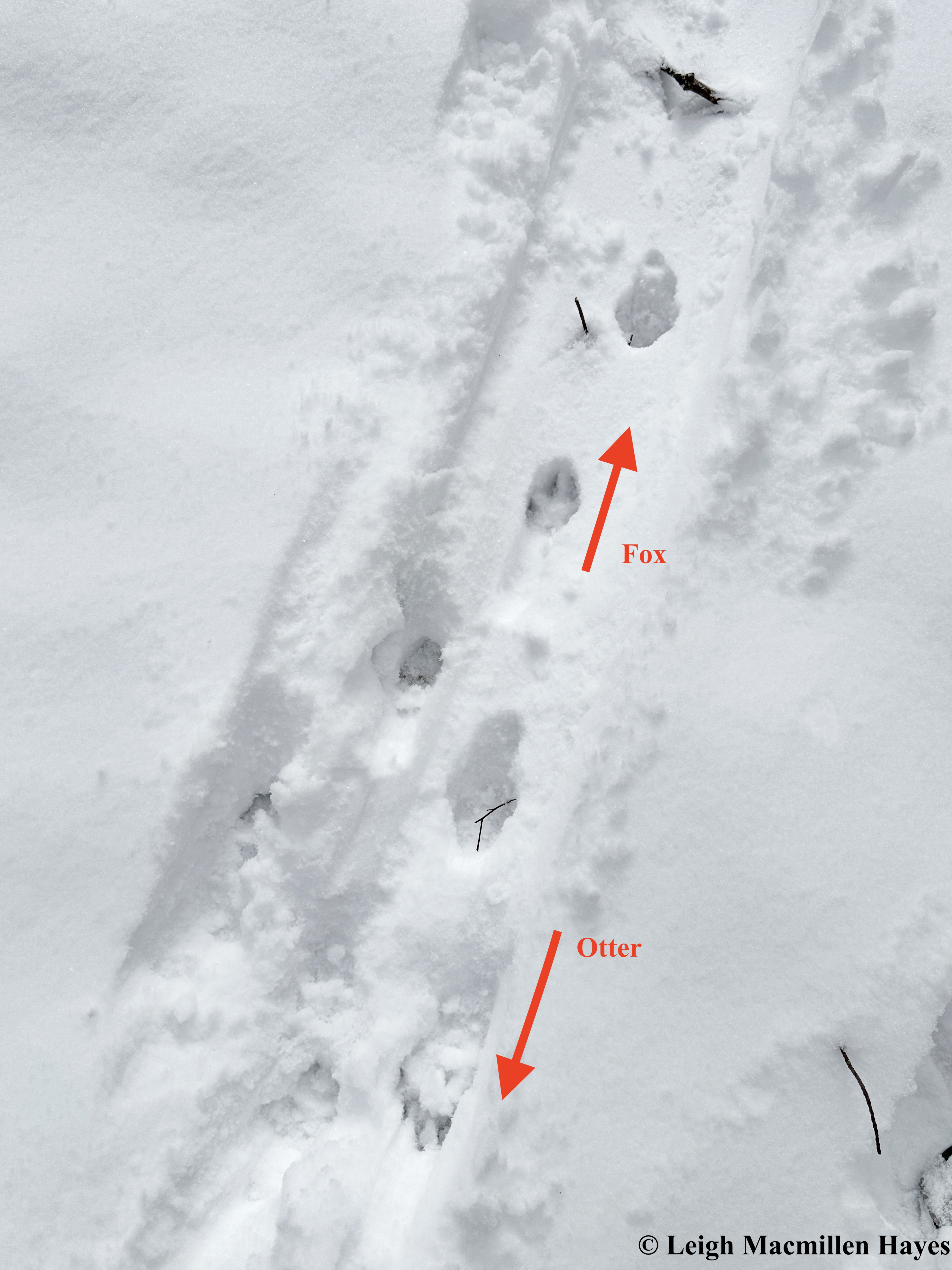
How fortunate? Super! For my next great find was . . . drum roll, please . . . an Otter slide. My heart be still.

I’ve seen their slides in this very spot before, but it’s been quite a few years. Of course, I had to follow the path that they took, which was really a bushwhack, given that they crossed the path we humans have created.

This is the spot where the Otter came out of the brook and bounded up the hill. I assume it was one, but sometimes they travel in family units and follow the same route so what looks like one could be two. Foxes do the same.

Speaking of that, do you see a set of tracks coming in from the east to meet the Otter? Or at least sniff around and wonder where it went? Those belong to the Red Fox.

The same Red Fox who traveled through our woods? Possibly.

And this is the spot where the Otter slid back into the water.

Fortunately the Otter didn’t meet its fate by becoming a meal for the Red Fox. Yet.

I moved on from that spot, but it seemed no matter where I went the Red Fox had been there before me.

And always searching. Food is a strong motivator.

So is finding a mate. More urine and this time there were two foxes, so I wonder if he found a she.

And I’m wondering how many Gray Squirrels who frequent our bird feeders will become meals for kits. The squirrels are well fed; I can attest to that.

I felt like life couldn’t get much better, and then others made their presence known, like the Long-jawed Orb Weaver,

Winter Firefly,

and another robust spider.

As for those suddenly ubiquitous Stoneflies . . . I kept looking for one that had actually reached a tree and was at last successful.

Until it wasn’t, and I wanted to say (and actually did), “Hey Bub, you took a wrong turn. You’ll never find a mate if you don’t reach that tree trunk.”

Of course, there are many more trees in the forest and perhaps something didn’t seem quite right about this one.

Until it did. And the Stonefly started to climb up onto the bark.

Do you see it?

How about now? It’s definitely a Where’s Waldo moment.

Does the arrow help?

With his abdomen, he’ll create a drum beat only she can hear, and I left him to it in hopes that he was successful.

As I turned around, I met a young mother and her two-year old son out for a nature hike and so I introduced them to the Stoneflies. The tot was thrilled and he kept locating others. We chatted for a few minutes and then it was time to part and he turned to me, smiled, and said, “Goodbye,” and then blew me a kiss. His mother was as surprised as I was. I blew a kiss back to him.

There was so much out there to make my day today, and that kiss was the final seal.

It brought me back around to the Anglewing Butterfly. On Saturday I couldn’t tell My Guy if it was an Eastern Comma or a Question Mark, both species that as adults overwinter behind bark.

This is a Comma, where as the Question Mark would have this same line, plus an additional dot making it look like a QM.

My Guy’s comment, “For you, it doesn’t really matter. They are all Exclamation Points.”

YES! And today was full of Exclamation Points. I’m forever grateful.

P.S. As I headed home a couple of hours later, the temperature had risen and snow plops were falling from trees and the conditions for tracking had significantly deteriorated.

Bogging With Bridie

We parked on the little dirt connector road between Route 160 and Lord Hill Road, close to Bog Road, because we knew the conditions would be such that driving into Brownfield Bog would be impossible. Besides, walking would offer more time to catch up on each other’s lives. Well, I’m afraid I did most of the talking, but at least my friend Bridie is up to speed on my life. Hers is so full of students and research and writing, that just having time to breathe in the fresh air of her childhood backyard was enough.

At the old shed, we paused to admire the work of her mom, Kathy McGreavy, a potter who created this tile map of Brownfield Bog in 2017 as her capstone project for the Maine Master Naturalist program. And we wondered how many of the same species we might see or encounter today.

One particular tile always elicits a shared memory, for I was with Bridie when we spotted an Eastern Ribbon Snake slither across the road and down into the water.

It was then that I learned that Ribbon Snakes are a species of special concern in Maine, and rather uncommon. Since then, I’ve seen at least one more in the bog and a few more in several other local spots, but each sighting is special, and always I return in my mind to that first time.

And why the wire across the tile art work? It seems woodpeckers like to peck at the tiles and Kathy had to repair a few a year or two ago.

We couldn’t go out on the bog today, as we had done previous winters. After all, we are on the cusp of spring, and didn’t trust the ice. But from the edge we admired Pleasant Mountain forming the backdrop–and always giving us an idea of where home is located.

Down a side road, which we were able to walk being not flooded (yet), we found our way to Pirate’s Cove along the Saco River and the water is high and mighty and muddy. For a few minutes we watched in silence. Well, we were silent, but the river wasn’t.

Returning to the main drag, we made our way back to the Old Course of the river and were greeted by the most delightful bird chorus, including the conk-le-rees of the Red-winged Blackbirds.

With their bright red shoulder patches bordered below in yellow, they were calling from high perches among the shrubs.

Puffing out while calling is indeed a breeding activity, and so the race is on. May the best males find a mate.

Our other bird sightings included this White-breasted Nuthatch, plus Hairy Woodpeckers, American Tree Sparrows, Canada Geese, and a thousand Wood Ducks. Or so it seemed. The fact that they moved every time we spotted them, even if two hundred yards away, might mean that there weren’t quite that many, but rather that we kept meeting the same ones in different locations.

We also saw signs of Pileated Woodpecker works. Not only do they excavate holes while in search of Carpenter Ants, they also shred and chisel and in these woods, that seems to be a favorite activity. We wondered why, but couldn’t come up with an answer.

We did, however, do what Bridie taught me to do a million years ago and searched for scat. Bingo! Though we saved this thought for another day, we did wonder if we dissected the scat, would we be able to tell about how many ants had been consumed?

And no adventure with Bridie would be complete without some tracking in the mix. Our snowpack is quickly dwindling and where three days ago at home, we still had a foot, now there are lots of bare spots and what snow is left might be only about four inches.

That said, we relished the finds we did make, including lots of Vole tunnels like these. And I reminded Bridie that she was the one who introduced me to the subnivean layer, that microhabitat between the ground and the bottom of the snowpack (think back to Thanksgiving 2024), which provides insulation and protection for many animals, like the Voles, who happen to be on everyone’s dinner menu.

Our other finds included Raccoon tracks,

Mink,

and Coyote,

plus a family of Coyotes on some sand at Goose Pasture.

And, of course, our adventure could not be complete without discovering several Coyote scats.

And just for good measure, we met one large Six-spotted Fishing Spider.

Okay, so it wasn’t really as big as the close-up made it look.

There were also beaver works in various places, though we suspected this was a wee bit old, but not older than a few months ago based on the color of the wood. The warmer temps made the sap flow a bit.

There are a bunch of well-mudded lodges in the bog, but we didn’t see any hoped for activity today.

We did, however, discover some scent mounds and know that claiming territory is an important assignment that will become more significant as the ice begins to melt and the two-year-olds leave the lodge to venture off on their own and claim a territory.

Next, we turned our focus to a few shrubs, including the Winterberry. While I still have some dried bright red berries as decorations in my house, most of the berries on branches have shriveled and we wondered why the birds hadn’t dined on them when they were ripe.

What we discovered, much to our delight, was that some had been procured by little brown things, presumably mice, and had been consumed in a bird’s nest. It’s illegal to take bird nests without a permit and this is one reason, they are recycled into homes for other critters.

What totally surprised us about the Winterberry, however, was that we found one shrub with the berries still bright red and plump, as if today was December 18th and not March 18th. Again, we wondered why.

We also found a few of last season’s cranberries hiding under their leaves. That reminded me of another day I’d spent searching for cranberries in the bog years ago–and though I told Bridie about it, I’ll save that two-day story for another day.

Leatherleaf also had offerings to provide, in the form of little flower buds along the woody stems.

At last we reached the old Oak at Goose Pasture and stood there for a bit taking in the sun and warmth and feeling like it was a bit of a beach day. But, our time together was coming to a close, and we knew this would be our turn-around point.

That said, there were a couple of other gifts to share together, as today was the first day this year that the two of us saw Pussy Willows in bloom.

And, drum roll please, we heard them before we spotted them way over on the other side of the bog, but their distinctive call told us to look that way and sure enough there were two Sandhill Cranes.

Like the Wood Ducks they flew, but the two morphed into three as we watched them take to the air.

We’d been blessed. In so many ways.

And at the end of our time together, after traveling 6.2 miles, we needed to say our goodbyes.

The thing is, she wasn’t really with me, which I realized when I went to put my arm around her for our selfie shot. But, in my mind, she was and I had the best time Bogging with Bridie today, her birthday.

Happy Birthday, Bridie McGreavy!

Part of the Neighborhood

The text arrived from one of my first playmates on Wednesday. “Good morning,” she wrote, “Just wanted to give you a heads up my fat and sassy Juncos are headed your way. Only had a couple yesterday and none this morning. Hope they had a safe trip! Blow them a kiss for me. Hugs.”

A few hours letter I wrote back that I’d let her know when they arrived.

And a few minutes, voilà! My second text to Kate: “No sooner said than BINGO! I looked out the back door and there were three!”

On Thursday afternoon, the Bluebirds arrived. Kate told me she’d had three couples all winter in Connecticut. “They are so stunning! They seem to be the kindest of breeds. They don’t squabble as much as others and share better.”

After that, it was a Tree Sparrow. And many more Juncos each day.

And today, the Chickadees and Tufted Titmice and Bluejays, of course, but also Goldfinches, and one Tree Sparrow, and Mourning Doves, and Red-breasted and White-breasted Nuthatches, and Downy and Hairy Woodpeckers, and I’m sure others that I’m missing, and suddenly, the feeders were busy. Toss into the mix Red and Gray Squirrels, and Crows, though the latter stayed about ten feet away from the action, while the former got right into it, and it was a full house.

This afternoon, I interrupted the action for a few minutes when I headed out the back door to go for a tramp in the woods and had just reached an opening when I heard, then saw this guy and knew that our resident Red-shouldered Hawk had returned.

According to Stan Tekiela’s Birds of Prey of the Northeast, “Adults return to the same nest and territory for many years; the young also return.”

Welcome home!

I had no sooner lost sight of the hawk, when movement from another source caught my eye.

Flying from the ground up to a tree limb was a Barred Owl. And my heart was even happier than it had been.

We spent a few minutes together and I gave great thanks also that the vernal pool over which the owl perched is still rather frozen. No frogs or salamanders would be on the menu yet. I did, however, worry about the birds in my yard, but there was nothing I could do.

Except, that is, watch my friend for a few more minutes before waving goodbye to him and moving on.

And that’s when I heard a song, or rather many songs, that took me back to a summer morning and realized that as much as I don’t want winter to come to an end this week, the time has come because there is so much more to see and welcome and wonder about. The Red-winged Blackbirds were in a large flock with Grackles, and Robins, and more Crows. And the chorus was most delightful.

I’d say the female Hairy Woodpecker was much quieter than the others, but it was her inflight song that encouraged me to look for her.

I just hope it wasn’t Emerald Ash Borers she was seeking as she drilled a few test holes in the tree. Of course, if she can help control them, then that’s a good thing.

My journey led me to a local brook where the Mallard flock is spreading out more as the ice is receding quickly during these suddenly 50˚ days.

That said, they are still there.

He preened . . .

as she looked on.

Others did what we should all consider doing on a Sunday afternoon: stick our heads under our wings and take a nap.

But I didn’t. How about you?

Upon a second brook that flows into the first, another species caught me by surprise as I rarely see it in this place. A female Common Goldeneye. I’ve always had a problem with the descriptor “common.” That prominent golden eye is hardly common in my book.

Moseying along, I realized it wasn’t just birds who were greeting the day. Chipmunks have been dashing about on the snow for the last week or two, taking advantage of any acorns the squirrels may have hoarded. (And birdseed–as I watched one stuff its cheeks the other day.)

One critter that surprised me was a Carpenter Ant making its way toward a boulder rather than a tree. Though I see the exoskeletons of these ants in Pileated Woodpecker scat all the time and even found some fine specimens in our woods today, I don’t recall ever spotting one on snow before.

Speaking of Pileated Woodpeckers, their freshly excavated holes are dripping with sap and by this hole I found a couple of Winter Fireflies. So, um, Winter Fireflies are fond of Maple Sap. In fact, some call them Sap-bucket Beetles. But White Pine sap? Do you know how sticky it is? As in, you can practically glue =-your-fingers-together sticky.

When I first spotted these two, I wondered if the sap might have given them pause. Were they stuck?

But then there was movement and in that moment, all was good with the world.

I had one more discovery to make–actually, it’s been my quest this year to find this species and its relative who is only about a half inch longer.

But I must have missed the mass emergence of Small Winter Stoneflies, and their cousins, Winter Stoneflies, for like today, I’ve only seen one or three or maybe five on any particular occasion near these brooks, when in the past there were so many more. Might last summer’s drought and water conditions be the reason for so few? After all, these species are highly sensitive to pollution and thus, are indicators of excellent water quality. I have to hope that I just missed the right day.

After the Stonefly discovery, I did find one more thing that always brings me around to the cycle of life. A small bird was plucked and became the meal of a larger predator.

Curiously, some feathers were stuck to the bark of the tree . . .

My thought was that the predator sat high above, and let the plucked feathers drop and being a pine, a few stuck to the sap, or maybe just to the rough bark. Or maybe the bird was consumed right there on the side of the trunk.

I don’t know and I don’t know who the predator was, but energy was offered and sunshine turned into seeds and insects that fattened up the smaller bird were passed on to the bigger critter.

Perhaps the Barred Owl knows the whole story. Or the Red-shouldered Hawk.

All I know is that I gave thanks for this day to wander and wonder and be greeted by so many who are all a part of my neighborhood. Well, really, I’m a part of their neighborhood, and I appreciate that they share it with me.

Celebrating Creation aLONG the MOUNTAIN

When asked the other day if I am enjoying spring, I responded, “I’m still loving winter.”

So is My Guy.

And so today, we took to a beloved mountain trail and reveled in the sights and sounds.

Beside a brook, our journey began, where as the water flowed, nature’s artistic hand created a magnificent display of ice sculptures.

On the way up the loop trail, and again on the way down the other side, the golden carpet was set before us, for into the warn pathway do leaves settle after a wind event.

Because we were hiking in a deciduous forest to begin, our eyes kept scanning the tree trunks, and tada, we were rewarded. Well rewarded.

It seemed like everywhere we looked, we spotted American Beech trees with bear claw marks indicating multiple visits to feast upon the beech nuts.

We suspected some of these trees we were meeting again as if for the first time, but though we lost track of how many we spied, we knew it was more than we’d seen in the past and gave thanks to the trail conditions that allowed us to move without caution, and the fact that it is still winter and there were no leaves to hinder such views.

While studying almost every tree for a while, I kept noting the trunks of another species, this the two-toned aspen that looks like an oak toward its base, but morphs into a birch toward the top.

There was no question whether Quaking or Big-Toothed for leaves upon the snow told the species name: My, what big ____ you have!

As we continued to climb, the neighborhood changed and so did the forest floor–of course, still upon firm snow, for suddenly, we walked upon a green carpet.

It was in this section of forest that I began to spot Common Polypody ferns predicting the temperature, for they were still a tad bit curled indicating it wasn’t exactly warm, but not completely curled telling us it wasn’t freezing cold either. It was just right!

Well, almost just right, for because of recent rain and warmer temps last week, the melt down has begun and ice flows along the trail were frequent in the coniferous forest.

That same flow continued down a crevasse that we admired from the path, but didn’t need to descend. Thankfully.

A short distance later, we reached Lunch Ledge, aka North Ledge, and took in the view toward Mount Washington.

As we ate, we looked at all the Beech trees below (and other species, of course) and wondered how many more Bear Trees there are in these woods since we saw so many just from the trail. And we wondered if there might be a den nearby.

Following lunch, we continued our trek, and then found a spot where another had dined.

By the number of fresh holes in the tree, we knew the Pileated Woodpecker had visited this spot on more than one occasion, rather like the Bears and the Beech trees.

I must confess, I cannot pass up the opportunity to look for scat and so I heeded the invitation to hunt for the treasure. And again was well rewarded.

At this time of year, Pileated Woodpecker scat includes bits of indigestible Carpenter Ant exoskeletons and some wood fiber. The whitewash is uric acid since birds evacuate the acid and feces simultaneously–from an opening just under their tail called the cloaca or vent.

Some of the trees along this part of the trail are Balsam Fir and we kept spotting their cones on the ground.

And then middens or garbage piles of Balsam Fir cone scales started to appear and we knew that a Red Squirrel had been dining. We saw some tracks, but never actually heard a squirrel, red or gray, though a Chipmunk dash across the snow and hid from us.

In one area, there were multiple middens, the one in front being about eight inches high. And that brought us to a discussion about the fact that until about 25 years ago, I had no idea what a midden was. Or a cache.

Nor scat. But oh my. A midden and scat on the same rock!

Which came first? My thought is that a Red Fox deposited its twisted and hairy scat–in typical manner upon a high place by a trail, and that the Red Squirrel came along at a later date to dine upon the same rock. I don’t think the Fox’s meal was this particular squirrel. In fact, by the color of it, I don’t think it was a Red Squirrel at all.

But this brought up an additional comment from My Guy about the fact that I can’t stand to see someone spit (think baseball games), but get all excited over scat. (And kill sites.)

I blame it all on Bridie McGreavey for teaching me about such, and once again rejoiced when I spotted Ruffed Grouse scat in a pile that told me the bird had roosted in this spot along the trail one night this winter.

My Guy claimed that he was going to contact Bridie and tell her that she took a mild-mannered English teacher and turned her into . . . me! (There was a reference to Lois Lane in there;-) )

I might have to mention that I never imagined him practicing Yoga!

At last we reached Dessert Ledge, aka South Ledge, again with Mount Washington in the offing, and the northern slope of Round Mountain in front of us.

From there we began our descent, pausing again to admire the ice and water that were part of the display and the blue hues exhibited.

This one crossing I have to admit I was dreading for I thought it might be under ice, but the rocks, which you can’t see because I was standing on them, were bare, and I felt comfortable pausing to take in the view.

We knew by what we spotted, such as these four slabs of ice somehow caught and wedged by a tree, that the force of the water had been quite strong in the past week, given the weather conditions.

We even spotted an ice berg upon the opposite bank.

Water always soothes my soul, so I thought I’d offer this short video for you to enjoy.

The planet offered us some amazing sites and sounds today, but our favorites were probably the Bear Claw trees.

Yes, we’re still enjoying winter as we did today while we celebrated Creation along the mountain: Long Mountain.

And gave thanks as we always do to Larry and Mary who share this trail and others with so many of us, and Bruce, their trail creator, who does an amazing job.

The Tale of Two Tails

We call ourselves the Trail Snails–a group of St. Peter’s Episcopal Church parishioners always accompanied by various non-parishioners who like to crawl at a snail’s pace.

Each week I try to find a different location, thinking fairly flat for locomotion and with natural elements that will bring out their sense of wonder. The first isn’t always easy, especially given the amount of snow and ice we’ve had this winter; but the second is a cinch since there’s so much to wonder about in our little corner of the world. When we started these walks in the fall, I did not expect that we’d continue weekly throughout the winter. But we have.

And so today six people (parishioners and non) joined me at my house to head out to the well-packed snowmobile trail. Of course, it wasn’t as well packed for the first thirty feet and that proved a bit challenging because we all wore some variation of micro-spikes rather than snowshoes, but they all persevered.

Once on the main trail, I showed them Porcupine tracks and then asked them to find the next set of such. It only took a minute for one to spot the pattern. While we looked at them and I shared some fun facts, I looked around and realized I was standing in the middle of recent Porky activity. Not only were there fresh tracks, but also scat and twigs cut at the traditional 45˚ angle, with buds and needles missing. We looked up into the tree, but fortunately no one was at home.

I think I know this Porcupine because he’s a frequent visitor to the Hemlocks in our woods and the neighbors’.

When I asked the group to share the findings and become a Porcupine, they did so, though I think they think I’m a wee bit crazy. Maybe I am. Anyway, Left to right: Nancy holding some scat on my scat shovel, Marion and another Nancy with twigs, Marcia smiling about it all, and Gary wearing my Porcupine socks to show how the feet are like sandpaper to gripe a tree as they climb, while his wife Julia was there for moral support and to help him up if need be.

We paused at many other spots along the way, including looking at the silk a Pine Tube Caterpillar uses to construct its tube.

And admire a perfectly round display of Lungwort, a foliose lichen consisting of a fungus and a green algal partner living together in a symbiotic relationship with a cyanobacterium.

Had I brought water, I would have poured some on it to show off how green it quickly gets since the alga would have kicked into action to provide food for the fungal structure.

Lungwort is sensitive to air pollution and habitat loss, so spotting it is always a treat and reminds us of why we love living here in western Maine.

We also looked at buds on an Ash to figure out which species and I told them about the Emerald Ash Borer and showed photos of what blonding looks like.

It turns out what we were looking at was a White Ash–hairless buds that dip into the upside-down, C-shaped leaf scar.

And then there were the Winter Fireflies that we found still as could be on the snow. I picked one up in the scat shovel and thought it must be dead.

That is . . . until we noticed its antennae began to move.

And then it started to walk. Last we knew, I’d left it and its kin on their favorite tree, a Sugar Maple, with hopes that as the temps warmed today and will continue to do so going forward, the insects will survive.

Just before reaching our driveway at the end of our walk, we also saw a Winter Cranefly, but moments after I scooped it up in my scat shovel, it flew. At least most everyone got to see it.

As Trail Snails, we walked not quite a mile and a half in two hours, but saw so much, and I was especially jazzed by the new Porcupine evidence. I think they were as well. Maybe not jazzed, but curious.

And in our time together we saw only three snowmobiles. While it was brought up that those on the machines miss all that we were seeing, I did explain that My Guy often comes back from a ride and tells me of the wildlife he and friends sighted. There I am being so quiet and not seeing any, but somehow despite the machine he spies so much more.

And then this afternoon, I picked up a friend and drove to another section of the local snowmobile system. We walked and talked and talked and talked some more, catching up because despite retirement we are both incredibly busy. In a good way. Doing things we love to do.

As we walked, I kept pointing out Porcupine tracks and if we’d had snowshoes on, I might have convinced her to look for the feeding trees and den sights, but we chose to begin with micro-spikes and quickly ditched those since the snow conditions on the well-packed trail were just right.

We also paused to listen to a Barred Owl and tried to spot it to no avail.

And then, near water, we spied tracks of a different sort. And scat. And mud. And not quite open water.

The scat was from Otters. And I really wanted to take a closer look, but didn’t trust the trail down, despite it being well traveled.

What I now realize I didn’t take a photo of were tree marks in the snow, which in the moment I surmised were twigs blowing down toward the water.

I noted that the track continued across the road upon which we walked and so I suggested we take a look and see if we could note anything about the Otters’ behavior.

We certainly did not note anything about such, but instead discovered fresh Beaver works. And suddenly the indentations left by the twigs made sense–Beavers dragging tree branches down to the water to take back to their lodge or winter food raft.

Maybe like some people that I’ve heard are looking for more firewood right now to stay warm the rest of the winter, the Beavers didn’t realize everything would stay frozen as long as it has and so they needed to replenish the pantry.

Shortly after that, at about the 2.5 mile mark from our journey’s beginning, we turned around and started to walk back. And then something stopped us in our tracks. It took me a few moments to say, “Look,” and grab my camera and I feared this something would slip out of sight before I did so.

The Beaver must have come up the hill to cross the road to go grocery shopping by the trees he’d previously cut down, and then spotted us and we watched it waddle down its well packed trail toward the ice.

We thought our time together would end in a second as it slipped into the water, but then we realized it was looking for an open hole.

And scratching the snow and ice, even to the point of getting snow on its face.

It kept trying and we kept watching.

Still no luck for the Beaver, while we felt we were having all the luck in the world.

Traveling on land is such a vulnerable activity for Beavers and I could only hope that the Otter scat in this very spot where we stood above the water was the result of the Otter eating something else and not making a meal of a Beaver kit. Because really, they both can take advantage of the same hole in the ice.

We also wondered where the lodge might be but the bank’s edge was too steep for us to note if it was nearby.

And then, just like that, the Beaver found open water and this was the last we saw of it before it made its escape.

We knew we were blessed, Marita and I. And gave great thanks for hearing the Barred Owl, spying Otter Scat, and spending a few minutes with a Beaver.

What a day, from a Porcupine’s Tale to a Beaver’s, two mammals with tails of grand importance–the former being for defense and stability on a tree limb, and the latter for a rudder, as well as stability like a tripod when cutting down a tree, and fat storage as well.

In Search of Winter Stoneflies

I’ve been waiting for this day for the last few weeks. To that end, every couple of days I’ve snowshoed out the back door and made my way down to the park, eyes always looking down just in case. To no avail.

Oh, the ducks are always there, as its their winter hangout, being one of the few places with open water given how cold the temps have been. Even this morning, the thermometer registered -7˚ at our house.

What I love about the sun shining on the male Mallards heads was that some appeared green and others blue in their iridescent hue. They rather reminded me of Ebony Jewelwing Damselflies who have bodies of the same color, albeit a million times smaller.

But it wasn’t the ducks that I sought. Instead, it was this. A Winter Stonefly!

In winter, crazy as it may seem, the aquatic immature stage of a Winter Stonefly, aka naiad, crawls from the rocky bottom home of the brook where it has spent the last year or more maturing (going through as many as thirty molts) and shredding fallen leaves, climbs up through crevices in the snow that covers the brook, finds a plant or some other spot to emerge as an adult, and leaves behind its shed skin, much like a dragonfly or damselfly.

Today, though not abundant, the insects were all on the move and most headed west, as I’ve noted in the past.

Their mission: to reach a tree trunk.

Once there, they’ll crawl under the snow beside the trunk and I had to wonder if we’ll hear the sounds of their party reverberating through the cold night air tonight. That said, today it wasn’t hundreds of insects; but that day will come soon.

Why to the tree trunks? And why crawl under the snow? The bark is warmest in that spot, so it is a good place to get out of the weather.

Stoneflies have hammer-like structures on their abdomen that make noise when thumped against a surface, like a tree trunk or a twig or even the ground. This is a mating call. The males drum, and the females drum back, and voila, they find each other and canoodle.

And just to mix it up, this spot is also home to Small Winter Stoneflies.

Like Mayflies and Caddisflies, Stoneflies are particularly sensitive to pollution and serve as bioindicators of water quality. That means the brooks beside which I walked have excellent water quality. That is good news indeed.

Since I was in the park, I decided to look around to see who else might be living there. There was an abundance of Gray Squirrel tracks, and those left by a Red Fox or two, and even Raccoons. But then in a spot where I hadn’t spotted this tree for any reason before, I noticed that a Beaver had paid attention.

Can’t you just imagine the Beaver cocking its head to the side and trying to cut this tree down. From the looks of it, this tree was partially chopped down before ice formed over most of one of the two brooks that flow through the property, so I would imagine in early December. How did I miss this before?

And where there are White Pine Saplings, some times there are signs of a Pine Tube Caterpillar’s winter home. Well, it could have been in this one or any of the dozen others I spotted nearby.

The larval form of the Pine Tube Moth, Argyrotaenia pinatubana, binds clusters of needles together. What typically happens is that the caterpillar uses between ten and twenty needles to form a tube or hollow tunnel. (You might also see the little white Pine Scale insect to the left of the tube.)

In October 2021, I had the good fortune to watch some Pine Tube Caterpillars at work.

Back and forth they moved, excreting silk that formed a ladder-like web. The caterpillars moved up and down their silk-lined tunnels to feed on needles at the tip. When the time comes, each caterpillar creates one more tube and does the same thing until it is ready to pupate overwinter.

The moth will emerge in April, when I’ll need to pay attention again (if I remember). Two generations occur each year and those that overwinter are the second generation.

Those were all great sightings. BUT. Not all is perfect with the natural world. And the blonding on the Ash tree is certainly an indicator of one thing that is wrong.

Emerald Ash Borers are invasive insects that will attack and kill both weak and healthy Ash trees of all species.

Most of the EAB’s life cycle takes place below the bark.

Tunnels or galleries from feeding larvae accumulate and disrupt the flow of a tree’s nutrients. All wood boring insects leave behind tunnel patterns, but to my knowledge no others have the S-shaped or sinuous curves of EAB.

During the winter, woodpeckers probe for larvae feeding beneath the bark, and often reveal infested trees. The “blonding” I referred to earlier is the light color left behind as the birds remove the outer bark.

I checked some of the debris below one of the infected trees, in hopes of finding woodpecker scat filled with the larval and/or pupal forms of EAB, but so far have not had success. Though some towns are bringing in parasitic wasps to attack the mature insects, wouldn’t it be great to know that we have birds who can help in the effort?

While studying the Ash trees, I looked across the trail at a couple of Sugar Maples and discovered another insect whom I think the world of, the Winter Firefly.

So here’s the thing: fireflies are not flies; they are beetles. Unlike many beetles, however, Winter Fireflies overwinter as adults.

Also, they are diurnal and don’t have lanterns to light up the night sky.

Once I started looking, I discovered quite a few either crawling on the trunk or tucked just underneath where the bark curled away from the tree.

There were also a bunch on the snow, like this one above, and they appeared to be dead, which surprised me. Or maybe they were just taking a rest?

Back to the ducks I returned before heading home. And this time, it wasn’t just Mallards who came into my view. I would like to confidently say that the duck on the left is a female American Black Duck and on the right, a female Mallard.

BUT . . . yes, it’s true, there always is a but, I’m only basing my conclusion on the difference in their beaks and according to The Sibley Field Guide, there are hybrids.

The rest of the bodies of these two look almost identical, and perhaps not as dark as the Black Duck should be. Am I right? (You know that when I’m alone I’m 100% correct, but in blog-land, I’m not alone so I welcome any tips to help me have a better understanding.)

There were a zillion Mallards and though some seemed to be couples like these two, others ganged up and squawked and zipped about chasing each other in circles.

And then into the mix entered a pair of Hooded Mergansers, she being the more drab color. Actually, I spotted two males, but only one female. Then again, I stood only in one spot to view the open water, so I don’t know who might have been around the bend.

Both the male and female Mergansers were diving and feeding, possibly on small fish.

As I watched them, another duck paddled my way and I thought for sure it was a rare species and couldn’t wait to get home and check my field guides.

He had the green head and yellow bill of a breeding male Mallard, and gave chase to his woman.

But that white bib?

It was almost as if the White-bibbed duck had the opposite coloration of the male Mallard, with the light colored chest and dark flank versus Mr. M’s dark chest and lighter flank.

Mr. White-Bibbed also had a white eye line that I didn’t see in the Mallard. And his chest seemed to stick out prominently.

The best I can tell from a little research, is that this is the result of a Mallard canoodling with a domestic duck. Again, if I’m wrong, please let me know.

Some call them Manky Mallards or Domestic Mallards. Mrs. Mallard seemed rather pleased with her choice and if these two do stay together, I can only wonder what their offspring will look like.

Just before I walked home, I heard and then saw a pair of Northern Cardinals. She didn’t make herself clearly visible, because if you look closely, you’ll note the berries of another invasive, Bittersweet, that she was dining upon. Junk food for birds. And they are the reason it spreads so rampantly in our area. I have to say, I remember a time when I thought Bittersweet was beautiful as a decoration.

At the end of the day, I have to say I went in search of Winter Stoneflies and came home well rewarded.

Happy Belated 10th Anniversary, wondermyway.com

I can’t believe I missed the date by two days. I’d been planning this for months. Well, in the back of my mind, that is. No actual thoughts were jotted down on paper. I just knew what I wanted to do and when I wanted to do it . . . until I forgot. Or rather, it slipped my mind. Momentarily.

No harm done.

As the saying goes, “There’s no time like the present,” and so my gift to you dear readers will be to give you the present of time by taking you back to the beginning of wondermyway and then making our way to the present. And all of it is because I was given the gift of being present in the moment on so many occasions. Egads. That’s a lot of presents. And presence.

Wonder My Way

My first blog post was published on February 21, 2015, and entitled Wonder My Way. It began with these paragraphs: Wonder my way as I wander through the Maine woods. So often I see things that make me stop and wonder. Sometimes I figure it out, but other times, I’m just as happy that I don’t. It’s The Sense of Wonder that Rachel Carson wrote about which keeps me going. Do we need to have all the answers? I think not.

So join me for a tramp from our woodlot to the world beyond. I know not where this trail will take us, but I can guarantee that we’ll have fun along the way. Read more . . .

Spring in Slo-Mo

Spring is so fleeting in Maine. Oh, I know, it lasts the usual three months and the beginning and ending overlap with its seasonal partners, but really . . . one must take time to pause and watch or you’ll miss the most amazing action that occurs in slow motion right outside the window–and beyond.

For those who are new to my blog, Jinny Mae, who is featured in this and many blog posts, was a dear friend whose name I turned in to an alias as she faced cancer courageously and rather privately. In the end, the cancer consumed her, but the things we enjoyed along the way were bountiful, including this spring adventure to an incredible space in our little neck of the woods. Read more . . .

Universal Love

Written on Valentine’s Day, this post was dedicated to My Guy and all who wander and wonder with me.

When I wander, hearts frequently speak to me . . . Read more . . .

Nothing To Grouse About

I shared a unique experience with five other naturalists, the majority of them in the six to eleven age range. For twenty minutes the six of us watched a Ruffed Grouse at it moved about, overturning leaves and foraging on buds. When we last saw it, the bird headed off in the opposite direction that we intended to journey, and so we moved on with wonder in our eyes and minds.

And then the next day I returned on a mission to study some twigs at the same property. No sooner had I stepped onto the trail when I heard the sound of leaves cracking a wee bit and what to my wondering eyes should appear but the same bird.

The curious thing: the bird followed me, staying about ten feet away as I tramped on. I stopped. Frequently. So did the bird.

And we began to chat. I talked quietly to him (I’m making a gender assumption) and he murmured back sweet nothings. Read more . . .

Amazing Race–Our Style

Okay, so My Guy and I have enjoyed The Amazing Race show over the years and felt like there were some challenges either or both of us could face, but others that neither of us would dare attempt. And so . . . I created our own version.

The thing is that until I take the time to change the order of this post on my website, you’d be best to start at the bottom and read each entry, going up one step at a time. As in, this: Scroll down to February 18 on this link and then after reading that entry, make your way up one episode at a time, until you reach the last recorded on February 2, 2019. Oh heck, read it in any order that pleases you. Just get into the spirit of the race I created cuze I certainly had fun with it. And fooled a few people along the way.

The Amazing Race–Our Style

I’m sure when we said our wedding vows back in 1990, there was something in there about only riding a snowmobile once. And I did that once two years or so ago–mostly because I knew it would please my guy. Certain memories remain from that experience: I felt like a bobblehead inside the helmet; I lacked control as I sat behind him and couldn’t see; when I did peek around, I was sure my head was going to strike a tree so narrow was the trail; and I didn’t like the speed. Oh yeah, and at a road crossing, I do believe I jumped off and walked to the other side. With all of that in mind, I’m not sure what I was thinking when I created a Valentine’s gift for him–our very own Amazing Race. Read more . . .

wondermyway turns five

Five years ago today (ten now!) I turned from taking a hundred million photos on each tramp to taking a hundred million photos and writing about them.

Typically, on the anniversary I scan the past year’s posts and choose one from each month, providing a photo to represent it, with a brief (or not so brief) comment and link to the full read.

But . . . because this is a milestone I never imagined reaching (posts: 733; views: 76,793; visitors: 44371; followers: 578), I thought I’d take the time to thank you, the readers, for wandering through the wonders with me.

Thank you! Read more . . .

Dragonfly Whisperer Whispers

We had no intention of eating lunch in this spot today, but while looking for a mountain to climb, we kept encountering full parking lots and so our backroad meander put us beside a bog at lunch time and voilà, we managed to walk all of less than two tenths of a mile. Total.

But in that short distance, our eyes feasted. First it was all the Painted Turtles basking in the sun. Read more . . .

Surveying the Wildlife of Charles Pond

For the past two weeks at Greater Lovell Land Trust we’ve had the good fortune to conduct a wildlife survey in the waters that surround the newly acquired Charles Pond Reserve in Stow, Maine. Our hats are off to Alanna Doughty of Lakes Environmental Association (LEA) for her willingness to be the lead on this project and work in collaboration with us. Alanna, you see, has conducted previous surveys for Maine Inland Wildlife & Fisheries (MDIFW) at LEA properties, and was trained by wildlife biologist Derek Yorks to set these up.

MDIFW maintains a comprehensive database on the distribution of Maine’s amphibians and reptiles, as well as terrestrial and freshwater invertebrates and the data we’ve collected will add to the bigger picture. What we discovered was just as important as what we didn’t find. Read more . . .

Hightailing It Home

Friends,
At the risk
of sounding redundant,
I bring forth
a prickly topic.

A quick glance
while surveying treetops
and suddenly
my heart sang
as I spotted
a well-armored back.

Read more . . .

Happy 9th Birthday, wondermyway!

Thank you to all who read and comment and share wondermyway.com. Some of you have followed my blog posts since the beginning, February 21, 2015. A few have joined the journey as recently as yesterday. I’m grateful for the presence of all of you in my life.

To mark this occasion, I thought I’d reflect upon those moments when my wonder gave me a glimpse of the “Thin Places” that I’ve experienced either by myself or in the company of others.

To quote my friend, Ev Lennon, “A Thin Place is a spot of beauty, loveliness, space–an example of the wideness and grandeur of Creation.”

I think of them as places that you don’t plan a trip to visit, but rather . . . stumble upon.

Read more . . .

And that brings me to this year and this anniversary, belated as it may be. I can’t believe it’s been ten years since I started this endeavor, which has served as my diary and memory, and been a place for me to share so many incredible extraordinary ordinary experiences with all of you. Thank you for being faithful readers.

As I compare the numbers to year five, I haven’t written as often in the last five years, but your support has been incredible.

wondermyway.com by the numbers:

Posts: 1,076

Visitors: 135,888

Views: 205,389 and increasing constantly.

The most popular post of this new year was Giving Thanks for the Pileated Woodpecker. So far, anyway.

The Giant’s Shower

And since I retired as Education Director for a local land trust just over a year ago, I’ve added some other fun to the mix.

I did a thing. Years ago I wrote a children’s story. Well, a bunch of them actually. And I tried to sell this particular one to publishing houses. No takers. Then, a couple of years ago I purchased a Fairy Coloring Book created by the one and only Solana, teenage daughter of the Fly Away Farm Wards in Lovell and Stow, Maine, and approached her about illustrating my fairy tale. She took on the task and did an amazing job. Then I asked copyeditor Pam Marshall to wave her magic wand over it. And I asked local graphic designer Dianne Lewis to use some fairy dust and turn it into an actual book. I always said I’d never self-publish a book. And tada: I did just that. And now it’s even better because it’s published by http://www.indieauthorbooks.com.

Read more . . .

My Art Gallery

At the end of April I began taking an art class offered by one of my peeps, a young woman who walked into the lives of many of us one day about twenty months ago; a young woman with a million talents to offer. Among those talents, she is a self-taught artist and we’ve been begging her to teach us.

At our first class, we had to draw a small box in the upper left-hand corner of the paper and place the person who has been our biggest art critic into it. That done, the critic was forever boxed–well, until she sneaks out, which she seems to do way too much.

And then we looked at some photographs in magazines and had to sketch them and determine the direction the eye would travel in the picture.

Next we looked at lines and perspective. I’d brought along my favorite colored pencils, but immediately felt my inner critic jump on me because all of my classmates were working with watercolor pencils, watercolor paint or acrylics. And the artist herself, gouache. Until I met her, I’d never even heard of gouache. Or at least never paid attention, if I had.

Read more . . .

Lake Living on Lake Region Television!

And we said goodbye to Lake Living magazine, a glossy publication I’ve worked on since 2006.

We are movie stars! Well, maybe not quite. But, many, many thanks to Evan Miller of Lake Region Television for filming and editing Laurie LaMountain, owner and publisher of Lake Living magazine, and me recently as we said, “Fare Thee Well,” to working on this publication.

Read more . . .

And in the midst of it all, I still have the good fortune to share the trail with so many others . . .

and especially with My Guy, who is forever patient as I pause to consider the wonder of the moment.

My heart-felt thanks to him and to all of you for joining me so often as I wondermyway.

Wowza–ten years! I never imagined. No time like the present to wish wondermyway.com a belated 10th anniversary.

Thursday By The Sea

Salt air. It’s a necessity. As kids, my Dad used to remind us to cleanse the innermost recesses of our lungs with salt air while we walked or sailed along the Connecticut coast. And My Guy was used to doing the same as he grew up along the shores of Cape Cod. And so we are drawn. Periodically. To do the same. Together.

Our tramp today began along the Eastern Trail at Scarborough Marsh. For a ways, the trail was hard packed, and we reveled in donning micro-spikes rather than snowshoes. Until, that is, we found ourselves eventually post-holing and decided maybe it wasn’t the right choice after all.

But still. We walked beside Dunstan River where the hues of blue were so subtly varied and I gave thanks to my art teacher, Jessie Lozanski, for helping me to notice. Will I paint this scene? Maybe. One never knows what moves me to paint, until it just does.

It was the ducks, however, who were the real stars of the show, including the male Red-breasted Merganser showing off his typical wild hair day. Or perhaps it should be “wild feather” day.

Either a mate or an immature male joined the show. And actually, there were many others, all hanging out together.

Also in the mix, Common Goldeneye Ducks, with golden eyes indeed.

But, post-holing didn’t appeal to us and so we headed down the road to Pine Point Beach, where snow hugged the beach, but below the tide-line all was clear.

And so we took off, toward Old Orchard Beach.

It was here that the action was even better than the marsh (today, that is) and we paused as we watched a Ring-billed Gull tackle a meal.

The bird thrashed its food this way and that, as the morsel inside tried, I’m sure, to avoid being further consumed.

While sometimes dropping the shell helps, I’m not sure why the bird did this, unless he wanted to give his morsel a moment. A moment to do what? Regrow if it could? Burrow into the sand?

It’s not like it could actually get away at this point, being a Razor Clam. And since the shell was less than half its normal size, we knew the bird had dined well on this one.

Being amongst the gulls always gives me pause, for I need to slow down and think who they are. The fact that we grew up together, the gulls and I, doesn’t matter.

Here’s the lesson: Ring-billed–has a dark ring around its bill (bingo!). And yellow legs.

The one with whom it commonly shares the shoreline is the Herring Gull, with red on its bill, and pink legs to stand upon. And it has an orangey ring around its eye. Of course, I think this is all correct. Whenever I’m in a situation where I see them together, or even alone, I wish I had my birder friend Joe Scott in my pocket to clarify the differences.

What I do know is that this gull (I believe another Herring), had a bum foot and we watched as it bumbled along, putting some weight on its injury, but taking a rest between limps.

The other Herring of my attention, showed what that foot should have looked like–held at an angle when lifted off the ground, rather than dangling straight up and down.

A huge flock of Sanderlings were also in the mix, flitting and foraging where the tide had recently ebbed.

The black bill and legs help in IDing this species. But heck, just watching them race up and down the beach and play in the waves is good for the soul. Almost as good as the salt air.

My attention included more than the birds, for occasionally there were shells to celebrate, especially when they showed their age by serving as home to others including barnacles.

When I turned the Common Whelk over, I realized two things: it was empty. Bummer. But also, it had grown in whorls, much like White Pine pinecones, their scales swirling around the “cob” as they do.

And everywhere there were Quahog shells, most upturned and empty, methinks because the gulls had been dining. I didn’t dig this one up, but instead reveled in its colors and layers, which very much reminded me of Scarborough Marsh.

And no venture should go without tracking, though having the actual creator present in the very moment is rare, but such was the case with this snail.

One of my favorite things about this beach is that I always spot Sand Dollars upon it. Well, at least parts of them, this one being worth $.20 since a piece of the quarter was missing.

Another was worth $.47.

And finally a whole dollar! My Guy thought I’d collect them, but I have a few and felt that pictures would suffice for today.

The most unusual find of the day was this. And we spotted quite a few. I think its a sea ball, created with vegetation by wave action. I’ve seen pond balls full of hemlock and balsam fir needles, but had never noticed this sort of structure at the ocean before, having spent my entire life wandering the shoreline of New England. That said, maybe I just never noticed it before, but now that I have, the balls were everywhere.

At 2.5 miles from the start, we reached the Pier at Old Orchard Beach. In the summer, it’s abuzz with people and sound and aromas and activity.

Today, all was quiet. Delightfully quiet. Well, there were natural sounds, but those are meant to be.

Life stood absolutely still at the OOB’s Palace Playland beyond, with ice on the Pier’s piers speaking winter to the amusement park’s summer.

Even the clustered Barnacles stayed snug as icicles dripped.

We took one last look and then, as the tide changed, so did our direction.

Back under the piers did we pass as the waves increased and began to break, adding a little drama to the scene.

On the way back, I noticed and commented every time I spotted a Sand Dollar. My Guy was certain I’d spotted $35.46. I’m pretty sure it was closer to $6.74. Really though, it was priceless.

Thursday by the sea–a delightful day to walk along the Atlantic Coast in our beloved state of Maine as we did what Dad would have hoped and filled the innermost recesses of our lungs with salt air.

Love Bugs

It didn’t start out that way for me. Loving bugs, that is. I thought they were just that . . . bugs. Bothersome. Biting. Stinging. Needing-to-be-swatted critters.

And then one day that all changed for me as I began to take a closer look. And since the past two weeks a friend and I shared our keen interest in these critters during two Senior College (Lifelong Learning) classes, I thought I’d bring some of it alive again in this space.

If you attended these classes, there will be some repeated information, but it’s not all here, or we’d need four hours! And I’ve added a few things that I didn’t have time to include in class.

Enough said. Let’s get started.

Most, but not all, insects have mouth parts, but they come in a variety of forms. The most basic are for chewing, but sponging, siphoning or sucking, and piercing, then sucking are also important. Mosquitoes, adult fleas, lice, and some flies puncture tissue with a slender beak or proboscis, and suck the fluids within. Butterflies, moths, and bees also dine on fluids, but the proboscis of these species lack the piercing adaptations and extend only when their feet touch and “taste” a sweet solution. A spongy tip, aka labellum, on the tip of the proboscis allows most flies to sop up liquids or easily soluble food. Other insects, like ants, grasshoppers, beetles, and caterpillars nibble and grind their food with jaws or mandibles, which move horizontally.

Think mosquito: sticking a straw into a juice box (through your skin) and then sucking; bee and butterfly: using a straw; fly: adding a sponge to the tip of the straw; caterpillar: using pliers horizontally. You get the picture?

And then there are the legs and feet. Because insects live in a wide range of habitats, there are a wide range of structures to get the job done.

Cursorial: (running) Insects like Tiger Beetles, who have long and narrow legs and move swiftly (even when canoodling, though they do slow down a wee bit).

Saltatorial: (jumping legs) In this case, it’s the hind legs of Grasshoppers that are filled with bulky strong muscles to help propel them forward that come to mind.

Fossorial: (Digging) These insects, such as Dog-day Cicadas, live underground for the first few years of their lives and need their legs and feet, which look like modified claws, to dig. They tend to be broad, flat, and dense.

Natatorial: (Swimming) Aquatic beetles and bugs can move swiftly through water.

Raptorial: (Hunting) Enlarged with powerful muscles, these are found at the front of the insect where they are ready to strike at any time, then grab and hold prey, such as a Robber Fly has.

And just a reminder from science class all those years ago, without going into all of the details, like the fact that there are three sections in the thorax, the head contains the eyes, proboscis, and antennae, thorax supports three pairs of legs, and wings (and halteres or modified wings shaped more like clubs that help with balance and steering when in flight), and an abdomen.

I could share tons of photos of Bumblebees (and I’ve found it written as one word, and two), but this is one of my favorites because it shows the insect’s RED tongue seeking nectar from the Goldenrod.

This is another favorite because I sometimes forget that despite the rain, the insects are still out there during the summer, and perhaps finding the right spot to avoid getting wet comes with age.

Bumblebees are very hairy. They build underground nests and I have to wonder why this one didn’t return to hers, but perhaps the rain came down suddenly. It did rain a lot last summer.

In the spring, the queen who overwintered, conducts a reconnaissance mission in search of a good nest site and you might spot one in a weaving flight close to the ground as she checks out every little hole that might serve as the right underground chamber for her brood.

Paper Wasps are easy to identify because unlike other wasps and bees, they hold their wings out to each side rather than folded over the back. The fertilized queen also overwinters behind tree bark or under leaves.

So this wasp decided that a door jam in our house was the right spot to place a nest. Heck. It was protected. Out of the weather. Warm. All the comforts of home.

To build such a nest, fiber is gathered and chewed from buildings and trees and fence posts and then mixed with saliva until it becomes a papery substance.

The hexagonal cells created face downward and tada, a nursery is formed, each cell supporting one egg.

I am probably one of the few people in the world who spent several days standing on a kitchen chair to get a series of photos as this nest was being built.

And I was successful in my efforts, that is, until My Guy discovered it and decided that it really wasn’t such a good idea to have a nest in the house. I guess it speaks to how well the door didn’t fit into the door jam. We’ve since completed a reconstruction project of our own, so sadly, this won’t occur again, but never fear, there are usually lots of nests around the outside of the house.

Another who overwinters behind bark as an adult is the Mourning Cloak Butterfly, so named because the coloration is supposed to remind us of a cloak one might wear while mourning the loss of a loved one.

One activity that butterflies engage in, and usually it’s the males who do this, is “puddling.” We think of butterflies as flitting from flower to flower, sipping nectar here and there.

BUT . . . they need more. Yes, flower nectar is good for energy, but when your mind is on something else, you want to supplement your diet. Sugar water won’t give you that something extra to produce viable offspring.

Puddling means injesting salts, minerals, and amino acids from mud, scat, fermenting fruit, or carrion. In this case, the Tiger Swallowtails are seeking these treats from a squished frog. When they get around to canoodling with a mate, they’ll pass along a wedding present via their spermatophore, which will give their brides an extra boost and the females will pass that on to the eggs, thus giving them a higher chance of success.

For me, it’s the last two items in the list that help me best differentiate between butterflies and moths.

Notice the feathery antennae of the Luna Moth, who by the way, has no mouth parts because as an adult the job is only to mate. Leave the eating to the caterpillars in their larval form.

It’s just the opposite for the Clearwing Hummingbird Moth, who has a long proboscis like a butterfly that extends into the flowers to seek nectar. When in flight, the proboscis curls up and is tucked to the side of the moth’s head.

Grasshoppers molt as they grow and this was a larval form I spotted one extremely cold and blustery March day. It hasn’t any wings yet, but those will come as it sheds its skin several times before reaching adult size. Still, the youngsters look very much like their future mature selves.

And to round things out, I found this molted skin in the fall and was totally intrigued by how much detail it included, right down to the spars on the hind legs. Of course, they should be there, but I was totally surprised because I hadn’t thought about it before.

My next friend is a “Where’s Waldo” feature because it blends into its surroundings so well. Curiously, I grew up with the ever present summer song of Katydids in Southern New England, but despite living in the North Country for all of my adult life, I haven’t heard one in years. Then again, I only see one or two a summer it seems, so maybe there aren’t too many around who will listen.

Both dragonflies and damselflies begin life as aquatic insects. Think natatorial legs.

As some of you know, I could share a million photos of dragonflies and I’d never get tired of it, though you might. I am limiting myself to just a couple, including this female Racket-tailed Emerald, so named for the abdomen that widens toward the end somewhat like a tennis racket. I love imagination!

But probably my favorite dragonfly is the Stream Cruiser, especially when it has newly emerged and presents in browns and whites that make me think of Oreo cookies or a no-bake Icebox Cake (which I was honored with for my birthday this past year–thanks Deb!)

Just like there are subtle differences between butterflies and moths, the same is true for dragons and damsels.

I often meet members of this Orange Bluet family of damselflies when I’m paddling near our camp. My only wish is that this one had gone for the meal that awaited–a Deer Fly; before I became the Deer Fly’s meal. It wasn’t my lucky day.

The Orange Bluet is a pond damsel, so called because its wings are clear and closed when it perches.

Among the damelflies, there are also broad-winged varieties, such as this female Ebony Jewelwing. If you are near a stream or damp spot in the woods, be on the lookout for these beauties. And note the white stigmas on her wings. Her guy’s wings are all black.

And one last damsel that I wanted to include is a member of the spread-wings. It’s easy to think of these as dragonflies because the wings are . . . spread a bit apart like the dragons. But . . . note the thin body. And the arrangement of the eyes. Damsel eyes are a bit like barbells.

Beetles come in so many shapes and sizes and colors. And their antennae are variable as well. I just love the antennae on this Oriental Beetle.

There are also a variety of long-horned (long antennae) beetles, but what caught my eye was that these two were totally undisturbed by an ant that was seeking nectar as they romped.

Because I stalk my “gardens” and the adjacent field, I happen to know that these two canoodled for hours. I did miss their point of departure, but can safely assume I’ll meet their children in the future.

My final beetle to share today is the Winter Firefly, who is fireless as an adult. Though I’ve never seen this, I’ve read that the Winter Fireflies eggs, larvae, and pupae glow. But not the adult.

Though visible all year, now is a fun time to locate these beetles. (Wait–it’s a fire”fly,” but not a fly? Nope! And if you call it a Lightning Bug, which are its close relatives, you should note that it’s also not a bug!)

Notice the pink parentheses bracketing the shield behind its head–as a former English teacher, that makes my heart sing.

One of the most mysterious true flies in my neck of the woods is the Phantom Crane Fly. Think Phantom of the Opera when you look at the coloration. And seriously, this crane fly literally floats through the air, looking like the small outline of a box if you are lucky enough to spot it.

Crane flies are not oversized mosquitoes and they will not harm you.

Another in the Crane Fly family is the Winter Cranefly, a tiny, mosquito-looking insect with super long legs. The lightbulb is two inches long, so that should give you a bit of perspective on this insect’s size.

Like all members of the family, these can be found in moist places. And the males form swarms in an effort to perform pre-canoodle dances to entice a mate.

Another who is closely related to the crane fly family is also most readily seen on snow, this being the Snow Fly. It differs from other crane flies, however, in that it is wingless.

When I first spotted this one about a month ago, on a frigid day, I thought it was a spider at first. Until I counted its legs. 1. 2. 3. 4. 5. Yikes. Certainly not the eight legs of a spider. But . . . where’s leg #6?

Snow Flies, I learned, have the ability to self-amputate a limb that is beginning to freeze as a way to stop icy crystallization from spreading to the rest of the body, and especially its organs.

Since that first sighting, I’ve spotted a few more, and thankfully, all feature complete sets of three pairs of legs.

Next up in today’s lesson plan, the Robber Fly. This particular species has such a hairy body that it mimics a bee. Its proboscis, or mouthpart, is rather beak-like, the easier to consume insects.

Robber Flies wait patiently, or so it seems, and then when the time is right, they pounce. And stab the prey with their straw-like mouthparts, injecting the subject with enzymes that paralyze it before sucking the liquified guts. Yum.

While I found the Bumblebee hanging out on a rainy day, it was a humid day when I spotted this Robber Fly taking advantage of a little shade. And perhaps actually awaiting a meal that might fly or crawl into the plant.

The final order of the day encompasses the True Bugs. Most True Bugs suck juices from plants. Including this wooly aphid that looks like a snowflake when in flight.

It’s the white fluff covering their body that is their defining characteristic. The fluff is made of small waxy fibers that serve to help keep the aphids hydrated. The hairs may also deter predators from ingesting them.

Sap-suckers though they may be, they don’t harm their host plants, and are a delight to spot in flight–much like little fairies flying about the woods.

Another sap-sucking insect is another one of my favs: the Dog-day Cicada, this one being the cast skin of a nymph. I could wax poetic about them, but you can read more by visiting Celebrating Cemetery Cicadas, Resurrection, Consumed by Cicadas, My Love Affair, to name a few. I guess I really do like them since I’ve written about them so many times.

Love bugs yet? If not, I hope you at least will take some time to appreciate them. In winter and summer. And spring and fall.

Of all my favs, and there are many it turns out, this one pictured above probably tops the list. It is, after all, chocolate! Under those leathery elytra wings, of course. My friend, Aurora, gave this to me a year ago, and I don’t think she realizes how much I really love it and that it sits in a shady alcove on my desk so it doesn’t melt. Bugs should not melt! Nor should they be eaten! Especially Love Bugs!