Lake Living magazine, Fall/Winter 2023

It takes us several months to toss ideas around, set up and conduct interviews, and then let the writing process play out. The latter is among my favorite activities because it takes work to figure out how to present the topic and because people are passionate about their subject and share a lot more in an interview than we need, as writers we have to get to the gist of it and then hone, and hone, and hone some more. Even the final published piece is not really the final draft because always, at least when I read what I’ve written, there are things I would change or other words I wished I’d used or examples I wish I’d given. But . . .

With all that said, I present to you the Fall/Winter issue of Lake Living magazine, which is in its 26th year of publication (and I give great thanks that I’ve been privileged to write for and work on the magazine staff since 2006).

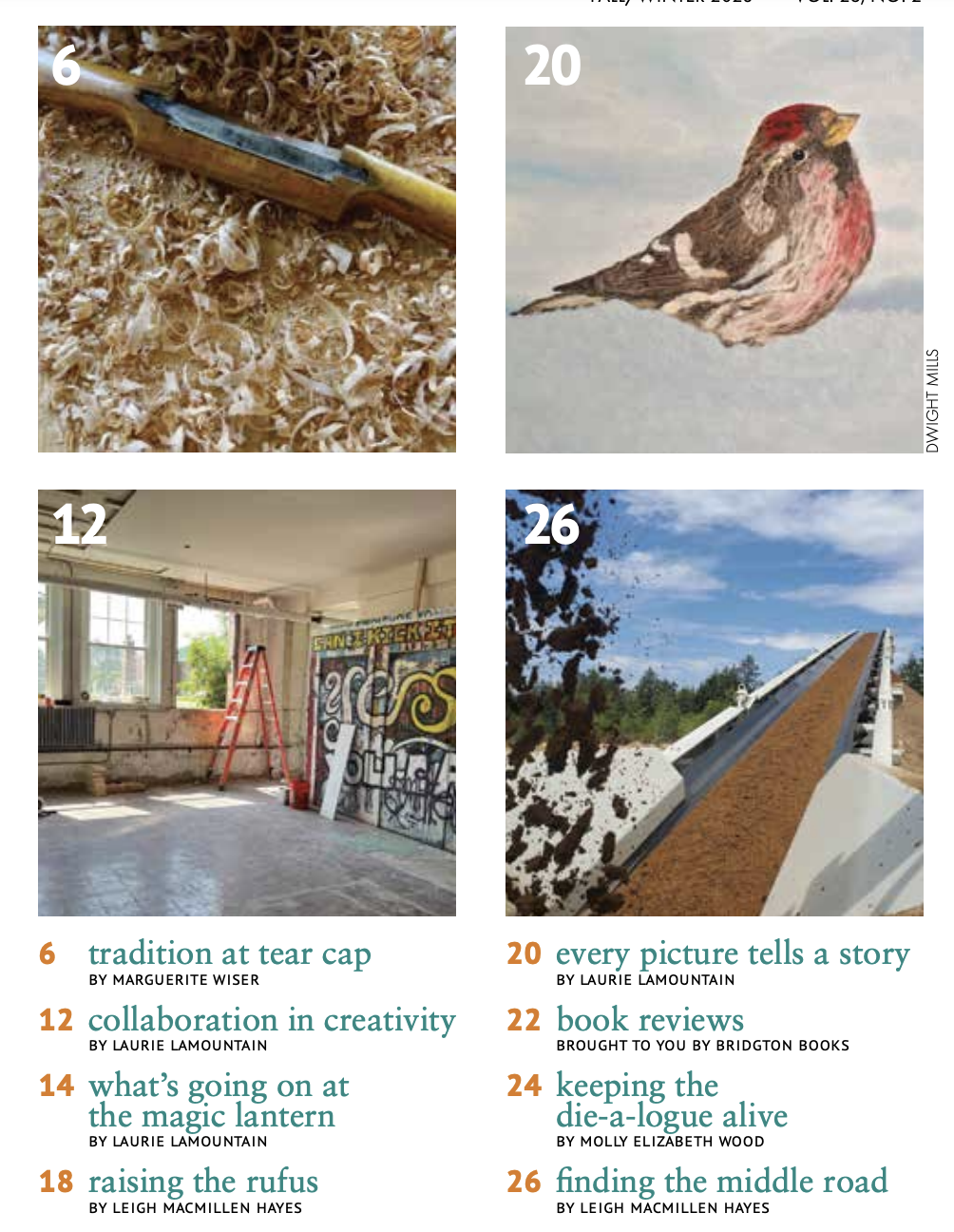
And the table of contents:

The cover photo and lead article were written by Marguerite Wiser, a young woman of many talents. Marguerite has written several articles for Lake Living in the last few years and it’s great to have her voice in the mix.

Tear Cap, as you’ll discover upon reading the article, is about a collaborative effort that celebrates community in an old mill in Hiram, Maine.

Editor and publisher Laurie LaMountain has written about Ian Factor’s studio in Bridgton in a previous issue, but now Ian has taken his work a step further and you can read all about what he’s bringing to Fryeburg Academy students in Fryeburg, Maine.

Laurie wrote several other articles as you can see from the table of contents, one about the Magic Lantern and their STEM programs, and another about an interesting painter who captured her whimsy with his own sense of whimsy. When we chatted on the phone after she’d interviewed Dwight Mills, I could tell she most jazzed about the man.

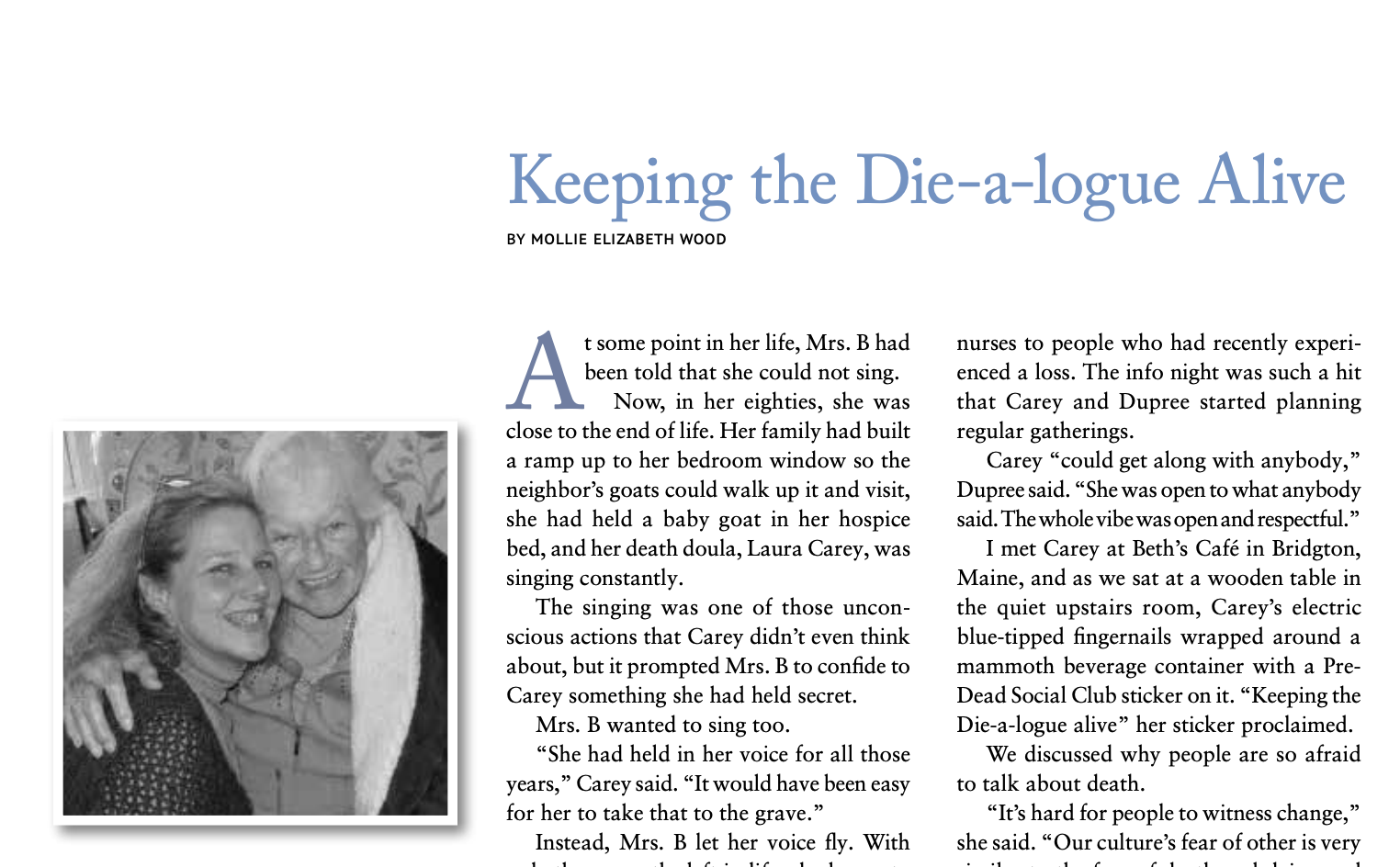
A new contributor to this issue was Mollie Elizabeth Wood. When I heard about her topic, my gut reaction was, “Really? For Lake Living?” But, you’ve got to read this article. It’s incredibly well written and brings death to the forefront, because, after all, it’s on the horizon for all of us.

One of my articles is about a new building currently under construction at the Rufus Porter Museum in Bridgton, Maine. If you are a long time follower of wondermyway.com, you may recall the day the community walked the Church Building at the museum down Main Street. If you are new to wmw.com or have a memory like mine, here’s the link: Walking with Rufus Porter. Now, the campus is growing and it’s an exciting addition to town.

Pre-pandemic, when advertisers were more abundant, and publishing costs were lower, we published Lake Living four times/year and in the fall and spring issues you could find book reviews from the owners and staff of Bridgton Books, an independent book store. Above are Justin Ward’s picks from the bookshelf.

Now, we only publish two issues, so in each one you can see what they recommended each time you pick up a copy of the magazine. These are Perri’s Preferences.

This last article resonated with me because it’s about two people from different sides of the table who sat down to chat and realized they have a lot in common and figured out a way to work together. Rex Rolfe of Rolfe Corporation in Bridgton, owns an aggregate /excavation business, and Erika Rowland is the former Executive Director at Greater Lovell Land Trust, where I also work.

This past summer, a small group of us stood in one of Rex’s pits that abuts land trust property, and the two shared their story. It’s what got me thinking that we need to educate others about this topic.

Oh, and that pile of sand behind Rex–it’ll help keep you from sliding on local roads when the snow finally flies this winter as town trucks have been going in and out recently to fill their storage facilities.

When we came up with the editorial list for this issue I thought, “Well, this one doesn’t seem to have a theme,” but as Laurie wrote in her editor’s notes on page 4, “Community, connection, collaboraton, creativity–these are the concepts that thread through this issue of Lake Living . . . they are the hallmarks of where we live . . . ”

And on October 10, Laurie received this message from a reader:

I leave you all with an image of Rex Rolfe’s toy collection and hope that you’ll take the time to brew a cup of tea and sit down with the magazine and enjoy all that is within its covers . . . and then support the advertisers so we can continue to bring this to you for free!

Here’s a link to the whole shebang: Lake Living magazine

Omnivore, Herbivore, Insectivore, Oh MY!

I walked out the door this morning and wandered down one trail and then another and intended to go farther into the woods, but as often happens, I was stopped in my tracks.

On granite at my feet, covered as it was with lichens of the crustose and foliose sort, I spied a rather large specimen of scat. High point. Center of trail. Classic.

Based on the size and hair and bones packed within, I knew the creator: a coyote. If I awake during the night I can sometimes hear the family members calling to each other, the youngsters learning to hunt so they’ll be ready when they disperse.

The trail narrowed by a small stream and I was wearing my muck boots so proceeded at will. It’s been a few months since I’ve traveled this way and was surprised at how grown in it had become this summer. While the Sugar Maples do not like wet feet from all the rain we’ve had, other species have thrived, including the Red Maples, and this shrub that bordered each side of the trail.

It’s leaves still entact showed off that they are doubly toothed in a rather random order. So each little “tooth” is like the edge of a saw, but if you look closely, you’ll note that there are bigger teeth made up of a series of smaller teeth before the leaf margin cuts in toward the main vein and then heads out again to form the next bigger tooth made up of smaller teeth. And those veins in between the main vein and those that lead to the margin–reminded me of the crinkles on an apple doll person, since it is apple season.

The leaf buds, which form in the summer for next year, are hairy and have only two scales. Because of recent warm weather, at least one decided to jump the gun and open now rather than waiting until next spring. I’ve seen that with other plants of late, including Blueberry, Daylily, Sheep Laurel, and Partridgeberry.

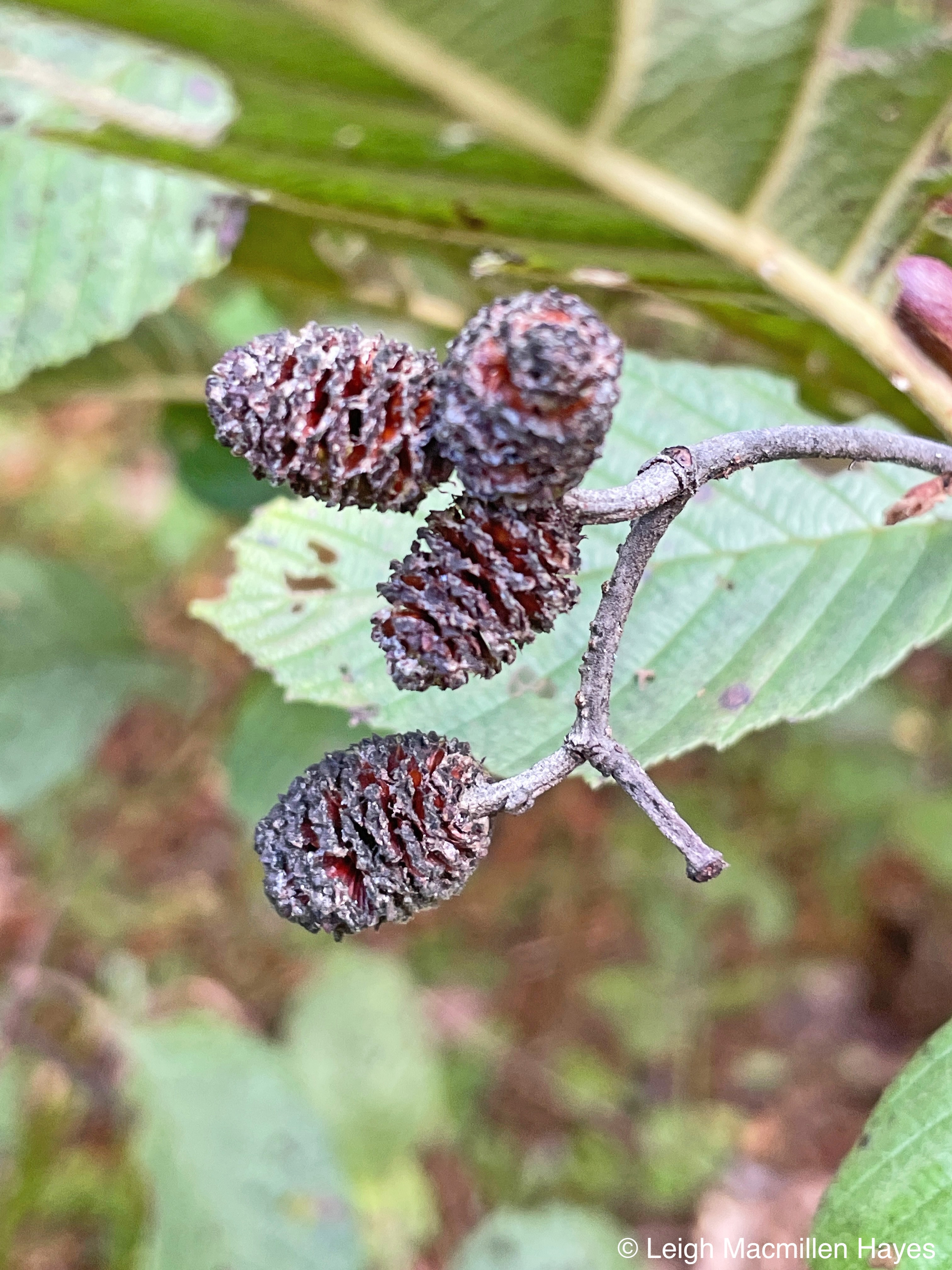
Others who best not jump ahead are the catkins of this species, the longer green and red being the male pollen carriers that will slowly elongate over the winter and turn more yellowish red in the spring. The female flowers are tiny magenta catkins located just above the males.

Once the females are wind pollinated, the males will drop off and the females will form into a fruit that resembles a cone.

The name of these shrubs, if I haven’t already spilled the beans, is Speckled Alder, so named for the white dots (think lenticels for gas exchange) that populate the bark. These shrubs love wet feet, which is why they are growing on either side of that small stream.

Some of the Speckled Alder cones hide beneath tongues imitating piles of snakes stretching out, made from galls caused by an infection to increase the surface for spores from a fungus to spout. It’s a smart strategy.

I also found a few Lady Beetles today, including one larval form. They were on these shrubs for one reason.

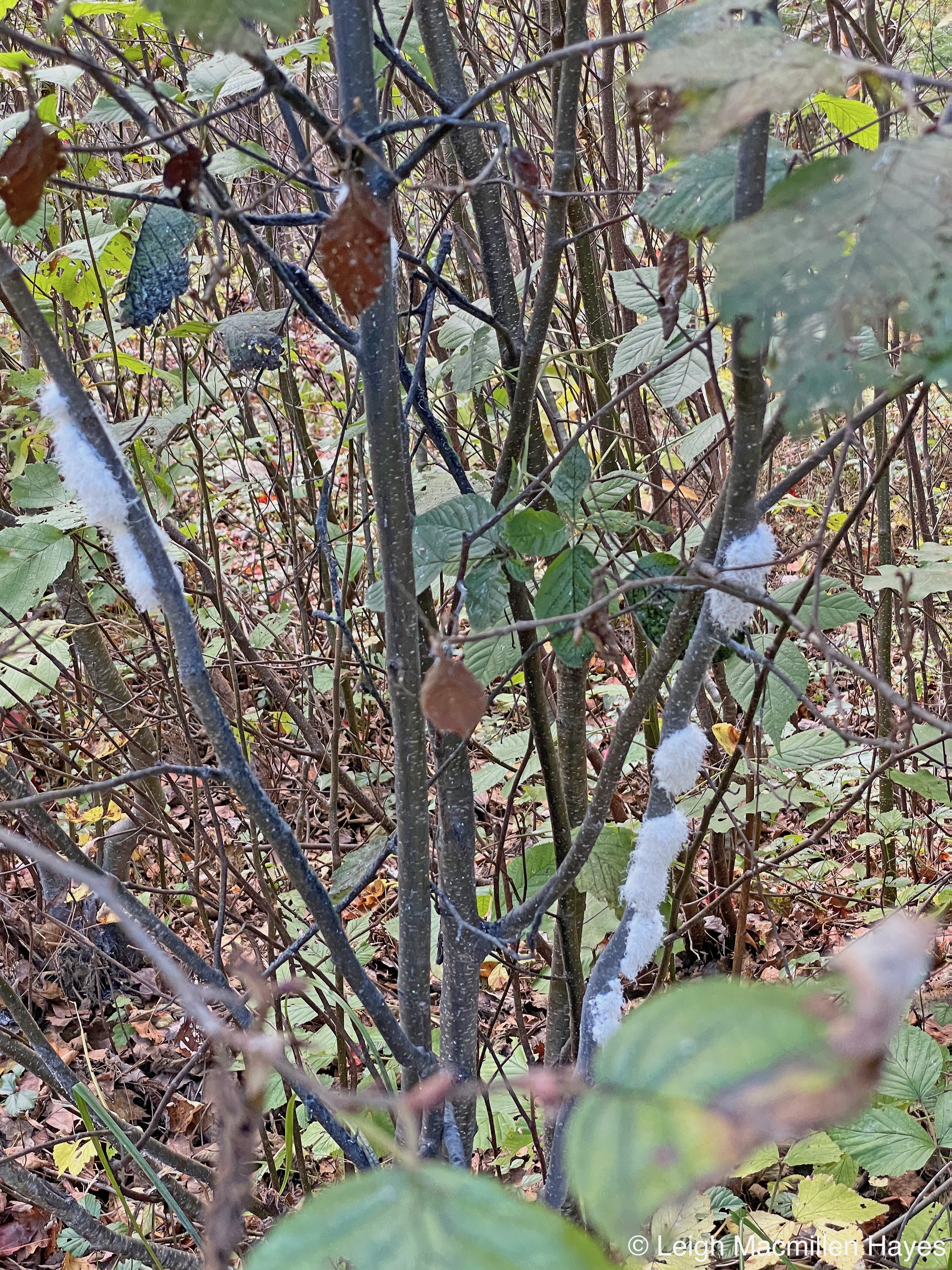
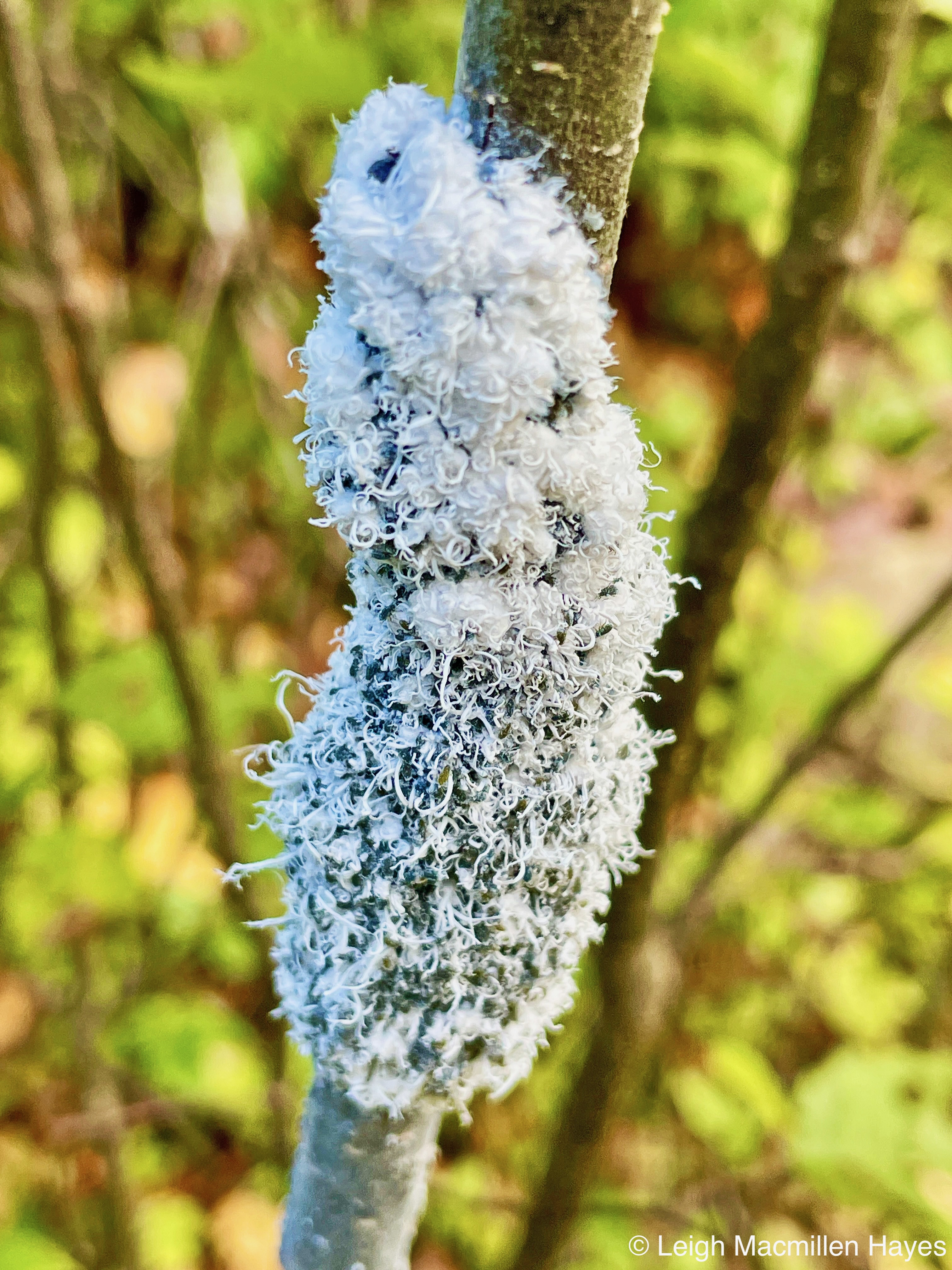
That reason being the Woolly Alder Aphids who live a complex life in which they alternate between a generation reproducing asexually (no guys, just gals), and one reproducing sexually with both males and females adding to the diversity of the gene pool. The males and females fly to Maple trees to canoodle, but those found on the Alders are all female.

They live such a communal life as they suck sap from the shrub, that one might think this entire mass is just one insect. Hardly. And do you see all that waxy wool that covers their bodies? If you watch these insects for even a few seconds, you’ll note that the hairs move independently. It’s almost otherworldly.

Since they’ll overwinter, I think of the wool as providing a great coat. In the summer, ants, and now Lady Beetles, and even a few other insects farm them to get the aphids to excrete honeydew from the sap.

The aphids don’t harm the the shrubs, but I saw so many today that that fact is hard to believe. I gave up on counting branches but over one hundred played host.

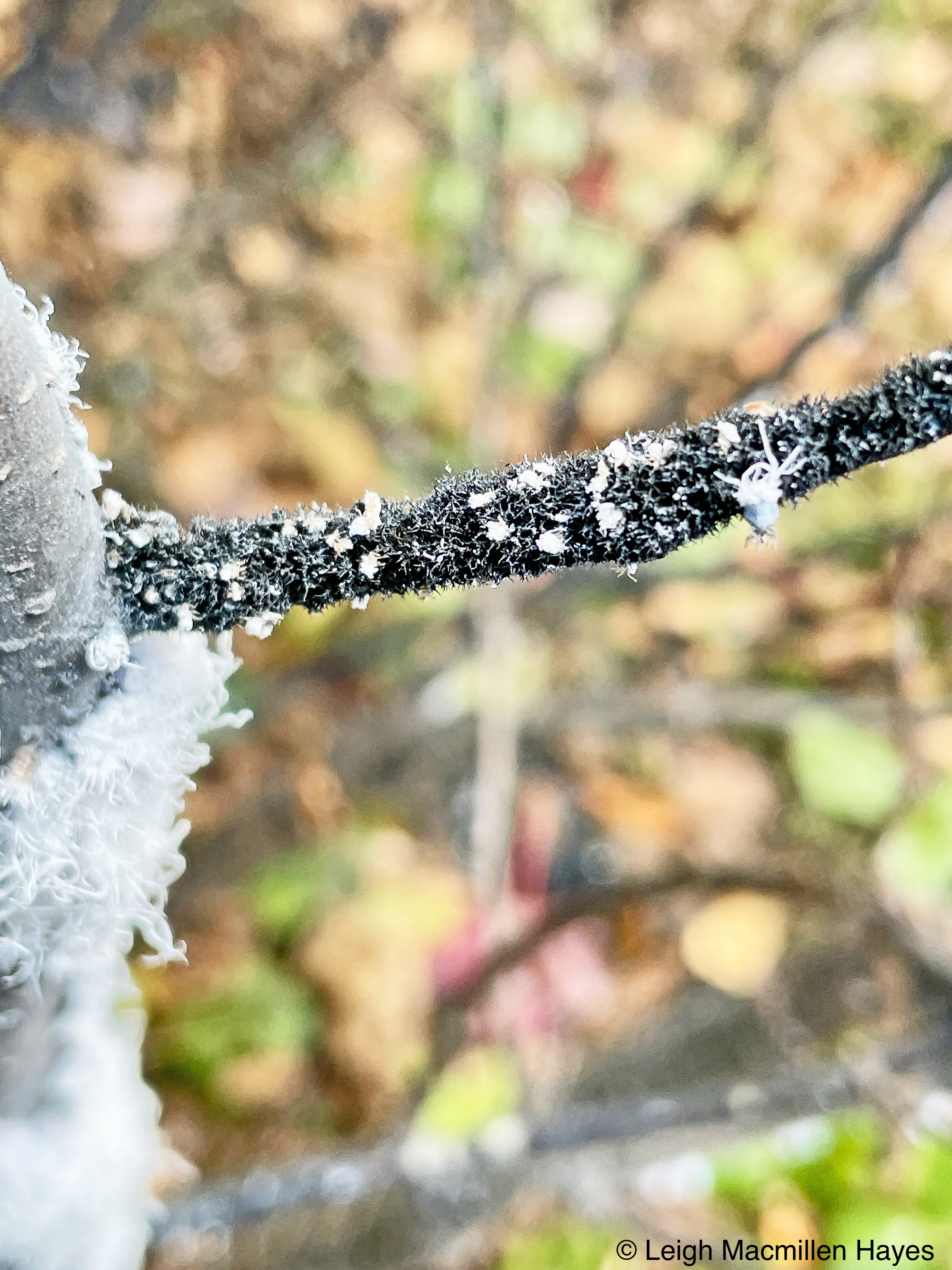
That said, there was another character in the mix. Do you see the top branch that leans out to the right?

The sweet honeydew I mentioned forms a substrate for a nonpathogenic fungus called sooty mold that blackens leaves and bark beneath colonies of aphids. The mold is known scientifically as Scorias spongiosa or, my favorite and drum roll please . . . Beech Aphid Poop-Eater: A fungus that consumes the scat (frass in insect terms) of a Beech Blight Aphid (not the same as Beech Scale Insect that causes Beech Bark Disease). Alders are in the Beech family.

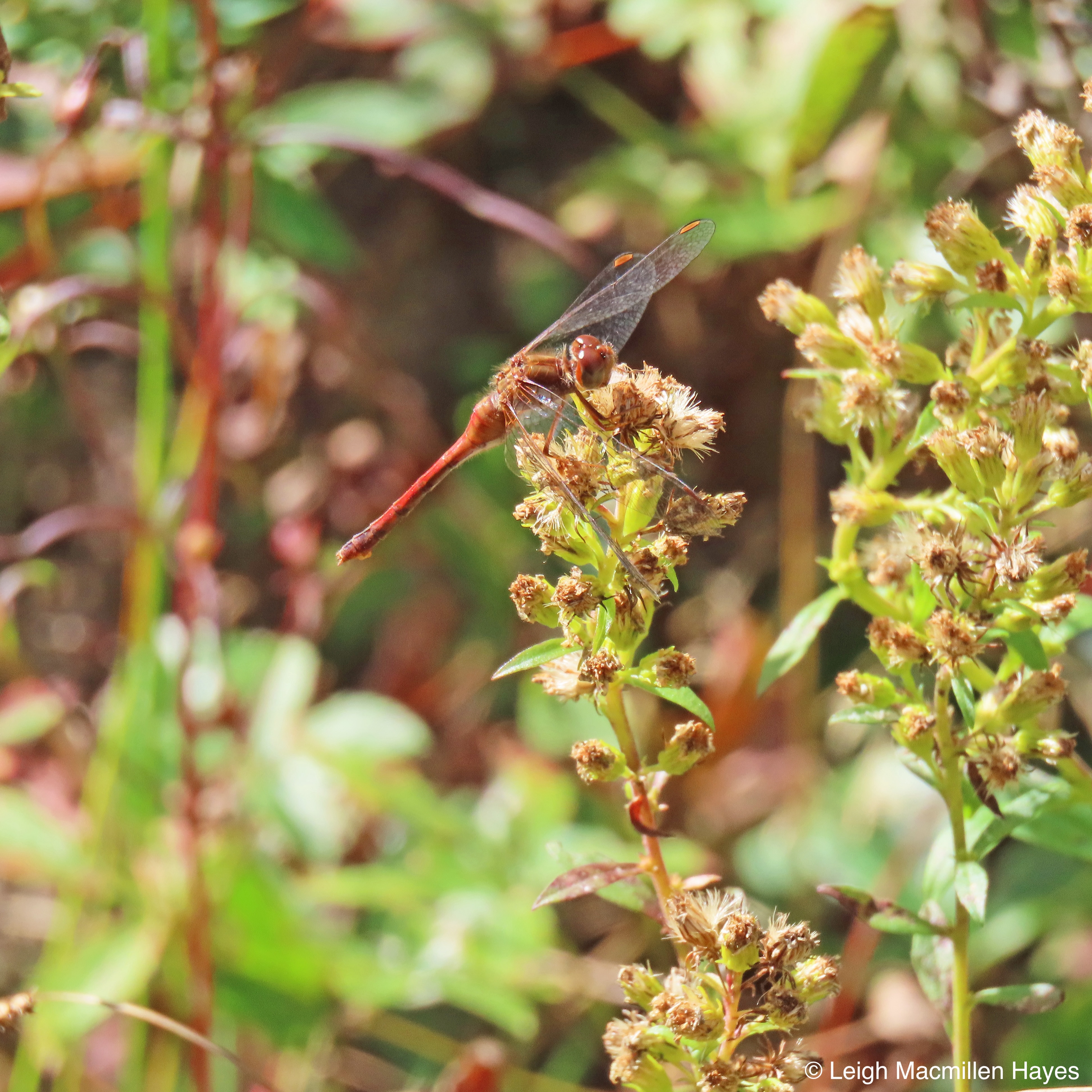
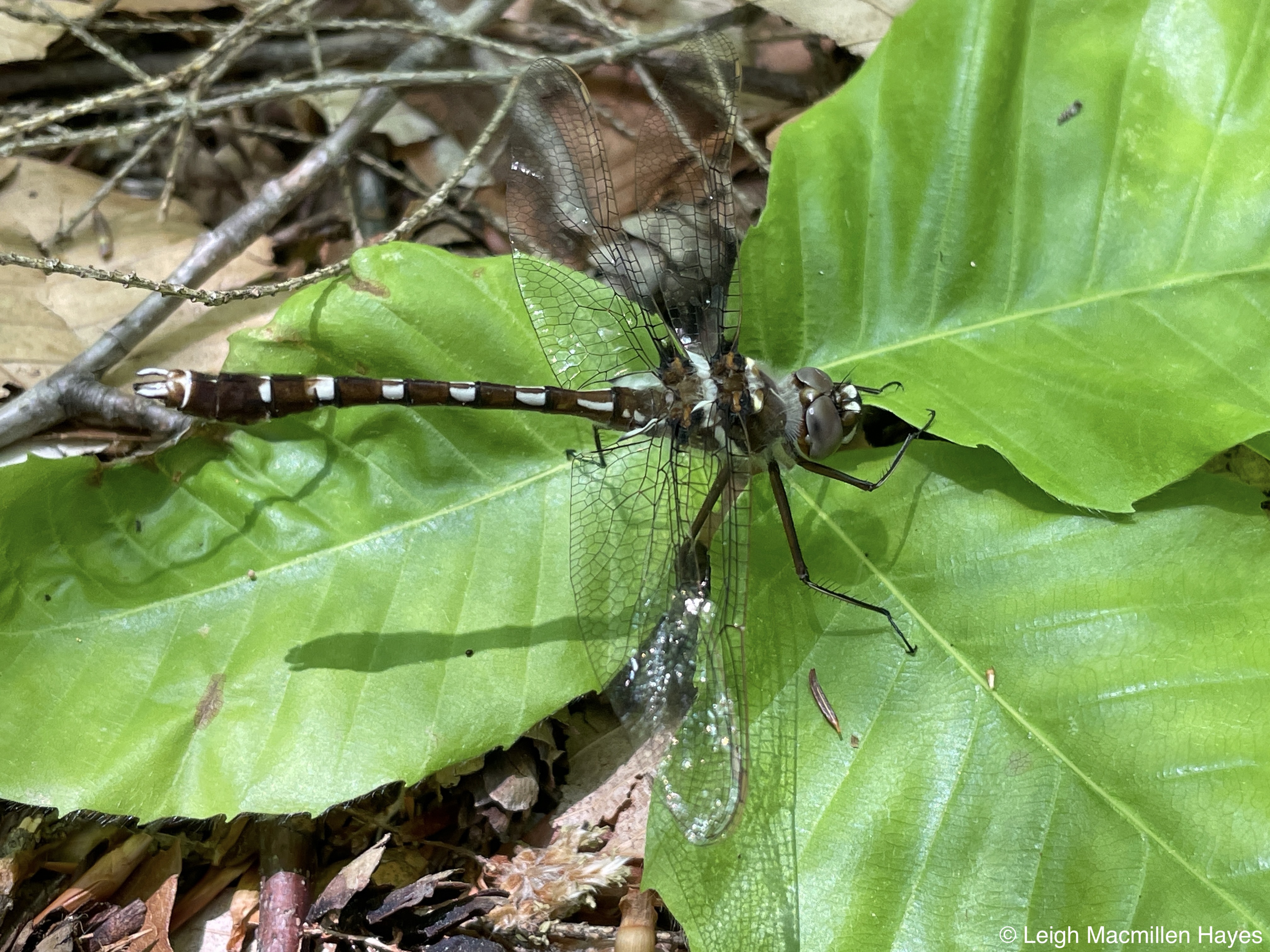
As I left a few Autumn Meadowhawk Dragonflies flew ahead of me on the path. They’re days are numbered, so I’m always thrilled to see them flying and posing.

Omnivore, Herbivore, Insectivore, Oh MY! And all of this within a ten-foot stretch of the trail.

Scouts on the Hunt

The morning began as Tuesdays do in my current world, with a visit to a Greater Lovell Land Trust property accompanied by a group of curious naturalists we know as docents who love to do deep dives on every little thing that we encounter and in the midst we share a brain. A collective brain is the only kind to have, in my opinion, because we each bring different knowledge or questions to the plate.

And so it was when we first encountered what could have been a hair ball of sorts and then discovered this hair-filled scat about a yard beyond. And near it another “hair ball.” Based on size and structure we determined the scat belonged to a bobcat, and thought that the hair balls made sense as maybe the cat had to cough up some of the hair of the mammal consumed. What did it eat? Well, we know both snowshoe hare and deer frequent this place and so it could have been either.

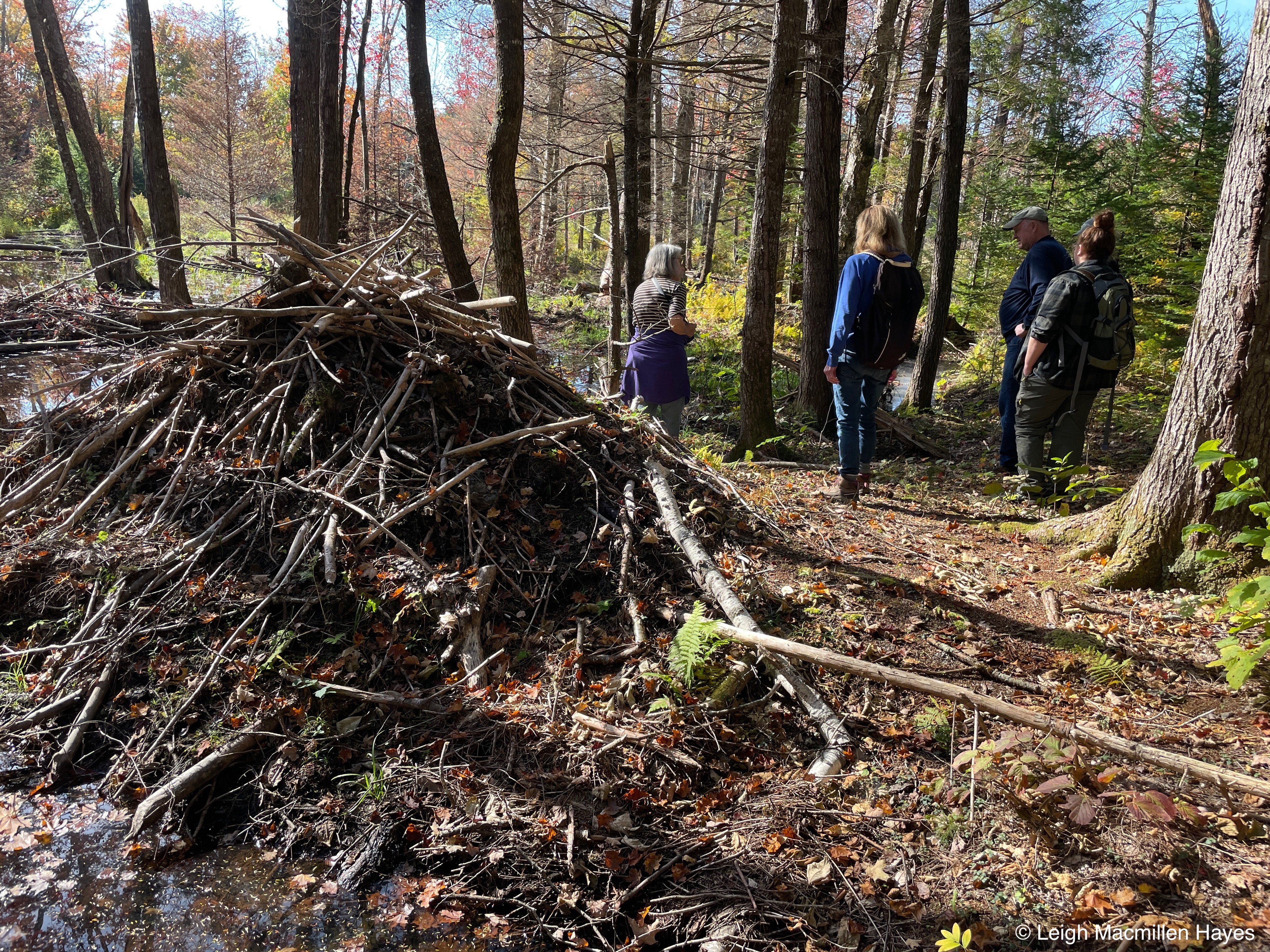
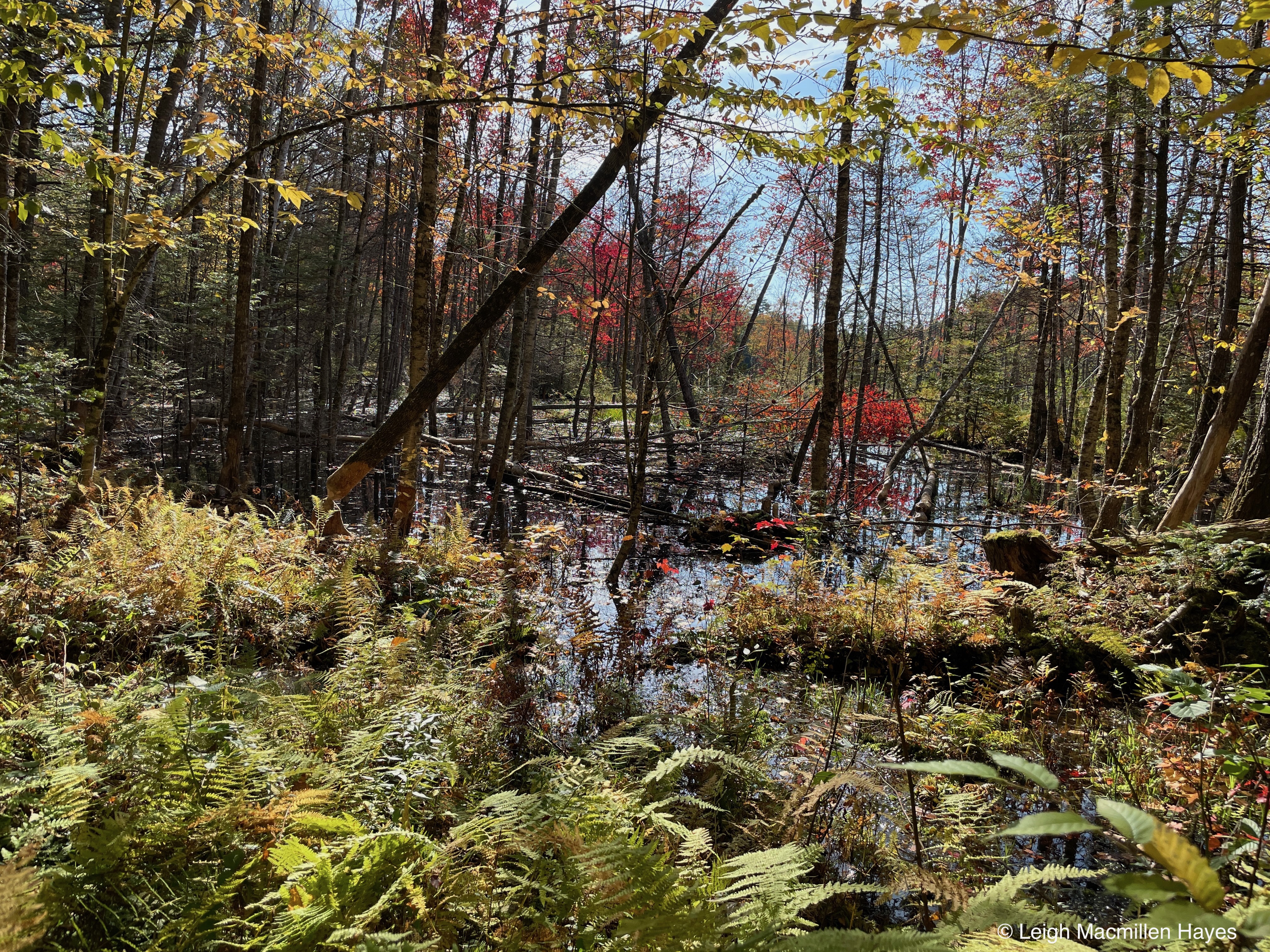
A little further down the trail we reached a beaver lodge that some of us had seen under construction in August 2022, and gathered game camera photos over the course of time, and spotted all kinds of sign of activity each time we visited, until that is, May. When it rained. And rained. And rained. In a torrential manner. And the dam the beavers had built was breached. And they disappeared. And we know not their fate.

But the beauty of a beaver pond is that once breached, change happens and other critters take advantage of the space and there’s so much possibility and we can’t wait to watch how this space, one in which we could walk prior to August 2022, will evolve and other flora and fauna may move in until another beaver family takes up residence and changes it again.

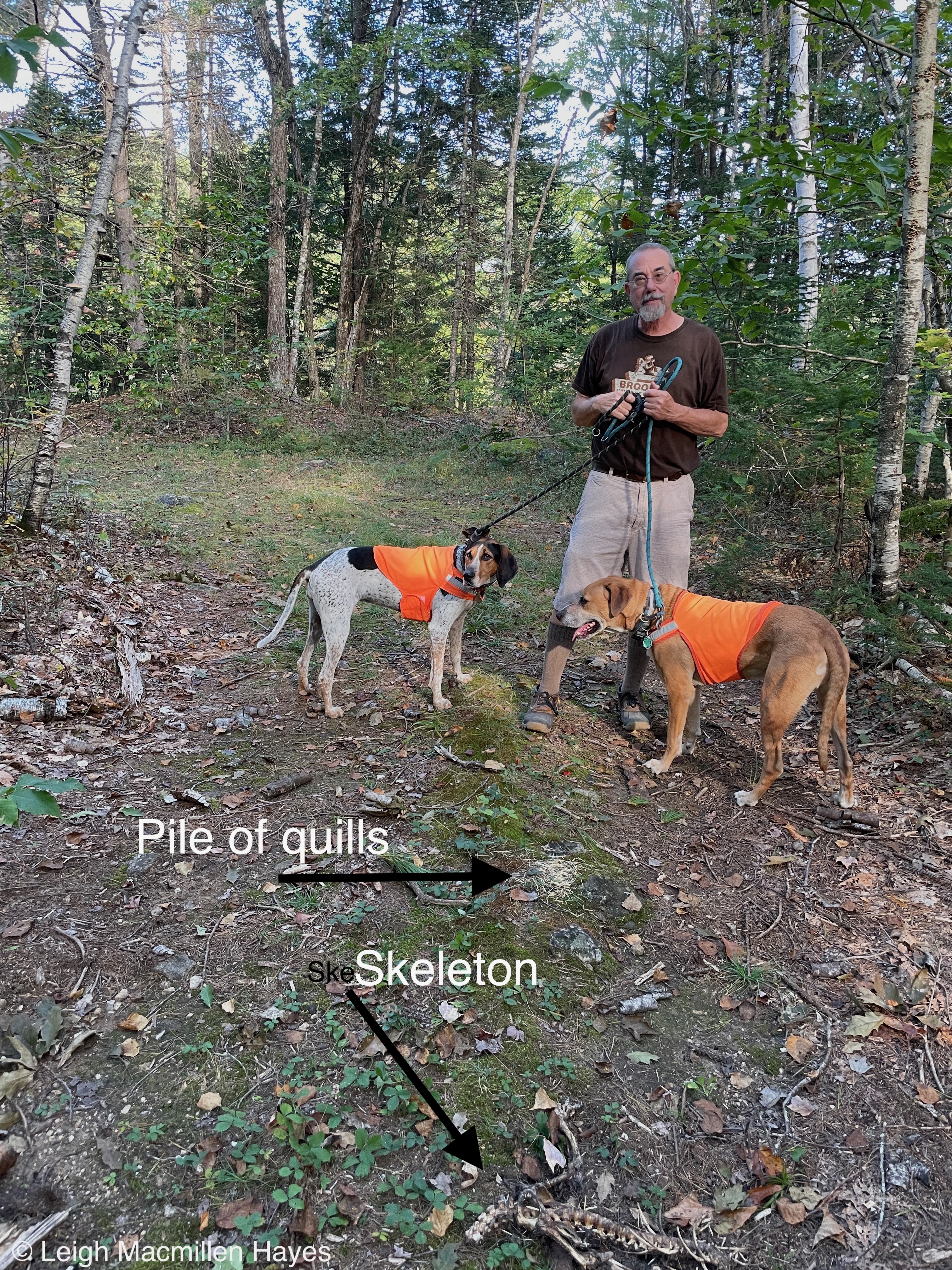
About an hour or so after departing, a call came. Well, really, it was a typed message. But as my morning peeps know, shout, “Kill site,” and no matter what I might be focused upon, I’ll come running.

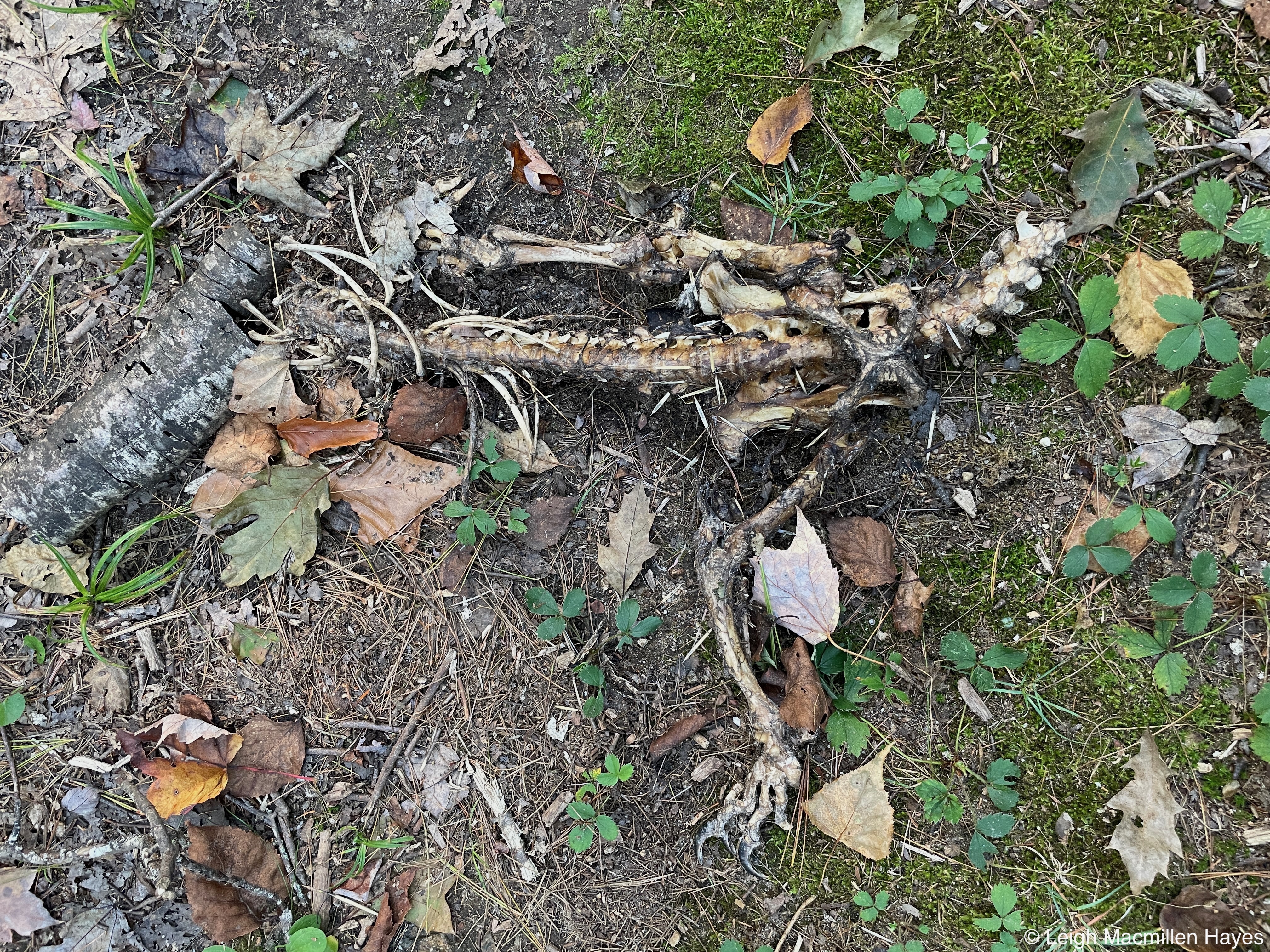
The message included a few photos of a mammal skeleton and a thought that it might be a beaver that had become the meal because it was located close to another beaver pond. Beaver ponds are plentiful in the landscape of western Maine.

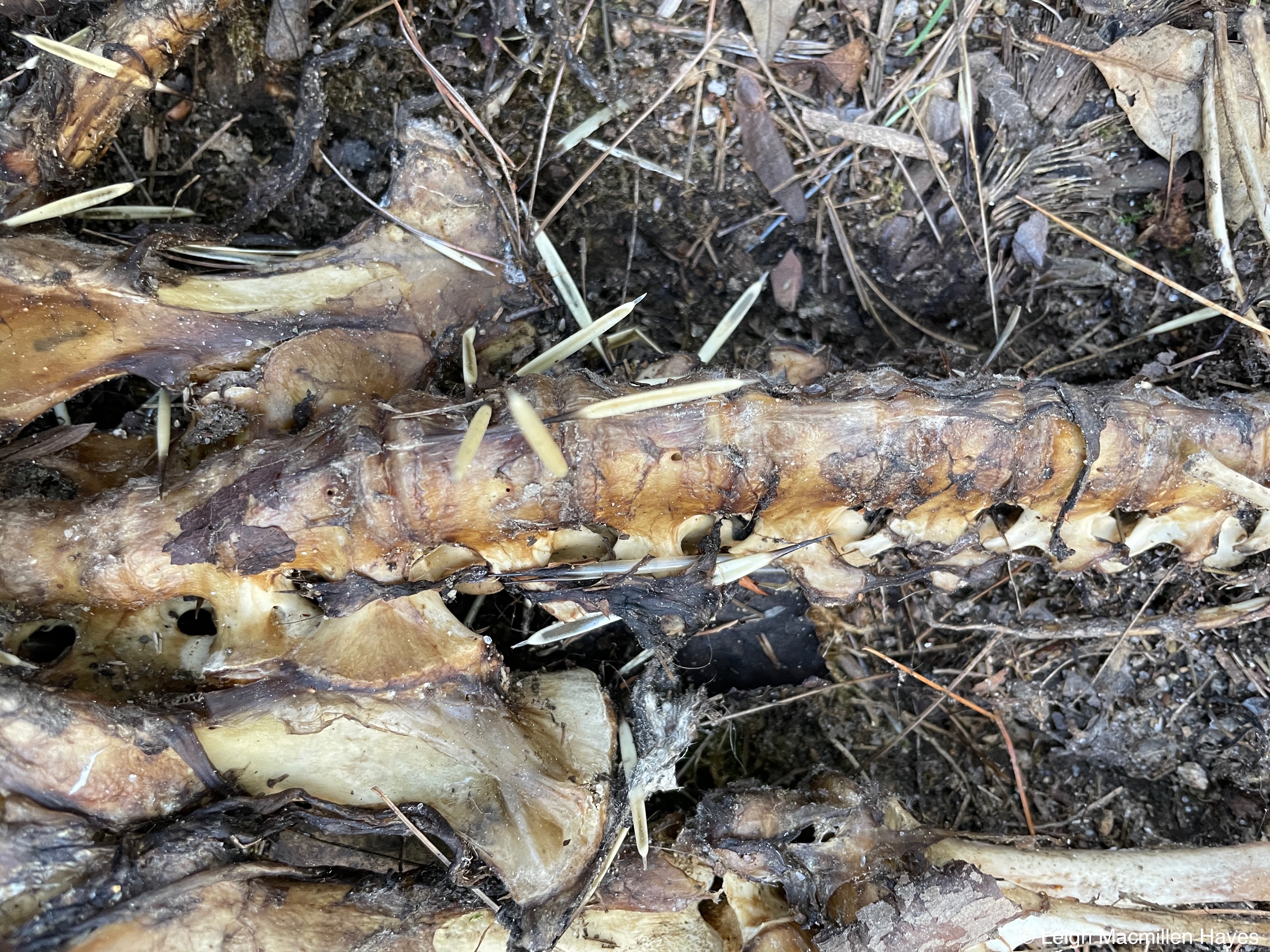
After a few messages back and forth, the writer and I agreed to meet and walk to this site. Take a look. The meal this skeleton became had been consumed months ago, I suspect in the winter, given how much was missing, including the head. And even after any hide and meat had been eaten, the bones continue to provide calcium for rodents seeking such.

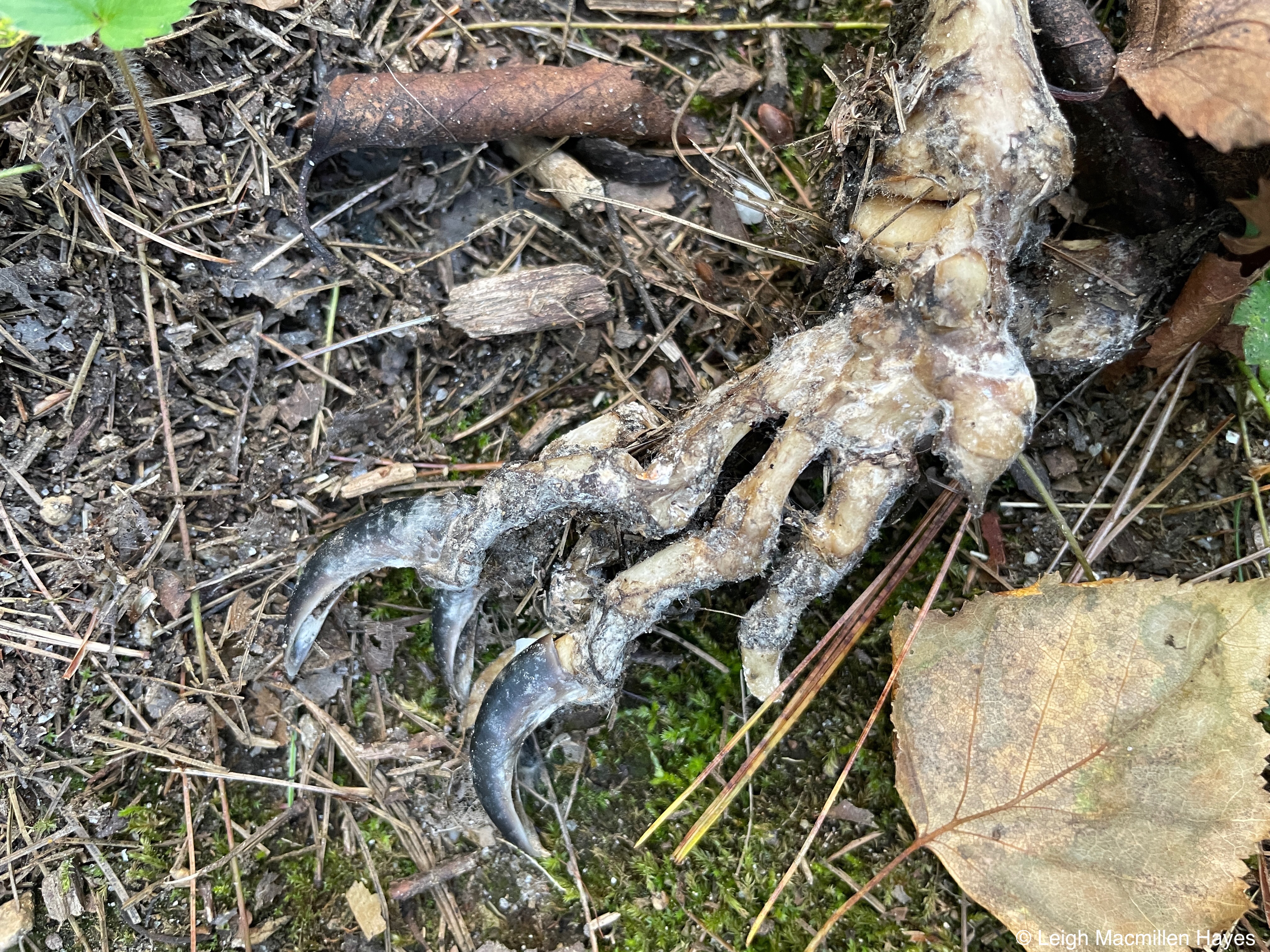
Since my guide suspected beaver, I knew I had to slow my brain down and assess the evidence. My, what long toe nails. And though some were broken, it seemed obvious to me that they were all oriented to the front of the foot. Plus, there was no evidence of webbing.

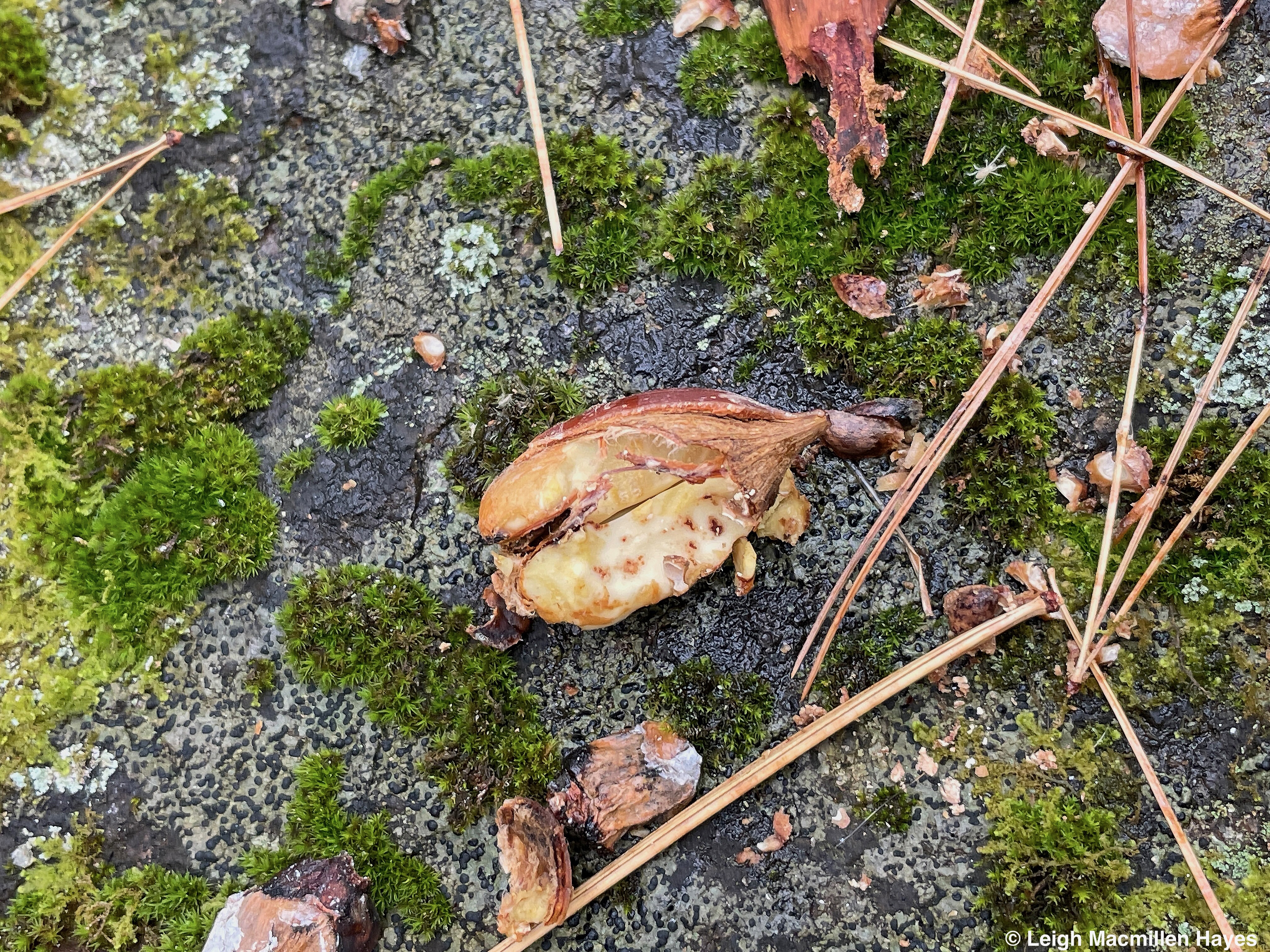
A bigger clue was observed with a closer look. Barbed quills sticking into the spine. I pulled one out and we examined it.

And about a foot away, a pile of quills, with vegetation growing through them adding to the age of the kill site.

And hiding there also, as if stuck into the ground, a quilled tail.

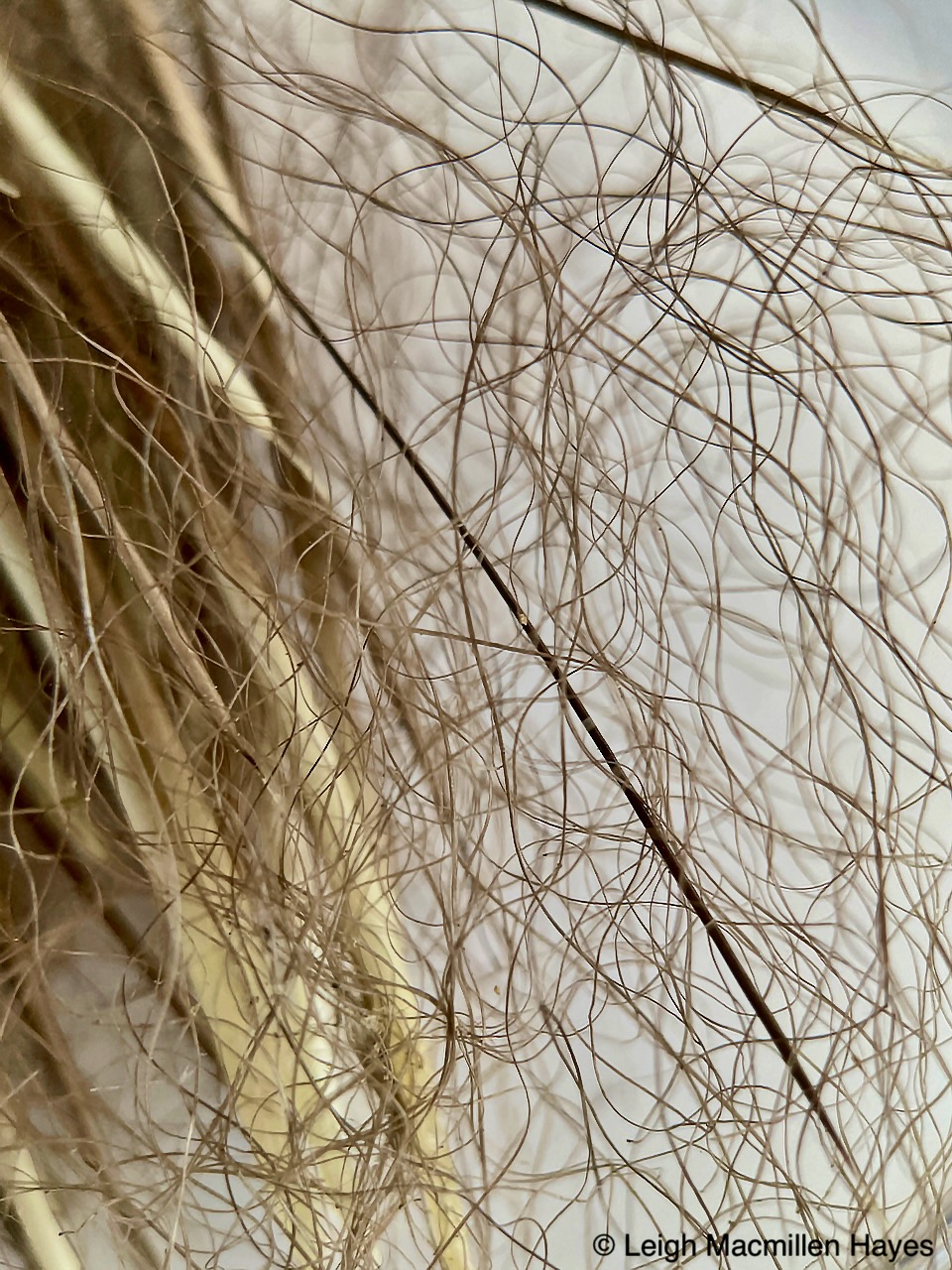
Did you know that porcupines have a variety of hair? For winter insulation, they have dark, wooly underfur. In addition, there are long guard hairs, short, soft bristles on the tail’s underside, stout whiskers, and then there are those pesky quills.

They aren’t pesky to the porcupine; just us and our pets and any animal that might choose to or accidentally encounter a porcupine.

Overall, a porcupine sports about 30,000 quills, and within one square inch on its back, you might count up to one hundred, as demonstrated by my jar of toothpicks.

The quills are 1 – 4 inches in length and lined with a foam-like material composed of many tiny air cells, thus their round, hollow look. There are no quills on the porcupine’s face, belly, or inside its legs.

Look at that nose. Soft hair indeed. As is the stomach. A fisher, which is a member of the weasal family and not a cat, will attack the porcupine’s face repeatedly.

Fishers and bobcats also have been known to flip a porcupine onto its back and then go for the belly. That doesn’t mean that they don’t get quilled, for in moments of danger, the porcupine instinctively raises its quills and positions itself with its back facing the predator, showcasing its formidable defensive strategy. but the predator does get a meal.

This dinner had long ago been consumed as I said. But was it a fisher or a bobcat who scored this meal? We’ll never know, but I give great thanks to Dixie and Red and their best friend Lee, for being such great scouts and sharing the results of their hunt with me.

Found a kill site? Give me a shout and I’ll come running.

A Week of Wonders

Every. Little. Thing. Captures. My. Attention.

Whether wandering along the board walks at Holt Pond for six hours with a friend, or . . .

hiking up the new Patterson Hill Trail with My Guy, there’s always something to look at.

One of the most beautiful, and also most difficult to spot, is the Phantom Crane Fly, so named for its black and white markings. As it floats through the air, for I swear it looks like a little box adrift rather than an insect that is flying, its presence is so subtle that it is easy to miss because it blends in with both light and shadows. Shady edges of wetlands are its preferred habitat and that’s exactly where this specimen and a bunch more were spotted . . . at least in the moment. Finding them to photograph is not easy.

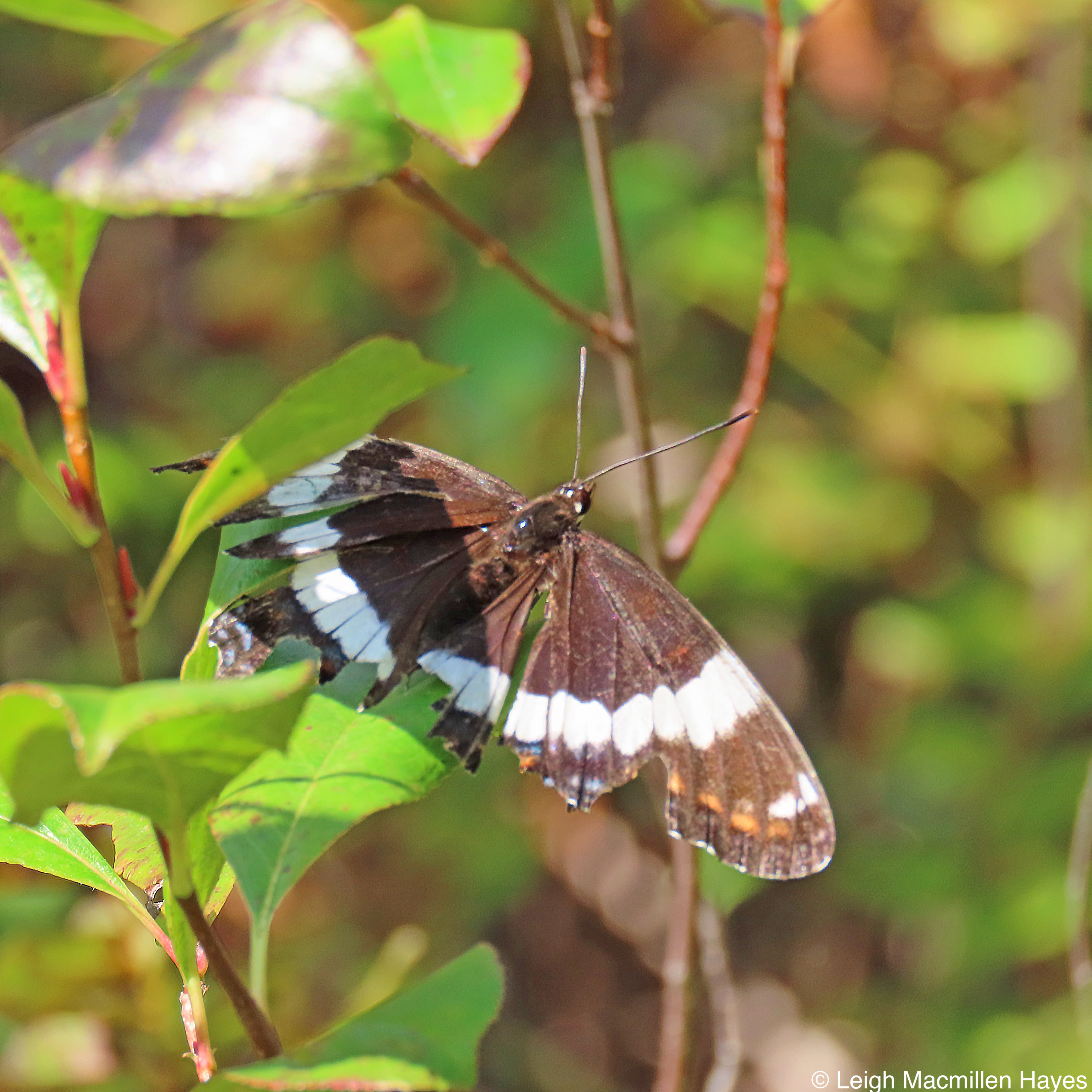
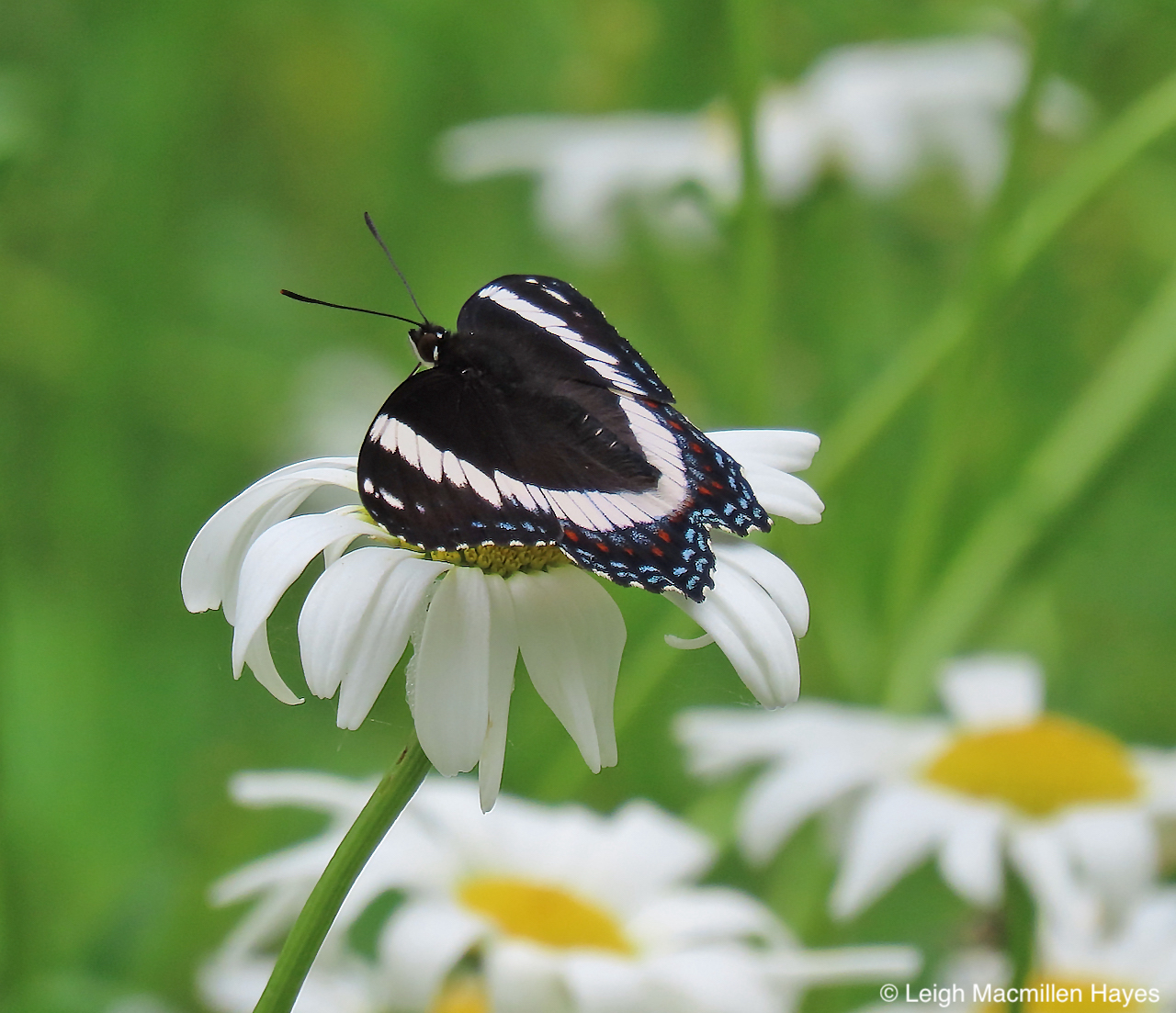
While the black and white coloration seems to help the crane fly disappear into its landscape, the White Admiral Butterfly, who utilizes those same colors, but with a different pattern, plus a few other hues in the mix, is hardly inconspicuous. And by the tattered wings, it seems this insect has escaped becoming a meal on more than one occasion. That, in itself, is reason to celebrate.

Of course, if you are a follower of this blog, you are hardly surprised to spy a dragonfly. It’s Meadowhawk Season, for those who thought the season is actually autumn. And take my word for it because you can’t see it, this is a Cherry-faced Meadowhawk, one of the most common species, along with White-faced Autumn, and Ruby Meadowhawks.

If you near water, be on the lookout for a bunch of pairs in tandem flight as he continues to grasp her behind her head while she dips her abdomen on the surface of water in the act of ovipositing eggs. Sometimes, many tandem pairs will oviposit simultaneously, for there is safety in numbers.

In addition to the Phantom Crane Flies, I’ve been looking for this species, a Pale Green Assassin Bug for months, and tada, a nymph makes an appearance. While its name sounds intimidating, this is actually an insect to admire for it eats flies, wasps, aphids and other small insects that you might consider pesky things.

This was another for whom I’ve been searching, stalking actually, as I pace around gardens. And then, the other day a colleague invited me to join her behind our land trust office, and there Charlotte was, writing a message in her orb-shaped web. Now to find Wilbur. But he’s probably busy getting ready for the Fryeburg Fair.

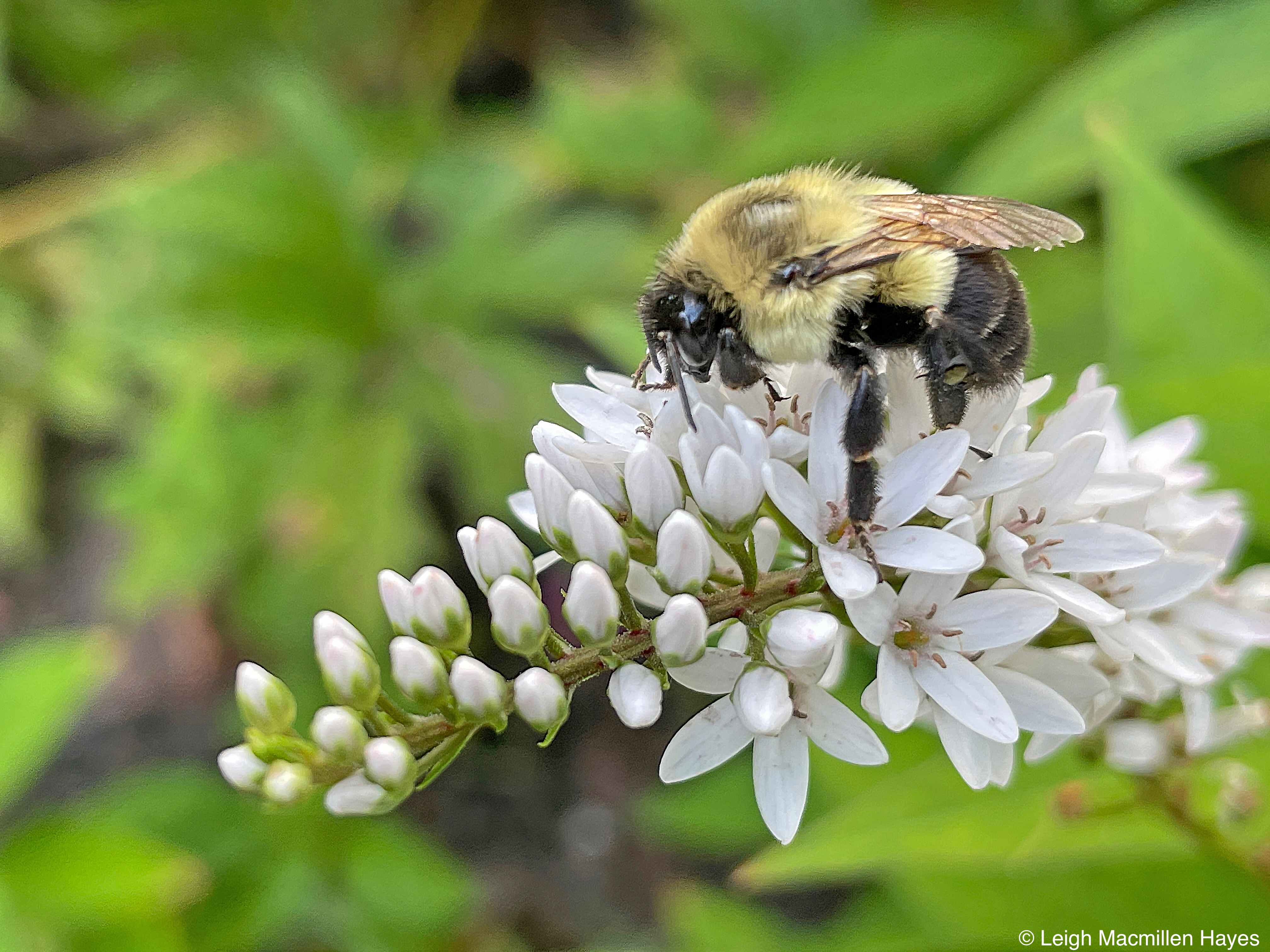
And today, it was this big Bumblebee that surprised me for though it moved its antennae and abdomen, it seemed to remain in one spot on the Gooseneck Loosestrife.

In fact, it stayed so still, that I was able to get into its face, without worry of being stung. Did an Ambush Bug have hold with its claws? Or was a Crab Spider somehow involved? I walked away several times and returned to find it in the same spot, unlike all its other cousins who were busy as . . . bees! But, on a final visit, it had disappeared. I looked under the plant and on the ground below, thinking it might just be a skeleton if a predator had sucked its guts, but found nothing, so can only assume that it finally flew.

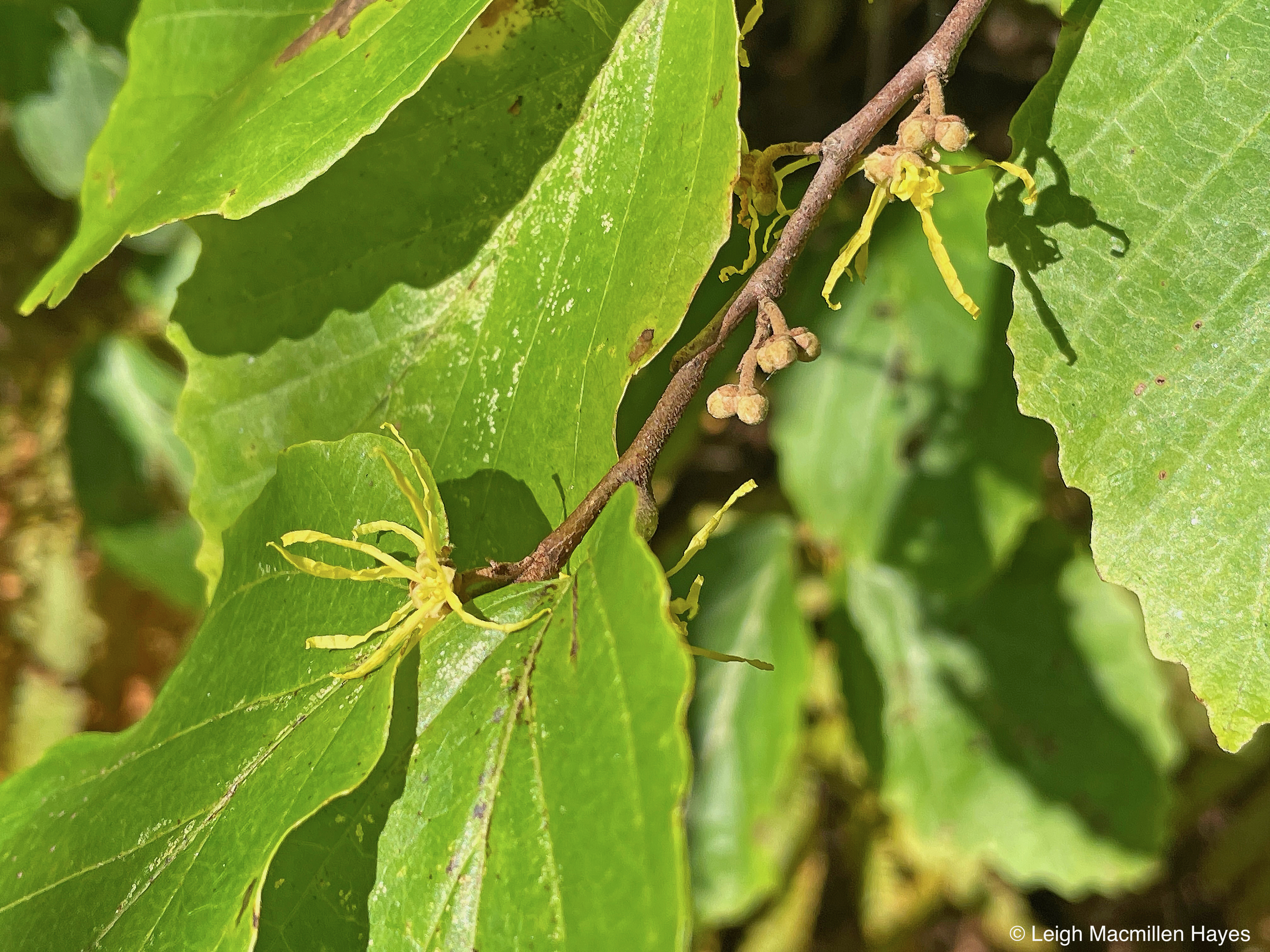
The next two photos are of flowers and not insects. Actually, there are fewer and fewer flowers in bloom right now as we enter the early phase of autumn, but Witch Hazel has started to show off its ribbony display and that made me happy to think that all is right with the world.

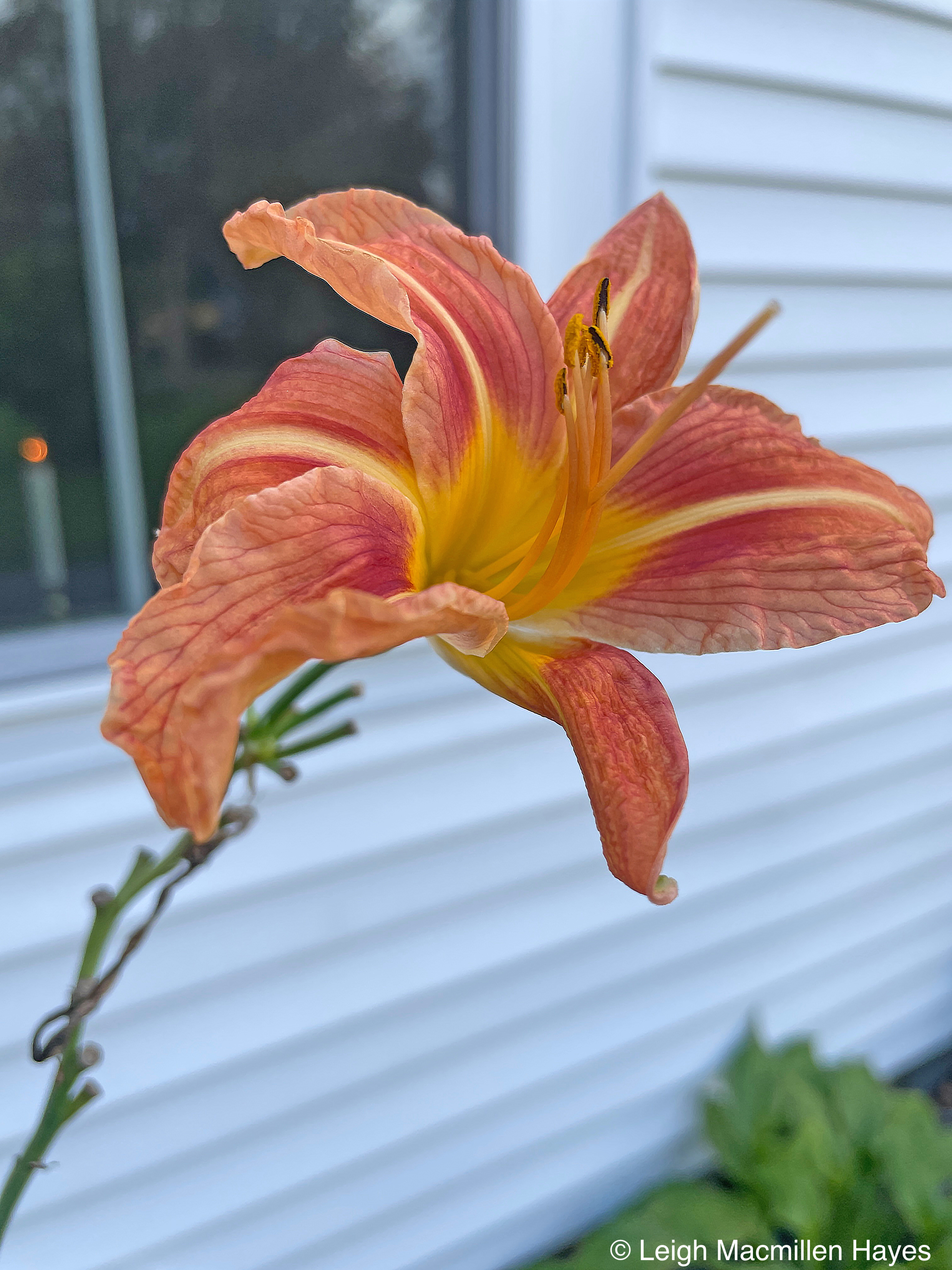
Until, that is, I arrived home a few days ago and found a Day Lily blossoming in mid-September, which is quite late, especially considering all of its brethren had had their day in the spotlight back in early July. Houston, we have a problem. (And maybe sending more aircrafts into space isn’t the wisest decision.)

That said, dear readers, I leave you with something that I hope will bring a smile to your face as it did to mine. My Guy returned from a business trip toward the end of last week and said he had a gift for me. He opened his backpack and pulled out this box of Jelly Slugs! For those who know me, you’ll know that he knows me as well!

It’s been a week of wonders indeed, and though these are only a few samples, I’m grateful for every little thing that captures my attention.

The Rest of the Story

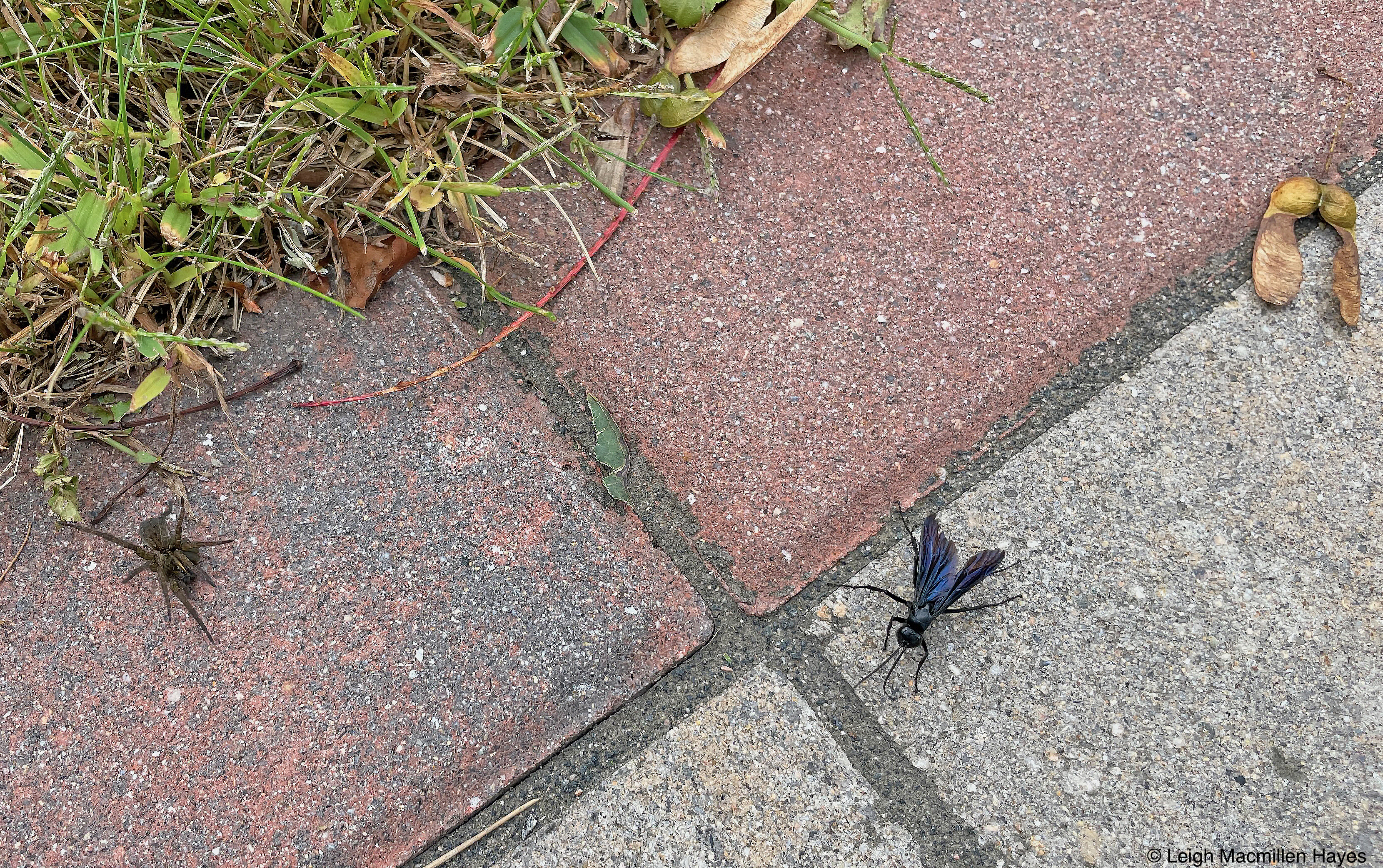
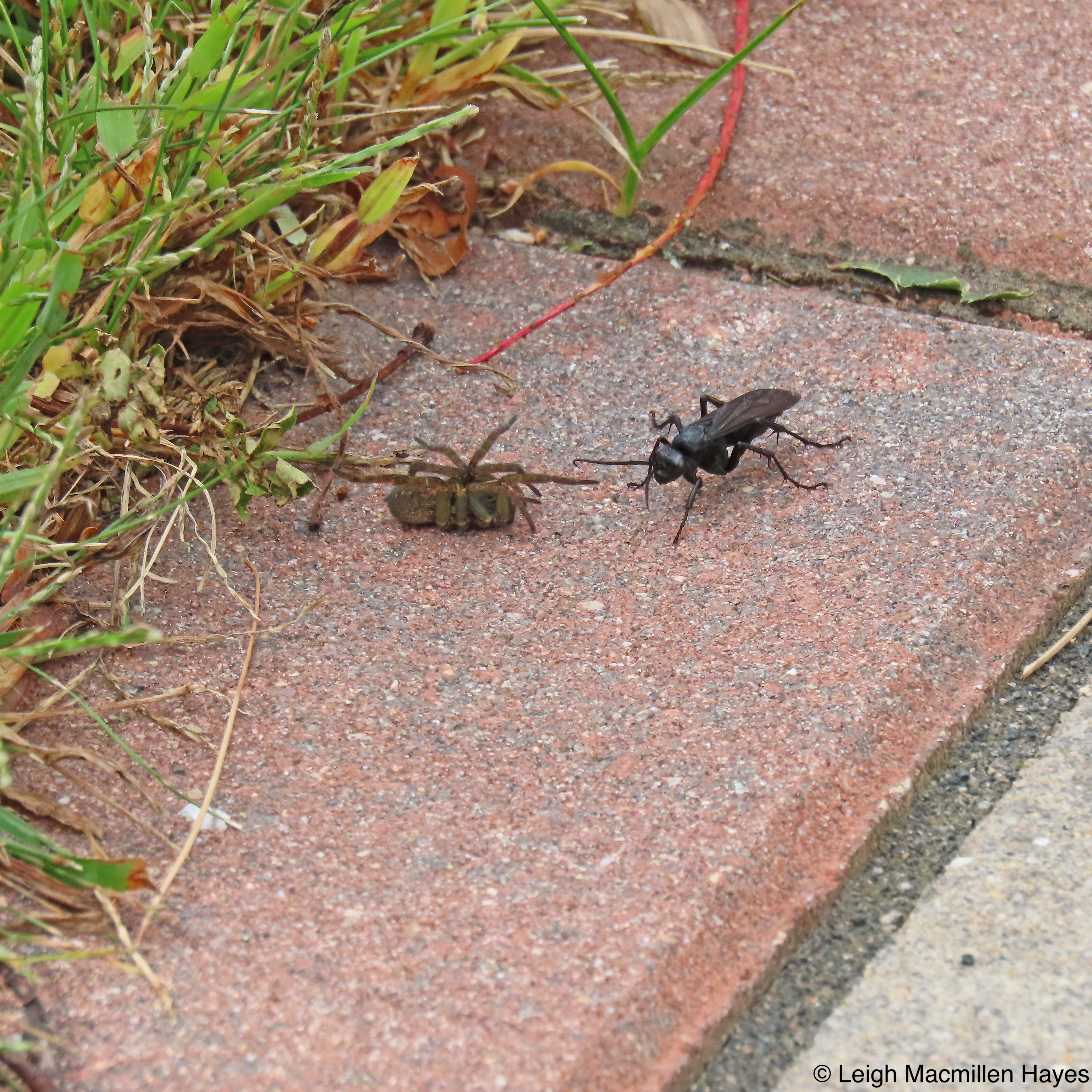
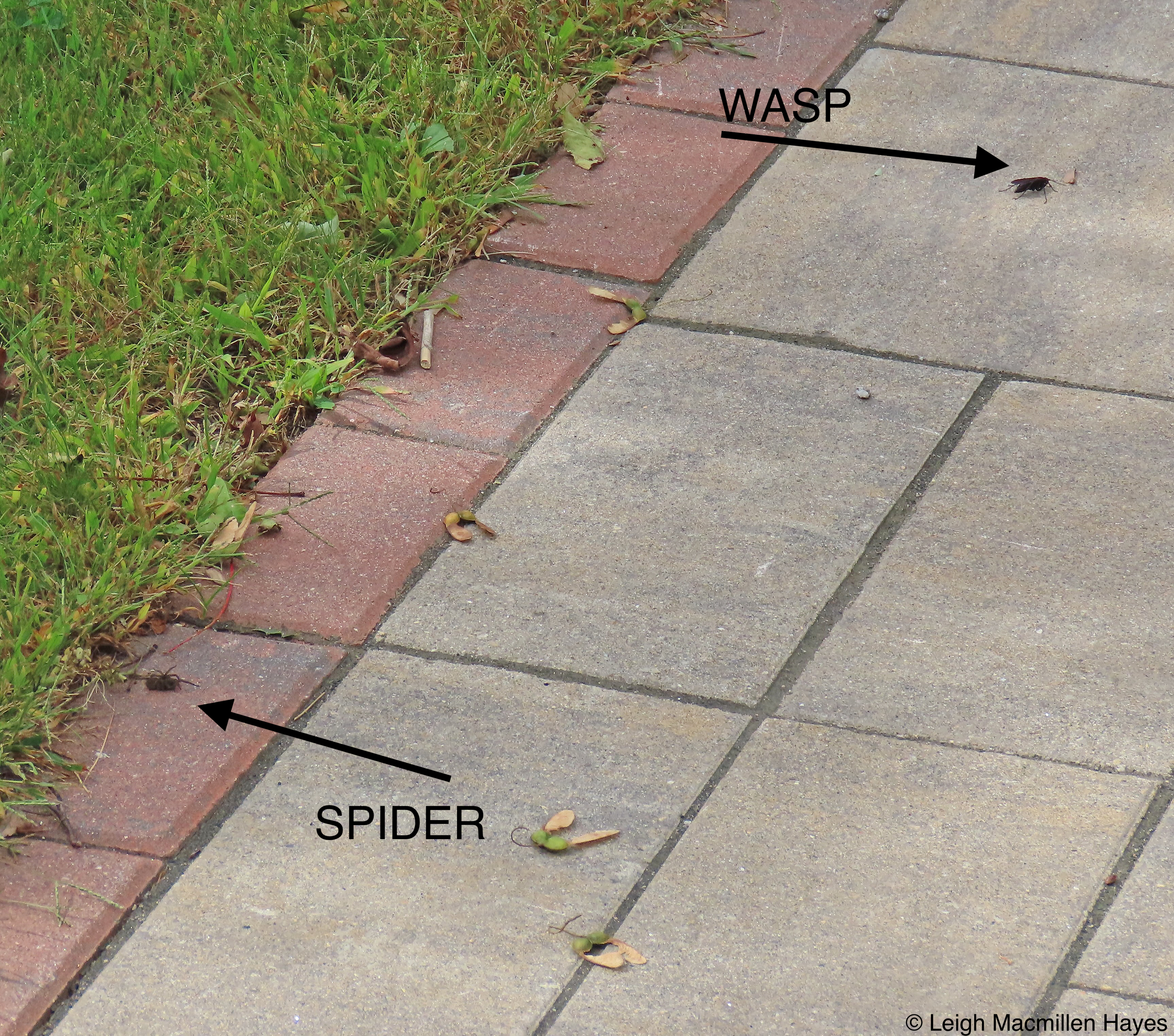
I had only one intention when I stepped onto the patio this afternoon, but that changed quickly when I spotted a Great Black Wasp behaving in what I thought was a peculiar manner . . . until it wasn’t.

Rather than flying around the flowers, where I usually find these large wasps, who may be aggressive in terms of flying at me to let me know I need to take a step back, but never actually stinging me, this Great Blue was walking frantically through the grass. Well. we call it grass. I guess I should say “across the lawn,” but that sounds too fancy for our yard.

Do you notice something strange about the wasp? It was actually carrying a spider. I was stymied at first, until I read that they bring home treats for larvae to feed on. This I wanted to see.

What I observed was that the wasp dropped the spider on the edge of the patio and then the wasp scrambled around on the ground for a bit before flying off. The spider stayed dead still . . . cuze it was dead! Apparently, the wasp won the struggle, if there was one, and paralyzed the spider.

Since the wasp had flown off, I decided to give it some time, though I was curious to know if it would return. Dragonflies defend territories, but do wasps know where they dropped a meal?

Instead, I turned my attention to the flowers that are still in bloom, including this Oregano I let go to flower because though I love its flavor, I equally love the insects it attracts, like this Thread-waisted wasp.

That got me to thinking how I often see the insects in situ, but don’t get to follow their daily lives.

That said, I poked around some more and found Bumblebees on Sedum,

Great Blue Lobelia,

Plus Turtlehead . . . going in,

And backing out.

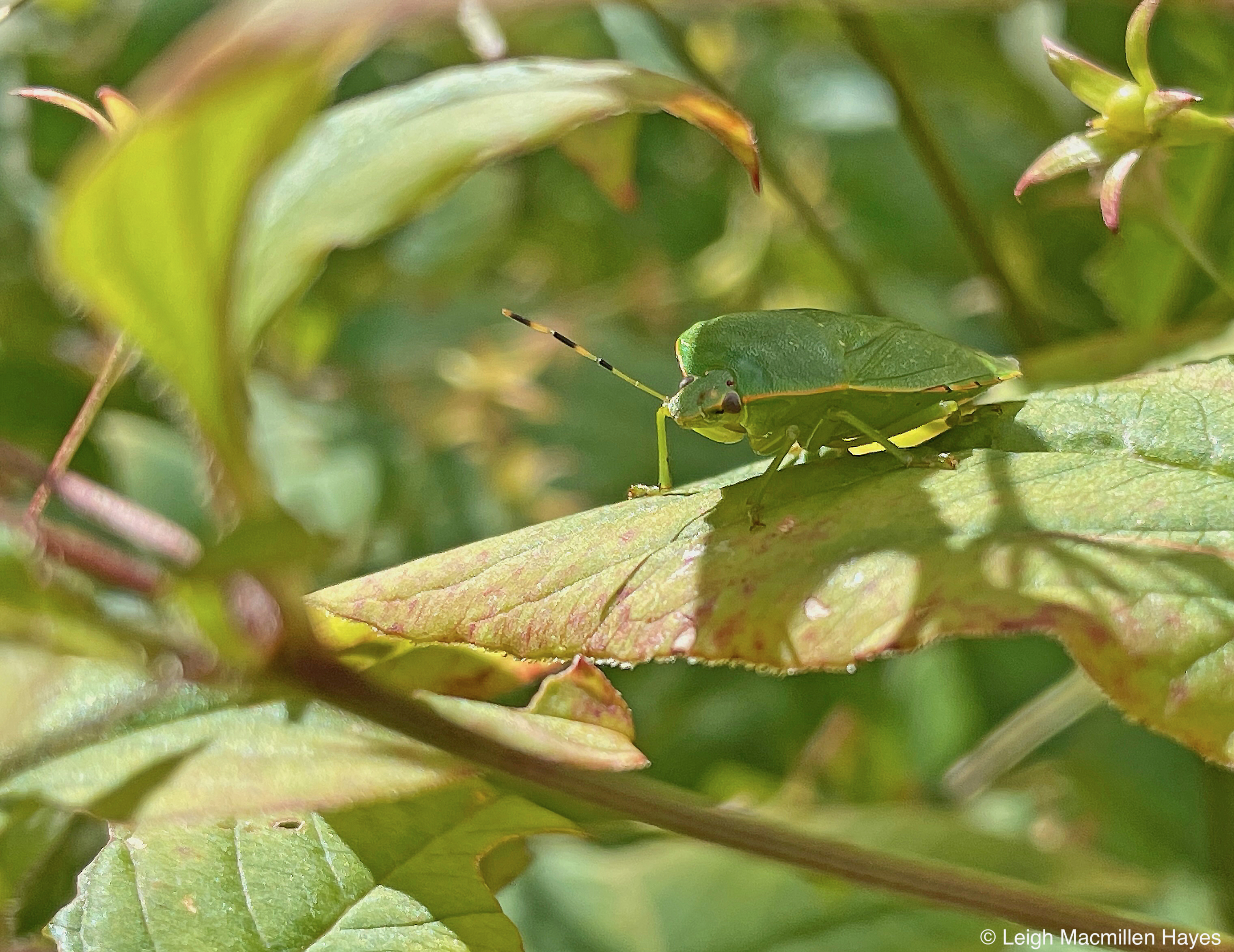
There was even a Green Stink Bug trying to trick me into thinking it was just part of the leaf.

But I let it know that I was aware of its existence.

There were even a couple of canoodling wasps who flew out of the herb garden and landed on a window screen before moving on.

I, um, moved with them to the corner of the house, where they frantically walked across the ground as well. But when they finally flew off toward the driveway, I decided to give them some space.

(Note: Do you see the brown maple leaves? Who would think that after last year’s drought we’d have too much rain this year, but that’s exactly what happened and the Sugar Maple leaves in some places are drying up and dropping. Fall foliage? I’m thinking it’s not going to be as spectacular a show as we’d like.)

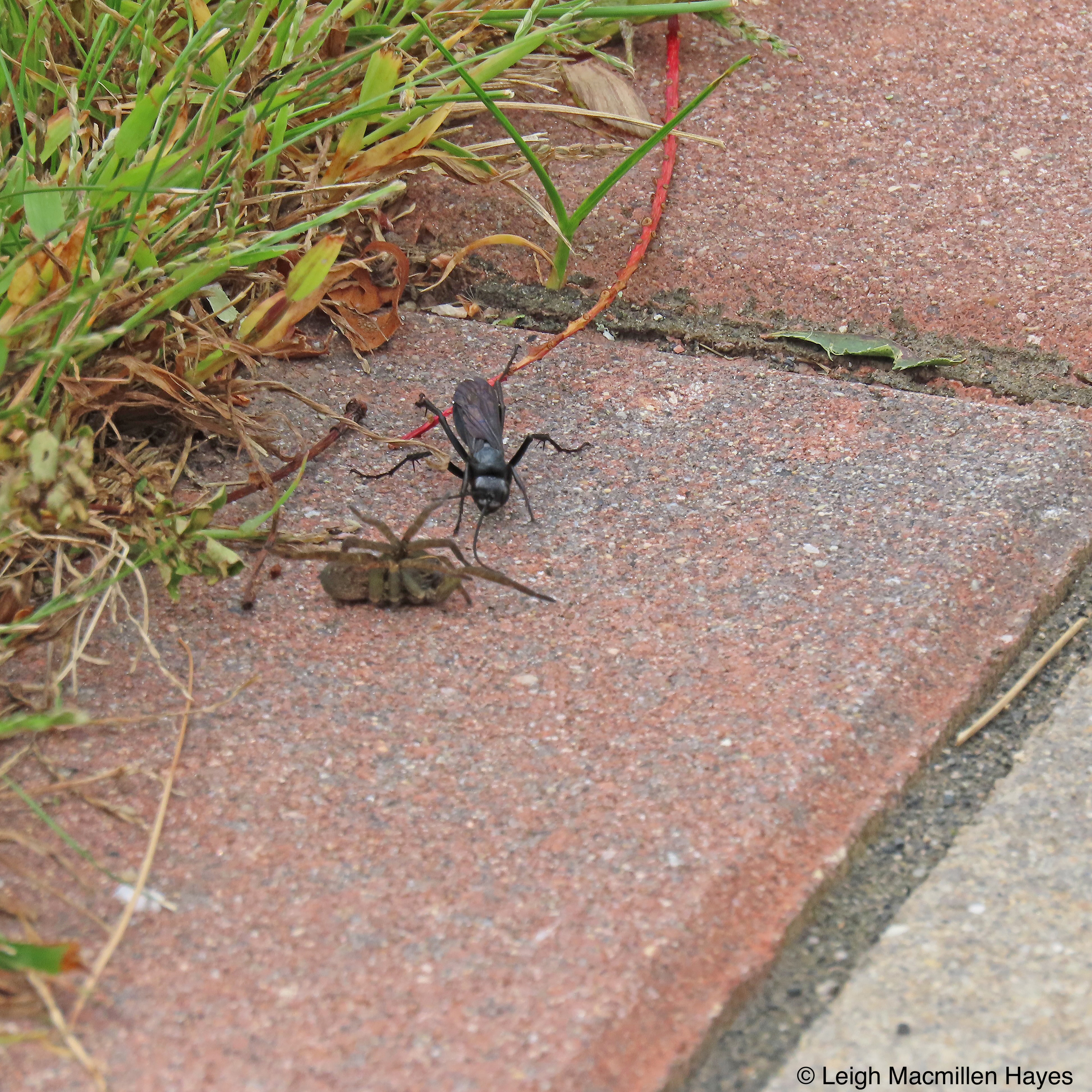
When I returned to the spider’s location, I noticed that the wasp had returned but was behaving in an odd manner . . . or so it seemed to me. Its legs on the right side appeared to have collapsed.

Eventually, however, it stood on all six and walked back toward the spider.

I was amazed to think that this insect had flown off, but knew where it had left the intended meal. All I can think of is that there has to be a scent involved.

The wasp proded the spider with its antennae before grasping it again.

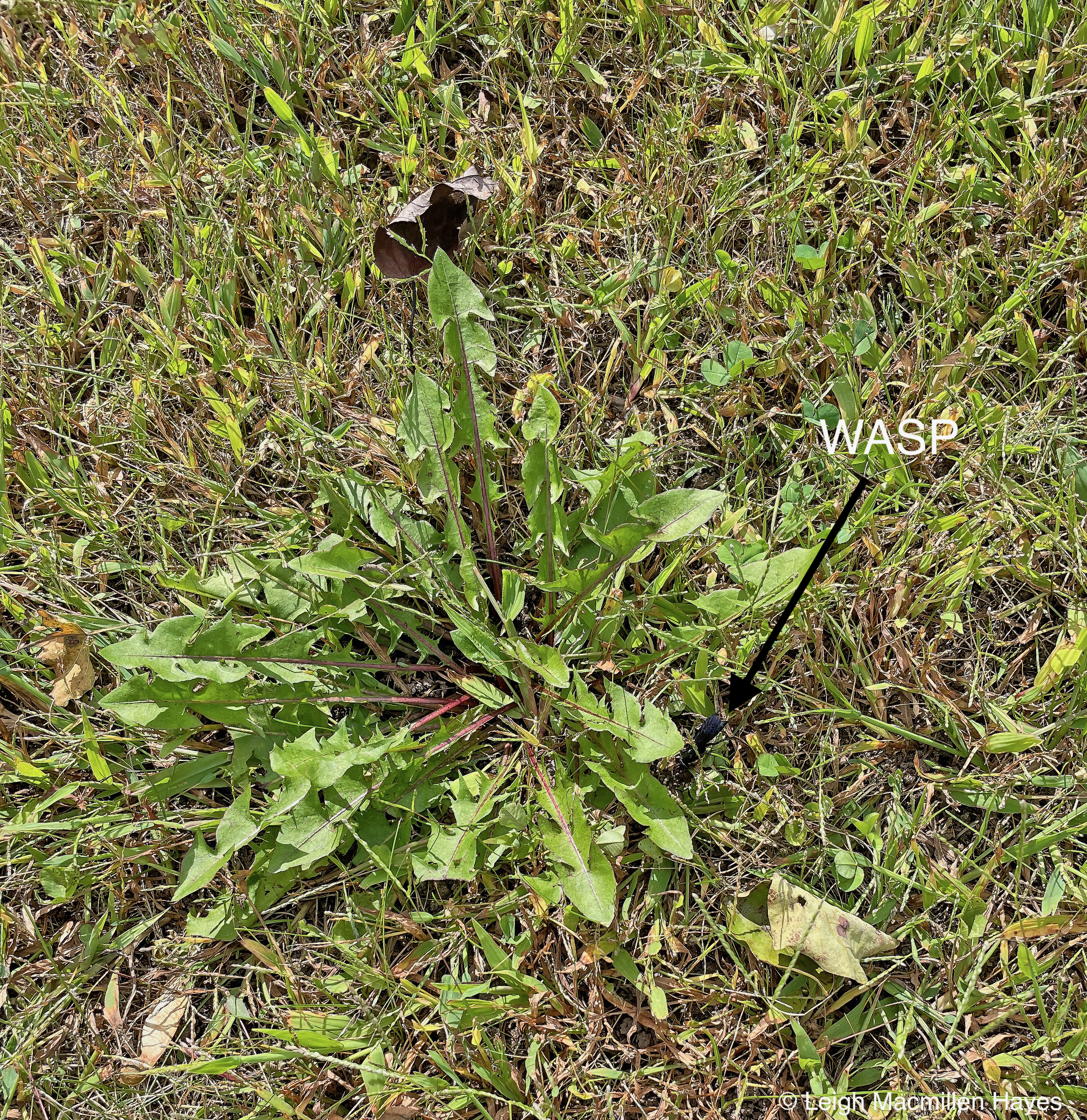
And then the two headed off in the same direction of travel as I’d earlier observed (north). Until, that is, the wasp passed under the dandelion leaves and somehow dropped the spider. Off the wasp flew, but again, a minute or two later, it returned to the exact spot and located the spider that I couldn’t even see.

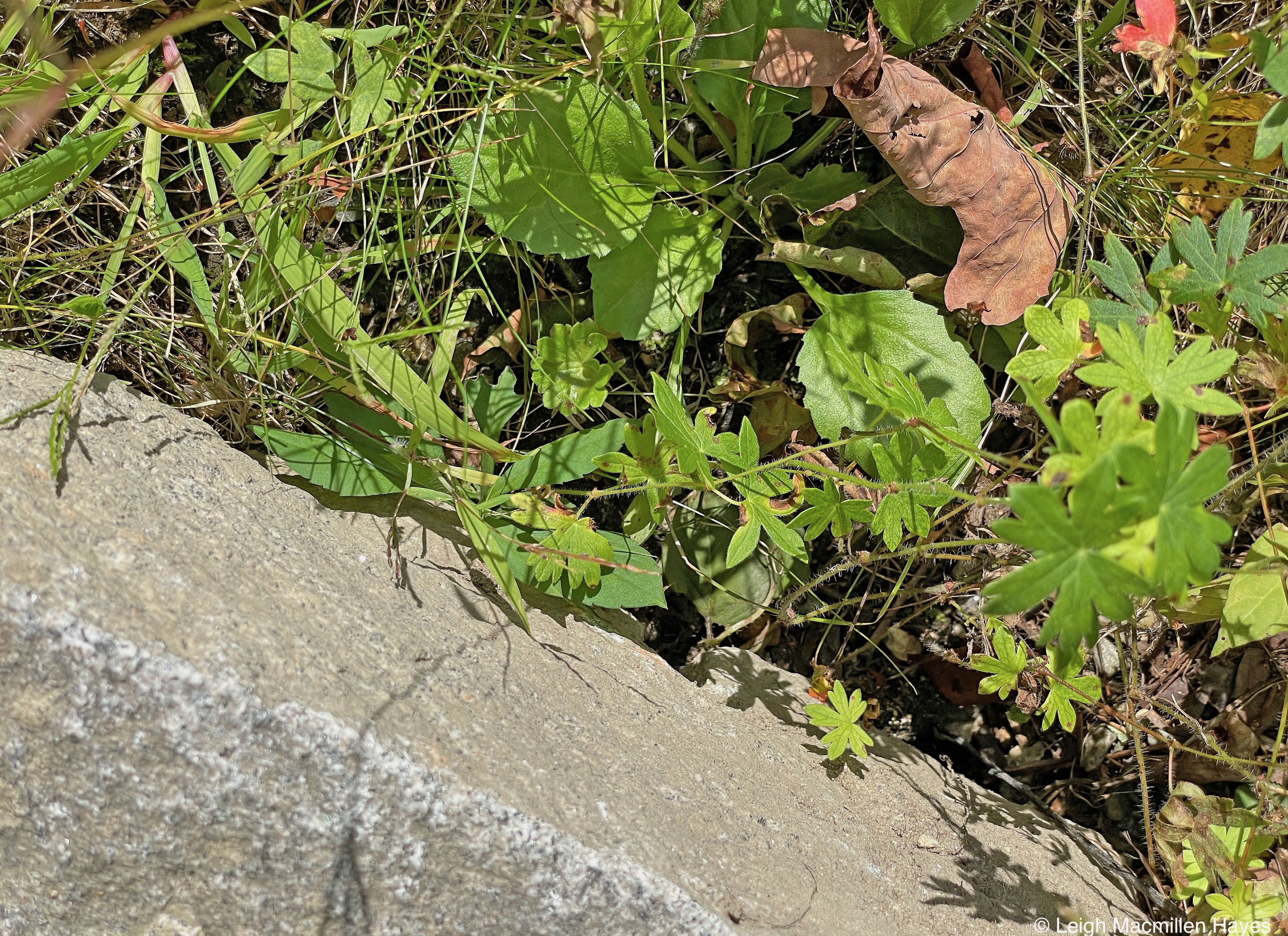
Then the march began again and I followed the two until the wasp reached the edge of another garden. It climbed over the granite stone, taking the spider with it, and then disappeared below the foliage and that’s the last I saw of them.

I’d gone outside originally to sit on the patio and start rereading a book I read about 30 years ago. That never happened.

And I don’t know the rest of the story for the Great Black Wasp, but I sure wish I did. I wish I knew what happened between the wasp and the spider because I imagine that would have been a great show. And I wish I knew where the wasp’s hole was and its larvae were waiting for a meal, as I assumed.

One of these days, I’ll open that book and maybe the rest of the wasp’s story will be revealed or another story will attract my attention.

My Reawakening

In any given year, 
I've said good-bye
to you, 
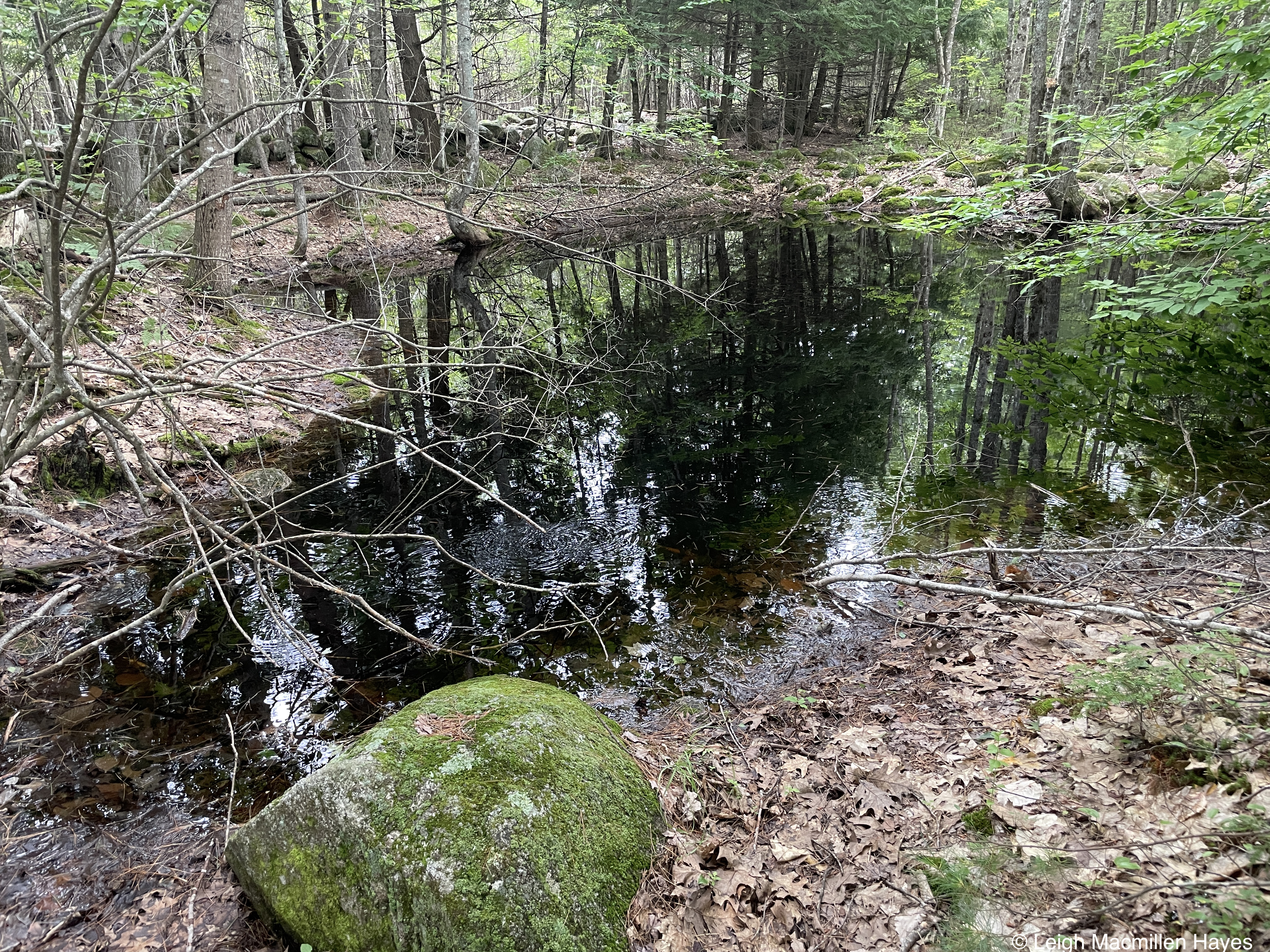
my dear vernal pool 
in late May 
or early June. 
But this year 
of Twenty-twenty-three
has been like no other
as you've retained water
beyond your ephemeral season.
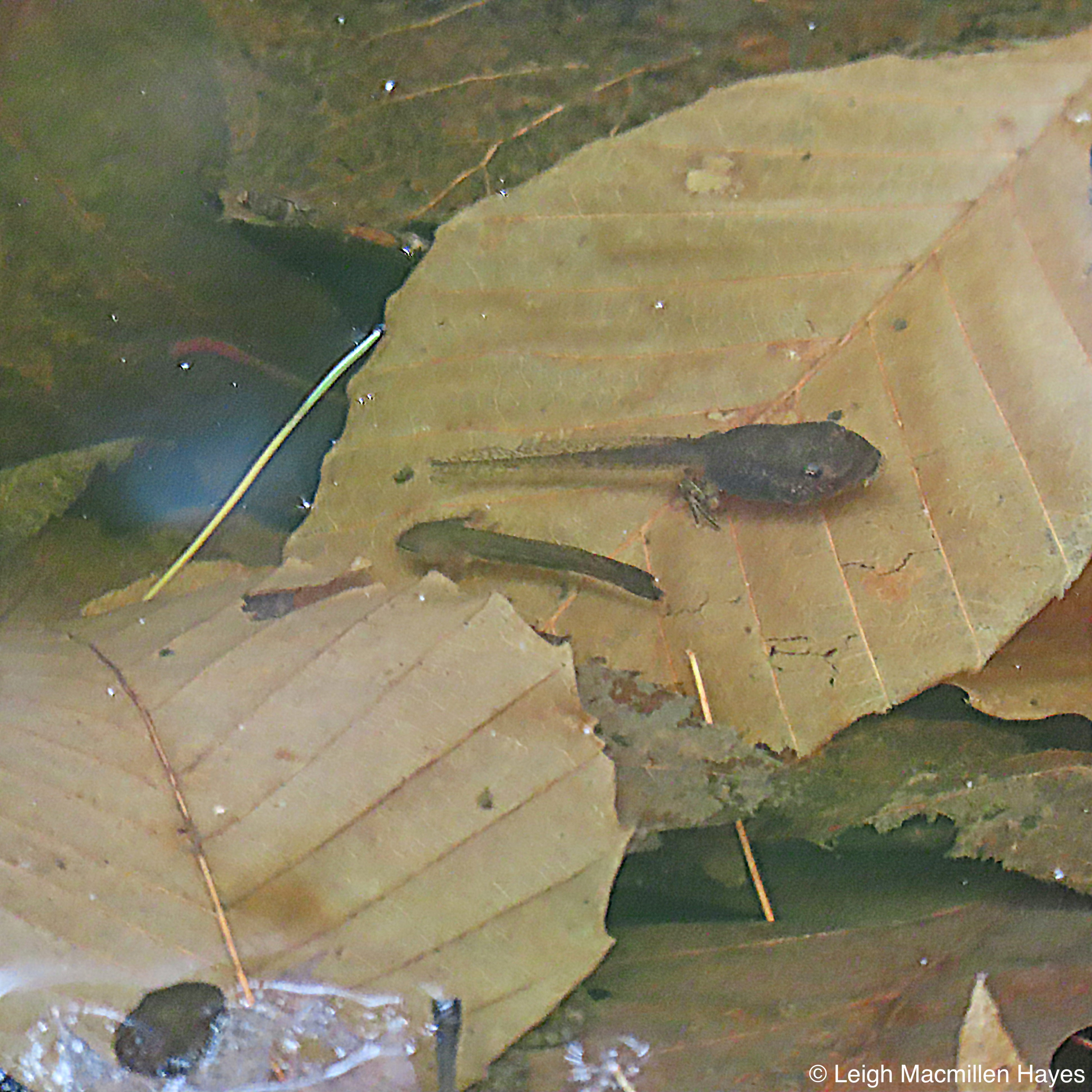
When upon July 14
I peered into 
your shallow depth,
I was greeted
with frog legs
growing upon tadpole bodies,
a sight not witnessed
in your waters 
ever before. 
In years past
miniature amphibians
had to mature quickly
or become scavenged tidbits
supplying energy
to insects and birds,
but this year, 
the Wood Frogs 
and Spotted Salamanders
who share birthrights
of your pool
took their time 
to metamorph.
As I stood quietly
beside you,
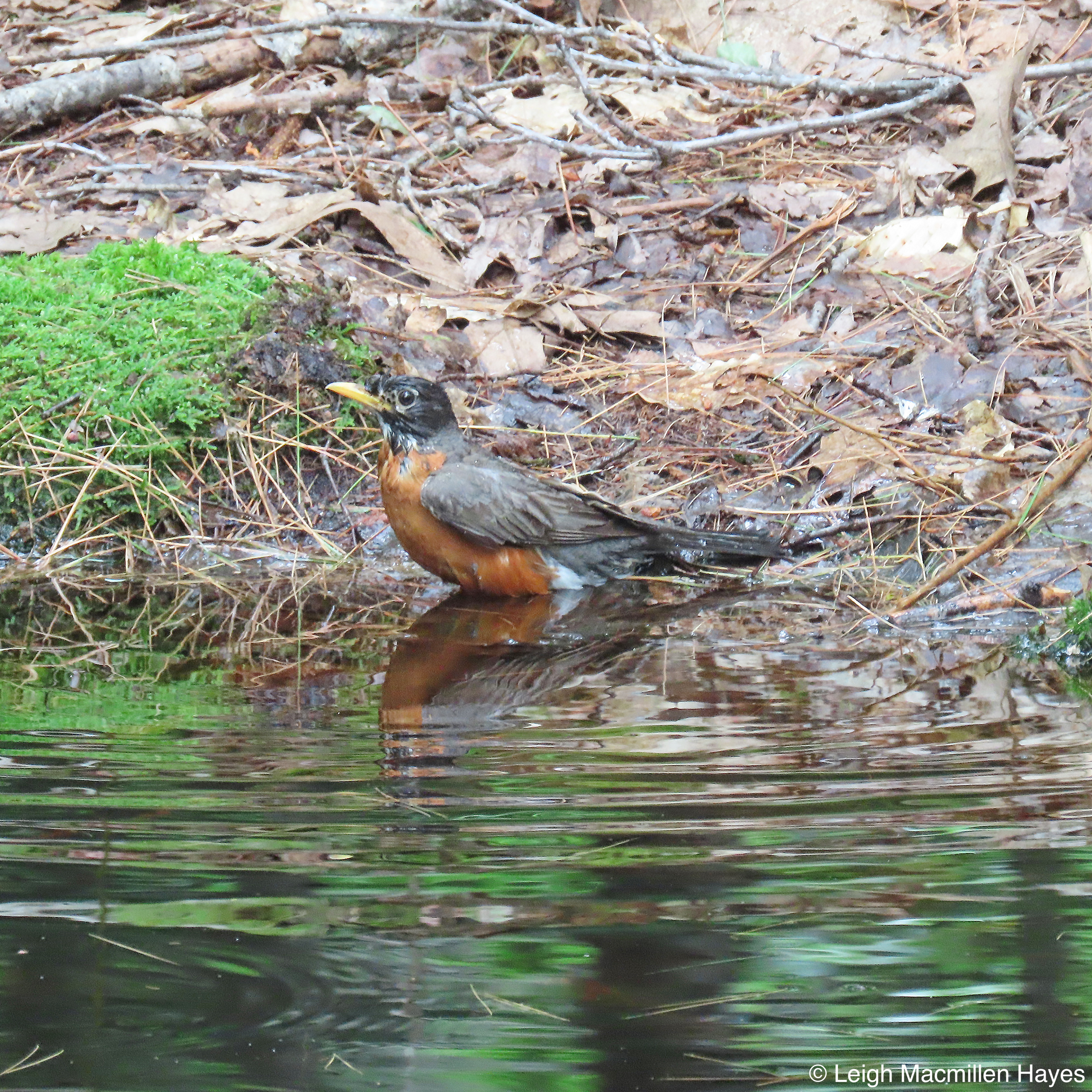
you invited an American Robin
to land on the opposite shore
and I could not believe
my good fortune 
to watch its behavior. 
Much to my amazement,
and despite my presence, 
for no matter how still 
I tried to be 
I still made noise,
the Robin
splished and splashed
in frantic birdbath form. 
It paused
and looked about . . . 
Then jumped in again
for a final rinse 
from your warm waters
before taking time 
to preen. 
Finally cleansed,
the bird posed
upon a moss carpet
and then 
we both took our leave
fully sated from your offerings
of that day. 
When next I visited you
on August 9,
wonder accompanied 
my approach
and I knew 
sudden movements
and resulting ripples
meant I would not be
disappointed. 
Below your surface,
I spied a live frog,
its hind legs formed 
and front feet developing. 
And there was another,
and another, 
and more legs,
and sometimes even
the tiny suction-cuppy toes
and my heart was full again.
I last made my way
down the cow path
to the trail
leading to you
on August 18
and again
the amount of water
you held in your grip
far exceeded
my expectations,
but other than 
Mosquitoes,
all was quiet. 
And then today dawned,
 and after listening 
to this morning's homily
about Celtic Thin Places
offered by Ev Lennon, 
I felt compelled
to pay you a visit again. 
On the way
I slowed my brain
by intentionally stepping
along the labyrinth path
I created a few years ago. 
And then . . . and then . . . 
as I approached you, 
my dear pool, 
a pile of Black Bear scat,
full of acorn and apple pieces
from a neighborhood forage,
sat smack dab 
in the middle of the trail. 
And so it was 
that as I reached you, 
surprise again overcame me,
for though you are shrinking
to your traditional 
early June size, 
you still exist
on this day, September 3. 
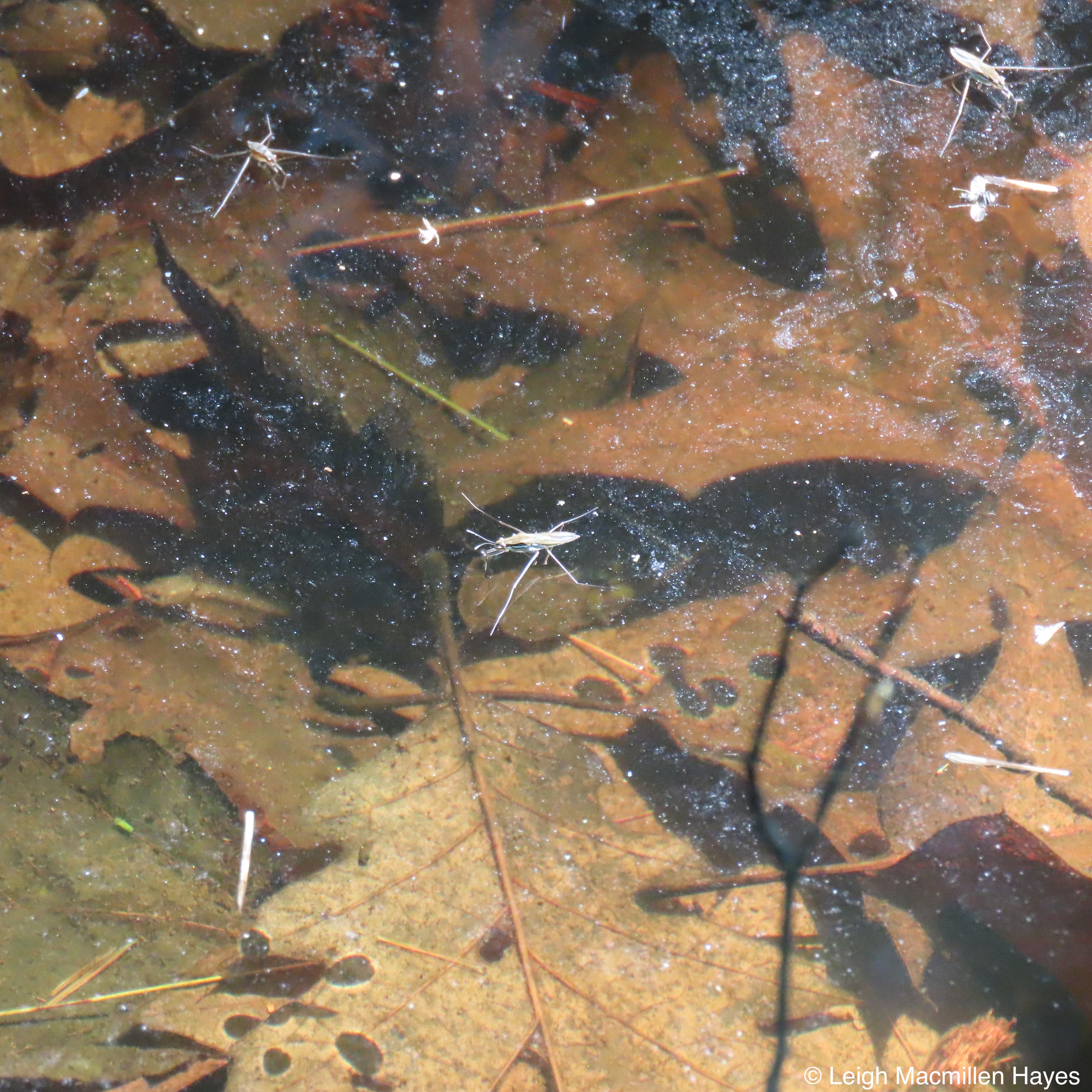
Small Water Striders skated
across your surface,
sometimes approaching others
who quickly
escaped any chance
for an embrace. 
As has been
my experience 
for the last month
you offered no evidence 
of Wood Frog or Spotted Salamanders
and I trust many 
hopped or crawled out
as is their manner. 
Green Frogs, however, 
squealed to announce 
their presence
before diving under 
the leafy bottom you offer, 
which makes a perfect hideout. 
When one frog resurfaced, 
we carried on a starring contest, 
until my attention
was drawn away. 
Ten feet from 
where I stood 
American Goldfinches 
poked the ground, 
foraging in the duff. 
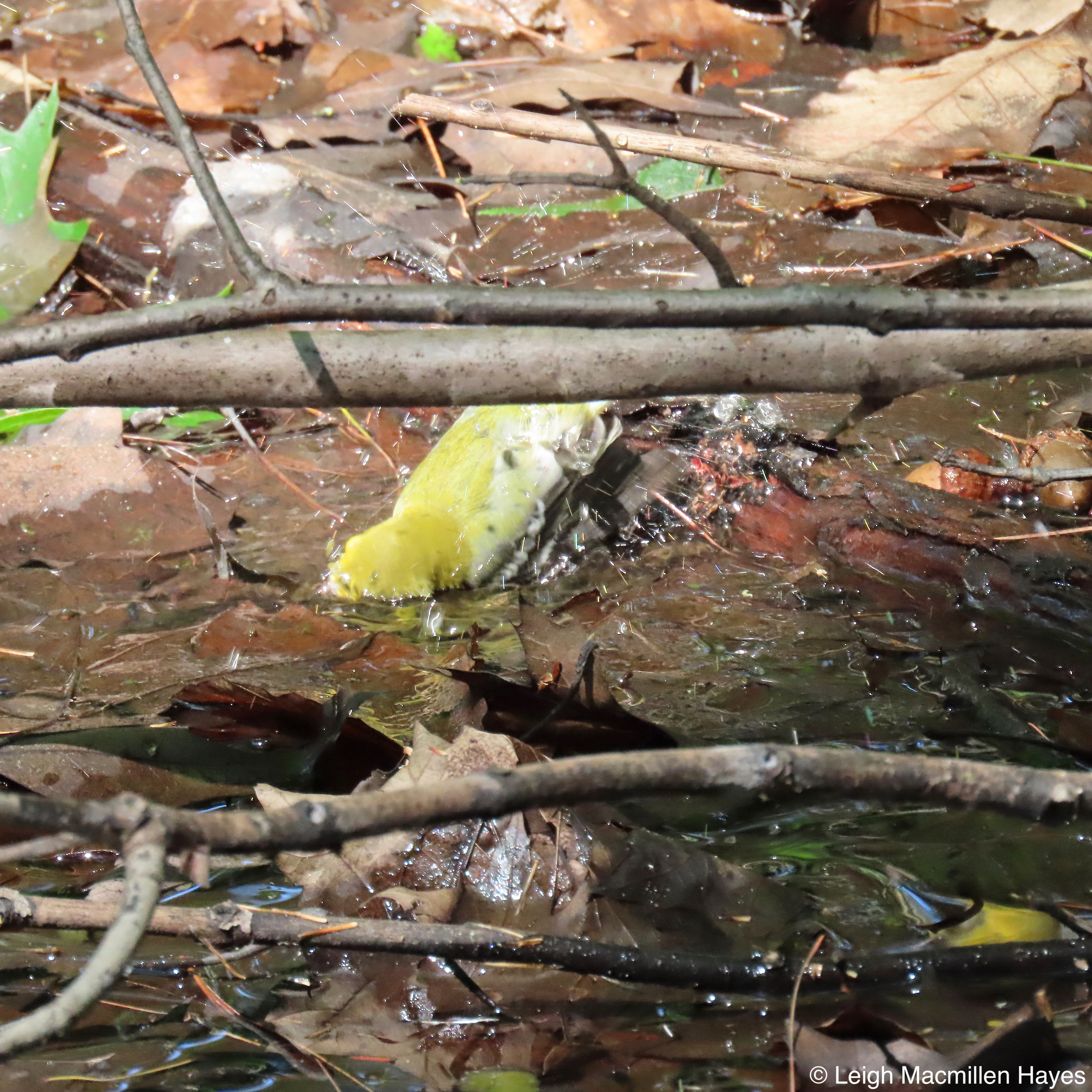
Then one took a bath, 
and suddenly it 
occurred to me
that this was 
the third time this summer
I've had the honor 
of watching birds 
make use of the watery offering
your pool provides,
even as it is now
a not-so-vernal puddle. 

Before I finally
pulled myself
away from you, 
I offered great thanks 
for all the lessons 
of life and love and even loss
that you have
taught me all these years. 

And thank you,
Ev, 
for being today's inspiration
and for reawakening 
my wonder, 
which occasionally goes dormant,
as the pool will soon do as well. 

Bugmania

Each spring and summer I find myself basking in insect awe. 
In my Book of Shoulds, everyone should behold these masters of land and air who all have the same body plan: Head. Thorax. Abdomen. 
Let's start with the Sedge Darner's head.
That "face"--oh my--yellow-green mouth parts below darker bluish-green eyes. 
And a T-spot just below the eyes and thin black crossline lower down on the face.
What a treat to meet this handsome guy.
And then there's the contrast of Halloween colors on the Great Golden Digger Wasp.
Take a look at its thorax connected to the head. 
It actually consists of three segments, the prothorax, mesothorax, and metathorax,
each supporting a pair of legs.
It's hard to tell, but the front wings are attached to the prothorax, with the hind to the metathorax.
Meanwhile, upon another flower there's a view of the abdomen, the beginning of which is quite skinny on this Thread-waisted Wasp. How does that body function? 
This female Blue Dasher offers a perfect stance to truly see the head, thorax, and abdomen.
When trying to identify insects, coloration is important, as well as shape and placement.
Compound eyes provide complex vision with thousands of tiny lens creating an entire scene.
Compared to a dragonfly's eyes, those on a butterfly like this Painted Lady are much smaller,
but her clubbed antennae are much longer. 
Antennae are actually segmented sensory organs that function differently for each group of insects. 
They may be used for smell, taste, touch, air motion, or maybe even vibrations.
In the case of the freshly emerged Dog-day Cicada, the antennae are short, but the eyes bulge from the sides. 
And that camouflage coloration will be useful as this insect disappears into the treetops singing raspy love songs in an attempt to attract a mate, while trying not to be eaten by a predator. 
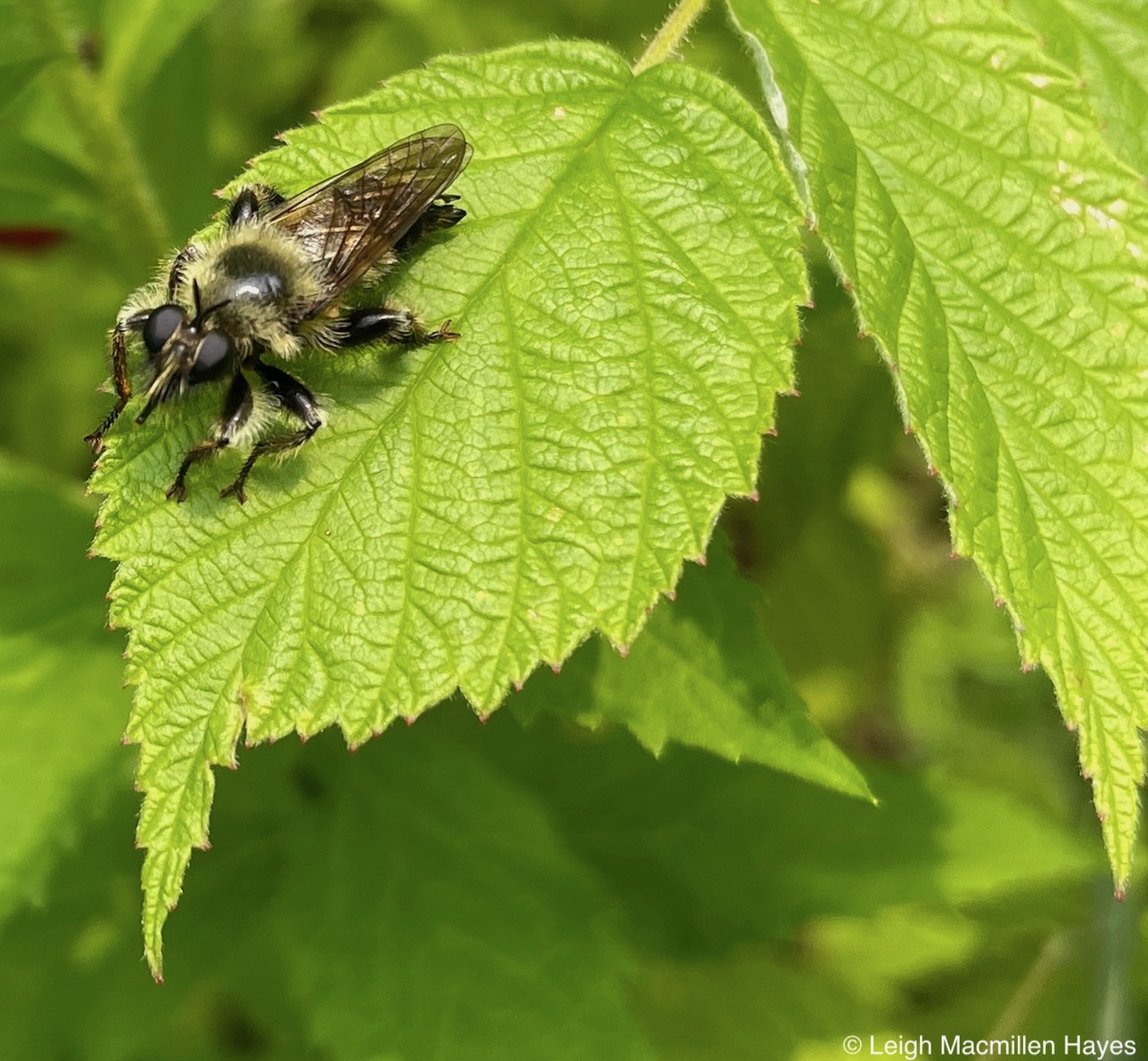
Behold next the Robber Fly, this particular species with such a hairy body that it mimics a bee.
Its proboscis, or mouthpart is rather beak-like, the easier to consume insects. 
The Goldenrod Soldier Beetle can spend a long time actively pursuing pollen on one plant, as has been my experience in its presence. It's a similar body structure as a firefly, but the legs strike me as being much longer. 
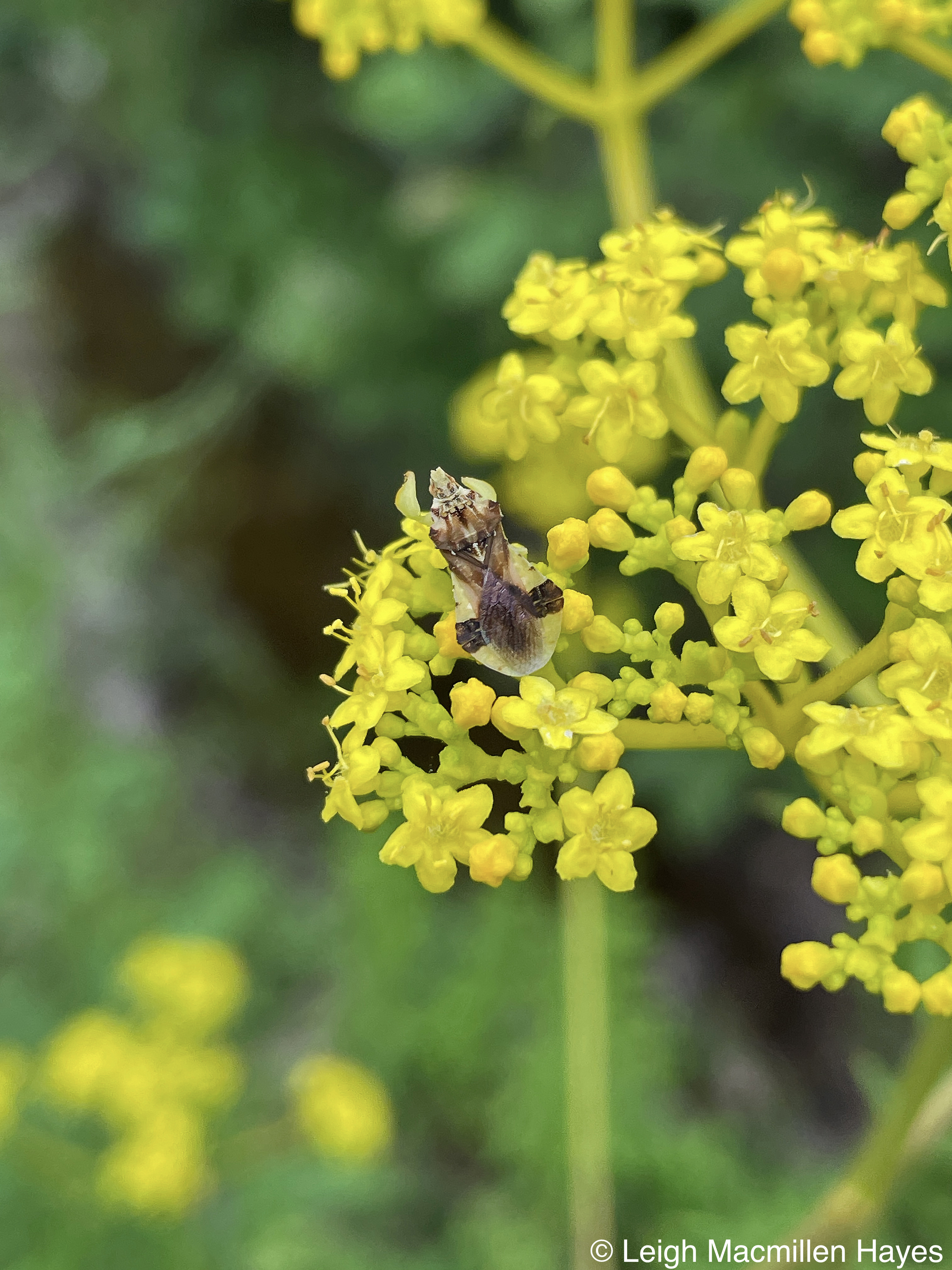
While I was focused on this Bumblebee seeking nectar with its tongue, an Ambush Bug lay in wait, hoping for a big, hairy meal of its own liking. It didn't succeed this time, but one of these days I'll spot the leftovers of an Ambush Bug's dinner. 
The first Monarch of the season, at least for me, was sipping from a Marigold with its super long straw-like proboscis. I've noted them before, but notice again the club-shaped antennae, a feature of a butterfly, unlike the feathery antennae of a moth. 
The Silver-spotted Skipper is another butterfly, albeit much smaller than the Monarch. For such a small one, its eyes are huge and proboscis equally long, as it reached deep into the Wild Bergamot. 
The Dog-day Cicada pictured earlier gave me a unique opportunity to look at its underside as it perched upon a broken stem. Do you see the zebra-striped design below its eyes and above its legs? That's the start of its mouthpart, which is tucked against its body until its decides to dine. Moments after this photo was taken, the Cicada made its first flight ascending high into the treetops.
The Great Black Wasp with its iridescent blue wings, offers a prime example of the amazing construction of insect legs. Insect legs have moveable joints between some segments. 
So here's how the song goes: 
The pretarsus (toe-like with one or two small hooked claws) is connected to the tarsus (foot-like), 
the tarsus is connected to the tibia (longest part of leg), 
the tibia is connected to the femur (largest and thickest), 
the femur is connected to the trochanter (kinda like a hip joint), 
the trochanter is connected to the coxa (joins body)
the coxa is connected to the body! 
Now shake dem insect bones! 
The fiercest looking legs are the lobster claws of the Ambush Bug, 
the better to snatch prey and hold it in position to suck its guts out. 
Another incredible insect feature: wings. 
Muscles that work the wings are attached to the thorax. 
But how do such scaly membranes provide the gift of flight for such a robust looking body? 
Even the much tinier Hover Fly is amazing as it flaps its wings so rapidly that they are almost invisible and can "hover" in place, much like a Hummingbird. 
In the end, it all comes down to investing in the future by canoodling upon the flowers that nourish you and you help pollinate. 
And then it's time to be like the Robber Fly and find a safe place that will protect you from the elements so you can  take a rest. As August continues into September, my hope for you is that you'll spend a few moments basking in insect awe and develop or continue to nourish your own form of Bugmania. 

Thanking the Herons

As a community scientist for Maine’s Heron Observation Network these past 14 years, I have the distinct honor of keeping track of several rookeries each spring/summer to monitor the number of active nests, inactive nests, hatchlings, young, and fledglings, plus any obvious disturbances. It’s a task that only takes a few hours every other week and the time span in total is about six weeks. Those few hours are some of the best hours that I spend outdoors because rookeries in this neck of the woods are located in or abutting wetlands and offer a rich abundance of wildlife.

From the HERON website: “The Heron Observation Network of Maine (HERON) is a citizen science adopt-a-colony program started by Maine Department of Inland Fisheries and Wildlife (MDIFW) in 2009 to help investigate the status of Maine’s nesting population of great blue herons. Since 1983, the coastal breeding population of great blue herons has undergone an 82% decline; and it is unknown whether that decline is a statewide phenomenon or whether it is restricted to only the coastal colonies. This is where HERON volunteers come in: they collect invaluable data on colonies statewide that will help biologists assess the population trend over time.

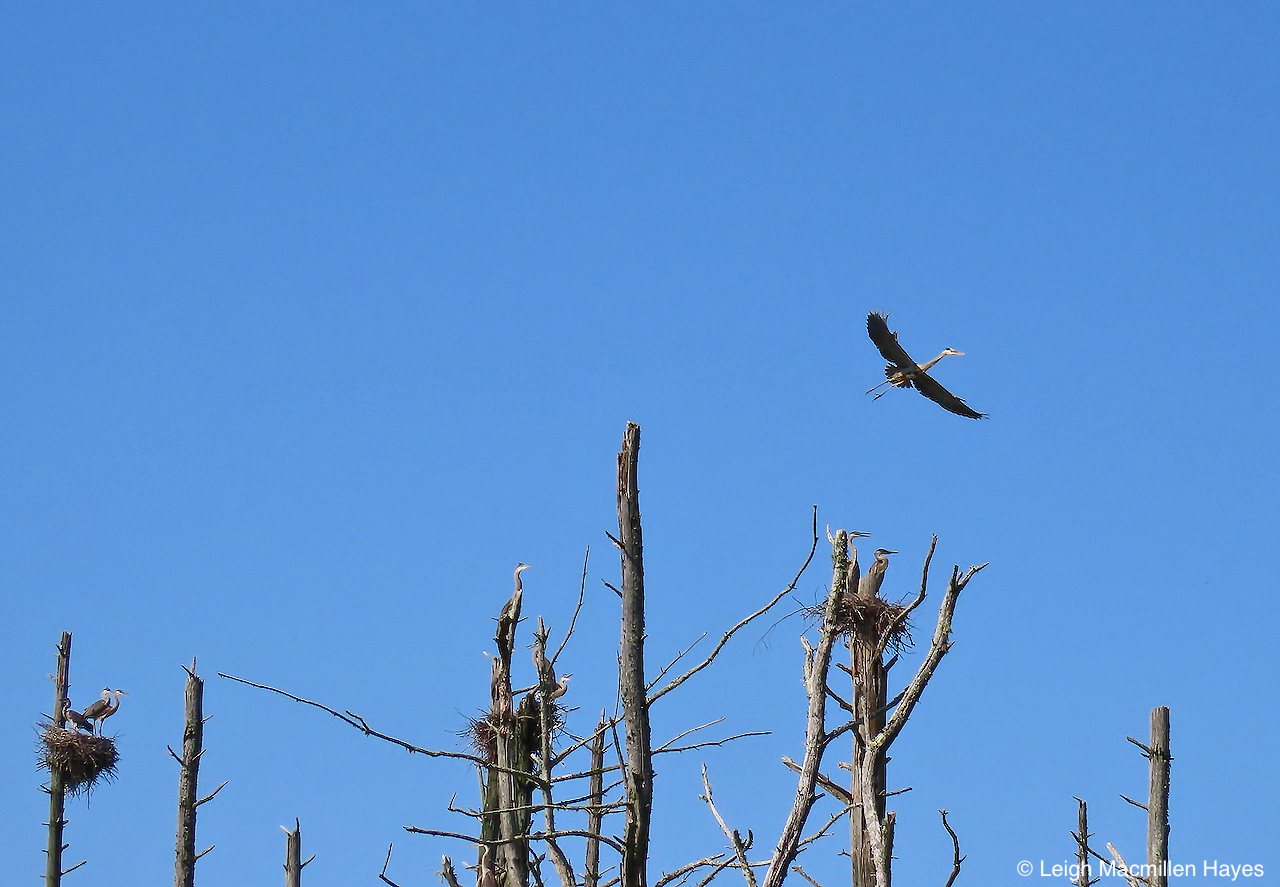
One of my rookeries has had no nests for the past two years since Bald Eagles wiped out the Great Blue Heron population three years ago.

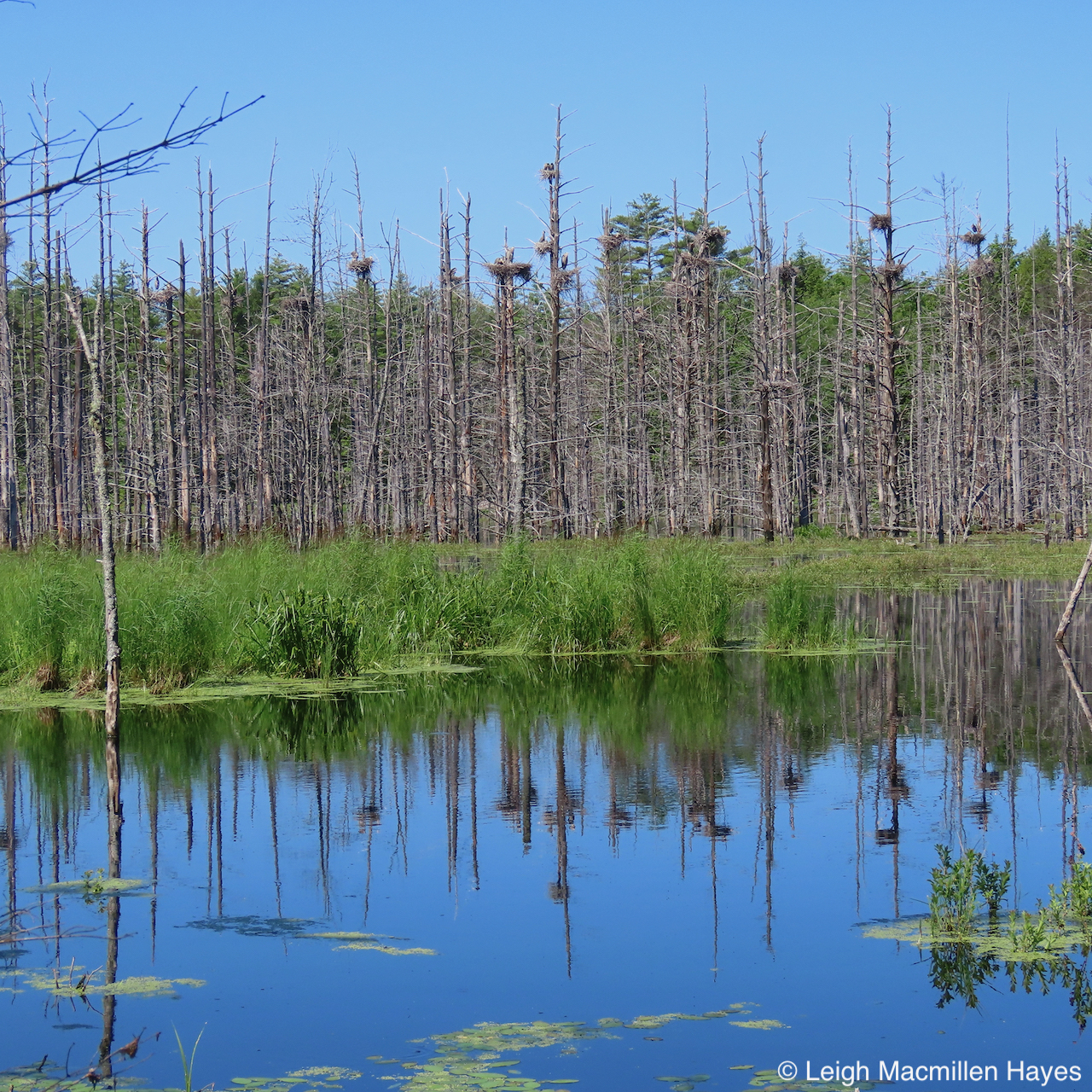
But the beaver pond in the photo above is making a come-back after peaking with about 30 I think about ten years ago, then crashing to a single digit number. This year, we counted 12 nests, all of which proved to be active over the course of the six-week time span.

Observing means making ones way quietly to the edge of the wetland, listening as the youngsters squawk for an incoming meal, then finding a good spot to see the nests with binoculars while not disturbing the birds, and begin counting.

We avoid publicly sharing the locations of these sites for as it is stated on the HERON website: “If you are not the landowner or colony monitor, please refrain from visiting colonies during nesting season to minimize unnecessary disturbance.”

This third rookery we thought had crashed after discovering two nests two years ago and then none last year. But . . . we knew the birds had to be somewhere in the vicinity because, though several rookeries in the area were no longer active, there were still adult birds visiting local ponds and lakes and rivers.

It wasn’t until Maine State Waterbird Specialist Danielle D’Auria completed a flyover this spring and sent an email with the subject: “Your colony is THRIVING!” and two friends joined me and we explored the wetland from a different vantage point than in the past, that we knew just how big the colony was. In total, there are over 40 nests and over 30 of them were indeed active.

Counting so many can be a real challenge, and even with three pairs of eyes, we still needed to restart several times with this larger colony, but figured out a system to identify certain nests as a given # and then restart from there and move from left to right, though sometimes we had to dip down and then look up again to find the next nest.

What added to the counting confusion was that my peeps and I suffer happily from Nature Distraction Syndrome (I used to call it Disorder, but really, it’s such a good thing that it deserves a new name), aka NDS rather than NDD.

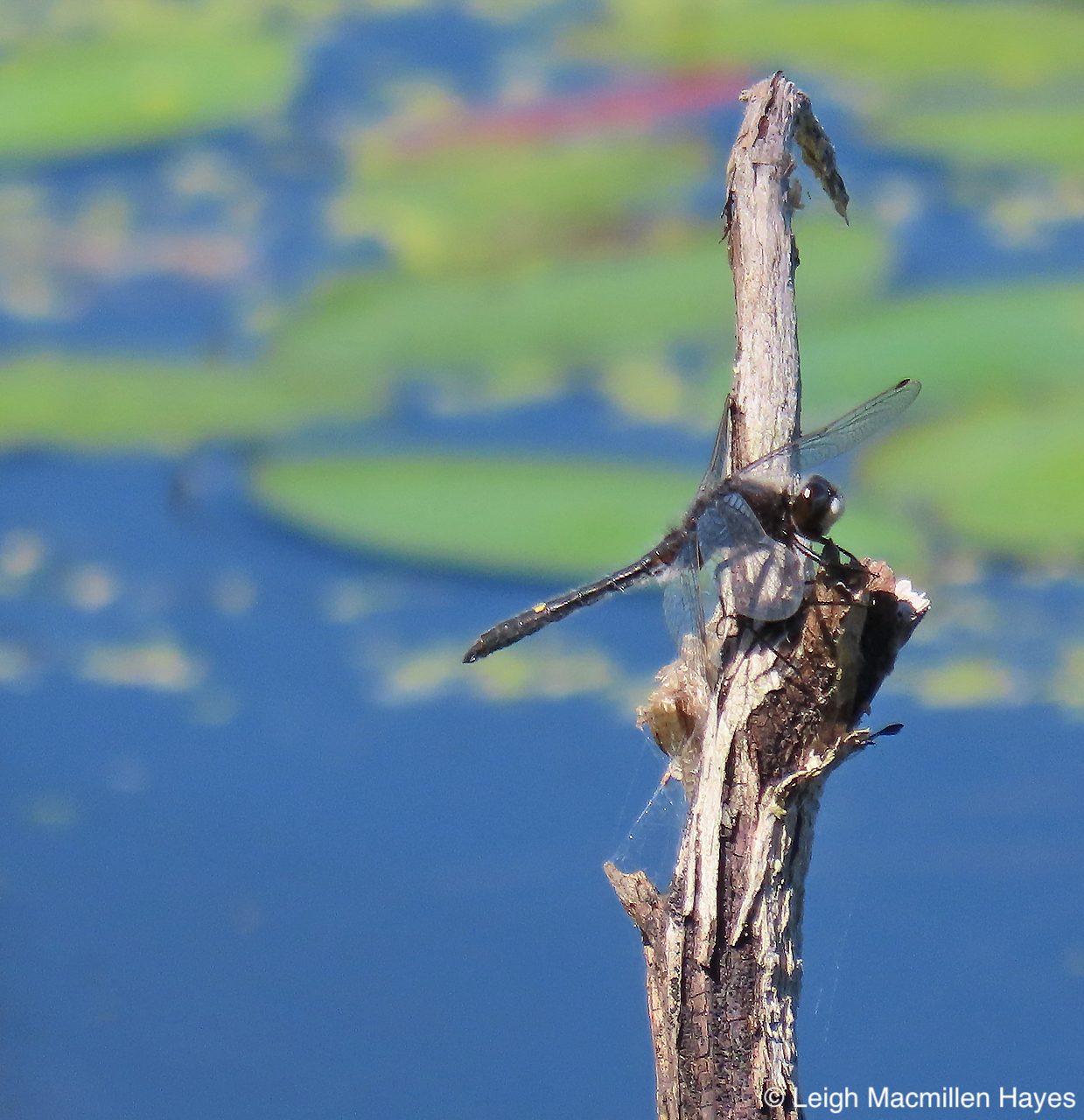
And so this is a Dot-tailed Whiteface Skimmer, its name reflecting its features.

Looking up again, we’d spot hatchlings, those fluffy little balls that we could barely make out unless they popped up . . . definitely one of the many joys of those special mornings.

Sometimes the youngsters were difficult to spy based on how well they blended in with the snags upon which the nests were built.

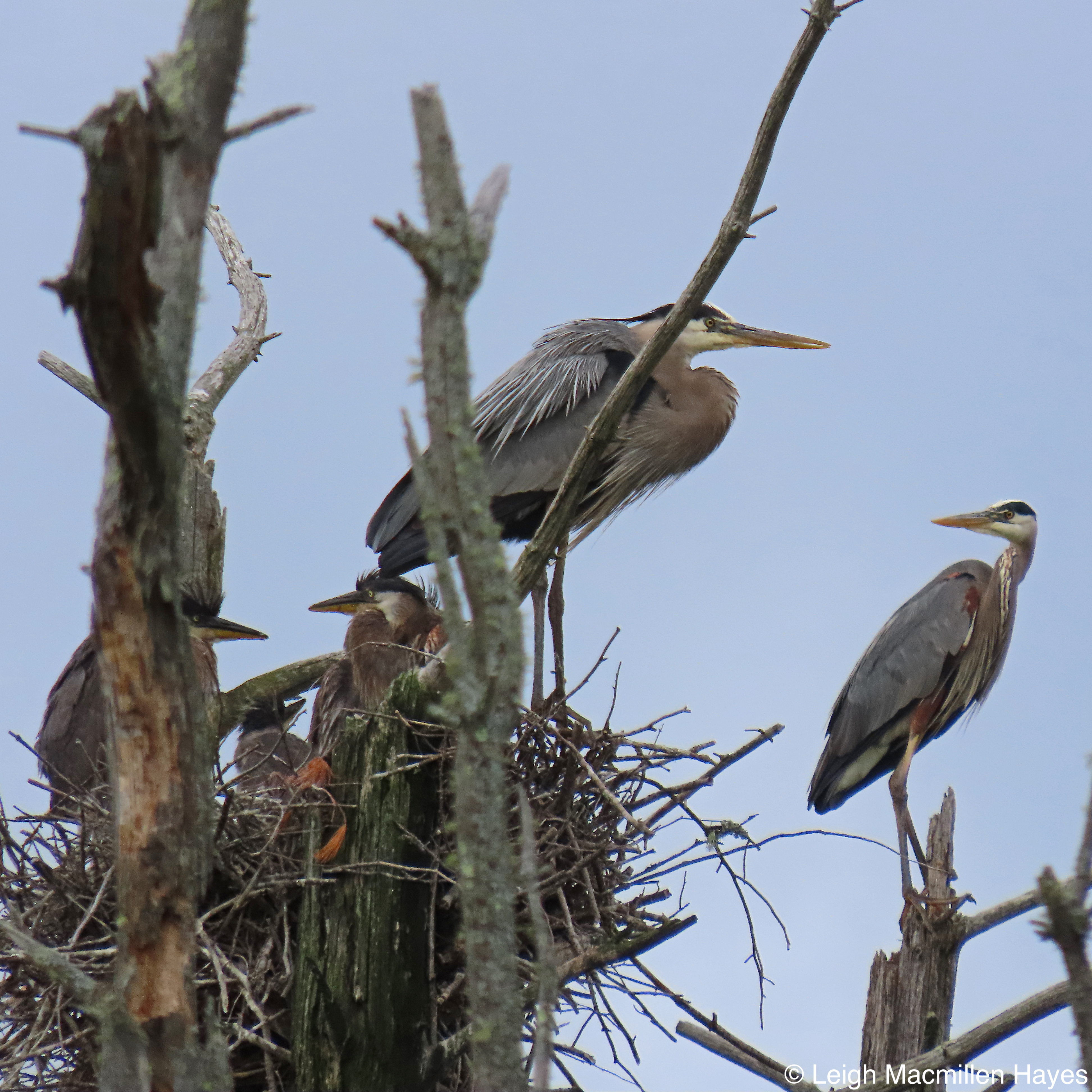
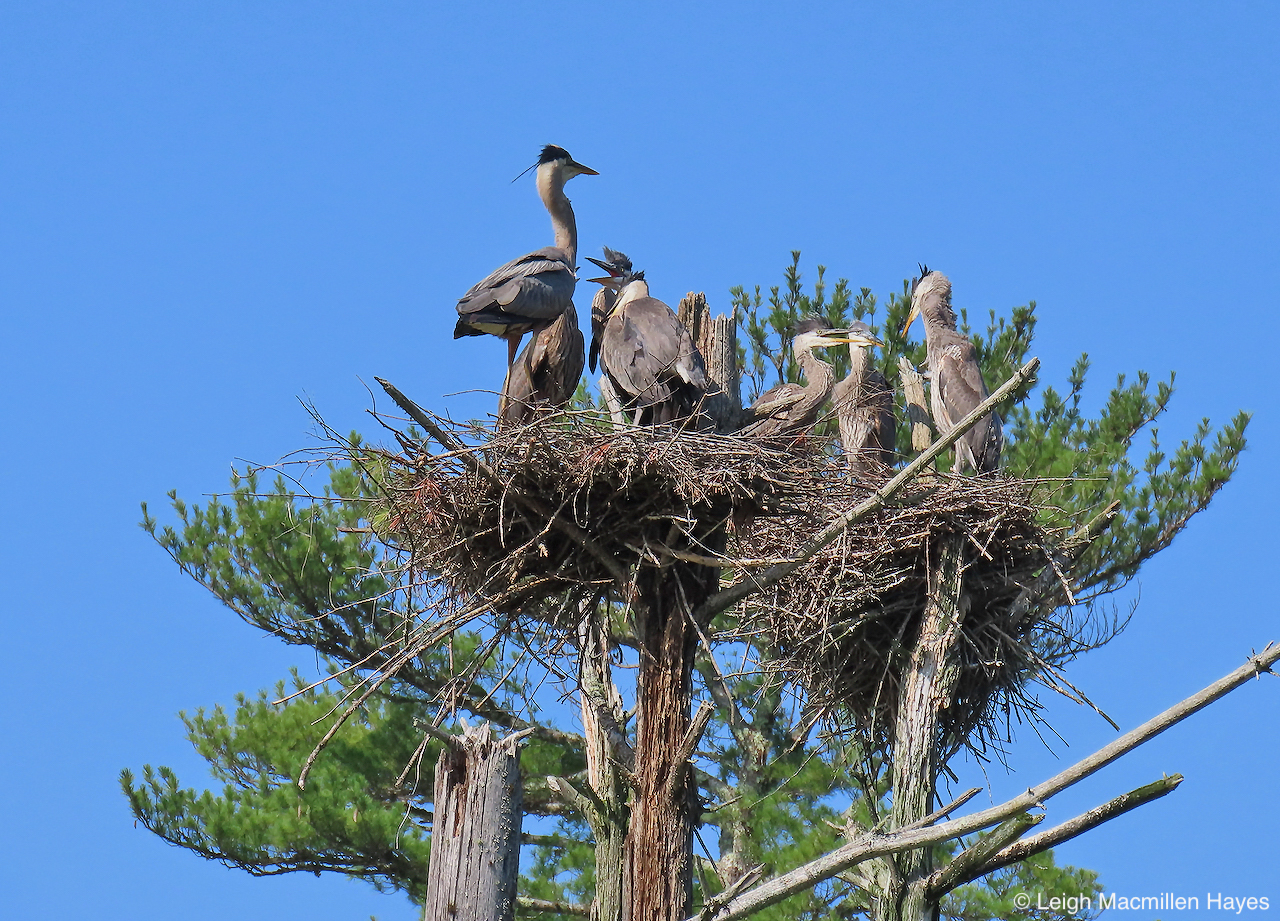
And then it was a matter of deciding: is that a bird or part of the tree? And is there another lump in there? Do you see three or four young, plus the two adults?

Often, several adults stood sentry, keeping an eye on the entire rookery, rather than heading off to fish and feed the youngsters. This one stood on one leg, which I’ve read is a way for birds to reduce the amount of heat loss on their unfeathered limbs.

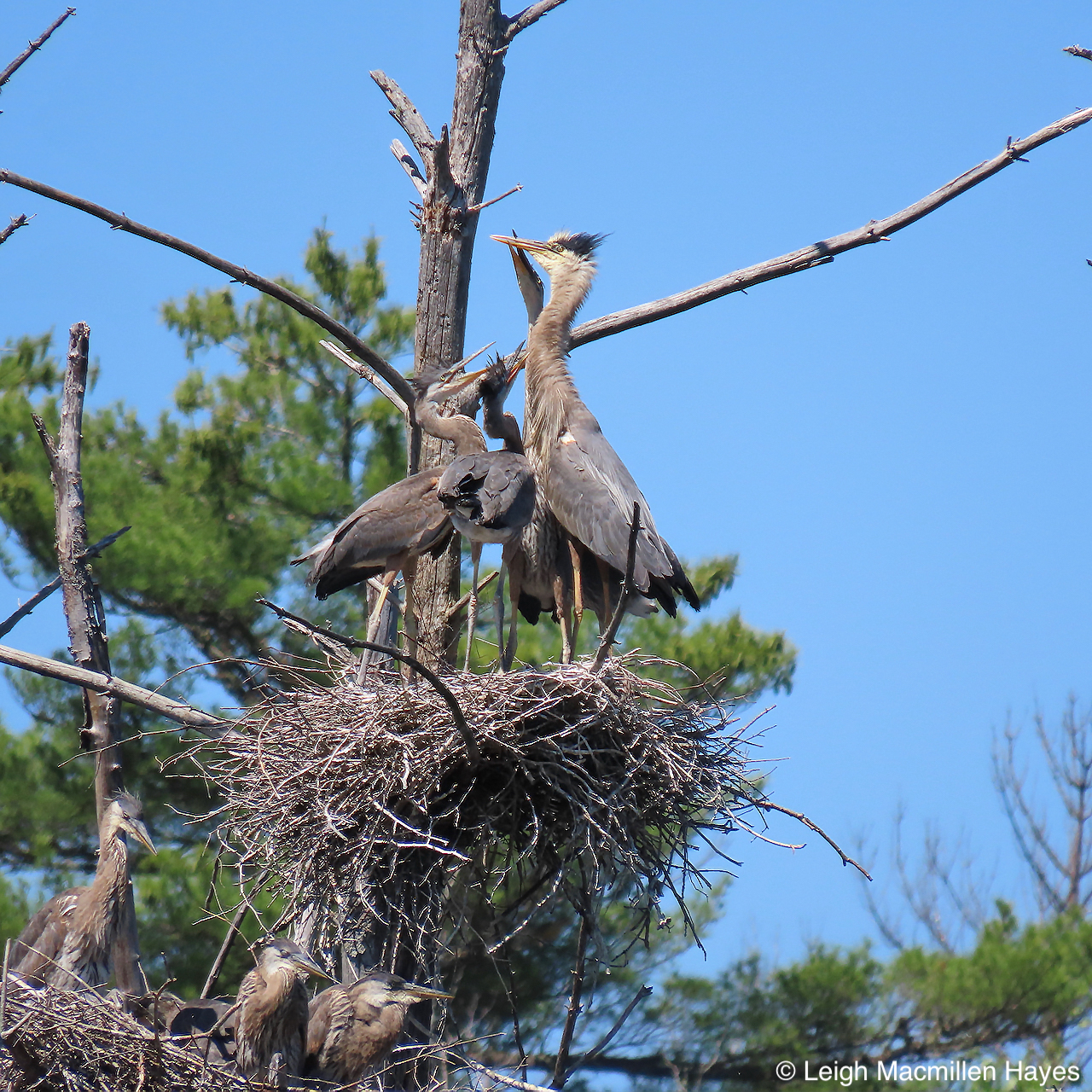
One of the things I always found amazing is that by week #3, the youngsters seemed to know that their parent was approaching with a feast to share, while those in the condo below waited patiently and quietly for their meal on wings to fly into the nest.

Meals were regurgitated, with those prehistoric croak-like squawks perhaps encouraging the parent to pass the food to its youngsters.

And then it was time for the kids to fight over who got the best and biggest bite, while momma or poppa stepped aside to let them assert their birthright. The question remains, did the first born always get the worm? Or in this case fish or amphibian or whatever the meal might be?

And how could we not admire the Green Frogs that “Ga-dunked” their banjo strings as they surrounded us and kept moving in closer making us think we might become a meal while we stood there and counted?

Feeding time continued to be the birds’ favorite time and as they grew bigger, they certainly became more assertive.

Vying for position continued to stymie us for we didn’t understand which mouths received first dibs. But of equal importance, how did all of those birds remain in their treetop nests without falling over during such squabbles? And how did the nests and birds withstand the rain and wind that marked our spring and summer here in western Maine?

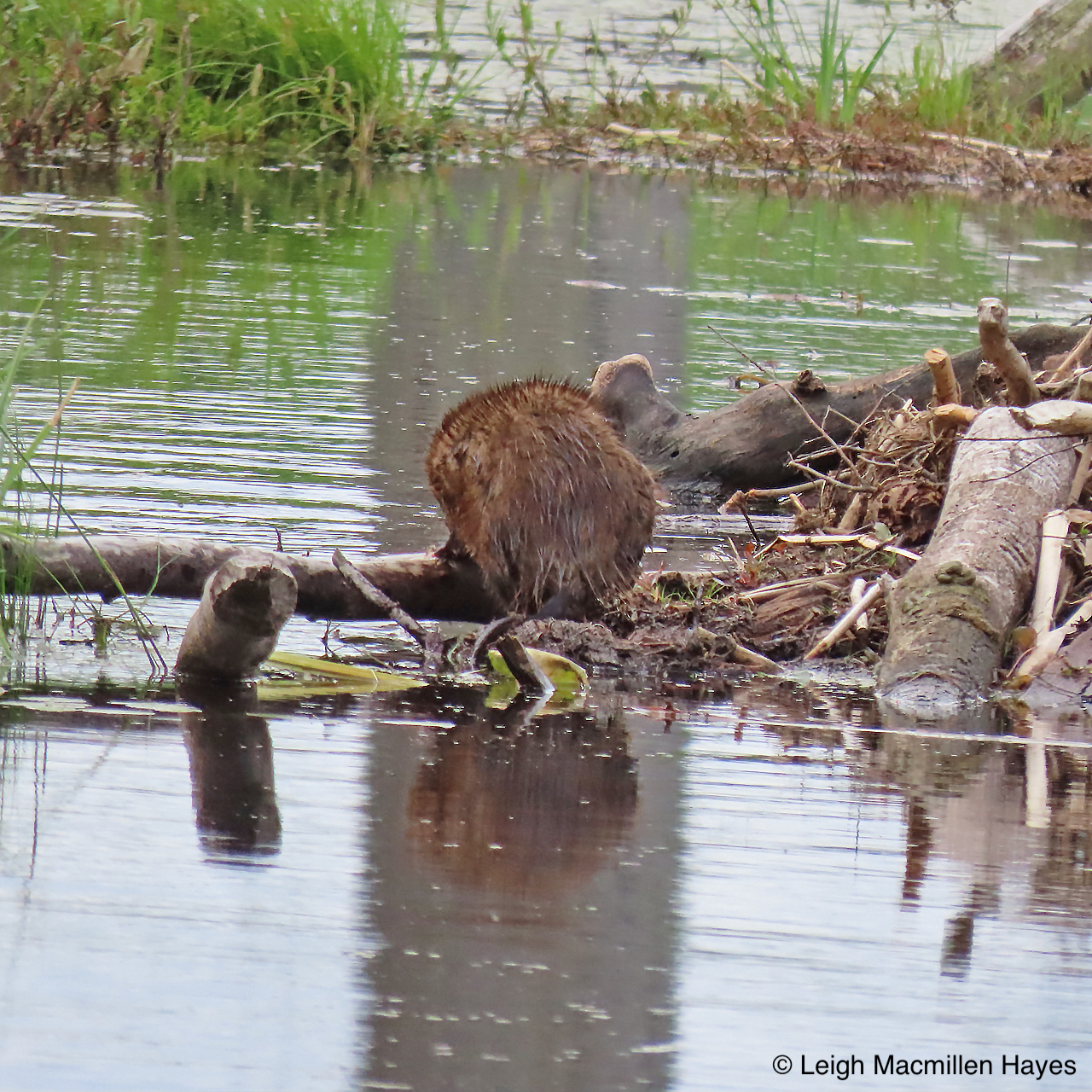
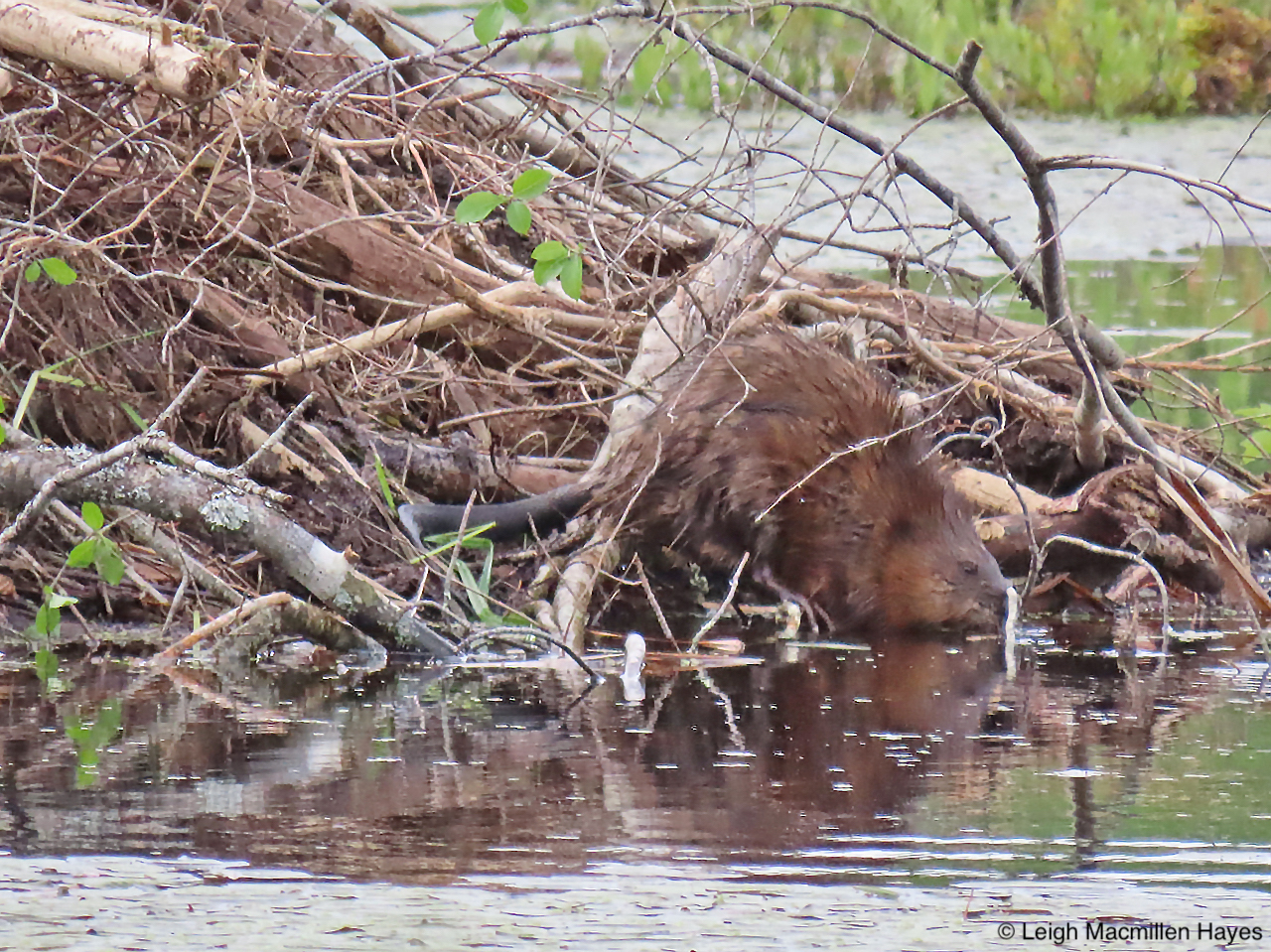
Motion below the nests caught our attention once again, and what we first thought was a Beaver because it explored a beaver lodge, morphed quickly into a Muskrat when we spied its rat-like tail.

It went about its business as we watched, probably in search of food, maybe to feed its own youngsters.

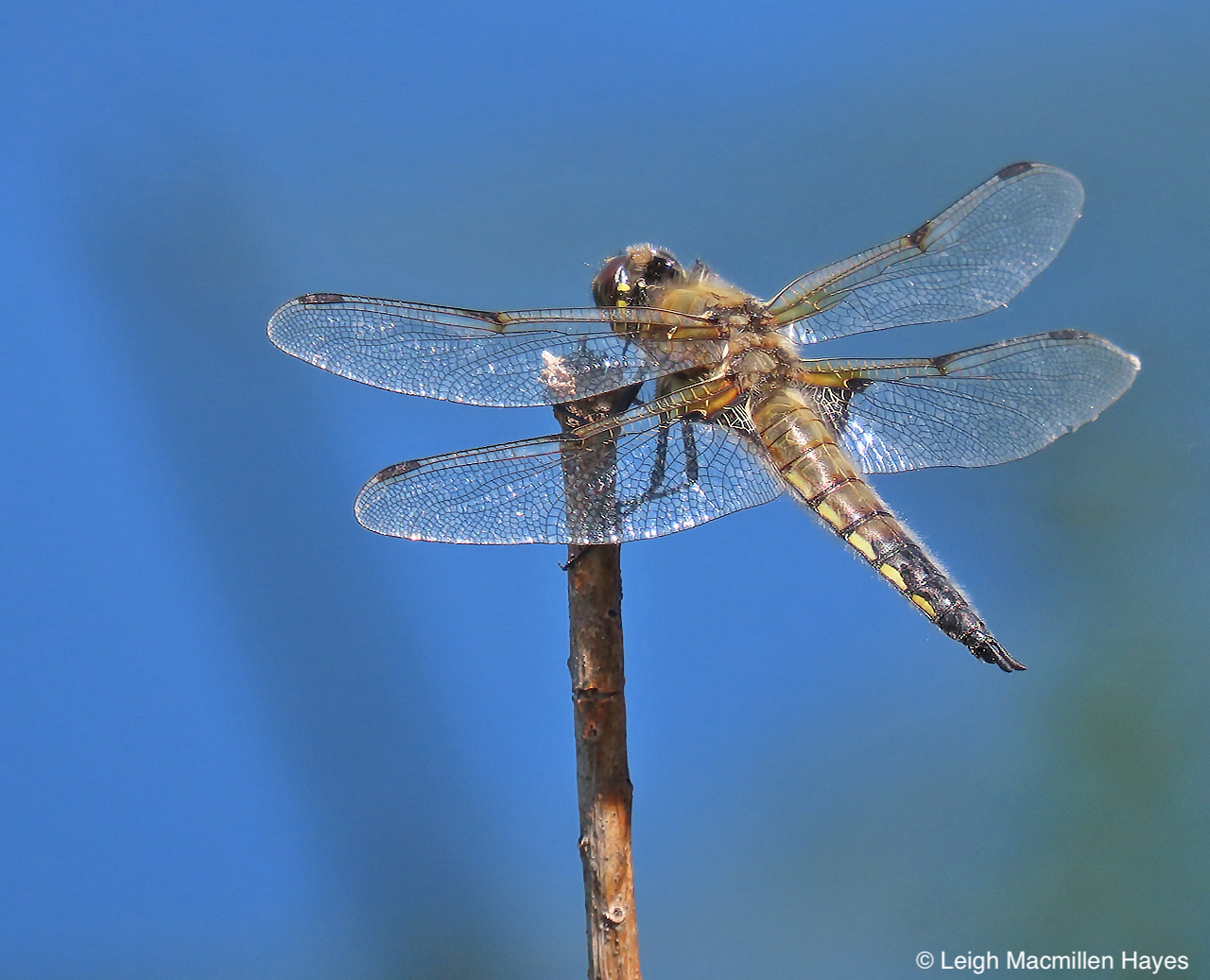
And then there was the ever lovely Four-spotted Skimmer Dragonfly.

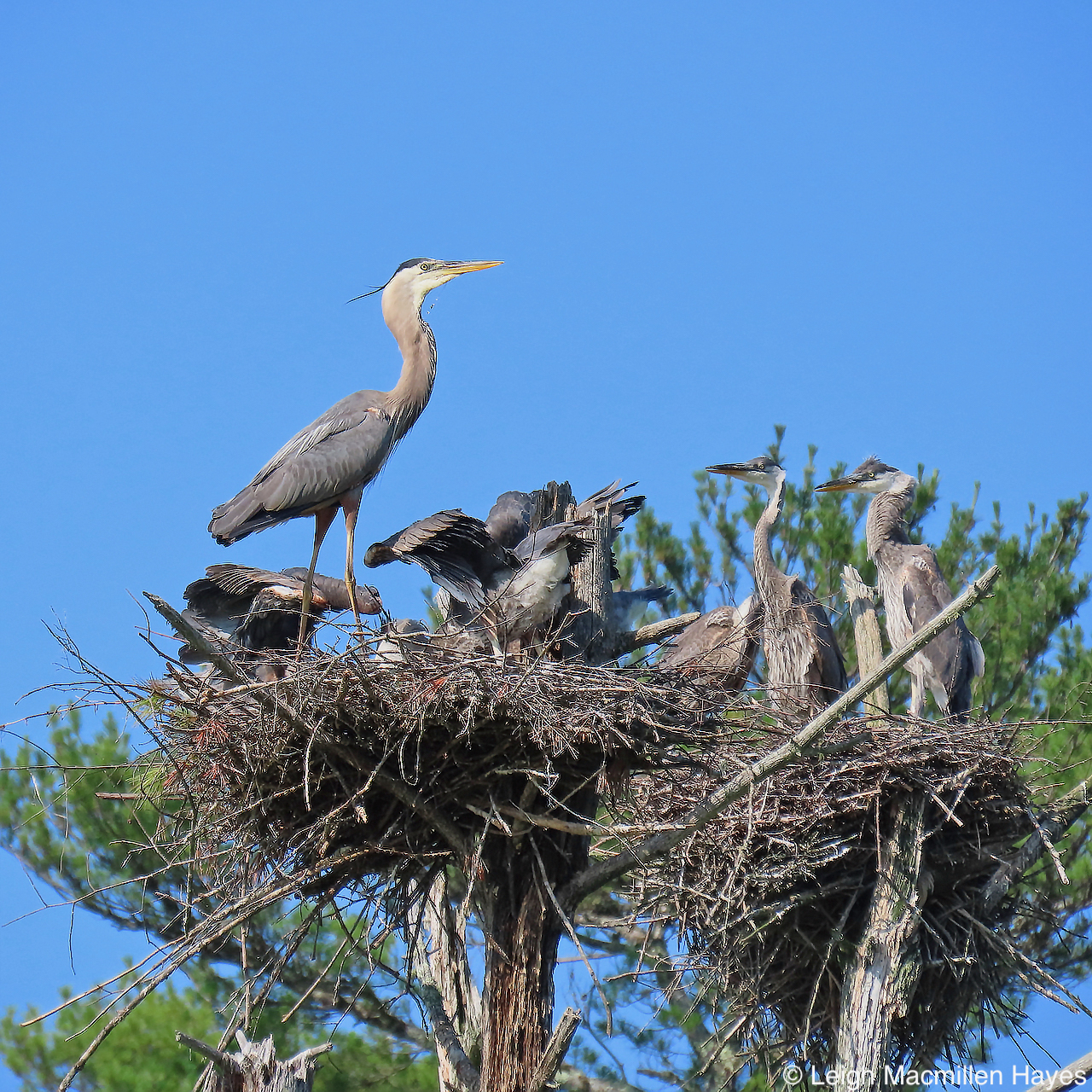
By week #6, most of the kids were tweens, and those in the left-hand duplex watched intently for their lunch box to arrive just as their neighbors to the right were about to eat.

We labeled this double-nest “The Squawkers” because anticipation of the lunch box contents in both places was extra loud.

Once the right-hand duplex had finished eating, they turned their attention next door, though nary a beg did they offer and nary a tidbit did they receive.

Still they looked on.

And so did we . . . at this female Eastern Pondhawk Skimmer dragonfly with her bright green thorax and pair of white cerci (terminal appendages).

During week #6 the moment arrived, when encouraged by others a teen got up the gumption . . .

to step out on a limb . . .

and then turn back to say, “Hey, look at me. I did it.”
And then, in an instant, first flight!

So where did the herons go once they no longer needed to remain at their breeding grounds? Well, I took off in my kayak to see if I could answer that question. And a Slaty Blue Skimmer posed on my boat much like a figurehead, this one in obelisk form with its abdomen raised toward the sun to offer some relief from the heat.

I also found the Eastern Pondhawk’s mate. Look at that green face, and powder blue abdomen, or the hints of color on its wings.

I was equally excited when I spied him again, this time with a frontal views. I hope your “Ohs” and “Ahs” match mine.

Another “Oh” moment: A Water Snake peering out from under its lilypad-shaped sun umbrella.

And a couple of Painted Turtles basking upon a rather shaded rock.

Plus a pair of juvenile Mallards in preening mode.

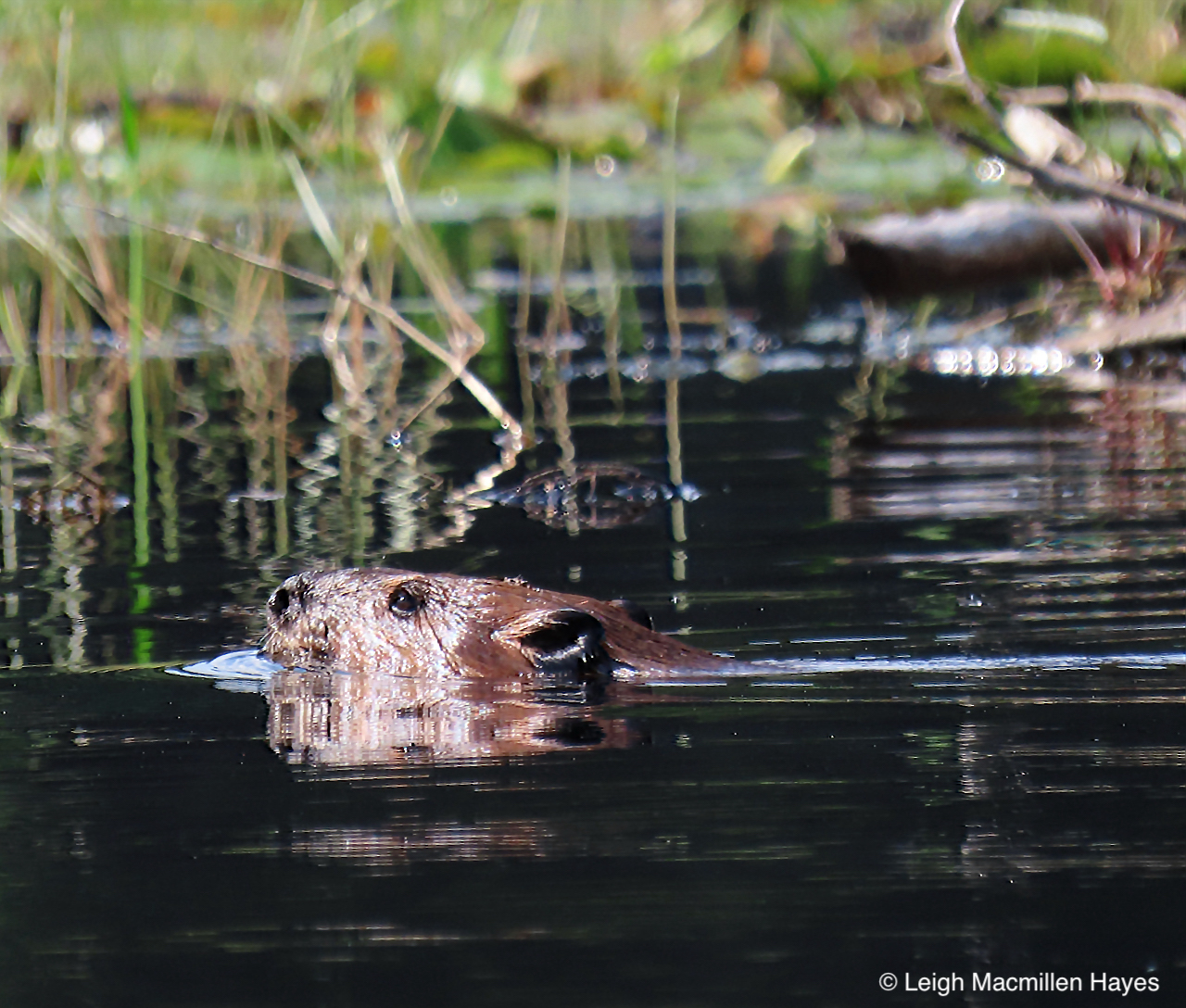
And among my favorites, okay, really, they are all my favorites, but I was quite surprised to spend a few minutes with this Beaver while searching for herons one recent day.

Tada. The search has ended and going forward I’ll probably spot them more and more frequently for I know how successful at least two local rookeries have been this year.

I give great thanks to this Great Blue Heron and all of the others because they offered a chance to not only contribute to research, but also to spend some delight-filled hours standing still and observing. Your breeding and food-gathering habitats are my favorites too.

Our Blue Greed Mondate

Somehow that time of year always sneaks up on us. And yet today dawned and the writing was on the wall: This is that time of year-kind-of-day. But the question remained: Would we be rewarded?

Well, we had to find out and so this morning we set off in search of this small mountain nestled in the midst of so many behemoth uprisings. It took us several wrong turns before we finally shared that sudden “Aha” moment that indeed the pasture road was the correct road. It was all rote from there.

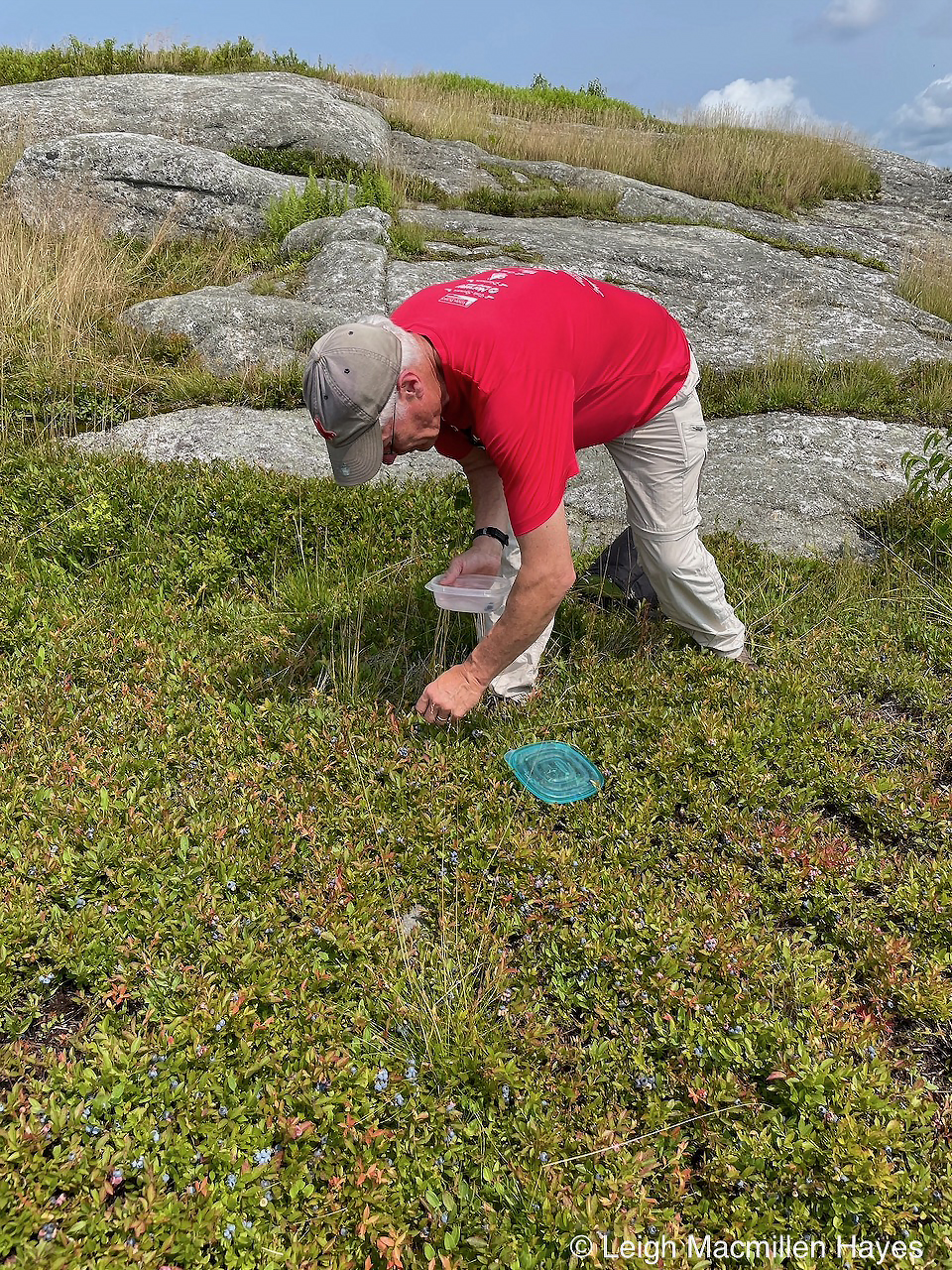
Last year we discovered the mountain top had been cut back and there were no little specks of blue to glean, but that cutback lead to this year’s abundant offerings. My Guy was in his happy place.

Well . . . one of his happy places. This one offering such sweetness in a manner all blue.

I chuckled when I overheard a mom commenting, “This is just like Blueberries for Sal.” I immediately texted our friend Kimmy for she and I know otherwise. Drop the “S” from Sal and you’ll know what I mean.

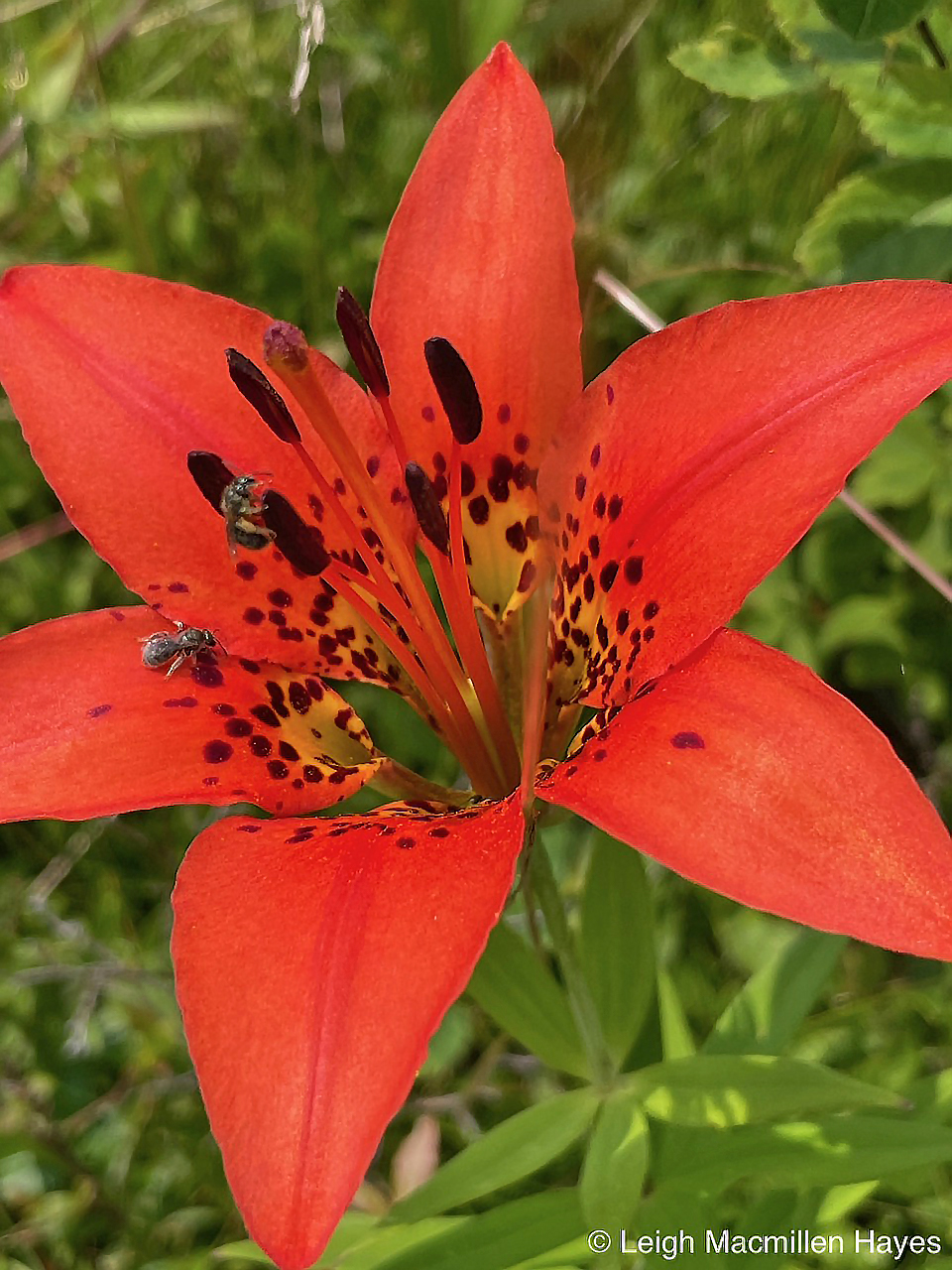
That said, his blueberries are my pollinators and with pollinators you have flowers, this one being one of many, many Wood Lilies.

There was also the Red-shouldered Long Horn Pine Borer, so frantic in its activity upon the Steeplebush flowers.

Plus a Paper Wasp upon Yarrow, . . .

And Flower Longhorn Beetle on Bristly Sarsaparilla. The season is short and there’s so much work to be done and the rain may have slowed things down so when the sun doth shine, it’s all insects on hand.

We finished up our hike, grabbed a to-go lunch at a locally eatery and then took off in the tandem kayak, with the same mission on our minds. Picking more blueberries for him, of course.

And checking out the local wildlife activity for me. We watched a beaver pass by our dock two nights ago, so we knew there was an active lodge somewhere in the area.

We actually found two new lodges and other older ones that were turning into islands. But we didn’t spy any beaver activity, probably given that it was the middle of the afternoon.

I, however, spotted a couple of species that envied My Guy’s blue greed, this being a male Slaty Blue Skimmer pausing in the midst of defending its territory.

And my heart was glad for we also spent some time with this tiny male Blue Dasher, another Skimmer who posed longer than I expected.

Only yesterday, I included his mate in Hunting for Dragons. Suddenly, here he was, albeit with a few Red Mite hitchhikers attached to his thorax.

While My Guy’s Blue Greed may be low and highbush blueberries, mine is definitely insects, and the bluer the better.

Rewarded were we, indeed!

Hunting for Dragons

Living life in two forms, as members of the Odonate family do, I spend countless delight-filled hours peering into water for their naiad forms and watching them eclose upon vegetation. I so appreciate their flying acrobatics as they defend territory and, of course, their preference for smaller flying insects such as the ubiquitous deer flies and now a second hatching of mosquitoes.

This summer I’ve had the pleasure of standing upon boardwalks and other edges of ponds and streams as the naiads have literally decided the temperature is right and that particular day is the day that they are going to make the great transformation from aquatic to land form.

And I’ve been especially tickled when an Emerald or two or three, thought my boot was the perfect place to climb in order to split open its thorax and step out of its former self.

Earlier in the season, hundred upon hundreds seemed to emerge at the same time, and now we aren’t see as many as they’ve become bird food, passing energy gained from the insects they ate on to the birds who eat them.

By the color of the eyes, markings on their thorax and abodomen, and shape of the latter, I’ve been teaching myself, or rather the dragonflies have been teaching me their names, some of which I actually remember from one year to the next, this being the Racket-tailed Emerald. What distinguishes it from the Kennedy Emerald, at least for me, is the shape of the abdomen that rather resembles a tennis racket, unlike the long and slender tail of the latter.

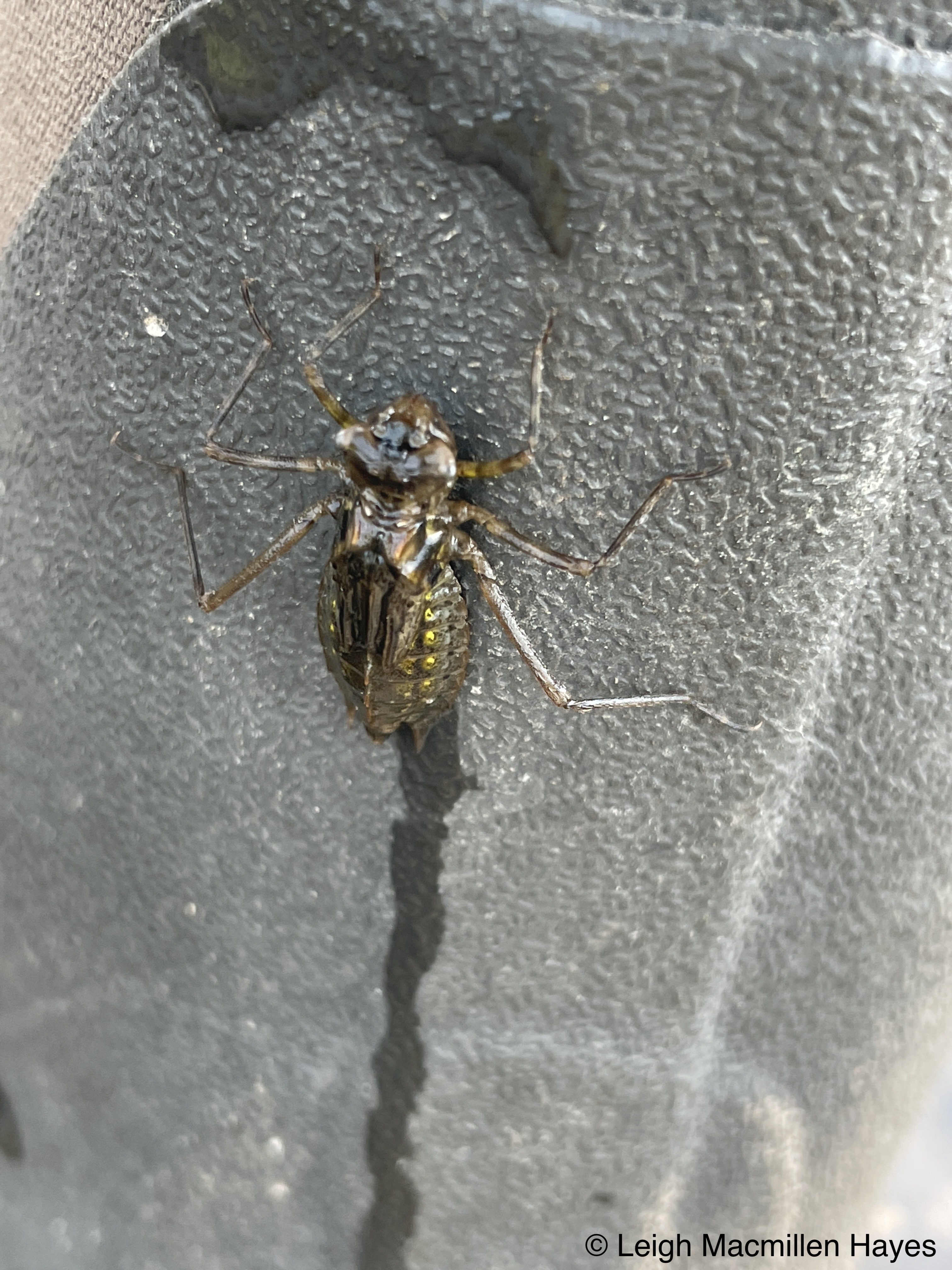
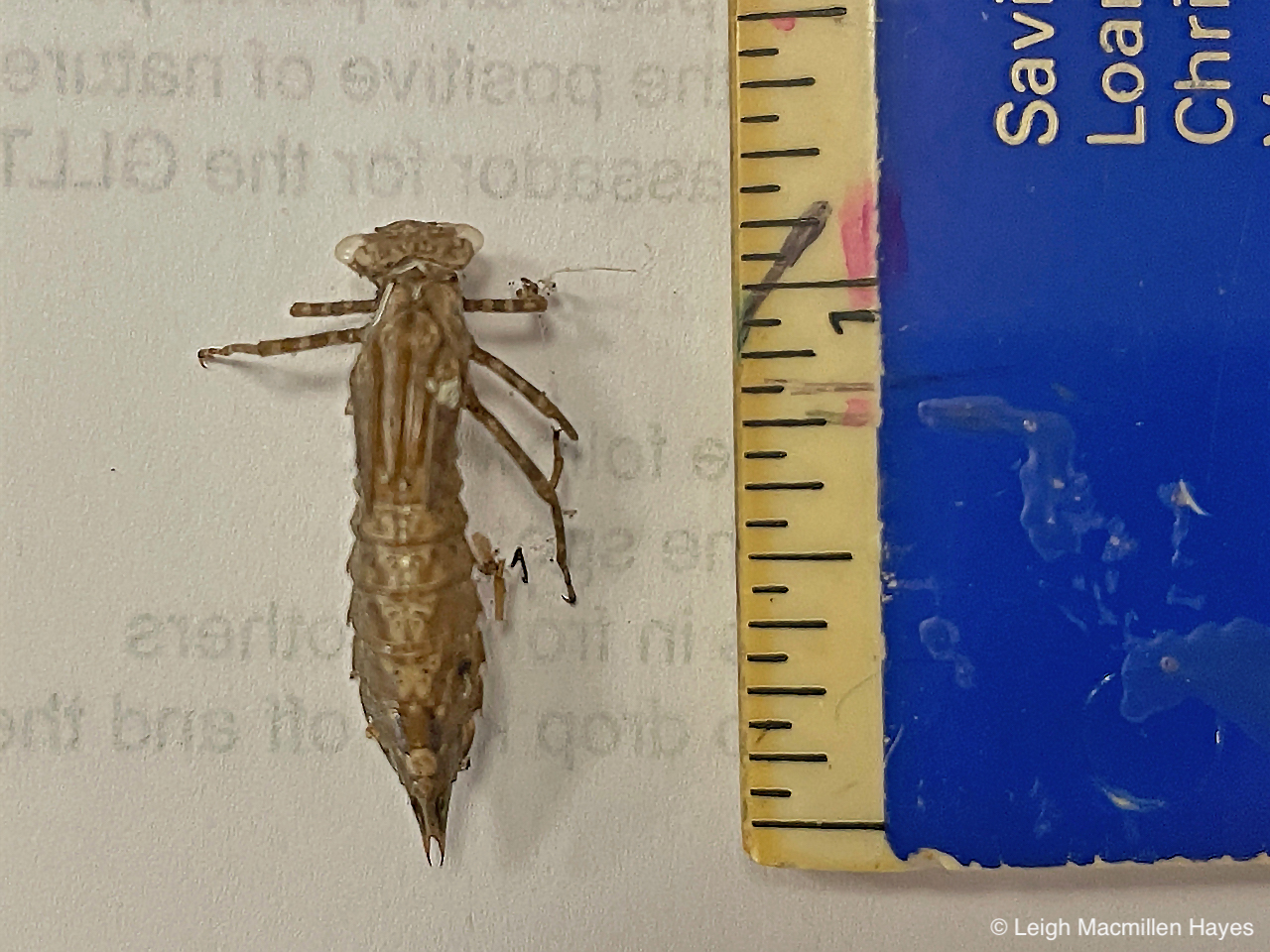
Upon arriving “outta” rather than “upta” camp late yesterday, I plucked a few different exuviae from the foundation, in awe of the journey they each made since it’s about twenty feet from the water’s edge. Emergence is such a tenuous time, exiting the watery world, crawling to just the right place, and then beginning the process of shedding ones old ways for a new form–a time when they are most vulnerable. And so I am honored that they chose our little place and hope it provided the protection they needed.
Another who honored me recently was a Variable Darner, its hues of blues and greens among my favorite color combo. Capturing a photo of a Darner is no easy task, and so I was amazed that this one actually posed. Notice the thin black line across its face–a clue in the identification. (And I hope I’m correct on the actual species)

The Darner’s naiad form is long and thin as compared to most of the others.

This is a crisper look. I love the clear bubbles where the eyes had once been. And the wing pads that form during the last instar before the critter climbs out of the water.

Next up on the plate is a member of the Skimmer family. There are so many, many members of the Skimmer family, and Maine hosts quite a few of them. This is the Spangled Skimmer, a female by gender. She and her mate are the only ones with white stigmas on their wings, so if you spot a brown and yellow female or a blue male with the white you’ll be able to identify them immediately. Or share a brain with someone else as so many of us do.

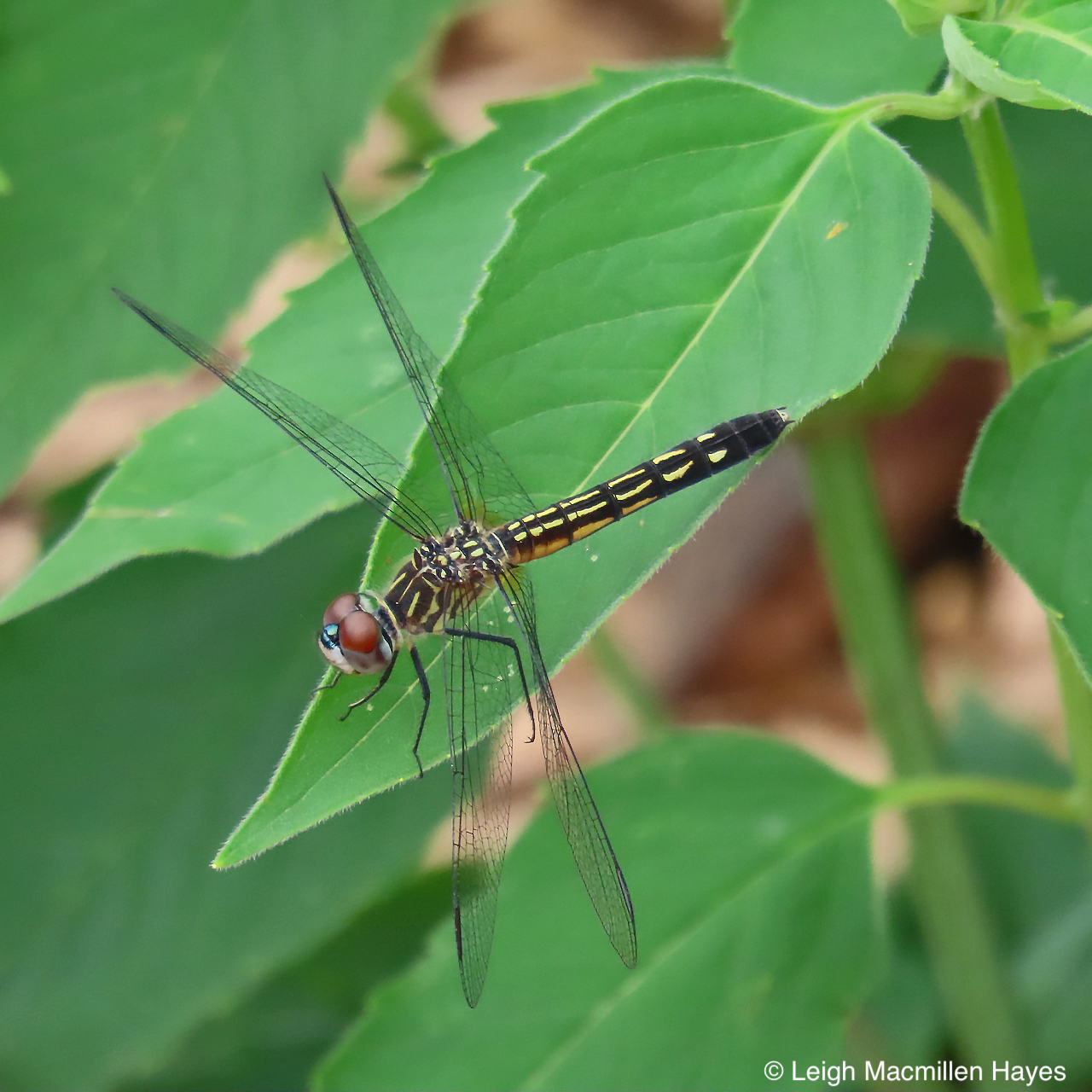
Another Skimmer I recently met for the first time, or so I think, is an immature Blue Dasher. In Dennis Paulson’s Dragonflies and Damselflies of the East, I read that those red over gray eyes will turn green with age (not envy).

Here’s another look at its abdomen because it was the two rows of stripes that clearly helped me feel confident about this identification.

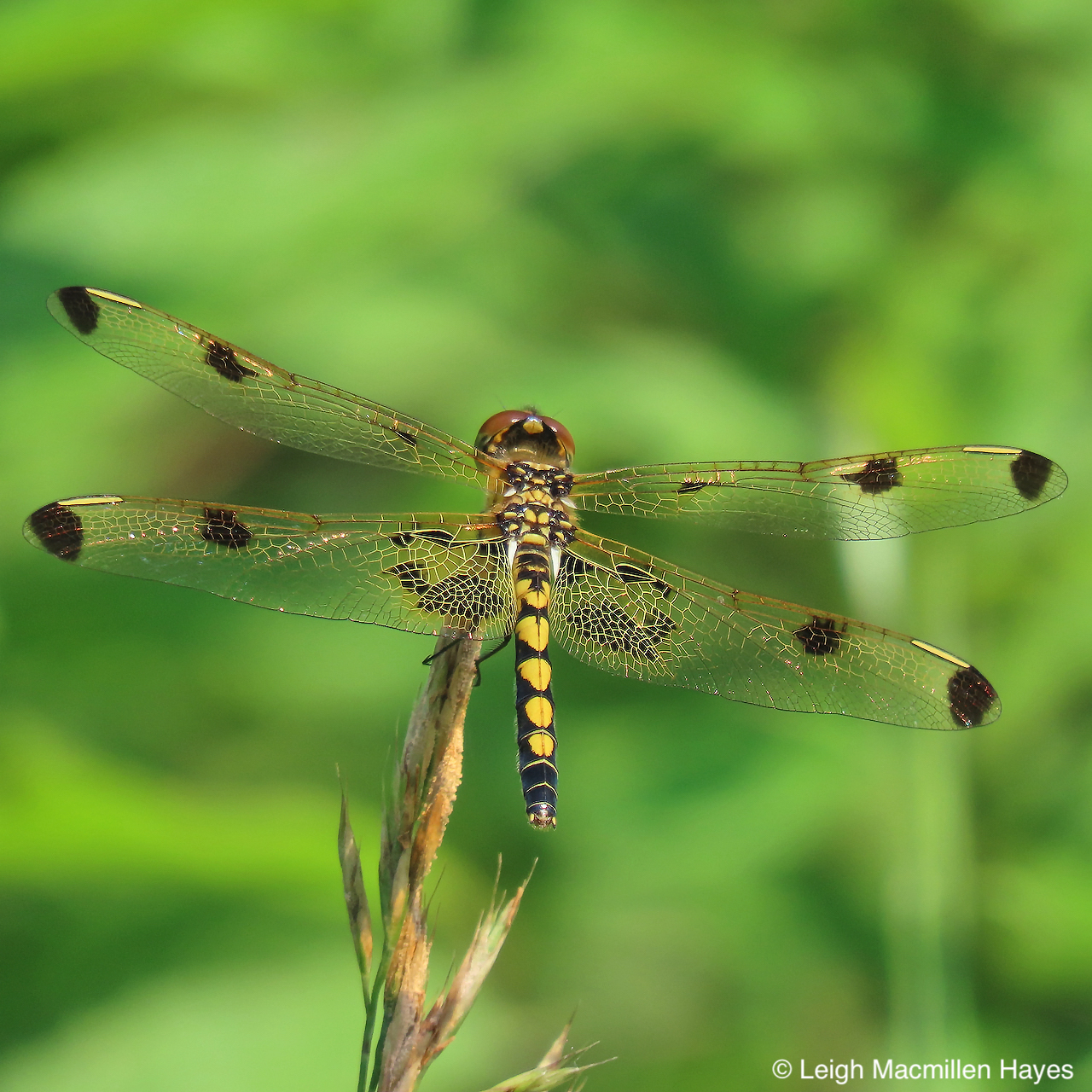
And I would feel remiss if I didn’t include this beauty, despite that fact that many of its ancestors have graced wondermyway.com in the past. What not to admire about this female Calico Pennant Skimmer? Those stain-glassed wings with yellow stigmas and the yellow hearts on her abdomen. Her honey is adorned in the same pattern, only with red where she displays yellow.

This is the shed exuvia of a Skimmer, perhaps one of the Slaty Blues that I didn’t photograph as they defended their territory late yesterday afternoon. I looked to see if anyone was flying today, but found the water’s edge to be rather quiet in the midst of so much rain.

The shed skin of this Stream Cruiser I did not find because this isn’t the right habitat for the oreo cookie of the dragonfly world. But . . . I just like to look at it and smile each time I encounter one.

What I have found recently, and also brings a bit of a thrill to my mind, is a Dragonhunter Clubtail.

These are the mighty monsters of the Odonata world, and they’ll even consume other dragonflies.

And here is the exuvia, which Paulson describes as “wide, flat larva that resembles a wood chip.” The legs alone speak to its strength; formidable in the water and out.

And the cool thing is that sometimes when you are hunting for dragonflies like the Dragonhunter, others make their presence known and you capture them in photographs rather than your jaws. The Bi-colored Sweat Bee didn’t have to worry about me.

Something’s Always Happening . . .

This is a tale that I’m so excited to share and it’s actually a month or two in the making. Each year I write about the saga of the vernal pool in the woods behind our house and how it begins as a “Wruck, wruck” love affair, but by the end of May fizzles into a stinky puddle full of dried up Wood Frog tadpoles and flies and Scarab Beetles mating and laying eggs.

Not so this year. It’s been a wet spring and now a wet summer and that, my friends, is fantastic if you are a Wood Frog or Spotted Salamander. For the first time in my 30+ years of visiting this pool, there is still plenty of water in it.

It is my understanding that if a pool dries out too fast, the frogs and salamanders sense this and some metamorph into their adult upland forms quickly in order that they may hop or crawl out and be representatives of the next generation. I have to believe that is true since despite the pool usually not lasting long, come April 7 or 8 or 9, when the ice “goes out,” the love songs begin and eggs are fertilized and laid.

This year, however, the frogs have been given the opportunity to slow the process down and perhaps that will make them stronger, as well as increase the numbers that leave the pool.

It’s not just the frogs, but the salamander population might also be on the rise.

So here’s the other thing. Walking to and fro the pool offers numerous other distractions of the natural sort, like this rather handsome White Admiral Butterfly.

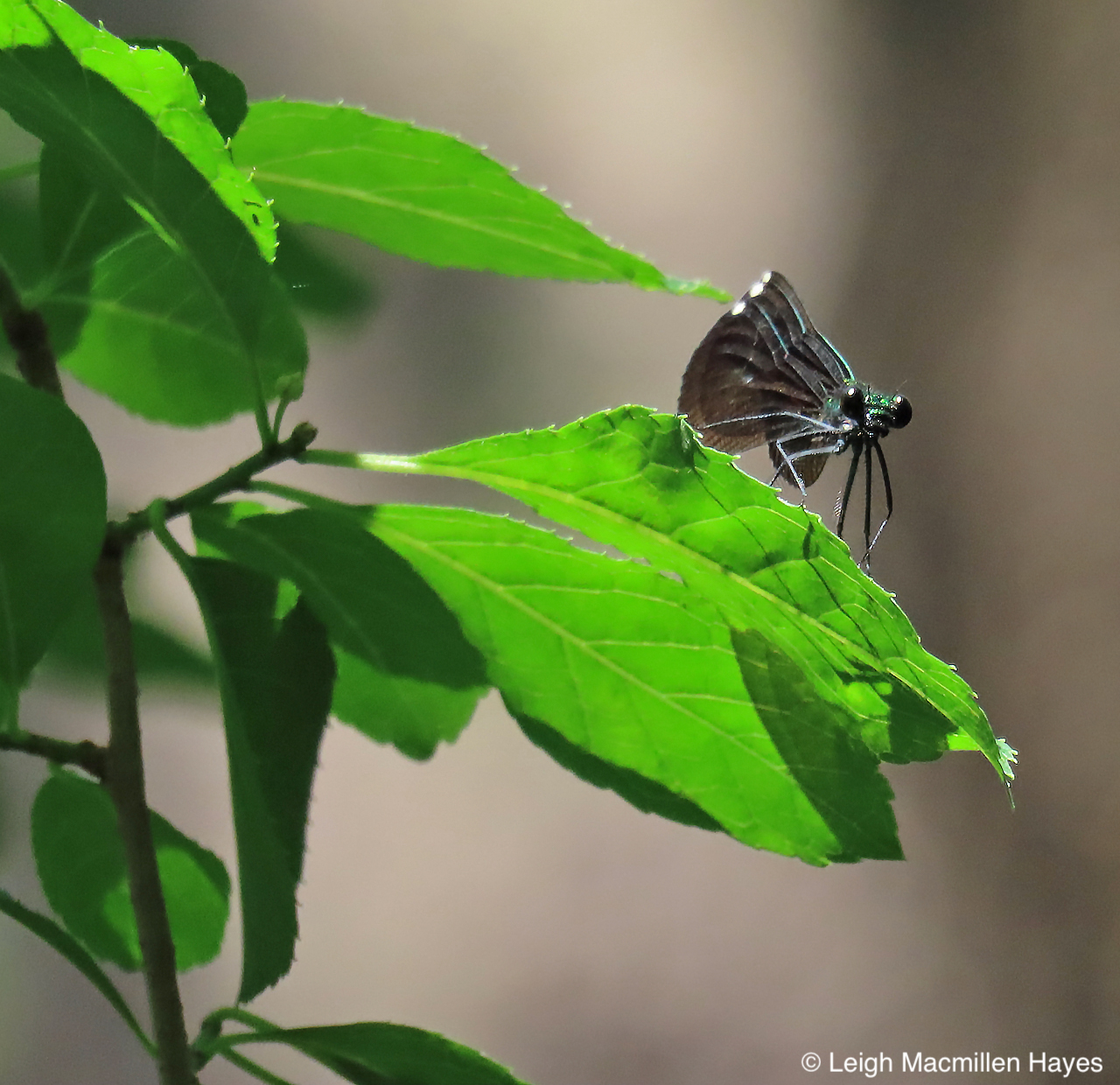
And a female Ebony Jewelwing Damselfly, the white stigmas or marks on her wings providing a hint of her gender.

But then there was the day that I heard baby peeps as I headed out there and suspected I knew the species to whom they belonged because they’ve nested in our yard before.

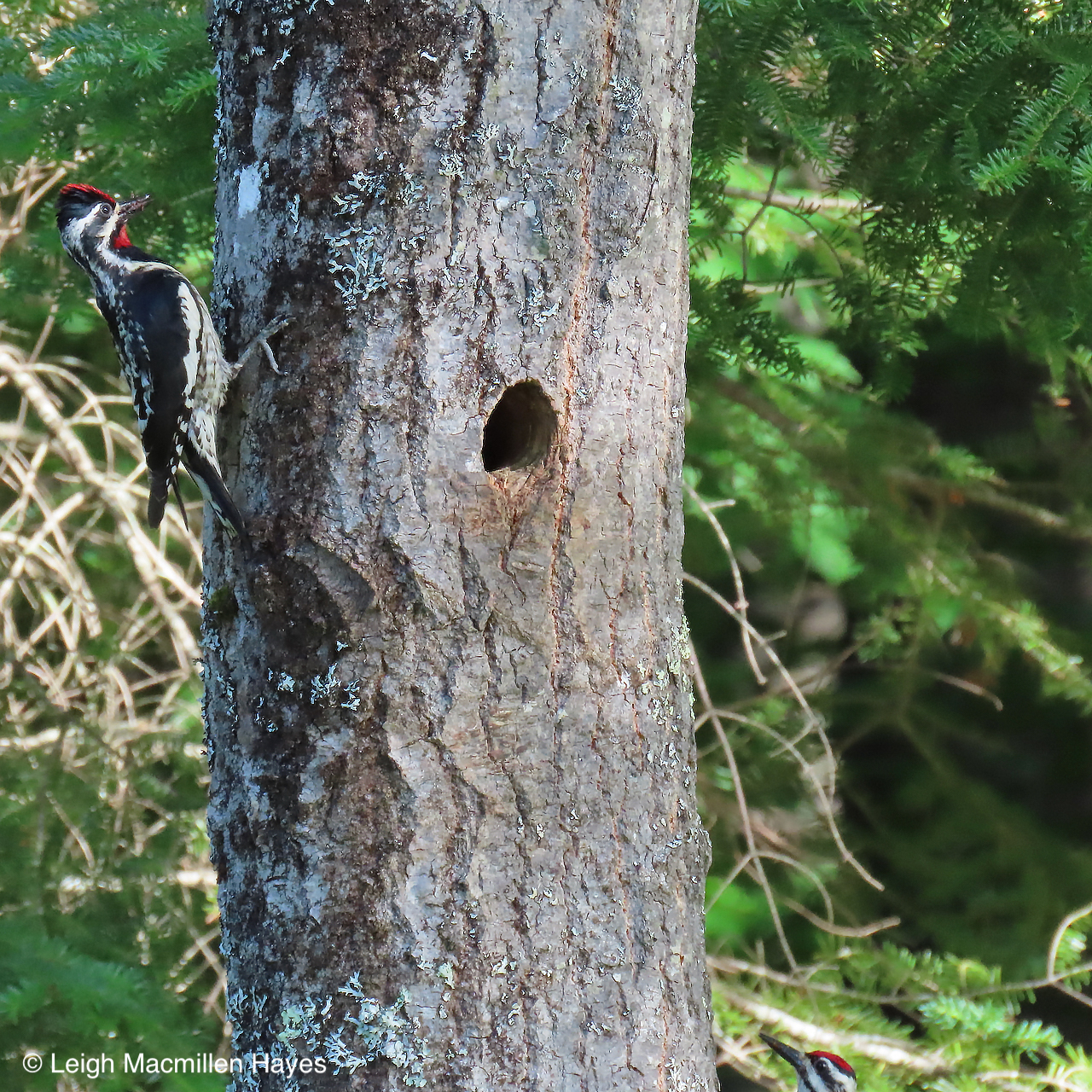
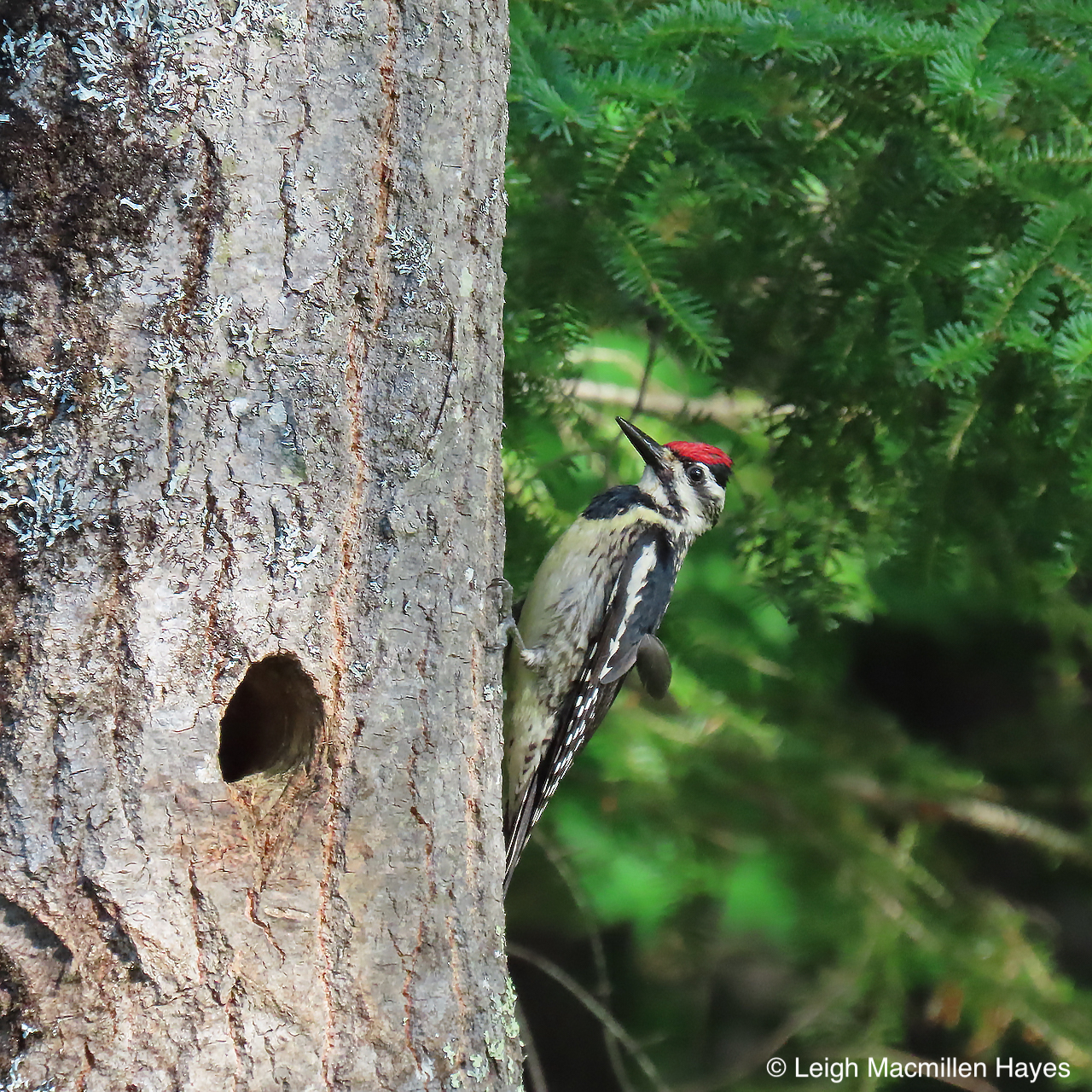
Crossing through a gap in the stonewall, I found the tree and Momma Yellow-bellied Sapsucker gave a hint as to the location. At first, however, I couldn’t find the hole where the babes waited for meals on wings to arrive.

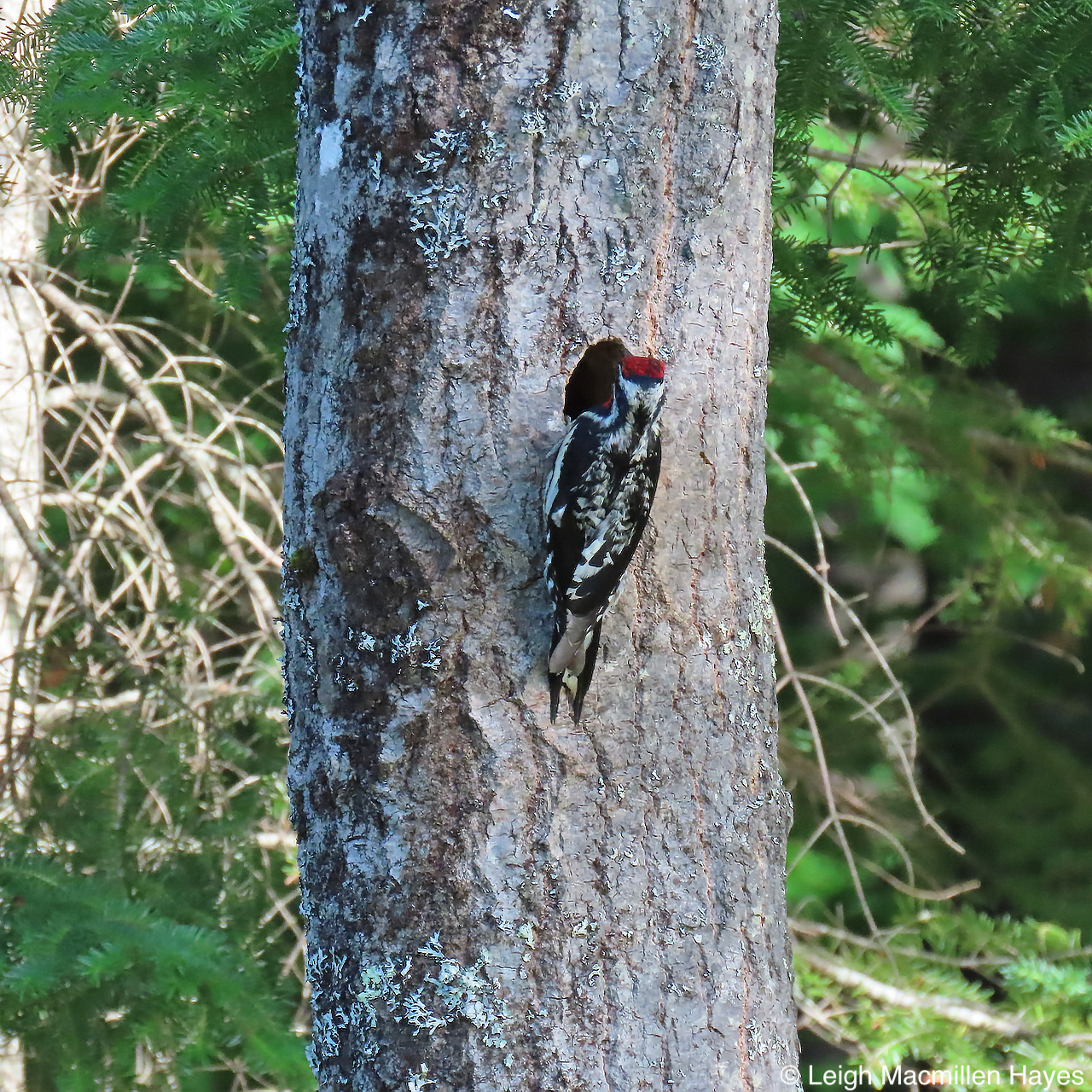
Until I did because I passed back through the gap in the stonewall and went to the oak tree located in the far corner of the yard beside our woodlot and there they were: Papa on the right, Momma below, and the hole in between. These were two extremely attentive parents.

Momma would fly in rather silently and surprise me as I stood behind another tree about ten feet away. But the kids always seemed to sense the arrival of a parent and their peeps would rise in a crescendo and I’d look up and there she or he would be.

And then it was a matter of delivering the meal. To the hole the adult would move in its woodpecker manner.

And into the hole its head would duck, presumably delivering an insect of choice either into a beak or two or three or at least into the nest for the kids to fight over.

Right after the delivery was made, the insistent peeping would begin again. “More, more. We want more food,” the chicks seemed to proclaim.

And the parents delivered before flying off to find the next morsel to nourish their young.

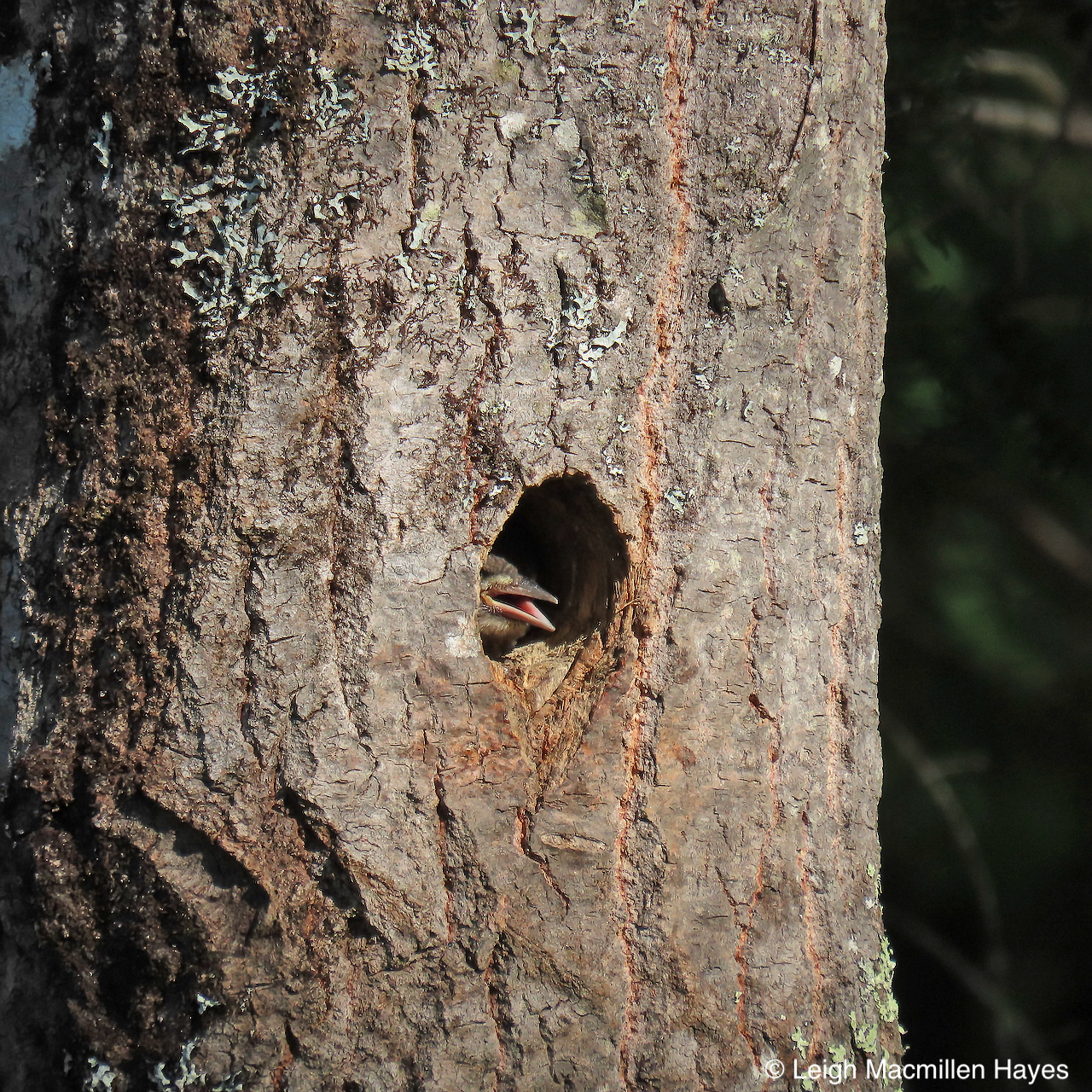
Still they did peep and occasionally showed their heads in the process.

By the end of the week that I spent watching, this youngster stuck its head out and made that insistent cry. Its parents disappeared for longer periods of time, which I’ve noted in the past and it makes me wonder if they have to go farther afield to find food, or if they want the kids to understand that instant satisfaction isn’t always the name of the game. Within a day or two and when I wasn’t looking, the chicks fledged and now I hear them learning the art of tapping to mark their territories.

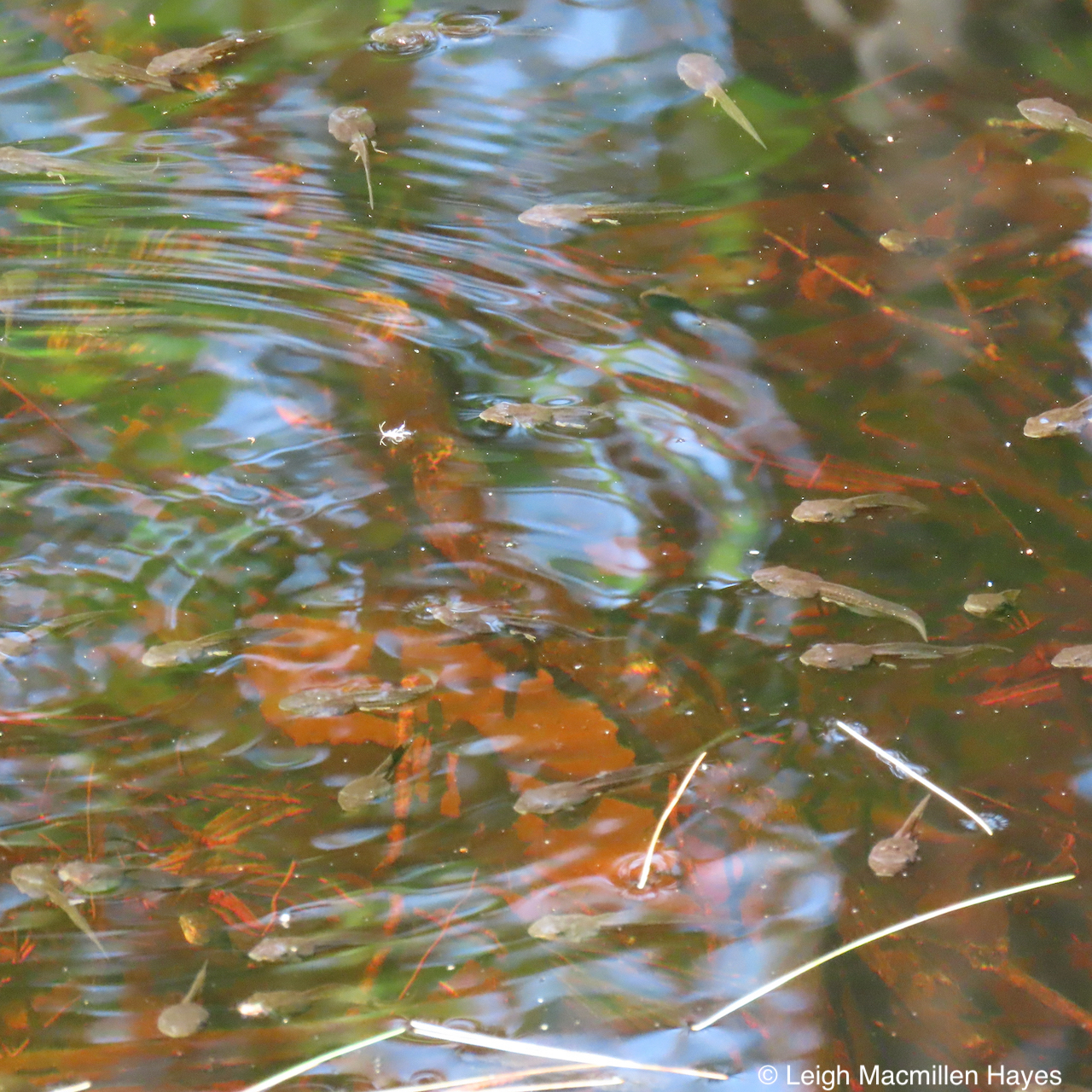
Oh, but wait, this is the tale of a vernal pool. And there too, there were changes like I’ve never seen before in this one. For one thing, the water teemed with activity.

Up for air they’d come and then dodge down again, leaving ripples in their wake.

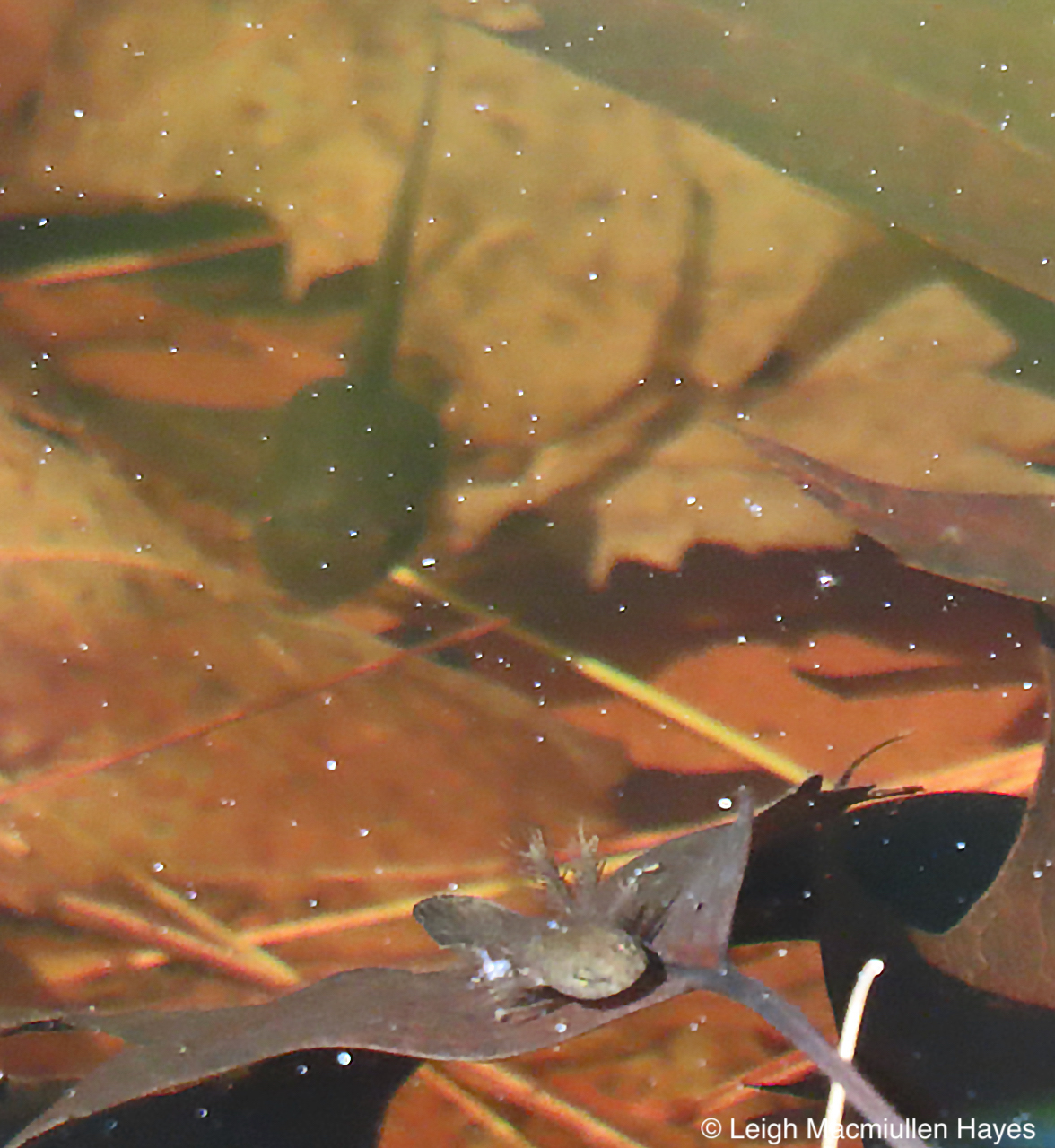
But . . . do you see what I saw during today’s visit? Legs! My frogs are growing legs. I’m so excited for them. I have to be as, unlike the Yellow-bellied Sapsucker chicks, they don’t have parents watching over them, feeding them, and teaching them froggy ways of living.

The same is true for the Spotted Salamanders who are breathing through those feather gills behind their heads for as long as they are aquatic in nature.

It was on my way home this afternoon when something else moved in the woods not far from my labyrinth and I thought at first it was a bird.

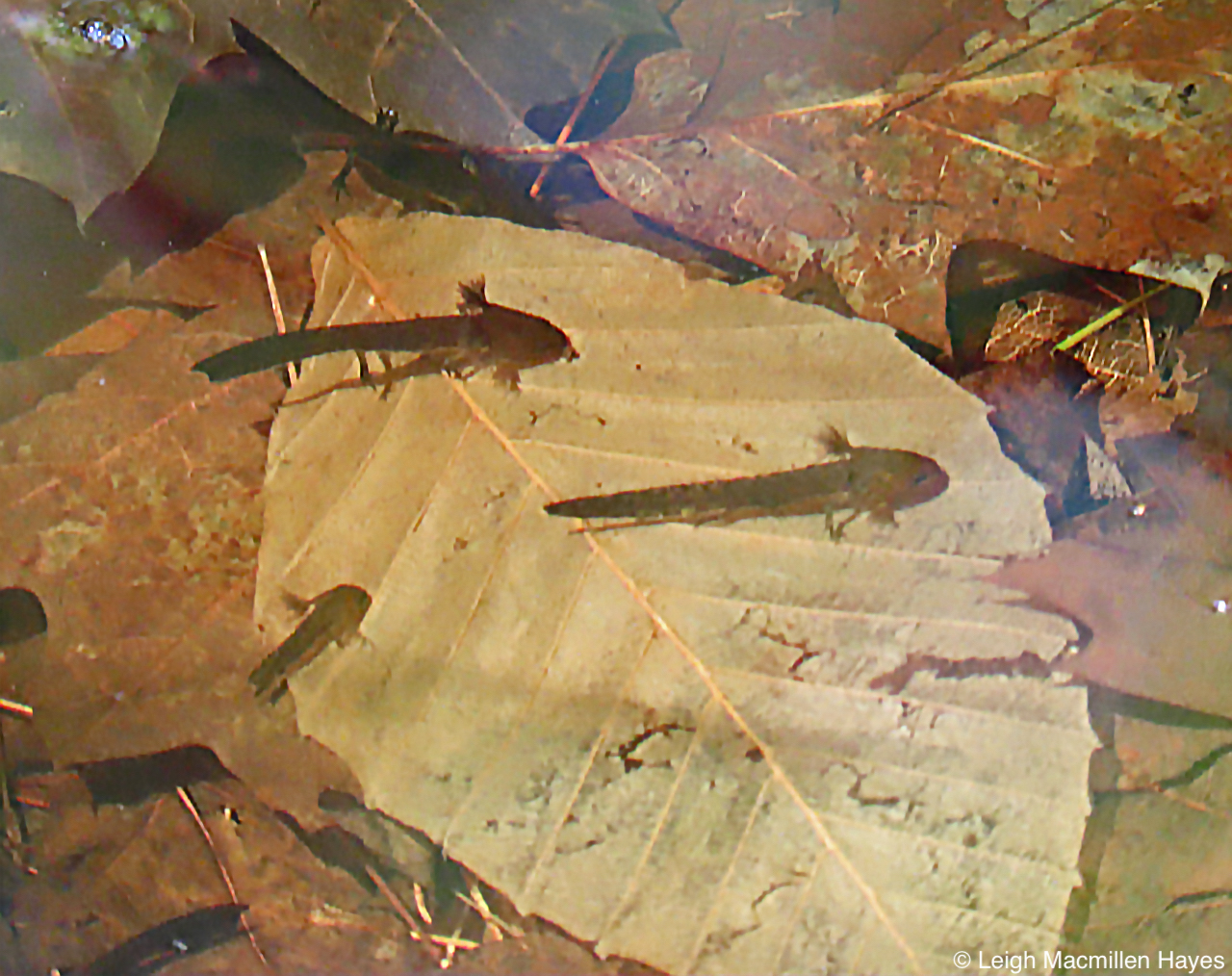
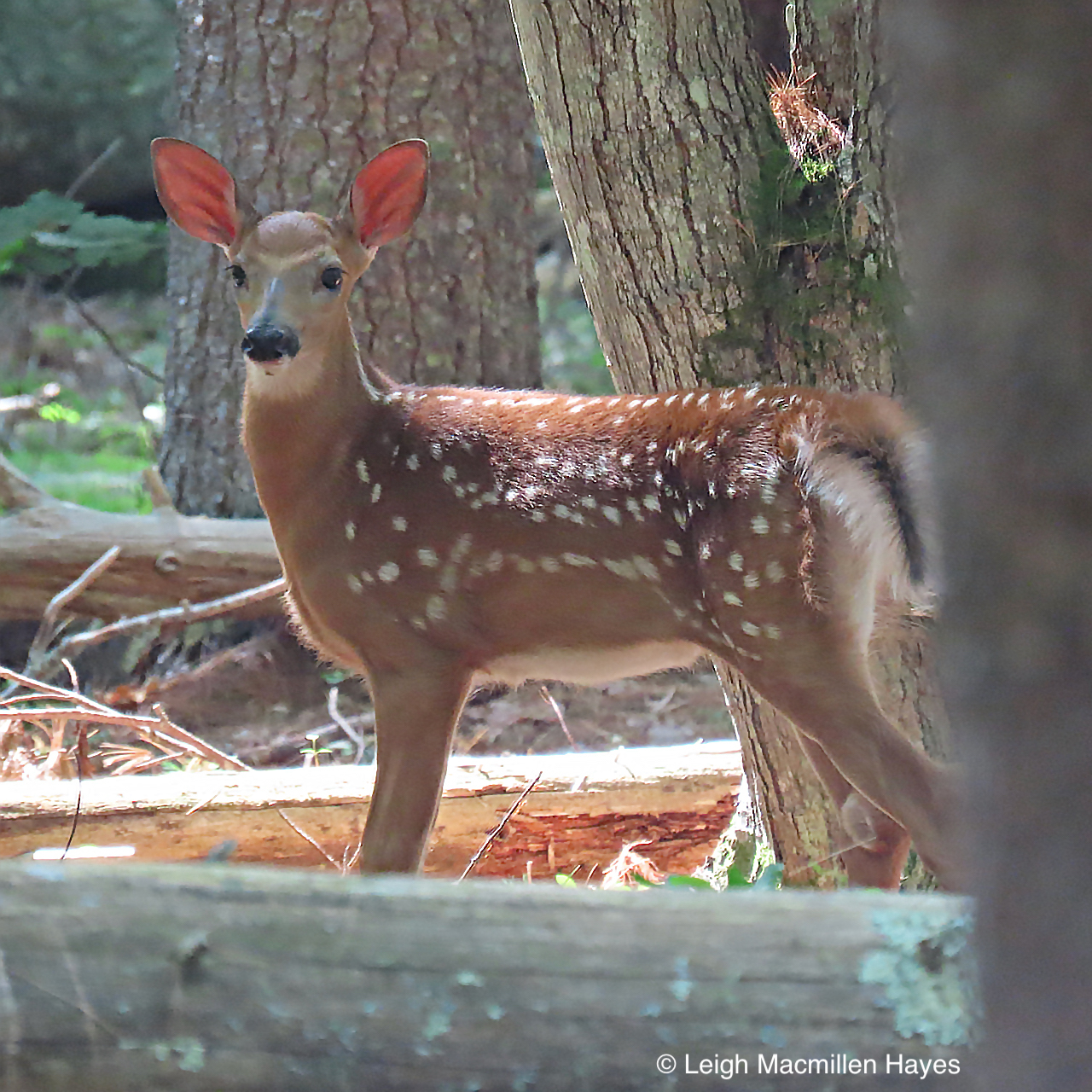
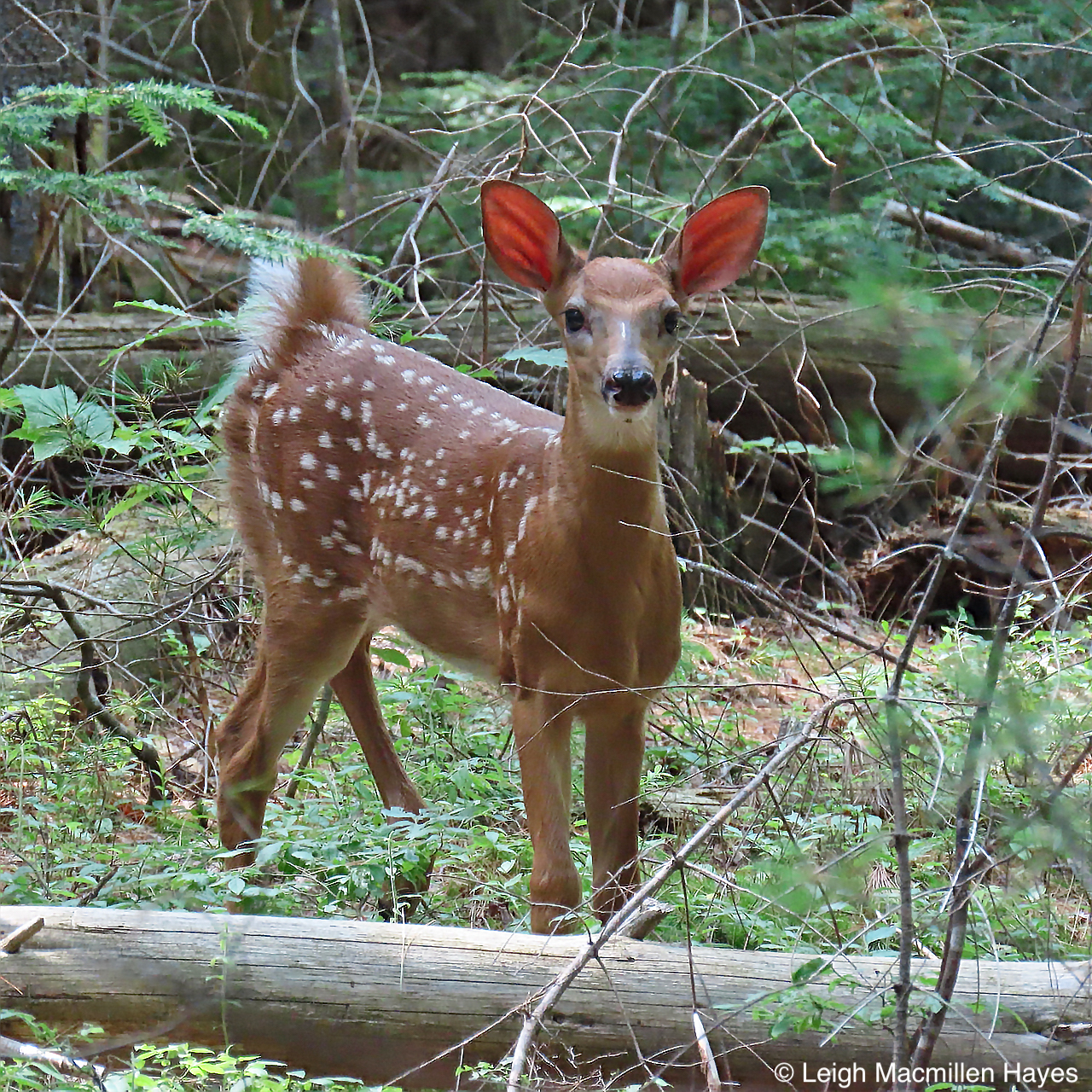
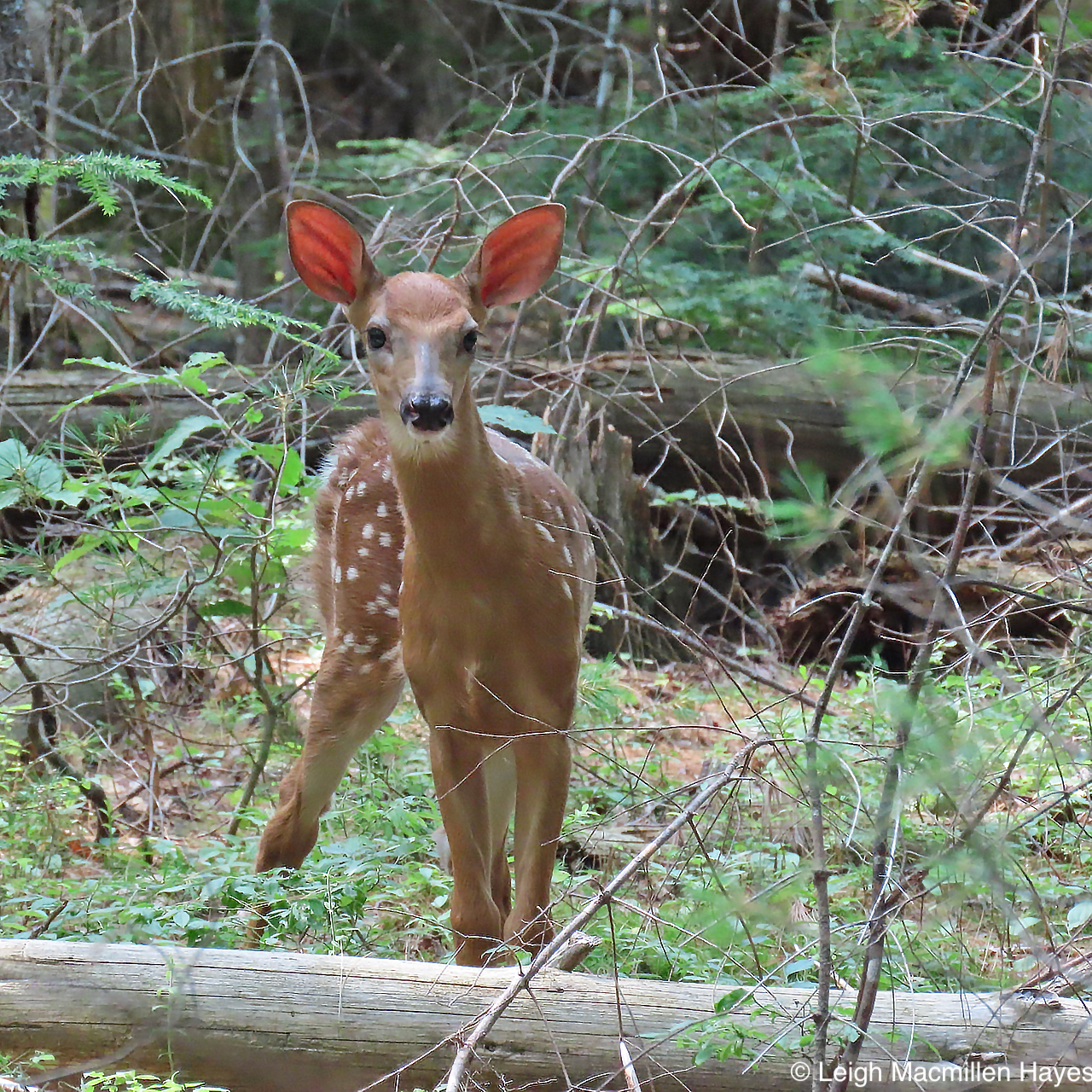
Until it too morphed . . . into a fawn licking its chops. And then I recalled that on the way to the vernal pool, I’d startled a doe in about that same spot and she’d leaped away and in the last few weeks I’ve seen the doe visit a spot in the field over another stonewall and I’ve stood on a kitchen chair with my binoculars trying to see if she might have a fawn. Apparently she did. I am tickled except for the fact that they are eating flower buds in my pollinator gardens.

That face. Those ears. And spots galore. How can I not share the buds with this rather chunky youth?

We spent about ten minutes together, each curious about the other, until it occurred to me that again, like the Sapsucker chicks, its parent was probably nearby and waiting for me to move on.

And so I did.

Still, I can’t stop smiling because something is always happening and it’s right outside my backdoor when I take the time to listen and notice.

Lake Living Summer Issue 2023

With twists and turns along the way, somehow we once again pulled off a summer issue of Lake Living magazine.

This one is super cool because not only are all the articles written by women, but they each feature women. And one was actually written by a high school student; while another is about an fabulous twenties-something naturalist who is also an artist. I wrote an article about the middle school class I have the pleasure of working with each week during the school year. And another about Maine women who support an incredible group of women in Zambia. There’s another about The Summer Camp, a camp for girls from Maine and beyond who are at-risk (and an organization I worked for years ago). Plus, there’s one about mushrooms, because as most of us know, mushrooms are most intriguing. The issue also includes everyone’s favorites: The Summer Bookshelf list of recommendations by the owners and staff of Bridgton Books.

I hope you’ll take some time to savor this issue. And I hope this link works as intended because we don’t have it on the Lake Living website yet and that may take a bit.

Read it here: Lake Living Summer 2023

Beauty and the Brawn: Two Kingdoms

It's a mix of both realms in the natural world;
a kingdom of beauty and a kingdom of brawn; 
and sometimes a kingdom that includes both, 
in such a way that it's all about one's perspective. 
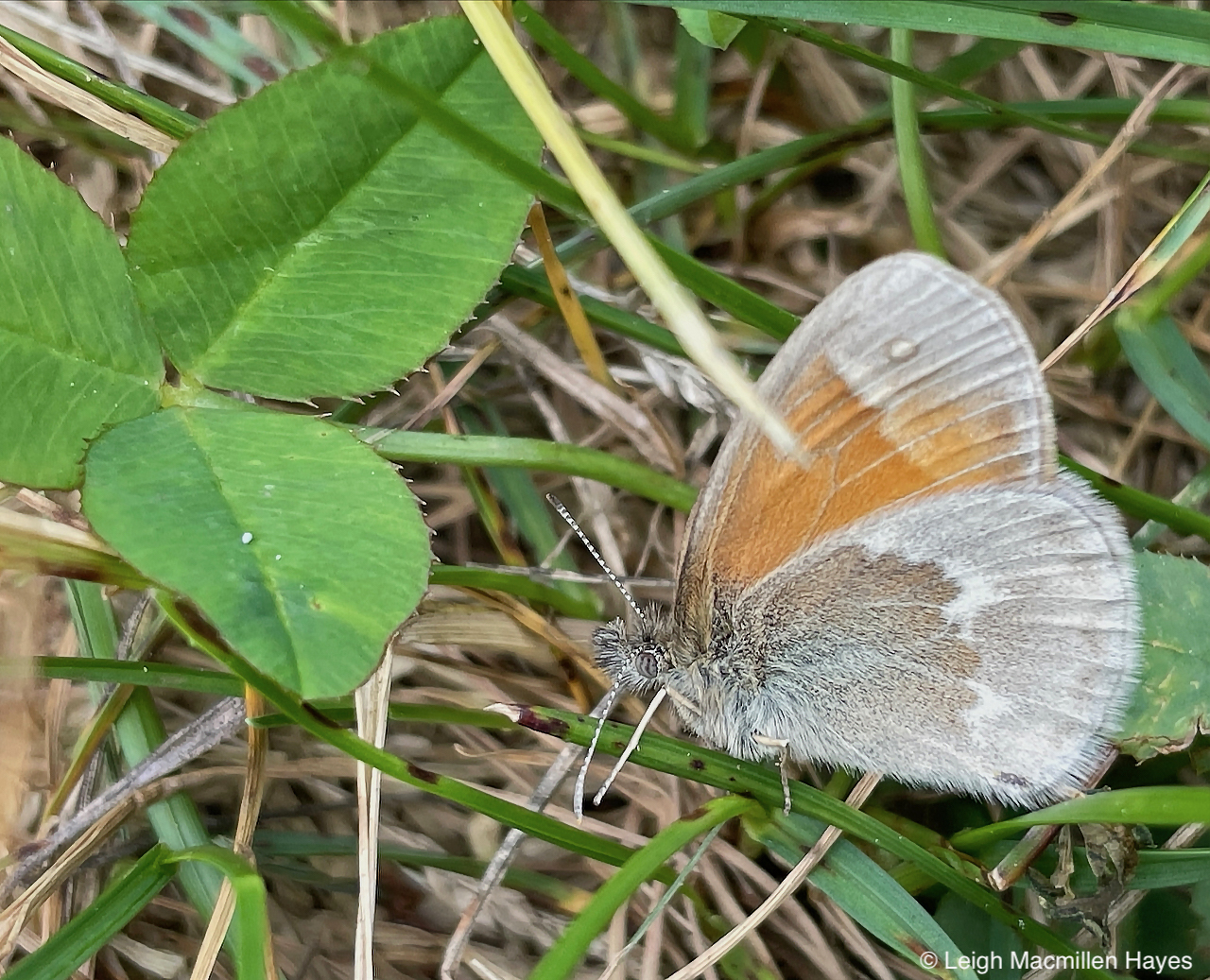
Beauty fluttered in one recent day,
Upon hairy wings of orange and gray. 
The Inornate Ringlet Butterfly
May have lacked adornment, 
But its textures and lines and colors
From the zebra-striped antennae 
To fringed wings gave pause
In its teeny exquisite way. 
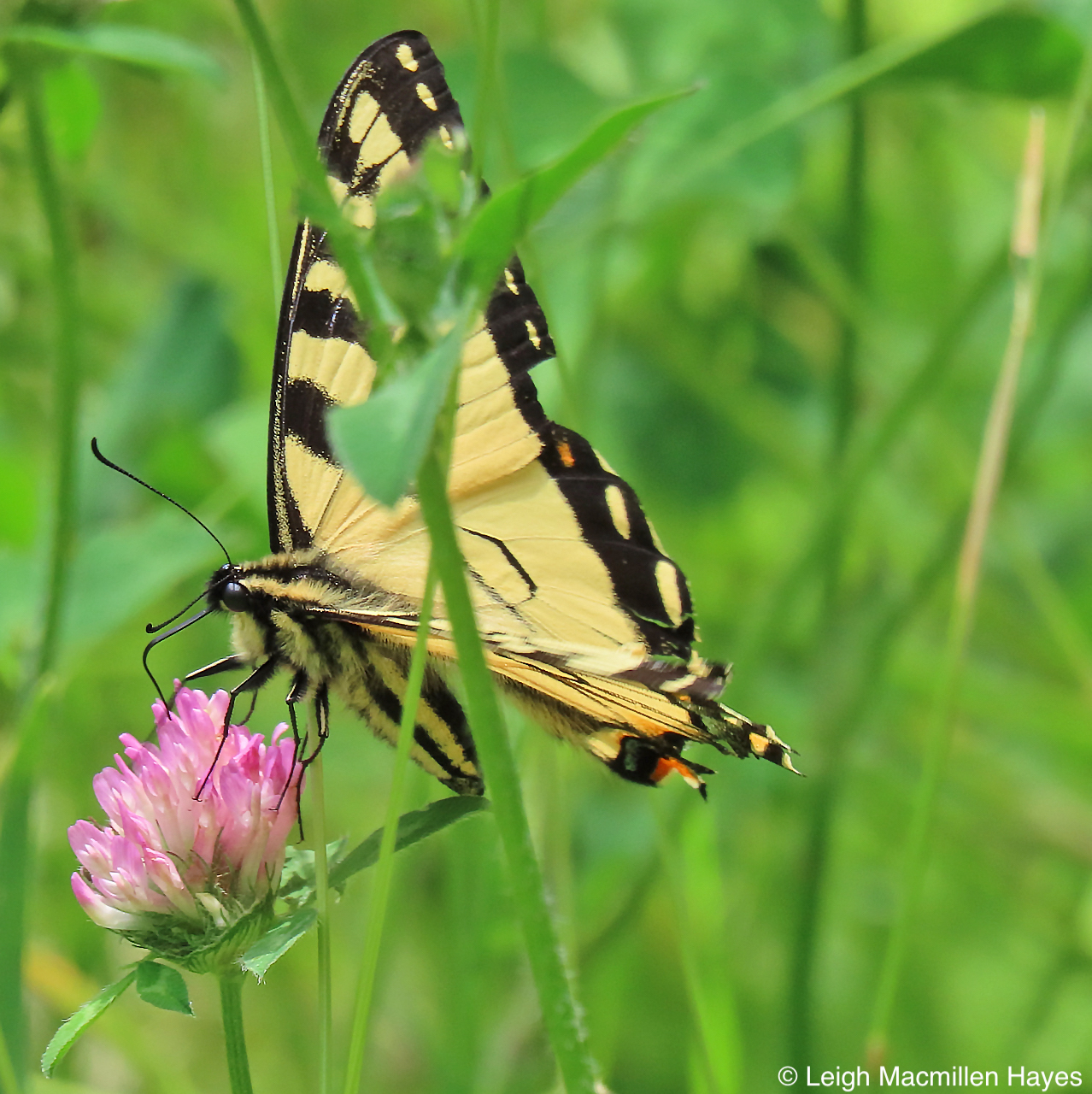
On a much larger scale, 
Upon a clover posed, 
A Tiger Swallowtail seeking sugary nectar
For a quick dash of energy 
As sucked through its extended proboscis. 
While the nectar provides nutrition,
It's not enough for that which is 
Utmost upon the butterfly's mind, 
If it is a mind they have, 
Or perhaps pure instinct
That urges them to reproduce. 
A stronger drink is indeed necessary.
The White Admirals
Embraced the same "thought" 
As they congregated 
On a small pile of scat. 
Mud. fermenting fruit, and carrion
Provide the same, 
That stronger drink
A source of sodium and minerals
That males store in their sperm
And pass on as a betrothal gift 
When they canoodle with loved ones, 
Ensuring that a little extra zing
Gives her eggs a better chance of success. 
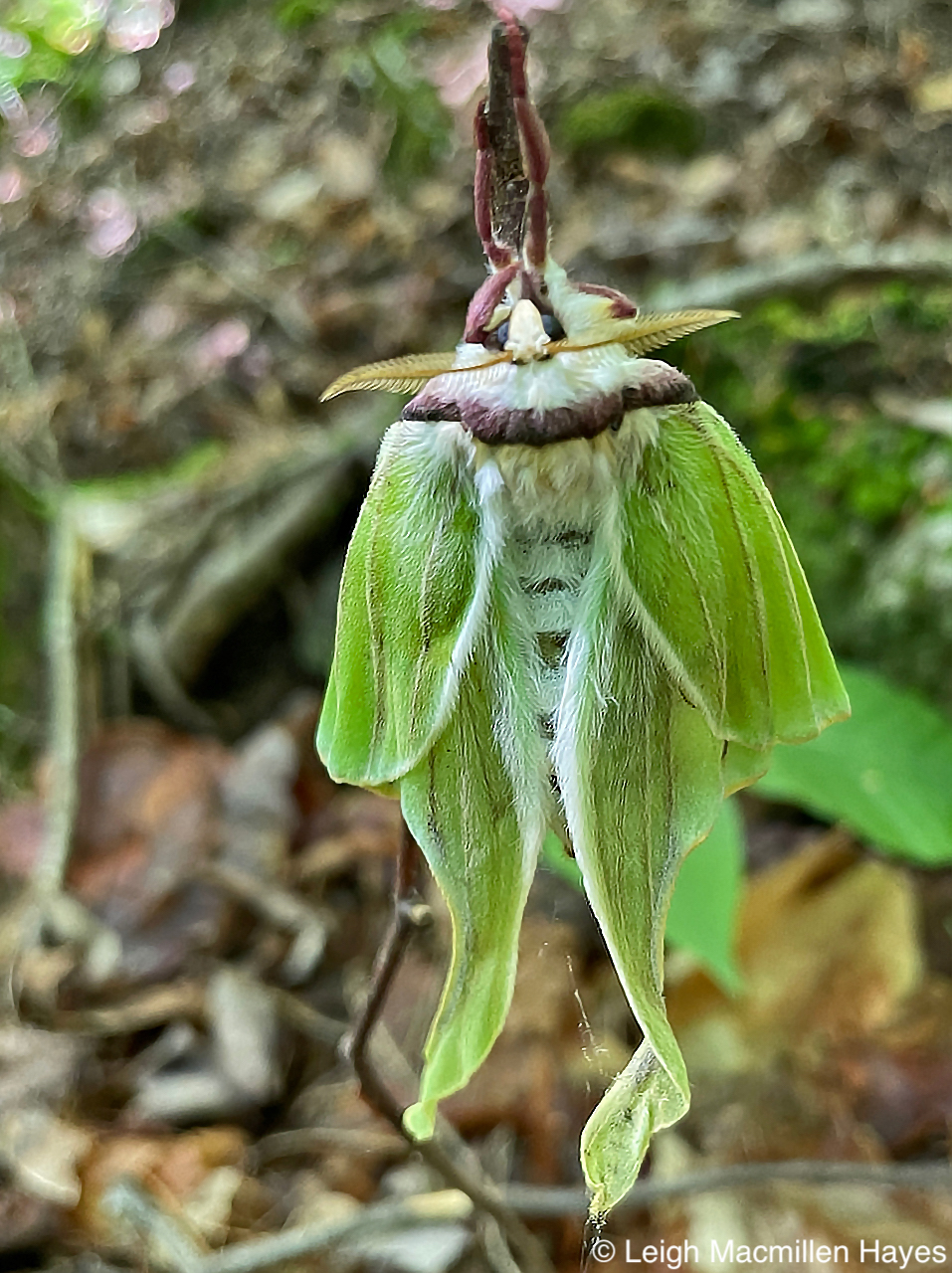
Canoodling is also
At the forefront of 
The Luna Moth's adult form,
So much so, 
That it has no mouthparts 
Or digestive system
Despite its large body. 
With less than a week to mate,
This large silkworm moth
Must smell the pheromones 
Of a female counterpart,
and then . . . and then, 
Death doth come 
As is visible by this find. 
But still it provides an opportunity
To note those broad feathery antennae, 
The light green wings that match the color of leaves, 
And the reddish-brown forewing edges 
Branching out like twigs
In an attempt to avoid predators.
Another nectar feeder, 
The Clearwing Hummingbird Moth,
Hovers with its body stationary
As its transparent wings beat
In such a quick manner 
That they are nearly invisible. 
Unlike most moths, 
These take to the air 
Throughout the day. 
The subject matter transitions
From butterflies and moths 
To others such as a female Metallic Green Sweat Bee,
So named for her color 
And preference for seeking salts upon our skin.
Thankfully, unlike some bees, 
She isn't aggressive.
Rather, she's a buzz pollinator,
One who grabs the anther 
Of a flower with her mandibles, 
Curls her abdomen around it,
Vibrates her wing muscles, 
And relishes with glory 
As the anther releases its pollen, 
Which she gathers
Upon her hairy hind legs.
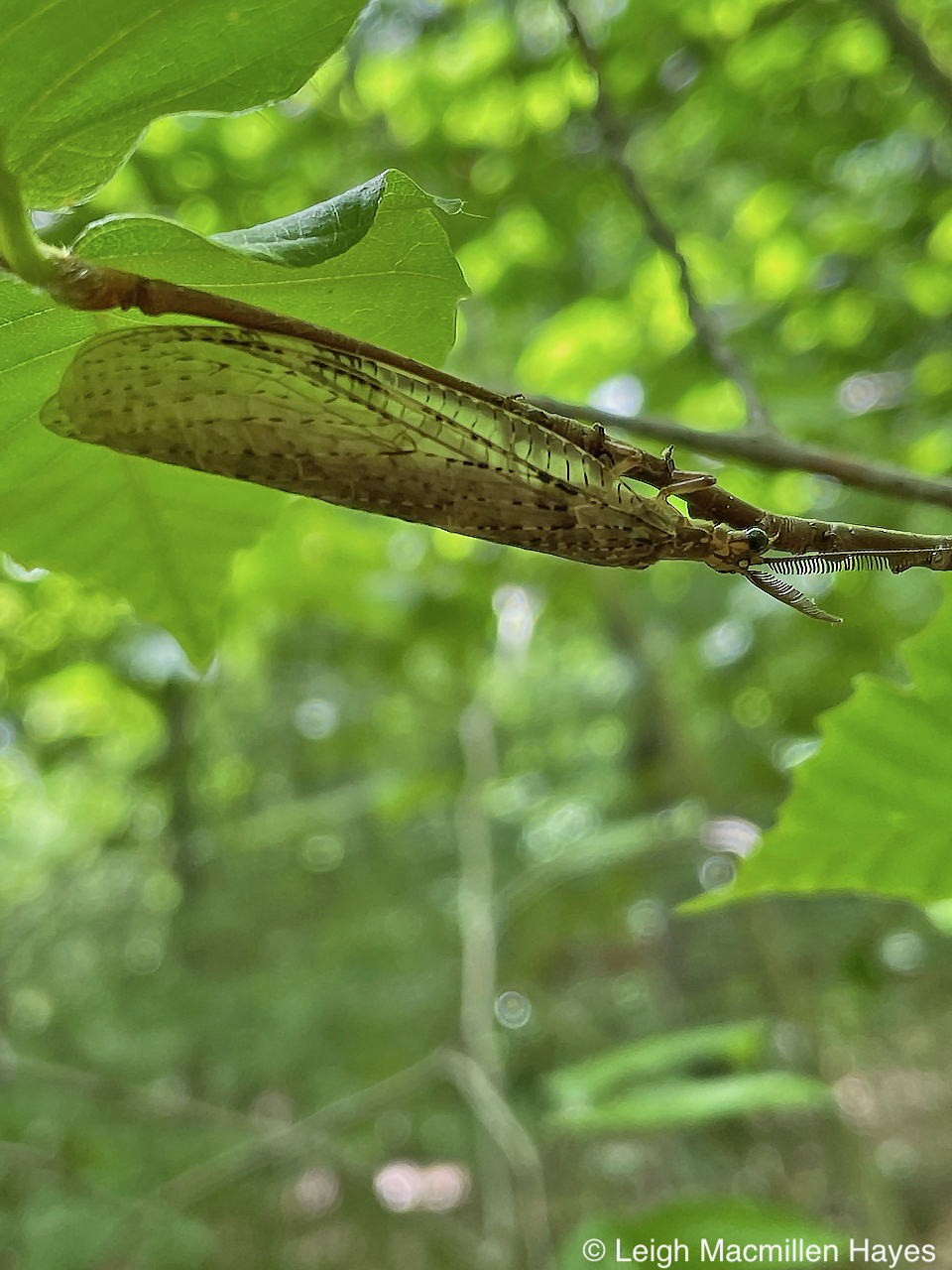
A Spring Fishfly 
I accidentally agreed was a Lacewing
In the field, 
Rests upon a twig 
As is its daytime habit, 
Wings pleated and folder 
Over its shorter abdomen. 
Like the Luna Moth, 
It only lives a few days as an adult. 
The feathery antennae 
Identify it as a male,
One with a twinkle in its eyes. 
Though kind of creepy in nature, 
The Woolly Alder Aphids 
Lead an interesting life. 
Eggs are laid upon Silver Maples, 
And as leaves burst in spring, 
Feeding takes place along the midribs. 
A winged generation soon follows,
Taking advantage that it looks like airborne seeds, 
As it floats through the airways
Until it reaches a Speckled Alder. 
Each little insect is coated 
With waxy streamers that shed water. 
As they imbibe on the Alder's juices
In an effort to gather sufficient nitrogen, 
They release unwanted carbs
In the form of honeydew,
And ants kick into action,
Farming the aphids 
To take advantage 
Of the sweet secretion. 
All is not pretty
In the natural world
Where though some 
Don't have a meal on their minds, 
Others must dine,
Such as this spider, 
That spent several hours
Wrapping a damselfly
For a future meal 
Upon an American Beech leaf. 
That was the first example of brawn, 
An exhibition of physical and muscular strength. 
In the case of the spider, 
I'm not sure I spotted an equal amount of beauty. 
But this Stream Cruiser, 
With its Oreo Cookie coloration
Was a sight to behold,
Despite the fact
That it beheld a meal of it own. 
And finally there was
The Dragonhunter, 
A clubtail dragonfly
Revered for its wide tail,
Large size,  
And bright colorations,
But feared for being 
The Monster of the Dragonfly World 
Due to its aerial ambush
Upon other dragonflies and anything else it can eat. 
It appears there is possible meal 
Dangling below the feet and wings of this one. 

It truly is a world of beauty,
but I recognize also 
that eating for the sake of reproduction
means that brawn is an important part of the mix
in this world of wonder. 

Two kingdoms indeed. 

Snow in June

On this June day with temps in the 70˚s, it hardly seemed possible that it might snow.

But indeed it did.

OK, so I hope the title caught your attention just as this field of daisies caught mine. The little flowers with their sunshiny centers (disK flowers) and white petals (ray flowers) that open with the break of dawn and close as the sun sets are an example of a $.50 cent word I recently learned: nyctinasty. I’ve read several theories about why some plants do this: perhaps to reduce its surface at night and thus retain temperature control; or reduce nighttime herbivory; or reduce the risk of flowers freezing; or protect pollen by keeping the plant dry at night.

All of these make sense, but it’s the daytime display in an unexpected place that has been mown for several years now, that captured my heart. I’d completely forgotten how beautiful this field could be with its array of daisies and hawkweeds and clovers. It was the daisies, however, that made the biggest splash.

By day, the field daisies attract any number of pollinators and as I stood beside and among them, they offered landing pads for a multitude of insects.

The White Admiral, with its handsome blue spots that mimicked the color of the sky, was nearly the same size.

With hundreds of those tiny disk flowers to feast upon, the butterfly had a full supply of nectar and in the midst of sipping it, gathered some pollen upon its feet, which it could pass off to the next daisy.

A Bumble Bee in constant motion, did the same. And added to the sound of buzziness in this place.

In the midst of all the flitting there was a tiny skipper sticking its proboscis into for a sweet sip. Such big eyes for such a little butterfly.

Big eyes are an insect thing–all those lenses in compound fashion offering views up, down, and all around so that as it stops in to take advantage of all that the flower has to offer, it can see all others in the area, including a certain photographer.

There were even teeny, tiny flower flies with long legs, veined wings, and equally teeny eyes, sucking from the source.

No, it isn’t my beloved snow that I came upon on this June day, but rather a field of daisies offering a scene reminiscent of snow white . . . with lots of colors and sounds in the midst spotted on this longest of days.

Happy Summer Solstice 2023.

Waving on Father’s Day

It barely rained. Well, actually, it didn’t rain. Just a bit of drizzle now and again. And so this afternoon, after a Facetime session with our youngest and his gal, we headed off for a hike, My Guy and me. I’m pretty sure he missed most of what I saw, but that’s okay. It was a day to celebrate him and he was welcome to do as he wished and think whatever he thought along the way.

Every once in a while, I’d say, “Hold on,” because something caught my eye and I needed to stop to honor whatever it might be . . . in this case Northern Bush Honeysuckle, a native species. Honeysuckles always take me back to my childhood and that heady scent that filled many a walk from beach to town. I spotted only an ant today crawling into the leaves, but suspect on a warmer day butterflies and moths will stop by for a sip and in the process aid in pollination.

Next up, was another not quite in flower yet . . . a Bristly Sarsaparilla. Its round flowerhead is known as an umbel and when the individual flowers do bloom, each will offer five teeny, tiny petals.

One contrast between this, the Bristly version and a Wild Sarsaparilla is that the compound leaves of the former are found below the umbels, while the latter flowers occur on a separate stem and hide below, as if the leaves are an umbrella.

And that adjective in the name . . . Bristly . . . refers to the bristles on the stem, which aren’t sharp at all. The stem of the Wild version is smooth, another difference to consider when trying to distinguish the two varieties.

The next stop in my tracks find was a Red Raspberry Slime Mold, aka Tubifera ferruginosa. It’s one of those species that you wish you could spend hours or even days watching, but My Guy didn’t quite feel the same and so we moved onward.

Much more to his liking . . . a few Lady’s Slippers. We only saw three in total, a low number in our book of hundreds, but we still rejoiced in these because their days are waning.

So much so that the petals and sepals of this particular orchid had begun to change form and we suspect there will be a capsule head and seeds in the future.

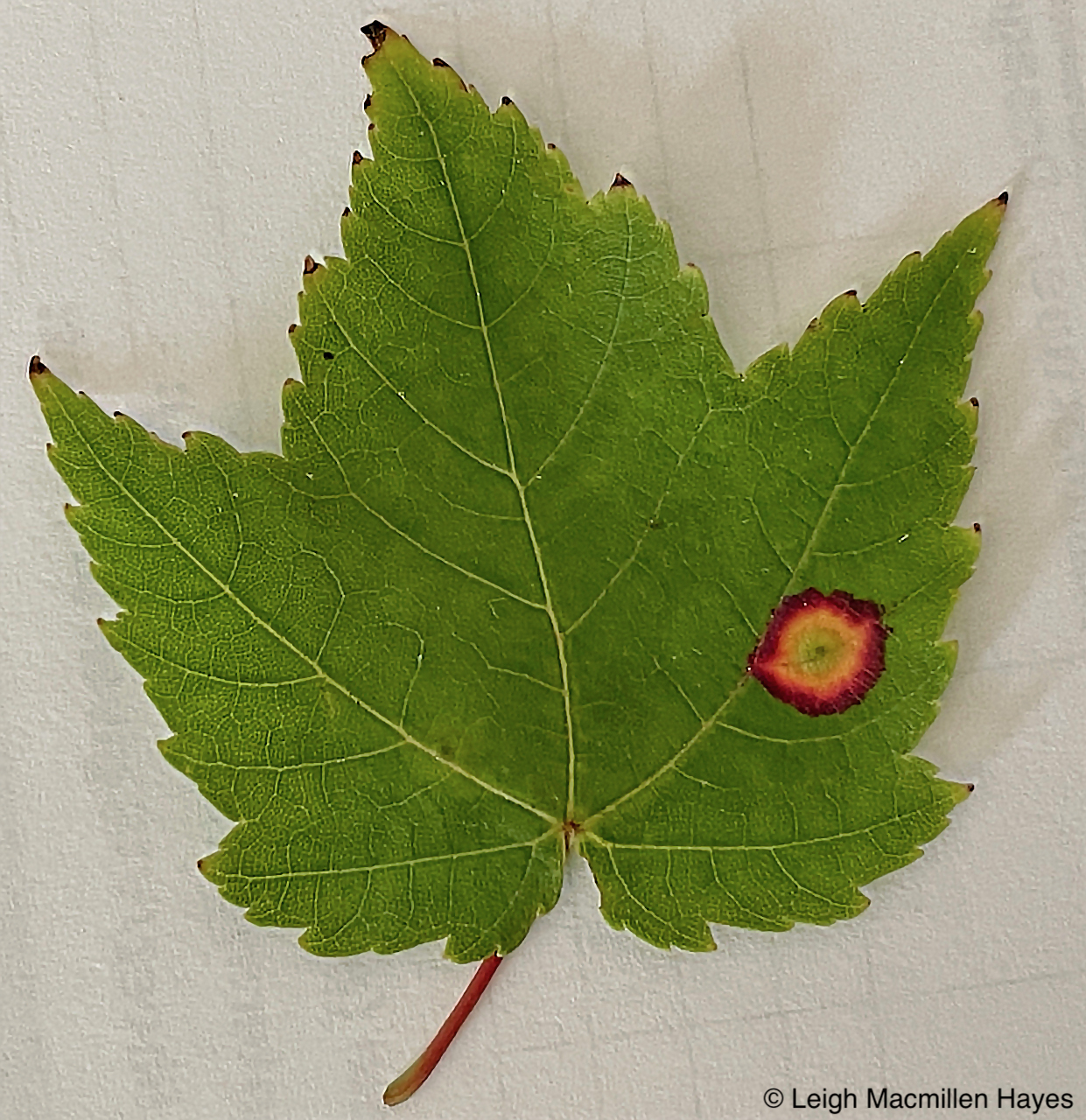
The last great find of the day was what could almost be considered a crystallized candy upon maple leaves. But really, it’s bumpy pink growths caused by a gall mite. This is the Maple Velvet Erineum Gall.

The mites overwinter under loosened bark and around wounds and scars. In early spring, they produce the gall-forming stage that migrate to expanding buds and make themselves at home as they begin to feed on the undersurface of future leaves. The tree won’t die, but really, leaves work so hard to survive the winter and then are attacked on so many fronts.

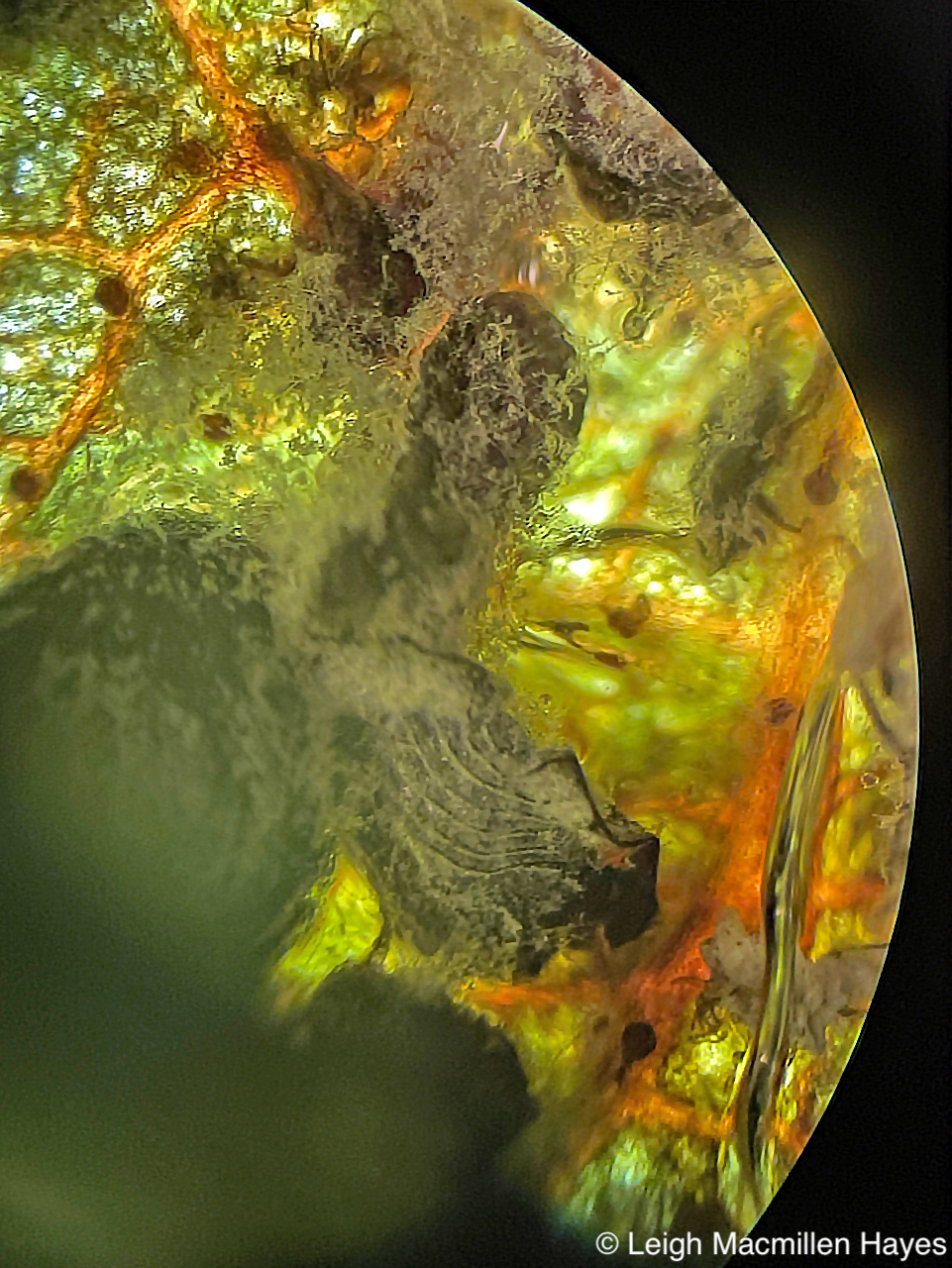
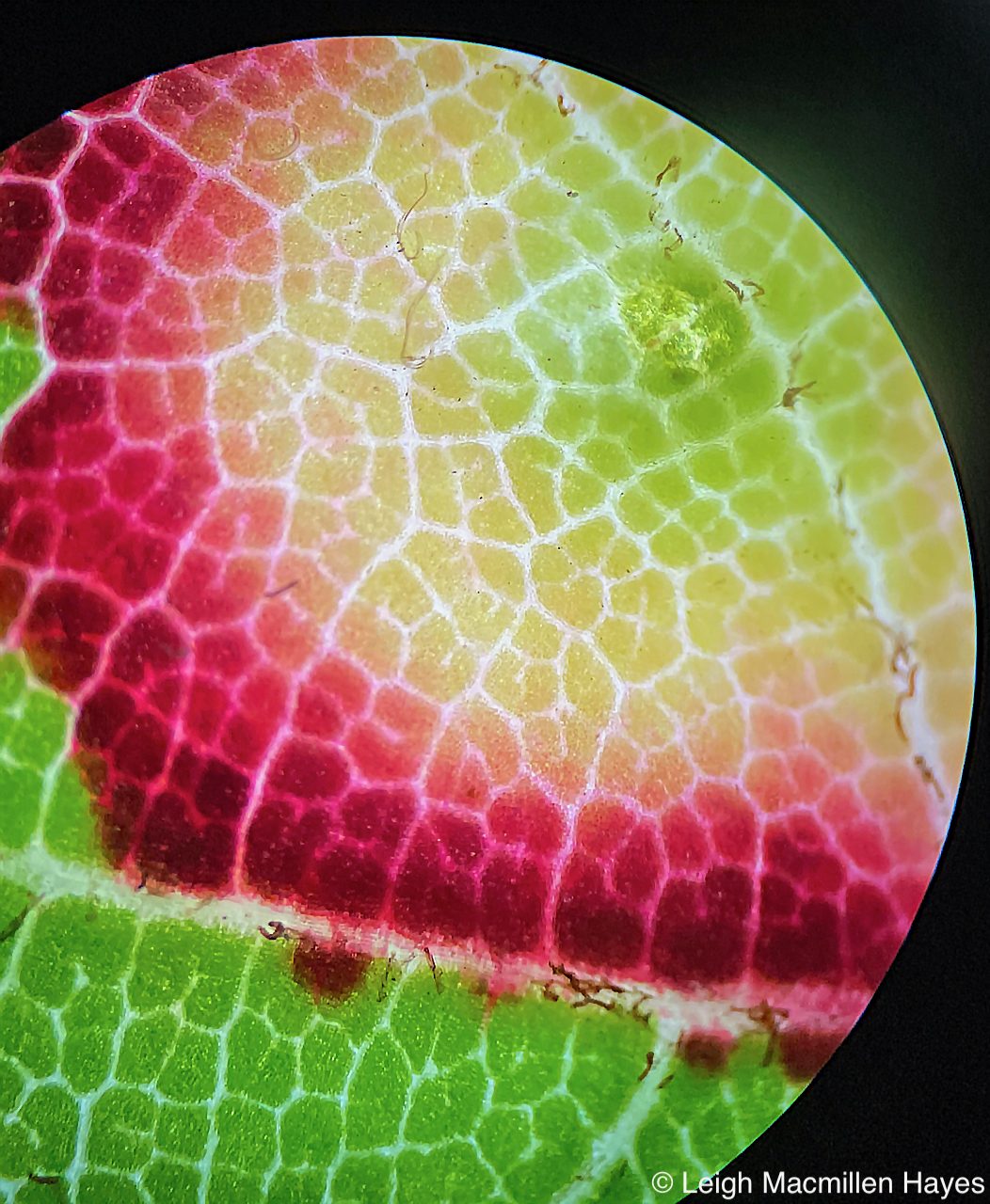
Can you believe that one leaf followed me home? Here’s a look at part of its structure not affected by the gall.

The pinkish-red, however, is the gall. The mite itself is so microscopic that I don’t think I can locate it.

I did take a closer look and maybe the dark thing on the right is related. But what struck me most was the deformed shapes where the gall had affected the leaf’s cells.

And then there was this other interesting form, again on the right, in a different section of the leaf. It certainly looked like it had a form and purpose, but I’m not yet privy to that information. Maybe some day.

Could it be a bunch of mites?

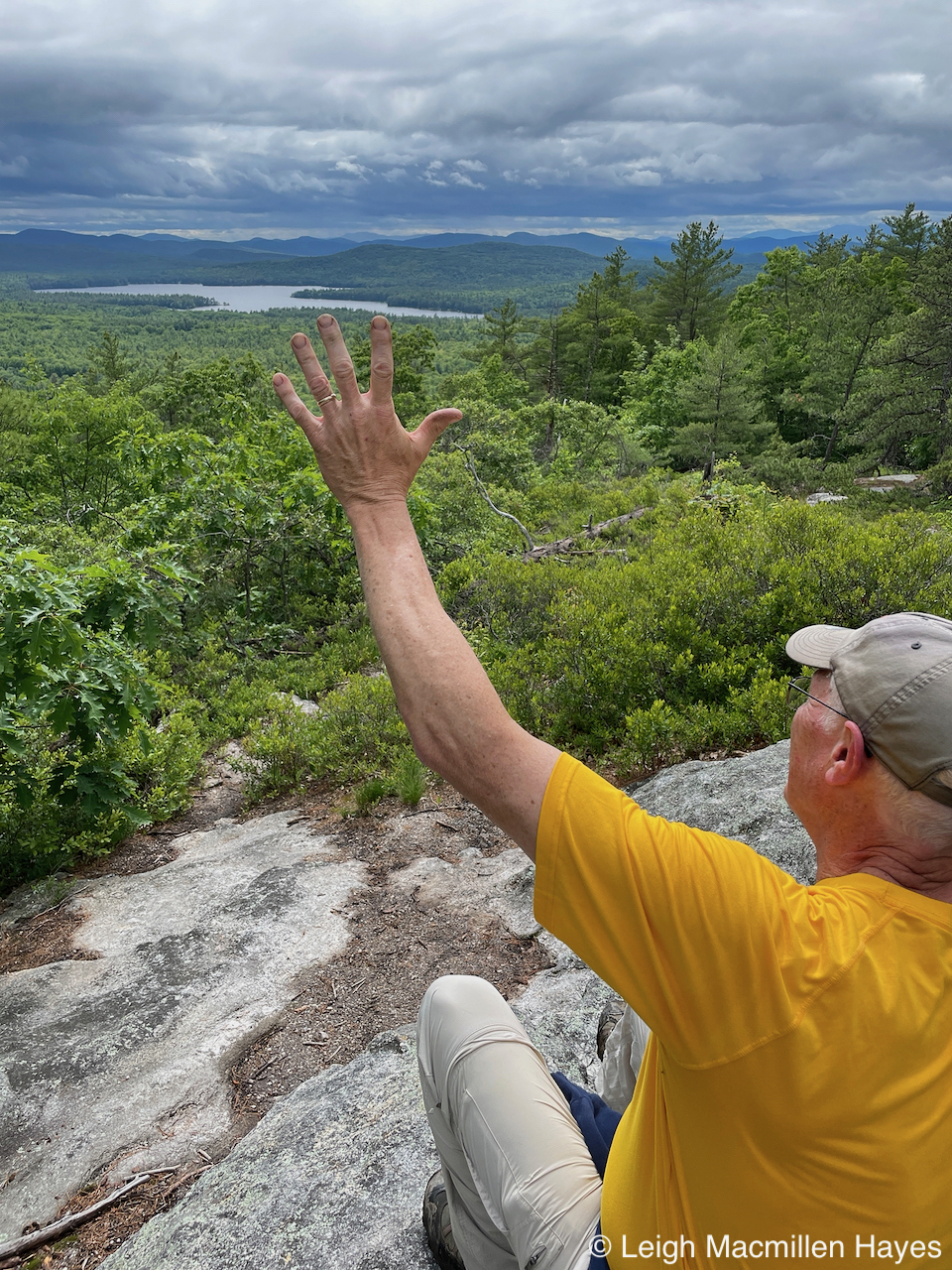
In the meantime, it is still Father’s Day and My Guy took a moment to wave hello to family and friends from the summit. We’re pretty sure we saw you all wave back.

Looking Through A New Lens

I have a new toy. While I’m still learning how to use it, I’m having the best time making discoveries. And trying to understand what I see. Actually, it’s two new toys. One that sees. And a second one that sees what the first one sees. Now that you either need to know more, or have already clicked out of this blog, let me explain.

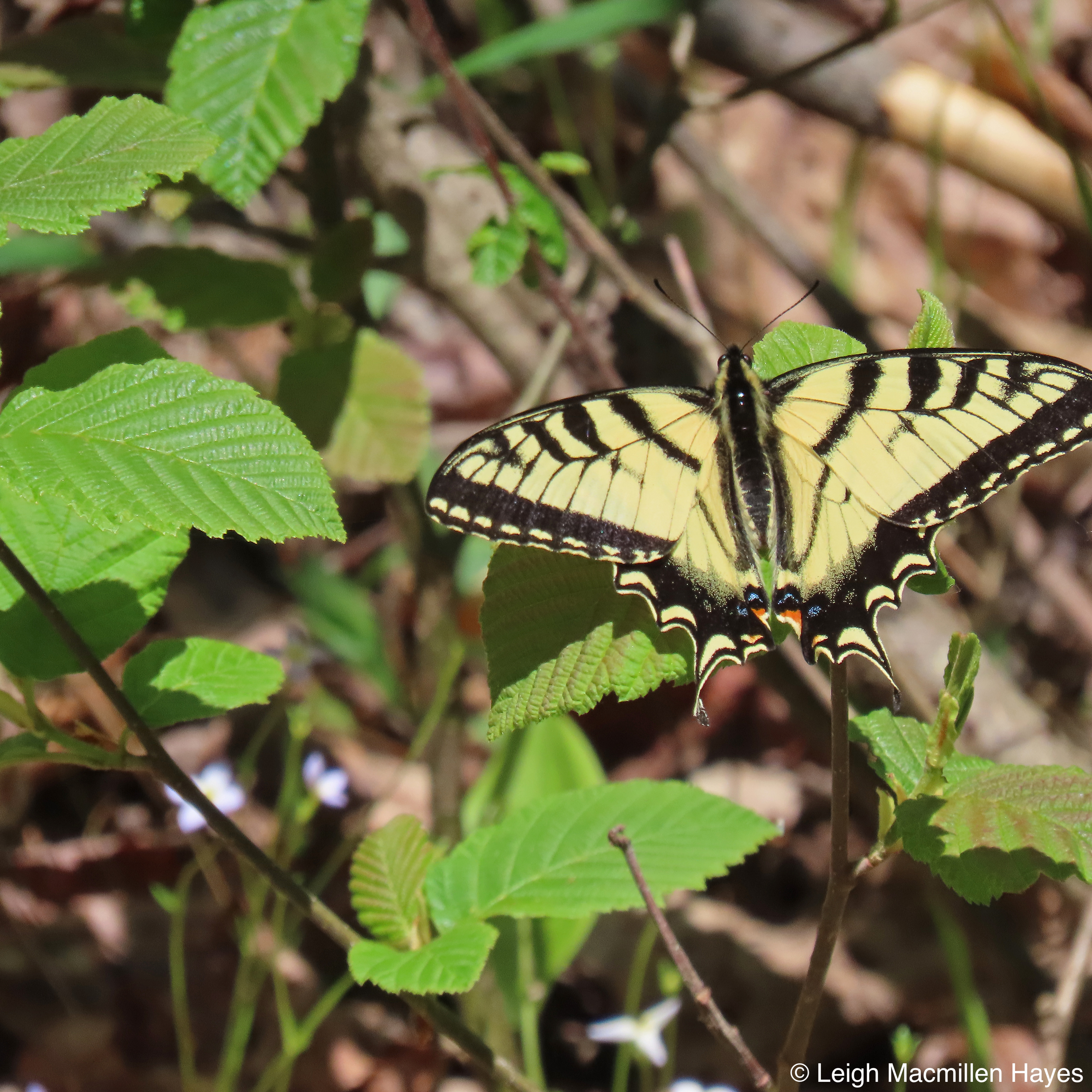
It all begins with a Tiger Swallowtail butterfly, one of exquisite color and form. This is one I spotted recently.

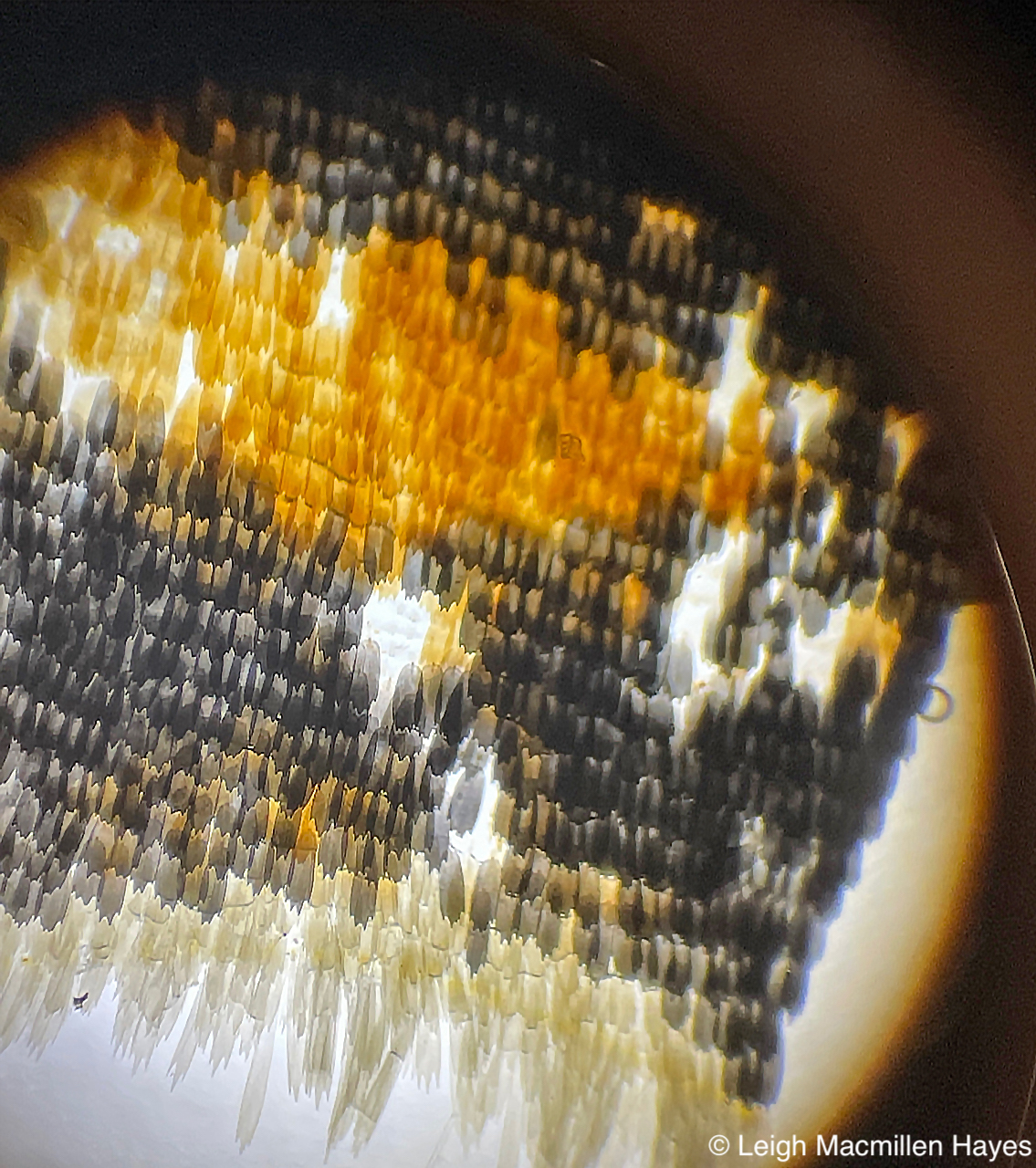
But one of my Pam friends, being Pam M., tells a story of finding a tattered one that still had some life and how she tended it for a few days and hoped it would fly, but alas, the other day she found it did not survive. So she did what good friends do and saved a piece of the wing for me to look at under my new microscope. Check out each of those scales, which put together form the color pattern we see.

The wings consist of thousands of tiny scales that overlap. If you were to touch the wings of a butterfly, and I don’t encourage that unless it is dead, it might feel like you have powder on your hands. That powder is actually the scales, so if handling a butterfly, you may be removing some of these delicate forms that together make up the mosaic which becomes the color pattern we recognize.

Our next look is at a leaf I gathered last week while tramping with some friends. I regret that I didn’t take a photo immediately. Instead, the leaf spent a week in a bag in my truck and when I took it out yesterday, the bag was full of insect frass. This is an upper view of the leaf.

And this is the underside. When we spotted it last week, we all used our loupes to take a closer look and what we saw intrigued us, but we didn’t quite understand what we were seeing. Where the leaf is brown-gray on the left-hand side and a bit deformed, there was a series of structures all in a row. They seemed to be a bit raised. Sad to say I cannot share that image with you because I did not take it.

But . . .

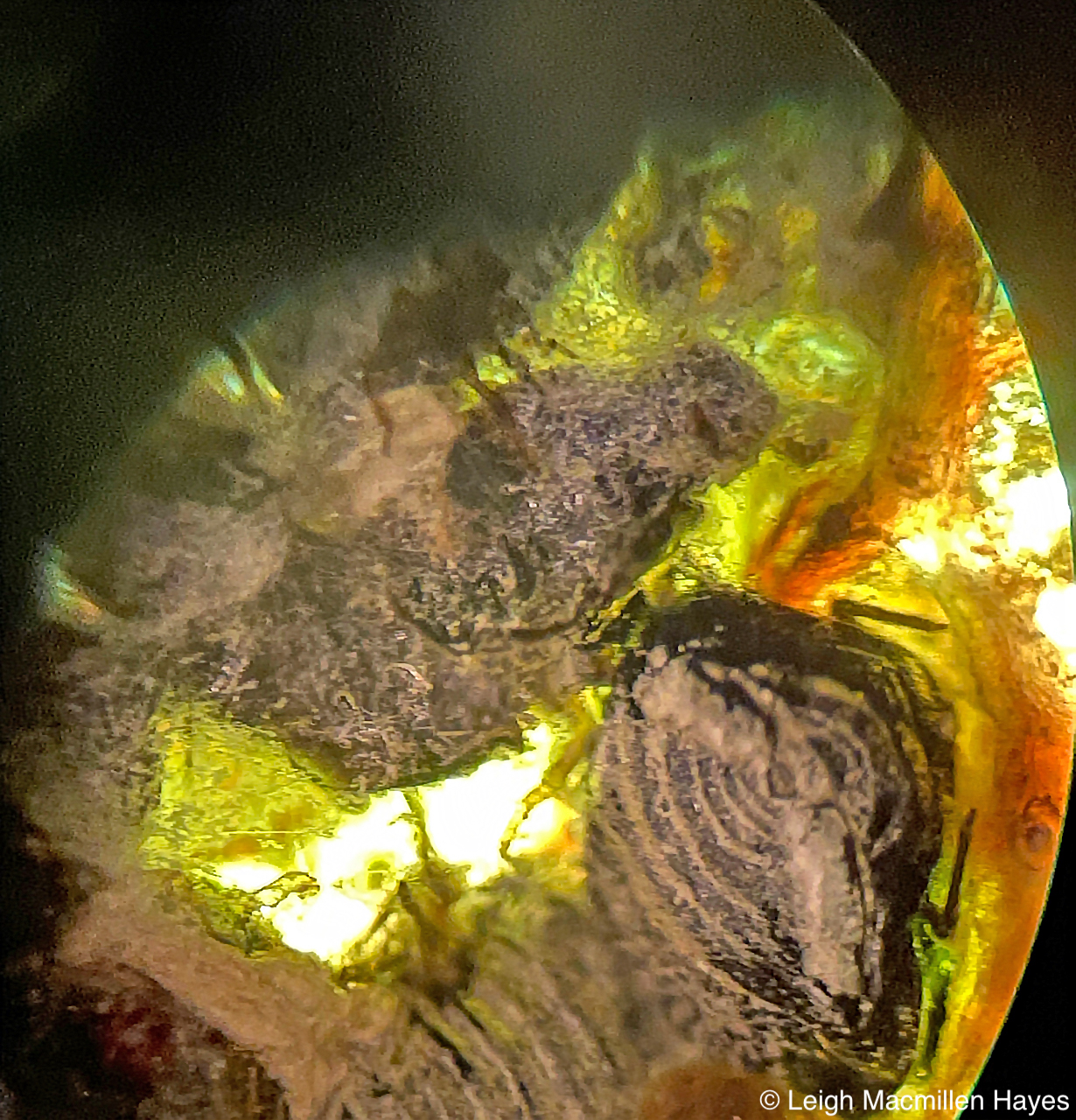
When I looked through the microscope, these critters appeared. they are minute, and some sort of leaf eater.

As best I can describe it, you are looking at several insects, some frass (think mammal scat or bird poop), leaf veins and tissue and colors that don’t appear to the naked eye.

I’m not the best with using the second toy I mentioned earlier, which is an adapter so I can take photos through the microscope with my phone, but at least I have something to work toward. And understanding all that I’m seeing will also take time. In the meantime, I’m just enjoying it for the sake of the different world it has opened up to me.

The final selection was found by a group of us today and it’s a Maple Eyespot Gall created by a Maple Eyespot Gall Midge (Ocellate Gall Midge). The curious thing about this fly midge is that larvae develop in leaves, but after about a week during which time the gall forms, the larva falls to the ground and burrows under the leaf litter to pupate.

This is a view of the top side of the leaf. I’m in awe not only of the colors of the gall, but of the intricate structure of the leaf as well. The midge larva had been in the upper right-hand corner until recently based on the vivid colors, which will fade with time.

Here is the underside, and that same area that had stored the midge, now visible toward the center, appears to be an open hole, meaning the larva had moved from tree to earth, but this also gives a sneak peek at the cellular structure of the leaf. A topic to explore more down the road.

That’s all for my first attempts at taking a closer look with the microscope and then trying to capture what I saw with a phone, but I had to share this little critter because I don’t often get to see the actual creator of the Snake Spit. Yes, I grew up believing that all that plants that had this foamy white “spit” on them had been visited by a snake. It’s actually the protective covering for the larval form of a Spittlebug.

This was a first attempt to wonder with the help of some new technology. I don’t know about you, but it’s opening a whole new world to me so stay tuned for occasional closer looks through the lens.

A Glimmer In Their Eyes

It’s been a rainy week. It’s been a sunny week. And sometimes it’s been both simultaneously.

Despite the weather, I’ve spent many hours tramping through the woods as is my custom, sometimes with others, including a large middle school class, and sometimes alone. Most of the tramps found me near or beside water–after all, this is the Lakes Region of Maine.

On one such, almost a week ago, this fly and its brothers and sisters landed repeatedly on our outerwear. Turns out there is a reason for this. It’s known as the Friendly Fly for its habit of landing on people no matter how often it is brushed away. It won’t bite, but if your skin is exposed, it may try to sip at salts and tickle a bit.

Here’s the best news about the Friendly Fly. While it doesn’t bite us, it is known to parasitize Tent Caterpillars such as this one found in the same neighborhood. Going forward, I will honor each Friendly Fly I meet. Now if only we could find something that would do the same to Brown Tail and Spongy Moth larvae.

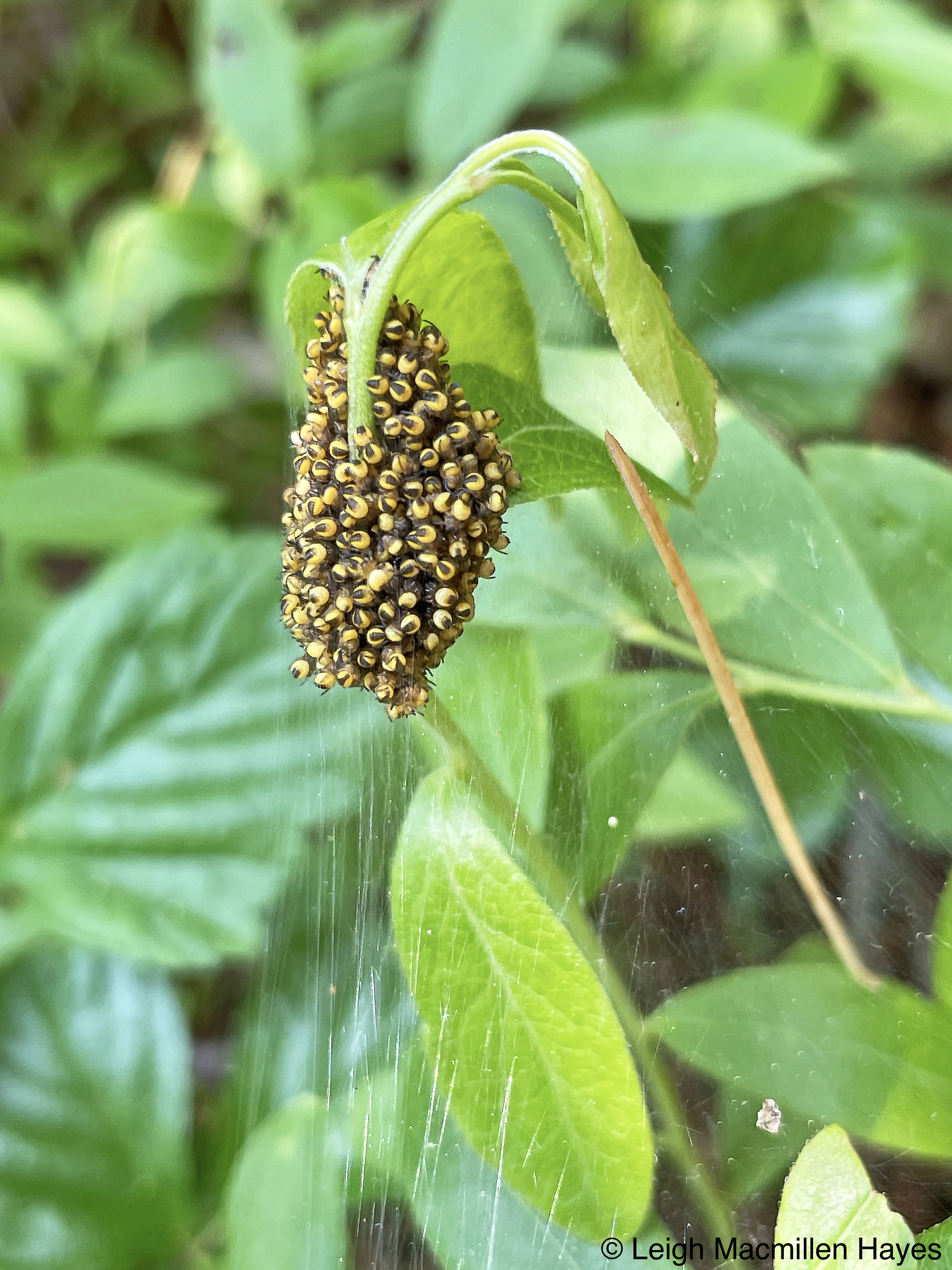
In the same neck of the woods, what appeared to be a flower, turned into a hundred or more spiderlings of the Cross Orb-weaver family. Notice all their guide lines. Such a clever construction.

When disturbed by accident, they didn’t leave the cluster, but did scamper on those guidelines for a minute or two before reassembling. I’ve read that they stay together much like so many others–there’s protection in numbers. During this stage of their lives, they feed on their egg yolks. I’ll take mine sunny-side-up.

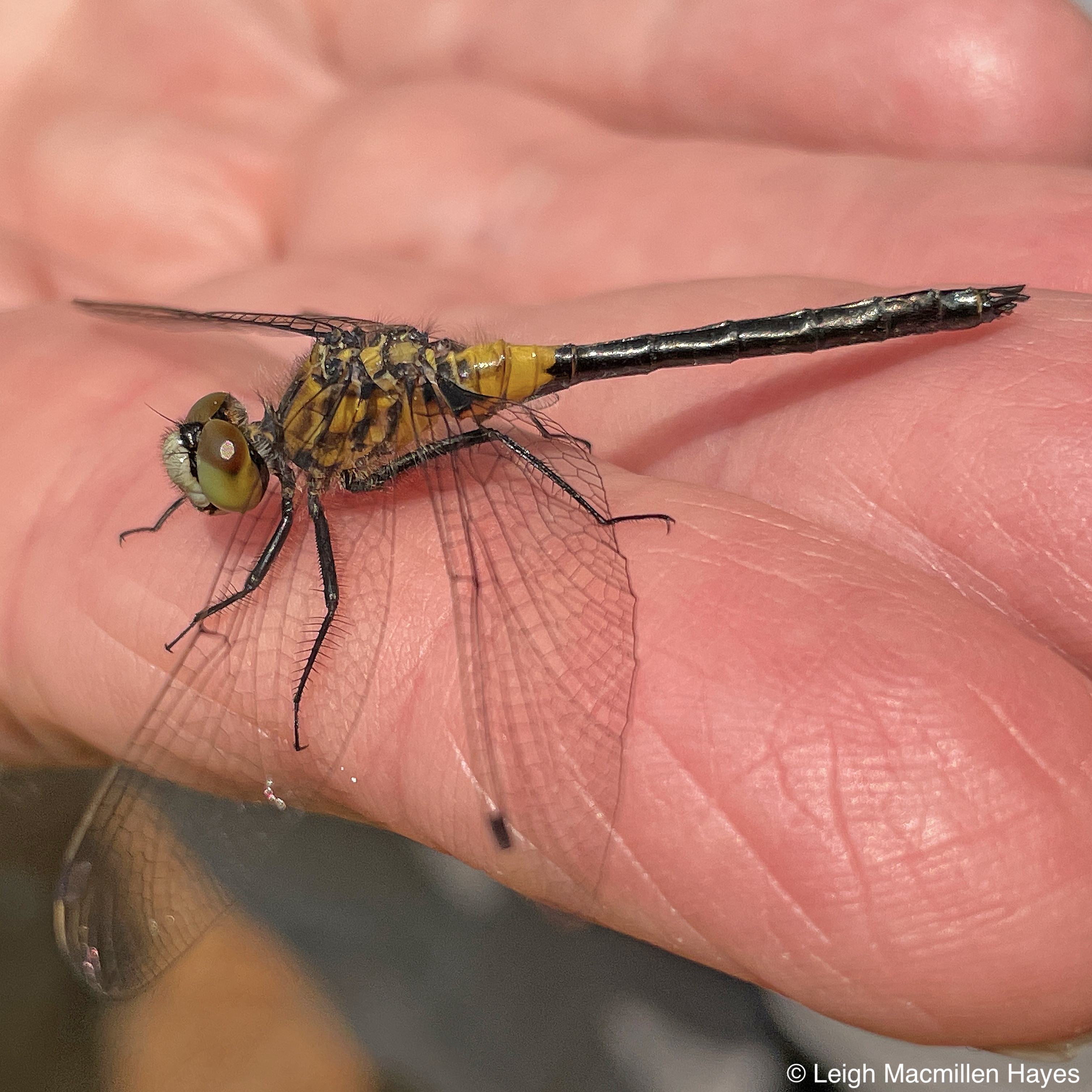
And finally, in that same place, we spent a few moments with an immature male Belted Whiteface Skimmer dragonfly so identified by its yellow thorax and the yellow base to the black abdomen. As it matures, the abdomen will turn brown and then red.

And just look at that white face. Can you even get a sense of some of the 30,000 lenses of the compound eye in the light spot? Dragonflies have incredible eyesight–they can see up and down and all around with almost 360˚ vision.

I have to say I think it was because of the damp, cold weather that this particular one decided to crawl upon my extended finger and allowed me to pass it on to another. We provided a wee bit of warmth.

Another white faced skimmer encountered in a different place was what’s known as a Dot-tailed Whiteface. At just over an inch in length, it’s a small dragonfly, but that dot is the giveaway, which makes it easy to ID in the field.

There seemed to be a theme–that of the white face variety. This one is known as a Crimson-ringed Whiteface.

One of my favorite skimmers is the Chalk-fronted Corporal, who earned its name for the corporal stripes on its thorax. And maybe it’s the old teacher in my blood that appreciates good old chalk. The fun thing about this species is that it’s usually found in groups, and you might not see them until you take a step and then they fly three steps forward, repeating this behavior throughout your entire journey in their neighborhood. They are also great posers.

Immature Chalk-fronted Corporals such as this one are also abundant and seem to be circulating in every trailhead parking lot. They blend in well with their surroundings, so once again, I don’t spot them until they fly.

The next skimmer is a personal favorite. But the question is, can you find it? I have to say that I knew I’d taken its photo, but when I was reviewing the shots, I wondered why I’d taken this one of some vegetation and missed the female Eastern Pondhawk for so camouflaged is she.

In another space I encountered a Racket-tailed Emerald. Look at that club-shaped abdomen. And fancy mirror-imaged yellow spots ringing the third abdominal segment.

Though I have no problem with dragonflies garnering so much of my attention during flying season, damsels also like to be noticed like this female Ebony Jewelwing. Her lighter colored black wings and white stigma at the tip give away her gender. But it’s the iridescent blue and green eyes and body that always make my heart skip a beat.

Another teenager also asked to be noticed–in the form of a sub-imago Mayfly with cloudy wings indicating its age. Had my friend stood there for the rest of the day and into the night, she might have seen it molt from this form to its final as an imago or adult.

In the midst of all these finds, and because of the rain, I returned to the vernal pool behind our house and found that the water was quite high. Usually, by June 9th the pool has dried up. But not this year. It is teeming with Wood Frog tadpoles and I suspect Spotted Salamanders for so many were the egg masses. Things are a-changing within those bodies, and I think this will be the year so many finally hop or crawl away. I’ve had my eye on this pool for thirty years, and this is a first.

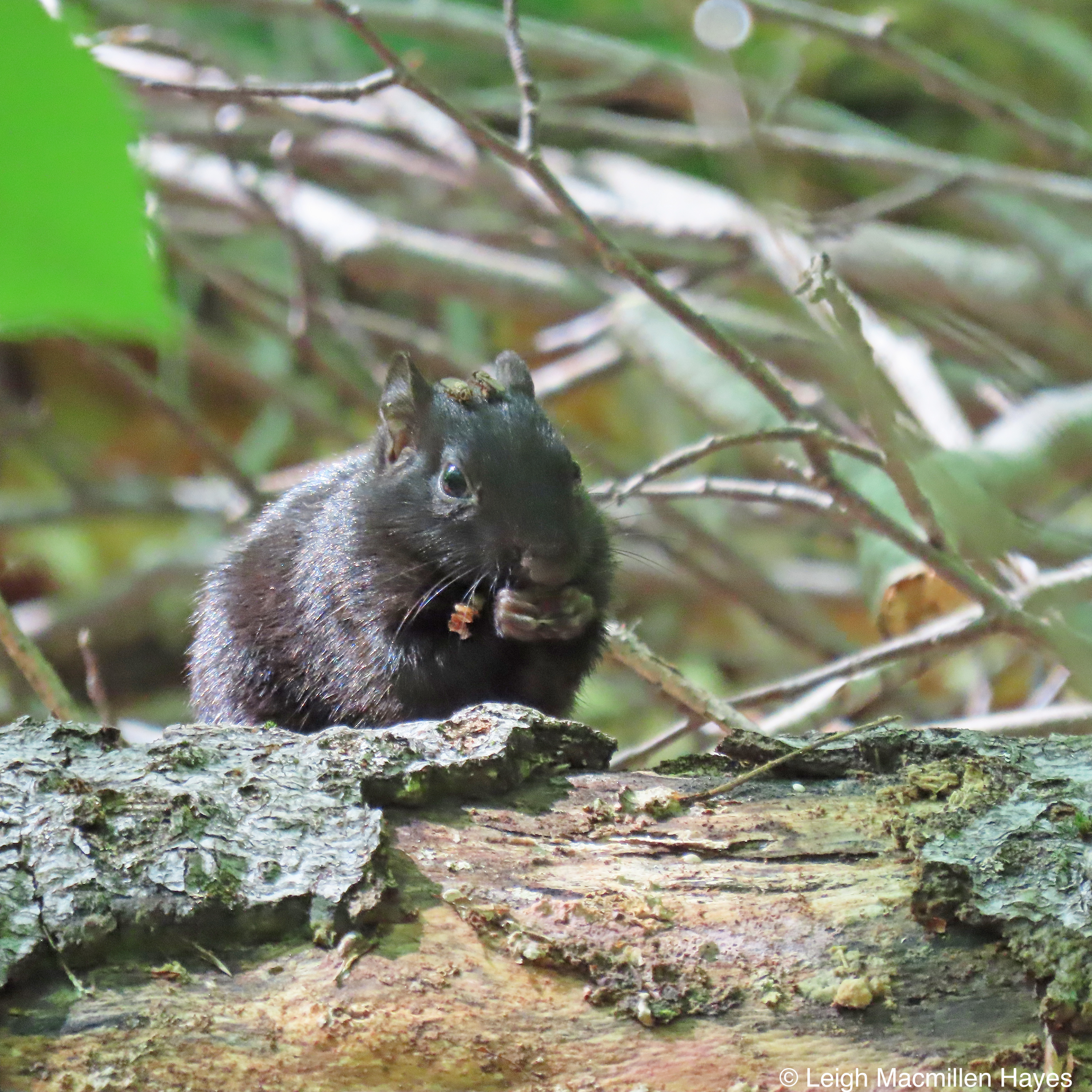
Finally, I have to share with you another I recently met and first reported in Stars Among Us. As a friend and I watched this afternoon, it dined on vegetation, stuffing its cheeks, while flies dined between its ears.

They didn’t seem to bother it as much as the mosquitoes bugged us, but still it clasped its little hands together.

Maybe it recognized the glimmer in our eyes as we watched it with joy, just as we recognized the glimmer in the eyes of all we met from the Friendly Fly to the dragonflies to the damselfly, Mayfly, Wood Frogs, and yes, the Black Chipmunk itself.

More rain and sun are in the forecast for this coming week. I wonder what we’ll see next.

Slippery Eyes

Exactly one year ago on a fine sunny day, My Guy and I drove to Wolfe’s Neck State Park in Freeport to fill the inner most recesses of our lungs with salty ocean air.

Today dawned rainy as has been the forecast now three days old, but we returned to the park with one quest in mind.

To see if we could match the count of Lady’s Slippers we encountered last year and Nature did not disappoint.

But, she also presented others to honor in their wet formations like a few remaining dandelion seeds and translucent bracts offering a sunshiny display.

Even the underside of a windblown tree, one of many, showing off its shallow root system created an artful design to admire.

Hiding beneath two three-part leaves, a long club or spadix sitting in a hooded base or spathe known as a pulpit indicated that Jill and not Jack was doing the preaching in these woods.

Though the weather changed from drizzly to dry, or maybe because it did so, White Baneberry celebrated with a show of fireworks.

And Indian Cucumber Root began to take the next step in its two-tiered story, for at least one flower had been pollinated and rather than dangle below the leaves, rose above in anticipation of a fruit forming.

There was all that to see, but My Guy, whether walking along the yellow brick road or over rocks and roots, only had his sight on one species that actually slowed him in his tracks.

Looking left and right, and peeking under and over, he kept count of his Lady’s Slippers.

Whether they grew in groups or singly, including this one that surprised even him, for it had sprouted from a mossy substrate upon a rock, each one mattered.

When at last we departed the park, I paused the truck beside a small pond outlined with Lupines.

They may not be Lady’s Slippers, but their own unique design and colors deserve to be honored as well.

We didn’t count the Lupines, but our Slippery Eyes took in 324 Lady’s, a total of 87 fewer than last year, but still we gave thanks.

Craning for the Fliers

It all began with a fishing spider moving across the surface of a river. But there was more to the story, as in a meal being consumed. And so a few of us recently went in for a closer look.

It was then that we saw wings below the spider that reflected the sun’s light. And very long, spindly legs unlike the spider’s rather robust and hairy deck of eight.

And it suddenly occurred to us that the spider was dining on a crane fly. Crane flies intrigue me for a variety of reasons. They are true flies and go through complete metamorphosis from egg to larva that molts several times to pupa to adult, but like some other adult species (think mayfly), they don’t have true mouth parts and their sole purpose at this stage is to mate and procreate.

Some folks are afraid of crane flies, and it’s understandable. They look like giant mosquitoes. And are attracted to light so if you leave an outdoor lantern on by the front door, you might find them hovering and then sneaking into the house. But, only the larval form eats and they are decomposers of organic material.

In that same river, it soon became evident that there was a lot of crane fly activity taking place. Tipula caloptera larvae are aquatic and so it makes sense that they would choose some river cobbles to support them while they canoodled.

Click on the arrow to take a peek at their efforts.

And a few cobbles over another was depositing eggs by sticking her ovipositor into the river bed repeatedly. Some crane flies deposit eggs in water and others in moist soil near water.

Again, you may click on the arrow to watch her in action.

It wasn’t enough to enjoy them in their river setting, but here at home as well. So the river action was with a large group of students on Thursday. And on Friday, a couple of hours before a major thunderstorm (that thankfully transformed 97˚ to this morning’s 48˚ and I feel alive again), I looked out a kitchen window and spied this beauty.

Meet Tipula trivitata. It’s by wing venation that a crane fly can best be identified to species.

Since crane flies are true flies, they have only two wings. But do you see the little knob at the tip of what appears to be a filament that the arrow points to? And a second on the other behind the wing on the right-hand side? Those are considered reduced wings or halteres.

Spotting these this week made me think of crane flies I’ve met along this journey, including Tipula tricolor depositing eggs among mosses.

And another of the same species resting upon the fertile frond of a Cinnamon Fern. Adult crane flies rest most of the time, that is when they are not cannot engaged in the art of begetting offspring. As adults they don’t eat. So any energy they have must be saved up from their larval form. Within a few days of mating they die, so their adult life span is not long. Maybe a week or so.

Lest we think they are only spring and summer fliers, there is also a winter crane fly, and this one made the mistake of flying too close to the winter works of a Pileated Woodpecker’s hole that had flowed with sap.

As cool as all of these species are, my favorite crane fly is the Phantom Crane Fly, Bittacomorpha clavipes.

Their wings are much shorter, but those legs! And to watch one fly almost like a little square block carried by the wind–it’s a sight worth seeing and one which you won’t forget.

I do love dragonflies, but I’ll also be craning for these other fliers as spring heads toward summer and even into the fall.

Honoring the Lady’s Slippers

It’s become a tradition for us to spend Memorial Day or at least a day during this weekend searching for one of My Guy’s favorite blooms. I don’t even remember how the count began, but now he cannot not count them.

What we’ve learned over the years is that they like a variety of habitats. from dark forests to bogs, and even mountain tops. And they like to hide. So we must really don our Lady’s Slipper eyes (just as I’ve been donning my dragonfly eyes lately) and look for them.

I mean . . . really hide.

It’s acidic soil that they are rather fond of, just like Yellow Clintonia, the beacons of many a forest trail. But while Clintonia seems to bloom anywhere and everywhere, Lady’s Slipper need Rhizoctonia fungi in order to grow and show off a blossom. According to Jack Sanders, author of The Secrets of Wildflowers, “Unlike most seeds, the minute and dustlike Lady’s Slipper seeds contain no food to allow them to grow. However, the outside of the seed is susceptible to attack by Rhizoctonia fungi, which digest the outer cells. If things balance out just right, the inner cells escape digestion and absorb some of the nutrients the fungus obtained from the soil. Not until this happens can the seed germinate and begin growing . . . The symbiosis with the fungus doesn’t end there. In order for the infant corm (or ‘proto-corm’) to obtain minerals and other soil foods, it must use the ‘go-between’ services of Rhizoctonia fungi. The fungi, in turn, take from the seedling Lady’s Slipper foods that are photosynthetically manufactured. These sensitive and complex relationships make native orchids of all kinds relatively uncommon . . . What’s more, in the wild, it takes from 10 to 17 years for a Lady’s Slipper seed to become a mature plant capable of blooming.

So here’s the thing. Yellow Clintonia and Pink Lady’s Slipper flowers look nothing alike. But their leaves–that’s a different story and when there are no flowers to confirm, one like me, must slow down and notice the features. Do you see what I mean? Clintonias are members of the Lily Family, with six lily-like tepals (segment of the outer whorl in a flower that has no differentiation between petals and sepals). And their leaves can be folded in half with the inner vein forming the fold line.

Lady’s Slippers, on the other hand, are orchids. The flower is a moccasin-shaped, inflated pouch, but also two lateral petals that twist outward. And the leaves–take a look. Remember folding paper in an accordion-like manner to create fans, or tissue paper to create flowers? That’s what Lady’s Slipper leaves look like to me. Multiple pleats.

Lest you think nature didn’t distract us, there was a male swallowtail puddling in a wet seep that we had to pause and admire.

And we certainly didn’t want Indian Cucumber Root, in the same lily subfamily as Clintonia, to think we were ignoring it for it has just begun to offer its unique flower to the world.

But our real focus, of course, were the slippers, even those decorated in white, which is a form of the pink.

Until, that is, the Common Loons begged to be noticed and so we did.

A few miles into the hike, we reached one of My Guy’s favorite spots. Just the other day I heard him describe it as a field of Lady’s Slippers. I’m pretty sure he was thinking football field. I happen to think it’s closer to the size of my office. But, it does produce about fifty flowers each year.

While he was meticulously counting those fifty, a Bald-faced Aerial Yellowjacket flew in and started chewing some wood. My attention was indeed diverted.

Heading to the summit, we didn’t find as many, but still they were there and we paused to admire this grouping. I wonder if there was a nurselog below them that offered the right growing conditions and thus the line.

At the summit, after finishing dessert (we’d eaten our sandwiches below by the pond), someone had to survey his kingdom.

It’s always worth a look.

We found some more as we descended and then followed a different trail out, where another lady made herself known.

Meet a female Common Whitetail Skimmer dragonfly, who is hardly common with her tail markings, and spots on her wings.

We were almost finished when we spotted this Lady’s Slipper blowing in the breeze. Note the curve in the stem, and the closed moccasin.

I don’t know if removing the leaf will help the flower to fully develop, but it made me think of today, Memorial Day, and the fact that so many have in the past and do presently work so that we can enjoy the freedom of going for a hike in the woods–thank you to all who have served our country, past, present, and future, including our dads, uncles, cousins, and friends.

The question remains: How many Lady’s Slippers did we honor on this Mondate? 351. And those were only the ones we could spot from the trail. I’m sure we missed some. Can you imagine how many more might be out there.