Meeting Each Other Halfway

The text message arrived November 5: “Any chance you are free Friday and Saturday, November 14 & 15? If you aren’t already booked, thinking we could meet up and hike perhaps.”

The decision was made, a room booked, bags packed, and then there was just the driving left to be done.

And voila, at 10:30am on Friday I pulled into the parking lot and saw her sitting in her car. It had been eight years since we were last together for an adventure and much had happened since then, but as is often the case, it felt like yesterday.

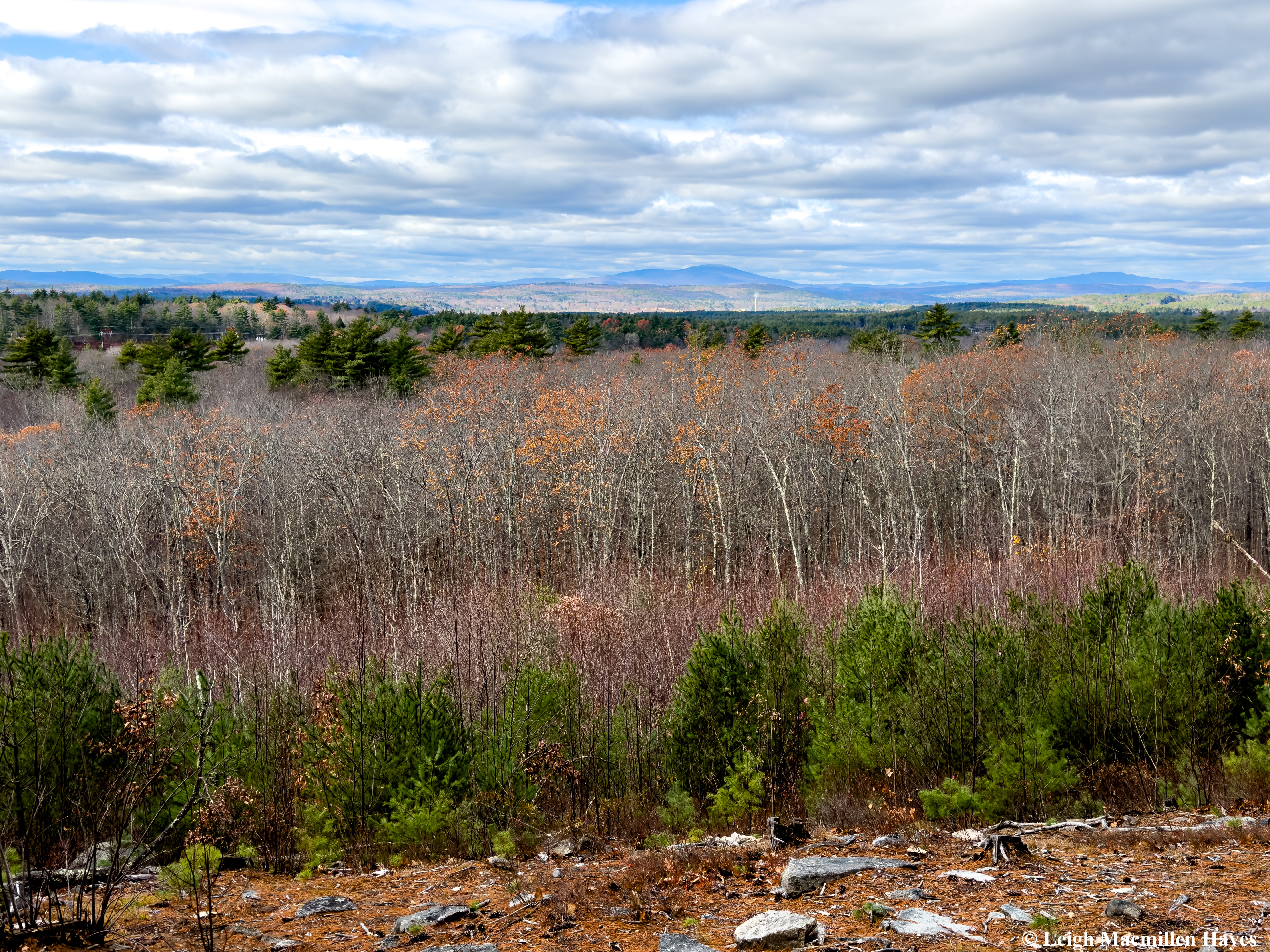
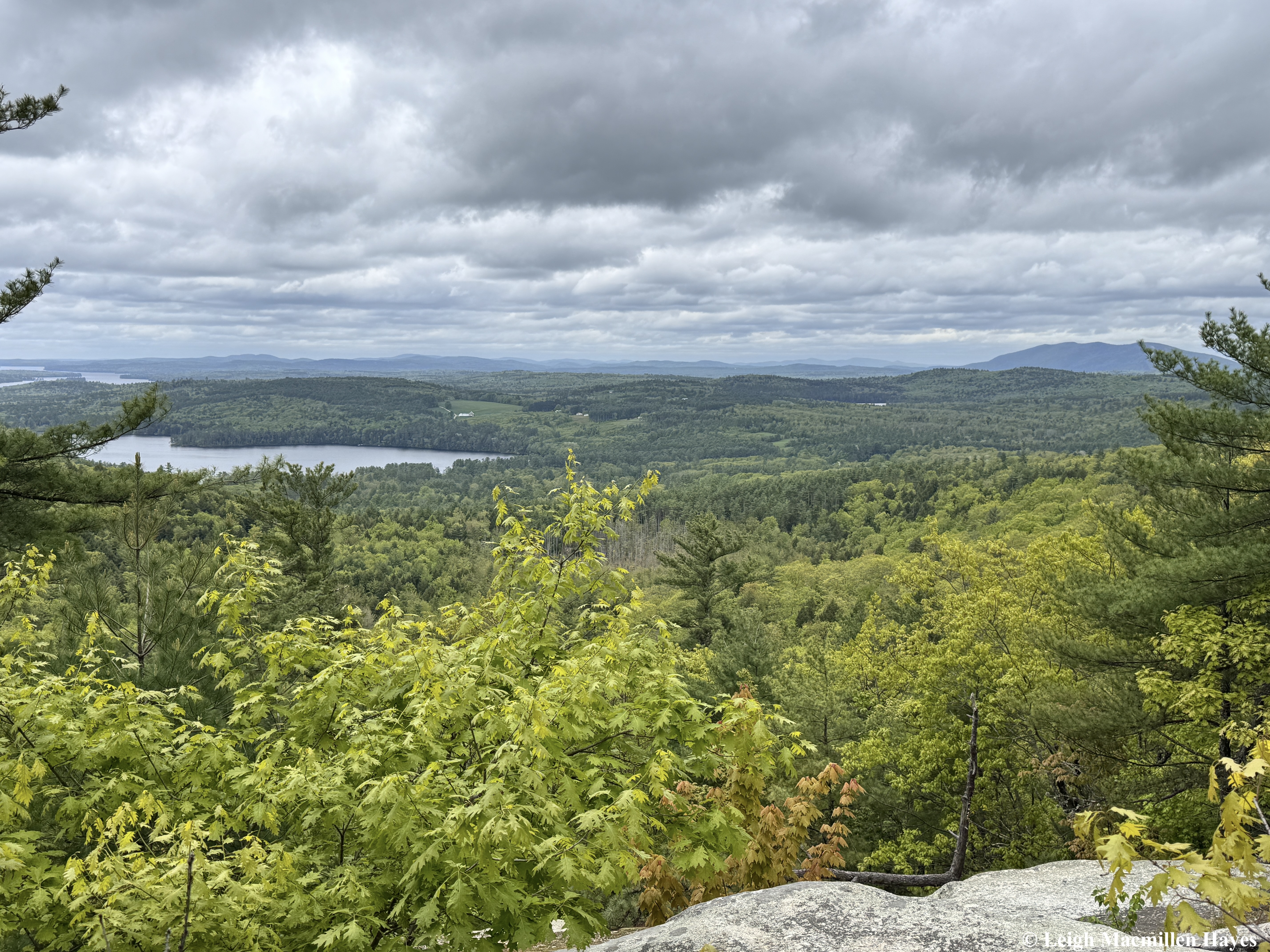
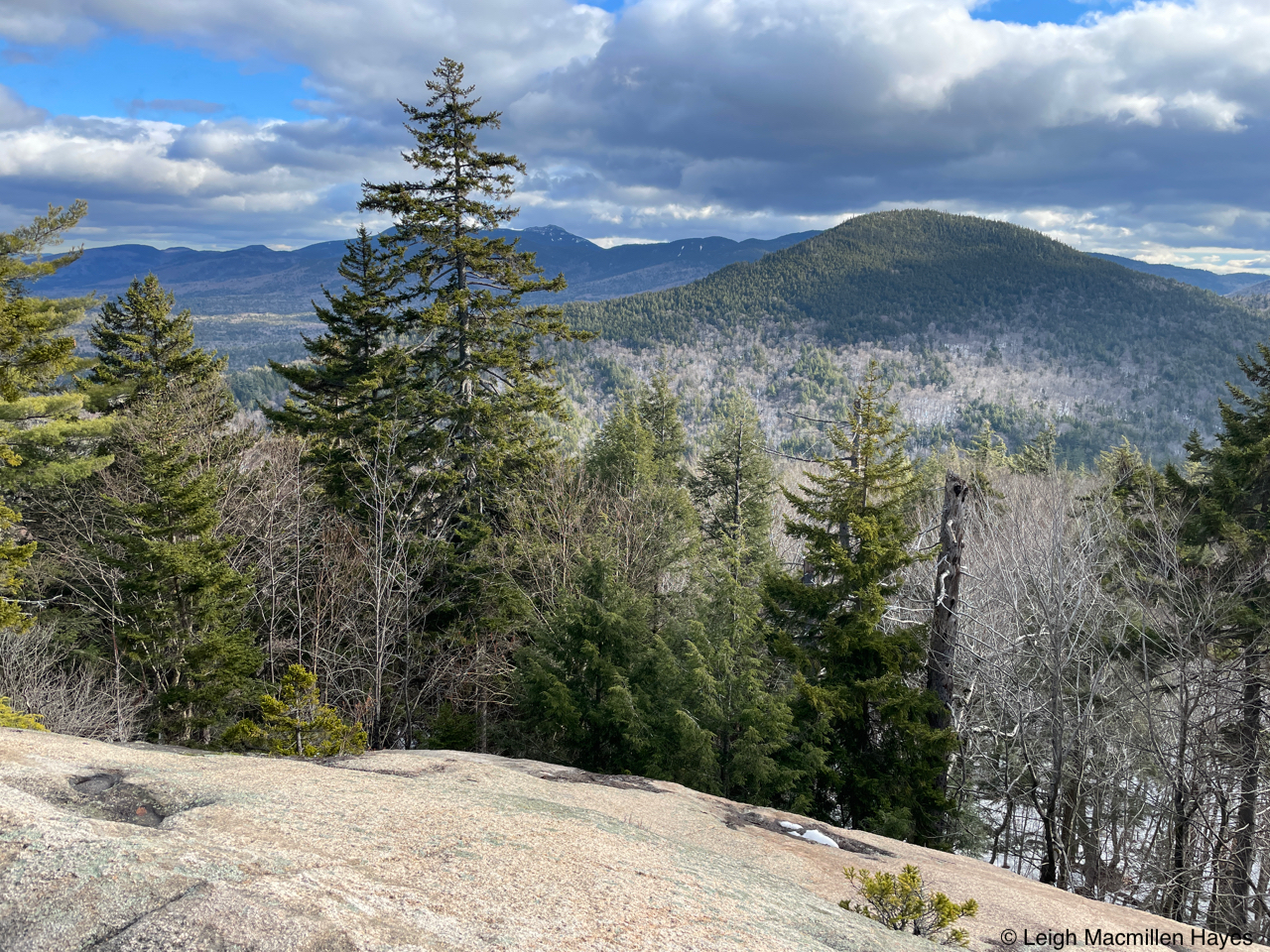
And so we headed off on the Oak Hill Tower Trail, with a plan to stay to the right, or was it the left, as we are direction-challenged, but really, we did know where we wanted to go and the vista spots that we wanted to experience, such as this one where we could see Mount Sunapee and Mount Kearsarge (not Kearsarge North that I’m more familiar with) in the distance. That said, I did record our journey on my GPS.

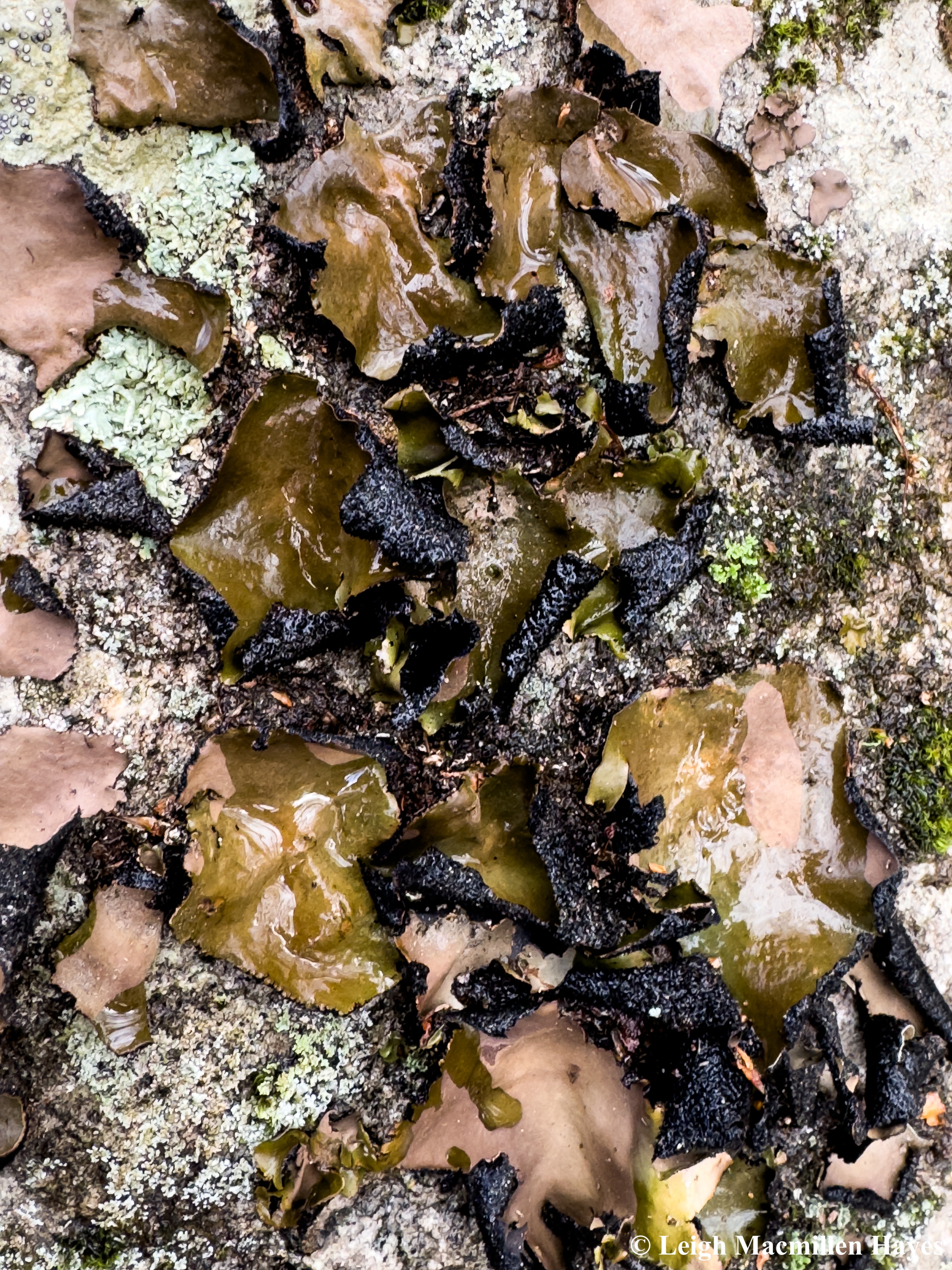
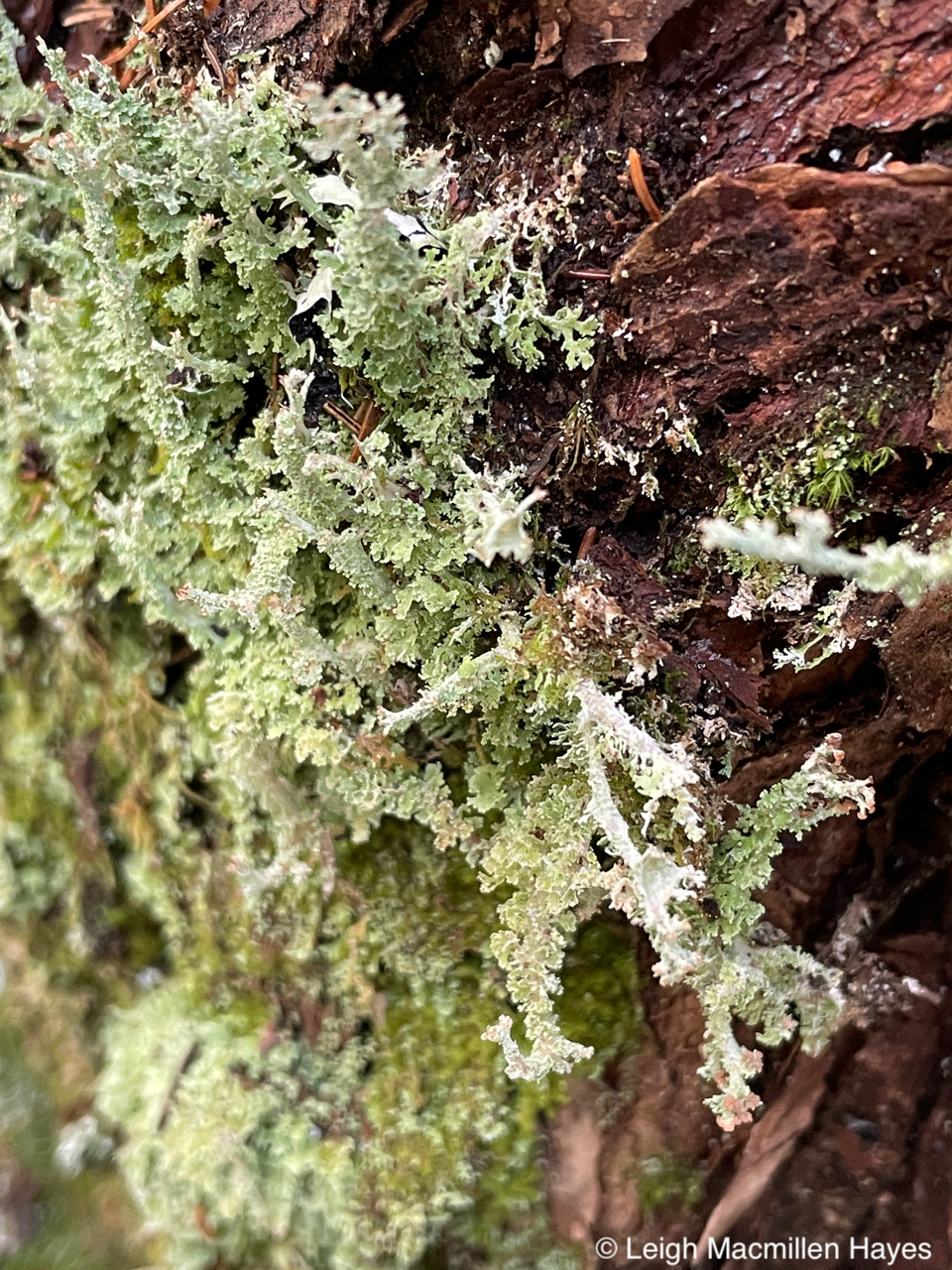
Because we were catching up as well as reminiscing about our junior and senior high school years, we let our tween or teen selves kick into action every once in a while, including by pouring water upon some dried and brown Rock Tripe. We watched with awe as the algal component of this umbilicate lichen immediately kicked into action and the “leafy” parts turned green and became more pliable.

And there were a few Winter Fireflies to admire, especially the pink parentheses that form brackets behind its head. I explained that though the eggs, larvae, and pupae glow, the adult form doesn’t light up the same as the Lightning Bugs we enjoy in the summer months.

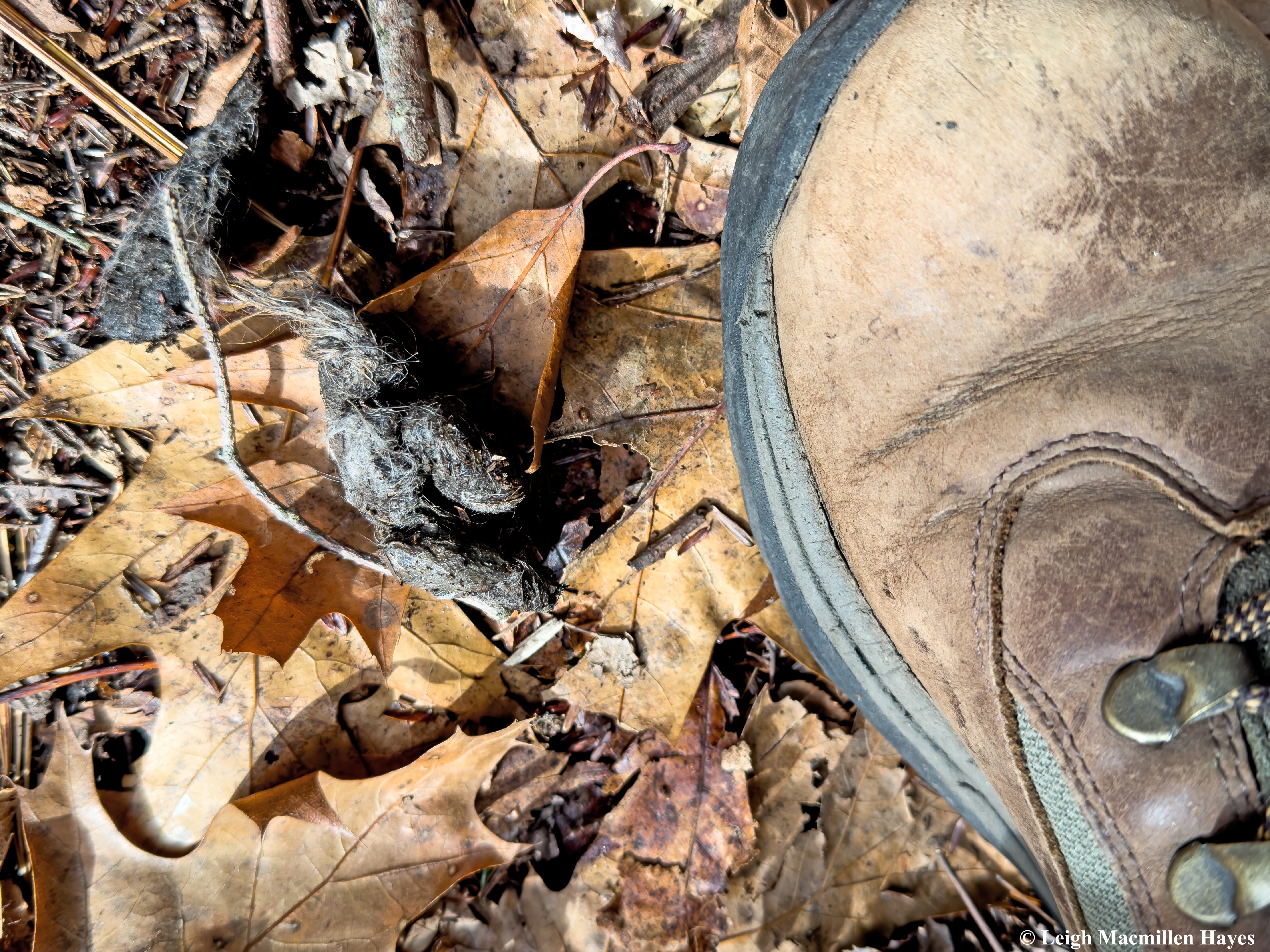
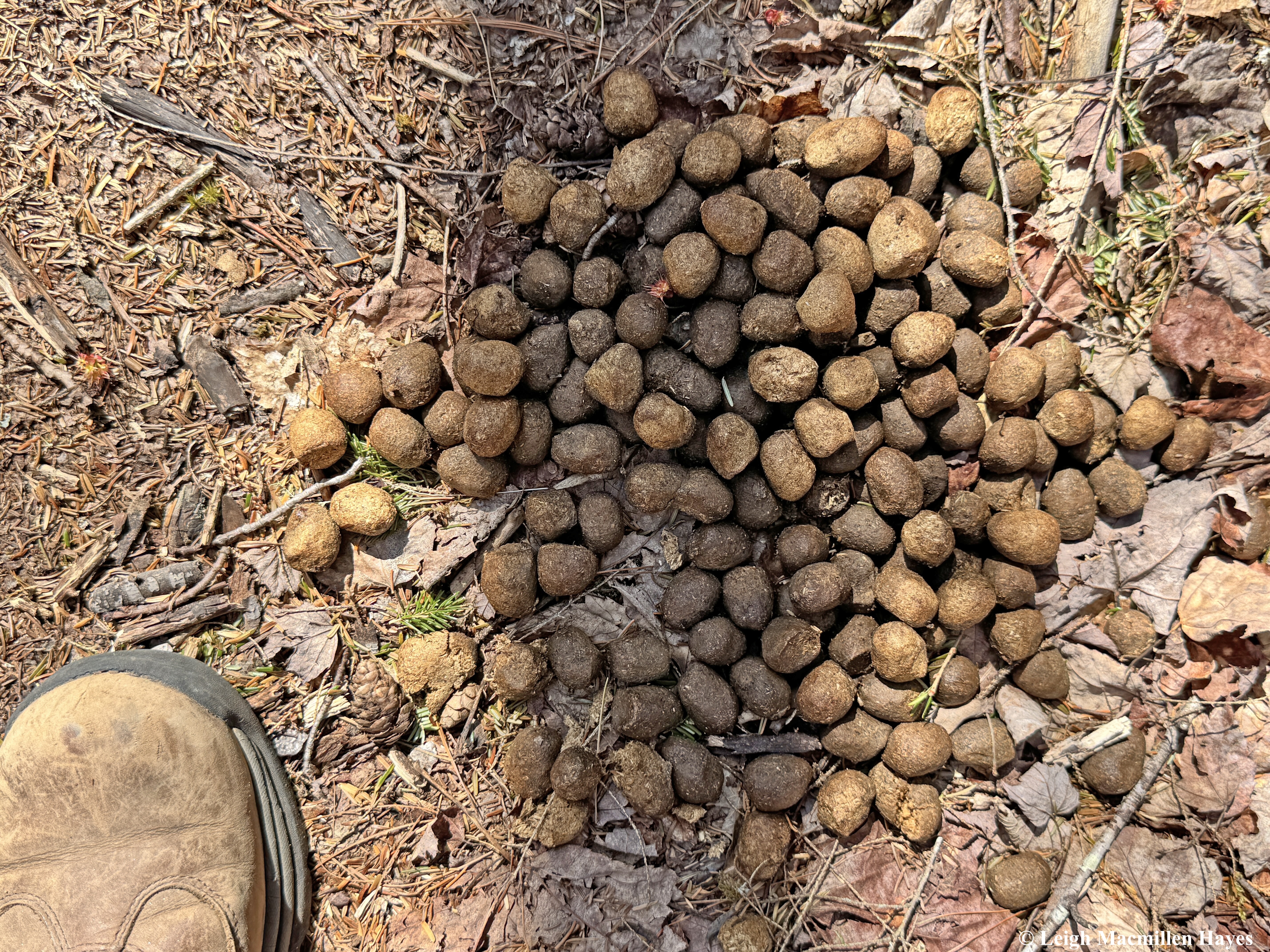
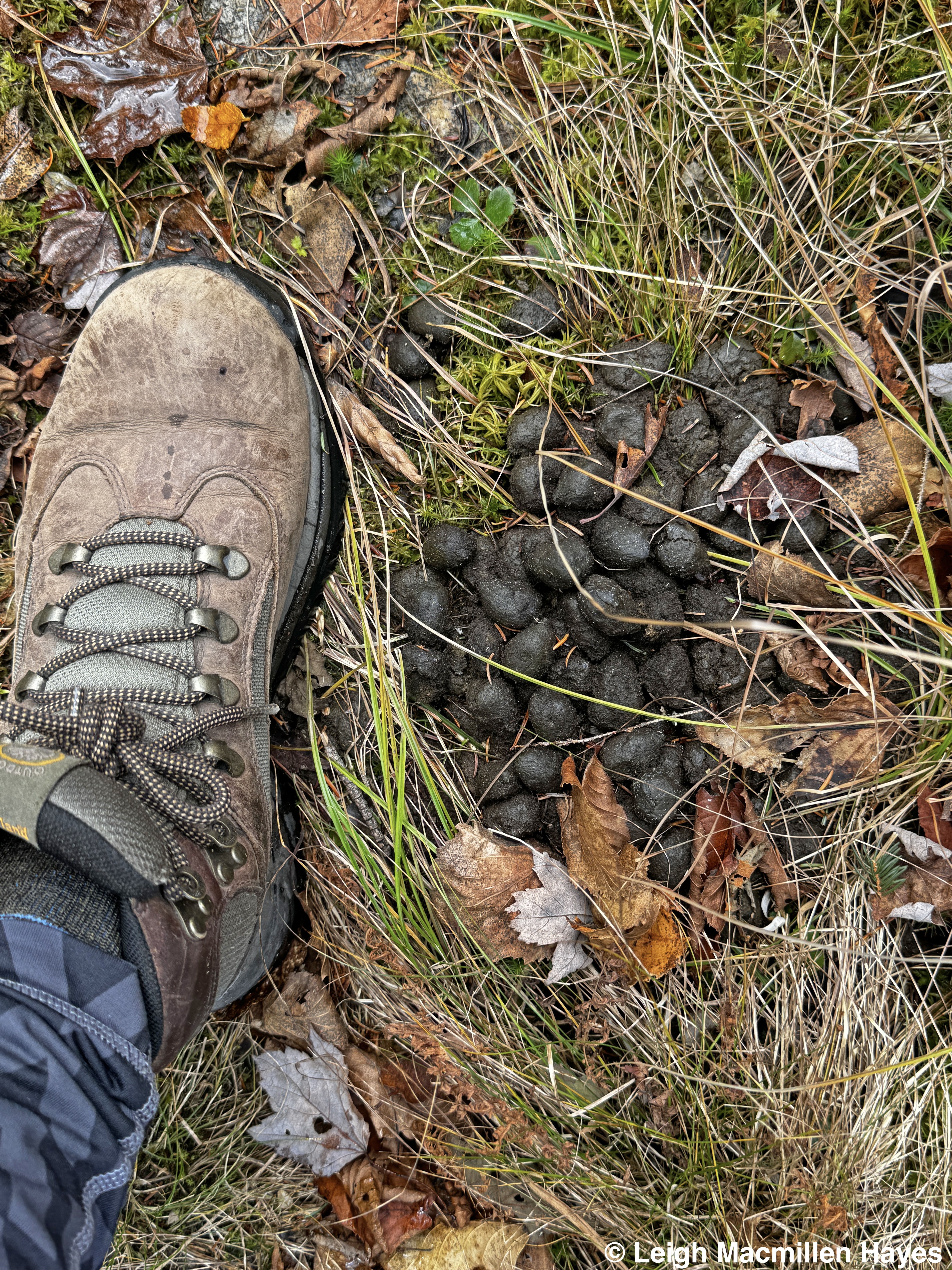
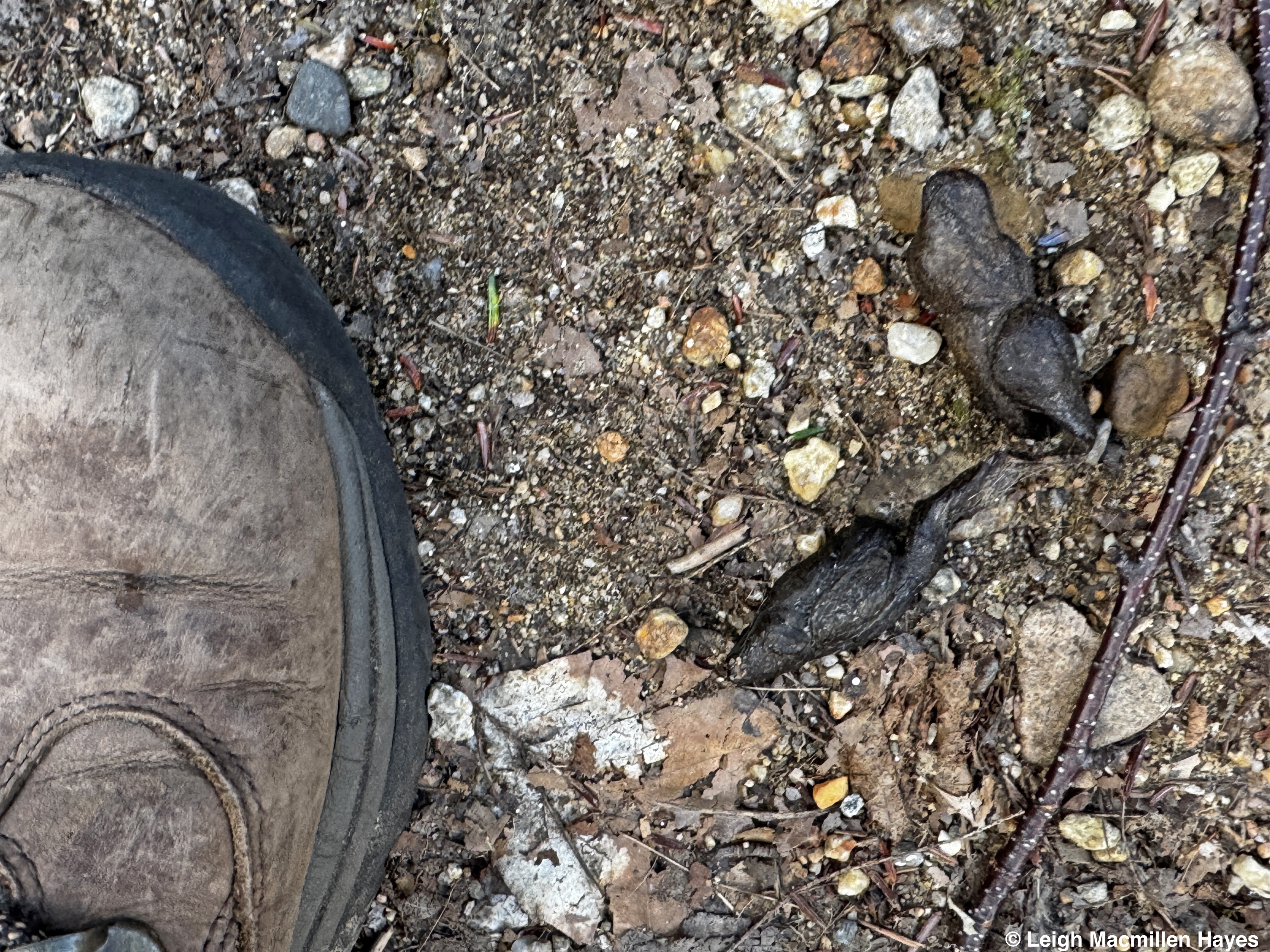
Our next great find was a fun one for me. I’m not sure she was quite as impressed, but she did want to know where all the fur may have come from in this Red Fox scat. We weren’t in Snowshoe Hare territory, but we were certainly in squirrel and vole habitat and so it could have been a combination that helped to form this twisted specimen with its blunt form on one end and tail on the other.

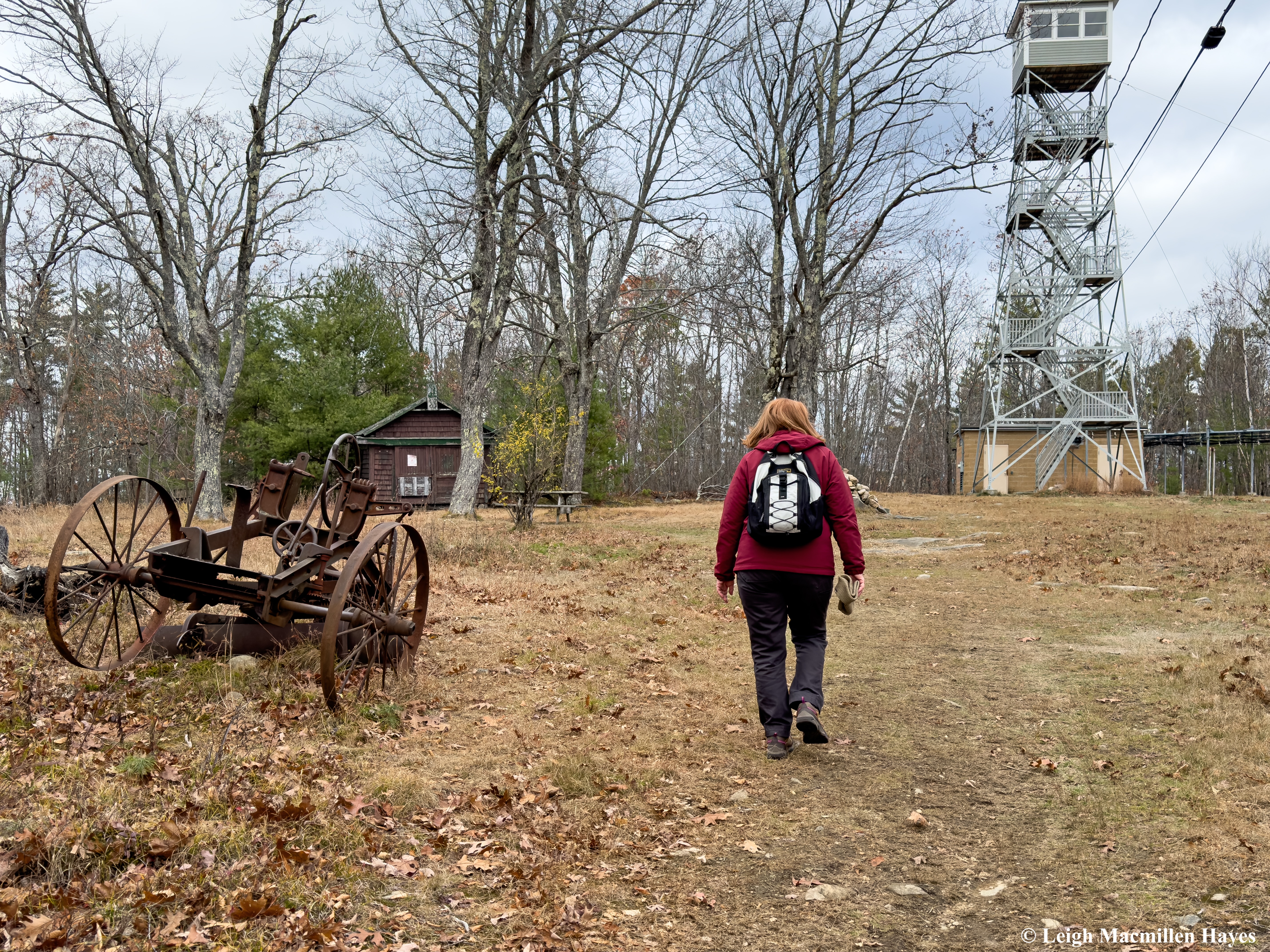
About an hour and a half after we began our journey, we reached the old fire tower for which the trail was named and noted also the house where the fire rangers would have bunked when it was necessary to step out of the cab at the top of the tower (think thunderstorm).

There was also a picnic table and since we had each brought a PB & J sandwich, this became our lunch stop.

Back on the trail, we spotted some puffballs, and again the need to play struck our fancy.

And so she found a stick and poked each one and we laughed as puffs of smoke, aka spores, wafted out of the little balls.

The next day found us upon a different trail that had been part of a working farm from the 1700s until about a year ago and known as Dimond Hill. Barbed wire that once kept animals in or out had become part of a stump, which often happens when a tree sprouts beside a boundary and over time grows around the obstacle so that they seemingly become one.

So much so, that a former limb had separated from the tree, but still the wire “glued” them together.

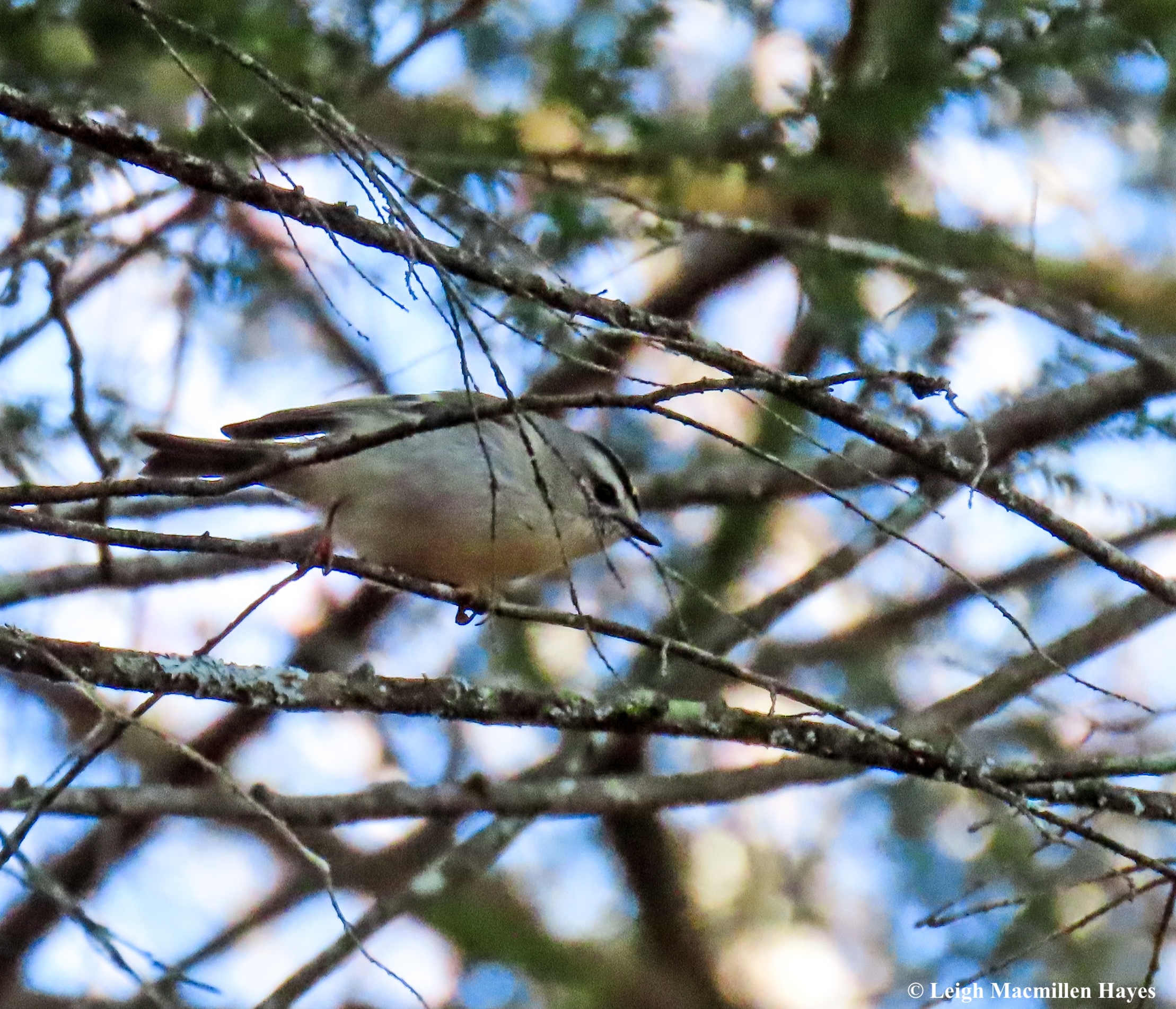
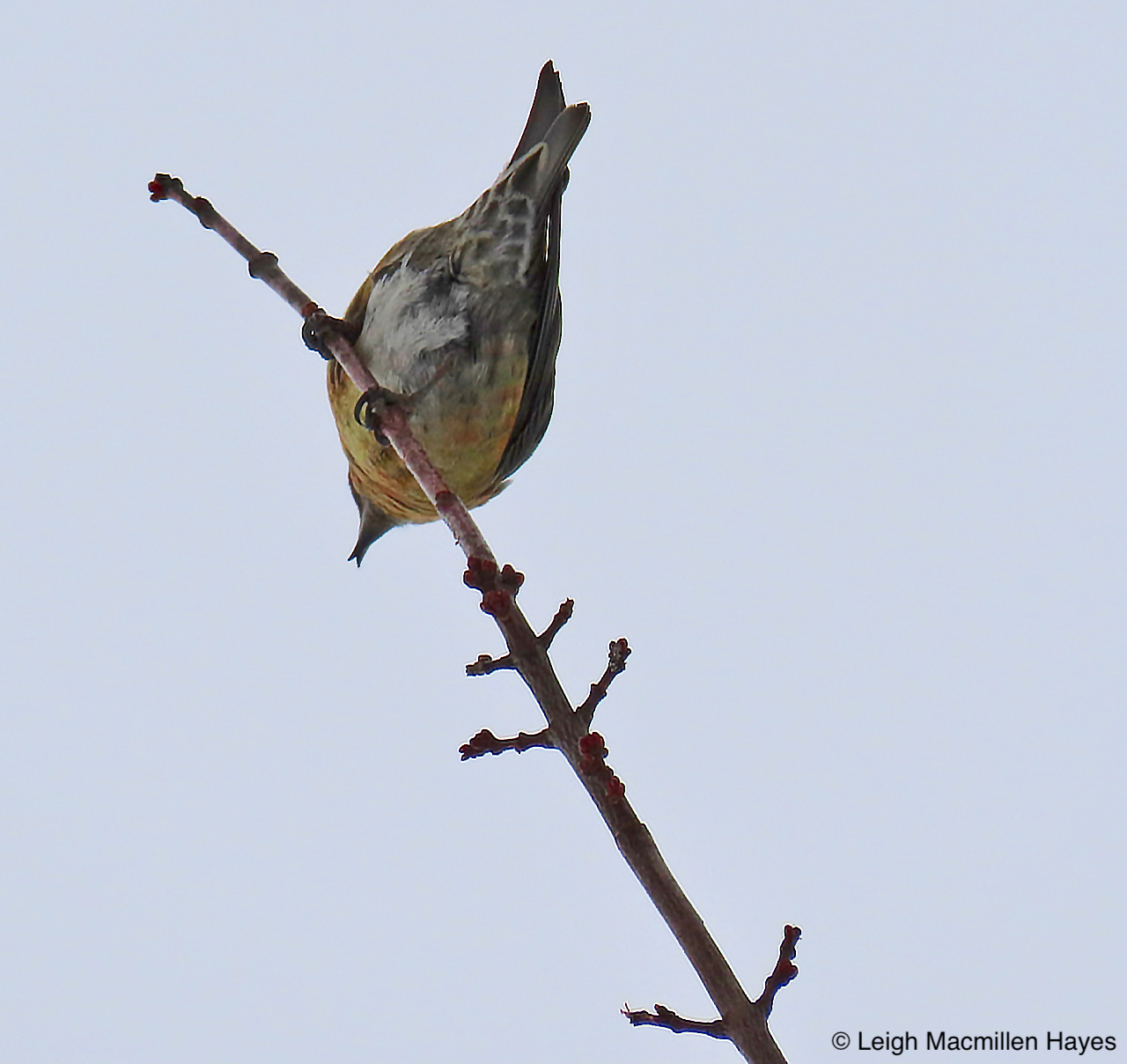
In one section, some wee birds flitted from tree to tree and though it was difficult to get a clear photograph, I was thrilled to be in the presence of Golden-Crowned Kinglets, even if only for a few minutes.

We talked a lot about tree bark along the trails, and nature in general, and all kinds of other topics as well, but every once in a while a tree stopped us in our tracks, such as this one. In my opinion, it offered a great example of the Bull’s Eye Target Fungus that affects Red Maple bark, but doesn’t kill the tree. I explained to my friend that it offers a quick way to identify this species of tree.

And in our midst, as we hiked we occasionally spotted Bruce Spanworm Moths flying about. What I forgot to mention on Saturday was that the males fly, but the females are wingless and we should have looked about because we may have found one. But knowing my friend, now that she knows this, she will be on the lookout. So will I.

We completed a circuit of trails on one side of the main road and then crossed to the field where vegetables and animals had once been raised. It struck us as odd that instead there was a door in the middle of the trail. A locked door at that.

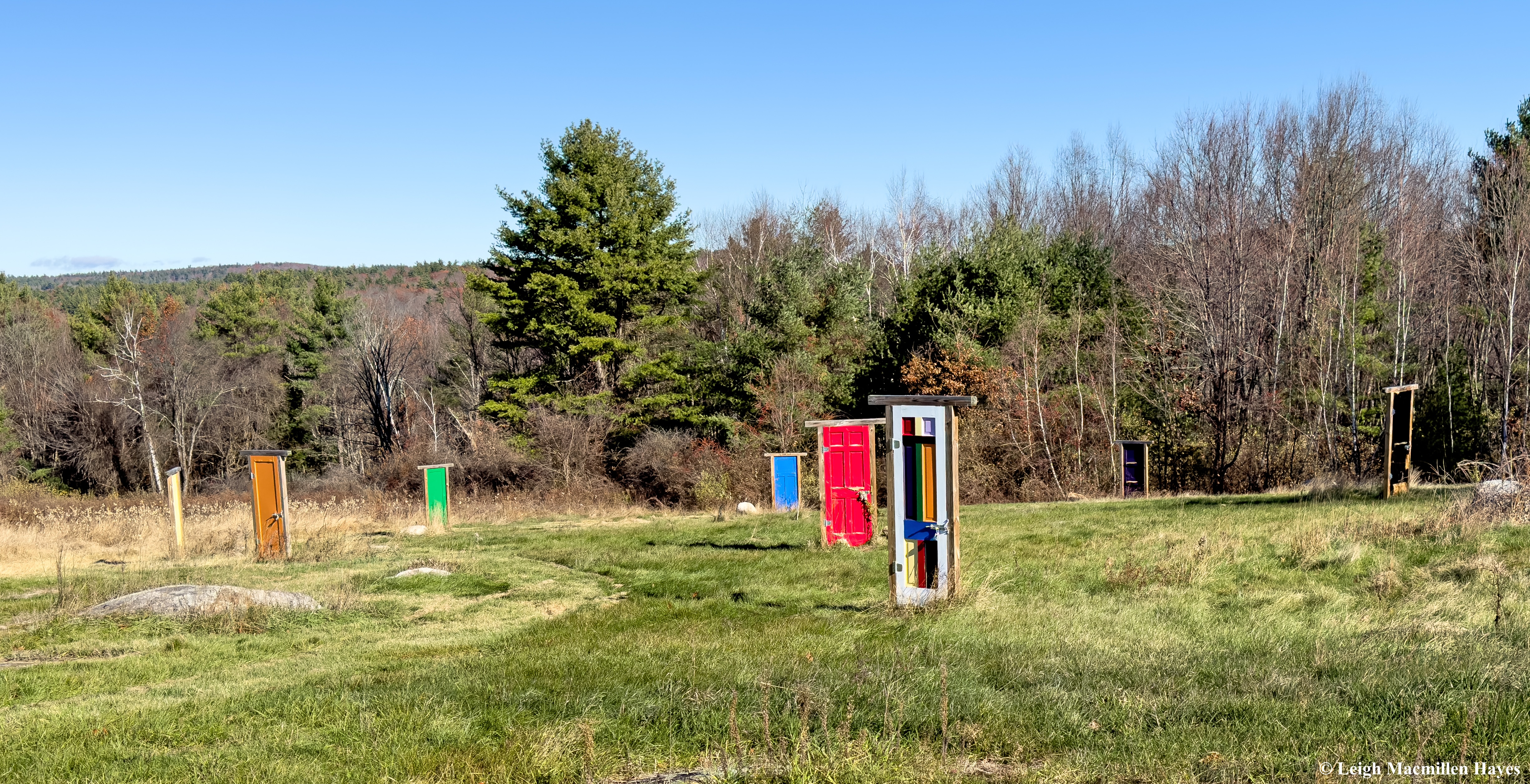
And then in the field below, we found one multi-colored door through which if one could unlock and pass, would lead to a circle of eight more brightly painted doors. You’ve heard of Stonehenge? We decided this was Doorhenge. Or perhaps Doorhinge.

The purpose for this installation? We don’t know, but we did wonder if the doors were strategically placed to represent compass points.

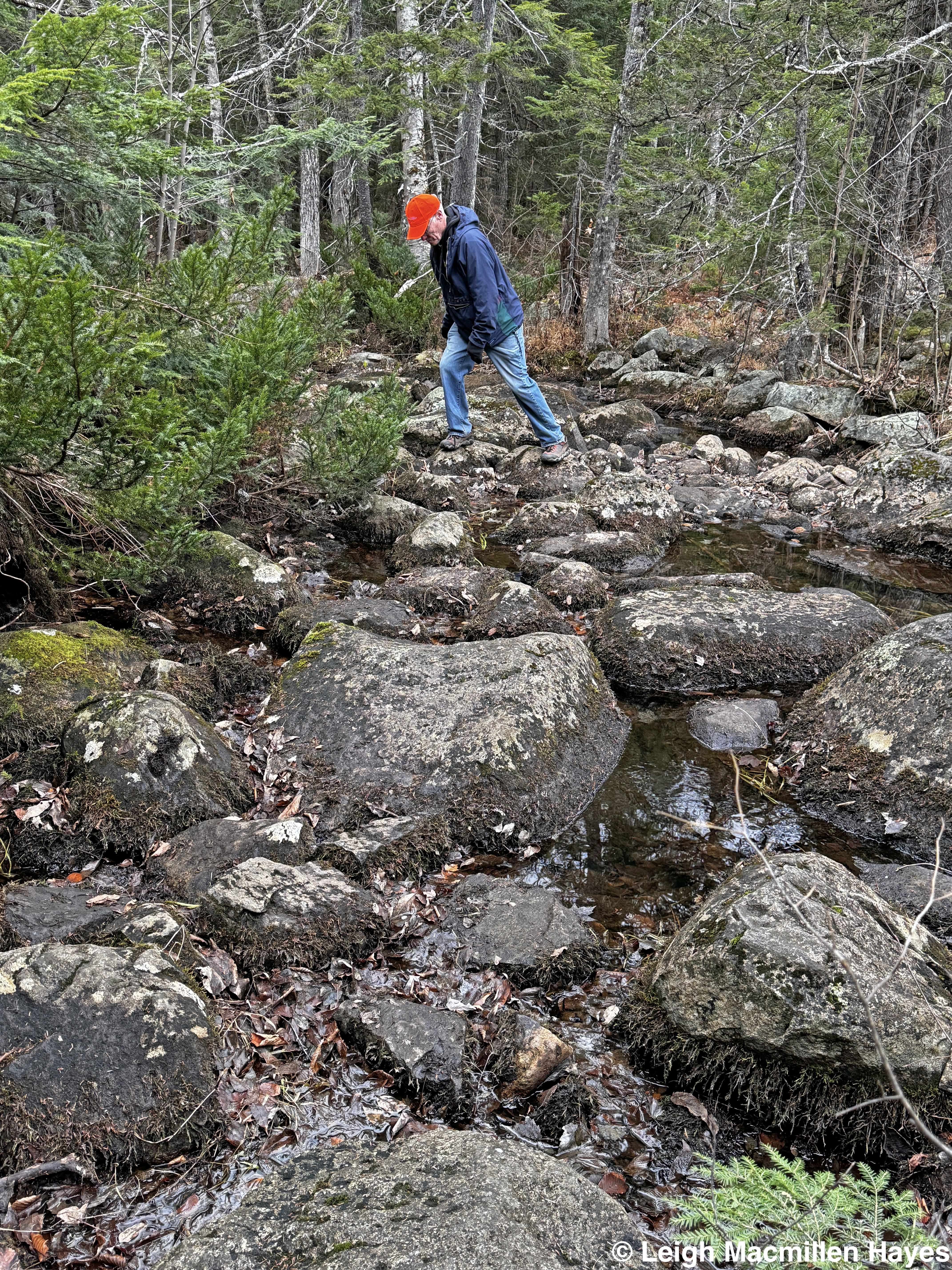
We knew we didn’t have time to hike the entire trail, but were thrilled to reach water, which I think must have been Ash Brook. What we did note was that it was an active Beaver territory.

And the work of the Beaver’s teeth as upper incisors met lower to consume the cambium layer where sugars and water and nutrients were exchanged through phloem and xylem, was well documented. Barely any bark was left untouched.

Not far from our turn-around point we reached more water and though we couldn’t find the actual Beaver Lodge, we did note that a skim of ice had formed. And the ice-covered water reflected the Bluebird day we were enjoying.

Her eagle eyes also picked up on an Eastern Newt in the water below. Can you see it in this Where’s Waldo image?

Upon our trek to our turn-around point, for this was an out-and-back trail, we discussed Paper (white) Birch and Gray Birch and my friend mentioned that she didn’t remember ever meeting Yellow Birch.

And then, as often happens, on the return trip we started to spot its curly presentation over . . .

and over again and I explained that as the tree matures it takes on a more silver gray appearance, but my friend liked that she could still see the gold in the curls.

That said, sometimes the Paper Birch trees also had a golden underbark and so I reminded her that she had to also consider how the trees peeled, Yellow being in ribbons while Paper peels in, well, sheets of paper sometimes. Had there been twigs that we could reach, I would have done the touch and sniff tests, but that will have to wait for another adventure.

We even had the surprise opportunity to greet a Maple-leaf Viburnum, a species I’d shared photos of with her earlier in the fall.

We’d given ourselves a turn-around time so that at the end we’d have a chance to sit and eat left-overs from the dinner we’d enjoyed at The Common Man the night before and soak up the warmth of the sun and try to wrap up our conversation that had gone on for almost 24 hours. Well, except for when we were sleeping, of course.

In the end, we gave great thanks for making the time to meet each other at the Halfway Point. Well, the almost Halfway Point if truth be told for I’d only traveled two hours from Maine to reach Concord, New Hampshire, while Carissa had driven three hours north from Connecticut.

I’m so grateful for this friendship that has spanned decades and that we can renew it along the trail despite the distance that separates our everyday lives.

Thank you, Cris!

Pressed to find a new mountain trail

Several friends had told us about a mountain in New Hampshire that we’d never climbed before and so we thought we’d change that situation today. As we drove toward Jackson, there were occasional raindrops and I turned on the windshield wipers, but road conditions were good, thankfully. We could see in the mountains, though, that there was mixed precipitation and we promised ourselves that if conditions warranted, we’d go somewhere else and leave today’s Plan A for another day.

By the time we reached the dirt road to the trailhead, it was really beginning to snow/sleet, and so rather than drive the 1.2 miles up, I found a good place to park, and walk up we did. Mind you, had My Guy been behind the wheel, our journey would have been different. But . . . as steep as the road was at times, I LOVED walking along it.

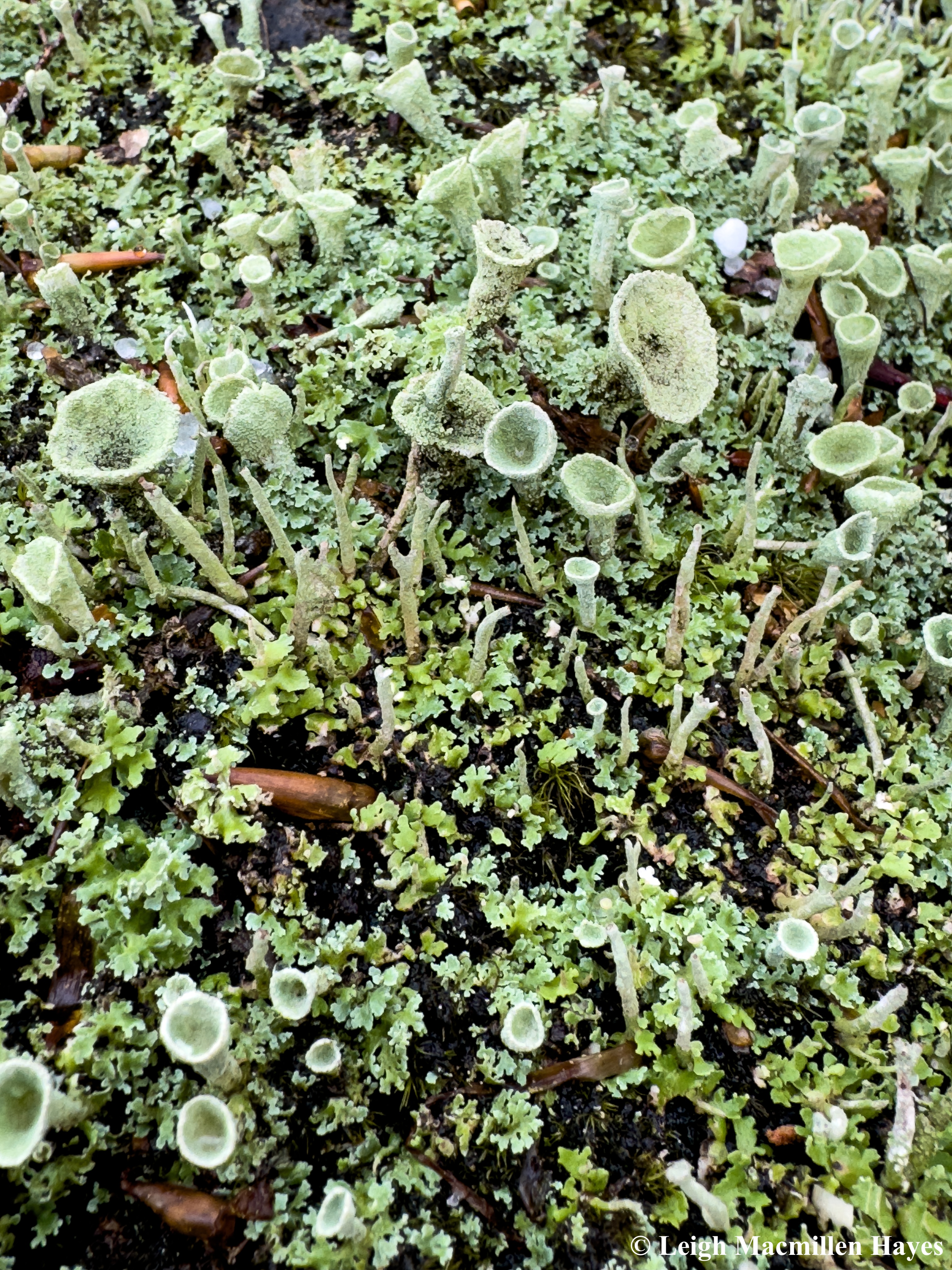
First, there were the over-sized Pixie Cup Lichens, looking as if they were on steroids, though perhaps it was the crisp mountain air that appealed to them.

And then some old raspberries from the Purple-flowering Raspberry bushes and I told My Guy that the first time I remember encountering them was on a nearby road leading to the Mountain Pond loop. He recalled the adventure and the company we kept that day, but not the flowers, which were in bloom given that it was in a different season.

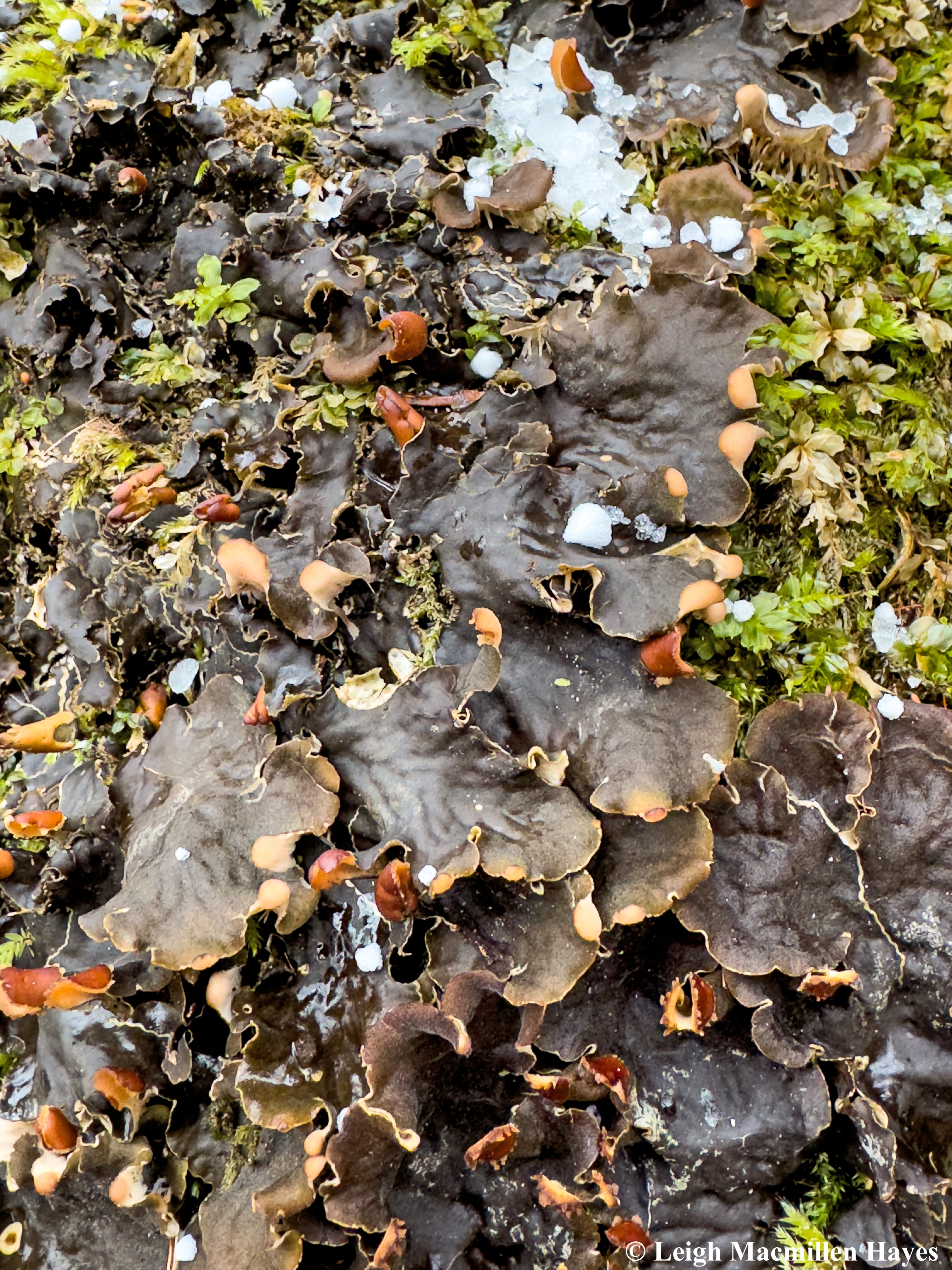
At the base of a Sugar Maple was a HUGE patch of the Many-fruited Pelt Lichen, its apothecia the tan-brown saddle-shaped lobes.

And then there were the also HUGE leaves of Coltsfoot, an interesting plant that likes disturbed areas like this and flowers first before it produces leaves. Spotting the leaves in the fall, reminded me of the spring flowers.

And I borrowed this one from another post I wrote two years ago. Though the flowerheads look like Dandelions, the stems have modified leaves, and it really is a unique plant.

Why the name “Coltsfoot?” Because the leaves are supposed to resemble the foot of a colt.

Ah, but the best part of the long walk up this road was the fact that there were camps and they needed electricity. Well, the poles were there. And the wires were there. But over and over again, we discovered the wires were on the ground, buried under the leaves and it seemed like they’d been down for a long time.

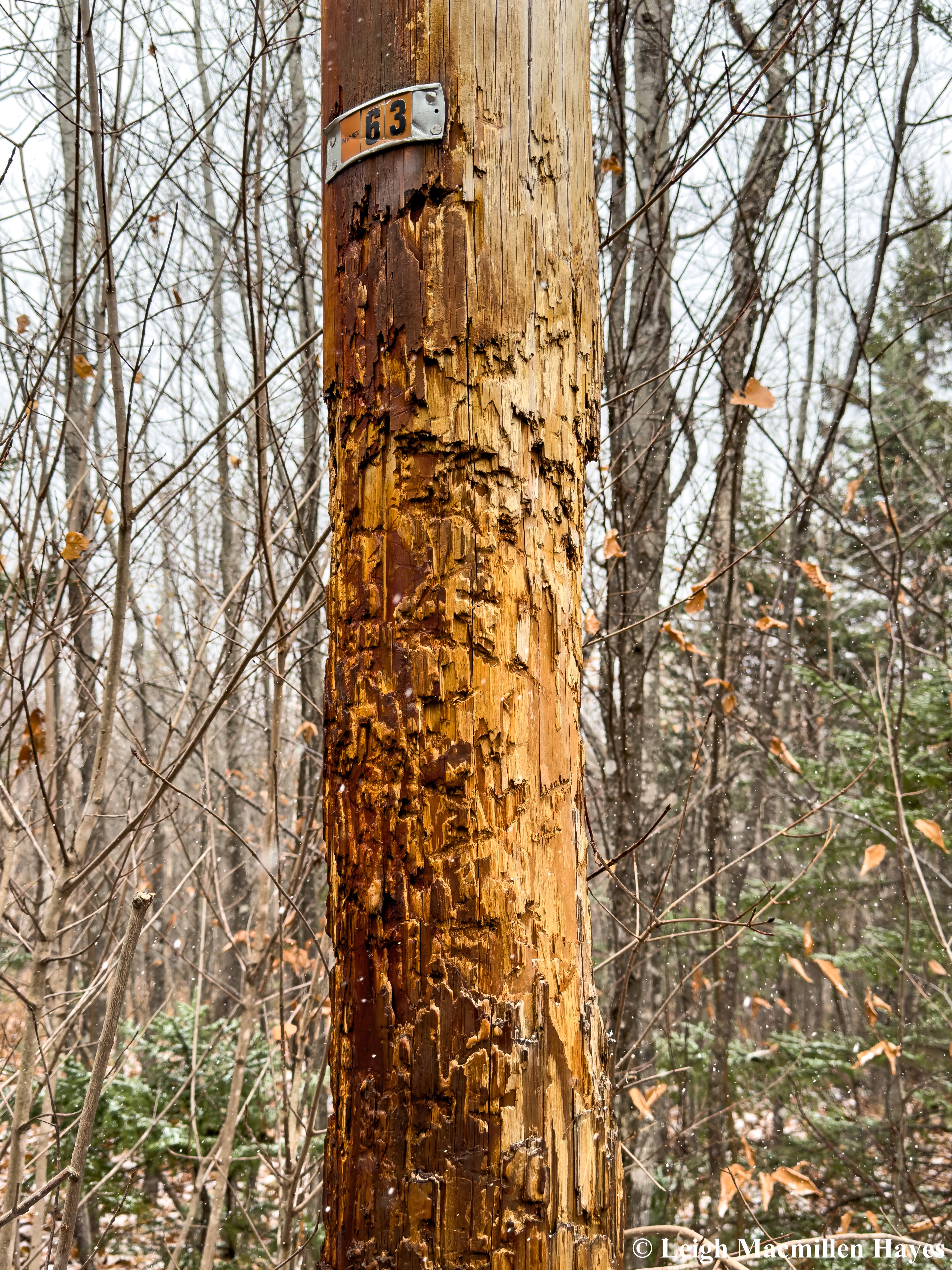
What intrigued me though? I mean, seriously, a telephone pole in the middle of the woods interests a so-called naturalist? YUP! All of those marks you see below the mangled number are the bite marks and scratch marks of a Black Bear. The bear turns its head to the side and then scrapes the bark with its upper incisors coming to meet its lower incisors.

In the process of doing this, it usually has its back to the pole as it might be leaving a scent or at least getting a good scratch out of it.

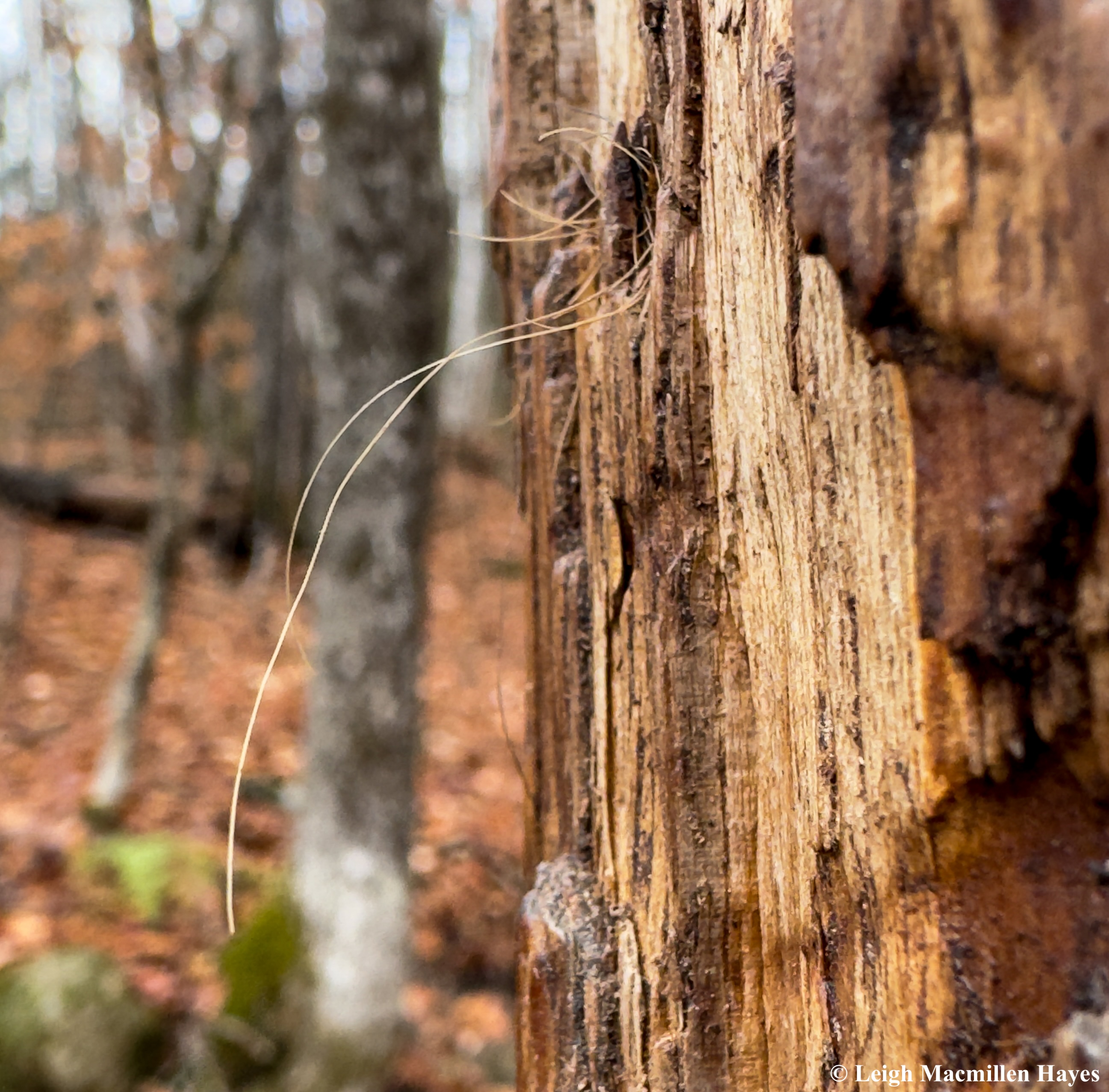
And in the process, some bear hair gets stuck. Yes, that’s bear hair. It’s bleached out from the sun, indicating this was deposited at least six months or more ago.

As we continued up, every pole became my friend. My Guy is used to this and so he patiently waited while I gave them the once over.

And again I was rewarded, this one being with black hair, indicating it was a more recent deposit.

I could have turned around then and headed home.

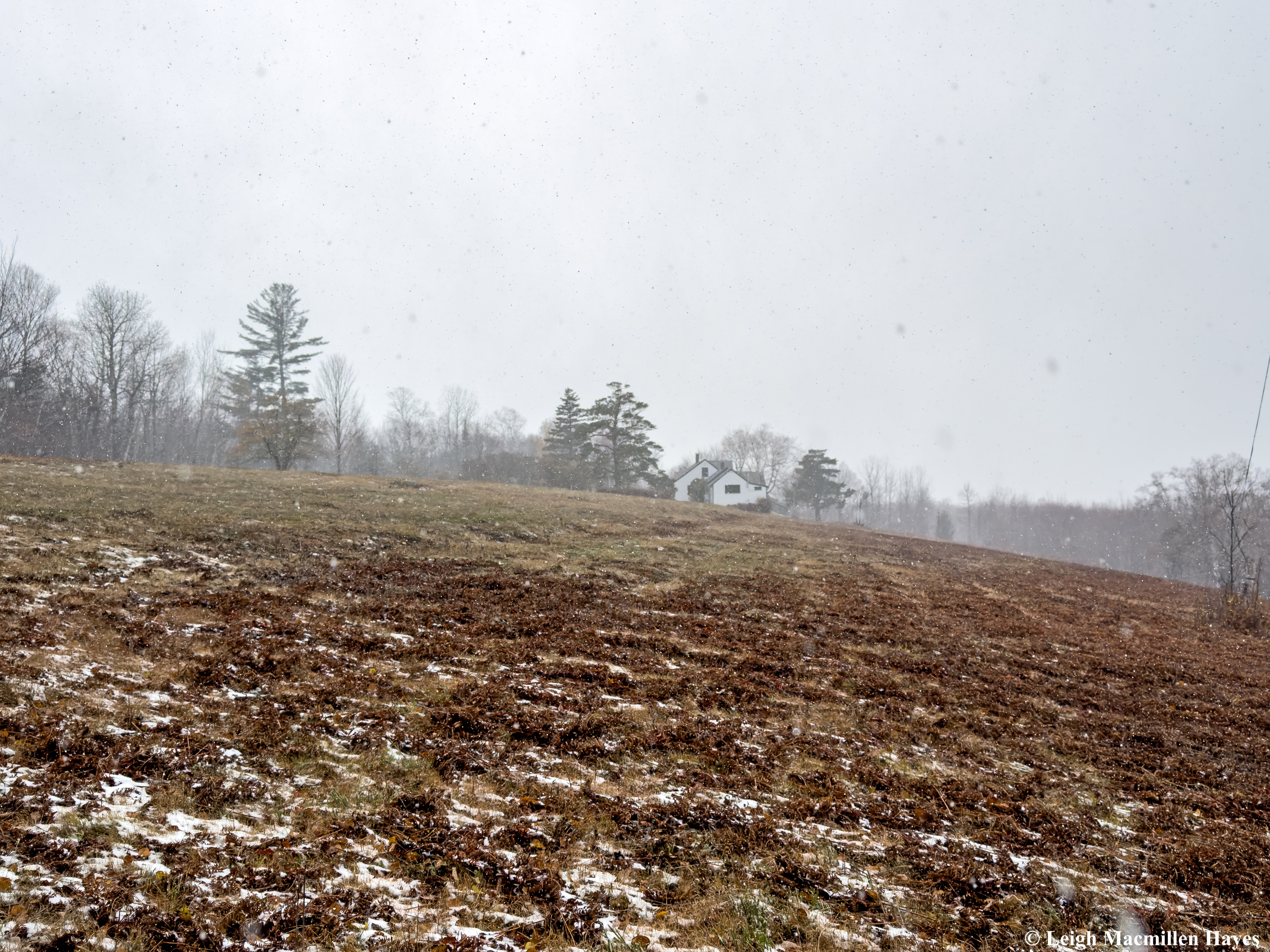
But we didn’t because we’d finally reached the trailhead, which is located on historic Hayes Farm, dating back to the early 1800s, and My Guy was sure he must have some ownership in the land.

Like a few views during our trip to Virginia last week, any mountains beyond were obscured in the moment.

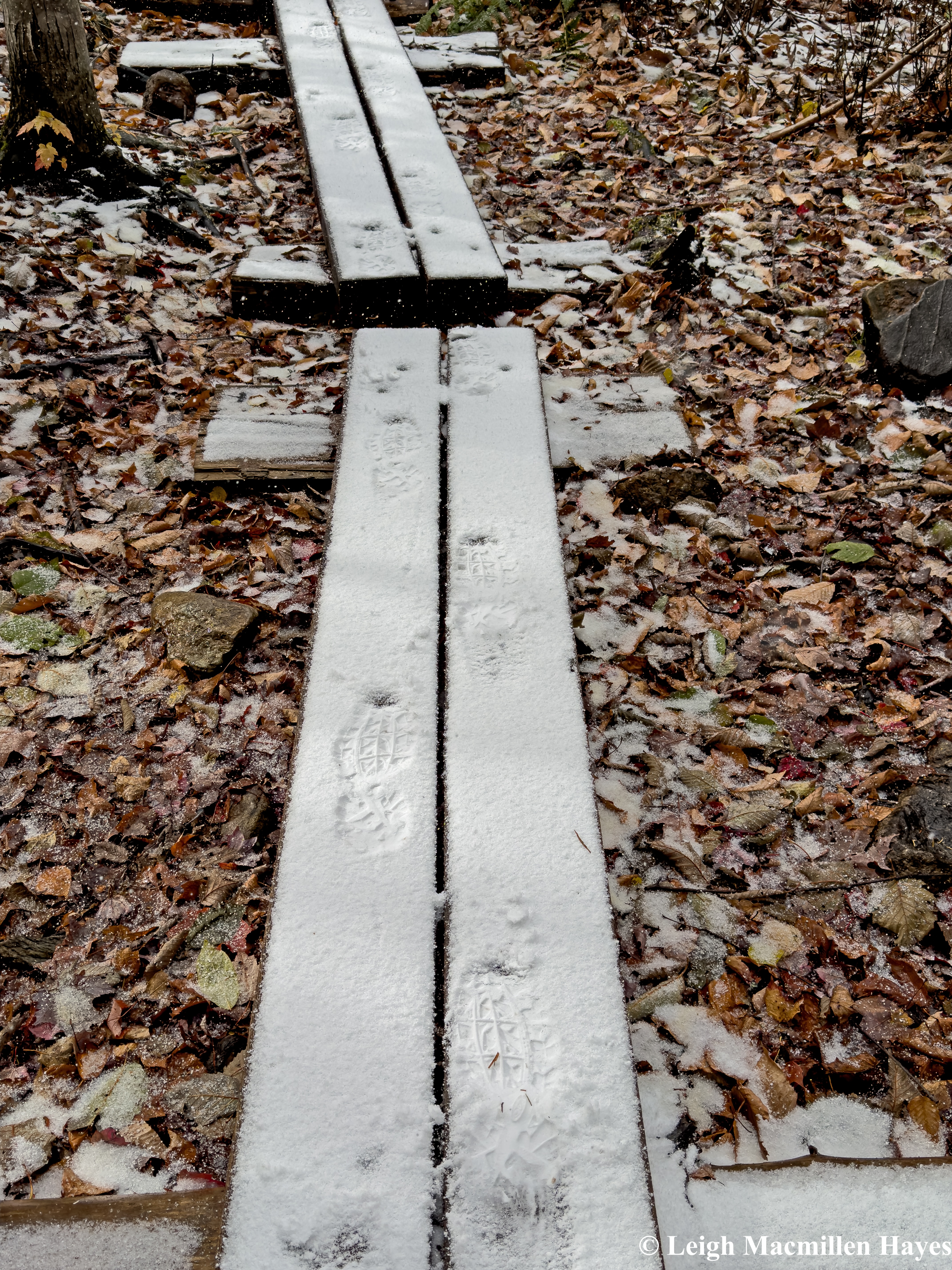
Across the field and then into the woods we ventured, our footsteps being the first to make an impression in the snow.

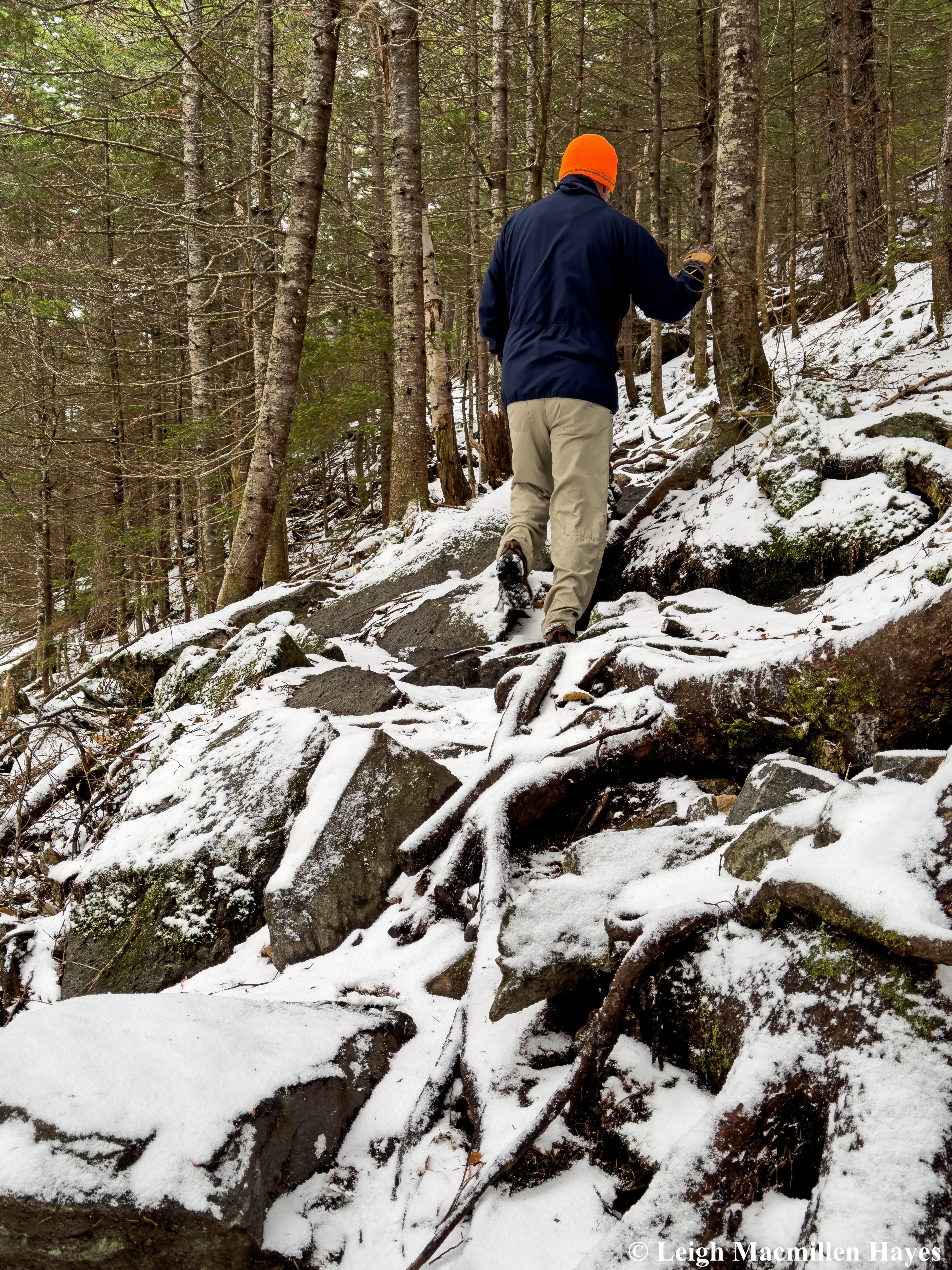
For much of it, as we followed one switchback to the next, the trail was moderate and then it got a bit more challenging, especially with snow thrown into the mix.

We’d read that there were six switchbacks, but we counted several more. With each one, I’d ask My Guy what the number represented at the pizza joint he worked at when he was in college–1 being plain, two-green pepper, three-onion, four–green pepper and onion, and so it went. If you meet him, throw a number at him and stand in awe as he shares a flavor. Of course, we can’t check the facts so have to trust that he’s not making it up. But then again, I know this guy, and he’s not.

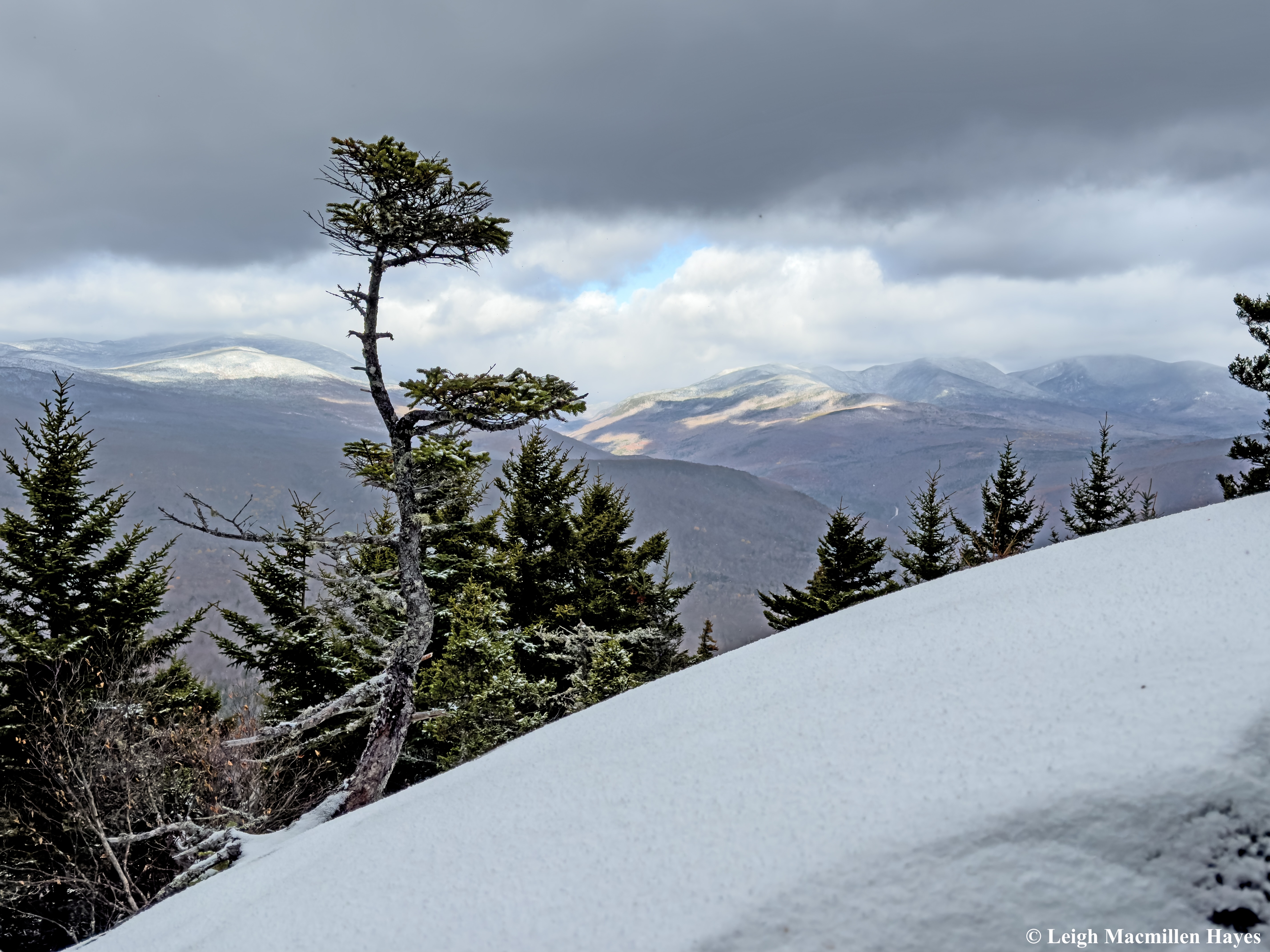
We were almost to the summit, where we knew we wouldn’t have a view, but saw a spur trail and decided to follow it. About twenty feet later we stood behind a boulder and looked out at the Presidential Range.

Like two days ago, it was another super windy day, and we could see the trees sway a bit above us, but felt rather protected in the woods. And at this boulder, it was the same and so we decided to turn it into lunch rock. There was no where to sit, and so we stood and ate our sandwiches, enjoying the view before continuing on.

A short time later, we reached the summit, and as expected there was no view of the surrounding mountains. But we did find the Geological Survey Marker and recalled being on a mountain in Maine when a woman hiked up to said marker, taped it with her hiking poles, told us she was on a mission to touch as many as possible, turned around and proceeded down the mountain. To us, it felt like she was missing a lot, but to her, it was what she did and who were we to dispute that.

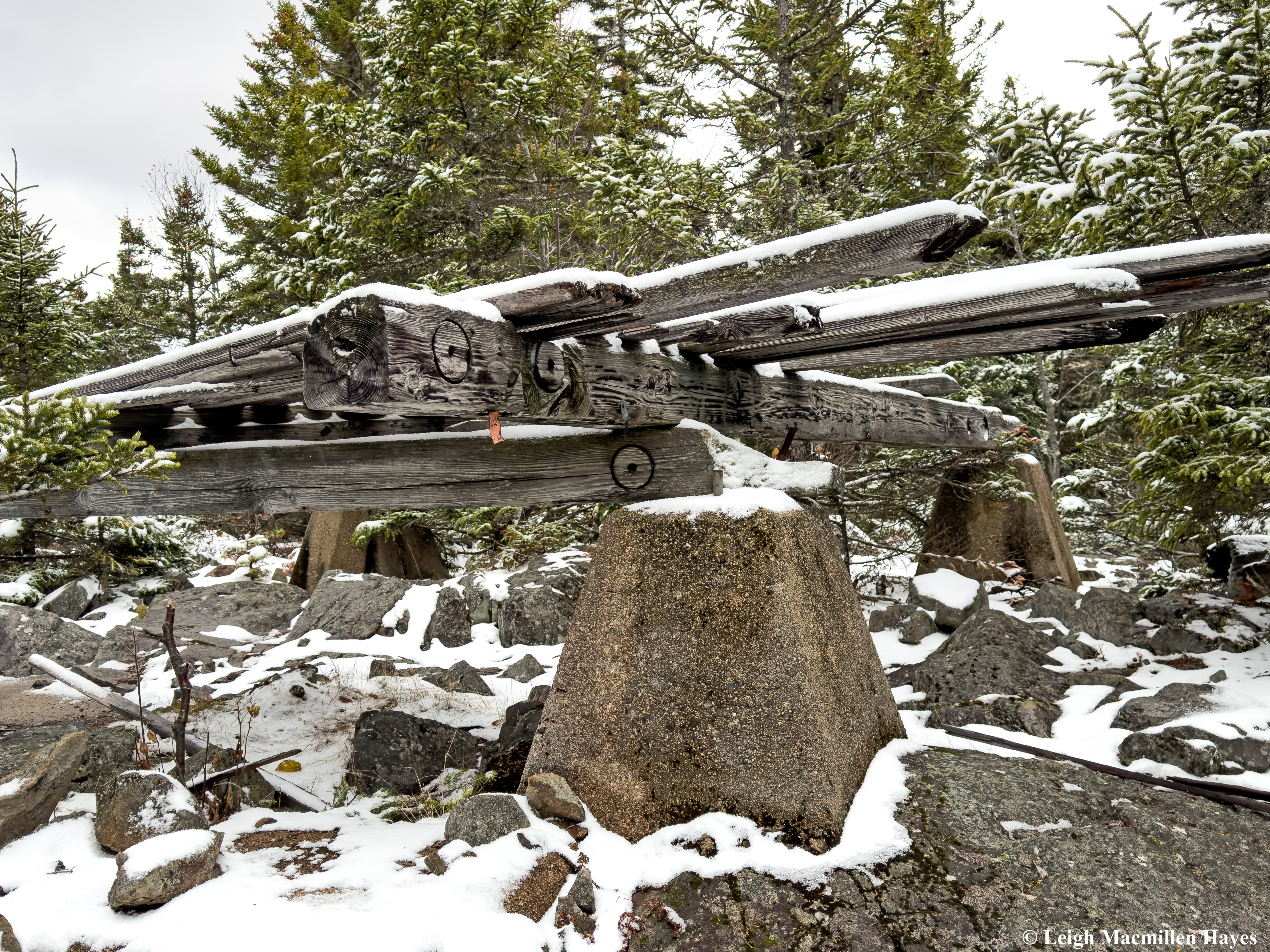
The summit was once the site of a fire tower, back in the day when that was the means to spot smoke or flames in the woods. Now, the four cement stanchions and some boards are all that remain, but we did wonder about work to build this one and so many others like it. That said, I’d read that the original trail up this mountain was rather a straight line, and perhaps that made it easier to get materials to the top.

From the summit, there was another .7 miles to go to reach a ledge with a view and an old mine, but we had set a turn-around time because My Guy had a commitment later in the afternoon, so we went a wee bit in that direction and then decided to save the rest of the journey for another day. We really liked this trail and want to visit it in a different season and complete the entire length of it.

On the way down, a few things captured our attention that we’d missed on the way up, including these two trees that intertwined.

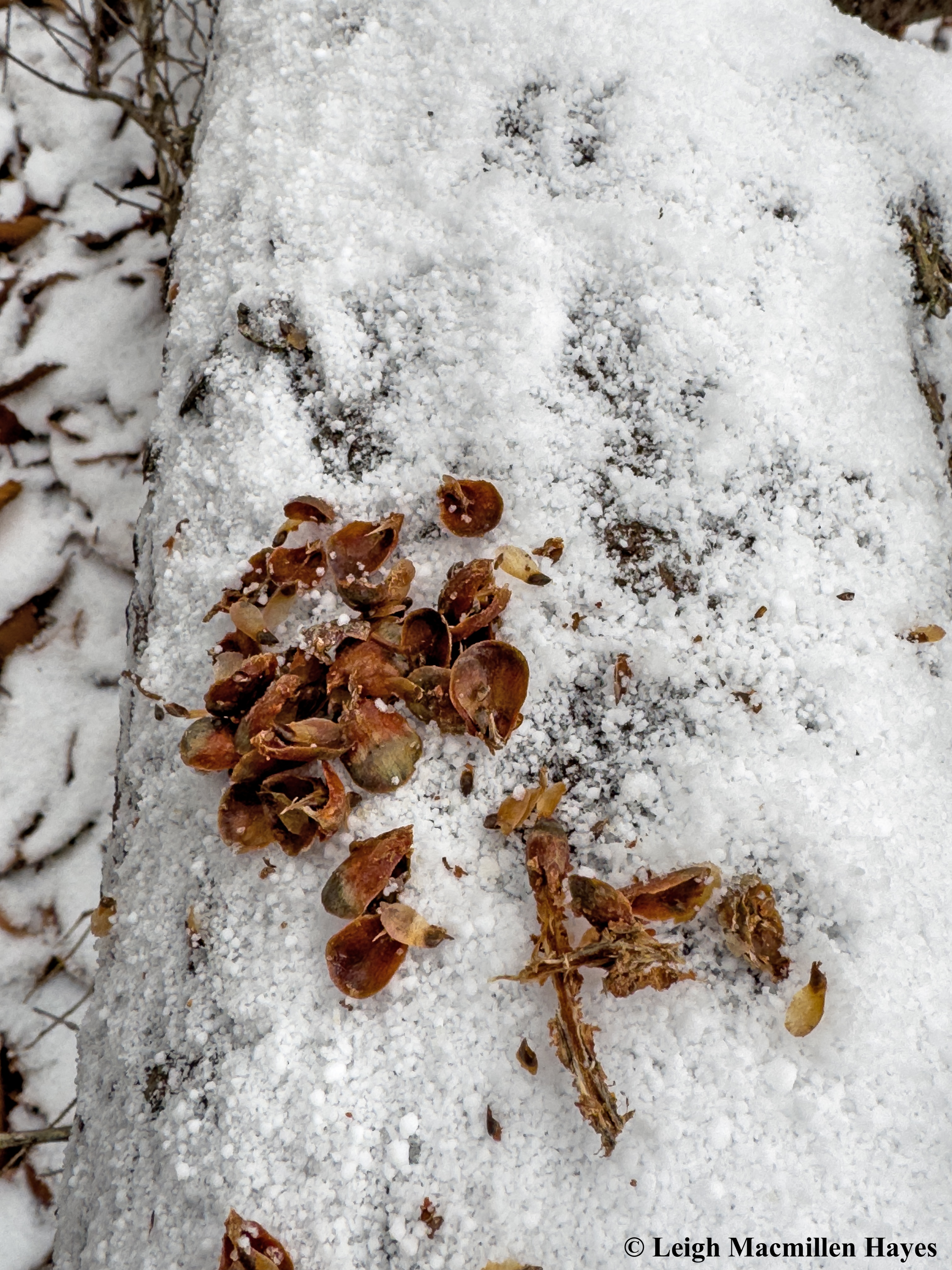
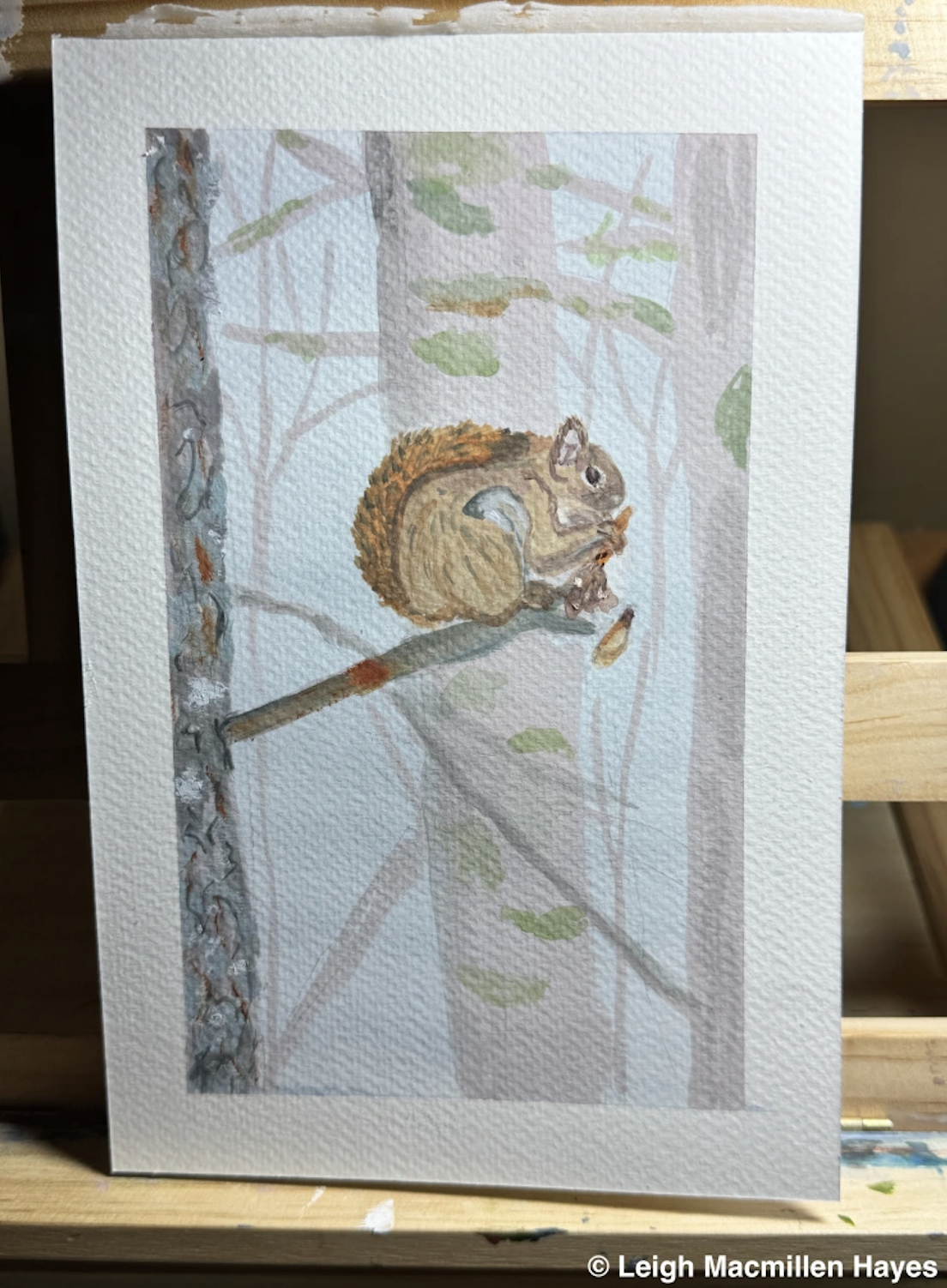
And the midden (trash pile) of a Red Squirrel, who had popped out to dine between our ascent and descent.

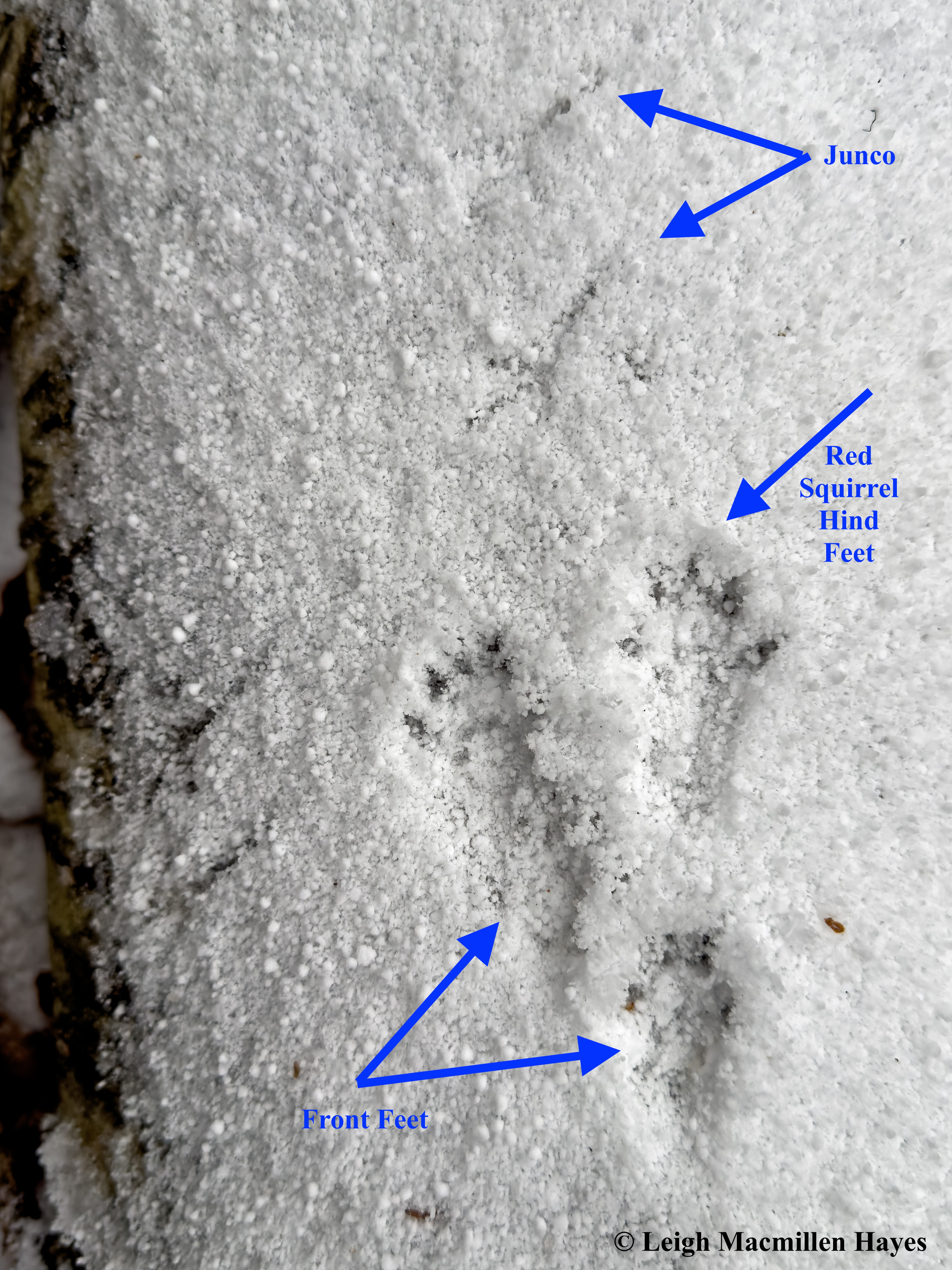
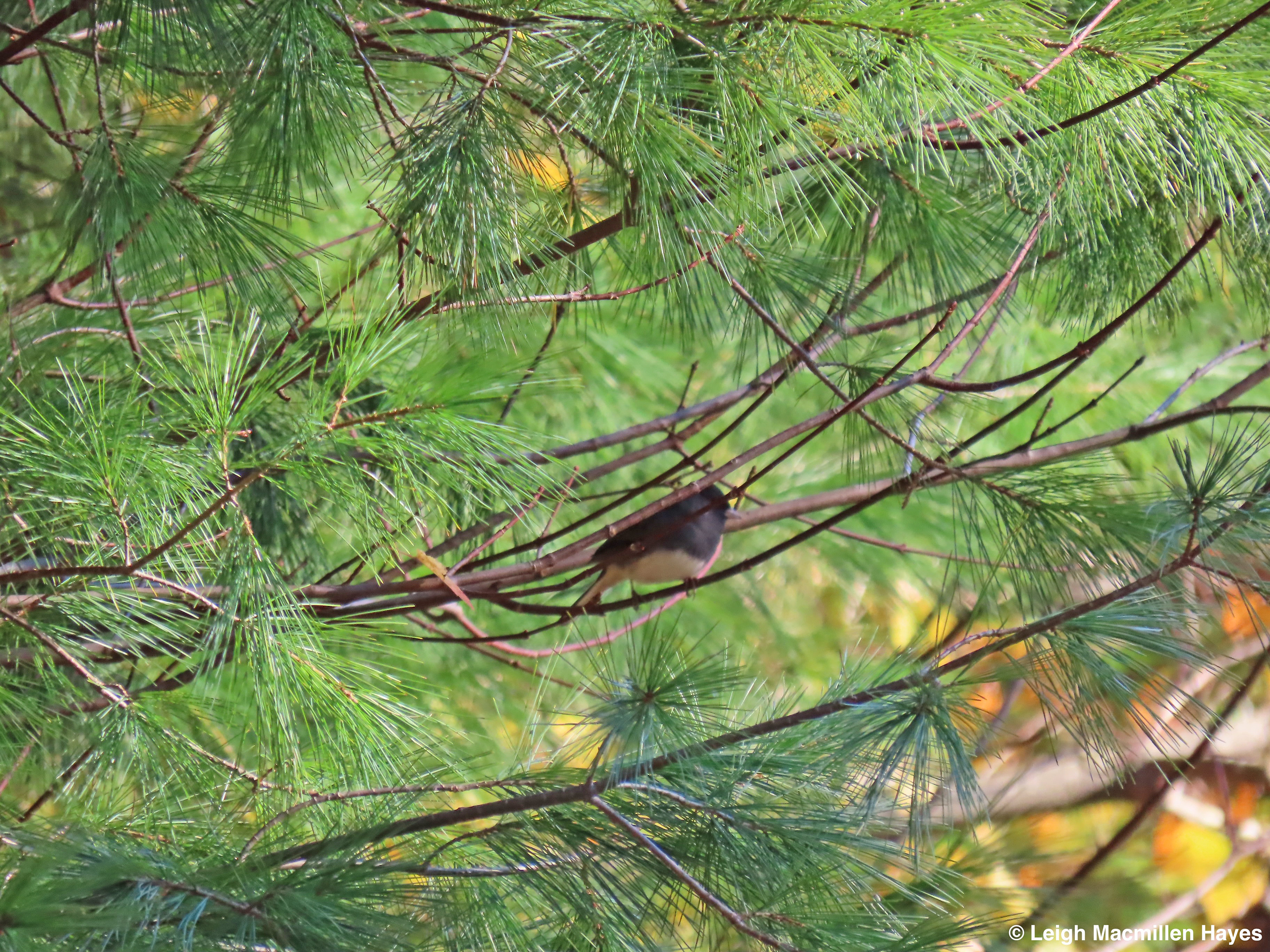
On the same downed tree, we spotted the squirrel’s track pattern and that of Juncos which flitted about in the trees as we passed by.

And back at Hayes Farm, which is protected by a conservation easement with Upper Saco Valley Land Trust, conditions had changed and the mountains came into view.

As we headed back down the road for that final 1.2 miles, giving us a 6.5 mile round trip, I continued to check the telephone poles, and then across a ditch, this colorful sight captured my attention. What in the world could show off these colors in November. My mind quickly scanned my knowledge, which isn’t always up to par when it comes to flowers, but nothing registered. Until I took a closer look by crossing the ditch. And touched the petals and leaves. Um. They weren’t real! So strange. They were well embedded in the sidewall of the ditch. But why? We’ll never know.

What we did know is that we’d been pressed to find a new mountain trail and Iron Mountain did the trick. Guffaw. Did you catch what I did there?

Surprise Ending

Sometimes we follow familiar trails and other times we go off the beaten path. Well, sometimes we go off the beaten path along familiar trails. And other times, we just plain go off the beaten path because we’ve never explored an area before, and even then, we don’t exactly follow the intended route and part of that might not have been our fault for perhaps maps and blazes didn’t correspond. But in the end . . .

Wait. Let’s start at the beginning. We drove across the border into neighboring New Hampshire for a hike and though we’d never been to this spot before, I suspected when I spotted the fruits upon the Mapleleaf Viburnum, that we’d made the right choice. Usually it’s the colors of the leaves that tug at my heart strings, for there is no other tree, or shrub in this case, that exhibits these colors in combination: pinkish-red, purple, magenta, and burgundy.

But the dark blue fruits have disappeared on most that I’ve seen this fall and so I was thrilled to discover so many upon several of this species.

We followed the trail, and then went off trail, of course, for about 2.5 miles, but noted that the description of wetlands was rather deceiving. Oh, they were there, but not clearly visible from the trail and even when we did get to the edges, we could barely see the water for buffer vegetation was so dense. That said, I’m sure the water quality was good. That said, we were in an area with some warning signs about a mining operation years ago, and so the water quality must have been compromised and we can only hope is recovering.

As we circled our way out, we noted that we could have been anywhere in northern New England for we were familiar with all the plants and trees we met. And then My Guy, who does not like mushrooms as part of a meal, spotted a bunch of Red-belted Polypores, which we both admired for a few moments.

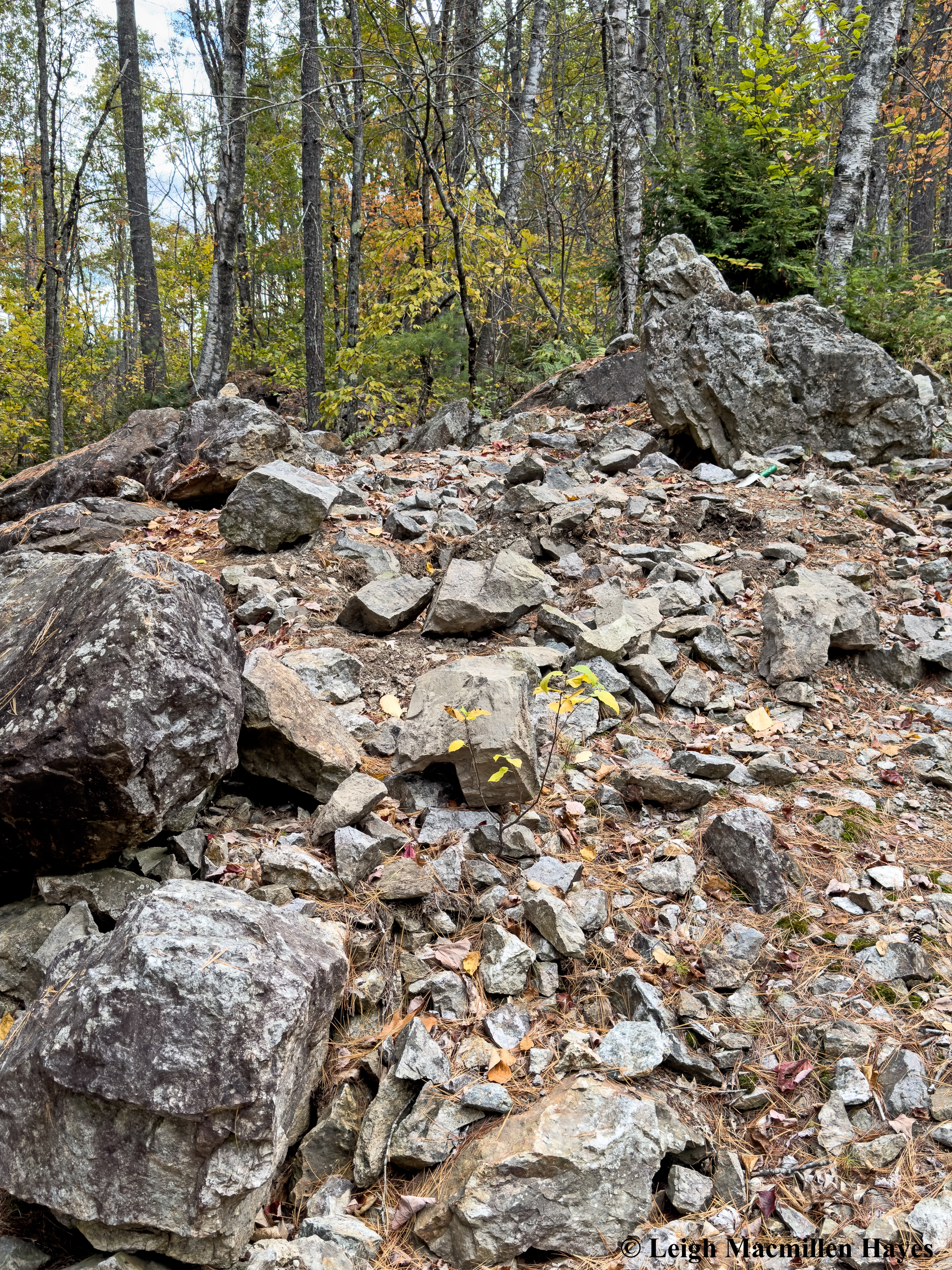
Our first leg of the journey completed, we ate lunch and then drove down the road and wandered into the woods again to locate the site of an open pit that was last mined in the early to mid 1900s.

Since then, others have tried their hand at prospecting and if you are a “Where’s Waldo” fan, I encourage you to try to locate a trowel in the photo above.

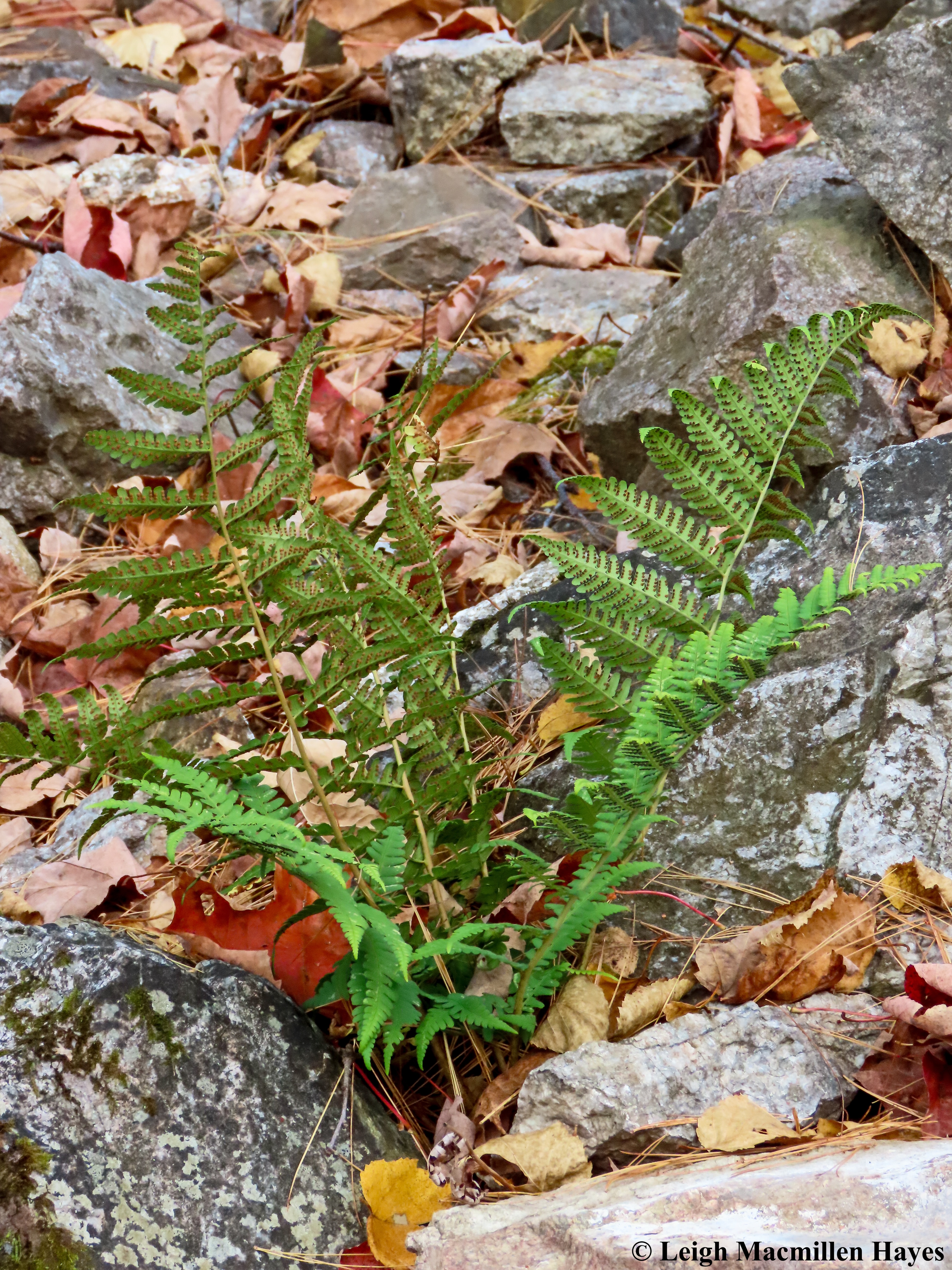
Among the waste rock dump, I was amazed to see a Marginal Wood Fern with its bluish-green leaves and loaded with sori (groups of spores) lining the edges of each leaflet. Their dark color indicates the spores had ripened, but still visible was the whitish, translucent tissue (indusium) that is kidney-shaped, and partly covered the spores.

We left that trail behind and headed off to complete one more loop. Well, we thought it was a loop. Turns out we followed two different trails that did not meet.

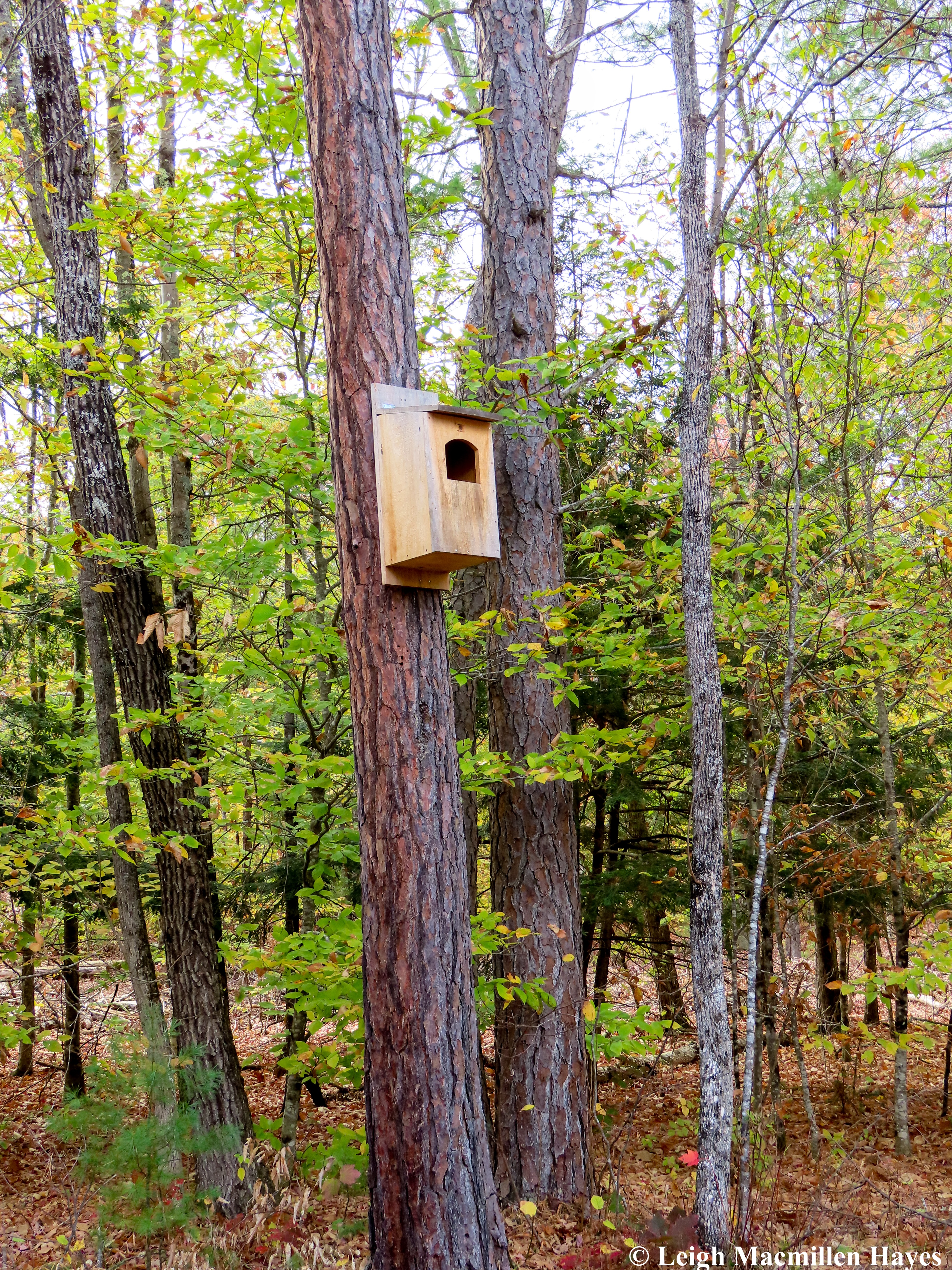
But, along the way, we discovered this huge bird box, a nesting box meant to encourage Barred Owls. I’ve since read that these should be in a mature hardwood forest near water. This one was located on a conifer at the edge of an old log landing. There was water nearby, though it took us some a while to locate it. Has the nest ever been used, we wondered. The Barred Owls in our neck of the woods seem to find tree hollows in which to set up housekeeping and the fact that I hear them most nights and occasionally spot one during the day, and have for several decades means they are quite happy living here, and don’t need a box.

But I digress and return home in that last thought and we hadn’t returned home yet for we had two more discoveries to make on our rather off-course trek, the latter one being the most significant.

As I said, we eventually located a wetland after bushwhacking once we reached a dead end on the trail. We would have explored it more, but had just realized that what we thought was a loop wasn’t and we wanted to know where another trail might lead in the time we had left before heading home.

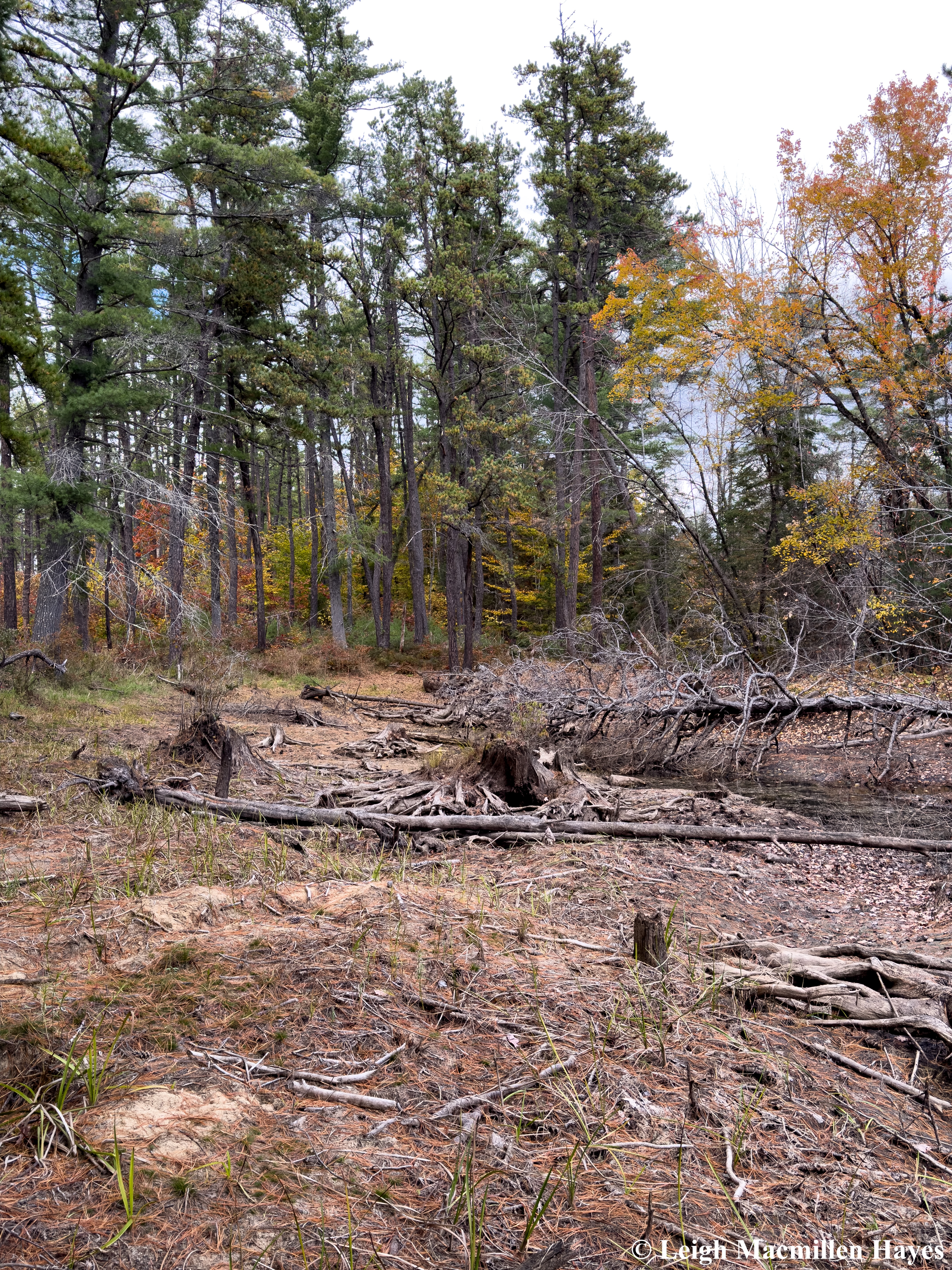
Take note of the water level. Not too low. Curious.

In trying the connect dots, we returned to our starting point of this third leg of the journey and then hiked in the opposite direction. Again we reached a dead end. And again, we bushwhacked from there and came to one rather dried up wetland. Why?

Perhaps there was a beaver upstream? We don’t know. But we did spend some time exploring it.

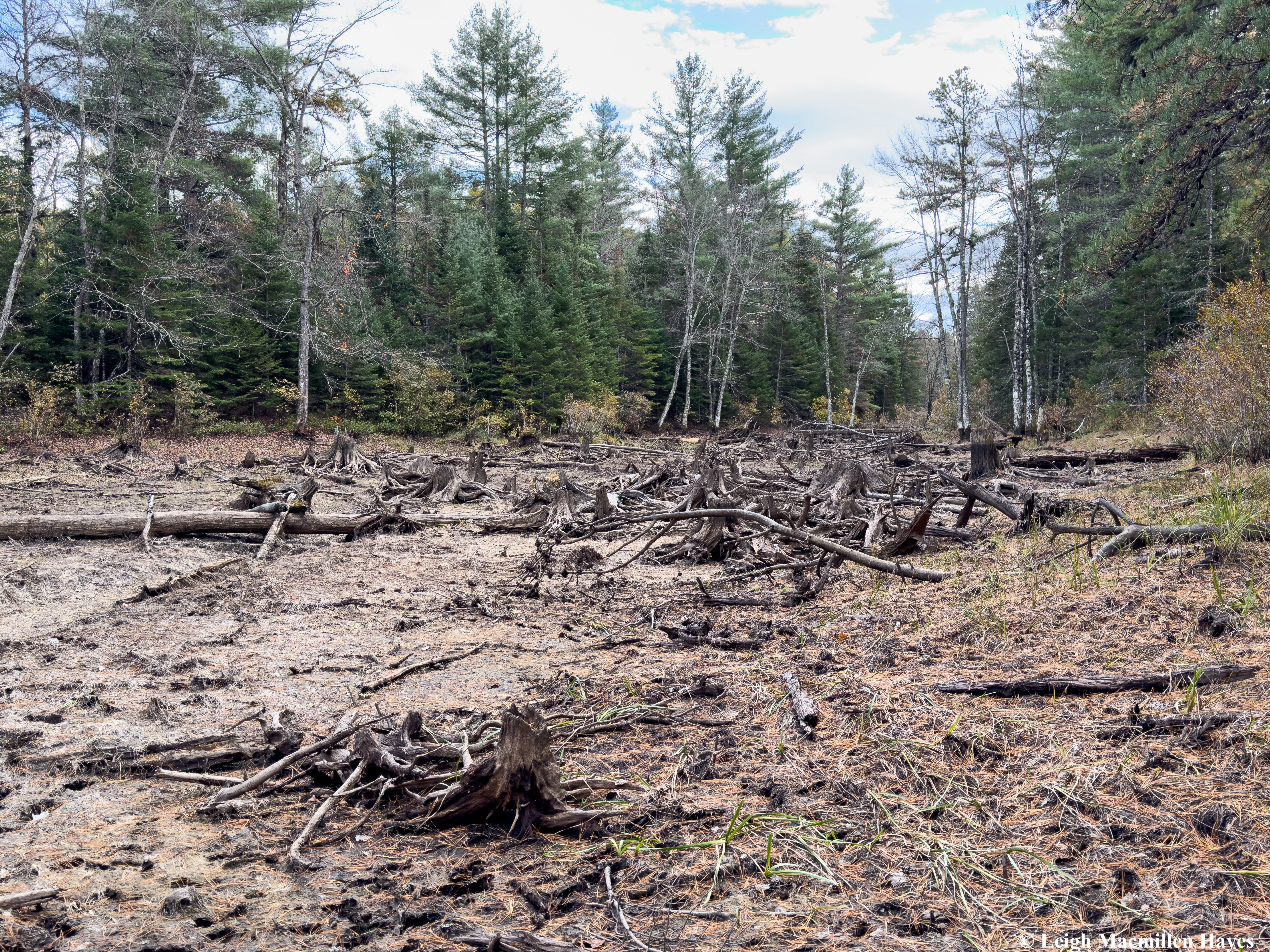
At first glance, it was so barren and my heart was saddened for the loss of life. Obviously, this used to be part of the forest as evidenced by the tree trunks. And then it was flooded. And now it isn’t. Since the drought? Since before that? Answers we don’t have.

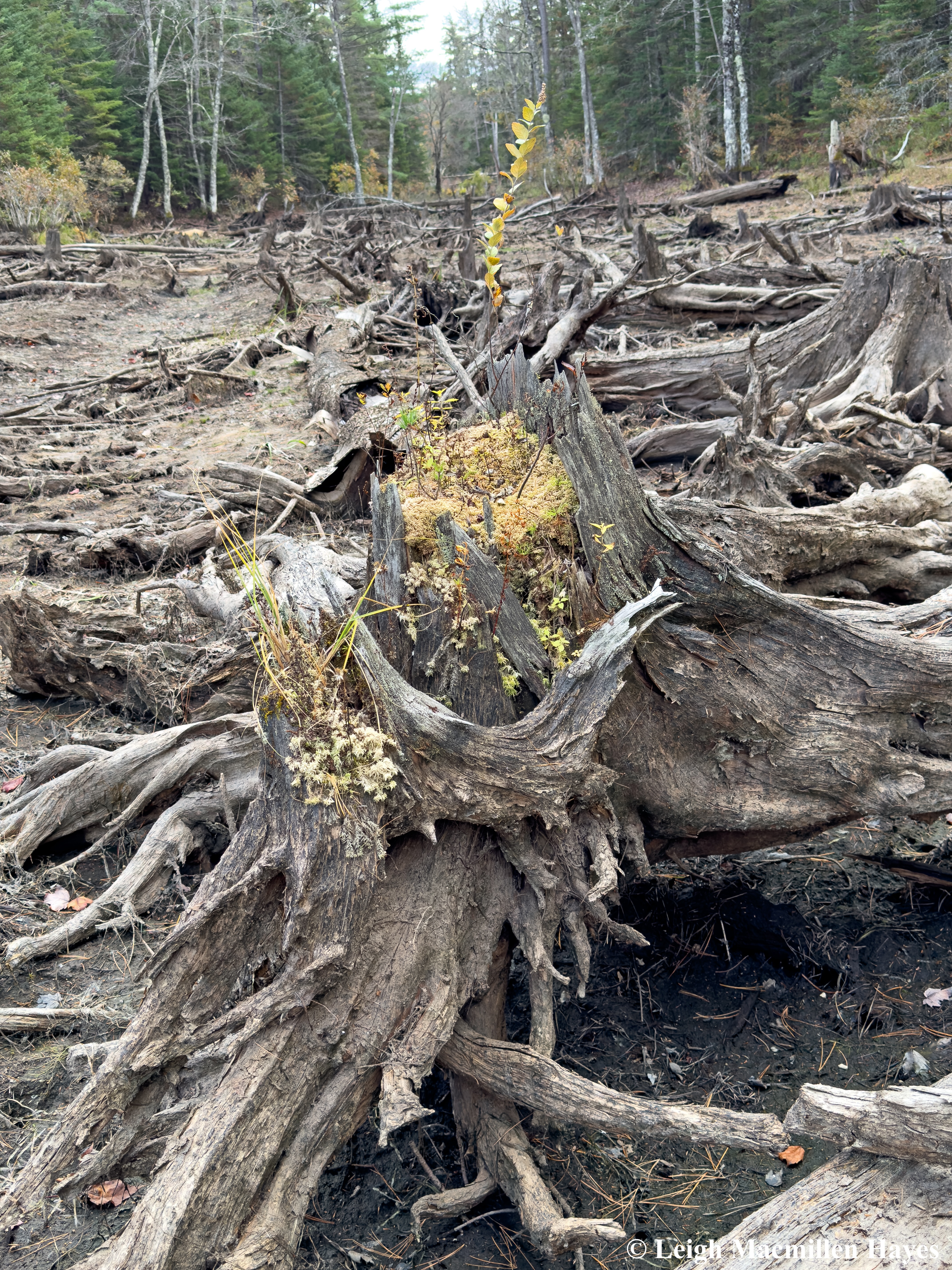
My Guy explored in one direction and I moved across the mud in another and met a stump garden.

In its own dried-up way, it was a thing of beauty with lichens and mosses and plants and grasses and trees all finding their niche in the midst of such apparent devastation.

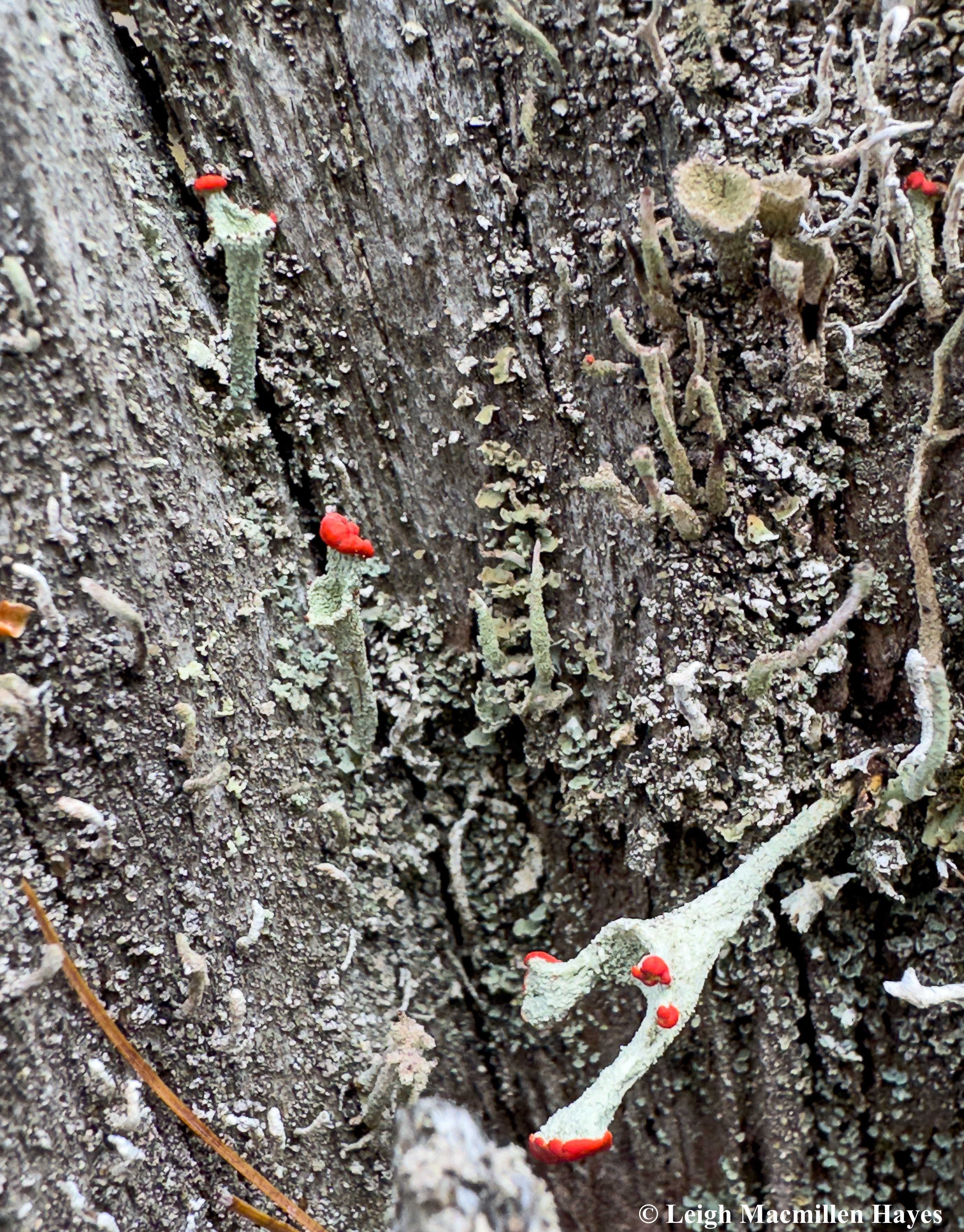
On the barkless outside, I discovered a myriad of lichens from Pixie Cups to Powderhorn (now apparently called Wands) to Red-fruited Pixie Cups.

Not to be confused with British Soldiers, which do not have cups, the Red-fruited Pixie Cups brought a smile to my face due to their goblet formation topped with those outlandish caps along the margins. The red is actually the apothecia or reproductive structures where spores develop.

Beyond the garden stump was another and even another, their roots wrapped in a forever embrace.

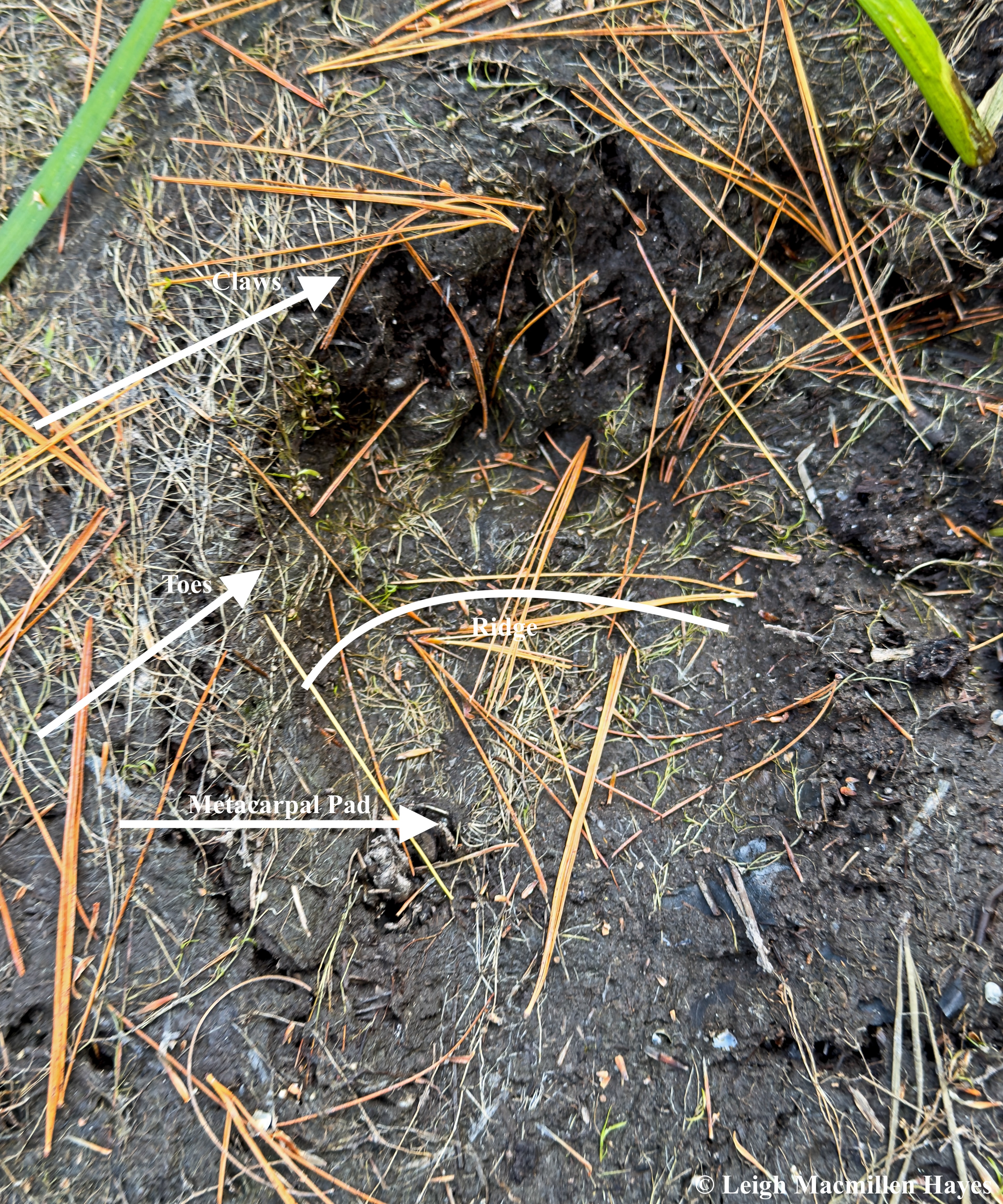
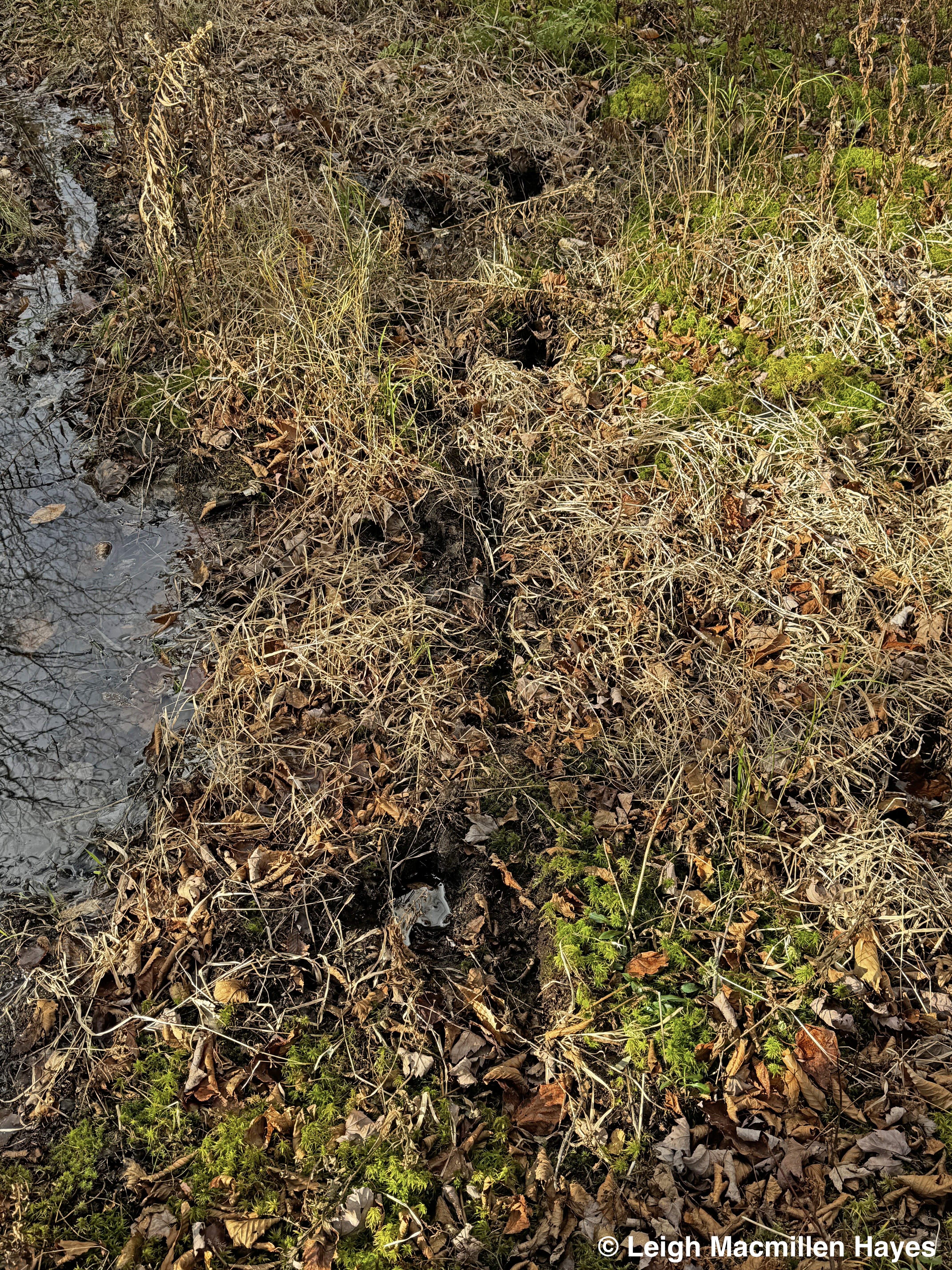
But the show stopper was what I spotted in the mud. A track. There were deer tracks galore. But . . . another mammal or two or three had also passed this way. Note the details.

I present to you, my dear readers, a bear print. Black Bear in this neck of the woods. The smaller toe is on the left, which means this is a right front foot–their big toes are on the outside of their feet rather than the inside like ours; better for climbing trees.

Do my arrows help you to see the parts of the foot?

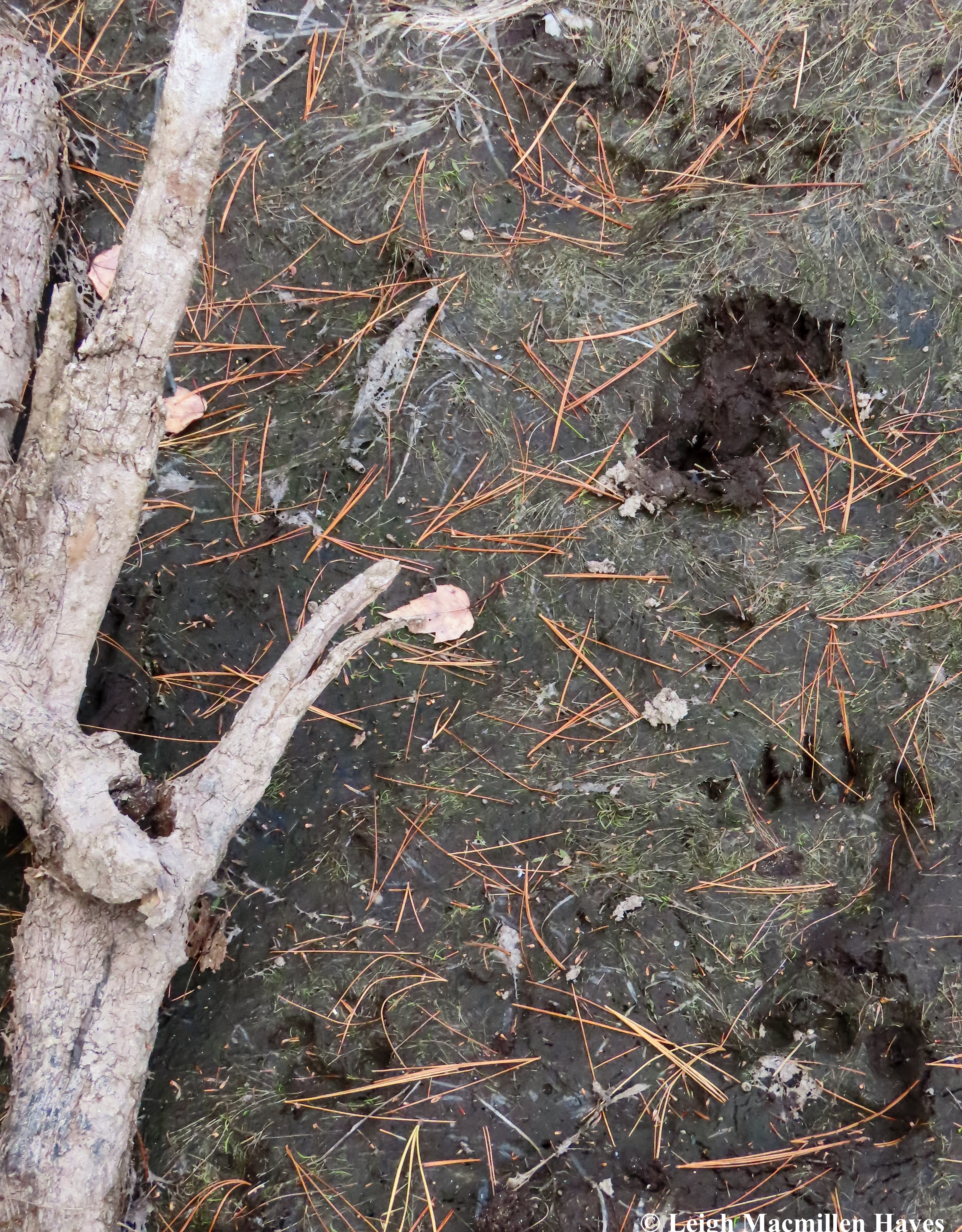
Bears are waddlers, which means they have wide hips and their pattern tends to be a bit of a zig zag, with a hind foot landing near where a front foot had been. Oh, let the tracking season begin.

With two white lines, I’ve tried to trace two bear tracks that My Guy is studying.

Suddenly this desolate, dried-up space, wasn’t so bad after all.

This was our surprise ending. My heart be still.

My Artistic Path: one year later

It’s all Jessie Lozanski’s fault that a year after publishing My Artistic Path, I’m publishing the next layer of paintings and sketches. Until I shared a few with my sister this afternoon, I had no idea how prolific I’ve been in this department. That said, some didn’t make it off the drawing board. Or rather, they did, but ended up in the trash, or in a pile to be considered at a later point in time. That’s the beauty of working with gouache, I can make changes at a later date. For me, that is liberating.

And now Dear Reader, you have three choices: 1) Read this entire post from beginning to end; 2) Scroll through the pictures and call it good; or 3) Click out of this post and pretend you either never saw it or that you did see it and loved all of it.

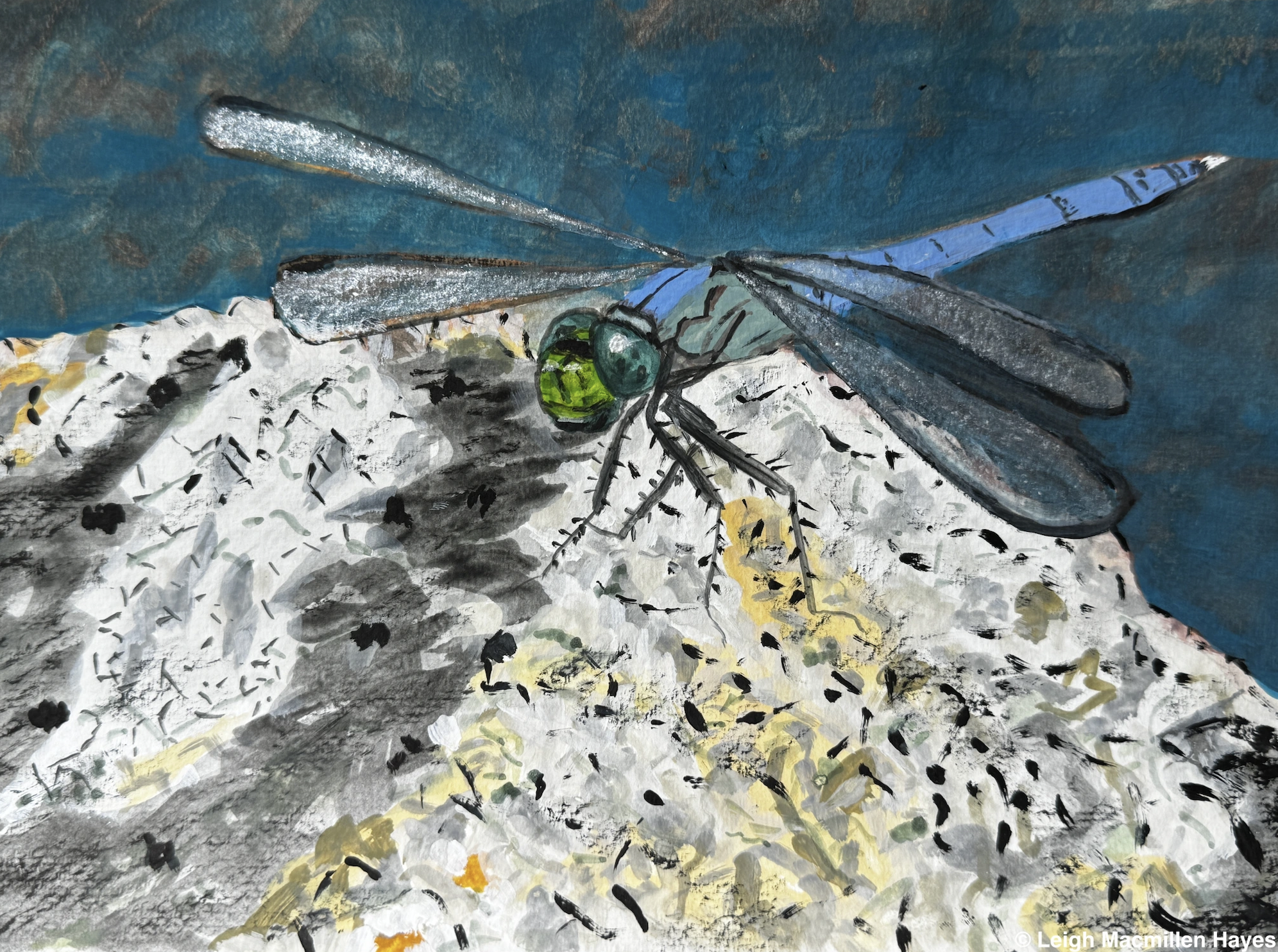
I have to say, I thought I’d paint more dragonflies like this Eastern Pondhawk, but when I scrolled through My Art Gallery, I discovered only a few others. That said, I did take some time to sketch the naiad forms of six families and then painted each one. You can visit all of those in Dragons of the Future if you wish.

Waterways also intrigued me as I tried to figure out how to make the water look as if it is flowing. This is Province Brook in Chatham, New Hampshire.

And then there are the critters and I’m afraid you’ll see a few of them along this journey. The fun thing about this Chipmunk is that it made an appearance on a February day. I was tracking with some friends and we were pretty certain that we’d discovered Chipmunk prints, but it didn’t seem possible. Until it was because as we backtracked, we saw him and he posed for a few photographs. Sometimes, when you need more food, you might make a mad dash from your winter home to locate it.

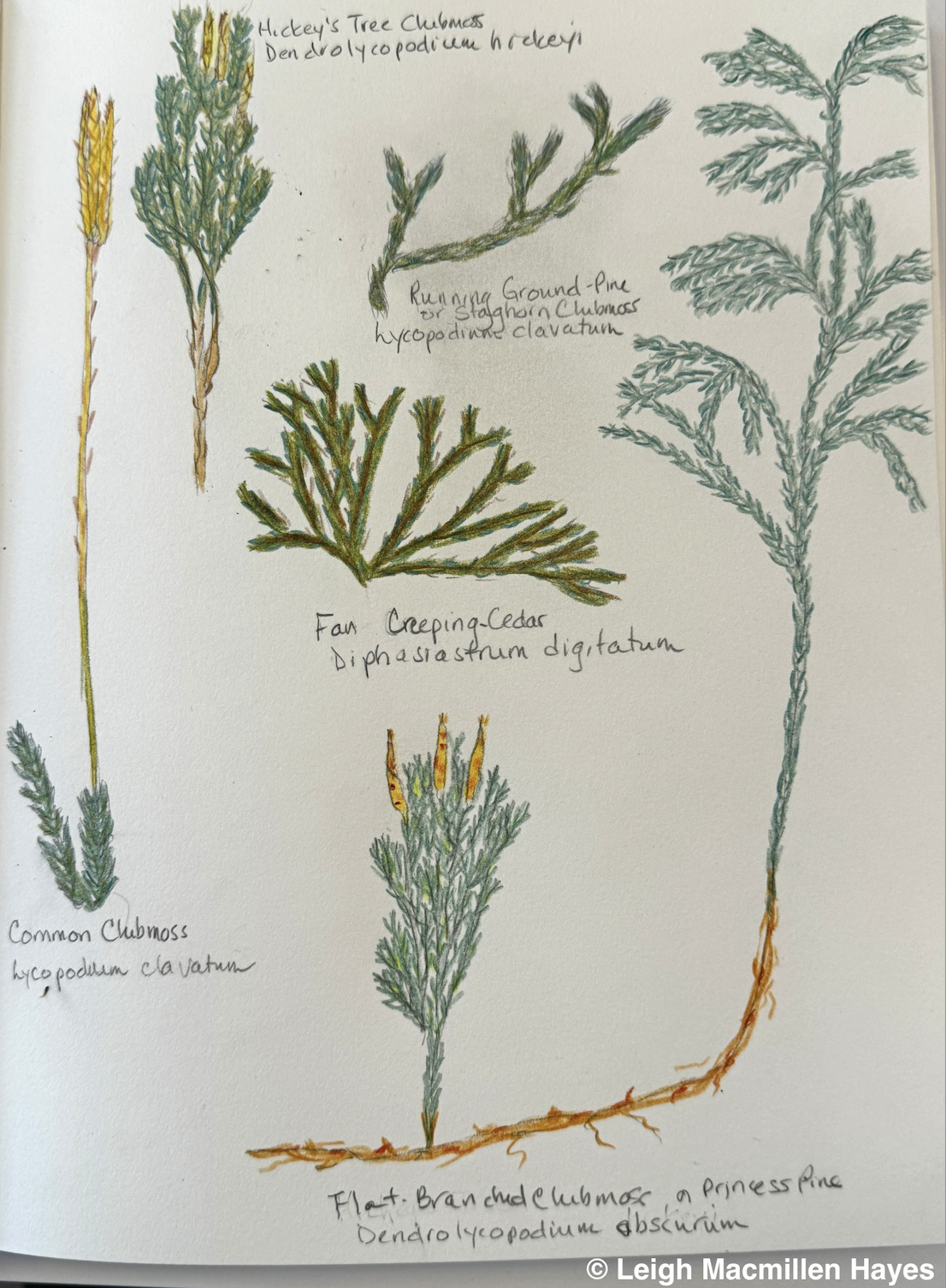
Clubmosses are one of the topics I’m trying to learn. . .when I take the time to do so. And so I sketched these after spending some delightful hours studying them as I wrote about in When is a Moss not a Moss?

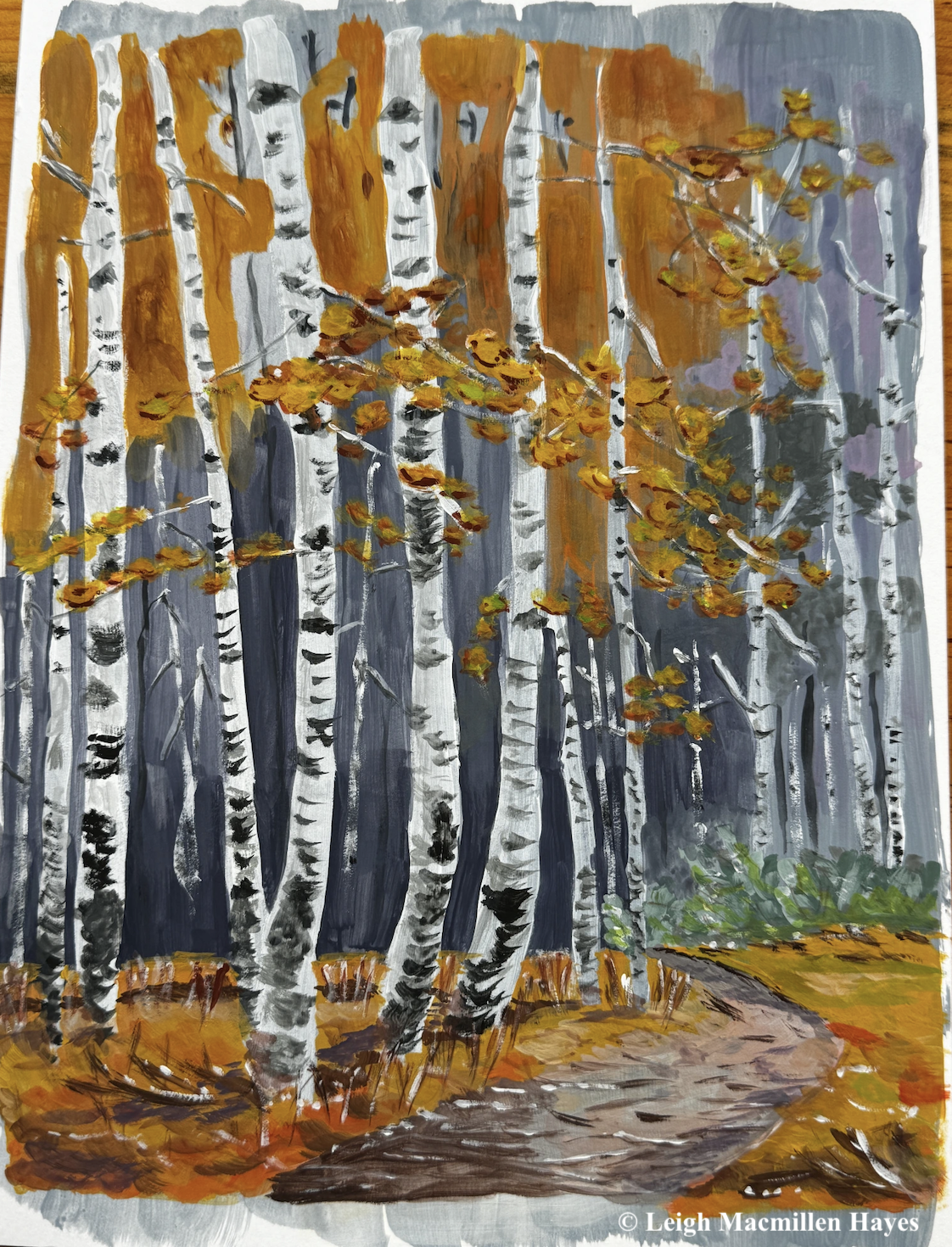
It’s the colors in this painting that I like. And figuring out how to paint Birch bark.

And then there was Forter Castle in Glen Isla, Scotland. I actually did three smaller versions of this castle and then decided to paint this larger picture based off one of those. It was a gift for Anne, our hostess when we were invited to spend a few nights there back in 2017, and in memory of her husband John. You can read more about that adventure here: From the Bonny Banks to the Highlands.

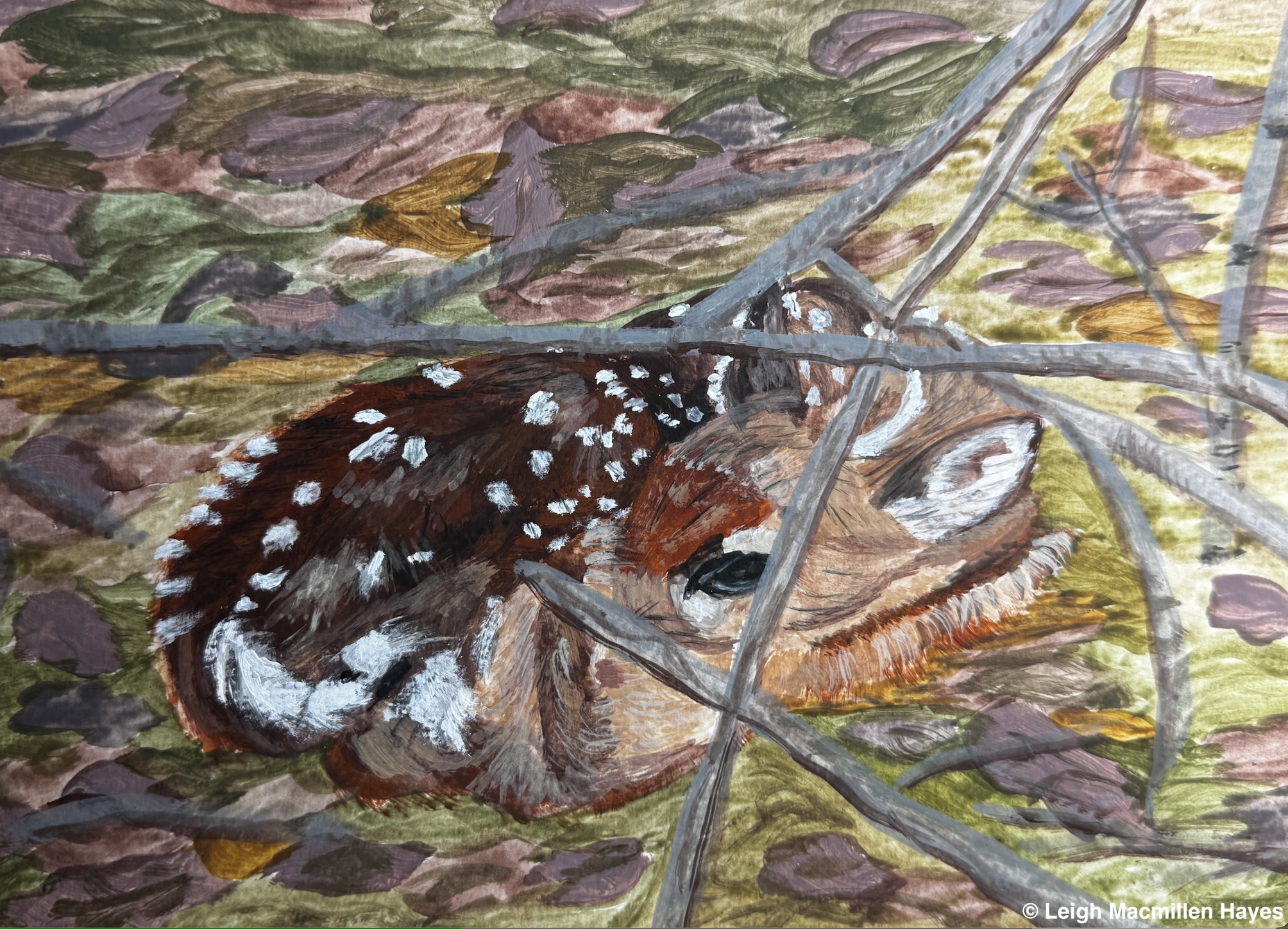
This next one will forever evoke the memory of my friend, Faith, who passed away this summer. We were on a Lakes Environmental Association walk at Holt Pond when we all “spotted” this fawn quietly waiting for momma. Quick pics and then we moved away.

And this is one of the Red Foxes who frequent our yard. In My Art Gallery, there are two more attempts, both in watercolor while this one is with gouache paints. Experimenting is fun.

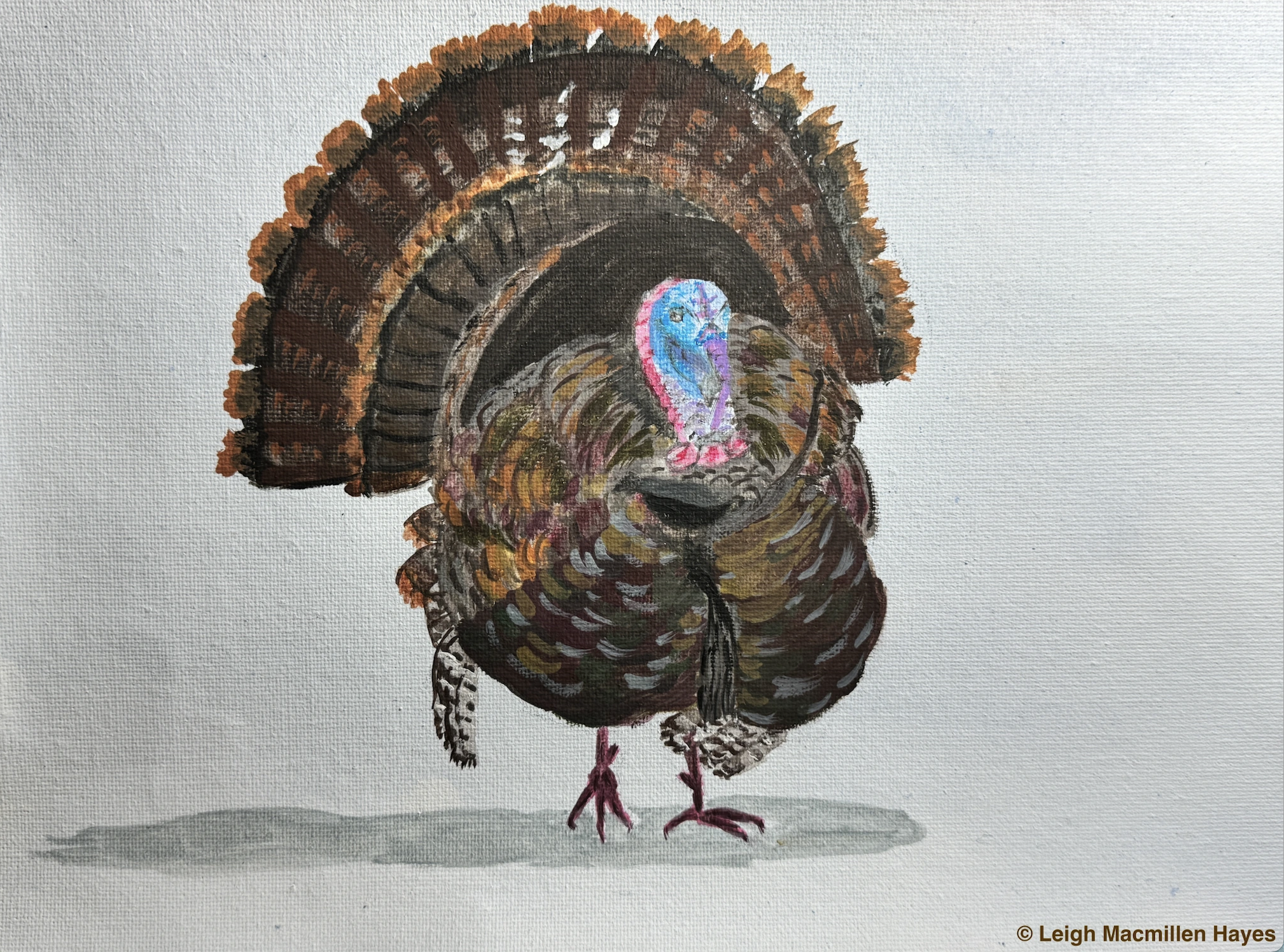
Tom Turkey! What more need I say.

In the midst of taking classes with Jessie this past year, which sadly ended in the spring, I purchased Grahame Booth’s book: Anyone Can Paint Watercolour Landscapes, and tried to follow the step-by-step instructions. This was a result of Lesson 1. There were six lessons altogether, and I thoroughly enjoyed the experience. You can see my other paintings based on the book by looking once again at My Art Gallery. Yikes, I’m beginning to sound redundant. Smiley Face!

I like this one because I like the subject. I used a matted board to paint it. The stump is beside the Saco River in Conway, New Hampshire.

This one was for another friend because we had walked out to Kezar Pond in Fryeburg from her home the previous New Year’s Eve or Day, and it was just lovely.

And then there is a perennial subject of mine–the Stairway to Heaven tree along the cowpath in our woods. I especially love it when snow outlines the branches.

Another favorite scene takes me back to my childhood in Clinton, Connecticut, and I painted this for my sister and brother-in-law as a keepsake. So many memories in the spot that was our little piece of Heaven for so many years.

On and off, I’ve produced paintings of birds, and another favorite subject is the Great Blue Heron. I’ve also tried to paint rookeries, but often struggle with perspective. Of course, you can view my attempts you know where: My Art Gallery, to be shortened to MAG going forward.

No words necessary really–a male Northern Red Cardinal.

And his female counterpart.

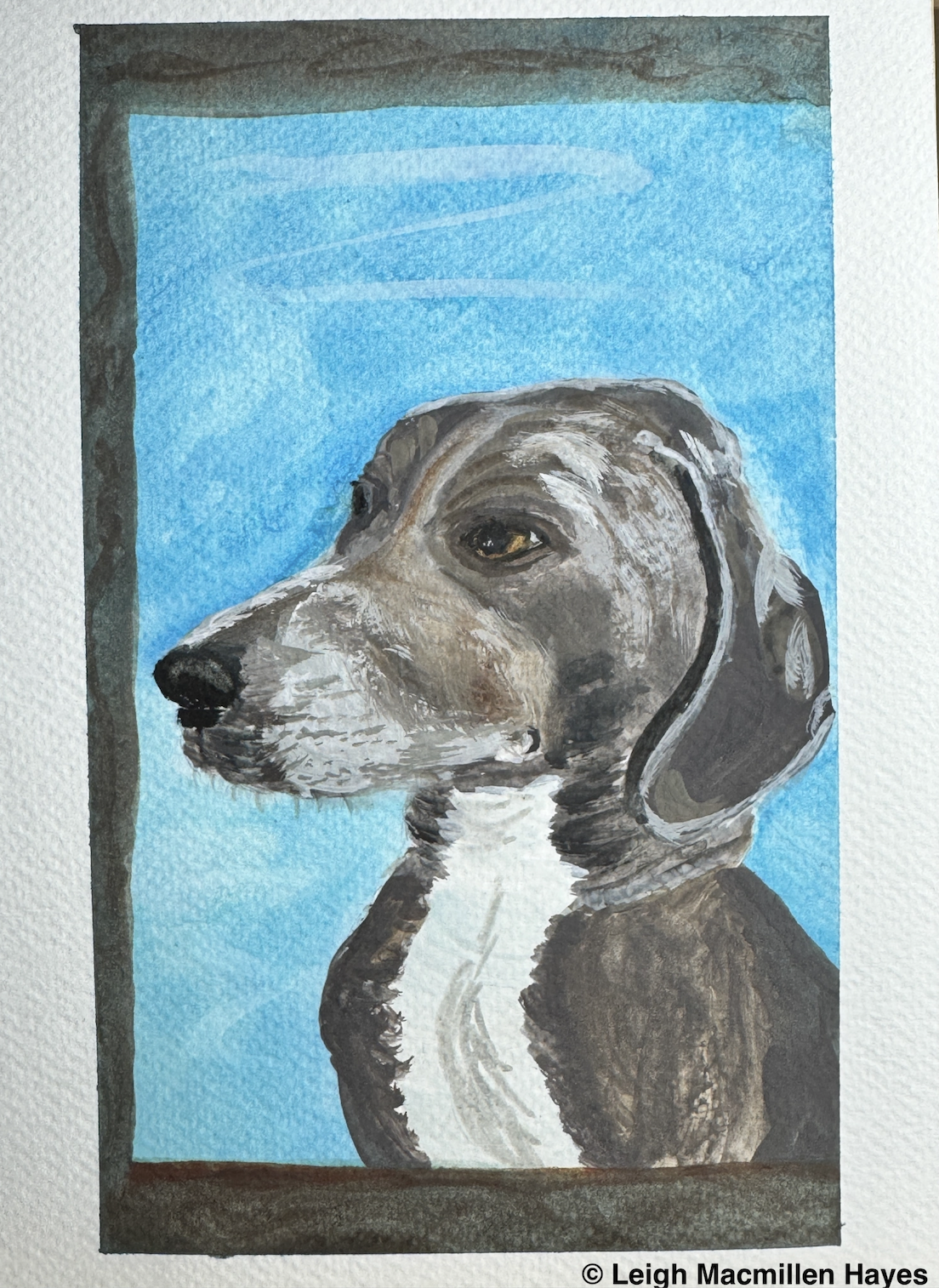
Our oldest son and his girlfriend rescued this energetic pup at the beginning of the pandemic.

And this pup belongs to our youngest son’s girlfriend’s mother.

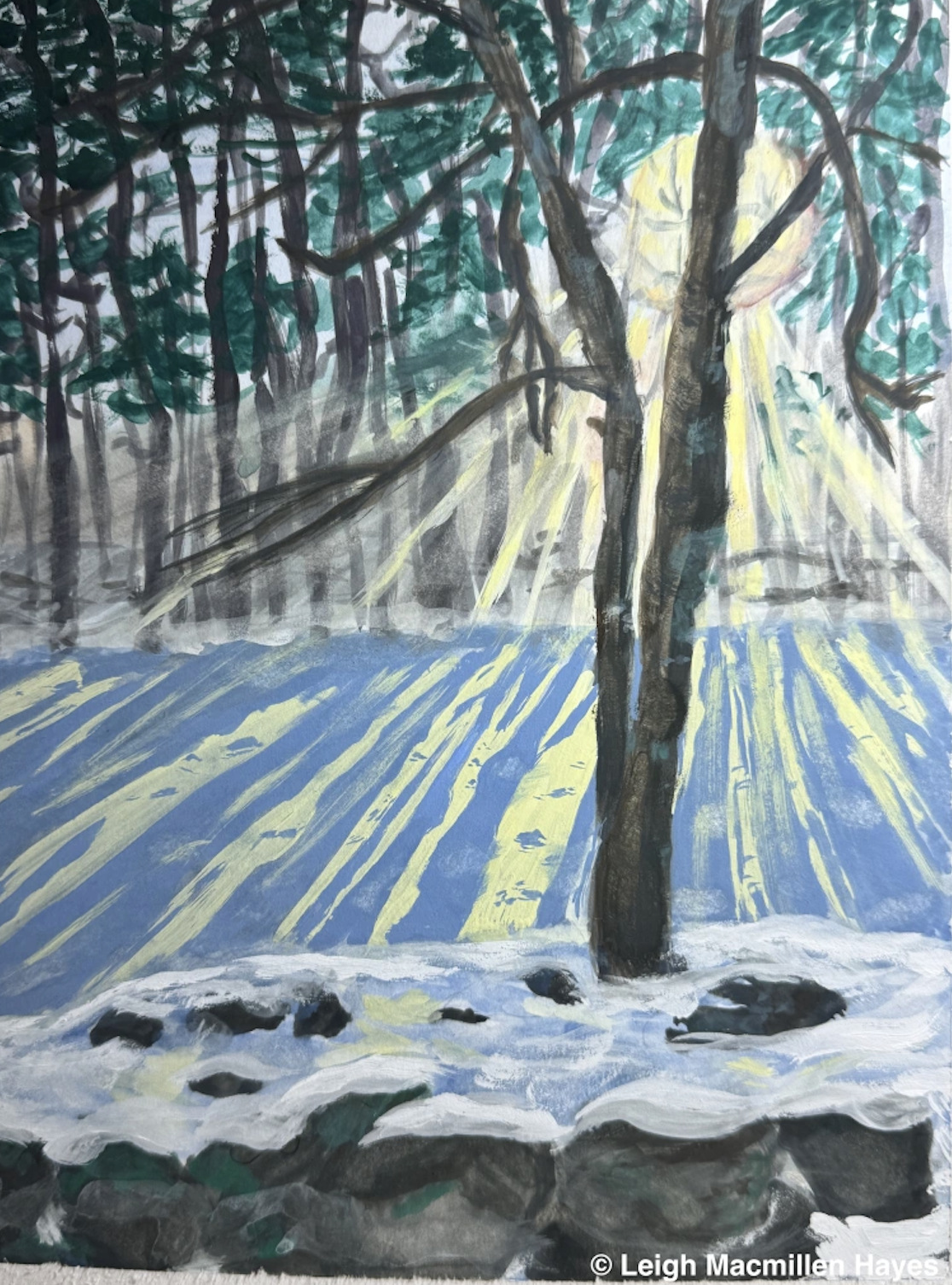
One morning, I stepped outside just after it had finished raining and the sun was shining through the trees out back and there was a layer of fog and shadows and it was just exquisite so I tried to capture it.

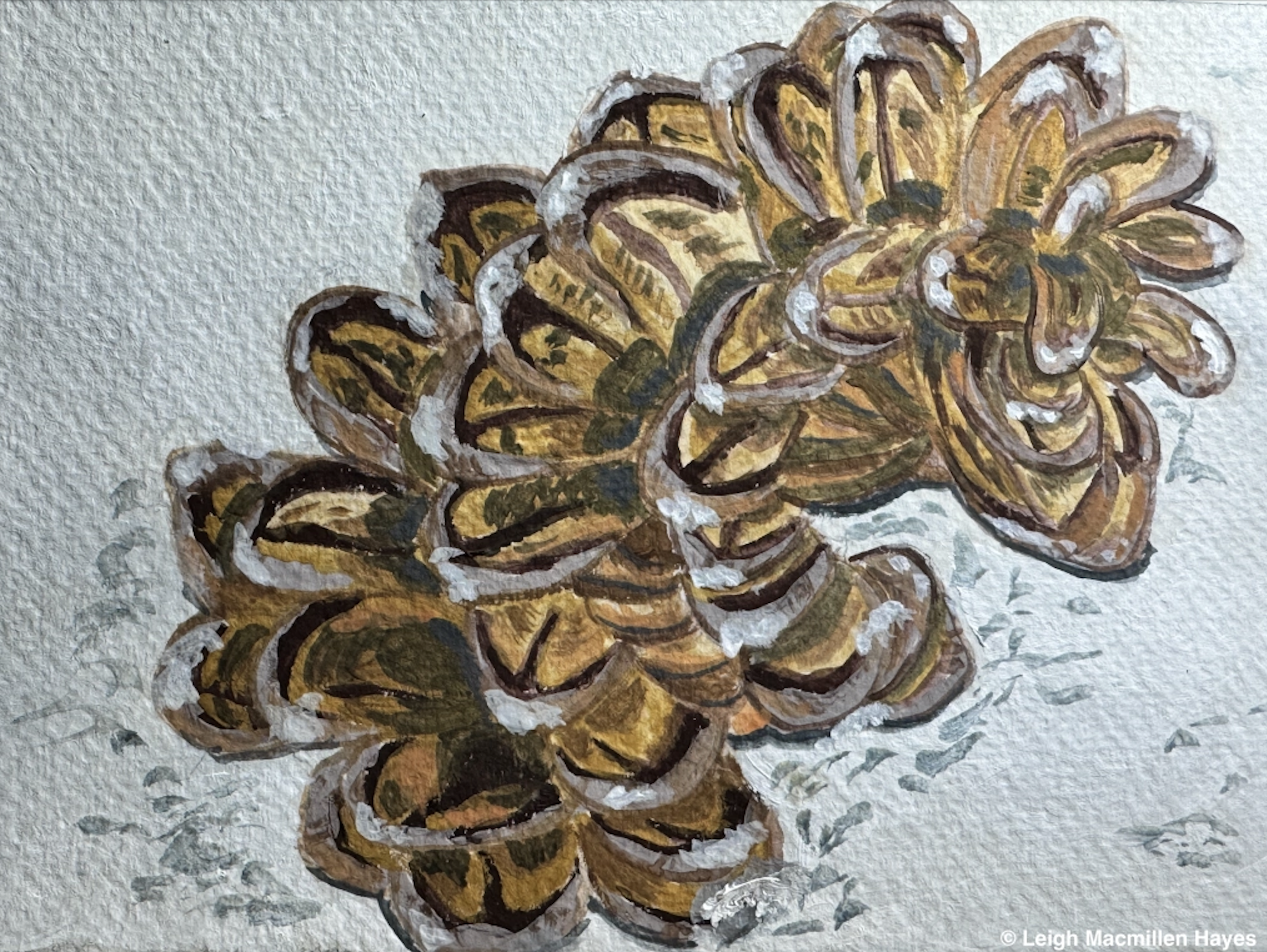
The White Pine Cone was something I started to sketch and then left for a long time, until I realized the scales were all arranged in a spiral of course and bingo, I knew how to go about it.

Turns out, I’m not the only one who knows to go about it–for Red Squirrels love to take each pine cone scale off in order to get to the seeds stored by such. Their method of descaling a cone is rather like us eating corn on the cob. I actually referenced both the pine cone painting and this one in Another Amazing Lesson from a Red Squirrel.

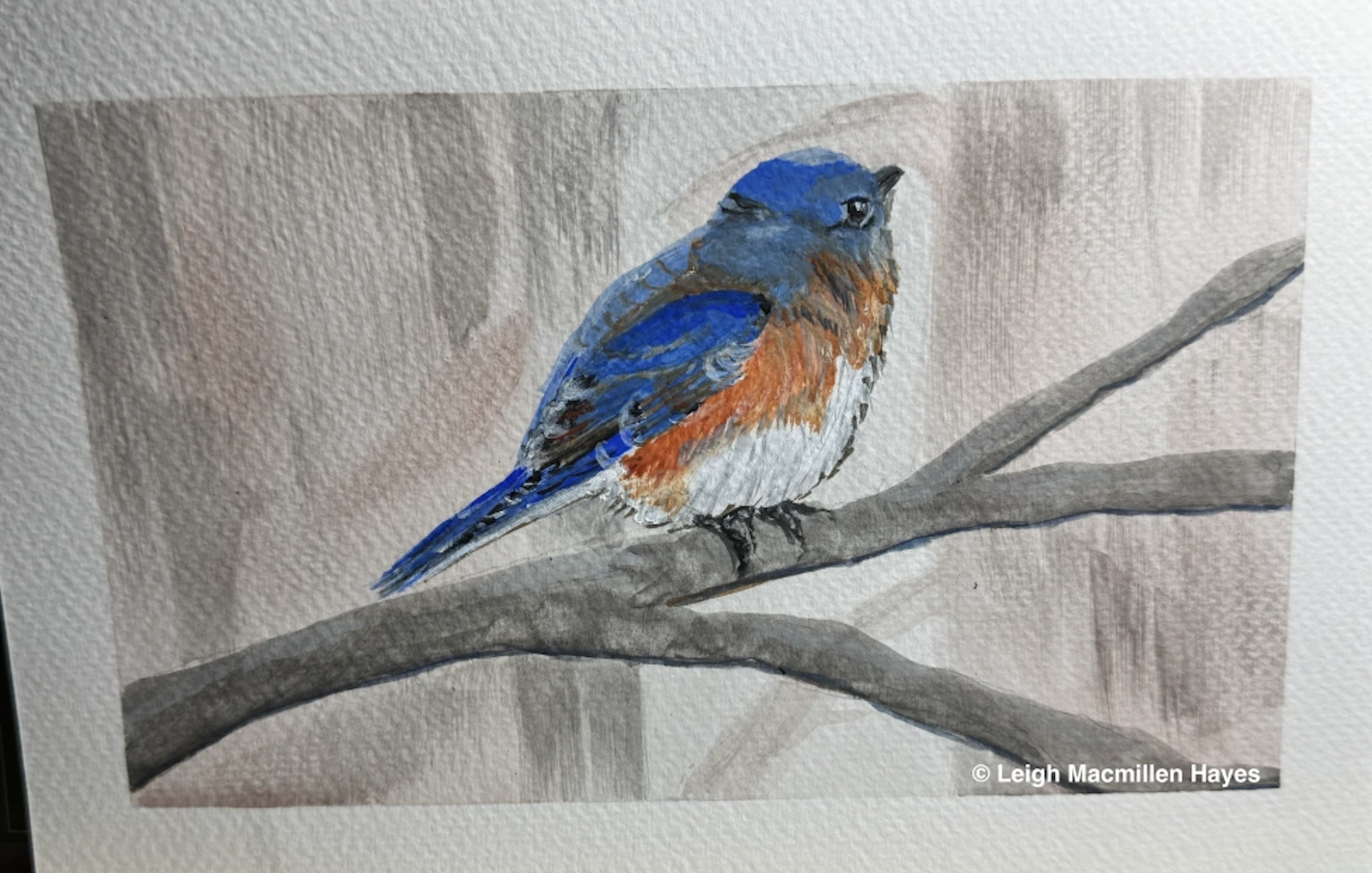
All last winter and spring, and into the beginning of the summer, my neighbor and I rejoiced because we had Bluebirds. In fact, a pair nested in one of our boxes, but that was around July 4th, and by the end of the week, she’d abandoned the nest. We’ll never know why.

A few more birds coming up–including this male Red Winged Blackbird at Brownfield Bog.

A Sharp-shinned Hawk in the backyard and field.

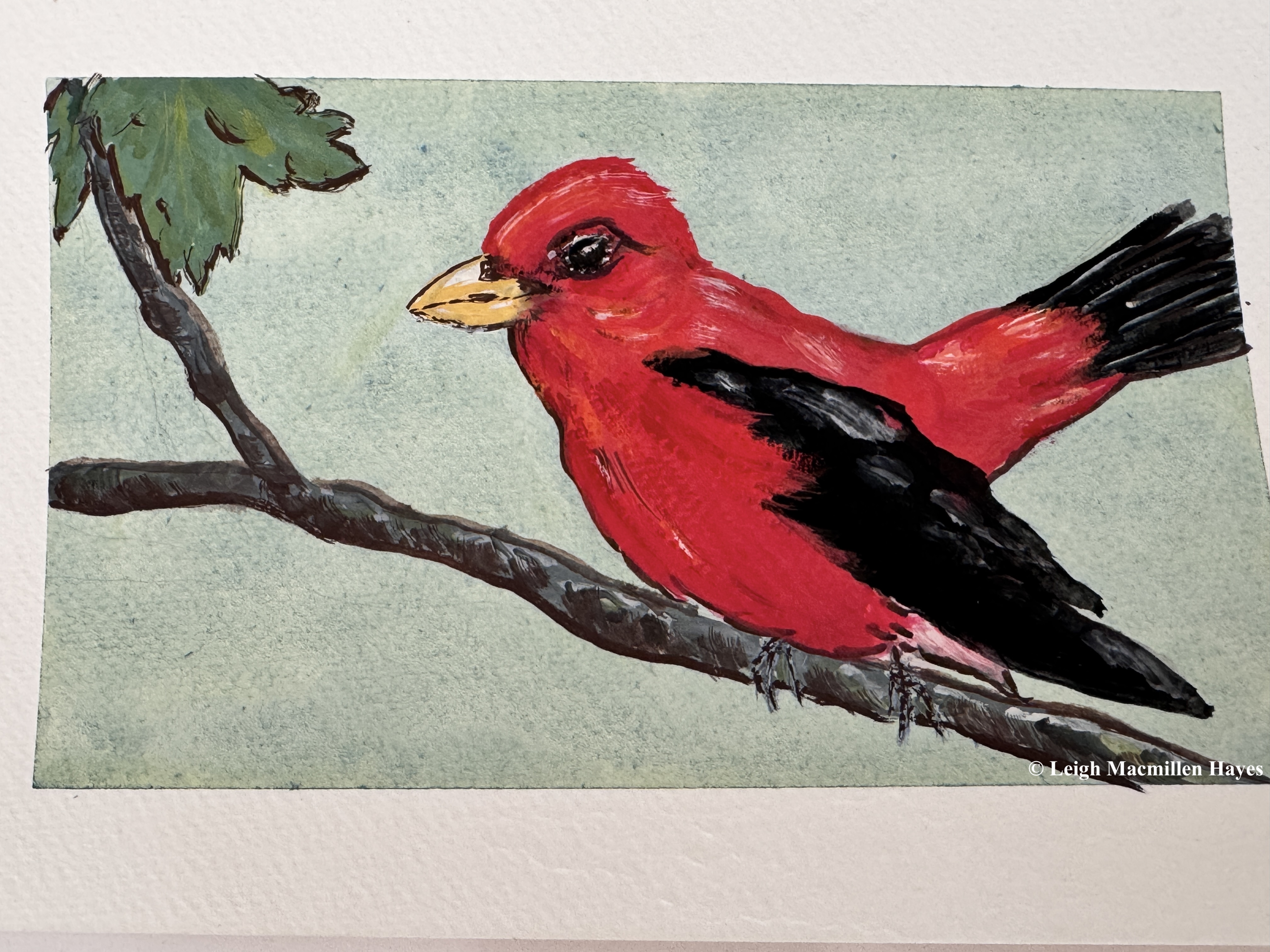
And a Scarlet Tanager on Mount Cutler in Hiram, Maine.

I did think I’d paint more butterflies, and perhaps this fall or winter I’ll attempt to, but it seems the Spring Azure is all I’ve done so far.

I’ve also made a couple of cards in the course of the year, this one for a First Grade student who was my penpal and she told me she really likes Dandelions. That girl will go far in life!

Another favorite topic of mine: Dog-Day Cicadas. If you type Cicada into the “Search” bar on my blog, you’ll discover several posts about these insects emerging. As I write, I can hear them “singing” from the treetops.

Sometimes, actually, more than sometimes, something catches one’s eye and this Tree Frog was one of those times. A friend and I had stopped to talk about a Snapping Turtle that seemed to be late laying eggs, and bingo, there was the frog on a tree.

Speaking of frogs and other critters who rely on vernal pools, visit MAG and you’ll find my Vernal Pool series, including a Fairy Shrimp that looks WAY bigger than its actual 1 – 1.5 inch size.

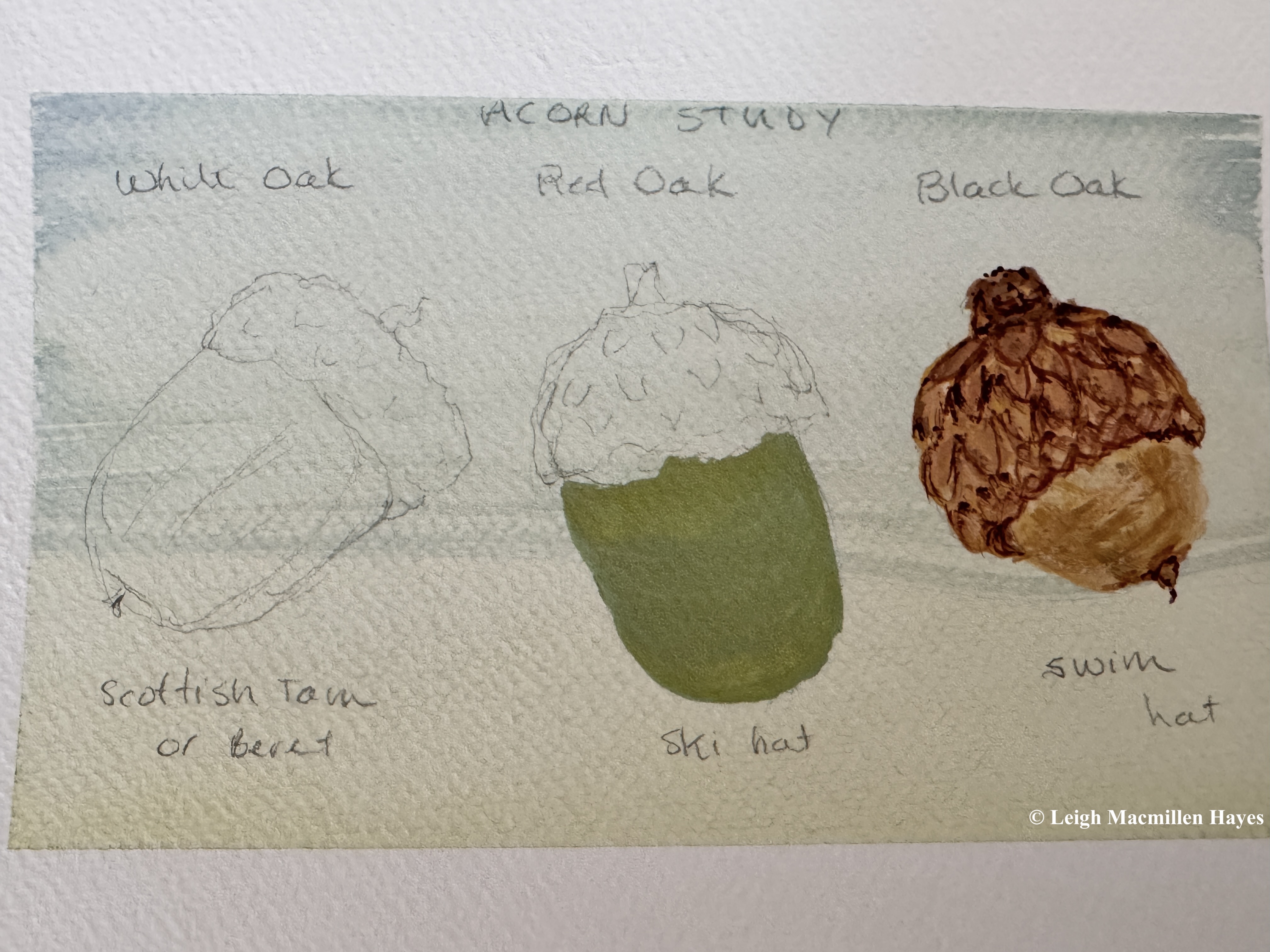
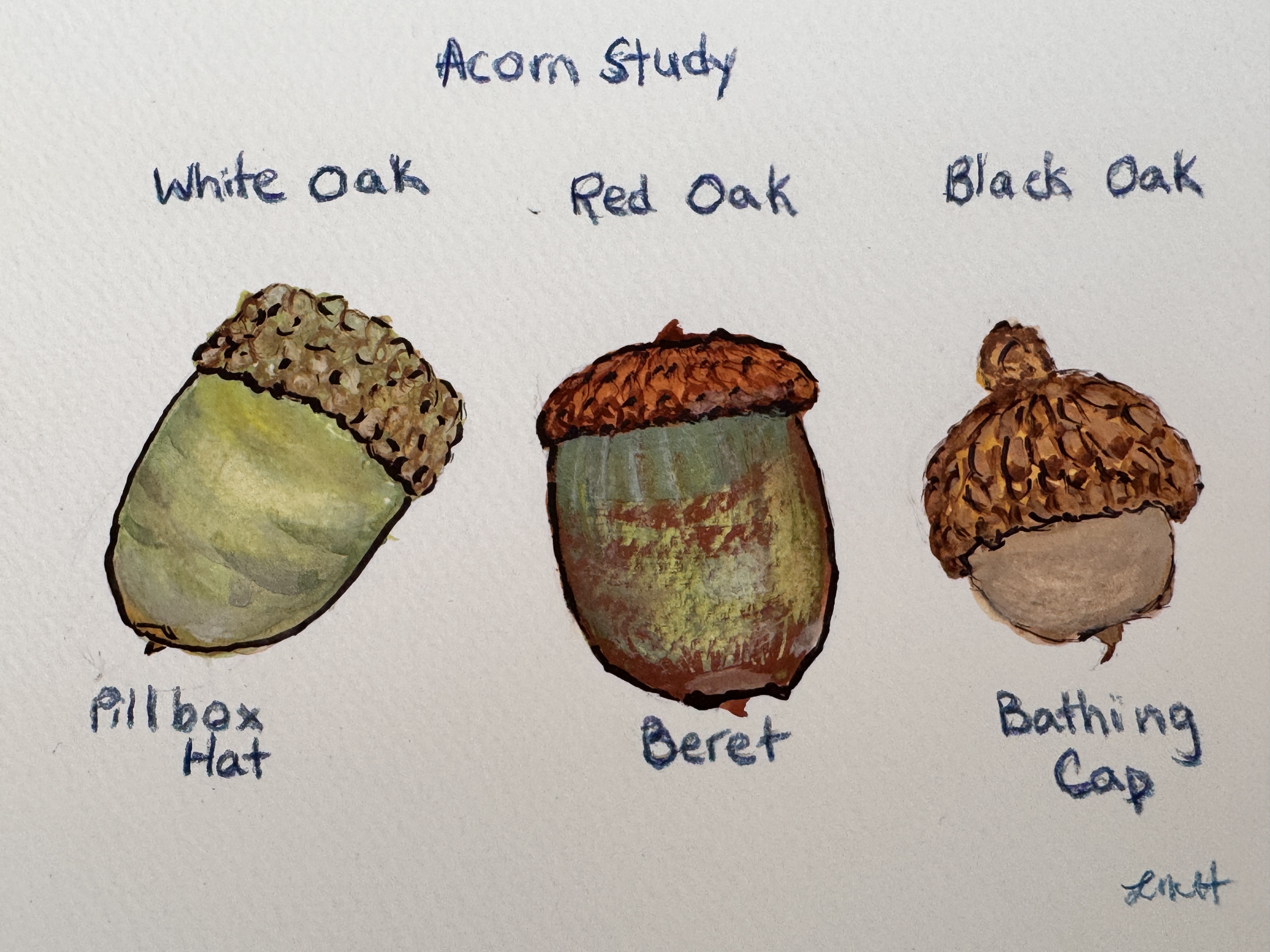
And then there was the day I pulled out a copy of National Audubon’s Field Guide to North American Trees because I wanted to get to know acorns better. Silly me, I came up with names for each one based on what they looked like to me, but I made the mistake of writing the names in pencil before painting a light colored wash on the paper. As I began to paint the acorns, I realized I wanted to change their names, but couldn’t erase them or paint over them. So . . .

I sketched them again, and gave them new names.

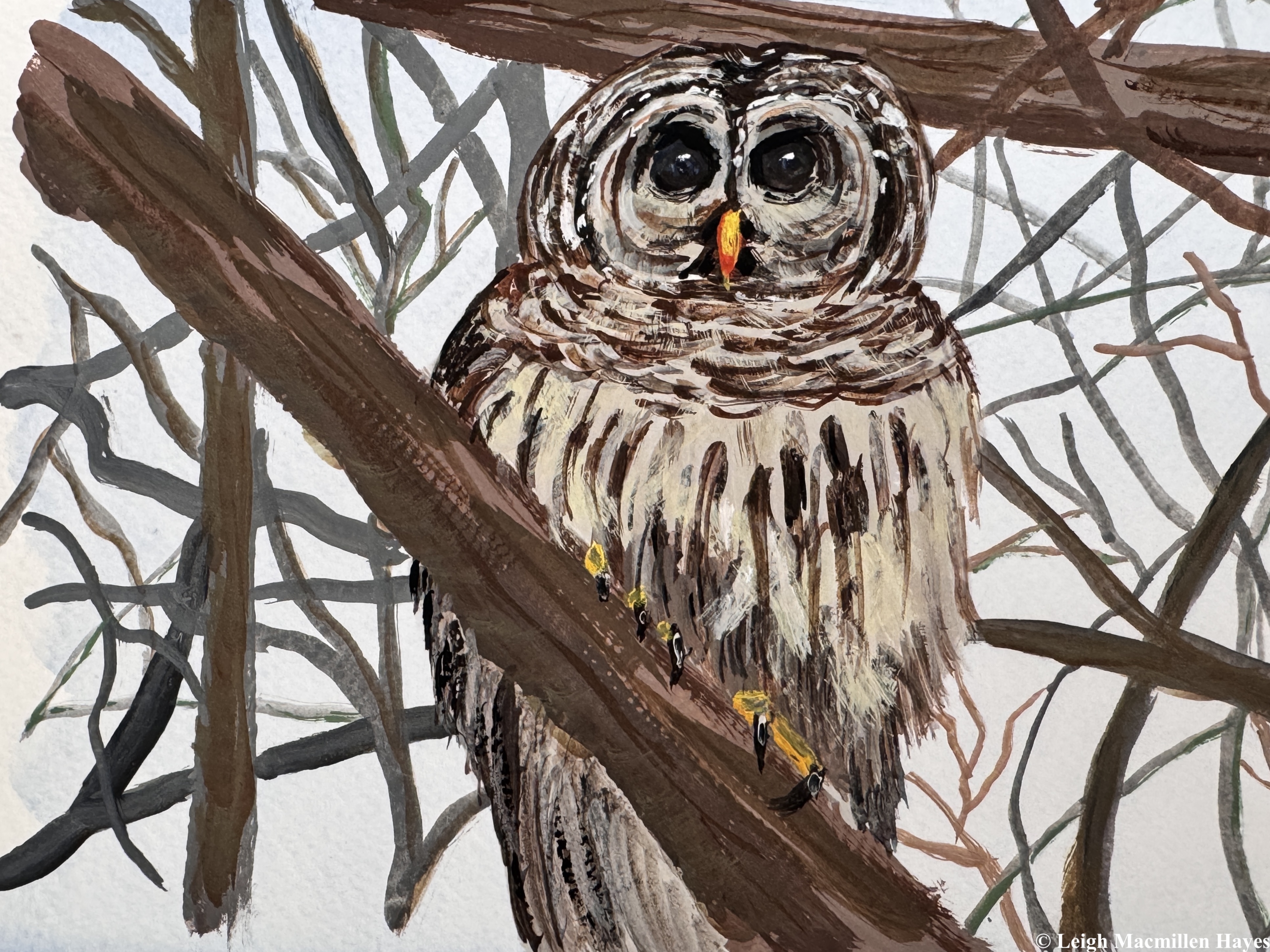
And finally the moment you’ve been waiting for, today’s painting:

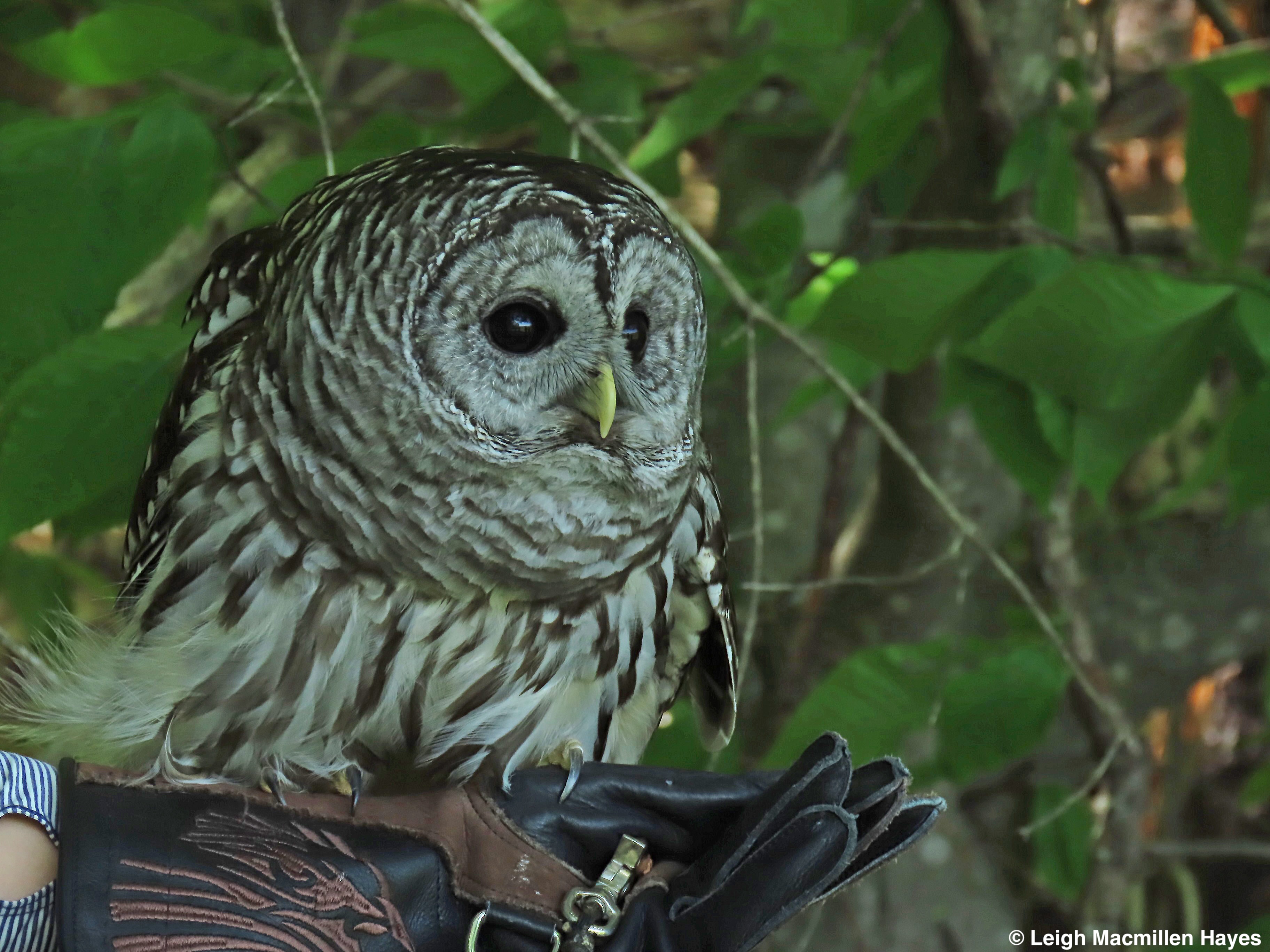
I always like it when I try iNaturalist’s SEEK app on a painting and it agrees with me. Barred Owl it is.

Wow, I had no attention of pulling this all together today until about an hour ago when I was sharing photos with my sister and realized I hadn’t sent her any in a while. So thank you, B.S., for being my inspiration today . . . and always.

And thank you Dear Readers, for sticking with me today and always as I share My Artistic Path: one year later.

Where The Moccasins Led Us

Rituals. We follow them. Some more than others.

For My Guy and me, there is one in particular that captures our attention beginning in mid-May.

And so I follow him . . . across Beaver dams,

beside the Atlantic Ocean,

up mountain trails,

even on the hottest day so far with Canada wildfire smoke casting a haze.

This year it was more trails than usual that were included in our ritual and along the way we spotted Wild Columbine in bloom, growing as it does among the rocks, and always pleasing our senses with its brilliant colors and artistic nodding presentation.

Fringed Polygala, and how I love the way those two words roll of my tongue, also showed off, making its common name of Gaywings so apparent. Doesn’t it look like a Bird of Paradise coming in for a landing upon its very own leaves?

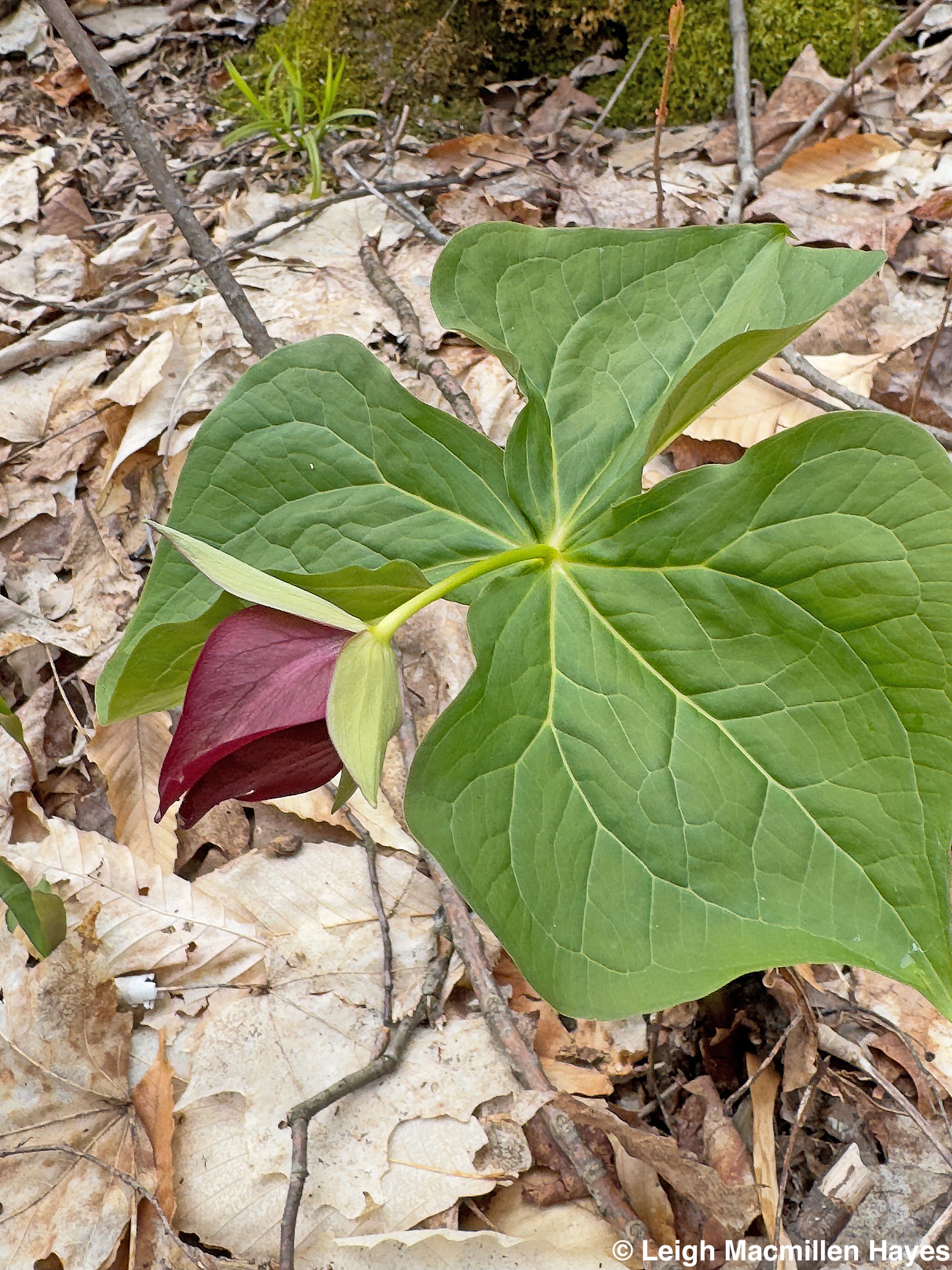
Upon one of our journeys we found a few Red Trilliums still in bloom, though it seemed late in the season for them. But as My Guy teases, I did what I do and added this photo to the other trillion I have of this plant. They all need to be honored, don’t they?

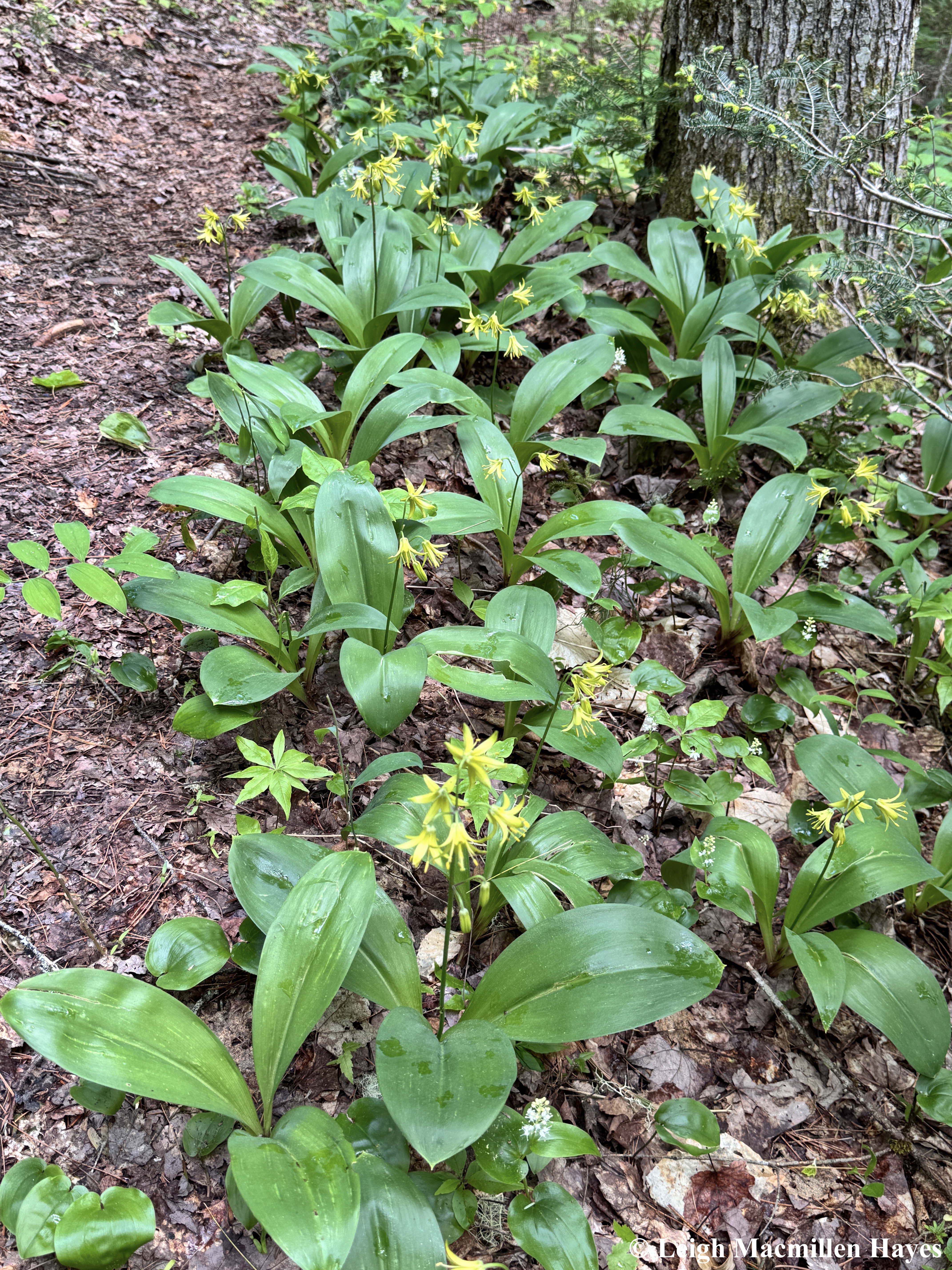
Seemingly everywhere, Clintonia, aka Blue-Bead Lily bloomed, adding specks of sunshine to the path and lighting our way, even on the grayest or rainiest of days. Yes, we even hike on rainy days.

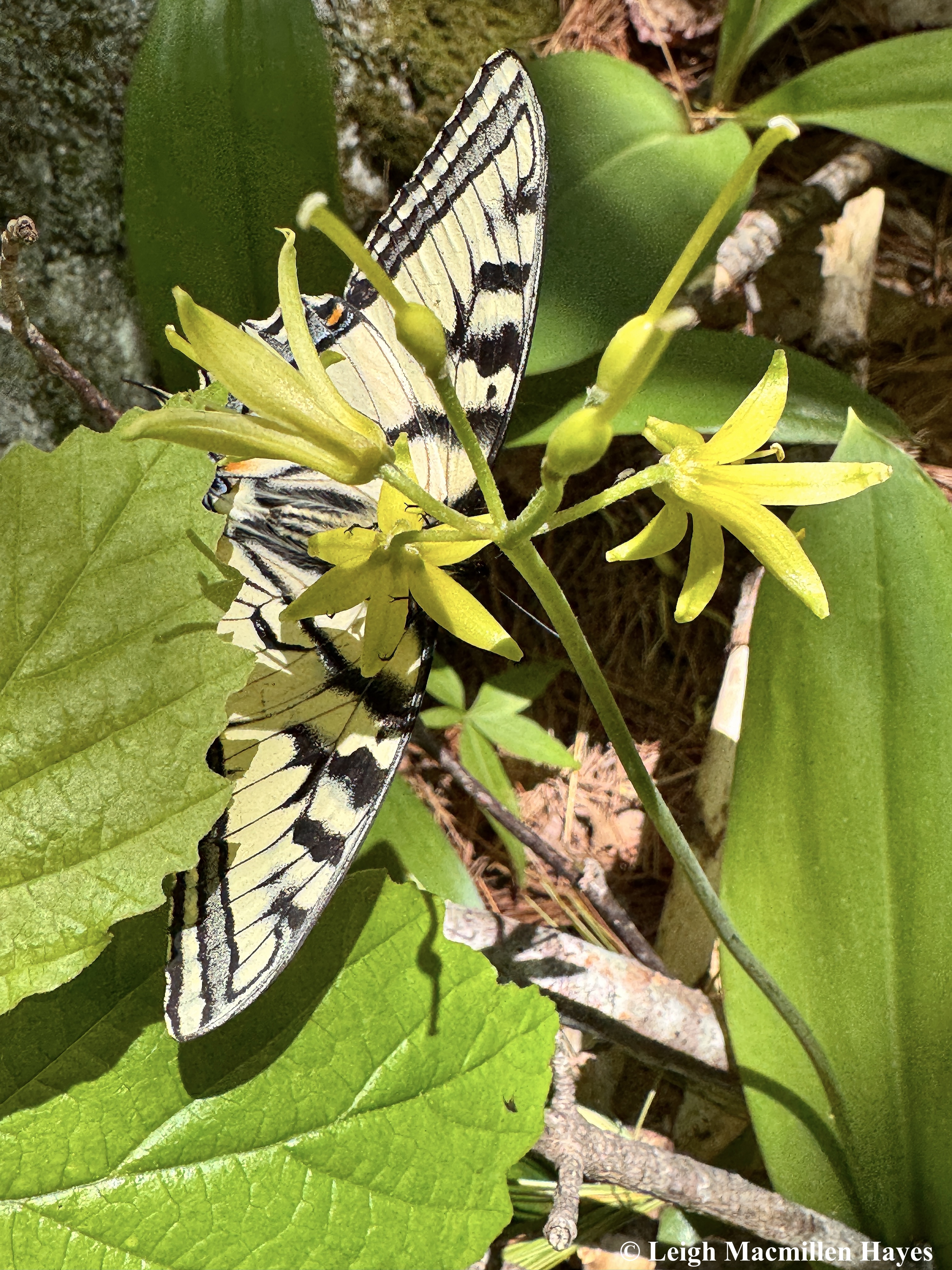
On sunnier days, the Tiger Swallowtails added their own yellow to the equation. Can you see the tiny pretarsi or insect feet of the butterfly as it held on why sucking the flower’s nectar?

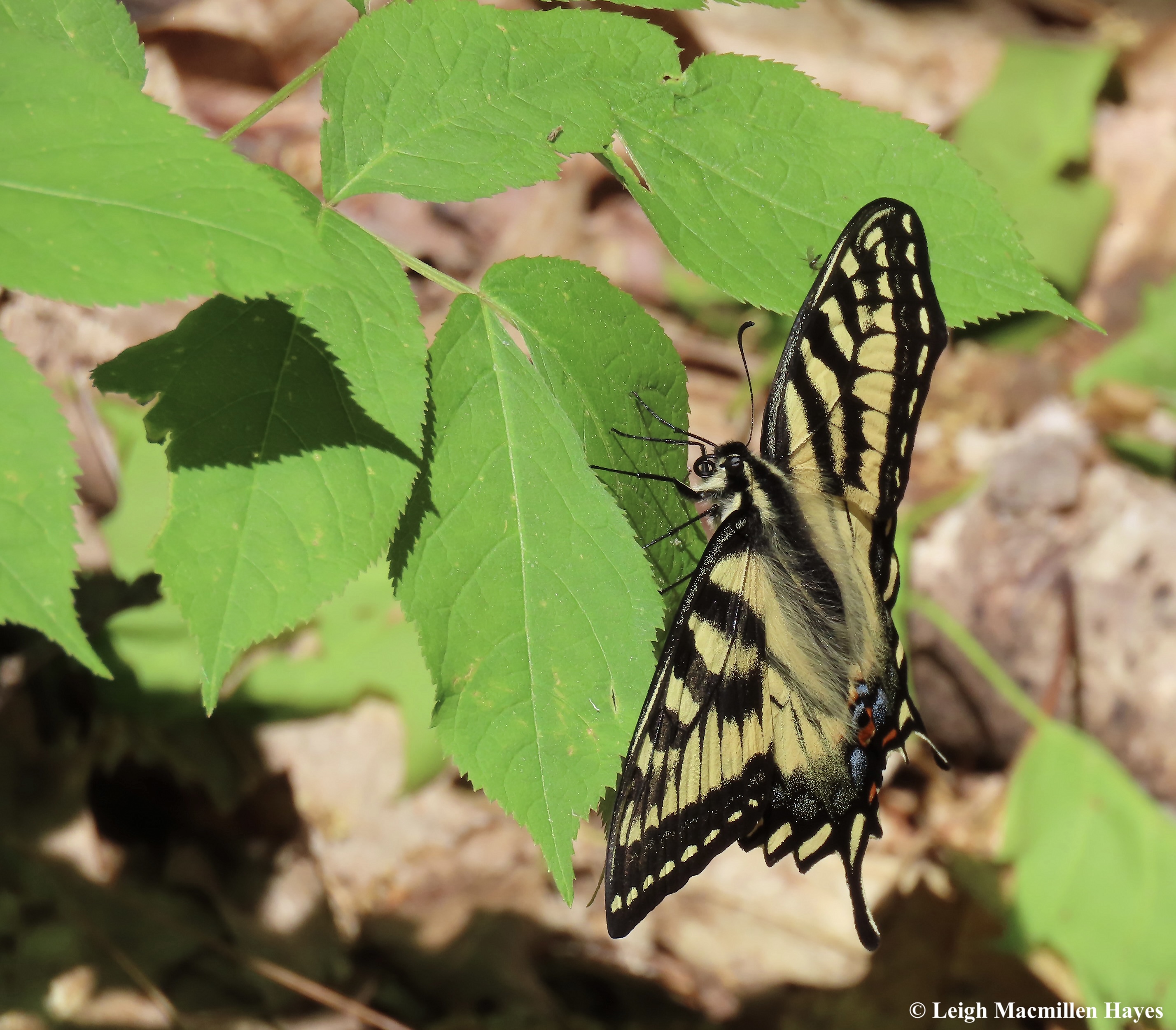
This spring it seems the Tiger Swallowtails are everywhere we travel by foot or truck. What I love about this one is that it was taking a break upon the leaves and you might be able to see its proboscis or siphoning mouthpart coiled up because there was no nectar to seek in that moment.

Right now the Swallowtail butterflies are the largest we’ve seen flying, but during a hike the other day, we spotted one of the smaller ones, this being a Northern Azure feasting upon Black Chokeberry flowers at a summit.

Jack, or rather Jill-in-the-Pulpit, for she needed the extra leaves to help her in her mission of producing seeds, greeted us in various places where the soil was moist including beside the cow path in our woods, where it totally surprised me despite the fact that we’ve lived in this house and wandered about for over thirty years.

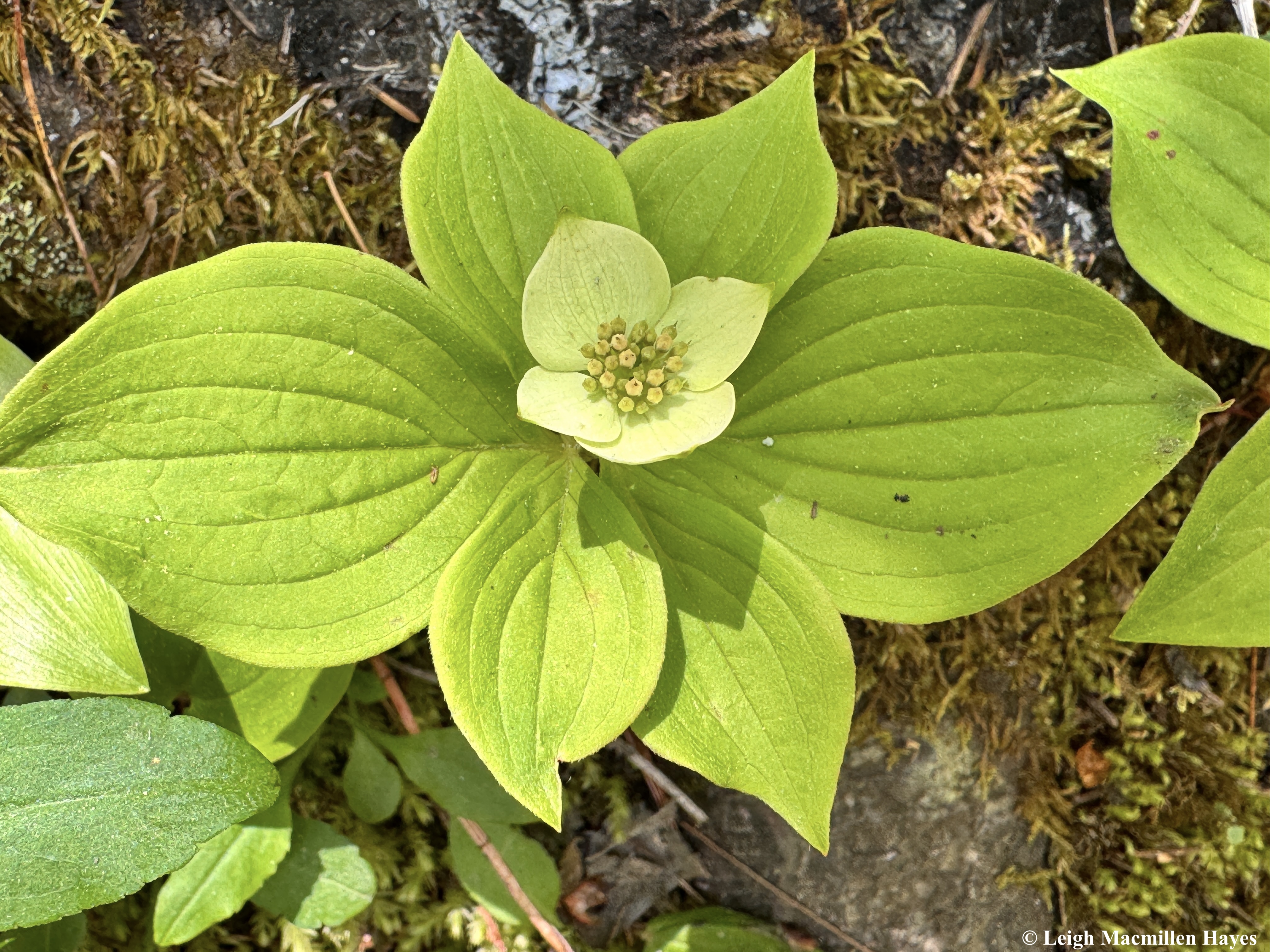
As one week turned to the next, and the flowers that were in full bloom kept changing, suddenly Bunchberry was added to the list. Again, like Jill-in-the-Pulpit, Bunchberry needs two extra leaves in order to have more energy to produce flowers followed by the berried fruits that bunch together in a cluster of bright red. You may look at the veins on those leaves and immediately know the family to which this wee plant belongs–if you guessed Dogwood, you are correct.

One of the earliest bloomers of spring, has already formed into a fruit, in this case three sided. Meet the Wild Oat of Sessile-leaf Bellwort. It reminds me that in a snap of the fingers, the season passes by much too quickly.

It wasn’t just flowers that marked our journeys. About the same time that we began the latest ritual, dragonflies and damselflies slowly began to emerge, for which we always give great thanks as they gobble up some of the Mosquitoes and Black Flies that so annoy us. This American Emerald had only just made the transformation from aquatic form to terrestrial hours earlier based on the sheen still visible on its drying, but not quiet dried yet, wings.

Much more mature were these two, who had formed the marital wheel in order to canoodle. I knew they were Emerald Dragonflies, but wasn’t sure which species until I searched my guides back at home: Uhler’s Sundragon, a new species for me.

And in at least one spot, some smaller female dragonflies deposited eggs as they tapped the water’s surface with their abdomens. Think of it as Naiads to come, who will live in the water for 1 – 3 years, depending upon species, before climbing out and transforming miraculously into terrestrial fliers.

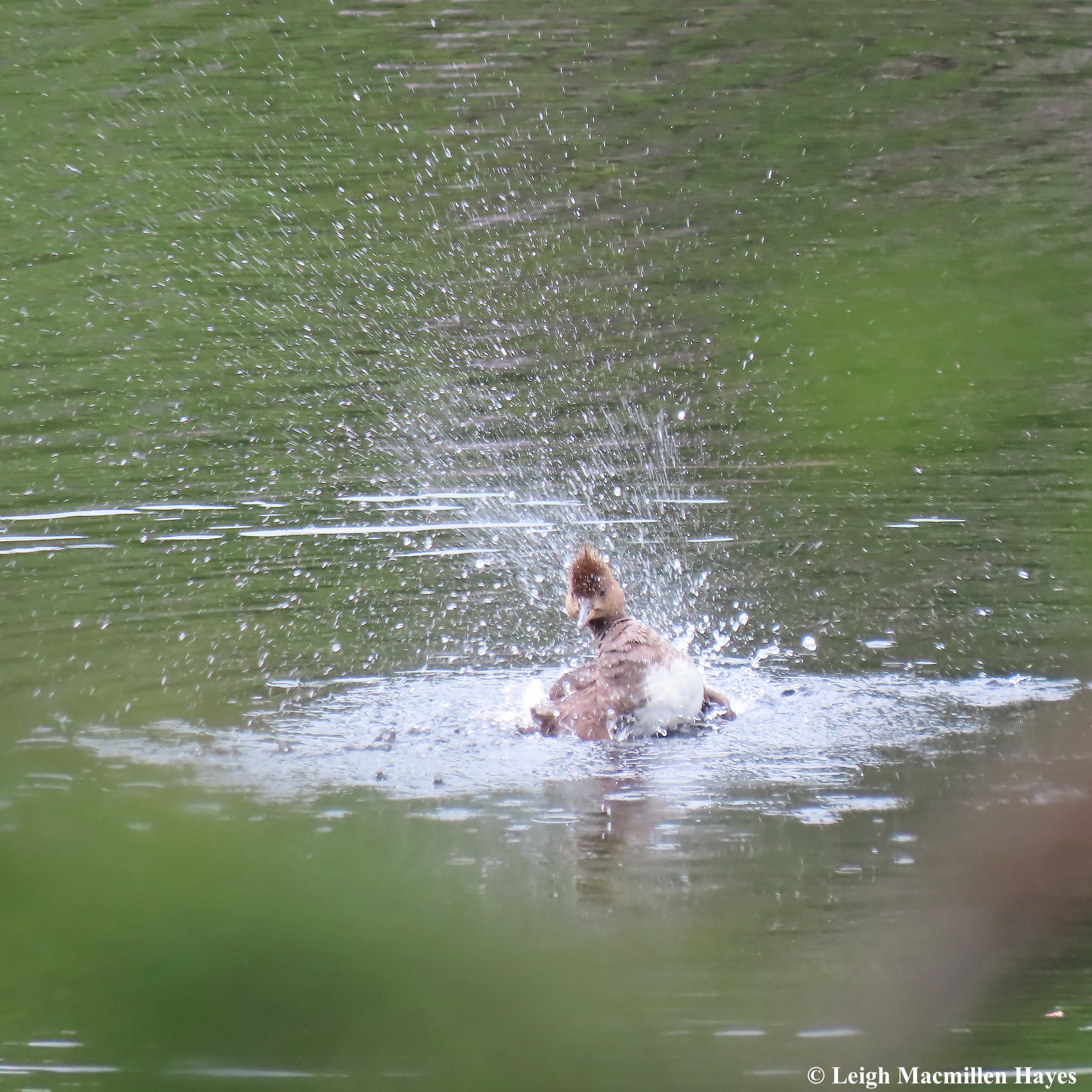
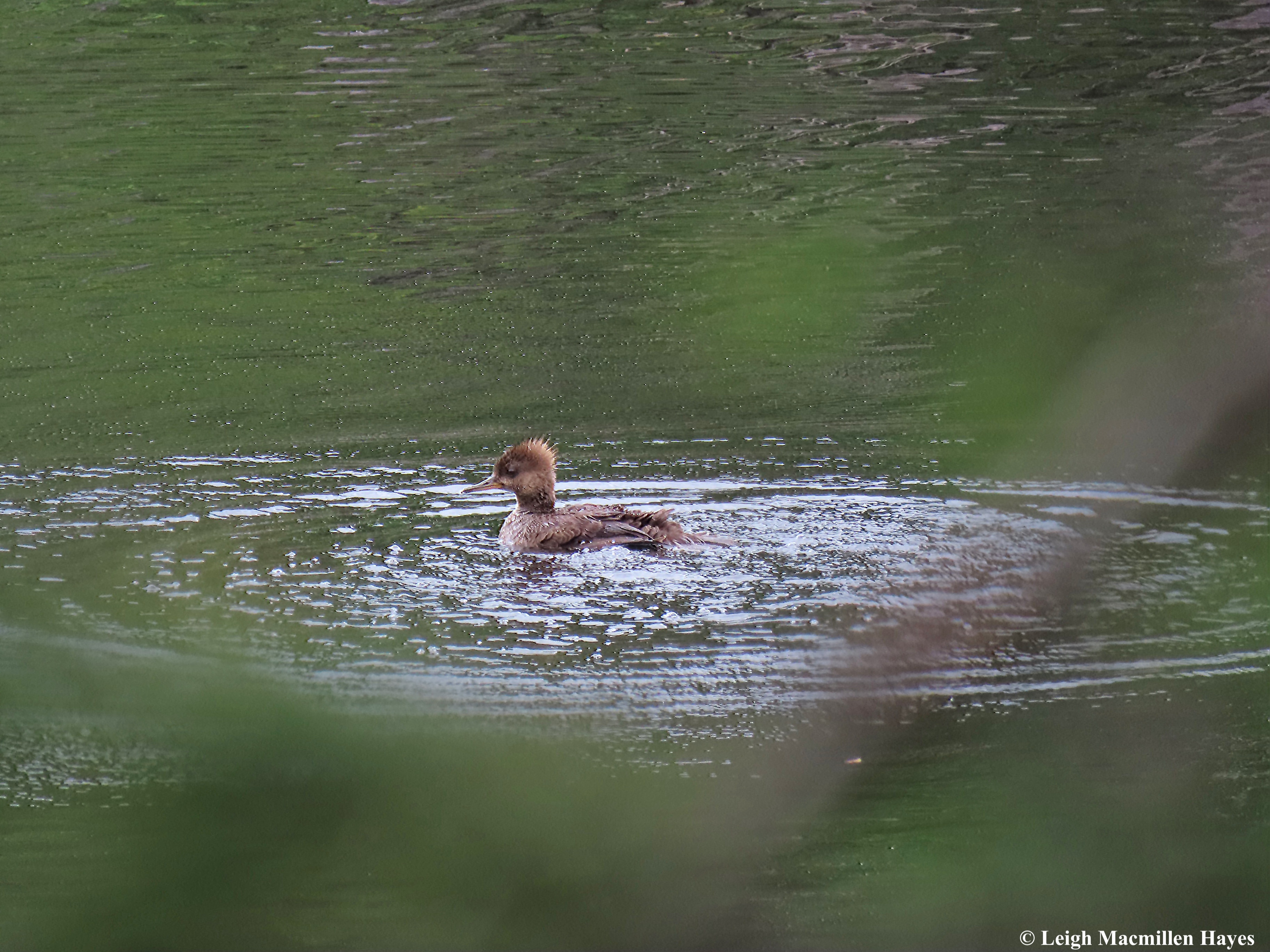
Being beside water in another place, and looking between tree branches, we spied a Common Merganser taking a bath.

We stood just far enough back, that it didn’t realize it had an audience as it splished and splashed.

And finally shook itself off, with water spraying everywhere, before it continued on its journey . . . and we did the same.

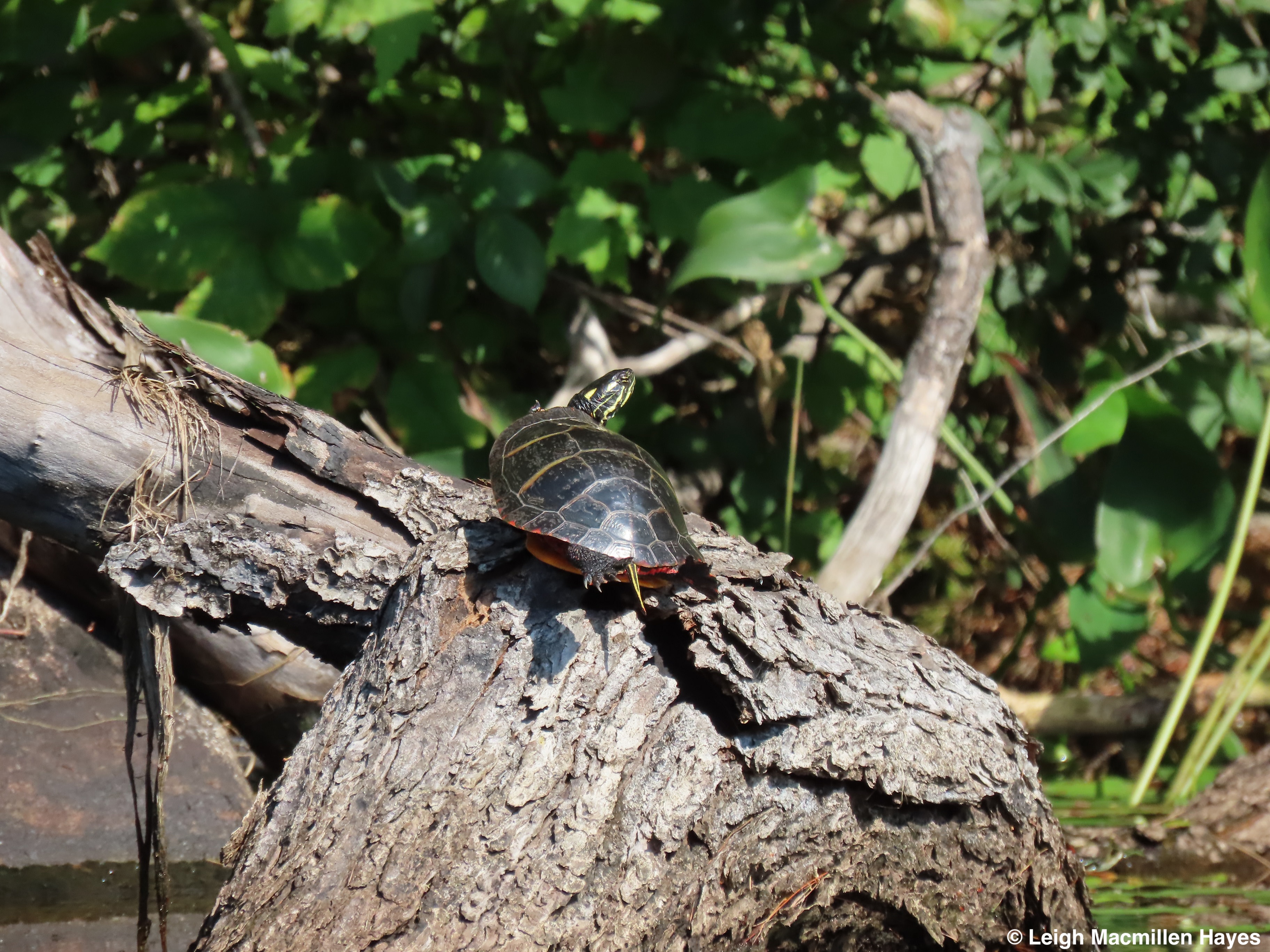
Basking Painted Turtles became a common sight as well, and this one had the cushiest place upon which to recline, all others being on fallen logs or rocks and boulders in the water.

One, however, that I assume was a female, though I didn’t want to disturb it and get any closer to check the length of its nails, I surmised had been laying eggs or was about to. Our time together was limited so I don’t have the entire story, but she was in a safe place, no matter what.

One of our most unusual sightings as we performed the ritual was spying a Bald Eagle steal a fish from the grip of an Osprey. If you look closely at the center of the photo, you might spot the thief on its get-away mission–it is flying above the picnic tables, about in the middle of the trees.

As it flew over our heads, the Eagle had the audacity to look back to see if the Osprey was hot on its tail. It was. We don’t know how this story ended either, but we assume the Osprey had to cast its fishing line again.

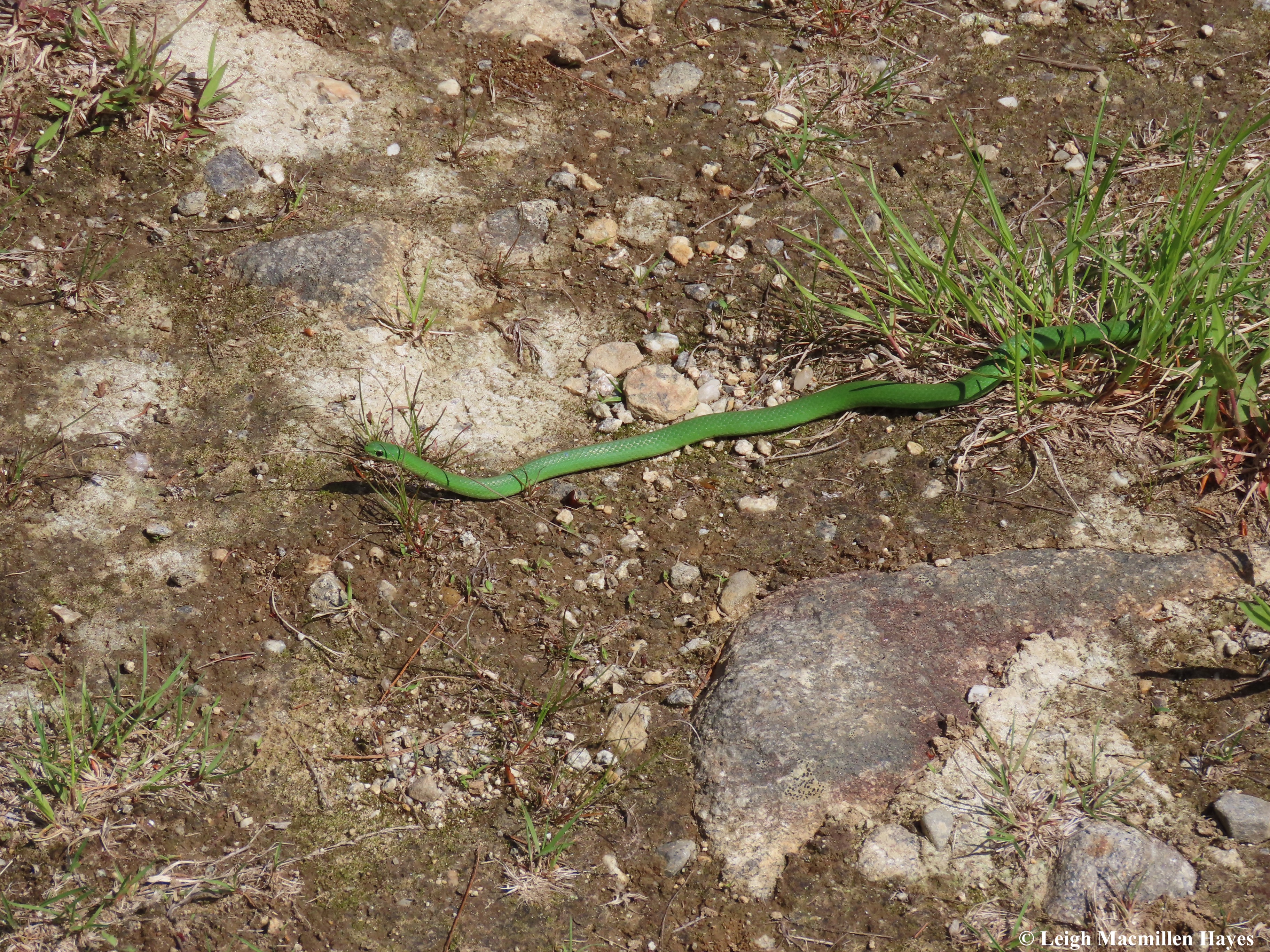
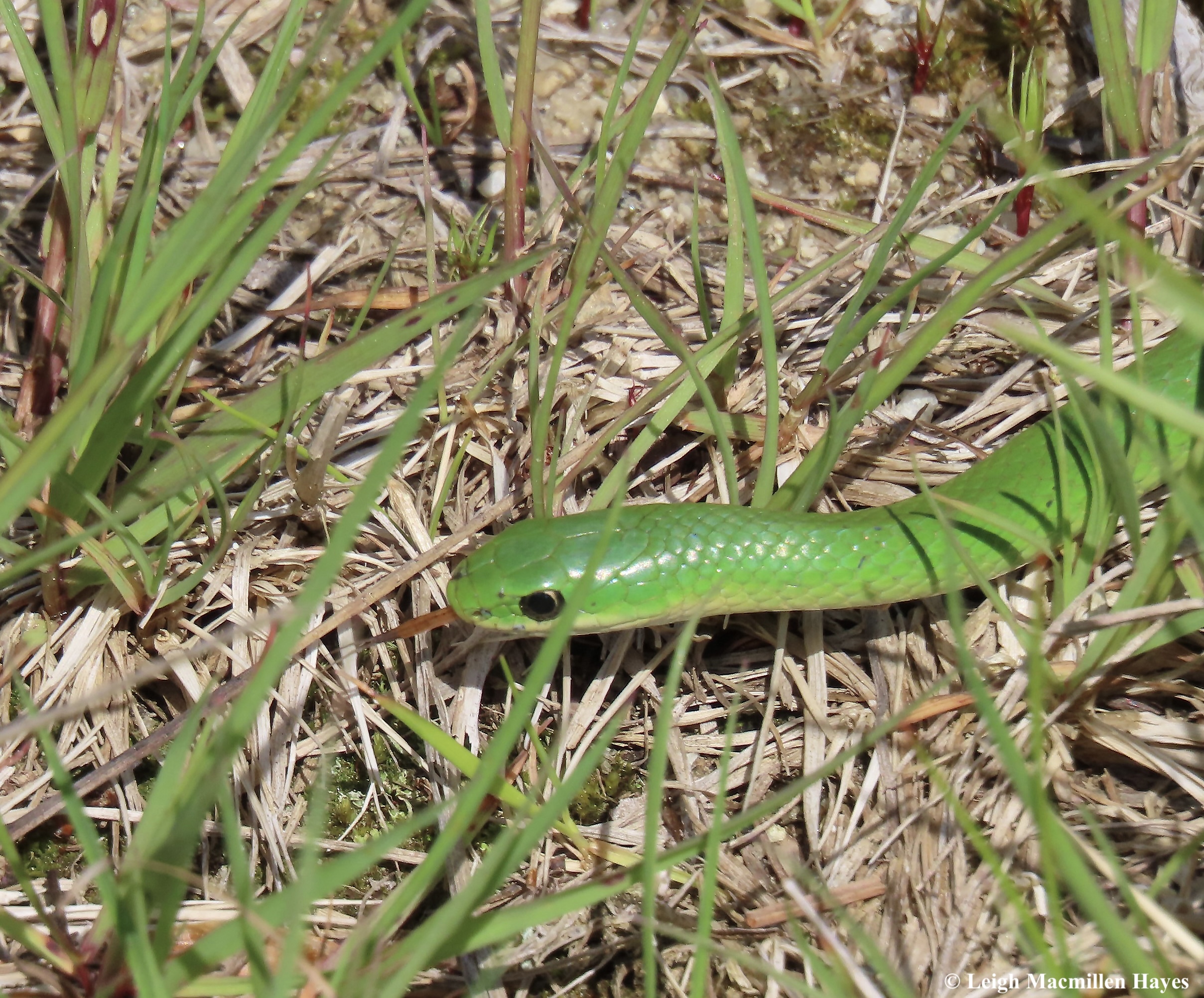
Another fun sighting occurred as we crossed under a powerline on the return trip of a seven mile hike around a river, over to a pond, up a hill behind the pond, and back down and out. Almost the color of the grass that sparsely grew along this section of the trail, a green snake slithered across just after My Guy had stepped that way.

I just love its forked tongue–sensing the trail in snake manner as it did.

The two tines at the tip of the tongue, seen here as it withdrew this sensory organ, help it to smell in stereo and thus find its way and find a meal.

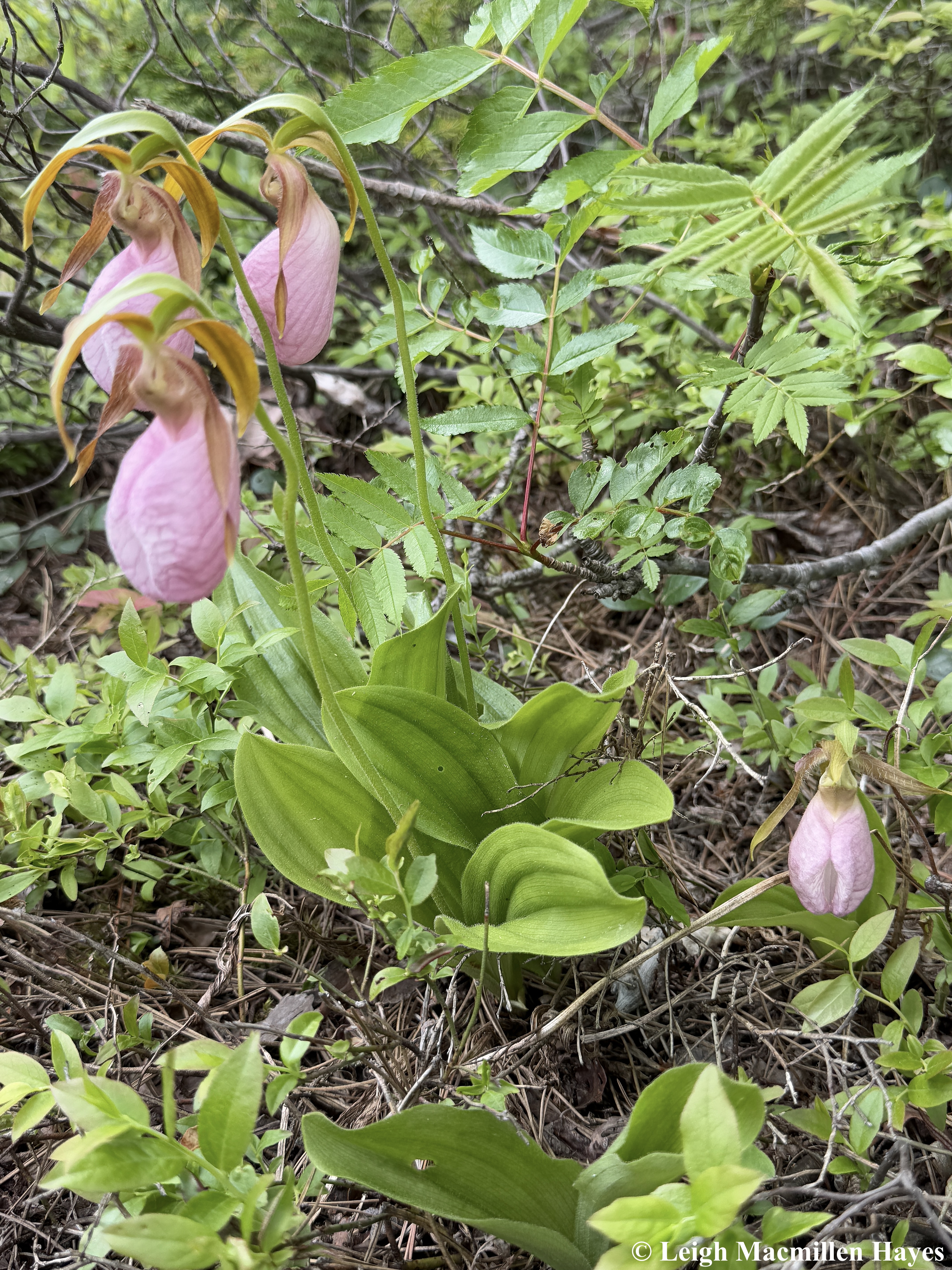
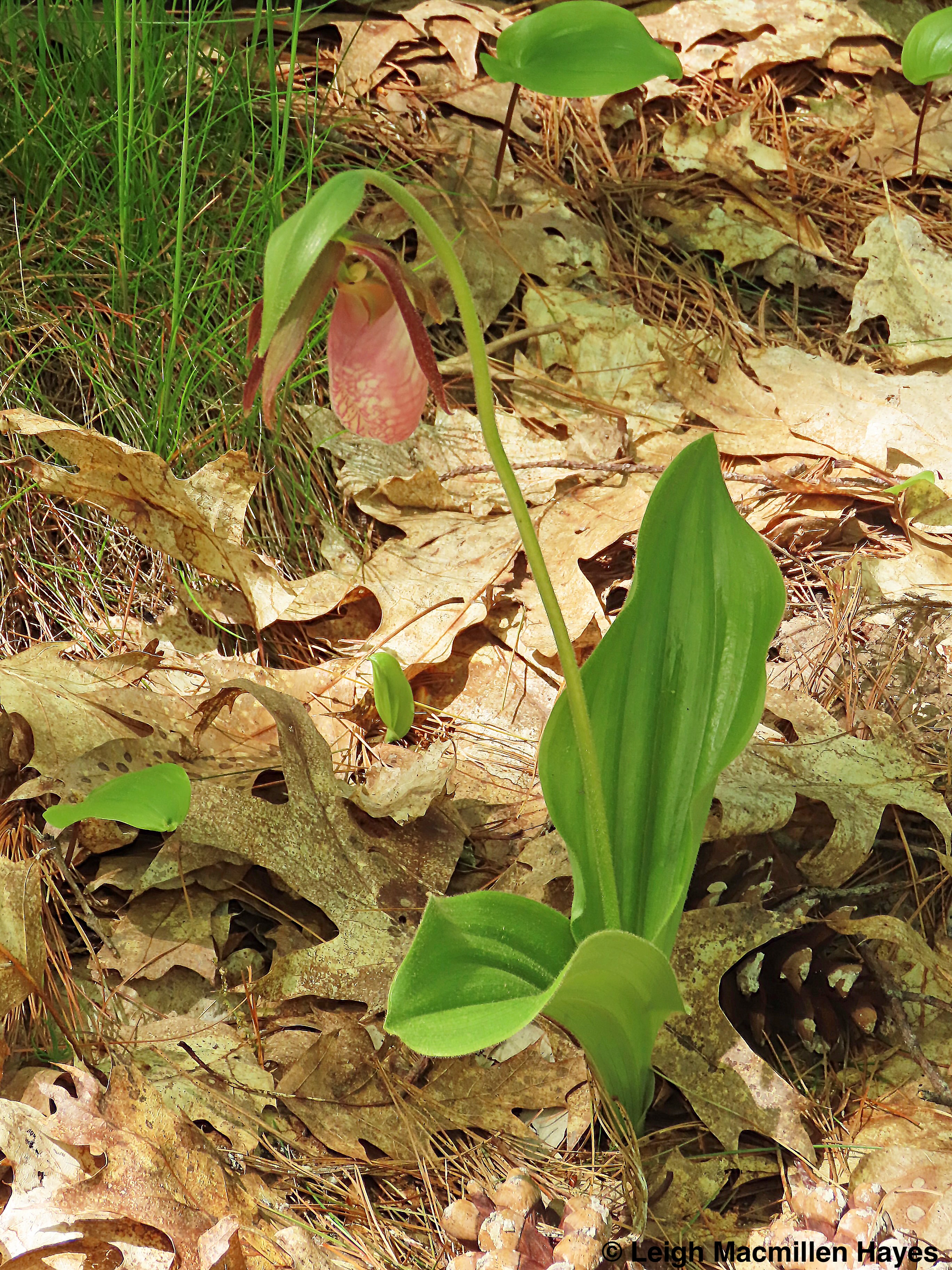
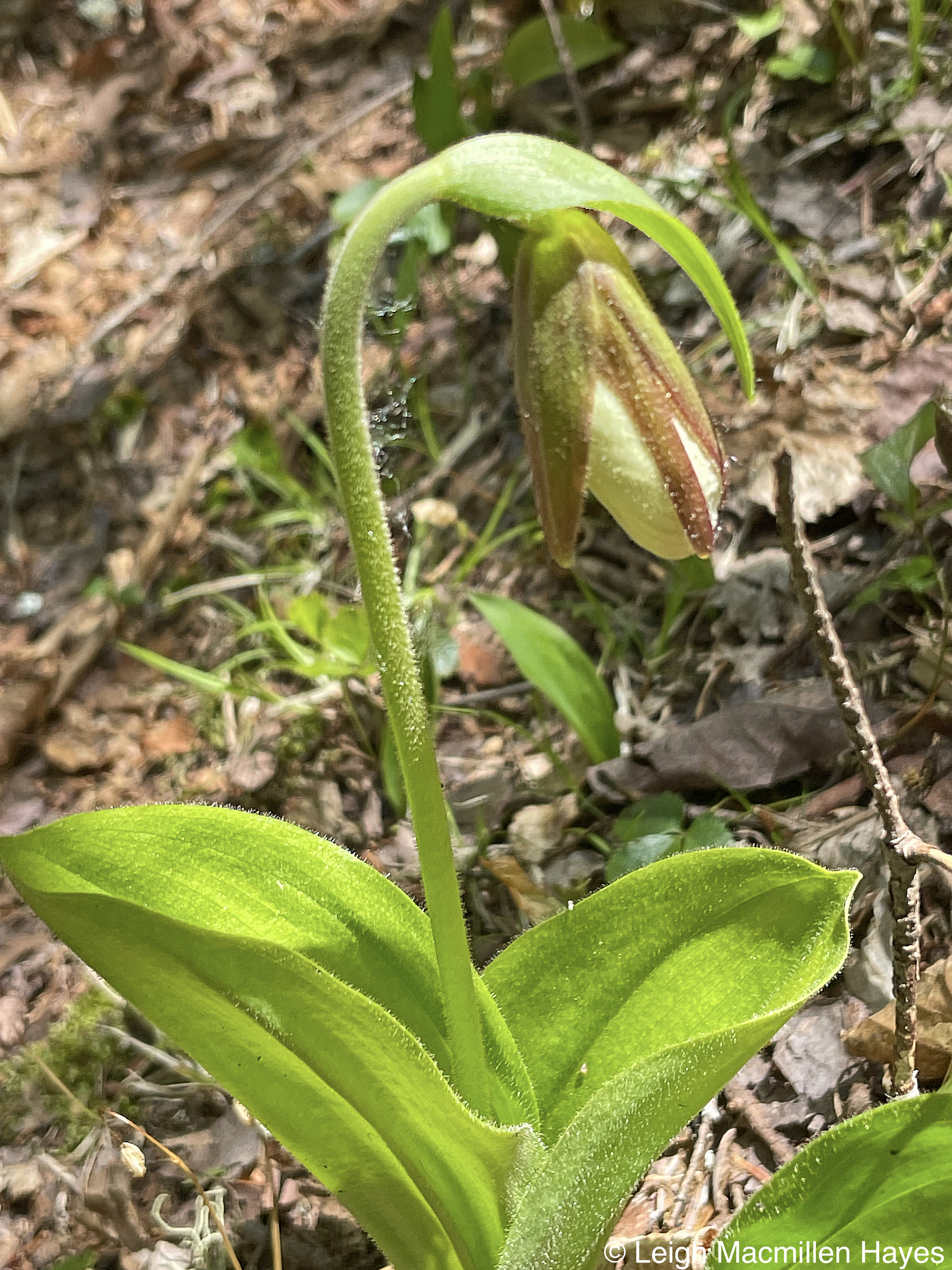
All of these things we saw because of the ritual that we perform every year at this time. It’s one that we now realize involves some greed, but still we feel compelled to do it. We count Lady’s Slippers.

I always thought that orchids were something you received on Prom night and that they grew at the florist. I had no idea that they were actually wildflowers until about thirty years ago. According to Orchids of New England and New York by Tom Nelson & Eric Lamont, Lady’s Slippers are one of 65 species and variants found in our region.

And so they deserved to be counted.

But, oh, how they hide. Do you see the one in the photograph above?

How about now?

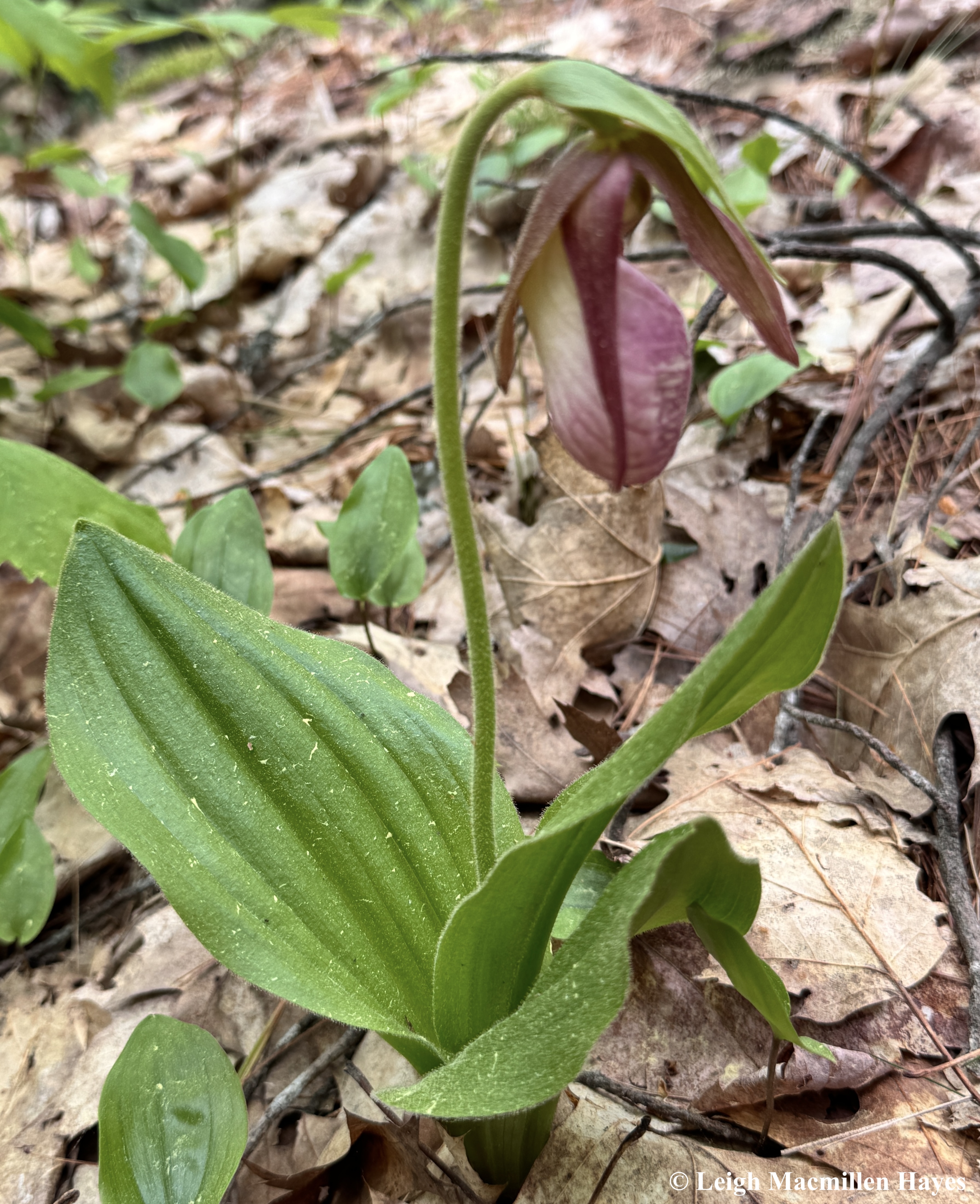
Knowing that they can be elusive causes My Guy to slow down for a change. It’s no longer the destination that counts, but rather the number of Pink (and their white variants) flowers that we can spot.

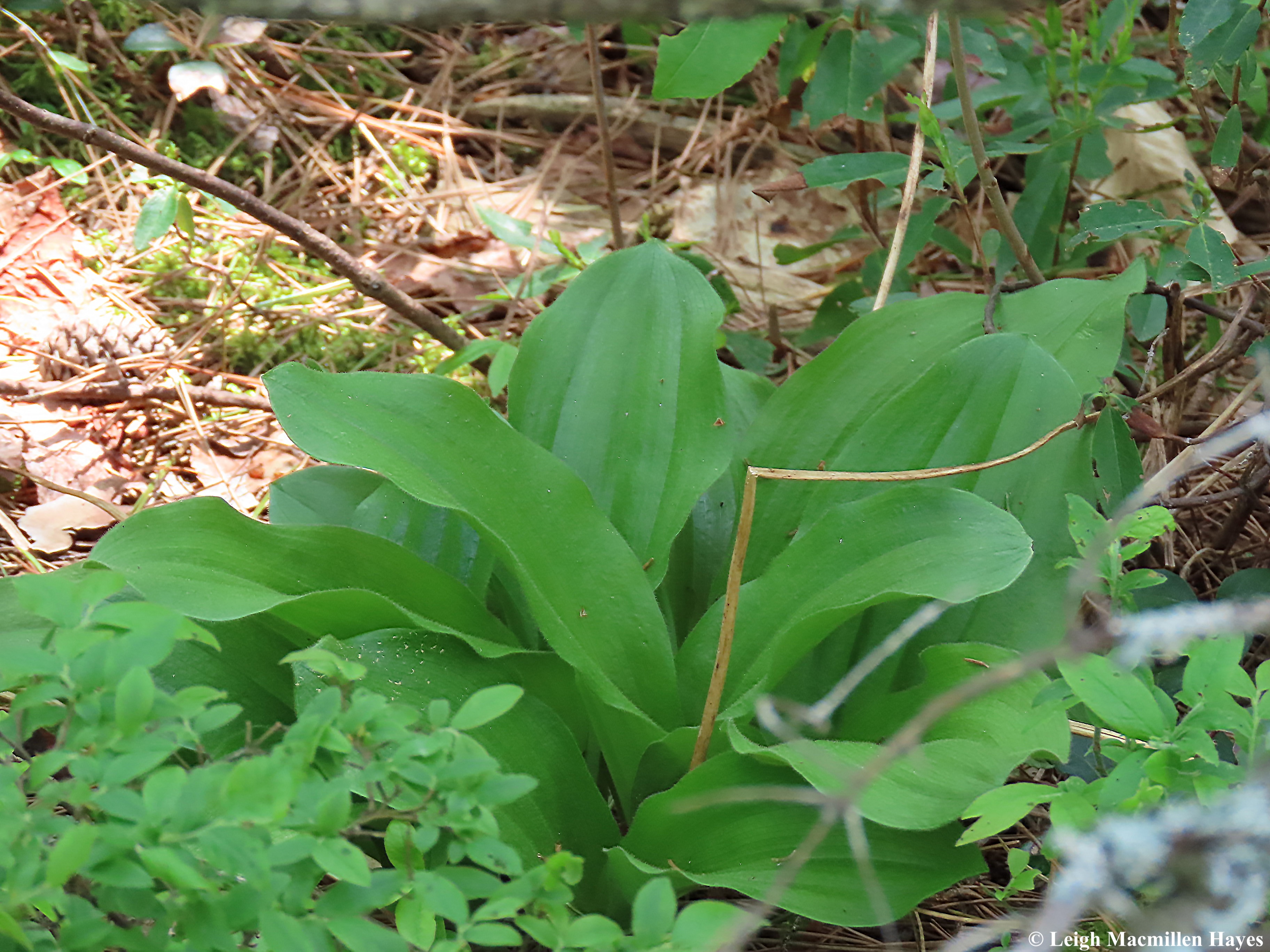
Some are tall, and others quite small. And some are sets of leaves with no flowers yet as in the foreground. We don’t count those.

Here’s the thing about Lady’s Slippers. It takes a long time for a minuscule seed to become a plant. The seeds, developed in capsules, are beyond numerous, but each one has no food source or endosperm. So . . . it must develop a relationship with a Rhizoctonia fungus in the soil to survive. From the fungus the plant gets nutrients for germination and growth. The fungus, in turn, receives nutrients from the orchid’s roots.

BUT . . . all of this takes time. And the presence of the fungus.

Years. First, after at least three years the plant produces a pair of two basal leaves that fold like accordions and remind me of the paper fans we used to make as kids.

One author says it’s another 5 – 10 years before the plant produces a flower; another states 10 – 17. Either way, by the time you spot one, it’s been working for a long time to become a thing of beauty. (And should not be picked or transplanted.)

We found one that stymied us for it appeared to have three basal leaves. I can only wonder if there was a second plant there and something happened to its other leaf.

In one spot, we found what we call a bouquet. Sometimes we see three or four grouped together, but in this case 14 plants in bloom.

And in another spot where we expected the same, nada. What happened. My Guy was disappointed because this is his favorite and he loves to show it off to anyone who happens to be hiking that way.

We have a theory, though we don’t have scientific knowledge to back it up. But here goes. Last summer, our count was quite high. The previous spring and summer it had rained. A. Lot.

Last year, we experienced a drought. This year fewer flowers in most places that we hiked in the last few weeks. Perhaps less of the fungus?

And sometimes the flowers are spotted growing in a bit of a line, making us think perhaps there is a rotting nurse log beneath the soil. As for soil and habitat, acidic seems to be the favorite and we often find them among Low-bush Blueberries and towering over Reindeer Lichen.

And then there’s pollination: Lady’s-slipper pollination is a curious thing. Bees are lured in by the guide lines to a slit in the front petal, the slipper-like pouch, or flower’s labellum. Once inside, the bee cannot exit the way it entered because the petal structure turns inward.

The exit is at the top of the slipper, but to reach it, the bee must move through a hairy interior and rub against the flower’s stigma, depositing any pollen it may have carried in and brushing against the pollen mass called the pollenia before flying out. It strikes me as being like a house of mirrors. And all I want to do is quickly find my way out.

Some bees get frustrated with the dilemma of discovering there is no nectar and the task of finding the exit and instead chew their way out, which seems to be what happened to this flower.

It looks like the bee frantically tried to escape this one.

I tried to honor them with a painting, but our best way is by counting each and every one. I’m going to share last year’s numbers and this years. Also, this year, we counted along a bunch of other trails than just the Big Three as My Guy refers to the first three for which I have been keeping records since 2000.

Wolfe’s Neck State Park: 2024: 475; 2025: 159

Albany Mountain: 2024: 364; 2025: 411

Sanborn River and Overset Mountain: 2024: 598; 2025: 526

Grand Total of the Big Three: 2024: 1,437; 2025: 1096

Plus these trails all from this year only:

Mount Tom: 25 (but we were there on May 18, and this was the kick-off event that got us going this year; more may have bloomed since then. Actually, after spotting the first one, My Guy wasn’t sure he wanted to count this year, but let me tell you, he still has the greed!)

Mount Tire’m: 31

Proctor Pond Reserve: 41

Kezar River Forest: 63

Narrow Gauge (only 1.5 mile section): 56

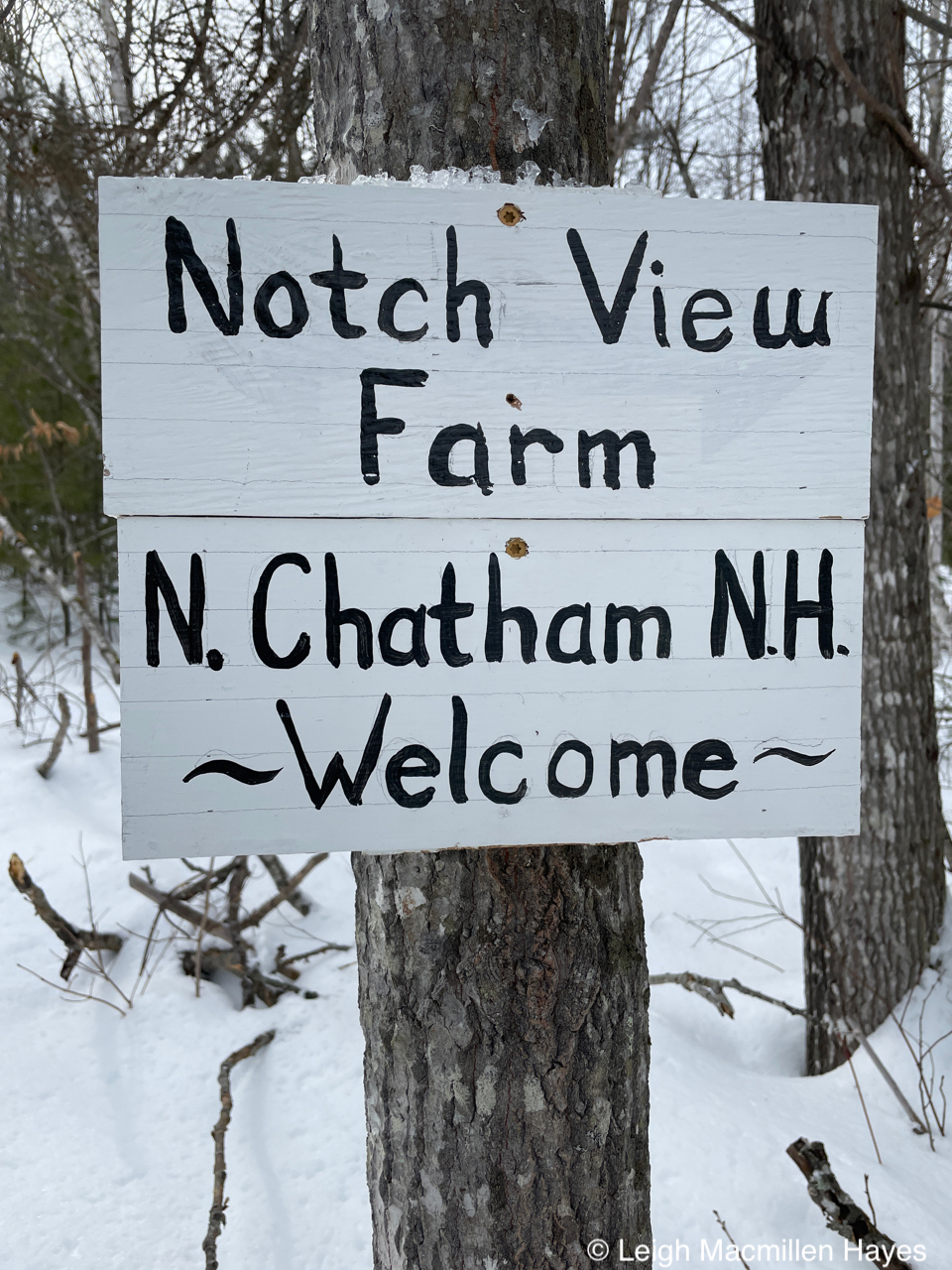
Sleigh Trail at Notch View Farm: 44

Home woods: 2

Grand total of all trails: May 18 – June 6: 1,358

Even with the extra trails, the count was down.

But still . . .

Where the Moccasins (Lady’s Slippers) Led Us–up and down many a path with so many wonder-filled moments and sighting along the way. Counting Lady’s Slippers is a ritual that we love to share together and with others.
My Guy, The Giant Butterfly Whisperer

It’s Monday. And that typically means a Mondate for My Guy and me. Especially if he’s worked all weekend. And a Mondate most often means a hike. So, that being that, we headed off to conquer two trails today. Neither was overly long, and one was rather easy, while the other was moderately difficult. But both offered sightings that have us still smiling.

I’ll start with the second hike of the day because this is my blog and I can do that sort of thing. We were in Shelburne, New Hampshire, and so on our way back to Maine, we stopped at the Shelburne Forest, a trail we tried to hike a year or two ago, only the Mosquitoes or Black Flies or both were so thick, that after about a quarter mile we turned around and raced out–treating ourselves to ice cream sundaes in Bethel, Maine, instead.

Today was different. Blue Sky. Slight Breeze. 75˚.

We soon began to notice a theme along the River Trail. First we encountered several Fox scats, indicating this spot may have marked a territory. It seemed like it was important enough to return and leave a sign again, and again, and again.

A wee bit farther and more Fox scat.

And several displays of Moose scat, this one being from this past winter, while another had more debris on it and was starting to break down, indicating a previous winter.

We also noted Beaver works in the form of a dam, plus some cut trees on the trail beside a steep embankment to the river. And deer prints and scat. And coyote scat.

I mentioned that I’d like to come back in the winter to see who spends time here.

My Guy’s response, “Anyone else might think you were talking about people, but I know you are not.”

He gets me!

I had two other favorite sightings along this “Scat” trail. The first being the leaves of Trout Lilies. NUMEROUS leaves of Trout Lilies. So now I know I need to return soon to see the flowers, rather than just wait until winter.

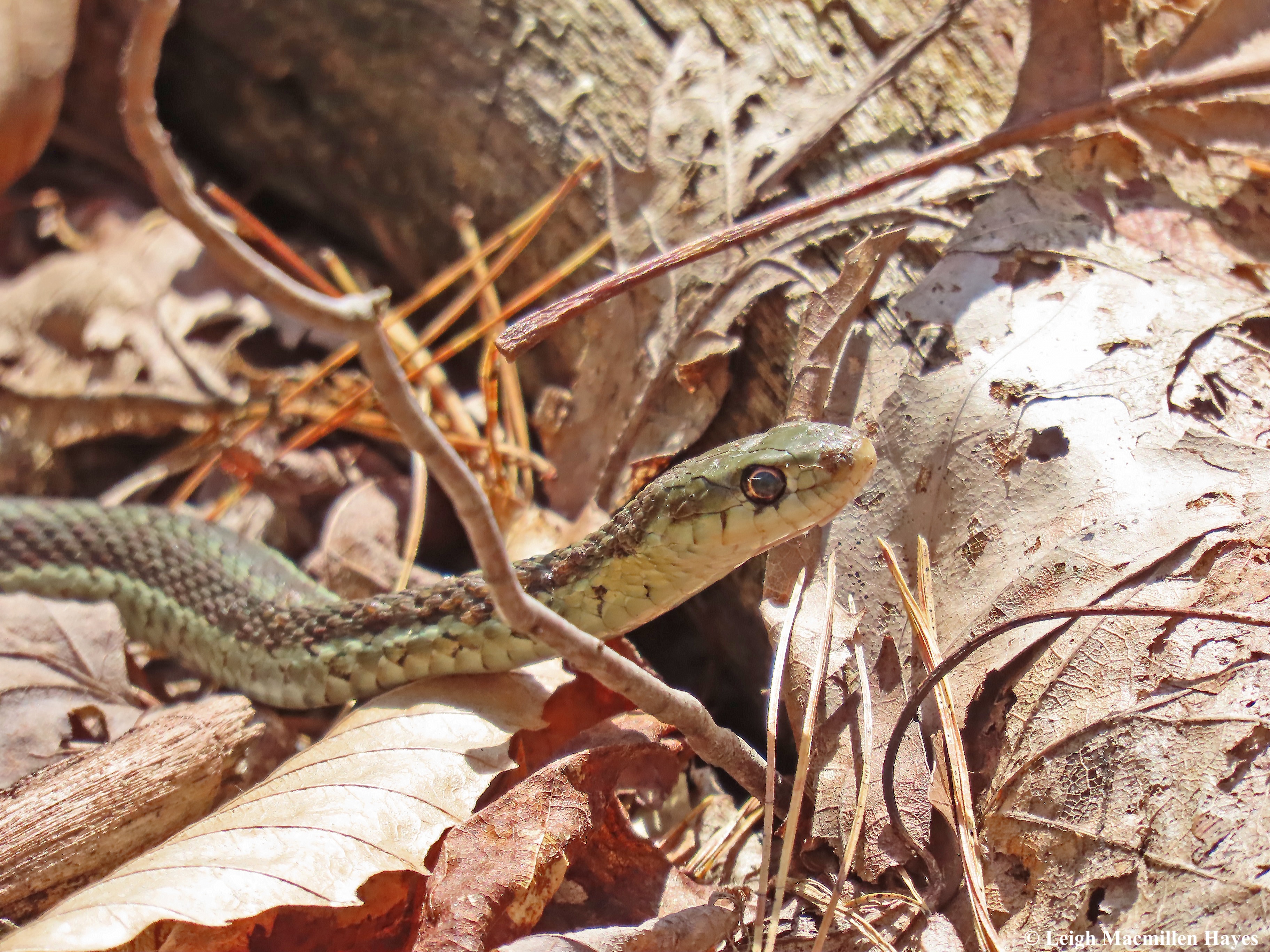
And a Garter Snake that surprised My Guy because it was in the middle of the Forest Trail as we completed a loop, but quickly slithered away.

I kept hoping it would stick its tongue out to get a sense of its surroundings, but for some reason it didn’t honor us with such.

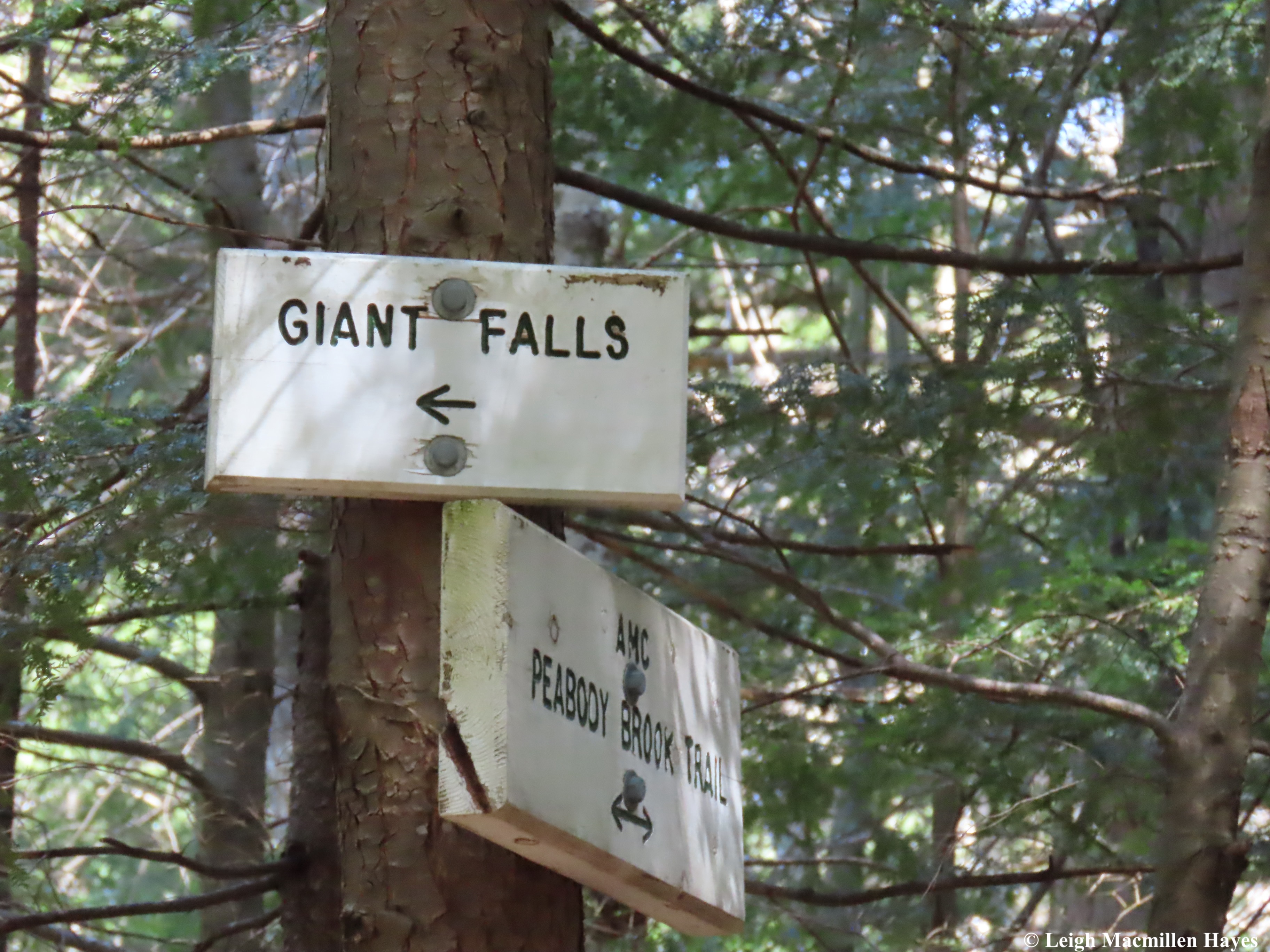
Now it’s time to turn back the clock and head off on the Peabody Brook Trail, which was our late morning hiking spot, the first hike of the dat. We were grateful for signs like this when the trail crossed a logging road.

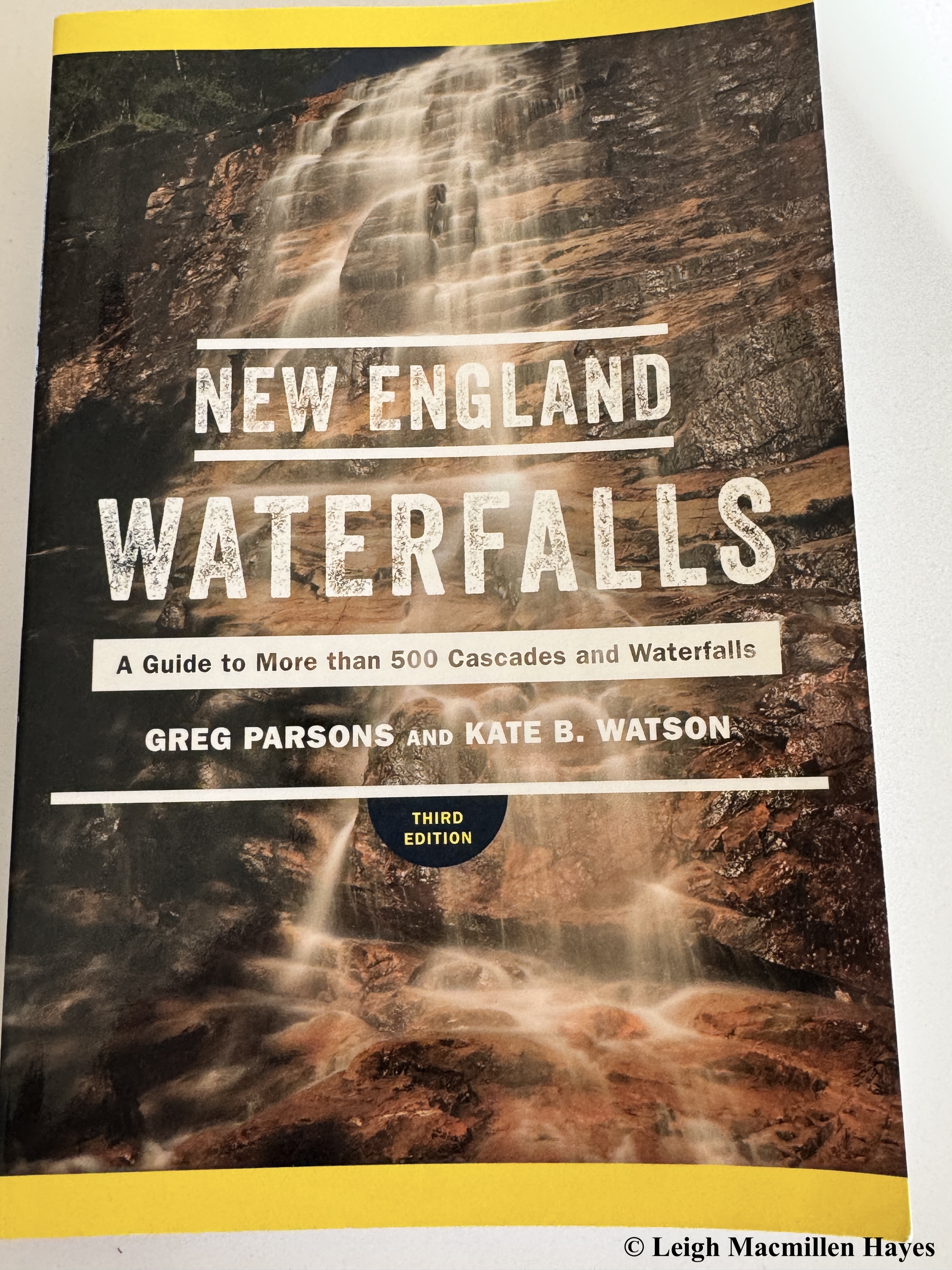
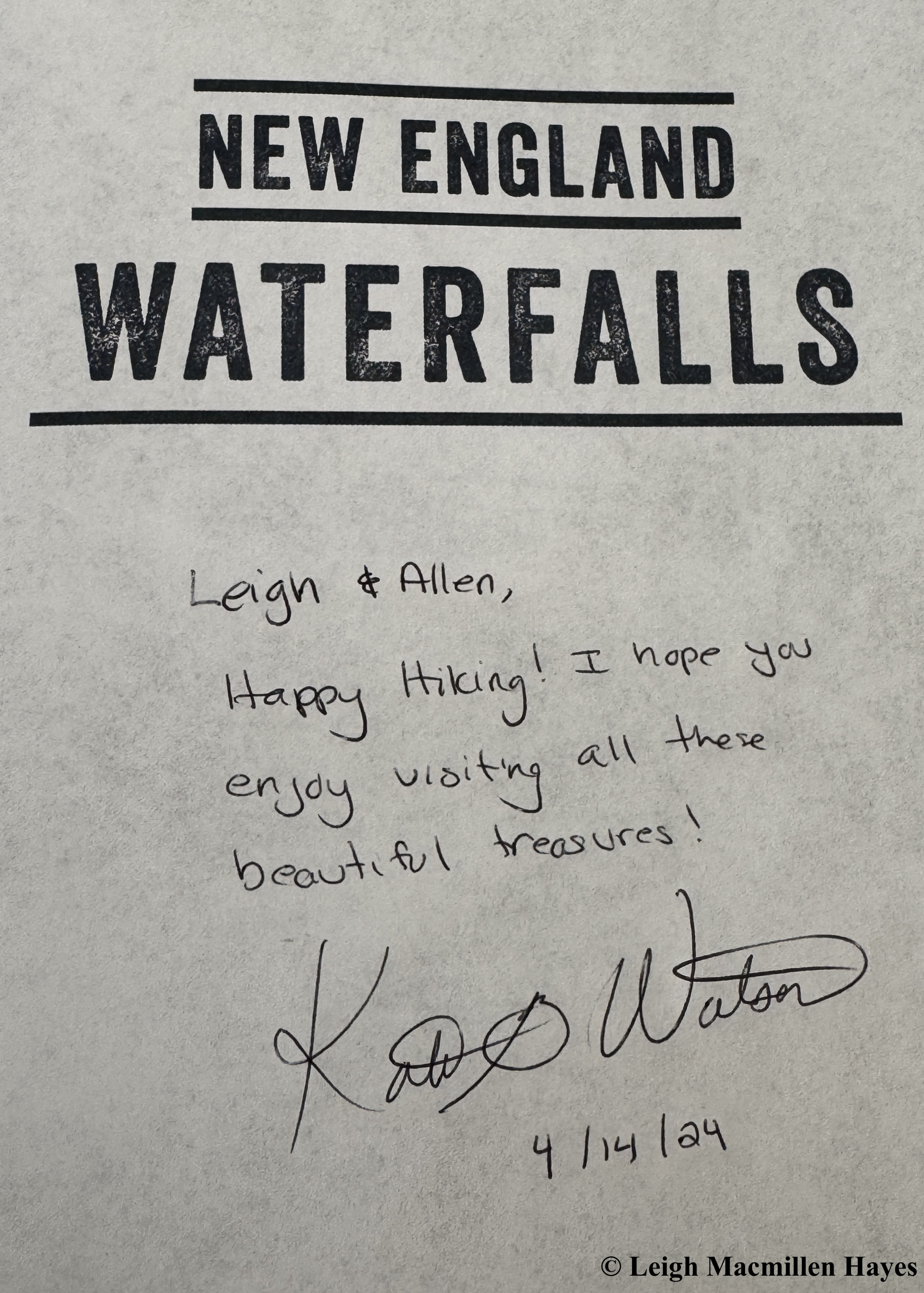
We chose this trail because we’d read about it in New England Waterfalls, by Greg Parsons and Kate B. Watson. I know Kate from church and love that these two visited waterfalls throughout New England to include in their comprehensive guide. We’ve visited some, but have so many more to do.

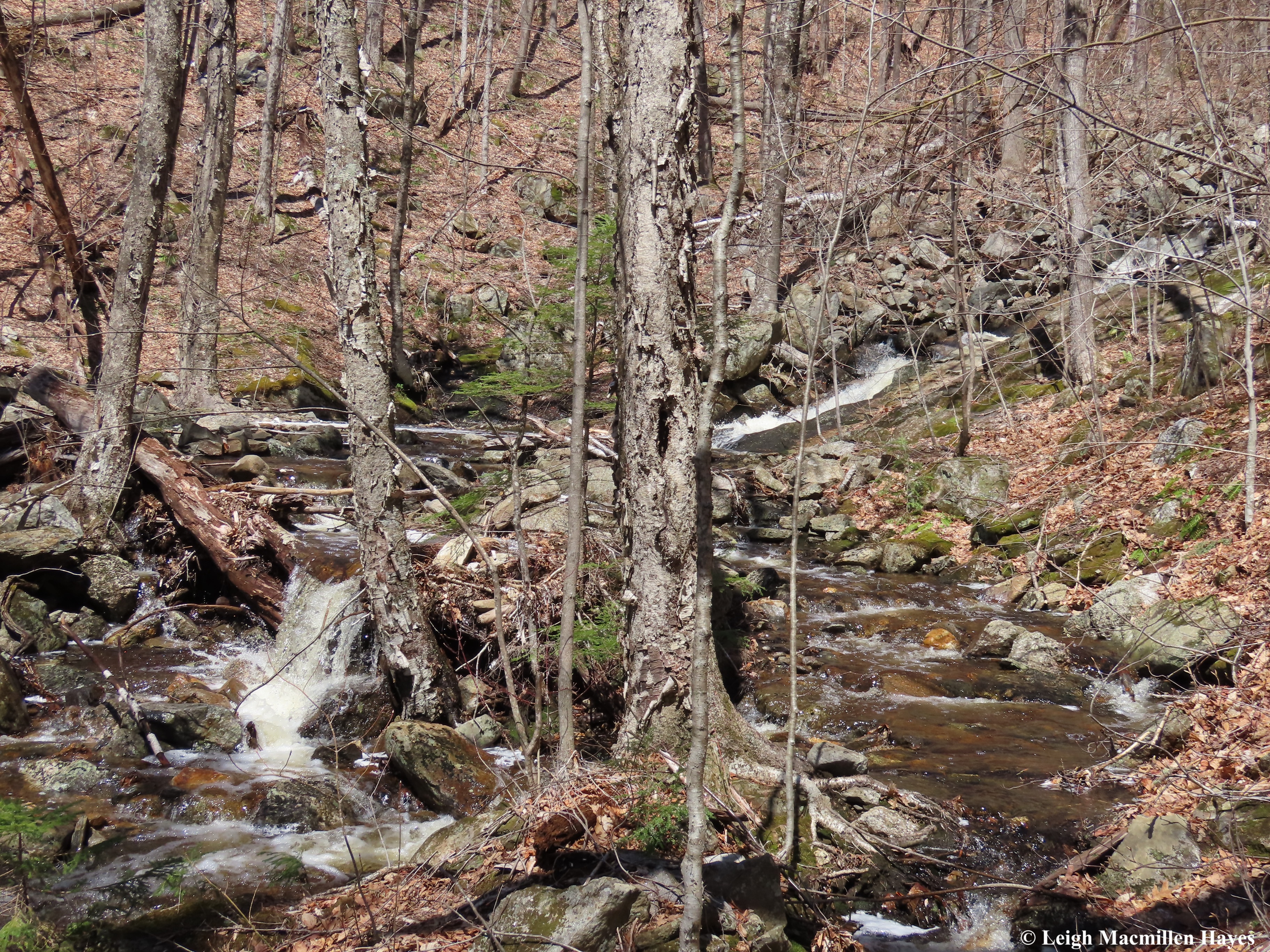
At the beginning, the Peabody Brook flows through a ravine and due to a rainy weekend, it cascaded over, around, and under the boulders, and was an ever-present companion for much of the trail.

Other companions included several Anglewing Butterfies, that I couldn’t identify until I saw their underwings, as the markings indicate either a Comma or a Question Mark.

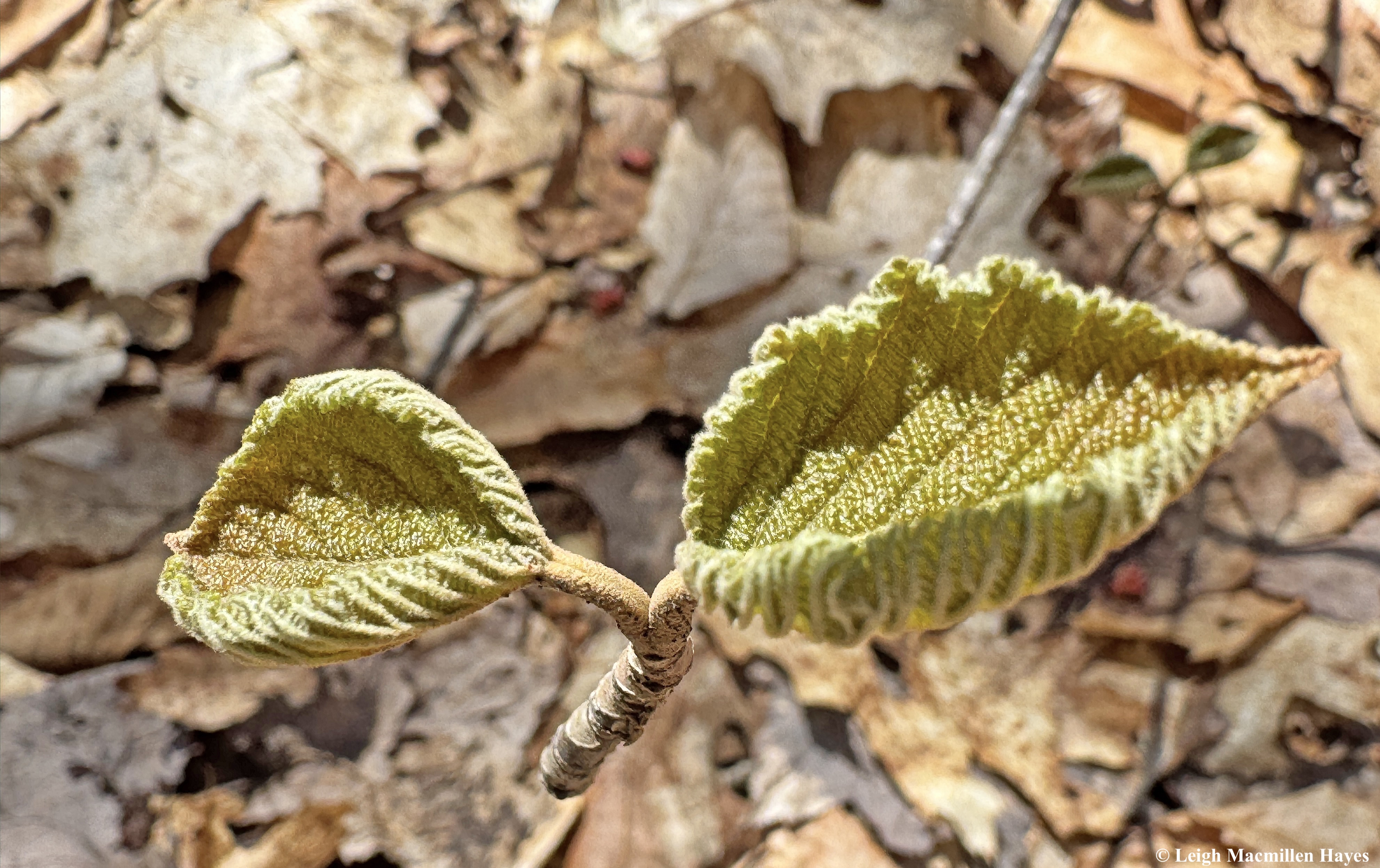
And there were Hobblebush leaves, with their corrugated presentation, beginning to unfurl.

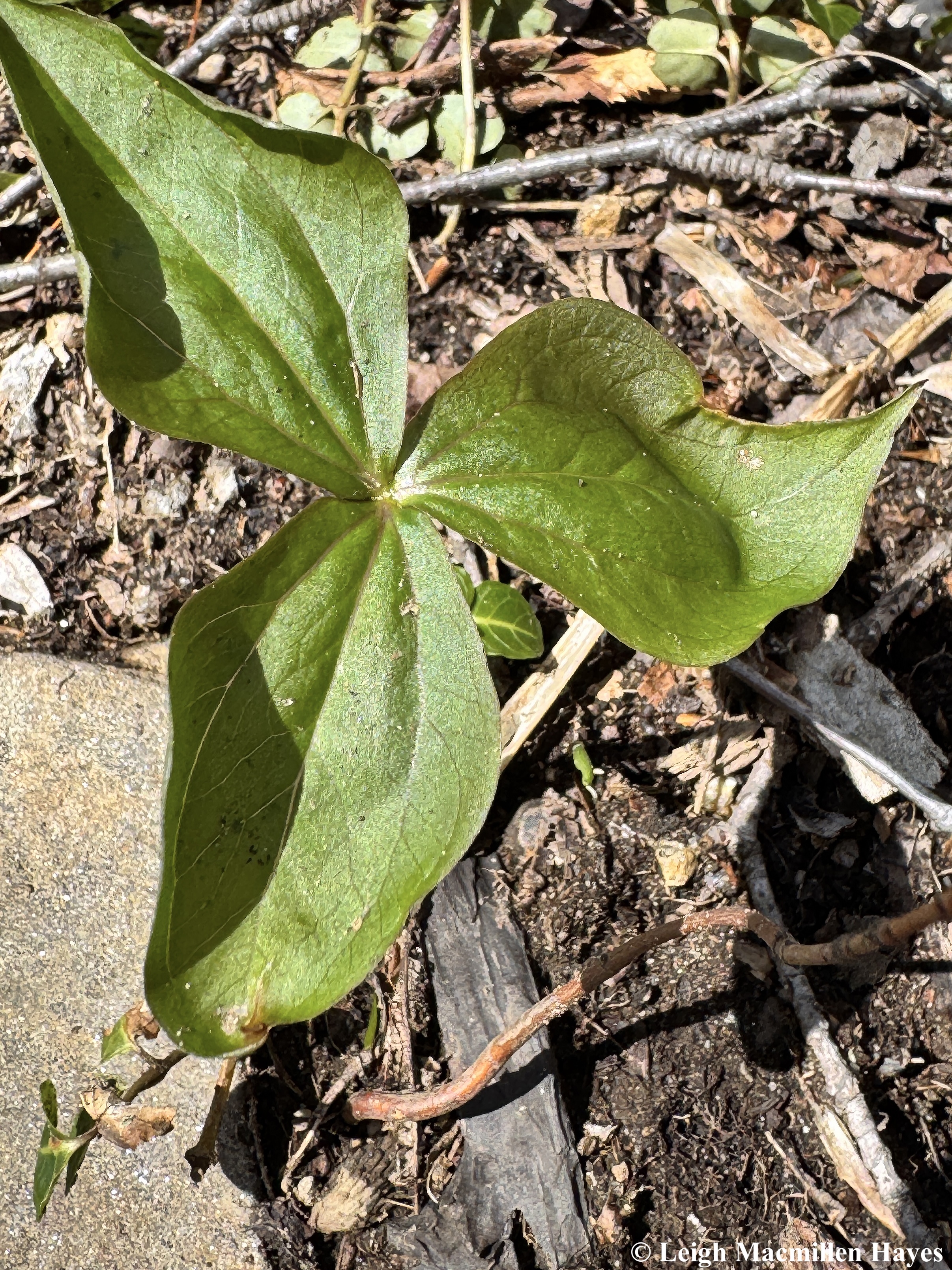
Plus a few Painted Trillium plants showing off their leaves of three, though no flowers yet, and causing My Guy to comment, “You’ll probably take a trillion Trillium photos again this year.” Did I say he knows me well?

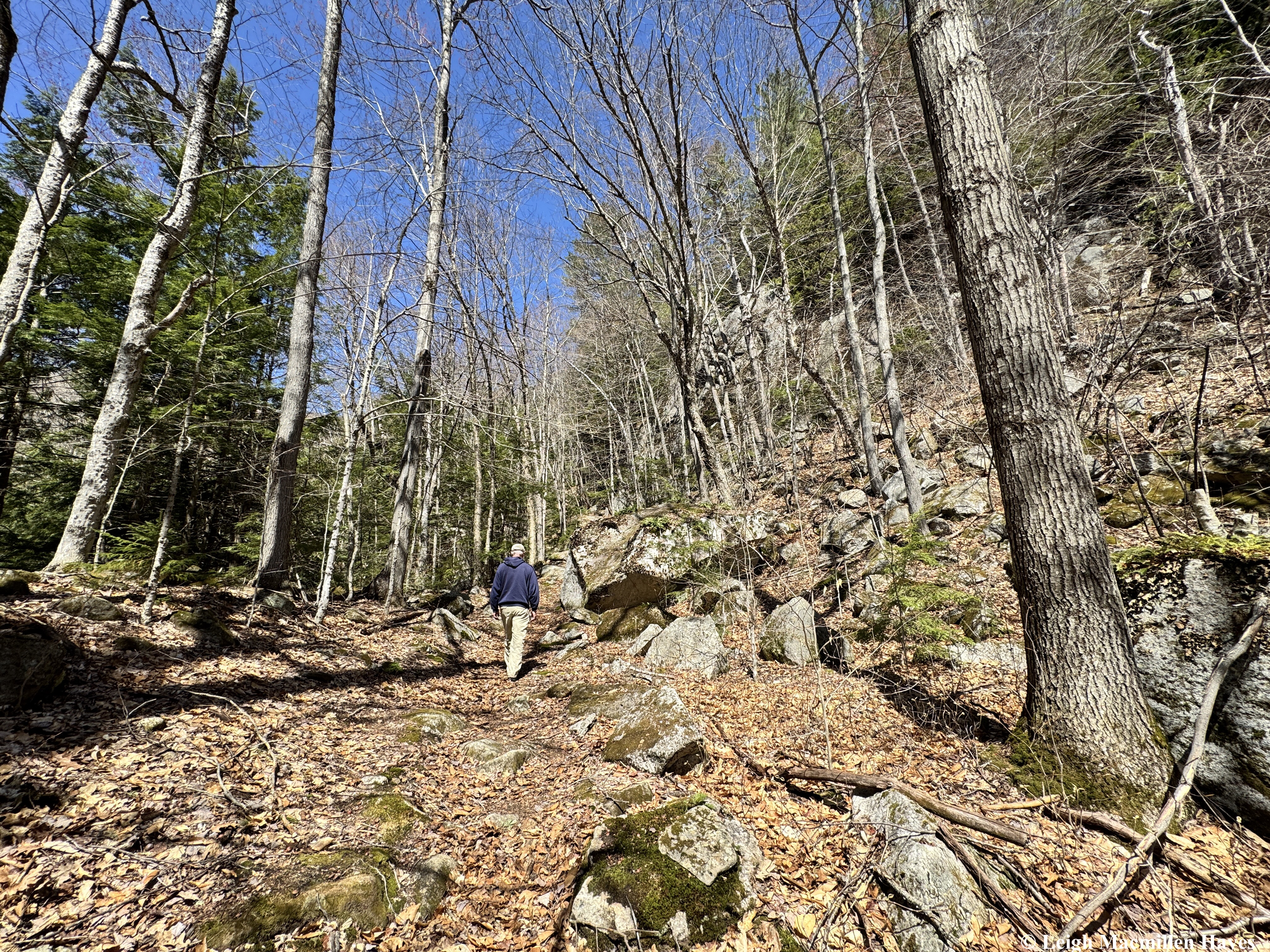
Upward we climbed into the great blue beyond, for so it seemed on this gorgeous day.

And then we reached a junction, and I, for one, was excited about what might be ahead.

Would we meet Devlin, the giant in my fairy tale, The Giant’s Shower? After all, he lives only a giant step away at Arethusa Falls.

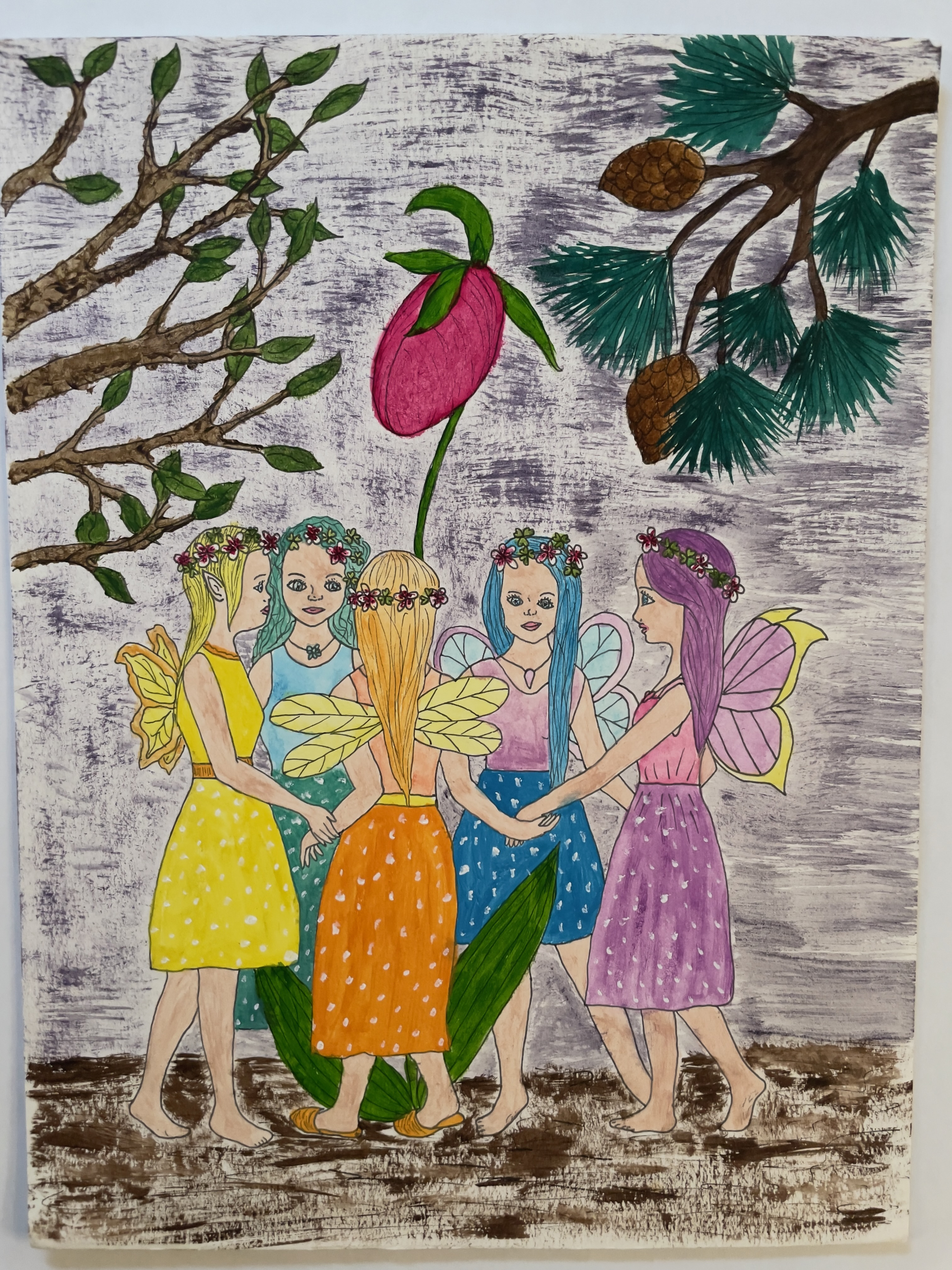
I also thought we might see a few fairies, including Devlin’s favorite, Falda, for such was the neighborhood, with lots of mossy areas among the Hemlocks.

And then My Guy got excited when he spotted something? A giant? Maybe, but in the form of Giant Falls, and if you allow your eye to move a wee bit to the right of his pointer finger, you’ll see the white water through the trees.

Where we’d left the brook for a bit as we climbed up, the spur trail led us back down and suddenly there was fall after fall after fall beside us.

We considered eating lunch beside a large pool. But then reconsidered, but not before I noted some features of the brook that I’ve been sharing with a homeschool family this year. A POOL.

And EDDIES. And FLOWS.

And FOAM. And that very foam was being picked up by the breeze and “snowing.” Oh how my ten-year-old friend would love that.

Do you see the little white dots above the water and rocks?

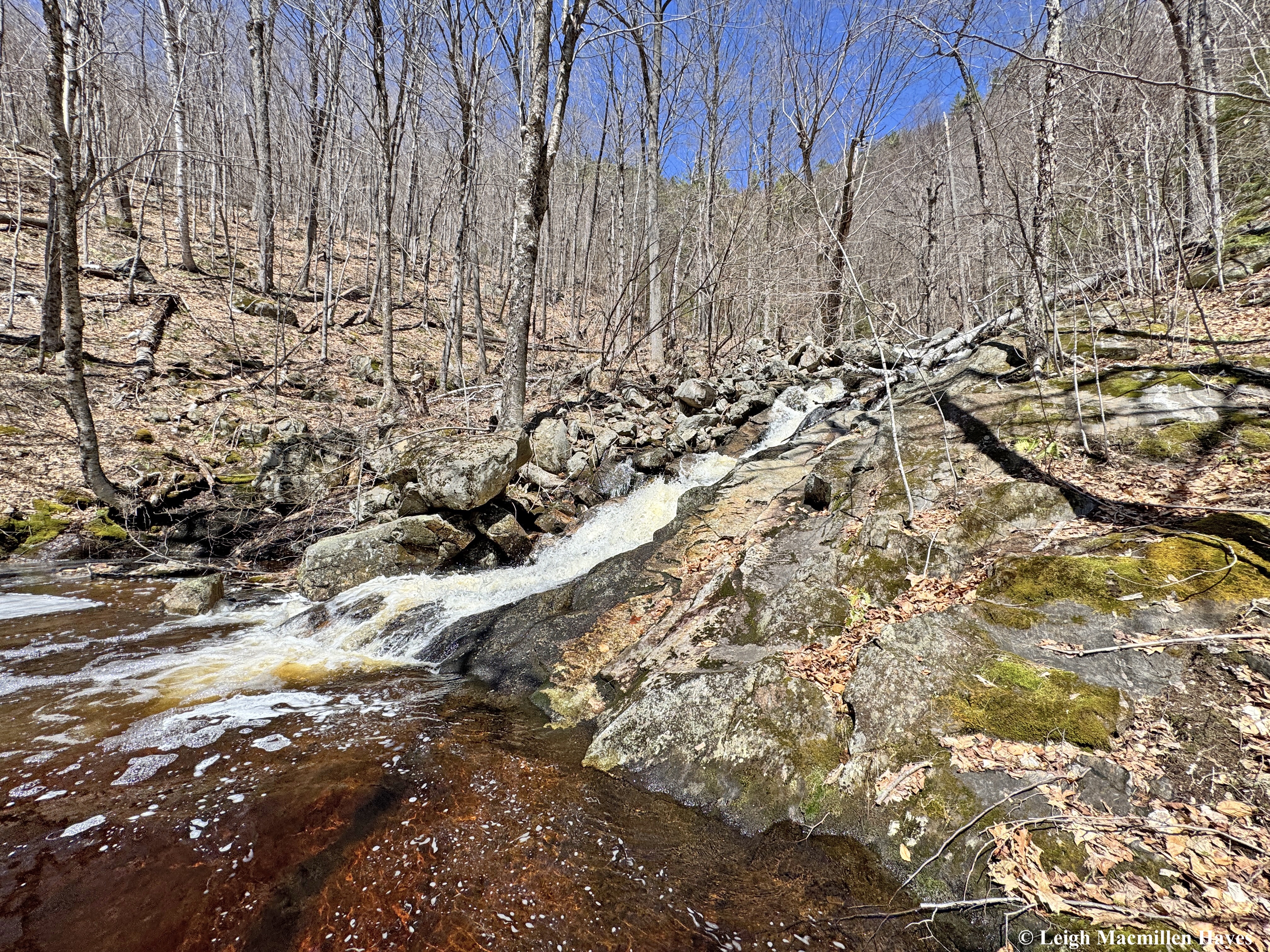
We decided to hike farther up the steep trail to reach lunch rock so we could enjoy the power of the falls fanning over the boulders.

Take a moment to listen to this incredible force of nature.

After taking in the scene around us, it was time for lunch. And that’s when the magic began to happen.

A fairy flew in. I kid you not.

That’s just a butterfly, you might think. “Just”? No, no, no. I’m sure it was a fairy disguised as a butterfly, because the fairies don’t want us to know that they are present.

And . . . it landed on My Guy’s right leg.

As we both watched quietly, it walked down his pants to his hiking shoe.

And then it began to puddle. PUDDLE. ON. HIS. SHOE. LACE.

Puddling is a butterfly act intended to seek minerals and other nutrients from things such as scat, carrion, puddles, etc., but a shoe lace? And on My Guy’s shoe lace? What, indeed, could the lure be?

We’ll never know. But what we do know is that the Anglewing Butterfly was an Eastern Comma, based on the white comma shape on its underwing.

Spectacular.

The butterfly spent at least five minutes with My Guy: who seemed to appreciate that he had suddenly turned into a Whisperer. I don’t know that he’s ever held that status before.

When we finally departed, we had to hike back out along the same trail upon which we’d journeyed in, and . . . cross a bridge that bowed in the middle. Certainly the sign that a giant frequented it.

My Guy: The Giant Falls Butterfly Whisperer.

Worth a wonder.

P.S. No, there will not be a sequel to The Giant’s Shower. Self-publishing is expensive and I still have a bunch of books left from the second printing because I’m terrible at promoting it. It’s easy to do here on the blog, but not in real life.

Perfect Present

The Giant’s Shower: a book by me

I did a thing. Years ago I wrote a children’s story. Well, a bunch of them actually. And I tried to sell this particular one to publishing houses. No takers. Then, a couple of years ago I purchased a Fairy Coloring Book created by the one and only Solana, teenage daughter of the Fly Away Farm Wards in Lovell and Stow, Maine, and approached her about illustrating my fairy tale. She took on the task and did an amazing job. Then I asked copyeditor Pam Marshall to wave her magic wand over it. And I asked local graphic designer Dianne Lewis to use some fairy dust and turn it into an actual book. I always said I’d never self-publish a book. And tada: I did just that. And now it’s even better because it’s published by http://www.indieauthorbooks.com.

Aisling, a fairy who lives on Sabattus Mountain in the western Maine village of Lovell, has a vision during the Midsummer Eve celebration. 

Twinkles, flitters, a bit of fairy dust and some tsk-tsking are necessary to make Aisling’s vision a reality. 

If you read the story aloud, I highly encourage you to get all in your audience to participate in saying “Tsk, tsk,” each time Biddie does the same.

You and your children will delight in the story accompanied and the colorful and whimsical illustrations created by artist Solana Ward.  In fact, you don’t even need children to enjoy this story.

Marita Wiser, author of Hikes and Walks in and around Maine’s Lakes Region had this to say about the book, “The fairies in The Giant’s Shower will captivate children with their merry life in the forest. It’s not all magical though, as they moved from New Hampshire to Sabattus Mountain in Maine to avoid a certain devil. At least they thought the giant was a devil, but the situation wasn’t what it seemed at first. Both the writing and the detailed illustrations capture many features of the woods of northern New England, and the fun of fairy life and houses.” 

A naturalist and writer, many of you know that I hike frequently in Maine and New Hampshire, and those adventures inspired this story. I feel the fairies’ magic whenever I’m among moss-covered ground and tree stumps.

Included in the book are directions to the two featured settings, Sabattus Mountain and Arethusa Falls, featured in the photo above. Both are easily accessible for young hikers who might experience some magical moments while exploring. 

Also included is a list of character names and their explanations, as well as instructions to create fairy houses and fairy dust. 

The Giant’s Shower is available for $16.99 at Bridgton Books, Hayes Ace Hardware, Fly Away Farm, or by contacting me: thegiantsshower2023@gmail.com. Cash, check, or Venmo all work.

I do charge an extra $5.00 for shipping and handling if you ask me to send it to you.

Please consider purchasing a copy, or ten, as the book does make the perfect present.

November 11, 2024 Mondate

It’s Veterans Day 2024 and My Guy and I chose a trail less traveled in the National Forest, giving thanks to our families, friends, and strangers who have served our country. It’s because of them that we can hike along trails and old logging roads, and even bushwhack; two of the many freedoms they’ve given us are the freedom to move about our country and the freedom to not live in fear (well, most of the time).

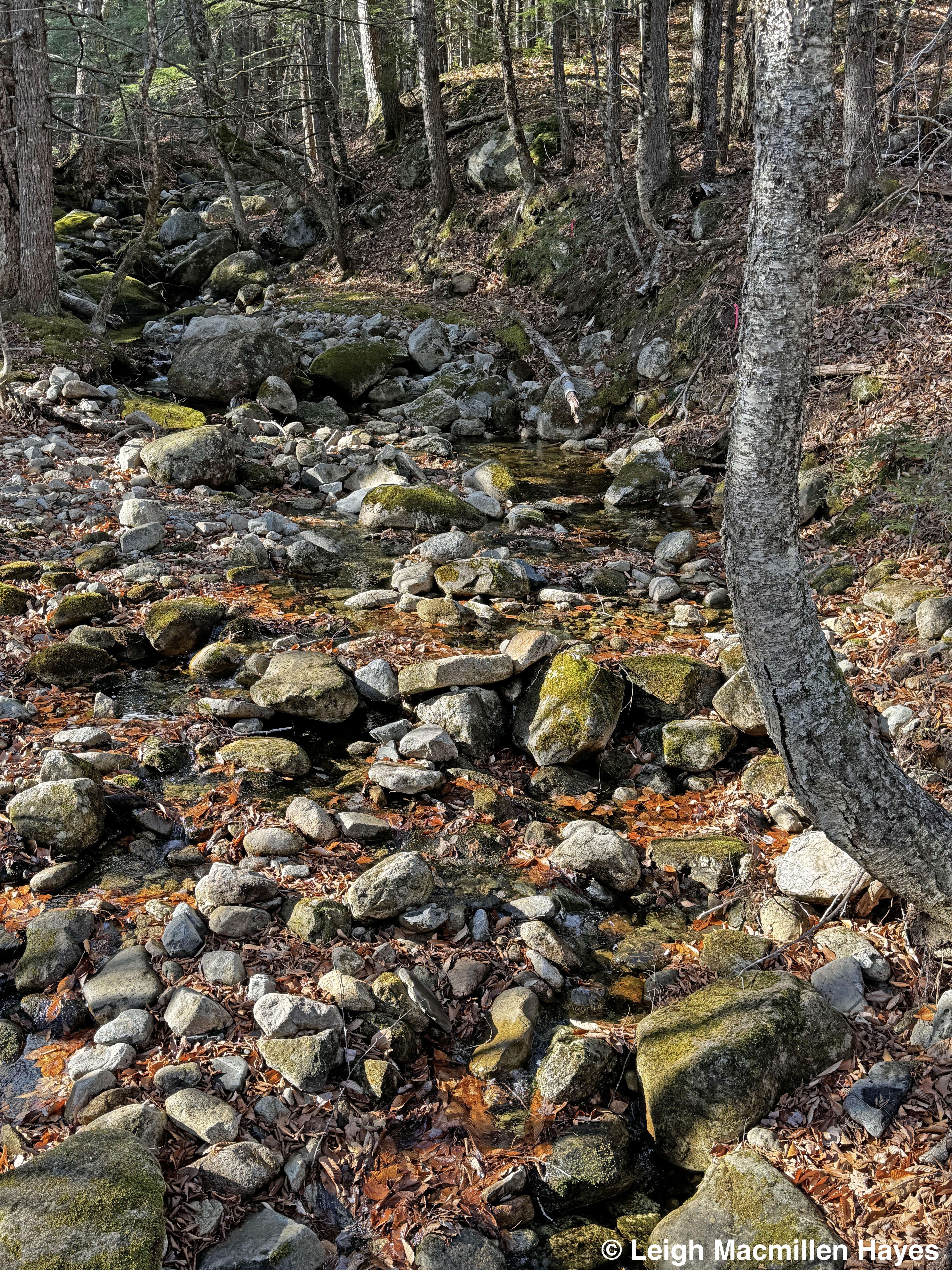
And so today found us crossing the state line and beginning our journey beside Langdon Brook in Chatham, New Hampshire. Like everywhere we look these days, the water level was low–a result of the current drought.

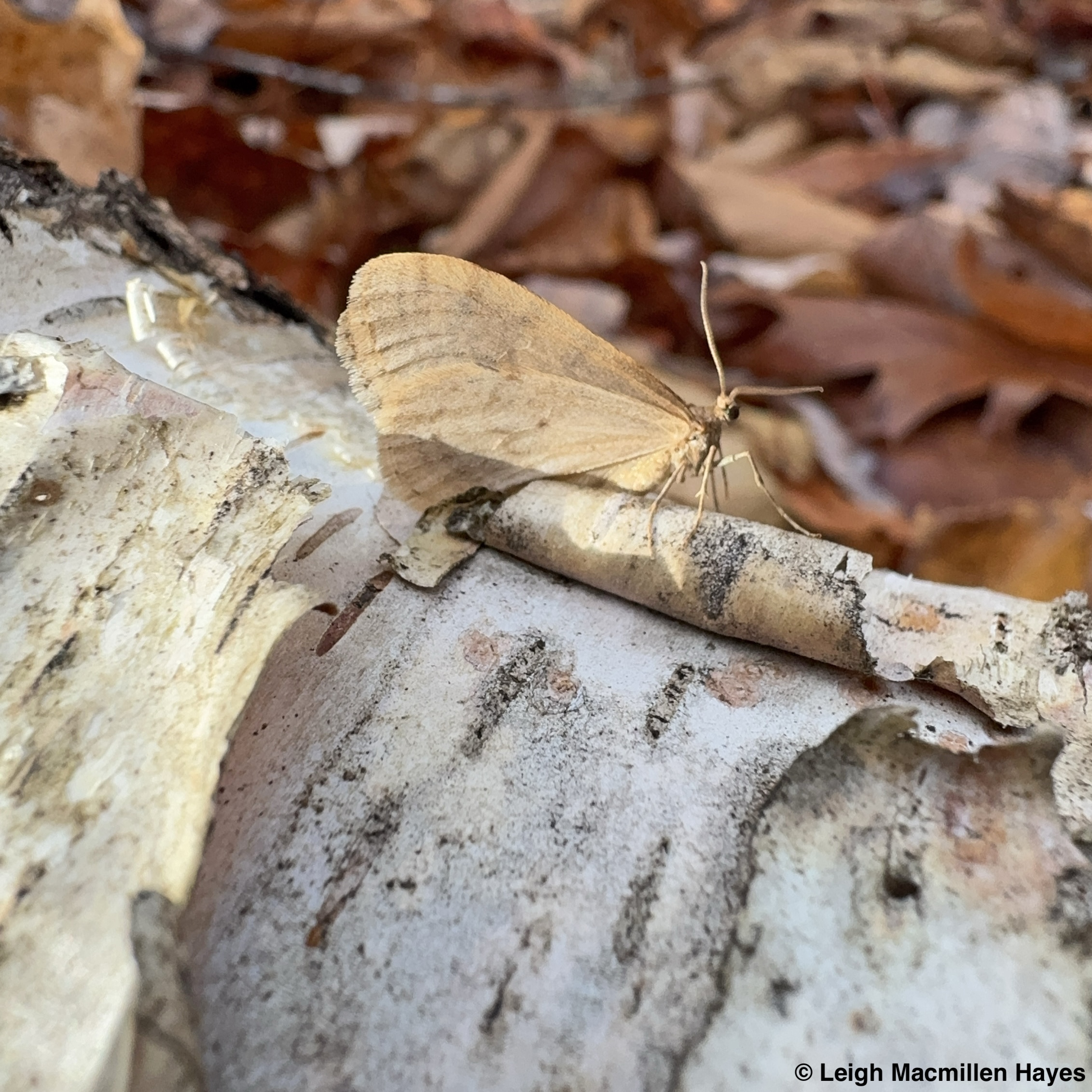
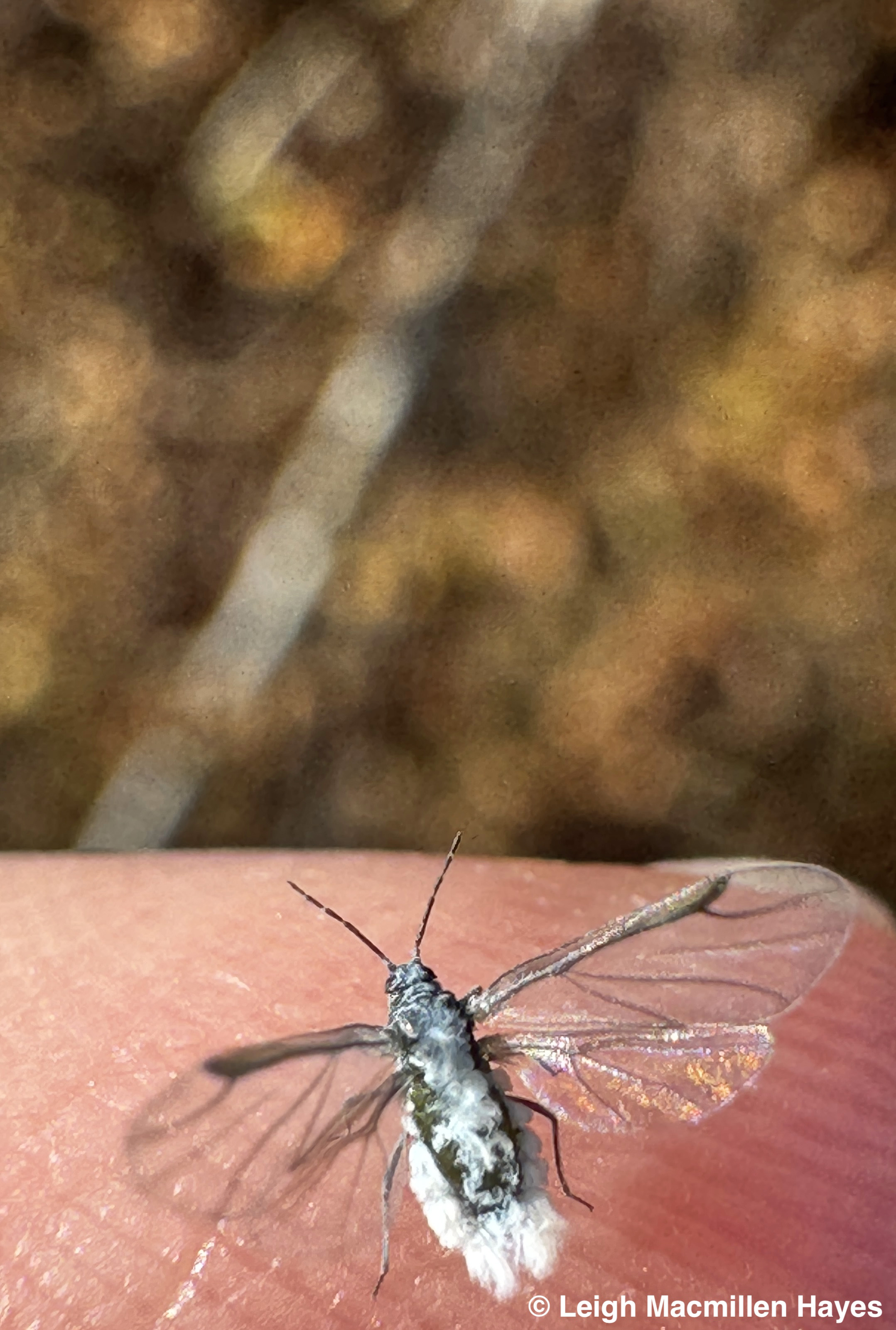
What isn’t low is the number of Geometer Moths, and I believe this to be The Bruce Spanworm, aka Winter Moth, that is currently on the move, emerging from the duff in October and November. I didn’t look for females, who are flightless, but saw plenty of males on the wing.

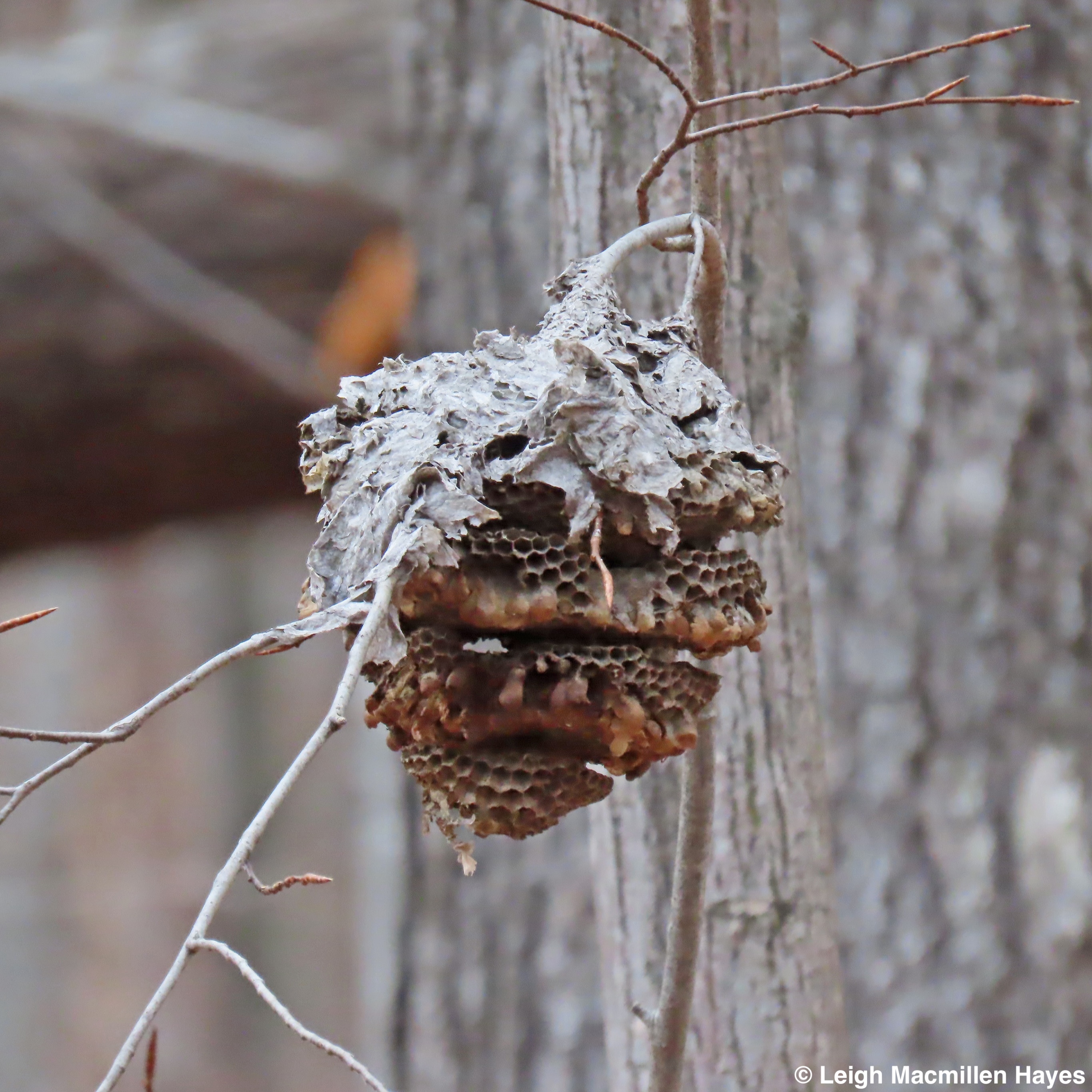
Our trek found us following steep old logging roads for a good portion and as we looked for Bear Claw Trees, I spotted this, a hornet nest.

One Bald-faced queen started building this nest in the spring by chewing wood and mixing it with saliva to create a paper-like material. I love that you can see the multiple layers of horizontal combs, under what’s left of the papery outer envelope.

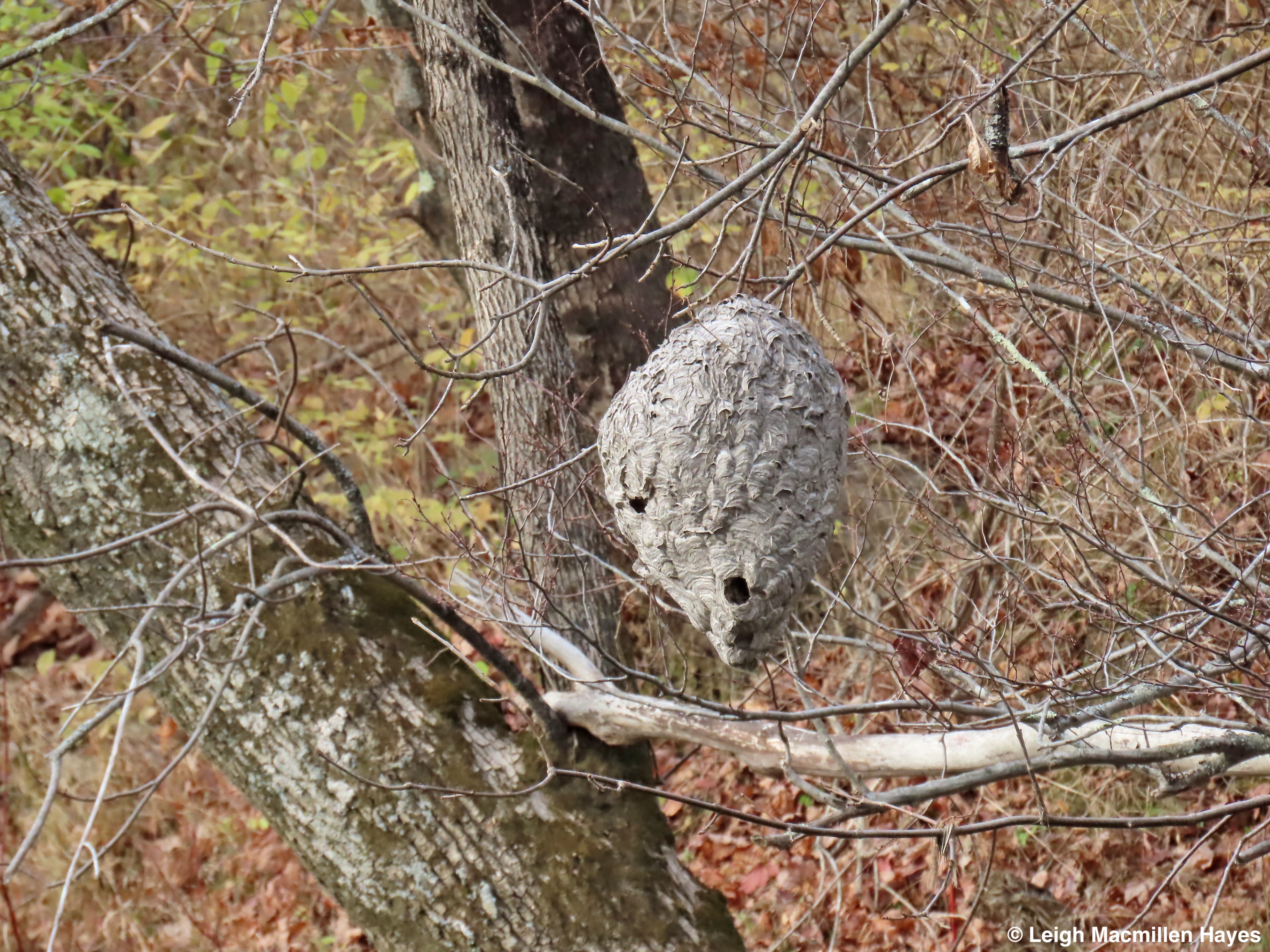
Just last week on a hike closer to the Atlantic Ocean we saw another football-shaped structure, that one being much more intact than today’s example.

Take a second to admire those layers of paper.

What to our ever wondering eyes did eventually appear, the first of several Bear Claw Trees, but I promise to not share all of them with you.

What I will share is this one, a first for us. We often see “elbow” trees in the woods, but never before have we spotted a “collar-bone” tree, so dubbed by My Guy. I think it’s a great description of the morphed shape of this Red Maple, probably caused by logging equipment rubbing against it years ago.

And because we were in a place where one would expect to see wildlife, or at least the signs of such, we found Moose tracks.

Where there are tracks, there is bound to be scat, though the tracks were much fresher than this pile. We actually expected to find both because we’ve traveled this way several times before and know it can be a highway.

As much as we both wanted to see the real deal today, I was glad we didn’t spot a Moose since it’s rutting season. That said, there were plenty of mature trees to hide behind had one approached us.

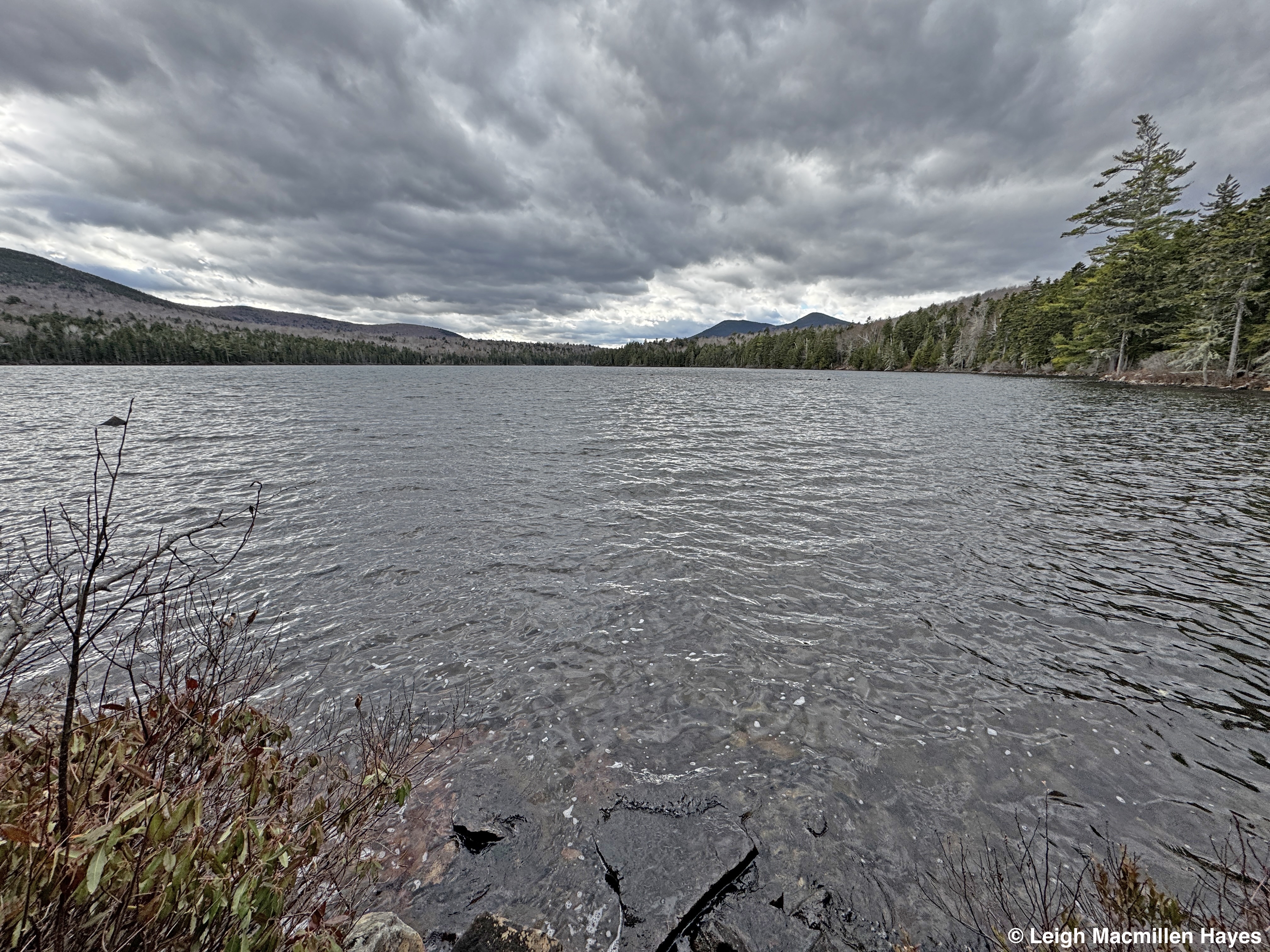
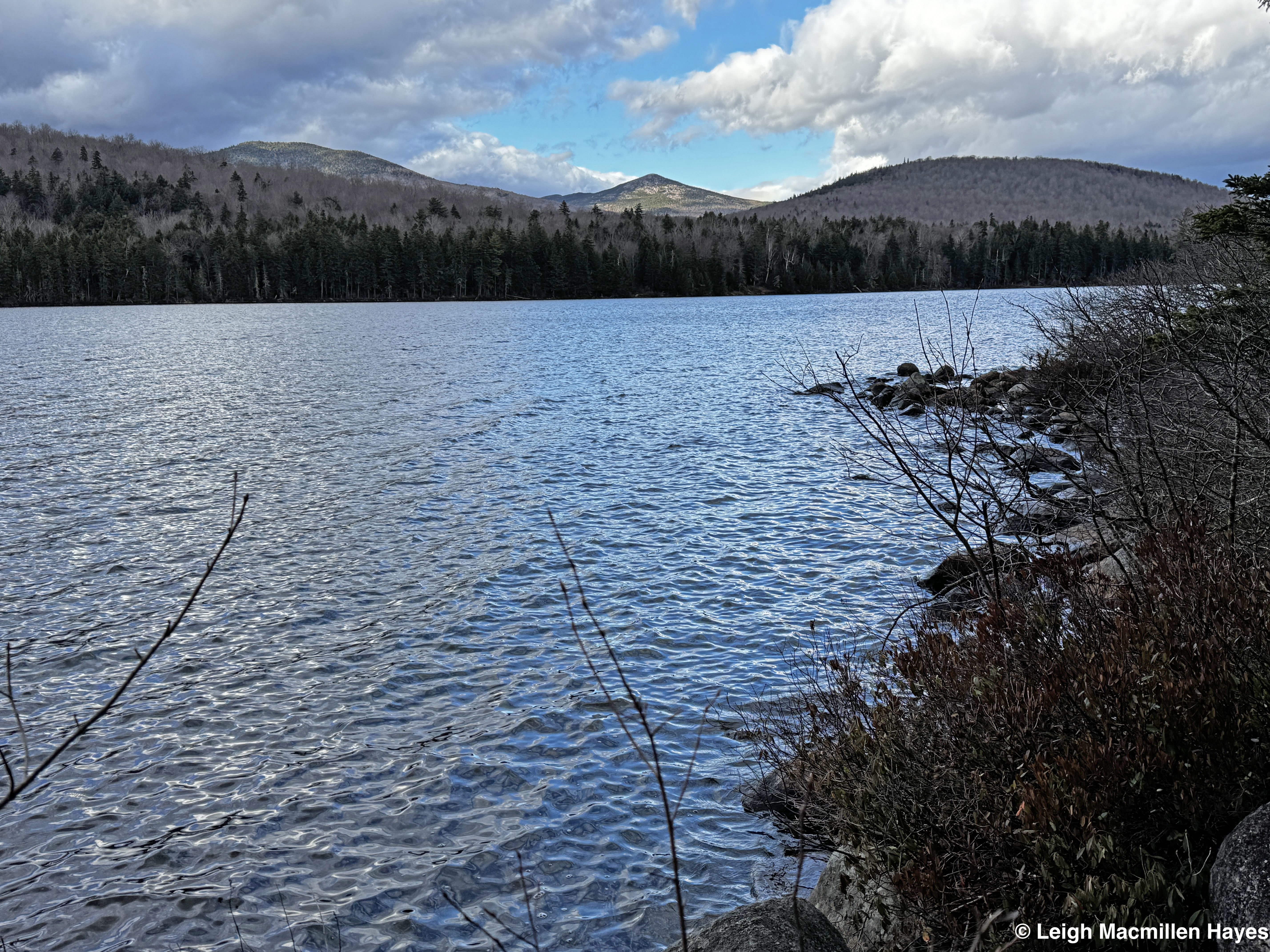
A few miles up and down, and a short trail new to us that was so much easier than the usual bushwhack approach we’ve taken in the past, and we arrived at our destination: Mountain Pond. With the Doubleheads in the background.

Doesn’t it have the cold November look?

It was breezy, but really, not as cold as it should have been and we both wore sweatshirts and anorak windbreakers and were quite comfortable.

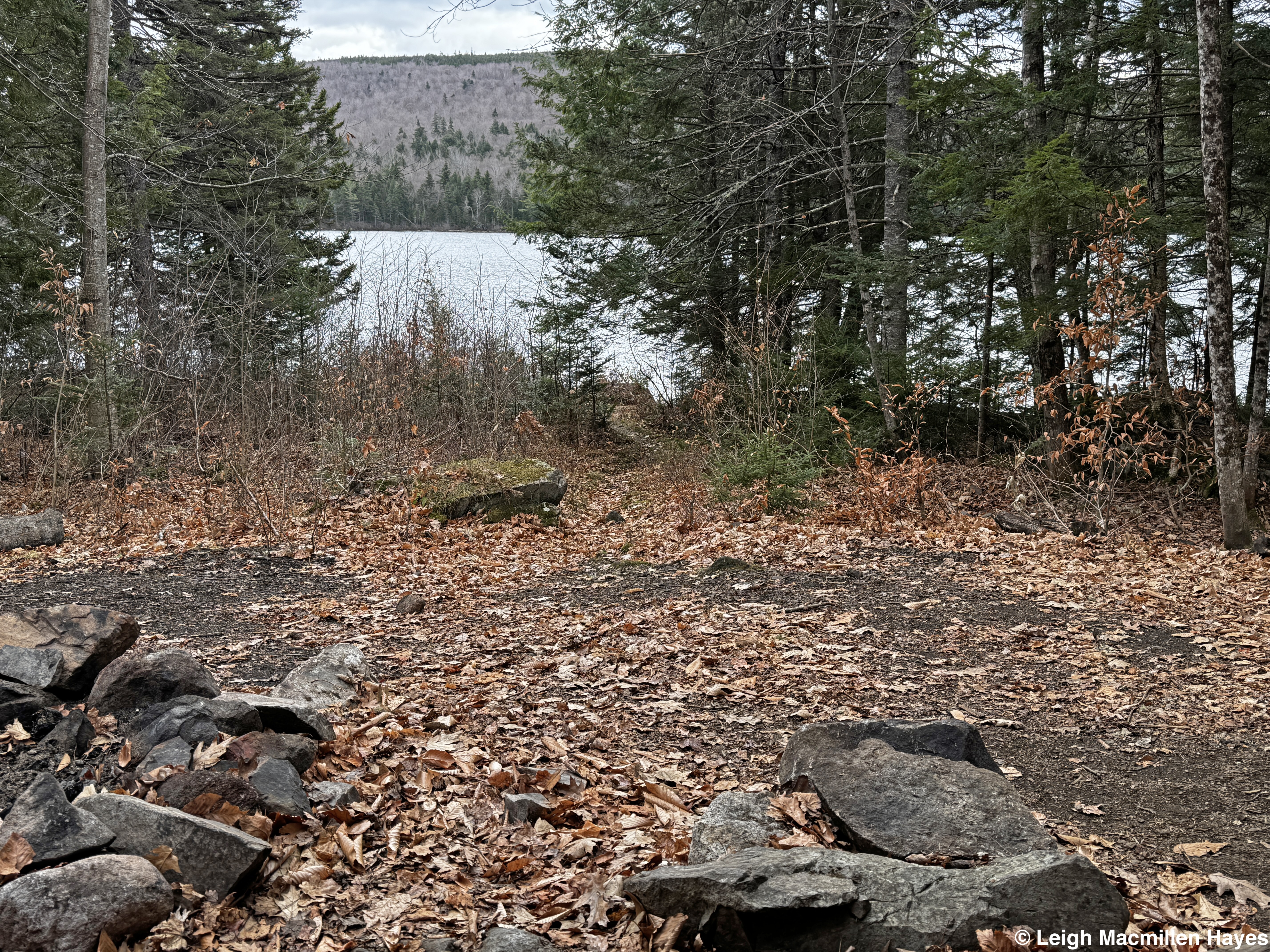
Once we reached the pond, we decide to follow the loop trail that encircles it, and stopped at the lean-to for lunch–just far enough from the open water to be out of the wind.

And then it was time to continue on, dealing with rocks and roots most of the way. A bit technical in the footing department especially at the outlet brook, but not difficult.

Soon after crossing the brook, we entered fairy land. Even MG recognized it for what it was.

We didn’t see anyone at home, but trusted they were sleeping as is their habit during the day. Even the boulder condominium looked like it housed a few.

It’s places like this that inspired my children’s book, The Giant’s Shower.

If you are interested in a copy, or two, or three, please contact me by leaving a message in the comments of this blog because I’m not sure the thegiantsshower email mentioned at the end of that blog post is currently working.

But I digress.

On the far side of the pond, we spied the Baldfaces, which gave us a better sense of our place in the world at that moment.

After completing the loop, we found the short trail back to the logging roads and practically ran down hill, despite the signs indicating we should do otherwise.

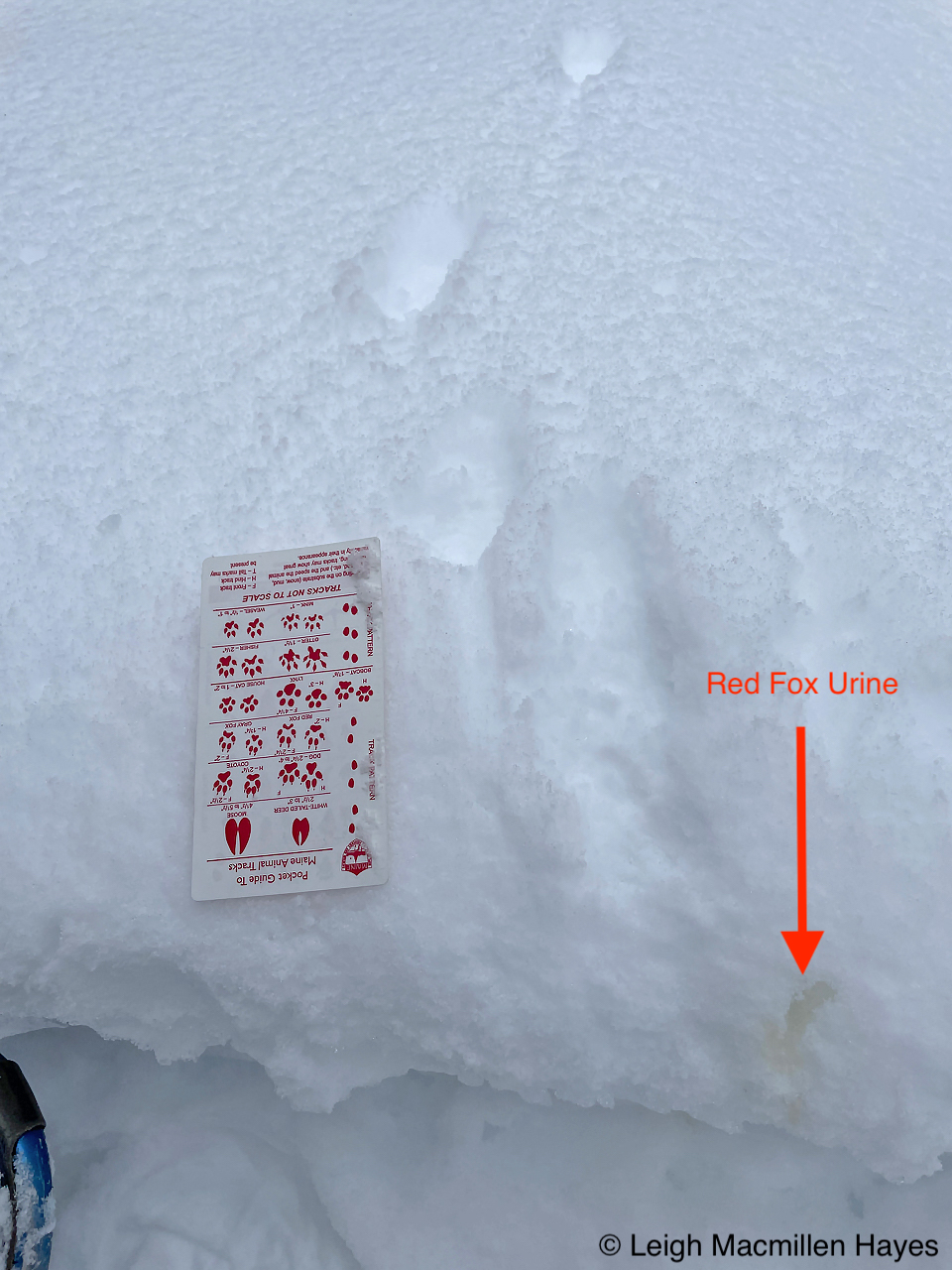
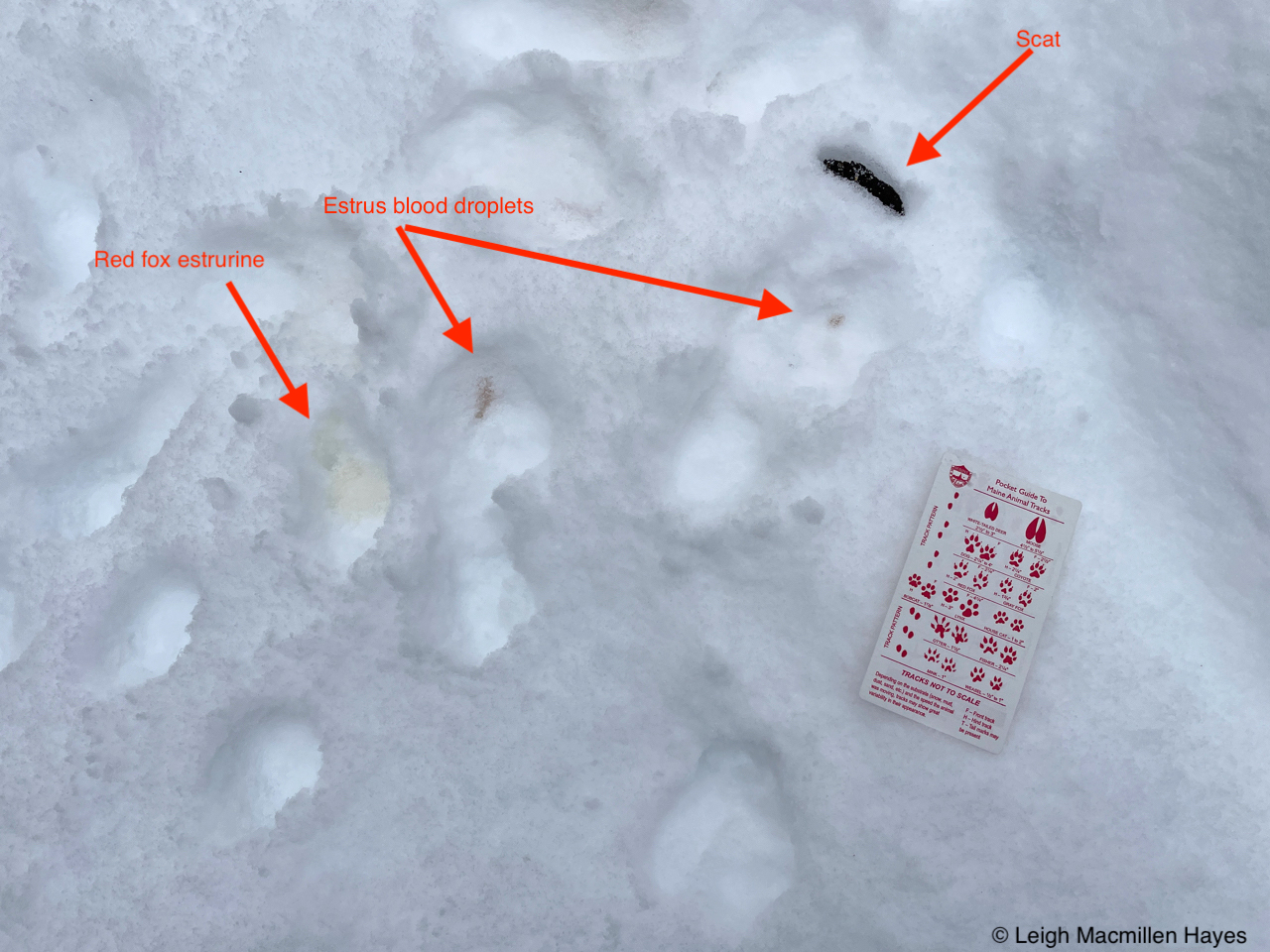
Not far from the start of our journey, I spotted a classic representation of Red Fox scat. The tapered end and twist are what give it away. And its size.

I actually expected to find a range of scat samples along the way, but that was not the case. And the only critters we saw were two Red Squirrels who dashed for cover as we approached.

But we did have an unusual sighting . . .

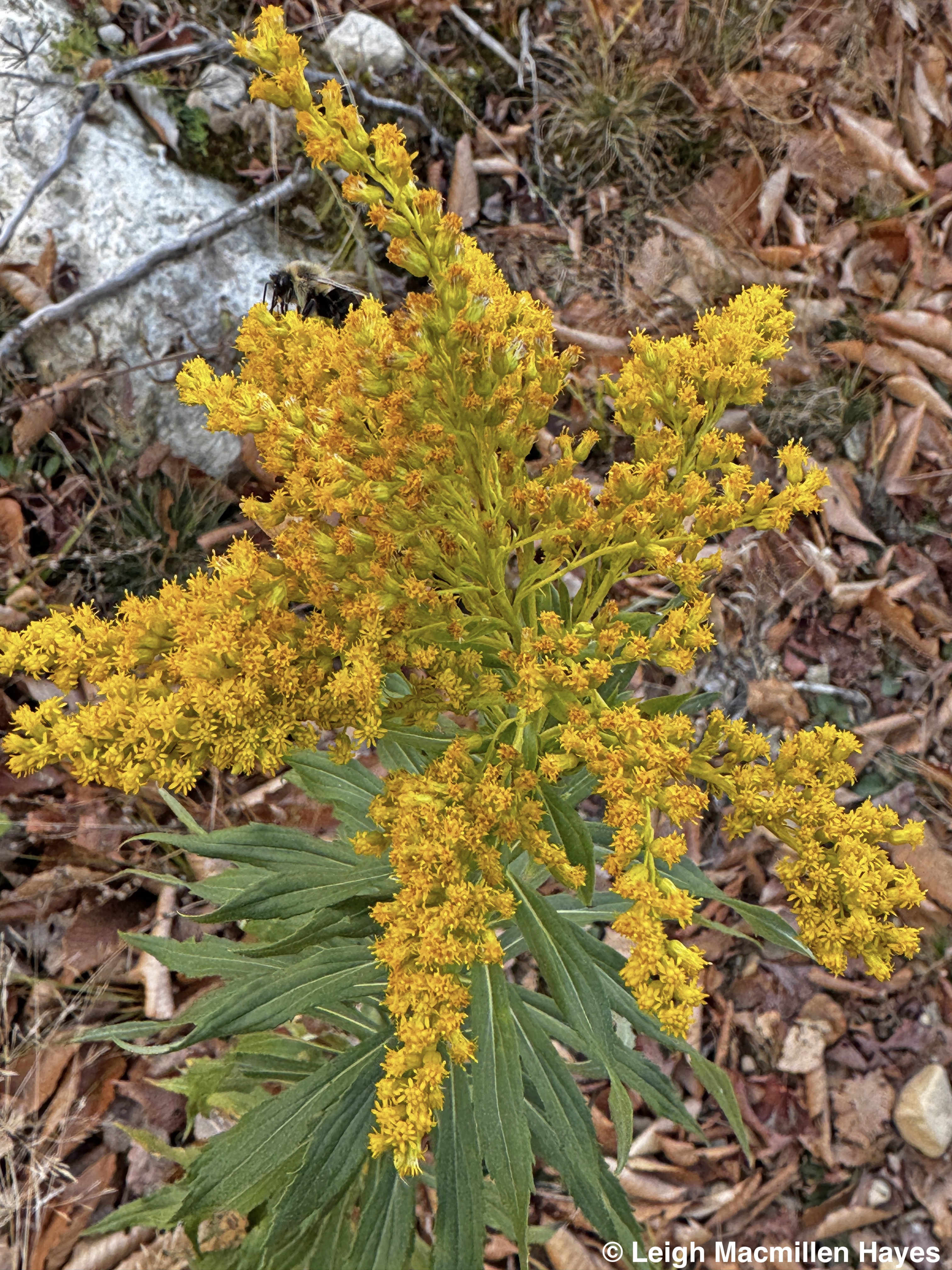
On the way back, about 100 feet below where I’d parked the truck, I spotted something else–Goldenrod in bloom on November 11th.

For the last few years, my nephew and I have been sharing photos of plants blooming when they should not be and he’ll receive this one in a text message soon.

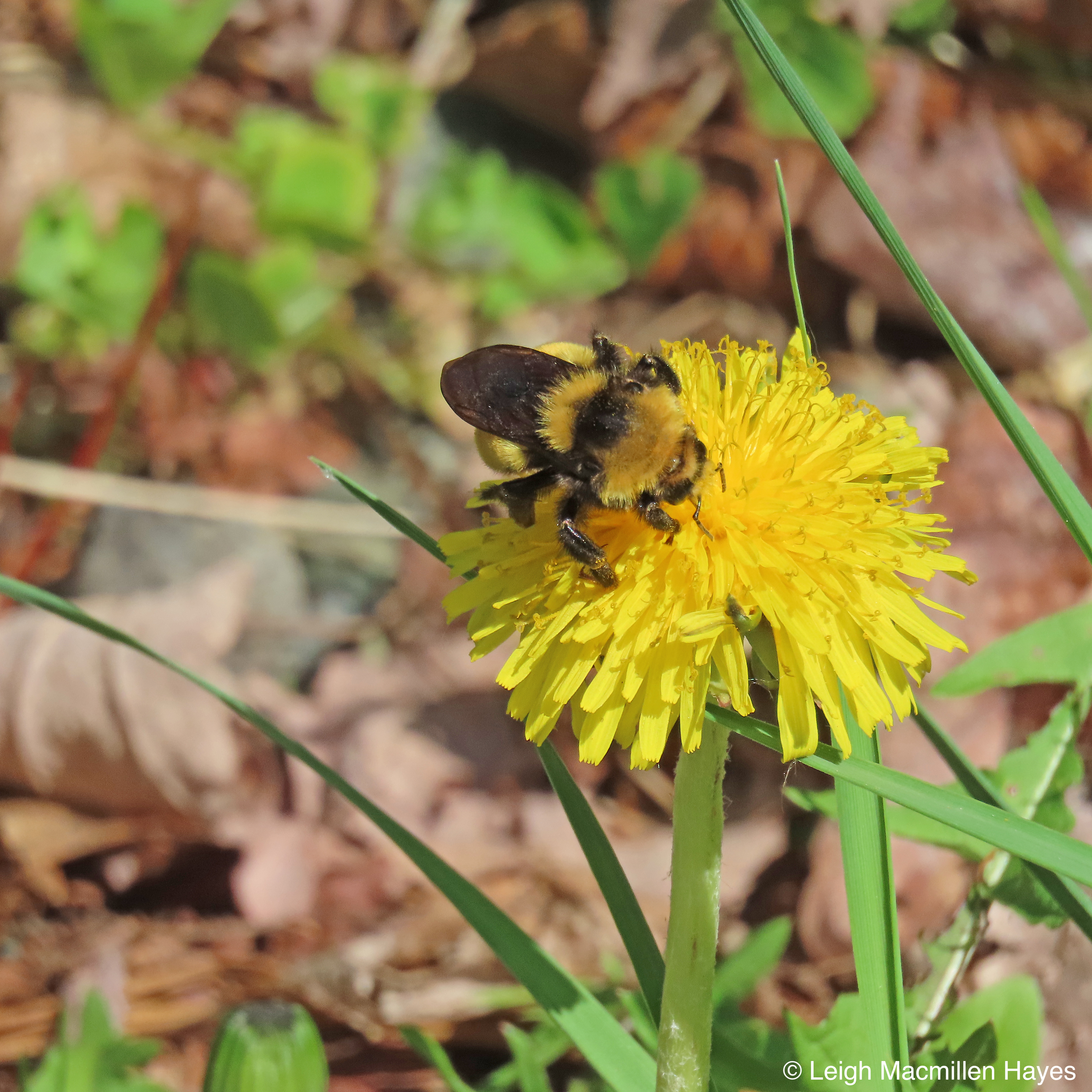
The other amazing thing about this bloom . . . the Bumblebee seeking nourishment upon it. At first I thought the bee was either sleeping or dead, but it moved.

It does need to watch out, however, because just below it an Ambush Bug was busy dealing with another Bruce Spanworm moth–one down, a million more Winter Moths to go.

But again, I couldn’t believe that the Ambush Bug was still active either. We had a hard frost a few days ago. How did all of this happen?

November 11, 2024, a day to remember all those who served our country and a day for My Guy and I to take advantage of our freedoms and make some discoveries worth wondering about on this Veterans Day Mondate.

Snow–Bugs and Flakes

Betwixt. Between. Be flowers. Be bugs. Be glad for there is so much to wonder about in the natural world. And I don’t even know the half of it. But I wouldn’t be happy if I wasn’t always learning.

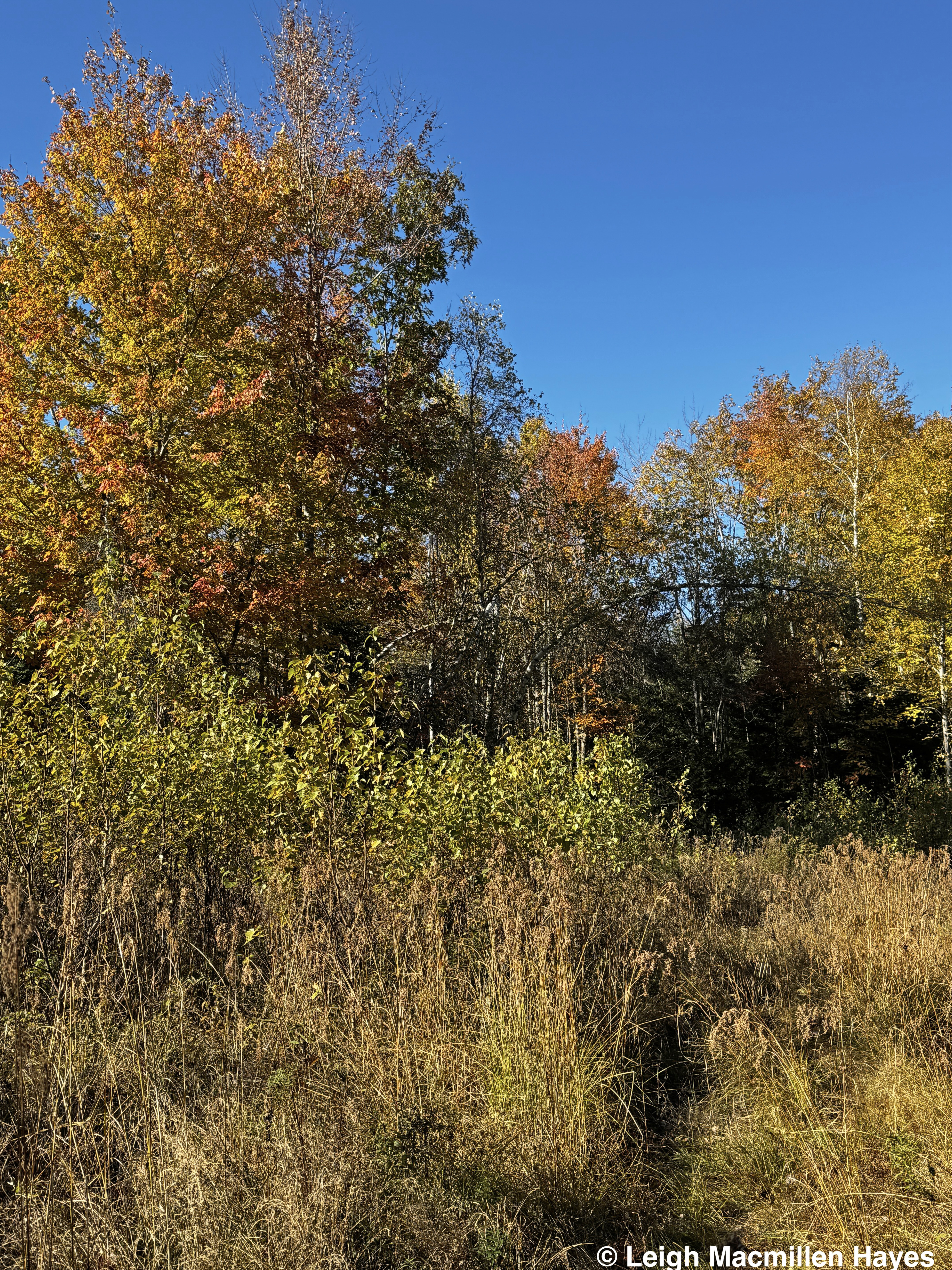
It was 28˚ when I awoke this morning. Late this afternoon on this brilliant sunlight day, with temps at least 30˚ warmer, I walked out through our woodlot to the right and then looked back across the neighbor’s field toward our house, taking in the sea of seedheads and I was sure my insect hunting days had come to an end.

But much to my surprise, and really, I shouldn’t have been surprised, the chirps of crickets and grasshoppers, like this Red-legged example, filled the air. I might not have seen the grasshoppers if they hadn’t flown to a new spot occasionally, for so camouflaged are they in the current setting. Or always.

And then, much to my delight, I noticed a Saffron-winged Meadowhawk flying low and making frequent stops, allowing me to do the same. We live in a wet area, but still, I’m often surprised by some of species I meet here.

From the field, I decided to continue along the power line that crosses our property and the neighbor’s and many more beyond that and as I’d told my friend Meg from North Carolina the other day–Mount Washington, our mighty New England Rock Pile, is at the far end and it looks like we could walk right to it. Give or take a few days–or drive there in about an hour.

It’s along the path below the lines that I discovered Cotton-grass, which is a sedge, with its fluffy little heads speaking to the bogginess of this area.

Cottongrasses self-pollinate, their flowers being “perfect,” given that each contains both male (stamen) and female (carpel) parts. And the seeds are attached to parachutes waiting for a breeze (or animal) to move them to a new home.

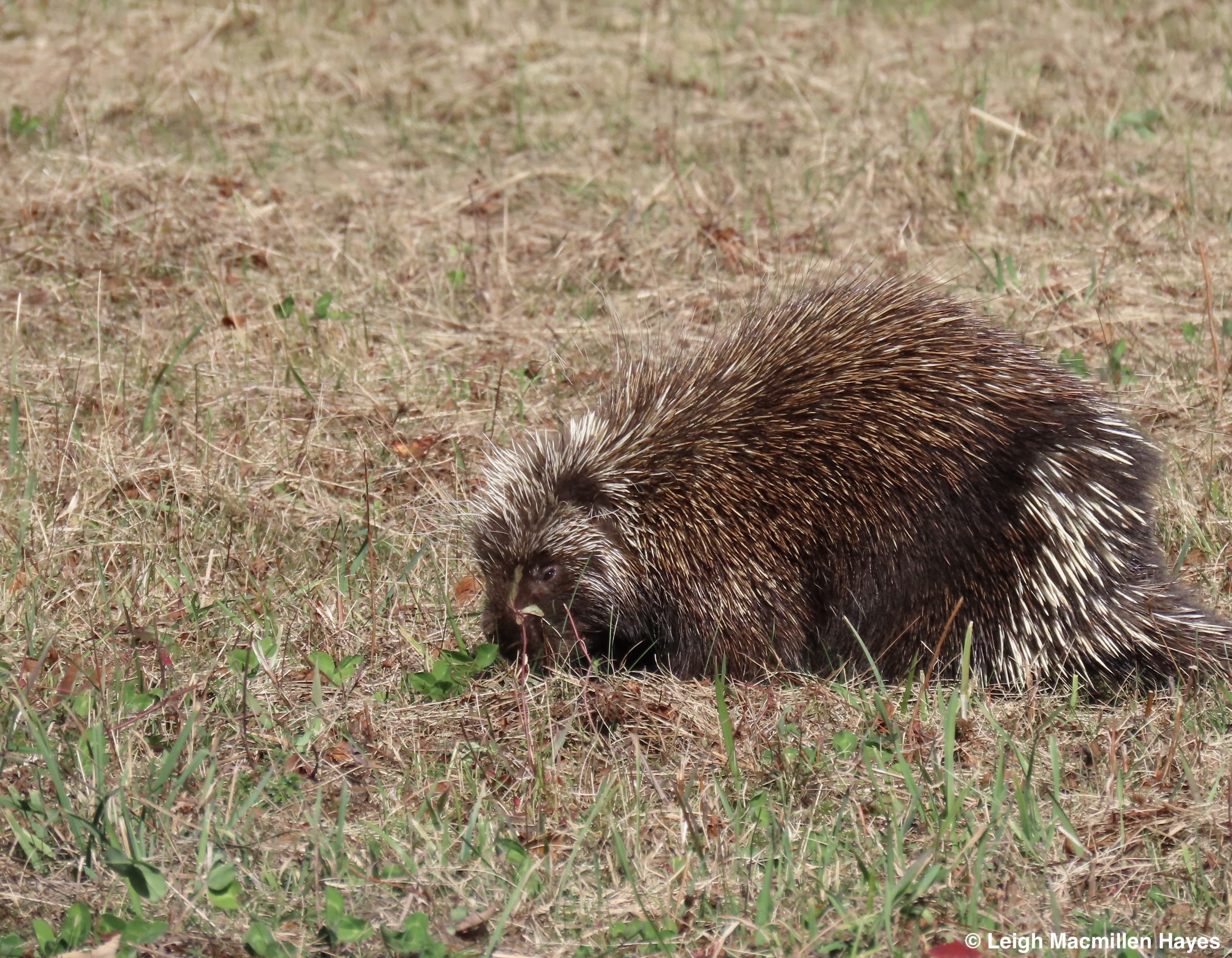
Spotting the curly, cottony-hairs reminded me of the belly hairs of porcupines, which of course, reminded me of the Porky some friends and I spotted in another field in town yesterday. The time is coming when these critters, whom I’ve come to adore, will transition from life in the field to life in forest trees.

Last November I wrote about this particular porcupine, Bandit, whom I met in our yard, along the same route I began today’s journey. Perhaps soon, we will meet again.

Getting back to today’s story, I left the power line, and headed out an old logging trail that I tend to frequent most often in the winter. But it was sunny, and I was enjoying that warmth, and wondered what else I might spy along the way.

For starters, there were the “dried” Pearly Everlasting Flowers, which I should have gathered because they do dry so well. Instead, I just admired them.

And I had frequent encounters with more Saffron-winged Meadowhawks, flying much like White Corporal Skimmers in early spring–always landing and then moving a couple of feet ahead of me whenever I made a move.

Helping with ID of this species, are the fine black lines in the sutures of the abdomen. And the red stigma toward the tip of each wing is outlined in black. Otherwise, I might confuse it for an Autumn Meadowhawk.

I also had the pleasure of meeting a female Shadow Darner, but then I went to offer a finger for her, thinking she might want to take advantage of my body heat, and instead she tried to bite me. So, I let her be and we went our own ways.

At a former log landing, Juncos were on watch, and given how much seed is available, I know they’re mighty happy with the current conditions. It seems like they just arrived in the past week or so, but the good news is that many will overwinter here.

Oh and a few will fly to Connecticut so that my dear friend, Kate, can watch them as well.

Being an old logging road and log landing, conditions were apparently ideal this past summer, and I paused for a moment to admire forest succession, with grasses and herbs forming the floor, and more grasses and sedges growing taller, topped by Gray Birch, and a backdrop of Red Maples, and Big-tooth Aspen, and Paper Birch.

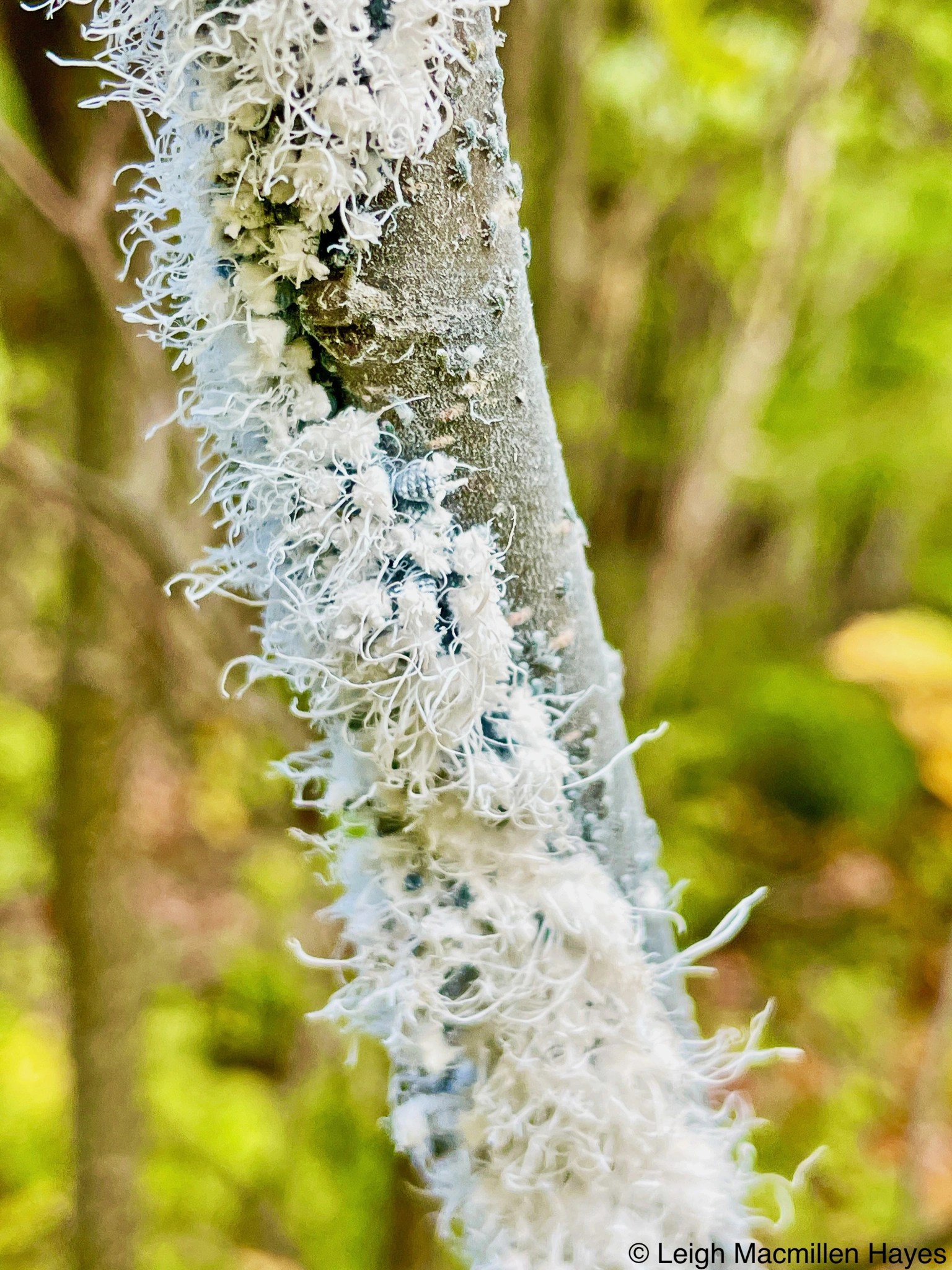
And then it was back to the now dry bed of a stream crossing where Speckled Alder shrubs are closing in on the trail, and Woolly Alder Aphids are living their best life seeking sap from the woody plants.

That Cotton Candy or even Cotton-grass look is actually a waxy material they produce from their abdomens, and when they group together like this, perhaps its meant to detract visitors. Or protect them from the weather. Had a I visited on a summer day, I’m sure I would have spotted ants trying to tickle them (it’s called farming) to take advantage of the honey dew the aphids secrete.

Speckled Alder Aphids live an interesting life style. Actually, according to Donald W. Stokes in his book, A Guide to Observing Insect Lives, “There are two life cycles in this species. In one, the aphids remain on alder trees throughout their lives. They are believed to overwinter as adults in the leaf litter at the base of an alder. In spring, they crawl up the plant and feed on its sap. There are several generations per year and adults of the last generation overwinter.

In the other life cycle, the aphids alternate between two plants. The aphids overwinter as eggs placed on maple twigs. In the spring they hatch into females, which feed on the undersides of maples leaves and reproduce. They are wingless, but in midsummer produce winged offspring, also females, which fly to alders. These females feed and reproduce on alders, and give birth to wingless young. Then in the late fall, they produce winged young, which fly back to maples and give birth to both male and female young. The males and females mate, and each fertilized female lays a single egg on a maple twig. Only the eggs overwinter.”

It’s things like this that add to my sense of wonder. Two life cycles? The adults of one life cycle overwinter while the eggs of the other are do the same? That’s amazing.

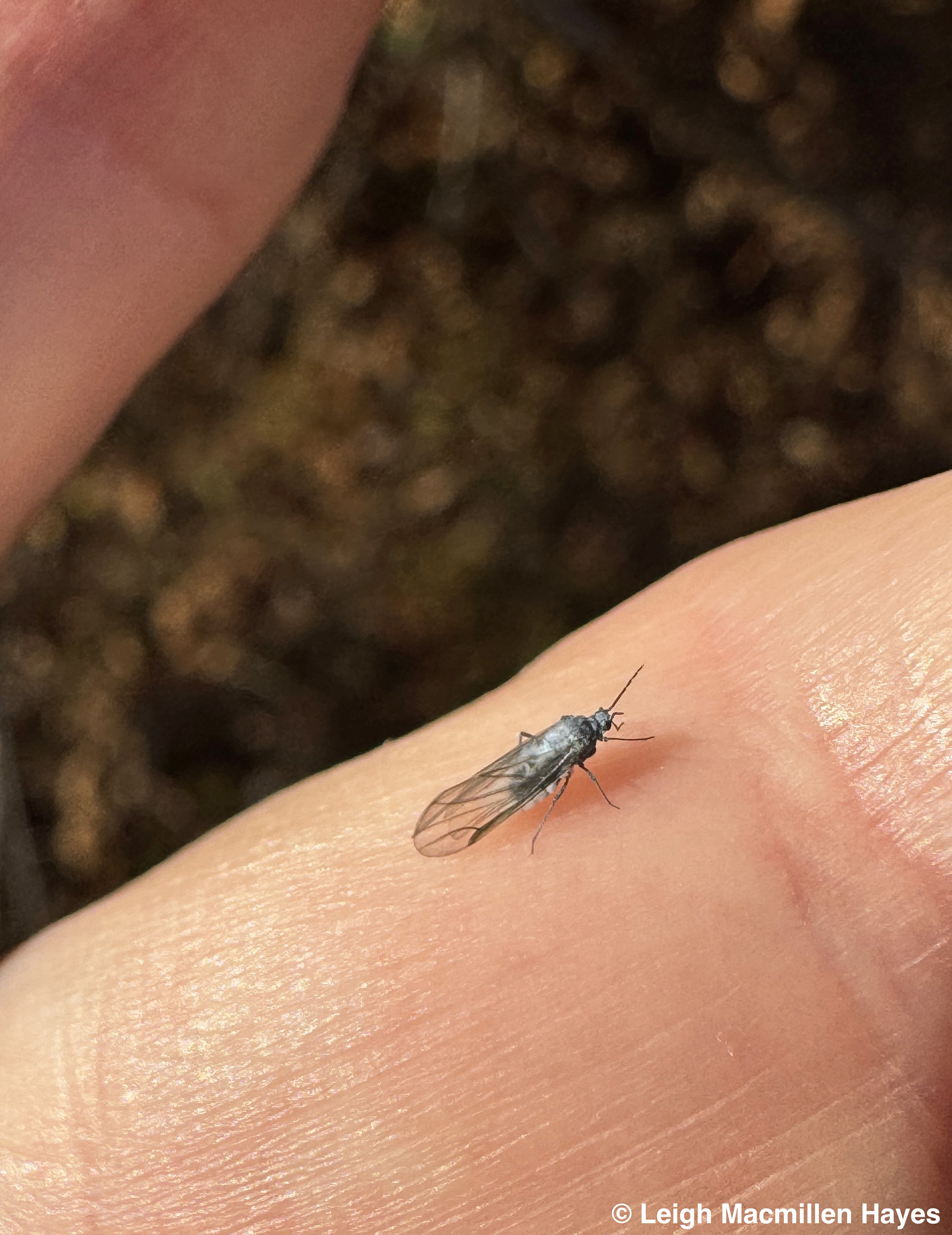
And on the fly in a bit of abundance right now for I saw a bunch today and I’ve been seeing them along many trails that I hike, are the flying aphids. If you stick your hand out and cup it, you can get one to land.

Don’t worry, they don’t bite. And they don’t even tickle, despite that waxy hair.

They’re actually kinda beautiful in their own way and as they fly they look like tiny flakes of snow, thus some refer to them as Snow Bugs.

So I have two forever-friends-since-birth and I’ve already referred to Kate earlier in this blog because she is a great lover of Juncos, along with everything else in the natural world, and so is her sister, Patty, who once told this joke when we were kids:

Q: What’s white and goes up?

A. A dumb snowflake.

One of these two is eleven months younger than me and the other is eleven months older and she and I just chatted yesterday and I’m so thankful to have them in my life all these years. Yes, B.S., I am also incredibly thankful to have you in my life.

But once again I digress. Except I had to tell that joke. Because it kinda reminds me of the aphids in flight.

Back to the power line, I decided to pull the Mighty Mount Washington in with the telephoto lens. Yes, dear readers, that is snow! Several inches of the white stuff has fallen over the last few days. And there is rime ice.

My favorite season is only a walk down the power line away.

Snow: Bugs and Flakes. It’s all wonder-filled.

My Artistic Path

In a way, this is A Lost Art Found continued. It’s the rest of the story, at least to this date.

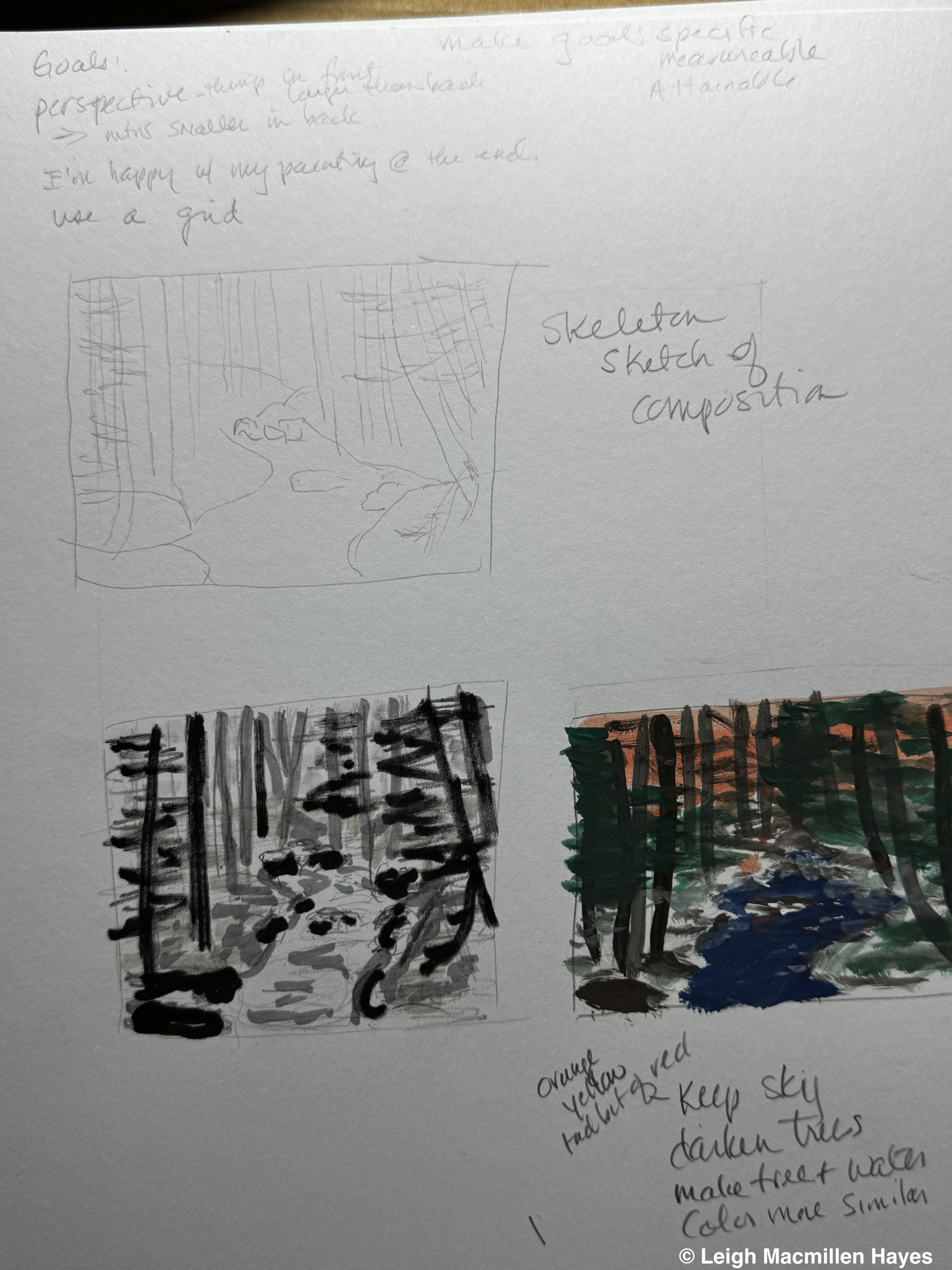
Once I got hooked on painting, I couldn’t stop. What I’ve discovered is that it’s a lot like writing. You choose a topic, which for me so far has been from a photograph I’ve taken as I’m afraid to purchase an easel and try plein air; complete an outline or at least jot down notes to get an idea of where you are going with the topic in the form of a values sketch; choose how to frame the story whether upon watercolor paper or canvas, and the media being watercolors, acrylics, or gouache; begin a first draft of sketching a wee bit on the mat of choice and apply a light colored wash; paint the basic shapes to get the story on paper which may be more representational than factual; and then tweak, tweak, tweak, which sometimes takes me eighteen drafts to get to a publishable product, and even then, I know more changes can be made.

But here’s the thing. I’m brand new to this art form. And thanks to Jessie, my teacher/mentor, I’ve learned a lot and still have more to learn. Then what’s the thing? The thing is that in every painting I’ve completed so far, there’s plenty I can critique, but at least one thing that I like and so that’s what I want to focus on. The rest I can learn . . . down the road.

After our spring session of classes ended, I decided to keep going on my own.

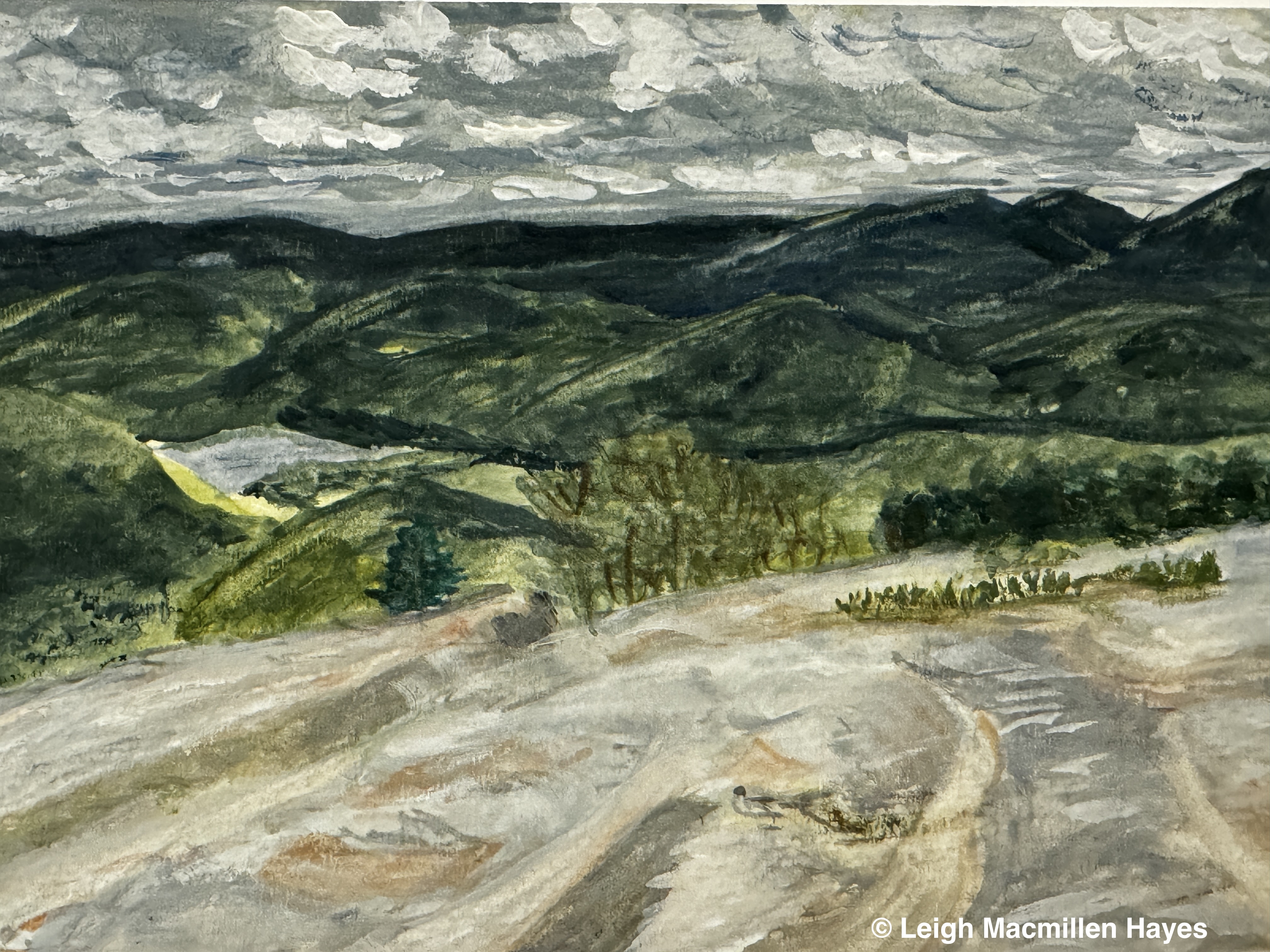
The view from the summit of Blueberry Mountain, Evans Notch, New Hampshire, looking toward Shell Pond below and the mountains beyond. My fav: the shape of the pond.

Frenchmen’s Hole in Newry, Maine. My fav: the color of the water, darker in the depths and lighter as if flowed over rocks to the next fall.

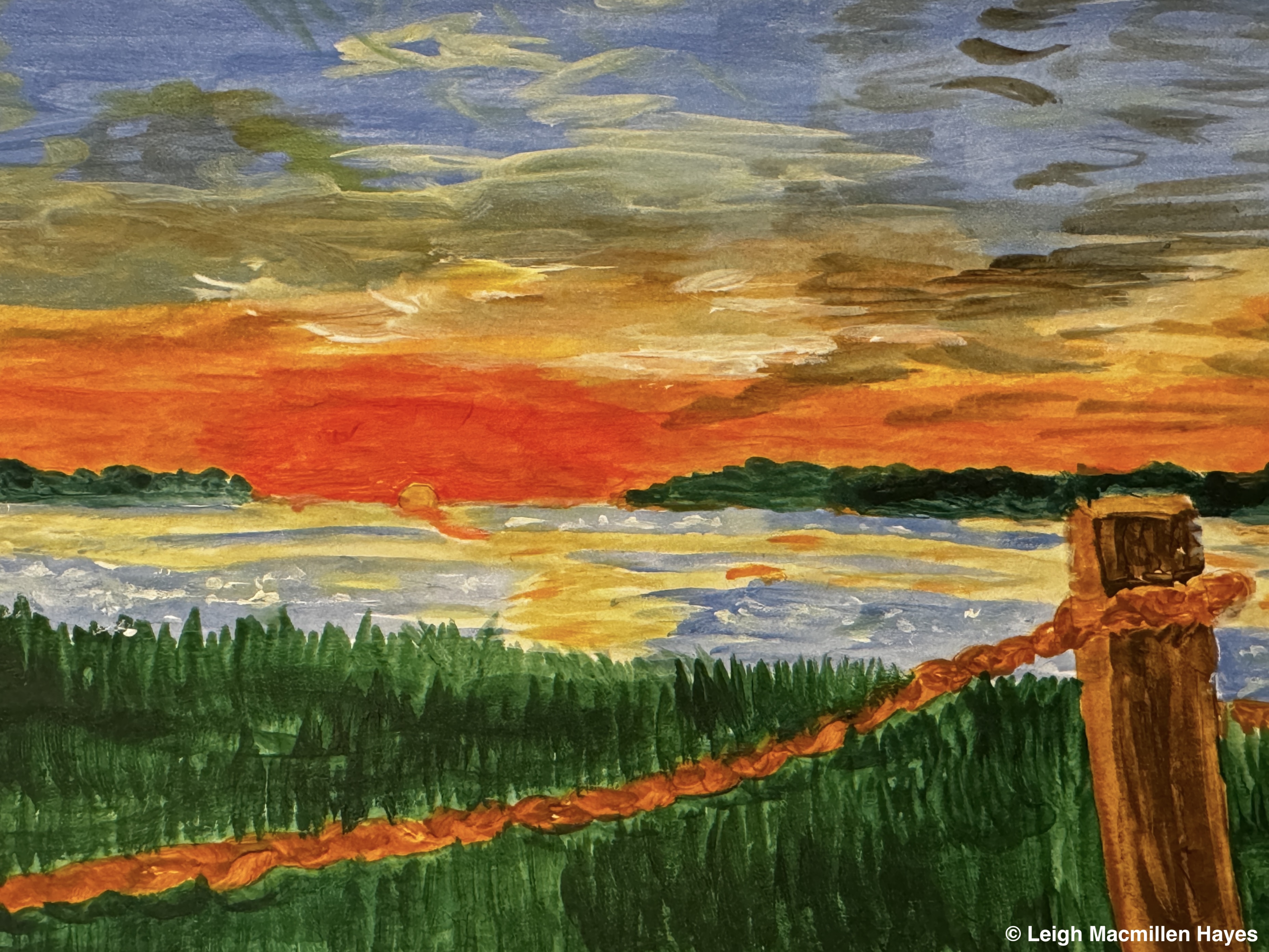
Sunrise, Lubec, Maine. My fav: the rope in the foreground. And the sky.

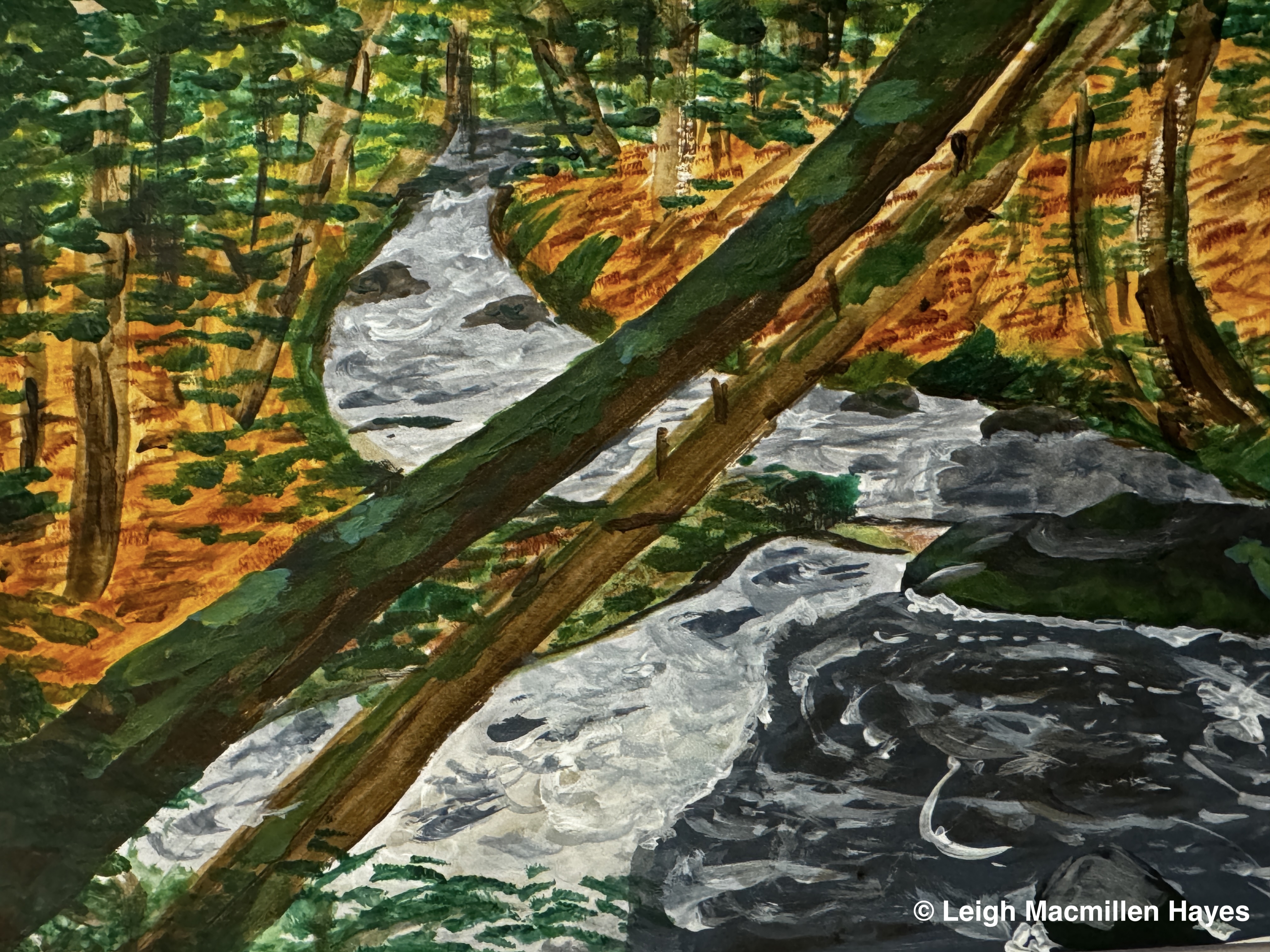
Carsley Brook, Lake Environmental Association’s Highland Research Forest, Bridgton, Maine. My fav: the trees leaning across the brook.

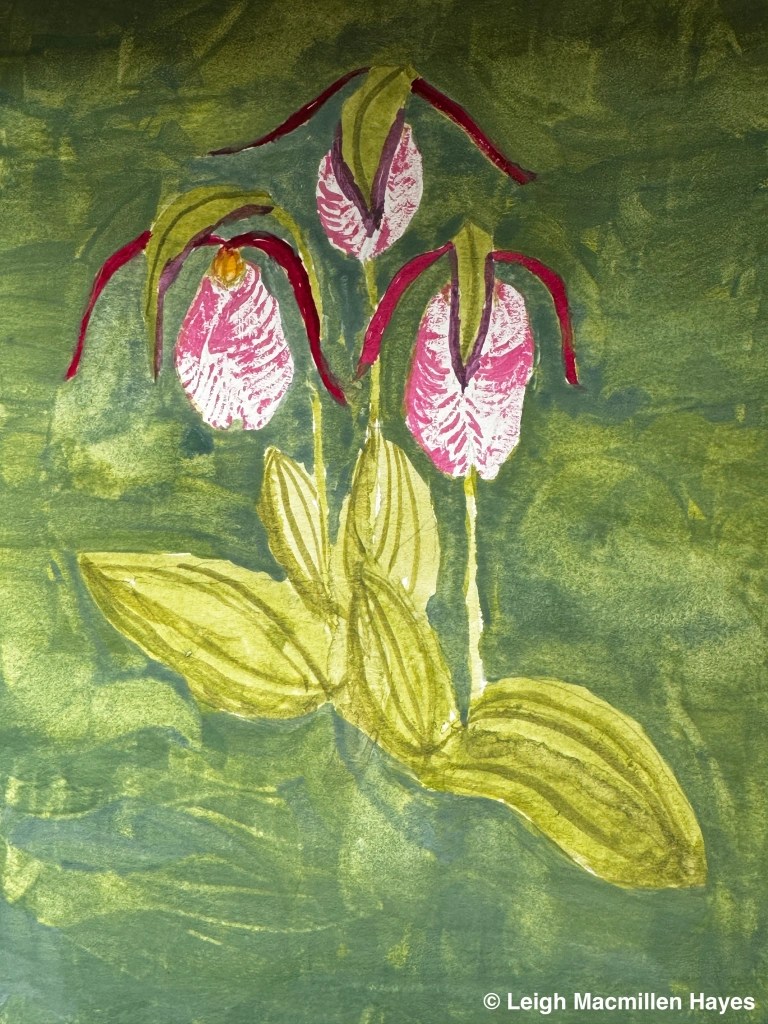
Lady’s Slippers from any of our counts as a gift for My Guy, who I’ve learned only likes to count them when they are in bloom. Since that season, he can’t be bothered to note the leaves or occasional seed pods and is praying it snows soon so I won’t continue to point them out. My fav: the shape of the flowers.

The fire tower at the summit of Pleasant Mountain. My fav: a sense of perspective with the mountains.

All of these were watercolor paintings. And then . . .

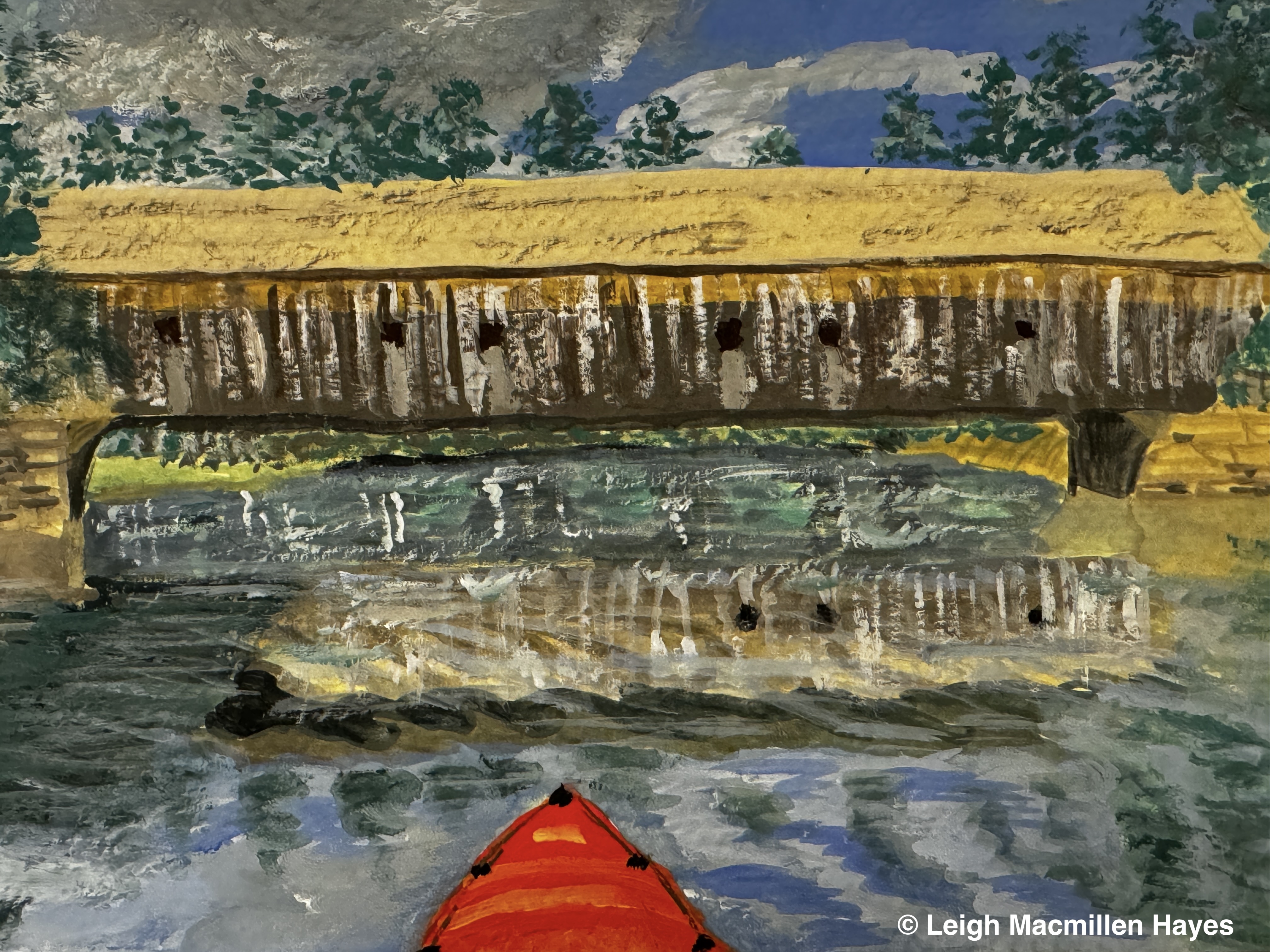
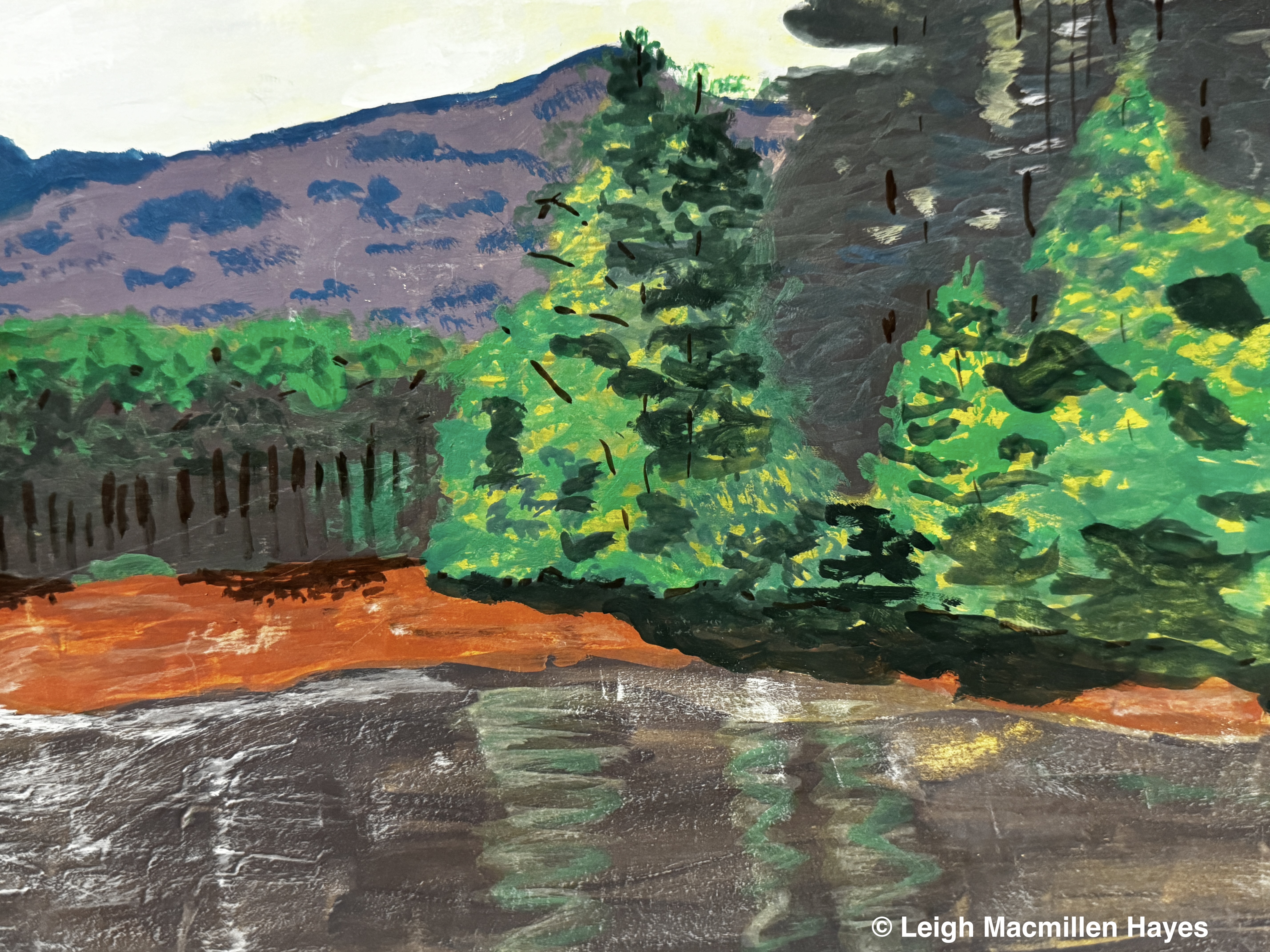
I purchased some gouache and painted Hemlock Covered Bridge. My fav: the bridge and the reflection, but also the lesson that this was a bit like completing a paint by number as I broke it up into different sections.

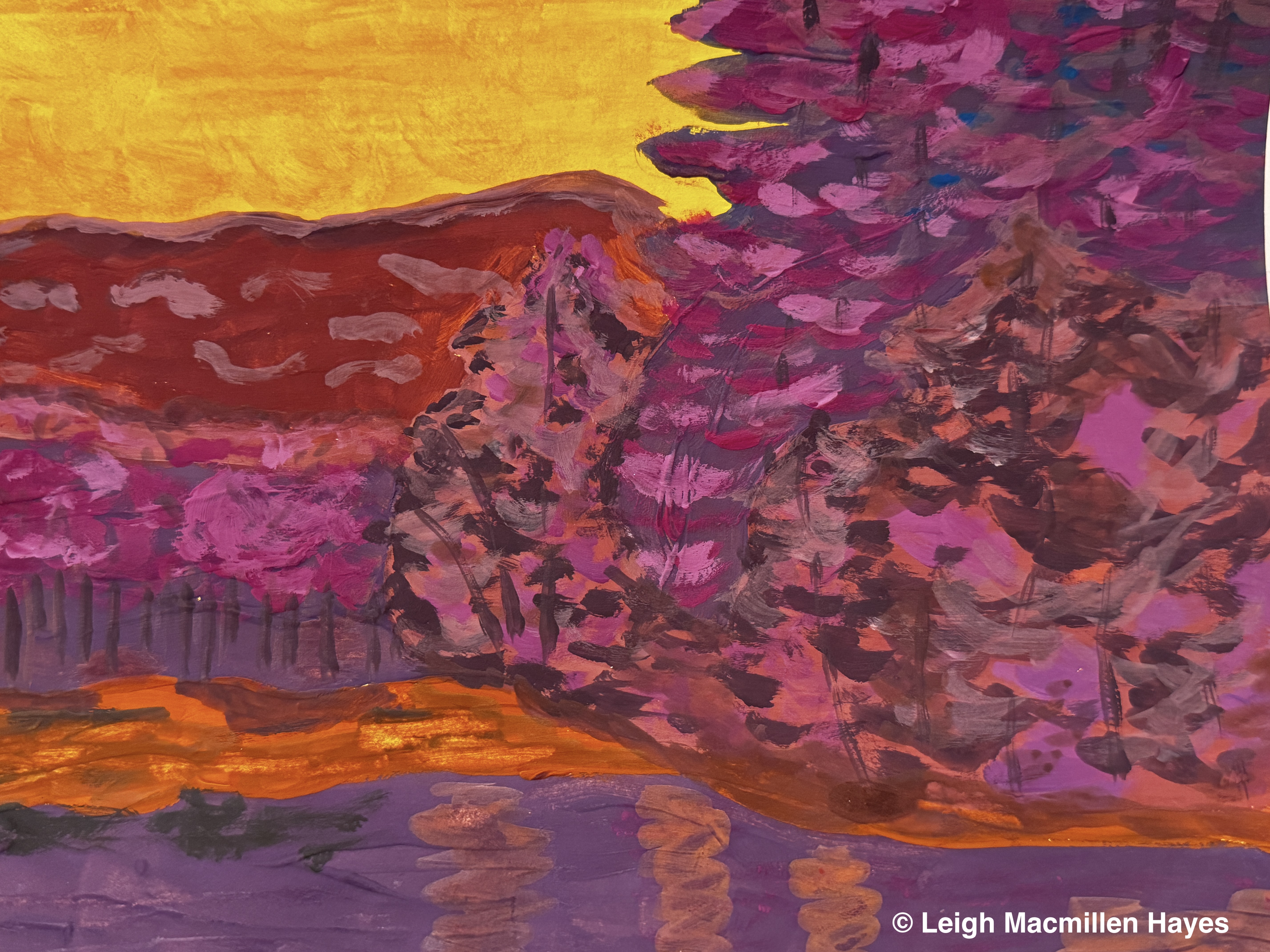
Fall reflection cropped from a river scene. My fav: All of it. It was like painting a jigsaw puzzle. And i loved creating the wavy lines.

Winter along Heald Pond Road, Lovell, Maine. The interesting thing is that this barn was taken down a few weeks after I painted this scene. My fav: the barn boards and the snow. And my learning–painting the lower background before adding the foreground trees.

Our barn at Christmas. My fav: The reflection in the window.

Interior of Hemlock Covered Bridge in Fryeburg, Maine. My fav: sense of perspective.

Sunlit part of spider web inside Hemlock Covered Bridge on mat canvas. My fav: texture of the boards and light between boards.

Bob Dunning Memorial Bridge, Pondicherry Park, Bridgton, Maine. My fav: the different beams that provide support as each represents a different species of native wood.

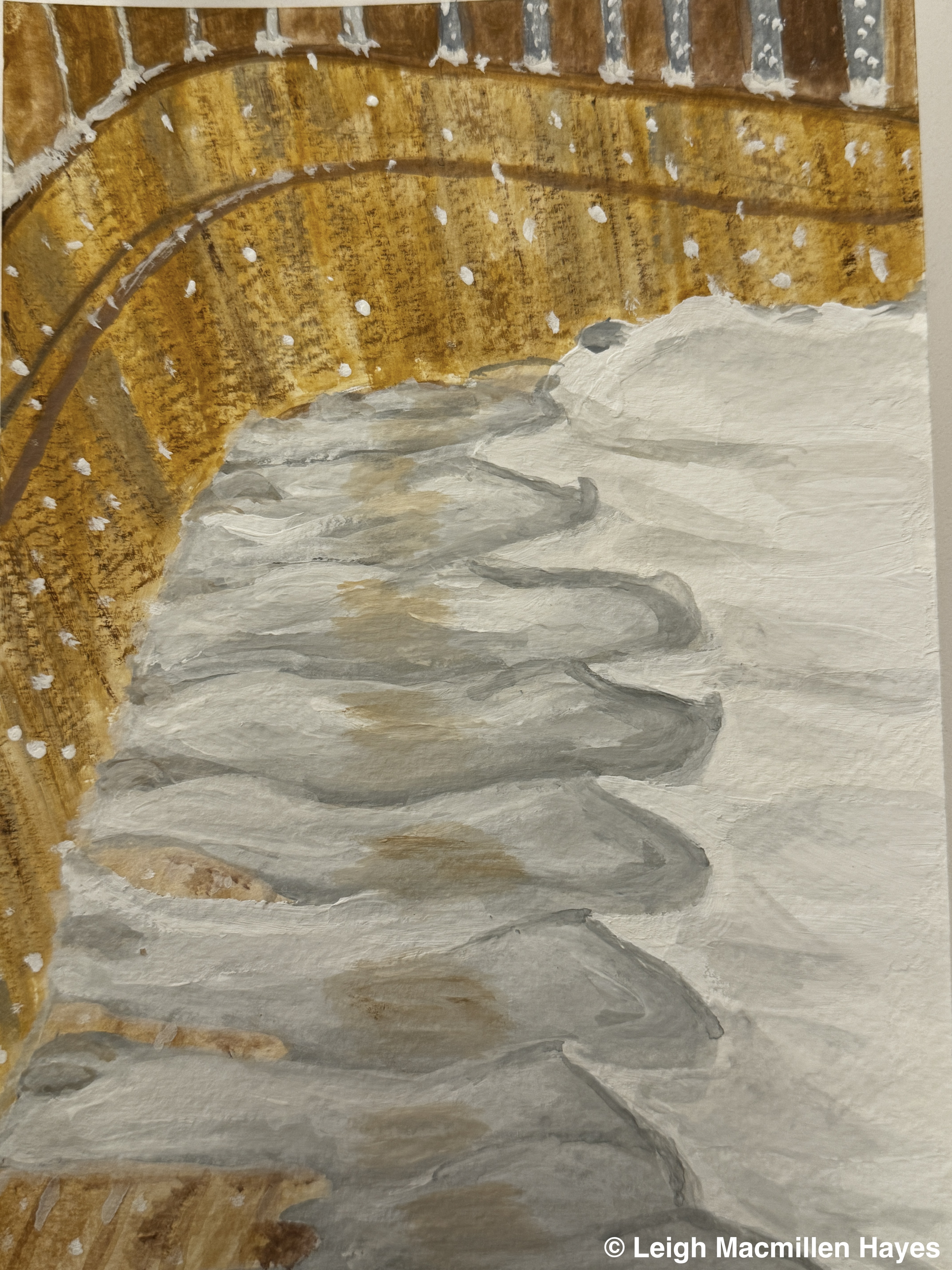
Approaching Bob Dunning Memorial Bridge on a snowy day when no one else had yet entered Pondicherry Park in Bridgton, Maine. My fav: the bend in the bridge.

Beaver at Albany Mountain trail, Bethel, Maine. My fav: the beaver’s face.

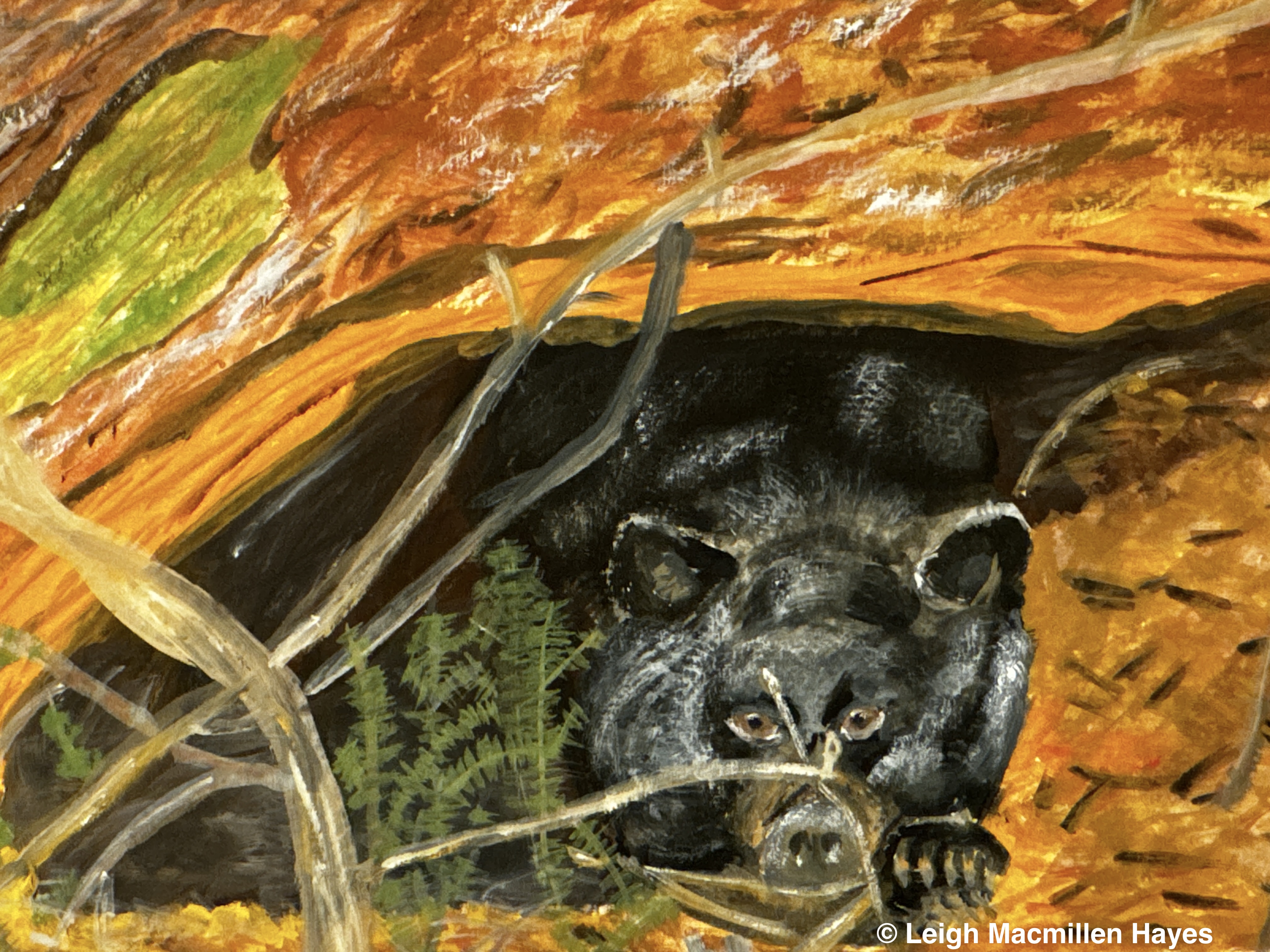
Denning Black Bear. Location a well-kept secret. My fav: the eyes.

Painted Turtle, Moose Pond, Maine. On mat canvas. My fav: colors of the water.

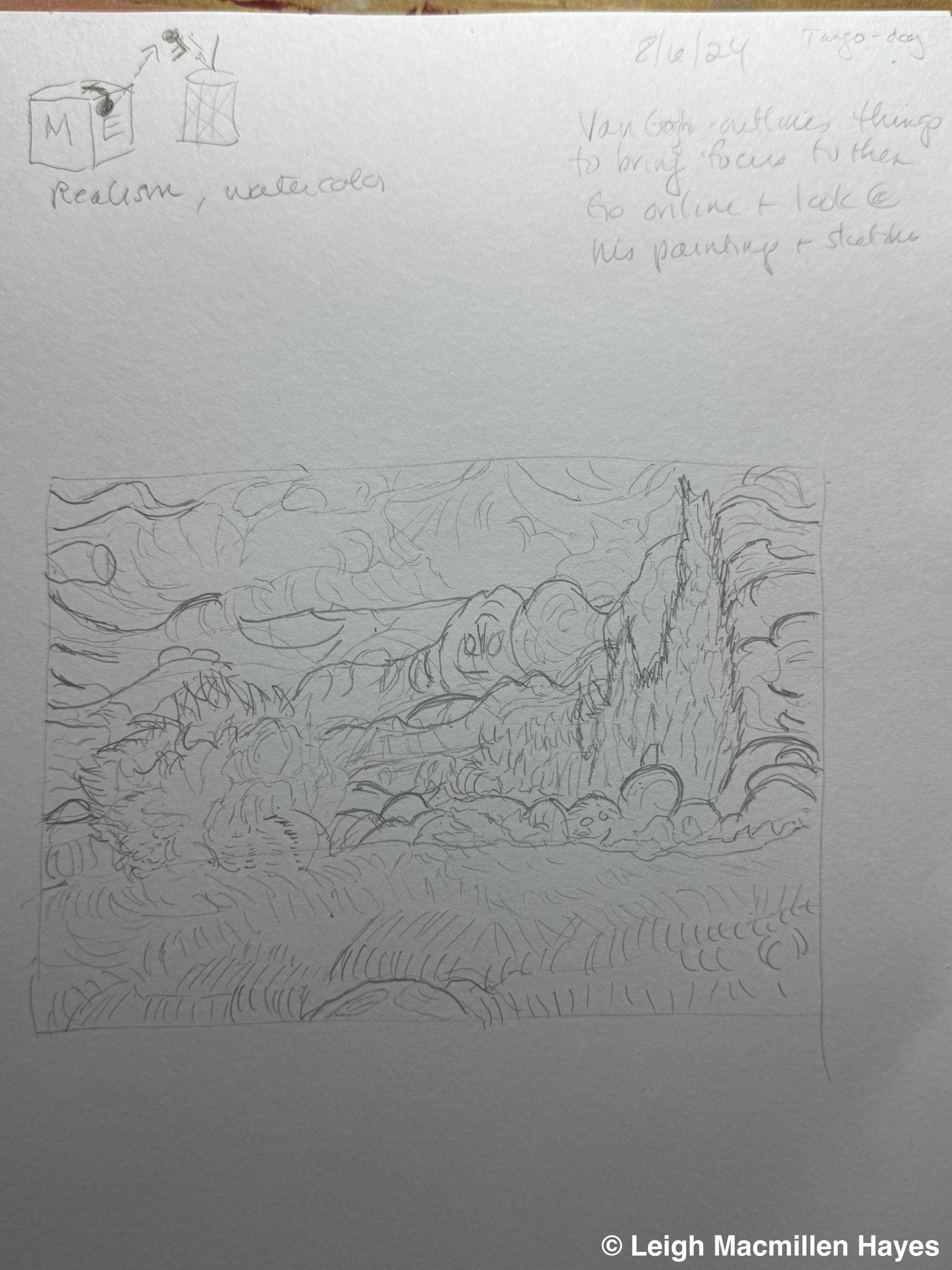
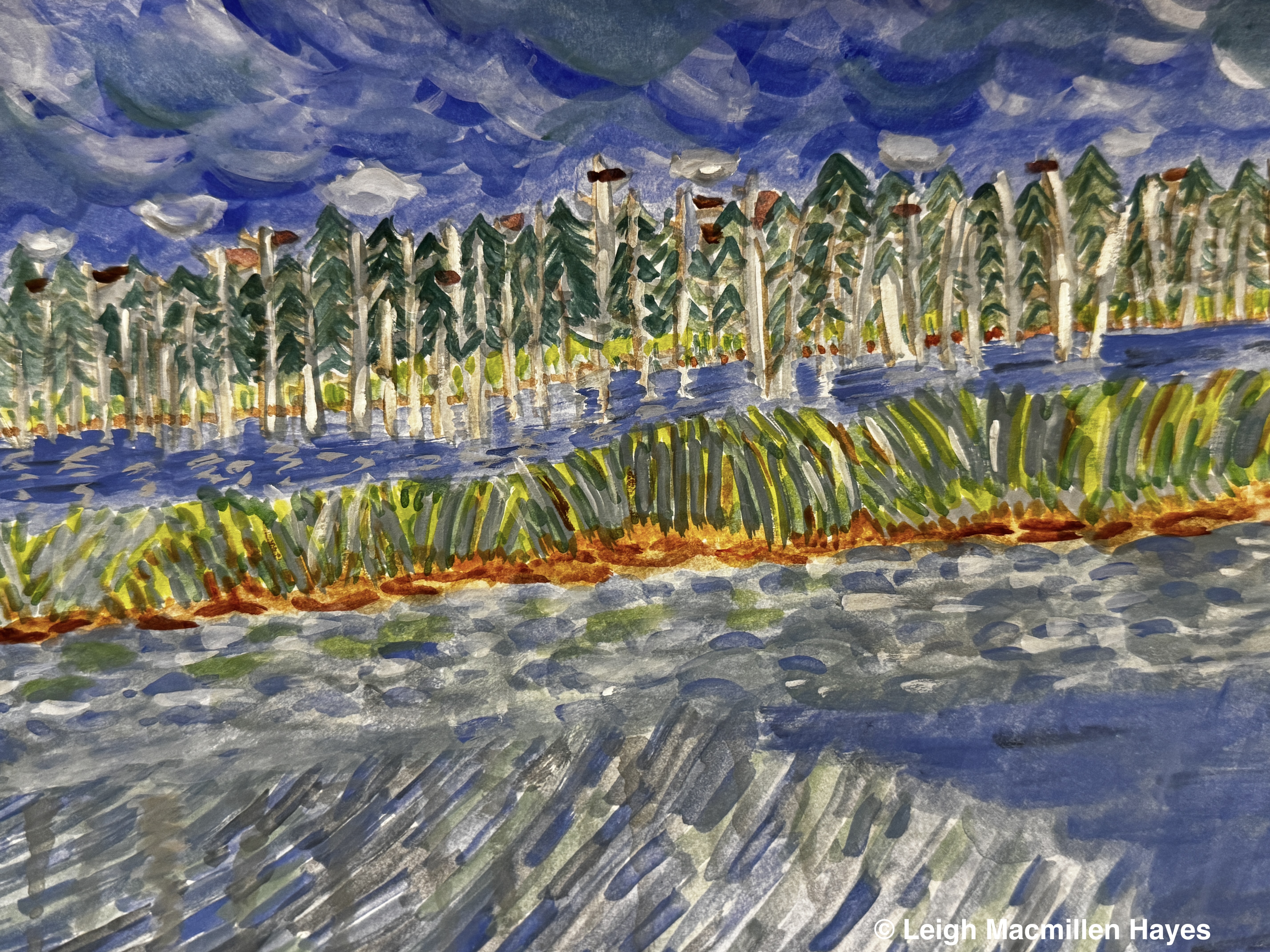
In August, Jessie offered a second class and we had to stuff our art critics in a box in the upper corner of the paper and leave them locked inside and then jot down what we wanted to work on for this session. She also had us take a look at Van Gogh’s style of outlining and bringing focus together.

And then, from a photo of our own, we tried to emulate the famous artist. This was a rough draft that I never finished. My fav: I love the colors and simplicity of it.

A second attempt at emulating Van Gogh. My fav: the trees in the background.

Third try. The sky was different. My fav: getting better at perspective.

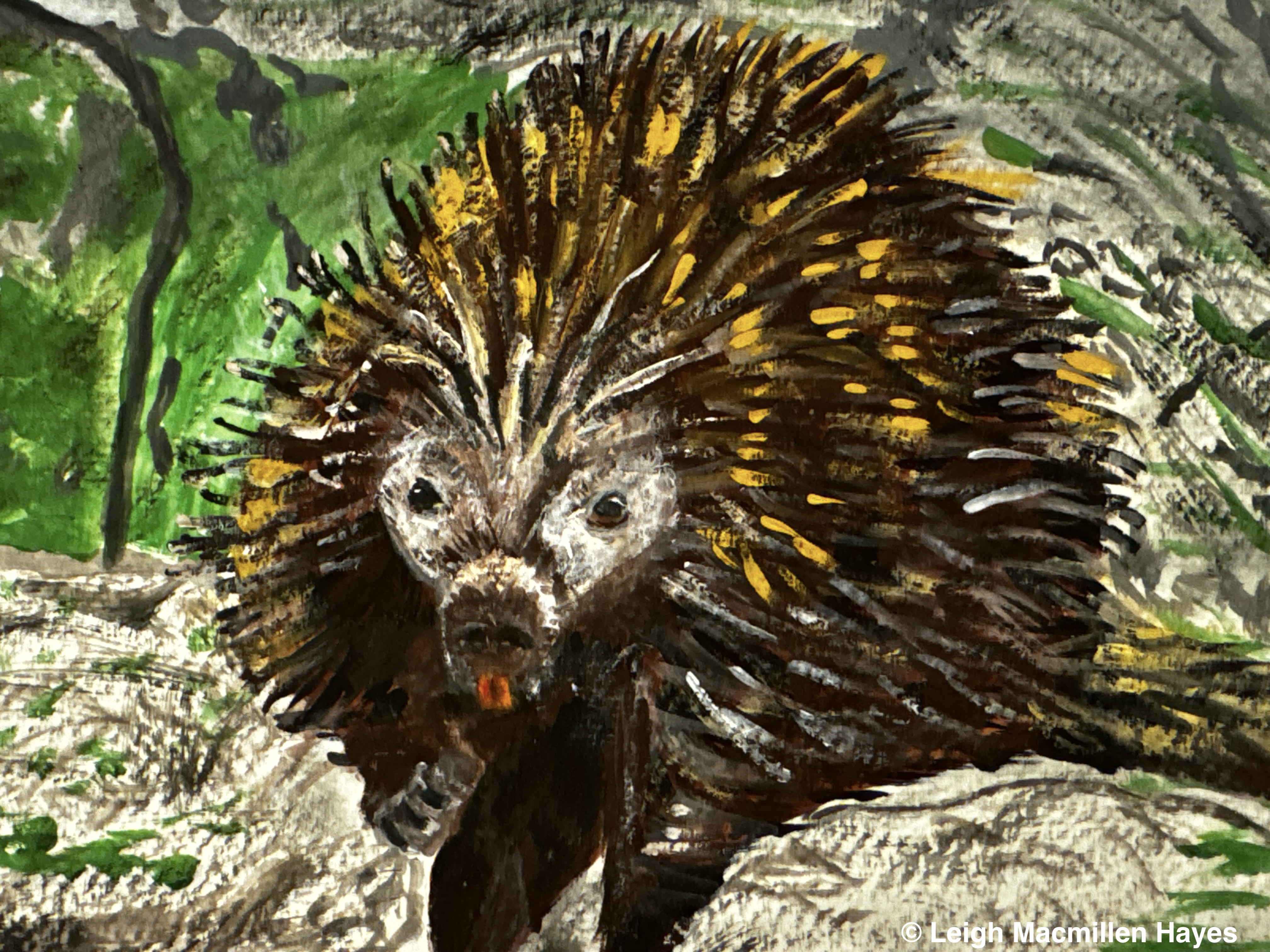
In between classes I continued to paint. One of my absolute favs: Bandit! The porcupine I met in the yard last year. My fav: His face.

A Moose My Guy and I met in the beaver pond on Albany Mountain Trail, Bethel, Maine. My fav: His face.

What’s left of the Hayes Homestead, My Guy’s great-grandparents’ farm in Nova Scotia. My fav: shingles.

An amazing moment when I visited the vernal pool out back as the sun lowered and discovered that in the stillness of the water, a rainbow was created by the pollen, and while the tree shadows draped across the pond, they also were visible in their usual vertical presentation on the water. My fav: colors of the sunlight on the pollen.

Back to class and learning more about values. I have to admit that I don’t always heed this advice and do a values sketch before painting.

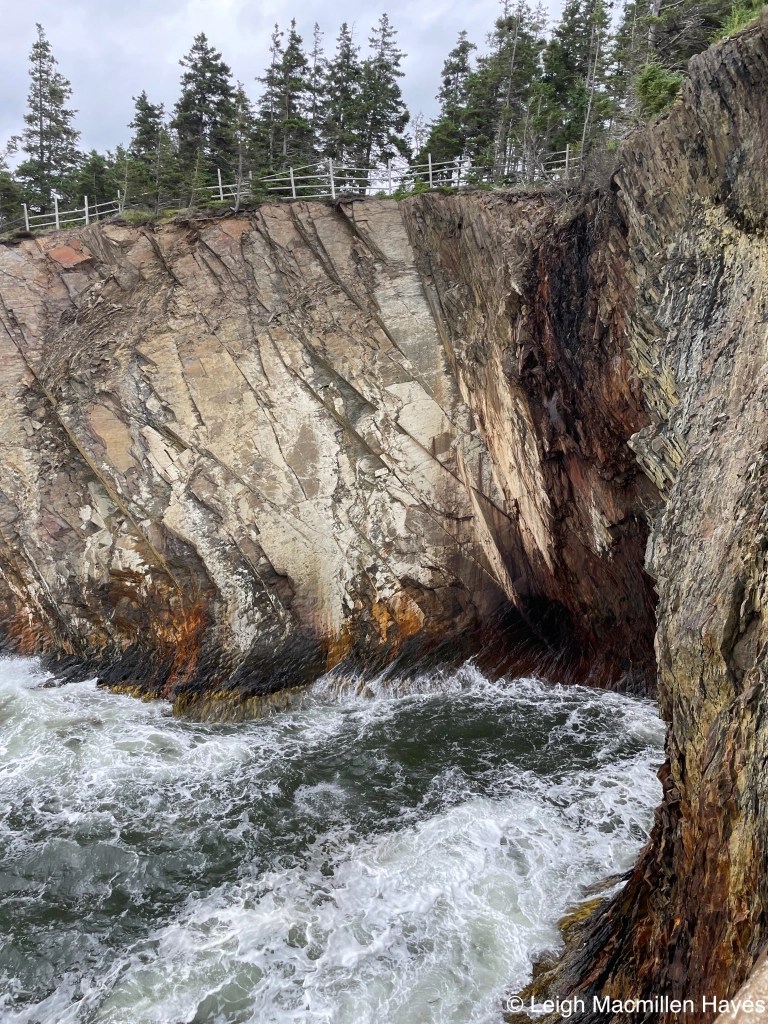
Photo of Ovens Cave, Nova Scotia.

Cropping the photo in sketches.

One final sketch before painting.

First attempt in gouache. My fav: colors of the rocks.

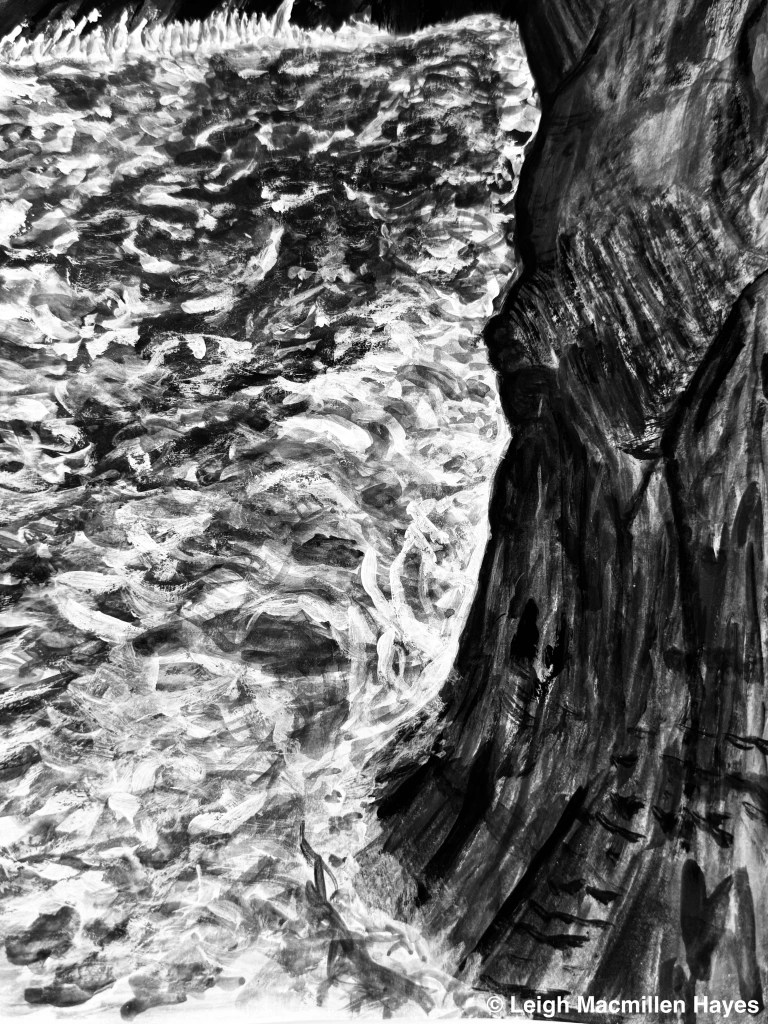
Jessie taught us a neat trick to check values by using a filter on our phones.

Trying to be more abstract with the same scene. My fav: the color of the water.

Values photo of the same.

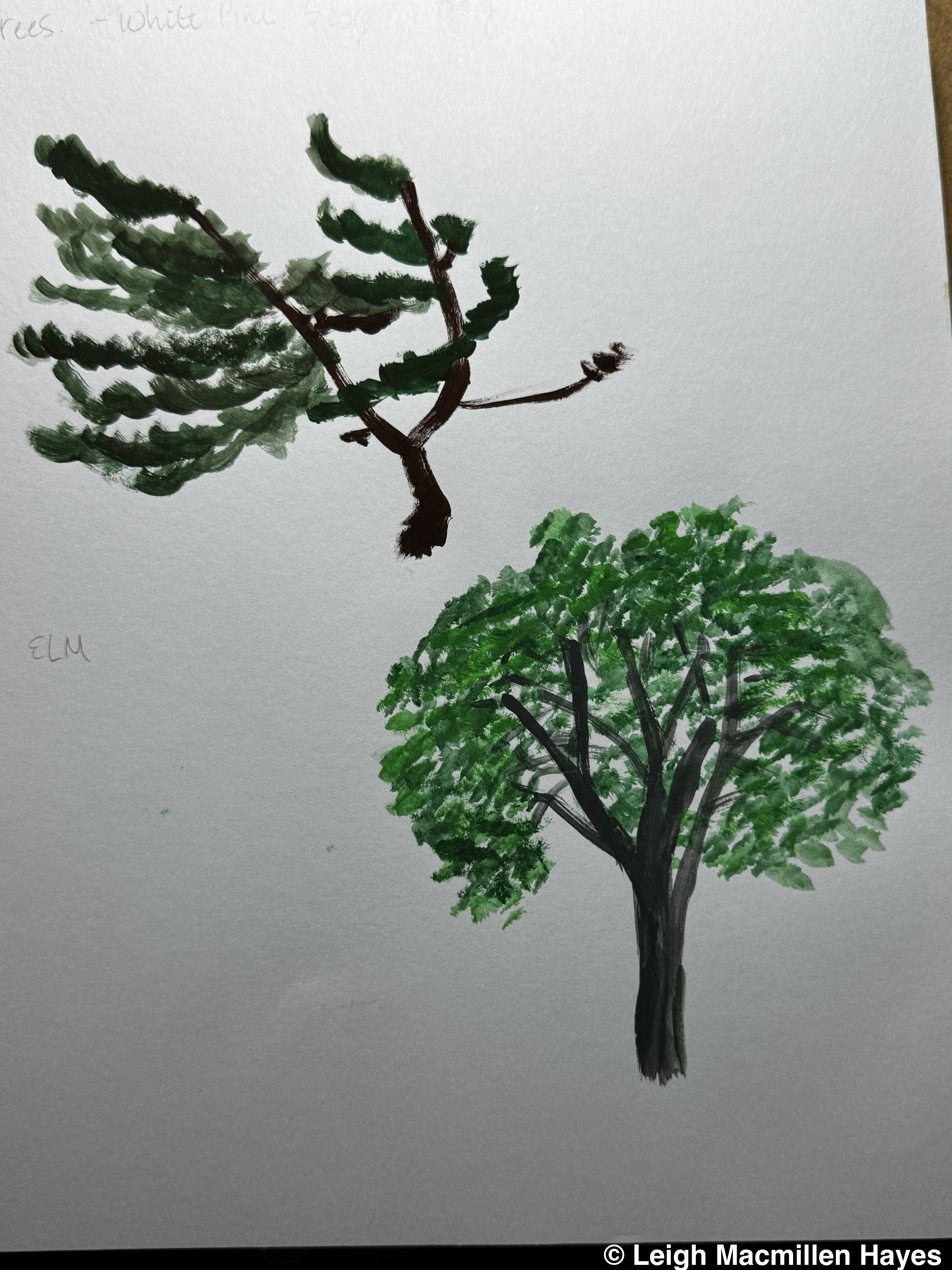
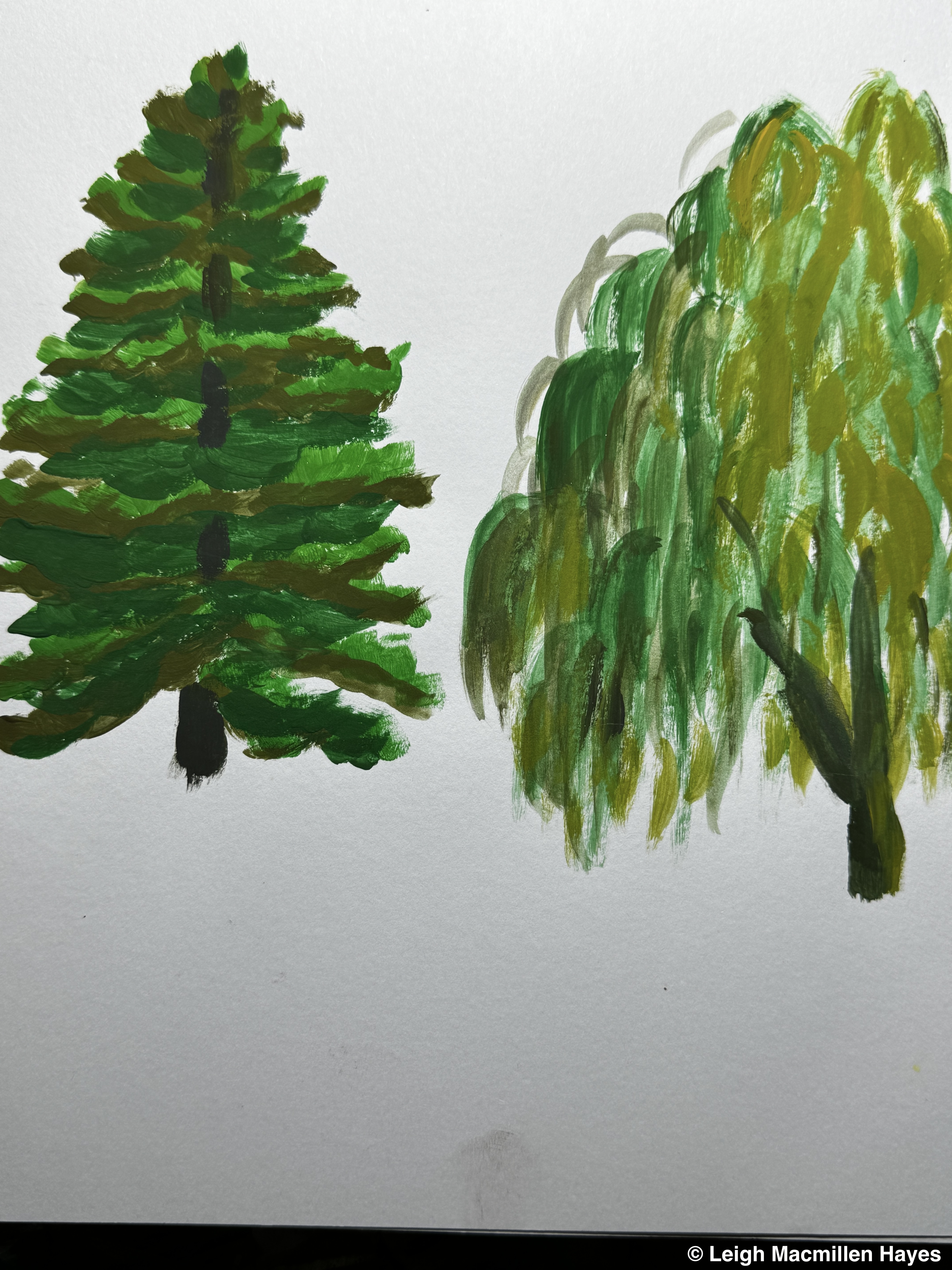
The third time we met we talked about basic shapes and had to quickly paint trees. It was supposed to be six trees, but our class only got through four. I guess we weren’t so quick after all. My fav: the willow. But also thinking about different shapes. And how to fill them in quickly.

Hairy Coo My Guy and I met in Scotland. My fav: the ear tag!

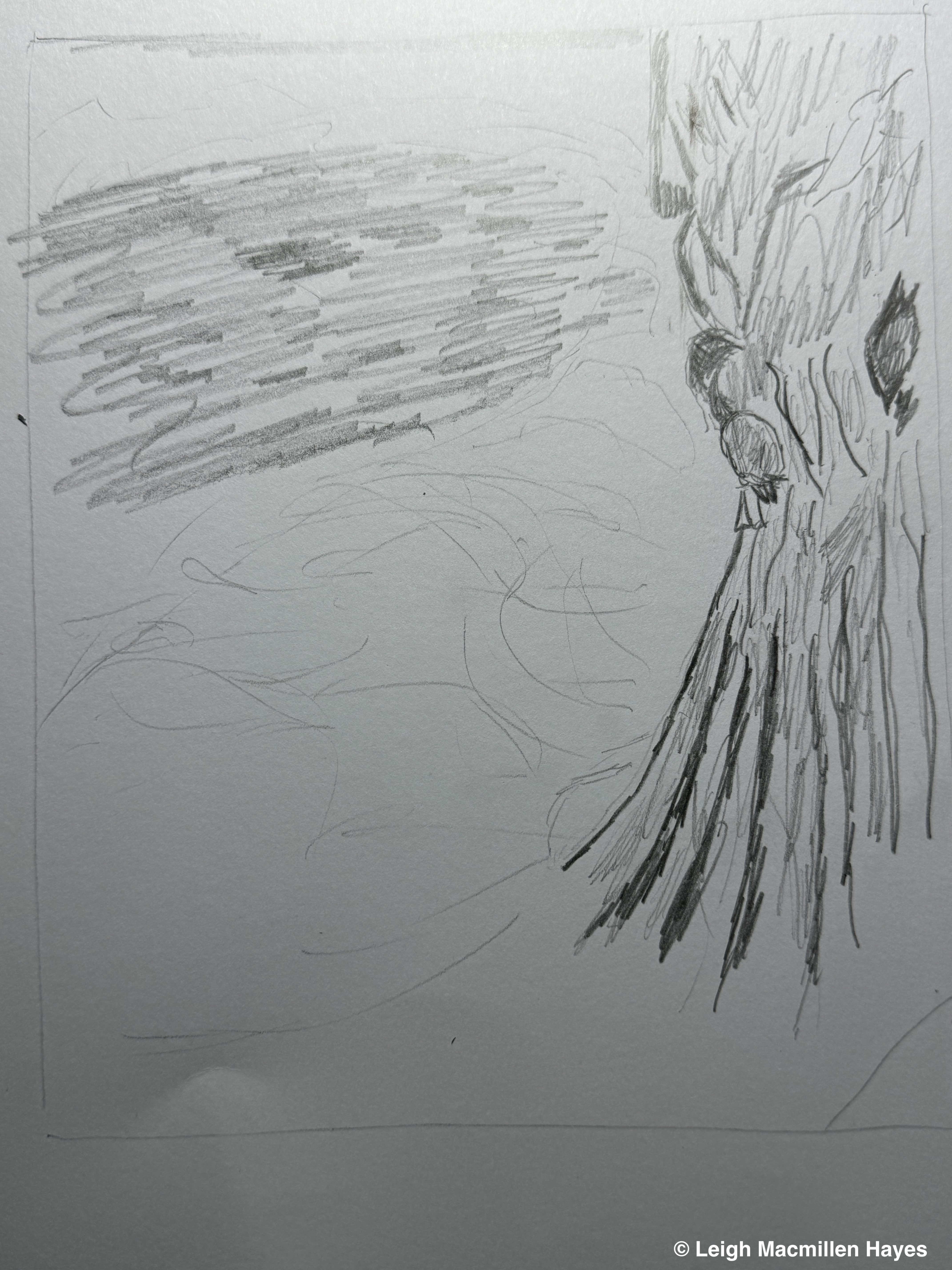
Values sketch of photo she offered in class, and getting the basic shapes on paper.

And then we could only use certain colors to paint the scene, filling in the shapes first before adding detail. This was mind opening for me. My fav: making blobs look like trees.

The same scene using different complementary colors on the wheel. I struggled with the values in this one. My fav: the trees still look like trees.

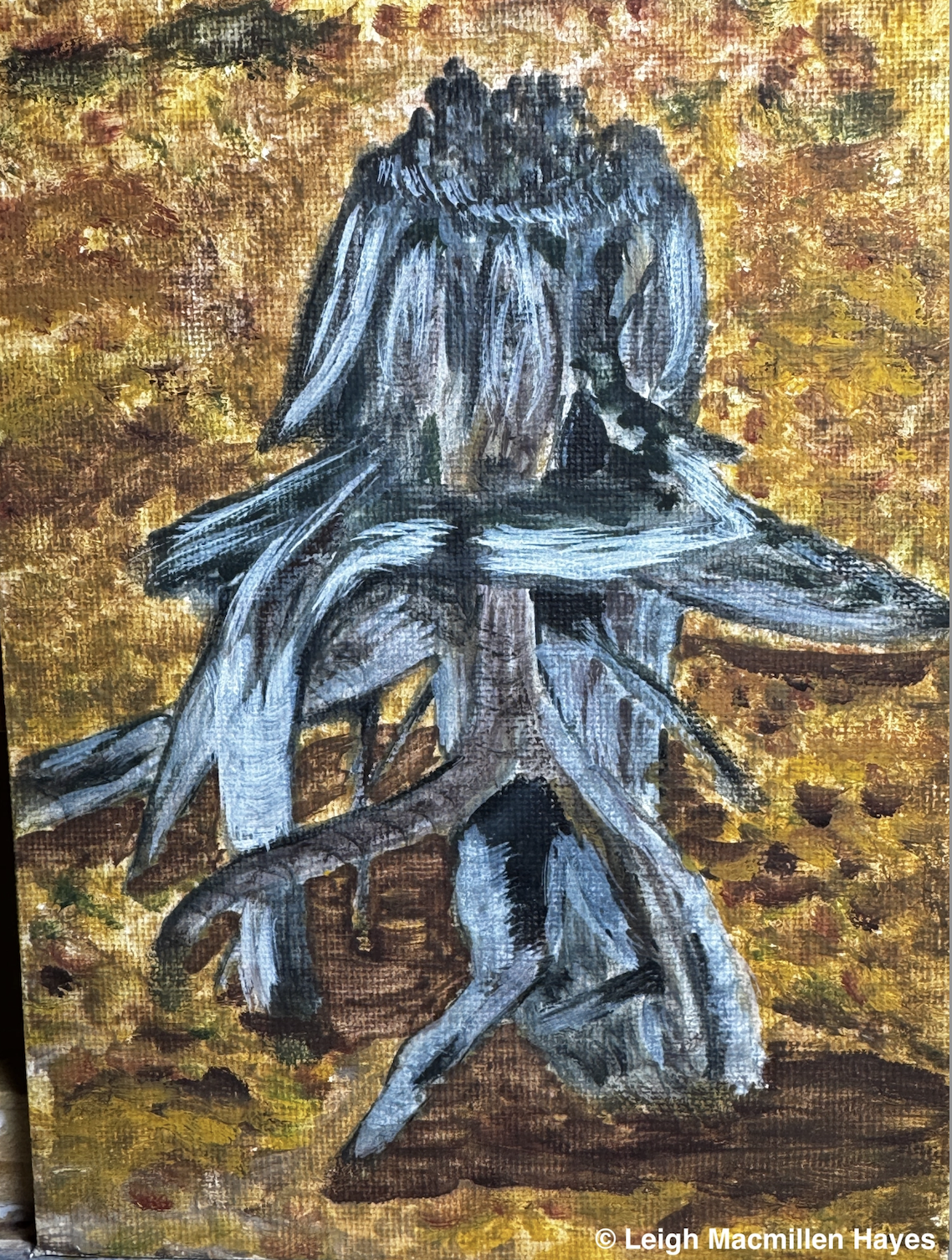
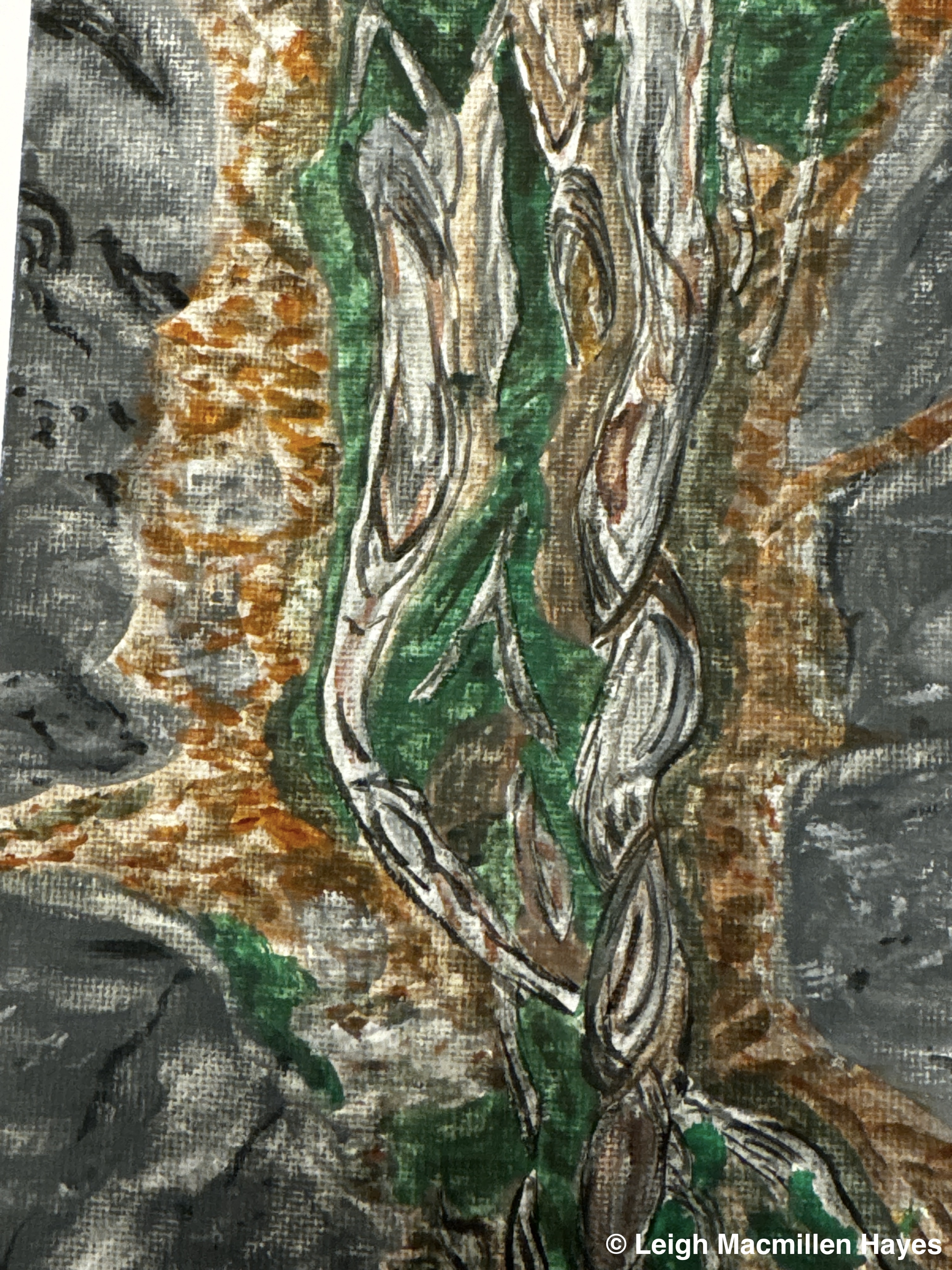
This one has been the most difficult for my family to understand. An intersection of granite ledges and tree roots on Bald Pate Mountain, Bridgton, Maine, on a canvas mat. My fav: the tree roots.

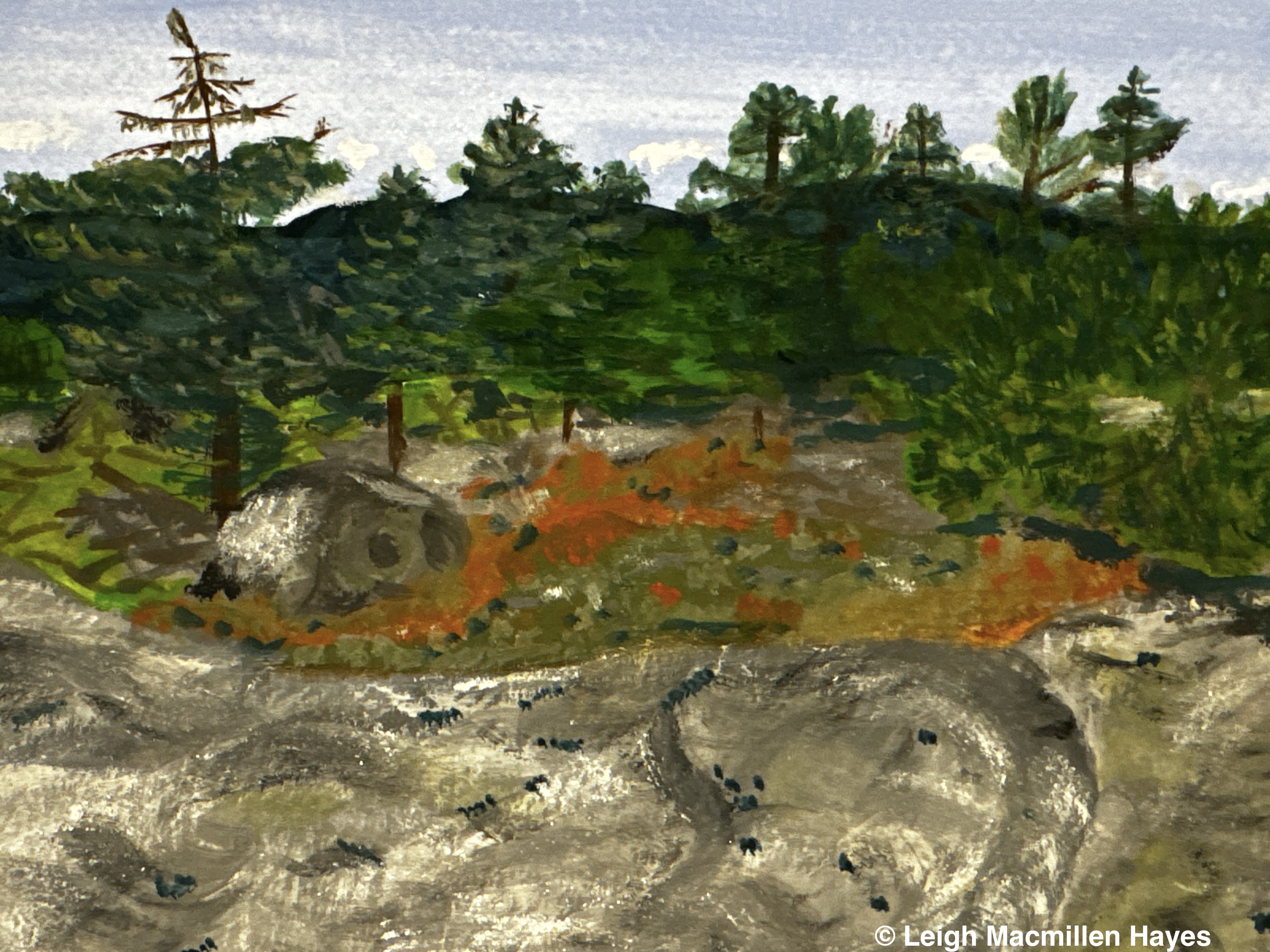
Ledges on descent of Rumford Whitecap Mountain, Rumford, Maine. My fav: the trees with the mountain backdrop.

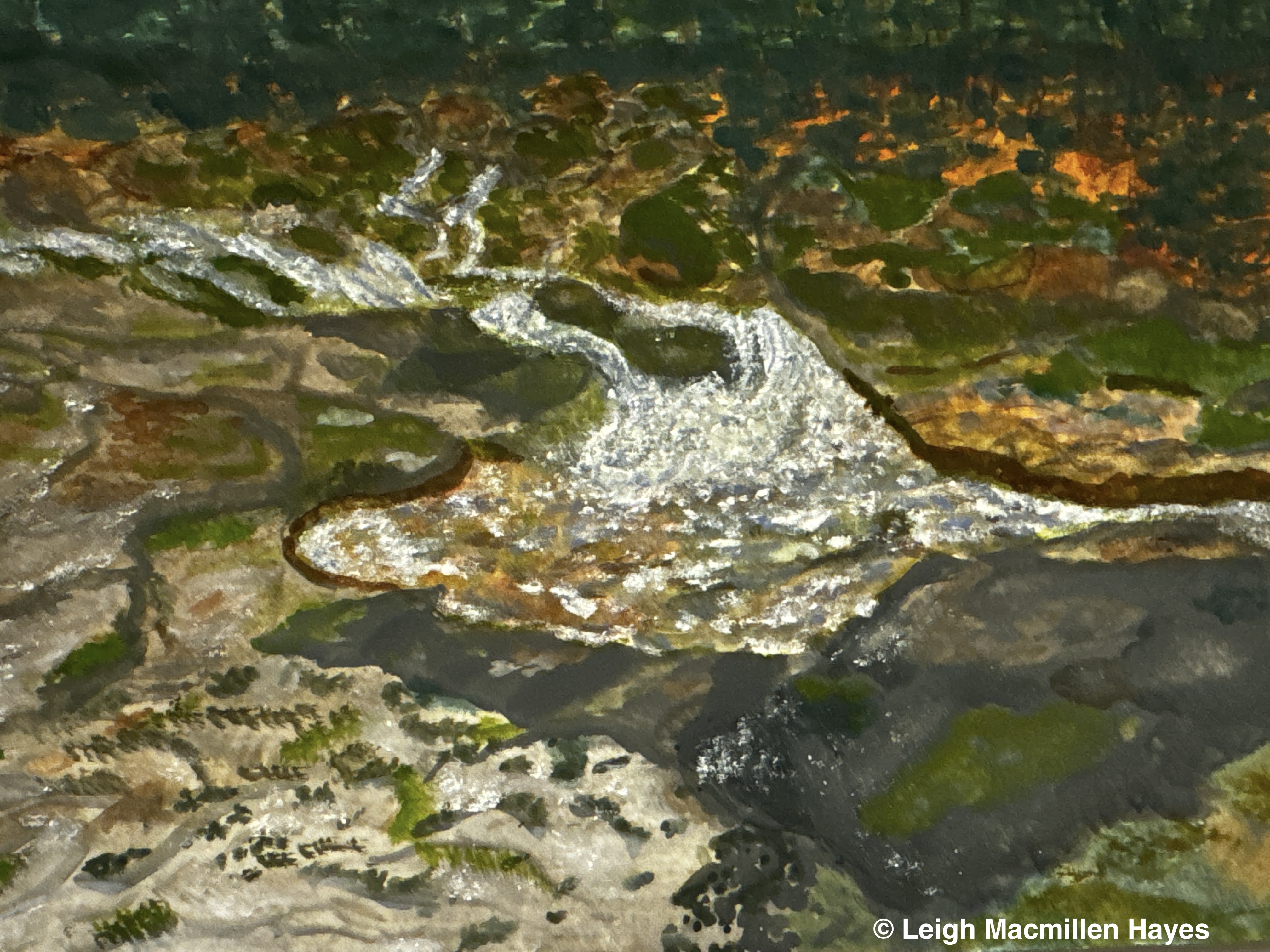
Bickford Slides, Blueberry Mountain, Evans Notch, Maine. And the discovery that I had accidentally purchased a small tube of shimmery white watercolor paint. My fav: water flowing over the mossy rocks.

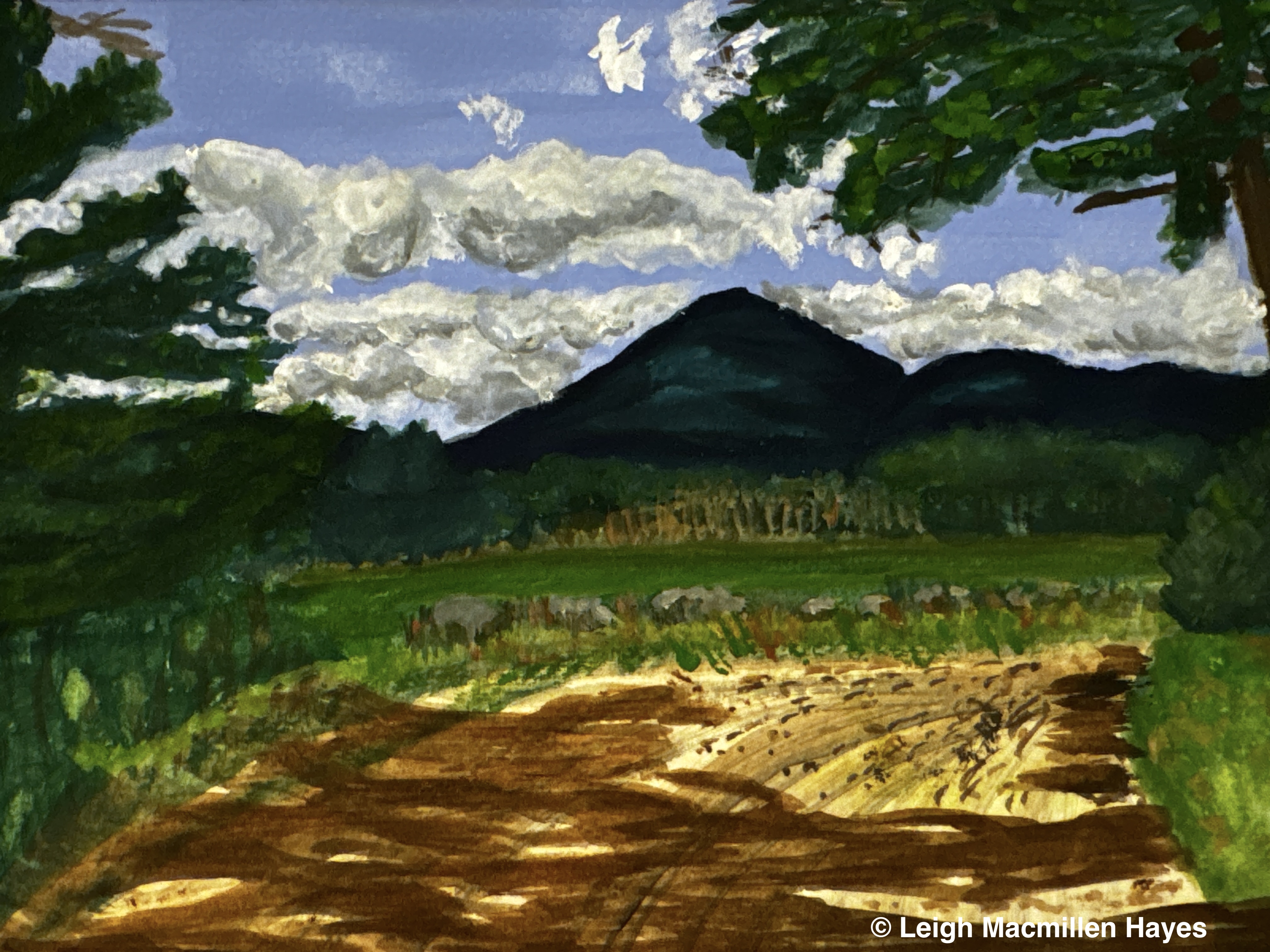
Shadows across Hemlock Bridge Road, Fryeburg, Maine. My fav: those very shadows. And the rocks that line the road.

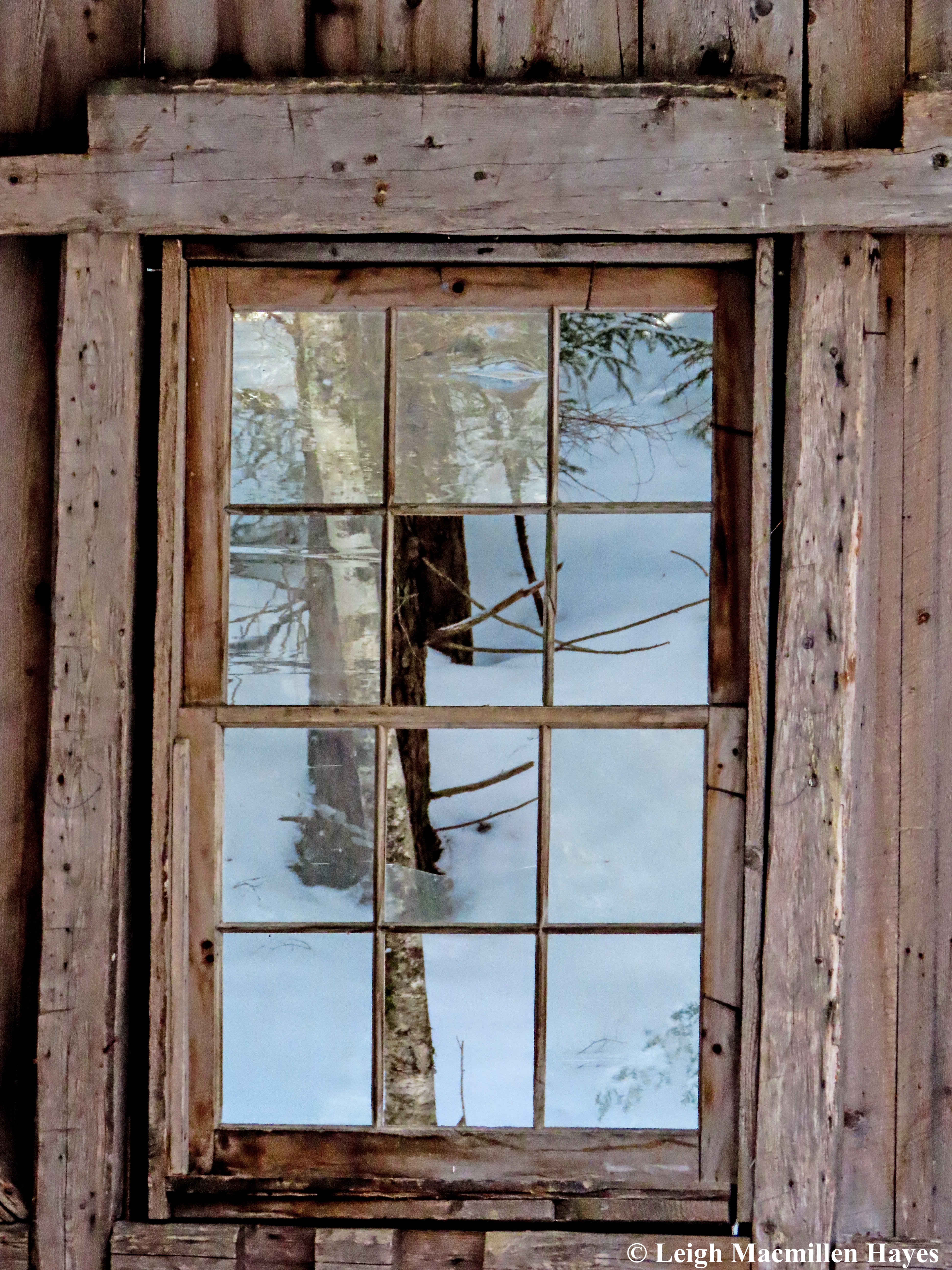
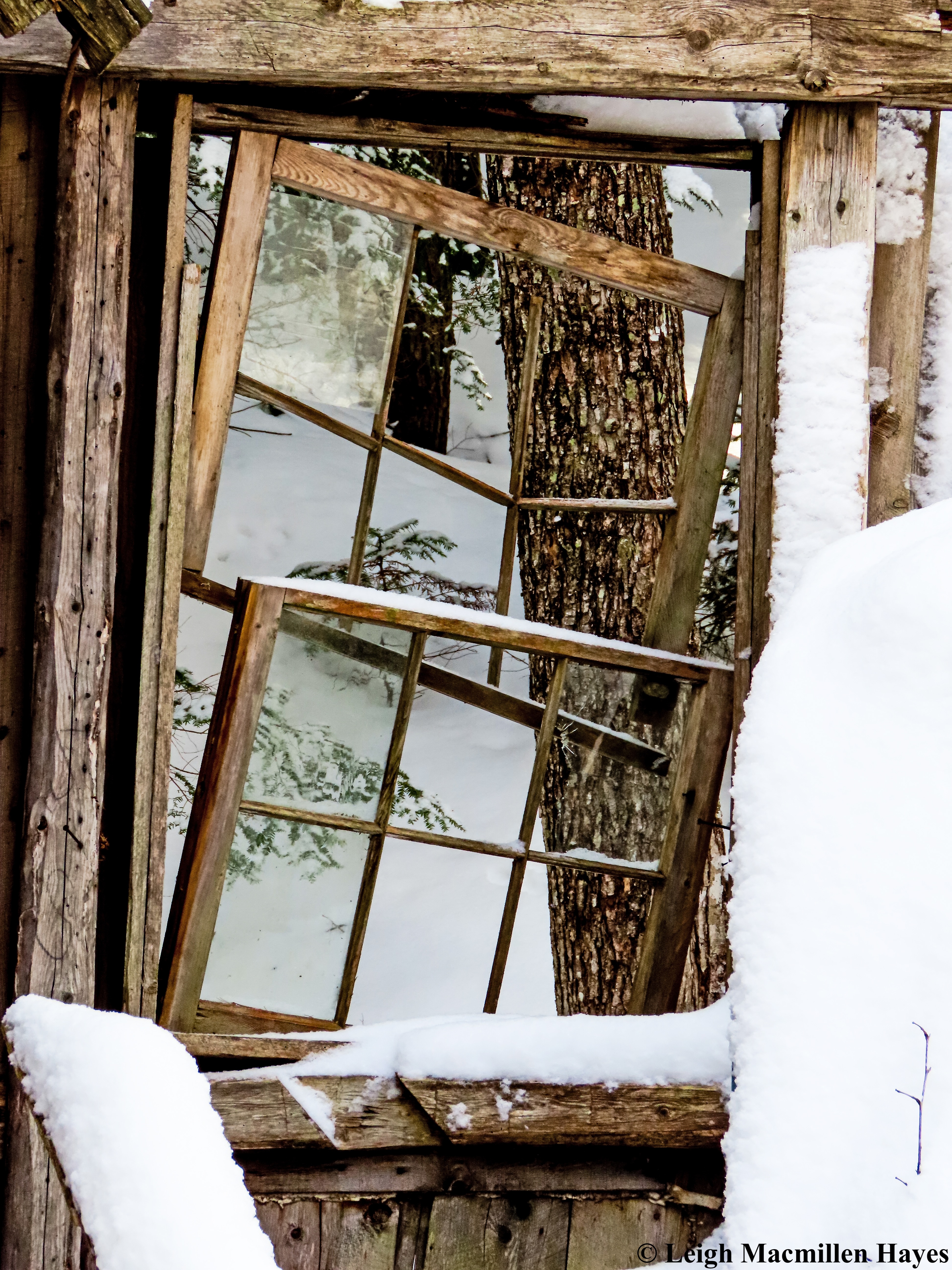
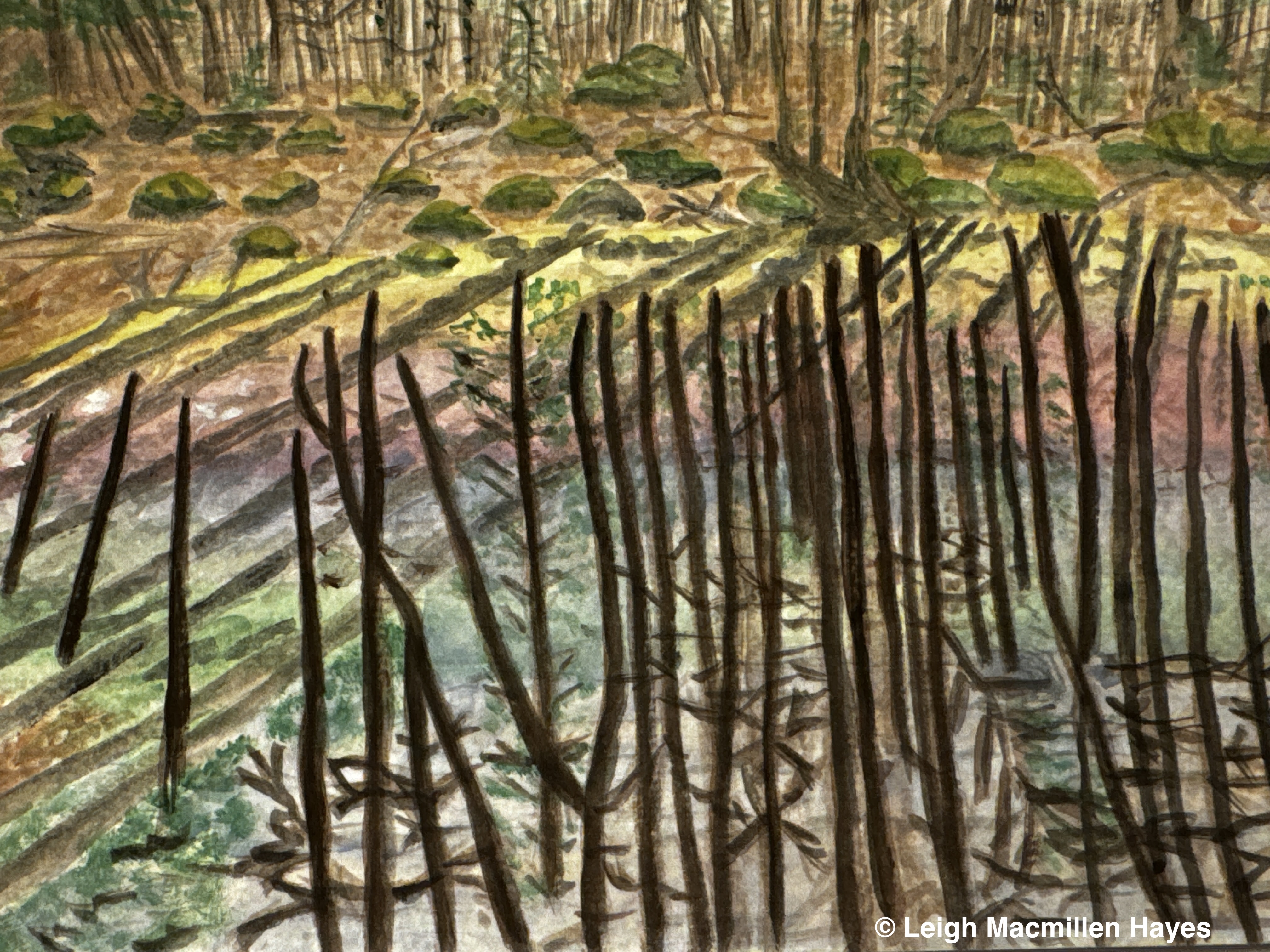
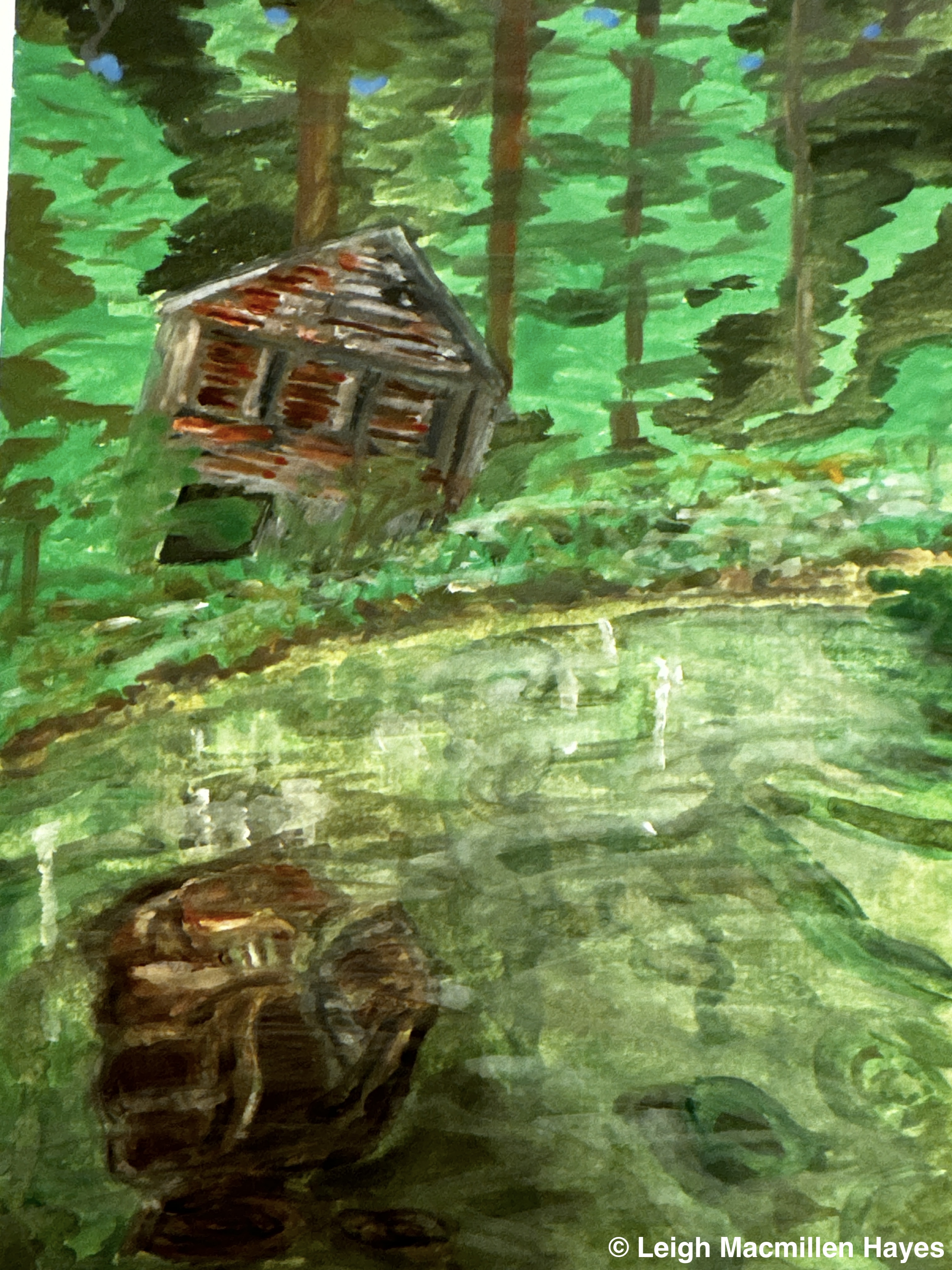
Back to gouache to capture the reflection of a falling down cabin on a small pond in New Hampshire. My fav: the trees and hints of the blue sky.

The final assignment took us two classes. This is the scene I chose to paint. Sucker Brook at Greater Lovell Land Trust’s Wilson Wing Moose Pond Bog Reserve, Lovell, Maine.

Planning with sketches, markers, and paint and figuring out what might work best. And simplifying the scene.

Jessie gave me a piece of Hot Press Finish paper upon which to work, and I have to admit that it was a joy to paint on this. I started with the sky color as the wash and then worked on the snow next, then the water, and finally the trees. My fav: sunlight reflected on the snow in the background.

After I shared that painting with a friend, she commented, “Can’t you do something other than snow until there is snow?” So, I painted a fall scene at the summit of Bald Pate. The mountain tops are not quite this color yet, but will be in a couple of weeks. My fav: contrast of colors.

My last painting to date on a larger canvas sheet was a Pileated Woodpecker that frequents our woods. I discovered, like the Hot Press paper, I really like the canvas except that it takes a while for the paint to dry. My fav: the bird’s head and the pine tree bark on the right.

That’s all I have to offer at the moment. And if you stuck with me this far, I’m impressed. Thank you!

I keep thinking about this creative journey and can’t wait to see where it takes me next. If you are interested, you can follow my artistic path by clicking on wmw art gallery every once in a while.

Basking in the Sights

“This won’t take us long,” My Guy said moments after we launched our kayaks onto a small pond in New Hampshire.

“Oh, I think I can make it last a while,” I replied.

I knew there were Pitcher Plants to look for and I could see by the color of the trees on the far shore that there were wetlands to explore and there was the potential for so much more in this very quiet spot.

A friend who kayaks here often had told me where to park and some of the things to look for along the way. What was most impressive from the start is that there were flower pots on the dam and by the kiosk. Well tended, at that.

And a rather large Little Free Library, where one can take a book or share a book.

I unlatched the door and it even smelled like a library. What’s not to love?!

But, we’d ventured there to paddle.

Or better yet, to dawdle. To be like the Painted Turtle and enjoy the sunshine of a perfect September day.

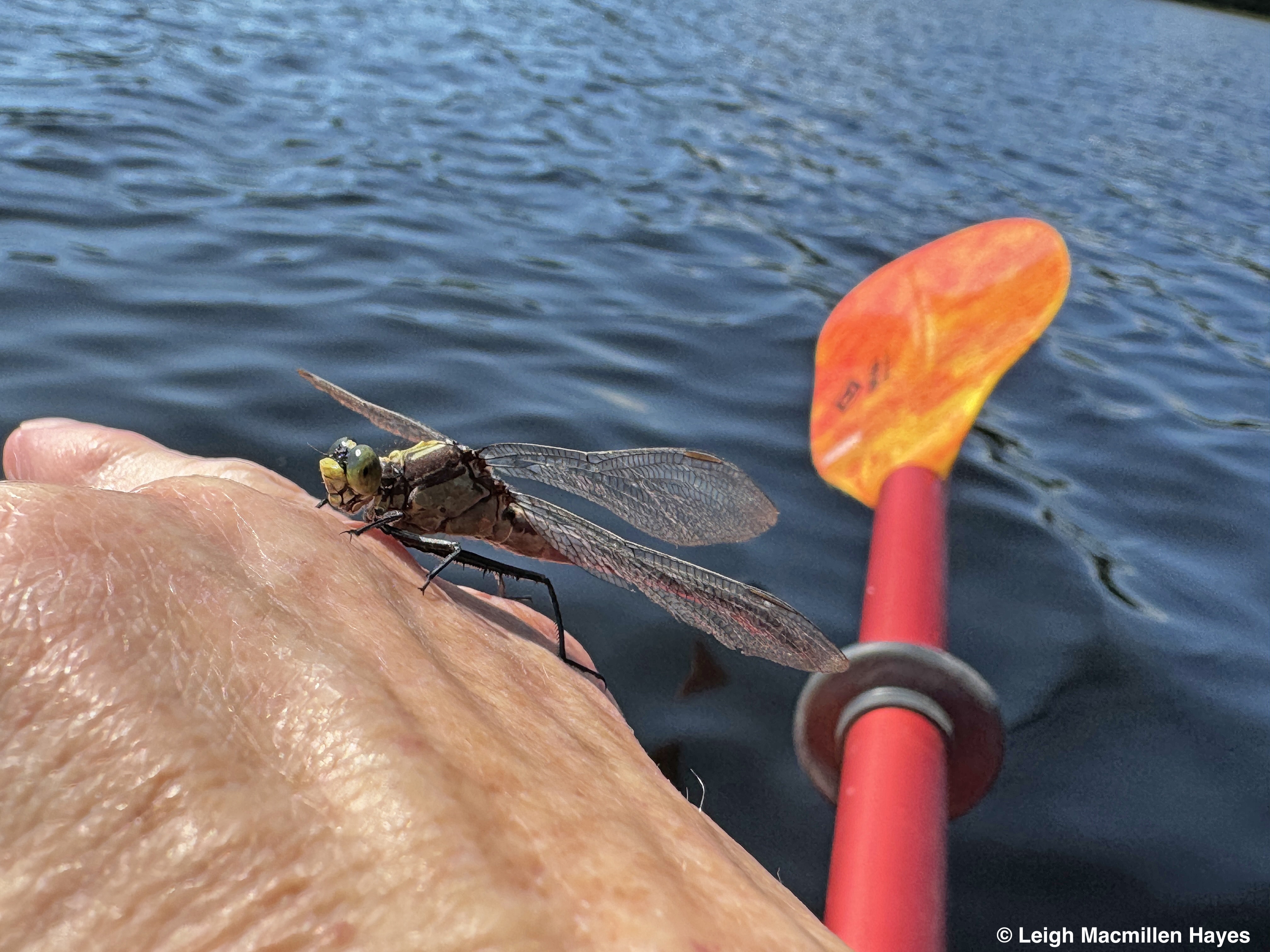
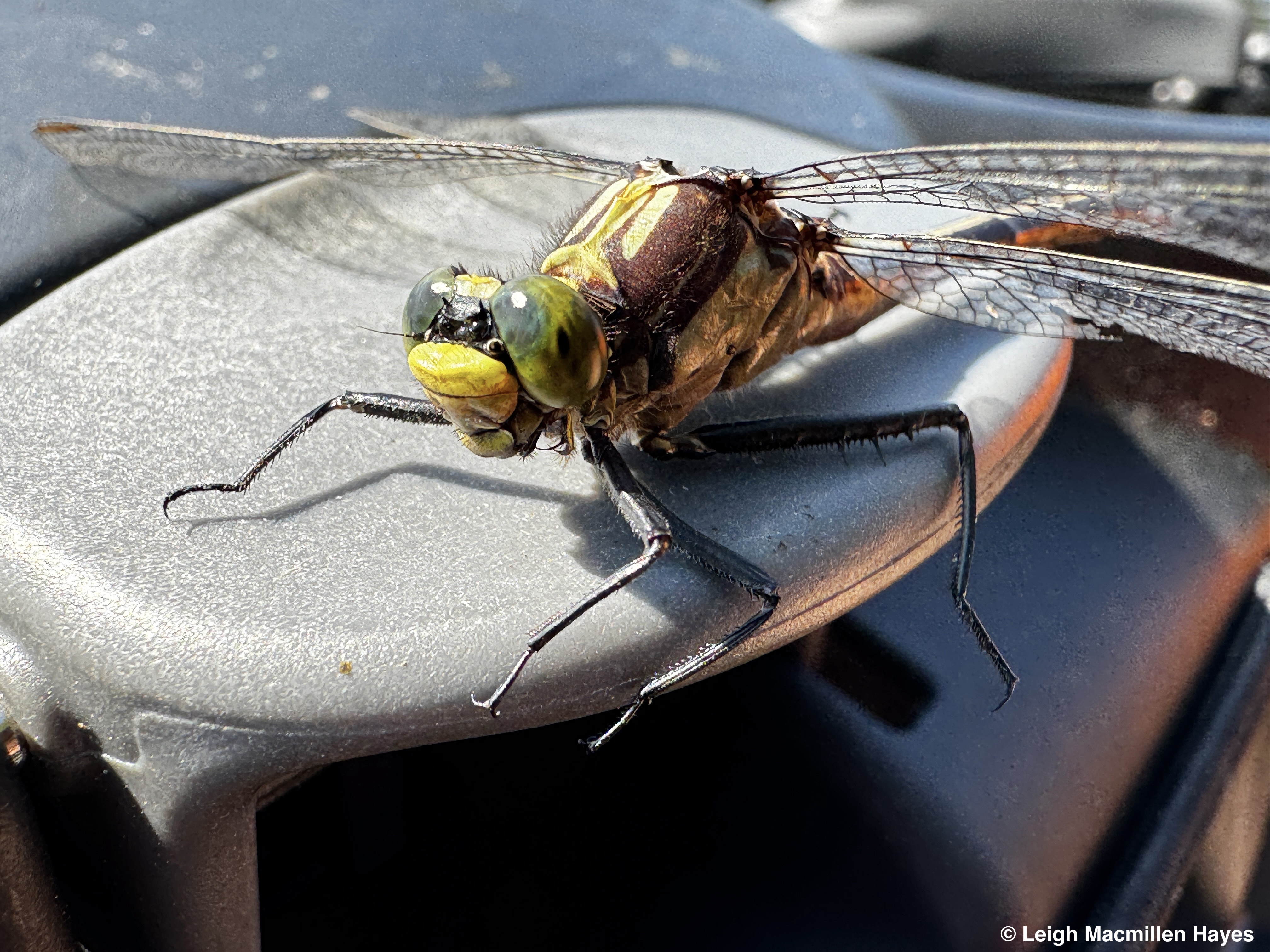
And then one of my favorite things happened. A dragonfly in the clubtail family landed on my knee and I coaxed it onto my hand for a better look. It was perfectly content to be there. Which made me think of a darner on another day on another pond this past week that I rescued as it flailed in the water. The moment I picked that darner up, it tried to take a nip out of my finger and was frantic, even when I set it on the edge of the boat. I wanted to give it a chance to dry its wings. It wanted only to fly. And so it did with wings still wet and back into the water it landed, slipping under a lily pad. I rescued it again and this time it didn’t bite and it did sit for another minute or two upon the boat, but not long enough for me to get a good look at its colors and patterns for identification, or to snap a photo and then suddenly it flew and I can only hope survived.

My new friend, however, allowed me to move him from my hand to the boat, the better to take a look.

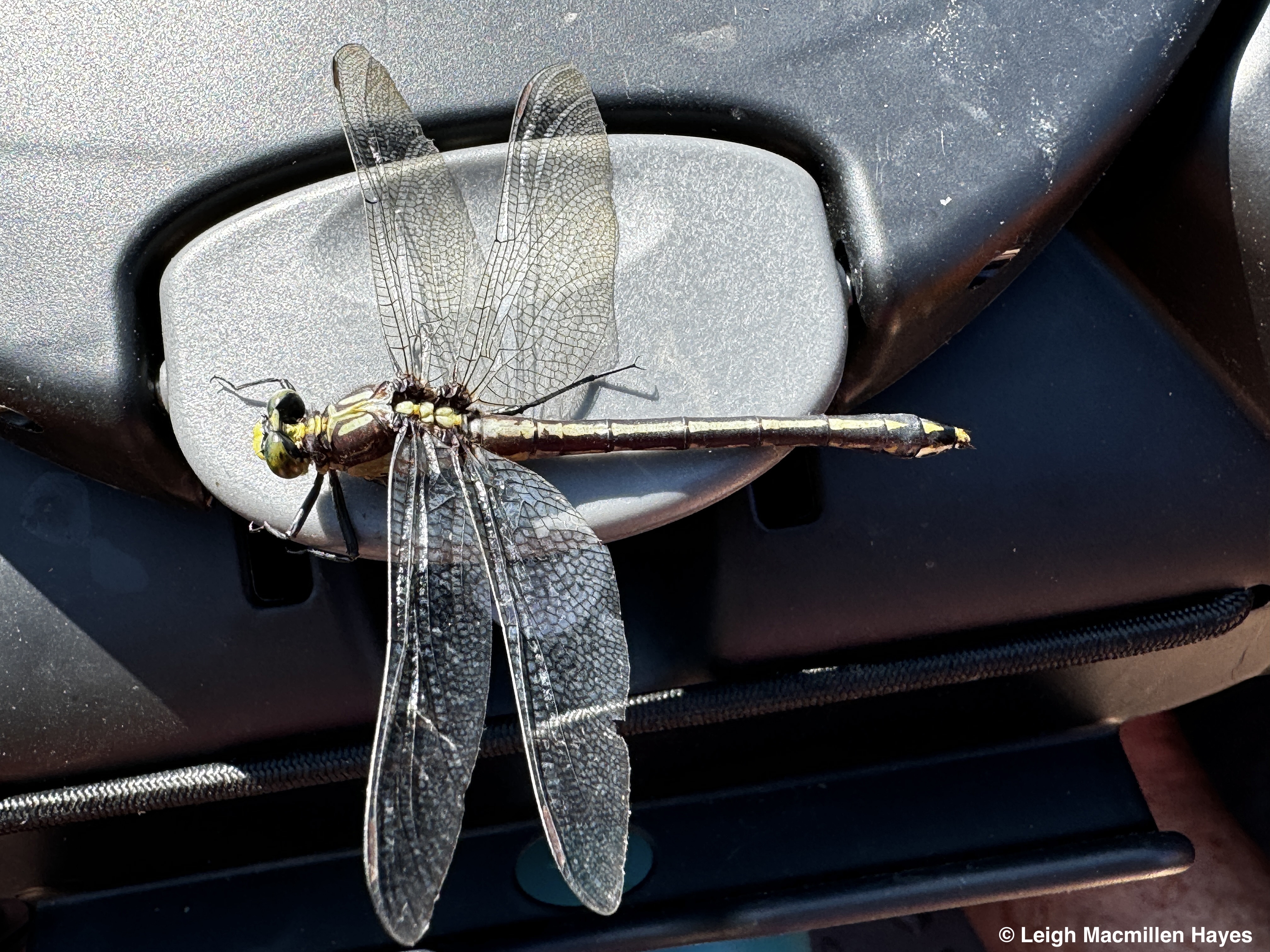
This one didn’t speak its name immediately, until I looked at its spiny back legs. As a Black-shouldered Spinyleg it is commonly known, and it’s in the clubtail family, but I’m not exactly convinced that the shoulders are actually ebony in hue. To me, they seem to be chocolate brown.

Another characteristic is the thorax pattern: two long ovals on either side with a yellowish I-shaped mark in between them. 

It was the pattern on the abdomen that also helped me confirm ID, with the yellow stripes on each segment becoming triangular shaped on segments 8 and 9, while the final segment, #10, was almost completely coated with splash of yellow.

With each minute that passed I fell more and more in love as my new friend let me enter its personal space. Such big eyes–compound as they are. But then there are the ocelli, or three small black “eyes” located on top of the head–to us they look like three little bumps, but according to the field guides in my own library, they “may serve to measure light intensity.”

And all those body hairs. They work like sensors–detecting odors, temperature, humidity, and most likely wind direction.

If you have a loupe or magnifying lens, I encourage you to look at insects and plants–it’s a hairy world out there.

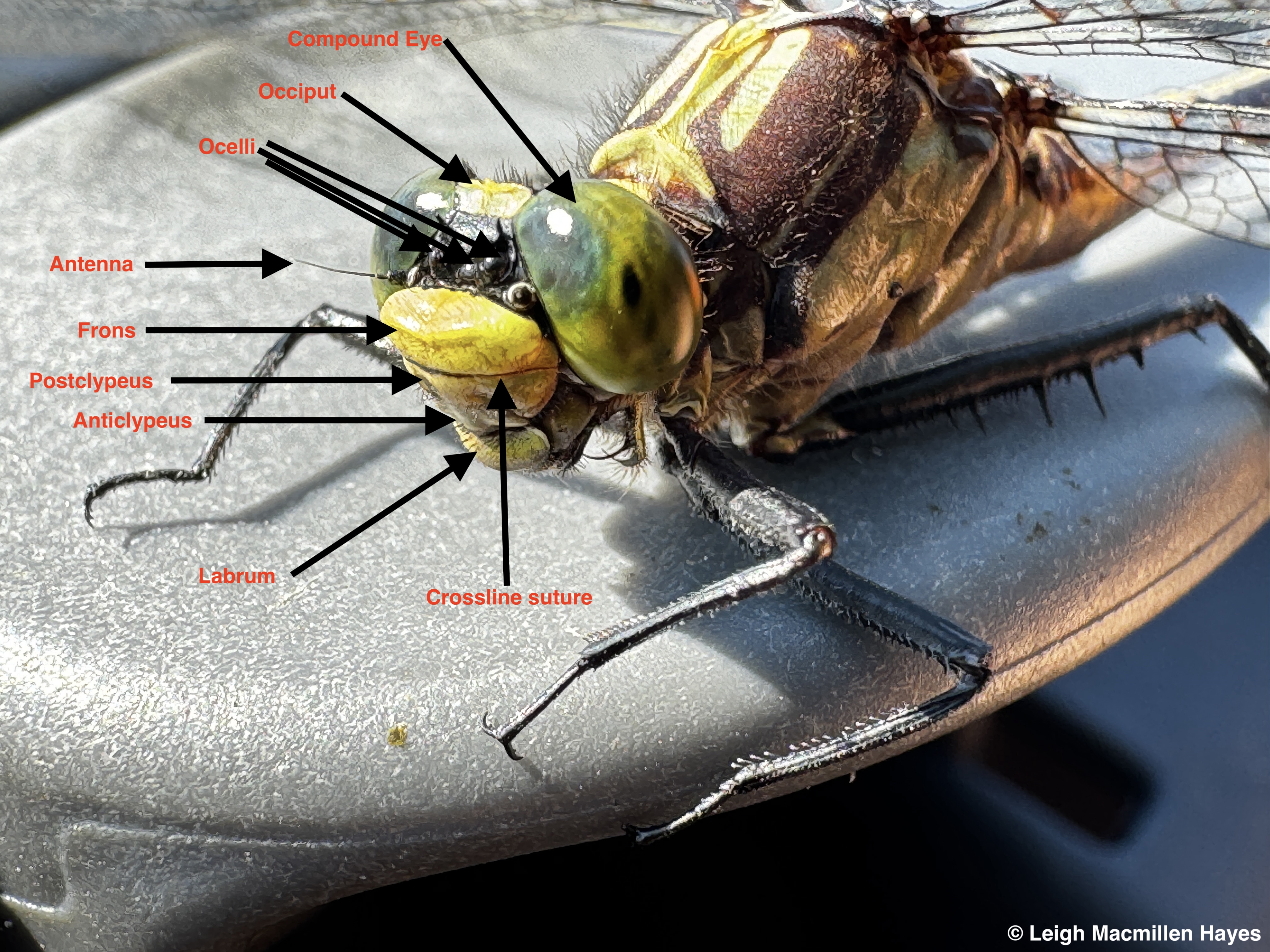
Let’s take a closer look at that face. It’s rather other-worldly in structure. Two dragonfly families feature eyes that don’t touch each other along any margin: Clubtails and Petaltails. I’m not sure I’ve ever met a Petaltail, so that already narrows it down for me when trying to figure out the species.

Beginning with the large compound eyes, we’ll work our way down. But first, can you imagine seeing the world through 30,000 lenses or facets? I’m happy to have moved on from progressive lenses (three lenses) that threw me off, especially when hiking or walking down stairs. 30,000?!!! A dragonfly certainly has no excuse for not seeing even the tiniest of insects on the move.

And notice how the eye is two toned, the darker being above.

Between the eyes is a plate called the occiput, which covers the upper part of the head. You might also notice, though I didn’t label them, that there are occipital horns.

Below that is the triangle of ocelli, or three tiny and simple eyes as compared to the two compound eyes. These may measure light intensity.

And then there are two antennas, perhaps for measuring wind speed. All of this and we haven’t reached the face yet.

Ah, the dragonfly face–beauty is definitely in the eye of the beholder.

Dragonfly faces consist of plates and the upper plate is the frons. In some species there are certain dark shapes or lines that help with ID. Not on this one, however.

Below the frons a crossline suture is a seam that separates the frons from the postclypeus, an upper plate that we might think of as the upper lip.

And below it, the anticlypeus, a lower plate located about where our tongue might be on a human face.

Finally, the labrum, or lower lip, and below that the mandibles, not labeled.

Such complexity for an insect that spends months to a few years as an aquatic naiad, growing through several molts, and then crawls out of the water and slowly ecloses upon vegetation, pumping insect blood into its wings and body, before flying off to control the airways and the insects who bug us. And within two months of emerging from the water, it’s life cycle comes to an end.

And to think this one simply landed on my knee and now you have all this information to digest. Don’t worry, there will be a quiz at the end.

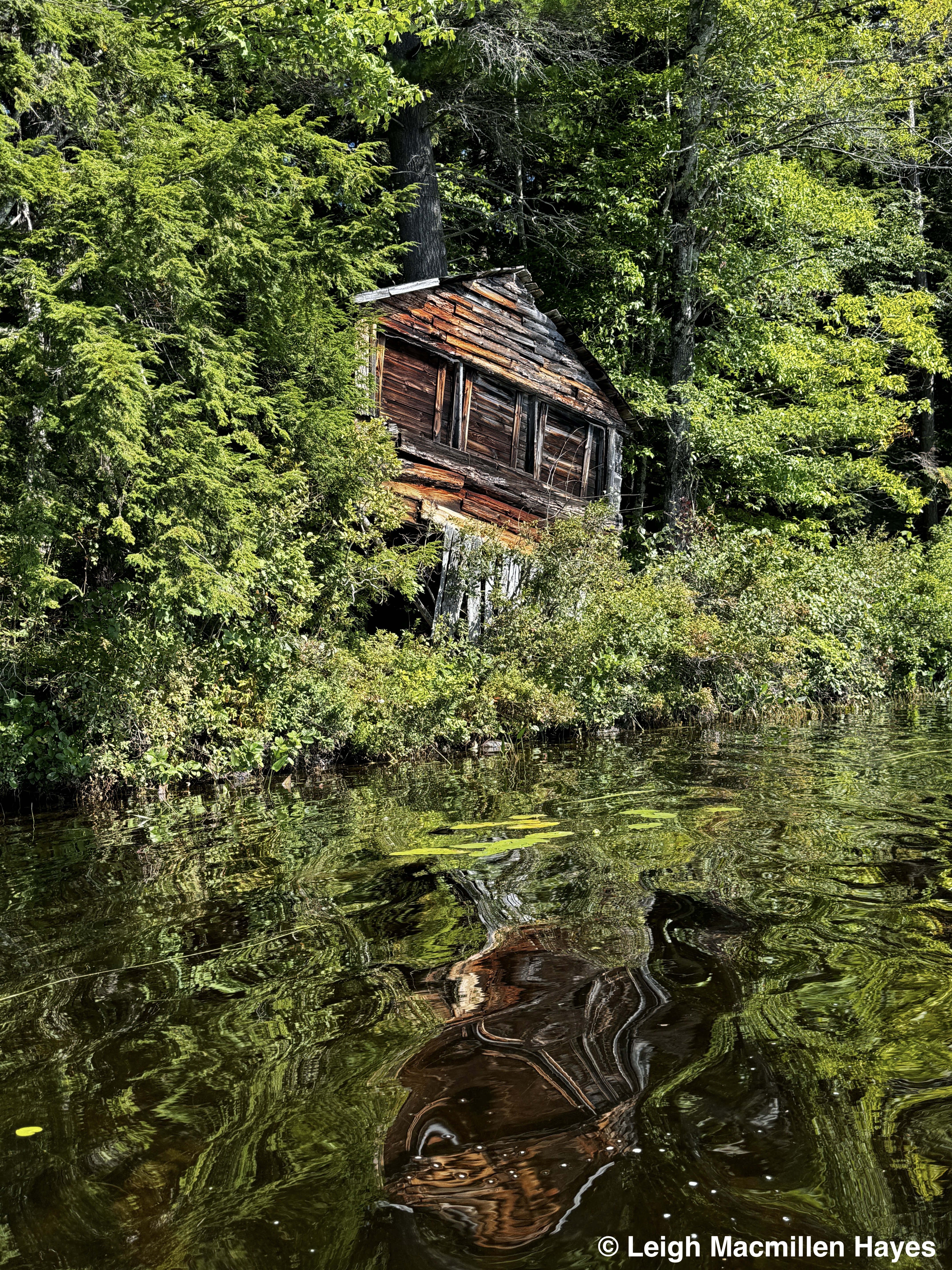
Suddenly, the dragonfly flew off. And my focus returned to the pond. If you’ve paddled here, then you know that we hadn’t gone far as we’d only reached the third of the crooked houses.

My Guy was ready to purchase one and fix it up. I just want to paint this scene when I have time for so beautiful was it despite its lack of TLC and the reflection was equally delightful as lines were interrupted by the water’s current.

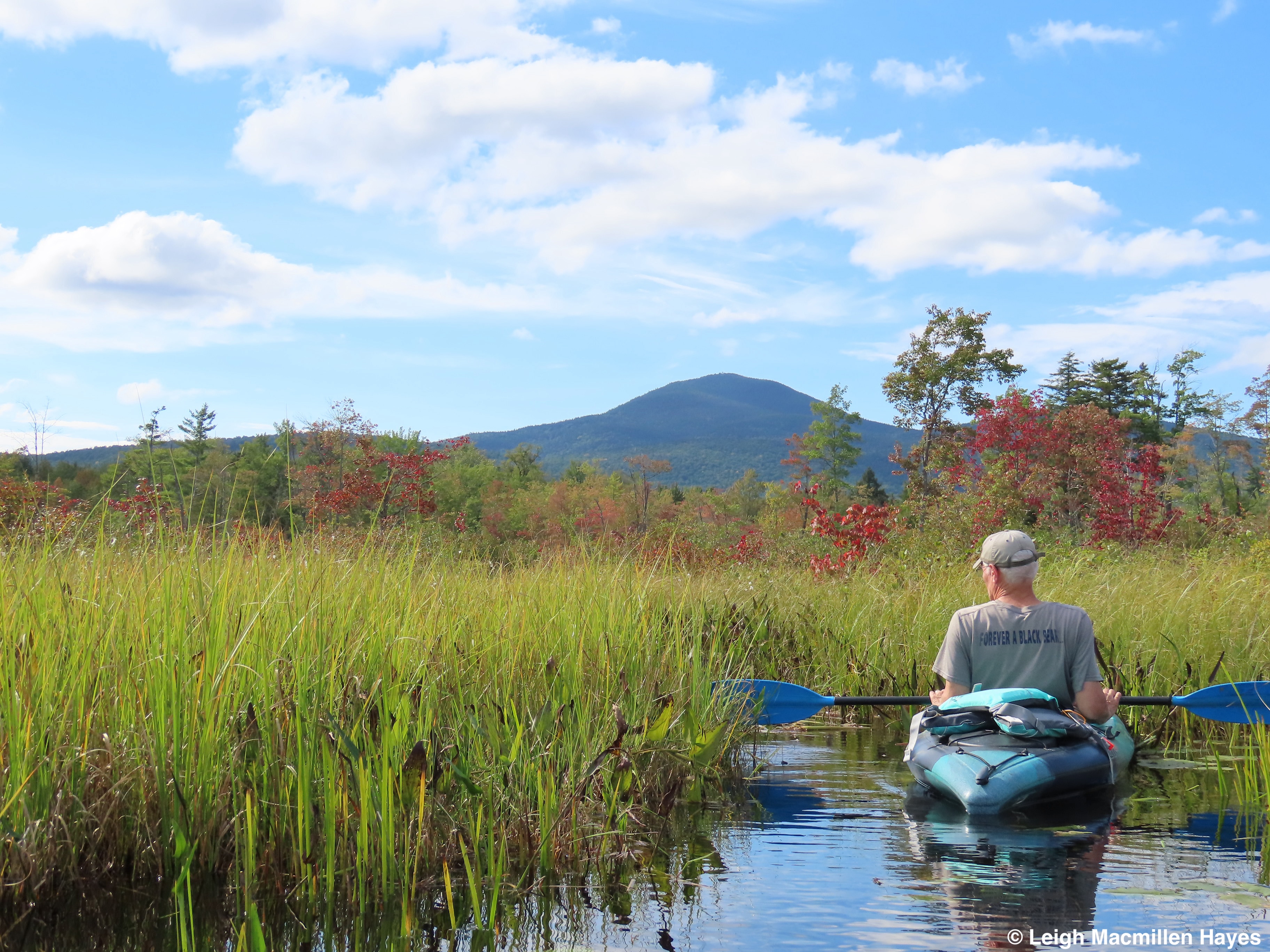
At last we reached the opposite end of the pond from which we’d begun our journey and the colorful leaves of the Swamp Maples told me we were in a different sort of wetland.

The layers. From Pickerel Weed leaves to grasses and sedges, including Cotton Sedge, to the Swamp Maples, actually being Red Maples with very wet feet which are among the first to turn as fall approaches and days shorten, to a backdrop of deciduous and conifers.

Just the colors made me happy as I followed My Guy who followed a brook as far as we could until the growth was too thick and we could hear water flowing over what was probably a beaver dam ahead. And so we turned around, but first honored Mount Kearsarge North, the pyramid mountain in the distance.

I extended the telescopic lens on my camera farther than I should have, but I wanted to see the fire tower at the summit of Kearsarge. It was incentive enough for us to decide to hike there again soon.

As we continued our clockwise journey around the perimeter of the pond, I was on a hunt–for those Pitcher Plants I’d been promised. But what caught my eye in the meantime was the late afternoon sun glowing on bowl and doily spider webs. And a beaver lodge in the background.

It always amazes me to find so many of the same type of spider webs in any one area. The spiders who wove these are rather small, but their web is incredibly complex.

They weave a sheet web system consisting of an inverted dome or “bowl,” suspended above a horizontal sheet web, or “doily,” hence its common name. And then they wait for a meal to announce itself. Should the meal fall through the bowl, the doily serves as a safety net, thus the spider makes sure to not miss a bite.

Before turning my boat to follow the shoreline again and continue my PP quest, I realized that a Tamarack grew upon the lodge. And there were several others nearby. I love these trees because they aren’t every day sights. And because they are kinda like me–beings that can’t make up their minds. Thus, they are deciduous conifers, meaning they are cone bearers who shed their needles (leaves), unlike other cone bearers in our neck of the woods who are evergreen.

I had only turned a wee bit when two structures standing above other plants caught my attention and I knew my quest had come to an end. Pitcher Plant flowers.

And below them the pitchers (leaves) for which they were named. That ruby red rim. The tree-of-life venation. And downward facing hairs. “Here little insects. Come check me out. I have a special drink I made just for you.”

At the base of the Pitcher Plant grew Sphagnum Moss and Leatherleaf, and . . . Sundews! Round-leaved Sundews–another carnivorous plant like the Pitchers. It’s a plant eats insect world out there.
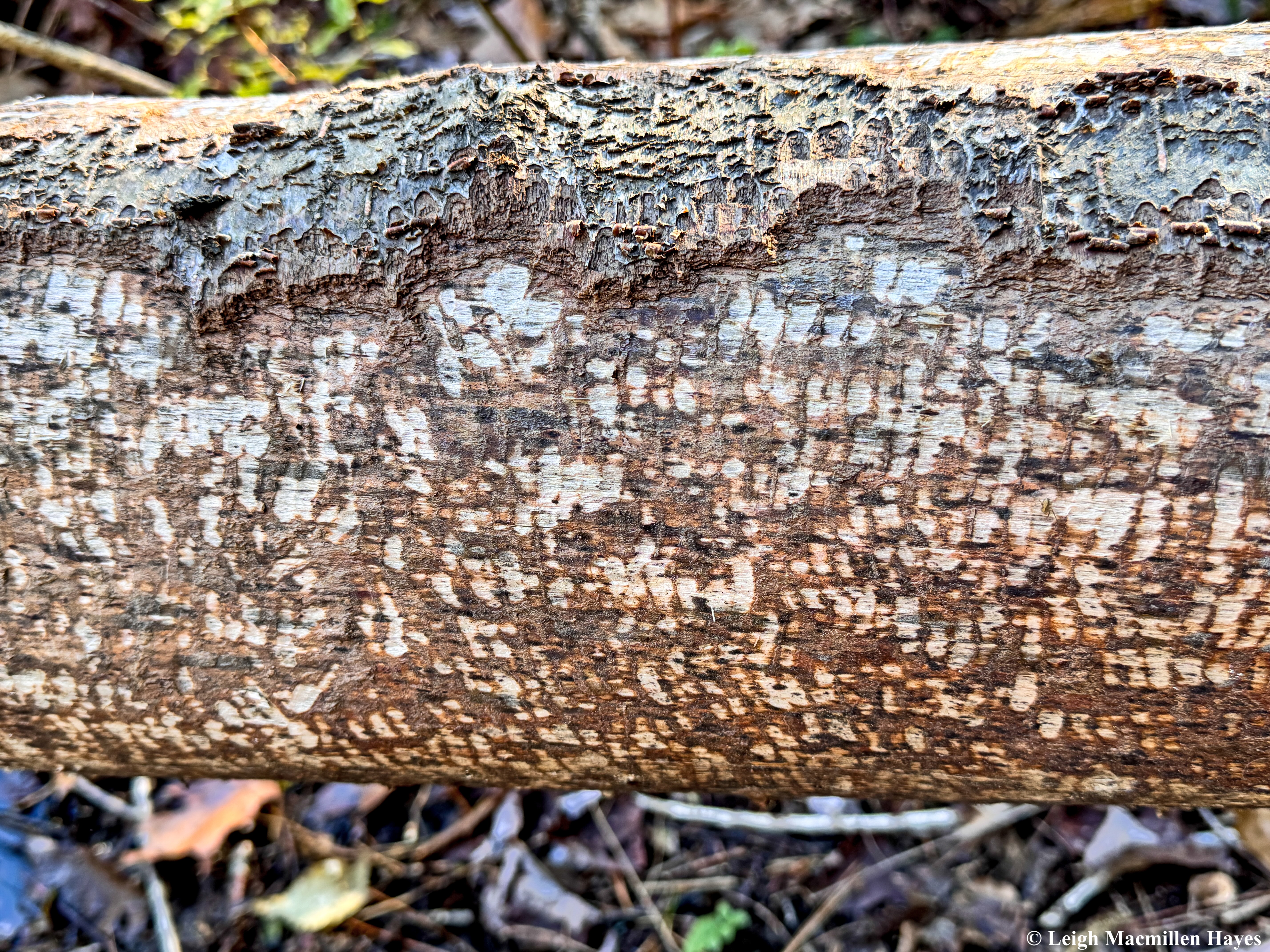
As we rounded a bend nearing the end of our journey, a flock of Canada Geese honked and cackled.

And suddenly lifted off. My Guy counted 30.

At last we approached the launch site, but truth be told it took us about twenty more minutes to go the short distance because there were so many more turtles to spot. Do you see the second one in this photo?

And one climbing atop another as is their habit since turtles are ecothermic and the sun’s rays help raise their body temperature. So if your brother is on top of the log, why not climb on top of him to get even closer to the sun?

I spotted twelve in all, and love that the one on the right upon this log waved–as if to wish us farewell, for really, it was time for us to leave.

So we did, but first we gave a quiet thanks to our friend, Pam K., for recommending this delightful pond and telling me about a few of its highlights.

And I did promise a quiz, so here ’tis. Can you name at least one part of this dragonfly’s face? And can you name the species? Don’t worry if you don’t get all of the parts–that’s why I write a blog–so I can go back and remind myself.

Basking in the sights. That’s what we did much the same way the turtles basked in the sun.

Oh, and that line that the journey wouldn’t take us long–ahem. It was at least a two and a half hour tour. After all, it’s a wonder-filled world out there.

Cloudy Mondate

Between the two of us, My Guy and I have lived within an hour or so of today’s destination for a grand total of 103 years. Yikes. That makes us old. Of course, we aren’t. But for some reason we never visited this spot before. Maybe because it’s a tourist hotspot, and we’re hardly tourists. In fact today, we were dressed in our usual garb because our plan was to hike. And we did. But . . . we also did that touristy thing for a wee bit. Cuze when in Rome . . . yada, yada, yada.

And so first we paused by the Pebble, a glacial erratic.

I suppose when you compare it to the Boulder located about a half hour north of the Pebble, which we visited on February 14, 2022, it is rather pebble-like.

But what we really wanted to see was the Falls of Song, a waterfall that drops forty feet and is so named for the changing sound of the water that constantly flows.

According to an interpretive sign by the falls, “An 1885 Boston newspaper description of the scenic beauty and amenities stated of the Falls of Song that ‘their location in the depths of the primeval forest, their exquisite setting under the overhanging cliffs, the silvery clearness of the water and their magical musical effects, seemingly changing their song at every hour of the day, unite to place these falls among the most interesting and wonderful in the United States.'”

Another set of falls to draw our fancy was the Bridal Falls, so named because in the right conditions they appear to be lacy like a bridal veil. I felt like the conditions were indeed right today.

We followed the brook for over a half mile and the views kept changing and sounds kept enhancing our experience. If it had been warmer, we might have wanted to take a dip, but for today, just watching and listening as the water tumbled and plummeted and twisted and turned and glided and flowed was enough.

Back on the road as we drove up the mountain, we stopped again for a view from lunch bench and I found my place, which was my place in the early 1980s. Lake Winnipesaukee and Gunstock Mountain formed the backdrop and brought back memories of teaching and hiking and skiing and swimming and being. The best part is that this is the area where I learned to be. Be me.

To be native, like the Northern Bush Honeysuckle, for I began to realize all those years ago that this is the area where I belonged.

But today brought us to the home of others who also belonged in this place, beginning with Thomas and Olive Plant, the original owners of this mountaintop mansion. I could only hope to live here. But they did. For a while at least.

It’s a sixteen room home with halls and halls and an organ, and dumb waiter, and guest rooms like this one, and more halls, and sitting rooms, and great hall, and dining rooms, and servants quarters, and sunroom, and oh so much more. But this, the Brown Room, was my favorite, for recently carpet had been removed and the most incredible floor discovered, and it reminded me of our home, which had been similarly carpeted, and we discovered beautiful southern pine that has since brightened our days.

The sunburst pattern of the Brown Room floor–incredible.

But even more than the inside, we really enjoyed the outdoor living areas, this off the main hall, with a view of the lake and mountains beyond, Gunstock being straight across.

And an angel letting water form her wings.

We’re thinking we’ll take the month of August and welcome guests here. Haha. As if we ever welcome guests, the introverts we truly are. But really, the focus should be on the Arts and Crafts architecture and way the building fits into the setting.

And the gardens. Exquisite.

Olive Plant, original owner of the property in 1914, would have approved of today’s gardens which are tended by a group of volunteers. In this space that surrounded the mansion she had a 100-foot glass greenhouse.

I don’t know if this was part of her greenhouse selection, but among the wall that formed part of nursery grows Ivy-leaved Toadflax, a plant I don’t recall ever meeting in the past.

Clouds there were upon occasion today, but the yard boundary offered glimpses of brightness.

And along the trail where other specimens including this Bristly Locust, a legume.

We’d hiked along the brook, spent time exploring the mansion and grounds, and the headed off to hike another trail with only so much time on our hands. At the intersection of trailheads, we had the good fortune of meeting two women with local knowledge who showed us where we were and where we wanted to go . . . that being heading up Mount Roberts. We knew we didn’t have time to summit for My Guy had to get home for a meeting (at which he later received a well-deserved Lifetime Achievement Award), but we made a plan for a turn-around time.

The trail was blazed with orange markers and we might have believed that a Black Bear had marked the way, for so chewed and scratched were the signs, but I suspect it was a Red Squirrel who had a good chomp or two or ten.

That said, a female American Toad, her tympana (ear membrane) about the size of her eye, and overall size of her body providing a clue to her sex, but also doing her best to blend in to her surroundings as she paused upon a stone on the trail.

We’d hiked over a mile when I suddenly spied this from the trail. Ruh roh. That meant we had to start looking and counting, a task that slowed us down a bit.

We had set a turnaround time, knowing that we wouldn’t be able to hike the entire 2.5 miles to the summit because My Guy needed to get home for a meeting, and so at 3:15pm, with 1.7 miles behind us, we stopped our upward ascent, but before descending, I spotted a green golf ball on a Northern Red Oak leaf.

Each time I spot one, I’m in awe for it’s such a cool structure. Though it looks like a fruit, it’s caused by a chemical reaction the leaf has when a wingless adult female wasp, Amphibolips confluent, lays an egg into a newly-forming leaf. As the egg hatches and larvae grows, that chemistry causes the leaf to mutate and grow with it.

The wasp is commonly known as an Oak Apple Gall Wasp, and thus this is an Oak Apple Gall.

We chuckled on the way down, for we did pay more attention to the flora, and couldn’t believe that we’d passed by this Lady’s Slipper display located inches from the trail. But that’s what happens when you are moving on My Guy-speed, and watching every spot where you place your feet. Our total count on the way down: 52, but I’ve a feeling we missed many more.

And hiding under some trees near the trailhead: Ragged Robin, a treat because I’ve only encountered it a few times. I love its frayed, yet delicate display.

Because our descent was much faster than the ascent (and still we counted Lady’s Slippers, but that’s why I think we missed some), I stole a few minutes beside Shannon Pond where a small field of Lupine bloomed.

And a female Mallard swam toward the shore. She and a few jumping fish were the only wildlife spotted today.

That was okay, for we had a splendid Mondate wandering under the clouds, which seemed truly appropriate since we were at the Lucknow Mansion property now known as Castle in the Clouds in Moultonborough, New Hampshire. Why did we wait so long to visit? Maybe because it’s practically in our backyard.

Lions, and Otters, and Moose Mondate!

We drove across the border and south today in search of wildlife. And we were not disappointed as our sightings were numerous.

But first, lunch. That in itself was a treat–mine being an Avocado and Roasted Veggie Panini. You are looking at the second half, which was supposed to follow me home. But . . . the avocado would have turned brown. And so I gobbled it all down. Sometimes, you just have to do the right thing.

We may not have been the only ones eyeing lunch, though what this Bobcat was looking at, we could not determine.

It was less than ten feet away from this second Bobcat and it appeared that they had their eye on the same little tidbit. Perhaps a mouse or chipmunk was on their menu.

With a lick of the chops, it appeared that the nearby Mountain Lion had indeed enjoyed a morsel of delight. So, the fact that we saw a Mountain Lion is rather curious because they were officially extirpated in New Hampshire. But . . . sometimes one makes it way into the state and perhaps this was one of those.

I love how its front paw rests so naturally on its back leg. And my, how big those paws are. Notice also that the claws are tucked in. Members of the cat family only use their claws to capture prey (or if conditions are muddy or in some other way slippery, then the claws are extracted to help with stability).

In the midst of our adventure, we stepped into a garden filled with flowers and flowering shrubs and trees, a haven for pollinators this early in the season.

And then it was on to search for River Otters, who had obviously decided to take a post lunch nap. And rejoice in the opportunity. Or so it seemed with those front feet raised.

Take a look at the bottom of those paws–with their five tear-drop shaped toes identifying them as members of the weasel family.

Our next sighting mystified us a bit. As two who are always looking for signs of Black Bears, we were thrilled to see this one. Every once in a while we are granted such views, but the troubling thing today was how the bear paced. Back and forth and back again. It was obviously anxious about something despite its ability to roam in a large area.

Birds were also part of our view, this being a Black-crowned Night Heron, or more simply Night Heron. Look at that eye–its color allows it to hunt at dawn, dusk, and even during the night.

The same is true for the eyes of the Great Horned Owl.

Okay, so by now you’ve turned into a great tracker and hunter and realized that there is fencing behind these animals. Yes, we had travelled to Squam Lakes Natural Science Center in Holderness, New Hampshire, about an hour and a half from home. All photos were taken through glass. Glass that was smeared with finger and nose prints.

The animals are only there because they were orphaned or injured or for some reason couldn’t survive in the wild. And they live in habitats that equal their preferred home territory.

The Red-tailed Hawk offered a shrug, maybe because it thought it should be out in the open. But, it had an important job to do here: to educate all of us. To be an ambassador.

How often do we get to eye all of these species up close. Their behavior might not be entirely natural given their confinement or injury, but I think it’s amazing that we can visit with them and that so many tots were there with their moms today, and there were a couple of school groups visiting as well. These kids get to meet these critters, and maybe will develop an appreciation of them, and who knows where that might lead.

Today was the beginning of a heat wave, and the Bald Eagle reacted by panting, its way of cooling down.

Our plan was to walk through the exhibits, and then hike some of the trails, including climbing to the summit of Mt. Fayal.

Along the way, we had a special treat, for we got to meet Barred 13, who was out for a walk as well, and panting.

The “name,” Barred 13 refers to the fact that this was a Barred Owl that came to the Center in 2013. As a policy, they do not name the critters who reside there so folks like us won’t think that wild animals should become pets.

Barred 13 was very curious about something in the vicinity. We learned that she once heard a Black Bear before her handler turned and saw it. And that she’s at the Center due to a broken wing.

The Barred Owl’s hearing is so acute that it can pinpoint the location of its prey. There’s a cool exhibit to help us humans better understand how well they hear, but I’ll leave that for you to discover upon a visit.

At the summit of Mount Fayal, My Guy found a bench upon which to sit for a bit and enjoy the view of Squam Lake.

What he missed, I discovered behind the bench.

A Pink Lady’s Slipper. The first for us for this year.

His comment: “Only one?!”

We are rather Lady Slipper’s Snobs. Truth be told.

Back on the animal exhibit trail, we stopped by to visit the Otters again. Thank goodness. The most amazing thing–we were the only ones there. The Otter exhibit is usually packed.

We quickly realized that the time to visit the Center is in the mid to late afternoon, after the kids have packed up and gone home. Or if you go earlier, do like we did and head off for a hike before returning to the exhibits.

The two Otters entertained as they constantly climbed up toward us and then did backflips into the water.

Up . . .

Bend over . . .

And swim.

And flip over and swim some more.

Lions, and Otters, and Moose–but wait. This moose was in the same pose when we left as it was in when we arrived. Allegedly we saw a moose. Well, we have a photo to prove it. But, unlike all the other critters, it wasn’t alive. Still.

Squam Lakes Natural Science Center–we highly recommend a visit, no matter how many years you have under your hat.

And lunch from Squam Lake Marketplace. The flour-free Chocolate Chip and Peanut cookies–a great way to end a meal, even if you wait three hours for the ending because your belly was filled by your sandwich.

A Mondate worth noting.

A Smile of a Mondate

In case you are missing snow, I thought I’d bring you some today. But only because about a month ago, the day after Palm Sunday and a major snowstorm here in the north country, My Guy and I went to Diana’s Baths in Bartlett, New Hampshire, to hike.

It was the first of two storms in a matter of less than two weeks that dropped almost two feet of snow each and transformed Lucy Brook into a winter wonderland. Here’s a bit of history from northconwaynh.com: In the 1860s, after building a house and barn on the banks of the brook, George Lucy built a water wheel powered sawmill. In the 1890s, George built a 12-room boarding house for tourists to visit the site. In the 1930s Chester Lucy built a concrete dam with a water feed and turbine system to replace the water wheel used to power the sawmill. Both the rooming house and sawmill were eventually sold to the US Government and have become part of the National Forest land. Due to the deterioration, the buildings were eventually removed from the site in the 1960s. Remnants of the site can still be seen today including the old cellar holes and parts of the dam system, feed tube and turbine gears used to power the sawmill.

Today, it looked much more summer-like in appearance, but still so much water flows due to snow melt in the surrounding mountains, and it’s BRRRRR.

As we ventured forth, I spotted many a boulder experiencing the bad hair day of Common Polypody Fern and every once in a while try to teach My Guy a wee bit about a species. I tell him that someday he can co-lead a nature walk with me. He, of course, guffaws. But ask him what poly and pody mean and he may remember many and feet, for the fern fronds grow from creeping rhizomes.

Last year’s sori (group of spores) were still visible on the underside of some leaves. The sori located in rows on each side of the mid-vein, are circular, orangish brown and not covered by tissue (indusium).

Because we were in a damp environment beside the brook, False Hellebore leaves, with their pleated presentation, brightened the morning. And held raindrops signifying yesterday’s weather.

We also encountered numerous Hobblebush shrubs, some even featuring flowers preparing to open into what will be a fantastic display on another day. On this day, it was enough to see their accordion leaves beginning to unfurl, and those flowers presenting like a bunch of worms crawling over each other as if to say, “Me first. Me first.”

We crossed tributaries several times though we didn’t actually cross Lucy Brook as originally intended for the water was still too high for us to manage safely. But . . . we bushwhacked for a bit before sitting upon some tree roots to take a lunch break.

It was while My Guy sat there, that I poked around and discovered this–Wall Scalewort, a leafy liverwort. Liverworts differ from mosses in that the leaves are typically arranged in rows of two with a possible third row below, while moss leaves whorl around the stem. And most mosses have mid-ribs, which liverworts lack.

That said, the Wall Scalewort closely resembles Shingle Moss, which I spotted along this same tributary in March.

But a closer look today made me realize that I could see the leaf arrangement was succubous where the bottom edge was visible, as opposed to incubous. Succubous arrangement is like roof shingles that don’t let the rain in, while incubous leaves are arranged so the top edge is visible and do let the rain in. Thank you Sue Alix Williams in Mosses & Common Liverworts of the Northeast for that explanation.

Eventually we reached a turn-around point and came up with Plan B for the rest of today’s hike as we made our way out. While I was able to cross with my high leather hiking boots, My Guy chose to take his boots and socks off and watch his feet turn red from the chill. Thankfully, his better half, ahem, that would be me, had packed a towel because we suspected this could be the case.

Now you might find this as odd, but since our discovery of the new privies last month, we’ve been quite taken with the artwork completed by Kennett High School art students in 2023.

Unbeknownst to us at the time, the paintings were a perfect segue from one trail to another.

And so we drove down the road to Echo Lake State Park and tried to convince the warden that even though we live in Maine, our hometown is just over the border and we should be able to hike the trails for free as New Hampshire Seniors don’t have to pay. He kindly informed us that the park isn’t officially open yet, as so it was free, but if we return in a couple of weeks, it will cost us $4 each. Not bad in the scheme of things.

Before us stood White Horse Ledge, one of the trails we had considered if we’d been able to cross Lucy Brook from our earlier destination. We were green with envy as we looked across at it.

But about half way around the lake, we found a different trail to the summit and decided to follow it. That said, we found several trails to the summit and the first we chose led us astray as it eventually petered out.

Despite that, we were thrilled. Okay, maybe it was me rather than we. Semantics.

And so today I celebrated my first meeting of 2024 with Sessile-leaf Bellwort, aka Wild Oat. And where there was one, there were a million, the subtle yellow bell dangling quietly below.

And then . . . and then, I spotted a Stinking Benjamin, or Red Trillium almost in flower.

And a few steps away . . . full flower mode. Trillium is a reference to the fact that the floral parts of the plant occur in threes: three leaves, three petals, three sepals.

Going forth, I’m sure I’ll honor a trillion trilliums, but these were the first and therefore the most special.

As we made our way back to a better trail, the leaves of Trout Lily caught my attention and then much to my delight I found two in flower. The leaves are maroon-mottled and the nodding flower features petals and sepals bent backwards to expose six brown stamens. This one is such a treat for me because I only meet it when I least expect to do so.

Once on the actual trail upon which we had to scramble to climb toward the ledgy summit, I spotted another that only grows in such habitats.

Take a look at the black arrow in the photo.  That is one hairy stalk rising from a rosette of basal leaves.

This native perennial wildflower, Virginia Saxifrage, grows out of cracks in rock, and has been known as a rock breaker even though it doesn’t actually break rocks, but rather, likes to grow in those fractures. It’s such a sweet little flower that is easy to overlook.

From the ledges above, we had a great view of Echo Lake, and the mountains beyond, with Cranmore’s Ski Area showing the last of the melting snow.

That brings me back to the snow of a month ago. I took it upon myself to figure out a way to make people smile.

And today, we did the same, though not with snow like this. But rather, with our actual smiles and friendly hellos as we greeted each hiker we met. Even if they weren’t smiling or making eye contact with us at first, we got them all to return the greeting and had some nice chats with a few.

I told My Guy that it kinda reminded me of our New York adventure last weekend, when I made it a point to try to make eye contact with each person we passed on the sidewalk or trail and to always leave them with a smile. A few actually looked at me and turned on a smile, which seemed to surprise them.

This was indeed a smile of a Mondate . . . on so many levels.

The Giant’s Shower

I did a thing. Years ago I wrote a children’s story. Well, a bunch of them actually. And I tried to sell this particular one to publishing houses. No takers. Then, a couple of years ago I purchased a Fairy Coloring Book created by the one and only Solana, teenage daughter of the Fly Away Farm Wards in Lovell and Stow, Maine, and approached her about illustrating my fairy tale. She took on the task and did an amazing job. Then I asked copyeditor Pam Marshall to wave her magic wand over it. And finally a few weeks ago I asked graphic designer Dianne Lewis to use some fairy dust and turn it into an actual book. I always said I’d never self-publish a book. And tada: I did just that.
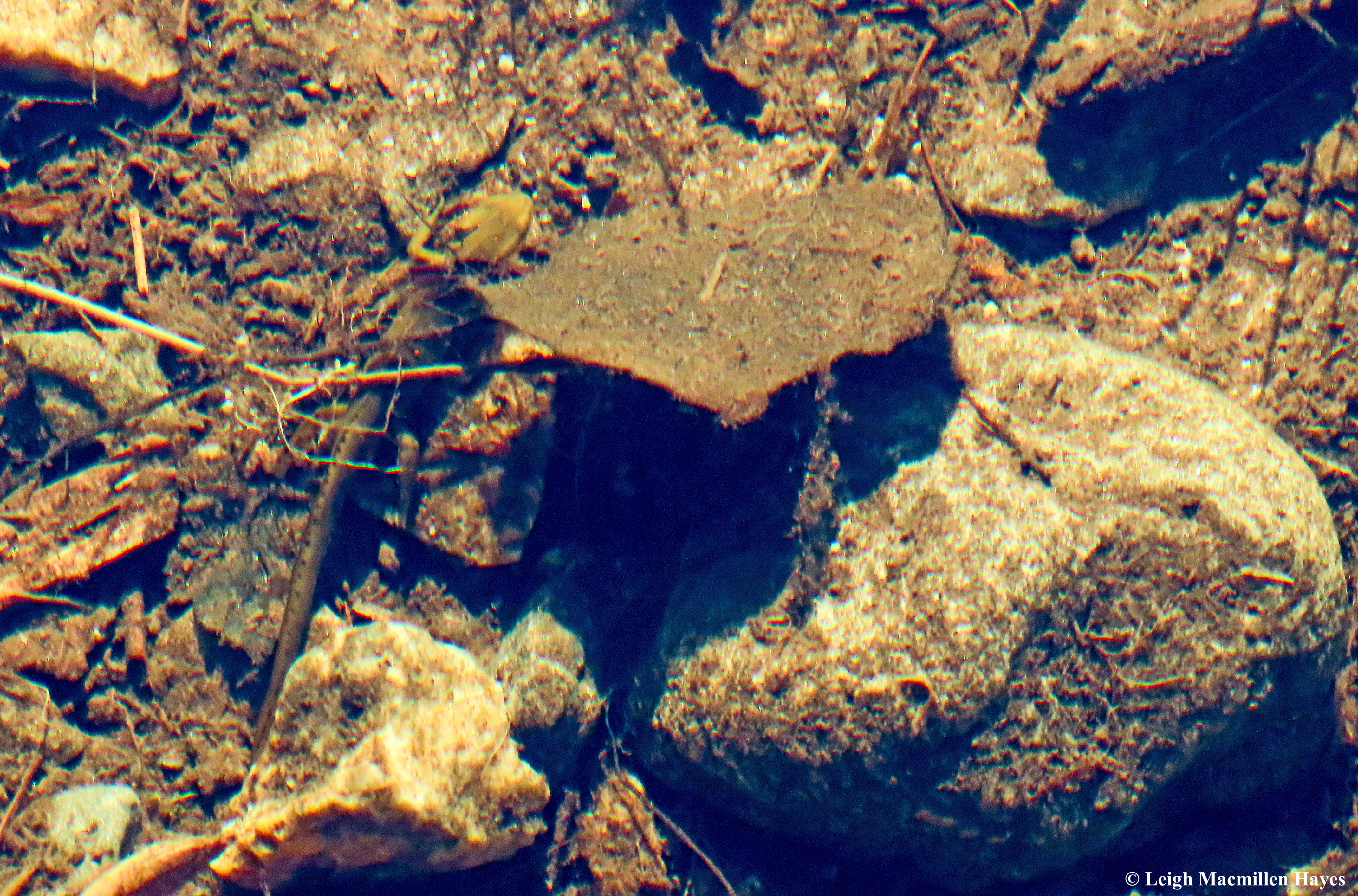
Aisling, a fairy who lives on Sabattus Mountain in the western Maine village of Lovell, has a vision during the Midsummer Eve celebration. 

Twinkles, flitters, a bit of fairy dust and some tsk-taking are necessary to make Aisling’s vision a reality. 

You and your children will delight in the story accompanied and the colorful and whimsical illustrations created by artist Solana Ward.  

Marita Wiser, author of Hikes and Walks in and around Maine’s Lakes Region had this to say about the book, “The fairies in The Giant’s Shower will captivate children with their merry life in the forest. It’s not all magical though, as they moved from New Hampshire to Sabattus Mountain in Maine to avoid a certain devil. At least they thought the giant was a devil, but the situation wasn’t what it seemed at first. Both the writing and the detailed illustrations capture many features of the woods of northern New England, and the fun of fairy life and houses.” 

A naturalist and writer, many of you know that I hike frequently in Maine and New Hampshire, and those adventures inspired this story. I feel the fairies’ magic whenever I’m among moss-covered ground and tree stumps.
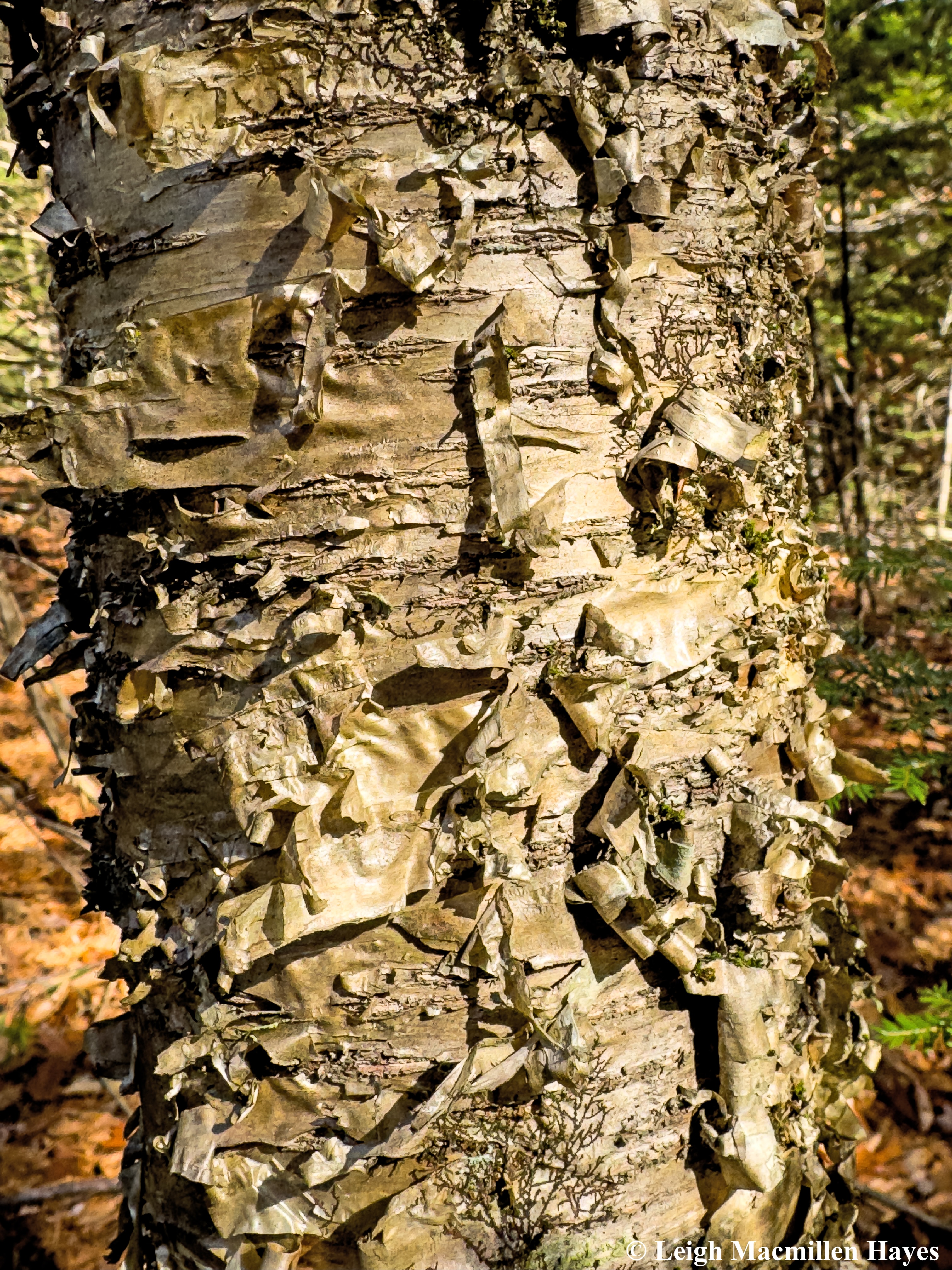
Included in the book are directions to the two featured settings, Sabattus Mountain and Arethusa Falls. Both are easily accessible for young hikers who might experience some magical moments while exploring. 
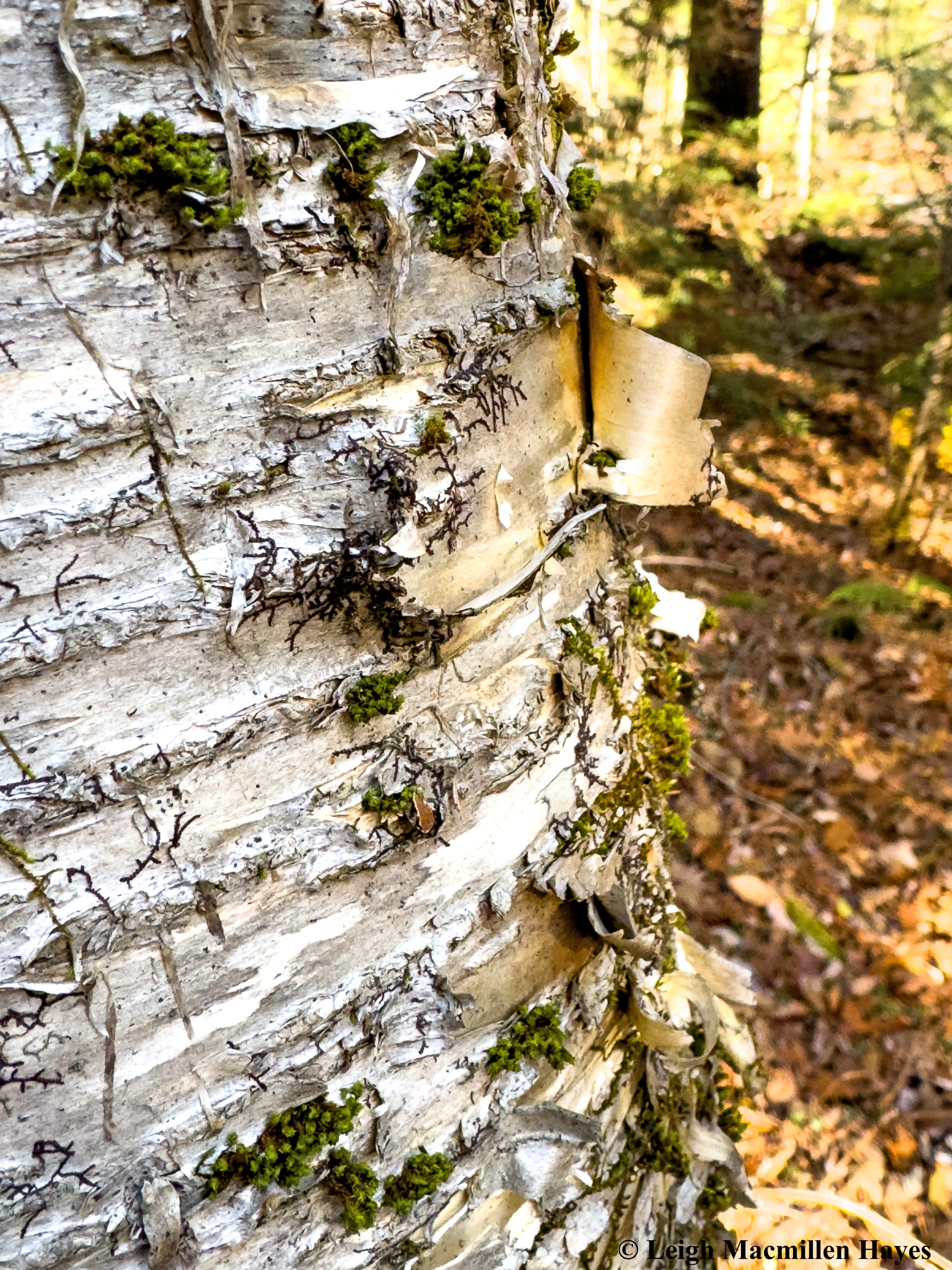
Also included is a list of character names and their explanations, as well as instructions to create fairy houses and fairy dust. 

The Giant’s Shower is available for $16.99 at Bridgton Books, Hayes Ace Hardware, Fly Away Farm, or by contacting me: thegiantsshower2023@gmail.com.

Our Blue Greed Mondate

Somehow that time of year always sneaks up on us. And yet today dawned and the writing was on the wall: This is that time of year-kind-of-day. But the question remained: Would we be rewarded?

Well, we had to find out and so this morning we set off in search of this small mountain nestled in the midst of so many behemoth uprisings. It took us several wrong turns before we finally shared that sudden “Aha” moment that indeed the pasture road was the correct road. It was all rote from there.

Last year we discovered the mountain top had been cut back and there were no little specks of blue to glean, but that cutback lead to this year’s abundant offerings. My Guy was in his happy place.

Well . . . one of his happy places. This one offering such sweetness in a manner all blue.

I chuckled when I overheard a mom commenting, “This is just like Blueberries for Sal.” I immediately texted our friend Kimmy for she and I know otherwise. Drop the “S” from Sal and you’ll know what I mean.

That said, his blueberries are my pollinators and with pollinators you have flowers, this one being one of many, many Wood Lilies.

There was also the Red-shouldered Long Horn Pine Borer, so frantic in its activity upon the Steeplebush flowers.

Plus a Paper Wasp upon Yarrow, . . .

And Flower Longhorn Beetle on Bristly Sarsaparilla. The season is short and there’s so much work to be done and the rain may have slowed things down so when the sun doth shine, it’s all insects on hand.

We finished up our hike, grabbed a to-go lunch at a locally eatery and then took off in the tandem kayak, with the same mission on our minds. Picking more blueberries for him, of course.

And checking out the local wildlife activity for me. We watched a beaver pass by our dock two nights ago, so we knew there was an active lodge somewhere in the area.

We actually found two new lodges and other older ones that were turning into islands. But we didn’t spy any beaver activity, probably given that it was the middle of the afternoon.

I, however, spotted a couple of species that envied My Guy’s blue greed, this being a male Slaty Blue Skimmer pausing in the midst of defending its territory.

And my heart was glad for we also spent some time with this tiny male Blue Dasher, another Skimmer who posed longer than I expected.

Only yesterday, I included his mate in Hunting for Dragons. Suddenly, here he was, albeit with a few Red Mite hitchhikers attached to his thorax.

While My Guy’s Blue Greed may be low and highbush blueberries, mine is definitely insects, and the bluer the better.

Rewarded were we, indeed!

Stars Among Us

Saturday found My Guy and me doing some trail work in the rain along a local path that we’ve helped maintain for probably close to twenty years. On Sunday we went on one of the buggiest hikes we’ve endured in a while. But there was a prize to be had. And today. Ah today. What a gorgeous day. And few bugs. There was a reason for that.

We were in a wetland where the dragonflies were emerging. So this is a member of the Baskettail family. I’m just getting my dragonfly eyes back on and need to refresh my memory.

Looking at it from a different angle, my brain wants to call it a Spiny Baskettail rather than Common for it seemed dark behind its head and the dark basal marks on the wings seemed to match up, but . . . if you think otherwise, I’m open to clarification.

We also spotted Belted Whiteface Skimmers seeking meals, and there were damselflies on the hunt as well. If these Mosquito/Black Fly/Deer Fly-eating predators haven’t reached your backyard yet, know that help is due to arrive any day.

Not all the sights we saw were predatory and so we delighted that a few new butterflies of the season were in our midst, including this Mustard White, with its striking venation a feature of the spring brood. The coloring has to do with developing in the chrysalis during shorter spring days versus the pure white or mustard-color which occur in summer broods.

Also fluttering about were a few Canadian Tiger Swallowtails, adding bright dashes of color in a woodland growing ever so green.

While the butterflies help with pollination, this humongous Bumblebee was hosting a pollen party for one and if you look closely, you may see the yellow specks flying in the air and all over its face.

It was no surprise to see the pollen sacs on its hind legs filled to overflowing.

There was so much to take in everywhere we looked and we were glad we’d driven an hour and a half to spend time in this special place where one of My Guy’s favorite flowers grows. Though not in bloom yet, they are preparing and we can’t rush the season. I know some have blossomed closer to home, but think our location a bit further north meant things are delayed by a week or so.

Equally as fun to find was evidence of last year’s flower in the form of a football-shaped seed capsule–and we can only hope that some of those seeds will find the right conditions and show off their showy blossoms. Of course, those seeds might remain dormant until conditions are just right, so it could be years before we can enjoy them. We’re willing to wait.

Today’s journey found us enjoying the mountains and wetlands in Whitefield, New Hampshire, where there was still some snow on distant peaks. Look below the clouds and you’ll see what I mean.

So many stars we enjoyed and really have only honored a few here.

But the real star among us we spent some time with yesterday . . . until the insects drove us home, literally!

This Black Chipmunk and its forebears have been rather reliable residents on a certain trail and though I don’t spot one every year, it’s always a treat to meet it again. This was the prize.

As we watched, the chipmunk behaved as one would expect, dining upon seeds it had cached, then running along a log, jumping down to the ground, and disappearing into a hole beside a tree. I have to wonder how many more it may be feeding with its stuffed cheeks. And having observed 315 15-second game camera videos of a Red Squirrel a couple of years ago, and watching this particular chipmunk, as well as those who live around our house, I know that it repeated its routine from hole to food source and back to hole from sun-up to sun-down.

Melanistic mammals have an increased amount of the dark pigment melanin in their hair, and though they are considered rare, I know of at least three local areas where Black Chipmunks have been spotted for years.

There may be stars in the sky as this beautiful day gives way to night, but indeed there are many more stars at our feet if we take the time to notice.

Mondate with a View

I’ve been wanting to take My Guy to a certain place in North Chatham, New Hampshire, for the last few years and today was the day that the stars lined up.

Though it appeared we were the second and third humans to head out on the trails this morning, for at the start we spotted only one set of snowshoe tracks, it was obvious that so many others had followed or crossed before us–such as this vole, who tunneled through the fresh inch or two of snow that fell yesterday and then changed its gait.

And then I spotted a sign that always brings me to my knees–fox prints and a dash of urine, probably that of a male in search of a date. Confirmation that it was a fox, and a red one at that, came in the form of the urine’s scent–rather skunk-like. I asked My Guy if he wanted to take a sniff, but he passed on the opportunity.

A wee bit farther and we came upon a smattering of activity, where two foxes had left their dancing cards and I think at least announced their intentions for each other as a date.

These classified ads could be that of the male stating his desire, while the vixen left her own marks of estrus blood as she perhaps investigated his intentions and decided to say yes. The scat? It came from one of them. Another advertisement of health and age and vitality.

While I suspected a meal was not on their minds as she’s only ready to mate for about a week or less, by the amount of snowshoe hare tracks we spotted, we knew that there was plenty of food available. Other offerings on the pantry shelf included ruffed grouse and red squirrel.

Most of the trails at this place are well-groomed by the owners, but we also tried one or two that weren’t.

For the first time in the four or five years that I’ve traveled this way, I finally found the Old Sap House. The owners still tap trees, but obviously this is not where they boil the sap to make maple syrup.

So . . . this was my first journey on the network of trails with My Guy as I mentioned. And I had no idea that it is possible to circle Moose Alley in under an hour. In the past, when I’ve gone with a couple of friends, it has taken us hours and hours because we stop to look at every little thing. And go off trail to follow tracks. And make all kinds of discoveries. But today was different, and that was fine.

I’d also never been on the Sugarbush Trail, which brought us back to the Route 113 and an intersection with Snowmobile Corridor 19. It was here that we heard Chickadees and Red Crossbills singing and I finally located one of the latter in a maple tree.

Crossbills are finches with specialized bills that let them break into unopened cones. Can you see how the top of the bill cross over the bottom?

My intention was that we would eat lunch at one of the benches along the trail system, but we’d hiked most of the system before I knew it and so we sat on the back of my truck and ate. And then we headed back out on Corridor 19, a super highway through Evans Notch.

Only about a quarter mile from the farm boundary, we spotted moose tracks showing two had passed this way recently. We knew they’d been seen on the farm and hoped we might get to spy them, but just seeing their tracks and knowing they were still in the area was enough.

Can you imagine sinking two feet down with each step? Well, actually I can, because I’ve post-holed through snow many a time, but moose and deer must do this daily. For them, it’s routine.

Our reason for continuing on the snowmobile trail was that we had a destination we wanted to reach, that we hadn’t even thought about before reaching the intersection of Corridor 19 just prior to lunch. Eventually, we had to break trail again, and this time it was all uphill, and rather steep at that.

But our real plan was to climb to the Millard Chandler Feldspar Mine (aka North Star Mine) in Evans Notch.

Millard Chandler was a descendent of one of the founding families of Chatham. Originally, mica was mined from the pegmatites but prior to World War II, Whitehall Company, Inc, focused on feldspar.

From the top of the cavern, where life on a rock was evident as the trees continued to grow up there, the water flowed and froze and formed stalactites of sorts. Icicle sorts.

StalacTites grow down from the ceiling of the cavern–think T for Top.

StalaGmites, on the other hand, grow up from the floor–Think G for ground.

In this case, they looked like little fingers reaching up.

This was definitely a Mondate with a view, including Evans Notch from the mine . . .

Norwegian Fjord horses Kristoff and Marta at the farm . . .

and a window that caught my fancy at the sap house.

Our many, many thanks to Becky and Jim for sharing Notch View Farm with all of us. And thank you to Jim for chatting with us twice today. I’m still chuckling about the story of the women from Lovell who visit several times a year and spend hours upon hours on the trail. And then one of them writes long prose and includes pictures of every little thing spotted along the way. Yes, that would be Pam, and Pam, and me! Once, Becky even came looking for us on the snowmobile because we’d been out there for so many hours.

Today, with My Guy, it was a different adventure, but still a fun one and we appreciate that both of you work so hard to share your land with the rest of us.

First Day Substitute Mondate

A mountain on The Kanc (Kancamagus Highway, aka Route 112 that stretches from Conway to Lincoln, New Hampshire) has been calling our names for some time. We’ve hiked neighboring Hedgehog Mountain on several occasions, but never Potash–until today, that is.

Well, actually, that’s not true. We last hiked Hedgehog in early fall and after finishing thought we’d attempt Potash since the trail leads from the same parking lot. That is, until we met Downes Brook, which is about 35 feet wide and my brain-over-matter would not allow me to make the crossing. Another couple had arrived at the brook moments before us, and while both our guys ventured across the rocks, she and I thought it best not to go forth. And so it was today, knowing how much rain we’ve had recently, that we decided to follow the recommendation in the AMC guide and instead park near a gated logging road about a half mile beyond the trailhead lot. After hiking up the logging road, the intersection with the hiking trail isn’t marked and is very subtle, but we were grateful for people who had gone before and left their marks on the snow. Suddenly, we were in the woods and as we paused to look through the trees, the colors afforded us reminded us of spring. As they should, for today felt like a spring day. Actually, too many days have felt like such lately, so when it does freeze every few days, our bodies go into shock.

That spring feeling was evidenced by the lack of snow on the trail and lack of ice on the rocks. What should have been . . . wasn’t.

Even the streams along the way flowed with vigor and no ice had formed. Oh, it probably had, but then melted.

The trail starts out rather tame, but soon becomes rocky with lots of intersecting roots seeking to trip hikers.

Until I looked at the map, I thought we’d reached the summit in good time, only to realize it was a false summit, as so often happens. And we were only at the halfway point.

This would have been a great place to eat lunch, if we hadn’t already done so before leaving the truck. We had visions of Orange KitKats dancing in our heads, but promised ourselves a summit treat and so we had to continue–but first, we waved to Hedgehog Mountain in the foreground.

This photo doesn’t do it justice, for the last section of trail to the summit gets quite steep following a series of already steep switchbacks, and then one has to scramble over granite slabs.

We met the wind at the summit and the swirls in the snow showed that’s always the case. It was time to celebrate with a KitKat or two. Oops. We searched through the backpack and came up empty. Somehow we’d left them in the truck.

One quick look at the Sandwich Wilderness and then it was time to head down so we could reach the truck before darkness set in.

The descent was slow going, but that worked for me. Picking the right spot to place a foot always takes time.

Because I was spending so much time looking down and hugging trees as well as kissing some rocks, I spotted Cladonia squamosa, or Dragon Horn lichen.

Squamosa means covered in scales, which is apropos. And the brown tips are the reproductive parts or apothecia.

I also found some ice I’d missed on the way up. While it made me happy, I still am dismayed by the current conditions.

Here’s another curious thing. We spotted numerous Red Squirrel caches and middens, mostly of spruce cones. And then I spied this Ruffed Grouse scat, indicating the bird had roosted in this spot not too long ago. But other than hearing a few nuthatches, wild critter sign was non-existent. I can walk into the woods behind our home and find much more than this–why is that?

I pondered that thought as we once again turned onto the logging road, and hoped that a mammal would surprise us as we walked, out, but because I was expecting such, it didn’t happen.

Ah well, it was okay. In the end, My Guy and I were delighted we’d enjoyed this First Day Substitute Mondate. First Day Substitute? Whoever heard of that? But I guess that’s what the Monday following a holiday is called.

Oh, and we did gobble up the KitKats when we reached the truck. They tasted extra special.

A Montage of Mondates

I didn’t realize sixth months had passed since I’d last shared a Mondate adventure until I went back and checked. Never fear, my guy and I have continued to hike or paddle almost every Monday, but most of the trails I’ve written about before and really, I didn’t feel like I had a story to tell on each of them. But . . . put them all together and tada. So hang in here with me. I won’t write much, but do have a bunch of photos to share and hope you enjoy the journey.

Sometimes it was the root way to heaven that we’ve followed upon an ascent.

Other times a brook crossing that added a little tension to the adventure.

And in the mix there were a few granite scrambles to conquer.

We stepped out onto ledges,

rediscovered the rocky coast of Maine,

walked beside water racing around boulders,

stepped from the trail out onto the summit of a ski area,

paused beside a teepee that has withstood man and nature,

strolled across an airstrip,

followed more ledges,

took in the view from a spot where a fire tower once stood,

spotted the ridgeline of our hometown mountain on the cloudy horizon,

danced with hang clouds,

looked back at a summit we’d conquered a half hour before,

considered taking a chilly bath,

and always found lunch rock with a view.

Our journeys found us hiking in to mountain ponds,

and paddling upon a pond by a mountain.

During fleeting moments we enjoyed fall foliage.

On each hike/paddle we saw so much including this Northern Pygmy Dragonfly,

a Field Sparrow,

a Silver-spotted Skimmer Butterfly,

and a spider wrapping a dragonfly feast,

And did I mention Lady’s Slippers?

Over the course of three hikes in one week, we counted 963 of these beautiful orchids.

And then there was the Blinded Sphinx Moth,

a Giant Leopard Moth,

and a Green Lacewing pretending to be a leaf.

Our hearts ticked a little faster with the spot of bear claw marks upon a bog bridge.

And occasionally we were honored to spend some time with one of nature’s great engineers.

There was work to be done as the Beaver’s dam also serves as part of the path to a summit and people kept ruining it for the rodent.

Often, we’d spy a stick that suddenly slithered because it wasn’t really a stick at all but a Garter Snake.

One day we even had the pleasure to go on a Puffin Watch and spotted over a hundred of these colorful seabirds.

Today, we actually spotted a Doe who posed for about five minutes before giving us a huff and dashing off.

And a post from me wouldn’t be complete without a photo of scat–this being classic Red Fox–tapered at the ends, twisted, and located upon a rock in the middle of a trail.

We had the pleasure of hiking with our youngest (though we missed his girl),

and relaxing after another hike with our oldest and his gal, plus their pup.

My guy posed as a lobster,

and a picker of blueberries beside the water’s edge,

and across a mountain ridge.

Recently, I was talking with a friend about wondermyway.com and how it serves as a diary of our adventures as well as all the cool stuff I learn about almost daily in the world out the door.

And she replied, “Your blog is a love story.”

She’s right for it is a love story on so many levels like this one. He’ll forever be a Maine Black Bear and if you are looking for me, I’ll forever be following him into the next adventure wherever our Mondates lead us.