Far Winde-a-Way Mondate

It’s been a while since I’ve written about a Mondate, and believe me, we’ve had numerous. And other dates during the week as well, but today found us exploring a new-to-us property that’s just too special not to share. And I think the owners would appreciate it. I know that we appreciate that M suggested this to us. She was spot-on correct that we’d like it.
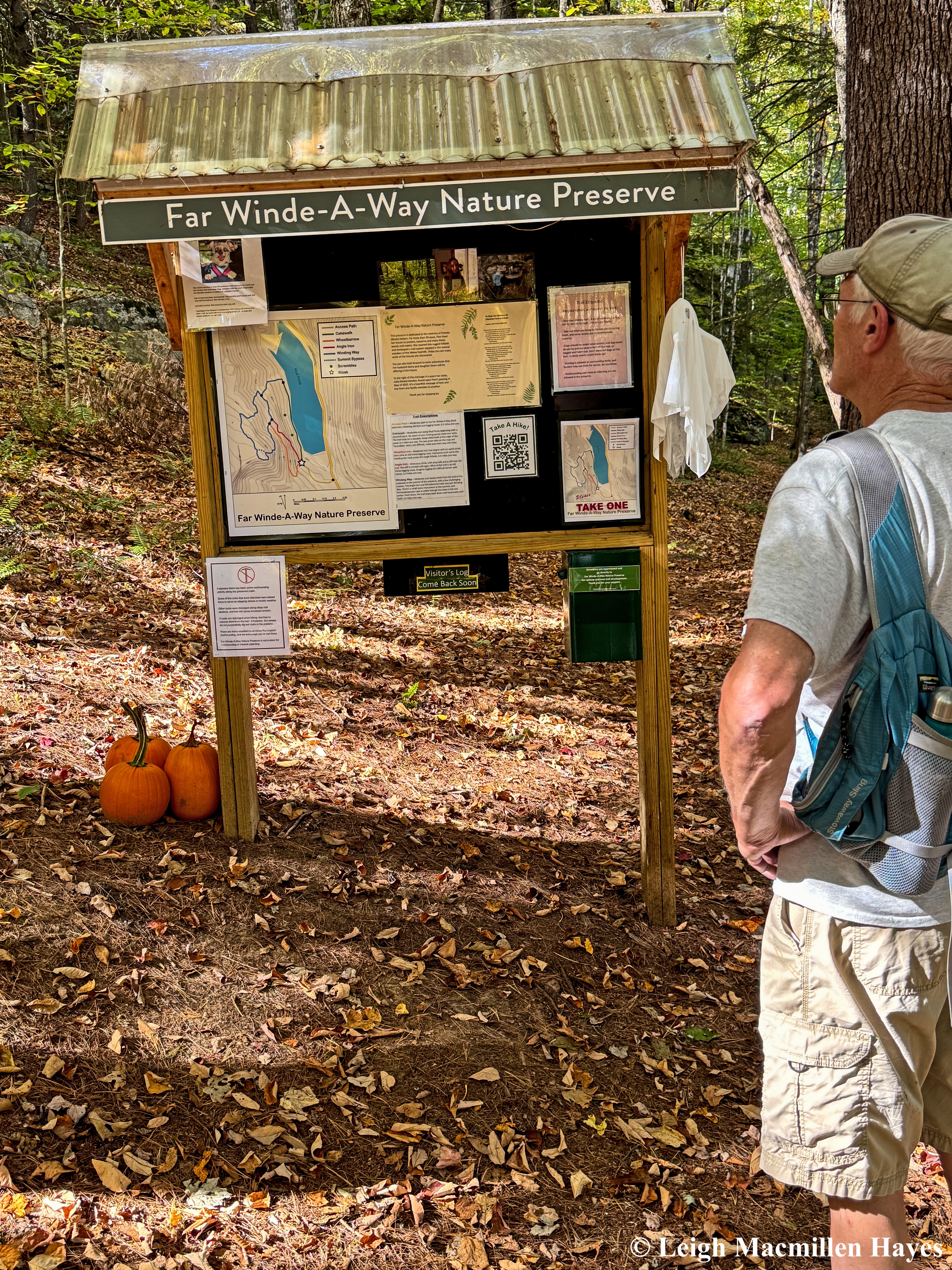
We’d been by a trail sign on the road a bunch of times to hike other trails in Greenwood, but until M mentioned it, we hadn’t really paid much attention. Until today. The kiosk is about .2 in from the road and I loved that there were pumpkins and a ghost to decorate it. And all the information hikers need to enjoy the area. Though My Guy goes without, I highly recommend trekking poles should you go forth on the well-marked trails. They are steep in places. And rocky in others. But that all adds to the fun.

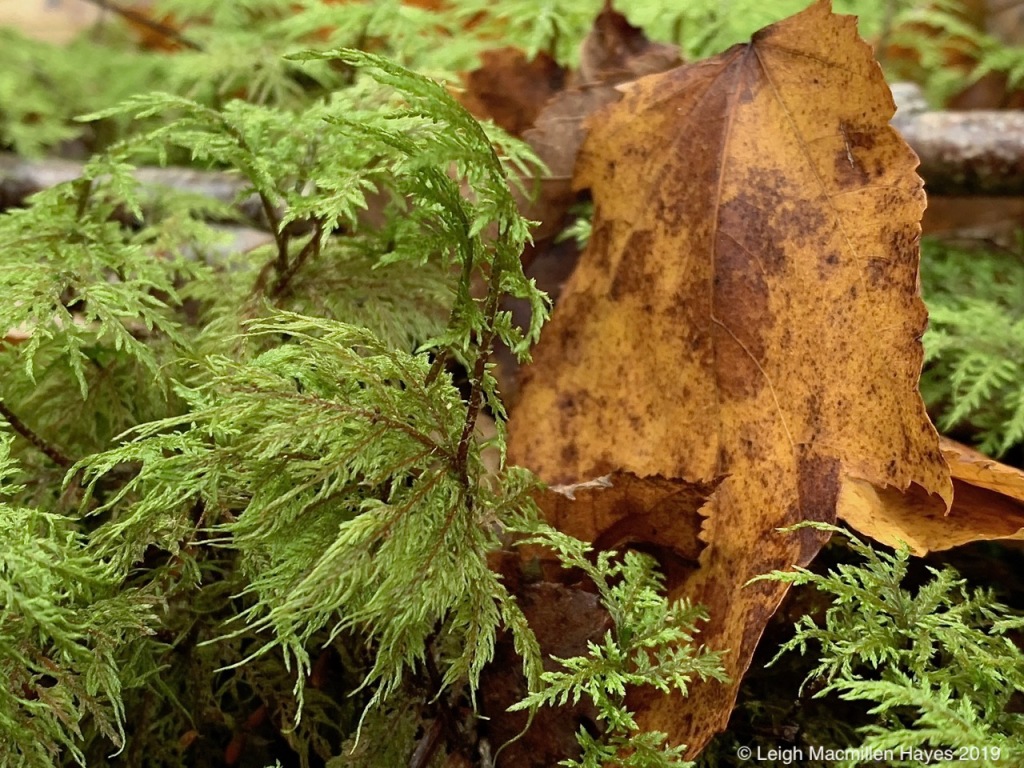
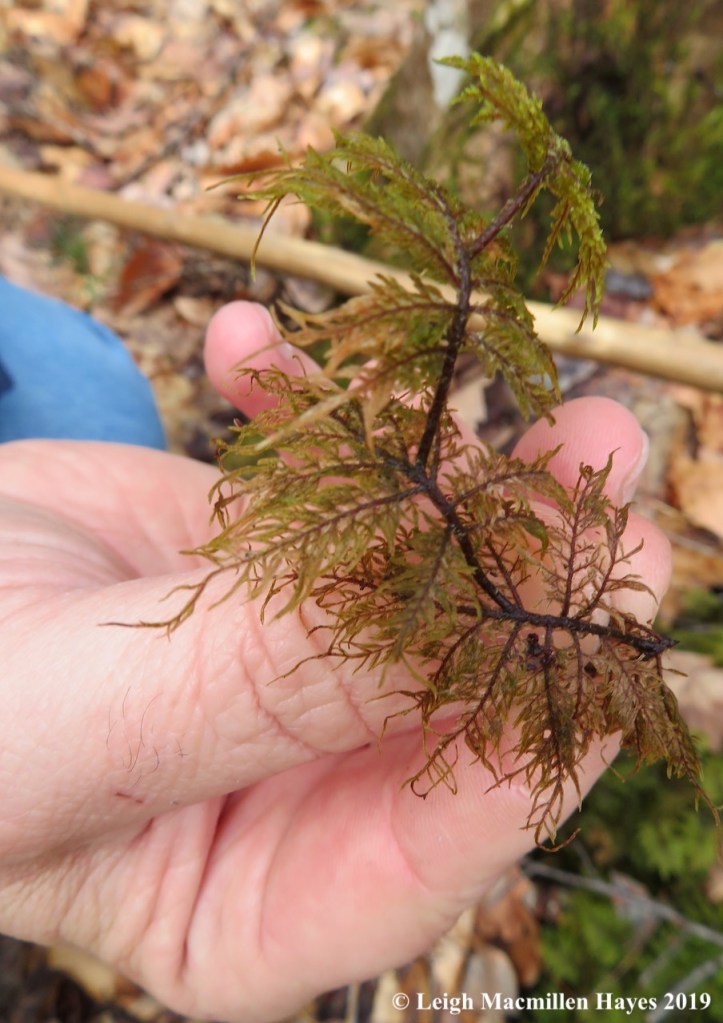
For me, the fun was enhanced by spotting examples of this pleurocarpous moss. It took me a while to learn that pleuro refers to side and carpous means fruit, thus they have a side fruit. They are low, tangled mats with branches that rise from the main stem.
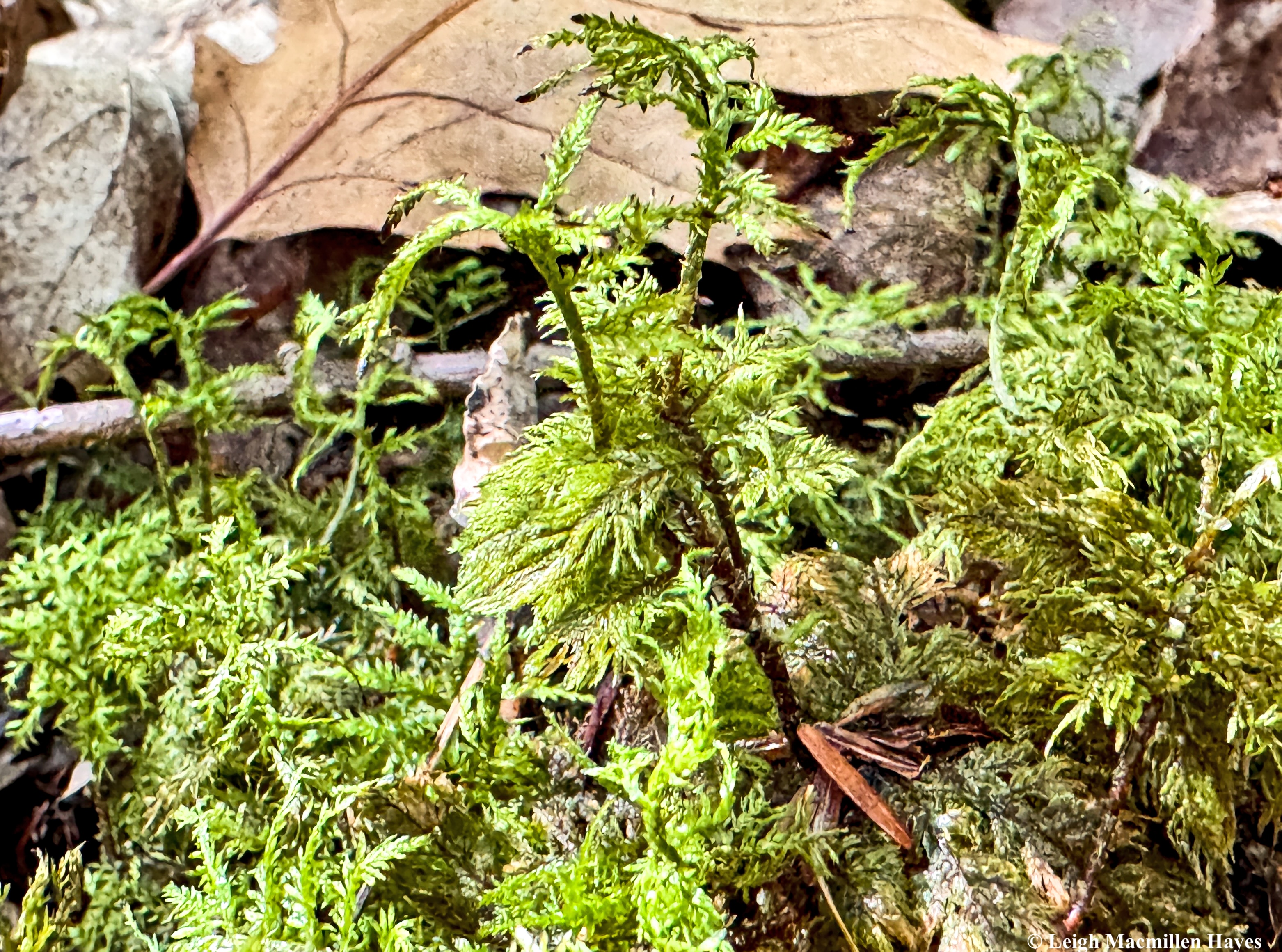
This particular moss is the Stair-step Moss or Hylocomium splendens. It prefers deep shade and damp conditions. Due to the dry conditions we’ve been experiencing, this year’s growth of a new step rising from last year’s stem probably didn’t occur until recently.

There were other mosses, giving the trail a fairy-land look at times, but also abundant were the Christmas Ferns, which decorated long stretches of our route.

And not to be left out were the Common Polypody that always give boulders a bad-hair day look.
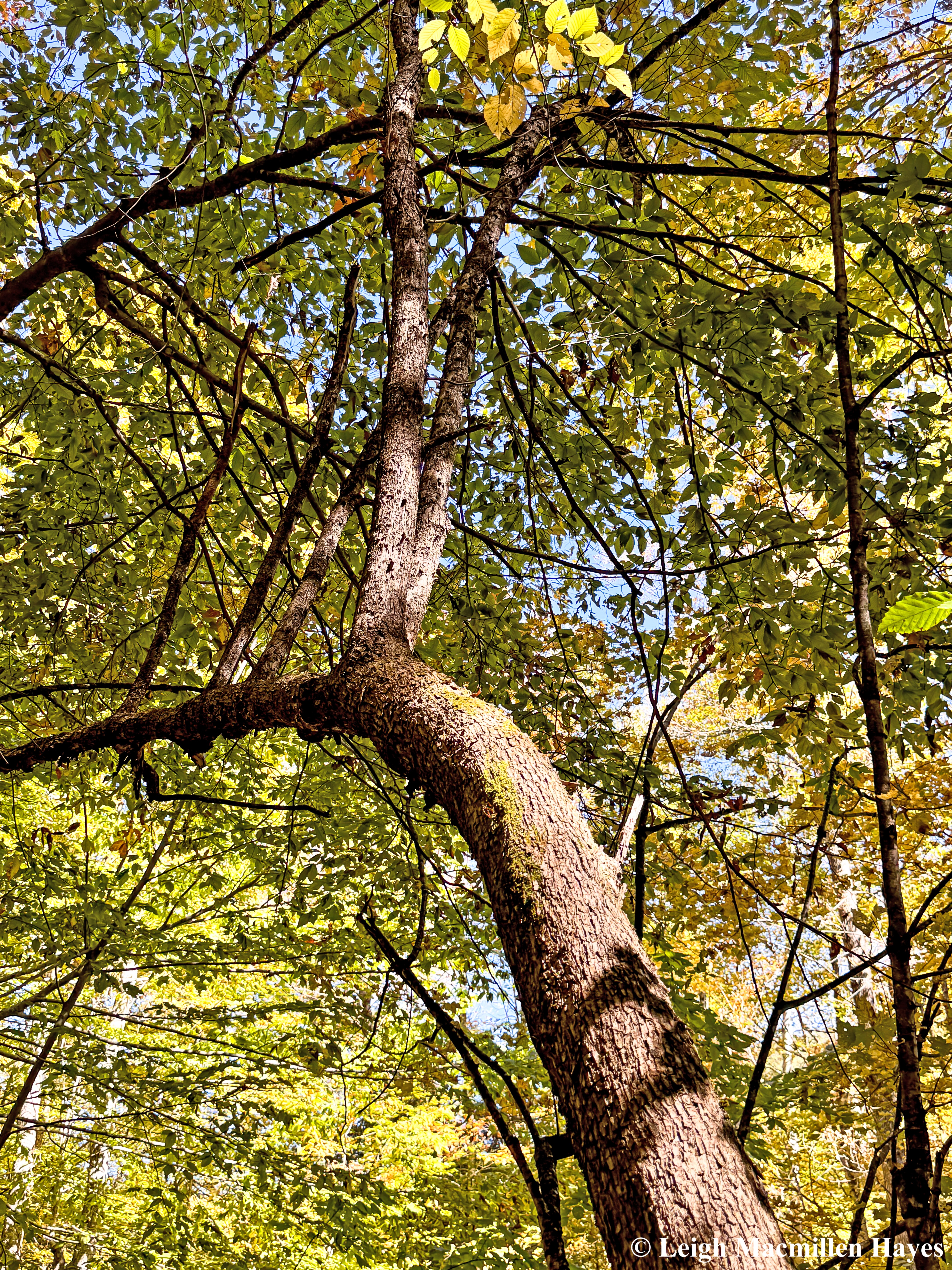
Those items would have been enough, but we realized from the start that we were in Hop-Hornbeam territory, and several surprised us. Typically, this is a tree that stands straight and tall, but a few must have been hit by other trees during storms perhaps, and their trunks had turned. Despite that, other branches took over and reached for the sun.

The other day some of us were looking at a sample of this tree and I asked them what they noticed about the bark. Their responses: shaggy and vertical lines. Spot on. Sometimes the bark is a bit tighter to the tree than this one we saw today, but it’s a great example of how this bark behaves. If you rub your hand on it, some pieces will flake off.
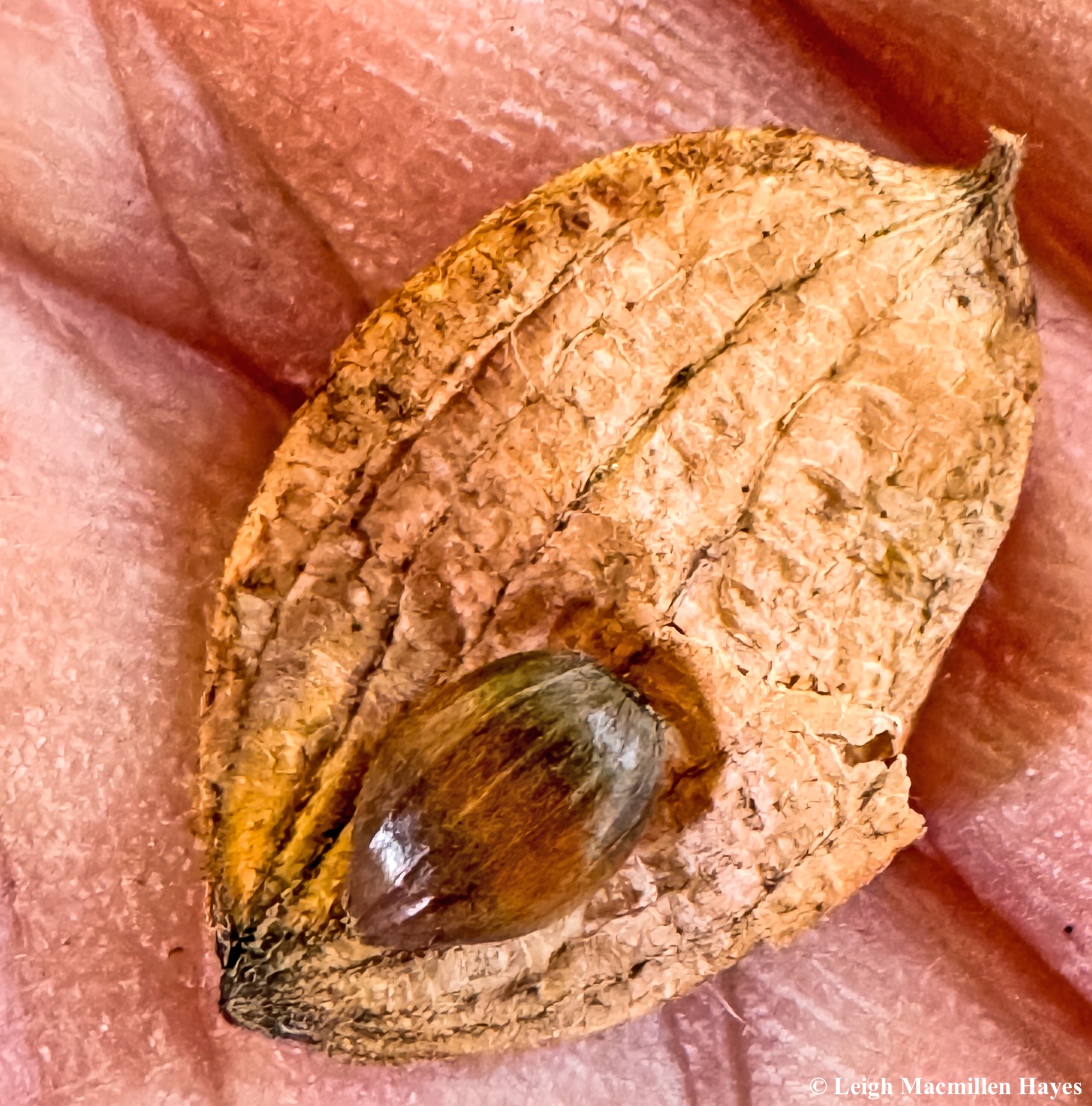
What I really wanted to see since we were in the presence of so many Hop-Hornbeams, were the hops for which it was named and BINGO! They were scattered along the trail, so I picked one up and slit the inflated paper-thin casing open and pulled out a seed. Such a small nutlet compared to the bouyant sac it was borne in.

The leaves are double-toothed and just as these emerged in the spring, male and female flowers would have developed. Being a member of the Birch family, the flowers are in the form of catkins, the male being longer and reddish-brown, while the female would have been shorter and green. Pollen is dispersed by the wind.

During the summer, the fertilized females form into cone-like structures, or strobiles, and their shape gives them their name for they look like hops.

I challenged My Guy to find some of these, which he’d never seen before. Knowing he likes a challenge, like counting Lady’s Slippers and looking for Bear Claw trees, I knew he’d pull through, and he did. But, he also developed Warbler Neck, for so high up in the tree does one need to look in order to spy the hops.

And so to counteract that, I suggested he look down. Success again. This guy is good!

At lunch log, we had a chance to enjoy the view and realized we were looking at Noyes Mountain, which we had hiked about a month ago.

With the camera, I could pull in the rocks on Noyes where we ate lunch before descending into an old mine below.

After circling around the summit of Far Winde-a-Way, where the views may be better in the winter, but we didn’t mind because that’s where we found some of the hops, we began our descent and noted a few artifacts, which got My Guy talking about the fact that metal cans for motor oil were replaced by plastic in the 1980s. He is Mr. Hardware, after all.

And I found a stone that had split naturally in quarters.

Well, maybe they weren’t exact quarters, but still it was worth a wonder to notice.

Another tree that we noticed as we descended was an American Basswood. The bark is similar to Northern Red Oak, but without the red in the furrows between the ridges, and the ridges are flat, almost brushed. Again, I rubbed my hand along the almost smooth surface.

I kick myself now, because I didn’t think to look for their fruits, but I did spot leaves on the forest floor. They are typically quite large, and have an assymetrical base, so if you fold a leaf in half, one base will be shorter than the other. The only other trees in our woods with this feature are the American Elm and Witch Hazel.

Next we reached a brook, where I’m sure the water cascaded over the moss-covered rocks in the spring when we experienced about fourteen rainy weekends, but today it was almost all dry, except for a few pools.

Creating a spider-web appearance on the pool’s surface were about a dozen Water Striders, so speedy in their dance routines.

And hiding at the edge, perhaps in hopes of capturing a Water Strider for a meal, was a Green Frog, with its dorsal lateral folds beginning behind its eyes and continuing down the edges of its back.

At the Cakewalk, for so a trail closer to Mud Pond is named, we met Mouth Rock. We’re pretty sure this wide-mouthed boulder ate all the cake because we never found any.
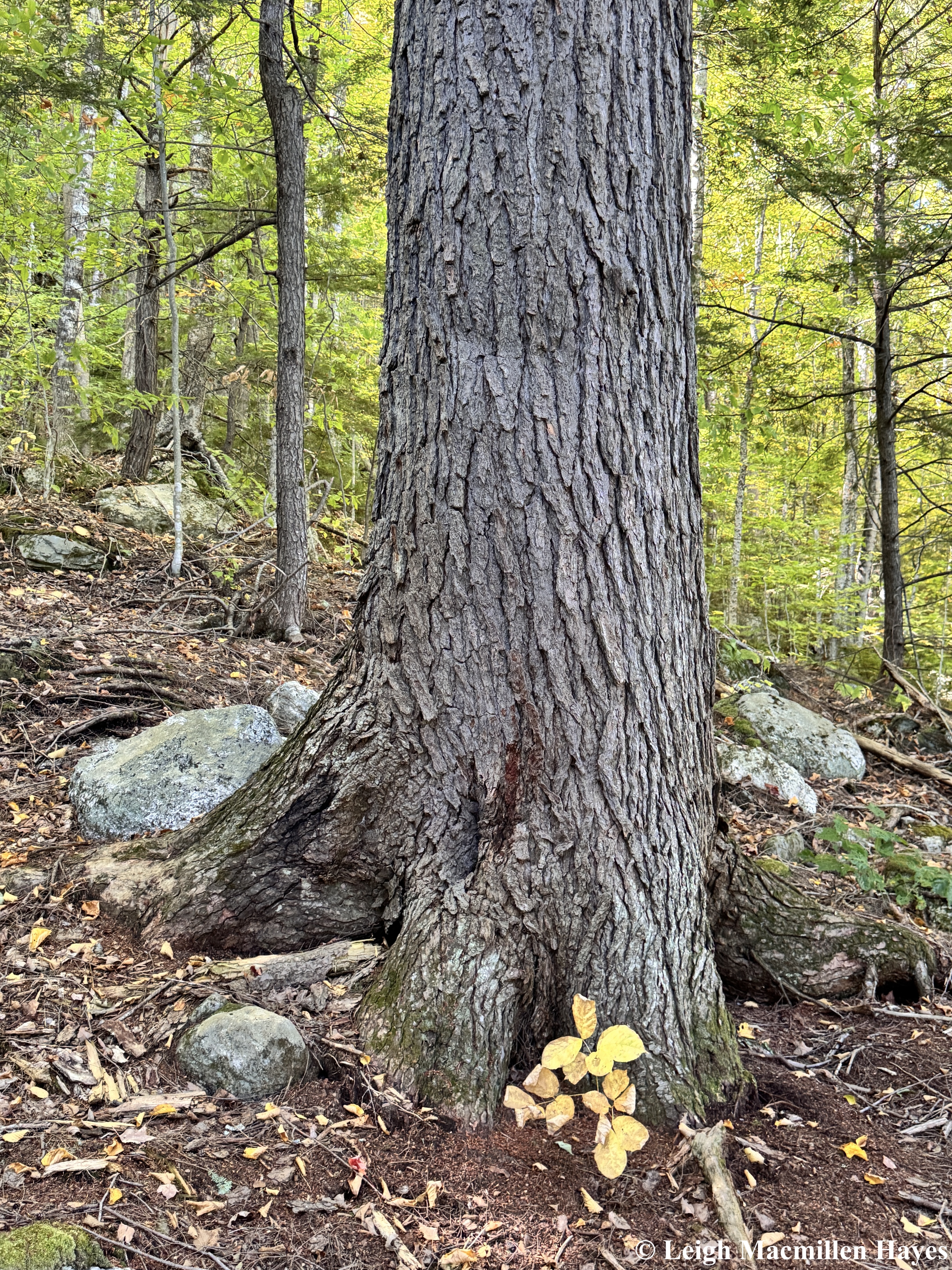
But our finds did include a champion! Co-champion actually–for the largest Eastern Hemlock in Oxford County according to Far Winde-A-Way Nature Preserve‘s website.

And I quote: The tree is: 10 feet in circumference, 90 feet tall, with a crown spread of 60 feet.
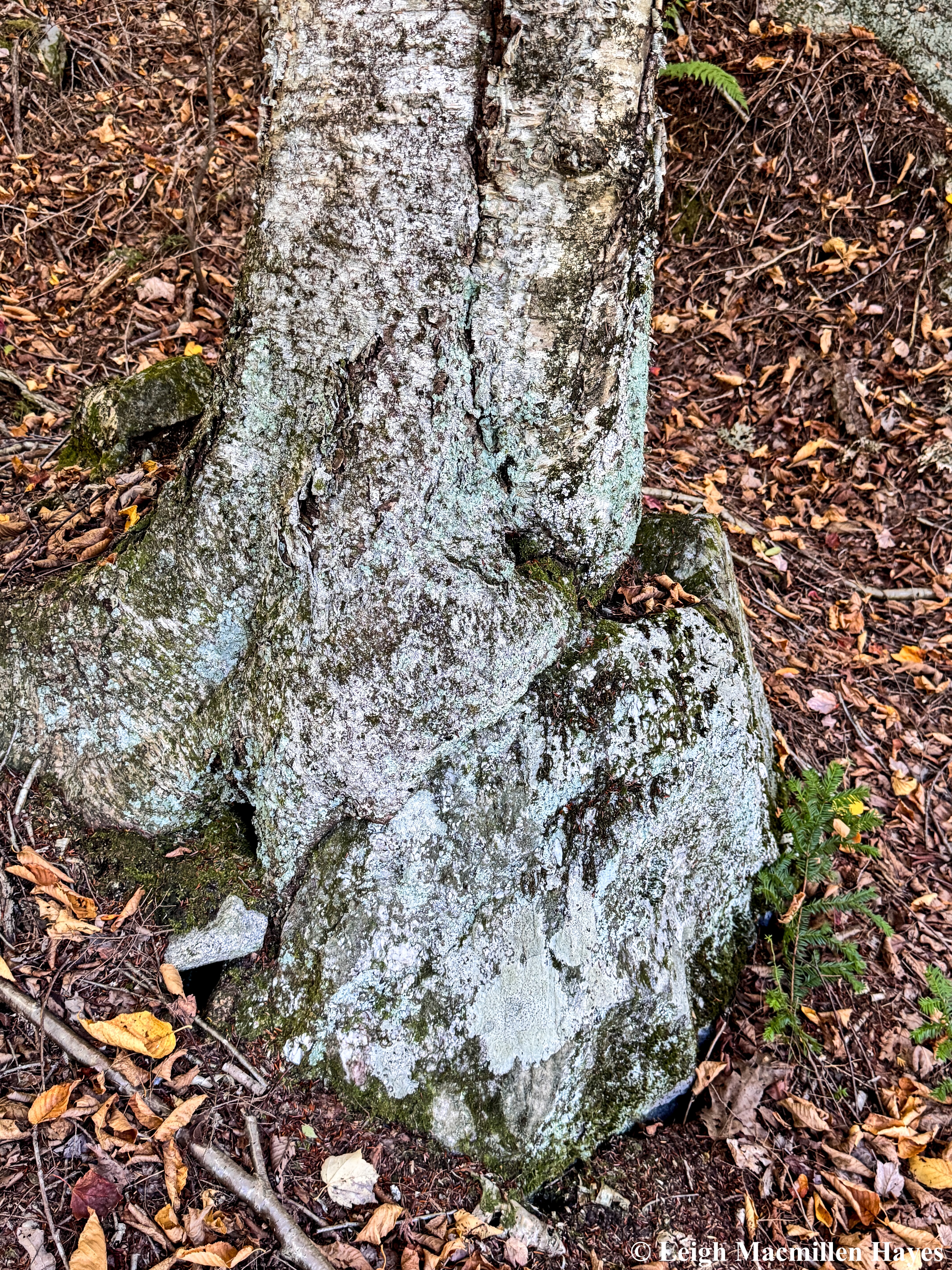
We also found this great specimen. Rock or tree? Tree or Rock? Rock and tree! Tree and rock!

Where does one end and the other begin for they looked like twins. Maybe that’s what happens when you spend so much time together. Kinda like some people looking like their dogs (we had a neighbor when I was growing up who always had beagles and he really did look like a beagle himself. Of course, we never told him that.)

Anyway, this is a Yellow Birch that got its start in the moist soil that probably formed on the moss atop the rock and then sent its roots downward and trunk upward, but really, the two could have been one.
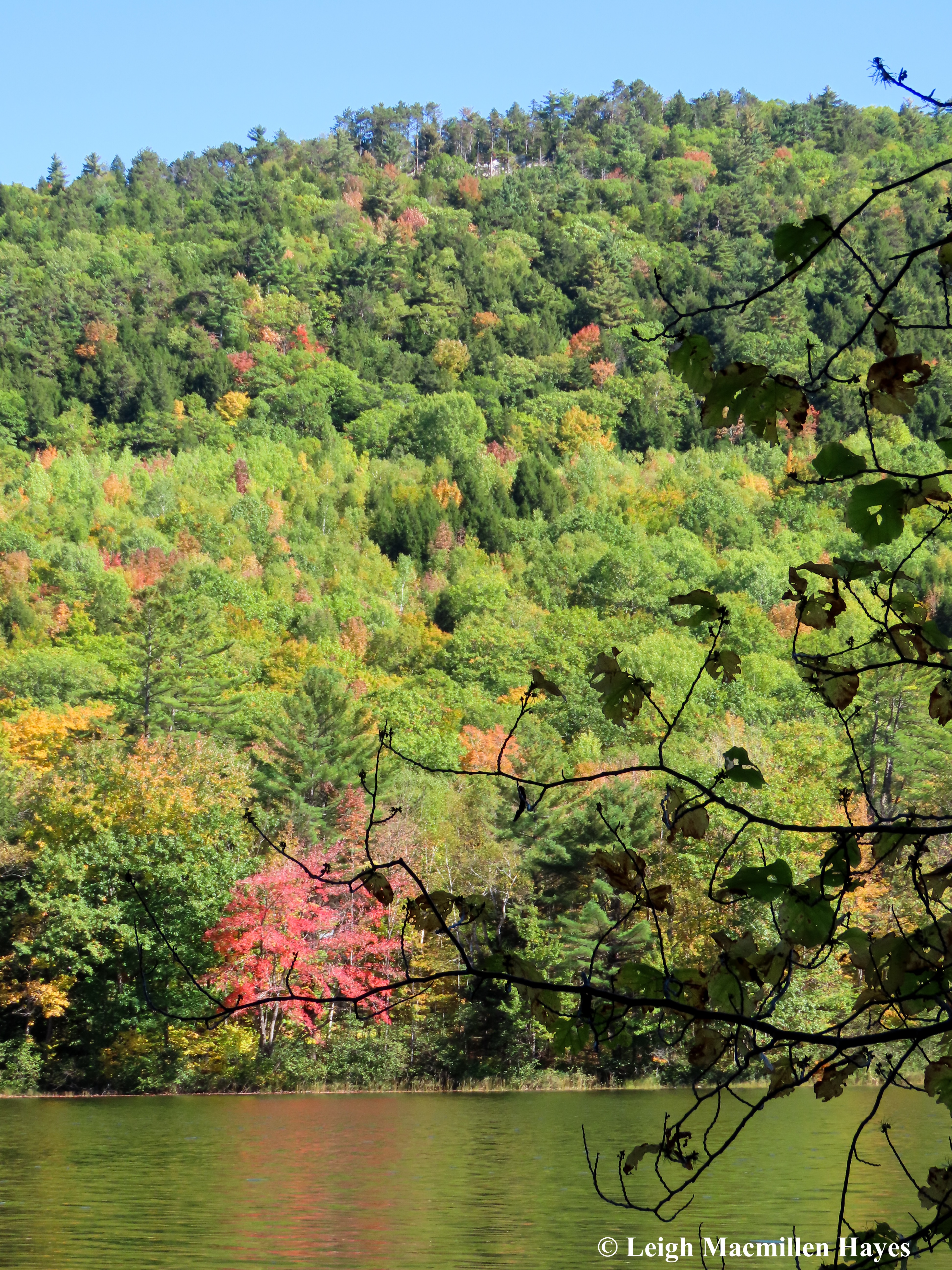
One of our last views before heading back up to the kiosk, was of Noyes Mountain again, only this time it included Mud Pond. And our early fall foliage season. Foliage reflections are among my favorite.

I’ll close this Far Winde-a-Way Mondate by giving thanks not only for My Guy and his love of new adventures, but also for the family that made these hiking trails available so that all of us could enjoy them: The husband and daughter of the late Pam Nelson. “This preserve is dedicated to the memory of Pamela (Roots) Nelson. For more than 30 years, Pam lived her dream to protect, conserve and enjoy these woods and waters. She roamed this rugged hillside and developed a trail system steeped in the natural wonders of the Maine foothills. Today you can enjoy some of the beauty she discovered.”

Pam passed away in 2022, but her family carries on her tradition, and this poem at the kiosk was written by her sister.

Thank you to M for suggesting Far Winde to us, and to the Nelsons for sharing it with all of us.
Wandering and Wondering the Jinny Mae Way

This morning I chose to channel my inner Jinny Mae in honor of my dear friend who has been in isolation for medical reasons since last January. That meant I had to try to slow down and be sure to notice. And ask questions. Mostly it meant I needed to wonder.

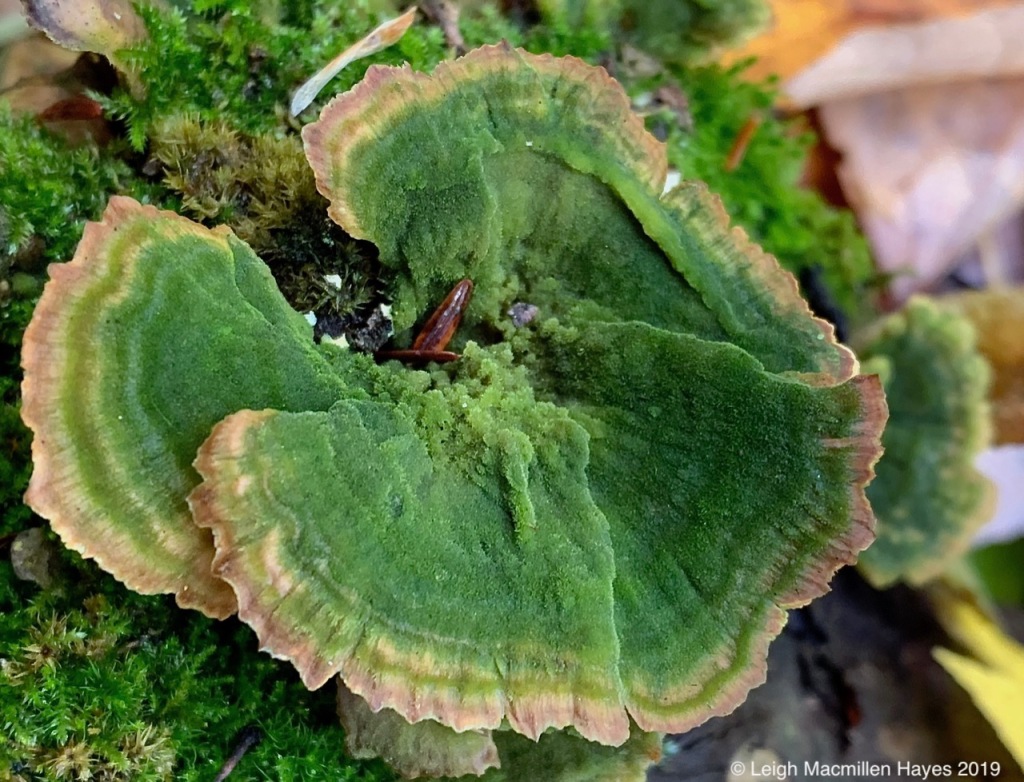
She’s a lover of fungi, so I knew that she’d pause beside the Violet-toothed Polypores that decorated a log. The velvety green algal coating would surely attract her attention. Why does algae grow on this fungus?

I didn’t have the answer in my mind, but a little research unearthed this: “As is the case for lichens, the algae on top of a polypore arrangement appears to benefit both partners. The algae (usually single-celled ball-shaped green algae), being filled with green photosynthetic pigments, use sunlight to make sugars out of carbon dioxide gas. Some of these leak out and are absorbed and consumed by the fungi as an extra source of energy-rich organic carbon. The fungus, in turn, provides a solid platform upon which the algae can set up shop and grow into dense green communities.” (~rosincerate.com)

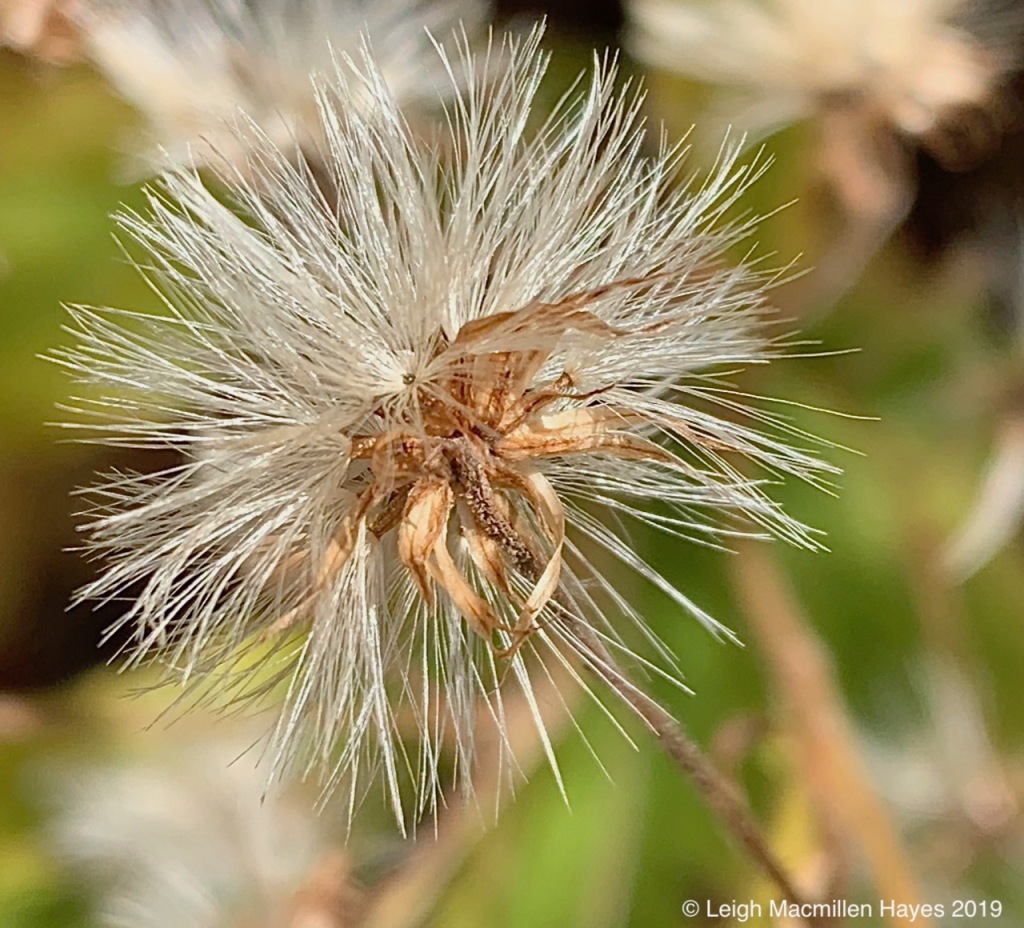
The next stop occurred beside the fall forms of asters where the seeds’ parachutes could have easily passed as a flower. What’s a seed’s parachute and why does it have one? The parachutes are made up of hair-like structures. As an immobile parent plant, it needs to disperse its young so that new plants can grow away from those pesky competitive siblings. And maybe even colonize new territories. At this stage of life, the seedy teenager can’t wait to fly away from home and start its own life. Do you remember that time in your life?

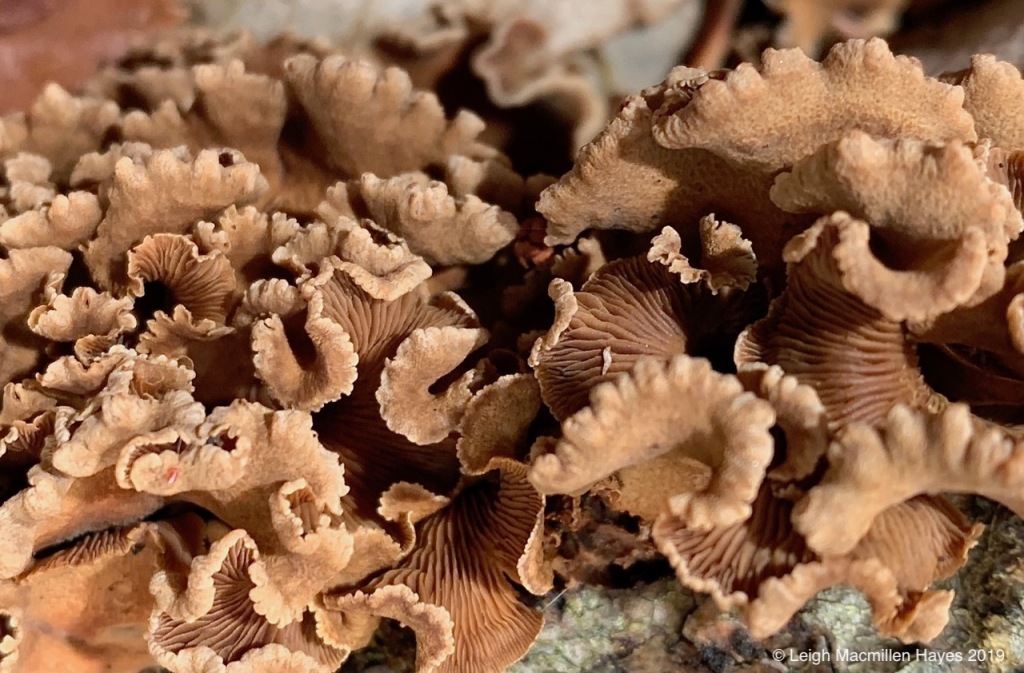
And then, it was another fungus that asked to be noticed. Those gills. That curly edging. And crazy growth structure. Jinny Mae would have keyed in on it right away, but it took me a while. I think it’s a bioluminescent species, Night Light aka Bitter Oyster (Panellus stipticus). But as I often say, I don’t know mushrooms well, so don’t look to me as the authority. What would Jinny Mae ask? Hmmm. What makes it glow? That’s even further beyond my understanding than naming this species. But I can say that it has to do with enzymes that produce light by the oxidation of a pigment. And have I ever actually seen such a glow? NO. But one of these nights ;-)

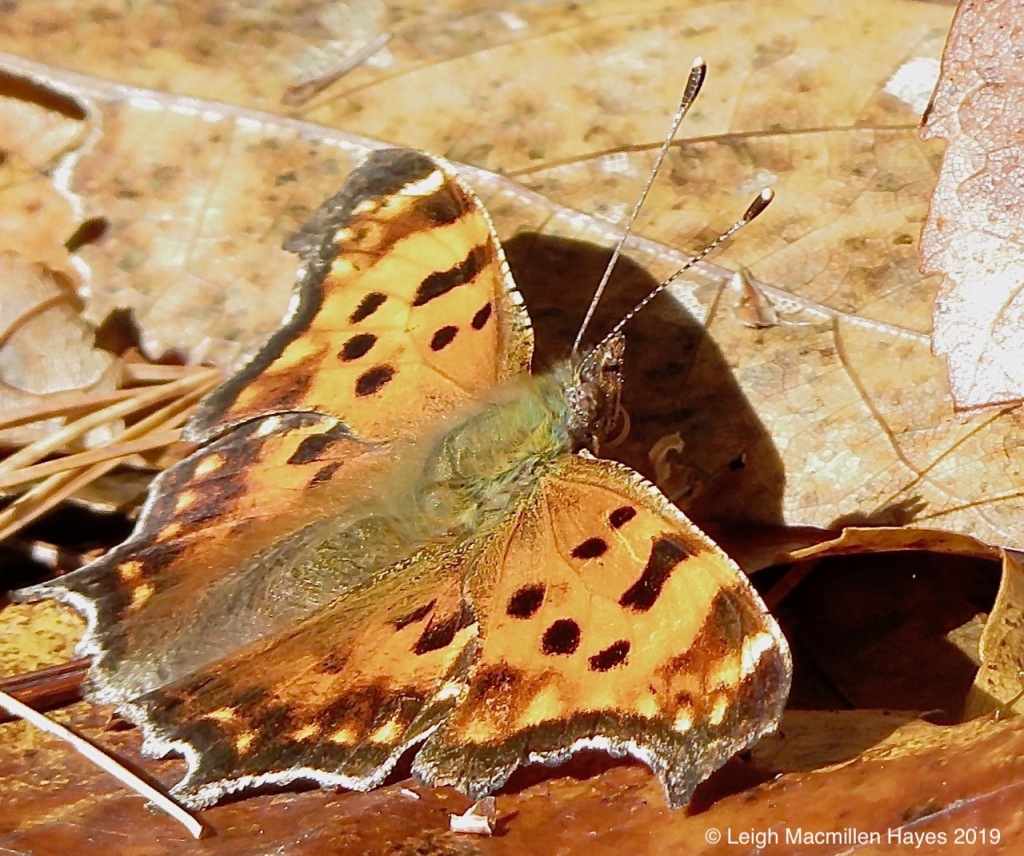
As I continued to walk along, I noticed movement and realized I was in the presence of a butterfly. A butterfly I don’t recall ever meeting before. It had the markings of several familiar species, but it wasn’t until I arrived home that I figured out its name. Do you see its curled proboscis?

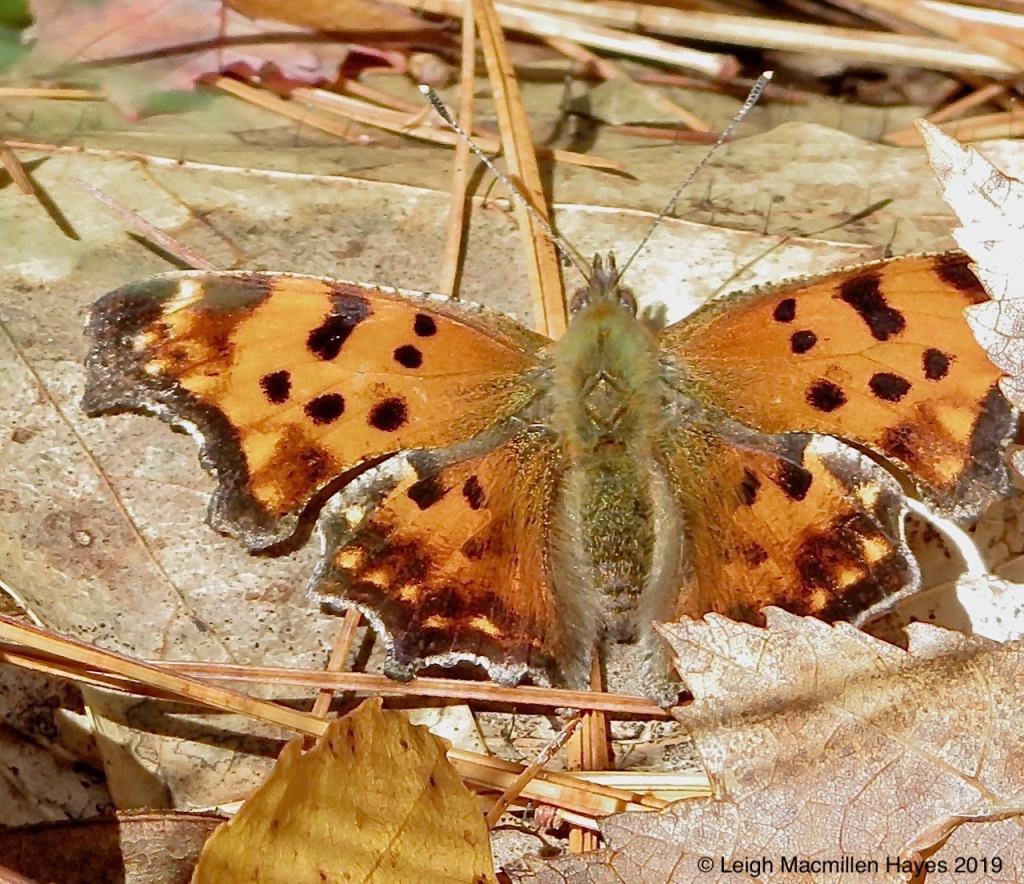
Jinny Mae would have been as wowed as I was by this species that I can confidently call a Faunus Anglewing or Green Comma. Typically it flies from May to September, so why today? I got to wondering if this week’s Nor’easter caught it in a more southern clime and forced it north on the wind? But I discovered that its a boreal species and was perhaps at the southern end of its range. Maybe the storm did have something to do with its presence today after all.

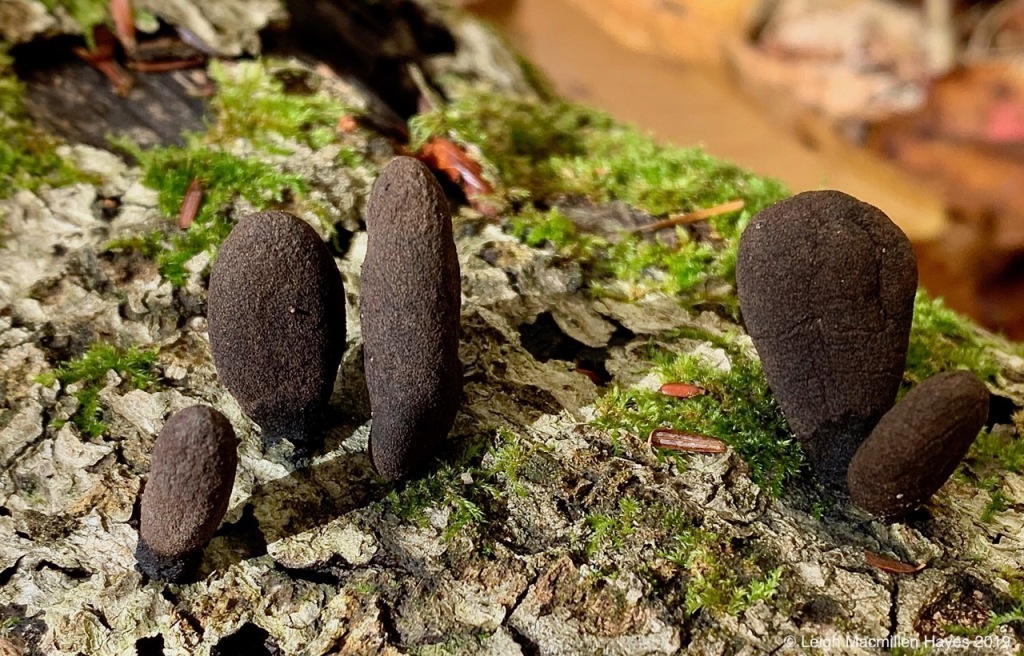
Eventually the journey became a mix of following a trail and bushwhacking. Both provided examples of the next moment I knew Jinny Mae would love. Dead Man’s Fingers, all five of them, in their fall form, the lighter color spores having dispersed and the mushroom now turning black. Why the common name for Xylaria longipes? According to Lawrence Millman, author of Fascinating Fungi of New England, “Certain African tribes believe that if you’ve committed a crime, and you rub the spore powder from an immature Xylaria on your skin, the police won’t identify you as the culprit.”

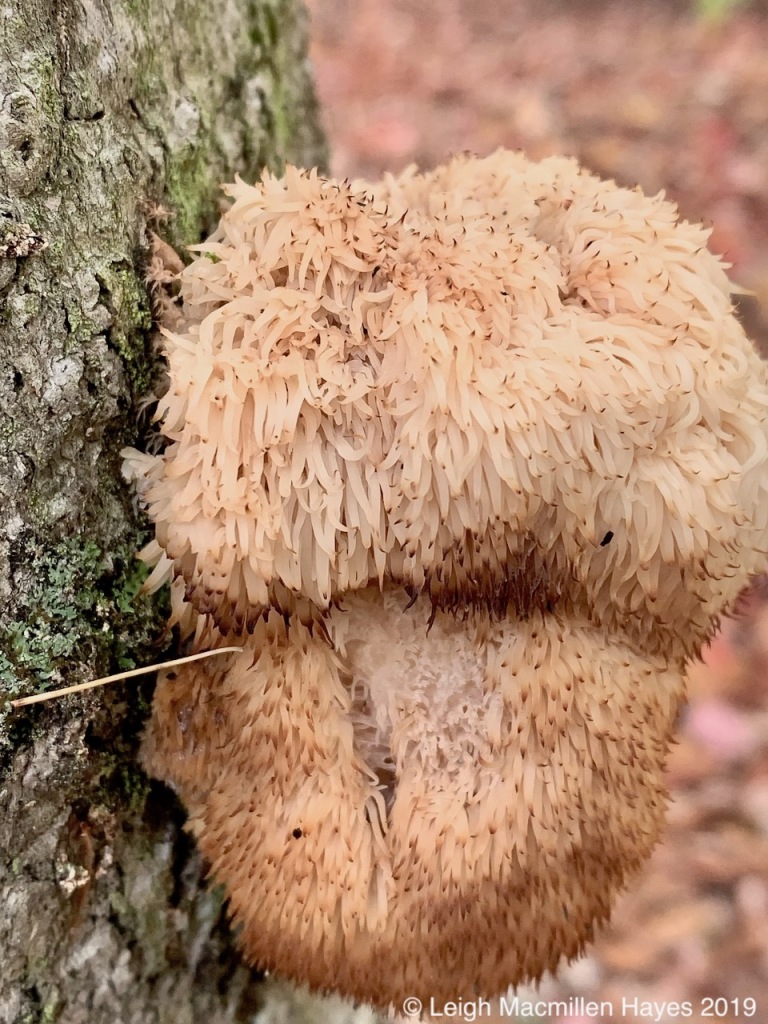
It seemed these woods were a mushroom garden and one after another made itself known. I could practically feel Jinny Mae’s glee at so many fine discoveries. Resembling cascading icicles (I was wearing a wool hat and my snowpants actually, which turned out to be overdress after three hours), I wanted to call it Lion’s Mane, but to narrow down an ID decided to leave it at the genus Hericium. I suspected Jinny would agree that that was best and it should just be enjoyed for its structure no matter who it really was.

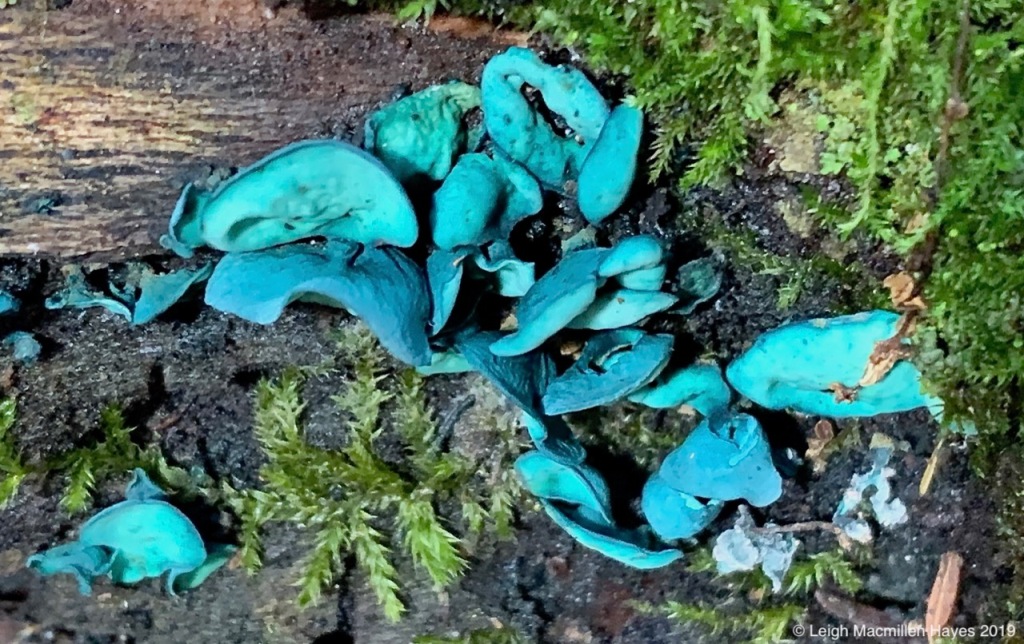
Nearby, another much tinier, in fact, incredibly teenier fungus could have gone unnoticed had the sun not been shining upon it. I was pretty certain 2019 would be the year that would pass by without my opportunity to spy this one. But, thankfully, I was proven wrong. Forever one of my favorites, I knew Jinny Mae also savored its presence. The fruiting body of Green Stain are minute cup-shaped structures maybe 1/3 inch in diameter. I used to think when I saw the stain on wood that it was an old trail blaze. And then one day I was introduced to the fruiting structure and rejoice each time I’m graced with its presence. There was no reason to question these delightful finds. Noticing them was enough.

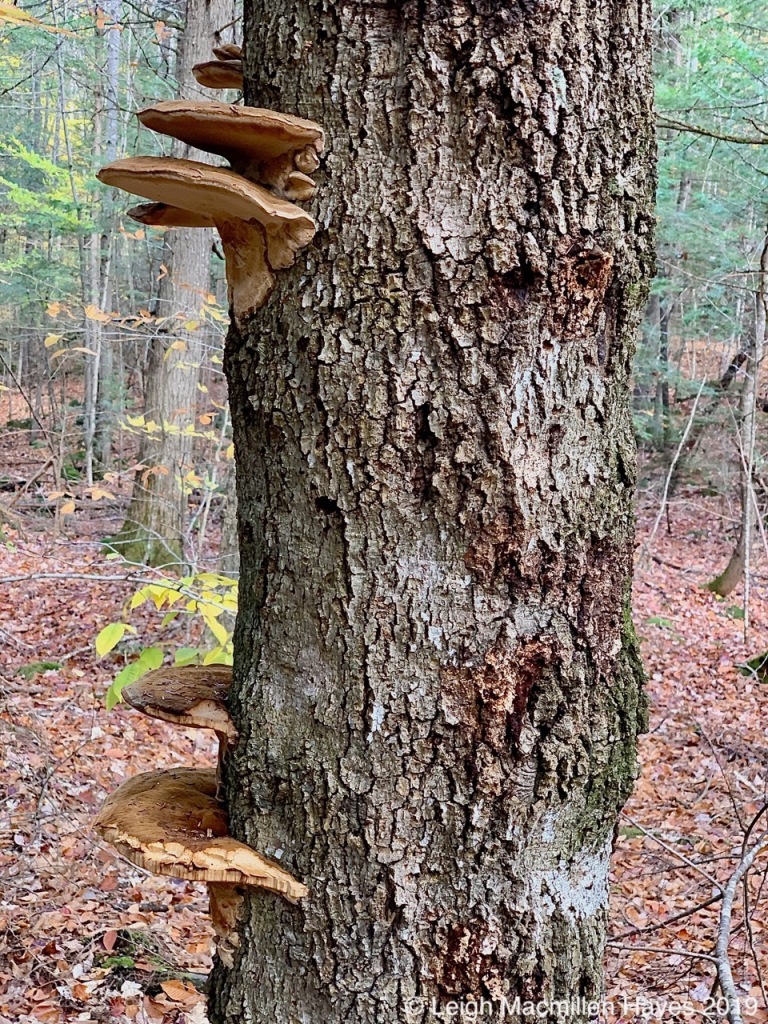
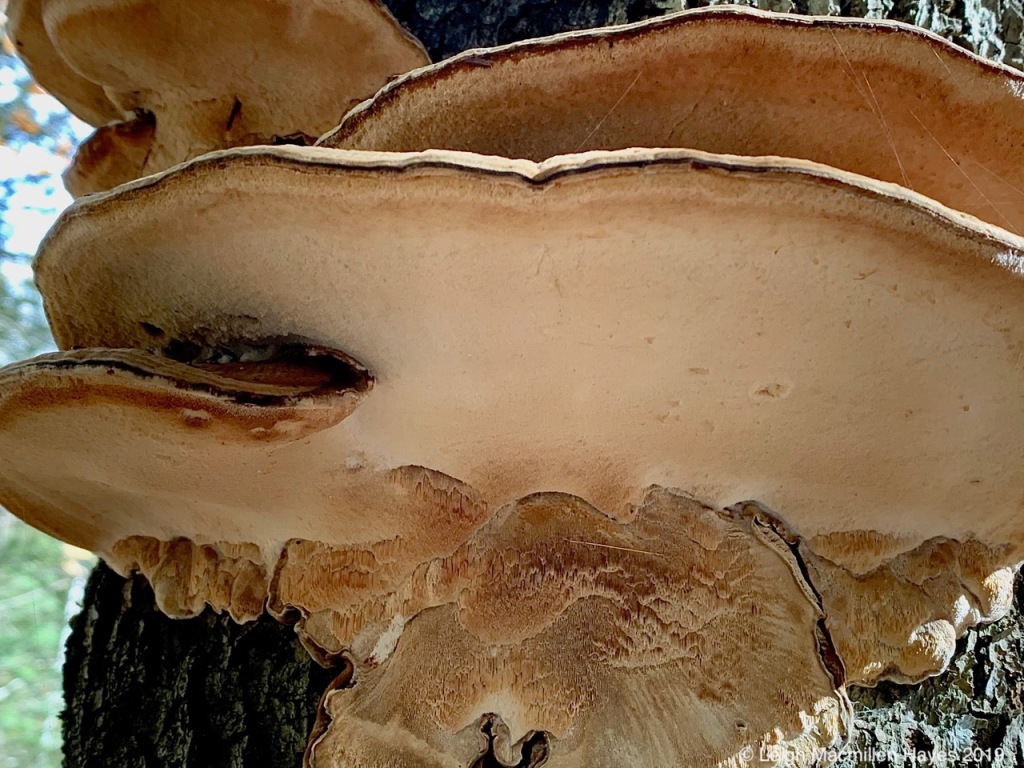
In complete contrast, upon a snag nearby, grew a much larger fungus.

Part of its identification is based on its woody, shelf-like structure projecting out from the tree trunk. Someone had obviously been dining upon it and based on its height from the ground and the tooth marks, I suspected deer.

The pore surface, however, is the real reason to celebrate this find for it stains brown and provides a palette upon which to sketch or paint, thus earning it the common name of Artist Conk. But the question: while some mushrooms fruit each year and then if not picked, rot and smell like something died in the woods, what happens with a shelf fungus? The answer as best I know: A shelf fungus adds a new layer of spore tissue every growing season; the old layer covered by the new one, which look like growth rings in a tree.

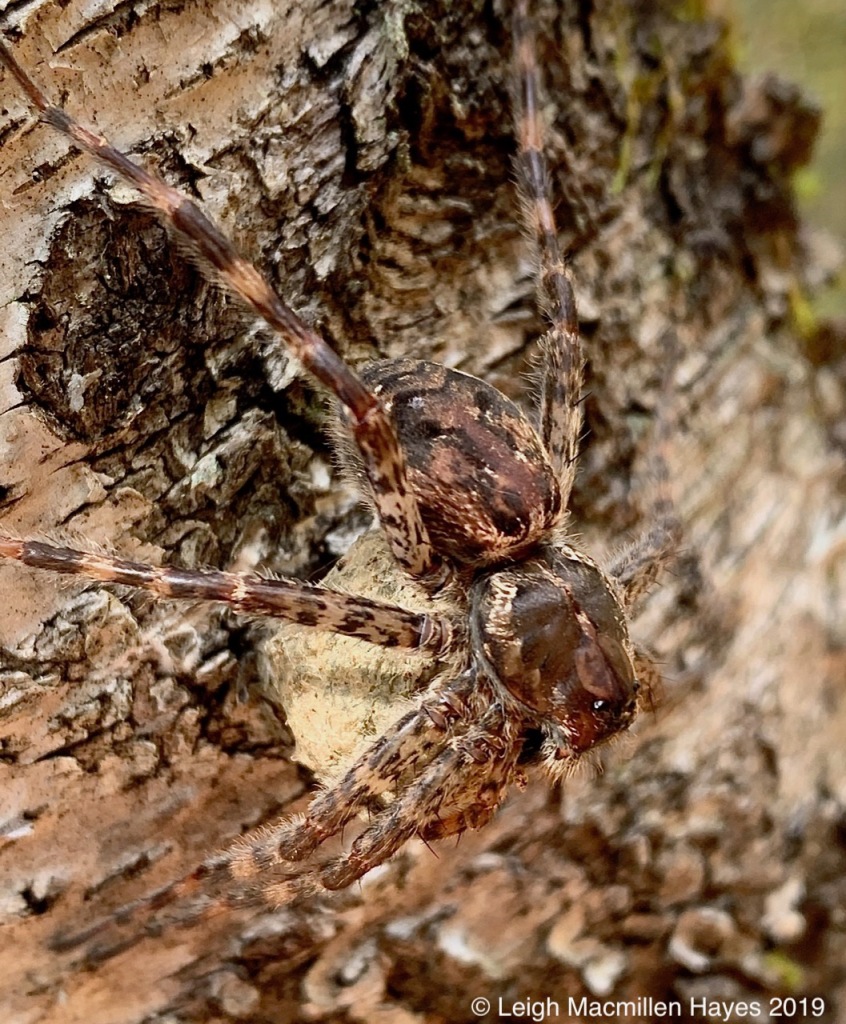
A lot of the focus on this morning’s walk tended to be upon the fungi that grew in that neck of the woods, but suddenly something else showed its face. Or rather, I think, her face. A Wolf Spider. Upon an egg sac. Super Mom though she may be for making a silk bed and then enveloping her young in a silk blanket, and guarding it until her babies hatch, this spider did not make the slightest movement, aggressive or not, as I got into its personal space. Usually the mother dies either before or after her babies leave the sac. What would Jinny Mae think? Perhaps that for some reason Momma waited too long and maybe the cold weather we’ve experienced upon occasional lately got the better of her?

I don’t know entirely what Jinny Mae would think, but I have a pretty good idea because the reality is that today, she and I traveled the trail together for the first time in forever. For each of these finds, it was like we played trail tag–first one spying something wicked cool and then the other finding something else to capture our attention as we tried to capture it with our cameras.

We caught up. We laughed. We noticed. We questioned. We laughed some more.

Our three-hour journey drew to a close as we revisited the Stair-step Moss that grows in her woods.

I’m still giddy about the fact that I got to wander and wonder the Jinny Mae way today.

P.S. Jinny Mae returned to Super Momma spider a couple of days later and as she paused to take a photo, Momma scooted into a tree hole, carrying her sac. She LIVES.

Peeking with my Peeps

As has been our custom for the past six years, on a quarterly basis an email is sent out with a date and location and at the agreed upon time any number of grads, teachers, and mentors from the Maine Master Naturalist Lewiston 2013 class gather. Today was one of those days.

The plan was to explore a vernal pool or two at the Cornwall Nature Preserve on historic Paris Hill, but . . . it didn’t take us (Pam, Beth, Alan, Dorcas, and yours truly hiding behind the lens) long to get distracted when we saw green poking through the many shades of brown on the forest floor.

Together, we scrambled through our brains searching for the name. With the season finally feeling like it’s transitioning, we realized we have to dust off the floral flashcards in our minds and start reviewing them. And then it came to us. One year ago, on May 5, we had seen the same at Smithfield Plantation as we celebrated Cinco de Mayo, Naturally. Then, however, we had keyed it out minus the flower. Today, the memory of last year’s ID slowly sifted to the forefront and by its leaves and colonial habit, we felt safe to call it Clintonia borealis or Bluebead Lily.

A few more steps and we started dipping containers into a potential vernal pool that was really too shallow and offered no apparent key characteristics. But . . . there was an owl pellet filled to the brim with hair and bones, the one sticking out by central vein of the leaf a hip bone. (Yeah, so I may sound like a smarty pants, but Dorcas pulled it out and quickly identified the bone by its structure.) Some little mammal, or two, or three, had provided a bird with a meal.

Stair-step Moss (Hylocomium splendens) was the next great find. I would have dismissed it as Big Red Stem or Pleurozium schreberi, and in so doing missed its finer points. Do you see how each year’s new growth rises from the previous, rather like ascending stair steps?

And then there was another new learning, for I’m always referring to this species of fungi as jelly ear or wood ear. But, with Alan the fungi fun guy in our midst, we learned that it’s really Brown Witch’s Butter or Exidia recisa. (Drats–it’s so much more fun to say Auricularia auricula.)

As we admired the Exidia recisa, we realized others were doing the same for we’d interrupted a slug fest. If you bump into Alan Seamans sometime, do ask him about the numbing qualities of slugs. ;-)

A few more steps and we began to notice trilliums, especially the reds with their leaves of three so big and blossoms hiding. All of a sudden we know the flowers are going to burst open and we can’t wait to witness such glory.

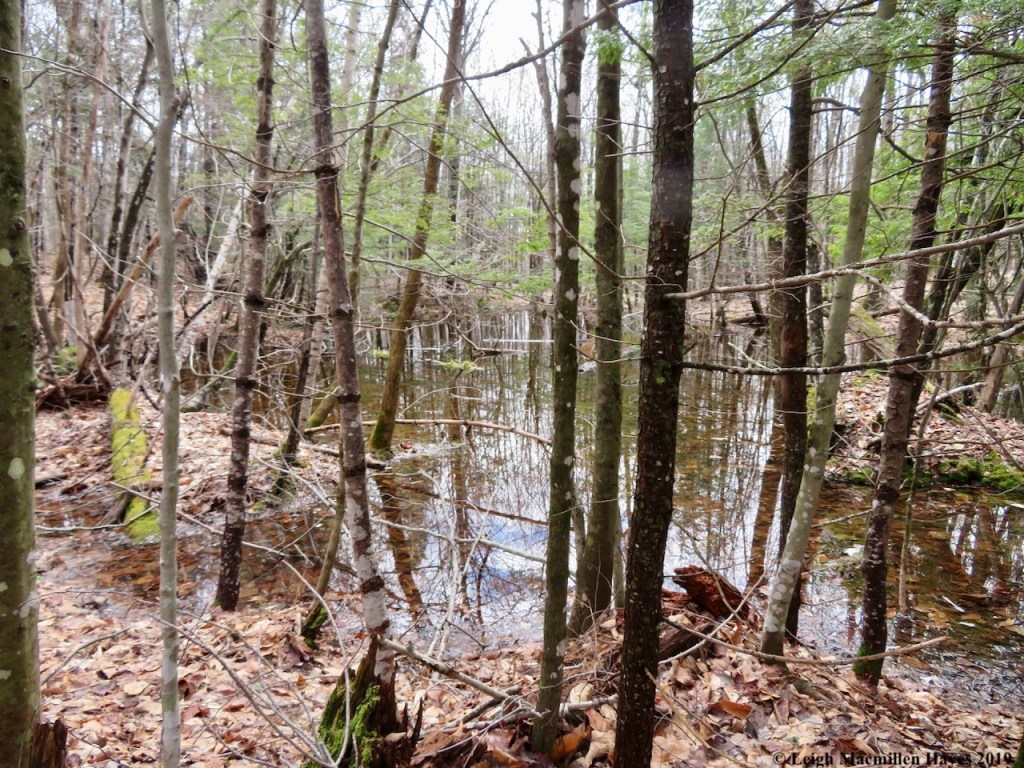
At last we reached the pool of choice, located maybe a half mile from the parking area. Two years ago, MMNP students from the South Paris class discovered Fairy Shrimp in this pool.

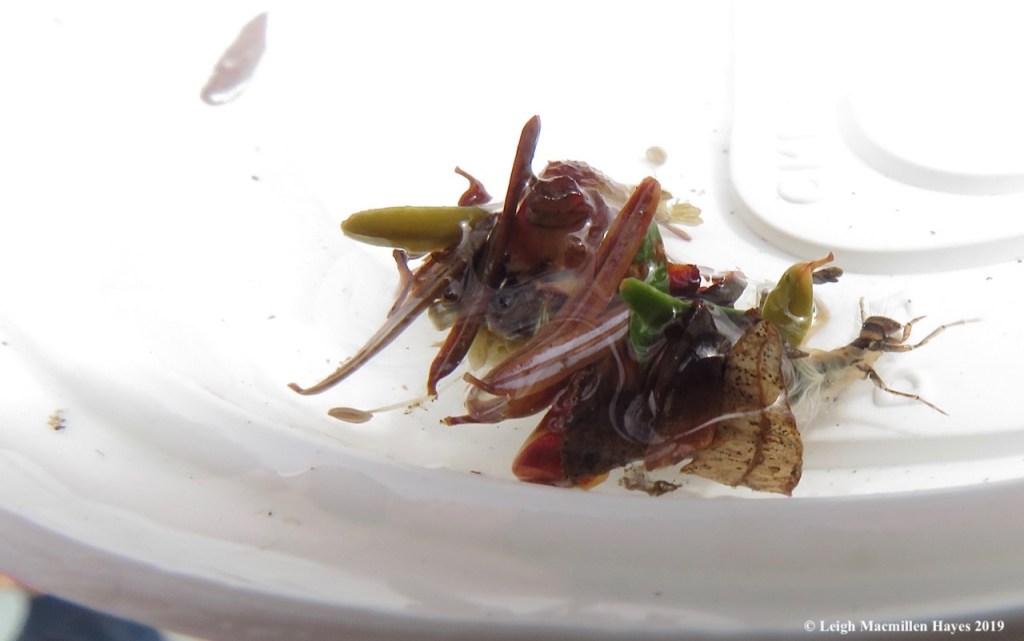
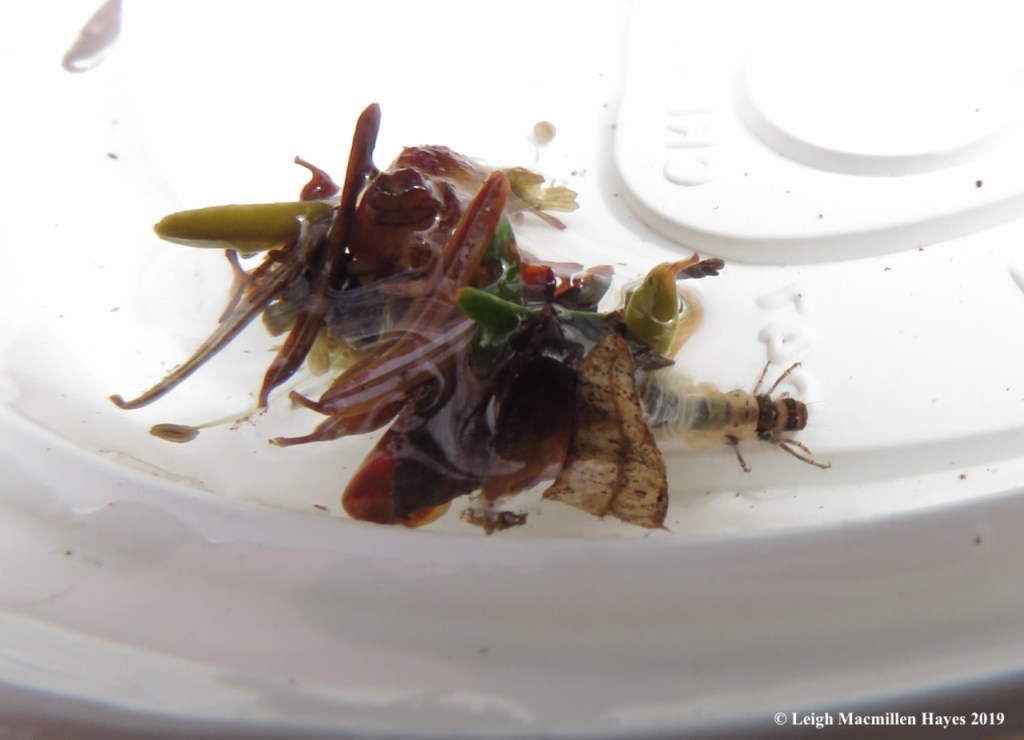
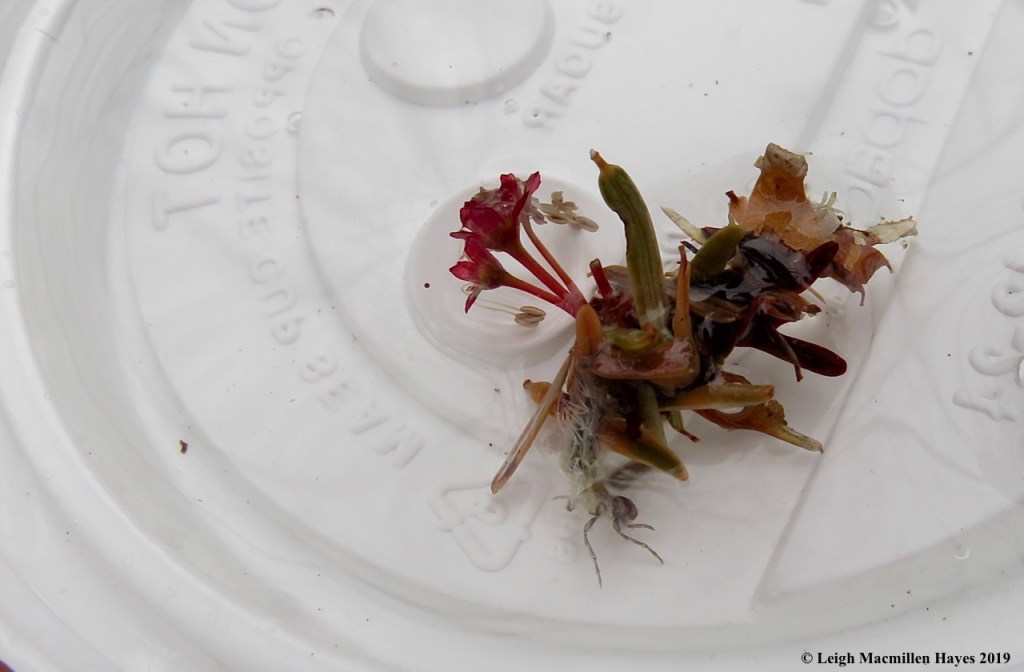
Our best finds today were log cabin caddisflies! At this point in time, the caddisflies are in their larval stage and as such, they construct their temporary shelters from available materials. Think of them as the original recyclers.

Should a predator be about, like a hermit crab, the caddisfly can retreat into the house of needles or leaves or stones or whatever its preferred building material might be. Apparently, it didn’t mind us and we were honored to watch as the elongated body extended forth while it searched for food. In its larval form, these aquatic insects have a hardened head and first thoracic segment, while the abdomen remains pale and soft. Can you see the three pairs of legs?

The cool thing about caddisflies is that though they may use similar construction materials, no two are alike. Beth called them works of art.

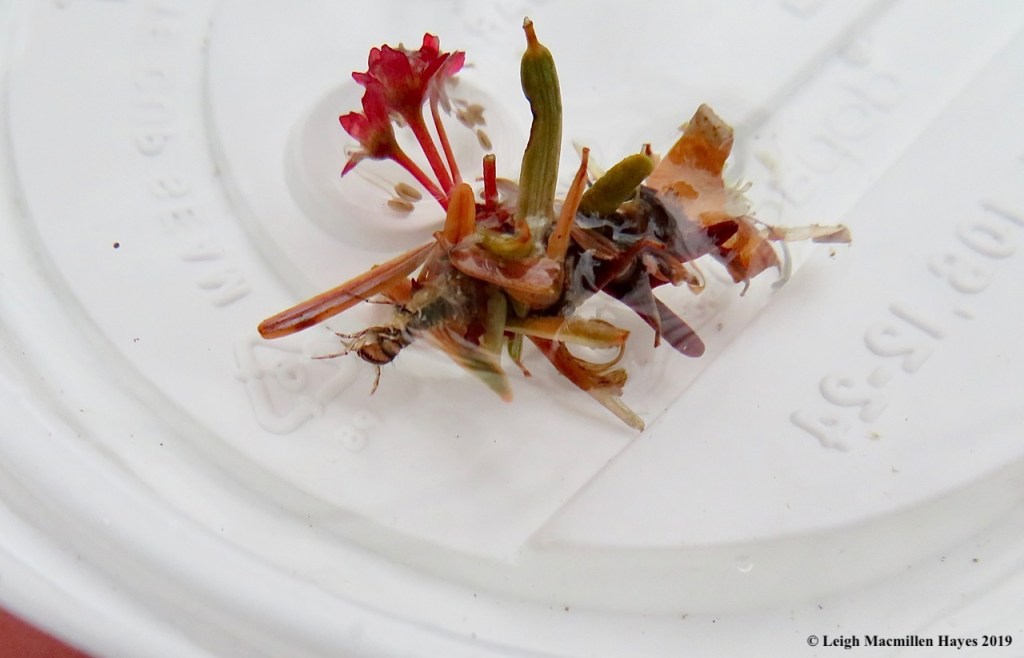
I referred to this one as a she for the case included a Red Maple bouquet.

If you look closely, you might also note some filmy gills on the abdomen. And the grayish thing the Mrs. approached and a second later ignored. It seemed rather leech-like in its behavior, but I think it may have been a Planaria, which is a tiny unsegmented flat worm.

As we dipped for insects, we also noted plenty of Spotted Salamander spermatophores sticking up from leaves and twigs. But we could find none of their milky egg masses and wondered why.

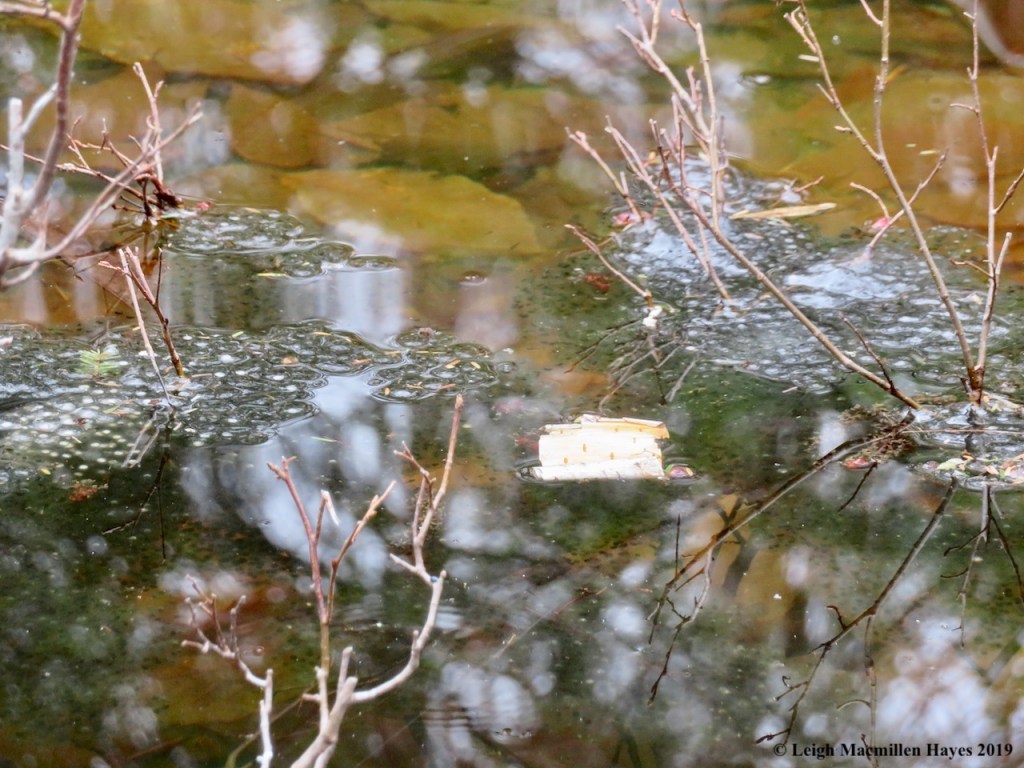
We did, however, spy plenty of Wood Frog masses, some with their tapioca structures bubbling upon the surface, but most attached to the stems below.

And then a chiseled tree section across the pool called to us and so we made our way over to check the wood chips below. Of course, we searched for Pileated Woodpecker scat, but found none. Instead, we spotted a dead frog in the water. And just beyond it, a dead salamander.

It wasn’t pretty, but did make us question what had happened. Were the two amphibian deaths related? We don’t know, but we did note puncture marks on the Spotted Salamander’s underside, and even a nip of the end of its tail. Plus it had one slightly deformed front foot. And we learned that salamanders have poison glands in their skin, mostly on their backs and tails. Did the frog go after the salamander and both died from the experience? Or had another predator entered the pool? And then realized it had made the wrong decision?

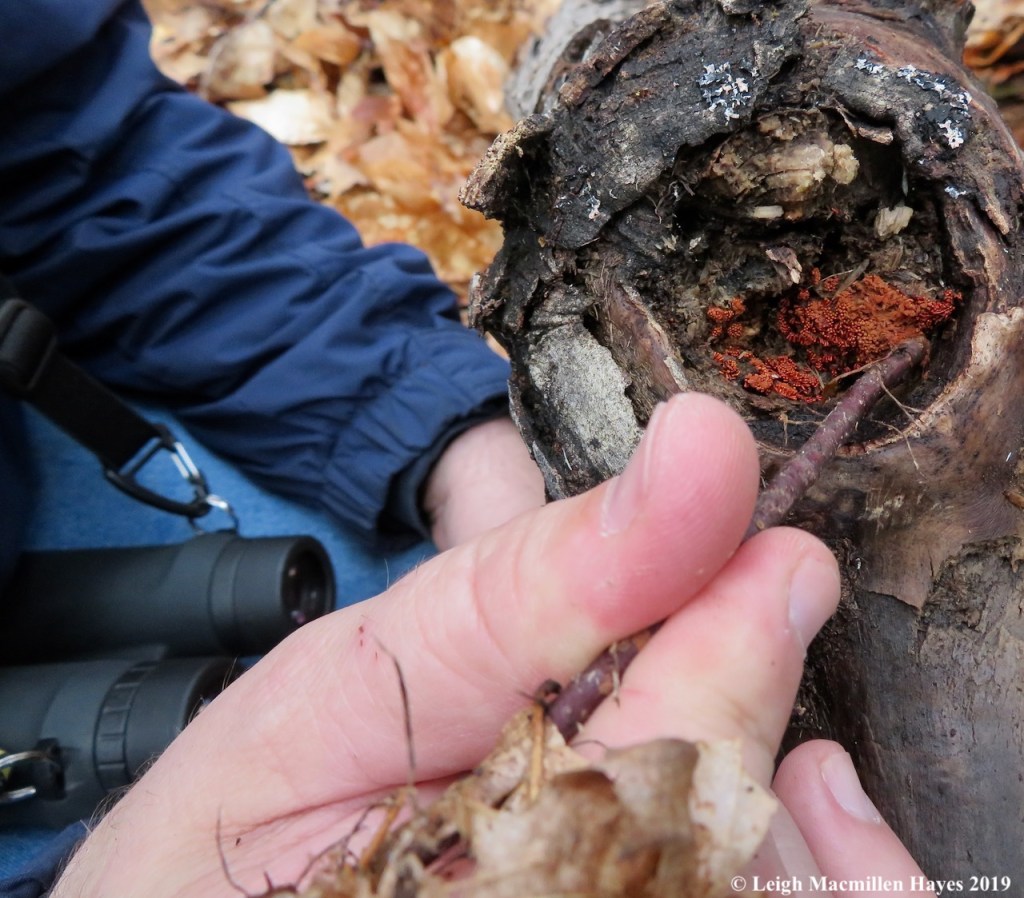
We never did figure it out, but had fun asking questions. And as we stood there, our eyes keyed in on a bit of color at the end of a downed branch. Again, more questions and the use of our loupes as we tried to take a closer look. We debated: slime mold or insect eggs?

After looking closely and continuing to ask question, a quick poke with a twig provided the actual answer as we watched the spores puff out in a tiny cloud. Slime mold it was. Should we have poked it first? No, for that would have been too easy and we wouldn’t have taken the time to consider the possibilities.

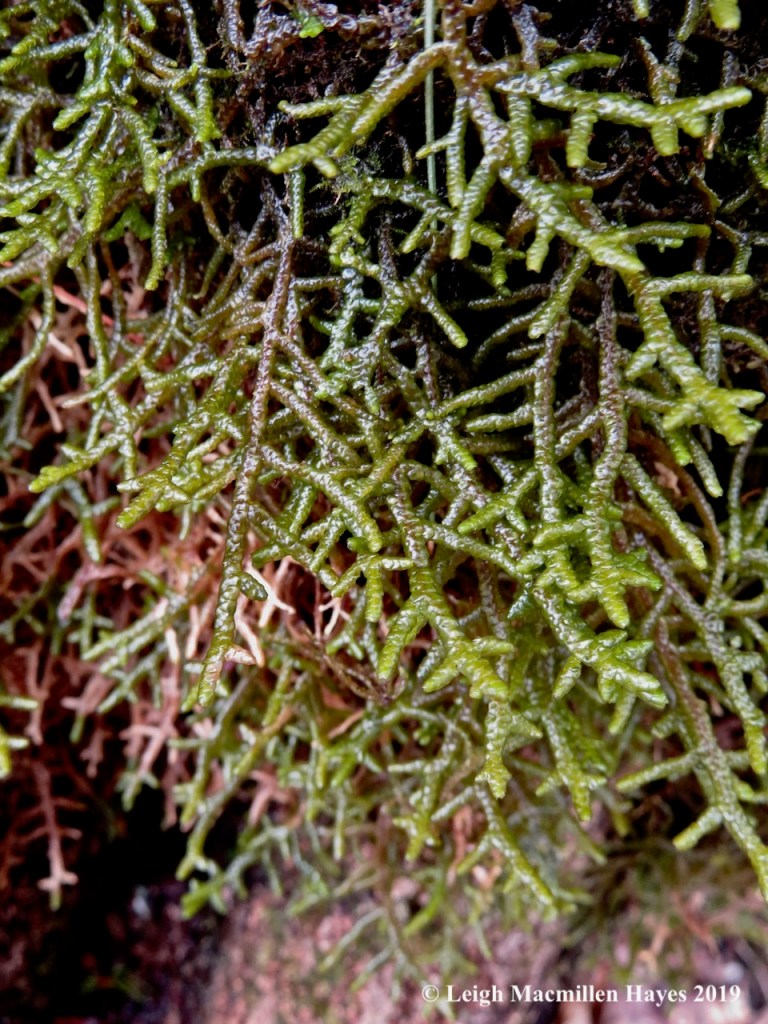
On our way out, there was still one more discovery to make. I could have dismissed this one as a moss.

But, again Alan knew and he explained to us that it was a liverwort known as Porella platyphylloidea. And upon closer examination we could all see its three-dimensional structure as it curled out from the tree trunk.

Almost three hours later, our brains were full as we’d also examined trees, lichens, and other fungi, but our hearts were happy for the time spent in each others company sharing a collective brain.

I’m always grateful for an opportunity to peek with these peeps, even at something as common as a caddisfly because really . . . there’s nothing common about it.