In response to shorter days
and sunshine's declining density,
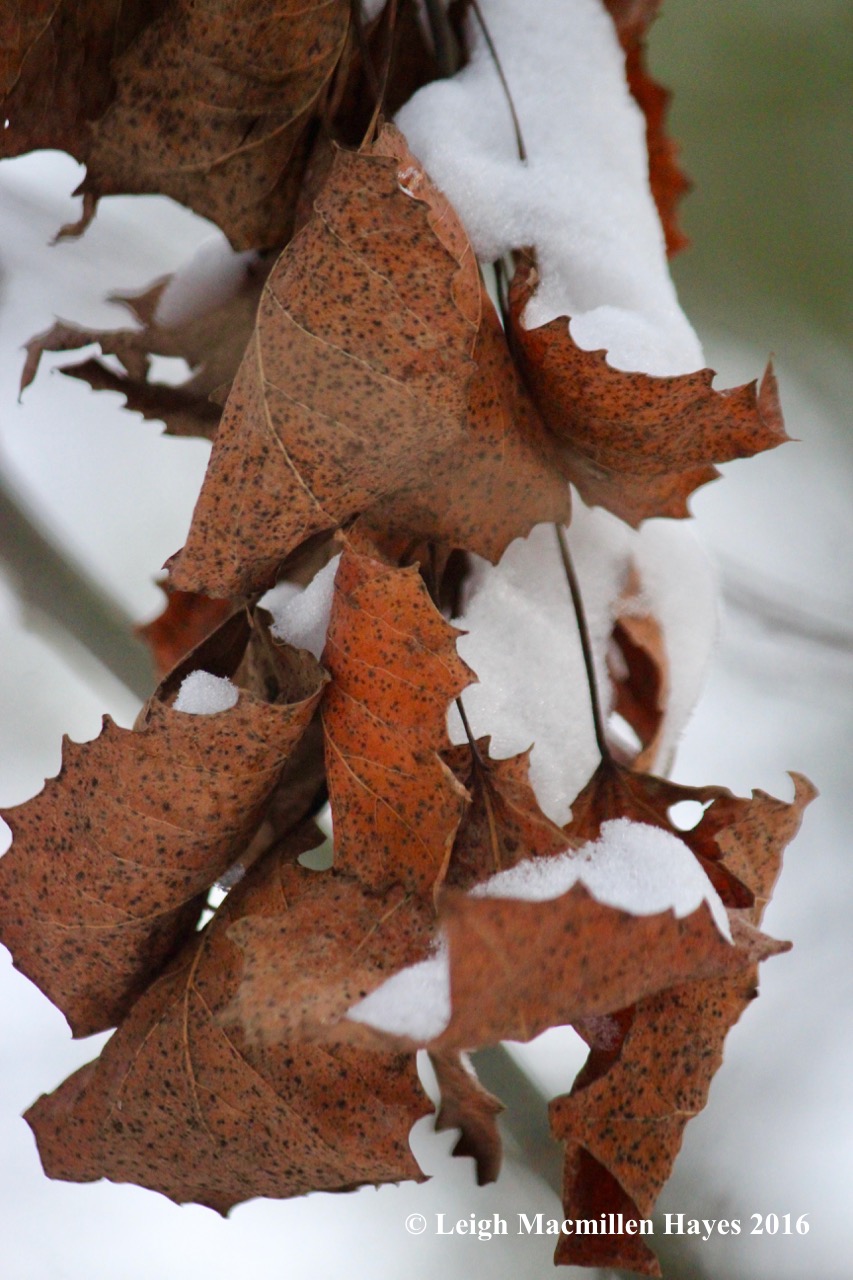
leaves begin the age old process
leading to their demise.
Like so many others,
I make time to honor
the tapestry they weave
before they fall.
Chlorophyll, the green pigment
we associate with summer,
and necessary for photosynthesis,
slows and then stops manufacturing food,
and the leaves go on strike.
Veins that carried fluids
via the xylem and phloem close off,
trapping sugars, and promoting the production
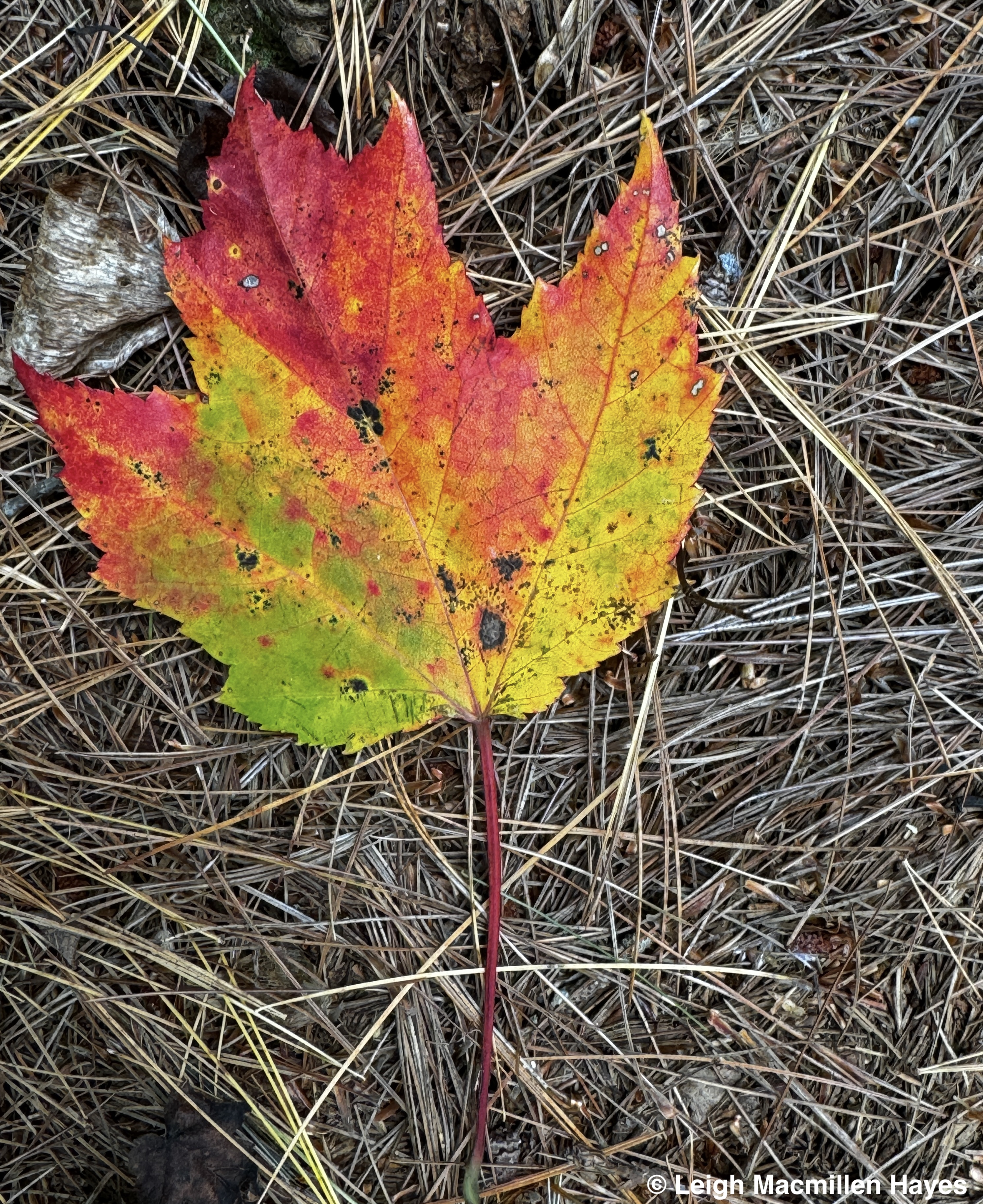
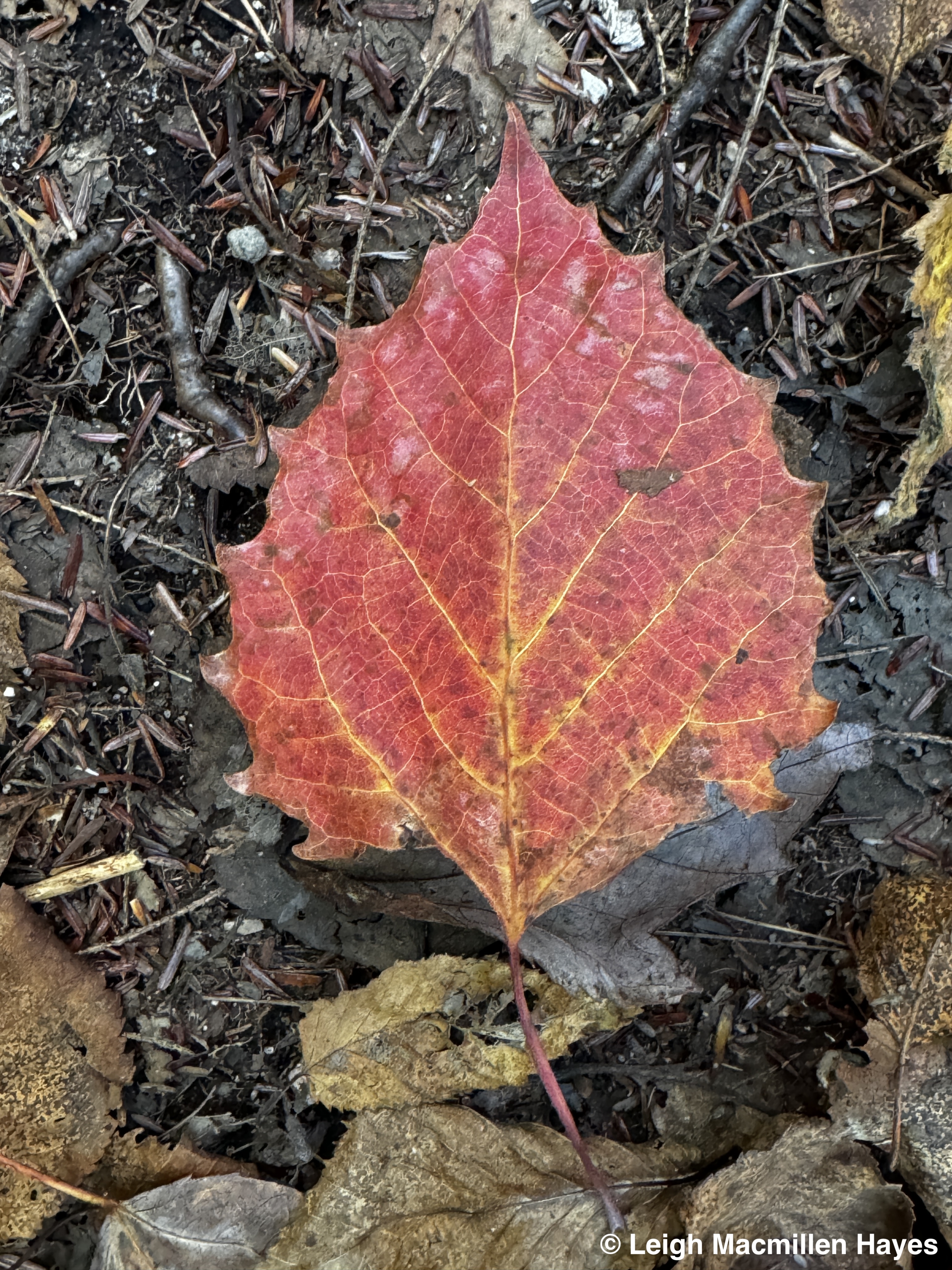
of anthocyanin, the red color
we associate with Red Maples and Silver.
Though in the same family,
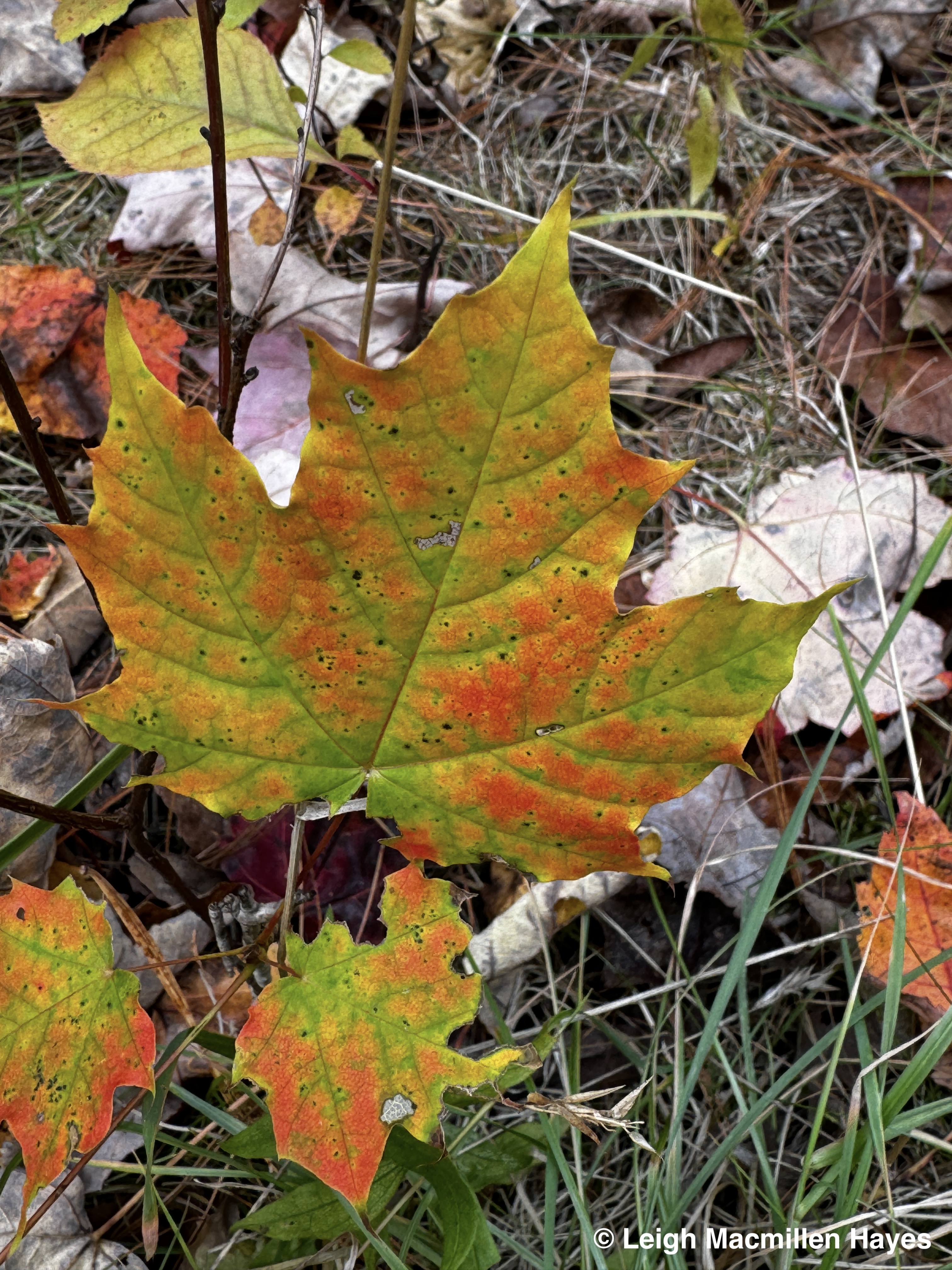
Sugar Maple displays
the yellows and oranges
of the ever present Carotenoids,
which had previously been masked
by Chlorophyll.
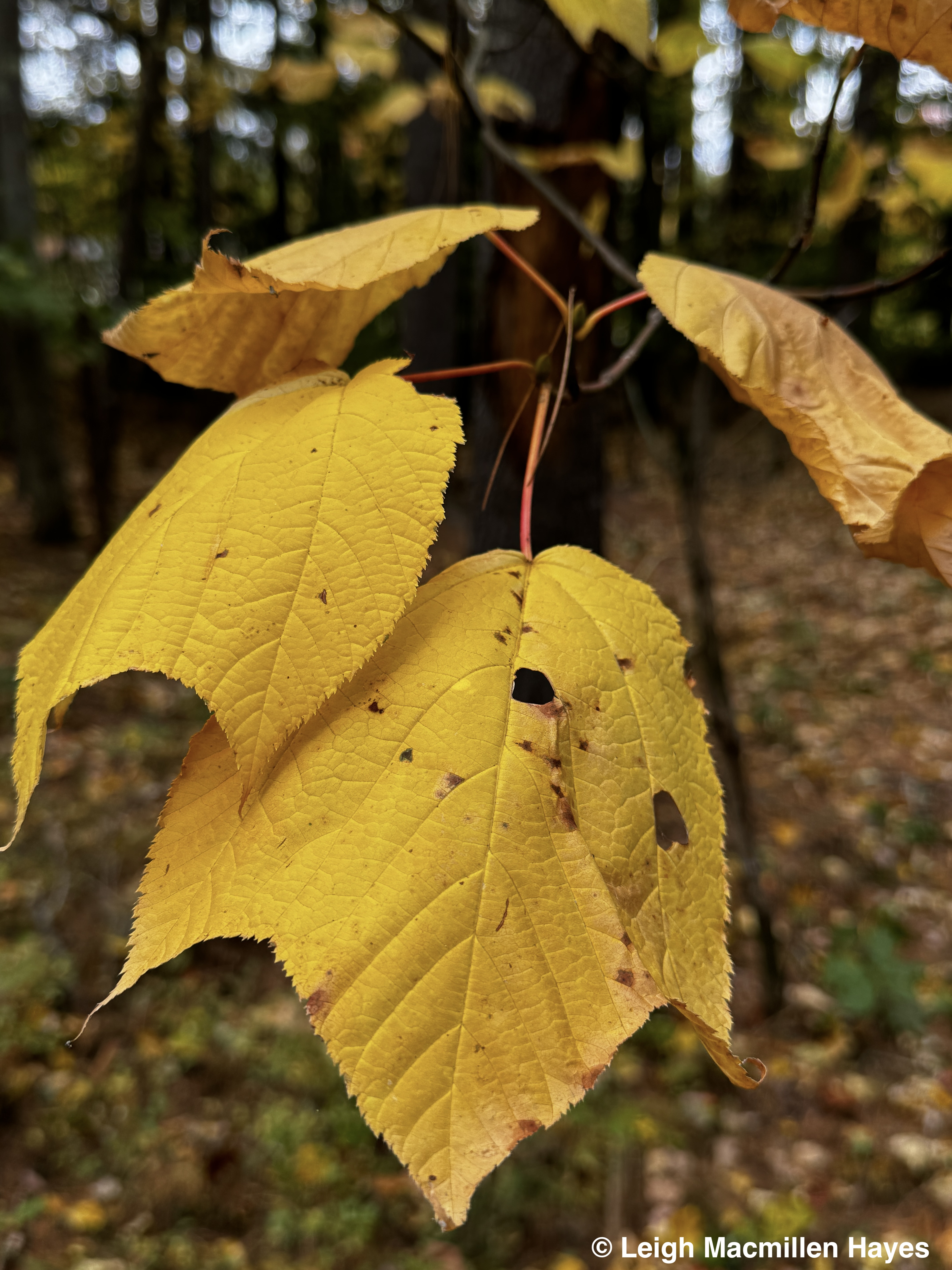
Stripped Maple knows
only one hue,
making it easy
to spot its large display of brownish yellow.
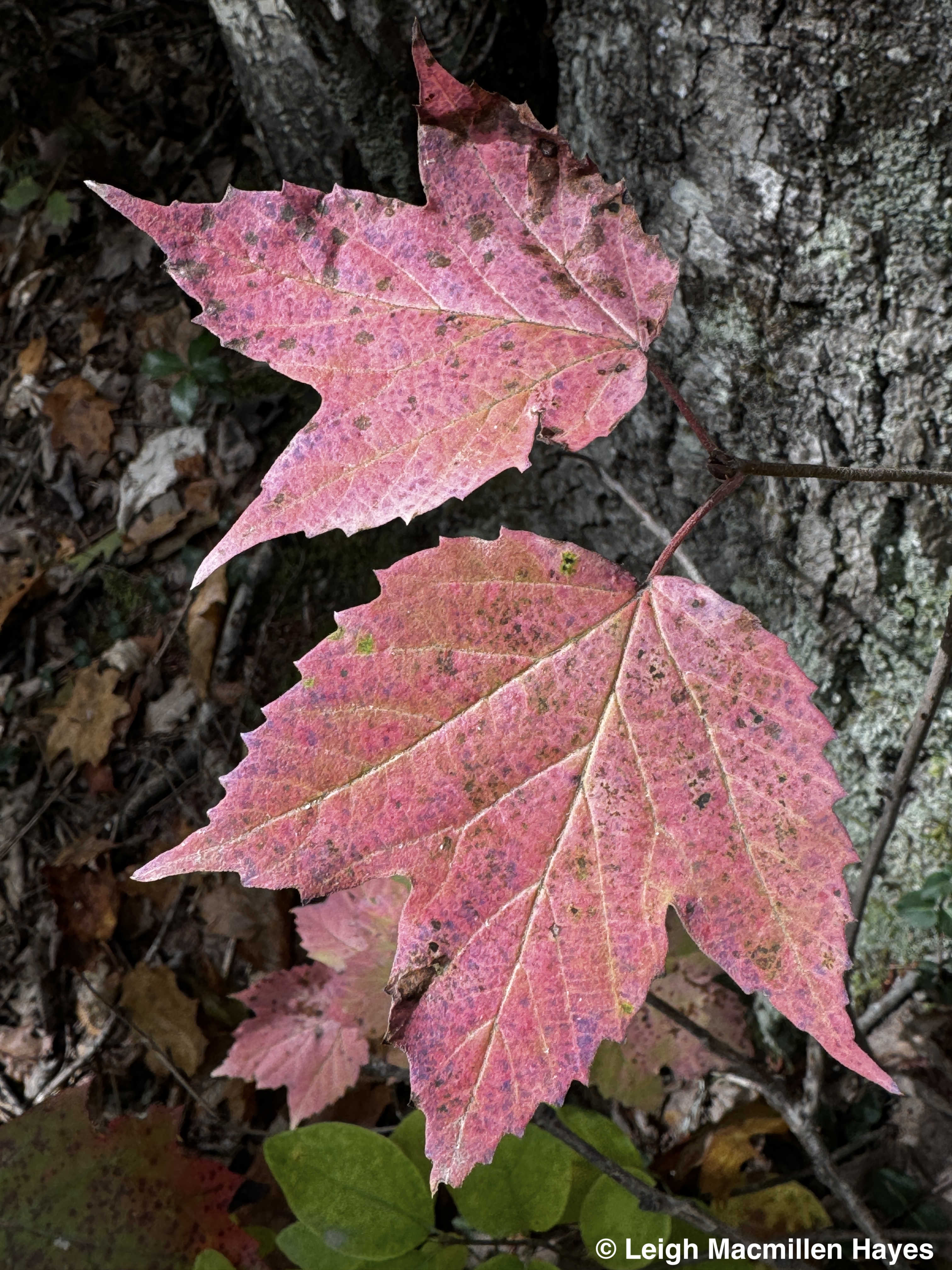
One of my favorites
is the reddish-pinky-purples
of Maple-leaf Viburnum,
a shrub with maple-shaped leaves.
Ash follows suit,
though its leaves
are the quickest to drop
and disappear into the forest floor.
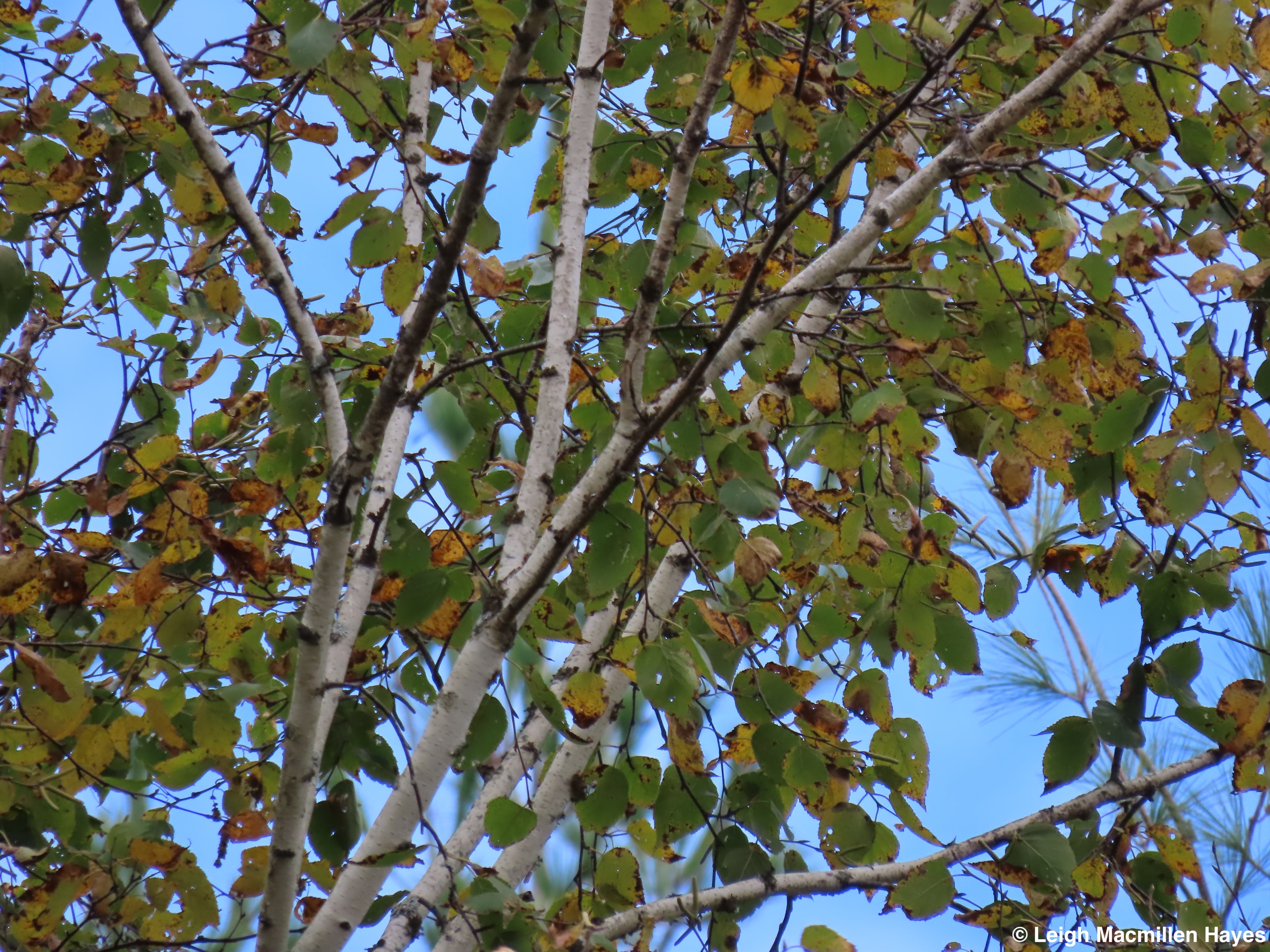
Big-tooth Aspens turn a golden yellow,
but other colors
have a tendency to seep in
and create a striking picture.
American Beech,
Paper and Gray Birch
show off a yellow
to golden bronze presentation.
And a little late to the show,
Northern Red Oaks
put their colors on display
after other species
have already dropped their leaves.
Not really a part of the foliage,
but still important because it is present,
is the splotchy display caused by Anthracnose fungi,
a result of too much rain stressing trees
and not allowing them to properly respire.
Once connecting tissues
between leaf petioles and their twigs
form a seal,
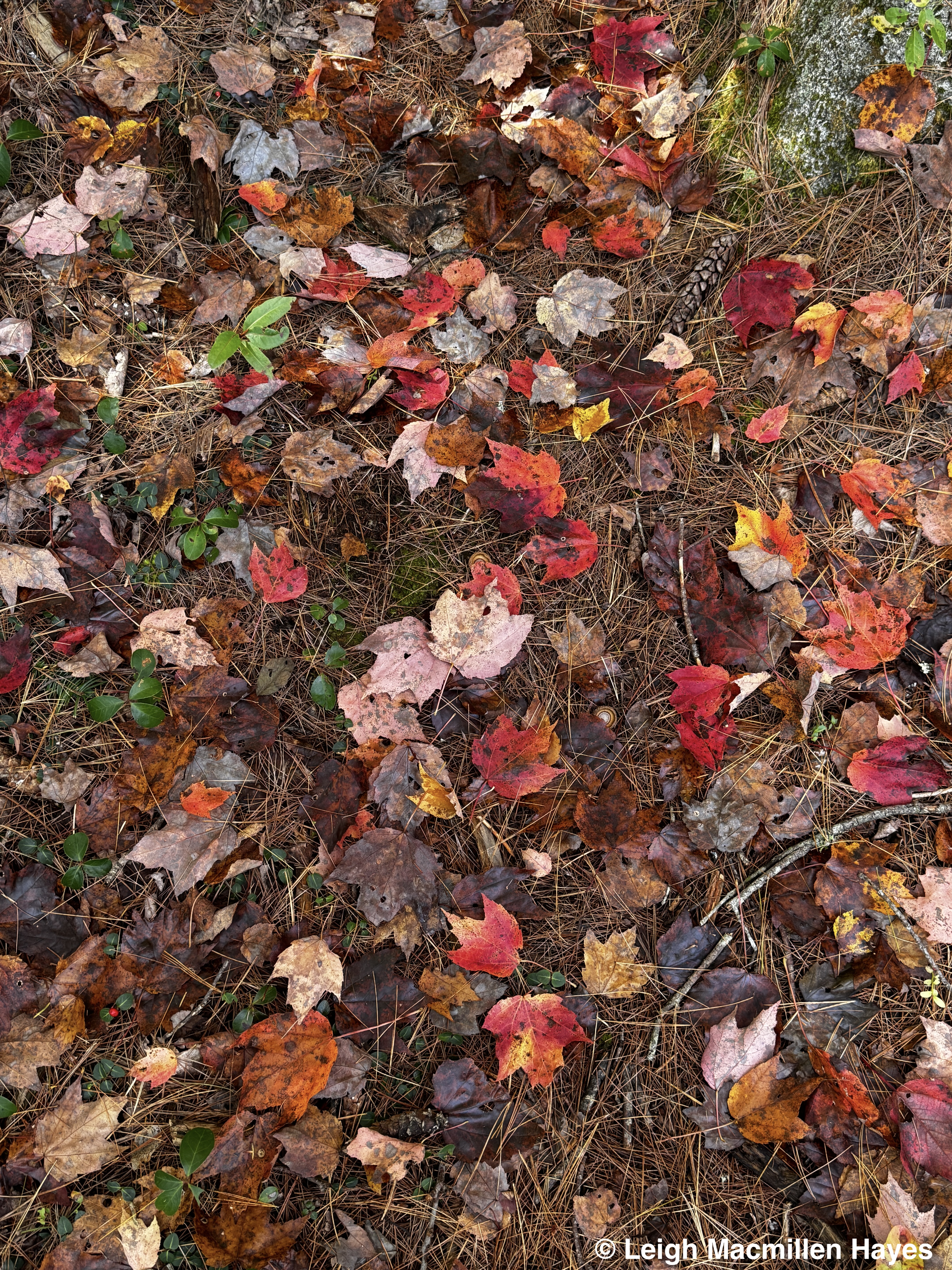
the forest floor is colored with gems
that will eventually turn various shades of brown
as they decompose and restock the soil with nutrients,
plus provide food for numerous organisms. And shelter.
In a Senior College (Lifelong Learning) class
this past week,
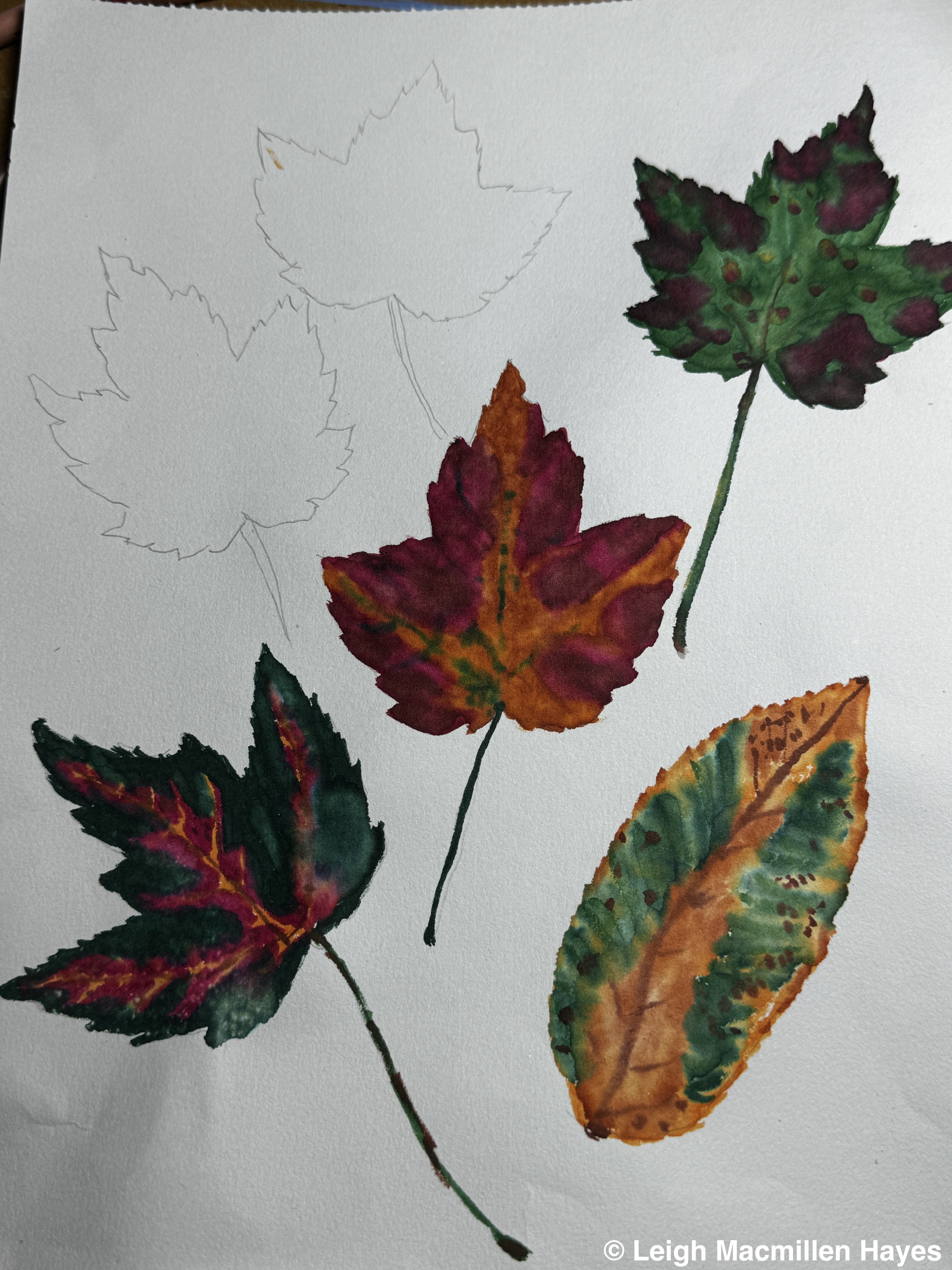
I attempted to use watercolor pens
to capture the colors.
And then at home,
I tried to do the same,
only this time using watercolor pencils
to show off the vibrant variety of hues.
In doing so,
I was forced to slow down
and notice how the color changes
often followed the veins
in this biochemical process.
Fall foliage is fleeting,
and I give thanks
that every year
we can celebrate the work of the leaves.
Sometimes I need to slow my brain down to figure things out. And other times . . . I need to slow my brain down to figure things out.
That’s exactly what I’ve been trying to do lately. Figure things out. Green things. Evergreen things. That means they add color to the forest floor year round.
Pour a glass of water or a cup of tea and join me as I take a closer look.
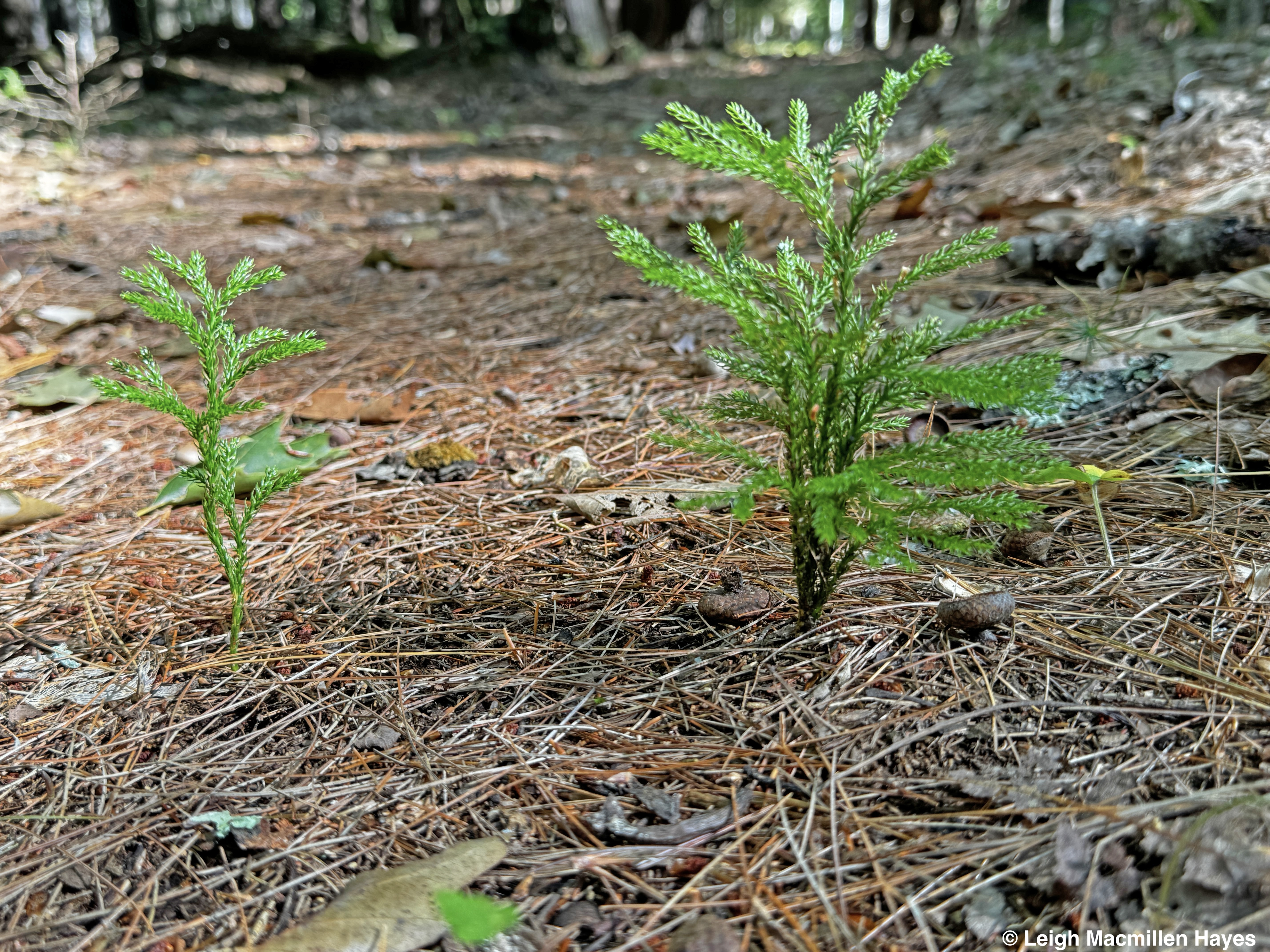
At first glance, these green growths appear to be miniature trees. But what I wanted to know was this: is the smaller “tree” on the left directly related to the larger “tree” on the right?
There was only one way to find out and though you aren’t looking at the same two in this photo, the question was recently answered when I began to dig into the ground and a friend lifted up the root system. If you look closely at this photo, the two species we were studying looked less similar than the two in the previous picture.
But indeed they were connected . . . with underground horizontal stems called rhizomes.
Meet Dendrolycopodium obsucurum, aka Flat-Branched Clubmoss or Princess Pine. Some of you know this well as your parents used to create Christmas decorations with it. I caution you–don’t be like your parents. Well, in this case anyway.
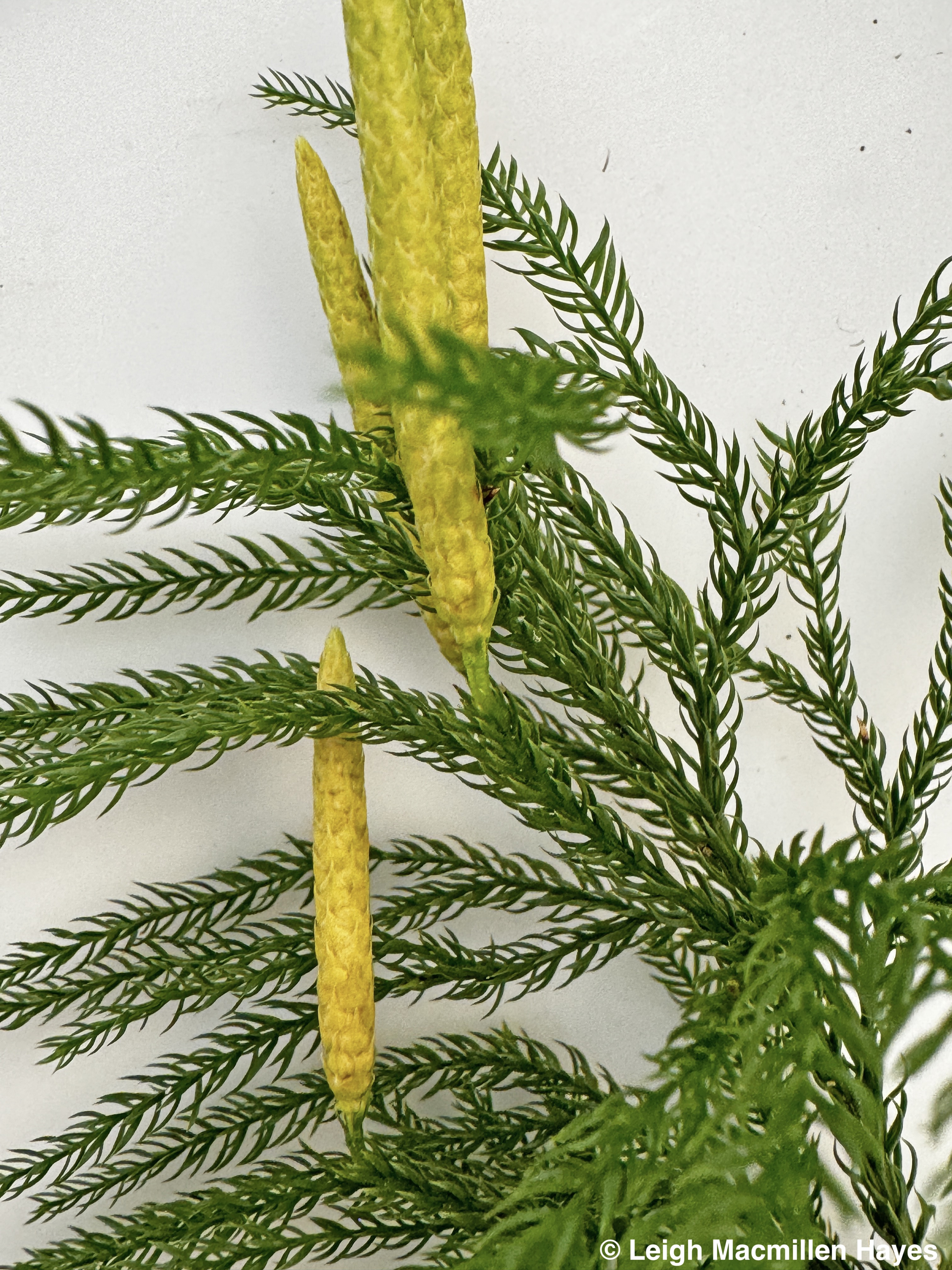
Clubmosses are vascular plants like our trees and flowers (but not mosses), thus they conduct water and food through their xylem and phloem. Their reproductive strategy is primitive. See that yellow “candle” or club? That is the strobilus (strobili, plural form) with structures called sporangia (sporangium). Some clubmosses have this structure and others have sporangia formed on the plant’s leaves. More on sporangia later, which means you’ll have to continue reading.
As I get to know these green things better, I’m trying to figure out their idiosyncrasies. And just when I think I know, I get zapped. But . . . the species above is closely related or a variant of the first species I shared. And sometimes they look super similar. The Flat-topped has smaller leaves on the lower part of its branches, but without a loupe, I can’t always spot that. And even with a loupe, my mind gets boggled. Am I seeing what I think I’m seeing. One thing that has helped me is that species, Dendrolycopodium hickeyi, or Hickey’s Tree Clubmoss, prefers drier soil. But really, they could be twins. And truth be known, they do hybridize.
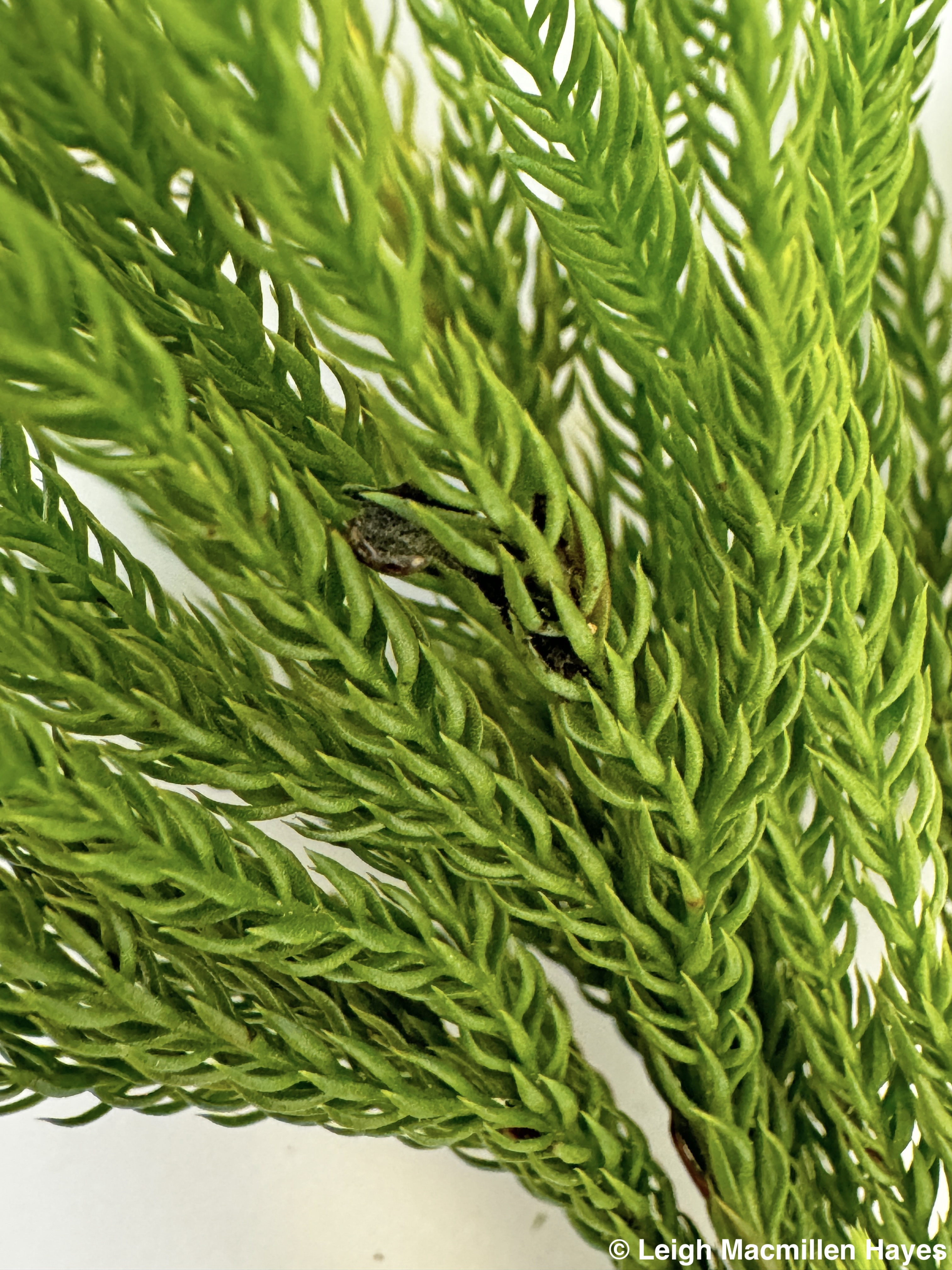
Right now, I’m thinking that Hickey’s leaves, as shown above, are consistently the same length and thicker in presentation as the branches are more rounded than those of the Flat-branched.
On our land, it grows abundantly along Central Maine Power’s Right-Of-Way and like Flat-branched has underground rhizomes. In fact, this afternoon I had a vision of a bedspread from my youth that I turned into roads and drove little rubber cars and trucks along when I played “Town.” I could easily have driven my little cars from one “tree” to the next and followed the rhizomes as if they were invisible roads.
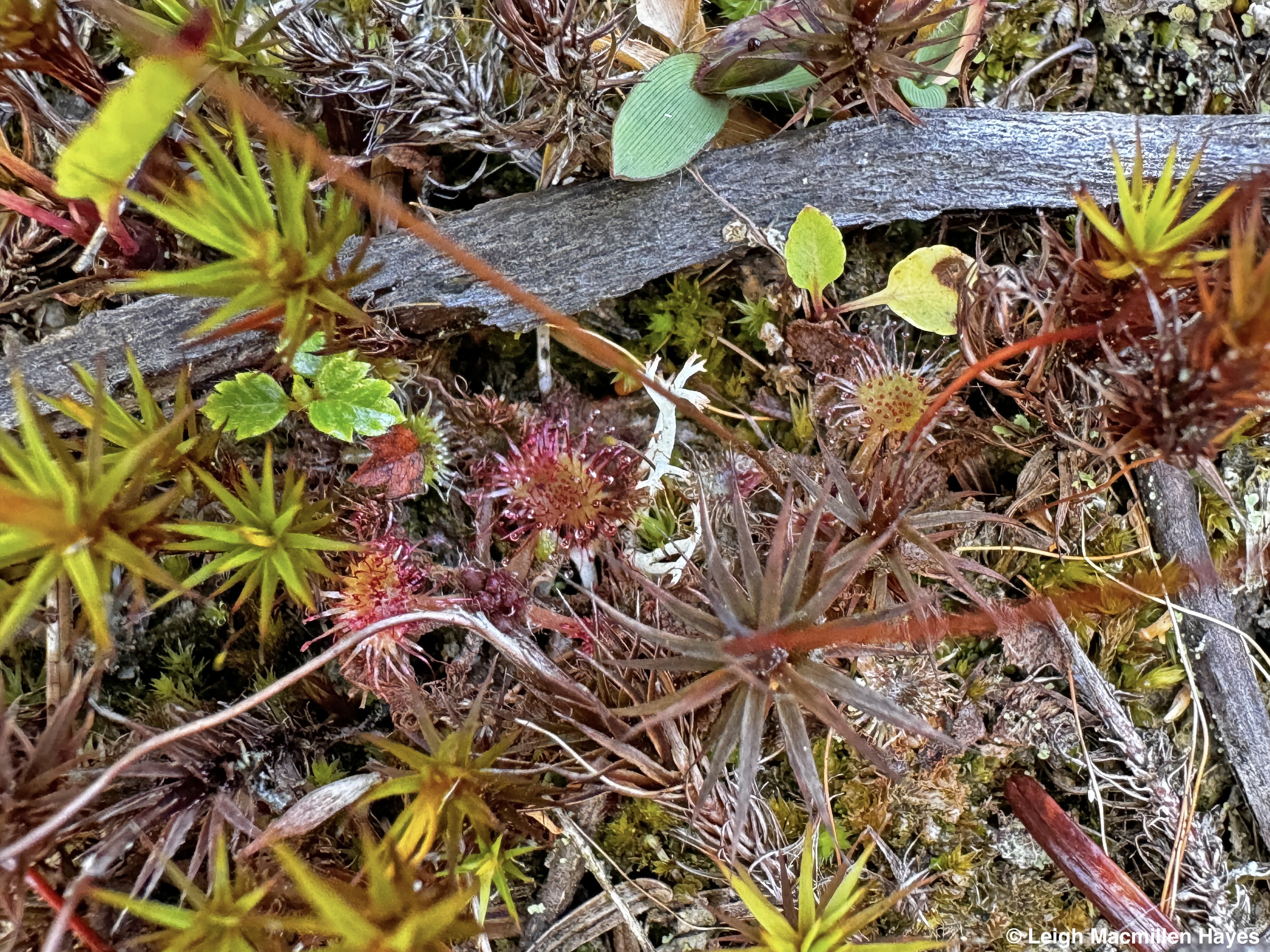
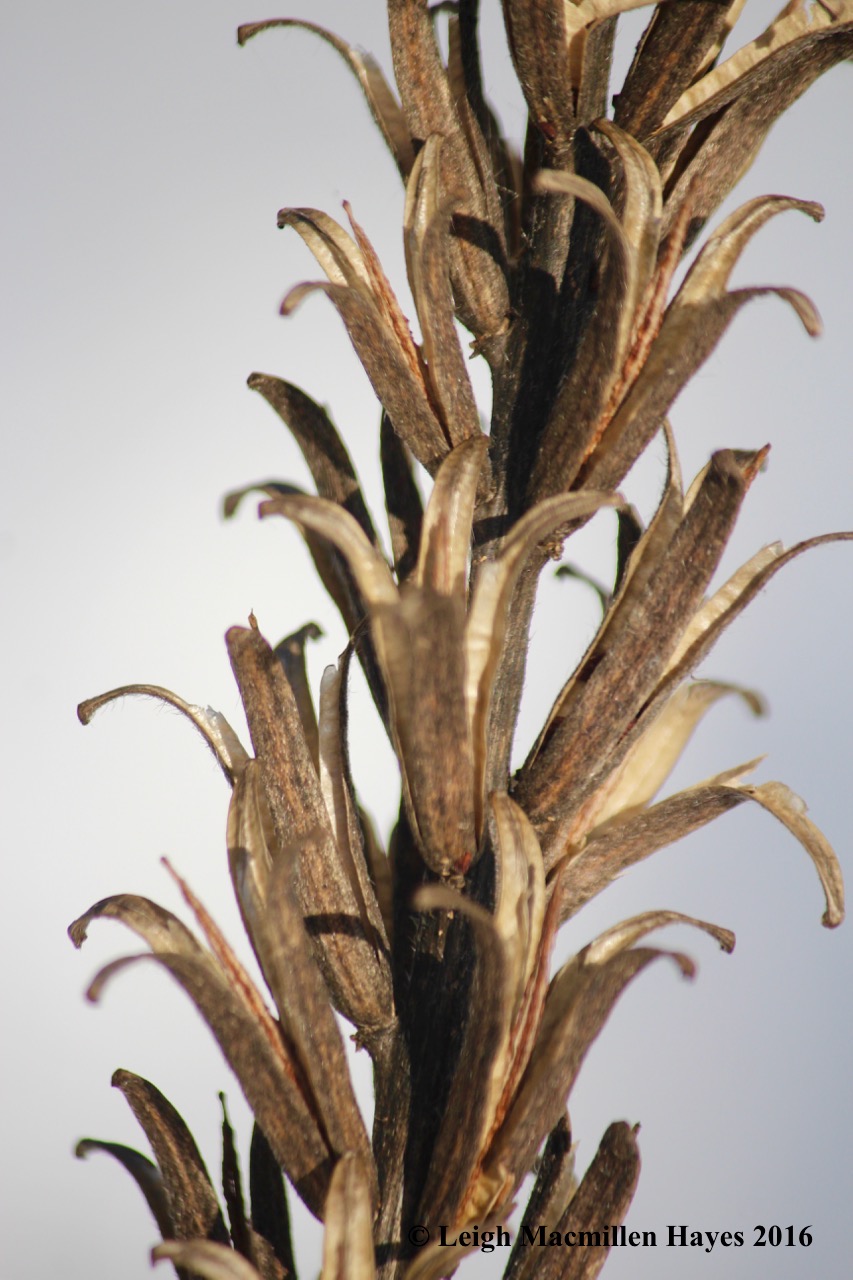
Cool sights reveal themselves when I do slow down like this and I thought that CMP had killed the Sundews that grow under the powerlines when they sprayed herbicides along the route several years ago. I’d given up on being the guardian of such special plants, and was delighted to discover their dried up flowering structures today and locate the wee carnivorous leaves below. Yahoo! High five for Sundews!
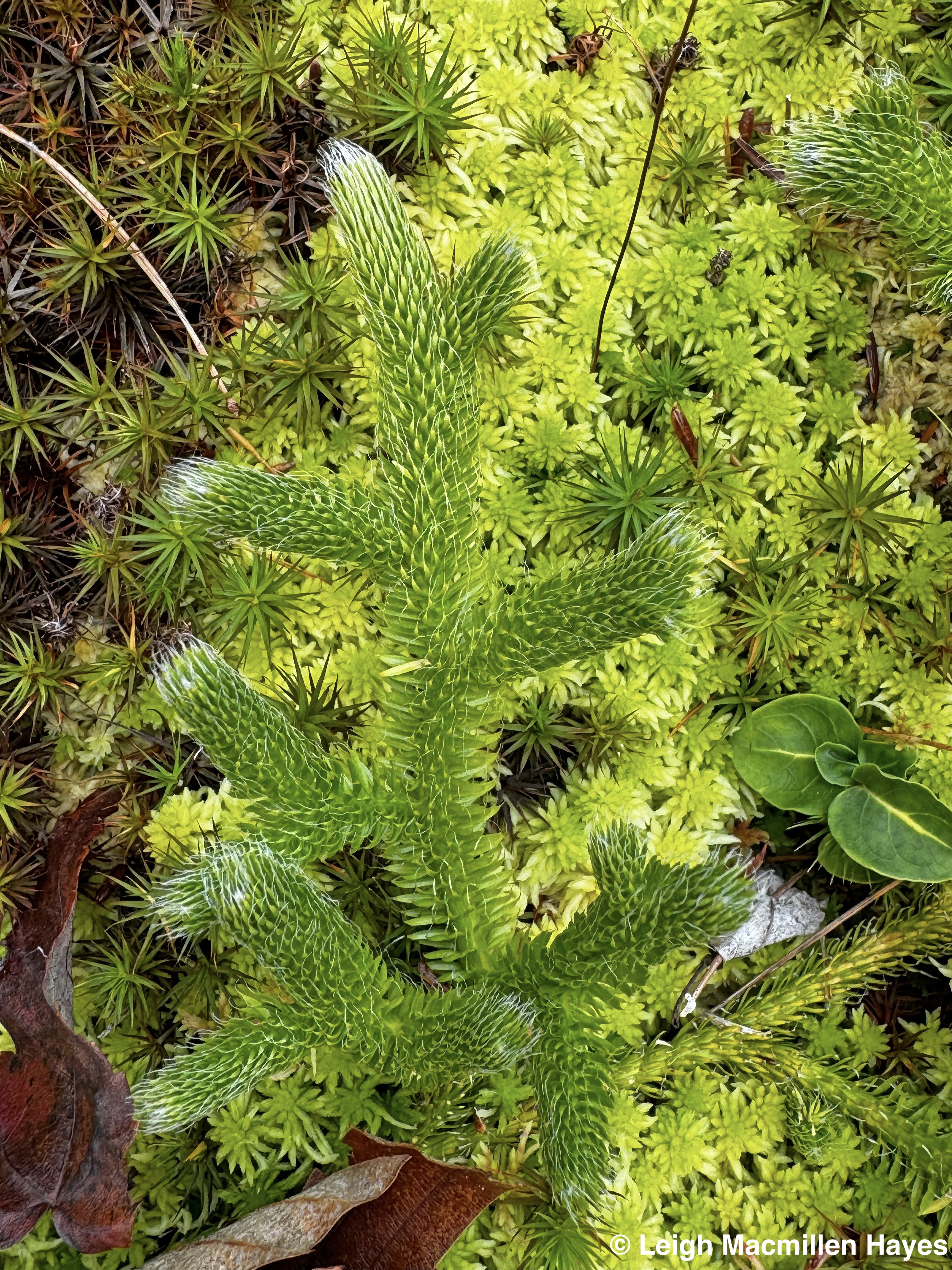
Where Flat-branched and Hickey’s have underground rhizomes, this particular member of the club features horizontal stems that are above ground runners.
And while the previous two were tree-like in structure, this one reminded me of a cactus.
Furthermore, I got all excited because I thought I’d discovered a species considered threatened in Maine. I talked myself into it being Huperzia selago or Fir-Moss. It looked so much like the black and white sketch in my field guide.
Until I realized the Fir-Moss has a sporangia-bearing region in the upper stem. And my species has strobili located at the tips of long slender stalks. And there is no mention of those transparent hairs in the description of the Fir-Moss (after all, it’s not Fur-Moss), but Running Ground-Pine or Staghorn Clubmoss does have this feature. Thus, this is Lycopodium clavatum.
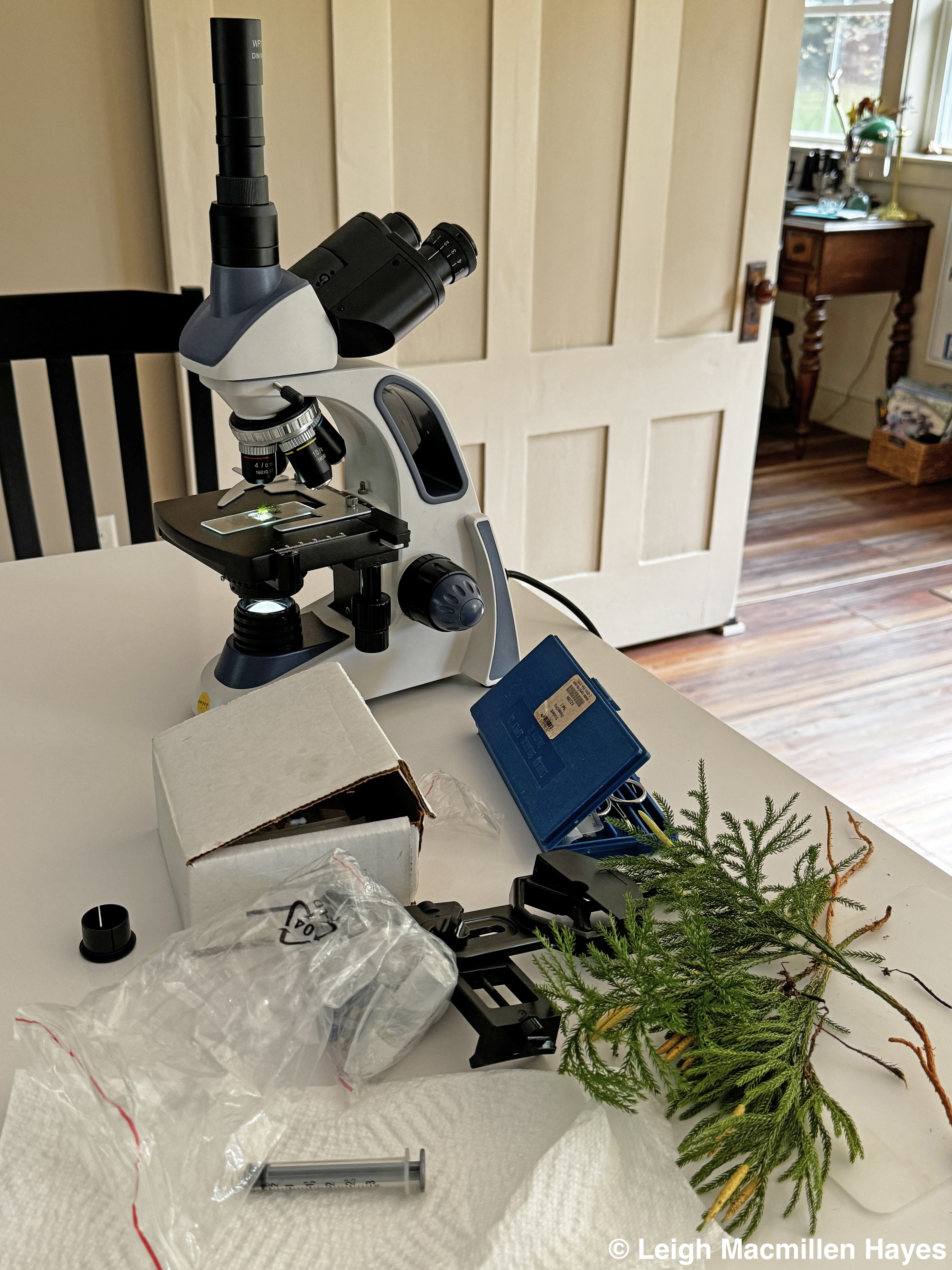
Back at home, it was time to set up the mini-lab and take a closer look. I try not to collect too much; in Ferns & Allies of the North Woods, Joe Walewski suggests we “consider the 1-in-10 rule: collect no more than one for every ten you see.”
The microscope has opened a fascinating world to me–as if it weren’t already fascinating enough. And see the pattern of cell structures–an art form all its own.
And then there was the strobili that covered the sporangia. That word sounds like dessert and this look at the structure made me think it could be some decadent butterscotch offering.
I cut a cross-section and was surprised to see the hollow center.
All those minute spores. Actually, I accidentally nudged a few as I walked in the woods this weekend, and had the honor of watching the “dust cloud” of spores being released.
One family member that doesn’t live in our woods, but is located close by is this, Diphosiastrum digitatum or Fan Creeping-Cedar, so named for its resemblance to cedars.
This specimen had followed me home a few weeks ago, and when I pulled it out of my now warped field guide, for so damp were the pieces that I stuck in there, it had dried into a flattened form of its former self.
I stuck a piece under the microscope and again was floored by the thickness and cell structure.
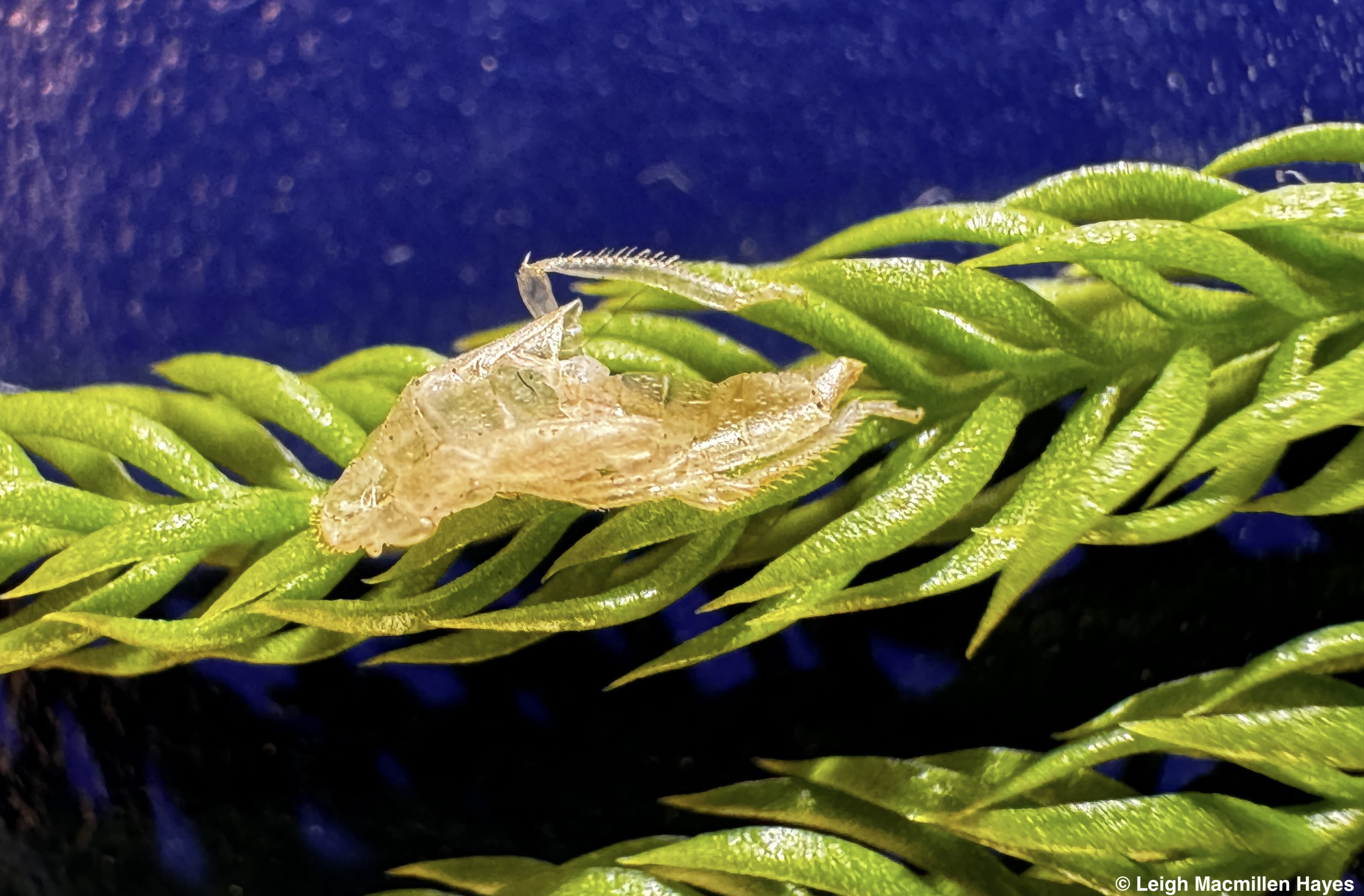
And then I had a surprise. A hitchhiker! Do you see the long legs?
Here’s another look. I don’t know who this was, but I do know that it was minute in size and it appeared to be a shed skin after the insect had molted.
Suddenly I was eager to find more. And so I checked out a piece of the Flat-branched . . . and wasn’t disappointed.
Here it is again. The second critter that is. Or was. And now I can’t wait until next spring and summer to find out what tiny creatures use these structures as places to molt. And maybe feed. The mouth structure, if that’s what it is on this one, appears to be almost fan-like and kind of reminds me of that on a slug.
The home lab grew into an art room as the hours passed.
Recently my sister gifted me a sketch book and it begged to be opened. After running my fingers over the cover first, of course.
I have the perfect bookmark to mark the pages, created for me this past year by one of our first playmates.
Getting to know a species better through close observation and by sketching is one of my favorite pastimes. And I’m so glad I slowed my brain down, especially when it came to hickeyi on the left and obscurum on the right. The differences seem so obvious with these two examples, but step out the door and I suspect you may be thrown off course as well.
When is a moss not a moss? When it’s a Clubmoss, which is actually an ally or relative of ferns. And horsetails. All are non-flowering vascular plants.
Before you depart, dear reader, please remember that these are ancient plants that take a long time to germinate as most need a symbiotic fungi to provide nutrition to the gametophyte stage (think gamete, eggs, and sperm). They may lie dormant underground for up to seven years and then take up to fifteen years to develop reproductive structures. In the great coal swamps of the Carboniferous period, they reached heights of possibly 100 feet, something I have a difficult time comprehending when I look at their small forms in our woods. Their growth is slow and they deserve our respect.
And now I can’t wait to meet some others and get to know them as well. I spotted One-Cone Ground-Pine or Lycopodium lagopus on a hike the other day and kick myself for not taking its photograph. All in their own time. I’ve made a start and hope you will do the same.
If it seems like the world is spinning out of control, that’s because it is . . . on so many levels in so many ways. Even some things I’ve witnessed of late in the great outdoors don’t make sense.
Two weeks ago I sent this email message to my friend, an incredible naturalist, hunter, forester, David Sears. Dave knows everything and has taught me so much over the years.
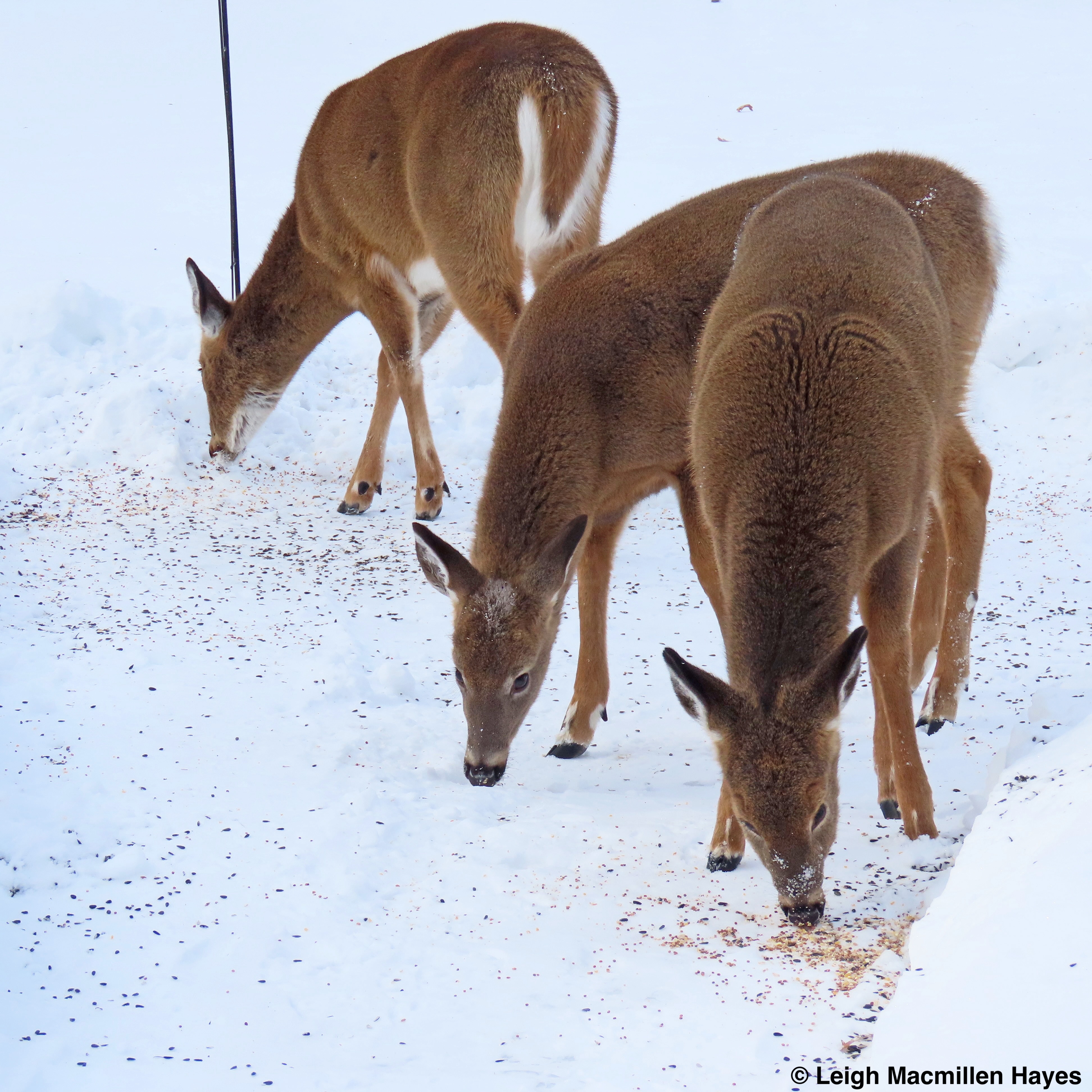
Here’s the message: “Daily we have three deer come into the yard because now that there is snow on the ground, they can’t get to the acorns so easily, but do love the sunflower seeds by the bird feeders. It’s a doe and two skippers. On Thursday I saw another doe with them. And then, as I was finishing up writing the tree blog, Becoming Tree Wise, late afternoon yesterday, I saw two by the feeders and two about 20 feet away. A doe and a skipper in each set. The doe farther away was licking the butt of the skipper. At least that’s what it looked like she was licking from my desk. For minutes on end. And then the other doe and skipper approached them and got quite close. The second doe nudged the first and the first jumped away, paused and then headed back over the stonewall and into the woods. The second doe and two skippers remained close to each other and then I noticed the second doe was bent over. I was trying not to move because even though I’m inside, they hear me and startle easily. I finally grabbed my binoculars and realized the doe was licking the underside of the skipper. I have never seen this before. Have you? Two does bathing a youngster? And at this time of year?”
Unfortunately I did not get a photo of the licking behavior because I didn’t want them to run off into the woods as I tried to understand what I was seeing.
Dave’s response matched my thoughts: “Seems strange at this age. Certainly groom them when young, but a little old now.”
Me: “And two doing the grooming?”
Dave: “Mother nature doing her thing.”
Me: “Yup. She doesn’t read our books.”
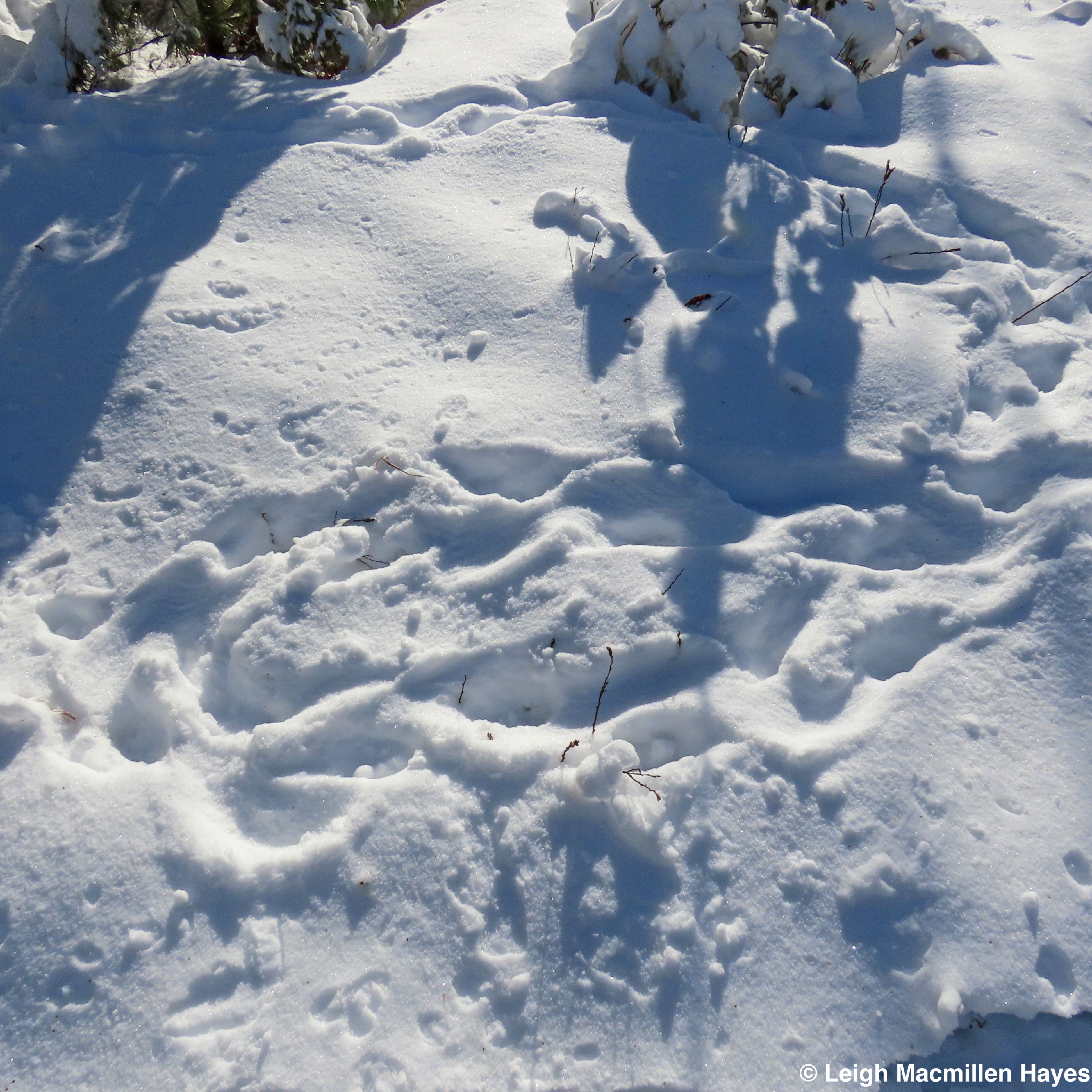
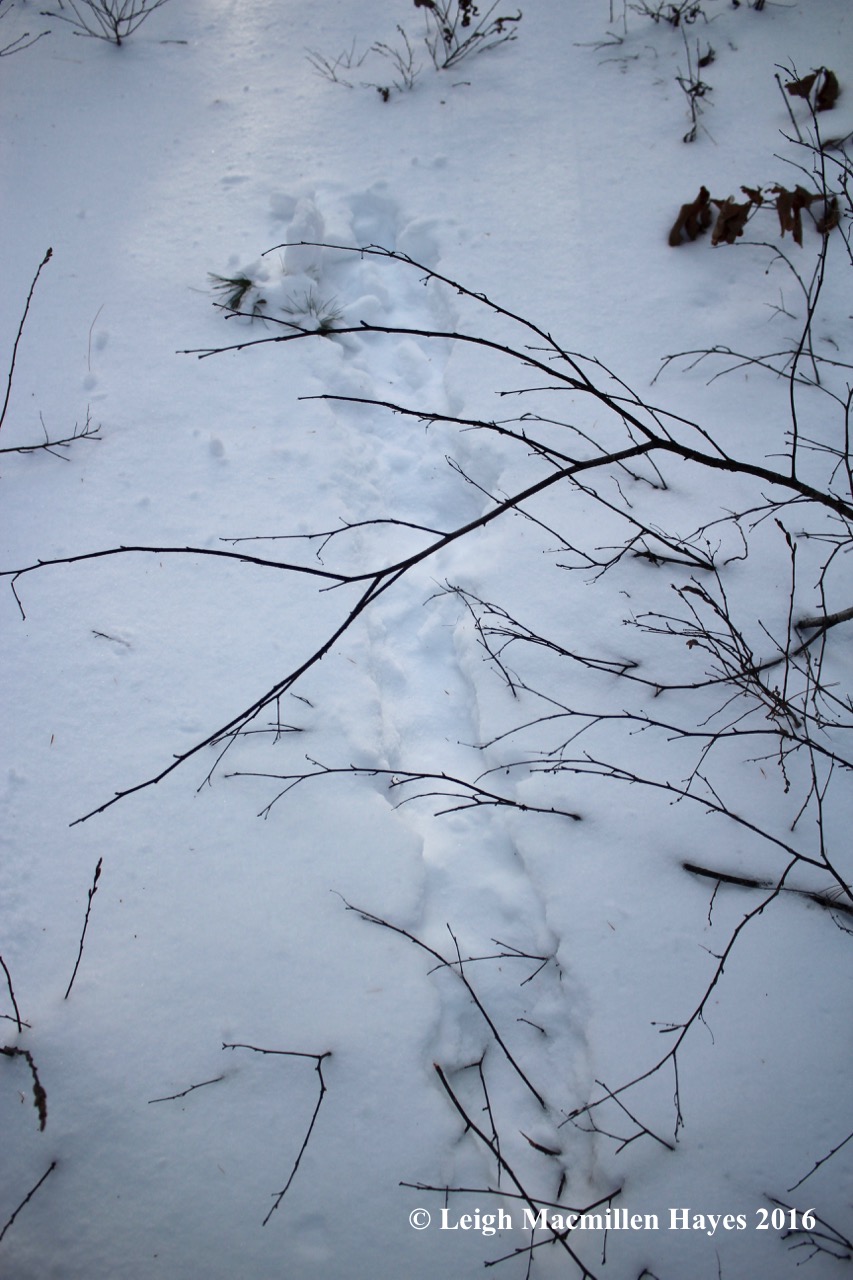
About a week or less later, I was on a reconnaissance mission with friend and fellow naturalist Dawn Wood at Loon Echo Land Trust’s Tiger Hill Community Forest in Sebago, Maine, when we spotted the sashay track a porcupine leaves in fluffy snow.
We tried to follow the track to locate either its feeding tree or den, but this porcupine provided an example of more strange behavior. Itacted like a dog, doing zoomies across the landscape. Literally, it walked in circles.
All over the place. Was it rabid? It certainly wasn’t seeking a date because it was too late for mating season. And we couldn’t find evidence that it was evading a predator.
We never did find the feeding tree or den site and wonder if we’ll see the same behavior when we return to the site this week.
On another recent day, I was with Dawn again, climbing Bald Pate Mountain in South Bridgton, when she spied this dead mouse upon a branch. White-footed or Deer Mouse I can’t say for certain.
Our immediate thought was that a Shrike had impaled it on a branch, but upon closer examination, it wasn’t impaled, but perhaps had been dropped by a predator. The question remains: Why didn’t the predator return to enjoy the meal. Or is it being saved for a later date? Perhaps it was letting any toxins leach out?
At the end of many days, I’m left looking for answers, much like this Gray Squirrel on the snow mound outside a kitchen window. Of course, the squirrel must have been wondering why I wasn’t supplying more bird seed for it to consume. This same critter actually jumped partway up the kitchen door a few times in what I assume to be protest.
As for me, I wonder how to make sense of scenes like these that I’ve shared and how to keep an open mind as the world continues to spin out of control.
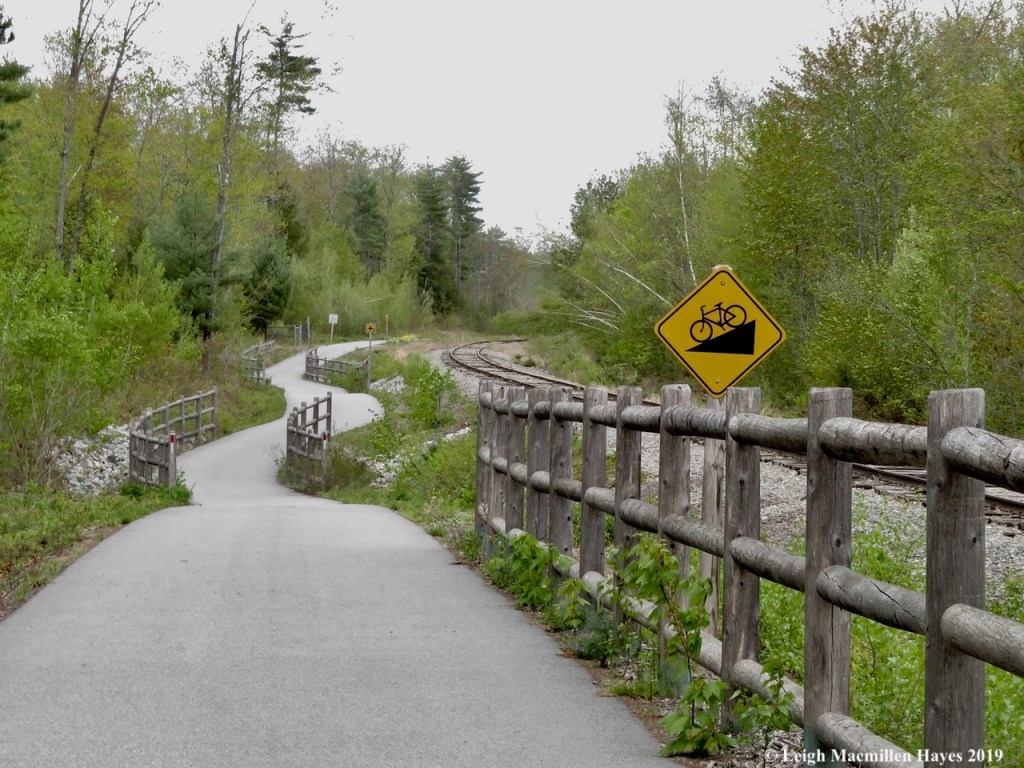
I’m a wanderer both on and off trail, and sometimes the path has been macadamized. Such was my following this morning as I paused on the way home from running an errand in North Conway, New Hampshire.
I’d stuck to the backroads on my way out of state to avoid road construction on Route 302, but knew that upon my return I wanted to stretch my legs along the Mountain Division Trail in Fryeburg.
The delightful four-mile rail trail, so named for the railroad line it parallels, intended for walkers, runners, bikers, roller bladers, etc., extends from the Maine Visitors Center on Route 302 to the Eastern Slope Airport on Route 5 and can be accessed from either end or several points between.
The wind was blowing and the bug count low, so though it wasn’t a warm, sunny spring day, it was a purely enjoyable one. And the cheery cherry flowers enhanced the feeling.
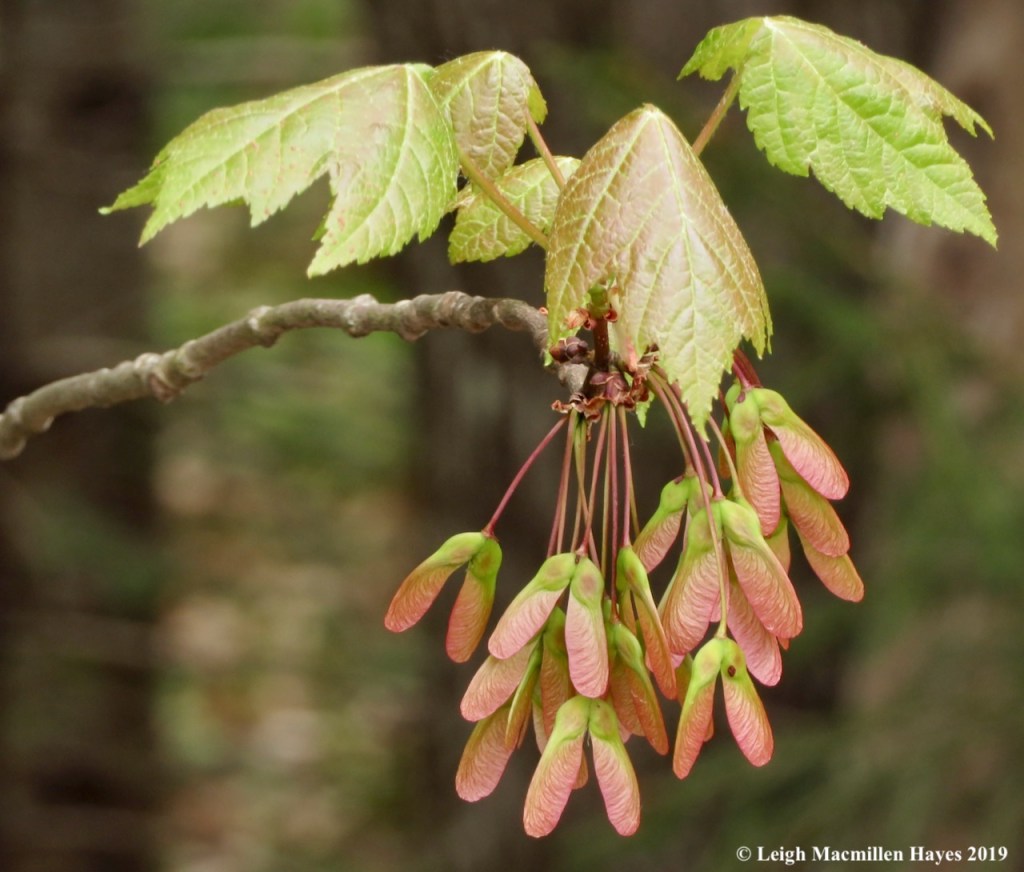
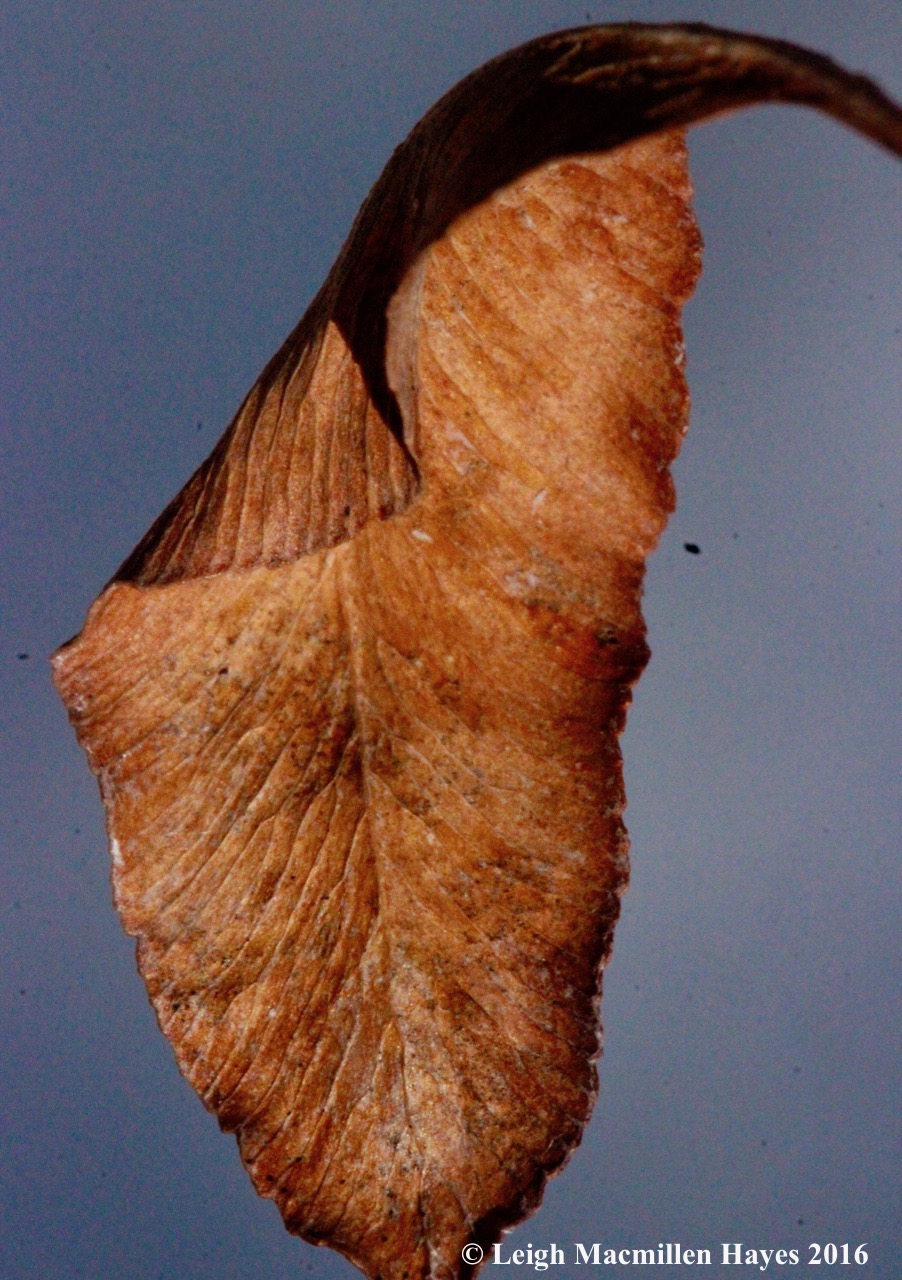
All along the way, it seemed, the Red Maples had not only leafed out, but yesterday’s flowers had magically transformed into today’s samaras that dripped below like chandeliers.
Lovely tunes and chips were also part of the landscape and I have no idea if I’ve identified this species correctly, but I’m stepping out on a branch and calling it an Alder Flycatcher. I’m sure those who know better will correct me. The naming isn’t always necessary, however. Sometimes, it’s more important to appreciate the sighting, the coloration, and the sound. For this bird, it was the dull olive green on its back that caught my attention.
And then up above on the other side of the track, it was the “Cheery, Cheery, Cheerio” song that helped me locate the American Robin in another maple raining with seeds.
Maples weren’t the only trees showing off their flowers, and those on the Northern Red Oaks reminded me of grass hula skirts below Hawaiian-themed shirts.
Even the ordinary seemed extraordinary like the Dandelion. Each ray of sunshine was notched with five “teeth” representing a petal that formed a single floret. Fully open, the bloom was a composite of numerous florets.
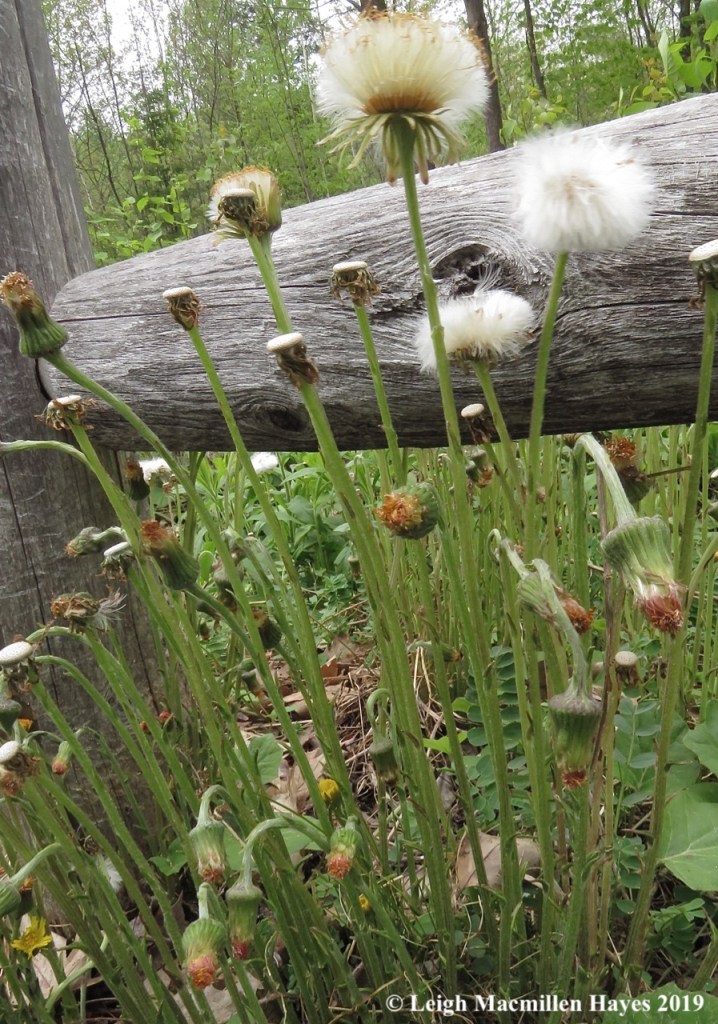
Nearby, its cousin, the early blooming Coltsfoot, already had the future on its mind and little bits of fluff blew in the breeze.
Eventually, I reached Ward’s Pond and after scanning the water found a Painted Turtle seeking warmth. The day was overcast and there was a bit of a chill in the strong breeze. Being down below the trail, at least the turtle was out of the wind and I had to assume that the temperature was a bit higher than where I stood.
This is a trail that may look monotonous, but with every step there’s something different to see like a Pitch Pine showing off three generations of prickly cones. What was, is, and shall be all at the tip of the branch.
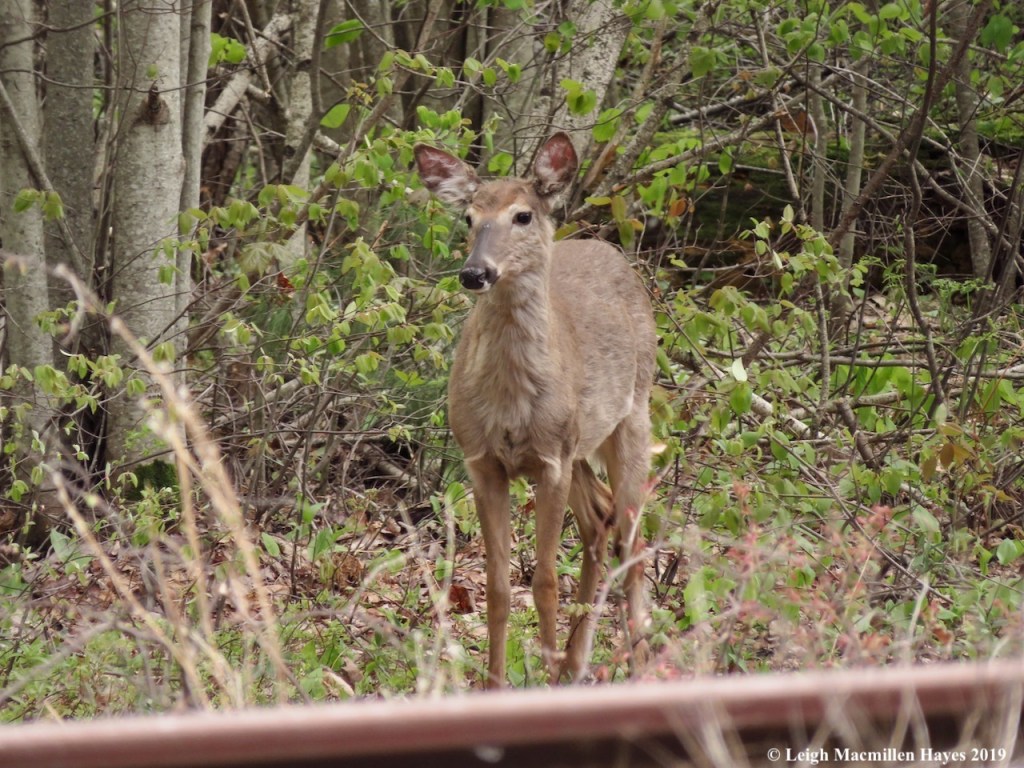
It seemed like every time I looked to the left, such as at the pine, a sound on the other side of the trail caught my attention. And so it was that I realized a White-tailed Deer was feeding on grasses behind a fence by a now-defunct factory (so defunct that the roof had collapsed under the weight of snow). Notice her ears.
And now look at her again. A deer’s ears are like radar and she can hone in on a sound by turning them.
I don’t know if she was listening to me or to the Eastern Towhee telling us to drink our tea.
After 2.5 miles, I decided to save the rest for another day and follow the path back. Though loop trips are fun, following the same path back brings new sights to mind, like the Interrupted Fern I’d walk past only a few minutes before. Notice its clump formation known in the fern world as vase-like.
And the butterfly wings of its interrupting leaflets covered with sporangia. My wonder came with the realization that within the interruption not all of the pinnules or subleaflets were covered with the bead-like shapes of fertility. Spores stored within essentially perform the same function as a seed: reproduce and perpetuate the species. So–is part of the pinnule fertile while the rest remains sterile? Do I need to check back? Oh drats, another trip to make along the Mountain Division Trail. Any excuse to revisit it works for me, though one hardly needs an excuse.
Further along I looked to the other side of the tracks for I’d spotted bird movement. Behind it was the reason–my White-tailed Deer friend. I have a feeling people feed it for it seemed not at all disturbed by my presence, unlike the ones in our yard and the field beyond that hear my every move within the house even in the middle of winter and are easily spooked.
The deer, however, wasn’t the only wildlife on or near the trail. Suddenly, a Red Fox appeared and we each considered the other. He blinked first during our stare down and trotted away.
Passing by Ward’s Pond once again, I stopped to check on the turtle. It was still in the same spot I’d seen it probably a half hour before.
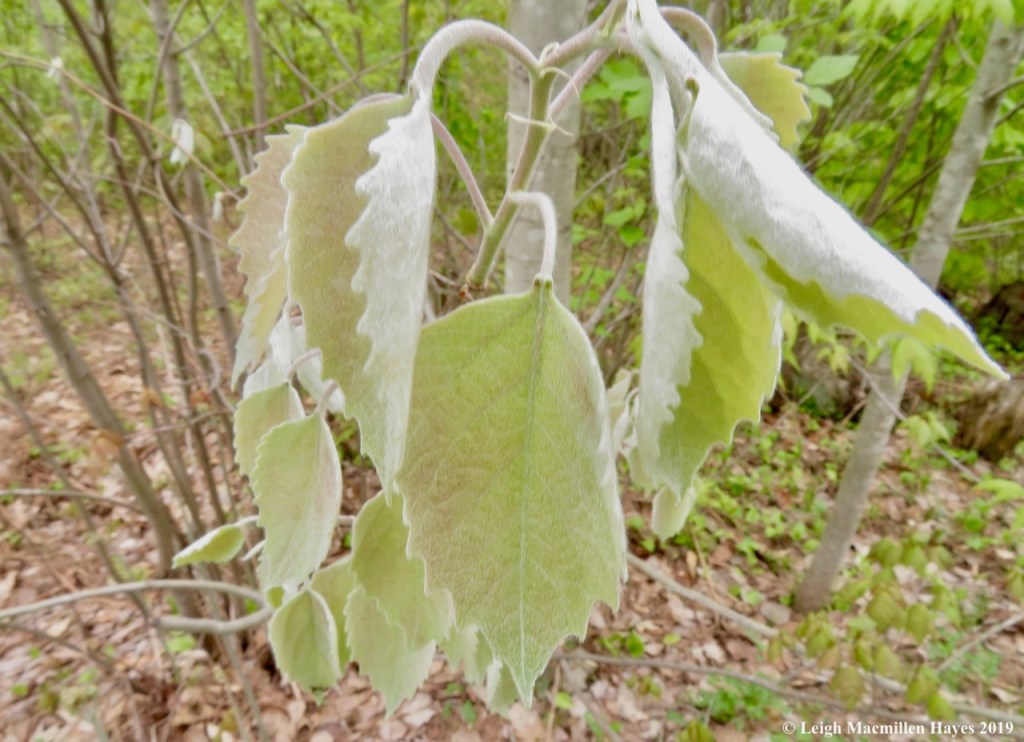
Not far from the visitors center, a Big-Toothed Aspens chose to be examined for the soft downy feel as well as color of its leaves. The various hues of color in leaves during spring is caused by the presence of pigments called anthocyanins or carbohydrates that are dissolved in the cell sap and mask the chlorophyll. As the temperature rises and light intensity increases, red pigment forms and acts as a sunscreen to protect the young leaves from an increase in ultraviolet rays.
Because I was standing still and admiring the leaves, I heard another bird song and eventually focused in on the creator.
And so I have the Big-Toothed Aspen to thank for showing me the Indigo Bunting. My first ever. (Happy Birthday Becky Thompson.)
A turtle. A deer. A fox. A towhee. A bunting. All of that was only a smattering of wonder found along the Mountain Division Trail. If you go, make sure you recall the old railroad signs: Stop, Look, and Listen.
It was 8˚ this morning as I headed out the back door with micro-spikes attached to my hiking boots, sure that I’d stay atop the ice-crusted snow. Not to be. Immediately, I began to sink and realized snowshoes would serve me better.
And so a few minutes later I reemerged, ready for a walk, albeit loud since with each step I took the sound of crunchy snow echoed in the crisp air.
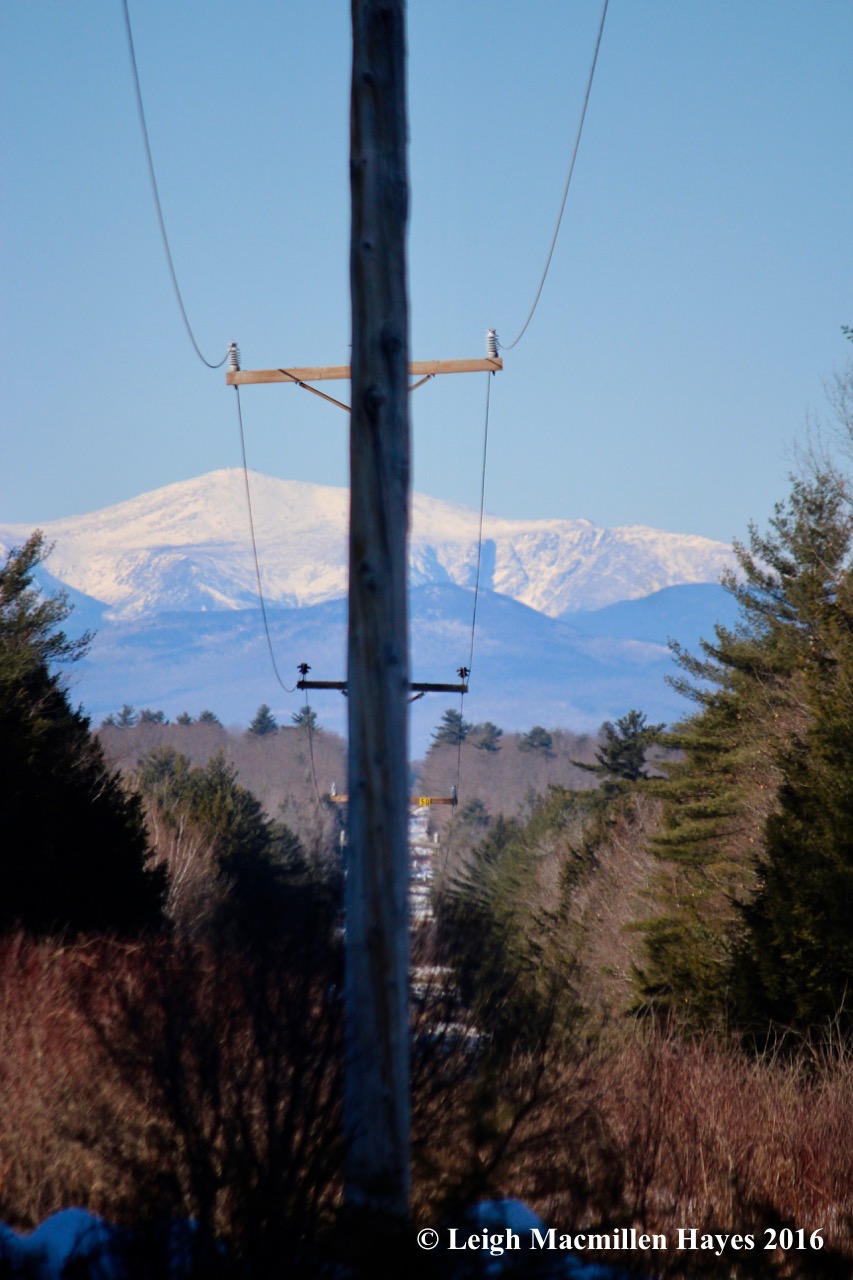
But being a bright cold morning, the view to Mount Washington was equally enhanced.
I quickly moved from our property into the woodland owned by others and started down a trail I’d forged many years ago. Along the way, I was warmed by the sight of the downy seeds of bulrushes swaying in a gentle breeze.
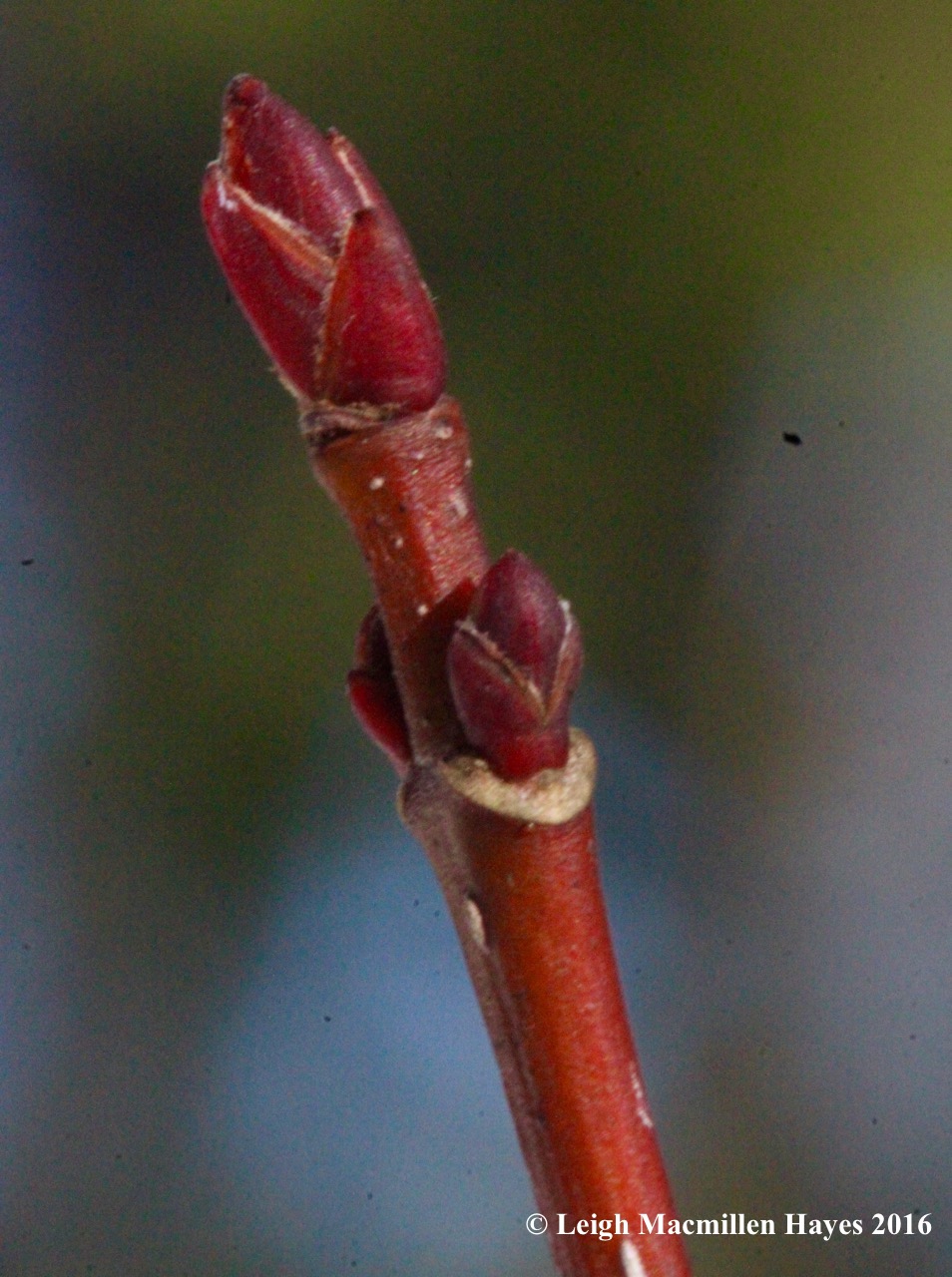
Because of recent logging activity, Red Maple saplings stood out in the landscape, their buds embraced by waxy and hairy scales that provided sure protection from winter moments.
Where only a few days ago, this trail had been a wee bit difficult as I dodged sure wet spots, today all was frozen. Despite the snow and rain of recent days, Royal Ferns shone with their bronze winter display.
The left behind flower bracts of witch hazel reminded me of their two-fold job, from flower base to next year’s seed pod–and a third job for today when they provided a hint of golden yellow to the landscape.
In several trees, I discovered old funnel spider webs and trusted that the creators were enjoying a dormant season of their own somewhere below my feet.
After reaching an intersection in paths, I struck out to create a trail not yet carved. It was here that the White Lettuce or White Rattlesnake-root grew most abundantly, its seeds reminiscent of bird feathers.
Likewise, some bracts had already cast all offspring to the wind and all that remained were small jelly-fish statues.
After doubling back, I passed by my first path and then rather than follow a common route home, decided a bushwhack was more to my pleasing. It wasn’t always an easy trudge and I had to use the sun to help me figure out my direction, but offered its own points of wonder, including the pink and orangey inner bark of paper birch displaying matching lenticels (the little lines that are tree pores for gas exchange).
Spruce cone scales, this one with a seed still attached, decorated the snow-covered forest floor.
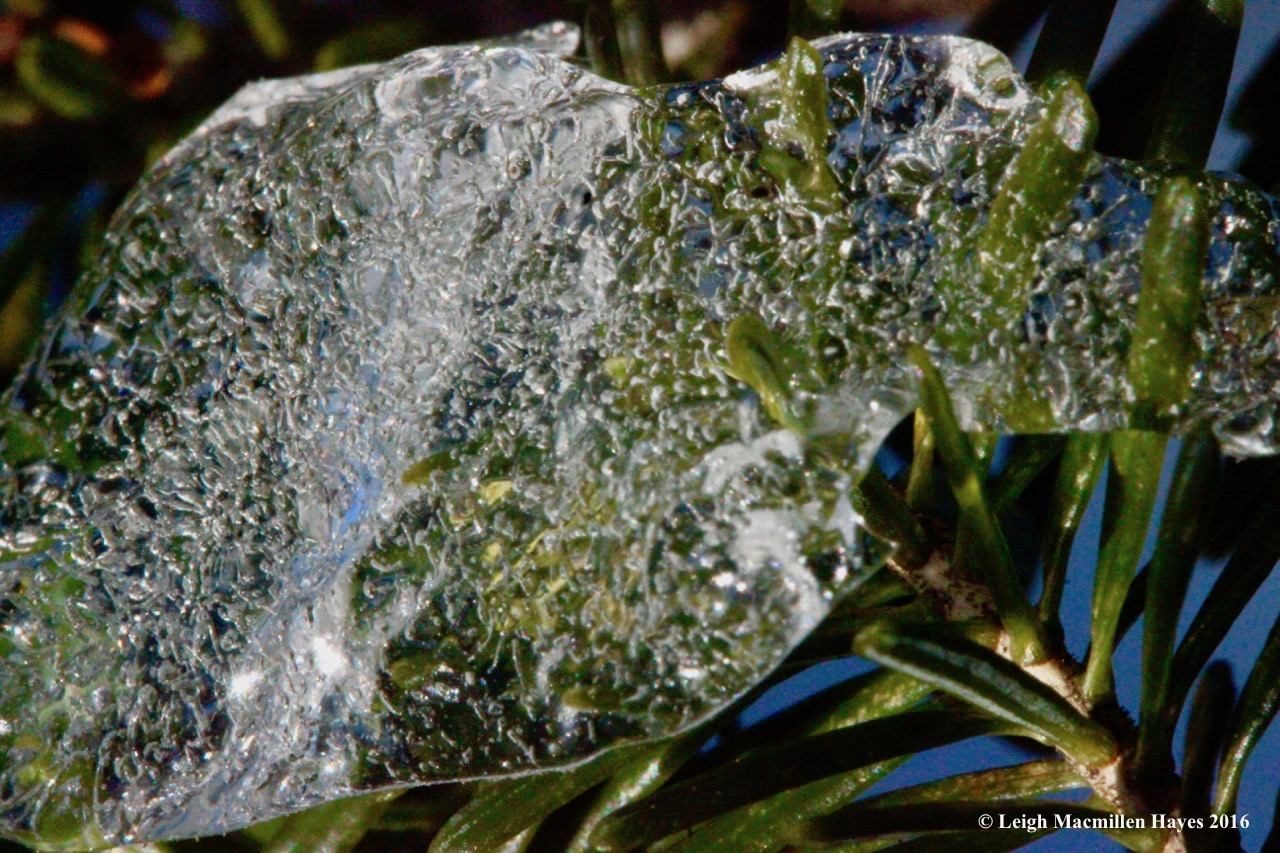
And ice on hemlocks mirrored reflective moments.
As often happens, I got caught in movement, nothing that couldn’t be fixed by quickly stepping out of the snowshoe.
In the midst of my journey, I discovered boundaries in places where I didn’t recall encountering them before. But they’ve been there–for a longtime. Fortunately for me and those who follow in my footsteps, we’re allowed to cross those boundaries at will. If you do follow, however, you may want to forge some of your own pathways. At times, mine required acrobatic movements that weren’t always fluid.
You may have noticed that my guy and I haven’t had a Mondate in about a month. We trust we will again soon, but we’ve had a lot of stuff to do around the old homestead. To that end, we’re both looking forward to future Mondates that know no bounds. Where will 2017 take us?
I love to learn and today’s presence offered such as I explored Loon Echo Land Trust’s Perley Pond/Northwest River Preserve in Sebago. I’ll be leading a hike there this Saturday, so if you are so inclined, I hope you’ll come along. But if you can’t, then please read on. (Note: Jon Evans, Stewardship Manager for LELT will be with me on Saturday, and he’ll have so much more to offer about the lay of the land, which was acquired by the trust in 2014. Today marked my first visit to this property.)
There are three entry points along Folly Road and I began my reconnaissance mission at the first, where I didn’t get far due to a stream not quite frozen, but still found plenty to examine.
Evening Primrose stood at alert in the field just off the road. Tall in stature, its distinctive seed pods peeled back in four parts and small seeds looked like fresh ground pepper on the snow.
Black-eyed Susans also decorated this space, some leaning over to share their offerings. The hairy bracts and gumdrop shape made these easy to spot.
One of my favorite finds in the first section of the property–the hairy twig, catkin, leaf and bud of a Beaked Hazelnut. Just last week I saw the same, well, minus the catkins, in Lovell. And knowing that certain leaves are marcescent, e.g. remain attached to the stem throughout some or most of the winter like oak, witch hazel and especially beech, I was thrown off by this other type. It had me thinking birch and well it should have because Beaked Hazelnut is a member of the birch family. But #1, though a hairy twig like Yellow and Paper Birch, the leaf base wasn’t right for either, and #2, I didn’t recall ever seeing these leaves still dangling in later fall/early winter. The trees taught me a lesson today–the most perfect of gifts–a few Beaked Hazelnut leaves continued to dangle, though most were turning quite dark in hue and I suspected will fall soon, and, I found Gray Birch leaves also clinging. Just when I thought I knew everything, nature proved there’s more to learn. So the gift was a reminder to pay more attention.
I left that section and walked down the road to a spot where a chain prevents vehicles from entering the old log landing. It certainly didn’t stop the deer who had danced in the night.
As I moved through the landing, I paused to admire another dancer as witnessed in the fluid movement of Sweet-fern.
Like the Beaked Hazelnut, its catkins were wrapped gifts that spoke to the future.
Also in this space, a few willows with their own little packages.
The willow pine cone gall was created in the summer by a gall gnat midge. The larva stage secreted a substance on the stem that caused the willow to go into overdrive–resulting in a multi-layered chamber composed of hardened material that would have been leaves, but alas, the stem growth was arrested. Inside that hairy structure resides the wintering larva, nice and snug for the winter. It will metamorphose into a gnat when warm weather arrives.
As I walked along I noticed Christmas tree patterns among the firs.
It was a simple case of an upside-down look. Once flipped, in my brain anyway, the seasonal symbol was obvious.
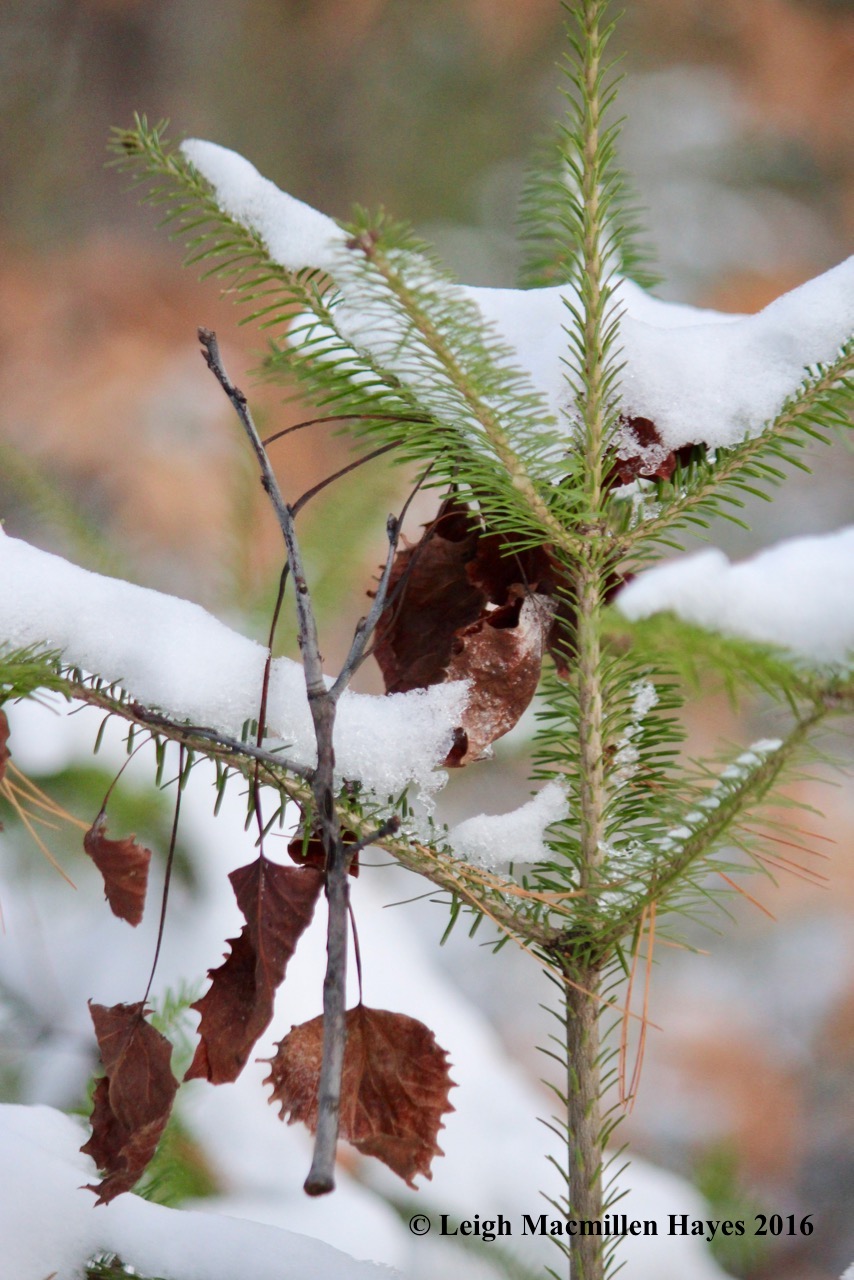
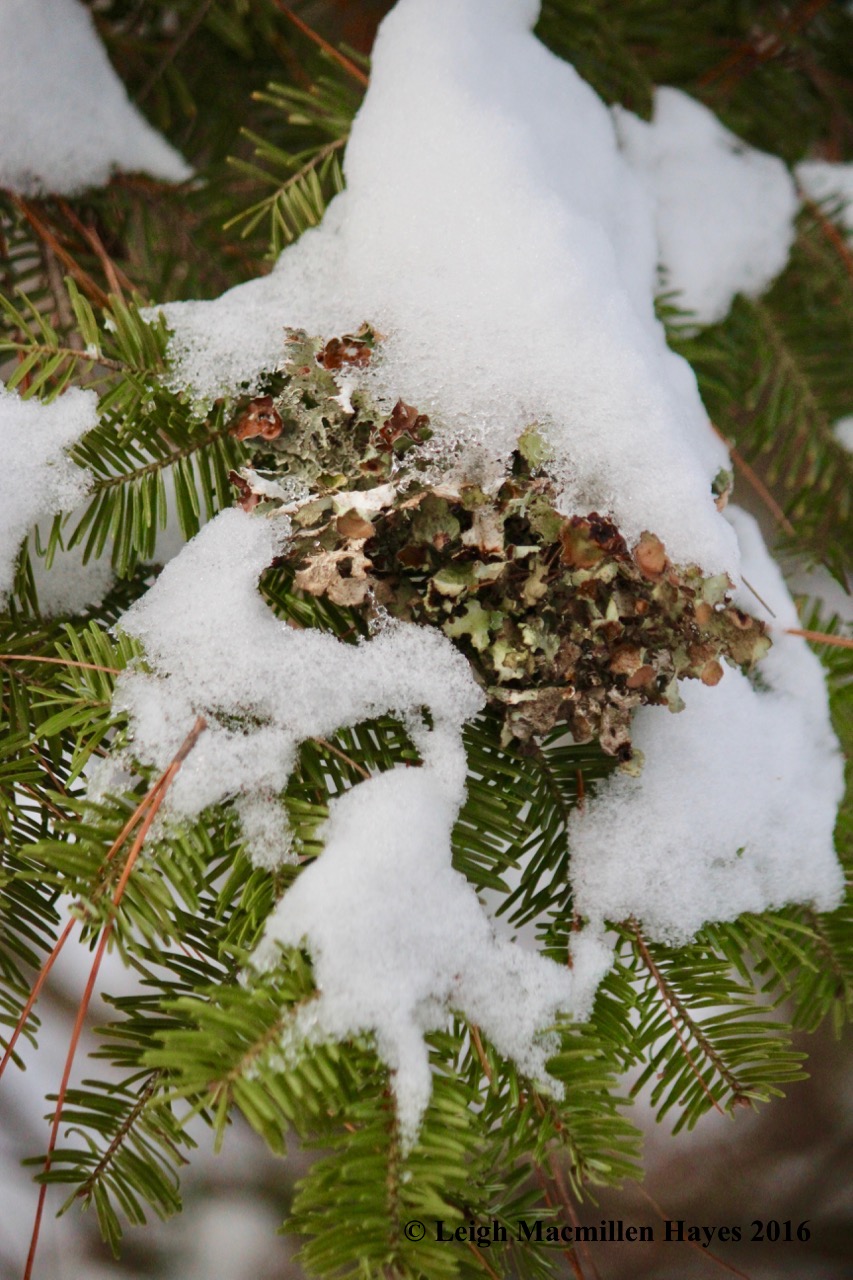
And the ornaments dangled–in the form of Big-toothed Aspen leaves and White Pine needles,
Northern Camouflage Lichen,
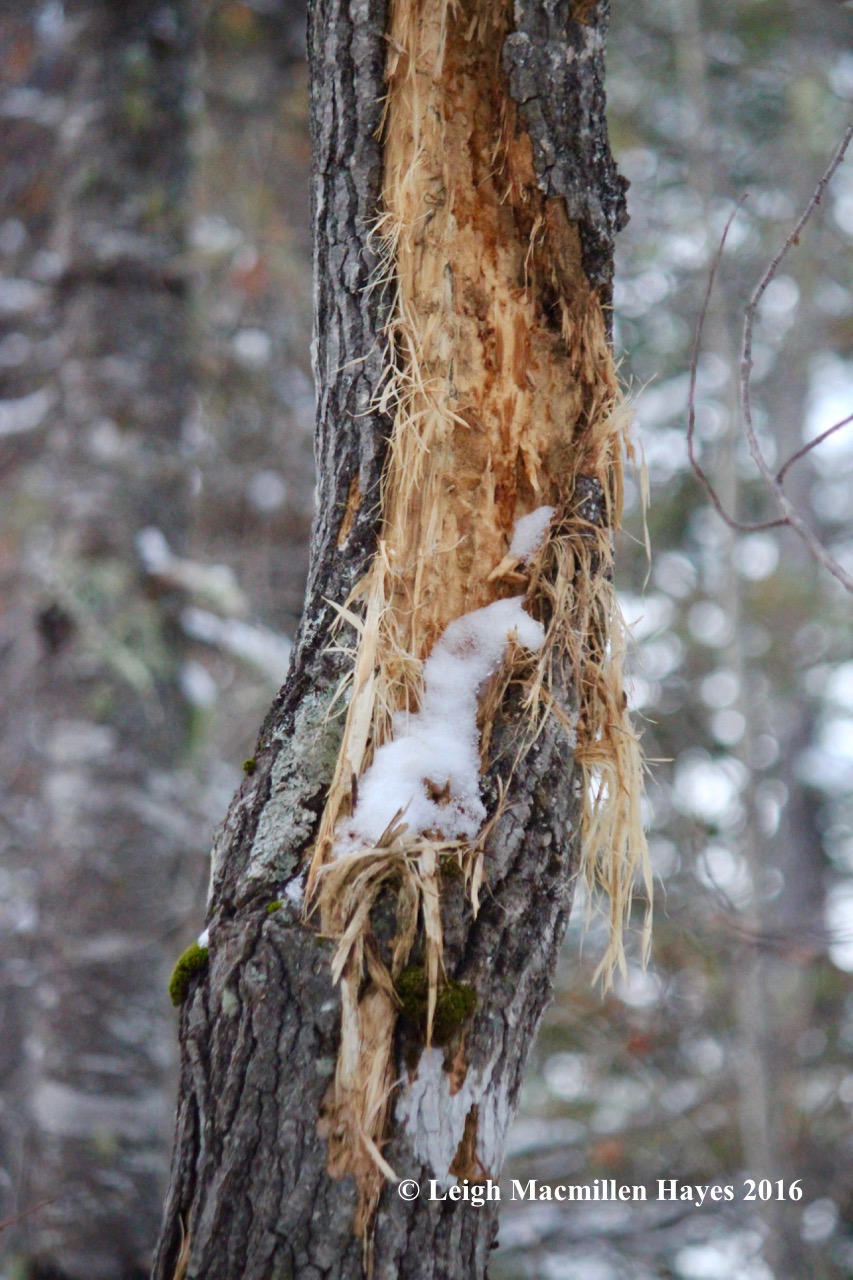
and shredded bark created by . . .
a Pileated Woodpecker in search of food.
I felt my good fortune to find a spot where a ruffed grouse had tunneled.
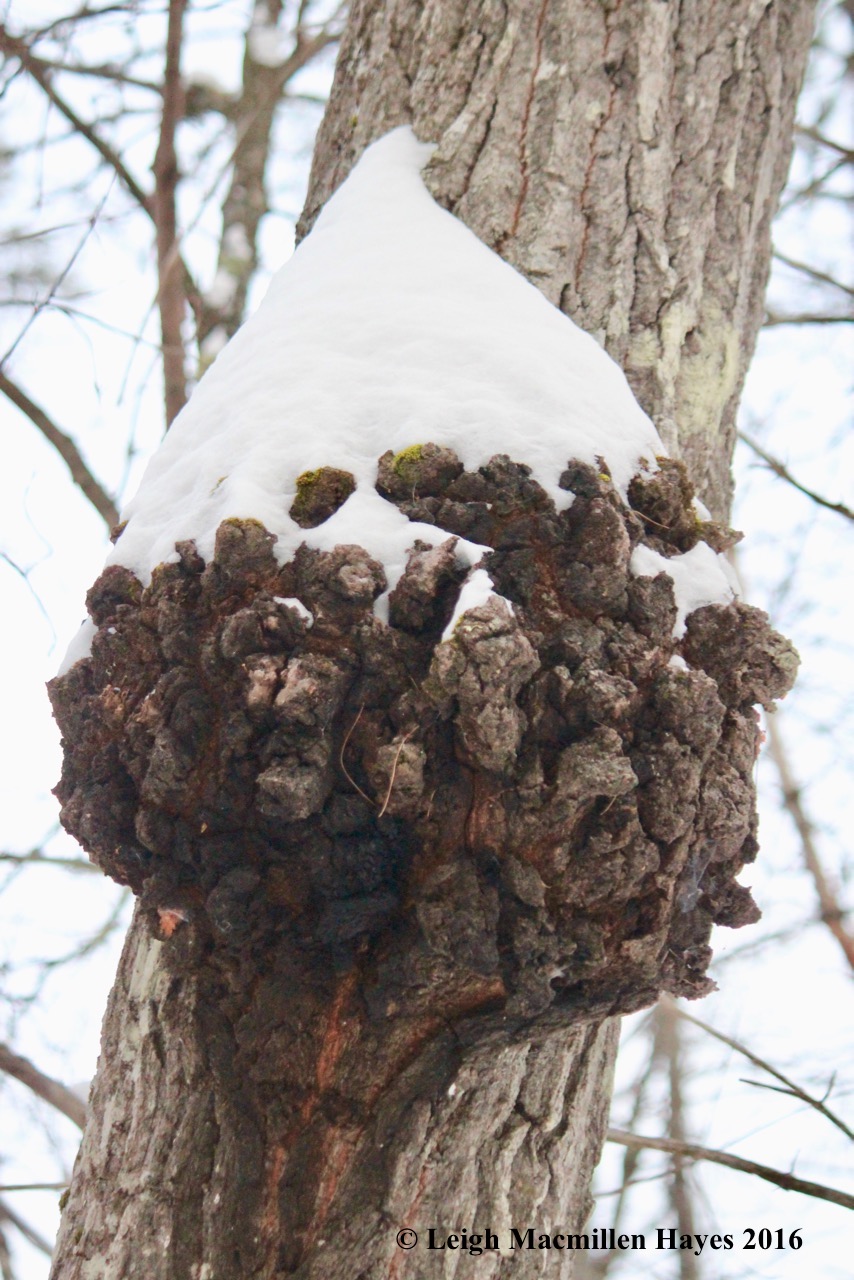
And then I was stopped by a burl. Like a gall, this was created by insects.
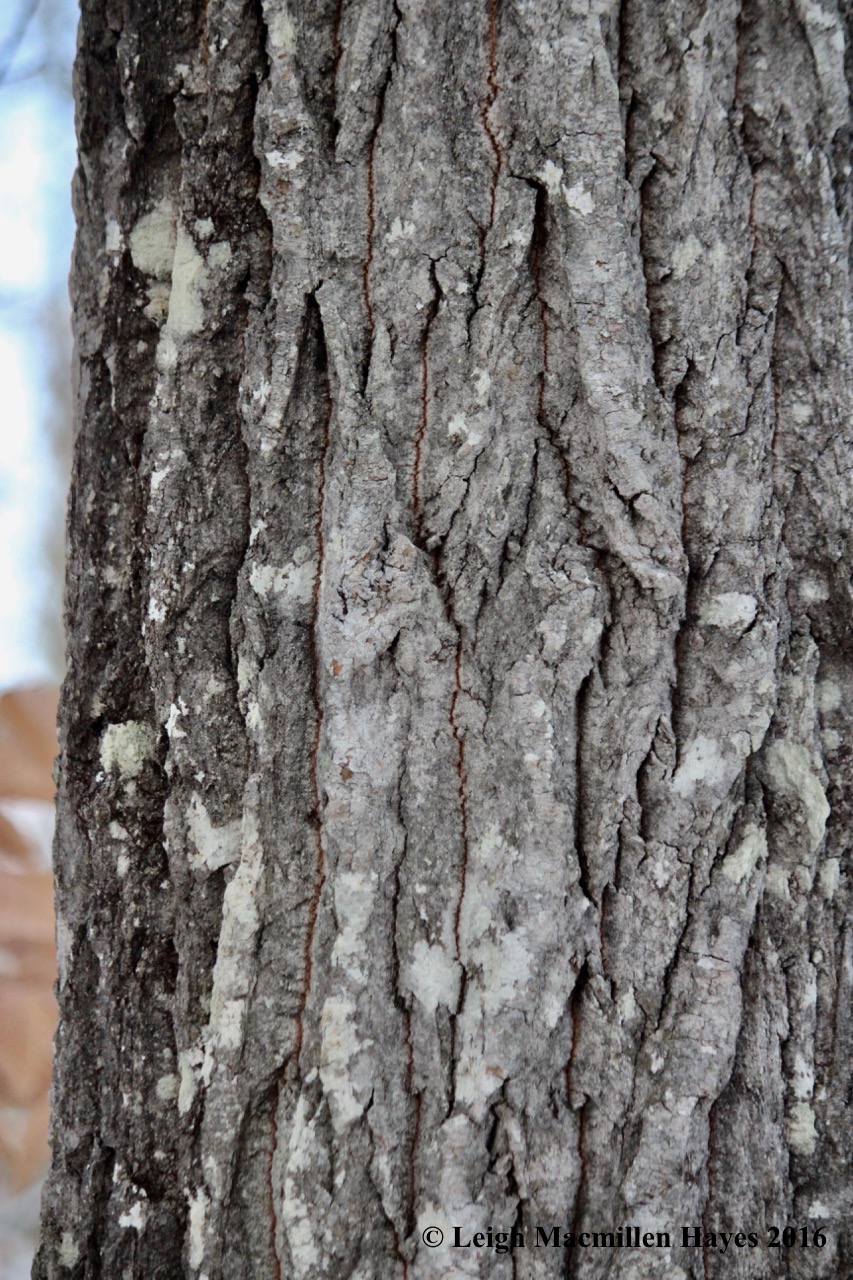
The tree of choice featured lower gnarly bark that resembled a Northern Red Oak.
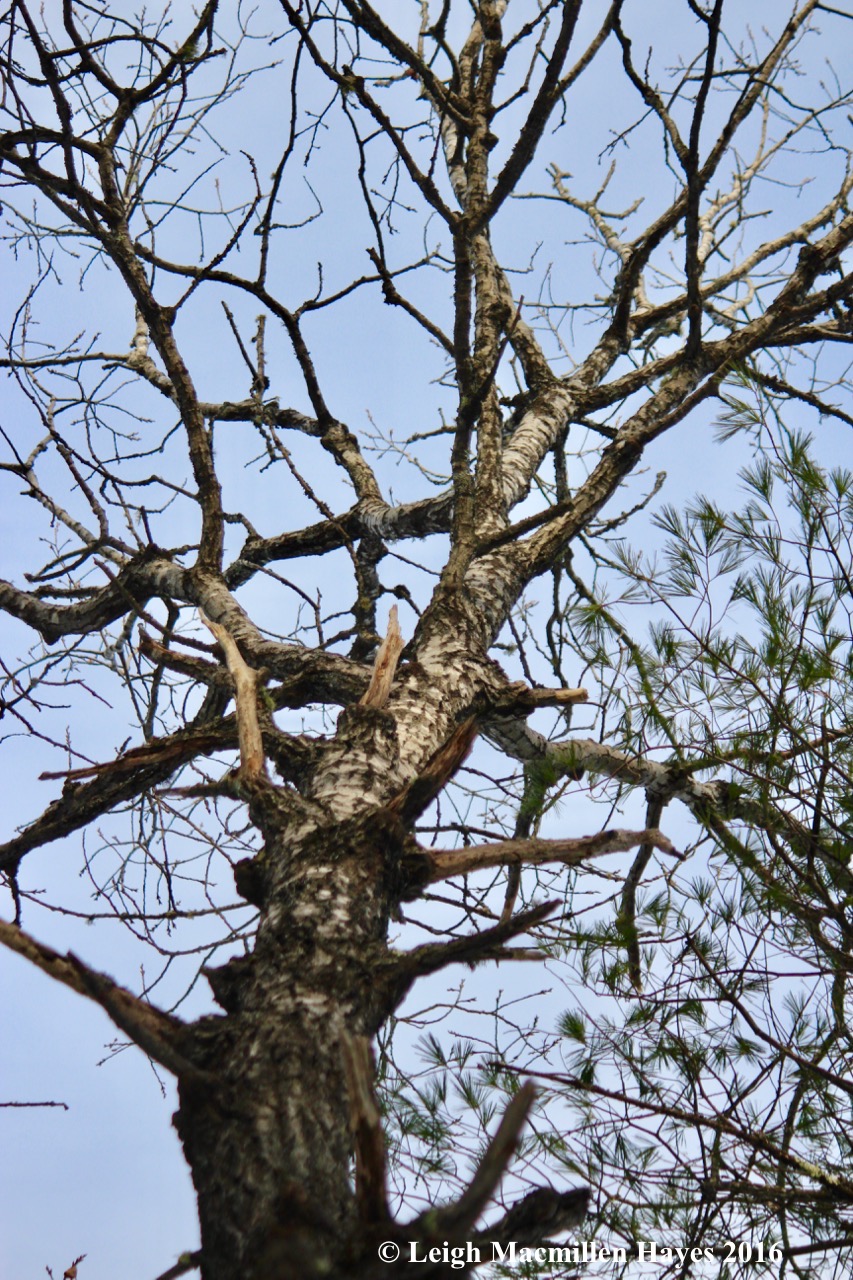
But a peek toward its crown revealed a birch–the two-fer one gift: Big-toothed Aspen.
Its leaves, oh my, another temporarily “marcescent” variety–showing off the big teeth for which it received its common name.
Speaking of leaves, there were numerous renditions of White Oak–another dancer that seemed to freeze in motion.
Here and there among the offerings, Red Pine. This particular one showed my love for it where a branch had broken off. Do you see the wee heart?
While mature Red Pines feature bark that reminds me of a jigsaw puzzle, I found some younger trees, their structure speaking to geometry.
Continuing on along the logging road, I wondered if perhaps I’d gone astray. Suddenly, I found myself in Piscataqua County–miles and miles from home. I knew I was in unknown territory, but was I really that far from home? More than my usual fake lost? Or someone’s sense of humor?
Maybe so. Certainly I was in the land of owl feet.
And a tuckered coyote?
It was at this point that I headed off trail, made easy by underbrush.
Deer tracks led me to another wonder-filled gift.
The wetland and Northwest River, one of the namesakes for this place.
It was here that another lesson presented itself–the layered bark made me realize I was viewing Pitch Pine growing beside the bog. My understanding was that these grew on ledges or rocky outcrops. But here was one with wet feet. And so I later consulted Bogs and Fens by Ronald B. Davis (I highly encourage you to add this title to your Christmas wish list) and discovered that not only does it grow in dry woodlands, but also “in swamps and at the edges of fens and bogs.” (Additional note: Pitch Pine Bogs are listed as S2: “Imperiled in Maine because of rarity (6-20 occurrences or few remaining individuals or acres) or because of other factors making it vulnerable to further decline”; thus another reason to give thanks to LELT for preserving this place)
Pitch Pine needles present themselves in bundles of three–perfect for this time of year–ahhhh, the Trinity.
Rhodora
and Leatherleaf added to the winter ornamentation.
In my attempts for “the perfect photo,” I broke through the ice several times. I’d been post-holing through about seven or eight inches of snow all afternoon sans snowshoes because it was quite easy to move about in the fluffy stuff, but when I reached the edge of the water, the snow had insulated the thin ice cover and . . . crash, crackle, crunch, I sunk in to the top of my Boggs and even a wee bit over.
On my way back down the logging road, I realized how my own tracks were much more varied than that of the deer who’d passed before me.
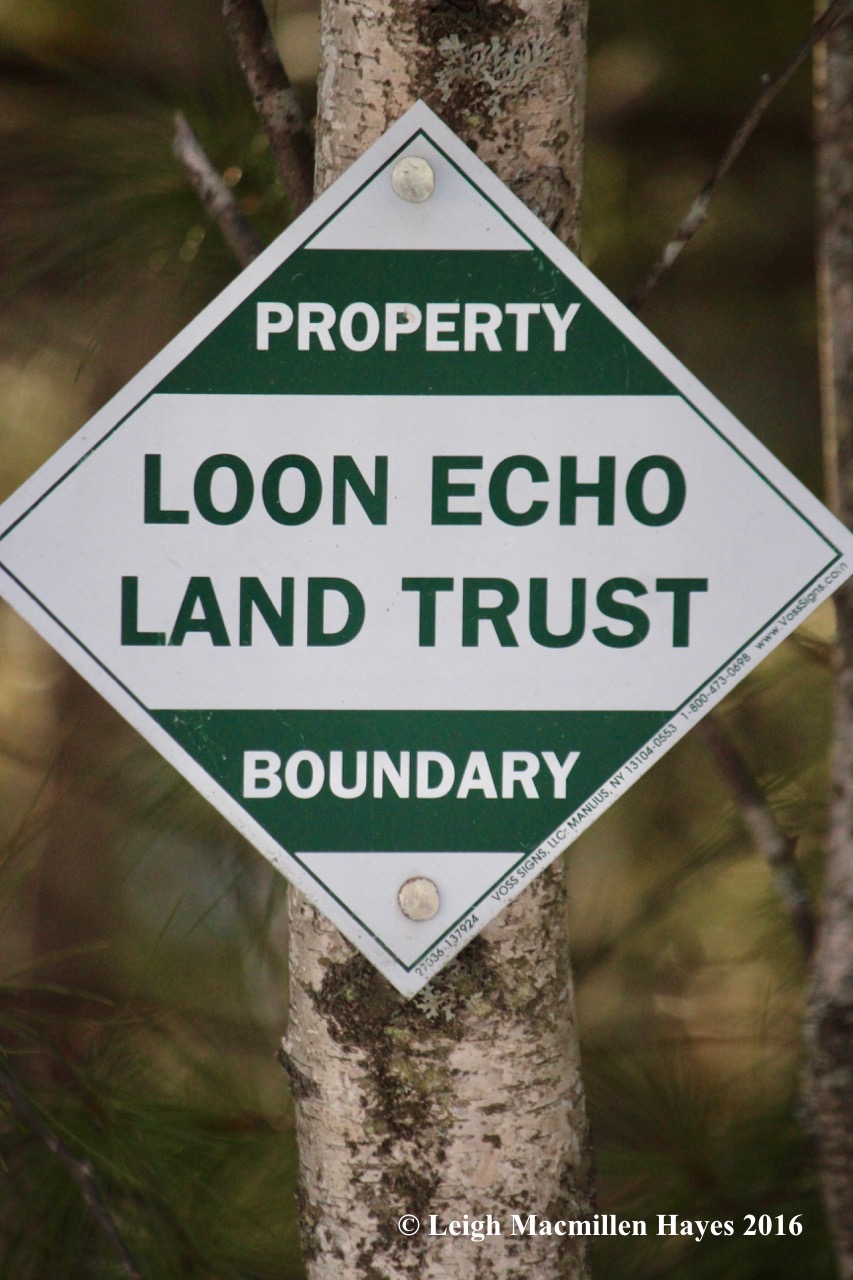
And then I came to a boundary sign. Opps. Guess I went beyond the land trust’s property, though thankfully no signs deterred me from trespassing.
And a wee bit further down Folly Road, I stopped at Perley Pond, part of the namesake for this property–and part of the reason for my presence for the presents presented.
It’s not every day that I get to wander and wonder among 300-year-old giants, but such was the case today. A friend and I met at Robinson Woods in Cape Elizabeth. It was a reconnaissance mission for me as I’ll be leading a senior college class there next month. And for both of us, it was a delightful way to spend three hours snowshoeing on and off the trail, with frequent pauses to look, listen, touch, smell and learn.
Because the land was not suitable for farming (terrain rocky and uneven), it was left unchanged for all these years. Actually, we met the executive director of the Cape Elizabeth Land Trust along the way, and he told us that the Robinson family was a paper company family, but they left this piece untouched. Thanks go to them. And to the land trust for preserving the land so that it will remain in its natural state.
We could hear the birds sing and call as we moved along. Someone apparently wanted to make sure they have enough to eat as we found a couple of these “bird-seed” pine cones dangling from trees. (Separate note: back at home, for the second day in a row, I’ve had chickadees landing on my mitten to eat crushed peanuts–well, they don’t actually eat them on my hand, they just grab and fly to a nearby branch, where they use their feet to hold the nut or seed and then peck away at it.)
We followed this porcupine trail for a bit. As we backtracked our way toward the people trail, something caught our attention:
Yes, even in Cape Elizabeth, and only steps from the ocean, you can find bear claw sign on beech trees.
We showed these photos to the executive director of CELT–he had no idea they were there. I’ll be curious to see if he adds black bears to the list of mammals that frequent the property. I did see that they have pine martens on the list–that surprises me.
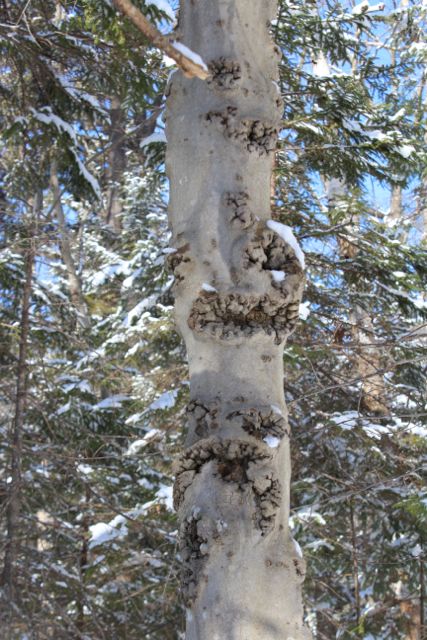
I know I’ve spent a lot of time writing about beech trees, but this one looks like a totem pole of gnarly faces. Think gargoyles. Was the beech scale disease initially responsible for this? I wonder.
Very gnarly indeed. In the center, you can see where a branch broke off.
This Red Maple had some serious burls. Perhaps they were caused by stress or injury, though researchers don’t know for sure why they occur. Despite the bumpy, warty growths, the tree appears to be healthy. You can see that there is new growth–young red branches sprouting from the burls. Removing a burl causes a large wound that could eventually harm the tree, so they’re best left alone–though I know woodworkers covet them.
We were almost back to our trucks when we came across this tree. It’s a young tree and we tried to key it out. We’re pretty sure it’s Shagbark Hickory, but if you know otherwise, please enlighten me.
Thanks for wondering along with me on today’s wander through the woods.


















































 wondermyway