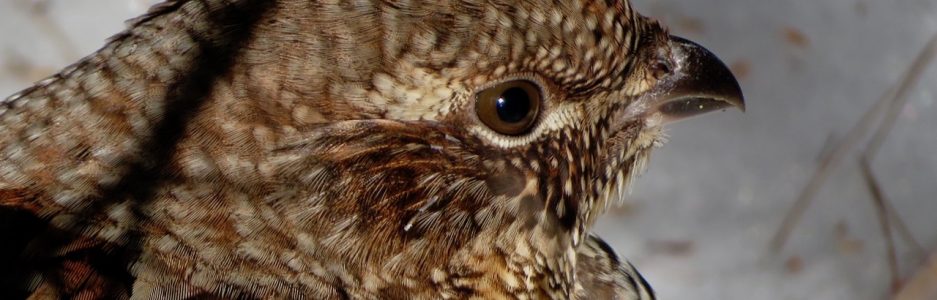
All Aboard Mondate

His birthday present several weeks ago was a Cat’s Meow replica of the North Conway Scenic Railroad (from my collection) and a note: October 21, 11:00 am – 4:00 pm. Be there!!
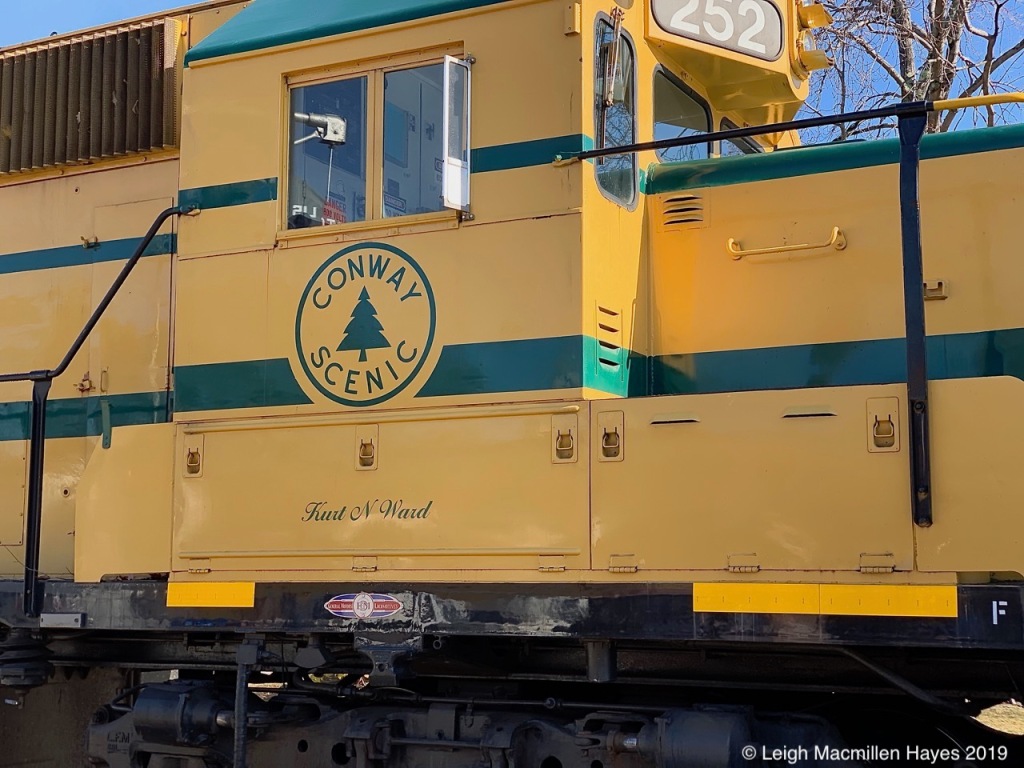
This morning I drove him there. No, I wasn’t the engineer of the train, but rather the conductor of his entertainment schedule.
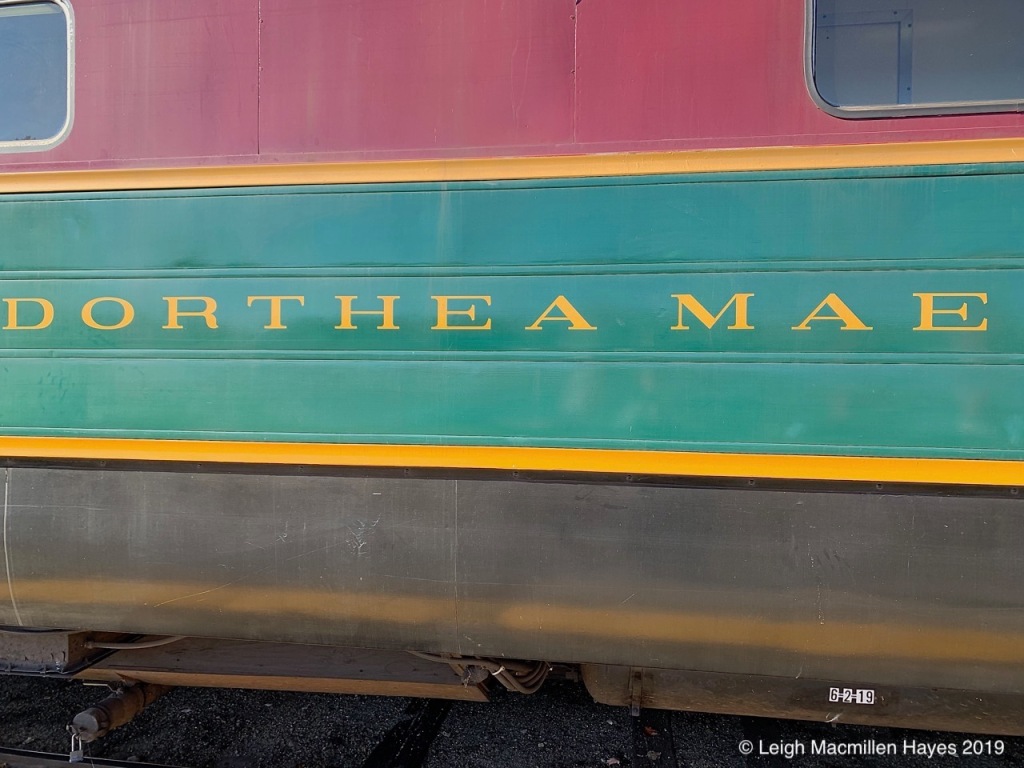
Our chosen car, the Dorthea Mae, was built in the mid-1950s for transcontinental service in the United States and turned out to be the perfect choice for this adventure. We’ve ridden the Conway Scenic train before–several times when our sons were young and we took the one hour ride from North Conway to Conway, New Hampshire, and once for an anniversary celebration as we enjoyed dinner on the Bartlett Route. But for all the times we’ve driven along Route 302 through Crawford Notch and looked at the scary trestles hugging the mountains, we always said we’d love to take the longer ride. Well today, that became a reality.
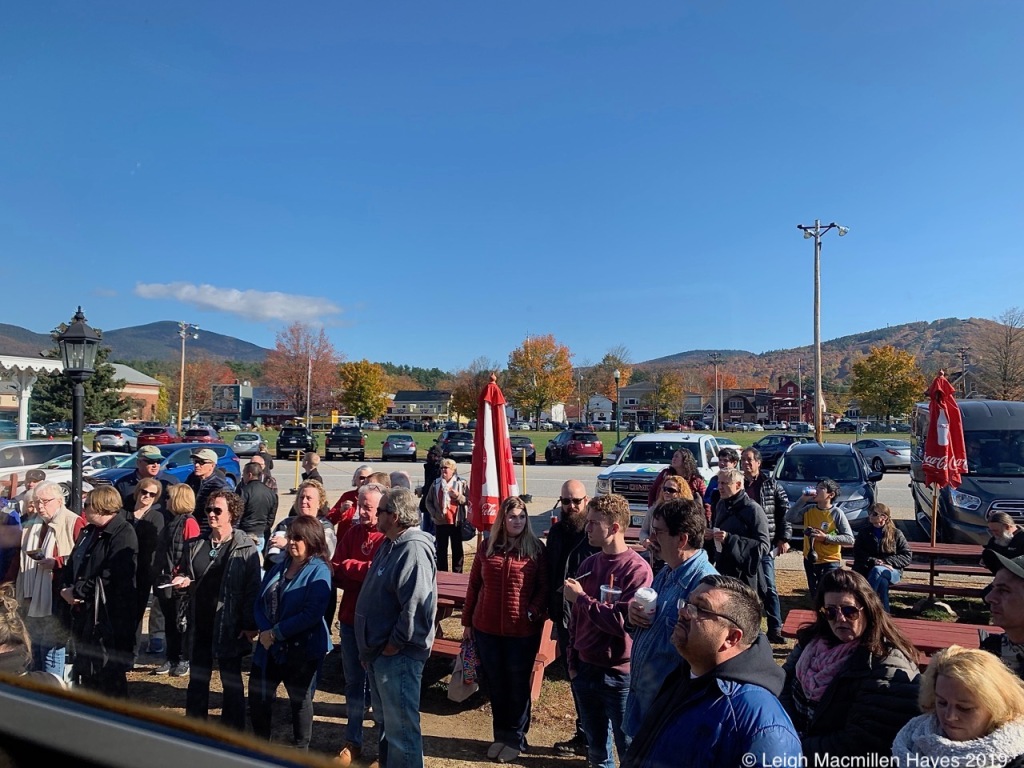
Group by group, riders were welcomed to climb on and find their assigned seats. Ours was located opposite a delightful and chatty couple from Iowa, MaryPat and Ron.
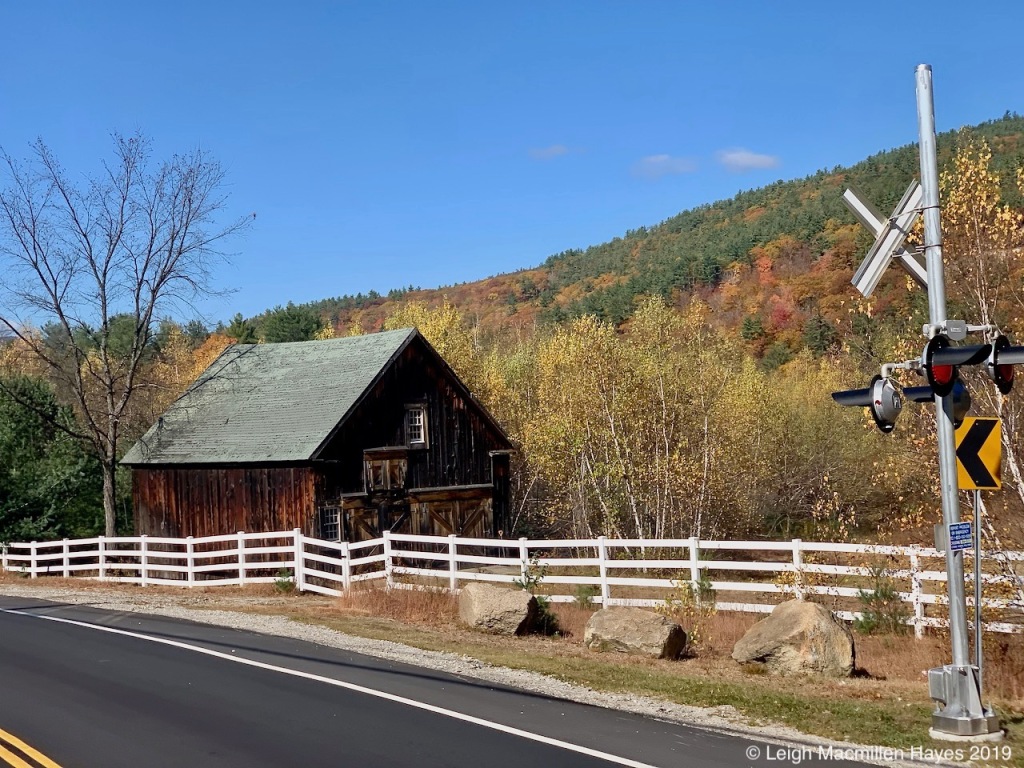
For us, part of the fun was recognizing familiar spots along the rail, including a rail crossing on Route 302 by a historic barn.
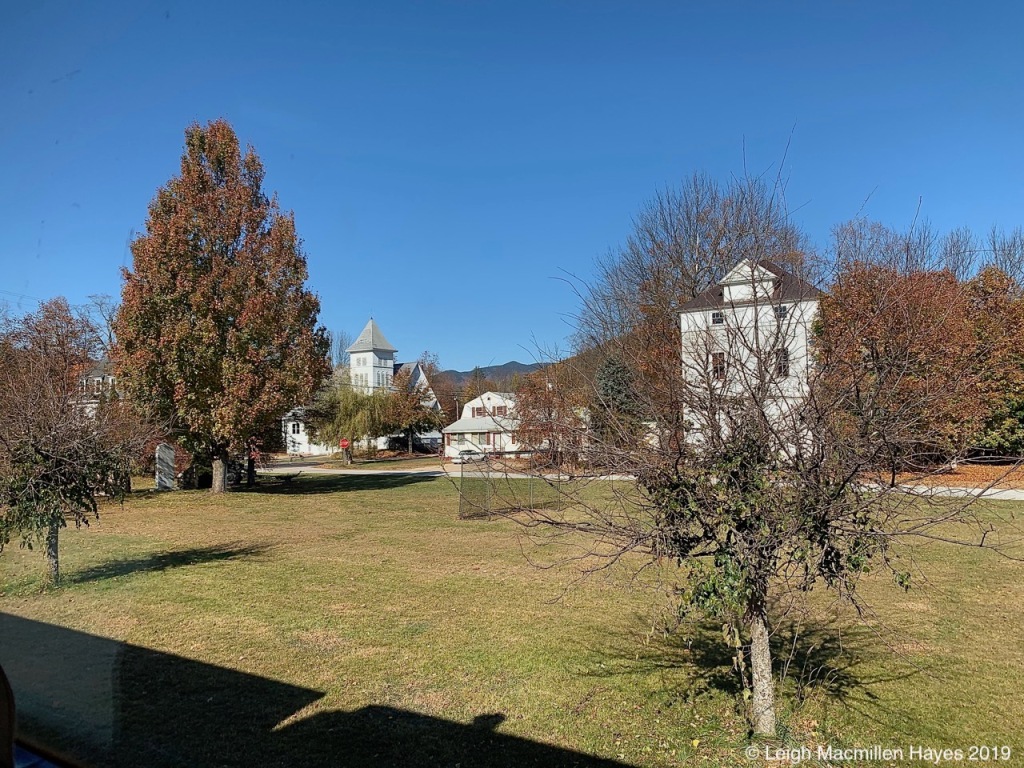
Through the village of Bartlett we travelled along rails originally laid down in the 1870s for what was once the Maine Central Railroad’s famed Mountain Division Trail.

The church to the left is the Union Congregational Church on Albany Avenue, and to the right the Odd Fellows Hall, a historic fraternal society.
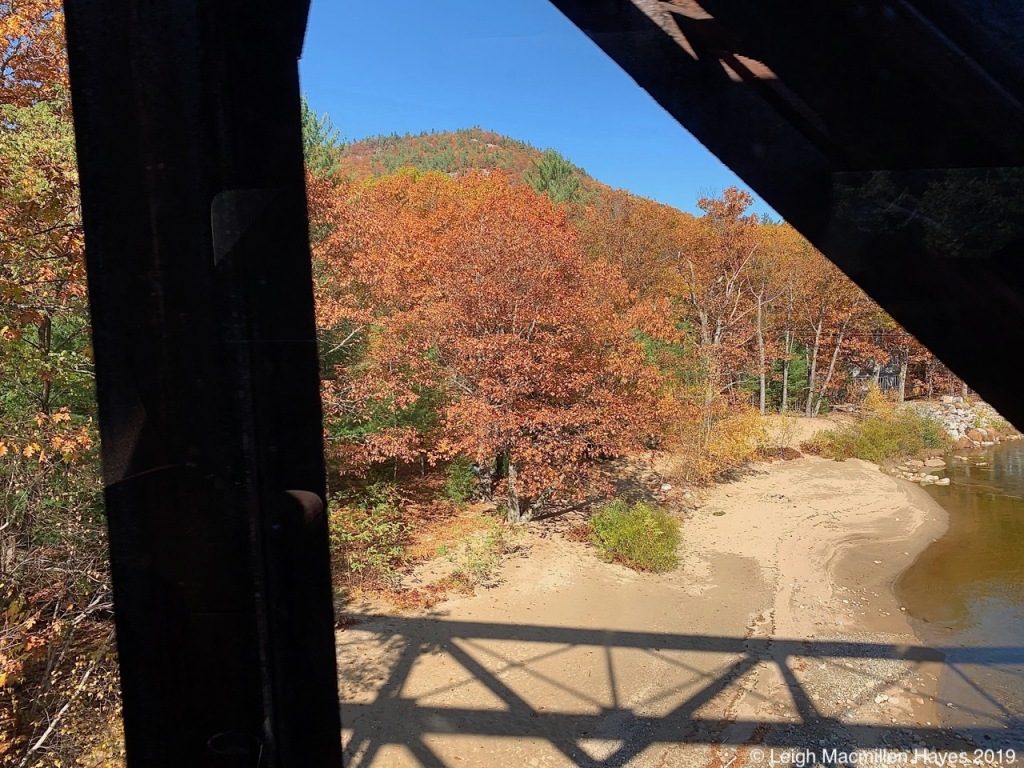
Early on we crossed trestles over several rivers where shadows, angles, curves, and foliage delighted our eyes.
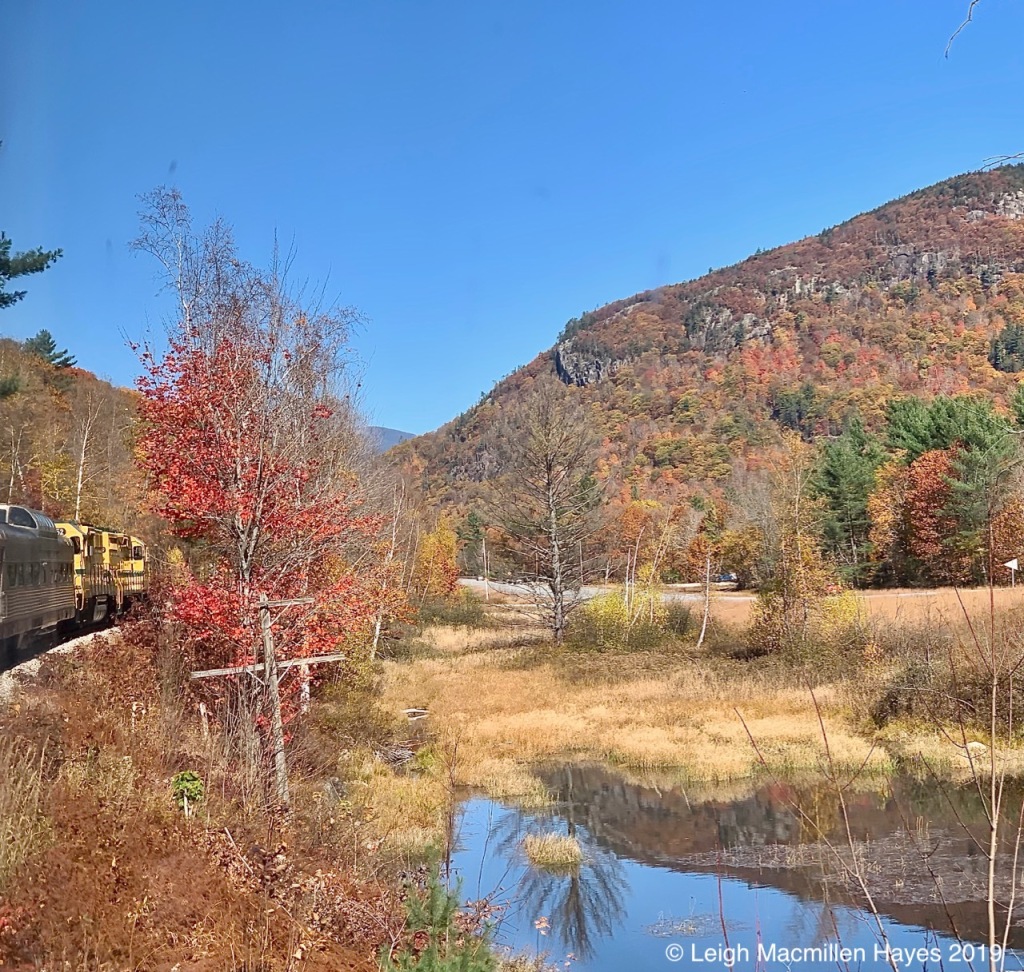
As we headed toward Crawford Notch, again it was the same, only different, with ever the click-clack of motion providing a new vista that captured our awe.
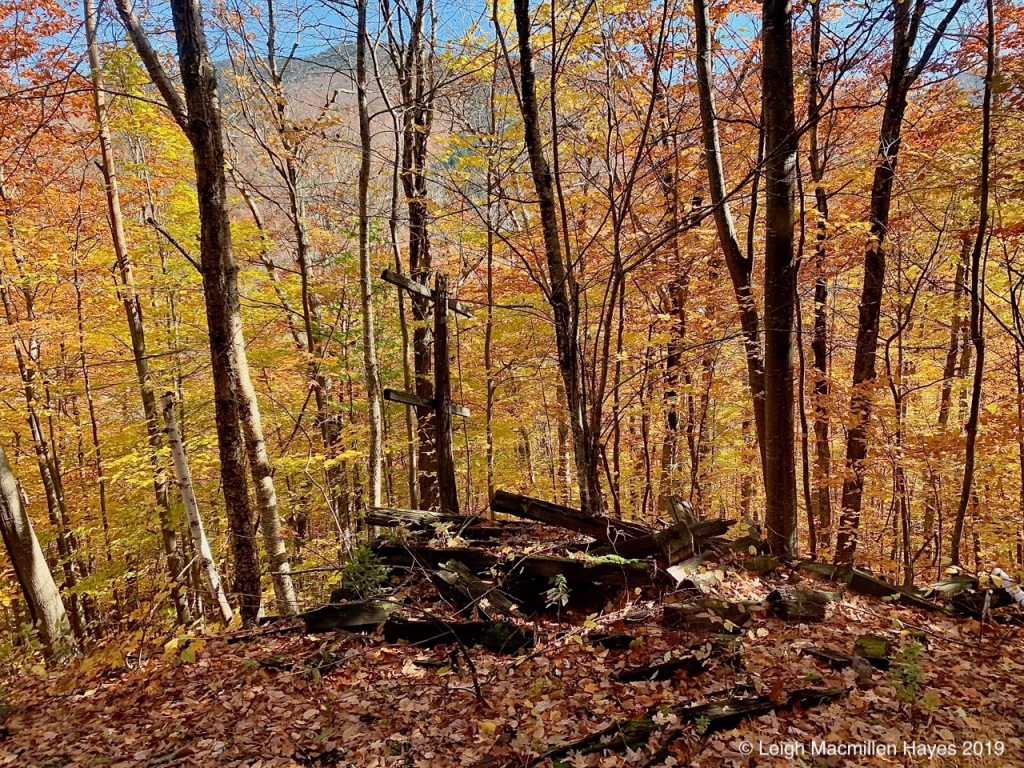
History presented itself over and over again, with old rail ties and power poles dotting the landscape–obscured for a wee bit longer by the golden hues of the forest.
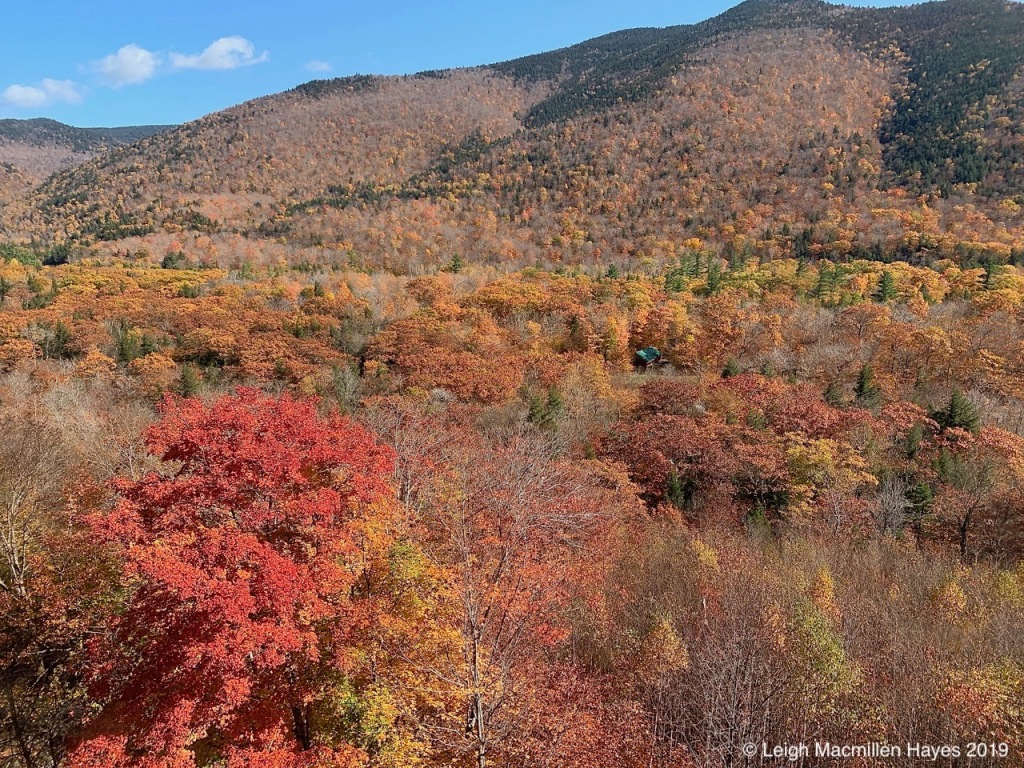
Knowing that today was the only date available when I’d booked the trip, and in fact, that we got the last two seats on the Dorothea Mae, we wondered how much color we might see given that we were traveling north. It was past peak, but still . . . one Red Maple stood out amongst the yellowy-orange-bronzes of the landscape.
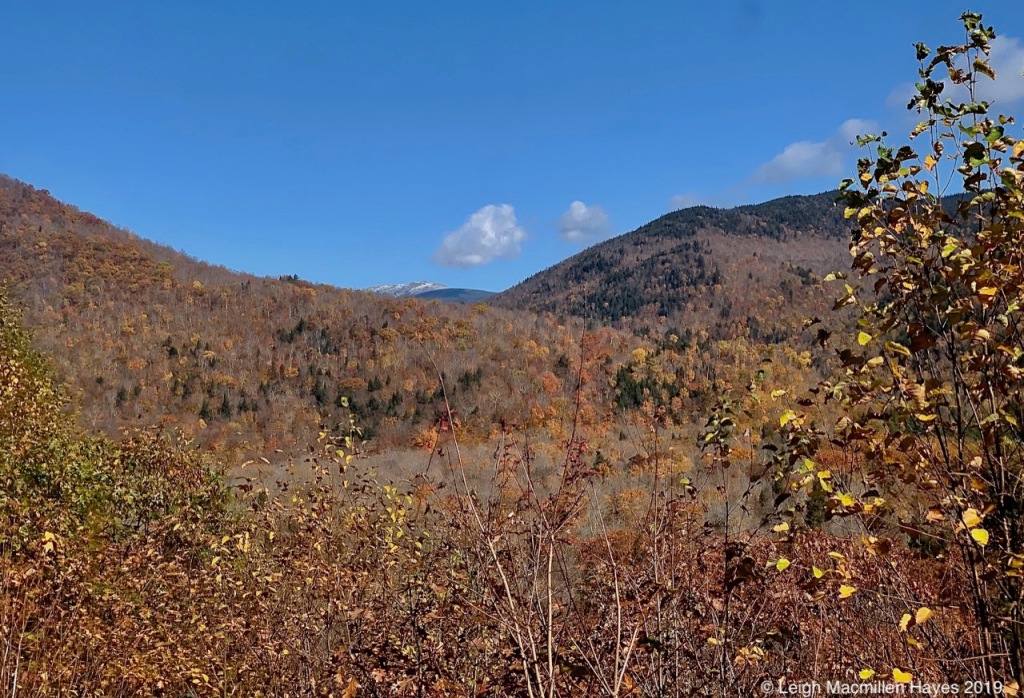
There was also some white to view–not only the few clouds, but the summit of Mount Washington with a recent coating of snow and rime ice.
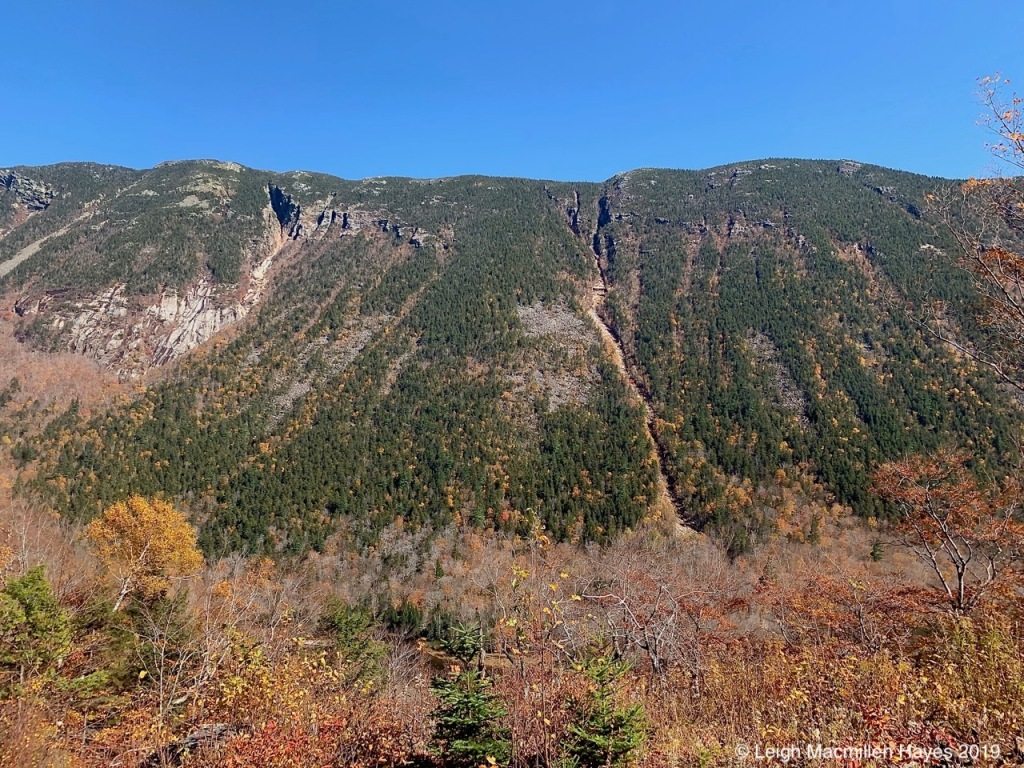
The ridgeline of Mount Webster, forming the eastern side of the U-shaped glacial valley which forms Crawford Notch, stood crisp and clear as we headed north.

The mountain was named for Daniel Webster, a statesman and orator born in Salisbury, New Hampshire, which is present day Franklin where I began my former teaching career in 1980.
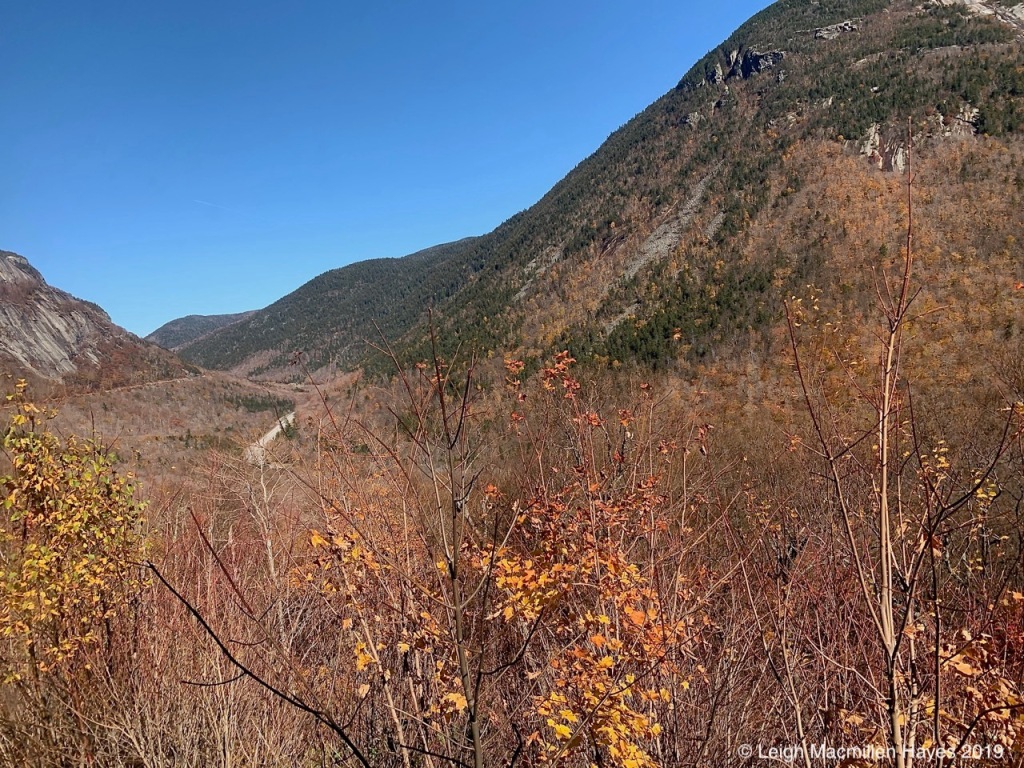
From our seat on the train, looking south, Mount Webster was on the left, Route 302 between, and Mount Willey on the right forming the western side of the U.
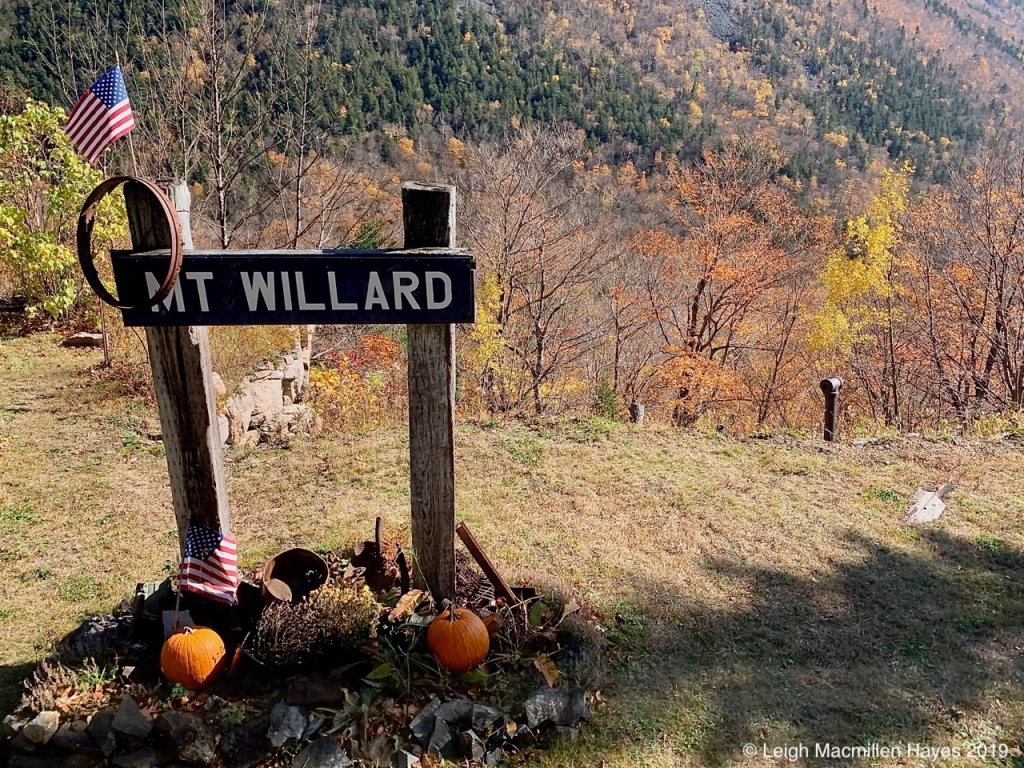
By Mount Willard, we heard the story of the section house that stood here in the 1900s.
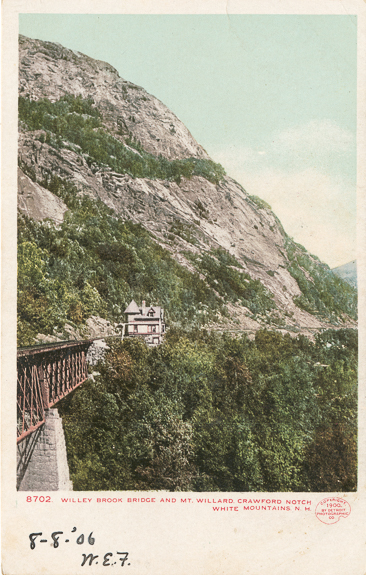
Willey Brook Bridge is Crawford Notch, New Hampshire https://digitalcollections.nypl.org/items/510d47d9-a2cf-a3d9-e040-e00a18064a99 Detroit Publishing Company Collection, Photography Collection, Miriam and Ira D. Wallach Division of Art, Prints and Photographs, The New York Public Library, Astor, Lenox and Tilden Foundation

Our narrator, Denise, spoke of the Mt Willard Section House built in 1887 for section foreman James E. Mitchell, his family, and crew who maintained Section 139 of the railroad. Loring Evans became foreman of Section 139 in 1903. He was killed ten years later in a railroading accident at Crawford’s yard, but his wife, Hattie, raised their four children and despite all odds ran the Section House until 1942. It was Hattie’s job to house and feed the men who worked on the shortest yet most treacherous stretch of the rail.
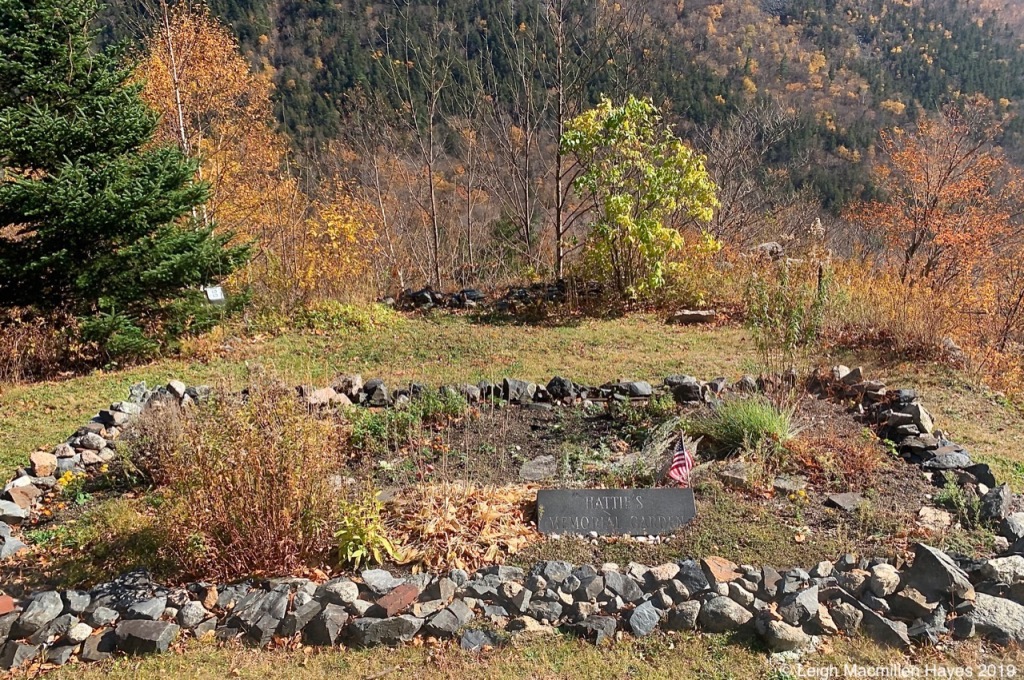
A memorial garden still honors her work.
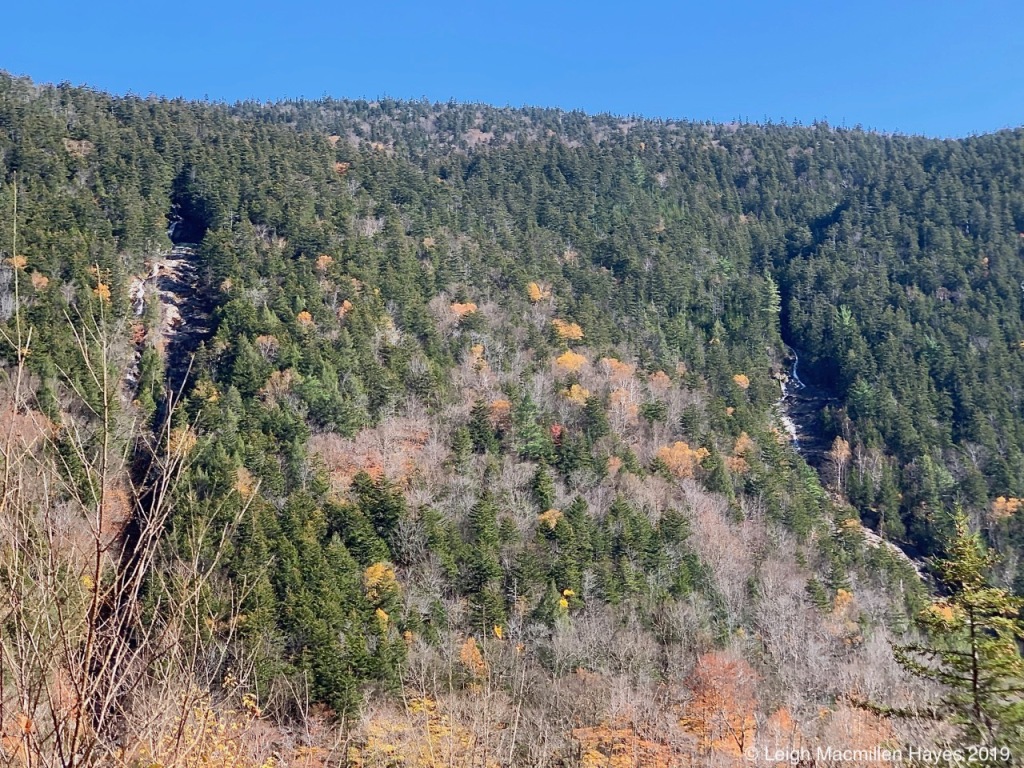
Below Mount Jackson, across the way, two waterfalls graced the scene. Typically, we’ve viewed them one at a time, but from the train, both Flume and Silver Cascades were visible as water raced down the mountain’s face.
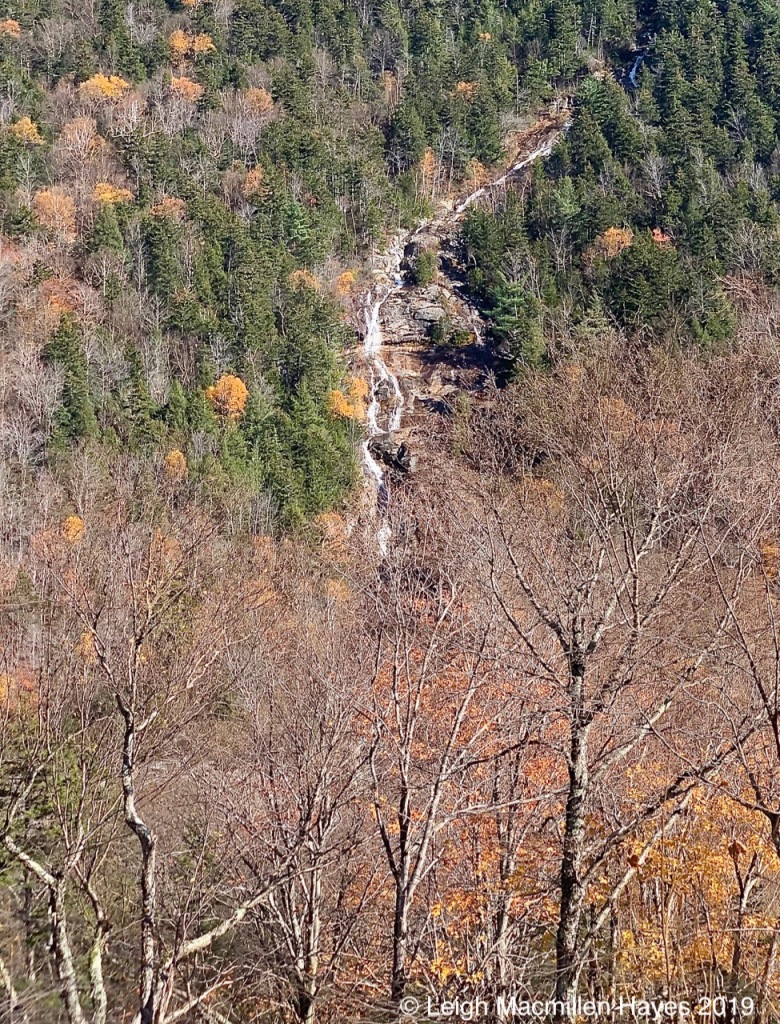
This being Silver, but both looked like traces of chalk from our position.
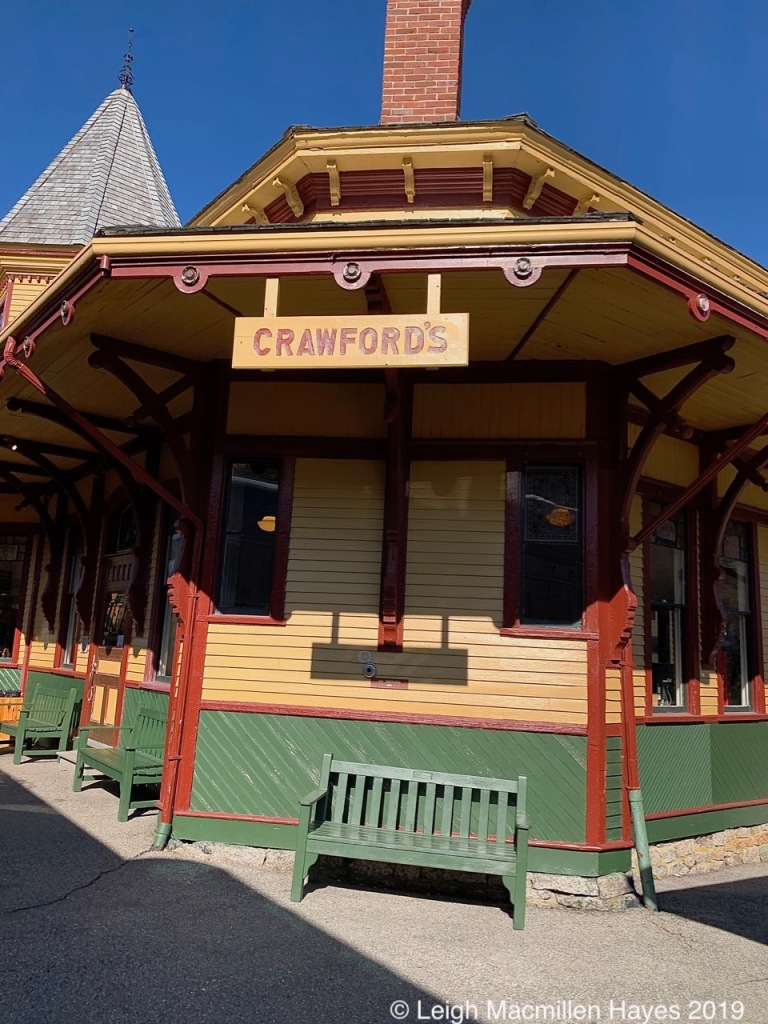
Two hours after our journey began, we arrived at Crawford’s Depot.
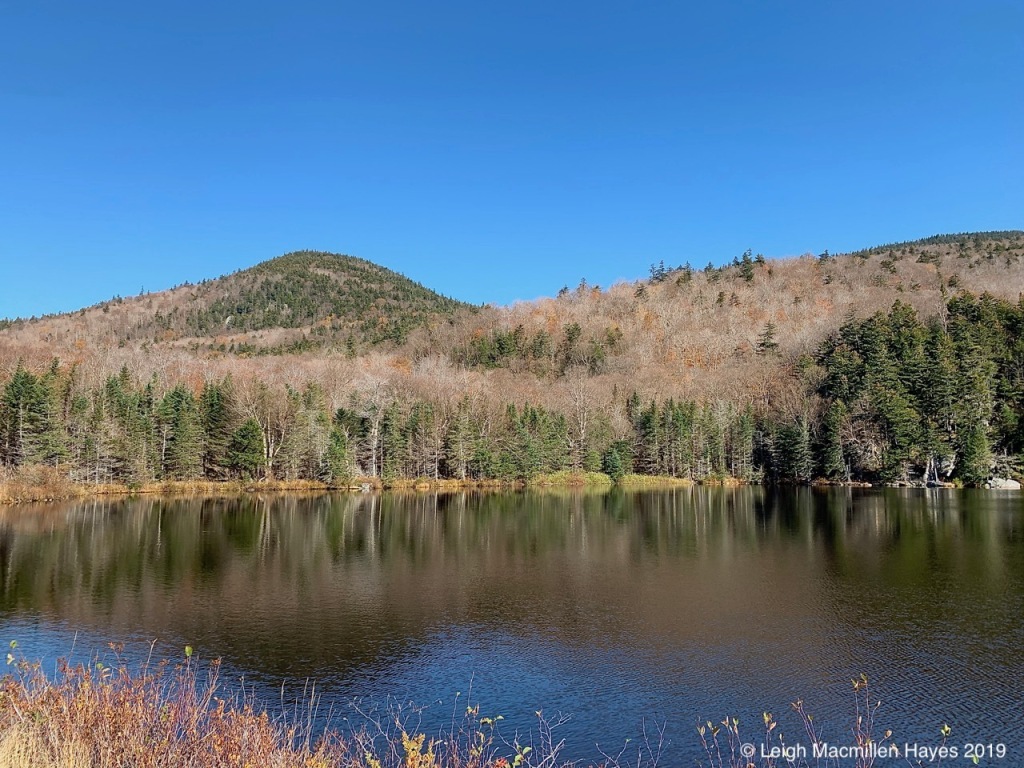
Disembarking, and with an hour to ourselves, my guy and I ate a picnic lunch that included chicken salad sandwiches enhanced with home-made cranberry-orange relish, and then we crossed the road to walk the .4-mile trail around Saco Lake, the origin of Saco River.
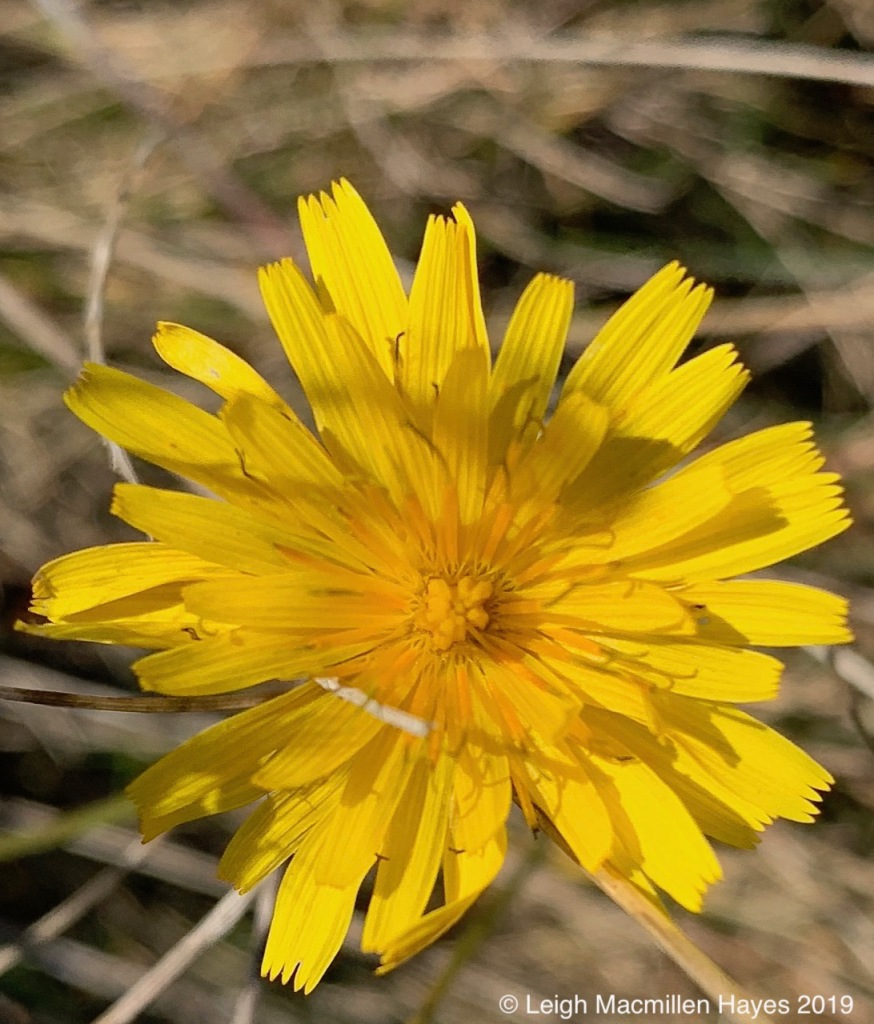
Beside it a few Dandelions flowered. And my guy questioned me. “You’re taking a photo of a Dandelion?” Yup. Never Call it just a Dandelion is the title of a most delightful and informative book. And sooo true. Notice how each ray is notched with five teeth representing a petal and forms a single floret. Completely open as this one was, the bloom was a composite of numerous florets. And can you see the stigmas? Curled and split in two? “Yes, I am taking a picture of a Dandelion because it deserves to be honored. And not pulled from the lawn. Just sayin’. ”
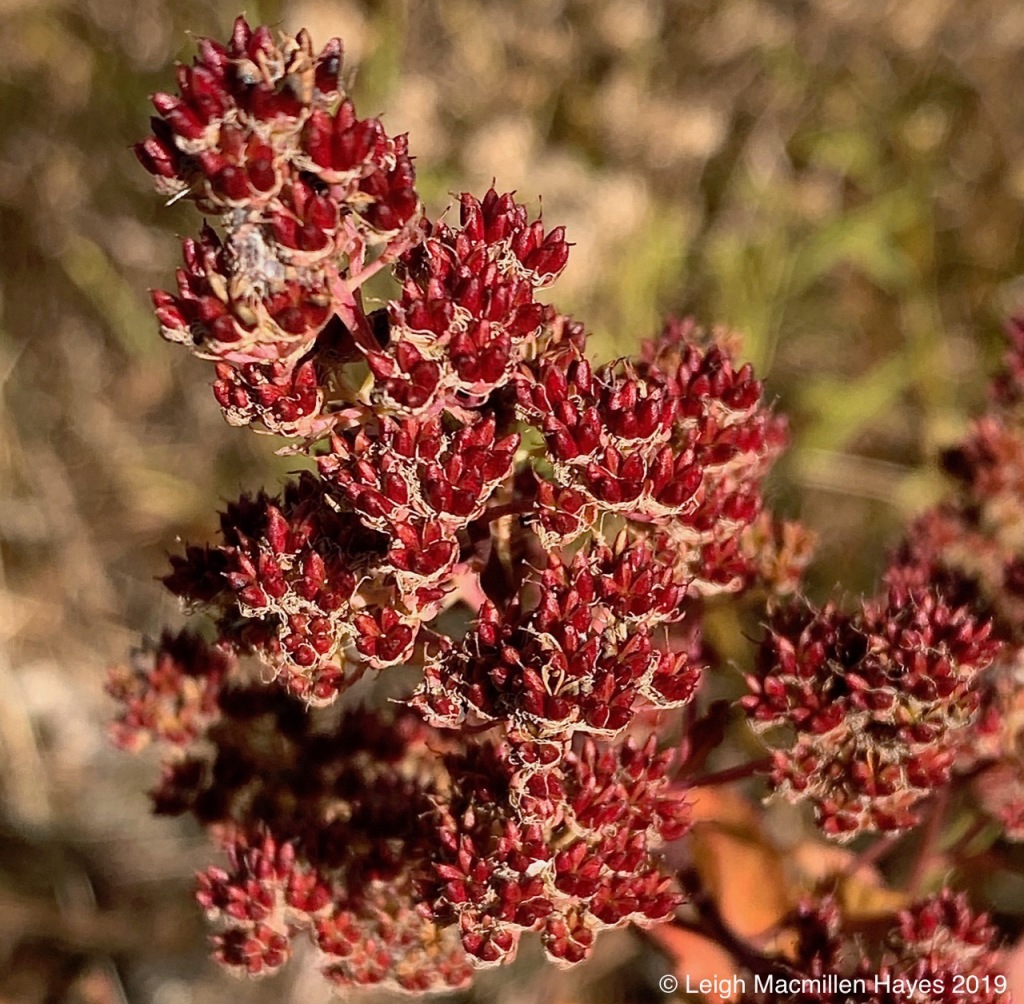
Meadowsweet (Spiraea alba var. latifolia) also posed, its fruit’s five-parted capsules each containing two to four small seeds. It was the color that made me smile on this fall day.
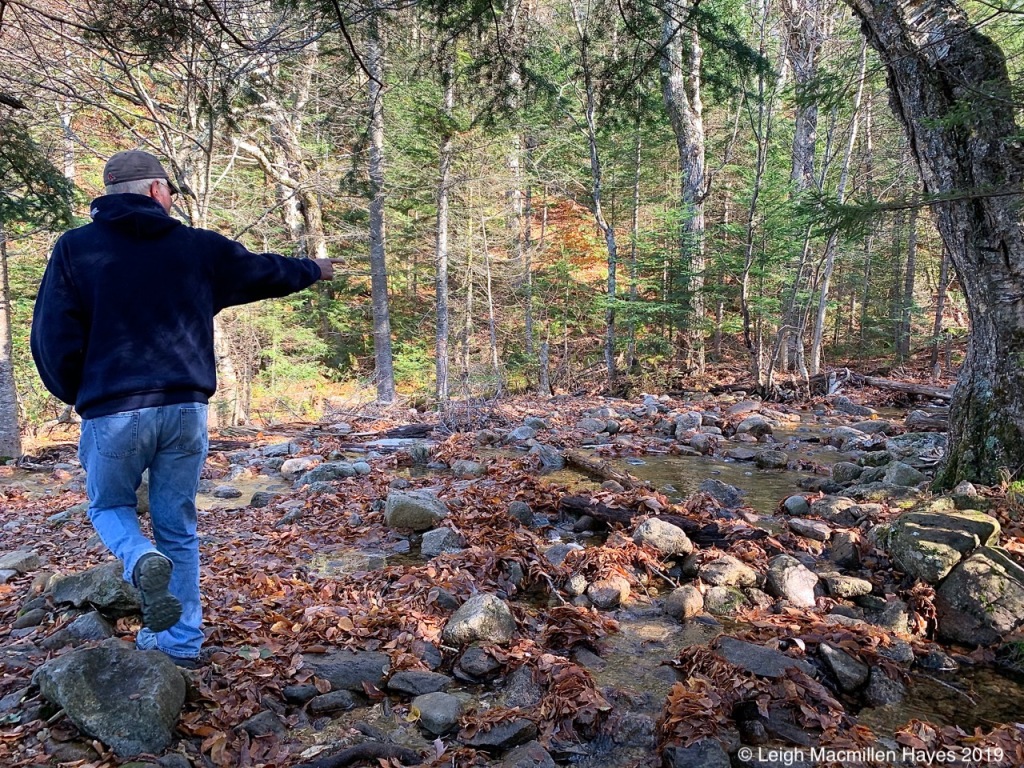
Upon a small bridge where Elephant Head Brook flows into Saco Lake, most people paused and then turned for so wet was the trail. But you know who kept going. Despite wearing sneakers rather than our hiking boots, we found our way and soon moved beyond the wet trail.
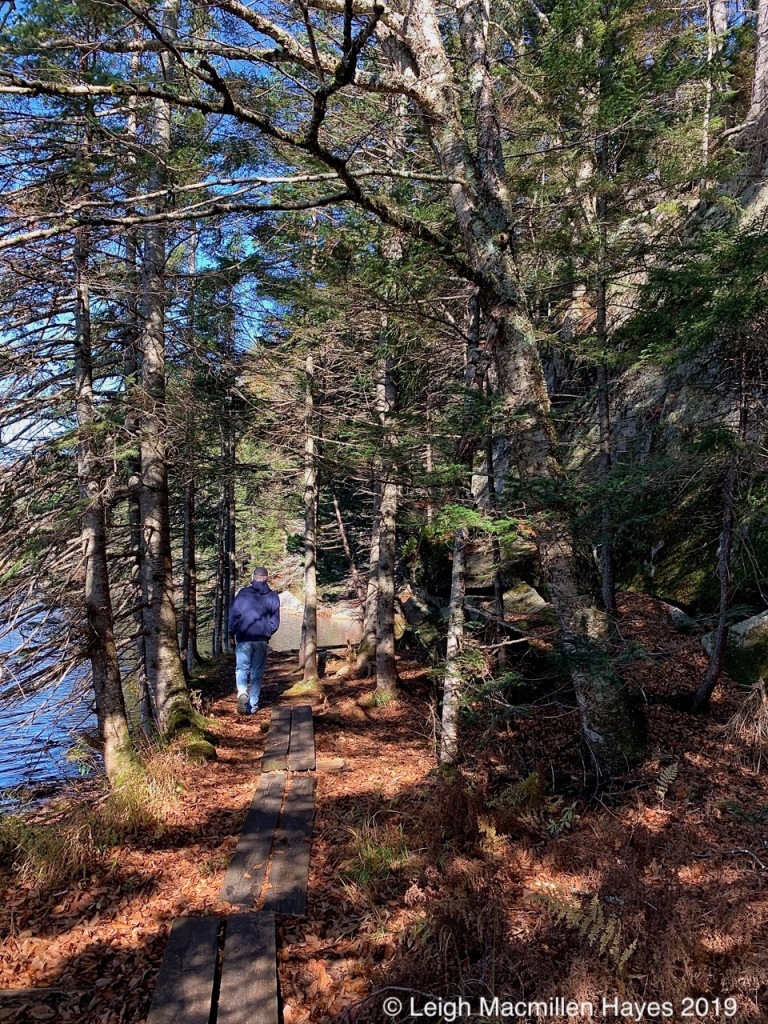
We laughed when we discovered a wooden boardwalk in a drier section.
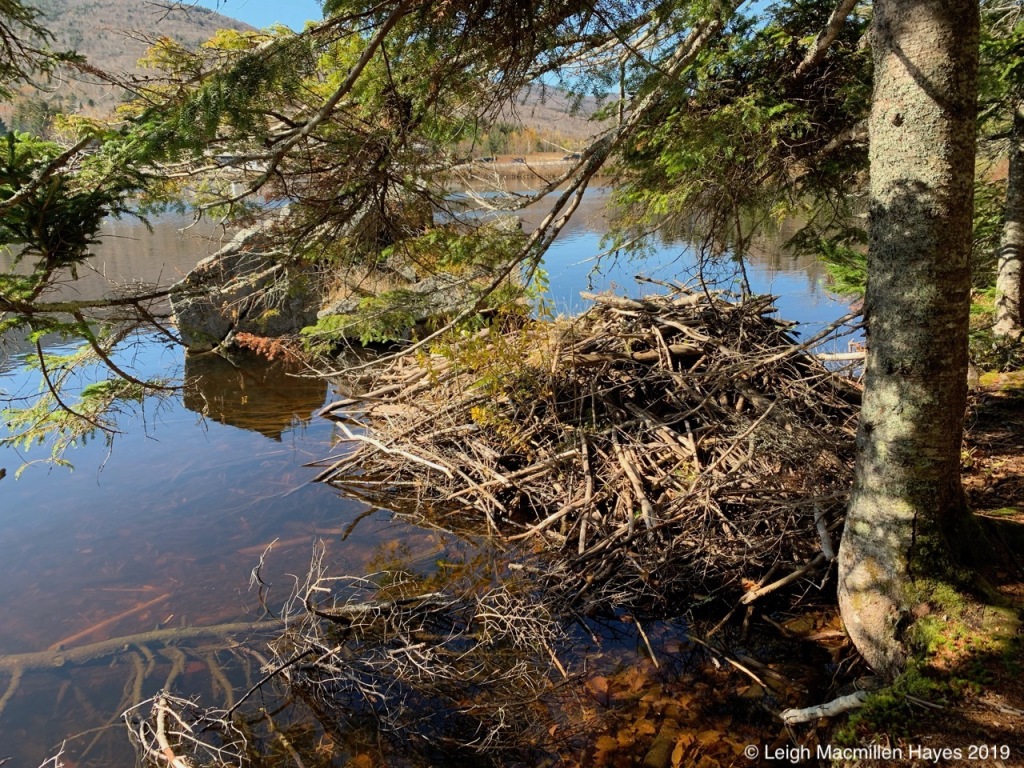
Others had also ventured here and called it home, although based on the lack of new wood, we suspected the beavers had left the lodge. Perhaps they’d moved across the street to the AMC’s Highland Center.
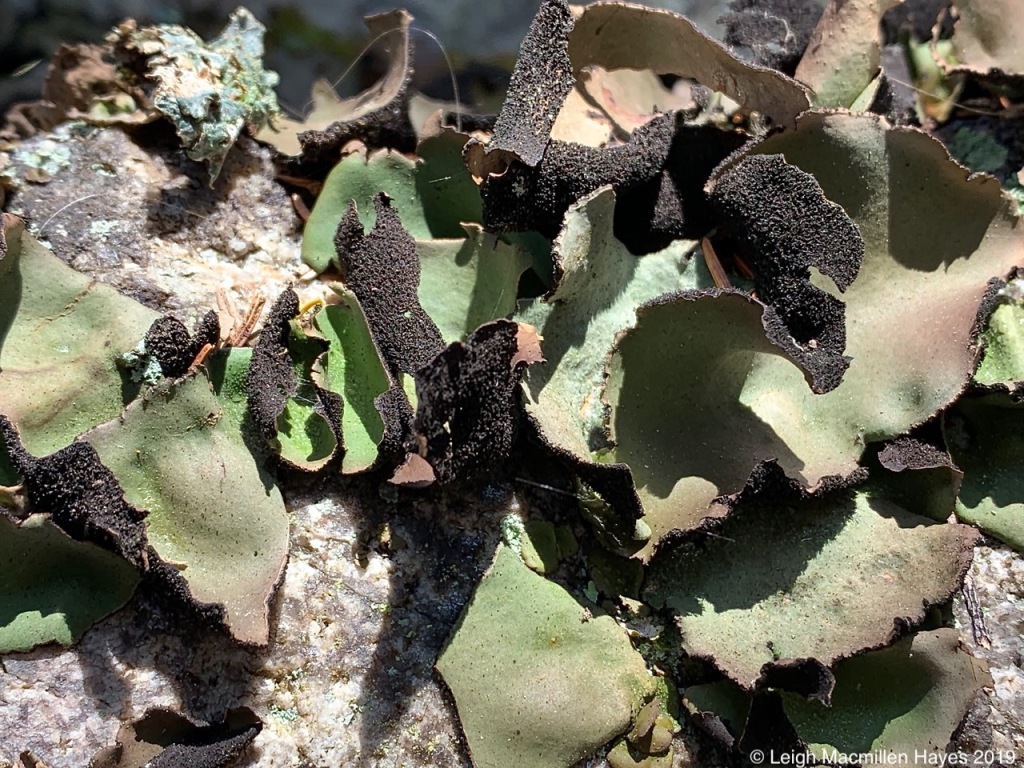
Upon granite that defined the outer side of sections of the trail, Rock Tripe lichens grew, some turning green as they photosynthesized when I poured water upon them.
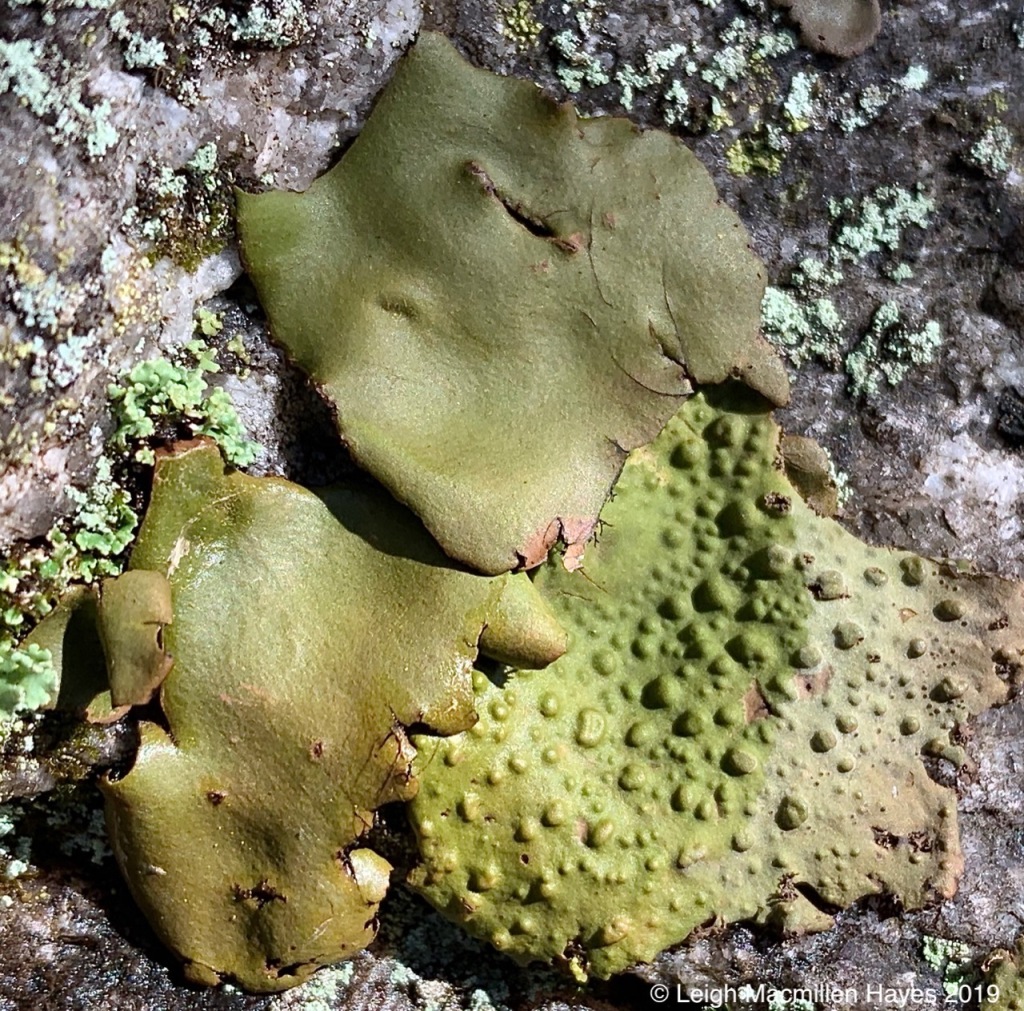
Always one of my favorite views is the discovery of Toadskin Lichen beside the Rock Tripe, both umbilicate forms.
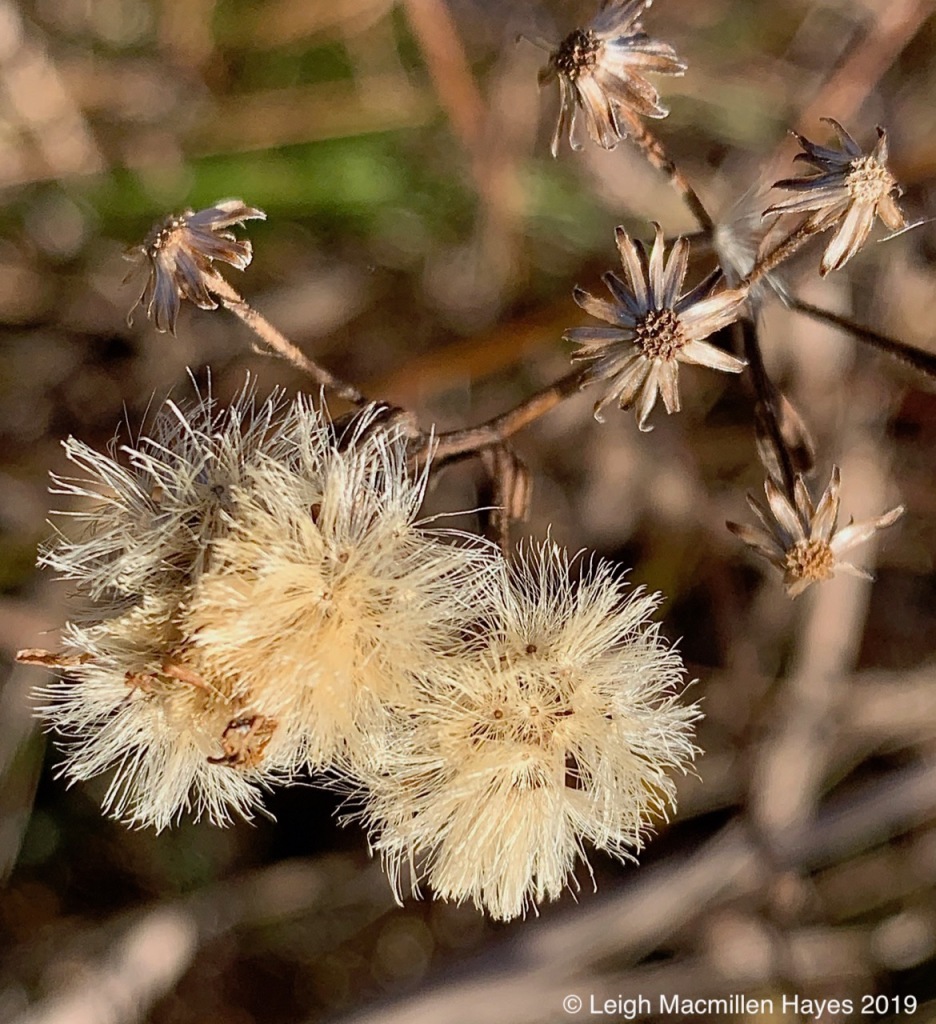
Back to Route 302, asters showed their displays of seeds awaiting dispersal and those older empty nesters forecasting their winter form in a flower-like composition all their own.
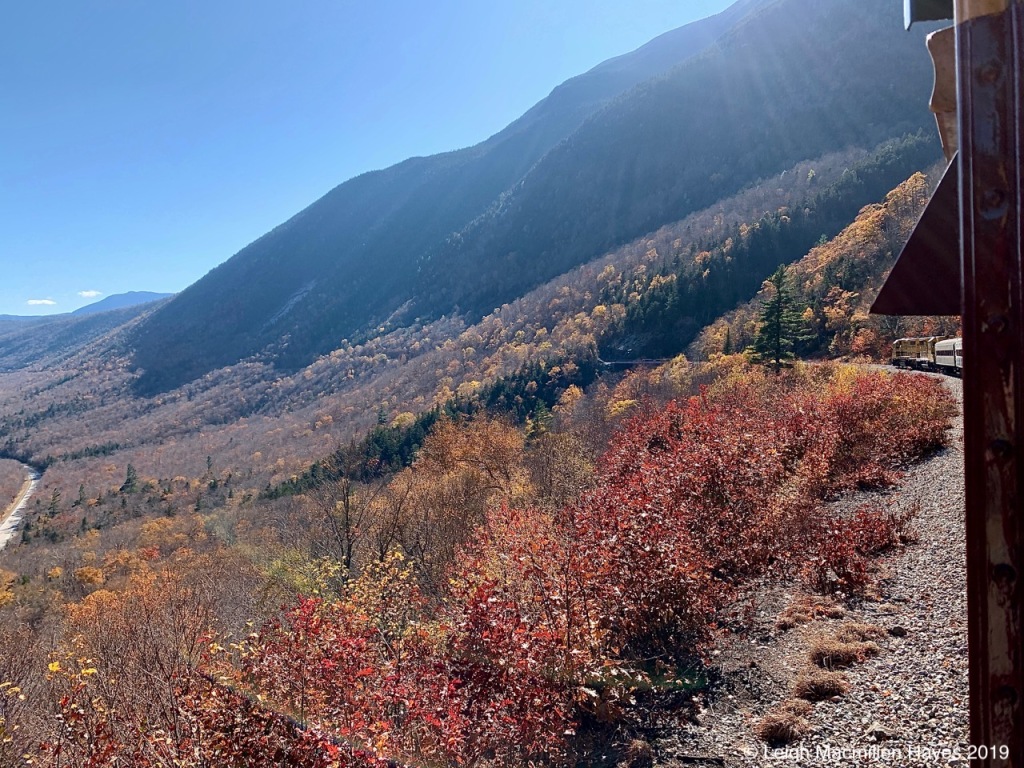
Just prior to 2:00pm, we reboarded the train for the journey south.
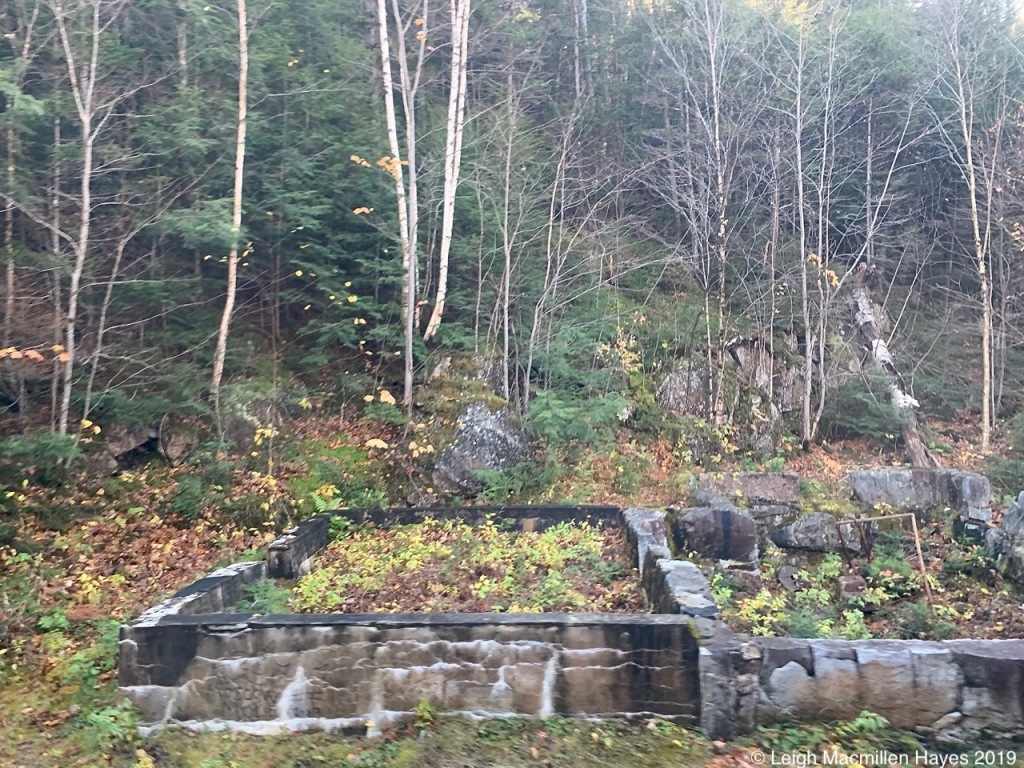
For the return trip, we’d switched seats with those who sat on the western side of the train for the journey north and so got to spy the Willey foundation. Local lore has it that in 1793, Samuel Willey took his wife, five children and two hired men to live in a small, remote house in the mountains. That year, he and the hired men built a house.

As our narrator said, “In June of 1826, a heavy rain terrified the Willey family when it caused a landslide across the Saco River. Sam decided to build a stone shelter above the house where he thought the family could find safety in case of another landslide. On August 28, 1826, a violent rainstorm caused a mudslide. The Willeys and hired men took refuge in the shelter. The landslide killed all nine of them, but the house they’d fled stood still.” Apparently, a ledge above the house spared it from destruction.
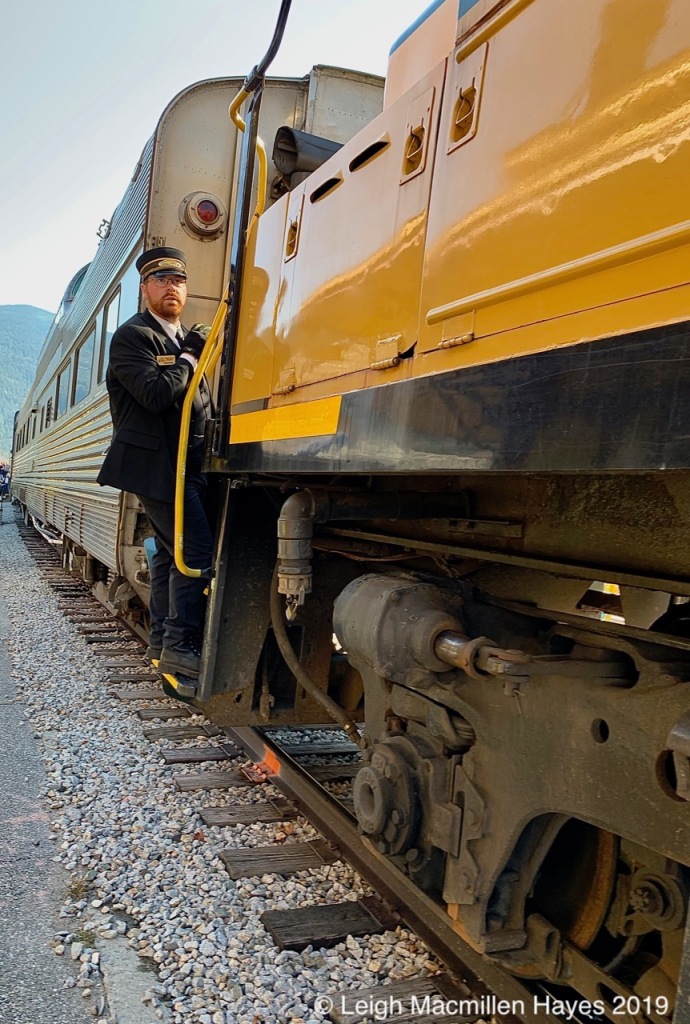
We loved the historical aspects of the trip, as well as the scenery, short hike, and good company.

At the end of the day, we were all smiles for this All Aboard Mondate.
Women of the Dragonflies

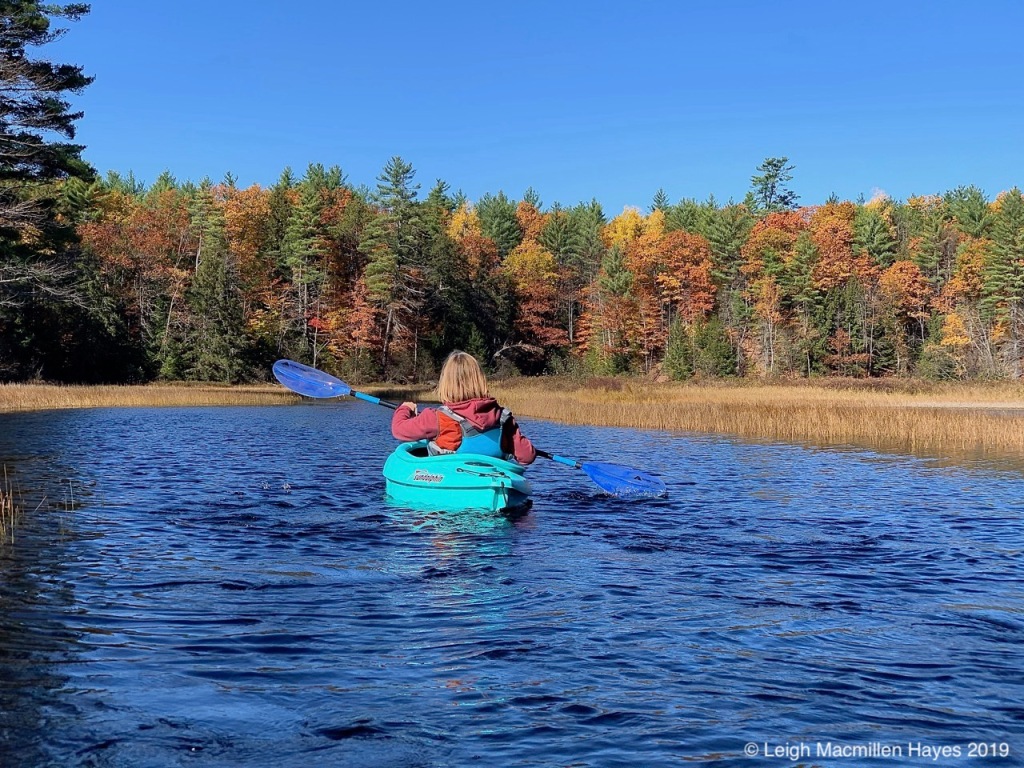
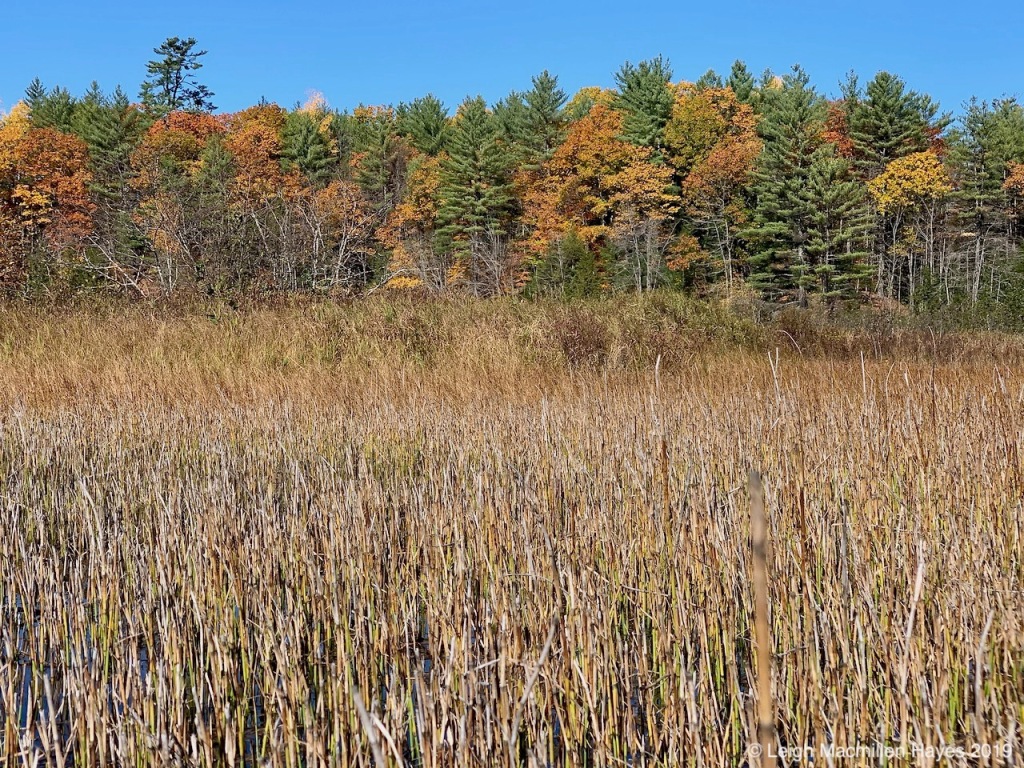
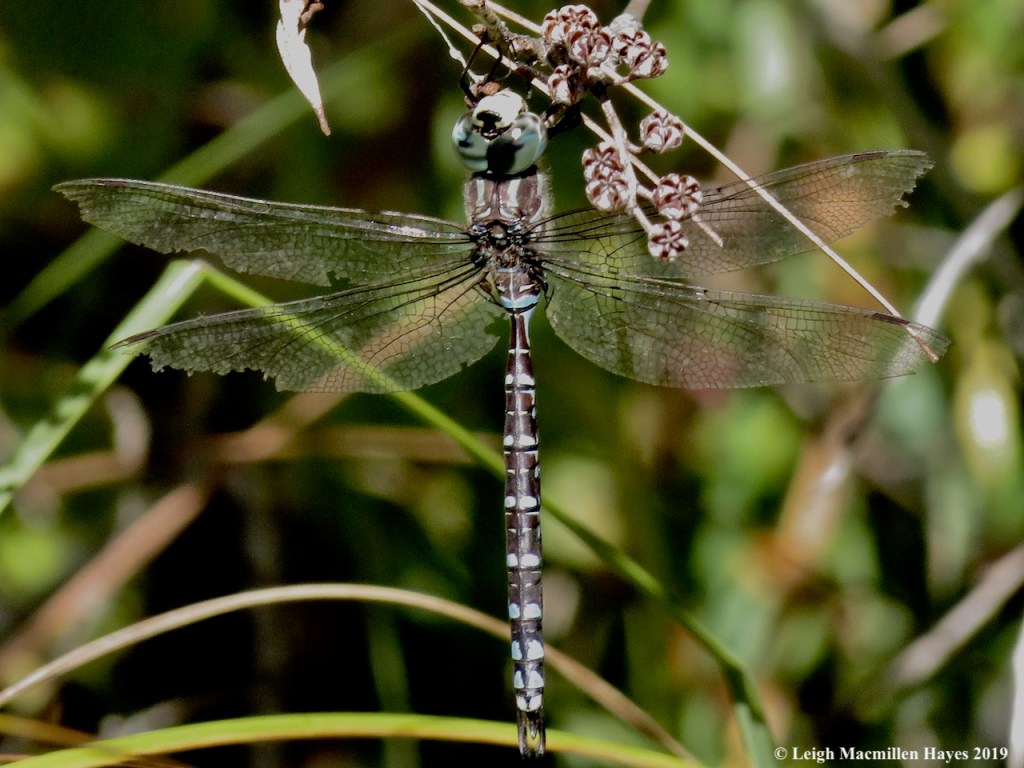
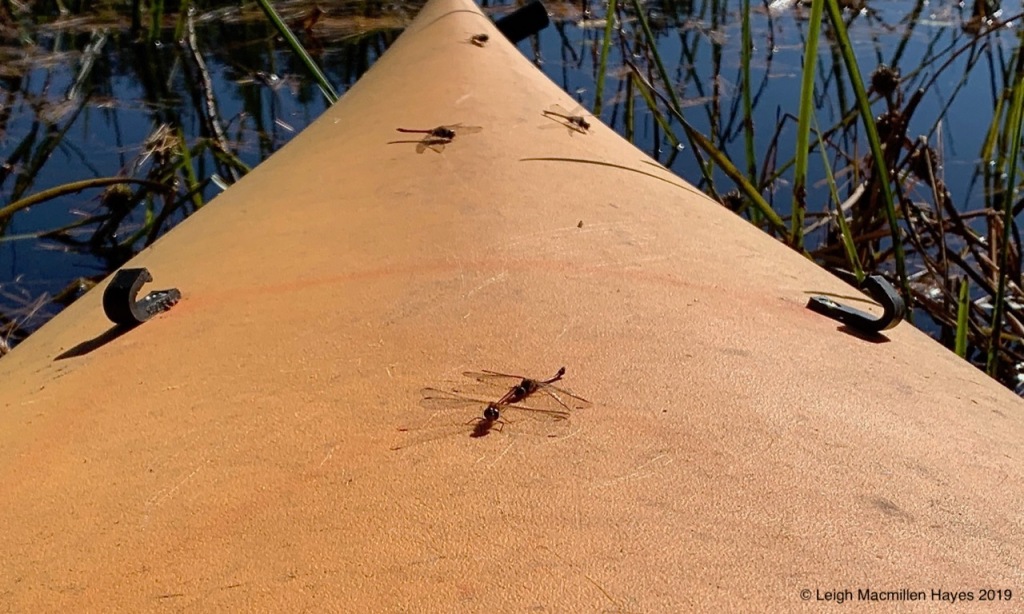
The minute we launched our kayaks, I knew we were in for a treat, for beside bur-reed and water-logged branches and even upon our boats, the Autumn Dragonflies danced, theirs a frantic last-minute mating routine.

Single males watched as couples prepared for the grand event and every once in a while they’d try to interfere, though that usually ended within seconds.

Once they gave up, they were willing to land and hang out with me for a few moments. If you know me, you know I was thrilled–especially given that every time I see a dragonfly of late, I’m sure it’s the last of the season. And then . . .

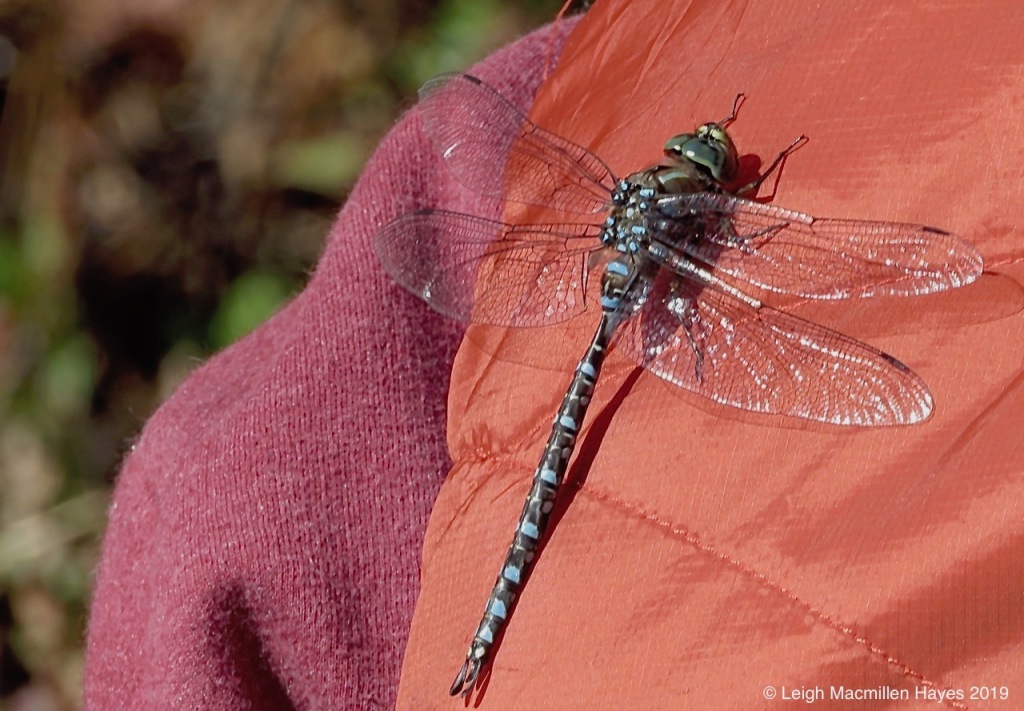
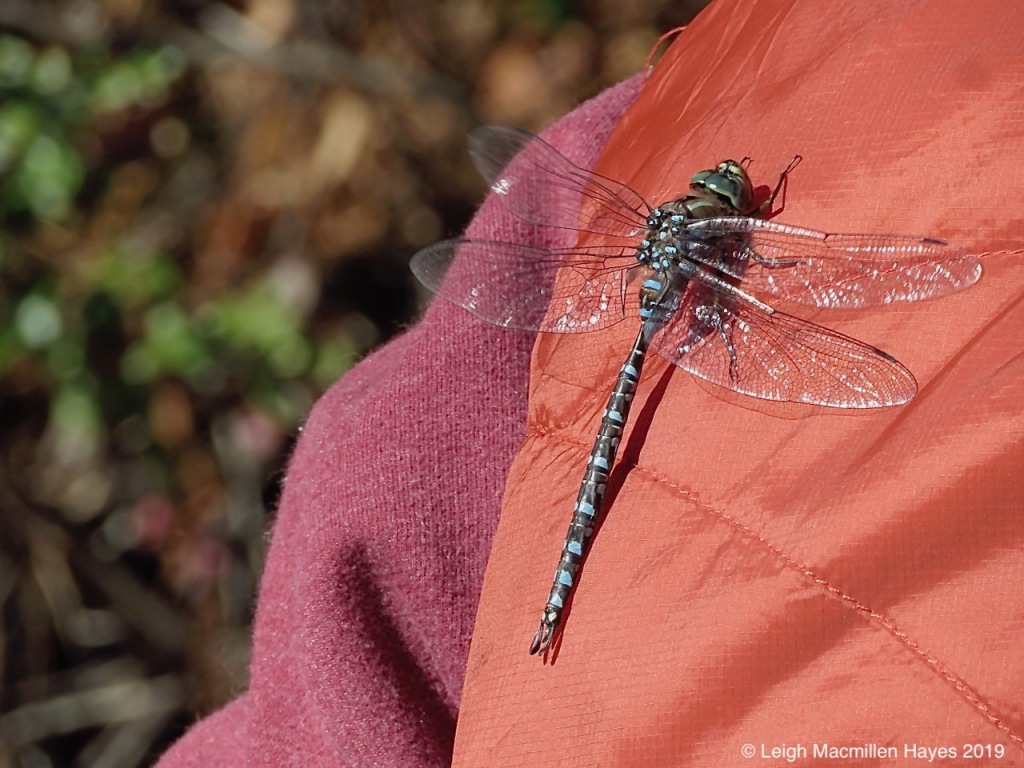
I heard a loud buzz over my head and upon my friend Pam’s vest, a Lake Darner landed. I told her not to move as I took in its glory. That being said, only moments before perhaps this same dragonfly tried to nab a canoodling pair positioned right below my paddle. For the moment, they survived, and he took a break.

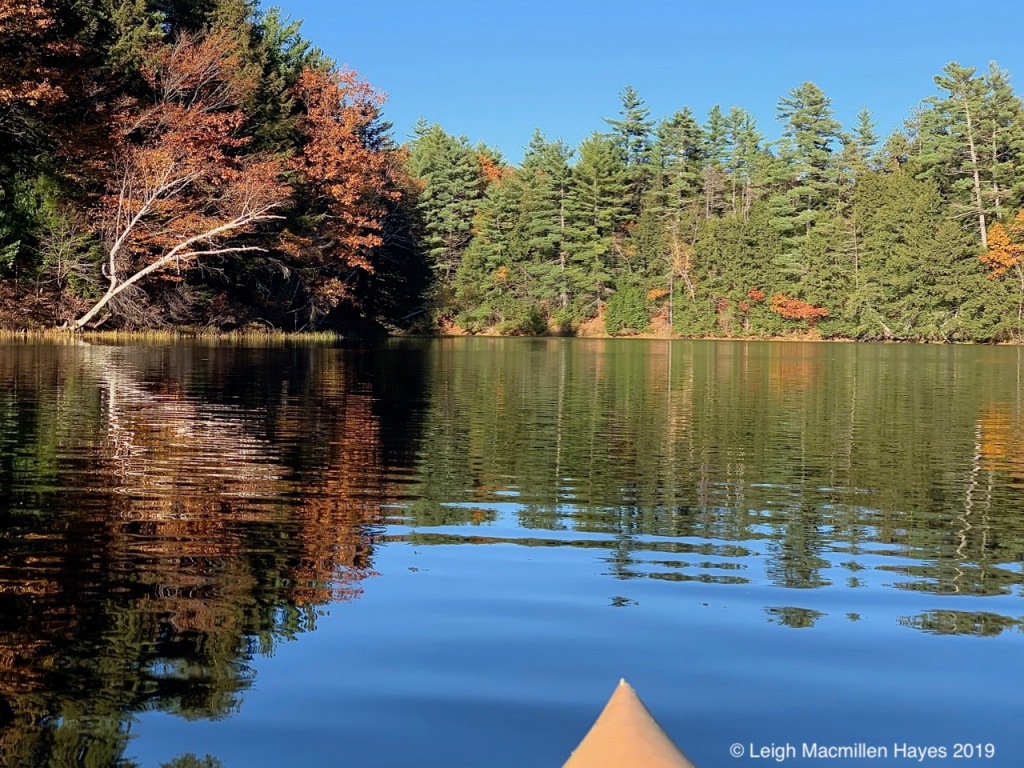
His break over, onward we paddled into the wind and current. But really, it wasn’t a tough journey and around every bend we were wowed as we paused, drifted, and got lost in the scenery. The colors have reached their beyond peak rendition, but still, we were surrounded by beauty.

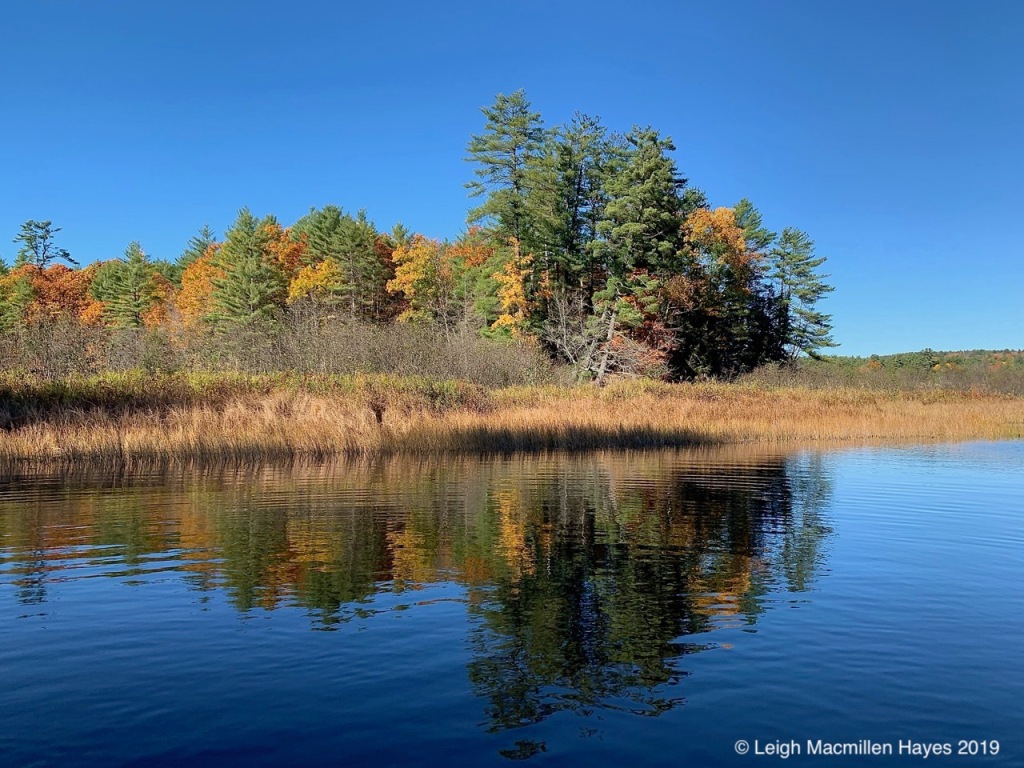
It showed itself in layers,

reflections,

and a combination of the two.

We paused beside tree stumps and gasped at their intricate structures as we remembered summer sightings of painted turtles.

As one might expect, the littlest things begged our focus, such as the spider only Pam spied through her lens.

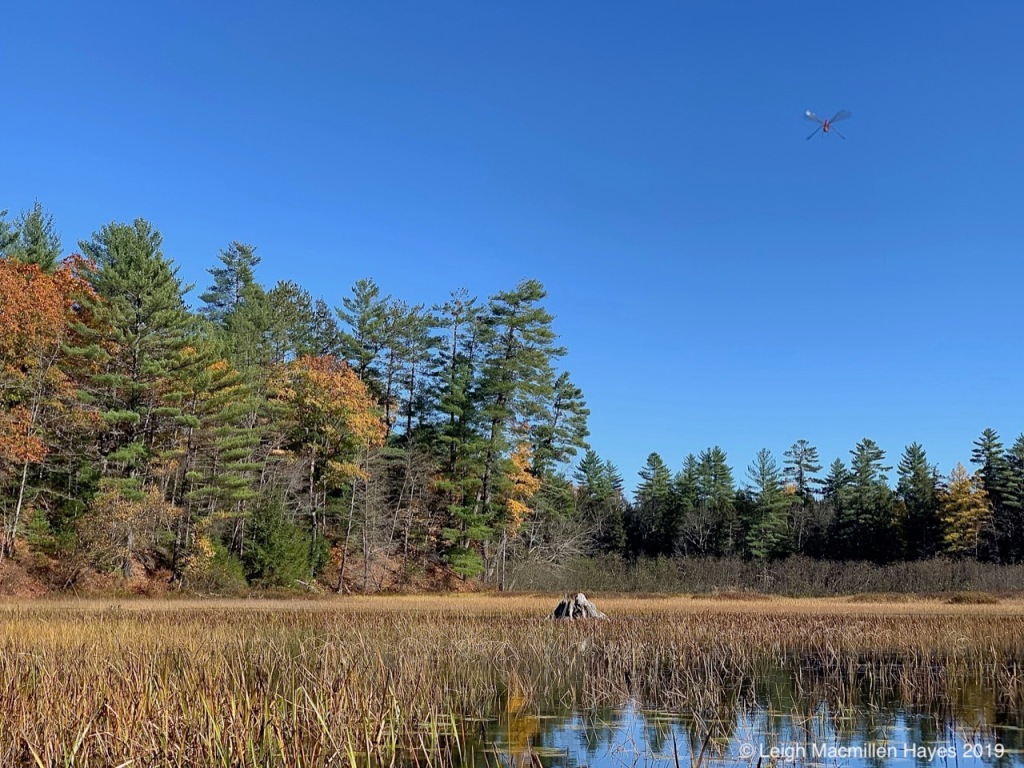
While she looked down, I looked beyond to a far stump and Heron Rookery in the distance. And in the midst of my search–a Lake Darner Dragonfly flew in on patrol. Do you see it in the upper right-hand corner?

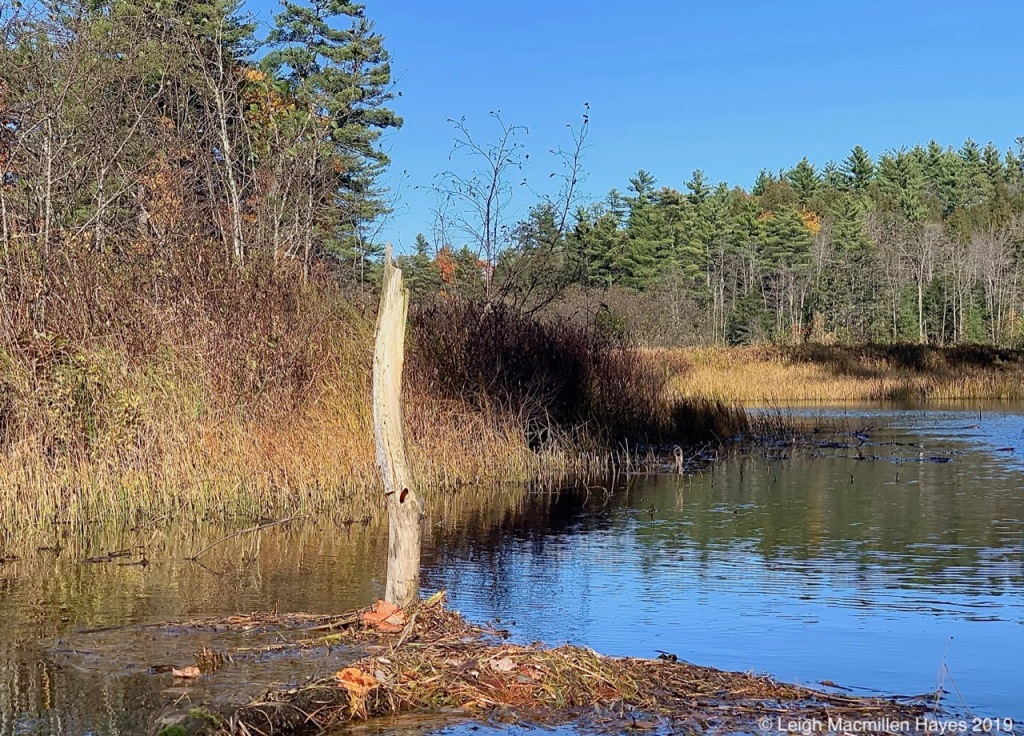
Our next wonder moment occurred when we realized a certain insect posed upon a drowned branch.

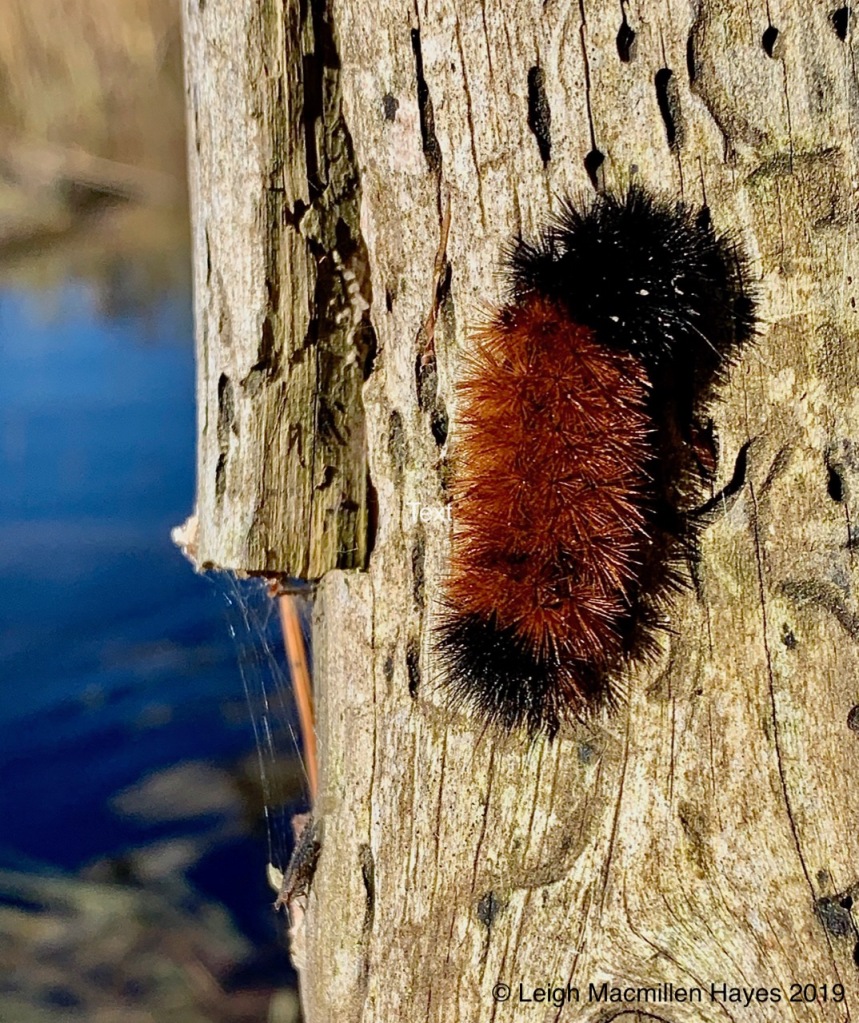
Our spot: a Wooly Bear caterpillar. Having grown up in Canada, Pam didn’t know about the Wooly Bear’s reputation as a predictor of winter weather. According to local lore and backed up by The Farmer’s Almanac, this is how it works: “The Woolly Bear caterpillar has 13 distinct segments of either rusty brown or black. The wider the rusty brown sections (or the more brown segments there are), the milder the coming winter will be. The more black there is, the more severe the winter.”

The curious thing: this is the first I’ve seen with a wider rusty brown section; all others have had wider black sections. Hmmm. Methinks that by April we’ll know which W. Bear was correct.

But here’s another question: there was water on either side of the downed limb. How in the world did the caterpillar get there? We’ve watched Hickory Tussock Caterpillars squirm their way across the water all summer, so we know they can “swim.” Did W. Bear come from the shore? A bird’s mouth? Or fall from a branch above? We’ll never know, but considering the possibilities opened our minds.

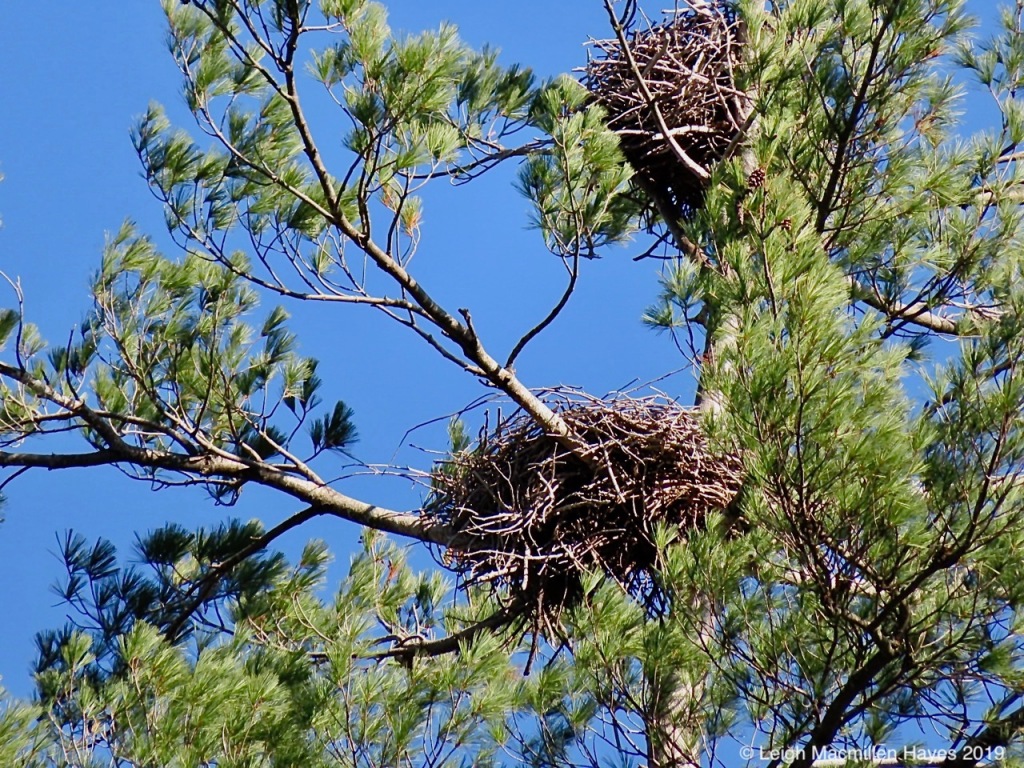
Beyond W. Bear, we found ourselves looking at a familiar view we’ve always enjoyed from the land behind us: a look north toward a Heron Rookery.

High up in the trees sit condominiums that we’ve seen filled with birds. One, two, three, four, even five birds. Large birds. Yes, the nests are large, but how in the world do they survive wild winds and how in the world do the birds co-exist upon them before fledging?

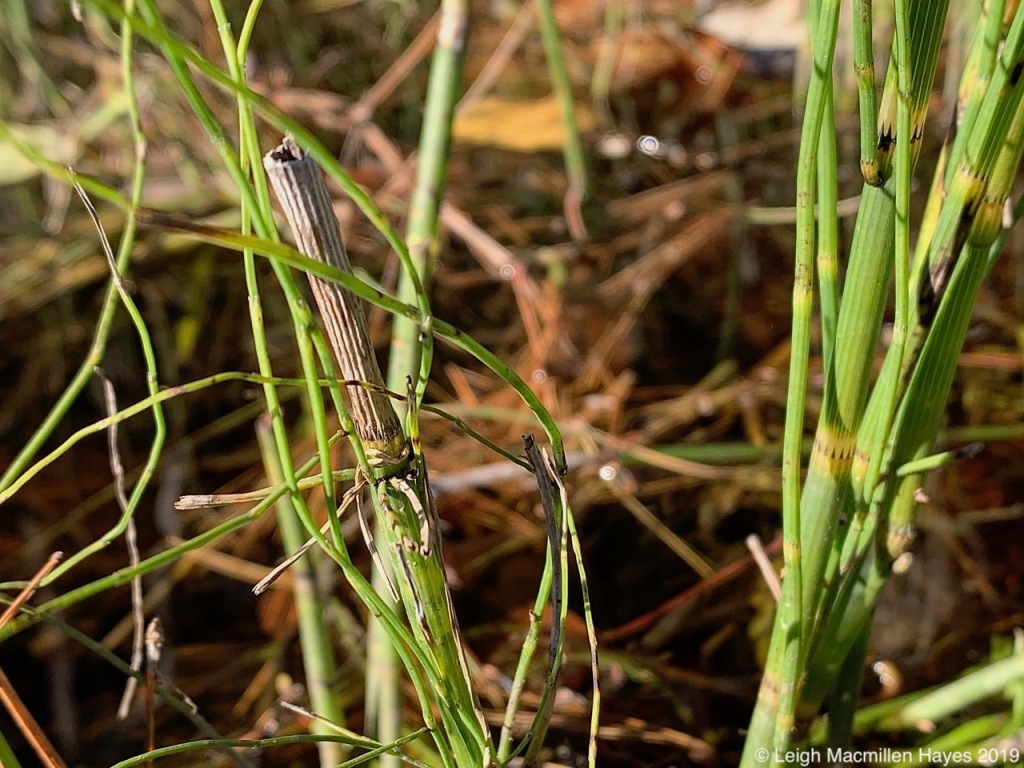
We spent a lot of time looking up, but an equal amount of time looking down, where Equisetum fluviatile, or Water Horsetail grew prolifically. The thing about it was that it had all been browsed as if a field mowed. We suspected the diners were Canada Geese that we knew had inhabited this place for months.

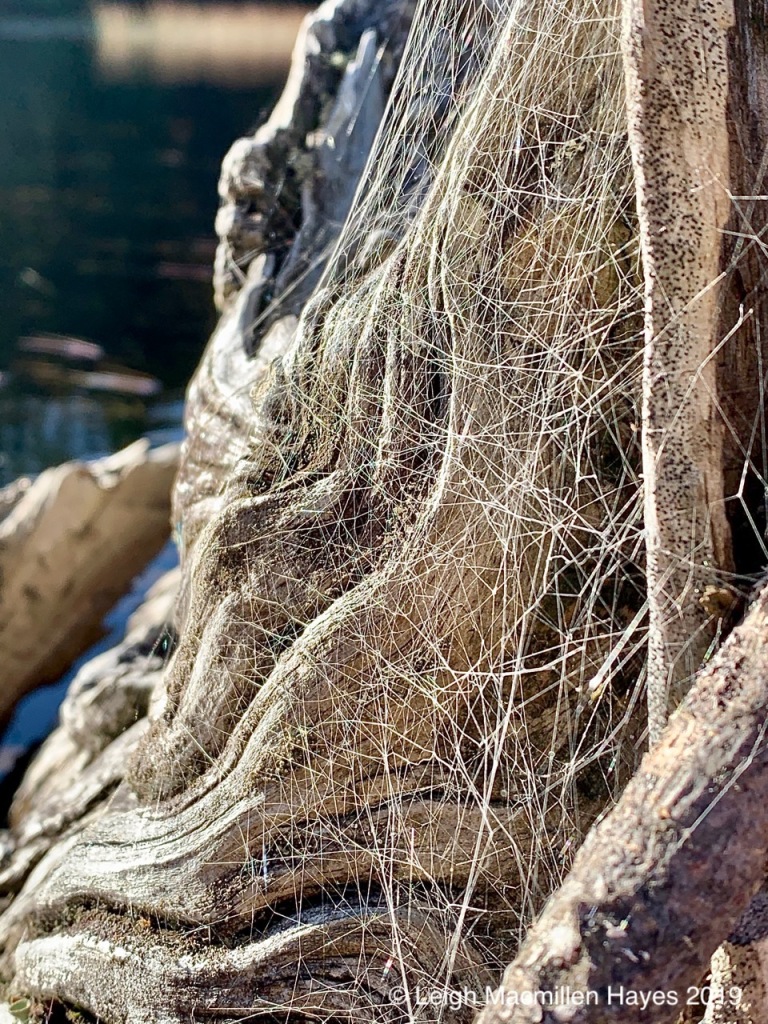
At last we reached a point where paddling further north presented some issues and the sun was lowering in the sky. So, we turned around and paddled south as far as we could go, with the sun blinding much of the sights. But . . . beside another stump we did stop. And were honored with the lines it presented from a complicated spider web intermixed with the tree’s lines.

Wthin sight of the Route 93 bridge, we again turned around to return to our launch site. The temperature had dipped and as we rounded the final bends, we found ourselves in full shade rather than sun. And a discussion of seasonal lighting entered our conversation.

Things are in flux in these parts. But for one more day, we were the women of the dragonflies.

Wandering and Wondering the Jinny Mae Way

This morning I chose to channel my inner Jinny Mae in honor of my dear friend who has been in isolation for medical reasons since last January. That meant I had to try to slow down and be sure to notice. And ask questions. Mostly it meant I needed to wonder.

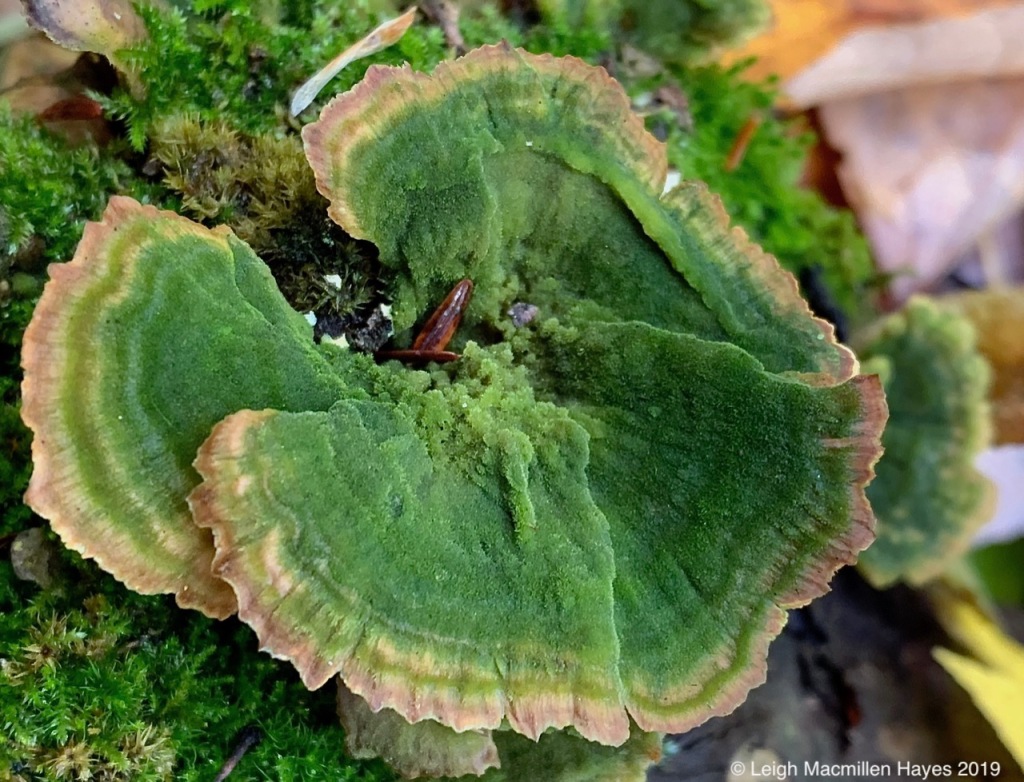
She’s a lover of fungi, so I knew that she’d pause beside the Violet-toothed Polypores that decorated a log. The velvety green algal coating would surely attract her attention. Why does algae grow on this fungus?

I didn’t have the answer in my mind, but a little research unearthed this: “As is the case for lichens, the algae on top of a polypore arrangement appears to benefit both partners. The algae (usually single-celled ball-shaped green algae), being filled with green photosynthetic pigments, use sunlight to make sugars out of carbon dioxide gas. Some of these leak out and are absorbed and consumed by the fungi as an extra source of energy-rich organic carbon. The fungus, in turn, provides a solid platform upon which the algae can set up shop and grow into dense green communities.” (~rosincerate.com)

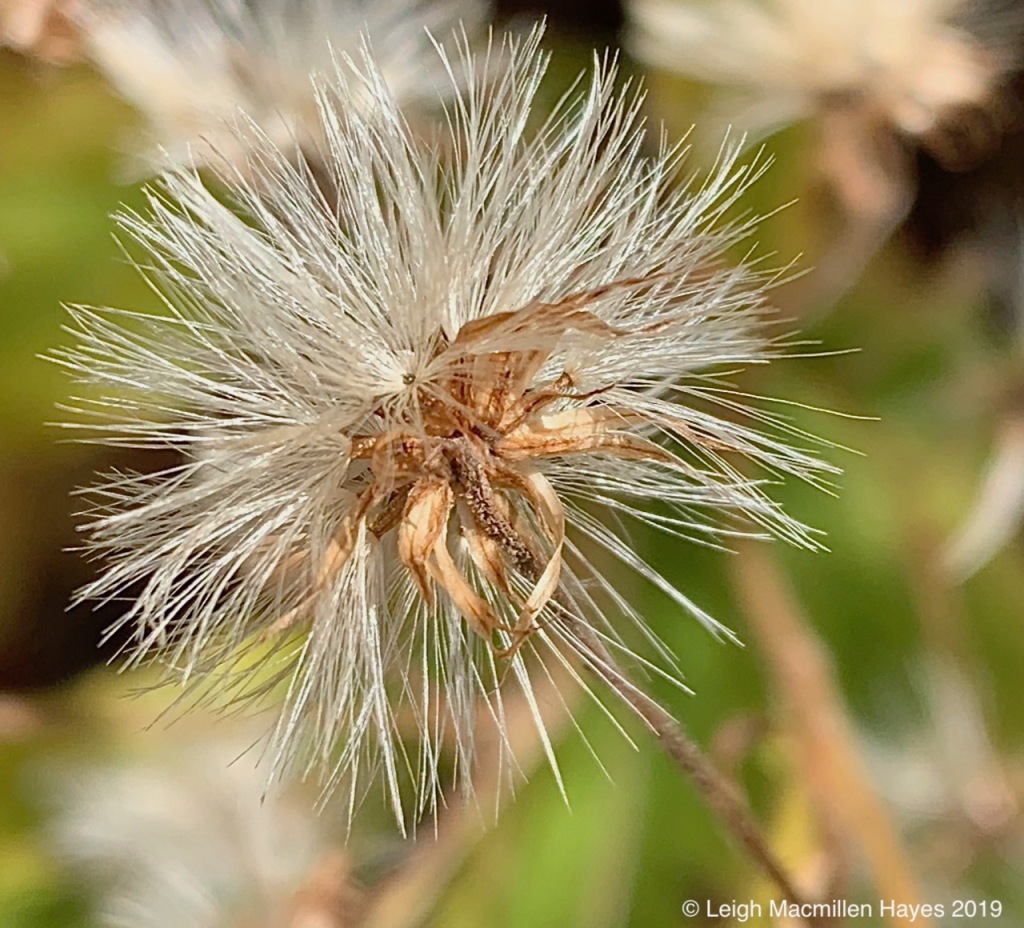
The next stop occurred beside the fall forms of asters where the seeds’ parachutes could have easily passed as a flower. What’s a seed’s parachute and why does it have one? The parachutes are made up of hair-like structures. As an immobile parent plant, it needs to disperse its young so that new plants can grow away from those pesky competitive siblings. And maybe even colonize new territories. At this stage of life, the seedy teenager can’t wait to fly away from home and start its own life. Do you remember that time in your life?

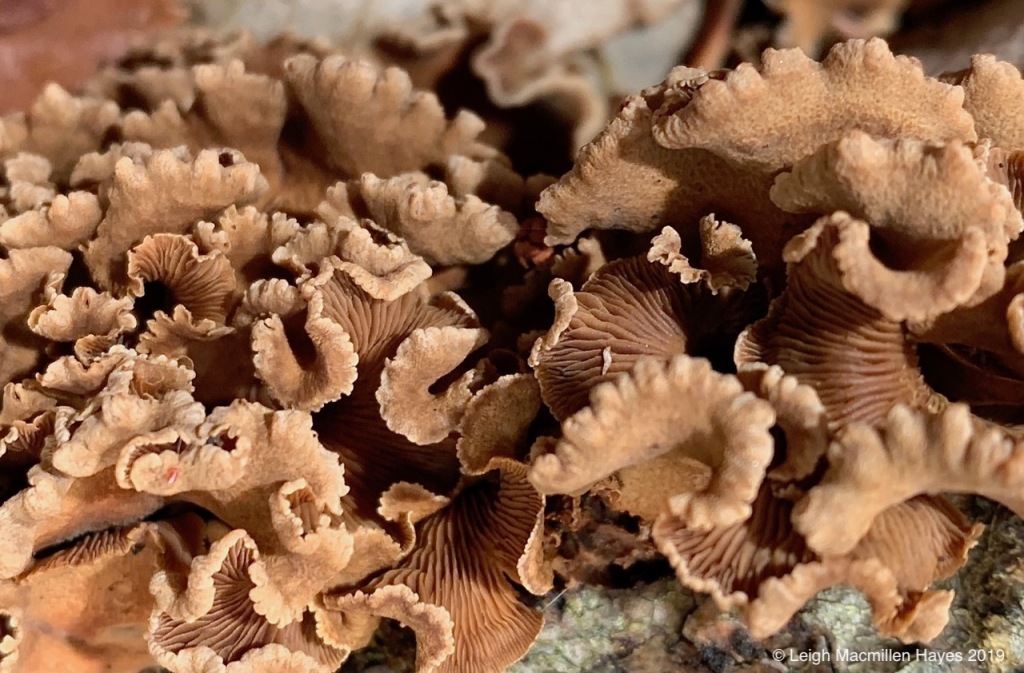
And then, it was another fungus that asked to be noticed. Those gills. That curly edging. And crazy growth structure. Jinny Mae would have keyed in on it right away, but it took me a while. I think it’s a bioluminescent species, Night Light aka Bitter Oyster (Panellus stipticus). But as I often say, I don’t know mushrooms well, so don’t look to me as the authority. What would Jinny Mae ask? Hmmm. What makes it glow? That’s even further beyond my understanding than naming this species. But I can say that it has to do with enzymes that produce light by the oxidation of a pigment. And have I ever actually seen such a glow? NO. But one of these nights ;-)

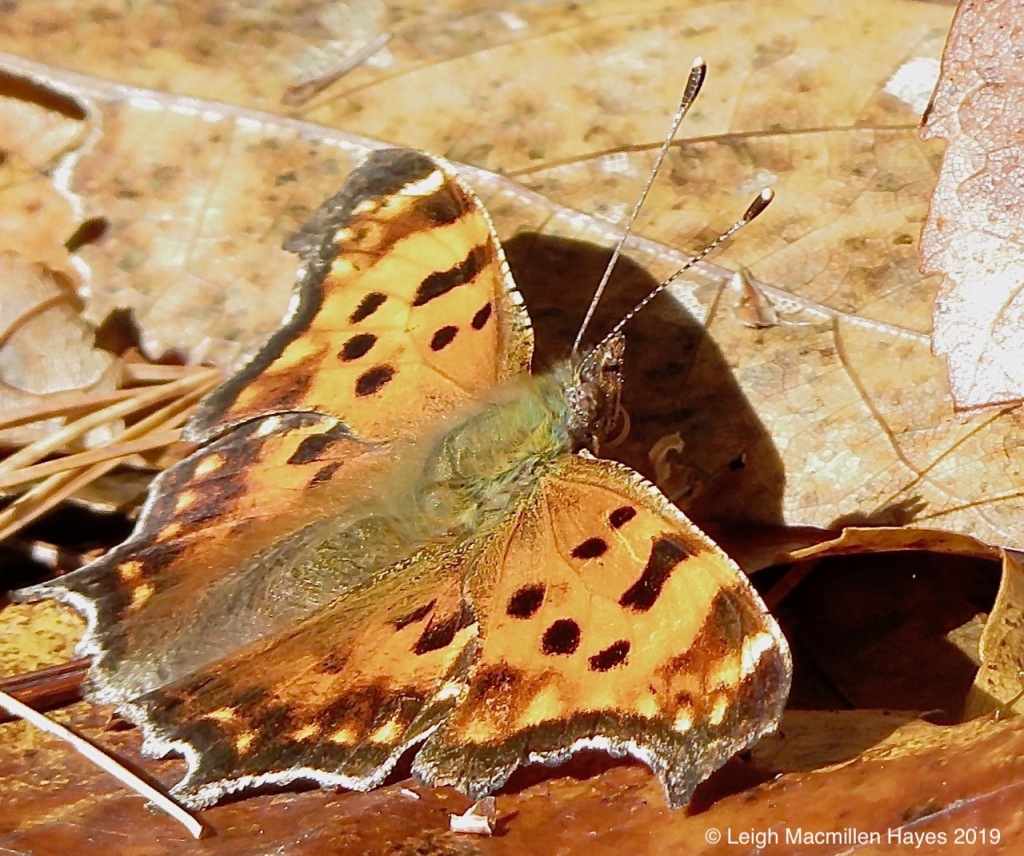
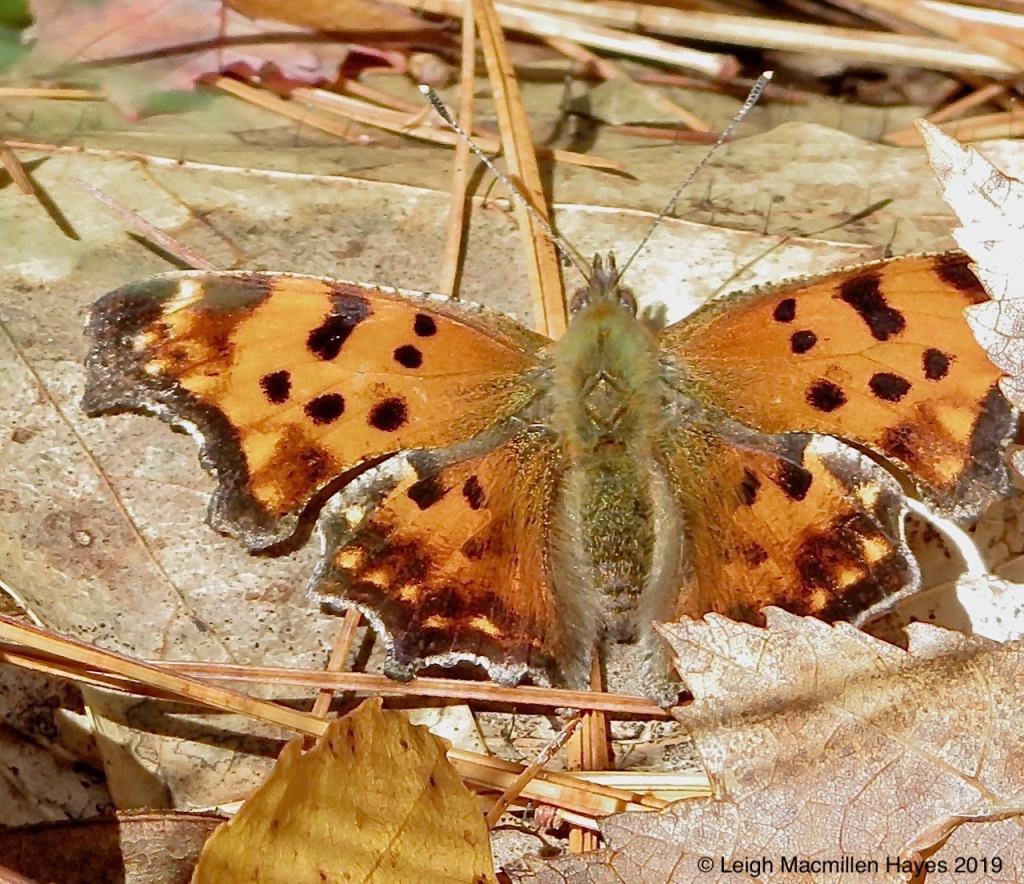
As I continued to walk along, I noticed movement and realized I was in the presence of a butterfly. A butterfly I don’t recall ever meeting before. It had the markings of several familiar species, but it wasn’t until I arrived home that I figured out its name. Do you see its curled proboscis?

Jinny Mae would have been as wowed as I was by this species that I can confidently call a Faunus Anglewing or Green Comma. Typically it flies from May to September, so why today? I got to wondering if this week’s Nor’easter caught it in a more southern clime and forced it north on the wind? But I discovered that its a boreal species and was perhaps at the southern end of its range. Maybe the storm did have something to do with its presence today after all.

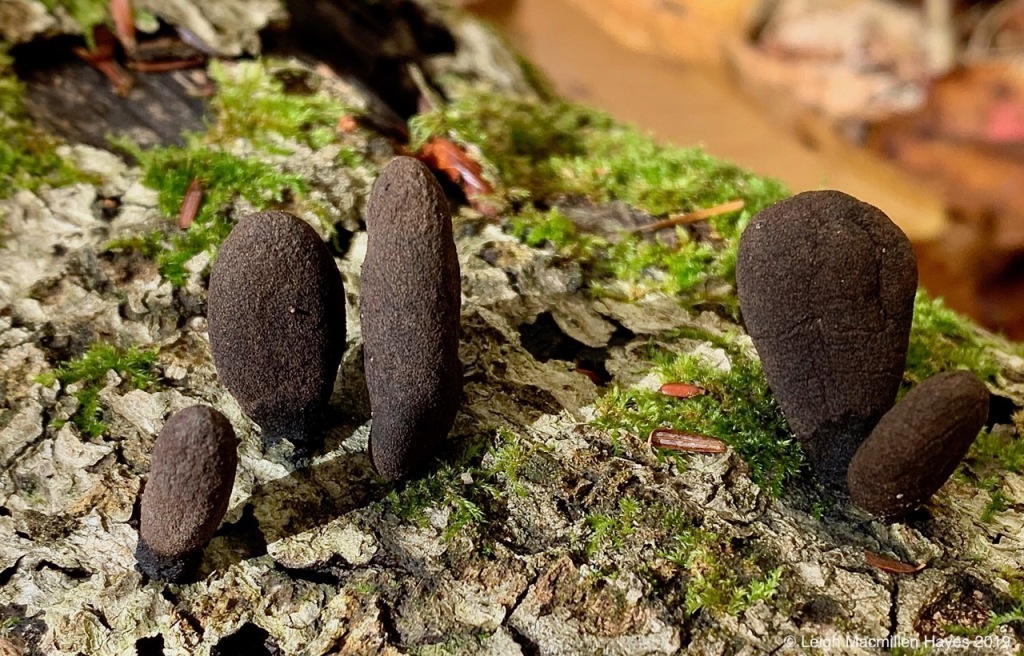
Eventually the journey became a mix of following a trail and bushwhacking. Both provided examples of the next moment I knew Jinny Mae would love. Dead Man’s Fingers, all five of them, in their fall form, the lighter color spores having dispersed and the mushroom now turning black. Why the common name for Xylaria longipes? According to Lawrence Millman, author of Fascinating Fungi of New England, “Certain African tribes believe that if you’ve committed a crime, and you rub the spore powder from an immature Xylaria on your skin, the police won’t identify you as the culprit.”

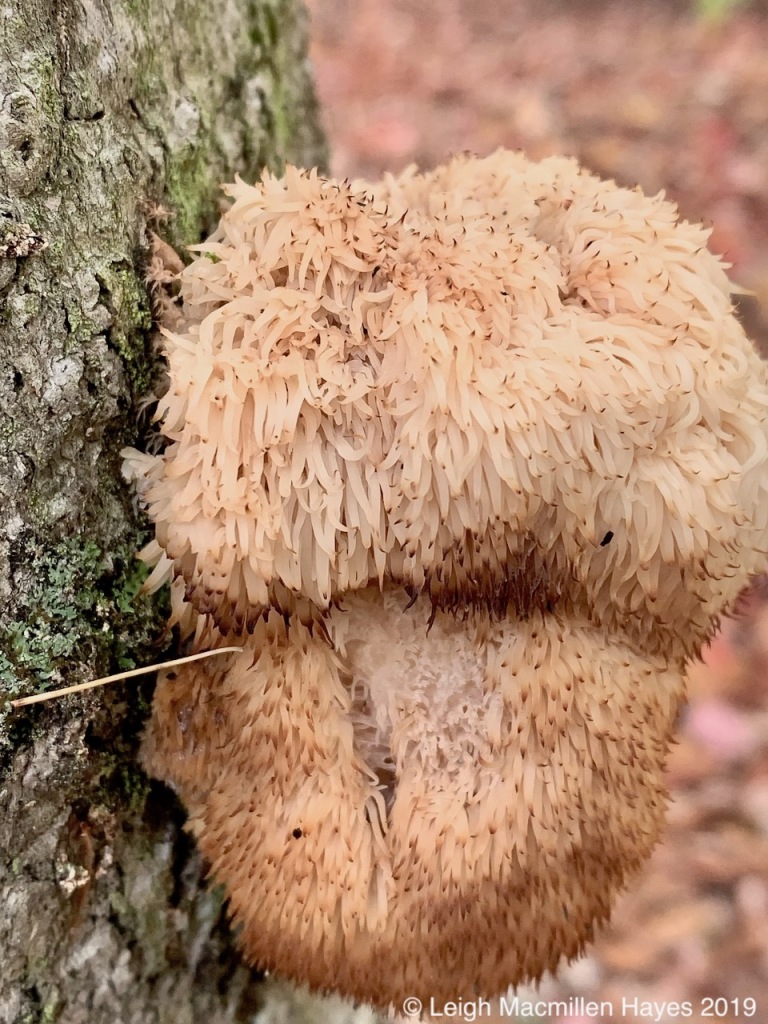
It seemed these woods were a mushroom garden and one after another made itself known. I could practically feel Jinny Mae’s glee at so many fine discoveries. Resembling cascading icicles (I was wearing a wool hat and my snowpants actually, which turned out to be overdress after three hours), I wanted to call it Lion’s Mane, but to narrow down an ID decided to leave it at the genus Hericium. I suspected Jinny would agree that that was best and it should just be enjoyed for its structure no matter who it really was.

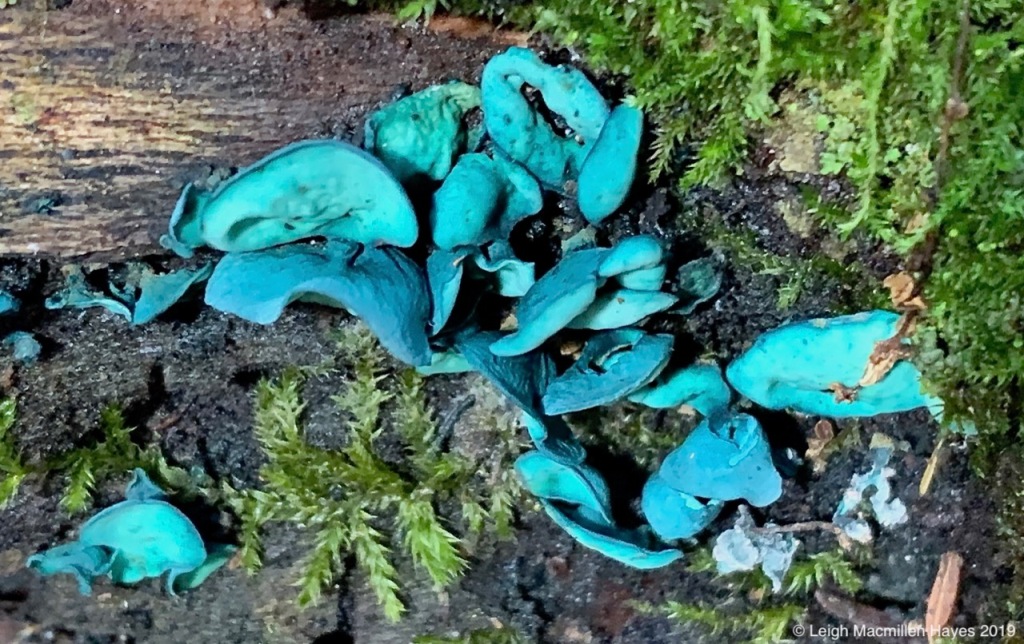
Nearby, another much tinier, in fact, incredibly teenier fungus could have gone unnoticed had the sun not been shining upon it. I was pretty certain 2019 would be the year that would pass by without my opportunity to spy this one. But, thankfully, I was proven wrong. Forever one of my favorites, I knew Jinny Mae also savored its presence. The fruiting body of Green Stain are minute cup-shaped structures maybe 1/3 inch in diameter. I used to think when I saw the stain on wood that it was an old trail blaze. And then one day I was introduced to the fruiting structure and rejoice each time I’m graced with its presence. There was no reason to question these delightful finds. Noticing them was enough.

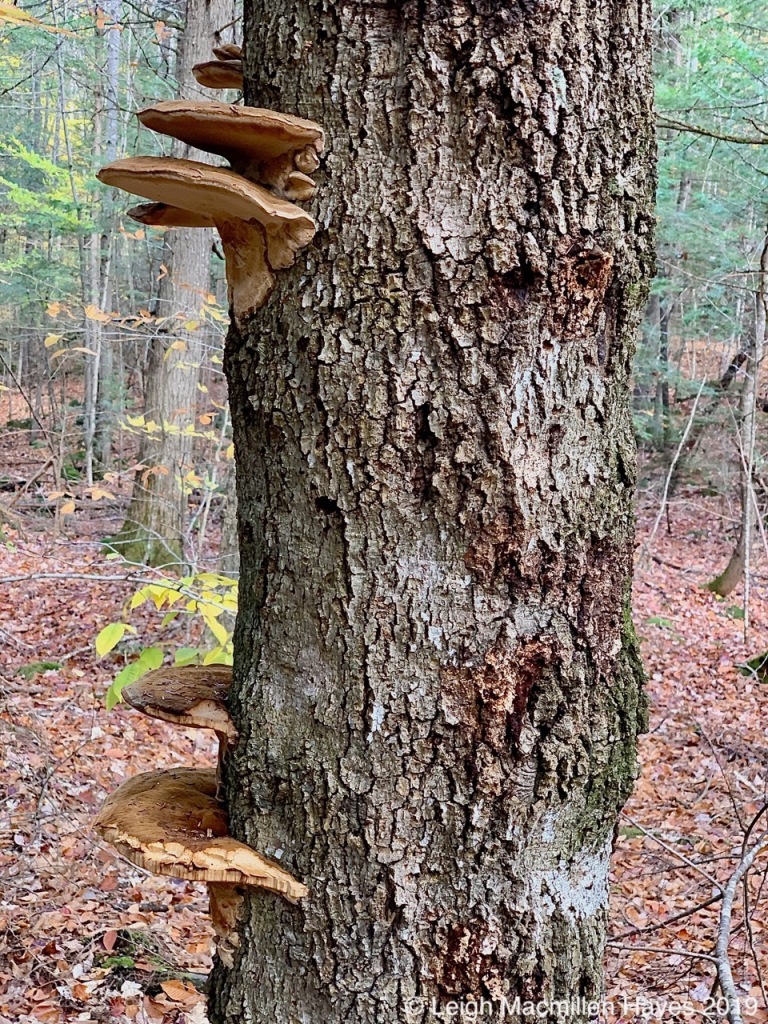
In complete contrast, upon a snag nearby, grew a much larger fungus.

Part of its identification is based on its woody, shelf-like structure projecting out from the tree trunk. Someone had obviously been dining upon it and based on its height from the ground and the tooth marks, I suspected deer.

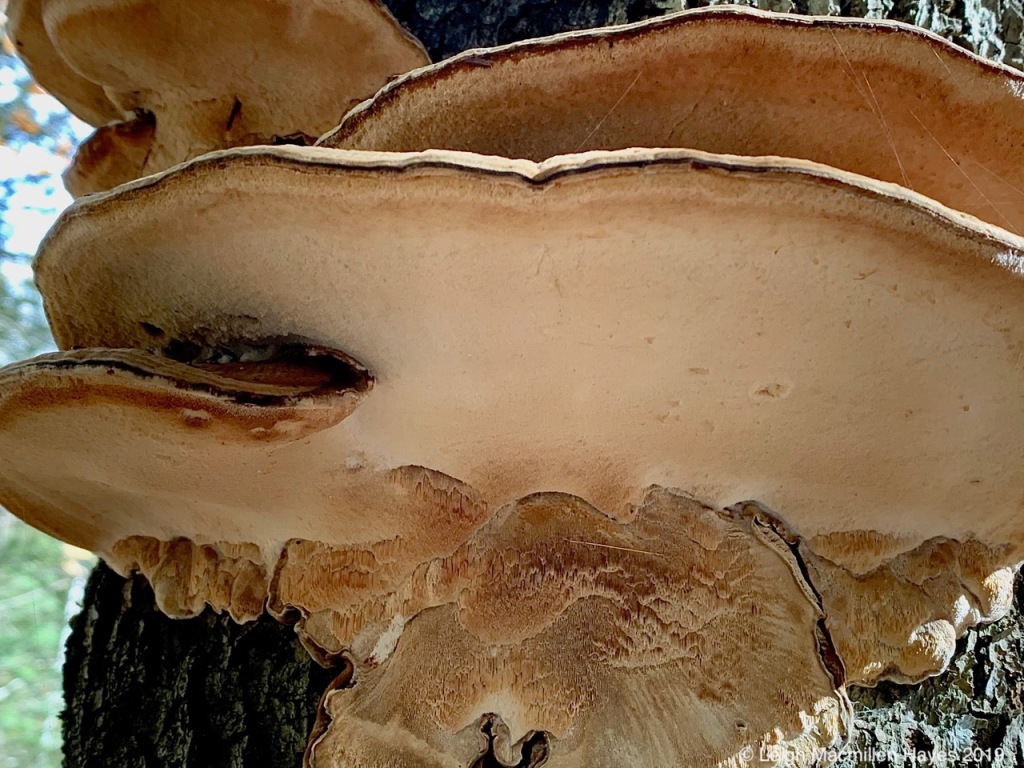
The pore surface, however, is the real reason to celebrate this find for it stains brown and provides a palette upon which to sketch or paint, thus earning it the common name of Artist Conk. But the question: while some mushrooms fruit each year and then if not picked, rot and smell like something died in the woods, what happens with a shelf fungus? The answer as best I know: A shelf fungus adds a new layer of spore tissue every growing season; the old layer covered by the new one, which look like growth rings in a tree.

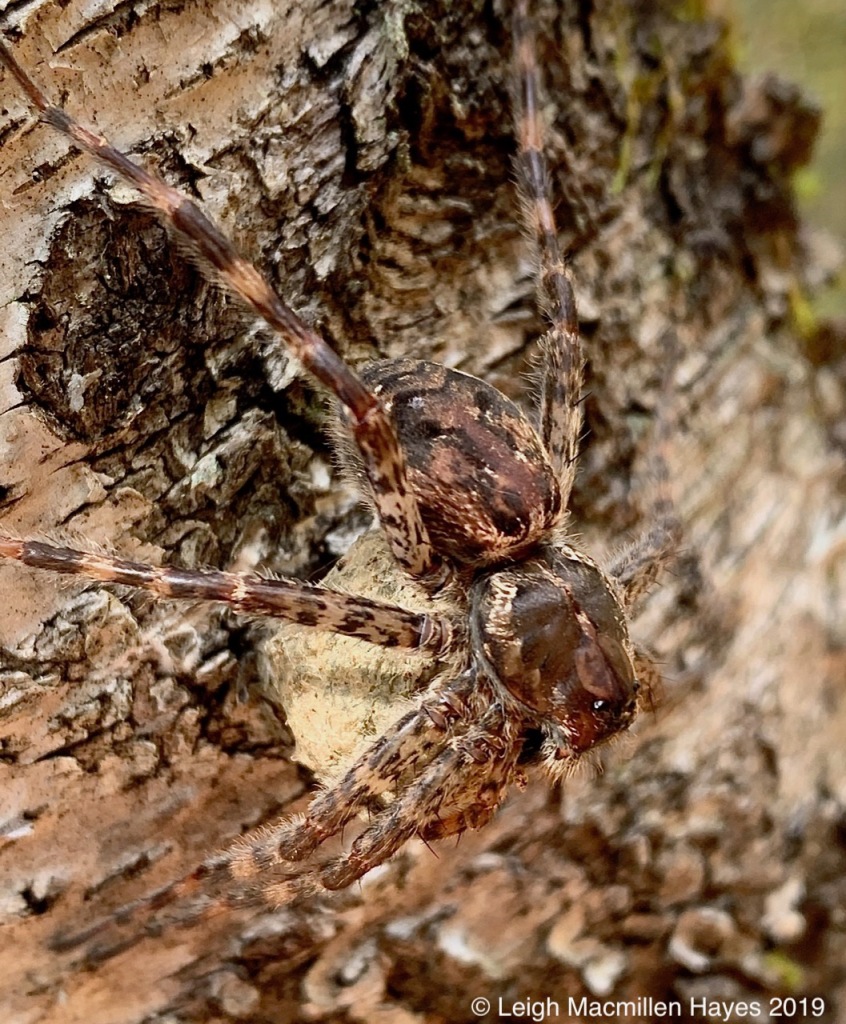
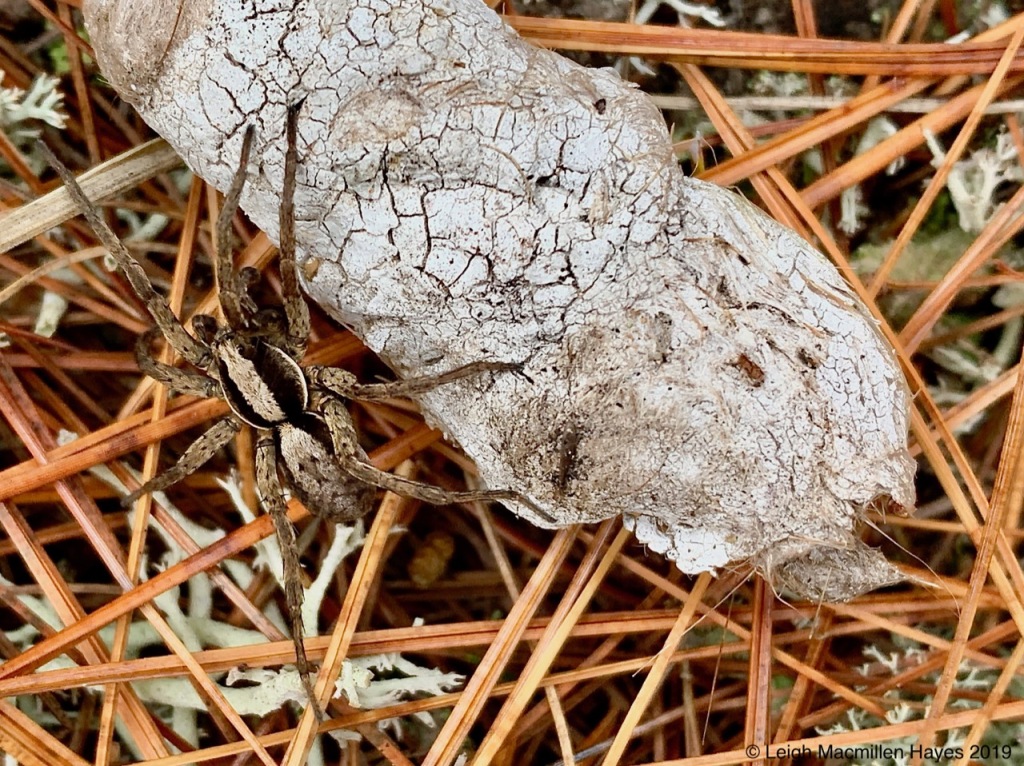
A lot of the focus on this morning’s walk tended to be upon the fungi that grew in that neck of the woods, but suddenly something else showed its face. Or rather, I think, her face. A Wolf Spider. Upon an egg sac. Super Mom though she may be for making a silk bed and then enveloping her young in a silk blanket, and guarding it until her babies hatch, this spider did not make the slightest movement, aggressive or not, as I got into its personal space. Usually the mother dies either before or after her babies leave the sac. What would Jinny Mae think? Perhaps that for some reason Momma waited too long and maybe the cold weather we’ve experienced upon occasional lately got the better of her?

I don’t know entirely what Jinny Mae would think, but I have a pretty good idea because the reality is that today, she and I traveled the trail together for the first time in forever. For each of these finds, it was like we played trail tag–first one spying something wicked cool and then the other finding something else to capture our attention as we tried to capture it with our cameras.

We caught up. We laughed. We noticed. We questioned. We laughed some more.

Our three-hour journey drew to a close as we revisited the Stair-step Moss that grows in her woods.

I’m still giddy about the fact that I got to wander and wonder the Jinny Mae way today.

P.S. Jinny Mae returned to Super Momma spider a couple of days later and as she paused to take a photo, Momma scooted into a tree hole, carrying her sac. She LIVES.

Ponds #1 and #2 Mondate

My friend, Alice, suggested a trail to me over the weekend, and so when this day dawned, my guy and I had a plan. We’d pack a lunch, drove a wee bit north, and let the fun begin. We love exploring places new to us and this was such.

Immediately, the forest floor reflected the canopy above where Sugar Maples, Beech and Red Oak presided.

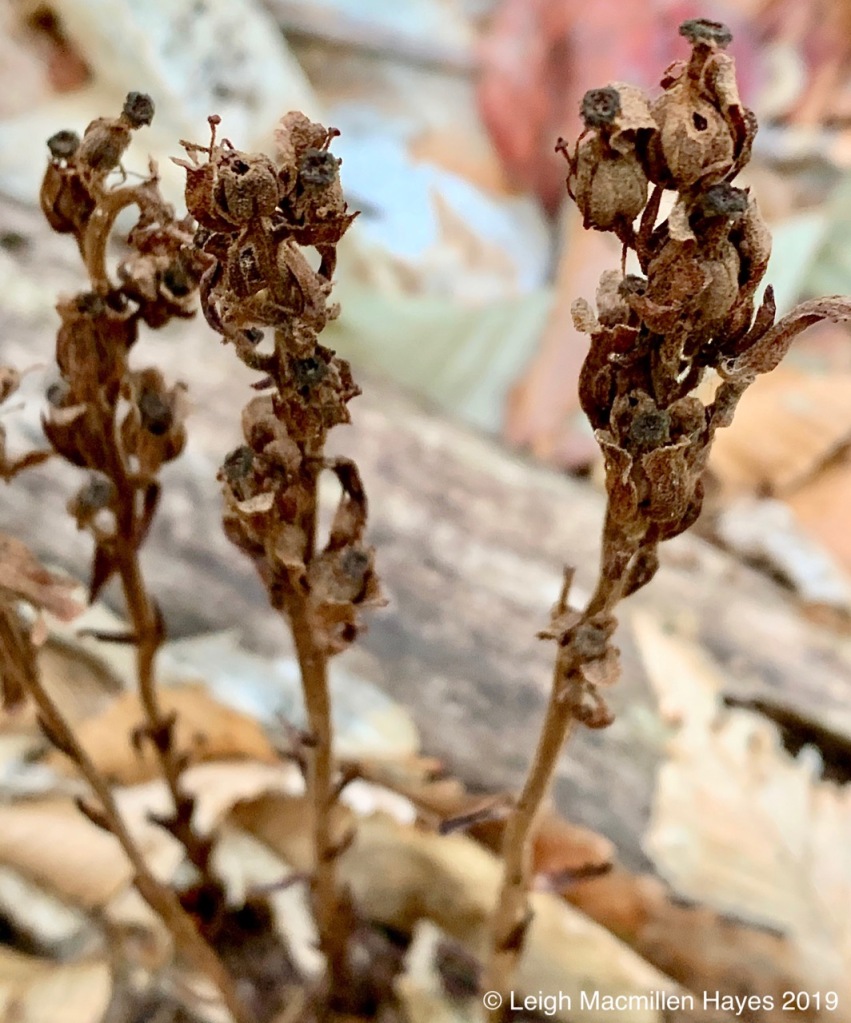
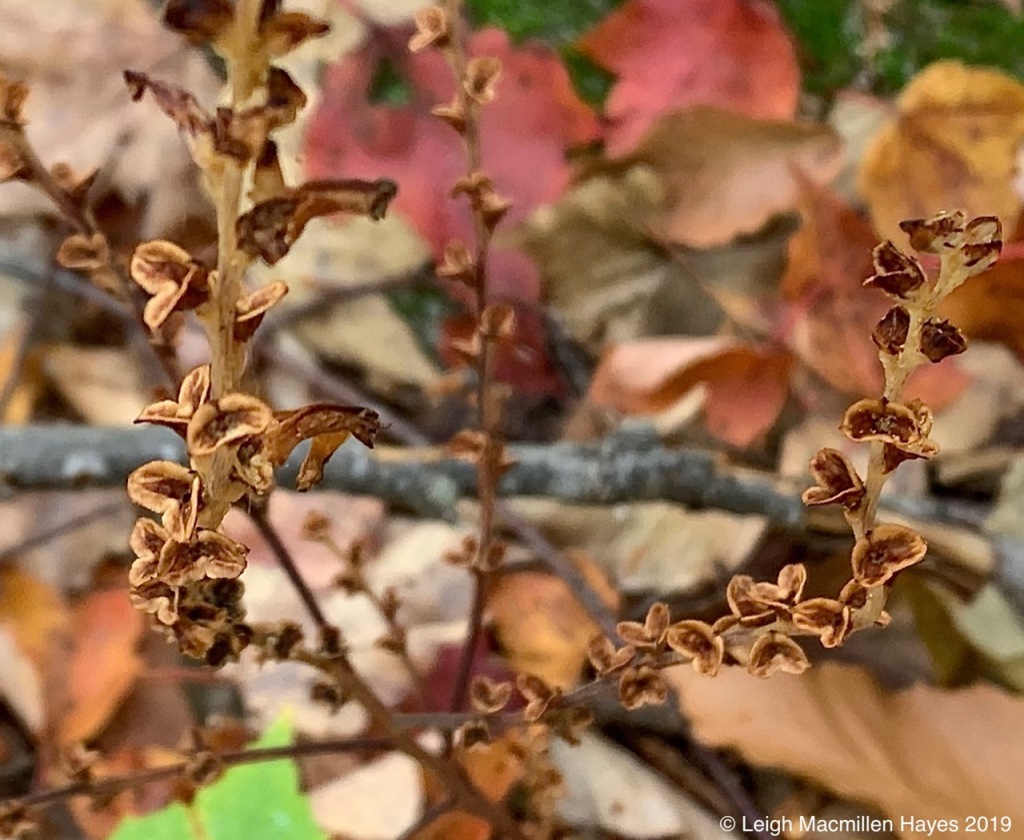
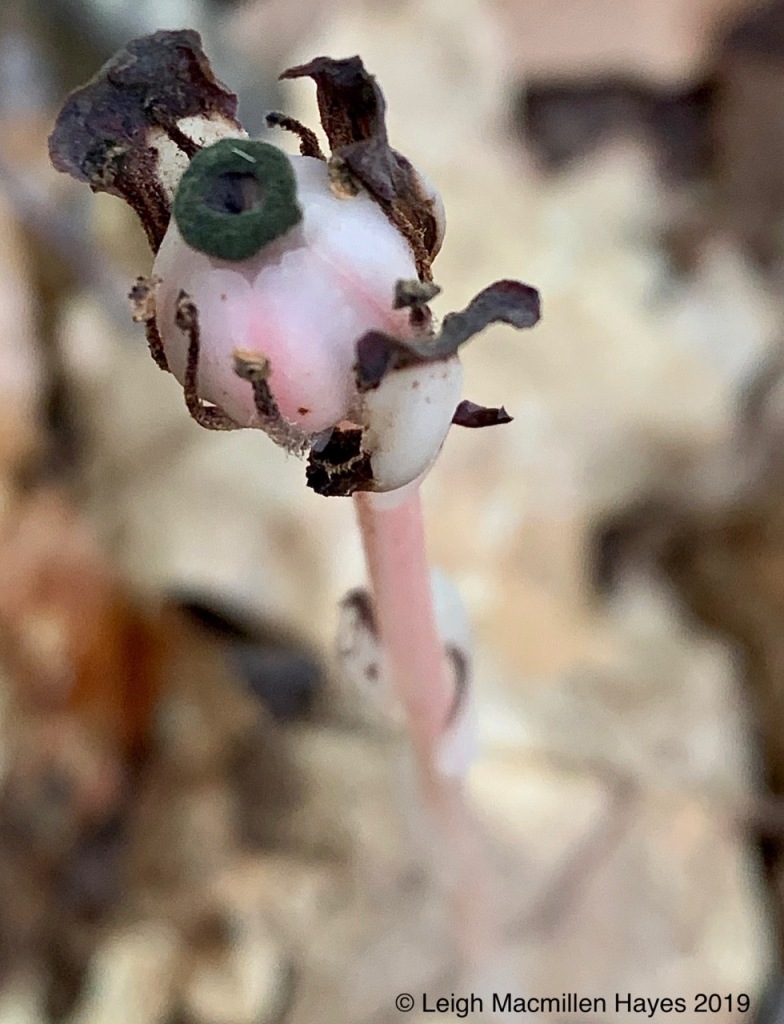
Other items also made themselves known, including the dried capsules of Pinesap, a plant that features three to ten topaz-colored flowers during the summer. The plant has such cool characteristics: it lacks chlorophyll because it doesn’t have any leaves to photosynthesize, and acts as an indirect parasite of trees. You see, Pinesap’s roots steal nutrients from mycorrhizal fungi, specifically from the genus Tricholoma, that the mushroom obtains from associated trees.

It wasn’t long before the carpet changed color indicating we’d entered a Red Maple community.

And again, upon the ground, another cool site worth honoring. Many-fruited Pelt is a foliose lichen that grows on soil, moss and rocks. The rust-colored projections among the shiny brown lobes made me squat for a photo call. Those reddish-brown projections are the fruiting bodies on the leafy margins–thus the name.

Again we moved onward and upward and again the community changed, the leaves telling us we’d entered a Big-Tooth Aspen/American Beech neighborhood.

Wherever beech trees grow this year, it seems the parasitic Beechdrops are also present. Lucky for me, though my guy likes to hike as if on a mission to get to the destination, when I ask him to pause, he quietly does. I’m forever grateful that he understands my need to take a closer look. I’m not sure if he’s amused by it or just tolerates it, but he never complains. And occasionally he points things out for me to notice or tells me the name of something.

Anyway, Beechdrops, like Pinesap, lack chlorophyll, have scales in place of leaves so they have no way to photosynthesize, and are parasitic. In the case of the Beechdrops, however, it’s the roots of the American Beech from which it draws its nutrition. Small, root-like structures of the Beechdrops insert themselves into the tree’s roots and suck away. Do they damage the trees? The short answer is no because the parasitic plant is short-lived.

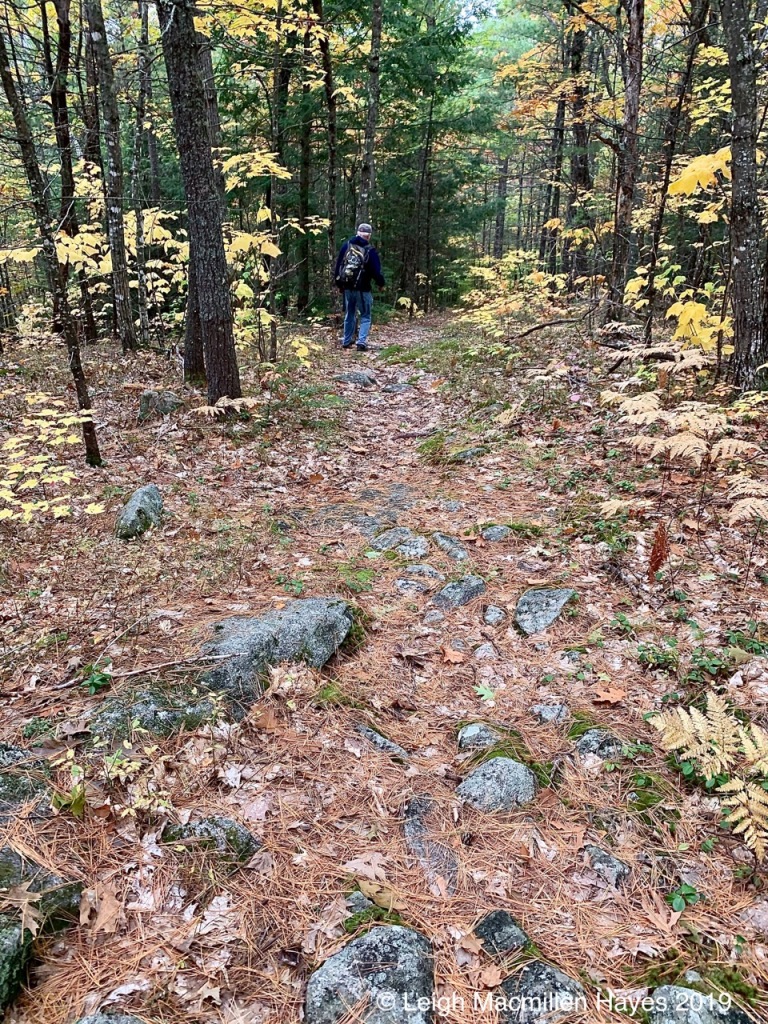
Our journey continued to take us uphill and really, it wasn’t easy to follow, but somehow (thanks to GPS–I surprised myself with my talent) we stayed on the trail.

Do you believe me now that it wasn’t easy to follow? Yes, that is a blaze, the yellow paint practically obliterated by a garden of foliose and fruticose lichens. Foliose being a “leafy” looking structure and at least two grew on the bark. Fruticose, likewise the “fruity” structure (think a bunch of grapes minus the fruits) also presented itself in at least two forms.

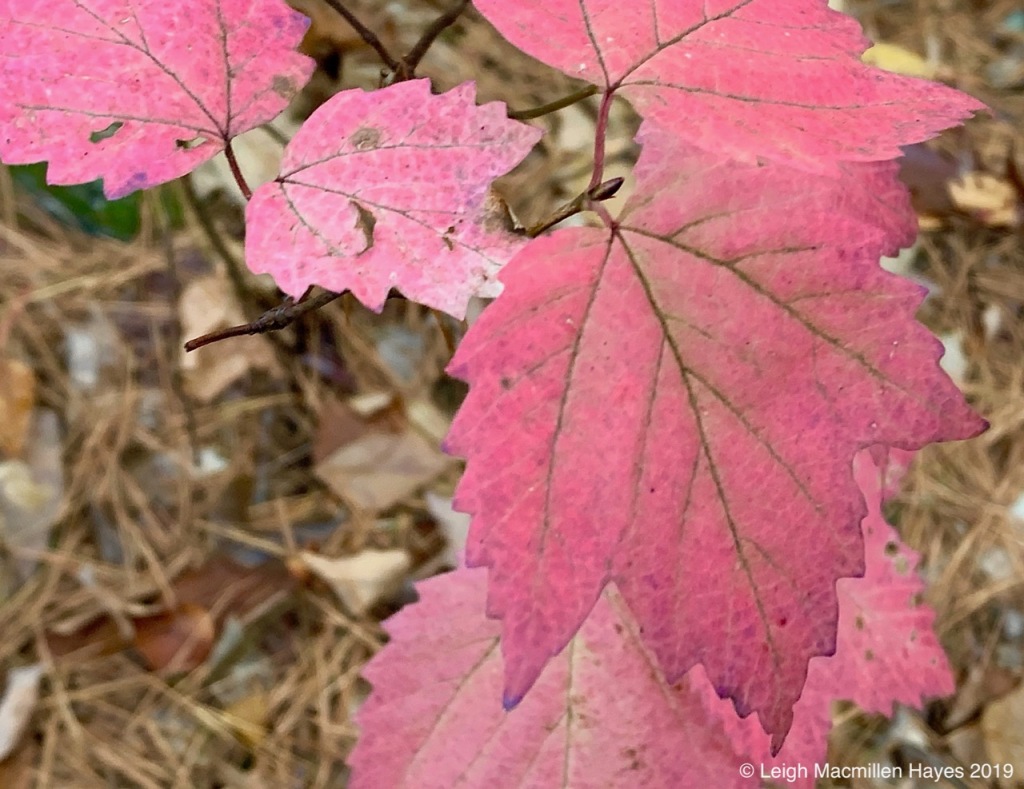
Of course, there were still many other things to admire including the multiple shades of magenta presented by the shrub: Maple-leaf Viburnum. In my book of autumn, nothing else exhibits such an exquisite color, making it easy to identify.

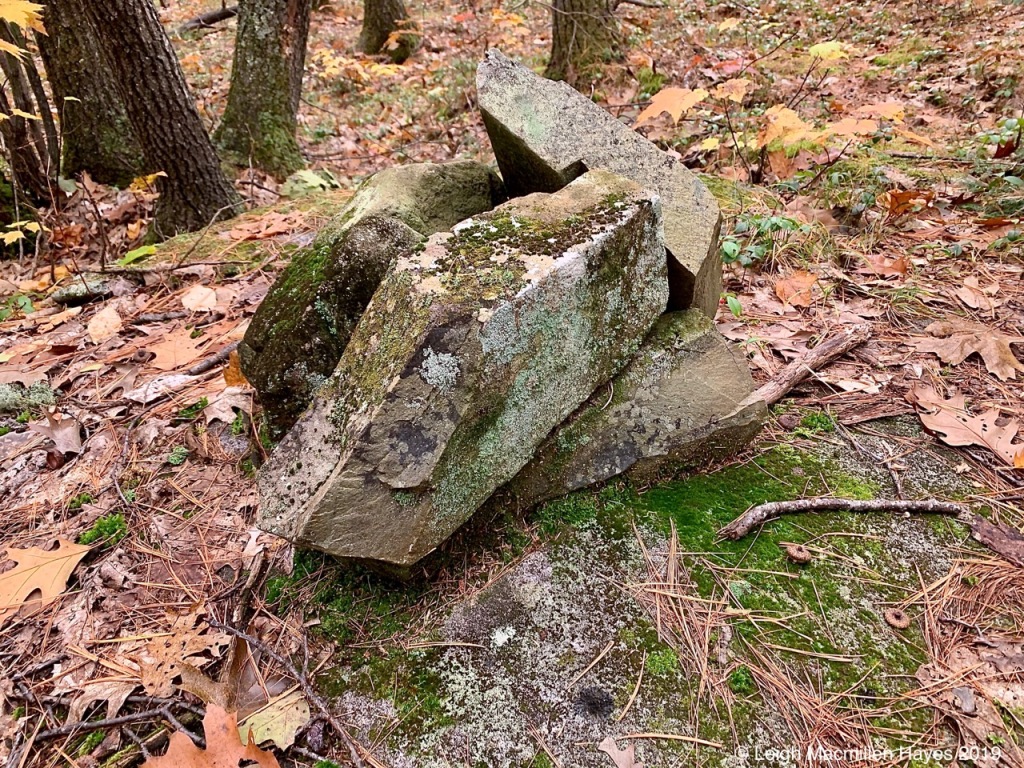
Our luck increased once we began to spy rock cairns marking the trail.

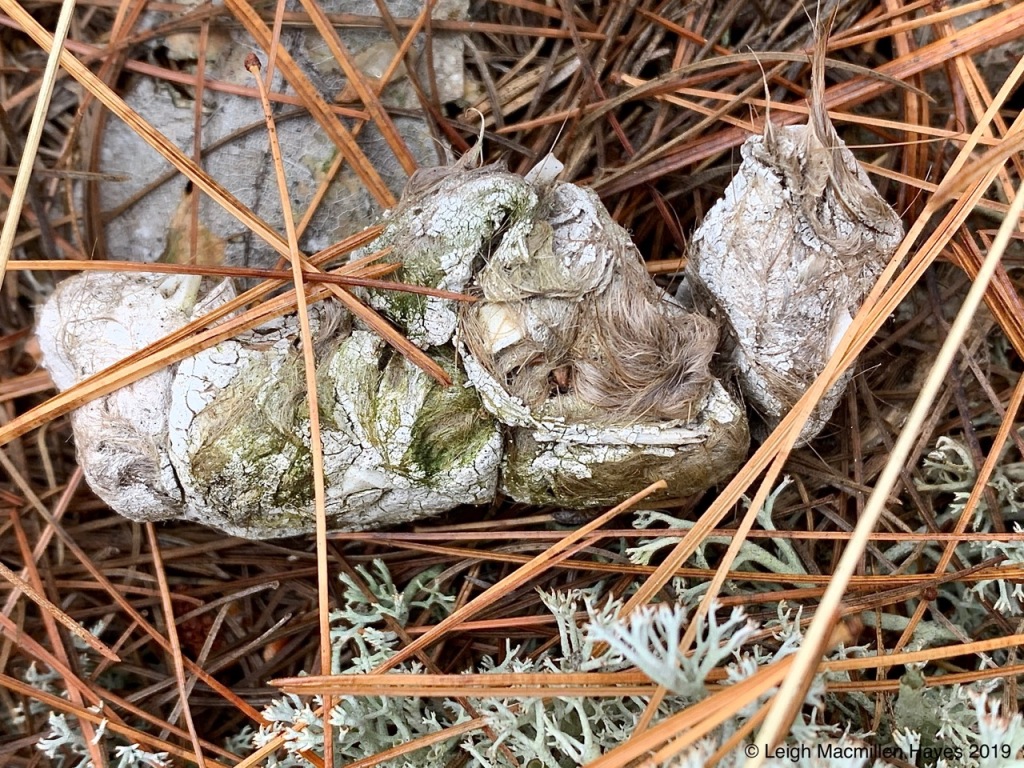
And it got even better when I noticed several classic deposits beside the cairns. Bobcat scat! Check this one out. Have you ever seen anything quite so beautiful? Look at that hair tucked within the packet. Of a snowshoe hare. Oh my.

While taking a closer look, I realized I wasn’t the only one with all eyes on the structure. Yes, that’s a wolf spider.

Realizing we were at the summit of a certain small mountain, suddenly we found ourselves walking along ledge.

And then the view opened up. It became lunch rock view.

Words seemed not enough to describe.

At last we made our way down, for still we hadn’t reached our destination.

And that’s when Pinesap’s cousin, Indian Pipe showed off its one-flowered structure. While Pinesap features three to ten flowers per stalk, Indian Pipe offers only one waxy structure made of four to five small petals. Until fertilized by a Bumblebee, the flower droops toward the earth, but upon pollination turns upward toward the sun. Eventually a woody capsule will form.

Also parasitic, Indian Pipes have a mutually beneficial relationship with many tree species plus Russula and Lactarius mushrooms, as they work together to exchange water and carbohydrates with nutrients from the soil.

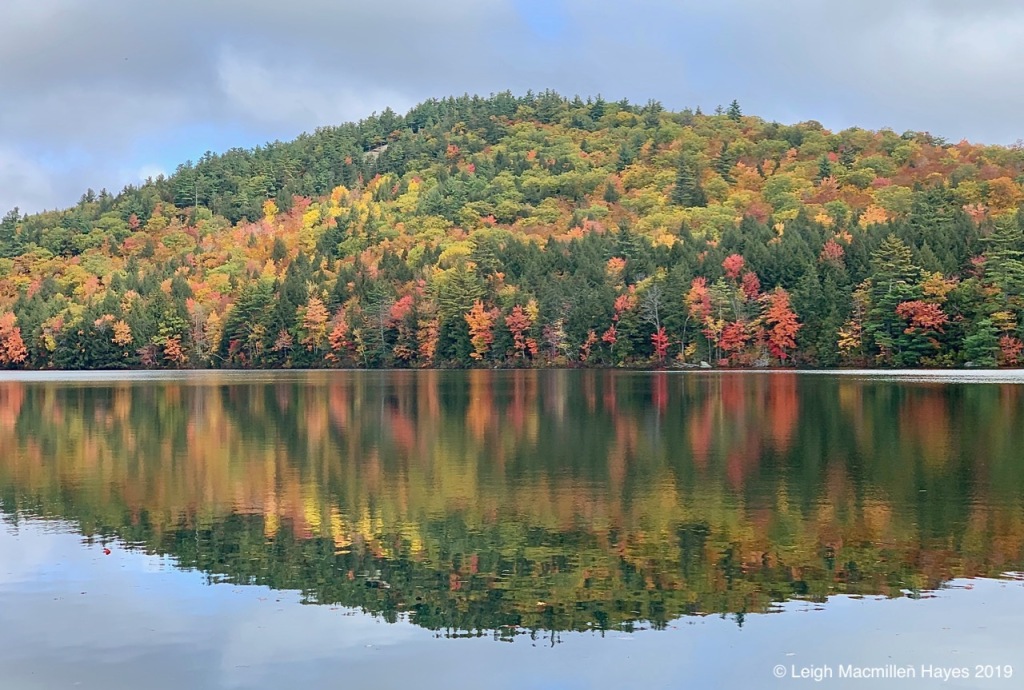
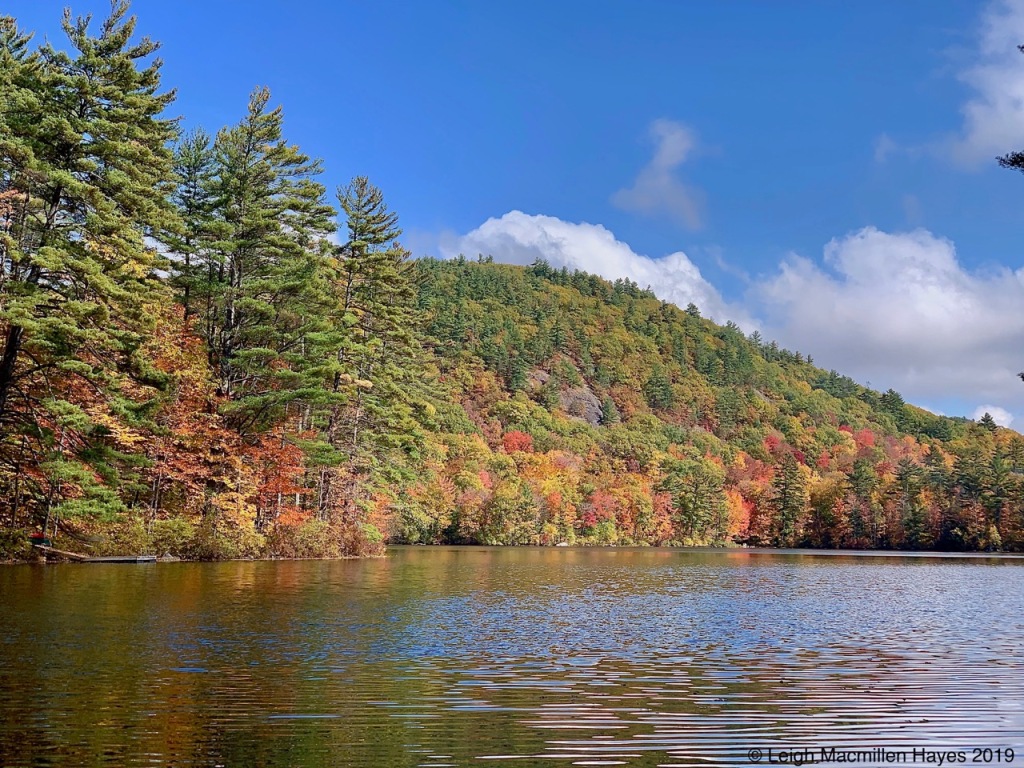
At long last, we reached the first of our destinations, Pond #1. The glass-like water offered a perfect mirror image of the scene upon the opposite shore and we both let “oohs” and “aahs” escape from our mouths when we came upon an opening in the shrubby vegetation that protected the shore. I think my favorite portion of this photo is the evergreens that add a fringed frame.

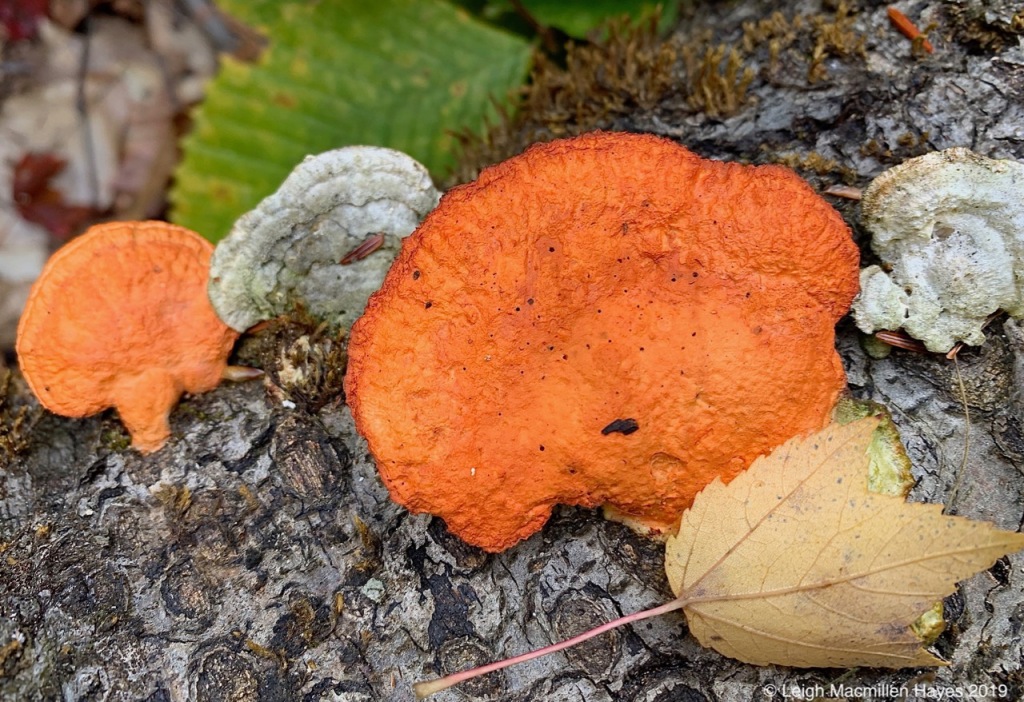
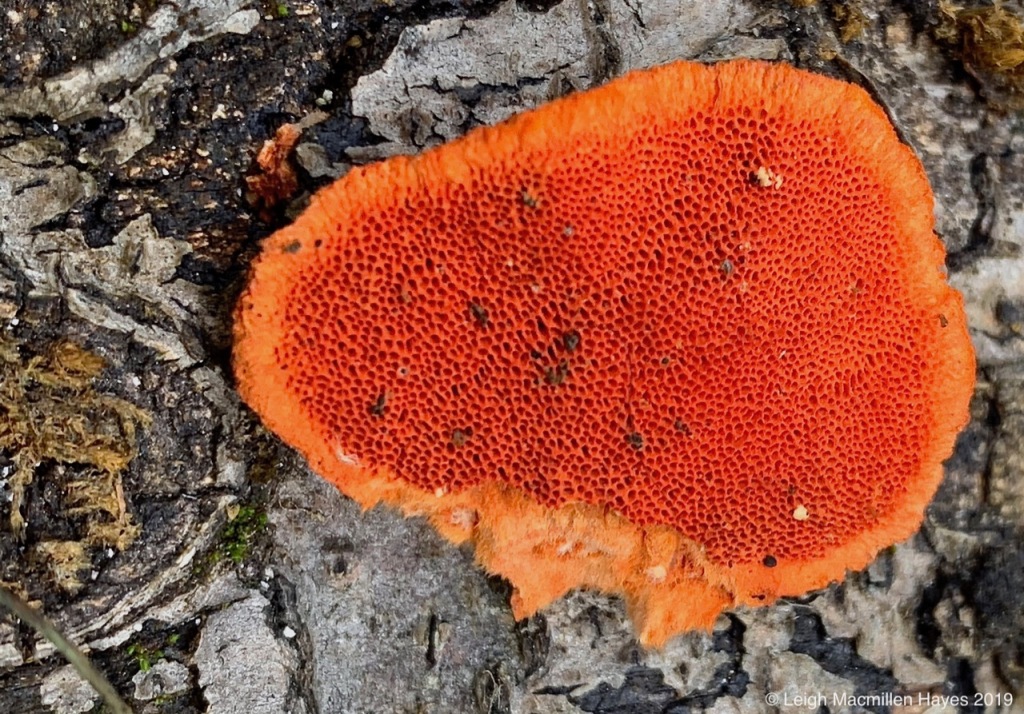
Our journey, however, didn’t stop there, for we had another pond to locate. Again, we referred to the GPS and found ourselves climbing over several fallen trees. Upon one, I spied pumpkin-colored fungi that requested a stop. Of course. But really, it’s another I can never resist–Cinnabar-red Polypore.

As lovely as the color of the upper surface may be, it’s the pore surface that really makes my jaw drop. That color. Those angular shapes. Another “oh my” moment.

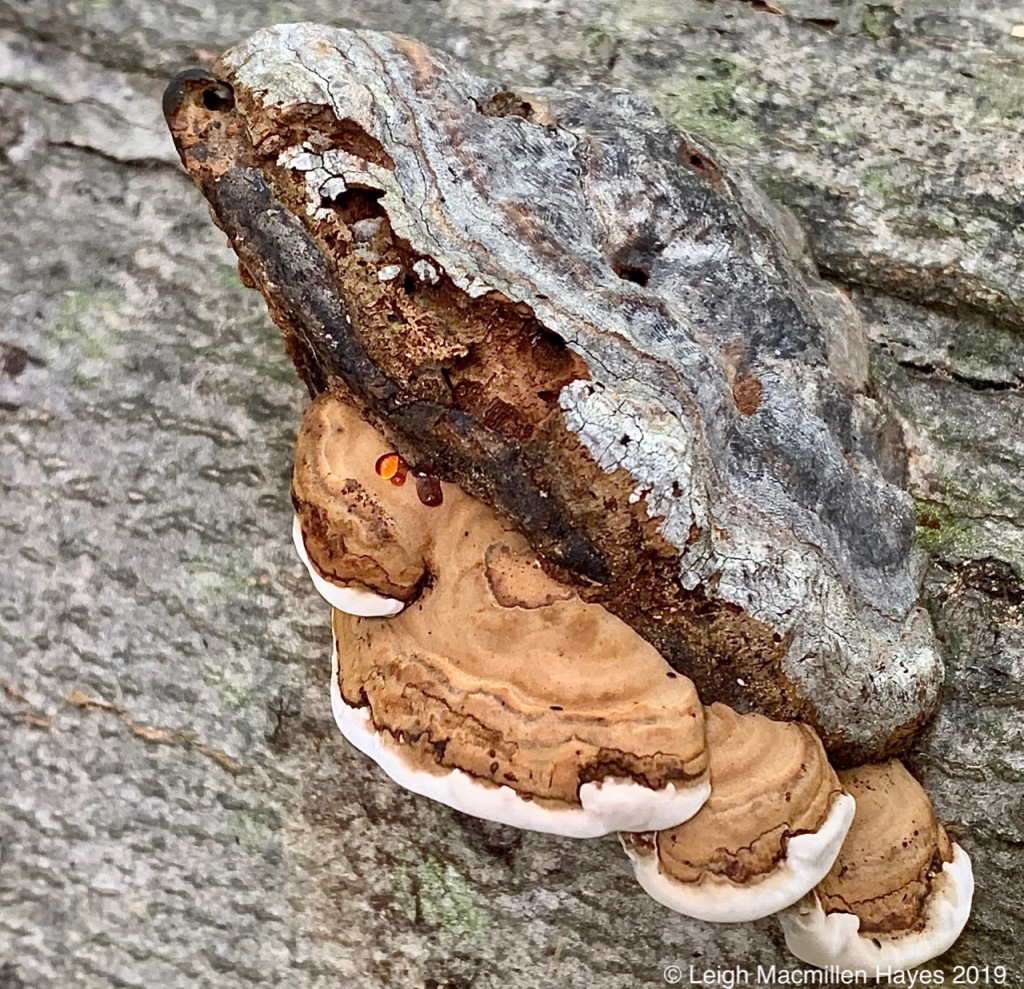
And then upon another downed tree, multi-aged tinder mushrooms. It was the mature one that fascinated me most for it looked like happy turtle basking on rocks in the sun.

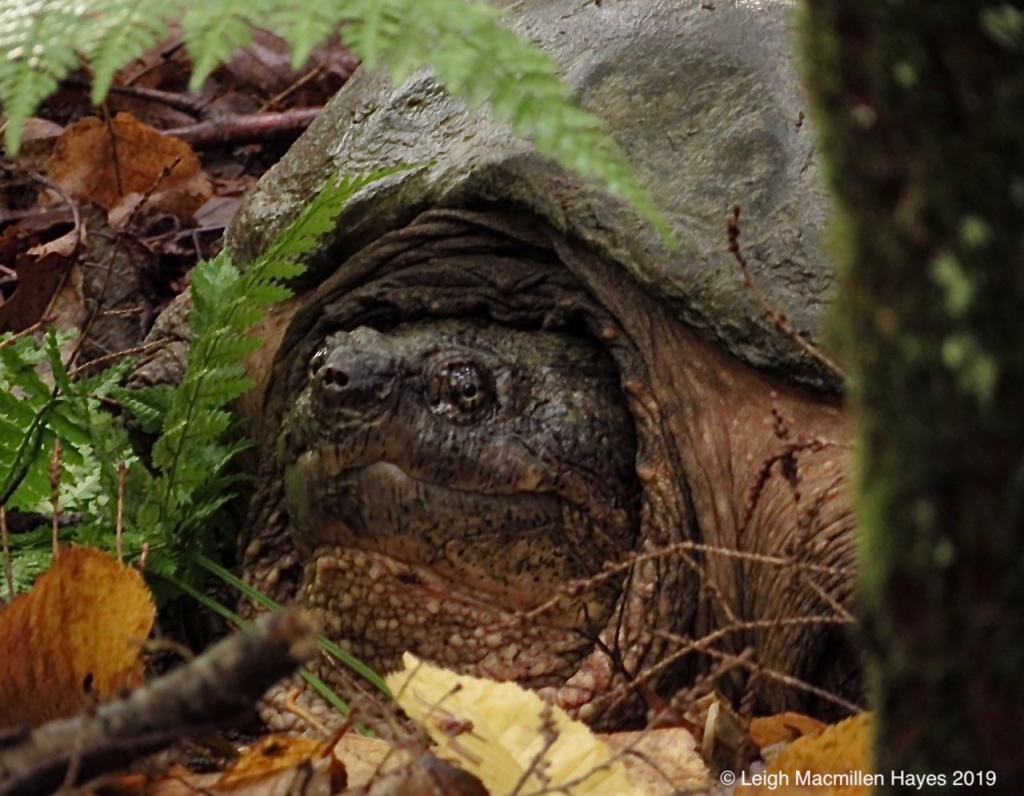
Last week I met a Snapping Turtle in the shade and he hardly looked thrilled with our encounter.

At last my guy and I reached Pond #2, where we sat for a few minutes and took in the scene. Okay, so we also enjoyed a sweet treat–as a celebration.

We still had another mile or so to hike before reaching my truck, but we gave thanks to Alice for the suggestion and for the fun we’d had discovering Pond #1 and #2 on this Mondate. And all that we saw between.
Go ahead, take a second look at that bobcat scat. You know you want to.

Afternoon Dragon Delight

I never expected it to be so, but stalking insects has become a favorite pastime. And this beautiful fall day, with temps in the upper 60˚s, provided plenty to admire if one took the time to look. The best way to spy the insects, for often so camouflaged are they, is to stand still for minutes on end and try to cue in on your surroundings.

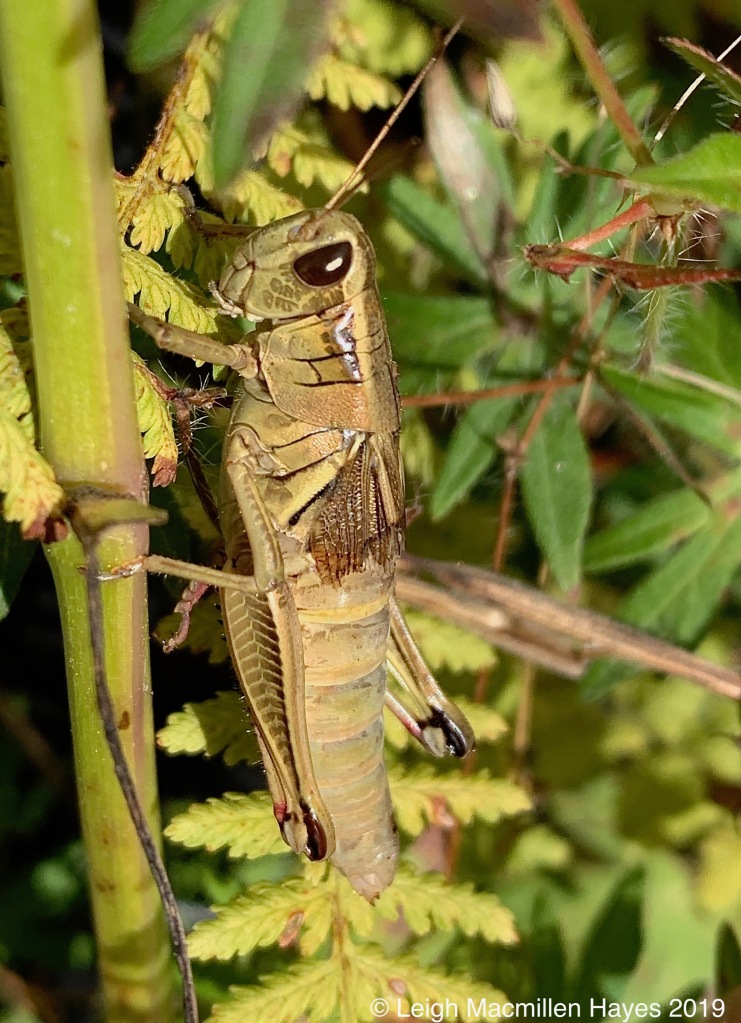
Grasshoppers, their armored bodies so intricately designed, drew my attention first and I spent an hour on and off watching a male and female in hopes that they might set a date. On my clock, they never did, though I suspect when I wasn’t looking, they snuggled under a leaf.

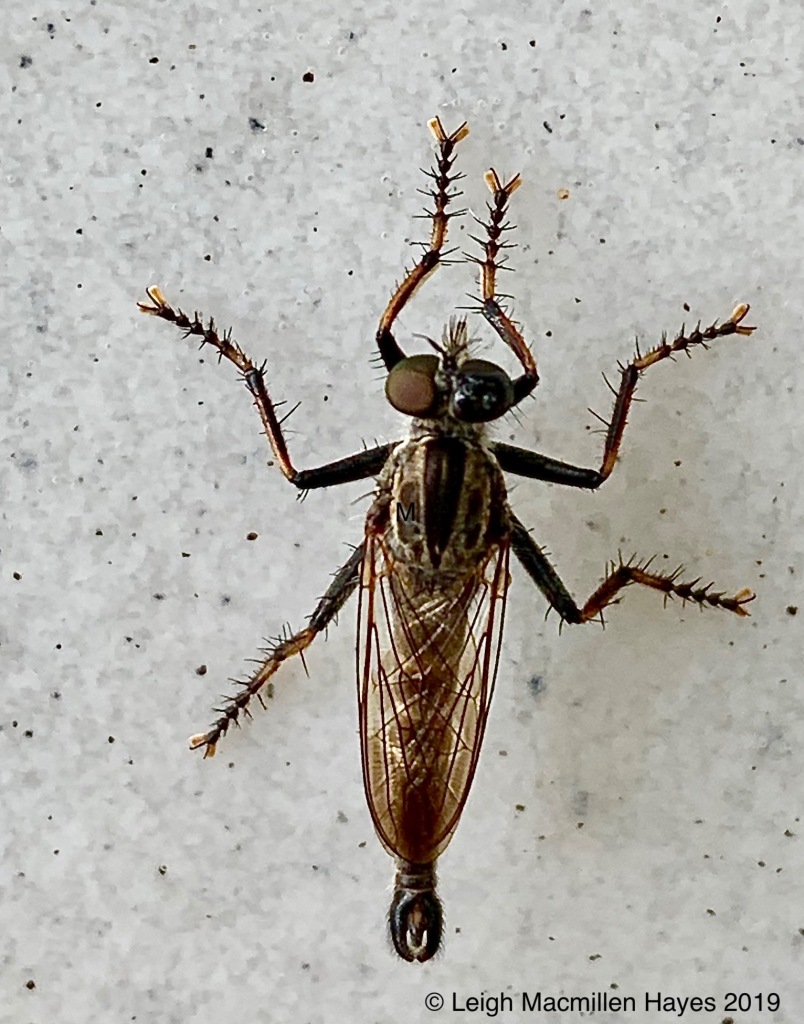
Another was a Robber Fly that flew from boat to boat and root to root as is its habit in this habitat. So named for its ferocious manner of pouncing from the air onto its prey, I didn’t have the good fortune to observe that behavior. But do check out that bristly body.

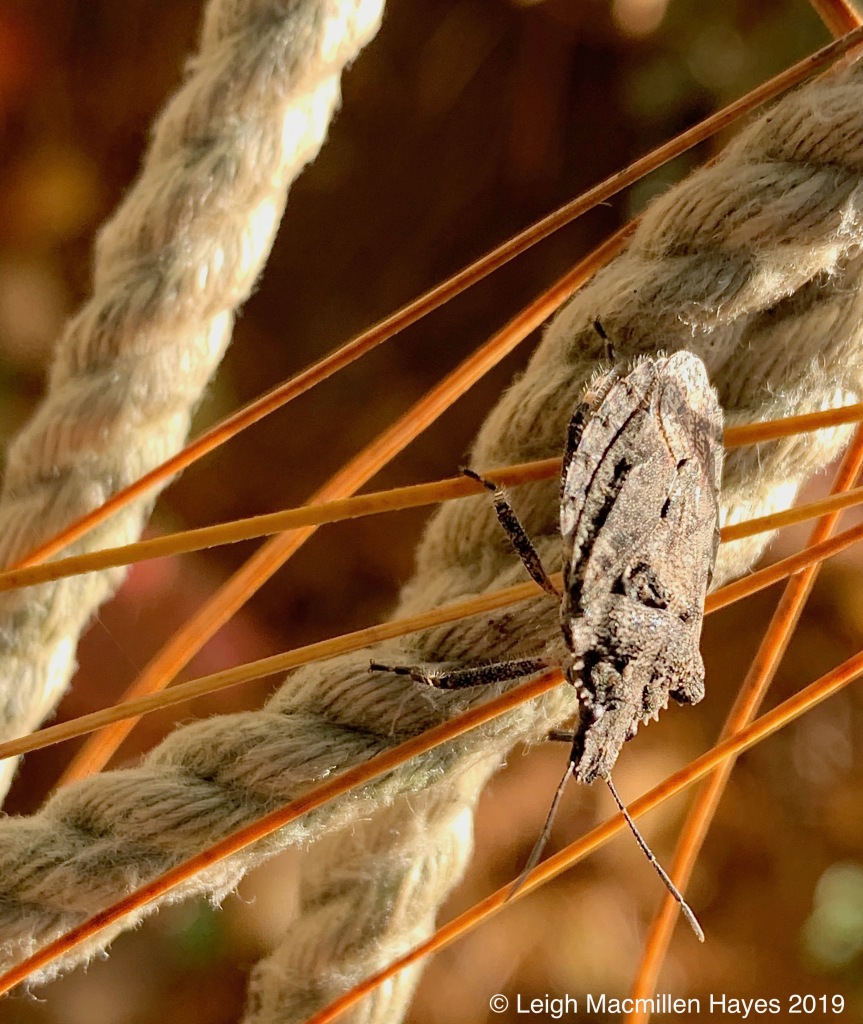
And then I wandered over to the hammock and a Stink Bug made its presence known. I surprised myself with the find for it was almost camouflaged as it moved upon the ropes.

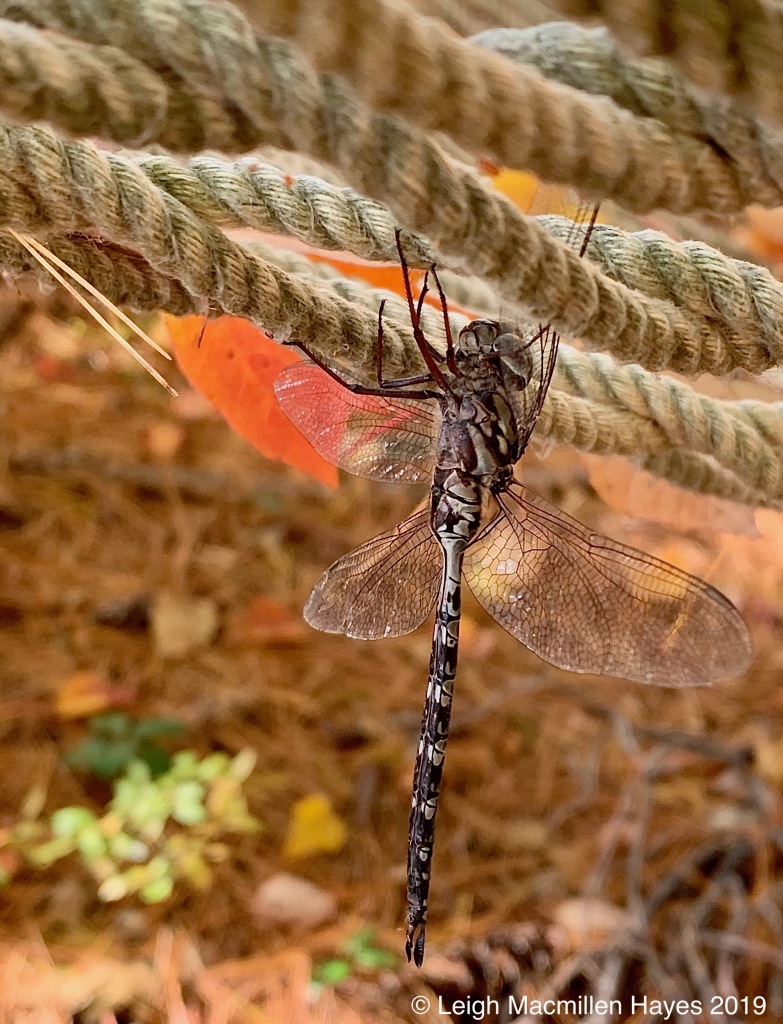
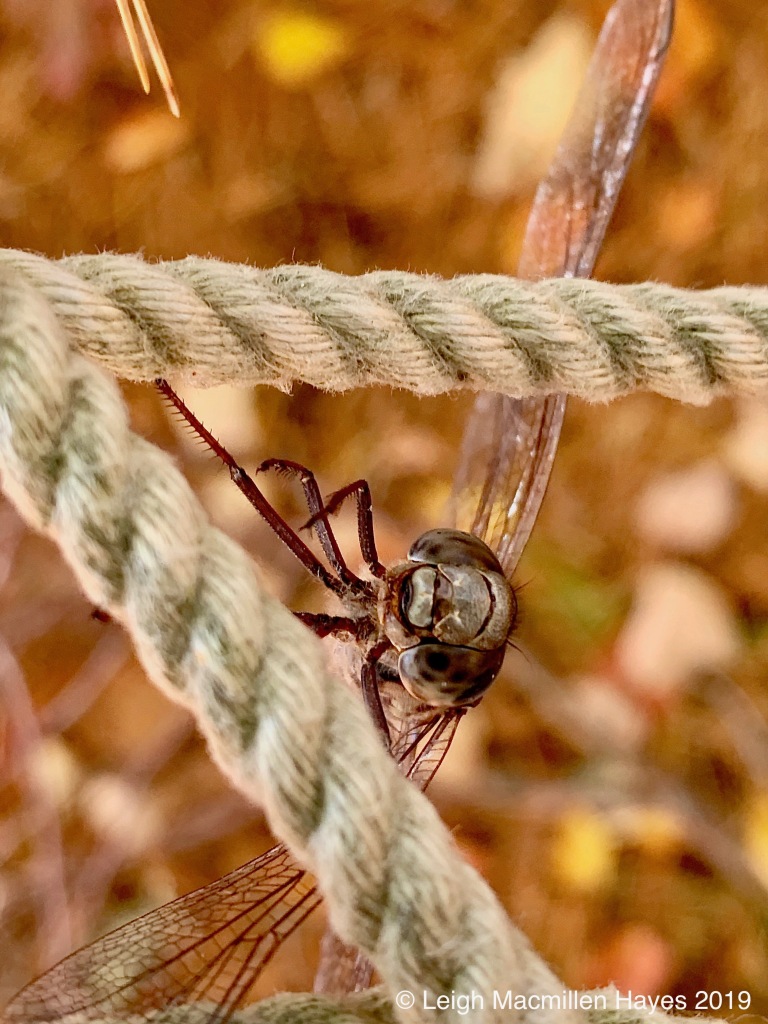
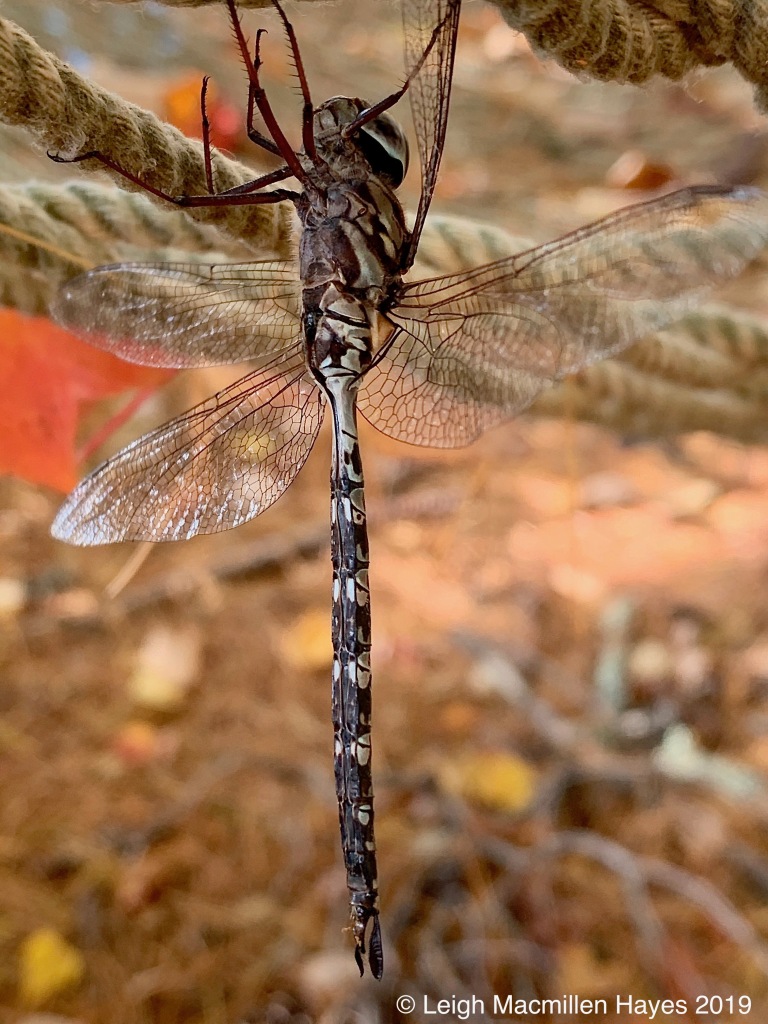
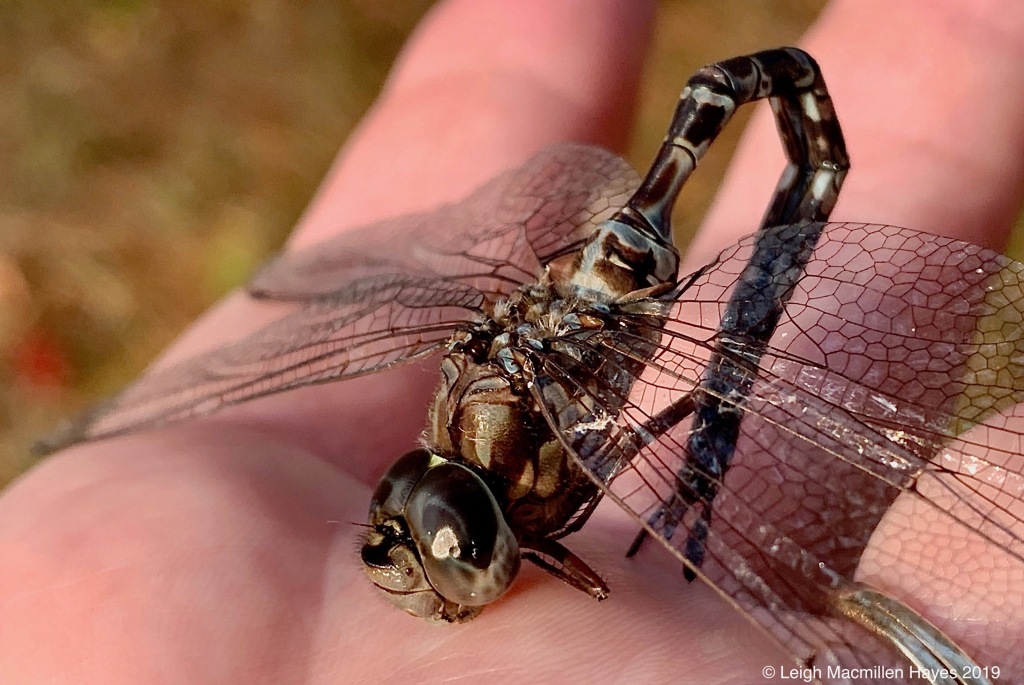
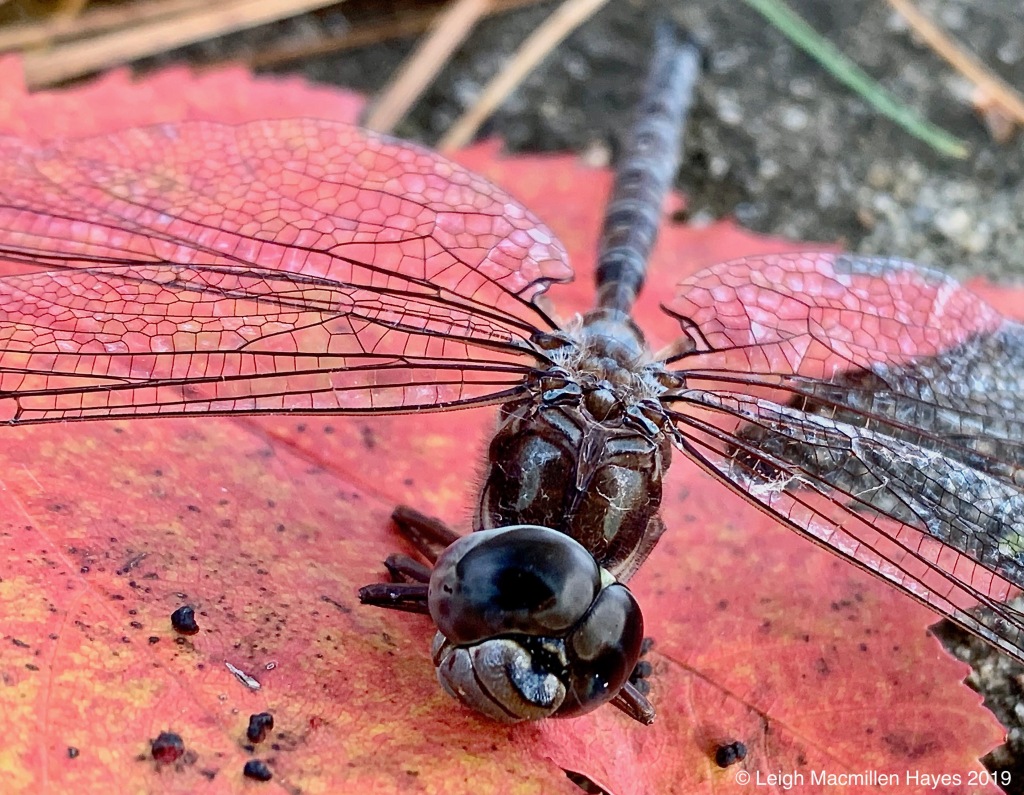
And somehow, cueing in on the Stink Bug provided the opportunity to see another dangling below the ropes. I thought I’d been in insect heaven up to this point, but the position was cinched when I spotted the dragonfly.

It didn’t move and so I was sure it was dead, and gave thanks for the opportunity to snap photos of it.

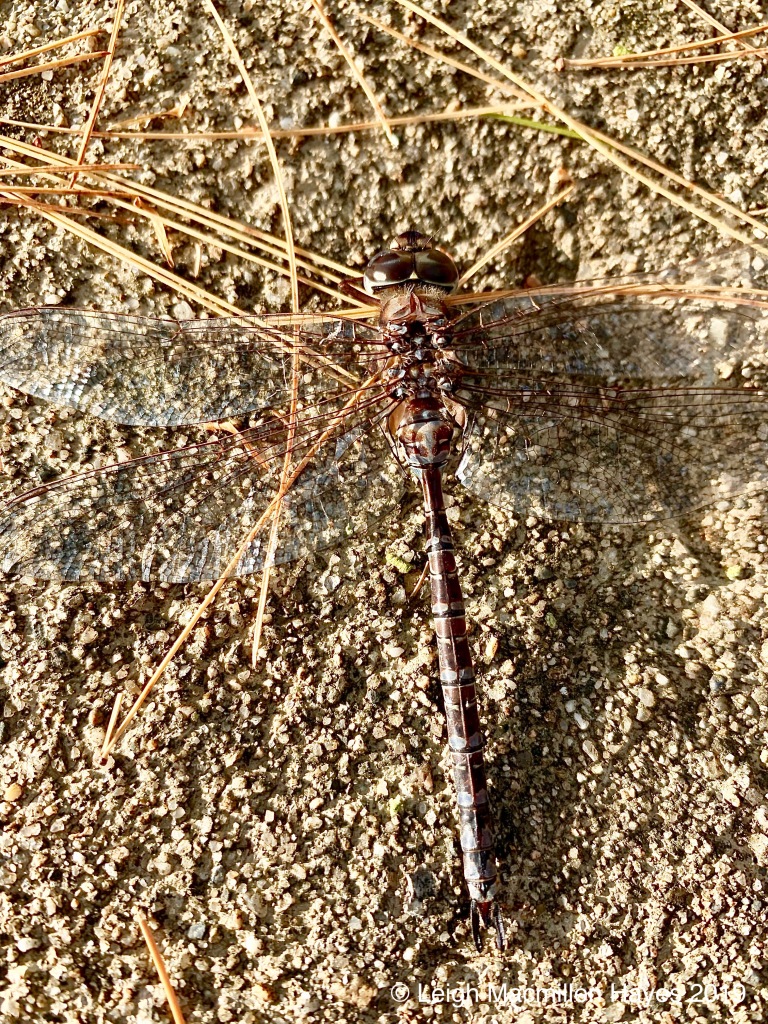
Really, it was a perfect specimen, its body and wings in immaculate shape. I had visions of my insect collection growing by one.

To that end, I took the dragonfly from the hammock and placed it on the cover of the well. Giddy as could be at my good luck in locating such a fine specimen on a mid-October day, I began snapping photo after photo as I took the opportunity to get to know this guy better.

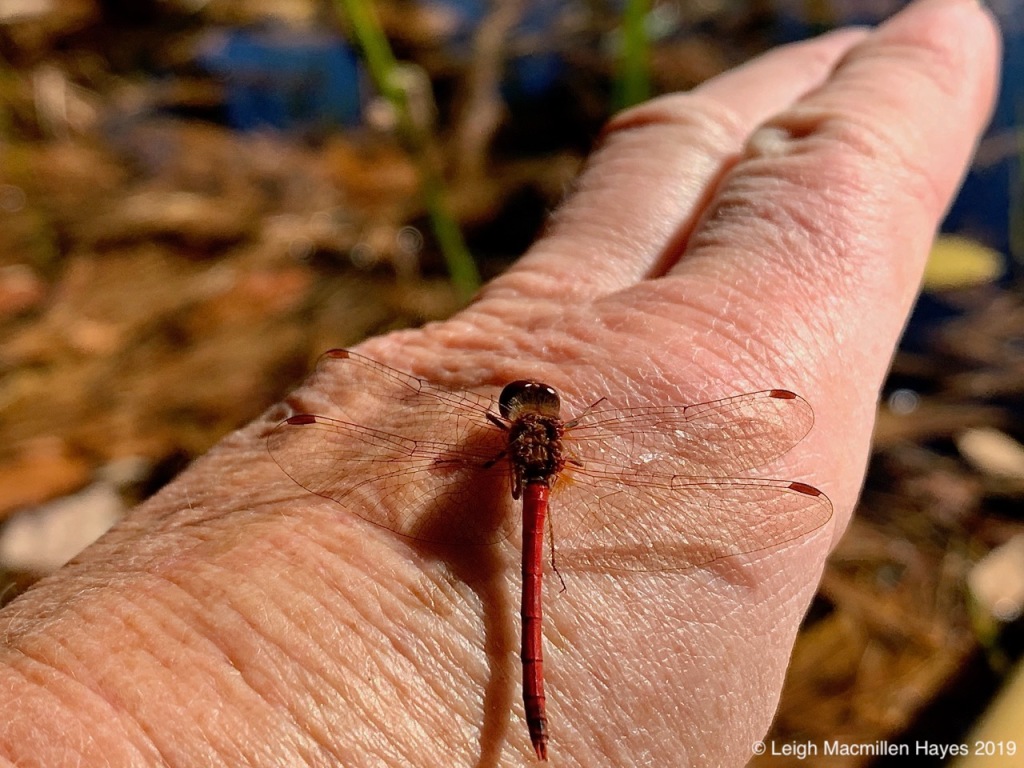
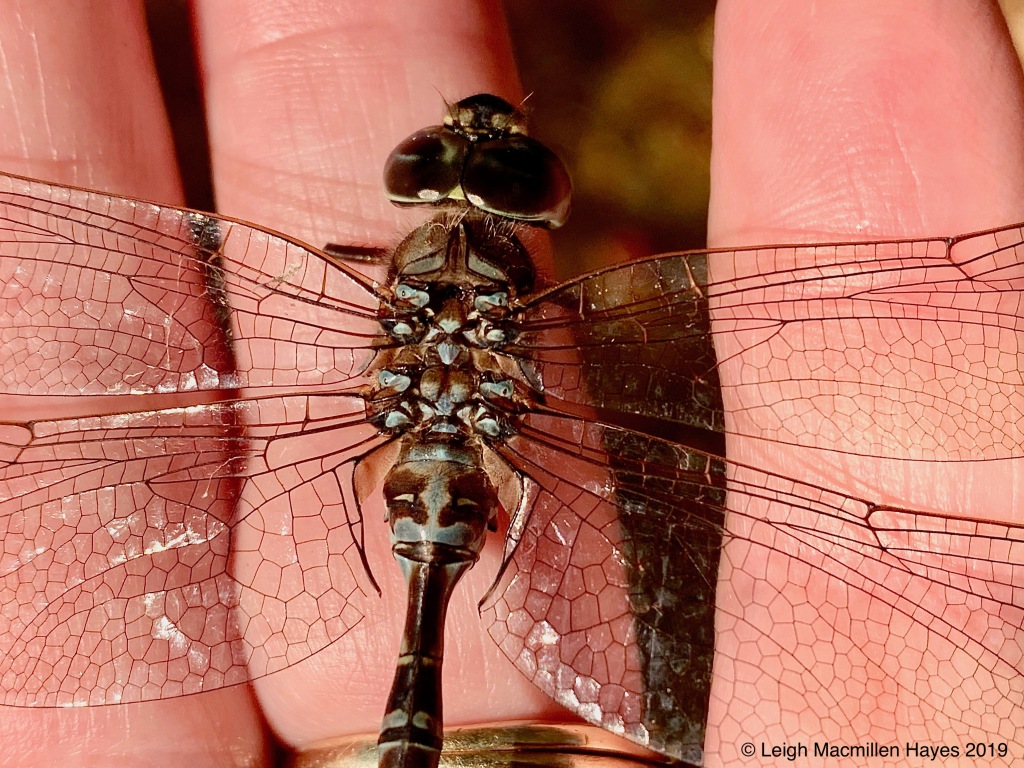
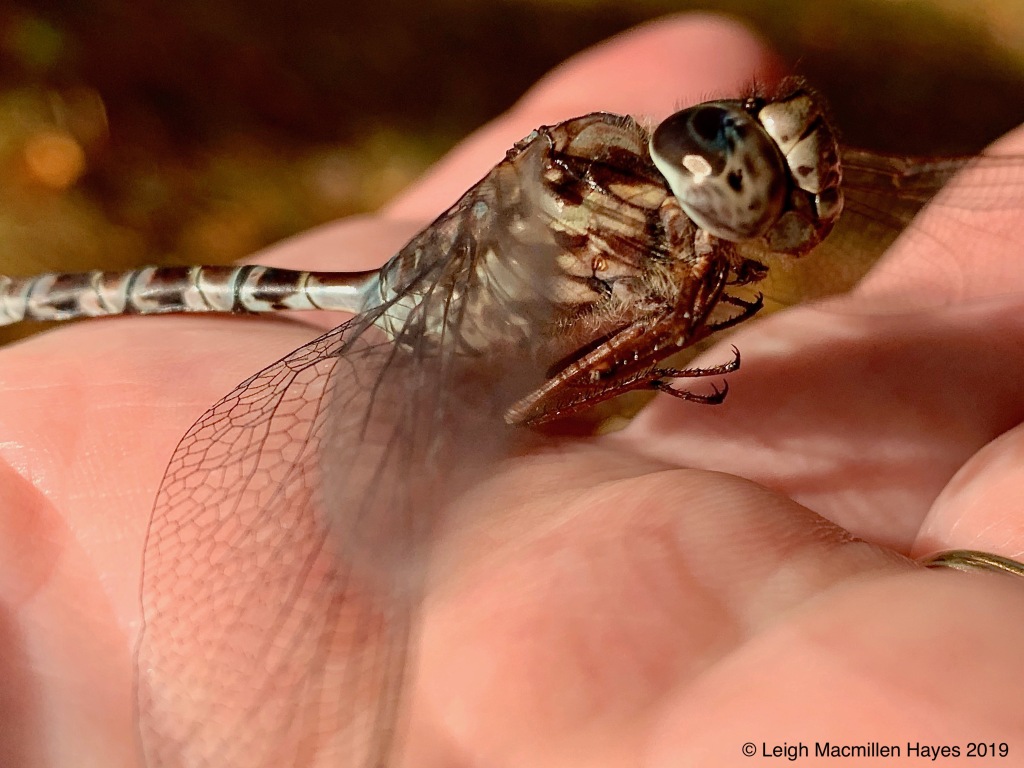
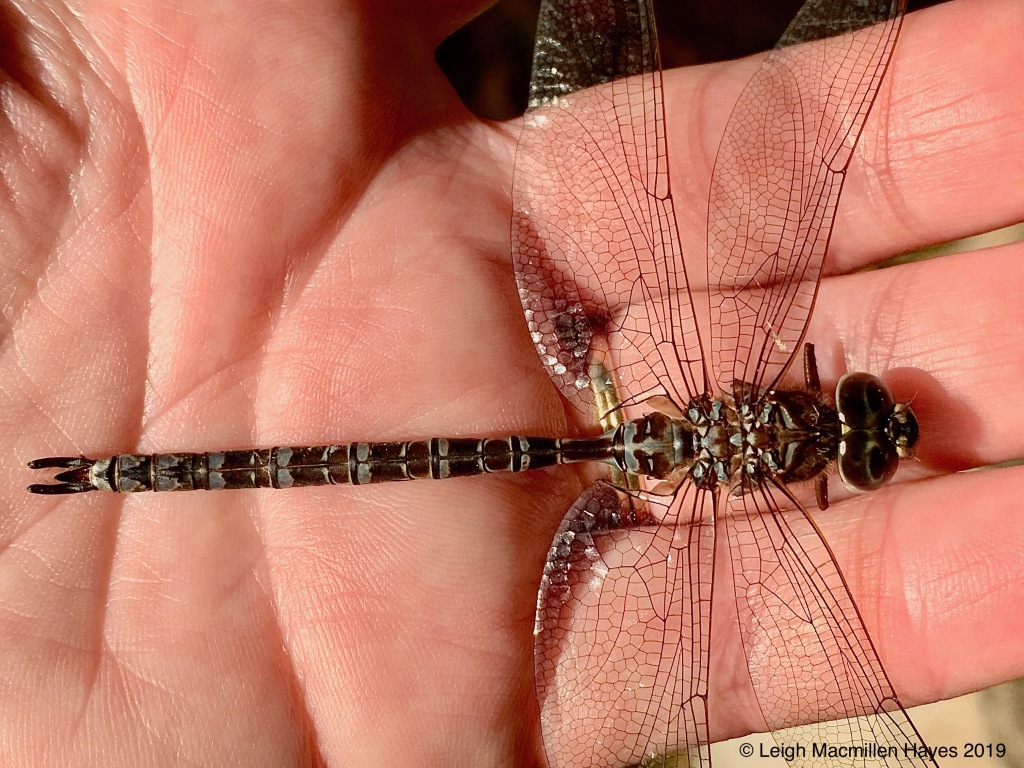
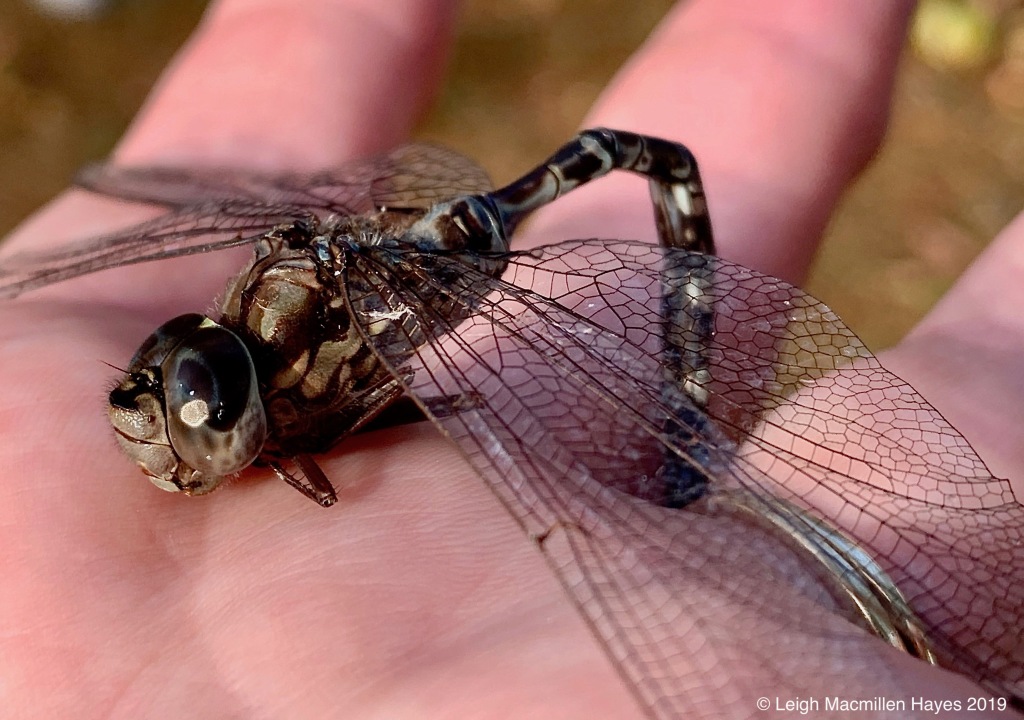
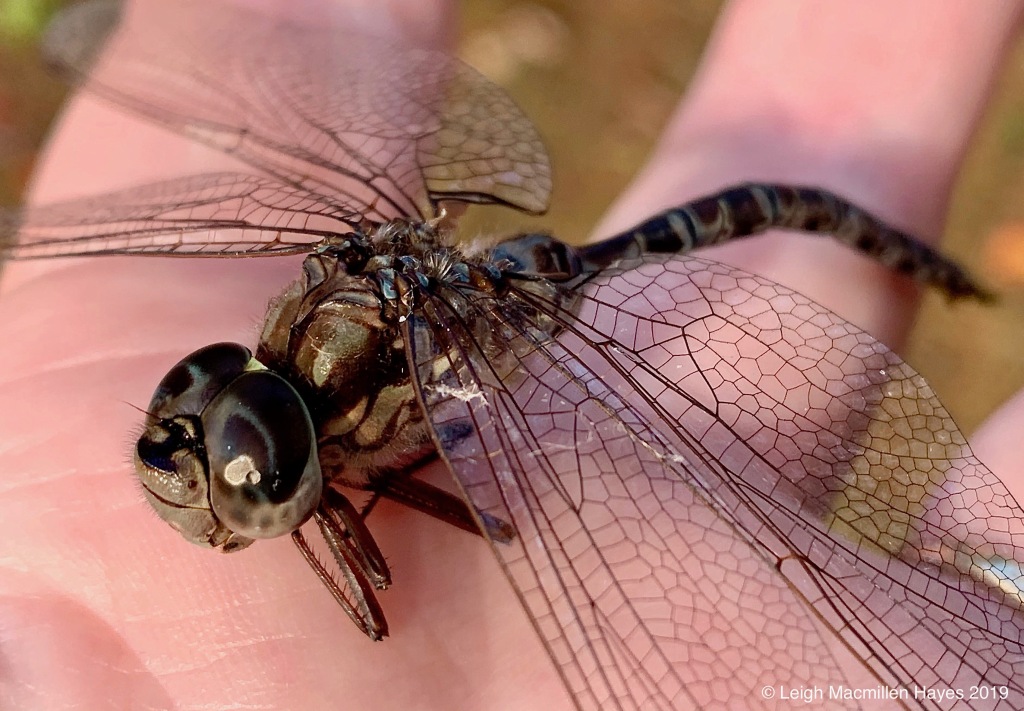
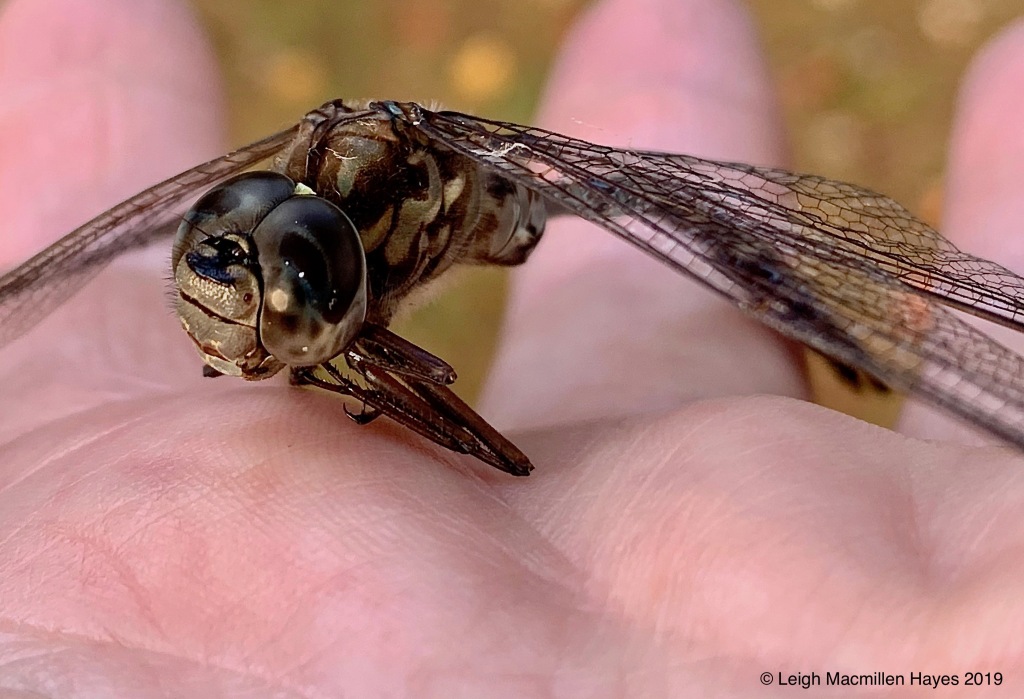
It wasn’t until I placed him on the palm of my hand, however, that I began to notice more than its mosaic thorax.

Suddenly, his wings began to beat, ever so slowly and methodically. And yet, he remained in the same spot on my hand.

I gave constant thanks for I couldn’t believe the opportunity I’d been gifted to examine this magnificent being at such a close perspective. My typical encounter with a darner dragonfly is that they cruise over water in almost constant motion and rarely land. And yet . . . here one sat upon my hand with no intention to move on any time soon.

Have you ever looked at a dragonfly in such close proximity? And taken time to notice all the hair on its thorax?

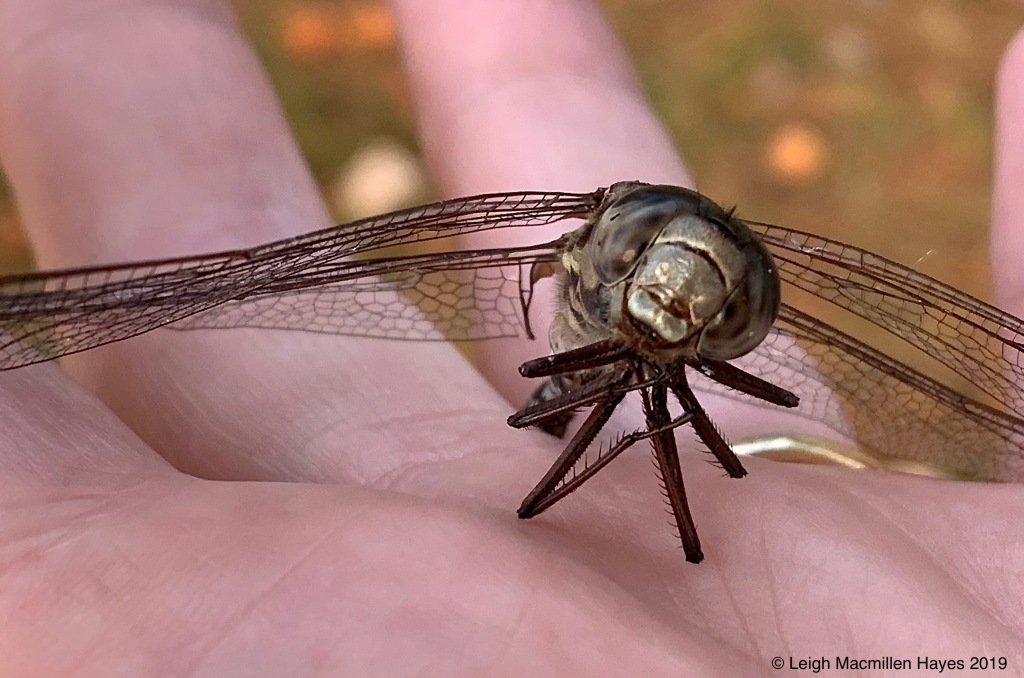
Even its underside is covered in hair. And those folded legs. Remember when I found it dangling below the hammock? Its legs were extended back then.

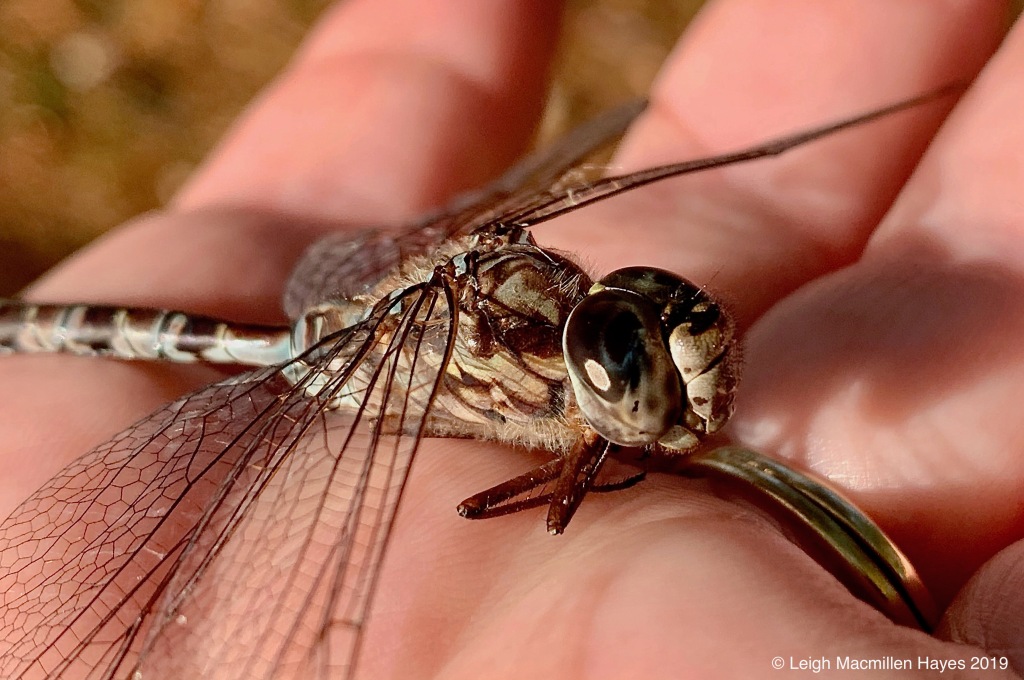
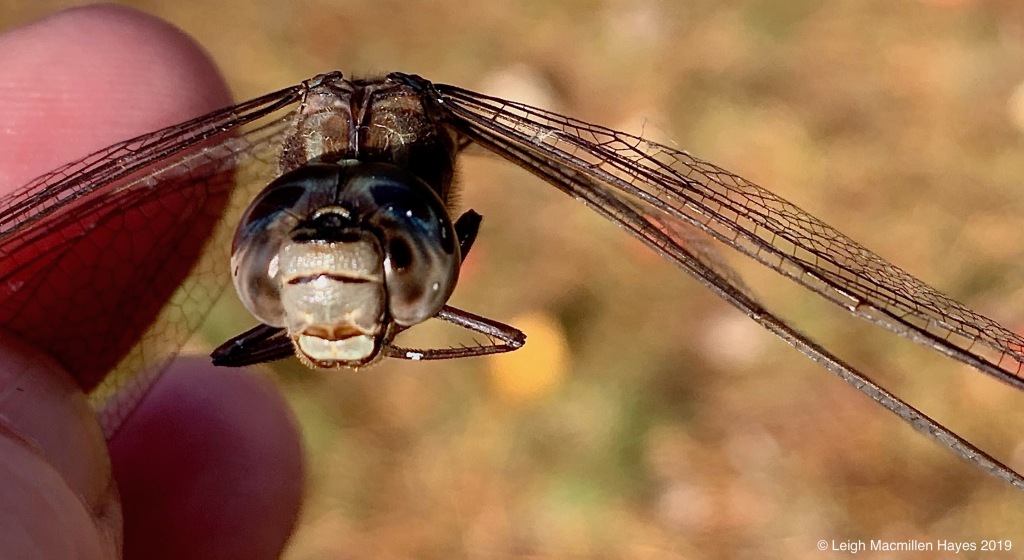
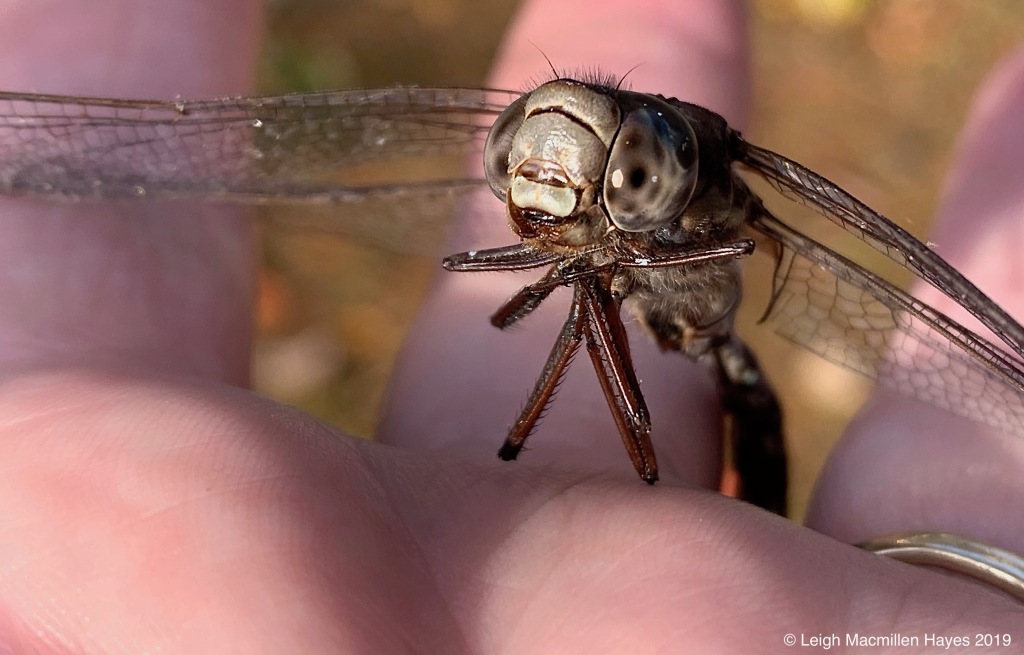
My handling of the dragonfly was gentle for I wanted it to fly off, but at the same time, my fascination got the better of me. The face provided part of its identification for it had a thick black crossline stripe in the middle of the face that looked rather like a mustache.

I assumed it had been caught in a spider web under the hammock, and really, it did seem a few pieces of silk were stuck to one wing. With extreme caution I tried to brush them away, but feared I’d tear a wing in the process.

Back in my hand, I noted another facial idiosyncrasy–a T-spot with a robust upright and a top cross-piece–almost like a cat face upon its “nose.”

But what was really noticeable was the fact that suddenly my friend arched his body as he might when meeting his love. Was he as in love with me as I with him?

Just as suddenly as he arched, he began to relax.

And then, another movement . . . his bent legs that had been folded close to his thorax moved and he stood upon his knees.

What I couldn’t understand was why he didn’t extend those legs.

Rather, he started to do something else. Keep an eye on his head.

He cocked it as if to say, “Hey lady, it’s getting late. What are you going to do about me?”

I did what I hope was the right thing even if it wasn’t what I wanted to do. I placed him on a leaf upon the well cover. Yes, I so wanted to take him inside, but he wasn’t meant to be inside and whatever happens to him, happens. I can’t control his world, despite that questioning face that tugged at my heartstrings.

What was our encounter all about? And why didn’t he behave in typical darner fashion? I’ll never understand, but I will forever be grateful for the opportunity to enjoy today’s afternoon dragon delight. Indeed.

Lake Living Magazine: fall/winter 2019

For the past few years, we’ve either produced a limited winter issue or no issue at all of Lake Living magazine because those who purchase ads have been wary about spending money during those lean months. And it’s ads that support this free magazine. Everyone wants to be written about, but . . .

After some back and forth discussion with editor/publisher Laurie LaMountain, we decided to produce a fall/winter issue that would encompass the usual “at home” features of the fall magazine, but also include the book reviews written by the Pam and Justin Ward, plus their employees, Sue and Perri, of Bridgton Books, that typically appear in the winter issue.

Tada. Click on the link above and you can view the magazine in its entirety.

Laurie tackled four topics, while I worked on three ideas. Hers include “The Big Idea” about a Maine inventor, “Maine Dwelling” about a guy who flips houses locally, and “A Good Keeper” about winter squashes.

Her most interesting article, however, is one that everyone should read–whether you are a male or female. Don’t let the theme of it scare you. Entitled “Fierce Girls,” and yes that is Laurie in the photo, it’s about WOMEN. And more specifically . . . men-o-pause. When she proposed it, I was curious but not certain it would work. You have to read it.

My articles all ended up with a Lovell theme–probably because I spent most of the summer in Lovell and it was always on my mind.

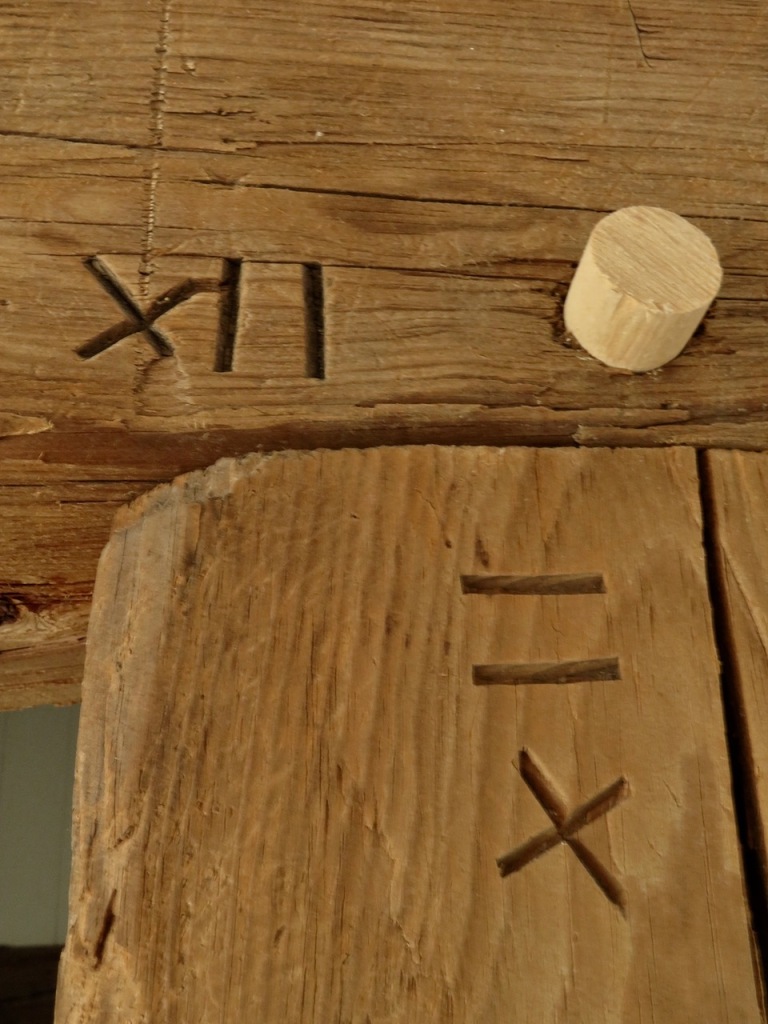
The first is entitled “Resurrecting the Past,” about the Harriman Barn that Robin Taylor-Chiarello (board member of the National Council on White House History and associate member of the American Institute of Architects) lovingly restored with the help of Timberframer J. Scott Campbell of Maine Mountain Post and Beam in Fryeburg and Builder Bryce Thurston of Lovell.

The marriage marks above were chiseled into the beams when the barn was built in the early 1800s. Scott used his own system as he pulled the timber frame down, and then reassembled it on a different site a couple of years later, but the early marks are still visible.

My second article is about two couples who chose to move north rather than south in retirement. Rather than snowbirds, as we fondly refer to those who spend six months in warmer climes, they are birdsofsnow. Okay, so I made that term up, but really, it does describe them.

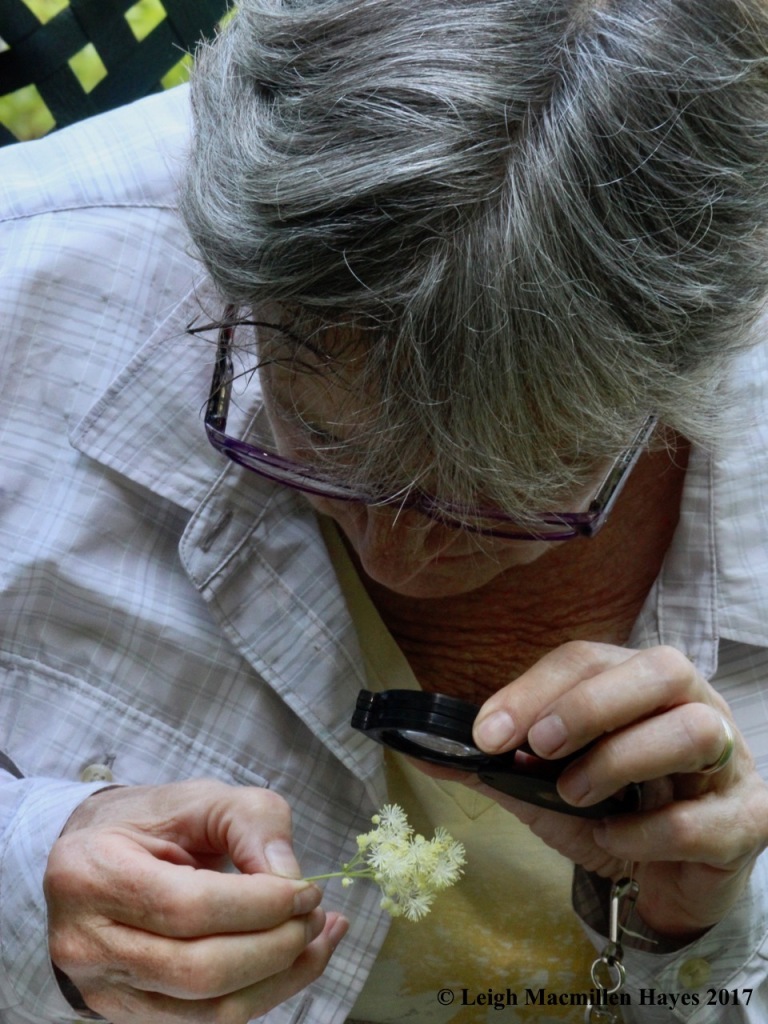
In their retirement, they’ve discovered ways to get involved in their communities and that has made all the difference. Heinrich Wurm fills his days with environmental activities, especially as related to Kezar Lake Watershed Association or Greater Lovell Land Trust. Here, he’s studying a spider web. And that’s only part of his local involvement.

Linda, Heinrich’s wife, is a docent with Greater Lovell Land Trust, where she also enjoys looking at the finer details of the natural world.

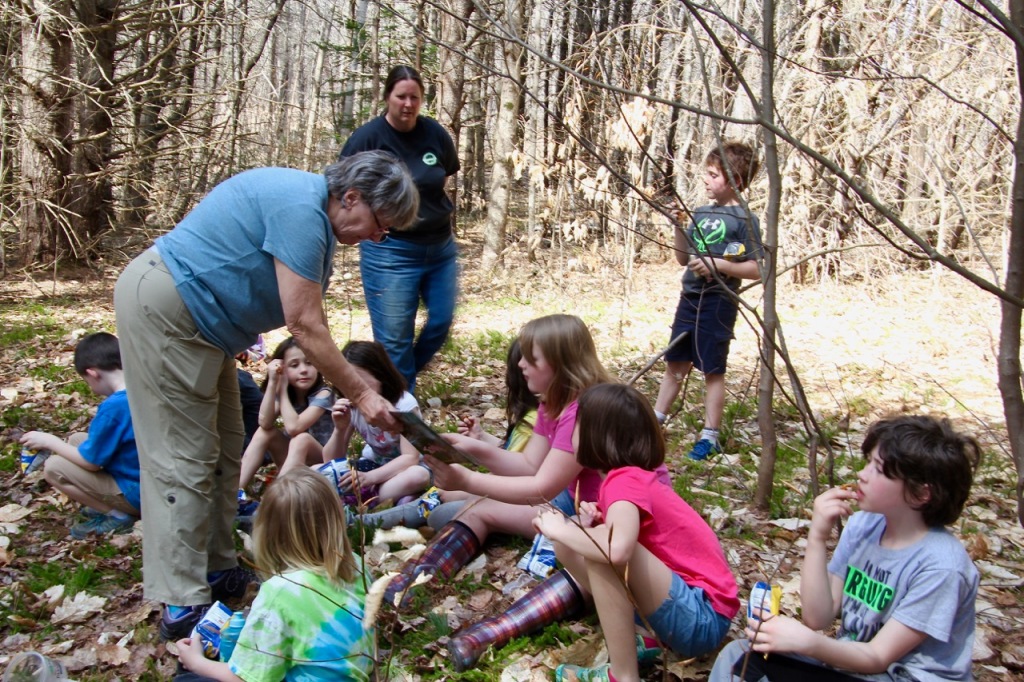
But one of her main fortes is sharing those details with youth, whether they be her own grandchildren, or kids involved in GLLT-sponsored events, like those in the after-school Trailblazers.

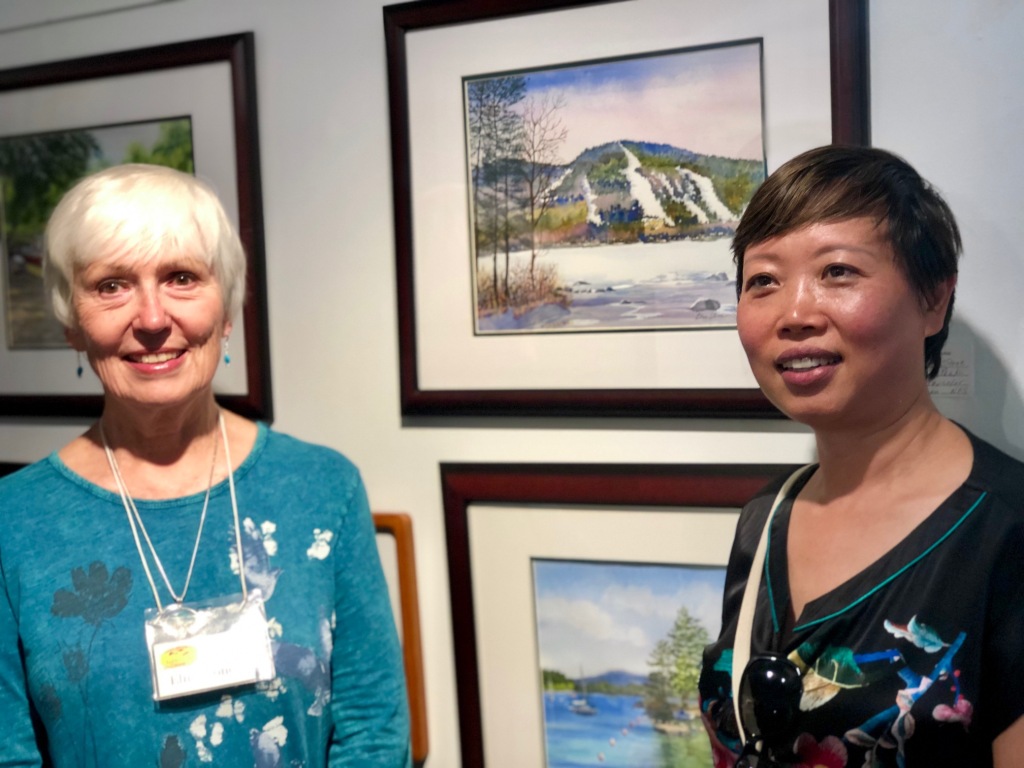
For Elna Stone, retirement gave her an opportunity to pursue her artistic talent and painting local landscapes has consumed much of her time. On the left, she poses beside a painting of Shawnee Peak Ski Area at Pleasant Mountain that she donated to a fundraiser for Gallery 302 in Bridgton. For years, Elna created calendars of local scenes that were sold as a fundraiser for St. Peter’s Episcopal Church.

Helping others either via the St. Peter’s or Bridgton Hospital
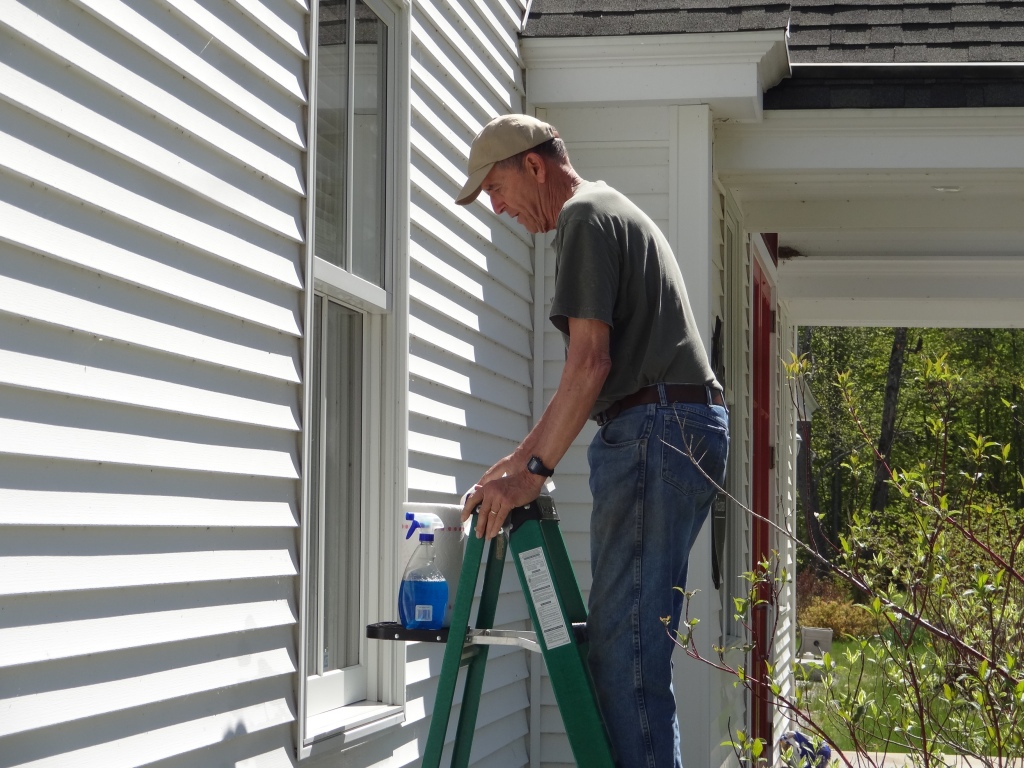
Cafe has long been a passion for the Stones. Even cleaning windows at church can offer Tom a sense of satisfaction.

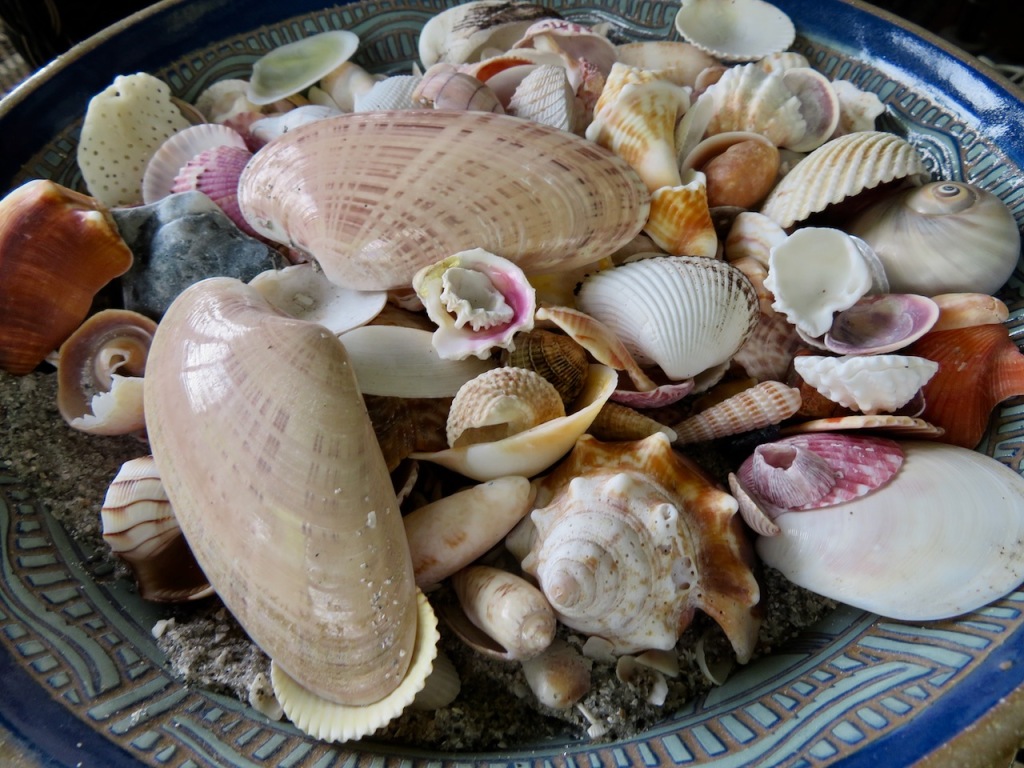
In the end, though they all love the life they’ve created in Maine, they admit there are some downfalls. One is that the winters seem to get longer each year. Linda Wurm has found a way to overcome that: a bowl of shells to gaze upon from time to time.

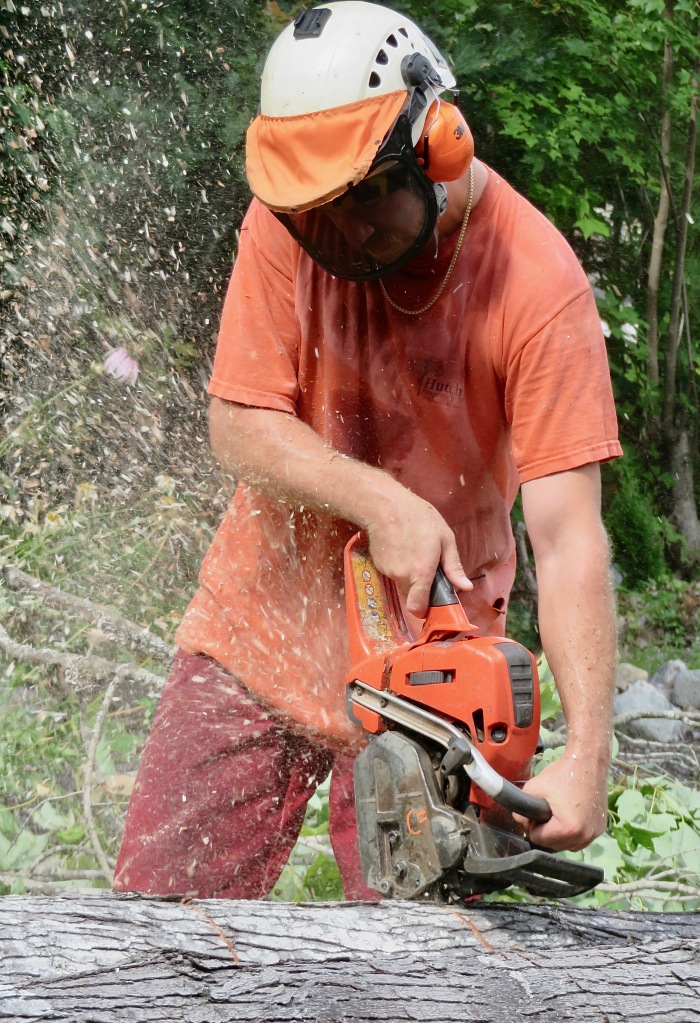
And then there’s my final article. It’s about three entrepreneurial men. They each bring a different talent to the . . . table. Literally. Eli Hutchins of Hutch’s Property and Tree chops the tree down.

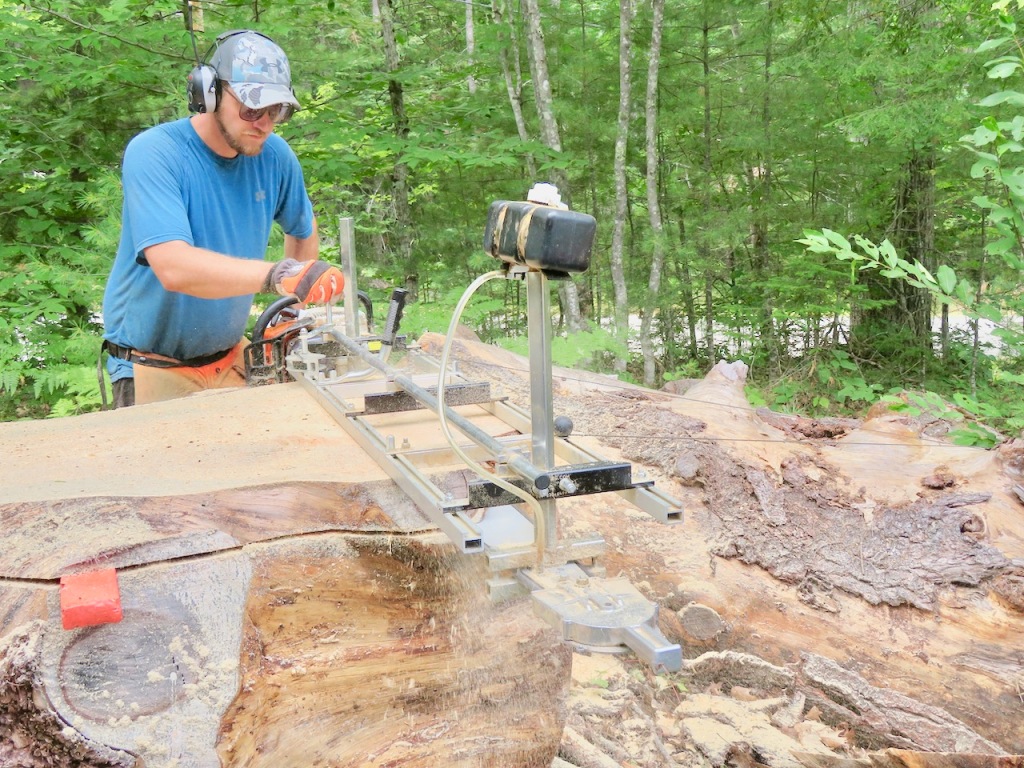
Brent Legere of Lovell Box Company and Western Maine Slab Works cuts it into live-edge slabs.

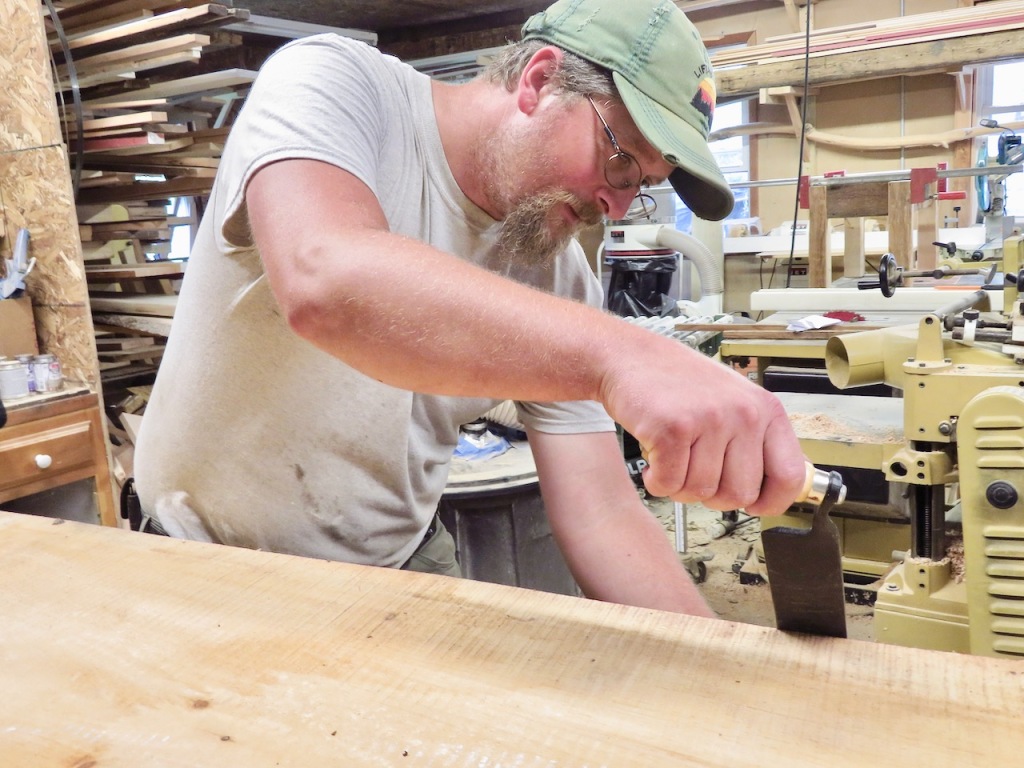
And Eugene Jordan of Jordan Custom Carpentry, Inc, turns it into a beautiful piece of furniture. You can read all about it in “A Tree Falls in Lovell.”

So, yeah. Brew a pot of tea, curl up in your favorite chair, and enjoy this issue of Lake Living magazine.

Oh, and please support the advertisers, including my guy, so we can keep doing what we love to do: learn about the many talented people in this area. I am constantly amazed. I hope you will be as well.

Scavenger Hunt at Kezar River Reserve

As I walked along the trails of the Greater Lovell Land Trust’s Kezar River Reserve on Route 5 across from the Wicked Good Store today and thought about the fact that the Storybook Trail featuring Pond by Jim LaMarche will come down in another week or so, a brainstorm struck me. Why not create a scavenger hunt that you can download on your Smartphone and look for as you walk along the trail? Why not, indeed.

Give yourself 1 point for every successful find. Subtract 2 points for any that you miss. At the end, a special prize awaits all who complete the hunt.

So, let’s get started. The route will take us from the kiosk to the beginning of the orange-blazed trail on the left (currently this part of the loop is the Storybook Trail). Look up and down and see if you can locate an example of each of these items.

With Halloween just around the corner, the witches must find their brooms–in this case: Witch’s Broom (a deformity caused by anything from mites, aphids, and nematodes to fungi, viruses, and bacterial organisms.)

When the flower of this translucent plant turns upright, it has been fertilized and a woody capsule containing its seeds will form: Indian Pipe.

Decorating the ground, this leafy foliage with its brown fruiting structures is soft and pliable when wet, but crisp when dry: Wrinkle Lichen.

Though this tree has vertical strips of dark gray to black ridges that intersect like ski trails on a mountain, the inner bark in the furrows provide its name: Northern Red Oak.

This plant may lack flashy flowers and height, but the berries are worth noting. Tiny white blooms occur in pairs and both flowers must be pollinated to produce a single viable fruit. After fertilization, the two flowers’ ovaries fuse and mature into a solitary scarlet berry: Partridge-berry.

In case you haven’t heard, the sky has been falling in loud KERPLUNKS for several weeks. Look for this structure upon the forest floor: the cap of a Northern Red Oak Acorn.

How to make an acorn cap whistle (and drive the world crazy with the shrill sound).

1. Position the cap so the inside faces you. 

2. Place your thumb knuckles over the acorn in a V shape, with a triangle of the cap showing between your thumbs.

3. Put your upper lip on top of your knuckles. Position your lips so that when you blow no, air will escape out of your bottom lip.

4. Blow through your top lip right into the triangle that you made in step 3. 

5. Watch your friends and family run for cover. 

So move on to quieter things and look for another foliose (leafy structure) lichen you should be able to identify even as you ride down the road because its common form is easy to spot: a Shield Lichen.

Actually, by now you should have reached the road to the boat launch. Turn left and head downhill. Your next treasure will be located closer to the water because it likes damp feet.

While most trees and shrubs bloomed months ago, this species is only just displaying its ribbony yellow flower: Witch Hazel.

And if you find the right shrub, you may notice some twirled ribbons hanging from it–each bears a wish written by the GLLT’s After-school Trailblazers last year. We fondly refer to it as Wish Hazel.

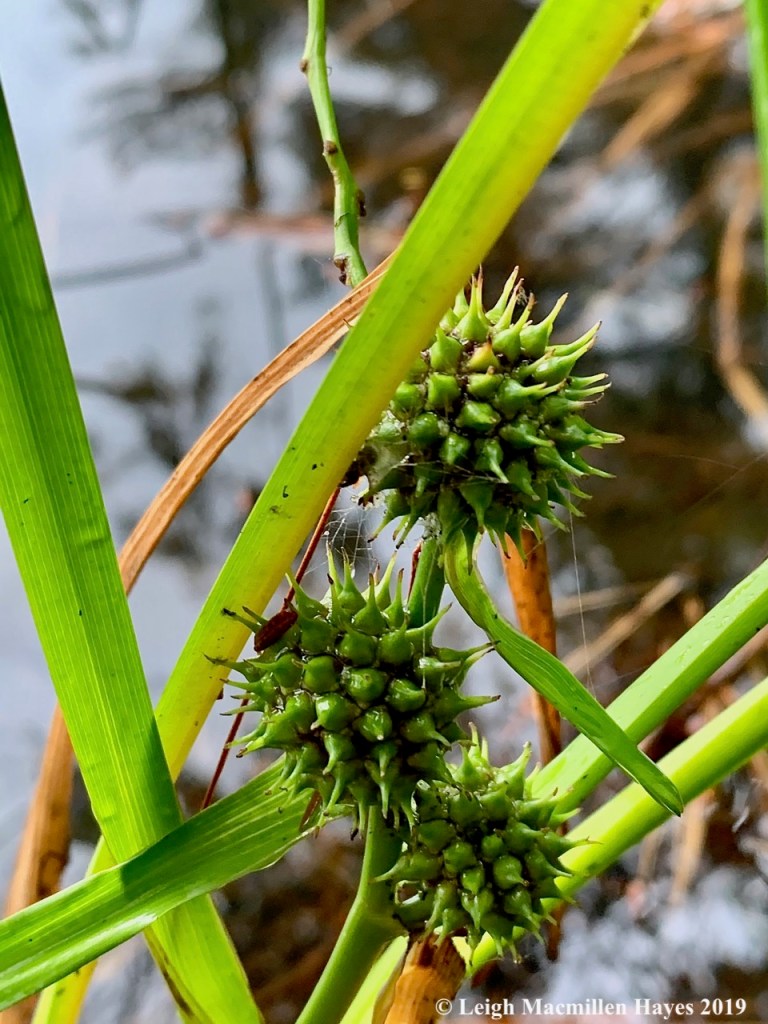
Another who loves water also grows here and is actually a member of the Cattail family. Notice its beaked fruits and the spider web connecting all parts: American Bur-weed.

As you walk back up the road to the second and longer section of the orange-blazed trail on your left, look at the foliage by your feet, set before you like a colorful tapestry. Can you locate the tree where these two species met: Red Maple on Paper Birch bark?

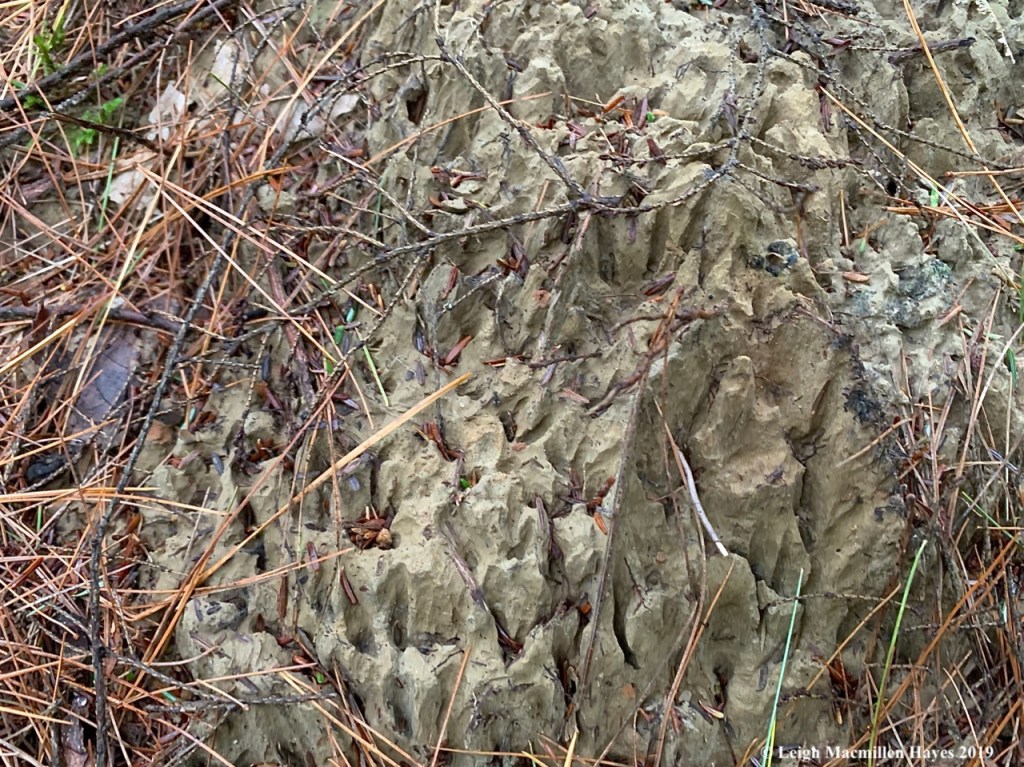
Once on the trail again, look down at your feet and eventually you’ll find a castle under the pine needles–why this funny formation? Rather than me telling you what it is, I’ll let you tell me what happened here. Five extra points if you can explain it.

A certain insect attaches its 5/8-inch cocoon lengthwise on a tree branch. After overwintering last year, the flying insect emerged in the spring as evidenced by the hole at the left end. Look for these and if you see one that is capped, you’ll know that the insect is pupating inside: Sawfly Cocoon.

This one is my favorite and I always conjure up an image of it when I want to remember which trees rot from the outside in. The answer is conifers for they heartwood is not porous and does contain resins that are toxic to insects. But . . . this tree is a wee bit different than its relatives for its bark is the most rot resistant. It’s long been a shell of itself, but is starting to fall apart at last: Eastern Hemlock.

As you continue on, pay attention to the orange blazes. Can you find the diamond and arrow that decorate this tree? Five extra points if you can identify the tree species upon which they are nailed.

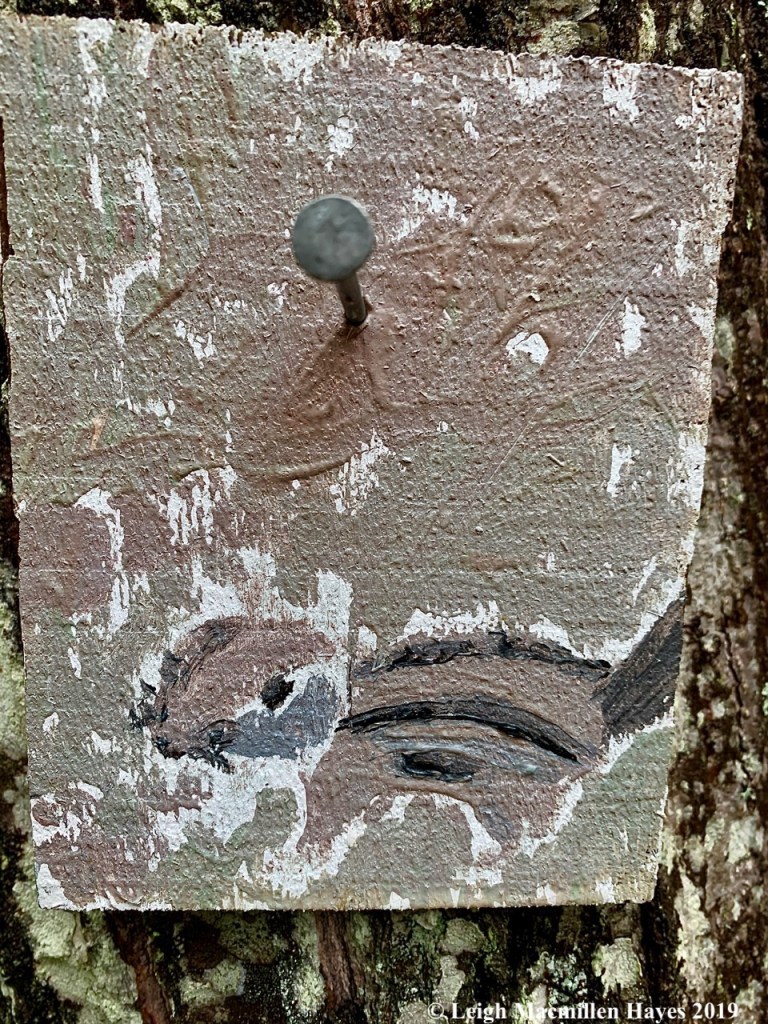
Maybe you’ll see the real deal or another critter as you make your way along the trail. But if not, there’s always this fine artwork: Eastern Chipmunk.

And then nature’s classroom opens up and beckons you to touch and practice some dramatic role playing.

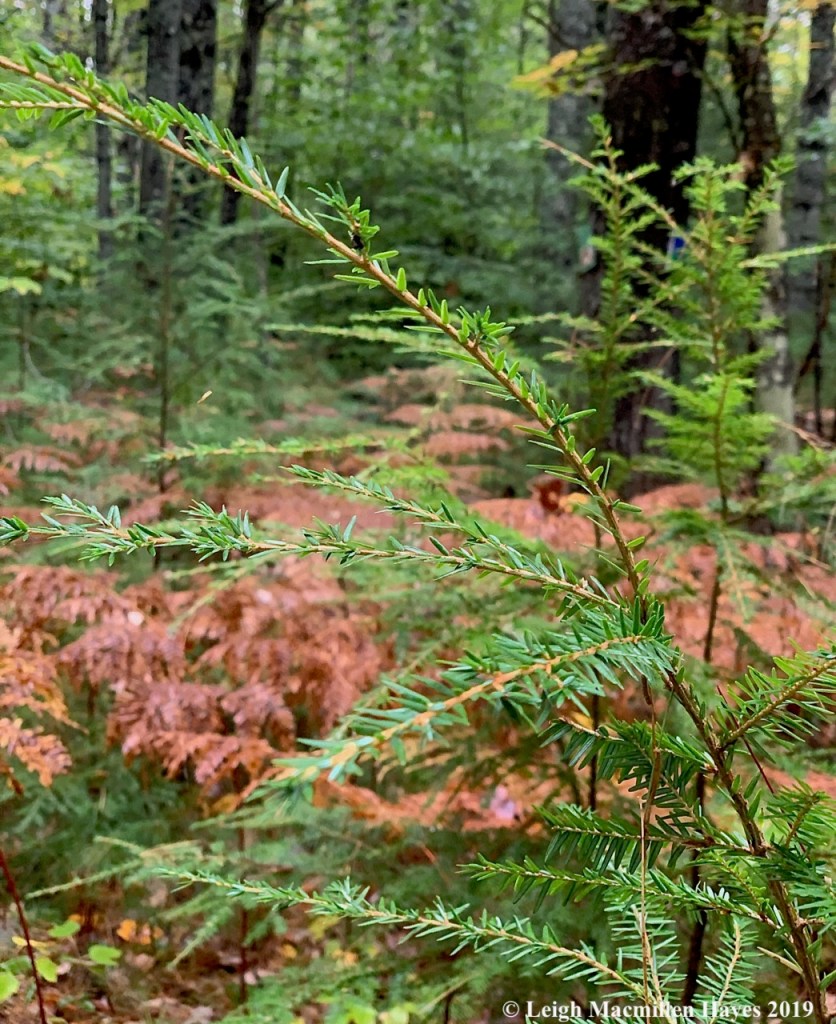
Greet each type of evergreen with a handshake as you get to know it better. Does it feel like you’re touching spikes? Can you take a needle off and roll it in your hand? Does the needle have four sides? If you answered yes to all, you’ve found a spiky Spruce.

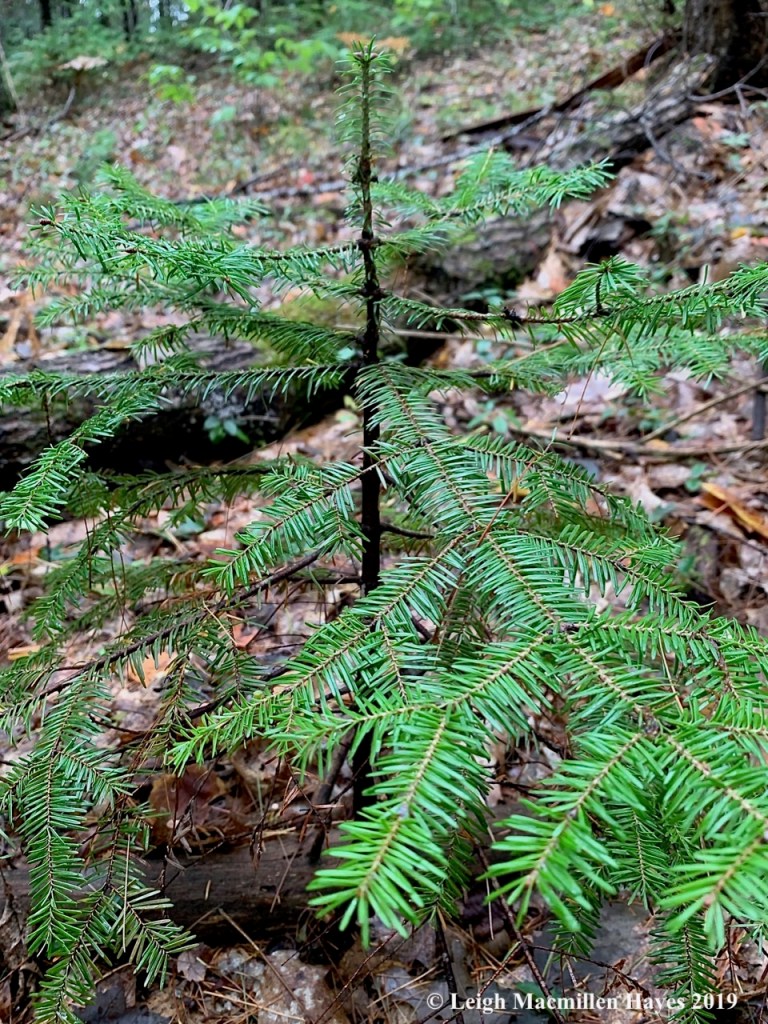
Did you notice with the spruce that each needle grew singly from the twig? This one is similar. And both stand up straight and tall as if they were in the military. Can you roll the needle in your hand? If not, then you’ve met: Balsam Fir.

Be like a balsam and stand up straight–believe me, it will help you remember who you are greeting the next time you meet.

A third who also holds its needles in singular fashion, provides a lacier look than the other two evergreens. Again, shake its hand. Can you roll the needles or are they flat? Does the terminal leader stand up straight like the spruce and fir, or does it bend over as if in a dancing motion? Raise a hand high and lean it over the top of your head: be like an Eastern Hemlock.

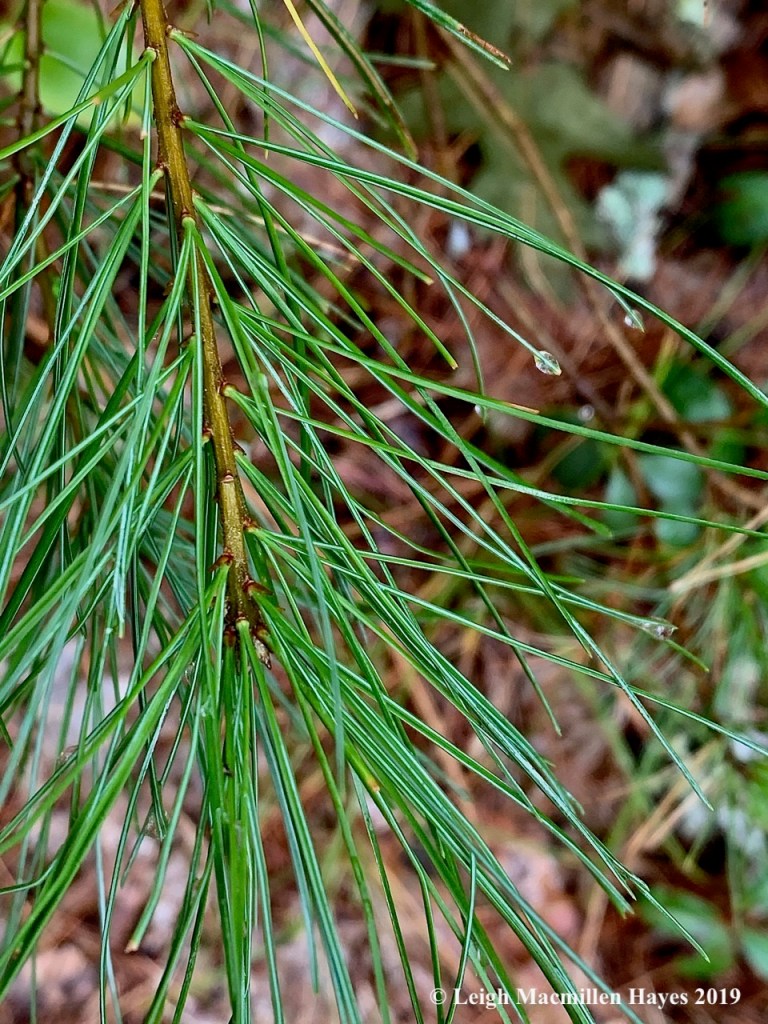
Two other conifers that call the Kezar River Reserve home feature needles in bundles. The first has flexible needles in a bunches of five, which you can use to spell two words; W-H-I-T-E or M-A-I-N-E for it is the state tree of Maine: Eastern White Pine.

Another way to remember this tree is to stick out your arms for its branches grow in whorls, one whorl/year; and shake your five fingers at the end of your branches.

The second has much stiffer and longer needles in bundles of two, which don’t spell its name of three letters: Red Pine.

Take a needle off and snap it in half.

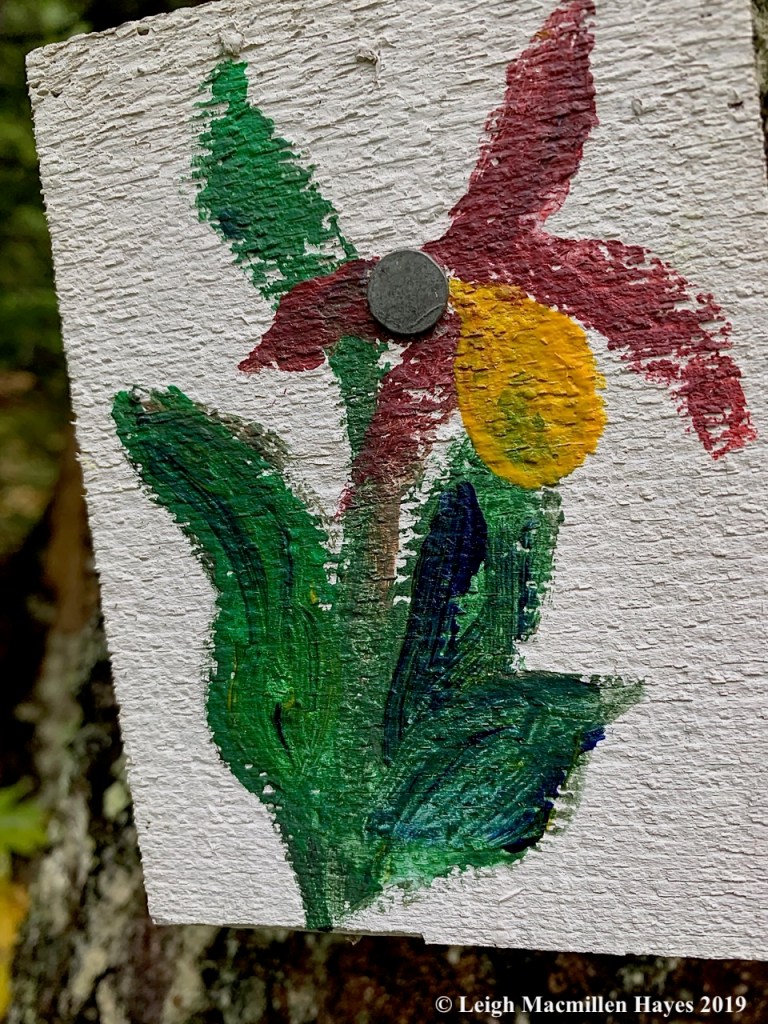
You’re nearing the end of the trail and the last item on your hunt. Did you pass by this flower that is perennially in bloom–at least in this painting created by a local student about ten years ago. You probably noticed that the paintings decorate the entire trail system. They are all sweet and some require more interpretation than others.

And though this flower doesn’t bloom here, we do have it on or near another trail at a different GLLT property–Yellow Lady’s Slipper.

Remember, it was 1 point for each correct find. And minus 2 for any you missed. But plus 5 for a couple of items. If you found them all, you should have a total of 31.

If you need a bonus worth 5 points, look for an interesting insect marching about on leaves, the ground, or tree bark. I found one today: a Green Assassin Bug.

By now, you should have completed the Scavenger Hunt and reached the road to the boat launch again. Rather than turning left toward your car parked by the kiosk, turn right and head back down to the bench overlooking Kezar River to receive your prize.

Drum roll please . . . as winner of the Scavenger Hunt at Kezar River Reserve, you have earned bragging rights and a chance to sit by the river and take in the view. It’s a lovely place to spend a few moments or hours. Congratulations.

OK, so you already know what the prize will be, but still, head on out there and see what you might discover along the path. And let me know how you did.

Seeking Red Mondate

When I invited my guy to join me in a wetland today to mark out a trail, I truly expected him to hem and haw about going. And then when we got there, I thought he’d want to rush through the process and be done with it.

But perhaps it was the setting that slowed him down. I know that it always slows me down.

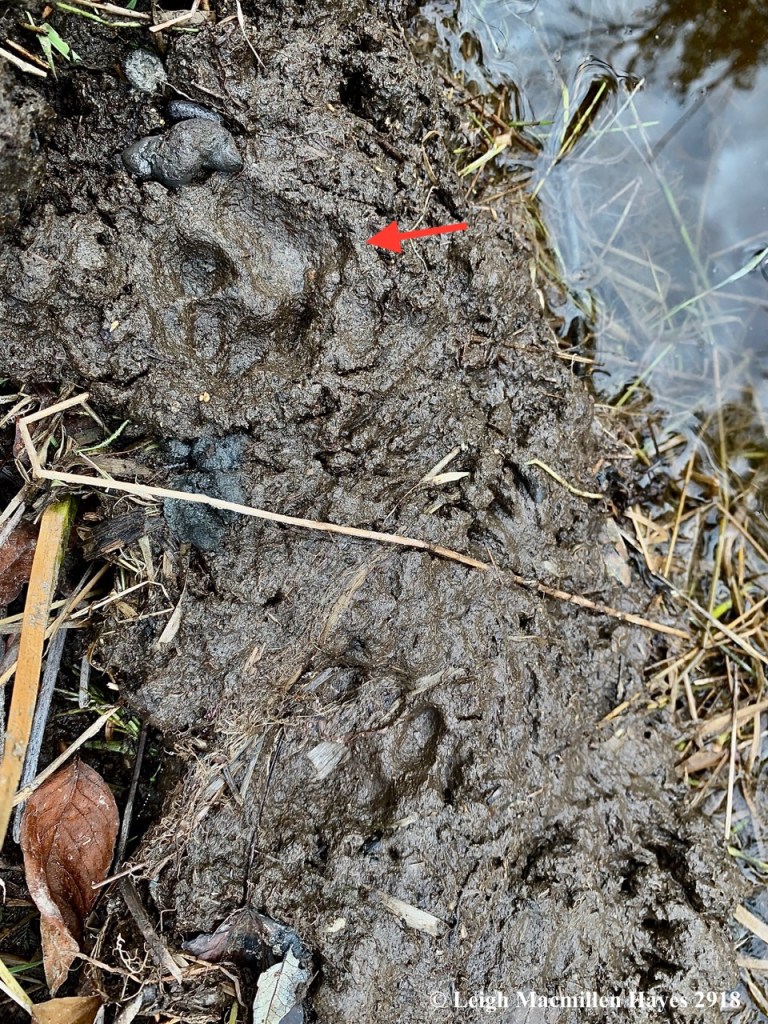
It’s a place where over and over again I’m surprised to discover that others have come before. Last year, it was bear prints that stopped me in my tracks. Today, bobcat. The print is upside down in the photo, but do you see the pad, C-shaped ridge and four toes heading toward you? Notice that the two front toes are a bit asymmetrical. Ah mud. It’s as good as snow. Though I can’t wait to go tracking in snow.

Another reason that this place slows me down is all that it has to offer. The Winterberries were a major part of our stumbling movement, but still they made me smile even though I had to untwist each foot as I tried to step over, around, and through their woody stems.

Among the mix in the shrub layer was Maleberry, its woody fruits of last year displaying shades of brown, while the newer fruits were tinged green.

And then there was the Nannyberry with its oval shaped fruits so blue upon red stems, and . . .

Withe-rod just a wee bit different shape that always makes me question my identification.

Rhodora also showed off its woody structure of last year embraced by this year’s softer fruiting form.

But what we really sought were little gems of red hiding among sedges in a different herbaceous layer.

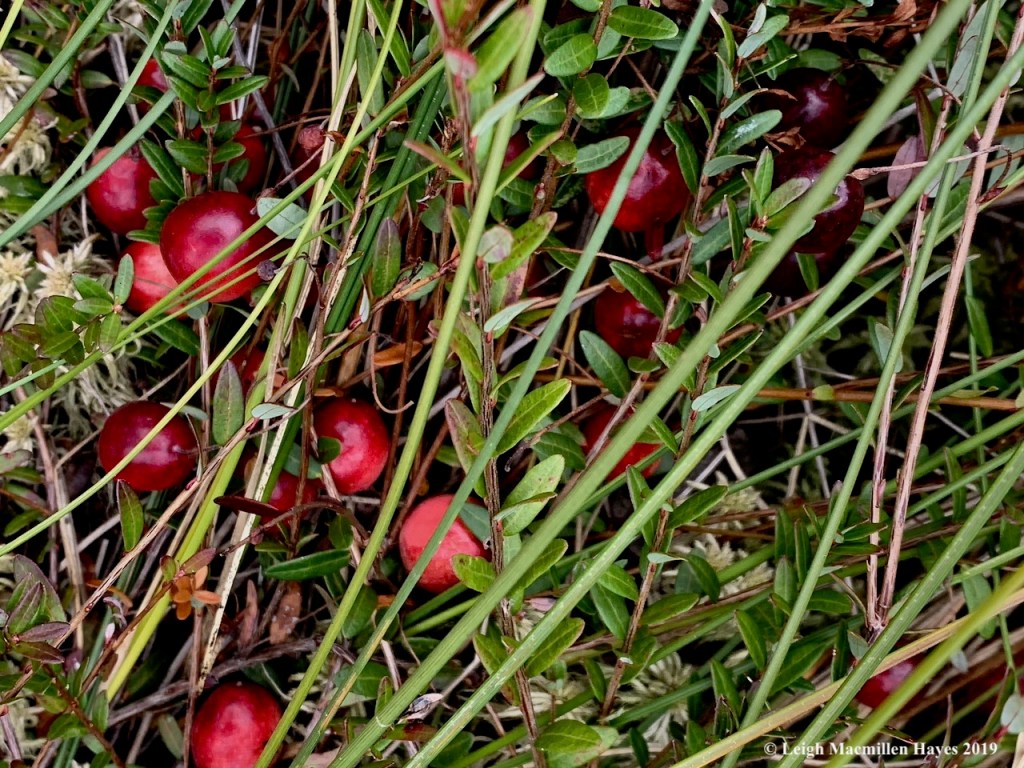
I totally didn’t expect my guy to develop cranberry greed quite the way he has a penchant for blueberries, but he did. And he also rejoiced in eating the tart berries right off the stem. Even he commented that the little balls of red were like the blue-gold he usually sought during the summer.

Seriously, it got to the point where I gave up picking, and cranberries are much more my thing than blueberries. And I began to focus on other shades of red, like those that the Pitcher Plants loved to display.

The pattern on the Pitcher leaves always makes me think of the Tree of Life. But . . . equally astonishing are the hairs that coat each pitcher. If you rub your fingers down into the urn-like leaf, you can feel the hairs and gain a better understanding of them creating a landing strip for insects. The true test, however, comes when you dare to escape this carnivorous plant. Can you climb out of the leaf? The way out is sticky and rough and by tracing a finger upward, its suddenly obvious why insects can’t find their way out.

Equally unique, the flower structure that remains, waiting to share its 300+ seeds to the future. For now, it reminds me of a windmill on the turn.

My guy wasn’t as taken with the Pitcher Plant as I was. And he certainly didn’t care about the fact that a Funnel Weaver spider had recently taken up home among the plants urn-like leaves. But me . . . I was totally wowed. Why did a spider that likes to wait in its funnel tunnel until something landed on the net it had created, use a carnivorous plant as its home base? Did it have an agreement with the plant? I’ll bring you food if you don’t see me as food? And was that dark V-shape on the web a leg of one devoured?

With no spider in sight, I knew I’d have to let my questions go, but still . . . it was a mosaic web worth appreciating.

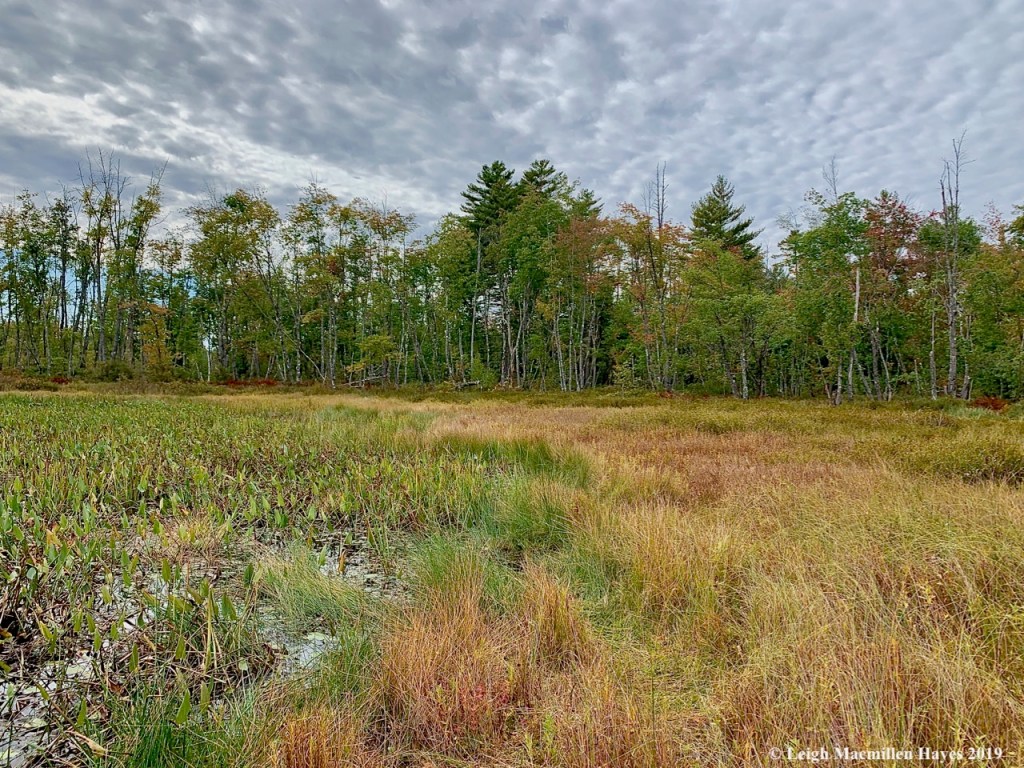
The Pitcher Plant grew on the edge . . . of an Arrowhead wetland . . .

growing beside a Sphagnum Moss peat bog.

And as I walked among it all, I felt the bog quake below my feet.

The pom-pom mosses were responsible for the environment in which we travelled . . . and for its inhabitants.

And because of the Sphagnum the cranberries grew. Abundantly.

Our movement continued as my guy wanted to find as many little red balls of tart glory as ever. And in the midst, the natural community came to focus on Devil’s Beggarstick.

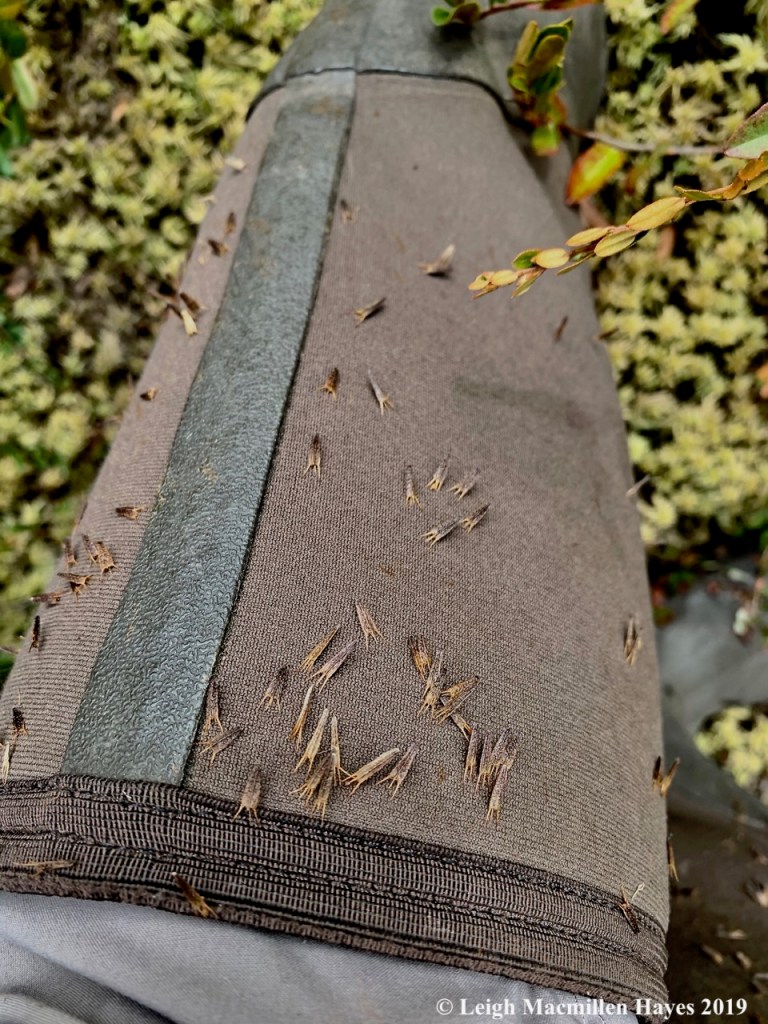
Notice the spines along the seed’s structure.

The beggars chose to stick indeed. Volunteers. They hoped we’d move them on to another place, but we chose to pull each one off . . . Not an easy task.

At last it was time for us to take our leave. And so we found our way out as we’d come in, but felt like crowned royalty for all the finds we’d made, so many of them featuring a shade of red.

In the end, a look back was a look forward. We sought red and so should you—head to your favorite cranberry bog as soon as possible for the fruits await your foraging efforts. And wherever you go, don’t share the location with others. It’s much more fun to have a secret spot as you seek red.

The Story in the Web

When I invited friends Pam and Bob to join me at Lakes Environmental Association’s Holt Pond Preserve for a reconnaissance hike, I had no idea what might await us. But isn’t that true of every day, no matter what path in life we choose to follow? With each step we take, doesn’t a surprise await?

Today’s path found us making a few detours for fun, but it was when we followed the route long ago laid out by LEA that we made the most interesting discoveries.

The boardwalk through the Red Maple Swamp led us to the hummock that leads out to Muddy River, where fall’s colors were ablaze on the far side. Red Maple is an early harbinger of autumn as it turns color well in advance of other eastern deciduous trees, especially when it is located in wet sites.

As we continued, we found ourselves on the new/old boardwalk to the Quaking Bog by Holt Pond. The boardwalk is new in that its old self has recently undergone a renovation with corrugated culverts added below in hopes that come high water in spring or fall, the water will flow and the structure will float above.

We were excited to see such a change, but especially wowed by the Pitcher Plants that grew there.

As wild as the Pitcher’s leaves are, the fall structure of the flower was equally astonishing. I’ve forever found it a wonder that the extremely large style of this flower sits below the rest of the structure in order to capture pollen in its upside-down umbrella shape. With leathery sepals above, the large swollen ovary below may house as many as 300 tiny seeds.

At the end of the boardwalk, we stood beside Holt Pond for a bit and did what we frequently found ourselves doing: listened; looked; lollygagged.

At last we pulled ourselves away; but still there was more to see.

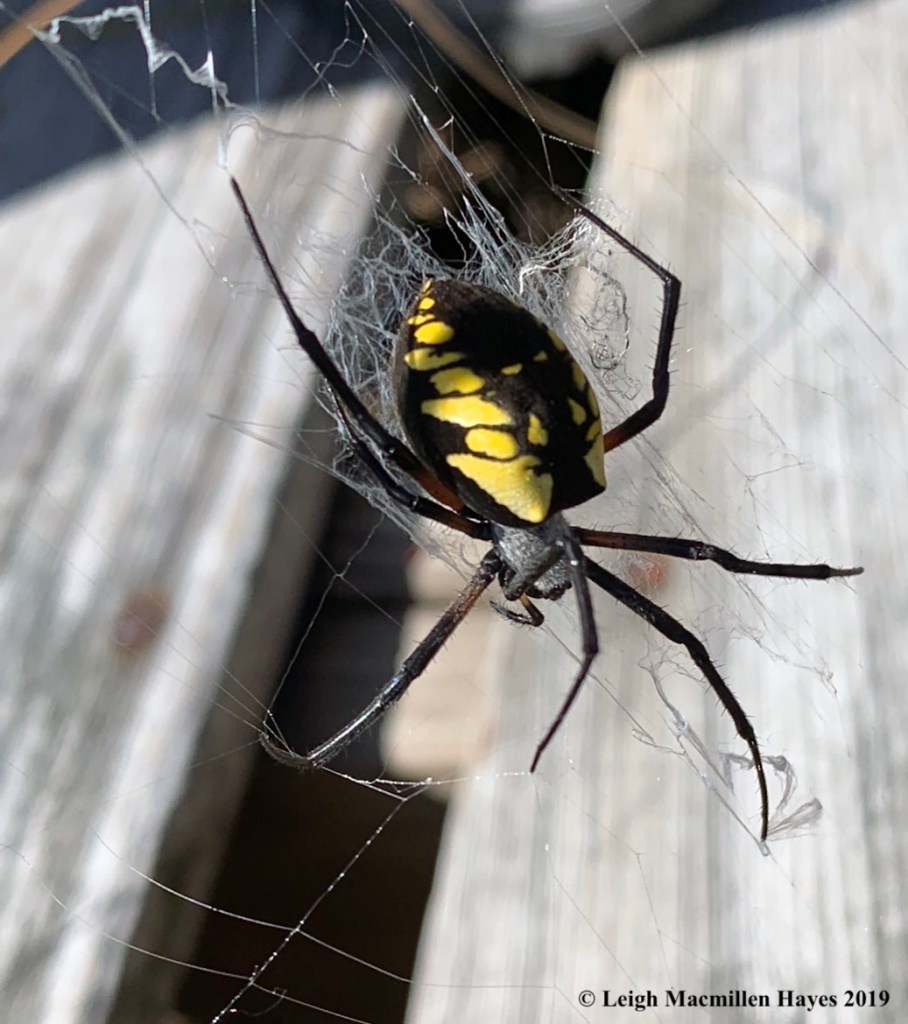
Because we were noticing, Pam spied Charlotte, a yellow garden spider, aka Argiope aurantia.

You might think we weren’t actually in a garden, but indeed, we were. Just prior to meeting Charlotte, we’d munched on tart cranberries, and sniffed and tasted Bog Rosemary leaves.

There was also a Lake Darner Dragonfly to admire. Especially given the tattered nature of its wings. Really, the dragonflies controlled their territory throughout much of our journey and sometimes appeared to brazenly want to gobble us up. I’m here to say that they didn’t succeed and we’ll never tire of being in their presence.

Leaving the quaking bog behind, we walked through a huge hemlock grove and noticed one noticing us. Do you see the Chipmunk? He remained still for moments on end, sure that we wouldn’t spy him. And then when we made a sudden movement, he darted into a safety hole.

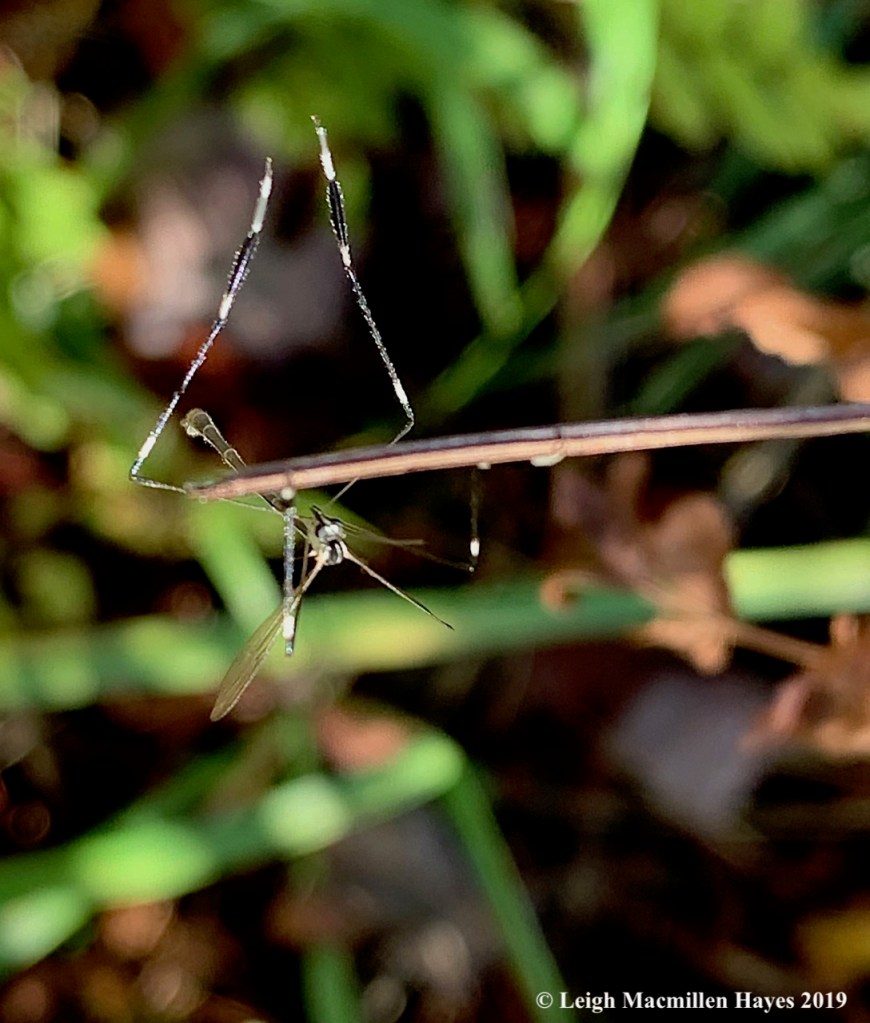
At the edge of the hemlock grove, the natural community switched immediately to another wetland and offered new opportunities. This time, you need to locate the Phantom Cranefly. Do you see its black and white legs?

At last we reached Tea Garden Bridge, so named if I remember correctly, because the water in Sawyer Brook resembles the color of tea.

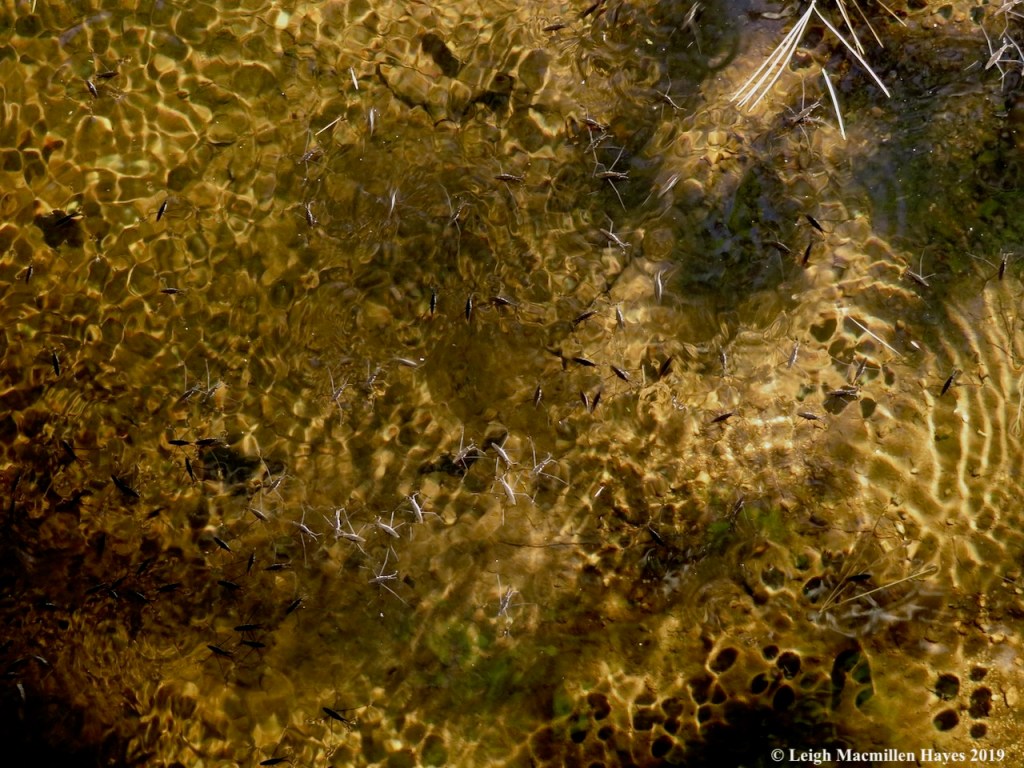
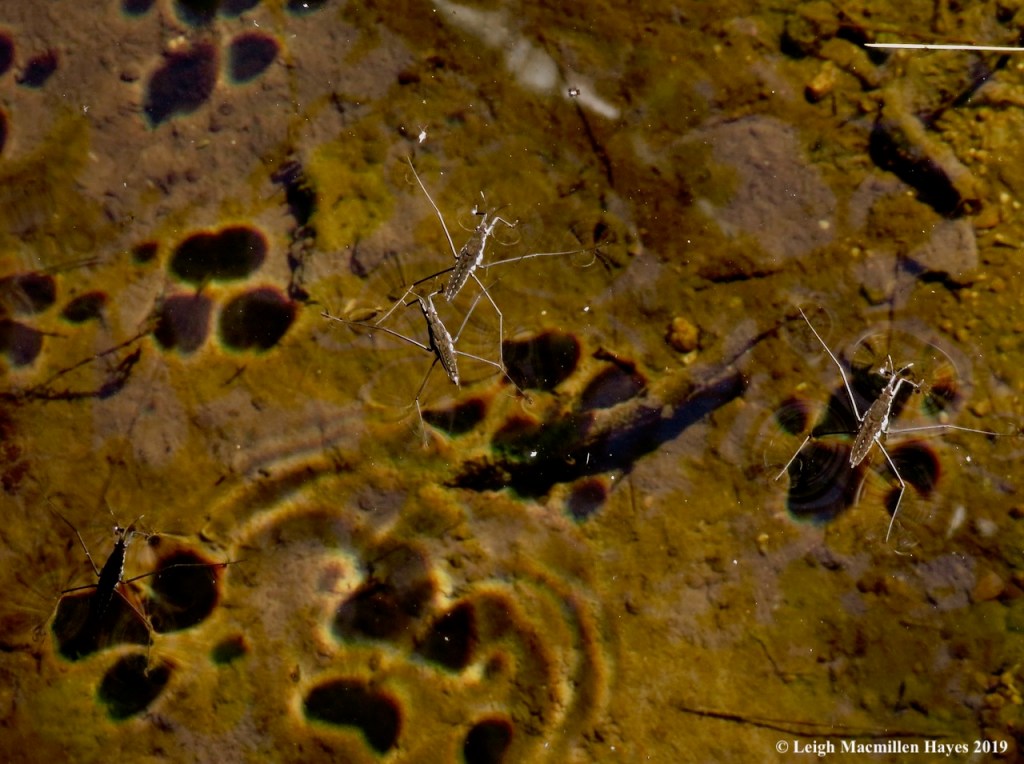
What drew our attention was the Water Strider Convention. The shadow of the Water Striders tells their story. To our eyes, it looked like their actual feet were tiny and insignificant. What we couldn’t see were the fuzzy little hairs that both repel water and trap tiny air bubbles, thus allowing them to float or skate along the water’s surface. But still, why was the foot shadow so big while the body shadow was more relative to the strider’s size? Did the movement of the foot against the water create the larger shadow?

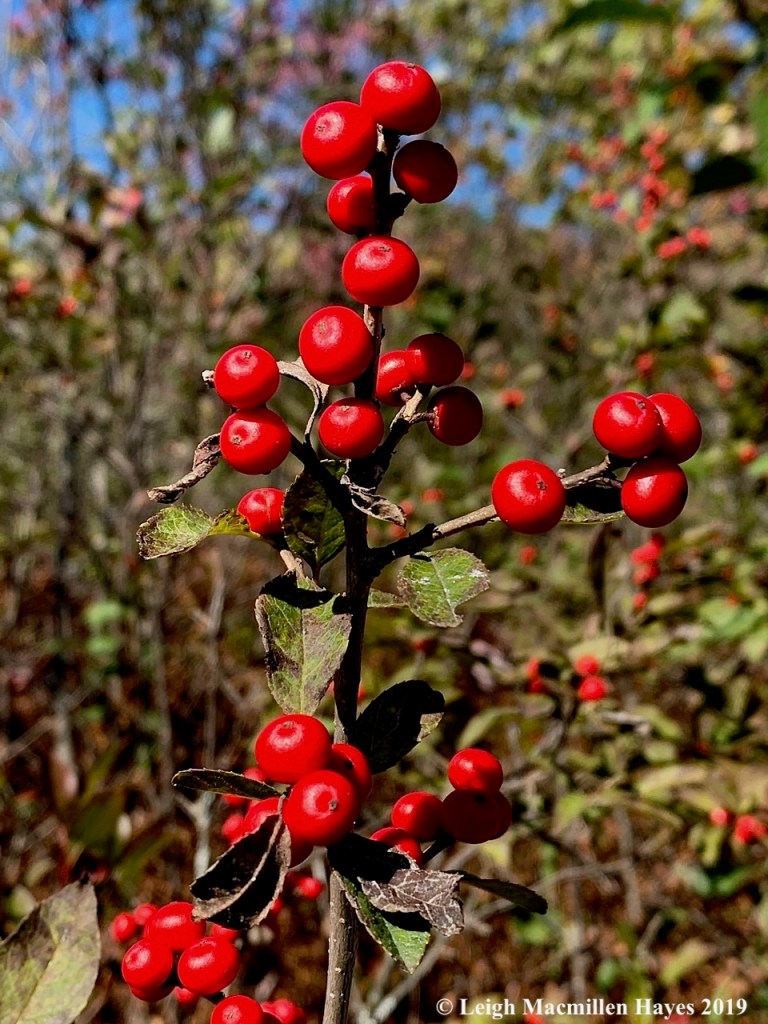
Continuing on into the land of abundant Winterberry, we thought about all the birds who will benefit from its red fruit in the coming months.

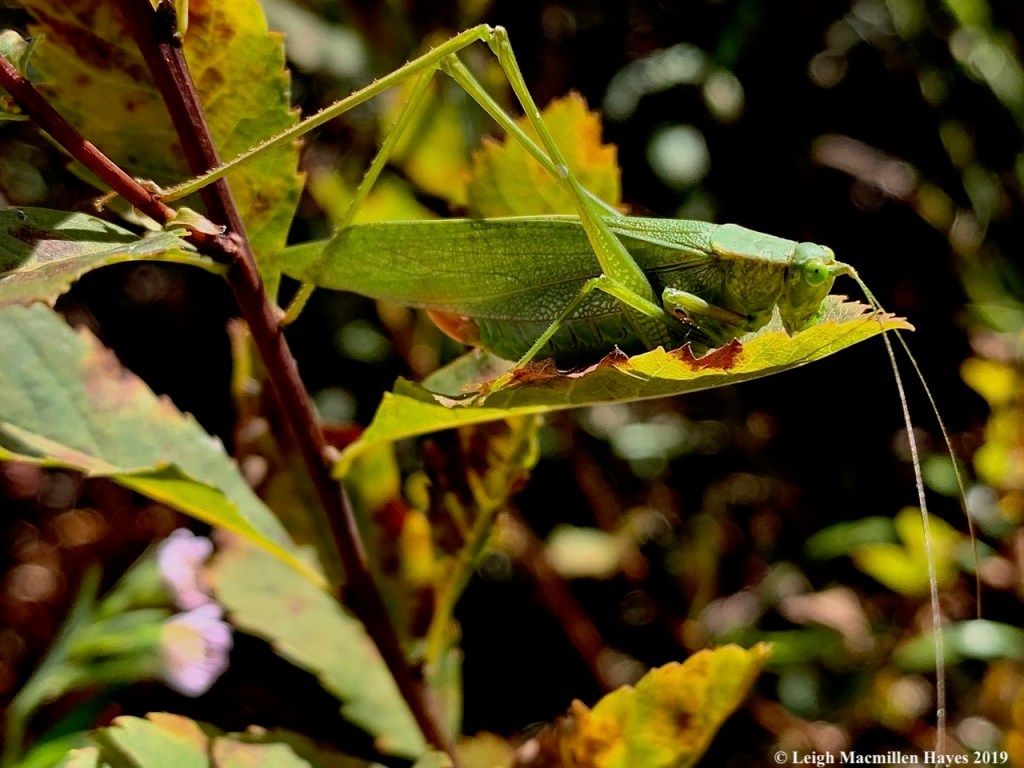
And then our eyes cued in again. First on a Katydid, with its beady eyes so green.

And then another Phantom Cranefly. And another. And another. I met my first Phantom Cranefly in the spring, but today they seemed to appear from out of nowhere everywhere.

And finally, a male Ruby Meadowhawk Dragonfly pausing and flying; pausing and flying; all within a small territory it had claimed.

At last it was time for us to turn around and head out, but I gave great thanks for the opportunity to travel slowly and wonder with Pam and Bob as I prepared for a private hike I’m leading tomorrow. Some folks chose to bid on a walk with me in support of camperships (aka full scholarships camp) for Camp Susan Curtis, a camp for economically disadvantaged Maine youth who attend at no cost to their families. I’m honored to lead them and pleased that local kids will benefit from this offering.

I can only hope that I’m able to weave a story for them as Charlotte did for us today. She even signed it. Do you see her zigzag signature?

Paddling into Autumn

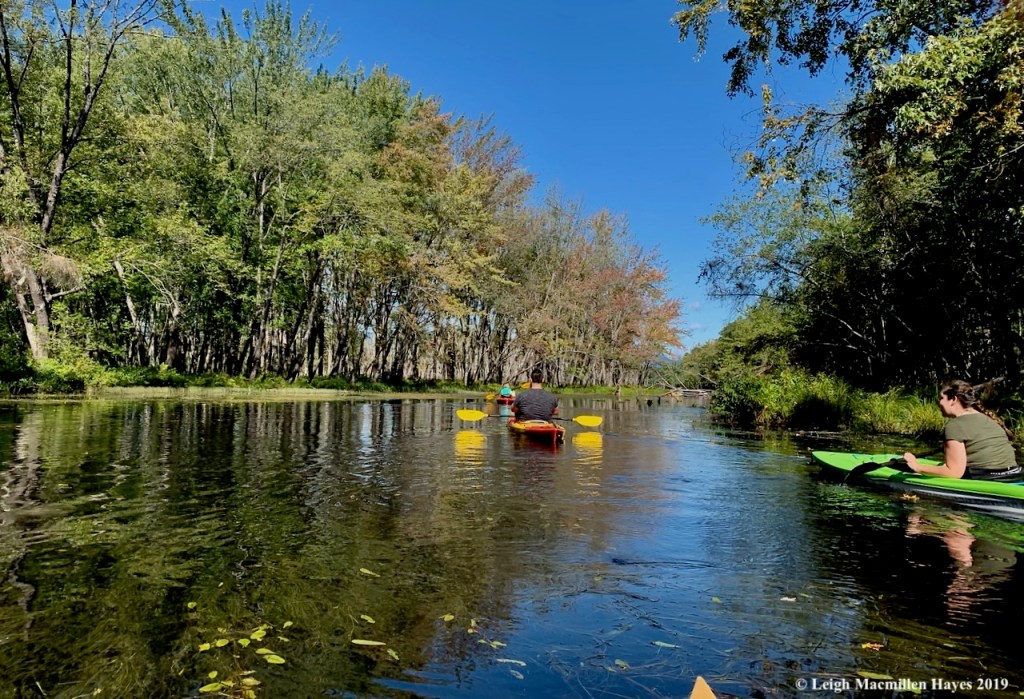
I’ve no idea how many times I’ve driven past the Kezar Outlet put-in on Harbor Road in Fryeburg and noticed others either embarking or debarking from a canoe or kayak trip and always desired to do the same. Occasionally, I’d stop and take photos, and once I co-led a trip from the Lower Bay of Kezar Lake to the dam, but until August I’d not gone any further. And then our friend, Pam Katz, invited my guy and me to join her for a journey from the dam to Charles River, on to Charles Pond, and part way up Cold Brook.

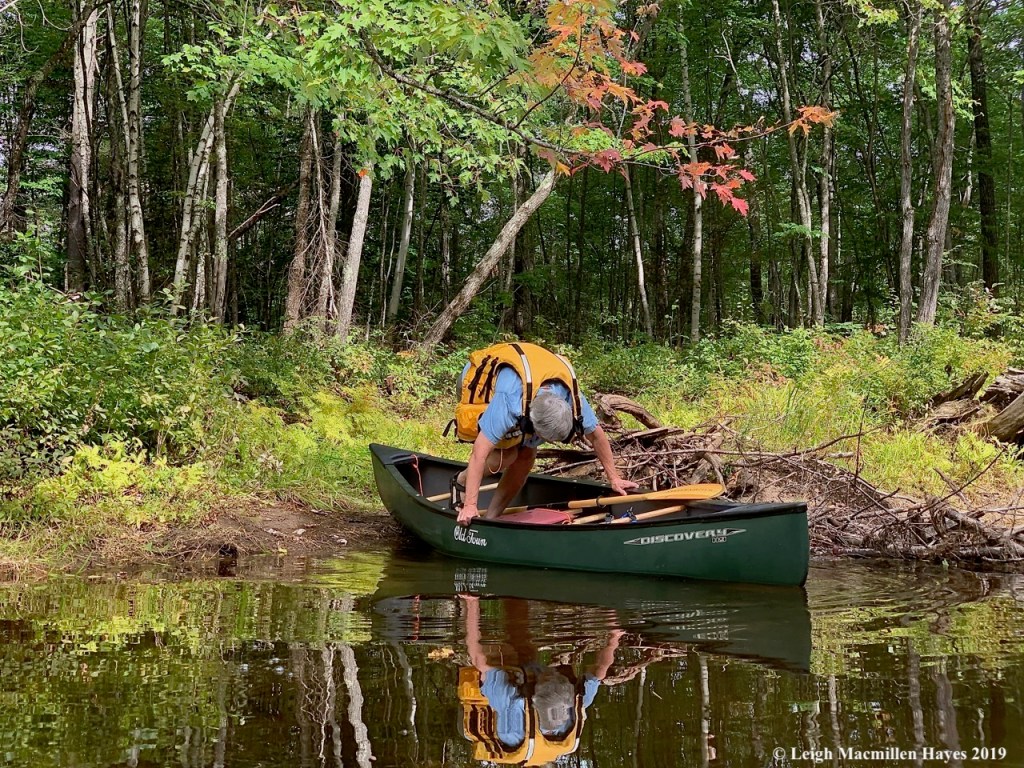
The put-in can be a bit tricky with rocks and stirring water flowing from the dam, but somehow the three of us managed not to tip as we kerplunked into our kayaks. That day inspired all of the subsequent trips for really we were scouting out a route for the Great Maine Outdoor Weekend paddle co-sponsored by the Greater Lovell Land Trust and Upper Saco Valley Land Trust.

On that first journey and two that followed, we were wowed by the floral displays including, Cardinal Flowers,

Pickerel Weed,

Sessile-fruited Arrowhead and . . .

Common Arrowhead,

Ground-nut, and . . .

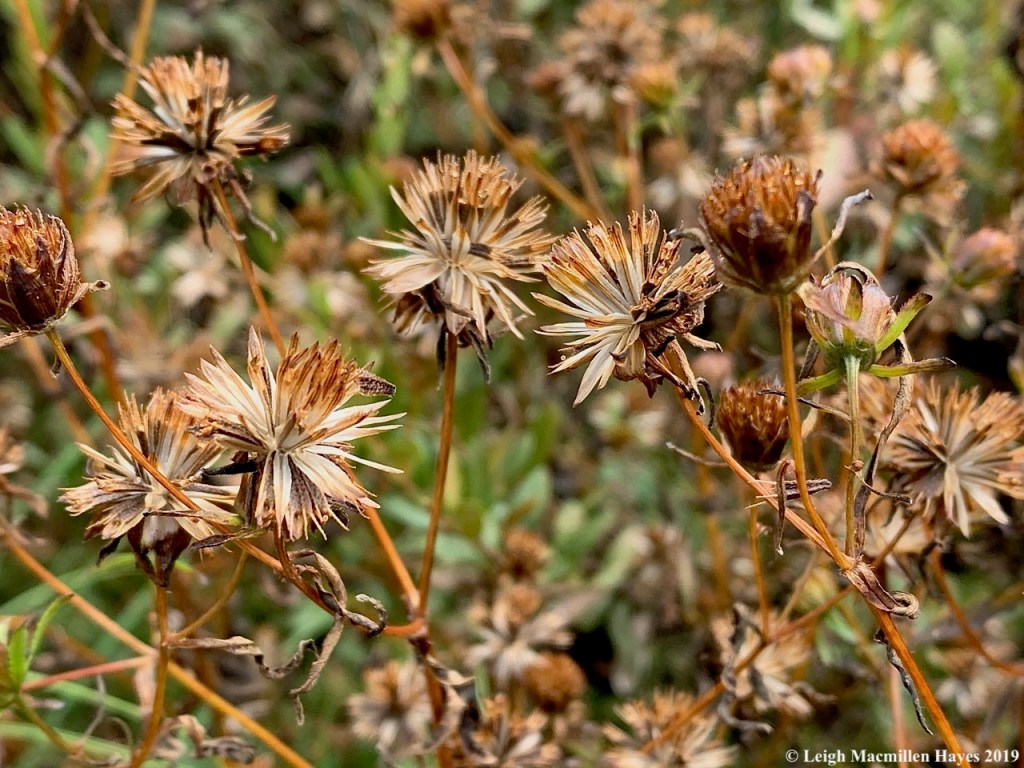
Turtlehead. Today, only a few asters showed off their composite form.

We’d paddled along, my guy, of course, always in the lead so he was the first to reach the old beaver dam. Pam was surprised by it because the water had been higher when she’d last followed this route. But it was obvious from the fact that there were no new sticks and the water wasn’t at dam level on the far side that there was no current beaver activity. My guy, feeling chivalrous, hopped out of his boat and shuffled us around on the wet grassy area to the far right of the dam.

Upon the sticks and branches Emerald Jewelwings flew, males such as this one with the white dot on its forewing waiting for a second before attempting to dance with a mate.

Once all three of us were on the other side, the water was a wee bit deeper and it seemed we’d entered Brigadoon.

And then the community changed again and Swamp Maples allowed glimpses of the mountains beyond.

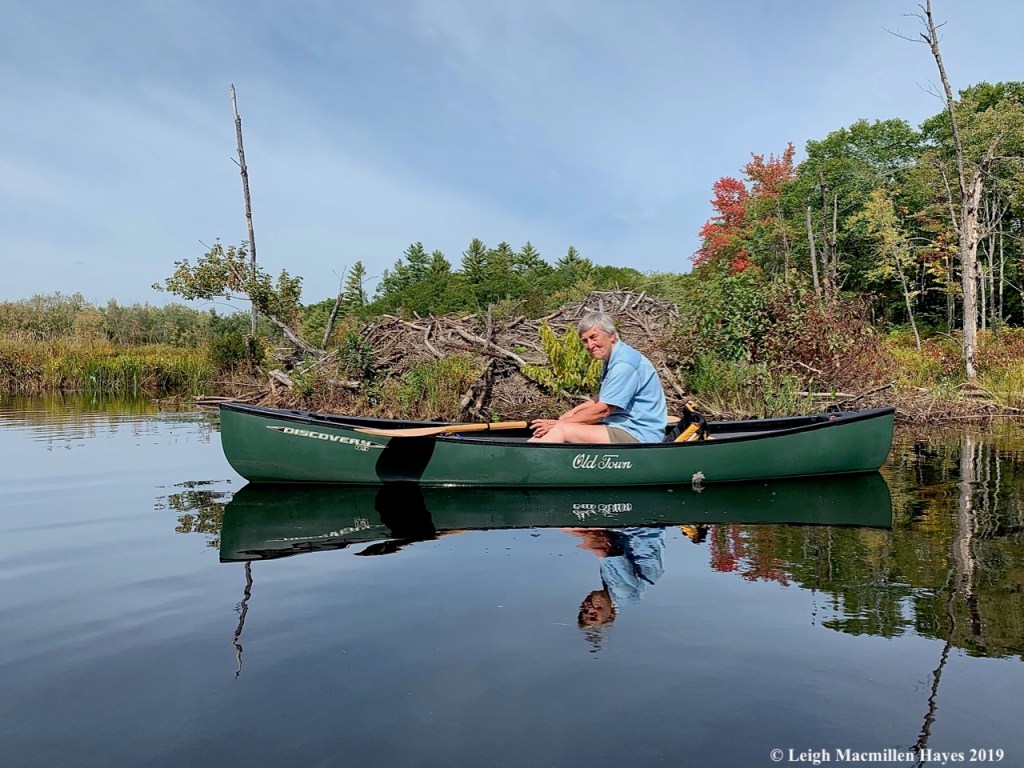
Before one of the final turns in the Charles River, we reached an abandoned beaver lodge.

And then Charles Pond opened before us.

We crossed the pond to Cold River, found a great lunch spot and reflected upon our sightings, which included a few ducks, an eagle, and a heron.

My second visit was with Trisha Beringer, Outreach and Office Manager for Upper Saco Valley Land Trust. It was an opportunity for me to show Trisha the route and for us to create our plan for the GMOW event. And to bask in the sun much the way the Painted Turtles did.

She was as wowed as I was by the journey and excited to share it with others.

Our turn around point was Charles Pond, but we paused for a few moments to take in the view.

And on the way back, as I contemplated sliding over the dam because the water was a bit higher due to some rain, three otters surprised me as they played below. Only one is visible with its head above water, but the others had just dunked under. Once they realized we were there, they took off. Our portage wasn’t a portage at all for rather than go over the dam, we did the dam shuffle, maneuvering our boats around it with a full-body back and forth motion.

Finally, it was time for the GMOW event, and the night before we decided to let those who had signed up know that we needed to postpone it from last Saturday to Sunday because of the weather. As it turned out, it was the right choice to make and Sunday dawned bright and beautiful with dew drops to top off the gathering.

Just beyond the Harbor Road bridge we passed under, a maple astounded us with the first official glimpse of the season to come and many of us paid it homage with photographs and words of awe.

At the beaver dam, the water was lower than on the previous visits, but thankfully two paddlers hopped out and helped everyone get out of boats and shift them around to the other side.

Continuing upstream, the Swamp Maples that offer the first glimpses of the mountains, showed that they too were trying on their new coats for the next season.

The group took in the view while crossing to Cold River and continuing on until we couldn’t travel easily any more. As always, the return trip was quicker and we finished up in three hours, grateful for an opportunity to explore the water that connects the GLLT’s fen property on Kezar Outlet with USVLT’s Stearns Property on Cold River and make new friends. It was a spectacular day and we were pleased that we’d made the choice to postpone.

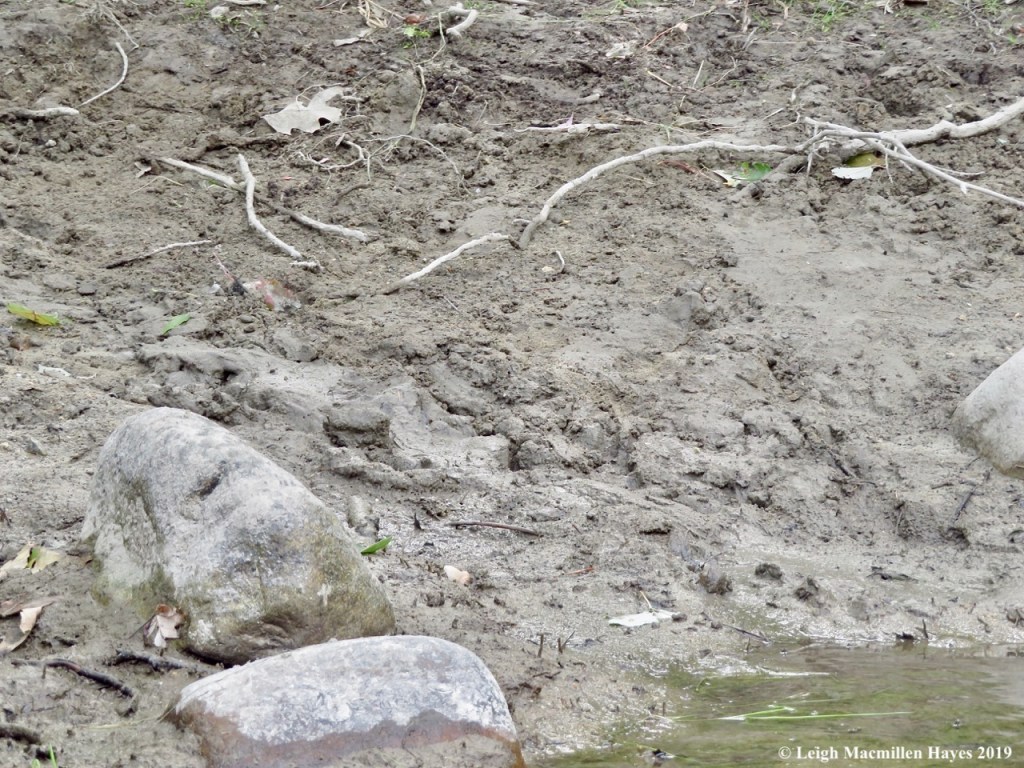
One who had to back out of the GMOW trip at the last minute, asked if we’d offer it again, thinking we’d gone ahead with our Saturday plan. She really wanted to check out the course because though she’s lived locally forever, she’d never been below the dam on Harbor Road. And so this morning, I met Storyteller and GLLT member, Jo Radner. As we moseyed along, we began to notice bank tunnel after bank tunnel for so low was the water. In a muddy section, we found prints with a tail impression thrown into the mix and deciphered them as beaver.

It made perfect sense when we noticed a sight not spotted on the previous trips: beaver works on a maple. Given that, we began to wonder what the dam might look like.

Despite the fact that we found more and more evidence of recent beaver works, the dam certainly was bigger, but not because it had been added to by the rodents. Rather, the water level was much, much lower than I’d seen on any previous visit.

It seemed the beavers were active, but we couldn’t help but wonder why they hadn’t added to the dam. That meant that they were probably not at the lodge either, but we still had more water to travel through before reaching that point.

The trip around the dam was more challenging than upon any other visit, and we were both sure we’d end up in the water, but somehow we did it with more grace than we realized we possessed.

And then the spot that I’d called Brigadoon on the first visit showed off a much more colorful display.

Closer to the pond, the curtain hiding the mountains also had undergone a transformation.

Just beyond, we reached the lodge that is longer than tall and always reminds me of a New England farmhouse: big house, little house, back house, barn. Jo’s canoe helped characterize the length of the lodge.

We too, lunched on Cold River as has become the habit, and then turned around.

It was on the way back that the Painted Turtles, basking in the sun in order to thermoregulate, began to show themselves. As usual, they took on a Yoga-like pose with back feet extended to collect additional heat.

Like Jo, I want to come back to this world as an otter because they love to play in summer and winter, but a Painted Turtle might be my next choice if I ever feel the need to let winter pass by while I nestle into the mud.

Speaking of otters, we found stone pile after stone pile above the water, each a copy of the next. They line both sides of the river. In high water, they’re not visible, but with today’s low height, they were quite obvious. Upon this one we found a beaver chew stick that wasn’t there a week ago.

All are almost pyramid shaped, in a rounded sense, and constructed of varying sizes from gravel to stone potatoes. Not only did we find beaver chews upon a few, but fresh water mussel shells and the ever present acorns that are currently raining in such a fashion that one feels like the sky is falling.

The mussel shells would have indicated that the otters had been dining. And so we began to develop a story about otters piling the stones on purpose to confuse us. Beavers also took advantage of the piles so they became part of our interpretation.

I’ve asked several people about these formations and have a few theories of my own, but would love to hear your take on this. I suspect a few fishermen may have the answer about the stone piles.

Four hours after we started, today’s journey ended. I suspect it will be a while before I return, for so low is the water, but . . . you might twist my arm.

Thanks to Pam, and Trisha, and Jo: today I got to paddle into autumn in a most amazing place.

Holey Mysteries

It all began with a photo sent to me by a friend two days ago. “Any ideas? 8 inches wide. 20 yards from a bog,” he wrote. 

I asked him about tracks in the area, but other than deer, he saw none. He did, however, see two track makers–a fisher and a weasel. 

And so, I contacted a few other friends and invited them to join me on a quest to figure out what the hole was all about. 

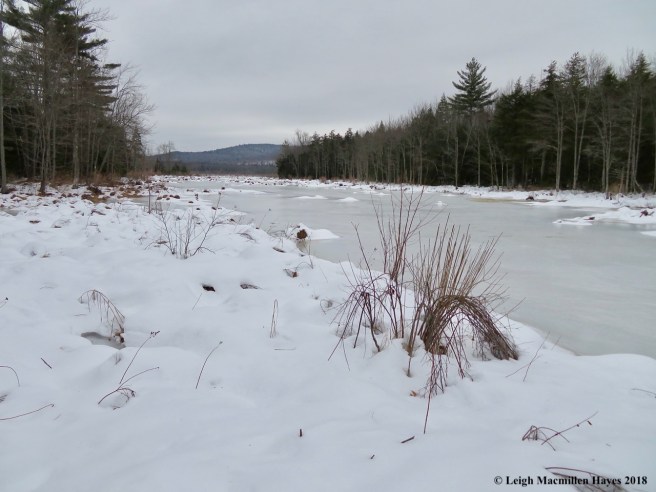
We met at the designated location, determined it would probably be in our best interest to wear snowshoes rather than Micro-spikes, and set off to search for the hole and clues. 

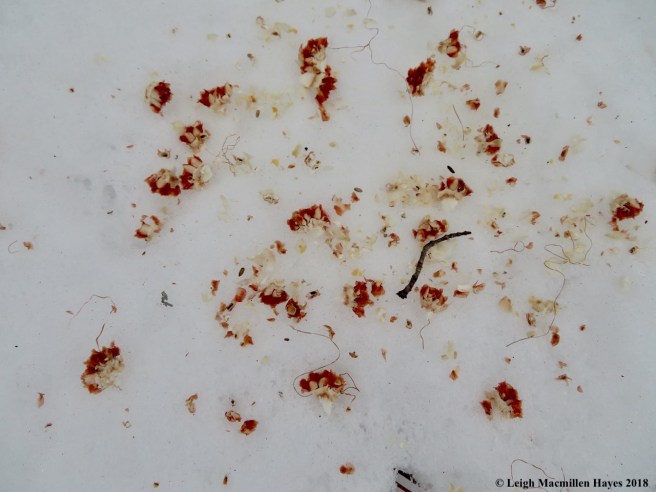
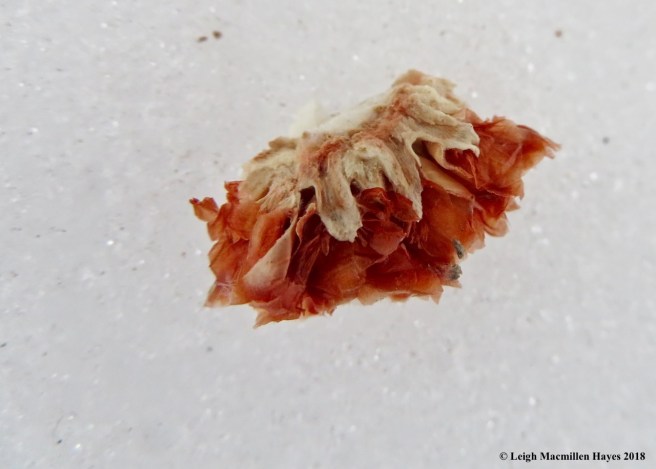
But first, something else stumped us. Oh, wait. I wasn’t stumped. I knew it was sumac and a bird must have been munching on the seeds. But . . . I didn’t remember sumac having such long hairs and there certainly were strands associated with the droppings. 

The color, however, made it incredibly obvious. Sumac indeed. 

Until . . . 

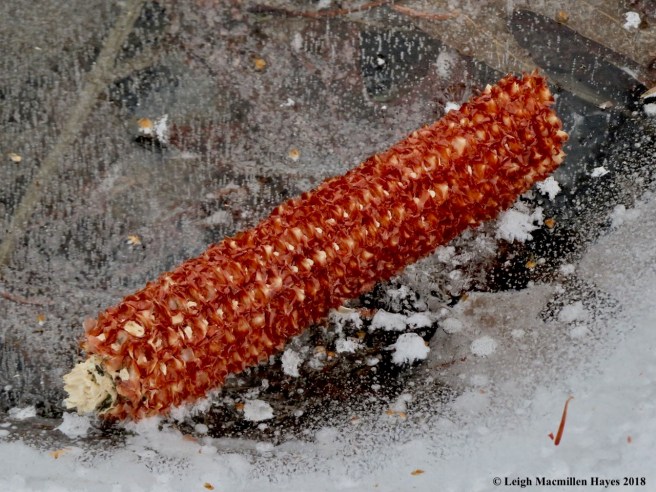
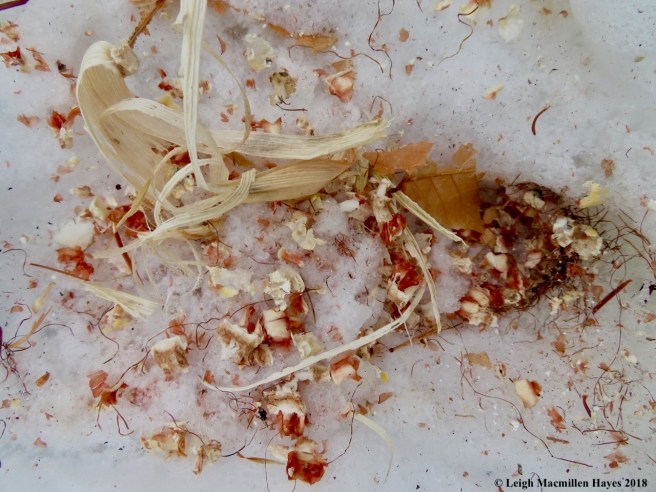
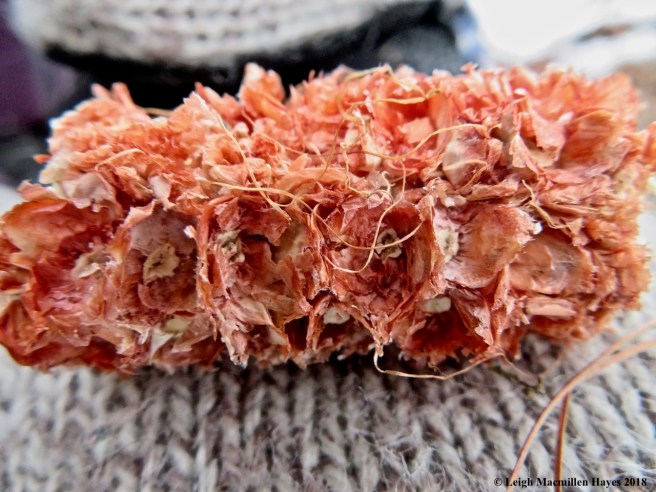
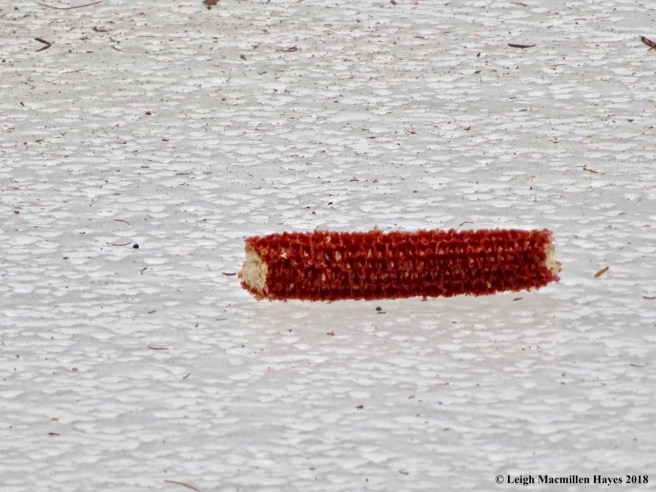
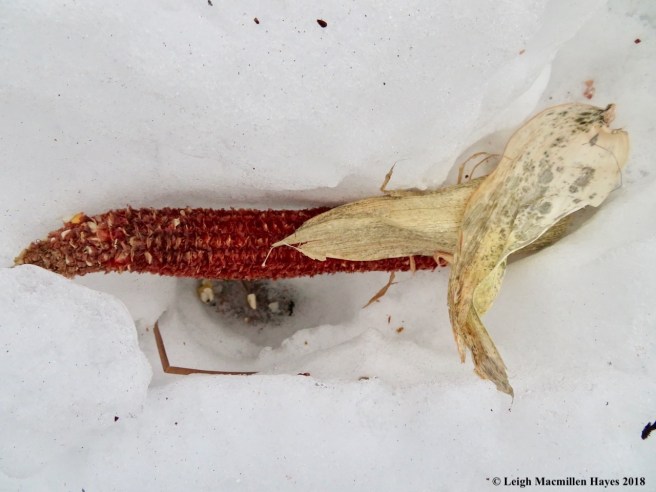
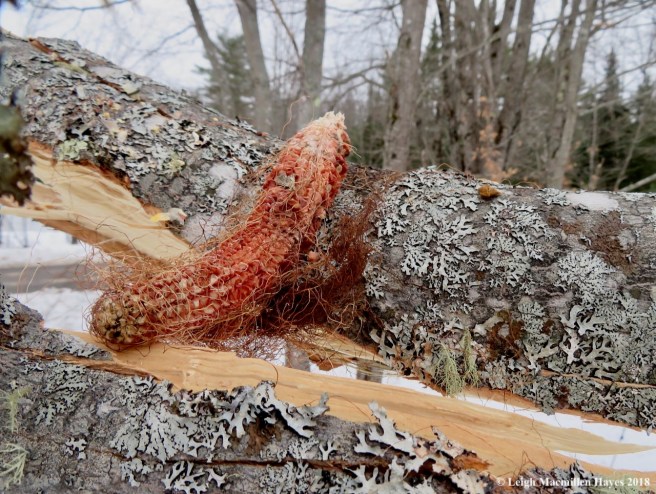
it wasn’t! Corn on the cob? On ice? And then we remembered that there was a cornfield located directly across the road. So . . . that made sense. But, how did it get to the other side? We’d noticed plenty of turkey tracks. Would turkeys carry cobs of corn? Not the ones that visit my backyard on a daily (sometimes twice daily) mission to eat as much bird seed I’ve tossed on the ground as possible. They scratch about and eat whatever is available on the spot rather than carrying it–as far as the four of us knew anyway. 

Did the deer bring it across? Again, we’ve always seen them dine on site. And . . . we noticed that the cobs, and even occasional husks, were left within their prints, so the corn arrived after the deer. 

As we continued to look around, we began to see kernels in small piles everywhere. 

And with that, we suddenly spied something else that looked oddly familiar. 

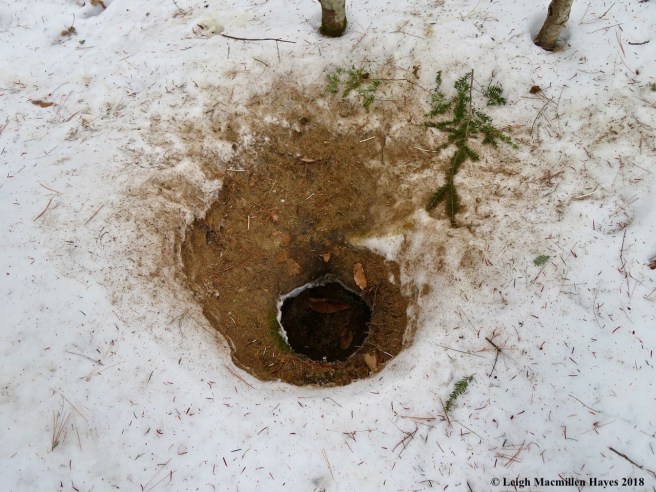
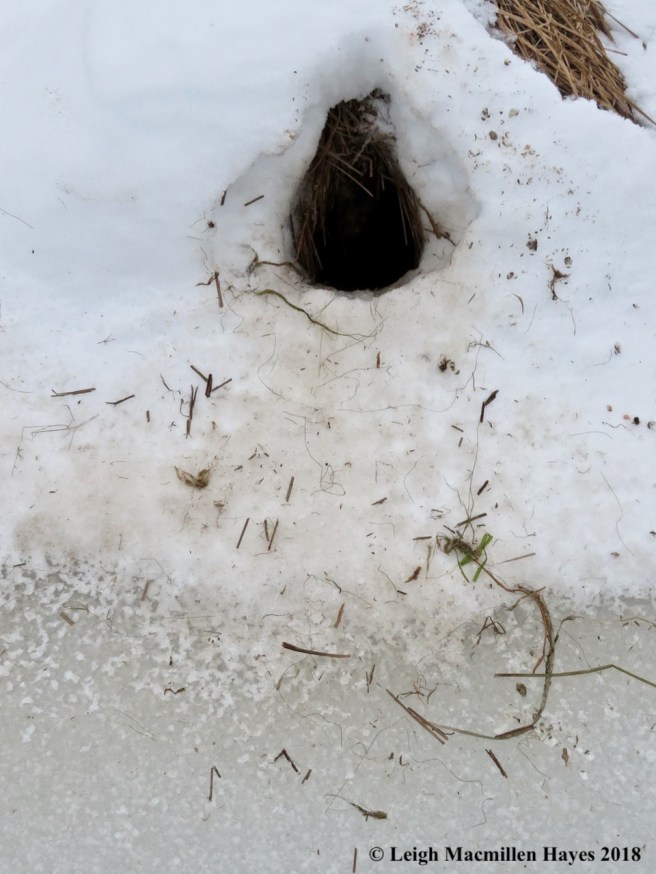
The hole! Notice its spiral shape. Discernible tracks? No. Dirt? Yes. Hoar frost? Yes. Hmmmm . . . 

We looked around for signs. “So and So lives here” would have made it too obvious. But, we found hoar frost on an adjacent hole, which raised a few questions: 1. Were the holes connected? 2. Was a critter breathing within? 3. Or, because we were near the bog, was there warmer water below that was creating the frost? 

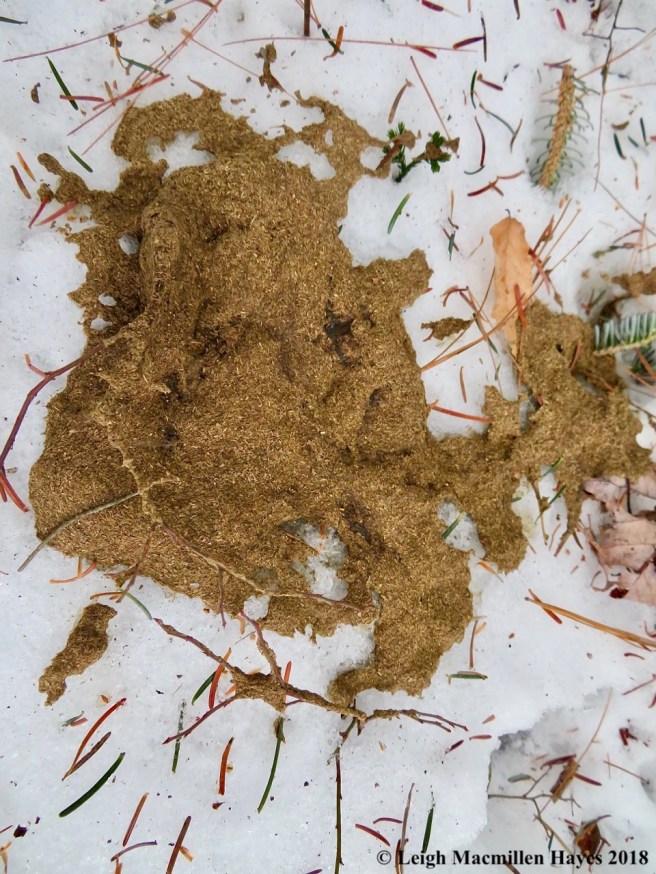
Then we found something none of us had ever seen before. A smattering of sawdust on the snow located about five feet from the hole. Scat? Upset stomach? Two of us got down with a loupe to take a closer look and came to no conclusions. 

As we continued to look around, we noticed that though there wasn’t a discernible track, it did seem that activity led to two hemlock trees.

And there were snipped off twigs cut at an angle below the trees, plus some comma-shaped scat. 

With that in mind, we returned to the hole in question. 

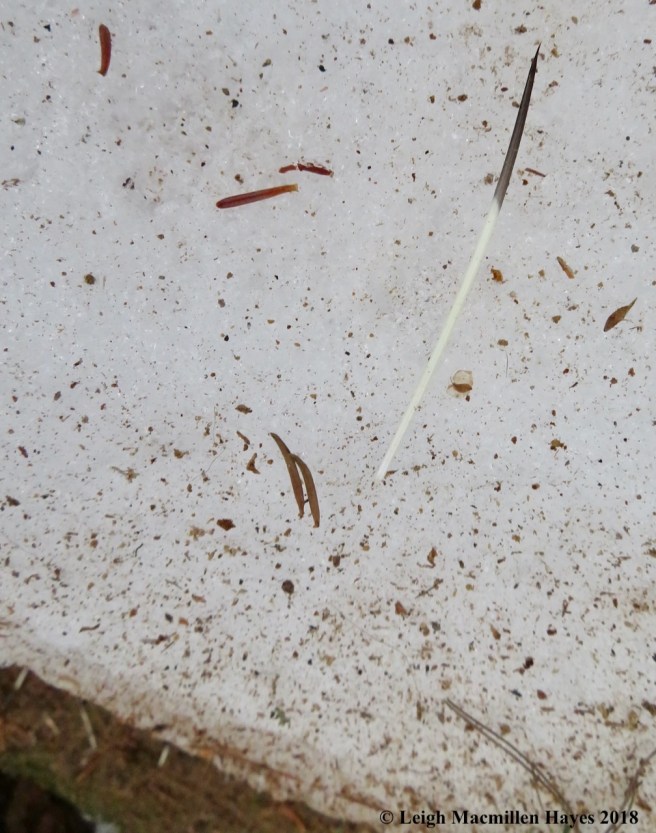
Bingo! There was a sign that clearly read “So and So lives here.” A quill! When I first looked at the photo the other day I’d suggested porcupine or fox. Porcupine it was. 

Within the hole which we could tell was deeper to the left, we spotted more quills. 

Mystery solved–almost, for we didn’t know about that smattering of sawdust. Porcupine scat consists of sawdust because their winter diet includes tree bark and needles. Did the animal have a bellyache? 

Our excitement at finding the hole wasn’t diminished by the unsolved portion of the story. And still, we continued to find corn cobs as we moved closer to the water in hopes of finding tracks. 

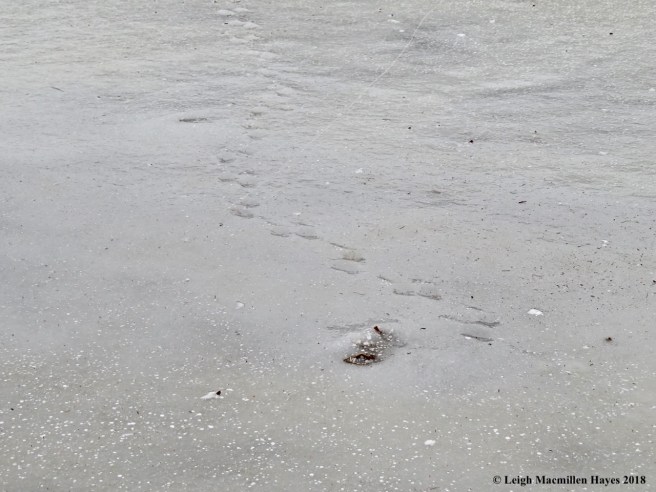
Indeed, there were some and we tried to figure out the pattern to determine what mammal had crossed the ice. 

But before taking a closer look, there was ice on the bog’s edge to admire and we each found artistic displays to our individual liking. 

Back to the tracks on the ice.

At first, with porcupine on my mind, I thought I recognized the pigeon-toed behavior. 

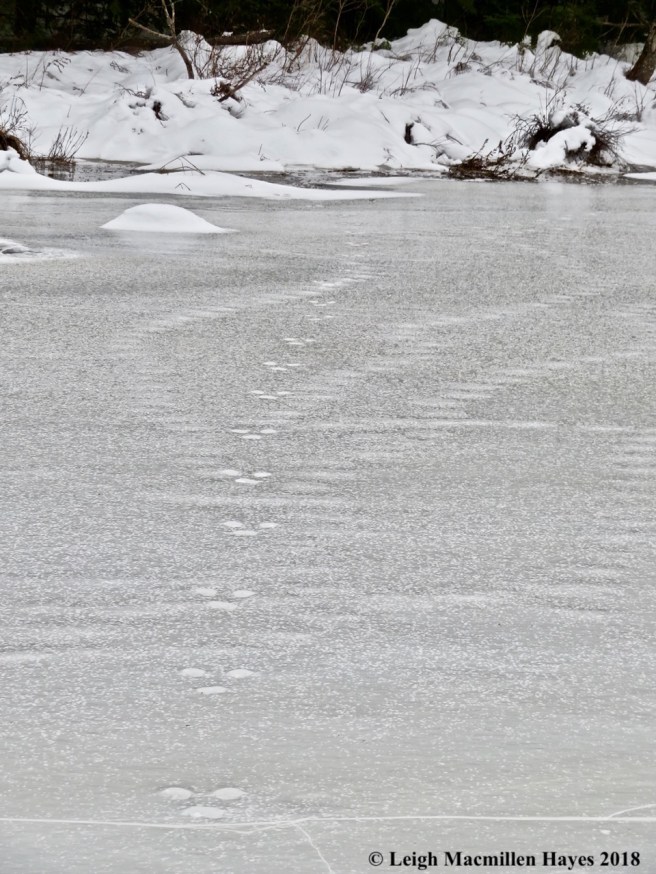
But my companions couldn’t see it. And then I realized that I was seeing a different pattern instead. Opposite diagonals became important in the overall look of two feet together. 

Studying that one pattern of a waddling animal, we soon realized another had crossed over it–in a leap and a bound. Do you see the intersection of the two in the middle of the photograph? 

And, there were a couple of corn cobs on the ice. 

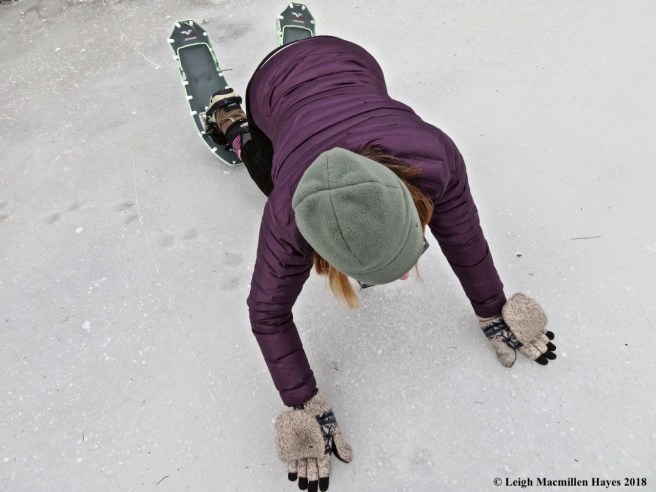
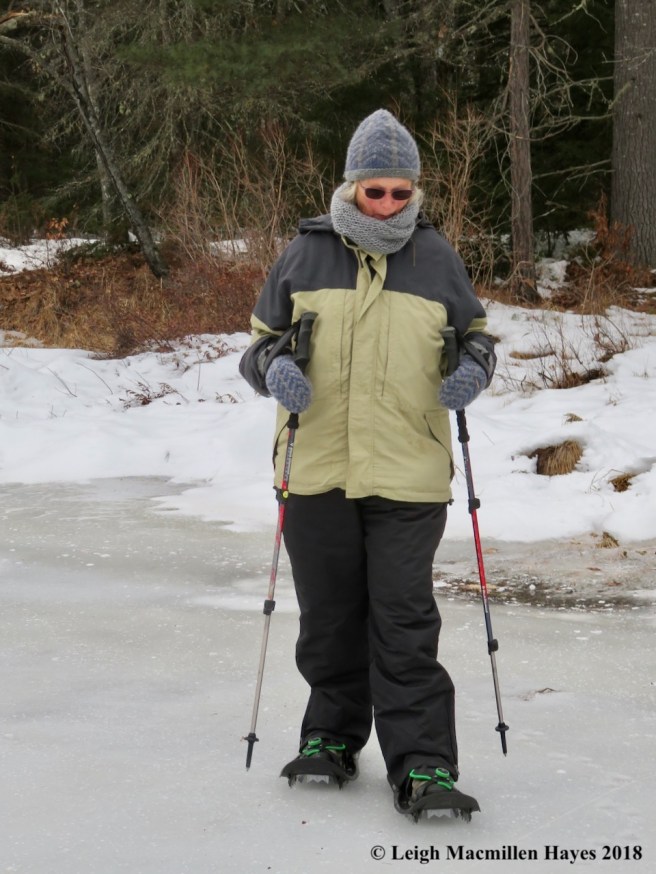
It was all too enticing, and so we got up the gumption, threw risk to the wind, and stepped out. One of us, stepped onto all fours as she slid across, the better to distribute her weight. It also gave her a better view of the tracks. 

Another came forth with caution, though she admitted she’d hoped we’d go for it. 

Her husband was the smart one and he stood on shore–looking at tracks in the snow created by one of the critters we were examining on the ice. And ever ready to call for help should we need it. 

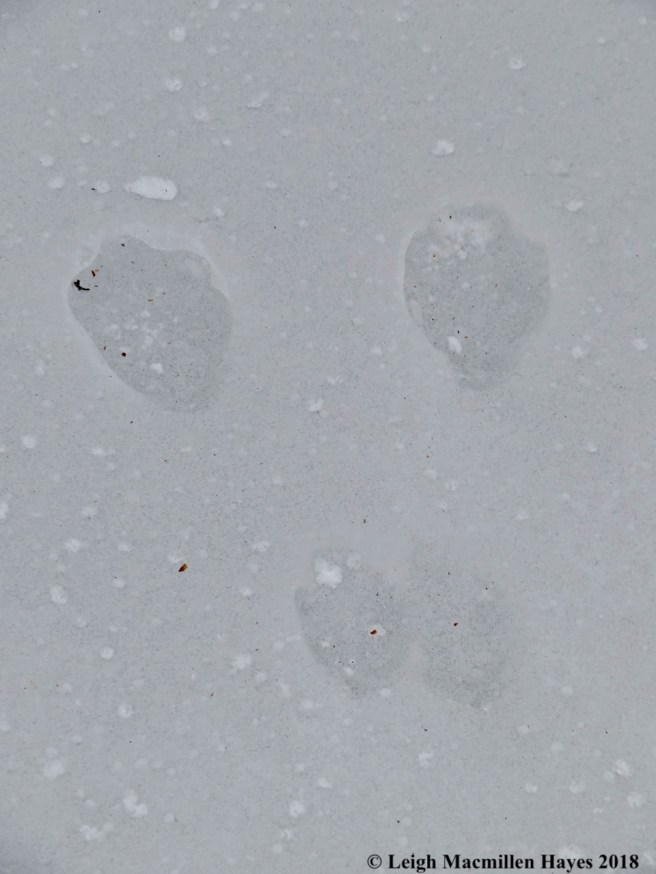
Back to the pattern–do you see three sets of two feet? In the lower set the diagonal is higher on the left and lower on the right. It switches with the middle set of prints. And goes back to the same with the upper set. 

Where debris had frozen into the impressions you can almost see the toes. The smaller, almost rounder right hand print is a front foot and the longer left hand print is the opposite back foot. That’s how it goes with a waddler such as this. 

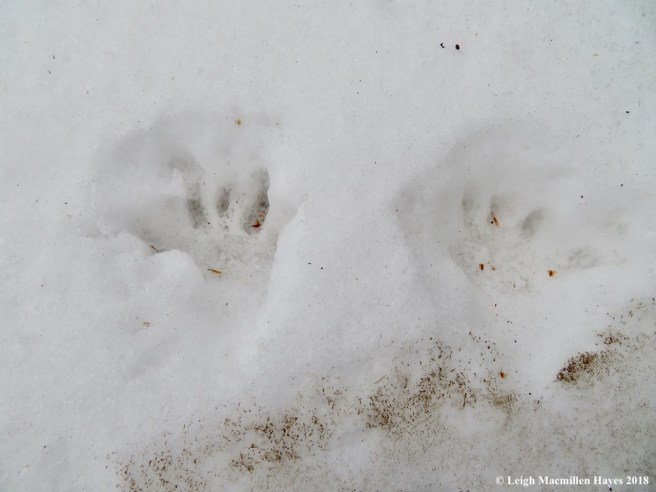
We’d actually seen clear prints near where we’d parked and so we knew this mammal had been in the area–those baby hand-like prints belonged to a raccoon. Raccoon tracks and corn on the cob. Hmmmm. We were beginning to make some connections. 

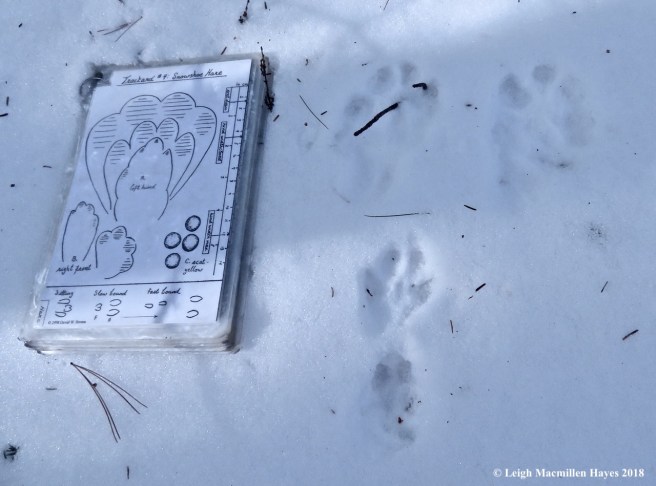
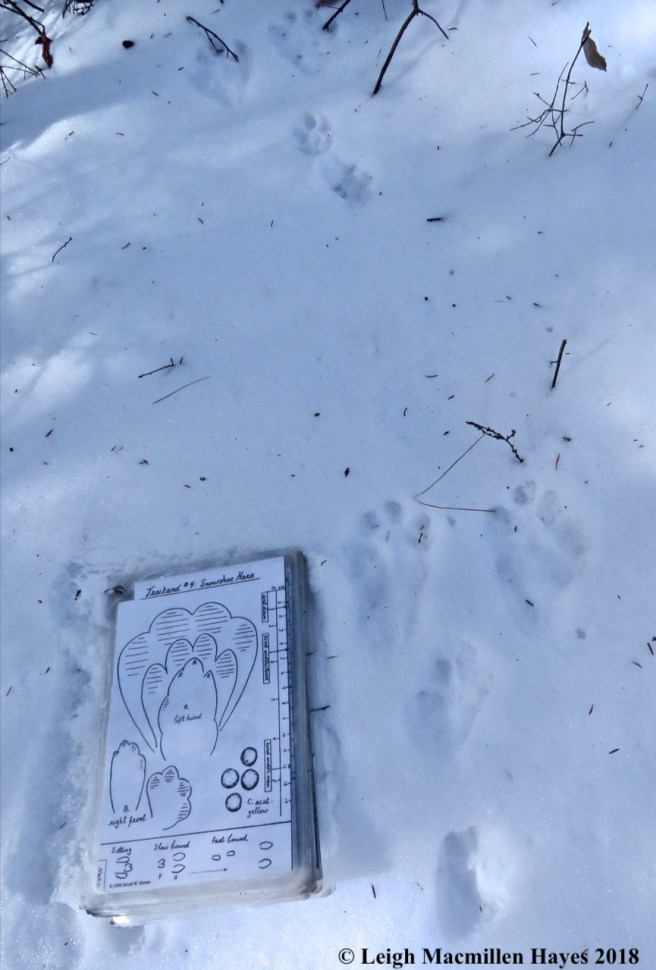
With that figured out, we moved on to the next set of tracks and determined they belonged to a snowshoe hare–the larger front prints actually representing its back feet as they had landed after the front feet bounded forward. 

As we studied the hare track, we noticed lots of movement had previously been made by another critter and I’m going to go out on a limb to say based on its size and behavior that it was related to the next mystery we encountered. 

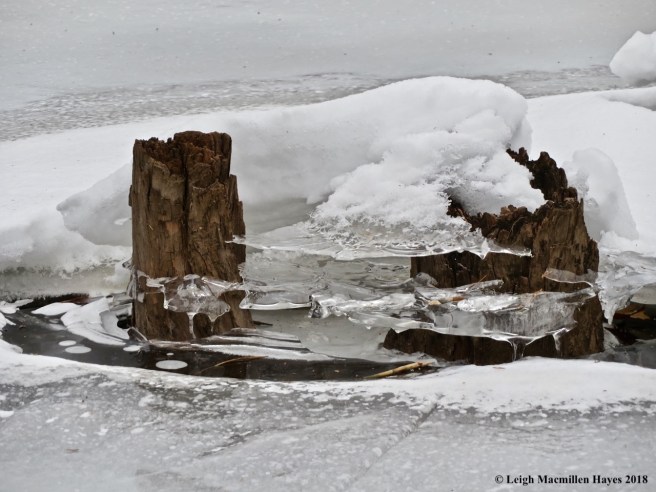
First, there was a hole around a couple of tree stumps and it was the layers of ice that drew our admiration. 

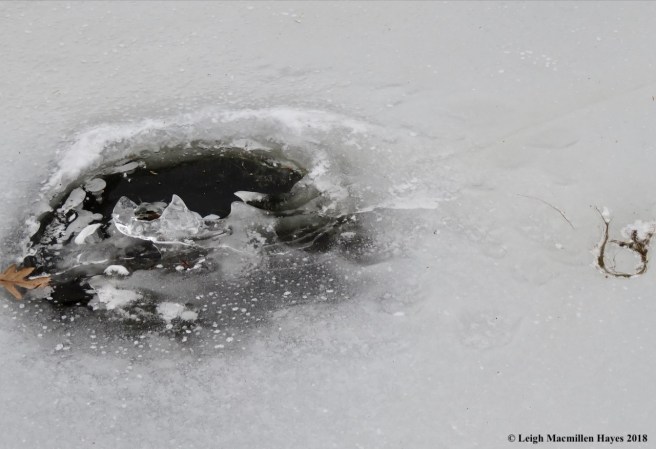
Right near it, however, was another frozen over hole and we could see some tracks that were difficult to read. 

But the ice was glorious and there was another small tree stump in the center. 

We weren’t sure who had made the holes until we spied another and some prints in the snow. 

The five tear-drop shaped toes provided a huge hint. 

And a bigger hint–a hole nearby. 

As usual, it commanded a closer look. 

And what did we find? Fish scales. With that signature, and the prints and even the pattern of the older tracks near the snowshoe hare activity, we knew a river otter had recently eaten. 

Eventually, we made our way back to the road, crossed over and checked the cornfield for we still weren’t sure who had brought the cobs to the bog. It made sense that the raccoon may have, but all of them? 

We found plenty of deer tracks, many of which were again filled with either kernels or nearly complete cobs. 

But it was the one stuck up in a broken red maple limb and the chitting nearby, plus scat below, and the actual sighting of a particular mammal that we think gave us the answer as to why so many piles of kernels–red squirrels. 

With that, it was time for us to take our leave. First, we gave great thanks, however, to Parker for sending me the photo of the hole. When I’d shown it to another friend, he asked why the spiral. I think that was the lowest point and the porcupine climbed out and then made its typical swath around until it reached the higher ground each time it exited and entered.

The question none of us could answer–what about that sawdust smattering?  

Ah well, we saved that for another day and left thankful for the opportunity to solve most of the holey mysteries. 

Bird Brain

Wrote Aldo Leopold, “Everyone knows…that the autumn landscape in the north woods is the land, plus a red maple, plus a Ruffed Grouse. In terms of conventional physics, the grouse represents only a millionth of either the mass or the energy of an acre yet subtract the grouse and the whole thing is dead.”

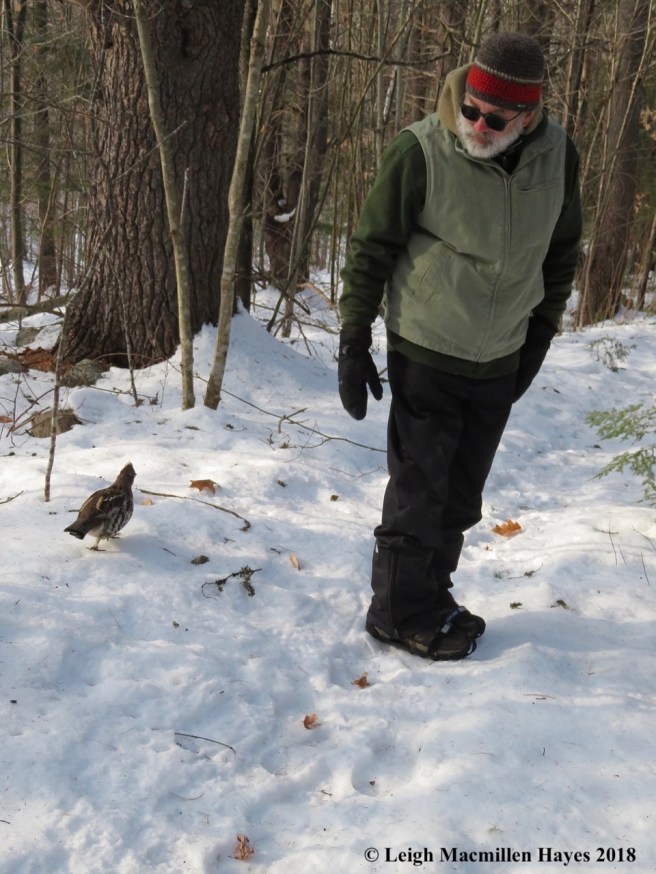
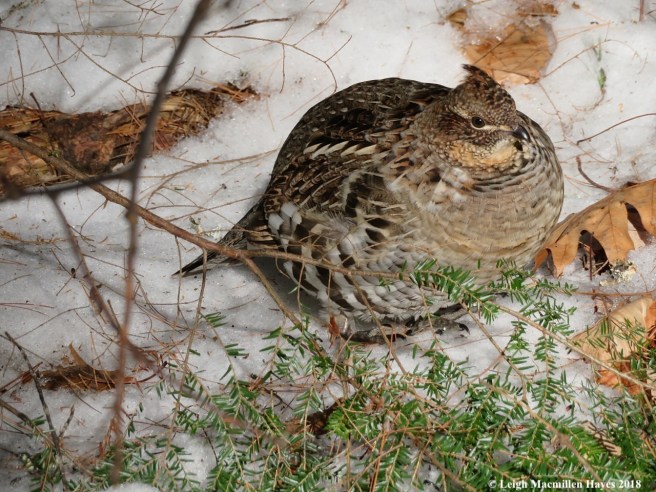
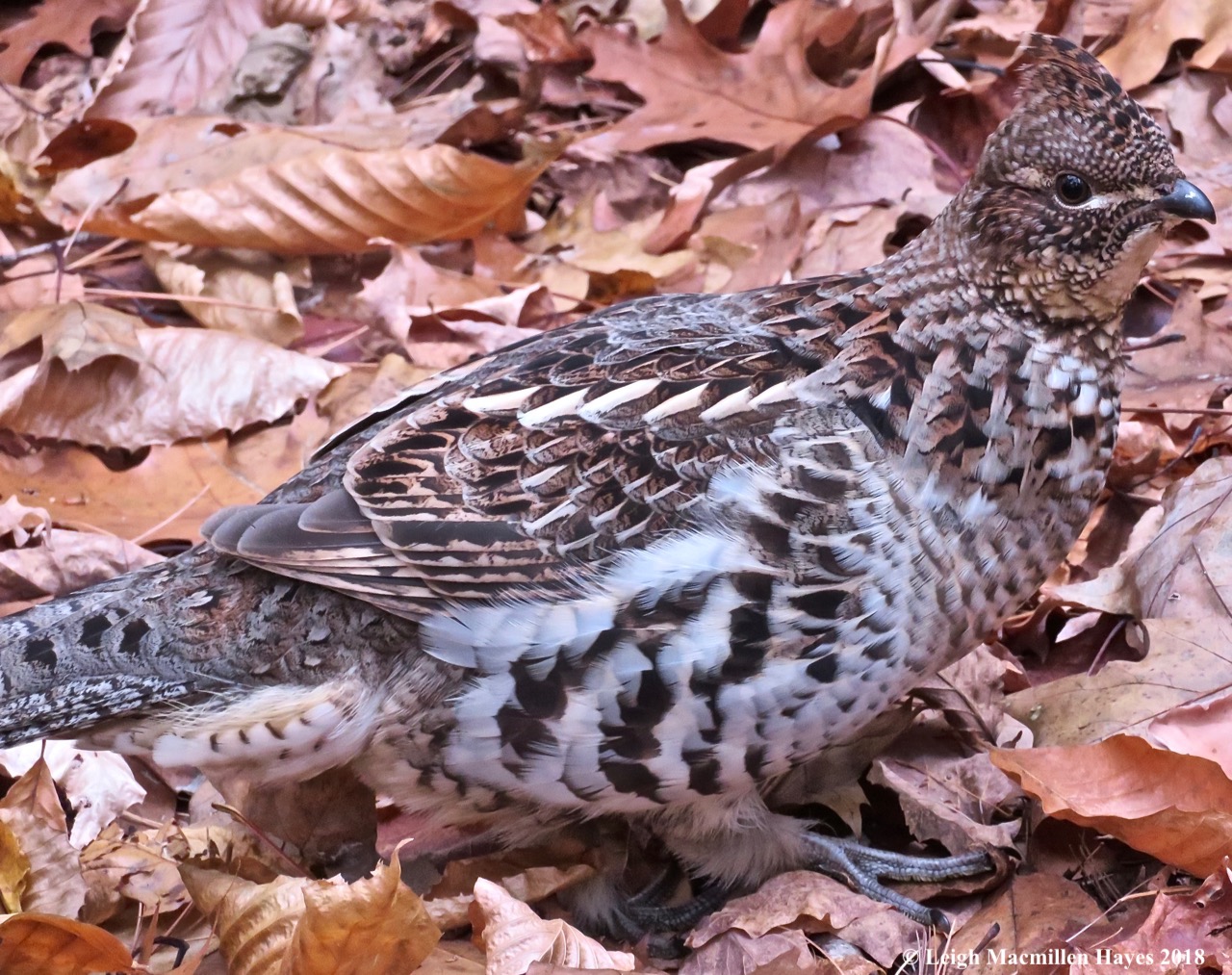
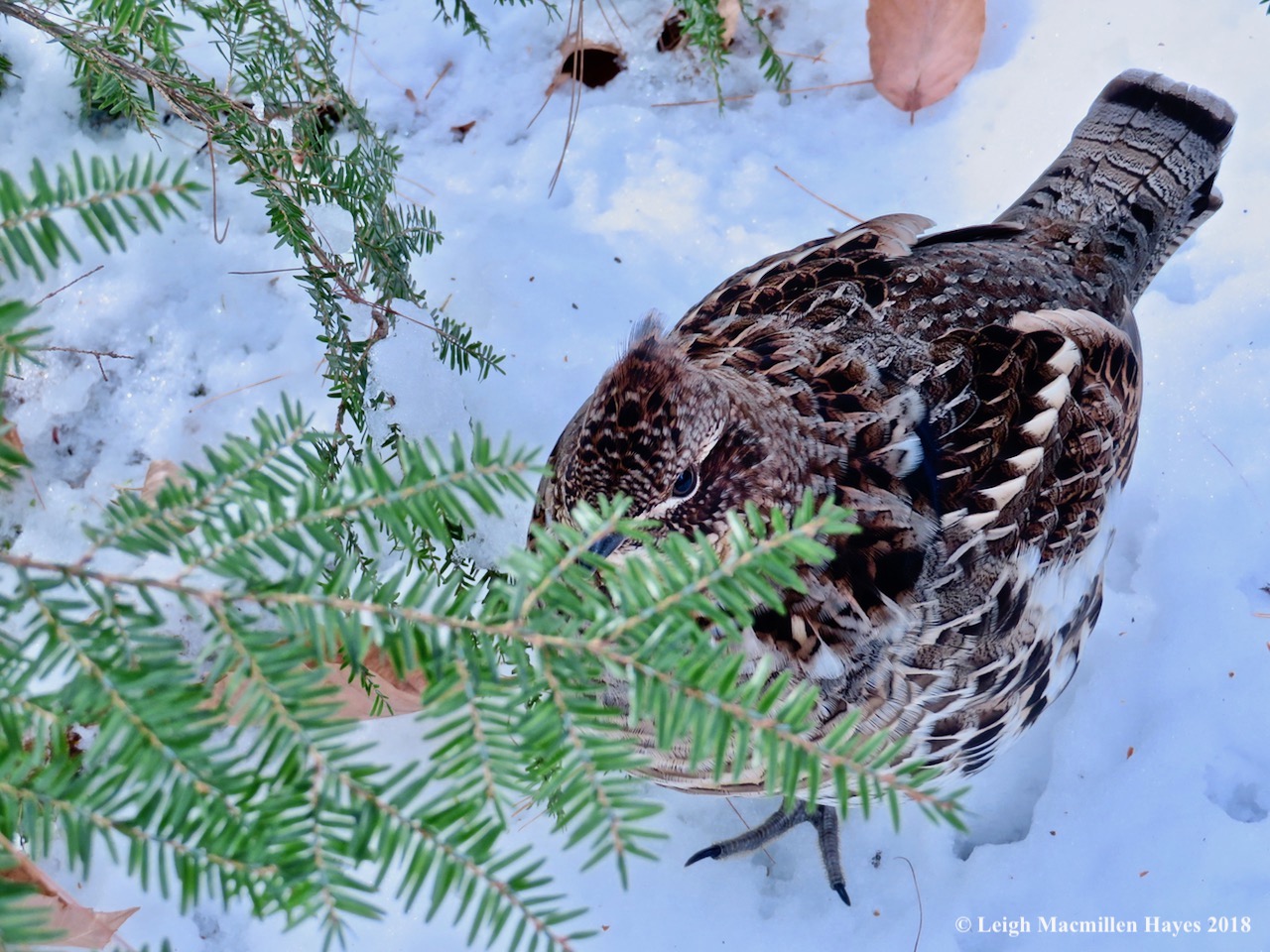
And so it was that I tramped with a couple of friends today who had the delightful pleasure of meeting ArGee (R. G. for Ruffed Grouse). We’d been chatting and searching for a few red blooms on a tall staghorn sumac when suddenly we spied him crossing over a stone wall and approaching us. 

He circled and circled for a while as we stood still yet continued to talk–sharing admiration and awe at the opportunity to be in his presence. 

We watched him forage for seeds and wondered about his behavior. Typically, Ruffed Grouse are loners, except for mating season. But this one seems to greet visitors to its territory with somewhat regular frequency. 

When we moved, he did likewise–usually a few feet to either side of us. 

And when we stopped, he did the same, seeming as curious as us. 

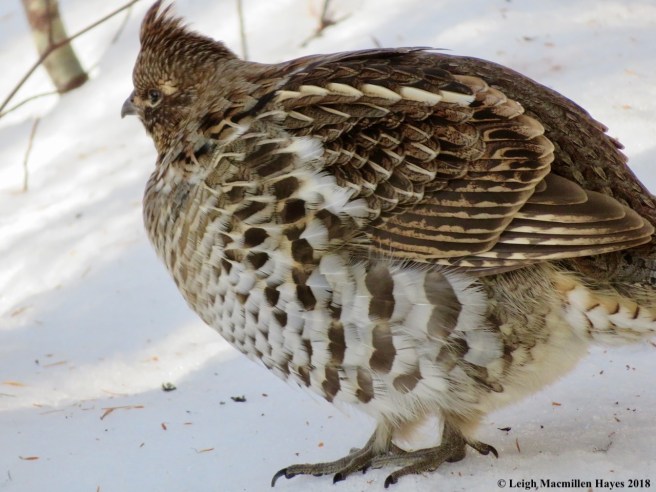
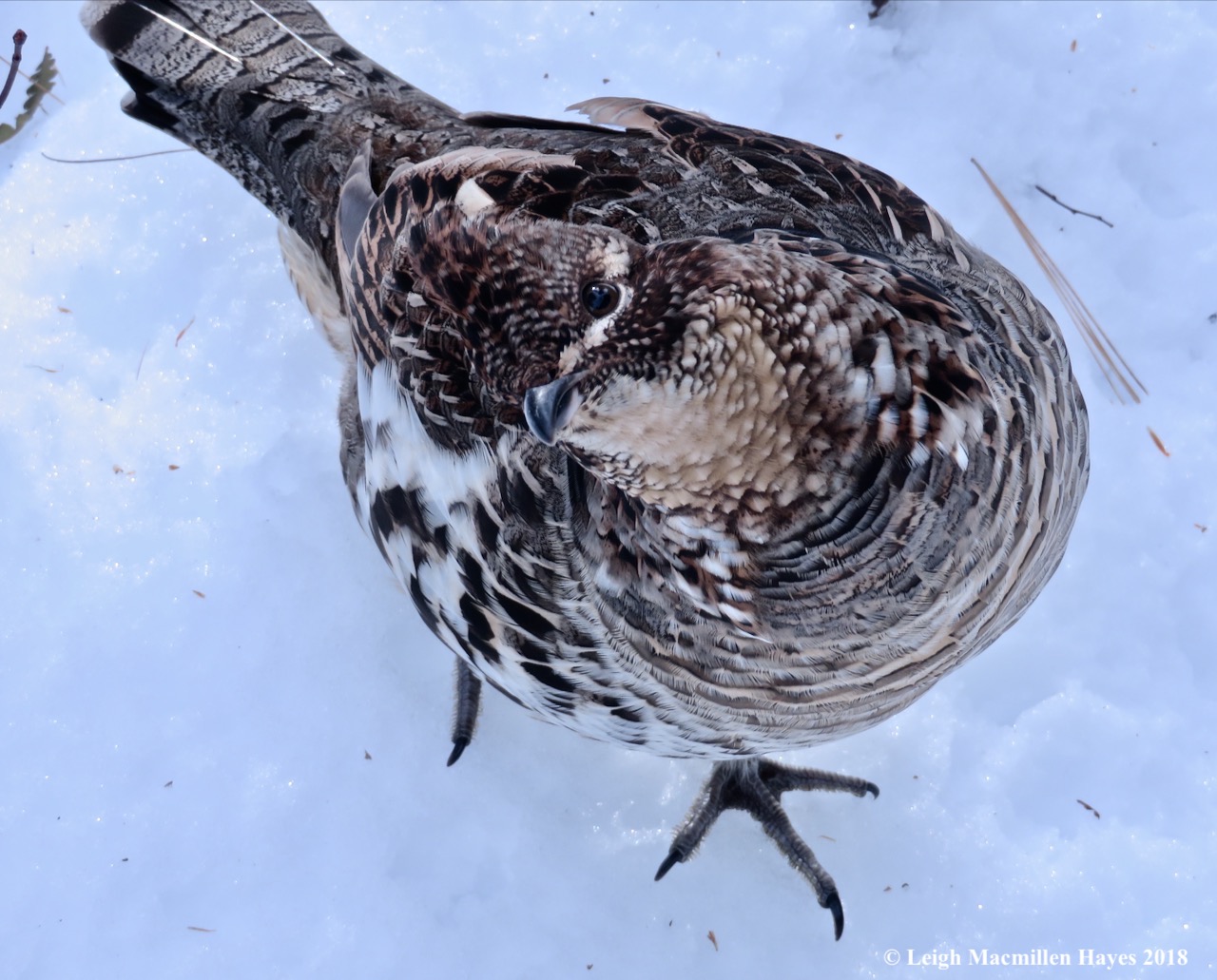
It was a brisk morning, so periodically he did what birds do to warm up–turned into a football of sorts as he fluffed up his feathers to trap warmer air. A bird’s body heat warms the air between its feathers and the more trapped air, the warmer the bird. After all, he didn’t have the luxury of hand warmers. But then again, we didn’t have the luxury of trapping air within our feathers. 

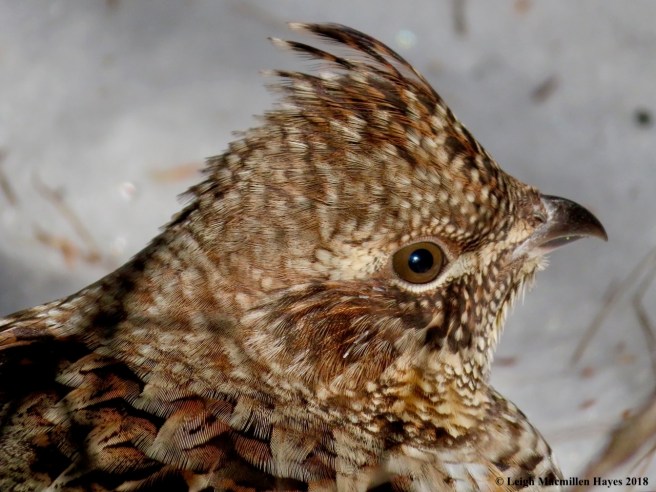
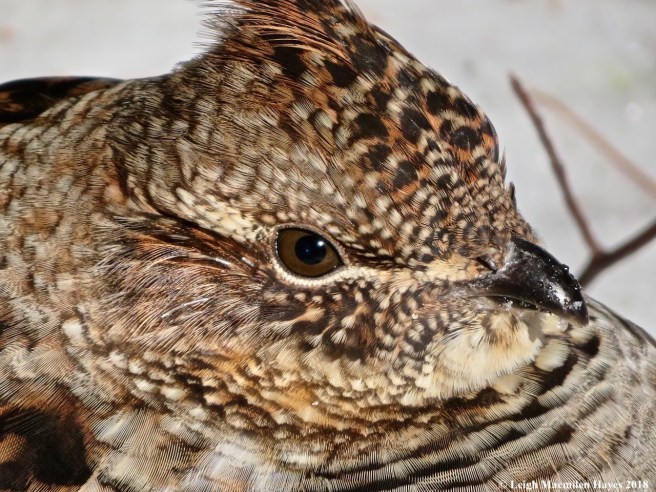
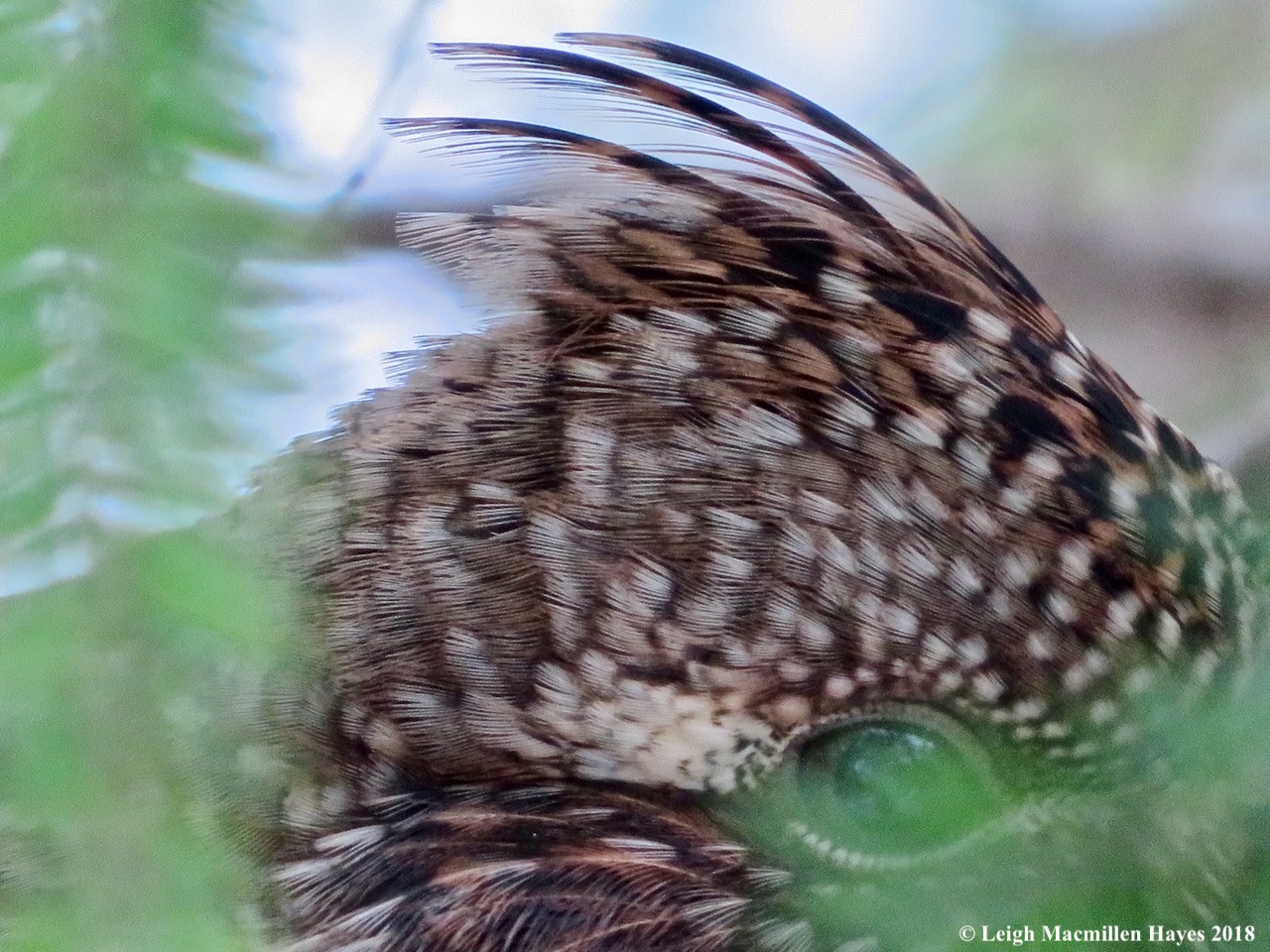
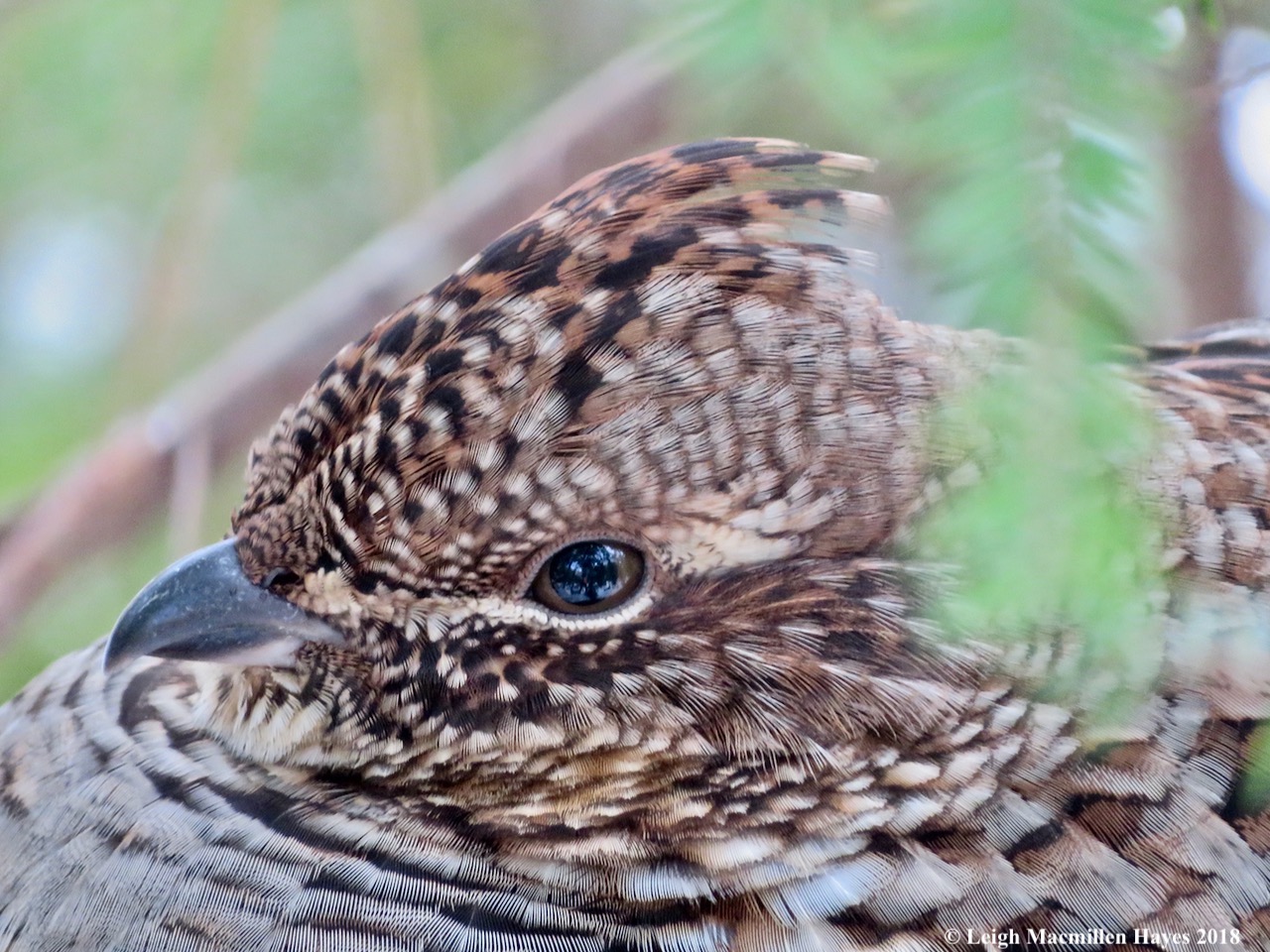
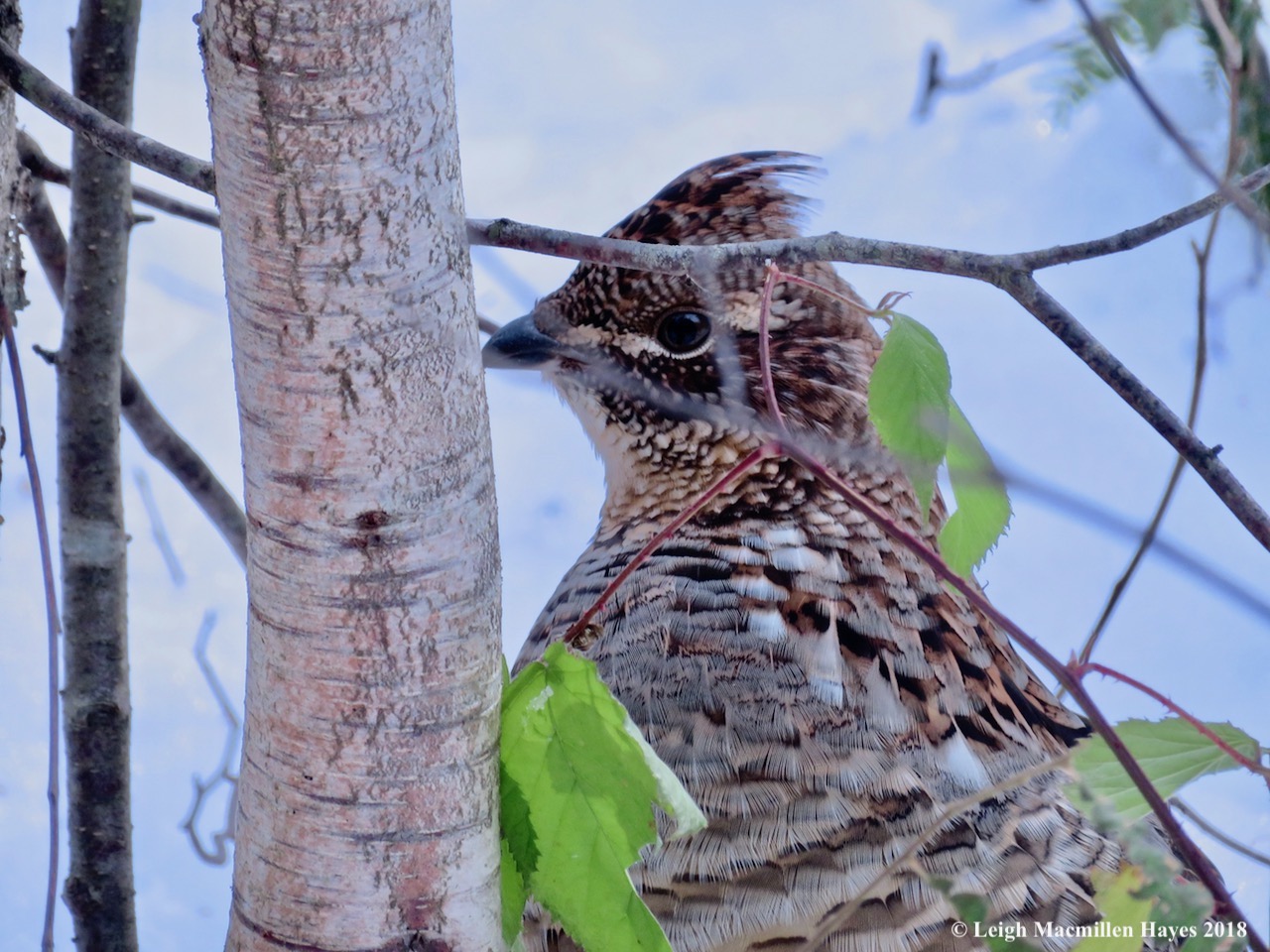
While we watched, I couldn’t help but notice the auricular feathers–those stiff feathers that cover the bird’s ear and form a triangular patch that extends back from the bill and the middle of the eye. 

Do you see what I mean as they fan out below ArGee’s eye? 

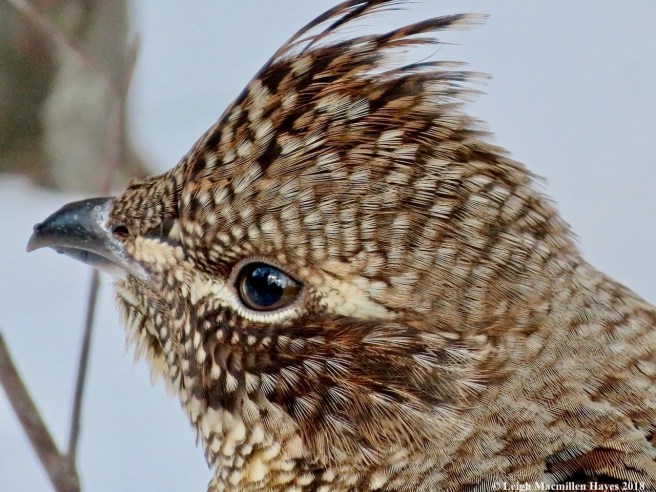
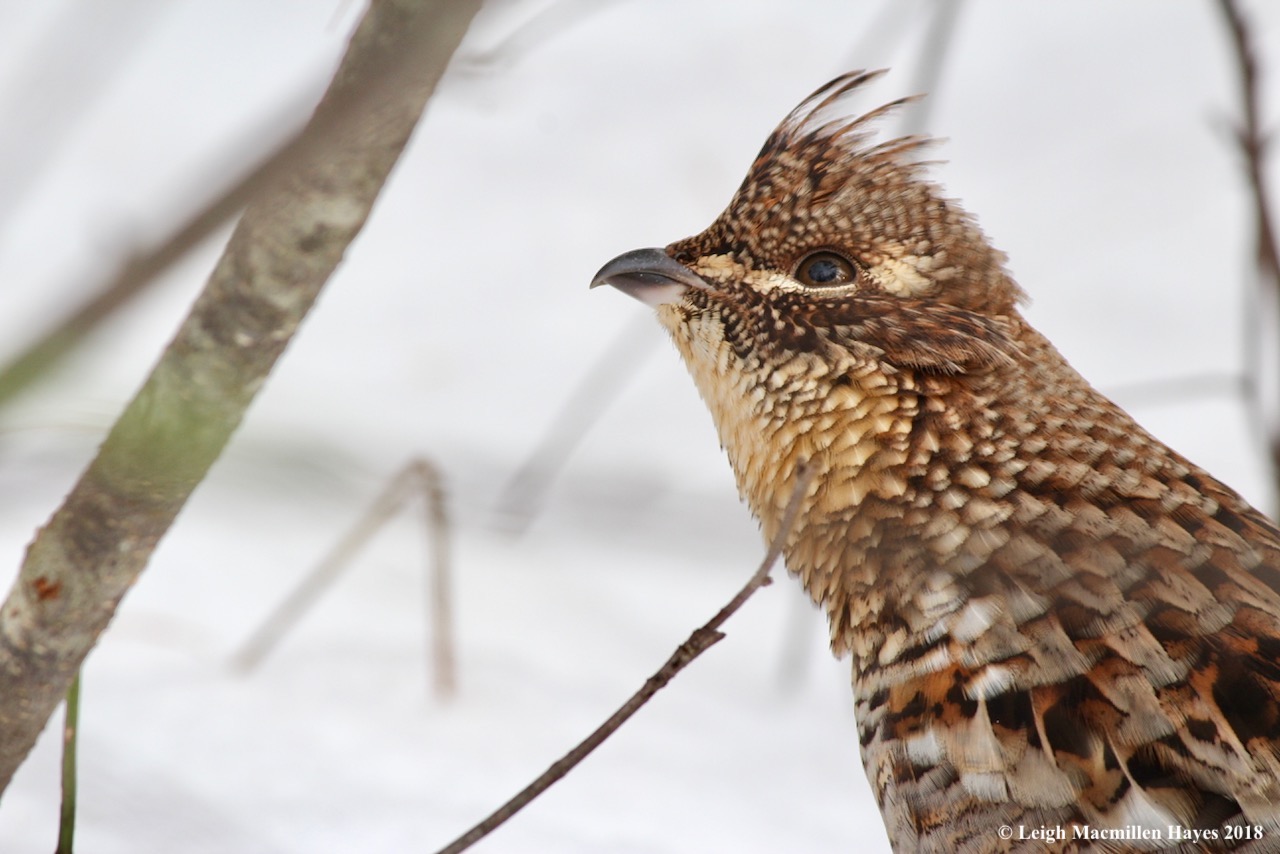
Here’s another look. And notice that beak–sturdy and down-curved for eating buds and twigs, the bird’s staple in winter. 

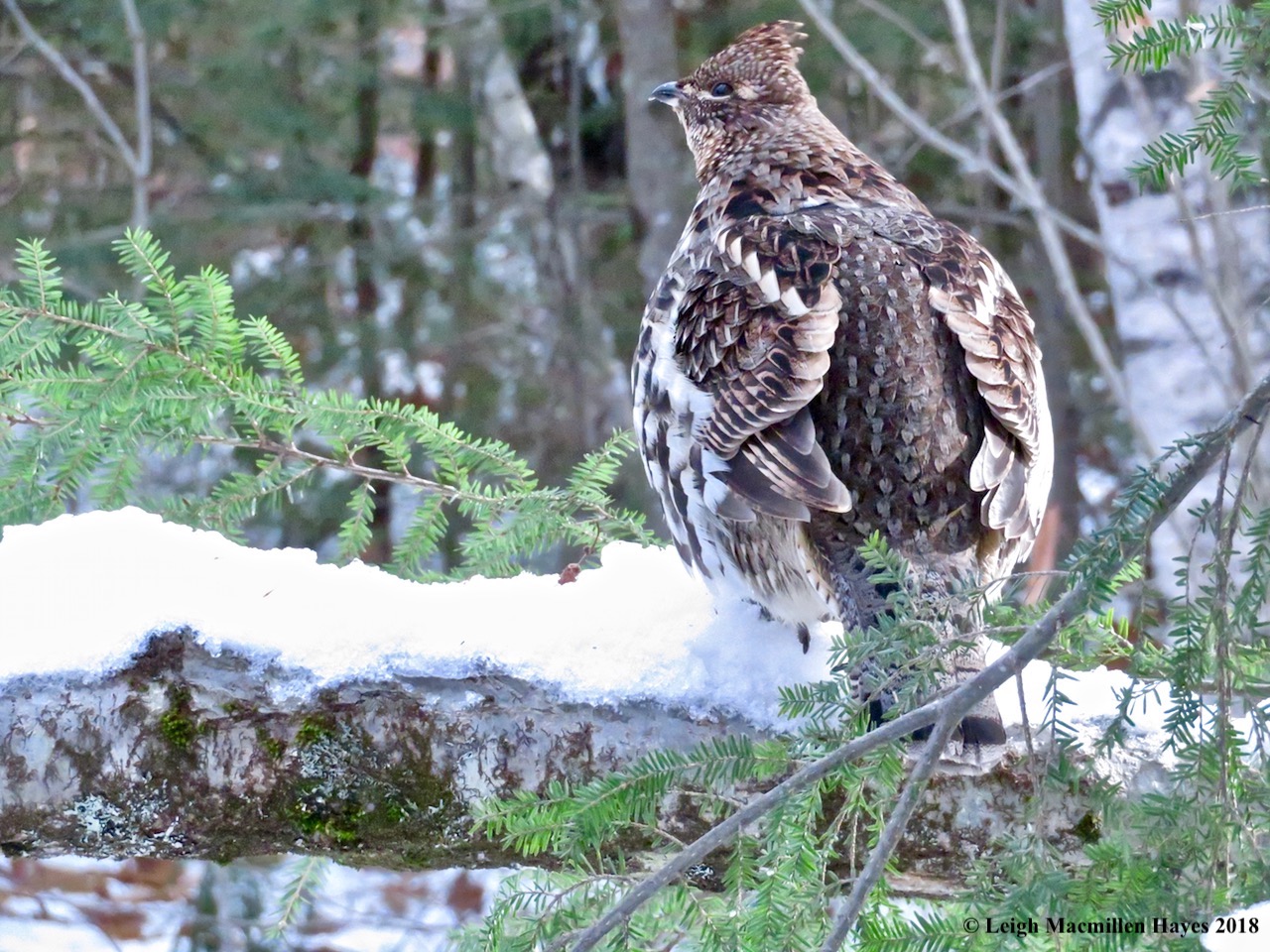
Survival isn’t easy for a Ruffed Grouse, but despite his affinity for people, ArGee knew to take cover occasionally and perhaps that is why he is still among us. That and maybe the fact that we’re honored to be in his presence and learn more about his species as we have the ability to study him. 

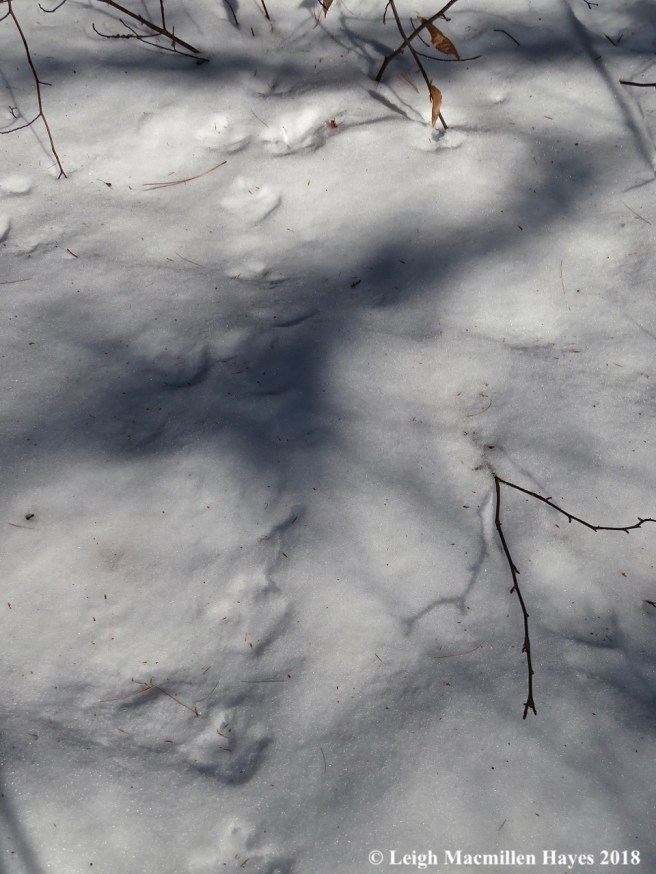
While I’d previously noted the comb-like scales on his feet that act as snowshoes and perhaps add stability somewhat like a porcupine as he’ll search for buds in trees once winter advances, today’s understanding included noting how ArGee moved–with one foot placed in front of the other. 

 I’ve seen it displayed in the tracks left behind including this old set we found further along, but watching the proximity of one foot to another as ArGee moved added a vision and understanding to the signs left behind. 

Sometimes it seemed the feet were practically touching and other times there was a bit of space between them. Then again, at times ArGee paused and that seemed to be when his feet where closer together and other times he marched or ran beside us and there was a bit of distance between the two feet. 

Our time with ArGee lasted maybe a half hour or less. And he wasn’t always puffed up to stay warm. When he returned to his original size, his chicken-like form seemed more apparent.

Always, he searched for buds to consume. Ruffed Grouse have a special internal adaptation, most helpful for their winter diet–similar to that of deer and moose, which is rather funny when you think about the fact that most Ruffed Grouse burst out of the snowpack and scare the daylights out of us as we approach and make our hearts beat rapidly as we’re certain we’ve encountered a moose. Maybe they should be named Ruffed Moose instead.

So back to that internal winter adaptation: they store food in their crops (esophagus) until later and then within their bodies are two offshoots of their intestines, called caeca, which grow enormous each autumn and allow them to break down cellulose so they can get nourishment from the woody aspen and birch buds that they prefer. Come spring, the caeca atrophy for the warmer months.

Our lesson from ArGee ended in much the same time frame as it usually does, but he left us wondering all the same. After we’d spent time moving and stopping together, suddenly he started to gently attack the backs of our legs. It was at a spot that seemed to delineate his territory given past experiences, but why the attacks? Did he want us to leave? Not leave? Were we suddenly seen as the aggressor? All along he’d seemed as curious about us as we him and so we were left to ask questions which we did for the rest of our journey. But wow. We were given the opportunity to wonder. 

And wonder we did. What did ArGee see in us? 

And what was he thinking? 

Bird brain? What passes through it? We may never know, but we do know that our lives were enriched and the landscape is alive. 

P.S. Pam and Bob–this one is for you! Wow! 

Boothbay Aglow

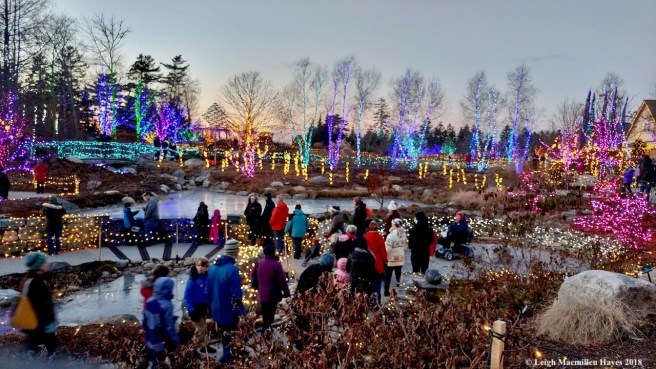
Yes, it was the Coastal Maine Botanical Gardens that drew us to Boothbay and Boothbay Harbor this past weekend, but we found the Christmas light show to be only a part of the attraction. 

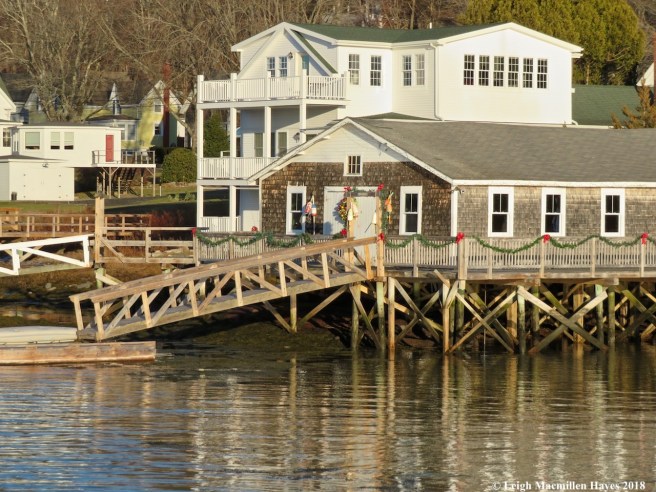
One of our favorite haunts in the harbor is the 1901 footbridge that connects the western and eastern sides of town. It’s renowned as being the longest wooden footbridge in the USA. And so as my guy settled in to watch a football game before heading off to the gardens, I set off to stretch my legs, the bridge being only a block or so from our “front” door. 

We’d booked a brief stay at The Harborage Inn, where our wee room was quiet and comfortable and we especially loved the pillows! Huh? I’ve become a bit of a pillow connoisseur in recent months–well, not really, but I know what I like and what I don’t and I wanted to take the pillows from our room home. But my mom would be proud for I refrained from stuffing them into our bag. 

Standing on the bridge, I could look north (or was it south for so confused do I get when I’m on one of Maine’s coastal fingers), and see our “place” and its dock, the last in line. 

Halfway across the bridge sits the bridge house, which has served many functions from bridge tender’s house to art gallery, and it’s accompanied with rumors of a prominent position during Prohibition when rum was smuggled through a trap door. This weekend its only activity was to provide a Christmas postcard look. 

Actually, much of the town was decked out in Christmas finery. Greens and reds and golds and a variety of other colors defined this seaside locale. 

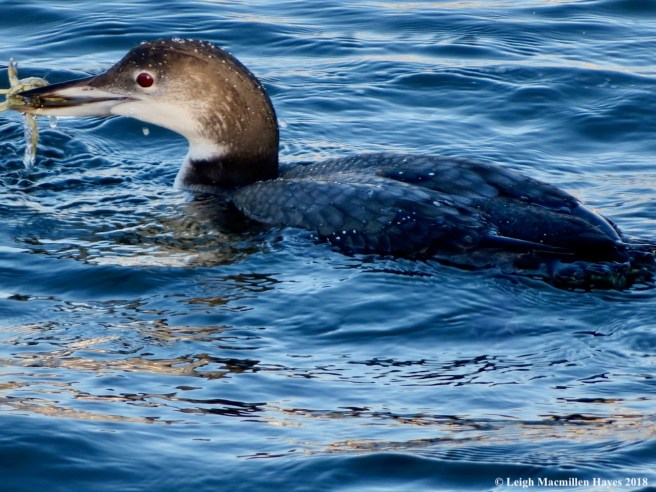
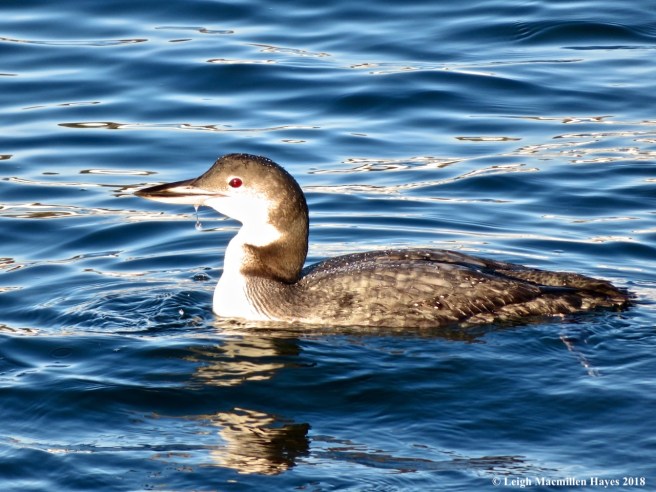
But . . . others had their own display to share, including a non-breeding loon who spent some time by the bridge. 

Though I stood still, it was in constant motion like the waves that surrounded it. 

There was a reason–feeding time! The water shallow, a crab was captured in a flash. 

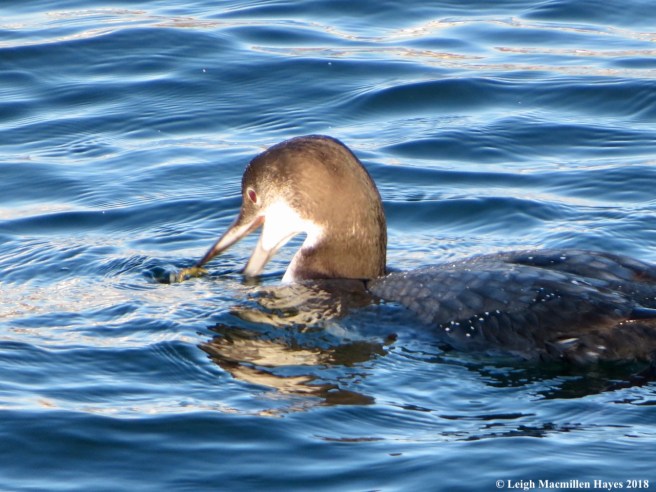
And then played with–dunk . . . 

toss about with a happy face, . . . 

dunk again, . . . 

grab, . . . 

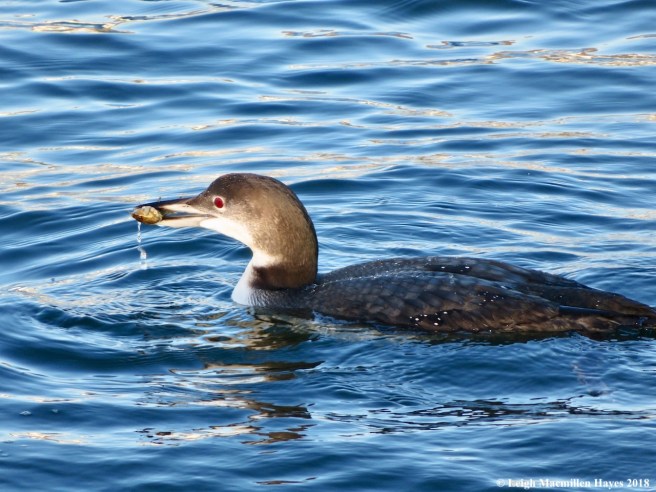
let hang out of the mouth much like a teenager does a mouth guard, . . . 

toss in the water one more time, . . . 

and then swallow. Notice the bulge in the loon’s neck? And the glow of the sun on its bill? 

A final gulp and the crab was completely consumed. A meal complete. 

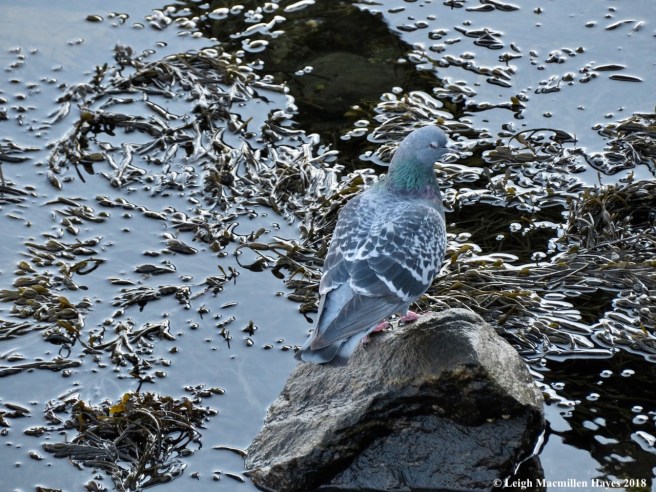
Finally, back across the footbridge I walked and near the shore the pigeons drew my attention. Okay, so they are pigeons. But I’ve said it before and I’ll say it again, they are rather exotic. 

And curious. And colorful. Pay attention to the colors. They provided a foreshadowing of what was to come. 

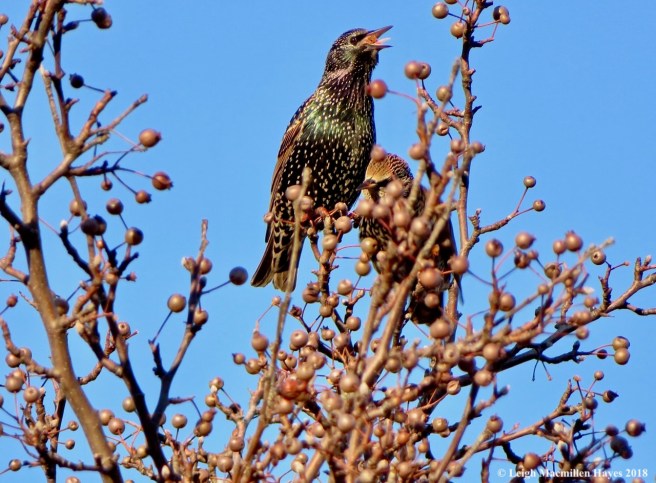
On Main Street another exotic, aka invasive, caught my attention by its song–that of the Eastern Starling. But those colors–again a sheen and pattern to admire. 

There were more traditional colors on display everywhere for this is a season that Boothbay has embraced. 

Back at the room, my guy was ready to depart for our next destination, but he had his radio and ear buds ready so he could listen to the Patriots football game. 

We’d no sooner stepped onto the property of the Coastal Maine Botanical Gardens when I heard him exclaim. Apparently the Patriots lost on a play gone afoul, but you would have thought it was the end of the world. Despite that, he quickly turned his attention to New England’s brightest and most colorful display.

We arrived for the 4pm entry so we could watch the world transform before our eyes. 

The sun set as we moved from one section of the garden to another, remembering along the way our past visits in warmer months. Typically in summer and early autumn our eyes were drawn to the display of colors from foot to hip, but on this evening, it was from foot to sky that we needed to note. 

With every minute that passed, the scene changed and we were grateful to our friend Marita for the suggestion to arrive at 4 and watch the transformation. 

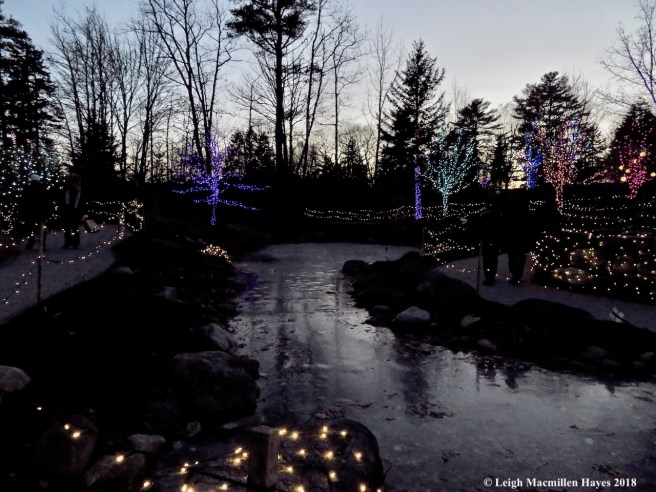
Silhouetted trees and iced reflections enhanced the experience. 

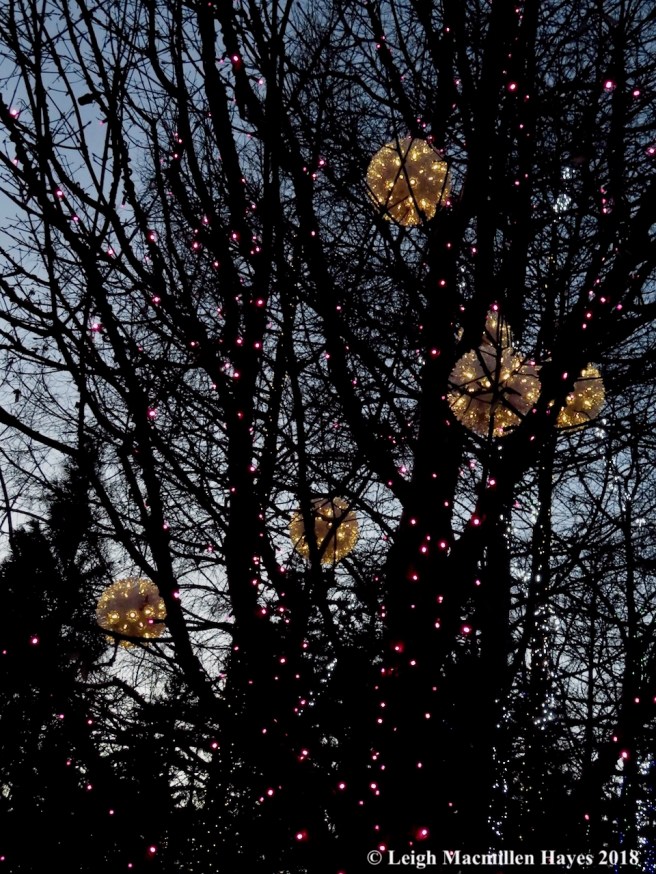
We were wowed by the fact that over 650,000 light bulbs had been strung to create such a scene. How? When? Who? We learned the next morning from a local gentleman with a handlebar mustache who pulled up a chair to join us for a chat before our breakfast arrived at a local bakery that volunteers help, the process begins months prior, and the locals are invited to attend for free one night before the event opens to the public. 650,000 bulbs. My hardware guy tried to fathom that sale. 

In the twilight, beauty shown. 

But it was in the darkness that magic beset the scene. And even though we moved among thousands of people, we managed to find spots to ponder the glory. 

Our initial journey lasted about an hour and then we spent an hour more circling about again, revisiting favorite spots before taking our leave. 

If you go, note where you park! Yes, that’s a warning. We thought we’d walked further to the entrance than we had. Thank goodness we remembered a few key features about our parking spot. Periodically, we did press the key fob as we looked for familiar lights to come on. At last . . . success. 

The next morning found us up and out early, again enjoying the footbridge, though it was a bit slippery with frost. 

I walked across, but my guy chose to run. Can you see his breath? 

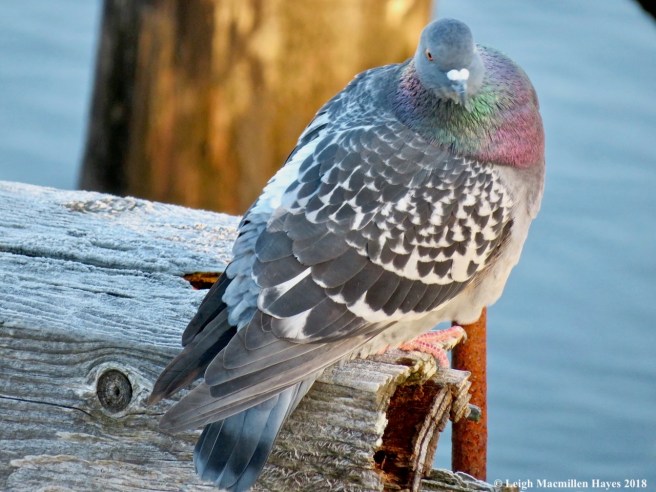
And yet again, it was the pigeons that pulled me in. Notice the color of those neck feathers. 

And the need to puff up in an attempt to keep the cold at bay. 

I’m always amazed how birds can transform from their skinny selves to plump renditions in an effort to keep heat in and stay warm. 

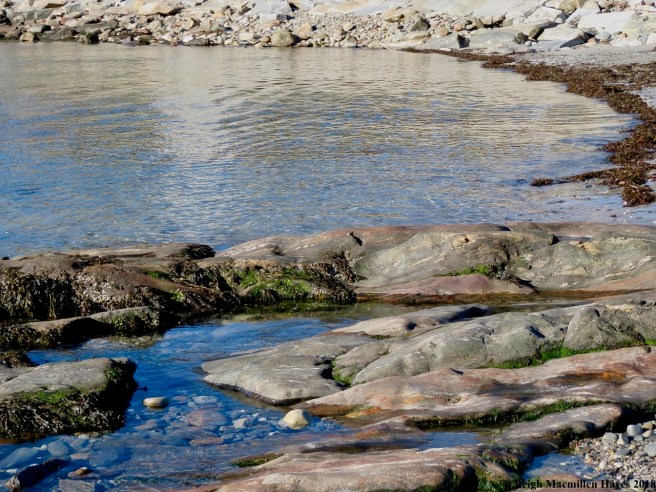
Again, those neck colors. Don’t they remind you of the nighttime display? 

And then I found them reiterated in the rocks below. 

I could have stayed on the footbridge forever (perhaps I should move into the bridge house), but at last I moved off. Not before, however, marveling at the lobster buoy decoration that marks the bridge’s center. 

And the town reflected upon the calm water. 

My walk continued along water and some town roads. And I had to chuckle for though I wasn’t haunting my usual neck of the woods, old friends still made themselves known. 

I did note some differences. In the woods, a red squirrel chooses rocks or downed trees or sawed off tree trunks upon which to dine. Beside the water, apparently any railing will do. 

The mergansers seemed to have arrived not too long before us for just a week or so ago I saw a large flock of them on Kezar Lake in Lovell. Was the middle one getting the last laugh in my honor? 

And then there was a crow who shouted, “Har, har, har,” over and over again. And I heard a woman respond to him and thought he must be a regular. He seemed soooo black in this town of so many other colors. But apparently he had his own colorful character to maintain. 

Colors. Everywhere. Into. The. Focal. Point. Coastal Maine Botanical Gardens. Gardens Aglow. Worth a visit. Just remember, it’s more than the gardens. And even more than I noted. Boothbay Aglow. 

When You Go

My goal was simple. Walk the blue trail at the Greater Lovell Land Trust’s Chip Stockford Reserve and add a few more decorations to the Christmas Tree. 

If you recall, two weeks ago the Fairs, Farms, and Fun Homeschool 4-H Group decorated a tree(s) as part of the Maine Christmas Tree Scavenger Hunt.

Their biodegradable ornaments were mighty tasty, smeared in peanut butter and bird seed much to the good licking of birds, squirrels, and deer. 

Since the first decorating party, we led a fun walk where participants adopted a scavenger hunt attitude and examined all evergreens along the way until they spotted the special tree(s). And then, because we’d packed more peanut butter and bird seed, and some of the youth had gathered pinecones on the way, we spent time creating new ornaments. That was on Saturday. By Monday, those had also disappeared. 

 As has been the case in the past, only the hearts cut from fallen birch bark remained. 

Taking a tip from our neighbors at Western Foothills Land Trust, which is also participating in the Maine Christmas Tree Hunt, I added orange and apple slices to the tree(s) and a few higher branches. 

I hope you’ll challenge yourself and your family and friends to go on the hunt.

I also hope that some of the ornaments will still be there. But if not, know that the mammals and birds are dining in style. 

In fact, their style reflected in scat I found included more than the offerings we’d supplied. On this rock, it looked like the local staghorn sumac had provided some nourishment. 

That wasn’t the only scat in the area. It took me a moment to realize what I was seeing atop the snow. The scat of larger birds also decorated the trail and I wondered what predators might be about. 

So here’s the thing–when you go in search of the tree (or on any walk in the woods) take some time and look for scat. And while you’re at it, see what else might draw your eye in. 

Maybe you’ll spy an empty sawfly cocoon. 

Or one that will protect the larvae as it pupates within over the winter months. 

When you go, look for the unusual among the usual. I found this pine tree snag that struck me as most intriguing. How tall had it grown before its life tumbled down? 

No matter. What did matter was that its whorled limbs still reached outward in star-like fashion. 

And inward as well. 

Above, its kin stood tall. 

When you go, make time to enjoy the scenic view opened this past summer by staff and volunteers. 


When you go, look for interesting sights like this one, where one pine embraced another. 

Pines typically self prune, but these two chose to keep their lower branches and snuggle together for the rest of their lives. 

So close did they grow that the “arms” of the tree to the left had grafted to the tree to the right so that their hug included shared energy. 

When you go, look for the other old pines along the stone wall–those that grew up when the landscape was more open and their structures could stretch out more than up. 

And below them, notice the squirrel middens. I wasn’t sure there would be many middens this year since it wasn’t a mast production year and few cones had formed.

When you go, let your imagination see the discarded pine cone scales and cobs as toppings on a bowl of ice cream. 

When you go, look for the amber nuggets of pine sap hardened on old bark. 

When you go, if the apple slices remain on the tree(s), notice the star shape of the core. 

When you go, look for all of these . . . or better yet, make your own really cool discoveries. 

I do hope you’ll go to the Chip Stockford Reserve or any of the three other sights in western Maine where trees are decorated. But . . . if you can’t go here, go somewhere. And when you go . . . have fun! 

A Sign of Hope

We’ve entered that season many of us know as Christmas; a time of year when hustle and bustle can so easily overtake our lives. As youngsters, it was our desires, our longings, our yearnings that became the focus of our lives during the month of December. We thought we wanted, in fact needed, that pair of ice skates or that furry hat with the pom-pom balls at the end of the ties. At least, those were my desires when I was ten and eleven years old. 

In fact, I coveted that hat to the point where on Christmas morning I snuck down the hall to the living room and peeked into the gift bag with my name that sat under the tree. I was at once delighted/disappointed. Yes, Mom and Dad had fulfilled my wish and I would look like the other girls at school who donned such; but . . . the moment of surprise was gone and I’d have to feign my excitement. I don’t remember if it ever dawned on me that the hat was just that–an expensive, fancy covering for my head. One I didn’t need given that Mom loved to knit hats for us.

And then there were the Christmases that my guy and I bent over backwards as we tried to create a special day for our sons. And as we all know, the empty boxes were the best toys of all. 

Now, as I take an honest look at my past and wonder about the future, I realize that my attitude has shifted. No longer is it a frenetic, mad dash for the best deal or piece of plastic. My life has taken on the form of slowing down, noticing, watching, even in the darkness. 

And it was in doing so yesterday and today, that I realized something rather special in the ordinary. 

We’ve all become used to seeing wild turkeys on roadsides, in our yards and occasionally even up in the trees they fly to when danger lurks or  nighttime falls. But . . . think about it. Meleagris gallopavo, that fancy scientific name, have been the comeback kids since farms of yore reverted  to forest, thus allowing these large birds to reestablish in their former range. 

Because I put bird seed in feeders and spread it on the ground, the neighborhood turkeys stop by for an hour or two at least twice a day. 

And they aren’t the only visitors to the feast, for red . . . 

and gray squirrels also take advantage of the free meal. 

But it was the male turkeys upon whom I focused much of my attention for it occurred to me today that they were unicorns in their own right. Unicorns had a single horn protruding from the center of their heads, right? Okay, so maybe its a snood. But still.

As for their magical powers, have you ever noticed that a male’s featherless head of blue and pink and red raised bumps called caruncles change colors with his moods?

Shifting my eyes to the back of the shanks or leg, the unicorn theme was reiterated in the form of a pointed spur. 

The theme again was repeated behind the toes, where a claw stuck out on its own in the area we might call a heel.

Check out the bottom of that foot, its bumpy surface much like a no-skid sock. Certainly there must be more magical powers protected within.

From behind a window in the back door that served as a bit of a screen, I watched the feeding station without disturbing the activity. The squirrels and male turkeys (their rafter ranging in size from 9 to 13 depending on the hour), devoured the sunflower seeds. 

It appeared to be a blissful co-existence. 

Until it wasn’t. The gray squirrel was the aggressor. 

Every few minutes, it took a flying leap and so did the young jakes and older Tom. 

Simultaneously, other gray squirrels decided to show off their own super powers, such as finally scaling one of the poles. Too bad I hadn’t put a suet feeder on it yet. 

He moved on to the bigger feeder–jumping first onto a baffle intended to keep him out. From there, he reached the top of the squirrel-proof feeder, and . . . um . . . 

proceeded to open the cover of the seed tube. 

The interior must have seemed like manna from heaven. 

Into the inner sanctuary he descended. 

His super powers included his ability to debunk “squirrel proof” and perform a disappearing act–almost. 

The day continued and so did the turkey and squirrel activity. And then, as the turkeys were moving away, a healthy red fox climbed over the stone wall, walked among the turkeys and paused. The squirrels again performed a disappearing act and were silent for once, but the turkeys didn’t appear threatened. Perhaps the fox was sated for the moment. 

In the case of the turkey, and yes, also the squirrels, we complain there are too many. But, we should give thanks that we’ve created an environment that’s conducive to successful turkey breeding. As for the explosive squirrel population that resulted from last year’s mast production of pine, beech and oak fruits, the red fox is on the hunt. 

At the end of the day, calling a turkey a unicorn is in the eye of the beholder. But, in his own form of handsomeness, he portrays a similar sign of hope.

As the holiday season continues, I hope you’ll also make time to watch . . . and be attentive to other signs of hope. 

Stepping Out For Others

With the most recent snowstorm now history, I strapped on my snowshoes this morning with a sense of eager anticipation about the possibilities. And then it hit me like the snow plops that fell from the trees and landed on my head or slid down my neck: I could do this while others could not and it was for them that I needed to focus. 

I hadn’t gone far when my first moment of wonder stood before me. Actually, just prior, I’d been looking at some pileated woodpecker works–ever on the search for the bird’s scat, and in the process had noticed other bird scat soiling the snow. But . . . what was all the amber color? 

Had snow collected on mushrooms that decorated the bark? If so, why hadn’t I seen them yesterday or the day before? 

Upon a closer look, I realized it was sap. But why the big clumps? And why so much on a dead snag? 

I poked it with my finger and found it to be of snow consistency. And so . . . the mystery remained. But it was certainly worth a wonder and I knew that those I was intentionally walking for would appreciate the sight. And yes, I did see plenty of other examples of dripping sap at the base of trees, but nothing like this. As usual, if you know what was going on, please enlighten me.

My next moment of wonder was one that always gives me pause–and again I knew that my friends would feel the same. A miniature evergreen world momentarily encapsulated in a droplet of melting snow. 

Everywhere, the meltdown offered a variety of shapes and designs, each worthy of reverence . . . and a photograph, of course. 

One of my favorites was plastered to a tree in such a way that it looked like it was flat against the bark until further study revealed otherwise. As it melted before my eyes, its ever changing formation resembled a series of little flowers scattered here and there. Just maybe you have to see that through my eyes. 

And then I stumbled upon another mystery–a web of sorts like Charlotte might have woven? I studied the shrub and found numerous examples of a similar pattern, but no arachnids in sight. Besides, the silky lines seemed too thick. But, what could it be? It took me a while as I studied the area and then I remembered. Before the snowstorm, I’d taken some photographs of the winter structure of a thistle. The storm had knocked down the fruiting form, but I think my gaze was upon the filaments that had served as parachutes for the thistle’s seeds. 

My journey into the winter wonderland continued, though not all the trees along the way were fortunate to withstand the weight of the snow that was quickly melting. It sounded like a rain storm as I walked under the arched branches. 

At the the other end of the snow tunnel, I emerged into a field with its own offerings. Typically, I pass by, but today I was inspired by those who virtually walked with me to explore. And I don’t think they’ll be  disappointed by the findings. First there was the Goldenrod Ball Gall. The round gall occurred in the middle of a stem, the top of which had broken off. In the spring, the Goldenrod gall fly laid her eggs on the stem. Hatched larvae chewed their way into the stem and the gall started to develop. And from the looks of the hole on the side, it appeared the creator had chewed its way out and flown off. 

Also in the field, a Rose Bedeguar Gall, aka Robin’s Pincushion Gall on Meadowsweet, which happens to be a member of the rose family. Burrowing in to the leaves and stem of the plant was a two-fold offering for the fly larvae it hosted, for the insect benefited from the nutrients while it was simultaneously protected from predators. 

There were also numerous examples of a structure that might baffle the onlooker. Beaded formations of the fertile stalk from a Sensitive Fern poked up through the snow. Typically, the beads or capsules remain intact with their brown dust-like spores waiting inside for the structure to break open during the rains of early spring. 

I moved on from the field and eventually reached a wetland that I couldn’t cross. But, I could stand and listen and so I did. All around me the forest orchestra performed its Plop, Plop, Swish, Plop, Splash symphony. 

 At first, it sounded and looked like I was surrounded by a million wild animals, but really . . . all the sound and sights were a result of snow falling, either gently with a whisper of the wind or harshly with a thud and splash. 

As I stood there looking for the million wild mammals, my eyes focused on the works of something much smaller. Insect egg tunnels on a dead snag’s trunk read like a story on paper. 

The longer tunnels were bored by a female Bark Beetle. From the sides of her tunnels, larval mines radiated outward. The overall design could have been an abstract drawing. 

At last  I started for home, thankful that I was retracing my steps for often new sights are revealed when one does that. And so, I believe it was a crust fungus and perhaps it was an oak curtain crust fungus, but let it remain that I discovered a fungus I don’t think I’ve seen before, with a warty, rust-colored underside and dark upperside. Suffice it to say, it was a mushroom of some sort. 

Along the way was a script lichen, which looked to me like someone had doodled. Commas and apostrophes decorated that page. 

And then, and then, Tetragnatha viridis, a green long-jawed orb weaver. I actually saw two of them. Typically, the translucent green color helps them camouflage amongst pine needles, their usual habitat, but they can frequently be seen on snow, especially if the temperature is in the 25˚-35˚ range as it was this morning. 

The orb weaver’s characteristics: eight eyes in two parallel sets of four; long chelicerae (jaws); enlarged pedipalps; long legs with spines; and that color–oh my! 

It was for eight parallel eyes that I walked today, the eight representing Jinny Mae, Dick, Kate, and Carol. 

Where trees didn’t cover the trail the snow was about fourteen inches deep and as you can see I chose the wrong boots and forgot my gators. But that was okay because I knew that I would eventually wander home and change my sopping wet socks. What mattered more was the fact that I was honored to step out for others when they couldn’t necessarily do the same. Here’s to the four of you–thanks for letting me be your eyes. 

Mondate Preserved

The other day a sign caught our attention as we drove to Overset Mountain and we realized we had new trails to explore. But, we, or rather I, drove by  so fast that we didn’t know which local organization owned the property. 

If my guy read these posts he would chuckle or guffaw at my comment about driving too fast for he is of a different opinion. But suffice it to say that we didn’t read the name of the land trust on the sign and so this morning I contacted Loon Echo Land Trust because in my online research, their name was associated with the property. Maggie quickly let me know that I needed to contact Lee at Western Foothills Land Trust and violà. 

Both have been involved in the Crooked River Forests Project for as is stated on the LELT website: The Crooked River has been identified as a priority for conservation as it is the largest tributary to Sebago Lake, with 38% of the inflow, and it offers local recreational opportunities and is situated above high quality sand and gravel aquifers. The river has been identified in the state’s Natural Resources Protection Act as an Outstanding River Segment with AA status; free flowing with the best water quality. This trout fishery is home to one of only four native populations of landlocked salmon in the state and is known to host one species of anadromous fish (American eel) and is thought to historically host Atlantic salmon and sea lamprey.

As I pulled up to the sign today, however, the ownership was obvious. The name, Two Bridges, was not so. The area has long been named such, and all we could imagine is that twin bridges once spanned the Crooked River in the area where we stood. 

Since the parking lot was under construction, for the property won’t officially open for another two weeks, we parked on Plains Road rather than Route 117 in Otisfield. 

At the start, the trail was wide and straight, and we both hoped for a change. Oh, don’t get me wrong. It was lovely and we had fun naming all the evergreens, including white and red pine, hemlock, balsam fir and red spruce, for those were the most abundant species, with a few young beech, red maples and red oaks thrown into the mix. But . . . we wanted diversity. And we wanted to walk beside the river. 

Soon, thankfully, we came to a Y in the road and a new sign post, or so we imagined it to be. We chose the trail to the right since it was closer to the water. 

And within minutes our reward awaited. That being said, we’d followed a spur to the riverbank and since there were no telltale pieces of flagging we suspected it won’t be marked as a public trail. 

Further along, we again spent time by the river, and noted its sculptures made of decorative roots . . . 

and splashes of ice. 

And in the mix–a rare sight indeed: an ice disc, this one being about three or four feet in diameter and spinning in an eddy. 

Eventually, the trail took us across a bridge constructed by the land trust in October 2017 that will provide the landlocked salmon and brook trout with another mile of spawning habitat.

And that’s not all. We saw plenty of evidence that mammals inhabit the space from deer . . . 

to fox . . .

to bobcat! 

There were several intersections, and we kept turning toward the river, which took us along trails more to our liking as they narrowed and twisted and turned through the forest. 

At one point, a tree arched over the trail and its purple crust fungi added a different color to the display. I think it was Phanerochaete crassa. 

My guy pointed out the hugging cousins–a white pine and hemlock and I was reminded of my finds on Black Friday. “I knew you’d like it,” he commented. He knows me well. 

Because we were in an evergreen forest, we noticed several examples of witches’ brooms. No, they were not the variety that one might have expected on Halloween night. Instead, dense masses of shoots rose from a single point on an otherwise normal branch and created a nest-like structure. Their cause: fungi, viruses, bacteria, mites or aphids. 

Speaking of the latter, aphids created the cone galls we knew as witch’s hats on witch hazels that grew near the river. The little structures provided both food and shelter for the critters that developed within. 

We also spied lungwort on a few hardwoods, its leafy structure springtime green as it photosynthesized in response to the flurries that floated earthward during the morning hours. 

And then the forest’s canvas began to draw our attention, from snowcapped artist conk (Ganoderma applanatum) fungi . . . 

to icy reflections, . . . 

man-made sculptures, . . .

and dazzling trail markers. We spied another made of pipe cleaners and a soggy feather and wondered.

We didn’t walk the entire trail system, but left knowing that we’d return for further explorations. 

Because we were in the neighborhood and my guy had never seen it, I drove along Plains Road to the Ryefield Bridge. Listed on the National Register of Historical Places, the structure was built in 1912 as a double-intersection Warren truss bridge. 

The bridge spans the Crooked River between Harrison and Otisfield and is still used today. In fact, we walked and drove across it. 

One of our favorite parts was the sign at the top, which not only stated the construction company, but also honored the selectmen of the day. 

My excitement about the bridge was equally matched by some prints I spotted when I stepped into the snow to take a photo from the river bank. Beaver prints! Like the ice disc in the river, beaver prints have always been a rare find. Often, I can see their pathways, but not decipher their tracks for their tails swish out the features. 

But today, not only the tracks and a trail down to the water, but beaver chews, their snack sticks, left behind on the ice. 

We took one final look before heading home–Crooked River framed by the bridge. And we both gave thanks on this Mondate for a land and a bridge preserved. 

Overset Point of View

Winter hiking is our favorite, but what to wear on our feet is always a question. Today, we chose our hiking boots over winter boots and micro-spikes rather than snowshoes. 

We trusted L.L. Bean would have approved, especially given that we would be hiking in his hometown of Greenwood, Maine. We were, after all, wearing hiking boots purchased in his flagship store and various other products featuring his name. Don’t tell him that while our snowshoes, which remained in the truck came from his place, we’d purchased our micro-spikes at EMS. 

Before turning onto Willis Mills Road and heading toward the trailhead parking area, we first past by a cemetery of sorts, where old trucks and various truck-related equipment have gone to rest. 

And then, in a matter of minutes we were on the trail and our focus changed to all things natural, including weasel tracks. Notice the diagonal orientation in the pattern. 

It made perfect sense to see weasel prints because we were near the Sanborn River and though I didn’t take the time to measure them, but the size of the straddle I assumed mink. 

For over a mile we walked beside the river and loved the sights and sounds it offered, and especially the splash-created icicles. 

When we weren’t focused on the river, we noted its neighbors including snowshoe hare prints that were rather fresh. Some will remember that I refer to them as snow lobsters, for quite often the impression of the four feet (front two being their hind feet which swung around and landed parallel; back two on an angle being the front feet) looks rather like the large marine crustaceans visitors often equate with Maine. 

With David Brown’s Trackards as a reference, it was easy to imagine the hare’s motion. (Note: visit my book review linked to Trackards in the sentence above and you can locate David’s website. His books and ID cards are available for sale and he mentions that you can get a good deal just in time for Christmas.)

It wasn’t only tracks and ice that drew our attention. As we crossed from the river to the pond via a connector trail, we noted a huge burl that looked like two bear cubs holding fast to a paper birch.

Along the way there were also some examples of my favorite shrub, hobblebush. We always refer to their buds as being naked for they aren’t covered in waxy scales like most. And look at those leaf and bundle scars. Following them down the twig, its fun to note the changes in age from the fresh tan scars to the two below getting grayer and more wrinkled in age–much the way we do. 

As we continued on, the snow depth increased, but fortunately a family of four had passed through before us and created a trench. 

We knew we were close to the pond when we began to see canoes tucked among the trees and snowed in for the season. I’d say “for the winter,” but winter is still a month away. 

At last, Overset Pond stretched out before us. 

And Overset Mountain in the background became our next destination. 

But first, we had to walk the length of the pond as it narrowed, and then cross over a series of bog bridges below an old beaver dam. 

As I waited for my guy to get to the other side before I ventured forth, I noticed something on the dam that brought yet another smile to my face. 

But first, I had to get to the other side–which I surprised myself and did without hesitation. Prior to this crossing, we’d walked on at least ten other bog bridges, some easier to conquer than others. This was the longest and featured several different levels, but we were both successful in our attempts. 

And so I rewarded myself with another look at the dam–and the otter slide that crossed up to the pond. Do you see the otter’s prints? 

Feeling great about the crossing (because I’d been dreading it), we began the upward climb. Our spikes were a good choice because they gave us some traction on slippery leaves and rocks, but they did gather occasional clumps of snow. We got into the habit of banging them against any available rock to declump the frozen snow. As we moved upward, the snow depth deepened to about a foot. 

The family we’d passed on their way out had told us the mountain had been challenging, but they had neither snowshoes or micro-spikes and we could see where they’d slid frequently on rocks hiding below the snow. We moved with relative ease even as our heart rates increased and at last my guy looked down over his kingdom. Actually, it’s the kingdom of Mary McFadden and Larry Stifler. Through their generosity, many trails in the area are open to the public. And through the work of their employee, Bruce Barrett, those trails are well maintained.

Below . . . Overset Pond in the shape of a heart. What’s not to love. 

After a brief apple and water break, we began our descent on the loop trail. The trees growing beside and on the boulders reminded me of the truck graveyard . . . naturally. 

Our overall descent passed quickly. In no time at all, we came upon more canoes swamped with snow. 

At last the trail came to an end and we followed a snowmobile trail for at least a mile back to the truck–our six mile journey completed. 

We’d planned to enjoy a brew and burger at Norway Brewing Company after the hike and were thrilled with our choice. He sipped Life’s a Peach on the left–a new brew just released today and made with Maine peaches. My choice on the right–Left Turn. 

We played Rummy while we waited and then ate our burgers with gusto. We knew they’d serve as lunch and supper, a meal we’ve named lupper in the past. 

At the end of the day, we were beat (still are) but happy. Thought I’d hoped to see some wildlife other than the occasional squirrel, that wasn’t to be. But we saw plenty of tracks and I was especially pleased with those of the weasel, hare and otter. 

And, of course, the tree trucks!

The Overset Point of View–worth a wander. 

Jolly Mondate

Some Mondates are meant to be shared and this was one of them for I’d made arrangements to join the Fairs, Farms and Fun 4-H Group as they decorated a tree (or two or three) on a Greater Lovell Land Trust property this morning. 

And honestly, my guy was as excited as me to join the adventure for he loves kids.

One of the GLLT’s volunteer docents, Juli, had offered to lead today’s hike since her four children are part of the group. And because she’s a Maine Master Naturalist-in-Training, she made evergreen trees the focus as she explained when we circled up.

All together there were fifteen kids–fourteen of them walking and one young babe tucked inside her mom’s coat. At least I think there were that many. Every time I counted, the number seemed to change. 

After Juli’s initial explanation, we headed off onto the trail. Though most of us sported blaze orange because it’s hunting season, we made enough noise to announce our arrival to deer and their predators within range and beyond, I’m sure. 

We’d gone only a wee bit, when Juli stopped the group to ask them about evergreens. My guy and I were impressed with their collective knowledge.

But it wasn’t only for the trees that she stopped. She’d spied a decoration already dangling and asked if the kids knew how it happened to be there. 

What was it? A mushroom. Did it fall from the sky? Or from a taller tree? No and no. Instead, they figured out that a squirrel had deposited it and Juli explained that red squirrels place mushrooms in trees to dry. Or rather, freeze dry as was the case. 

She hadn’t walked much further when she stopped again. And again asked some questions as she showed off the five needles in a white pine bundle. 

Five needles in each bundle makes it easy to remember as there are five letters in W-H-I-T-E, the color of Maine’s State Tree: Eastern White Pine. 

It wasn’t all a lesson for the name of this 4-H group includes the word “Fun.” And so they climbed atop and under an erratic boulder and added more life on a rock than that one had seen in a long time. 

A little further on a bit of an incline invited their exploration and what to their wondering eyes should they discover but a long abandoned cellar hole with trees growing in it. For a few minutes that became their playground. 

It took us a while to move along because the kids kept finding cool things to admire, including a variety of mammal tracks and . . . even a dead spider. 

What do you see? Lots of eyes. 

And you? Fangs. 

And you? Hairy legs. 

After that discovery, we had to run to catch up with the rest of the group because they were on their way to the scenic overlook. But one of the boys had borrowed a GLLT Nature Backpack from the Charlotte Hobbs Memorial Library, which I was thrilled to see, and we used the lucite insect box with a magnifier that was stored in the pack so that all the kids could look at the spider up close if they so wished. 

And then it was time to decorate a tree. But first, Juli had the kids identify three types of evergreens in the same vicinity: spruce, hemlock and balsam fir. Their decorating began with the balsam fir. 

One by one, they attached homemade, biodegradable ornaments. 

And added a tree topper in the form of a birch bark “sleeve.”

Some were hearts cut from birch bark . . . 

and coated with peanut butter and sunflower seeds. 

It took great concentration. 

In no time, the tree was fully decorated.

Some changes had to be made. For one, one of the younger boys wanted his ornament to serve as a tree topper, so the birch bark sleeve was placed in a resting place on another tree. 

And then the kids decided to decorate any branch in the vicinity that attracted their fancy.

At least one needed a boost, but that’s what someone else’s mom was for when your own mom was busy with your baby sister. 

Branches all around certainly won’t feel left out. 

And no mouse or bird or squirrel or deer will go unfed. 

The kids quickly realized that they’d created a critter cafe that even included an offering tucked between two hop hornbeam trees. 

At last, the decorating had come to an end and the crew posed for photographs. 

Our journey back to the parking lot was the same distance as we followed the rest of the one-mile loop, but we travelled much more quickly. We did pause once in a while, however, especially in a grove of young white pines, where the kids practiced aging a tree. 

They knew to begin with 5 for the number of years it takes the seed to germinate and begin to grow and then to count the whorls of branches, each whorl representing one year. 

My guy challenged them to find one that matched his age. They found one that was 43–only off by 20+ years. But a few noted that it did match their dad’s age. I chuckled for I’d had that particular dad in class way back when he was in middle school. 

We were almost done when they made one last discovery–ice! Their very own rink. One little boy wanted to live there so he could slide on the ice all day. And then jump in the water come summer. We didn’t have the heart to tell him that the ice was a result of our rainy October and its not a permanent feature. 

 It was lunch time when the group was finally ready to depart. 

All the way home and even still, my guy and I have been smiling about our morning and the fun we had sharing it with the kids and their moms. Thank you Juli, and 4-H leader Wendy, and all of the homeschooled kids who attended. We were blessed by the opportunity to spend a few hours with you on the Jolly Mondate. 
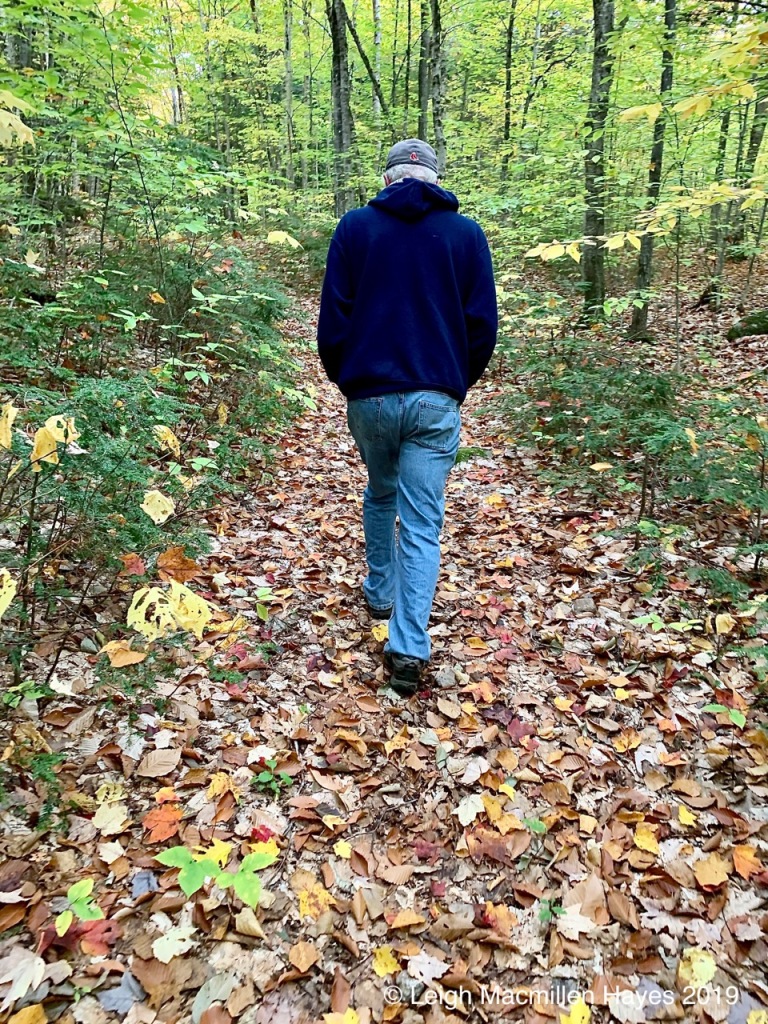
Nothing to Grouse About

A week ago I shared a unique experience with five other naturalists, the majority of them in the six to eleven age range. For twenty minutes the six of us watched a Ruffed Grouse at it moved about, overturning leaves and foraging on buds. When we last saw it, the bird headed off in the opposite direction that we intended to journey, and so we moved on with wonder in our eyes and minds.
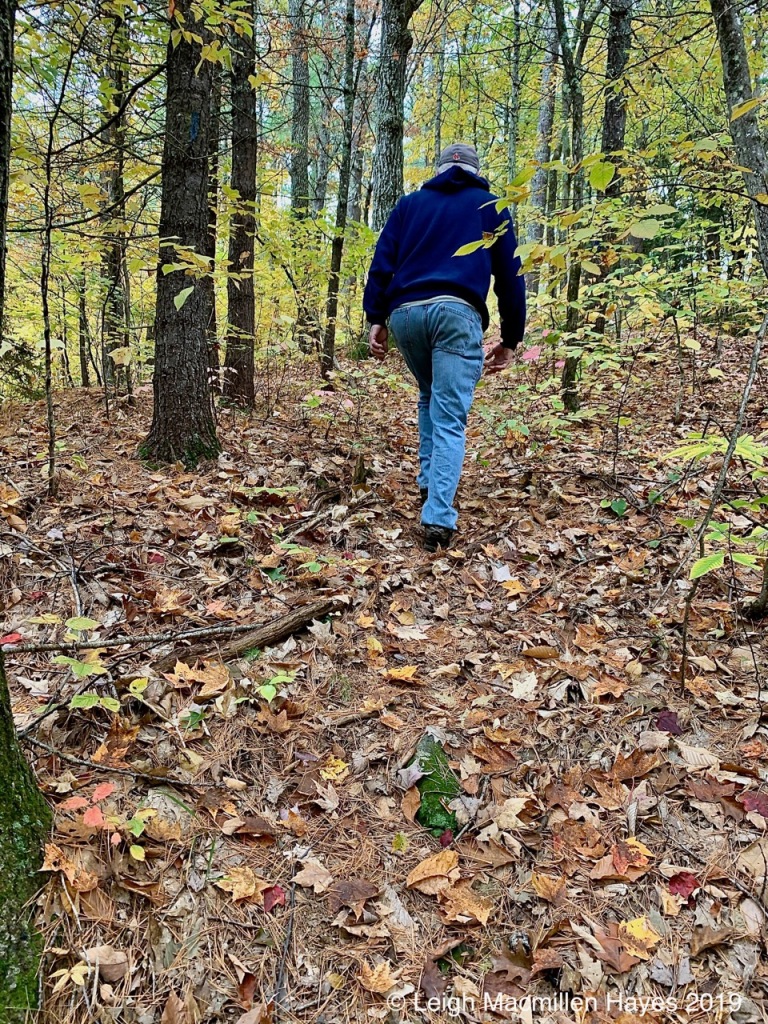
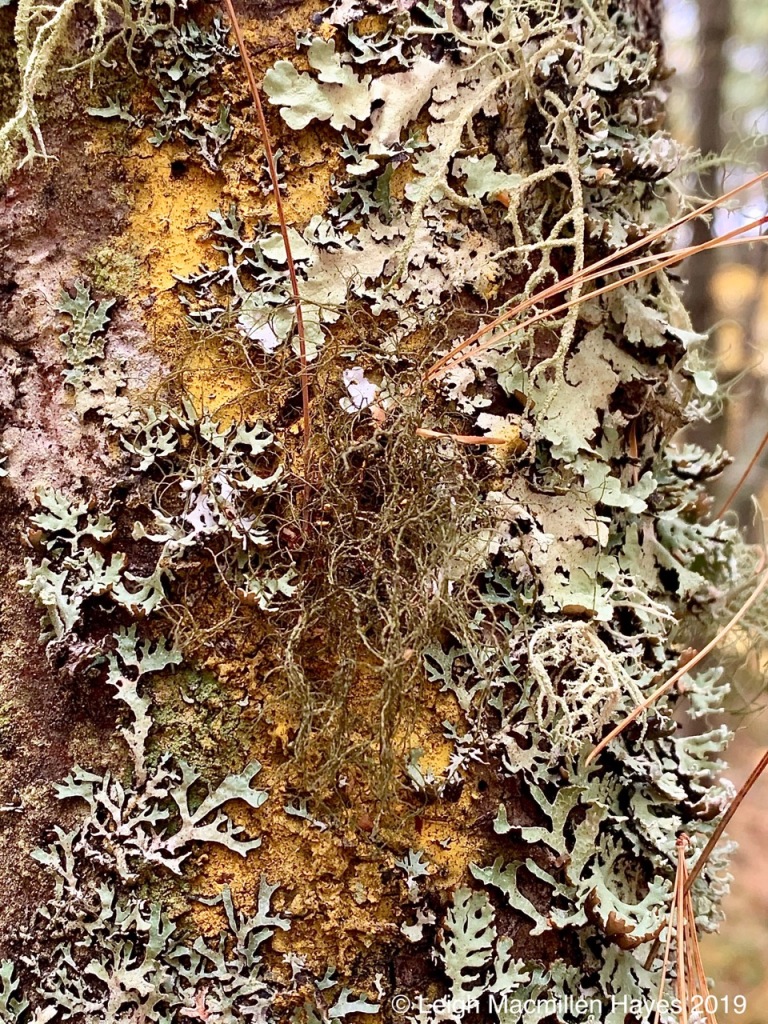
2

And then the next day I returned on a mission to study some twigs at the same property. No sooner had I stepped onto the trail when I heard the sound of leaves cracking a wee bit and what to my wondering eyes should appear but the same bird.

The curious thing: the bird followed me, staying about ten feet away as I tramped on. I stopped. Frequently. So did the bird.

And we began to chat. I talked quietly to him (I’m making a gender assumption) and he murmured back sweet nothings.

It was then that I did the unthinkable–I named him: ArGee.

Again I started down the trail, and again ArGee followed about ten feet to my right. And then I thought I got ahead of him, but a few minutes later he caught up and foraged by my feet as I examined twigs and buds for their idiosyncrasies.

When I finally turned back, ArGee did the same. Eventually I ran because I didn’t want him to follow me to my truck. Would he have? I don’t know. Would he survive? I sure hoped so. Would I visit again? I knew the answer was yes. Would I see him again? Who knew?

The next day I dragged my guy along. But much to my dismay, no ArGee. I’d been blessed twice and had to accept the possibility that he’d either flown off or became part of the food chain. My hope was that if the latter was the case, it was a four-legged predator or larger bird and not a human bi-ped.

Since last week, about five or six inches of snow blanketed the area and this morning dawned frigid with the temperature at about 5˚. I dressed for it and headed to a nearby spot in hopes of meeting up with a group that was going to count salmon and redds. But, I missed the link-up and decided instead to wander in ArGee’s territory so I could reaffirm his disappearance and move on.

1-looking for food

As I looked up at something in a tree, I heard a slight noise by my feet and guess who? I greeted ArGee with a quietly grand hello and together we shared the space, mindful of each other. After about twenty minutes he headed under a stand of hemlocks that provided some cover.

2-hiding and feathers bloated

I snapped and crackled through the woods, bushwhacking over to his position, all the while wondering if I was getting too close and perhaps he didn’t want me to spend more time with him.

2a-hiding

But what I discovered was that he’d stopped foraging, stood still, though occasionally turned his head, and puffed up his dappled and barred plumage. While I had donned several layers to keep the brisk air at bay, ArGee needed to fluff up in order to trap air in his feathers. Cool fact (or cold!): A bird’s body heat warms the air between its feathers and the more trapped air, the warmer the bird.

4-crown

While ArGee warmed up, I focused on some of his features, including the crest feathers on top of his head. Their formation brought to mind ocean waves cresting, but perhaps they were actually standing upright because he saw me not as friend, but rather a foe?

5-eye to eye

I knew I was overextending my stay, but I couldn’t leave. And he didn’t seem agitated, so I continued to look. There was that eye-ring to notice, rather bead-like in appearance.  And the contrasting orientation of the feathers above and below his dark eye, their comb-like tips spread out like miniature fans.

6-looking at me

For another fifteen to twenty minutes, he warmed up below the hemlock, while I stood nearby and watched, occasionally offering a quiet comment, which he considered with apparent nonchalance.

7-beak

I had time to consider his robust down-turned beak and figured it must be adapted for the coarse vegetation it consumed. Ruffed Grouse are known to feed on buds or catkins of aspens, birches and cherries, and that was the habitat in which ArGee had made himself at home. They’ll also consume, seeds, fruits, leaves and twigs, insects, and maybe even salamanders, in season of course.

8-coming out of hiding

Finally, my friend seemed to have warmed up and so out from under the hemlock ArGee emerged.

9-dining on leaves

And immediately he found bramble leaves still green.

10-leaf in its mouth

Ripping one leaf off, he made quick work of it.

11-gobbling it up

And in a matter of seconds it disappeared into his mouth.

12-looking for more food

Then it was time to think about another.

12-those feet

Out in the open again, I had a chance to get a better look at ArGee’s feet. Though today’s snow was rather crusty, there’s potential for up to ten inches of fluff to fall tomorrow and then his feet will play a key role.

12a-combs on feet

Where the snow is deep and soft, grouse travel atop it with the help of their “snowshoes”—lateral extensions of their toes. Can you see the comb-like rows of bristles, aka pectinations? They began growing in September and reminded me of a centipede serving as each toe. It’s those bristles that act like snowshoes.

They also have stout legs for walking or running and those were also covered with insulating feathers that looked like an old pair of furry sweatpants.

12b-tail feathers

It’s difficult to tell a male from a female based on appearance, but typically the bird is a female if the color is faded or absent on the central tail feathers, thus I leaned toward ArGee being a male. No matter what the sex of this particular bird, the varied shades of black, gray, rusty red and buff all presented in a variety of patterns, including small hearts–what wasn’t to love?

13-I see you

For a while longer, ArGee and I played “I See You” and I continued to wonder about his behavior. Usually this species is quite elusive and difficult to approach. In fact, most often I am startled by the loud wing beat of a bird exploding, or so it sounds, from the ground or snow in front of me, and my heart responds with rapid beats for a second . . . and then I realize it was a Ruffed Grouse trying to avoid me.

13-so close

Today, and this past week, that has not been the case.

13b-are you looking at me?

ArGee has seemed as curious about me as I’ve been about him.

16-saying goodbye

Is he tame? Or has he been defending his territory? Perhaps it’s a hormone imbalance as the season changes, especially given that winter seems to have arrived early.

I’m not sure what’s going on, but I’m grateful for the time I have had to get to know this bird of the Maine woods a wee bit better. As has happened in the past, we parted ways at the same point, so I’ve a better understanding of his actual territory.

I’ve experienced grouse being aggressive when protecting their young in the spring, and wonder if at some point a close encounter with ArGee could switch dramatically from fascinating to hostile as he defends his territory.

Sometimes the critters with whom we share this natural world do things that make no sense, but then again, sometimes we do the same. For now, I have nothing to grouse about!