I’m working on a challenging article and can’t quite figure out how to introduce the topic. After a bunch of attempts, I suddenly had an inspired idea . . . drop the pen, walk away from the legal pad and head out the door.
And so I did despite the freezing rain that was falling atop this morning’s snow. Heading down a trail I haven’t had a chance to step upon in months, I realized that I was among old friends who had passed by prior to the storm.
In fact, every where I went for the next two plus hours, they had been there before me.
Their tree of choice also gave away their presence and I fear that there won’t be too many red maple leaves in bloom come spring. Imagine this: a moose needs to consume fifty to sixty pounds of vegetation daily–that’s a lot of buds, twigs, and bark.
With their lower incisors and hard toothless upper palate, they grabbed the twigs and yanked to pull the buds off for consumption. Left behind were their calling cards–long dangling tags. Some were at least three feet above my head.
Also think about that moose face–homely and ungainly as it may be with a large upper lip that can wrap around the twig in order to dine, and the bell or dewlap dangling below its mouth.
With utter glee I found some hair stuck to one twig and it wasn’t the hollow shafts of its dense coat, so I wondered if in the process of browsing, hair had come off its face or dewlap.
As I said, the moose had traveled throughout the woods and I began to follow their tracks exclusively, for they always lead to coppiced red maples that are trying to make a comeback in these woods that were logged within the last five to ten years.
It was on one of the trees that I did find the hollow hair shafts, and I’ve used black arrows to try to point them out to you. There were three which seemed to intersect at the point where the twig had been swiped. Notice how straight they are, especially in contrast to the slender, curly hair.
The more I looked, the more soft, curly hairs I found. Hmmm, I have a feeling any of my hunter friends can enlighten me, for now I’m considering belly hair? Is it softer? Or am I correct in thinking about the chin hairs?
It doesn’t matter. Well, it does because I’d like to know.
And maybe the chickadees were trying to tell me as they flew in and landed on maples while singing their “Chick-a-dee-dee-dee” song. But what mattered most was that I got outside and cleared my brain and came up with an introduction to the challenging article: It was a dark and dreary day . . . oh drats, I can’t use that–especially since despite the snow and rain, I hardly found it dark or dreary.
I think instead, I’ll begin in the middle and see where the article takes me from there. In the meantime, though I didn’t see them, I’m tickled to know that there are still several moose in the woods behind our house.
At the nudging from one of the founders of the Maine Master Naturalist Program, Dorcas Miller, I submitted an article to the “Act Out” section of the Bangor Daily News.
To my pleasant surprise, it was accepted. (And they’ve asked for another–yippee!)
Most people only hear “Gobble, gobble,” from a turkey. But listen carefully and you might hear something more. That’s what happened to one young boy.
You see, once, a long time ago, the boy and his father headed out for their annual turkey hunt. It was a raw and blustery November day with snow already on the ground as the two left home and traveled in different directions.
All morning, the boy followed turkey tracks in the snow. Exhausted, he sat to eat his sandwich on a rock sheltered by hemlock trees. Slowly his eyes drooped, but a sound suddenly startled him.
“Gooble, gooble.”
Quietly, the boy reached for his musket.
“What do you think you are doing?” asked the turkey.
“Huh?” replied the boy.
“I asked, what do you think you are doing?” repeated the turkey.
The boy shook his head. “Are you really talking to me? Or am I dreaming?”
“You decide,” said the turkey. “Oh, and I don’t think we’ve properly introduced ourselves. I’m Tom.”
“I’m Tim.”
“Well, Tim, what are you doing with that thing in your hands?” asked Tom.
“I’m hunting for, um, for . . . ”
“Yes?”
“I’m . . . I”m hunting for you,” said Tim.
“Me? Well, you’ve found me. But . . . wait a second,” said Tom as he ruffled his feathers. “You’re not going to shoot me, are you? Oh, I know–you are supposed to bring back a turkey for Thanksgiving dinner, right? But did you know that the Pilgrims didn’t eat turkey at the first Thanksgiving feast? They didn’t have time to hunt. They were too busy harvesting vegetables, learning to fish, building houses and preparing for a harsh winter. Massasoit and the others who introduced the feast brought venison. So . . . if you want to help put the tradition back into Thanksgiving, I suggest you turn your attention toward deer or fish or just eat vegetables. Besides, think about my surname: Meleagris gallopavo, the scientific nomenclature for wild turkey. Such an impressive name certainly proves my importance.”
Just then, they heard Tim’s dad approach. Tom went into full display, gobbled quietly, and waddled back under the hemlocks.
“Tim, did I hear you talking to someone?” asked his dad.
“Uh, no Dad,” said Tim. “I wasn’t talking to anybody.”
“Oh, well, did you spy any turkeys? It looks like there are lots of tracks around here”
“No turkeys in sight right now,” said Tim. “But I was thinking–what if we eat fish instead of turkey this year?”
“Fish?” asked his dad.
“Yeah, fish,” Tim said as they walked home. “I don’t think the Pilgrims actually ate turkey. That’s a bunch of gobbledygook. We should have a traditional meal this year.”
They turned a corner in the trail and Tim glanced back for a second. Tom winked from his hiding place under the trees. Tim winked back.
And all lived happily ever after, always enjoying the Thanksgiving feast–with fish as the main course some years, and spaghetti other years.
Happy Thanksgiving dear readers! And on behalf of the Meleagris gallopavo family, I seek your help to save them from being roasted yet again.
Due to today’s inclement weather, I postponed a Tracking expedition and thought it might be a good day to become a couch potato. But still, my feet itched to get outside as the raindrops fell.
And then a text message arrived: “Potential loon trapped in the ice; rescue happening on Lower Bay.” I was in my truck and on my way before I even knew the exact location.
As I drove, rain changed to big slushy balls that struck the windshield with noisy inkblot-shaped splats. I pulled into a parking area to check on the intended meet-up point and learned I was a bit early, so I went for a walk. All around me, the forest was alive with sounds–of wet snow striking marcescent leaves, and birds chirping as they flew from branch to branch. I’d hoped to meet an old friend, Argee, but he was nowhere in sight.
By the time I did join the rescue group, they were already loading an aluminum boat into the lake.
The Lower Bay of Kezar Lake had sealed over this past weekend and was coated with an inch or more of ice.
Thus the need for the rescue mission. An immature loon got caught by the sudden freeze. Thankfully for it, Susan Clout, a local resident, noticed its situation and put out a call for help.
Responders included Heinrich and Linda Wurm, Paul Buckley, Steve Lewis, and Jim Buck.
Donning life jackets, their only gear: paddles, a net and a box. It all seemed so simple. Paddle out, coo to the bird as it might talk to another, and either make open water for it to fly (loons need at least a quarter mile for take off, this one had a circle that maybe measured twenty feet–it was difficult to tell from the shore) or capture and release it on an open section of the lake. As one of the text messages stated about the plan: Evolving.
The task of breaking the ice was daunting and though it looked like they were crossing the Potomac, all they really wanted to do was maneuver part way across the bay.
Because it made sense for the person in the bow to stand and break ice as the sternman paddled, stability became an issue and within minutes the boat returned to shore and a third passenger climbed aboard.
Though you can see the circle of open water and it may appear close by, it was all a matter of perspective and they had a long path to create.
Meanwhile, back on shore, those of us who remained behind and felt like we might need to rescue the rescuers, were entertained by Susan as she sang the most delightful lines of a song she’d been writing about the loon’s dilemma.
Back on the water, or rather, ice, progress was slow.
And still the loon swam, occasionally calling out. We interrupted its voice to mean, “I see you. Keep coming my way.”
On board the SS Icebreaker, oarsmen shifted positions because it was tiring to chop continuously.
We kept assuming they were making headway given their position.
And they were. But they still had a long way to go. After 75 minutes, with probably two more hours separating them from the loon, and a cold rain falling, they decided to turn around and hope that higher temps and maybe a breeze in coming days will do the trick. All are hopeful.
I was invited to the scene because my friends’ thought it would make a good story. In the end, my story is nothing compared to the one Nature is writing. She, apparently, has Her own plans for the denouement. We can’t wait to read how She resolves this matter.
Update: November 21, 2019
And here is the rest of the story as Heinrich interpreted it for us: “The loon we were aiming our mission toward took off this morning! Just as the Game Warden showed up the loon started flapping its wings and headed east toward the Narrows. Amazing!“
created by dji camera
“Unfortunately these remnants were left near the other open space where a loon had been sighted before.“
I later learned that two Bald Eagles were spotted near the loons.
Today was field trip day. Well, actually, every day is field trip day. This week’s trips have included Kezar Lake and the Kezar River Reserve in Lovell, as well as Holt Pond in Bridgton. But today, it was further afield as I drove north to China, Maine, to introduce Erika Rowland, Executive Director of the Greater Lovell Land Trust, and Alanna Doughty, Education Director of Lakes Environmental Association to a special person and a special place.
The special place is one that allows children young and old to use natural materials to build faerie houses. I’ve been entranced by such since my youth–thanks be to my father and his Scottish ancestry, and our “Aunt” Betsy, (she isn’t related, but she’s always been a wonderful aunt) who often took us on a picnic to the fairy table in her woods.
Faeries (fairies) love quiet places and their homes come in many forms. They’re best made from scavenged materials. Imagination rules and nature provides all the things needed for such creative architecture.
This particular village is identified by a sign that provides a list of materials both appropriate and inappropriate.
A wee bit further along the trail, we happened upon another spot that hasn’t been finalized yet, but it’s a collaborative effort between our hostess and last year’s fifth grade class.
The kiddos studied Maine mammals and then created a scavenger hunt. Erika, Alanna, and I continued to channel our inner kid and looked left, right, high, and low to spy the critters that share these woods. From coyotes to . . .
mama bear and her cubs, to . . .
a lynx chasing a snowshoe hare, to . . .
a moose, they were a pleasant surprise all along the way. If you have a smartphone available, you can learn more about them.
And if there are mammals, then there must be tracks.
We checked the gravely mammal “pit” and discovered pointed toenail prints leading us to think coyote. Had the silhouette come alive?
Continuing on, we came to an old log landing, where pine saplings happily inhabited the clearing. Our hostess, Anita, showed off the recent crazy growth years. Each year, a White Pine produces a whorl of branches, thus allowing one to age the tree by counting from one whorl to the next. And in between–well, the tree grows. Some years, the growth is extensive if conditions are right, such as this 18″ spurt one year and a similar one above the next.
A couple of trees, however, showed off the efforts of a White Pine Weevil. Brown, wilted main shoots (terminal leaders) featured tips curved into a shepherd’s crook. More on that later.
In the midst of all the pines, I was wowed by another tree with needles. It’s one that begs a handshake every time.
And really, that hand comes with the softest touch.
Even upon its trunk, the needles do splay . . . like an aster, but they won’t last long for a Tamarack (aka Larch, Hackmatack) is a deciduous conifer and already they are turning their golden autumnal color.
The Tamarack wasn’t the only star, for cedars also added a different texture to the woods.
And then . . . and then . . . we came upon the Treehouse. A handicap accessible treehouse.
It’s known as the Reading Tree, but it’s more than that, which the interpretive sign explains. Remember that White Pine Weevil damage we saw at the log landing? Well, the White Pine that the treehouse surrounds was a long-ago weeviled tree. When a pine is weeviled, the leader shoot dies and the whorl from the previous year take on the task of growing skyward.
The treehouse is built to accommodate its growth and let the sun in.
It also provides a fantastic place for all to blend in to its structure.
Of course, if you climb the tree, you might have to spend a bit of time in “Timeout.” But really, what a pleasure to do both.
We didn’t want to leave the treehouse behind and actually considered moving in, but onward our journey continued to a spot where the story transitions to mathematical computations. A cord of wood in the background, a chance to measure board feet in the foreground. It’s all a part of this special place, where classrooms abound . . . in the forest.
It didn’t stop there. A fence with cut-outs high and low let us peek at more local wildlife. Had we been with a class of twenty or more elementary school children, we surely would have scared the birds away. But . . .
our bird sightings were plentiful.
How many do you spy?
At the end of the wall, the interpretive sign offers clues of those one might see.
Leaving the wall, as we walked toward a wetland, movement at our feet led to the realization that we’d disturbed two garter snakes trying to grasp the rays of today’s limited sun.
Onto a bridge originally built by students twenty plus years ago in the man-made wetland, we paused to covet the outdoor classroom.
The possibilities for exploration were endless.
And they were all possible because of our incredible hostess, Anita Smith. Anita is a retired teacher, Maine Master Naturalist, and Project Learning Tree Advocate.
Her community close to home appreciates her, but so do the rest of us for as I’ve learned, Anita is alway happy to share what she and others have created to educate all ages.
Before we drove back to western Maine, we had one last wonder to fill our day–the woody capsules of Lady’s Slippers gone by that grow in clumps like we typically don’t see anywhere else.
Thanks to Anita and all her volunteers, we spent today wandering the China School’s Working Forest in China, Maine, and loved exploring the twenty or so learning stations set up on the fifty-plus acre forest. Neither Greater Lovell Lovell Land Trust or Lakes Environmental Association can replicate the China School Forest, but our take-away was immense and we loved the opportunities to learn in the forest.
Some days I head out the door with eyes as big as those of a fly and then I try to stand in one place and watch what might pass by.
Unfortunately, I’m not always as patient as a robberfly and soon find myself pacing in search of the next great sight.
Even when it turns out to be a Japanese Beetle munching on a leaf, I’m not totally disappointed. After all, it does have such an incredible sense of color and fashion.
But what I really hoped to see I suddenly became aware of as first one, then two, three, four and even more Monarchs fluttered in their butterfly way, seeming to glide for a bit and then make an almost apparent decision to land before a change of mind until at last . . . upon the Milkweed it did pause.
Curious thing. So did another Japanese Beetle. That led me to wonder: how will these two get along and negotiate the territory?
The Monarch poked its straw-like proboscis into the heavenly-scented flowers as it sought sweetness while the beetle continued to move toward it.
But the beetle was on a mission of its own and the two seemed to co-exist side by side.
In fact, they were practically oblivious of each other. Unlike when a Common Yellowthroat tried to land and the Monarch chased it away.
Finally the butterfly crossed over to another flower on the tall stem and left the beetle behind.
I moved on as well, in search of others to focus on like the female Ruby Meadowhawk Dragonfly. How can it be that it’s already Meadowhawk season, the late bloomers in my book of dragonflies?
And yet, the colors of summer today included not only the pinks of Steeplebush, but also the yellows of goldenrods beginning to blossom.
Mixed into those colors and because of their movement and then moments of pausing, the Monarchs kept tugging at the strings of my heart and pulling me back into the moment.
And in that real time moment, I had the pleasure of spying couples in their canoodling fashion, though they tended to be much more elusive than some insects. If I didn’t know better, I’d have thought the female was dead as the male flew along with her dangling below until he landed on a stem of choice. From what I’ve read, their mating can take up to sixteen hours. Oh my.
As it turned out, I soon discovered that at least one mating had resulted in at least one caterpillar. I suspect there will be more soon, but this one will have a head start on munching its way through the Milkweed kingdom.
All the while that I stalked the Monarchs, a Common Yellowthroat did its own stalking, constantly announcing its location with chirps. And then I realized it had a caterpillar in its mouth as it moved among the stems of the Spreading Dogbane. Oh dear. Fortunately it wasn’t a Monarch caterpillar, but will it be only a matter of time?
A few more steps and I noticed a Katydid on a Milkweed leaf. Oh yikes. So many visitors who like to munch.
For the moment all bets are placed on only one Monarch caterpillar to continue the life cycle.
Blame it on the Monarchs for calling me back to the same spot I’ve been stalking for a few weeks and giving me the opportunity to notice them mating and the results of such actions and other insects as well.
July 31, 7:00 pm, Monarchs at Risk with Don Bennett
Recent censuses show the smallest Monarch butterfly populations in Mexico and the west coast hibernacula in recorded history. Why is this happening? Is there anything we can do? Are drastic declines in the Monarch populations a sign of something more insidious? Come listen to Naturalist Don Bennett, PhD, and discover why this is such an important message for all of us.
Location: Charlotte Hobbs Memorial Library, Route 5, Lovell
August 1, 9:30 am – noon: Monarchs in the field: Monarch butterflies need milkweed plants to survive — as caterpillars they only eat milkweed and Monarch moms lay their eggs on the milkweed plant. We’ll take a walk along a dirt road that abuts a farm field and river, where milkweed grows in abundance and search for Monarchs and other butterflies.
Location: Meet behind the Charlotte Hobbs Memorial Library to carpool.
Working in tandem, we paddled against the wind and despite its force gave thanks for the relief from the heat offered. Our intention was to explore the islands of Moose Pond, a place where the two of us can get lost in time.
It was movement above that caught our attention as we watched a large bird fly into a tree. And so we paddled even harder in hopes of getting a better look. About midway up a White Pine, an immature Bald Eagle sat upon a branch . . . and panted, feeling the heat like we did. Since birds can’t sweat, this was its way of dissipating the sweltering weather.
We watched the bird until it finally flew off and headed south.
Then we continued our journey north.
My guy jumped ship to wander an island or two and I stayed aboard to see what I might find, like the Spatterdock petals hiding within the petal-like sepals.
There were Buttonbush flowers with their funky orb shapes and spiky protrusions.
And I was delighted to see a Rose Pogonia, its fringed beard hiding among the grasses and reeds.
The damselflies wrote love notes on almost every stem, but this gathering I found most comical–as the guys each attempted to be her suitor. In the end the top Bluet gracefully acquiesced.
And then there was the Variable Darner Damsel to wonder about as she posed upon a Pickerel Weed of matching color. Were her wings so shiny because she’d just emerged? And though its difficult to see the left-hand wing, they appeared to be spread–perhaps another indication of her recent adventure from aquatic nymph to sky dancer.
Our discoveries were many, but I’ve shared just a few from this afternoon as my guy and I . . . we spied like an eagle.
There’s a place here in western Maine that I frequent on hot summer days. Oh heck, there are many places I frequent, but this one is extra special and it doesn’t involve a hike. In fact, from my perspective, there’s only a short distance of a road that consumes hour after hour of my time. But always, it’s time well spent.
The road is dirt and crosses through a hay field that has yet to be cut. Smack dab in the center stands a beautiful Elm and though I’m not sure the Bluebirds nest there, I do know that they at least rest upon its mighty branches for I watched them fly down and disappear into the wildflowers and grasses below and then zoom back up into the tree a few minutes later, their wings of iridescent blue mesmerizing me during flight.
As the Bluebirds flew back and forth to the tree, so I walked back and forth below it. And back and forth again. And again. I have no idea how many times I turned or how often I muttered, “One more time and then I’ll leave.”
But . . . because I stayed I had the good fortune to spend some time admiring a Twelve-spotted Skimmer Dragonfly. In true character, it paused for long periods of time, flew off for a moment or two, and then returned to the same perch. And I gave thanks.
The only other dragonfly I saw was also a skimmer, but about half the size of the Twelve-spotted. At about one inch in length, the female White-faced Meadowhawk also paused for long breaks. And I was equally grateful.
With each step, grasshoppers did what they do–scattered from the dirt road to nearby stems. By the dozens. Providing constant motion and sound.
But then . . . I found two who chose a different activity to entertain themselves and ensure that there will be future generations of grasshoppers in the field.
Aren’t they amazing? And I don’t mean in their canoodling, but rather their design.
My pacing included frequent stops to check out the visitors upon the flowers as well. The Steeplebush appeared to offer a feast to any who chose to stop by.
Because the grass was so high beyond the flowers at the edge of the road, I didn’t realize at first that I wasn’t alone. Twice I was startled because I’d startled another. Both times it was a deer that I didn’t see until they ran off. Do you see the white flag of the tail as one bounded toward the woods?
There was more movement in the grasses and among the flowers. It was accompanied by sound. Looking for stalks moving at odds with the slight breeze, I finally spied the creator of the “Cheap” that resounded almost constantly. A Common Yellowthroat Warbler hopped from one plant to another, possibly seeking a meal to share with youngsters relaxing in a distant tree.
Curiously, a different sound could be heard from the other side of the road, where a male and female frequently took flight before settling down for a bit.
The Bobolink’s song hit notes both low and high, offering a serenade that bubbled forth in a rather bouncy and most pleasant warble.
Every which way I looked, something different presented itself. Some I knew, but others I met for perhaps the first time, such as this large bee fly. I’ve since learned that they are also commonly known as humbleflies, and I found that curious given that with the banded abdomen and patterned wings and overall large size, it hardly seemed humble.
What I’d really gone to check on, however, were the Milkweed plants and their visitors. I wasn’t disappointed for there were both big and little Milkweed beetles.
And Tiger Swallowtails seeking nourishment. This one needed all the nourishment it could get to continue its flight and avoid the birds and other predators. Do you see its tattered wing?
Some, like the Fritillary, chose the road for nutrition and did what butterflies often do.
It puddled. To puddle means to extend your mouthparts and probe the dusty road in search of nutrients. There is no actual puddle involved, but there may be raindrops or in this case, morning dew that help the butterflies extract minerals to share with their gals.
What I’d really gone to see, however, were the Monarchs. And I wasn’t disappointed for a few fluttered about and occasionally landed, much to my delight.
At last, my “One more time and then I’ll leave” utterance became reality and I drove off. And then . . . there was one more sight to behold. I stopped the truck and watched as a fawn bounded in its awkward fawn manner.
Because of the Monarchs . . . I experienced a wonder-filled morning.
It’s a difficult sound to describe, rather primordial in nature. Maybe it’s a duck’s quack? Or a dog’s bark? Or some combination of the two. And yet, all is quiet and then the noise erupts suddenly from one nest as a parent flies in, a meal in the oven about to be regurgitated.
It’s a scene that plays out at individual nests for a while before all become quiet again as if lunch has ended and the kids should take time for a nap. But until such time, the neighbors in the high rise next door watch enviously as their playmates are fed.
Just down the block one of the tweens, for suddenly after about a month of life they are such, flexes his wings as he stands out on a branch. It’s a tradition as old as time–tweens and teens going out on a limb to show their capability to survive in the world. The question remains, however: when will he reach the right age to get a license?
As the tween to the right finishes flexing, the one in the center lets a shiver pass through his body. Is it a pre-flex motion? His other sibling watches and wonders what it’s all about. Perhaps he’s trying to prove something?
Meanwhile, because I stood beside a river with a friend so I could count Great Blue Heron nests, active nests, young, young in nests, fledglings, and adults, we also began to notice other life that surrounded us like a Kingbird who posed for moments on end.
Constantly, however, my eye was drawn to the tiptop of the White Pines, where I began to realize there were more and more birds than my first count because many were feeling their oats and testing their individuality.
Other birds added to the rhythm as we listened for and shared with each other the location of the song makers in our midst.
And then, and then . . . a male Belted Kingfisher pause smack dab in front of us, his tuft of head feathers earning him the “Wicked Cool Dad” award in the neighborhood.
He looked right at us and made dorky dad comments that left us exclaiming with delight.
Meanwhile, back at the rookery, some of the tweens continued to wait in the most patient manner. They muttered hardly a word. We did have to wonder how such big birds could fit in those nest of twigs. The nests were large in bird terms, but the birds were even larger. At last it was time for us to depart, and we left the young in their quiet mode.
My journey continued on the other side of the river. It was there that I spotted Robber Flies in that age-old act of mating.
And a moth I believe to be known as a Virginian Tiger Moth or Woolybear Moth clinging.
But perhaps my favorite of all, that I found because we chose today to check on the rookery, was the Sphinx moth holding onto a pine sapling. At first I thought it was a dead leaf caught on the twig.
We pounded the sidewalk this weekend in a style not quite ours, but visiting the Big Apple always finds us realizing that the world around us is larger than our little speck on the map in western Maine. And yet, we found similarities everywhere we turned.
Birds of various shapes, colors, and sizes like the Common Tern with its bright two-toned bill, offered watery reflections as they stood in front of us and pondered life in the East River.
On a much larger scale was the raven of the sea, the Cormorant, with its eyes so blue and bill so long and hooked.
There were a variety of gulls as well, plus sparrows, and of course, the exotic pigeons, all enjoying life along this place where the Statue of Liberty welcomed us from her distant, yet ever distinguished pose upon Liberty Island.
We spent some time in the morning and again in the afternoon beside the river and it dawned upon me as we gazed at the surrounding architecture, here positioned behind the Brooklyn Bridge, that the form of each structure was rather organic in style. Just as all ferns might be viewed as “just ferns,” so might buildings be viewed as “just buildings.” But then one day, you wake up and begin to notice the idiosyncrasies and suddenly you recognize the sensitive fern in its once-cut form with its separate fertile frond and the lady fern with her hairy legs and comma-like “eyebrow” sporangia on the back of her pinnules and voilà, you realize that each one has its own characteristics worth noting. Somehow, the buildings began to feel the same to me–their different forms and colors and sizes took on new meaning and though I don’t yet understand them all, I can at least appreciate their artistry.
The other thing I began to realize is that from our stance in Brooklyn, as we looked across the Manhattan Bridge, the community on the other side had suddenly changed or so it seemed based on the size and style of the buildings, much like natural communities change based on location–whether its a riverbank, forest, pond, cliff, or bog, etc. Fortunately, we were accompanied by our youngest son who lives in Brooklyn and works in Manhattan, and he could point out that the view below the Brooklyn Bridge was of the Financial District of Manhattan, while the view on the other side of the Manhattan Bridge was toward Chinatown.
Even the bridges themselves were meant to be celebrated for their lines, whether straight, curved, or angular–all working together to create monuments out of stone and steel.
Against the sky, their geometric shapes drew our eyes up and down and up and down again as we glanced upon the individual spans.
A few steps beyond the bridge, in DUMBO, we spied more geometry enhanced by color and while some might see crystals in rocks, I kept thinking of insects and their “mechanical” structures of antennae and legs and thoraxes and abdomens and wings.
Our walking tour included The Fence, the largest public photo exhibition in North America that moves from one city to another and will be on display in the Brooklyn Bridge Park through September.
The photographs are displayed in categories. In the Farm-to-Camera category, it tickled me to see that photographer Adrien Bloom had included Garlic Scapes from a farm in Maine.
Beside each set of photographs within a category, an explanation was provided. In this case, we read the following: “Farm-to-Camera honors the pure and simple beauty of the bounty that comes from our farms. Billions of years in the evolutionary making, each item we pick up at the farmers market, or directly from the farm, is a perfect piece of art and deserves to be treated as such.”
One last gaze across the East River provided a sight that looked more poster-like than real. And yet it was . . . real. And in its realness, it appeared that some buildings in the canopy had crowded out the saplings and shrubs and definitely those in the herb layer.
According to our son, the reality of the unfinished building in the center is that the structure is off by two inches between the top and bottom and it has been left as is for months now. Perhaps it will be the tree that can’t survive in this forest because of the crowded conditions.
Before we left the DUMBO area, he showed us a different view of the river, actually this one a representation as it blocked off a location where “Gotham” is set. He was able to point out changes they make during the filming season as he knows it from a work perspective in his job at a film editing house.
Our first day ended with the three of us enjoying a delicious dinner at French Louie under a break in the sky–a heart meant for us.
The next morning called for a trip to Manhattan and a walk in Central Park where the ornate architecture was framed by a break in the trees.
It was near there that we paid our respects to Friedrich Wilhelm Heinrich Alexander von Humboldt, aka Alexander von Humboldt, the famous geographer, explorer and naturalist. His publications, which were prolific, had a mission to encourage scientific inquiry as well as a wonderment of nature. And to him we gave thanks.
Within the park we stood by The Lake for a bit, watching lovers in boats . . .
approaching each other in the water,
and basking in the sun. Interestingly enough, if you scroll up to the first shot of The Lake, you may notice that the rock upon which the Red-eared Slider Turtles sunned themselves actually looked like a turtle.
It was there that we also spotted dragonflies new to my knowledge–the Eastern Amberwing. I think I may have called it the Topaz Wing had I been the first to ID it, but perhaps that’s because I’m partial to the stone that represents my birth date.
Inside the Museum of Natural History we wandered and wondered for hours and hours. I’m not a city girl, but I sure did wish from time to time that I lived closer for I would purchase a pass each year and spend time in various sections–visiting repeatedly to gain a better understanding.
Oh yeah, these are the two variations of a snowshoe, aka varying hare.
And did I mention that we spotted Sandhill Cranes and their nest. It looks like three little ones should hatch any day now. That is . . . if it’s possible to emerge from their plastic forms enclosed behind the glass wall.
Though I enjoyed the river and park and museum, and especially breaking bread together, the best part of the weekend was spending time with my guy and our youngest son, both of whom actually posed for me beside skeletons of extinct mammals.
We were there to wish this young man a happy 25th birthday. We are so proud of him and the work he is doing and person he has become.
He loves New York for all its city ways and quirky offerings. We love that we can visit from time to time and get to know his place a wee bit better–right down to the artwork on the walls of the subway. The more often we go, the more we begin to realize that in the midst of all its city-ness, moments of wonder can be found.
With a mission to check upon a heron rookery, I invited a friend to join me.
The young’uns sat upon their nests of sticks waiting for the next meal to arrive.
With the flap
of  wings
slowed in rhythm,
landing gear
was extended
in the form
of long legs
and feet.
Within minutes,
a meal of fish
was regurgitated
and
passed
from
parent
to
child.
Because of
our location
beside
a slow-flowing river,
many other sights
caught our
attention.
But it was one
with a
penchant for moisture
who stood
as tall
as my chin
that garnered
the most attention.
I've oft
relished its
pleated leaves
of green,
their manner
that of the
lily family.
In a
clasping formation,
they attach
to the main stem,
spirally arranged
from bottom
to top.
I've seen
the plant often
in its leafy rendition,
but today
was the first time
its star-shaped flowers
atop the plant
revealed themselves.
With
petals and sepals
combined
 as tepals,
my friend noted
their resemblance
to the leaves below.
The more we looked,
the more we realized
there were others
who also
revered
such a unique structure,
in particular
the nectar-producing glands
at each flower's base.
The plant
 took advantage,
 or so it seemed,
 of allowing those
who ventured
into its sweetness
with a dash,
or perhaps
a dollop,
of pollen
to pass on
for future reference.
Because of its location
in the moist habitat,
insects formerly aquatic,
such as
the Alderfly,
did walk
with sluggish movements.
Up its stout stalk
one rose,
the fuzzy structure
perhaps providing
it texture
upon which to climb.
Did it seek
the bright yellow anthers?
Or the nectar below?
With wings
delicately veined
and folded over
like a tent,
the Alderfly
paused
and hardly pondered
its next move.
The flower
mattered not
for this
weak flyer.
At last
it reached
the tip
of the
long, upright
inflorescence,
conical in form,
and I wondered:
would it pierce
the unopened flowers
for a bit
of nutrition?
Perhaps not,
for adults
of this species
have a need
more important
than eating.
Theirs is to
mate,
particularly at night.
Maybe it was
a he,
looking for a sight
to meet
a she.
As it
turned out,
not all
who had
canoodling
on their minds
could wait
until the day
darkened
to
night.
Meanwhile,
there were others
who sought
the sweet satisfaction
of nectar
for their needs.
And in
the process
of seeking,
tads of pollen
decorated
their backs,
in this case
where X
marks the spot.
It was
a place
for many
to gather
and garner
including
Lady Beetles
of many colors.
And upon
those pleated leaves,
were Mayflies
who had
lived out
their short lives,
and Craneflies
taking a break,
while showing off
their wings
reminiscent
of stained glass.
After such
an up-close greeting
of the delicate flowers,
and recognizing
for the first time
their immense splendor,
June 15
will forevermore be
the day
to celebrate
False Hellebore.
As I drove down the dirt road into Brownfield Bog today, I began to notice ruts on the side where previous vehicles had gotten stuck in the mud. And then I came to a puddle the looked rather deep and to its right were several rocks that I didn’t feel like scraping the truck against to avoid the water. That’s when I decided I’d be much better off backing up and parking at the beginning of the road. Besides, I knew if I walked I’d have more chance to see what the road and bog had to offer. But . . . back up on that curvy narrow road–for a quarter mile or more? Yup. Thankfully, no one drove in or out and somehow I managed to get myself out of that predicament.
I knew I’d made the right choice when I was greeted by an immature Chalk-fronted Corporal. First it was one, then two, and then so many more. And the mosquitoes and black flies? Oh, they were there, but not in abundance.
Also helping patrol the roadway was a Spring Peeper, the X on its back giving reference to its scientific name: Pseudacris crucifer–the latter meaning cross-bearer. Notice his size–about as big as a maple samara.
A more mature female Chalk-fronted Corporal perched upon an emerging Bracken Fern was my next point of focus. She’s larger and darker than her young counterparts, her corporal stripes on the thorax marked in gray.
And then there was a June Beetle, also maple samara in length with its thorax and abdomen robust.
My own eyes kept getting larger and larger for every step I took I felt like there was someone new to meet. Practicing ID was helped a bit as I’ve begun to recognize certain traits of the different species. Of course, each year I need a refresher course. By the green eyes, I knew this one was in the Emerald family, and with its green and brown thorax, black abdomen with a narrow pale ring between segments 2 and 3, and the fact that the abdomen is narrow to start and finish with a widening in between, I decided it was an American Emerald.
Reaching the bog at last, I was glad I’d worn my Muck boots, for the water flowed across the cobbled road and in several places it was at least five inches deep.
Within one puddle floated a dragonfly exuvia, its structure no longer necessary. I will forever be in awe about how these insects begin life in an aquatic nymph form, climb up vegetation or rocks or trees and emerge as winged insects.
As I continued to admire them, there were others to note as well, like the metallic green Orchid Sweat Bee pollinating the Black Chokeberry flowers.
The next flyer to greet me had a white face that you can’t quite see. By the yellow markings on her abdomen, I think I’ve identified her correctly as a Frosted Whiteface.
Birds were also abundant by their song and calls, though actually seeing them was more difficult since the trees have leafed out. But . . . a Yellow-bellied Sapsucker did pause and pose.
Again, shadows blocked the face of this species, but the wings and abdomen were far more worthy of attention as it clung to a Royal Fern. In fact, with so much gold, I felt like I was greeting a noble one. The Four-spotted Skimmer is actually quite small, yet stocky. The four spots refer to the black nodus and stigma (Huh? nodus: located midway between the leading edge of each wing where there is a shallow notch; stigma: located toward the wingtips). But notice also that the amber bar at the base of its wings and black basal patch on the hind wings–giving it an almost stained glass look.
By now, you must be wondering if I was really at the bog for I’ve hardly shown any pictures of it. Yes, I was. And alone was I. When I first arrived by the water’s edge, I noted two vehicles that had braved the road and as I stood looking out at the old course of the Saco River, I heard a couple of voices which confirmed my suspicion that they’d gone kayaking. But other than that, I had the place to myself. Well, sorta.
Me and all the friends I was getting reacquainted with as I walked along. The name for this one will seem quite obvious: White-faced Meadowhawk, its eyes green and brown.
Nearby a pair of Eastern Kingbirds, perched, then flew, enjoying such a veritable feast of insects spread out before them.
I worried for my other winged friends, including the female Bluet damselfly.
And the Common Baskettail. How long will they survive?
I also wondered about reproduction for I saw so many, many female Chalk-fronted Corporals, but not a male in sight. Until, at last, before I left the bog, I spied one.
And for a long time we studied each other. Have you ever realized how hairy dragonflies are?
The Brownfield Bog (Major Gregory Sanborn Wildlife Management Area) can put the brain on nature overload as all senses are called into action. But today, because with every step I took at least fifty dragonflies flew, they drew my focus and I gave thanks to them for reteaching me about their idiosyncrasies, as well as eating the smaller insects so I came away with only a few love bites behind my ears.
Walking with dragons. As life should be. In western Maine.
I’m a wanderer both on and off trail, and sometimes the path has been macadamized. Such was my following this morning as I paused on the way home from running an errand in North Conway, New Hampshire.
I’d stuck to the backroads on my way out of state to avoid road construction on Route 302, but knew that upon my return I wanted to stretch my legs along the Mountain Division Trail in Fryeburg.
The delightful four-mile rail trail, so named for the railroad line it parallels, intended for walkers, runners, bikers, roller bladers, etc., extends from the Maine Visitors Center on Route 302 to the Eastern Slope Airport on Route 5 and can be accessed from either end or several points between.
The wind was blowing and the bug count low, so though it wasn’t a warm, sunny spring day, it was a purely enjoyable one. And the cheery cherry flowers enhanced the feeling.
All along the way, it seemed, the Red Maples had not only leafed out, but yesterday’s flowers had magically transformed into today’s samaras that dripped below like chandeliers.
Lovely tunes and chips were also part of the landscape and I have no idea if I’ve identified this species correctly, but I’m stepping out on a branch and calling it an Alder Flycatcher. I’m sure those who know better will correct me. The naming isn’t always necessary, however. Sometimes, it’s more important to appreciate the sighting, the coloration, and the sound. For this bird, it was the dull olive green on its back that caught my attention.
And then up above on the other side of the track, it was the “Cheery, Cheery, Cheerio” song that helped me locate the American Robin in another maple raining with seeds.
Maples weren’t the only trees showing off their flowers, and those on the Northern Red Oaks reminded me of grass hula skirts below Hawaiian-themed shirts.
Even the ordinary seemed extraordinary like the Dandelion. Each ray of sunshine was notched with five “teeth” representing a petal that formed a single floret. Fully open, the bloom was a composite of numerous florets.
Nearby, its cousin, the early blooming Coltsfoot, already had the future on its mind and little bits of fluff blew in the breeze.
Eventually, I reached Ward’s Pond and after scanning the water found a Painted Turtle seeking warmth. The day was overcast and there was a bit of a chill in the strong breeze. Being down below the trail, at least the turtle was out of the wind and I had to assume that the temperature was a bit higher than where I stood.
This is a trail that may look monotonous, but with every step there’s something different to see like a Pitch Pine showing off three generations of prickly cones. What was, is, and shall be all at the tip of the branch.
It seemed like every time I looked to the left, such as at the pine, a sound on the other side of the trail caught my attention. And so it was that I realized a White-tailed Deer was feeding on grasses behind a fence by a now-defunct factory (so defunct that the roof had collapsed under the weight of snow). Notice her ears.
And now look at her again. A deer’s ears are like radar and she can hone in on a sound by turning them.
I don’t know if she was listening to me or to the Eastern Towhee telling us to drink our tea.
After 2.5 miles, I decided to save the rest for another day and follow the path back. Though loop trips are fun, following the same path back brings new sights to mind, like the Interrupted Fern I’d walk past only a few minutes before. Notice its clump formation known in the fern world as vase-like.
And the butterfly wings of its interrupting leaflets covered with sporangia. My wonder came with the realization that within the interruption not all of the pinnules or subleaflets were covered with the bead-like shapes of fertility. Spores stored within essentially perform the same function as a seed: reproduce and perpetuate the species. So–is part of the pinnule fertile while the rest remains sterile? Do I need to check back? Oh drats, another trip to make along the Mountain Division Trail. Any excuse to revisit it works for me, though one hardly needs an excuse.
Further along I looked to the other side of the tracks for I’d spotted bird movement. Behind it was the reason–my White-tailed Deer friend. I have a feeling people feed it for it seemed not at all disturbed by my presence, unlike the ones in our yard and the field beyond that hear my every move within the house even in the middle of winter and are easily spooked.
The deer, however, wasn’t the only wildlife on or near the trail. Suddenly, a Red Fox appeared and we each considered the other. He blinked first during our stare down and trotted away.
Passing by Ward’s Pond once again, I stopped to check on the turtle. It was still in the same spot I’d seen it probably a half hour before.
Not far from the visitors center, a Big-Toothed Aspens chose to be examined for the soft downy feel as well as color of its leaves. The various hues of color in leaves during spring is caused by the presence of pigments called anthocyanins or carbohydrates that are dissolved in the cell sap and mask the chlorophyll. As the temperature rises and light intensity increases, red pigment forms and acts as a sunscreen to protect the young leaves from an increase in ultraviolet rays.
Because I was standing still and admiring the leaves, I heard another bird song and eventually focused in on the creator.
And so I have the Big-Toothed Aspen to thank for showing me the Indigo Bunting. My first ever. (Happy Birthday Becky Thompson.)
A turtle. A deer. A fox. A towhee. A bunting. All of that was only a smattering of wonder found along the Mountain Division Trail. If you go, make sure you recall the old railroad signs: Stop, Look, and Listen.
It rained. The sun came it. Rain drops continued to fall. Until they didn’t. Then the temperature rose to a degree we haven’t seen in over eight months here in western Maine. And we melted.
But, with the heat wave came some new visitors, including this male Baltimore Oriole, so named because his coloration resembled the coat-of-arms of Lord Baltimore.
The funny thing about Lord Oriole: he’d stopped by a few days ago when I had a sturdy chunk of suet in the feeder. After seeing him, I immediately added orange slices to the offering in hopes of enticing him to return.
And so when he did this morning, I marveled at the fact that he ignored the oranges and chose instead a small bite of the suet.
Adding more color to the yard was a male House Finch. He tarried not long for his gal paused in the lilac bush and then flew past and he followed in hot pursuit.
But I gave thanks to the finch for as I looked for him to return, I noticed movement on the outer edge of the garden below the back deck. Shuffling about the dried leaves looking to glean a meal was a Common Yellowthroat. My very own Common Yellowthroat. Certainly another reason to rejoice.
There was more rejoicing to be done for I eventually found my way to the vernal pool. I realized I’ve been avoiding it lately, ever fearful after discovering a few dead frogs that life had taken a turn for the worse within that small body of water.
But the surprise was all mine when I discovered recently hatched tadpoles resting atop an egg mass. The green color is an algae with which they share a symbiotic relationship. The algae colonize the egg mass and produces oxygen. Being symbiotic, it’s a two-way street and the algae benefits from the eggs by gaining carbon dioxide produced by the embryos. The carbon dioxide is needed for the photosynthetic process. For a few days after hatching, the tadpoles feed on the alga.
Salamander embryos within their own gelatinous also took on that greenish hue due to the same symbiotic alga. My heart was filled with joy for there were numerous masses within the pool, most of them spotted salamander. And now I can only hope that the pool stays wet enough for them to mature and crawl out as their parents did.
Leaving the pool behind, I wandered toward home, but a familiar call beckoned. It took a few minutes for me to locate the creator, but eventually I saw him.
On a sturdy branch parallel to the ground, the Broad-winged Hawk did dine. He also frequently announced his presence with his high-pitched voice.
As a true carnivore, he’s known to eat reptiles, amphibians, birds, small mammals and even large insects. From my stance, I thought I saw a long tail that didn’t seem right for a vole. Instead, I wondered if it was a snake. I kept expecting to be greeted by one beside the vernal pool and the hawk wasn’t all that far away. I suppose that means that if the salamanders and frogs are able to crawl and leap out of the water, they’d better find good hiding places because this guy and a possible mate have been soaring above for a couple of weeks and probably have a nest nearby.
In the end, it seemed that whatever his meal was, it was lip-licking good. Upon finishing it, he flew south while I trudged across the field to the east. But I suspect our paths will cross again going forward.
All of those finds were spectacular, but . . . one of the best parts of the day–watching Eastern Bluebirds in the yard. I first spied the male in this morning’s rain.
And then late this afternoon, I was surprised to discover that they were both here, the she and the he. For the most part, they stayed out by the stone wall, perched on branches above before flying down to catch a meal.
Then they flew closer to the house and landed atop the feeders where I don’t have any mealy worms that are much to their liking. I hadn’t even planned to still have the feeders out, but with each new day bringing new visitors, I’ve delayed taking them in for the season. That is, until a Black Bear arrives.
But no Black Bears yet. (Just wait, one will probably show up overnight or tomorrow.)
And so . . . Bluebird, Bluebird, through my focus. Thanks for taping me on the shoulder. ;-) And sharing this day with me.
My mother always said that things happen in threes. It’s a sentiment that has stuck with me and sometimes even haunted me. But when it is good, it is very, very good. And today was one of those days.
Though it was after noon by the time I stepped into Pondicherry Park in Bridgton, the bird song was on high pitch. The American Redstart’s sweet, yet explosive notes came amidst bursts of acrobatic energy as he flew quickly from one branch to the next and then back again a second later over Stevens Brook.
Twenty feet away, the delightful phrases of the Gray Catbird’s tunes filled the air, but it was his raspy mews that gave away his identity. And suddenly, there he was atop a tangle of shrubs and vines as is his habit. I suspected the nest he shares with his lady was located below.
“Wichety, wichety, wichety,” was the give-away song for the Common Yellowthroat, although I do have to say he was much easier to hear than to see.
While the redstart donned the colors of Halloween, the catbird appeared to be a cat in a bird costume, and the yellowthroat was equally disguised with a black mask.
For a few minutes, I stepped off the bridge and followed the Stevens Brook trail where I was met by a delightful surprise. I spied the mottled leaves before the flowers and my heart sang its own tunes with recognition of the species that I didn’t know grew there.
But the Trout Lily flowers were beautiful with a hint of bronze accenting their yellow petals. Do you see the formation? What may look like six petals is actually a configuration known as tepals for it’s difficult to differentiate between the three inner petals and their surrounding three sepals, which had previously enclosed the flower. Ahhh, language.
And within the center core, the pistil (she’s a pistol of a woman) surrounded by six stamen (Stay men), their anthers rusty red with pollen.
Also sometimes agreeing with the division of three were three tiny Goldthread flowers looking all fresh and perky. And their leaves of three parts that remind me of Cilantro.
And then another that knows the number being repeated time and time again: Jack-in-the-Pulpit or Arisaema triphyllum. The “pulpit” from which “Jack” (technically, the “spadix”) preaches stood between two long-stalked, three-parted leaves.
Further along the trail, I watched a female Hairy Woodpecker foraging for insects on stumps and logs.
A male I assumed was her guy did the same.
And then, though the colors don’t really show it in this photo, I heard another bird sing and by his white hanky in the pocket (a dash of white on his wings, right Molly?) I think I’ve identified him correctly: Black-throated Blue Warbler.
I was grateful not only for the two that I knew, but also the third that I’m just learning.
Other flowers showed off their structures, like those of the Norway Maple. OK, so the tree is invasive and grows prolifically in the park because it was originally planted as part of the streetscape above, but the fragrant yellow-green flowers blew delicately in the breeze. (As will their seeds soon, and thus the invasion).
Another that grows much less abundantly, but always makes me smile is the Striped Maple, an understory tree. And it too had flowers to share so there is hope for more of this species.
Flowering in a different way was the Woodland Horsetail, an equisetum. Its flower was in the form of a cone at the tip. Once its spores have been shed, the cone will collapse.
Insects also were part of the scene and tis the season of Mayflies, this one a subimago as indicated by the color of its wings. Cloudy wings indicated it was a teenager that had not gone through its final morph.
And then, a Great Black Wasp–its translucent blue wings giving it away in the duff. I tried to get closer, but it took off.
Such was the case also with a Mourning Cloak butterfly, which would have given me three insects to share. Do remember that insects have three pairs of legs–there’s that number again.
At last, several hours after I’d begun, it was time for me to leave Stevens and Willow Brooks behind.
But not until I had a chance to enjoy the beauty of Painted Trillium (Trillium undulatum), which was my initial reason for the journey. Trillium: Latin for tri, refers to the flower parts occurring in threes; llium: Latin for liliaceous, refers to the funnel-shaped flower; and undulatum: Latin reference for wavy, referring to the petals’ wavy margins.
Mom was right. Good things do happen in threes. Along my journey I also had the blessing of chatting with three wonderful women, Becky, Sheila, and Lori.
Cousins they are, but the semi-aquatic rodents are often confused. Muskrats and Beavers are easiest to identify by their tails, but those aren’t always visible when they are swimming. Typically, a Muskrat’s whole body is visible as it swims, its long, skinny tail sticking out behind. With a Beaver, though its tail is wide, flat, and paddle-shaped, it’s usually only the large wedge-shaped head that we spy.
Today, I had the good fortune to search a friend’s property for both. My journey began at an old beaver pond that’s been devoid of water in recent years, but this year’s snowmelt and rain water have filled the space where an old, yet substantial dam does stand. The curious thing about the dam is that the Beavers built it just above an old man-made dam, or did they? I had to wonder: who came first?
For close to an hour I stood and reflected . . . on the reflections before me and past memories of times spent observing this space. All the while I hoped to see two Muskrats my friend had observed mating last week, but they were a no show.
About twenty-five feet to the left, however, I did note a well-worn hole in a tree.
It must have been a flash of action that first drew my attention to it and so in between moments of Muskrat surveillance, I turned my attention to the snag where a Chickadee did pause.
All the while “Hey sweetie, sweetie” Chickadee songs reverberated through the woodland, and then . . . the bird slipped into the hole and a minute or two later flew out. Hey Sweetie, indeed.
When I finally pulled myself away from the beaver pond, my sense of disappointment for not spying the Muskrats thankfully displaced by the thrill of seeing the Chickadee nest snag, I started to hear a certain high-pitched whistle. I looked and looked but couldn’t locate the whistler, though I did spy a nest in the lower third of the canopy.
And then . . . movement caught my attention and it settled on a snag. A Broad-winged Hawk stayed high, but let me know that this was its territory and I was an intruder.
Not too much further along, it was movement rather than song that drew my attention. I knew I was looking at a thrush, and suspected a Hermit Thrush, but I’ve been wrong before. If you know better, please teach me. What I did note was the eye ring and smudges of brown on the lower breast. Again, I’m open to interpretation.
Eventually I reached another beaver pond of sorts.
There, the Hobblebush bouquet shown its sweet face. In reality, it’s an inflorescence or lacy cluster of tiny fertile flowers surrounded by a halo of showy, yet sterile bracts. Those larger, sterile flowers attract insects while the tiny fertile flowers do all the work of seed production. Nature has its way.
And so do the Beavers. As I moved along the wetland, I noted numerous scent mounds and knew that somewhere out there the rodents were active and making their claim on the place.
Everywhere, their works old . . .
and new . . .
and new again were on display.
In the water, a raft of winter chew sticks provided another indication that the lodge had been active.
But even more evident were the birds, their songs and calls filling the air space.
My favorites were the Yellow-rumped Warblers that flew from tree to tree along the water’s edge.
That yellow. White throat. Black mask. And black and white stripes. What’s not to love?
As I walked out, a Song Sparrow didn’t sing for me, but I loved its contrasting colors among deciduous needles.
And finally a Veery.
So, I went in search of two Muskrats and the Beavers. Perhaps I was too late in the morning to see them. But because of them I was treated to a variety of birds and appreciated the opportunity to spend some time with them and learn a little more about their habitats and habits.
My gracious thanks to M.Y. for the opportunity yet again. I have to admit that I covet your property.
If you are me, and be thankful you aren’t, then playing with words is part of your persona. And making them up when you can’t find one that fits the application is fine in your mind as well.
Our Mondate began not at the parking lot most are familiar with for Lakes Environmental Association’s Holt Pond Preserve, but rather in a spot that has our name on it at the end of the rather short Knapp Road. You see, it was time for our annual spring clean up of the Southern Shore Trail, which my guy and I have been maintaining for more years than either of us can remember.
It was immediately apparent that numerous trees and branches had blown down since last fall and so we began to work.
But, it was a Mondate, and thankfully, with work came play. Just below our starting point we checked on a particular boardwalk I made famous last year when I fell hard against the edge of the wet, wooden slats and broke my wrist.
Water flowed across the wood again today and we both knew instantly that it would not be part of our circumnavigation plan. But, by pausing beside it, we did have time to admire a Water Strider as it used the surface tension to walk, or rather skate.
And then we carried on, soon realizing not all blowdowns were created equal and we hadn’t brought a chainsaw so some will either need to wait for another day or another person to complete the job.
What we could do was take down smaller trees that crossed the path, and pick up twigs and branches that decorated it. Oh, and between, take time to admire the beech leaves bedecked in fringe, much like the fancy hem of a skirt.
And there were the ever so scaly Christmas Fern fiddleheads to note.
Along with the smooth stipe of the Royal Ferns.
As we always do, whenever the trail provided an opportunity to look out at the pond, we took it. If you are familiar with the place, then you’ll know that the Quaking Bog is across the way where the taller trees stand out toward the left on the opposite shore.
And if you are super familiar with it, you’ll know that this stand of pines and hemlocks was once the log landing. (Bridie McGreavy, if you are reading this–it’s a whole different landing than when you first introduced us to it as we trudged through the snow and out to Fosterville Road from this point.)
Just beyond the landing we crossed a small stream via an old beaver dam, and fancied the formation of suds on the water’s surface.
Delightful surprises greeted us along the way, including the evergreen leaves of Downy Rattlesnake Plantain. I love the leaves of this woodland plant and find that the easiest way for me to remember its common name is by the snakeskin pattern, but also the fact that it doesn’t look downy–especially when you compare it to those beech leaves that are bursting forth from their buds. So . . . the rattlesnake plantain that doesn’t look downy is.
After reaching the section of trail that follows a snowmobile route briefly, we again snuck down to the pond. And spied . . . a beaver lodge that is either new or we were looking at all over again for the first time. We also noted the subtle colors of the spring palette reflected by the water.
Our journey took us out to Chaplains Mill Road, and then across the “Emerald Field” and back down to the Muddy River, which empties out of Holt Pond. Recently, I was on a Beaver Caper with LEA’s Alanna Doughty. With the snow and ice melted completely, there was more evidence that the beavers were continuing to do some work and I think she and I may need to try again to figure out which lodge is truly active.
As it was, a tree that appeared in photo #20 of the Beaver Caper, had since been cut down. We were going to move it off trail, but decided it was worth encouraging others to pause.
And so we left it be and hope it gives you something to gnaw about.
Again and again, we picked up sticks and moved trees. And celebrated small wonders like the blossoms of Goldthread.
Trailing Arbutus, aka Mayflower, was also in abundant bloom with blossoms of white, pink, and white-pink. I do have to wonder what determines their color.
As we walked beside the Muddy River, slowly making our way back to Holt Pond, I got my guy, who can be a bit of a bull in a china shop, to slow down any time we heard a bird. The Veery posed longer than most.
And so we stood silently and gave thanks for the opportunity.
At last, it was into the Red Maple Swamp that we marched, continuing our work habit, though not quite as frequently.
While my guy got ahead, I rejoiced at the sight of Leatherleaf in bloom; its blossoms lined up on the underside like bloomers on a clothesline.
Giant Bumblebees also enjoyed the bell-shaped flowers from below.
And I can never walk past without paying reverence to the Pitcher Plants that grow abundantly in this place.
One should always bow down and take note of the hairy veins on each pitcher, for those not only attract the insects that meet their demise within, but also trap them. Such is the way of this carnivorous plant.
We stepped out onto the boardwalk to the Quaking Bog, but not much was in bloom. Oh, and yes, we did get out feet wet because with each step the wooden structure sank a bit, but unlike the one I’m waiting to cross, the bog boardwalk dries out between visitors so it isn’t slippery. At least I didn’t think so. My guy was surprised as he followed me out.
Soon our journey took us along the Holt Pond Trail where the False Hellebore showed off its broad leaves. The curious thing, I’ve never seen any of these plants present their floral structure, but I shall continue to watch.
One plant that is beginning to flower is the Hobblebush, with its showy sterile displays on the outer edge. It seems like only yesterday I was admiring their naked winter buds. And now . . . this.
Before exiting out to Grist Mill Road to walk back to where we’d parked, we passed through one last Hemlock Grove. And there, sitting atop a large tree stump . . . a hen incubating her eggs. She murmured not a word. Nor did we. But again, in our minds we were most grateful for the opportunity to see her at such a challenging and dangerous time.
Quietly, we moved on and a few minutes later our Mondate came to end. I think the most amazing thing is that no matter how often we go there, there are always a few familiar friends to meet, but often something we’ve not seen before. Today, it was the turkey that fit the latter. Holt Ponderings indeed.
P.S.Why doesn’t my computer like those two words: Ponderings and Mondate? I surely know what they mean.
One more P.S. Mary Jewett and Ursula Duve will lead a bird and flower walk at Holt Pond on Friday, May 17. I wish I could join them for the two will spot incredible sights. If you’d like to, please contact Mary. FMI: mary@mainelakes.org.
It had been four years since we last visited Wolfe’s Neck Woods State Park and that venture took place at the end of November. We must have been Christmas shopping. Today, we were in search of a bug-repellant shirt for me (Spring shopping) and so our journey took us to Freeport. Not being a shopper, it was a quick in and out of the store and then onto Wolfe’s Neck Road.
There’s a 4.4 mile network of trails in this 200-acre park gifted to the State in 1969 by Mr. and Mrs. Lawrence M.C. Smith of Freeport. One of the stand-out features is Googins Island where Osprey have been entertaining visitors for years as they raise their young on a huge platform nest they’ve built high up in a pine. Can you see it?
Here’s a closer view–and I assume (never assume) that Momma was the one sitting on eggs. The nest has been added to each year and though I have no idea of its actual size, Osprey nests can reach 10–13 feet in depth and 3–6 feet in diameter. The depth of this one appeared to be a few feet, but the diameter was substantial.
We followed the trails and enjoyed journeys to the water where we could take in the views of Casco Bay and its islands.
And before our feet, the mix of granite pegmatite and metamorphic rock. As much as my mom always loved to walk along a beach, she was equally enchanted by the rocky coast of Maine and whenever I encounter it, I feel her presence.
I know mom would have appreciated the artistic rendition of waves created by the water and mimicked by the rock.
Again and then again, the trail was interrupted by a set of wooden steps that led us back to the water’s edge.
It was there that we spied the Common Eiders as they floated and fished.
And . . . the first Dandelion blossom of the season–for us, at least. In my modest opinion, Dandelions are under-appreciated and that fact was driven home when my guy asked, “You’re photographing a dandelion?” Yep. Check out each golden ray of sunshine with its five “teeth” representing a petal that forms a single floret. Yes, each petal is a floret. Therefore, the bloom is a composite of numerous florets. And notice how each stigma splits in two and curls. What’s not to love. Oh yeah, and though we didn’t witness it today, the pollinators love them. (SO don’t pull up the dandelions in your yard!)
The thing about Dandelions is that they leaf out first and then flower, while their cousins, Coltsfoot, which we also found along the trail, flower first and leaf out later. The wonder of it all.
Our journey took us across stepping stones,
along park-like paths (because we were in a park, after all), over roots and rocks, with ups and downs, and even a couple of bog bridges.
The sights along the way included patches of Equisetum, a living fossil. These vascular plants reproduce by spores rather than seeds and dominated the understory of late Paleozoic forests. Just imagine.
While that was a treat, one of my favorite surprises was the patch of Trout Lilies that decorated the forest floor. It’s one I don’t encounter often, but because of its maroon-mottled leaves that remind some of brown or brook trout, I’ve remembered it each time we’ve met.
The nodding flower that could have been a lantern in the forest with its petals and sepals bent backward, exposed six brown stamens hanging low.
And then, and then, one of my all-time favorites in any season, a Hobblebush, showed off its May glory in new leaves and flowers. Those in our western Maine woods aren’t as advanced yet, but trust that I am watching.
Our journey was quick for we had another commitment, but still . . . we made some wonderful discoveries and especially loved the opportunity to see the Osprey on its nest.
The second in our LOVE ME, love me series had come to an end. Wolfe’s Neck Woods State Park. ✓ Two down, 32 to go!
When Pam asked at the end of our slow tour today what my favorite finds were, I named at least five.
First, there was the Painted Turtle that I spotted on Kezar Lake Road as I drove toward the Greater Lovell Land Trust’s Long Meadow Brook Reserve. After I pulled over and approached him, he did what turtles do and retreated into his shell. Though he wasn’t feeling it, I was in celebration mode, for he represented my first turtle of the season. And I helped him cross the road.
I felt safe calling him a he for males have long fingernails. Can you see him peeking out at me in a not too pleased manner? Can’t say I blame him, but our time together was brief and soon he wandered his way while I wandered mine.
And then, another reason for celebration–Coltsfoot in bloom. I know it’s invasive, but its sunny face and scaly purplish stem that predate its leaves offer a first hint of the season’s promises of colors to come.
Coltsfoot is known by some as Filius ante patrem (the son before the father), because the bright yellow star-like flowers appear and wither before its broad, green leaves are produced.
The next sight to be considered: a small spider that, like the painted turtle, continuously eluded our focus by quickly moving to the opposite side of the beech twig. Can you spy it?
And then there were those tree buds bursting forth with life ready to unfold from within. We were offered a few early glimpses of the future and rejoiced at each sample.
At last we reached Long Meadow Brook, for which the reserve is named. And stood and looked and listened and waited and absorbed. Oh, Pam absorbed some water in her boots thanks to a leak. But she didn’t let that stop her and we each enjoyed the opportunity to let this place soak through our pores for moments that turned into a string of minutes and suddenly an hour had passed.
At long last, we pulled away and began a bushwhack through the woods beside the brook.
In so doing, we found more to celebrate, like a red squirrel refectory upon a rock and we suspected a large hole below the tree trunk and boulder had served as the larder.
Continuing on, we saw mats of black upon moss by another tree and almost wrote it off as perhaps a fungi we hadn’t met before.
But. It. Moved. As we watched, we realized the constant motion was created by springtails writhing en masse. To say it wasn’t creepy would be lying. Likewise we were fascinated and leaned in closer to watch the swarm upon the moss.
Resting nearby, perhaps having just gorged on some of those tiny little morsels, was another reason for celebration–a spring peeper. We spotted two, but heard a hundred million more, each adding its song to the symphony that arose from the wetland. And suddenly, an interval of silence would interrupt the music, and then one male would peep, and the rest would join in again until they arrived at the next rest symbol upon their sheet music.
Others added their own notes to the orchestra, including a couple of White-throated Sparrows that trilled in our midst.
Near the end of our journey, we reached a point where we could see that there was still some snow on the the Bald Face Mountains in Evans Notch, but we spotted a dragonfly and honored Trailing Arbutus flowers and rejoiced. Though our celebration didn’t have a Mexican theme, we still had at least cinco reasons to give thanks from the Painted Turtle to Coltsfoot to Bud Bursts to Squirrel Larders to Creepy Collembola to Spring Peepers to White-throated Sparrows. Really, it was more a Siete de Mayo on this Cinco de Mayo–Maine-style.
We were going to go. We weren’t going to go. In the end, we each took a break from work and met at Lakes Environmental Association’s Highland Lake Research Forest.
Alanna said we could get away with calling it work because we were, after all, conducting research–on where the vernal pools were located. And so we listened and followed our ears as we bushwhacked through the woods. Peeps and wrucks and trills filled the air and we beelined their way. Suddenly we emerged beside the Red Maple Swamp.
Of course, the symphony cut off upon our arrival, and so after sitting and standing still for a few minutes, we decided to step into the water and search for egg masses. Maybe it was the lighting. Maybe we didn’t look hard enough, though Alanna did find at least one Wood Frog mass after she crossed over a log.
While she was still on the other side, I headed back up onto the land, and a few feet from the water I was stopped in my tracks by a large snake.
Its mouth gaped in a fashion that could almost have been a smile. For a few minutes I watched and the mouth never closed. That’s when I realized that it was dead.
As Alanna made her way back to see it, she found a deep hole and one of her boots filled with water. Being the person she is, she got out of the muck, emptied it, and . . .
despite the fact that we were both intrigued and a wee bit freaked out about the snake, she picked it up. If you’ve never seen a Northern Water Snake, they are big. And what if it wasn’t really dead, though we were sure that it was. But what if it wasn’t?
It dangled from her hands as over and over again she said, “I can’t believe I’m holding a snake.” Her grinning grimace echoed those words.
Because she’s a collector of fine things like scat, she had brought along a bag and so into it went the snake. Still, she continued to repeat, “I can believe I’m holding a snake.”
Just a few feet away, we found another kill site. A woodpecker had met its demise.
And only feet from that–a deer vertebrae. It became clear that life happens by the swamp; and nearby was an owl pellet filled with bones. We doubted the owl had anything to do with the deer, but what about the snake and bird? Maybe it wasn’t the owl, but some other bird of prey. Why hadn’t the snake been consumed? Or the bird plucked? As usual, more questions than answers. At last we decide to move on because we heard a wetland chorus calling our names on the other side of the next hill.
I followed Alanna until she stopped abruptly. In her path about twenty or thirty feet from the water, another water snake. This one even bigger. And . . . alive. The sun’s rays weren’t strong, but we suspected it was trying to get warm. For a few minutes we stood and watched and then finally decided we could walk by without a problem. And we did. That being said, every step we took after that included a search just in case more snakes lurked about.
The amphibian calls drew us to the area where a river flows through the swamp.
It was there that we found more signs of life including Canada Geese,
Red-winged Blackbirds,
and rather recent beaver works. At that point, Alanna had to depart, but I stayed for about an hour longer and wandered along the edge of the wetland.
My finds continued for where I looked for frogs by a coppiced tree, instead I found a tussock moth caterpillar frozen in time. It had remained attached firmly to the twig all winter because I suspected it had been parasitized by a mummy wasp.
And then it was uphill toward a rocky ledge that I tromped because the ground was carpeted with hemlock twigs. I knew who had cut and dropped them, and wondered if I might spy a den.
Where I thought there was a den below, I was wrong. But . . . atop the downed tree was another kill site. This time it looked like a Junco had been the source of food.
And on a leaf, the bird’s blood stains.
Not far from the feathers and blood, I did find what I was looking for–a porcupine den and its telltale pile of scat flowing forth.
Murder and mayhem you might think. But death is part of the web of life, which also sustains us.
Today, Alanna and I went seeking egg masses and instead found ourselves surrounded by so many other things. It all made me realize I am only one tiny speck in the middle of the bubble.
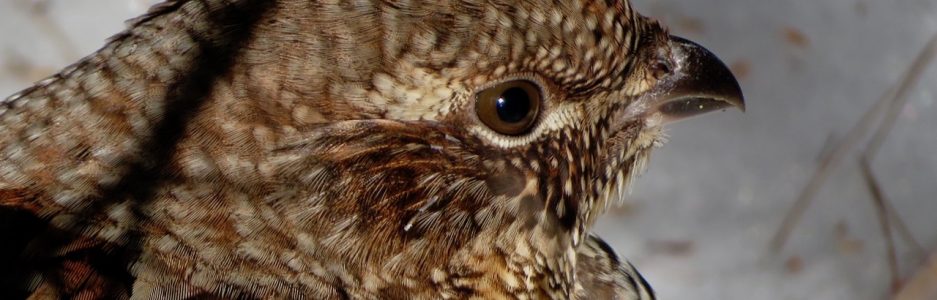
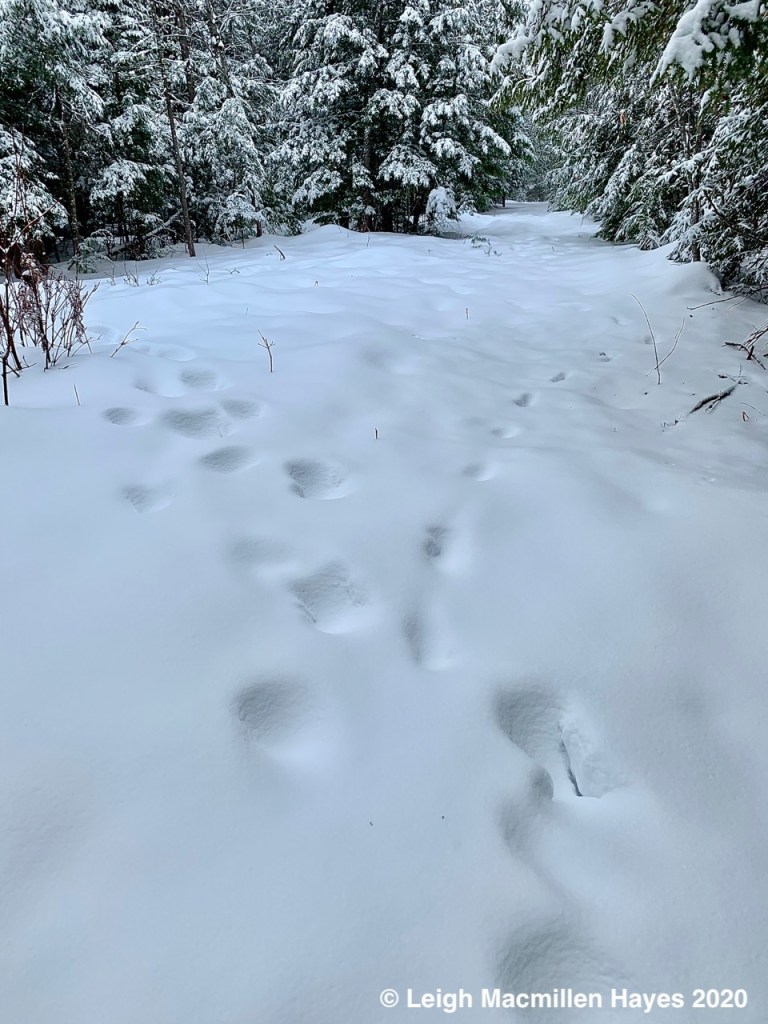
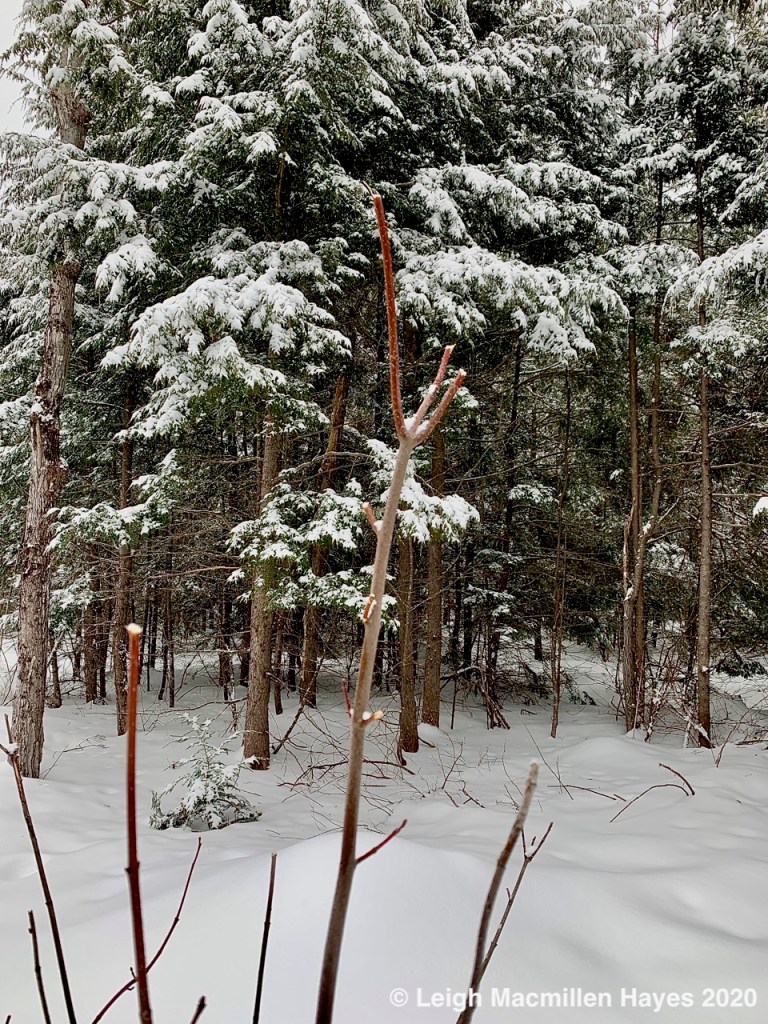


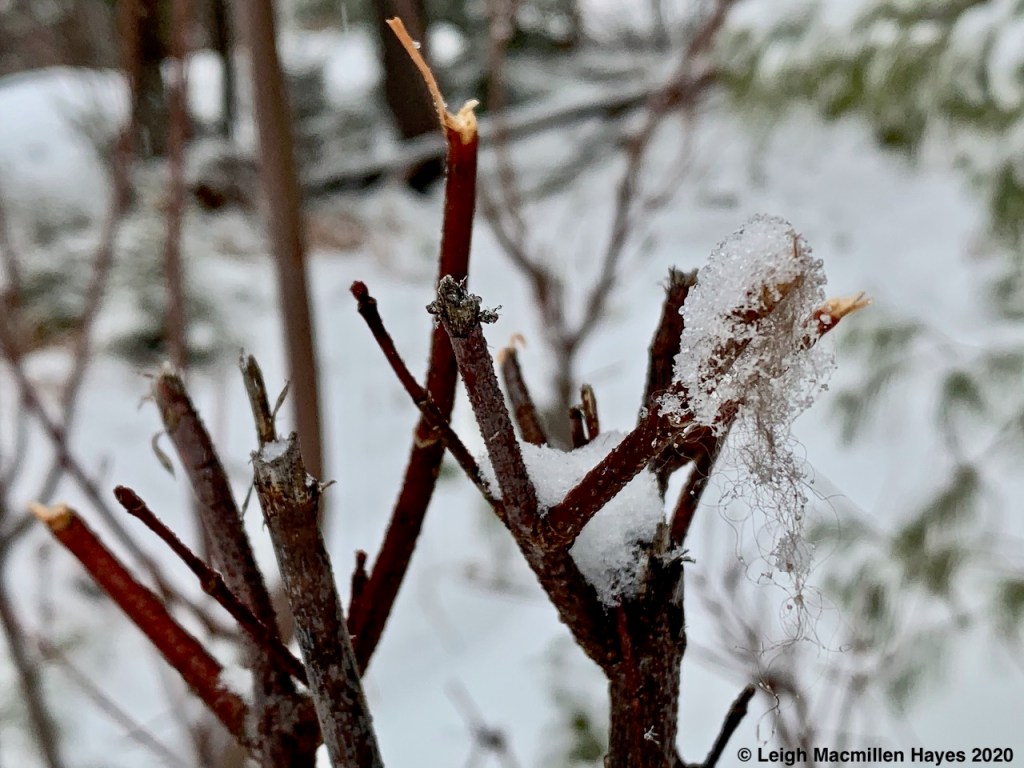
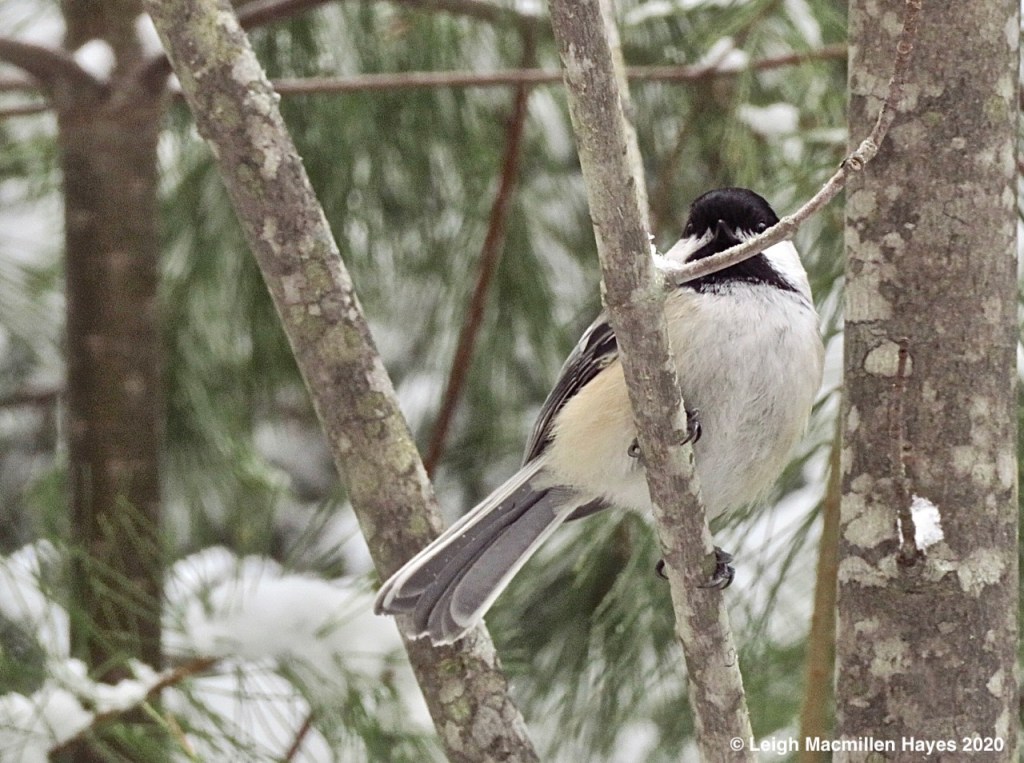
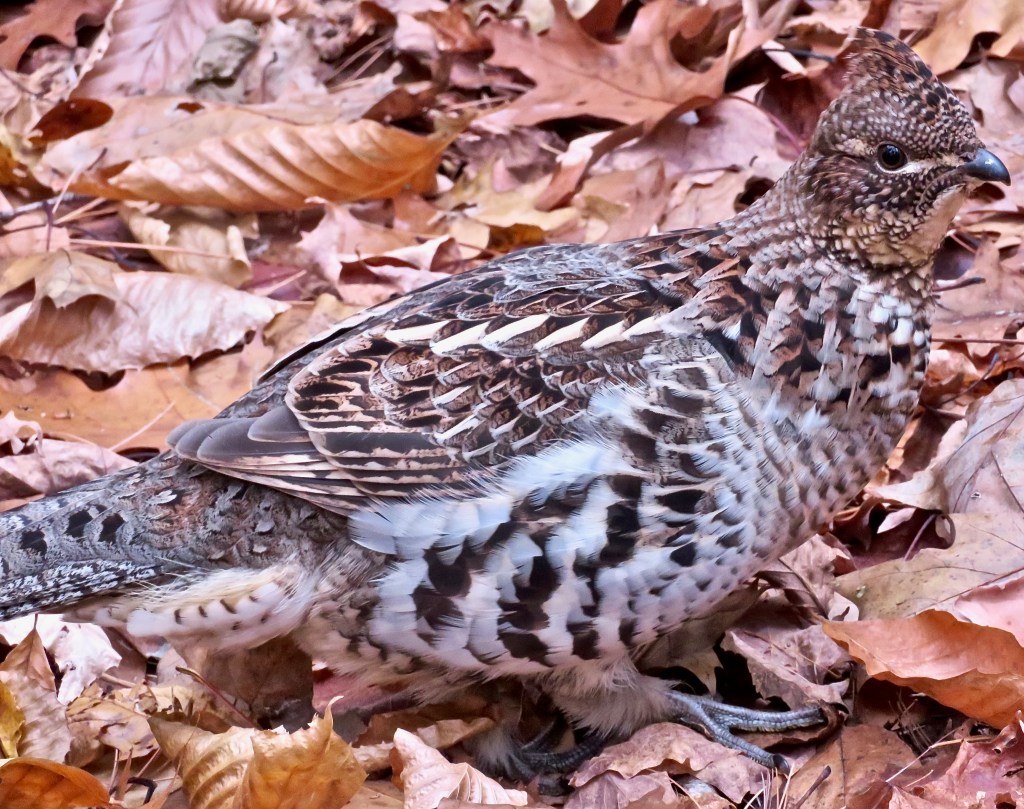
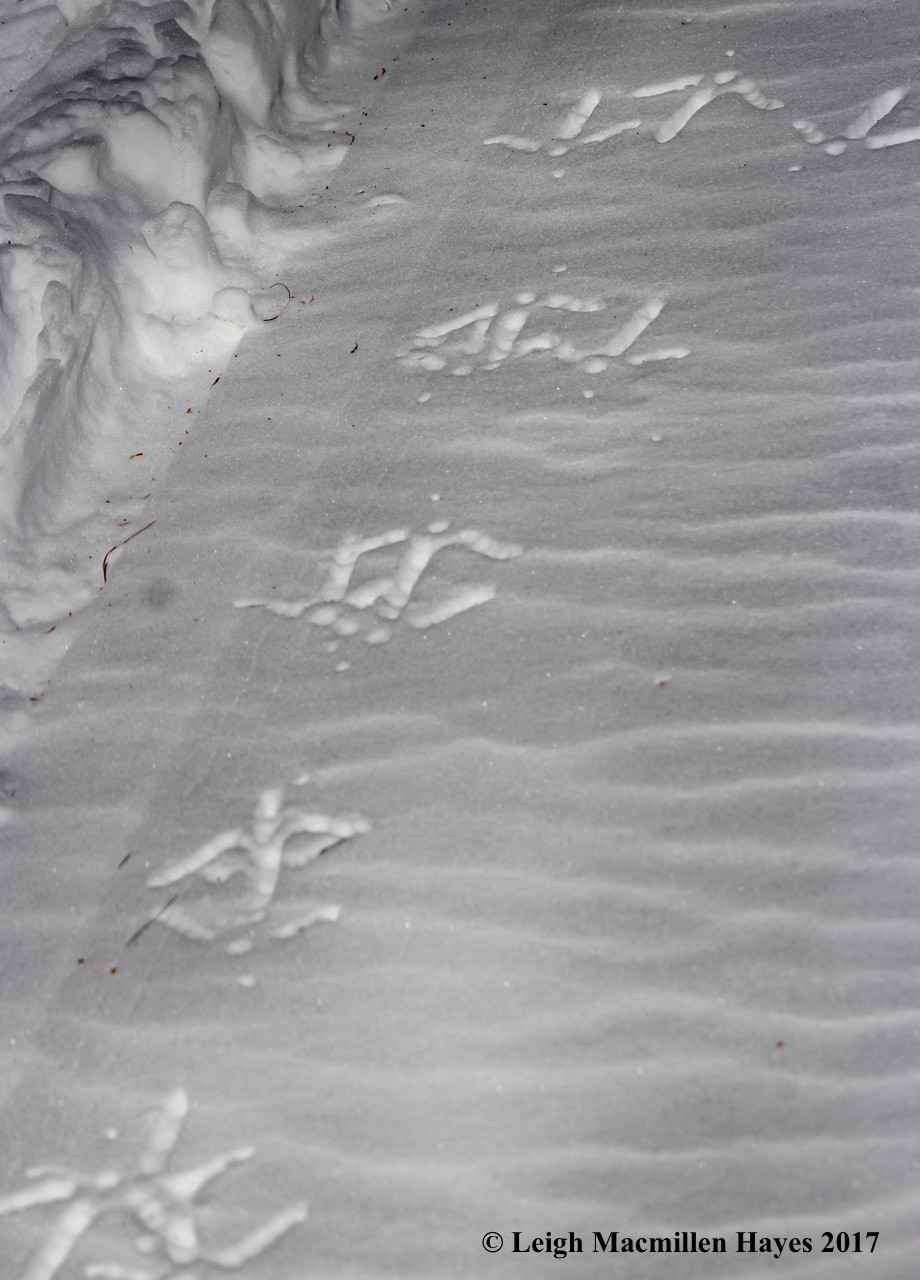
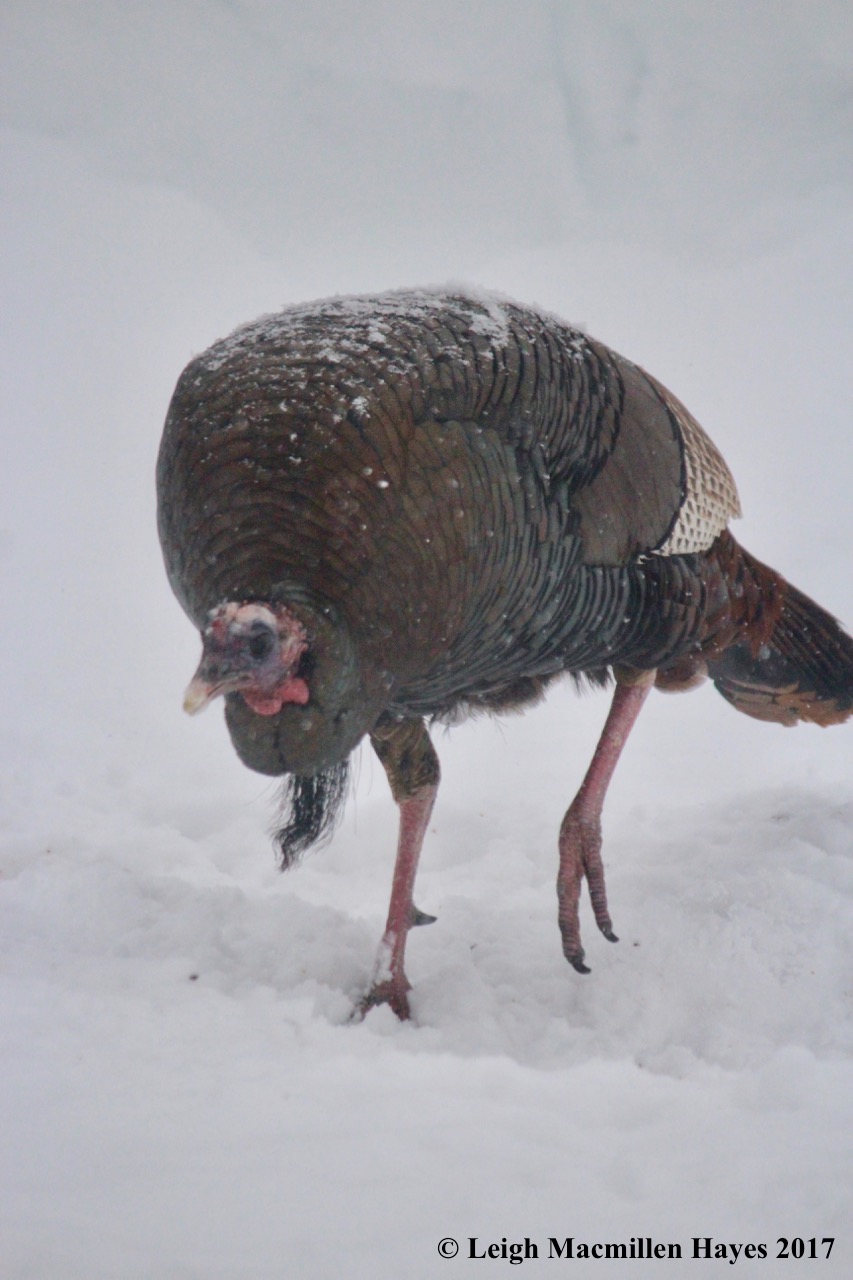


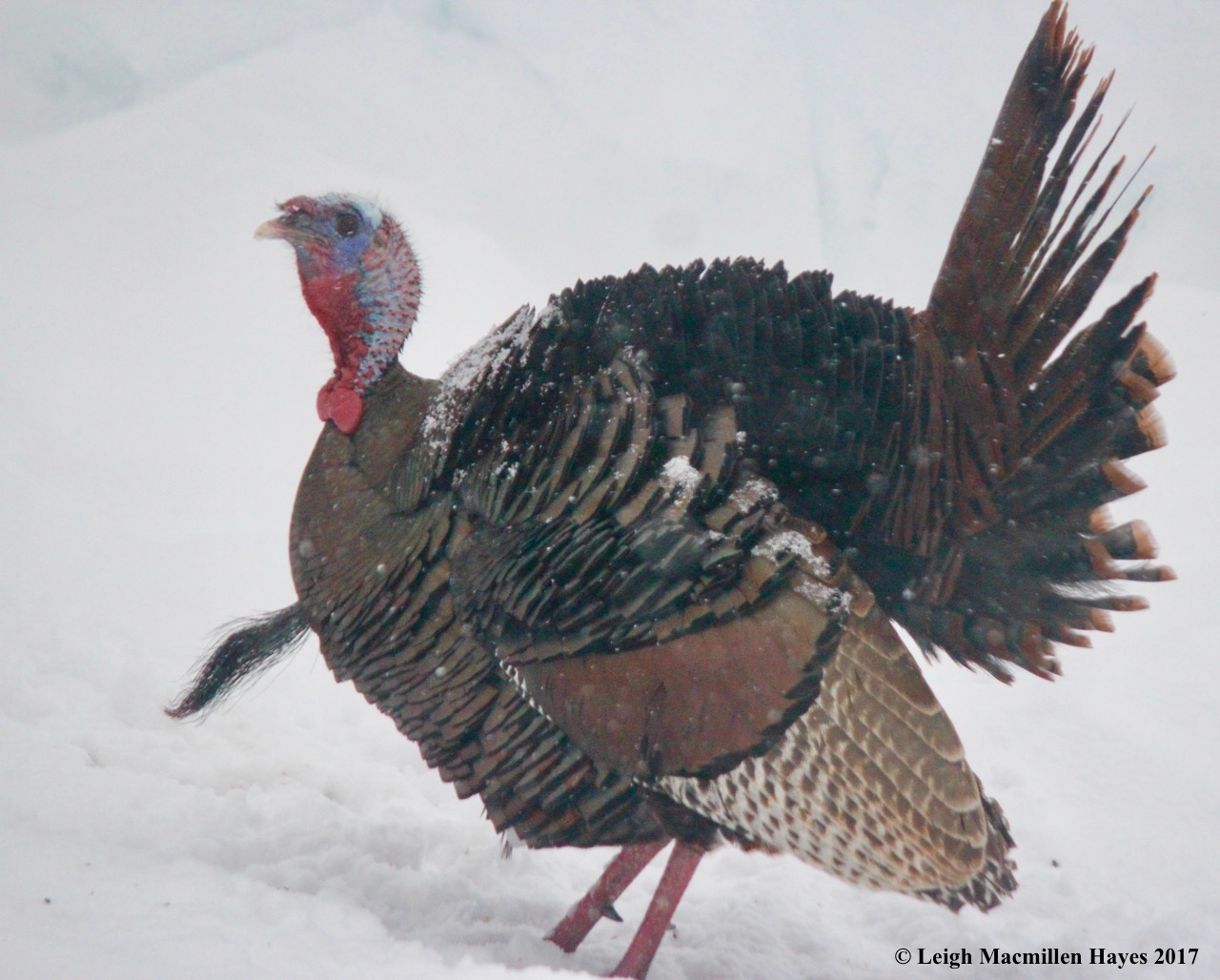


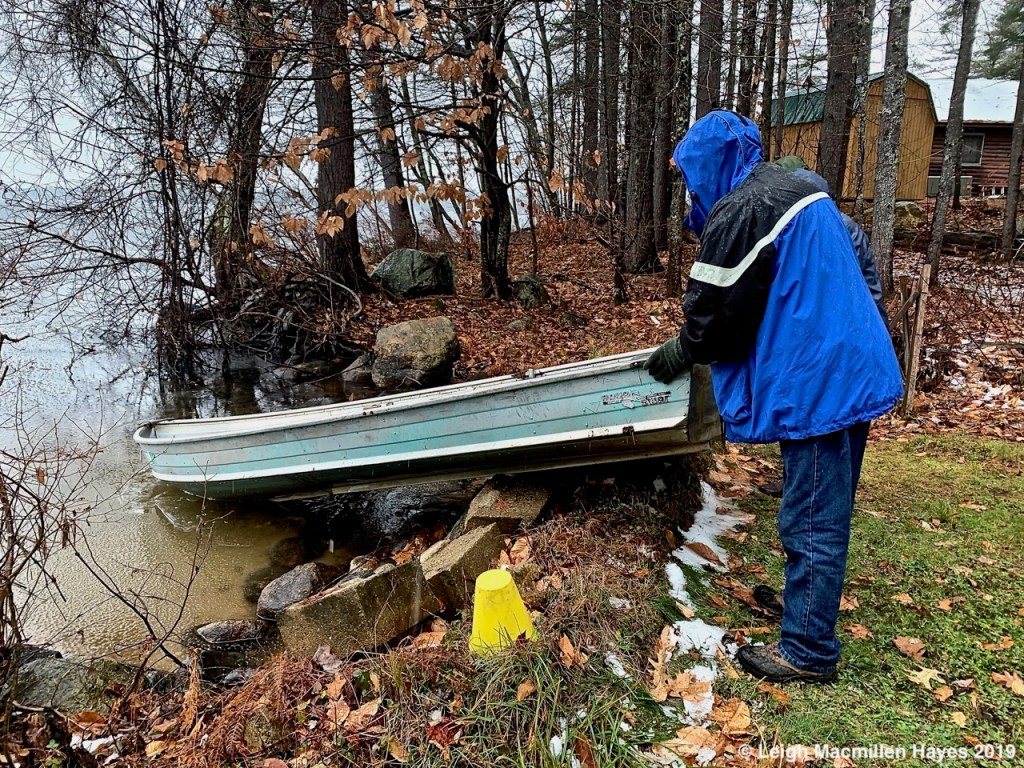
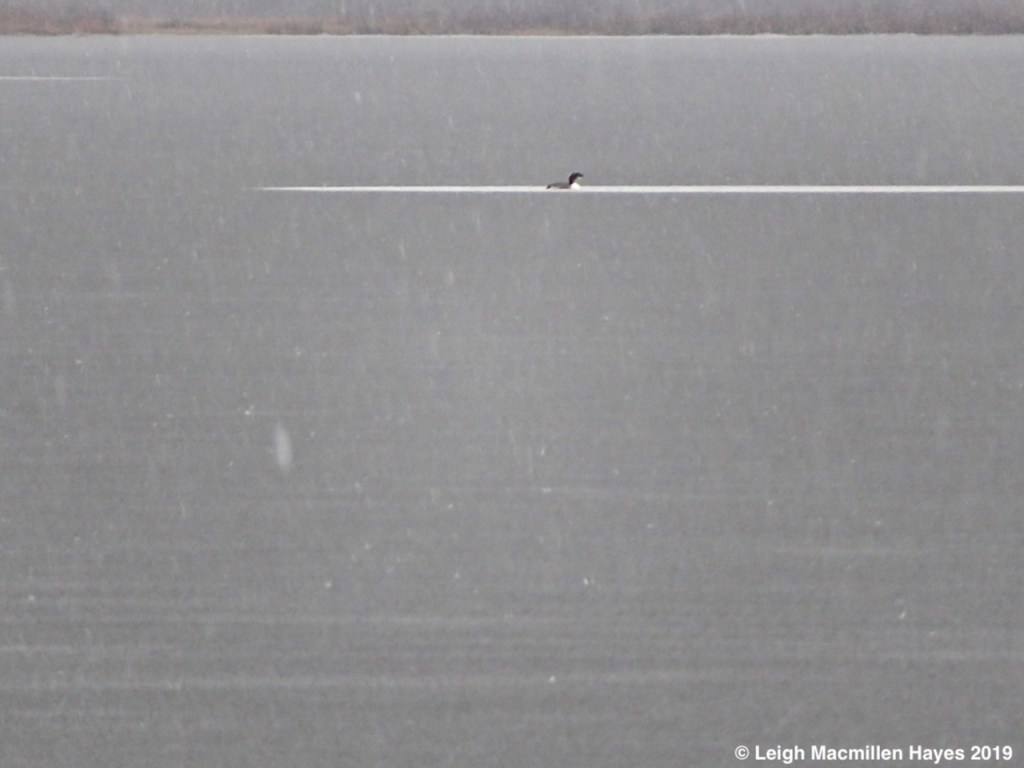


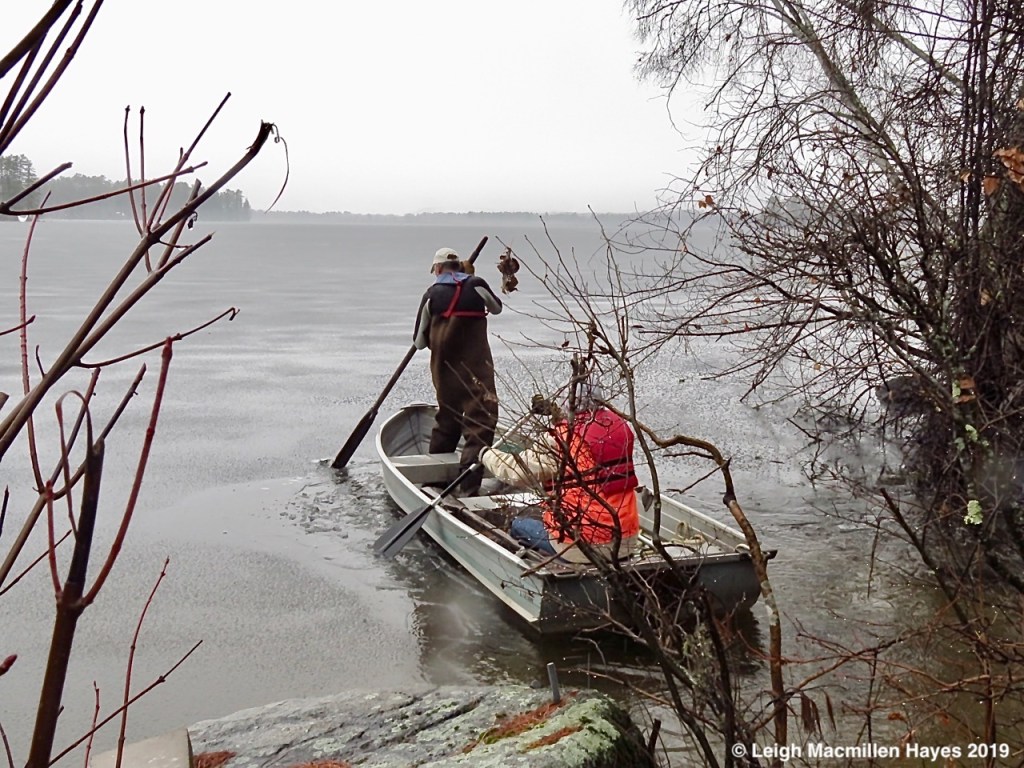


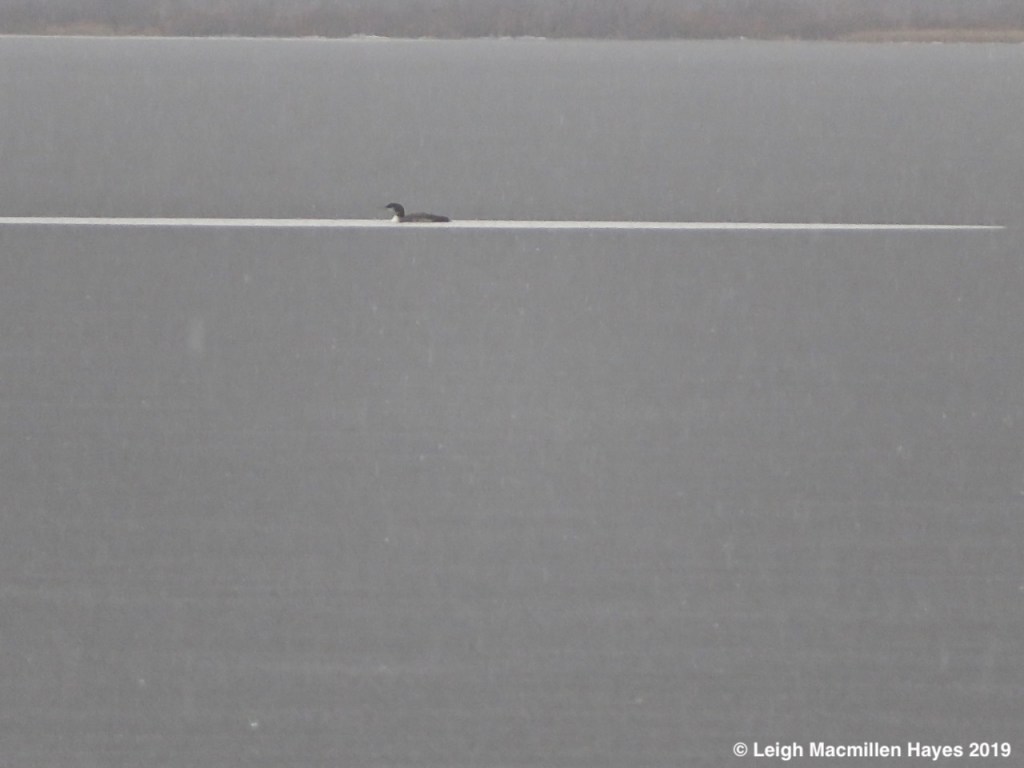

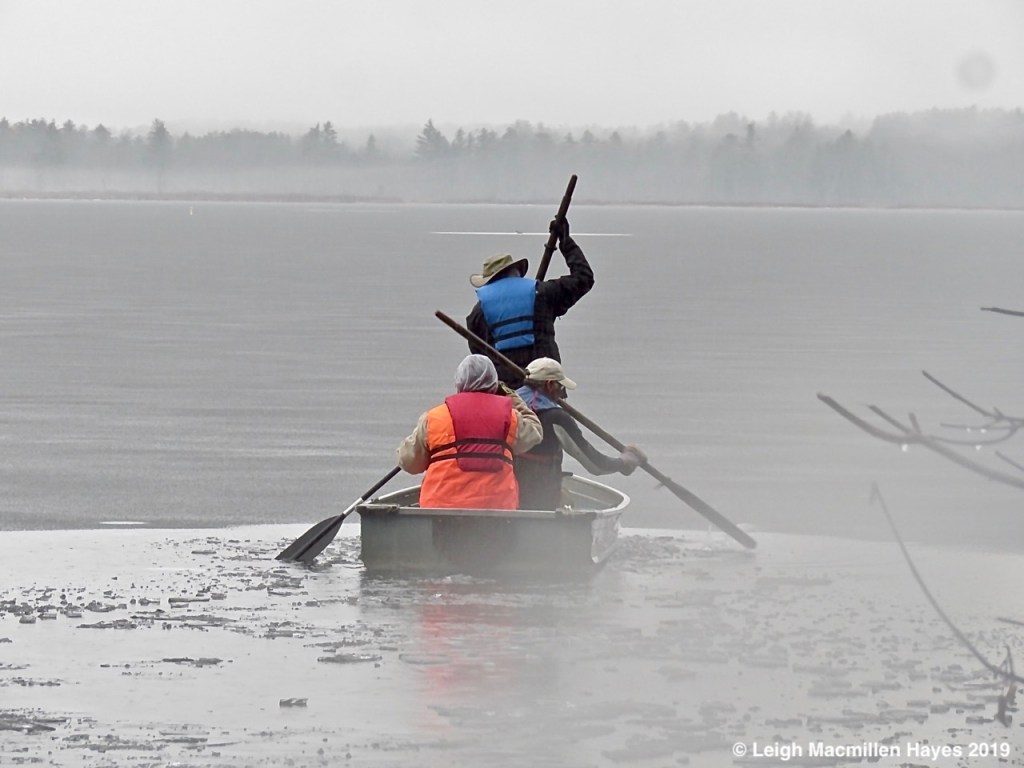

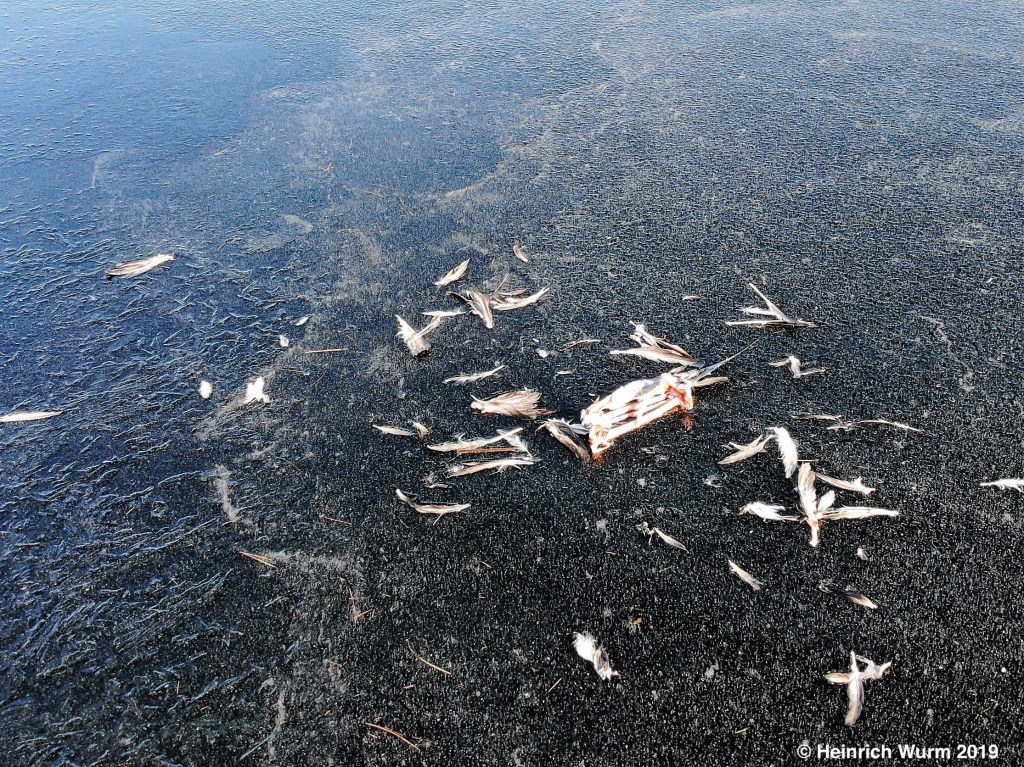
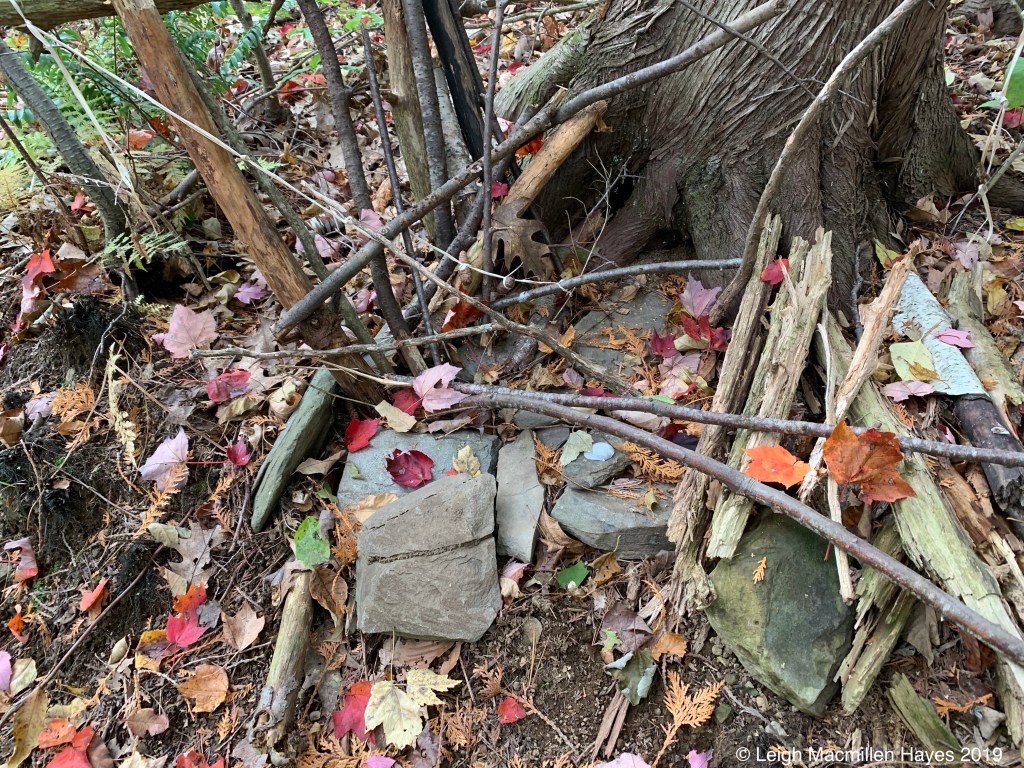


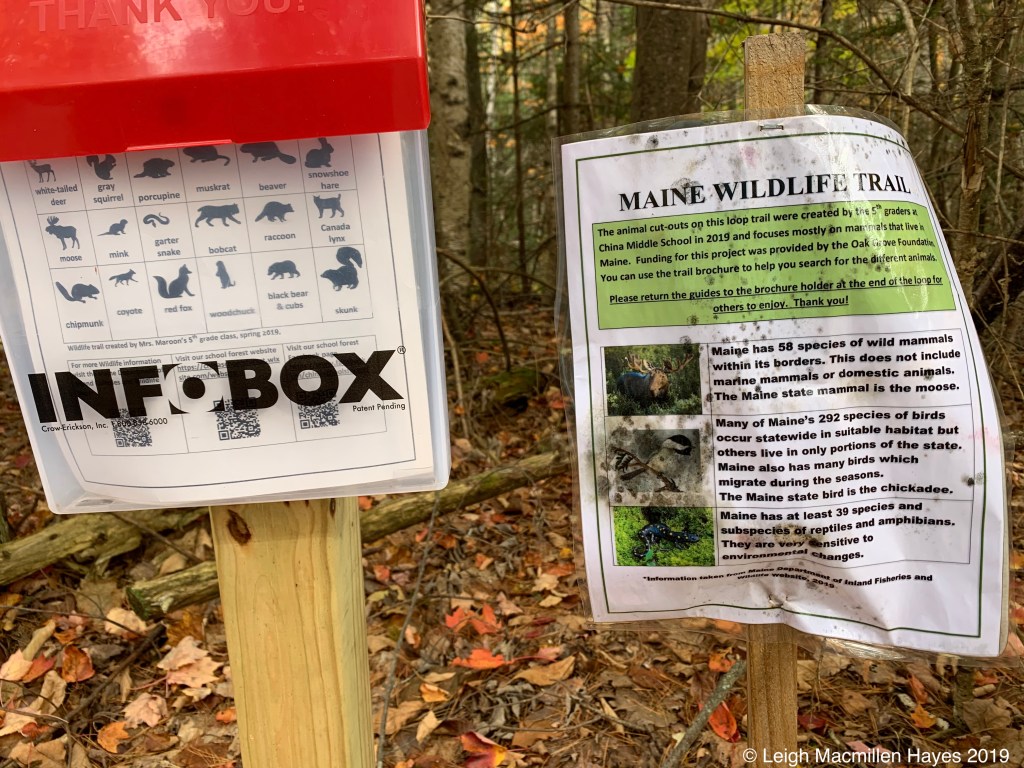

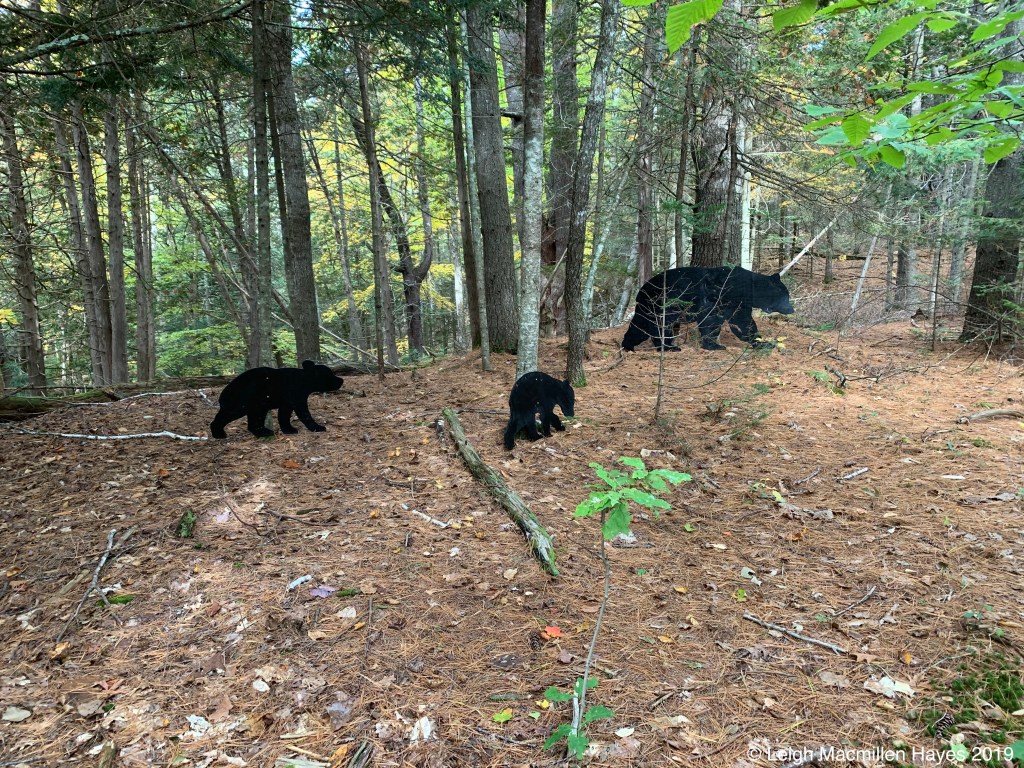


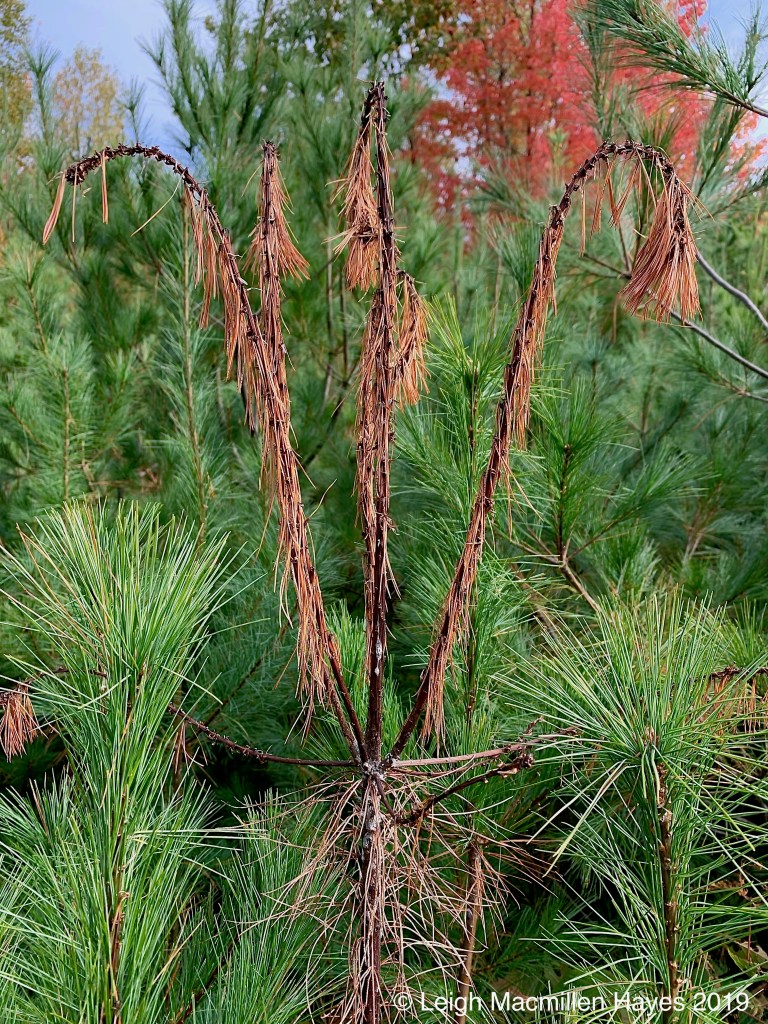

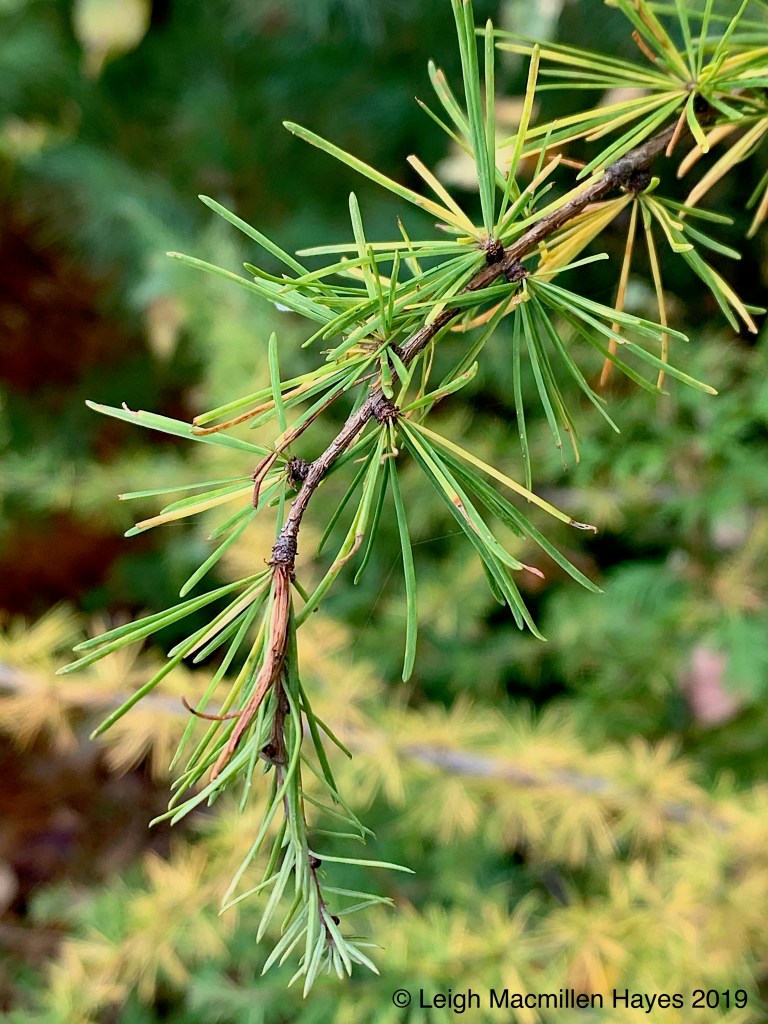


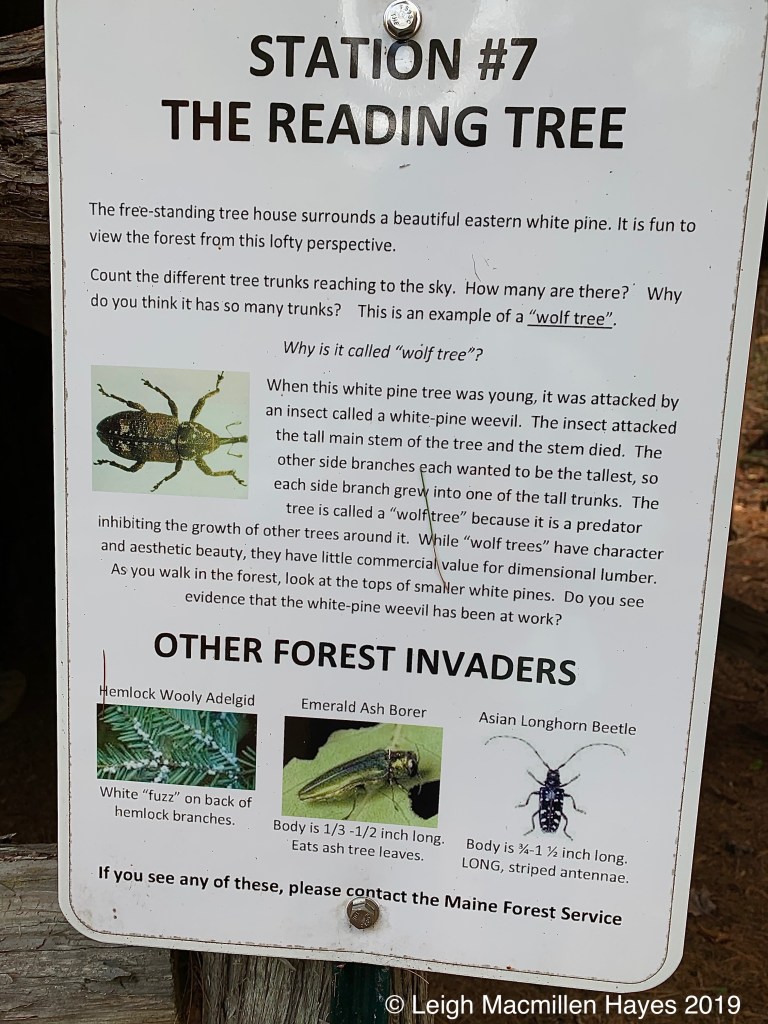
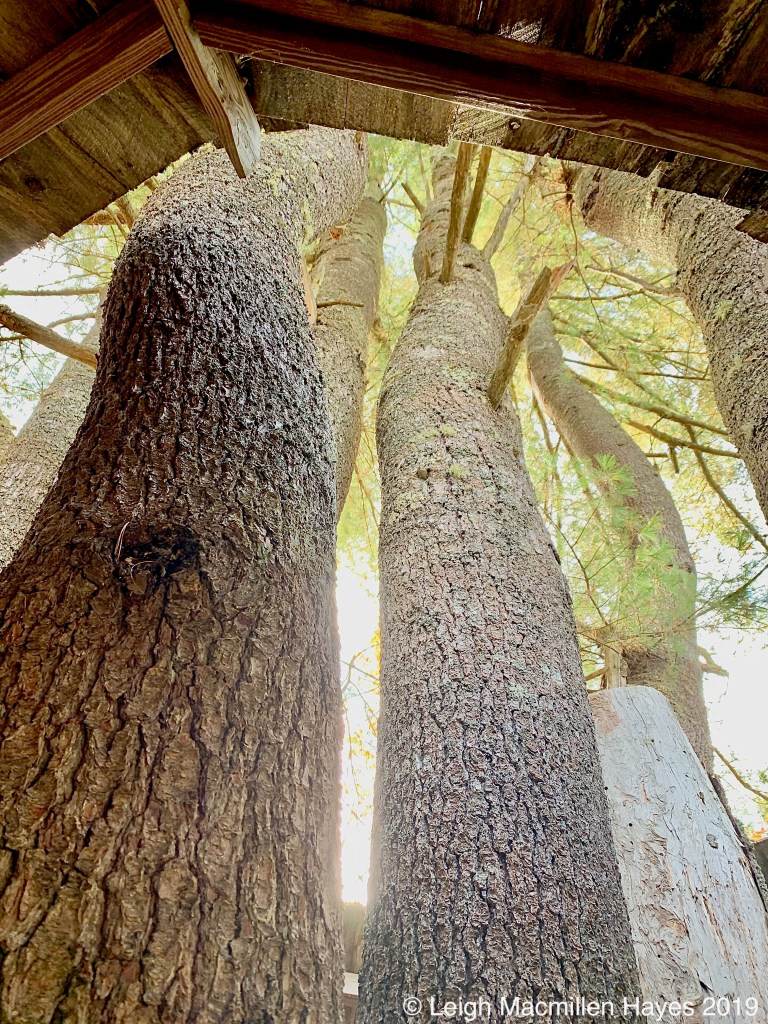

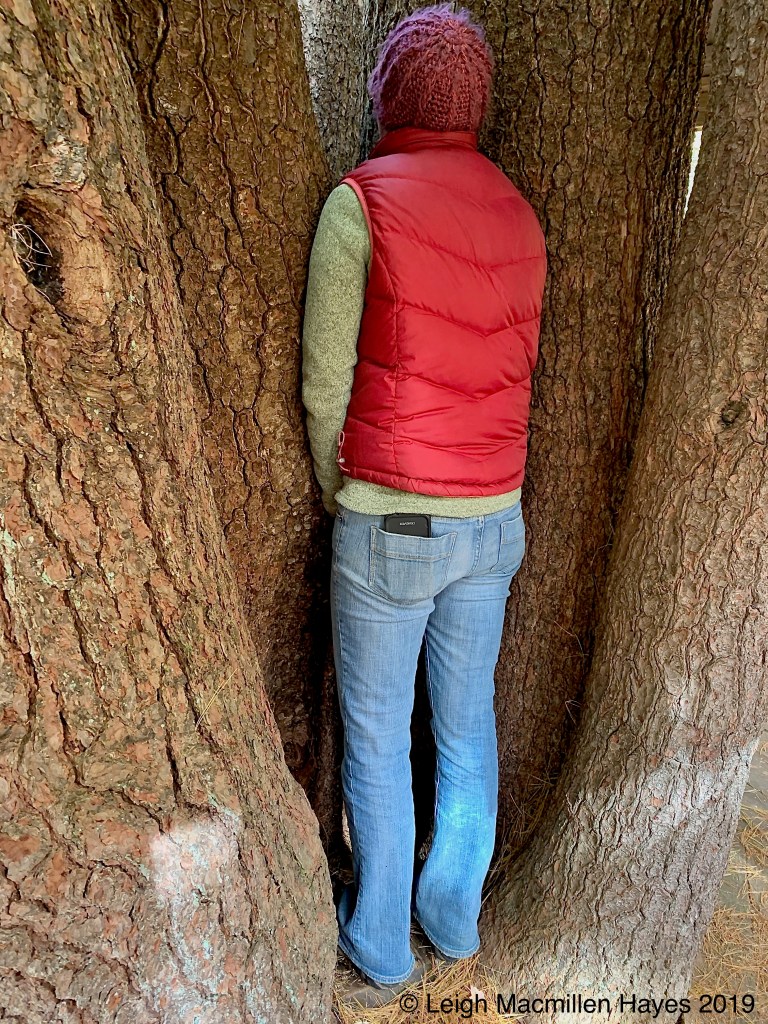
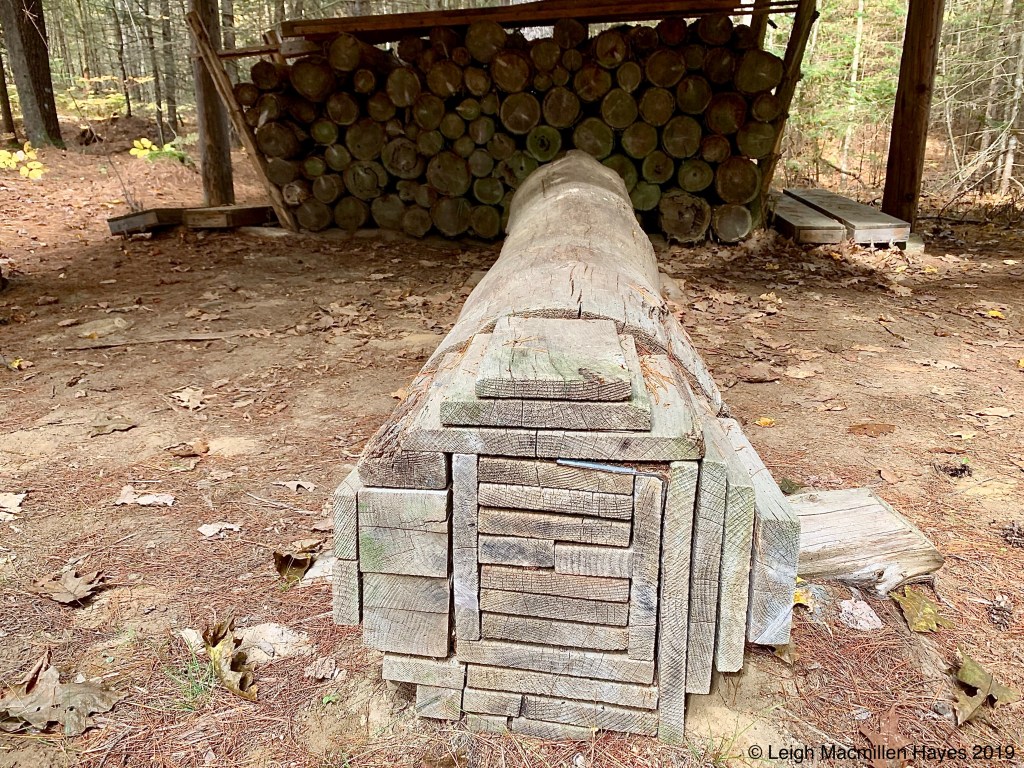
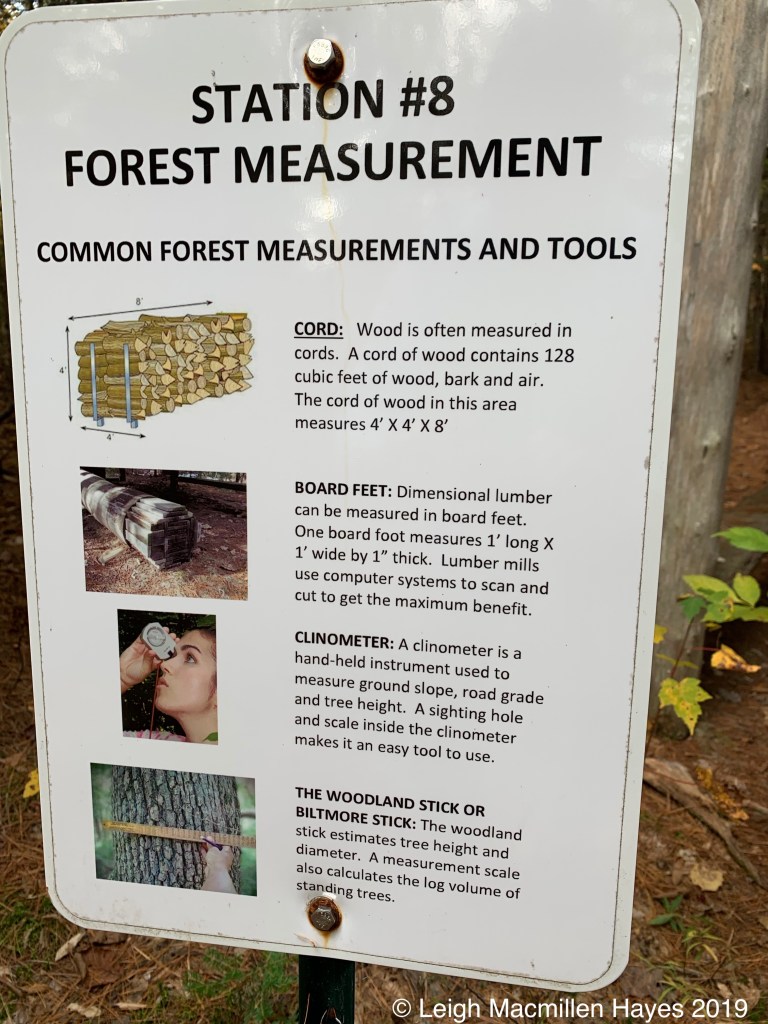
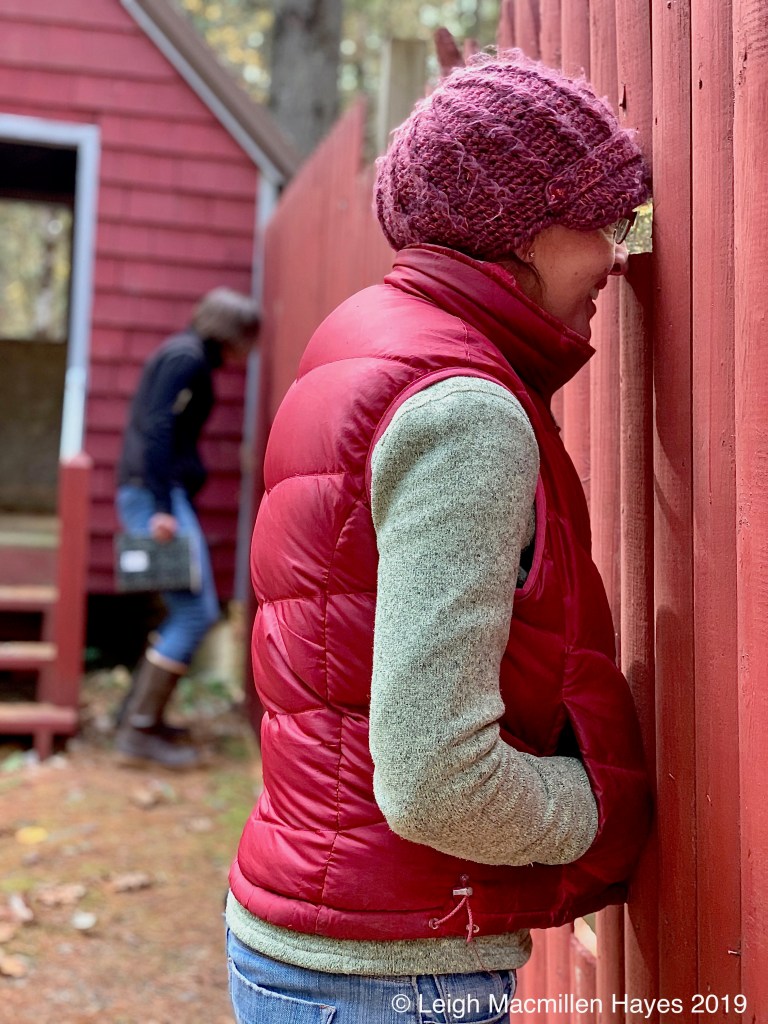

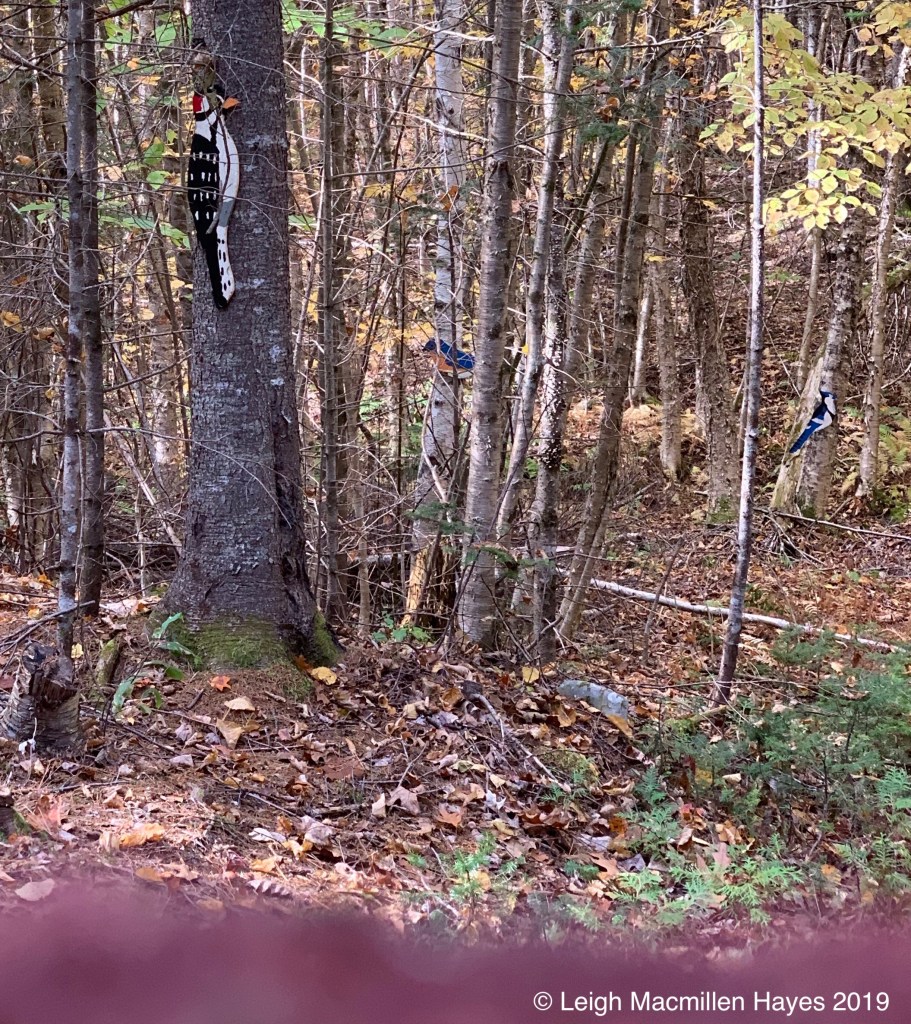
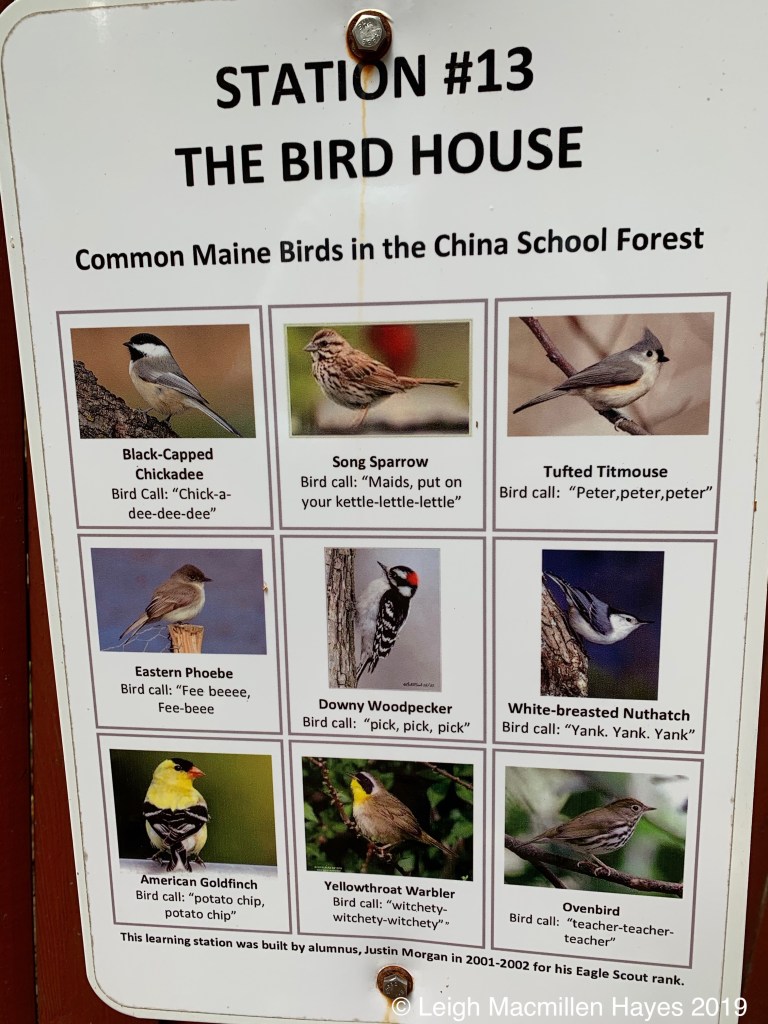

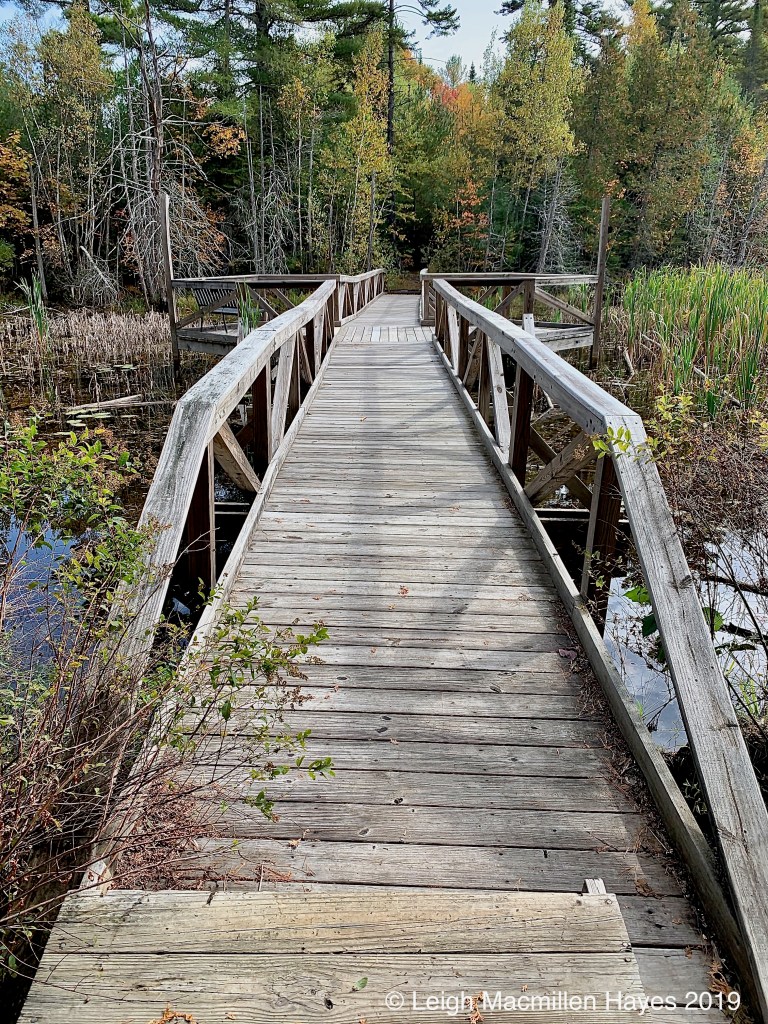
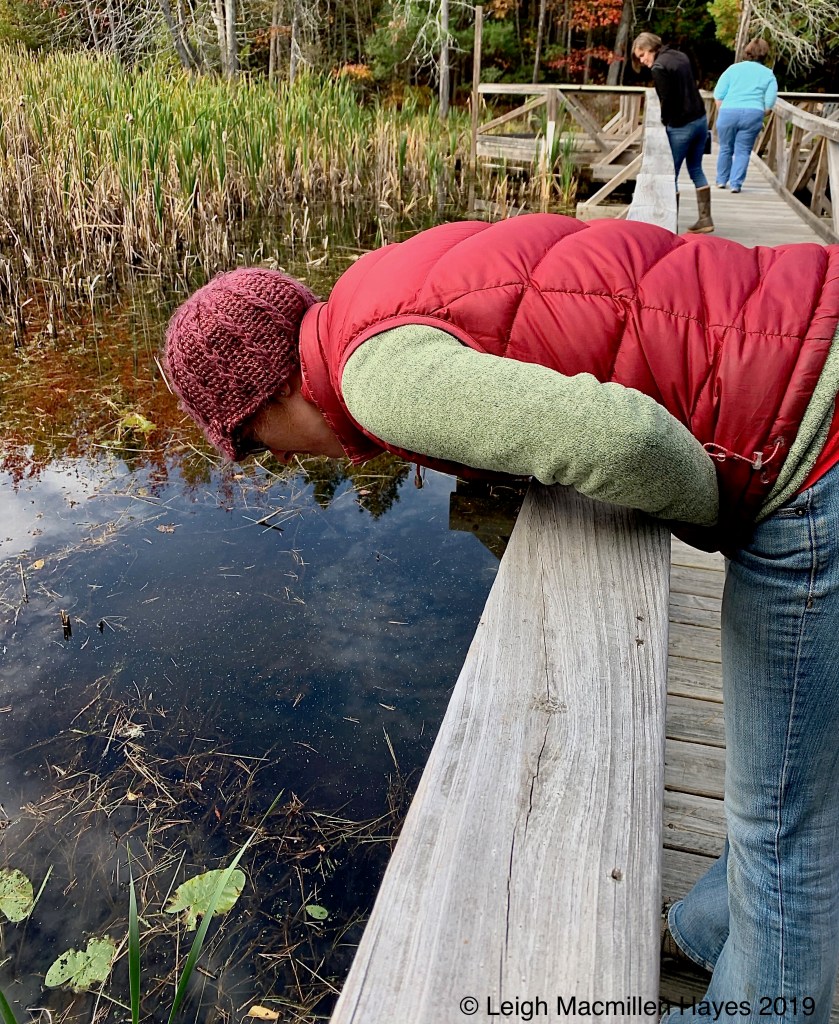



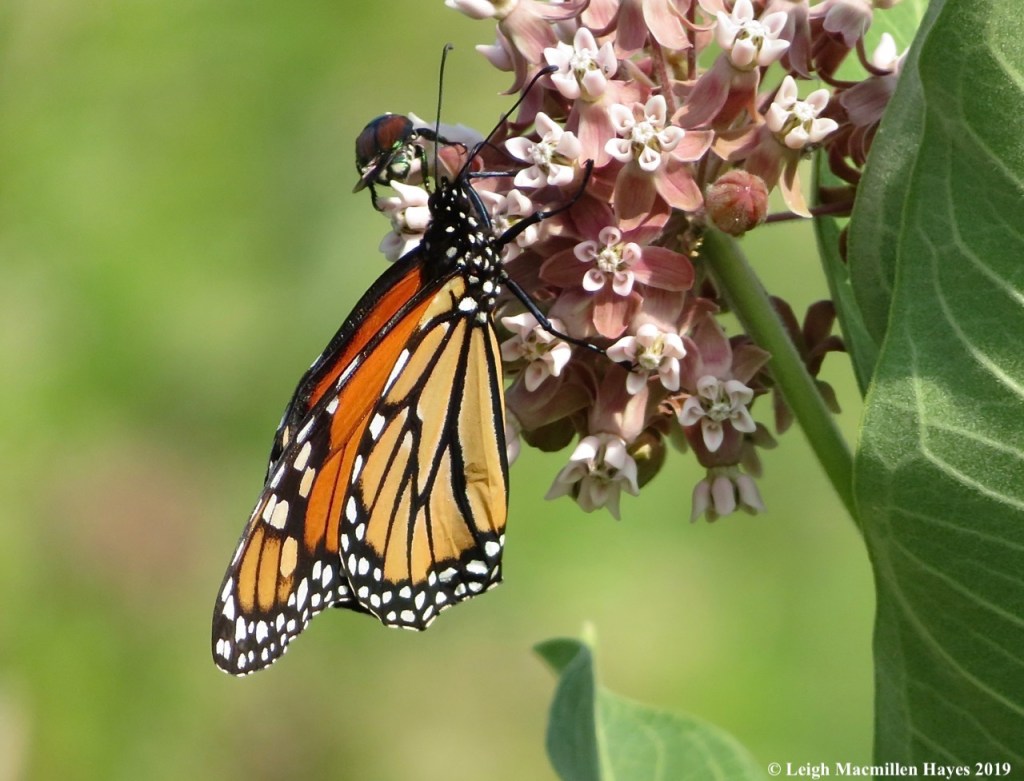

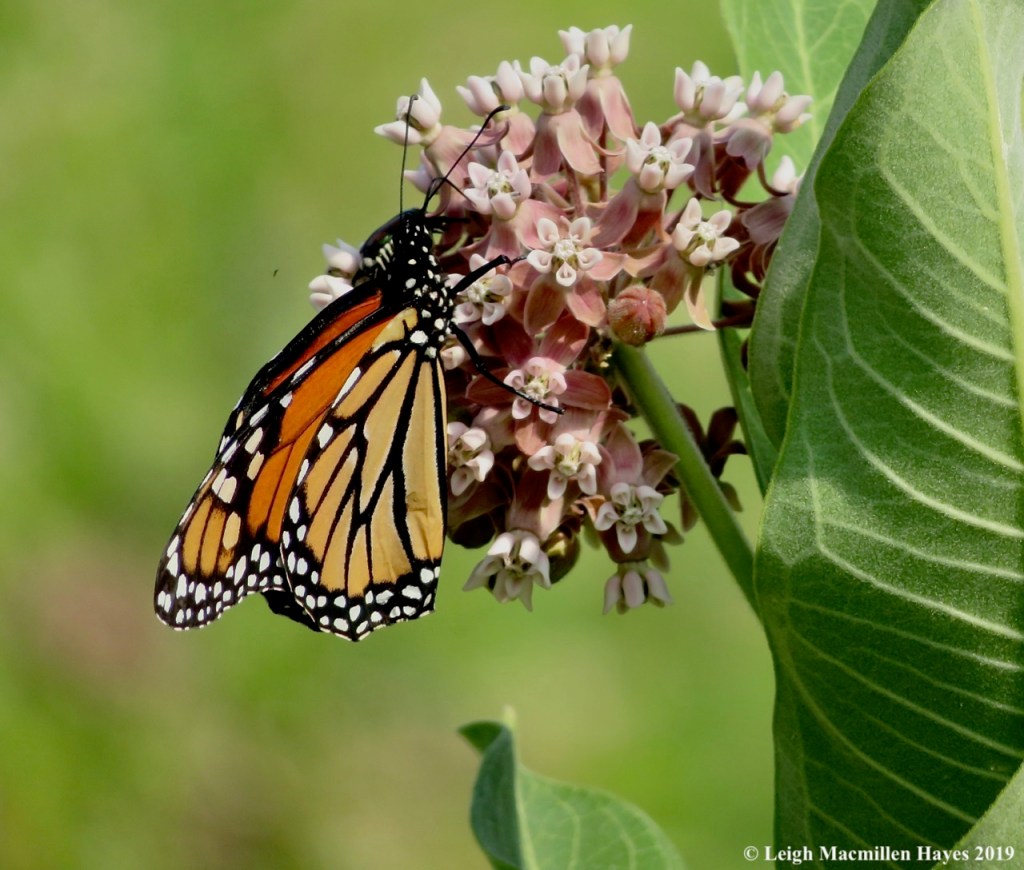


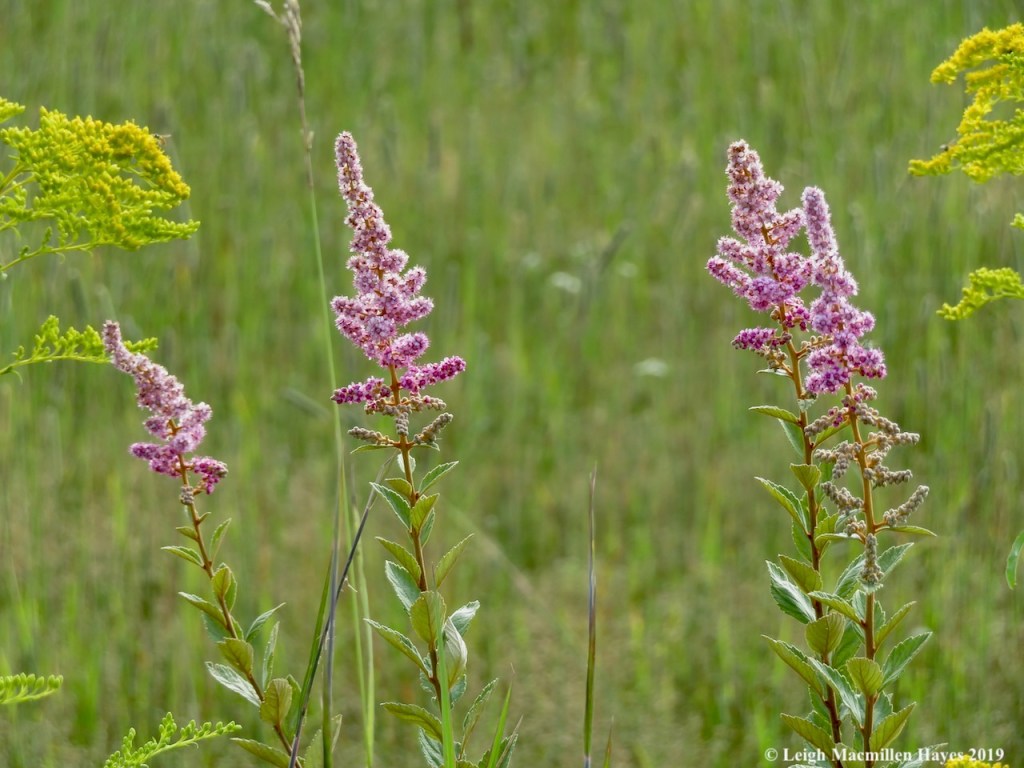


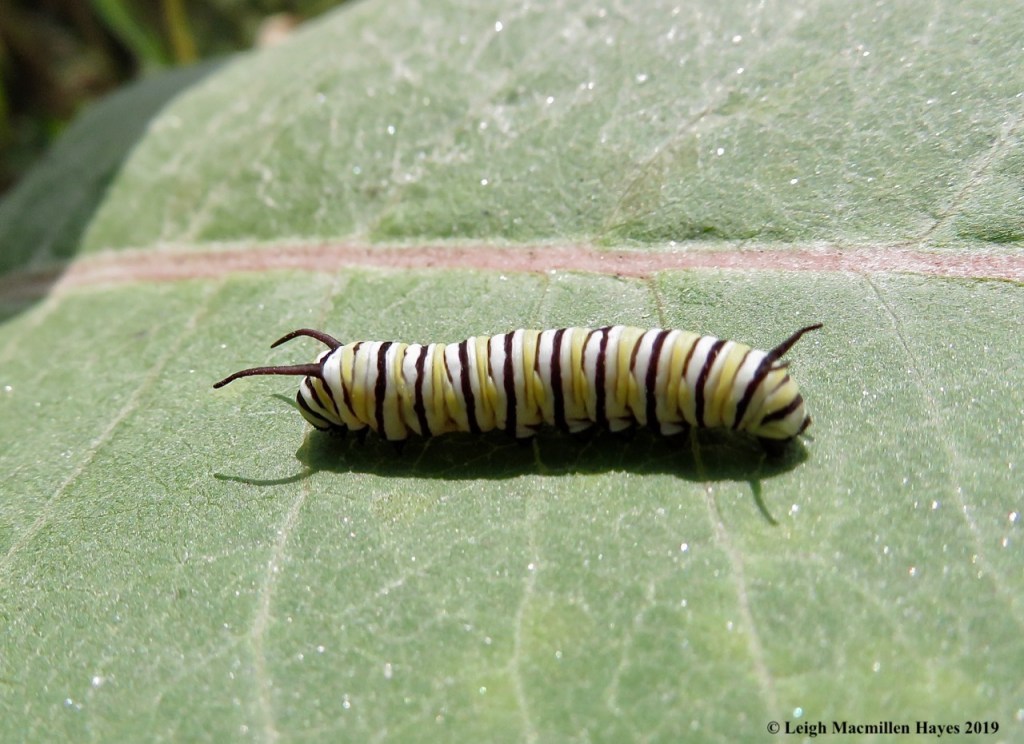


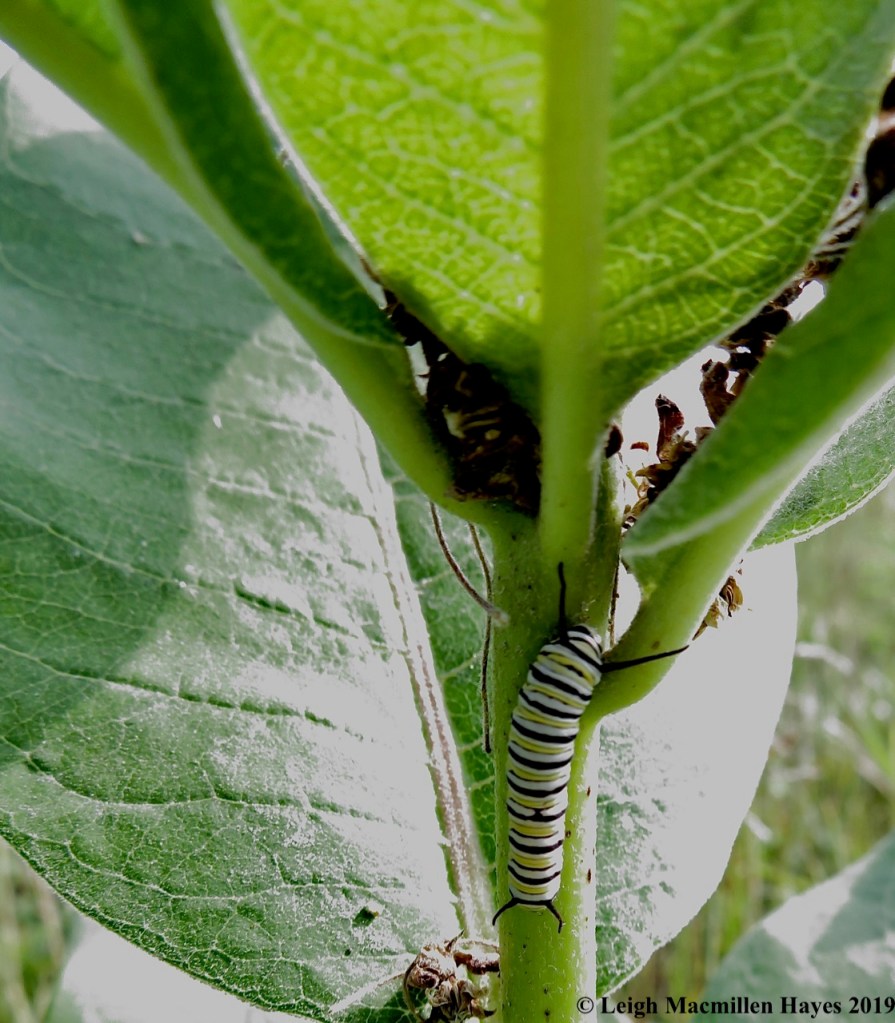


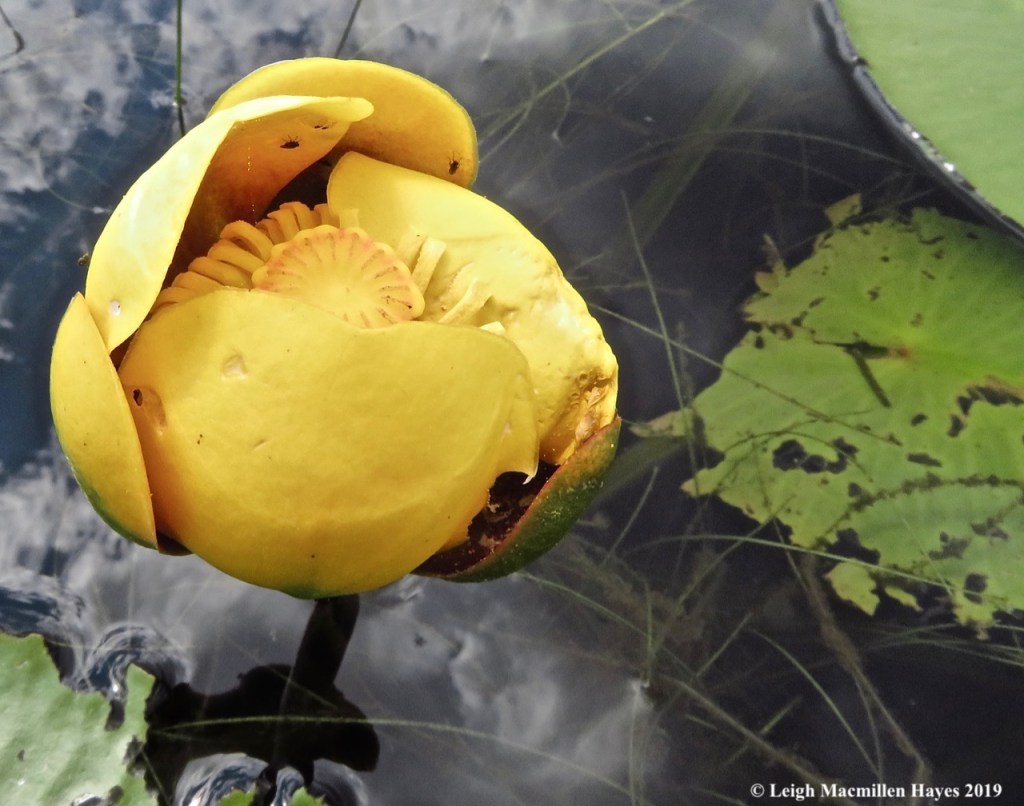


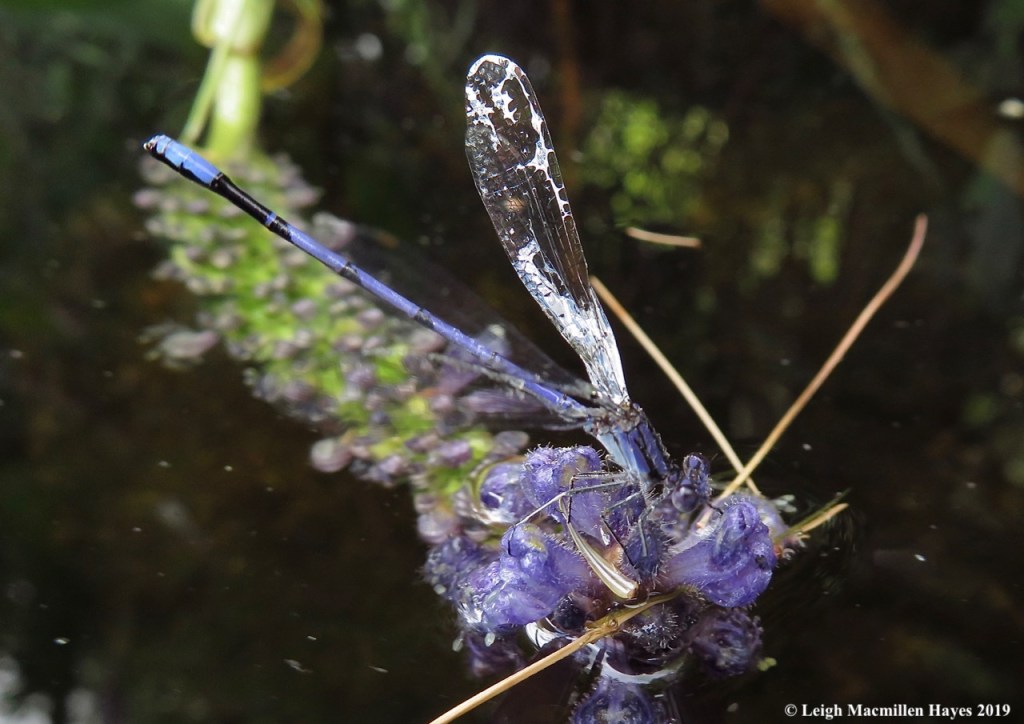


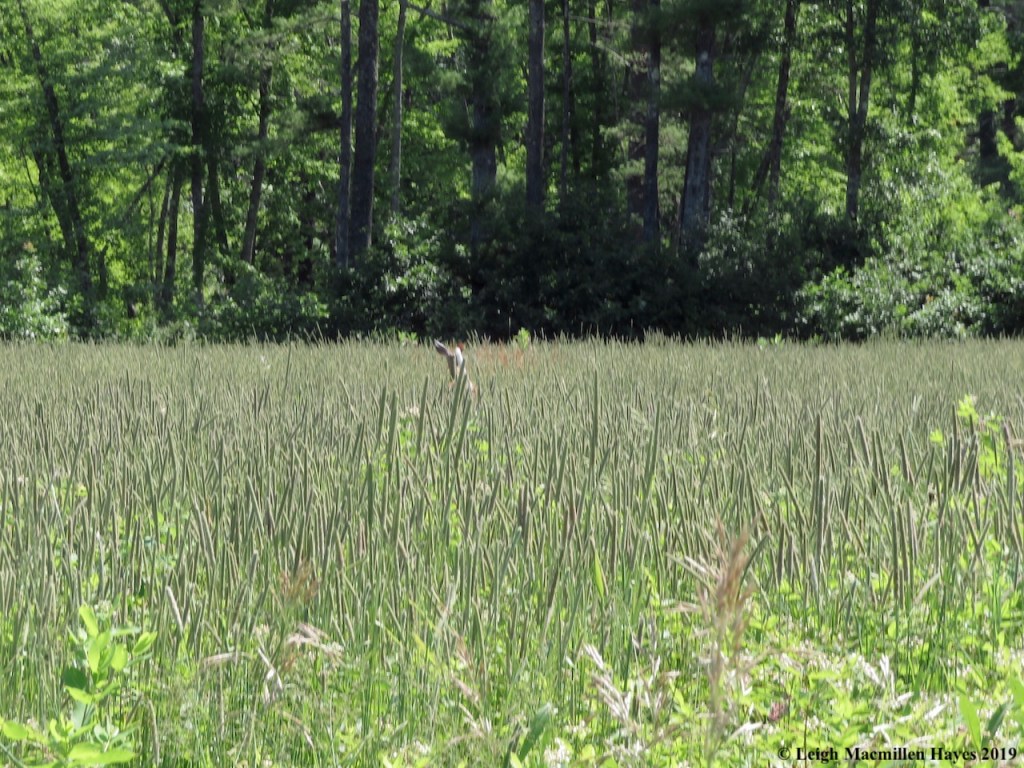

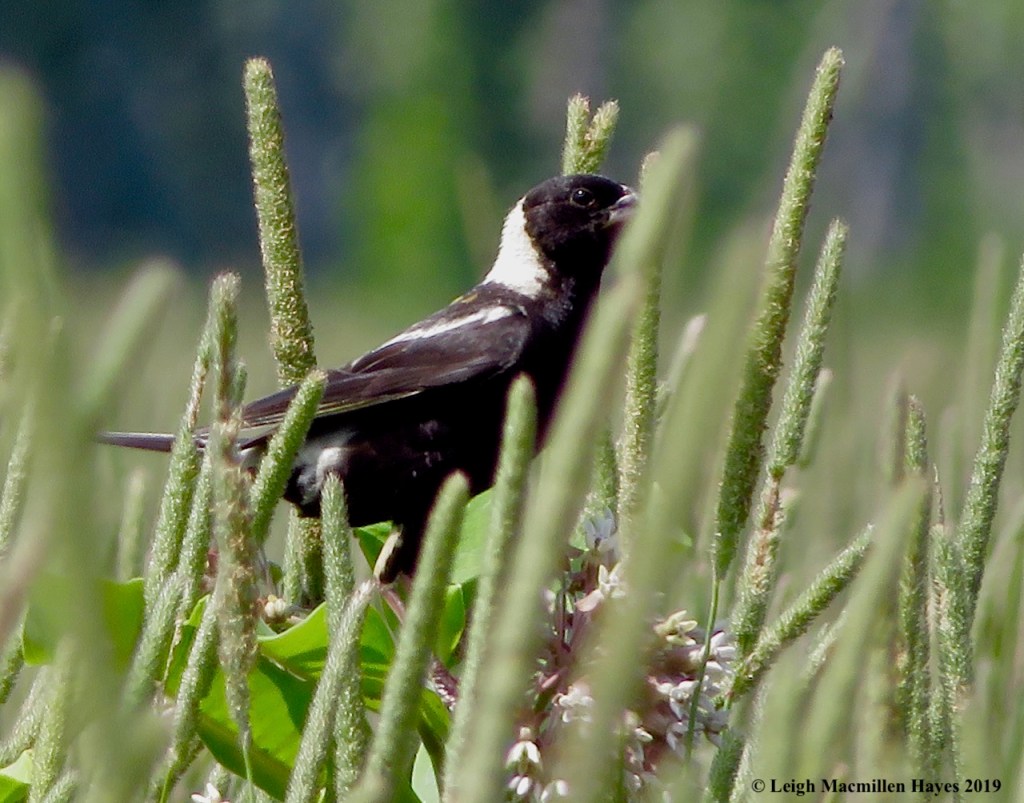
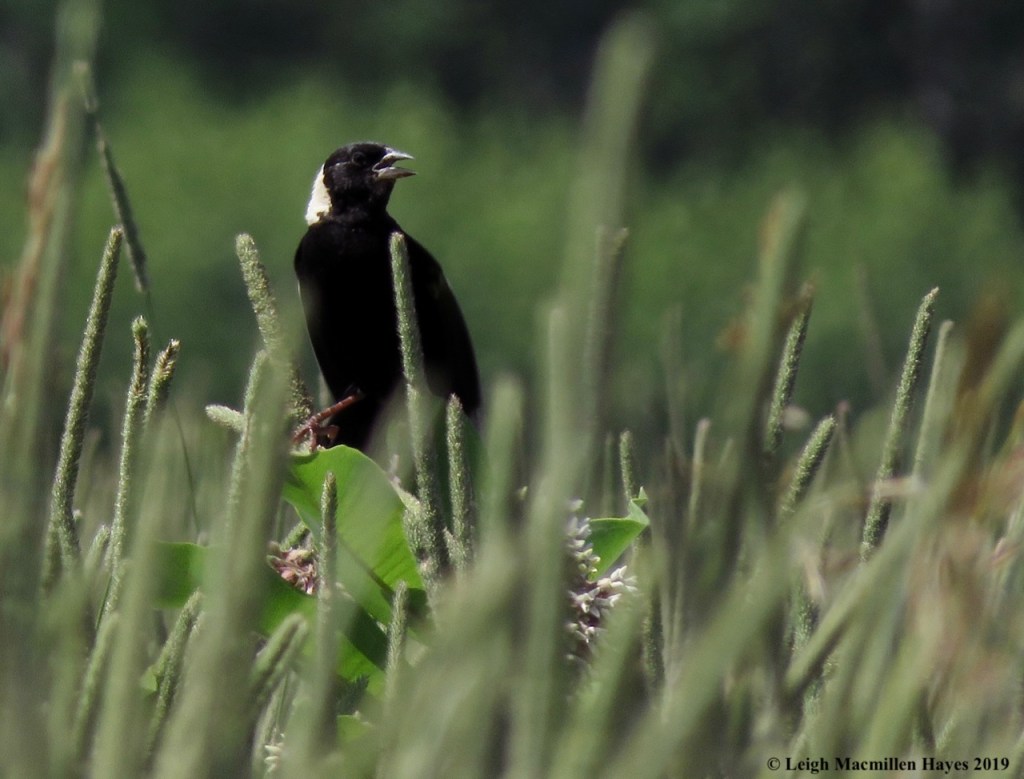


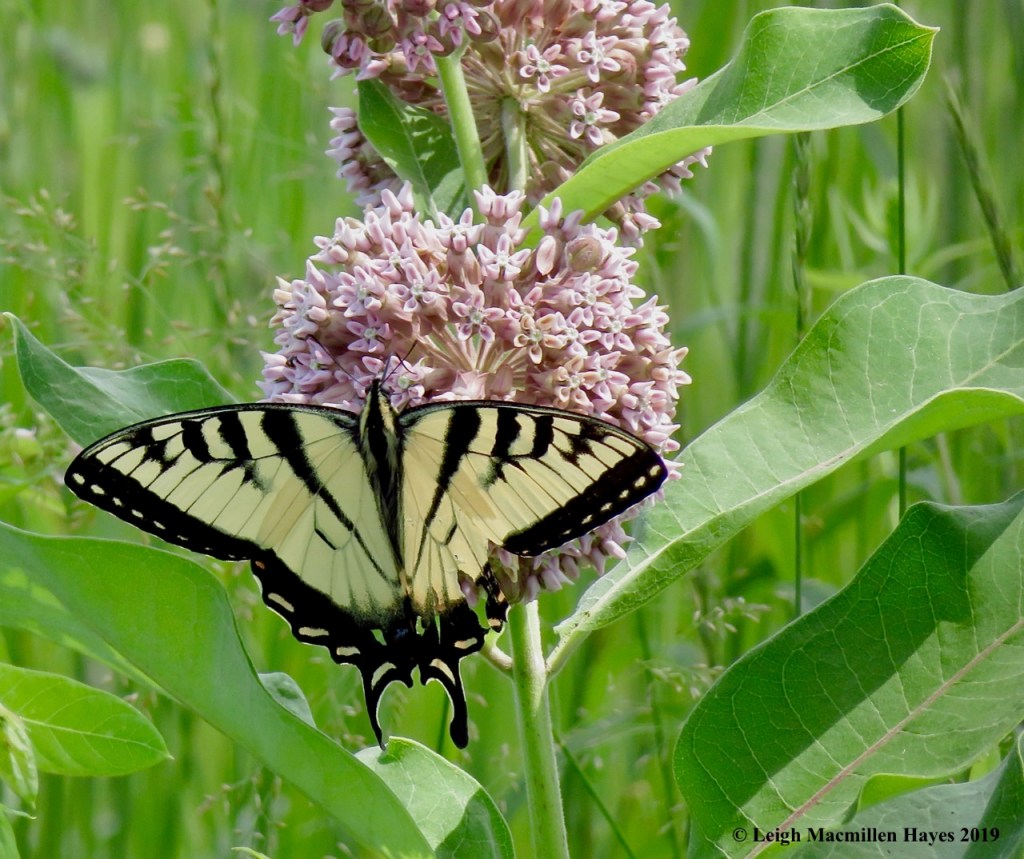
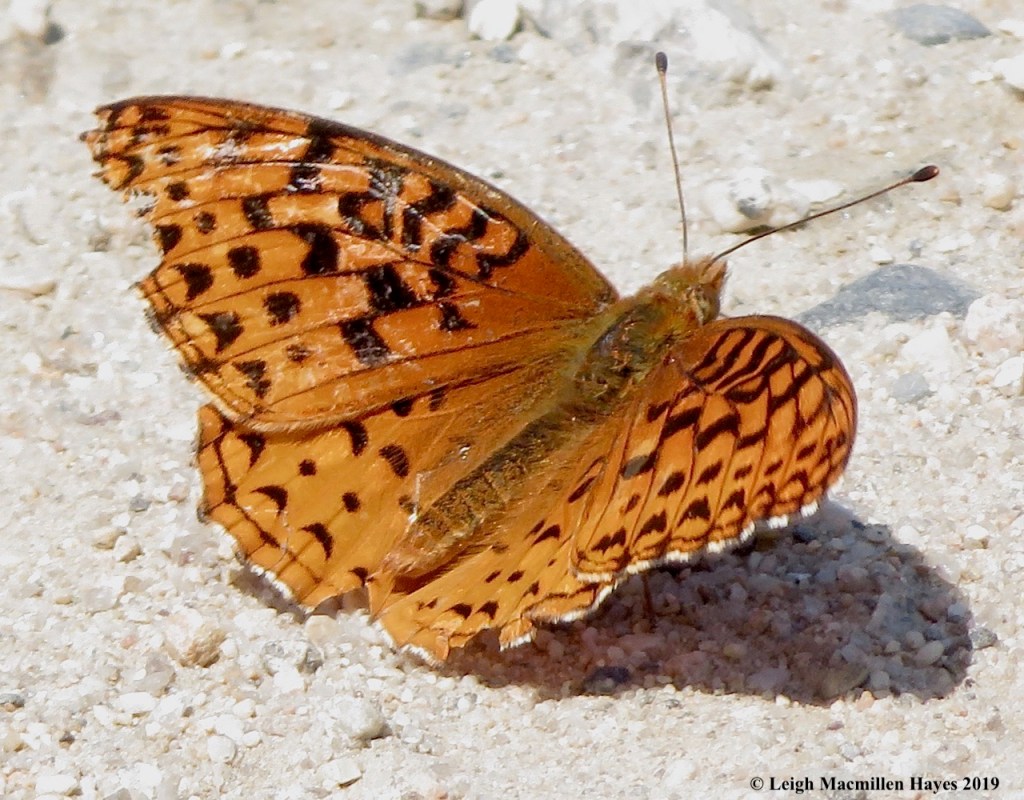

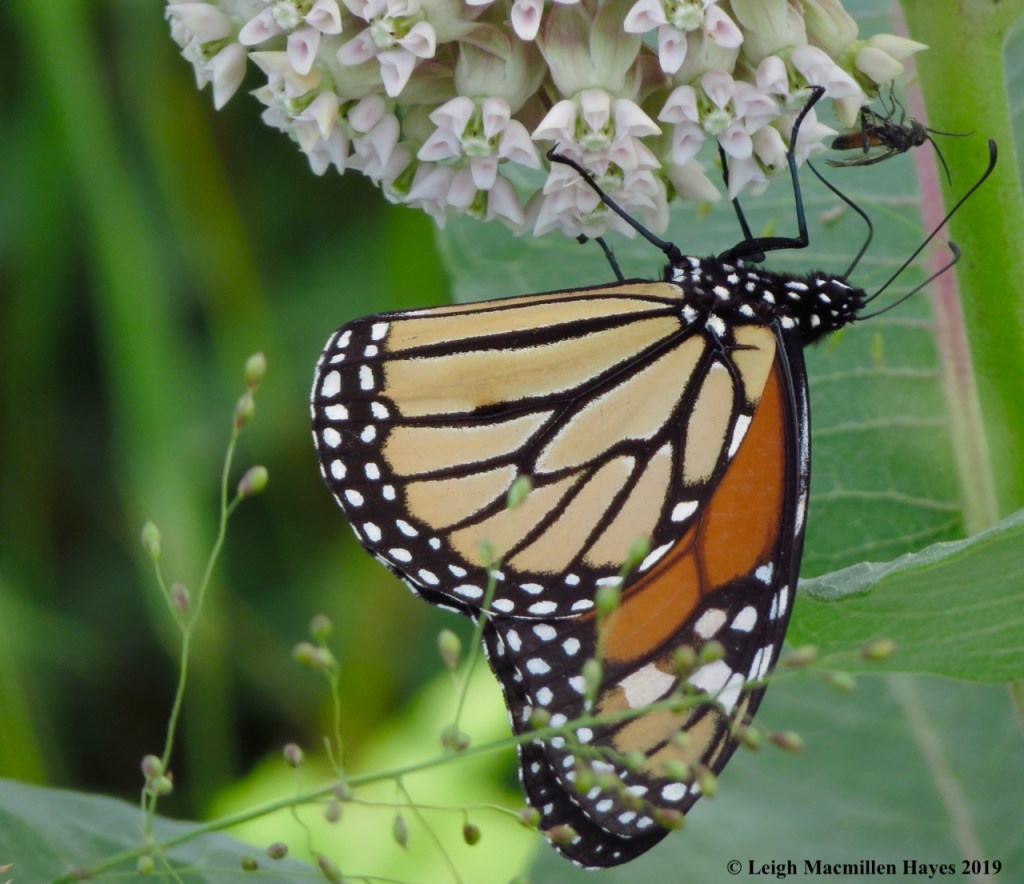

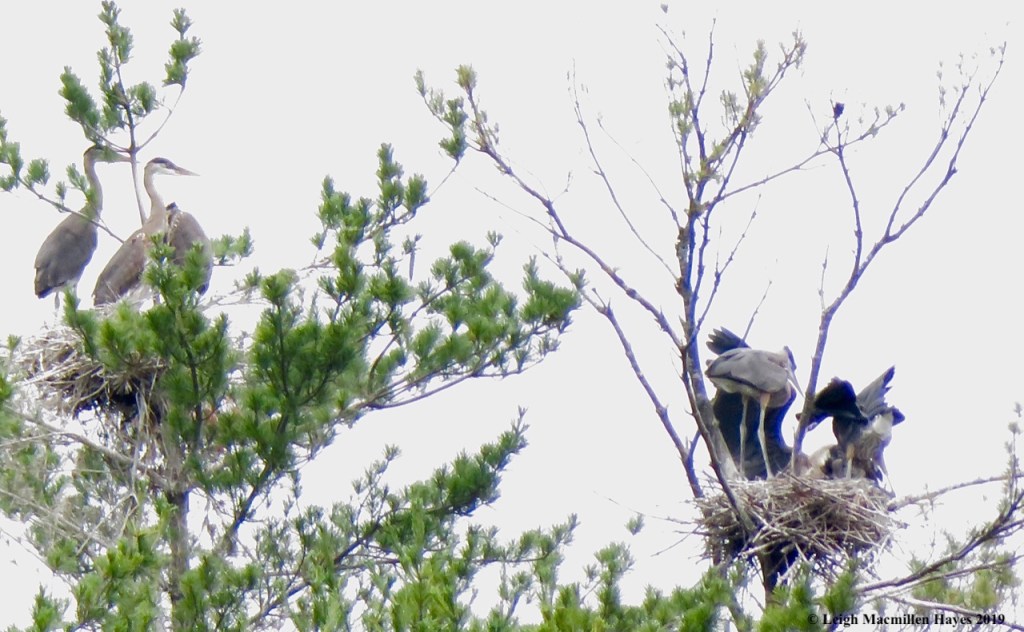
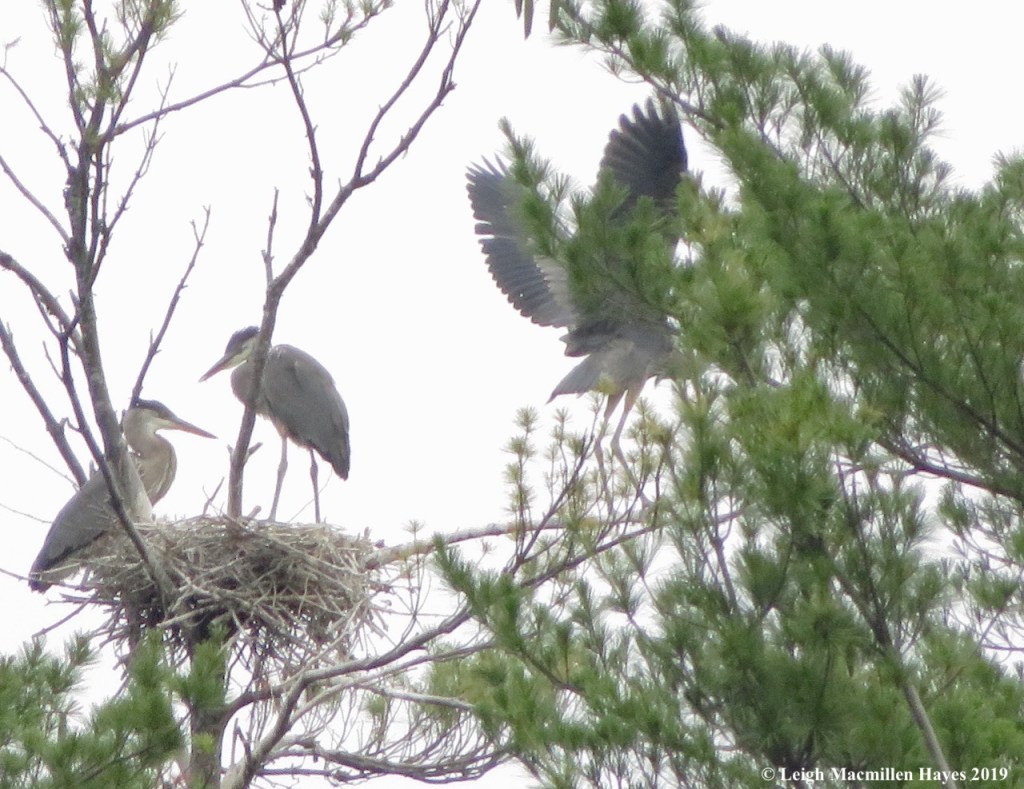
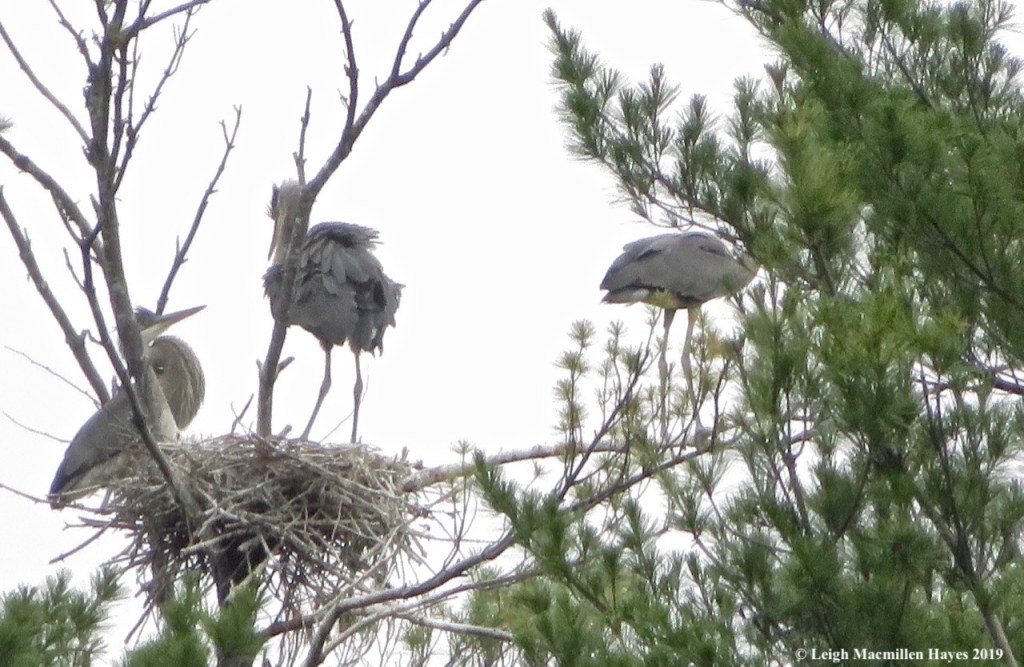

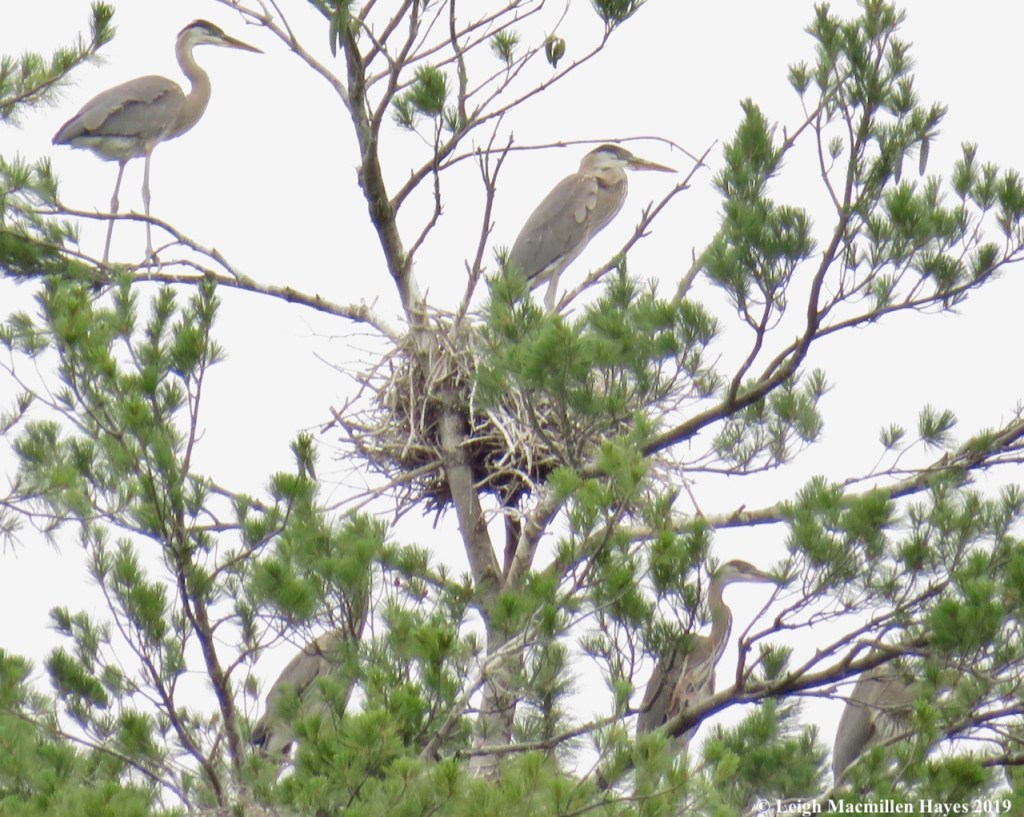


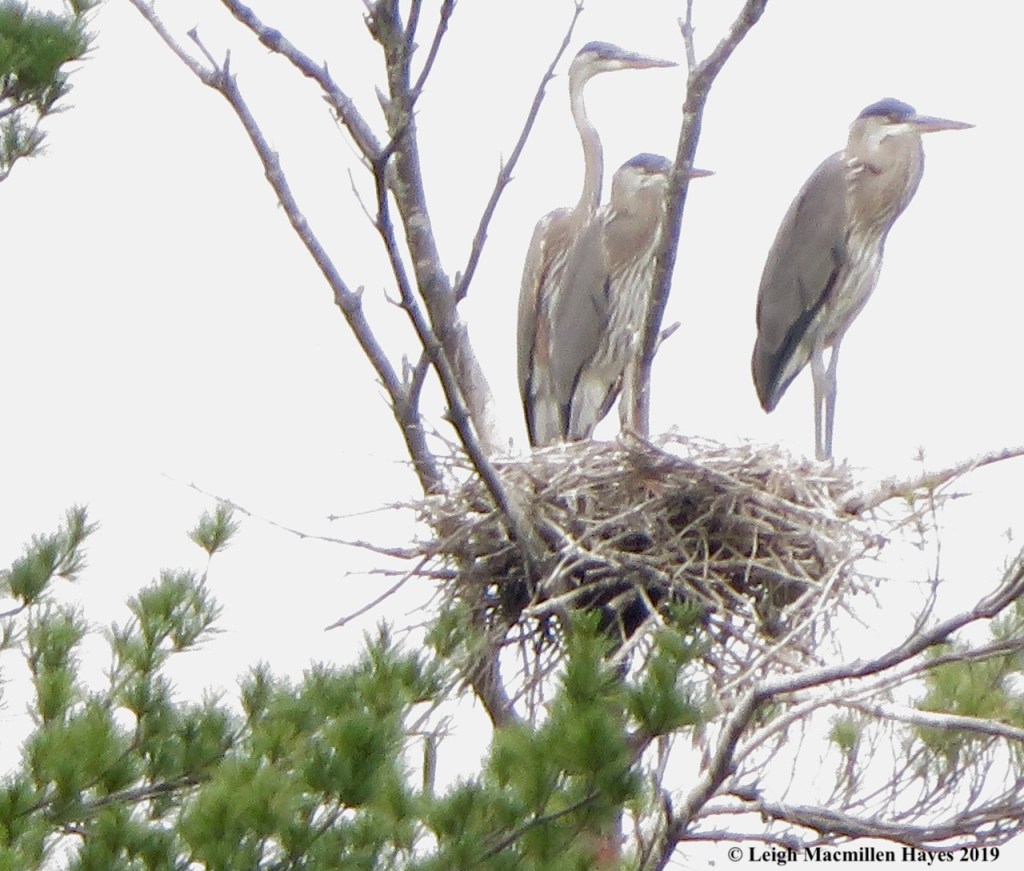


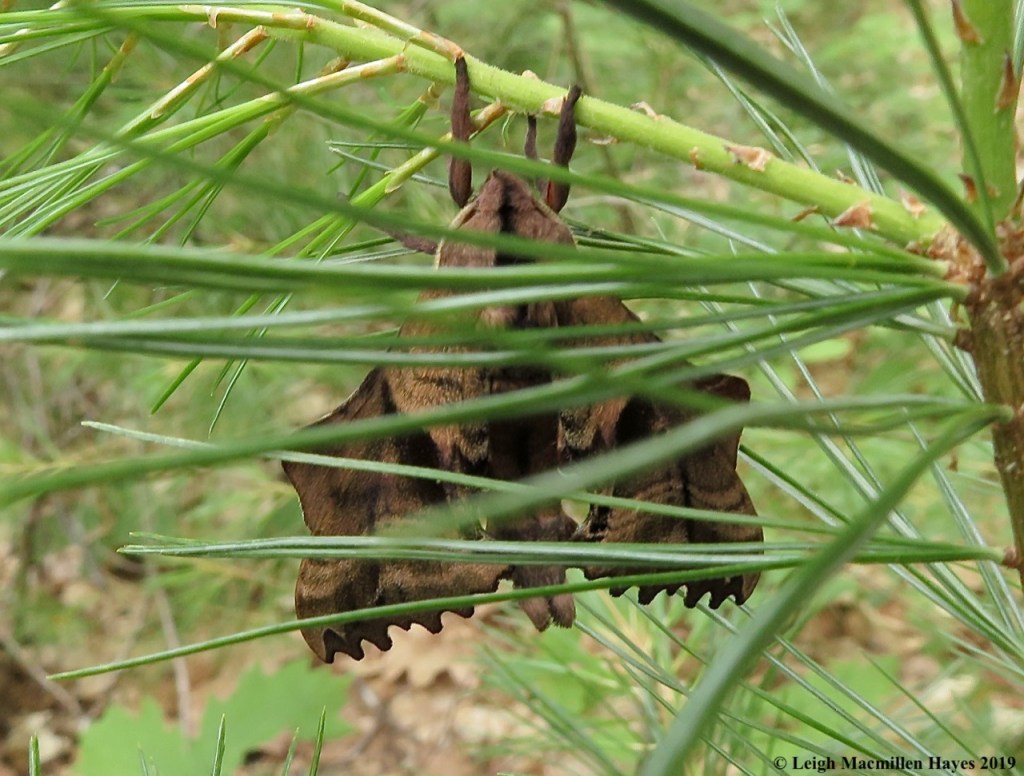
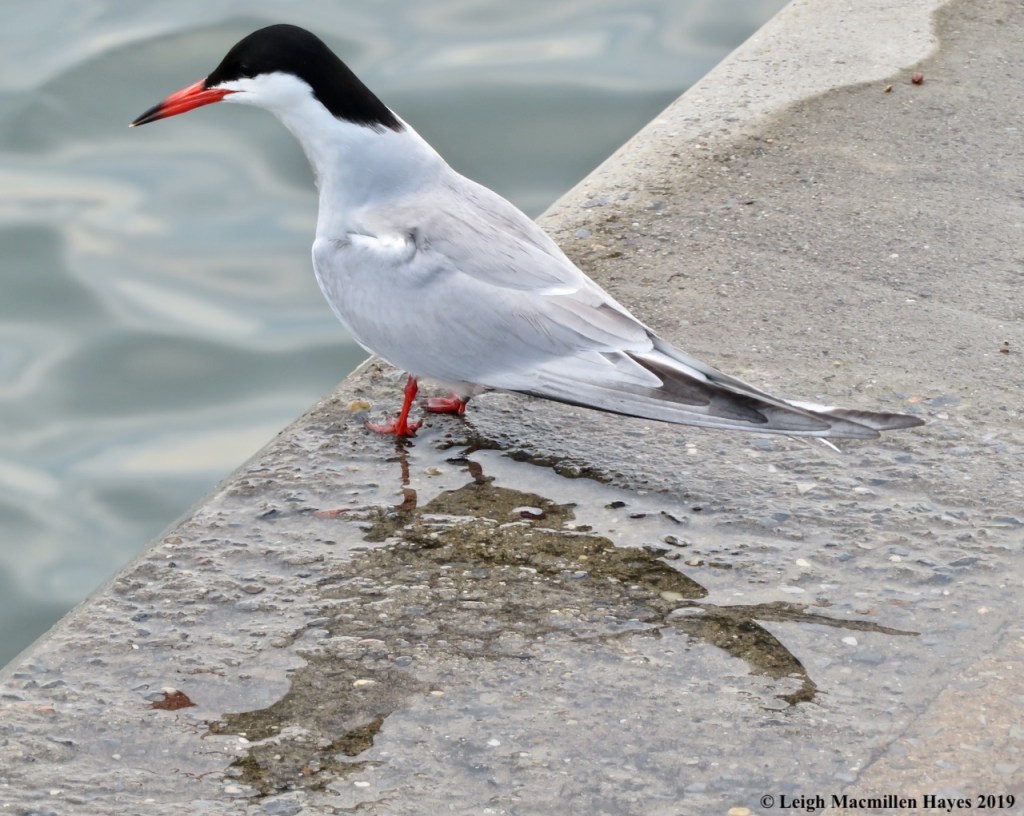
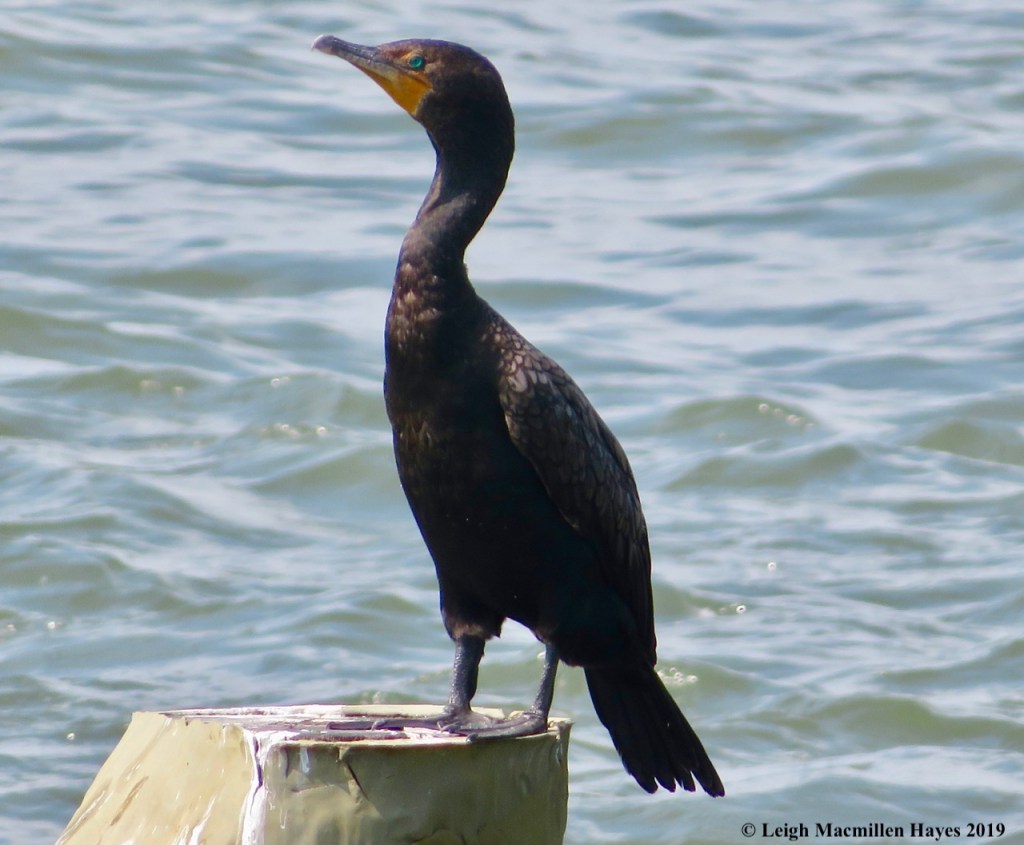
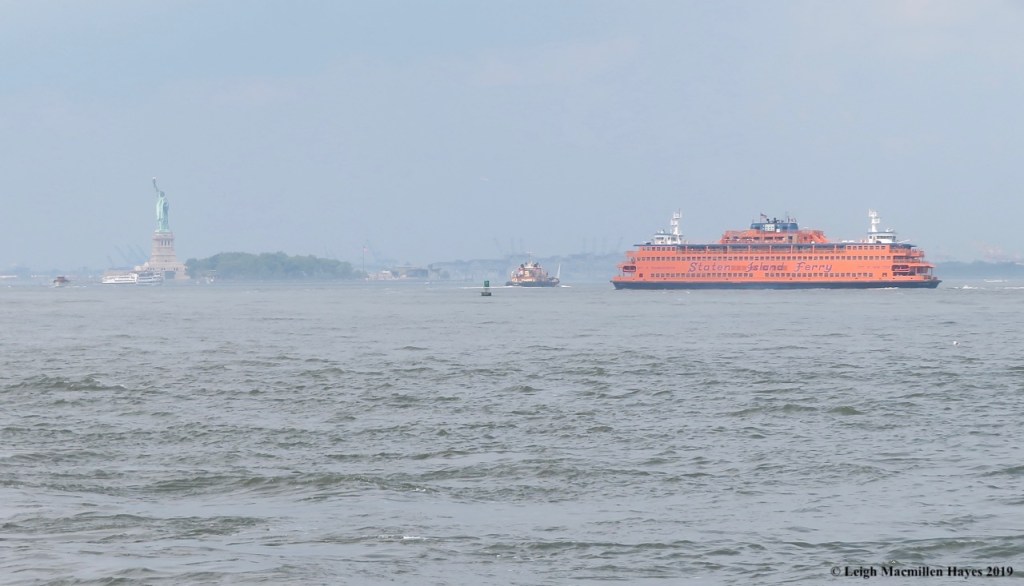


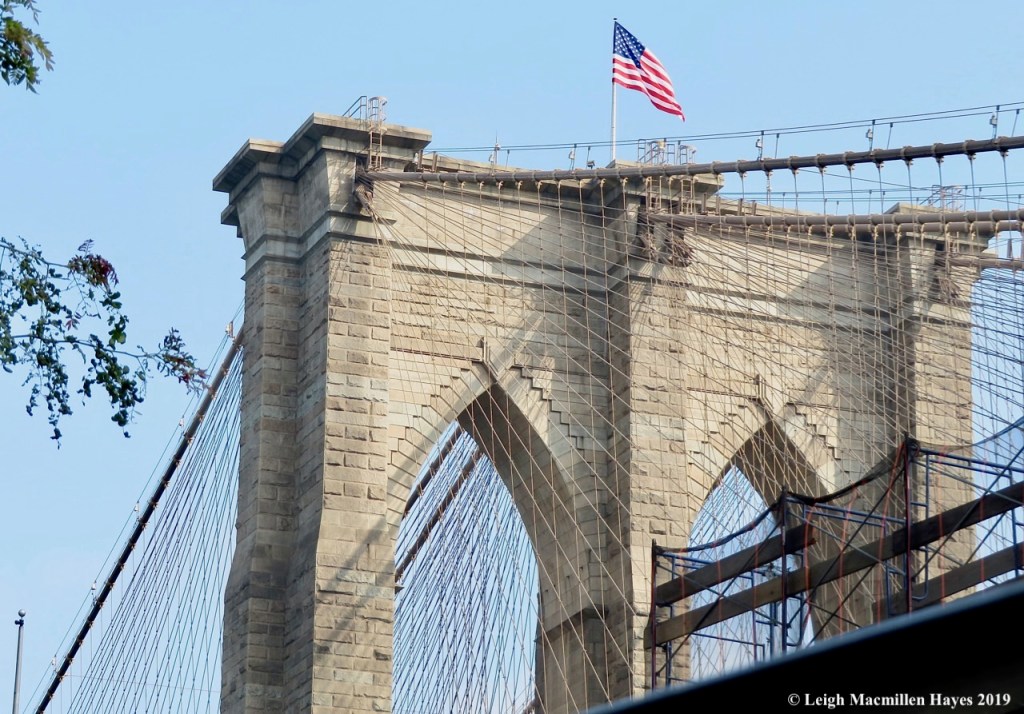





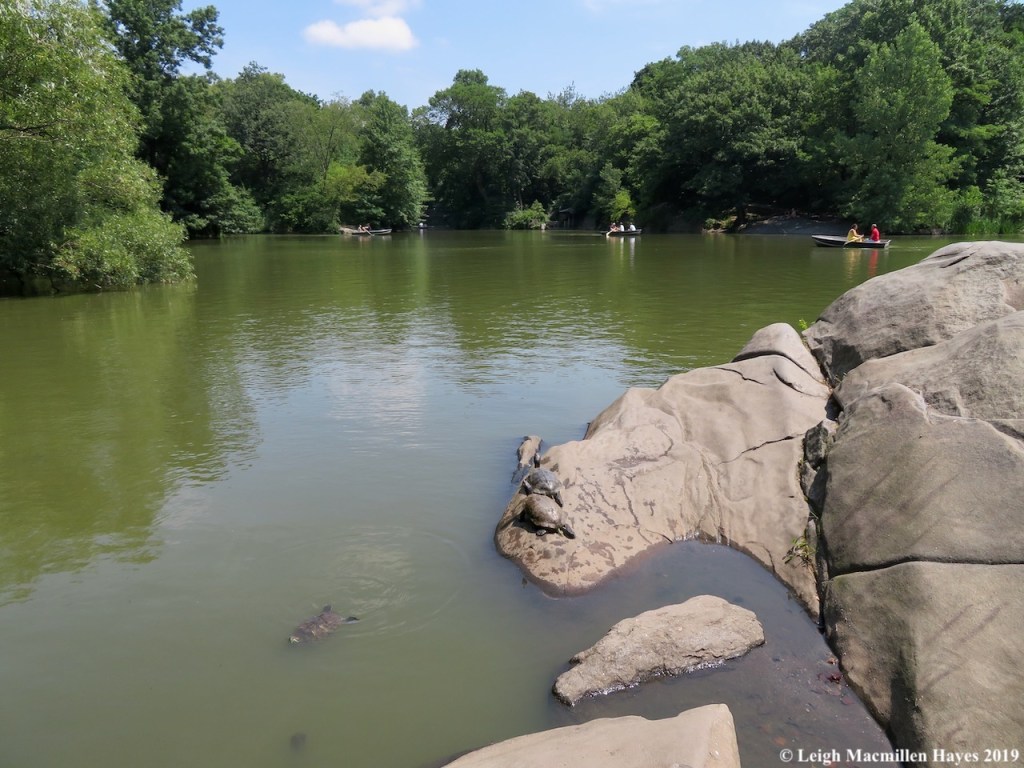
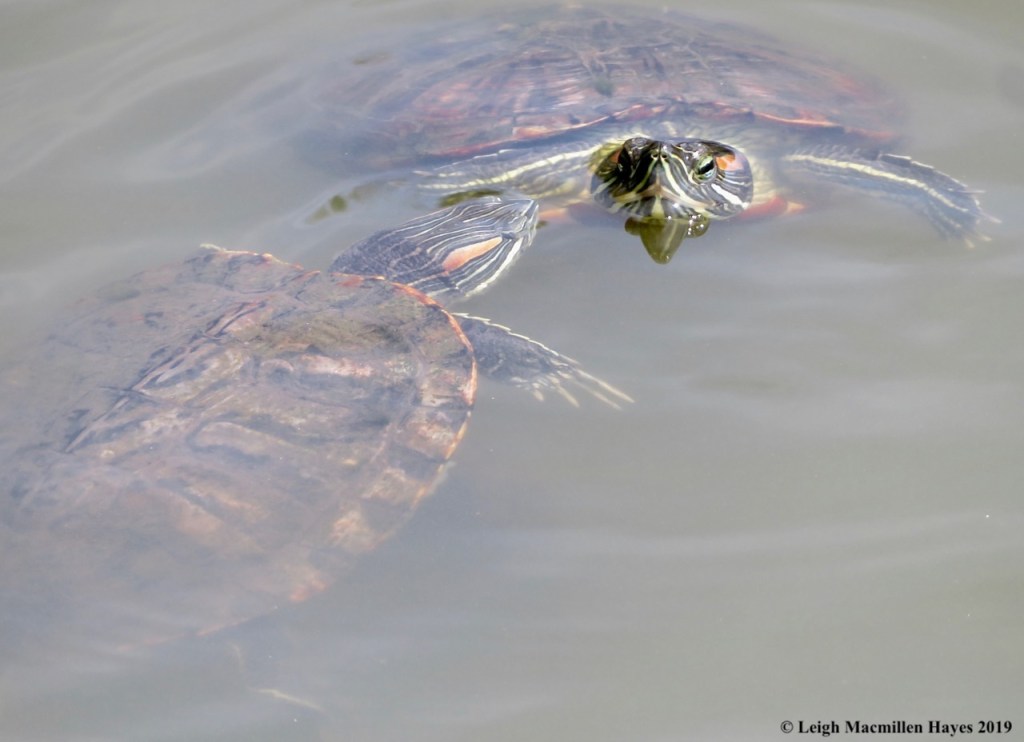


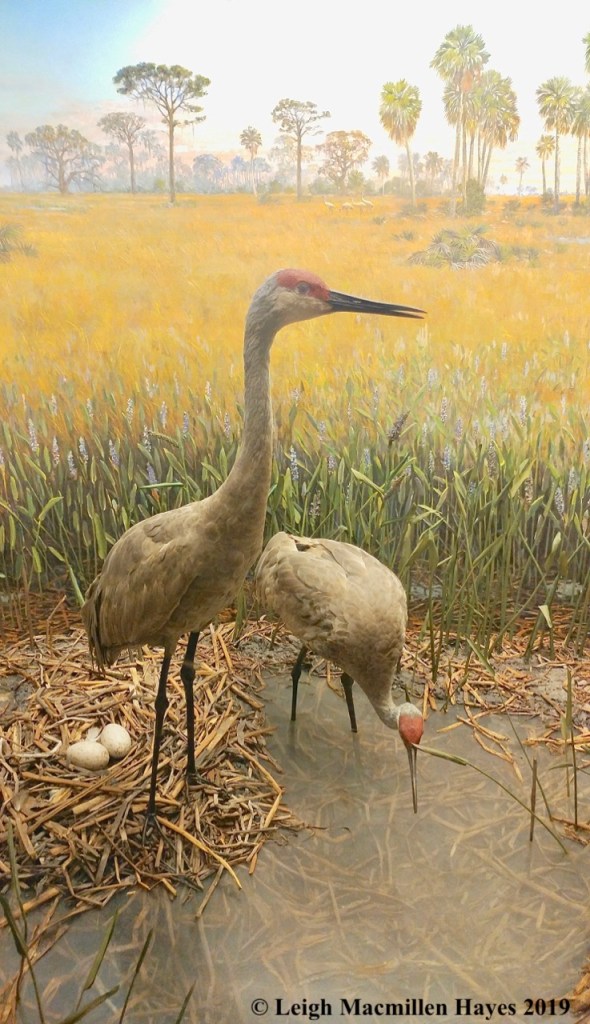
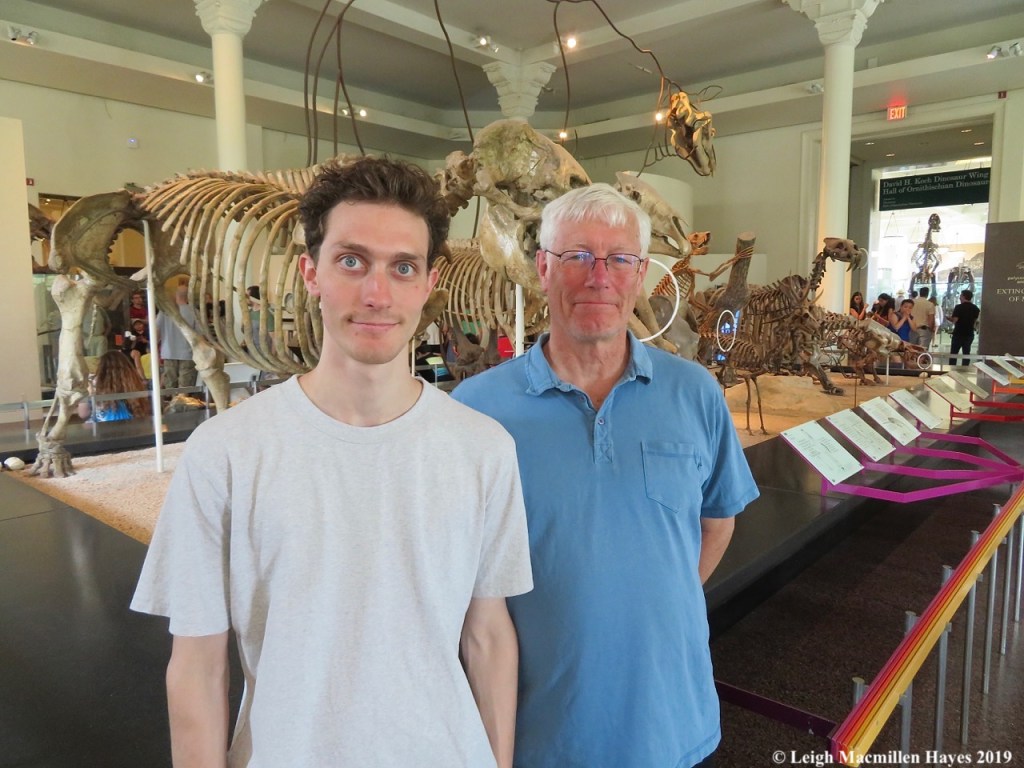
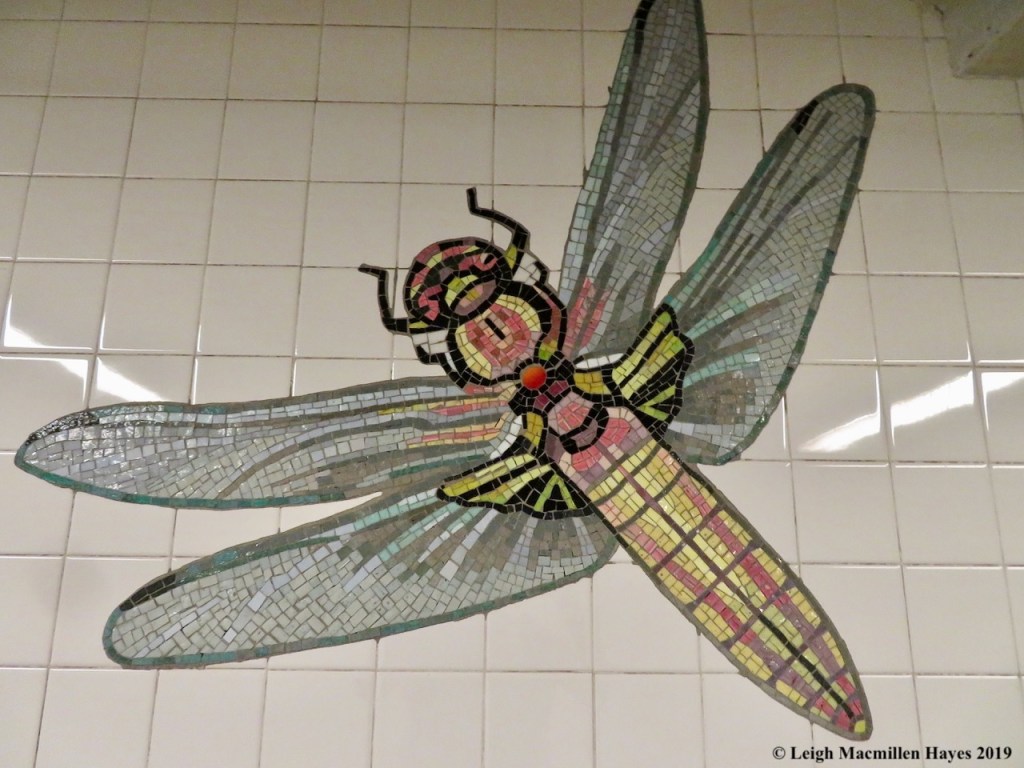


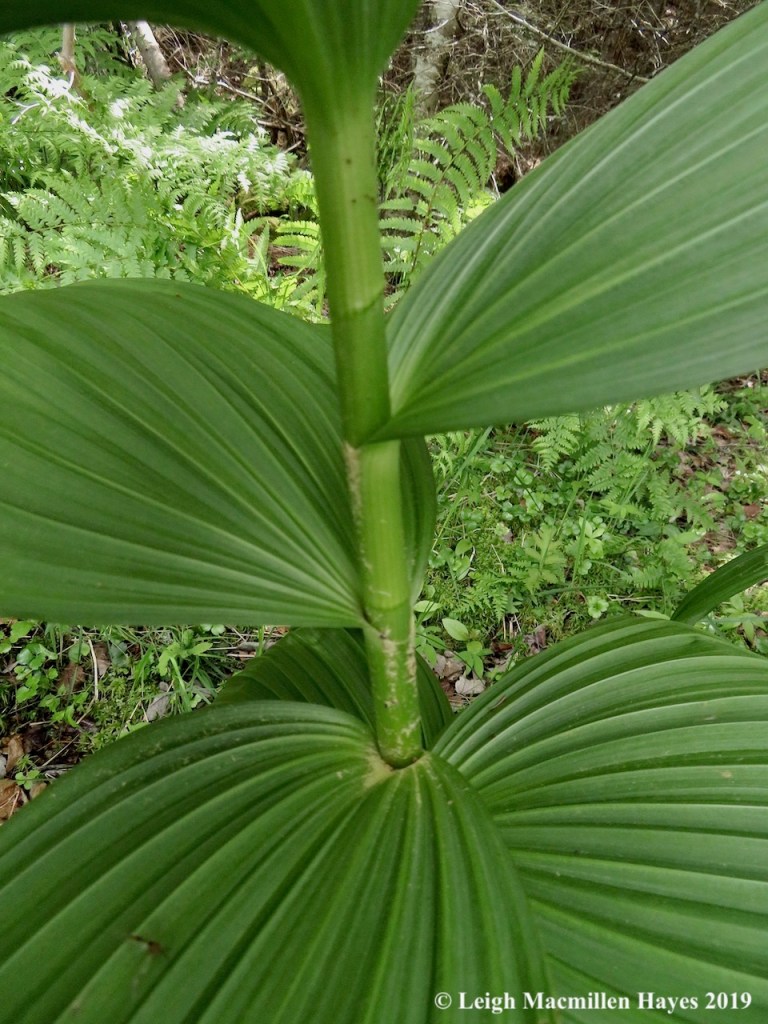

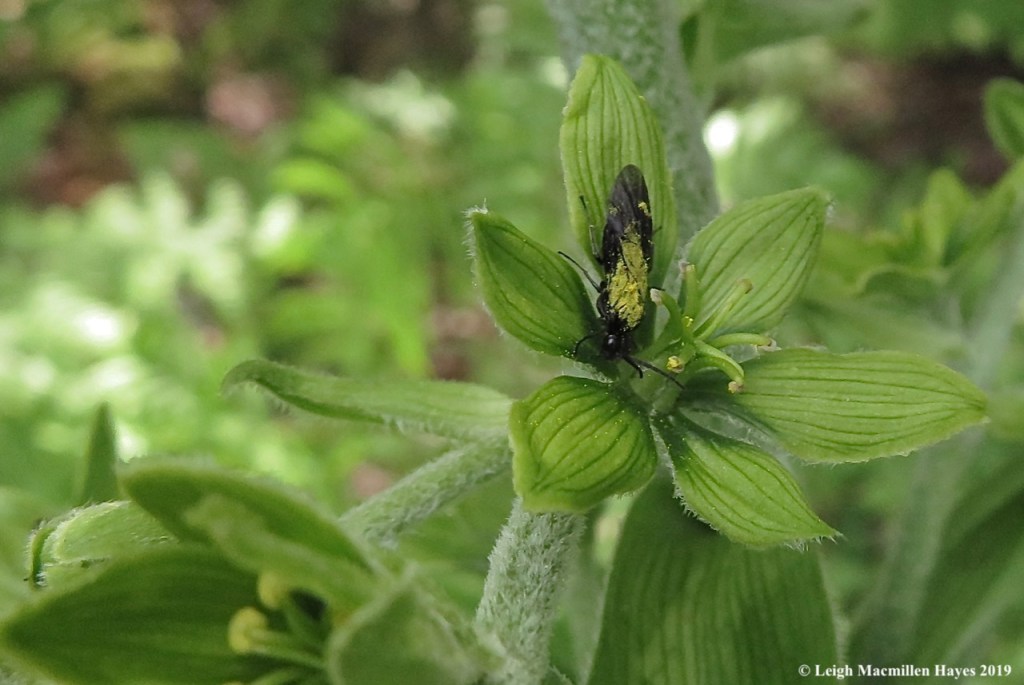
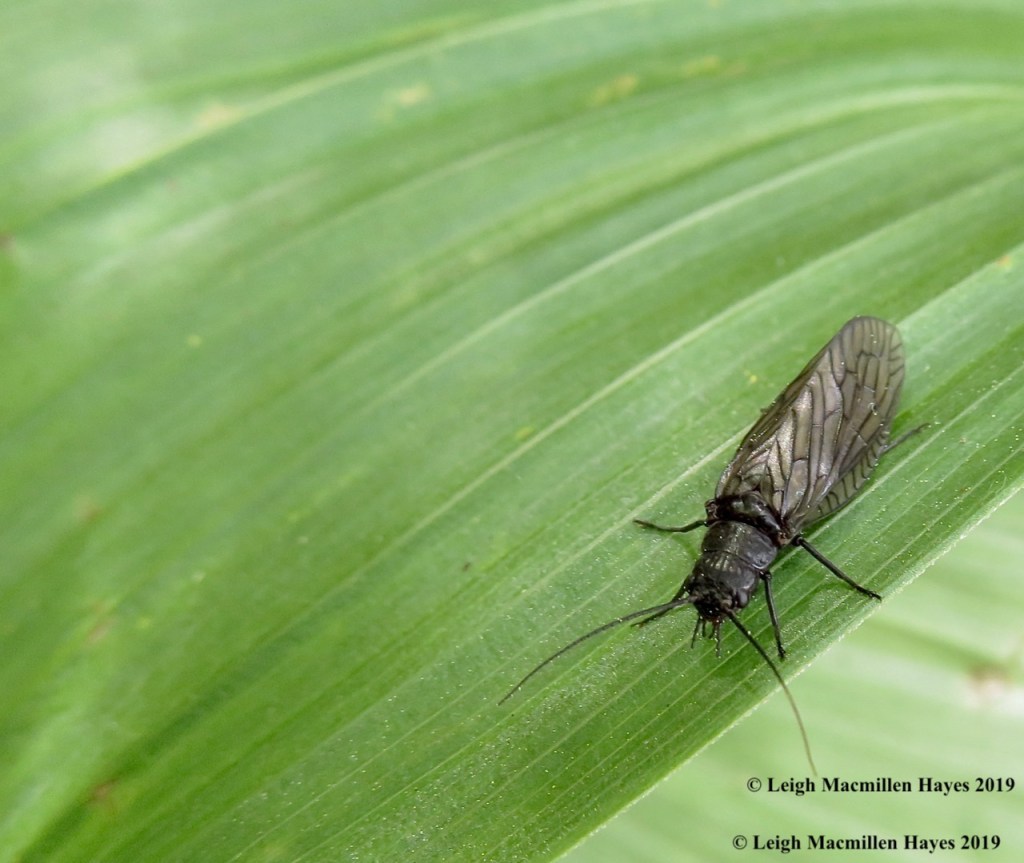


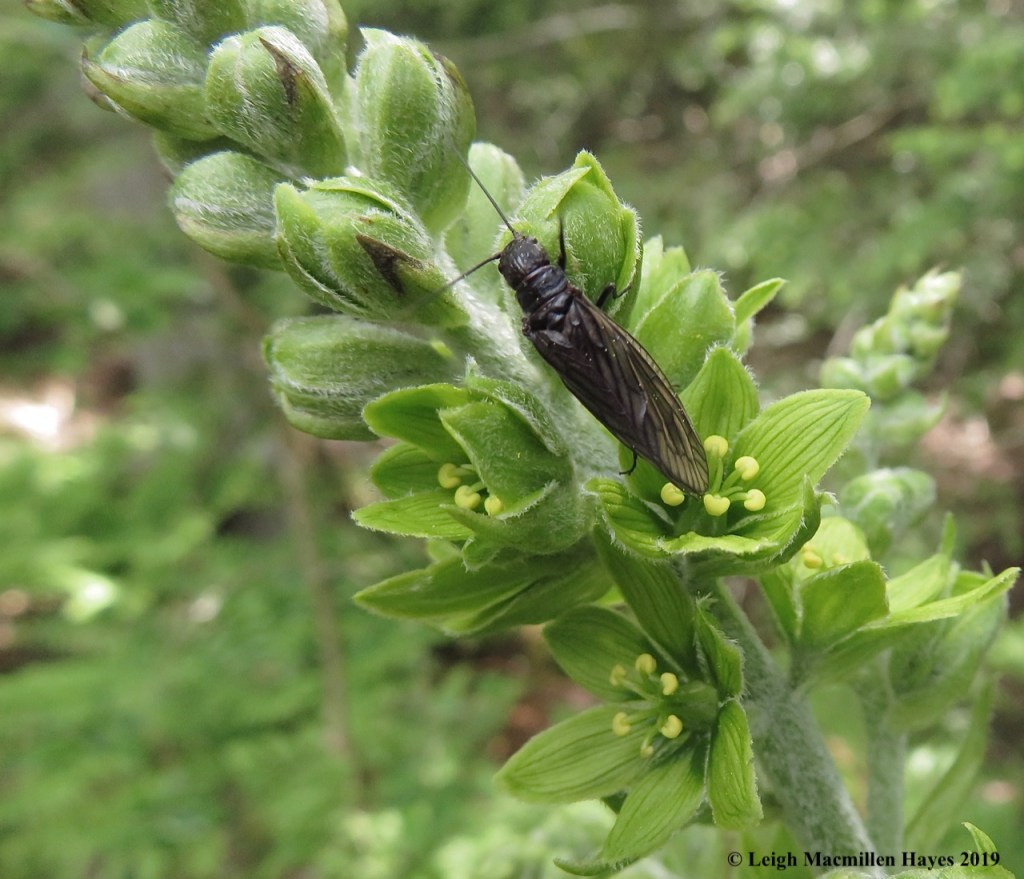

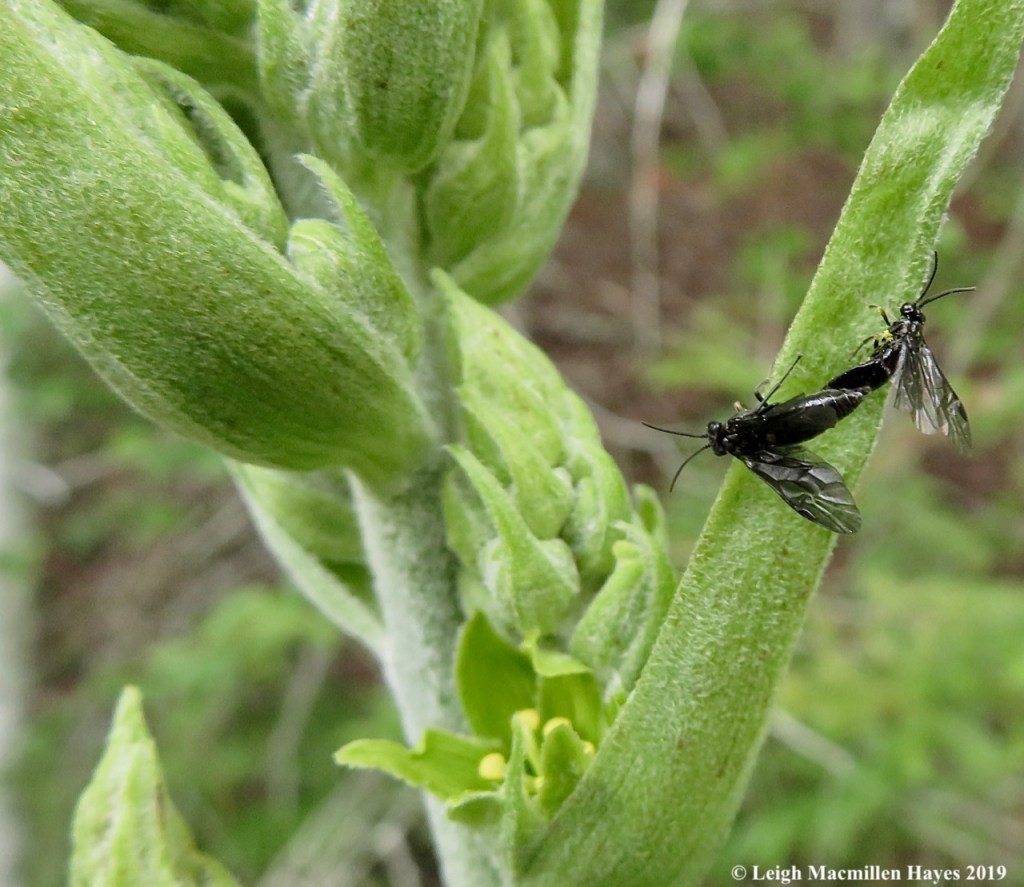

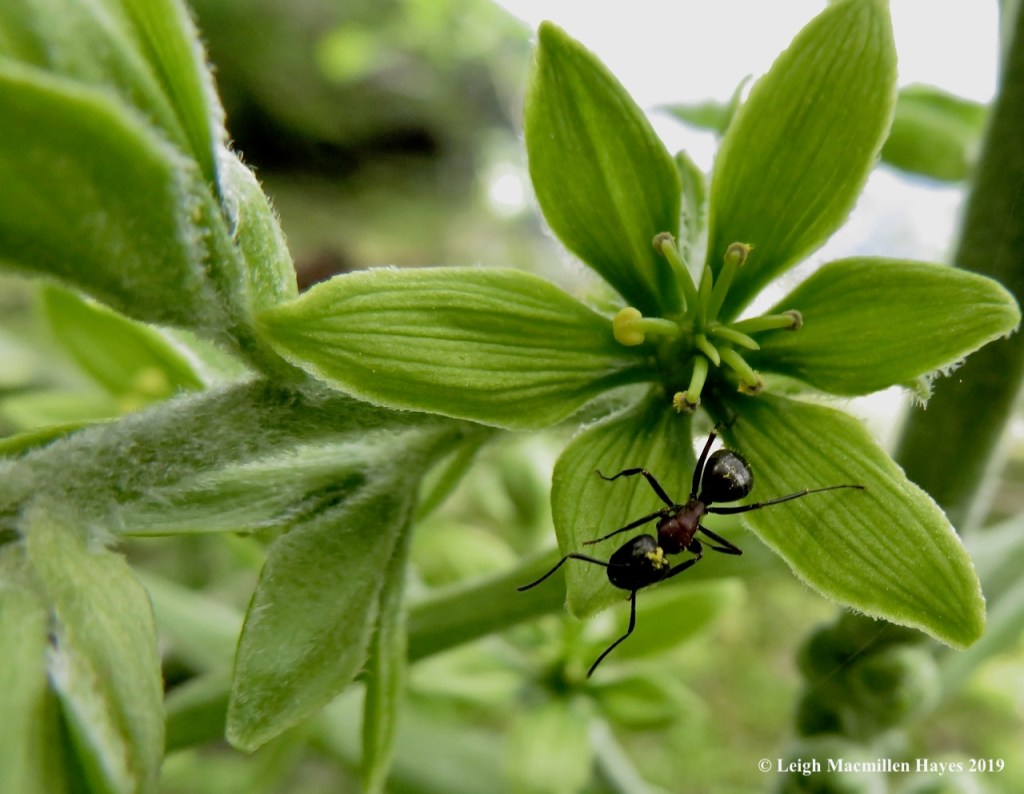


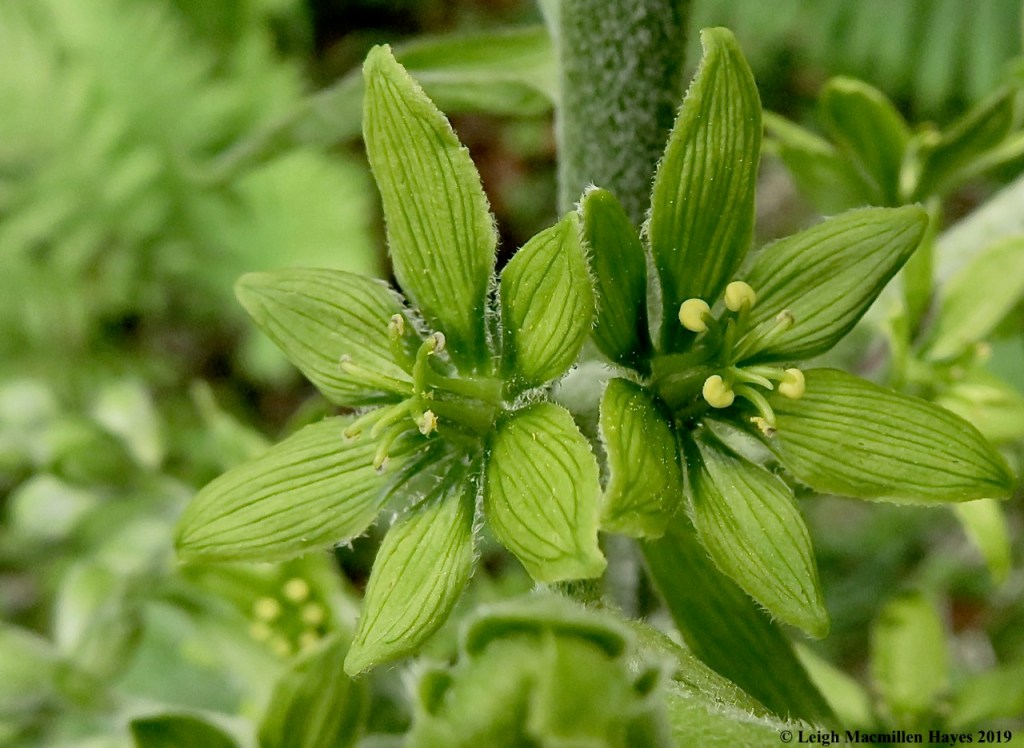


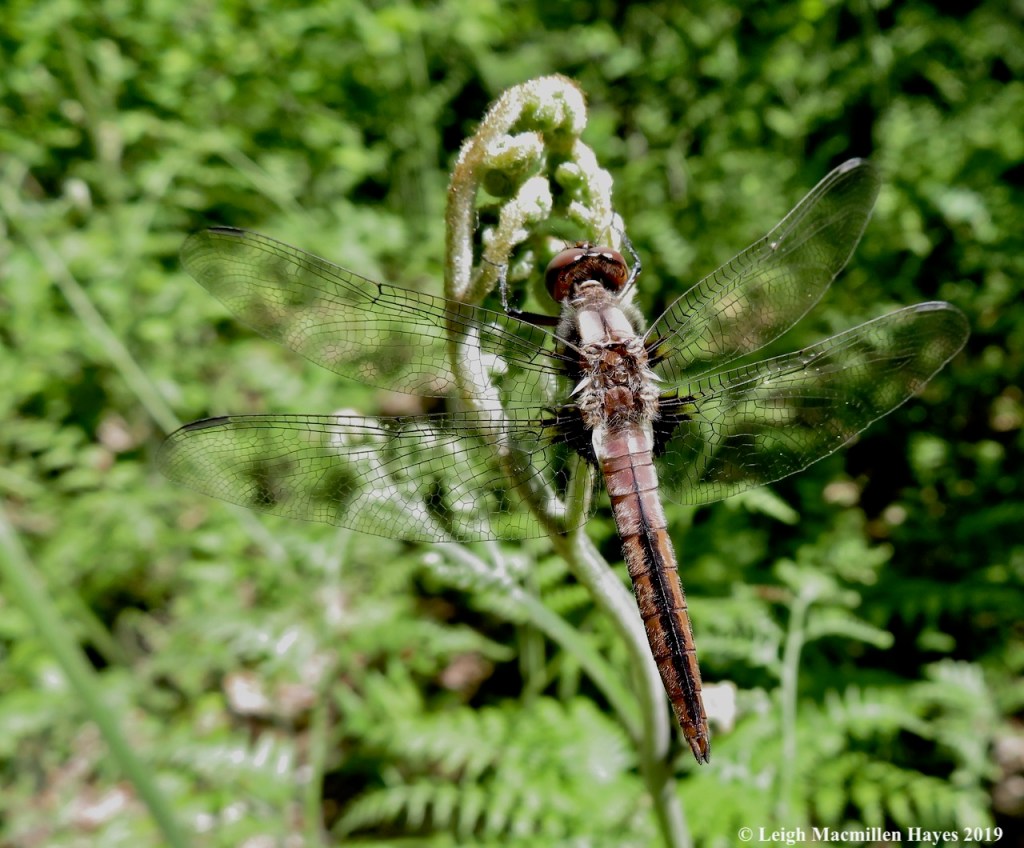


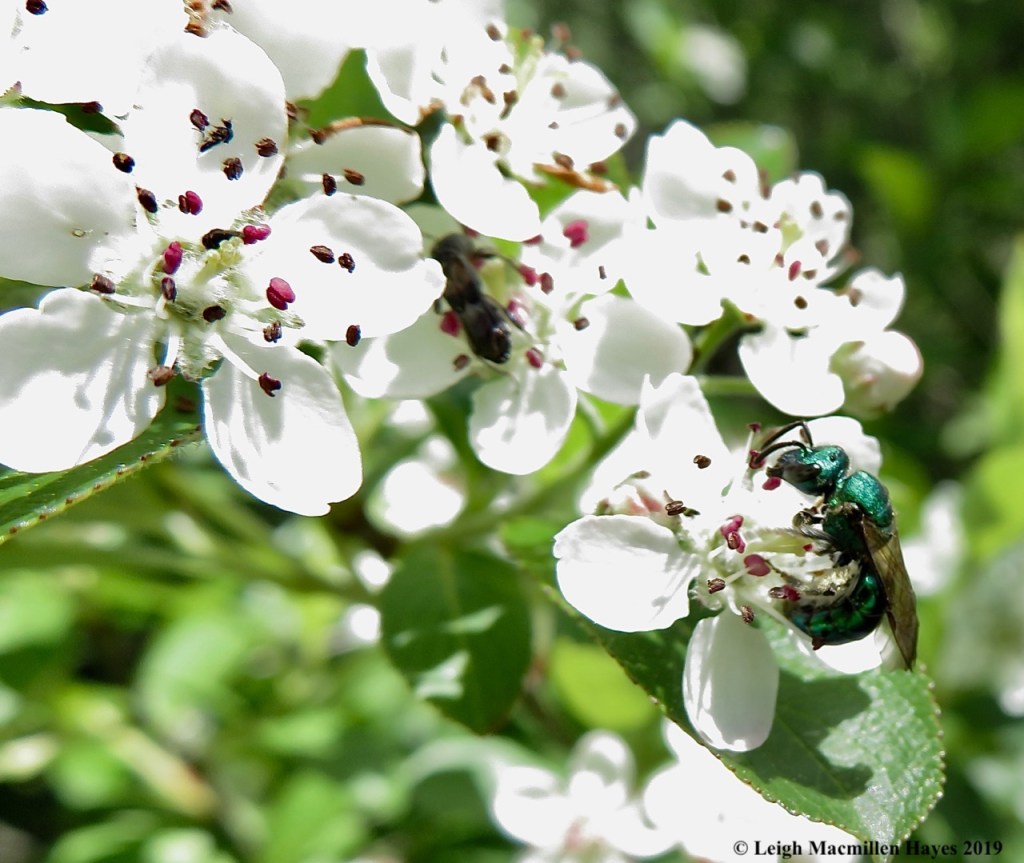


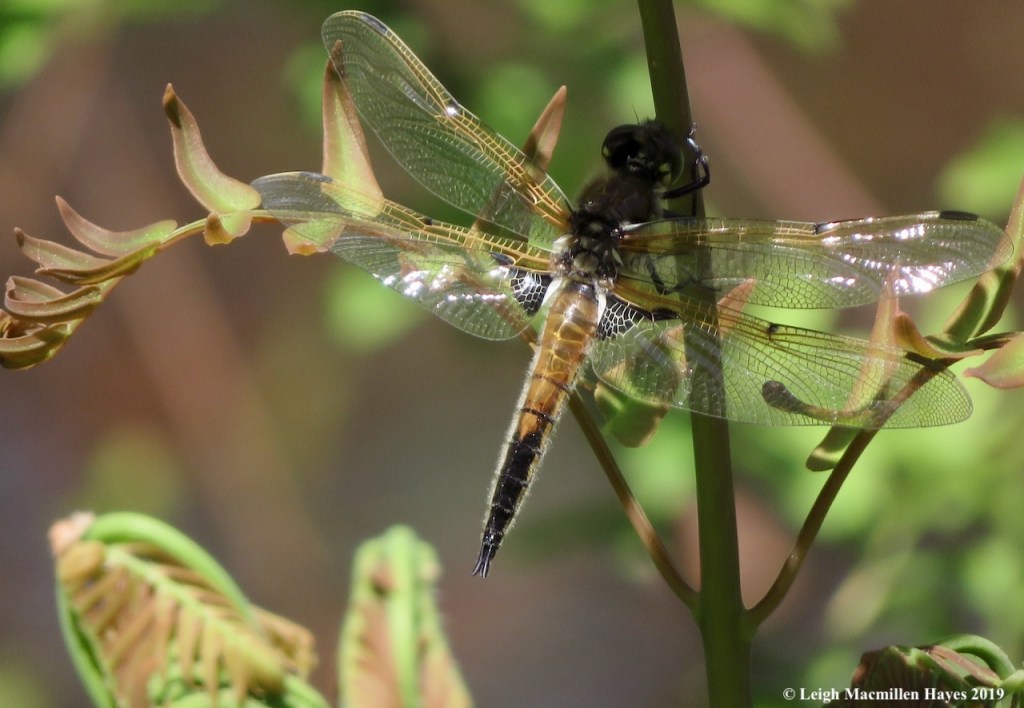

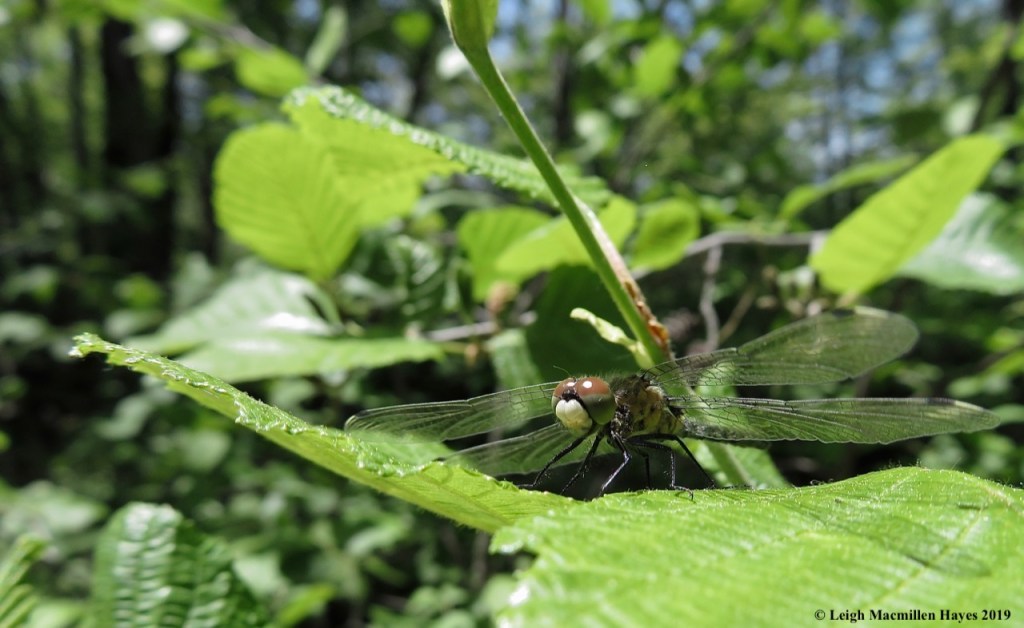


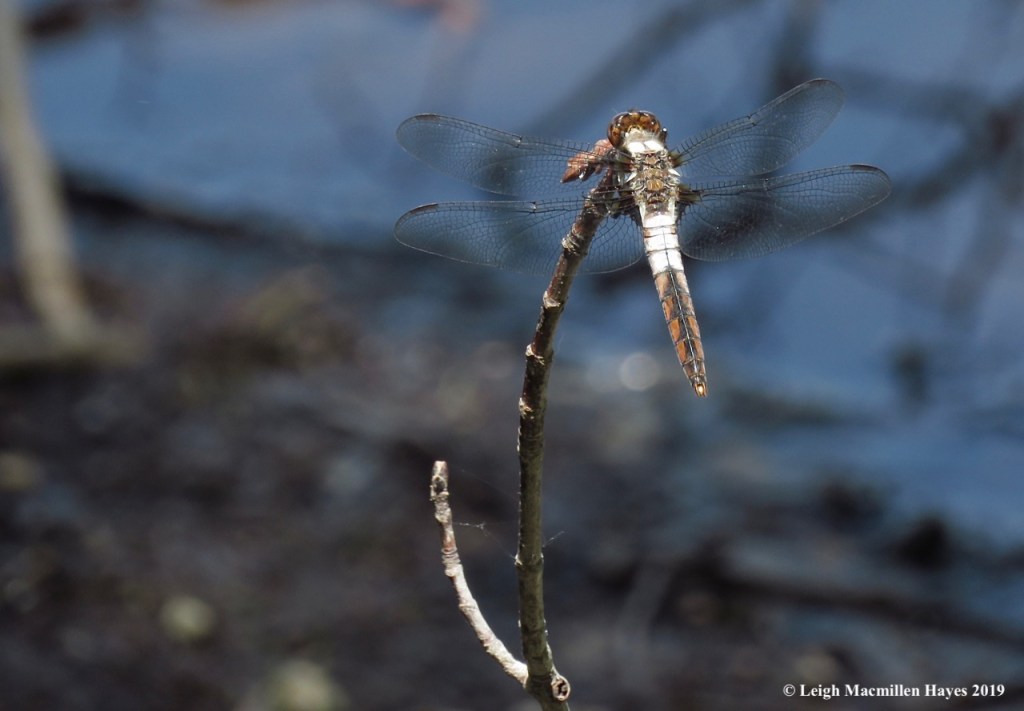


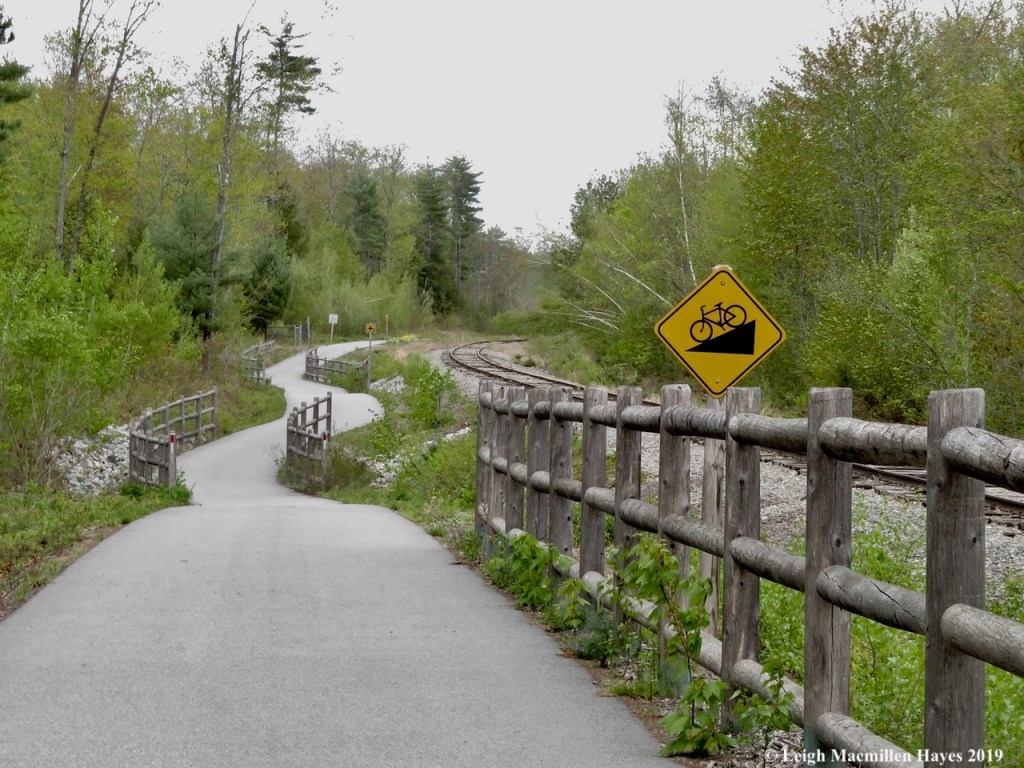

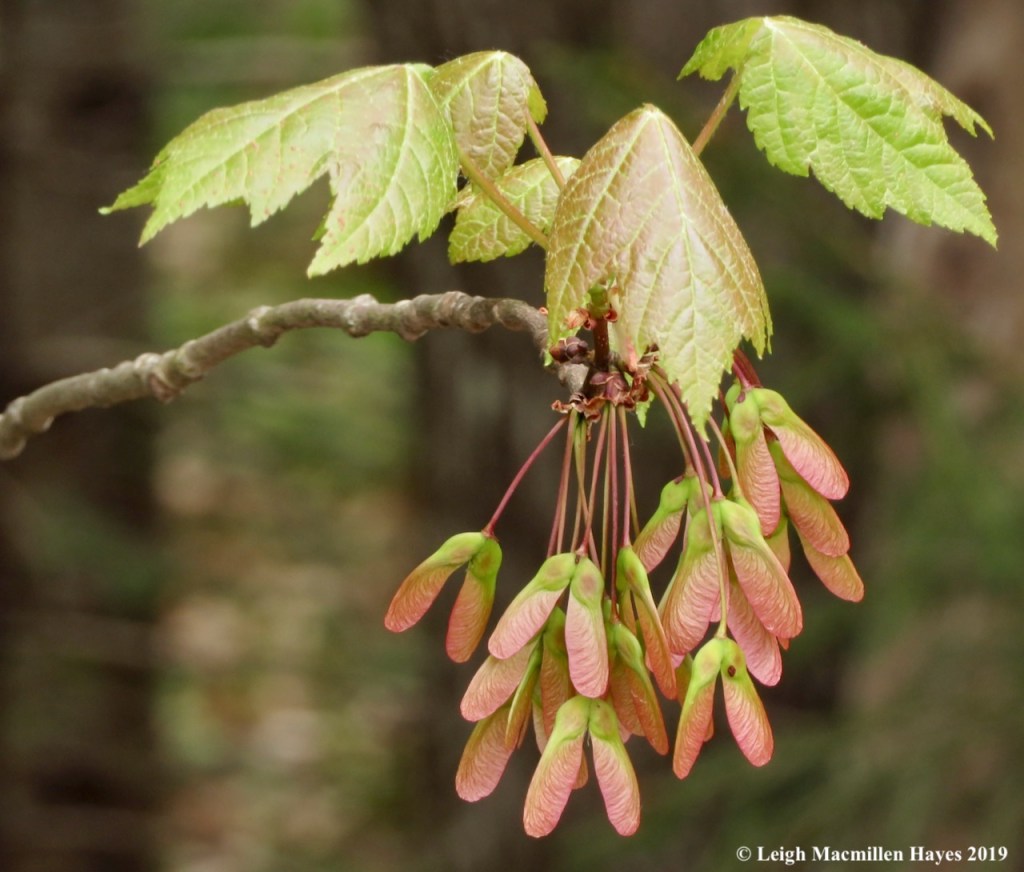


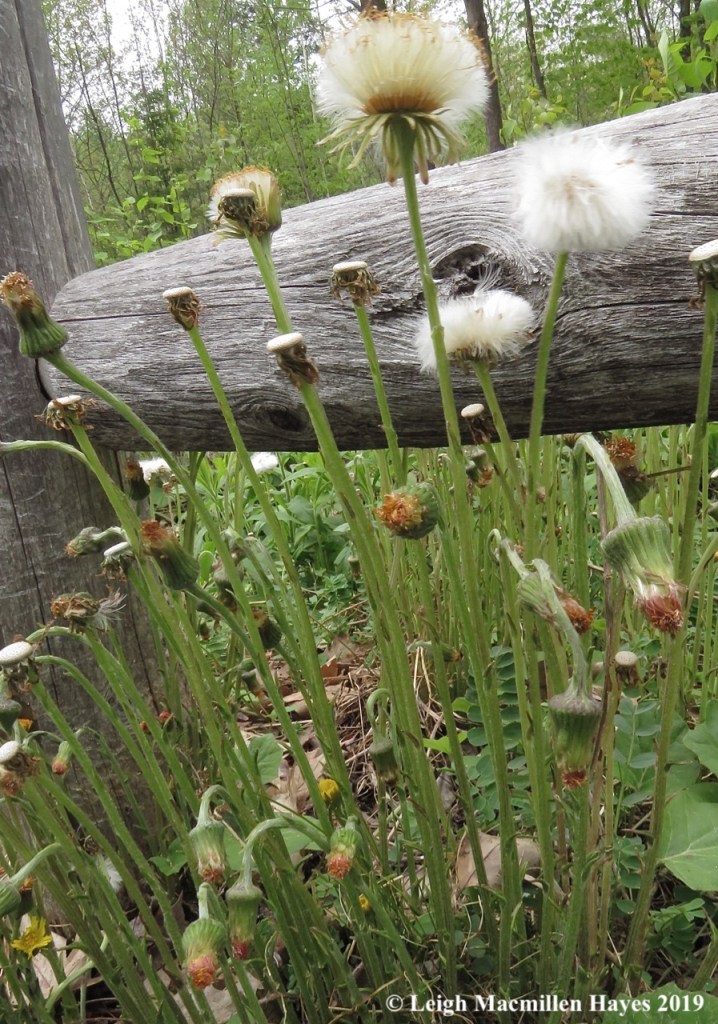


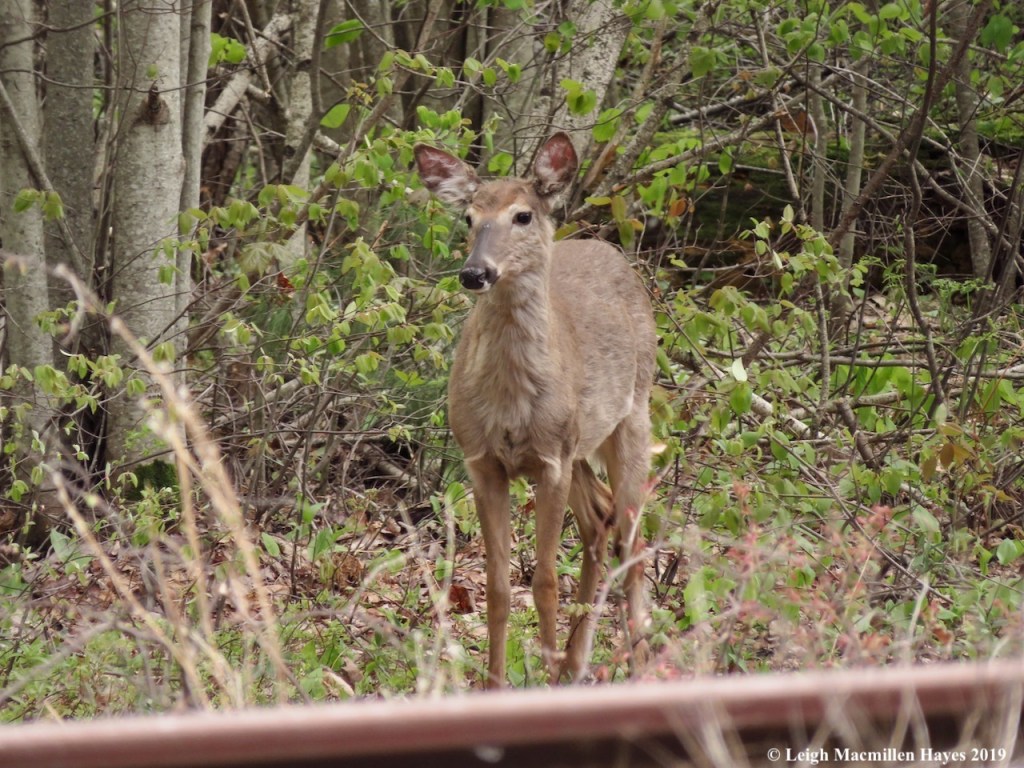


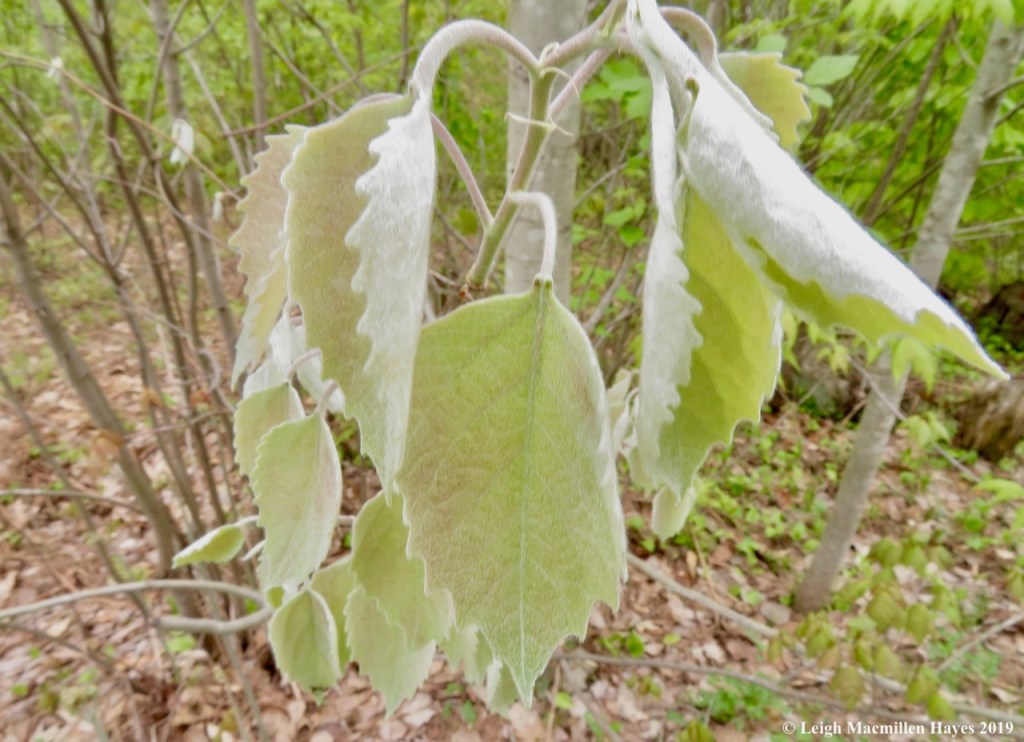


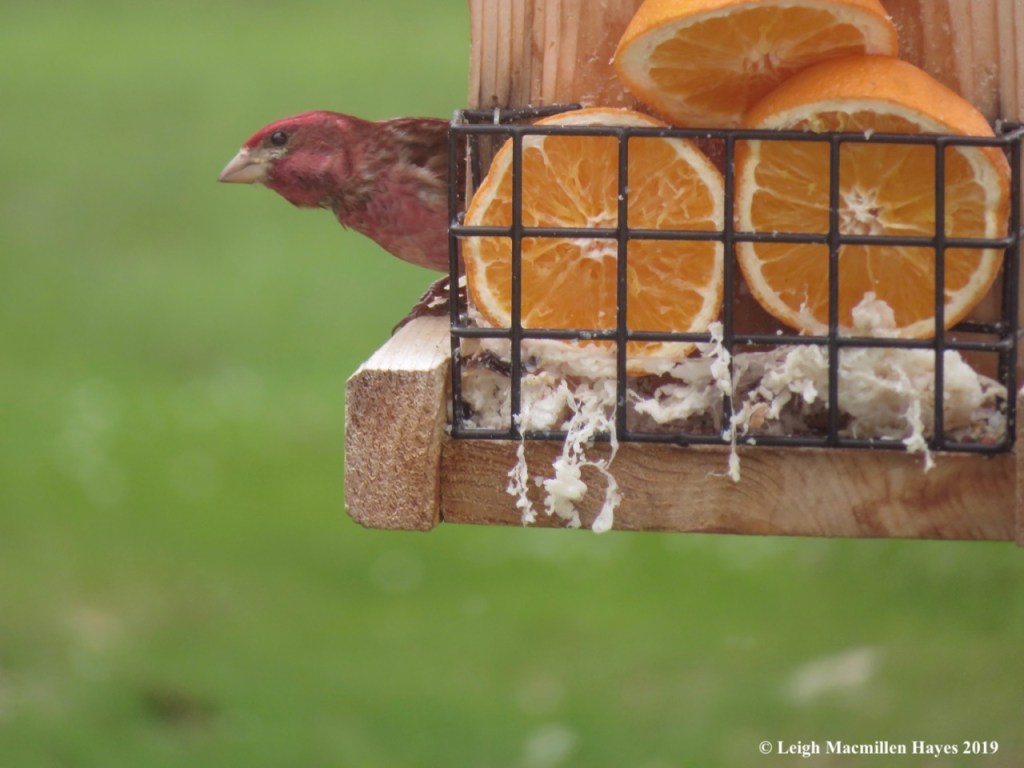


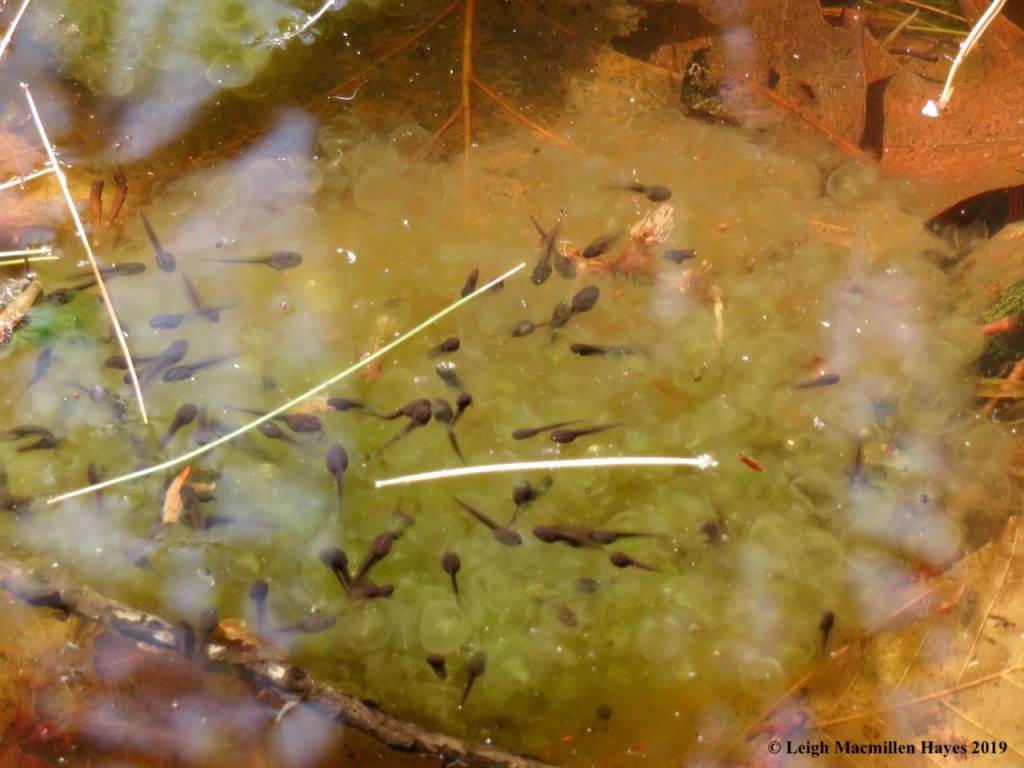


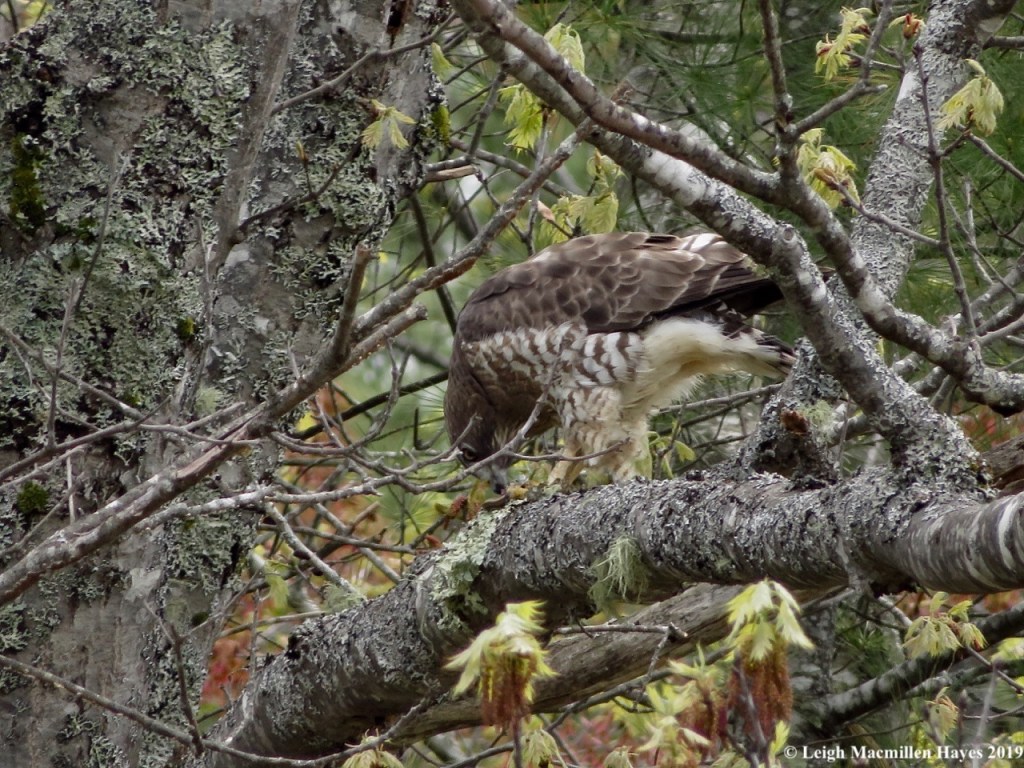
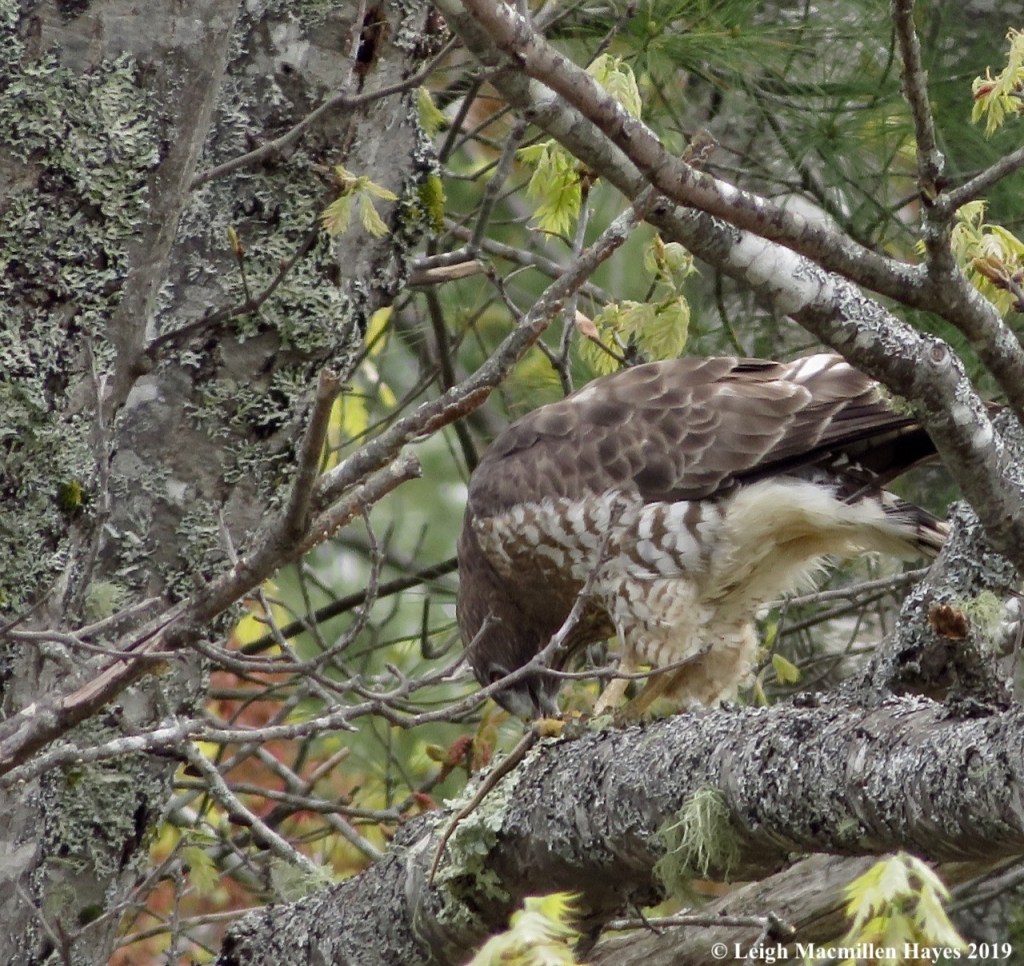

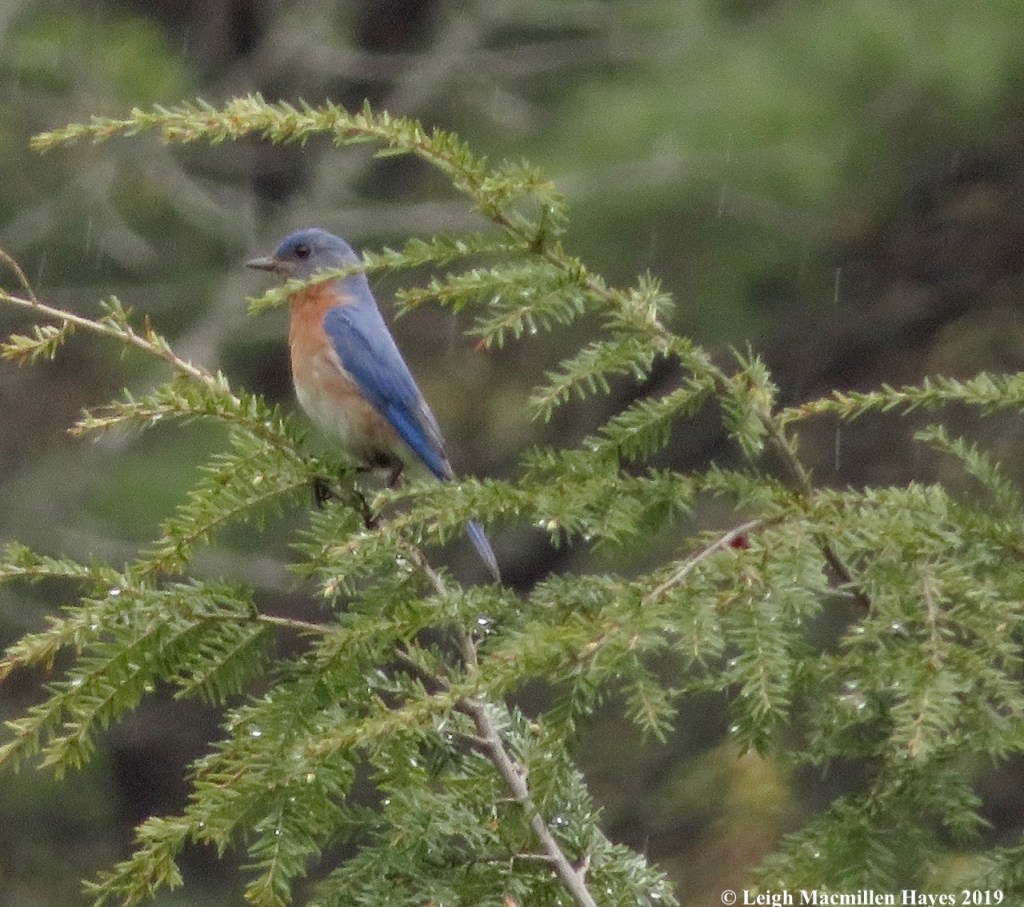


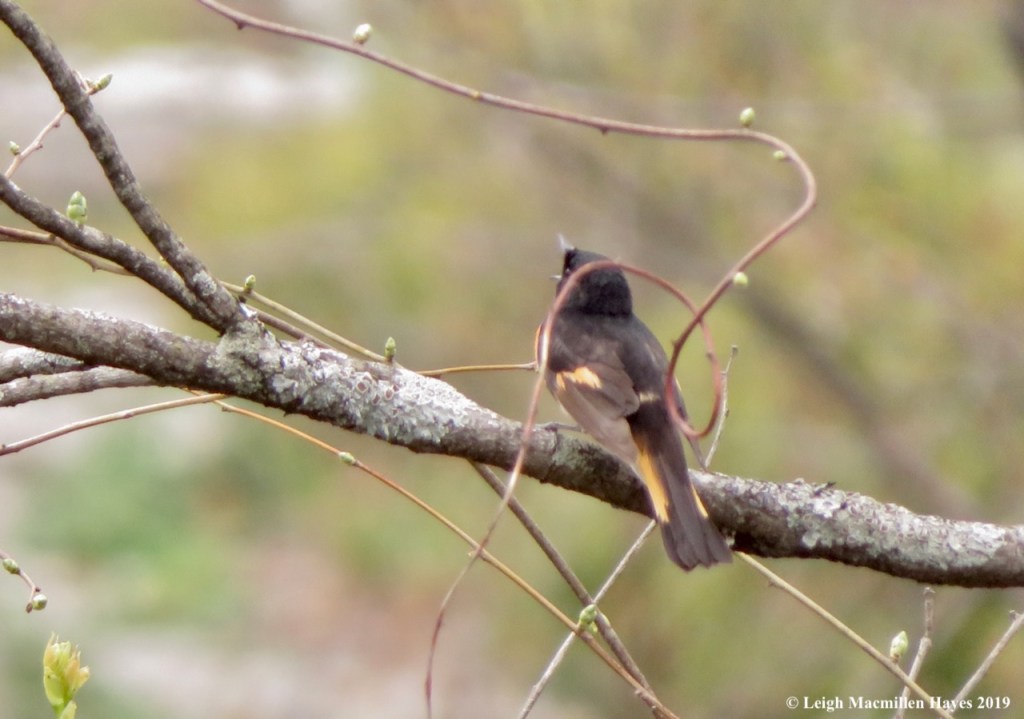

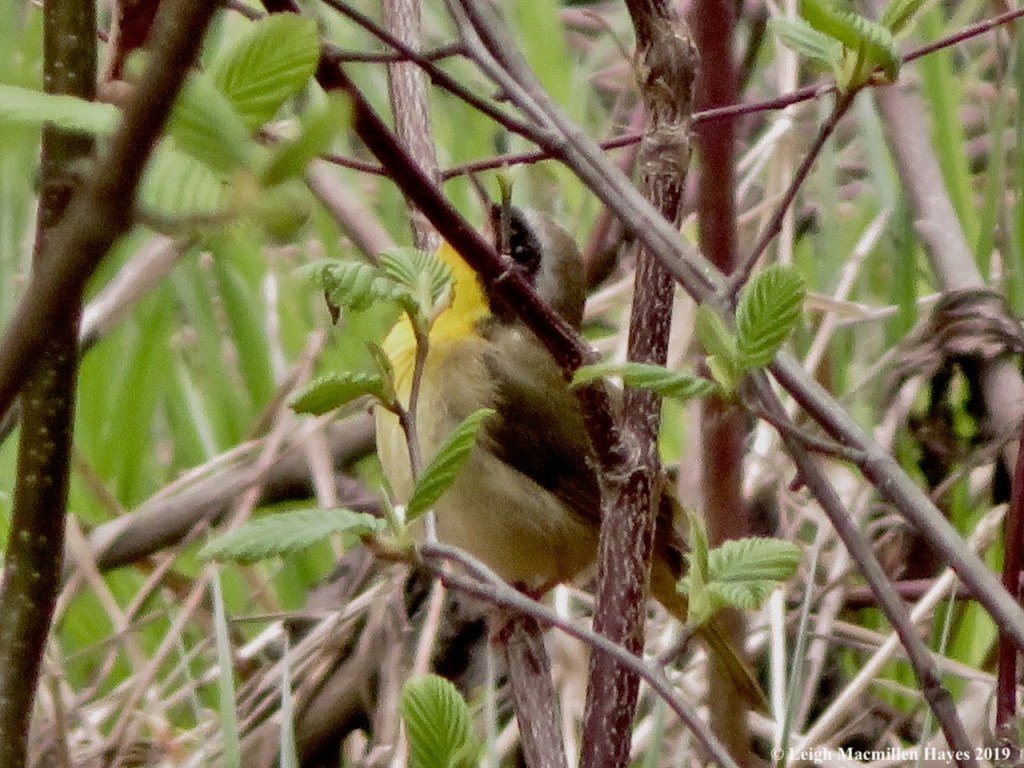


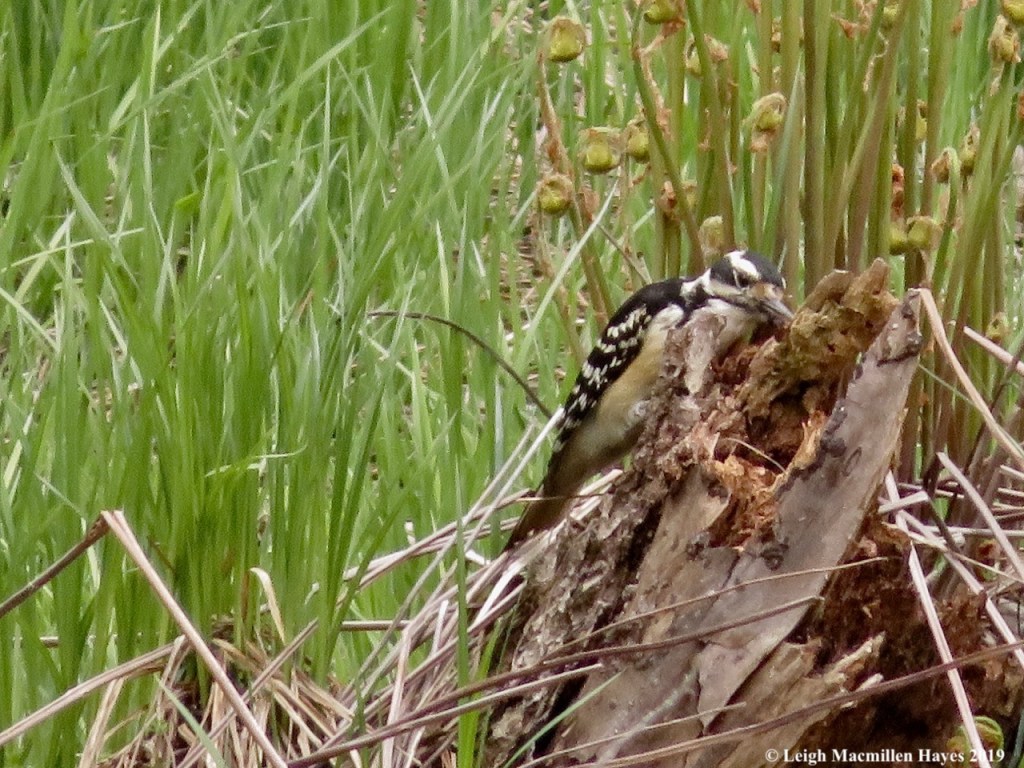
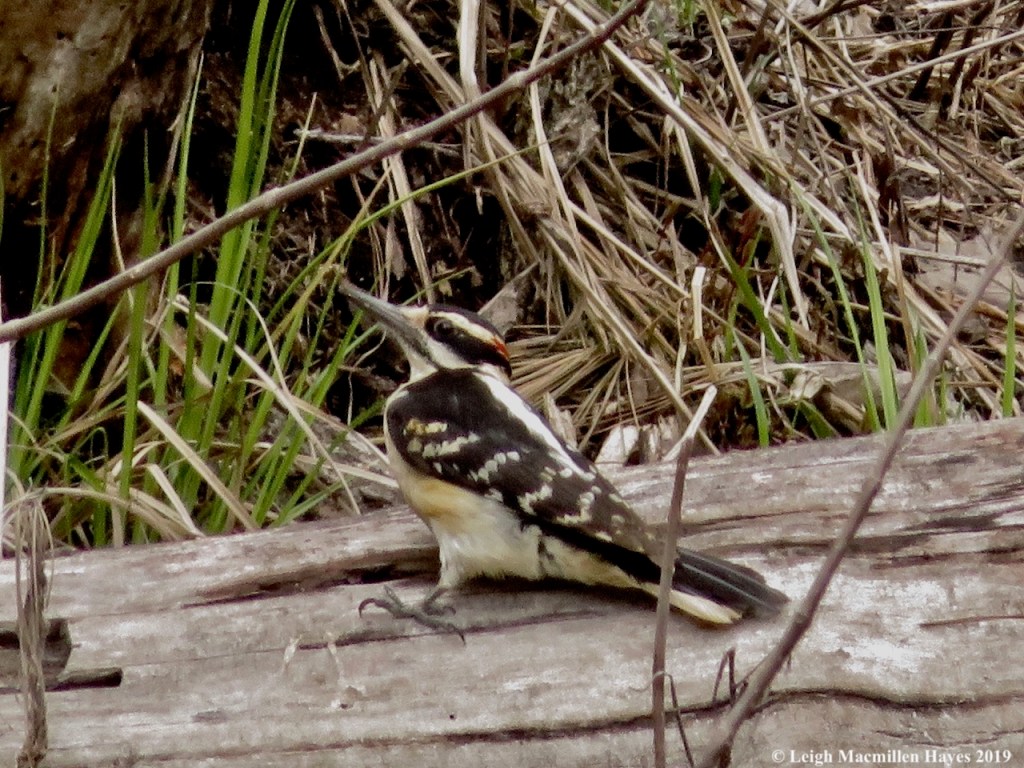


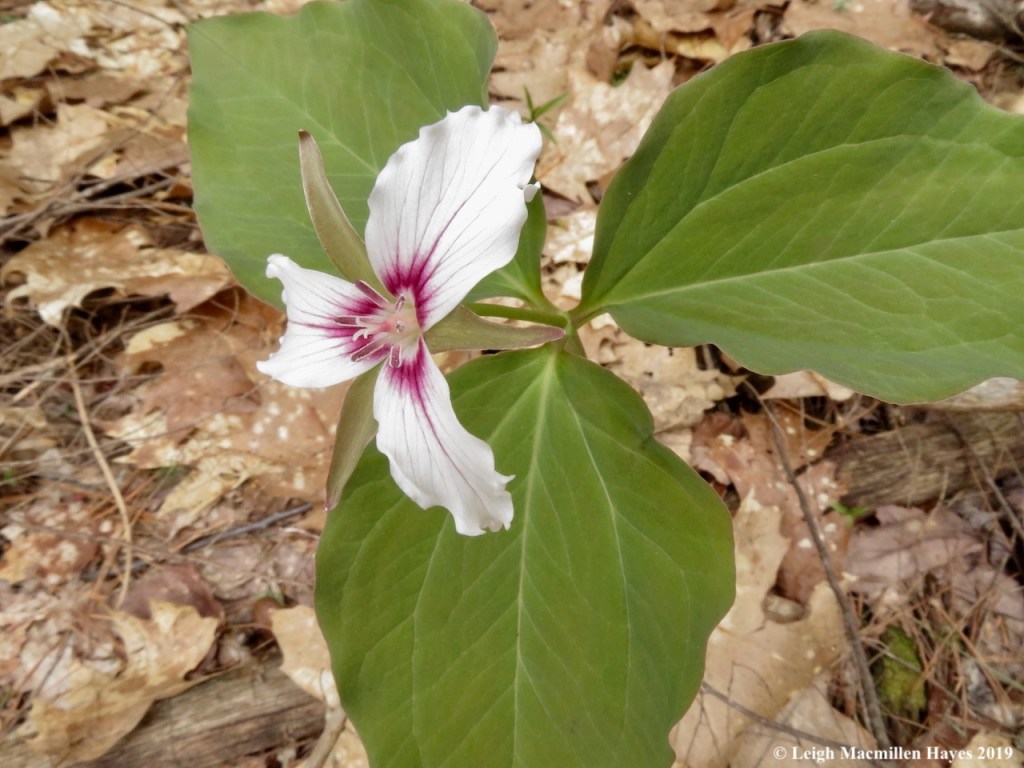
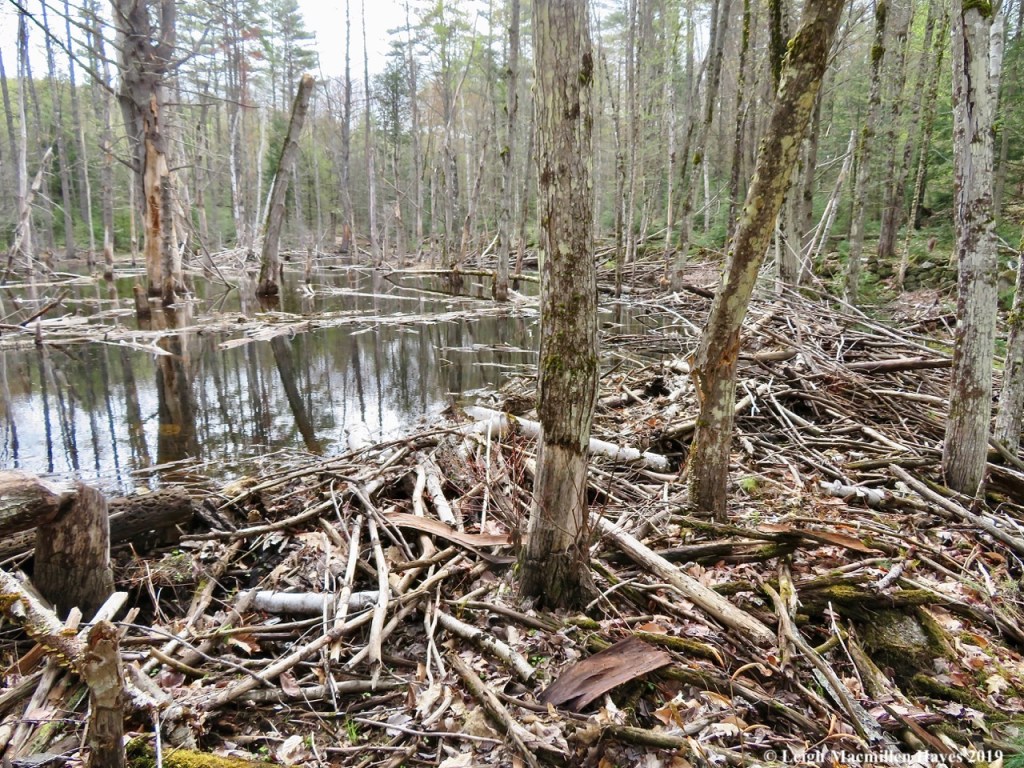
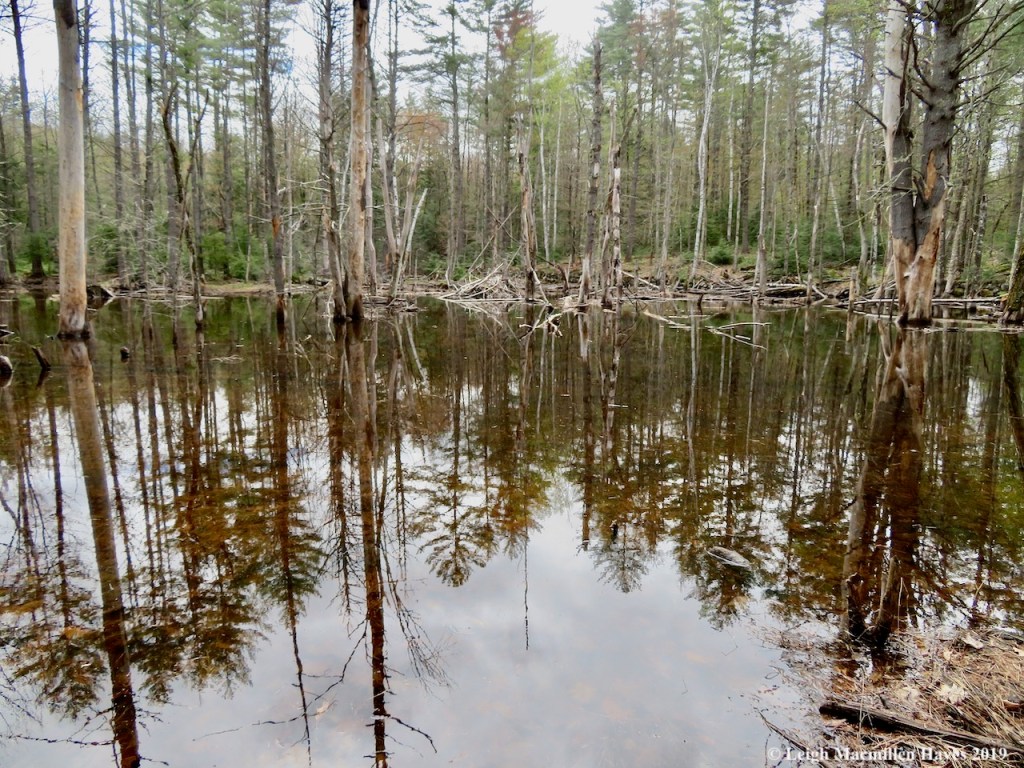

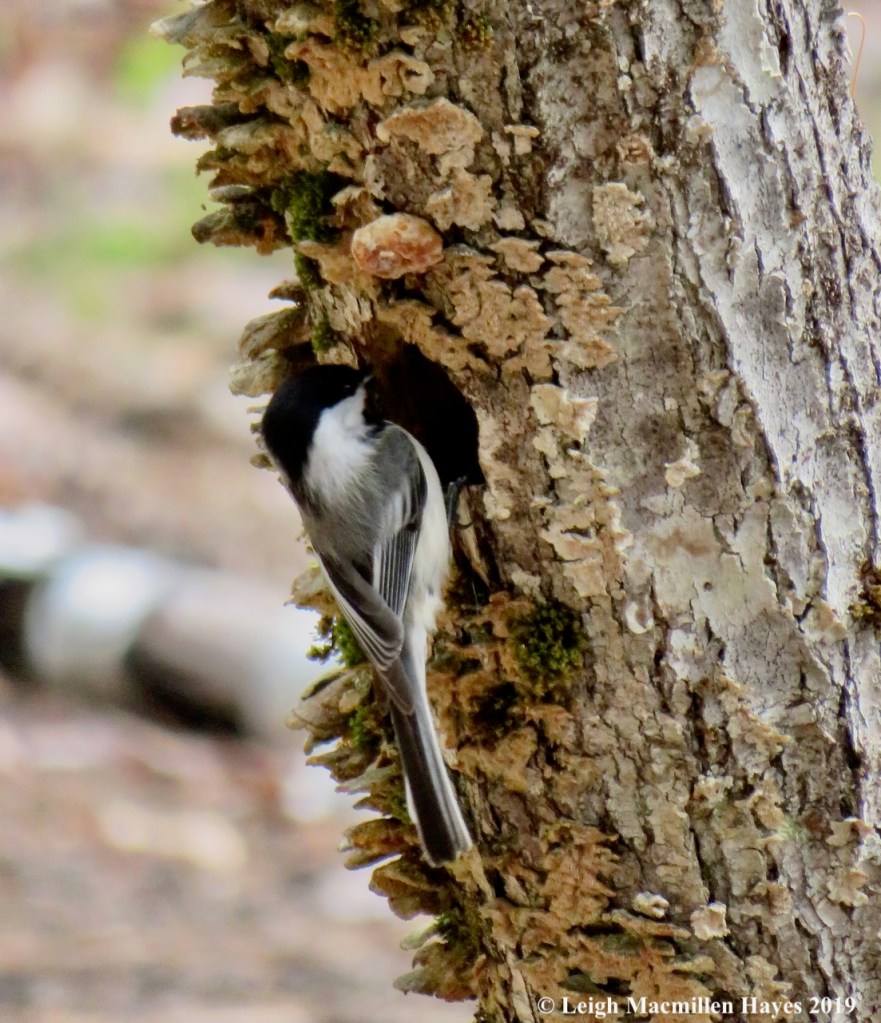
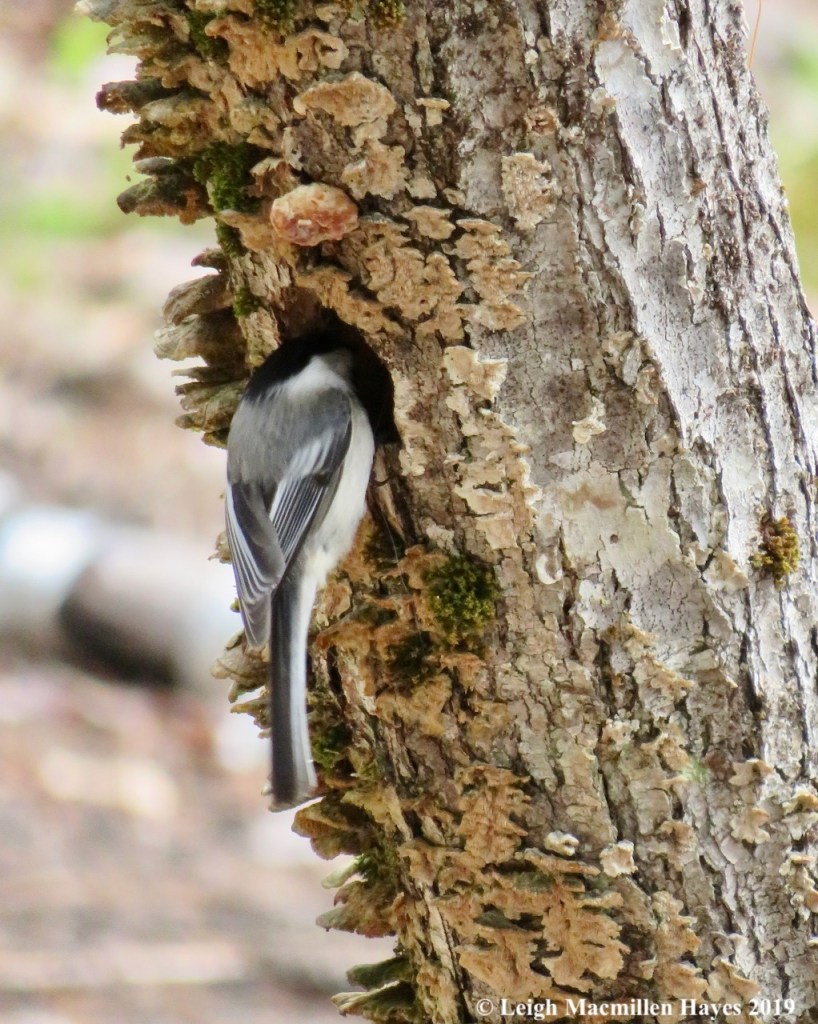

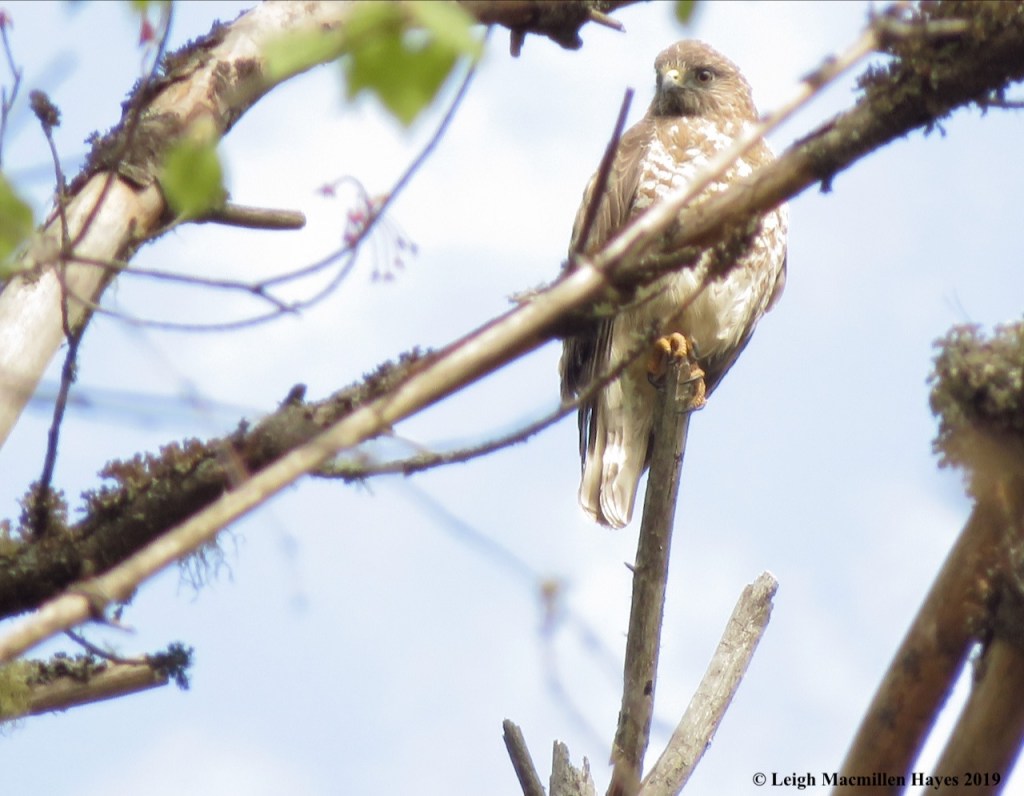


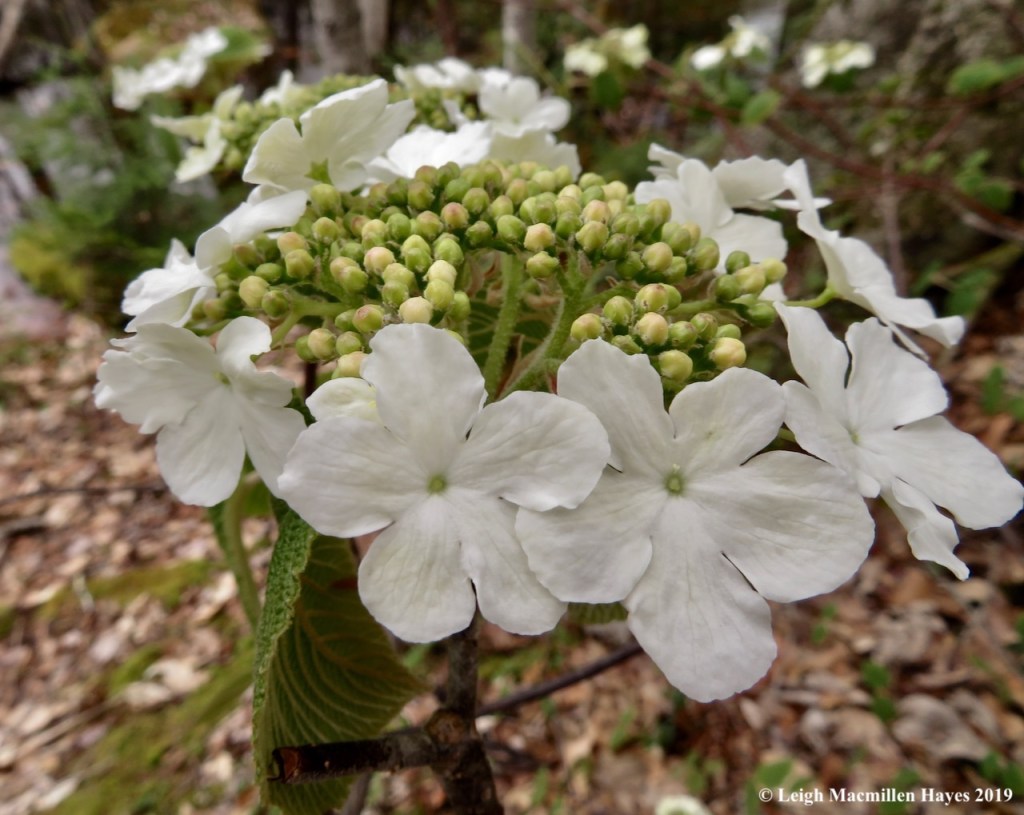
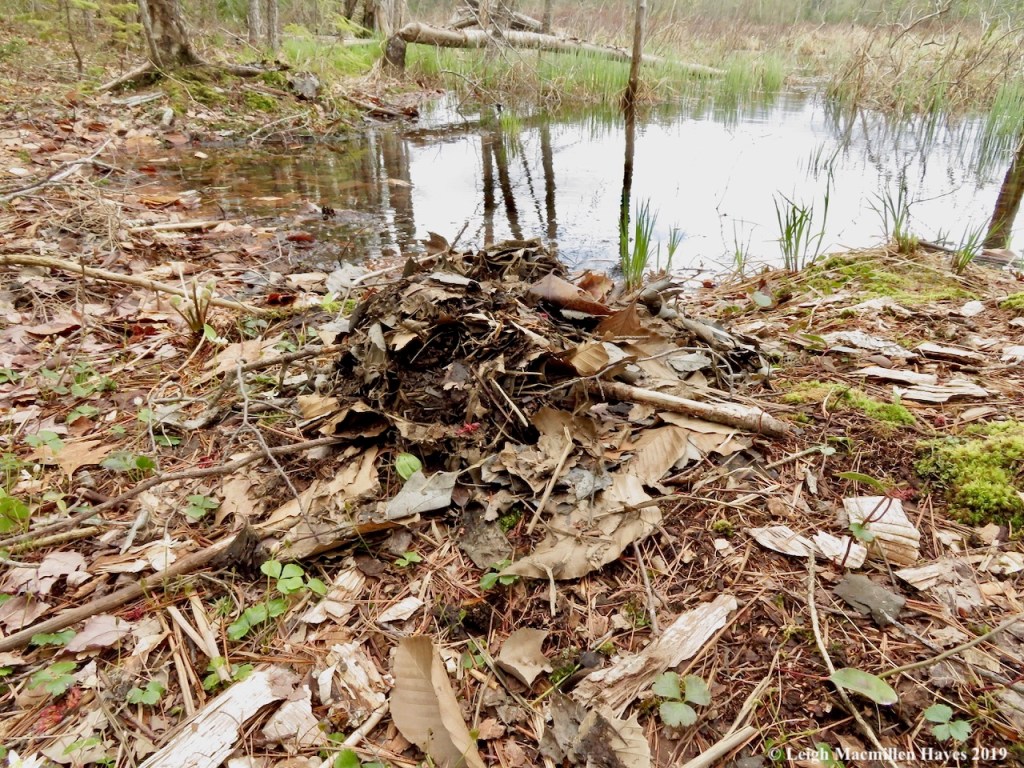
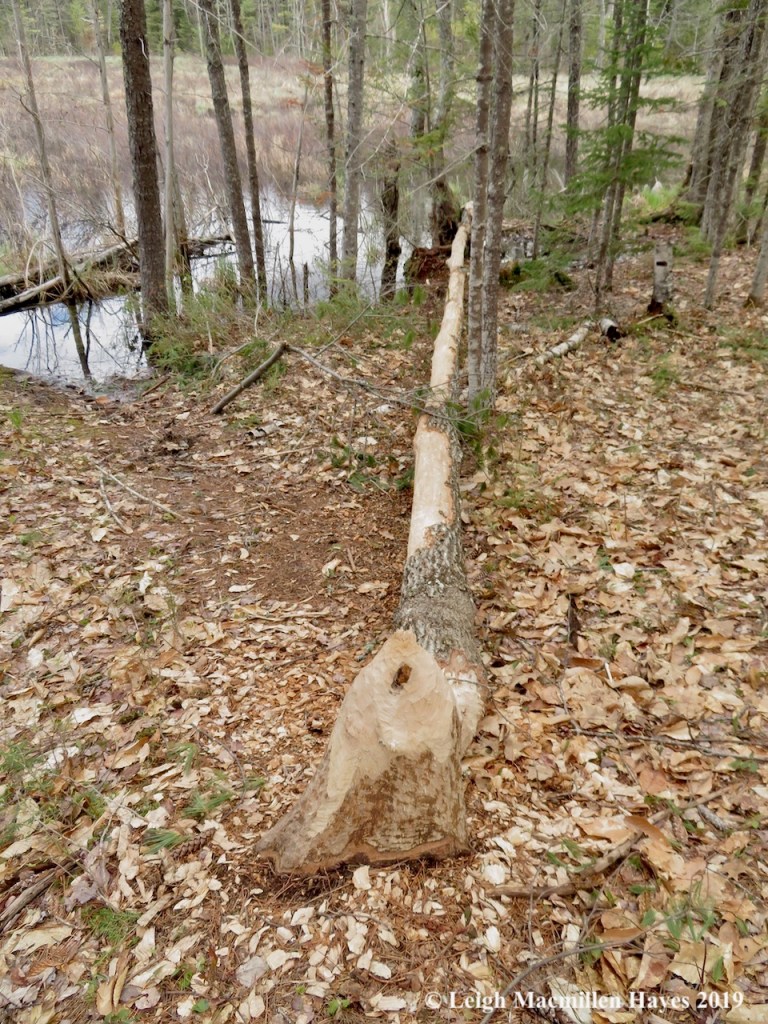
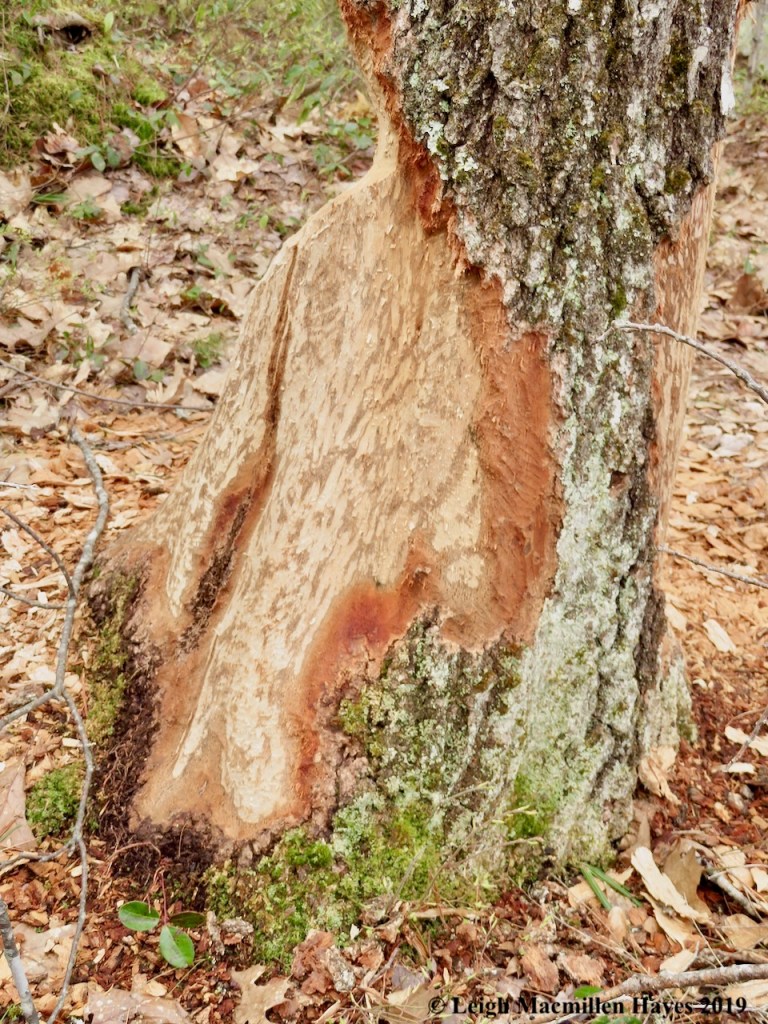

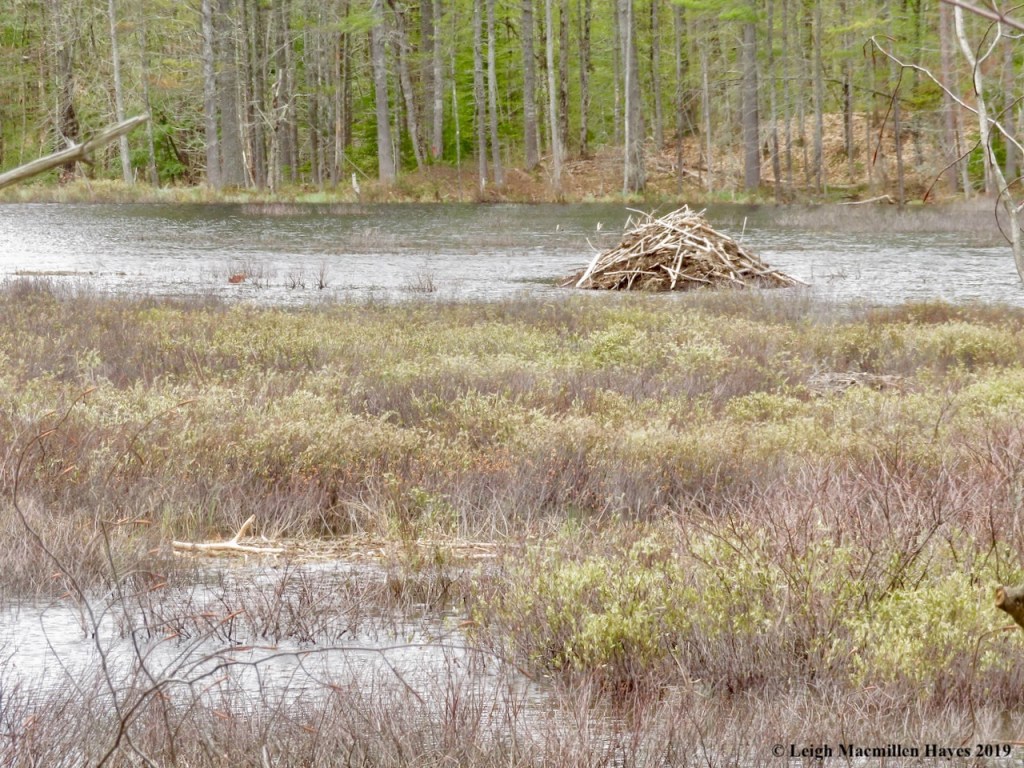


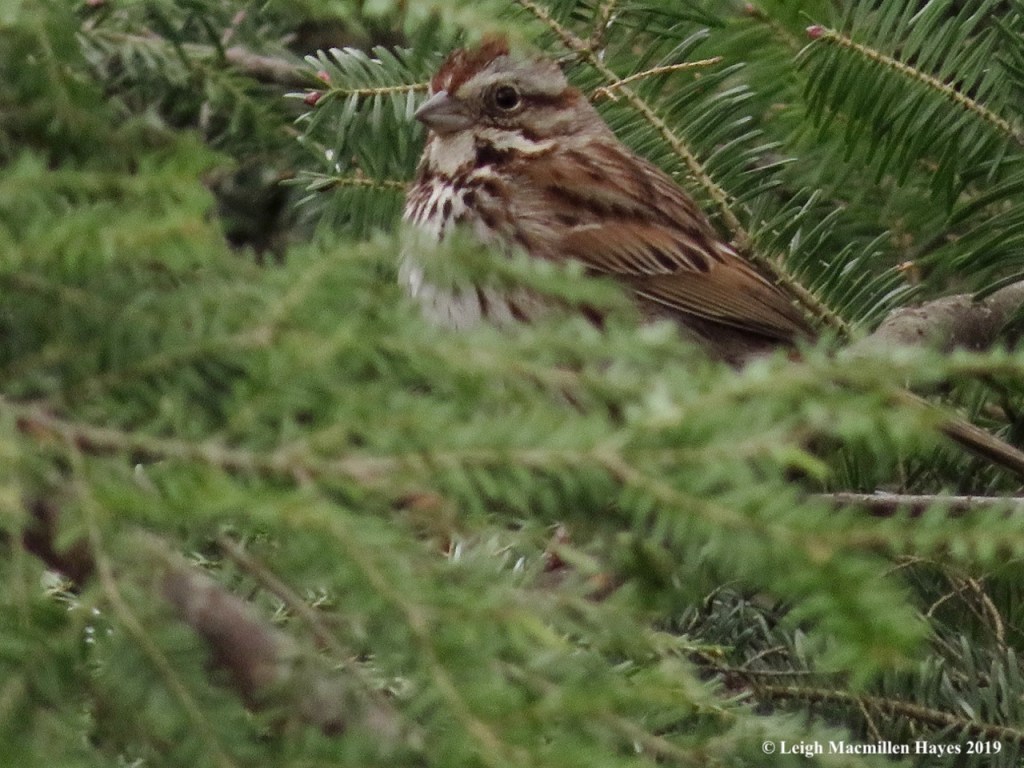
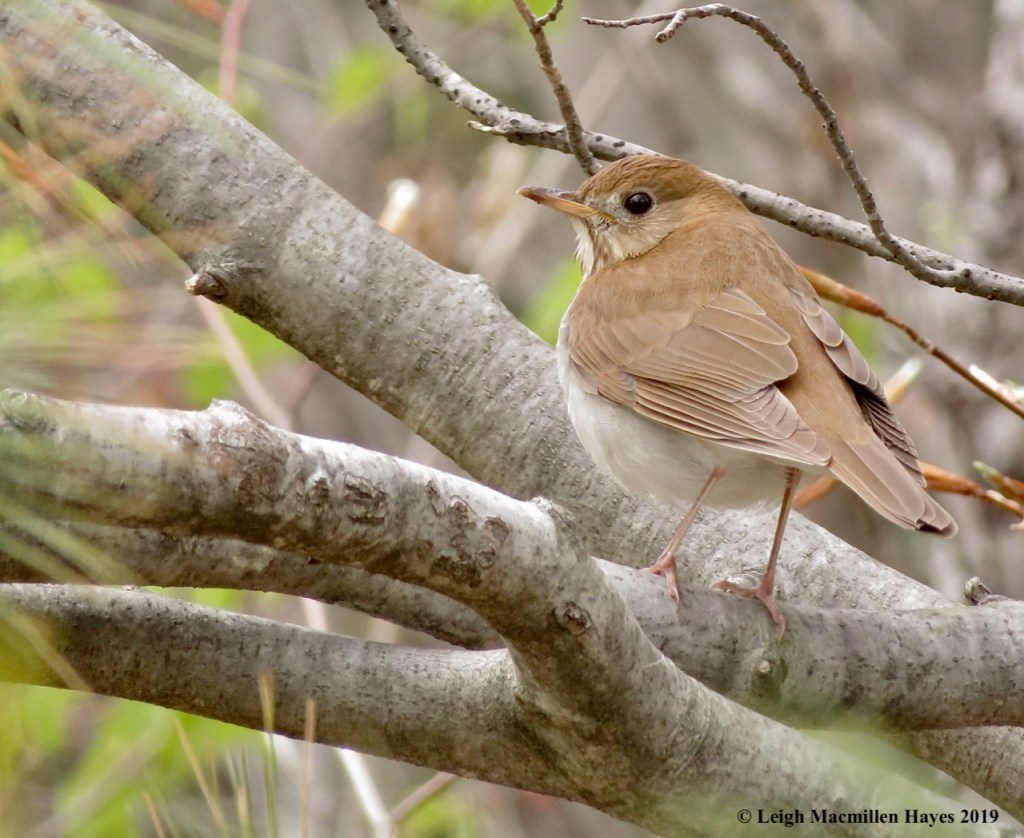


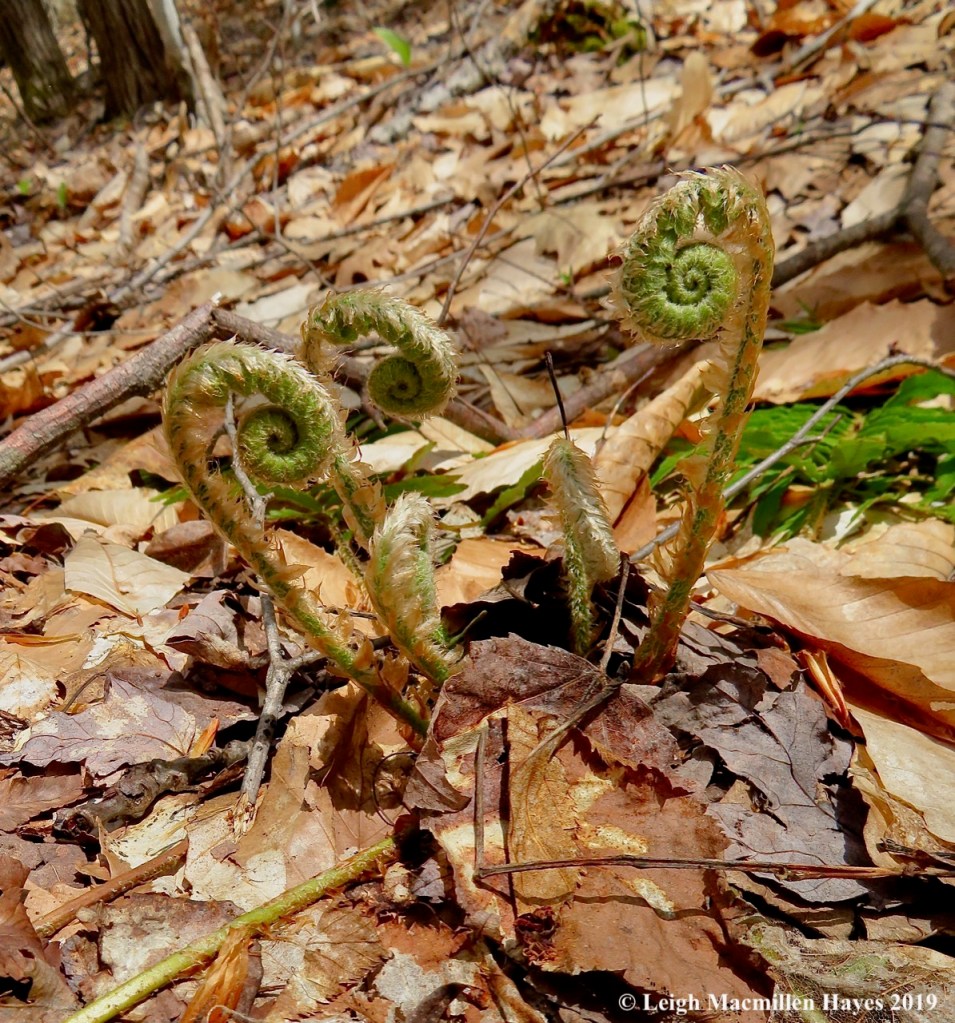
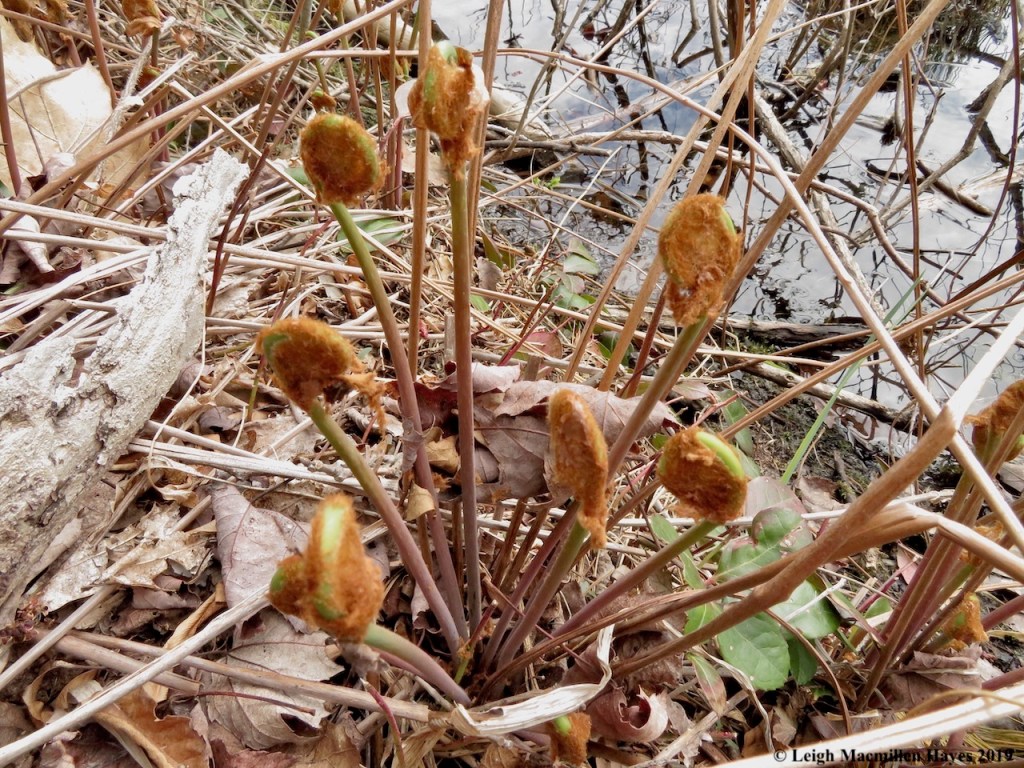
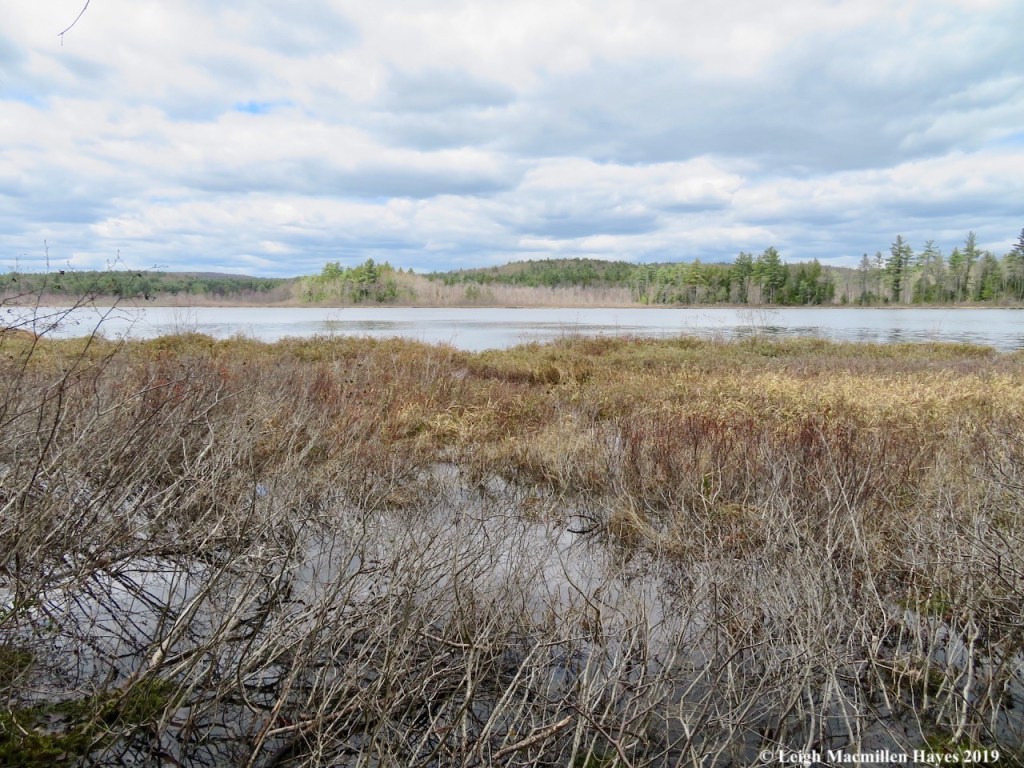


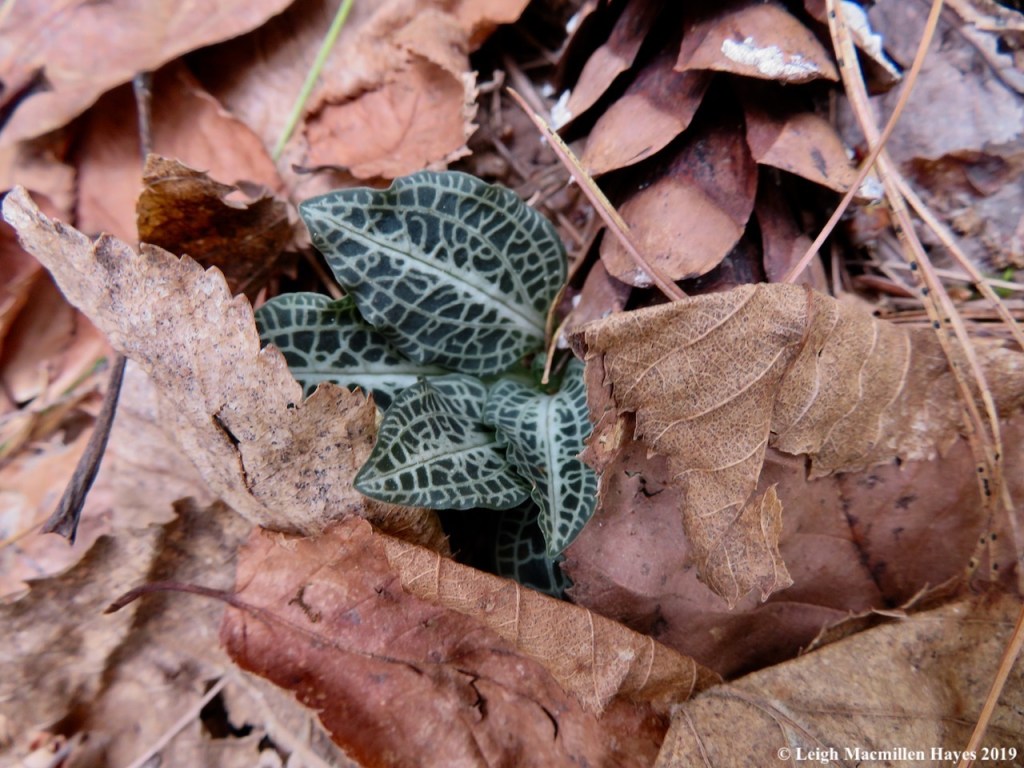

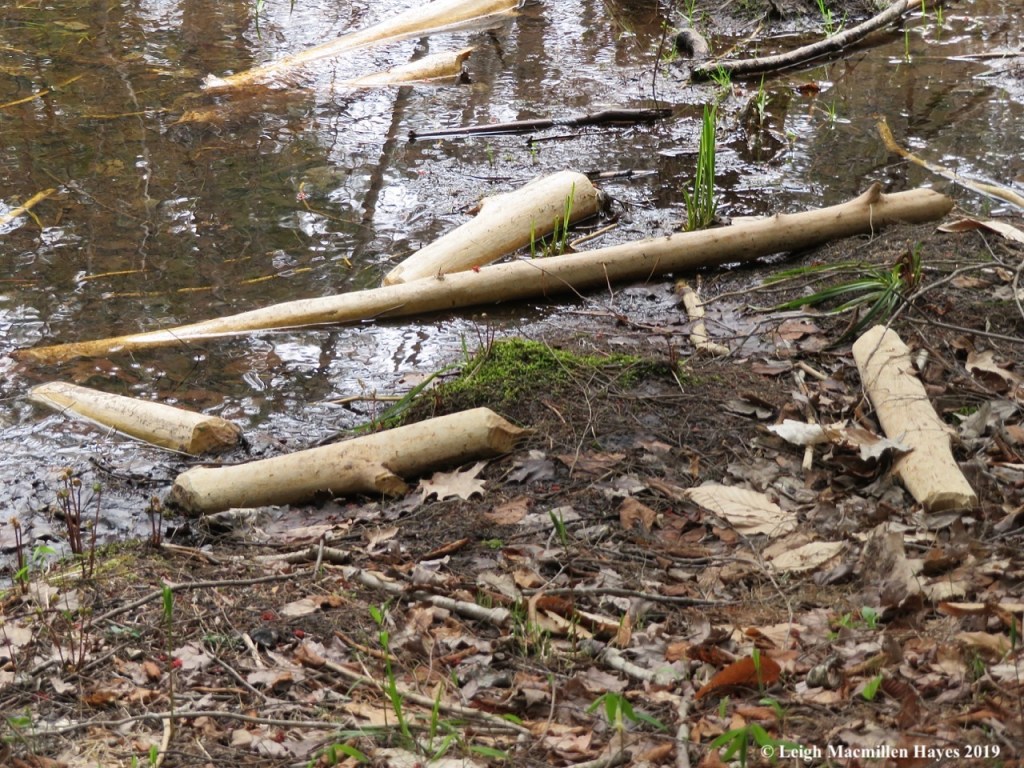
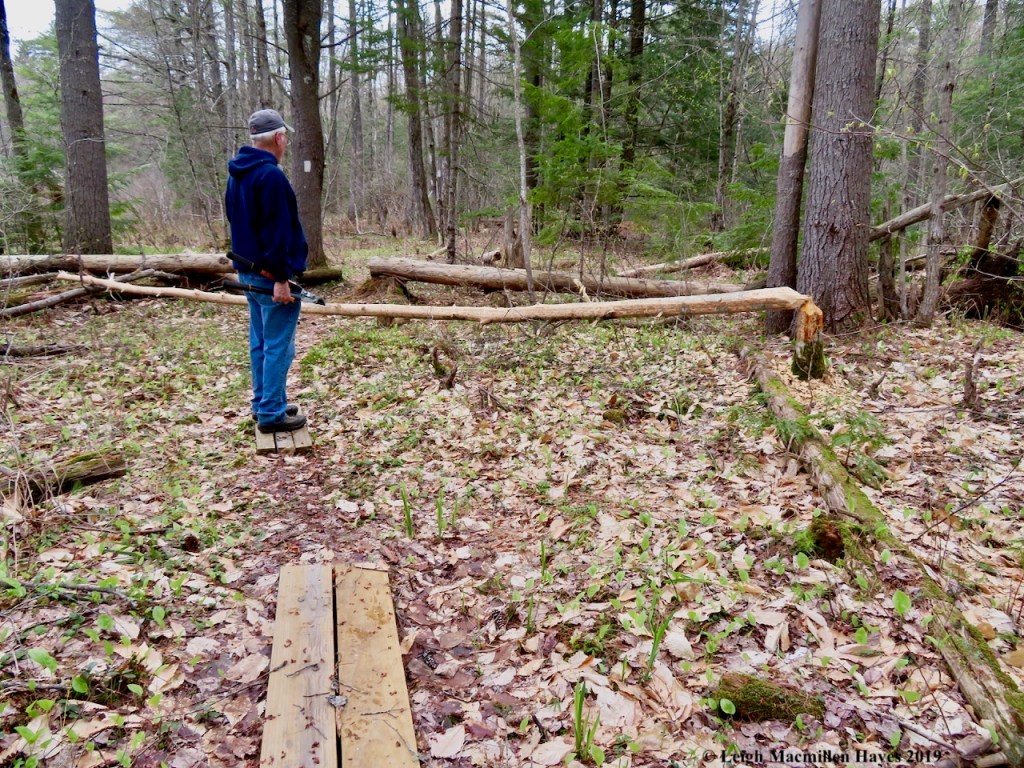
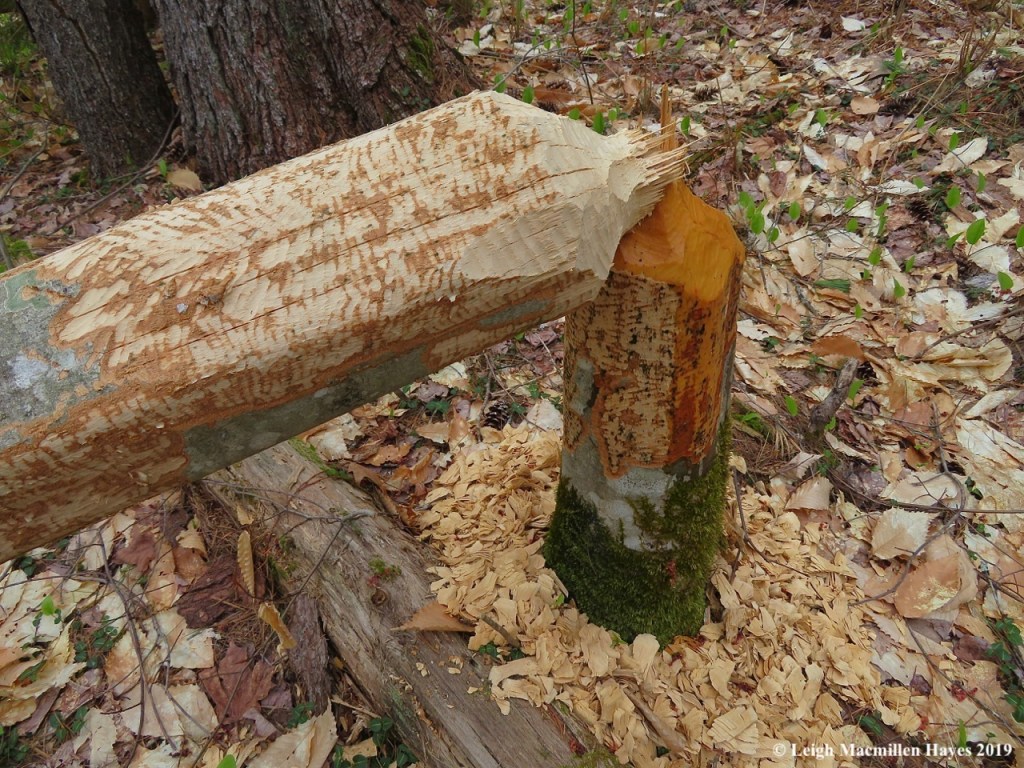
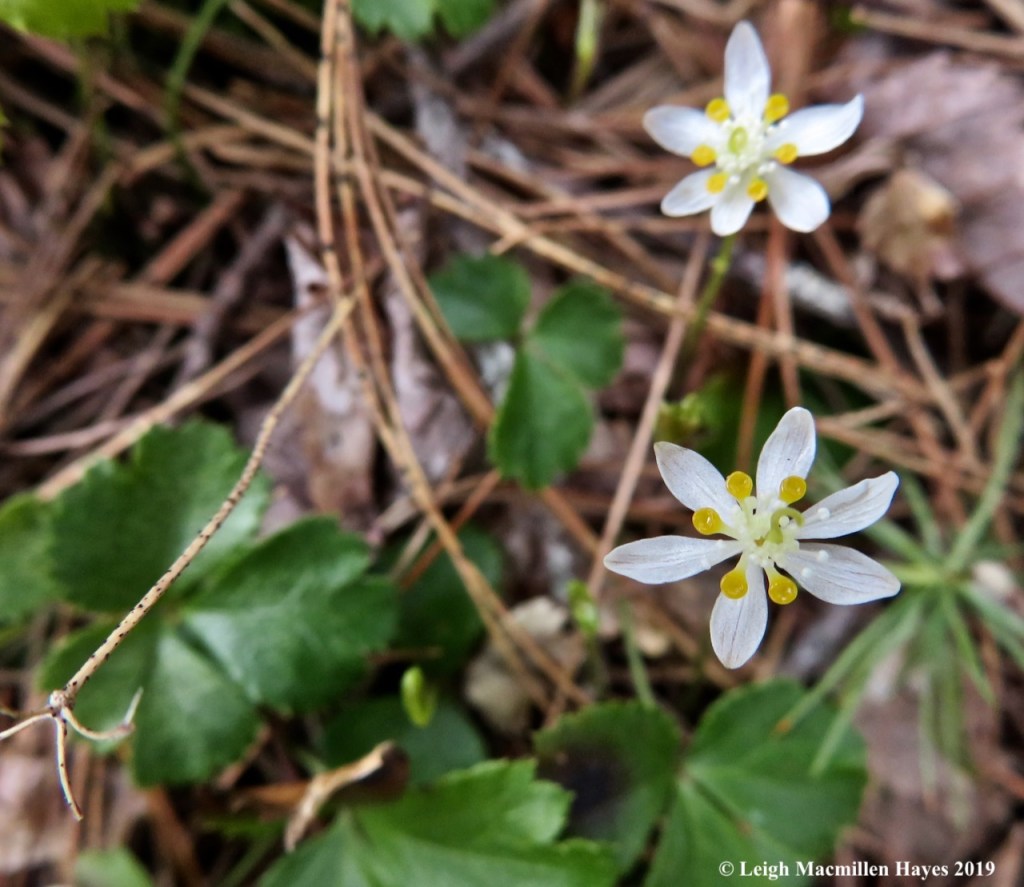
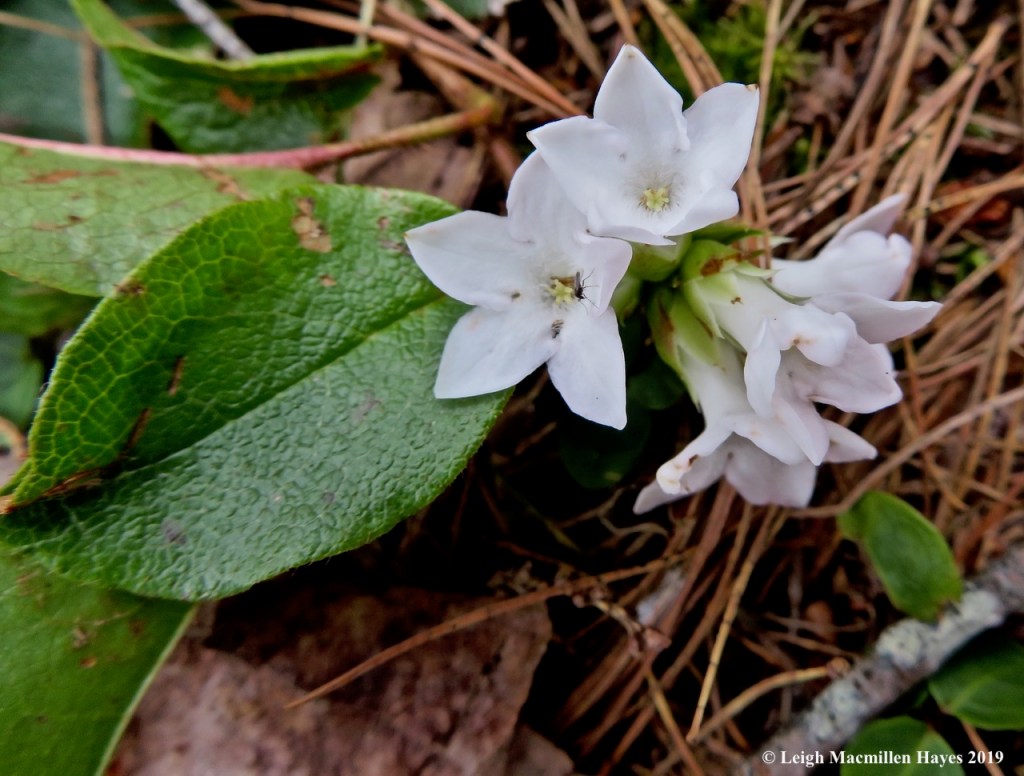
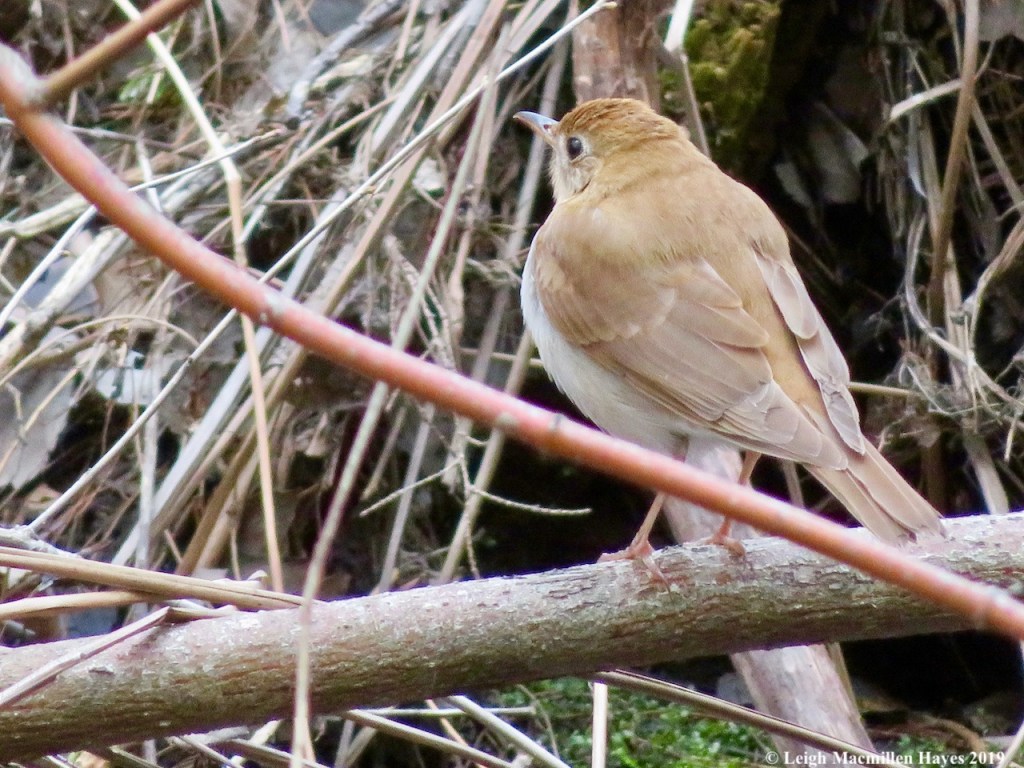


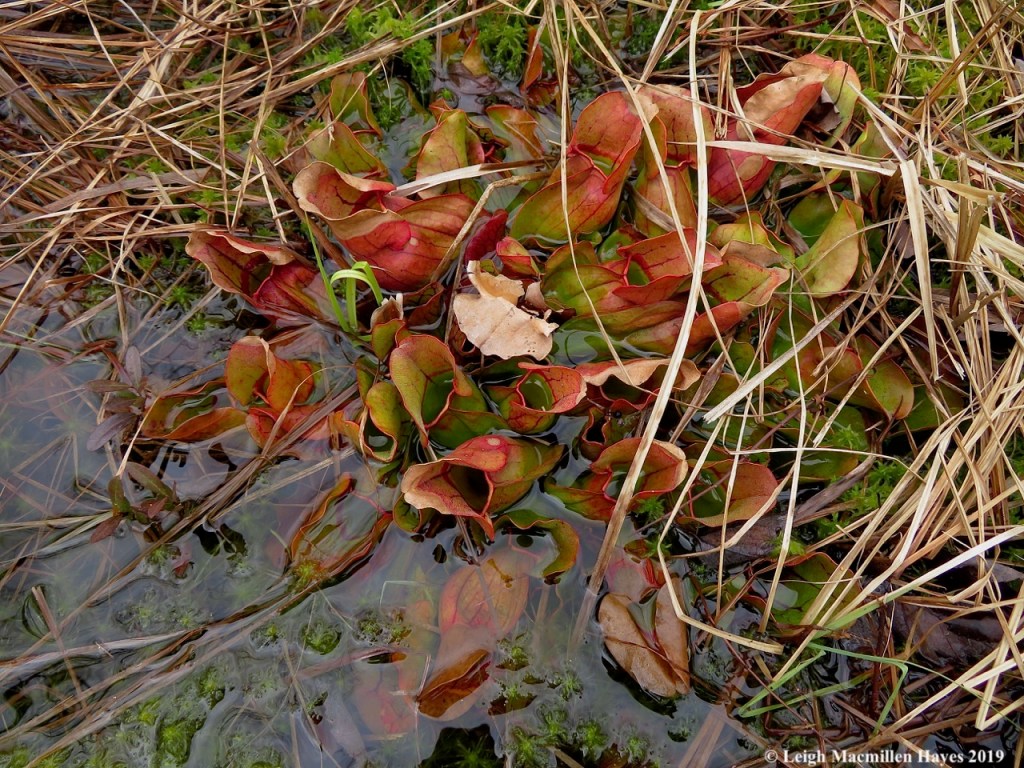
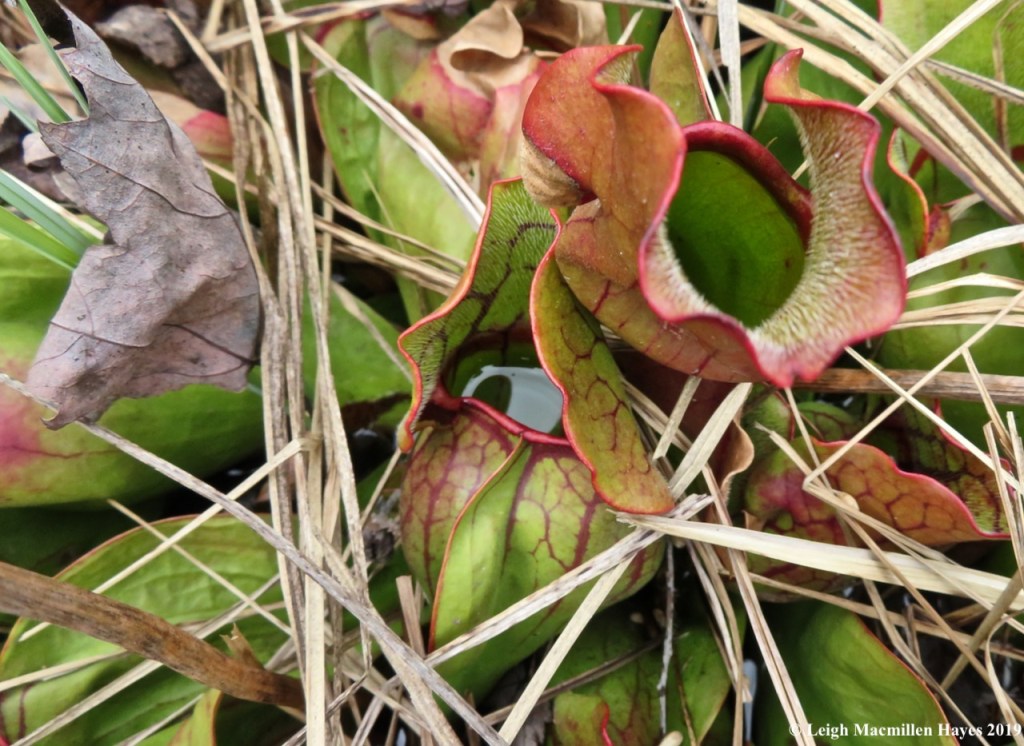

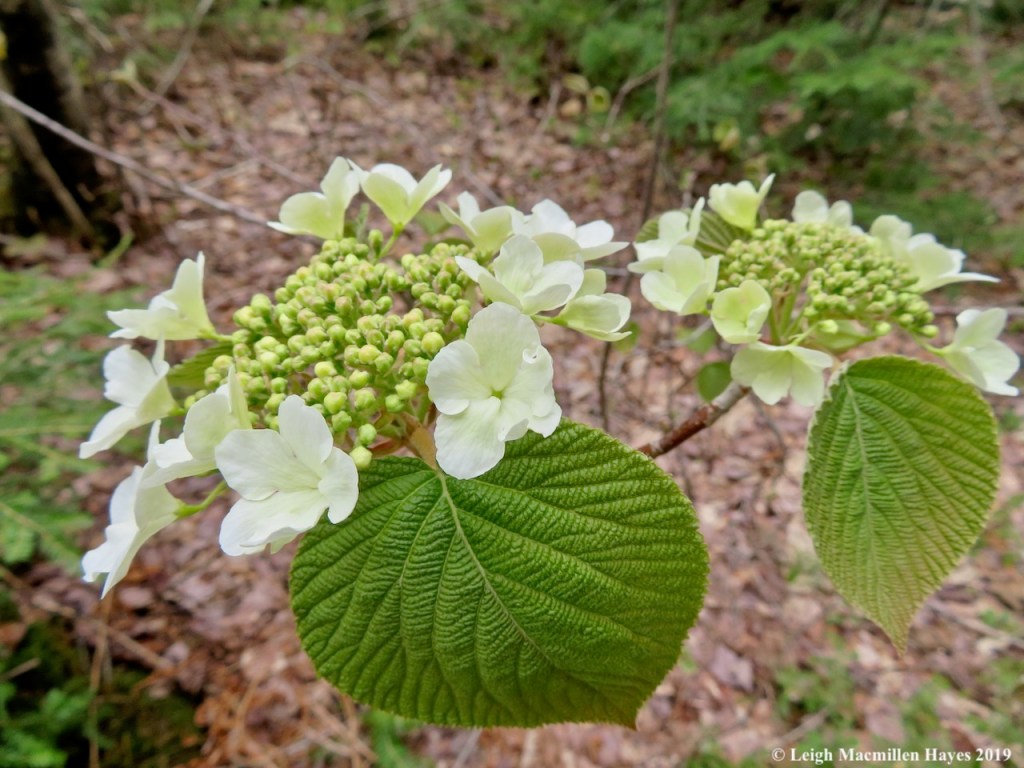


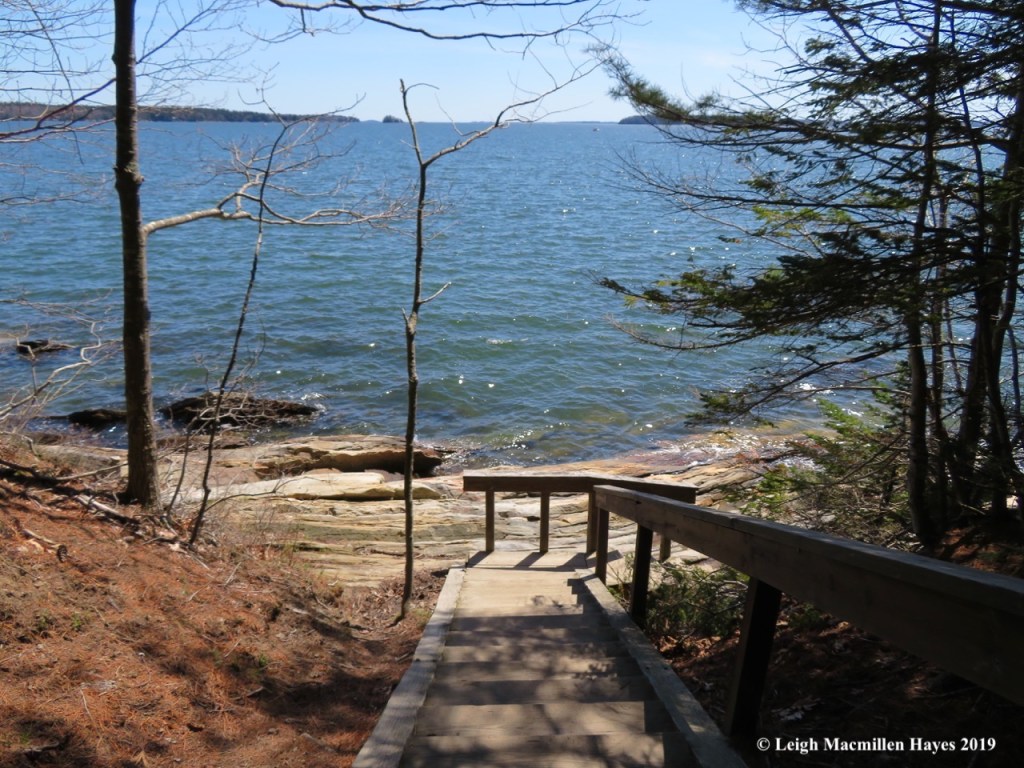


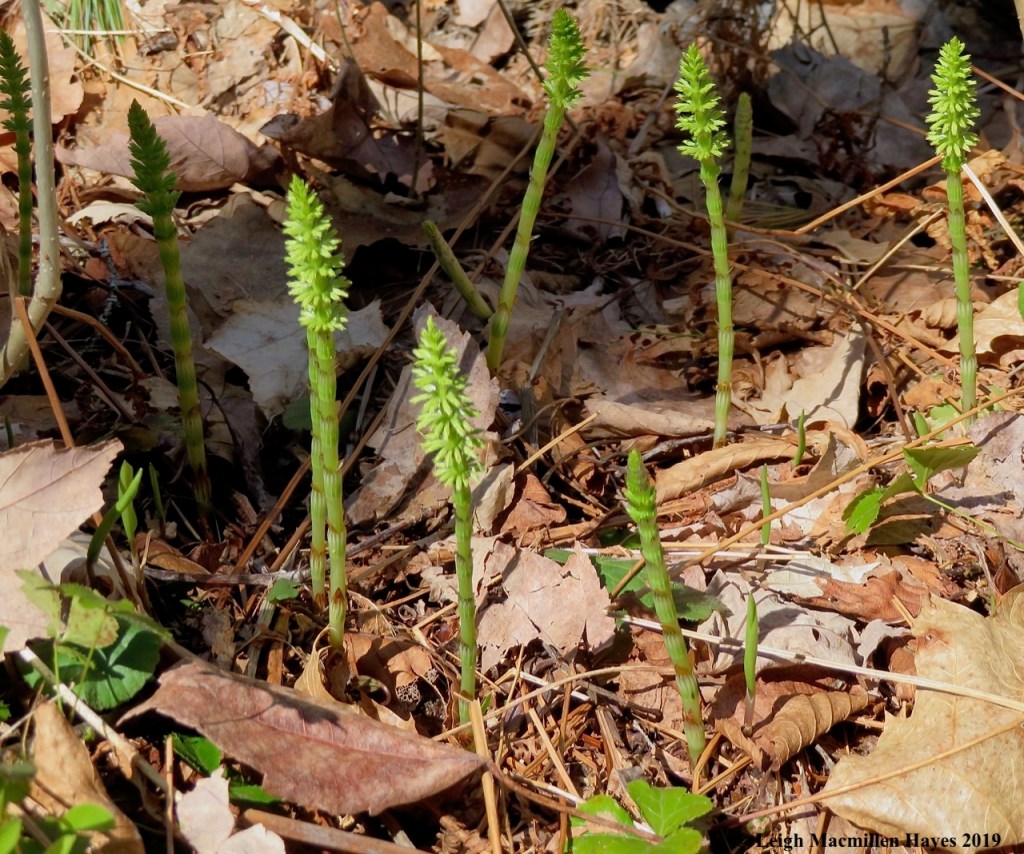

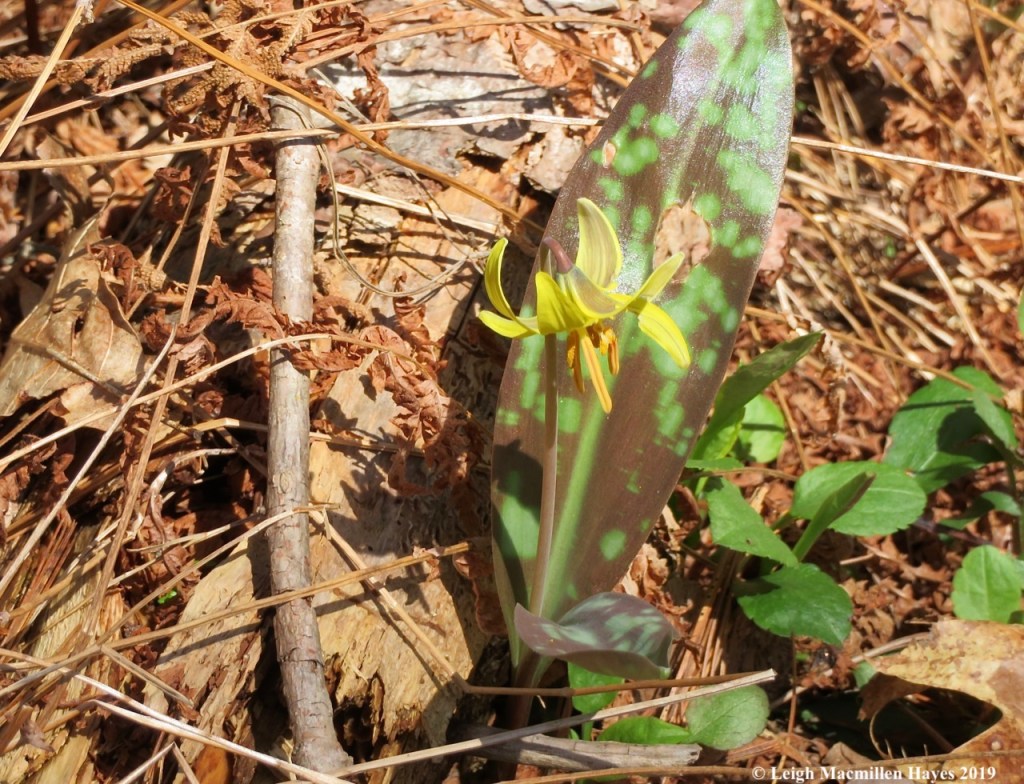

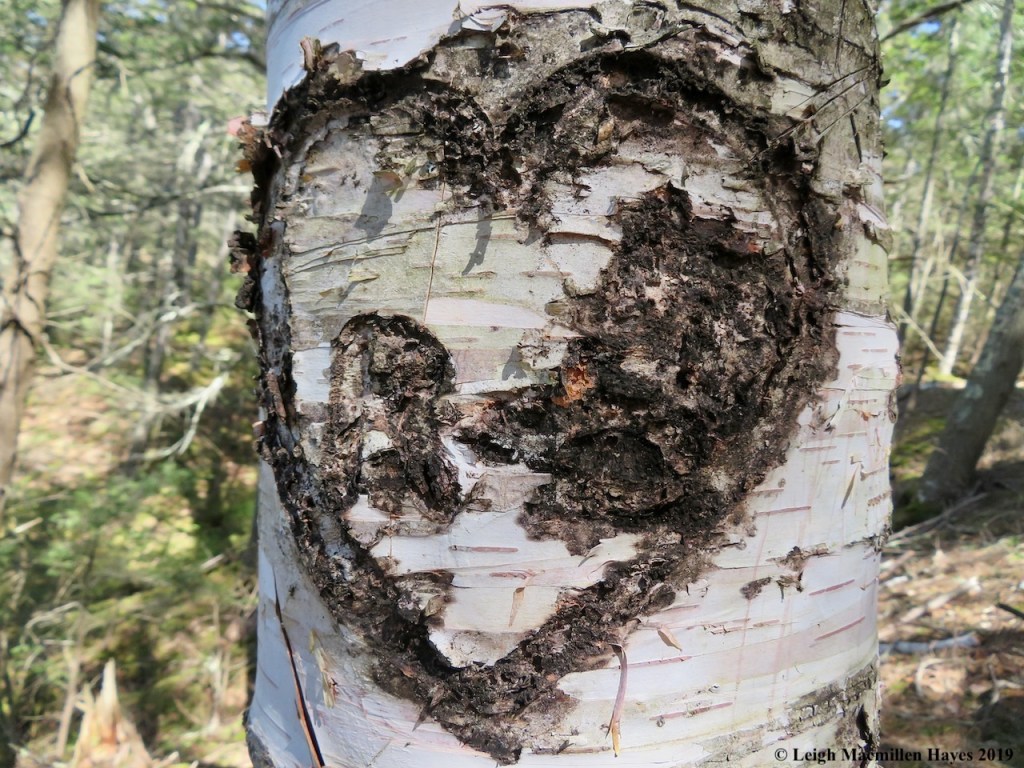

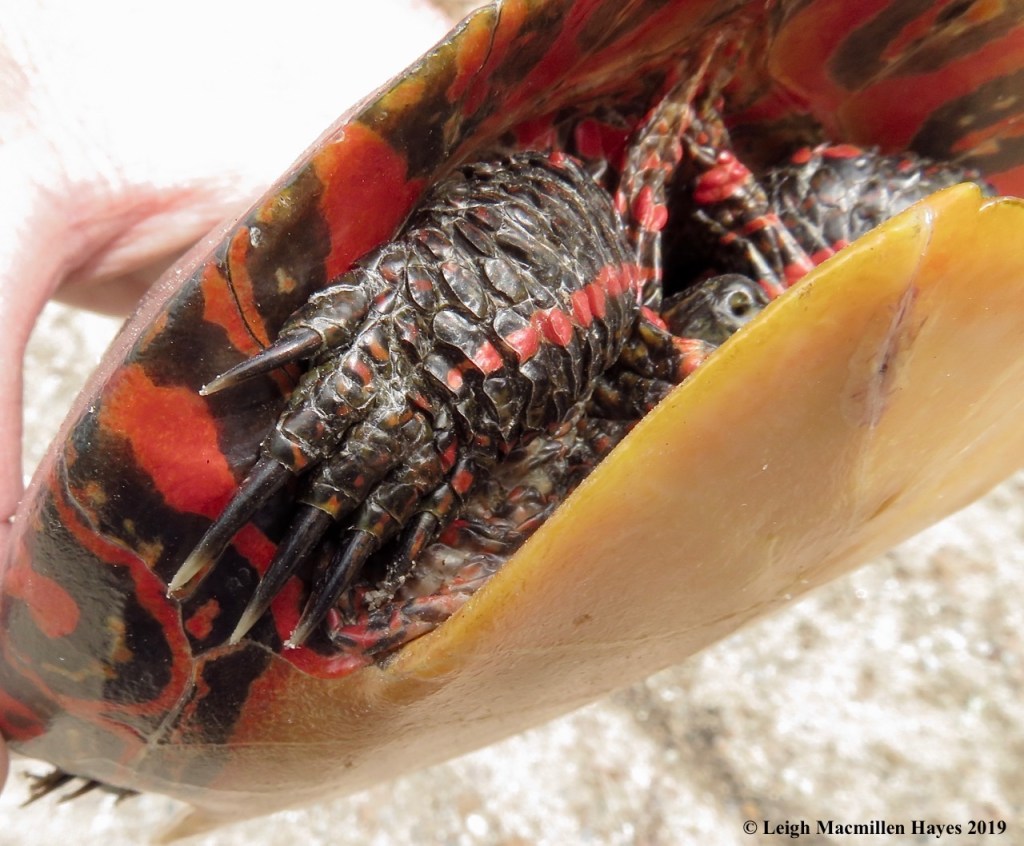


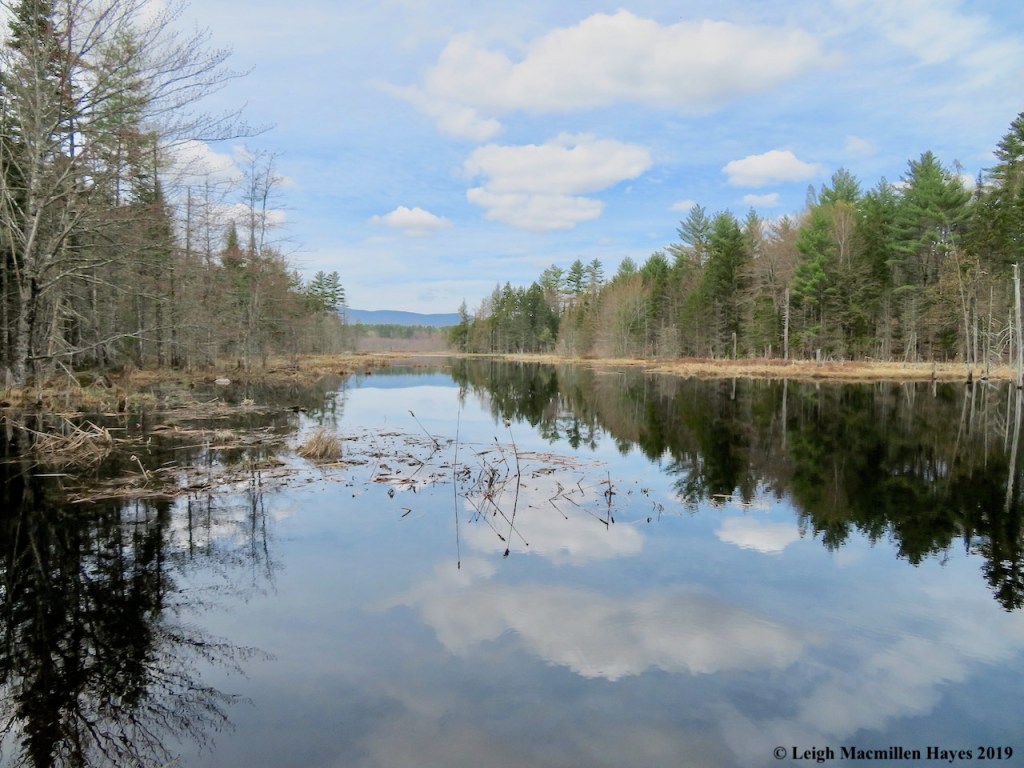


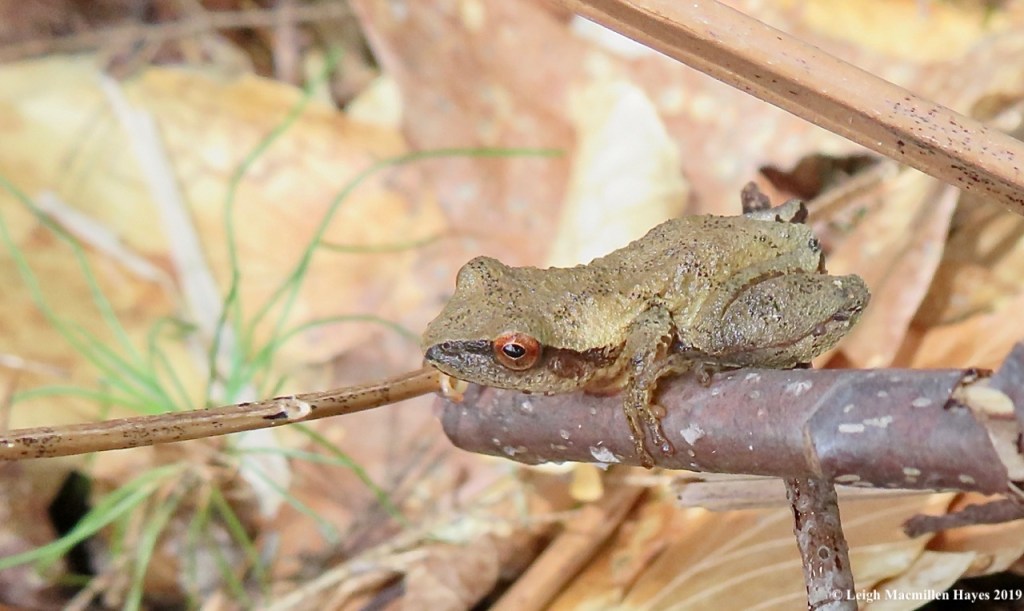

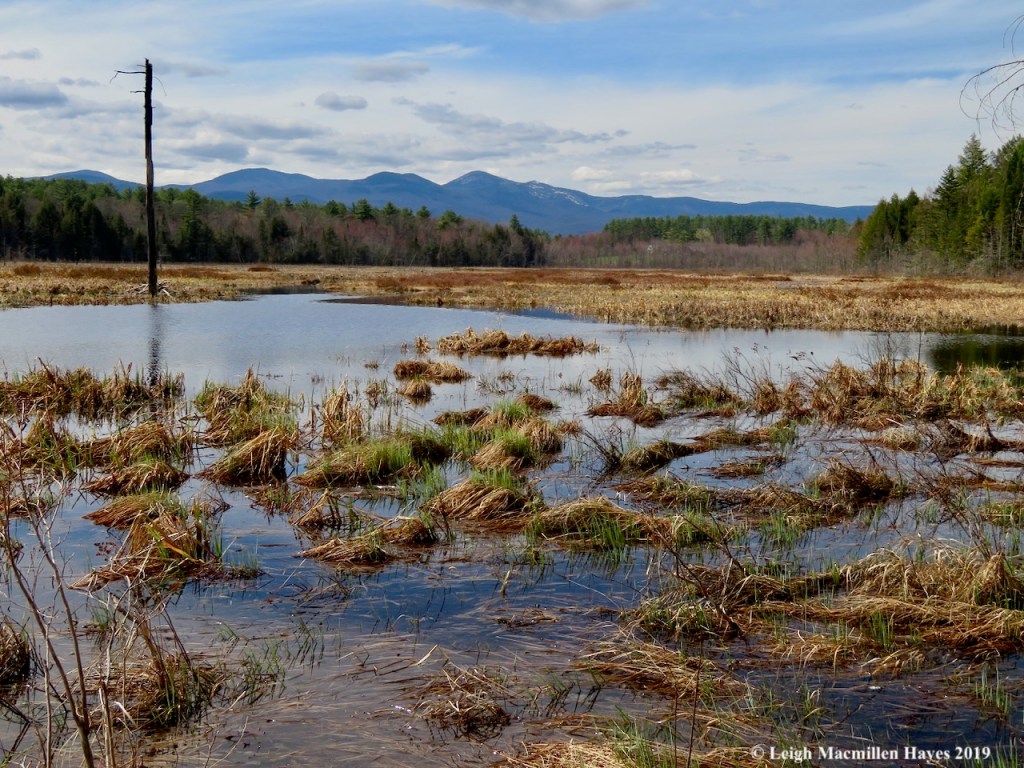
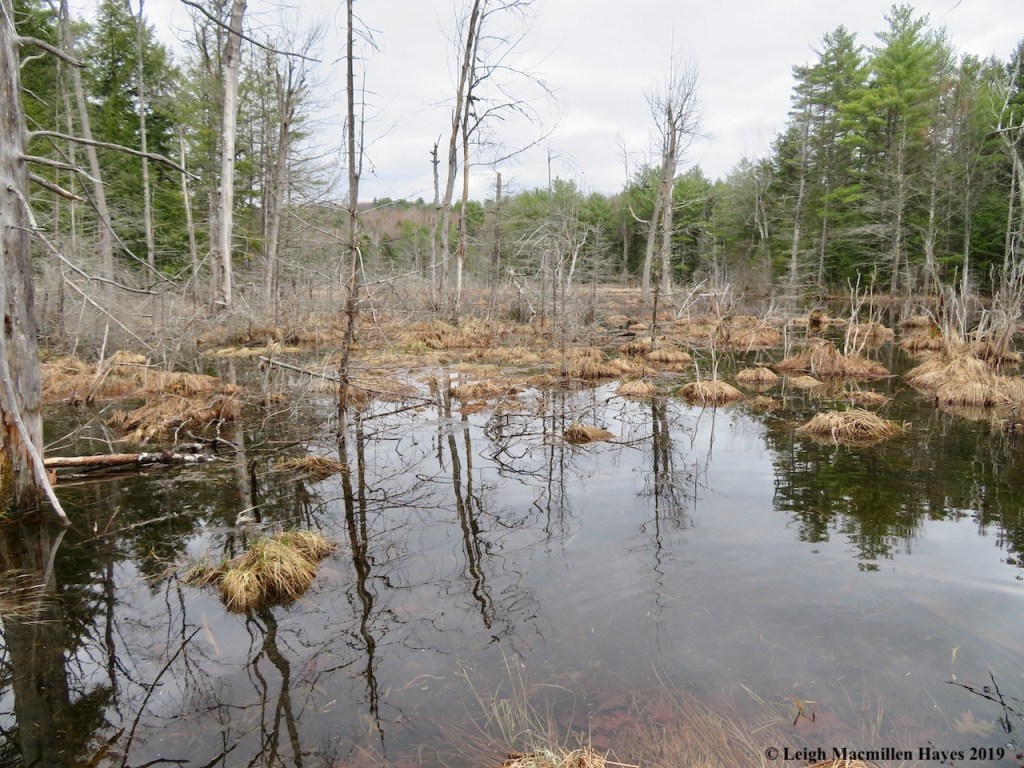
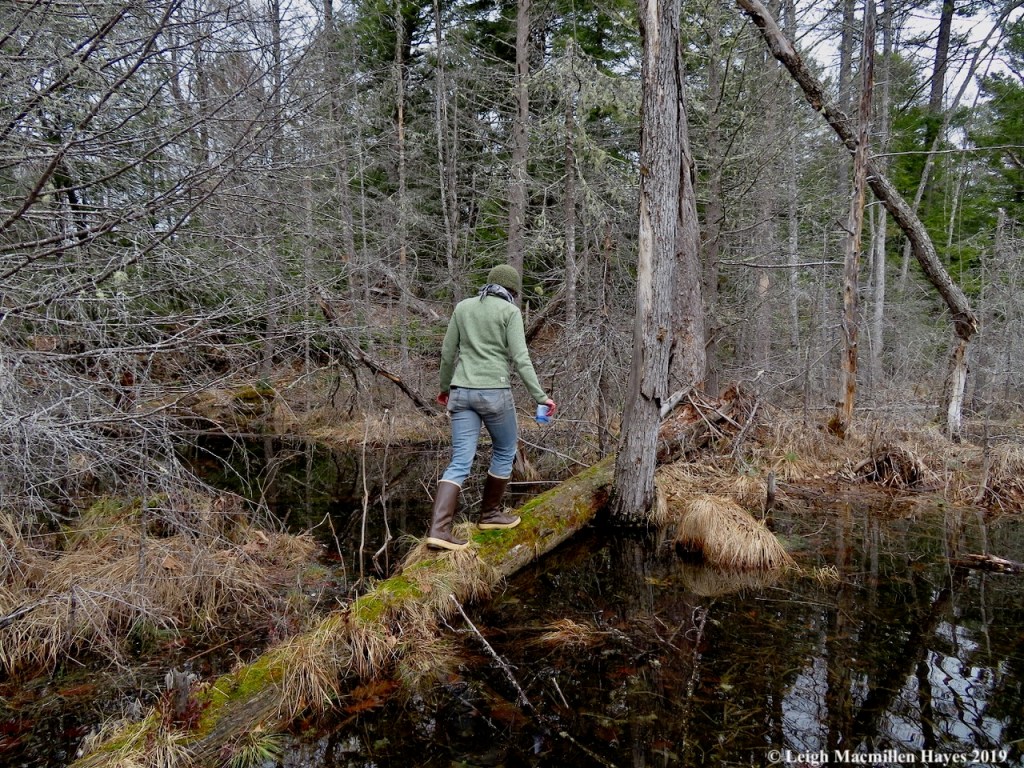


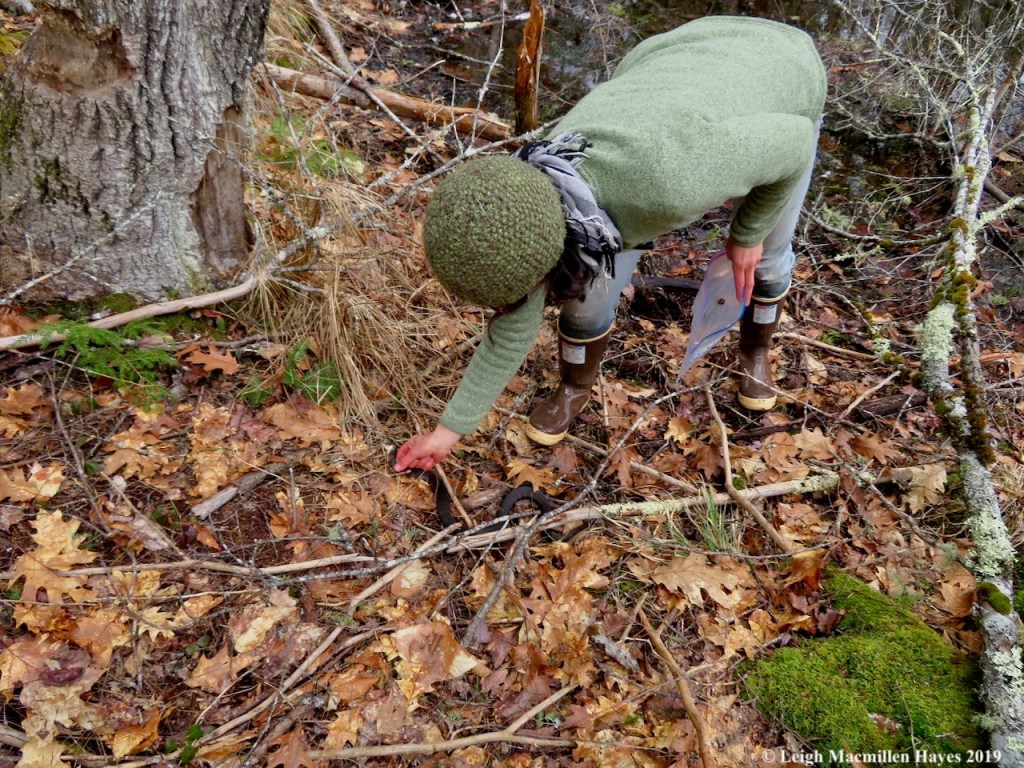
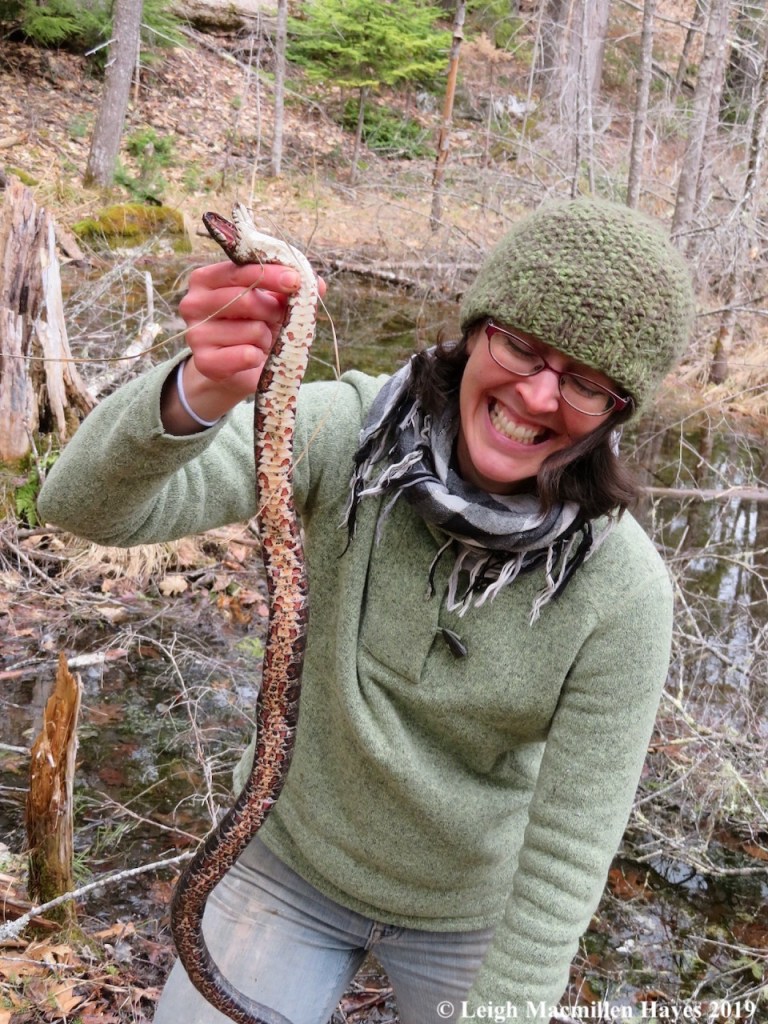

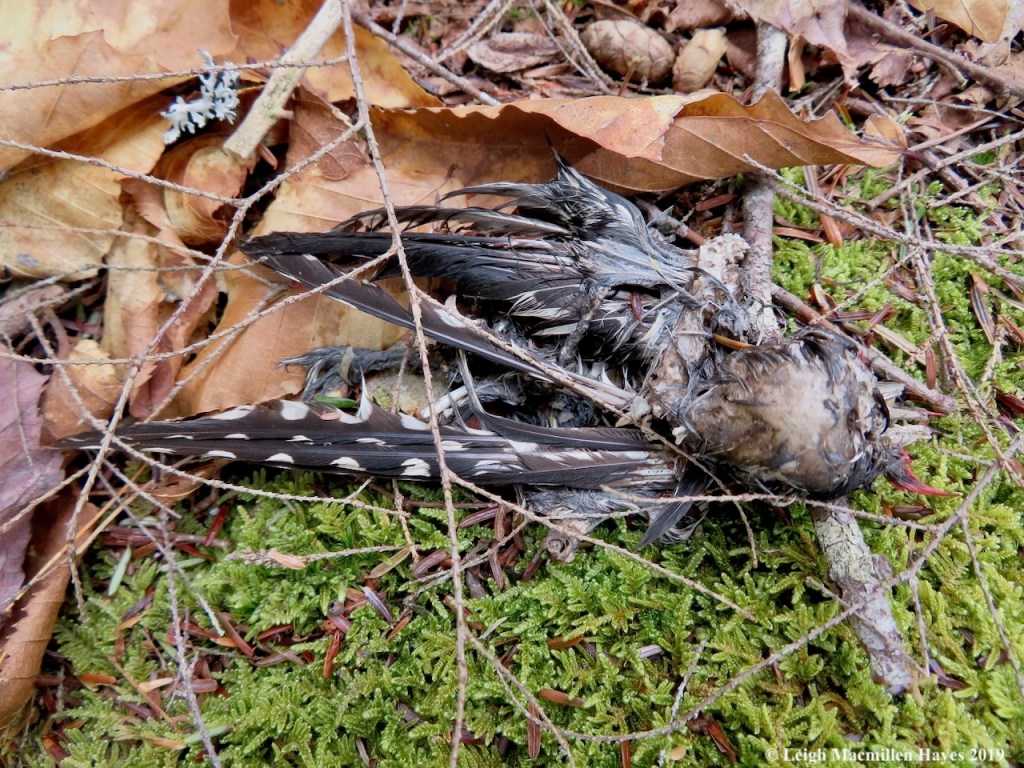
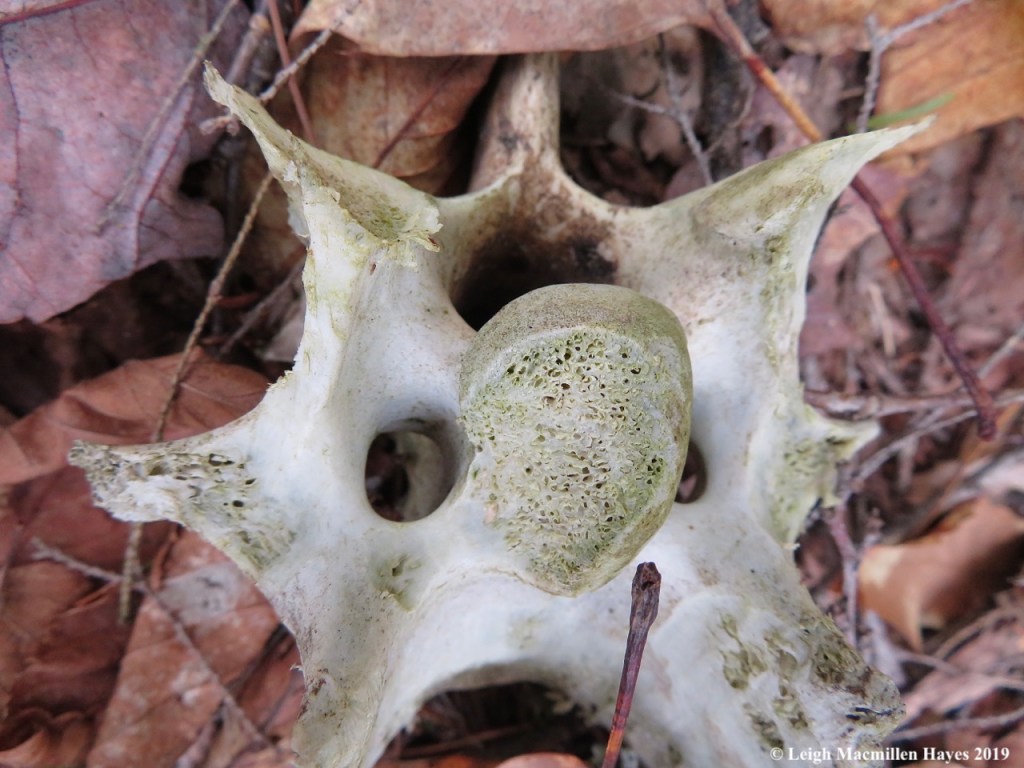



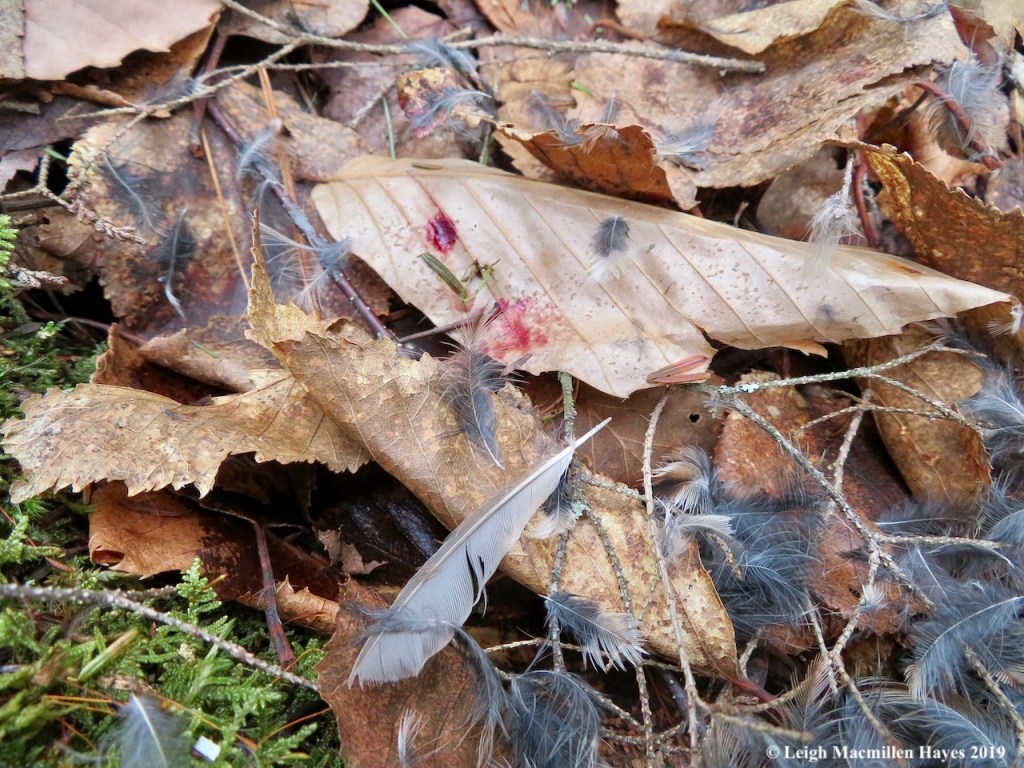


 wondermyway