Books of May: Vernal Pools

I had two books to choose from and couldn’t decide which one to promote as the Book of May, and so . . . I chose both.

And it seems only right that both should be presented, for though they aren’t about the flowers or birds or leaves that are making our days brighter, they are about one of my other favorite May events. Yes, we celebrate Big Night in April, that night or those nights, when amphibians cross the roads as they return to their natal vernal pools to continue the life cycle. But it’s in May that so much growth occurs within those pools and if we take the time to notice, we can watch it all happen–changing daily. And the more we understand what we are looking at, well . . . the more we get it. (“Stating the obvious again, Mom,” our two twenty-something sons would say if they were to read this. But they don’t so I can get away with it.)

Enough said. The May Books of the Month are . . . the following:
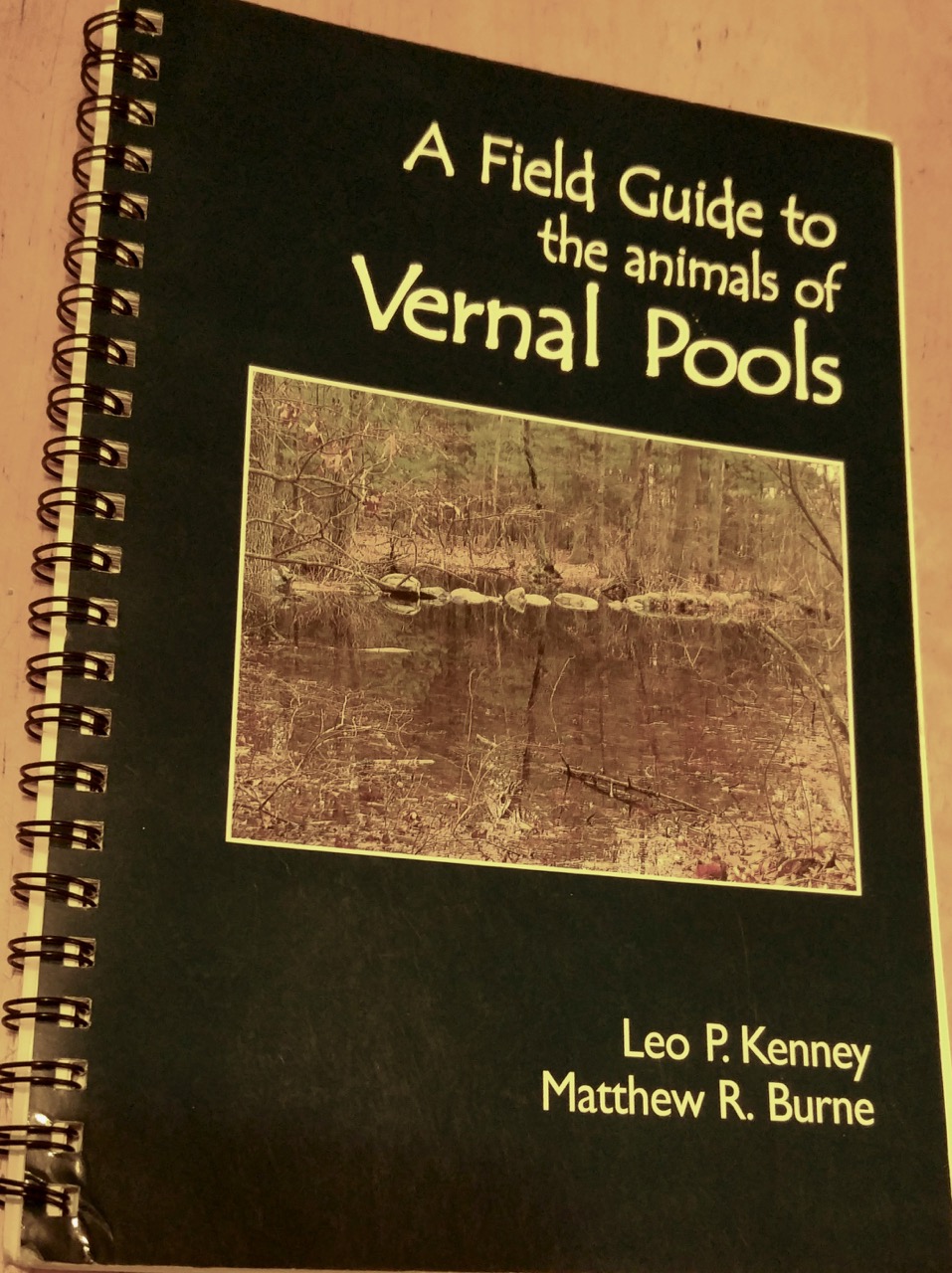
A Field Guide to the animals of Vernal Pools

and

s-MAAR (2)

Maine Amphibians and Reptiles.

The former, A Field Guide to the animals of Vernal Pools by Leo P. Kenney and Matthew R. Burne, is about 8″ x 5″ and fits easily into any pack I decide to carry. Its pages are glossy, so I don’t worry too much about it getting ruined if I get it wet. And though it was written to represent Massachusetts, most of the species described match what Maine vernal pools have to offer.

s-MAAP frogs:toads (1)

After an introduction to vernal pools, their indicator (obligate) species, protection, importance and human impacts upon them, there is a pictorial guide to the adult amphibians and reptiles. This is a quick and easy reference, and especially useful when trying to determine the difference between species, e.g. bullfrogs and green frogs or leopard frogs and pickerel frogs. Besides frogs, it includes salamanders, snakes and turtles.

s-MAAR sallies (2)

And then there are more descriptive pages for each species. These have helped me over the years to gain a better understanding of what I’m looking at.

s-sallie eggs 1

Even today, when Jinny Mae and I discovered these spotted salamander eggs, I loved that we could see that gelatinous matrix that surrounded the individual eggs.

s-wood frog eggs

And the book has helped me recognize the difference between those salamander eggs and these wood frog eggs.

In the field, there’s so much more to see, including the invertebrates that inhabit the pool, and ever so slowly I’m learning to identify them as well–you know, predaceous diving beetles, damselfly larvae, water scorpions, backswimmers, water striders . . . the list goes on. Each of them is featured in the back of the book with a photograph and paragraph or two describing their larval and adult forms.

Maine Amphibians and Reptiles, edited by Malcolm L. Hunter, Aram J.K. Calhoun and Mark McCollugh, is my at-home reference book. Well, sometimes it goes for a ride in my truck, but usually, it’s left at home because it’s larger and offers a much more in-depth take on amphibians and reptiles, their habitats and conservation. Besides a photo gallery, each amphibian and reptile that makes its home in Maine is featured, with thorough descriptions, taxonomic status, distribution, reproduction, habitat, diet, and interactions with people and other animals. There are sketches and maps to further enhance the information presented. And it’s all quite readable.

s-MAAR recordings 2 (1)

One of the best features of this book (and unfortunately, mine is cracked) is the CD at the end. Yes, you can actually listen to the individual species so that when you hear them in the day or night, you might begin to recognize them, much as you would a bird, by their voices before you spy them.

In the past few years, the vernal pool that I study frequently, has dried up before the amphibians have matured. I find solace in the fact that even when the pool dries up, the species growing there still provide nourishment and pass on energy to their consumers.

But . . . maybe this year will be different. We had a lot of snow, and now a lot of rain. Maybe this will be the year the amphibians and insects that reside in the pool will actually mature and hop or fly out.

It all begins with MAY.

The Books of May:

A Field Guide of the animals of Vernal Pools, by Leo P. Kenney and Matthew R. Burne, available through the Massachusetts Division of Fisheries & Wildlife’s Natural Heritage & Endangered Species Program.  (Curiously, the copy I own was from the third printing in MAY 2009)

Maine Amphibians and Reptiles, edited by Malcolm L. Hunter, Jr., Aram J.K. Calhoun, and Mark McCollugh, The University of Maine Press, Orono, 1999. (I purchased my copy at Bridgton Books.)

Book of April: How to tell the Birds from the Flowers

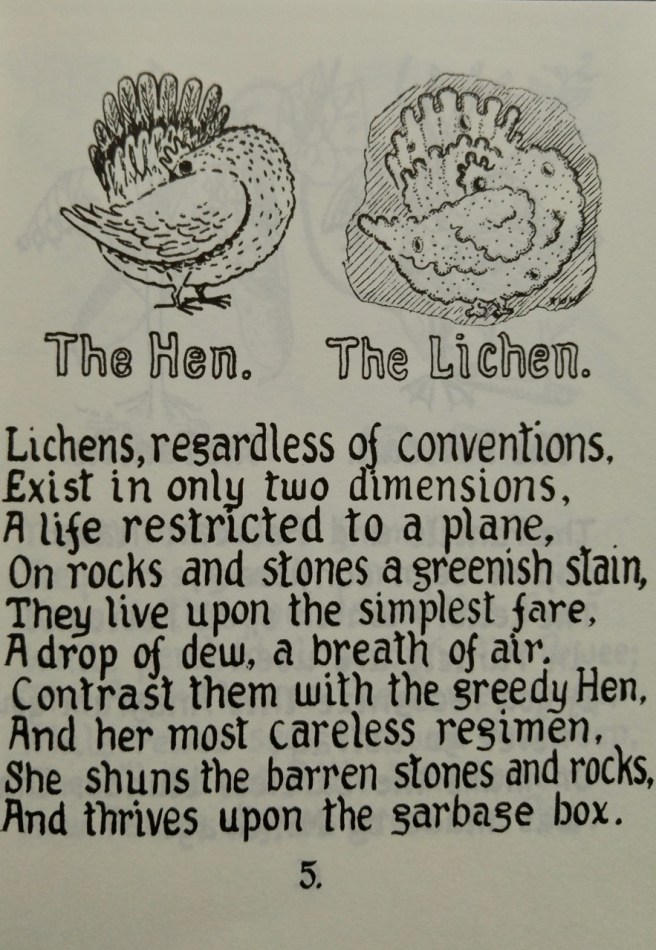
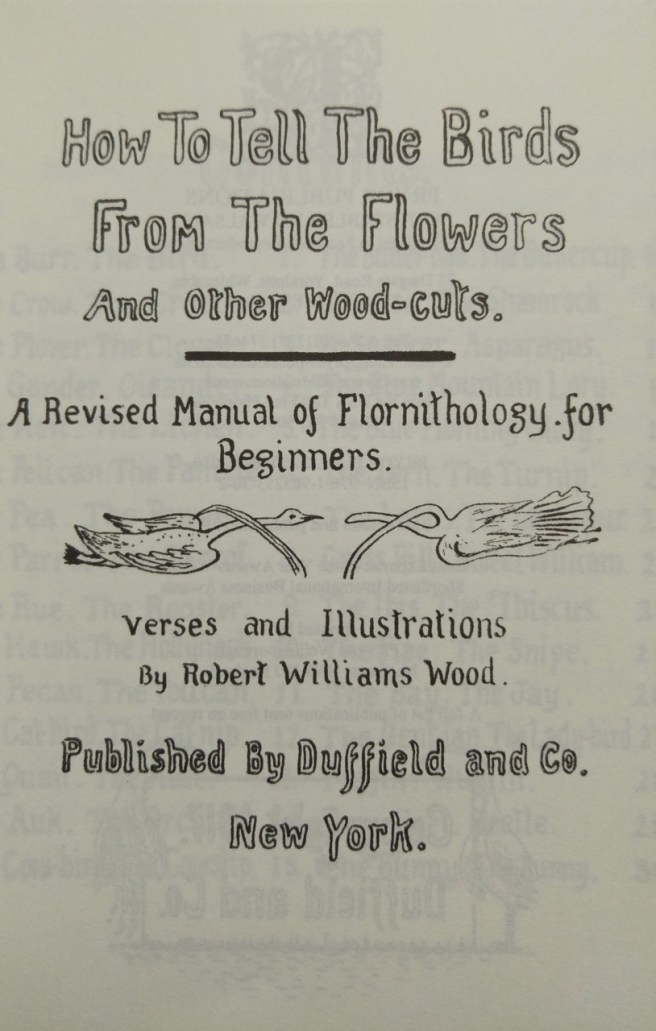
It’s April Fools’ Day and I can’t think of a more appropriate book to share as Mother Nature showers snow upon us than How to tell the Birds from the Flowers and other wood-cuts by Robert Williams Wood.

b-11 (1)

A friend found this delightful little ditty at an independent book store in Brattleboro, Vermont, several months ago and couldn’t resist purchasing it for me. Thank you, A.J. 

Can you see from the cover what Wood had in mind? 

b-9 (1)

And his language–Flornithology? Oh my. Artistic license met poetic license. 

The first edition was published in 1917–in Kent, England. According to a little research, Mr. Wood was born in England, but went on to become a physicist at Johns Hopkins. And they say (whoever they are) that he had no sense of humor.

Read on: 

b-8 (1)

b-7 (1)

After this introduction, it gets even better (in my humble opinion). 

b-6 (1)

Whimsical rhymes and . . .

b-5 (1)

clever sketches;

b-2 (1)

Similarities and . . .

b-4 (1)

differences.

b-1 (1)

All found in the natural world. 

b-3 (1)

Doesn’t this just make you smile? The man lacked a sense of humor? Hardly.

And we know the Mother Nature also has a sense of humor. This isn’t the first time it has snowed on April first.

At the back of the book is a list of other facsimile reissues from Pryor Publications. Here are a few titles worth considering: Punishments in the Olden Times, Manners for Women, Manners for Men, A Plain Cookery Book for the Working Class and Why Not Eat Insects.

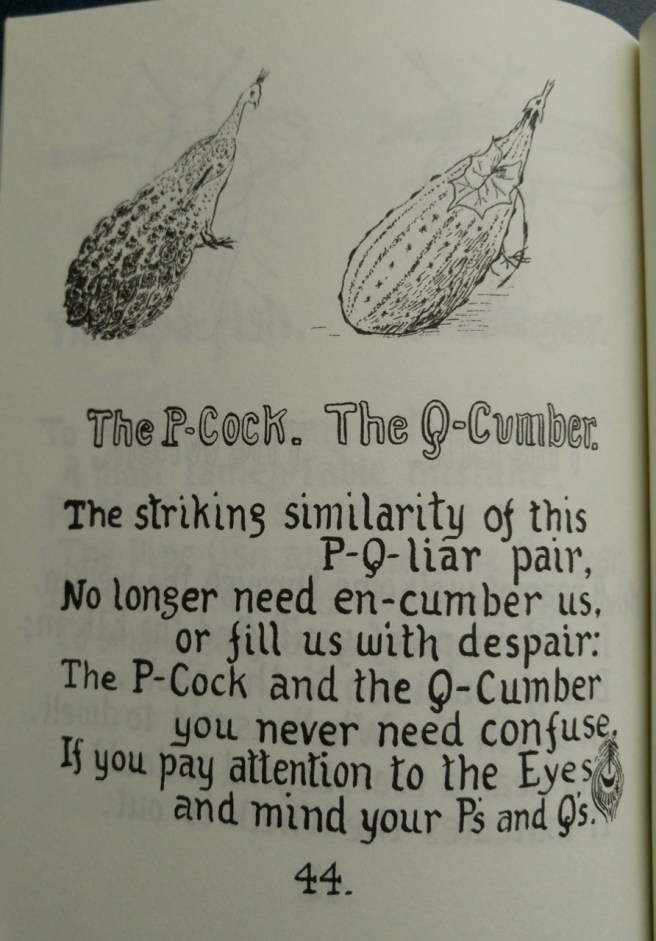
And on the back cover: “This updated edition originally published in 1917 now includes how to tell ‘The Eel from the Elephant,’ ‘The P-Cock from the Q-Cumber’ and ‘The Elk from the Whelk’ to name but a few. This book will be invaluable to those who are short sighted or just plain confused, the rest of you may even find it amusing.”

I think I fall into the latter group and that’s what A.J. had in mind (right?) when she gifted it to me because I find it quite amusing. 

Happy April Fools’ Day. 

How to tell the Birds from the Flowers and other wood-cuts (is he referring to himself?), versus and illustrations by Robert Williams Wood, 1917.

Book of March: Upstream

As friends often do, one, whom we fondly call Señora because she was our sons’ high school Spanish teacher, recommended a book to me.

And as I often do, I visited my favorite independent bookstore, Bridgton Books, took a quick look and made a purchase.

m-cover-1

Book of March: Upstream

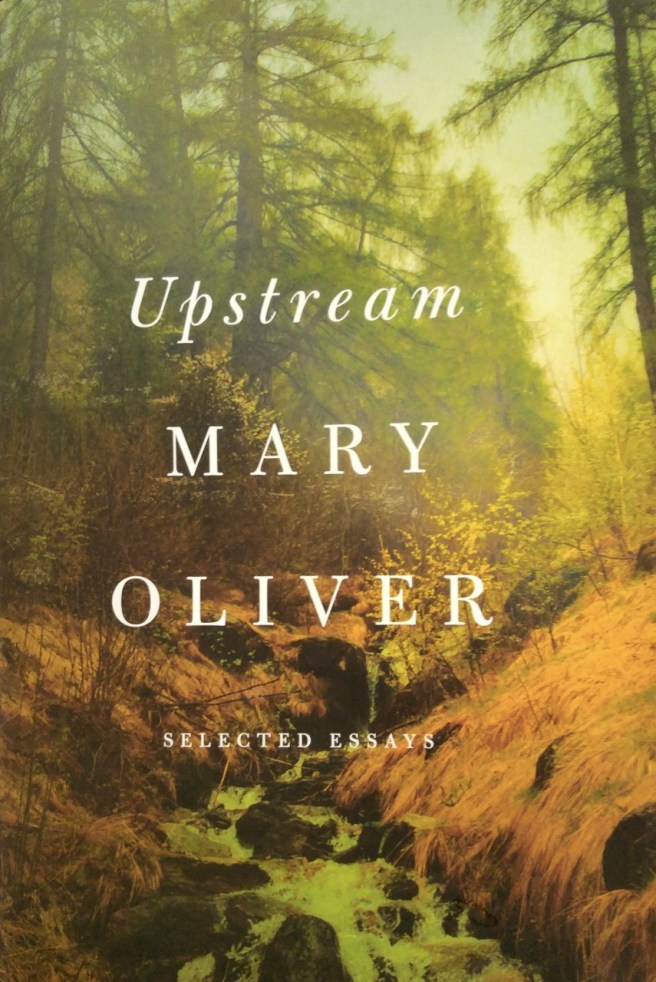
Upstream by Mary Oliver is a collection of essays, many which she previously published elsewhere. In 175 pages, the essays span a lifetime of writing–but even more so a lifetime of living. And noticing. And contemplating. And wondering. And making connections. And wondering some more. But all the time, believing, even in that which she could not see or quite comprehend.

She speaks to the writing process, a process I have embraced for what seems like forever. Only a few minutes ago I shared with a friend that a final draft is never really final. Each time we return to the words, we find other ways of playing with them.

She speaks to the natural world that she has spent a lifetime observing and recreates it on the printed page with elaborate detail. And so, with each sentence, I travel beside her, whether she wants me to or not, for Ms. Oliver embraces solo moments of exploration. I get that.

She speaks of Emerson and Whitman and Wordsworth and Poe. And actually, about the latter, she turns my head for she writes about him with such compassion.

She speaks of the reality of the universe and reminds us to exist. She is. We are.

She speaks of observing a mother spider and her egg sacs in the cellar of a rented home over the course of several months, and I sense her wonder. As a child, I was afraid of those cellar spiders. As an adult, I’m intrigued by them.

And so today, I took Ms. Oliver with me when I stepped into the woods.

m-fog

It was a snow-eating foggy  sort of day and the dampness grazed my cheeks.

m-preweb-raindrops-and-crosses

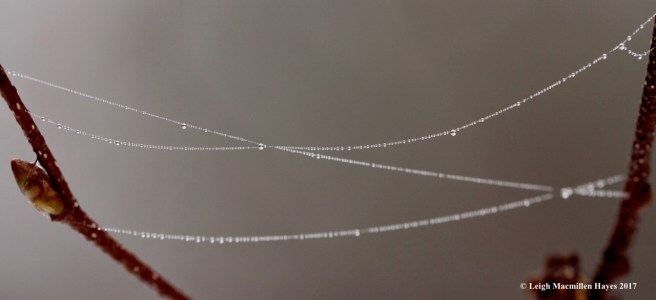
As my snowshoes slapped the hardened snow pack, rain drops drew my focus. On this particular pine sapling, I was drawn to the crosses formed by raindrops and needles, which seemed apropos given that today is Ash Wednesday. And then I noticed the spider silk.

m-web-1a

Every where I turned, long beaded strands of miniature raindrops connected one branch to the next.

m-web-connections-2

What I soon realized, however, was that the strands weren’t merely on single trees. Each tree was connected to the next throughout the forest. As I moved slowly about, I inadvertently snapped some of those lines and felt a sense of sorrow for all that work lost.

m-leaf-attachment

And because I was looking, I found other curious sites that I didn’t expect. That is one of the take-away messages of Ms. Oliver’s book–get outside and even if you are searching for something specific that you may not find, it’s what you see along the way that is more important.

m-page

As I often do when a book such as this one pulls me in, I turn back the bottoms of pages to remind myself that there are passages I will want to revisit. If the corner is turned back and back again, as this one, it means there is something to reread on this page and the one to follow.

For me, Upstream is that type of a book. It’s broken into five sections. Ah, the word broken–it doesn’t feel right in that last sentence because there is nothing broken about the book. Perhaps divided is a better word. Or maybe there’s another that will come to me eventually. That’s the thing about the writing process–it’s never final as I said above. Anyway, I found myself relating to each section with a different part of my soul.

m-rain-drop-globe

And give thanks that Ms. Oliver chose to share her reflections in this manner. I also thank Señora for the recommendation.

Upstream by Mary Oliver, Penguin Press, 2016

Won’t You Be My Neighbor?

I knew the minute I walked into the summer kitchen this morning and saw fresh tracks beside the barn that I’d head out the door as soon as possible. And then I realized that my snowshoes were in the back of my truck, which our youngest son had borrowed. Never fear. We have several more pairs.

m-cat-in-porky

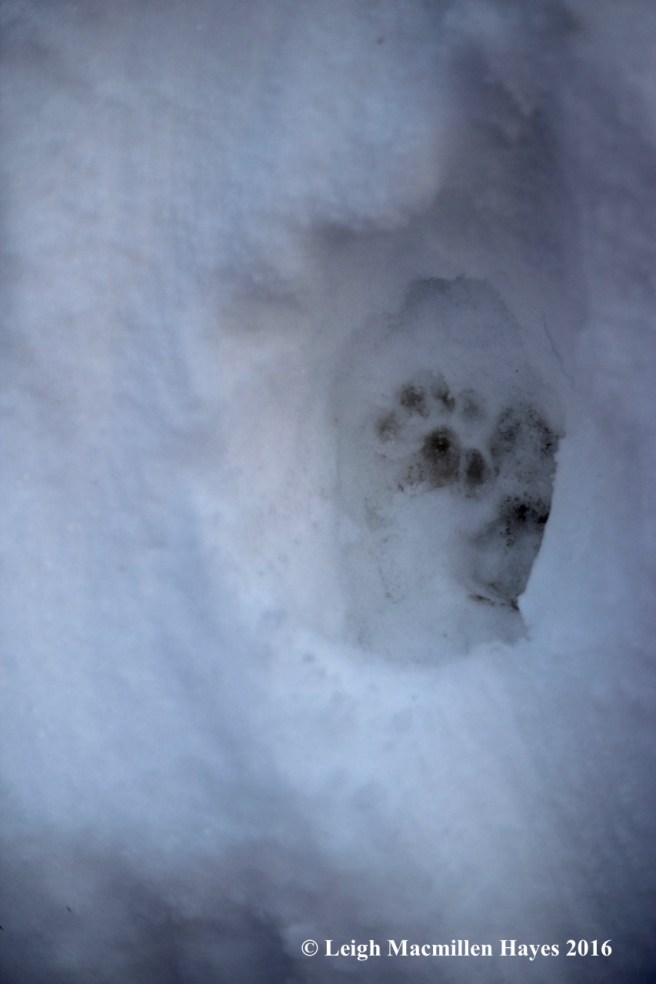
The prints that drew me outside were those of our “friendly” neighborhood porcupine. And once again, he had much to share, the first being cat prints inside his–thanks to one of several that frequently pass under the barn.

m-porky-sashay

If you’ve never examined a porcupine trough before, I encourage you to do so. As it sashayed along, it left behind hair and quill impressions. Can you see them?

m-opossum-print-2

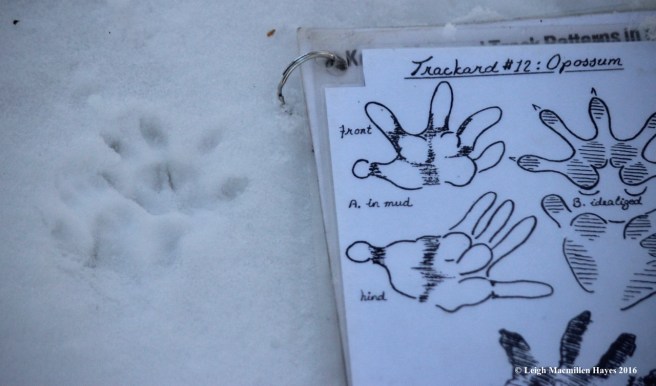
I followed Porky along his regular route and over the stonewall only to discover prints I’ve never met before. My first impression was raccoon, but the shape of the prints and the trail didn’t match up in my brain. More and more people have mentioned opossum sightings in the past few years, but I’ve only seen one or two–flattened on the road. Today, in our very woods, opossum prints.

m-opossum-walk

Our own marsupial. The front print obscured the hind, which features an opposable thumb. Their pattern, I learned from checking David Brown’s Companion Guide to the Trackards, is left hind-left front, right hind-right front, left hind-left front, etc.

m-opposom-trail

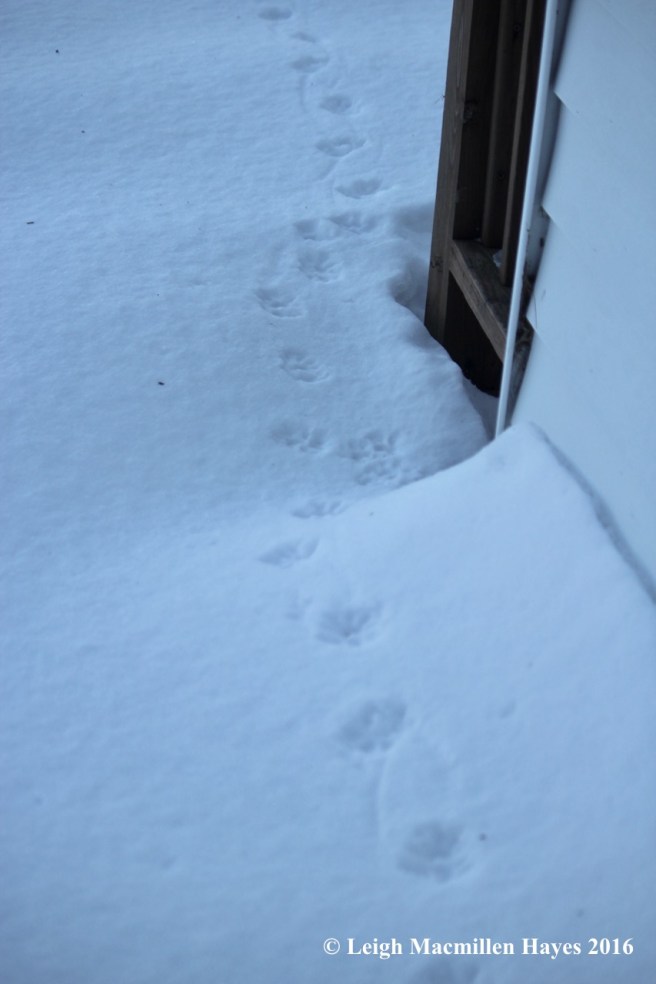
As it walked along, from tree to tree, past the studio and into the neighbor’s woodlot, I could practically see the animal moving, its long tail dragging in the snow. My heart sang with the journey. But how do they survive here, I wondered?

Eventually, I realized I was headed into a neighbor’s backyard several doors down and so I turned and continued in the other direction, but thankful that Porky had once again shared something new with me.

m-porky-trail

I traveled down the cowpath and into my smiling place, where what to my wondering eyes should appear, but a miniature sleigh and . . . oops, I mean another Porky trail. And so I followed it, back and forth over a stone wall and under fallen trees I needed to pass over.

m-porky-tree

It led me around an uprooted tree and there . . .

m-porky-in-den

the trail ended. You may notice ice crystals below the moss in the larger opening. And if you look closely below the moss, you might just see a few light colored streaks–those would be quills. I found Porky. He started to move and though I knew I could easily outrun him, unless I tripped and fell like I often do when snowshoeing, I decided to leave him be. But once again, my heart was singing.

m-moose-tracks

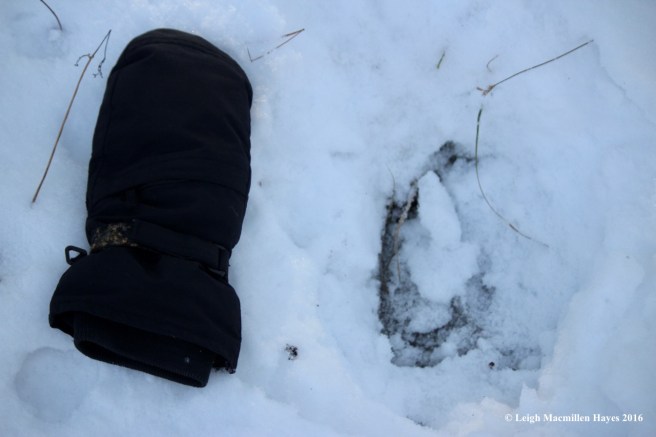
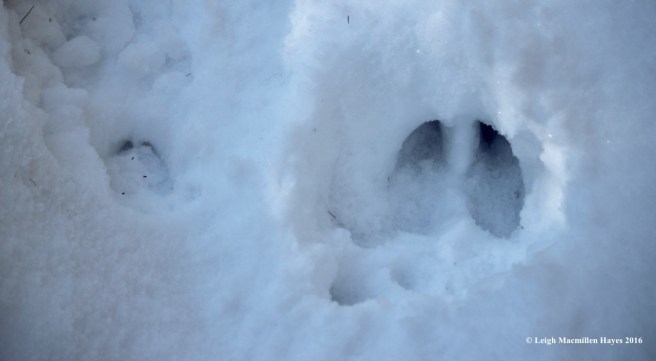
And then . . . some really large and deep prints crossed the trail I frequent.

m-moose1

They were almost the size of my mitt.

m-moose-slide

And every where I turned for the rest of the morning, it seemed moose had also turned. I soon realized there were at least three and they slipped in the snow much as I often do.

m-deer-and-moose-prints

In tracks I’d previously made, both a deer and moose had passed, providing a sense of size.

m-moose-mud

I followed one, who had paused to play–it’s hard to resist an inviting mud puddle. Had I not been wearing snowshoes . . .

m-moose-landing

I think we were both discouraged to realize a snowmobile had found its way to the log landing, though I for one, wasn’t surprised. The moose made a U-turn and headed back into the woods. A short time later, I followed suit.

m-deer-hair

It was there that I discovered hair stuck to a deer bed where its body had warmed the snow, which thus turned to ice.

m-spider-1

And another snow spider, this one not as green as the ones I’ve seen previously. I’m in awe that the tiny body, which appeared translucent, contains glycerol as an antifreeze compound. I did see numerous springtails bouncing about, so trust it had plenty of food upon which to prey. Again, my heart sang.

m-moose-bed

As I mentioned earlier, I continued to see moose tracks (not the ice cream, though it is one of my favorite Gifford flavors). And then a bed, about the size of three deer beds. And a lovely pile of scat right in it. Life is good.

m-snowshoe-lobsters

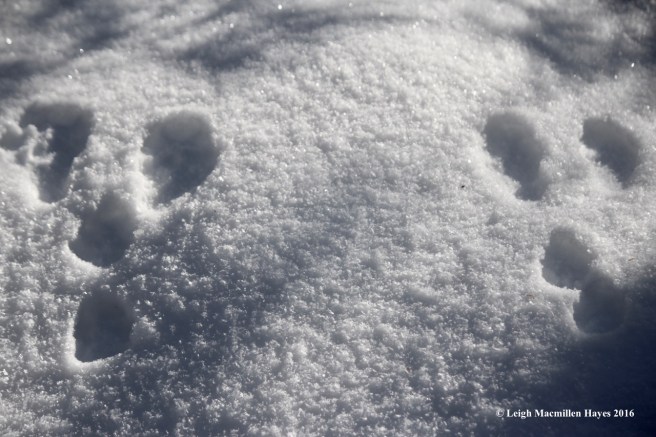
Closer to home, I realized I was in snowshoe hare territory when I recognized the lobster-like shape of their prints.

m-weasel-1

They’d better watch out, and all voles and other little brown things should also be on the alert, for weasel prints also decorated the snow.

m-print

At last I was back home, and had to take a peek at those opossum prints one more time. Thanks again to the porcupine(s) that wander these woods, I celebrated wonder as I moved about. Except for Porky, one gray squirrel and a sharp-shinned hawk, I saw no others with whom I share these woods, but I was grateful to be their neighbor. To know that they roam as I do. In the words of Mr. Rogers, “It’s a neighborly day in this beauty wood.” I’ll let him do the singing, from the song that rests within my heart today:

It’s a beautiful day in this neighborhood,
A beautiful day for a neighbor.
Would you be mine?
Could you be mine?…

It’s a neighborly day in this beauty wood,
A neighborly day for a beauty.
Would you be mine?
Could you be mine?…

I have always wanted to have a neighbor just like you.
I’ve always wanted to live in a neighborhood with you.

So, let’s make the most of this beautiful day.
Since we’re together we might as well say:
Would you be mine?
Could you be mine?
Won’t you be my neighbor?
Won’t you please,
Won’t you please?
Please won’t you be my neighbor?

Perley Pond Preserve Presents

I love to learn and today’s presence offered such as I explored Loon Echo Land Trust’s Perley Pond/Northwest River Preserve in Sebago. I’ll be leading a hike there this Saturday, so if you are so inclined, I hope you’ll come along. But if you can’t, then please read on. (Note: Jon Evans, Stewardship Manager for LELT will be with me on Saturday, and he’ll have so much more to offer about the lay of the land, which was acquired by the trust in 2014. Today marked my first visit to this property.)

p-land-trust-sign-1

There are three entry points along Folly Road and I began my reconnaissance mission at the first, where I didn’t get far due to a stream not quite frozen, but still found plenty to examine.

p-evening-primrose

Evening Primrose stood at alert in the field just off the road. Tall in stature, its distinctive seed pods peeled back in four parts and small seeds looked like fresh ground pepper on the snow.

p-black-eyed-susan

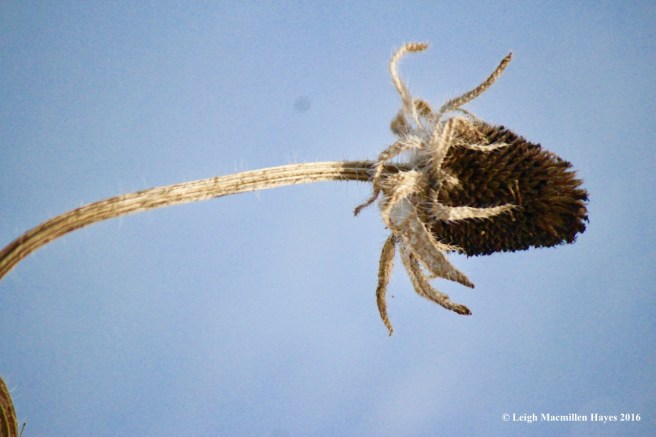
Black-eyed Susans also decorated this space, some leaning over to share their offerings. The hairy bracts and gumdrop shape made these easy to spot.

p-beaked-hazelnut-1

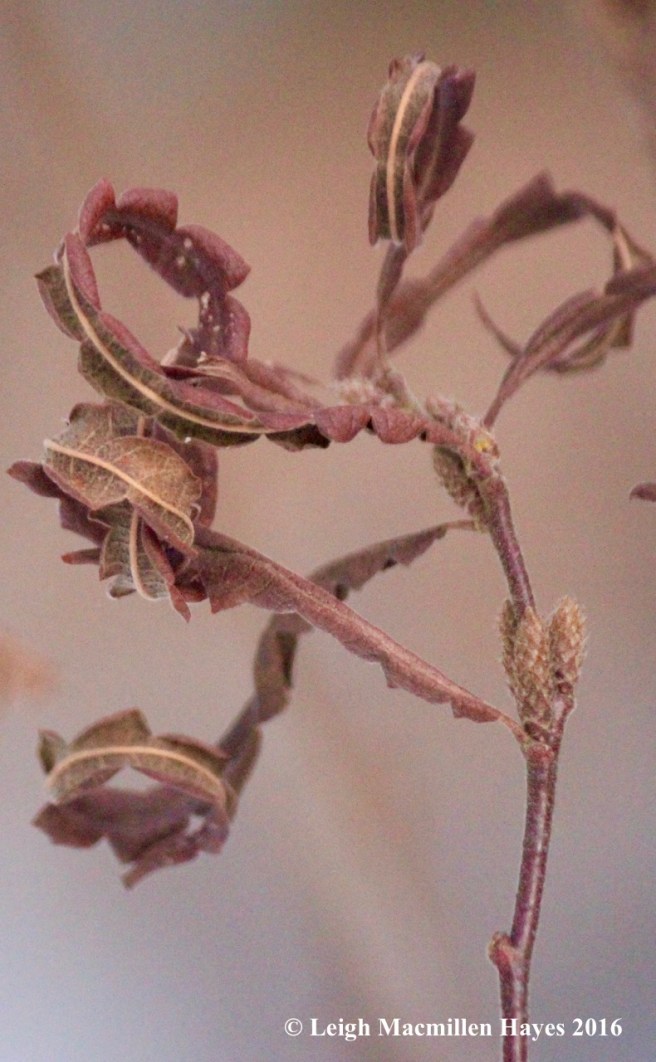
One of my favorite finds in the first section of the property–the hairy twig, catkin, leaf and bud of a Beaked Hazelnut. Just last week I saw the same, well, minus the catkins, in Lovell. And knowing that certain leaves are marcescent, e.g. remain attached to the stem throughout some or most of the winter like oak, witch hazel and especially beech, I was thrown off by this other type. It had me thinking birch and well it should have because Beaked Hazelnut is a member of the birch family. But #1, though a hairy twig like Yellow and Paper Birch, the leaf base wasn’t right for either, and #2, I didn’t recall ever seeing these leaves still dangling in later fall/early winter. The trees taught me a lesson today–the most perfect of gifts–a few Beaked Hazelnut leaves continued to dangle, though most were turning quite dark in hue and I suspected will fall soon, and, I found Gray Birch leaves also clinging. Just when I thought I knew everything, nature proved there’s more to learn. So the gift was a reminder to pay more attention.

p-log-landing

I left that section and walked down the road to a spot where a chain prevents vehicles from entering the old log landing. It certainly didn’t stop the deer who had danced in the night.

p-sweet-fern

As I moved through the landing, I paused to admire another dancer as witnessed in the fluid movement of Sweet-fern.

p-sweet-fern-catkins-2

Like the Beaked Hazelnut, its catkins were wrapped gifts that spoke to the future.

p-willow-gall

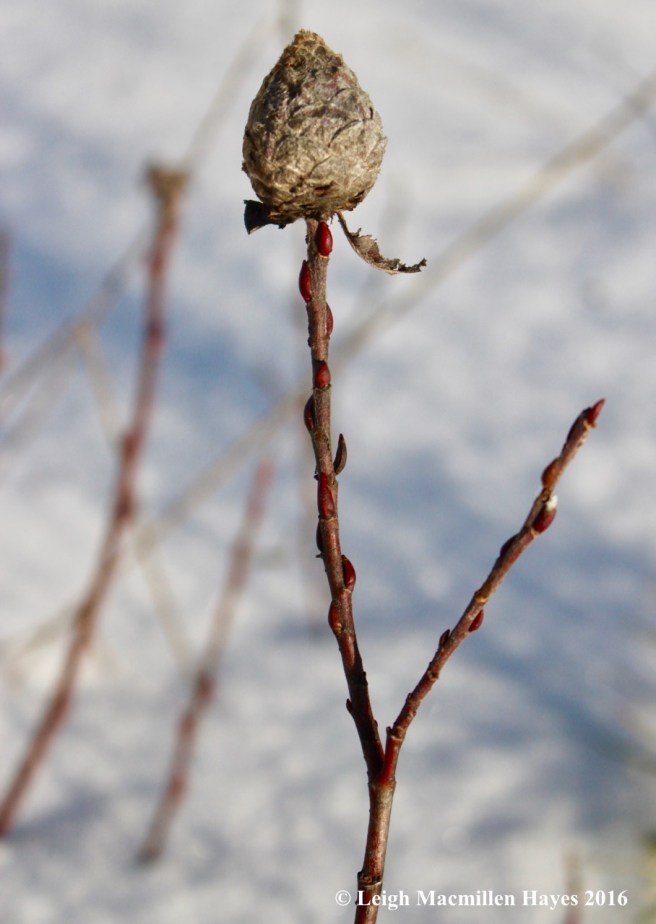
Also in this space, a few willows with their own little packages.

p-willow-gall-1

The willow pine cone gall was created in the summer by a gall gnat midge. The larva stage secreted a substance on the stem that caused the willow to go into overdrive–resulting in a multi-layered chamber composed of hardened material that would have been leaves, but alas, the stem growth was arrested. Inside that hairy structure resides the wintering larva, nice and snug for the winter. It will metamorphose into a gnat when warm weather arrives.

p-fir-christmas-tree

As I walked along I noticed Christmas tree patterns among the firs.

p-fir Christmas Tree1.jpg

It was a simple case of an upside-down look. Once flipped, in my brain anyway, the seasonal symbol was obvious.

p-ornaments-big-tooth-on-fir

And the ornaments dangled–in the form of Big-toothed Aspen leaves and White Pine needles,

p-ornament-lichen1

Northern Camouflage Lichen,

p-ornament-pileated

and shredded bark created by . . .

p-ornament-pileated-works

a Pileated Woodpecker in search of food.

p-ruffed-grouse

I felt my good fortune to find a spot where a ruffed grouse had tunneled.

p-big-tooth-burl

And then I was stopped by a burl. Like a gall, this was created by insects.

p-big-tooth-bark-1

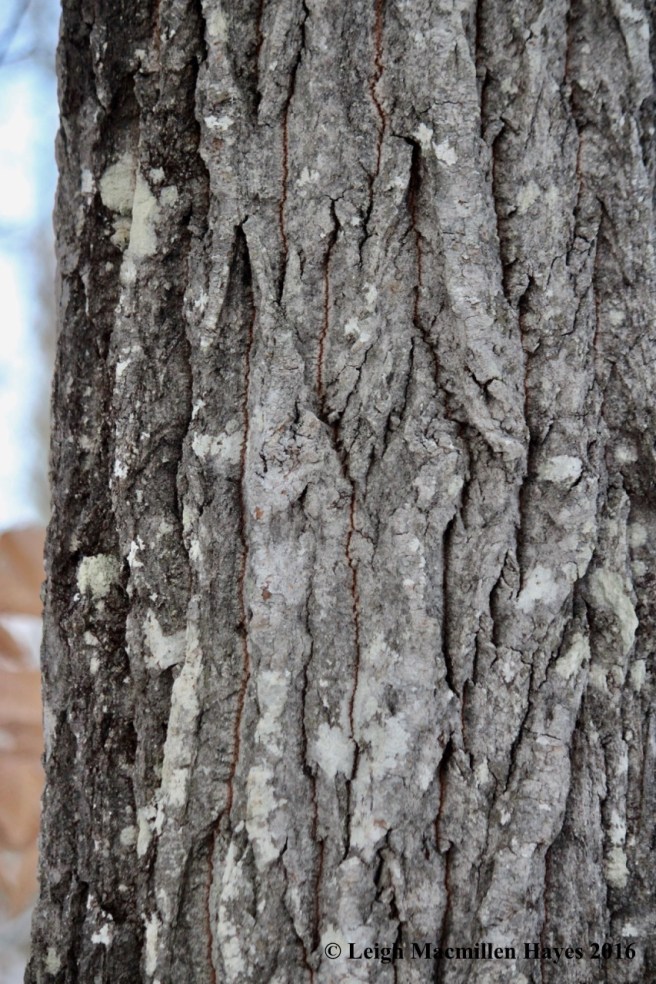
The tree of choice featured lower gnarly bark that resembled a Northern Red Oak.

p-big-tooth1

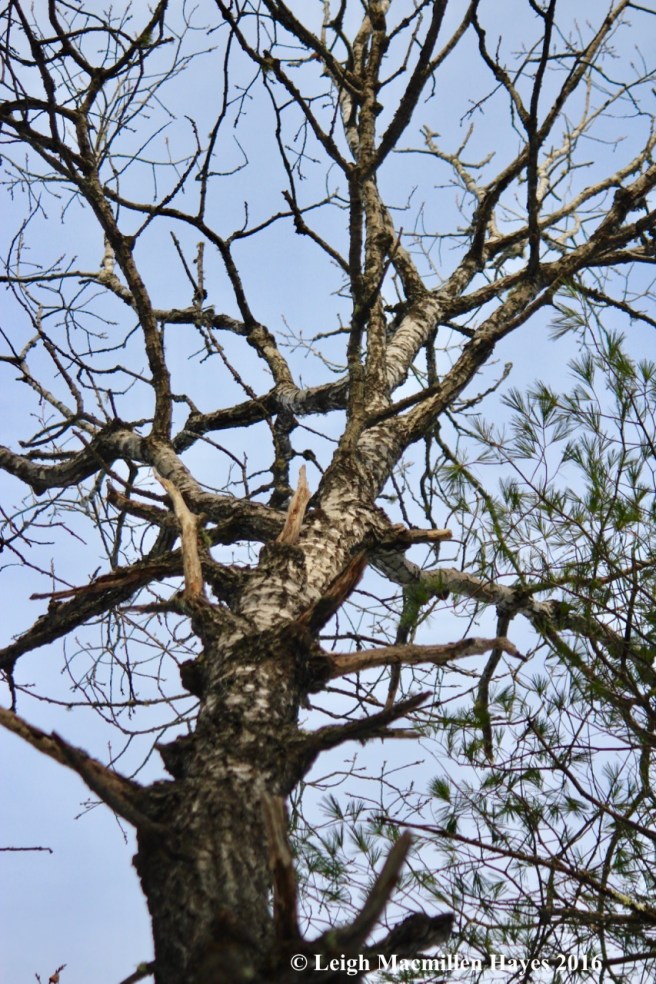
But a peek toward its crown revealed a birch–the two-fer one gift: Big-toothed Aspen.

p-big-tooth-leaves

Its leaves, oh my, another  temporarily “marcescent” variety–showing off the big teeth for which it received its common name.

p-white-oak-leaves

Speaking of leaves, there were numerous renditions of White Oak–another dancer that seemed to freeze in motion.

p-red-pine-heart

Here and there among the offerings, Red Pine. This particular one showed my love for it where a branch had broken off. Do you see the wee heart?

p-red-pine-geometry

While mature Red Pines feature bark that reminds me of a jigsaw puzzle, I found some younger trees, their structure speaking to geometry.

p-piscataqua-sign

Continuing on along the logging road, I wondered if perhaps I’d gone astray. Suddenly, I found myself in Piscataqua County–miles and miles from home. I knew I was in unknown territory, but was I really that far from home? More than my usual fake lost?  Or someone’s sense of humor?

p-owl-1

Maybe so. Certainly I was in the land of owl feet.

p-coyote

And a tuckered coyote?

p-bushwhack

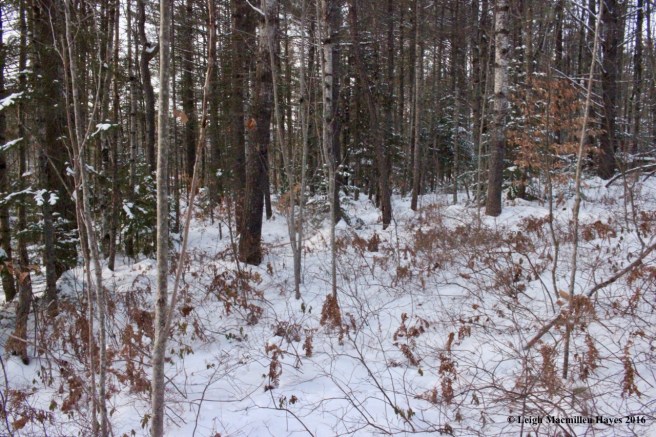
It was at this point that I headed off trail, made easy by underbrush.

p-deer-tracks

Deer tracks led me to another wonder-filled gift.

p-northwest-1

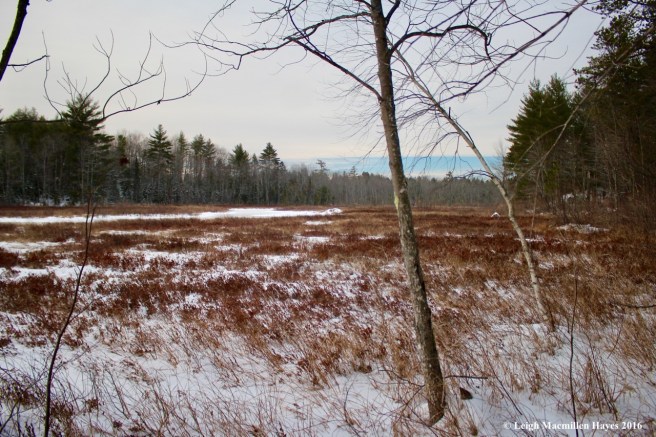
The wetland and Northwest River, one of the namesakes for this place.

p-pitch-pine-bark1

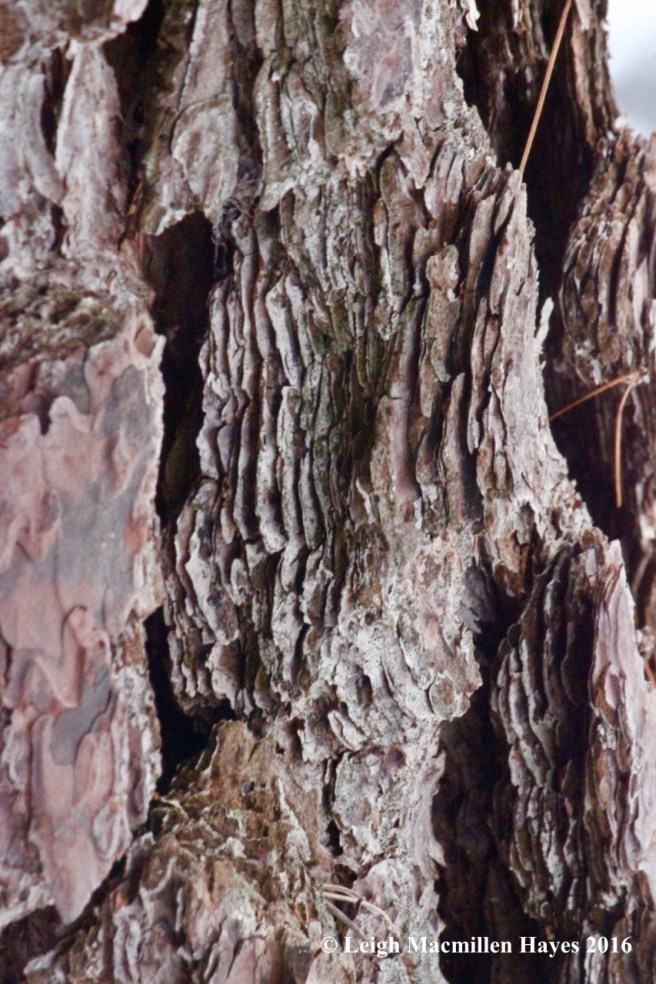
It was here that another lesson presented itself–the layered bark made me realize I was viewing Pitch Pine growing beside the bog. My understanding was that these grew on ledges or rocky outcrops. But here was one with wet feet. And so I later consulted Bogs and Fens by Ronald B. Davis (I highly encourage you to add this title to your Christmas wish list) and discovered that not only does it grow in dry woodlands, but also “in swamps and at the edges of fens and bogs.” (Additional note: Pitch Pine Bogs are listed as S2:  “Imperiled in Maine because of rarity (6-20 occurrences or few remaining individuals or acres) or because of other factors making it vulnerable to further decline”; thus another reason to give thanks to LELT for preserving this place)

p-pitch-pine-1

p-pitch-pine-needles

Pitch Pine needles present themselves in bundles of three–perfect for this time of year–ahhhh, the Trinity.

p-rhodora-1

Rhodora

p-leatherleaf-1

and Leatherleaf added to the winter ornamentation.

p-ice-break-through

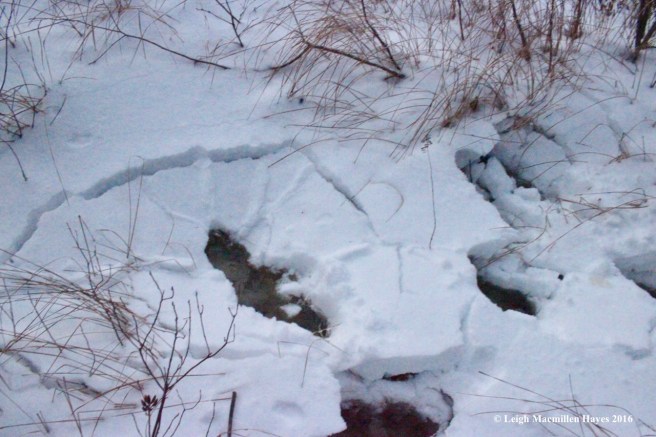
In my attempts for “the perfect photo,” I broke through the ice several times. I’d been post-holing through about seven or eight inches of snow all afternoon sans snowshoes because it was quite easy to move about in the fluffy stuff, but when I reached the edge of the water, the snow had insulated the thin ice cover and . . .  crash, crackle, crunch, I sunk in to the top of my Boggs and even a wee bit over.

p-trail-back

On my way back down the logging road, I realized how my own tracks were much more varied than that of the deer who’d passed before me.

p-land-trust-boundary

And then I came to a boundary sign. Opps. Guess I went beyond the land trust’s property, though thankfully no signs deterred me from trespassing.

p-perley-pond-1

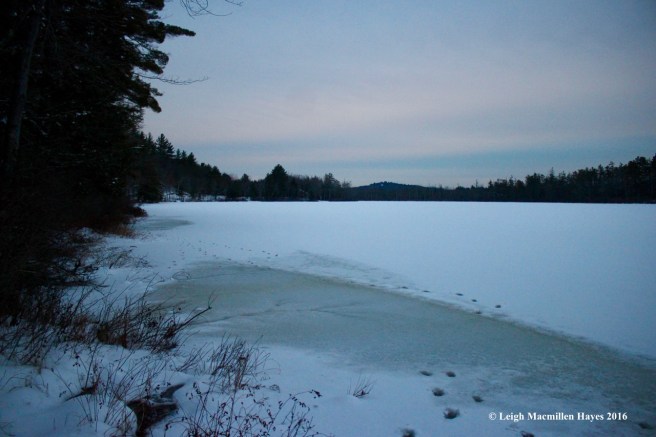
And a wee bit further down Folly Road, I stopped at Perley Pond, part of the namesake for this property–and part of the reason for my presence for the presents presented.

Books of December: A Holiday Wish List

In the spirit of changing things up a bit, I decided that I’d include five books I highly recommend you add to your holiday wish list and two that I hope to receive.

These are not in any particular order, but I’m just beginning to realize there is a theme–beyond that of being “nature” books.

b-forest-forensics-1

Book of December: Forest Forensics

Tom Wessels, forest guru and author of Reading the Forested Landscape, published this smaller work in 2010. Though only 5″ x 7.5″, the book is rather heavy because it’s filled with photographs. Despite the weight, Forest Forensics fits into a backpack and is the perfect guide for trying to figure out the lay of the land. Using the format of a dichotomous key, Wessels asks readers to answer two-part questions, which link to the photos as well as an Evidence section for Agriculture, Old Growth and Wind, plus Logging and Fire. In the back of the book, he includes Quick Reference Charts that list features of particular forest and field types. And finally, a glossary defines terms ranging from “age discontinuity” to “Uphill basal scar,” “weevil-deformed white pines” and “wind-tipped trees.” In total, it’s 160 pages long, but not necessarily a book you read from cover to cover. If you have any interest in rocks, trees, and the lay of the land, then this is a must have.

Forest Forensics by Tom Wessels, The Countryman Press, Woodstock, VT, 2010.

b-shrubs-1

Book of December: Shrubs of the Northern New England Forest

Michael L. Cline is executive director of Tin Mountain Conservation Center in Albany, New Hampshire. In September, I had the pleasure of attending a talk he gave at the center about Shrubs of the Northern New England Forest. The 6″ x 9″ book weighs about the same as Wessels’, and will also fit handily into your pack. Of course, you might want to leave the books in your vehicle or at home and look up the items later–thus lightening your load. Using Brownfield Bog as one of his main go-to places, Cline describes 70 species of shrubs from Creeping Snowberry to Mountain Ash. The book is arranged by family, beginning with Mountain Maple and Striped Maple of the Aceraceae (Maple) family and ending with the American Yew of the Taxaceae (Yew) family. Each two-page layout includes photographs (and  occasionally drawings), plus a description of habit, leaves, flowers, twig/buds, habitat, range, wildlife use, notes and other names. I have no excuse now to not know what I’m looking at as I walk along–especially near a wetland. That being said, I’ll think of one–like I left the book at home, but I’ll get back to you.

Shrubs of the Northern New England Forest by Michael L. Cline, J.S. McCarthy Printers, 2016

b-bogs-and-fens-1

Book of December: Bogs and Fens

Ronald B. Davis’ book, Bogs and Fens, was a recent gift from my guy. I hadn’t asked for it, and actually didn’t know about it, so I’m tickled that he found it. I’m just getting to know Dr. Davis’s work, but trust that this 5.5″ x 8.5″ guide about peatland plants will also inform my walks. Again, it’s heavy. The first 26 pages include a description of vegetation and peatlands and even the difference between a fen and a bog. More than 200 hundred pages are devoted to the trees, plants and ferns. In color-coded format, Davis begins with the canopy level of trees and works down to tall shrubs, short and dwarf shrubs, prostrate shrubs, herbaceous plants and finally, ferns. He also includes an annotated list of books for further reference, as well as a variety of peatlands to visit from Wisconsin to Prince Edward Island. As a retired University of Maine professor, Davis has been a docent and guide at the Orono Bog Boardwalk for many years. Field trip anyone?

Bogs and Fens: A Guide to the Peatland Plants of Northeastern United States and Adjacent Canada by Ronald B. Davis, University of New England Press, 2016.

b-lab-girl-1

Book of December: Lab Girl

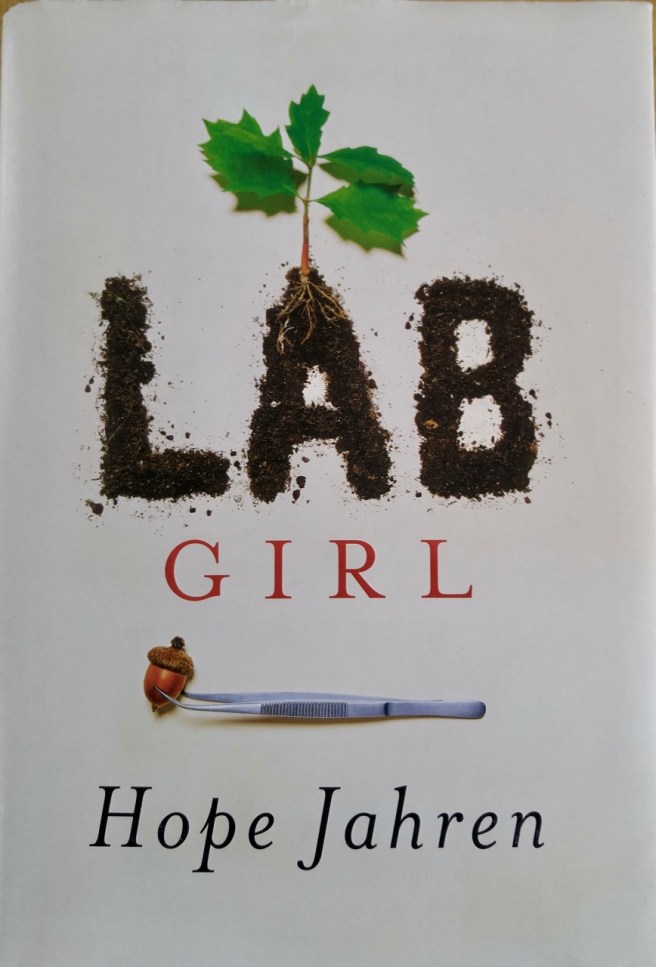
I’d never heard of Hope Jahren until this summer and then several people recommended her book, Lab Girl, to me. Rather than a guide, this is the story of Jahren’s journey from her childhood in rural Minnesota to the science labs she has built along the way. As a scientist, Jahren takes the reader through the ups and downs of the research world. And she does so with a voice that makes me feel like we’re old friends. Simultaneously, she interweaves short chapters filled with  information about the secret life of plants, giving us a closer look at their world. I had to buy a copy because for me, those chapters were meant to be underlined and commented upon. I do believe this will be a book I’ll read over and over again–especially those in-between chapters.

Lab Girl by Hope Jahren, Alfred A. Knopf, 2016.

b-hidden-life-of-trees-1

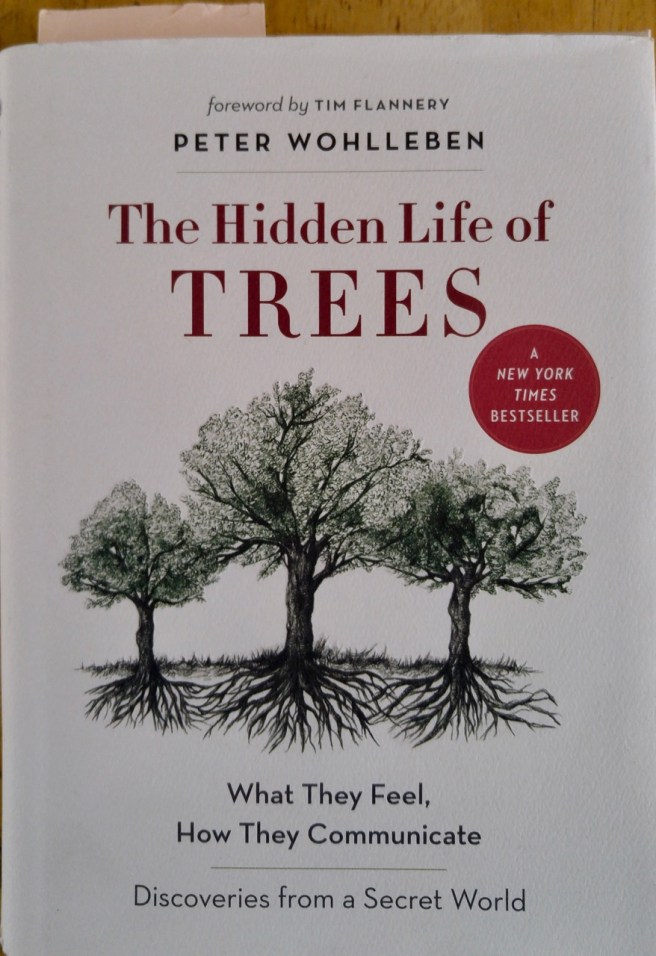
Book of December: The Hidden Life of TREES

And finally, a gift to myself: The Hidden Life of TREES by Peter Wohlleben. I’d first learned about this book in a newspaper article published last year and had to wait until recently to purchase it after the book was translated from German to English. Again, it’s not a field guide, but offers a delightful read that makes me think. And thus, you can see my bookmark. I’ve not finished reading it yet, but I’m having fun thinking about some different theories Wohlleben puts forth. As a forester, Wohlleben has spent his career among trees and knows them well. He’s had the opportunity to witness firsthand the ideas he proclaims about how trees communicate. And so, I realize as I read it that I, too,  need to listen and observe more closely to what is going on in the tree world–one of my favorite places to be. Maybe he’s right on all accounts–the best part is that he has me questioning.

The Hidden Life of TREES: What They Feel, How They Communicate by Peter Wohlleben, Random House, 2016.

And that’s just it–the underlying theme of these five books you might consider is TREES. I can’t seem to learn enough about them. One word of caution, each author has their own take on things, so the best thing to do is to read the book, but then to head out as often as you can and try to come to your own conclusions or at least increase your own sense of wonder.

And now for the books on my list (My guy is the keeper of the list):

Naturally Curious Day by Day: A Photographic Field Guide and Daily Visit to the Forests, Fields, and Wetlands of Eastern North America by Mary Holland, Stackpole Books, 2016

Mosses, Liverworts, and Hornworts: A Field Guide to Common Bryophytes of the Northeast by Ralph Pope, Cornell University Press, 2016.

Do you have any other suggestions for me?

One final thought about books–support your local independent book store as much as you can. Here in western Maine, we are fortunate to have Bridgton Books. Justin and Pam Ward know what we like to read and if they don’t have a particular book we’re looking for, they bend over backwards to get it for us.