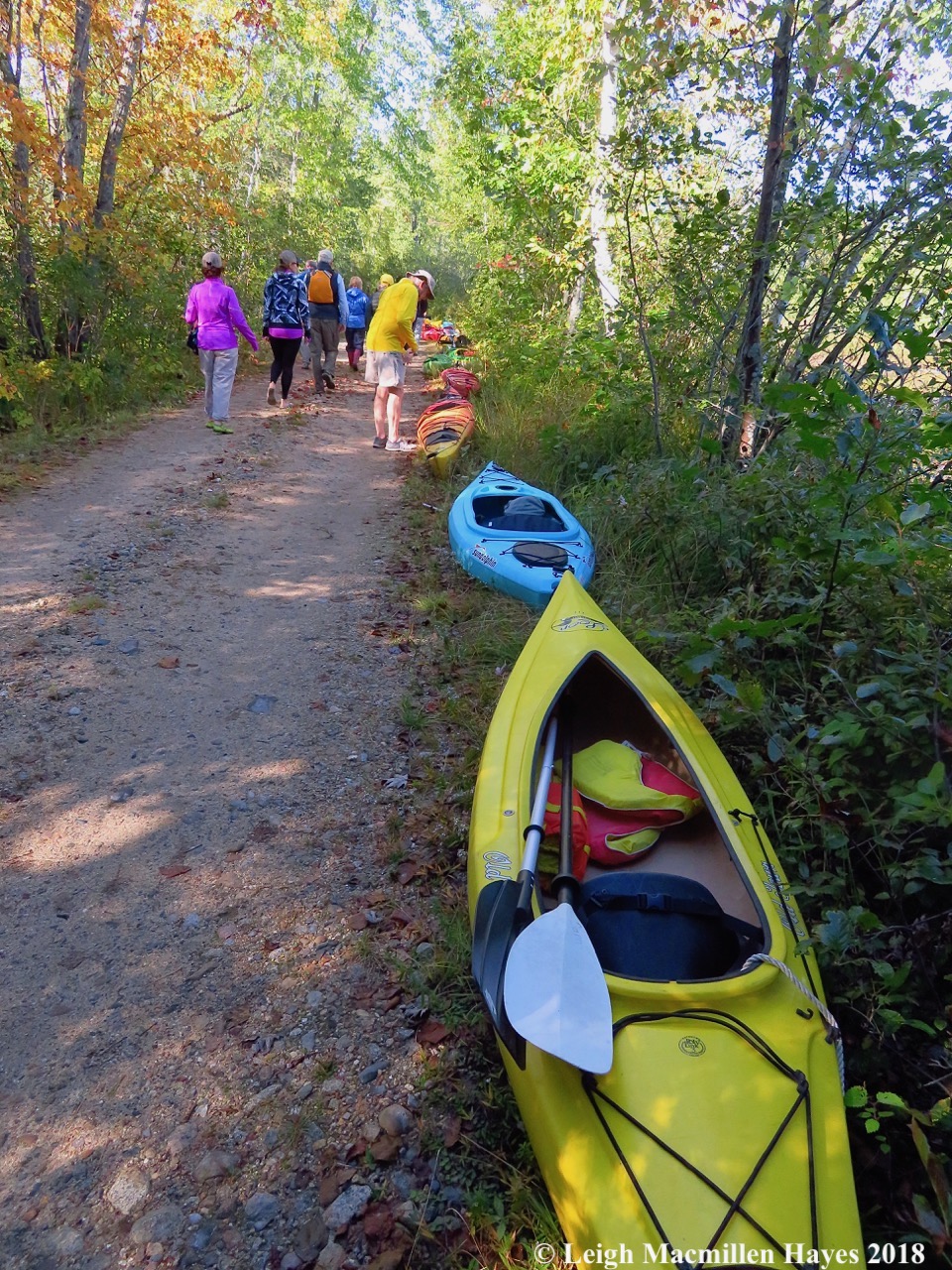
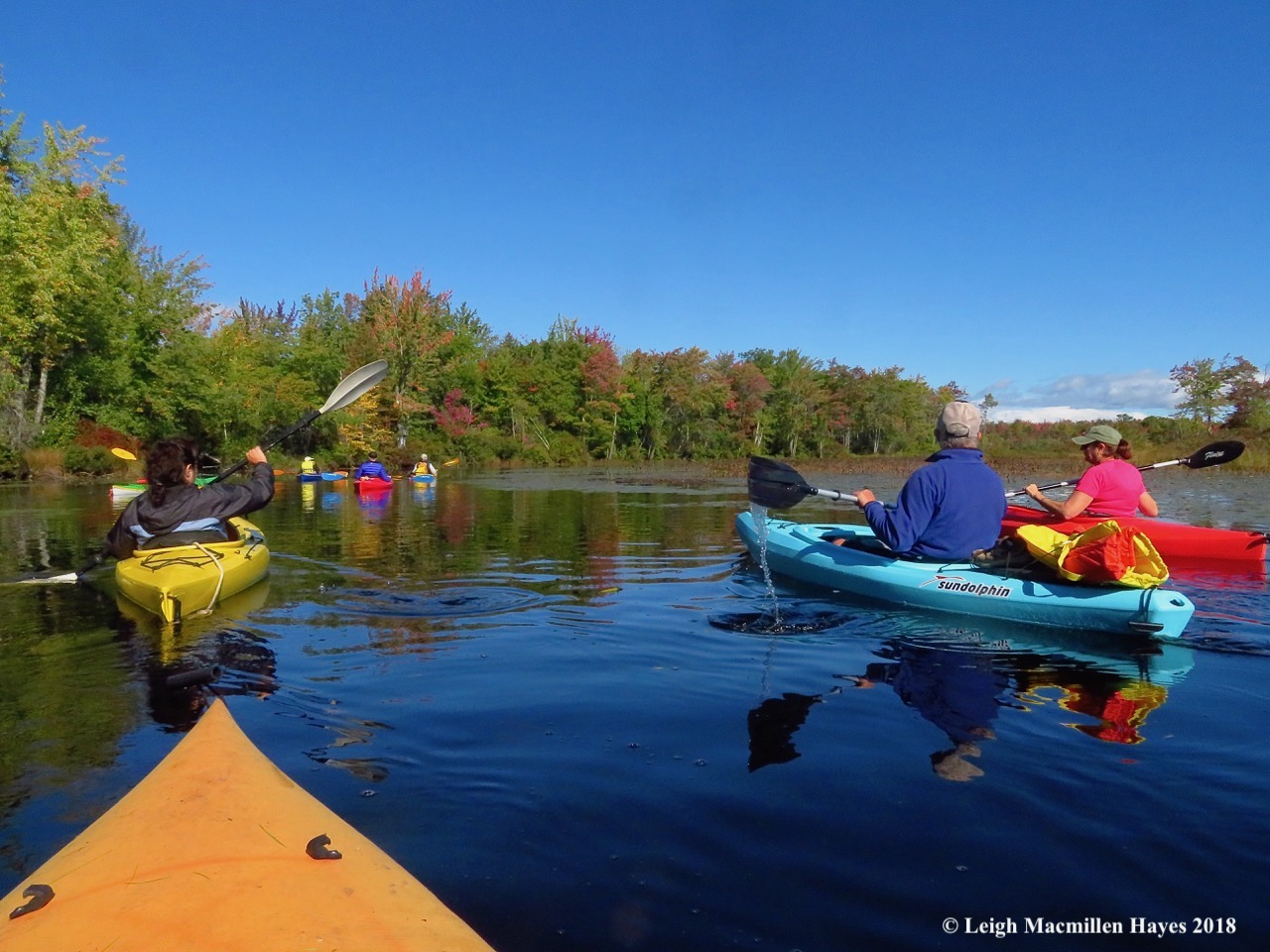
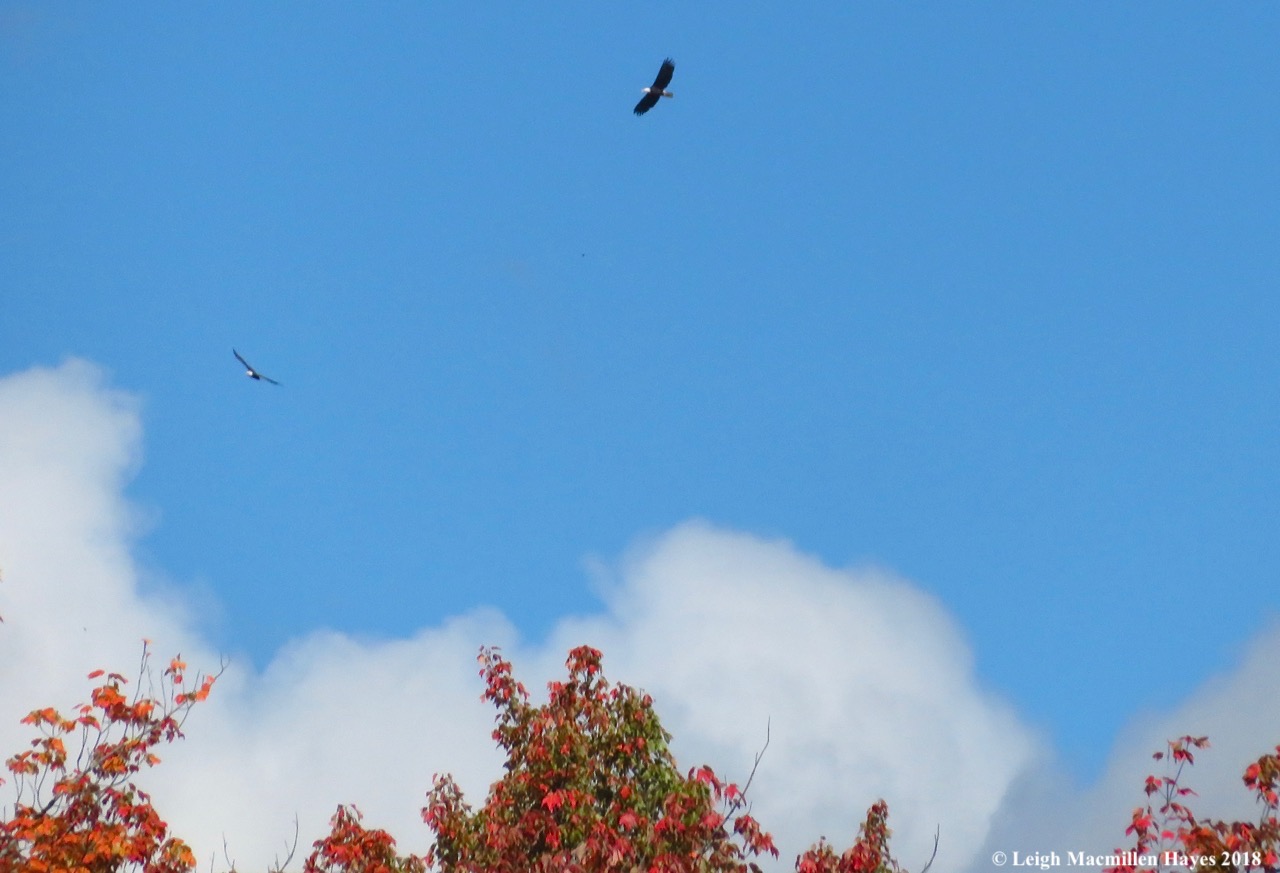
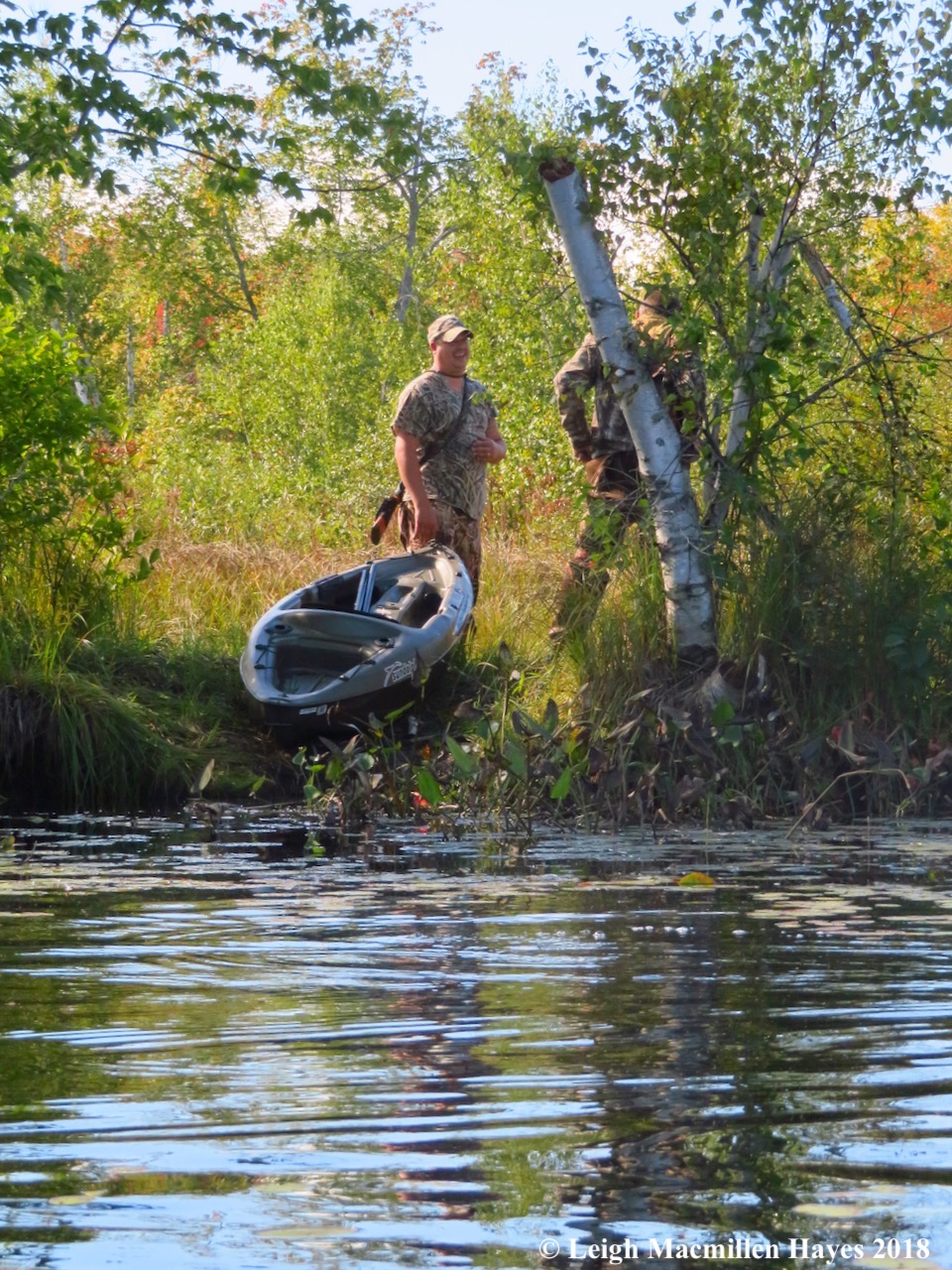
When You Go

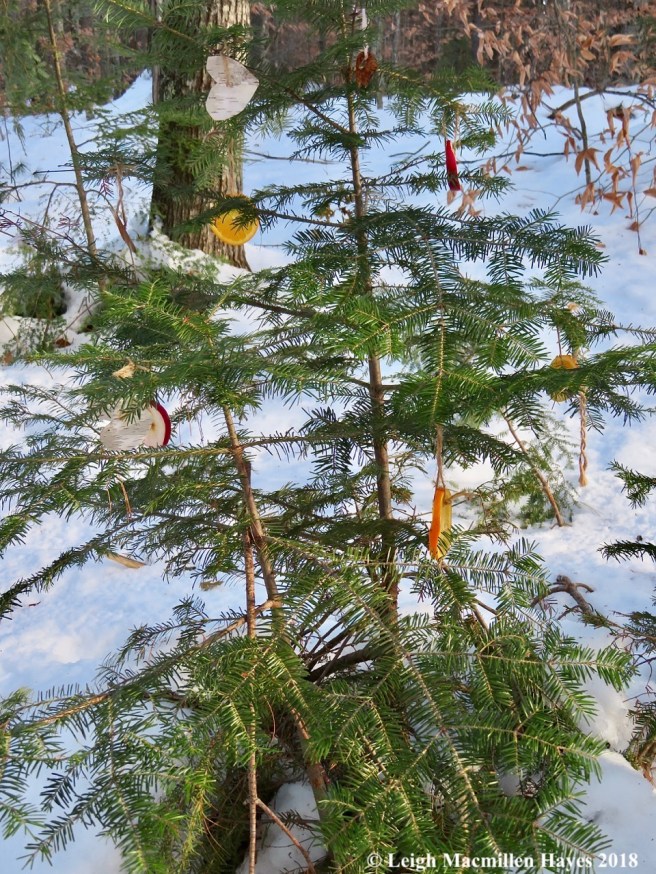
My goal was simple. Walk the blue trail at the Greater Lovell Land Trust’s Chip Stockford Reserve and add a few more decorations to the Christmas Tree. 

If you recall, two weeks ago the Fairs, Farms, and Fun Homeschool 4-H Group decorated a tree(s) as part of the Maine Christmas Tree Scavenger Hunt.

Their biodegradable ornaments were mighty tasty, smeared in peanut butter and bird seed much to the good licking of birds, squirrels, and deer. 

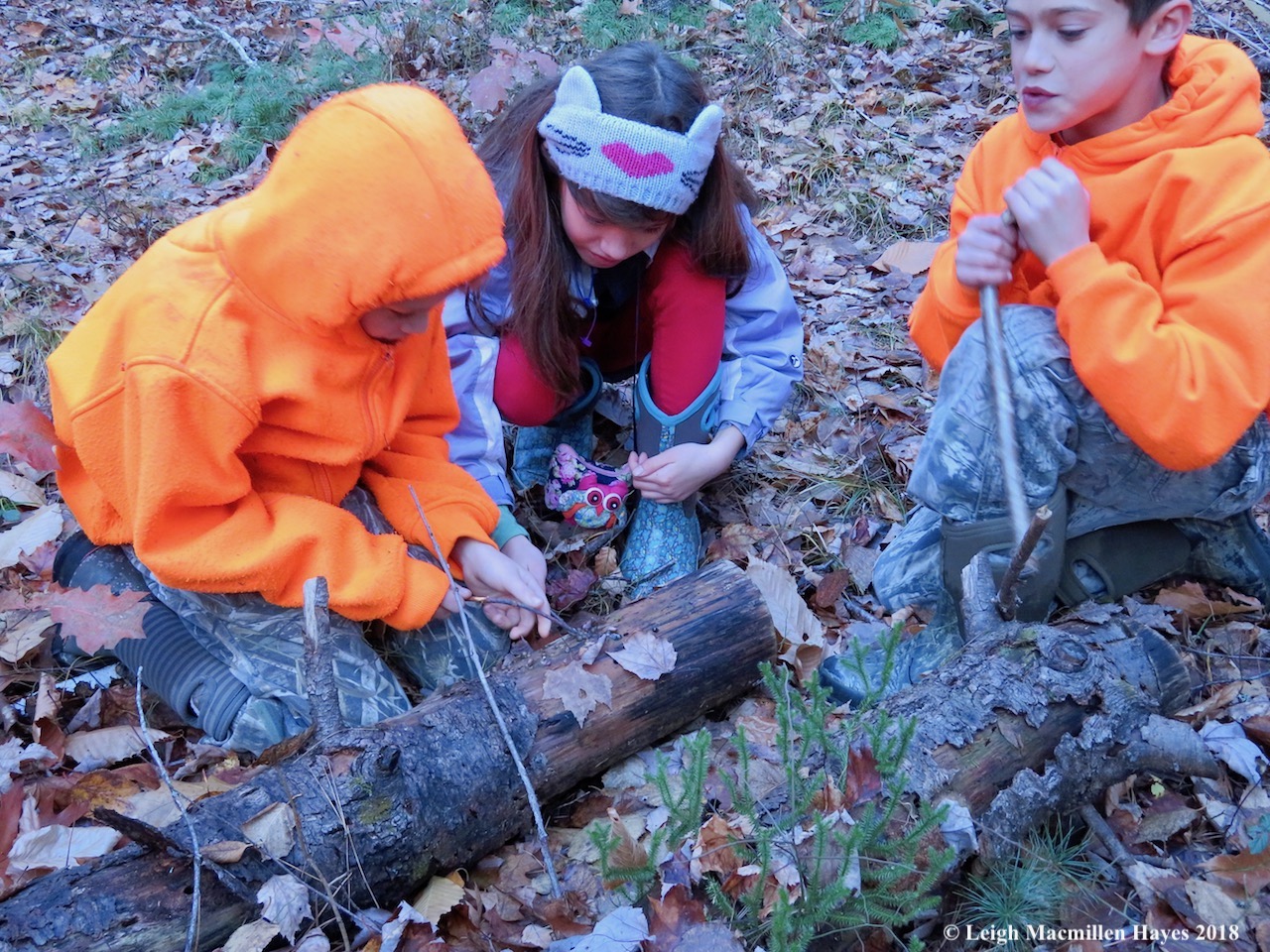
Since the first decorating party, we led a fun walk where participants adopted a scavenger hunt attitude and examined all evergreens along the way until they spotted the special tree(s). And then, because we’d packed more peanut butter and bird seed, and some of the youth had gathered pinecones on the way, we spent time creating new ornaments. That was on Saturday. By Monday, those had also disappeared. 

 As has been the case in the past, only the hearts cut from fallen birch bark remained. 

Taking a tip from our neighbors at Western Foothills Land Trust, which is also participating in the Maine Christmas Tree Hunt, I added orange and apple slices to the tree(s) and a few higher branches. 

I hope you’ll challenge yourself and your family and friends to go on the hunt.

I also hope that some of the ornaments will still be there. But if not, know that the mammals and birds are dining in style. 

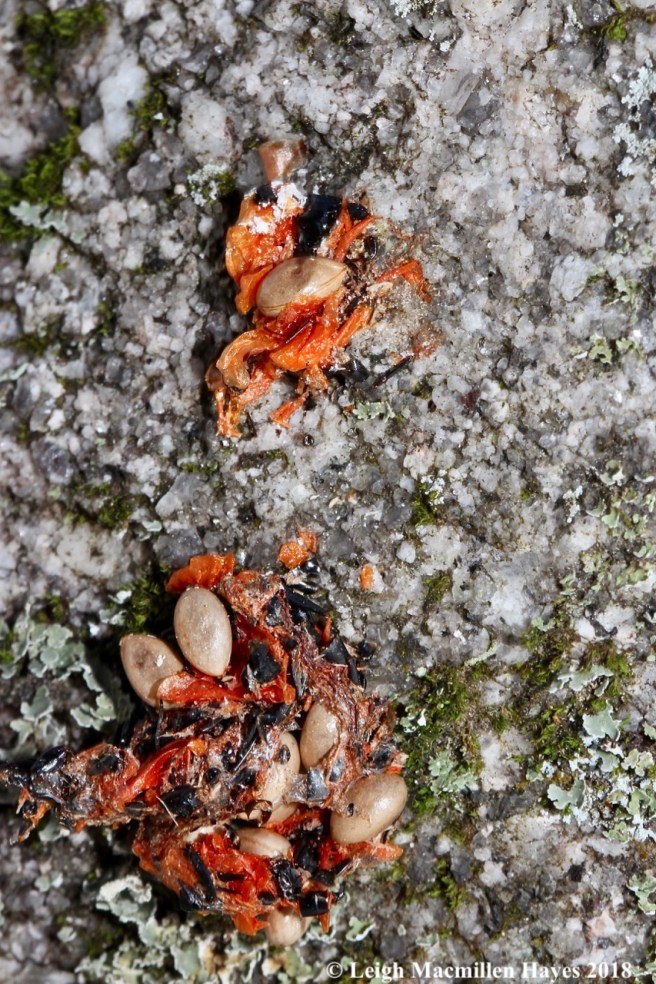
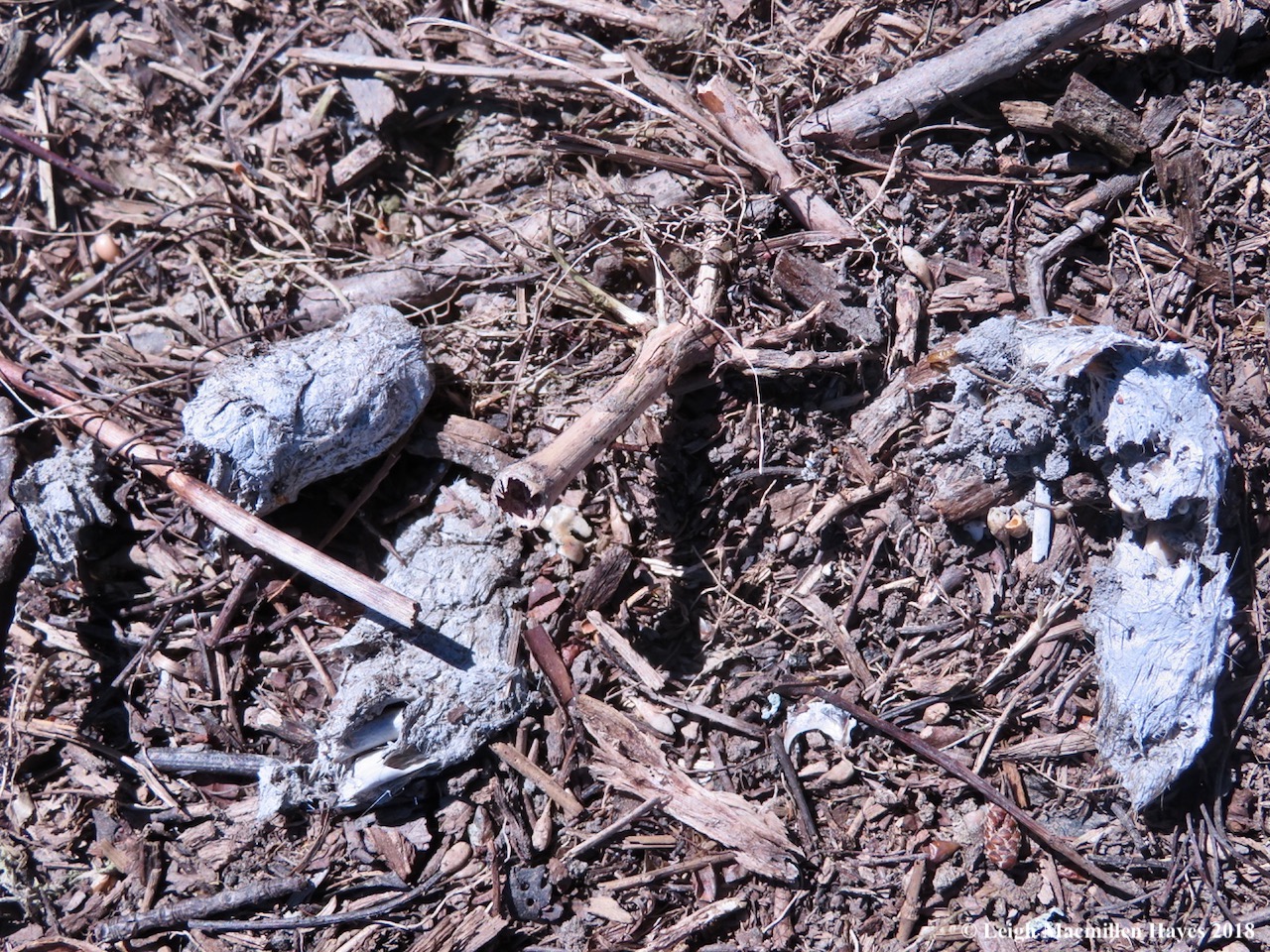
In fact, their style reflected in scat I found included more than the offerings we’d supplied. On this rock, it looked like the local staghorn sumac had provided some nourishment. 

That wasn’t the only scat in the area. It took me a moment to realize what I was seeing atop the snow. The scat of larger birds also decorated the trail and I wondered what predators might be about. 

So here’s the thing–when you go in search of the tree (or on any walk in the woods) take some time and look for scat. And while you’re at it, see what else might draw your eye in. 

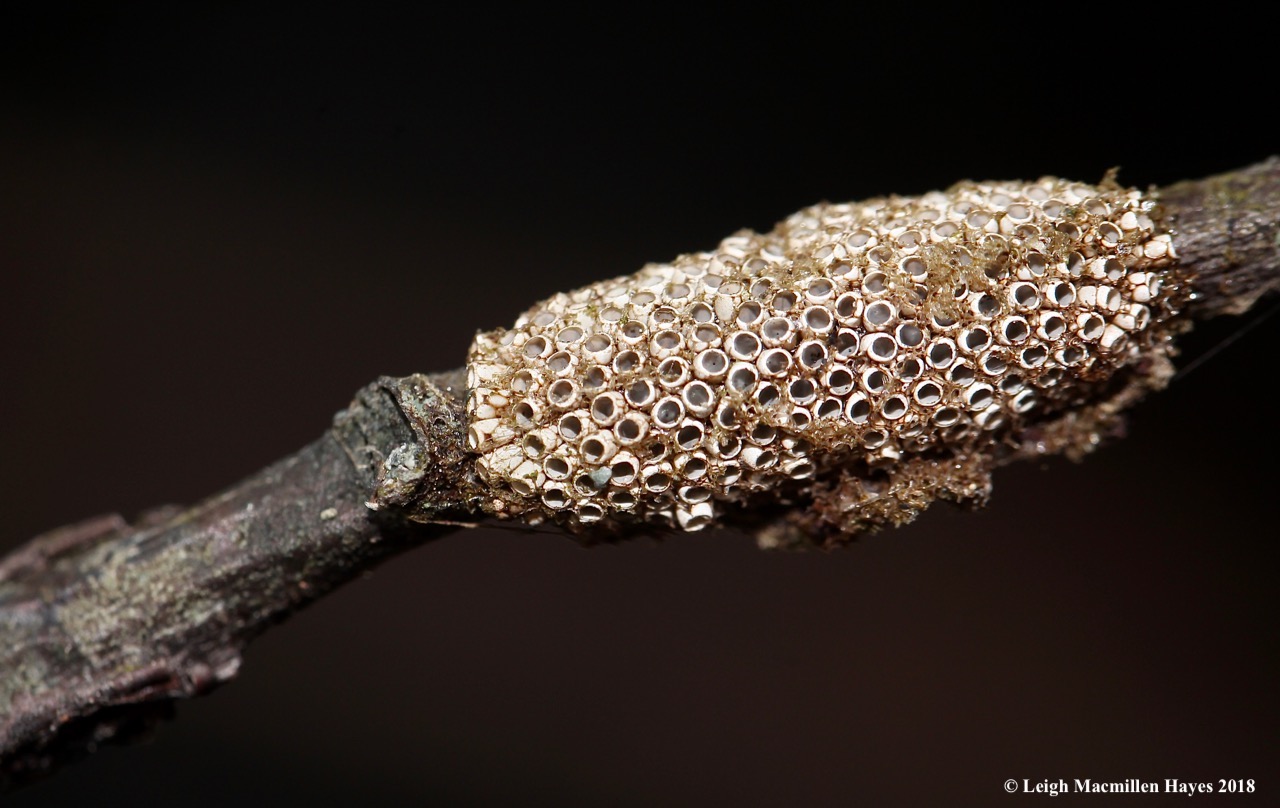
Maybe you’ll spy an empty sawfly cocoon. 

Or one that will protect the larvae as it pupates within over the winter months. 

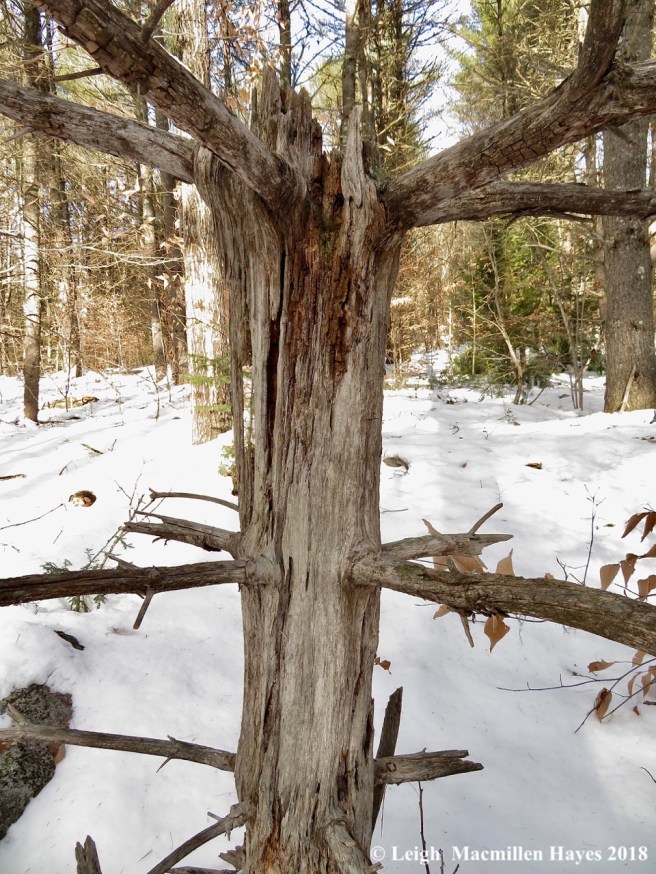
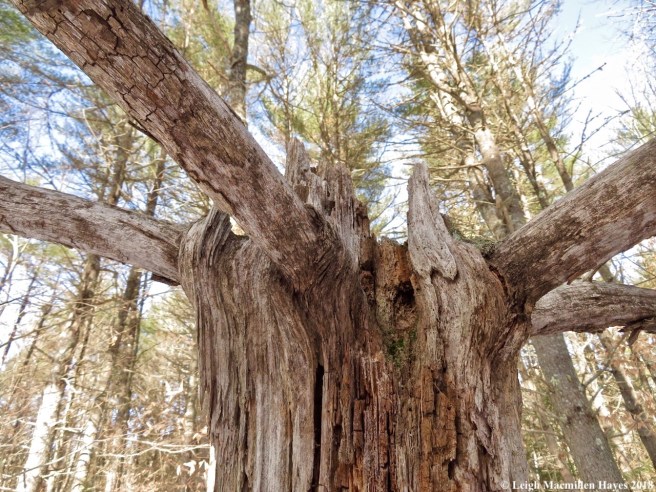
When you go, look for the unusual among the usual. I found this pine tree snag that struck me as most intriguing. How tall had it grown before its life tumbled down? 

No matter. What did matter was that its whorled limbs still reached outward in star-like fashion. 

And inward as well. 

Above, its kin stood tall. 

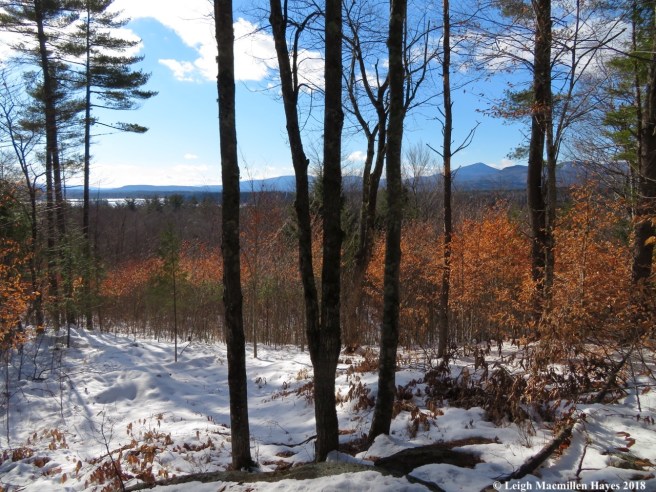
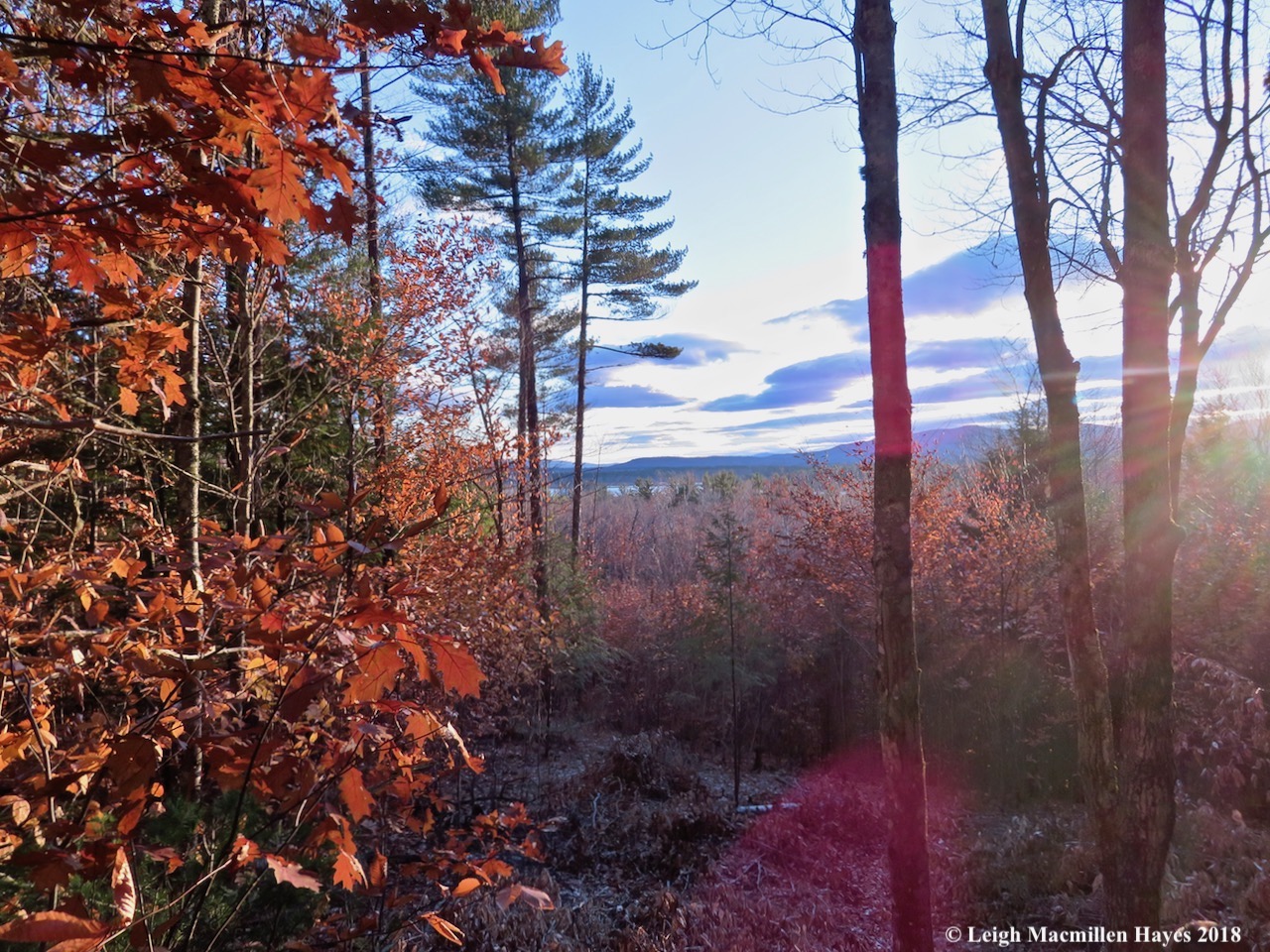
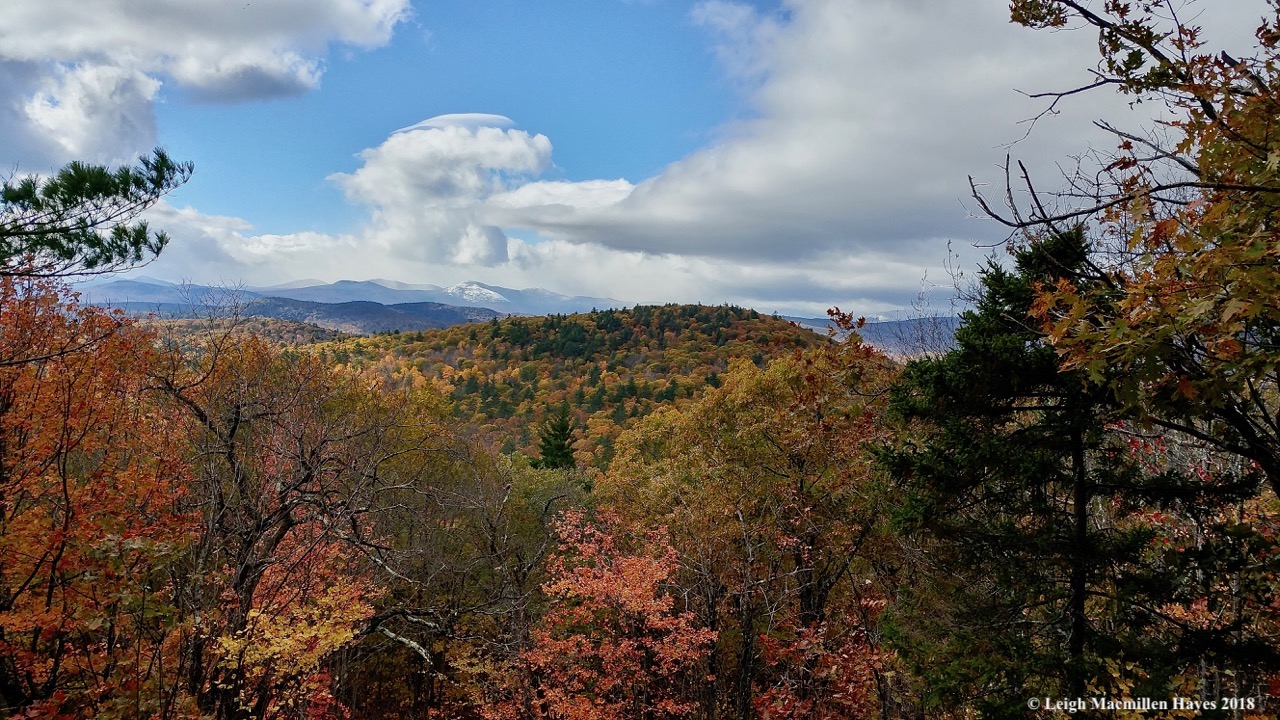
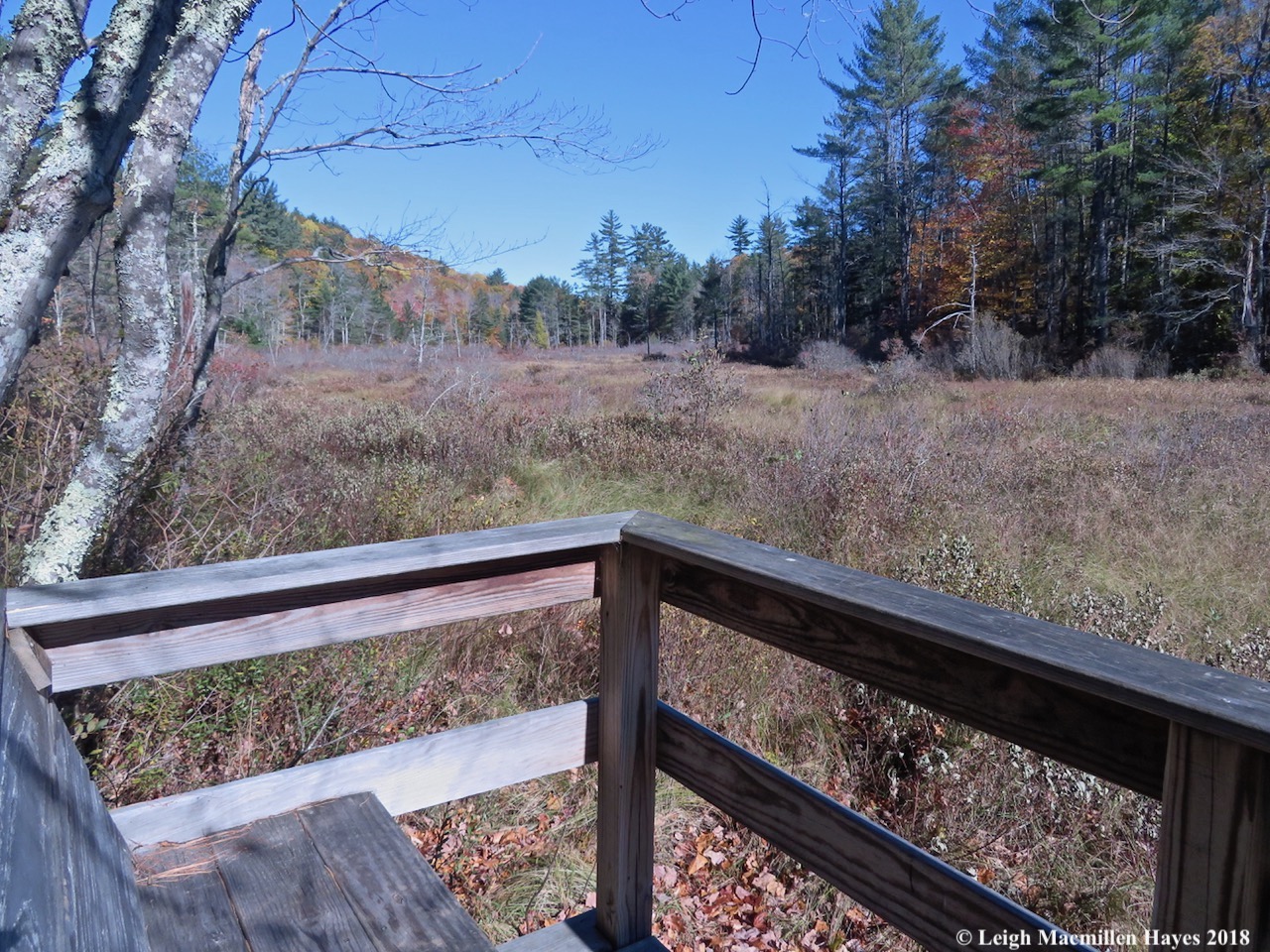
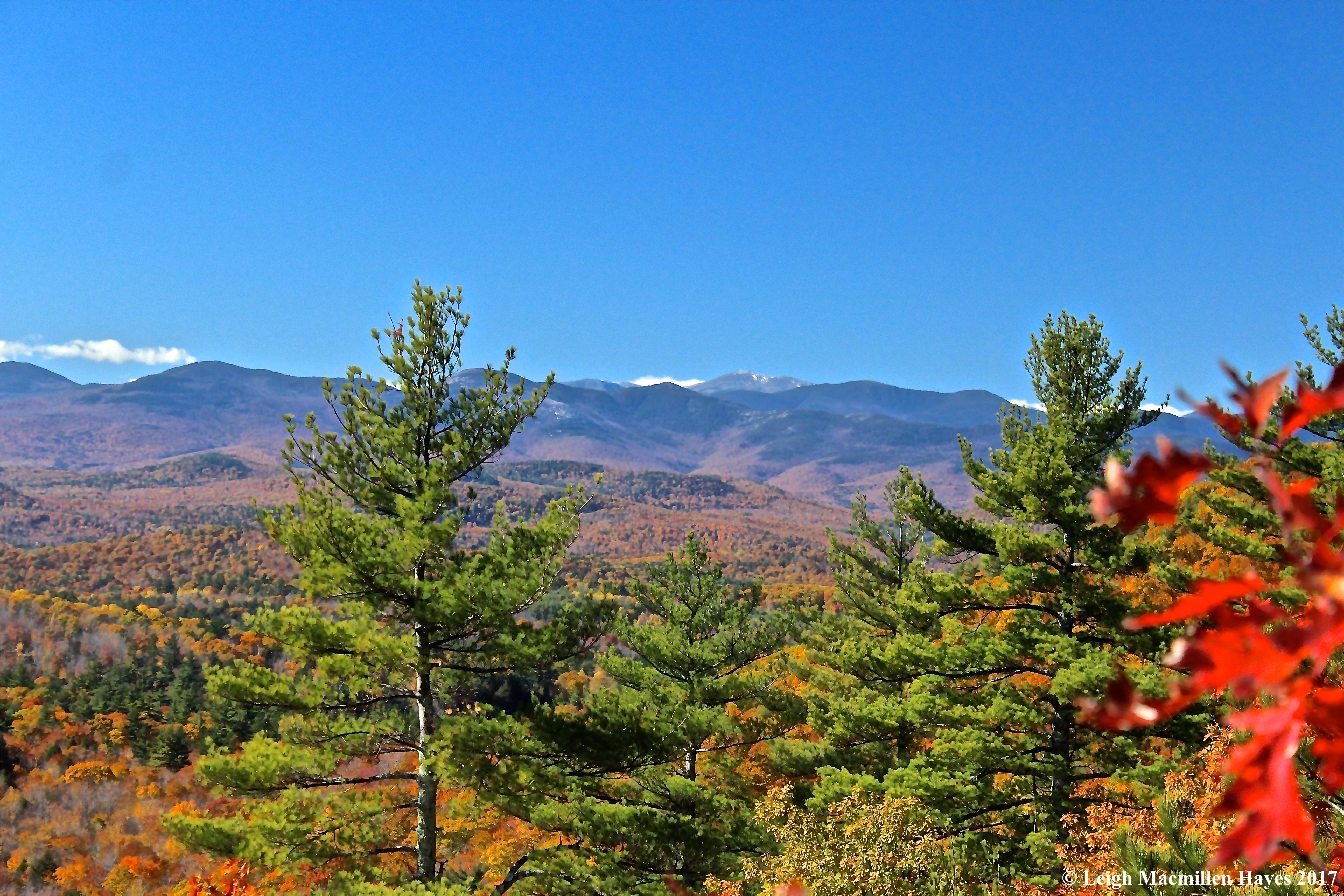
When you go, make time to enjoy the scenic view opened this past summer by staff and volunteers. 


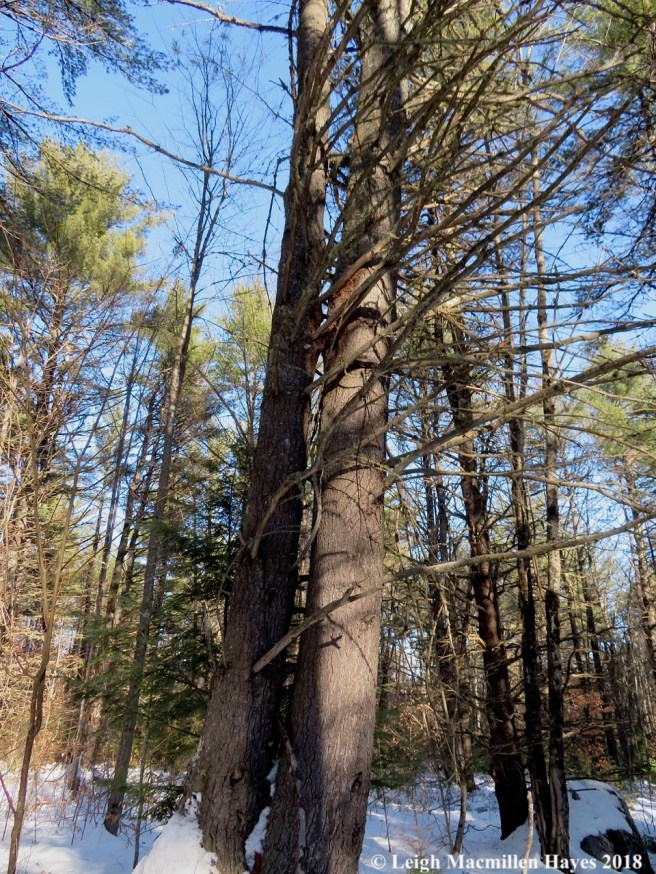
When you go, look for interesting sights like this one, where one pine embraced another. 

Pines typically self prune, but these two chose to keep their lower branches and snuggle together for the rest of their lives. 

So close did they grow that the “arms” of the tree to the left had grafted to the tree to the right so that their hug included shared energy. 

When you go, look for the other old pines along the stone wall–those that grew up when the landscape was more open and their structures could stretch out more than up. 

And below them, notice the squirrel middens. I wasn’t sure there would be many middens this year since it wasn’t a mast production year and few cones had formed.

When you go, let your imagination see the discarded pine cone scales and cobs as toppings on a bowl of ice cream. 

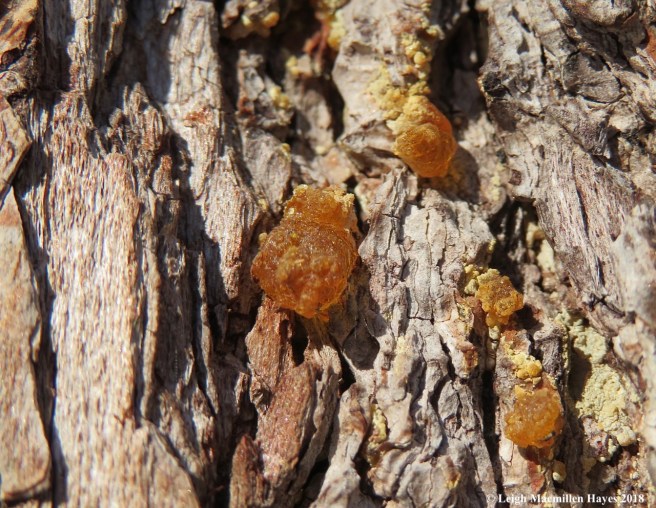
When you go, look for the amber nuggets of pine sap hardened on old bark. 

When you go, if the apple slices remain on the tree(s), notice the star shape of the core. 

When you go, look for all of these . . . or better yet, make your own really cool discoveries. 

I do hope you’ll go to the Chip Stockford Reserve or any of the three other sights in western Maine where trees are decorated. But . . . if you can’t go here, go somewhere. And when you go . . . have fun! 

Stepping Out For Others

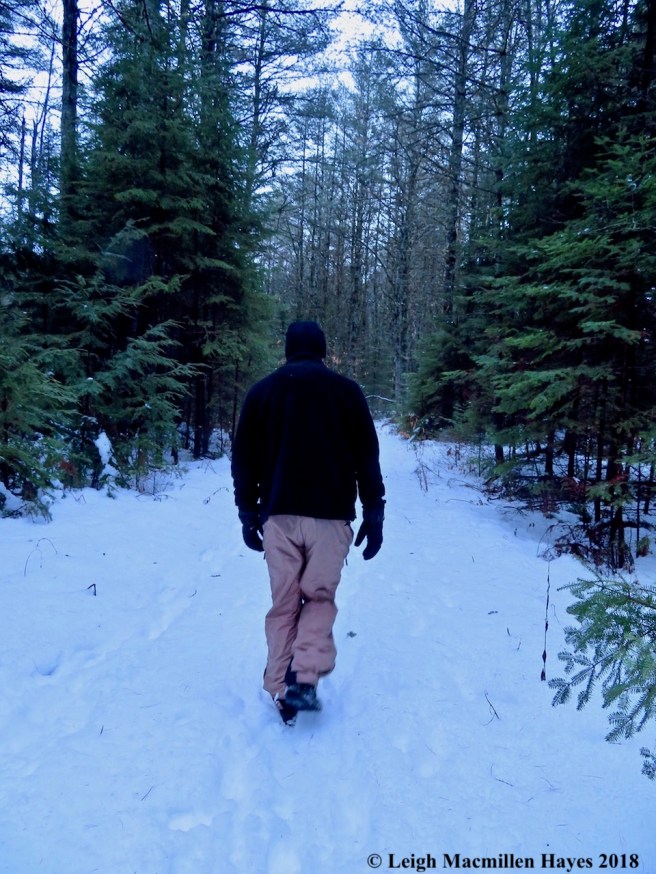
With the most recent snowstorm now history, I strapped on my snowshoes this morning with a sense of eager anticipation about the possibilities. And then it hit me like the snow plops that fell from the trees and landed on my head or slid down my neck: I could do this while others could not and it was for them that I needed to focus. 

I hadn’t gone far when my first moment of wonder stood before me. Actually, just prior, I’d been looking at some pileated woodpecker works–ever on the search for the bird’s scat, and in the process had noticed other bird scat soiling the snow. But . . . what was all the amber color? 

Had snow collected on mushrooms that decorated the bark? If so, why hadn’t I seen them yesterday or the day before? 

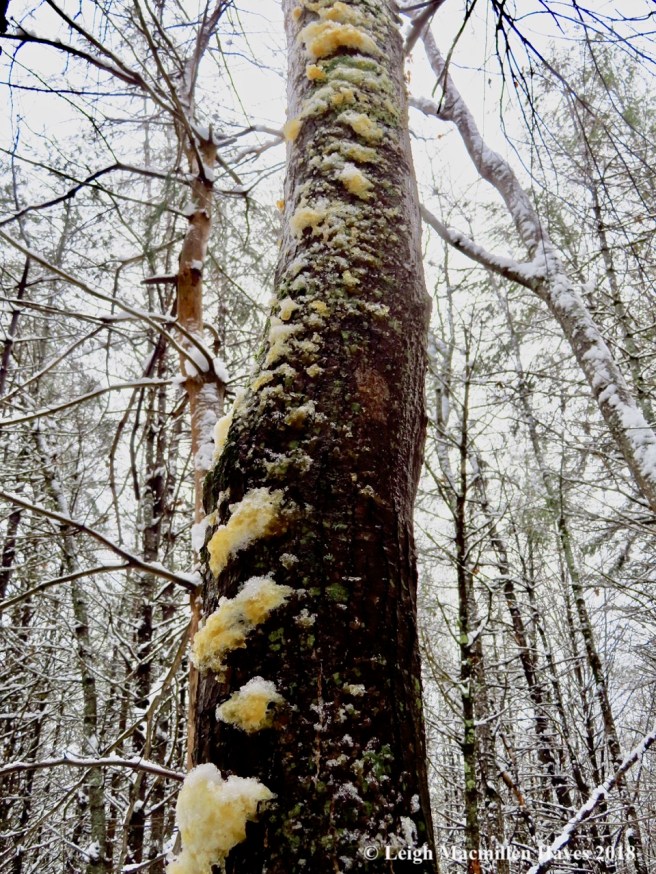
Upon a closer look, I realized it was sap. But why the big clumps? And why so much on a dead snag? 

I poked it with my finger and found it to be of snow consistency. And so . . . the mystery remained. But it was certainly worth a wonder and I knew that those I was intentionally walking for would appreciate the sight. And yes, I did see plenty of other examples of dripping sap at the base of trees, but nothing like this. As usual, if you know what was going on, please enlighten me.

My next moment of wonder was one that always gives me pause–and again I knew that my friends would feel the same. A miniature evergreen world momentarily encapsulated in a droplet of melting snow. 

Everywhere, the meltdown offered a variety of shapes and designs, each worthy of reverence . . . and a photograph, of course. 

One of my favorites was plastered to a tree in such a way that it looked like it was flat against the bark until further study revealed otherwise. As it melted before my eyes, its ever changing formation resembled a series of little flowers scattered here and there. Just maybe you have to see that through my eyes. 

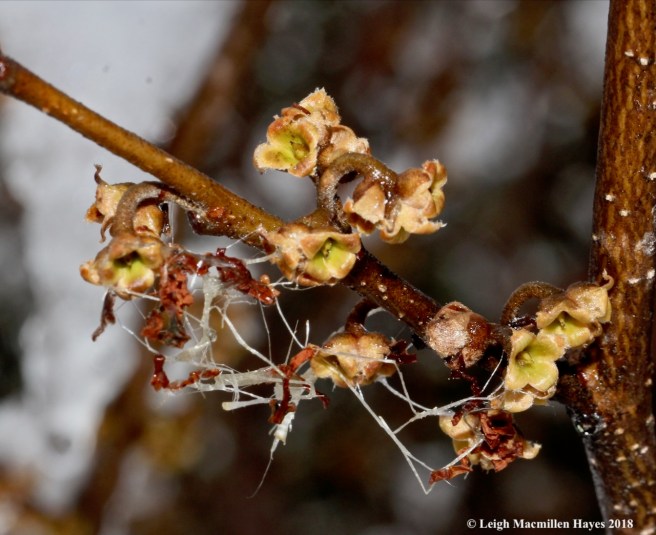
And then I stumbled upon another mystery–a web of sorts like Charlotte might have woven? I studied the shrub and found numerous examples of a similar pattern, but no arachnids in sight. Besides, the silky lines seemed too thick. But, what could it be? It took me a while as I studied the area and then I remembered. Before the snowstorm, I’d taken some photographs of the winter structure of a thistle. The storm had knocked down the fruiting form, but I think my gaze was upon the filaments that had served as parachutes for the thistle’s seeds. 

My journey into the winter wonderland continued, though not all the trees along the way were fortunate to withstand the weight of the snow that was quickly melting. It sounded like a rain storm as I walked under the arched branches. 

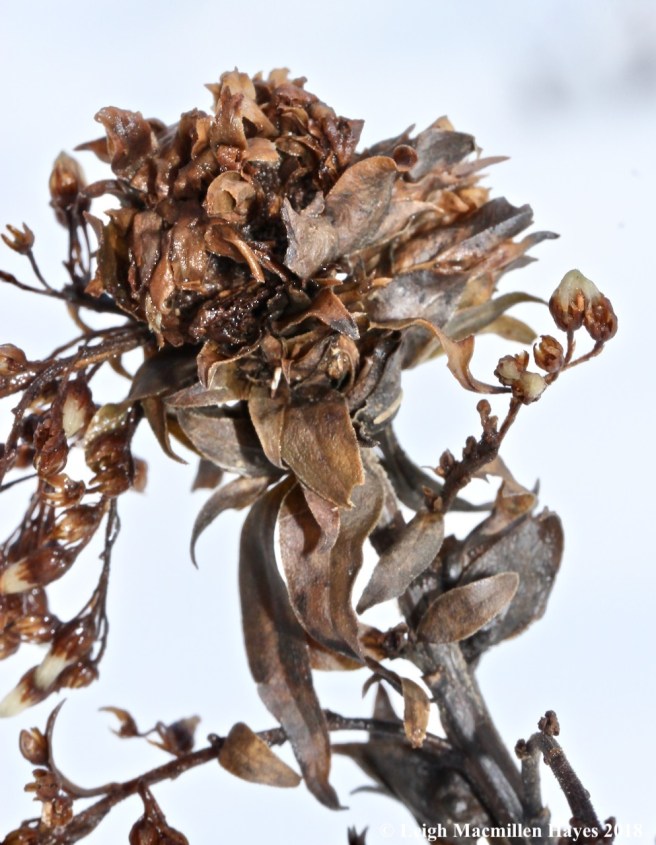
At the the other end of the snow tunnel, I emerged into a field with its own offerings. Typically, I pass by, but today I was inspired by those who virtually walked with me to explore. And I don’t think they’ll be  disappointed by the findings. First there was the Goldenrod Ball Gall. The round gall occurred in the middle of a stem, the top of which had broken off. In the spring, the Goldenrod gall fly laid her eggs on the stem. Hatched larvae chewed their way into the stem and the gall started to develop. And from the looks of the hole on the side, it appeared the creator had chewed its way out and flown off. 

Also in the field, a Rose Bedeguar Gall, aka Robin’s Pincushion Gall on Meadowsweet, which happens to be a member of the rose family. Burrowing in to the leaves and stem of the plant was a two-fold offering for the fly larvae it hosted, for the insect benefited from the nutrients while it was simultaneously protected from predators. 

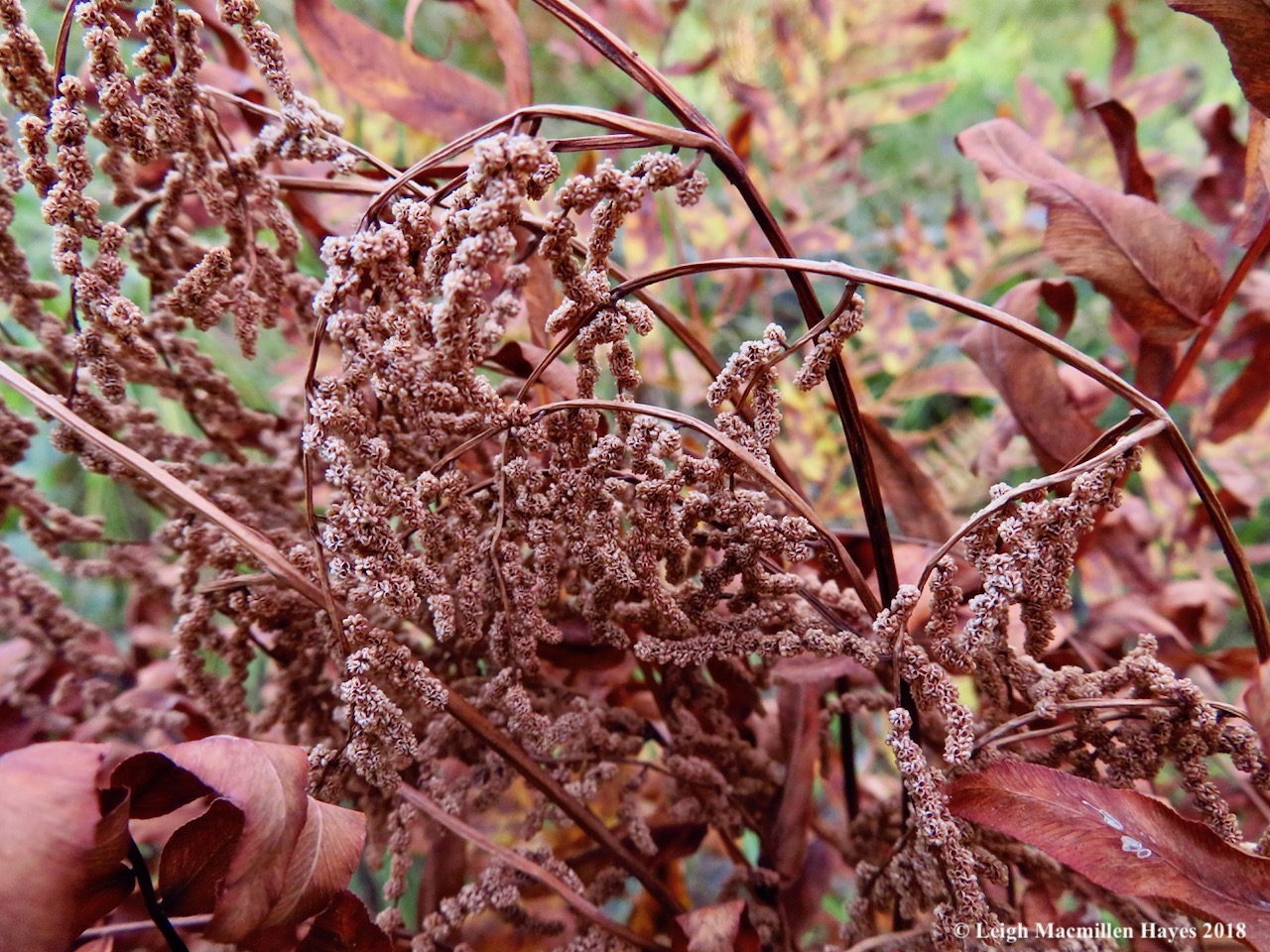
There were also numerous examples of a structure that might baffle the onlooker. Beaded formations of the fertile stalk from a Sensitive Fern poked up through the snow. Typically, the beads or capsules remain intact with their brown dust-like spores waiting inside for the structure to break open during the rains of early spring. 

I moved on from the field and eventually reached a wetland that I couldn’t cross. But, I could stand and listen and so I did. All around me the forest orchestra performed its Plop, Plop, Swish, Plop, Splash symphony. 

 At first, it sounded and looked like I was surrounded by a million wild animals, but really . . . all the sound and sights were a result of snow falling, either gently with a whisper of the wind or harshly with a thud and splash. 

As I stood there looking for the million wild mammals, my eyes focused on the works of something much smaller. Insect egg tunnels on a dead snag’s trunk read like a story on paper. 

The longer tunnels were bored by a female Bark Beetle. From the sides of her tunnels, larval mines radiated outward. The overall design could have been an abstract drawing. 

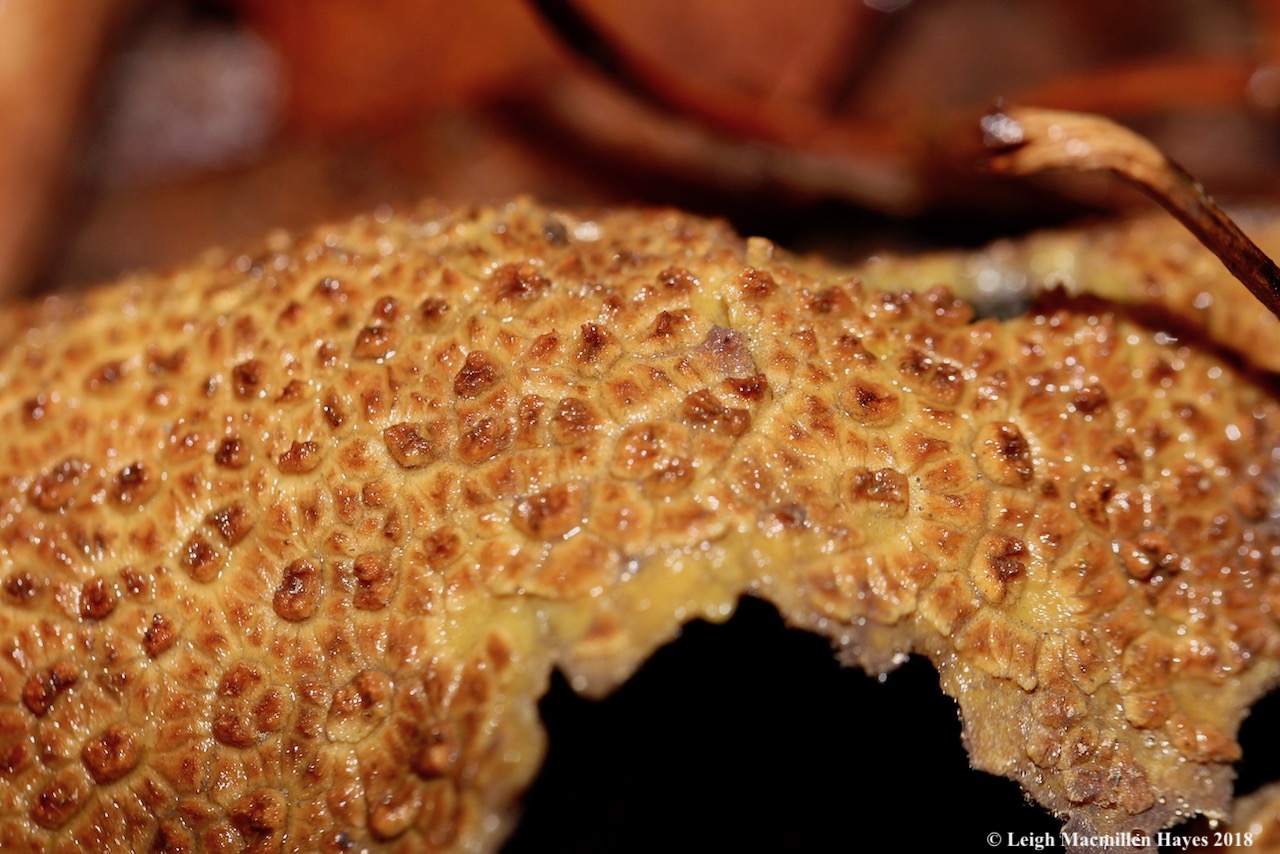
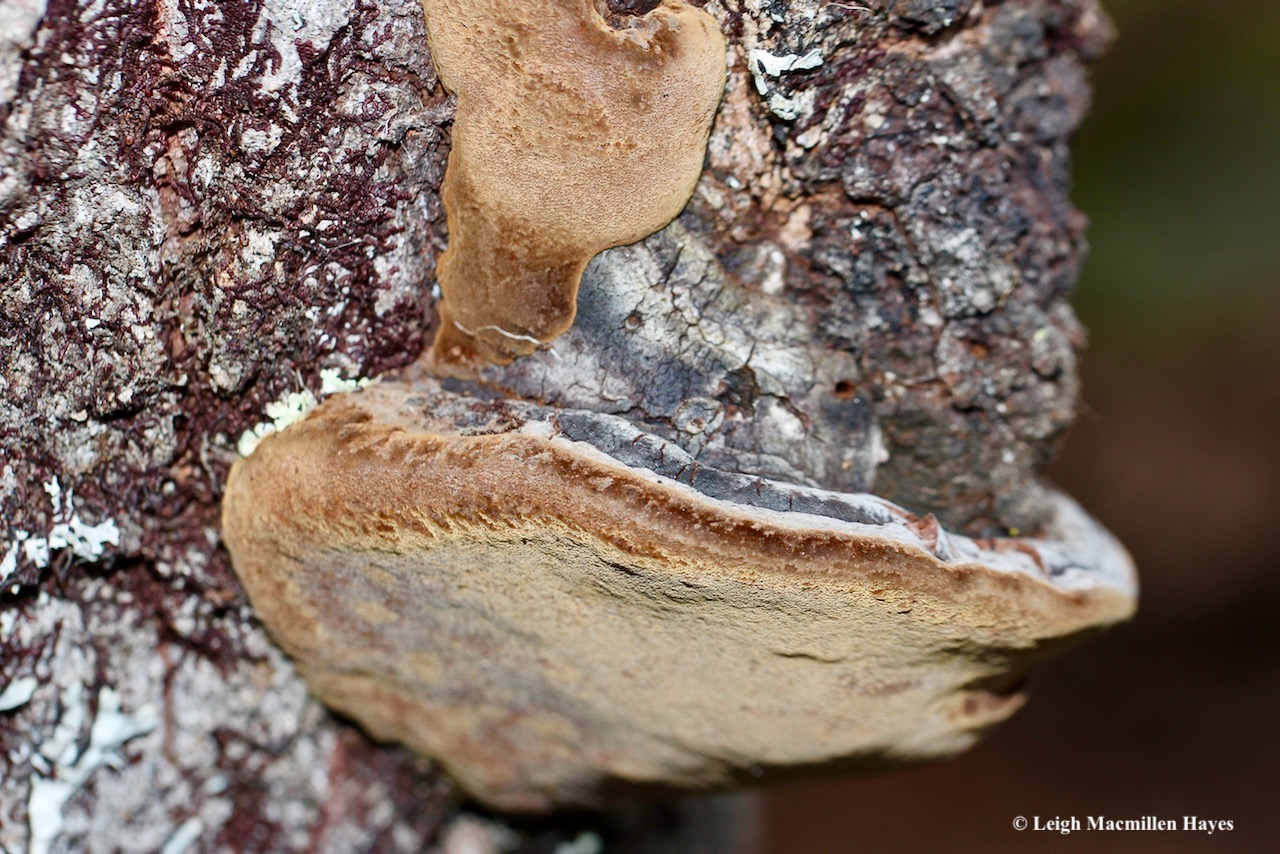
At last  I started for home, thankful that I was retracing my steps for often new sights are revealed when one does that. And so, I believe it was a crust fungus and perhaps it was an oak curtain crust fungus, but let it remain that I discovered a fungus I don’t think I’ve seen before, with a warty, rust-colored underside and dark upperside. Suffice it to say, it was a mushroom of some sort. 

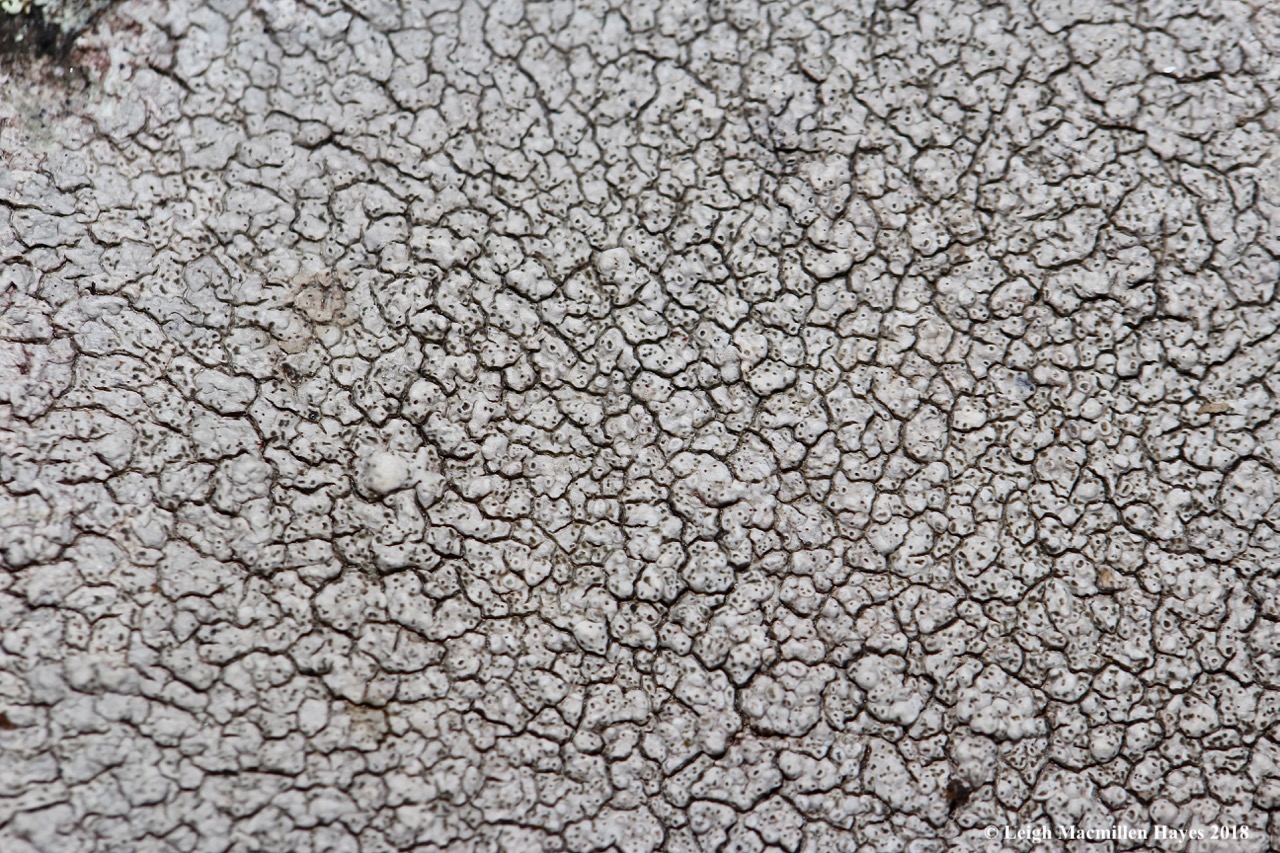
Along the way was a script lichen, which looked to me like someone had doodled. Commas and apostrophes decorated that page. 

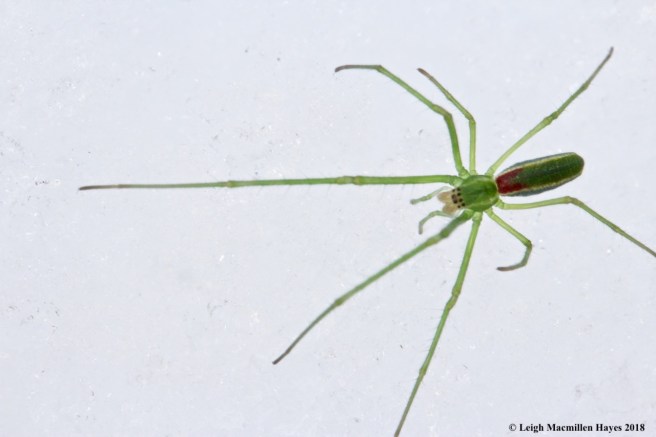
And then, and then, Tetragnatha viridis, a green long-jawed orb weaver. I actually saw two of them. Typically, the translucent green color helps them camouflage amongst pine needles, their usual habitat, but they can frequently be seen on snow, especially if the temperature is in the 25˚-35˚ range as it was this morning. 

The orb weaver’s characteristics: eight eyes in two parallel sets of four; long chelicerae (jaws); enlarged pedipalps; long legs with spines; and that color–oh my! 

It was for eight parallel eyes that I walked today, the eight representing Jinny Mae, Dick, Kate, and Carol. 

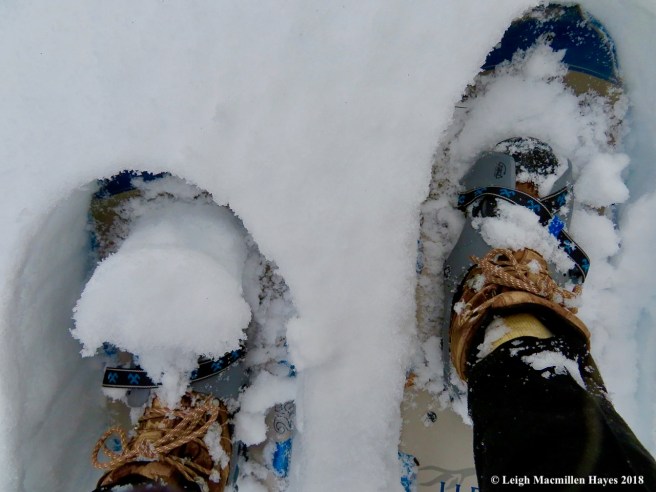
Where trees didn’t cover the trail the snow was about fourteen inches deep and as you can see I chose the wrong boots and forgot my gators. But that was okay because I knew that I would eventually wander home and change my sopping wet socks. What mattered more was the fact that I was honored to step out for others when they couldn’t necessarily do the same. Here’s to the four of you–thanks for letting me be your eyes. 

Mondate Preserved

The other day a sign caught our attention as we drove to Overset Mountain and we realized we had new trails to explore. But, we, or rather I, drove by  so fast that we didn’t know which local organization owned the property. 

If my guy read these posts he would chuckle or guffaw at my comment about driving too fast for he is of a different opinion. But suffice it to say that we didn’t read the name of the land trust on the sign and so this morning I contacted Loon Echo Land Trust because in my online research, their name was associated with the property. Maggie quickly let me know that I needed to contact Lee at Western Foothills Land Trust and violà. 

Both have been involved in the Crooked River Forests Project for as is stated on the LELT website: The Crooked River has been identified as a priority for conservation as it is the largest tributary to Sebago Lake, with 38% of the inflow, and it offers local recreational opportunities and is situated above high quality sand and gravel aquifers. The river has been identified in the state’s Natural Resources Protection Act as an Outstanding River Segment with AA status; free flowing with the best water quality. This trout fishery is home to one of only four native populations of landlocked salmon in the state and is known to host one species of anadromous fish (American eel) and is thought to historically host Atlantic salmon and sea lamprey.

As I pulled up to the sign today, however, the ownership was obvious. The name, Two Bridges, was not so. The area has long been named such, and all we could imagine is that twin bridges once spanned the Crooked River in the area where we stood. 

Since the parking lot was under construction, for the property won’t officially open for another two weeks, we parked on Plains Road rather than Route 117 in Otisfield. 

At the start, the trail was wide and straight, and we both hoped for a change. Oh, don’t get me wrong. It was lovely and we had fun naming all the evergreens, including white and red pine, hemlock, balsam fir and red spruce, for those were the most abundant species, with a few young beech, red maples and red oaks thrown into the mix. But . . . we wanted diversity. And we wanted to walk beside the river. 

Soon, thankfully, we came to a Y in the road and a new sign post, or so we imagined it to be. We chose the trail to the right since it was closer to the water. 

And within minutes our reward awaited. That being said, we’d followed a spur to the riverbank and since there were no telltale pieces of flagging we suspected it won’t be marked as a public trail. 

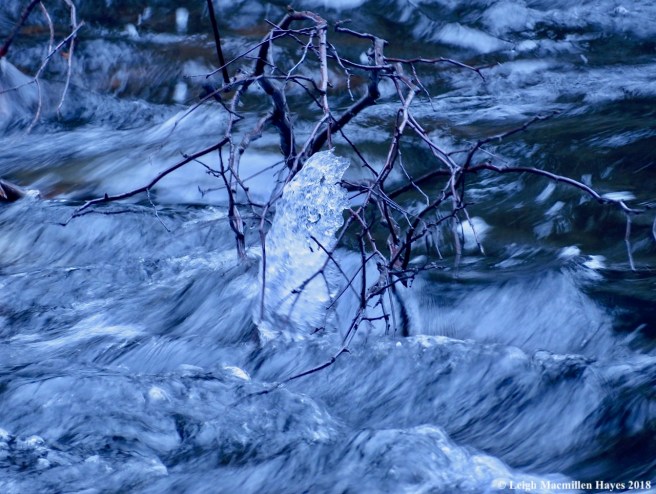
Further along, we again spent time by the river, and noted its sculptures made of decorative roots . . . 

and splashes of ice. 

And in the mix–a rare sight indeed: an ice disc, this one being about three or four feet in diameter and spinning in an eddy. 

Eventually, the trail took us across a bridge constructed by the land trust in October 2017 that will provide the landlocked salmon and brook trout with another mile of spawning habitat.

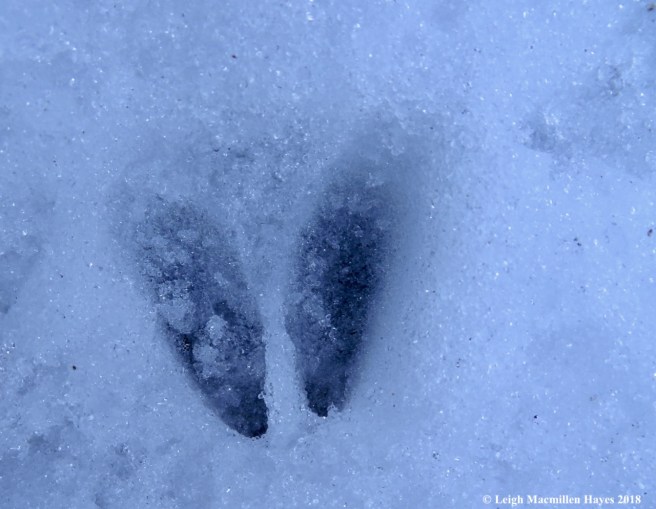
And that’s not all. We saw plenty of evidence that mammals inhabit the space from deer . . . 

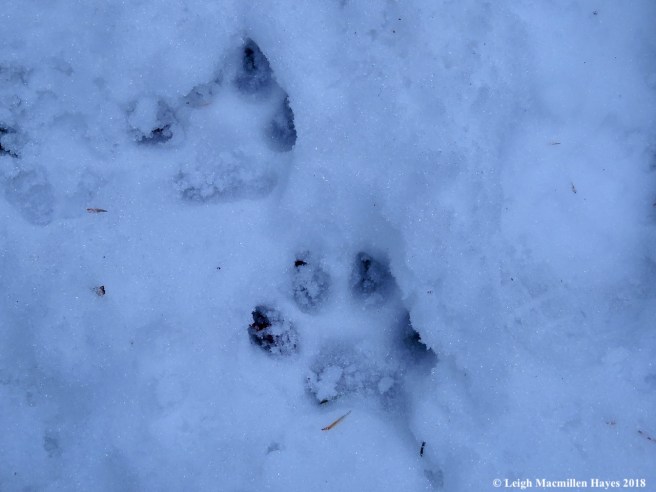
to fox . . .

to bobcat! 

There were several intersections, and we kept turning toward the river, which took us along trails more to our liking as they narrowed and twisted and turned through the forest. 

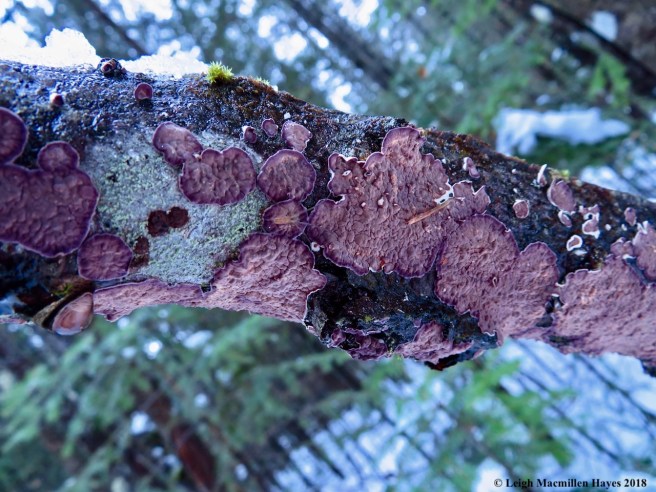
At one point, a tree arched over the trail and its purple crust fungi added a different color to the display. I think it was Phanerochaete crassa. 

My guy pointed out the hugging cousins–a white pine and hemlock and I was reminded of my finds on Black Friday. “I knew you’d like it,” he commented. He knows me well. 

Because we were in an evergreen forest, we noticed several examples of witches’ brooms. No, they were not the variety that one might have expected on Halloween night. Instead, dense masses of shoots rose from a single point on an otherwise normal branch and created a nest-like structure. Their cause: fungi, viruses, bacteria, mites or aphids. 

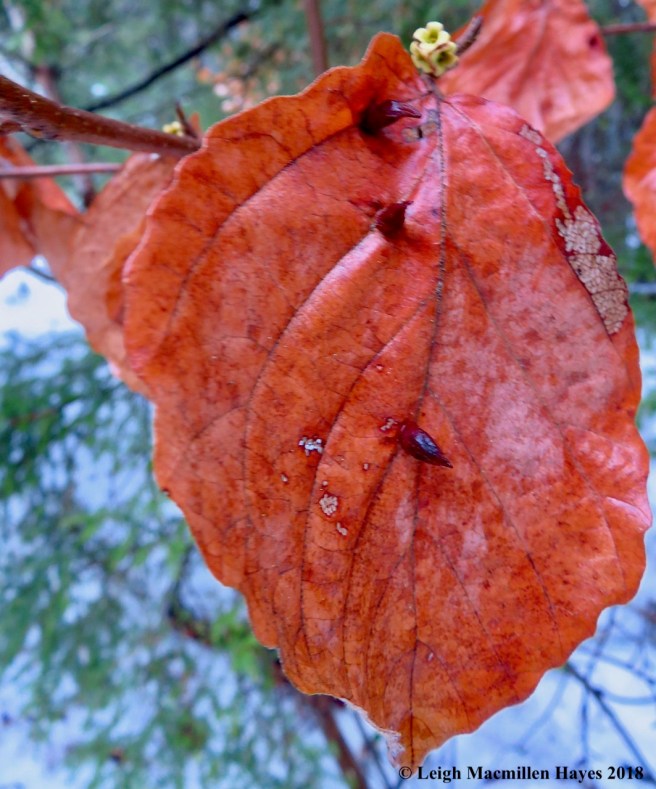
Speaking of the latter, aphids created the cone galls we knew as witch’s hats on witch hazels that grew near the river. The little structures provided both food and shelter for the critters that developed within. 

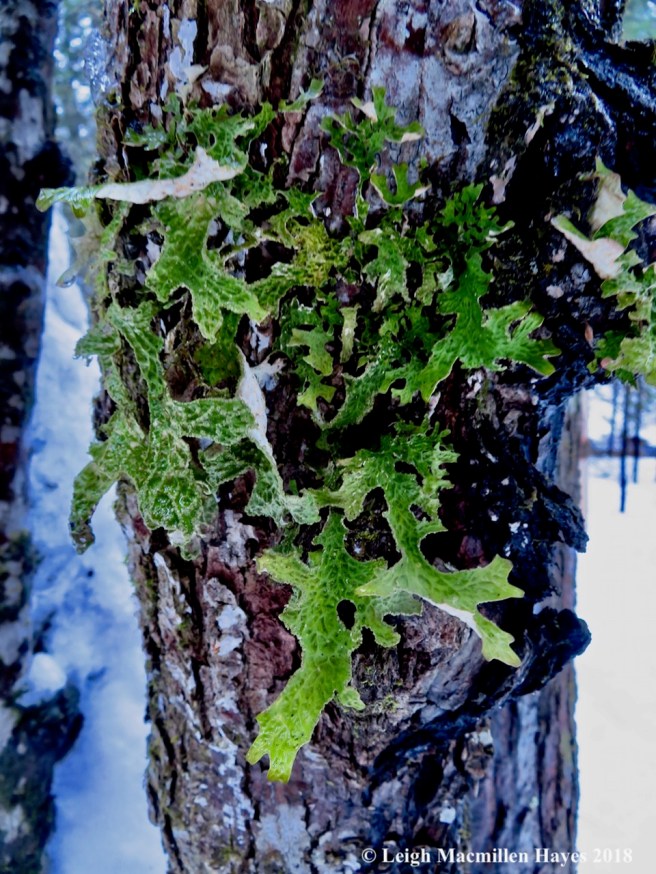
We also spied lungwort on a few hardwoods, its leafy structure springtime green as it photosynthesized in response to the flurries that floated earthward during the morning hours. 

And then the forest’s canvas began to draw our attention, from snowcapped artist conk (Ganoderma applanatum) fungi . . . 

to icy reflections, . . . 

man-made sculptures, . . .

and dazzling trail markers. We spied another made of pipe cleaners and a soggy feather and wondered.

We didn’t walk the entire trail system, but left knowing that we’d return for further explorations. 

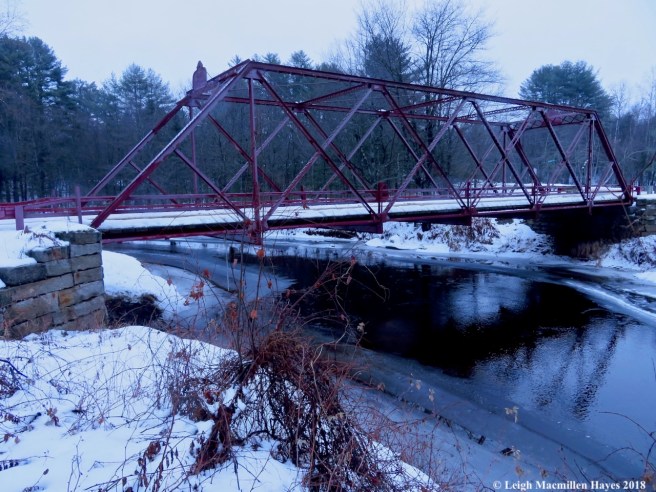
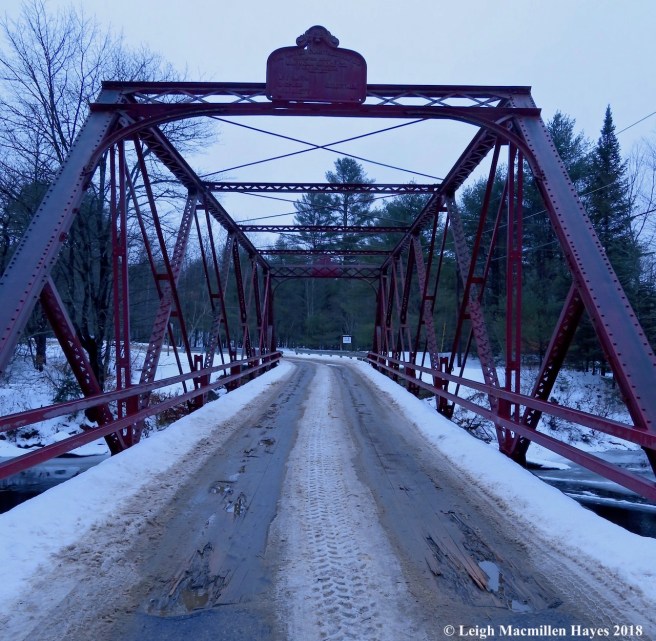
Because we were in the neighborhood and my guy had never seen it, I drove along Plains Road to the Ryefield Bridge. Listed on the National Register of Historical Places, the structure was built in 1912 as a double-intersection Warren truss bridge. 

The bridge spans the Crooked River between Harrison and Otisfield and is still used today. In fact, we walked and drove across it. 

One of our favorite parts was the sign at the top, which not only stated the construction company, but also honored the selectmen of the day. 

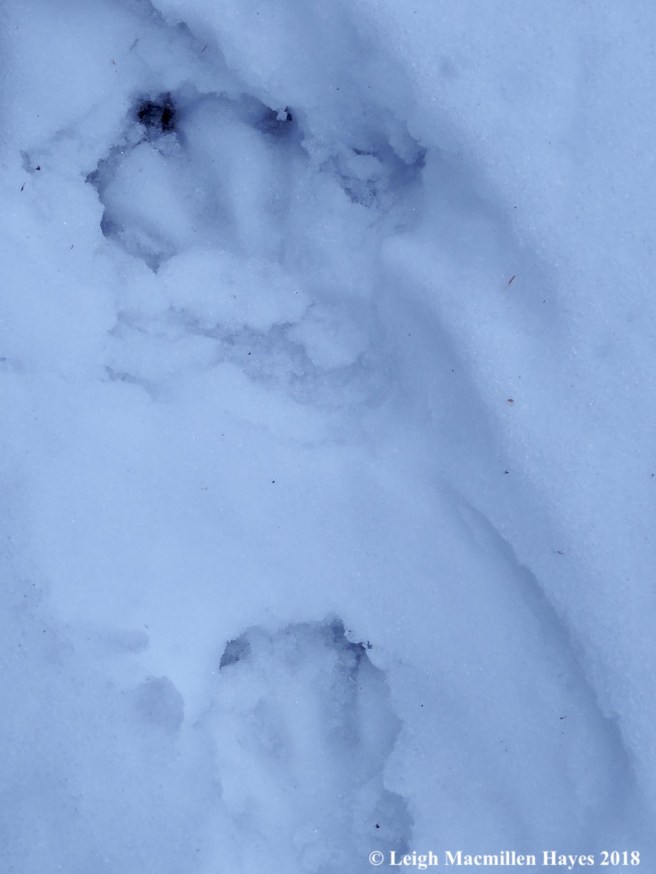
My excitement about the bridge was equally matched by some prints I spotted when I stepped into the snow to take a photo from the river bank. Beaver prints! Like the ice disc in the river, beaver prints have always been a rare find. Often, I can see their pathways, but not decipher their tracks for their tails swish out the features. 

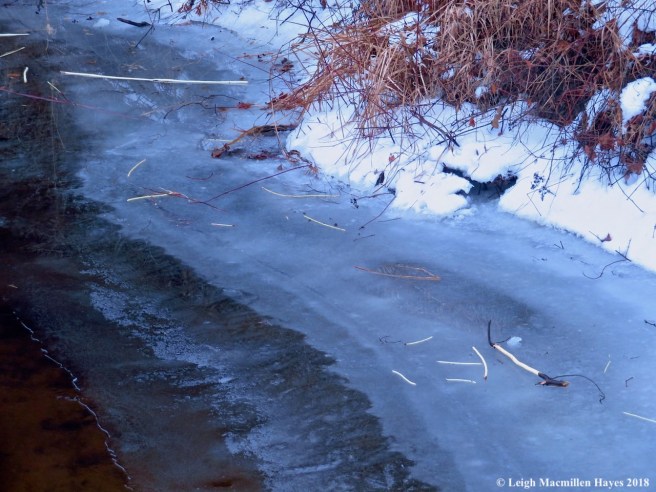
But today, not only the tracks and a trail down to the water, but beaver chews, their snack sticks, left behind on the ice. 

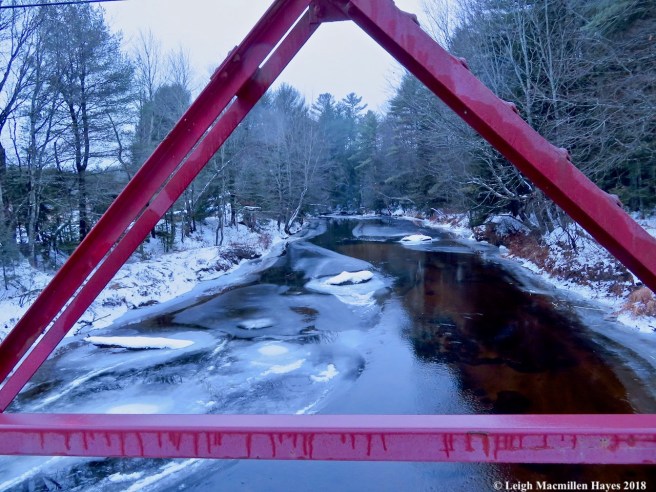
We took one final look before heading home–Crooked River framed by the bridge. And we both gave thanks on this Mondate for a land and a bridge preserved. 

Overset Point of View

Winter hiking is our favorite, but what to wear on our feet is always a question. Today, we chose our hiking boots over winter boots and micro-spikes rather than snowshoes. 

We trusted L.L. Bean would have approved, especially given that we would be hiking in his hometown of Greenwood, Maine. We were, after all, wearing hiking boots purchased in his flagship store and various other products featuring his name. Don’t tell him that while our snowshoes, which remained in the truck came from his place, we’d purchased our micro-spikes at EMS. 

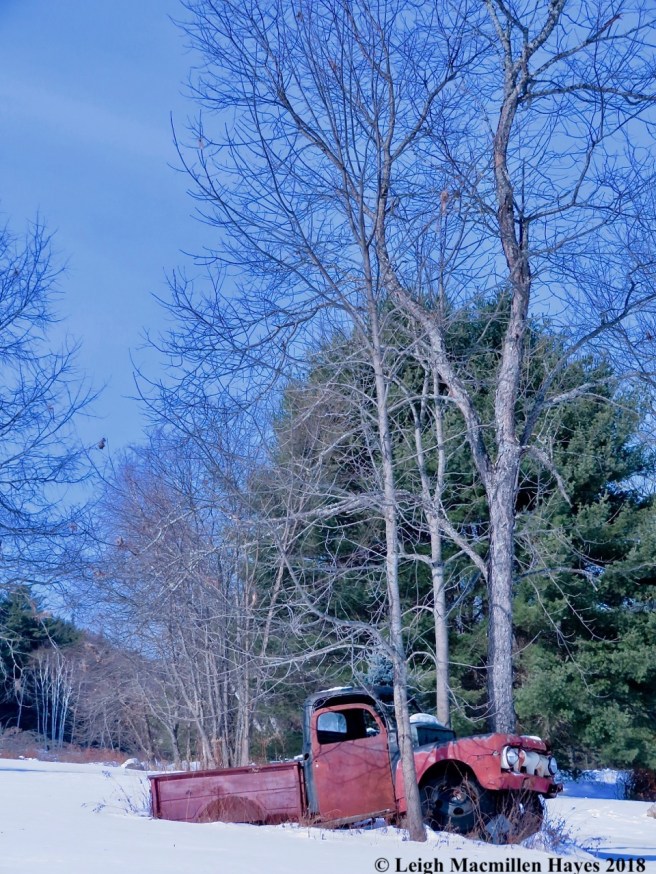
Before turning onto Willis Mills Road and heading toward the trailhead parking area, we first past by a cemetery of sorts, where old trucks and various truck-related equipment have gone to rest. 

And then, in a matter of minutes we were on the trail and our focus changed to all things natural, including weasel tracks. Notice the diagonal orientation in the pattern. 

It made perfect sense to see weasel prints because we were near the Sanborn River and though I didn’t take the time to measure them, but the size of the straddle I assumed mink. 

For over a mile we walked beside the river and loved the sights and sounds it offered, and especially the splash-created icicles. 

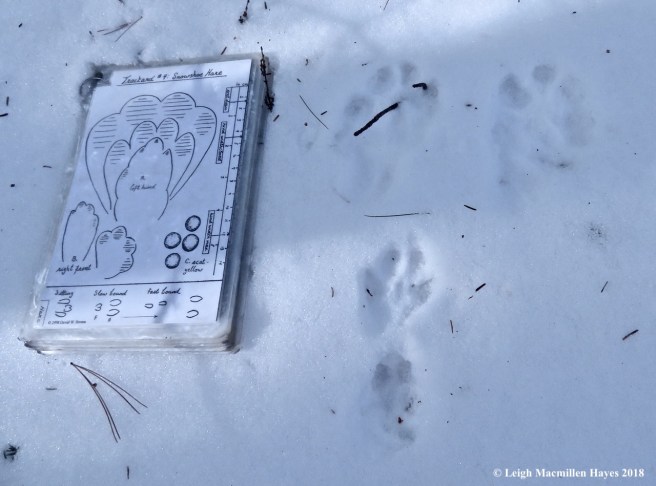
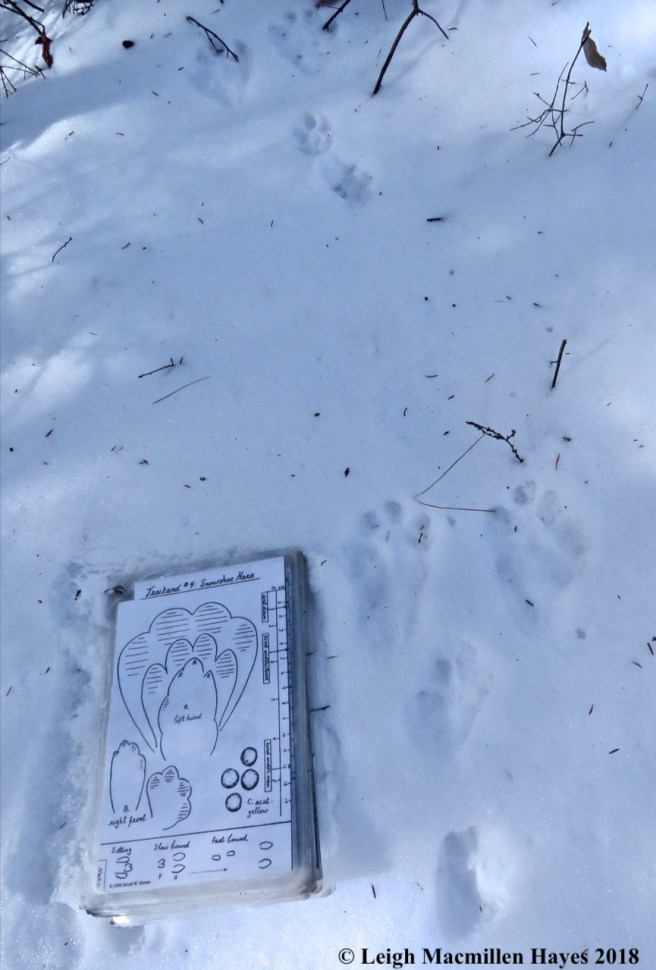
When we weren’t focused on the river, we noted its neighbors including snowshoe hare prints that were rather fresh. Some will remember that I refer to them as snow lobsters, for quite often the impression of the four feet (front two being their hind feet which swung around and landed parallel; back two on an angle being the front feet) looks rather like the large marine crustaceans visitors often equate with Maine. 

With David Brown’s Trackards as a reference, it was easy to imagine the hare’s motion. (Note: visit my book review linked to Trackards in the sentence above and you can locate David’s website. His books and ID cards are available for sale and he mentions that you can get a good deal just in time for Christmas.)

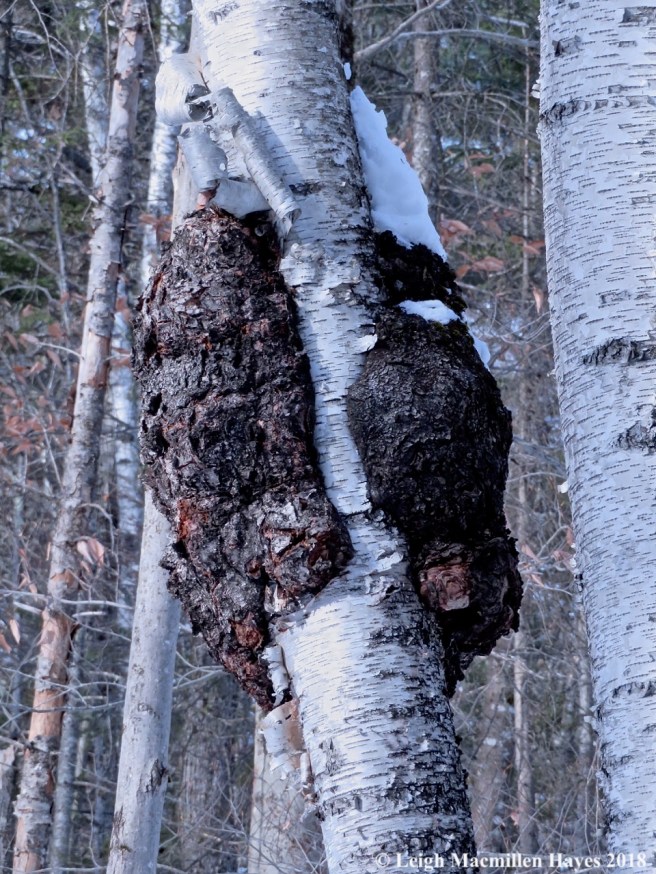
It wasn’t only tracks and ice that drew our attention. As we crossed from the river to the pond via a connector trail, we noted a huge burl that looked like two bear cubs holding fast to a paper birch.

Along the way there were also some examples of my favorite shrub, hobblebush. We always refer to their buds as being naked for they aren’t covered in waxy scales like most. And look at those leaf and bundle scars. Following them down the twig, its fun to note the changes in age from the fresh tan scars to the two below getting grayer and more wrinkled in age–much the way we do. 

As we continued on, the snow depth increased, but fortunately a family of four had passed through before us and created a trench. 

We knew we were close to the pond when we began to see canoes tucked among the trees and snowed in for the season. I’d say “for the winter,” but winter is still a month away. 

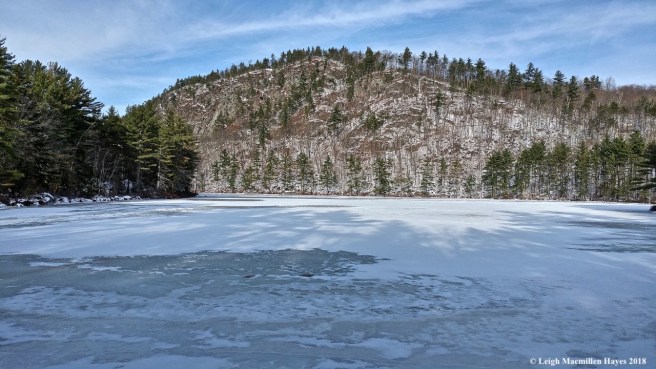
At last, Overset Pond stretched out before us. 

And Overset Mountain in the background became our next destination. 

But first, we had to walk the length of the pond as it narrowed, and then cross over a series of bog bridges below an old beaver dam. 

As I waited for my guy to get to the other side before I ventured forth, I noticed something on the dam that brought yet another smile to my face. 

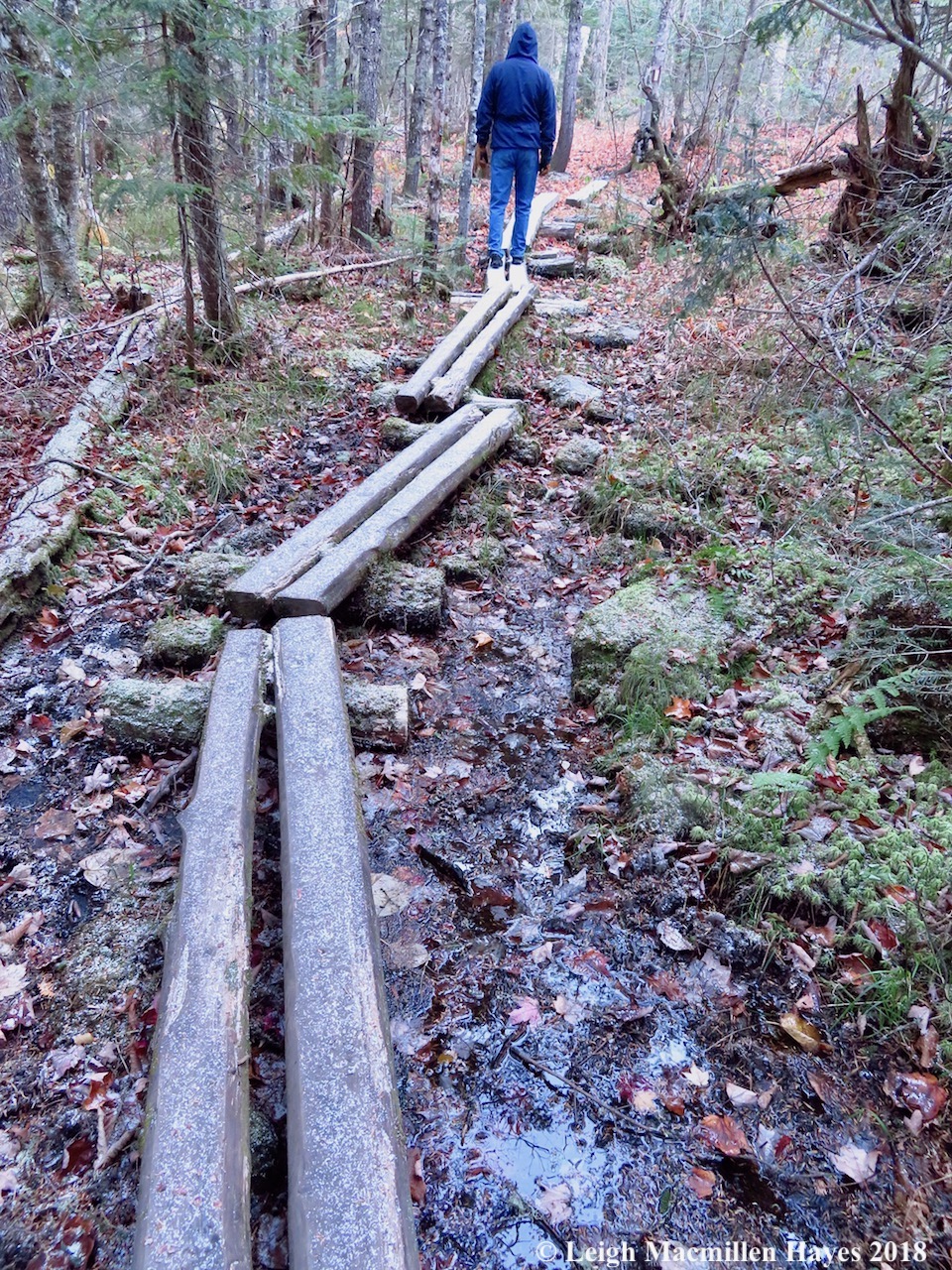
But first, I had to get to the other side–which I surprised myself and did without hesitation. Prior to this crossing, we’d walked on at least ten other bog bridges, some easier to conquer than others. This was the longest and featured several different levels, but we were both successful in our attempts. 

And so I rewarded myself with another look at the dam–and the otter slide that crossed up to the pond. Do you see the otter’s prints? 

Feeling great about the crossing (because I’d been dreading it), we began the upward climb. Our spikes were a good choice because they gave us some traction on slippery leaves and rocks, but they did gather occasional clumps of snow. We got into the habit of banging them against any available rock to declump the frozen snow. As we moved upward, the snow depth deepened to about a foot. 

The family we’d passed on their way out had told us the mountain had been challenging, but they had neither snowshoes or micro-spikes and we could see where they’d slid frequently on rocks hiding below the snow. We moved with relative ease even as our heart rates increased and at last my guy looked down over his kingdom. Actually, it’s the kingdom of Mary McFadden and Larry Stifler. Through their generosity, many trails in the area are open to the public. And through the work of their employee, Bruce Barrett, those trails are well maintained.

Below . . . Overset Pond in the shape of a heart. What’s not to love. 

After a brief apple and water break, we began our descent on the loop trail. The trees growing beside and on the boulders reminded me of the truck graveyard . . . naturally. 

Our overall descent passed quickly. In no time at all, we came upon more canoes swamped with snow. 

At last the trail came to an end and we followed a snowmobile trail for at least a mile back to the truck–our six mile journey completed. 

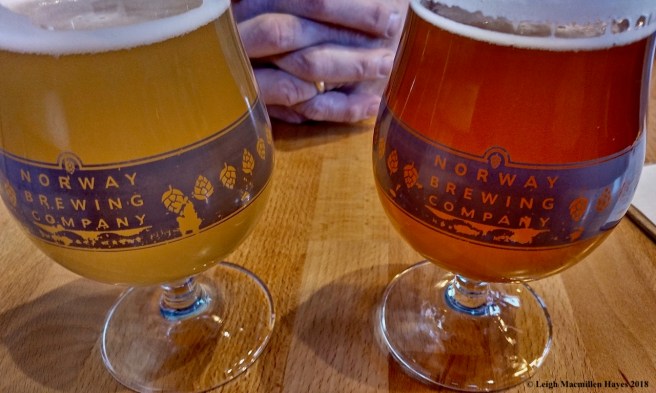
We’d planned to enjoy a brew and burger at Norway Brewing Company after the hike and were thrilled with our choice. He sipped Life’s a Peach on the left–a new brew just released today and made with Maine peaches. My choice on the right–Left Turn. 

We played Rummy while we waited and then ate our burgers with gusto. We knew they’d serve as lunch and supper, a meal we’ve named lupper in the past. 

At the end of the day, we were beat (still are) but happy. Thought I’d hoped to see some wildlife other than the occasional squirrel, that wasn’t to be. But we saw plenty of tracks and I was especially pleased with those of the weasel, hare and otter. 

And, of course, the tree trucks!

The Overset Point of View–worth a wander. 

Nothing to Grouse About

A week ago I shared a unique experience with five other naturalists, the majority of them in the six to eleven-year age range. For twenty minutes the six of us watched a Ruffed Grouse as it moved about, overturning leaves and foraging on buds. When we last saw it, the bird headed off in the opposite direction than we intended to journey, and so we moved on with wonder in our eyes and minds.

2

And then the next day I returned on a mission to study some twigs at the same property. No sooner had I stepped onto the trail when I heard the sound of leaves cracking a wee bit and what to my wondering eyes should appear but the same bird.

The curious thing: the bird followed me, staying about ten feet away as I tramped on. I stopped. Frequently. So did the bird.

And we began to chat. I talked quietly to him (I’m making a gender assumption) and he murmured back sweet nothings.

It was then that I did the unthinkable–I named him: ArGee.

Again I started down the trail, and again ArGee followed about ten feet to my right. And then I thought I got ahead of him, but a few minutes later he caught up and foraged by my feet as I examined twigs and buds for their idiosyncrasies.

When I finally turned back, ArGee did the same. Eventually I ran because I didn’t want him to follow me to my truck. Would he have? I don’t know. Would he survive? I sure hoped so. Would I visit again? I knew the answer was yes. Would I see him again? Who knew?

The next day I dragged my guy along. But much to my dismay, no ArGee. I’d been blessed twice and had to accept the possibility that he’d either flown off or became part of the food chain. My hope was that if the latter was the case, it was a four-legged predator or larger bird and not a human bi-ped.

Since last week, about five or six inches of snow blanketed the area and this morning dawned frigid with the temperature at about 5˚. I dressed for it and headed to a nearby spot in hopes of meeting up with a group that was going to count salmon and redds. But, I missed the link-up and decided instead to wander in ArGee’s territory so I could reaffirm his disappearance and move on.

1-looking for food

As I looked up at something in a tree, I heard a slight noise by my feet and guess who? I greeted ArGee with a quietly grand hello and together we shared the space, mindful of each other. After about twenty minutes he headed under a stand of hemlocks that provided some cover.

2-hiding and feathers bloated

I snapped and crackled through the woods, bushwhacking over to his position, all the while wondering if I was getting too close and perhaps he didn’t want me to spend more time with him.

2a-hiding

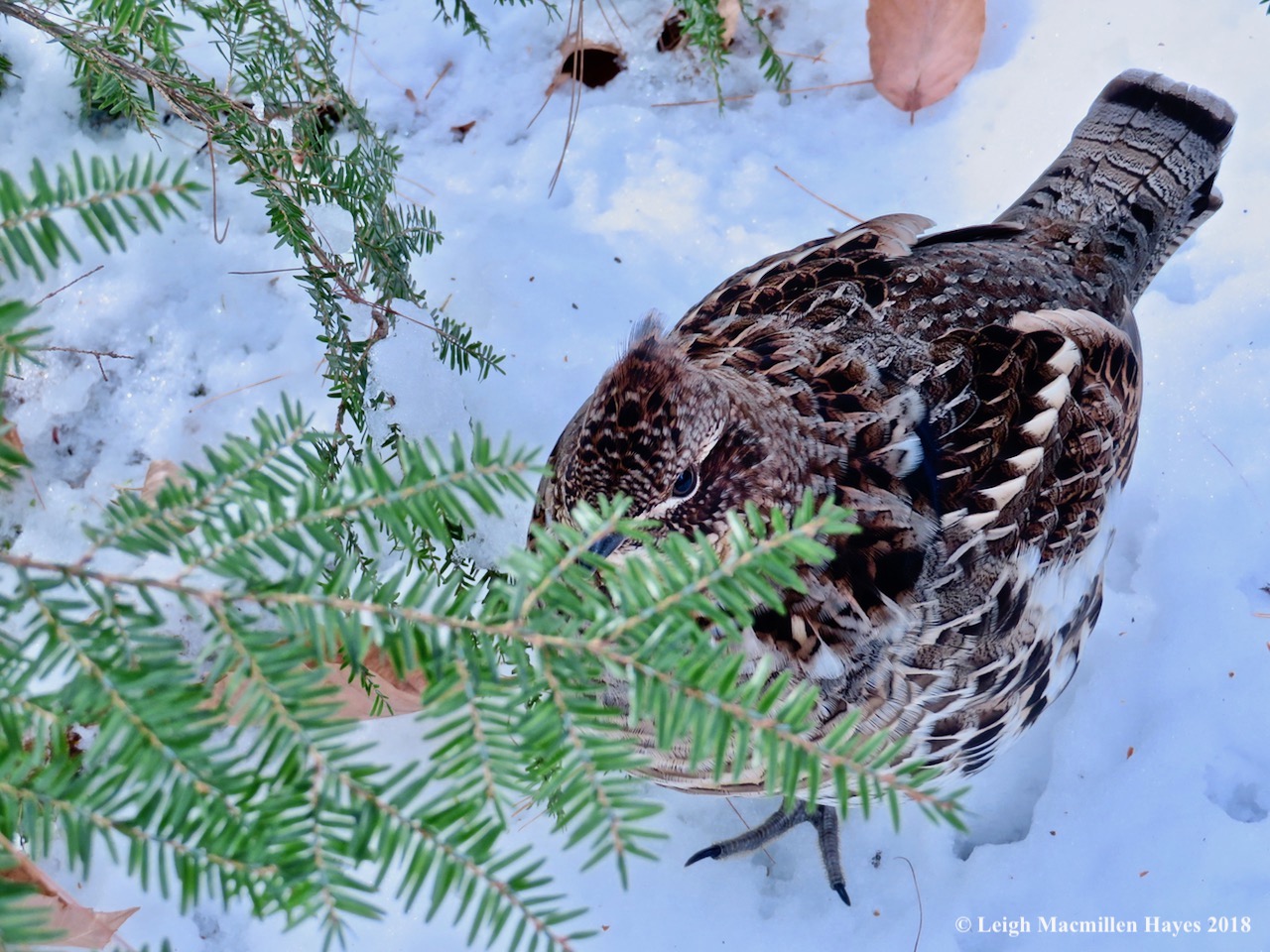
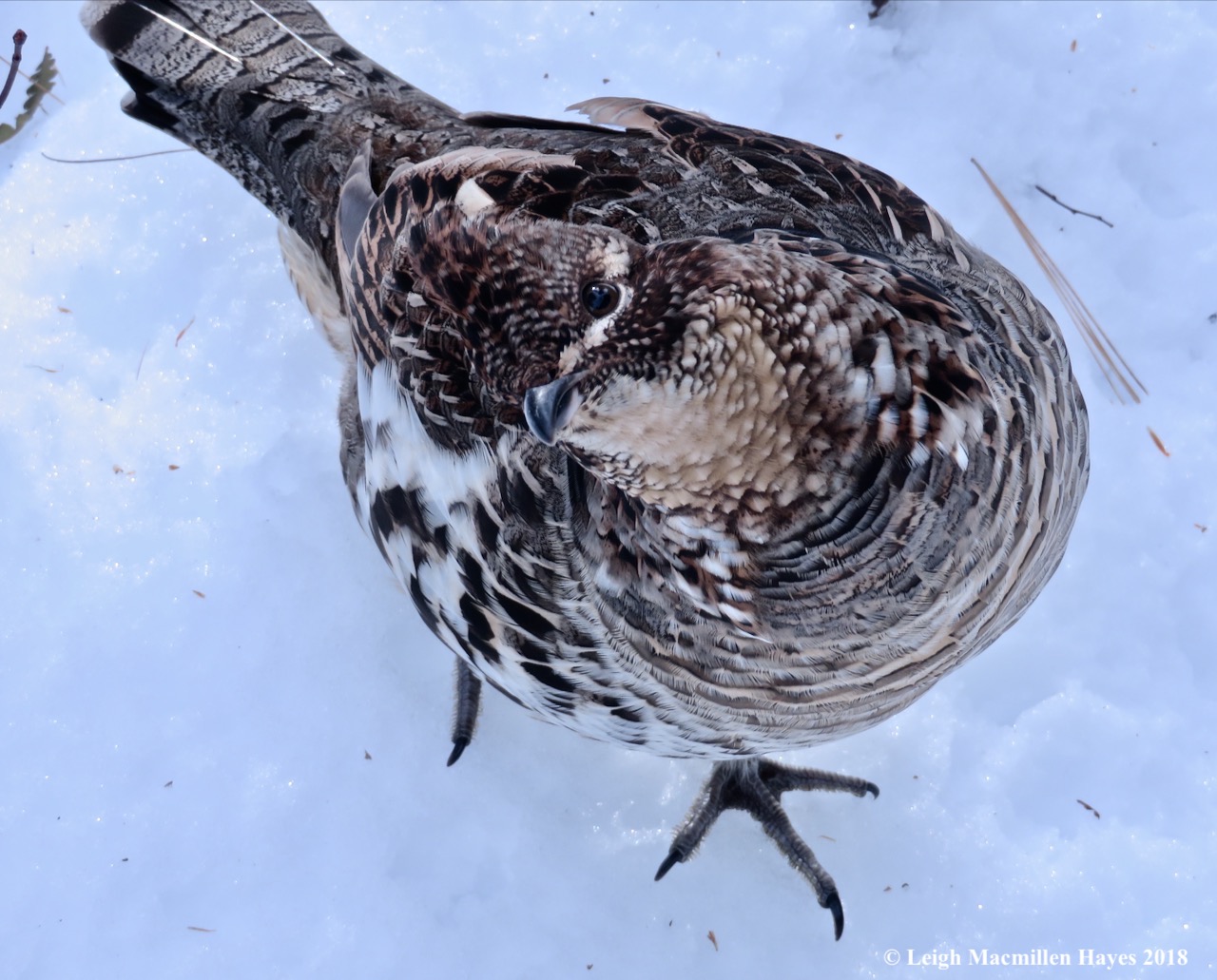
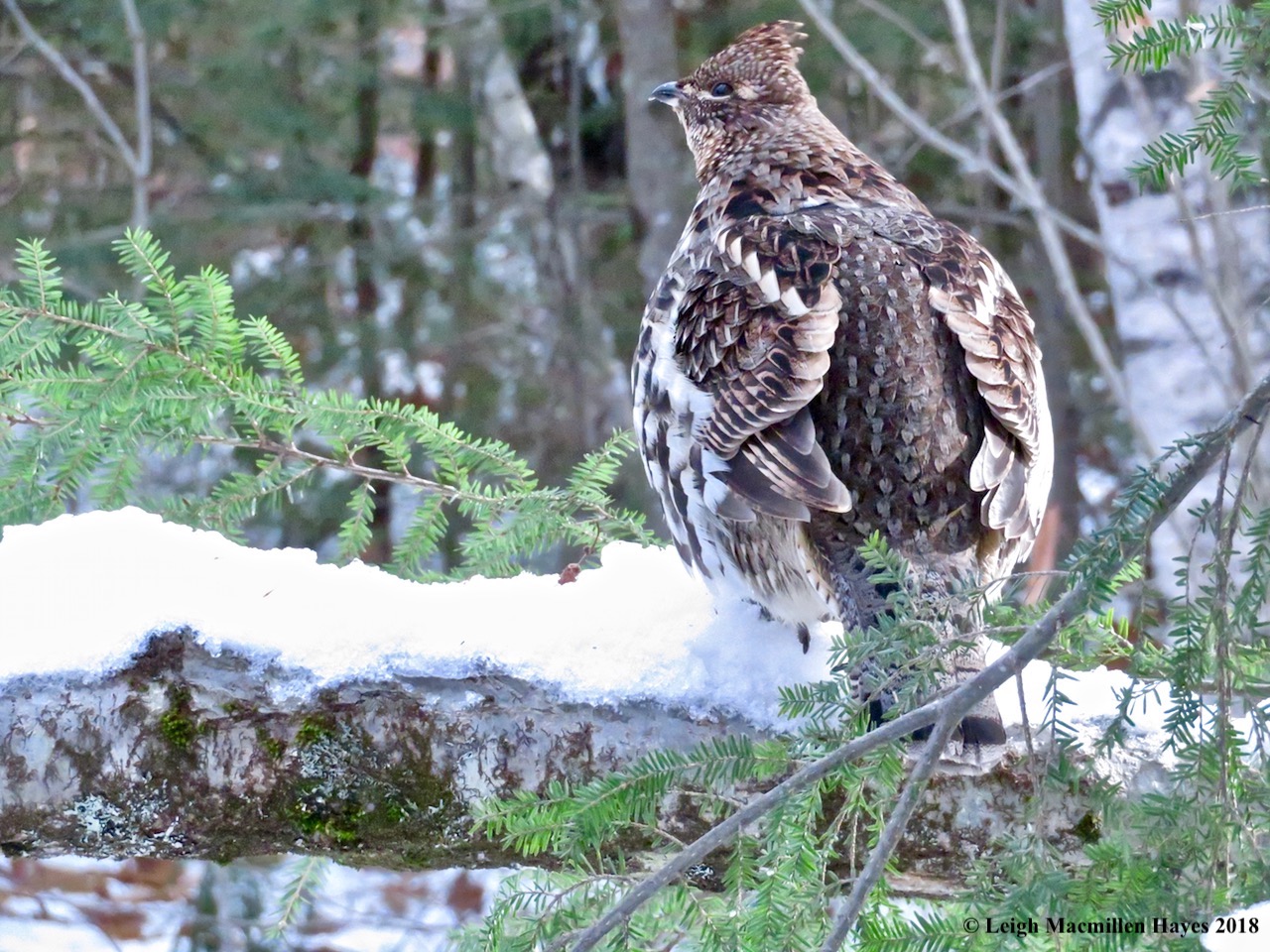
But what I discovered was that he’d stopped foraging, stood still, though occasionally turned his head, and puffed up his dappled and barred plumage. While I had donned several layers to keep the brisk air at bay, ArGee needed to fluff up in order to trap air in his feathers. Cool fact (or cold!): A bird’s body heat warms the air between its feathers and the more trapped air, the warmer the bird.

4-crown

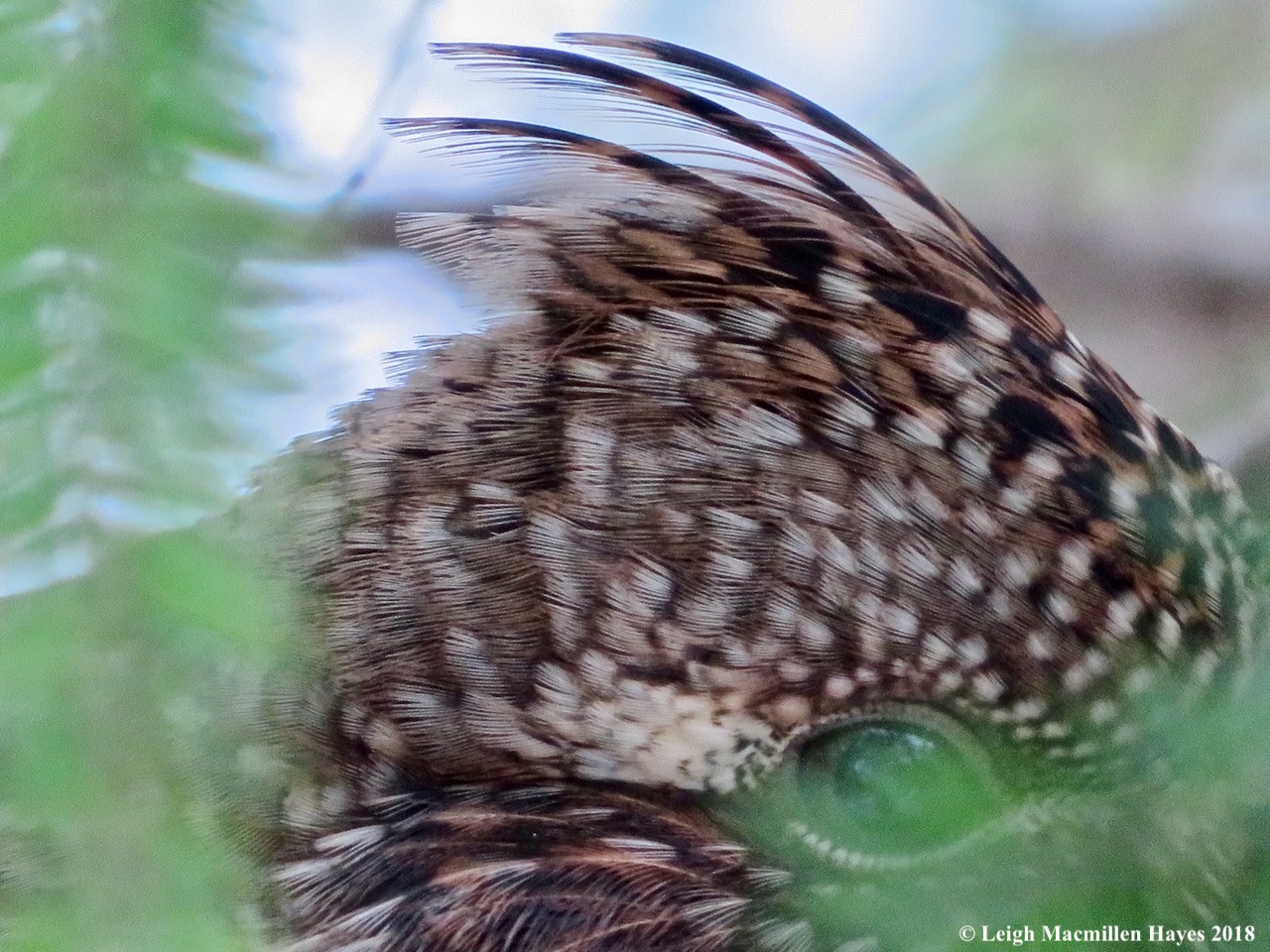
While ArGee warmed up, I focused on some of his features, including the crest feathers on top of his head. Their formation brought to mind ocean waves cresting, but perhaps they were actually standing upright because he saw me not as friend, but rather a foe?

5-eye to eye

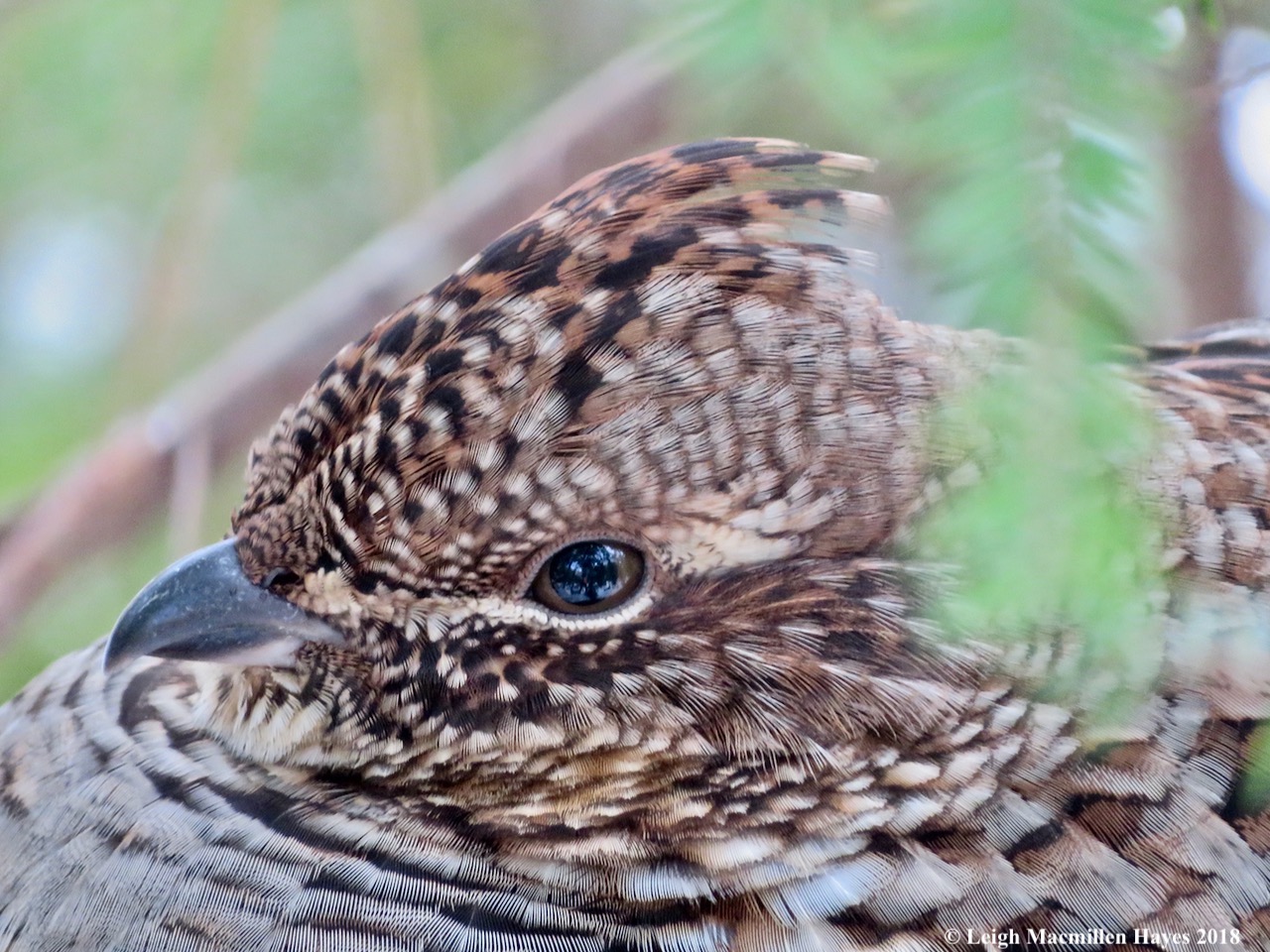
I knew I was overextending my stay, but I couldn’t leave. And he didn’t seem agitated, so I continued to look. There was that eye-ring to notice, rather bead-like in appearance.  And the contrasting orientation of the feathers above and below his dark eye, their comb-like tips spread out like miniature fans.

6-looking at me

For another fifteen to twenty minutes, he warmed up below the hemlock, while I stood nearby and watched, occasionally offering a quiet comment, which he considered with apparent nonchalance.

7-beak

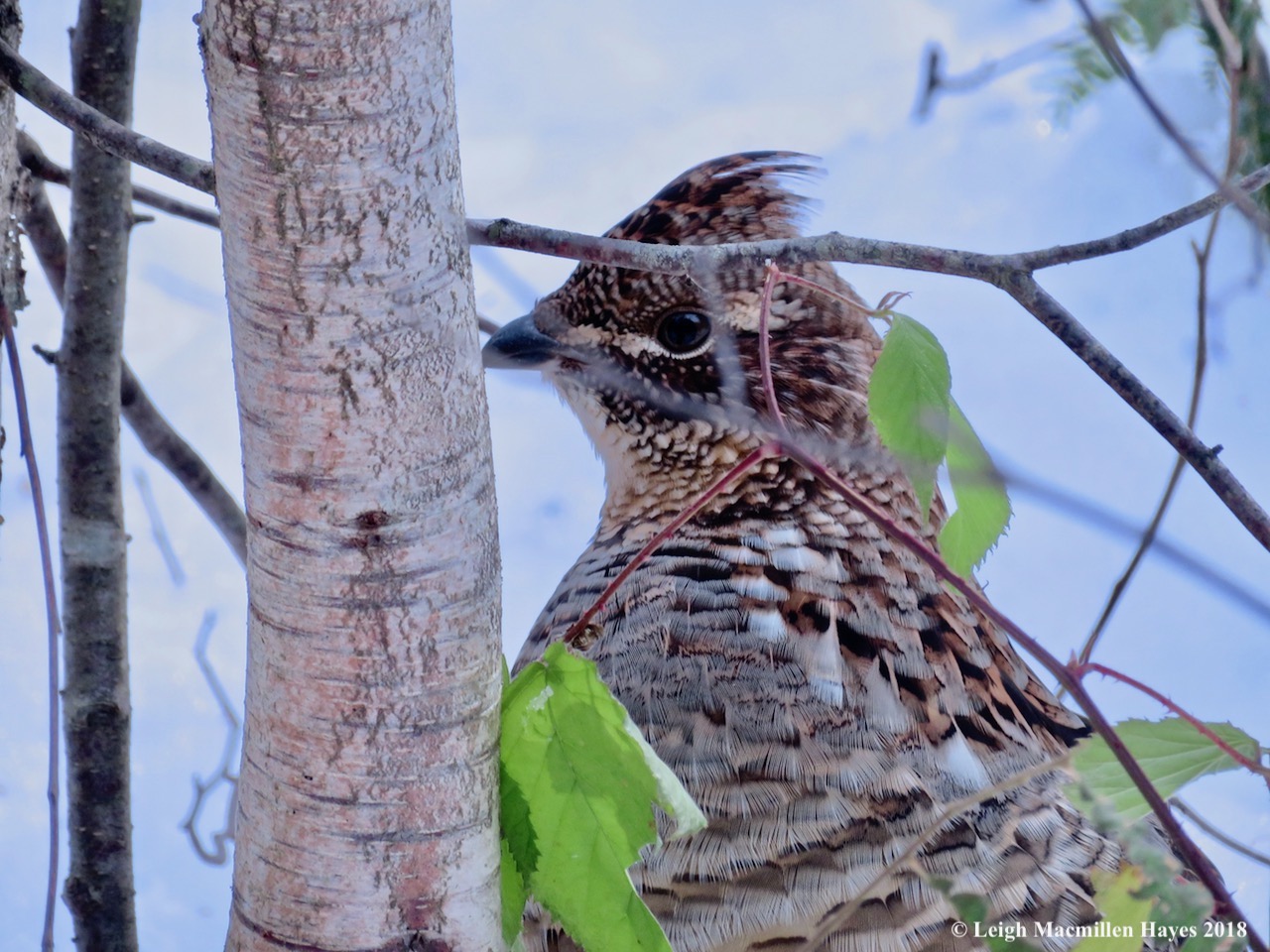
I had time to consider his robust down-turned beak and figured it must be adapted for the coarse vegetation it consumed. Ruffed Grouse are known to feed on buds or catkins of aspens, birches and cherries, and that was the habitat in which ArGee had made himself at home. They’ll also consume, seeds, fruits, leaves and twigs, insects, and maybe even salamanders, in season of course.

8-coming out of hiding

Finally, my friend seemed to have warmed up and so out from under the hemlock ArGee emerged.

9-dining on leaves

And immediately he found bramble leaves still green.

10-leaf in its mouth

Ripping one leaf off, he made quick work of it.

11-gobbling it up

And in a matter of seconds it disappeared into his mouth.

12-looking for more food

Then it was time to think about another.

12-those feet

Out in the open again, I had a chance to get a better look at ArGee’s feet. Though today’s snow was rather crusty, there’s potential for up to ten inches of fluff to fall tomorrow and then his feet will play a key role.

12a-combs on feet

Where the snow is deep and soft, grouse travel atop it with the help of their “snowshoes”—lateral extensions of their toes. Can you see the comb-like rows of bristles, aka pectinations? They began growing in September and reminded me of a centipede serving as each toe. It’s those bristles that act like snowshoes.

They also have stout legs for walking or running and those were also covered with insulating feathers that looked like an old pair of furry sweatpants.

12b-tail feathers

It’s difficult to tell a male from a female based on appearance, but typically the bird is a female if the color is faded or absent on the central tail feathers, thus I leaned toward ArGee being a male. No matter what the sex of this particular bird, the varied shades of black, gray, rusty red and buff all presented in a variety of patterns, including small hearts–what wasn’t to love?

13-I see you

For a while longer, ArGee and I played “I See You” and I continued to wonder about his behavior. Usually this species is quite elusive and difficult to approach. In fact, most often I am startled by the loud wing beat of a bird exploding, or so it sounds, from the ground or snow in front of me, and my heart responds with rapid beats for a second . . . and then I realize it was a Ruffed Grouse trying to avoid me.

13-so close

Today, and this past week, that has not been the case.

13b-are you looking at me?

ArGee has seemed as curious about me as I’ve been about him.

16-saying goodbye

Is he tame? Or has he been defending his territory? Perhaps it’s a hormone imbalance as the season changes, especially given that winter seems to have arrived early.

I’m not sure what’s going on, but I’m grateful for the time I have had to get to know this bird of the Maine woods a wee bit better. As has happened in the past, we parted ways at the same point, so I’ve a better understanding of his actual territory.

I’ve experienced grouse being aggressive when protecting their young in the spring, and wonder if at some point a close encounter with ArGee could switch dramatically from fascinating to hostile as he defends his territory.

Sometimes the critters with whom we share this natural world do things that make no sense, but then again, sometimes we do the same. For now, I have nothing to grouse about!

Childhood Magic

Why did the Greater Lovell Land Trust co-host (or rather tri-host) a hike through Pondicherry Park in Bridgton this morning? Because it’s hunting season, and it didn’t make sense to invite the public on a property that isn’t posted. (Not that we don’t still tramp on GLLT properties in November, mind you, but not on a public walk necessarily.)

And when I asked Jon Evans of Loon Echo Land Trust and Alanna Doughty of Lakes Environmental Association to join me in leading the tramp, they both quickly and graciously agreed to do so. I couldn’t wait because not only would it be a chance to share the special place with GLLT members, but also to bounce off of Jon and Alanna as we shared our knowledge of the natural and historical aspects of the park.

1-Bob Dunning Bridge

But . . . this morning dawned rainy and snowy. Still, we didn’t cancel. And though we knew that not everyone who had planned to join us could because there was more snow in the Lovell area and no power, we were pleasantly surprised to have a small contingent of participants that represented all three of our groups. And really, I love leading smaller groups because it’s so much easier for everyone to participate.

2-Jon giving the bridge history

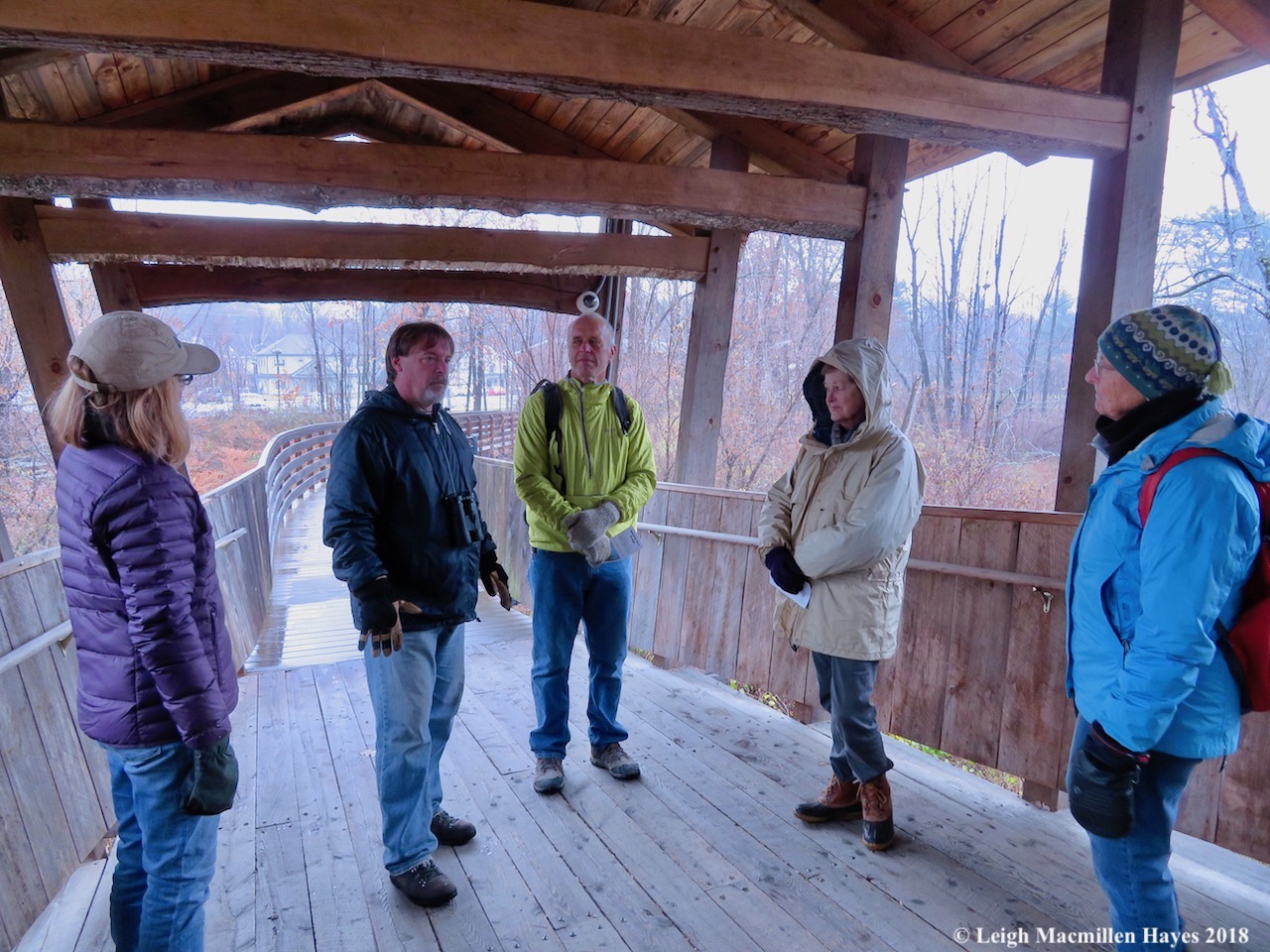
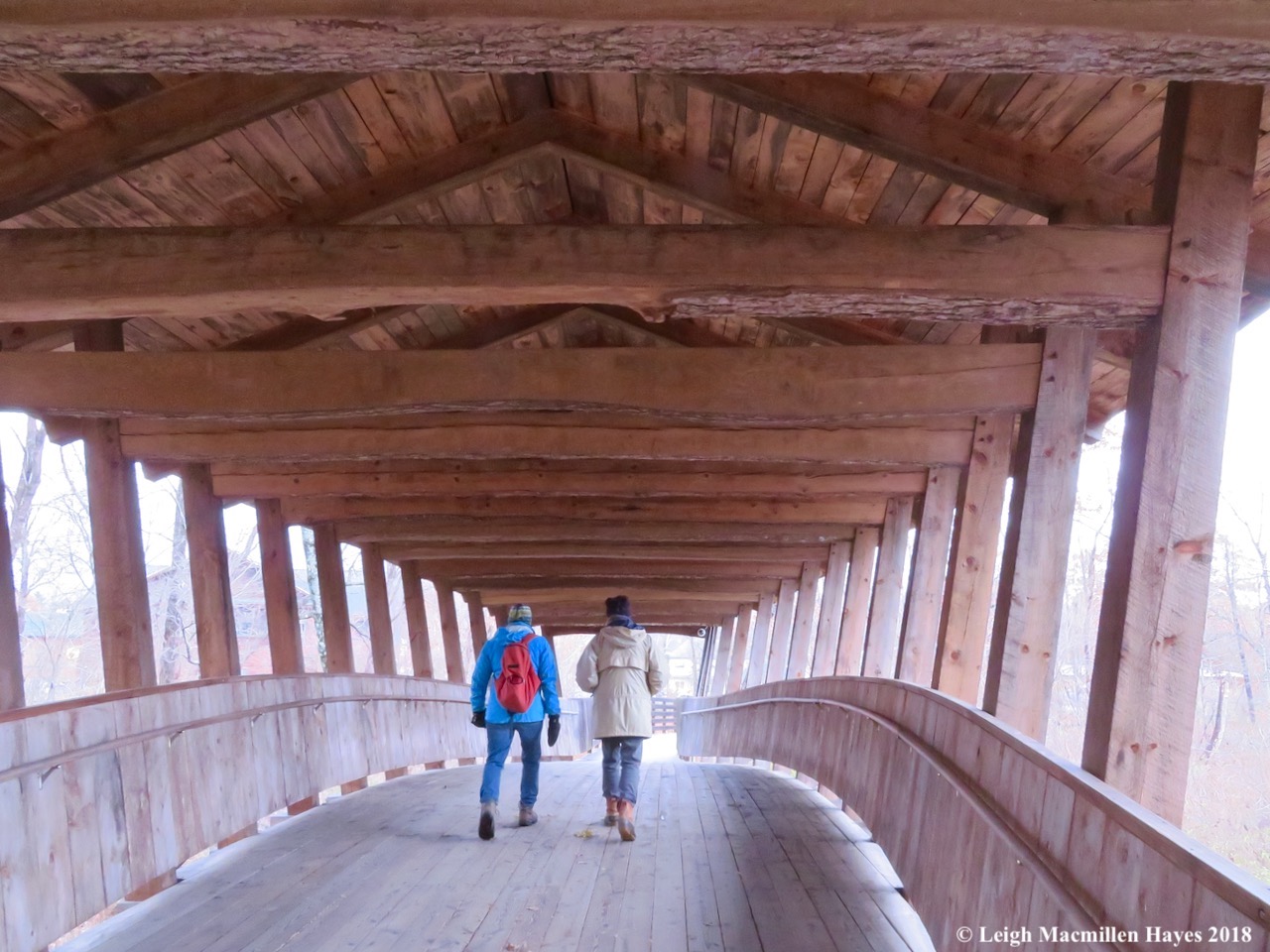
Our group, consisting of Pam, Jon, Bill, Connie and JoAnne, plus Alanna and me, stood for a bit on the Bob Dunning Memorial Bridge, the gateway into the park from behind Reny’s Department Store on Depot Street. As Jon explained, on September 11, 2010, the Bob Dunning Memorial Bridge was constructed in true barn-raising fashion.

3-Stevens Brook

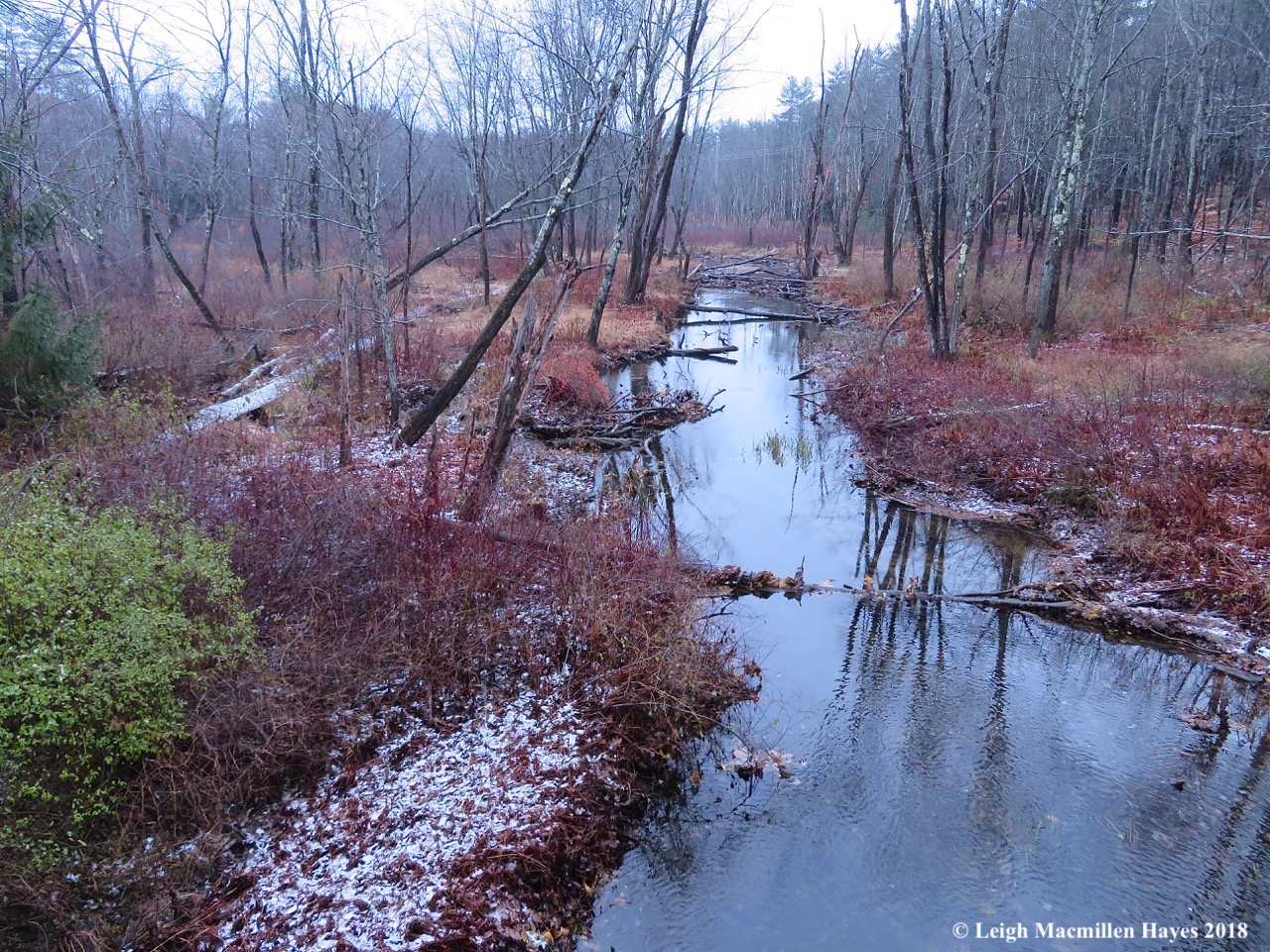
The bridge spans Stevens Brook, the source of power when Bridgton was first founded and for many years thereafter.

4-Bob Dunning Bridge

One of the unique things about the bridge is that each tie beam comes from a different tree species, with the bark left on. As I walk across the bridge, my eyes are always drawn to the beams.

Until I took the Maine Master Naturalist class, I recognized only a few species by their bark. But my eyes were opened to the fact that each species has its own presentation, which is true for everything in the natural world. I wanted to know all of them so I set out to teach myself, beginning with the species on the bridge. These became the focus of my capstone project for the class and from that I created a Barking Up A Bridge brochure that is available at the kiosk.

5-sugar and Norway maple leaves

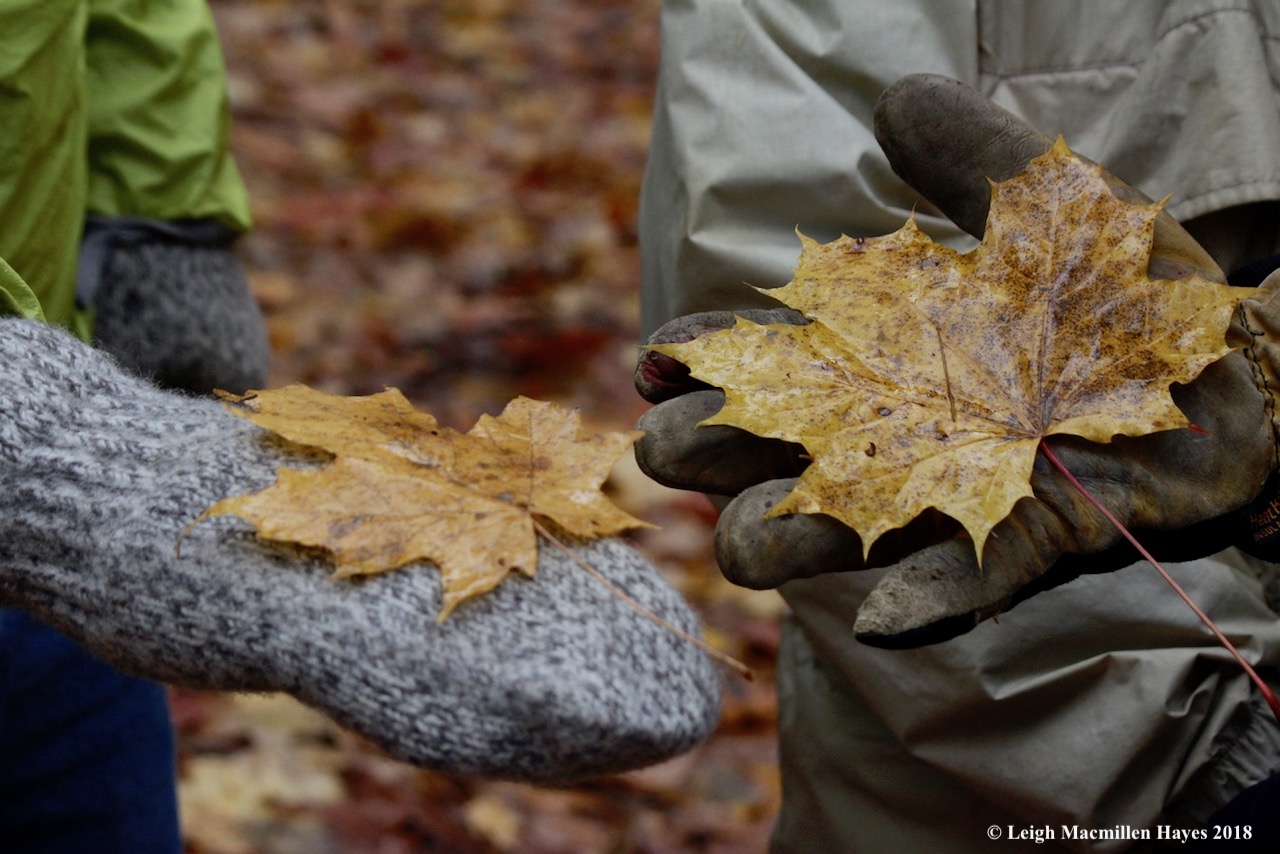
Into the park we finally went, stopping periodically along the way to notice and learn, including the similarities and differences between a sugar maple leaf on the left and Norway maple leaf on the right. Both have the same number of lobes (5) and look so similar, but . . .  the Norway maple leaf, an invasive planted along the main streets as a shade tree after the loss of Elms, is much boxier and more rectangular in shape. Plus, as Jon pointed out, the stem seeps a milky substance, which is a quick way to identify it.

6-pine soap

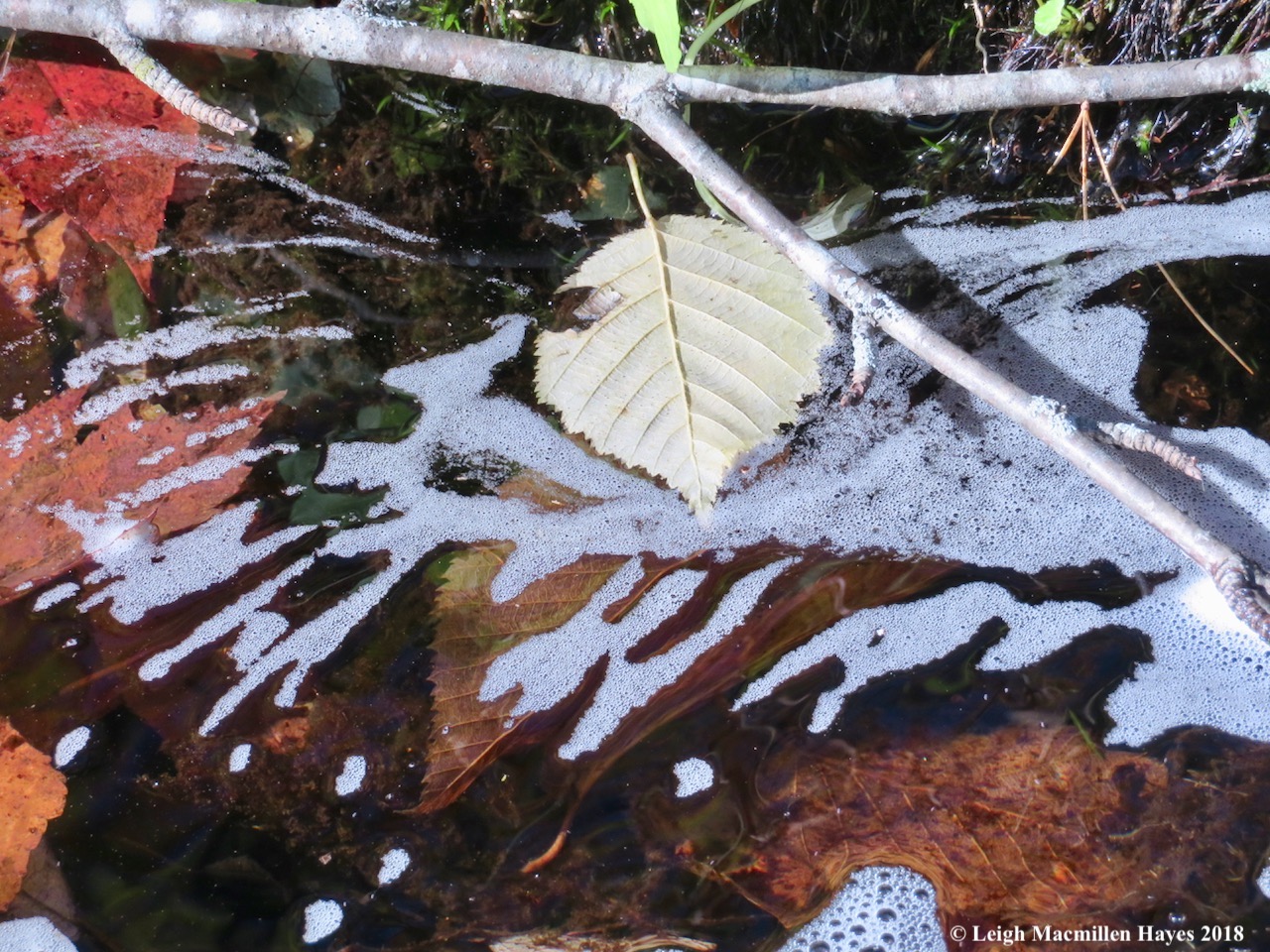
Our finds included many as we moved along at our usual slow pace, but one thing kept showing its form on pine after pine. Froth. It’s not unusual and occurs following a rain event such as we’d had all night and morning. So what causes the tree to froth? During a heavy rain, water running down the trunk of a white pine picks up the tree’s oils on the way. Air in the bark furrows bubbles through the oily film and produces the froth.

7-pine soap

Conditions were just right for it to occur so we spied frequent examples.

8-tussock moth cocoon

And because we were looking so closely at the bark, we noticed other things like tussock moth cocoons. We also found tube caterpillar moth cocoons created with pine needles and even pulled one apart to take a closer look. And the tiny sawfly cocoons on various twigs.

10-Willet Brook

Eventually, we found our way beside Willet Brook, which flows into Stevens.

11a-JoAnne photographing script lichen

And again, our eyes were drawn to tree bark and crustose lichen in particular. JoAnne snapped a photo of a script lichen that decorated a red oak.

13-crossing onto LEA property

Our intention was to turn away from the brook and cross the boardwalk that leads onto the Lakes Environmental Association’s adjacent property. Before doing so, however, we began to channel our inner child and rolled some logs.

12-baby red-backed salamander

And we weren’t disappointed for we found young and mature red-backed salamanders as hoped. If you roll a log, always pull it toward you so any critters that want to escape can do so in the opposite direction; and always put the log back into place quickly (well, after a couple of photographs, that is.)

14-Maine Lake Science Center Lab

At LEA’s Maine Lake Science Center, Alanna gave us a quick tour of the premises,

15-MLSC Lab

including the lab where various water quality tests are conducted.

16-Connie on the low-impact challenge course

Back outside, we headed up to LEA’s Pinehaven Trail and tried our talent as birds on a wire along the newly installed  low-impact challenge course.

17-Pam and Bill manuevering the wire walk

We all succeeded as Nuthatches for none of us fell off. If we’d done it with one hand, we  would have been Barred Owls and if we hadn’t used any hands, we would have been Cooper’s Hawks. But we were happy to be Nuthatches. There are four sets of challenges, each with a variety of activities to complete. Challenge your inner child.

18-watching balsam sticks

Crossing back into Pondicherry Park, we said we’d bee-line back to the bridge, but several times we just had to stop . . . especially when we found Balsam Fir blisters inviting us to poke them with twigs and drop the resin-tipped sticks into calm water.

19-balsam rainbow

We watched with fascination as the essential oil propelled the twig and created a rainbow, again satisfying that child within.

22-crossing back over the bridge

At last, a half hour after our intended finish time of 12:30pm, we found our way back to our starting point, all delighted to have spent time exploring and playing on a rather raw morning.

Thank you again to Jon and Alanna for sharing your knowledge and sense of wonder. And thank you to Pam, Bill, Connie, and JoAnne for coming out to play with us.

23-Chili and Beer

Later in the day, my guy and I drove to Lovell for yet another special event at the VFW Hall: LOVELL’S 1st ANNUAL BOWLS & BREWS fundraiser for the Sunshine Backpack Food Program.

It was a chili cook-off and beer tasting event featuring locally crafted chili and locally crafted beer from Bear Bones and Saco River Breweries. Plus, National Distributors in Portland donated Harpoon and New Belgium beers.

24-Paula and Diane

Diane Caracciolo nailed it and won first place from the judges and as the people’s choice. Her take away was a coveted apron, actually two, designed by local students who benefit from the Sunshine Backpack Food Program. As Paula Hughes, one of the event’s organizers explained, the packs are sent home on Fridays and filled with nutritious, non-perishable, easy-to-prepare food to ensure the kids get enough food on weekends.

At the end of the day, it seemed an interesting juxtaposition to have spent the morning channeling our inner child and the afternoon thinking about children who are so hungry that they can’t enjoy such childhood magic.

If you’d wish to contribute, let me know and I’ll put you in touch with Paula.

I Spy . . .

This afternoon’s goal: To find a Christmas Tree to decorate for the Christmas at Ladies Delight Walk on December 1st. For the reconnaissance mission, I joined the Coombs family at the GLLT’s Chip Stockford Reserve.

The Coombs children are homeschooled by their amazing mother, Juli, and though they learn many lessons at home, they are also well educated in the outdoors. In fact, they are among my favorite naturalists.

And they belong to a 4-H Homeschool group that will decorate a tree(s) with biodegradable ornaments prior to the December 1st walk.

1

And so we set off on our tour looking for just the right tree. But . . . as is always the case with this family, there was so much more to see.

2

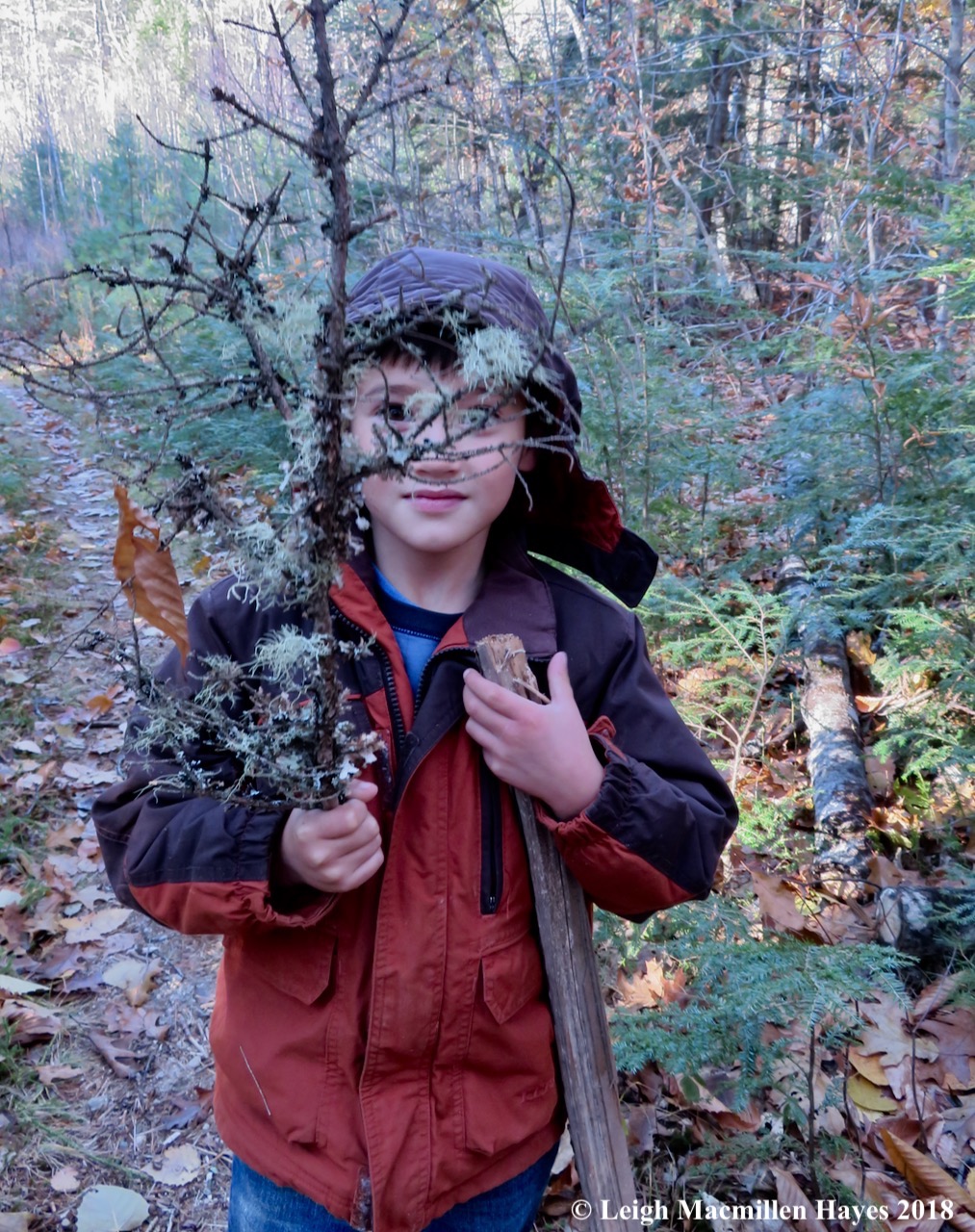
Since Juli is a Maine Master Naturalist Program student, so are her children. And every topic she studies, they study, so it was no surprise to me that six-year-old Wes picked up stick after stick loaded with various forms of lichens.

3

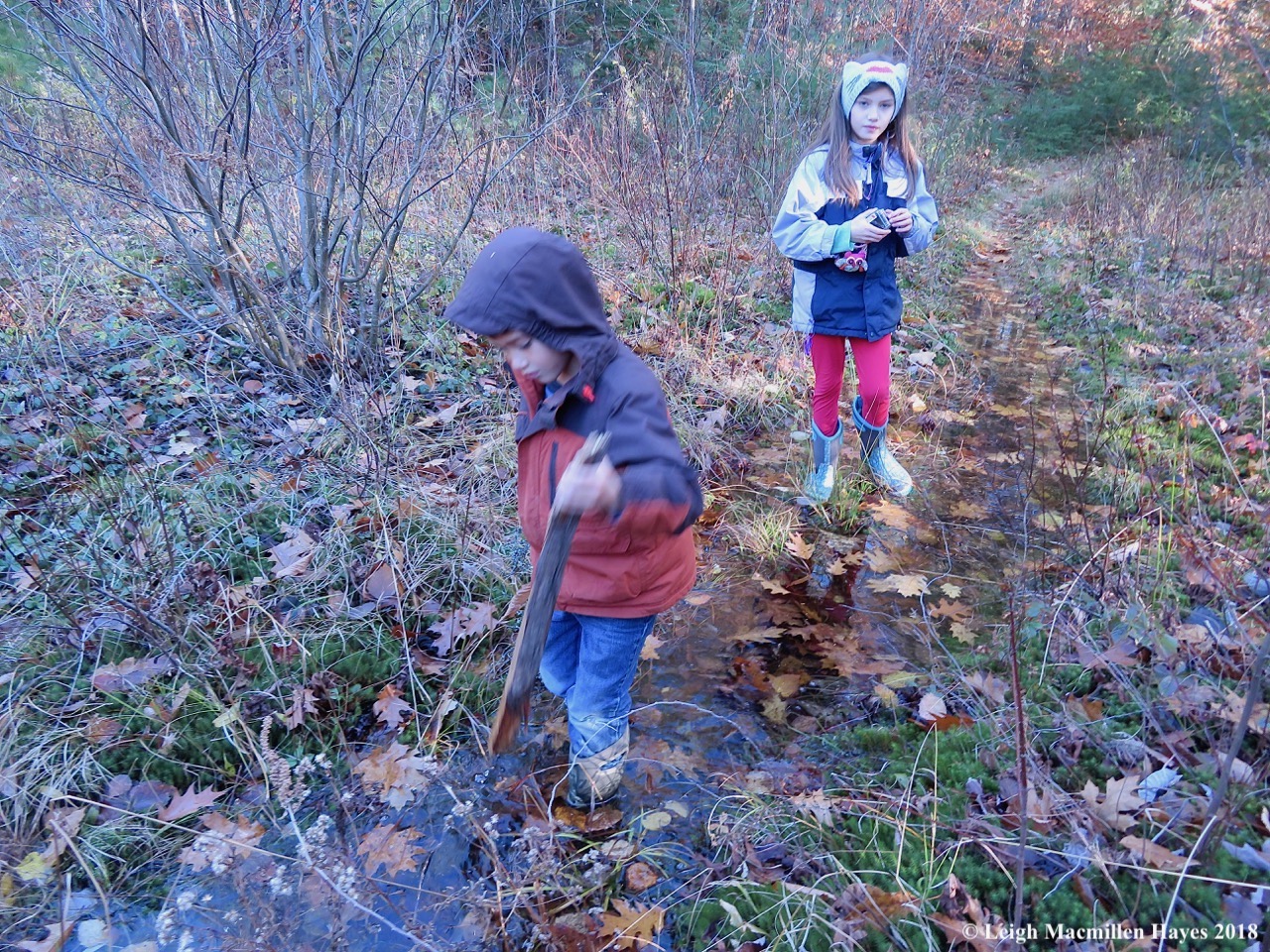
Of course, they are children, ranging in age from six to eleven, and puddles are invitations. The family motto is this: No puddle shall remain unsplashed.

4

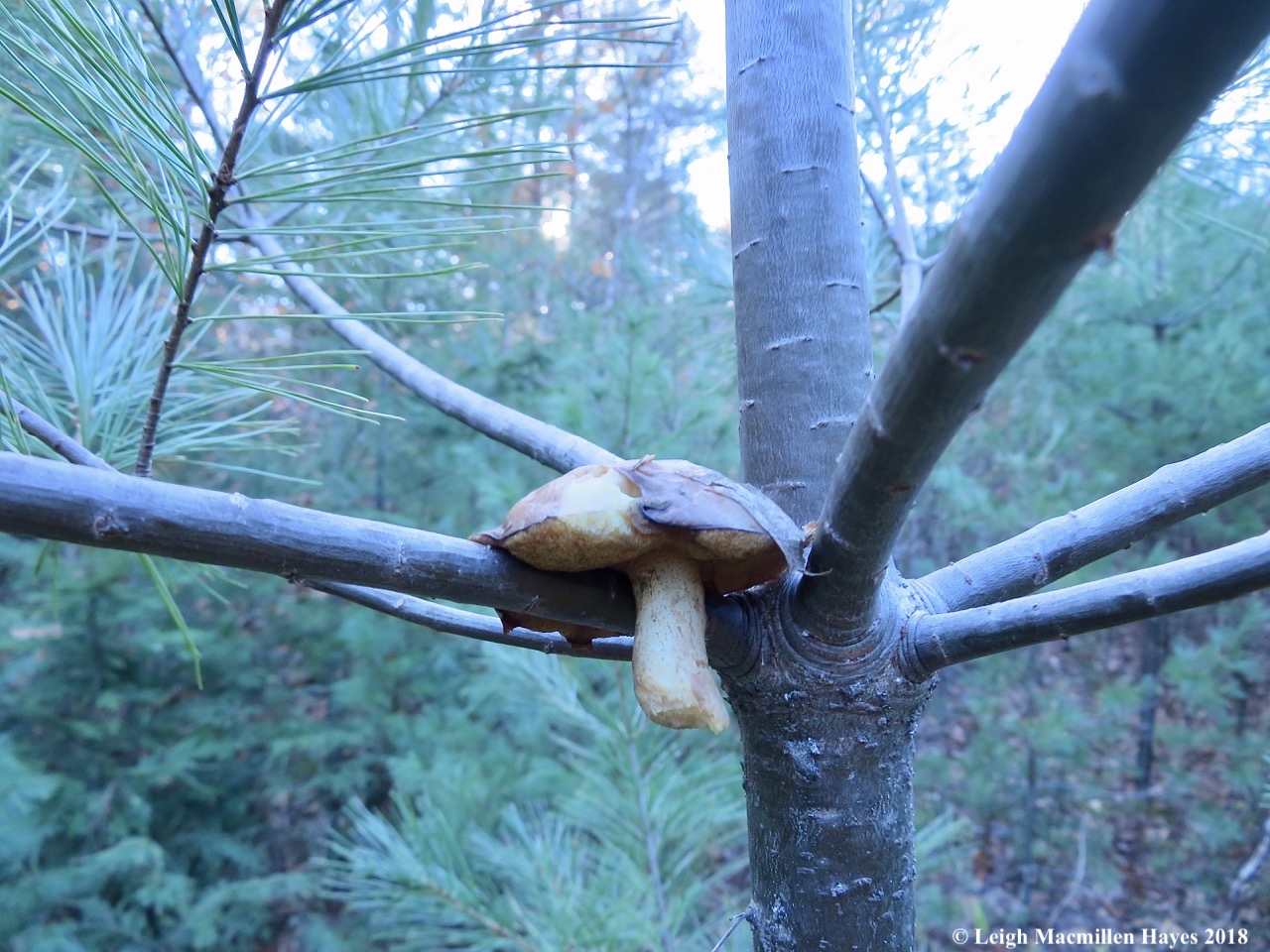
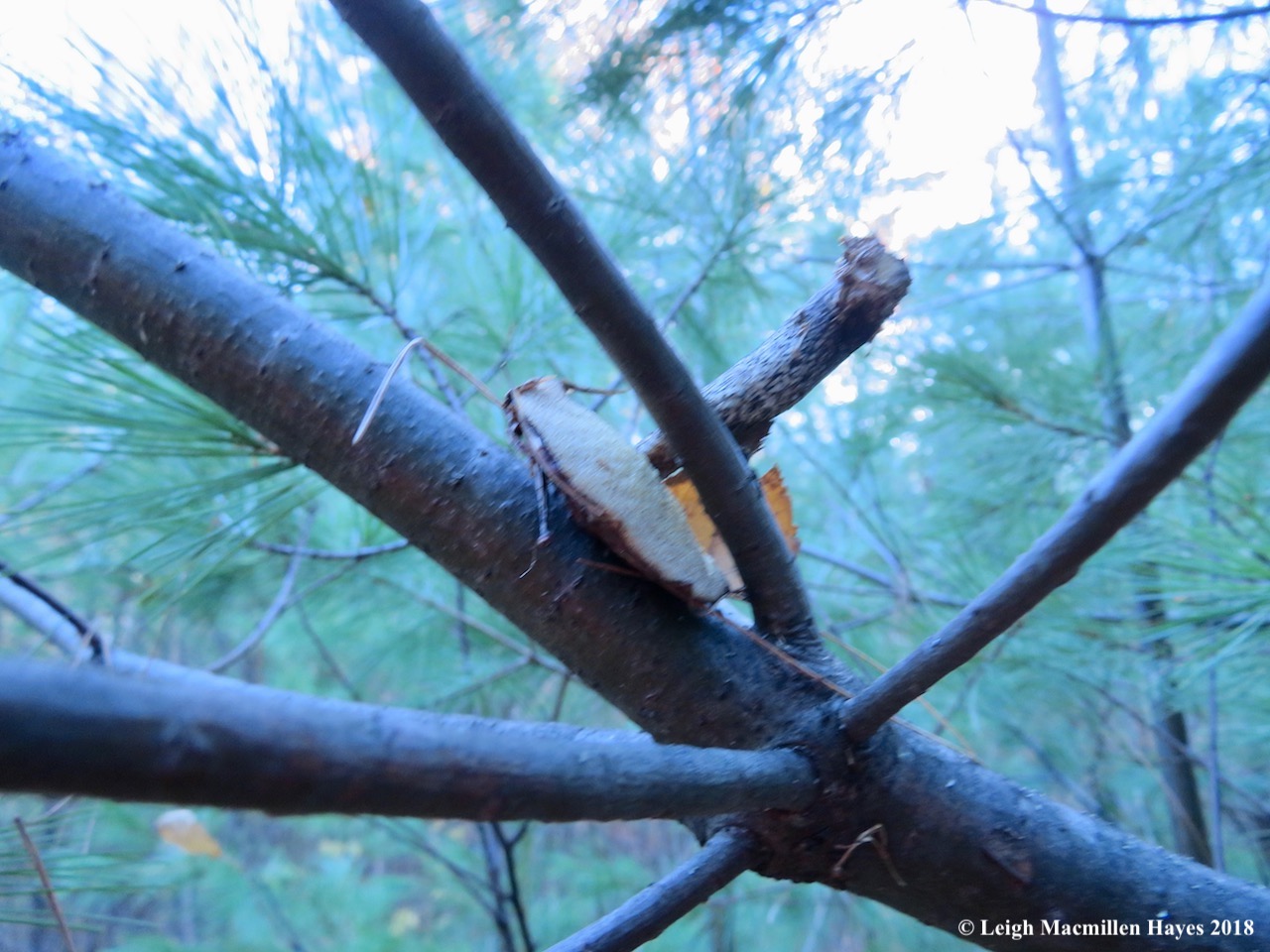
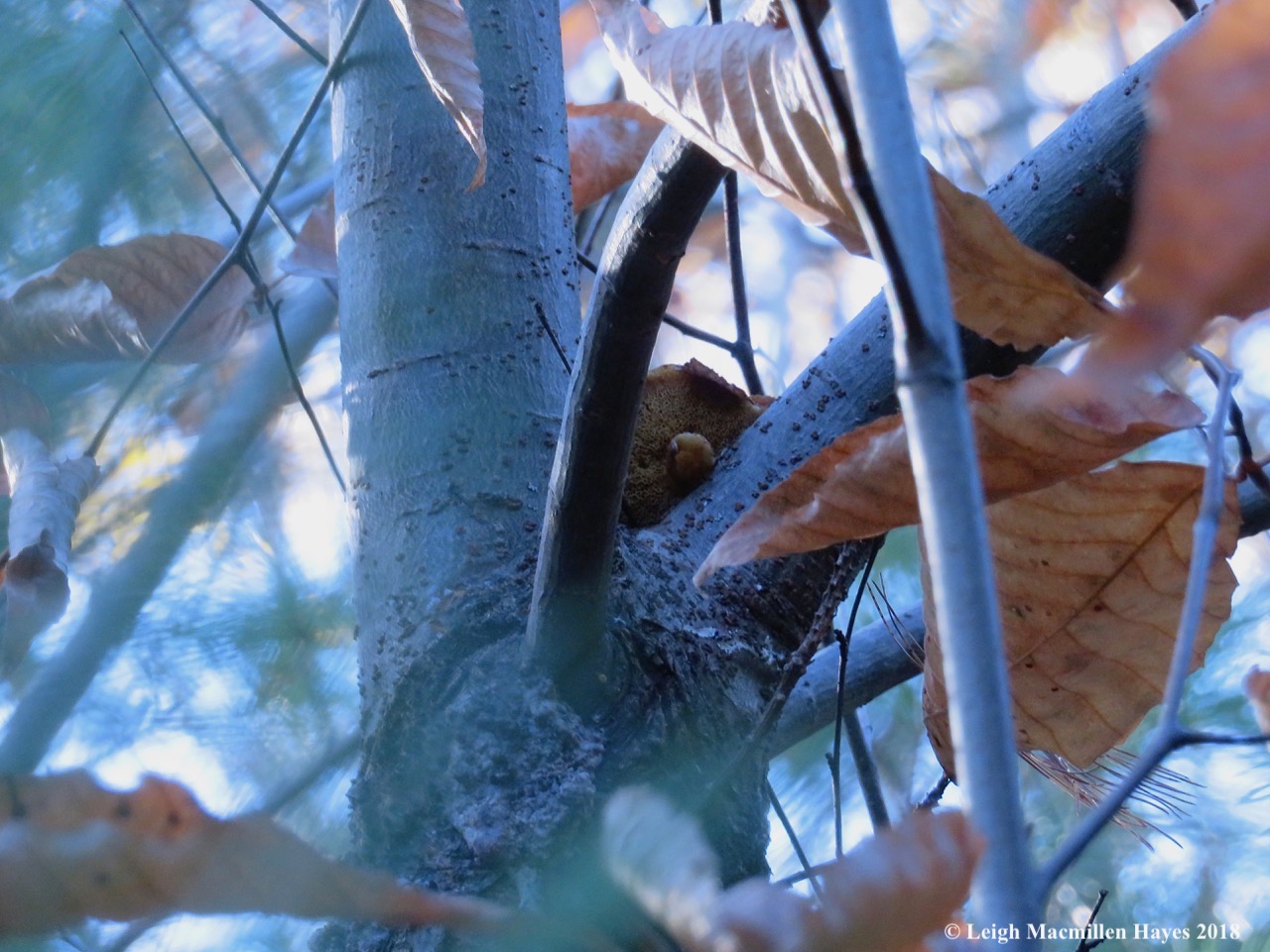
But just after the puddle, at the start of an old log landing, we began to notice something else. A mushroom drying on the whorl of a White Pine.

5

As we stood and looked at the first, someone among us spied a second.

6

And then a third, and so it went. We knew that squirrels dried mushrooms in this manner, but never had we seen so many. It dawned on us that we were standing in a squirrel’s pantry. One squirrel? Two squirrel? Gray Squirrel? Red Squirrel? One Fish, Two Fish, Red Fish, Blue Fish.

7

For a while we paused by an erratic boulder and looked at the lichens that grew atop it. The kids and their mom also checked the sand under and behind it and I told them that the only critter sign I’d ever noticed was that of a Ruffed Grouse sand bath–and I only recognized it as such because I’d startled the two birds and they startled me as they flew off. In fact, on another hike this morning at the GLLT’s Five Kezar Ponds Reserve, friend Teresa and I had startled a grouse and we talked about how the bird’s explosive behavior makes us feel as if we’ve encountered a moose.

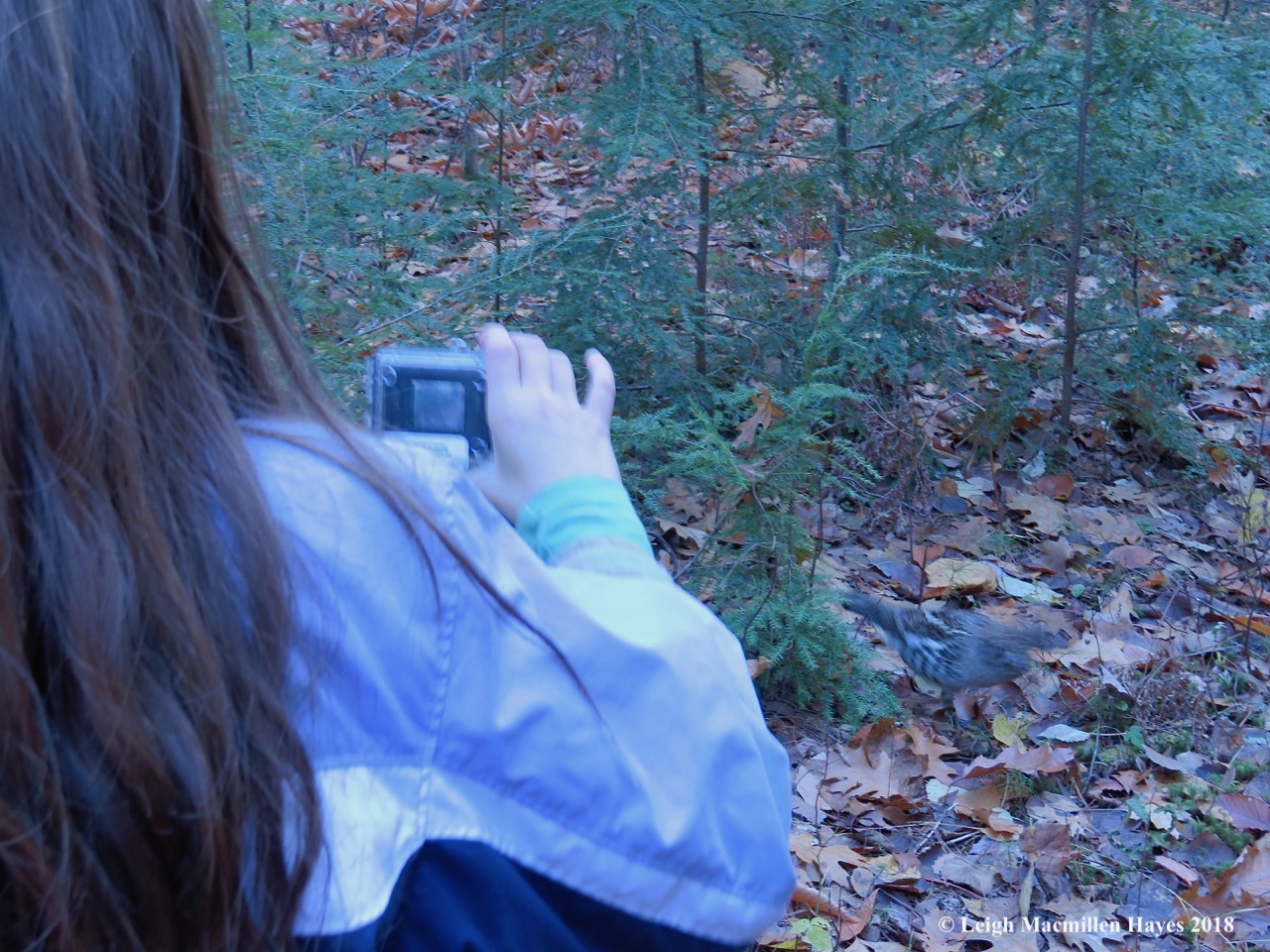
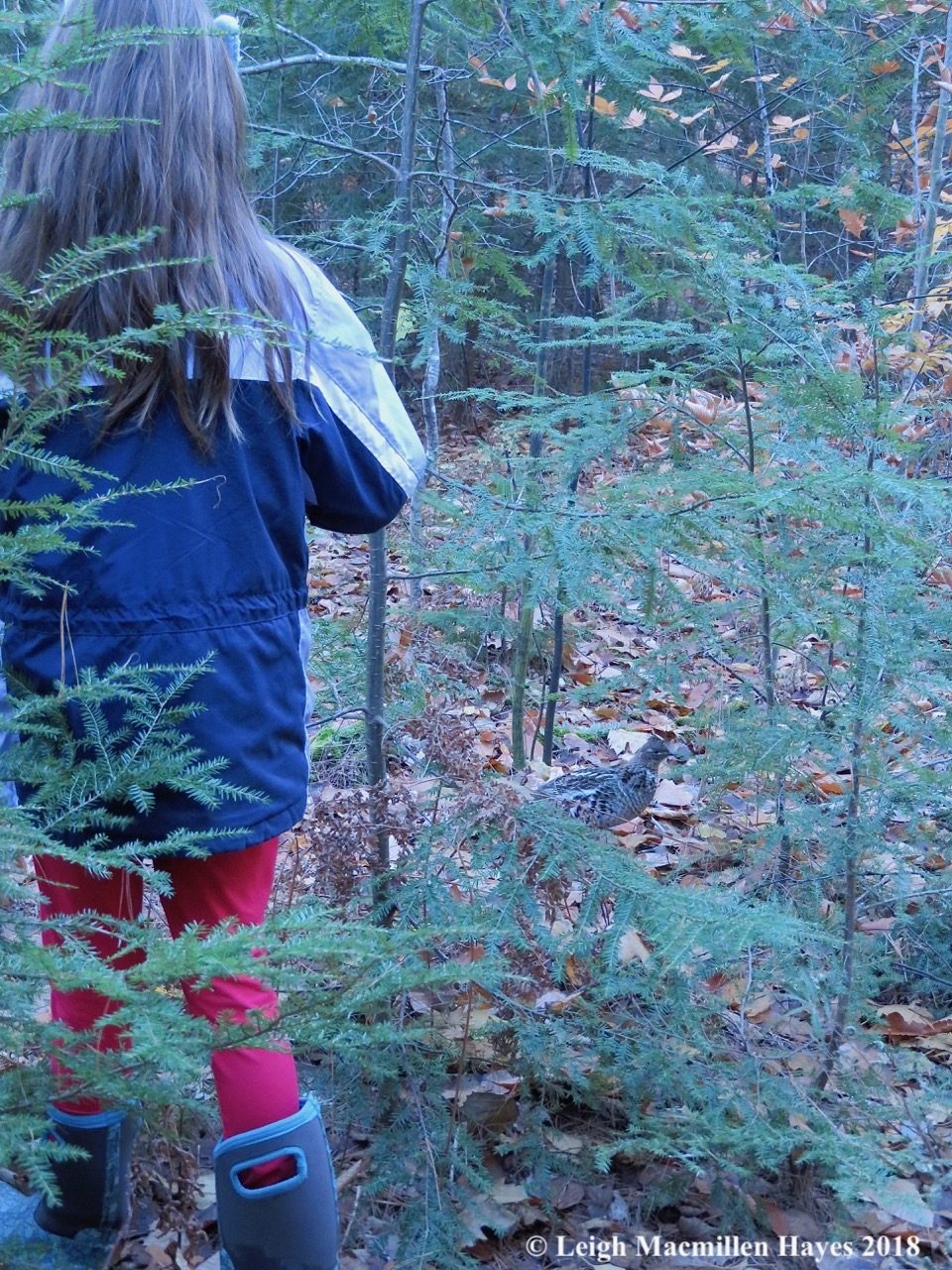
Well, just beyond the boulder, as we all chatted and moved about with quick motion, Caleb spotted something and told us to stop. A Ruffed Grouse!

8

It threw leaves about as it sorted through them in search of seeds and buds and we all watched in silence.

9

As we stood or sat still, the bird moved this way and that, making soft clucking sounds the entire time.

10

Ellie stood in front as the bird moved a few feet ahead of her and crossed the trail. I kept looking back at Juli in wonder. How could this be? Why wasn’t it disturbed by us? I’ve spotted Spruce Grouse in higher elevations and they are much “friendlier” or less wary of people, but I’d never been able to get up close to a Ruffed Grouse.

11

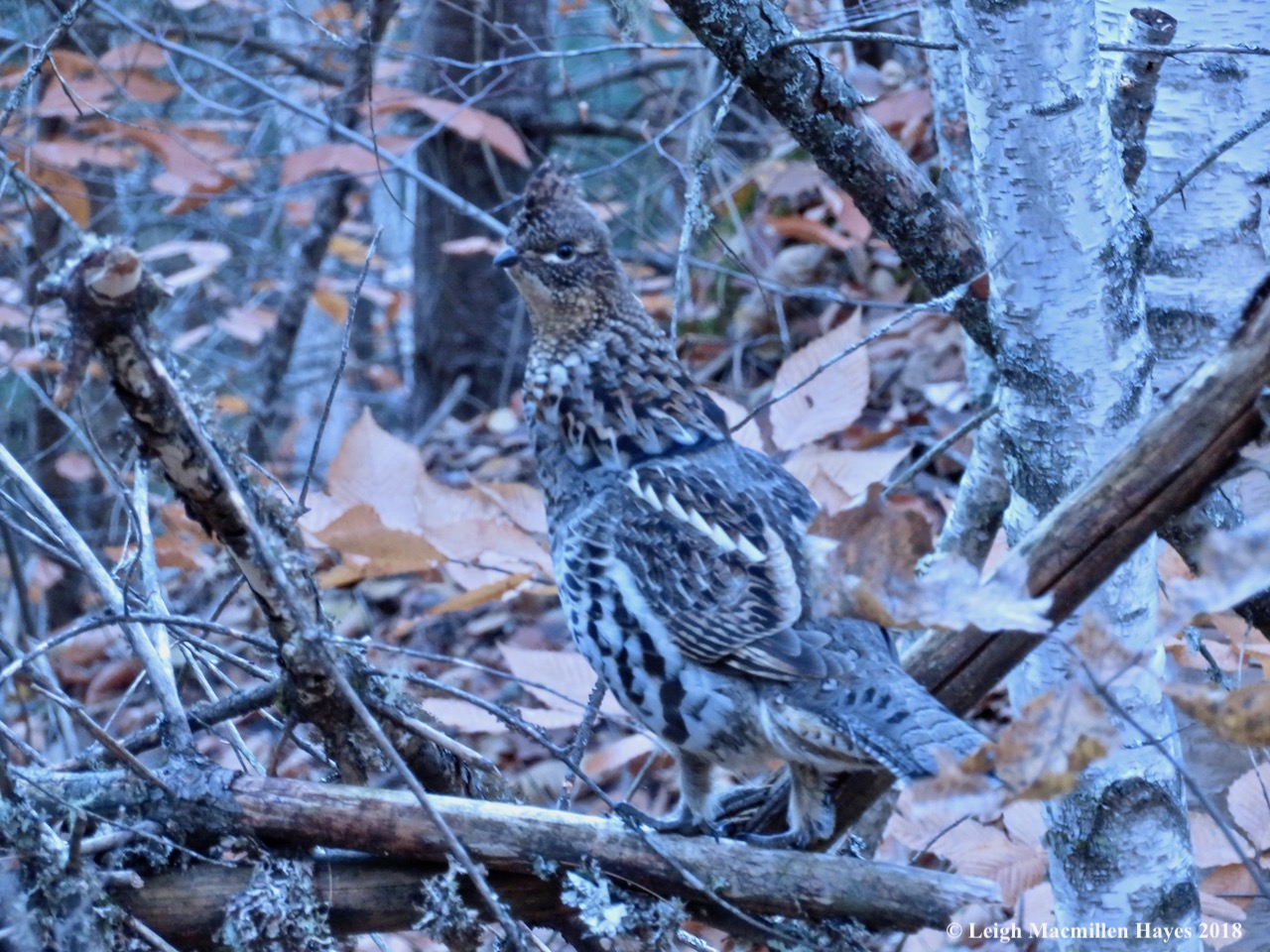
Our fascination continued and we noted its feathered legs, making us think perhaps it had pulled on some long johns for a cold winter night.

12

It eyed us and we eyed it back–our minds filled with awe.

13

Think about this: four children and two adults and we were starting to get fidgety because we’d been still for fifteen or more minutes and we had begun to whisper our questions and still . . . it let us watch.

14

And it let Ellie be the Grouse Whisperer for she began to follow it off the trail. Eventually, it climbed up a fallen tree and she knelt down beside, taking photos as it stood less than a foot from her. How cool is that?

15

We were all wowed by the experience, but when Ellie finally turned back, we continued on . . . sometimes running and other times pausing to ride imaginary horses.

16

Or listen to Birch Polypores! Yes, Juli did listen for it’s part of an assignment for the Maine Master Naturalist class. So what exactly does a Birch Polypore sound like? “I couldn’t hear the ocean,” she said with a smile.

17

And what does it smell like? “Wood.”

18

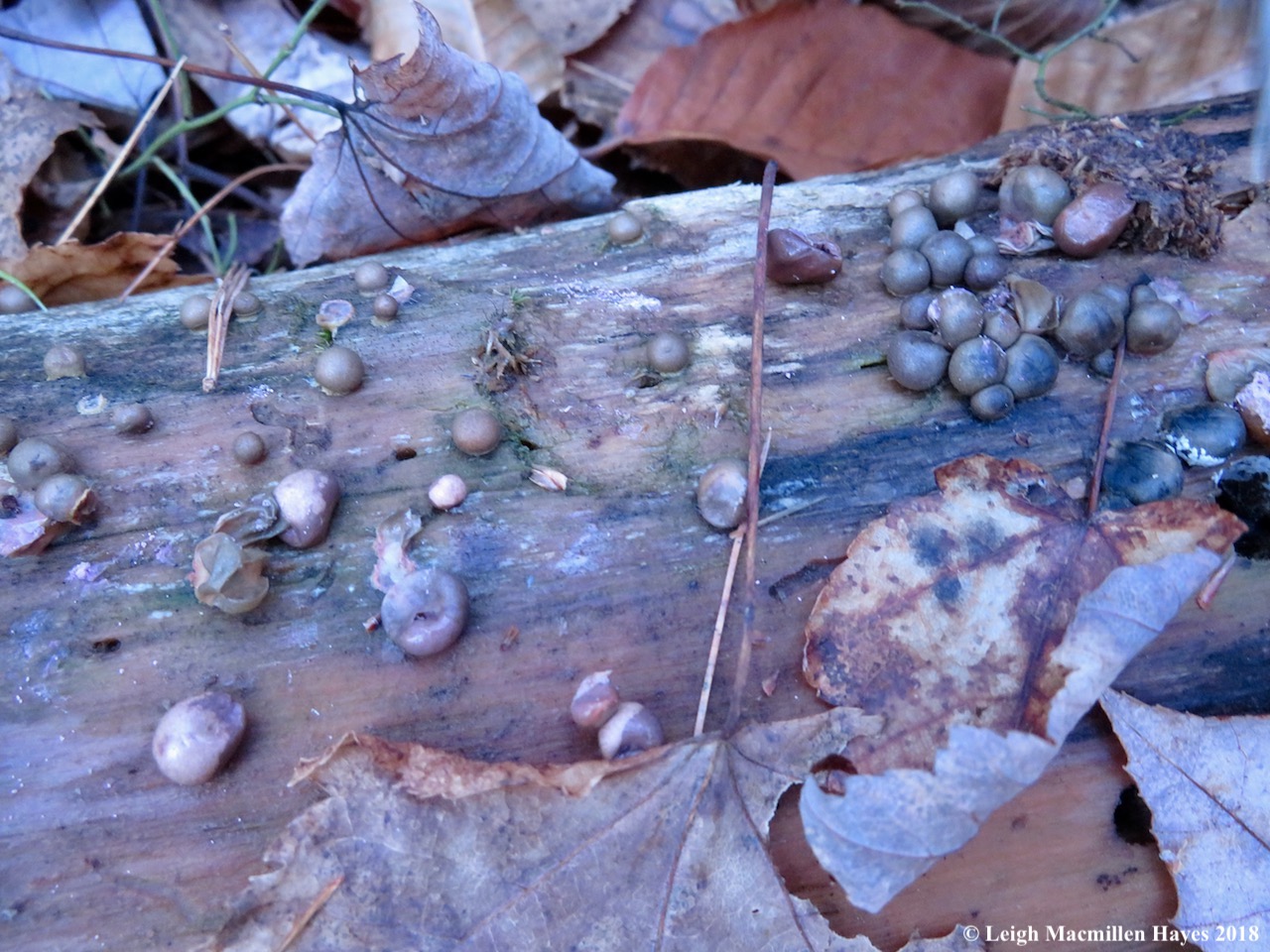
The next moment of glee–poking Wolf’s Milk Slime Mold and watching it ooze.

19

“It’s cool and gross at the same time,” said Ellie.

20

Onward and again, more fungi drying in trees as Aidan pointed out.

22

We even found a few stuck on spiky spruces much like ornaments might be and we reminded ourselves that we were on a mission and still hadn’t found the right tree to decorate.

23

At last, however, we did. And then we made our way out to the spur and recently opened view of Kezar Lake’s Lower Bay and Cranberry Fen, plus the mountains.

24

This became our turn-around point as it was getting cooler by the minute and the sun was setting. We promised Wes we’d look only at our feet as we followed the loop trail down, though occasionally we stopped again to admire more fungi tucked onto tree branches and a set of trees that formed a rainbow arched over the trail.

As for the fungi, we wondered if we were seeing so many because last year’s mast crop of pinecones, beech nuts, and acorns didn’t exist this year. And when the 4-H club returns in a couple of weeks to decorate the tree, will the mushrooms still be there? Will there be more? How long do the squirrels wait before consuming them? So many questions and so many lessons still to be learned.

25

And so many things to spy. We were honored with the opportunity to do just that and my heart smiled with the knowledge that the kids appreciated it as much as their mom and I did.

I spy . . . we spied . . . INDEED!

Oh, and  please join the GLLT for Christmas at Ladies Delight. I have the inside word that there will be hot cocoa and cookies somewhere along the trail.

December 1, 9:30 – noon
Christmas at Ladies Delight: The Maine Christmas Tree Hunt is a fun holiday scavenger
hunt to find decorated trees in western Maine. We’ll search for the decorated tree along the Bill Sayles Loop at the Chip Stockford Reserve and may add a few of our own biodegradable ornaments along the way. Location: Chip Stockford Reserve, Ladies Delight Road, Lovell.
Degree of Difficulty: Easy.

Election Day Tramp

It always strikes me that no matter how often one travels on or off a trail, there’s always something different that makes itself known–thus the wonder of a wander.

And so it was when Pam Marshall, a member of the Greater Lovell Land Trust, joined me for a tramp at the John A. Segur Wildlife Refuge West on Farrington Pond Road this morning. She had no idea what to expect. Nor did I.

13-puff balls to pop

It was misty when we met, but neither of us was daunted by the weather. Ever so slowly, we made our way over the wet leaves, roots, and rocks, pausing frequently–especially each time we saw puff balls. How can one resist poking or squeezing them to watch the spores waft out like smoke. The skin of mature puffballs split prior to releasing spores. And we . . . we helped the process a wee bit.

20-blue stain fruiting

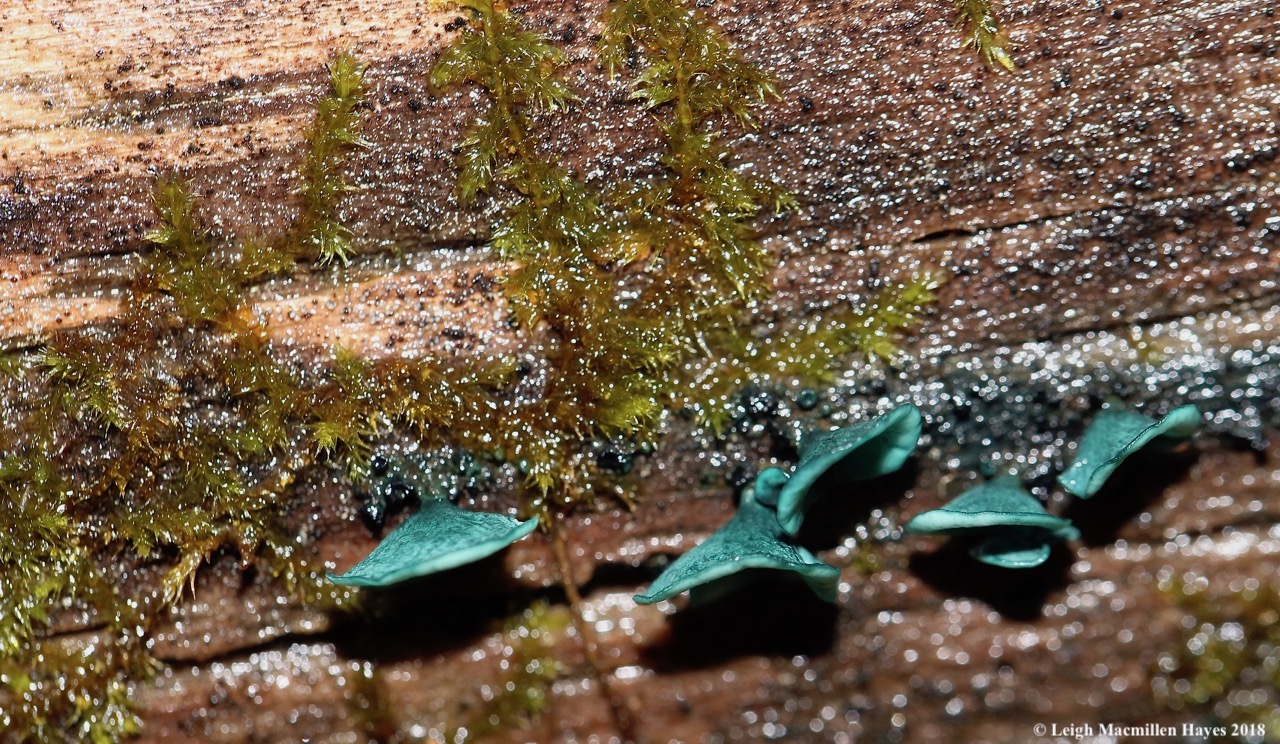
Green stain fungus also drew our attention. Its fruiting bodies were minute, but well worth wet knees for a closer examination.

19-hexagonal-pored polypore

With Pam in the lead for most of the way, she kept finding cool stuff, like this hexagonal-pored polypore.

1-Sucker Brook Outlet

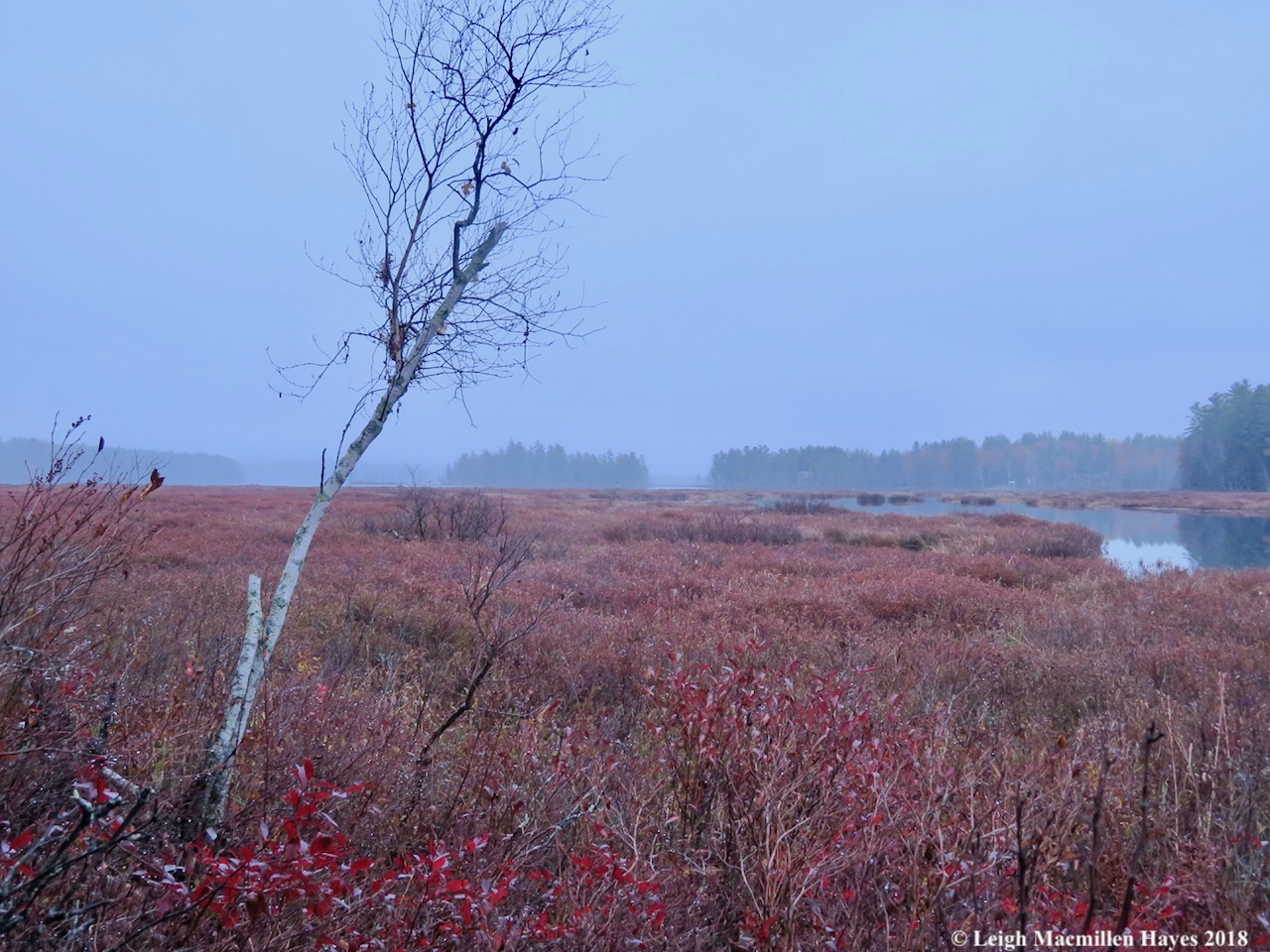
It took us a while, but we finally reached the wetland by the Sucker Brook Outlet where blueberry, maleberry and leatherleaf shrubs added color to the otherwise gray day.  For a while we stood under the protection of a large hemlock and took in the scene in silence.

2-Silhouettes on Lower Bay and cotton grass

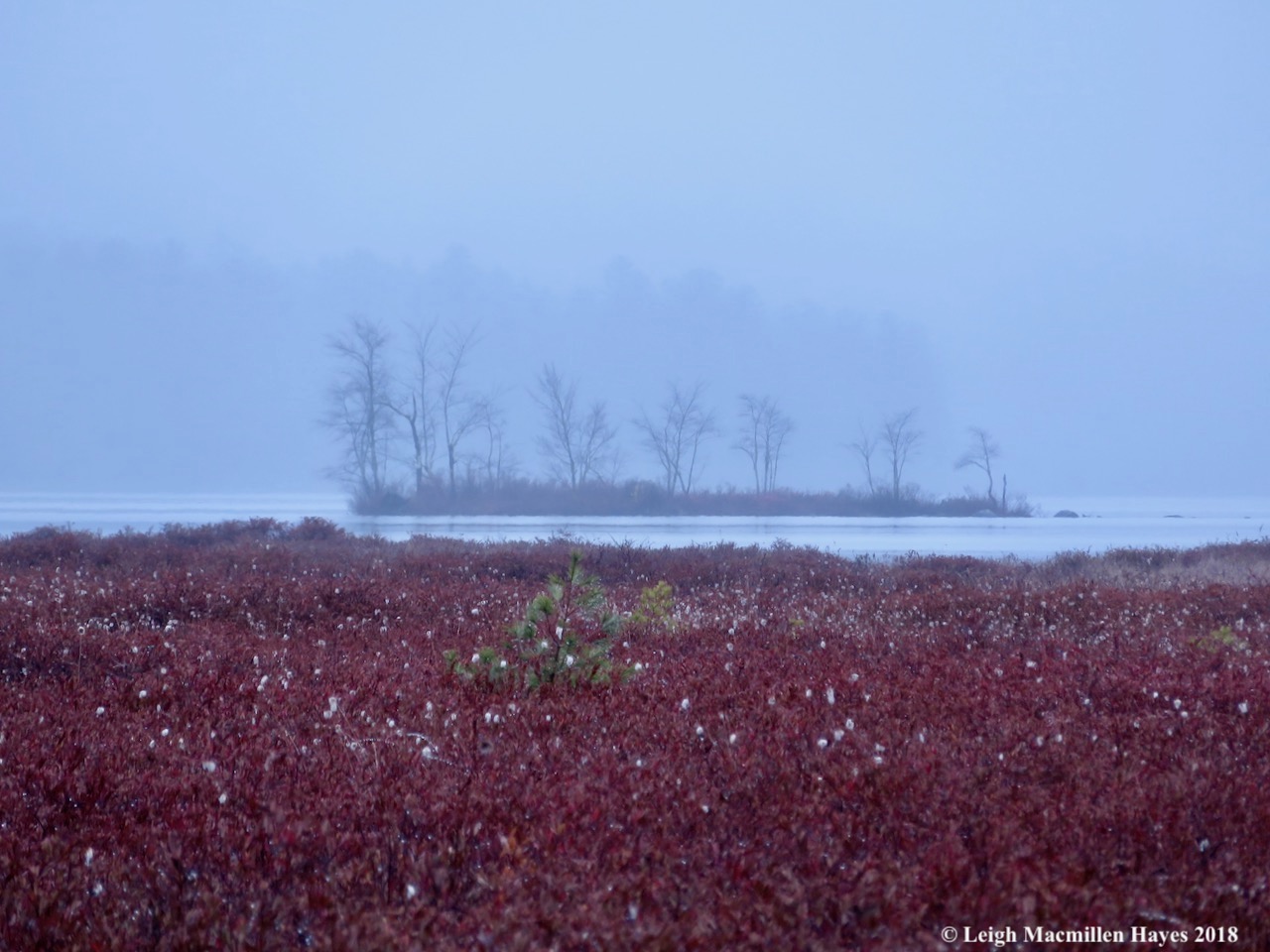
From our vantage point, an island in Kezar Lake’s Lower Bay looked like a ghost ship. And in the foreground, cotton grass still touted its tufted heads.

3-beaver lodges

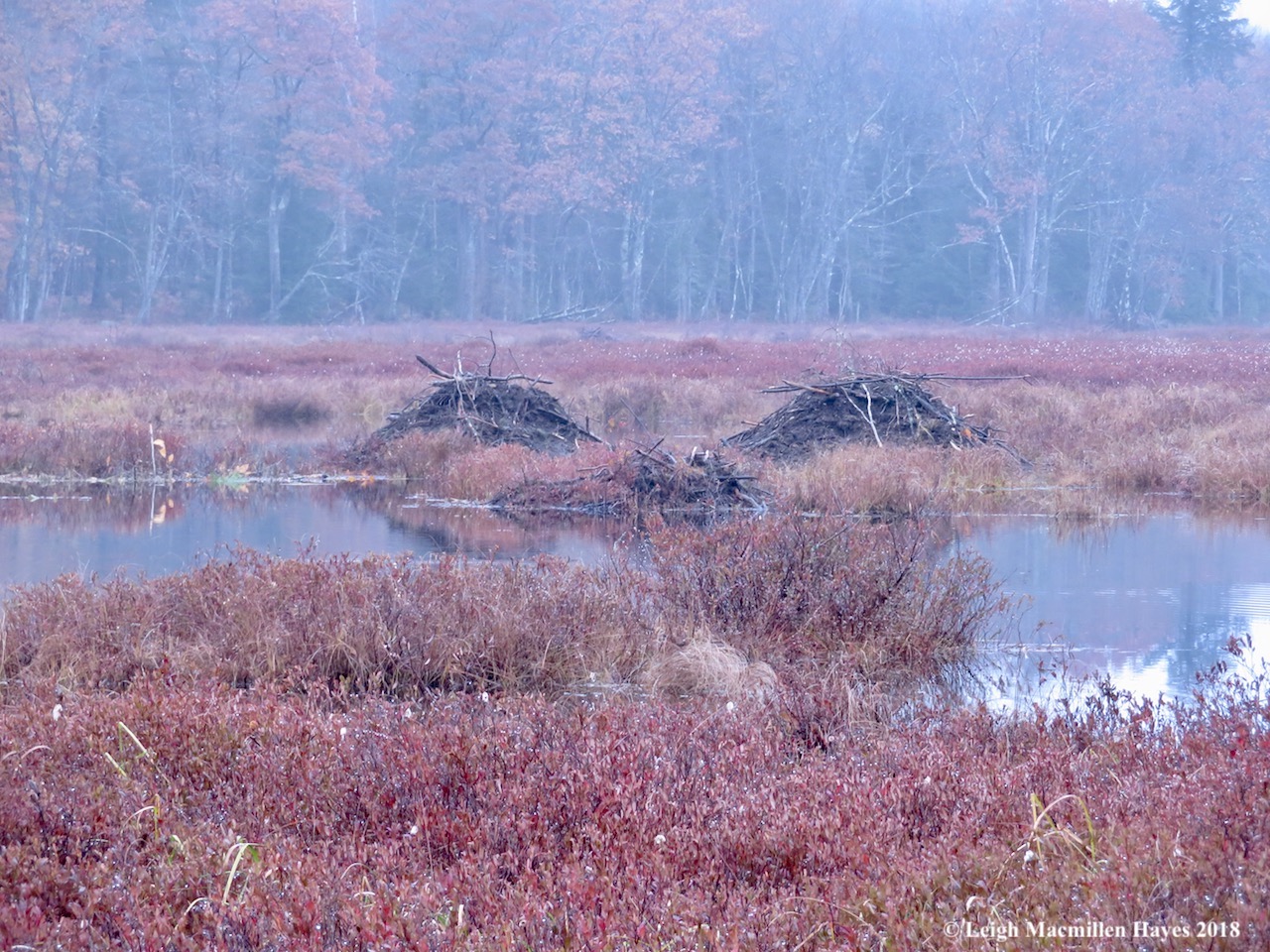
At our feet we could see some aquatic plant roots floating in the water, a beaver treat, and trusted by the mud on the lodges that there had been recent activity. Perhaps they rested indoors before planning to spend time later in the day preparing for the cold months ahead.

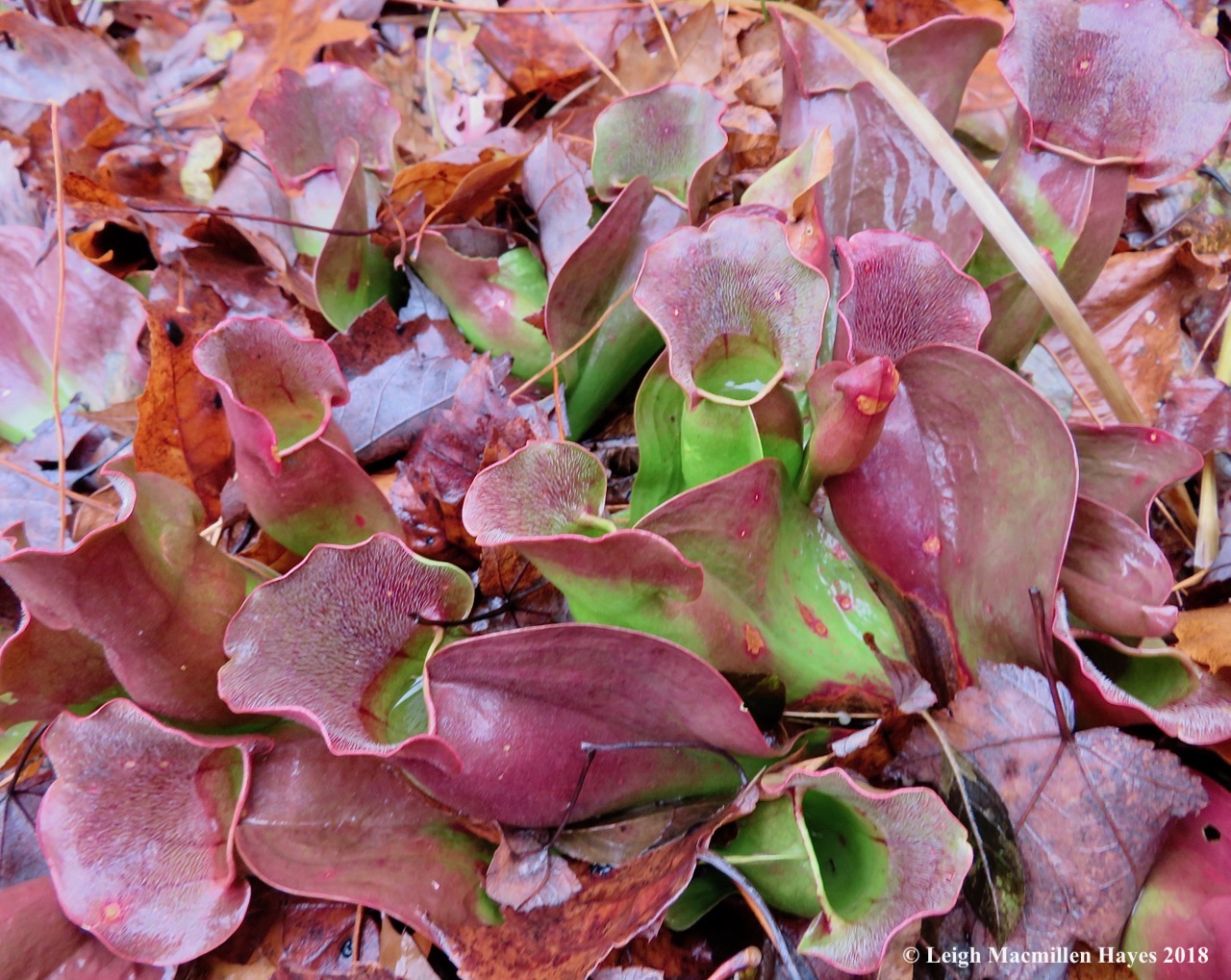
4-Pitcher Plants

After a while and because I knew they were there, I took Pam along the edge of the brook for a short distance to locate several pitcher plants. Someone once photographed them in their young green form and described them as rare. While helping Dr. Rick Van de Poll, principal of Ecosystem Management Consultants (EMC) in Sandwich, New Hampshire, set up study plots at Lakes Environmental Association’s Highland Lake Reserve in Bridgton during July 2017, we had to watch where we stepped to avoid crushing pitcher plants. It was a perfect time to ask Rick about the green color. Were there green pitcher plants in Maine? And if so, were they rare? He explained that it was just a matter of sunlight and age, all would eventually take on a redder hue in veins and then overall leaf coloration as they matured.

5-pitcher plant runway

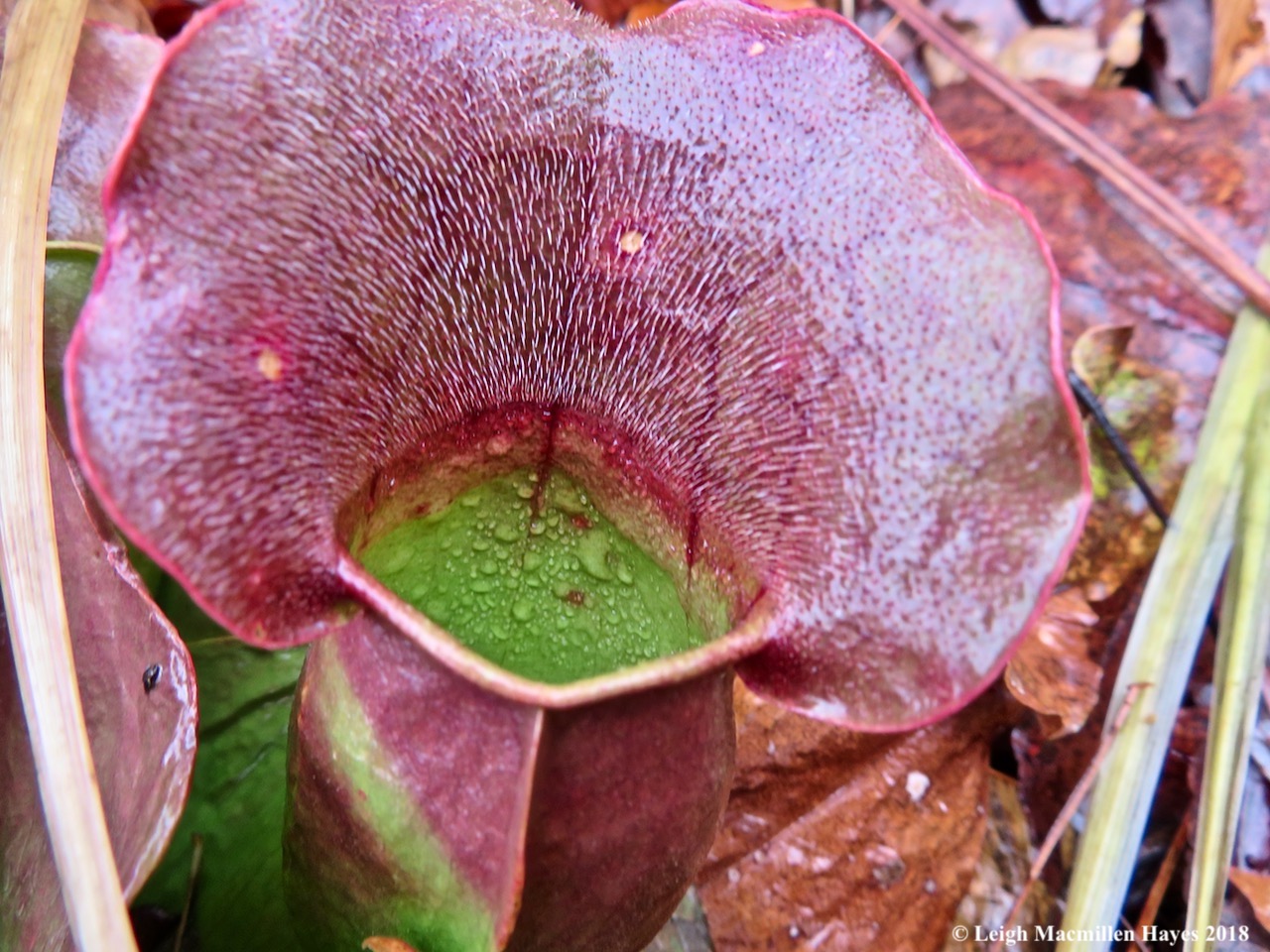
This morning, we found some sporting brighter red leaves.

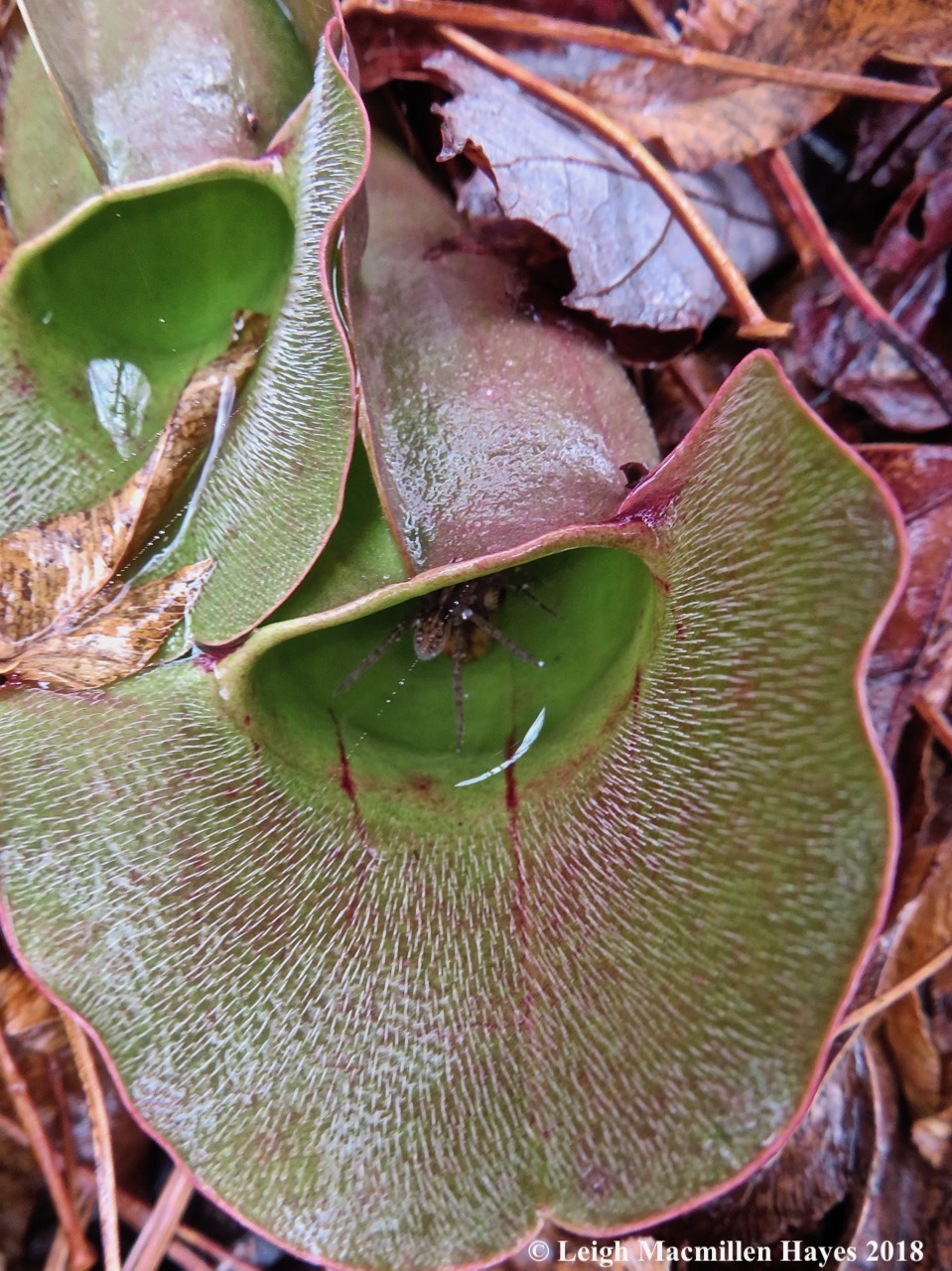
6-spiders within and webs above

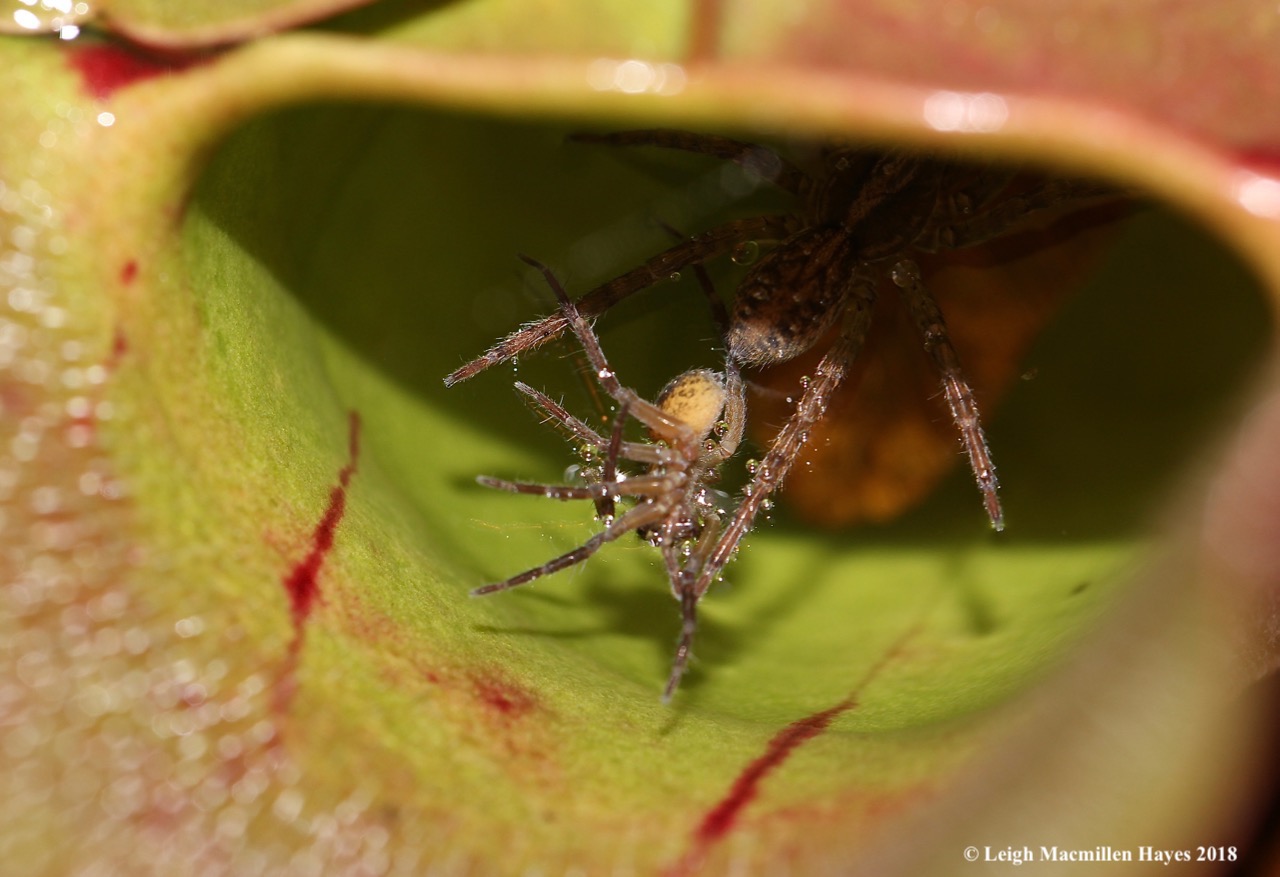
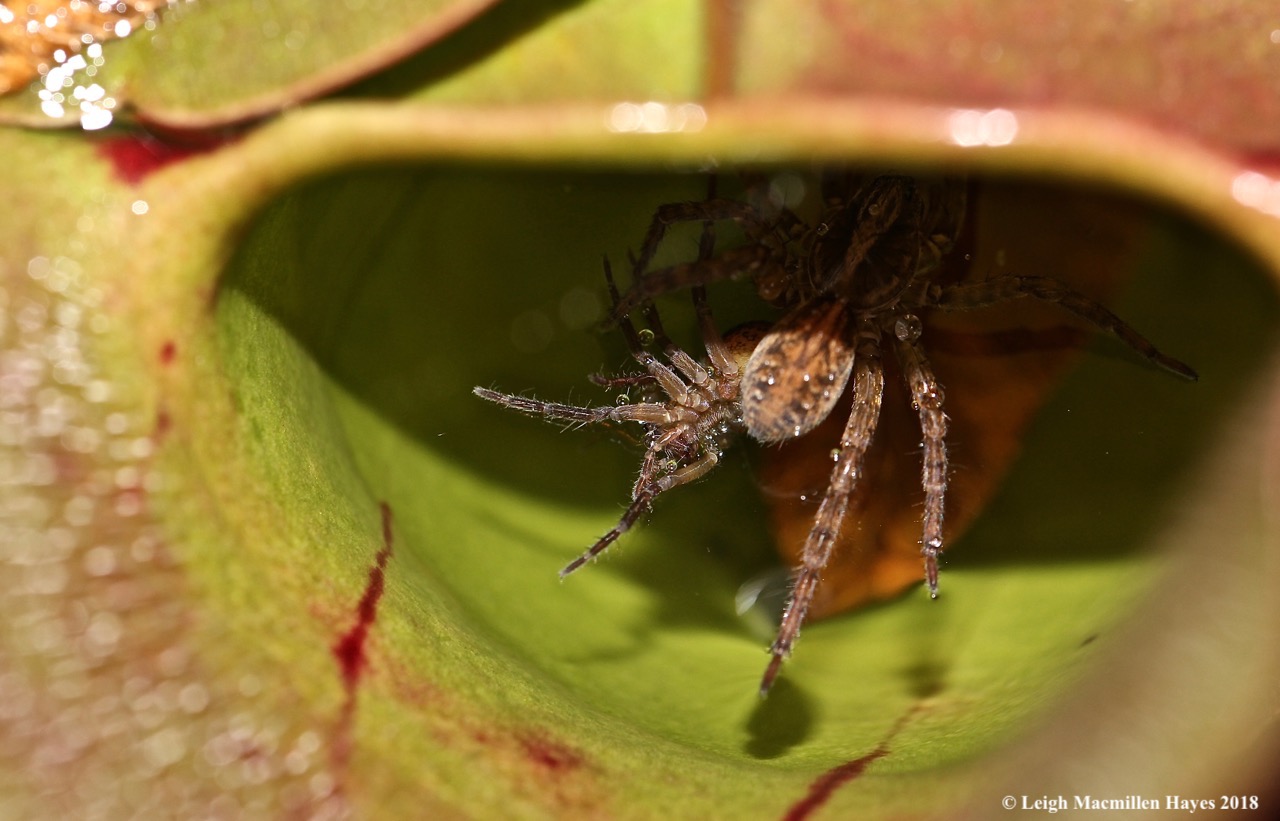
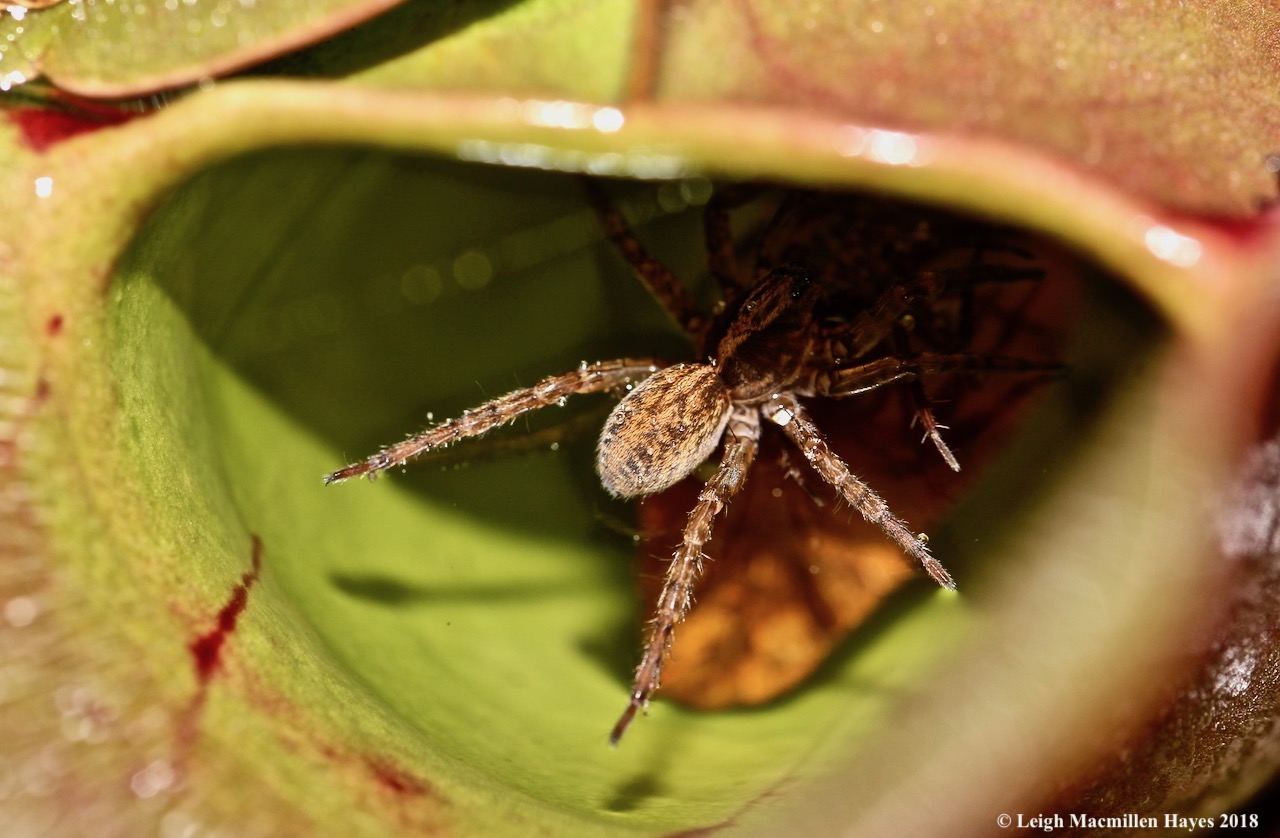
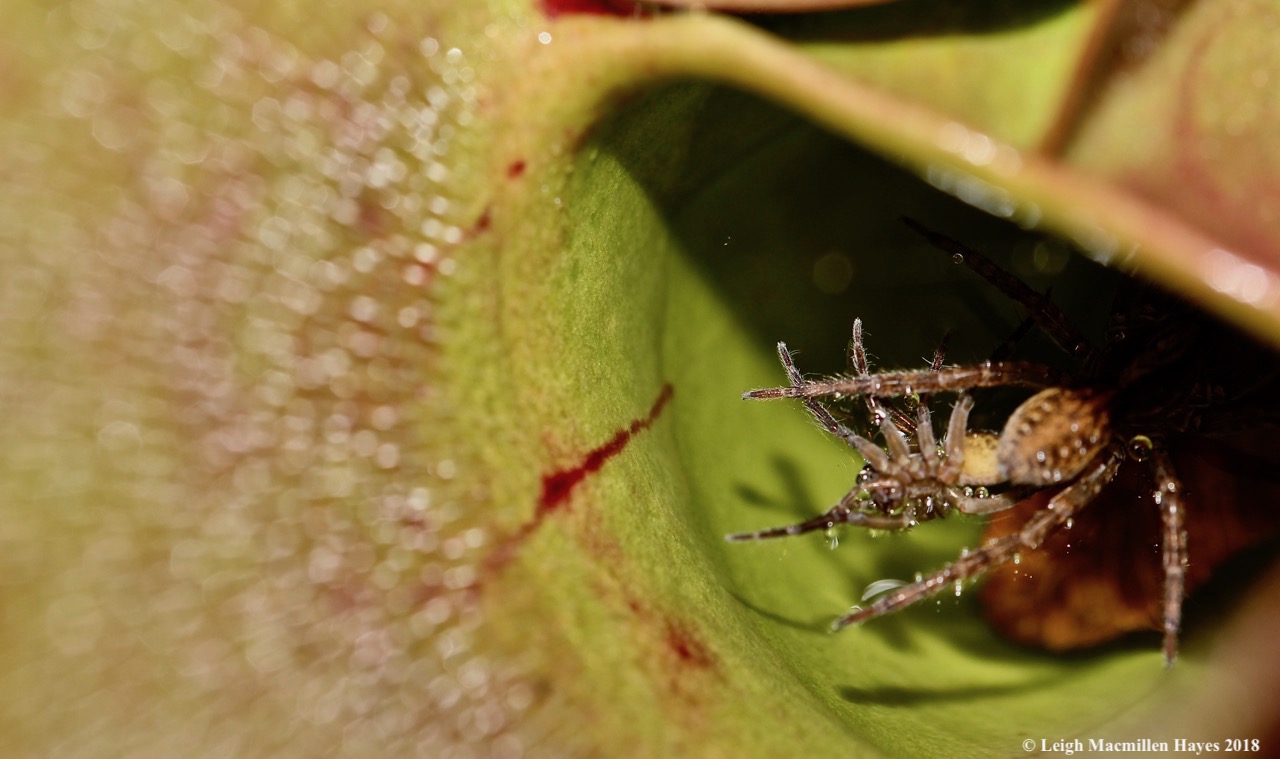
And another plant that was duller in color. Since we were in the locale where the green plant had been discovered, I trusted that it was beginning to show its age. It was the duller one that drew most of our fascination. Carnivorous pitcher plants obtain nitrogen and phosphorus by eating insects. Their oddly-shaped leaves form a pitcher partly filled with water and digestive enzymes. The spout is a hairy landing platform for insects attracted by red venation and nectar glands. Imagine this: an insect crawls to the edge of the leaf, aka pitcher, slips on the downward-sloping hairs and plunges into the liquid below where enzymes and bacteria break it down. Any chances for escape are zapped by those stiff hairs. Do you see what we saw? A spider web across the top of the leaf? And within?

8-larger spider manuevering the smaller one

Dueling fishing spiders.

9-pulling it under its body

And so we watched.

10-and out again

The larger one continuously manipulated the smaller one, which appeared to be dead. Back and forth under its body, it kept moving the smaller kin.

11-and back under

Was it trying to eat the other? One last meal before it too succumbed to the plant? Was it trying to move past the dead spider so it could try to climb out? Should we save it?

12-let 'em be

In the end, we left the action with questions in our minds and didn’t interfere.

7-watching the spider action

Except, that is, to take photographs and make a film. Again, our knees were wet and we didn’t care.

14-pigskin puffball 1

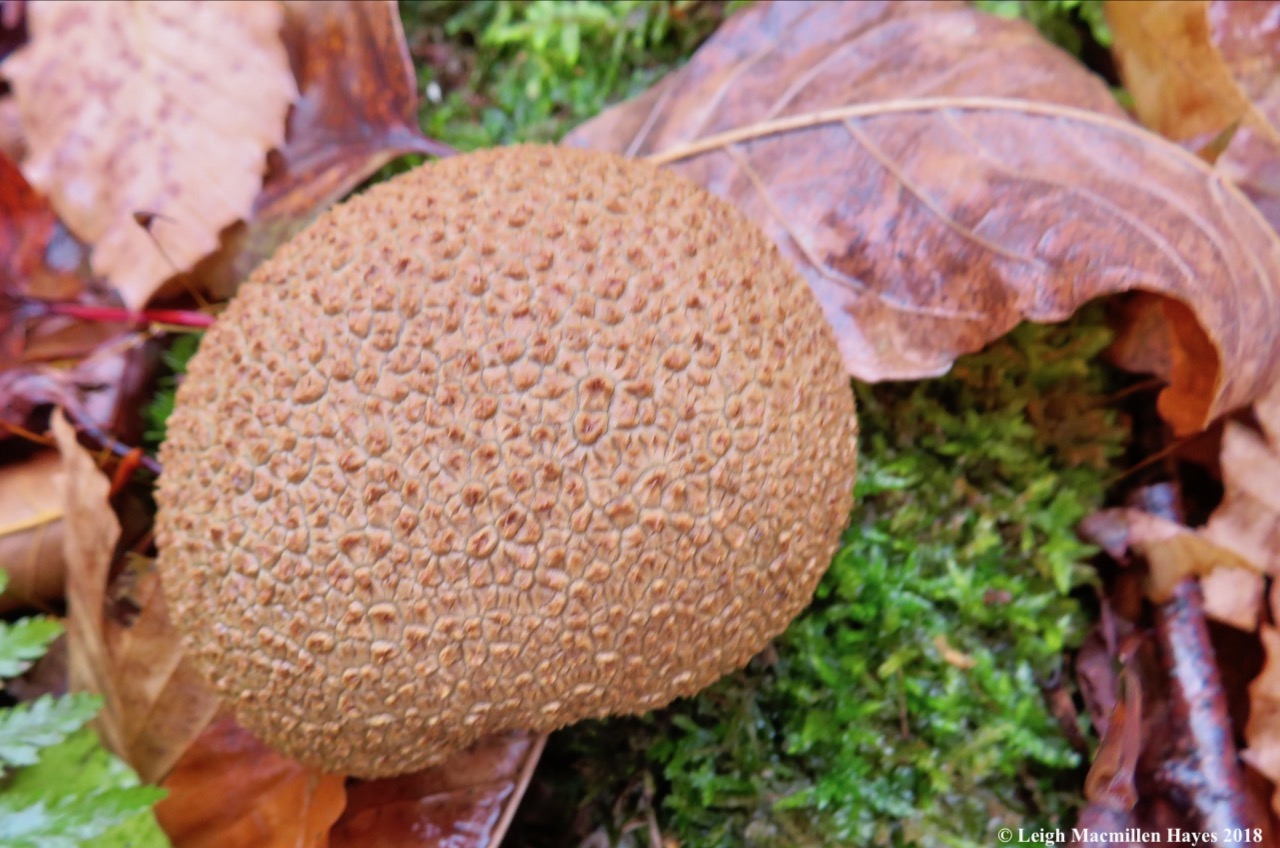
Back on the trail, we found an area where Earthballs decorated some old lumber slash. Their warty outer skin drew our attraction.

15-skin of pigskin

Another common name for Scleroderma citrinum is Pigskin Poison Puffball. Since it’s football season, it’s good to note that footballs used to be made of a pig’s . . . bladder and not its skin, though historically they were called pigskins. Rather than feel leathery, these seemed more rubbery, thus the reference I guess.

15-popping pigskin

And because they were puffballs, they invited a poke.

16-an explosion of spores

From a couple of slits, mature blackish spores erupted. I had to chuckle for no matter with whom I share a trail, puffballs always invite the same reaction–pick up a stick and give it a jab. And each time we share the same moment of glee. And our inner child is released one more time. Thankfully.

18-insect within pigskin

Of course, we found ourselves on our knees yet again when Pam spied something within an Earthball that had exploded prior to our visit. Upon closer inspection, it turned out to be an inanimate insect that looked like it was covered in spores. Canary in the coal mine?

25-Pam and the bear scat

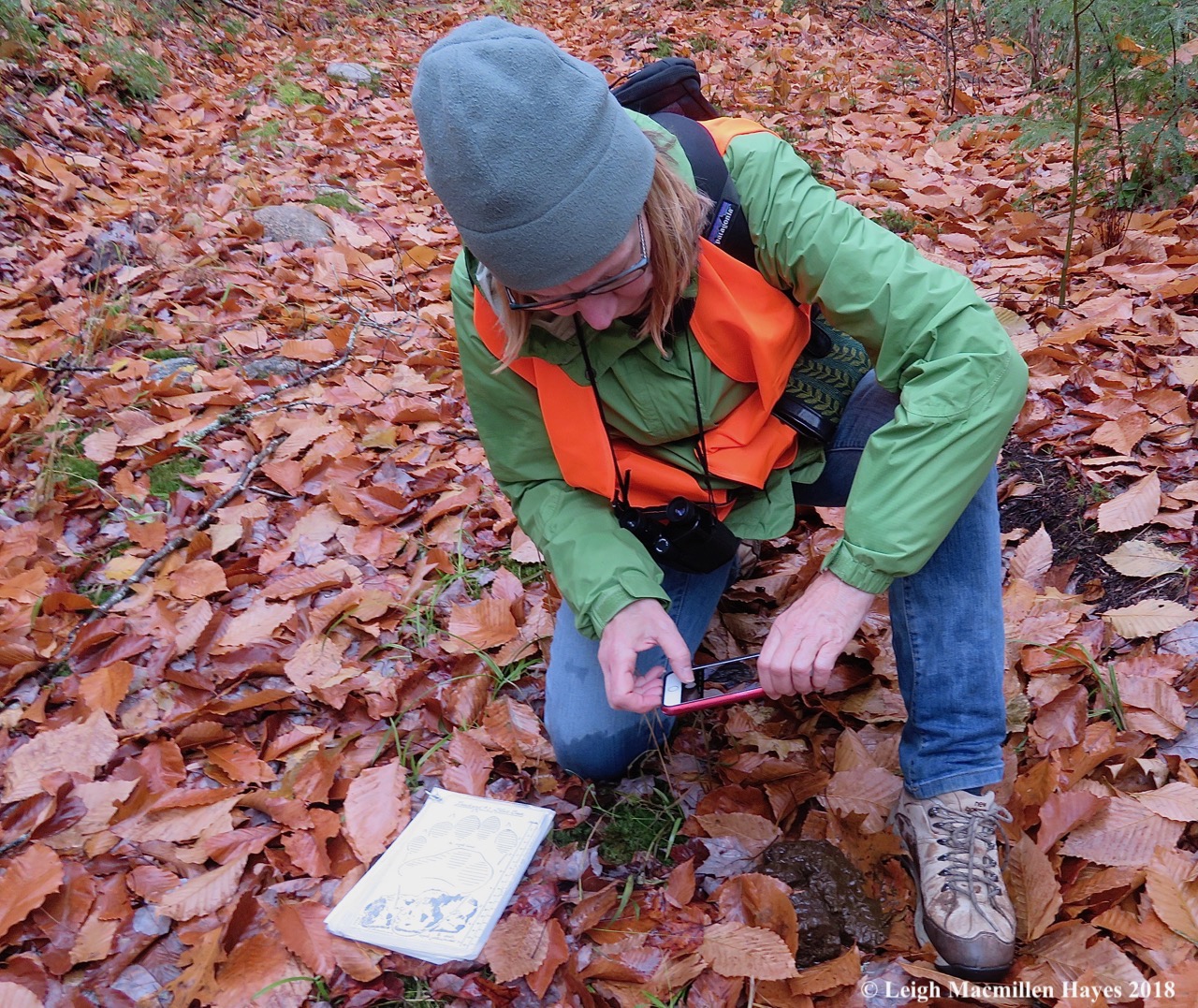
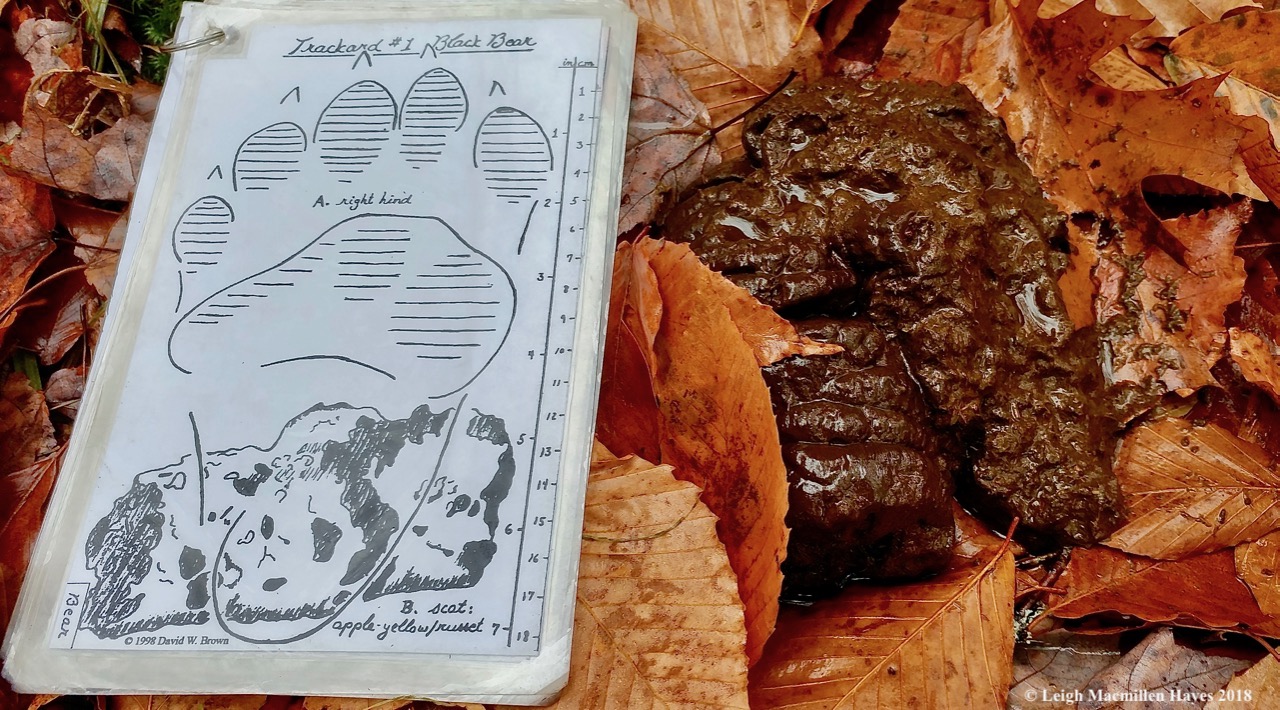
Our next great find was of a different sort and I had to pull the Trackards from my pack while Pam got down for another upclose and personal look. Notice her knee?

22-bear scat

Black bear scat! Indeed. Cylindral and large. We looked for tracks, but conditions were such that we didn’t find any. The scat was enough for this day.

24-Tamaracks

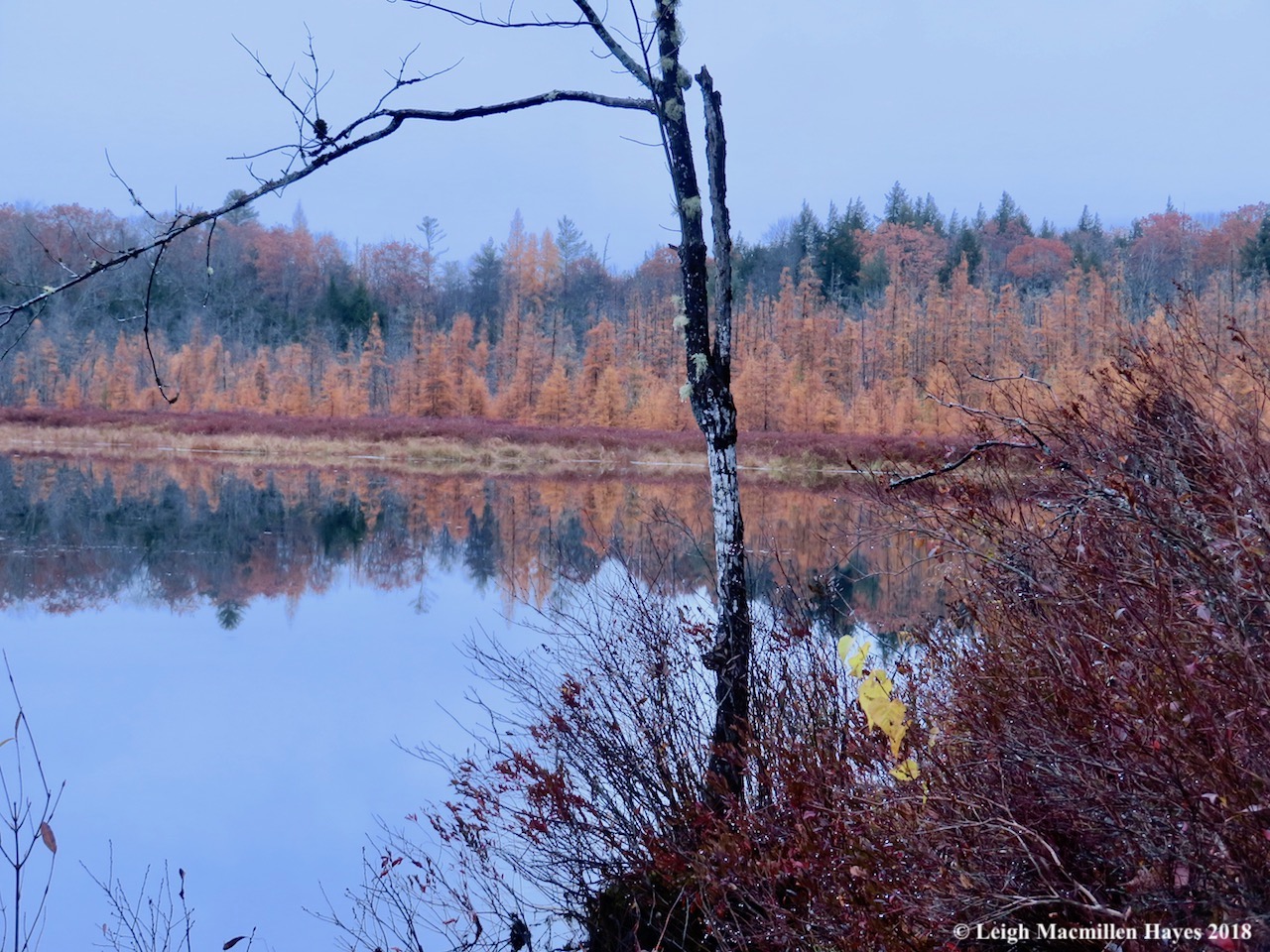
If you go, we strongly encourage you to follow the green trail all the way to the bird/wildlife viewing point along Sucker Brook. Today, the tamaracks on the shore to our right added a tone of bright beauty to the overcast day.

25-Sucker Brook--beaver lodge

And another old beaver lodge also looked like it had received a mud treatment. We could see some beaver chew sticks in the water by the edge of the brook and so we knew again that there had been recent activity. It just means we’ll have to return for another visit if we want to catch some action–perhaps earlier in the day.

In the meantime, we let the view point become our turn-around point and quickly (sorta) followed the blue trail back for we both needed to move on to the rest of our day.

But . . . despite the mist and occasional raindrops, we elected to tramp. And were delighted with the results. Here’s hoping the rest of the day goes like that.


Focus on Home Mondate

Some days are meant to be spent at home, especially when there’s yard work to finish up before the snow flies. And so today was just such a day and my guy chose to work on the leaves while I finished putting the gardens to bed and mowed one last time for this year.

1-bird's nest fungi

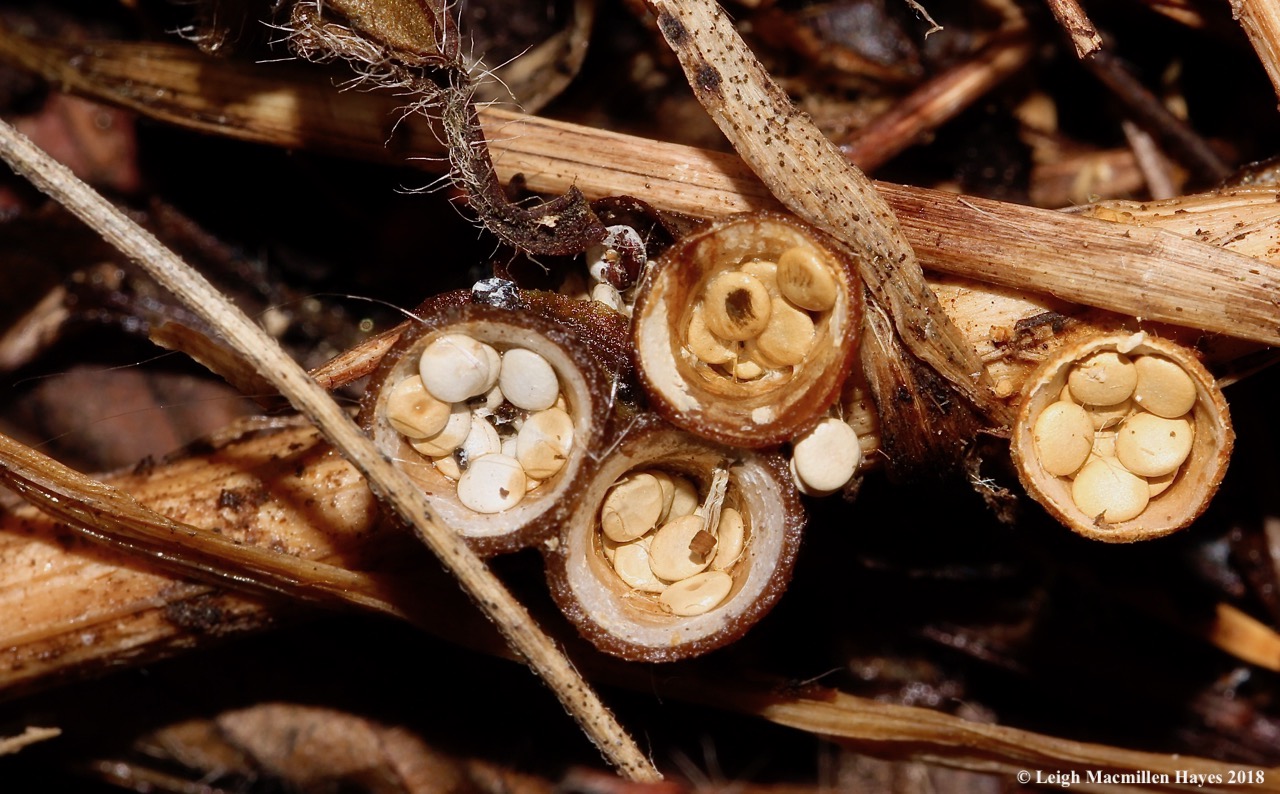
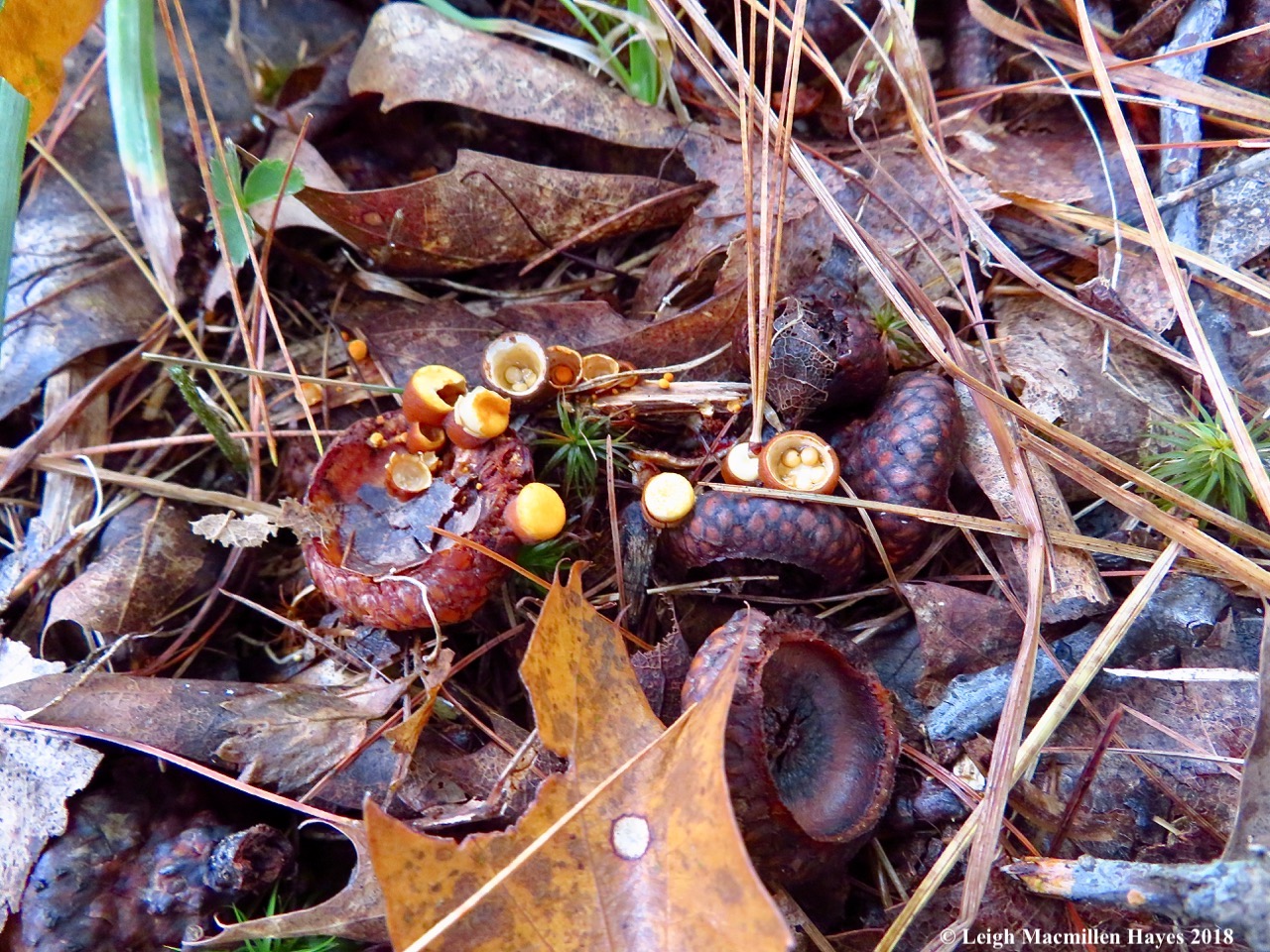
It was while putting the garden to bed that I made a discovery–a form of bird’s nest fungi, this one being Crucibulum laeve! The structure is so named because it resembles a tiny bird nest. Prior to spore distribution, each “nest” is covered with a yellowish lid. Inside, the little disc-shaped “eggs” are called peridioles, which contain the spores. When a raindrop falls into the nest, the eggs are projected out of the cup. I’ve had the honor or watching that one rainy day, but it was one of those “you had to be there” moments that will live on in my mind’s eye.

2-porcupine tree

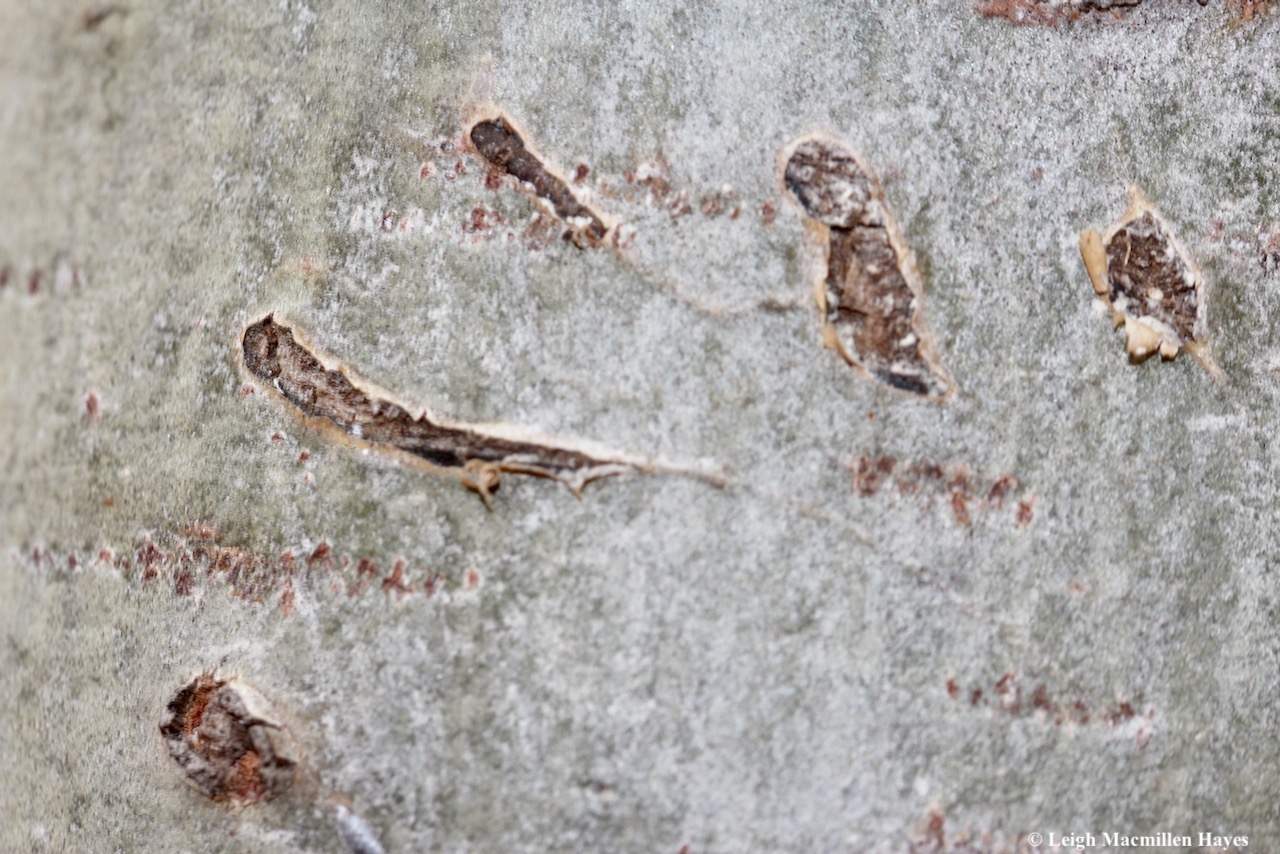
In one of the gardens stands a rather decrepit Quaking Aspen. It’s a favorite tree for woodpeckers and porcupines. thus it’s terrible condition. And usually I post photos of bear claw trees, but this particular aspen sports many, many porcupine scratches, some new and others older, such as these.

3-lady bug

As I looked at the bark to notice what else might be about, I spotted a spotted ladybug. We’d had a frost overnight, but she continued to move, however lethargically.

12-bagworm

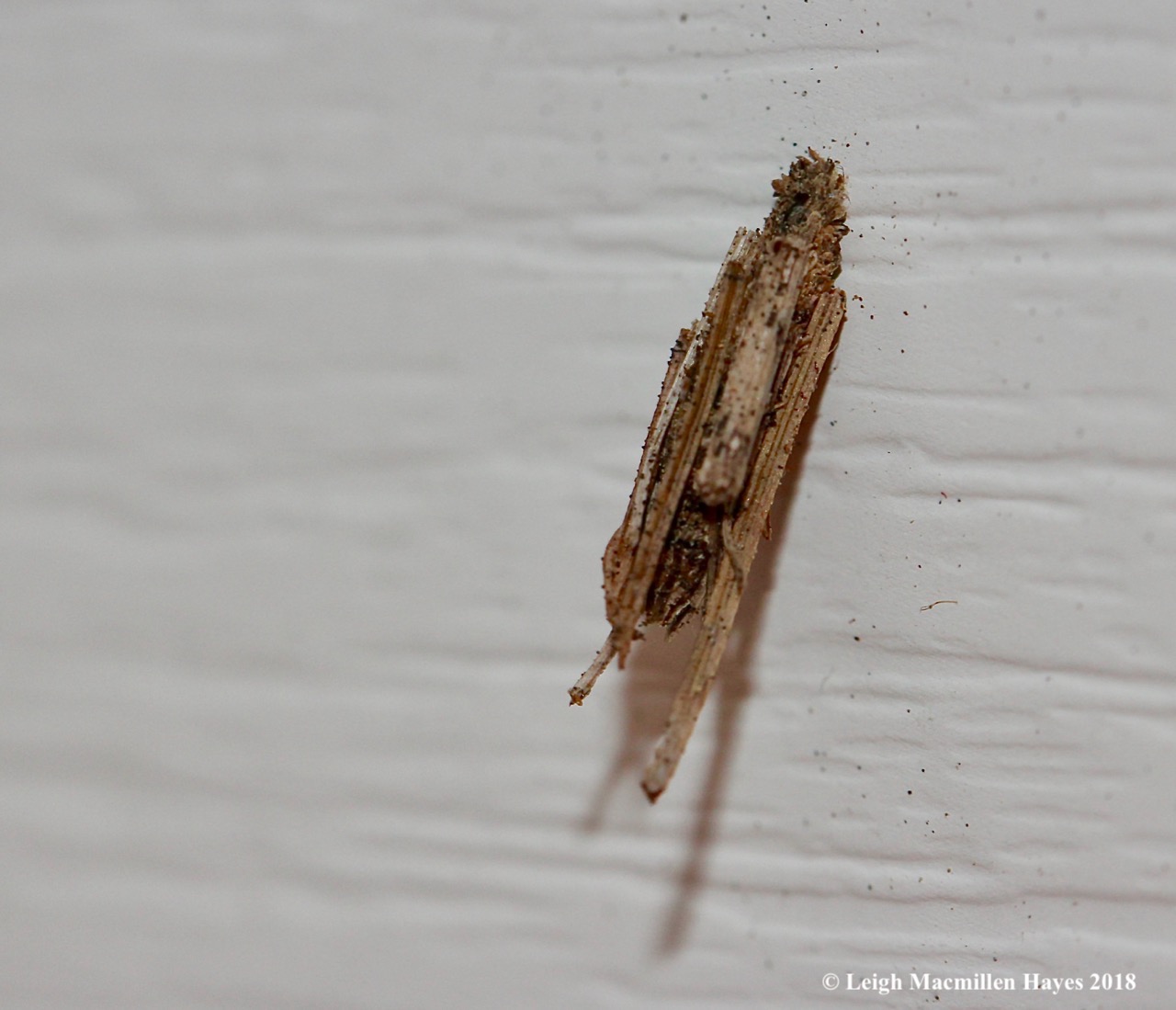
By the kitchen garden, I found another insect I’d forgotten all about these last few weeks–the caterpillar larvae of the Psychidae or bagworm moths that construct cases out of silk and environmental materials, much the way a caddisfly might. It’s the perfect camouflage from predators such as birds and even other insects.

4-milkweed seed

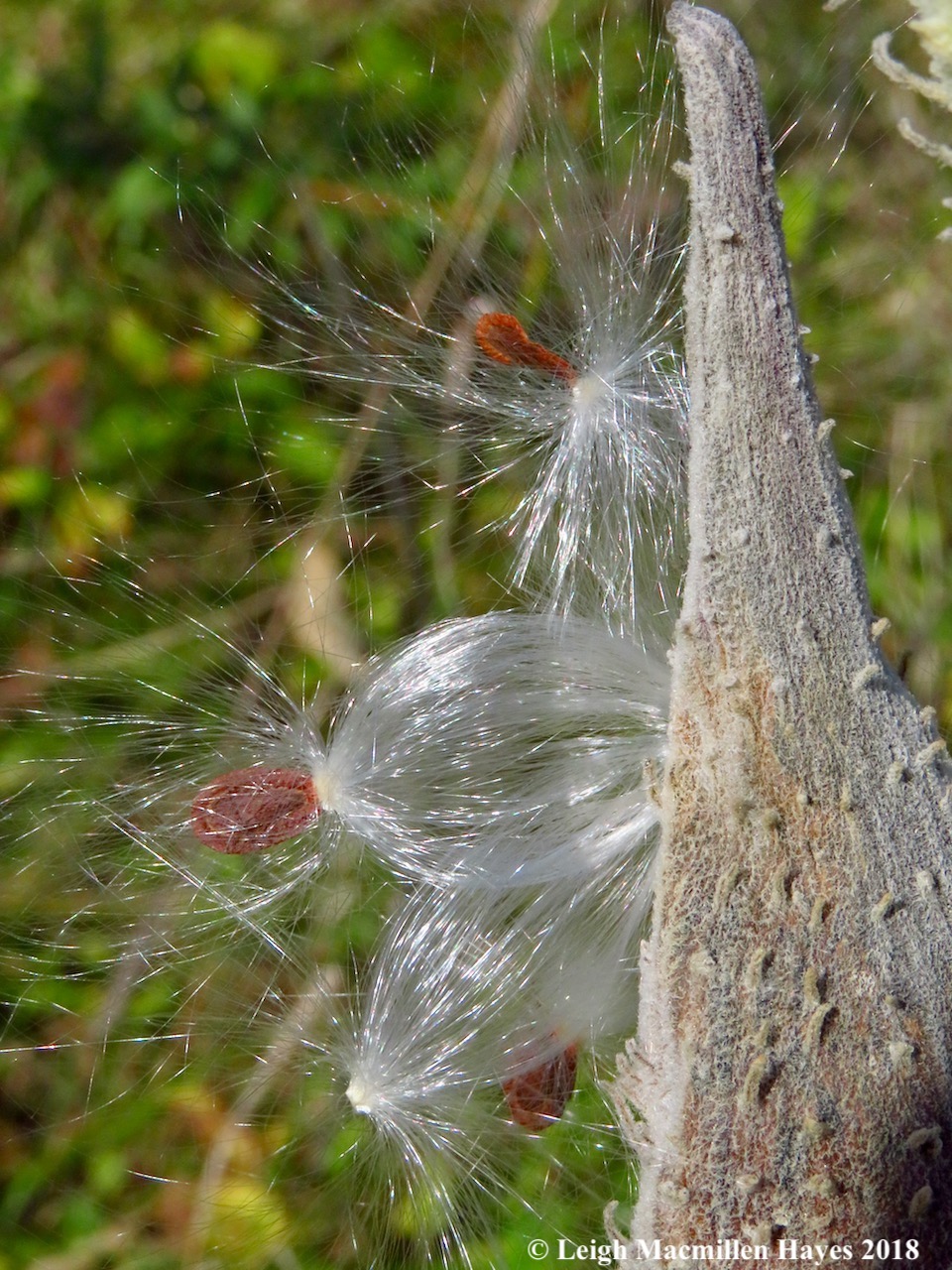
Everywhere throughout the garden were milkweed seeds, some wearing beaded skirts that will likely keep them in place. That’s fine with me, for I love milkweed. Even if this one does eventually fly away on a whim and voluntarily plant itself in another location, I know that my plants will produce more seeds for they also increase their population via underground tuberous rhizomes. Some call them invasive; I call them welcome.

12-hole in yard?

I’m not so sure the creator of this large hole in the yard is welcome. I know my guy wasn’t impressed. It’s about a foot wide and deep. We suspect one of “our” woodchucks. I’d rather think it was excavated by the beautiful red fox that crosses the yard several times a day, but it’s a bit away from the fox’s route.

5-mealy pixie cup lichen

My wander eventually took me from the garden to the stone walls, where lichens form their own little gardens and support such species as the Mealy Pixie Cups, a fruticose lichen with a stalk or podetia below the cup.

6-Rock Shield

Foliose-styled rock shield lichens grow abundantly on the rock’s surface, their success due to the numerous disk-shaped structures called apothecia. Reproductive spores develop on the rolled edges of the brown berets, awaiting the time when conditions are just right for them to move on and grow into a new lichen.

7-Cinder Lichen

Crustose lichens were the most plentiful with their painted on appearance, like this ash-gray Cinder Lichen that reminded me of a mosaic piece of artwork.

8-Concentric Boulder Lichen

One of my favorite crustoses, however,  was the Concentric Boulder Lichen with its raised blackish-brown apothecia. Each time I saw the pattern created by the little disks, I felt like I was looking at a maze.

9-tent caterpillar egg cases

And then I stepped over the wall and turned my attention to some trees. That’s when I spied numerous tent caterpillar eggs cases. The Eastern Tent Caterpillar overwinters as an egg. Each one is part of a greater mass of anywhere from 150 to 400 eggs. They encircle a branch and are almost impossible to see, until your eye begins to recognize the structure. This was an old one and no longer had the shiny varnish-like coating that will help keep winter at bay.

11-red maple flower and leaf buds

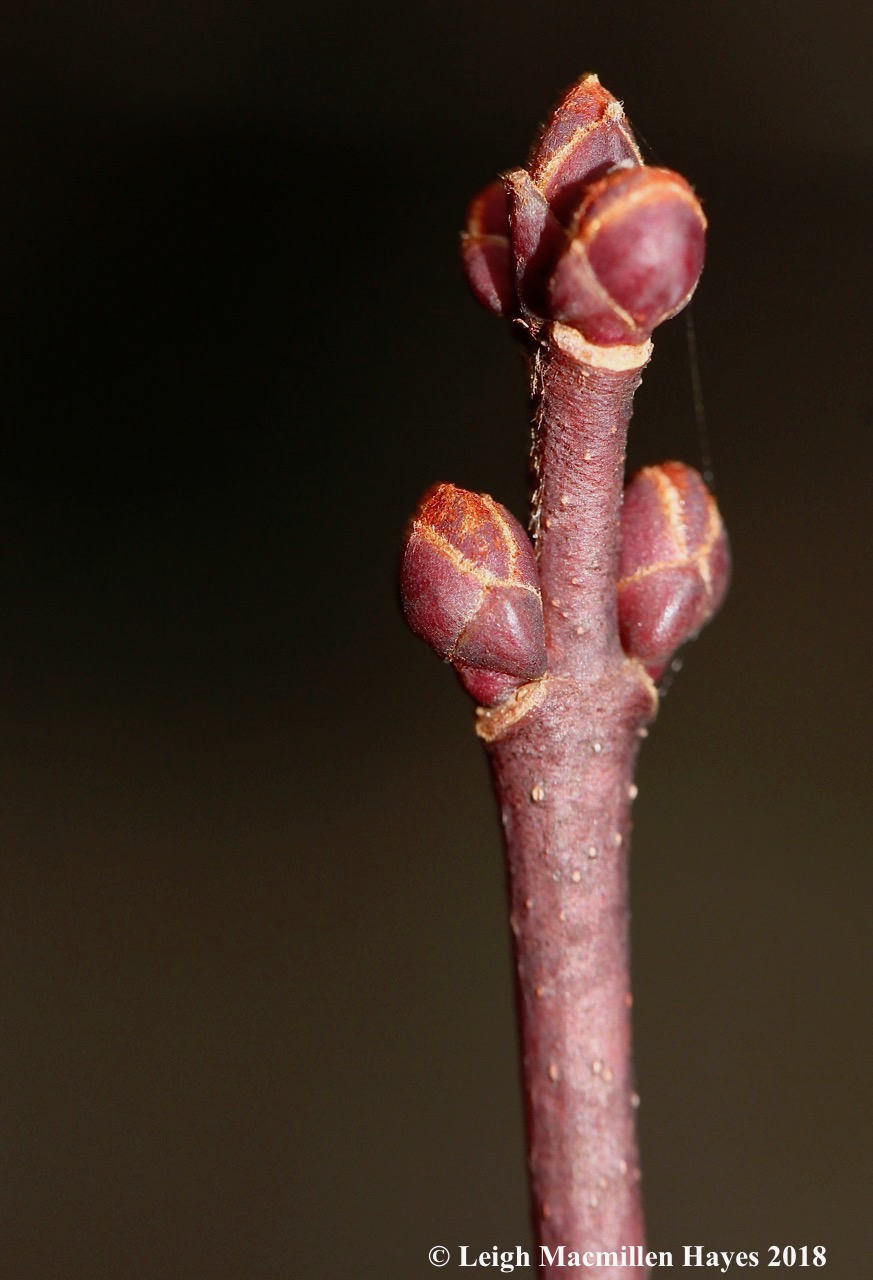
Also keeping winter at bay were the waxy scales of tree leaf and flower buds. The buds formed in the summer and now must wait for February’s warm sun before they begin to swell and ready themselves for next spring’s bloom. In the meantime, they are snug inside their tight structures.

10-tube caterpillar tube

My next great find–tubes or tunnels created by the Pine Tube Moth. Last summer, larvae hatched from eggs deposited on the needles. Though Eastern White Pine needles grow in packets of five (W-H-I-T-E or M-A-I-N-E is a mnemonic we use to remember how many needles on the white pine, spelling “white” for its name or “Maine” because it is the state tree.) Anyway, the tube moth used silk to bind a bunch of  needles together, thus forming a hollow tube. Can you see the silk at the top? Notice the browned tips–that’s due to the larvae feeding on them. Eventually the overwintering larvae will pupate within the tube and in April they’ll emerge. Two generations occur each year and those that overwinter are the second generation. The good news is that Pine Tube Moths are not considered a significant pest.

13-pinesap winter capsules

One of my favorite finds as I headed down the cowpath toward home was actually an old friend–Pinesap in its winter capsule form. Pinesap is similar to Indian Pipe, another Monotropa (once turned speaking to its flower that turns upright after fertilization). The creamy whitish flowers developed into woody capsules. As the capsules mature, the structures become erect. Once ripened, seeds will be released through slits that open from the tip to the base of the capsules.

14-False Tinder Polypore

I was back in the grassy part of our yard when I passed by a tree in the corner and made a new discovery–a false tinder conk or polypore, with its black fissured cap. My very own Phellinus ignarius! While a Tinder Conks pore surface is usually concave, in the false specimen, it’s angled downward from the rim to the tree.

I know my friend Faith will see a smiley face in the upper spore surface; it rather reminds me of a weasel.

We never left home today, my guy and me. Our focus was on the yard, but mine was a wee bit different than his. And for those of you who have been asking–these photographs were all taken with the Canon Rebel T3i. Yep, that’s the one that got wet when I decided to flip off a boardwalk last May.

Bishop Cardinal Reserve: Where (Wo)Man and Nature Intersect

Perhaps we should have tiptoed and tried to silently pass through the woods much the way a fox or bear might, but that is not our habit. And so on today’s Tuesday Tramp for the Greater Lovell Land Trust, we chatted and wondered aloud as we hiked along the  trails of Bishop Cardinal Reserve on the upper side of Horseshoe Pond Road in Lovell. Consequently, our wild mammal sightings were non-existent. Despite that, we saw soooo much.

9-docents Bob and Pam

Our team was small this morning, with only docents Bob and Pam joining me, but still we made plenty of noise as we looked about.

4-bear pole

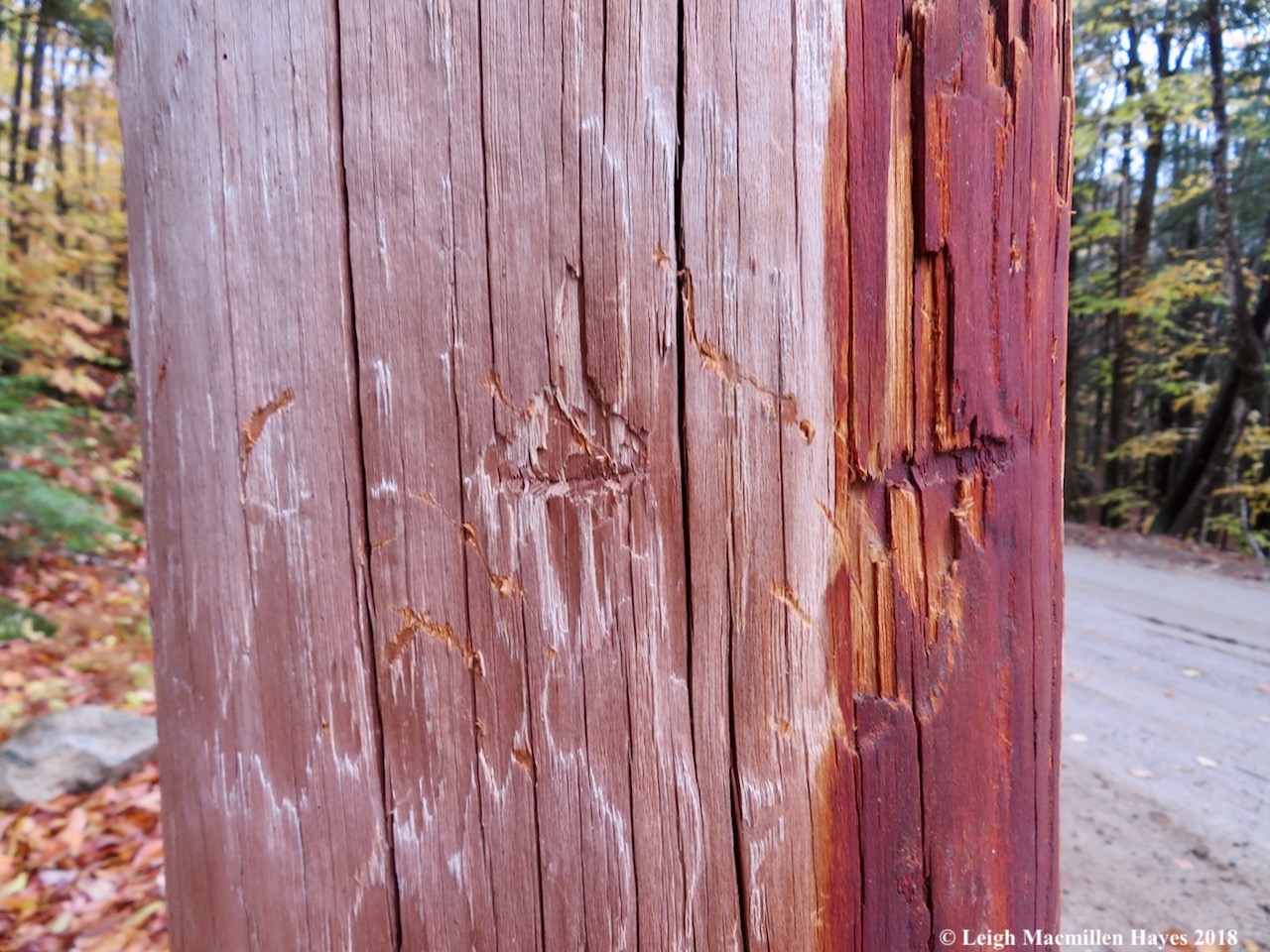
The first sign of mammal and human interaction, of course, was the telephone pole beside the trailhead. If you’ve traveled with me either literally or virtually before, you know how I LOVE a telephone pole. It’s not the fact that such brings electrical power and other modern day amenities to our homes, but instead the realization that bears are attracted to them and like to leave a mark as they claw and bite at the anomaly in the forest surroundings. I always check for hair left behind, but today was disappointed to find none.

5-scratches on bear poles

Despite the lack of hair, there were a few newer scratches worth celebrating.

6-spider

And a small spider tossed into the mix. The temperature was on the chilly side as the wind blew, but not cold enough to begin the process of accumulating glycols in its blood (e.g., antifreeze) that would allow the spider to supercool. By physiologically adapting via special antifreeze compounds, the tissues of some Maine spiders remain unfrozen at temperatures well below freezing, and thus avoid turning into little blocks of ice once winter sets in. Of course, had it been a little bit cooler, this spider probably would have hidden in the leaf litter below rather than trying to send a telegram via the phone pole.

7-bear tree

A little further along the trail, however, we did find more bear sign in the form of claw marks on beech trees. And that raised the question: Do bears only climb beech trees? No. But, beech bark is one of the best to show off their signature scratches.

10-Pam's bear tree 1

After I showed Pam and Bob a couple of trees with claw marks, they began to look about and Pam spied one I’d not noticed before.

10-Pam's bear tree

Congratulations on your First To Find (FTF) Award, Pam! Well deserved.

11-deer skull

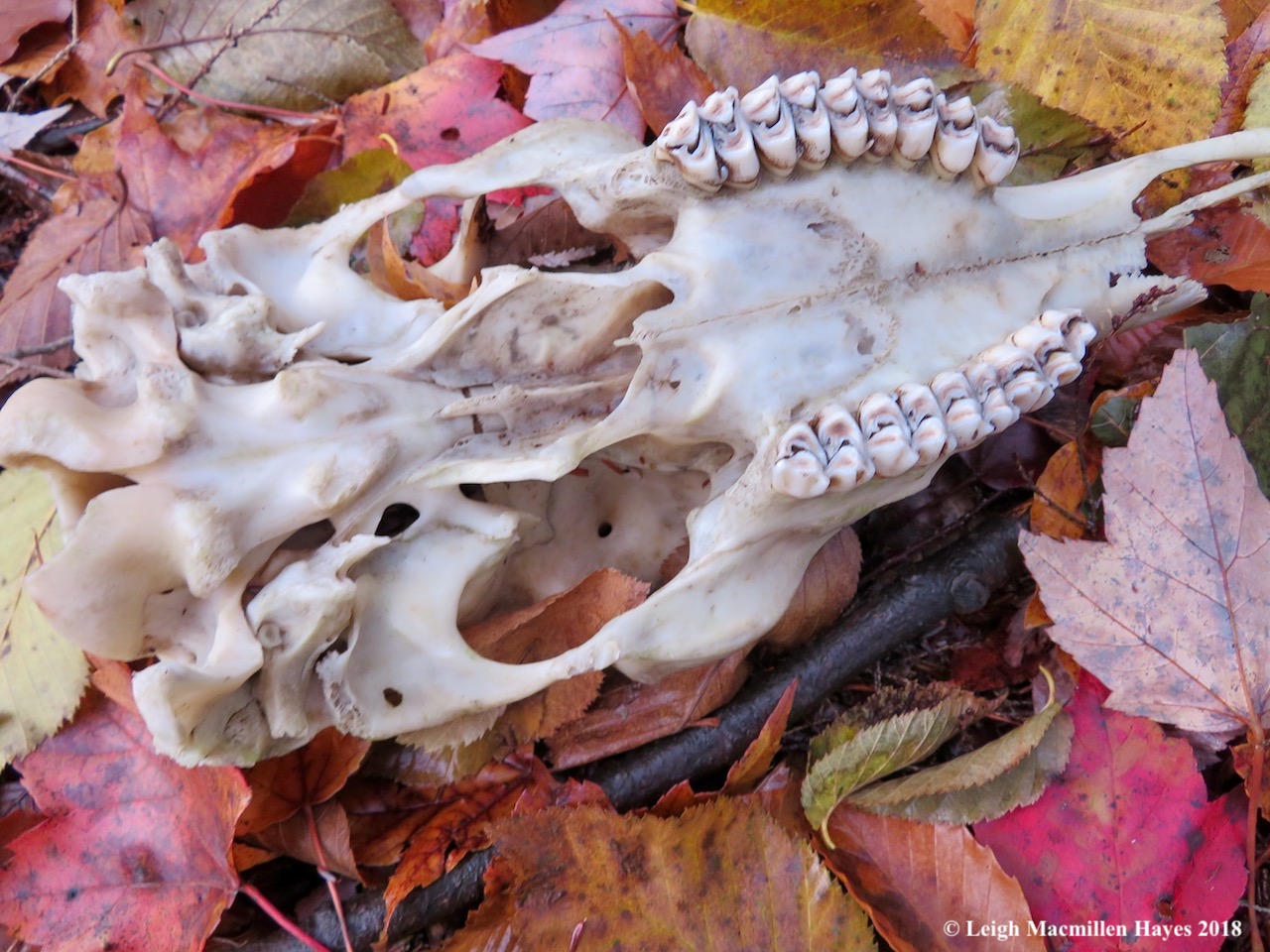
It wasn’t only bear sign that made the walk intriguing. A year and a half ago, this same couple had spied an entire deer carcass along the lower part of the trail. And so when we arrived in the vicinity today, we looked around. And eagle eyes Pam spied half the skull atop the leaves. What had happened to the deer? Human interaction? Old age? It was a rather large skull.

12-herbivore teeth

My, what flat teeth it had. Because herbivore teeth are highly specialized for eating plant matter which may be difficult to break down, their molars tend to be wider and flatter, thus allowing the animal to grind its food and aid in digestion.

13-lower jaw

We looked about for other bones and had to satisfy ourselves with a lower jaw. Had the rest of the skeleton been scattered and we just couldn’t see it below the recent leaf cover or had mice and other rodents dined on the bones from which they sought calcium? Coyotes, bears, and even another deer may also have moved the bones and found their own nourishment. Whatever happened, we knew it had been recycled . . . naturally.

14-coyote scat

And not far away on the edge of a bridge over a stream . . . coyote scat. It was not fresh, but fresher than the deer skull event, and full of hair. On what did the coyote dine? Snowshoe hare? Gray squirrel? Some other delectable offering? We weren’t sure.

15-squirrel storage

Dinner in the woods came in many forms, however, and on a fallen tree about four feet from the ground we found a mushroom turned upside down. Despite recent wind storms, we didn’t think it had blown up to that spot. Instead, a squirrel had set it there to dry. A squirrel’s food pantry is far bigger than a kitchen cupboard. Would it remember where it had placed the mushroom? Probably. Would another squirrel discover and snag it? Possibly.

16-squirrel storage

But there were others set in different spots to dry, so the original cacher might have some success in retrieving the food it had stored.

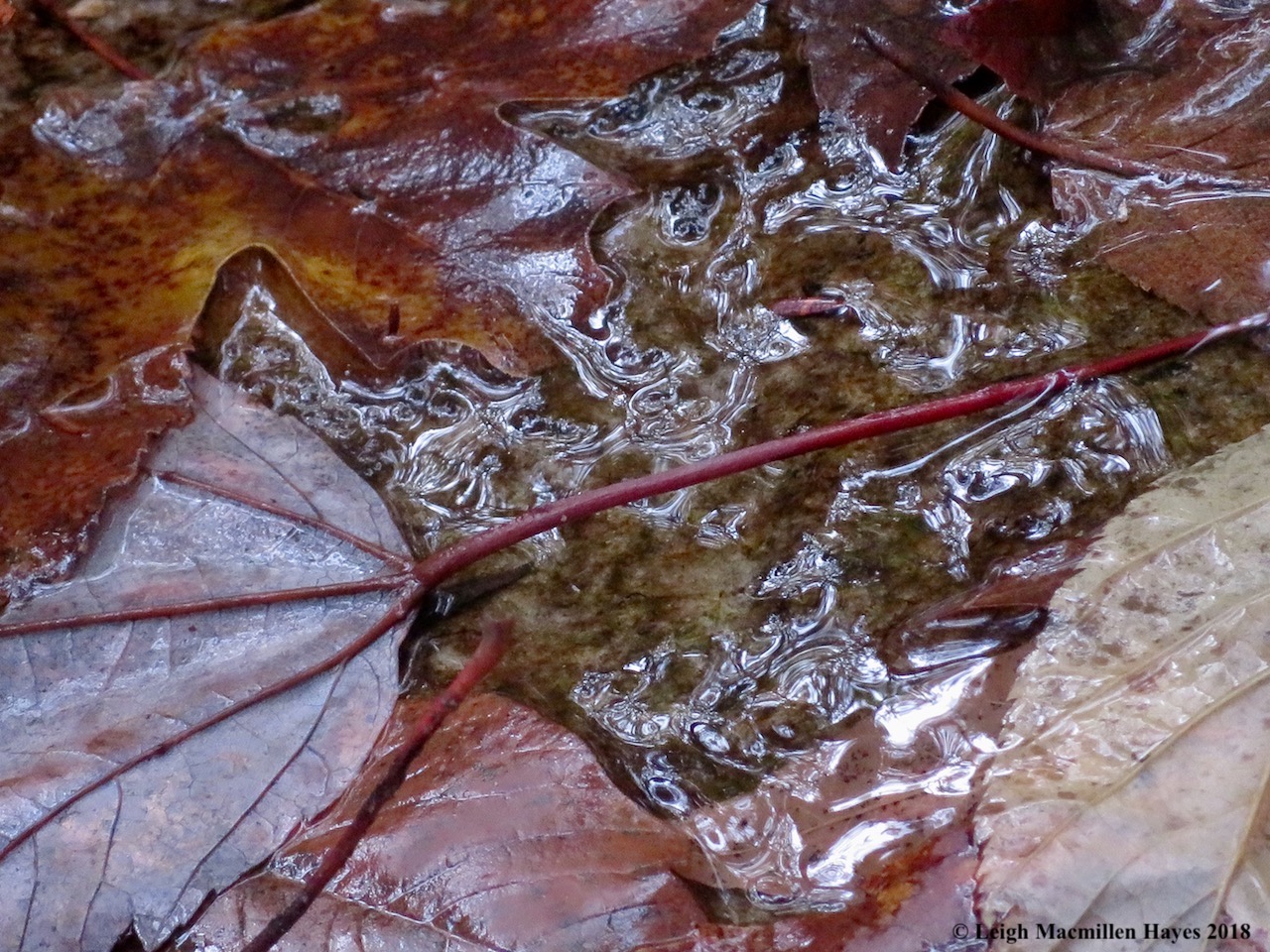
17-icy formation

As our time drew to a close, we noticed patterns in the mushrooms imitated by icy spots in a stream that spoke to the morning’s chill.

18-Horseshoe Pond Road

But the sun had come out and we relished its warmth as we headed back to our vehicles and on into the rest of our days.

16a-man-made wonder

Before doing so, however, there were two more sights to commemorate–the man-made line up of doors found deep in the woods . . .

2-Sand castle

and rain-made castles along the road side.

Bishop Cardinal Reserve–where man and nature intersect.


What the Tree Spirit Knows

As I drove to Lovell this morning to take a photo for the Greater Lovell Land Trust’s winter newsletter, the crisp outline of a snow-covered Mount Washington made me realize that I had a short, unintended hike in my immediate future.

1a-Flat Hill view

Yesterday, I’d climbed the Flat Hill Trail at the Heald and Bradley Ponds Reserve to take another photo for the newsletter–that one of the view from the summit of snow falling in the White Mountains. This past summer, staff and volunteers of the land trust had made some trail changes and opened several views, the one from Flat Hill being the most dramatic and the foliage, snow and sky enhanced the opening. But . . . today’s view was different and I knew I needed to capture it again.

Page 3 a

So . . . after a staff photo shoot at the Kezar River Reserve of Stewardship Associate Dakota, Associate Director Aidan, and Office Manager Alice, I headed north.

1-voss sign

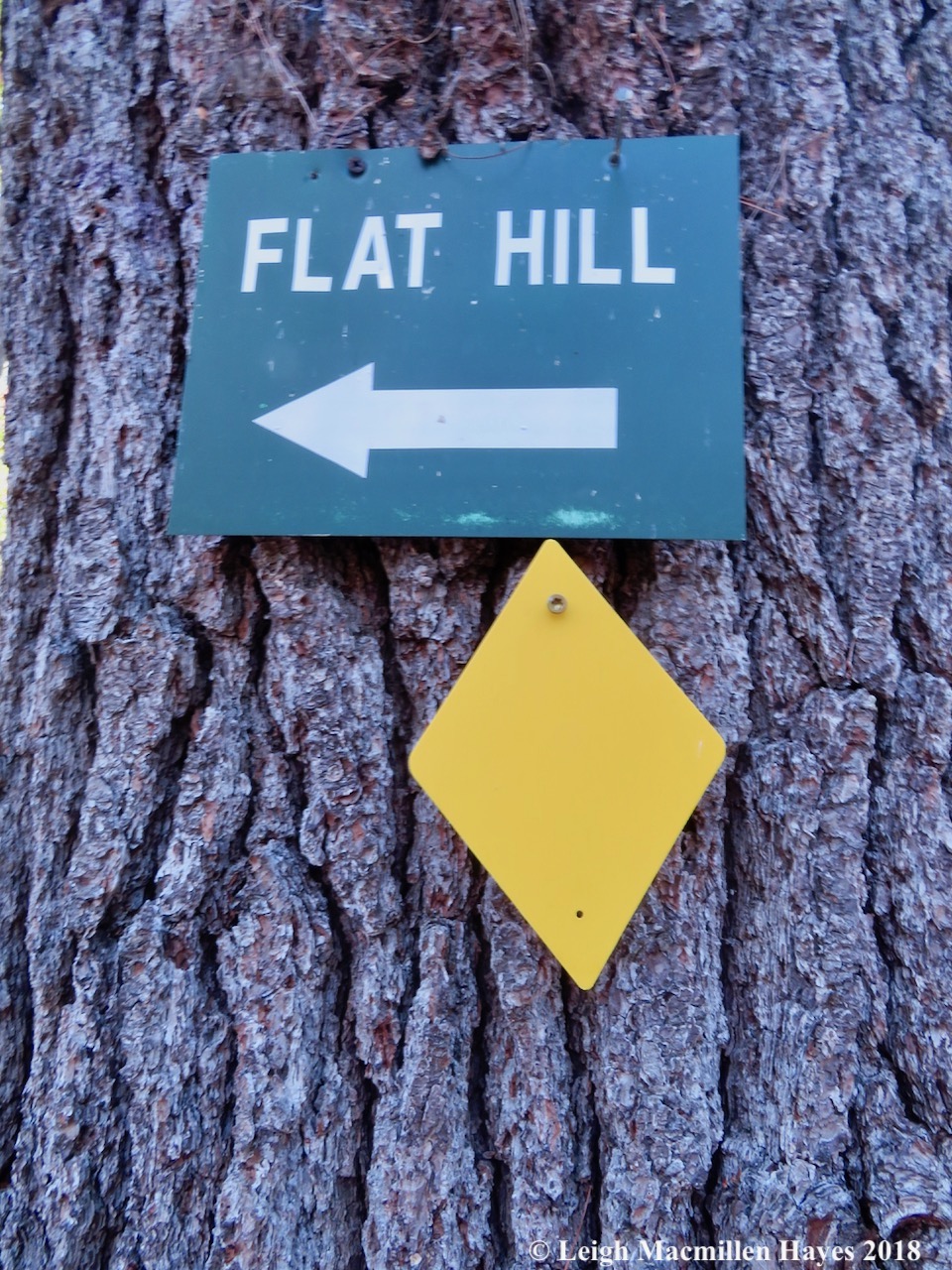
And laughed at myself for yesterday I never noticed the yellow Voss blazes that had been mounted to mark the trail. The hope is that eventually all the trails will be signed with different colored diamonds that will ease navigation.

2-big tooth aspen

It’s a trail I know well, even with a new backwards S curve about two thirds of the way up that erased a steep and slippery portion and so instead I focused on those sights at my feet. While many leaves had already begun the long process of decomposition as they slowly break down and give nutrients back to the earth from which their trees grew, a few still sparkled like gems, including this Big-Tooth Aspen, aka poplar.

3-sugar maple

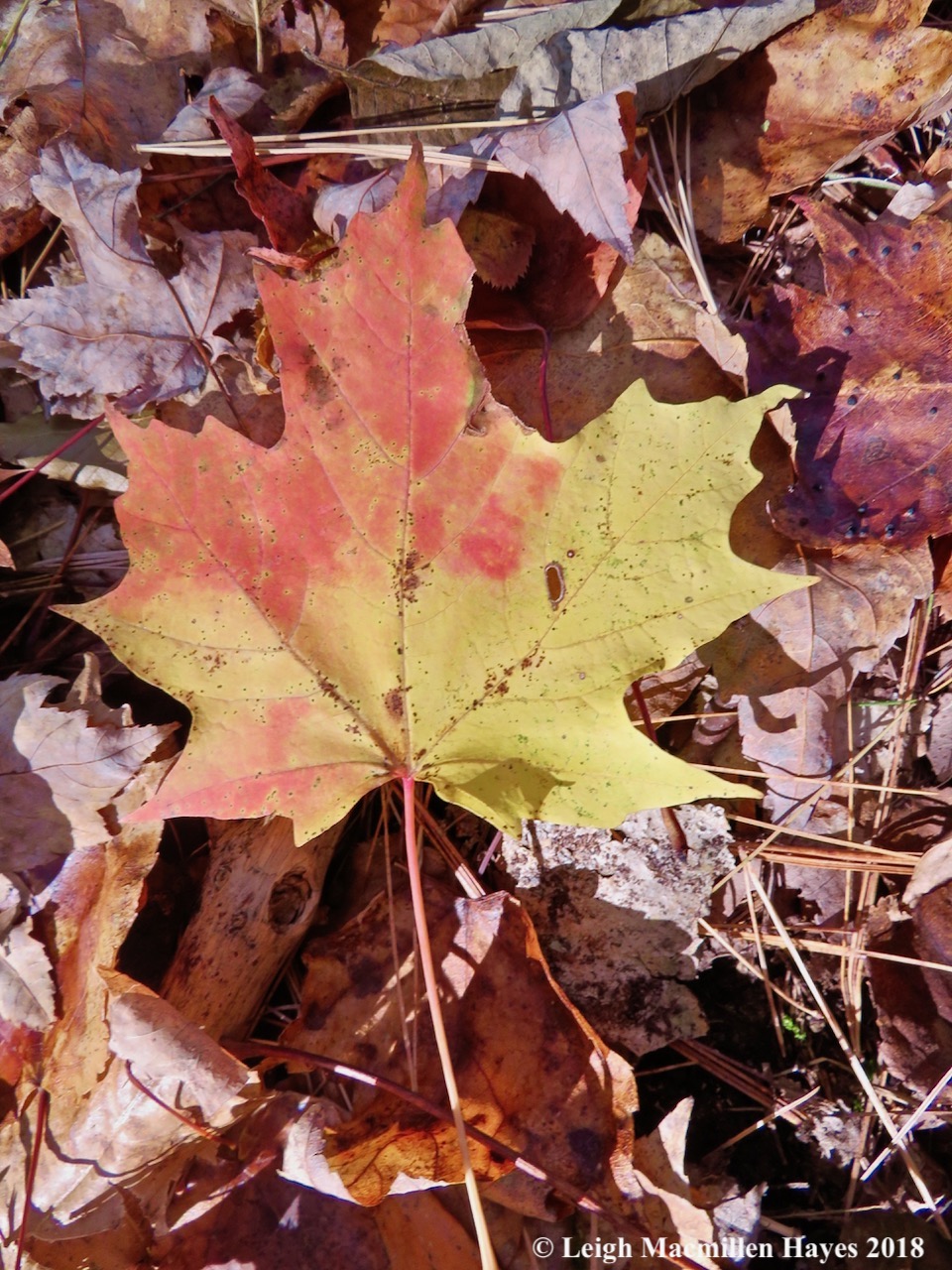
I was thrilled to discover Sugar Maple, defined by the U shape between its pointed lobes;

4-red maple

its V between lobes and toothier cousin, Red Maple;

5-striped maple

and even toothier kin, Striped Maple, known ’round these parts a goosefoot because its shape is similar. Some of us also refer to it as nature’s toilet paper for it’s large, soft, and easy to identify. You wouldn’t think of confusing it with poison ivy.

The curious thing about the Maple family, like all families in our northern New England forests, is that while the shape and color of the leaf helps us specify the family origins, each leaf within the family is different–whether in color or flaws or insect bites or galls. But despite their differences, they are all family.

6-large red oak

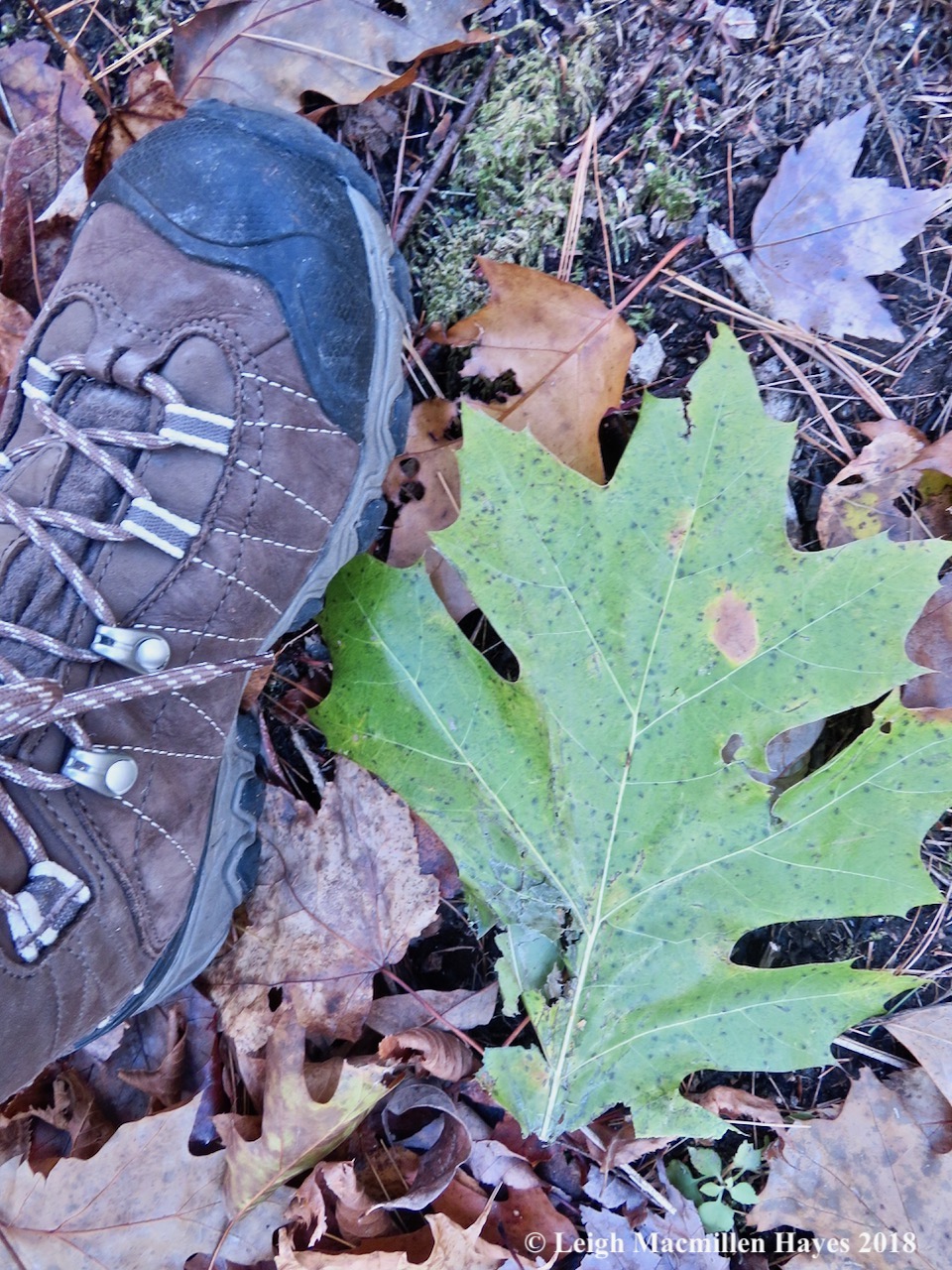
With the Striped Maple, I thought I’d found the largest species of the day, but a few more steps toward the summit revealed a rather large Northern Red Oak leaf.

7-even larger basswood leaf

And then the biggest of all–Basswood. My hiking boots are size 8. And the leaf–also a size 8, with an asymmetrical base. That must prove a challenge when trying to find the right fit.

13-polypody ferns

Focusing on the leaves took my mind off the climb and within no time I’d reached the summit where Polypody ferns in their evergreen form decorated the northwestern corner of an otherwise bald rock.

14-red maple flower and leaf buds awaiting
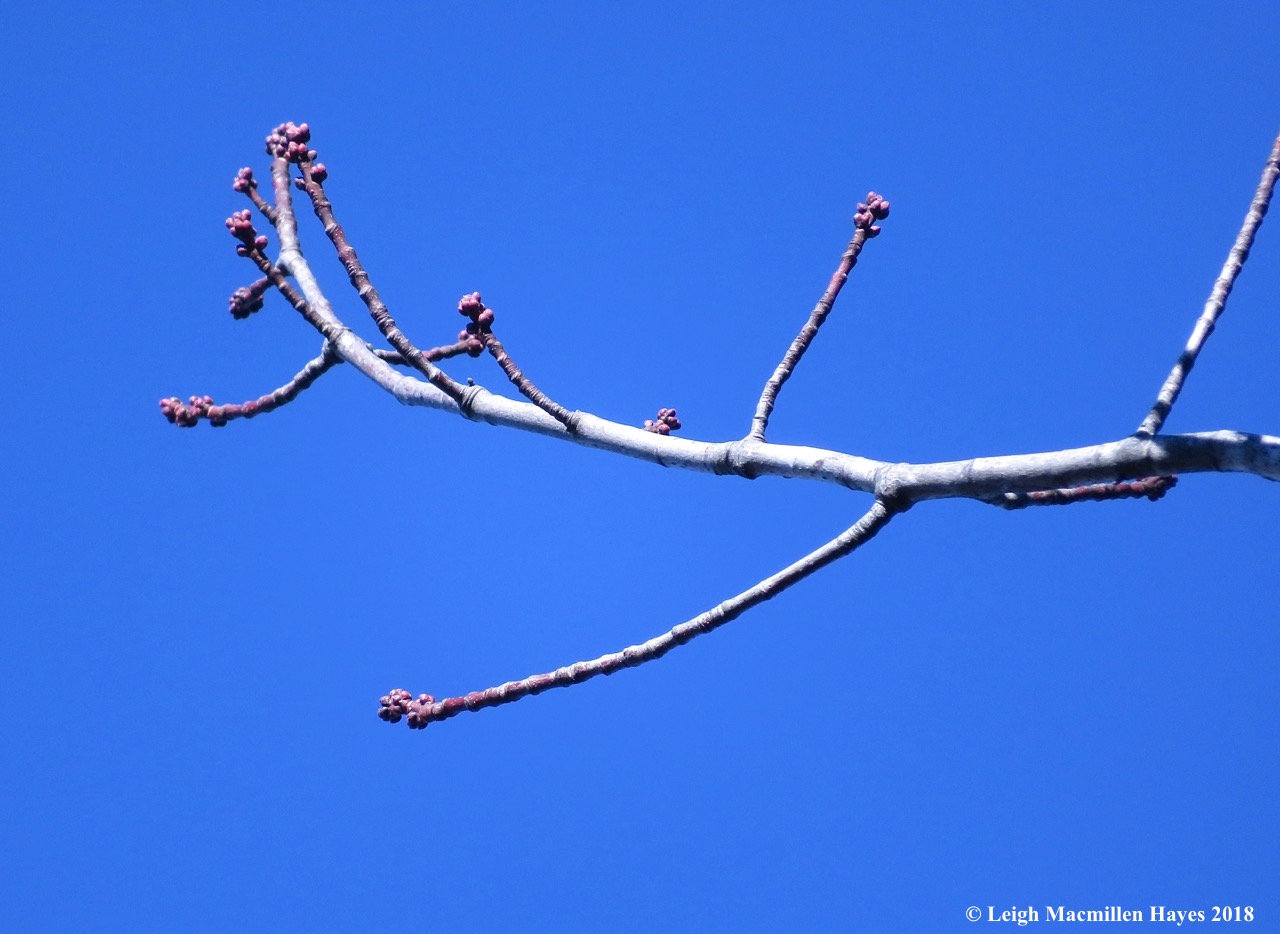
From the ferns where I’d planted my feet, I looked skyward and noticed the leaf and flower buds of a Red Maple, all tucked inside their waxy scales. It was the right place to be for as the north wind blew and my cheeks turned rosy red, I looked to the west.

9-Baldfaces to Carter Dome

Yesterday’s view had been transformed. No longer was it snowing from the Baldfaces to Carter Dome, with Mount Washington the whitest of all, posing between them. But still, it was chilly.

10-telescoping in on Mount Washington

A slight push on the camera lever and I pulled the scene a wee bit closer.

16-Perky's Path

At last I pulled myself away and hiked down, but so delightful was the morning, that I knew my newsletter work would have to wait a few more minutes at the intersection with Perky’s Path, for I felt the calling.

17-wetland--old beaver pond

It’s a wetland I visit frequently and once upon a time about five years ago it was filled to the brim with water because beavers had dammed it for their convenience.

18-suds reflect leaf

The only water today was found in a small stream that flowed through, its origin at Bradley Pond and terminus at Heald Pond. I stopped at the rock stepping path to admire what the water had to offer, including suds forming their own rachis or mid-vein from which side veins extended, a sideways rendition for the birch leaf caught between twigs.

19-view from the rock

In the middle of the stepping stones is a large flat rock. It was there that I settled in for a while, enjoying the feel of its sun-absorbed heat and the sound and views offered as the brook flowed slowly forth.

21-view from the bench

At last I pulled myself away and continued toward the bench that overlooked the wetland. All was quiet on this brisk day, but its a place of life and love and change.

22-back to the wetland

From there I continued to circle the old beaver pond to the point where I knew it had formerly been dammed. Climbing over and around moss-covered rocks, and into former stream beds, I made my way to the edge of what I used to call an infinity pool for the water was once at the dam’s upper level.

23-view from the beaver dam

Once I reached the dam, making my way one step at a time, for it was rather tricky footing at times, I discovered life on the other side. For all the years I’ve been involved with the land trust, I’d never seen this edge from this view. My surprise included the almost bald rocks.

25-coyote scat full of bones

Stepping from boulder to boulder, I made my way into the wetland a wee bit, but along the way realized someone had visited prior to me. Actually probably almost a year prior given the conditions of the scat left behind. Based on its shape, size, and inclusion of multiple bones plus lots of hair, I suspected a coyote had feed on a hare.

26-spider view

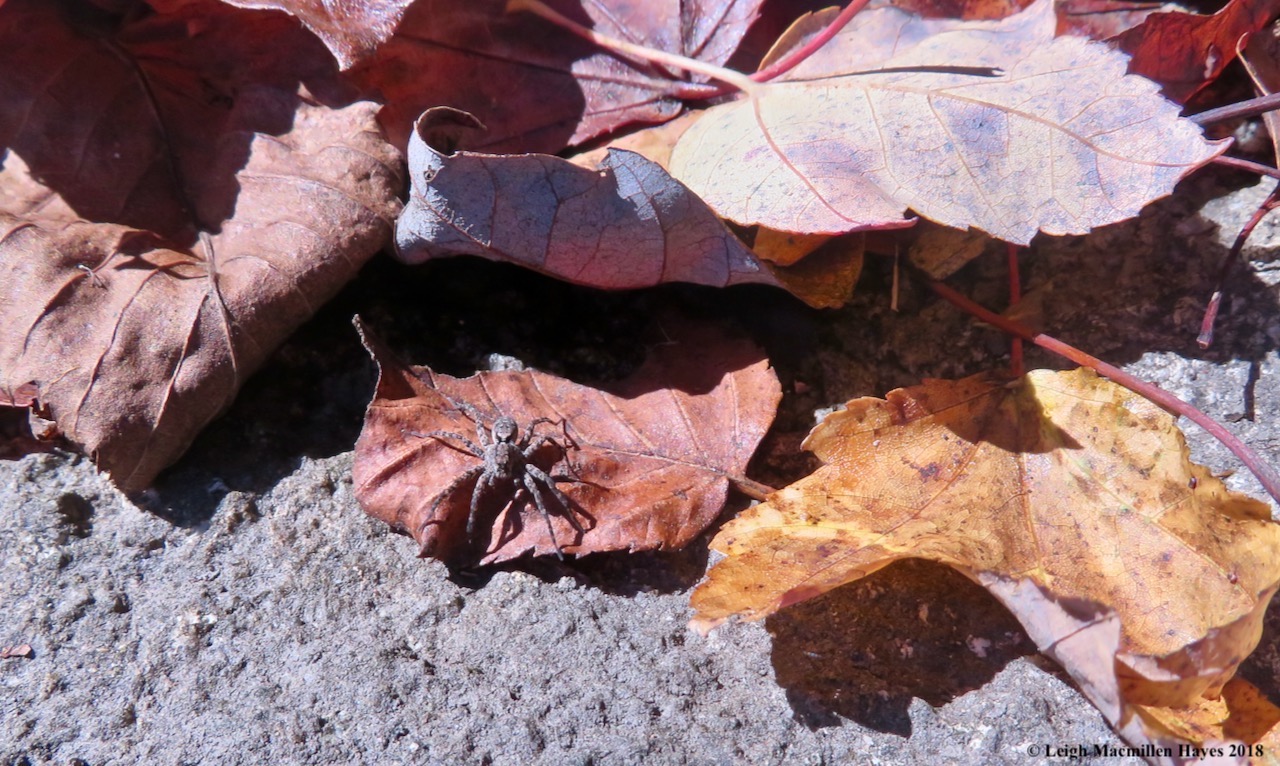
The coyote and I weren’t the only ones who knew of this secret place. A wolf spider darted in and out among the leaves, more afraid of me than I was of it.

27-spatterdock

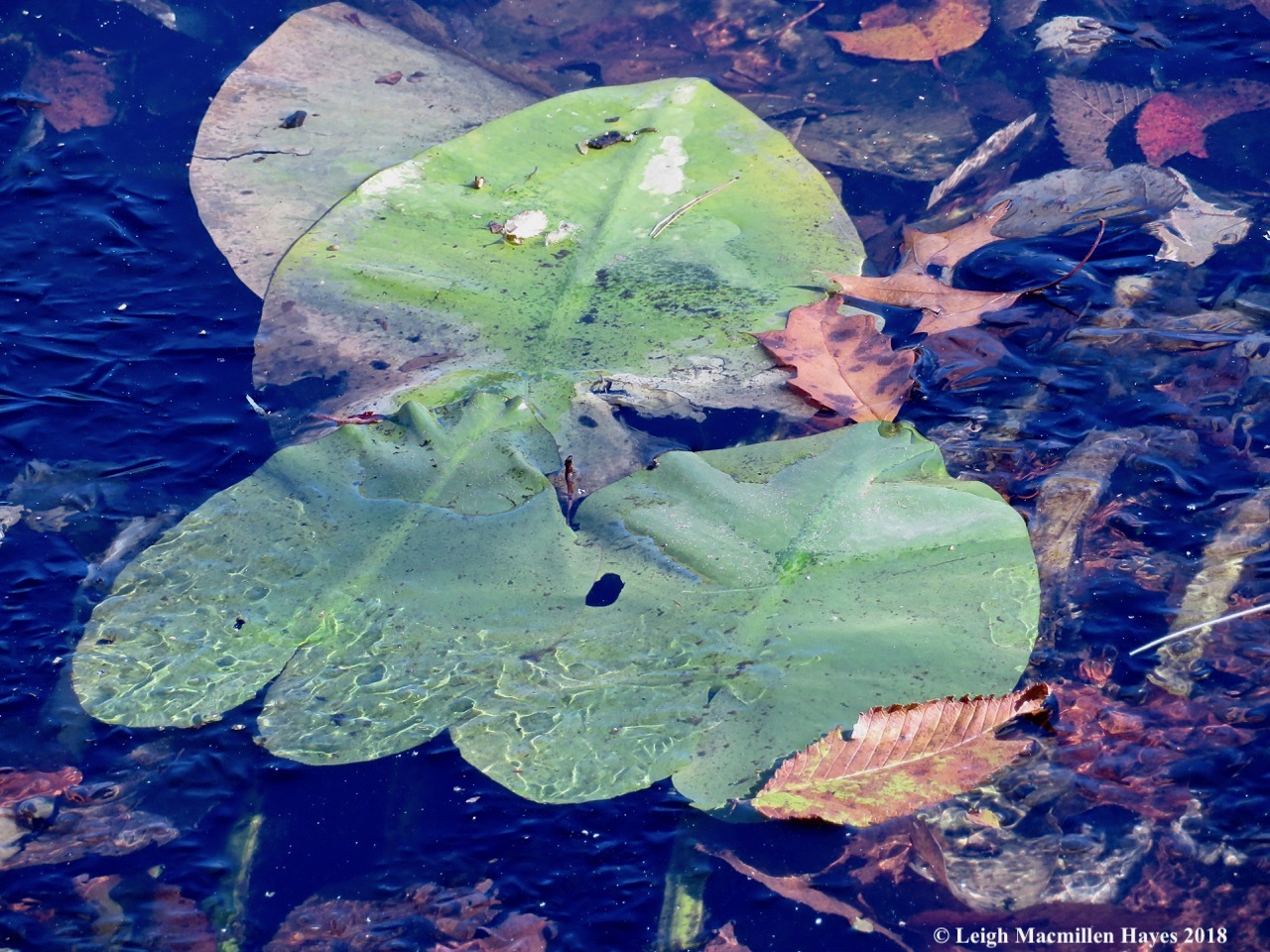
And then I discovered something that perhaps they both already knew: the water supported a small colony of Spatterdock, a plant that will need to be added to the list of flora for this property. Do you see the ice on the Micky Mouse ear leaves?

28-ice

Ice had also formed around a fallen log, its swirls portraying a high-heeled boot that certainly might be appropriate in an ice sculpture but not on ice.

28-tree spirit

All of what I saw the tree spirit already knew. And yet, it allowed me to make discoveries from my feet to the sky.

29-Mount Washington summit

And every layer between. I know he’s not there anymore, but can’t you imagine Marty Engstrom on top of Mount Washington?


Amazing Race–Our Style: episode nine

“Drive to Newry and receive your next clue,” was the message we received midday yesterday and so as soon as my guy closed his store and sent in an order for more merchandise, we hopped into the truck and began our journey north. In Newry, just beyond Bethel, we found out we were to continue on to Rangeley and patronize the local businesses.

1-Moose and snow

First, however, we had to get there. Darkness enveloped us and flurries confused my vision as I drove with caution through Grafton Notch to Errol, New Hampshire, and then back into Maine toward our destination. Our wildlife sightings: two raccoons, a snowshoe hare still brown in color, a couple of deer and a cow moose and the bull moose you might see to the left of the first telephone pole. We were excited to say the least. And, I had proof that my slower speed was apropos–cuze my guy was teasing me.

3-the place to ourselves

It was almost 8:00pm when we pulled into town and stopped at Parkside and Main for a burger. The restaurant closed at 8, but owner Kash Haley was gracious and told us to relax. So between plays in the football game, and bites of our burgers, we oohed and  aahed as one of the waitresses shared photos of her grandchildren with us.

2-hanging out at Parkside and Main

And then once all the patrons and staff had left, we sat for a bit longer at Kash’s insistence and enjoyed the game and each others company while he cashed out and sanitized the kitchen.

4-blue sunrise, blue sky in morning, snowflakes are forming

This morning found us rising to a blue sky over Rangeley Lake. Doesn’t the saying go like this: Blue sky in the morning, snowflakes in the offing? For they were and we knew we had to dress appropriately for a day outdoors. But first, we had a few more local businesses to visit, the first being Keep’s Corner Cafe for breakfast and then we grabbed sandwiches from Woody’s Deli at Loony Bin Variety. And with the check came our next clue: “Rangeley–equator to pole, it’s all the same.” Huh?

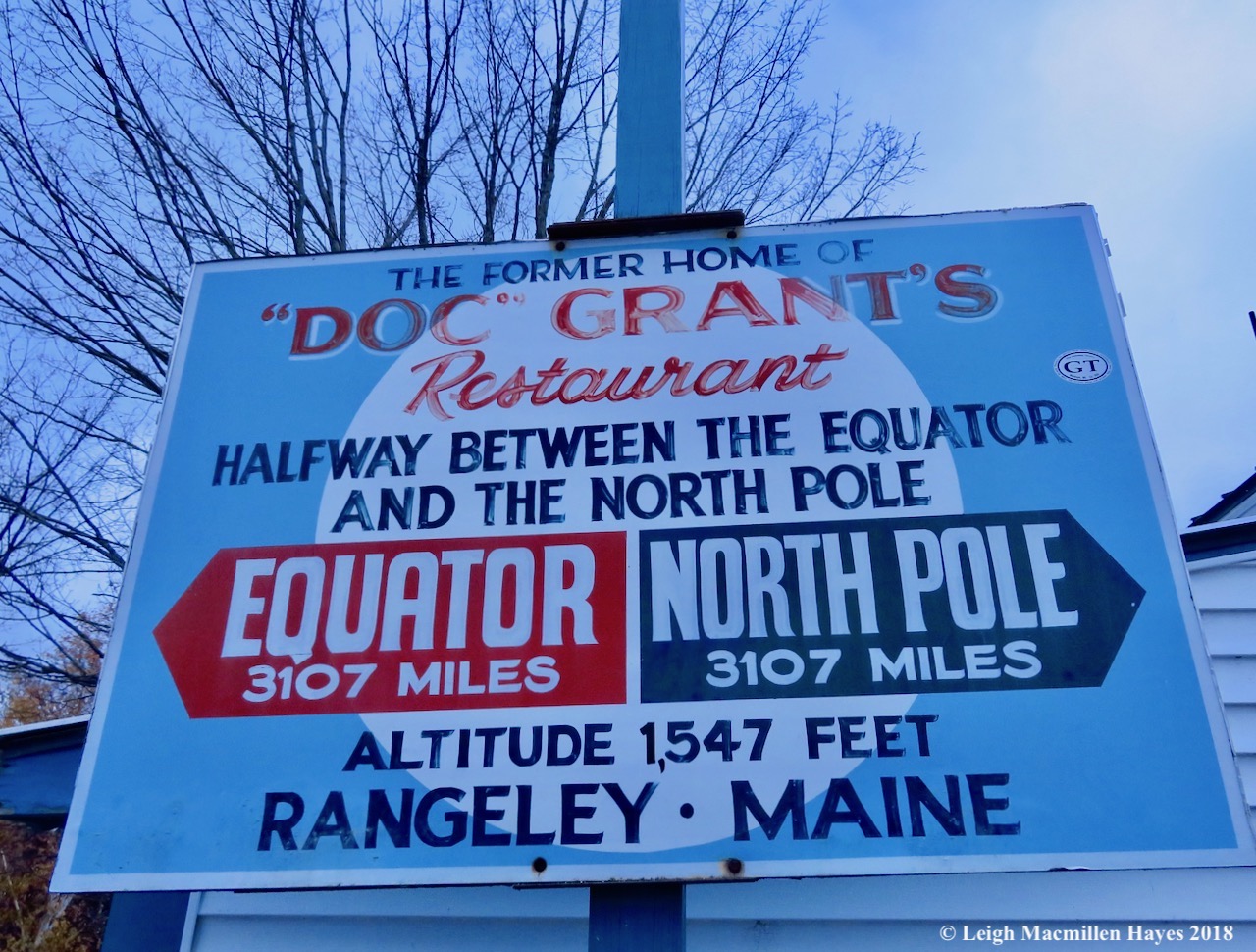
5-halfway between equator and north pole

But, we did our research and sure enough, the western Maine town of Rangeley is located precisely between the Equator and the North Pole. How cool is that? And it was at that sign that another clue appeared. “Choose one: Either explore Orgonon or Find your way to the giant AT sign and seek the piazza.” Several years ago we’d snowshoed the trails at the Wilhelm Reich Museum, aka Orgonon, so we chose the latter for today’s challenge. The AT we understood to be the Appalachian Trail, but a piazza on the trail? Would there be a hut with a porch? Perhaps a fancy porch?

6-AT

A few miles south we found the giant AT. And across from the parking lot on Route 4 we spied the opening to the part of the trail we thought we should follow.

7-red fox scat

And so we ventured forth, stopping moments later for a couple of deposits of red fox scat. Another critter to add to our 24-hour menagerie.

8-sluice

We crossed a sluice way of the Sandy River, and imagined the history stored in the rocks.

9-snowflakes gathering

As we hiked, snowflakes decorated the variety of maple leaves.

10-snow on trail

And we began to notice that our journey would pass through a variety of natural communities and over various obstacles including roots,

11-boardwalks

boardwalks,

12-rocks and roots

and rocks mixed with roots.

16-Piazza Rock

My guy was in the lead, though he commented throughout that I wasn’t far behind, trailing only by a few footsteps. But when he reached a certain point, I’d been looking down for careful foot placement and so I didn’t know what he was exclaiming about–until I looked up. At. Piazza. Rock.

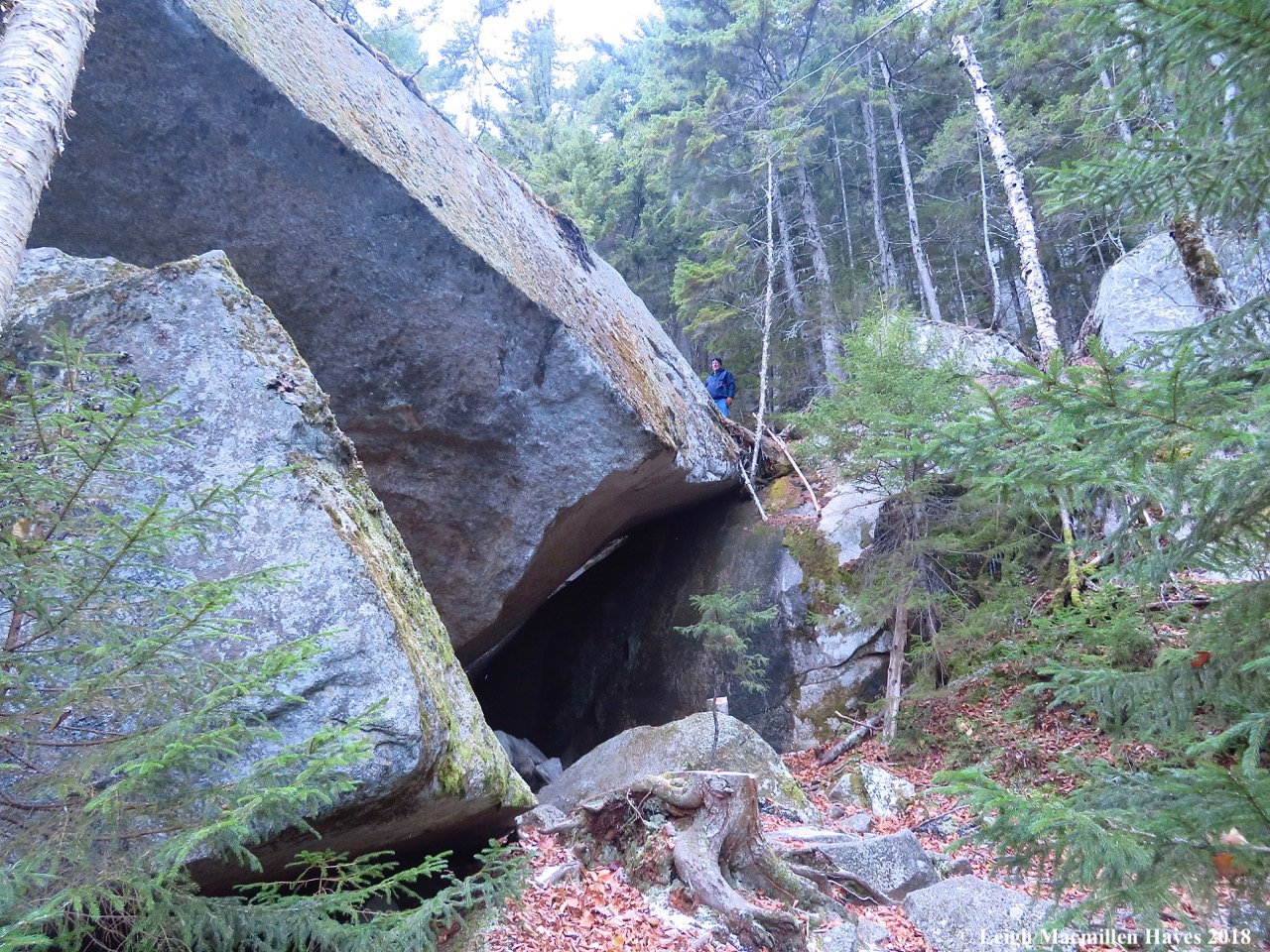
From Maine Trailfinder we discovered this tidbit: “According to the geological notes about this area, ‘The granite of Saddleback is jointed into huge building blocks. An unusually large one has slid out of its place in the mountain side and, instead of breaking and skating down the slope like the others, has balanced across another block to create one-half of a cantilever bridge, forming Piazza Rock.'” Oh, did I mention that we were hiking up Saddleback Mountain?

17-contemplating climb up Piazza Rock

Perspective isn’t gained until one actually stands under the building block. The clue said that one of us must climb atop the structure and the other view it all from below. Thankfully, despite his fear of heights, my chivalrous guy chose the upper path.

18-and then onto the Piazza

He made it seem so simple as he crawled up the rock and then contemplated the platform before him. For a second, he wasn’t sure he’d be able to go further. But, that could mean the loss of points for us. I didn’t say anything to encourage or discourage because I was standing on safe ground below.

19-under piazza rock

My job was to appreciate the boulder from its underside. And certainly I did as I looked up at the stone diving board planted for a giant’s leap.

20-My guy on top of Piazza Rock

And bravely making his way toward the tip–my guy!

21-My guy atop the turtle head of Piazza Rock

I looked up to where he stood–atop a turtle head, for after all, we stood on turtle rock.

23-looking down at me from Piazza Rock

And he looked down . . .

Later he told me that his father always said as he stepped onto a porch, “I’m going out to the piazza.” Indeed.

28-climbing onward

Interestingly, both of our fathers accompanied us on this leg of the race for apparently as my guy thought of his dad, I spent some time thinking about my father and how much he would have loved exploring trails such as this one with us.

13-temperature

But, we were in a race and so though we reveled in memories of our fathers, we had to move back to the trail signs and check for our next clue, which was again a choice: “Make the next move or Channel your best bat.”  What?

21-Piazza Rock Hut

We followed the trail, crossed one of many streams and located the Piazza Rock Campsite–all set for the next temporary residents who would leave no trace behind.

22-Privy

It was right behind the hut that we noticed the privy–and location for any who chose to make a move . . .

23-cribbage board in two seater privy

In the game of cribbage that is for a game board sits between the two-seater. My guy might have chosen this for he knew he could beat me, but he was once again chivalrous and suggested we channel our best bats. Team Pink did stop at the privy and we never saw them after that so we wondered if they gave up on their card game and moved on to Orgonon.

25-onto the caves

We, however, continued on and reached “The Caves.” One after the other, we shimmied through, hardly as graceful as a bat might fly.

27-the caves

It wasn’t easy, but we moved in and out and reached our next clue: Locate lunch rock with an aquatic view.

28-Ethel Pond?

Onward we climbed, reaching Ethel Pond first, where the ice at the edge was thin and my guy reminded me that I should approach with care.

29-another wetland

About a half mile up the trail we spotted another wetland. Really, we expected to see a moose in each, but when one expects to see a moose or any other form of wildlife, it doesn’t happen. And it’s truly more enjoyable when the offering is a surprise.

29-ice formations

Speaking of surprises were the first ice formations of the year.

30-crossing to lunch rock

Periodically, we crossed water, but the ice formed best at our last crossing, where lunch rock awaited. We’d made it to the stream that flowed from Moose and Deer Pond, a place we couldn’t necessarily visit, but could appreciate for the wildness it offered its wildlife residents.

Lunch rock stood in front of my guy and it was there that we enjoyed the chicken salad sandwiches we’d ordered from Woody’s Deli at the Lonny Bin.

32-squirrel midden

As we looked about, we discovered that we weren’t the only ones to dine in that vicinity, for the balsam fir scales and cone cobs indicated that the resident red squirrels were also frequent diners.

32a-junco joule=foe of a different feather

And, it appeared, another had also consumed a meal for Junco feathers were plentiful. A foe of a different feather had gained a few joules of energy.

33-back to the sluice

Our lunch spot became our turn-around point and with great speed we made our way back to the sluice in now time at all,  completing our eight mile hike with side trips in 5.5 hours, sorry that we couldn’t summit Saddleback Mountain because we were told to return to our truck by 3:30pm. We actually reached the truck by 3:10. In our minds, another day will find us returning and summiting Saddleback as we really like the trail and were eager to discover what else it had to offer.

34-reaching the mat at Puzzle Mtn Bakery

As we drove toward Errol on our return trip, we spotted Team Mustang stopping just below Orgonon and wondered what they questioned when they stepped out of their car.

We continued on to the starting point in Newry, ready to step on the mat and end this leg of the race, only to discover that we’d made a mistake.

How could that be?

We thought that lunch rock was our turn-around point, but we should have continued about 50 more feet where a spur trail would have led us to Eddy Pond. Oh, we could see the pond, but not get close to it. If only . . . we’d paid closer attention to the map.

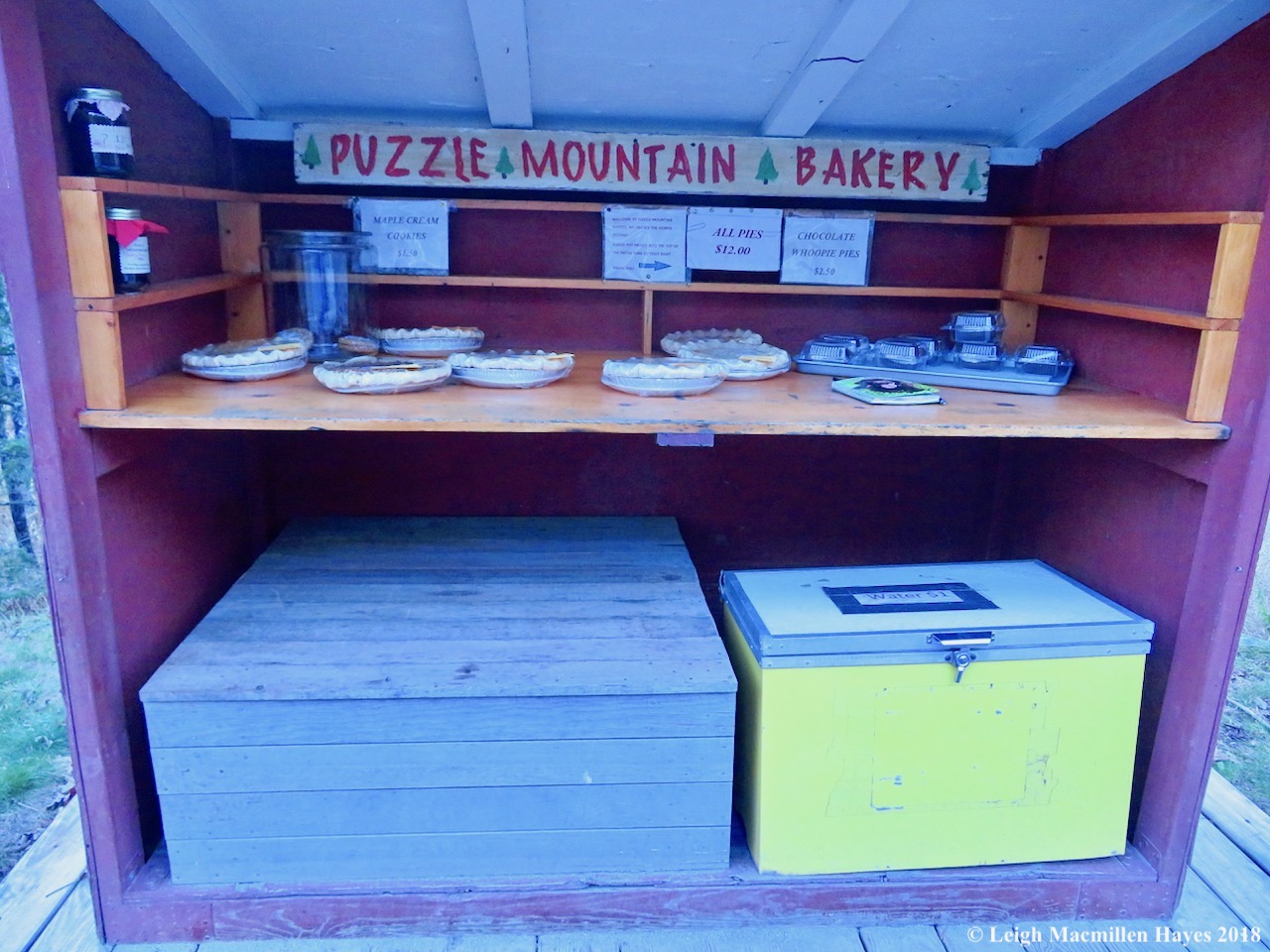
As it was, when we arrived at the mat beside Puzzle Mountain Bakery in Newry, we had to sit for a half an hour and wait. No one arrived. Thankfully. And then we had to answer one important question:  How many streetlights are there in Upton? Eight. Check.

25-the prize

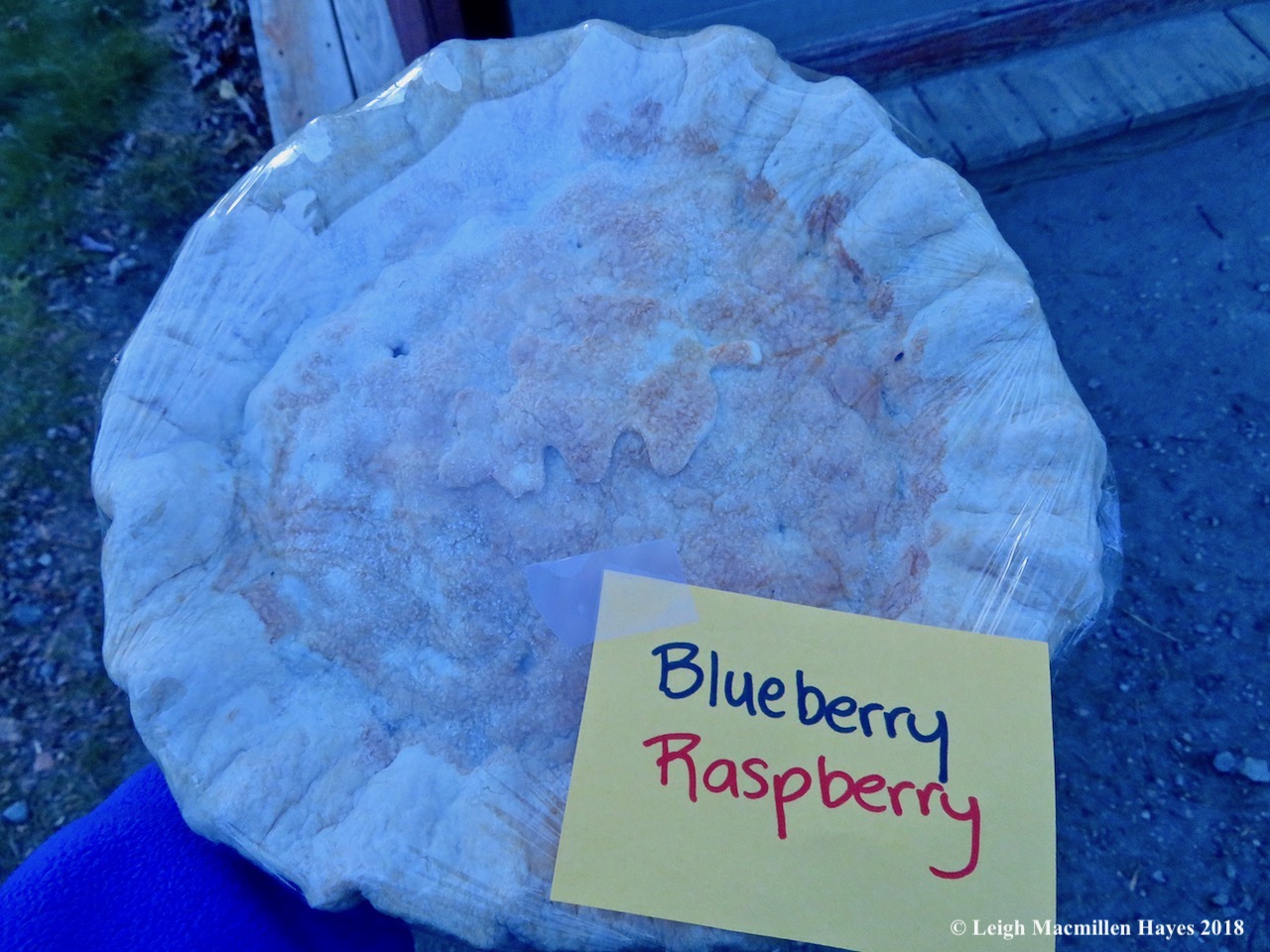
We finished third but got the streetlight question right and so we received a blueberry raspberry pie. YUM.

The Amazing Race–Our Style: episode nine . . . and the fun continues; we’re still in. Phew.


To Pause and Focus

I had no idea what to expect of today’s tramp with two friends as I didn’t even know prior to this afternoon that the trail we would walk even existed. And so I pulled in to the parking area at the end of Meetinghouse Road in Conway, New Hampshire, sure that we’d only be able to walk down to the Saco River about a hundred feet away and that would be the extent of our adventure.

1-Conway Rec Path

But . . .  much to my pleasant surprise I was wrong and in the northeastern corner of the parking lot we crossed a bridge into the unexpected setting.

2-Saco River framed

For the entire journey, we walked above and beside the Saco River. And our minds were awed by the frames through which we viewed the flowing water and boulders.

3-clear view of the Saco River

Occasionally, our view was clear and colorful, the colors now more pastel than a week ago.

5-witch hazel, understory

Even as the colors have begun to wane and leaves fall, we looked up from our spot below the under and upper stories and sighed.

4-Witch Hazel

For much of the time, we were wowed by the Witch Hazel’s flowers–for so thick were they on many a twig.

4a-witch hazel flowers

In fact, if one didn’t pause to notice, you might think that each flower featured a bunch of ribbons, but really, four was the count over and over again.

4b-witch hazel flowers, leaf:bundle scars

And some were much more crinkly than others. One of my other favorites about this shot is the scar left behind by a recently dropped leaf. Do you see the dark smile at the base of the woody yet hairy flower petiole? And the dots within that represented the bundles where water and nutrients passed between leaf and woody structure?

6-spotted wintergreen

And then one among us who is known for her eagle eyes spied a Spotted Wintergreen, Chimaphila maculata, a name that has always made us wonder for its dark green leathery leaves seem far more stripped than spotted. It’s one of those plants with a bunch of common names and so we should try another one on: spotted wintergreen; striped prince’s pine; striped wintergreen; striped pipsissewa; spotted pipissewa; and pipissewa. But perhaps the fact that it’s striped and referred to as spotted helps me to remember its name each time we meet. A sign of how my brain works.

7-spotted wintergreen patch

While we know it to be rare and endangered in Maine, it grew abundantly under the pines on the slight slope beside the river in New Hampshire, and we rejoiced.

8-spotted wintergreen capsules

Its newer capsules were green, but a few of last year’s woody structures also graced the forest floor. Reseeding helps the plant propagate, but it also spreads through its rhizomes.

9-maple-leaf viburnum

Everywhere we looked there was a different sight to focus our lenses and we took photo upon photo of the variations in color of some like Mapleleaf Viburnum (Viburnum acerifolium), a shrub with three-lobed maple-like leaves and small white flowers in the spring that form blue fruits in the early fall and had been consumed, only their stems left to tell the story.

10-red maple leaves

Red Maple (Acer rubrum) leaning over the river offered their own hues that bespoke autumn.

16-platter sized mushrooms

And tucked into a fungi bowl, we found the yellow form of Sugar Maples (Acer saccharum). 

11-Saco River with Moat Mountains in background

Onward we continued with the river to our left, outlined with maples and evergreens, and backdropped by the Moat Mountains.

12-small pond stained glass window

And to our right, a small pond where trees in the foreground helped create a stained glass effect filled with autumn’s display.

13-reflection

And once again, in the pond’s quiet waters reflections filled our souls.

14-turn around trespass

A wee bit further, we trespassed onto private land, and decided to make that our turn-around point as we got our bearings via GPS.

15-trail

Backtracking was as enjoyable as our forward motion. We had been on a trail called the Conway Rec Path, part of the Mount Washington Valley Rec Path, intended for walking, running, biking, snowshoeing, cross-country skiing, bird watching, wildflower viewing , tree study, plus river and mountain views. Kennett High School athletes ran past us and we encountered couples out for exercise. None took their time as we did, but that’s our way and occasionally we ventured off trail because something caught our eye.

9-rock carvings match the waves

Meanwhile, the river continued to flow, as it has for almost ever, and the water continued to carve patterns yet to be seen, but we enjoyed those that reflected its action.

17-old silver maple

Back at the parking lot, we were wowed by a Silver Maple (Acer saccharinum), its girth suggesting an age older than a century.

18-silver maple buds

As had been the case all along the way, we experienced another wow moment when we realized how developed were the flower and leaf buds already. We know they form in the summer, but . . . they looked ready to pop!

19-white-throated sparrow

As we stood and admired, a flock of Juncos and White-throated Sparrows flew from one spot to the next as they sought seeds on the ground. Occasionally, the sparrows paused for a moment.

20-2 white-throated sparrows

And then moved on again.

21-Eagle over Moose Pond

At last it was time for us to move on as well and head for home, my friends’ to their mountainside abode in New Hampshire and me to my humble house on the other side of the Moose Pond Causeway. But as I always do when making the crossing, I looked up.

22-immature Bald Eagle

And was honored by a sighting that pulled me out of my truck. The immature Bald Eagle I’d watched and listened to all summer graced me with another opportunity to view it.

One scene after another, it was a delightful autumn afternoon. Thanks P&B, for the sharing a new trail with me and providing many moments to pause and focus.

The Gathering

I can’t remember when our yearly ritual began but it has become tradition for three college friends and me to meet somewhere for a fall weekend. And so this year found us staying at a borrowed house in York, Maine. I was late to the gathering but we spent last night catching up as we surrounded the kitchen island. It seems like a table or island is always the spot where we spend most of our time each year while we tell new stories and recall old ones.

1-duck pond

This morning found us dining at a local restaurant. Years ago, I’d spent many an hour in York, either eating at Rick’s, combing the beaches, or standing beside a duck pond. And after this morning’s breakfast, voila–the duck pond. I’m not sure it was the one I remembered for so much had changed in town since I’d last looked for it, but still . . . it was a pond . . . with ducks.

2-fall mallards

Dabbling Mallards to be exact, their iridescent colors as brilliant as the fall foliage.

3-Long Sands Beach

Our next stop was the beach–Long Sands Beach that is. With the tide rolling out, we were able to stroll along most of its mile and a half length.

5-herring gull-shadow and reflection

Our sights included a Herring Gull in triplicate, with both its shadow and reflection cast on the watery surface.

9-ripples in the sand

Equally impressive were the ripples in the sand that matched the water that had once flowed over it,

11-patterns

and those in a small stream bed (which we chose not to cross).

10-snail trails

Our sense of wonder was again aroused when we saw a message in the sand and realized it was not someone writing in script, but rather the trail of a snail.

8-half dollar

We also found a few broken sand dollars, the fifty cent piece being the largest.

6-three old friends

We walked and chatted and walked and chatted some more until our time together came to an end. Once more we gathered round the kitchen counter, then shared a group hug and said our goodbyes.

12-until we meet again

But we each left knowing that when the time comes to meet again, we’ll follow the signs and pick up where we left off.

13-Nubble Light

As I turned north out of the lane, I wasn’t quite ready to hop onto the highway and find my way home, so I detoured. My first stop was a Nubble Lighthouse, where “in 1874 President Rutherford B. Hayes appropriated money to build a lighthouse on this “Nub” of land.” All these years later, it’s getting a much needed facelift.

14-Barrier Beach Trail

A wee bit further up the road, I pulled into Wells Reserve at Laudholm , a 2,250-acre estuarine zone. Trails loop about the property and I followed a few.

15-bumblebee pollination

Beside the estuary, bees aplenty buzzed about some late asters in the warmth of the sunshine.

16-yellow rump hiding

And closer to the ocean, Yellow-rumped Warblers flew and landed among the shrubs.

17-beach rose

As I walked across a boardwalk toward the beach, a few beach roses showed off their brilliant blooms.

18-Drake's Island Beach

At last I reached Drake’s Island Beach on the Atlantic Ocean, one of my old haunts on daytrips long ago.

19-more squiggles in the sand

And there, another squiggly message in the sand, longer than the first but about half as wide in trail straddle (just getting back into my winter tracking frame of mind and terminology.)

21-Rachel Carson Wildlife Reserve

On my return, I looped around on the Laird-Norton Trail, where a well-built boardwalk was decorated with so many shades of red speaking to the Acer rubra Maples that arched above.

23-garter snake

In one sunny spot, a garter snake sunned and I tried to warn a woman who was walking toward me, but she didn’t hear and the startled snake practically jumped off the boardwalk. The woman almost did as well!

24-apple tree

Snakes and apples and I began to wonder if I was in the Garden of Eden. But really, I wondered if a squirrel had wedged the apple into the nook of the tree to dry. I’ve seen the same with mushrooms and just last week watched a red squirrel snatch a dried mushroom in a movement so quick that it will remain in my mind’s eye only.

20-drone fly, looks like a European honey bee

Certainly, the bees and flies, such as this hover fly, were taking advantage of the nutrition offered at the reserve. Temperatures are forecast to dip this week, so I’ll be curious to see how long the flowers and pollinators last.

25-estuary

My final stop of the day was to walk a trail that connects to the reserve. The Carson Trail is named for Rachel Carson. The Rachel Carson National Wildlife Refuge was created in 1966 to protect valuable salt marshes and estuaries for migrating birds. My views today included heron, an egret, and a sandpiper.

27-selfie

Finally it was time to head for the hills. But like the ducks and pollinators and birds that foraged for nourishment, I was grateful for the opportunity once again to gather with friends and be sustained by each other’s company.  We’d pose for our traditional selfie before heading off in individual directions to our everyday lives in Massachusetts, New Hampshire, Maine,  and Vermont. Thanks Pammie, Bev, and Becky, and a special thanks to Lynn and Tim for letting us make ourselves at home in their York place.

Until we meet again . . .


A Keen Eye for the Wonders at Our Feet

As beautiful as the trees are right now with their autumnal display in full force, if you walk slowly in the woods and on the bald faces of our local granite, I think you might find yourself amazed. I know a friend and I always are and this afternoon was no different. We didn’t journey far; we didn’t need to journey far. We just needed to be present in the moment.

1-bird's nest fungi

Our first find was actually a discovery she’d made the other day. In her front yard, mixed in with the acorn caps, were teeny tiny examples of Cyathus striatus or Splash Cup Fungi.

2-bird's nest

Only two weeks ago, she’d shown me a larger version of this Bird’s Nest Fungi in the form of Fluted Bird’s Nest, but today she had this miniature version to share. They really do resemble their common name.

3-beads of slime mold

Because our eyes were focused on the minute, it was no surprise that Wolf’s Milk Slime Mold, all beady in structure, should attract our attention.

4-stink horn

Our next great find discovered by my friend with the eagle eyes was a Common Stinkhorn (Phallus ravenelii). She said it stunk. I didn’t notice, but the flies loved it. Love, in fact, seemed to be a common theme, for on the stalk, which is typically white, appeared a heart, with arms/hands wrapped around below. Even though it’s “common,” I don’t often encounter any form of a Phallus fungus, so I’m not sure if the two-toned stalk is a common feature.

6-green stain fungi

The next discovery–the fruiting form of Green Stain Fungi (Chlorociboria aeruginascens). The turquoise fruiting body was only about a third of an inch in diameter and so it’s another one that’s easy to overlook. But . . . our movement was intentionally slow as we moved without expectation and were constantly excited by our discoveries.

7-onto the granite

At last, we stepped out of the forest and onto a bit of a bald spot where granite greets sky, with lots of life layered between the two.

8-liliputian world

And onto our knees we knelt for life on the granite was lilliputian in nature.

9-candy lichen

And varied, but it was the lichens that really pulled me into the fold. Some, like the Candy Lichen, a blue-gray crustose lichen with orange to salmon colored fruits, grew so abundantly that we practically ignored it.

9a-pixie cups

Then there were the delightful pixie cup goblets scattered throughout awaiting a visit from the wee folk.

10-British soldiers

And British Soldiers (Cladonia cristatella) standing tall yet branched as they watched over all, their crimson red caps bespeaking their ancestral heritage.

11-lipstick powderhorn

Beside them were a few Lipstick Powderhorns (Cladonia macilenta) with bright red caps above single stalks, rather like the lipstick I’ve never worn.

12-red-fruited pixie cups

And rounding out the red-cap series were the Red-fruited Pixie Cups (Cladonia pleurota), with their multiple red fruiting bodies outlining the cups.

13-red-fruited lichens

Pixie cups would have been enough. But pixie cups with bright red caps–and we were wowed. The other cool thing–like the Bird’s Nest Fungi with its splash cup form, these lichens offered something similar. The Bird’s Nest depends on droplets of water (think rain) to release its spores from the tiny “eggs” situated within each cup. For the Red-fruited Pixie Cups, it’s the same idea–the splash cup goblets allow the lichen to disperse its reproductive materials.

14-red-fruited brown

We found a few with the red caps turned brown and assumed they’d done their duty.

15- Ladder Lichen Cladonia verticillata

Just when we were about to move on my friend made another exciting discovery. Ladder Lichen (Cladonia verticillata) with its brown fruits reminded me more of fountains containing chocolate treats at the outer edge of each level.

16- Ladder Lichen Cladonia verticillata

Or perhaps a way for Jack to ascend from the world of the minute to the giants in the sky.

17-milkweed seeds

And with that, our eyes moved upwards–to the milkweed seeds that awaited their turn for release and a chance to find their own place in the world.

18-large milkweed bug

A Large Milkweed Bug reached the end of one pod, but the future possibilities seemed endless for it–as long as the spider web didn’t hinder any progress.

19-ash leaves

With upturned attention, we noted a young ash tree presenting its fall colors ranging from golden green to magenta all on the same trunk.

20-oak leaves

And even higher up, a Red Oak already showing off its carotenoid chemistry with yellows and oranges overtaking the green pigment.

21-colors

While fall foliage is at or near peak in western Maine and causing all of us to stop in our tracks to note the beauty of the live paintings that surround and embrace us in their ever changing way, its the color and variety and wonders at our feet that drew the attention of my friend and me today. And I’m forever grateful for her keen eye.

(And help searching for a needle in a haystack a little while later–thanks J.M.)

Yo, Brooklyn!

Past visits to New York City have always included museums and shows, but this weekend we followed a bit of the familiar path and sometimes took the trail less touristy in an attempt to get to know the area better.
2-Manhattan in the fog

Saturday afternoon, following our arrival via a bus from Worcester, Mass., we walked across the Brooklyn Bridge to Manhattan, which was a bit veiled in fog, thus softening  ordinarily crisp lines.

1-Brooklyn Bridge

Begun in 1869 and completed by 1883, the bridge spans the East River and connects the boroughs of Brooklyn and Manhattan.

3-bridge like a spider's web

Among the throngs of people who walked or rode bicycles across, we all wove strands of thread that fit easily into the web long ago created. Some of us paused suddenly here and there, as the arachnid tried to take hold, while others tried to maneuver along the silken dragline writing messages with their feet much the way Charlotte may have within her web.
6-wildlife on the bridge

And a few got caught up by the constrictors waiting at the center.
7-onto the streets of Manhattan

At last we emerged on the other side, where our attention was diverted by the architecture and colors.

8-New York Stock Exchange

Often, it was the interaction of today and yesterday that drew our notice, joined together as they were with a global reference.

9a-entrance door to St. Patrick's

Eventually, we passed through the doorway of St. Patrick’s Cathedral . . .
9-St. Patrick's Cathedral

where many have gathered for centuries to light candles in memoriam of those who have passed from this layer of life to the next and prayed for the future.
11-view from Central Park

And then we slipped into Central Park, where we were again struck by the architecture, especially as juxtaposed against the artificially landscaped natural world.
13-goldfish

As we watched the Mallards and Canada Geese, one of our biggest moments of awe was for a goldfish–the largest we’d ever seen.

Eventually, we boarded a train and found our way back to Brooklyn, where a quiet evening awaited.

14-the bridges from below

Sunday morning found us passing below the Brooklyn Bridge, where we could glimpse  the more “modern” Manhattan Bridge in the distance.

15-skyline from the promenade

Again, the skyline was muffled, but its edges softened.
16-spider web again

And once more we looked with wonder at the web construction.

17-river boat NYC style

Ever so slowly, we moved away even as a paddlewheeler representing the south made its way north.
18-cormorants and gull

Despite our thrill at watching water taxis, tour boats, jet skis, sailboats, powerboats, and even a police boat move up and down the river, the local Cormorants and a Herring Gull took it all in stride.
19-cormorant preening

After all, they had feathers to preen.

20-Canada Goose

And the Canada Geese–a grassy park to foul. The irony was that no dogs were allowed, but the geese made themselves quite at home.
22-offices of many sorts

Above the Cormorant/Gull condos, Lower Manhattan gave way to the harbor, and we enjoyed the view from the Brooklyn Heights Promenade.

26-Lady Liberty

Our perch included the sight of Lady Liberty as she greeted all.

24-Queen Mary 2

And another grand lady, the Queen Mary 2. The last time I saw the QM, it was a previous rendition and she’d anchored in New Haven Harbor (Connecticut) in the summer of 1979. My father, sister, and I drove into the city to catch a view and then we followed the route Queen Elizabeth, who had arrived in town for a very brief visit, would take before departing from Tweed New Haven Airport. Crowds lined the route and we practiced our best QE wave. Humoring us, some waved back. We did glimpse the queen as her motorcade eventually drove by and that was enough to fulfill our Anglophile envy.

27-water tank in Brooklyn Heights

But, this weekend we were in Brooklyn to admire New Yorkers, (and we knew the queen wasn’t on the boat), so we pulled our point of view back to the area around us, which included a mosaic structure worth noting. Watertower is actually a sculpture created by Brooklyn artist Tom Fruin. He used plexiglass and steel in 2012 to represent one of the icons of our nation–a water tower.

29-playing fields on the piers

From pier to pier we followed the promenade beside the river, noting natural places and sports fields filled with athletes of many talents as they played games or worked out.

30-Brooklyn Heights

Eventually, we circled back and then climbed up into Brooklyn Heights, enjoying our meander through a beautiful neighborhood.

31-sycamore tree

And my guy, he became a pro at identifying Sycamore trees for so prolific do they grow in that neck of the woods.
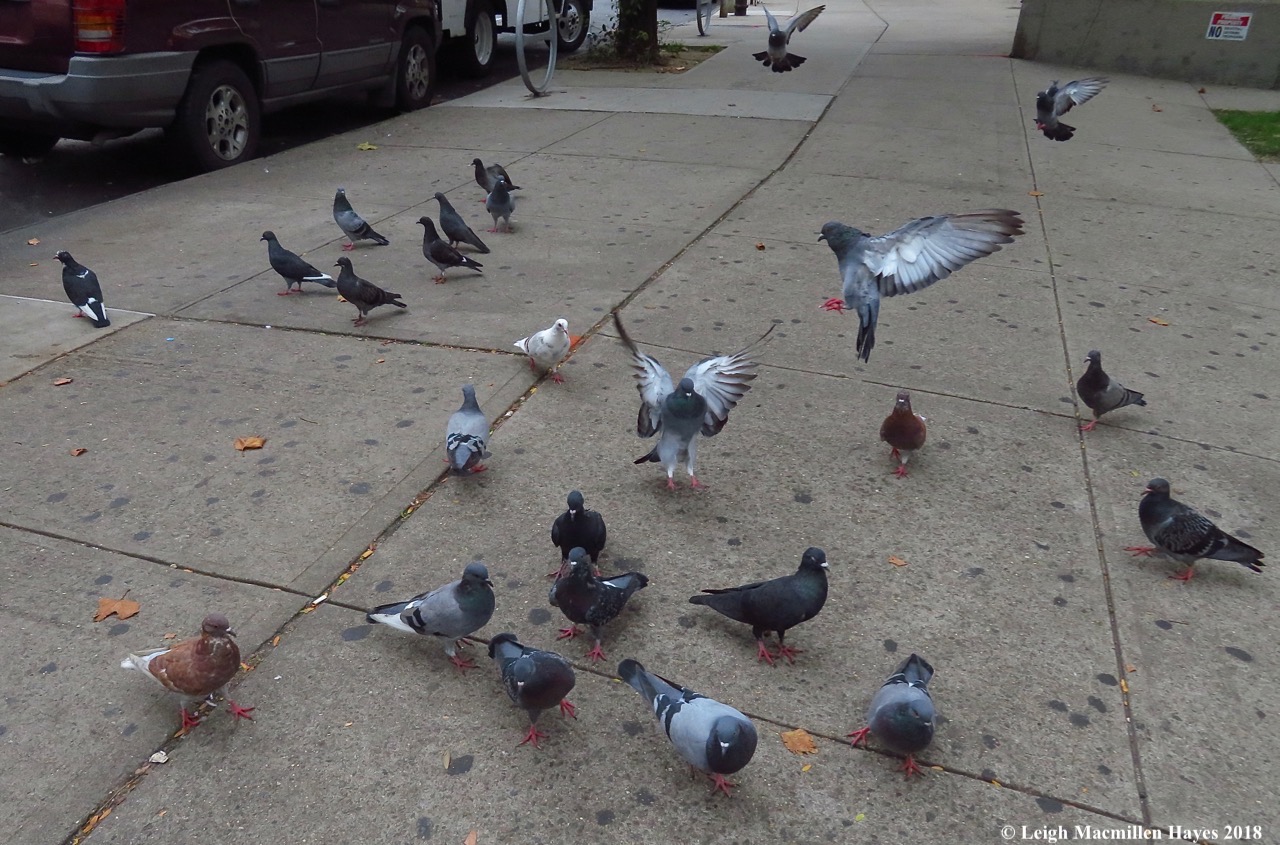
33-pigeons

And then, and then we encountered a flock of happy pigeons. Yes, we were in New York City and all pigeons are happy there. It has something to do with peanut kiosks perhaps?
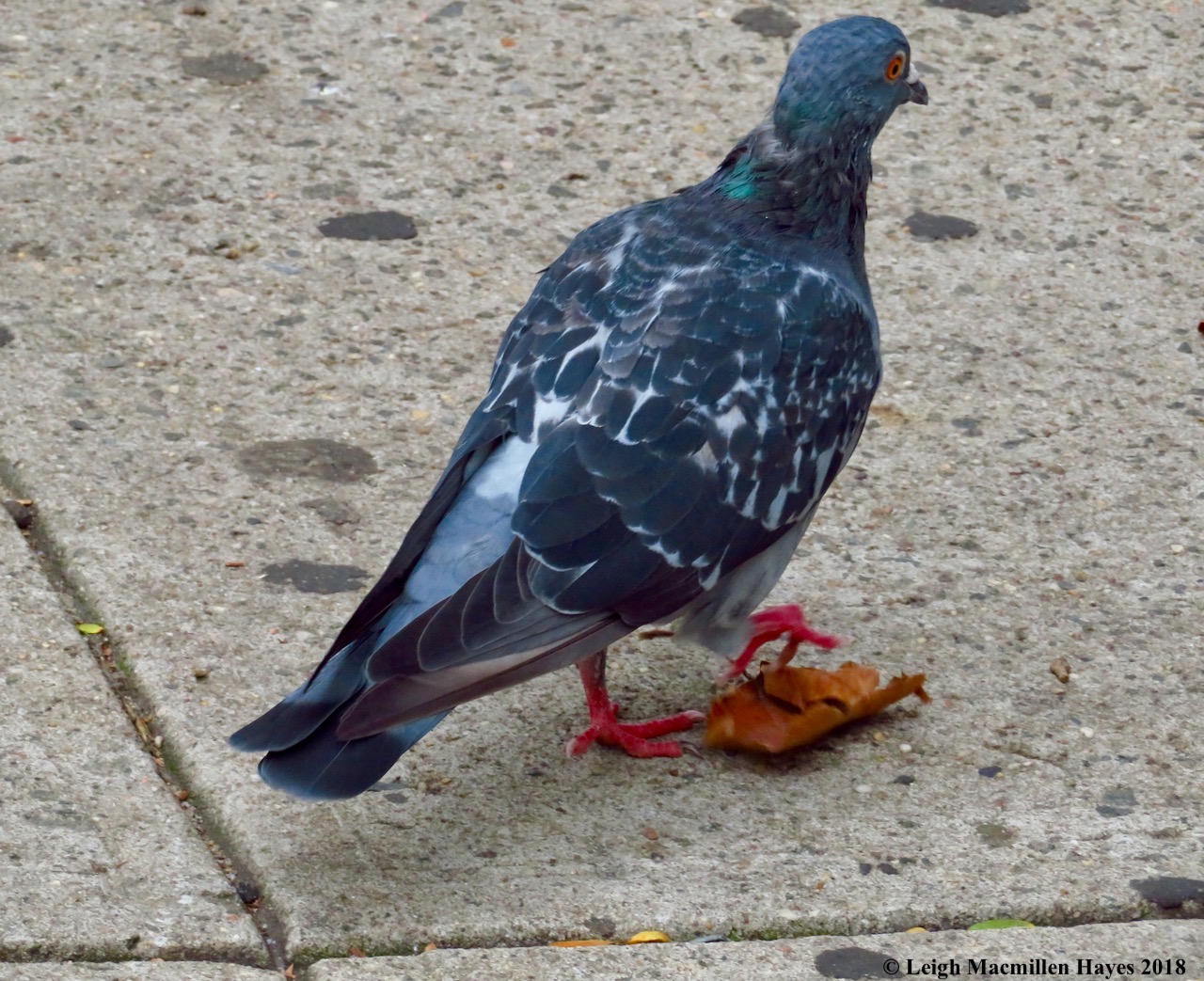
35a-pigeon

There were the typical blue-gray birds with two dark wingbars,

35-pigeon

rusty red version,

34-pigeon

those spotted or mottled,

36-pigeon

and even pale among the gang.

34a-piegon

But really, have you ever taken the time to look at those iridescent colors?
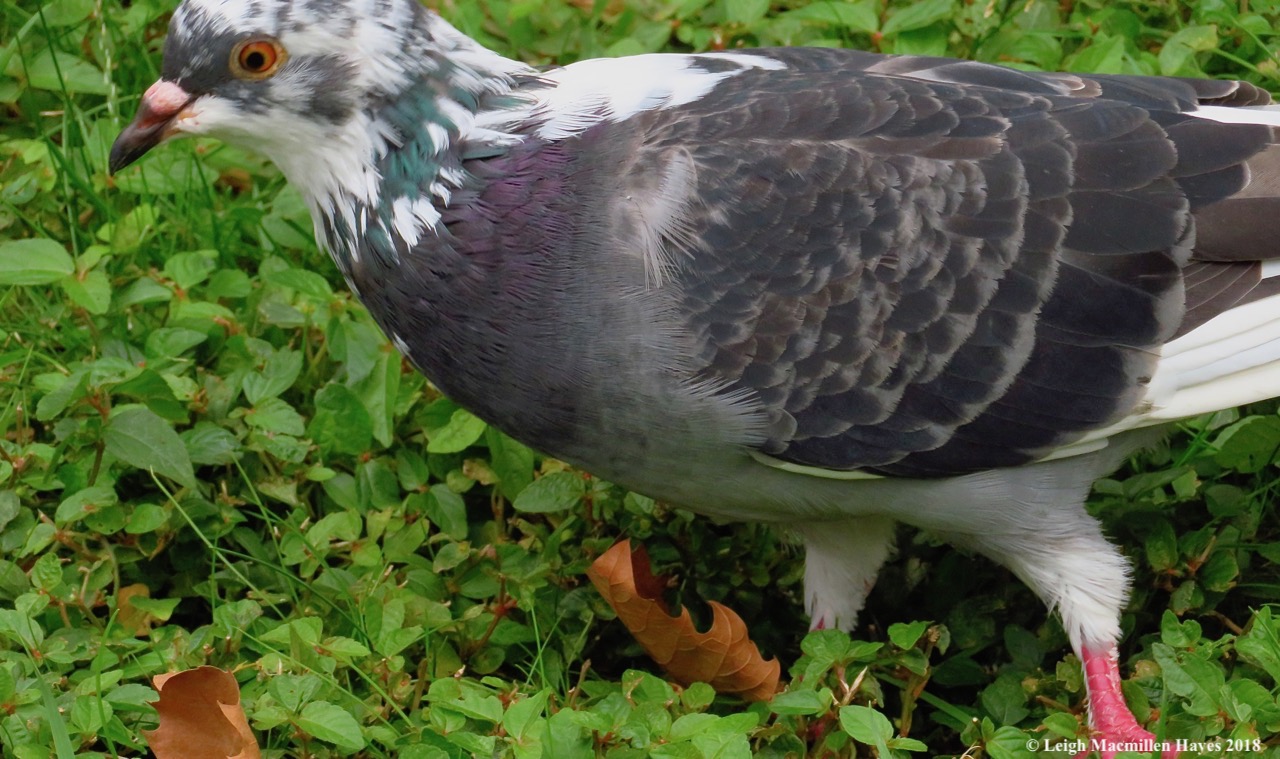
39-piegon

Or that sweet face?

40-maidenhair tree, ginko

At last we left our pigeon admiration behind and continued on, noting another tree not in our familiar category–the Maidenhair or Gingko Tree.

41-maidenhair leaf

Its fan-shaped leaves showed off the carotenoids that had been hidden all summer by the green pigment. Fall was slowly embracing the city, but it hadn’t arrived in full yet.

42-barber shop

As we moved from a more residential to commercial area, we were surprised to find a barber shop open on a Sunday morning. Given that I’d recently written about barber shops for Lake Living, it was fun to peek inside. And note how many men waited. But, in this city where many work late each day, it made sense that they’d make time on a Sunday morning for a hair cut.

43b-hardware

Eventually, our wanderings led us to a hardware store. And not just any kind of hardware store . . .

43-True Value

for it was an independently-owned True Value, much like my guy’s.

43a-entering the hardware store

And since one of our reason’s for visiting the city was to celebrate his 65th birthday, I followed him in.

45-fig in the garden

Lunch found us eating a slice of pizza from a local pizzeria. It was OK; better than what we find in Maine, but not quite what I remember from my childhood in Connecticut. We did eat in the “garden” where figs grew! I wasn’t quite sure how that related to pizza. But . . . we were in New York.

42-intential grafitti

New York . . . a city where graffiti is understood.

44-my guy.jpg

Our day ended with dinner at a small neighborhood Italian restaurant, Santa Panza, where we quietly celebrated my guy’s birthday with the most delicious dinner.

40-rotating statues of Miss Brooklyn and Miss Manhattan

As this morning dawned, it was time for us to look out the window of our hotel and say goodbye to the two ladies who’d waved us in and would wave us out. Miss Manhattan and Miss Brooklyn rotated continuously at the intersection of Flatbush Avenue and Tillary Street.

According to a Brooklyn Public Library’s website: “Miss Manhattan sits haughtily with her right foot atop a chest of money (or jewels?); in her right hand she holds a winged globe reminiscent of a cross-bearing orb, an ancient symbol of authority; a peacock, flashiness and luxury incarnate, is by her side. (The peacock, in the belief system of the Ancient Greeks, also represented immortality/eternity.) The bows of three ships hint at the status of Manhattan as an important port and an international trade hub. She is all dignity, privilege and hubris.

Miss Brooklyn’s demeanor could not be more different. Her expression is gracious, introspective and calm; she is surrounded by a church spire (Brooklyn to this day counts more houses of worship than any other borough); a lyre and a child with a book (a reference to the borough’s patronage of culture and education). The book on the child’s lap is massive. It must be a Bible, another reference to the borough’s spiritual thrust. Her head is adorned with a laurel wreath. In her hands she holds a tablet with the Dutch inscription “Ein Drach Mackt Maght” (“In Union there is strength”), a hint at the Dutch origins of Brooklyn and at the fairly recent New York City consolidation of 1898.

The granite maidens originated on the Manhattan Bridge, but these sculptures were installed on a pedestal at their current location about a year ago. For us, they were our home monuments much as Pleasant Mountain serves as our home mountain. Not only did they welcome us and send us on our way, but we knew where we’d lay our heads for the night as we approached.

43-Yo

At last, our brief city adventure came to an end, but we trust we’ll return.

Yo, Brooklyn! Yo Miss Manhattan and Miss Brooklyn. Thanks for the welcome. Until we meet again . . .
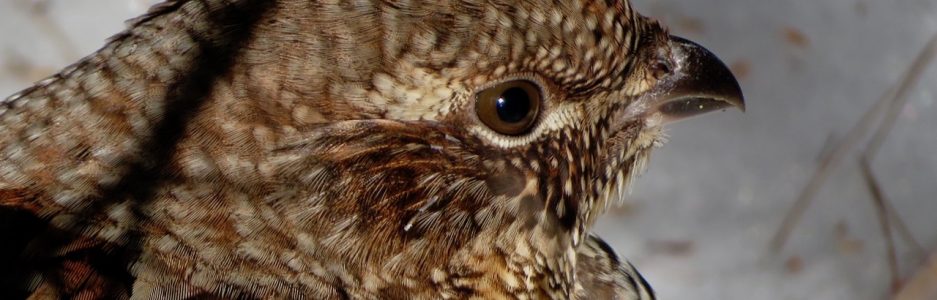


A “Fen-tastic” Afternoon

I was on a reconnaissance mission this afternoon for next week I’m leading some middle school students into a wetland and talking about forest ecology before sharing the joy of foraging with them.

1-Into the jungle

To reach the wetland, it was like walking through a jungle where the ferns grow tall, their fall coloration enhancing the scene. Cinnamon Ferns are a species that easily grow in medium to wet soils in part shade to full shade. The moist, rich, acidic soils, I walked through were much to their liking.

1a-cinnamon fern

It appeared that they were named for their autumn presentation, but really it refers to the cinnamon-colored fibers found near the frond bases.

1b-hairy underarm

Because they look so similar to their relatives in the Osmundaceae family, the Interrupted Fern, I looked to the back of the frond for confirmation. Sure enough, where the pinnae (leaflet) met the rachis (center stem), a tuft that we refer to as the hairy underarm was present.

2-kettle

Onward I continued, not sure what the moisture situation might be. So, in the past, I’ve paused by the kettle hole, but never actually entered it. All that changed today and my plan is to take the students into this special place. A kettle hole is a basin created when a large block of glacial ice was left stranded and subsequently melted in place, producing a basin or depression. These basins fill with water up to the depth of their surrounding water table, which currently happens to be rather low.

3-white face meadowhawk

Because the temperature had risen after a damp, chilly start to the day, the meadowhawk dragonflies flew . . . and landed. This one was a White-faced Meadowhawk, aptly named for that face.

4-white face meadowhawk abdomen markings

Its abdomen markings of dark black triangles also help in identification.

4b-autumn meadowhawk dragonfly

Flying in the same airspace where the Autumn Meadowhawks, with their light-colored legs. All other meadowhawks have dark legs.

4c-autumn meadowhawk love

Love was in the air and on the leaf as a pair of Autumns took advantage of the warm weather to canoodle in the sunlight.

4c-dragonfly love everywhere

They weren’t alone.

7-kettle 2

What I learned as I explored was that the kettle was actually a double pot for a second one had formed behind the first. Notice the layered structure of the area from trees on the outer edge to shrubs to grasses and flowers to water.

5-mammal tracks

And everywhere–deer and raccoon tracks crisscrossed through mud and water.

5a-racoon and bird tracks

Bird tracks also joined the mix among the raccoon prints.

6-six-spotted fishing spider

And because I was interested in learning who lived there, I had to pay homage to the six-spotted fishing spider.

8-spatterdock leaves and root

The spider flirted with me as he moved quickly among the spatterdock leaves that sat in the wee bit of water left in the center of the kettle.

9-another kettle

I finally left the kettle only to discover another and again the formation of layers.

10-green teal ducks

The water was a bit deeper and a family of Green Teal Ducks dabbled.

11-bottoms up

Bottoms up!

12-my destination

It took some time and steady foot placement as I climbed over downed trees hidden by winterberry and other shrubs, but at last I reached my intended destination, a cranberry bog.

13-cranberries

And then I spent the next hour or so filling my satchel for so abundant were the little gems of tartness. The best where those hidden among the leaves–dark red and firm were they.

14-some nibbled cranberries

As I picked, I realized I wasn’t the only one foraging. It appeared that either chipmunks or squirrels also knew the value of the flavor–though they only nibbled.

15-October colors layered

Occasionally, or even more often, I looked up to take in the colors and layers that surrounded me–from leatherleaf bronze to blueberry red to Gray Birch and Red and Silver Maples with a few White Pines in the mix.

16-buttonbush

Buttonbush added its own color and texture to the scene.

17-finding my way out

At last I decided to find my way out. (Sorta for I did get a wee bit disoriented.)

18-royal fern fertile fronds

Among the offerings were ferns of a different kind–though still related to the cinnamons I’d seen earlier. The Royal Fern’s fertile crown had months ago shared its spores with the world and all that was left were salmon-colored structures.

21-buttonbush galore, but more

I picked my way carefully and eventually found one of the kettles. And . . . drum roll please . . .

22-two sandhill cranes

two Sandhill Cranes. Others can tell you better than I how long the Sandhills have returned to this area, but it’s been for a while now and some even saw a nesting pair this past summer. My sightings have been few and so it’s always a pleasure.

23-sandhill cranes

I stood still as they moved about and they didn’t seem to notice my presence.

24-sandhill cranes

While they foraged for roots, another also watched.

25-great blue heron

The Great Blue Heron was cautious as they strolled in his direction.

29-bald eagle

And then . . . and then . . . in flew a Bald Eagle. And out flew the heron.

30-cranes flew out

The cranes waited a couple of minutes and then they flew, bugling on the wing.

And I rejoiced. Oh, I still had to find my way out and did eventually cross through a property about a quarter mile from where I’d started. But, all in all from kettles to cranberries to birds, it was a Fen-tastic afternoon as I explored an outlet fen.


Book of October: Writing My Will

Judy Steinbergh has fed me repeatedly. She’s nourished my body and soul with actual food, but also with her poetry and prose. And recently, she gifted me one of her books entitled Writing My Will.

0

Though it’s her poems about Maine that I love the most in this collection, I feel honored not only to have been the recipient of such a gift, but also to be offered the opportunity to peek into her life and share the path that she’s walked through marriage and motherhood, divorce and death.

17

I hear Judy’s voice even when she isn’t reading to me. And I covet her descriptions and command of lyrical language and imagery, especially as she captures the natural world:

“. . . after speculating on the slap of water, whir of wings,

out of the grainy dusk, some creature bursts

from the forest. Before we focus on its shape,

almost before it can be named,

it twists back, leaps, makes its escape.”

~ excerpt from “Wild Things”

or this one:

“. . . roughs the lake up like the wrong direction of fur

until it is leaping dolphins and whales in rows

until it is sleek stampeding panthers in droves

until we, in our small boats, are driven to shore.”

~excerpt from “The Wind”

1b

Each summer, she’s gathered her own poems, and those of other landscape poets, and shared them with an intimate group of writers through a workshop co-sponsored by the Greater Lovell Land Trust, Charlotte Hobbs Memorial Library, and Hewnoaks Artist Colony at the Hewnoaks property overlooking Kezar Lake in Lovell, Maine. After talking about rhythm and form, and having us read her works and others, she sends us off to find a comfortable spot in which to contemplate and write.

1a

Poets young and old flock to her and she embraces all with a listening ear and mentoring manner.

1c

And sometimes we travel the path together, either hunting for mushrooms, looking at plants and any of the millions of other things that capture our attention, or spending time writing and sketching.

Judy has written five books of poetry, three poetry teaching texts, and recorded other works. She’s the Poet Laureate for the town of Brookline, Massachusetts. And she teaches and mentors students and teachers for Troubadour, Inc. throughout greater Boston and serves as Poet-in-Residence in various communities.

This particular book, Writing My Will, is an assortment of Judy’s treasures from her family, including her dying mother, to the natural world that embraces her. Based on the theme, she’s divided it into sections: Heirlooms; My Mother Comes Back to Life; What Memories Will Rise; Talking Physics With My Son; This Wild; Meeting the Birthmother; Long  Distance; The Art of Granddaughters; Working on Words; Elegies; Writing My Will.

And it ends with one most apropos for this month:

October Song

Wild asters and the birds whir over

in flocks, Queen Anne’s Lace curls up

by the docks, the tide runs out,

runs out like it hurts, our step

is so light on this earth.

I love these times alone, thinking

about how my children have grown,

and how I come into this age

illuminated, softened

as the marsh’s edge.

And the tide runs out, as forceful

as birth, as if nothing else mattered

but rushing away and rushing back in

twice a day. Our step

is so light on this earth.

We’re given October like a gift, the leaves

on the warp, the light on the weft,

and the gold drips through

like cider from the press; we know,

we know that our lives are blessed.

But the tide runs out, runs out like it hurts,

what were fields of water only hours ago

are meadows now when the tide

is low; our step is so light

on the earth. Wild asters. All

we are sure of is change, that maple

and sumac will turn into flame, this softness

will pass and the winter be harsh

till the green shoots push

up through the marsh. And the tide

rushes in like a thirst and will keep

its rhythm even after our time,

the seasons, too, will repeat

their design. Our step

is so light on the earth.

And so, dear Judy, as my thank you for the gift of your book, I want to now share a melody of photos from previous autumns, all taken during Octobers past in your beloved Maine locale when you can’t be here. (Well, maybe one is from the Northeast Kingdom of Vermont–shhhh!)

3

4

5

7

8

9

10

11

12

13

14

15

16

2

“Our step is so light on the earth”

Book of October: Writing My Will–Poems and Prose, by Judith W. Steinbergh, Talking Stone Press, 2001.


Making Connections

“The Great Maine Outdoor Weekend is a series of events led by outdoor-oriented organizations and companies to celebrate the how, where, and what of being active outside in Maine. Our goal is to connect our friends and neighbors with the natural world, to promote fun, physical activity, & good health.”  ~greatmaineoutdoorweekend.org

In the spirit of the GMOW, the Greater Lovell Land Trust and Upper Saco Valley Land Trust co-hosted a paddle at the Major Gregory Sanborn Wildlife Management Area, aka Brownfield Bog, in Brownfield today.

1-fine fall morning

Though the temperature was a bit nippy, as in mid-50˚s to start (and colder in the shade), we couldn’t have asked for a better autumn day, especially given that we first began planning this event last winter.

b-Kathy's sign 1

In what seemed like perfect timing for they didn’t all pull in at once, vehicles laden with kayaks and even one canoe, arrived and folks who’d never met before helped each other carry boats, paddles and personal floatation devices down the road. Then we stood in our traditional circle, where Erika of USVLT and I welcomed everyone and introduced our two organizations. By the tile sign created by Maine Master Naturalist Kathy McGreavy, I pointed out our location and destination along the Old Course of the Saco River.

2-walking to the put in

And then we all walked down the road to the put-in site . . .
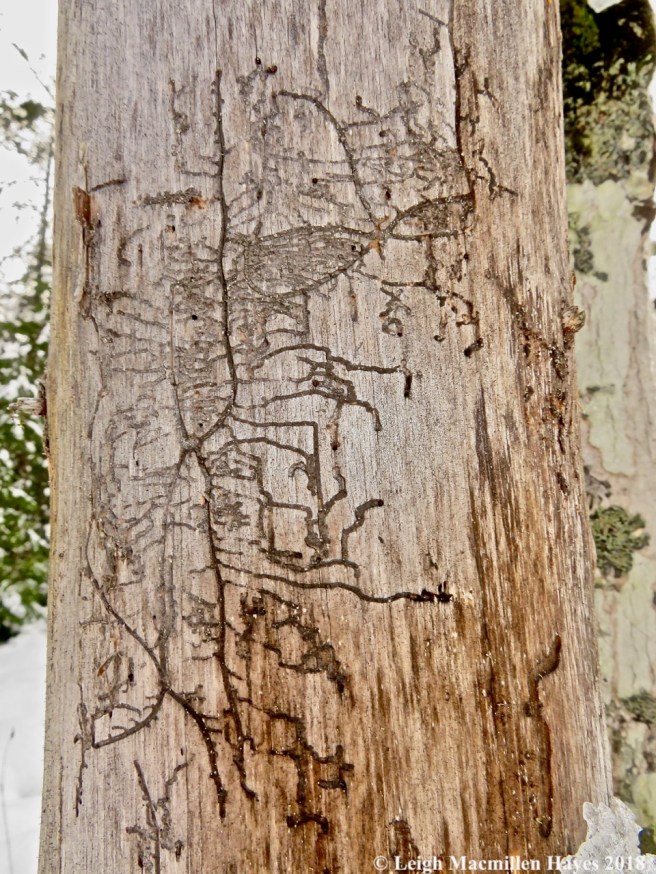
3-kayaks on parade

where our parade of kayaks awaited the adventure.
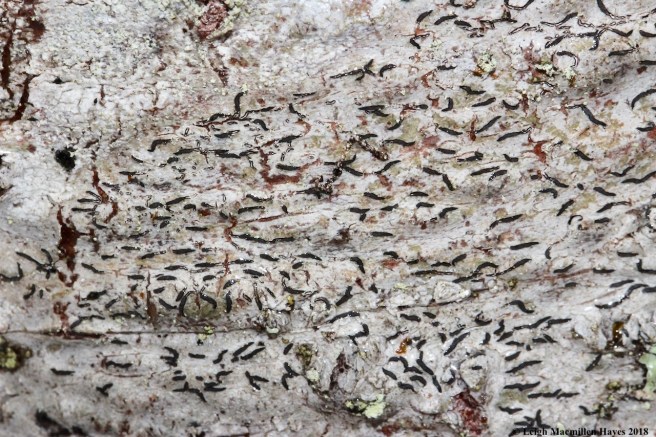
4-onto the old course

One at a time the boats were launched. And then the magic began. It was two-fold in that I’d challenged our twenty participants, some of whom had learned of the event via our advertising efforts locally and were already members of our organizations, and others who discovered the event via the GMOW website and wanted to try something new. The challenge was to spend some time chatting with people they’d never met before. And they did. Conversations ranged from living in New York to termite mounds in Africa.

Folks came from Fryeburg, Bridgton, Lovell, Standish, Jackson and North Conway, as well as Westbrook, Portland, and Cape Elizabeth. But that wasn’t all, for one joined us from Philadelphia and two came from Houston. Our furthest traveler hailed from London. Well, truth be told, she’s a long-time GLLT member, docent and board member who spends at least four months in Lovell. ;-) Thanks Moira.

5-tapestry of color

The tapestry of colors was the other magical element. We chatted about the colors and the carotenoids (yellows and orange pigment) showing up as the leaves stop producing sugar and starch for the tree, and the chemical process that produces the anthocyanin or red coloration.

14-lily pad aphids and yellowjackets

We mentioned the lily pad aphids that sought nutritious sap and noted how the yellowjackets took advantage of the honeydew secretions the aphids offered.

12-soaring above--bald eagles

And some of us had the joy of watching two Bald Eagles soar on the thermals above.

16a-beaver works

There were some fresh beaver works to note and we did spy a few lodges, though none looked active.

7-duck hunters

And for most of the trip we heard the duck hunters’ gunshots as they took aim, though I think we scared a few of them off. The hunters that is. Well, we know we scared a few ducks off as well.

6-ahhhhh

But, what the day was really all about was an enjoyment of being outdoors and sharing a place many had never explored before.

8-around every bend

Around every bend, we discovered different threads, our own colors sewn into the tapestry.

9-the tree

One of my favorites is what I’ve come to call “The Tree.” It’s a perfectly shaped Red Maple that protects a beaver lodge–if you peak below the lower branches on the left, you may see the pointed top of the lodge.

10-the tree's reflection

Even The Tree’s reflection was worth several expressed “Ahhs.”

11-color enhanced by clouds

Though the clouds weren’t many, some enhanced the scene.

15-more color

With each stroke of the paddle it seemed we reached new vantage points where the artwork was similar . . .

16- and more reflections

yet different.

How could it get anymore beautiful?

13-lily pads upturned

Even the lily pads stood out as if seeking recognition for their presentation.

17-turn around point

At last we reached the end of the road, or rather Old Course. That was our turn-around point.

18-preparing to head back

And so we did . . . turn around.

20-taking a break

Before heading immediately back, however, we paused for a few moments to sip some water.

21-enjoying lunch

And a few new friends even enjoyed rafting up while they ate their picnic lunches.

26-the tree again

The trip back passed by much more quickly, as it always does. But still, The Tree called for attention.

23-yellow-rumped warbler

And so did the young Yellow-rumped Warblers that flew in and out among the Pickerel Weeds.

25-yellow-rumped warbler

They moved in a flock from weeds to the shrubs and back again and a few of us recalled the thicker than thick mosquito population we’ve encountered at the bog in the past, but exalted the insects because of the birds they feed. Today, we were mosquito free and thankful for that. The birds seemed to find what they needed to sustain them. There are still plenty of insects about, just not bothersome ones.

30-pulling boats out

Three hours later, we found our way back to the launch site and once again helped each other stabilize boats and bodies and then carry the boats and gear back to the vehicles. Our journey together had ended, but . . . we had all chatted with a variety of people and left with smiles on our faces and in our hearts for the morning we’d spent together.

29-layers

We’d connected in the most beautiful setting thanks to everyone’s effort of choosing to celebrate Great Maine Outdoor Weekend.

For help making those connections, thank you Jesse Wright of USVLT for initiating this paddle with me so many moons ago, and to Trisha Beringer of USVLT for the time we shared walking and paddling in preparation, as well as taking the lead on the sign-up process, and to Erika Rowland of USVLT for transporting boats, taking up the lead when Trisha got sick, and being flexible along the way.

What a great day and great way to spend time outdoors in Maine.


Detecting the Nature of Wilson Wing

Before heading onto the trail beside Sucker Brook at the Greater Lovell Land Trust’s Wilson Wing Moose Pond Bog Preserve on Horseshoe Pond Road in Lovell, today, a friend and I walked down the road to the pond where we hunted for dragonflies and frogs.

1-Horseshoe Pond

There wasn’t a cloud in the sky on this first day of fall and a crisp day it was, bringing smiles to our faces and adding sweatshirts to our attire.

3-green frog

Though we saw a few darner dragonflies and even a meadowhawk, it was the green frogs that we spent the most time trying to spy for they blended in well with their grassy surroundings at the water’s edge.

2-bobber

A bit further out, and unfortunately beyond our reach, we spotted a bobber and fishing line. While it offered a picture filled with color and curves, the reality wasn’t so pleasant.

4-Common Loon

Nearby, this loon and a youngster swam and fishing line left behind is bad news for them as they could get tangled in it. Please, please, please, if you are near the Horseshoe Pond boat launch, and have the means to retrieve the bobber, do so. And if you are anywhere else in this world, do the same–for the sake of all birds everywhere.

7-Sucker Brook

At last, we pulled ourselves away from the pond and followed the brook that flows from it–Sucker Brook.

5-Jack in the Pulpit

Right away, we were in awe of the Jack-in-the-Pulpit plants with fruits still intact. Jack is actually a curious plant and sometimes channels its feminine side. While the plant starts life as a male, if the soil is poor, it turns female, flowers and bears seed. It could turn male again. In the case of what we saw today, meet Jill.

6-thin maze polypore

As our journey continued, we noted fungi everywhere. Some had rotted and added to the earthy smell of the woods. Others displayed their unique structures, colors, and lines, including the Thin-mazed Polypore.

11a-earth tongue

We also found at least one Black Earth Tongue, its common name reflecting its tongue-like appearance as it stuck up from the ground.

11-Dead Man's Finger

And in keeping with human body parts, we noticed a singular Dead Man’s Finger. But . . . its presentation offered questions we couldn’t answer. It was our understanding that on Xylaria longipes the young fruiting bodies would be covered with a whitish or gray powder in the spring. The powder isn’t really a powder, but rather the asexual spores of the species. So, did we find a confused youngster? Or was it an oldster parasitized by a mold?

10-Choclolate Tube slime

Speaking of molds, we stumbled upon a log featuring a feathery appearance reminiscent of antennae on a moth or butterfly. Well, maybe a collection of antennae. A huge collection.

10a-chocolate tube slime

Turns out it was Chocolate Tube Slime, a new discovery for me. In his book, Fascinating Fungi of New England, author Lawrence Millman describes it as “dozens of erect, brown tubes mounted on thin, seemingly polished black stems.” Bingo.

9-green frogin sucker Brook

Also appearing a bit chocolate in color was another green frog. And being the first full day of autumn, I began to realize that my time spent admiring amphibians and dragonflies will soon draw to an end. But . . . on the horizon . . . tracks and scat ;-)

8-Conocephalum salebrosum

Because we were beside the brook, and we’d seen this species before, we searched each and every rock and weren’t disappointed. Conocephalum salebrosum showed off its snakeskin-like leaves.

8b-cono

The conspicuous grooves of the thalli on this liverwort defined the surface and gave it that snakeskin appearance.

12-Moose Pond Bog

Continuing on, we finally reached the platform and climbed up to look out toward Moose Pond Bog. Of course, we hoped to see a moose. No such luck. We did spy one dog named Bella and her owner, Meg Dyer, the Lovell Rec Director, out for a Sunday walk in the woods. But they were on the trail below us and not in the bog. One of these days . . . maybe we’ll see a moose. When we least expect it, that is.
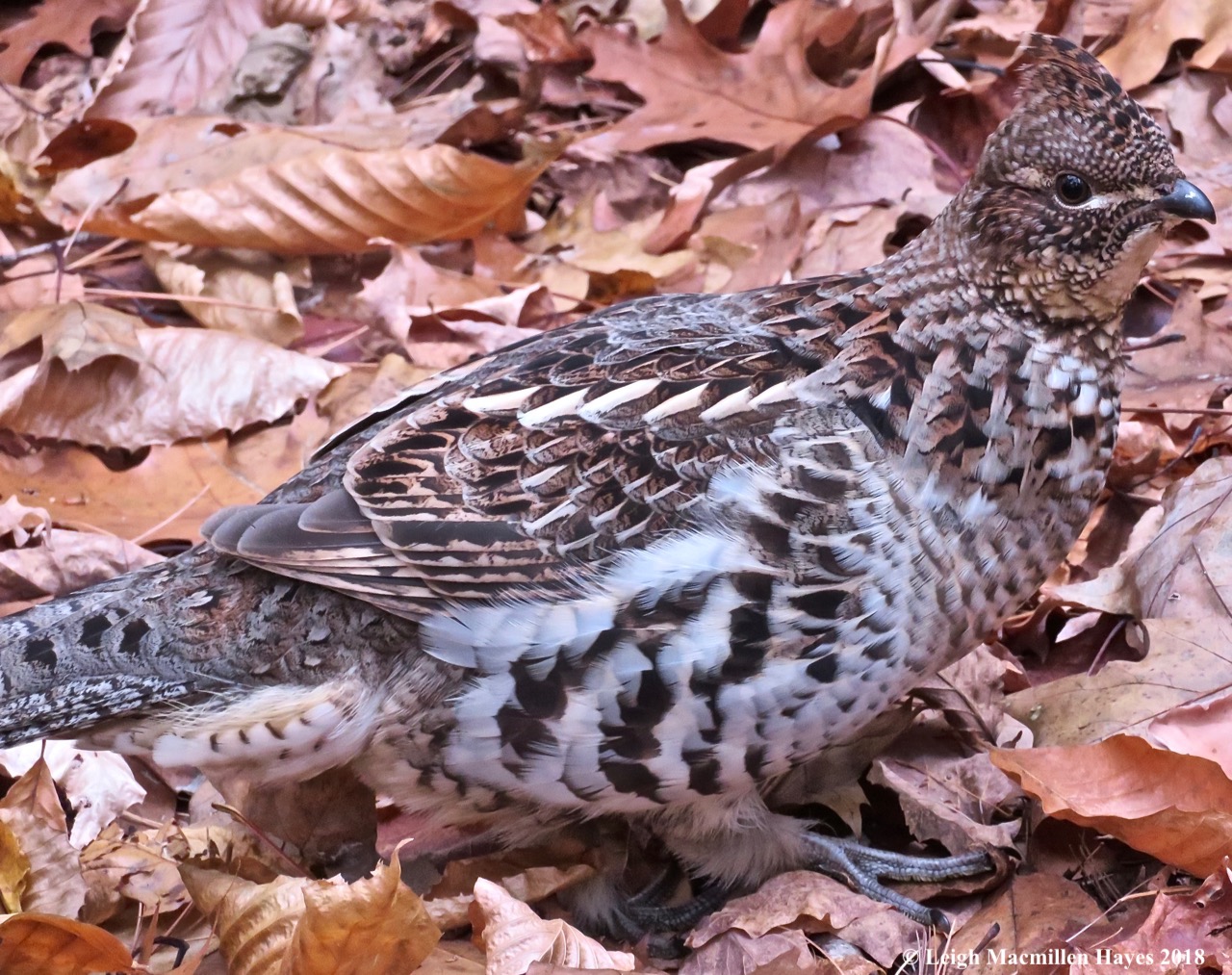
12-winterberry fruits buried

Back on the trail ourselves, our next great find–winterberries in a recently dug hole about four inches deep. Who done it? We poked the hole with a stick and determined that it didn’t go any deeper or have any turns, such as a chipmunk might make. Nor did it have a clean dooryard, which they prefer. Turkey? Perhaps. Squirrel?

13-winterberries among midden

We think we answered the question for on top of a tall hemlock stump that has long served as a red squirrel diner, some red winterberries appeared among the pine scales left behind.

14-liverwort?

Almost back to the road, we crossed the final bridge and then backtracked. We knew our destination was up the streambed it crossed over and were thankful that it held not much water. That meant we could climb up and take a closer look at the large boulders in the middle. And it was there that we made a new discovery.

14a-Peltigera aphthosa

You see, in the past we’ve not been able to get too close to the boulders and from a bit of a distance we were sure we had looked at more snakeskin liverwort. But our ability to get up close and personal today made us question our previous assumption. Suddenly, the gray-green leafy structure took on a more lichen-like appearance. Though its color wasn’t the same, it very much reminded me of rock tripe.

14c-Peltigera aphthosa

We studied its lobes and structure, including the tiny warts and questioned ourselves as we continued to examine it. I kept thinking it was an umbilicate based on the way it adhered to the rock substrate.

14b-Peltigera aphthosa

A little research and I think I’ve identified it correctly, but know some will alert me if I’ve assumed too much–Peltigera aphthosa, aka Freckled Pelt Lichen, also called Spotted Dog Lichen. The bright green center indicated it was wet. From borealforest.org, I learned that the little warts contain tiny colonies of cyanobacteria, which supply the lichen with nitrogen.

15-Racomitrium aciculare?

And right beside the lichen, we found a moss that also reminded us of a liverwort for it resembled Bazzania. But . . . if I identified this correctly, it’s Racomitrium aciculare. Some know it as Yellow-fringe Moss.
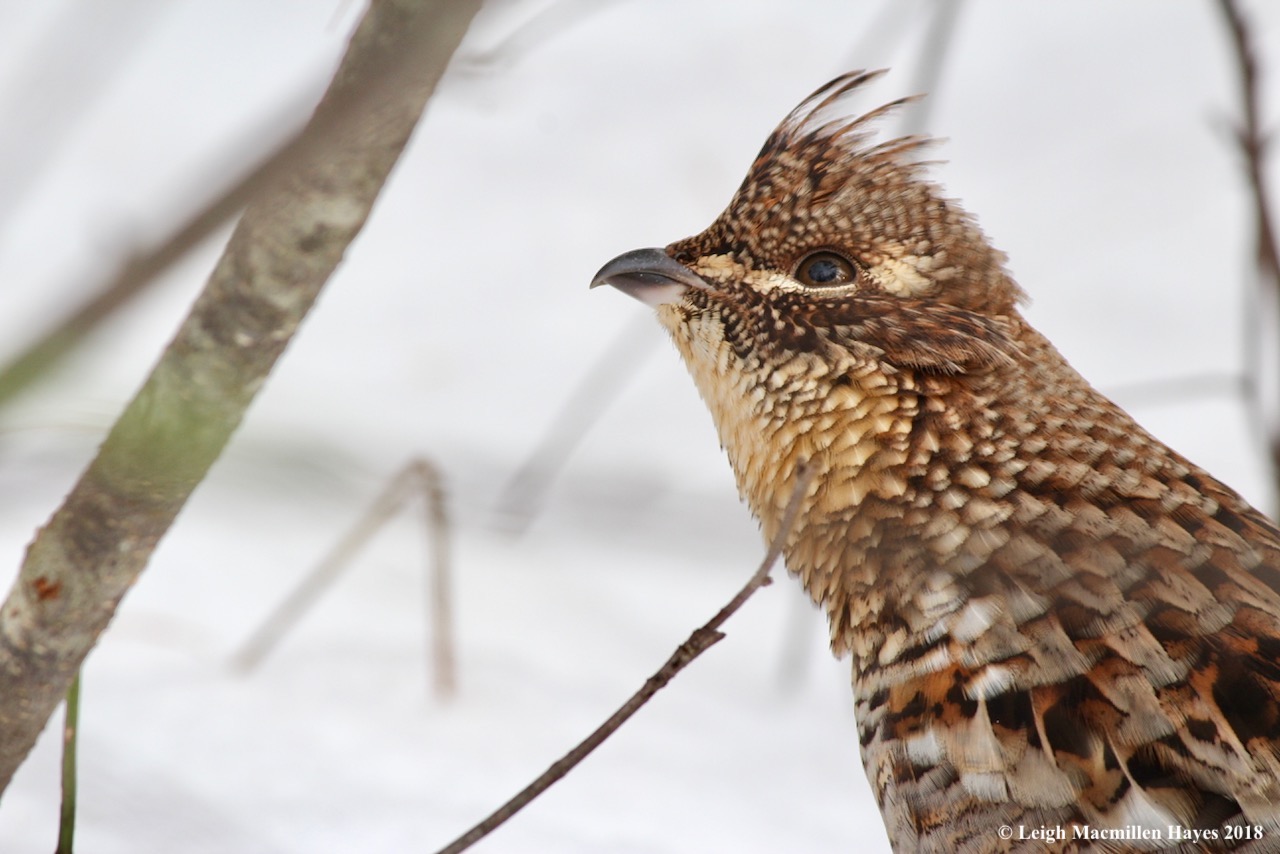
15a-Racomitrium

In his book, Mosses, Liverworts, and Hornworts, Ralph Pope described it as “common on wet rocks along streams and under waterfalls.” In watery seasons for this particular stream, that would be its exact location–under a waterfall.

16-dry stream bed

Today, the stream bed leading down to Moose Pond Bog and Sucker Brook was just about dry. But . . . because of that we were able to take a closer look.

In fact, it took us almost four hours to follow the mile or so trail, but it was all about taking a closer look through our 10X lenses and cameras, slowing down our brains,  and channeling our inner Nancy Drew as we paid attention to clues and tried to decipher the scene around us–all the while detecting the nature of Wilson Wing.