Beyond the Edge

My life is rich on so many levels and people are a huge part of that, despite the fact that I’m a happy loner and a happy introvert at heart.
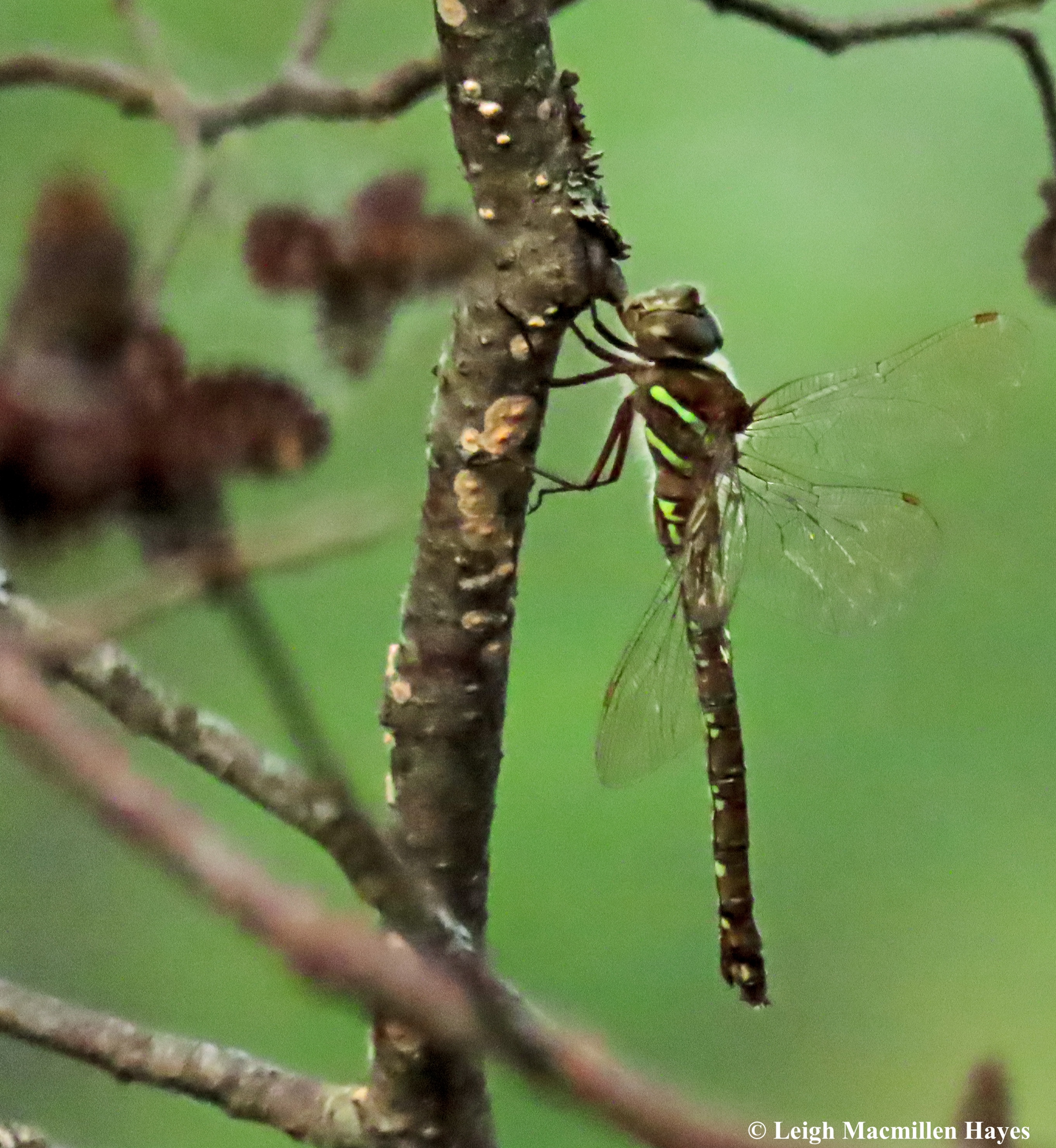
Just the other day, I wrote about the gift of a dragonfly specimen in Lessons in the Shadows.

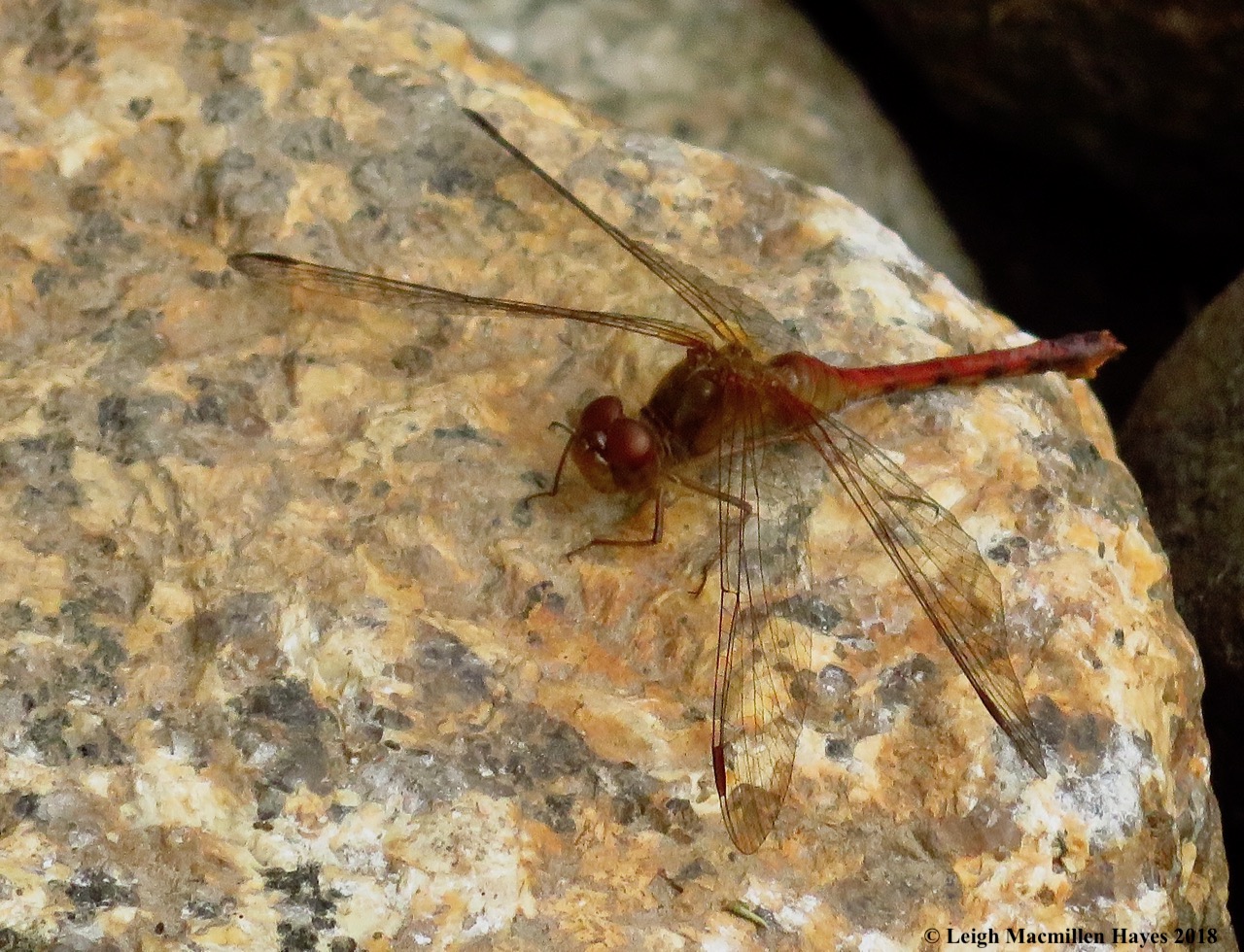
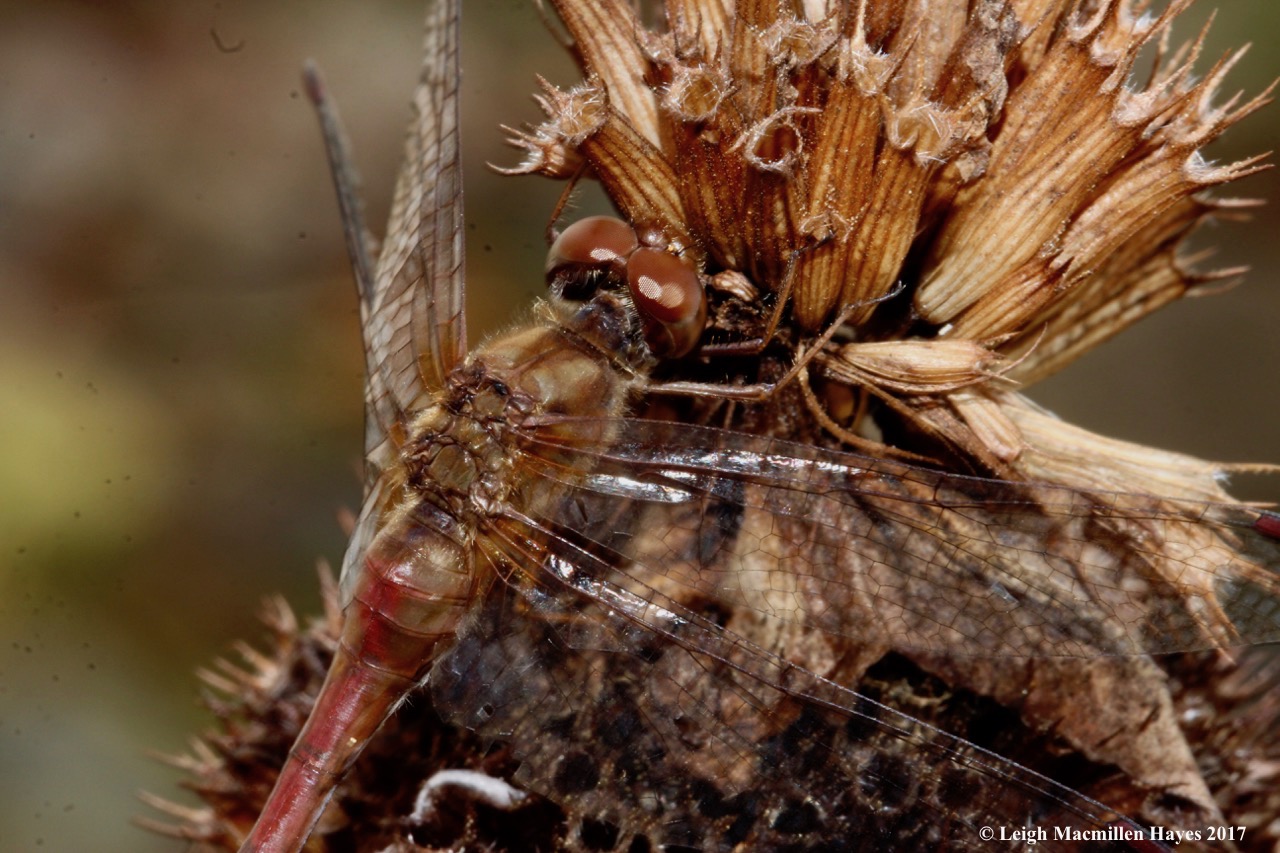
And I actually saw a few Shadow Dragonflies on the wing this weekend, or pausing between defending territory, dining, and mating, or at least trying to do the latter.

But it’s other things that I noticed and want to share before I reveal today’s gift.
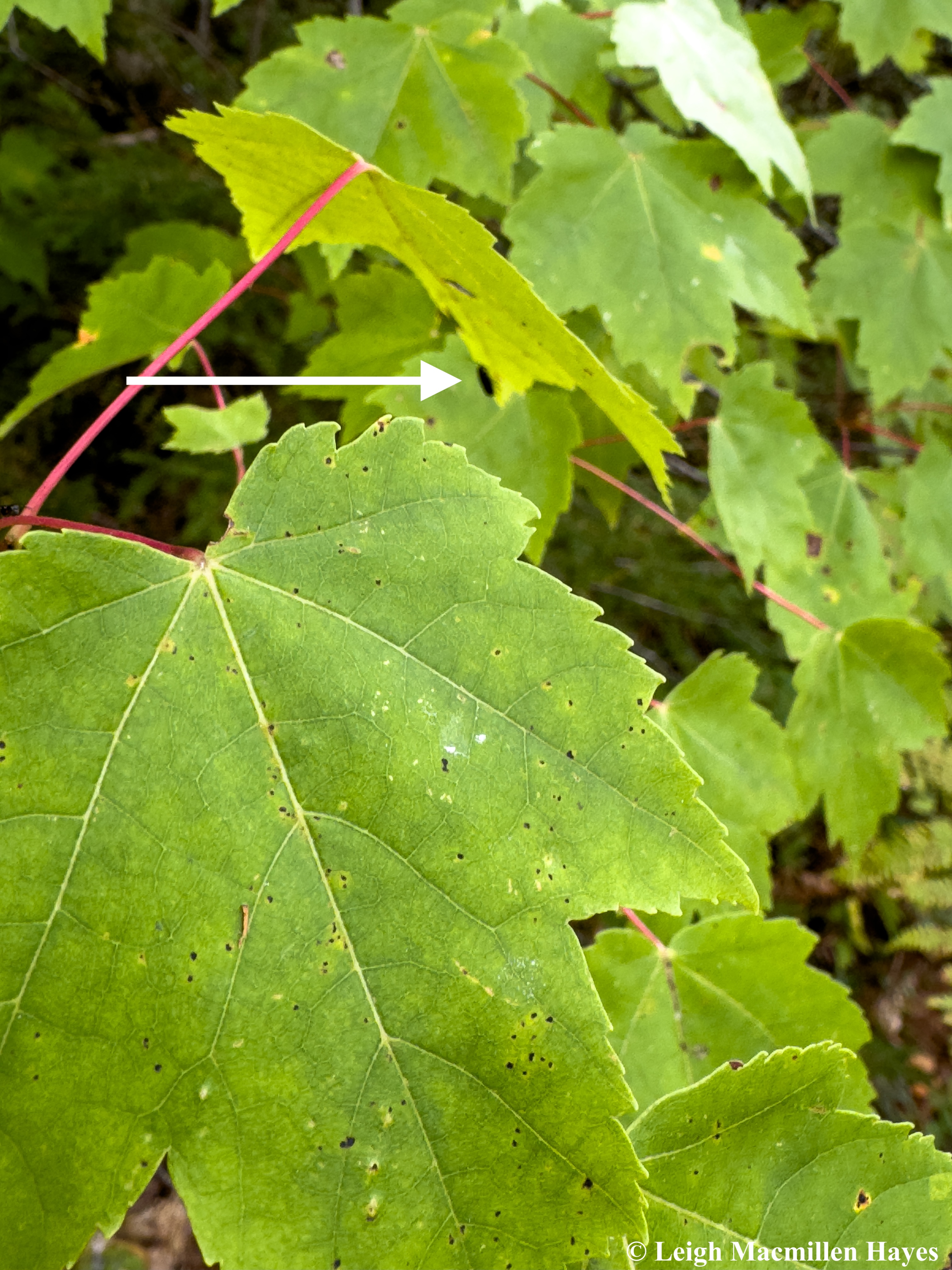
I do not know how I spotted this insect under a Red Maple leaf, but it was made known to me in the silence of a walk I took, and it too, was a gift.

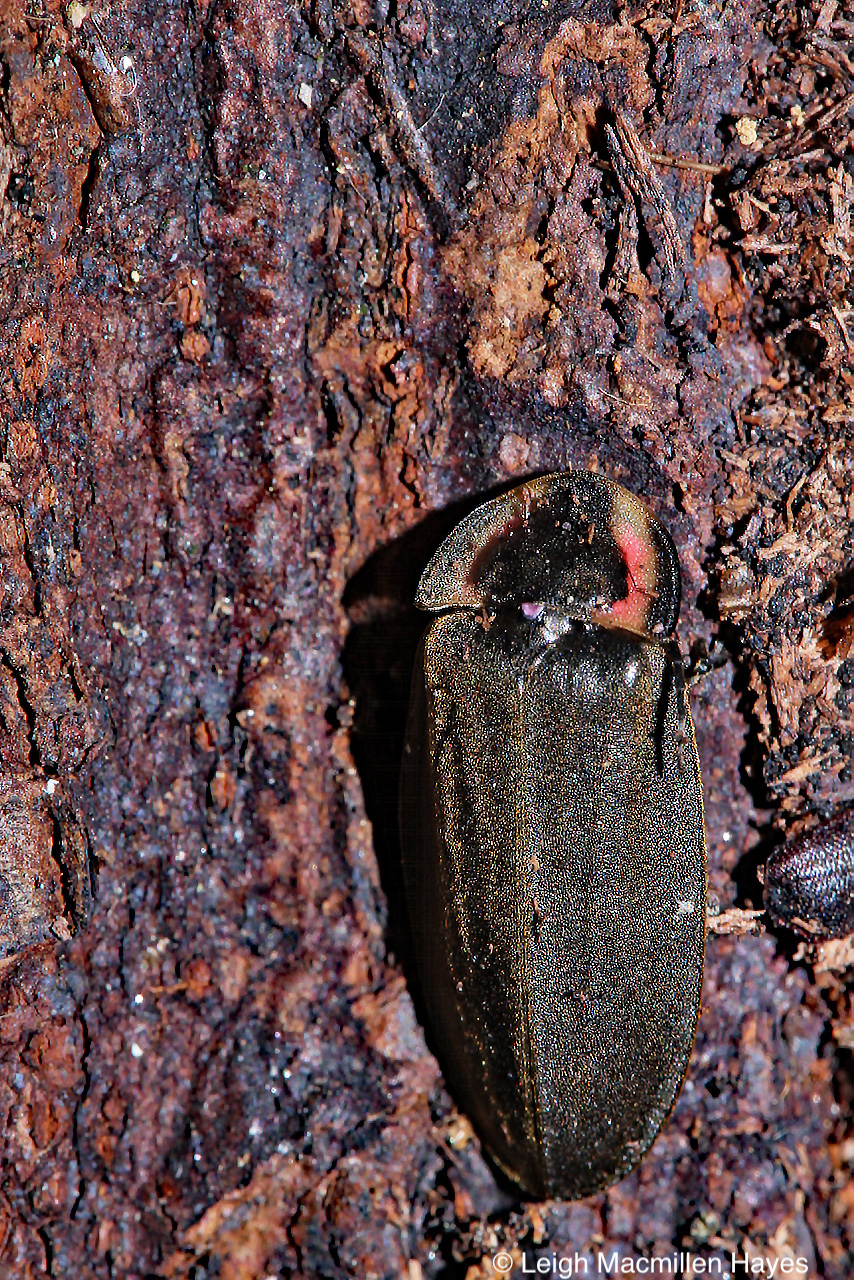
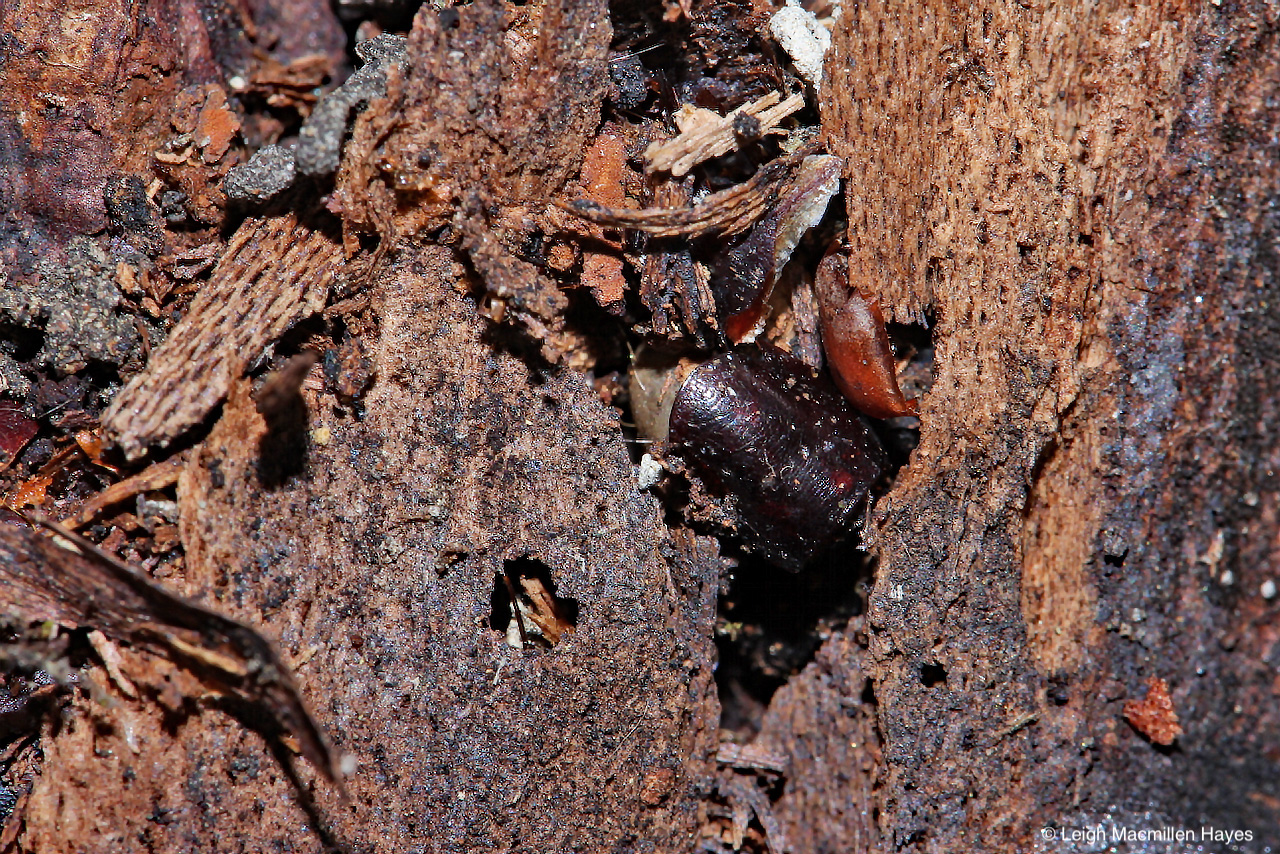
The insect was a Winter Firefly, a species I love to find in the winter months, usually on or behind tree bark, the latter being bark that has pulled away from the trunk. Winter Fireflies in their adult form do not light up our evenings, but the fact that we can spot them in winter is special enough.

They also don’t disappear once summer arrives and lately it seems, I’ve been spying them regularly.

But it is what this insect was doing that turned out to be so spectacular. Remember, I spotted it on the much lighter in color underside of the leaf, and then turned the leaf over to take a closer look.

Much to my surprise, it was dining. I’ve never really thought about them dining before, but of course, they must. And do. Like my Ambush Bugs, and yes, you’ll meet a few more of them later in this post because I can’t resist taking their photos, Winter Fireflies use their mandibles to pierce into a prey species, inject it with chemicals to paralyze it, and then add enzymes to the mix to turn the other insect’s tissues into a smoothie.
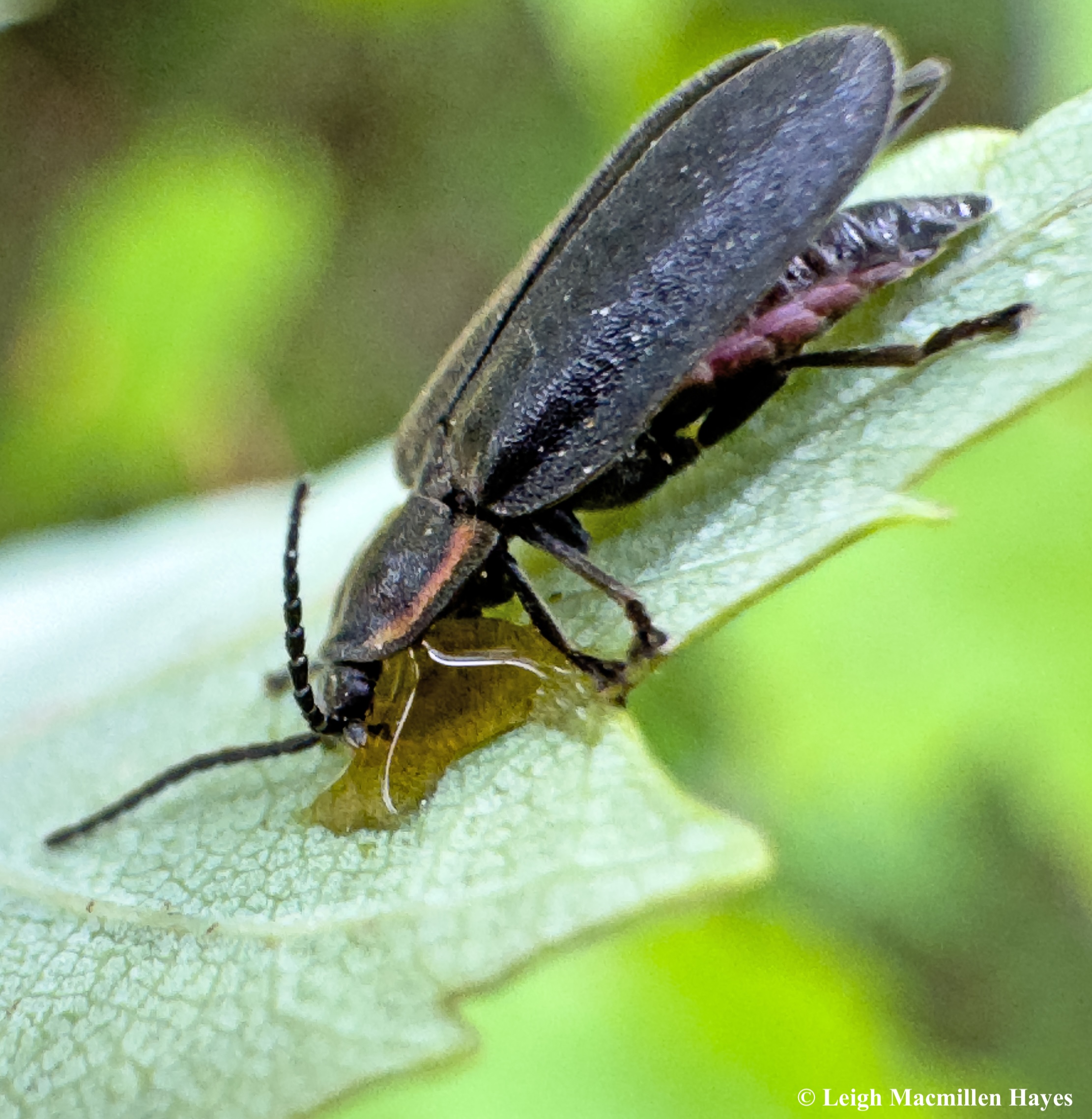
Right before my eyes, the Firefly drank its meal! Despite the fact that I was in its personal space. For moments on end.
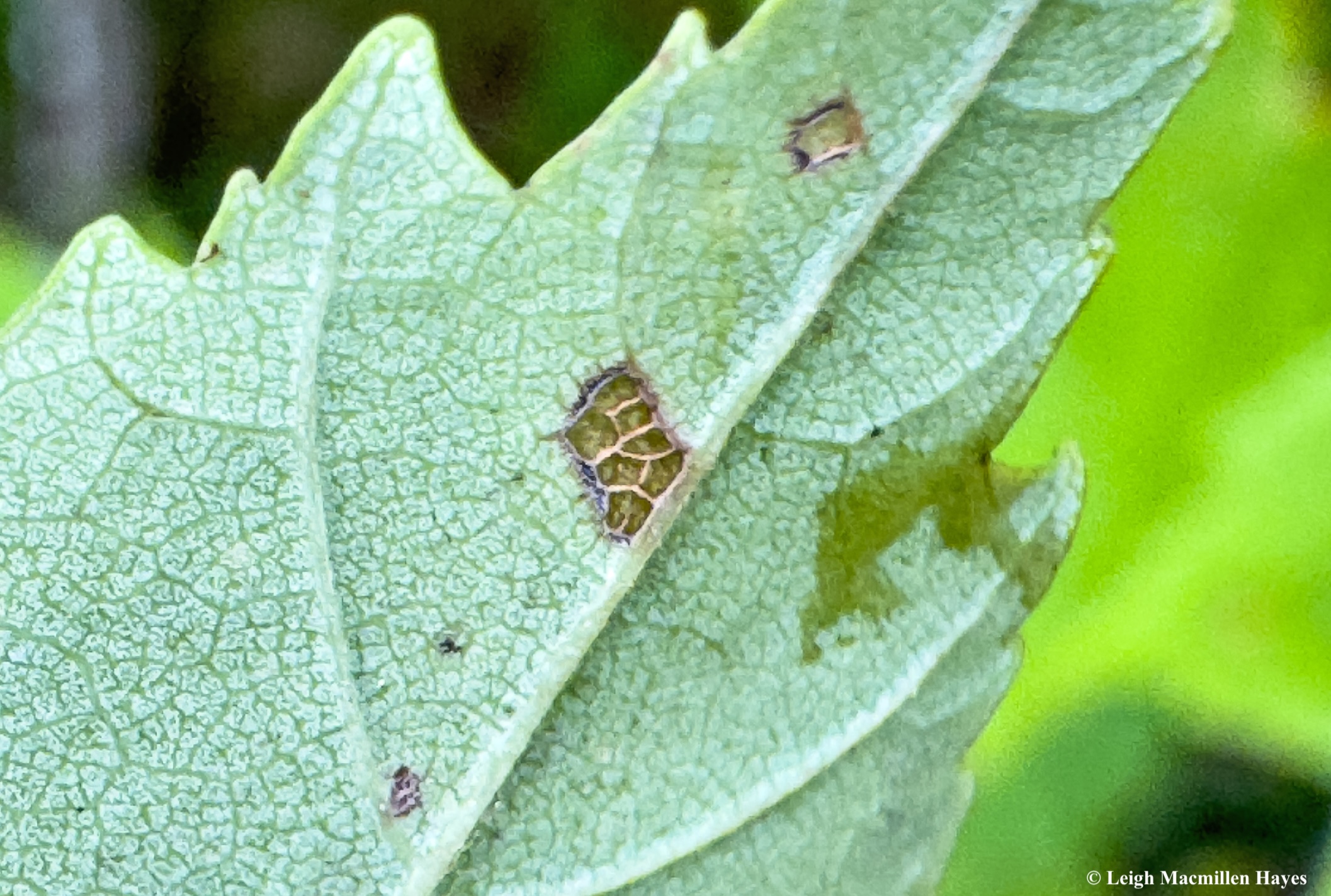
And when it had finished, there was only a remnant of the liquid form left and the Firefly moved on. But the other thing of note on this leaf is how another insect had chewed bits of the bottom layer of the leaf, leaving a skeleton of veins that provided a window to the next layer. I’m always trying to show people this by pulling leaves apart, and often meet with little success, but this leaf showed me that it is possible.
And then, because I was suddenly focusing on leaves, I began to notice a variety of structures that were not leaflike.

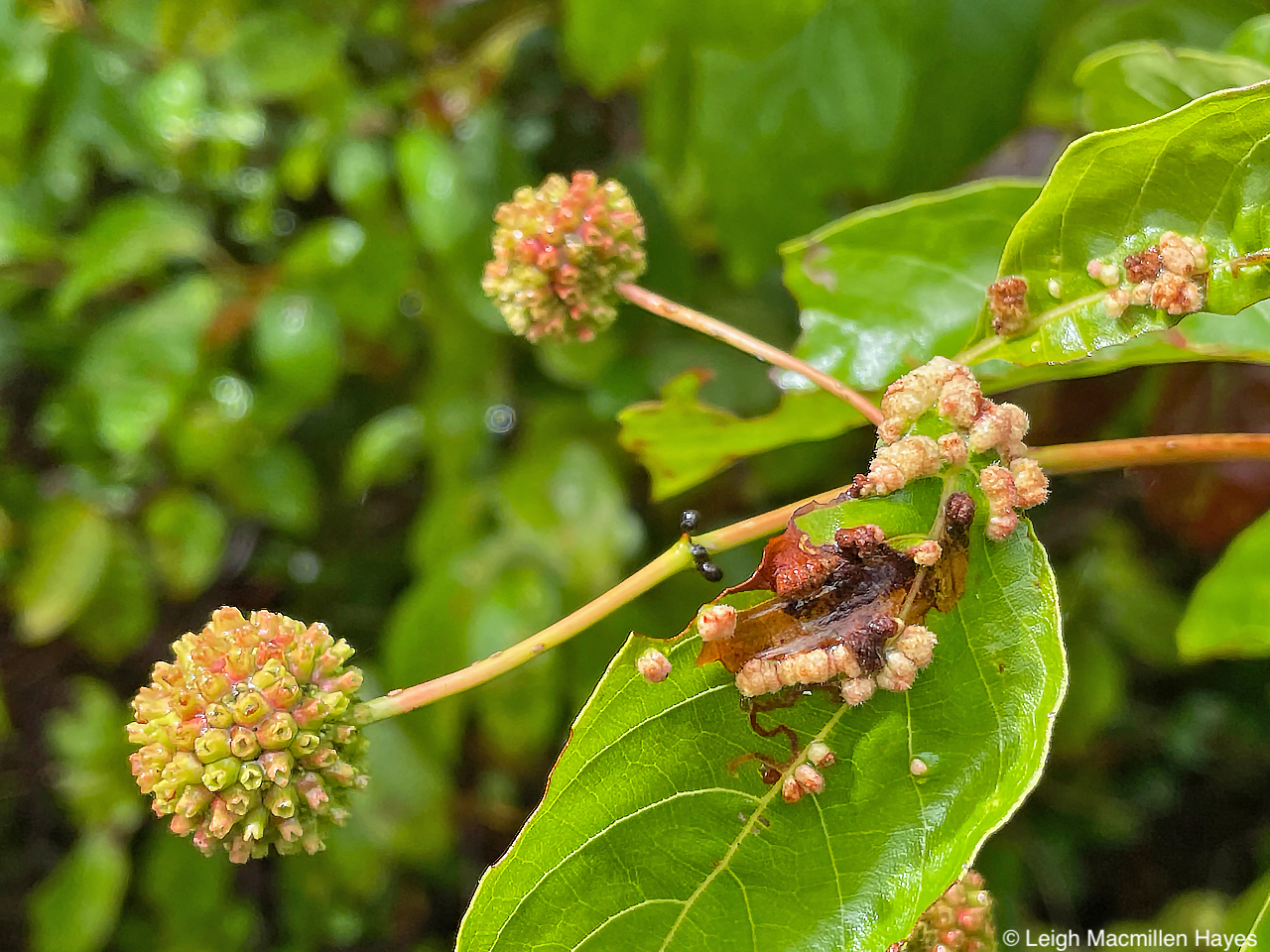
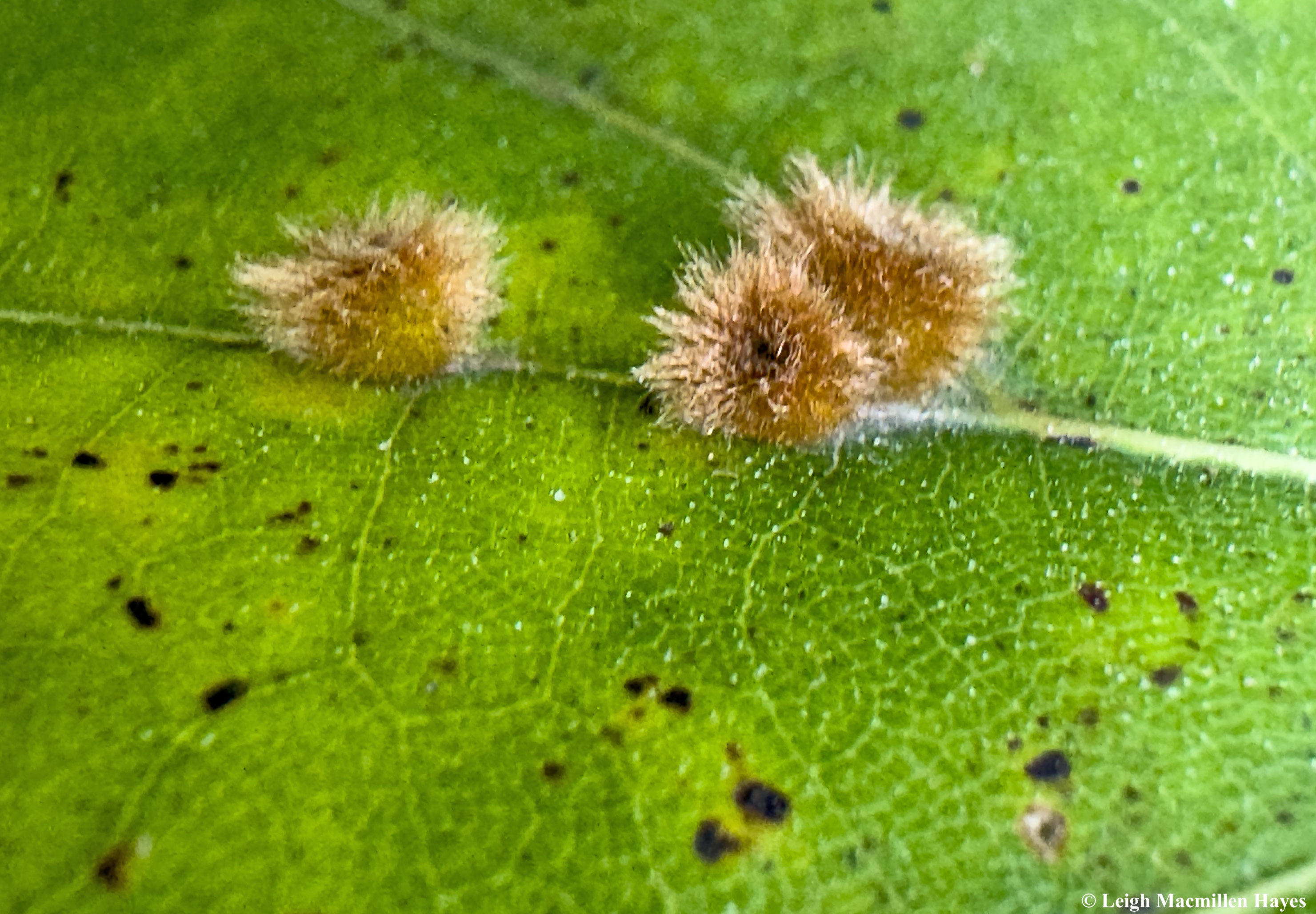
Oak Galls. In the Summer 2025 issue of Northern Woodland magazine, Michael J. Caduto wrote the following: “Oak galls are tumorlike growths caused by small wasps . . . Oak galls make up about 80% of the roughly 700 different kinds of plant galls formed by insects in the USA, and most of Canada and Mexico . . . During the spring, adults lay eggs in the tissues of leaves or twigs and at the same time inject substances that induce the surrounding plant tissue to grow in a particular manner and at an accelerated pace.”

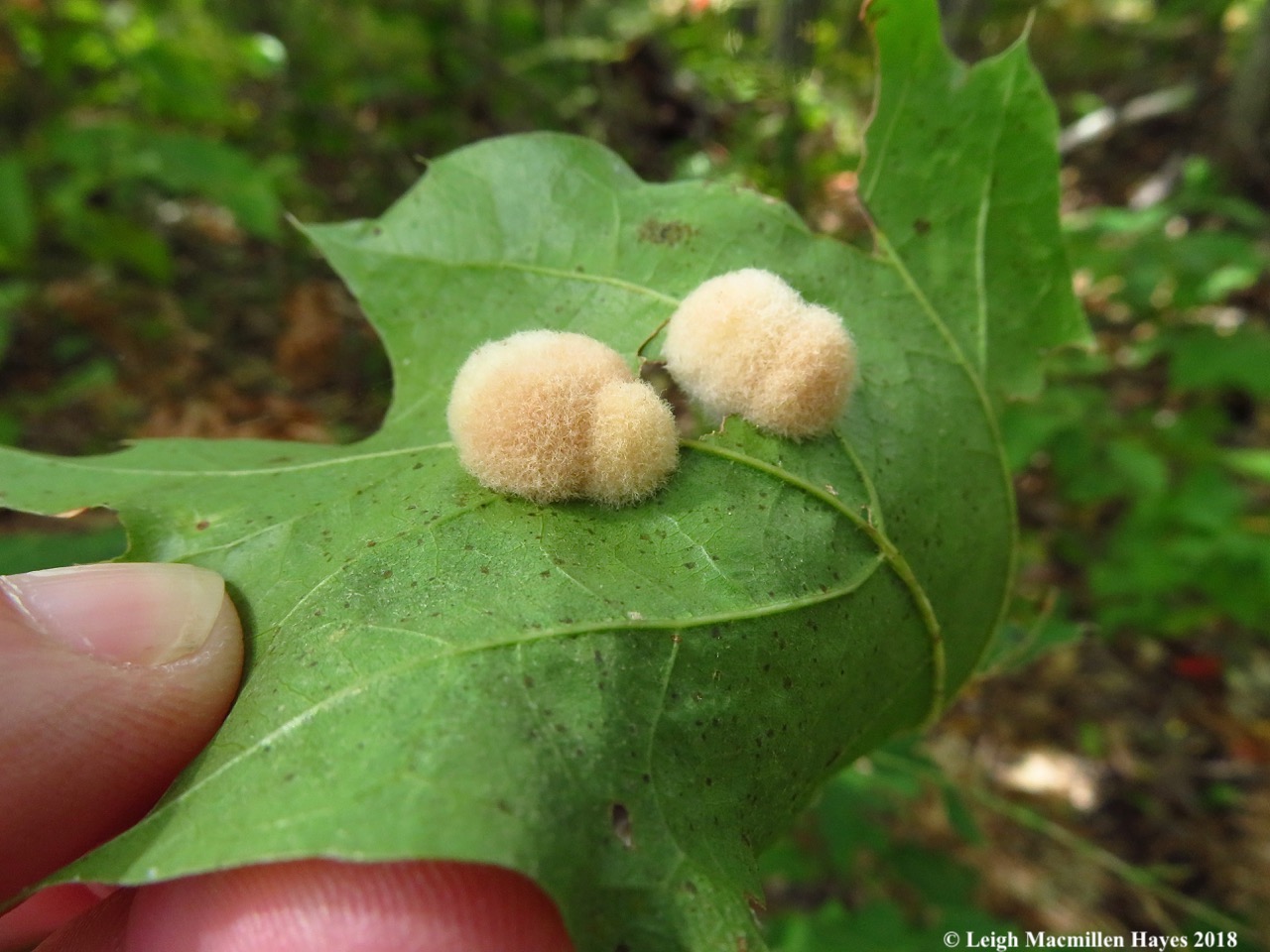
Above are pictured some woolly oak galls that result from the growth of tiny hairs on the leaves.

Gall tissues protect the wee wasp or midge larvae that develop inside, and they also provide food. As the young grow, the galls increase in size due to something in the insects saliva that imitates the plants growth hormone. Nature is amazing.

Those photographed above are caused by Oak Leaf Gall Midges. They are cosmetic and won’t harm the tree. After all, the leaves fall off in the autumn anyway, and until then they have done their duty of feeding the tree despite being laden with galls.
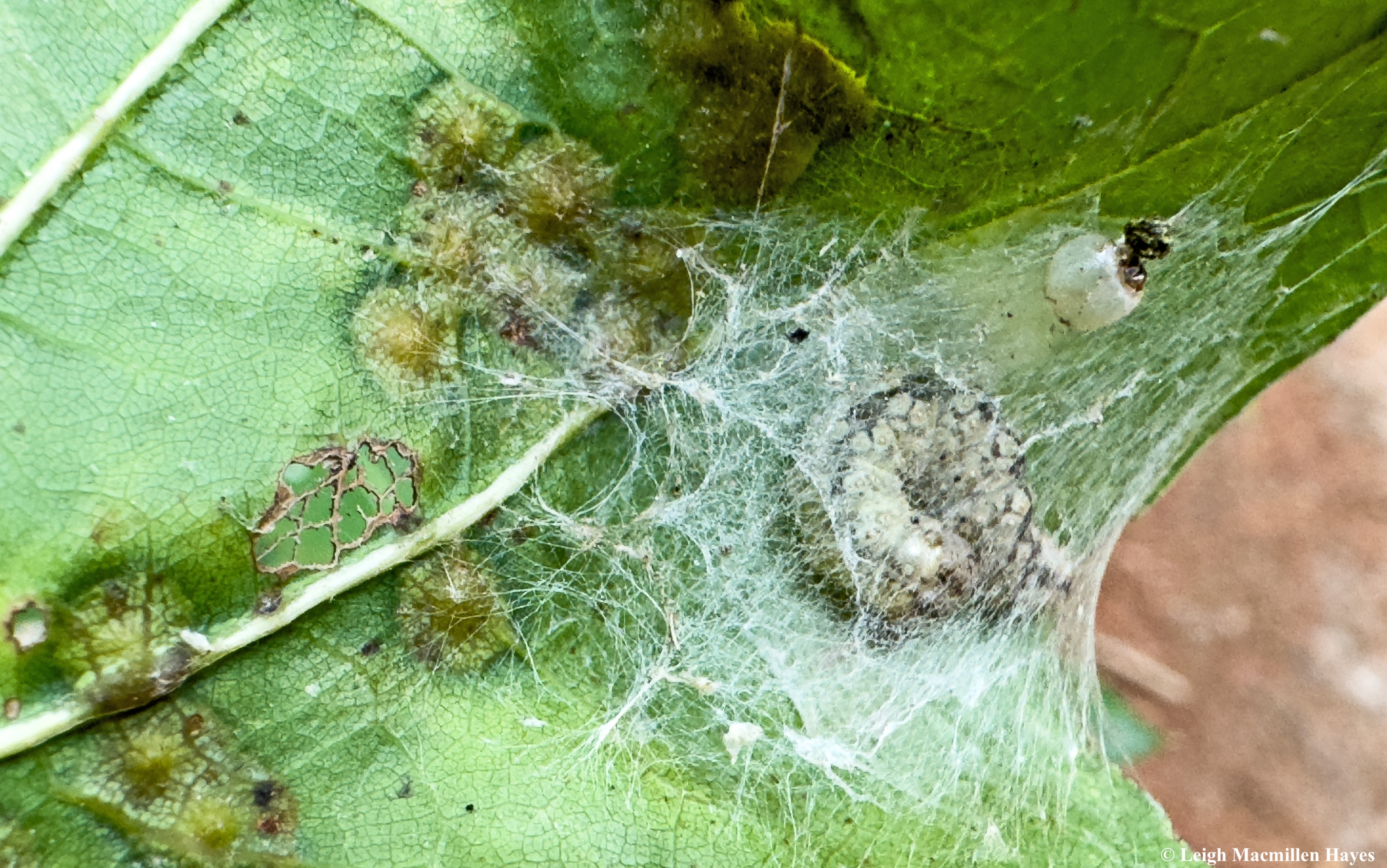
When I turned the same leaf over to look at the underside of the galls, I found a caterpillar who was ready to pupate and possibly the egg of another insect. So much going on in such a short time, given that in the north woods our leaves are only on the trees from mid-May through October or maybe a wee bit beyond for the most part.

Upon the underside of another leaf, I found Oak Leaf Seed Galls. They were quite small, and it looked like the initial gall was a dried papery structure within which were clusters of smaller galls.

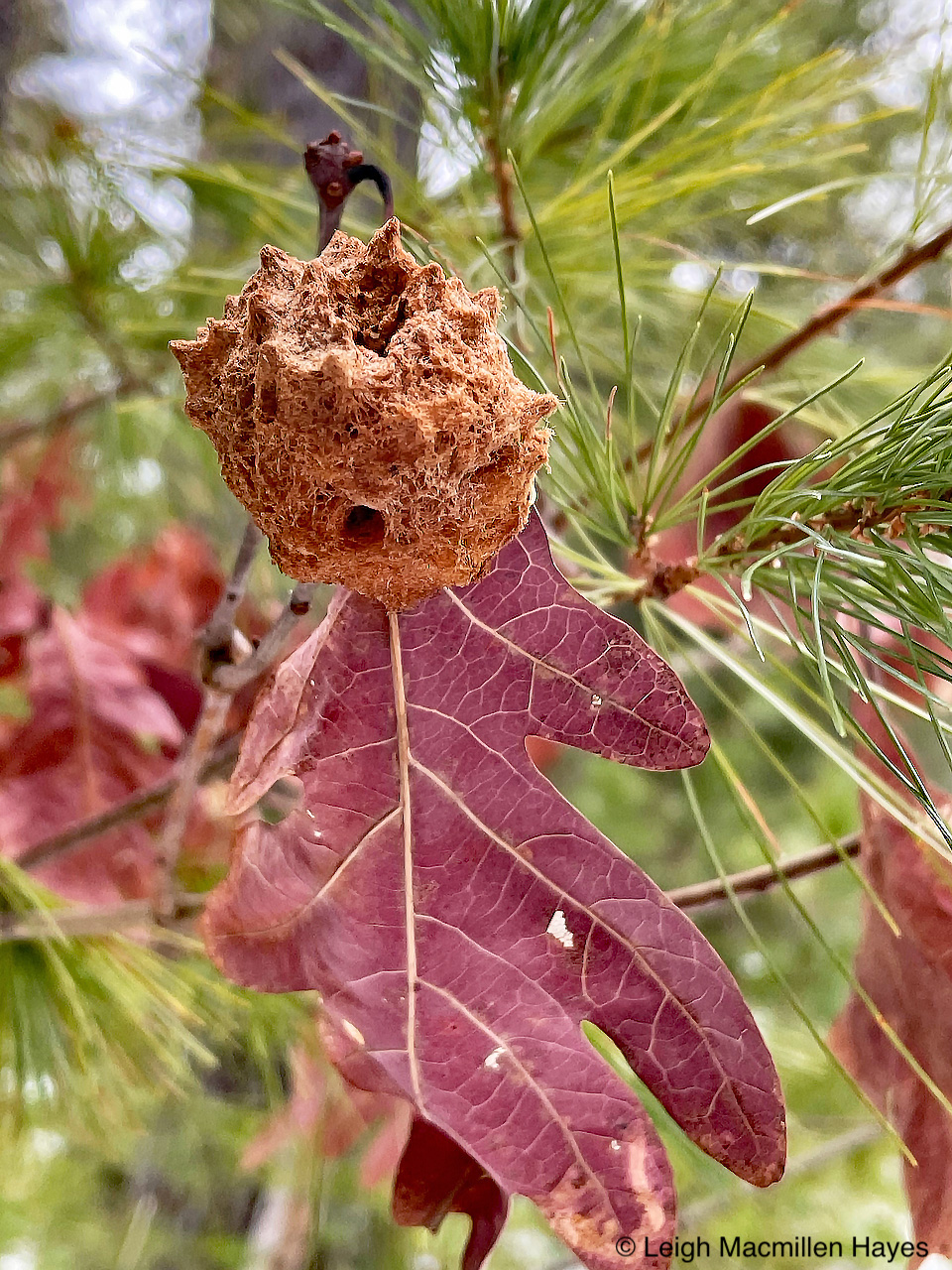
And then I found one of my favorites, the Oak Apple Gall. I’ve written about this before following a visit to Trinity College in Dublin, Ireland. There, My Guy and I took the self-guided tour of the 18th century Old Library and viewed that most ancient of manuscripts–the Book of Kells, a 9th century book featuring a richly decorated copy of the four Gospels of the life of Jesus Christ. A favorite discovery: the monks used Oak Apple Galls to create ink–apparently, they crushed the galls and soaked them in rainwater, wine or beer until they softened.

What was cool about the one pictured above, was that the adult wasp had chewed its way out and I could see the fiber-like structure, those threads radiating from the center, that had supported its pupating form. Perhaps to keep other insects from parasitizing it.

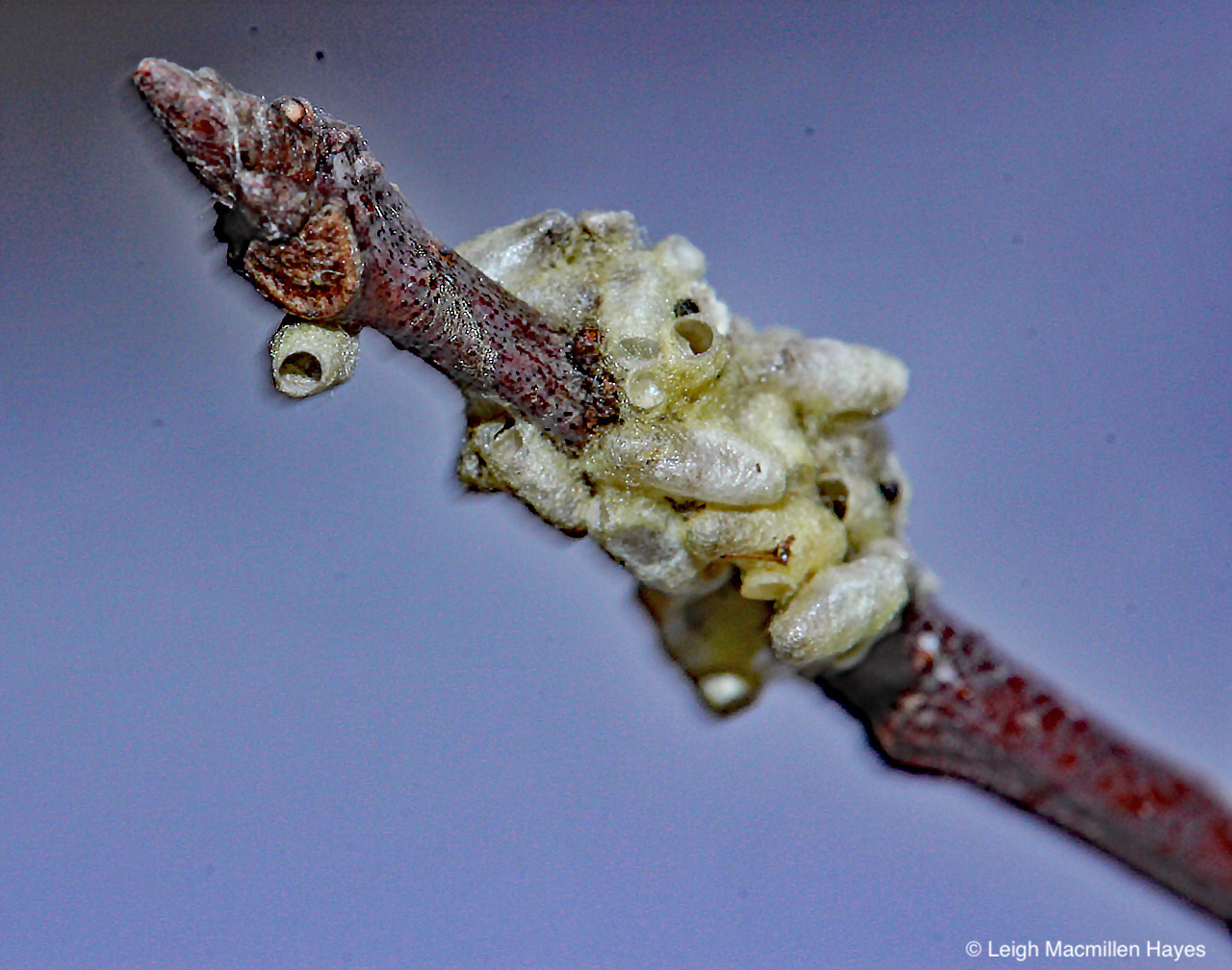
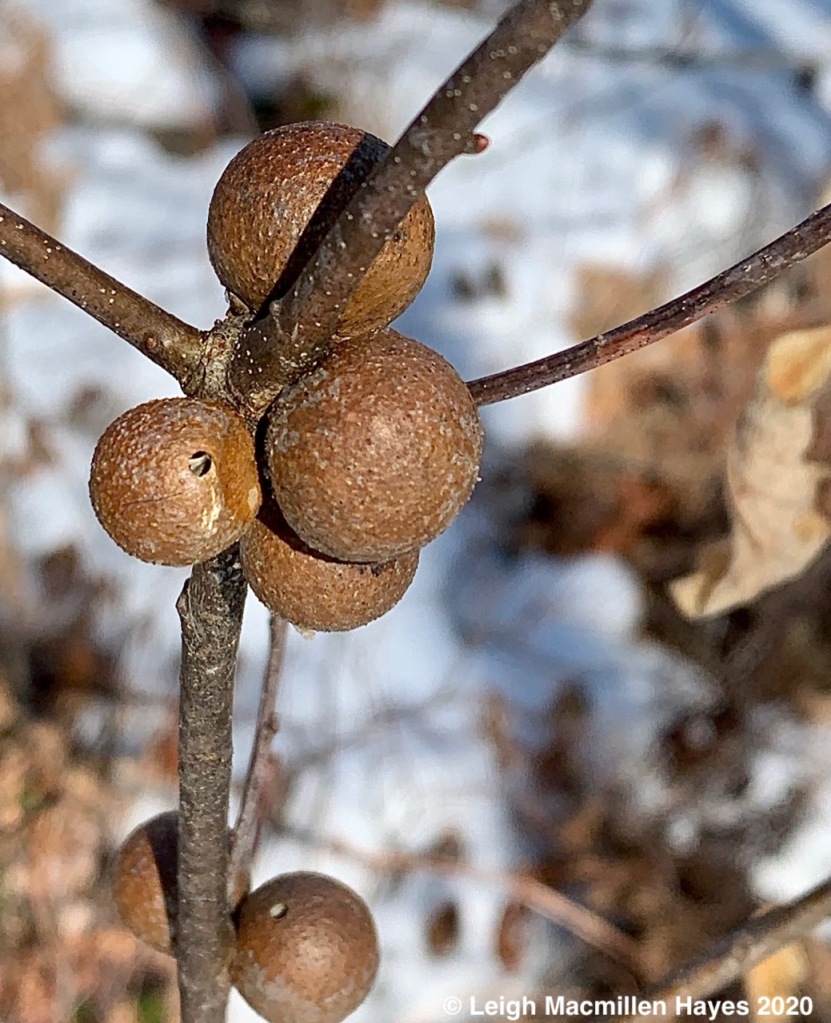
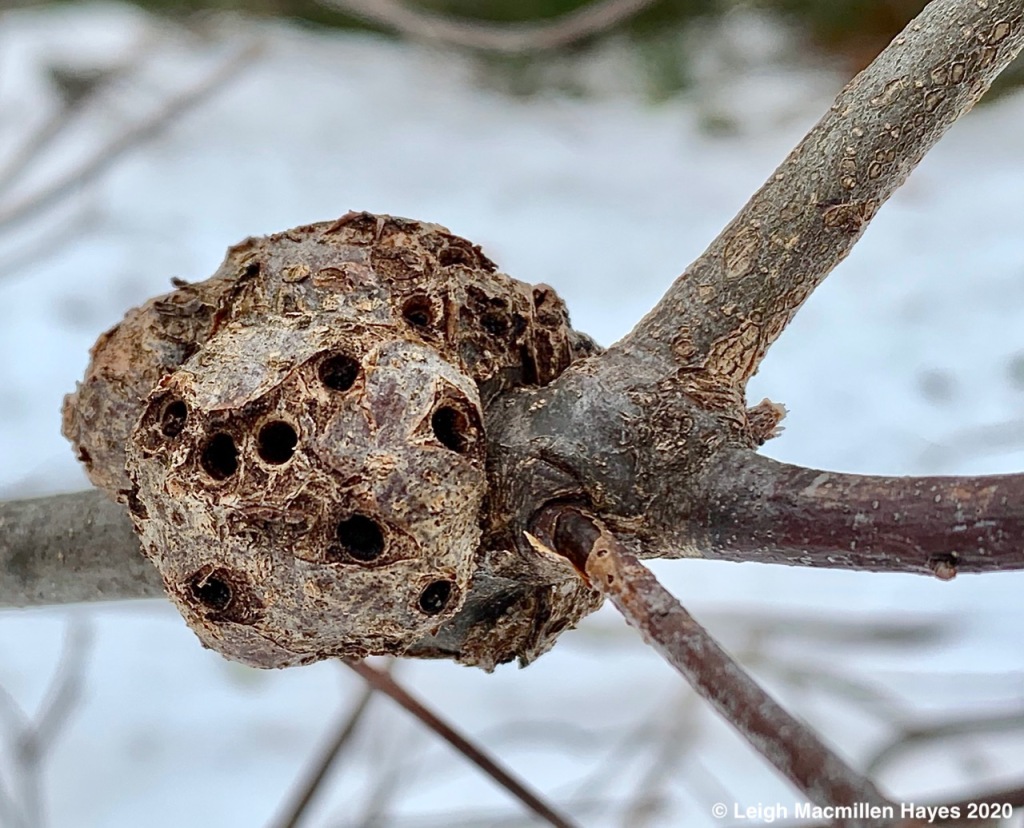
And lest you think galls only occur on leaves, here are some on twigs, these being created by the Banded Bullet Gall Wasp.

And then without meaning to, but because the path I followed offered some Asters in bloom, I began to meet my old friends, the Ambush Bugs, this one being a male.

And on another, a female.

Wherever Ambush Bugs are, I look for their feeding sites, made visible by insects dangling in unsuspecting manners like this moth.
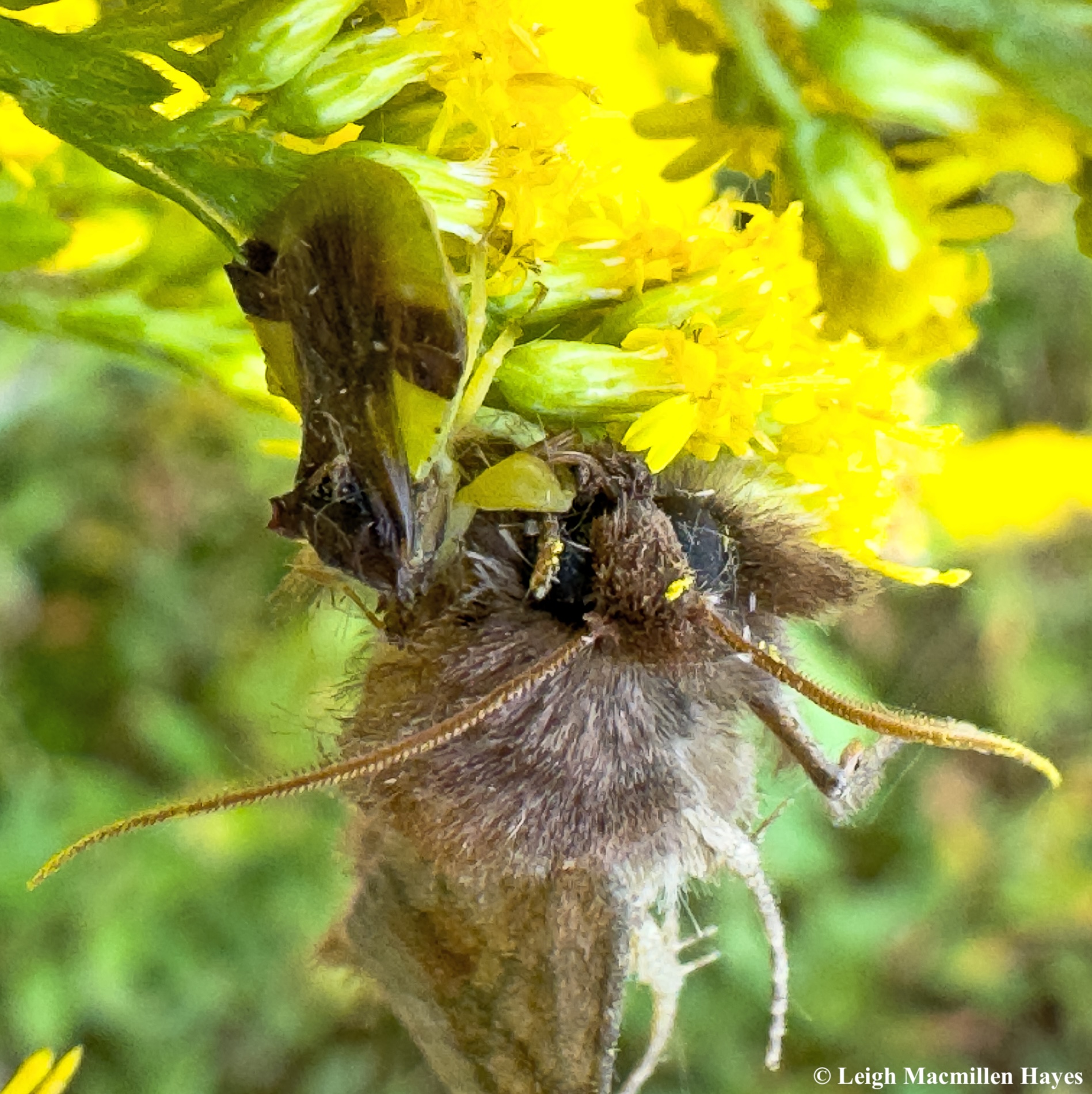
And tada, there she was having a go at a major meal.
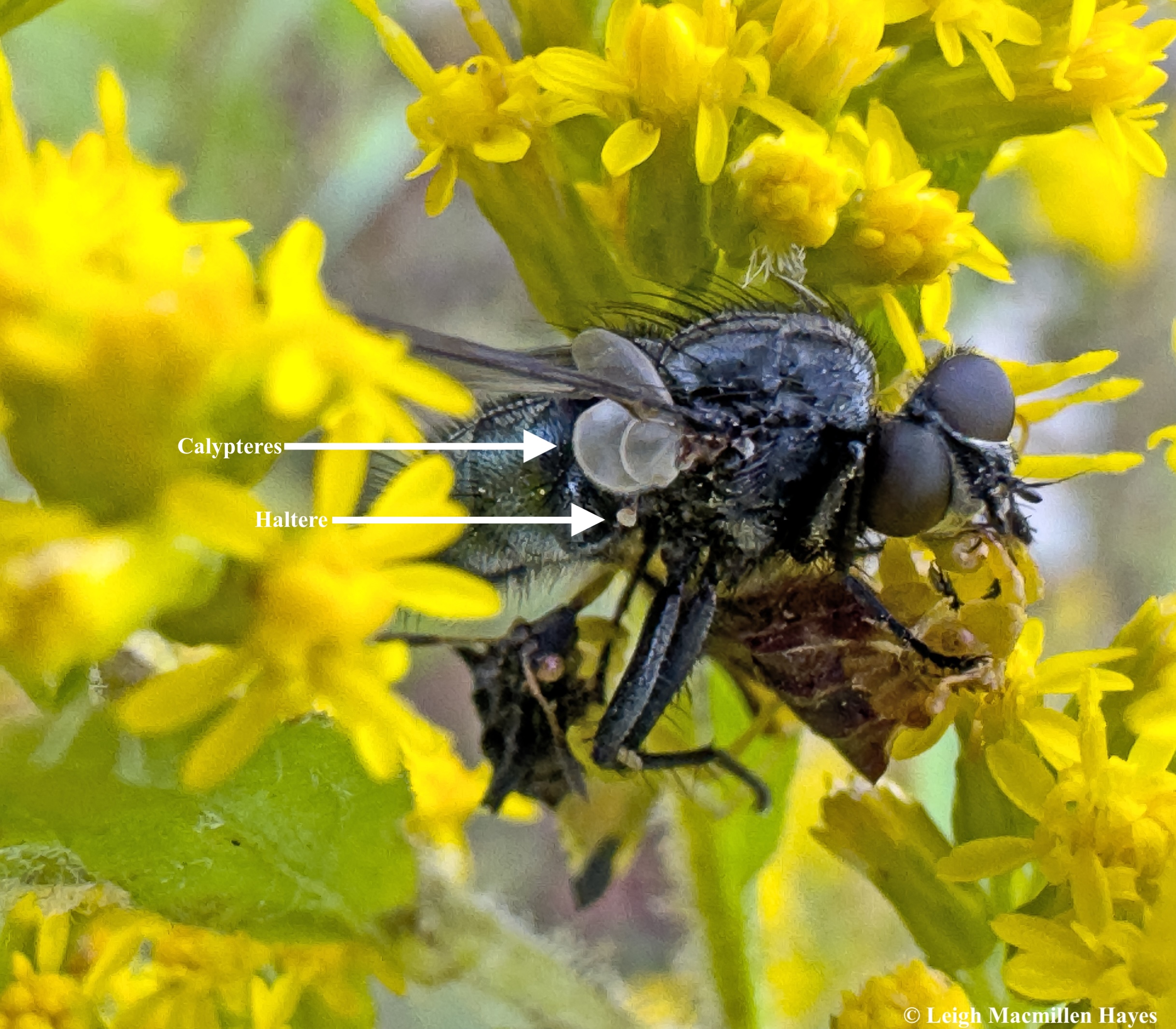
And sometimes those meals teach me other things, such as this fly that was being dined upon by both a male and female Ambush Bug. But more importantly, I captured the fleshy white structures on the fly. Those are calypteres! The calypteres are small membranous flaps or lobes that are located at the base of the wing in some species of fly. Flies often have two calypteres (commonly called the upper and lower calypteres) on either side of their bodies. And they cover the halteres, the little knobs that take the place of hind wings. You can see the little knob or haltere sticking out a tiny bit below the bottom-most calypter. Sooo cool. A new learning for me.
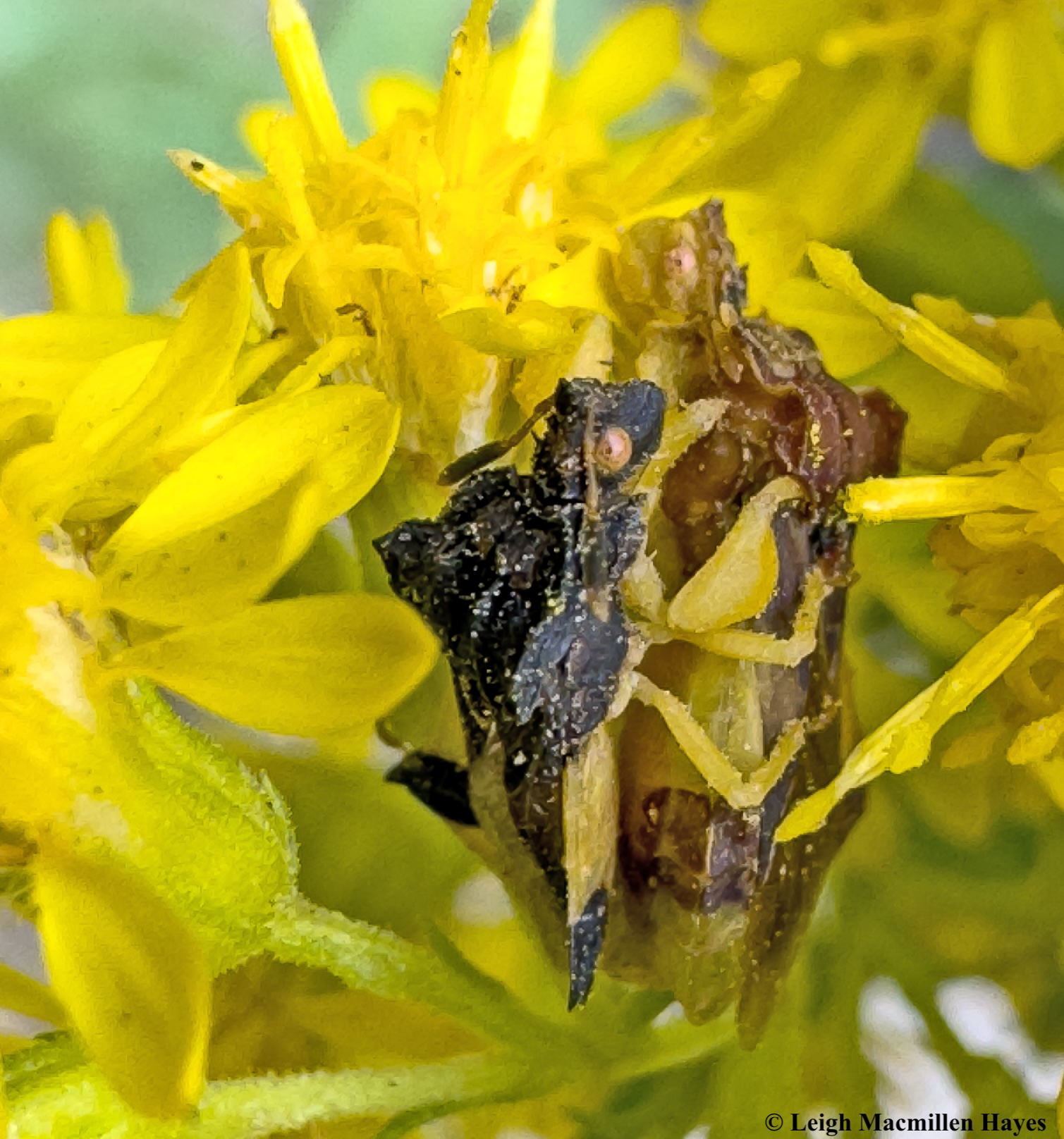
And then trying to hide within the Goldenrod blooms elsewhere, a canoodling pair.

Upon another plant that had gone to seed, a Dusky Stink Bug lurked, one of the smallest of the stink bug species.

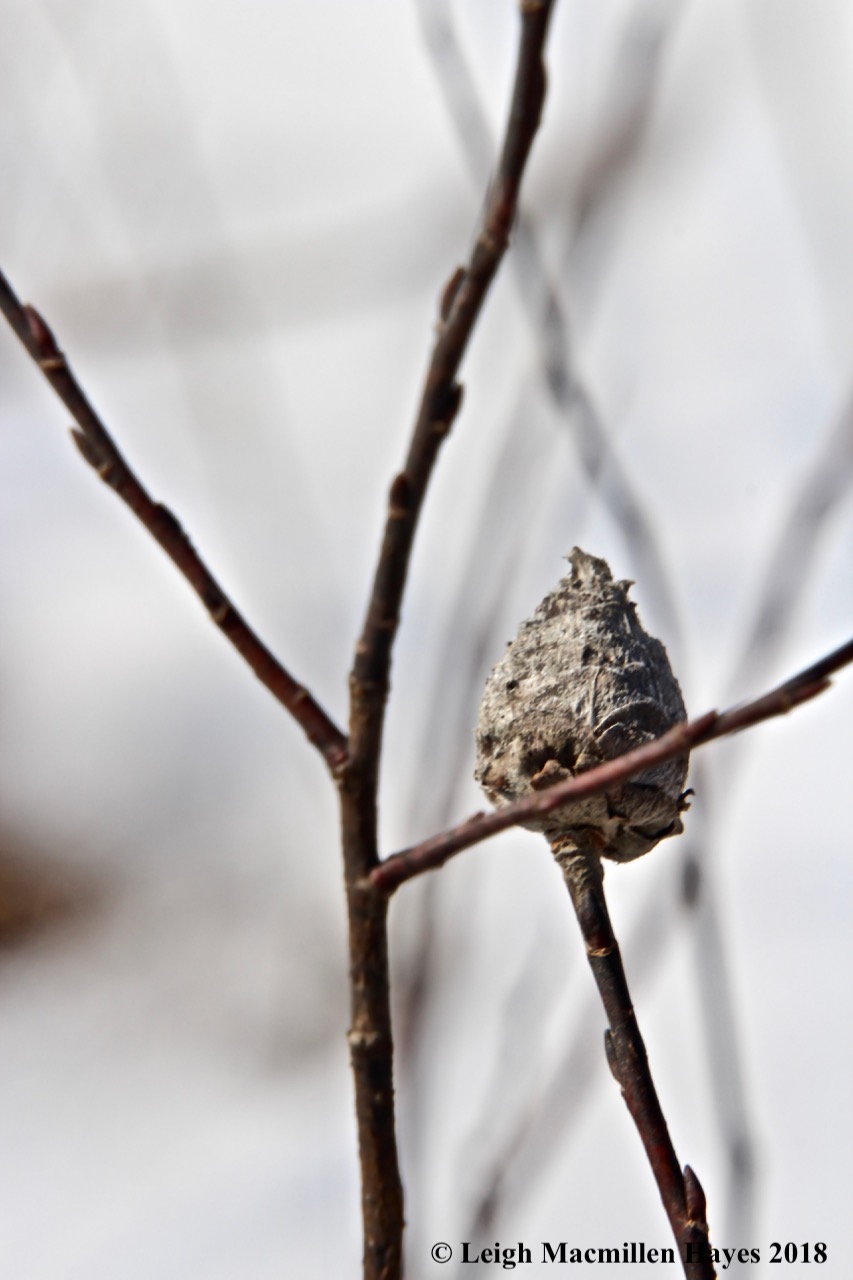
In another spot, something else caught my eye. Yes, it’s bug related. This is the egg mass of Tent Caterpillars. There might be up to 400 eggs encircling the twig on this Cherry tree. The mass is shellacked with a substance that will protect it throughout the winter, thus the reason for its sheen.
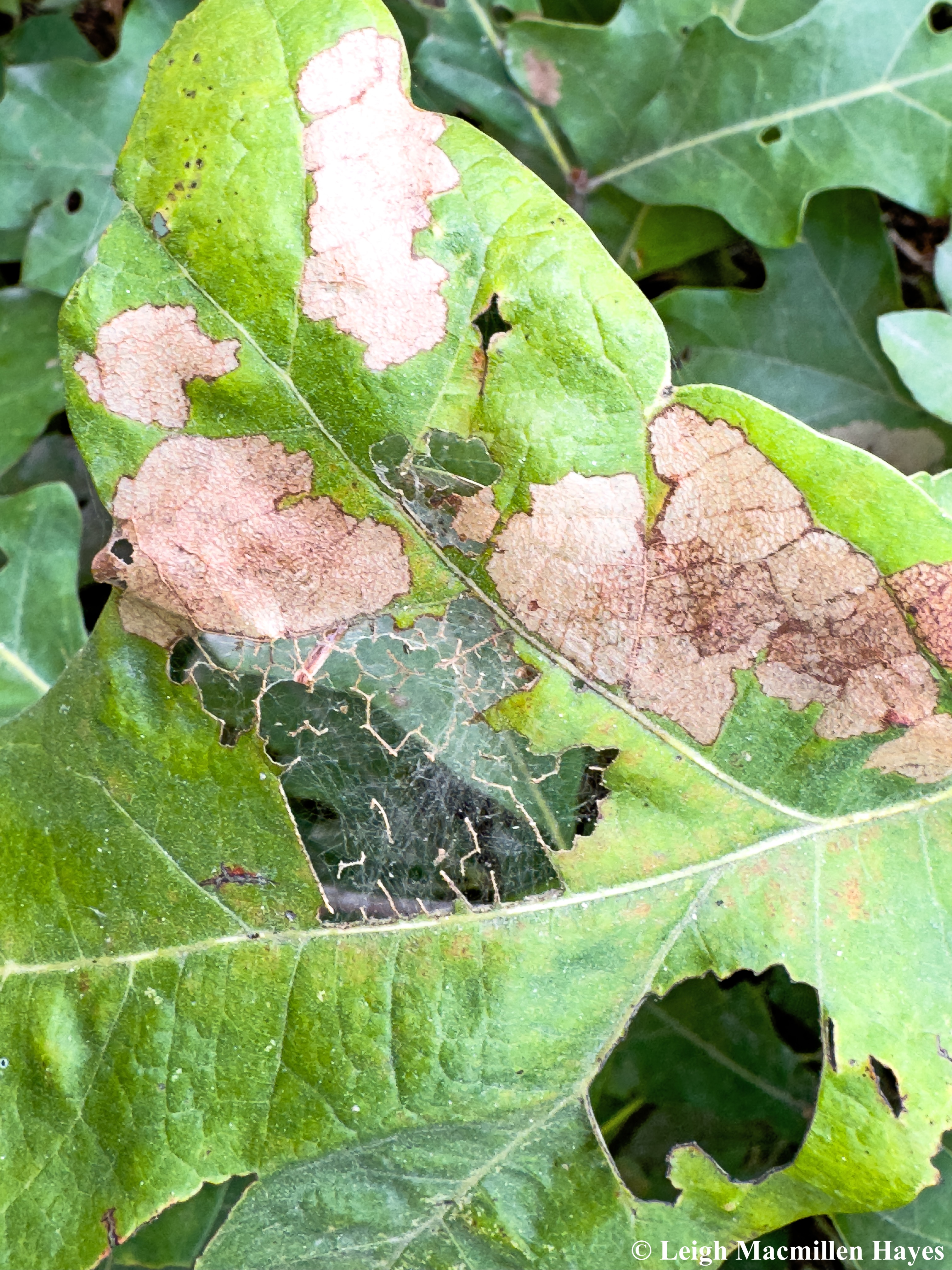
Because I’d been looking so closely at insects or insect structures, it struck me as interesting the various ways different insects dine upon a given leaf, from those who eat all of the cells and veins, to those who leave most of the veins as they skeletonize the leaf, to those who mine between the upper and lower leaf surfaces. All of this on one leaf. And still it was green and had done its food factory work for the tree.

I was almost back to my starting point when I noticed new leaf growth on some trees, which given that its September surprised me. But these days, nothing should surprise us.

Until something does. For right there on the same tree an anomaly caught my eye. Do you see what I saw? Yes, lots of munching. And yes, lots of new and older leaves. But take a look at the buds. One bud is not like the rest in the crown.

Because it wasn’t a bud. Hiding in that spot was an insect I am only familiar with in its larval aquatic form. It’s a cool one for it builds its own home depending upon its species, some using hemlock needles and maple flowers, others specks of sand, and still others plant or tree material, while some are net spinning and others free-living.

What I’d had the good fortune to spot was a mature Northern Caddisfly. As adults, they don’t have mouthparts, their only job being to mate. Adults don’t live more than a month, and I felt honored to have spotted this one. And Caddisflies are indicators of clean water. I was truly honored to spot this insect.

In the same way, I was equally honored to receive this gift of music created around words I’d written in a blog post in 2018, entitled From the Ground Up, where I’d offered the history of St. Peter’s Episcopal Church where I am a parishioner and then focused on all of the other species who had gathered on the ten-acre lot.

Thank you, Richard Michael Joseph, composer, musician, tenor, and chair caner, for taking my words and writing music to embrace them. Beyond the Edge indeed. Thank you also Richard, for your part in making my life so rich.

Step into the woods beyond the edge, and know that life carries on in the most incredible ways, we just have to be open to receiving them.

Wednesday Wanders=Wonder-filled

You know when you start something and you have no idea of what the future will hold and yet, you forge ahead cuze that’s what you naturally do? Well, that’s been the experience fellow Master Naturalist Dawn and I have had since I retired in October 2023.

At the time, I knew I would deeply miss outings with the Greater Lovell Land Trust docents, a group of dedicated volunteers who love to learn and then share that knowledge with the public. But, I’d made a promise to step away so the new person could have some space.

I’m a teacher at heart, however, and needed to continue down that path. So, prior to retiring I had approached Loon Echo Land Trust and asked if I could lead some winter walks for them, sharing the art of tracking and other winter wonders with their participants. That idea was well received and I invited Dawn to help. We began in November 2023 and when March 2024 arrived, and we should have been winding down, I realized we were having so much fun that the program needed to continue and so it did until last July. And then we took a brief hiatus.

The hiatus ended in September 2024, and on our first outing among our finds were a few Brown Hooded Owlet larvae, with their striking colors and pattern.

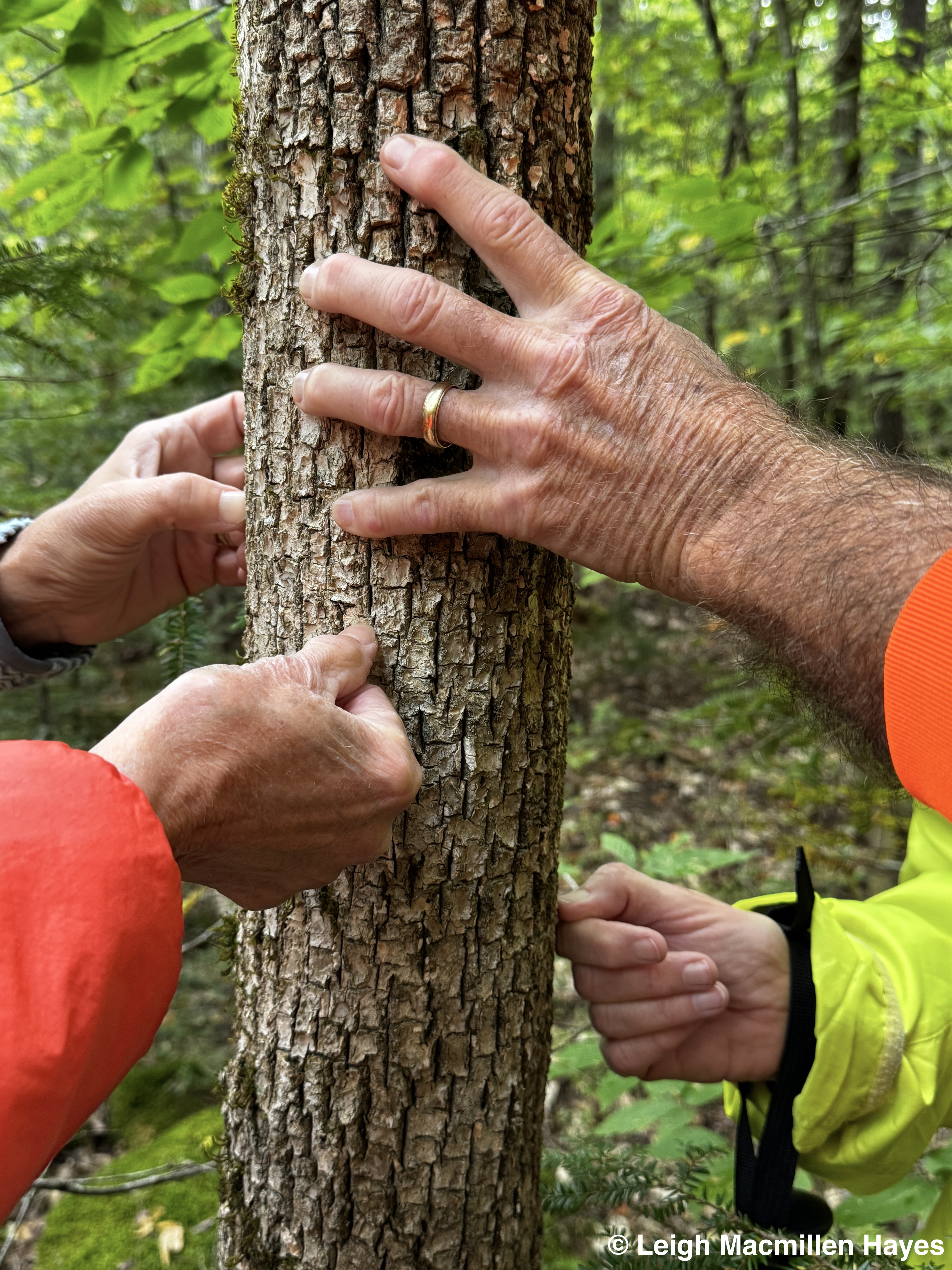
On that same journey, we reached a wetland where Black Ash grow, and encouraged participants to poke their thumb nails into the bark. I love it when people are willing to try and in this case, they realized the bark is corky. Especially after it has rained.

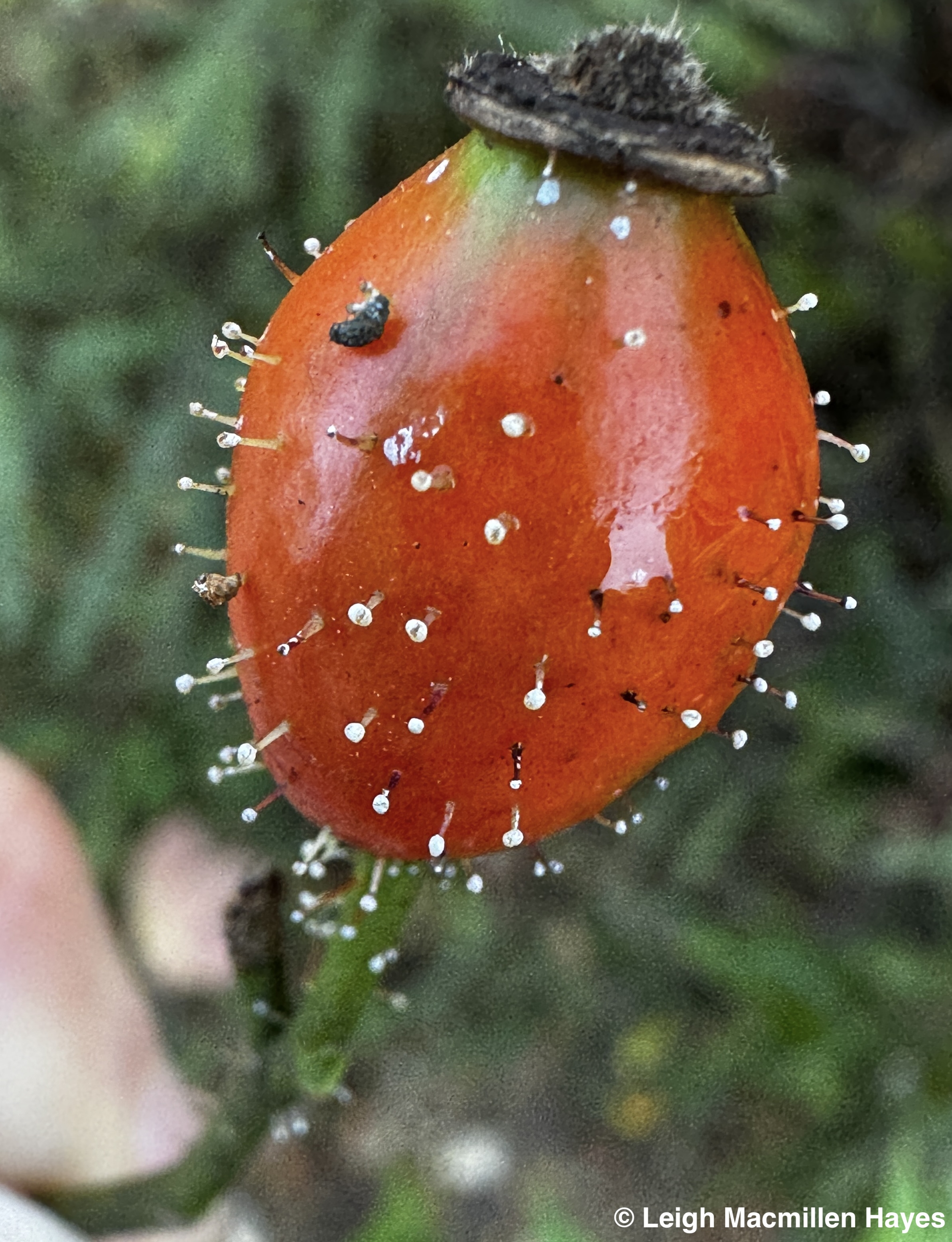
October found us being wowed by rose hips. Because–look at those spikes. We thought maybe a slime mold, but instead discovered it’s the gland-tipped hairs on the hips of Ground Rose. Otherworldy indeed.

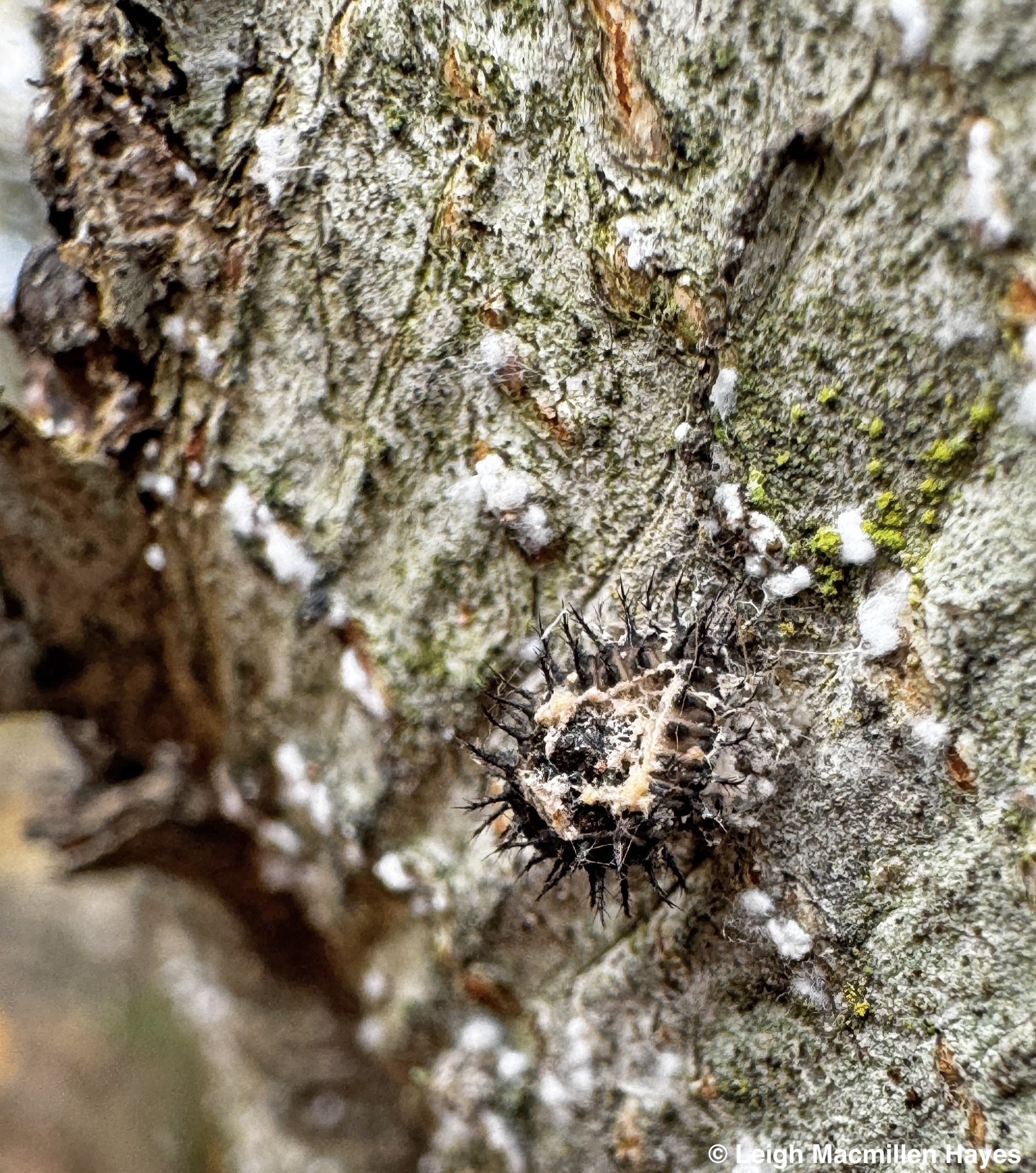
And speaking of otherworldly, the larval form of Lady Beetles also caught our attention, this one having been predated. So spiky as well, and especially when you think of what an adult Lady Beetle looks like–it doesn’t seem to match up. But . . . that’s how the natural world works.

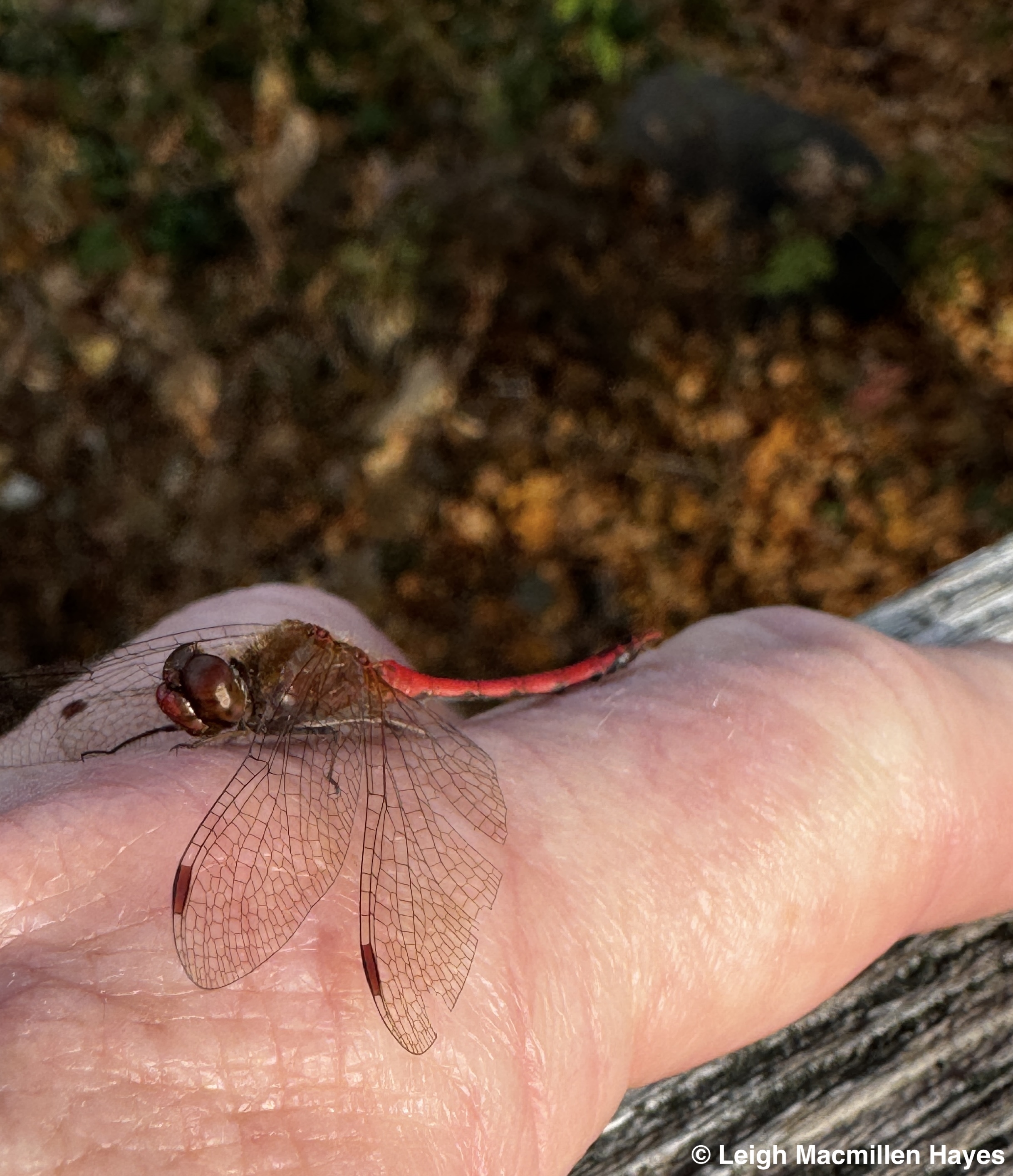
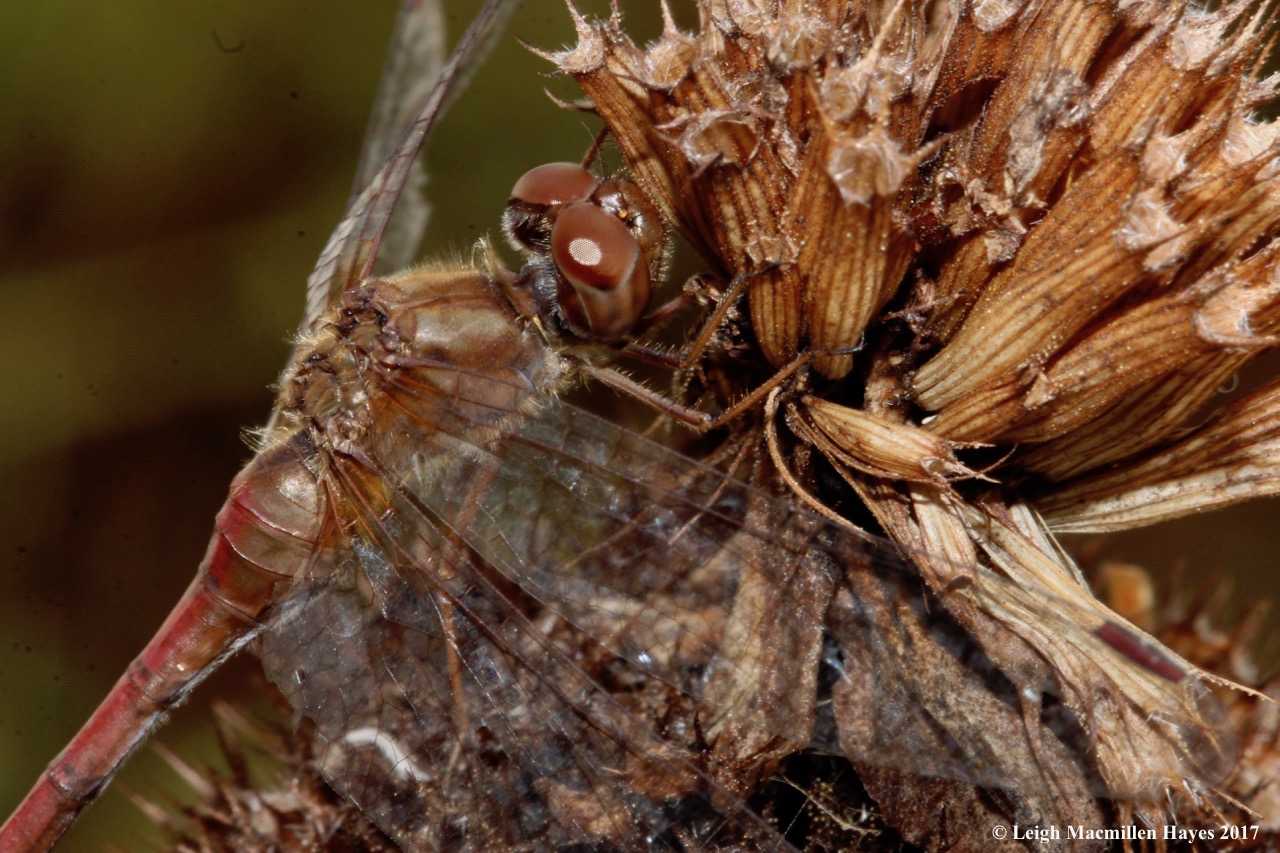
In November, we were only a wee bit surprised to still be greeting Meadowhawk Dragonflies. Notice the tattered hind wing–this one had met with some difficulties we could only imagine.

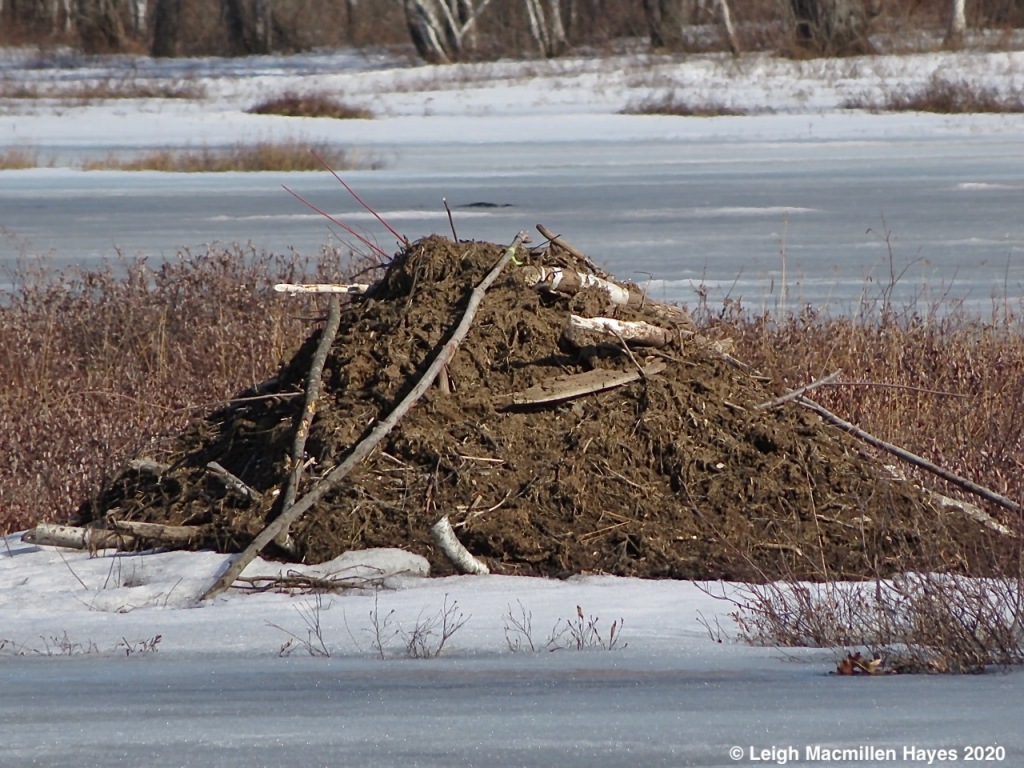
On another November expedition, while exploring an area where Beavers were quite active and had been busy mudding/insulating the outside of a lodge, plus gathering their winter food supply, we asked participants to become the critters and cut down their own trees. But . . . they had to hold the tree trunk as upright as possible and turn it, because certainly they couldn’t walk around it like a Beaver can.

Timber!

With a bit of snow in December (actually on Thanksgiving Day we had a lot of snow, but then the amount dwindled daily), we started tracking in earnest, spending the start of each walk with a brief explanation of how mammals move and clues to the prints they leave behind.

Measuring took on new meaning as stride (length from the front of one foot to the front of the next in a track) and straddle (length between the outside of one track and the outside of the next in the pattern, for example, put your feet together and measure from the outside of the left foot to the outside of the right and you have determined your trail width or straddle, which is key for some mammal print ID) were taken into consideration.

On a cold winter day in January, you would have thought that we’d bring hot cocoa. We had the cups. And we had the thermos. BUT . . . inside the thermos we had what we call mammal blood (red gelatin), and the group split into pairs and went off to find just the right spot to protect their “mammal’s blood” so we could check its temperature about twenty minutes or more later. It actually turned out to be later because we got caught up with tracking an actual critter in the meantime.

When we did check, it was the pair with the highest temperature that won bragging rights. They had found a suitable protected spot for their critter to survive.

We were still tracking in February, and were excited to follow a Porcupine to its den, and then backtrack to its feeding trees, where Eastern Hemlock branches minus buds and some needles, decorated the ground.

And though we had to dig to find, Porcupine scat in its typical comma shape, did happen.

In March, it was the large red buds of Basswood that garnered our attention. And after posting photos of these, an arborist friend commented that the buds look like a mouse wearing a helmet and I’ll never unsee that going forward. Thank you, Eli!

As the temperature began to rise with the March sun, we also spotted deer beds such as this one and knew to look for deer hair! The red arrows point to some as it was time for them to shed their winter coat and with their body heat melting the snow, some stuck to the edges.

In April, on our way to a vernal pool, one of the many curious naturalists among us found an Oak Apple Gall, that would have been bright green when first formed last spring/summer.

Though it had snowed the day before, we did find Fairy Shrimp in the pool, and rejoiced as always because finding just one of this species makes the pool significant by Maine standards.

As I mentioned in a previous post, there are four species, each with a different count, that help determine if the pool is significant, but any pool that dries up in the summer and then fills up again in the fall is considered ephemeral or vernal.

When the calendar turned to May, we turned our attention to dipping in rivers and streams, curious to see what macro-invertebrates we might meet in those spaces. Out came the D-nets, which we don’t use in vernal pools, because we don’t want to disturb the egg masses of Wood Frogs and Salamanders.

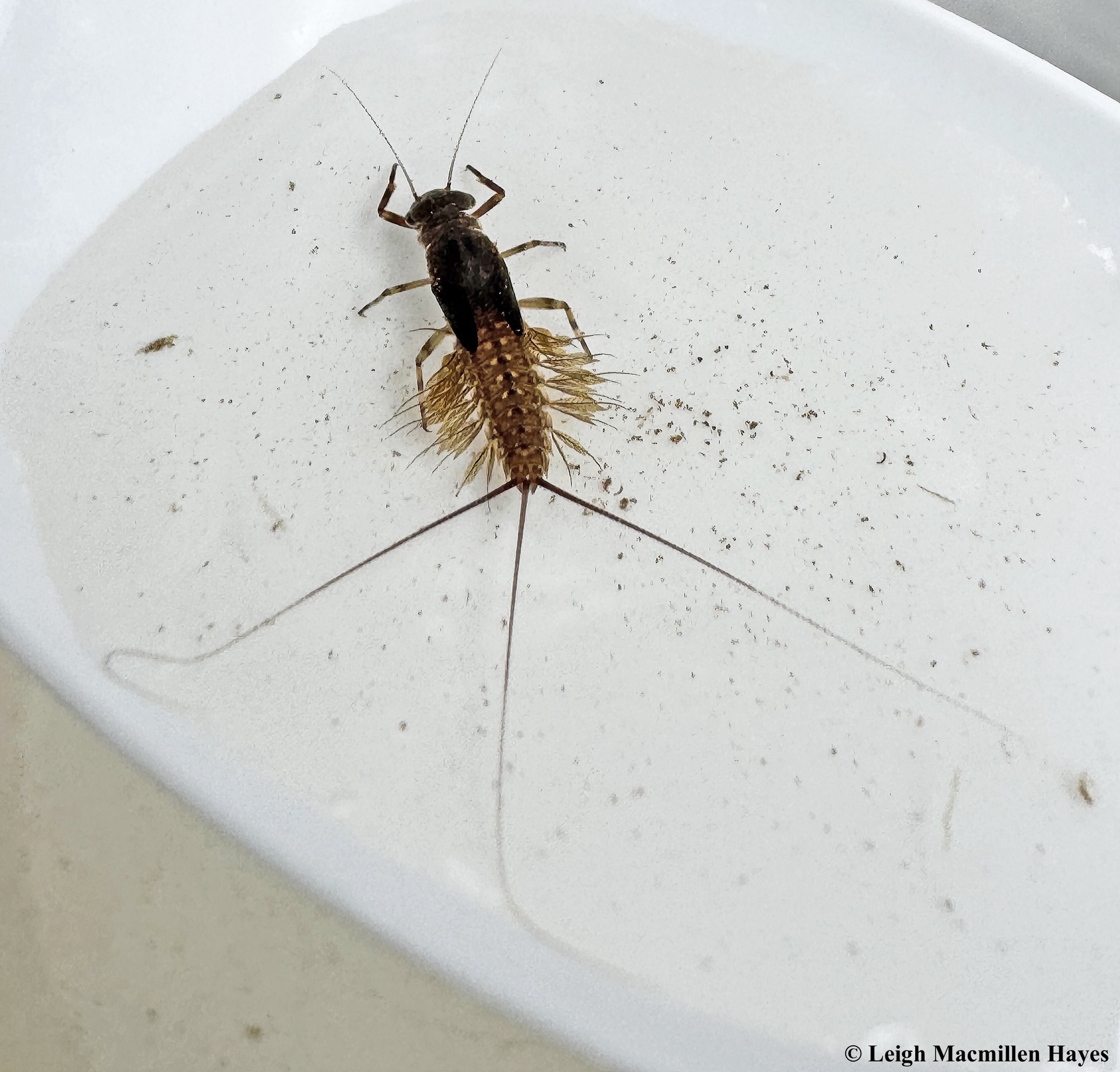
It’s always fun to meet the different species, including a variety of Mayflies in their larval form, with gills along their abdomens and three tails. Long tails quite often. And all that come out of the water, including Mosquito and Black Fly larvae, must go back in.

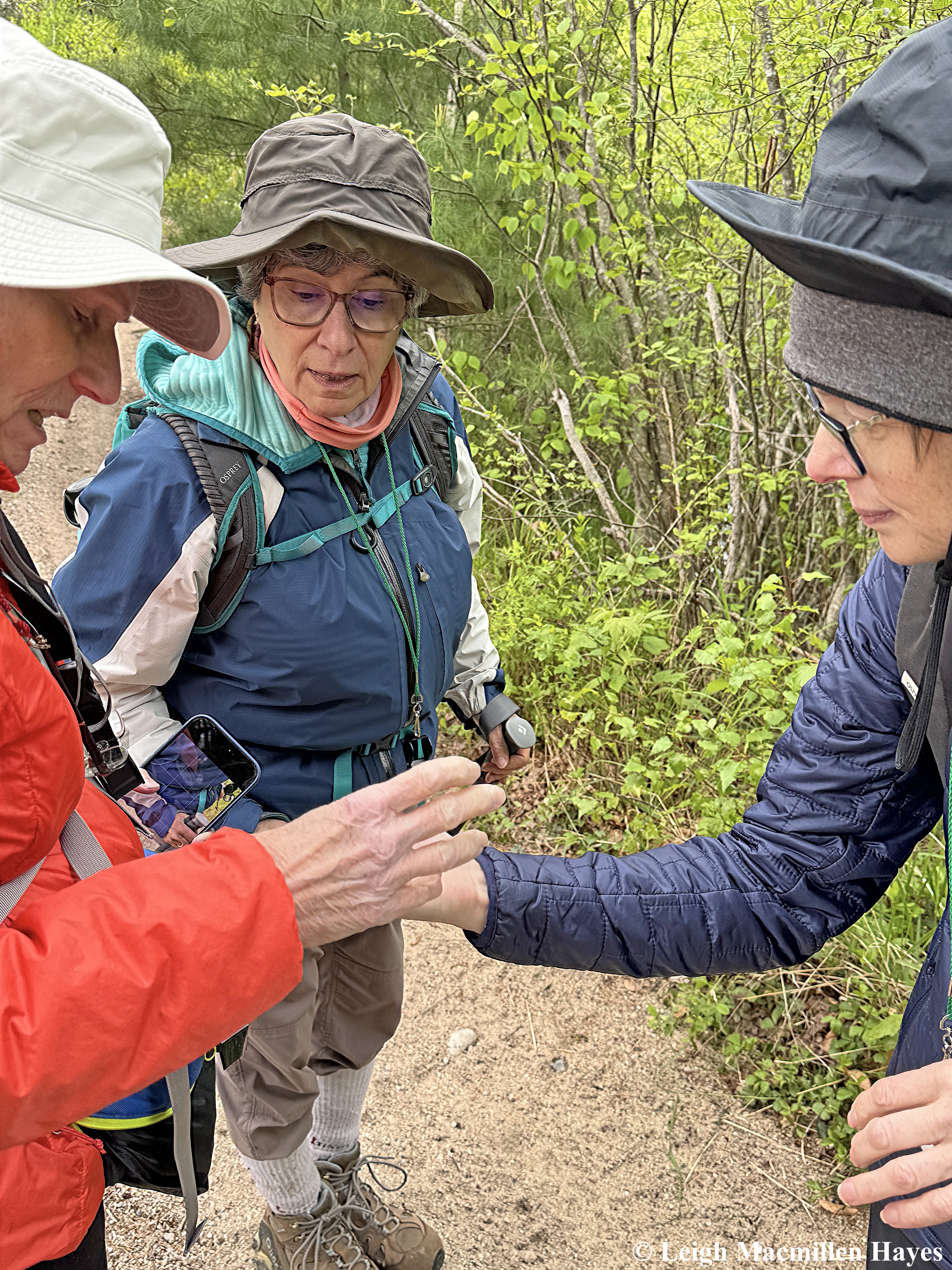
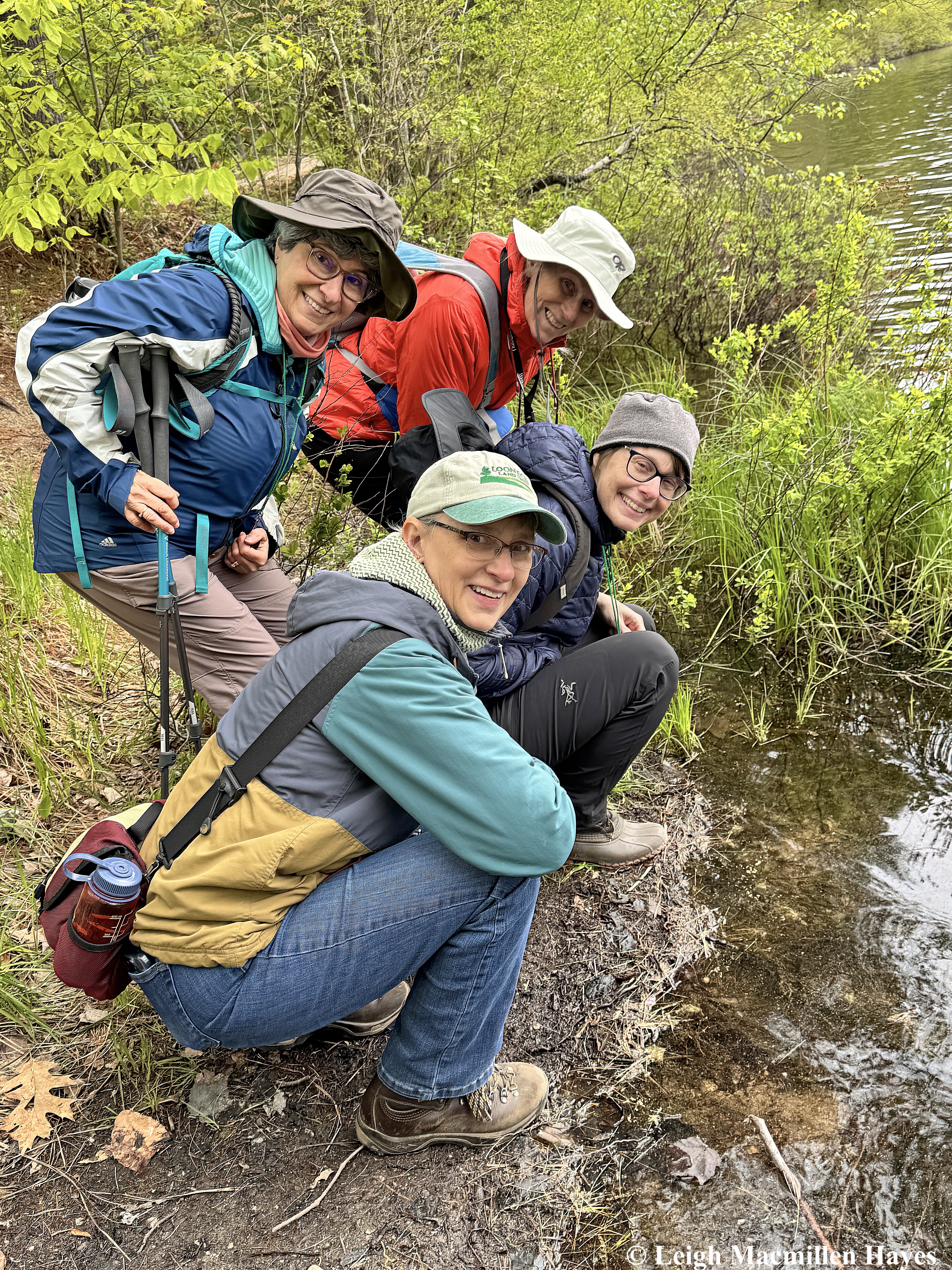
All of this brings me to this morning, when our group was quite small because some had apparently cancelled for various reasons and others were no-shows. That said, we had the best time, as we always do. But today felt extra special. You see, we had a plan to walk down an old trail, but since we were waiting for the no-shows, we thought we’d give them some time to locate us if we first visited a pond located about a hundred feet from the parking area and in the opposite direction of our intentions.

It was while squatting there that we realized miracles were taking place. But . . . we still wanted to share the trail with the participants, so we promised we’d return to the edge before it was time to depart. (As for the no-shows–we’re bummed they missed out.)

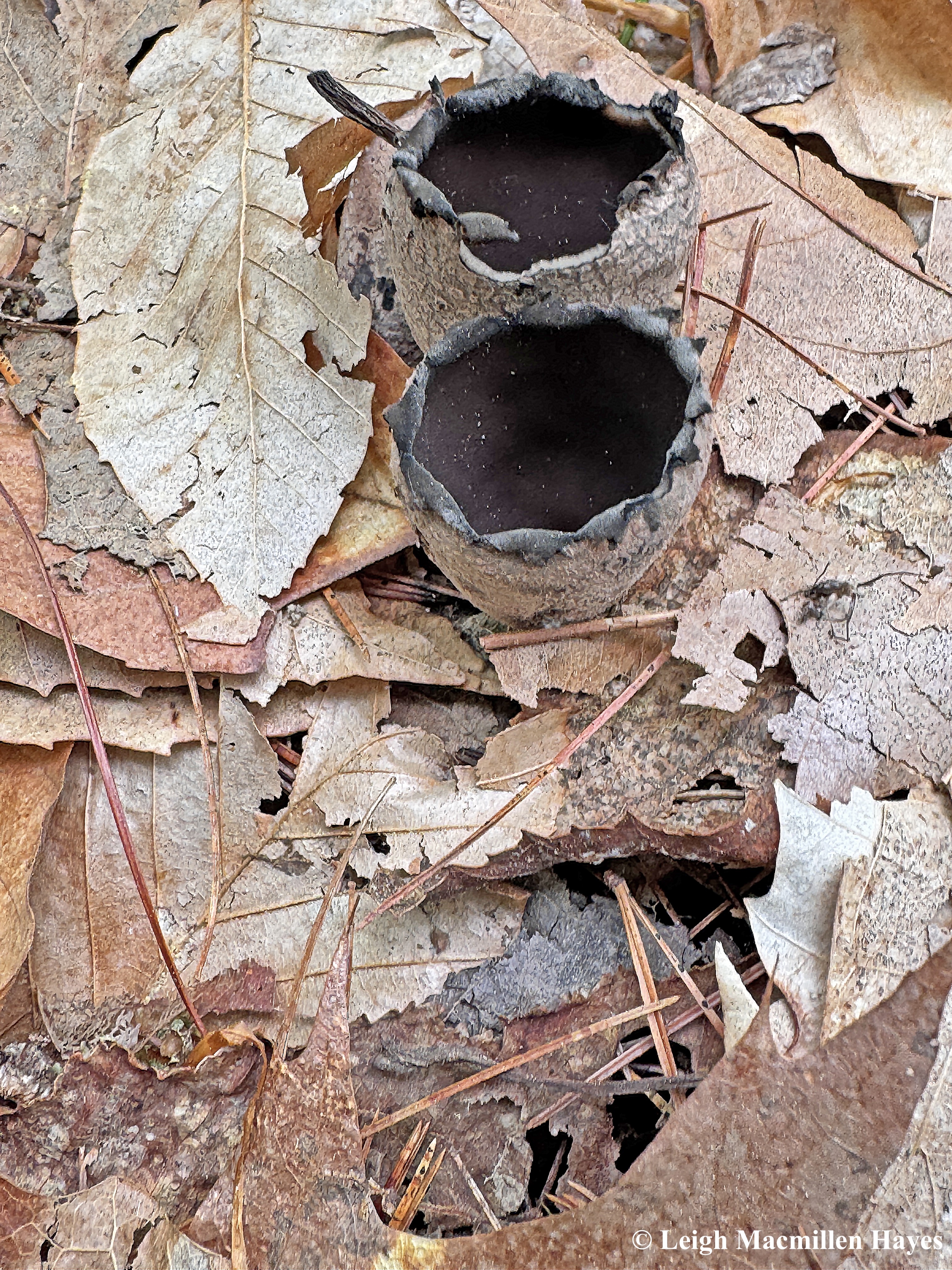
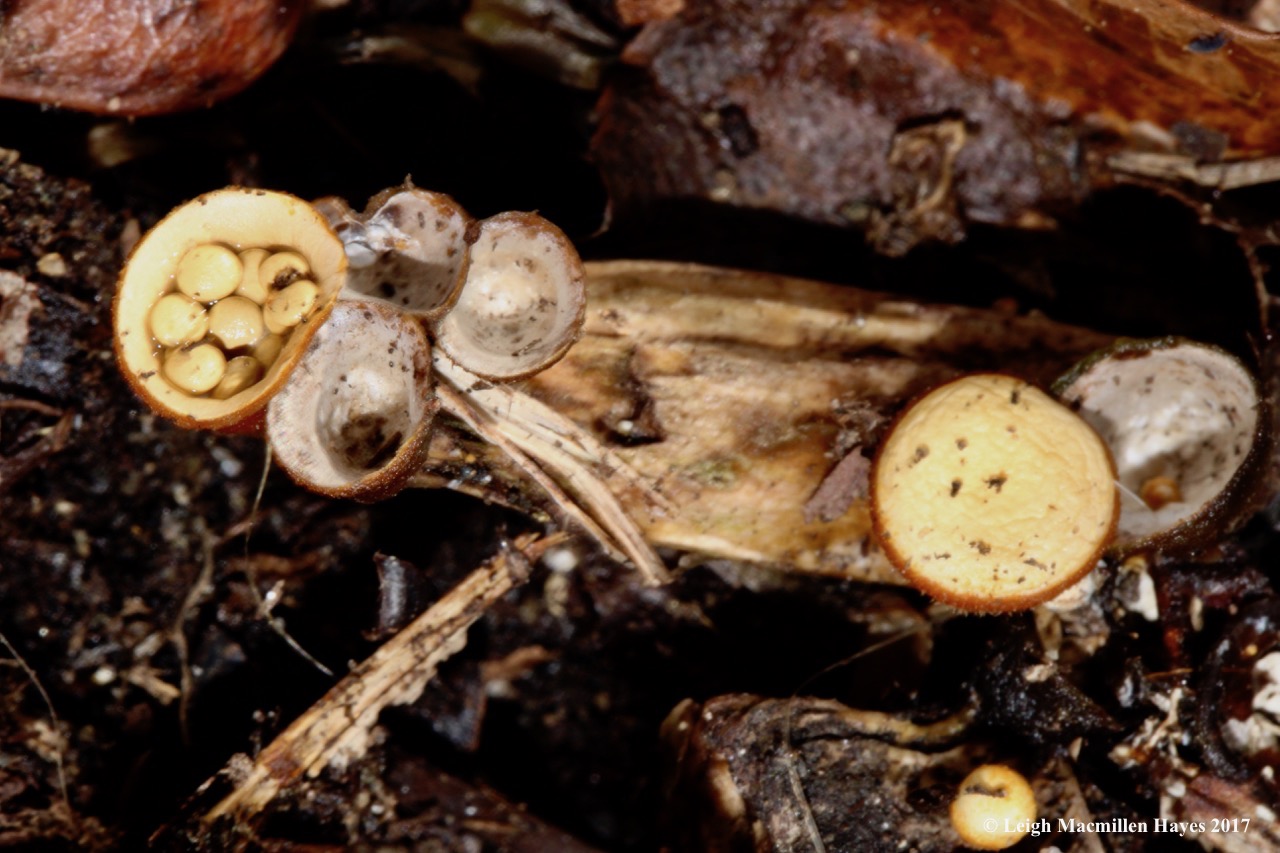
One of the participants who is a fungi enthusiast, and has eagle eyes, somehow spotted these mushrooms. None of us knew what they were, but iNaturalist’s SEEK app identified them as Devil’s Urns.

When I arrived home, I looked them up my Audubon Field Guide, and bingo: “Large, leathery brown, urn-shaped cup; Season: March-May; Habitat: Clustered on fallen deciduous wood, especially oak; Comments: This is one of the first mushrooms to appear in the spring in the East.”

Well done, Julie.

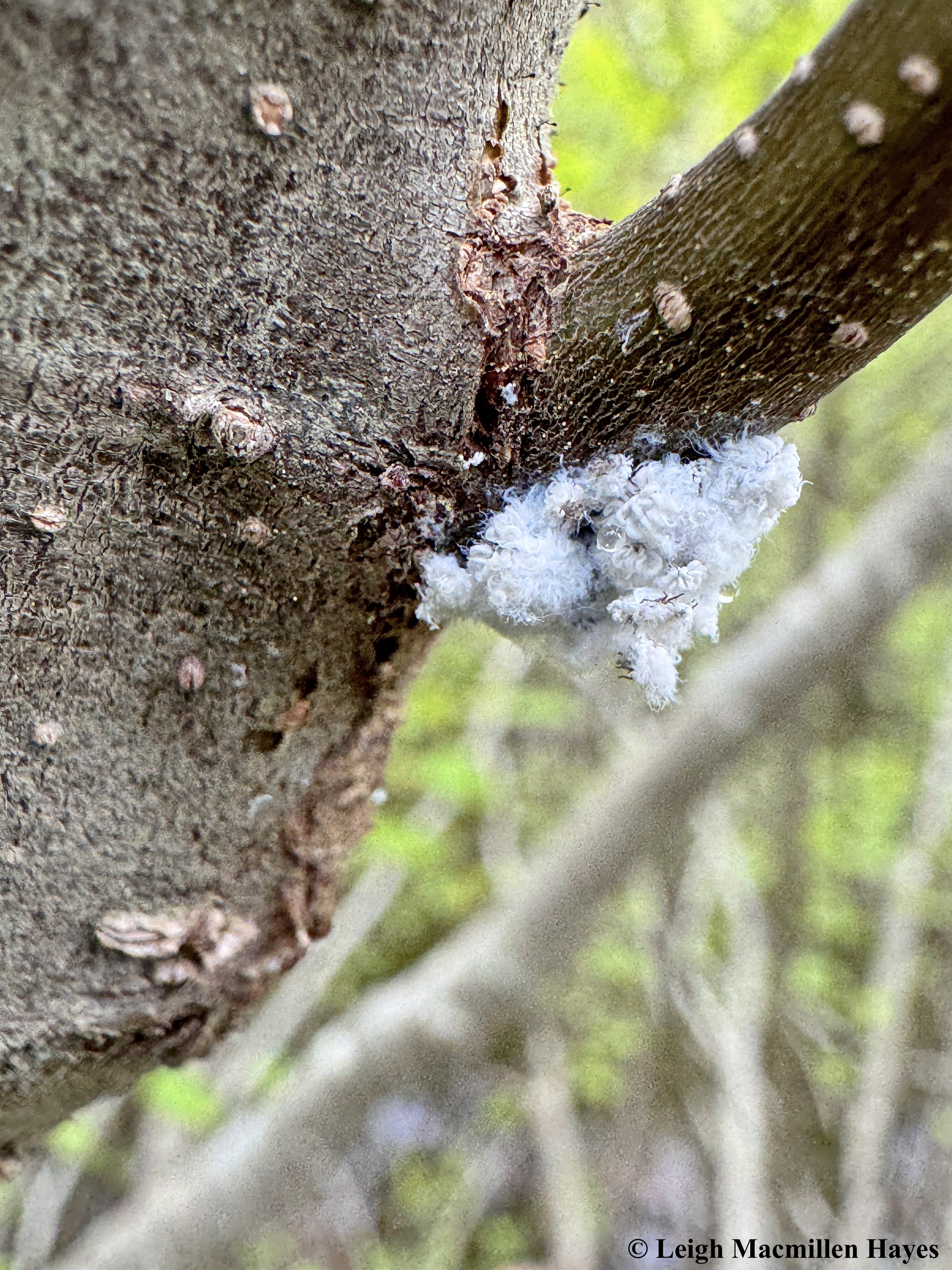
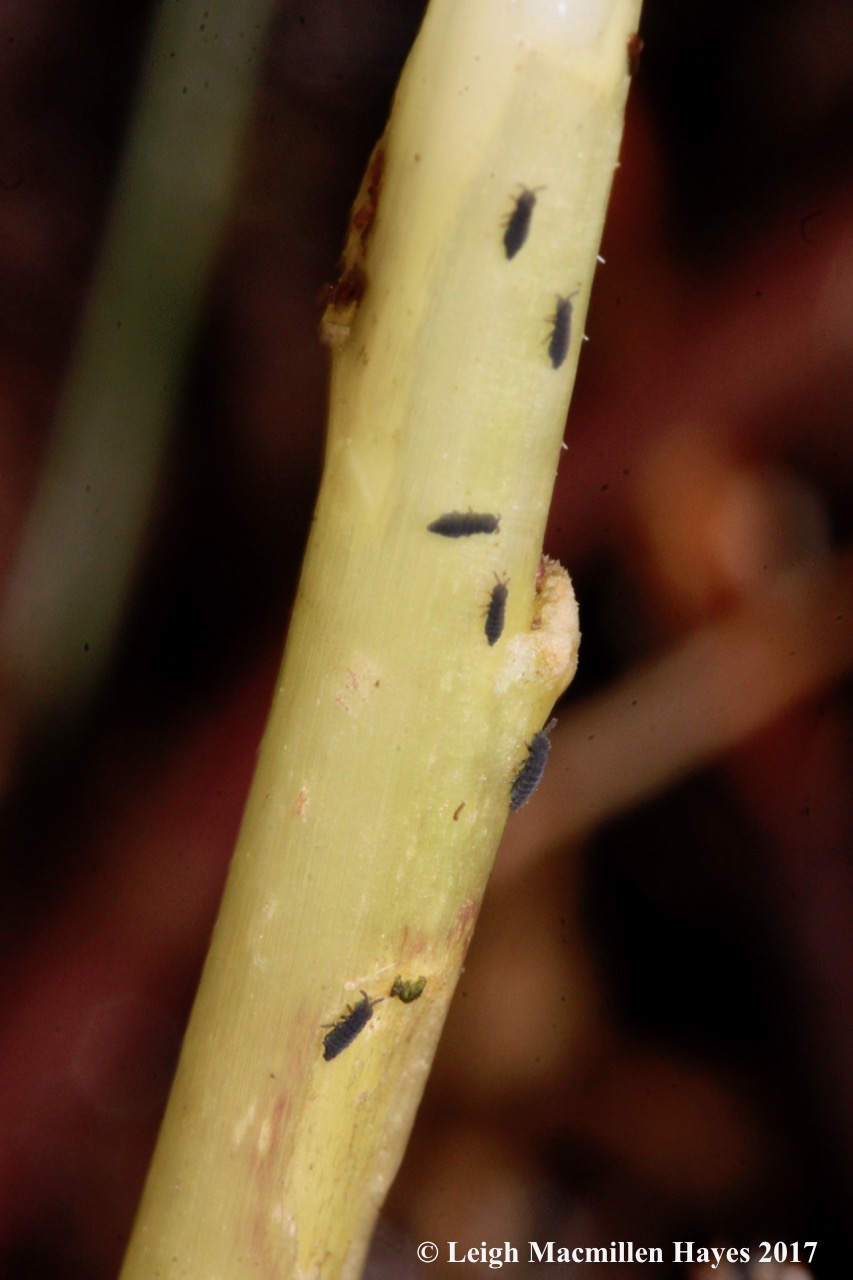
Woolly Alder Aphids were also visible, and once we saw one clump, we began to notice several. As we described how ants “farm” or seemingly tickle them to get them to secrete honeydew, one participant saw an ant and another saw drops of said liquid. Can you see it?

Well done, Marie.

And remember the little girl who found last year’s Oak Apple Gall on the way to the vernal pool in April? Well, another among us today found this year’s galls on newly emerged Oak leaves. It got us all thinking about leaves and insects and how mature insects lay or inject eggs into buds when they first form in late summer and so the moment the leaves begin to unfurl the following spring, larval forms jump into action and leaf miners and rollers and gall makers and everyone else have a heyday.

Well done, Heidi.

Marie, Julie, and Heidi also took an up-close look at last year’s Speckled Alder cones and we noted that the male catkins have already fallen to the ground for this year, their pollination duty now completed.

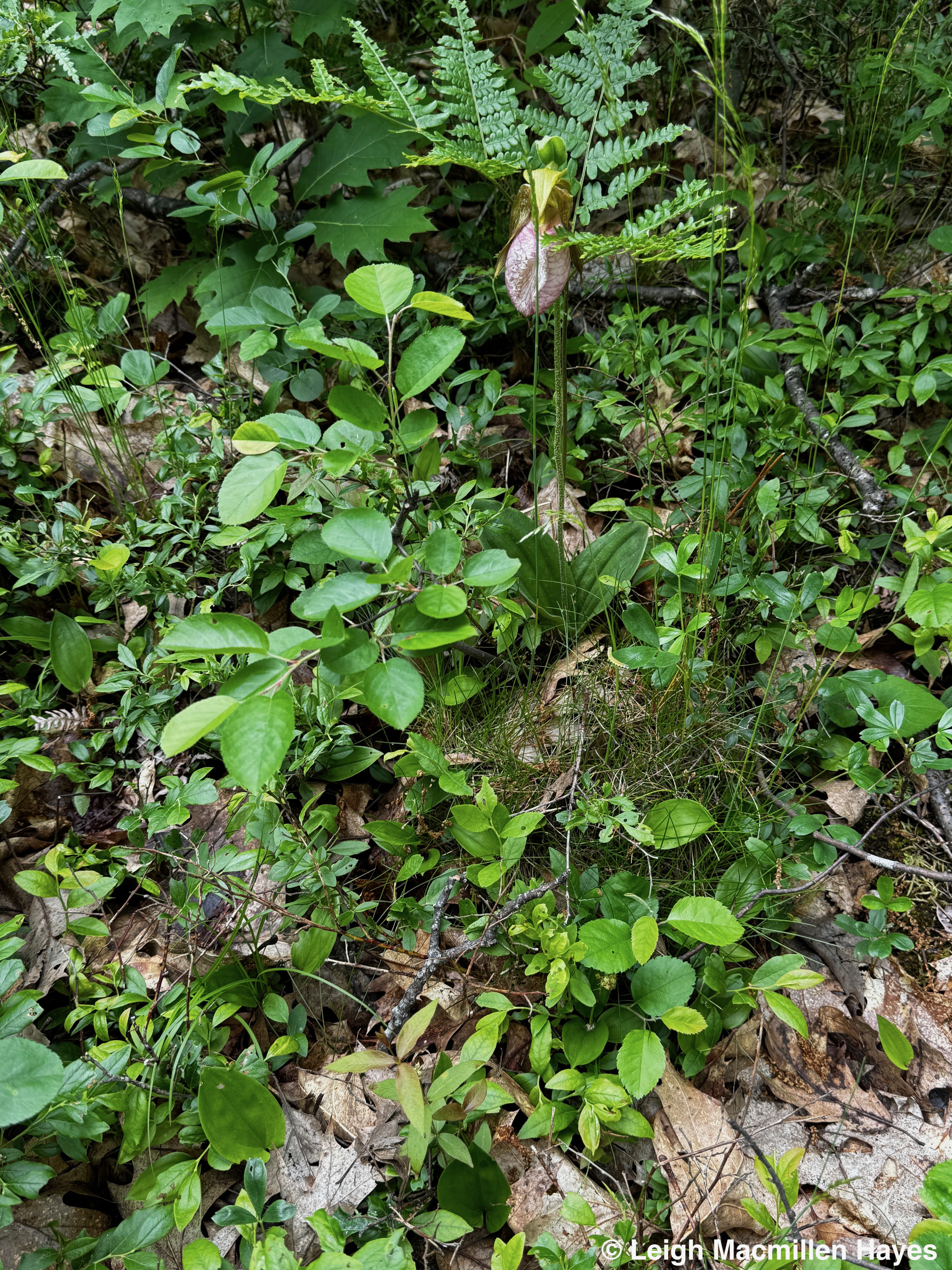
Lady’s Slippers, and Wild Sarsaparilla, and Star Flowers, and Canada Mayflowers, and Rhodora, and Dewberry, and Bastard Toadflax, and even Poison Ivy were admired and noted.

But, we all had a mission that we wanted to fulfill, so with about a half hour left, we retraced our steps rather quickly.

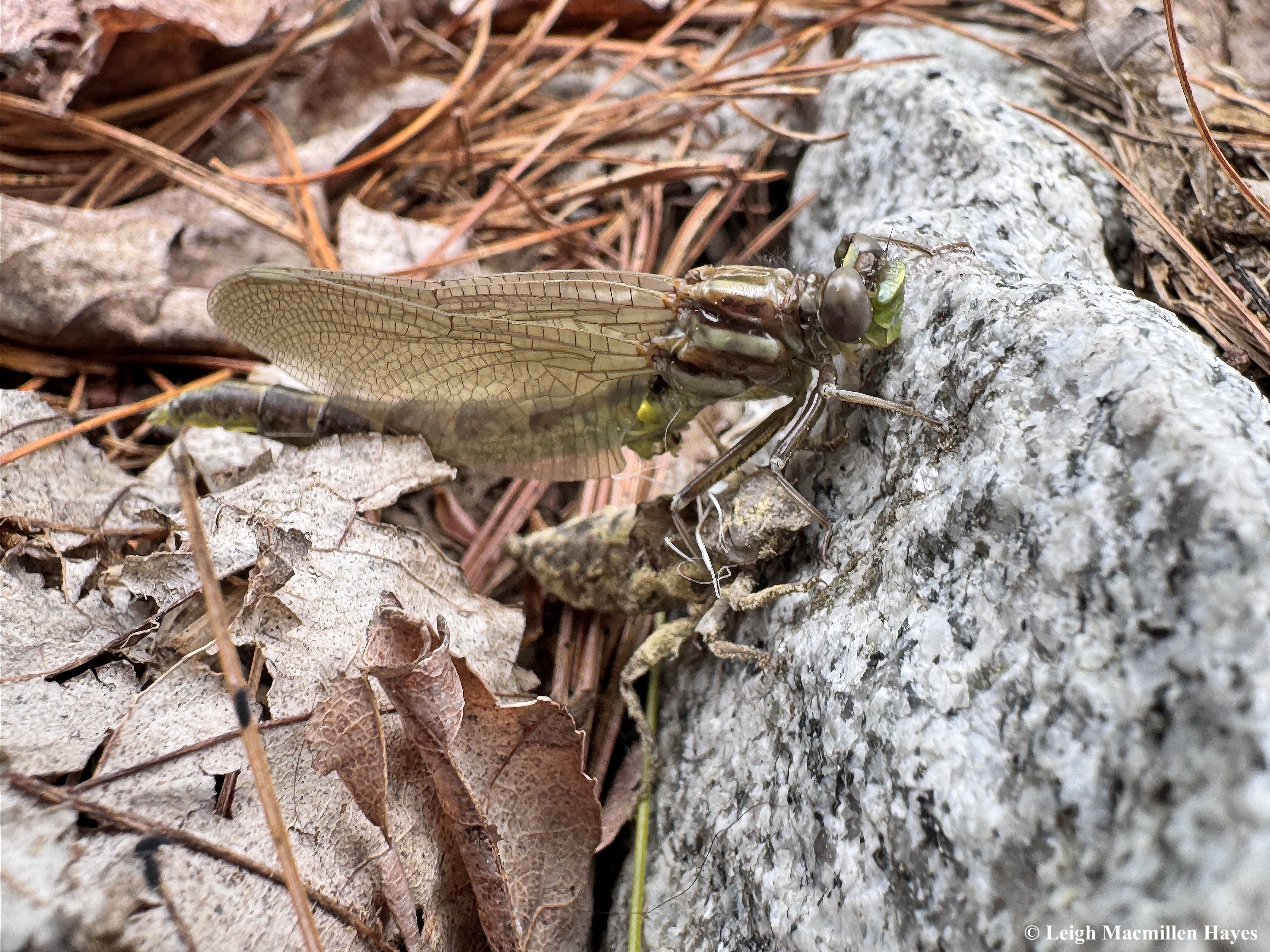
And into the plants at the pond’s edge we peered. Do you see it? A dragonfly naiad (nymph or larval form) upon a broken branch, with the adult form starting to split through the exoskeleton at the point between the wing pads. How could this be? Yes, we’ve seen dragonflies for the last week or two, but it was cold this morning. Raw. Breezy. Seemingly inhospitable for these summer fliers.

Apparently not, for once we looked around, we began to notice them everywhere. The dark naiad climbing up the rock was in search of the perfect spot. And if you look below the rock, you’ll see two naiads, one that is grayer in color, because its adult form had already eclosed or emerged; and the other browner one with the adult starting to pull out of the aquatic skin.

Here’s a closer look at the ones under the rock. Notice the eye placement. That is key to Identification according to family. In this case, with the eyes spaced far apart, it could be either a Petaltail or a Clubtail.

As I said, they were everywhere, and we felt it our duty to watch over them. To protect them from being predated, which is actually kinda funny, given that they are predators. But predators of the best kind because they feast upon Mosquitoes and Black Flies and Deer Flies, and others, of course, but it’s for those first three that we appreciate them.
Can you see how the adult is pulling out of the skin?

And do you see thin white strings extending from the exuviae to the back of the dragonfly? Those were the spiracles or underwater breathing tubes, which are no longer needed by the adult.

A few minutes later it is further out–can you see that? Once it gets its abdomen all the way out, it typically holds onto its shed skin and then pumps its insect blood into its wings so that they expand, before drawing that blood back into its body, allowing its coloration to eventually take true form.

Look for the white strings again.

Do you see them now? Completely unnecessary and therefore left behind.

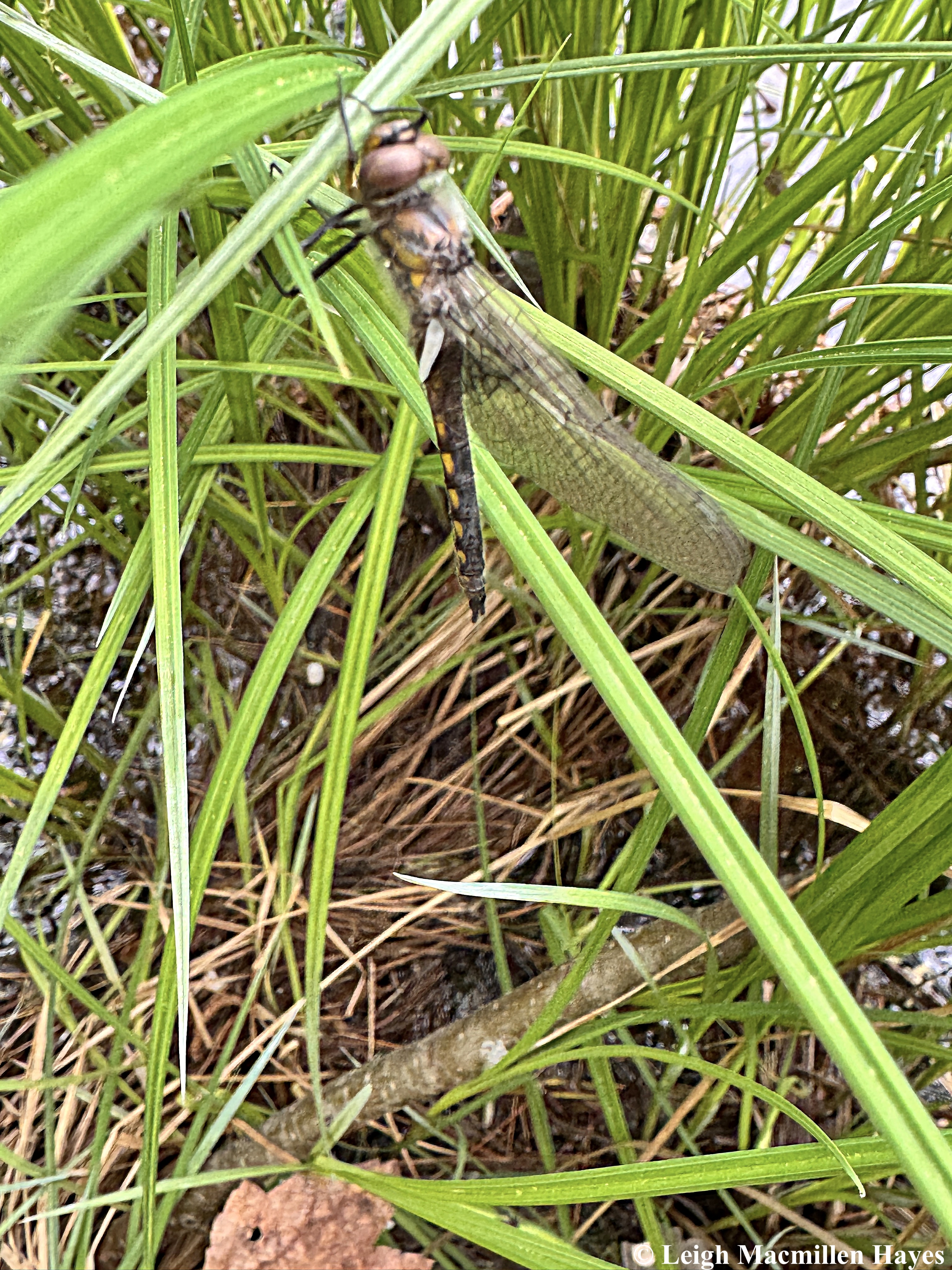
When the wings are at full length, they are held over the back and cloudy in color until it’s time to spread them and let them dry before first flight.

The eyes on this newly emerged dragonfly, along with its abdomen markings and cerci or claspers at the tip of the abdomen, tell us its in the Emerald family, and I suspect a Common Baskettail.

As we watched, we noticed some had wings that were stuck together, and this one with a curved abdomen. It was curious that it had left its exuviae before its wings emerged and so I wondered if they would unfurl.

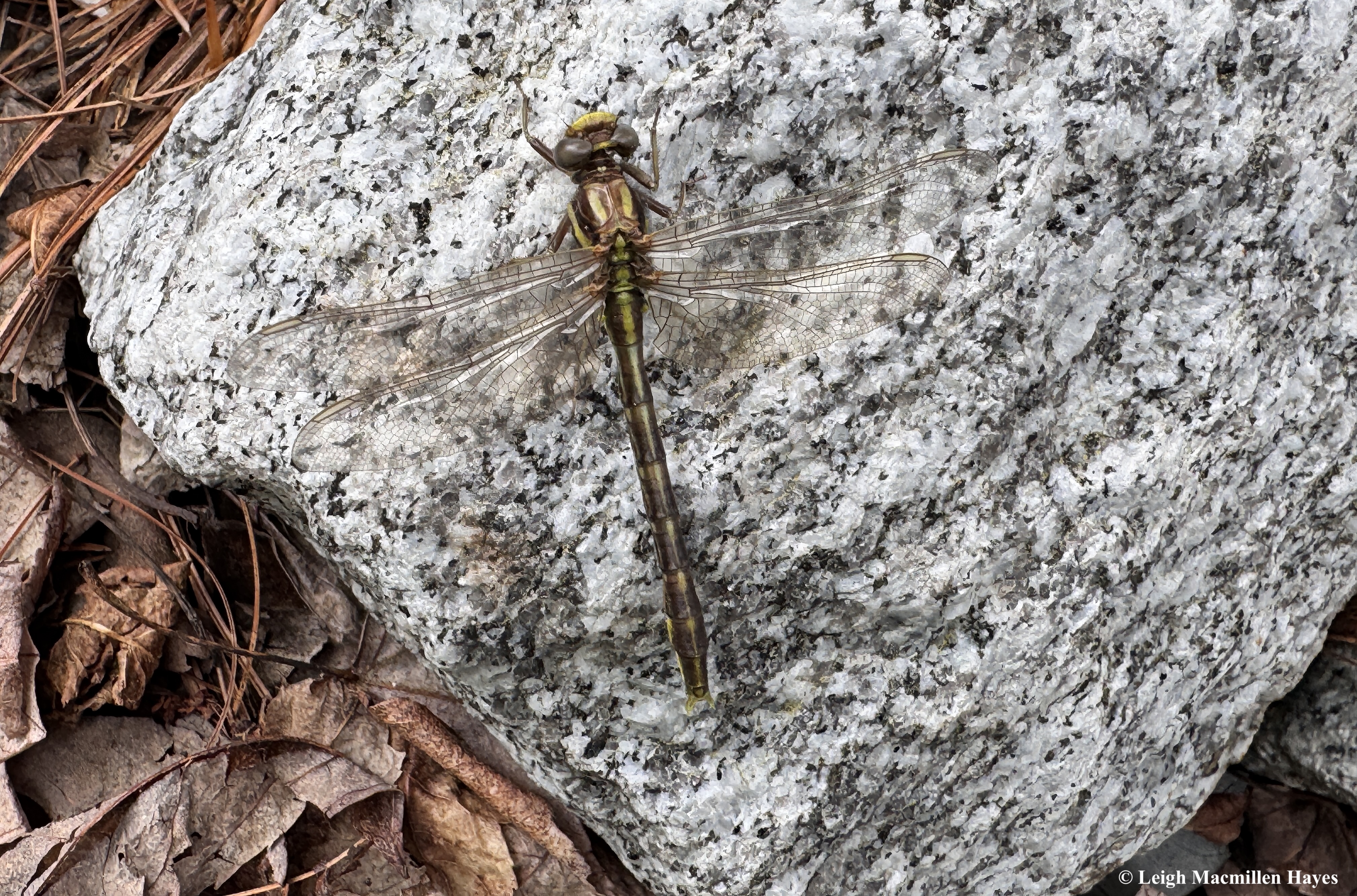
A few delighted us because we got to watch them spread their wings apart–translucent and shiny as they dried.

By the eye placement and beginnings of the markings, my identification stab is for Lancet Clubtail–one of the friendliest dragonflies who likes to land on us when kayaking. Or even on the dock.

As you can imagine, we had to pull ourselves away. The walk was supposed to end at noon, but it was 12:40pm when we finally finished–and honestly, I think we could have stayed a few more hours if we had food and other necessities.

All of our Wednesday Wanders for Loon Echo Land Trust are incredible because each one offers its own moments of awe.

Being honored, however, to share the emergence of dragonflies from their aquatic forms to terrestrial–and helping the ladies to understand that it takes hours for this process, and being surprised that so many had chosen what we considered to be a chilly spring day . . . it was beyond wonder-filled. As every Wednesday Wander is. But today, today was over the top.

Cloudy Mondate

Between the two of us, My Guy and I have lived within an hour or so of today’s destination for a grand total of 103 years. Yikes. That makes us old. Of course, we aren’t. But for some reason we never visited this spot before. Maybe because it’s a tourist hotspot, and we’re hardly tourists. In fact today, we were dressed in our usual garb because our plan was to hike. And we did. But . . . we also did that touristy thing for a wee bit. Cuze when in Rome . . . yada, yada, yada.

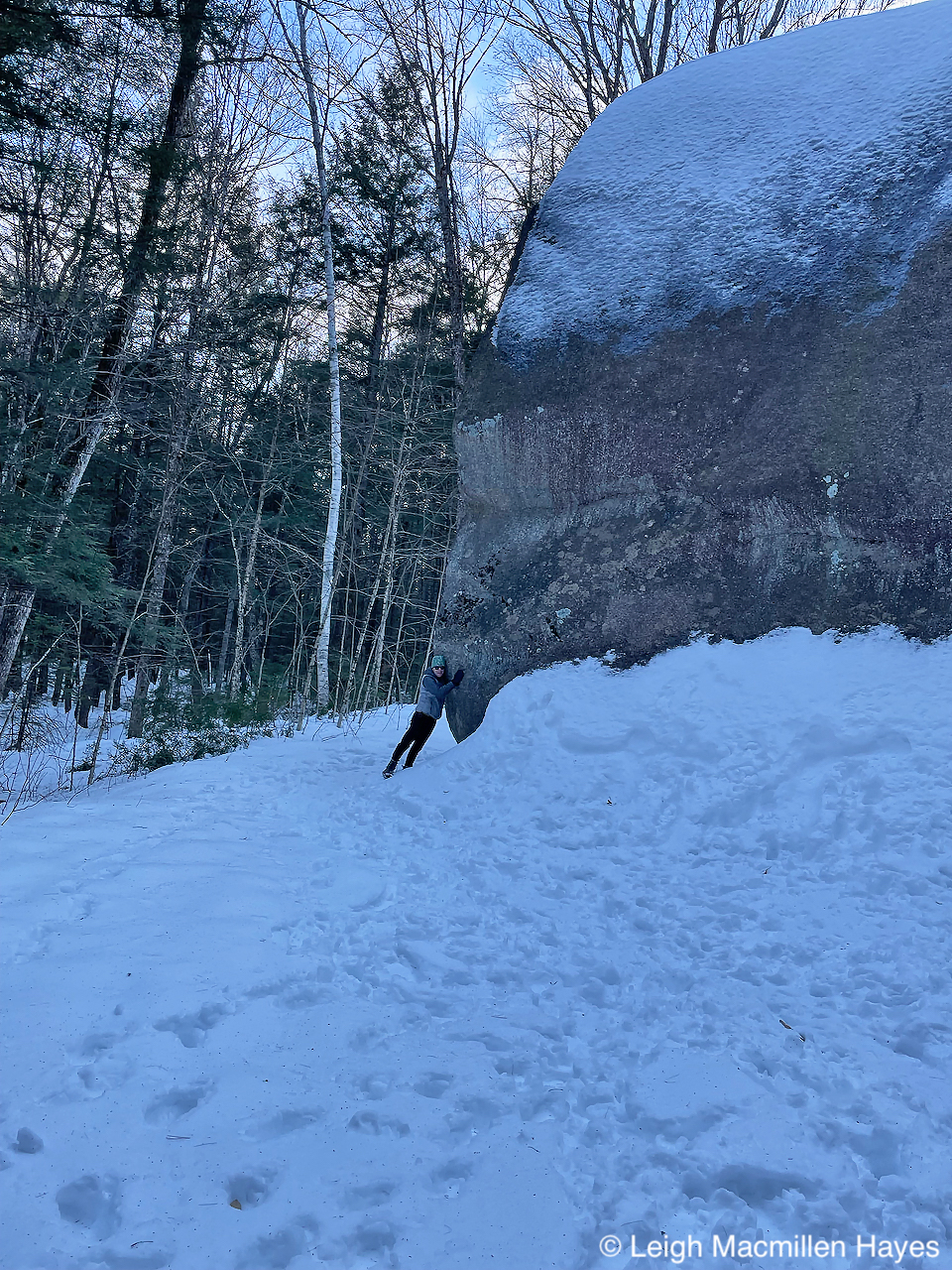
And so first we paused by the Pebble, a glacial erratic.

I suppose when you compare it to the Boulder located about a half hour north of the Pebble, which we visited on February 14, 2022, it is rather pebble-like.

But what we really wanted to see was the Falls of Song, a waterfall that drops forty feet and is so named for the changing sound of the water that constantly flows.

According to an interpretive sign by the falls, “An 1885 Boston newspaper description of the scenic beauty and amenities stated of the Falls of Song that ‘their location in the depths of the primeval forest, their exquisite setting under the overhanging cliffs, the silvery clearness of the water and their magical musical effects, seemingly changing their song at every hour of the day, unite to place these falls among the most interesting and wonderful in the United States.'”

Another set of falls to draw our fancy was the Bridal Falls, so named because in the right conditions they appear to be lacy like a bridal veil. I felt like the conditions were indeed right today.

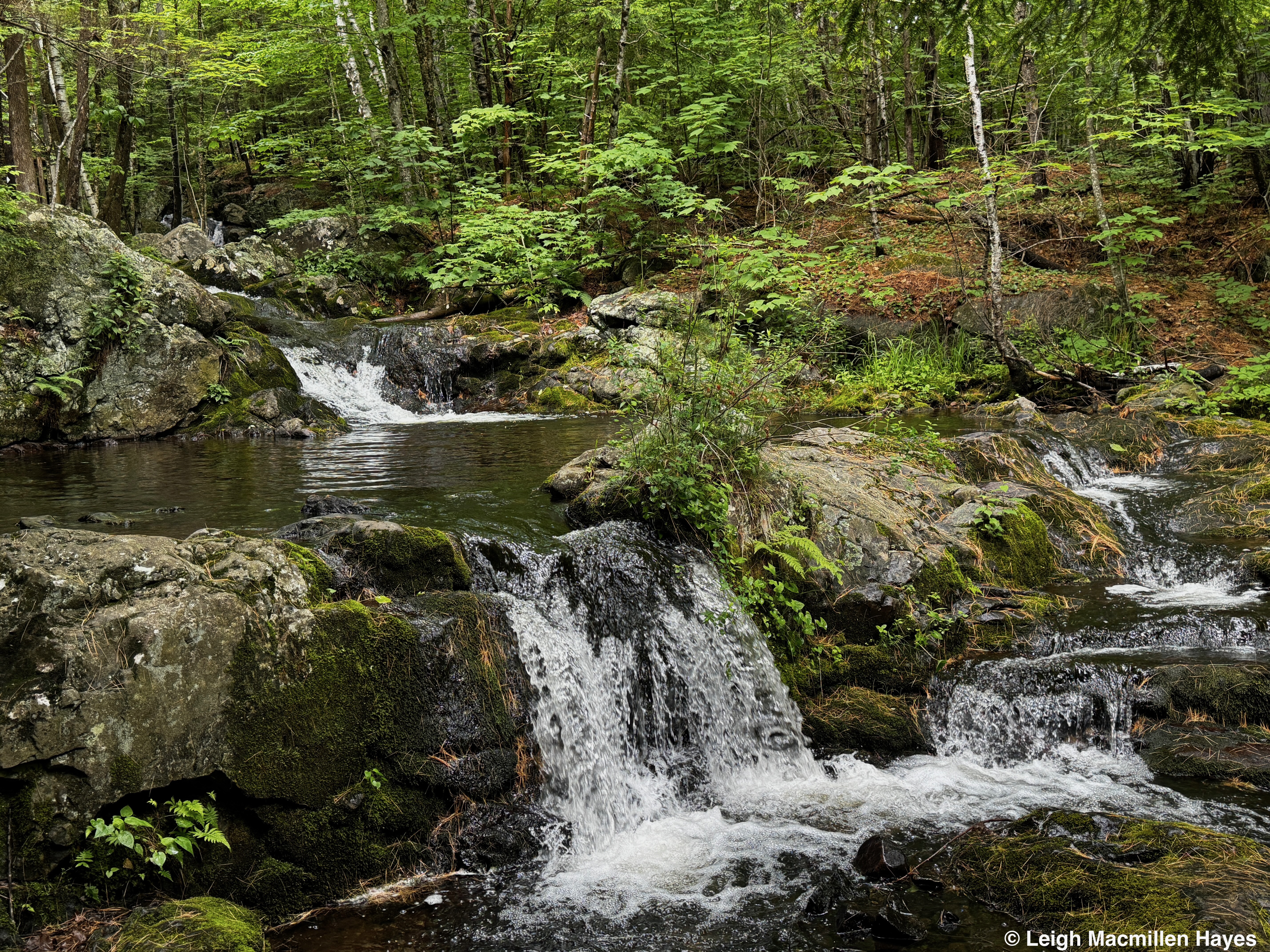
We followed the brook for over a half mile and the views kept changing and sounds kept enhancing our experience. If it had been warmer, we might have wanted to take a dip, but for today, just watching and listening as the water tumbled and plummeted and twisted and turned and glided and flowed was enough.

Back on the road as we drove up the mountain, we stopped again for a view from lunch bench and I found my place, which was my place in the early 1980s. Lake Winnipesaukee and Gunstock Mountain formed the backdrop and brought back memories of teaching and hiking and skiing and swimming and being. The best part is that this is the area where I learned to be. Be me.

To be native, like the Northern Bush Honeysuckle, for I began to realize all those years ago that this is the area where I belonged.

But today brought us to the home of others who also belonged in this place, beginning with Thomas and Olive Plant, the original owners of this mountaintop mansion. I could only hope to live here. But they did. For a while at least.

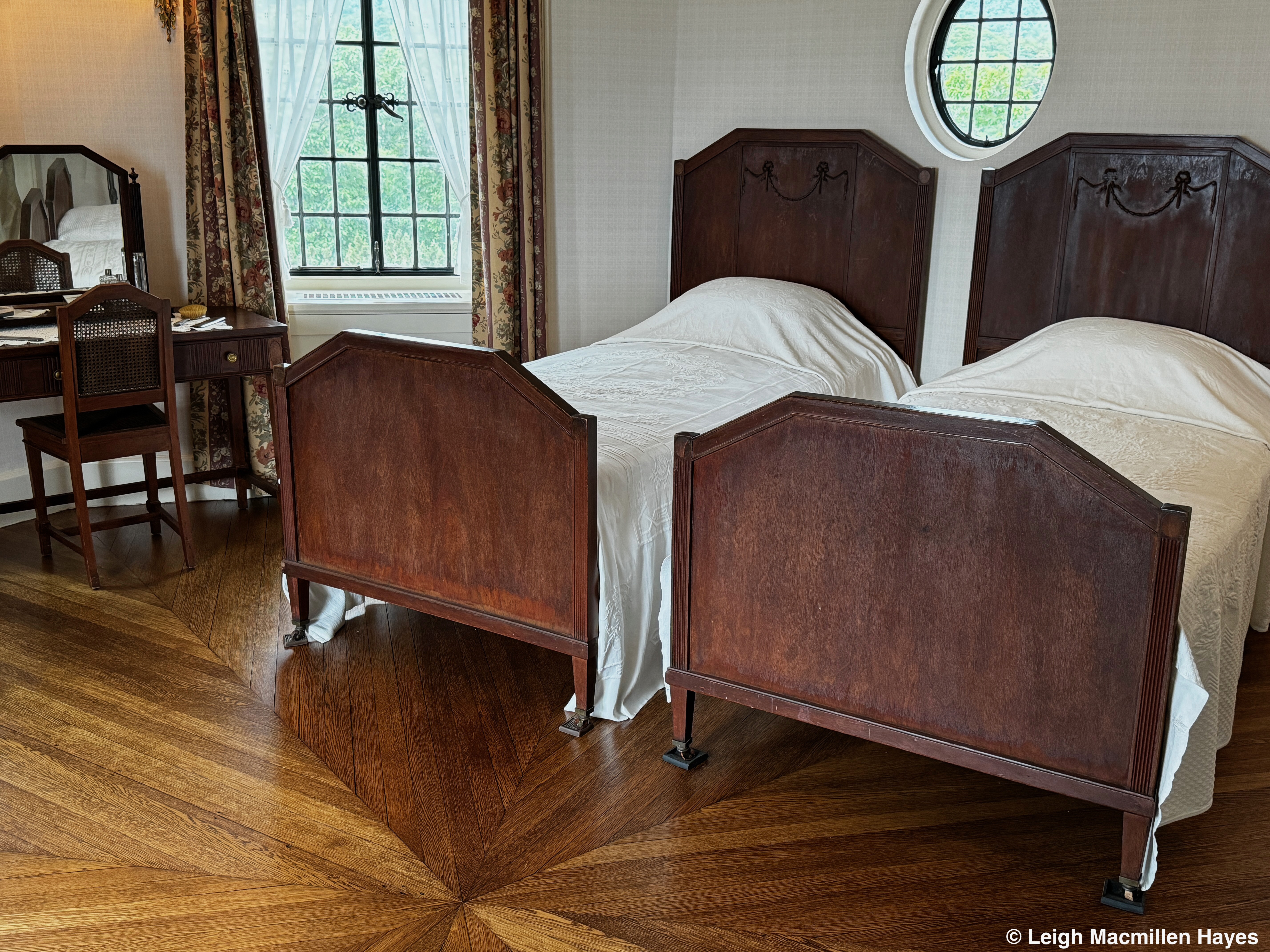
It’s a sixteen room home with halls and halls and an organ, and dumb waiter, and guest rooms like this one, and more halls, and sitting rooms, and great hall, and dining rooms, and servants quarters, and sunroom, and oh so much more. But this, the Brown Room, was my favorite, for recently carpet had been removed and the most incredible floor discovered, and it reminded me of our home, which had been similarly carpeted, and we discovered beautiful southern pine that has since brightened our days.

The sunburst pattern of the Brown Room floor–incredible.

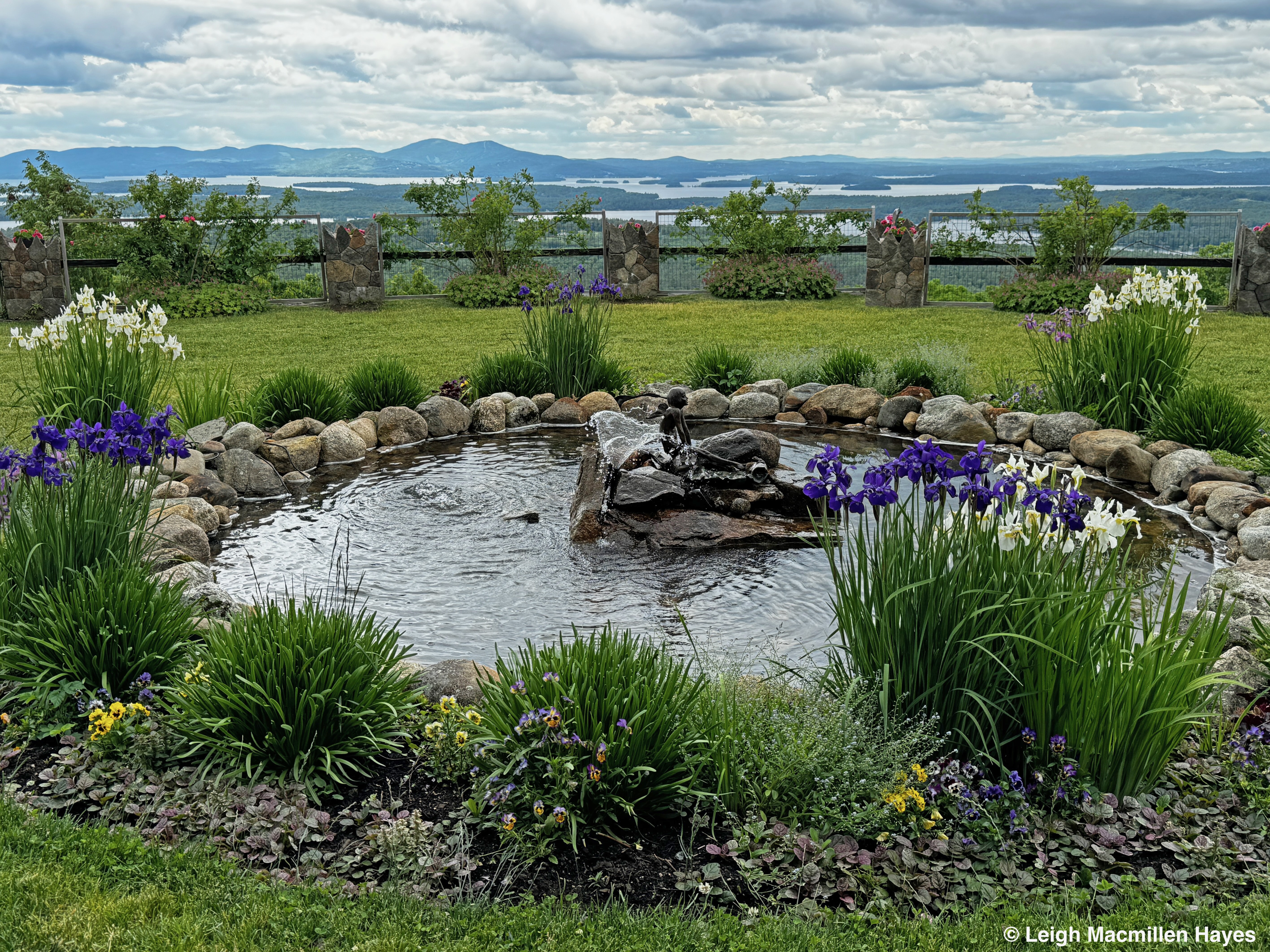
But even more than the inside, we really enjoyed the outdoor living areas, this off the main hall, with a view of the lake and mountains beyond, Gunstock being straight across.

And an angel letting water form her wings.

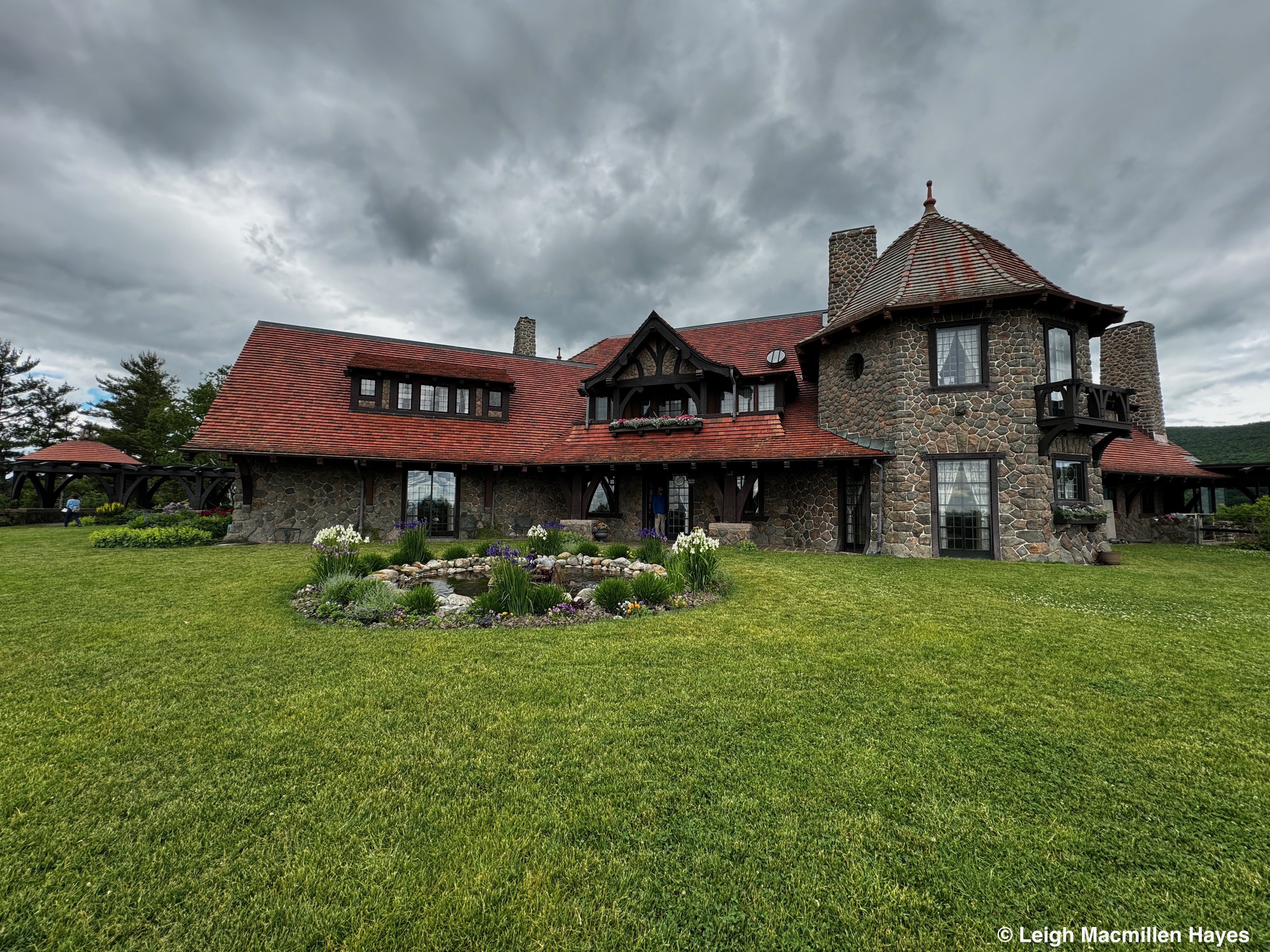
We’re thinking we’ll take the month of August and welcome guests here. Haha. As if we ever welcome guests, the introverts we truly are. But really, the focus should be on the Arts and Crafts architecture and way the building fits into the setting.

And the gardens. Exquisite.

Olive Plant, original owner of the property in 1914, would have approved of today’s gardens which are tended by a group of volunteers. In this space that surrounded the mansion she had a 100-foot glass greenhouse.

I don’t know if this was part of her greenhouse selection, but among the wall that formed part of nursery grows Ivy-leaved Toadflax, a plant I don’t recall ever meeting in the past.

Clouds there were upon occasion today, but the yard boundary offered glimpses of brightness.

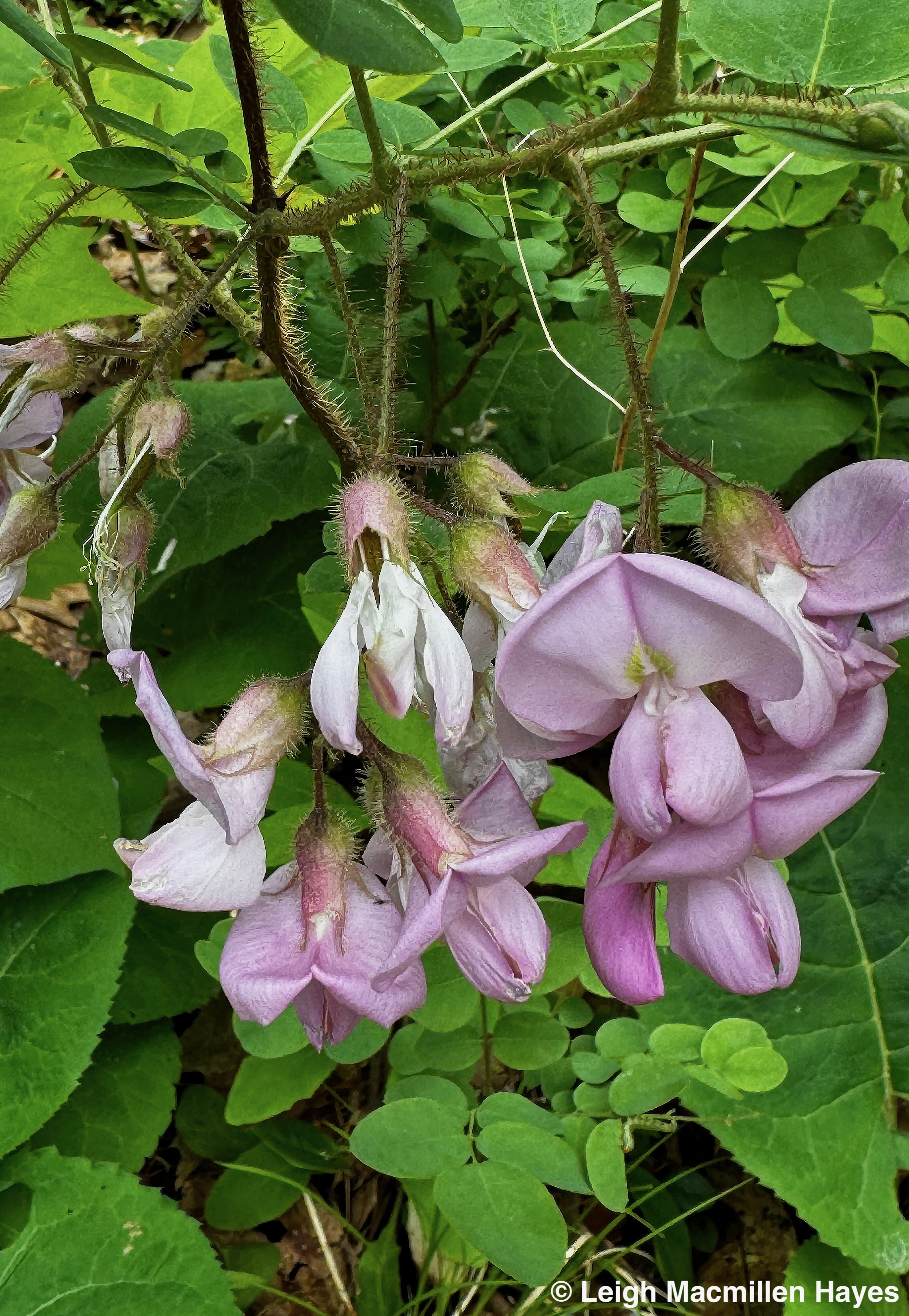
And along the trail where other specimens including this Bristly Locust, a legume.

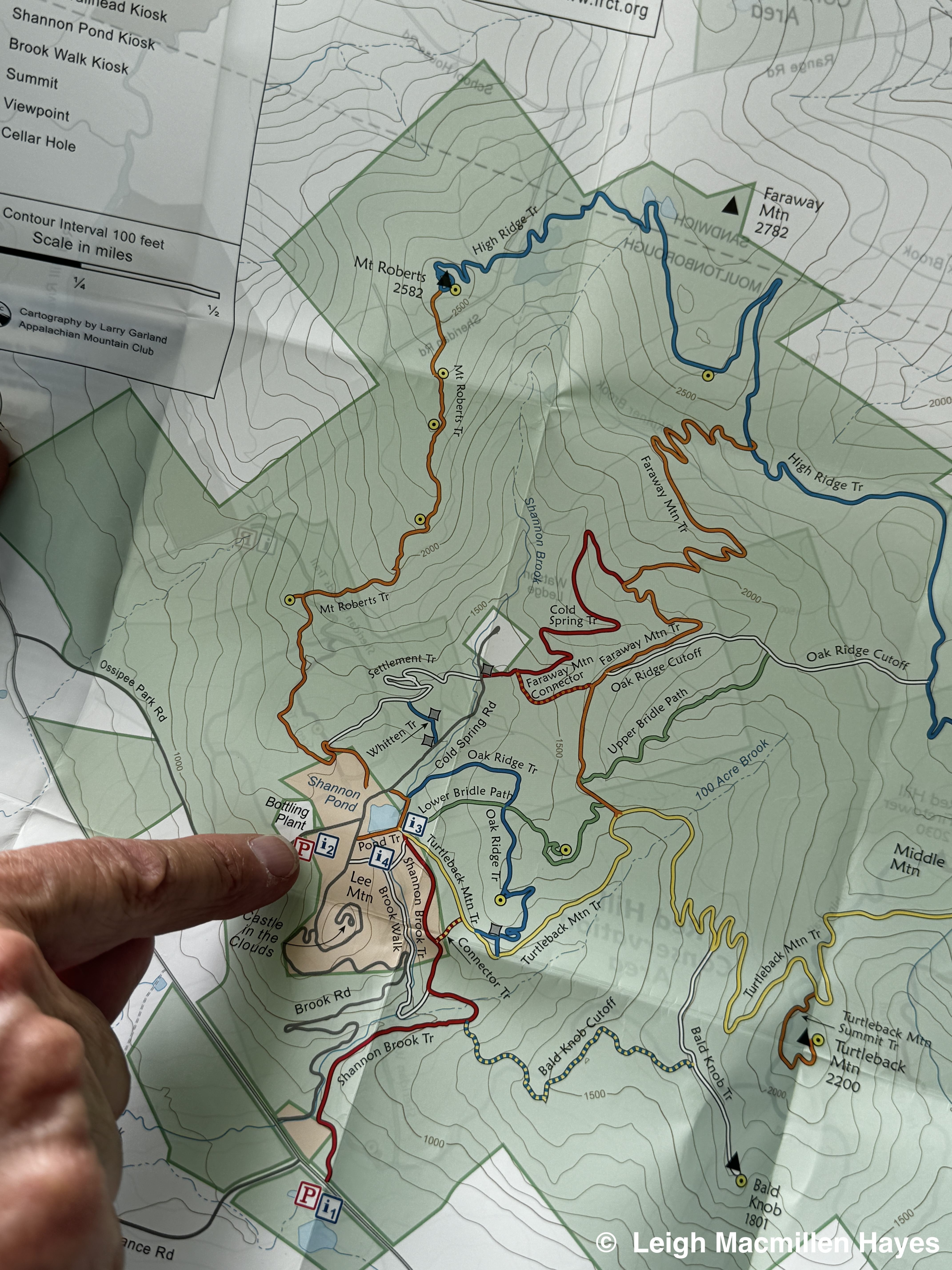
We’d hiked along the brook, spent time exploring the mansion and grounds, and the headed off to hike another trail with only so much time on our hands. At the intersection of trailheads, we had the good fortune of meeting two women with local knowledge who showed us where we were and where we wanted to go . . . that being heading up Mount Roberts. We knew we didn’t have time to summit for My Guy had to get home for a meeting (at which he later received a well-deserved Lifetime Achievement Award), but we made a plan for a turn-around time.

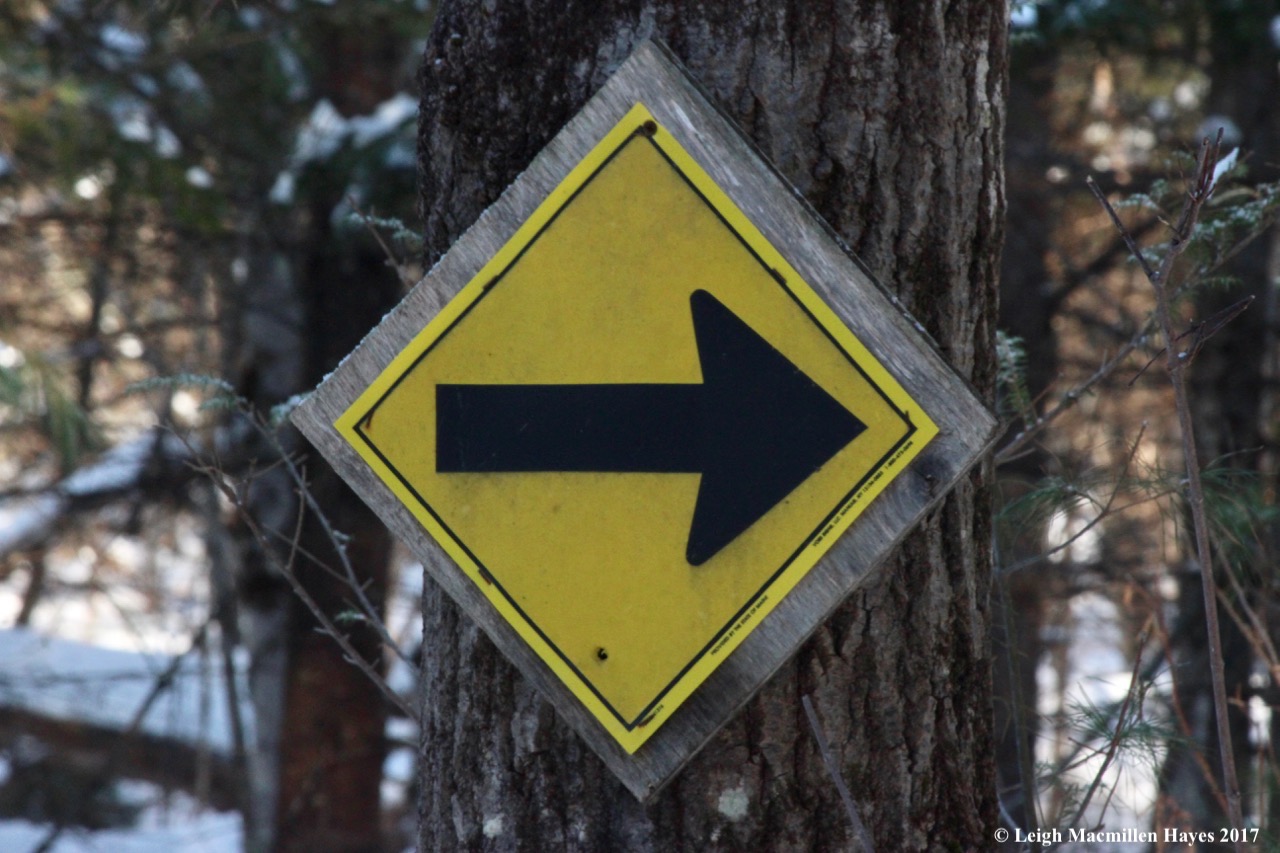
The trail was blazed with orange markers and we might have believed that a Black Bear had marked the way, for so chewed and scratched were the signs, but I suspect it was a Red Squirrel who had a good chomp or two or ten.

That said, a female American Toad, her tympana (ear membrane) about the size of her eye, and overall size of her body providing a clue to her sex, but also doing her best to blend in to her surroundings as she paused upon a stone on the trail.

We’d hiked over a mile when I suddenly spied this from the trail. Ruh roh. That meant we had to start looking and counting, a task that slowed us down a bit.

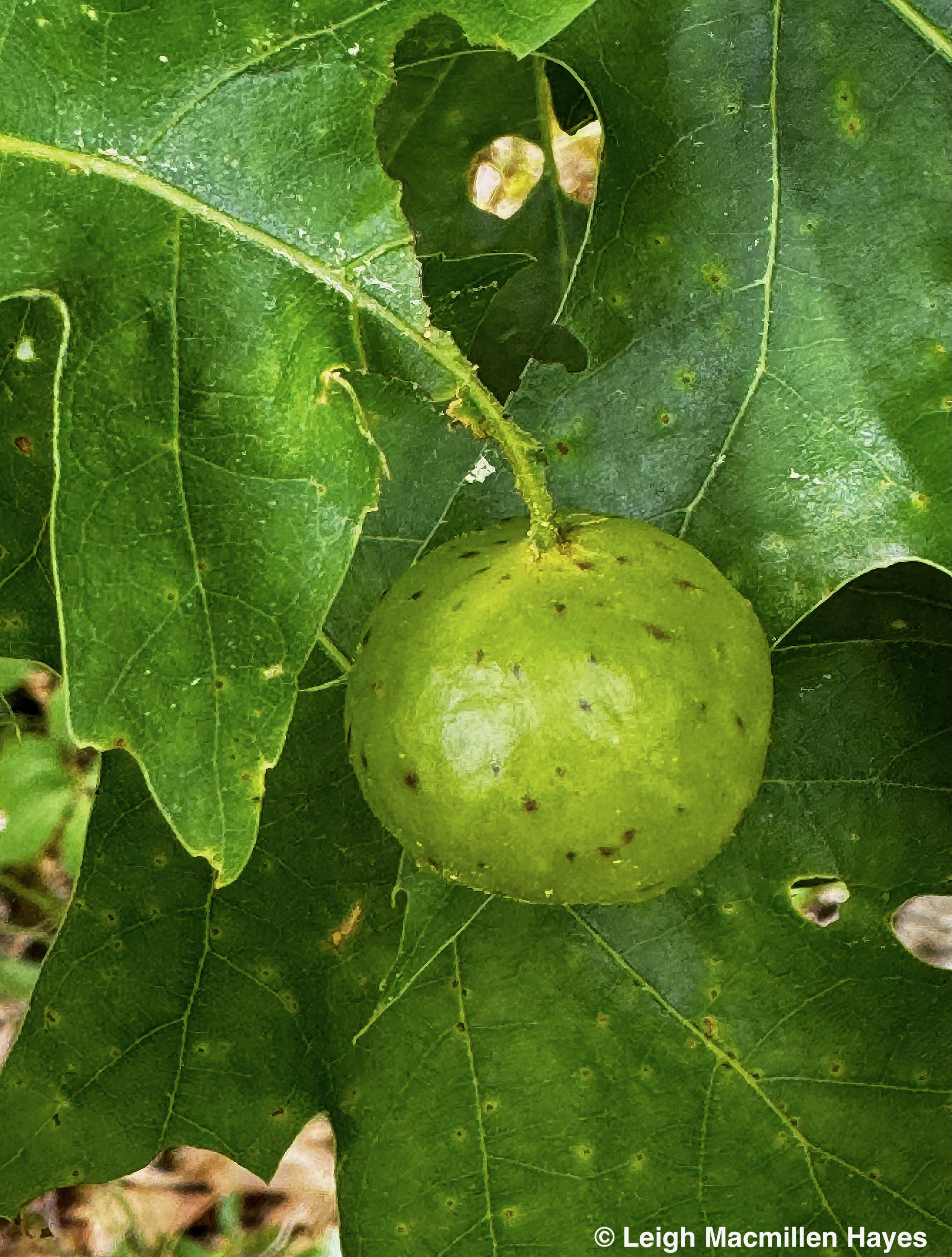
We had set a turnaround time, knowing that we wouldn’t be able to hike the entire 2.5 miles to the summit because My Guy needed to get home for a meeting, and so at 3:15pm, with 1.7 miles behind us, we stopped our upward ascent, but before descending, I spotted a green golf ball on a Northern Red Oak leaf.

Each time I spot one, I’m in awe for it’s such a cool structure. Though it looks like a fruit, it’s caused by a chemical reaction the leaf has when a wingless adult female wasp, Amphibolips confluent, lays an egg into a newly-forming leaf. As the egg hatches and larvae grows, that chemistry causes the leaf to mutate and grow with it.

The wasp is commonly known as an Oak Apple Gall Wasp, and thus this is an Oak Apple Gall.

We chuckled on the way down, for we did pay more attention to the flora, and couldn’t believe that we’d passed by this Lady’s Slipper display located inches from the trail. But that’s what happens when you are moving on My Guy-speed, and watching every spot where you place your feet. Our total count on the way down: 52, but I’ve a feeling we missed many more.

And hiding under some trees near the trailhead: Ragged Robin, a treat because I’ve only encountered it a few times. I love its frayed, yet delicate display.

Because our descent was much faster than the ascent (and still we counted Lady’s Slippers, but that’s why I think we missed some), I stole a few minutes beside Shannon Pond where a small field of Lupine bloomed.

And a female Mallard swam toward the shore. She and a few jumping fish were the only wildlife spotted today.

That was okay, for we had a splendid Mondate wandering under the clouds, which seemed truly appropriate since we were at the Lucknow Mansion property now known as Castle in the Clouds in Moultonborough, New Hampshire. Why did we wait so long to visit? Maybe because it’s practically in our backyard.

Waving on Father’s Day

It barely rained. Well, actually, it didn’t rain. Just a bit of drizzle now and again. And so this afternoon, after a Facetime session with our youngest and his gal, we headed off for a hike, My Guy and me. I’m pretty sure he missed most of what I saw, but that’s okay. It was a day to celebrate him and he was welcome to do as he wished and think whatever he thought along the way.

Every once in a while, I’d say, “Hold on,” because something caught my eye and I needed to stop to honor whatever it might be . . . in this case Northern Bush Honeysuckle, a native species. Honeysuckles always take me back to my childhood and that heady scent that filled many a walk from beach to town. I spotted only an ant today crawling into the leaves, but suspect on a warmer day butterflies and moths will stop by for a sip and in the process aid in pollination.

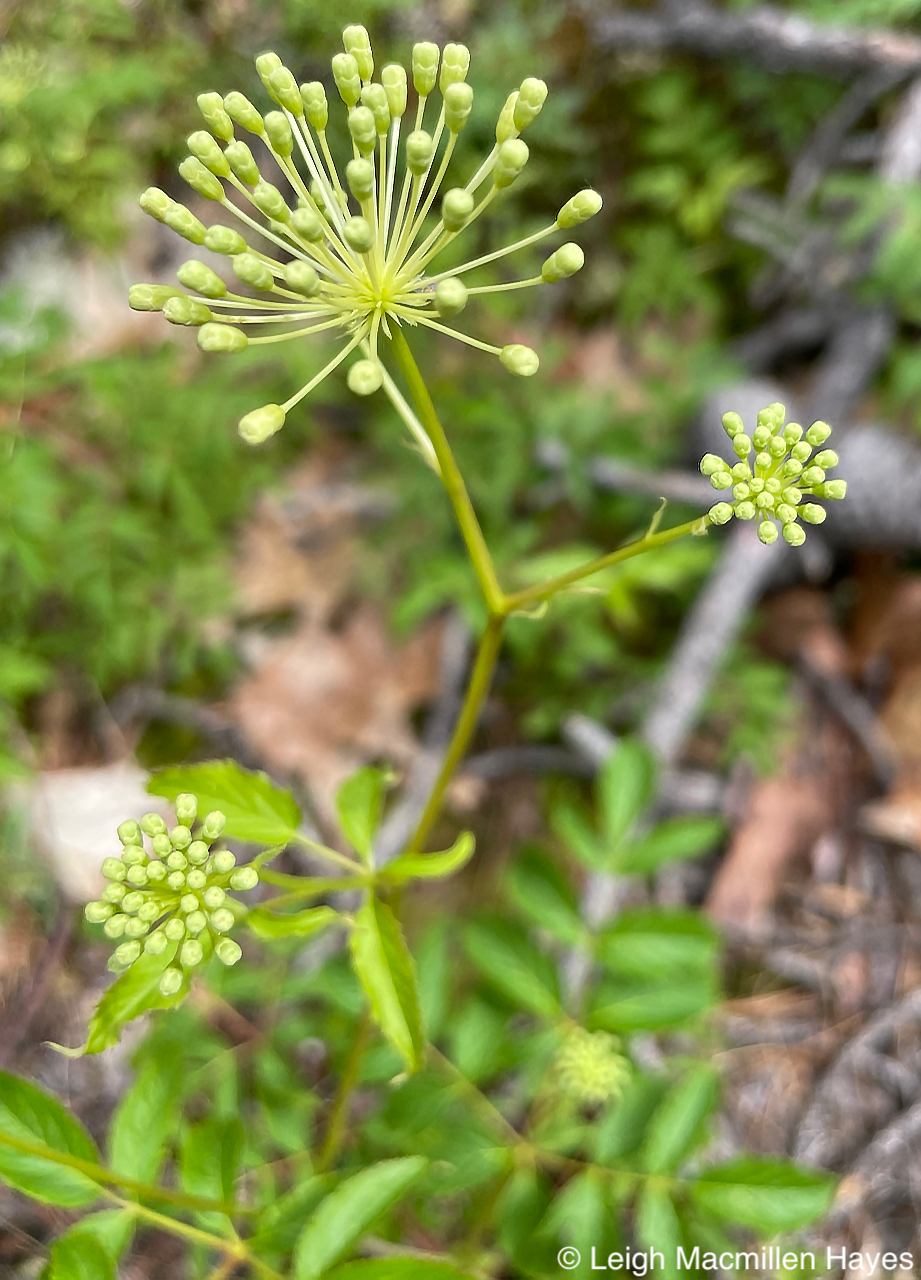
Next up, was another not quite in flower yet . . . a Bristly Sarsaparilla. Its round flowerhead is known as an umbel and when the individual flowers do bloom, each will offer five teeny, tiny petals.

One contrast between this, the Bristly version and a Wild Sarsaparilla is that the compound leaves of the former are found below the umbels, while the latter flowers occur on a separate stem and hide below, as if the leaves are an umbrella.

And that adjective in the name . . . Bristly . . . refers to the bristles on the stem, which aren’t sharp at all. The stem of the Wild version is smooth, another difference to consider when trying to distinguish the two varieties.

The next stop in my tracks find was a Red Raspberry Slime Mold, aka Tubifera ferruginosa. It’s one of those species that you wish you could spend hours or even days watching, but My Guy didn’t quite feel the same and so we moved onward.

Much more to his liking . . . a few Lady’s Slippers. We only saw three in total, a low number in our book of hundreds, but we still rejoiced in these because their days are waning.

So much so that the petals and sepals of this particular orchid had begun to change form and we suspect there will be a capsule head and seeds in the future.

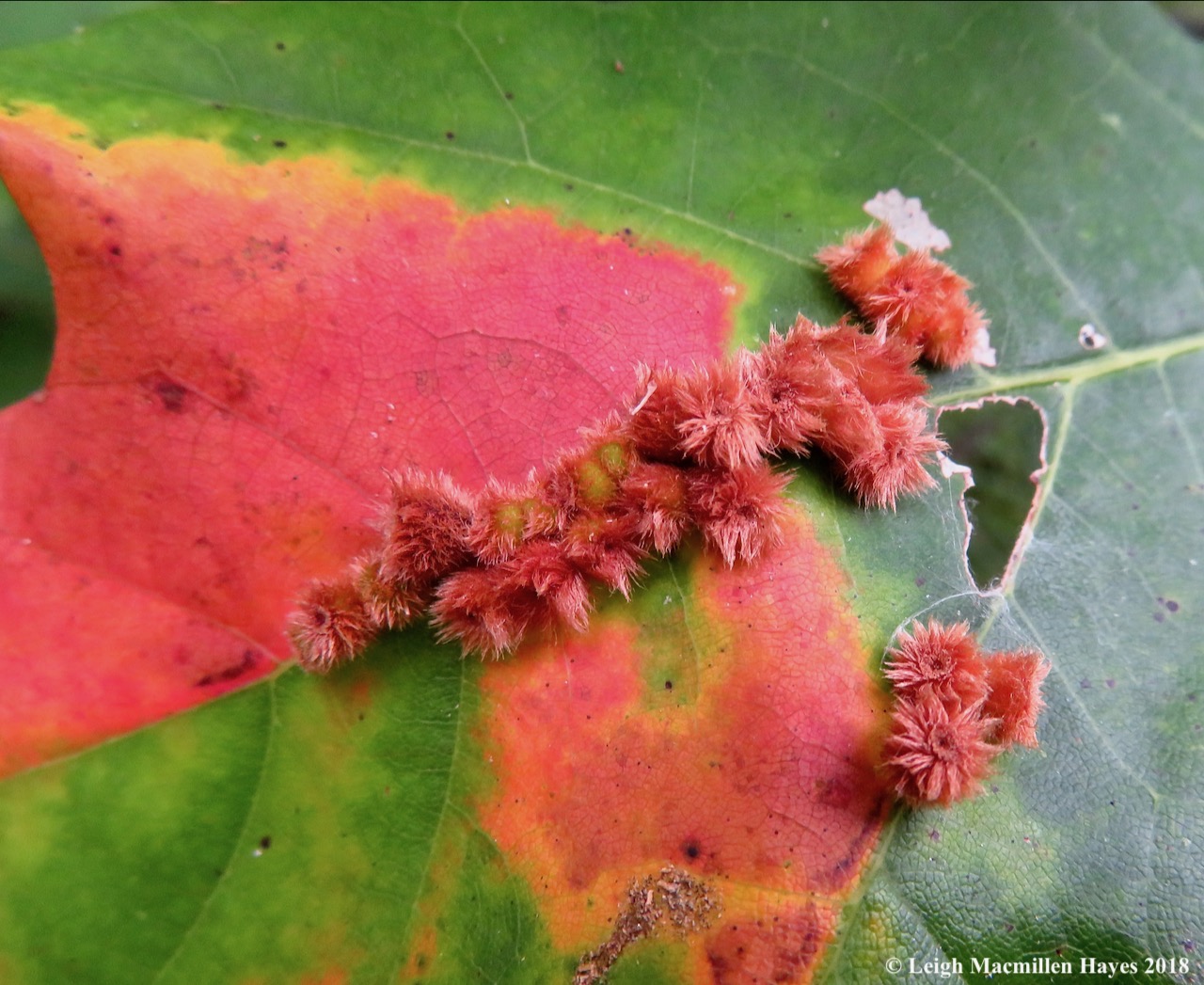
The last great find of the day was what could almost be considered a crystallized candy upon maple leaves. But really, it’s bumpy pink growths caused by a gall mite. This is the Maple Velvet Erineum Gall.

The mites overwinter under loosened bark and around wounds and scars. In early spring, they produce the gall-forming stage that migrate to expanding buds and make themselves at home as they begin to feed on the undersurface of future leaves. The tree won’t die, but really, leaves work so hard to survive the winter and then are attacked on so many fronts.

Can you believe that one leaf followed me home? Here’s a look at part of its structure not affected by the gall.

The pinkish-red, however, is the gall. The mite itself is so microscopic that I don’t think I can locate it.

I did take a closer look and maybe the dark thing on the right is related. But what struck me most was the deformed shapes where the gall had affected the leaf’s cells.

And then there was this other interesting form, again on the right, in a different section of the leaf. It certainly looked like it had a form and purpose, but I’m not yet privy to that information. Maybe some day.

Could it be a bunch of mites?

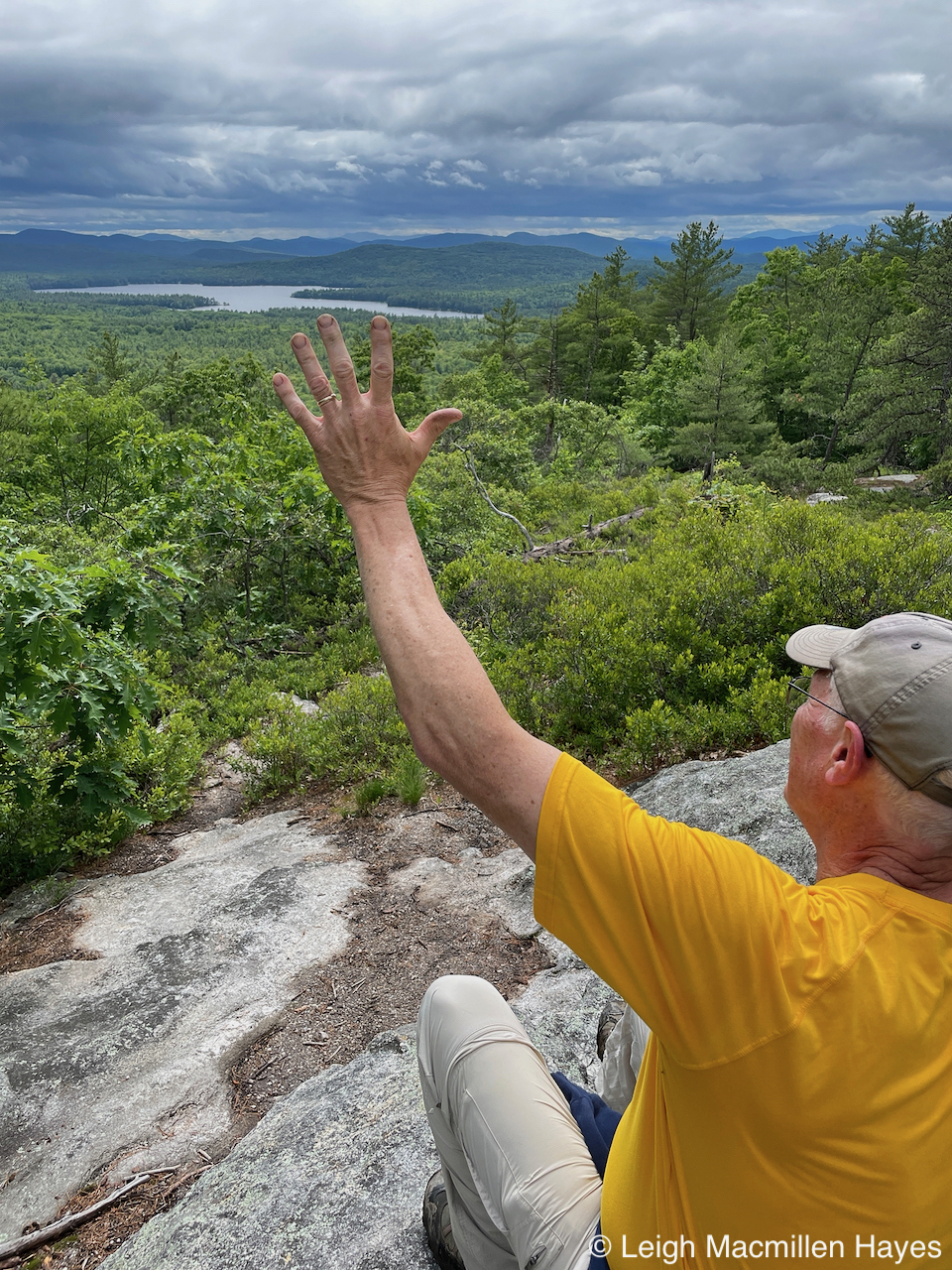
In the meantime, it is still Father’s Day and My Guy took a moment to wave hello to family and friends from the summit. We’re pretty sure we saw you all wave back.

The Richness of Life

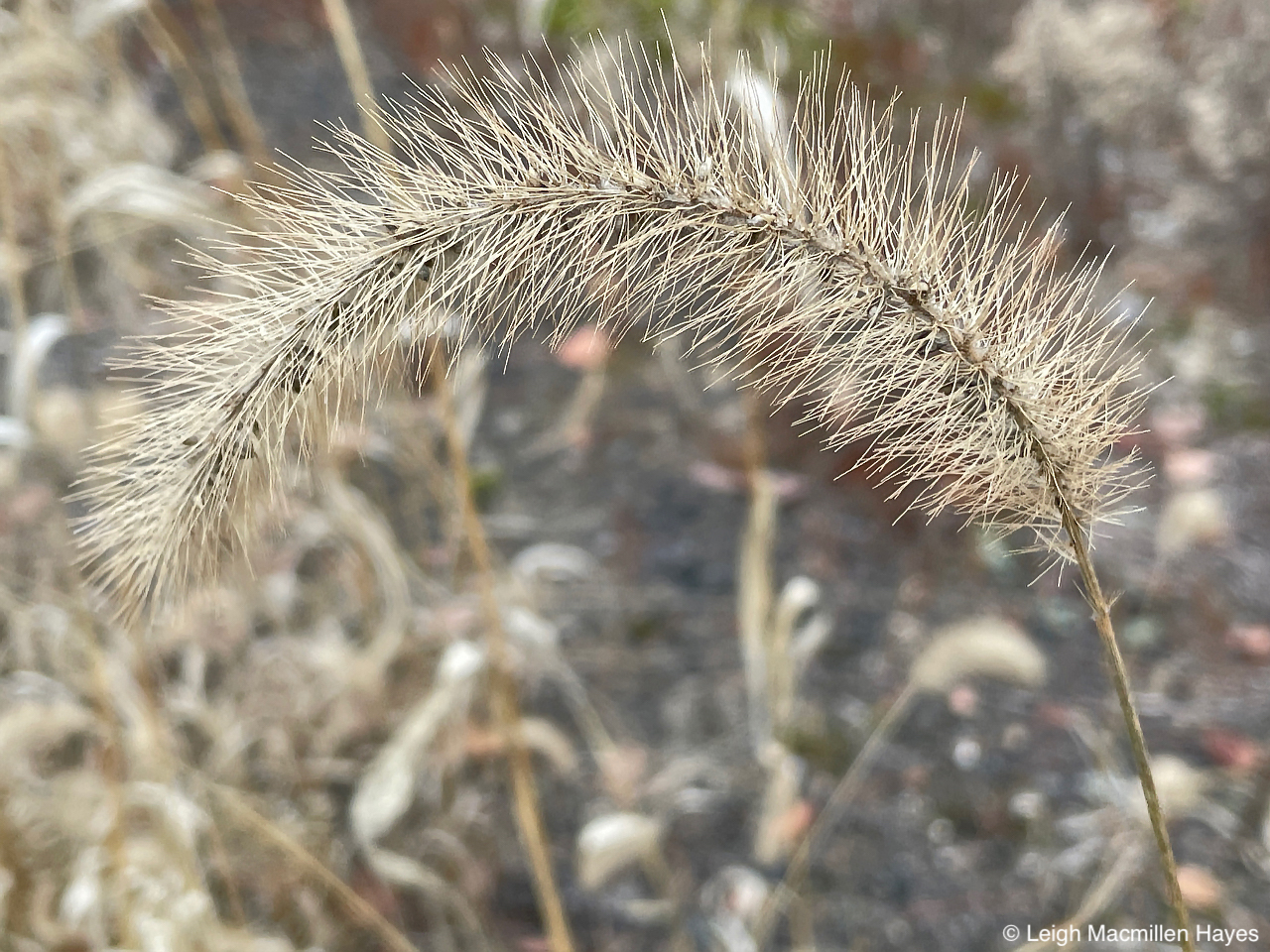
In the midst of walking toward the vantage point upon the Mountain Division Trail in Fryeburg, Maine, grows a grass of distinction for its form,

All fluffy and arced as the seedhead is, Giant Foxtail seems an apropos common name, though its known as a pest to farmers who grow corn.

I’m struck over and over again as I walk upon the paved pathway,

by the colors and textures of so many seeds ready to float astray.

And then there is a tree that cannot make up its mind

and chooses instead to be two of a kind.

Its known as a conifer because it grows needles each year,

but this Tamarack sheds them in deciduous form as winter draws near.

I next pause beside one who displays all ages,

from yesterday’s cones to today’s catkins and tomorrow’s buds waiting to turn spring’s pages.

Some of the Speckled Alder cones hide beneath tongues imitating piles of snakes stretching out,

made from galls caused by an infection to increase the surface for spores from a fungus to spout.

Another with long, feathery white plumes overpowers a chain-linked fence along the way,

the seeds of this native vine, Virgin’s Bower, await a breeze to help them stray.

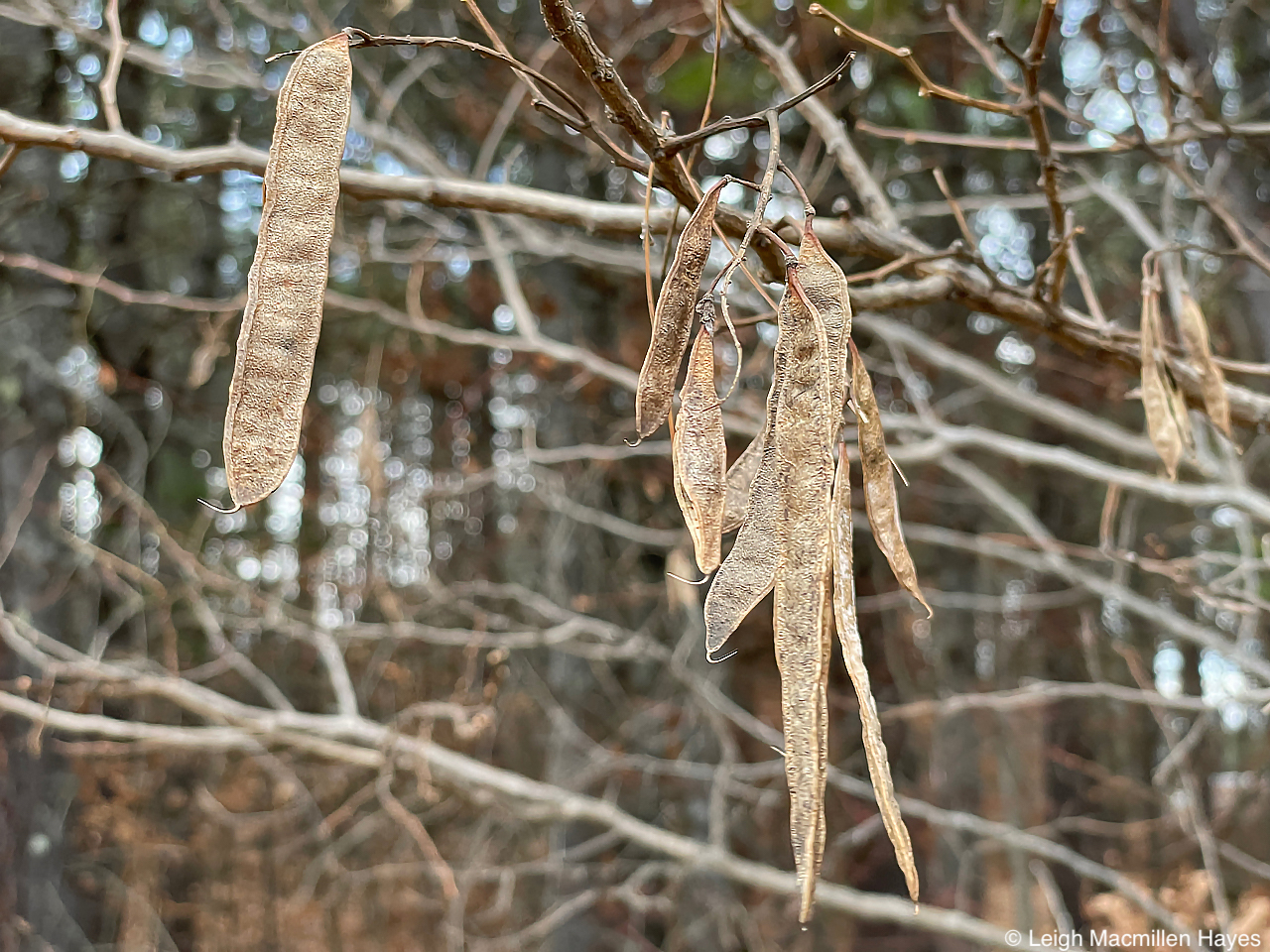
Other seeds also announce their presence, these hanging from trees.

Being Black Locust, their pods are inedible legumes related to peas.

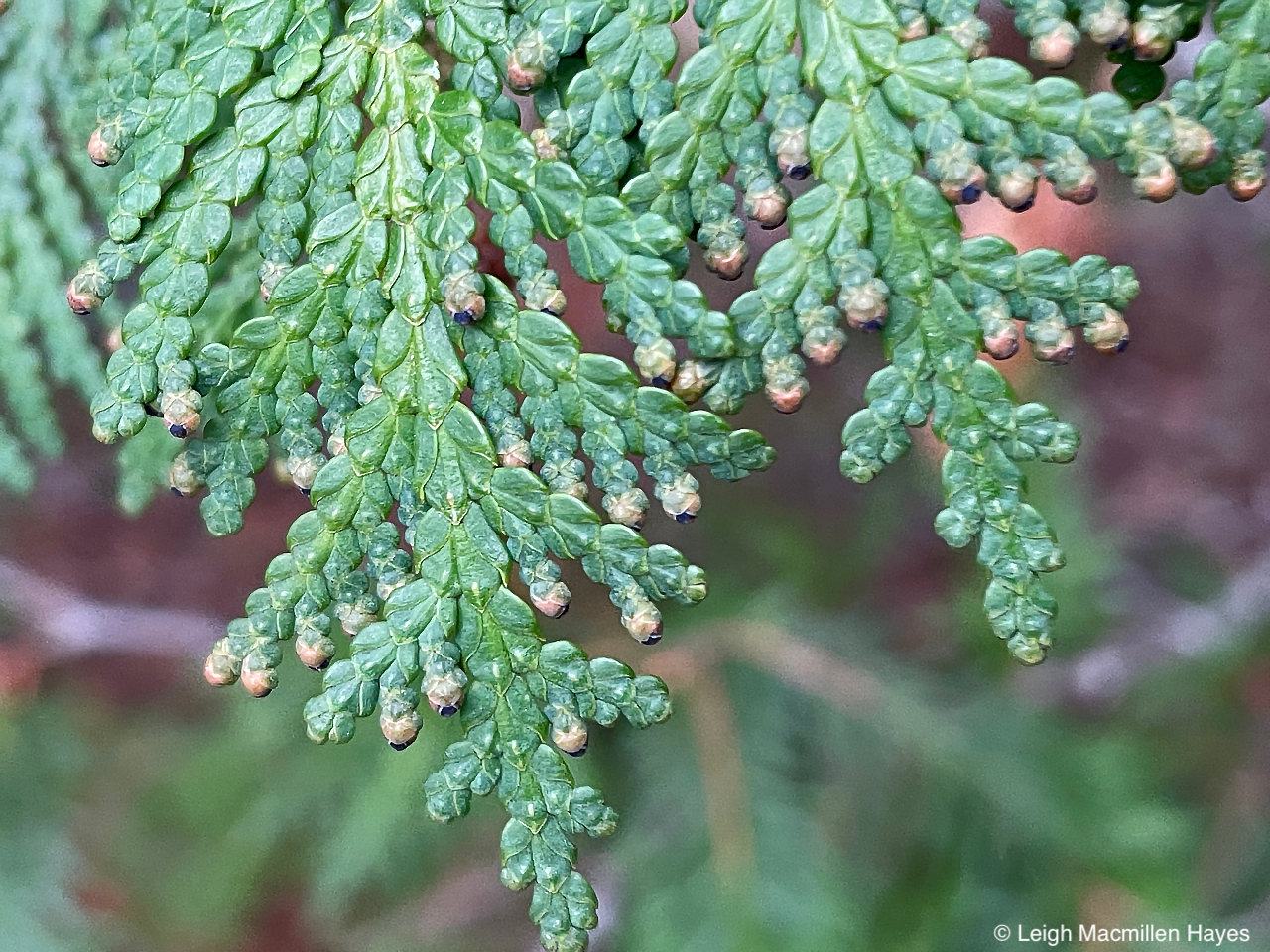
Tossed into the mix these scale-like needles that make me think of braids form a flat spray.

The tiny flower buds at the tips of Northern White Cedar’s leaves preparing to bloom next May.

What amazes me most about this extremely warm November day,

is spotting flowers in bloom like the colorful Calico Aster array.

And then there was a plant bright yellow in flower with lance-shaped leaves of green on display for no apparent reason,

This Showy Goldenrod being one I couldn’t recall noticing before but will recognize when we meet again in another season.

Even the insects are confused this fall,

such as this flower beetle taking advantage of an in-bloom Yarrow offering a nectar haul.

One of my favorites though, knows that the flowering season should have ended by now,

As the Evening Primrose showed off a Christmas display of deeply-veined basal leaves meant to wow.

Thankfully, a nest the size of a basketball I spot dangling from a branch shows signs it is no longer full of life,

The hornets who built the papery structure have abandoned it, causing us who follow the trail no more strife.

At last, returning to the vantage point from whence I have come,

I’m filled to the brim with colors and textures that would mean only death to some.

At the end of today’s journey I realize

this place is as rich in death as it is in life and I have won the prize.

Slipping Into Fall

I went with intention for such was the afternoon. Sunny, cloudy, rainy, dry. Change. Constantly. In. The. Air.

Of course, my intention led to new discoveries, as it should for when I spotted the buttons of Buttonbush, a new offering showed its face–that of Buttonbush Gall Mites, Aceria cephalanthi. Okay, so not exactly the mites, but the structures they create in order to pupate. Mighty cool construction.

Continuing on, into the Red Maple Swamp did I tramp, where Cinnamon Fern fronds stood out like a warm fire on an autumn day. But wait, it wasn’t autumn. Just yet, anyway.

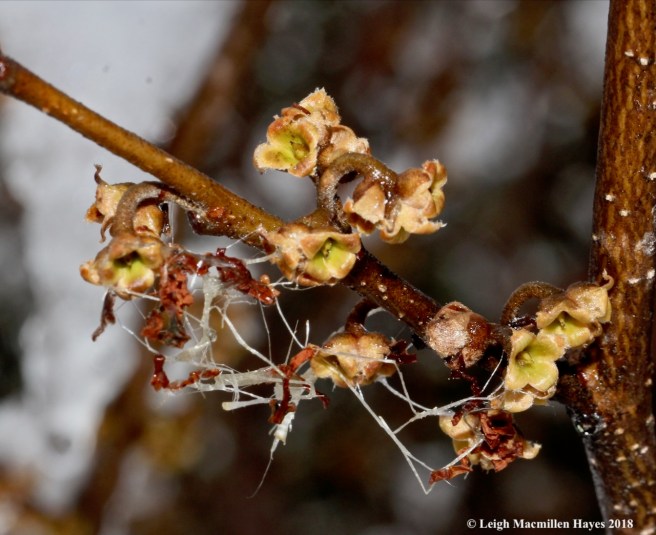
And then there was that first sighting of Witch Hazel’s ribbony flower, the very last perennial to grace the landscape each year.

And color. All kinds of color in reality and reflection beside Muddy River.

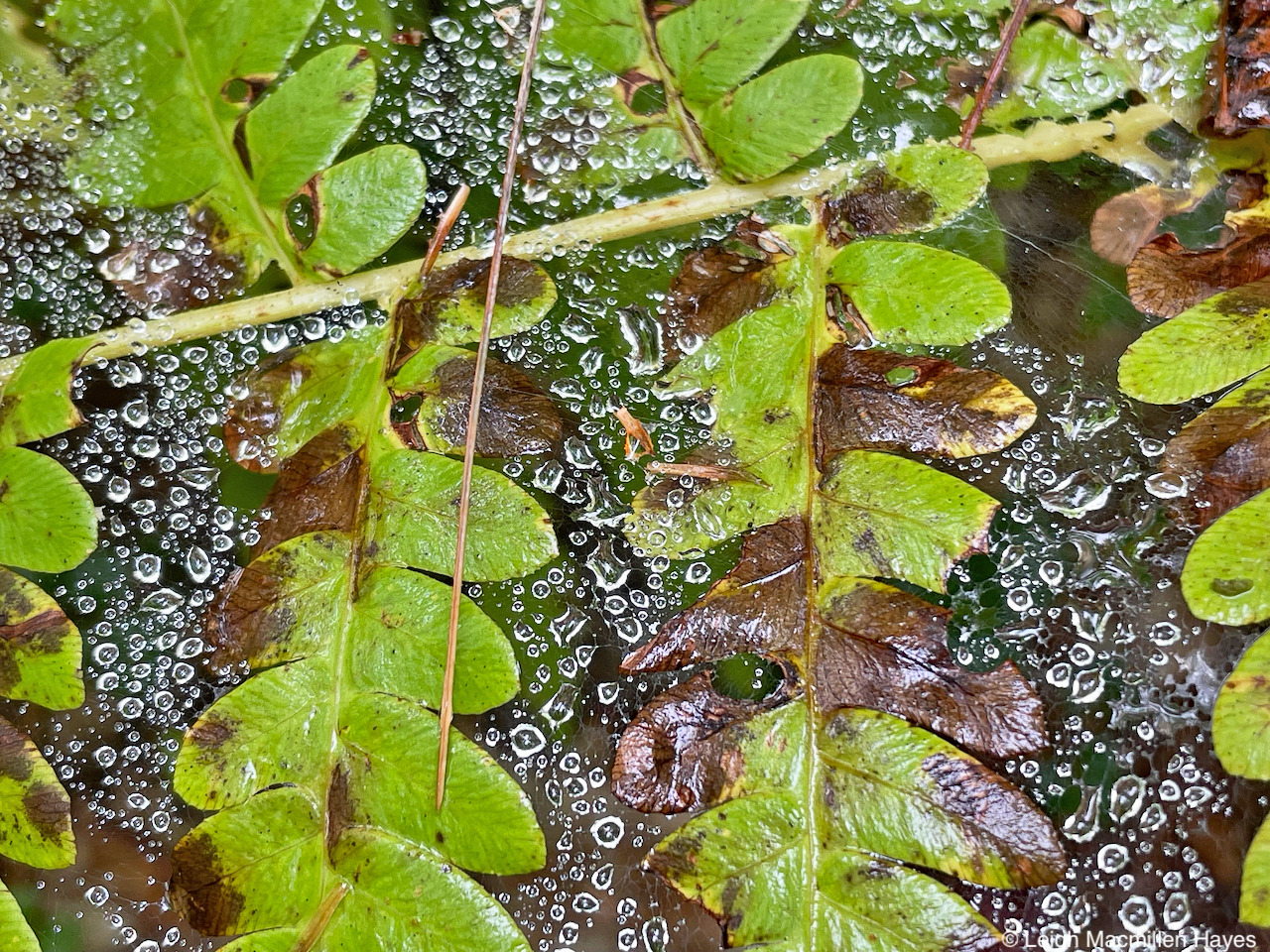
Even the fern fronds glistened, individual raindrops captured upon a spider web adding some dazzle to the scene.

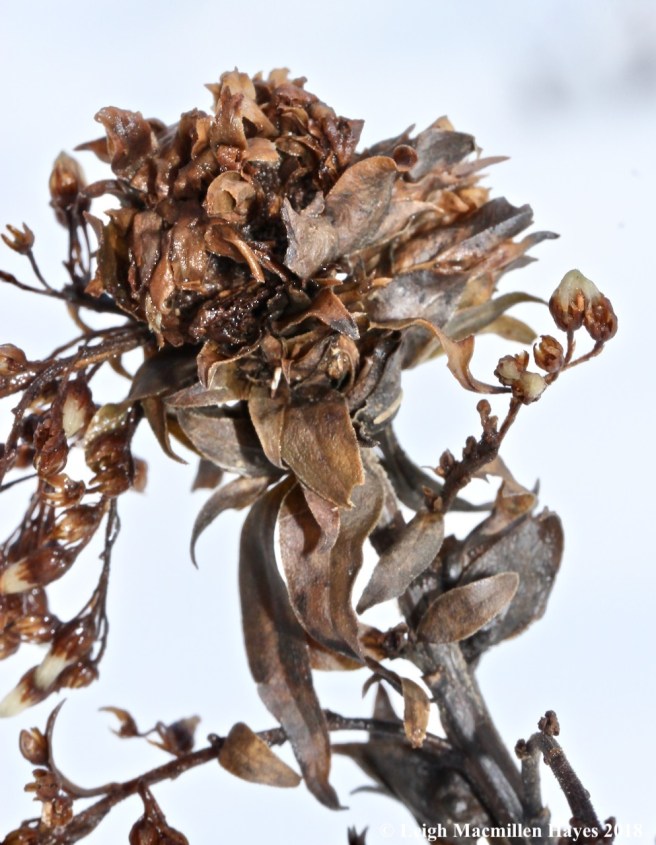
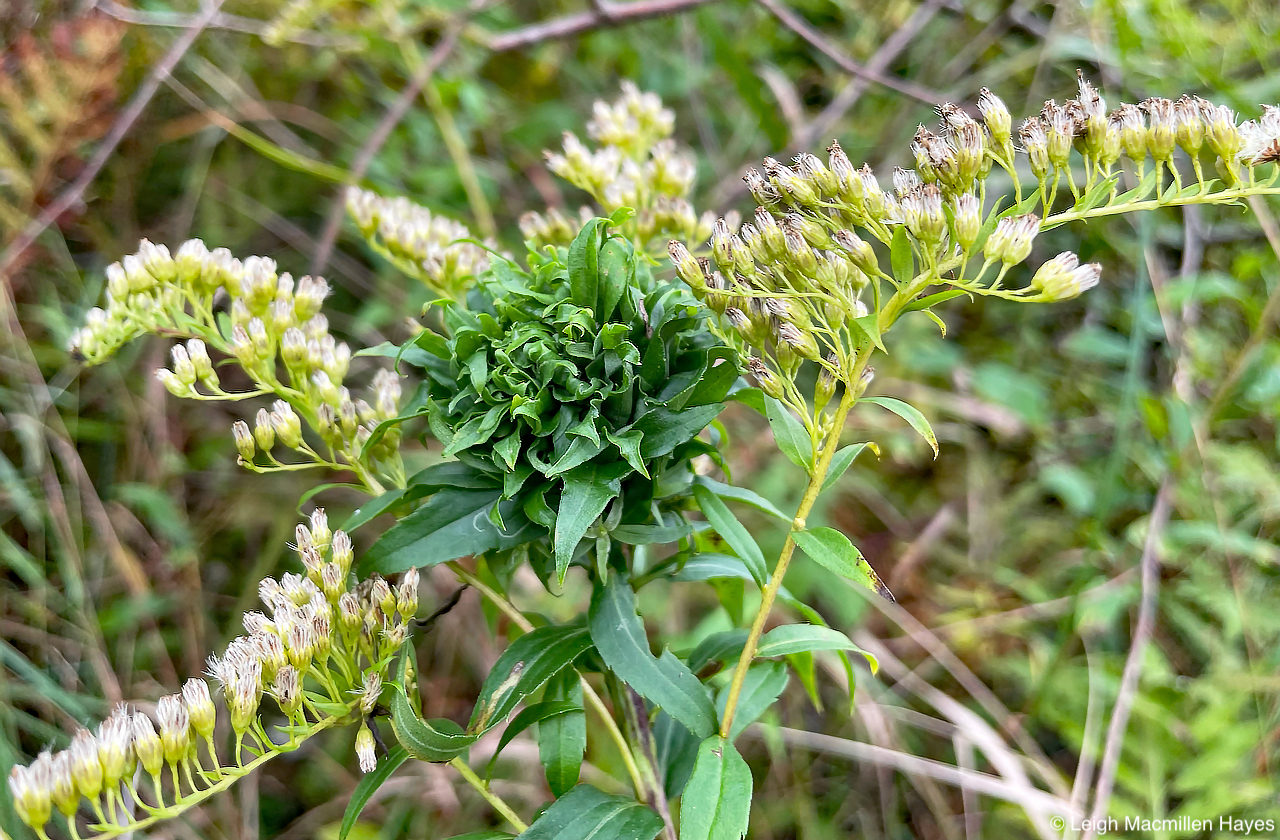
Next on the agenda, a Goldenrod Rosette Gall created by the midge Rhopalomyia capitata. The midge formed a structure that looked like a flower all its own. What actually happened is that the midge laid an egg in the topmost leaf bud of Canada Goldenrod, Solidago canadensis, causing the stem to stop growing, but the leaves didn’t.

A few steps farther and I realized I wasn’t the only one who appreciated the sight (or nectar) of Jewelweed, Impatiens capensis, or Spotted Touch-me-Not. The latter name because upon touching the ripe seed pods, they explode. Try it. Given the season, the pods have formed as you can see behind the bee’s back.

Winterberry, Ilex verticillata, its fruits bright red also graced the trail in an abundant manner, but wait a few months and they’ll be difficult to spy. For a month or two we’ll enjoy their ornamental beauty, but despite their low fat content, birds, raccoons, and mice will feast.

All of these sights meant one thing.

The Red Maple swamp bugled its trumpet with an announcement.

The announcement was this: Fall freezes into winter, winter rains into spring, spring blossoms into summer, but today . . . today summer slipped into fall and I gave great thanks for being there to witness it all.

Funky Mondate

It seems like it’s been forever since my guy and I shared a Mondate, but truth be told we snuck away to Diana’s Bath and beyond in Bartlett, New Hampshire, a week ago and here’s a sneak peek.

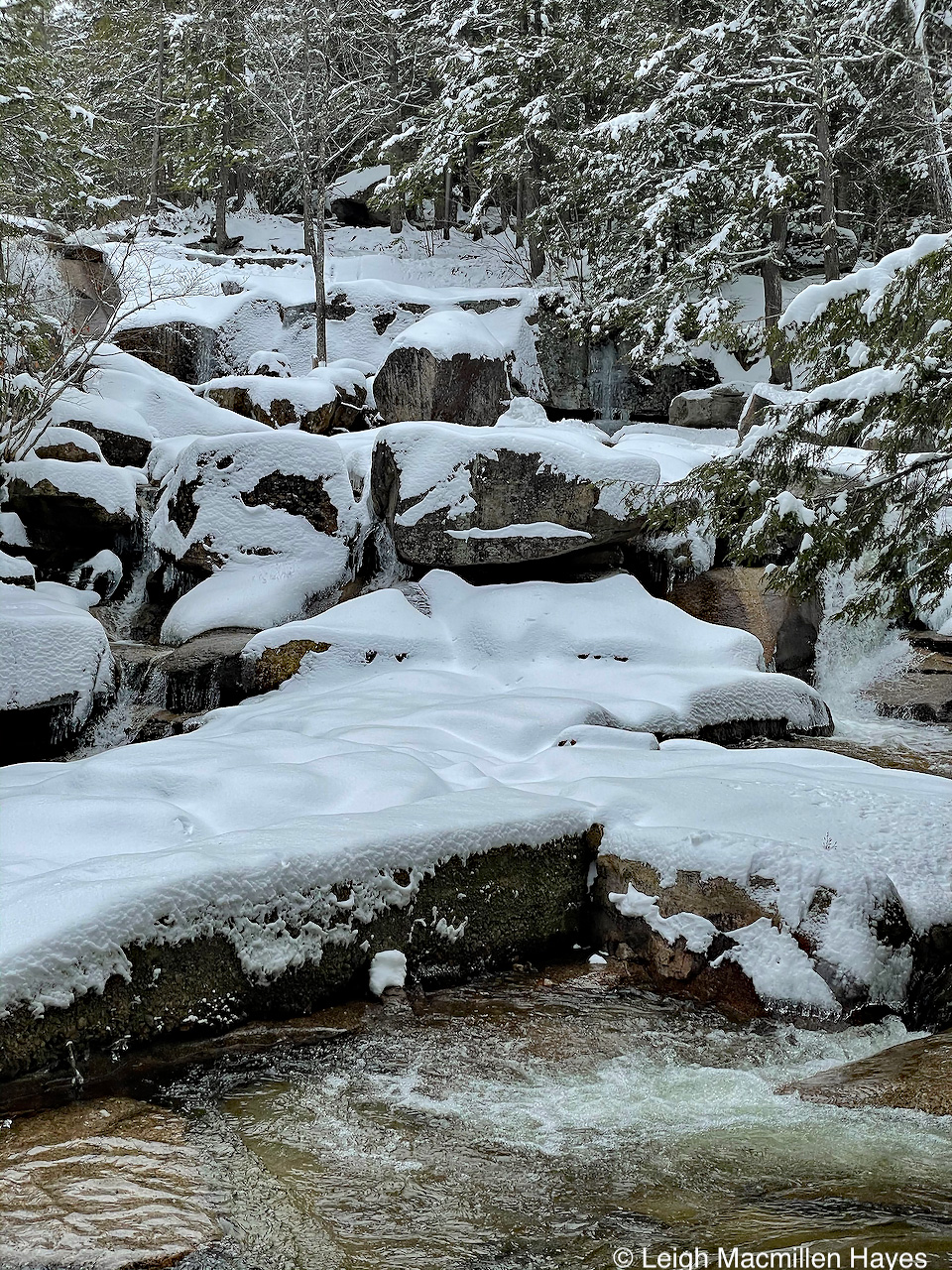
We’d had snow two days prior and the lower falls of Lucy Brook showed off the force that the Lucy family had harnessed in the late 1800s to operate a saw mill.

Remnants of the mill’s foundations still exist.

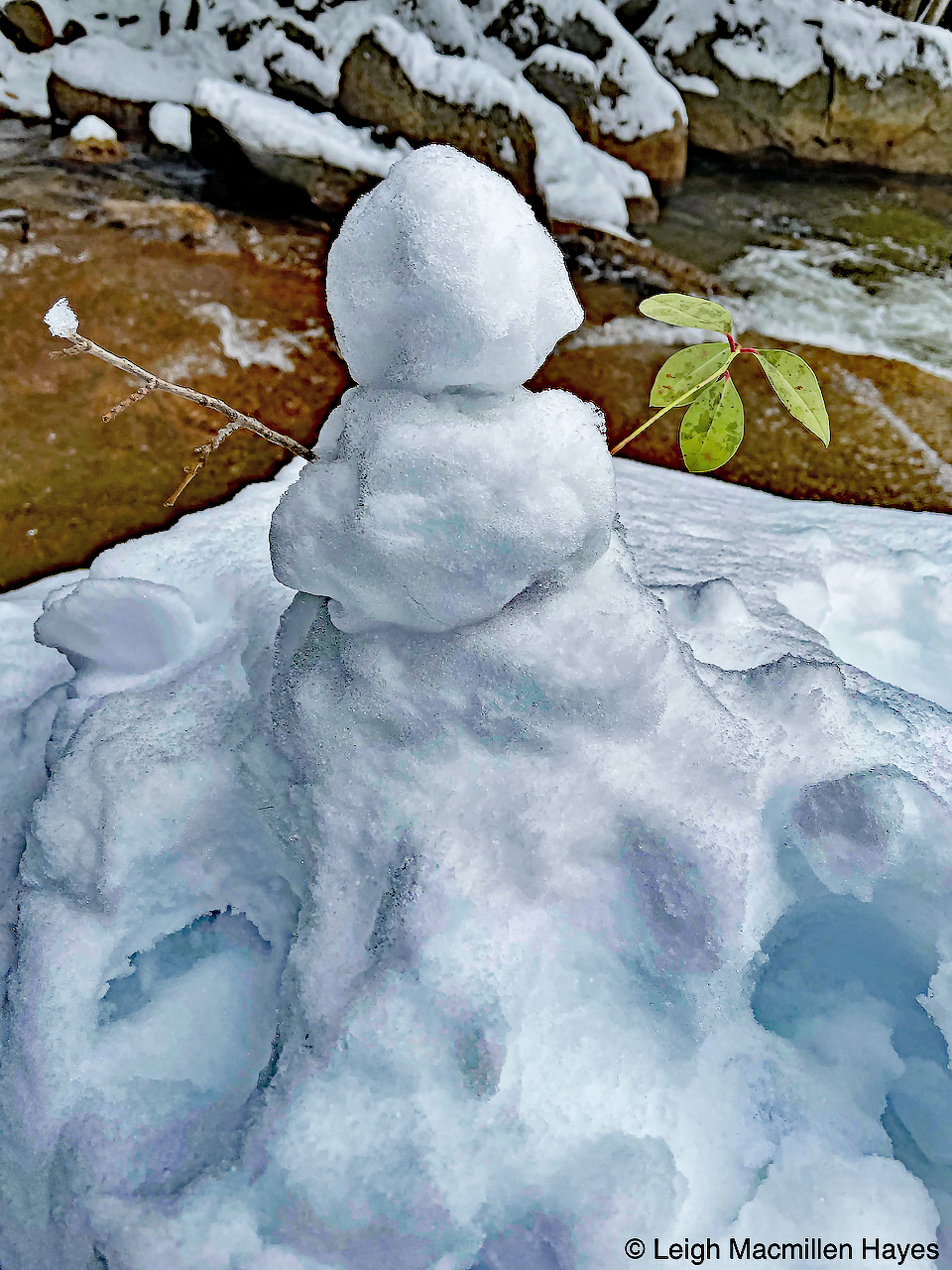
Fortunately, the falls are watched over by fairy-sized snow people.

Stopping by the Upper Falls, we had memories of ice discs spinning counterclockwise, but they remained just that: memories from a Romancing the Stone Mondate two years ago. Last week, the temp was not quite as frigid so no discs formed.

Despite that, we hiked on for a couple of miles and eventually turned around to retrace our steps.

Fast forward to today and we headed off to explore two land trust properties in western Maine, the first of which we’d never traversed before. My extreme excitement upon arriving at the first was to learn that an outermost trail was named for G. Howard Dyer.

I had the pleasure of knowing Howard, who died at age 103 in 2009, when he lived at a local assisted living home where my mom also resided. He was an independent Mainer who drove a car into his late 90s and I remember his license plate: GHD. To me, it read: GOD. He’d turn into the home’s parking lot practically on two wheels, and though the old car had some dings, somehow Howard’s adventures weren’t thwarted by his age, maybe because he was GOD.

At the time that Mom lived in the same home, I volunteered to help the Activities Director one day a week and one of the things I did besides arts and crafts was create a monthly newsletter filled with recipes, poetry, songs and memories of yesteryear that the residents shared with me.

For one issue, I spent some time interviewing Howard about his life and experiences. He was a great storyteller and shared with me that over the years he’d lived in Otisfield on and off. Knowing that state law required perambulation of the town’s boundaries, in 1946 he conducted his first walk about town. Fifty-six years later, in 2002, he knew that no one had walked the boundaries in a long time. So, at 95 years of age, he decided to do it again. “Weren’t sure I could do it,” Howard told me as his eyes twinkled. “Didn’t say it to anybody.”

It took him months to complete because he’d walk here today, there tomorrow. When he finally finished the job, he told town officials. As Howard told it, they were surprised because they couldn’t get anyone to do it due to “swamps and all, you know.”

Howard’s accomplishments were included on the 2002-2004 House Appendix of the Legislative Record when he received Otisfield’s Boston Cane. “Town law required perambulation of the boundaries every ten years, and as a gift to the town, Mr. Dyer walked the 34-mile Town of Otisfield’s boundary line, once at the age of 39 and more recently at the age of 95.”

He was quite a guy and actually ten or more years ago my guy and I decided to follow his example and perambulated the boundary of our town, a section this Monday, another section the next Monday, taking a year to connect all the dots.

I was thrilled to see that Howard had been honored by having a trail named for him, and suggested to my guy that perhaps we need to consider repeating our perambulation. To which he readily agreed.

For today, however, we had other things to notice, and lately it seems no hike is complete unless a Winter Firefly can be found.

There were other insects burrowed in place and they shall remain nameless because I didn’t want to expose them any more than they already were.

My learning continued as we journeyed on and we were almost finished exploring Howard’s trail when I spied an oval shaped sawfly cocoon on a Northern Red Oak twig.

But it was the cluster of cocoons at the end of the twig that deserved even more attention. I’m 95% certain (until someone tells me otherwise) that this is the random formation of a parasitic bracinoid wasp cocoon. The question remains: who died so this structure could be created? Because that’s what these wasps do–parasitize other insects by laying their eggs upon them.

We soon left Howard’s Trail behind and moved on to tramp along another trail, where a White Oak pulled me in because the salmon color and rounded edge of the leaves always stops me in my tracks.

Because I stepped in for a closer look, the sapling honored me with the offering of what I think is an old Wooly Sower Gall, which I believe only has a relationship with this species. When first formed, it would have consisted of white wool highlighted with pink spots, but apparently it takes several years for the larvae to mature and the structure develops “horns” over time.

Lest you think I have been ignoring mammals to focus on insects, never fear–I delighted with the discovery of a large cache/midden created by a Red Squirrel.

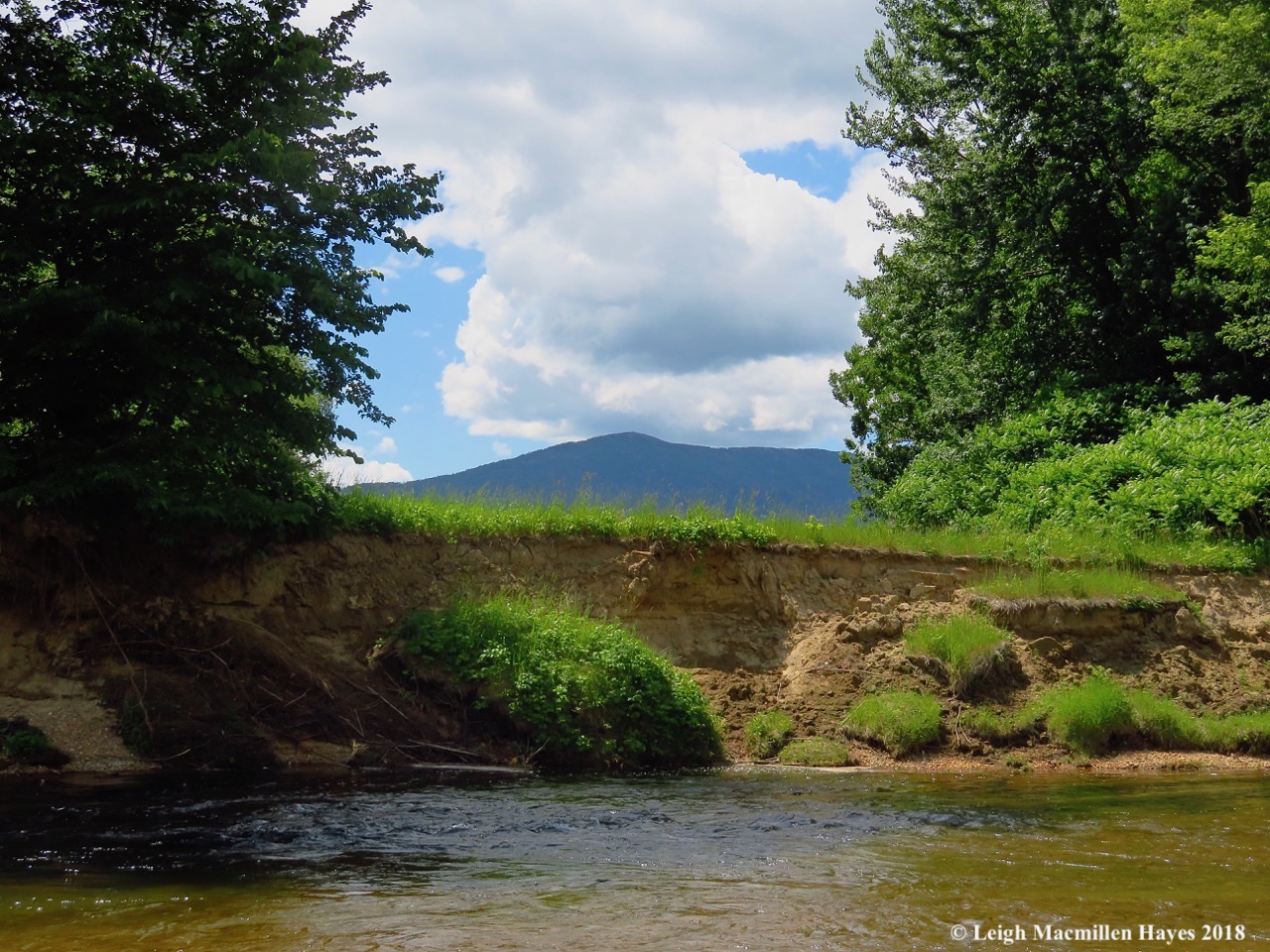
Our journey took us beside a river that follows a crooked course through the landscape, but what always amazes me is the erosion along the edge. For how much longer will this tree stand?

As we stood on the edge ten to fifteen feet above the river, we had to wonder–how high does it get that the bank should be so eroded at this height? We never seem to visit in late winter, but maybe this year we should. Though given the current lack of precipitation, maybe this isn’t the year to gain a baseline understanding.

At last we reached the trail end, and knew it was time to turn toward home.

It had been a successful day, coming unexpectedly upon the trail named for Howard and my guy locating a winter geocache that wasn’t really a winter geocache for he had to dig through some snow to find it and the snow isn’t at all deep. Yet.

We also discovered an impressive hollowed out tree through which we just had to chat. If I were a bear in the woods . . . this would be my den. Note to self: if you ever need an out-of-the-way place to rest, remember this spot.

And we found a fun key hanging from a tree, adding icing to our funky Mondate.

Katydid, Didn’t She?

I have the extreme pleasure of being in touch with my first two playmates, the sisters who lived next door, on a somewhat regular basis. And even when we don’t see each other for a long time (Girls, we still owe ourselves a lunch in Newburyport), like any great friendship, we pick right up as if no time has passed.

While they both love the natural world, for that’s where we spent much of our childhood, one in particular frequently shares photos of her finds with me. And so I took her along, riding on my shoulder this morning when I headed out into the rain because I know that she, too, likes rainy days as much as, if not more than sunny days. So does her garden and she’s got a green thumb to envy.

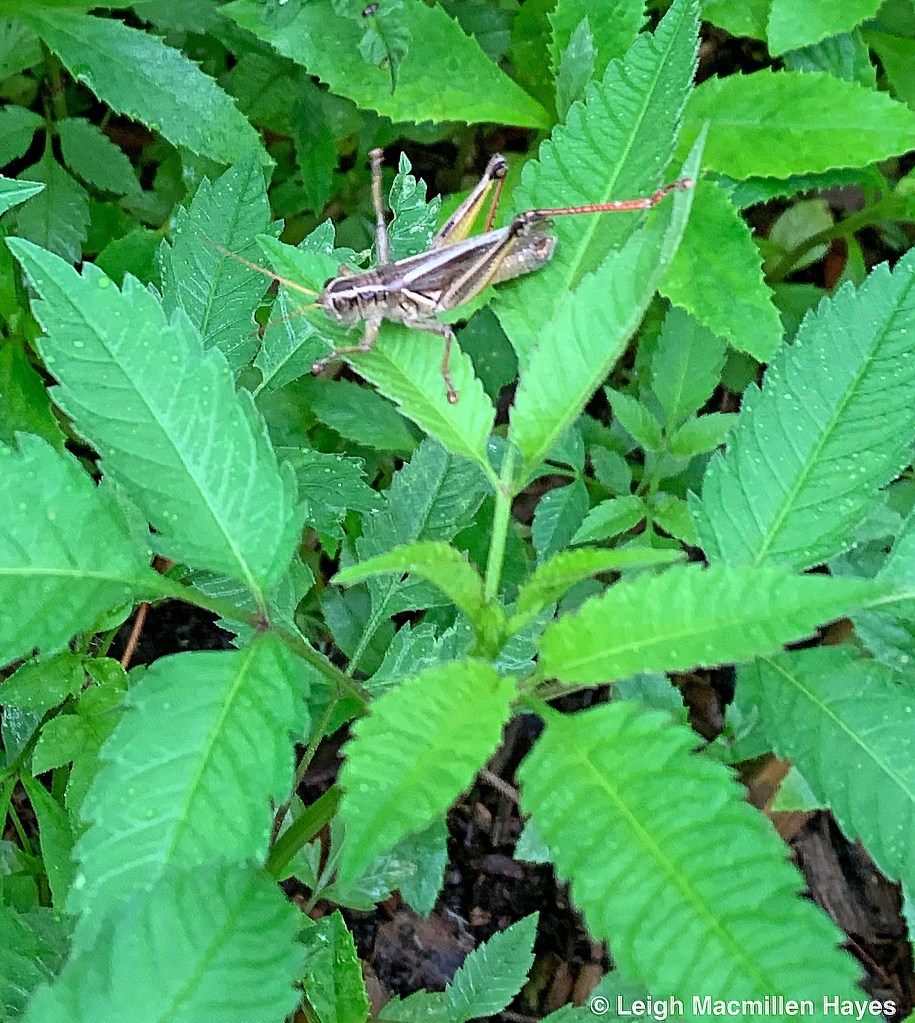
Since my thumbs aren’t great at turning the soil, I support a local farmers’ market and had time to pass waiting for my turn to pick up the pre-ordered produce, bread, chicken, flowers, and treats. Thus, as we started to hike, a grasshopper known for its two stripes greeted us.

Not far along, at the base of a certain pine tree, I showed her the Pippsissewa now in bloom. Not only do I love to say this plant’s name, but the blossoms . . .

oh my. We both squatted for a closer look at the anthers within. And sniffed its sweet scent.

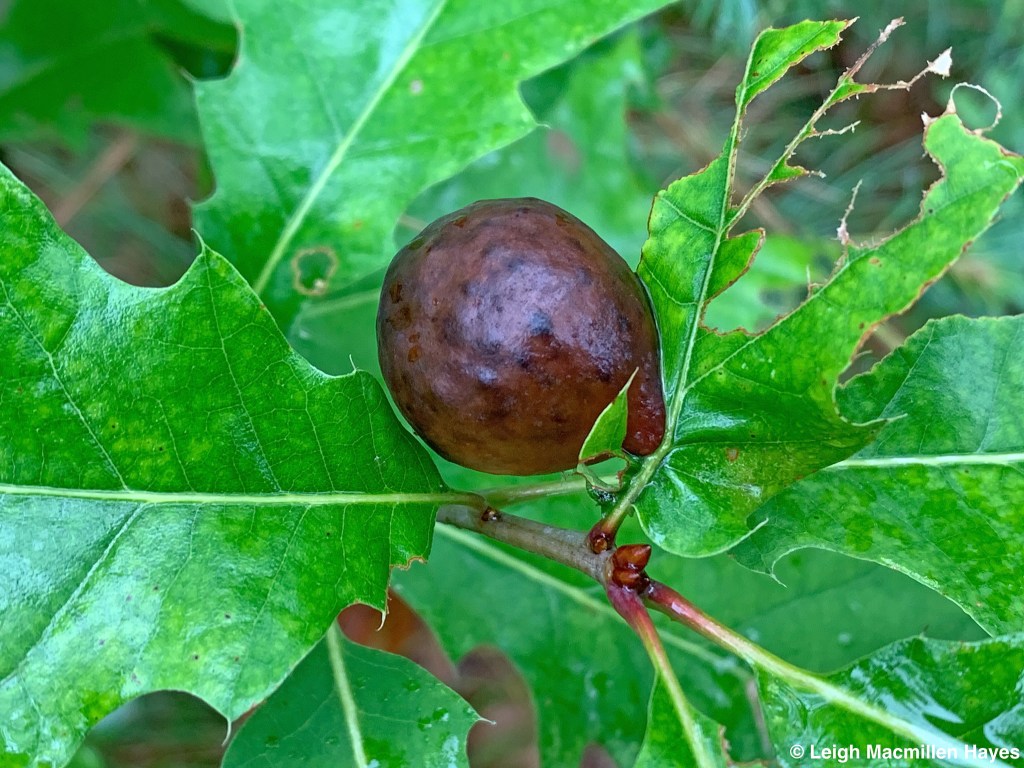
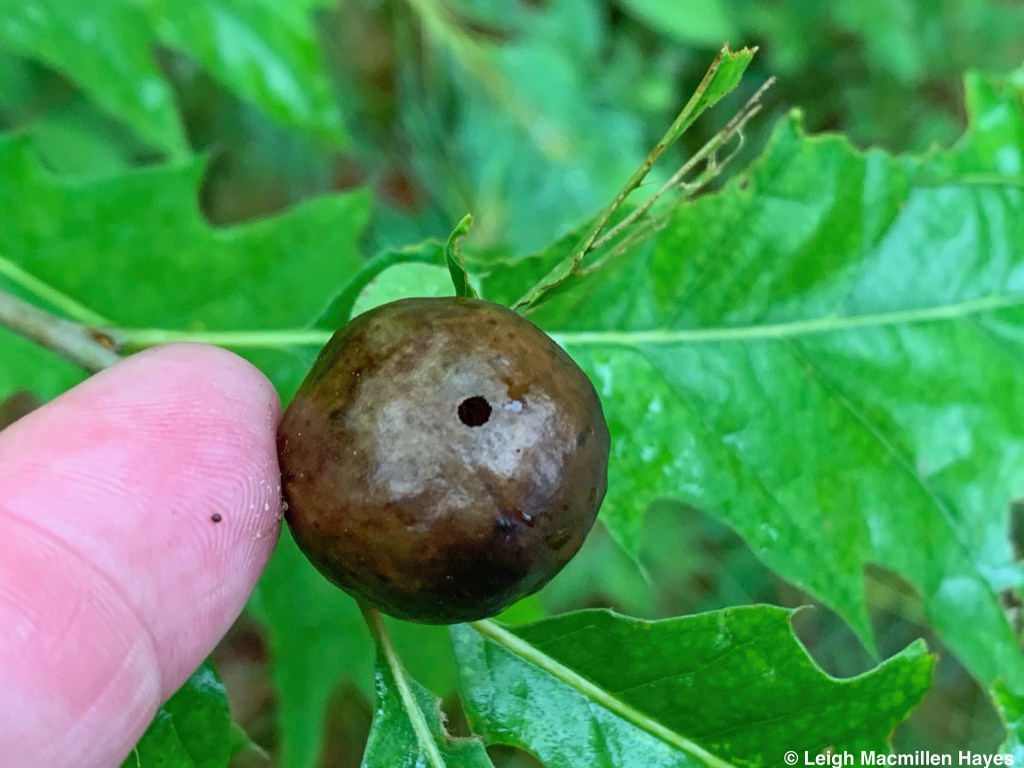
Our next great find was an oak apple gall and of course I had to tell her that a non-stinging and wingless female wasp injected an egg into the veins of the leaf as it was just beginning to grow. Chemicals released by the tiny larvae that developed within altered the growth and over a few weeks, the little orb formed.

By the circle hole on the underside, I explained that the wasp had pupated and chewed its way out and was probably now feeding on the very roots of the same tree . . . that is if it hadn’t been consumed by birds or small mammals.

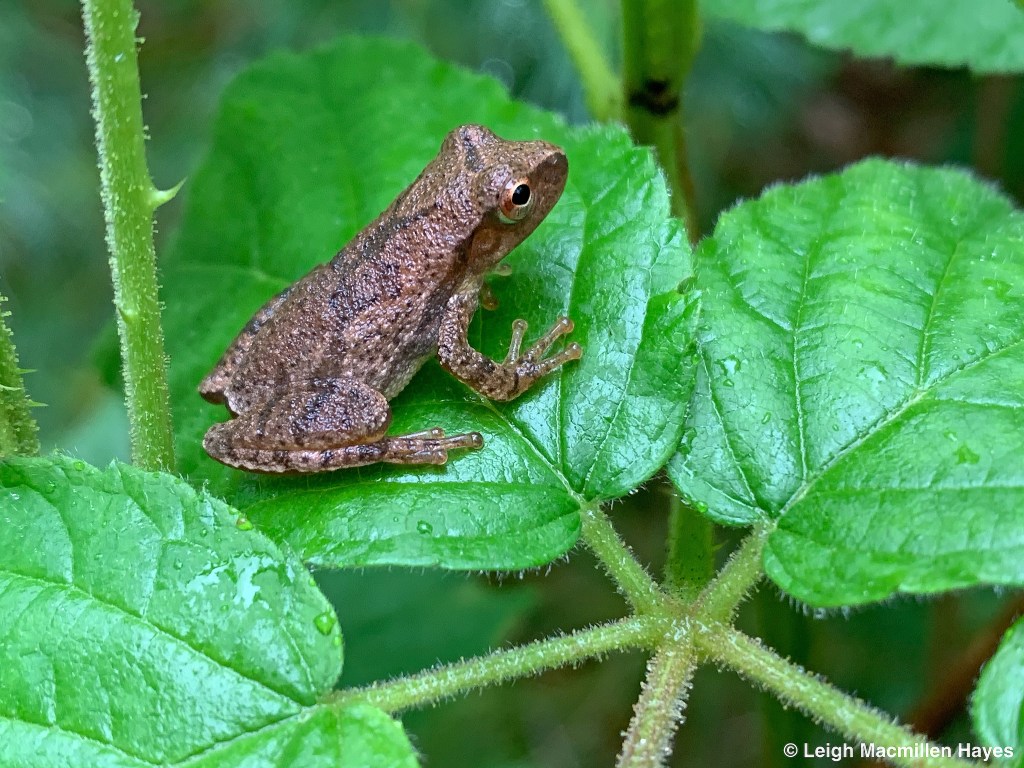
We moved on, but a tiny spot of brown on a berry leaf was the next to beg for our attention. Check out those toes. Sticky toe pads on their webbed feet provide support for these plant and tree climbers known as spring peepers.

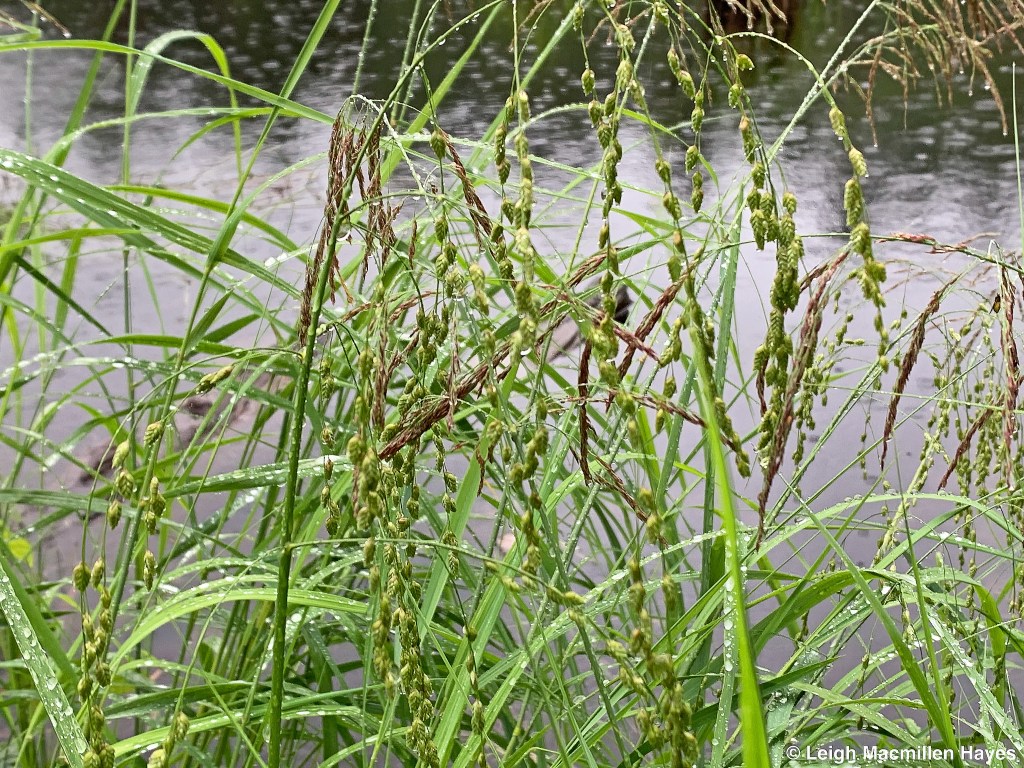
At last we reached a wetland and that’s when the rain really began to fall. And so my friend and I . . . we stood and looked about and enjoyed the raindrops on the grasses and sedges, the water’s surface, and us.

For a while, we left the path, and slipped into the woods, trying to follow a recently created trail, but mostly meandering about in the land where nurse logs provide a start for so many others as they decompose.

As it turned out, that wasn’t the only nursery in town. Once we returned to the trail, which by the way, she was impressed that I could find my way back . . . and so was I, I took her to a nearby meadow where we spotted a momma tending her young’uns.

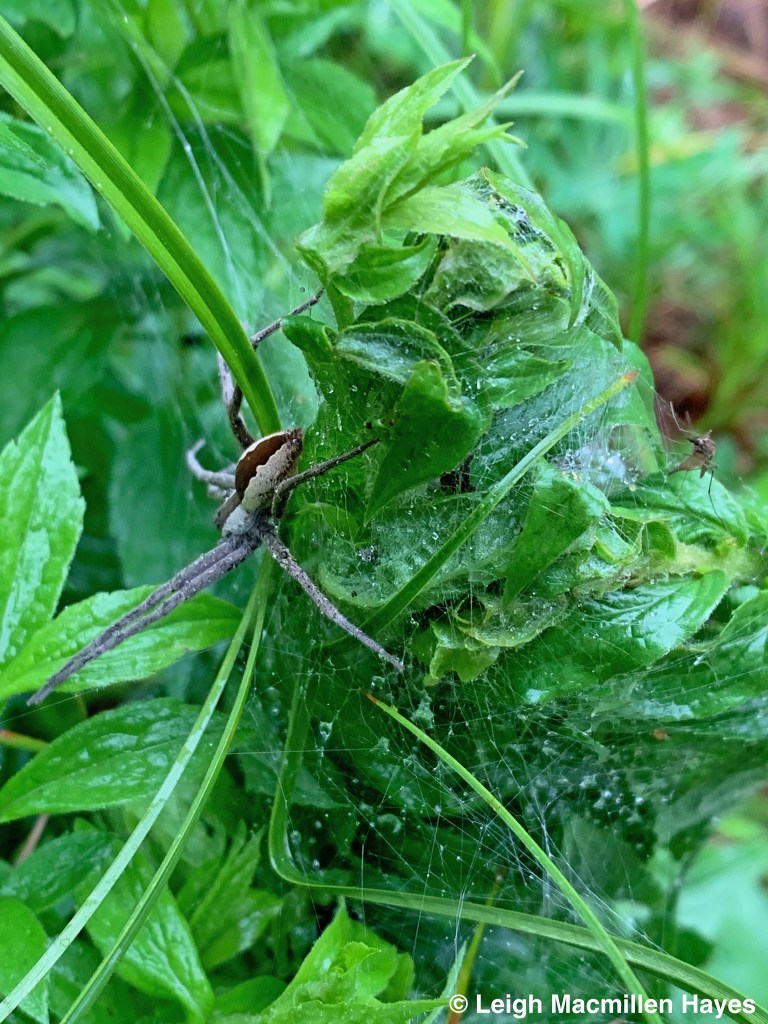
I knew my friend would love this sighting because she not only saves salamanders and deer, but also spiders from any demise. This momma wasn’t so sure about us, however.

As large as she was, we were even bigger so she continued to work on her web to make sure her children stayed safe.

When she wasn’t looking, we did peek inside and saw a few of the babies.

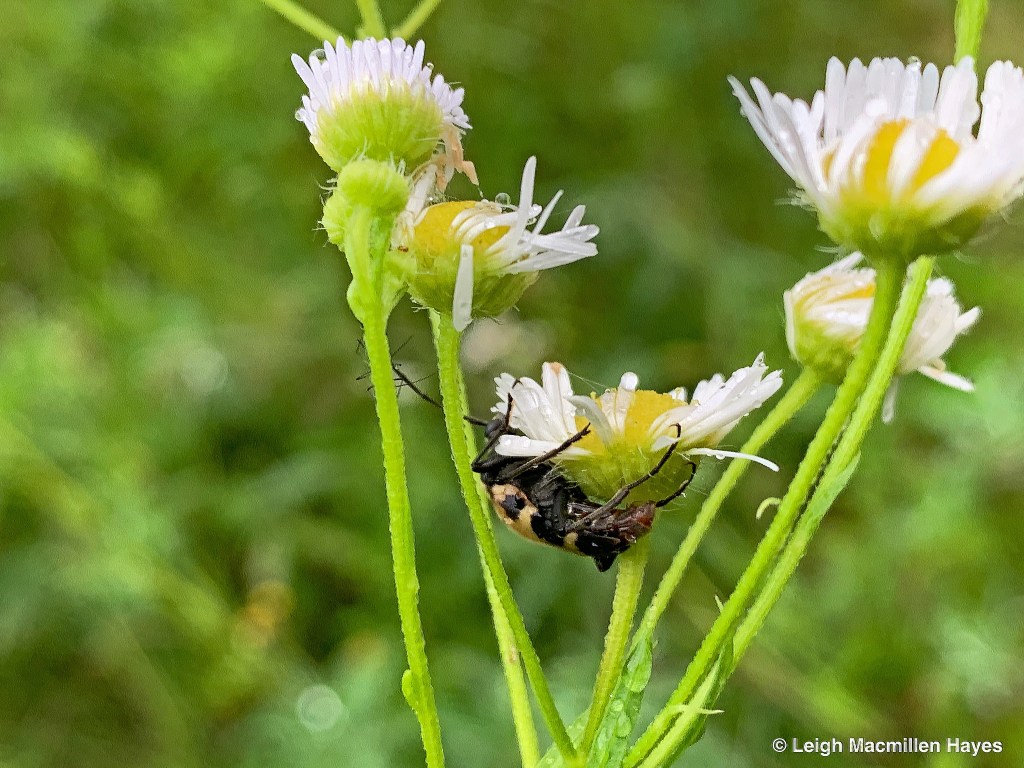
We spotted another spider of a much more diminutive size upon one of the meadow flowers. You might see it, though it is a master of camouflage. Two insects also hung out as if they were trying to stay dry. Though the beetle is quite obvious, a discerning eye will spy the legs of the other.

We had actually gone to the meadow to see the Canada lilies that tickled our fancy for they looked like streetlights in the midst of the rain drops.

All of our finds had been great, but the best one of all . . . a Katydid. My friend’s name is Kate or as she was known when we were kids: Katy. And when quizzed by our moms about who was responsible for something, the rest of us always said, “Katy did it.”

While standing in the meadow today with Kate on my shoulders, my cell phone rang and suddenly I was looking at . . . my dear friend via FaceTime.

“Did I call you, or did you call me?” I asked as I looked at her beautiful and familiar grin while she stood aboard her cabin cruiser on Long Island Sound.

“You tried to Face Time me twice and so I called you back,” she said as she looked a me–soaking wet and rather bedraggled but happy (except maybe for the mosquitoes and deer flies).

I’d been using my phone to snap most of the photos but kept putting it in my pocket and I think I may have inadvertently contacted a few people.

So maybe this one time I did it and not Katy, but forever when I see a Katydid and many other things in the natural world, she’ll be right there with me as we were so many moons ago–Katy got me then and thankfully she still does.

Ides Bog'ling: Beware. Be present. Be still.

When the world goes haywire, the perfect antidote is a day spent outside soaking up the sights and sounds and sun and most of all, fresh air.

Today, that spot offered so many sights including Mount Washington’s snowy covering in the great beyond.

And Pleasant Mountain’s ridgeline at a closer range.

But the sights also included selections much smaller such as Buttonbush’s winter structure–offering a half globe rather than the full orb of its summer form.

And Rhodora giving off its own glow as with buds and flower structures waiting in the wings.

What’s not to love about an infusion of color to the late winter/almost spring landscape.

Speckled Alders, their male catkins growing long below the females, also bespoke the season on the horizon.

Having developed last summer, the males are slender spikes of tightly appressed scales. Above, the females are more bud-like in manner. Both persist throughout the winter and soon will bloom before summer leaves appear.

While new buds showed off their reddish faces, last year’s alder “cones” remained woody in form. Not truly cones for those grow only on conifers, there is a strong resemblance. Thankfully, Mary Holland of Naturally Curious explains the difference best: “Angiosperms, or flowering plants such as Speckled Alder, produce seeds that are enclosed within a covering (the ovary), whereas gymnosperms (conifers) have un-enclosed or “naked” seeds. Alder “cones” open to release seeds in a manner similar to many conifer cones and, like most cones, do not disintegrate immediately after maturity. Female flowers/catkins of Speckled Alder, if fertilized, will develop into ‘cones.‘”

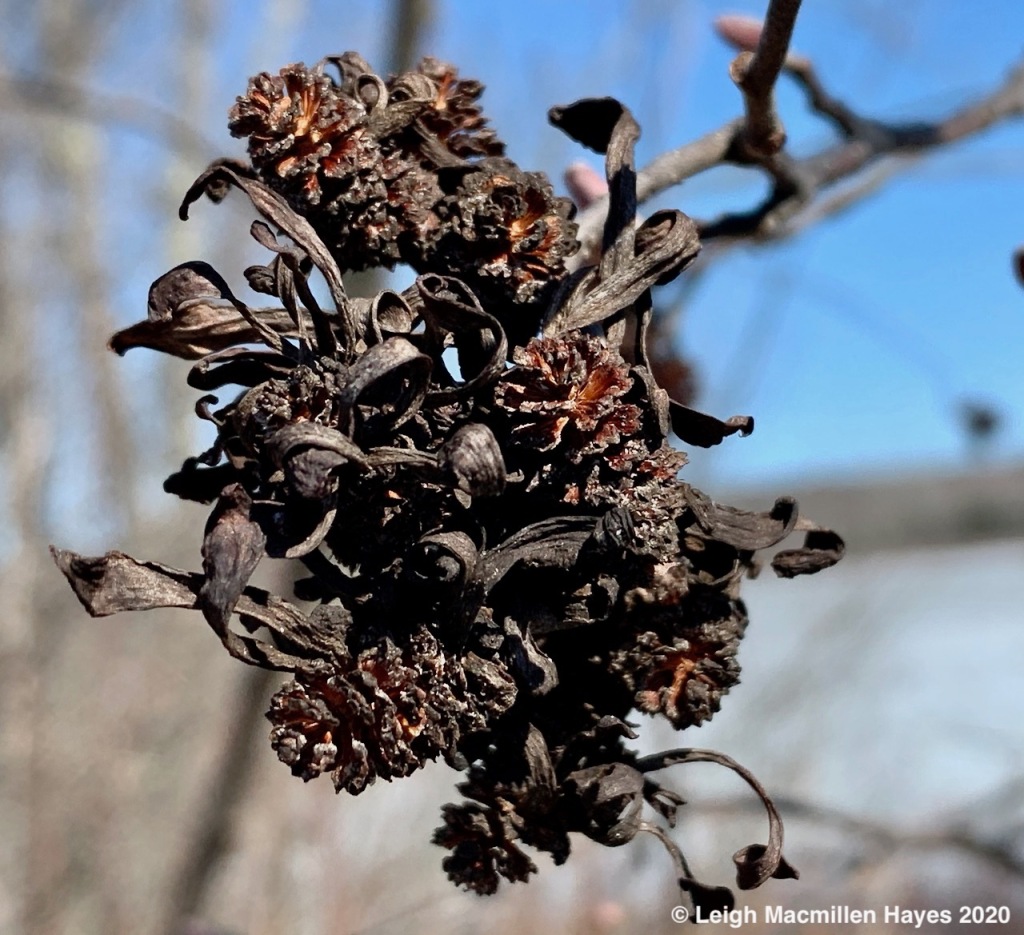
That said, there were some of last year’s structures that showed off a much different form. It was almost like they had tried to flower. In reality, they were Alder Tongue Galls–resulting from a fungus rather than an insect infecting the female catkins.

Other sights included Morse Code representations of the dot dot dash work created by Yellow-bellied Sapsuckers upon many a birch.

I traveled this day with a friend and in our quest to clean out the innermost recesses of our lungs, we walked across ice, snow, mud and through water. it was totally worth the effort to get to the other side.

For on the other side, we encountered Maleberry shrubs with ornaments of a different kind.

Each had been sculpted in a unique manner, but we suspected all resulted from the same creator.

Our best guess, after opening one or two, was that some insect had created a home in the Maleberry leaves last fall but once again, we were stymied by a new learning and suspect the lesson hasn’t ended yet.

As our journey continued, we suddenly found ourselves in the presence of wind dancers for so did the marsescent White Oak leaves appear.

On the ground we found a comparative study between the White and Red Oak leaves, their lobes and colors bespeaking their individuality.

And upon some of the White’s saplings, another gall of this place–Oak Marble Gall. Growing in clusters on twigs, they turn brown in maturity and their emergence holes show the site of escape for mature adults who flew out in the fall. They are also called oak nuts.

Today’s sights included the landscape and its flora, birds of the trees such as nuthatches and chickadees, plus those of the water including woodducks, and sky birds like two eagles we watched circle higher and higher until they escaped our view. We also found bobcat and coyote scat. And then in some mud, signs left behind by others such as the raccoon’s close-toed prints.

Among the raccoon track, there were also plenty of bird prints that we suspected belonged to crows.

And in the water beyond, a rather active beaver lodge.

On this day, my friend and I slipped away into the land beyond known locally as Brownfield Bog, where we at times were boggled by the offering of this Ides of March. Beware. Be still. Be present. It’s the best way to be. Be.

Perennial Mondate

It’s an old fav, Bald Pate Mountain Preserve in South Bridgton. And we love to visit it in any season. That being said, winter will “end” in a few weeks and this morning we realized we needed to head on over.

Our plan was to follow the Moose Trail for its entire length, then continue on the South Face Loop to the summit, start down the Bob Chase Trail, veer off to Foster Pond Lookout and then make our way back by rejoining Bob Chase.

One might expect to see a moose along the first trail, and we hoped to have such luck, but it was not to be. Instead, do you see the ski tracks? Portions of the preserve are groomed for cross-country skiers as part of the system at the adjacent Five Fields Farm.

What else did we spy? Some wicked cool finds in my book of wonder. For instance, you may think that this broken off piece of a twig is merely dangling from its counterpart, but . . . it is solidly stuck in place by a fungus known commonly as glue crust. It glues together twigs and branches that touch each other.

And sometimes twigs meet the bark on the trunk of a tree and hang in what you might think of as an unnatural stance.

The fungus is the dark bumpy structure that the second twig is stuck to, much like a magical act performed by nature. Really though, this fungus doesn’t let the twig fall to the ground where it would be decomposed by other fungi. Pretty tricky–making a claim all for its own benefit.

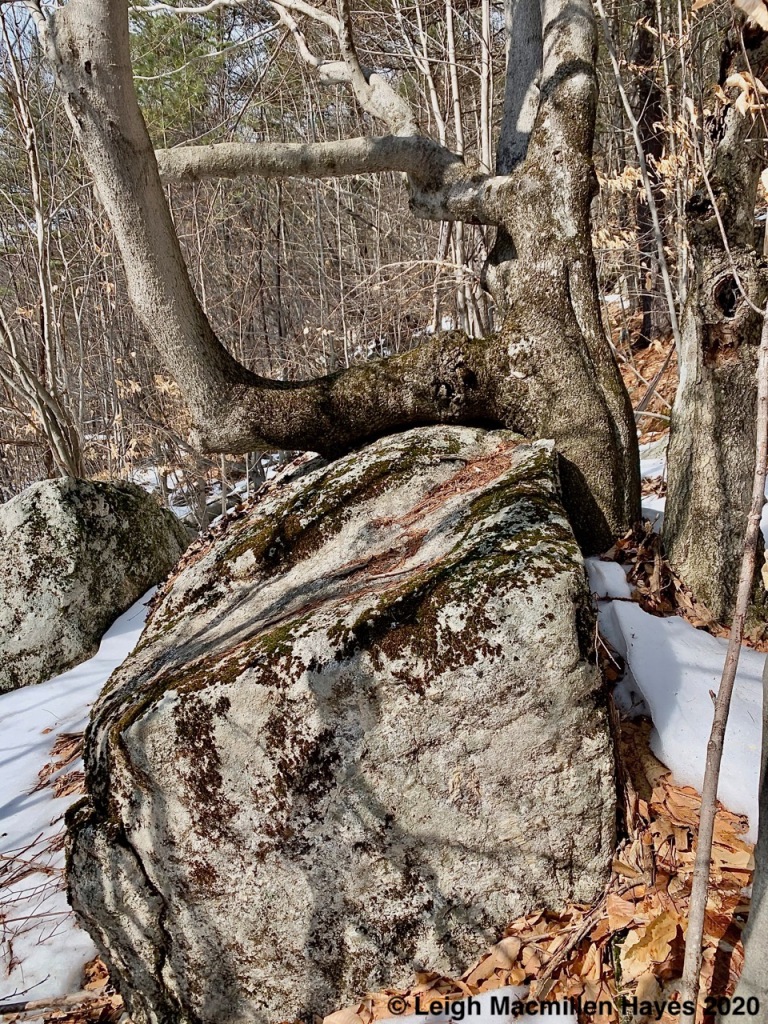
Continuing on, we scanned every beech tree in hopes of finding bear claw trees. We did find a beech worth honoring for we loved how it rested an elbow on the boulder below and with two arms formed a frame of the scene beyond.

Ever so slowly we climbed upward, our pace not my guy’s usual because of the bear paw challenge. When one is looking, however, one discovers so many other things upon which to focus like this rather common birch polypore in a rather uncommon shape, almost like a Christmas bell jingling in the breeze.

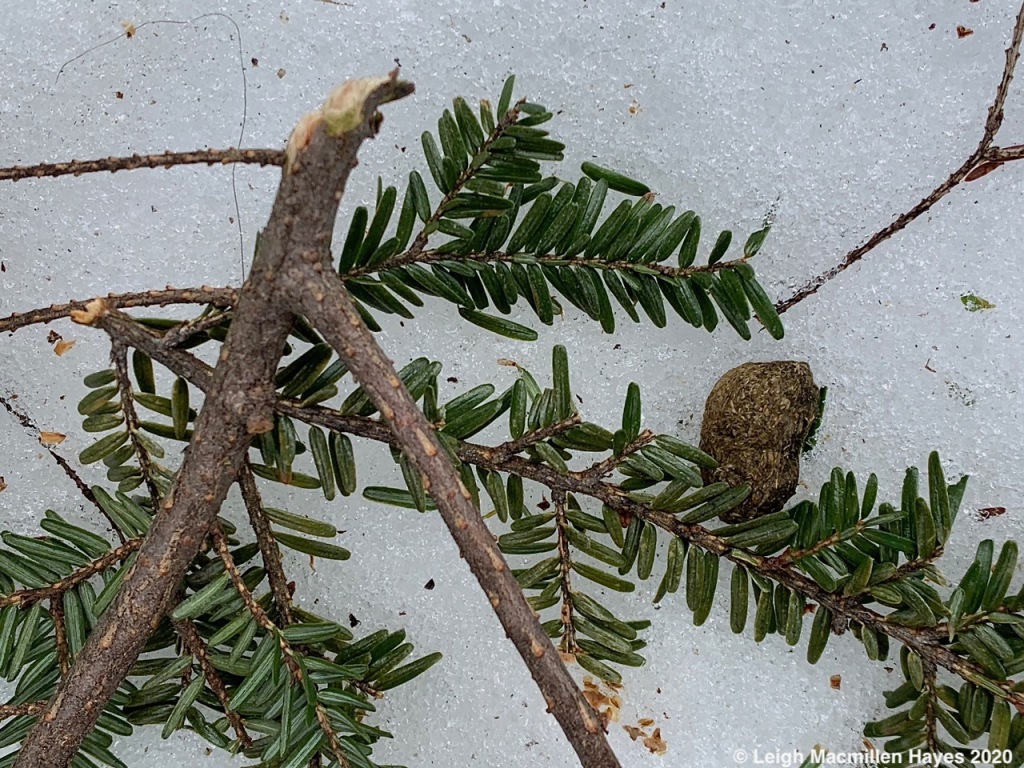
And then there was a display of snipped hemlock twigs scattered across the snow-covered forest floor.

We looked up and saw not a silhouetted form, but by the debris, which include diagonal cuts on the twigs, comma-shaped scat (some a bit more rounded than others), and even the soft, curly belly hairs of the creator, we knew a porcupine had dined overnight.

We looked a wee bit, but found not its den. By its tracks, however, we could tell that it had made more than one visit to this fine feasting spot.

Had we climbed the Bob Chase Trail we would have reached the summit in twenty minutes, but our choice to circle about before hiking up meant we spent two hours approaching the top where the bonsai trees of the North grow–in the form of pitch pines.

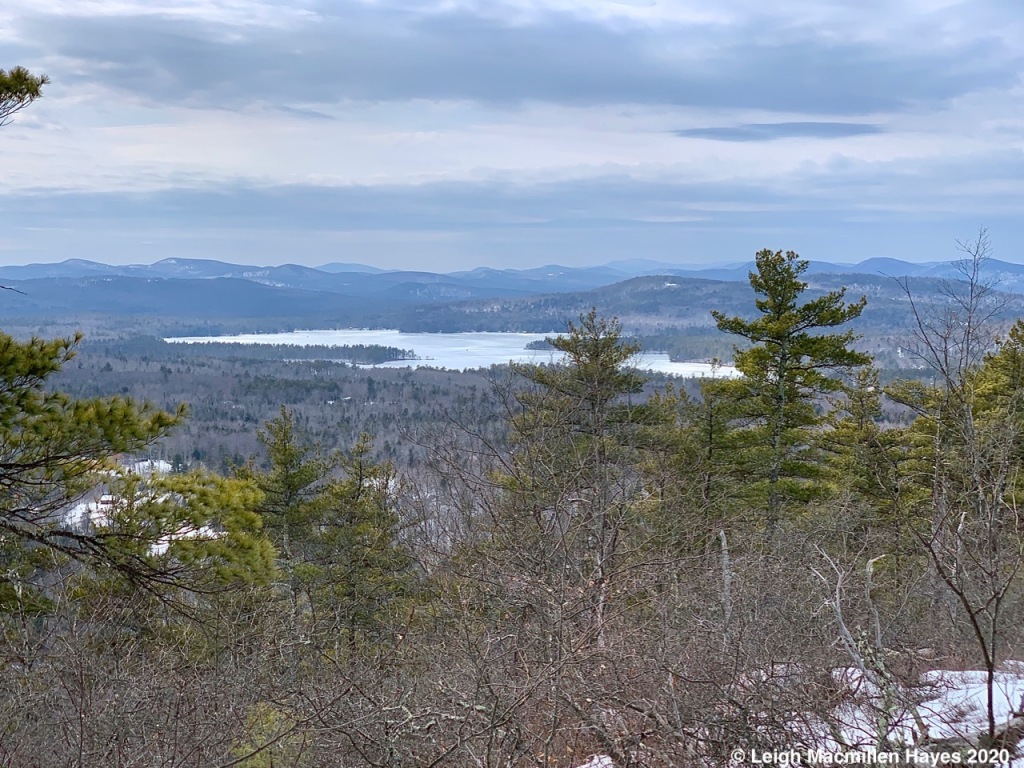
The true summit is a wee bit higher and so we continued on and then turned back to take in the view of Peabody Pond below.

It was there that while looking for insect cocoons I came across the gouty oak gall caused by teeny wasps no bigger than fruit flies. The structure was woody as it’s a couple of years old. And almost creepy in its display, like a head with many eyes looking every which way.

We did take the hint and looked every which way ourselves, the next point of view beyond Hancock Pond and beyond.

And then we moved on, until that is, we reached the wall of tripe, which always invites me to stop.

Water had also stopped in the form of several frozen falls.

And again, more of nature’s magic for the icicles facilitated photosynthesis by the algal partner of the lichen’s symbiosis. It’s a thing worth liken.

Nearby, a relative also begged a notice. Do you see the black flat-headed disks upon the surface? Those are the fruiting bodies or apothecium where this lichen’s spores are produced. The common name for this umbilicate structure: toadskin.

Just above the tripe and toadskin offerings, Pleasant Mountain came into view. Hidden behind a cloudy veil was Mount Washington, which typically sits in the saddle of the Pleasant Mountain ridgeline.

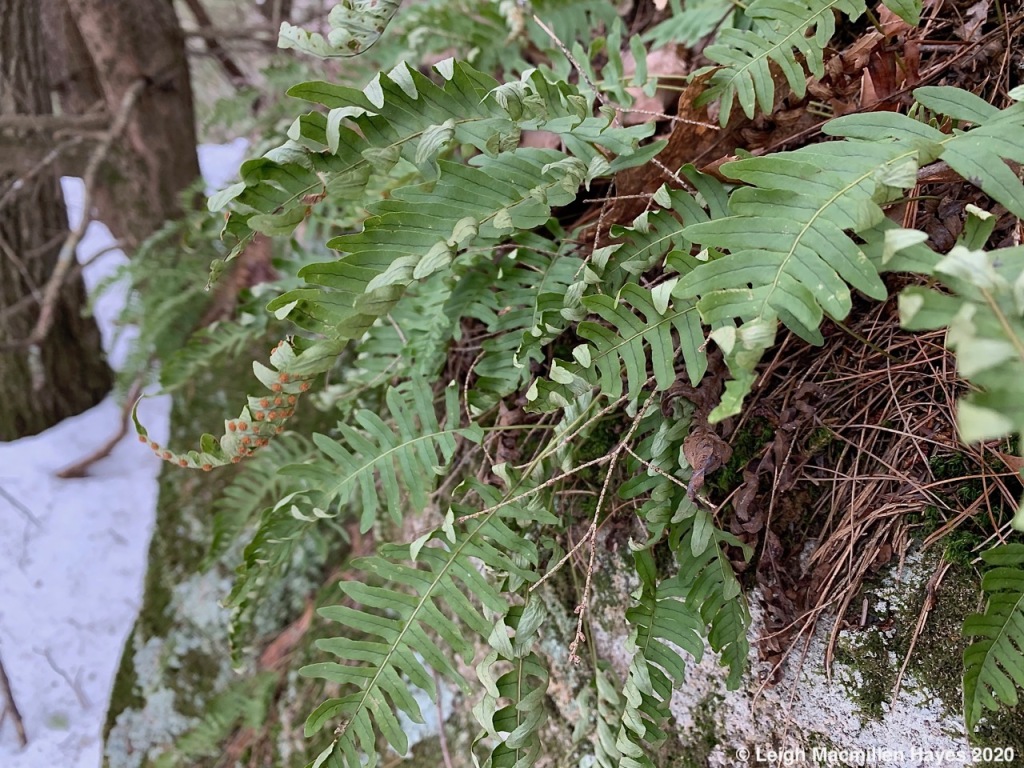
As we wound down and around, polypody ferns spoke about the weather–some were curled as it was cooler in their location upon a boulder in a hemlock grove, but others were flattened bespeaking the rising temperature.

Our last focal point before heading back to the parking lot was the lookout to Foster Pond. Where once stood a tall cairn, there are now two shorter ones marking the point of view and turn-around.

It was there that we discovered another gouty oak gall, its size at least that of a golf ball; a rather holey, warty golf ball.

This preserve is forever a fav in any season, which on this Mondate offered a flash ahead (think the opposite of flashback, rather like a preview) of what is to come. We love winter. And we especially love snow. But . . . we also love all the other seasons and the perennial plants on the southern side of the mountain where the snow has melted a bit, showed off their evergreen shades and hints of future events. Wintergreen and Trailing Arubuts, the later with the long buds atop a hairy stem.

Stepping Out For Others

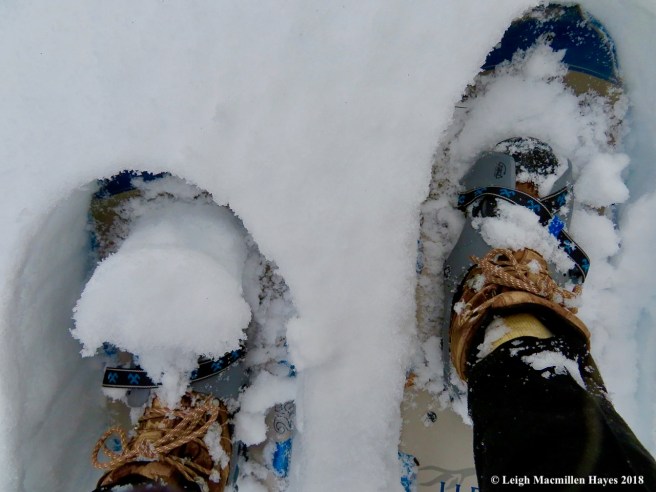
With the most recent snowstorm now history, I strapped on my snowshoes this morning with a sense of eager anticipation about the possibilities. And then it hit me like the snow plops that fell from the trees and landed on my head or slid down my neck: I could do this while others could not and it was for them that I needed to focus. 

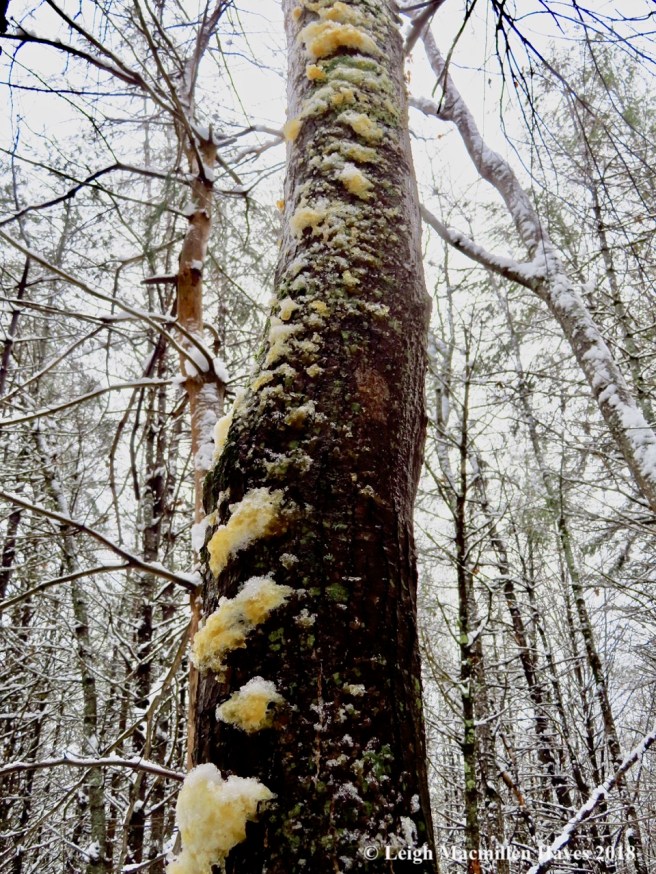
I hadn’t gone far when my first moment of wonder stood before me. Actually, just prior, I’d been looking at some pileated woodpecker works–ever on the search for the bird’s scat, and in the process had noticed other bird scat soiling the snow. But . . . what was all the amber color? 

Had snow collected on mushrooms that decorated the bark? If so, why hadn’t I seen them yesterday or the day before? 

Upon a closer look, I realized it was sap. But why the big clumps? And why so much on a dead snag? 

I poked it with my finger and found it to be of snow consistency. And so . . . the mystery remained. But it was certainly worth a wonder and I knew that those I was intentionally walking for would appreciate the sight. And yes, I did see plenty of other examples of dripping sap at the base of trees, but nothing like this. As usual, if you know what was going on, please enlighten me.

My next moment of wonder was one that always gives me pause–and again I knew that my friends would feel the same. A miniature evergreen world momentarily encapsulated in a droplet of melting snow. 

Everywhere, the meltdown offered a variety of shapes and designs, each worthy of reverence . . . and a photograph, of course. 

One of my favorites was plastered to a tree in such a way that it looked like it was flat against the bark until further study revealed otherwise. As it melted before my eyes, its ever changing formation resembled a series of little flowers scattered here and there. Just maybe you have to see that through my eyes. 

And then I stumbled upon another mystery–a web of sorts like Charlotte might have woven? I studied the shrub and found numerous examples of a similar pattern, but no arachnids in sight. Besides, the silky lines seemed too thick. But, what could it be? It took me a while as I studied the area and then I remembered. Before the snowstorm, I’d taken some photographs of the winter structure of a thistle. The storm had knocked down the fruiting form, but I think my gaze was upon the filaments that had served as parachutes for the thistle’s seeds. 

My journey into the winter wonderland continued, though not all the trees along the way were fortunate to withstand the weight of the snow that was quickly melting. It sounded like a rain storm as I walked under the arched branches. 

At the the other end of the snow tunnel, I emerged into a field with its own offerings. Typically, I pass by, but today I was inspired by those who virtually walked with me to explore. And I don’t think they’ll be  disappointed by the findings. First there was the Goldenrod Ball Gall. The round gall occurred in the middle of a stem, the top of which had broken off. In the spring, the Goldenrod gall fly laid her eggs on the stem. Hatched larvae chewed their way into the stem and the gall started to develop. And from the looks of the hole on the side, it appeared the creator had chewed its way out and flown off. 
Also in the field, a Rose Bedeguar Gall, aka Robin’s Pincushion Gall on Meadowsweet, which happens to be a member of the rose family. Burrowing in to the leaves and stem of the plant was a two-fold offering for the fly larvae it hosted, for the insect benefited from the nutrients while it was simultaneously protected from predators. 

There were also numerous examples of a structure that might baffle the onlooker. Beaded formations of the fertile stalk from a Sensitive Fern poked up through the snow. Typically, the beads or capsules remain intact with their brown dust-like spores waiting inside for the structure to break open during the rains of early spring. 

I moved on from the field and eventually reached a wetland that I couldn’t cross. But, I could stand and listen and so I did. All around me the forest orchestra performed its Plop, Plop, Swish, Plop, Splash symphony. 

 At first, it sounded and looked like I was surrounded by a million wild animals, but really . . . all the sound and sights were a result of snow falling, either gently with a whisper of the wind or harshly with a thud and splash. 

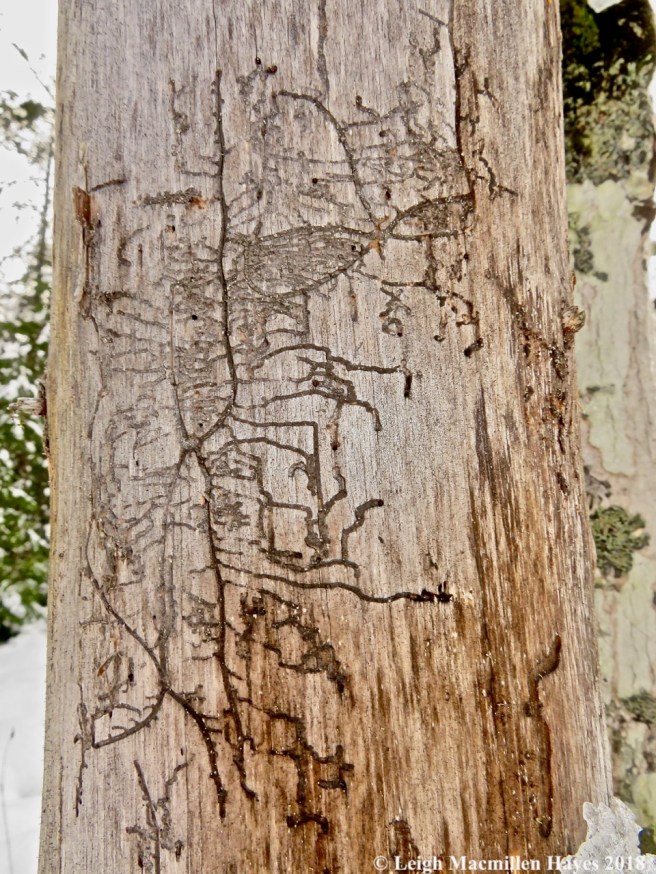
As I stood there looking for the million wild mammals, my eyes focused on the works of something much smaller. Insect egg tunnels on a dead snag’s trunk read like a story on paper. 

The longer tunnels were bored by a female Bark Beetle. From the sides of her tunnels, larval mines radiated outward. The overall design could have been an abstract drawing. 

At last  I started for home, thankful that I was retracing my steps for often new sights are revealed when one does that. And so, I believe it was a crust fungus and perhaps it was an oak curtain crust fungus, but let it remain that I discovered a fungus I don’t think I’ve seen before, with a warty, rust-colored underside and dark upperside. Suffice it to say, it was a mushroom of some sort. 

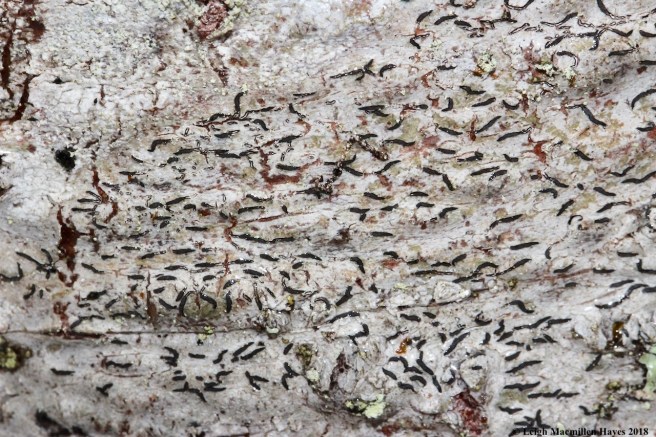
Along the way was a script lichen, which looked to me like someone had doodled. Commas and apostrophes decorated that page. 

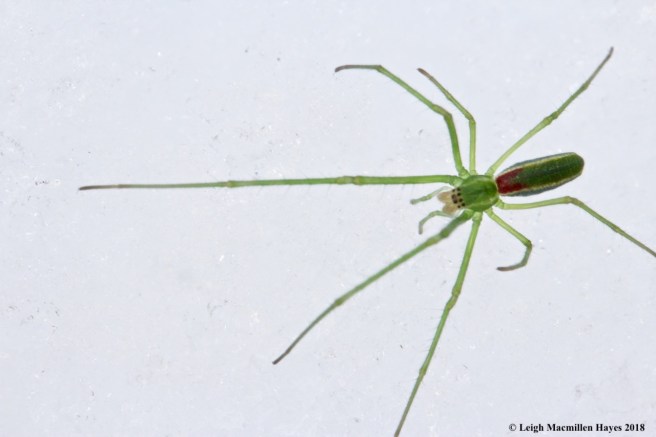
And then, and then, Tetragnatha viridis, a green long-jawed orb weaver. I actually saw two of them. Typically, the translucent green color helps them camouflage amongst pine needles, their usual habitat, but they can frequently be seen on snow, especially if the temperature is in the 25˚-35˚ range as it was this morning. 
The orb weaver’s characteristics: eight eyes in two parallel sets of four; long chelicerae (jaws); enlarged pedipalps; long legs with spines; and that color–oh my! 

It was for eight parallel eyes that I walked today, the eight representing Jinny Mae, Dick, Kate, and Carol. 

Where trees didn’t cover the trail the snow was about fourteen inches deep and as you can see I chose the wrong boots and forgot my gators. But that was okay because I knew that I would eventually wander home and change my sopping wet socks. What mattered more was the fact that I was honored to step out for others when they couldn’t necessarily do the same. Here’s to the four of you–thanks for letting me be your eyes. 

Mondate Preserved

The other day a sign caught our attention as we drove to Overset Mountain and we realized we had new trails to explore. But, we, or rather I, drove by  so fast that we didn’t know which local organization owned the property. 

If my guy read these posts he would chuckle or guffaw at my comment about driving too fast for he is of a different opinion. But suffice it to say that we didn’t read the name of the land trust on the sign and so this morning I contacted Loon Echo Land Trust because in my online research, their name was associated with the property. Maggie quickly let me know that I needed to contact Lee at Western Foothills Land Trust and violà. 

Both have been involved in the Crooked River Forests Project for as is stated on the LELT website: The Crooked River has been identified as a priority for conservation as it is the largest tributary to Sebago Lake, with 38% of the inflow, and it offers local recreational opportunities and is situated above high quality sand and gravel aquifers. The river has been identified in the state’s Natural Resources Protection Act as an Outstanding River Segment with AA status; free flowing with the best water quality. This trout fishery is home to one of only four native populations of landlocked salmon in the state and is known to host one species of anadromous fish (American eel) and is thought to historically host Atlantic salmon and sea lamprey.

As I pulled up to the sign today, however, the ownership was obvious. The name, Two Bridges, was not so. The area has long been named such, and all we could imagine is that twin bridges once spanned the Crooked River in the area where we stood. 

Since the parking lot was under construction, for the property won’t officially open for another two weeks, we parked on Plains Road rather than Route 117 in Otisfield. 

At the start, the trail was wide and straight, and we both hoped for a change. Oh, don’t get me wrong. It was lovely and we had fun naming all the evergreens, including white and red pine, hemlock, balsam fir and red spruce, for those were the most abundant species, with a few young beech, red maples and red oaks thrown into the mix. But . . . we wanted diversity. And we wanted to walk beside the river. 

Soon, thankfully, we came to a Y in the road and a new sign post, or so we imagined it to be. We chose the trail to the right since it was closer to the water. 

And within minutes our reward awaited. That being said, we’d followed a spur to the riverbank and since there were no telltale pieces of flagging we suspected it won’t be marked as a public trail. 

Further along, we again spent time by the river, and noted its sculptures made of decorative roots . . . 

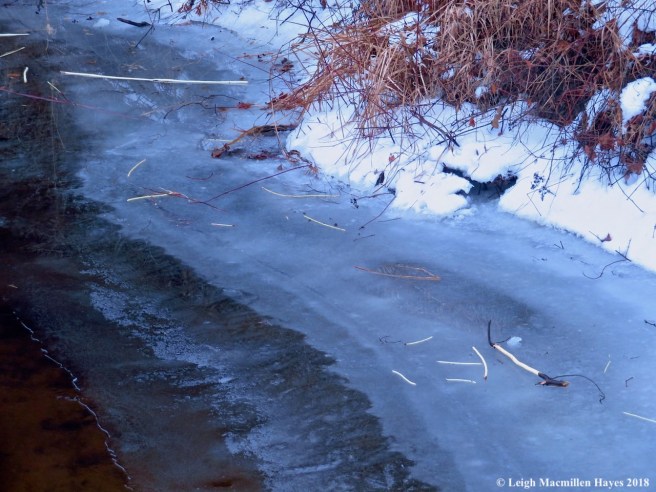
and splashes of ice. 

And in the mix–a rare sight indeed: an ice disc, this one being about three or four feet in diameter and spinning in an eddy. 

Eventually, the trail took us across a bridge constructed by the land trust in October 2017 that will provide the landlocked salmon and brook trout with another mile of spawning habitat.

And that’s not all. We saw plenty of evidence that mammals inhabit the space from deer . . . 

to fox . . .

to bobcat! 

There were several intersections, and we kept turning toward the river, which took us along trails more to our liking as they narrowed and twisted and turned through the forest. 

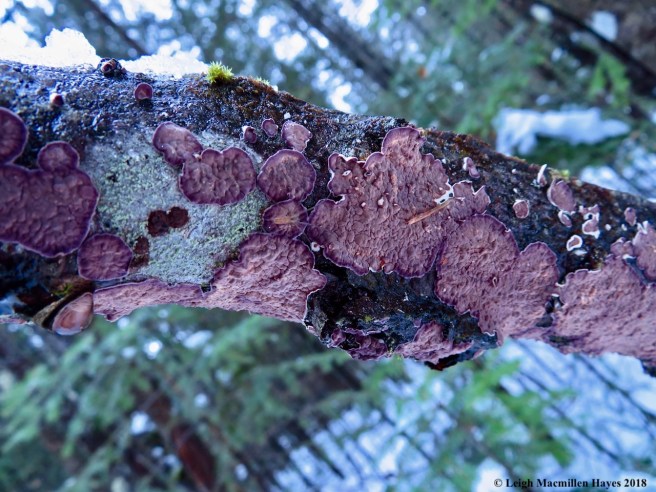
At one point, a tree arched over the trail and its purple crust fungi added a different color to the display. I think it was Phanerochaete crassa. 

My guy pointed out the hugging cousins–a white pine and hemlock and I was reminded of my finds on Black Friday. “I knew you’d like it,” he commented. He knows me well. 

Because we were in an evergreen forest, we noticed several examples of witches’ brooms. No, they were not the variety that one might have expected on Halloween night. Instead, dense masses of shoots rose from a single point on an otherwise normal branch and created a nest-like structure. Their cause: fungi, viruses, bacteria, mites or aphids. 

Speaking of the latter, aphids created the cone galls we knew as witch’s hats on witch hazels that grew near the river. The little structures provided both food and shelter for the critters that developed within. 

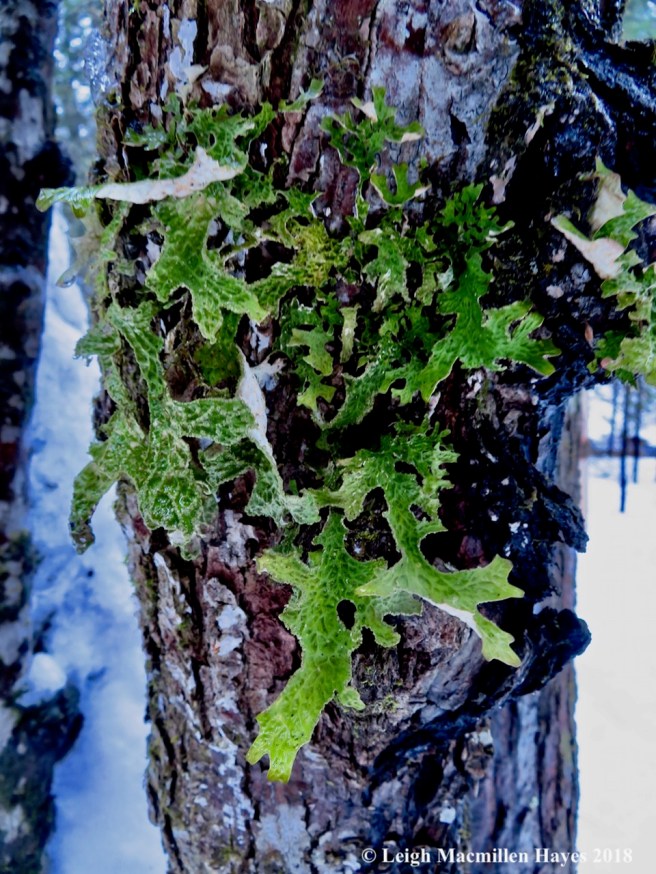
We also spied lungwort on a few hardwoods, its leafy structure springtime green as it photosynthesized in response to the flurries that floated earthward during the morning hours. 

And then the forest’s canvas began to draw our attention, from snowcapped artist conk (Ganoderma applanatum) fungi . . . 

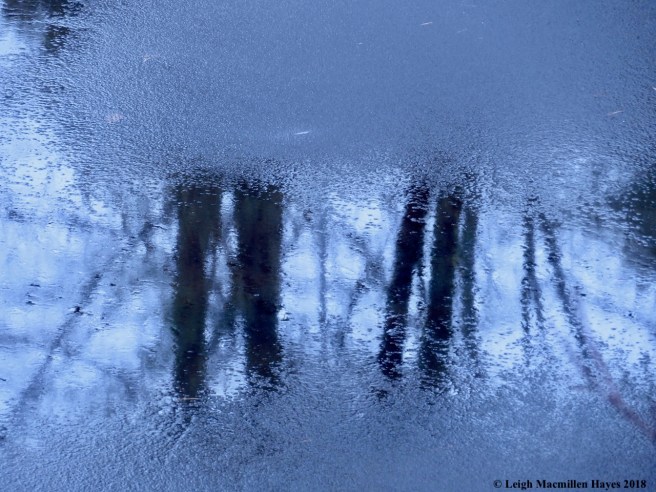
to icy reflections, . . . 

man-made sculptures, . . .

and dazzling trail markers. We spied another made of pipe cleaners and a soggy feather and wondered.

We didn’t walk the entire trail system, but left knowing that we’d return for further explorations. 

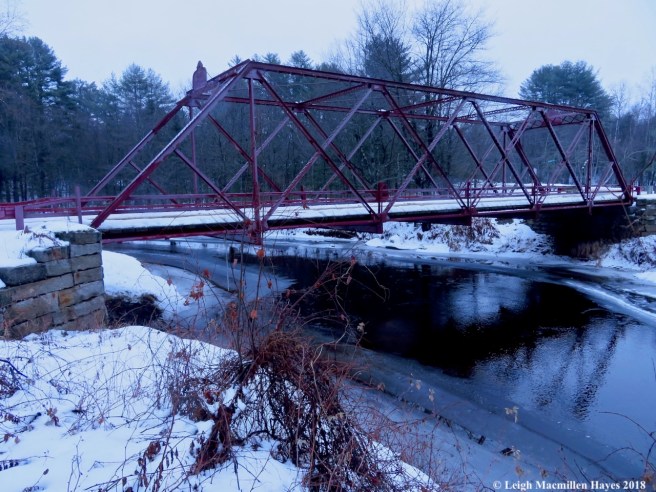
Because we were in the neighborhood and my guy had never seen it, I drove along Plains Road to the Ryefield Bridge. Listed on the National Register of Historical Places, the structure was built in 1912 as a double-intersection Warren truss bridge. 

The bridge spans the Crooked River between Harrison and Otisfield and is still used today. In fact, we walked and drove across it. 

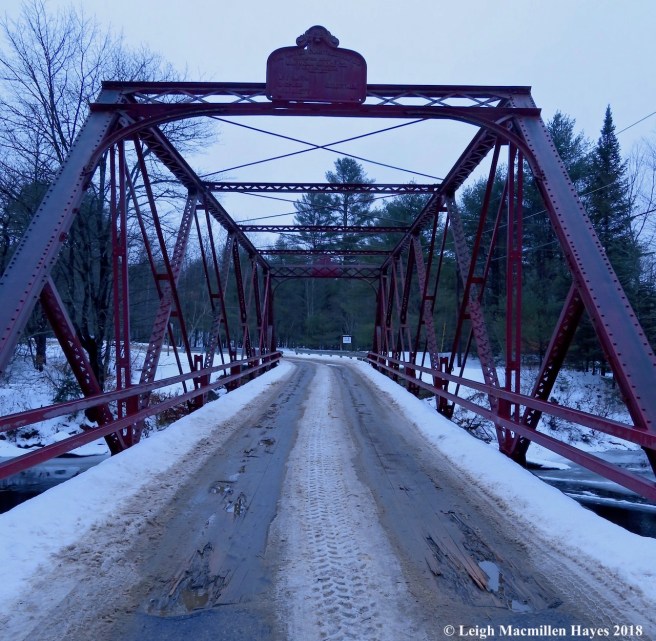
One of our favorite parts was the sign at the top, which not only stated the construction company, but also honored the selectmen of the day. 

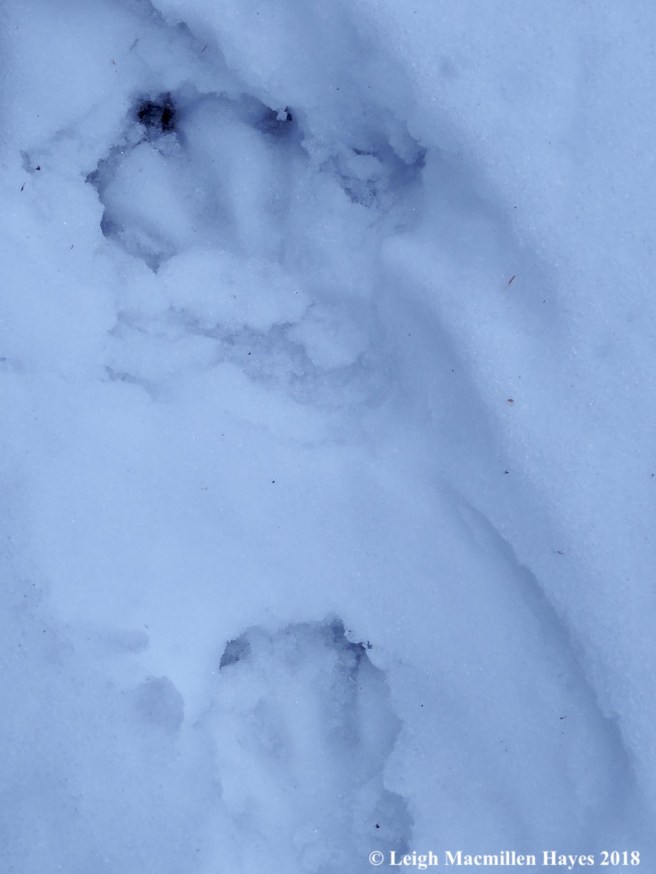
My excitement about the bridge was equally matched by some prints I spotted when I stepped into the snow to take a photo from the river bank. Beaver prints! Like the ice disc in the river, beaver prints have always been a rare find. Often, I can see their pathways, but not decipher their tracks for their tails swish out the features. 

But today, not only the tracks and a trail down to the water, but beaver chews, their snack sticks, left behind on the ice. 

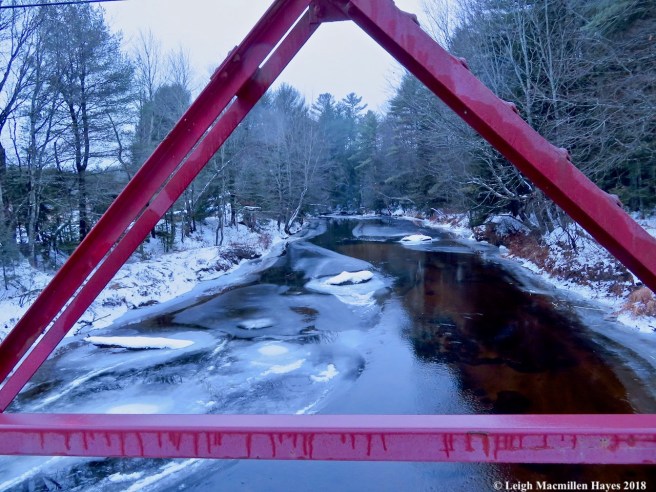
We took one final look before heading home–Crooked River framed by the bridge. And we both gave thanks on this Mondate for a land and a bridge preserved. 

Summer Marches On

Today I attended a celebratory parade.

0-Subtle colors

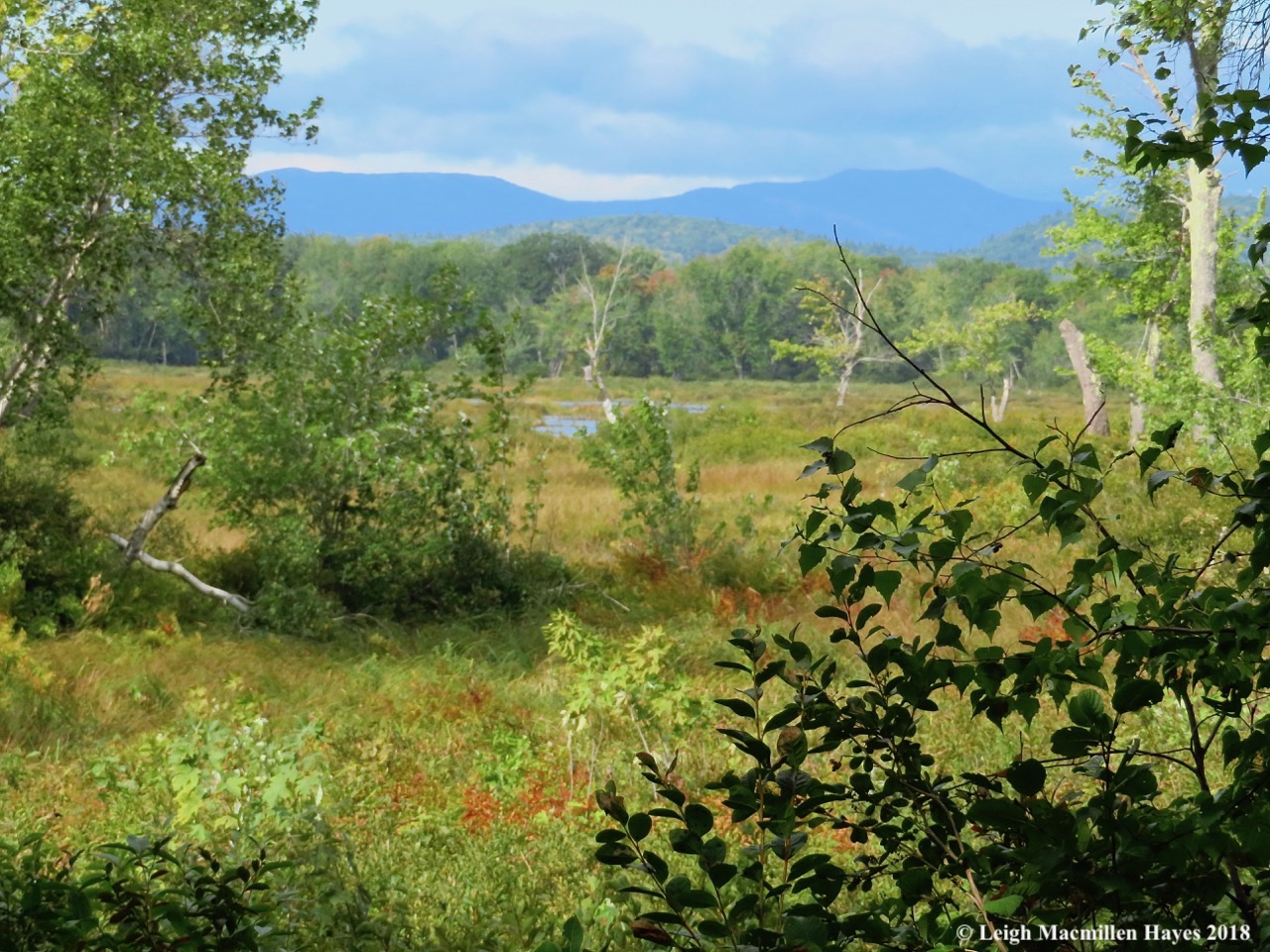
The route followed the old course of a local river and along the way the trees stood in formation, some showing off their bright new coats.

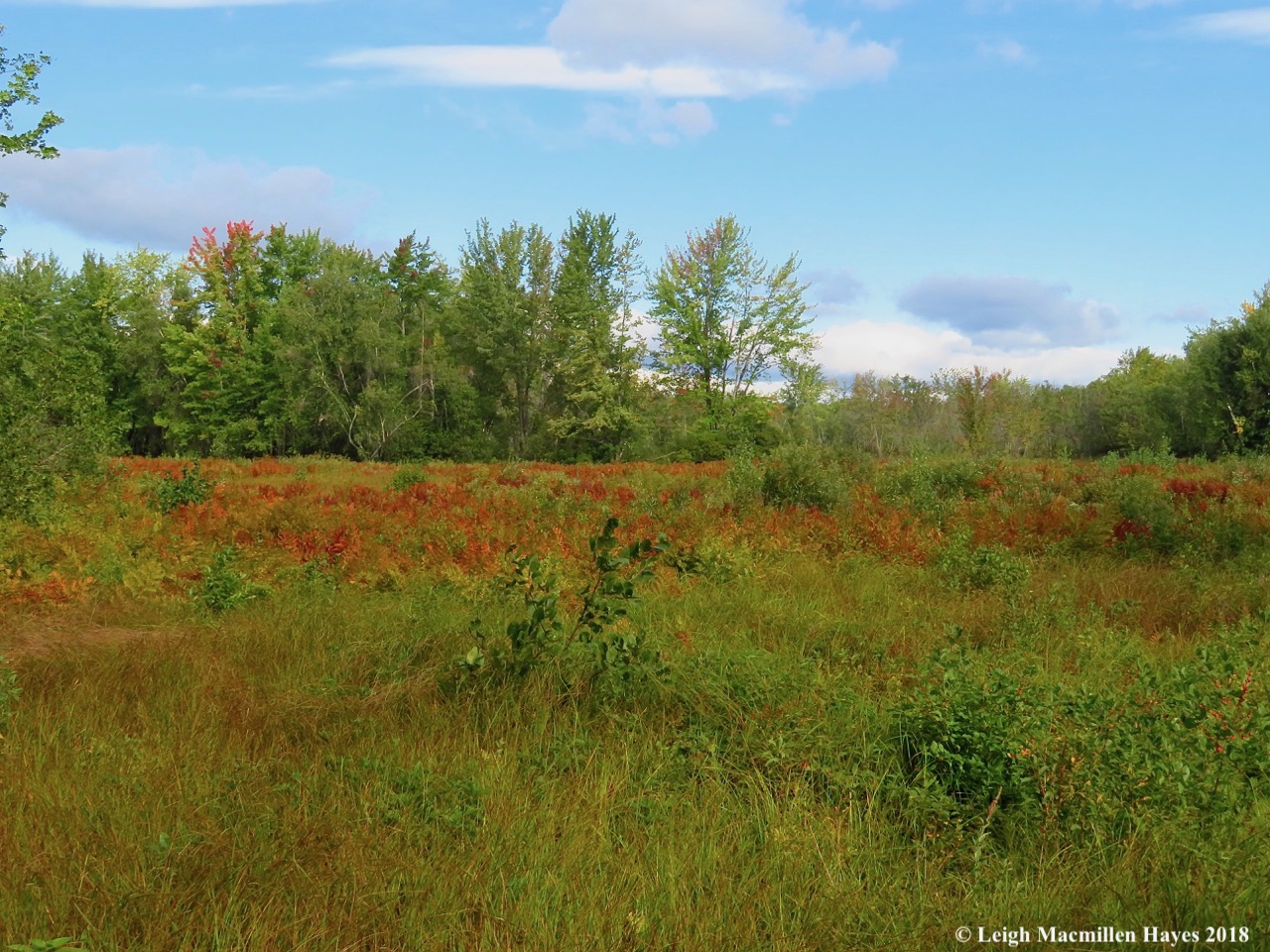
5-colors in the field

Each float offered a different representation of the theme: transition.

3-ash seed raining

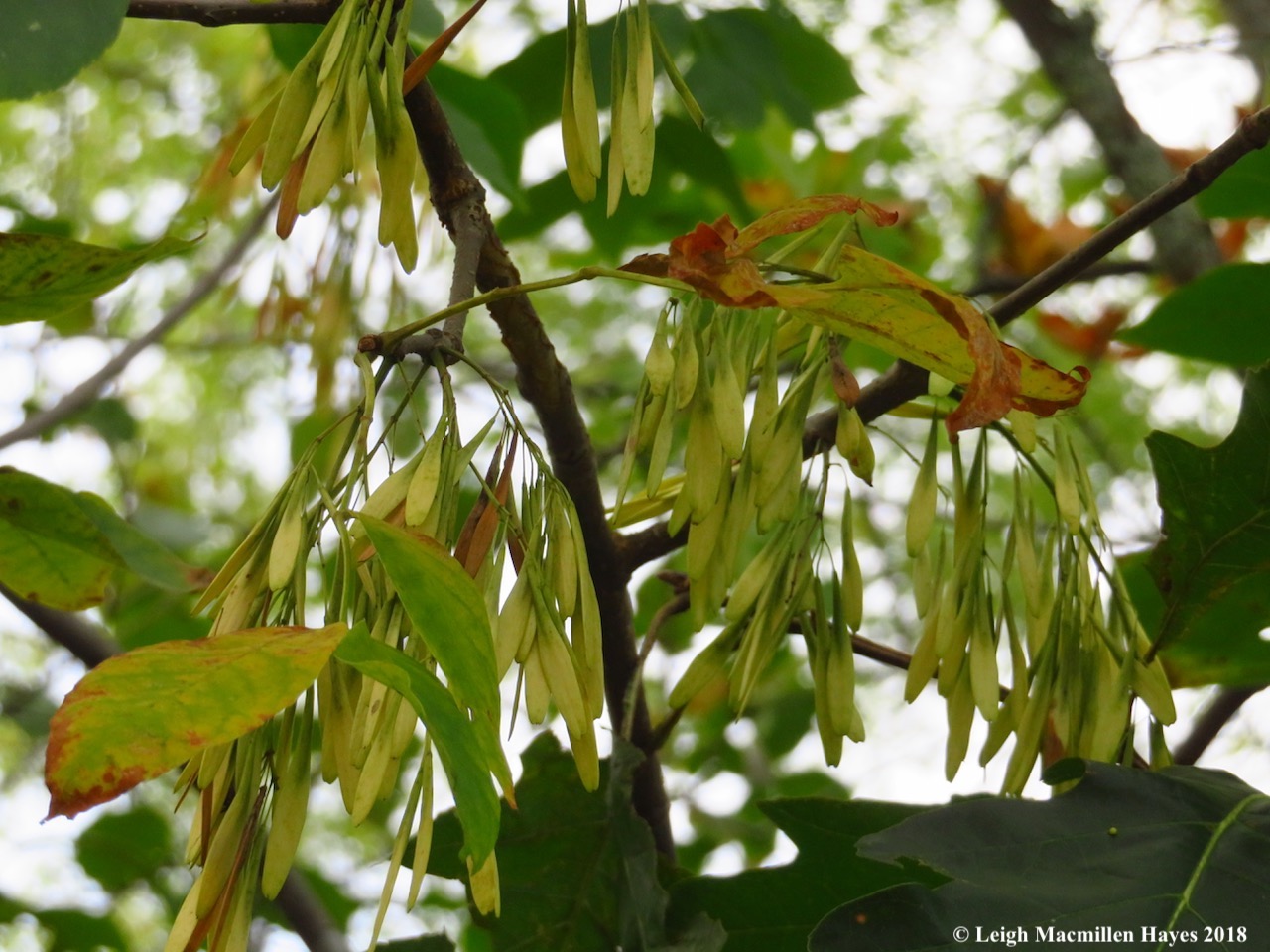
Upon some floats, seeds from the Ash rustled as they prepared to rain upon the ground like candy tossed into the gathered crowd.

4-crystalline tube gall on red oak

Oak leaves showed off their pompoms of choice–some being crystalline tube galls and others . . .

19-hedgehog gall?

possibly called hedgehog.

8-bald-faced hornet

Playing their instruments were the Bald-faced Hornets,

9-autumn meadowhawk

Autumn Meadowhawk Dragonflies,

11-immature green stink bug

and even an immature Green Stink Bugs.

10-green frog

On the percussion instruments at the back of the band were the green and . . .

23-pickerel frog

pickerel frogs.

15-yellow-rumped warbler

Adding a few fainter notes were a couple of Yellow-rumped Warblers.

16-yellow-rumped warbler

They didn’t want the chickadees to get all the credit for the songs of the woods.

17-hairy woodpecker

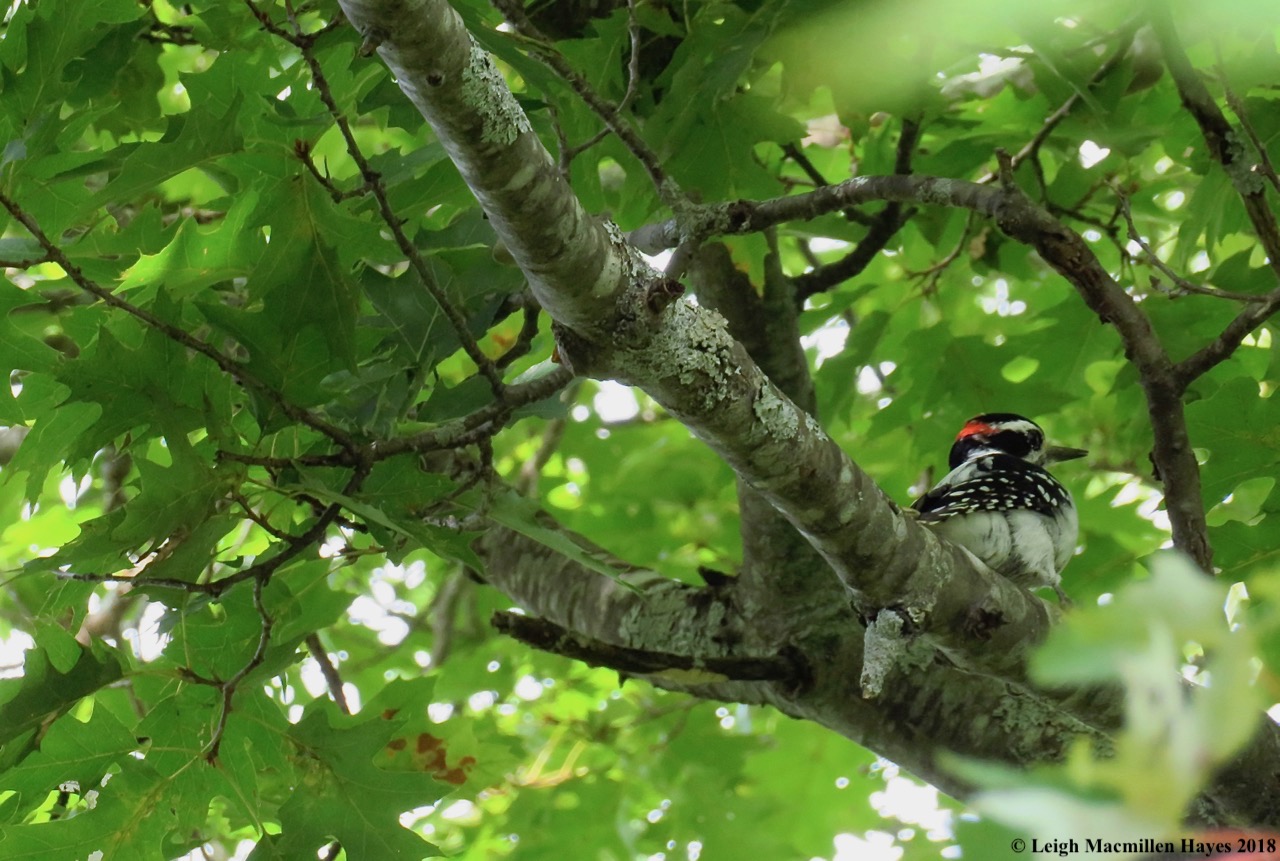
A Hairy Woodpecker also tapped a view beats.

12-wood ducks

Probably my favorite musicians, however, sported their traditional parade attire and awed those watching from the bandstand.

13-wood duck

Even a non-breeding male made the scene look like a painting.

14-wood ducks taking off

Their real contribution, though, came from the modestly plumaged females who offered a squealing “oo-eek, oo-eek”  each time they took flight.

18-sensitive fern

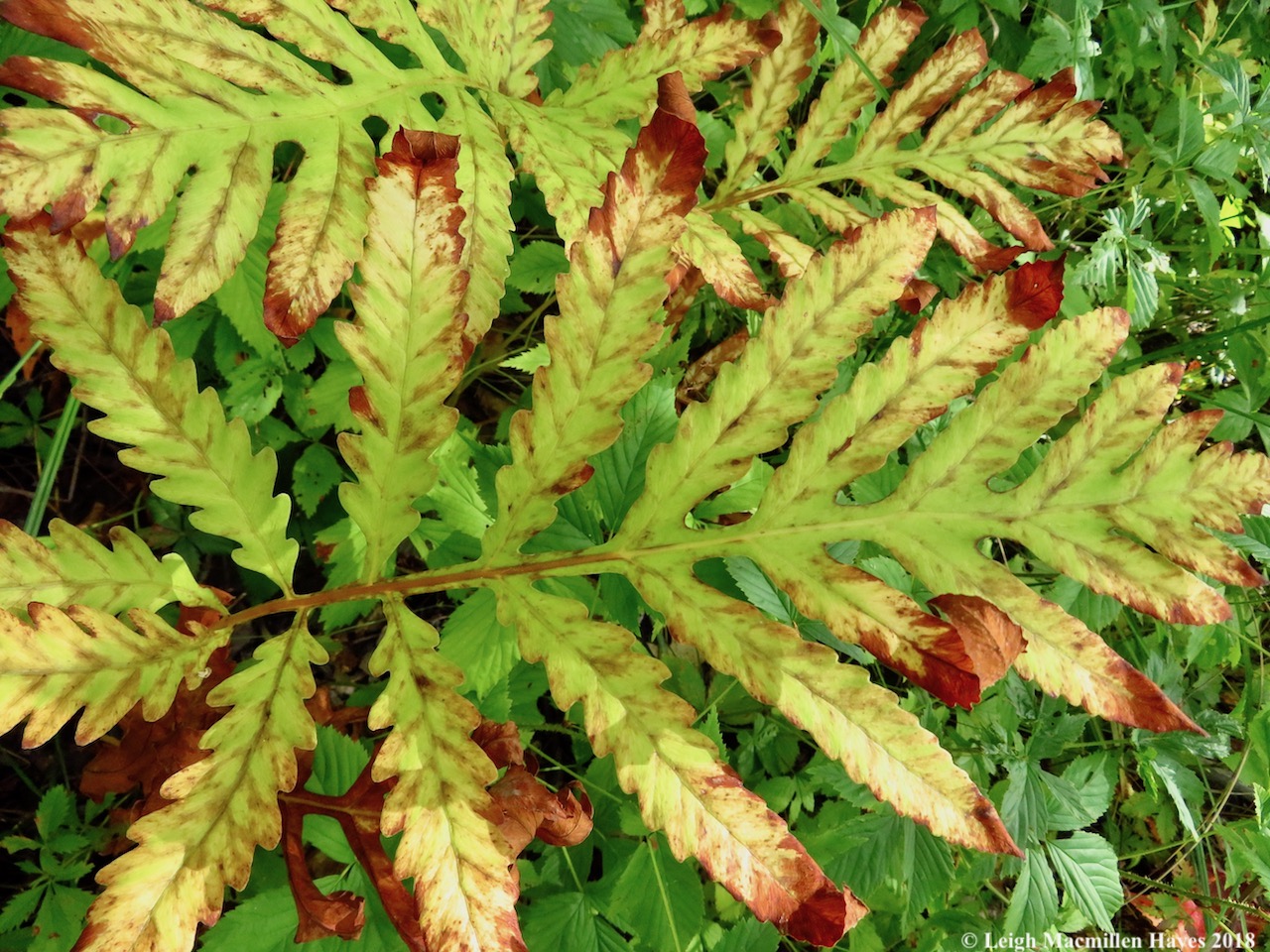
Though green attire was the most prominent of the day, others sported colors of change from yellows and browns to . . .

6-red emerging

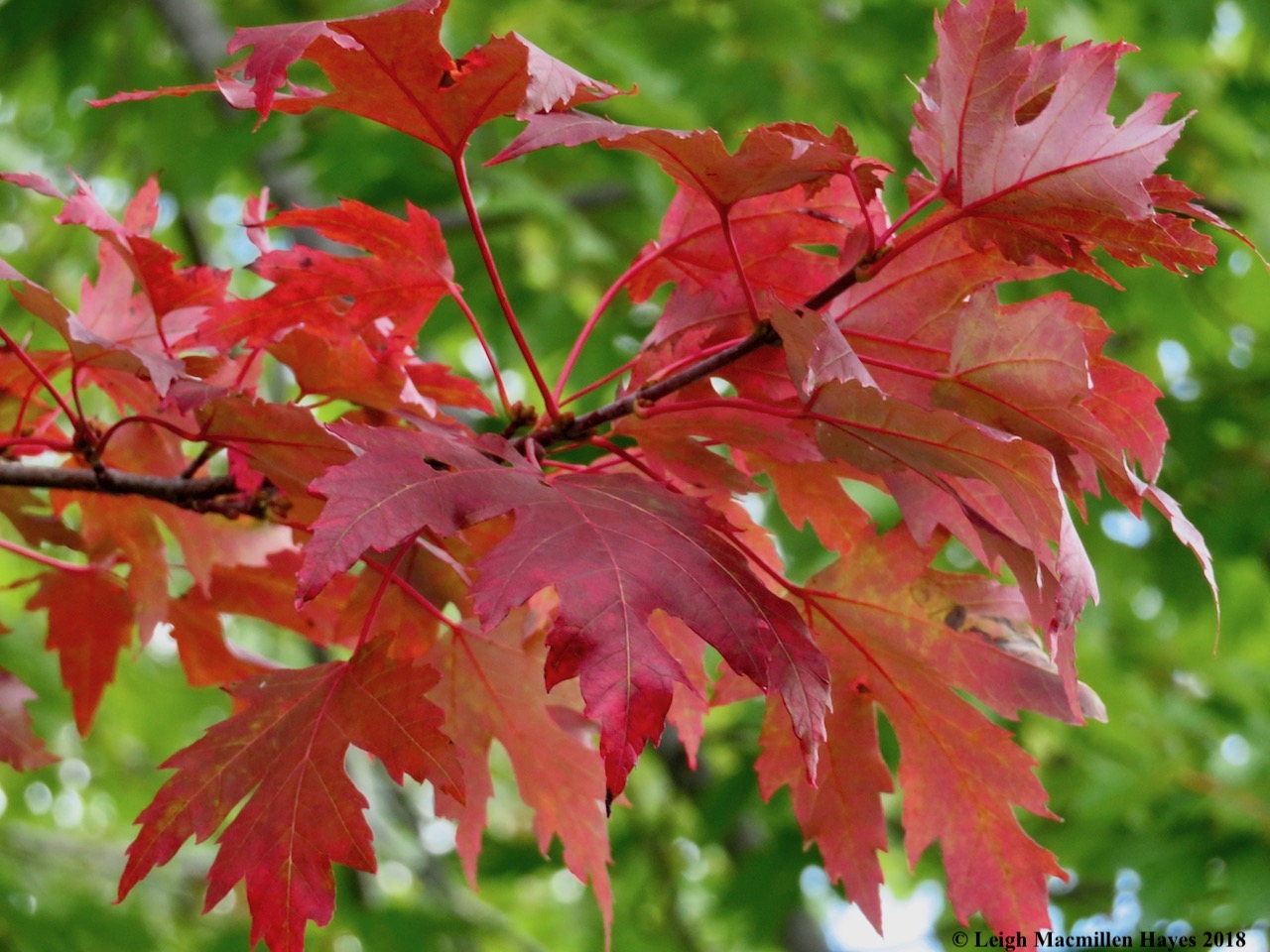
brilliant reds.

21-Brigadoon

As is often the case along such a route, vendors offered works of art for sale, including local scenes painted with watercolors.

22-lily reflection and aquatic aphids

Before it was over, a lone lily danced on the water and offered one last reflection.

24-season transformation

And then summer marched on . . . into autumn.

Mondate of a Rare Type

Aha. So our Mondates are hardly rare, though we don’t spend every Monday on a hiking date. What, therefore could the title mean?

d1

Follow us down the trail at the Dahl Wildlife Sanctuary in North Conway, New Hampshire, and I think you’ll soon understand. The property is owned by NH Audubon and located adjacent to LL Bean, though the parking is in a tiny lot across from Burger King on Route 16.

d2

It’s not a long loop, but it’s chock full of wildflowers like the Black-eyed Susans beginning to burst open into rays of sunshine.

d3

We also passed an abundance of shrubs such as Staghorn Sumac and my mind raced ahead to a future visit with Michael Cline’s book, Shrubs of the Northern New England Forest.

d16a-silver maple floodplain

Because we were near the Saco River, part of the loop took us through a Silver Maple floodplain where the trees arched above in cathedral formation.

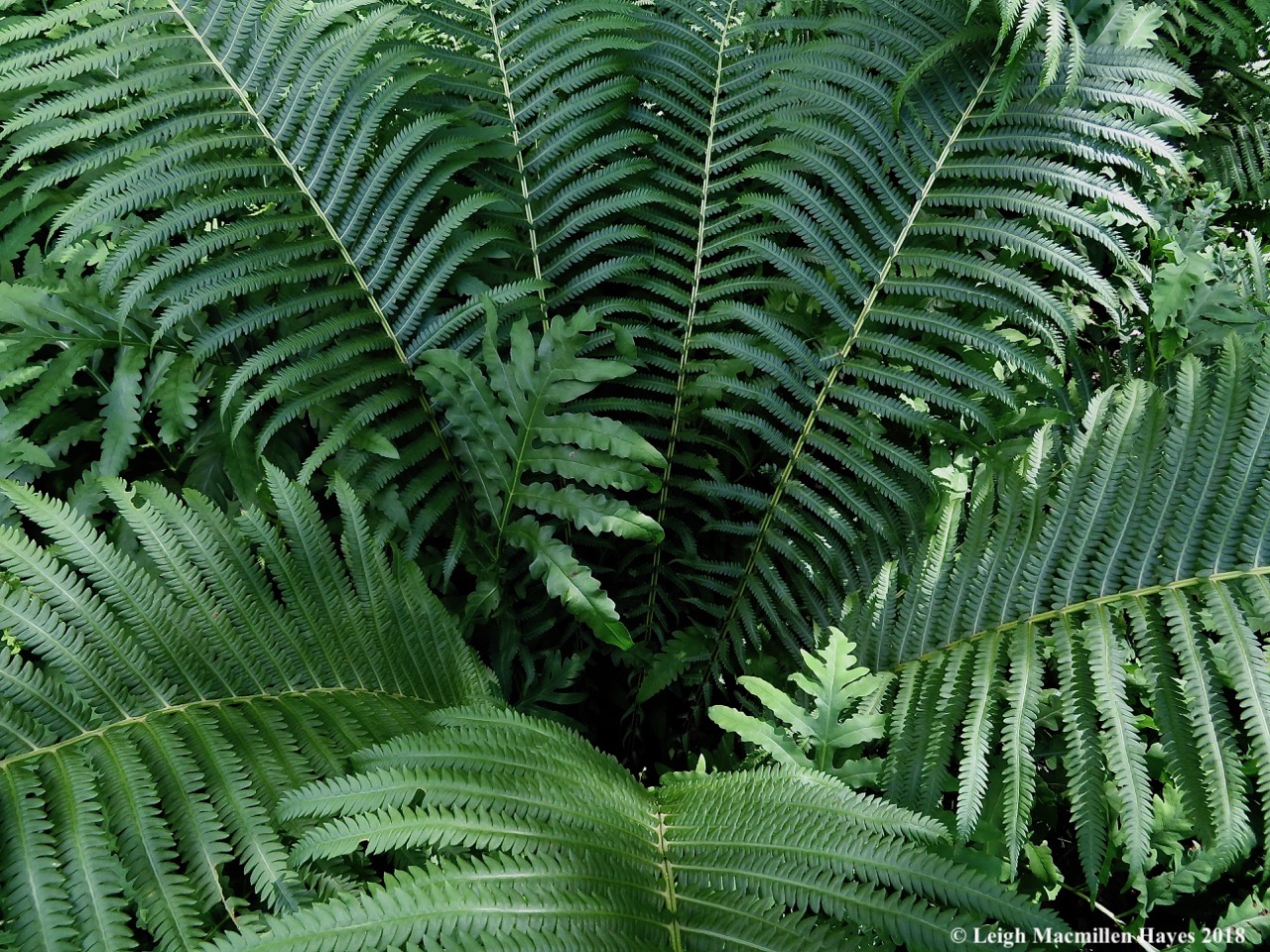
d17-ostrich fern

In the same habitat, but at waist level, Ostrich Ferns grew in their vase-like fashion..

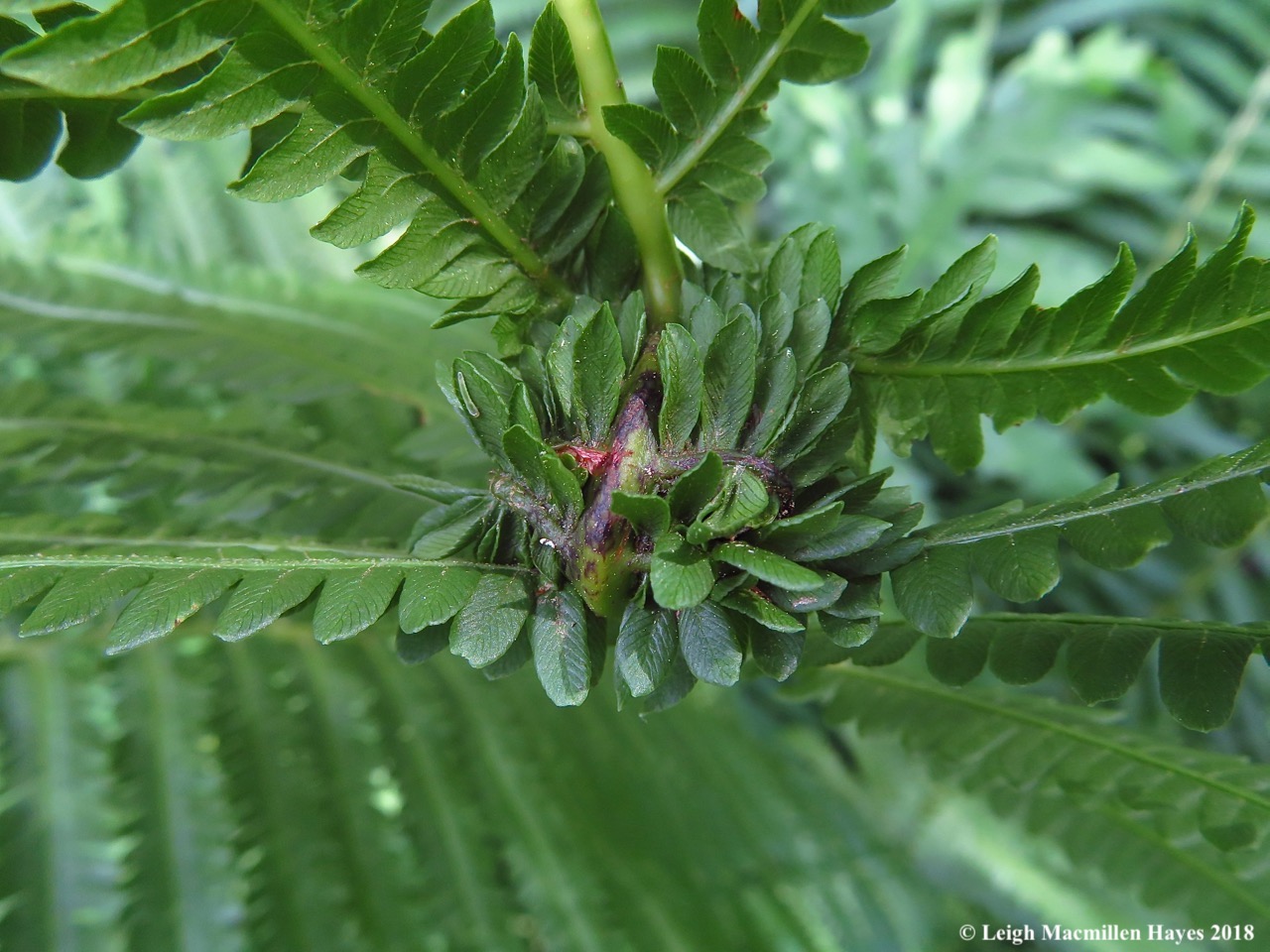
d18-Tortricid Moth gall

And among them, growth of another kind was apparent for possibly a Tortricid Moth had used the terminal part of the fern’s frond for its larvae to feed and pupate.

d5-Saco River

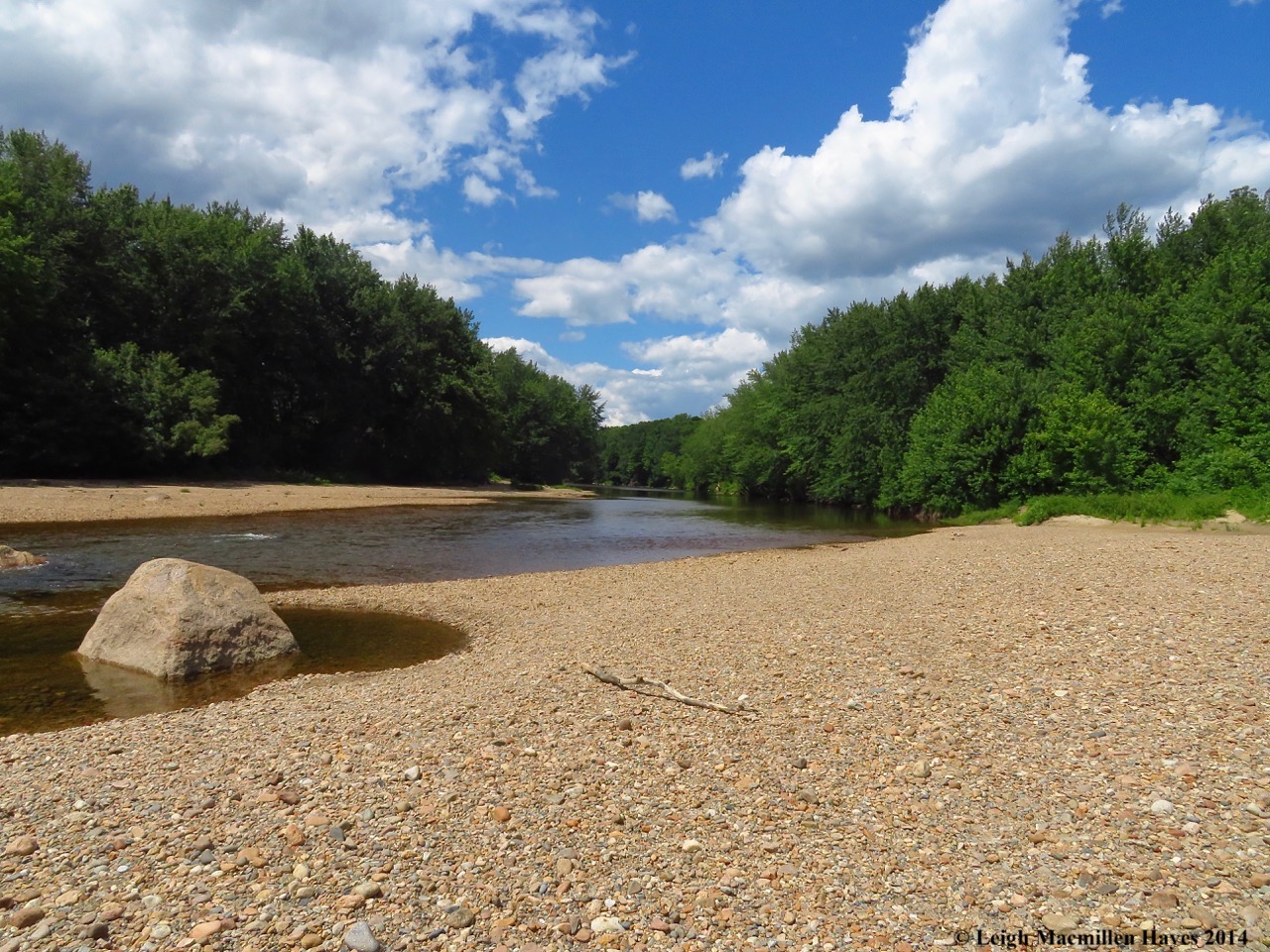
Stepping out of the forest and into the sunshine, we suddenly found ourselves beside the Saco River, where we looked north.

d4-Saco River

And then south. A few kayakers passed by, but for the most part we were alone.

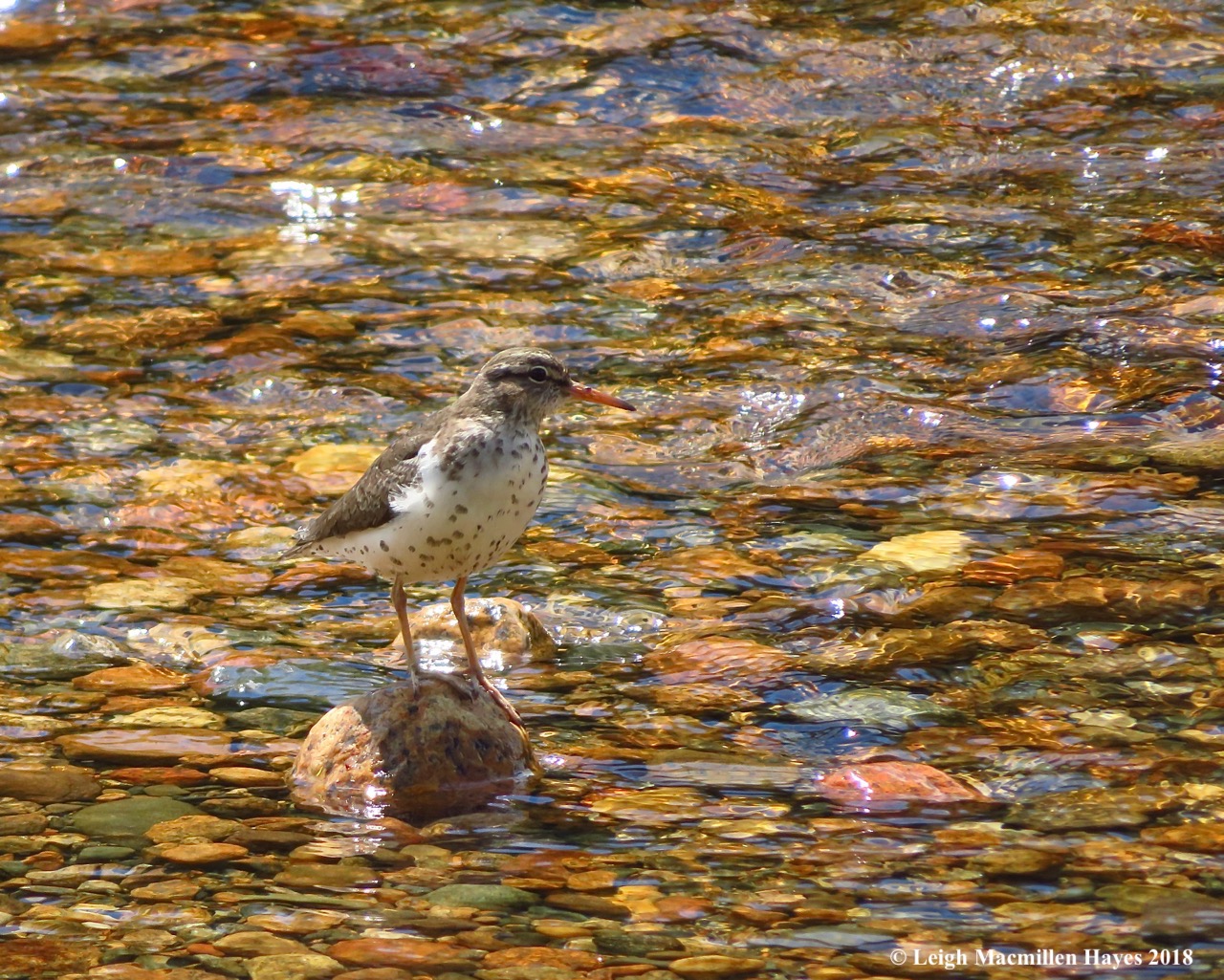
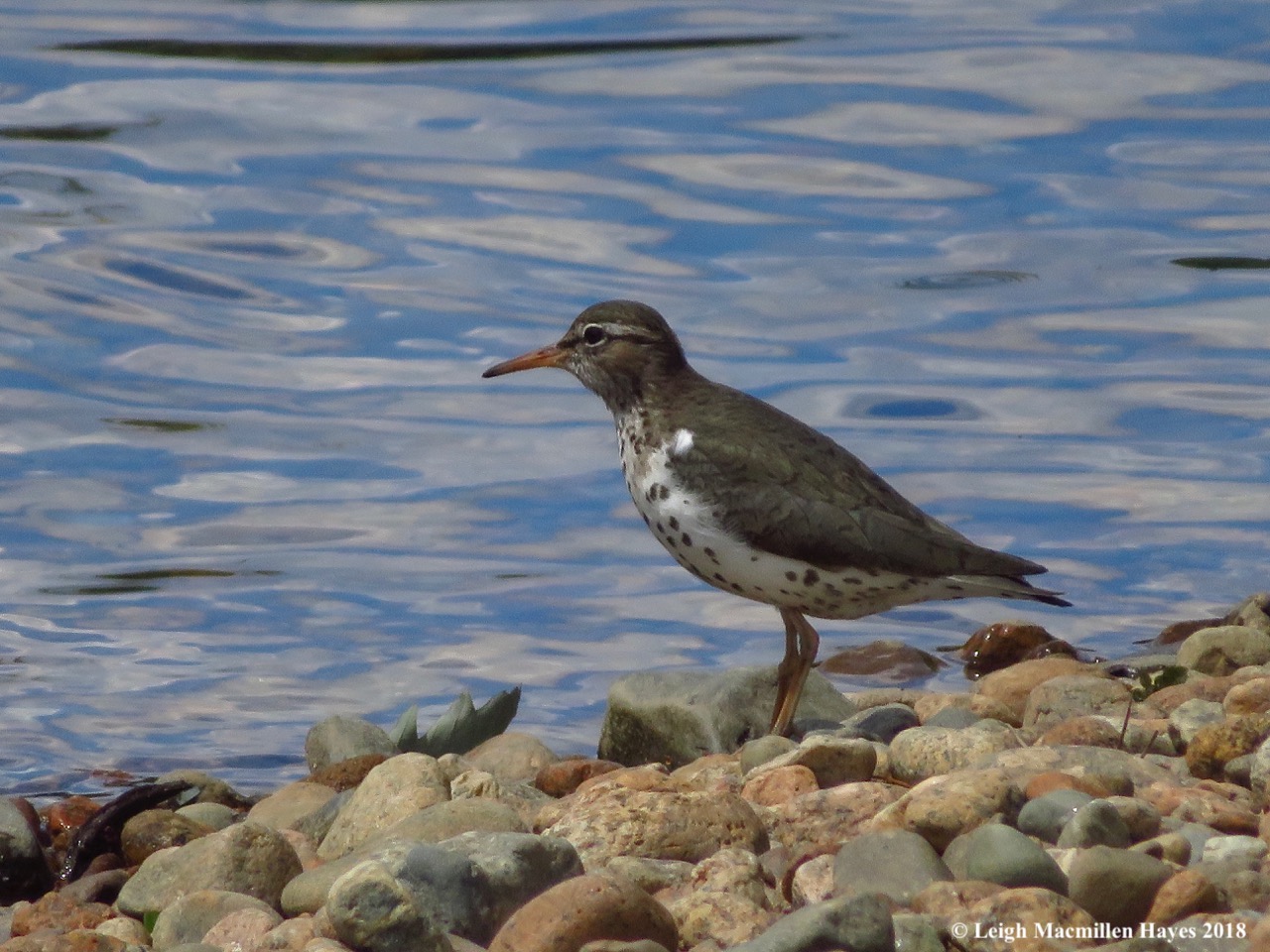
d4, spotted sandpiper

In reality, we weren’t for a solitary Spotted Sandpiper explored the water . . .

d7-spotted sandpiper

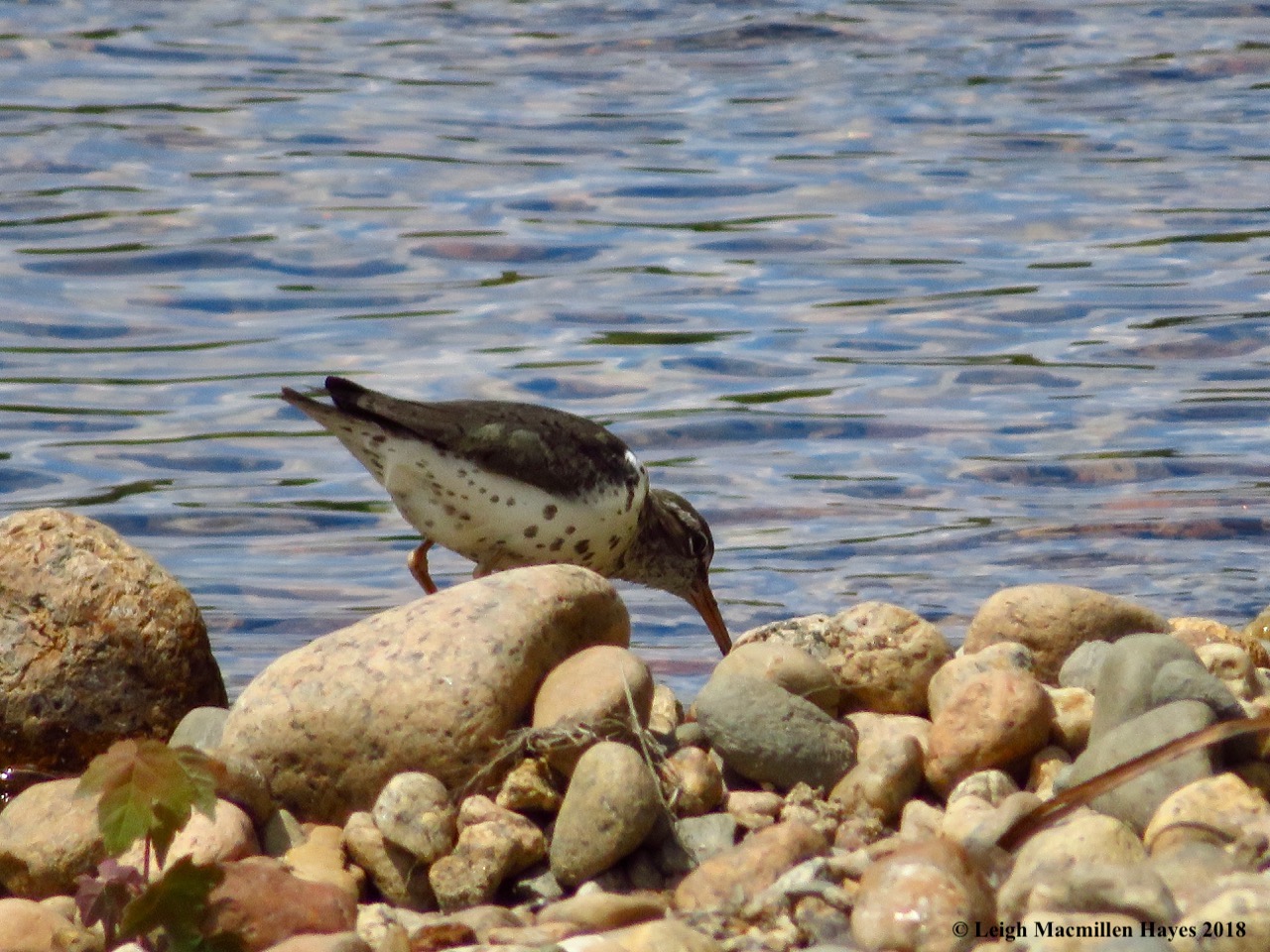
and cobbled beach,

d23-sanpiper foraging

where it foraged for insects, small fish and crustaceans.

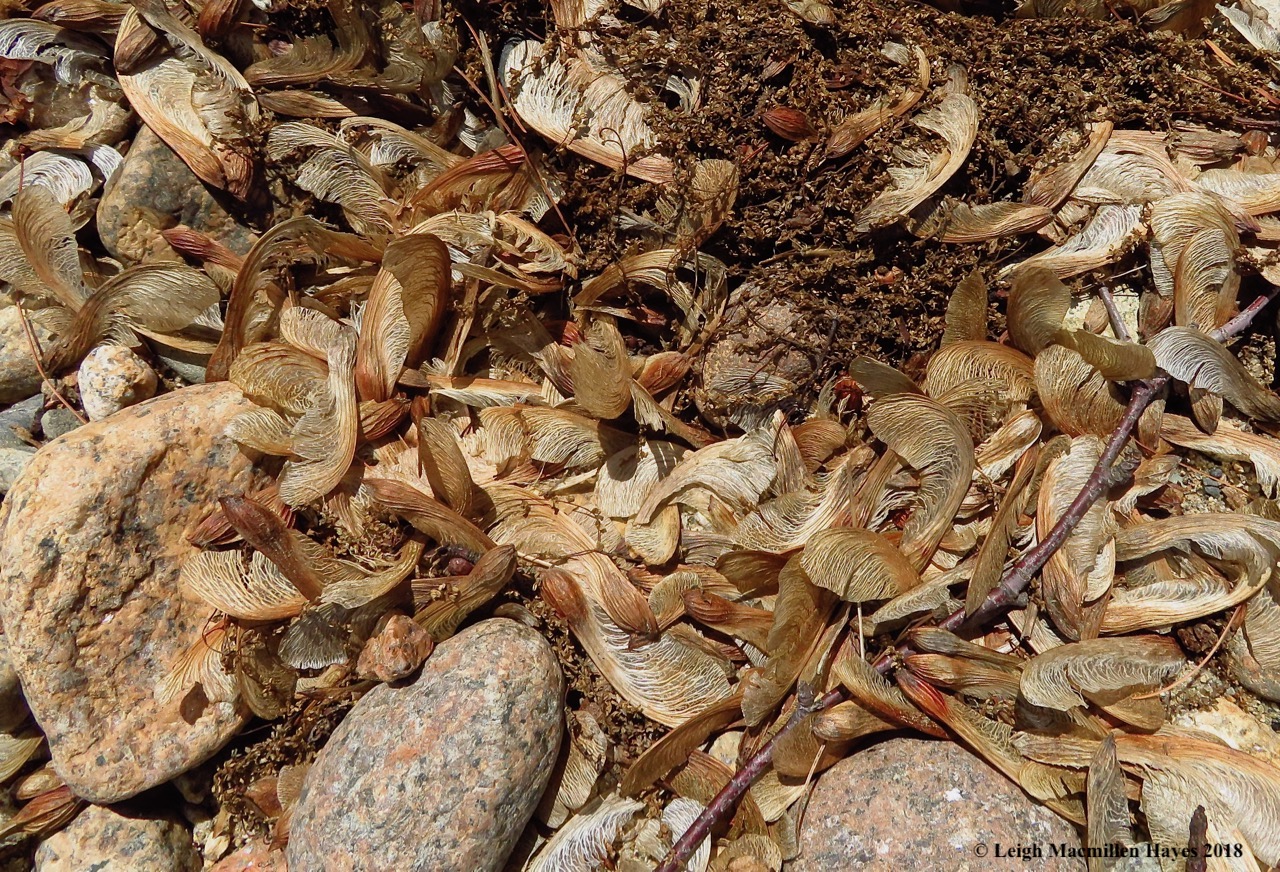
d8-silver maple samaras

Silver Maple seeds were not on its grocery list and they sat in abundance along a high water mark, waiting in anticipation . . .

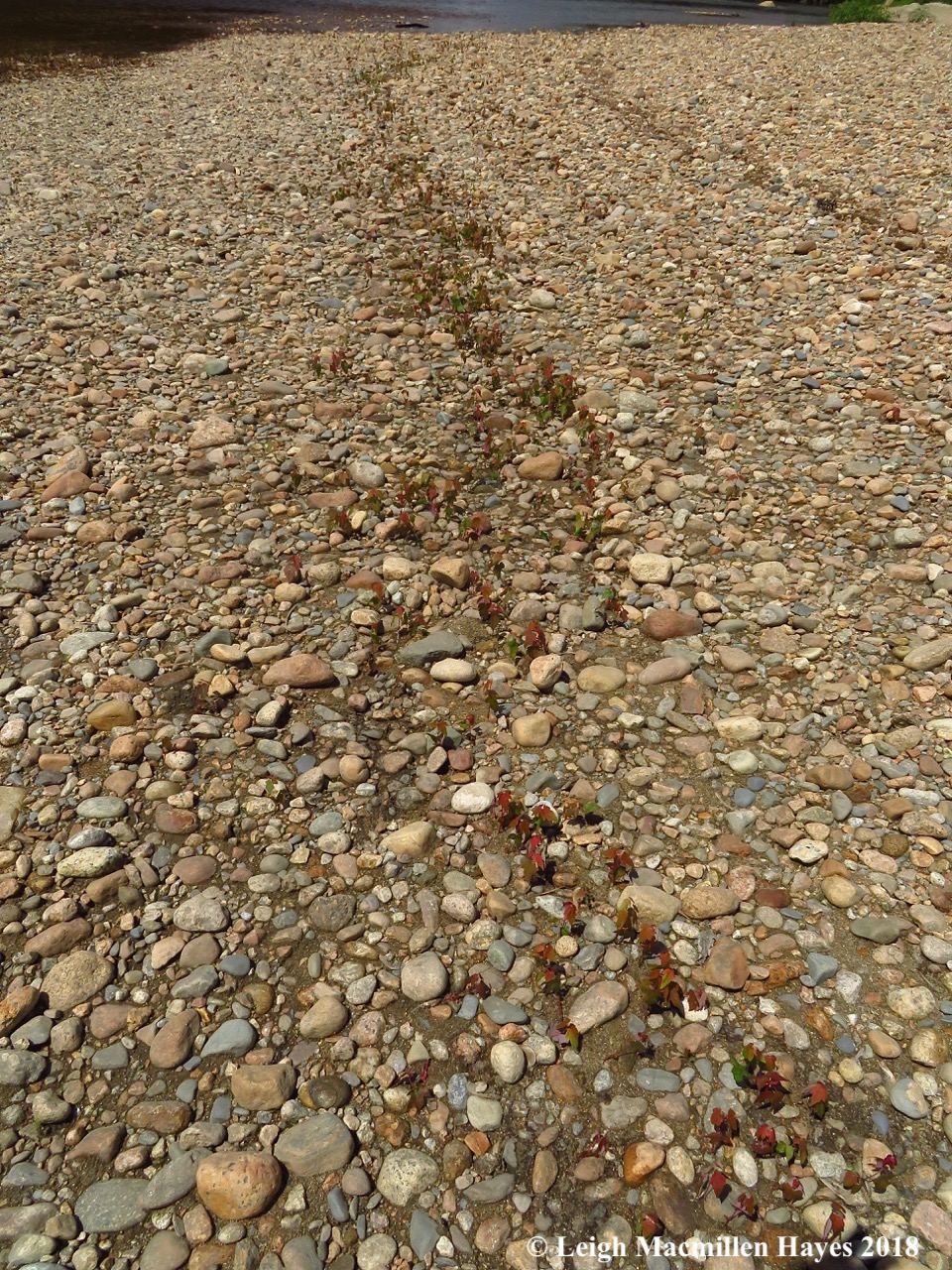
d9-silver maple saplings

to join their older siblings and create their own line of saplings next year.

d10-South Moat

After standing at the water’s edge for a bit longer and enjoying the ridgeline view from South to Middle Moat Mountains, it was time to search for the rare finds that brought us to this place.

d24

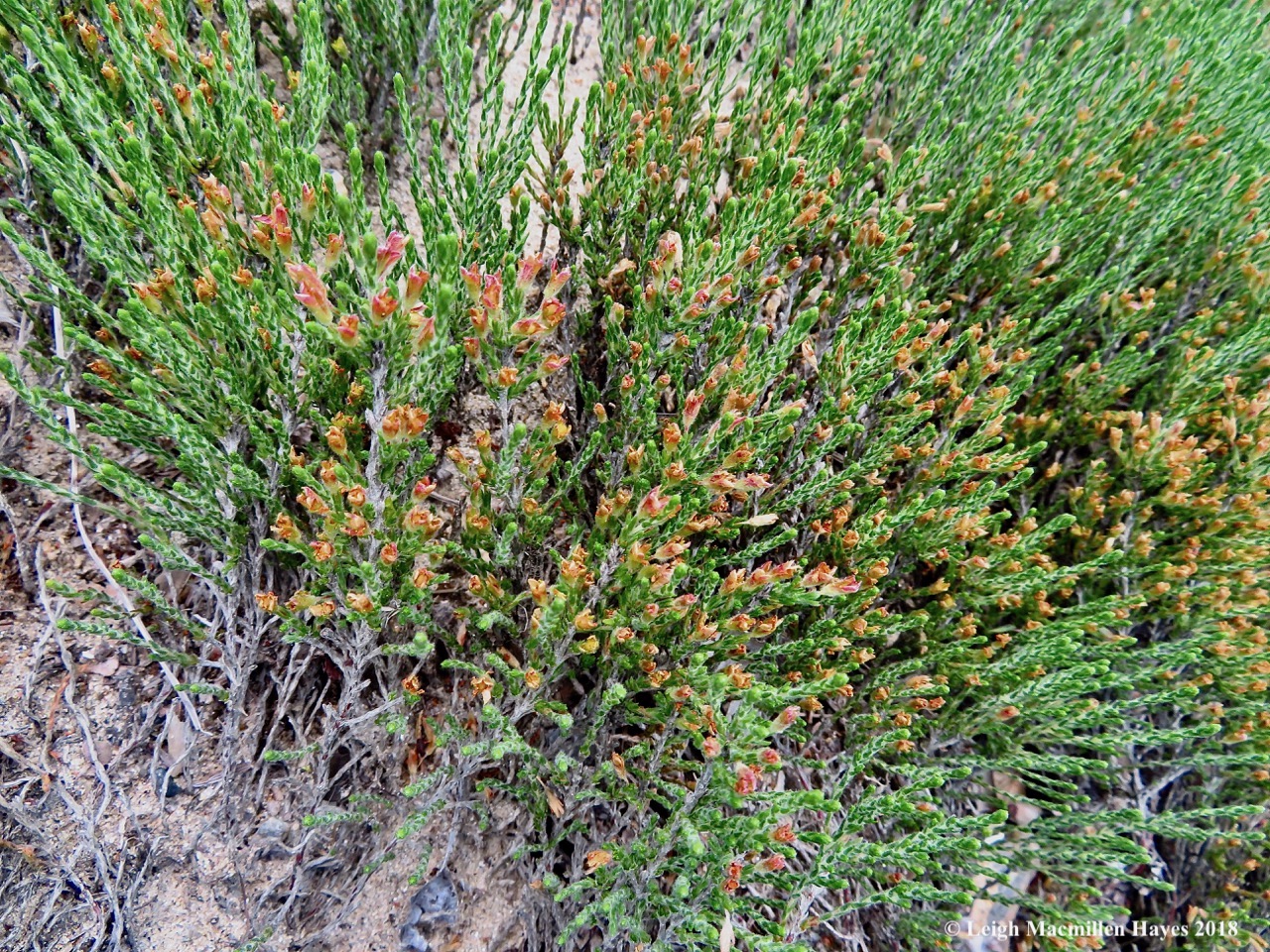
The first was a clump upon a small sand dune–Hudsonia tomentosa.

d25

One of its common names is Sand False Heather, which certainly fit its location and structure. This mat-forming plant had the tiniest of flowers, but it was by its heathery look that I spotted it. It’s listed as rare and threatened in New Hampshire.

d15-silverling

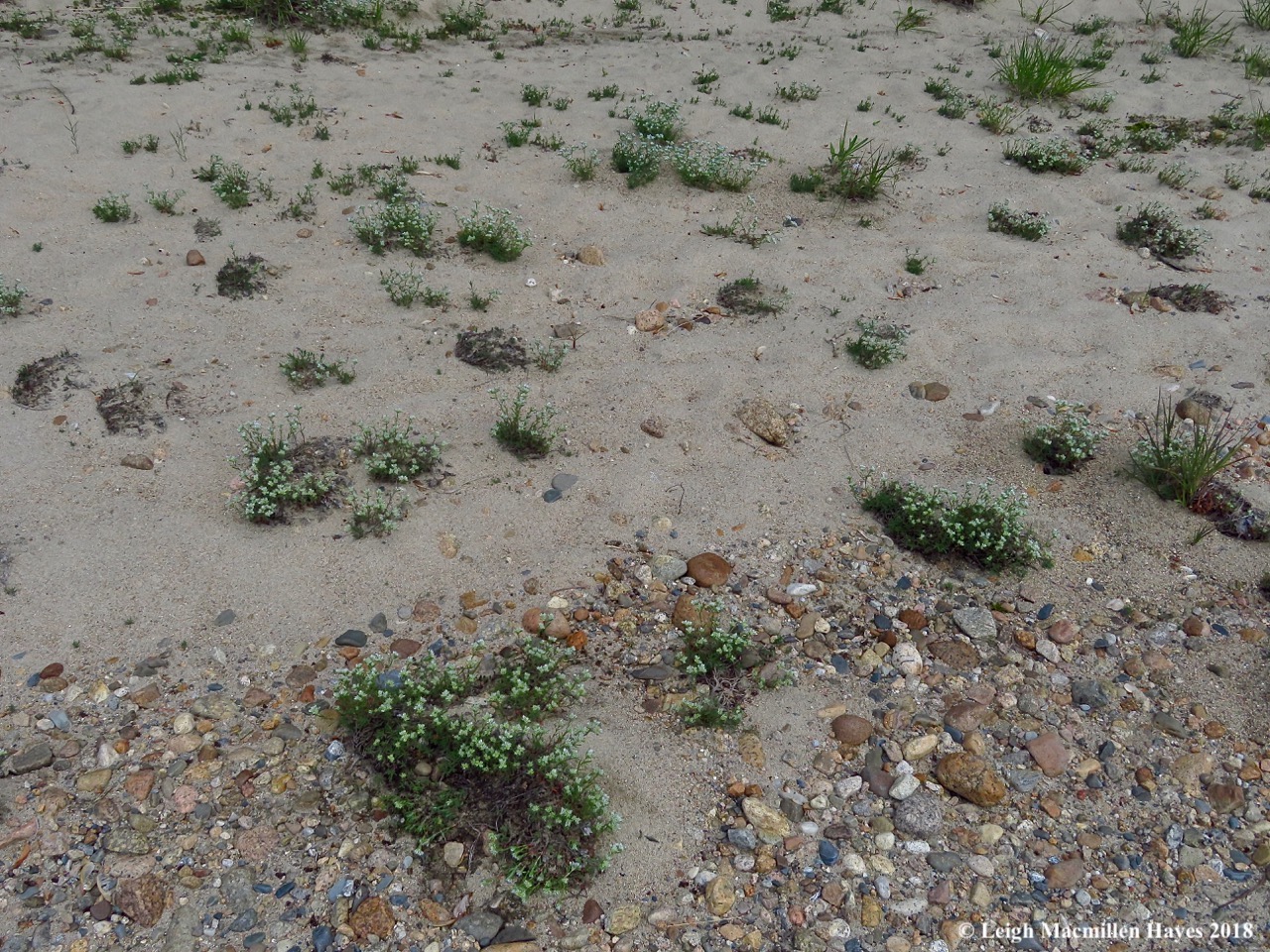
While I only found two clumps of the heather, the second rare plant featured a larger colony.

d12-silverling1

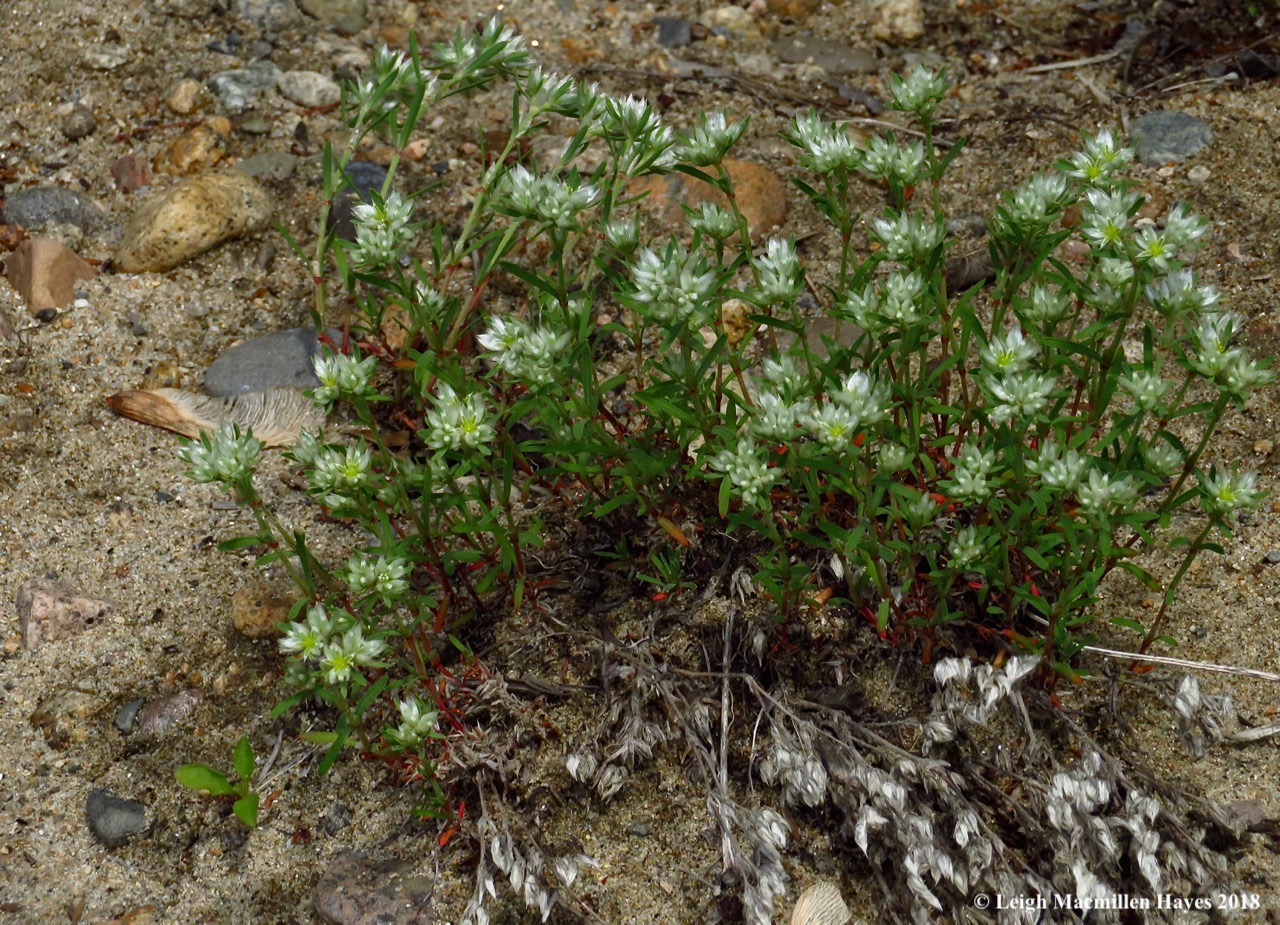
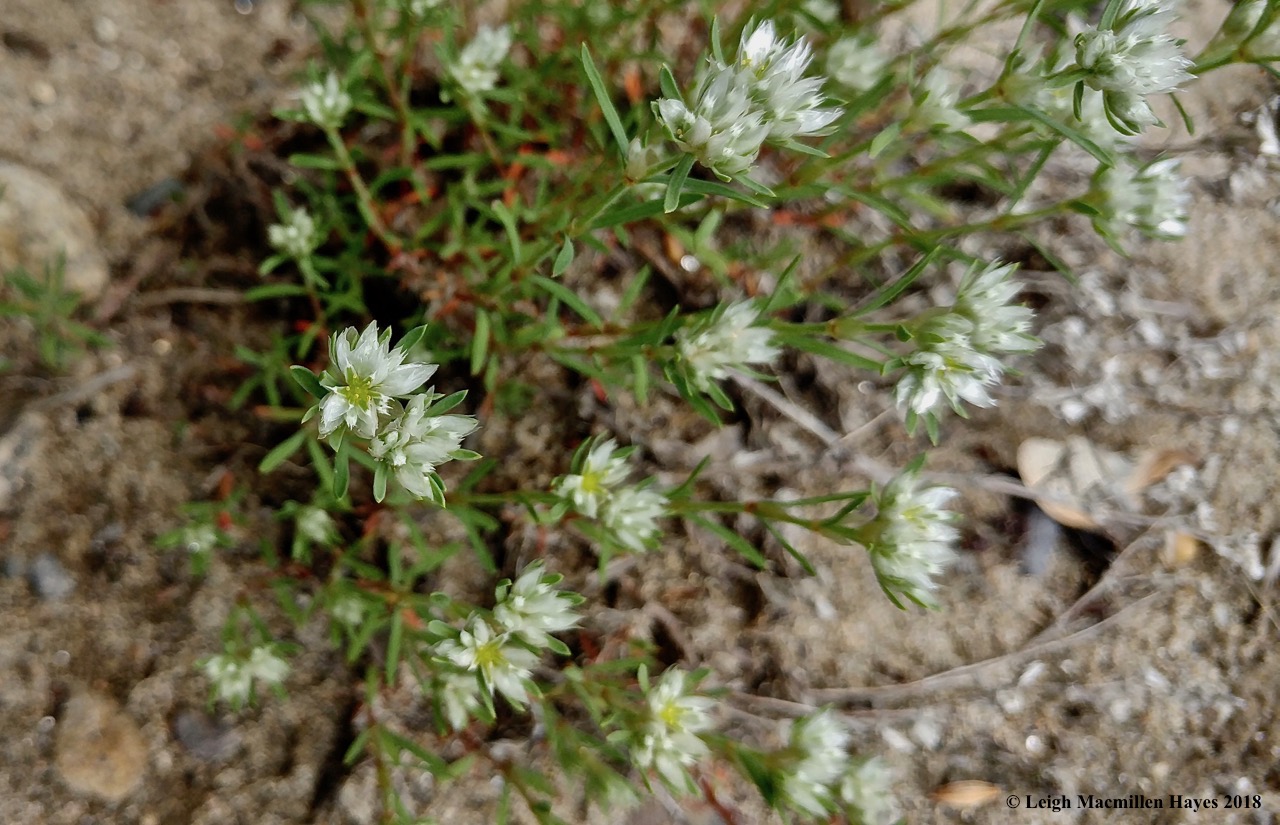
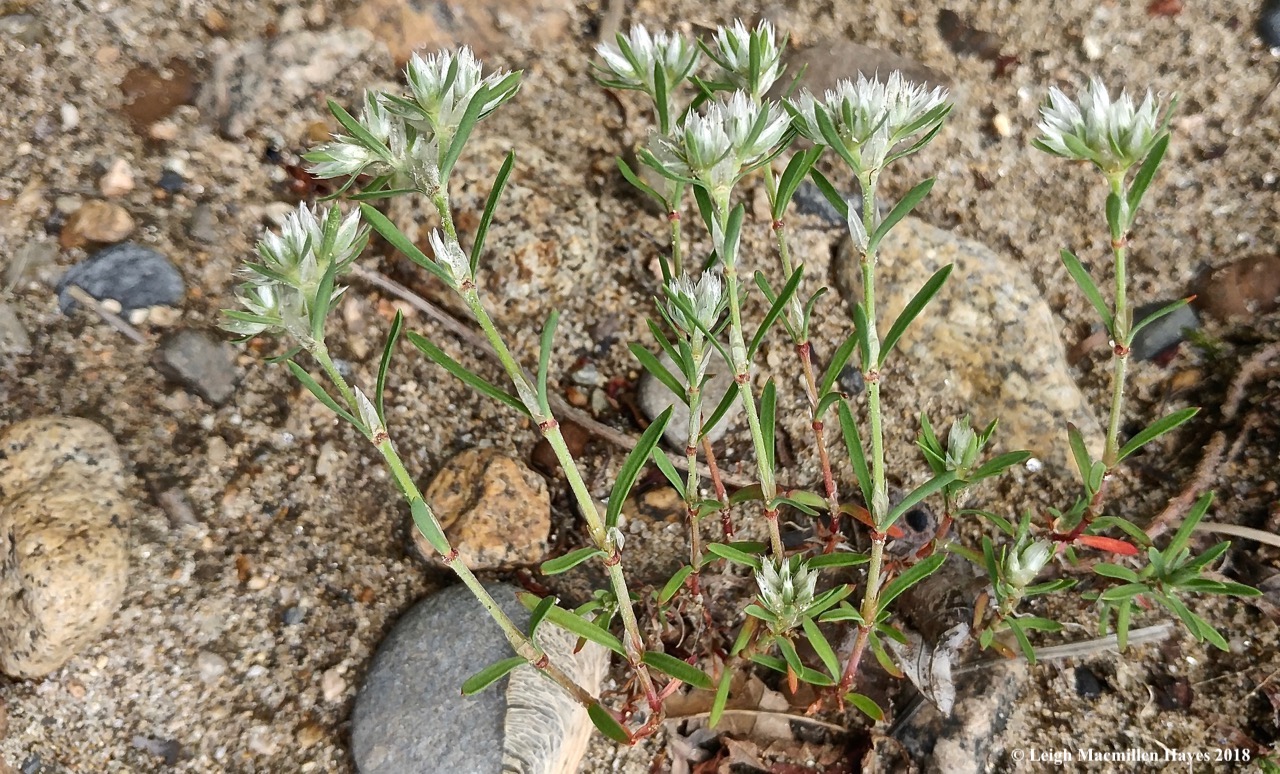
Paronychia argyrocoma is also listed as rare and threatened in New Hampshire (and extremely rare in Maine).

d13-silverling

Also known as Silvery Whitlow-wort, it prefers the ledges and ridges of the White Mountains and . . . gravely bars along rivers. Its whitish green flowers were ever so dainty.

d14-silverling3

From a side view they were most difficult to see for silvery, petal-like bracts hid their essence.

After those two rare finds, my heart sang . . . a song that had started a couple of hours earlier when my guy and I dined with my college friend, Becky, and her daughter, Megan. Another rare and delightful event.

They say three times is a charm and I certainly felt charmed for this rare type of Mondate.


Flexing My Wings with Jinny Mae

It’s been a while since Jinny Mae and I had wandered and wondered together, but this afternoon the opportunity finally arose. And so we agreed on a time and place (though she did change the time ;-) ), and pulled into the parking lot of the Mountain Division Trail located closest to the Eastern Slopes Airport on Route 5 in Fryeburg, Maine.

m6-Mtn Division Trail

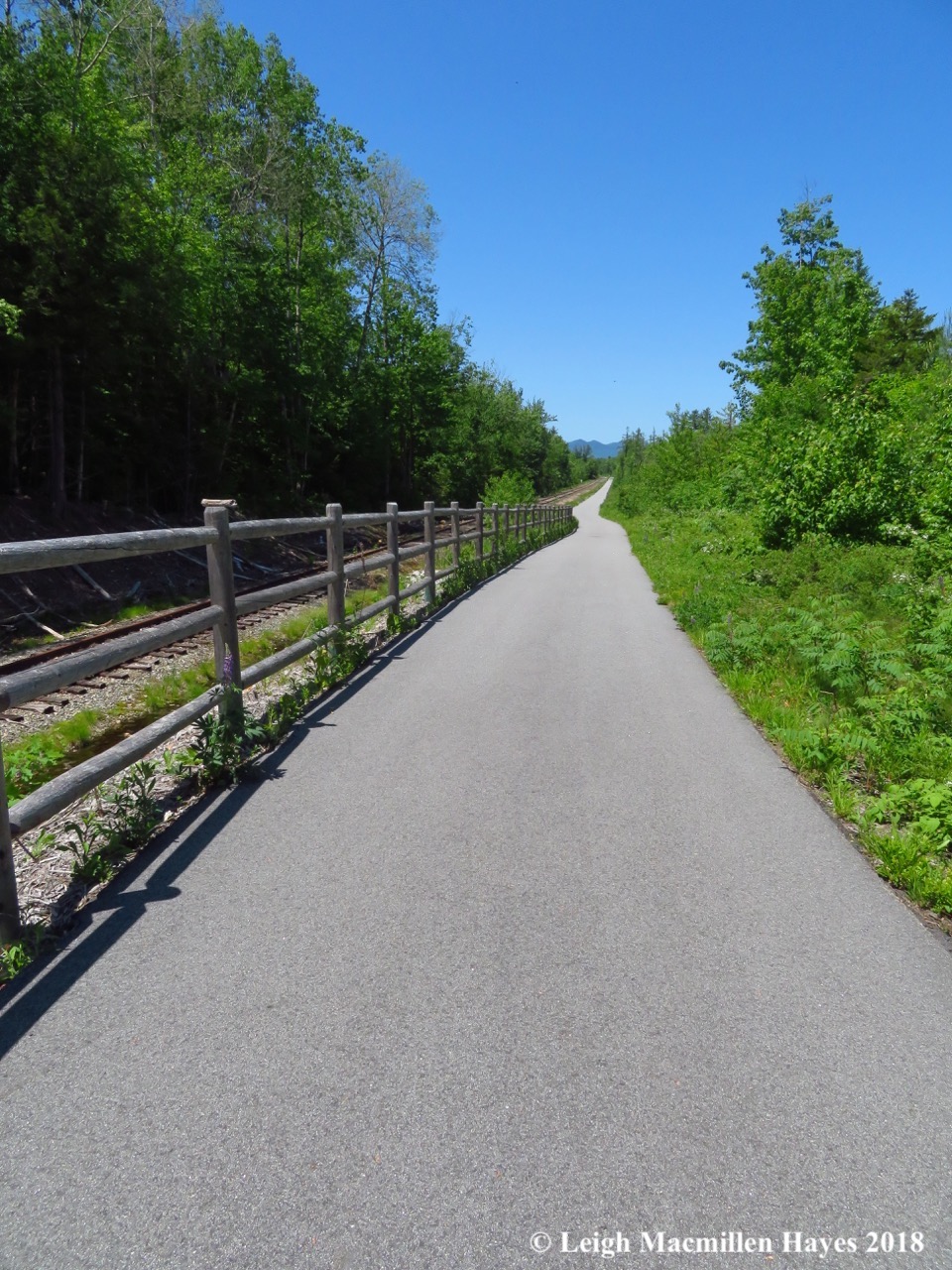
Rather than a rail trail, this is actually a rail-with-trail even though the rail is not currently active.

m2-lupine

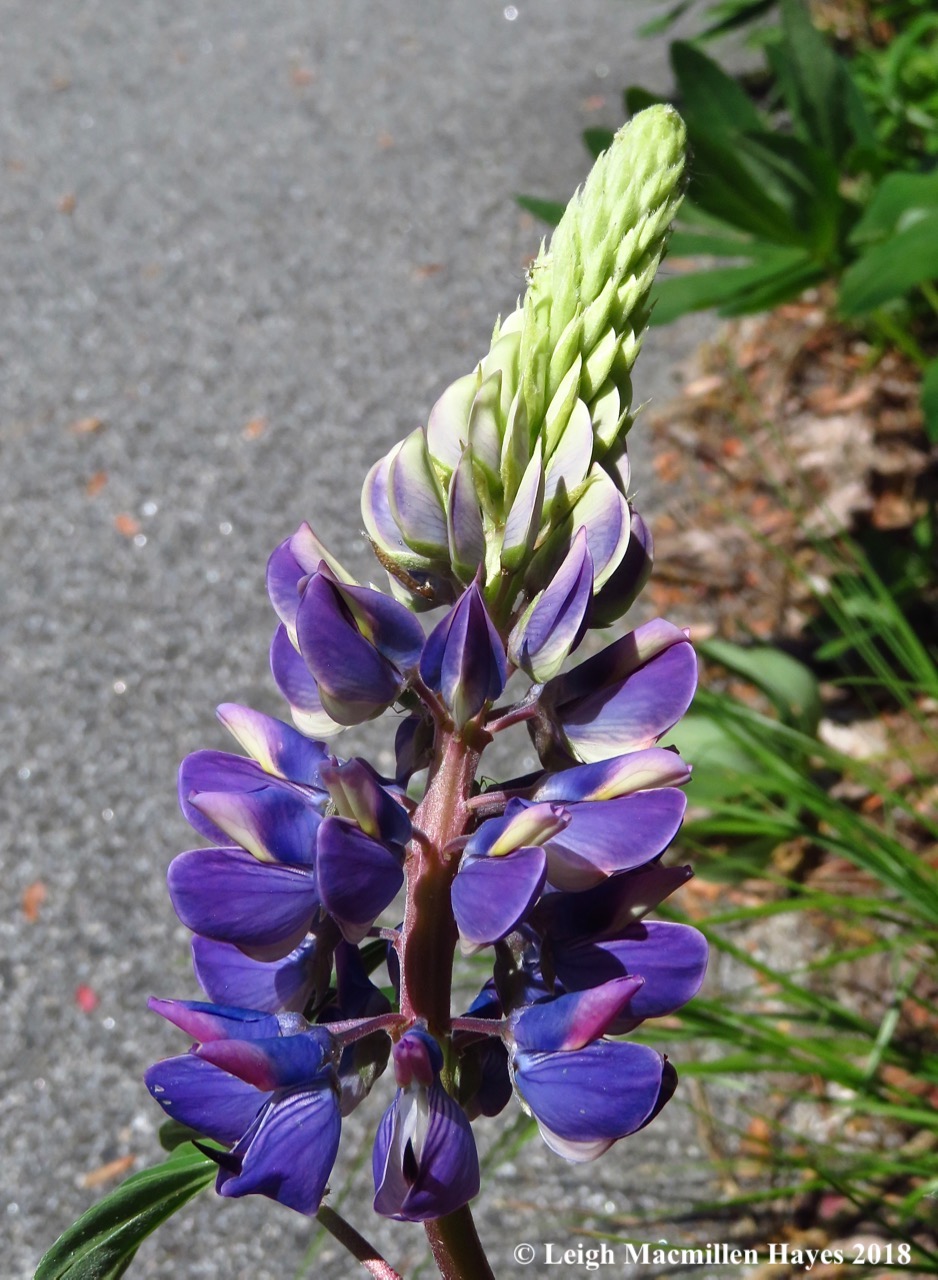
From the start, we were surprised and delighted to see so many lupines in bloom along the edge. Lupines are members of the pea or legume family, Fabaceae. As such, the flowers have a distinctive upper banner, two lateral wings, and two lower petals fused together to form a keel. Those lateral wings earned the plant’s place in this contemplation.

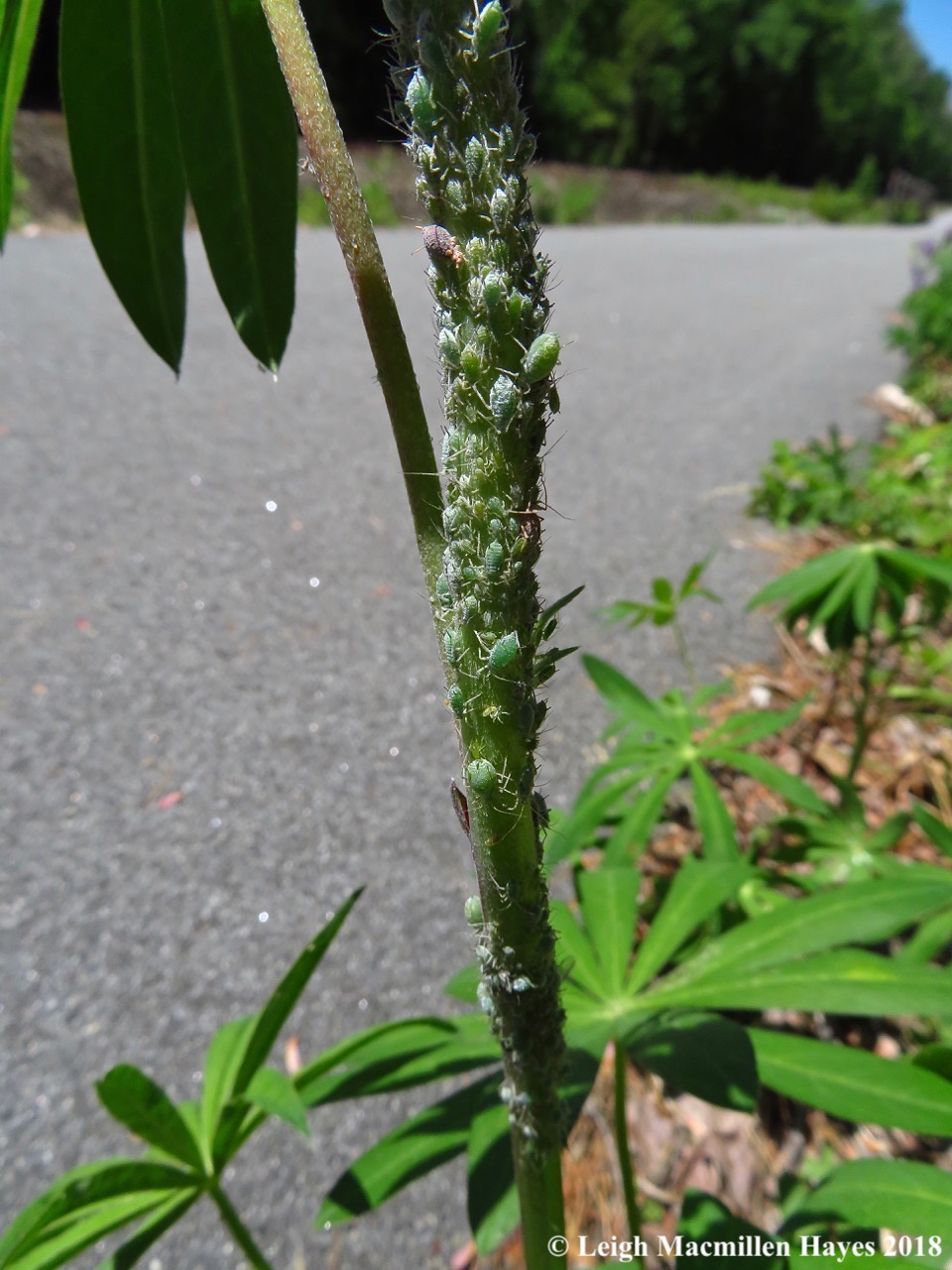
m2a-lupine aphids

Of course, being that not everything in nature is as perfect as we might desire, we did discover destruction in action on a few stems and flowers. Lupine aphids seeking honeydew suck the juices from a plant. They’ll continue to feed until midsummer, even after they’ve destroyed the flower.

While there isn’t much to celebrate about these garden pests, it is worth noting that all aphids are female and give birth to live young, without mating. And another cool fact–once the population grows too large, they will develop wings and fly to a new host plant.

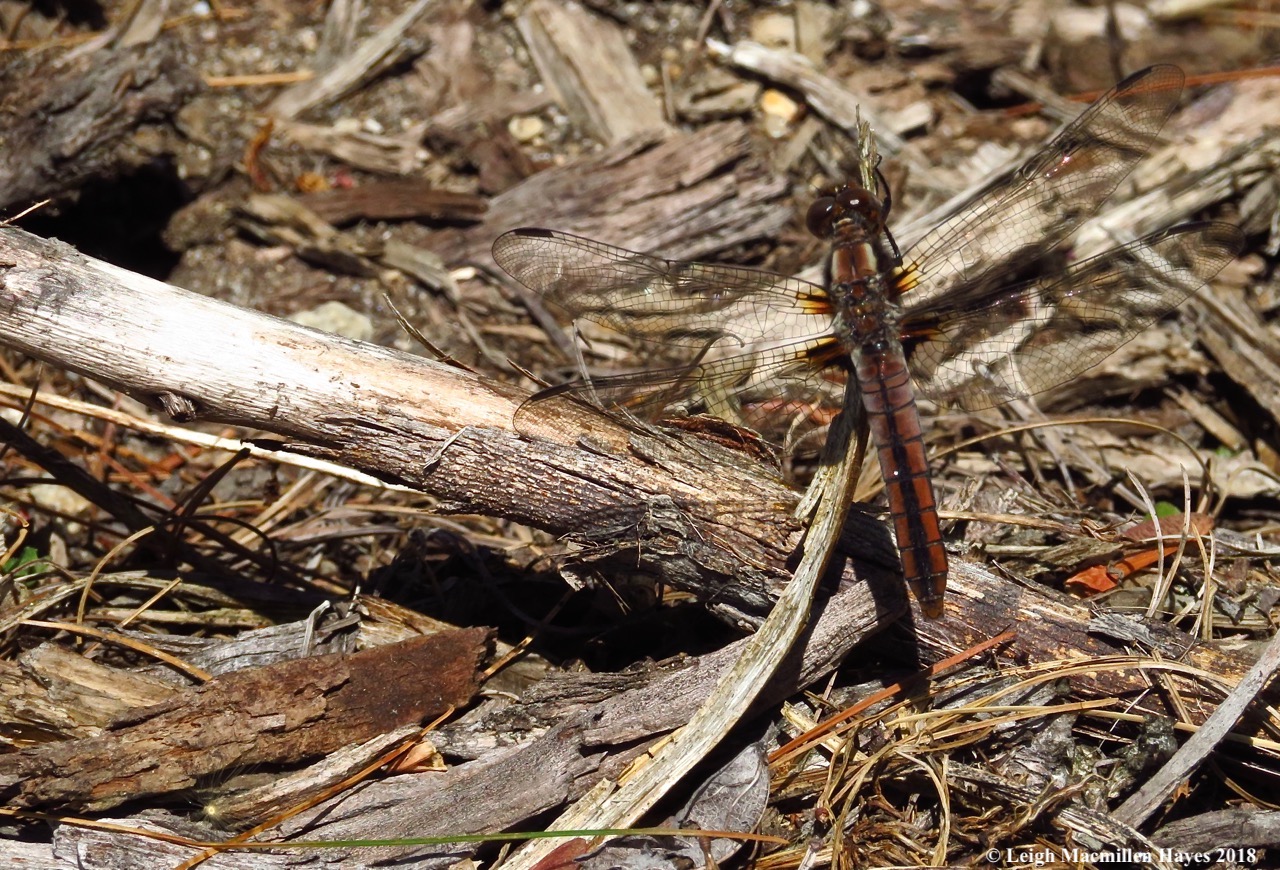
m3-chalk-fronted white corporal

We continued our journey at our typical slow pace and stopped frequently to admire the dragonflies. There were quite a few species, but many spent time patrolling in flight and so we couldn’t photograph them. We did, however, give thanks for the work of all for we felt the sting of only a few mosquitoes. And we appreciated the perchers as well, for by letting us get a closer look we could learn their characteristics, and therefore ID: Chalk-fronted Corporal;
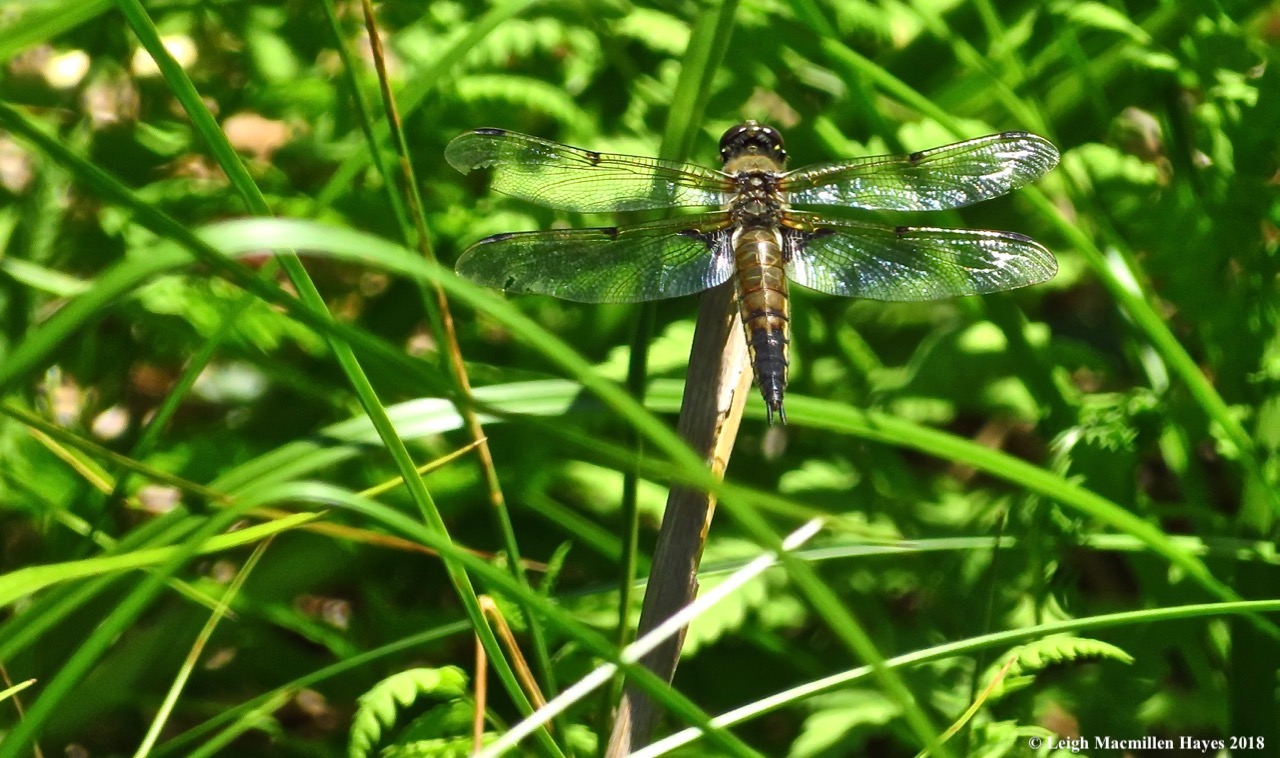
4-four-spotted skimmer

Four-spotted Skimmer;

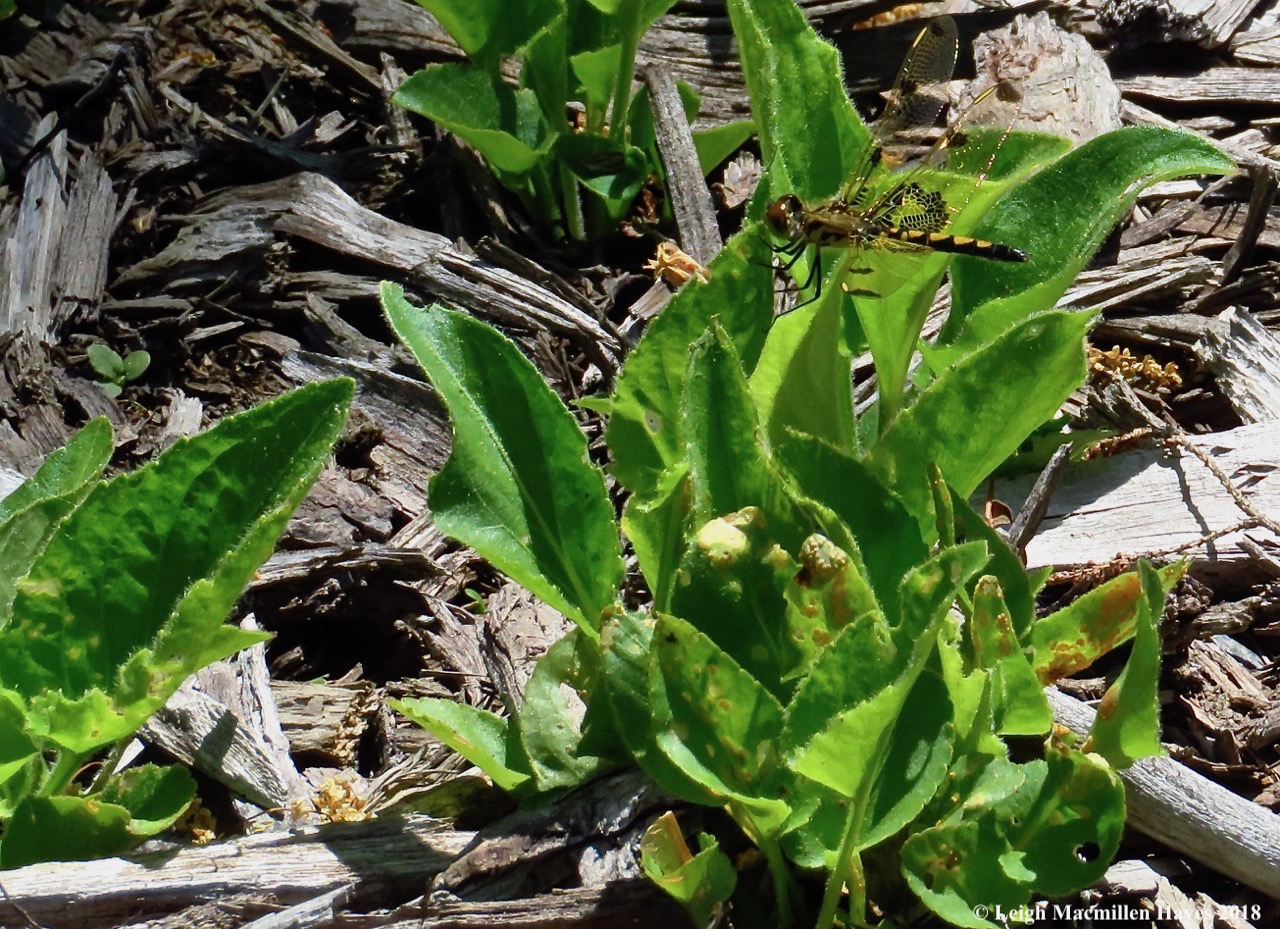
m5-calico pennant

and Calico Pennant.

m7-ant dragging grasshopper

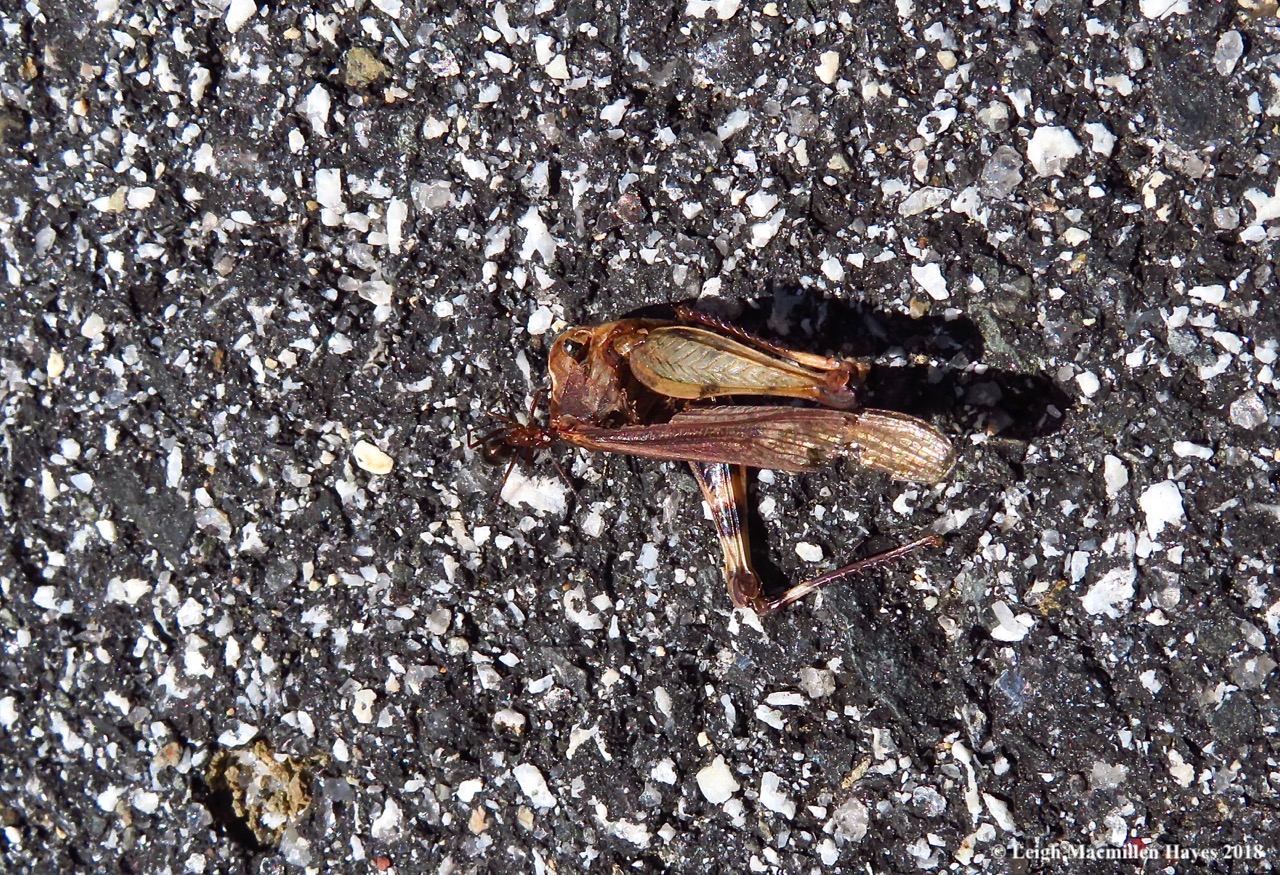
We also noted a crazy ant act. The ant apparently got a great deal at the grocery store and somehow managed to single-anticly drag the remains of a grasshopper home–that’s one flier we won’t see in the air again.

m8-wood sower gall wasp gall

We also stumbled upon another interesting find–the galls of a wood sower gall wasp. As I told Jinny Mae, I’ve seen them before and knew they were associated with oak trees, but couldn’t remember the name in the moment. Maybe if I say it five times fast and spin around three times I’ll remember its name the next time I encounter it. Doubtful.

m8-wood sower gall wasp

The cool facts about this fuzzy white gall with pink polka dots, which is also known as oak seed galls: it only grows on white oak; the fuzziness is actually secretions from grubs of the gall wasp; and within are seed-like structures that cover the wasp larva.

m9-tiger swallowtail

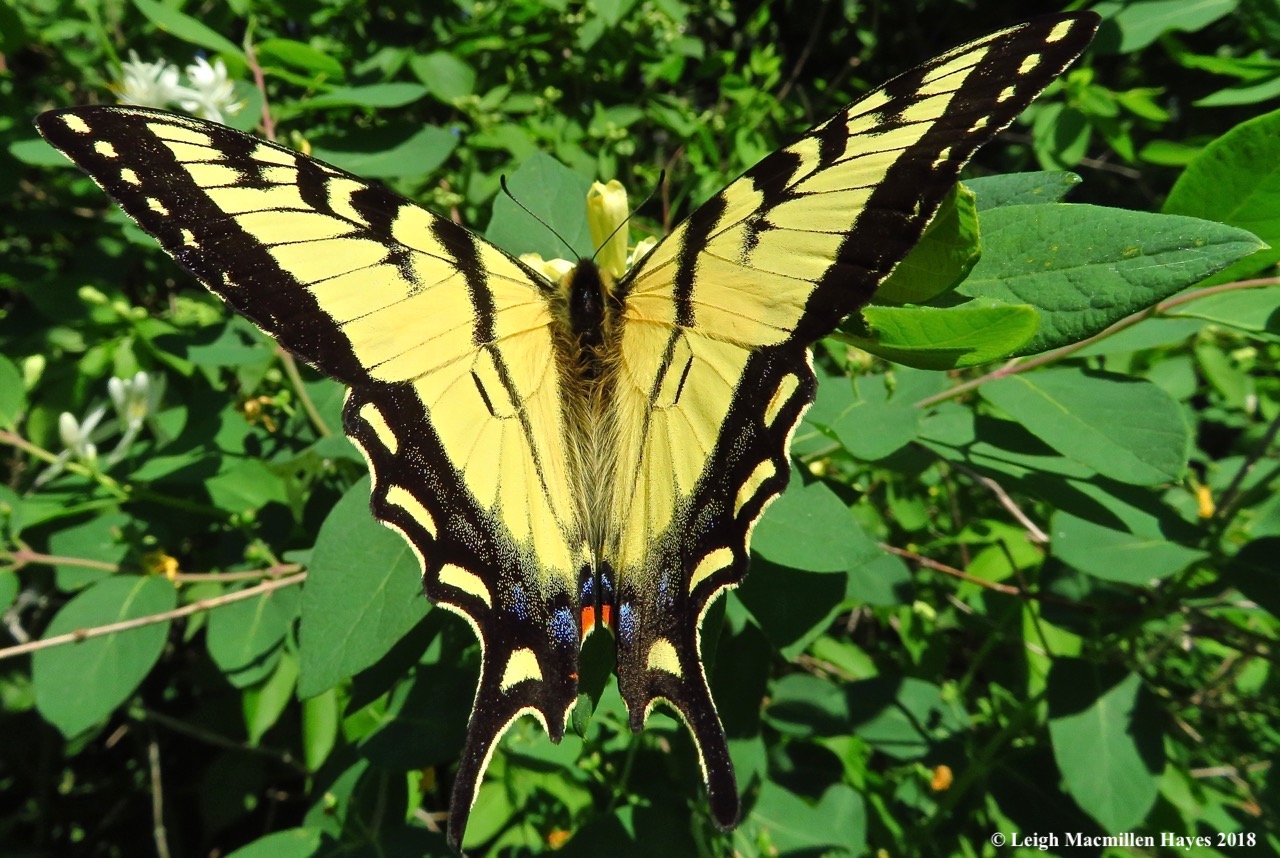
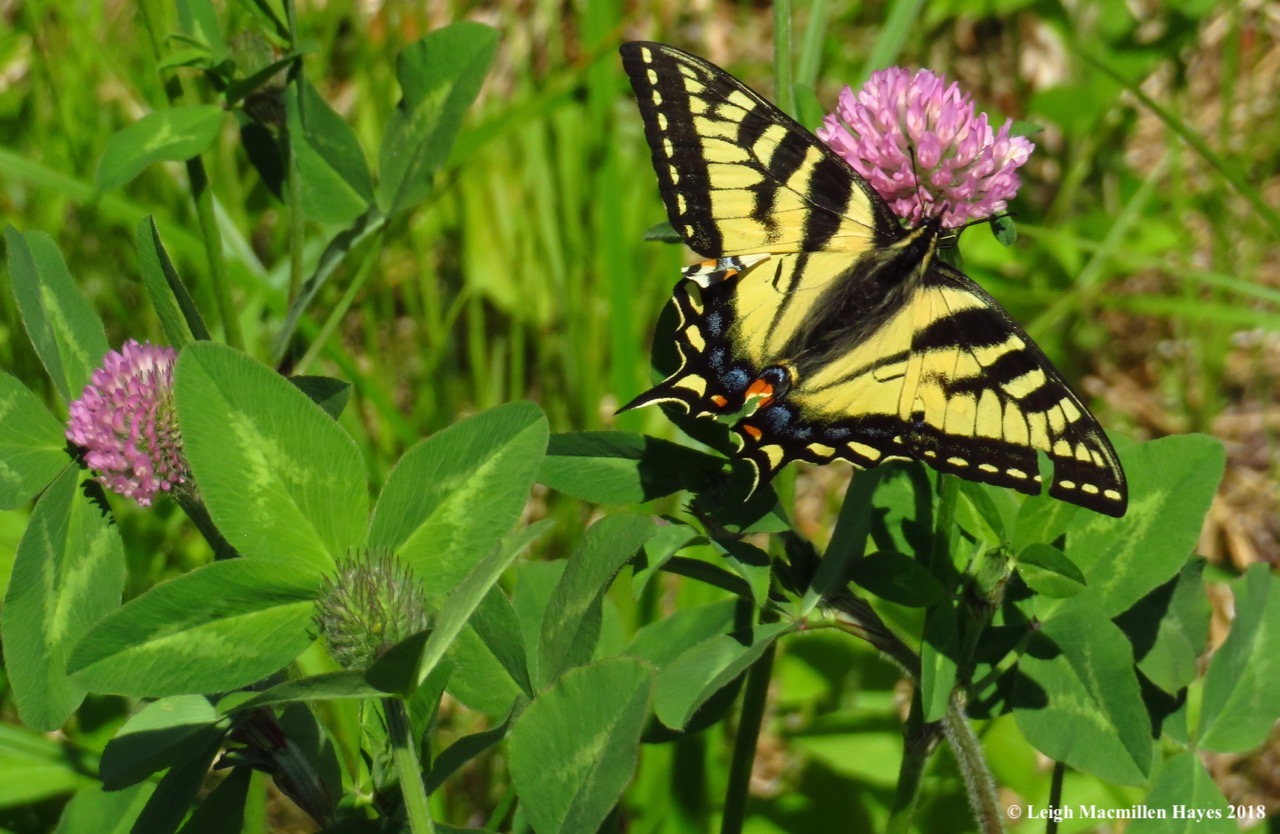
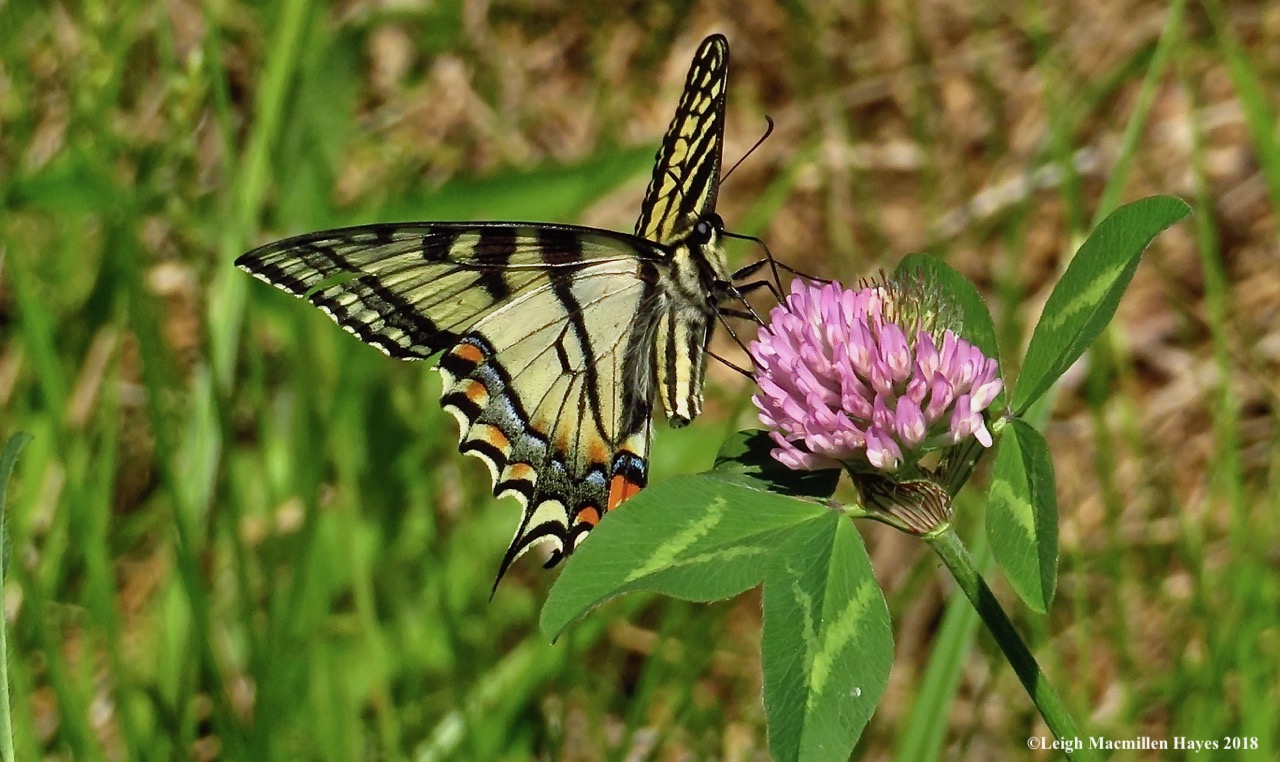
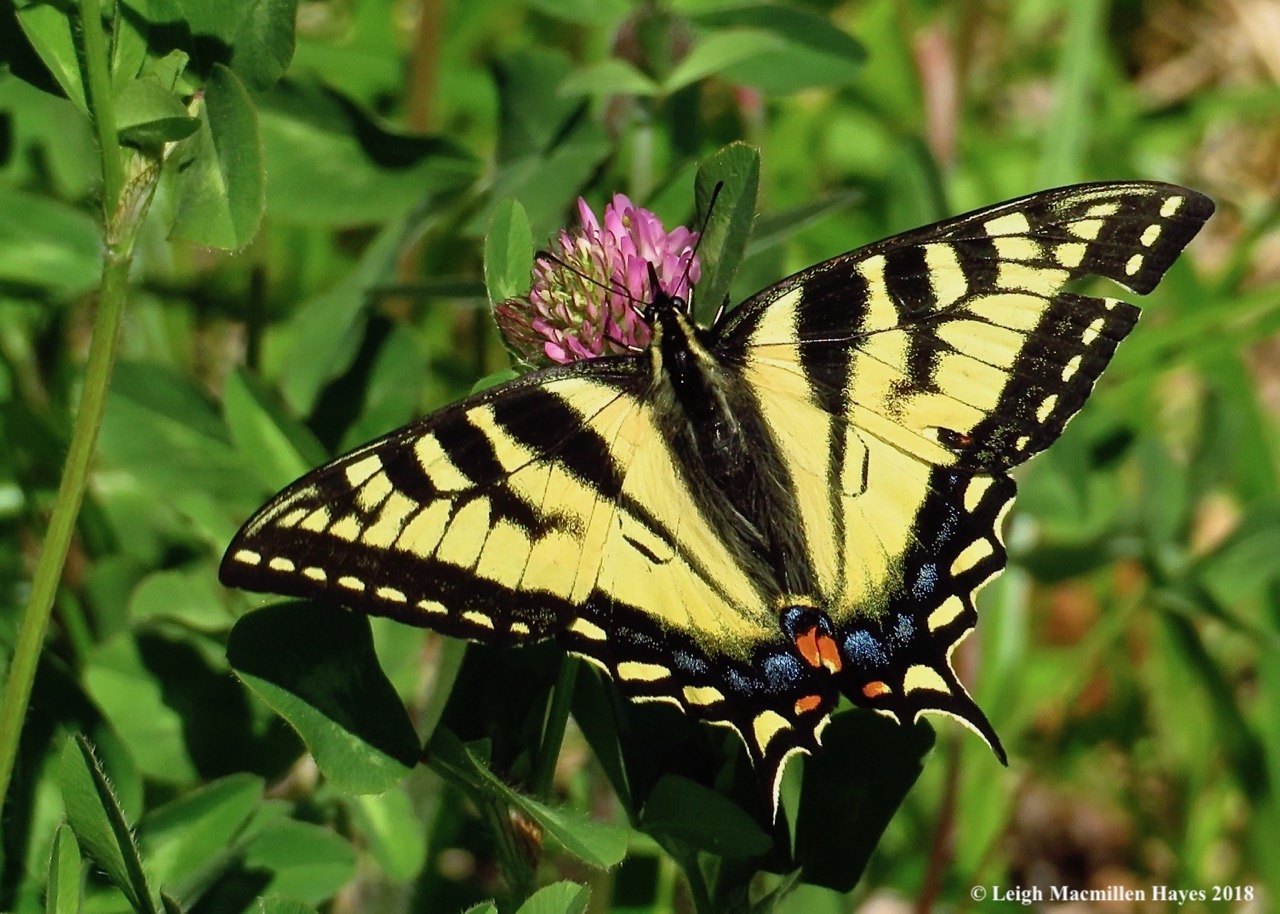
Finally, it was a swallowtail butterfly that stopped us in our tracks and mesmerized us for moments on end. The question was this: which swallowtail–Eastern or Canadian, for both fly here.

m11-eastern tiger swallowtail

Earlier in the day I’d photographed an Eastern Tiger Swallowtail in the backyard. Tiger comes from the four black stripes, while swallowtail refers to the long tails extending from the hind wings that these butterflies often lose to their prey as spring gives way to summer.

This was a female given that her hind wings featured blue with bright orange accents when viewed from the top. The areas that are blue on the female are black on the male.

And notice her main body, which is a rather muted combo of black and yellow.

m10-canadian tiger swallowtail

Now look at the butterfly Jinny Mae and I each took at least fifty photographs of and do you see the darker body? The Canadians have more black hairs covering their bodies.

m11-probiscus

Also look at the underwings. I regret that I didn’t get a shot of the Eastern’s underwings, but for the Canadian this matches the pattern: Note the yellow band just inside the outer edge on the underside of its forewings. Had it been an Eastern, it would have featured a series of disconnected yellow spots on the black band. The Canadian has a continuous yellow band. And then there are the orange and blue markings.

m13-canadian tiger

At the end of the day all that detail really didn’t matter–Eastern or Canadian, both were tiger swallowtails.

And I gave thanks for the opportunity to flex my wings beside Jinny Mae. It felt so good to fly along the path together again. For those who don’t know, Jinny Mae’s journey has been one of varied wing beats as she’s lived with cancer for the last three years. Her current treatment is going well and we look forward to more flight paths.


Bogging with Barb

Passing off a copy of the book, From Grassroots to Groundwater, about how two small Maine towns fought Nestlé and won, was the perfect excuse to head to Brownfield Bog. I told Barb I didn’t mind driving to her home or somewhere nearby to give her the book because I’d then go exploring and she welcomed the opportunity to do the same.

b2-Kathy's sign

As we began our journey, I asked if she knew Kathy McGreavy. Of course she did. I mentioned that Kathy walks in the bog daily and we might encounter her. Of course we did. Kathy and “her friend” were just coming out after walking their dogs and so we chatted for  bit. Our discussion included mention of the sign Kathy made last year as her capstone project for the Maine Master Naturalist Program. It’s an incredible piece of artwork and as she’s learned, I’m not the only one who thinks so. Recently, she discovered that a woodpecker had taken to pecking it and so the bottom is now protected with a piece of plexiglass. Crazy birds.

b1-Bog view from the road

Eventually, Barb and I said our goodbyes to the McGreavys and walked down the unplowed road where I did warn her about my obsession for stopping frequently to take photos. It began from the start–when we spied the bog through the trees and noticed the contrast of colors and layers.

b3a-pussy willows

And then–specks of white were ours to behold.

b3-pussy willows

Pussy willows. Was it too early she wondered. No–in fact, I spotted some a year ago on February 23 at Lakes Environmental Association’s Holt Pond Preserve.

b4-red-winged blackbirds

Our next reason to stop–the red and yellow shoulder patch or epaulet providing their name: Red-Winged Blackbirds. Again, Barb asked if it was too early. This time, I referenced Mary Holland for the February 27th entry in her book Naturally Curious Day by Day has this headline: Returning Red-Winged Blackbirds Survive Cold Temperatures and Few Insects. Bingo.

b5-water obstacles

Sometimes our stops were to contemplate our next steps–especially when it came to the water that covered the cobble stones on the road.

b6-Barb charges through the water

But sometimes you just have to go for it. And we did. As the morning continued, we ventured through deeper water and plowed ahead knowing that we would need to dry our hiking boots out when we arrived home.

b7-bird's nest

We found a bird nest and wondered about its creator. We did note some acorn pieces inside, so we think it had more than an avian inhabitant.

b8-beaver lodge

And we paused to look at an old beaver lodge. The mud looked recent but none of the sticks were this year’s additions so we didn’t know if anyone was home.

b9-map in the snow

All along, we’d been talking about places we’ve hiked and other topics of interest to both of us. We even learned that we’d both worked in Franklin, New Hampshire, just not at the same time. But speaking of hikes, with her finger, Barb drew a map in the snow and now I have another trail to check out soon with my guy. Should I forget the way, I’ll just reference this map. ;-)

b10-raccoon prints

Because we were near water, though most of it still frozen, and the temp was high (actually, too high–in fact, it felt HOT as it soared into the upper 60˚s today), we weren’t surprised to find this set of prints created recently by a raccoon. I love the hand-like appearance and opposite diagonal of each two feet. Can’t you just see him waddling through–in your mind’s eye, that is?

b11-the bog

Our turn-around point offered an expansive view of the bog. As much as we may have wanted to head out onto it, we sided with caution and kept to the edge of the shore.

b12-winterberry

On the way back, there were other things to admire as there always is even when you follow the same route: winterberries drying up;

b13-rhodora

rhodora’s woody seed pods and flower buds swelling;

b14-willow gall

and the pinecone-like structure created with leaves by a reaction to a chemical released by the larva that allows a gall gnat midge to overwinter on the willows.

b16-carrion-flower tendrils

And then we stumbled upon a plant neither of us knew. With it’s long stem and curly tendrils, we were sure it was a vine.

b15-carrion-flower

Upon arriving home, however, I wondered about the umbel structure that had been its flower and now still held some fruits. A little bit of research and I found it: Carrion Flower (Smilax herbacea), which apparently smells rather foul when it’s in bloom and thus attracts carrion flies as its pollinator. Now I can’t wait to return and check it out in the next two seasons. Any excuse to get back there.

b17-bog to Pleasant Mountain

At last the time had come to say goodbye to the bog and then goodbye to each other. Thanks Barb, for giving me an excuse to go bogging with you. It was indeed a treat.

Brain Share–Naturally

I was thankful I’d thrown my winter coat into the truck for I had a feeling it would be a better choice than a vest given the group I’d be traveling with this morning. And sure enough, though the sun felt warm, a breeze added a chill to the air. Plus, I knew we wouldn’t travel far and would spend much of our time standing around.

r0-life on a rock

Well, not exactly standing, for as Maine Master Naturalists, we’ve been trained to get down for a closer look. Our first stop–to check out the life on a rock that was revealing itself as the snow slowly melted. Karen is on the left, an Augusta grad, and Sarah and Anthony to her right, both South Paris grads.

r0a-polypody

The focus of our attention was common polypody, a fern with leathery leaves and spherical spore clusters on the underside. Rocks are their substrate and they often give a boulder a bad-hair day look.

r1b-speckled alder

Moseying along, we reached a point where we knew we wanted to spend some time–at a wetland beside one of the Range Ponds (pronounced Rang) at Range Pond State Park in Poland, Maine. Because it likes wet feet, we weren’t surprised to find speckled alder growing there, but what did throw us for a loop was the protrusions extending from last year’s cones.

r1a-speckled alder

It was almost like they had tried to flower atop the cones and all we could think of was an insect creating a gall. Indeed, it appeared that the cones were also experiencing a bad hair day. After a little research, it may be alder tongue gall–resulting from a fungus rather than an insect infecting the female catkins. Apparently, the tongue-like growths are green to begin, but transform to orange, red and finally brown. It was certainly a new one for the four of us.

r2a-leatherleaf and sphagnum moss

On we moved down to the wetland where the snow surprisingly held us for most of the journey and we didn’t leave behind too many post holes. Leatherleaf and sphagnum moss showed off their winter hues at our feet.

r4-cranberries

We also spied cranberries hiding underneath.

r3-cranberries among the leatherleaf

And sampled them. A few were tart, while others had fermented.
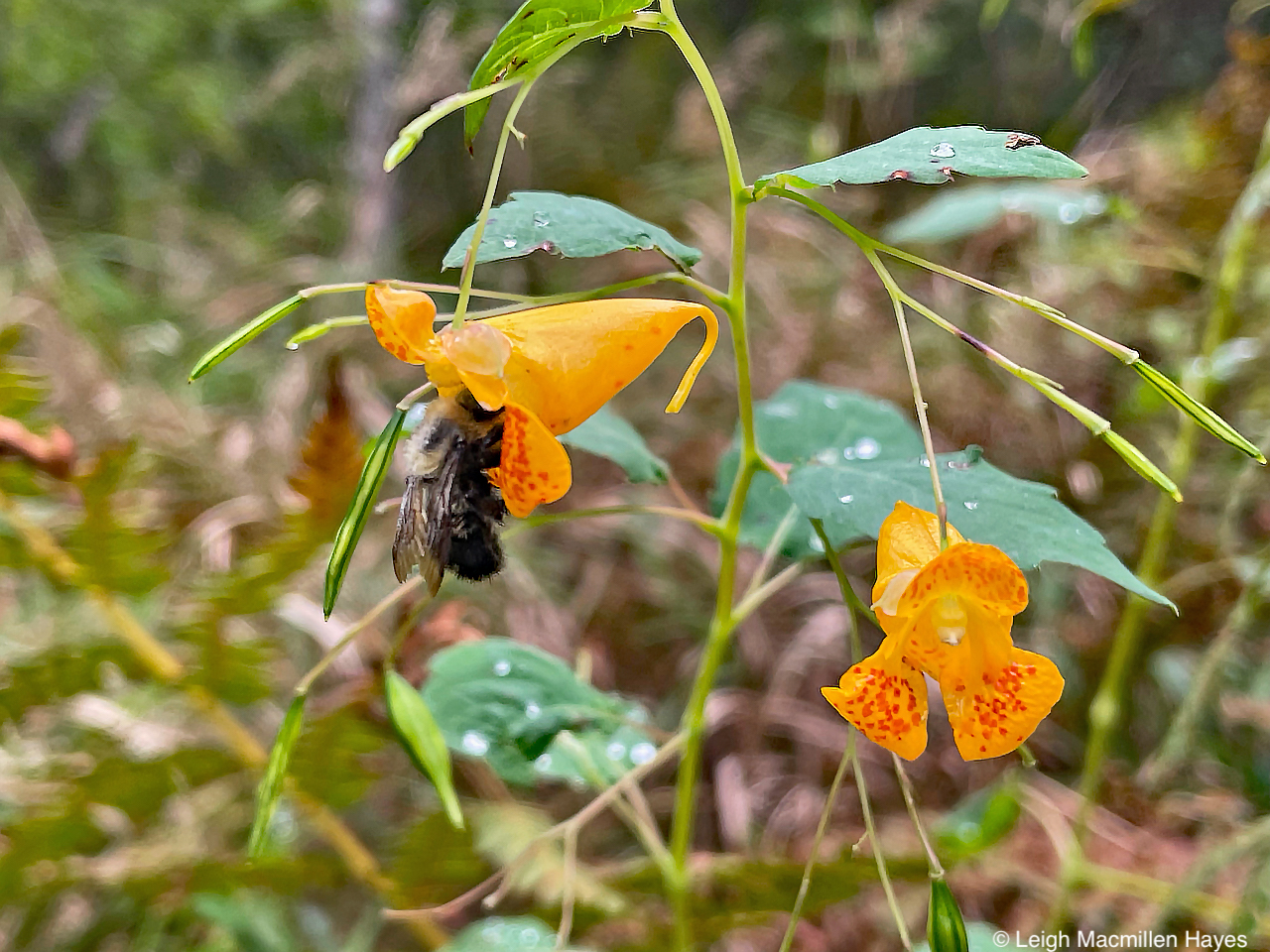
r1-two lodges

In the middle of the wetland, two well built lodges stood tall. They had fresh wood and had been mudded in the fall. One did look as if the vent hole had been enlarged, so we wondered if anyone still lived there. We heard no noises, but had to assume that we were bothering the residents so we didn’t stay long.

r2-wetland and pond beyond

One last view of the wetland and pond beyond, then we turned and walked toward the opposite side.

r5-bird nest

Just before climbing uphill, we spotted a bird nest in the winterberry shrubs. It was filled with dried berries, and we again made an assumption, that a mouse had cached its stash for the winter and maybe dined there in peace and quiet while the nest was covered in snow. That’s our story and we’re sticking with it. Whose nest it was prior to the mouse? We don’t know, but it was made of twigs. If you have an answer, please enlighten us.

r6-bone

Back up on an old railroad bed, we again stopped frequently, including to talk about the beech scale insect and nectria fungus that moves in and eventually kills the trees. And then something else came to our attention–it wasn’t a broken branch hanging down like an upside-down V on the beech tree. No indeed. It was a bone. A knee bone. And it had been there for quite a while given its appearance.

r7-Introduced Pine Sawfly pupal case

Because Anthony was with us and he’s our insect whiz, we spent a lot of time learning from him–including about the pupal case of an introduced pine sawfly. The sawfly had already pupated and in this case no one was home.

r8-Introduced sawfly pupal case

As the morning went on, we became quite adept at locating more cases of other sawfly species, including one that wasn’t yet opened. We each channeled our ten-year-old selves as we tried to be first to find the next one. But really, Anthony won for he had insect case eyes.

r9-going in for a closer look

And eyes for other things as well.

r10-old spider web case

This time we examined a delicate, almost lacy structure under a branch on a young beech. Anthony suspected a pirate spider, which tickled our fancy for we imagined them raiding the goods of others. But later he e-mailed with another option: “The old spider egg case could also be from an orbweaver of the araneidae family.” Either way, we were happy for the sighting; for taking the time to slow down and notice.

r11-beech leaves

And there was more. Sarah had to leave us a wee bit early, so she missed our finds on the backside of beech leaves.

r12-maroon dots on beech leaves

They were dotted with raised bumps that under our hand lenses reminded us a bit of the sori on common polypody.

r13-maroon dots on beech leaves

Leaf rust? Was it related in any way to the splattering of tiny black dots also on the leaves? We left with questions we haven’t yet answered.

r14-hair on beech leaves

Taking a closer look did, however, remind us of how hairy beech leaves are–do you see the hairs along the main vein? And that reminded us of how the tree works so hard to protect the bud with waxy scales all winter, keeping the harsh conditions at bay. In early spring, slowly the leaves emerge, ever hairy, which strikes me as an adaptation to keep insects at bay, and then . . . and then . . . it seems like every insect finds a reason to love a beech leaf and in no time they’ve been chewed and mined and you name it.

r15-oak gall

We made one more discovery before heading out–a gall formed on oak twigs. Do you see the exit hole? It’s in the shape of a heart–apparently the insect that created the gall loved the oak.

r15-pine tube moth

As we made our way back to the parking lot, I kept searching all the pine trees because I wanted to share an example of the tube created by a pine tube moth. Of course, there were none to be found, but as soon as I arrived home, I headed off into the woods for I knew I could locate some there. Bingo.

Notice how the lumps of needles are stuck together in such a way that they formed a tube. Actually, the tube is a tunnel created by the moth. The moth used silk to bind the needles together, thus forming the hollow tube. And notice the browned tips–that’s due to the larvae feeding on them. Eventually the overwintering larvae will pupate within the tube and emerge in April. Two generations occur each year and those that overwinter are the second generation. Fortunately, they don’t seem to harm the trees–yet.
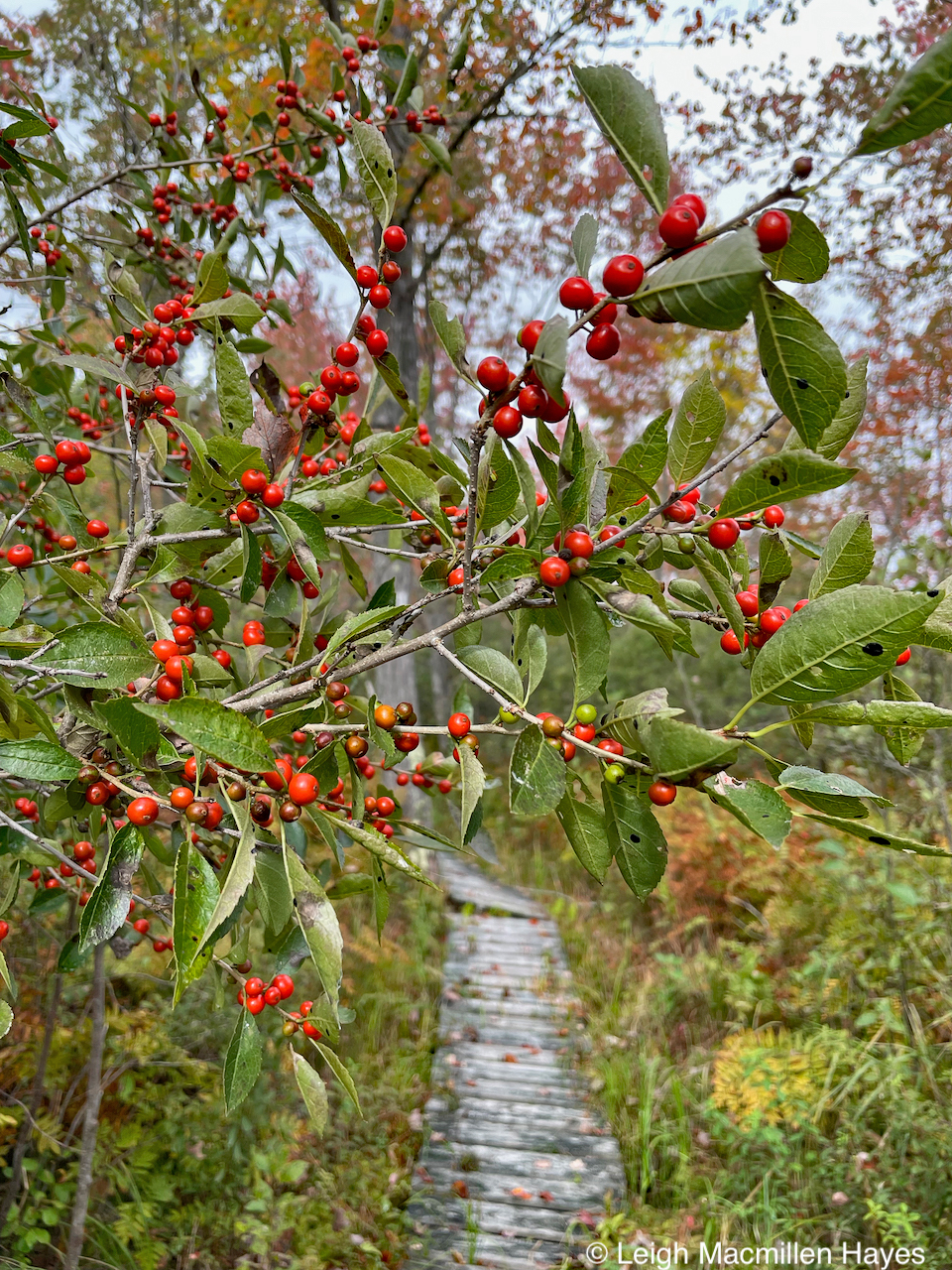
Three and a half hours later we hadn’t walked a great distance, but our findings and learnings were many and we talked about how we’d added more layers to our understanding. Now if only we can remember everything. Thanks to Karen, Sarah and Anthony for sharing your brains me with–naturally.

P.S. Lewiston MMNP grads, et al, I’ll be in touch. Look for a doodle poll soon so we can get out and do the same. Or if you want to take the initiative, please feel free to go for it.


On Tippy Toes with Wonder

Snowshoes were a necessity this morning as I wandered, but with them came the constant sound of breaking glass as the frozen layer of ice atop the snow crackled with each  footstep. I doubted I would see anything amazing for so much noise did I make.

o-hemlock cones and seeds

I was right, of course. It was all the usual suspects that show up ever more clearly now that the earth is draped with a snow coat. I only found a gazillion hemlock cones on the ground, most descaled and their seeds consumed by a certain red squirrel.

o-squirrel cache

The hemlock cones were below trees near the squirrel cache I’ve been keeping an eye on. Curious thing about the cache–no tunnels to the goods within and one new snow-covered cone stashed atop. Did he decide the hemlocks were easier to deal with at the moment? Will he return to the pine cone cache for dinner? Of course, I’m assuming the work is that of one squirrel, but it could be more than one in the same area.

o-pinecone on hemlock

I did spy one that made me chuckle, for one of my pet peeves is when people call all cones “pine cones.” Pine cones grow on pine trees–whether white, red, pitch or jack. Hemlock cones grow on hemlock trees. And balsam cones grow on balsam trees. You get the idea. But what do you call a pine cone on a balsam tree? A tree topper, of course. Or . . . stuck. (And I’ve got the market on corny humor.)

o-turn left

Every which way I turned, there was nothing new to look at.

o-hoar frost on white pine

But the hoar frost . . .

o-hoar frost on hemlock

added crystalized ornamentation . . .

o-hoar frost 1

wherever it gathered . . .

o-rabbit-foot clover 2

from the feathery rabbits-foot clover . . .

o-Queen Anne's lace 3

to Queen Anne’s lace . . .

o-gray birch catkin 2

and gray birch catkins. Oh my.

o-ice waves 1

As the sun rose higher, my fascination with hoar frost melted away, but another ice sculpture begged notice–its formation called to mind hills and valleys of waves topped with white caps. And still, how does it do that?

o-goldenrod gall

I found goldenrod galls as well, this one with no opening, which may mean the gall fly larva was probably still sheltered within.

o-goldenrod bunch gall

The other was a goldenrod bunch gall created by a midge. Looking like a mass of tiny leaves, it’s also known as a rosette gall for the shape at the top of the stem. In both cases, it’s amazing that insects can change a plant’s growth pattern so dramatically.
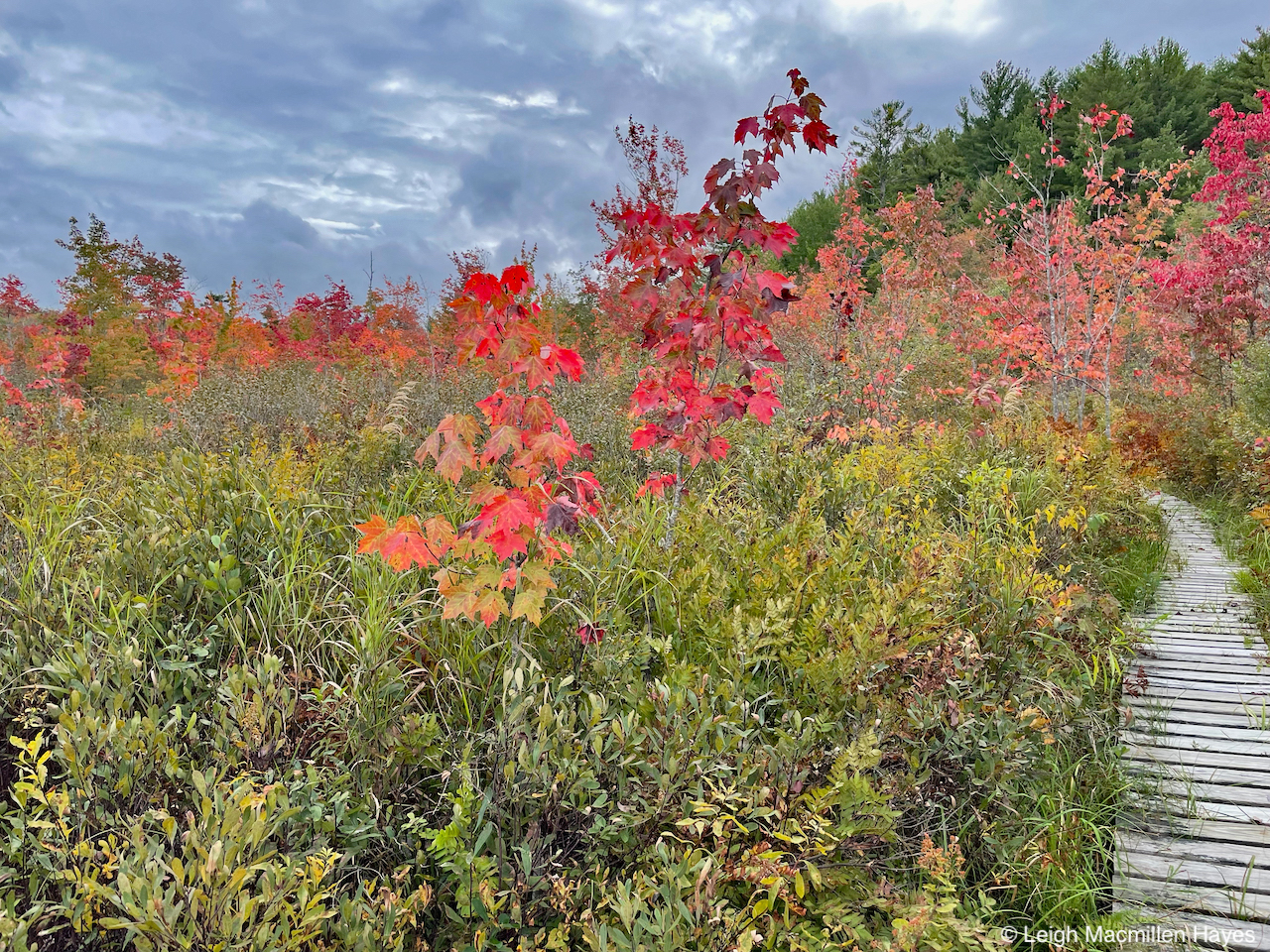
o-tracks galore

Even the tracks were of all the usual suspects from mouse to moose and I realized yet again how fortunate I am to share this space with them and know all their haunts.

o-right sign

At last I took the right turn toward home.

o-deer beds 1

And under the hemlocks in our woodlot, I counted eleven deer beds and yet, I haven’t seen a deer in a while. This, however, has long been their frequent nighttime hangout.

o-deer beds 2

As I often do when I spy several ungulate beds–I looked at their orientation and as usual each had its back to the other given the smooth curved line–with all eyes and ears on the lookout.

o-moose ice

I also found a rather large print filled with a block of ice–actually, it’s a half block of ice for it fell off of only one of a moose’s cloven toes. I wondered if the moose felt like it was walking on tippy toes until that point.

o-snowshoes

I certainly did, so frozen were the balls of ice on my snowshoes. That’s what I got for working my way through a half-frozen wetland. But it was that same water I had to thank for the creation of the hoar frost.

As awkward as it was, it was certainly fun to observe the world from my tippy toes. And despite the sameness of it all, my mind and heart were filled with wonder.


Power-filled Mondate

It may not have been a hurricane, but the storm that began as Philippe, left its mark as it whooshed through New England. Along its path, the world darkened. We lost power about 1am, but it was restored by the time we awoke this morning. And yet, many may be without electricity for days.

Our tentative plan had been to hike, but we realized last night that we’d need to consider Plan B. And when the sun shone this morning, we were rather oblivious to the havoc caused by downed trees and flooding. We did check the weather report, however, and saw that there would be a few showers and the wind would continue to blow. So, Plan B it was–yard work between rain drops.

For my guy, that began with work on the back screen door for a bang we’d heard in the night turned out not to be the grill or furniture sliding off the deck, but rather the door banging against a bench. And after that, it wouldn’t shut properly.

o2-bee on lavendar

While he worked on the door, I headed into the kitchen/cottage garden, which had become quite overgrown due to my lack of a green thumb. While my intention was to put the garden to bed, some flowers like the lavender needed to remain for they still invited visitors.

o3-spring tails

As I poked about, cutting some plants back, I made a few discoveries, including the sight of snow fleas or spring tails climbing a stalk.

o1-bird nest fungi 1

And buried beneath, I unearthed bird’s nest fungus, which look like such for which they were named, only in miniature form for they are no more than a quarter inch in height or diameter. Nestled inside the nests, like a bunch of eggs in a basket, are the fruiting bodies that await drops of water in order for their spores to spring out and find their own substrate on which to grow.

o5-beebalms last bloom

And then I approached the beebalm, where a few blossoms still bloomed on this late date.

o4-meadowhawk 1 on bee balm

Most of the beebalm had long since gone to seed, and today one structure became a resting spot as the wind blew. A male autumn meadowhawk seemed to hold on for dear life.

o6-meadowhawk 2

Of course, I took advantage of his moments of rest to take a closer look at the divine body structure . . .

o7-meadowhawk 3

from a variety of viewpoints.

o8-meadowhawk 4

Gender determination is based on the terminal appendages. Male dragonflies have three, known as claspers, which they use to grasp and hold a female during mating. The upper or from this view, outer appendages, are called cerci, while the lower, or middle appendage, is the epiproct–meaning its the appendage situated above the anus. Females have only a pair of cerci, and I’m not sure of their purpose. That beebalm still stands–in hopes he’ll return again.

o9-quaking aspen buds and leaf scars

As I continued to work and observe the world around me, my guy found one project after another to complete–each of which required a trip to the hardware store. Hmmmm. And so, I too, decided to go for a trip–into the woods. Donning my blaze orange vest and hat, and knowing that I wasn’t going far, I took off. My first stop was at a branch below the quaking aspen that had fallen in the night. Though it had reached its end of life, the waxy bud scales and leaf scars were a sight to behold. The smiley-face leaf scar showed where the stem or petiole of this past year’s leaf broke from the branch. As the leaf pulled away, it severed the vessels through which water and food moved. The dots within the scar indicate where those vessels had been connected and are known as bundle scars.
o10-pathway in woodlot

In our woodlot, my trail was littered with pine cones and branches, but that was the extent of tree damage.

o13-selfie

I found puddles that invited me in.

o11-jelly ears

Some branches, decorated with a variety of lichens and jelly ear fungi also found their way to the puddles.

o12a-vernal pool

At last, I reached the vernal pool and was surprised to find it only partially filled.

o12-vernal pool leaves

Atop and within it, the mosaic of broad leaves and needles formed a tapestry of shape and color–in the moment.

014-goldenrod bunch gall 1

Nearby, I paused by a goldenrod that sported a bunch, rosette, or flower gall, for really, it resembles all three.

o15-goldenrod bunch gall 2

The Goldenrod Gall Midge, which is a tiny fly, laid an egg in a leaf bud, hatched into grub form, and prevented the stem from growing, though the plant continued to produce leaves that formed a tight cluster.

o16-maple samara between milkweed pods

I finally made my way home, and turned to other gardens on the eastern side of the house, where milkweed pods also needed to remain standing. I even left the sugar maple samara because I thought it was a fun place to land.

o-17-aphids on milkweed

Also at home on the milkweed were a hundred aphids all clustered together.

020-monarch chrisalys

But the best find of all–the delicate remains of a monarch butterfly chrysalis. I had no idea it was there, but presume it housed one of the monarchs that consumed my attention a few weeks ago.

Just after we headed in, my sister-in-law called to say her sump pump had conked out. Off my guy went again.

It wasn’t the hike date we’d hoped for, but our day was filled with power tools and powerful insects and power-filled love.


Continued Wandering into the World of Wonder

I’ve spent most of the last two years wandering, not even taking time to seek the answers I thought I sought.

c-ichnueomon wasp female

But along the way, I’ve seen so many incredible things that have been placed before me from the female ichneumon wasp with a disc on her cerci and her body throbbing as she injected her eggs into an insect larvae on tree bark  . . .

i-helleborine wasp 1

to a yellow-nosed wasp, so named by me for the pollen that was stuck to its antennae after it visited a helleborine flower . . .

i-dragonfly and exoskeleton 1

to a dragonfly emerging from its exuviae . . .

p16-fold looking toward lighthouse

to the folds of the earth at Pemaquid Point . . .

c-geology folds

and Mount Chocorua . . .

h-pond-quaking-bog

to fall colors reflected on Holt Pond . . .

r-crescent-view-2-1

and throughout Raymond Community Forest.

p-a future embraced

The answers are wrapped up in the promise of blossoms to come . . .

l-dandelion seed head

and seeds on the fly.

p-today-in-and-out

It’s recognizing the swish of a porcupine’s trail in the snow . . .

m-opossum-print-2

or the realization that a track I’d never seen before was visible in our woods—that of the opossum.

artist conks

And it’s all enveloped in the knowledge that mycelium cover the earth and through the process of decomposition break down most matter (all matter that matters, but not things we’ve created such as our ubiquitous plastic or even this computer).

l-wood fern with sori

It’s the realization that the Earth was formed eons ago and that the word eon refers to geologic time and that plates collided and continue to do so and pressures form and rocks develop. And plants like ferns . . .

l-princess pine

and club mosses were once dominate species and as tall perhaps as our trees. It’s this and so much more.

i-lady beetles canoodling

And all of this brings me to faith. And I realize I do believe in a spiritual being. But my spiritual being is not imbedded solely in the Trinity of Father, Son and Holy Spirit. It’s more than that. In all times, we’ve found people to emulate and follow. The Bible offers one such example and its writers were brilliant. For Jesus was a common person who came into this world in a way I’ve yet to understand. Was Mary really a virgin? Or was she a young woman free of sin? Or?

i-damsel larvae

According to the stories, for that’s what they are, or perhaps they are tales, sagas, lore passed from one generation to the next until all was eventually jotted down and probably revised many times over and edited by publishers, Jesus was a carpenter. A common man. With wise thoughts and perceptions. I know many such people. And so, I think that the Bible offers an example or a way to live. And a way to think. And a way to behave. But, I don’t think it should be taken literally. I don’t know how the universe was created, but it’s too simple to merely state God created it in one day or even one week.

i-baskettail, common baskettail 1

I also don’t understand those thin places where one can see both this side of life and the other side of heaven—if that’s what thin places means. But I do know that I’m intrigued by the concept. Maybe I’ve experienced such without the realization. And maybe I need to practice awareness and be more open to offerings.

i-ambush and bee 2

I have discovered that heaven and hell remain the same, whether I walk through the red doors at the church entrance and partake in communion and fellowship or find my way along a wooded path where other revelations occur before my eyes. And so, after all these years, while I embrace a church service, I’ve learned to leave guilt behind on those Sundays I choose to worship outdoors rather than in.

i-moth

In either case, I’ve so much more to learn. So many things not yet recognized; so many questions not yet formed.

i-hoverfly1

And so today, I invite you to continue the journey with me—into this world of wonder. May the answers slowly reveal themselves, while the questions never end.