The Secret Giver of Gifts 2025

Being St. Nicholas Day, the day to honor the 4th century bishop from Myra who is the patron saint of children and sailors, I was reminded of a time when we were heading home and our youngest asked, “Mom, are you Santa?”

I love this story and so even if you’ve read it before, I hope you’ll enjoy it again.

He’d held onto the belief for far longer than any of his classmates. And for that reason, I too, couldn’t let go. And so that day as we drove along I reminded him that though the shopping mall Santas were not real, we’d had several encounters that made believers out of all of us.

The first occurred over thirty years ago when I taught English at a school in New Hampshire. Across the hall from my classroom was a special education class. And fourteen-year-old Mikey, a student in that class, LOVED Santa.

Each year the bread deliveryman dressed in the famous red costume when he made his final delivery before Christmas break. To Mikey’s delight, he always stopped by his classroom. That particular year, a raging snowstorm developed. The bread man called the cafeteria to say that he would not be able to make the delivery. School was going to be dismissed after lunch, but we were all disappointed for Mikey’s sake.

And then  . . . as the lunch period drew to a close, Santa walked through the door and directly toward Mikey, who hooted with joy as he embraced the jolly old elf. As swiftly as he entered, Santa left. I have no doubt that that was Santa.

And about twenty-seven years ago, as the boys sat at the kitchen counter eating breakfast on Christmas Eve morning, we spotted a man walking on the power lines across the field from our house. We all wondered who it was, but quickly dismissed the thought as he disappeared from our view, until . . . a few minutes later he reappeared.

The second time, he stopped and looked in our direction. I grabbed the binoculars we kept on the counter for wildlife viewings. The man was short and plump. He wore a bright red jacket, had white hair and a short, white beard. The boys each took a turn with the binoculars. The man stood and stared in our direction for a couple of minutes, and then he continued walking in the direction from which he’d originally come. We never saw him again. I have no doubt that that was Santa.

Another incident occurred about seventeen years ago, when on Christmas Eve, our phone rang. The unrecognizable elderly male voice asked for our oldest son. When I inquired who was calling, he replied, “Santa.”

He spoke briefly with both boys and mentioned things that they had done during the year. I chatted with him again before saying goodbye. We were all wide-eyed with amazement. I have no doubt that that was Santa.
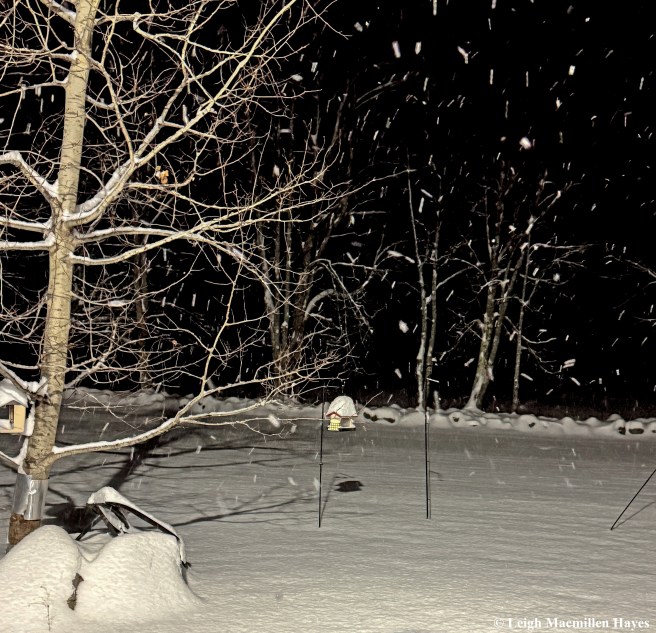
Once I reminded our youngest of those stories, he dropped the subject for the time being. I knew he’d ask again and I also knew that none of us wanted to give up the magic of anticipation for those special moments we know as Christmas morning, when the world is suddenly transformed.

I also knew it was time he heard another story–that of Saint Nicholas, the Secret Giver of Gifts. It goes something like this . . .

The nobleman looked to Heaven and cried, “Alas. Yesterday I was rich. Overnight I have lost my fortune. Now my three daughters cannot be married for I have no dowry to give. Nor can I support them.”

For during the Fourth Century, custom required the father of the bride to provide the groom with a dowry of money, land or any valuable possession. With no dowry to offer, the nobleman broke off his daughters’ engagements.

“Do not worry, Father. We will find a way,” comforted his oldest daughter.
Then it happened. The next day, the eldest daughter discovered a bag of gold on the windowsill. She peered outside to see who had left the bag, but the street was vacant.

Looking toward Heaven, her father gave thanks. The gold served as her dowry and the eldest daughter married.

A day later, another bag of gold mysteriously appeared on the sill. The second daughter married.

Several days later, the father stepped around the corner of his house and spied a neighbor standing by an open window. In shocked silence, he watched the other man toss a familiar bag into the house. It landed in a stocking that the third daughter had hung by the chimney to dry.

The neighbor turned from the window and jumped when he saw the father.

“Thank you. I cannot thank you enough. I had no idea that the gold was from you,” said the father.

“Please, let this be our secret,” begged the neighbor. “Do not tell anyone where the bags came from.”

The generous neighbor was said to be Bishop Nicholas, a young churchman of Myra in the Asia Minor, or what we call Turkey. Surrounded by wealth in his youth, Bishop Nicholas had matured into a faithful servant of God. He had dedicated his life to helping the poor and spreading Christianity. News of his good deeds circulated in spite of his attempt to be secretive. People named the bishop, “The Secret Giver of Gifts.”

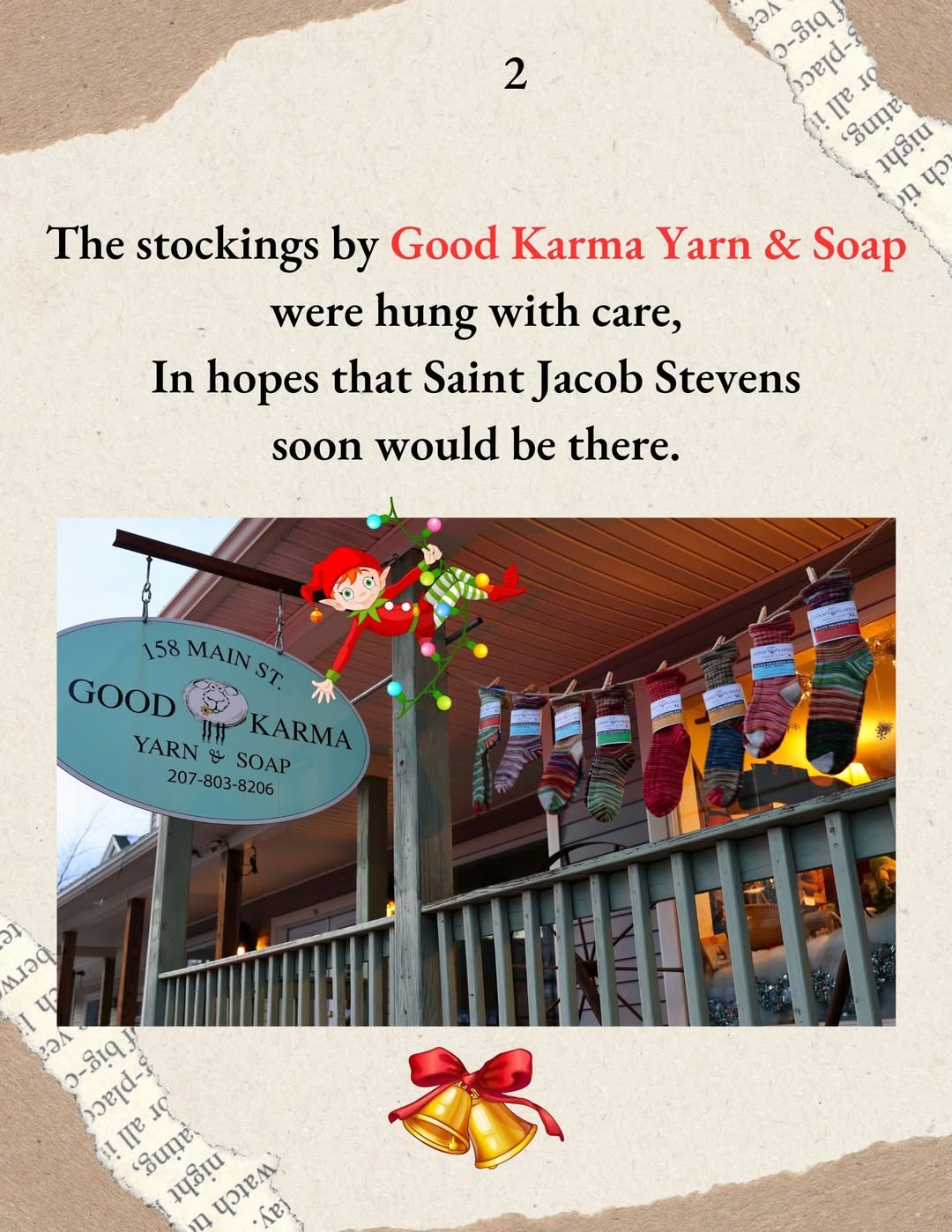
s-stockings

Following Bishop Nicholas’ death, he was made a saint because of his holiness, generosity and acts of kindness. Over the centuries, stockings were hung by chimneys on the Eve of December 6, the date he is known to have died, in hopes that they would be filled by “The Secret Giver of Gifts.”

According to legend, Saint Nicholas traveled between Heaven and Earth in a wagon pulled by a white steed on the Eve of December 6. On their doorsteps, children placed gifts of hay and carrots for the steed. Saint Nicholas, in return, left candy and cookies for all the good boys and girls.

In Holland, Saint Nicholas, called Sinterklaas by the Dutch, was so popular for his actions, that the people adopted him as their patron saint or spiritual guardian.

Years later, in 1613, Dutch people sailed to the New World where they settled New Amsterdam, or today’s New York City. They brought the celebration of their beloved patron with them to America.

To the ears of English colonists living in America, Sinterklaas must have sounded like Santa Claus. Over time, he delivered more than the traditional cookies and candy for stockings. All presents placed under a tree were believed to be brought by him.

Santa Claus’ busy schedule required he travel the world in a short amount of time. Consequently, as recorded in Clement Moore’s poem, “The Night Before Christmas,” a sleigh and eight tiny reindeer replaced the wagon and steed.

Since Saint Nicholas was known for his devout Christianity, the celebration of his death was eventually combined with the anniversary of Christ’s birth. December 24th or Christmas Eve, began to represent the Saint’s visit to Earth.
Traditionally, gifts are exchanged to honor the Christ Child as the three Wise Men had honored Him in Bethlehem with Frankincense, Gold and Myrrh.

One thing, however, has not changed. The gifts delivered by Saint Nicholas or Santa Claus, or whomever your tradition dictates, have always and will continue to symbolize the love people bear for one another.

Though they are now adults, my continued hope for my sons is that they will realize the magic of Christmas comes from the heart and that we all have a wee bit of Santa in us. Yes, P, Santa is real.

May you and everyone continue to embrace the mystery and discover wonder wherever you look. And may you find joy in being the Secret Giver of Gifts.

Celebrating New York Our Way

It probably seems odd that we love to visit the city, being the country-folk that we are who spend so much time wandering in the woods, but we do because there is so much to do and see and taste. And, after all, it’s only for a visit. But the best part–the people waiting for us on the other end, including our youngest and his gal and their friends and her family.

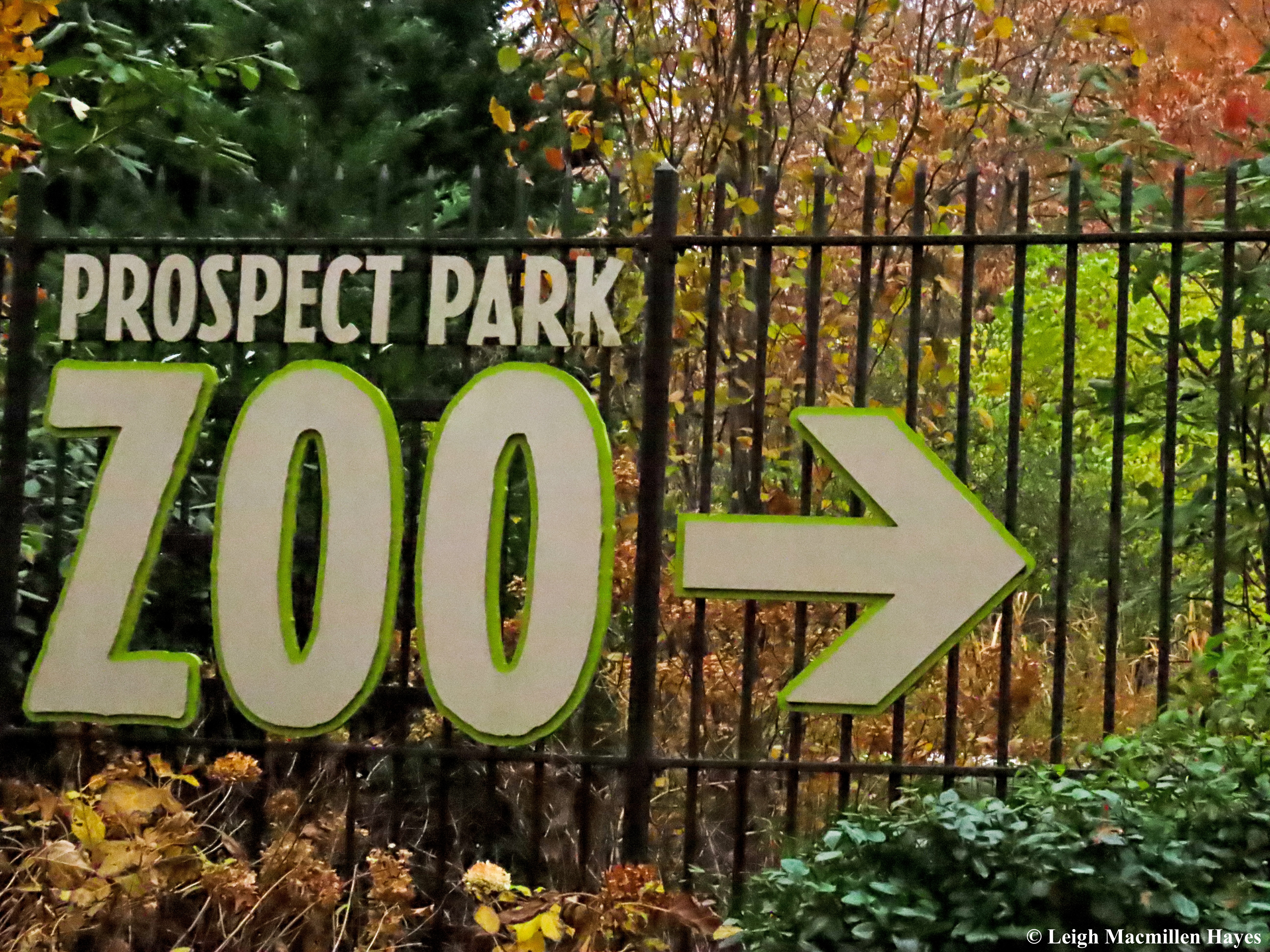
That said, on our first morning, we had some time to ourselves and walked several blocks to Prospect Park, where the Norway Maples have not quite given way to winter and so fall foliage still graced the sky above and pathway below.

Our intention was to walk the outer perimeter and explore some new areas we hadn’t seen before, which suddenly included Prospect Park Zoo. When in Rome . . . and so we did. We entered the zoo and had the most delightful time.

First, there was the metal artwork that greeted us, including this snake consuming a frog. I have memories of such happenings in the natural world, watching as the frog became a large lump in the snake’s “throat.”

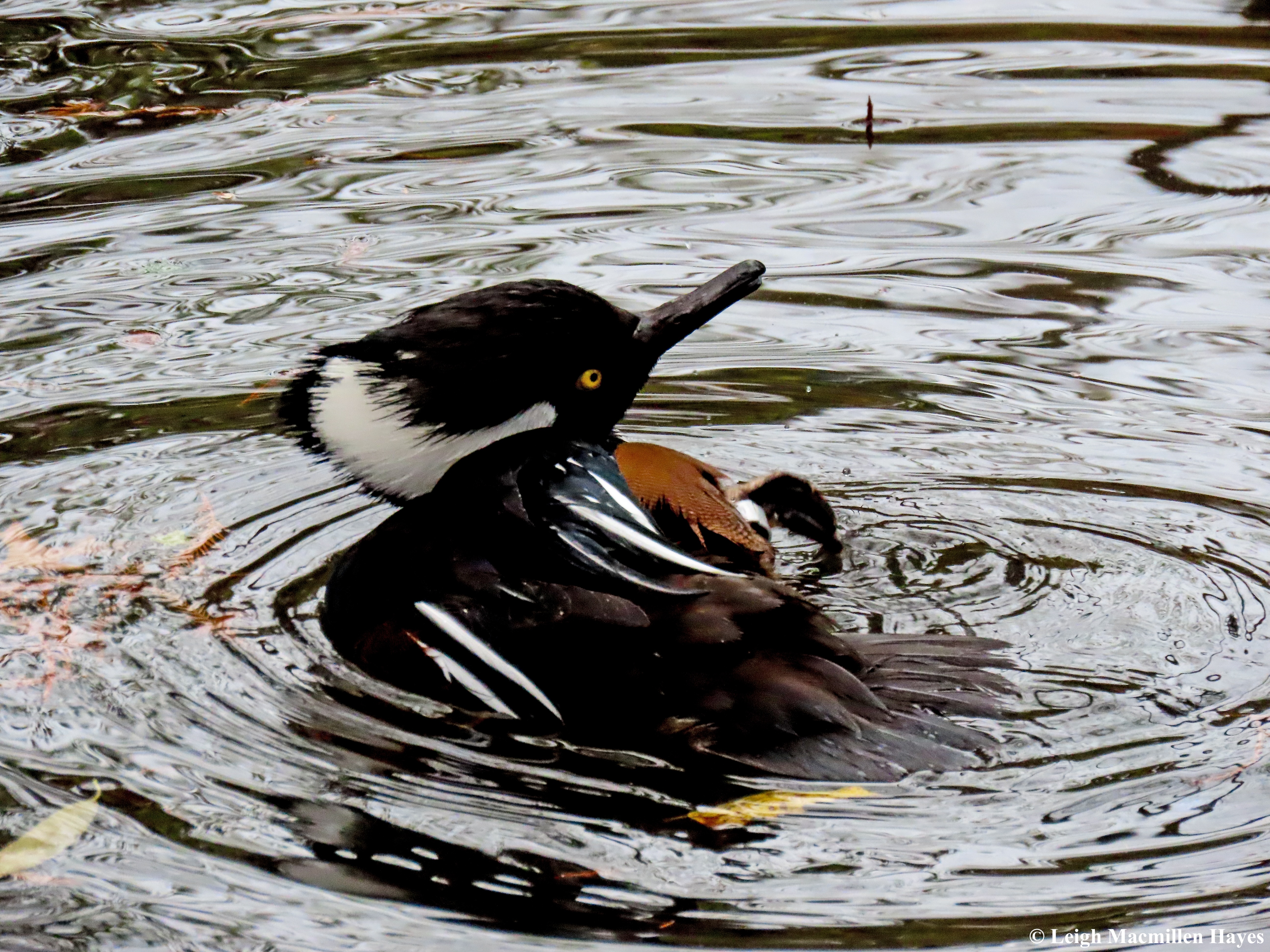
Around every bend there was something different to see and we felt like we were greeting an old friend when we spotted a male Hooded Merganser preening.

Splishing and splashing, his intention was to waterproof and align his feathers, cleanse them of dirt or parasites, and allow him to spread protective oil from a small gland near the base of his tail, which will keep him warm and buoyant, especially important given the changing weather of the moment.

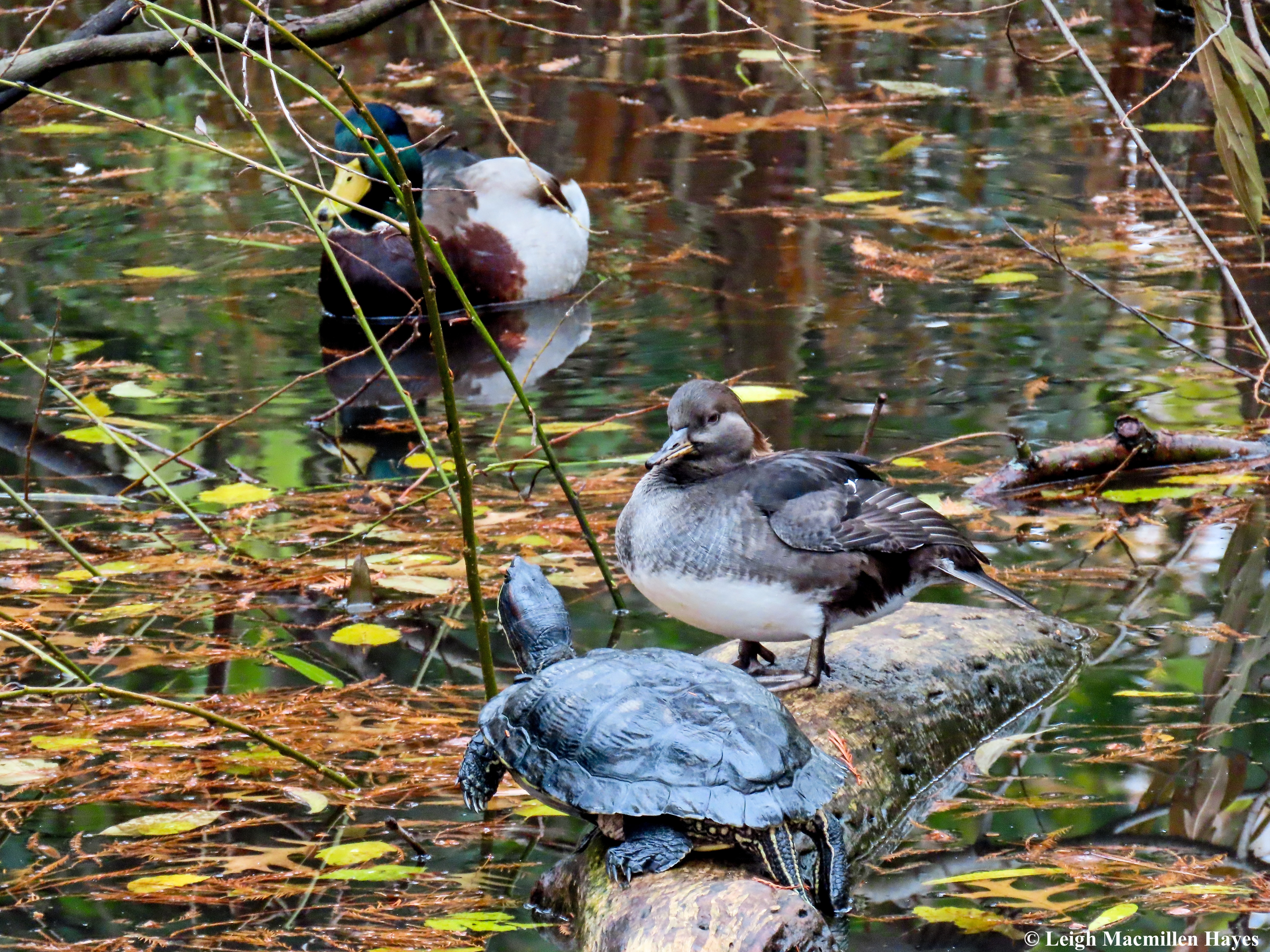
His mate, on the other hand, stood upon a log with a Red-eared Slider and we watched in bewilderment because neither one seemed concerned about the other.

It almost looked like they were two old friends sharing a quiet moment in the midst of a hectic world. And perhaps they were.

For a few minutes, I actually thought the turtle might not be real because there were some small sculpted animals along the zoo path, but then he turned his head ever so slightly.

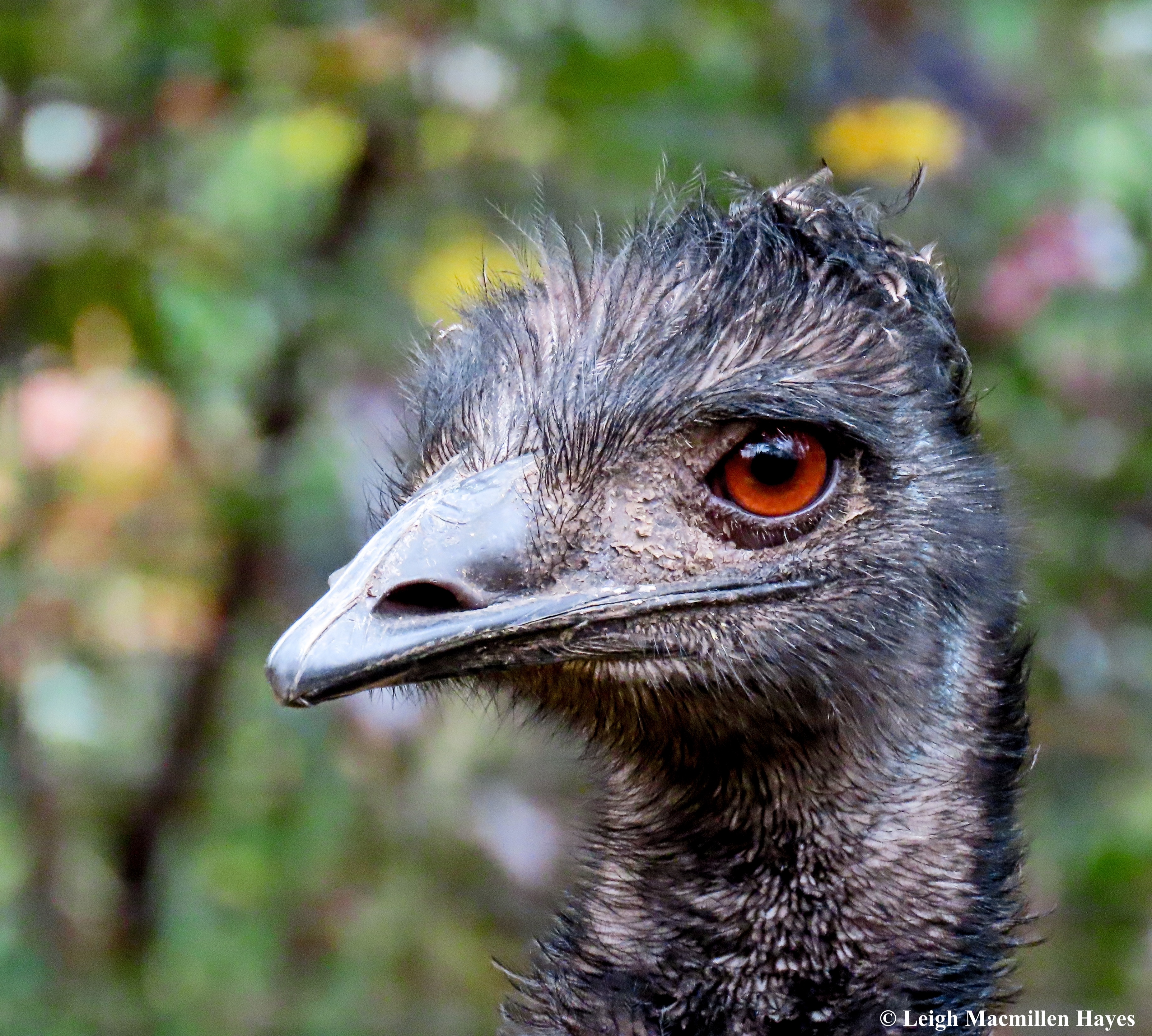
We left them in peace and found the Emus and I immediately fell in love with their orange eyes. And though they don’t look anything like Turkeys, I felt there was a good resemblance, maybe because both have appearances only a mother can love, and this seemed an apropos bird to meet the day before Thanksgiving.

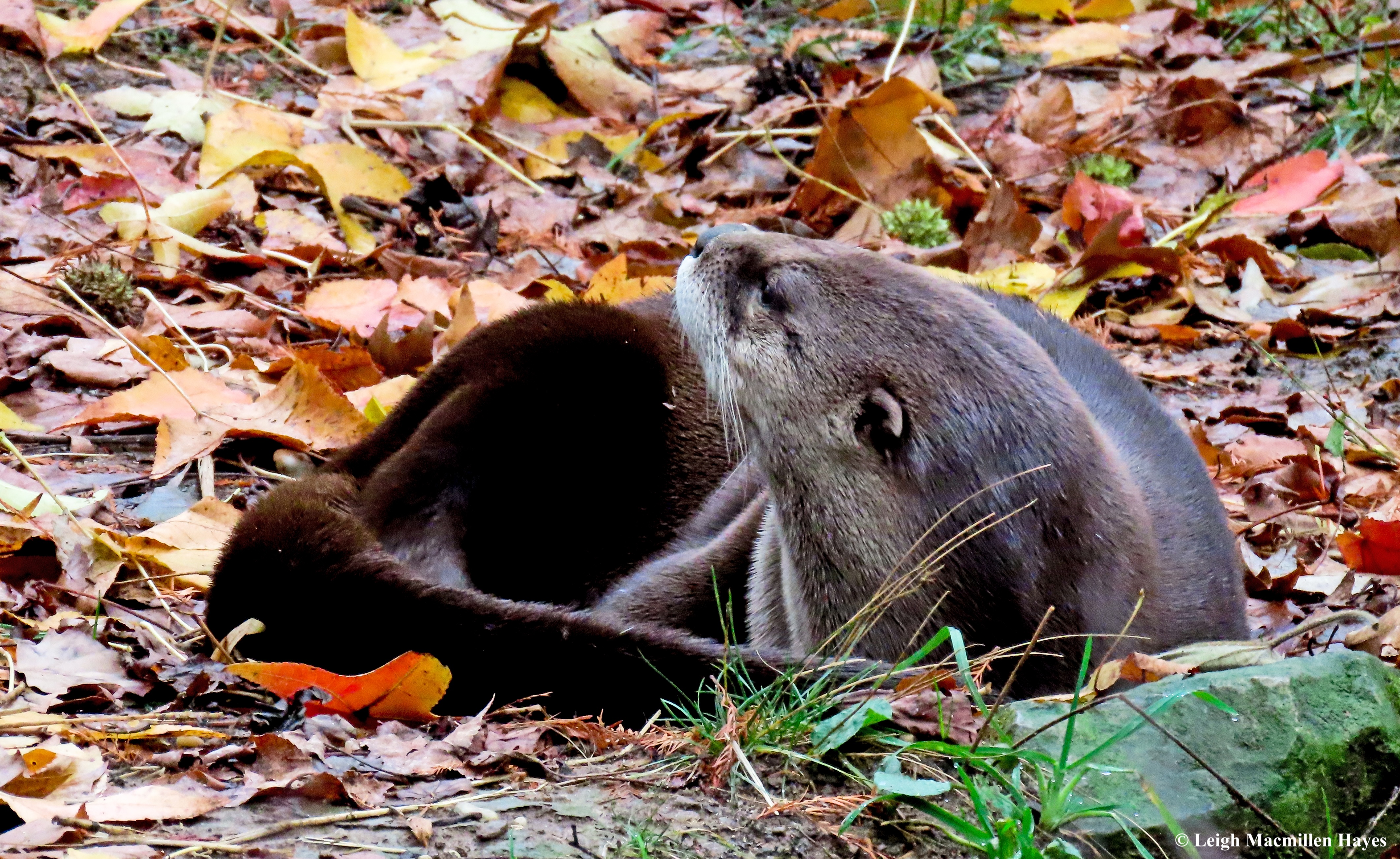
And then, and then, there was a River Otter. Asleep. Who knew River Otters took time to nap? In my book, they are always on the go, swimming and chatting to each other and sliding. Always sliding. But, of course, one needs to take a rest from time to time.

And then slowly lift one’s head up . . .

just a tad bit higher . . .

and scratch an itch, . . .

and then do the same as the ducks and preen a bit to spread the protective oils. It’s all in a day’s work schedule.

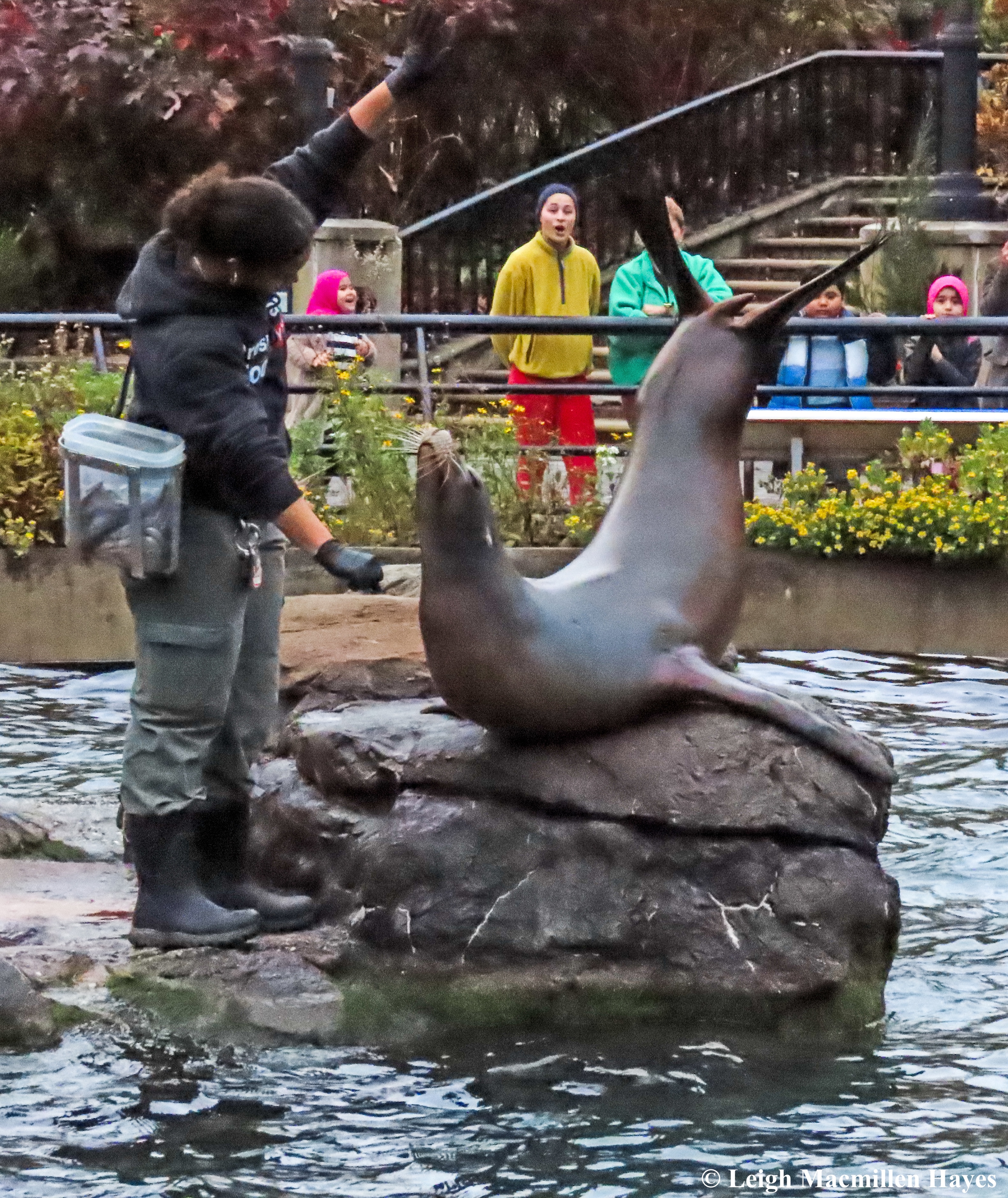
The ones who were having the most fun at the zoo seemed to be the Sea Lions. And we had arrived moments before a training session, so we stayed to watch and ooh and aah with the small crowd that had gathered that day.

They reacted to hand signals. And fish, of course.

High Fives . . .

and Open Sesames . . .

and Eye Drops . . . were all part of the program.

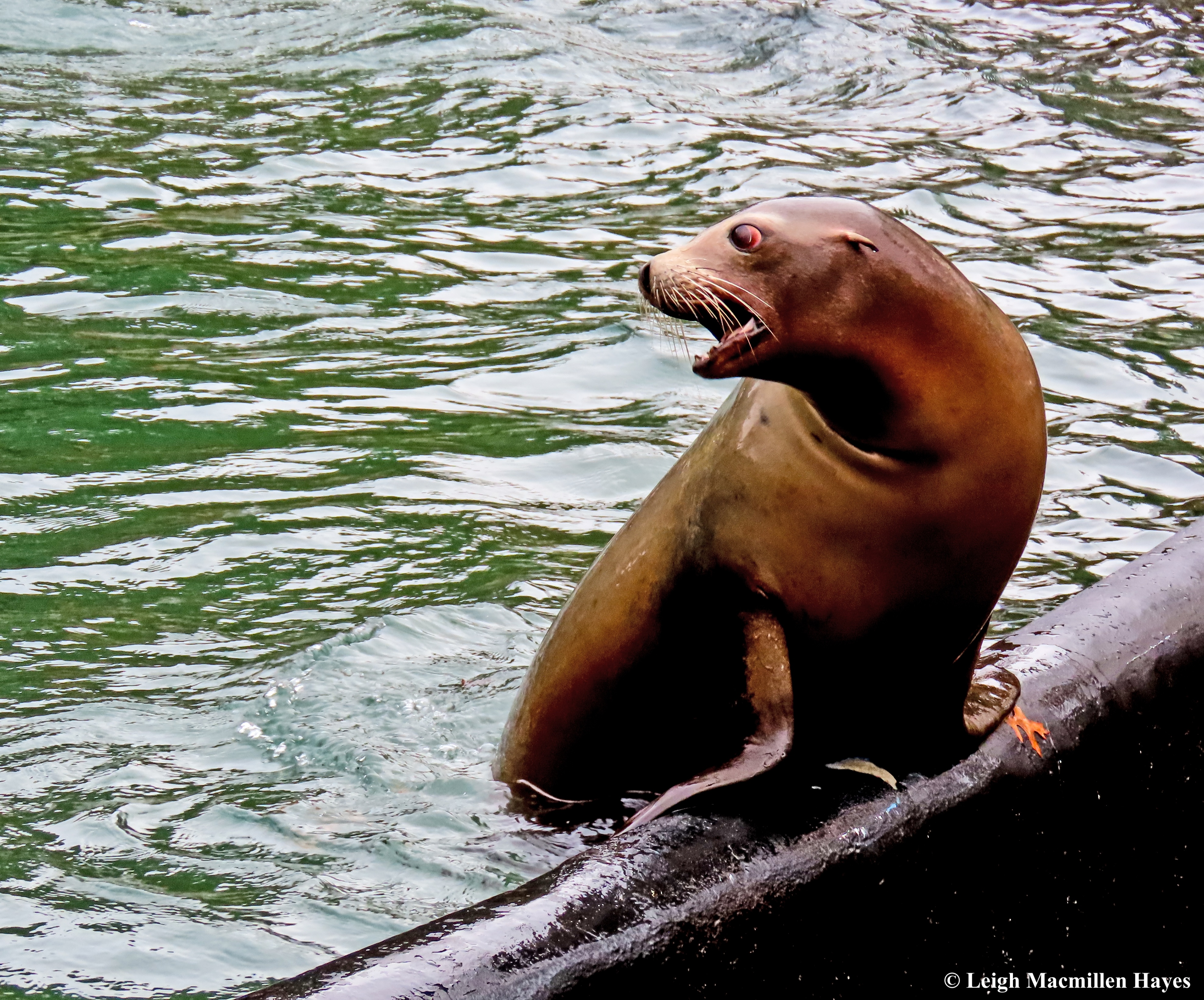
But maybe the best moment was when one swam to the edge, looked back at the trainer, recognized the signal to talk, and let us hear his voice.

Though I love fish, give me dark chocolates, and I might do the same.

Not to give away all that we saw, but there were Red Pandas who looked so cuddly, until I spotted the nails on their toes. They are bears, after all.

And a Pig-snouted Turtle, aka River Fly Turtle. I like the more common name because just look at that snout.

Meanwhile, the Merganser had moved to another part of the pond, but the Red-eared Slider maintained its position and I gave thanks for the opportunity to see it basking, even on a day with the temp in the low 40˚s.

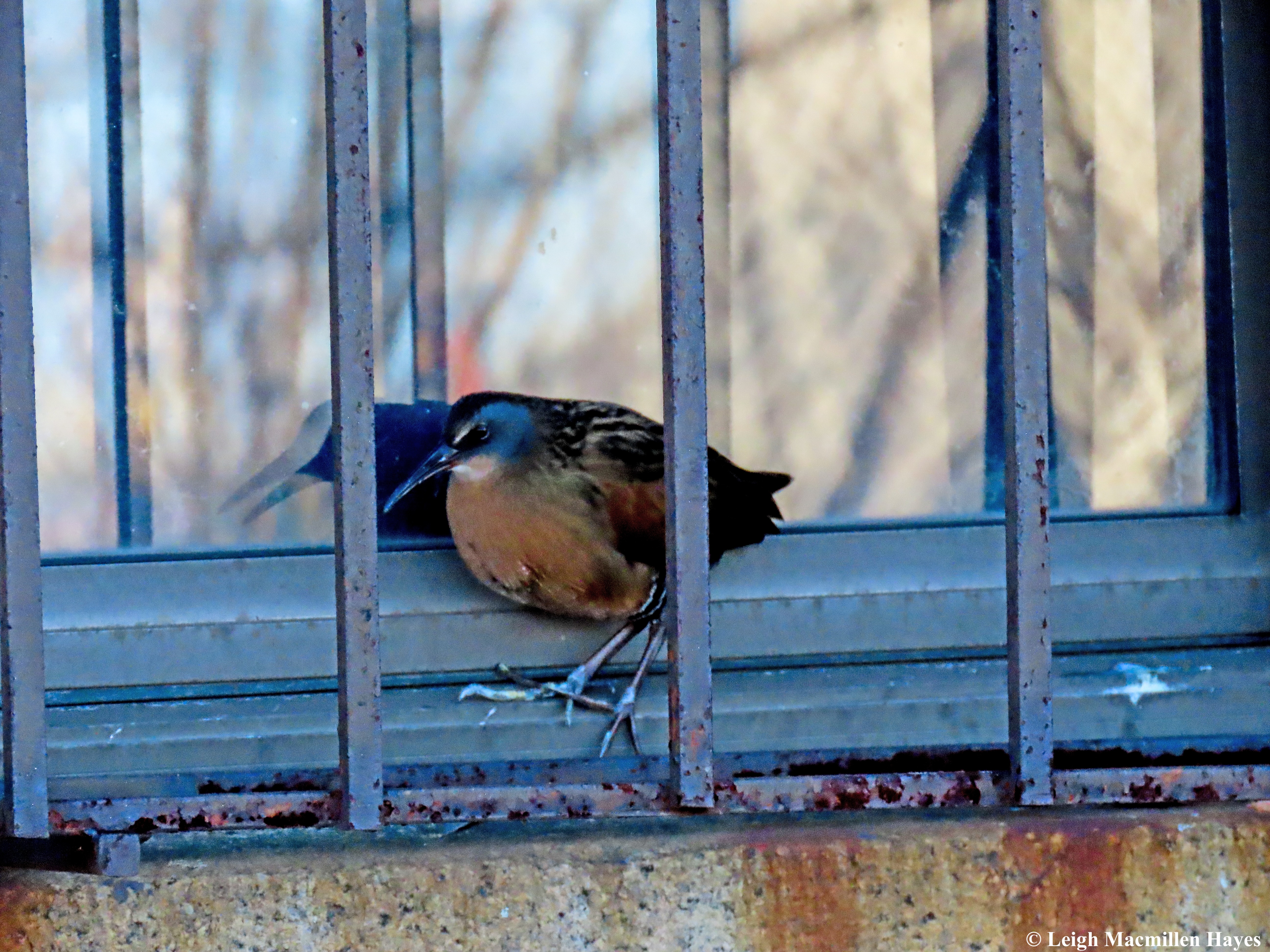
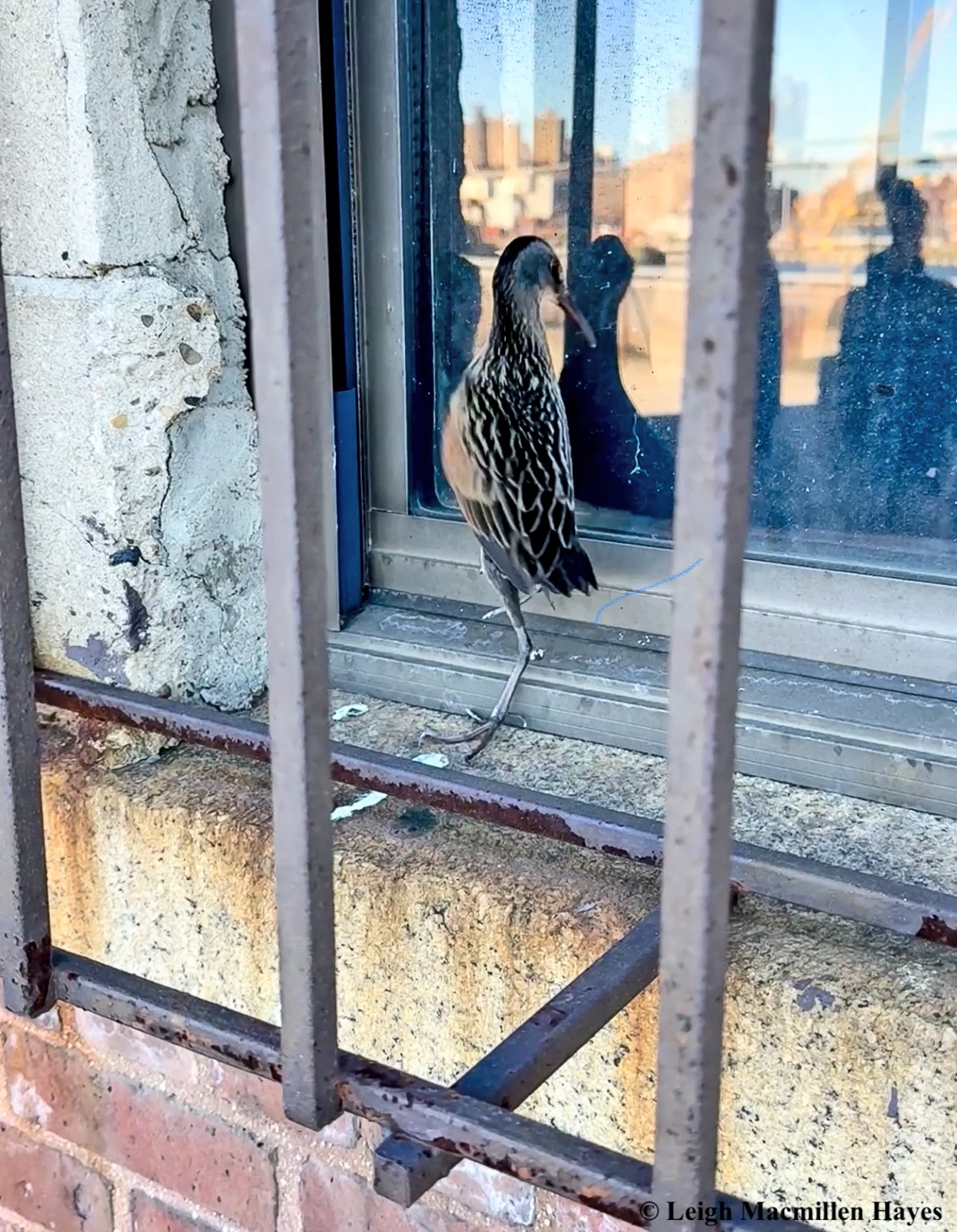
On another day in another place, a place next to where it should have been, we unexpectedly spotted a Virginia Rail. Yes, we were beside the East River in Wallabout Bay, but for some reason this most secretive of birds ended up behind the grates guarding a window.

Our companions worried that it couldn’t get out, but I suspected it would as the openings were large, and could only imagine that the wild winds of the previous day had blown it a wee bit off course.

And in another place, Starlings, where I expected to find a more exotic species.

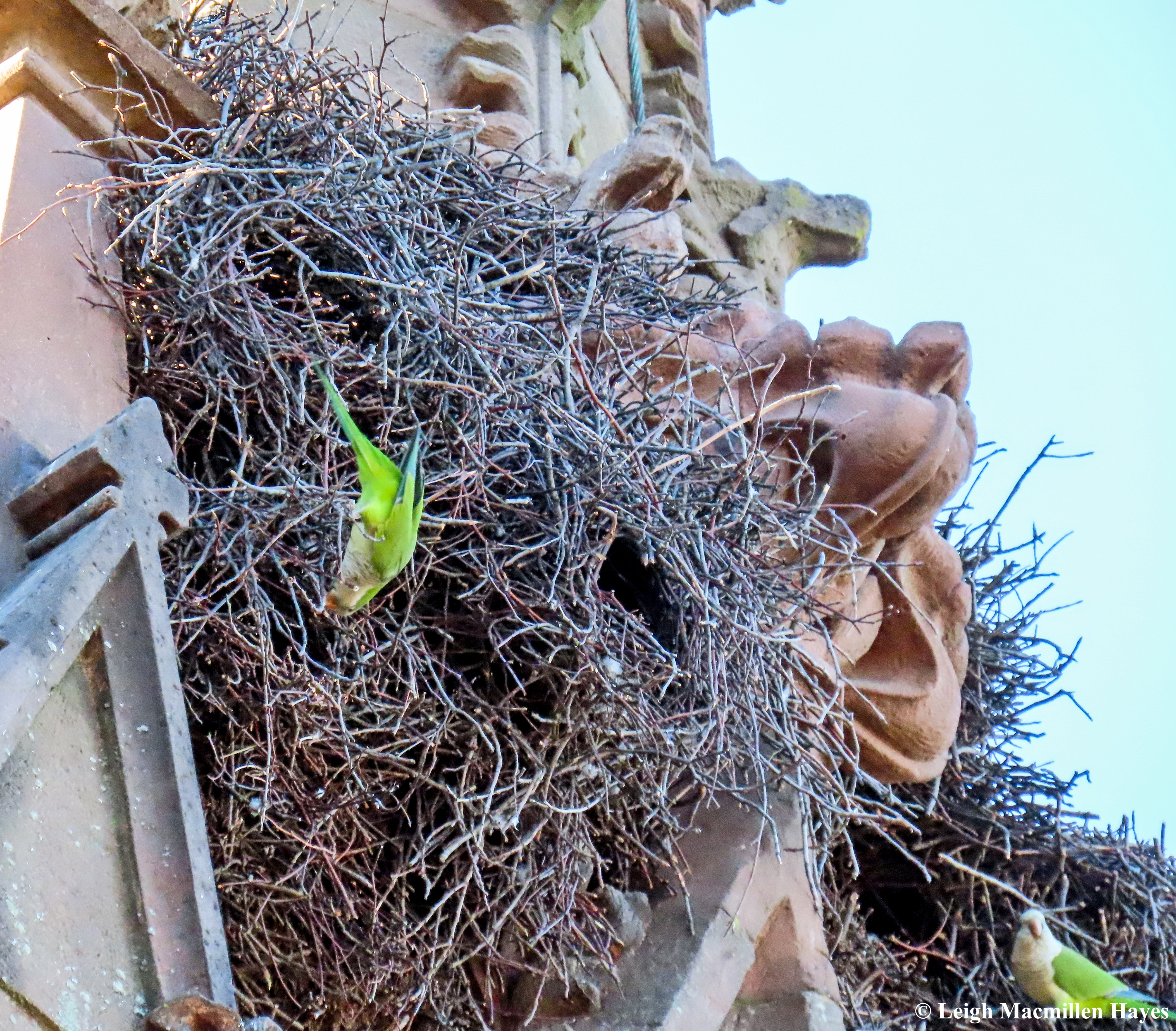
And then, much to my delight, one flew in: a Green Monk Parakeet.

I could have stood watching and photographing for hours in an effort to get to know them better, but there were miles to walk and so I settled for a few quick snaps of the camera and briefly captured their acrobatic movements.

Bringing us back to reality, were the Gray Squirrels dining and creating middens atop tombstones.

But even better than that, a Black Squirrel, the melanistic (dark fur) color variation of the Gray Squirrel. The black coloration is caused by a genetic mutation and perhaps provides advantages in certain environments, like helping them absorb more heat in colder climes.

And finally, much to my utter surprise, we spotted a Queen Bumblebee stumbling along in the crack of a paved pathway, probably seeking a place to overwinter moments before the sun went down.

It wasn’t just the wildlife that we came to see, for we had the profound pleasure of spending time in the company of four young people we are proud to call our own–that being our two sons and their gals. And together one morning, we explored Jumbo and walked below the Brooklyn and Manhattan Bridges.

One fun discovery was this orange cone Christmas Tree that seemed like it would look right at home in our hometown in western Maine, given that we’ve endured several years of sewer construction and road work.

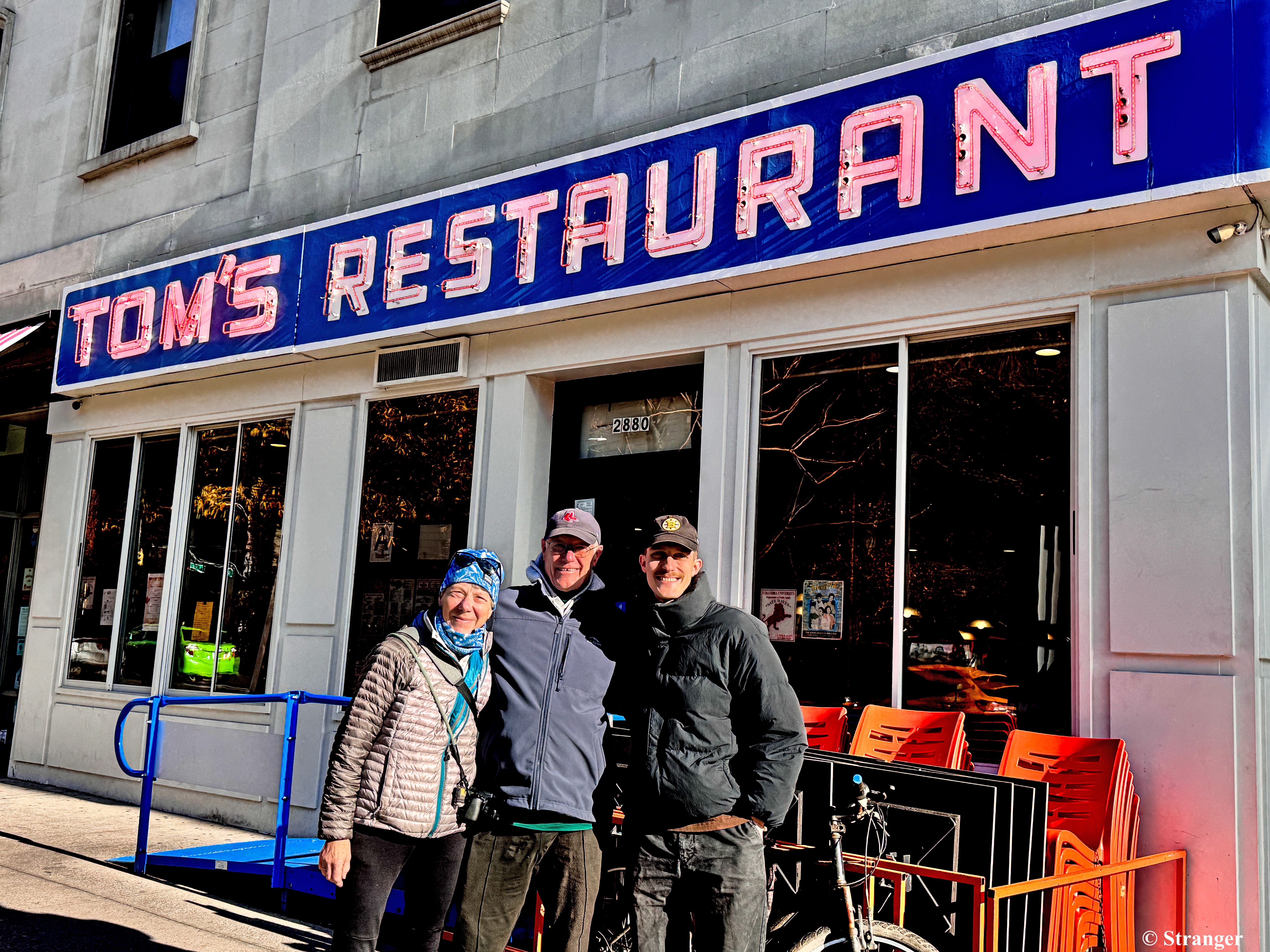
After saying goodbye to our eldest, we ventured to Manhattan with the youngest and found the restaurant that inspired one of our favorite shows.

We sat at the counter where P posed below Kramer and felt like we could hear Jerry and George and Elaine in a nearby booth.

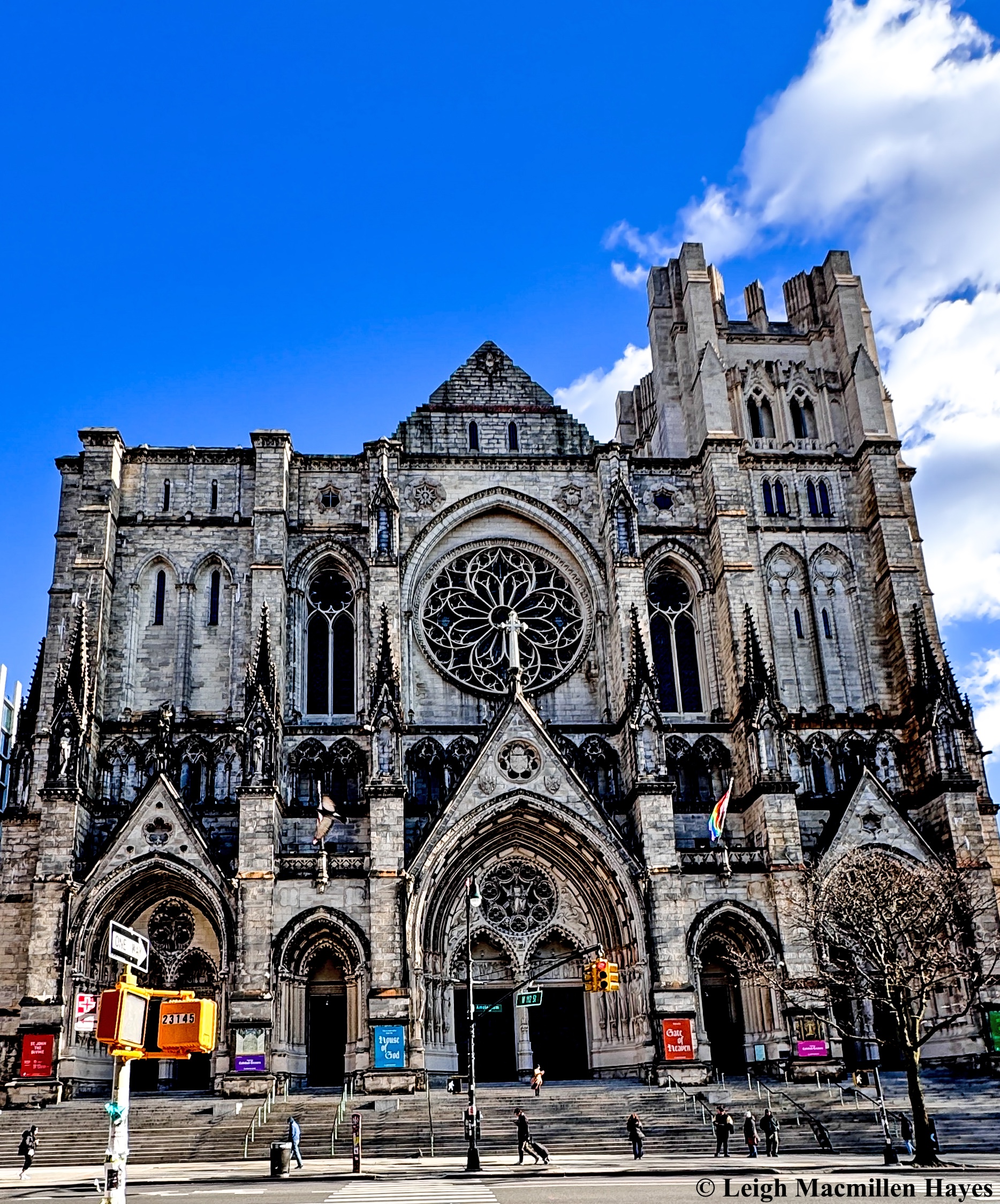
And then we walked to St. John the Divine, an Episcopal Cathedral steeped in history and never finished.

Our tour guide informed us that the original architects, George Lewis Heins and Christopher Grant LaFarge, envisioned a Romanesque-Byzantine style structure, as seen here in the Apse. Notice the rounded arches. They started building the Cathedral in 1891.

The Cathedral was partially finished in 1911, when Heins died. Architect Ralph Adams Cram was then hired to complete the work and the Nave reflects Gothic Revival architecture, his favorite. Notice the pointed arches.

Massive pillars that are 55-feet tall and six-feet across support the building and were constructed from New England granite without steel reinforcement, using techniques borrowed from the Middle Ages.

In the back of the Nave, the Great Rose Window is forty feet in diameter, with Jesus being 5.5 feet tall, despite how small he looks from the floor below. It’s the third largest rose window in the world and is made of over ten thousand pieces of glass, mind-boggling as that is.

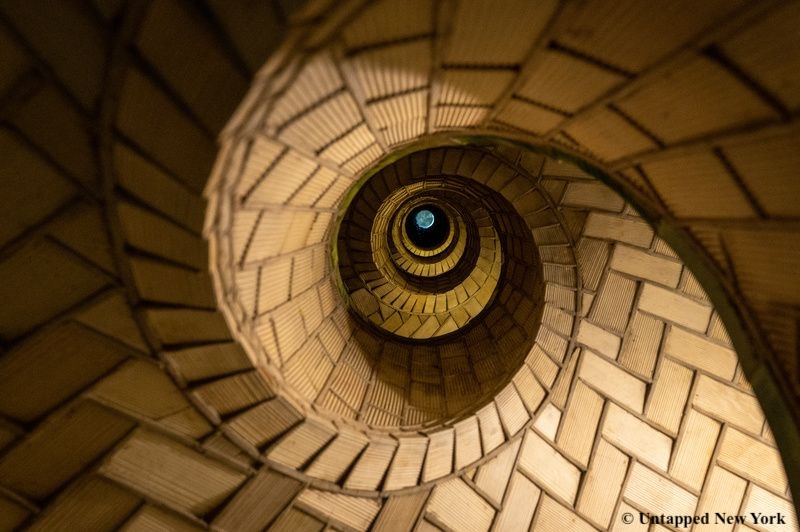
Our youngest had signed us up for a vertical tour, and I have to say climbing up was much easier than climbing down, but I’m so glad we did it.

Each level brought us closer to the stained glass windows, which are dedicated to one of fourteen forms of human endeavor, including Labor, Medicine, Communication, Education, Law, Military, Arts, American, Anglican, Crusaders, Earth, All Saints, Missionary, and Sports.

The windows on the ground level show a variety of historical and scriptural figures engaged in a particular activity, all theme-related.

The higher set of windows show saints associated with the same activity.

Rosettes at the top depict Jesus, crowning each window and completing the progression from the human plane to the sacred and divine. He is always depicted with a cross above his head.

We happened to be there when the late afternoon sun was shining through and creating magical rainbows on the pillars.

From there we went to the MET Cloisters, where we walked the grounds and saved an inside tour for another day.

Each time we visit, we also arrange for a private group tour and this year’s locale was the Brooklyn Navy Yard in Wallabout Bay on the East River.

From the early 1800s through the 1960s, it was an active shipyard, and during World War II was known as the “Can-Do” shipyard, which employed 75,000 workers. In 1966, it was demilitarized.

According to our guide, the facility now houses an industrial and commercial complex for shipping repairs and maintenance, run by the New York City government, and as office and manufacturing space for non-maritime industries. Inside the museum one can view some of the products that call this place home.

One of the things we learned as we toured the shipyard, was that Sweet’N Low, the sugar substitute, was born and raised at a Fort Greene factory just outside the Brooklyn Navy Yard. Though the business has relocated, the iconic sign remains.

Our final tour of the weekend was self-guided, again with our youngest leading the way, and into Green-Wood Cemetery we ventured because it’s located just around the corner from the apartment he shares with his gal.

The cemetery contains 600,000 graves and 7,000 trees spread out over 478 acres, with hills and dales and ponds in the mix and as P noted, the city noises disappeared as we explored.

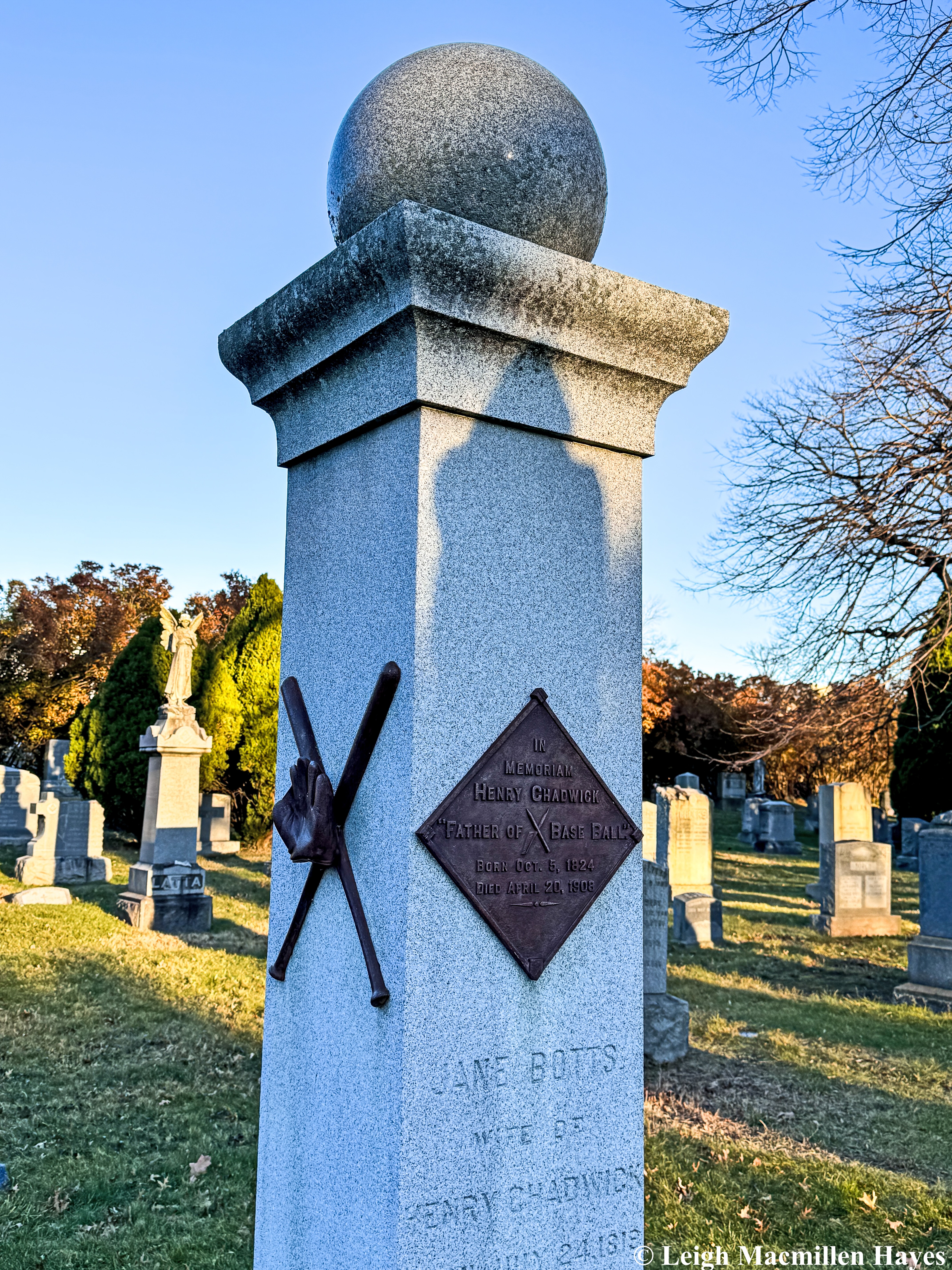
One of our fun finds, the pillar for Henry Chadwick and Jane Botts, he being the father of Baseball.

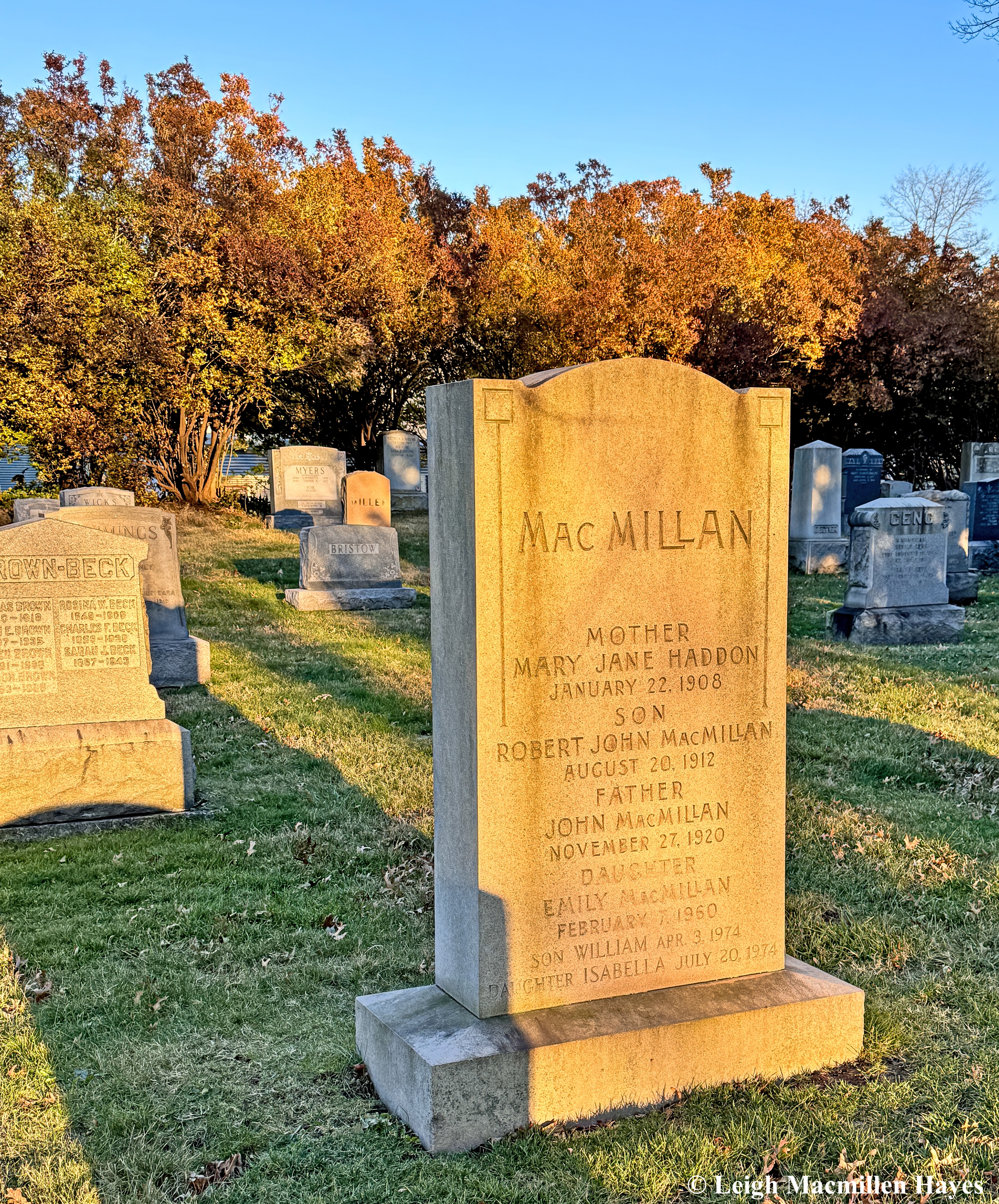
We also looked for familiar names and weren’t disappointed, though we don’t know of any connections at this point.

But what truly struck us is that this cemetery is one for all–for so many were the nationalities and religions depicted.

And while most of the stones looked like they were frequently cleaned, I did locate some with lichens, speaking to the fact that there is life among death. And this shield lichen very much spoke to such life for it featured the fruiting bodies or Apothecia with abundant Soredia, which are tiny, powdery vegetative reproductive bodies that can be carried off by the wind or rain to form new lichens. The Soredia are similar to other vegetative reproductive growths called Isidia, which are stalked growths on the thallus or body of the lichen.

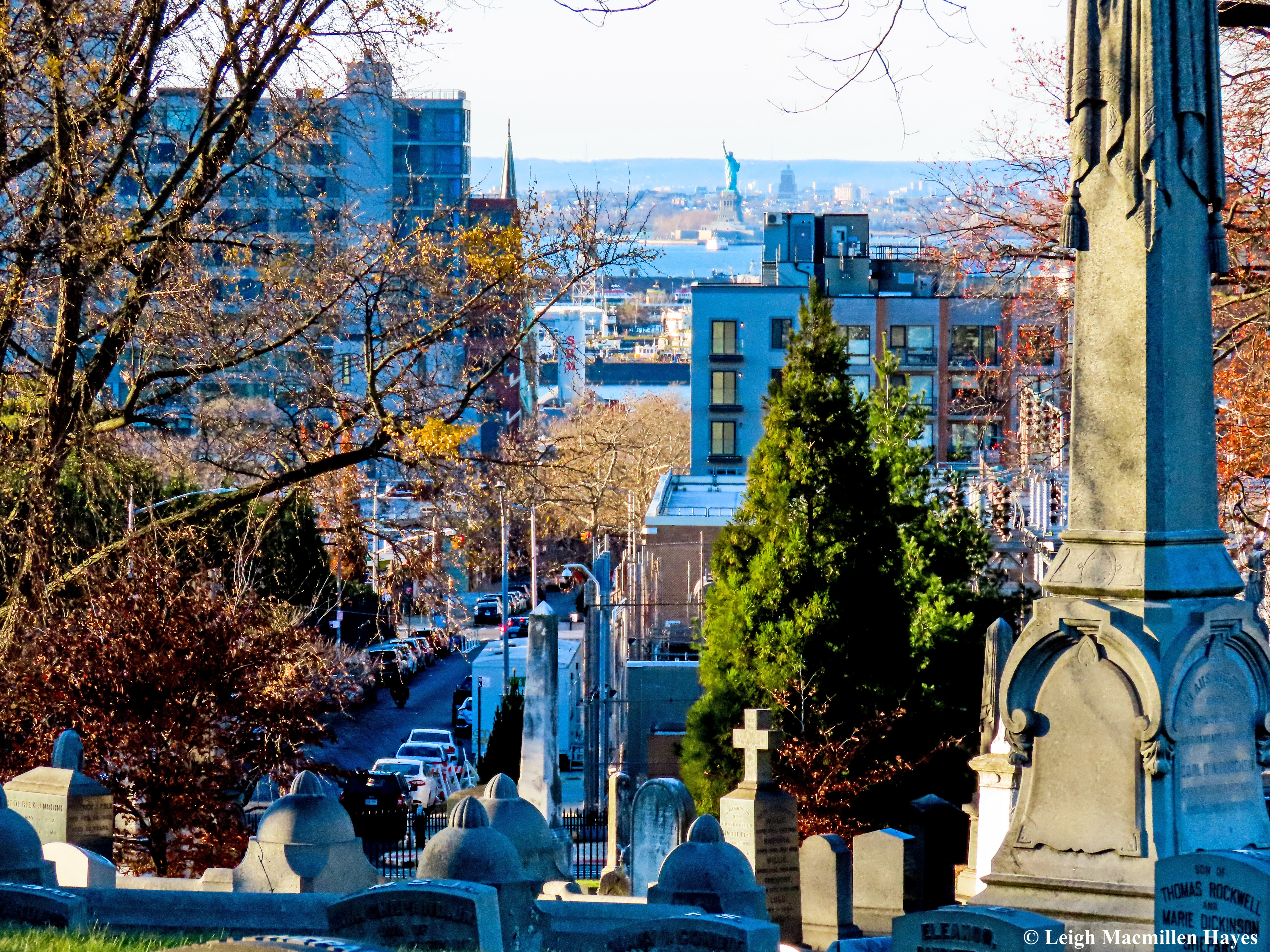
From the cemetery, we could see Lady Liberty standing tall and holding her flame to bring us all together.

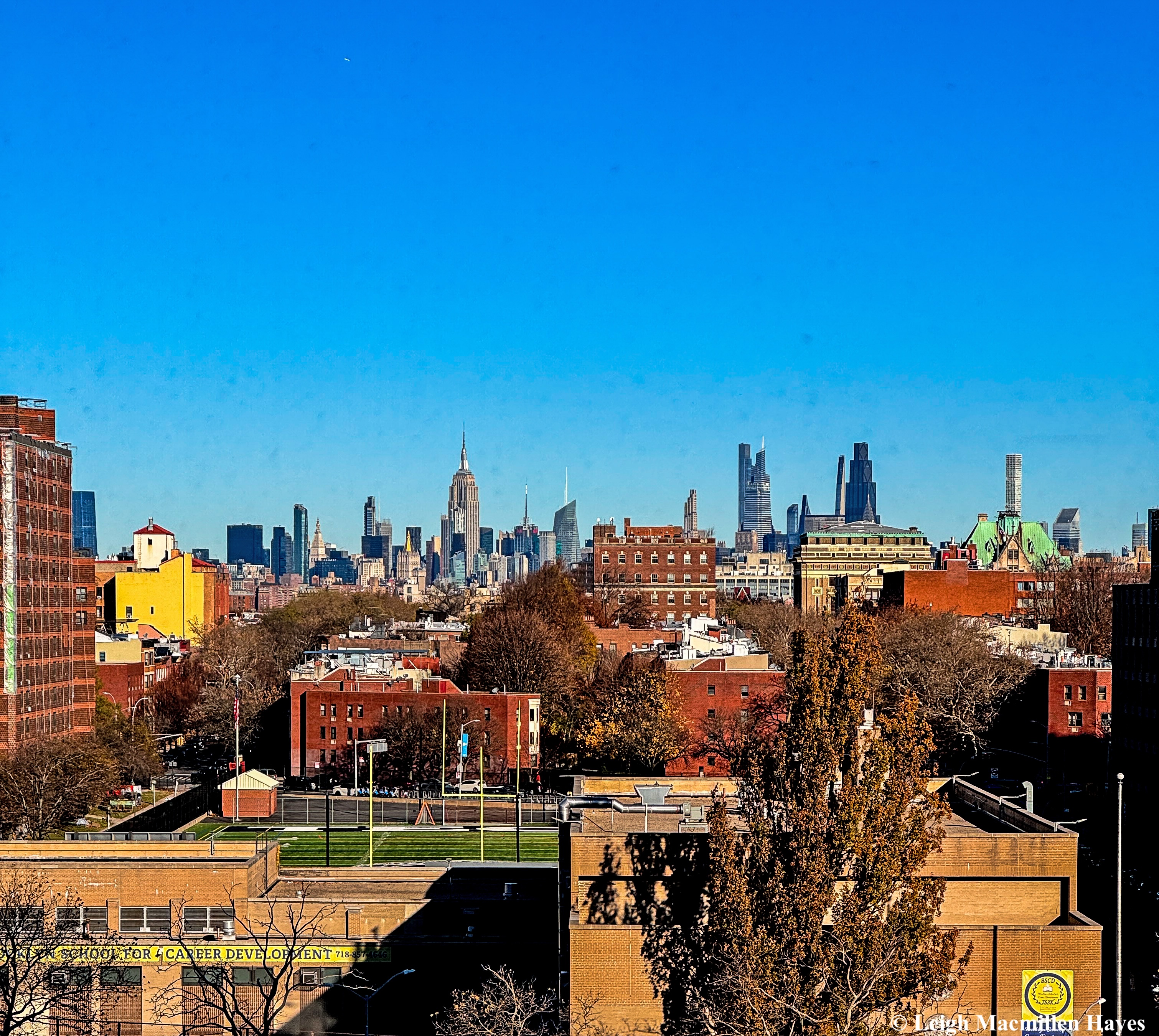
And from various vantage points we could see the Empire State Building, standing as a beacon to us . . .

almost like Pleasant Mountain and Mount Washington back home, so that no matter where we were, we knew where our weekend home was located.

Because this was the view from said “home,” the Brooklyn apartment owned by our Thanksgiving hostess.

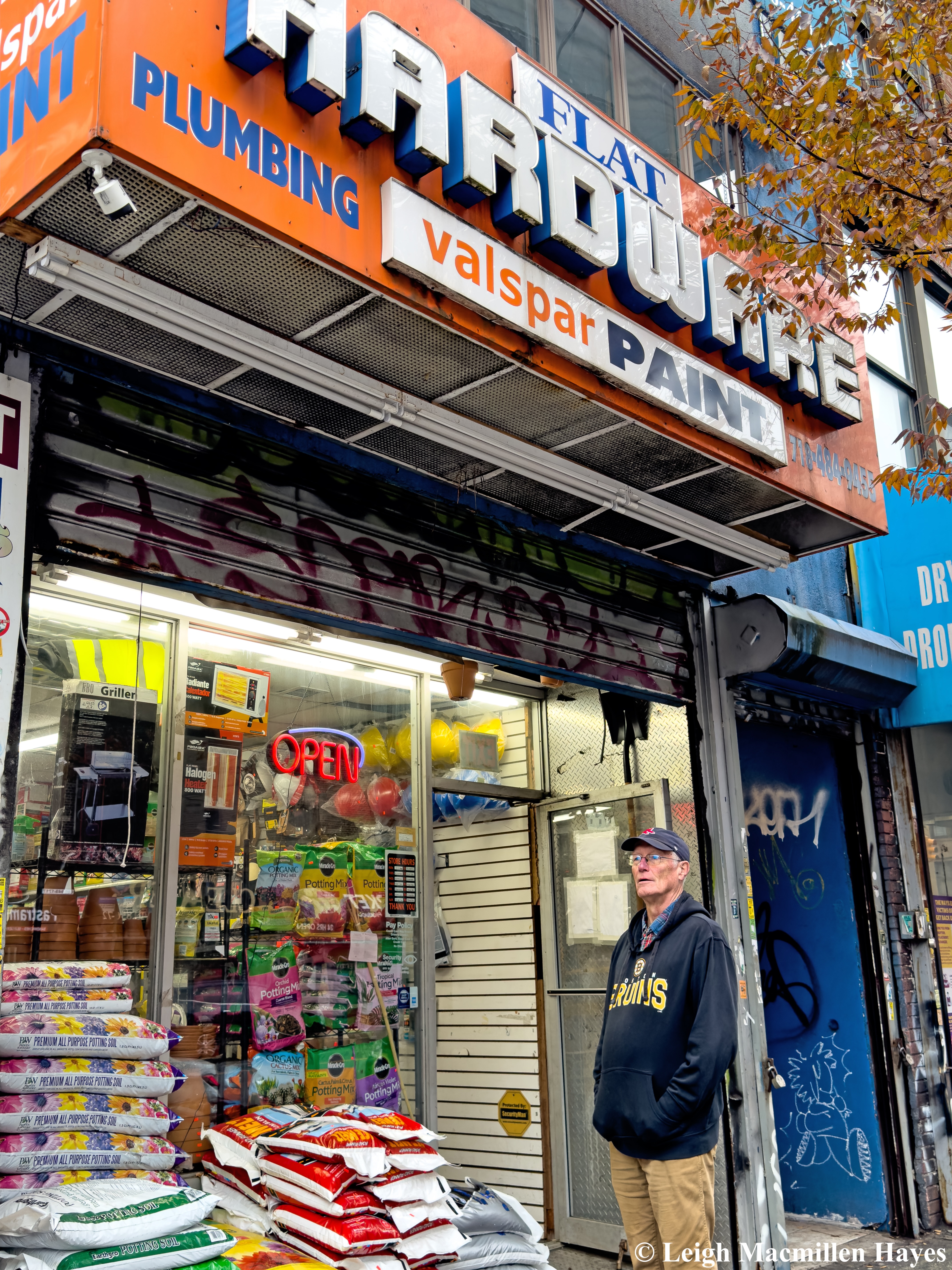
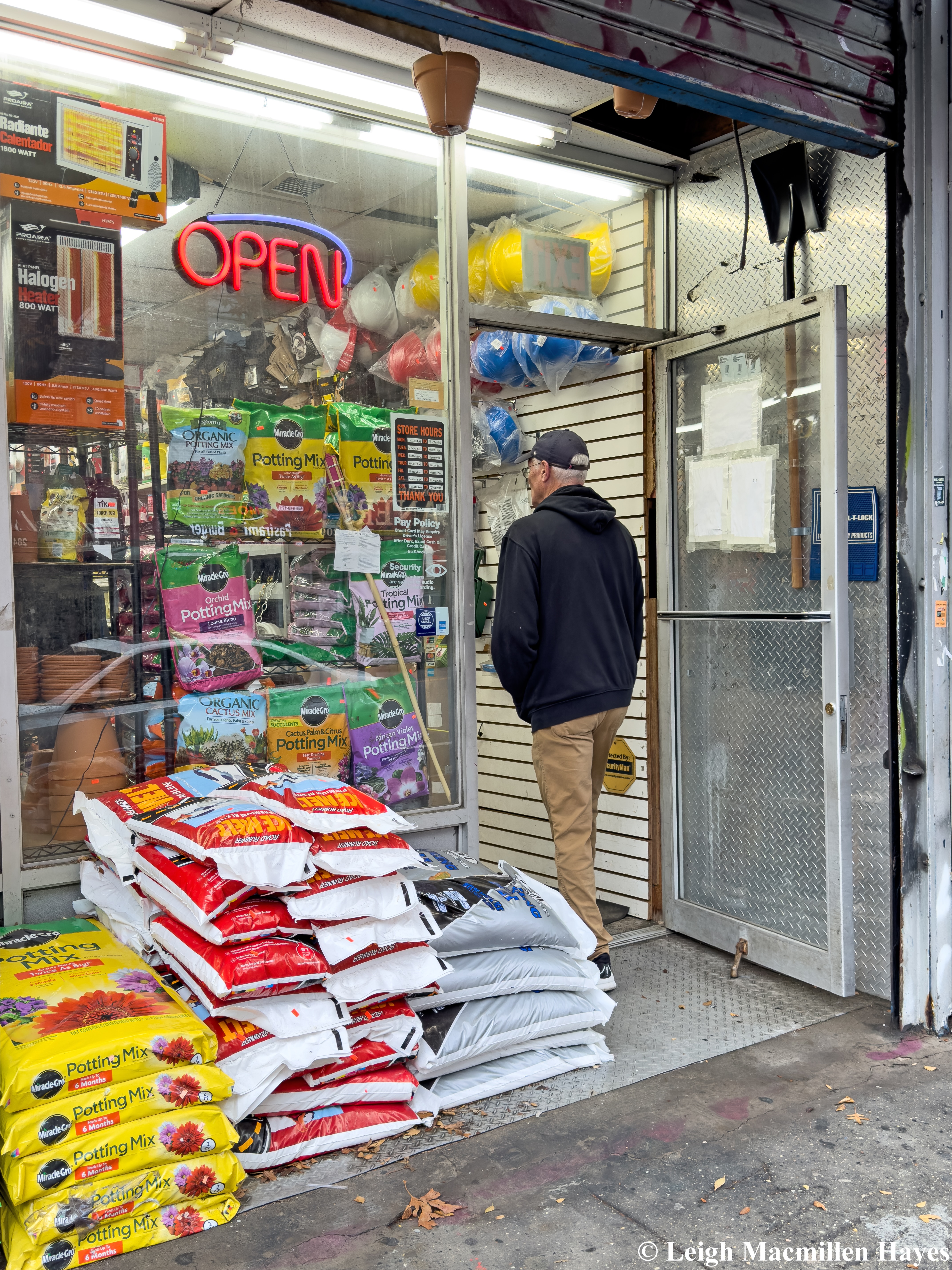
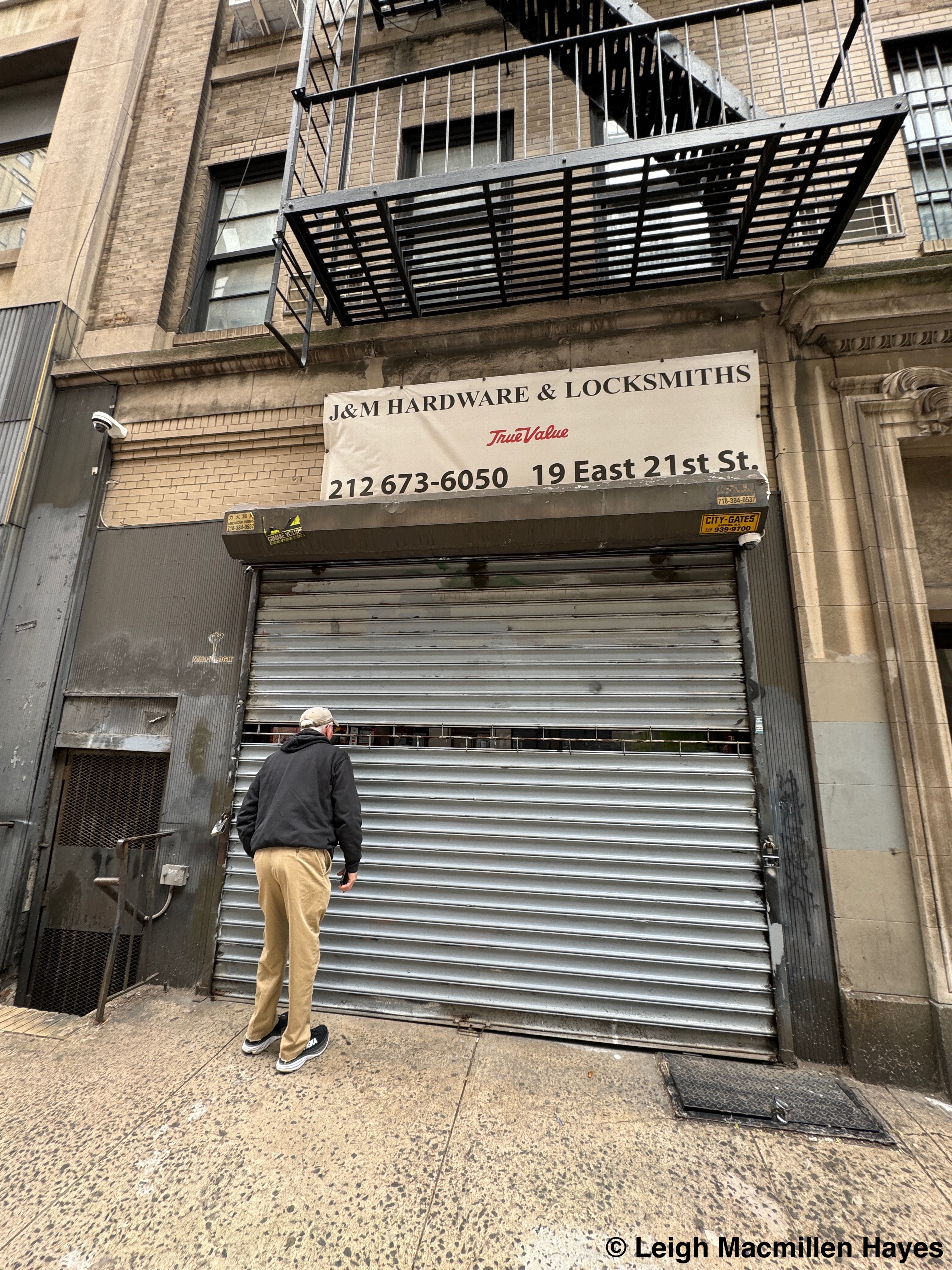
And no trip of ours is ever complete without a tour of a hardware store.

He said he wasn’t going to go in, but you know that he did. It was a quick loop up one aisle and down the other, for so narrow was the store, but oh was it packed with merchandise–every square inch in use as is the city way.

And remember our cemetery trip? Well, I spotted this and My Guy didn’t know what the Old Guard Southern Hardware Salesmen’s Association was all about. Turns out, it has quite a history.

Curiously, I found this explanation on Instagram:

From the American Artisan and Hardware Record, June 1, 1918:

“THE OLD GUARD SOUTHERN HARDWARE SALESMEN KEEPS ALIVE ITS ORIGINAL FIGHTING SPIRIT.

“The original fighting spirit which moved the members of the Old Guard Southern Hardware Salesmen’s Association to organize for carrying on the bloodless battle of commerce was strongly in evidence with new force and application in its annual general meeting held May 29, 1918, at Atlantic City, NJ. These veteran warriors of salesmanship pledged all their energies and experience to the aid of the younger men who are waging the titanic warfare of a free people against the despotism of barbarians who hide their savagery under a guise of mechanical culture.

“Particular significance attaches to the Old Guard by reason of the fact that its ranks represent the ripened wisdom of years of active service in the hardware trade. It was formed ten years ago at the Convention of the Southern Hardware Jobbers’ Association in Hot Springs, Arkansas. The membership of the Old Guard is strictly limited to salesmen and traveling salesmanagers who have sold hardware and kindred commodities to the hardware jobbing trade in five or more Southern and Southwestern states during a continuous period of fifteen or more years. The membership is limited to one hundred.

“The men who have been in charge of the affairs of the Association for the term which ended at the conclusion of this year’s convention have exerted themselves with enthusiasm and persistence to maintain the traditions of the organization and to further the collective interests of the membership…

“Adjournment was taken with a feeling of renewed confidence in the power and purpose of the Association and a determination to use all the influence of the organization in promoting a vigorous Americanism throughout their territory to the end that international justice may be established and lasting victory be won for the hosts of democracy.”

Hardware and Democracy it seems, were both important to Herb.

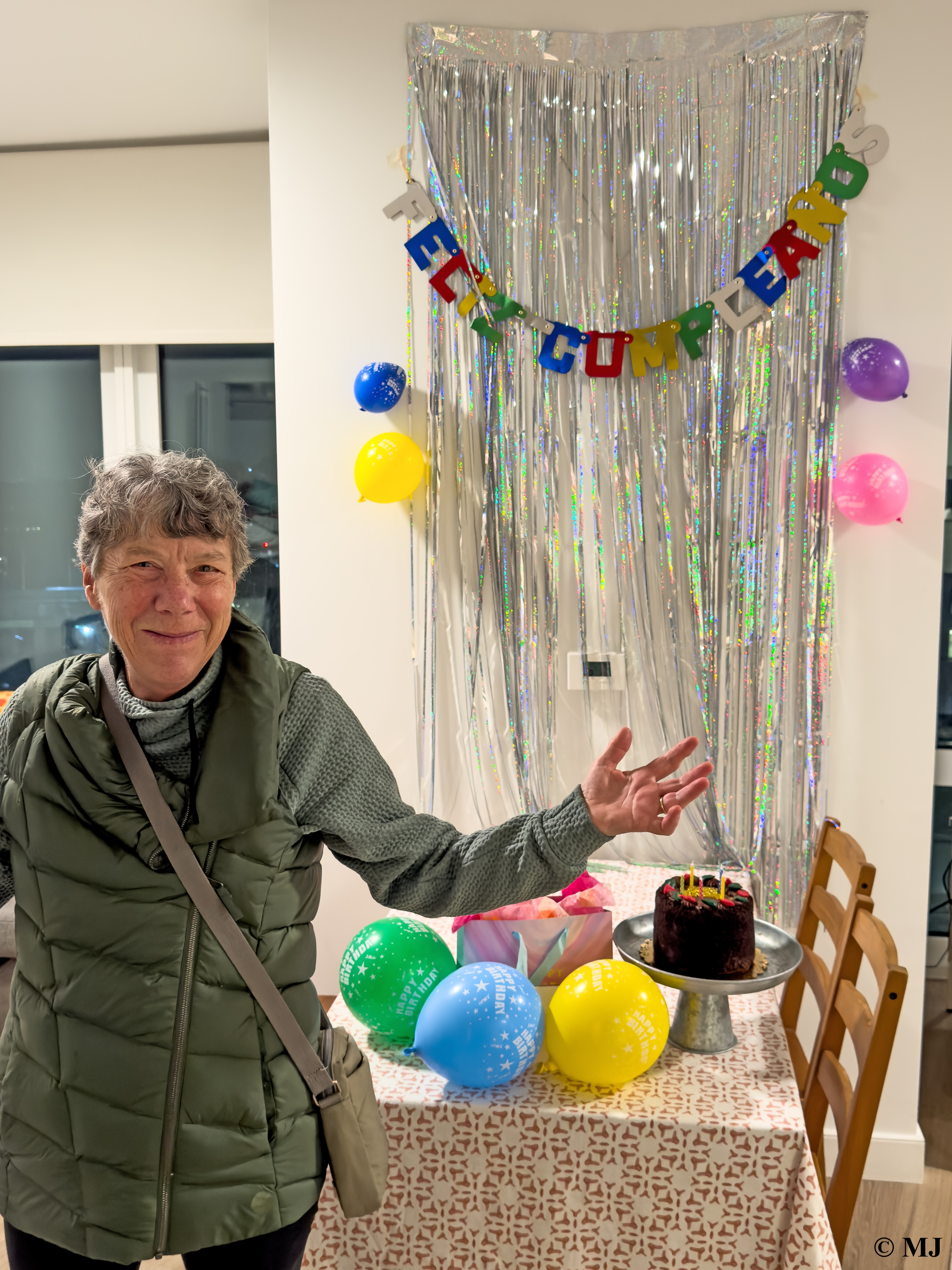
So we arrived in Brooklyn the night of my most recent birthday and were welcomed with a surprise celebration that included New York-style pizza and dark chocolate cake–thanks to M and P.

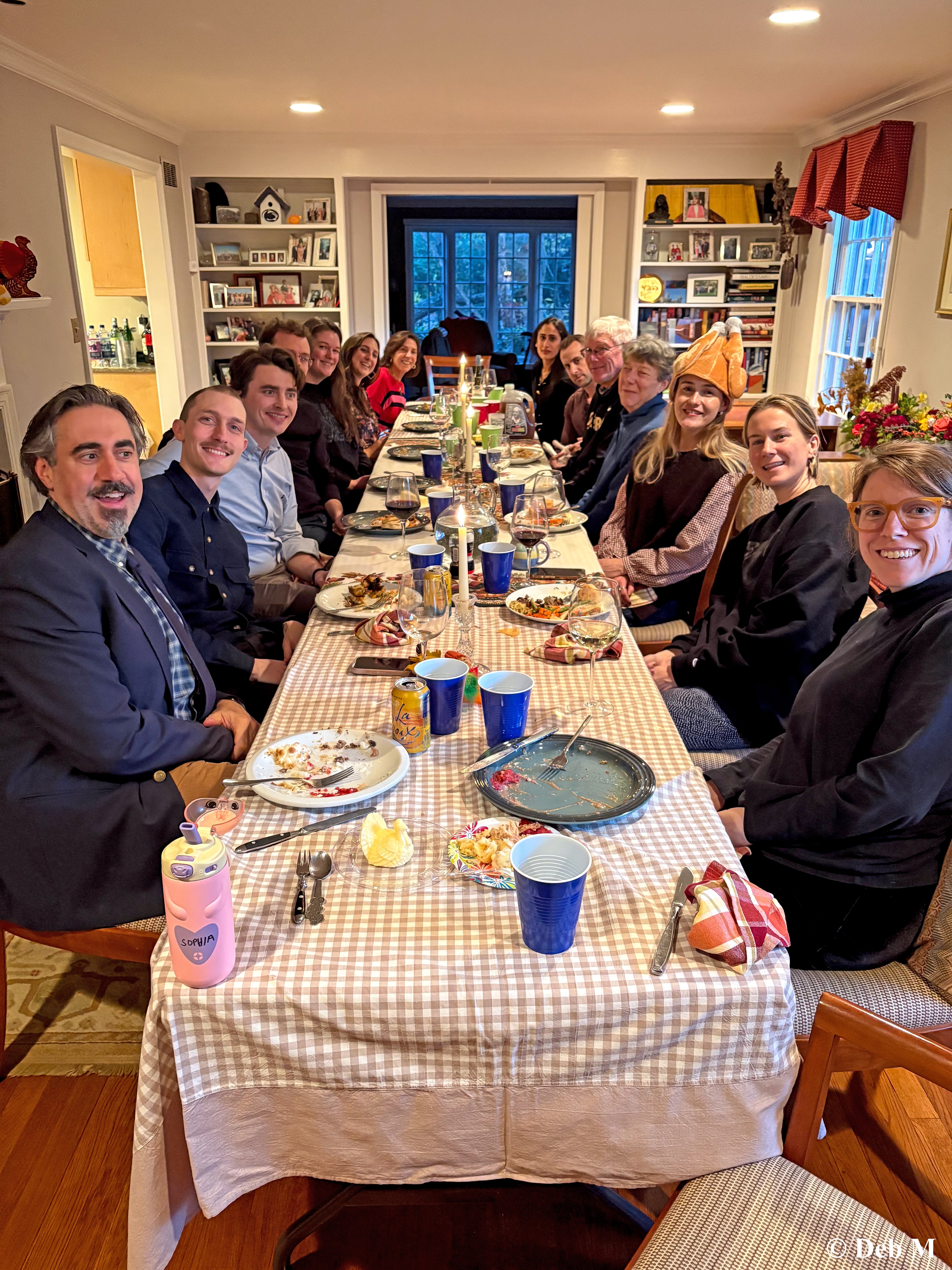
We were also there to celebrate America’s grand feast with M’s family in New Jersey.

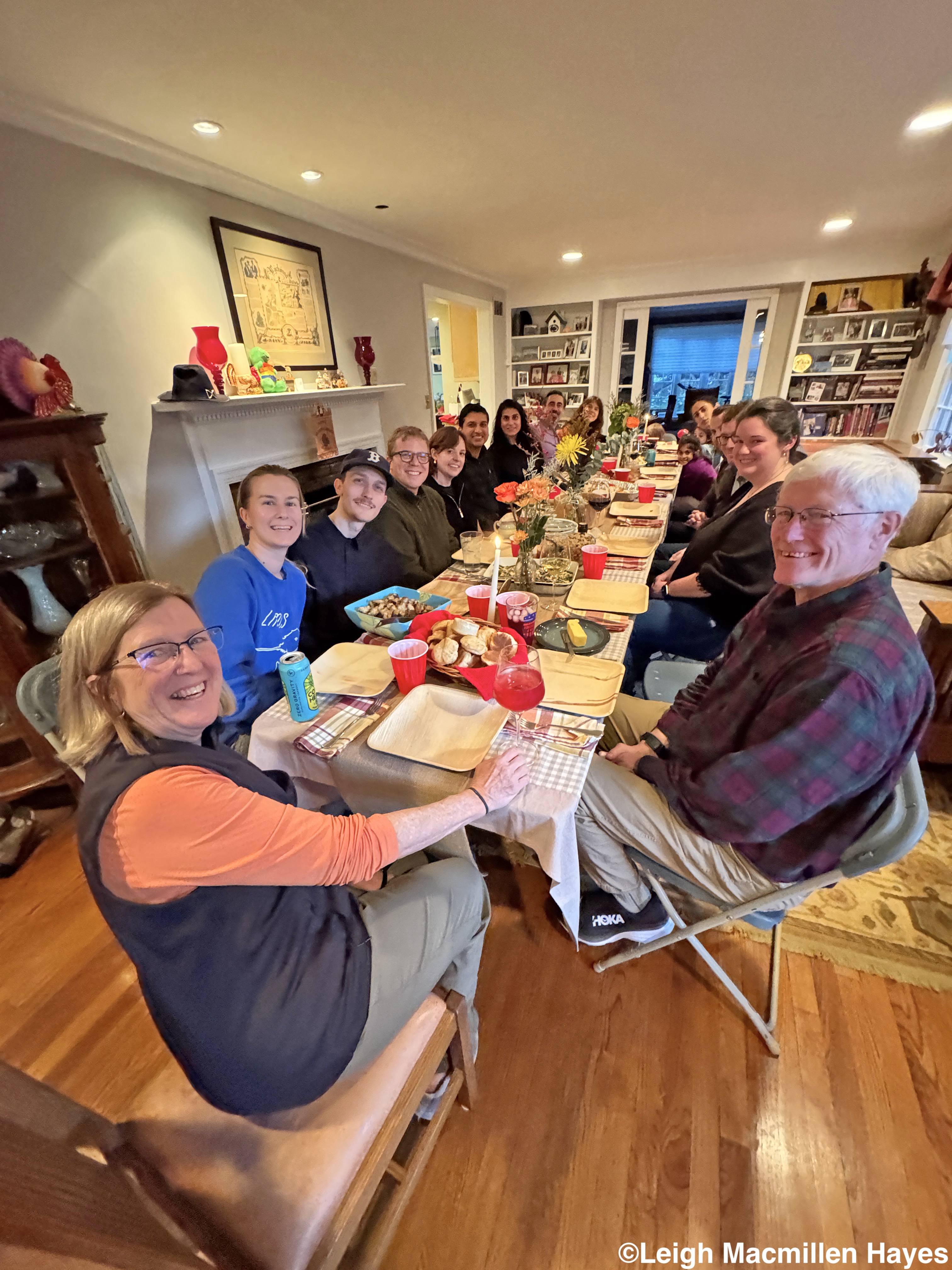
Dinner included a gathering of family and friends, one of whom is a Kiwi and this was her first American Thanksgiving feast, so she graciously wore the turkey hat.

And this little one kept us all in line throughout the day.

At the end of the day and the end of the weekend, our biggest thanks go to these two, daughter and mother, M and D, M being our youngest son’s girlfriend. Their hospitality and generosity never cease to amaze us.

Because of them, we did lots and lots of walking, while it felt like an almost equal amount of dining was thrown into the mix from bagels to farm-to-table to traditional Thanksgiving to diner breakfasts to pub meals, and of course, the iconic New York-style pizza.

Thank you, D and M and P, for inviting us to celebrate New York our way, and to S and H for making the trip from Boston, even if you couldn’t stay the entire weekend.

Above and Below: a few wonders from skyline

Grab a cuppa your favorite beverage cuze this is gonna be a long one.

We haven’t taken a vacation in the past two years, but this past week changed that . . . thankfully. It was rather a last minute decision and the Wednesday evening prior to our Sunday afternoon departure found us booking places to stay and suddenly it felt real.

And then it was.

After a long drive, which we split up with a stay in Scranton, Pennsylvania, where we kept looking for the truck carrying “30,000 pounds of … bananas,” we pulled into Front Royal, Virginia, and vacation really began.

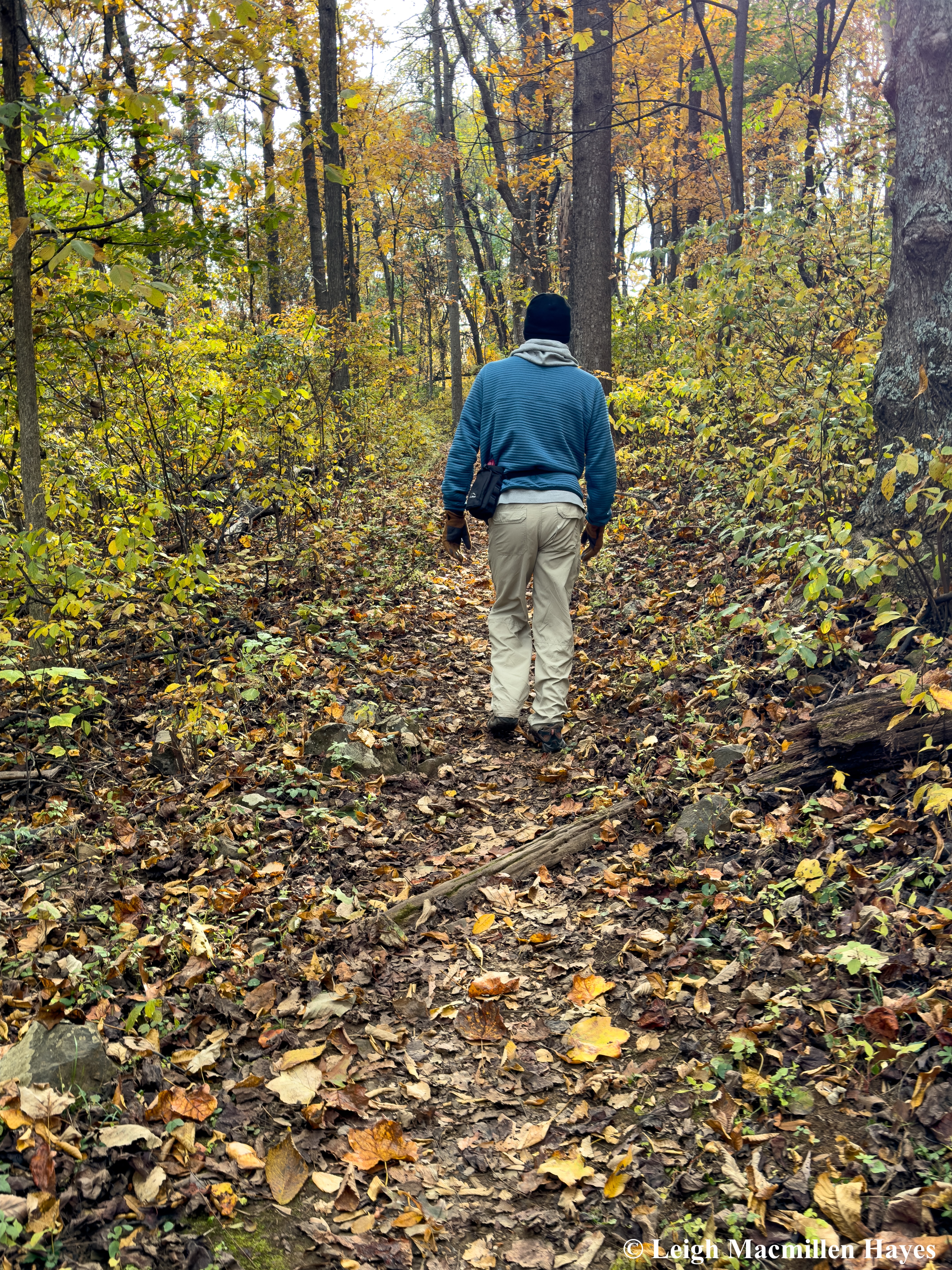
Our intention was to drive along Skyline Drive in Shenandoah National Park and hike as many trails as we could fit into five days. Thankfully, our friend Kimmy had given us a bunch of suggestions, and the rangers at the Visitor Centers had maps for each one.

On each of the trails we hiked, metal bands on the trail markers were stamped with the direction and mileage, and after not paying attention on Day 2, and finding ourselves at least a half mile beyond the point where we should have been looping around, we had to backtrack, and learned our lesson. Always check first before proceeding.

Had we looked, rather than thinking that we knew better, we would have discovered that the trail was to the right.

But it was a loop, so we thought we would end up back in the same spot. The laugh was on us. And laugh we did.

The trails we followed varied from easiest to moderate to difficult with somewhat steep sections or scrambles, and we loved the variety . . . underfoot and in the shrubs and trees, but more on that in a wee bit.

Many had outlooks where we could enjoy the view, but one in particular, reminded us to look, that being White Oak Trail.

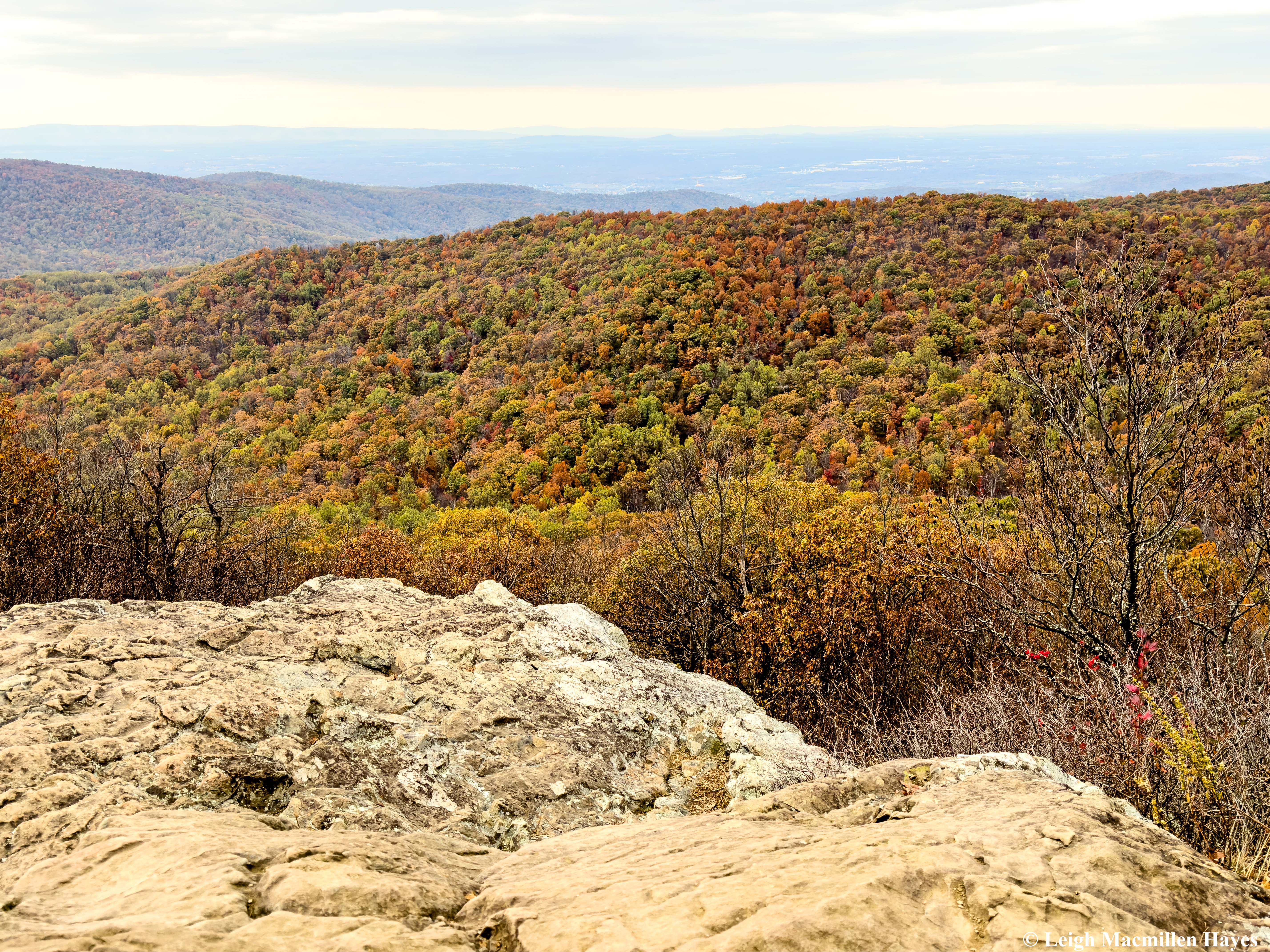
As the week went on, it was fun to note how the foliage changed. When we first arrived, the view at Compton Gap was that of a November tapestry . . . golds and greens and oranges and rusts . . . just a bit past peak. By the end of the week, after a windy, rainy period, many trees had lost their leaves.

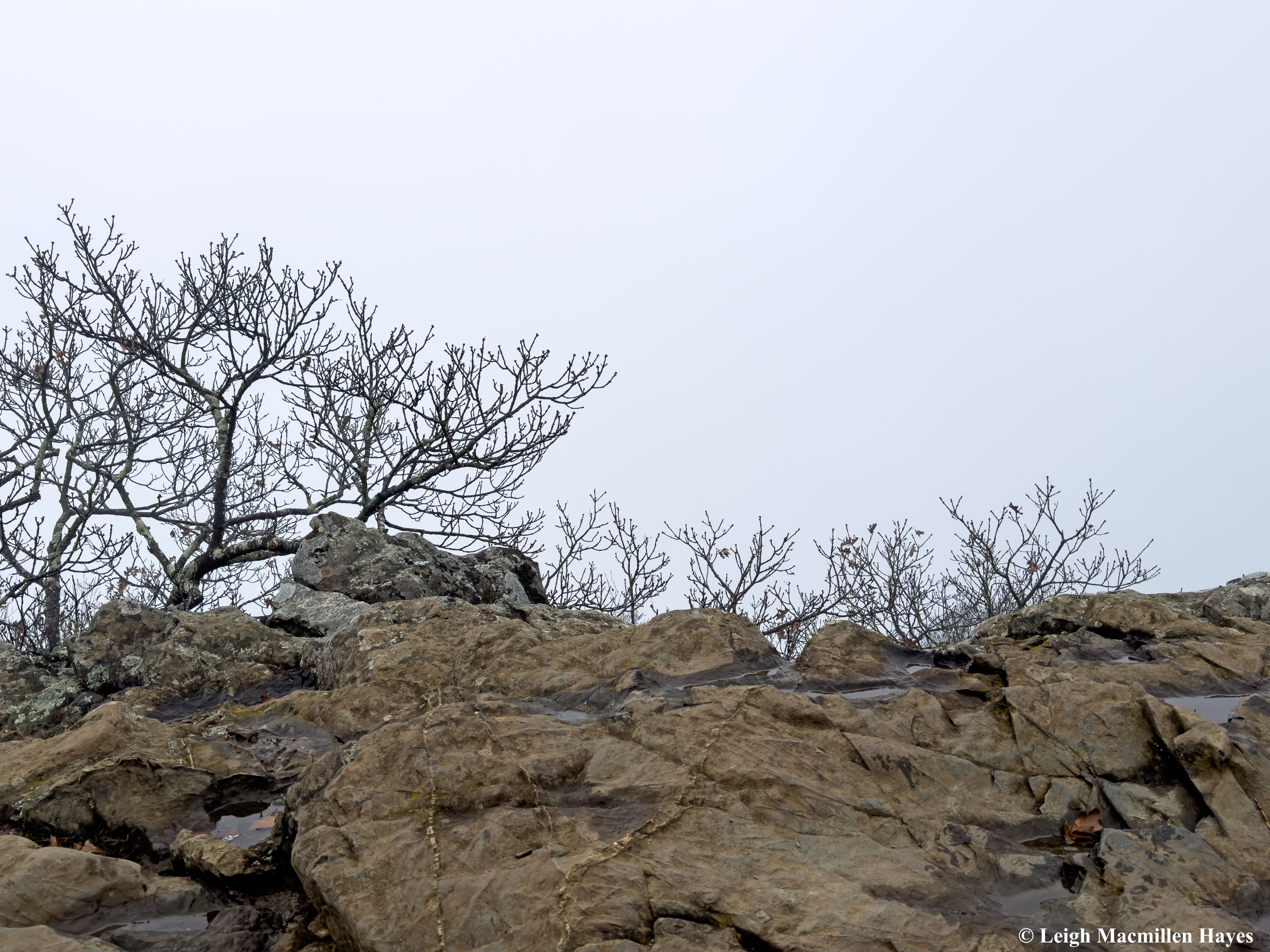
The next day, though we drove up the long and windy road and through Mary’s Tunnel, it was said rain that greeted us.

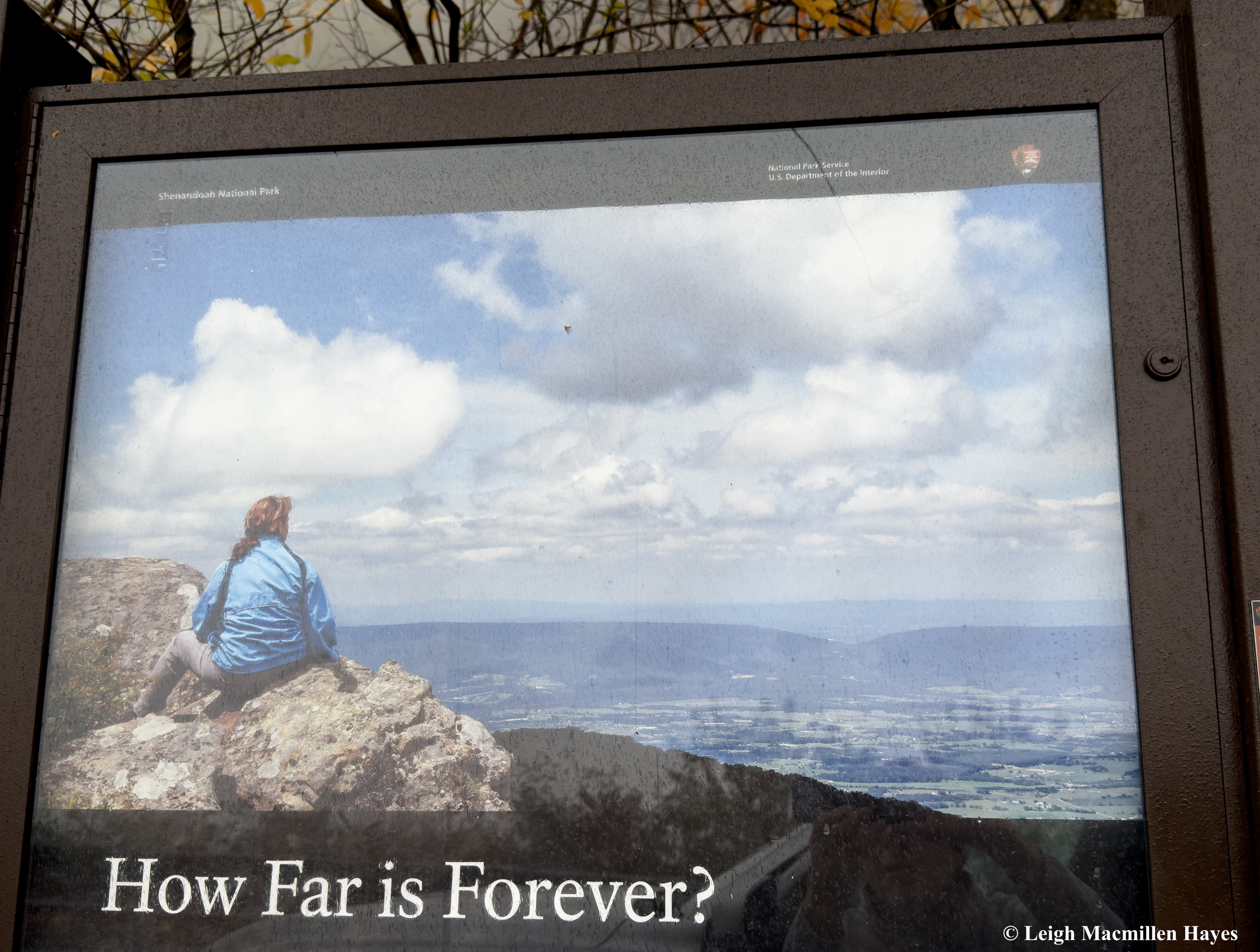
On that day and on and off the next, how far Was forever?

Not very.

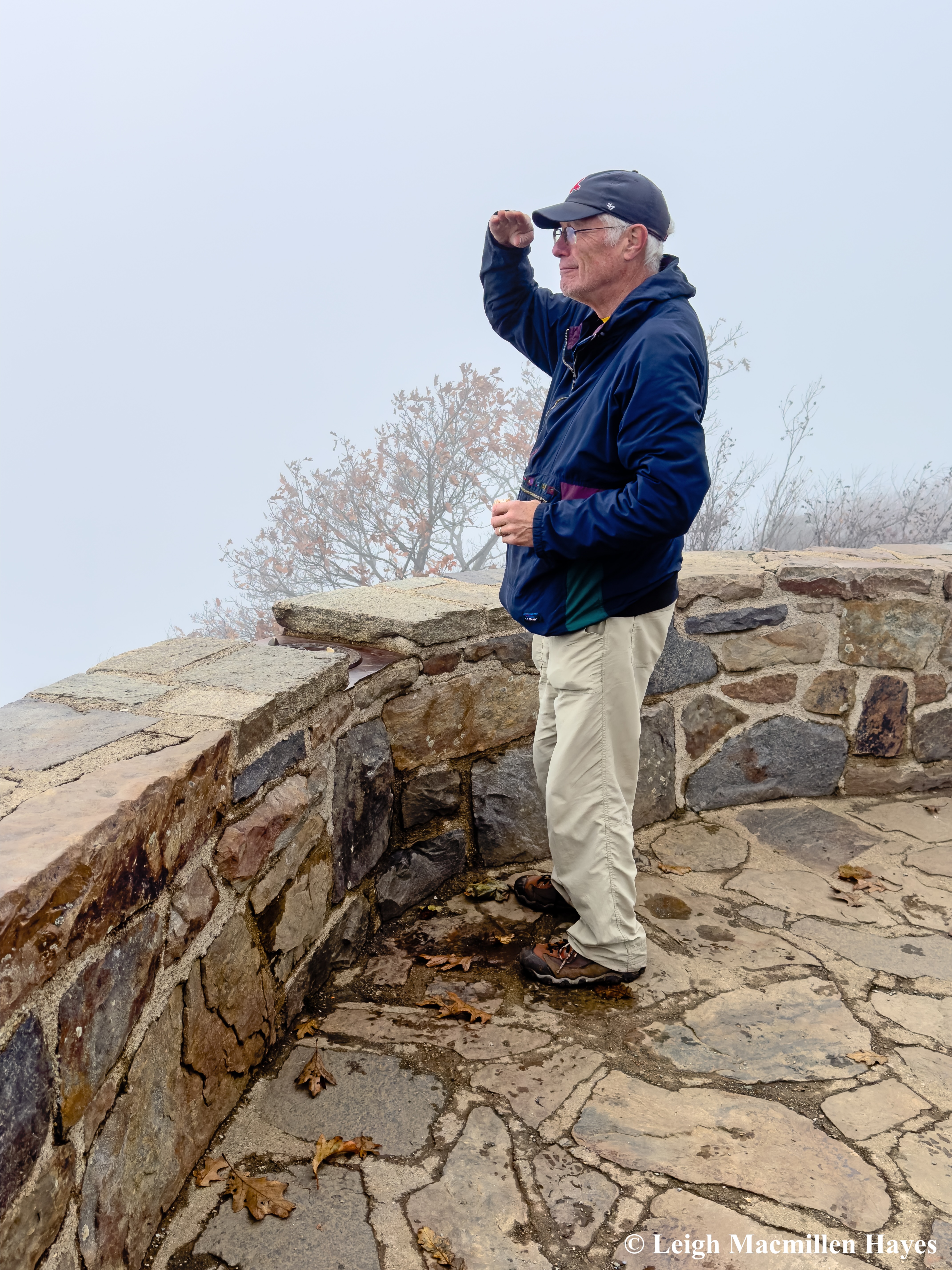
Even from the stone look-out at the summit of Stony Man, all was obscured.

But . . . we weren’t the only ones making the trek, and as we met other hikers along the way, we all chuckled about the lack of a view.

It didn’t really matter. We were there to hike, and that we did. And to enjoy each other’s company, and perhaps the lack of view put the emphasis on the latter focus.

There were other days or even moments on the same days, when we could see Forever, and gained a better understanding of the local topography.

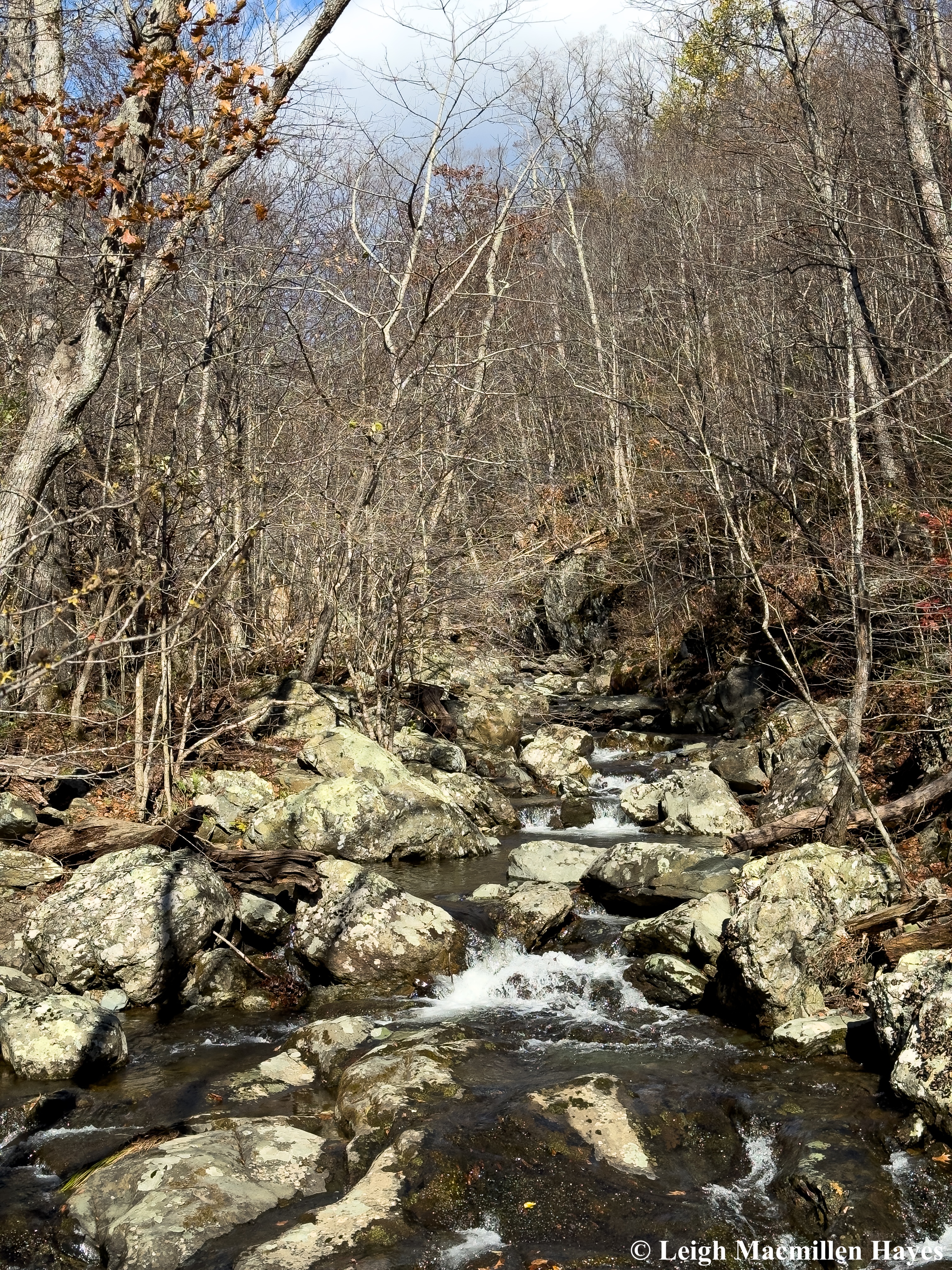
And sometimes we followed water, the very sound of which gladdened our hearts because it’s been so dry not only in New England, but also in the mid-Atlantic states, maybe more so, and the rain was welcomed by all.

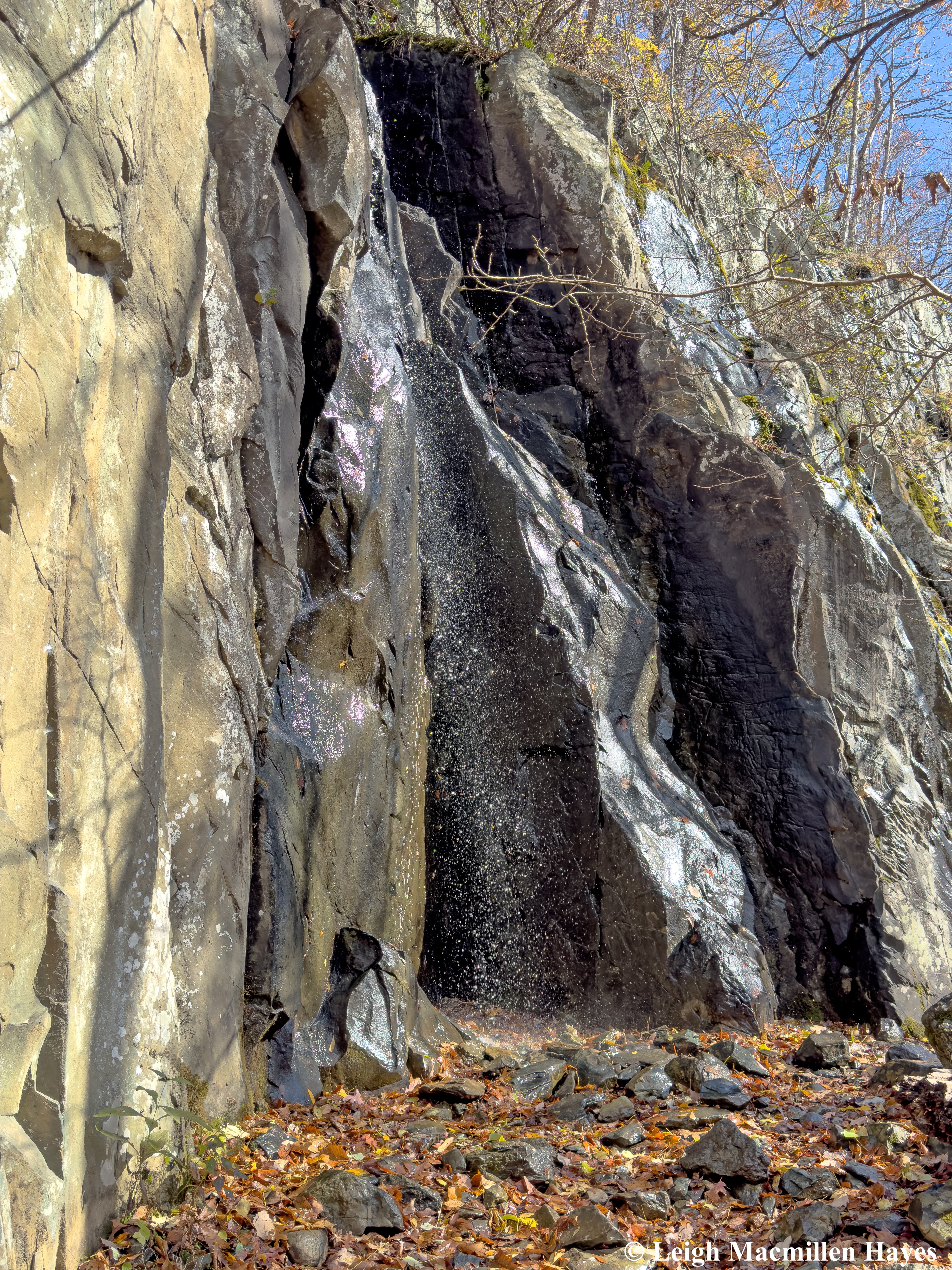
It even offered instant showers and since we were on and off the Appalachian Trail, we suspected thru-hikers might enjoy this very spot where the water poured down as a gift from above.

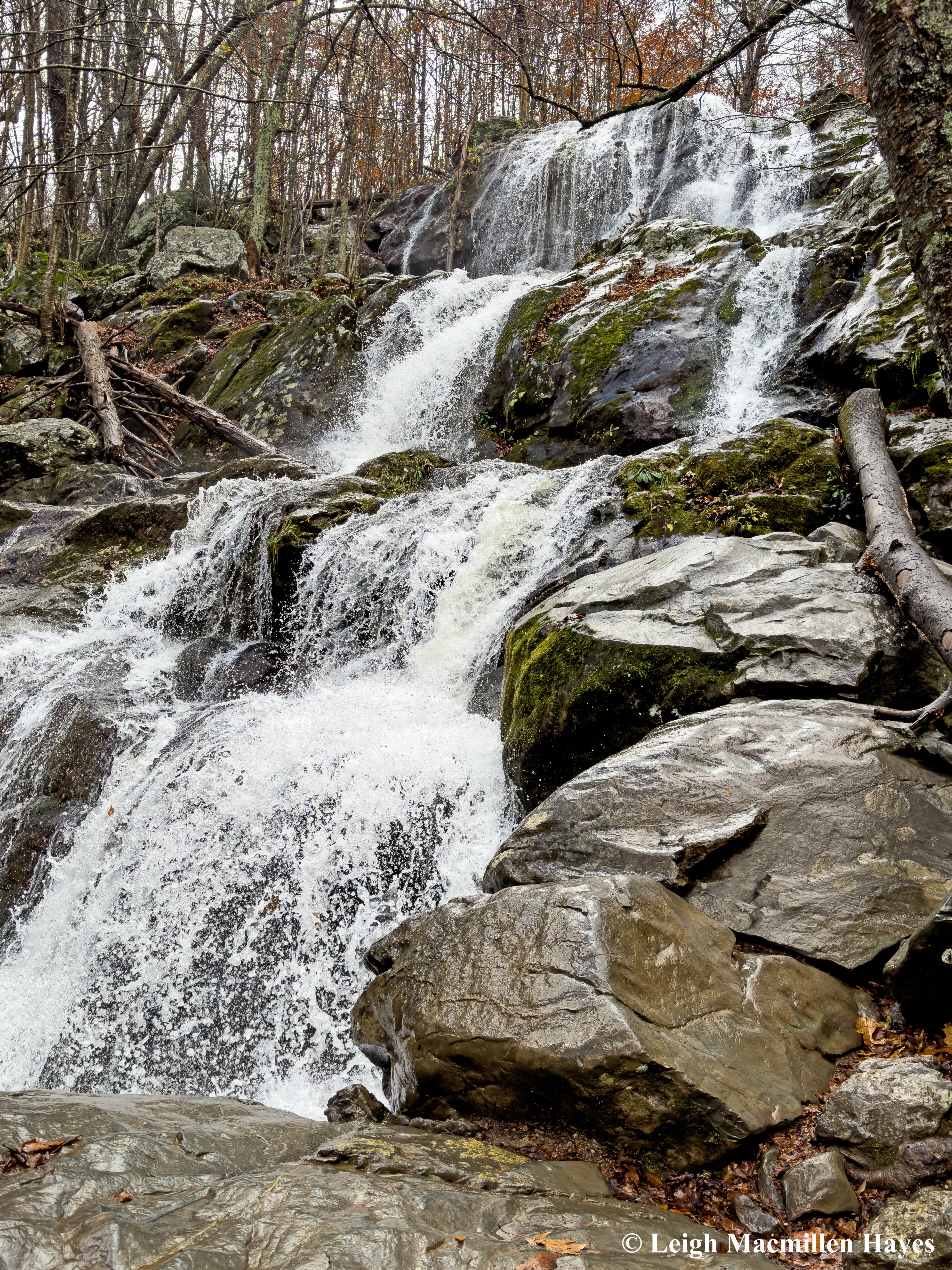
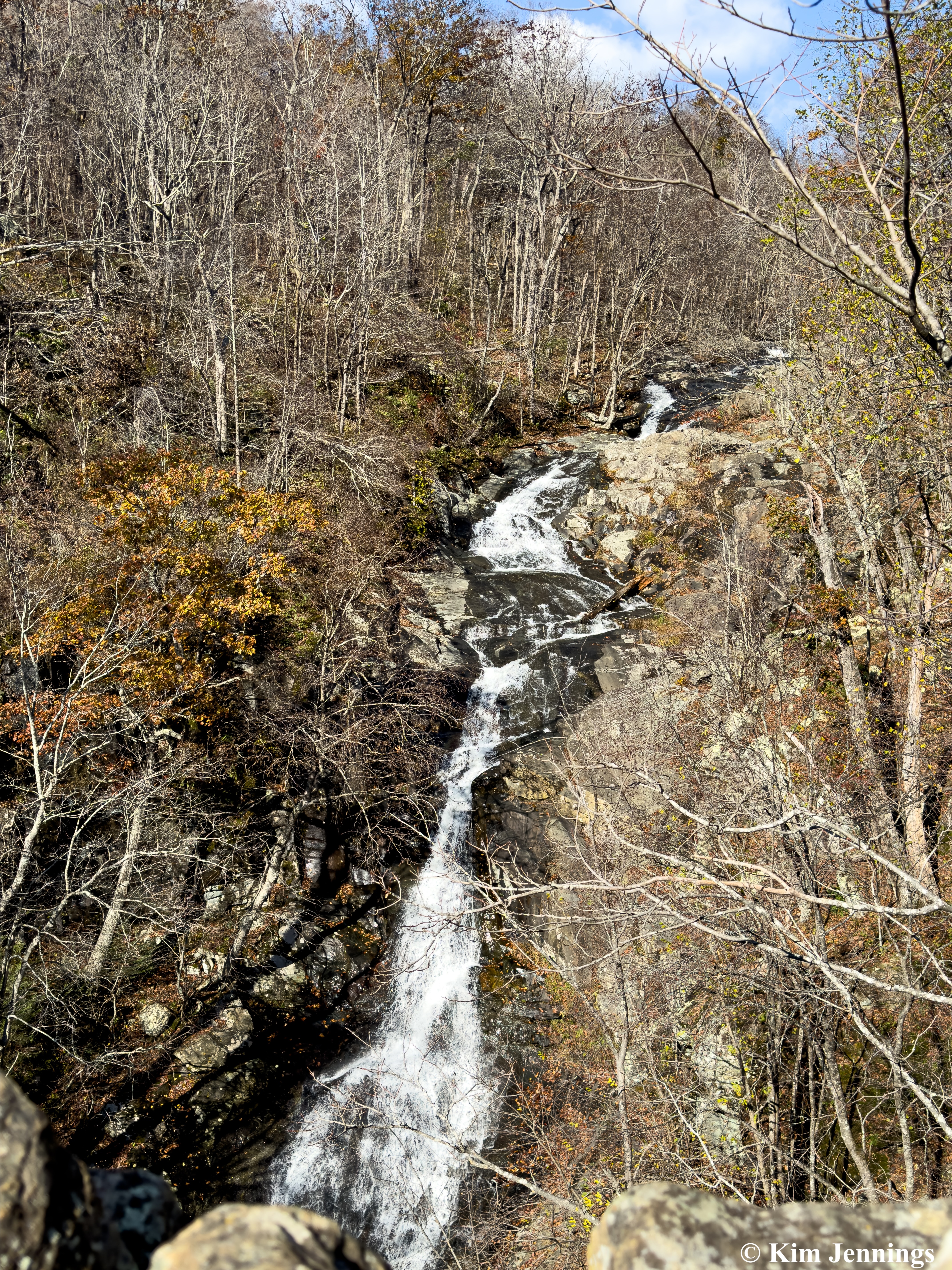
By week’s end, we had three favorite hikes, this one being to Dark Hollow Falls.

And then with two friends to White Oak Falls we discovered another favorite. I must admit that though this photo was taken with my camera, I let my friend, Kimmy, do the dirty work as the rocks she climbed over daunted me, especially as the wind roared.

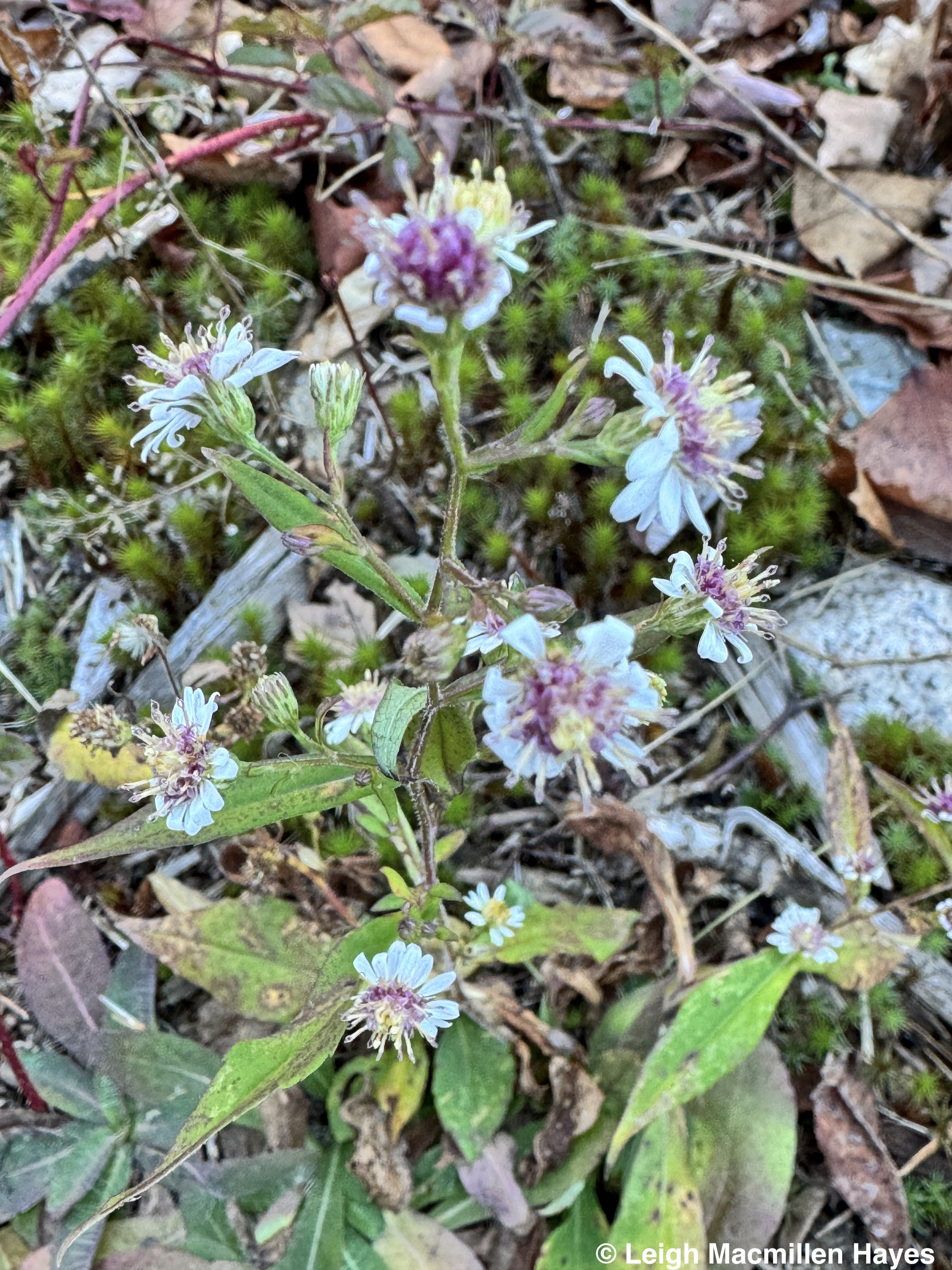
The view also included much smaller sightings, like this Shaggy Soldier (Galinsoga quadriradiata), a curious little plant that was still in bloom along many of the trails. From a Botany in Scotland Blog, I read that “The genus Galinsoga is named after Ignacio Mariano Martinez de Galinsoga (1756- 1797). He was a famous physician in Spain’s royal court and is remembered most for writing a book about the health hazards of wearing corsets.” I’m not sure that answers the question of why the common name, but I do know that I completely agree with him about the health hazards of wearing corsets.

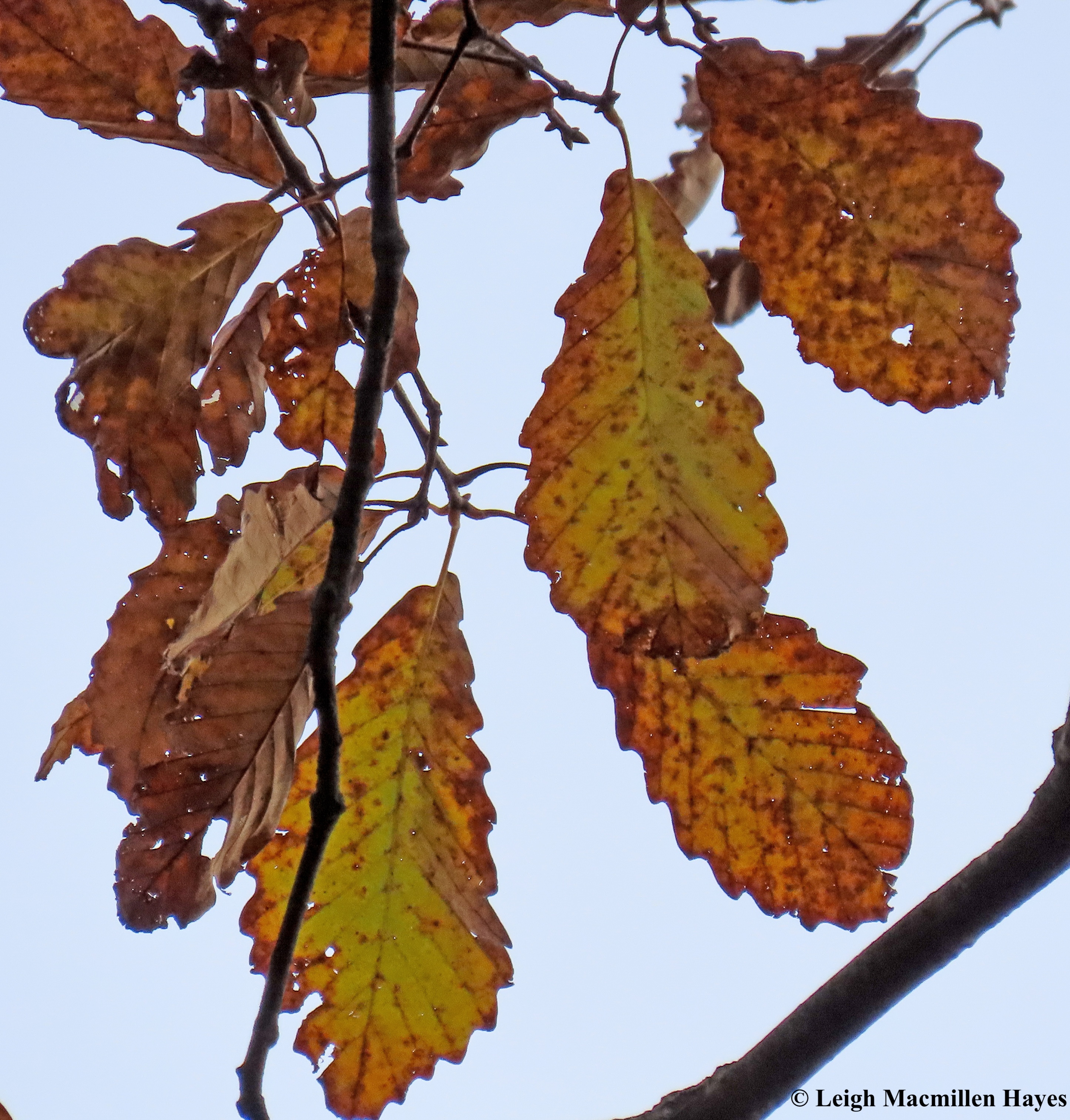
My heart nearly split in two when I spotted these Chestnut Oak leaves. A friend recently saw one of these in Portland, Maine, but this was my first introduction to the species.

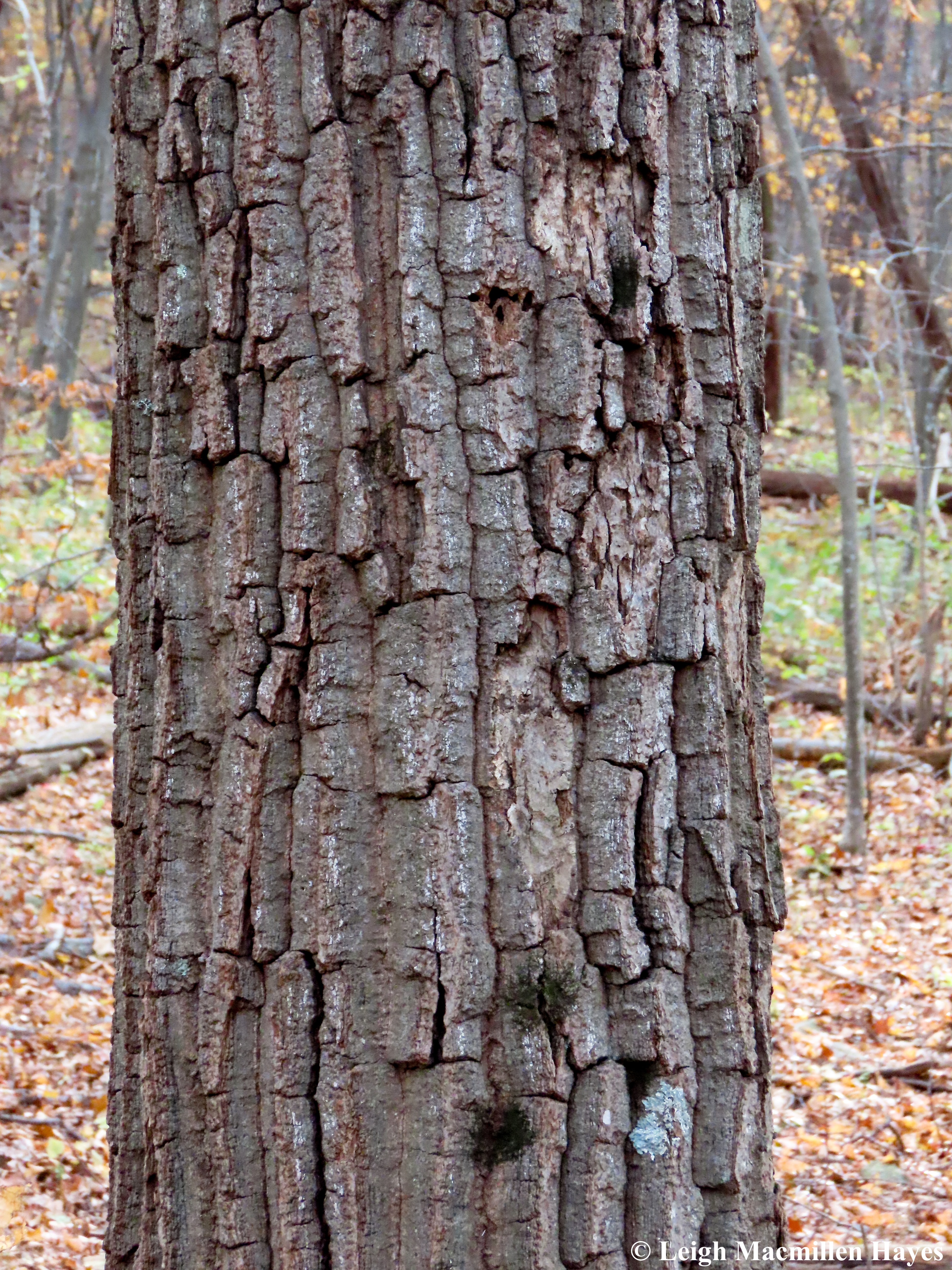
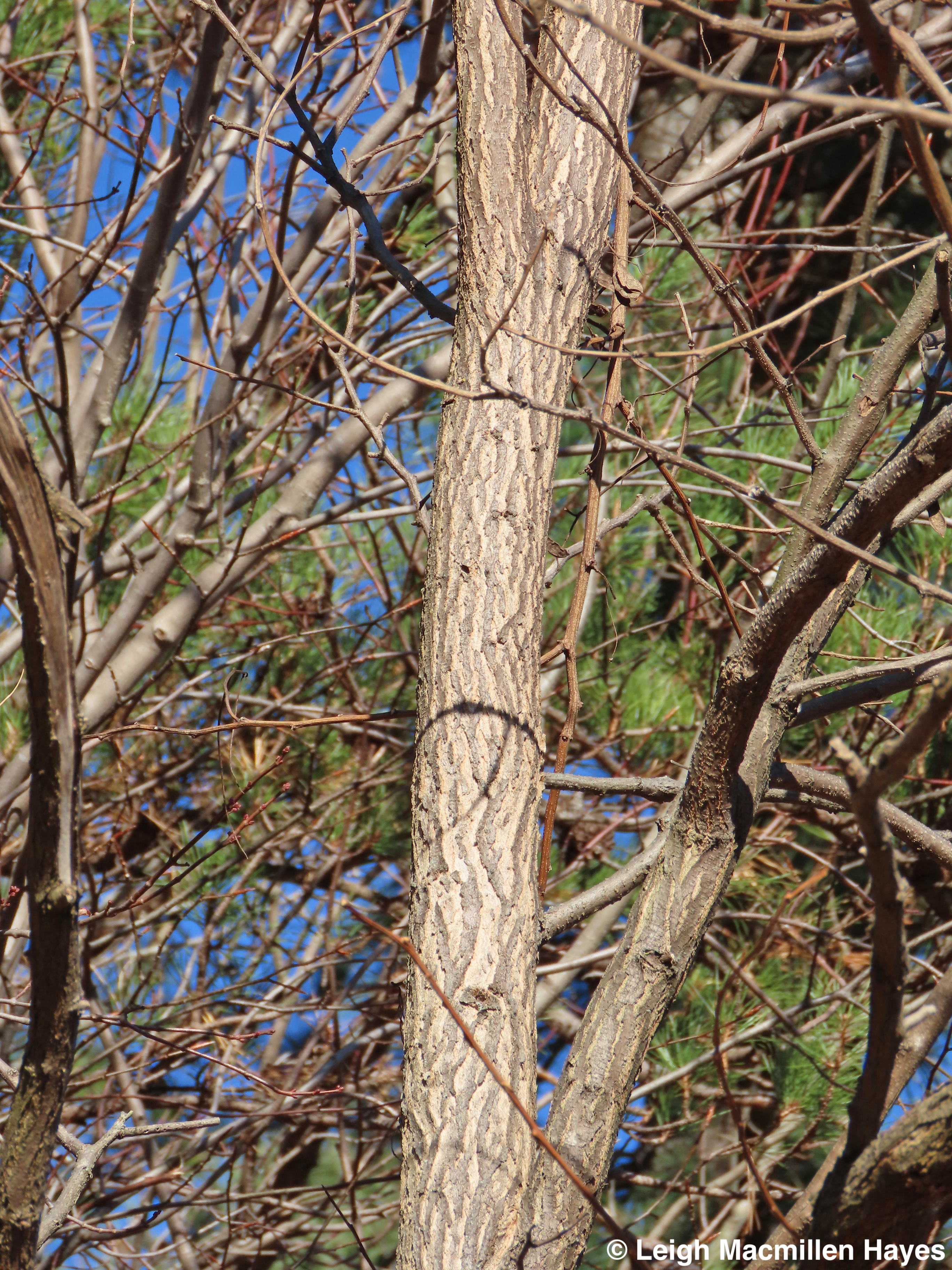
The mature bark is a combination of ridges and furrows, with a blocky presentation.

As I continued to meet new trees, I was thrilled and challenged and so purchased a Pocket Naturalist® Guide of Virginia Trees & Wildflowers.

My next introduction was to Sassafras, with its tulip-like, three-lobed leaves. There were so many on the ground, that they became part of the scenery along some trails.

And on Day 2, yes, it was chilly, but I took the opportunity to honor a Sassafras with a hug. That was one huge tree.

Again, the bark had ridges and furrows, though it wasn’t blocky like the Chestnut Oak. But . . . I could have easily thought it was an Ash. In hindsight, however, we didn’t encounter any Ash trees.

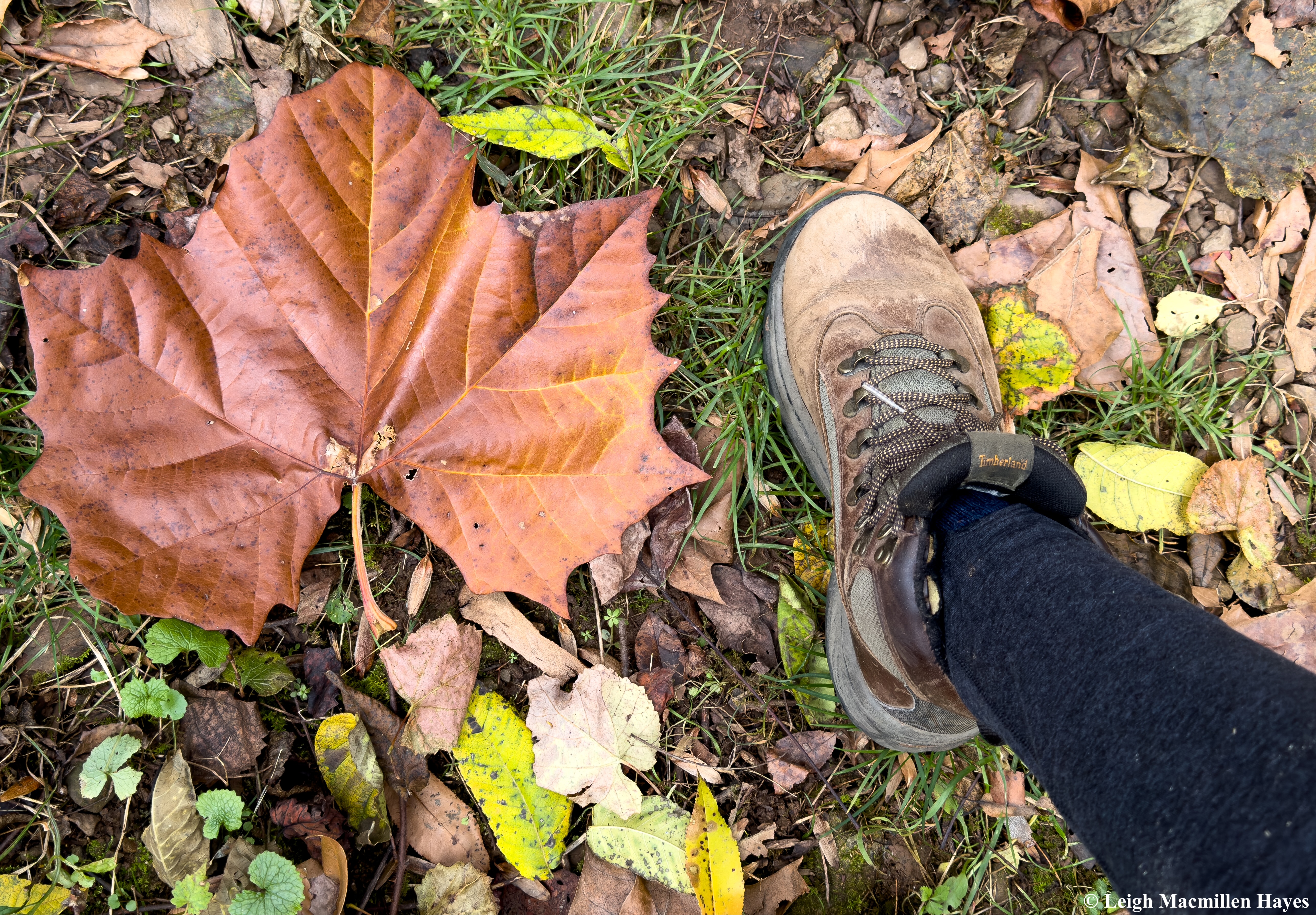
Though I have met the American Sycamore before, in fact, there used to be a large one in a neighboring town and for all I know it may still grow there. it was still fun to get a sense of the size of the leaves.

And then there was the Eastern Cottonwood, a cousin of our Aspens (Poplars), and I could only imagine all of the fluff along the Hawksbill Greenway in Luray, where this tree grew.

By its bark, I never would have known it, but fortunately, there was a sign below it that indicated it was a Cottonwood. I love signs!

Again, any of the barks we met all looked the same, at least during our brief encounters, so I was grateful for leaves that helped me differentiate them.

Others from away have mentioned Pawpaw, but this was my first time seeing the leaves that are widest at the middle.

They seemed to grow in clumps or groves and I wondered if they were all from seeds or is some root sprouting had also taken place. They reminded me of American Beech, which can do both and quickly fill an area where the sun shines.

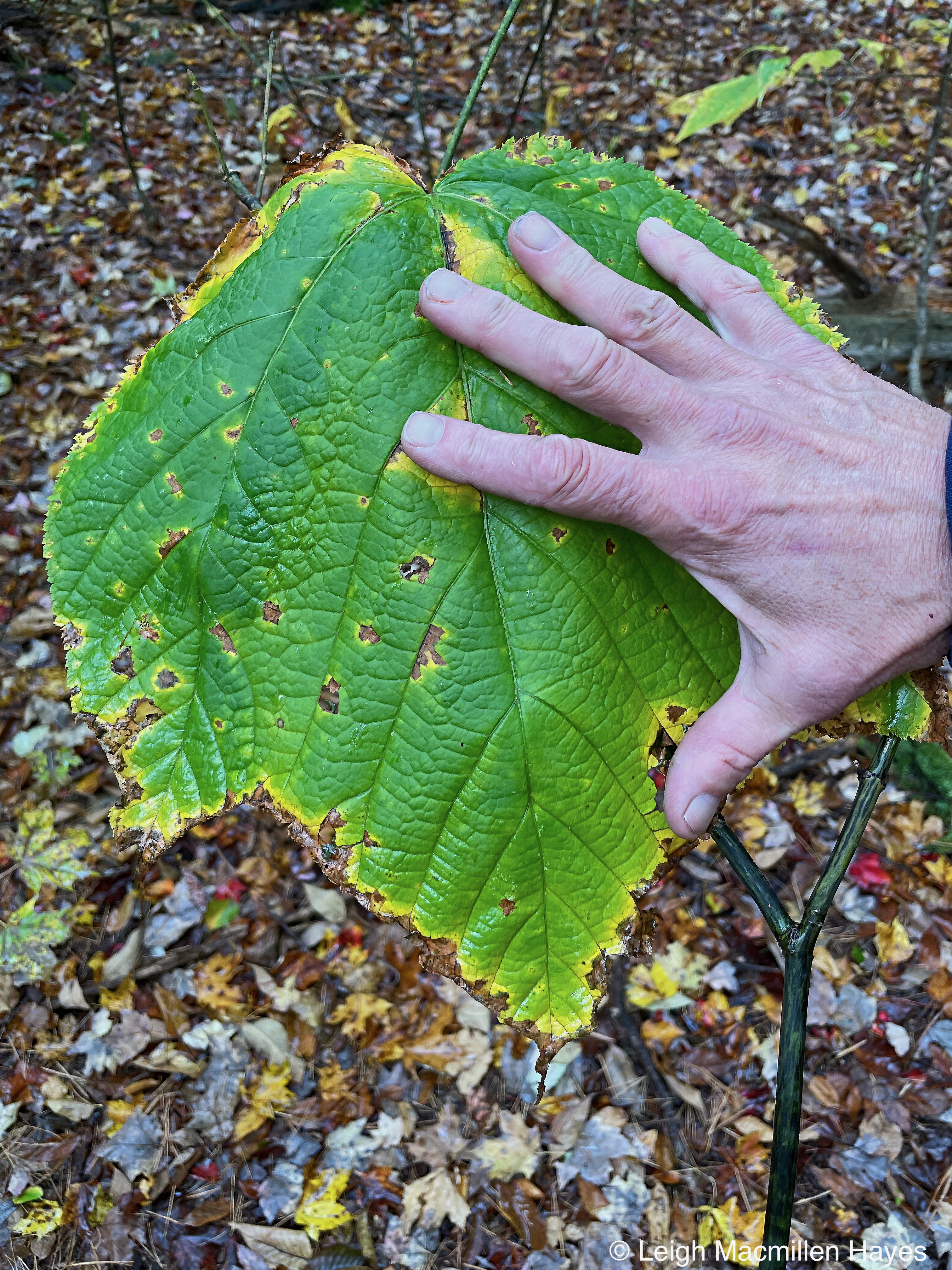
One that I had never even heard of was the Princess-tree, and it had leaves the size of umbrellas. I’ve since read both pros and cons about this tree and you can do the same and make up your own mind about it, but it was certainly a surprise to meet it.

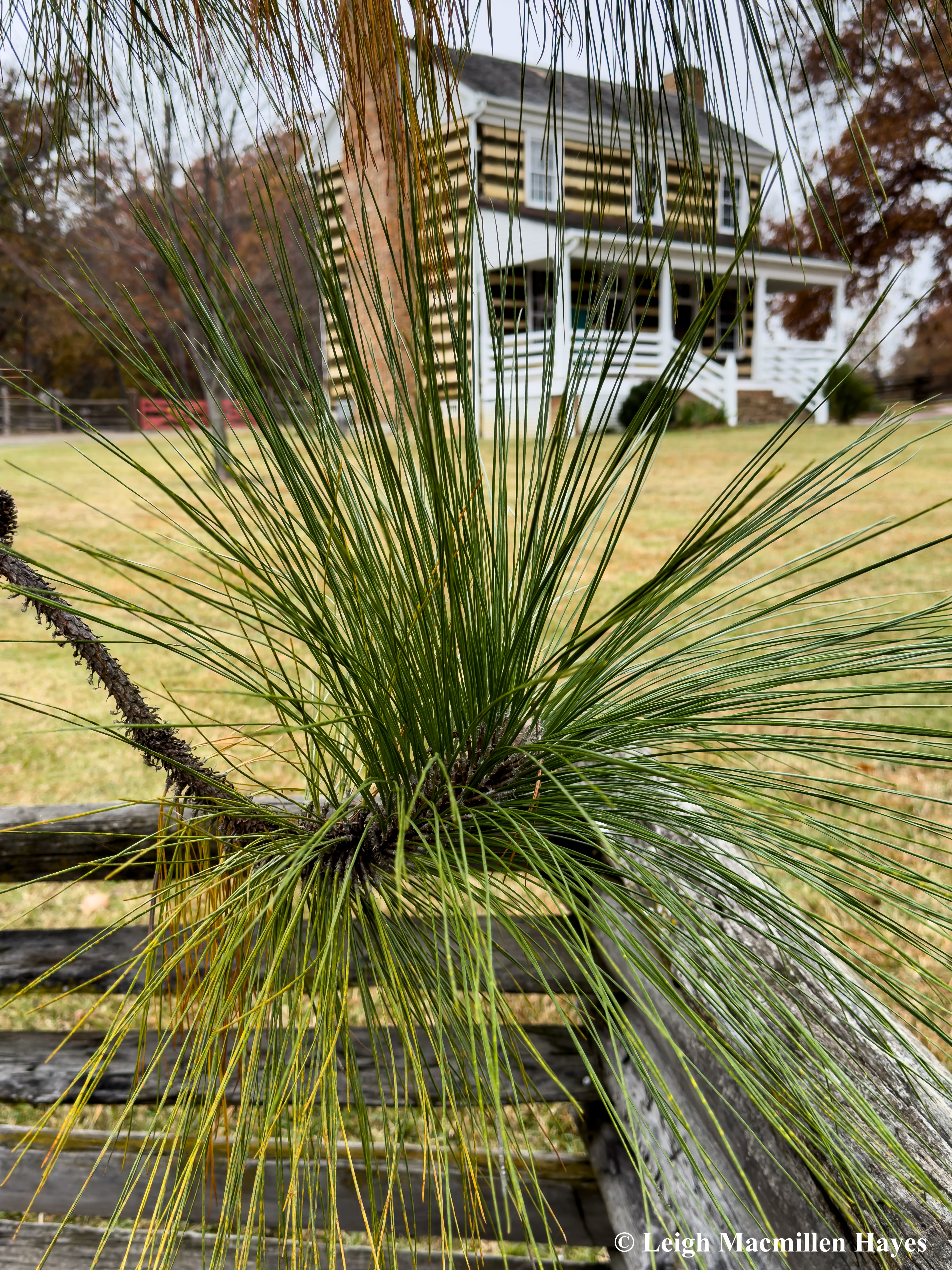
Almost last was one we found at the Shenandoah Heritage Village Museum. Again, I’ve heard of it, but this was a first time seeing it. My what long needles.

At about eight inches, each packet of three led me to identify it as a Loblolly Pine. I am sooo grateful that I purchased that guide.

So here’s the thing about the conifers. For a couple of days we met only deciduous trees, and most of them were the species I mentioned above. And then, as we went higher in elevation, we began to meet a few Eastern Hemlocks and White Pines and many of the trees we are familiar with in our woods. My Guy even noticed the various communities, and along some trails Mountain Laurel grew almost like a hedge.

I’ve saved this particular leaf for last in the tree section of this blog. Oh, believe me, I have plenty more to say. But this skinny leaf that My Guy held for me, is another Oak species.

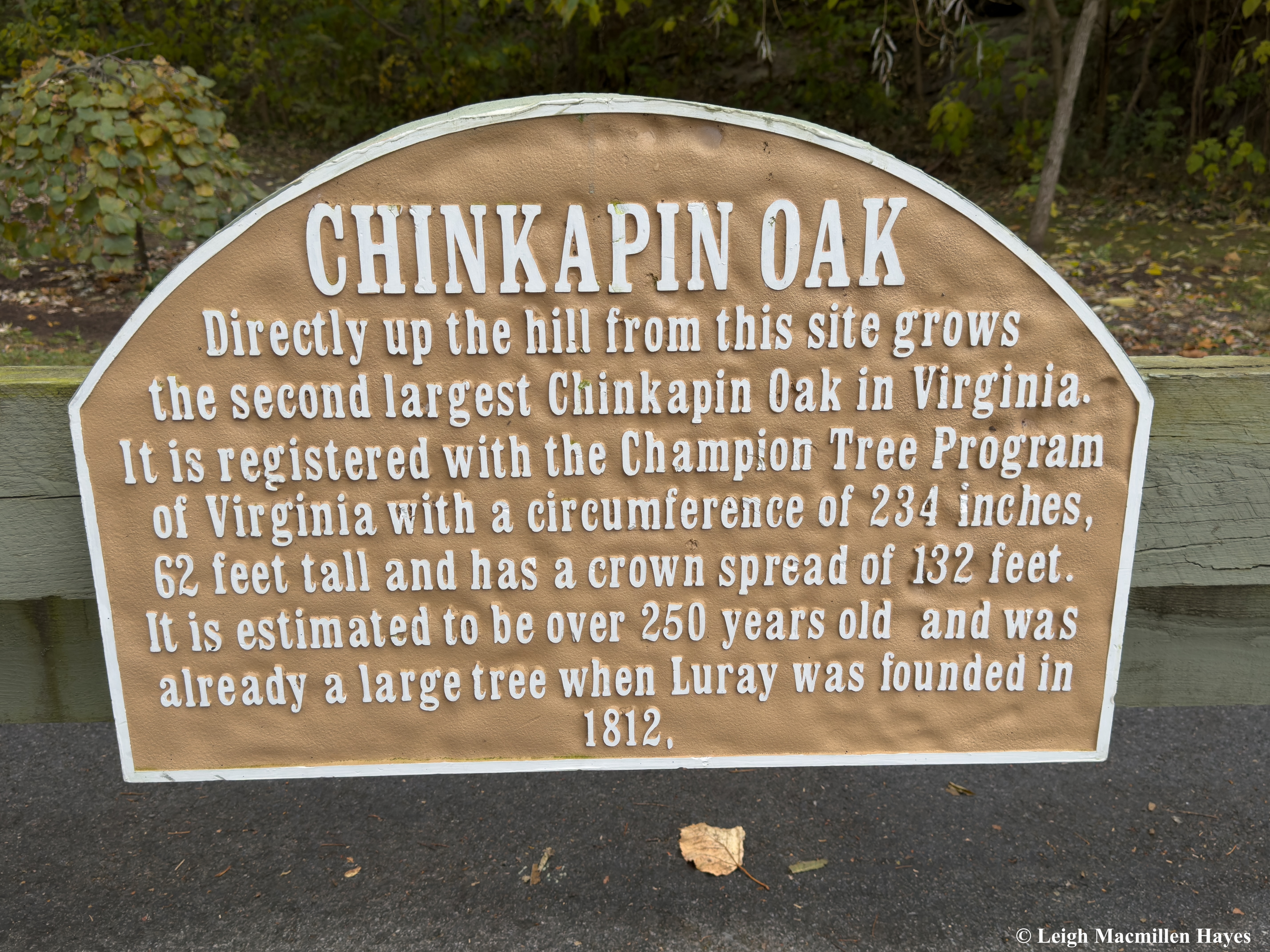
We only knew about it because on our rainy day hike, when we turned around from a mountain adventure and decided instead to explore in Luray, we discovered this sign along the Hawksbill Greenway, a two-mile trail through town.

We looked up the hill from the sign and didn’t spot anything that looked different. After we’d walked to both ends of the trail and back to our starting point in the middle, we headed up one street that led us to the next, and then one more because we had spotted something that we thought just might be the champion.

Meet the Chinkapin Oak. Born about 1775, think about all that this tree has witnessed. I wanted to hug it, but refrained because I didn’t want to accidentally introduce something to it. For example, what if I had teeny aphids on my mittens that I wasn’t aware were there from having touched other trees? No, instead, I just stood in awe of this mighty giant. We both did, actually.

Returning to the trails, sometimes we came upon historic sites, this one being the Fox family graveyard.

Lemuel F. Fox died in 1916 at the advanced age of 78. That’s actually an incredible feat.

Especially considering he survived the Civil War, where he served with the Confederate States of America.

At the Snead Farm on another trail, we discovered what seemed to be a raised dooryard and large foundation and sensed the Sneads had some money.

Perhaps the house burned down, or was taken apart and moved, but the horse barn still stands.

I peeked into each of the stalls, just because I could.

Interestingly, visitors can ride horses on some trails specifically designed for them. though this one isn’t.

It’s a place for everyone, including those with mobility issues, for the Limberlost Trail is accessible. .

And truly it is a place for everyone as we met people from a variety of states and countries, including Sri Lanka, Spain, England, Germany, Israel, and more.

A place for all also includes the critters who make their homes here. Deer. Did I mention White-tailed Deer? They are everywhere. We also spotted the occasional Gray Squirrel. And we really wanted to see a Black Bear, but didn’t have that opportunity.

Our most prolific mammal sighting, other than Deer, the Northern Short-tailed Shrews. These are not everyone’s favorite food as they emit a toxin and so are quickly dropped upon capture. Either one larger predator didn’t learn the lesson the first, second, third, fourth, or fifth time, or there are so many of them running around at night that the everyone tries to make a meal of them.

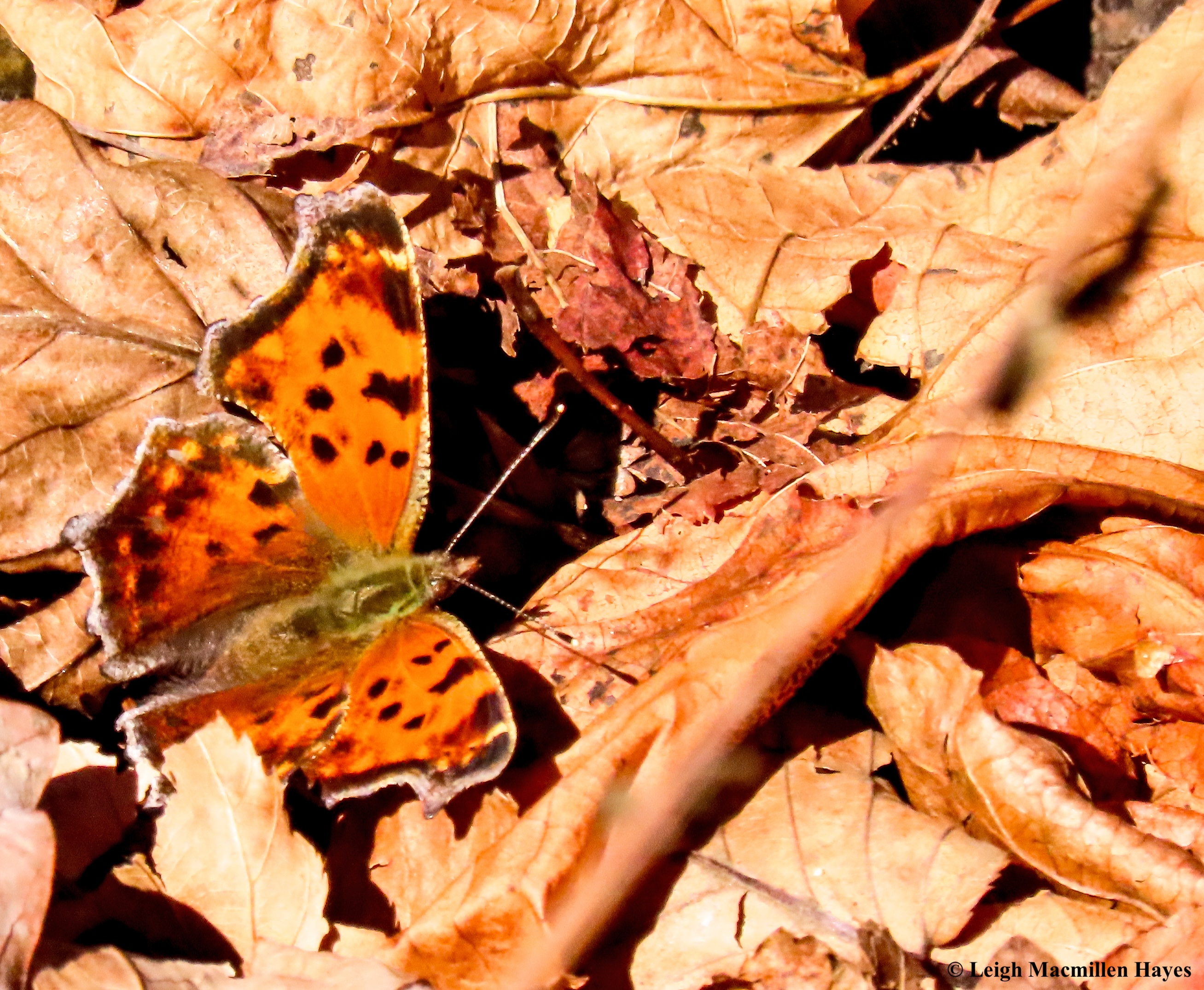
On the day we hiked with our friends, we had a couple of fun insect sightings, including this Punctuation or Anglewing Butterfly–be it either a Question Mark or Comma. It never did show the underside of its wings so we couldn’t determine it to species, but it was still a fun butterfly to spot.

Speaking of spots, we saw at least three Spotted Lanternflies. I was intrigued with their colors, but Kimmy told me to squish them as they are extremely invasive.

And because of her we got to see a Walkingstick upon a rock where she just happened to place her hand. If it hadn’t moved in that moment, she would probably not have seen it. We were all grateful that it did move. And then it posed for us.

Now that you’ve stuck with me for this long, I’ll let you know that I saved some of the best for last.

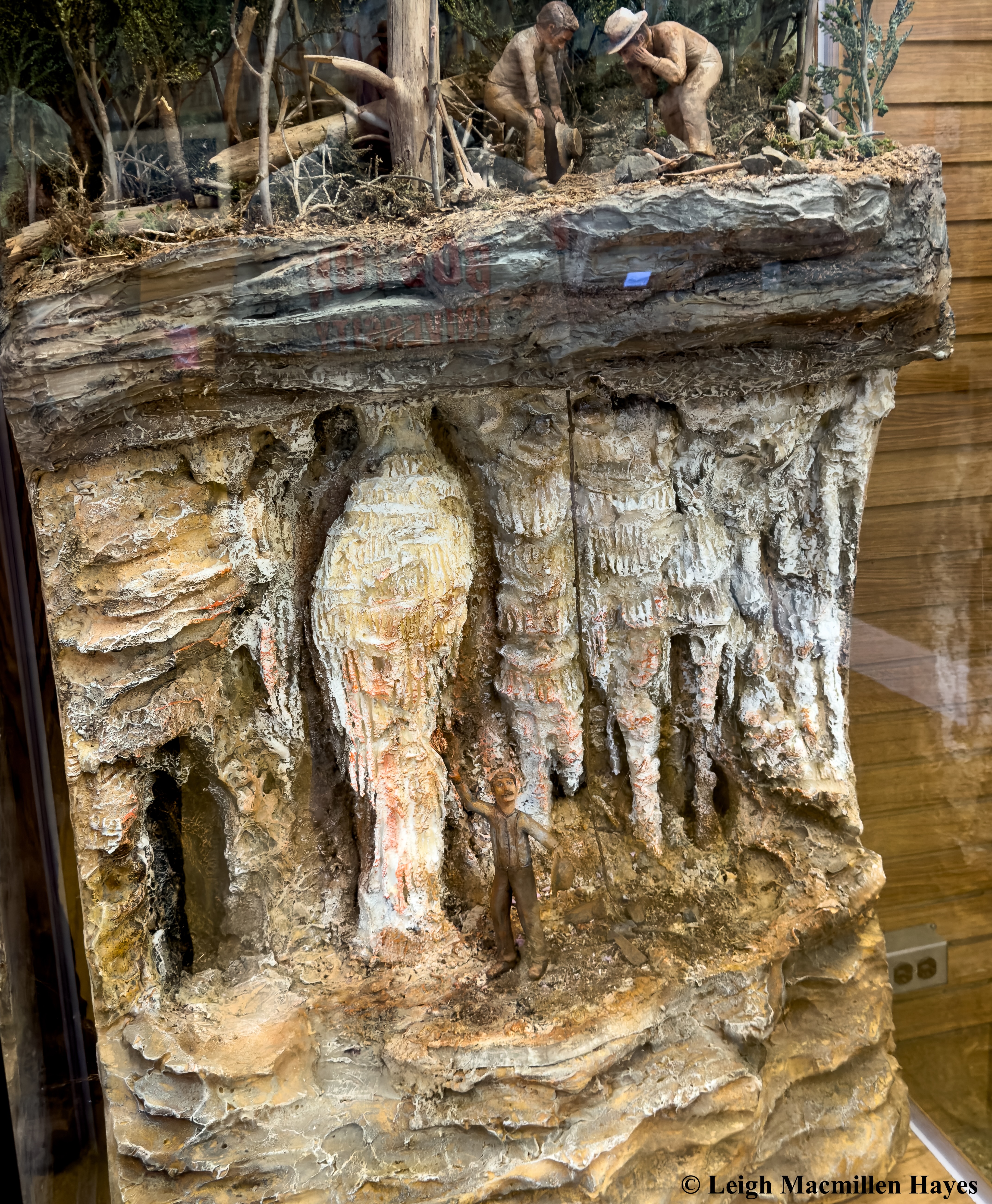
On that rainy day, we not only walked the Hawksbill Greenway, but we also went on a self-guided tour of Luray Caverns. According to the brochure we received at the ticket booth, the caverns are the largest in the East and were discovered by a tinsmith and local photographer in 1878. This diorama depicts that moment when the discovery was made.

And X marks the spot where it was made. Can you imagine the man’s excitement and amazement?

Discovered in August, we were told that the first tour occurred that November.

The cavern is a cave where Stalactite and Stalagmite meet, but in this instance that is an optical illusion. Can you see why?

There are veils to admire.

As well as a tent . . .

made of “curtains” that seem almost transparent.

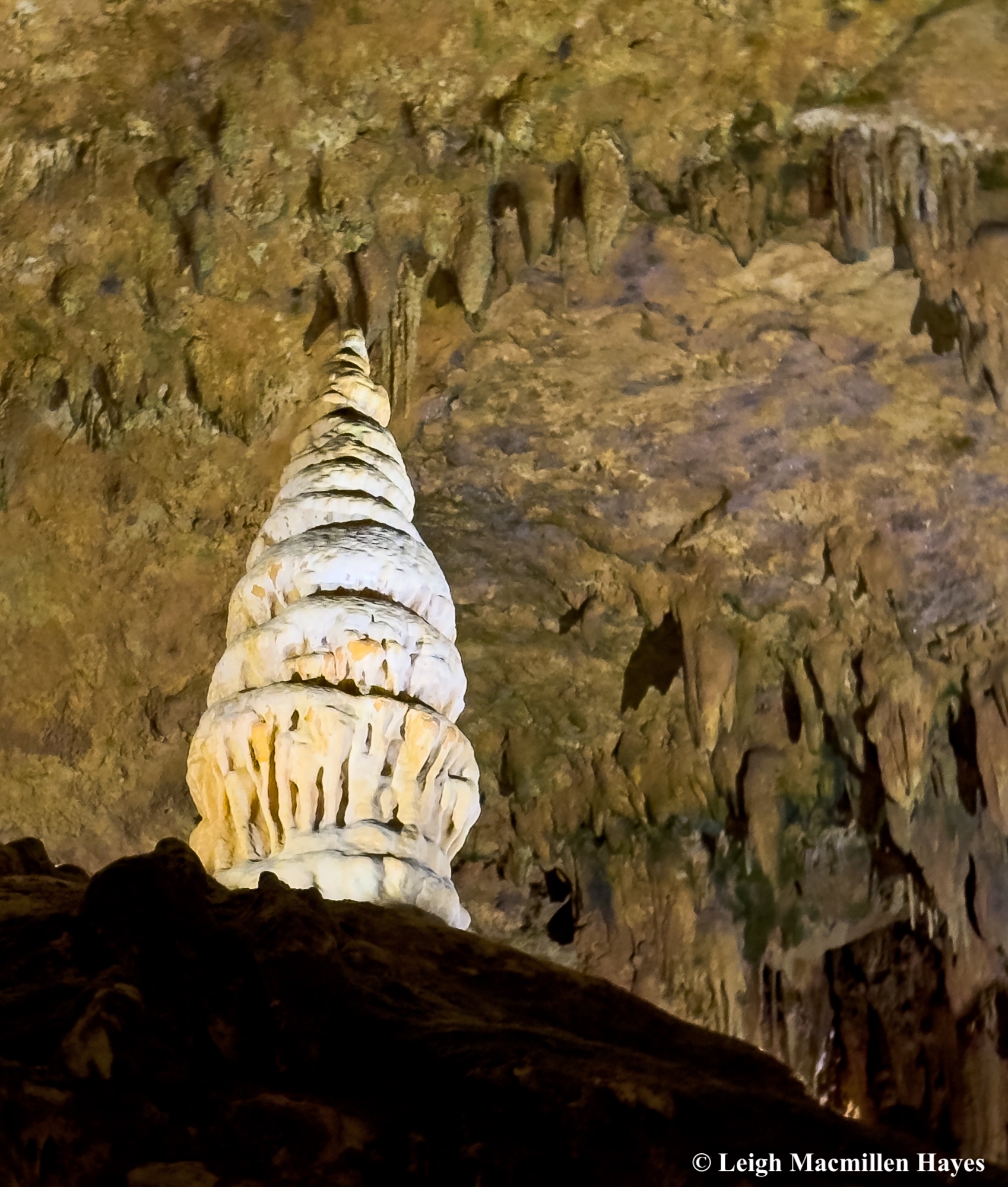
We chatted with a couple of young docents and they told us that this structure is seen as something different in every season–from a Christmas tree to a pine cone to an ice cream cone, and one more that neither of us can remember. But the big question was: what ice cream flavor?

The answer: Rocky Road.

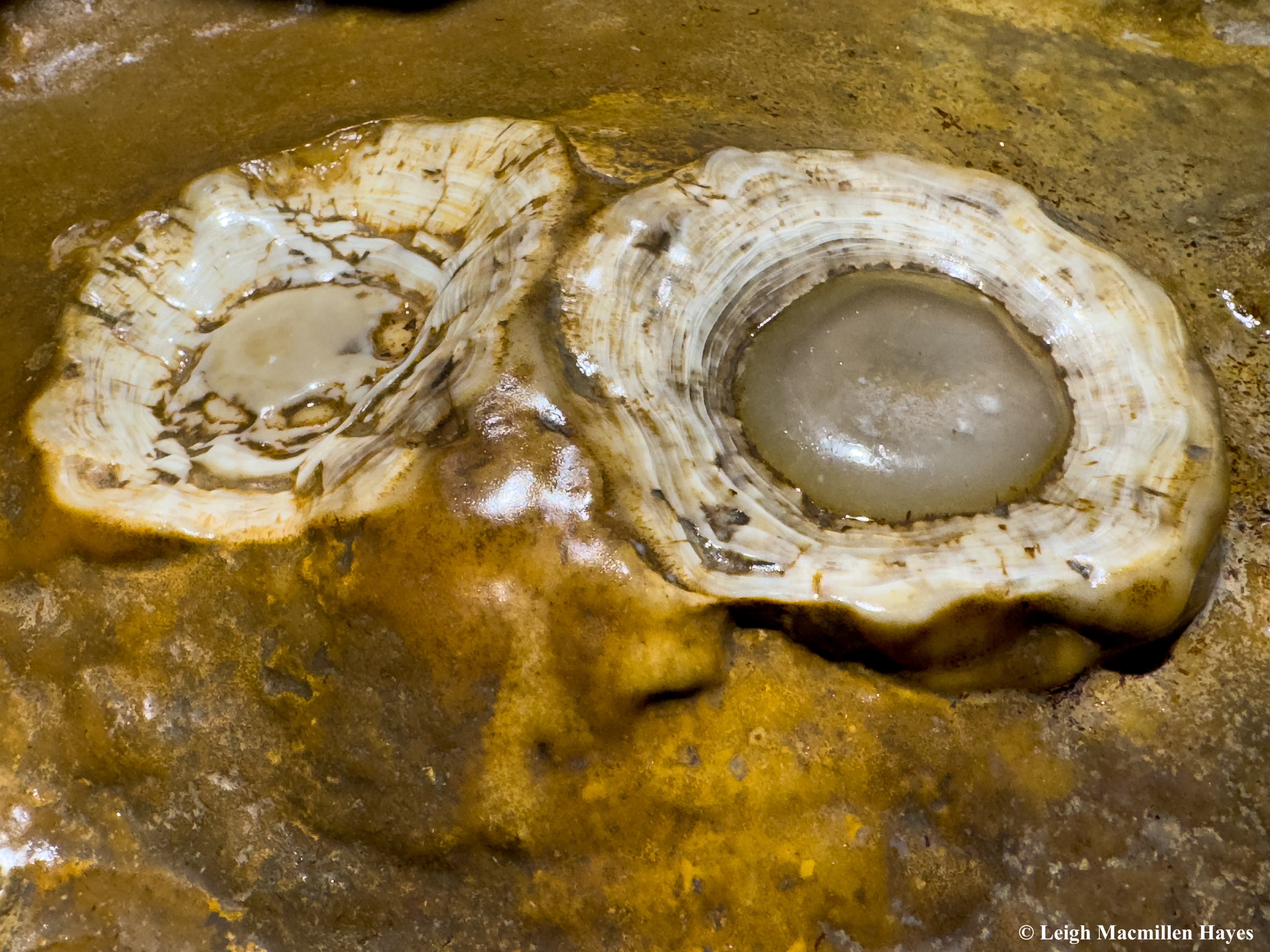
And then there were the Fried Eggs. Or oysters on a half shell?

We highly recommend a visit. I’ve only shared a few of beyond-belief spots, as around every corner there was a different formation to look at. I felt like I was in fairy land with lots of action everywhere as stories unfolded.

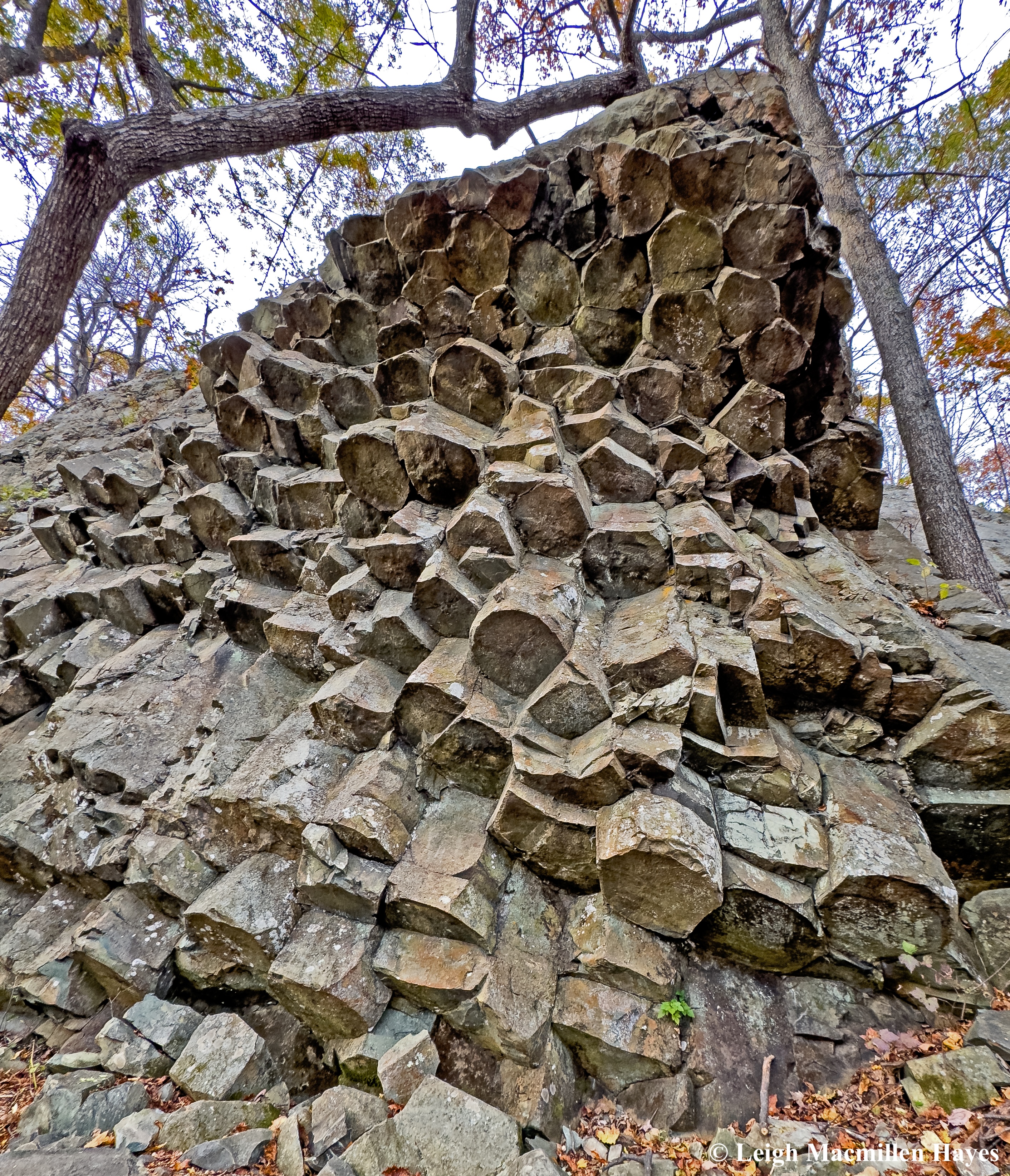
Back on the trails, we also had fun finds, like this columnar jointing, which turned it into yet another favorite trek. It’s known as the Fort Windham rocks and is greenstone and part of a series of lava flows, that we spotted in other places as well.

It reminded us of the Giants Causeway in Ireland, a geological phenomenon of 40,000 basalt stone columns formed by volcanic eruptions over 60 million years ago.

And so we posed.

We posed again at Dark Hollow Falls.

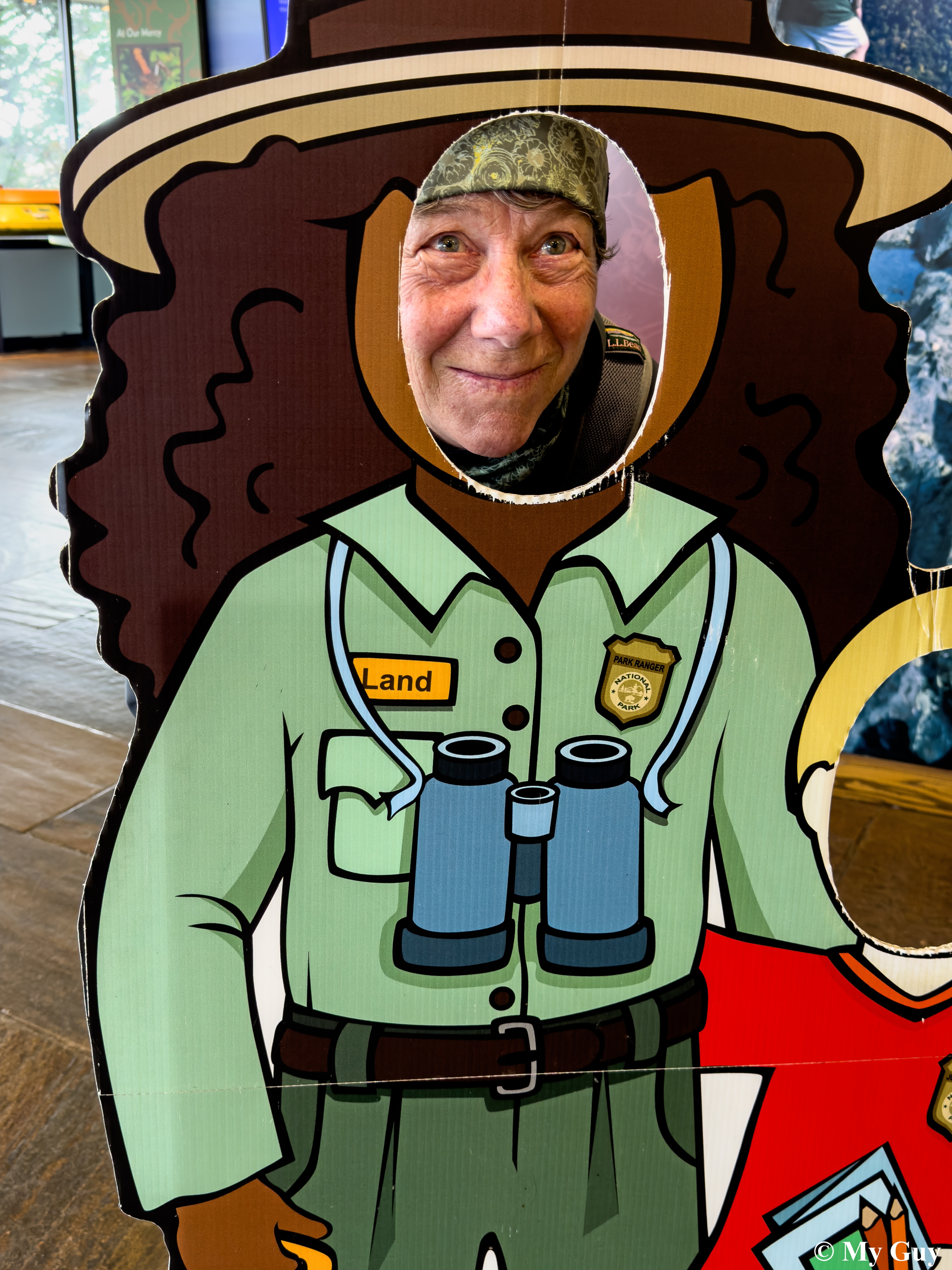
And then I took a shift as a park ranger. (Actually, the park rangers are furloughed under the current shutdown, so we were reminded each day to be extra careful while hiking because rescues could take hours.)

As for My Guy . . . no vacation is complete without a trip into the local hardware store.

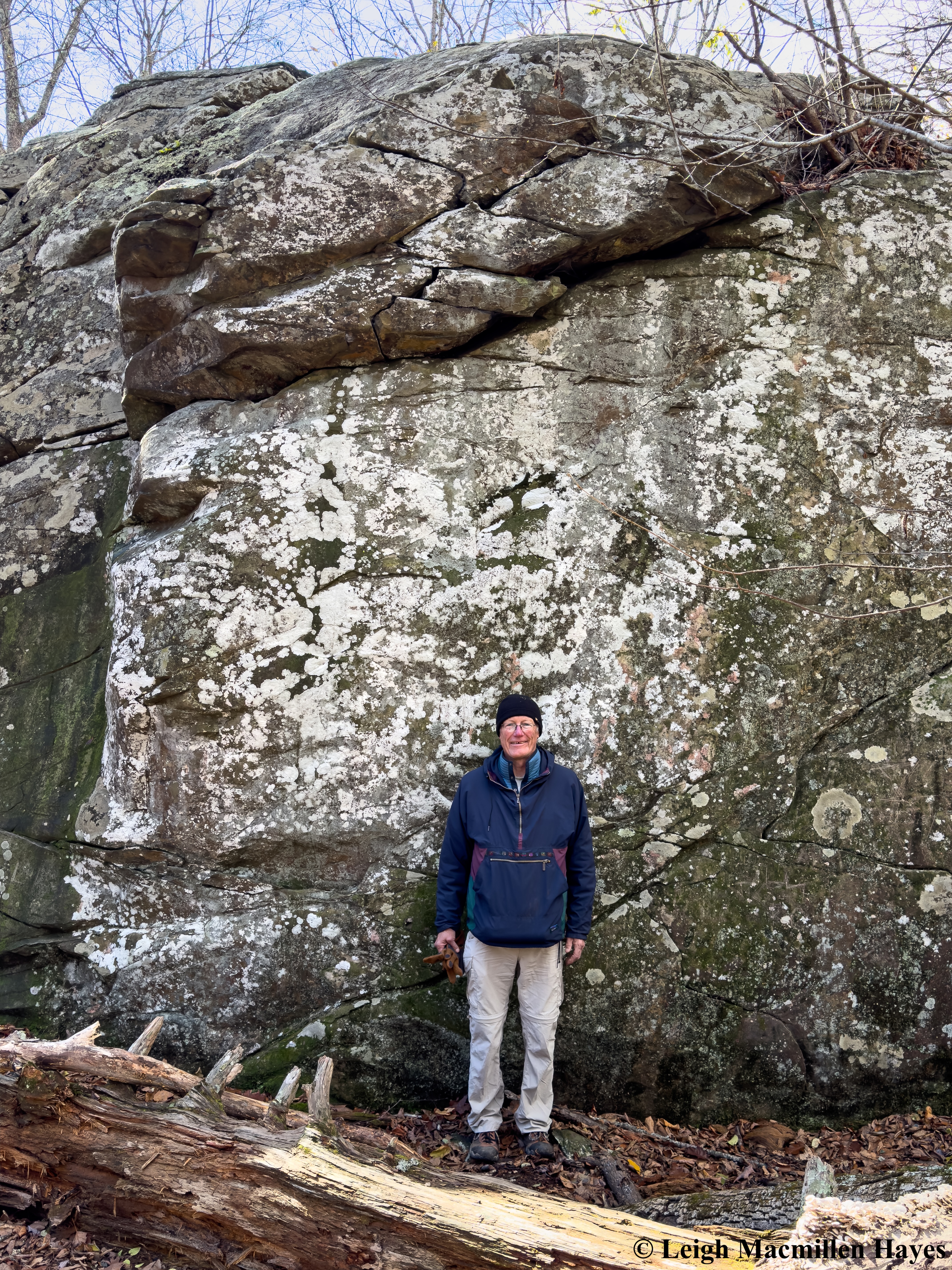
But where my readers usually see only the back of him, he was happy to lend his almost 6′ height as a reference for this large boulder.

And while we were truly excited to spend a week hiking together, we were equally excited to share the trail with these two, Maddie, a high school senior who had the day off, and her mom, Colonel Kimmy Jennings, USAF retired. Kim was a student of mine back in her middle school days. It’s always a joy for all of us when we can meet up and share the trail, though typically it’s when she makes a trip home to Maine, so she was thrilled that we’d actually ventured south. And our pose was in front of another example of columnar jointing.

After we hiked for about four hours with them, we had one more hike to tackle bringing our total to ten trails, that being Mary’s Rock, and then we left Luray and returned to Front Royal for the night before beginning our two-day journey home with a stop over in Albany, NY and a quick tour of the Norman Rockwell Museum on the final stretch.

Like any vacation, we’ll cherish this one forever.

Above and Below, I guess it was actually more than a few wonders that wowed us along Skyline Drive and in the area.

One Morning in Bridgton

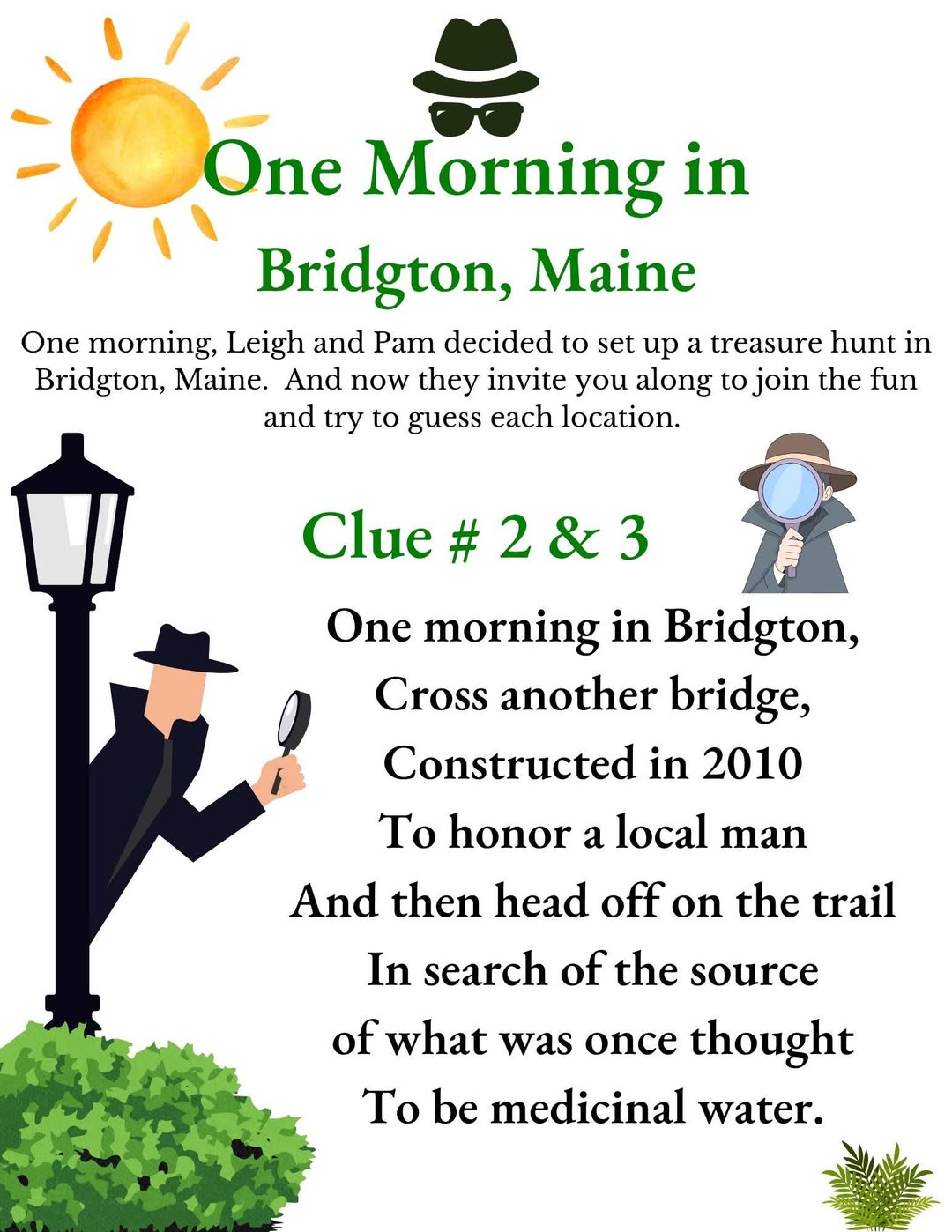
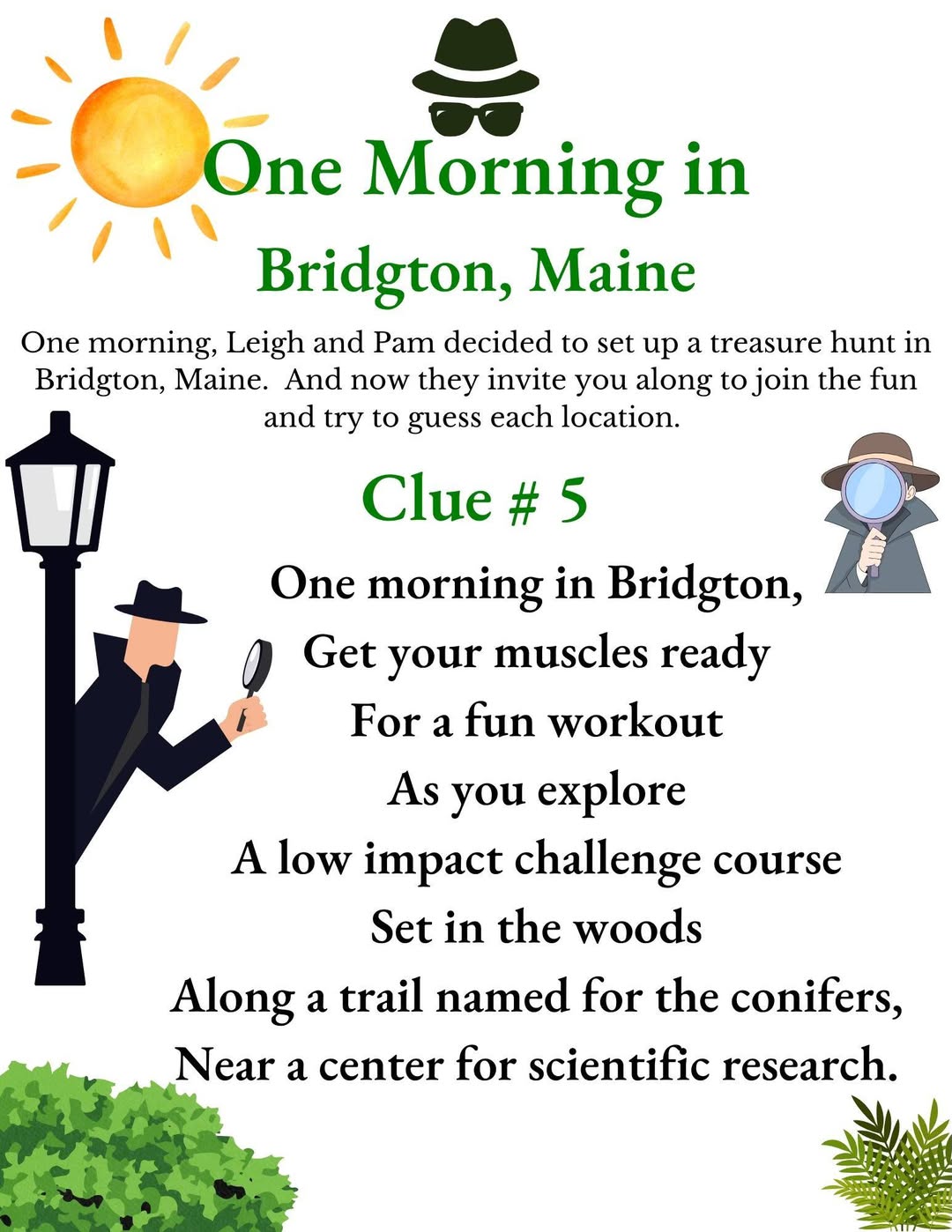
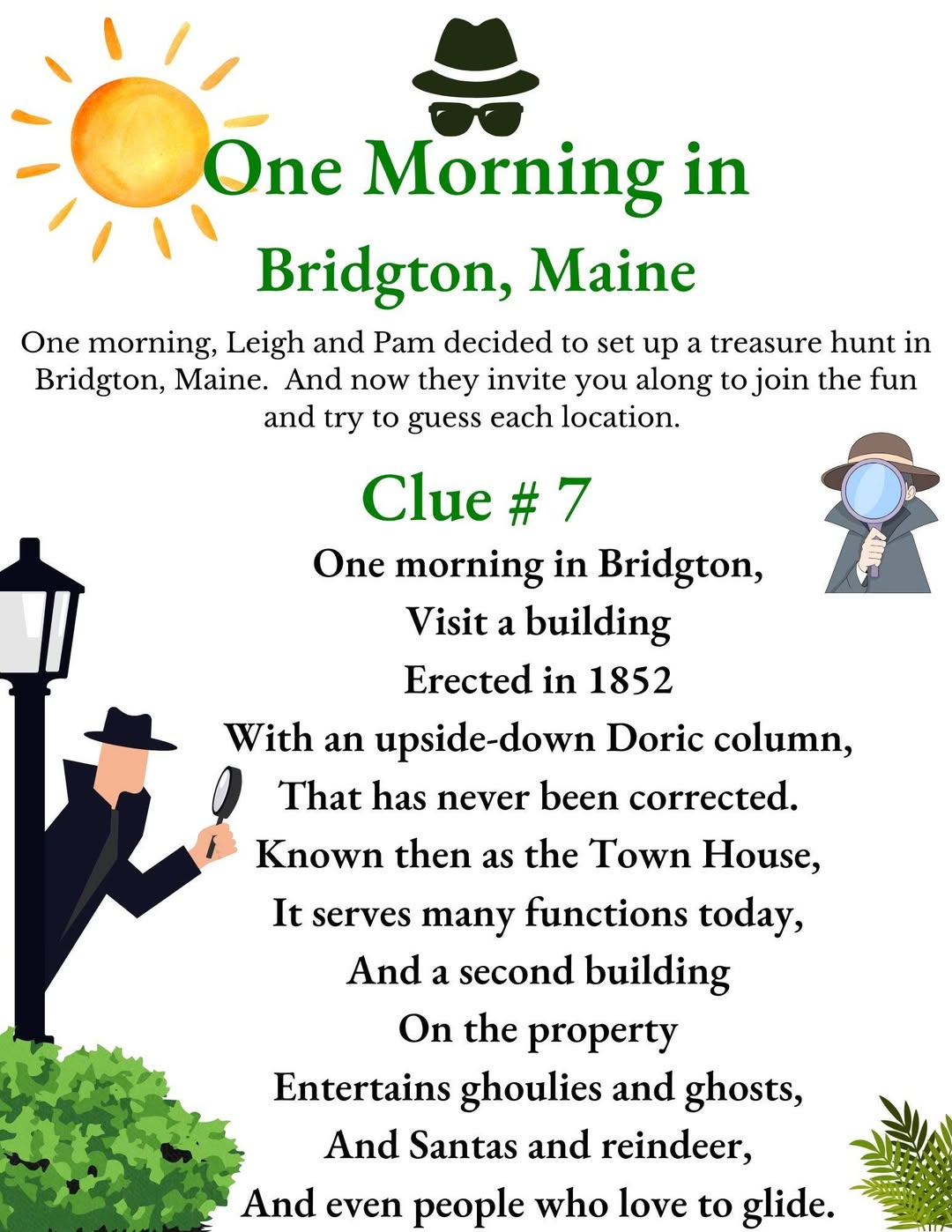
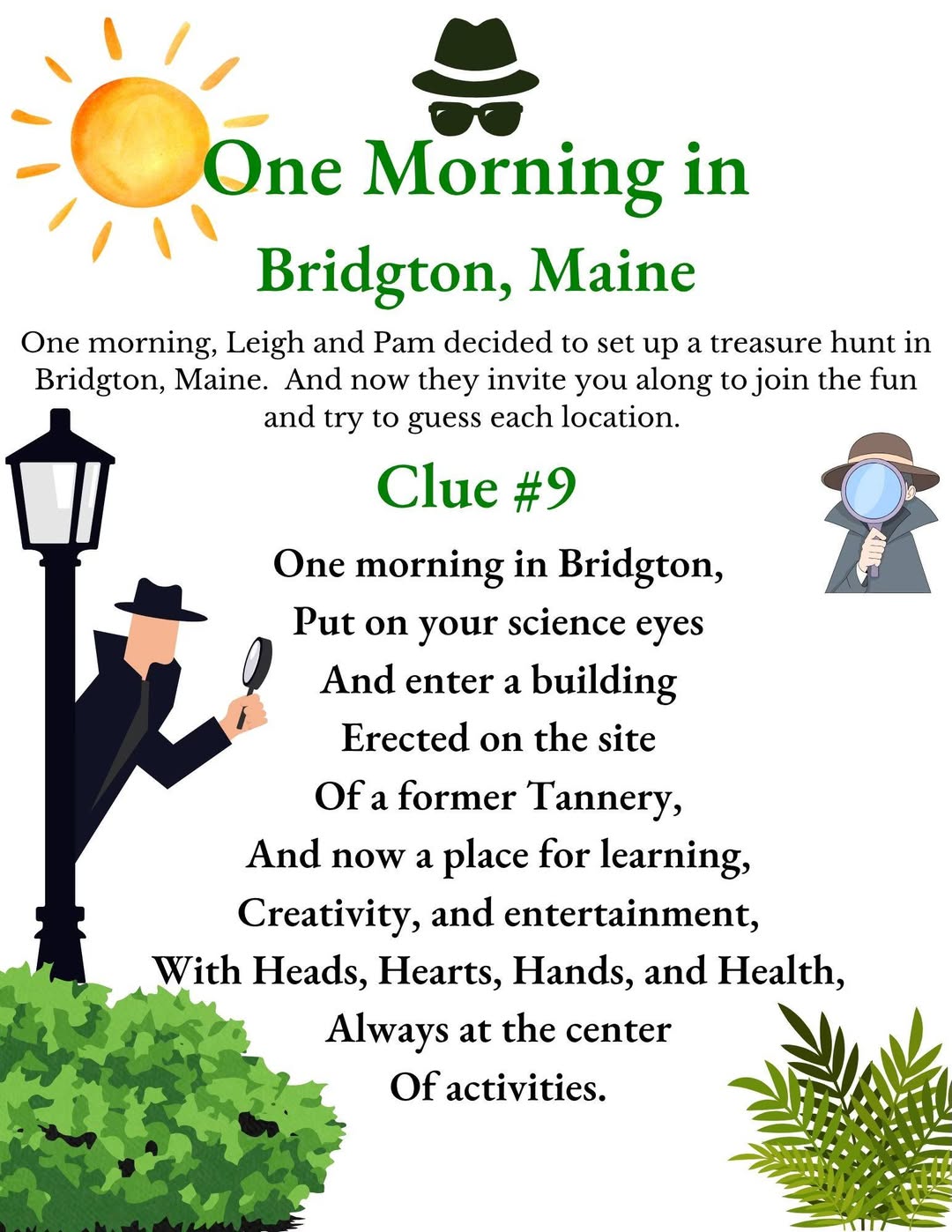
If you recall, at Christmas time last year, Pam Ward of Bridgton Books, and I collaborated and created Twas The Night Before Christmas with a local twist. We had so much fun doing that, that we decided to come up with something else for the spring and early summer.

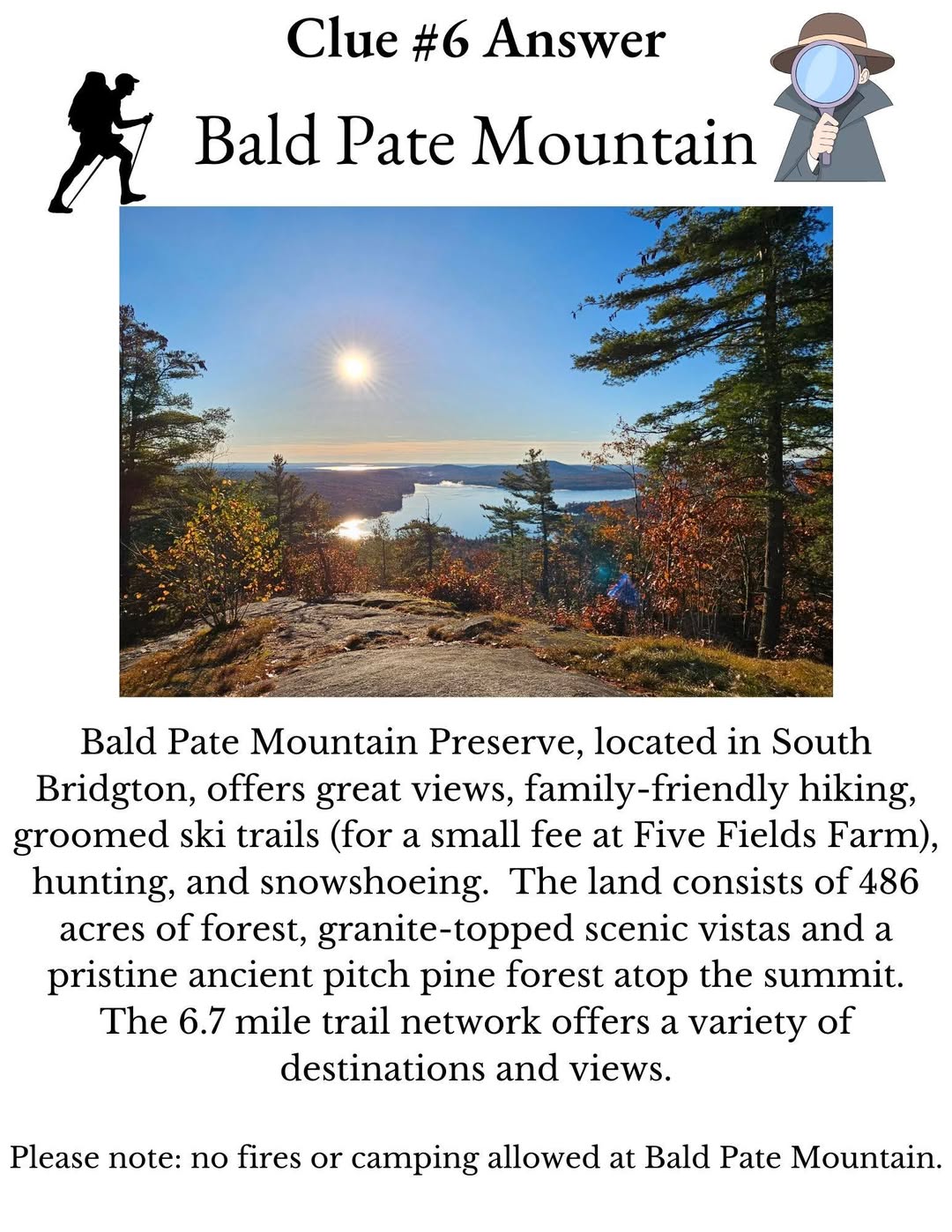
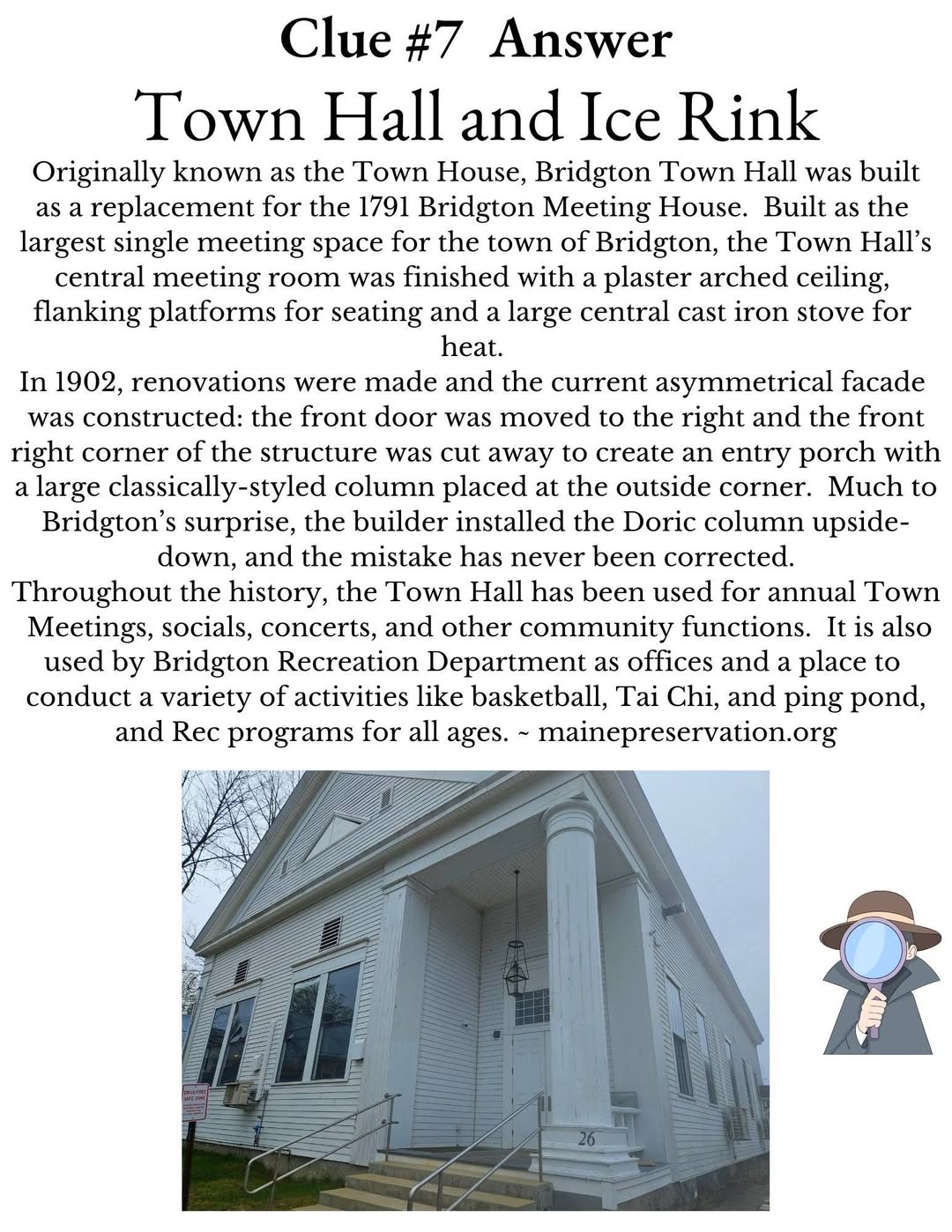
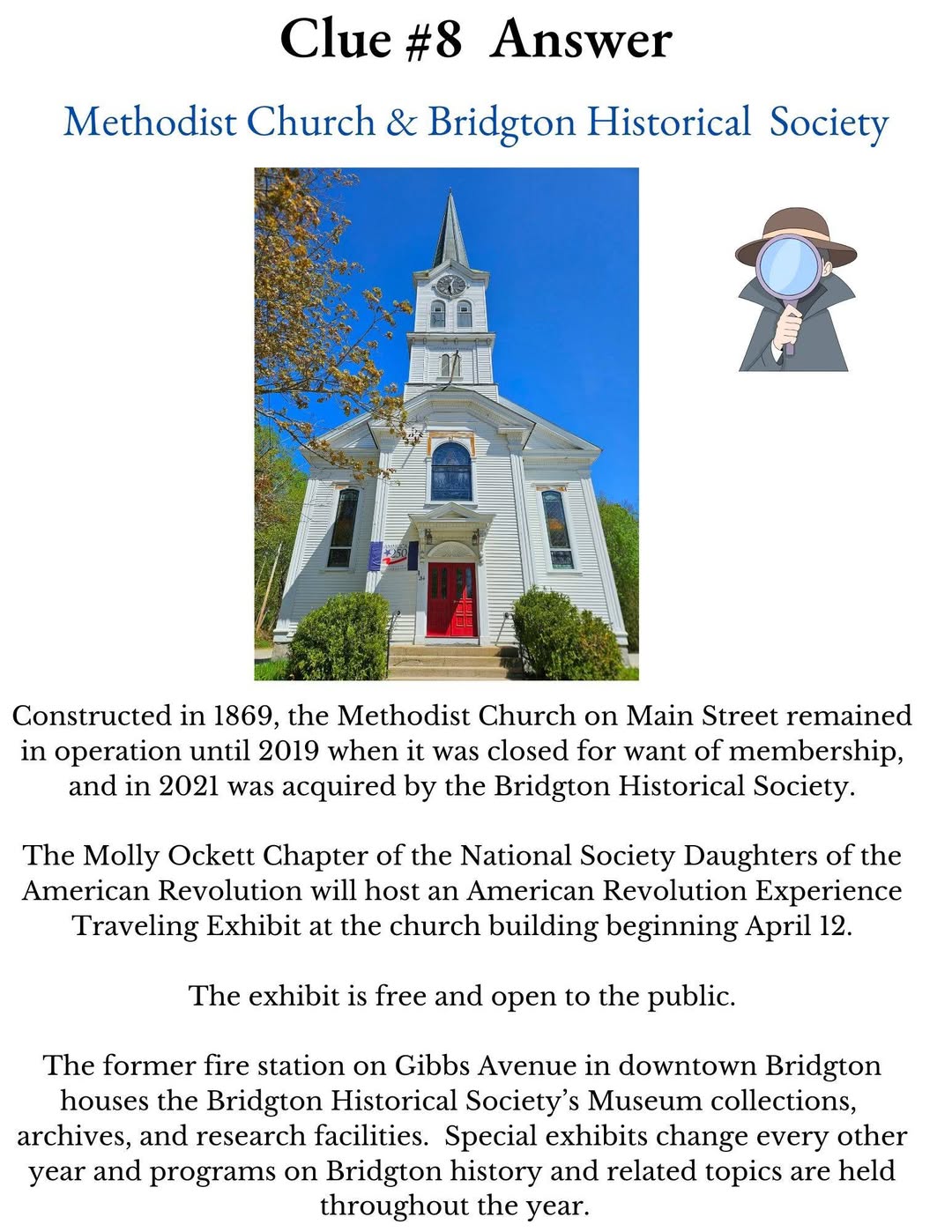
Thus was born our treasure hunt. I’ve decided to list all the clues first, and if you actually want to try to figure them out or locate them, we welcome that. The answers and the history behind them will be included in the second half of this post.

Happy hunting.

*********************************************************************************************************

*********************************************************************************************************

*********************************************************************************************************

*********************************************************************************************************

*********************************************************************************************************

*********************************************************************************************************

*********************************************************************************************************

*********************************************************************************************************

*********************************************************************************************************

I thought I’d separate the clues from the answers with this photo of a Magnificent Bryozoan, tiny animals that form a cluster or colony and filter water–indicators of good water quality. I spotted this in Moose Pond over the weekend. Each year I find at least one colony there and give thanks.

And now for the answers.

*********************************************************************************************************

*********************************************************************************************************

*********************************************************************************************************

*********************************************************************************************************

*********************************************************************************************************

*********************************************************************************************************

*********************************************************************************************************

*********************************************************************************************************

*********************************************************************************************************

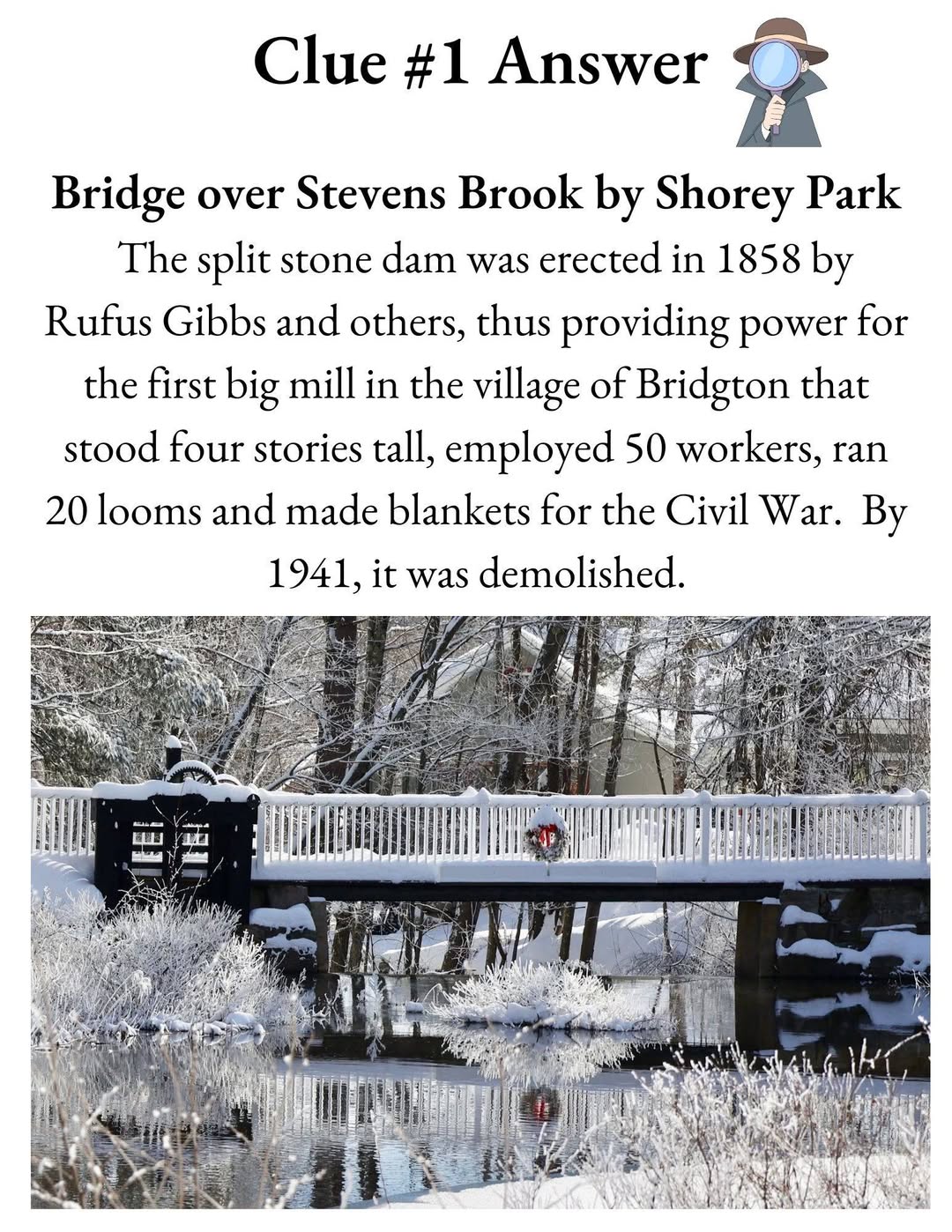
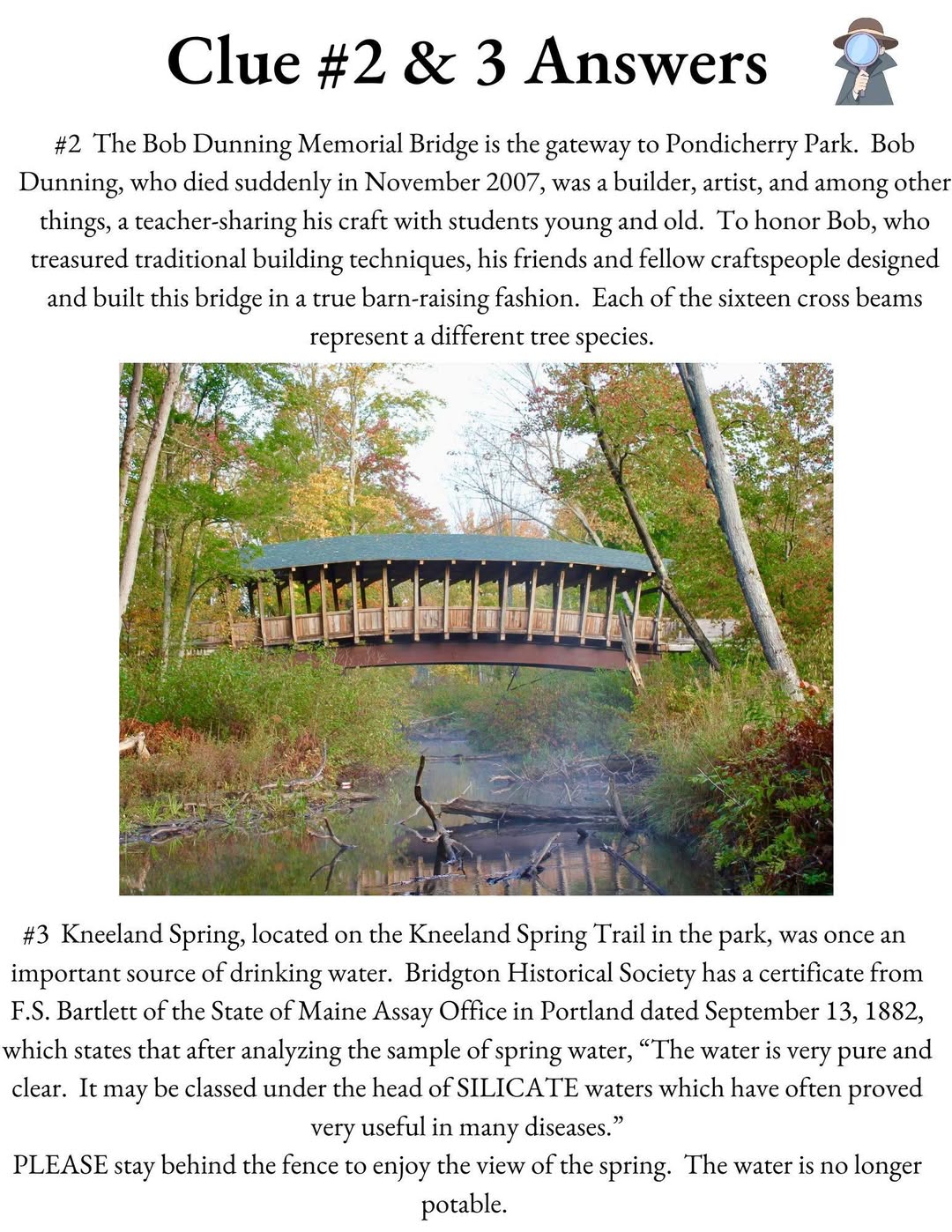
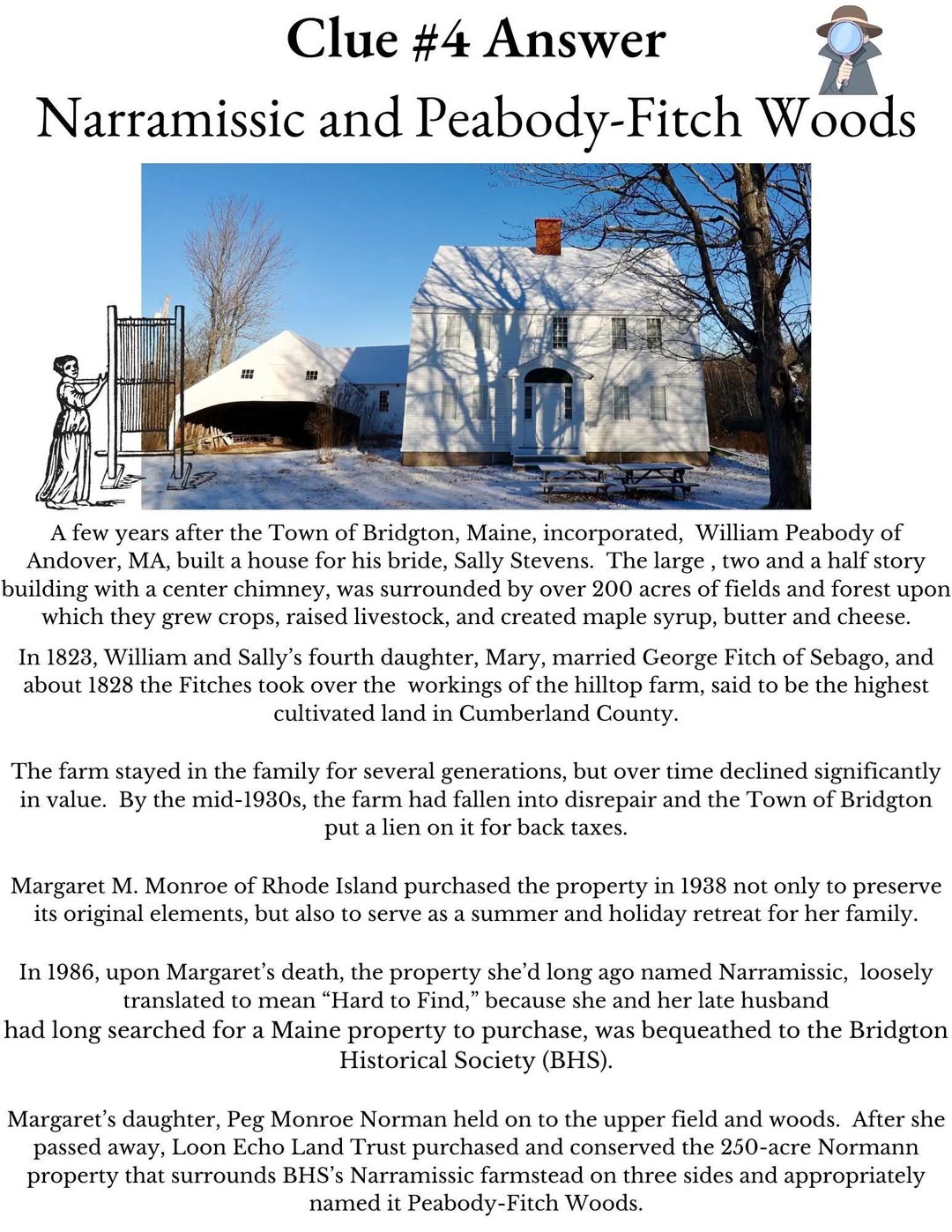
Pam not only took the photos for this treasure hunt, but she also took the time to create each poster.

My part was easy. Among my research, I also had past encounters to recall for as an amateur historian I often picked the brains of Ned Allen, former executive director of Bridgton Historical Society, and the late Sue Black. To both of them, I give great thanks.

And thank you again to Pam and our mutual friend, Katie Dunn, for our recent walk along the Stevens Brook Trail, where I shared some of what Sue taught me over the years.

Here’s to more creative collaborations that celebrate our little place on Planet Earth.

One morning in Bridgton, Maine . . . Pam and I hope you’ll step outside and look for some of these treasures, or at least enjoy reading about them.

There Is No Planet B

I was asked to give the homily at church this morning and have spent the past month or more reflecting on what to say. Of course, it was to my blog that I turned for inspiration for I knew that parts of the story were tucked within these posts.

Driving home from a recent Trail Snails walk, I spotted this statement on a roadside sign: “There is no Planet B.” And I thought it was an apropos title for what I want to share with you this morning.

On Sunday, March 23, in Forward Day by Day, Tyler Richards, a priest serving St. Anne’s Episcopal Church in De Pere, Wisconsin, responded to Exodus 3:vs 3-4: Then Moses said, “I must turn aside and look at this great sight, and see why the bush is not burned up.” When the Lord saw that he had turned aside to see, God called to him out of the bush, “Moses, Moses!” And he said, “Here I am.”

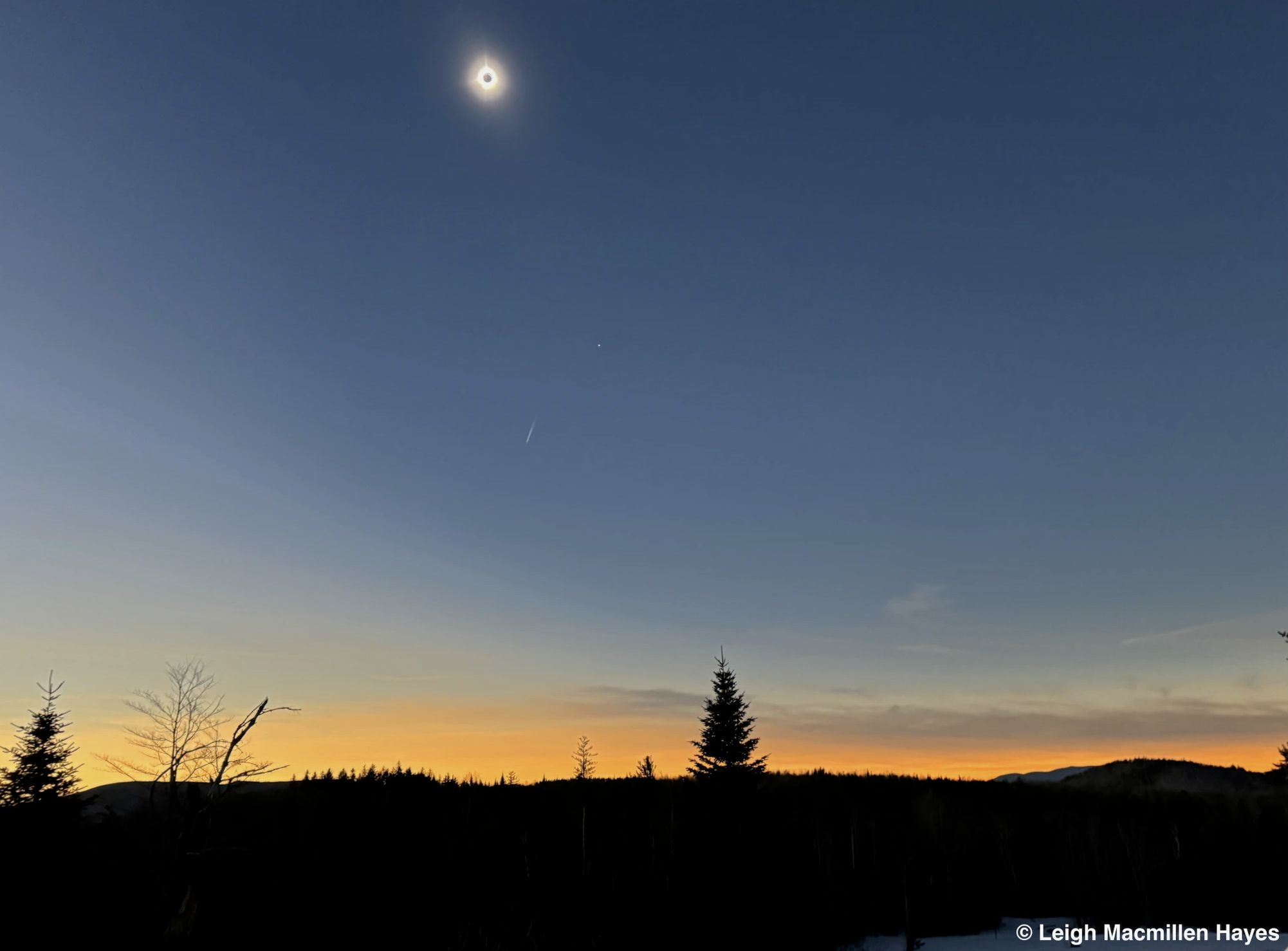
Reverend Richards commented, “I do not have an accurate account of the things that have caused me to stop and look again. Solar eclipses, northern lights, sunrises, and sunsets are a few of these.”

He continued, “God asks us to turn aside and experience wonder. God’s creation is a source of endless contemplation, and, at times, so is human ingenuity. But these great wonders that take our breath away prompt me to ask: What are they for? Are they an end to themselves, or are they there to remind us that God is even more incredible? Indeed, God is so great that God inspires and colors the very creation itself. It might not always be a burning bush that causes us to gasp at God’s greatness.”

In response to that I invite all of you to join me as I share a few of the thin places I have visited, where I see the light more on this side than the other. These are not burning bushes, but they do make me gasp at God’s greatness. The first I call “Emergence.”

Emergence

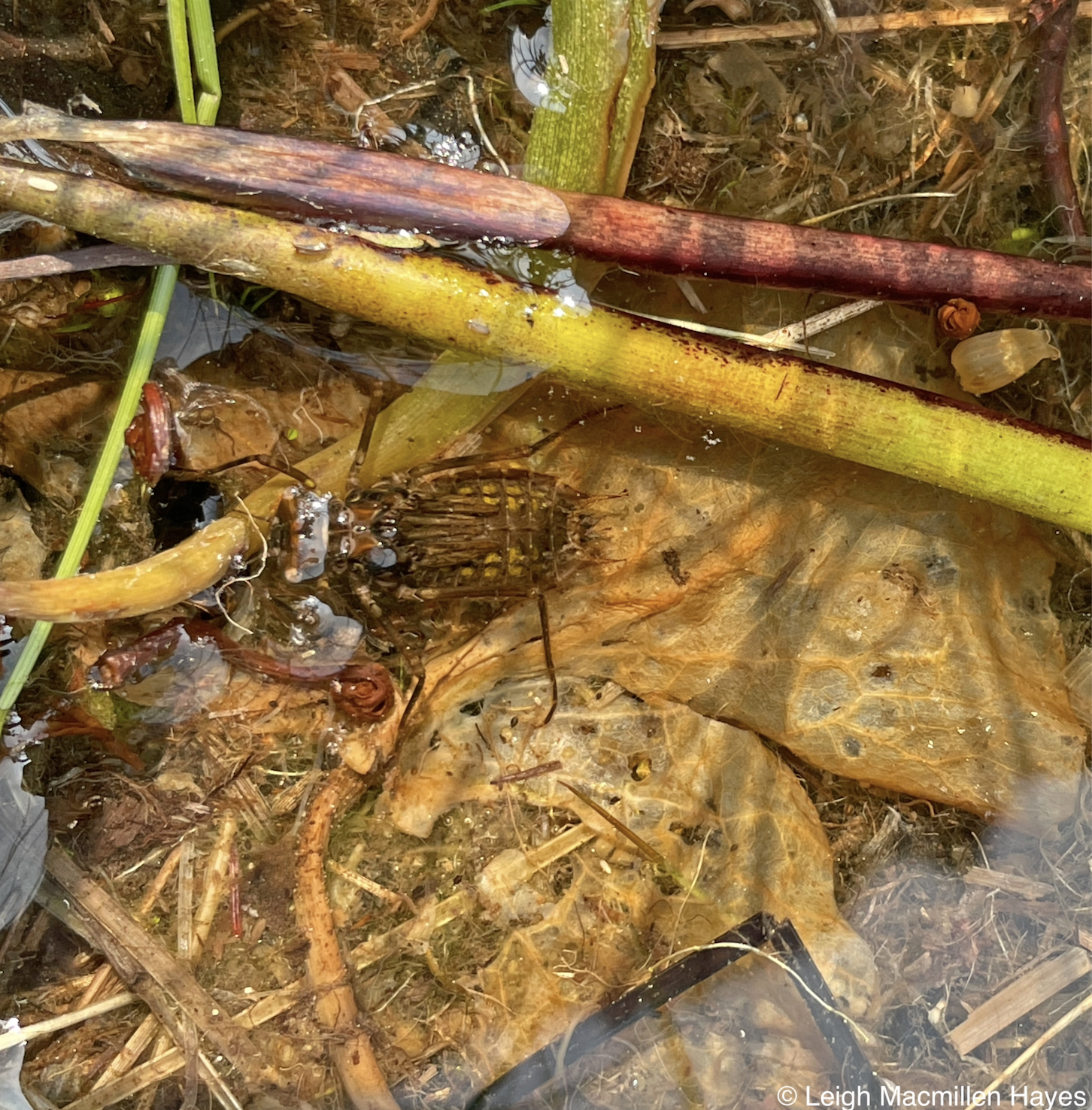
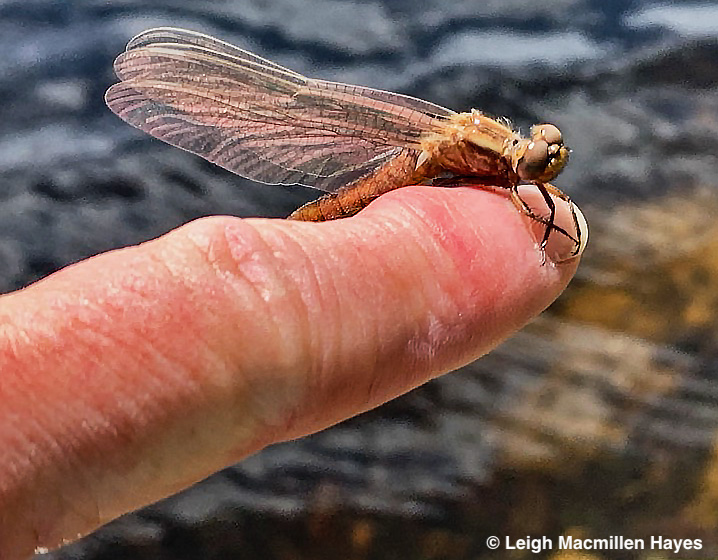
Oh dragonfly, oh dragonfly.
In your infancy,
You laboriously
Climbed upon a slender stem.
Ever
So
Slowly,
Seams split.
Soft and squishy,
You spilled forth
Into this sunlit world.
Perched upon your former self, 
Wispy strings recalled
Aquatic breaths.
Moments slipped
Into an hour.
Your body of velvet pulsed
As blood pumped
Into cloudy wings.
Standing guard watching you,
I noted preparations
For first flight.
Eyes bulging, 
You chose a spot
Of viewpoint advantage.
Colors changing,
You gained the markings
Of generations past.
Wings drying, 
You offered a reflection
Of stained glass.
Beyond understanding,
You flew,
A dance of darting restlessness.
Odonata, Odonata, 
You have known both worlds.
First playing beneath the watery surface.
Then in a manner so brave, 
Climbing skyward
To ride summer breezes
On gossamer wings.
Forever in awe
Of your transformation
From aquatic naiad
To winged adult,
I can only imagine
The wonder of emergence.

******

Drawn by the Sapsuckers is next.
Along a path
Through a cathedral in the pines,
It seemed apropos
That I should spy
The works of
An Oak Apple Gall wasp.
For it is believed
That circa 800AD
Irish monks used such galls
To create the green colorant
Of their artwork
As displayed
In the Book of Kells.
My first intention of wander
Upon this special day
Was soon verified when I was
About twenty feet
From a maple tree
For I could hear peeps
From the ever hungry
Babes within.

Only two weeks prior
Father Sapsucker entered
The nest hole every few minutes
To nurture his offspring, but today
Things had changed.
No sooner did he toss in a meal
When a nestling popped its head out
And begged for more.
Finally, with the urging 
Of the ever present deer flies,
I moved on
To the neighboring meadow
And gave thanks when
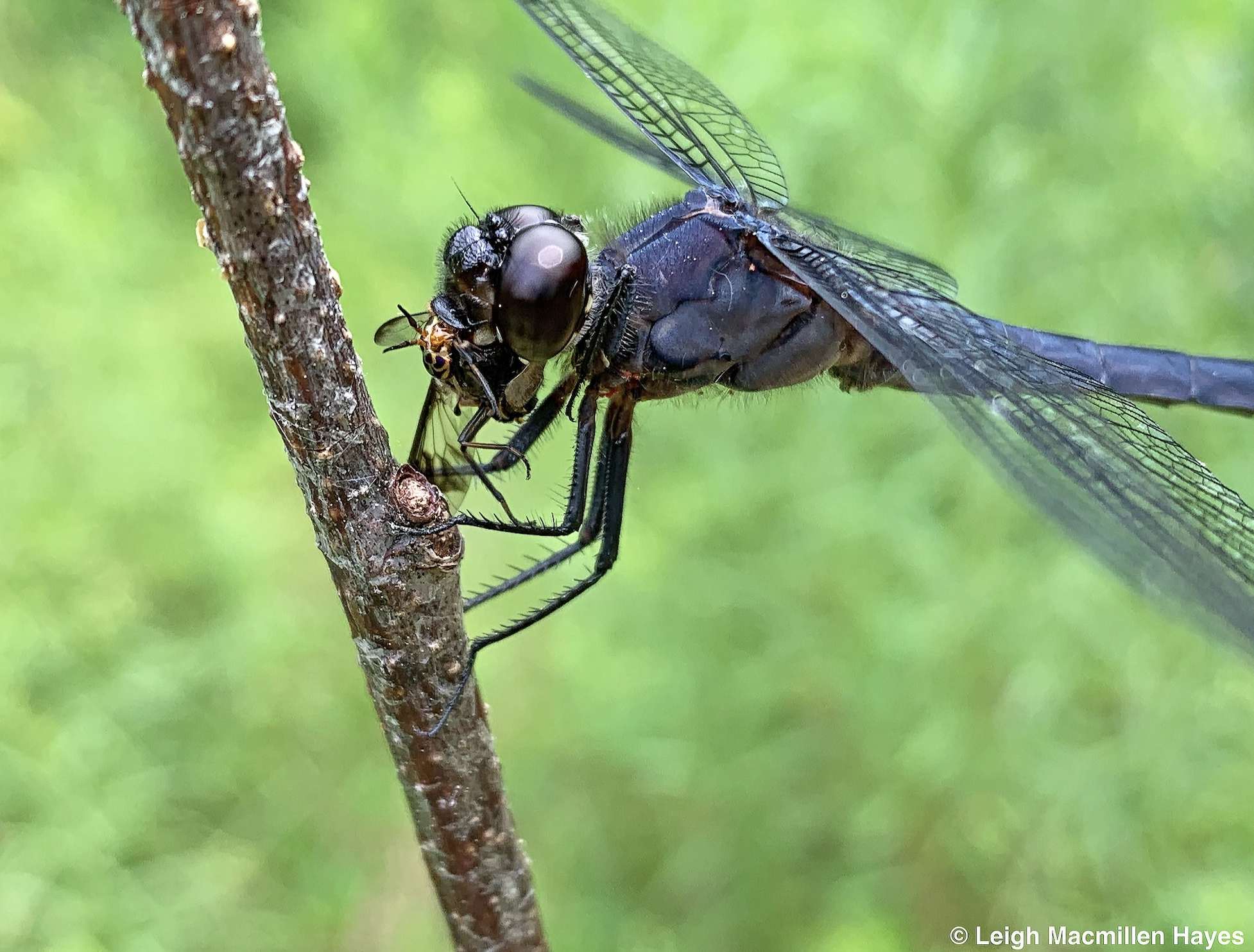
A Slaty Blue Skimmer Dragonfly
Snatched a pesky insect
From my head
And settled upon a stem to dine.
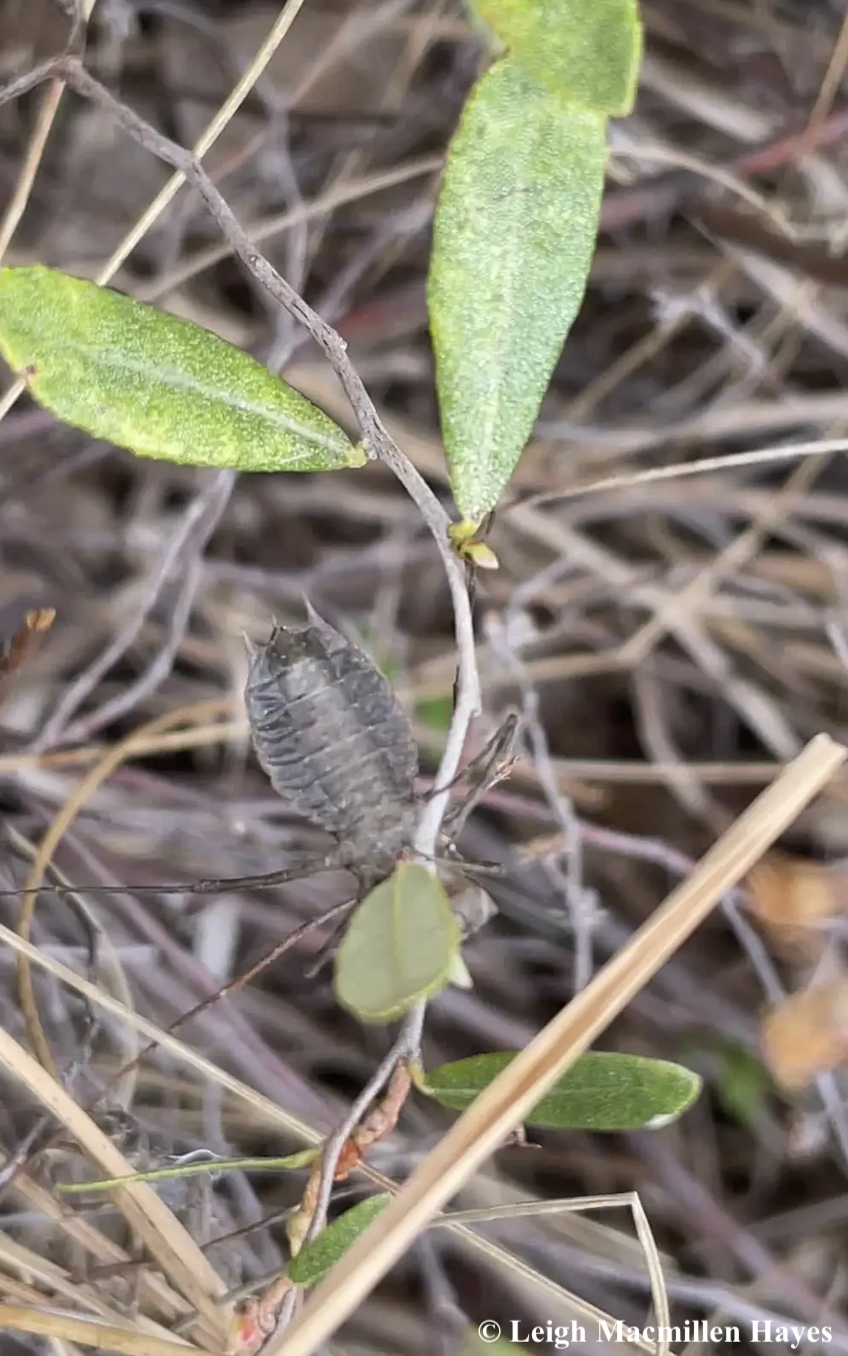
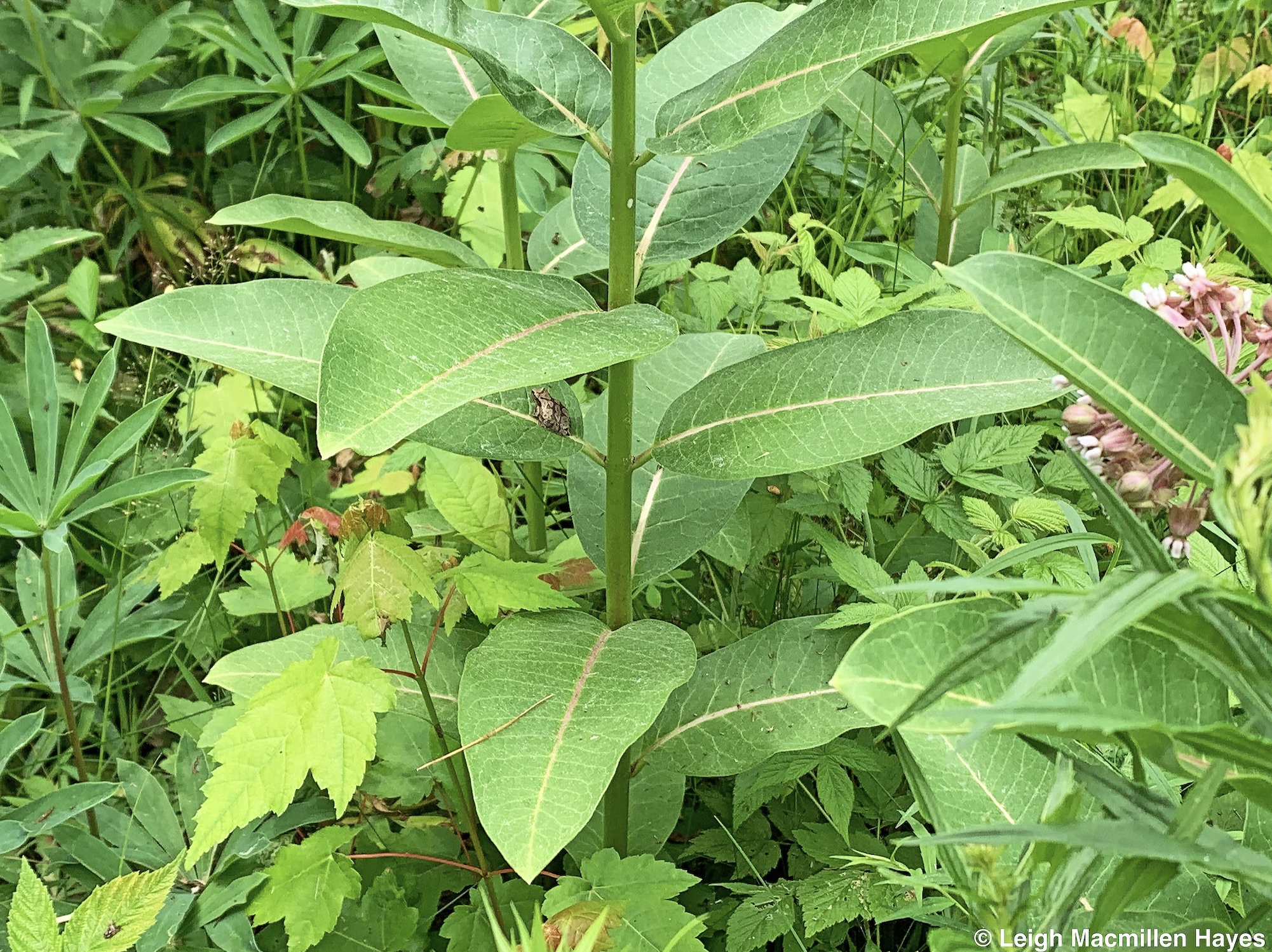
Nearby on a milkweed leaf
I spied something tiny.
By the X-shaped pattern
On its back,
I knew it was
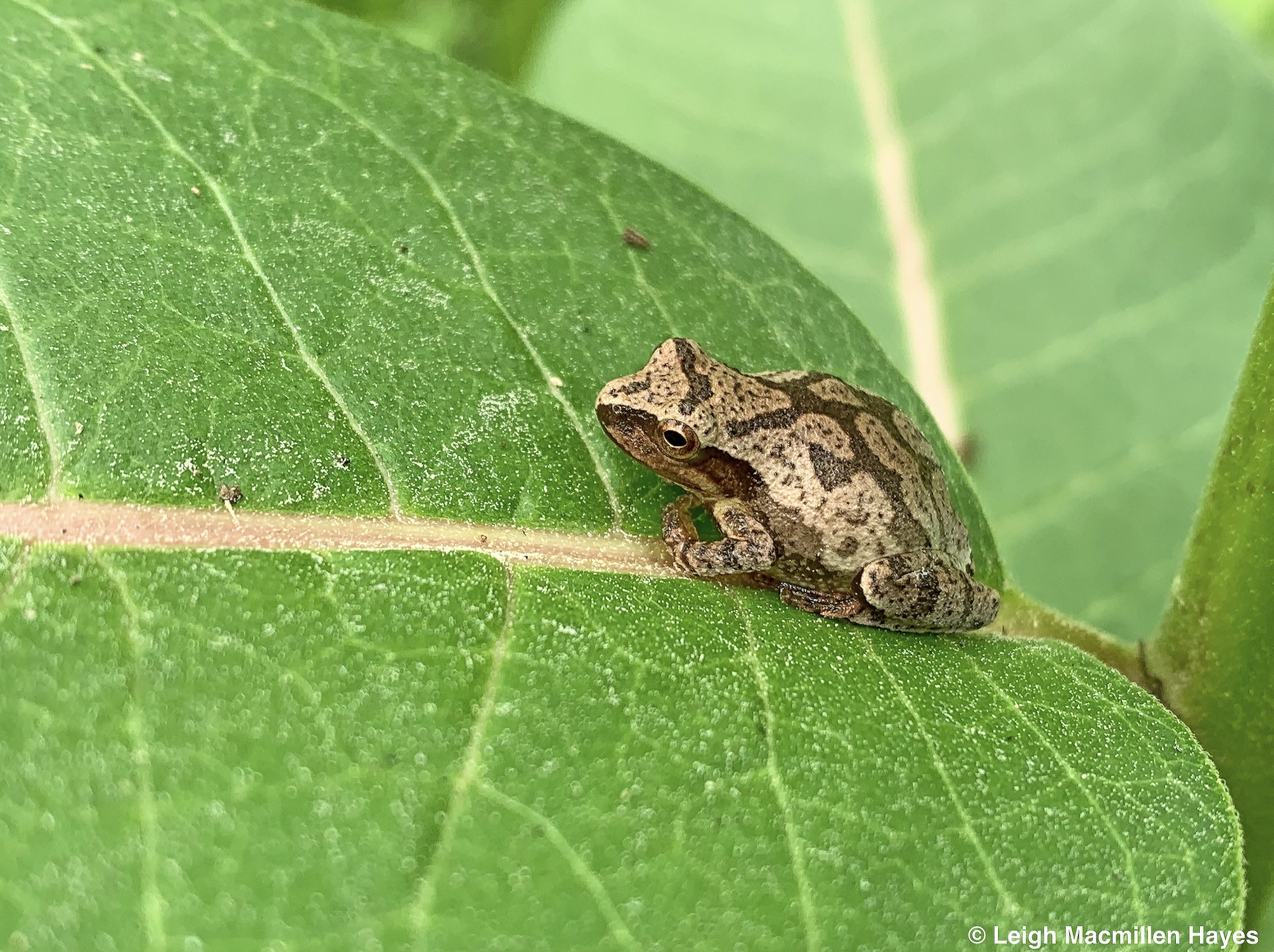
A Spring Peeper.
Sitting two feet
Above the ground,
This little frog
Hid from predators
During the day
As it waited for dusk
To crawl down
The plant's stem
And munch a meal
Of its choice.
Behind the wee frog
A dash of color
Brightened the background.
Bedecked in orange and black,
This being a Fritillary butterfly,
It flew
Down the path
And out of my vision.
In this same place,
Tiger Swallowtail butterflies
Added their yellow wings
To the tapestry.
Plentiful in number, 
Skimmer dragonflies,
Each with a uniqueness
All its own
From Spangled to
Dot-tailed and Great Blue
Chased down meals
And hunted for mates.
Before departing
I checked
On the nestlings
In the Red Maple trunk,
While their papa
Did the same
From a tree
Ten feet away.
Was he teaching them patience? 
Perhaps.
Sensing our time together
Was waning,
I gave thanks
That it was the Yellow-bellied Sapsuckers
Who drew me to this place.

******

Finally,

"The way to be heard isn't to shout," said the Reverend Sam Wells of St. Martins in the Fields, London. "It's to whisper."

But, I ask you, who are the whisperers?

As you go forth this spring . . .
Listen for the slightest murmur
Of Beaked Hazelnut
Sharing its most
Beautiful, yet minute
Magenta blossoms
That so many never see.
Hear also
The soft words
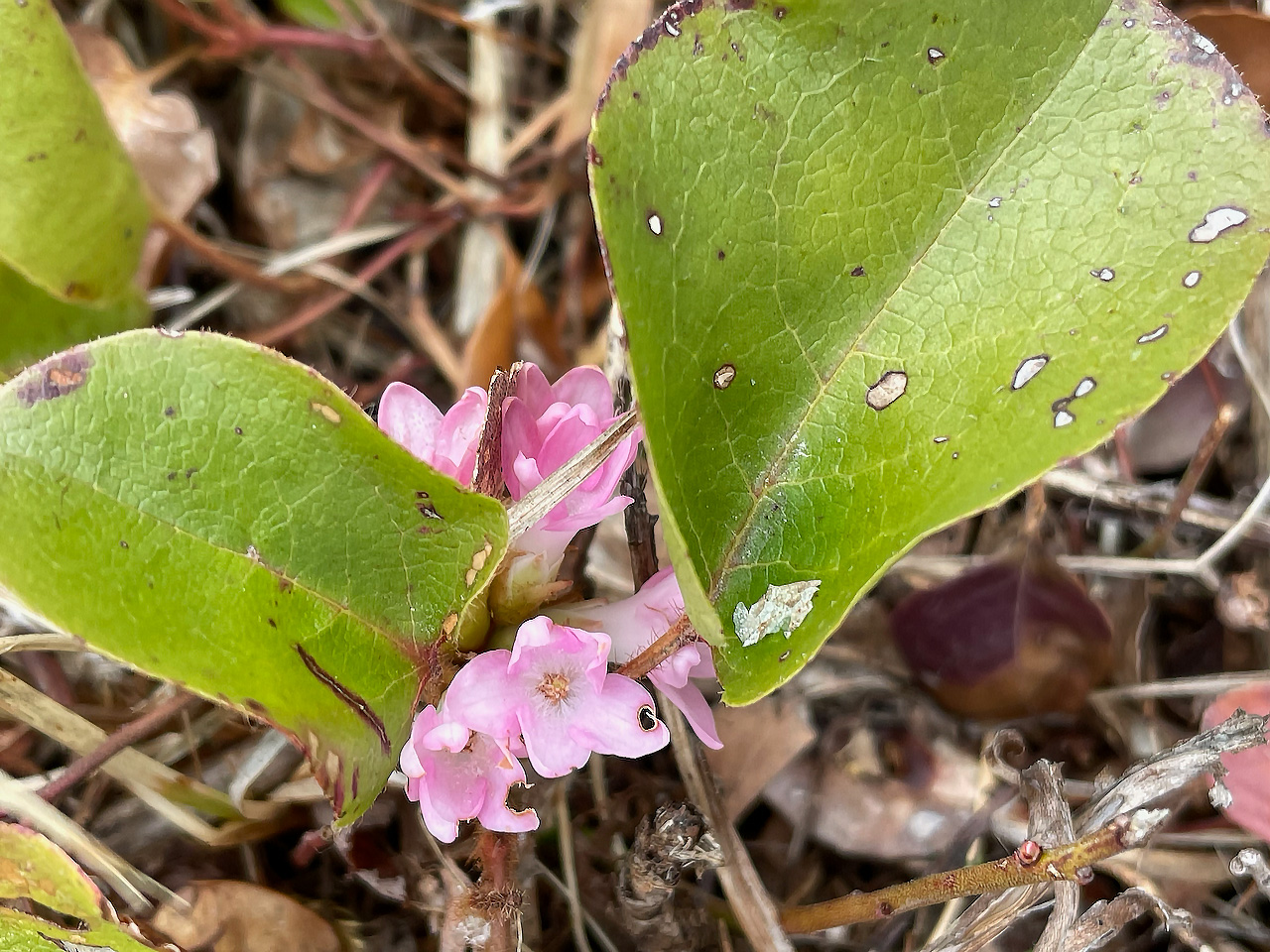
Of Trailing Arbutus
Hiding its delicate flowers
Beneath leathery leaves.
Be attentive to Hobblebush
No matter how much
It makes you stumble,
For it always
Has more to offer
Including corrugated leaves unfurling
And a flowerhead silently forming.
Give audience
To Rhodora's woody seed structure
Of last year
Before her brilliant pink flowers
Soon distract.
Pay attention 
To the male Hairy Woodpecker
Who speaks
In hushed pecks
As two females
Squabble for his attention.
Focus on 
The soft cheers
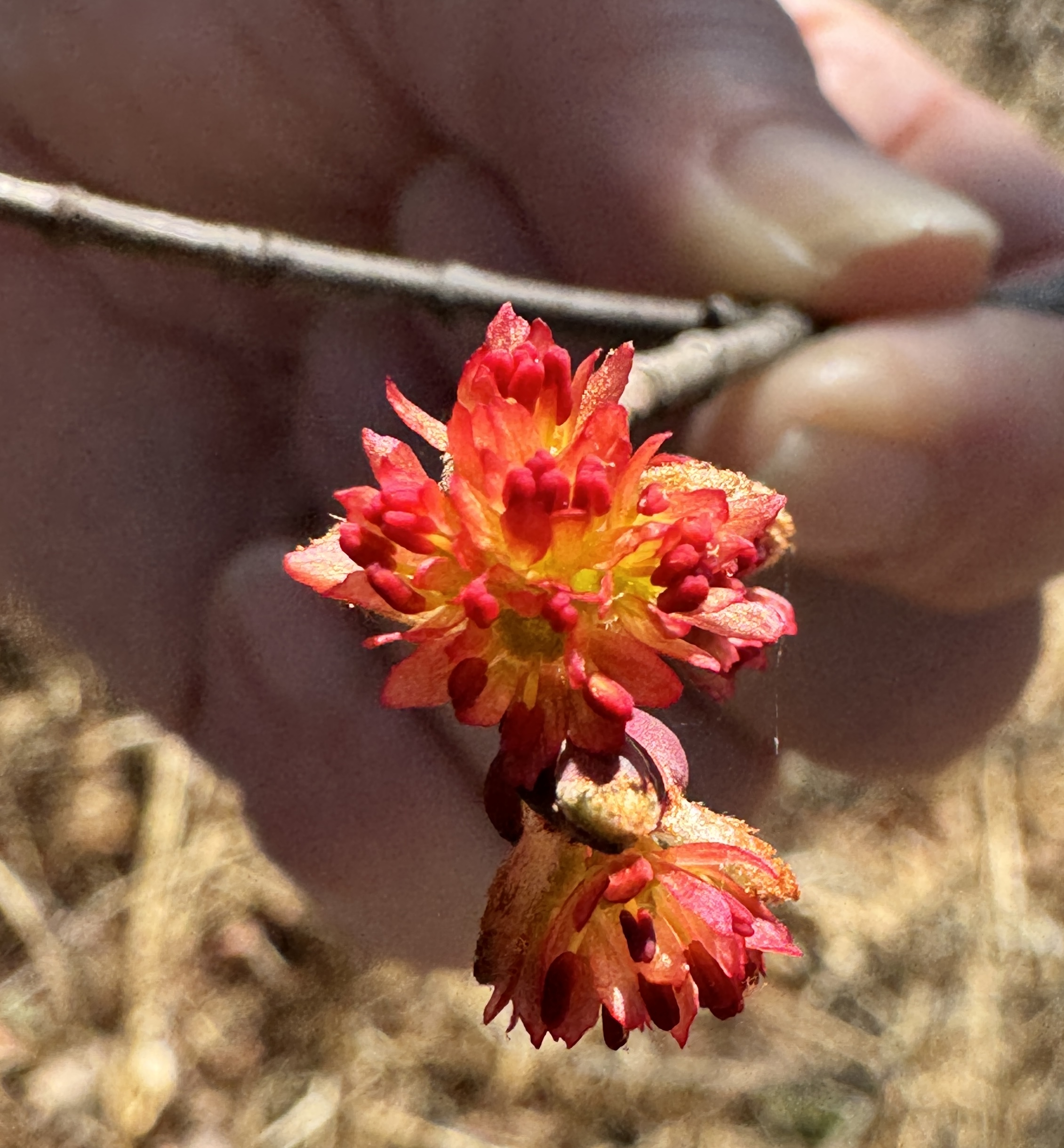
Of Female Red Maple flowers
waiving their pompom stigmas
in hopes of meeting . . .
Male pollen 
Blowing in the wind.
Remember to 
Keep your voice low
As you spy
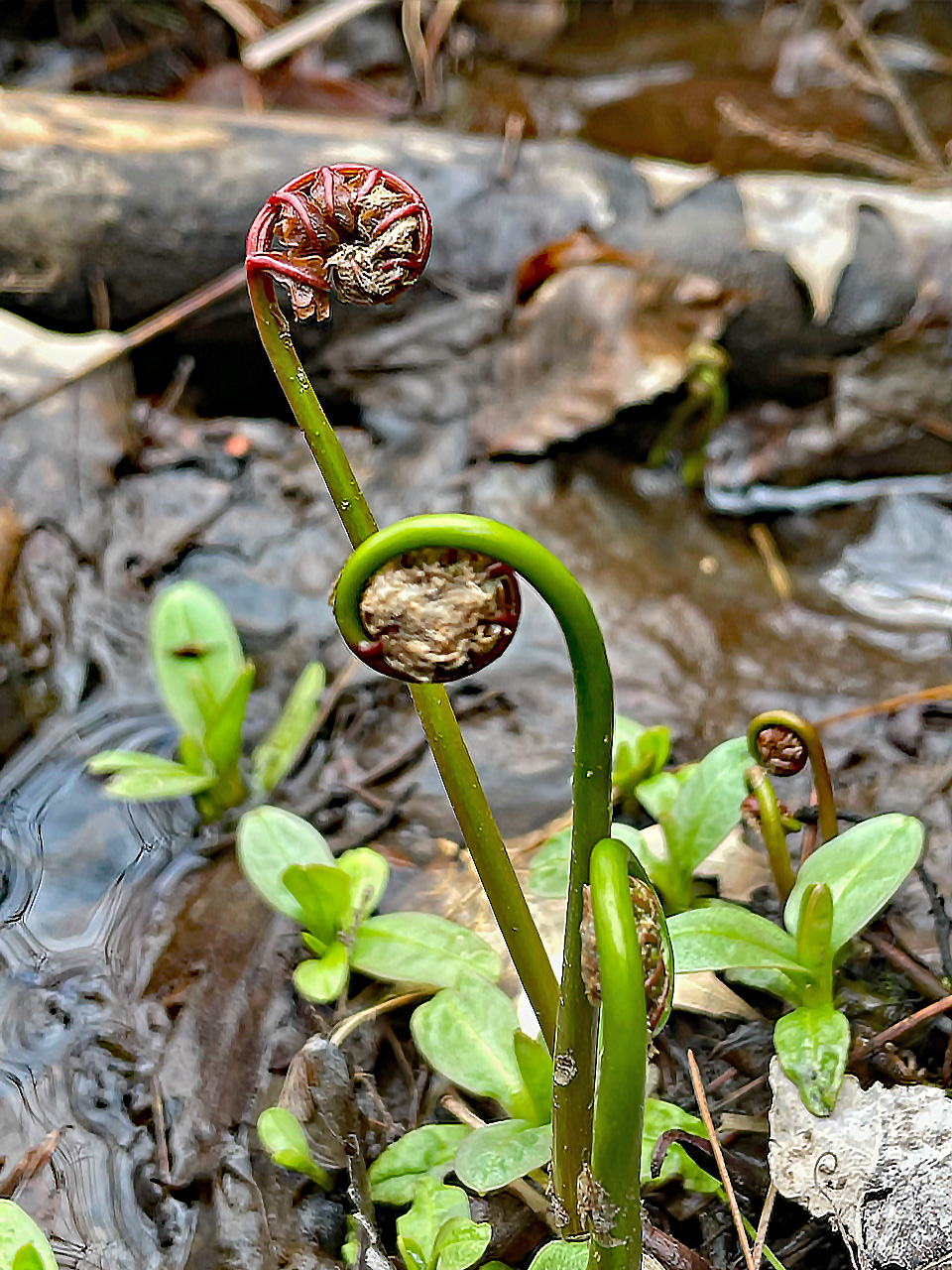
The first crosiers
Of the most Sensitive Ferns.
Heed the inner voice
Of Mystery
And Be Present
With your heart and soul.

I invite you
To walk in silence
Throughout the forest and wetlands
While listening intently
To all
Who whisper along the trail.

******

I’ll end with part of an entry from Creation Justice Ministries’ Seeking Creation: Lent 2025 Devotional.

Referencing Ezekiel 37:21-28, the authors wrote, “God’s goal is not to abandon Creation that God has made. It is to live with us among that Creation. A theology that suggests that God’s good Creation was made solely for us to deplete it and hoard resources from one another ignores the long line of biblical witness that cast a vision of a united humanity where the Creator lives among the creatures, us included.

That God would want to live among Creation should tell us something of Creation’s Worth to God. It is not disposable. It is not replaceable. It is not profane. The dream of a Holy God is to live among Holy people within the holiness of Creation. May it be so.”

And remember: There is no Planet B. This is all we have.

May hushed voices shout from every corner of the Planet AND as those voices uplift your spirits, may you realize God’s greatness and never lose your sense of wonder. ~Amen.

Happy Belated 10th Anniversary, wondermyway.com

I can’t believe I missed the date by two days. I’d been planning this for months. Well, in the back of my mind, that is. No actual thoughts were jotted down on paper. I just knew what I wanted to do and when I wanted to do it . . . until I forgot. Or rather, it slipped my mind. Momentarily.

No harm done.

As the saying goes, “There’s no time like the present,” and so my gift to you dear readers will be to give you the present of time by taking you back to the beginning of wondermyway and then making our way to the present. And all of it is because I was given the gift of being present in the moment on so many occasions. Egads. That’s a lot of presents. And presence.

Wonder My Way

My first blog post was published on February 21, 2015, and entitled Wonder My Way. It began with these paragraphs: Wonder my way as I wander through the Maine woods. So often I see things that make me stop and wonder. Sometimes I figure it out, but other times, I’m just as happy that I don’t. It’s The Sense of Wonder that Rachel Carson wrote about which keeps me going. Do we need to have all the answers? I think not.

So join me for a tramp from our woodlot to the world beyond. I know not where this trail will take us, but I can guarantee that we’ll have fun along the way. Read more . . .

Spring in Slo-Mo

Spring is so fleeting in Maine. Oh, I know, it lasts the usual three months and the beginning and ending overlap with its seasonal partners, but really . . . one must take time to pause and watch or you’ll miss the most amazing action that occurs in slow motion right outside the window–and beyond.

For those who are new to my blog, Jinny Mae, who is featured in this and many blog posts, was a dear friend whose name I turned in to an alias as she faced cancer courageously and rather privately. In the end, the cancer consumed her, but the things we enjoyed along the way were bountiful, including this spring adventure to an incredible space in our little neck of the woods. Read more . . .

Universal Love

Written on Valentine’s Day, this post was dedicated to My Guy and all who wander and wonder with me.

When I wander, hearts frequently speak to me . . . Read more . . .

Nothing To Grouse About

I shared a unique experience with five other naturalists, the majority of them in the six to eleven age range. For twenty minutes the six of us watched a Ruffed Grouse at it moved about, overturning leaves and foraging on buds. When we last saw it, the bird headed off in the opposite direction that we intended to journey, and so we moved on with wonder in our eyes and minds.

And then the next day I returned on a mission to study some twigs at the same property. No sooner had I stepped onto the trail when I heard the sound of leaves cracking a wee bit and what to my wondering eyes should appear but the same bird.

The curious thing: the bird followed me, staying about ten feet away as I tramped on. I stopped. Frequently. So did the bird.

And we began to chat. I talked quietly to him (I’m making a gender assumption) and he murmured back sweet nothings. Read more . . .

Amazing Race–Our Style

Okay, so My Guy and I have enjoyed The Amazing Race show over the years and felt like there were some challenges either or both of us could face, but others that neither of us would dare attempt. And so . . . I created our own version.

The thing is that until I take the time to change the order of this post on my website, you’d be best to start at the bottom and read each entry, going up one step at a time. As in, this: Scroll down to February 18 on this link and then after reading that entry, make your way up one episode at a time, until you reach the last recorded on February 2, 2019. Oh heck, read it in any order that pleases you. Just get into the spirit of the race I created cuze I certainly had fun with it. And fooled a few people along the way.

The Amazing Race–Our Style

I’m sure when we said our wedding vows back in 1990, there was something in there about only riding a snowmobile once. And I did that once two years or so ago–mostly because I knew it would please my guy. Certain memories remain from that experience: I felt like a bobblehead inside the helmet; I lacked control as I sat behind him and couldn’t see; when I did peek around, I was sure my head was going to strike a tree so narrow was the trail; and I didn’t like the speed. Oh yeah, and at a road crossing, I do believe I jumped off and walked to the other side. With all of that in mind, I’m not sure what I was thinking when I created a Valentine’s gift for him–our very own Amazing Race. Read more . . .

wondermyway turns five

Five years ago today (ten now!) I turned from taking a hundred million photos on each tramp to taking a hundred million photos and writing about them.

Typically, on the anniversary I scan the past year’s posts and choose one from each month, providing a photo to represent it, with a brief (or not so brief) comment and link to the full read.

But . . . because this is a milestone I never imagined reaching (posts: 733; views: 76,793; visitors: 44371; followers: 578), I thought I’d take the time to thank you, the readers, for wandering through the wonders with me.

Thank you! Read more . . .

Dragonfly Whisperer Whispers

We had no intention of eating lunch in this spot today, but while looking for a mountain to climb, we kept encountering full parking lots and so our backroad meander put us beside a bog at lunch time and voilà, we managed to walk all of less than two tenths of a mile. Total.

But in that short distance, our eyes feasted. First it was all the Painted Turtles basking in the sun. Read more . . .

Surveying the Wildlife of Charles Pond

For the past two weeks at Greater Lovell Land Trust we’ve had the good fortune to conduct a wildlife survey in the waters that surround the newly acquired Charles Pond Reserve in Stow, Maine. Our hats are off to Alanna Doughty of Lakes Environmental Association (LEA) for her willingness to be the lead on this project and work in collaboration with us. Alanna, you see, has conducted previous surveys for Maine Inland Wildlife & Fisheries (MDIFW) at LEA properties, and was trained by wildlife biologist Derek Yorks to set these up.

MDIFW maintains a comprehensive database on the distribution of Maine’s amphibians and reptiles, as well as terrestrial and freshwater invertebrates and the data we’ve collected will add to the bigger picture. What we discovered was just as important as what we didn’t find. Read more . . .

Hightailing It Home

Friends,
At the risk
of sounding redundant,
I bring forth
a prickly topic.

A quick glance
while surveying treetops
and suddenly
my heart sang
as I spotted
a well-armored back.

Read more . . .

Happy 9th Birthday, wondermyway!

Thank you to all who read and comment and share wondermyway.com. Some of you have followed my blog posts since the beginning, February 21, 2015. A few have joined the journey as recently as yesterday. I’m grateful for the presence of all of you in my life.

To mark this occasion, I thought I’d reflect upon those moments when my wonder gave me a glimpse of the “Thin Places” that I’ve experienced either by myself or in the company of others.

To quote my friend, Ev Lennon, “A Thin Place is a spot of beauty, loveliness, space–an example of the wideness and grandeur of Creation.”

I think of them as places that you don’t plan a trip to visit, but rather . . . stumble upon.

Read more . . .

And that brings me to this year and this anniversary, belated as it may be. I can’t believe it’s been ten years since I started this endeavor, which has served as my diary and memory, and been a place for me to share so many incredible extraordinary ordinary experiences with all of you. Thank you for being faithful readers.

As I compare the numbers to year five, I haven’t written as often in the last five years, but your support has been incredible.

wondermyway.com by the numbers:

Posts: 1,076

Visitors: 135,888

Views: 205,389 and increasing constantly.

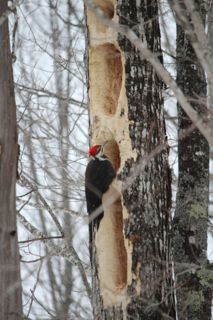
The most popular post of this new year was Giving Thanks for the Pileated Woodpecker. So far, anyway.

The Giant’s Shower

And since I retired as Education Director for a local land trust just over a year ago, I’ve added some other fun to the mix.

I did a thing. Years ago I wrote a children’s story. Well, a bunch of them actually. And I tried to sell this particular one to publishing houses. No takers. Then, a couple of years ago I purchased a Fairy Coloring Book created by the one and only Solana, teenage daughter of the Fly Away Farm Wards in Lovell and Stow, Maine, and approached her about illustrating my fairy tale. She took on the task and did an amazing job. Then I asked copyeditor Pam Marshall to wave her magic wand over it. And I asked local graphic designer Dianne Lewis to use some fairy dust and turn it into an actual book. I always said I’d never self-publish a book. And tada: I did just that. And now it’s even better because it’s published by http://www.indieauthorbooks.com.

Read more . . .

My Art Gallery

At the end of April I began taking an art class offered by one of my peeps, a young woman who walked into the lives of many of us one day about twenty months ago; a young woman with a million talents to offer. Among those talents, she is a self-taught artist and we’ve been begging her to teach us.

At our first class, we had to draw a small box in the upper left-hand corner of the paper and place the person who has been our biggest art critic into it. That done, the critic was forever boxed–well, until she sneaks out, which she seems to do way too much.

And then we looked at some photographs in magazines and had to sketch them and determine the direction the eye would travel in the picture.

Next we looked at lines and perspective. I’d brought along my favorite colored pencils, but immediately felt my inner critic jump on me because all of my classmates were working with watercolor pencils, watercolor paint or acrylics. And the artist herself, gouache. Until I met her, I’d never even heard of gouache. Or at least never paid attention, if I had.

Read more . . .

Lake Living on Lake Region Television!

And we said goodbye to Lake Living magazine, a glossy publication I’ve worked on since 2006.

We are movie stars! Well, maybe not quite. But, many, many thanks to Evan Miller of Lake Region Television for filming and editing Laurie LaMountain, owner and publisher of Lake Living magazine, and me recently as we said, “Fare Thee Well,” to working on this publication.

Read more . . .

And in the midst of it all, I still have the good fortune to share the trail with so many others . . .

and especially with My Guy, who is forever patient as I pause to consider the wonder of the moment.

My heart-felt thanks to him and to all of you for joining me so often as I wondermyway.

Wowza–ten years! I never imagined. No time like the present to wish wondermyway.com a belated 10th anniversary.

Twas The Night Before with a local twist

Pam Ward and I hope you have enjoyed reading our rendition of “Twas The Night Before Christmas” as much as we enjoyed revising and illustrating it so it encompassed at least a wee bit of our community and the spirit that ties us together.

Pam is a photographer and co-owner with her husband, Justin, of Bridgton Books. Please be sure to step into this wonder-filled independent book store when you are in town. Oh, and you might purchase a copy of The Giant’s Shower, a fairy tale, while you are there.

The Secret Giver of Gifts 2024

Being St. Nicholas Day, the day to honor the 4th century bishop from Myra who is the patron saint of children and sailors, I was reminded of a time when our youngest asked, “Mom, are you Santa?”

If you feel like you’ve read this before, rest assured. You have. But I love this story and so here it is again.

He’d held onto the belief for far longer than any of his classmates. And for that reason, I too, couldn’t let go. And so that day as we drove along I reminded him that though the shopping mall Santas were not real, we’d had several encounters that made believers out of all of us.

The first occurred over thirty years ago when I taught English in Franklin, New Hampshire. Across the hall from my classroom was a special education class. And fourteen-year-old Mikey, a student in that class, LOVED Santa.

Each year the bread deliveryman dressed in the famous red costume when he made his final delivery before Christmas break. To Mikey’s delight, he always stopped by his classroom. That particular year, a raging snowstorm developed. The bread man called the cafeteria to say that he would not be able to make the delivery. School was going to be dismissed after lunch, but we were all disappointed for Mikey’s sake.

And then  . . . as the lunch period drew to a close, Santa walked through the door and directly toward Mikey, who hooted with joy as he embraced the jolly old elf. As swiftly as he entered, Santa left. I have no doubt that that was Santa.

And about nineteen years ago, as the boys sat at the kitchen counter eating breakfast on Christmas Eve morning, we spotted a man walking on the power lines across the field from our house. We all wondered who it was, but quickly dismissed the thought as he disappeared from our view, until . . . a few minutes later he reappeared. The second time, he stopped and looked in our direction. I grabbed the binoculars we kept on the counter for wildlife viewings. The man was short and plump. He wore a bright red jacket, had white hair and a short, white beard. The boys each took a turn with the binoculars. The man stood and stared in our direction for a couple of minutes, and then he continued walking in the direction from which he’d originally come. We never saw him again. I have no doubt that that was Santa.

Another incident occurred about seventeen years ago, when on Christmas Eve, our phone rang. The unrecognizable elderly male voice asked for our oldest son. When I inquired who was calling, he replied, “Santa.” He spoke briefly with both boys and mentioned things that they had done during the year. I chatted with him again before saying goodbye. We were all wide-eyed with amazement. I have no doubt that that was Santa.

Once I reminded our youngest of those stories, he dropped the subject for the time being. I knew he’d ask again and I also knew that none of us wanted to give up the magic of anticipation for those special moments we know as Christmas morning, when the world is suddenly transformed.

I also knew it was time he heard another story–that of Saint Nicholas, the Secret Giver of Gifts. It goes something like this . . .

The nobleman looked to Heaven and cried, “Alas. Yesterday I was rich. Overnight I have lost my fortune. Now my three daughters cannot be married for I have no dowry to give. Nor can I support them.”

For during the Fourth Century, custom required the father of the bride to provide the groom with a dowry of money, land or any valuable possession. With no dowry to offer, the nobleman broke off his daughters’ engagements.

“Do not worry, Father. We will find a way,” comforted his oldest daughter.

Then it happened. The next day, the eldest daughter discovered a bag of gold on the windowsill. She peered outside to see who had left the bag, but the street was vacant.

Looking toward Heaven, her father gave thanks. The gold served as her dowry and the eldest daughter married.

A day later, another bag of gold mysteriously appeared on the sill. The second daughter married.

Several days later, the father stepped around the corner of his house and spied a neighbor standing by an open window. In shocked silence, he watched the other man toss a familiar bag into the house. It landed in a stocking that the third daughter had hung by the chimney to dry.

The neighbor turned from the window and jumped when he saw the father.

“Thank you. I cannot thank you enough. I had no idea that the gold was from you,” said the father.

“Please, let this be our secret,” begged the neighbor. “Do not tell anyone where the bags came from.”

The generous neighbor was said to be Bishop Nicholas, a young churchman of Myra in the Asia Minor, or what we call Turkey. Surrounded by wealth in his youth, Bishop Nicholas had matured into a faithful servant of God. He had dedicated his life to helping the poor and spreading Christianity. News of his good deeds circulated in spite of his attempt to be secretive. People named the bishop, “The Secret Giver of Gifts.”

s-stockings

Following Bishop Nicholas’ death, he was made a saint because of his holiness, generosity and acts of kindness. Over the centuries, stockings were hung by chimneys on the Eve of December 6, the date he is known to have died, in hopes that they would be filled by “The Secret Giver of Gifts.”

According to legend, Saint Nicholas traveled between Heaven and Earth in a wagon pulled by a white steed on the Eve of December 6. On their doorsteps, children placed gifts of hay and carrots for the steed. Saint Nicholas, in return, left candy and cookies for all the good boys and girls.

In Holland, Saint Nicholas, called Sinterklaas by the Dutch, was so popular for his actions, that the people adopted him as their patron saint or spiritual guardian.

Years later, in 1613, Dutch people sailed to the New World where they settled New Amsterdam, or today’s New York City. They brought the celebration of their beloved patron with them to America.

To the ears of English colonists living in America, Sinterklaas must have sounded like Santa Claus. Over time, he delivered more than the traditional cookies and candy for stockings. All presents placed under a tree were believed to be brought by him.

Santa Claus’ busy schedule required he travel the world in a short amount of time. Consequently, as recorded in Clement Moore’s poem, “The Night Before Christmas,” a sleigh and eight tiny reindeer replaced the wagon and steed.

Since Saint Nicholas was known for his devout Christianity, the celebration of his death was eventually combined with the anniversary of Christ’s birth. December 24th or Christmas Eve, began to represent the Saint’s visit to Earth.

Traditionally, gifts are exchanged to honor the Christ Child as the three Wise Men had honored Him in Bethlehem with frankincense, gold and myrrh.

One thing, however, has not changed. The gifts delivered by Saint Nicholas or Santa Claus, or whomever your tradition dictates, have always and will continue to symbolize the love people bear for one another.

Though they are now adults, my continued hope for my sons is that they will realize the magic of Christmas comes from the heart and that we all have a wee bit of Santa in us. Yes, Patrick, Santa is real.

May you continue to embrace the mystery and discover wonder wherever you look. And may you find joy in being the Secret Giver of Gifts.

Breaking Bread and Acorns

Up, up, and away, we were this past long weekend, My Guy and I, and New York City was our landing spot. It’s good to get out of our own space occasionally and enter the greater world where we don’t know the place as well.

But, in doing so, we also like to return to spaces we do know a wee bit–there’s comfort in walking into a cathedral such as this where pathways lead wanderers away from city sounds and vistas and into the natural world.

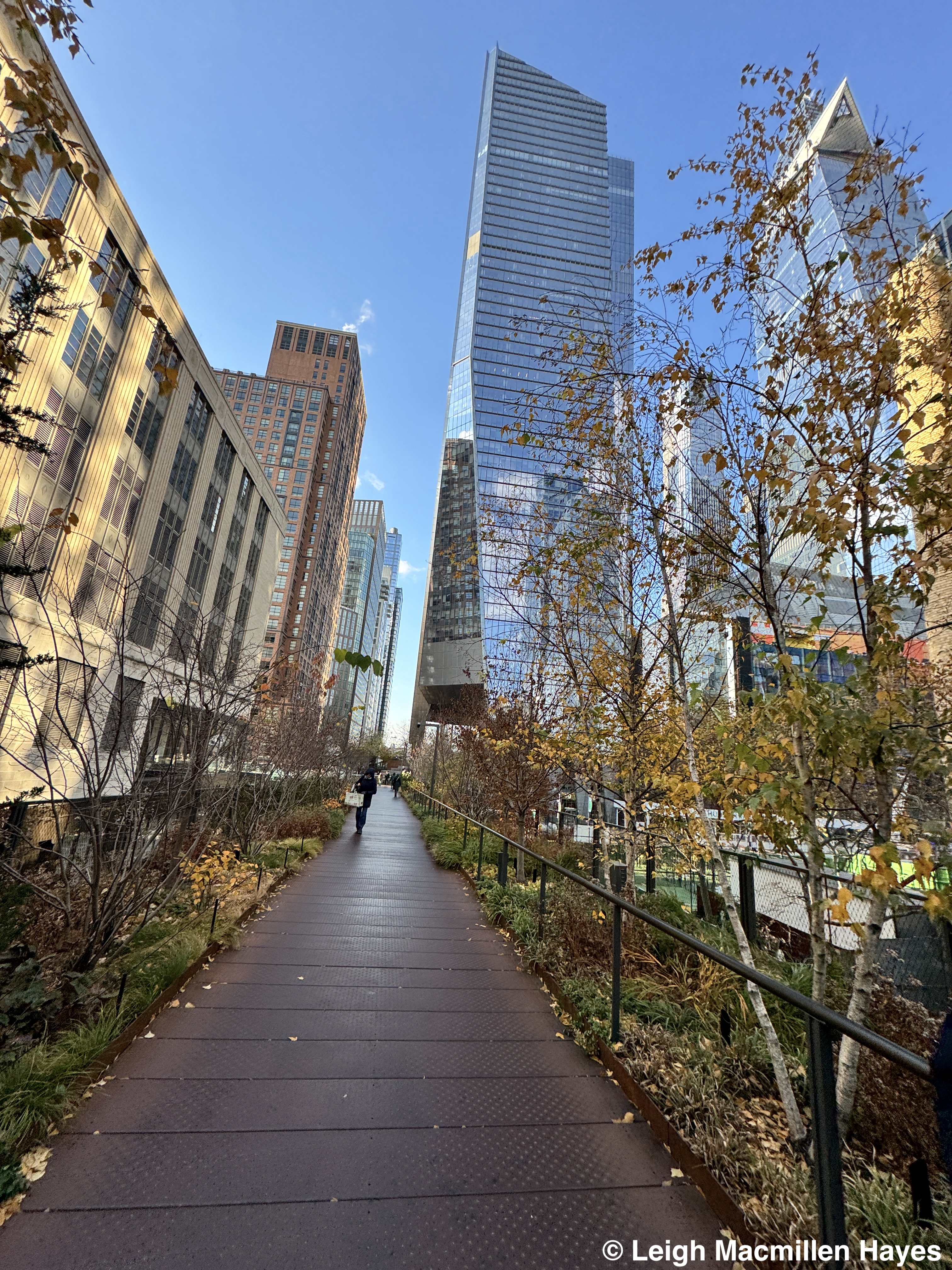
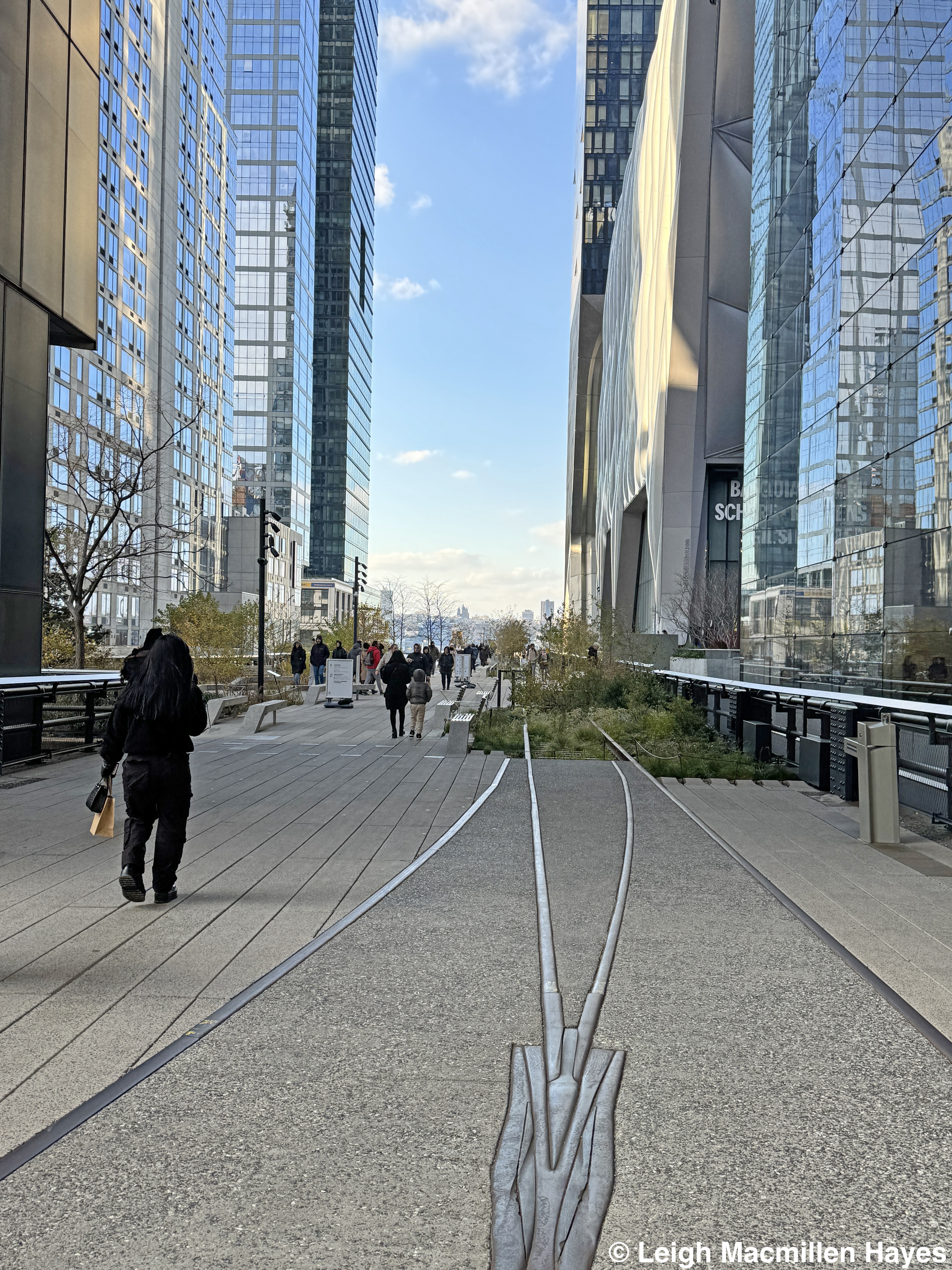
And we discovered new pathways where the sights and sounds of the city co-mingled with nature, albeit upon a raised bed that replaced a now defunct highline rail system.

No matter where we went, there were moments for reflection . . .

of the season passing.

In a way, it was like reliving fall foliage all over again and made me yearn to follow it down the East coast, though that was only a passing yearn for this “four-season worshiper.”

Gardens still proclaimed autumnal colors from the flowering heads of hearty plants growing beside Hudson River, where the north wind did blow.

And a few plants, more protected by buildings on either side of the path, showed off their sunshiny faces, though the petals appeared to make a ragged effort. Still . . . they blossomed.

We had the great fortune to join our hostess for a Victorian Christmas Tour. In reflection, it was not at all what we expected. Somehow, our minds’ eyes had conjured up a vision of entering stately Victorian homes and admiring their Christmas decorations.

This was not that tour at all. This was even better for the tour guide, Rick, was a storyteller who transformed us back in time to help us understand our Christmas traditions long rooted in the past, including Washington Irving’s influence as he told tales of New York’s founding and a Dutch ship wreck and Saint Nicholas riding over the city in a wagon and encouraging the Dutch to settle the land.

As we walked through three neighborhoods with Rick, we learned that O’Henry coined The Gift of the Magi in Pete’s Tavern.

And more about the poor and boisterous Irish who raised havoc on porches such as this at #4 Grammercy Park West belonging to NY Mayor James Harper (founder of Harper and Brothers which we now know as Harper Collins).

While the house next door is a replica of #4, the gaslit lampposts in front of Mayor Harper’s residence were meant to warn the partymakers to not disturb his rest. Or were they actually to help him find his way home? Perhaps both.

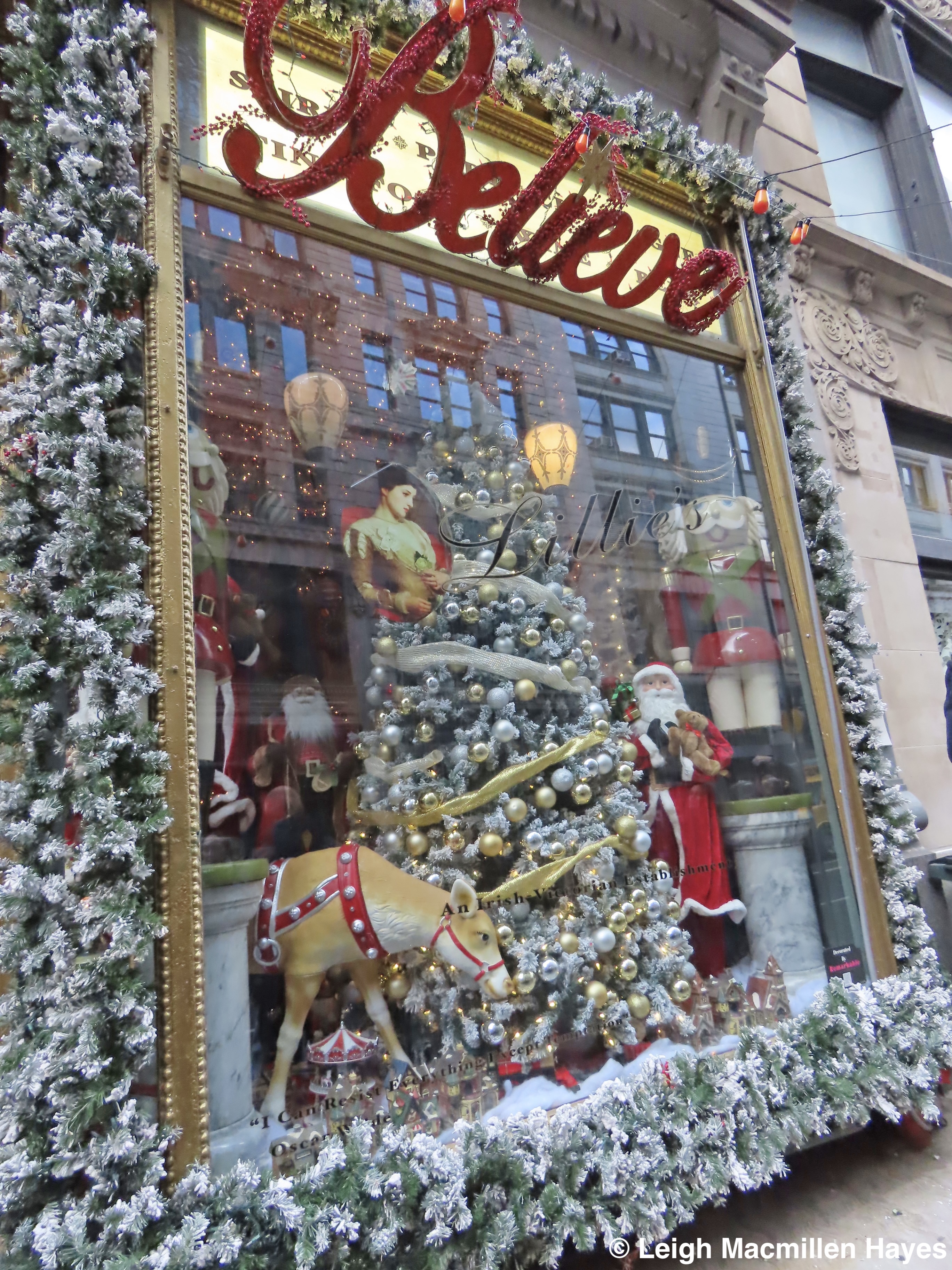
One of our stops was outside Lillie’s Victorian Restaurant where Rick shared the story of stockings being filled and the ball ornaments serving as representations of the gold that might have gone into them. And I was immediately transformed into my own story of the Christmas traditions as I’ve recorded in The Secret Giver of Gifts.

For a second, I stepped inside, and would have loved more time to experience this space named for Lillie Langtry, a British actress and late 19th Century Socialite, but we needed to move on.

And so we did, our family, some of our hostess’s family, and their friends, finishing up on a street that was once part of the Moore Estate in Chelsea and Rick recited “Twas the Night Before Christmas,” breaking it down to give us the history behind each stanza and we all gave great thanks for his insights and knowledge.

I hope I haven’t ruined this tour for you and that you will think about signing up for there was so much more. Just be prepared. It lasted about three hours.

Christmas decorations abound throughout the city, including this display at Pier 57. I loved how the fiber and ornaments were so subtly represented and suspect there’s a story behind this artistic installation that I’ve yet to learn.

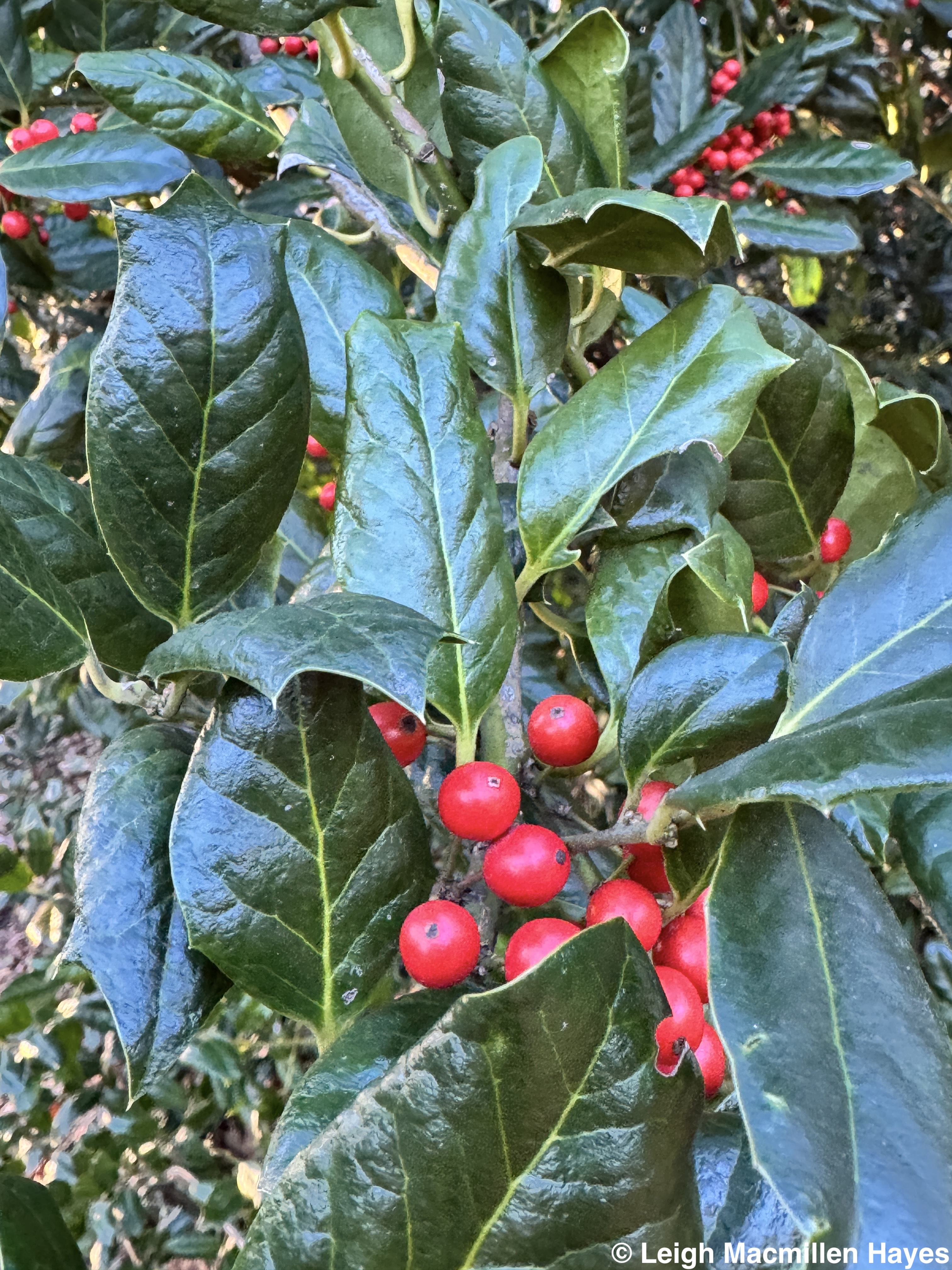
Nature also showed off its Christmas decor in the form of holly, Ilex cornuta or Chinese Holly, an introduced species. Um, I think we are all an introduced species.

And we spotted Christmas Ferns. Well, I spotted them and tried to explain to My Guy and our youngest that the leaflets are shaped like a Christmas stocking or even Santa in his sleigh, but they weren’t seeing that. I’m not sure they were really looking either.

But I was, and near the Christmas Ferns grew Maidenhair Ferns, like a star radiating off the wiry stem.

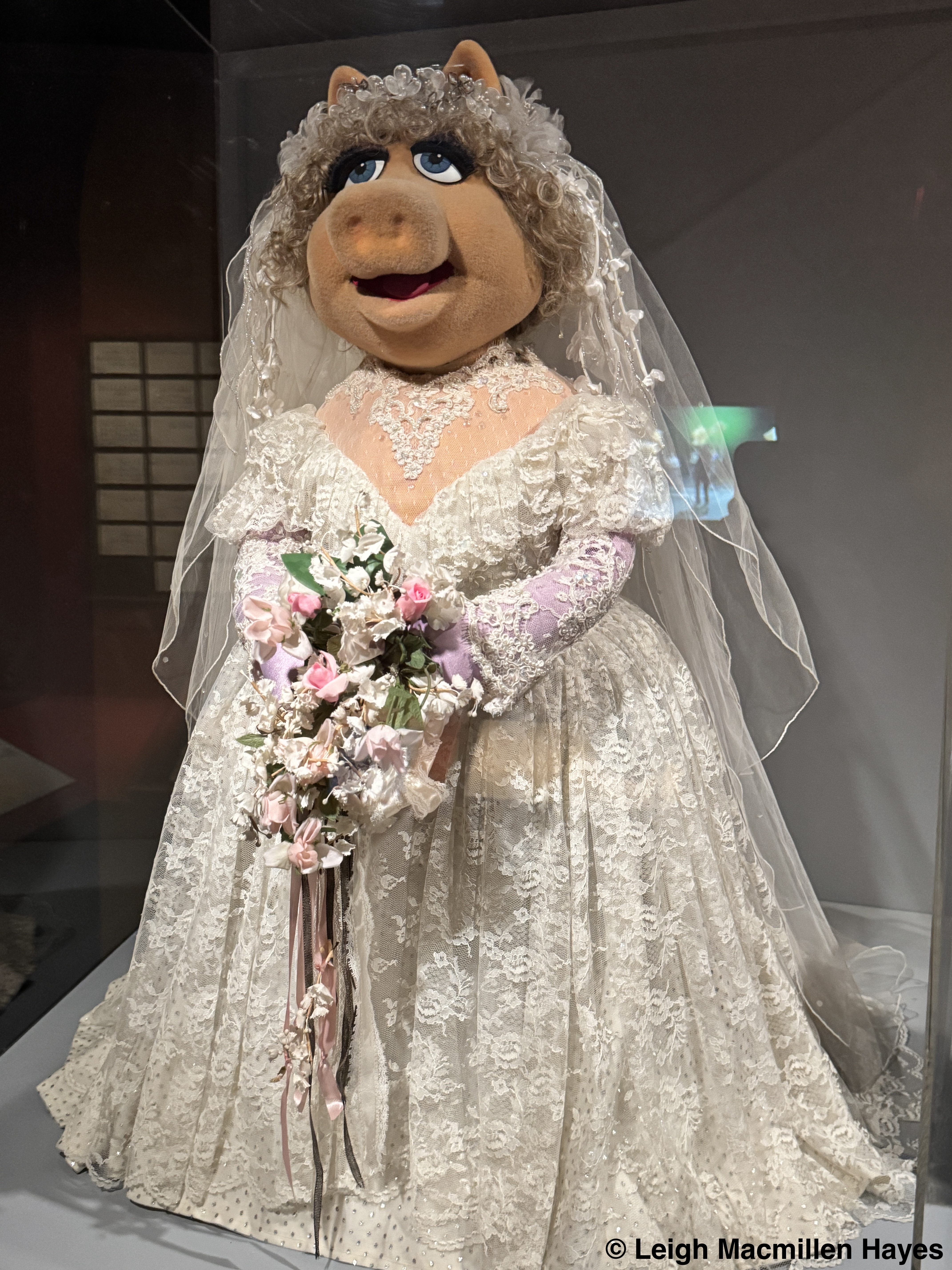
We also had the good fortune to meet another movie star, this one at the Museum of Moving Images. It would not have been my first choice of museums, but when your host works for an editing house, you embrace the choice and once we got going, it turned out to be a real treat as we could see behind the scenes of some old favorites including The Muppets.

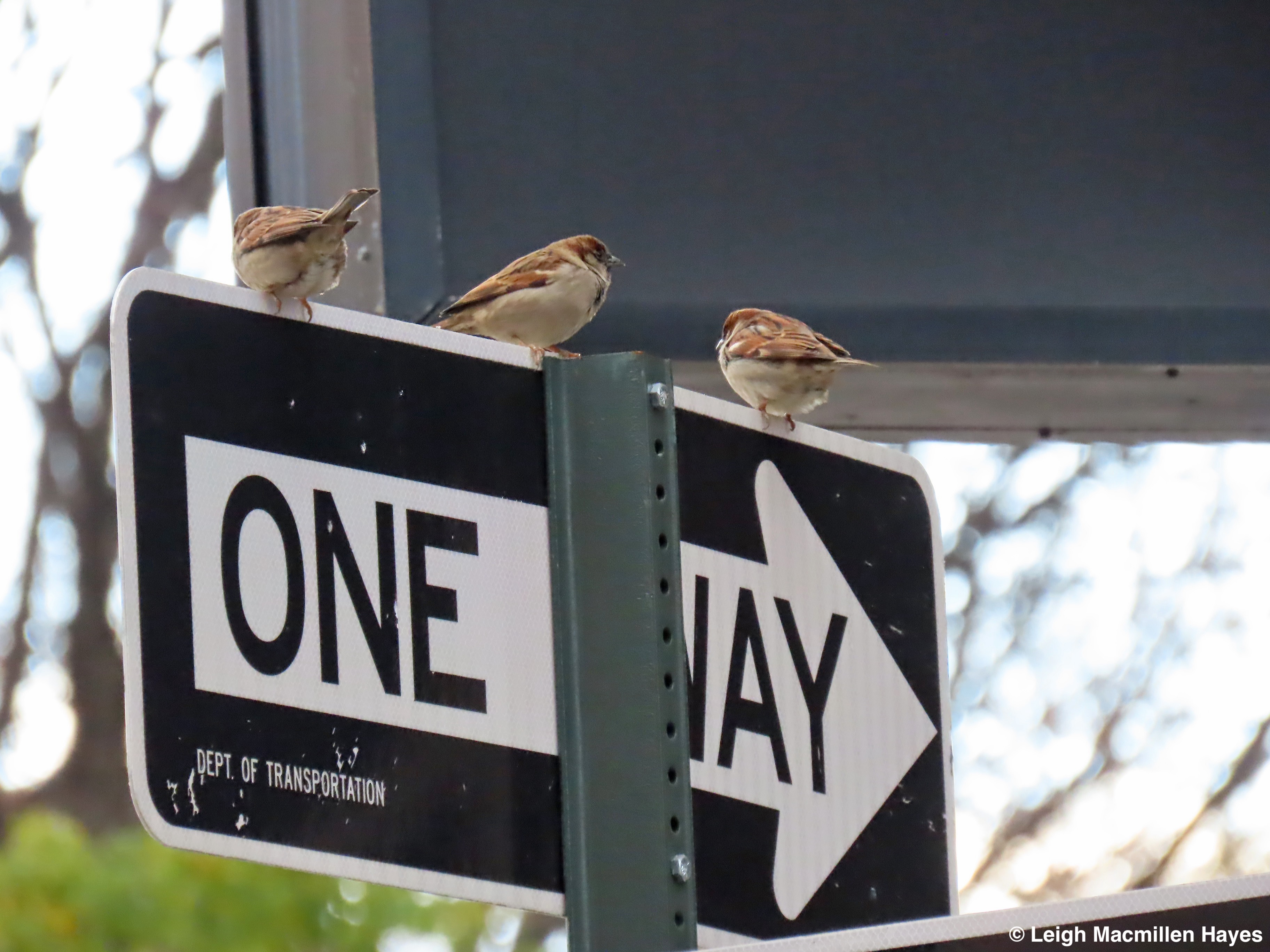
Being in the city, sometimes we were like the House Sparrows, which didn’t know which way to go, despite what the sign indicated.

Other times it was easy to choose the right path.

And in doing so, we got to meet a small one who is probably low on most New Yorkers’ list of preferences, but which I was thrilled to see honored with a statue.

My Guy dubbed this Pigeon Square. Do you see why?

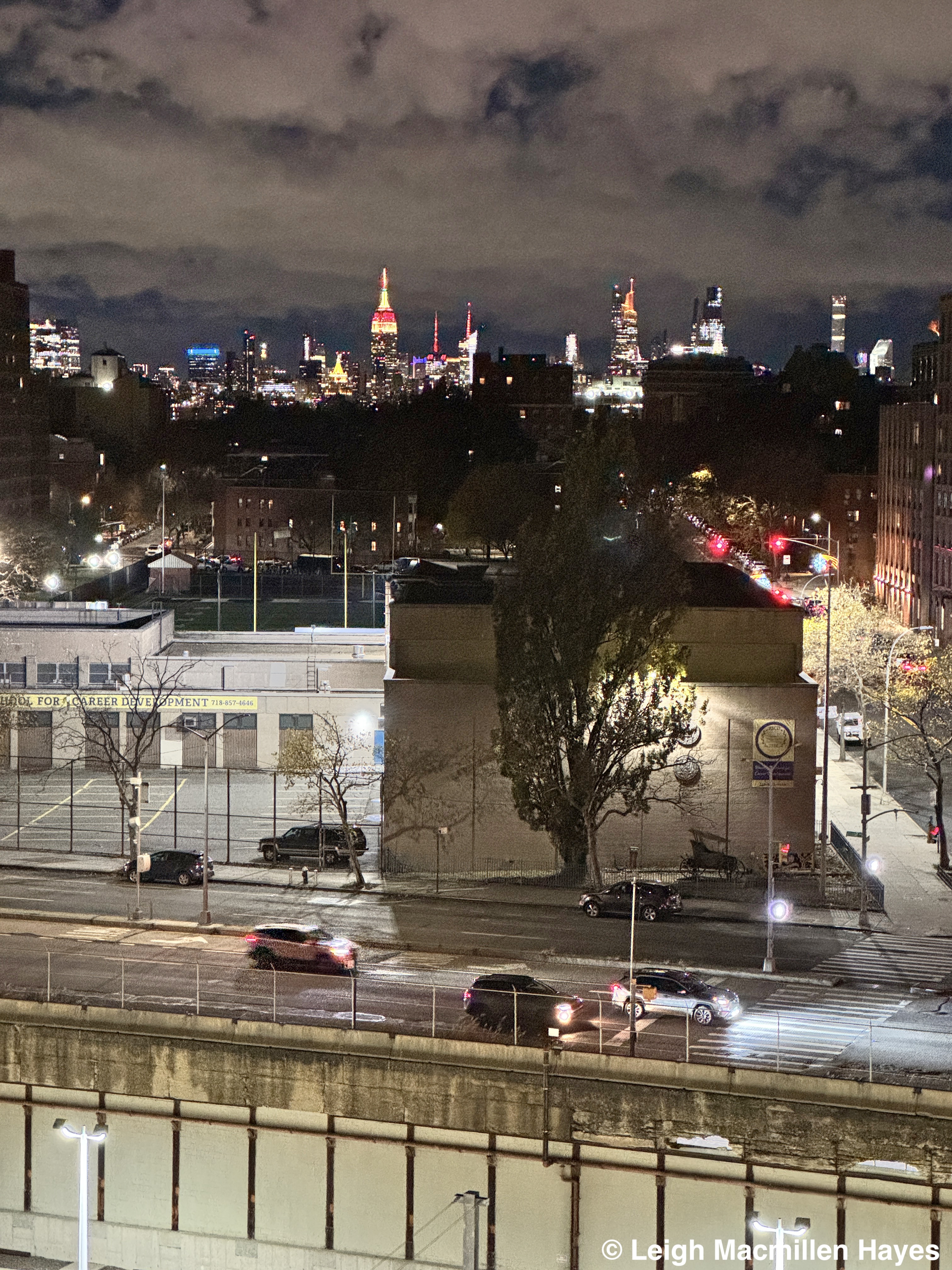
Thanks to our hostess, or I should say hostesses, we were guests in a small Prescott Park apartment with a view of the Empire State Building, which was lit first to honor Thanksgiving.

And then two nights later for Small Business Saturday, which we appreciated since we own a small business. Well, as I always say, My Guy owns it. I’m just married to it.

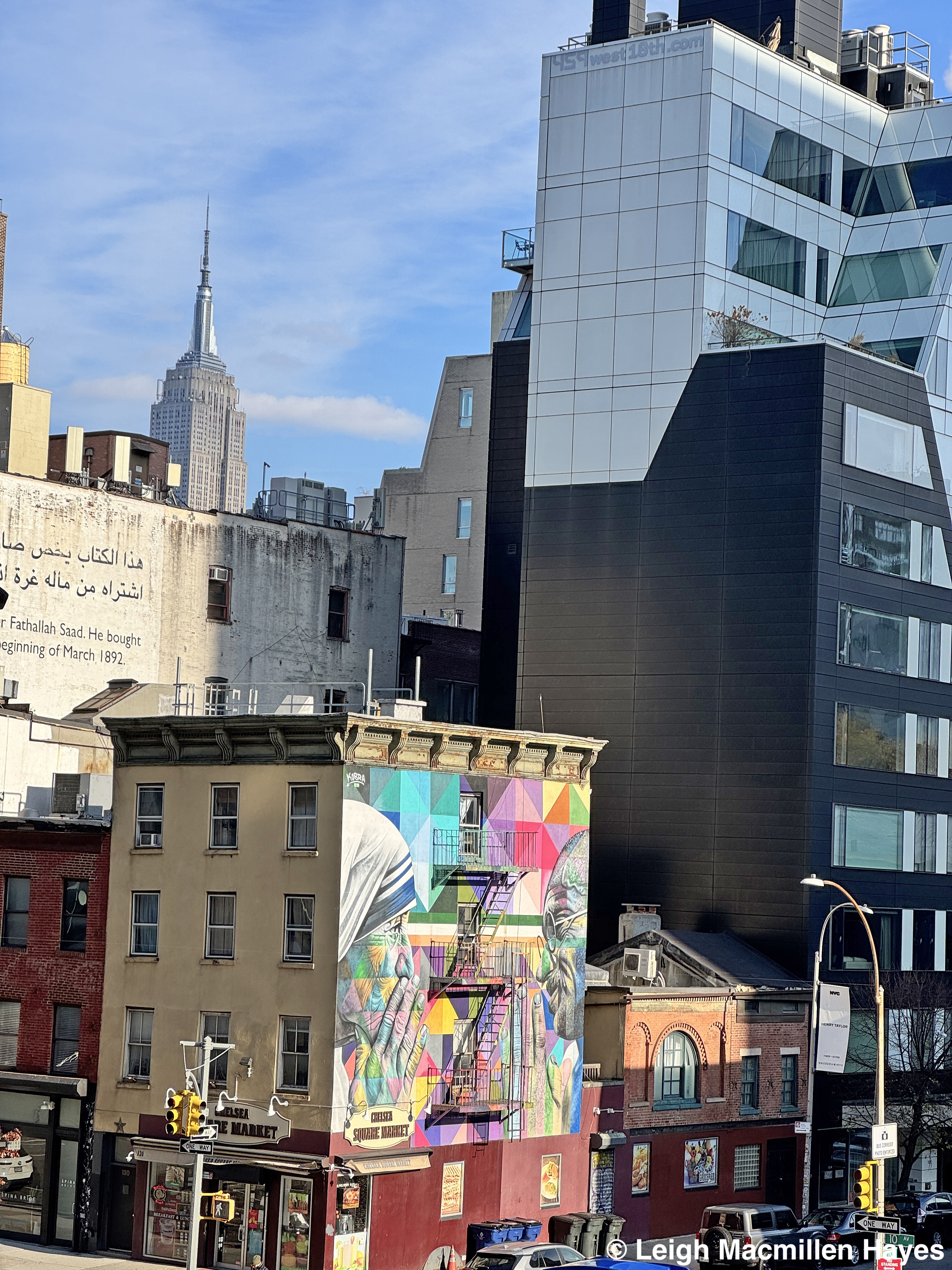
The iconic tower soon became our Mount Washington or Pleasant Mountain, for no matter where we were, if we spotted it, we had a sense of our place in this great city.

And I’m here to report that the lights on the Empire State Building eventually go off for the night. The same was true for many of the other skyline buildings.

Before I bring this post to an end, I want to share with you a few of our fellow travelers as we posed beside the Hudson.

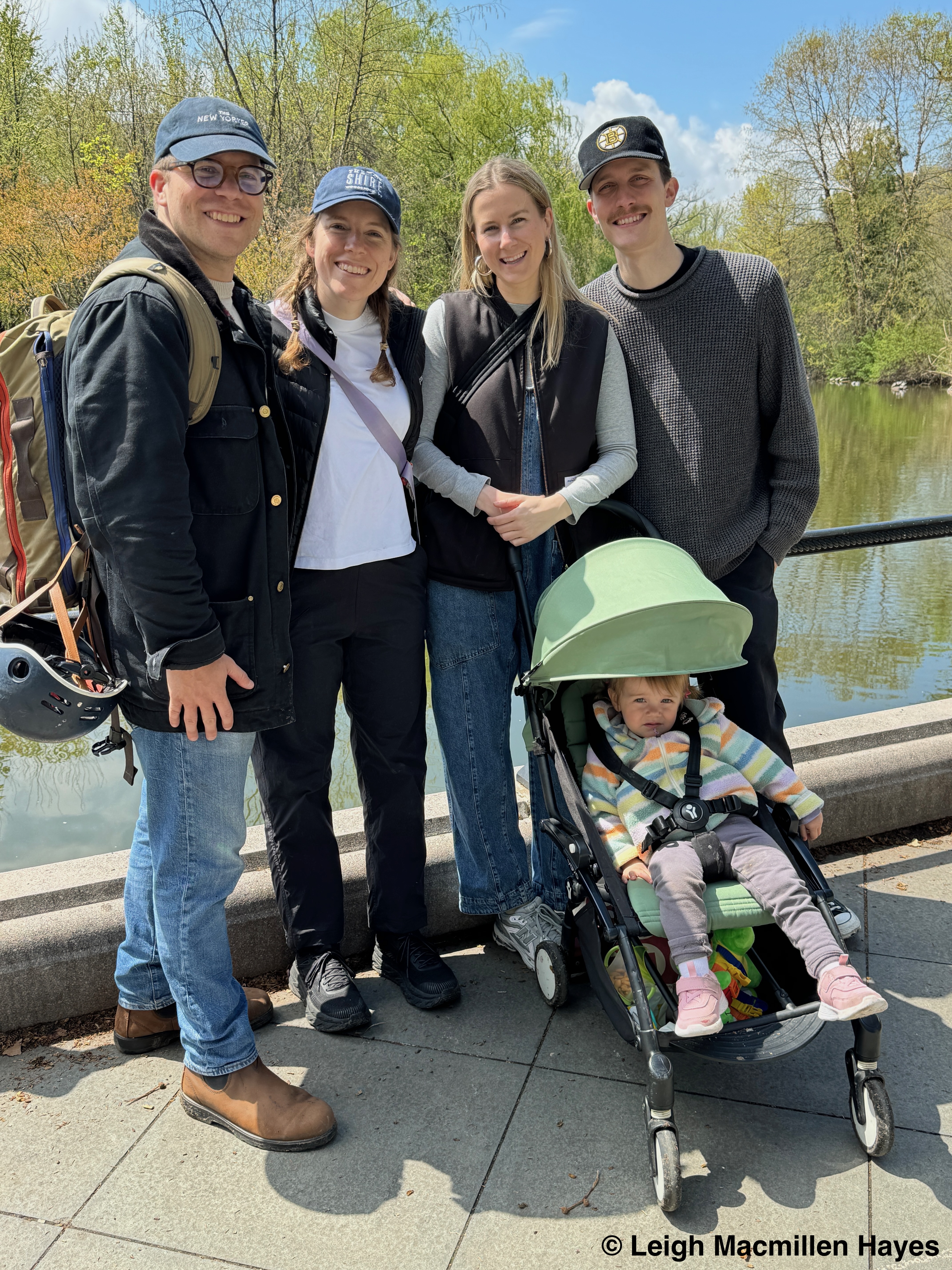
These two–our NYC host and one of the hostesses, for whom we are most grateful. He being our youngest.

Our oldest and his gal who made the trip south as well and were able to stay for a couple of days.

And our main hostess posing with us. We give her great thanks for sharing her home and her apartment with us so that we might spend so much time with our family. And treating us to an incredible meal, as well as the Victorian Christmas tour.

We went down to break bread with this crowd on Thanksgiving. And there was lots of bread to break! And good humor shared.

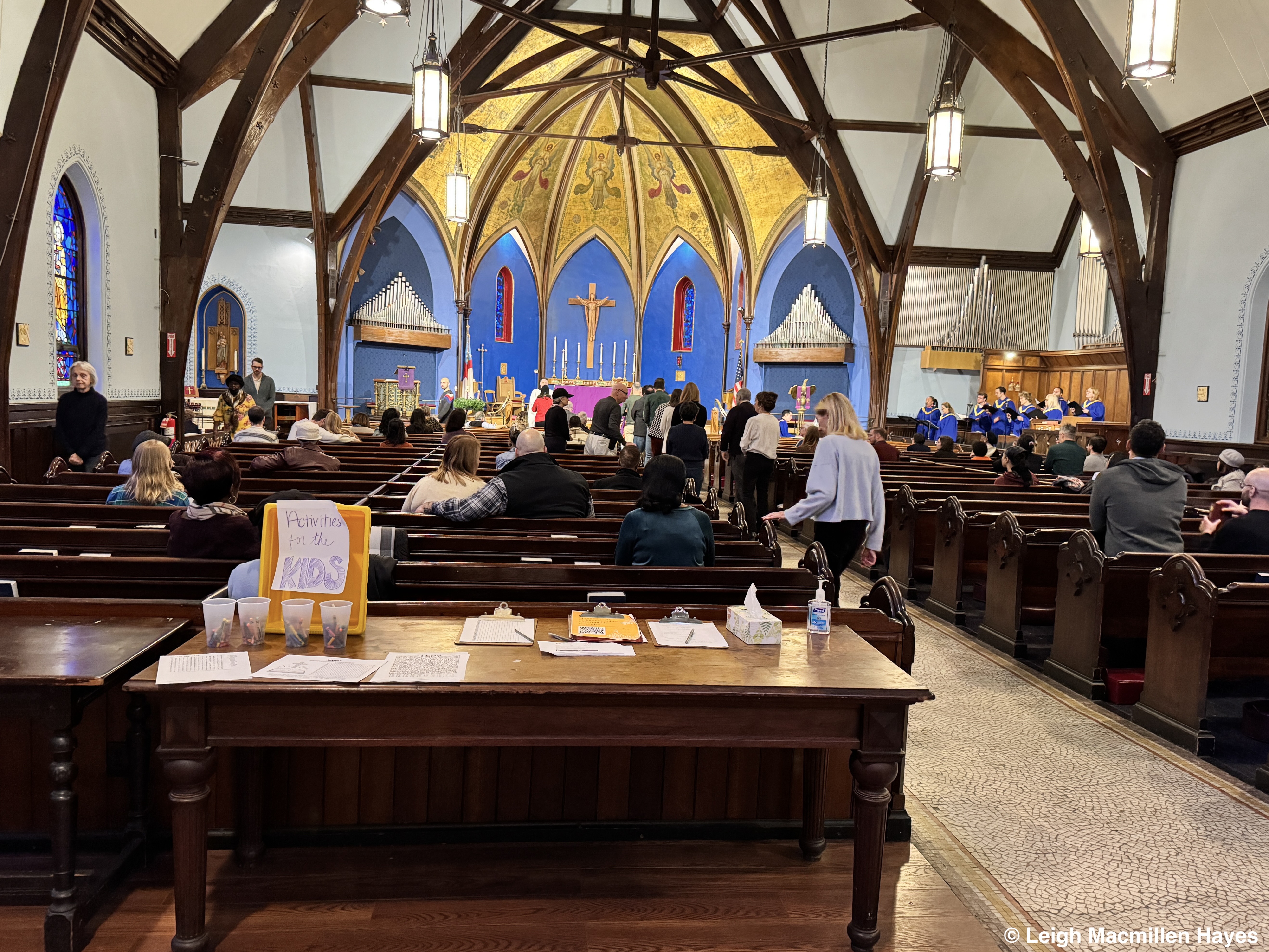
I also loved that I was able to break bread at St. John’s Episcopal Church in the Park Slope section of Brooklyn on the first Sunday of Advent.

And before saying goodbye we broke bread one more time with this young man. We don’t know how he does it, living and working in NYC, oh, and driving. YIKES! But he does it all and he does it well.

Along the way of this five day journey, we discovered we weren’t the only ones breaking bread, though in this case the squirrel’s form of sustenance was acorns, which were plentiful.

Breaking Bread and Acorns in New York City. Not our every day cup of tea, but one which we relish when the opportunity arises.

Time Travel: Trail Until Rail

Picture this: It’s 1888. You’re in a train car on what was once the Portland and Ogdensburg Railway (P&0), but is now leased by Maine Central (MEC) and renamed the Mountain Division Trail. You are making the journey from the White Mountains of New Hampshire to Portland, Maine, with a brief stop in Fryeburg, Maine.

Off the train you hop, and suddenly you find yourself wandering down the Mountain Division Trail in the year 2024. Only, it’s not the rail bed that you walk upon, but rather a paved path beside the tracks.

And you give thanks, because this is the season of doing such, though really we should do so every day, for the Mountain Division Alliance, formed in 1994, out of concern that the rail right of way would be lost. MEC had sold the line to Guilford Transportation in 1981, about twenty plus years after the demise of passenger service. About seven years later, freight service also ended.

In 1994, The Mountain Division Alliance, under the direction of Alix Hopkins, Director of Portland Trails, “brought people together from over 20 groups. Out of this group came the vision for a rail with trail connecting the nine communities [Portland, Westbrook, Windham, Gorham, Standish/Steep Falls, Baldwin, Hiram, Brownfield, and Fryeburg] along the rail corridor from Portland to Fryeburg.”

The Alliance was started to “convince the State of Maine to purchase the rail bed right-of-way. The vision that a bicycle and pedestrian trail could be built along the rail line connecting Fryeburg to Portland came about at this time [1994],” wrote Dave Kinsman, former president of the Mountain Division Alliance in an article published by The Brownfield Newsletter.

So back to going for a wander down the trail. I did such this afternoon, and it’s a path I love to follow at any time of year, because it offers such diversity so I hope you’ll not hop right back on the train just yet, but instead wander with me.

Some may see it as the land of dried up weeds and some trees, but oh my. There’s so much to see.

For starters, Black Locust trees, with their two-toned braided bark.

Dangling from the locust twigs are the “pea” pods that contain “bean-shaped” seeds ready to add another generation to the landscape.

And then there are the oaks, this being the blocky bark of White Oak, which is always a treat for because I have to travel to locate it.

I’ve said it before and I’m sure I’ll say it again, but I LOVE White Oak leaves in their autumn/winter presentation. While they look like mittens with a thousand thumbs, it’s the salmony color and way that they dry on the twig as if they were caught in an awkward dance move that really captures me. Maybe because I can relate to those awkward movements, having never had a sense of rhythm.

Behold also, the White Oak’s cousin, Northern Red Oak, with its raised ridges offering ski slopes for those who dare, accentuated by the red in the furrows.

It’s like a perfect classroom along the Mountain Division Trail because the bristly lobed leaves of the Red Oak are so shiny in their shade of mahogany.

And not to be left out in this lesson: Bear Oak (aka Scrub Oak), growing in a more shrubby manner than the other two. It’s the leaves of this species that remind me who I’m meeting–notice how the second set of lobes from the stem are larger than any of the others.

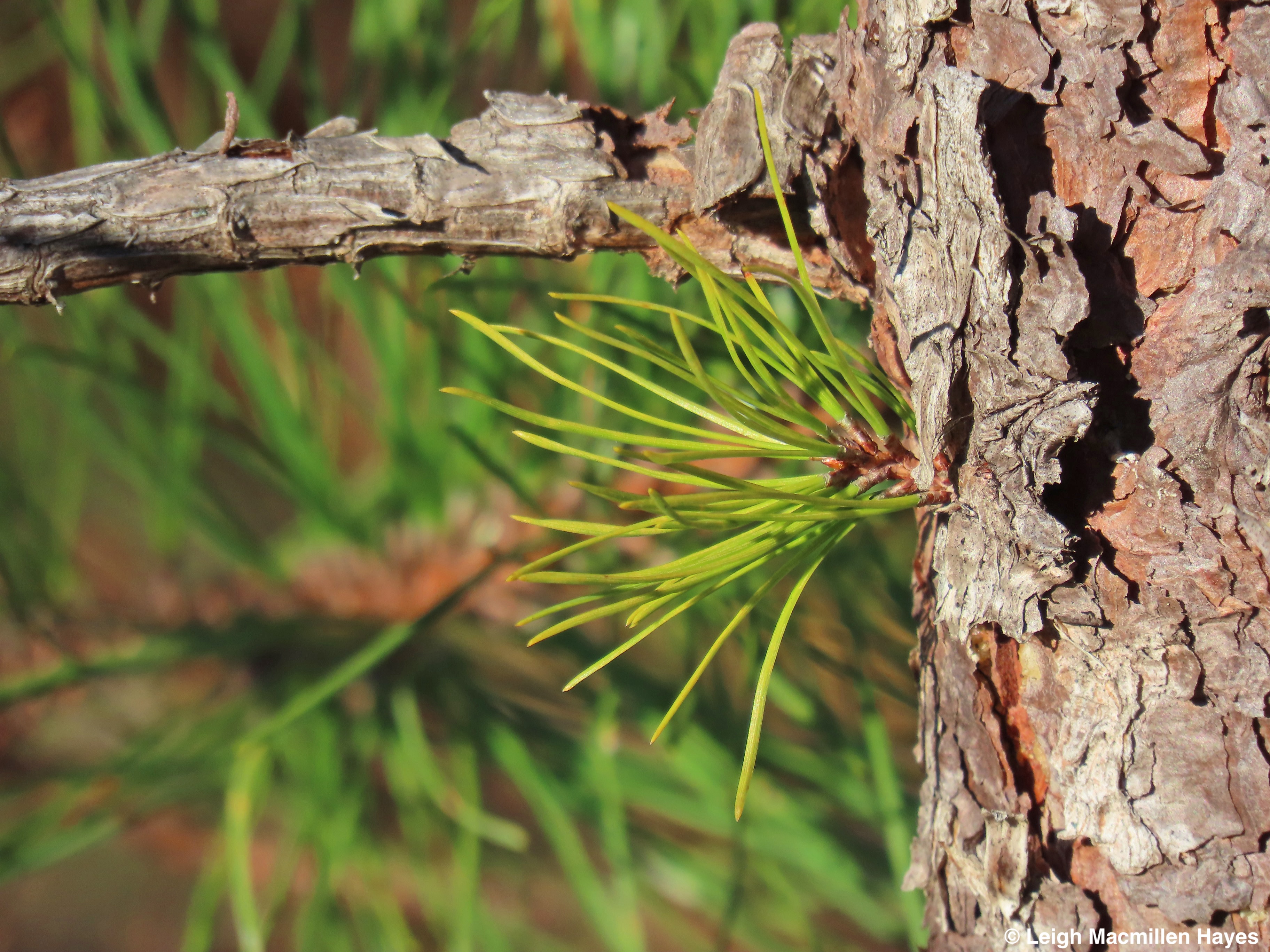
In the mix of deciduous or broad-leafed trees are plenty of conifers, including those we encounter often in this neck of the woods from White Pines to Eastern Hemlocks, and Spruce and Balsam Fir. But . . . there are a couple of standouts along the Mountain Division Trail such as this one with three needles in each bundle.

It’s those bundles of three, and the fact that occasionally a clump of needles grows directly out of the bark rather than on a twig that provide the clues for this species: Pitch Pine, three strikes and you are out. Get it? Baseball–pitch–three needles/bundle. I wish I could take credit for coming up with that mnemonic.

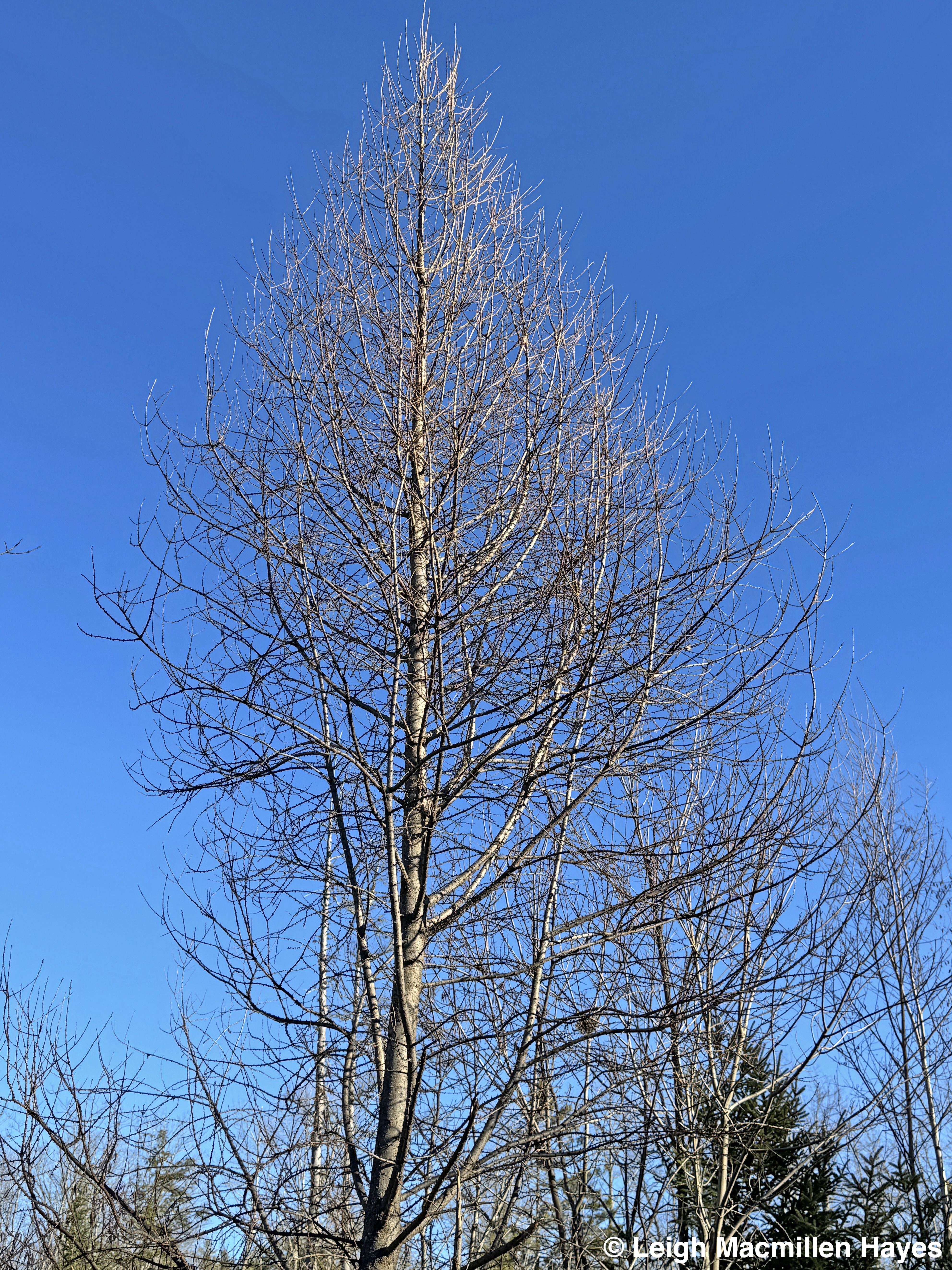
I promised more than one interesting conifer and tada. Only thing is, all the other conifers retain their leaves (needles) throughout the winter, thus giving them the name of Evergreens because they are forever green, even when they are shedding some needles.

This pyramid-shaped tree is the only deciduous conifer in Maine: the Tamarack (Larch and Hackmatack being its other common names).

Tamarack’s needles turn a golden yellow in autumn, and eventually all fall off. But, it’s a cone-bearing tree, thus it’s a conifer.

Picking up speed now, along the rail grows Great Fox-tail Grass, and its name seems a great descriptor.

Then there’s the Sweet Fern, which isn’t actually a fern for it has a woody stem, but what I love most about it in fall and winter is the way its leaves curl, each doing its own thing.

In a wetland, for the habitats vary along the way, Winterberry is now showing off its brilliant red berries. And the Robins are thrilled as are many other birds seeking fruit at this time of year.

Mullein, tall as it stands, has already spread many of its seeds as evidenced by the open pods.

And the same is true for the even taller Evening Primrose.

It’s the fruiting structures of both of these plants that make them beautiful standouts as winter weeds.

Aster seeds are slowly taking their own leave, one hairy parachute at a time.

But here’s the thing. Not all Asters have gone to seed and I was surprised to find several Calico Asters still flowering. Given that the past few days have been quite brisk, this didn’t make sense.

But the same was true for Yarrow.

And I saw a bunch of Blue-stemmed Goldenrods still blooming. While the Asters and Goldenrods flower late in the season, perhaps I shouldn’t have been surprised, except that this past weekend’s wild rain and wind, and temps that felt more like November than we’ve experienced lately, made me question what I was seeing.

I was thrilled as I approached the airport end of the trail to find a few Dog-day Cicada exoskeletons still clinging to the underside of the fence railings. My, what large lobster-like claws you have, the better to dig yourself out of the ground when you are ready to emerge from your root-sap-sucking days to form wings, and fly away, and find a mate.

Because my imaginary train had let me off at Porter Road in Fryeburg, about halfway between the two ends of this four-mile route, I wandered and wondered for about two miles toward the airport end, located just beyond the mileage sign.

Portland: 47 miles away.

But it’s not all rail trail . . . yet.

As I looked across Rte 5, I imagined what will happen next. “A twelve-member Mountain Division Rail Use Advisory Council was created in June 2021 to study and review the 31 miles of state-owned, inactive rail line in order to make recommendations for its future use. Frequent meetings occurred . . . at which the civil engineering consulting firm, HNTB, ‘presented feasibility studies for future rail, rail with trail, and interim trail/bikeway use options and economic benefits. It was determined that restoring rail use would cost $60,000,000. For rail with trail, the cost would be $148,300,000. Removing the rails and building a trail until rail, which would keep the rail bed intact so the trail could return to rail if needed, wold cost $19,800,000. The final vote was 11 – 1 in favor of Trail Until Rail . . . After thirty years of work and thanks to the efforts of so many people, on July 6, 2023, Maine Governor Janet Mills signed LD404 into law, authorizing MaineDOT [Department of Transportation] to remove the railroad tracks and construct a 31-mile, multi-use trail until rail on the Mountain Division Rail Line between Fryeburg and Standish . . . Trail Until Rail means that this will be an interim trail because it can be pulled up and the tracks restored to rail should the return of train operations be economically viable. As stated on the alliance’s website: ‘Most major rail corridors are federally protected in perpetuity (that’s forever!). If the tracks ever need to go back in for train service, they will.'” ~ from my article Trail Until Rail: Mountain Division Trail Expansion in published Lake Living, Fall 2024, vol. 17, no. 2.

I turned around by Route 5 and followed the rail with trail back to my truck. Though I’m a hiker, wanderer in the woods by nature, the Mountain Division trail always amazes me with all that it has to offer and today was no different.

If all goes as intended, this 31-mile rail until trail project will be broken into six segments and within two years work will get underway to connect the airport end to this spot by the intersection on Route 160 in Brownfield.

Thanks for taking the time to travel with me today.

Thanks also to Terry Egan, vice president of the Mountain Division Alliance, and Andrew Walton, secretary of the organization, for walking a section of the trail with me several months ago and sharing their stories and visions of this asset to our area.

Lake Living & Maine Natural History Observatory

Two. Two publications this week. I’m always excited when the first appears on a local store shelf, but to have a featured article in the second as well (for the third time) is equally thrilling. Also scary. Why? Cuze once you put yourself out there you are out there and there are others out there just waiting to let you know how you erred. And if you know me, I err a lot. But it’s actually a good thing because it’s a humbling reminder that I’m not perfect. Thank goodness. That said, you don’t need to remind me–just sayin’.

So, take a gander and I hope you enjoy the reads. My two articles for Lake Living magazine are the first two in this issue.

The first is about the Bridgton and Saco River Railroad Museum that six young men are working to develop in Bridgton to commemorate the Narrow Gauge Railroad. I won’t give away any more of the story, but my hats go off to these guys and their passion and all of their efforts to make a dream come true.

My second article is about TimberNook Western Maine, a program set up to encourage kids to get outside and play. For hours. With varied age groups. Sometimes during school hours. Because play, and especially deep play, which it takes a bit of time to enter, are a critical part of growing up and interacting with others and the natural world. I have to say that before I sat in on a couple of sessions, I wasn’t so sure about this program–I mean, I’ve spent the last however many years playing with kids in nature, but teaching them about nature along the way, and this program is set up to let kids learn without too much adult intervention. And after watching the action and talking with kids and adults, I am now a huge fan of TimberNook and hope to sit in on more sessions, maybe as a volunteer.

There’s so much more in the magazine ranging from an article by Perri Black about birth and death; another by Laurie LaMountain about dock lights invented by the guys at Great Northern Docks; plus an appreciation of laundry by Suzanne Richards; book reviews from our friends at Bridgton Books; and some summer recipes by Perri. And the list of things to do and places to go–locally, of course.

It’s all right here, just a click away: https://www.lakelivingmaine.com/

Switching gears, I submitted an article about Dog-day Cicadas to the Maine Natural History Observer and was tickled to have it accepted.

According to their website: Maine Natural History Observatory’s mission is to improve the understanding of natural resources in Maine by compiling historic information and implementing inventory and monitoring efforts of Maine’s natural history.

The Observatory specializes in collecting, interpreting, and maintaining datasets crucial for understanding changes in Maine’s plant and wildlife populations. We are committed to filling data gaps for Maine’s least understood species and creating a legacy of data for use in nature conservation, land use policy decisions, and expanding scientific knowledge.

Specifically, our mission is to:

  • Compile and publish summaries of Maine’s natural history
  • Coordinate local and regional inventory and monitoring efforts of Maine’s flora, fauna, and habitats
  • Facilitate cooperation and exchange of information among organizations, agencies, and individuals conducting natural history research in Maine or caring for natural history collections
  • Engage in other activities related to the advancement of scientific knowledge and education of the public regarding the flora, fauna, and habitats of Maine.

As some of you know, one of my favorite summer activities is to watch Dog-day Cicadas emerge from their underground life and watch as they shed old skin for new before flying up into tree tops to sing love songs. I know of a couple of local cemeteries where I can usually watch the action and it’s even better when I can introduce someone else to the experience. But, not everyone can join me so in this article, I hope it feels like you are along for the journey.

It looks something like this:

You can read the entire article and a variety of others by clicking on the link: Maine Natural History Observer

Lots of cool stuff to read about. And if you do live locally, Lake Living is on a store shelf near you–up and down the Rte 302 corridor, plus north to Norway and Bethel, and south to at least Cornish.

Grab a copy and don’t forget to support our advertisers. They are the ones who pay so that you can pick up a free copy of the magazine. There’s one advertiser in particular that is close to my heart and I’d love to have you support. ;-)

Cloudy Mondate

Between the two of us, My Guy and I have lived within an hour or so of today’s destination for a grand total of 103 years. Yikes. That makes us old. Of course, we aren’t. But for some reason we never visited this spot before. Maybe because it’s a tourist hotspot, and we’re hardly tourists. In fact today, we were dressed in our usual garb because our plan was to hike. And we did. But . . . we also did that touristy thing for a wee bit. Cuze when in Rome . . . yada, yada, yada.

And so first we paused by the Pebble, a glacial erratic.

I suppose when you compare it to the Boulder located about a half hour north of the Pebble, which we visited on February 14, 2022, it is rather pebble-like.

But what we really wanted to see was the Falls of Song, a waterfall that drops forty feet and is so named for the changing sound of the water that constantly flows.

According to an interpretive sign by the falls, “An 1885 Boston newspaper description of the scenic beauty and amenities stated of the Falls of Song that ‘their location in the depths of the primeval forest, their exquisite setting under the overhanging cliffs, the silvery clearness of the water and their magical musical effects, seemingly changing their song at every hour of the day, unite to place these falls among the most interesting and wonderful in the United States.'”

Another set of falls to draw our fancy was the Bridal Falls, so named because in the right conditions they appear to be lacy like a bridal veil. I felt like the conditions were indeed right today.

We followed the brook for over a half mile and the views kept changing and sounds kept enhancing our experience. If it had been warmer, we might have wanted to take a dip, but for today, just watching and listening as the water tumbled and plummeted and twisted and turned and glided and flowed was enough.

Back on the road as we drove up the mountain, we stopped again for a view from lunch bench and I found my place, which was my place in the early 1980s. Lake Winnipesaukee and Gunstock Mountain formed the backdrop and brought back memories of teaching and hiking and skiing and swimming and being. The best part is that this is the area where I learned to be. Be me.

To be native, like the Northern Bush Honeysuckle, for I began to realize all those years ago that this is the area where I belonged.

But today brought us to the home of others who also belonged in this place, beginning with Thomas and Olive Plant, the original owners of this mountaintop mansion. I could only hope to live here. But they did. For a while at least.

It’s a sixteen room home with halls and halls and an organ, and dumb waiter, and guest rooms like this one, and more halls, and sitting rooms, and great hall, and dining rooms, and servants quarters, and sunroom, and oh so much more. But this, the Brown Room, was my favorite, for recently carpet had been removed and the most incredible floor discovered, and it reminded me of our home, which had been similarly carpeted, and we discovered beautiful southern pine that has since brightened our days.

The sunburst pattern of the Brown Room floor–incredible.

But even more than the inside, we really enjoyed the outdoor living areas, this off the main hall, with a view of the lake and mountains beyond, Gunstock being straight across.

And an angel letting water form her wings.

We’re thinking we’ll take the month of August and welcome guests here. Haha. As if we ever welcome guests, the introverts we truly are. But really, the focus should be on the Arts and Crafts architecture and way the building fits into the setting.

And the gardens. Exquisite.

Olive Plant, original owner of the property in 1914, would have approved of today’s gardens which are tended by a group of volunteers. In this space that surrounded the mansion she had a 100-foot glass greenhouse.

I don’t know if this was part of her greenhouse selection, but among the wall that formed part of nursery grows Ivy-leaved Toadflax, a plant I don’t recall ever meeting in the past.

Clouds there were upon occasion today, but the yard boundary offered glimpses of brightness.

And along the trail where other specimens including this Bristly Locust, a legume.

We’d hiked along the brook, spent time exploring the mansion and grounds, and the headed off to hike another trail with only so much time on our hands. At the intersection of trailheads, we had the good fortune of meeting two women with local knowledge who showed us where we were and where we wanted to go . . . that being heading up Mount Roberts. We knew we didn’t have time to summit for My Guy had to get home for a meeting (at which he later received a well-deserved Lifetime Achievement Award), but we made a plan for a turn-around time.

The trail was blazed with orange markers and we might have believed that a Black Bear had marked the way, for so chewed and scratched were the signs, but I suspect it was a Red Squirrel who had a good chomp or two or ten.

That said, a female American Toad, her tympana (ear membrane) about the size of her eye, and overall size of her body providing a clue to her sex, but also doing her best to blend in to her surroundings as she paused upon a stone on the trail.

We’d hiked over a mile when I suddenly spied this from the trail. Ruh roh. That meant we had to start looking and counting, a task that slowed us down a bit.

We had set a turnaround time, knowing that we wouldn’t be able to hike the entire 2.5 miles to the summit because My Guy needed to get home for a meeting, and so at 3:15pm, with 1.7 miles behind us, we stopped our upward ascent, but before descending, I spotted a green golf ball on a Northern Red Oak leaf.

Each time I spot one, I’m in awe for it’s such a cool structure. Though it looks like a fruit, it’s caused by a chemical reaction the leaf has when a wingless adult female wasp, Amphibolips confluent, lays an egg into a newly-forming leaf. As the egg hatches and larvae grows, that chemistry causes the leaf to mutate and grow with it.

The wasp is commonly known as an Oak Apple Gall Wasp, and thus this is an Oak Apple Gall.

We chuckled on the way down, for we did pay more attention to the flora, and couldn’t believe that we’d passed by this Lady’s Slipper display located inches from the trail. But that’s what happens when you are moving on My Guy-speed, and watching every spot where you place your feet. Our total count on the way down: 52, but I’ve a feeling we missed many more.

And hiding under some trees near the trailhead: Ragged Robin, a treat because I’ve only encountered it a few times. I love its frayed, yet delicate display.

Because our descent was much faster than the ascent (and still we counted Lady’s Slippers, but that’s why I think we missed some), I stole a few minutes beside Shannon Pond where a small field of Lupine bloomed.

And a female Mallard swam toward the shore. She and a few jumping fish were the only wildlife spotted today.

That was okay, for we had a splendid Mondate wandering under the clouds, which seemed truly appropriate since we were at the Lucknow Mansion property now known as Castle in the Clouds in Moultonborough, New Hampshire. Why did we wait so long to visit? Maybe because it’s practically in our backyard.

A Day of Firsts

This has never happened before. Then again, there’s a first for everything.

My Guy and I have been hiking together for the last 38 years, and in all that time, never, ever have we been greeted by neighborhood chickens, with one rooster even sending us off to the tune of his cock-a-doodle-do.

The past is always present and just after the send off, we paused by the homestead foundation, possibly that of A.H. Evans, which is located within feet of the trail’s head. And it appears that if this did belong to A.H., he was the head of a large family for it’s a huge foundation.

The barn foundation was also impressive and we could sense the work that went into such a creation.

And based on the configuration of rocks and boulders between the house, outbuildings and barn, all were once attached.

Again, assuming all of this belonged to A.H., I did discover a 1916 document that suggested he grew rutabagas: “A. H. Evans, Fryeburg, raised 90 bushels rutabagas in 1-8 of an acre.”

At some point in time, the land also must have served as a saw mill close to what is now a small stream, but may have been more of a brook in the past, there’s a pile of saw dust that hikers must climb. This is not uncommon in Maine woods. And it’s forever soft underfoot, however many years later.

We spotted a few Painted Trilliums, and lots of Sessile-leafed Bellwort, and other flowers waiting to come, and a Chipmunk peeking out from a rocky ledge, and mosses, and lichens, and so much more, (oh, and a few Black Flies, but again, not bad in the scheme of things), but this was the first American Toad of the year for us. Toads can remain absolutely still, a smart adaptation as they blend into the scenery.

It’s about two miles to the summit, which isn’t all that high, but it’s the perfect quick hike (okay, remember who I was hiking with) for an afternoon. And at said summit, we stood for a few moments as we gazed upon the ridgeline of our hometown mountain–Pleasant by name.

And at the summit, a Red Maple showed off its gifts to the future in the form of an abundance of samaras. Well, I see them as gifts. Given that we have an abundance of Sugar Maple seedlings growing in our yard doesn’t exactly thrill MG.

As we started to walk back along the trail, I spotted something we’d both missed on the way up. Wild Columbine. In flower. The. Most. Spectacular. Flower. That structure. Those colors.

And because we took a different path down, Striped Maple showed off its own set of flowers, limeade green in hue. I chuckled later when I commented on how the Beech leaves gave the trail such a summery look, and MG mentioned that he had even spotted toilet paper. It took me a second, during which I searched for a roll of white, before I realized he was referring to Nature’s Toilet Paper, for so large are the leaves of Striped Maples, and soft, and not poisonous, so you know they are safe to use. Not that we often encounter Poison Ivy in the woods, but it could happen.

Back at the trailhead, the chickens weren’t there to congratulate us for a safe return, but we encountered probably the best finds of the day–several immature Chalk-fronted Skimmer Dragonflies. Let this next season begin.

Indeed, this was a day of firsts.

A Smile of a Mondate

In case you are missing snow, I thought I’d bring you some today. But only because about a month ago, the day after Palm Sunday and a major snowstorm here in the north country, My Guy and I went to Diana’s Baths in Bartlett, New Hampshire, to hike.

It was the first of two storms in a matter of less than two weeks that dropped almost two feet of snow each and transformed Lucy Brook into a winter wonderland. Here’s a bit of history from northconwaynh.com: In the 1860s, after building a house and barn on the banks of the brook, George Lucy built a water wheel powered sawmill. In the 1890s, George built a 12-room boarding house for tourists to visit the site. In the 1930s Chester Lucy built a concrete dam with a water feed and turbine system to replace the water wheel used to power the sawmill. Both the rooming house and sawmill were eventually sold to the US Government and have become part of the National Forest land. Due to the deterioration, the buildings were eventually removed from the site in the 1960s. Remnants of the site can still be seen today including the old cellar holes and parts of the dam system, feed tube and turbine gears used to power the sawmill.

Today, it looked much more summer-like in appearance, but still so much water flows due to snow melt in the surrounding mountains, and it’s BRRRRR.

As we ventured forth, I spotted many a boulder experiencing the bad hair day of Common Polypody Fern and every once in a while try to teach My Guy a wee bit about a species. I tell him that someday he can co-lead a nature walk with me. He, of course, guffaws. But ask him what poly and pody mean and he may remember many and feet, for the fern fronds grow from creeping rhizomes.

Last year’s sori (group of spores) were still visible on the underside of some leaves. The sori located in rows on each side of the mid-vein, are circular, orangish brown and not covered by tissue (indusium).

Because we were in a damp environment beside the brook, False Hellebore leaves, with their pleated presentation, brightened the morning. And held raindrops signifying yesterday’s weather.

We also encountered numerous Hobblebush shrubs, some even featuring flowers preparing to open into what will be a fantastic display on another day. On this day, it was enough to see their accordion leaves beginning to unfurl, and those flowers presenting like a bunch of worms crawling over each other as if to say, “Me first. Me first.”

We crossed tributaries several times though we didn’t actually cross Lucy Brook as originally intended for the water was still too high for us to manage safely. But . . . we bushwhacked for a bit before sitting upon some tree roots to take a lunch break.

It was while My Guy sat there, that I poked around and discovered this–Wall Scalewort, a leafy liverwort. Liverworts differ from mosses in that the leaves are typically arranged in rows of two with a possible third row below, while moss leaves whorl around the stem. And most mosses have mid-ribs, which liverworts lack.

That said, the Wall Scalewort closely resembles Shingle Moss, which I spotted along this same tributary in March.

But a closer look today made me realize that I could see the leaf arrangement was succubous where the bottom edge was visible, as opposed to incubous. Succubous arrangement is like roof shingles that don’t let the rain in, while incubous leaves are arranged so the top edge is visible and do let the rain in. Thank you Sue Alix Williams in Mosses & Common Liverworts of the Northeast for that explanation.

Eventually we reached a turn-around point and came up with Plan B for the rest of today’s hike as we made our way out. While I was able to cross with my high leather hiking boots, My Guy chose to take his boots and socks off and watch his feet turn red from the chill. Thankfully, his better half, ahem, that would be me, had packed a towel because we suspected this could be the case.

Now you might find this as odd, but since our discovery of the new privies last month, we’ve been quite taken with the artwork completed by Kennett High School art students in 2023.

Unbeknownst to us at the time, the paintings were a perfect segue from one trail to another.

And so we drove down the road to Echo Lake State Park and tried to convince the warden that even though we live in Maine, our hometown is just over the border and we should be able to hike the trails for free as New Hampshire Seniors don’t have to pay. He kindly informed us that the park isn’t officially open yet, as so it was free, but if we return in a couple of weeks, it will cost us $4 each. Not bad in the scheme of things.

Before us stood White Horse Ledge, one of the trails we had considered if we’d been able to cross Lucy Brook from our earlier destination. We were green with envy as we looked across at it.

But about half way around the lake, we found a different trail to the summit and decided to follow it. That said, we found several trails to the summit and the first we chose led us astray as it eventually petered out.

Despite that, we were thrilled. Okay, maybe it was me rather than we. Semantics.

And so today I celebrated my first meeting of 2024 with Sessile-leaf Bellwort, aka Wild Oat. And where there was one, there were a million, the subtle yellow bell dangling quietly below.

And then . . . and then, I spotted a Stinking Benjamin, or Red Trillium almost in flower.

And a few steps away . . . full flower mode. Trillium is a reference to the fact that the floral parts of the plant occur in threes: three leaves, three petals, three sepals.

Going forth, I’m sure I’ll honor a trillion trilliums, but these were the first and therefore the most special.

As we made our way back to a better trail, the leaves of Trout Lily caught my attention and then much to my delight I found two in flower. The leaves are maroon-mottled and the nodding flower features petals and sepals bent backwards to expose six brown stamens. This one is such a treat for me because I only meet it when I least expect to do so.

Once on the actual trail upon which we had to scramble to climb toward the ledgy summit, I spotted another that only grows in such habitats.

Take a look at the black arrow in the photo.  That is one hairy stalk rising from a rosette of basal leaves.

This native perennial wildflower, Virginia Saxifrage, grows out of cracks in rock, and has been known as a rock breaker even though it doesn’t actually break rocks, but rather, likes to grow in those fractures. It’s such a sweet little flower that is easy to overlook.

From the ledges above, we had a great view of Echo Lake, and the mountains beyond, with Cranmore’s Ski Area showing the last of the melting snow.

That brings me back to the snow of a month ago. I took it upon myself to figure out a way to make people smile.

And today, we did the same, though not with snow like this. But rather, with our actual smiles and friendly hellos as we greeted each hiker we met. Even if they weren’t smiling or making eye contact with us at first, we got them all to return the greeting and had some nice chats with a few.

I told My Guy that it kinda reminded me of our New York adventure last weekend, when I made it a point to try to make eye contact with each person we passed on the sidewalk or trail and to always leave them with a smile. A few actually looked at me and turned on a smile, which seemed to surprise them.

This was indeed a smile of a Mondate . . . on so many levels.

Until we meet again . . . New York

I remember when we’d take our young sons to cities and I’d hold a tighter than tight grip on their hands, or maybe it was their wrists, as we walked along sidewalks thronging with people. I can’t hold their hands in quite the same way anymore, and in fact, in their presence in a city (the older in Boston and the younger in Brooklyn), since that’s where they’ve both chosen to make their homes at the moment, their confidence and poise and graciousness make me feel comfortable. And they have become incredible tour guides.

And so it was that this past Friday, My Guy and I flew to LaGuardia Airport and began another New York City journey.

We were met at the airport by P, who drove us to the Prospect Heights neighborhood of Brooklyn, where his girlfriend, M, was waiting and had ordered pizza because one of my wishes for the weekend was for a NY-style pie. Well, really, I wanted New Haven style, given my roots, but NY is the next best thing.

The apartment belongs to M’s mother, D, who graciously offered it to us as a home base for our weekend adventure. The view of the Manhattan skyline garnered our attention each morning and night, and we knew the Knicks had won their game Saturday because the Empire State Building showed off their team colors.

For as long as P has lived in Brooklyn, we’ve heard of Prospect Park, which encompasses over 500 acres in the midst of the city and offers habitat and respite for critters of all shapes and forms, including humans.

We had signed up for a two-hour tour with the well-informed Corinne as our guide. Designed in 1865, she explained that the park is considered Frederick Law Olmsted’s and Calvert Vaux’s masterpiece, Olmsted pictured on the left and Vaux on the right. Here, unlike in Central Park, they took advantage of the natural elements, though I was disappointed to learn that they’d filled in kettle holes created by glaciers.

We entered via the Endale Arch, which was built in the 1860s and restored within the last ten years. It was during the restoration when paint and wood panels that had been added because of rain damage were removed, that pine and walnut paneling was discovered.

It’s almost like passing through the welcoming doorway of a church.

I could have spent hours meeting trees in the park, but this was not the time, and so I reveled in the few we did get to know, such as this Camperdown Elm, whose branches grow more or less parallel to the ground giving it a gnarly bonsai appearance. The tree, grown from the Earl of Camperdown’s Scottish estate, was planted here in 1872, but neglected years later until in 1967 Marianne Moore wrote this poem to save it:

I think, in connection with this weeping elm,

of ‘Kindred Spirits’ at the edge of a rockledge

overlooking a stream:

Thanatopsis-invoking tree-loving Bryant

conversing with Thomas Cole

in Asher Durand’s painting of them

under the filigree of an elm overhead.

No doubt they had seen other trees—lindens,

maples and sycamores, oaks and the Paris

street-tree, the horse-chestnut; but imagine

their rapture, had they come on the Camperdown elm’s

massiveness and ‘the intricate pattern of its branches,’

arching high, curving low, in its mist of fine twigs.

The Bartlett tree-cavity specialist saw it

and thrust his arm the whole length of the hollowness

of its torso and there were six small cavities also.

Props are needed and tree-food. It is still leafing;

still there. Mortal though. We must save it. It is

our crowning curio.

Though she passed about fifty years ago, the tree, thanks to Miss Moore, lives on.

Another that struck my fancy was the Osage Orange, though apparently I should be thankful we didn’t visit in the autumn when its softball-sized fruits fall. Then it might not be my fancy that is struck, but rather my head.

Though we only had a moment to glance at tiled ceilings, they were the masterpiece of Spanish engineer Rafael Guastavino. I can only wonder if a sunflower or some other composite flower was the inspiration for this one.

Much to our delight, as we followed the path, a Black Squirrel scampered along the ground and then up a tree. The Black Squirrel is a color phase of the Eastern Gray Squirrel (Sciurus carolinensis), also known as a melanistic variant due to a recessive gene that causes abnormal pigmentation. Do you see it peeking at us?

While our bird sightings were many, especially of Robins and Sparrows, we spotted one male Cardinal, one Mallard, and this one Cormorant swimming in murky water.

The species of the most abundance, however, was the Red-eared Slider Turtle. Though outlawed for sale today, Red-eared Sliders are the most common turtles kept as pets. They live long lives and need ever increasing habitat and food, thus many have been abandoned–their owners slipping them into the waters of the park unceremoniously in a practice that is illegal.

Thanks again to the generosity of our hostess, we also visited Brooklyn Botanical Gardens where Cherry Blossoms and an array of colors wowed us and thousands of others.

It was fun to glimpse over the shoulders of two artists and notice how their work reflected the scene.

Though these tulips each had a name, I would have called this spot the ice cream stand for the flavors seemed to abound.

Beside water, Horsetails or Equisetums did grow.

As did the almost ready to unfurl crosiers of Cinnamon Ferns. I love their woolly coats.

It was here that I had a brief encounter with another tree new to me, a Horned Maple. Acer diabolicum leaves are five lobed and coarsely toothed. The common name comes from paired horn-like projections from the seeds, but we were too early to spy these. We did get to see it in flower, though I think I’m the only one who noticed.

And I kept wondering where all the pollinators were, though we didn’t get too close to the Cherry Blossoms, but the Honeysuckles lived up to their names and were abuzz with activity.

If I had to name a favorite, it would probably be the Hybrid Magnolia based on its color and form. Simply a masterpiece.

We spent an hour enjoying a masterpiece of another sort, worshiping with others at St. John’s Park Slope, an Episcopal Church with a heavenly choir and an organ that filled the rafters with music both old and new.

And then we took a trip into Manhattan via P’s new truck. Haha. Yes. That is a Tesla truck. Just not my idea of a truck. And no, we did not travel in it, but rather M’s car.

P showed us the large office he works in where ads and films, but mostly ads these days, are produced and edited. And clients are wined and dined in situ. There’s even a staff chef.

And now, when he says he’s working from the office, we can imagine him in this space.

It’s located two doors away from the birthplace of Teddy Roosevelt.

Not being shoppers, we only stepped into a Yeti store, where of course, My Guy announced that he has the products on his shelves back in Maine. And he peered into a closed hardware store, cuze no trip of ours is ever complete without visiting one or two. But then again, no trip of ours is ever complete without stepping along a wooded pathway and noticing the flora and fauna.

But the main purpose of our trip was to visit. Family. And friends. And meet this little powerhouse who knew how to command the crowd.

My Guy was in instant love. And she was so chill.

We loved spending time with one of M’s brothers, her sister and niece, plus M and P. of course. We did meet up with M’s other brother, but somehow I neglected to take a photo. Sorry R.

Over the course of the weekend, world problems were solved and sporting events analyzed by these two.

And one of the highlights was our opportunity to attend their softball game, which they won because we were there, the good luck charms that we are.

He scored a home run, another run, and I can’t remember his other stats, though I’m sure My Guy and P have it in their brains.

M also walloped the ball and got on base each time.

And scored as well. We were mighty impressed because we saw the results of a slide she made into a base last week and how she could run this weekend was beyond our understanding.

At last Monday dawned and P stopped by the apartment to pick up laundry and say goodbye.

Until we meet again, thank you M & P, and D, and all the gang, including P’s colleagues who played in the game or came to cheer on the softball team.

We had a fabulous weekend thanks to all of your planning, and I just finished a bagel that followed us home. Family. Food. Oh, I didn’t even mention Frankies Spuntino and the delish eggplant marinara. And fun.

We love New York. Especially through the eyes of P & M. And then we love returning to Maine.

Reflection Mondate

Snow. Slush. Mud. Water. Flurries. Wind. Sun. Clouds. They were all on today’s menu. It’s a March thing. And so we decided to embrace it and head to a spot we usually avoid this time of year.

Our destination was a country lane beside the Old Course of the Saco River in Fryeburg, Maine. During the winter, this road is part of the snowmobile system. In spring, summer, and fall, it sees a fair amount of traffic. But . . . because of current conditions and the fact that a portion of the road washed out a few months ago and another portion is under at least six inches of water, the gates are closed and the only traffic is via foot. Perfect conditions in our book.

I love to walk roads like this because they always have something to offer and today it was the discovery of a bunch of rather dramatic winter weeds known as Roundhead Bush-clover. Bristly, spiky flower heads. Curly leaves with nooks and crannies.

The sky was equally dramatic and ever changing as we viewed it while walking southeast with the ridge line of our beloved Pleasant Mountain forming the backdrop.

We managed to easily get around a major washout, but then encountered this and it is not a puddle. The water is flowing across the road and we could feel the current as we were determined to get to the other side.

We are both here to report it was at least six inches deep in the deepest spots. We were feeling pretty darn smart for thinking to wear our muck boots.

Just over a mile in we reached the coveted spot: Hemlock Bridge. The bridge has spanned what is now the Old Course of the Saco River for 167 years. Built of Paddleford truss construction with supporting laminated wooden arches, Hemlock Bridge is one of the few remaining covered bridges still in its original position.

Peter Paddleford of Littleton, New Hampshire, created this design by replacing the counter braces of the Long-style truss bridge, creating an unusually strong and rigid structure. During three seasons, you can still drive across it.

Yes, we’d seen a lot of water on the road and in the field and noted how high the river was and flooded the fields were, but it really struck home when we noted the short distance between the bridge and the water. And a memory popped into our heads simultaneously.

Today we never would have been able to kayak to Kezar Pond as we did in August 2023. If you look at the cement support on the left and scroll back up to the previous photo, you get a sense of how high the water is right now. And that’s not the highest it’s ever been. Not by a long shot. But you must keep reading to learn more about that.

Once on the bridge, there’s plenty of graffiti to examine, or not. I prefer to take in the views and love how the boards create a frame–this one looking in the direction of Kezar Pond.

And this toward Saco River. Both are a bit of a paddle, but a fun paddle.

Exiting the other side of the bridge, we discovered we weren’t the only ones to have passed this way. Perhaps we were the only humans, but raccoons had also been out for a walk, or rather a waddle.

After spending a few minutes looking around and scaring off Wood Ducks, it was time to turn around.

On the way out, it was the silhouette of one large and statuesque American Elm that captured my heart as it always does.

And we could see snow squalls in the mountains, while a few flurries fell on us.

At last we finished up where we’d started. And that’s when we saw the owner of the land we’d passed through coming down his son’s driveway. The legendary Roy Andrews is a storyteller of the past and we were delighted that he stopped his truck to chat with us. He told of stories passed on to him about logging operations and situations, especially when the river reverses flow during high water events and once a huge amount of logs were lost until they could haul them out individually in the summer. And he told us that the highest he has ever seen the river is three feet above the floor of the bridge. “Well, that’s a bit of an exaggeration,” he said. “It was 34 inches high.”

This was a reflection Mondate as Roy reflected upon the past and we did the same, both recalling different times we’ve traveled this way, via skis and snowmobile and vehicle and foot and we are so grateful that we can continue to enjoy the past and present. And hope for the same in the future.

The Secret Giver of Gifts

The spirit of the season has settled upon me at last, though it isn’t snowing and the Grinch actually turned our hopes of a White Christmas into forty shades of green. But still, today I was reminded of a time when our youngest asked, “Mom, are you Santa?”

He’d held onto the belief for far longer than any of his classmates. And for that reason, I too, couldn’t let go. And so that day as we drove along I reminded him that though the shopping mall Santas were not real, we’d had several encounters that made believers out of all of us.

The first occurred over thirty years ago when I taught English in Franklin, New Hampshire. Across the hall from my classroom was a special education class. And fourteen-year-old Mikey, a student in that class, LOVED Santa.

Each year the bread deliveryman dressed in the famous red costume when he made his final delivery before Christmas break. To Mikey’s delight, he always stopped by his classroom. That particular year, a raging snowstorm developed. The bread man called the cafeteria to say that he would not be able to make the delivery. School was going to be dismissed after lunch, but we were all disappointed for Mikey’s sake.

And then  . . . as the lunch period drew to a close, Santa walked through the door and directly toward Mikey, who hooted with joy as he embraced the jolly old elf. As swiftly as he entered, Santa left. I have no doubt that that was Santa.

And about nineteen years ago, as the boys sat at the kitchen counter eating breakfast on Christmas Eve morning, we spotted a man walking on the power lines across the field from our house. We all wondered who it was, but quickly dismissed the thought as he disappeared from our view, until . . . a few minutes later he reappeared. The second time, he stopped and looked in our direction. I grabbed the binoculars we kept on the counter for wildlife viewings. The man was short and plump. He wore a bright red jacket, had white hair and a short, white beard. The boys each took a turn with the binoculars. The man stood and stared in our direction for a couple of minutes, and then he continued walking in the direction from which he’d originally come. We never saw him again. I have no doubt that that was Santa.

Another incident occurred about seventeen years ago, when on Christmas Eve, our phone rang. The unrecognizable elderly male voice asked for our oldest son. When I inquired who was calling, he replied, “Santa.” He spoke briefly with both boys and mentioned things that they had done during the year. I chatted with him again before saying goodbye. We were all wide-eyed with amazement. I have no doubt that that was Santa.

Once I reminded our youngest of those stories, he dropped the subject for the time being. I knew he’d ask again and I also knew that none of us wanted to give up the magic of anticipation for those special moments we know as Christmas morning, when the world is suddenly transformed.

I also knew it was time he heard another story–that of Saint Nicholas, the Secret Giver of Gifts. It goes something like this . . .

The nobleman looked to Heaven and cried, “Alas. Yesterday I was rich. Overnight I have lost my fortune. Now my three daughters cannot be married for I have no dowry to give. Nor can I support them.”

For during the Fourth Century, custom required the father of the bride to provide the groom with a dowry of money, land or any valuable possession. With no dowry to offer, the nobleman broke off his daughters’ engagements.

“Do not worry, Father. We will find a way,” comforted his oldest daughter.

Then it happened. The next day, the eldest daughter discovered a bag of gold on the windowsill. She peered outside to see who had left the bag, but the street was vacant.

Looking toward Heaven, her father gave thanks. The gold served as her dowry and the eldest daughter married.

A day later, another bag of gold mysteriously appeared on the sill. The second daughter married.

Several days later, the father stepped around the corner of his house and spied a neighbor standing by an open window. In shocked silence, he watched the other man toss a familiar bag into the house. It landed in a stocking that the third daughter had hung by the chimney to dry.

The neighbor turned from the window and jumped when he saw the father.

“Thank you. I cannot thank you enough. I had no idea that the gold was from you,” said the father.

“Please, let this be our secret,” begged the neighbor. “Do not tell anyone where the bags came from.”

The generous neighbor was said to be Bishop Nicholas, a young churchman of Myra in the Asia Minor, or what we call Turkey. Surrounded by wealth in his youth, Bishop Nicholas had matured into a faithful servant of God. He had dedicated his life to helping the poor and spreading Christianity. News of his good deeds circulated in spite of his attempt to be secretive. People named the bishop, “The Secret Giver of Gifts.”

s-stockings

Following Bishop Nicholas’ death, he was made a saint because of his holiness, generosity and acts of kindness. Over the centuries, stockings were hung by chimneys on the Eve of December 6, the date he is known to have died, in hopes that they would be filled by “The Secret Giver of Gifts.”

According to legend, Saint Nicholas traveled between Heaven and Earth in a wagon pulled by a white steed on the Eve of December 6. On their doorsteps, children placed gifts of hay and carrots for the steed. Saint Nicholas, in return, left candy and cookies for all the good boys and girls.

In Holland, Saint Nicholas, called Sinterklaas by the Dutch, was so popular for his actions, that the people adopted him as their patron saint or spiritual guardian.

Years later, in 1613, Dutch people sailed to the New World where they settled New Amsterdam, or today’s New York City. They brought the celebration of their beloved patron with them to America.

To the ears of English colonists living in America, Sinterklaas must have sounded like Santa Claus. Over time, he delivered more than the traditional cookies and candy for stockings. All presents placed under a tree were believed to be brought by him.

Santa Claus’ busy schedule required he travel the world in a short amount of time. Consequently, as recorded in Clement Moore’s poem, “The Night Before Christmas,” a sleigh and eight tiny reindeer replaced the wagon and steed.

Since Saint Nicholas was known for his devout Christianity, the celebration of his death was eventually combined with the anniversary of Christ’s birth. December 24th or Christmas Eve, began to represent the Saint’s visit to Earth.

Traditionally, gifts are exchanged to honor the Christ Child as the three Wise Men had honored Him in Bethlehem with frankincense, gold and myrrh.

One thing, however, has not changed. The gifts delivered by Saint Nicholas or Santa Claus, or whomever your tradition dictates, have always and will continue to symbolize the love people bear for one another.

Though they are now adults, my continued hope for my sons is that they will realize the magic of Christmas comes from the heart and that we all have a wee bit of Santa in us. Yes, Patrick, Santa is real.

May you continue to embrace the mystery and discover wonder wherever you look. And may you find joy in being the Secret Giver of Gifts.
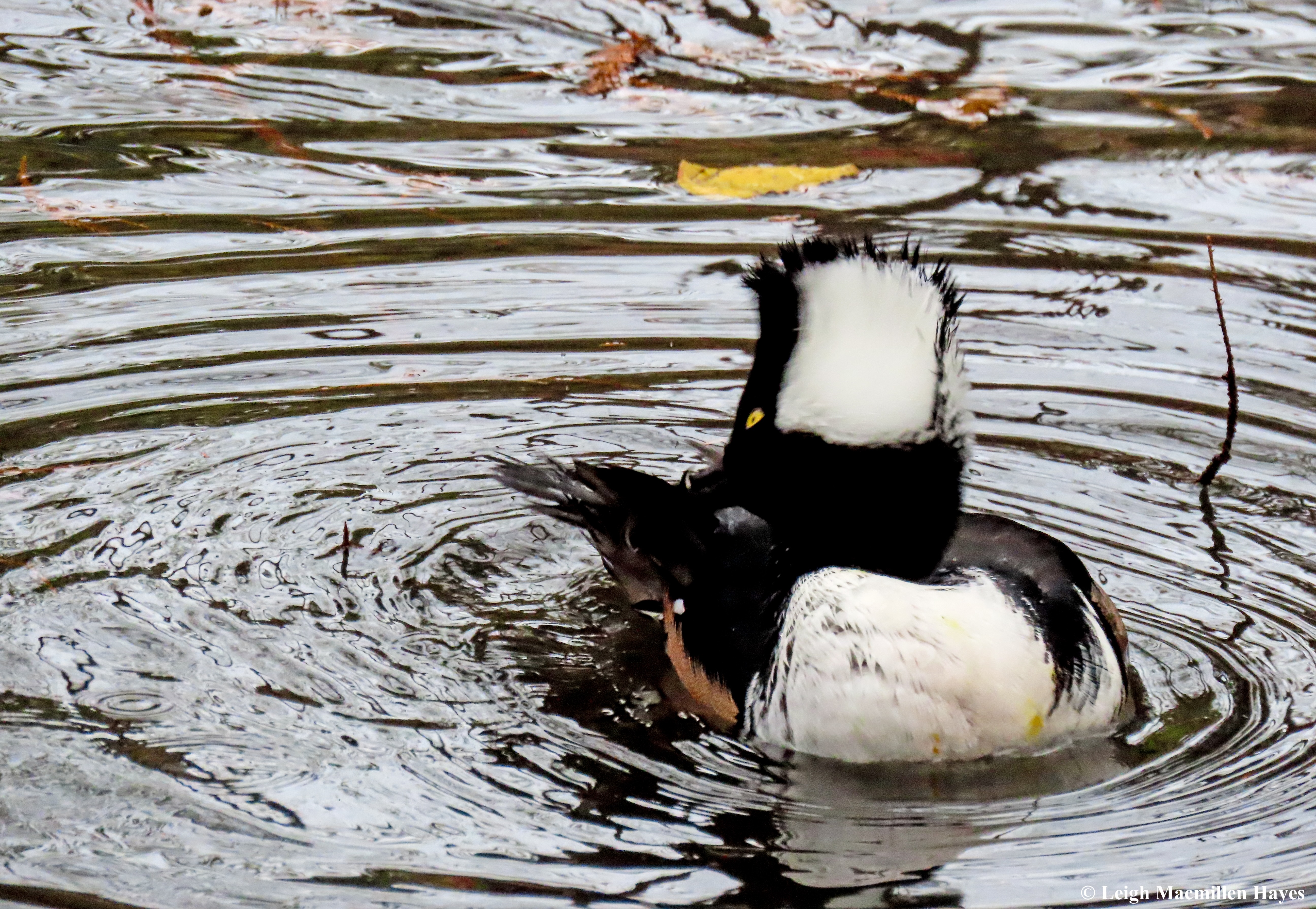
Witnessing the Past

We’ve traipsed through these woods before, My Guy and I, but always, there’s the old to see and the new to appreciate. And so today we visited both.

By the shape of the forest road we walked, I could have driven another mile before parking. But . . . I like to walk. And besides, you can’t appreciate all the beauty that surrounds you on a wet autumn day if you fly in at 60 miles per hour. Or even at 20!

And because we walked, we found an off-shoot trail that led us to a sweet spot we’d not visited before along Great Brook, where we stood for a few moments watching and listening and smelling as the water cascaded over the rocks.

Once we got to the trailhead after passing around a gate, we followed another old road for a ways, up and down over a few little hills, and then, because memory was on our side, as the road curved to the right and the stonewall began on the left, we knew it was time to turn and begin a bushwhack up a road that hasn’t seen much use in decades. It was there that we spied the first witness. A tree standing over a marker. By the way the tree is growing around the sign, it’s obvious that it’s been keeping watch for decades.

So if that was the witness post, where was the survey marker? Atop a rock at the base of the witness tree. And 1965 would be the year that the sighting was first made.

Eventually we reached the first of the foundations because even when we are what seems to be deep in the woods, we’re in the middle of a place that was once somewhere — someone’s neighborhood. In this case, according to the 1858 map, we were visiting the Durgins.

My friend, Jinnie Mae (RIP), was an historian and tech guru and years ago she overlaid part of the bushwhack we did today on an 1858 map. You can see the name E. Durgin on that.

One of my favorite things about the Durgin cellar hole is the cold storage. In the cold to come, it will still serve as storage, so witnessed by the findings within today.

For the back corner has long provided protection from the elements for a porcupine, given the scat pile.

Because we were there, we decided to check on the Durgins who hang out a ways in the woods behind their former home and followed a stonewall to their locale.

Three of them were still there. Sarah, daughter of Anna and Ephraim (E. Durgin on the map), died in 1858 at age 22.

Beside her stood Mary, wife of Sumner Dergin, who died before Sarah in 1856, also at age 22.

Our best guess is that Sarah and Sumner were siblings.

Ephraim, father of Sarah and Sumner, and husband of Anna, died in 1873 at age 81. Did you notice the difference in stone from the 1850s to 1870s? Slate to cement. And the name change–Dergin vs. Durgin. We’ve learned through geneology research that spellings often differ. I found the following a few years back on RootsWeb.

8. ANNA3 FURLONG (PATRICK2, JOHN1) was born 1791 in Limerick, Maine, and died 1873 in Stoneham, Maine. She married EPHRAIM DURGIN June 18, 1817 in Limerick, Maine14. He was born April 13, 1790 in Limerick, Maine, and died in Stoneham.

Children of ANNA FURLONG and EPHRAIM DURGIN are:
i.OLIVE4 DURGIN, b. 1811, Stoneham, Maine; m. DUNCAN M. ROSS, April 11, 1860, Portland, Maine.
ii.SALOMA DURGIN, b. 1813.
iii.ELIZABETH DURGIN, b. 1815.
iv.SALLY DURGIN, b. 1817.
v.SUMNER F. DURGIN, b. 1819, Of Stoneham, Massachusettes; m. MARY ANN DURGAN, July 11, 1853, York County, Maine; b. Of Parsonsfield, Maine.
vi.CASANDIA DURGIN, b. 1821.
vii.EPHRAIM DURGIN, b. 1823.
viii.FANNY DURGIN, b. 1825.

Sarah isn’t listed above. But . . . Sally and Sarah were often interchangeable.

We ate lunch with the family as we looked out at the view they enjoy every day–possibly once called Durgin Hill, and then maybe Sugar Hill.

After lunch, our journey continued a wee bit further until another witness stopped me in my hiking boots. It took me three bear hugs with arms fully outstretched to completely circle this ancient Sugar Maple. Can you imagine the tales stored inside this great, great, great grandfather?

And at his feet, a wee one to appreciate –a Many-fruited Pelt Lichen, the many fruits being the brown fruiting bodies or apothecia.

A few steps away, we reached the Willard family foundation. Two large granite slabs are visible in the back and I had to wonder if they originally formed the roof of another cold storage.

Again, I referred to Jinnie Mae’s research. By 1880, the Willards house was occupied by the McKeens. And the Durgins were no longer living there, which makes sense given that Anna and Ephraim both died in 1873. The Rowlands had moved in to their home.

A newer member of the neighborhood, a Striped Maple, may not have known any of these occupants, but despite the full canopy of evergreens and maples and birches, it sure knew how to produce large leaves to increase its chances of survival.

Eventually, we turned west and followed an old road way bordered by stonewalls on either side. I remember when few trees grew there, but now one has to move through like a ball in a pinball machine, ricocheting off this tree and that rock along the way.

It’s well worth the effort because it leads directly to Willard Brook, which flows southward toward Great Brook , where we first began our journey.

Though I know the first part of the trip well, I sometimes get a bit mixed up with the second part and such was the case today. That said, as we scrambled up and down the sometimes steep hillside beside the brook, we came upon these wheels and bingo. We knew them as old friends we’d met on a previous trip.

There is so much history tucked away in these woods, and I gave thanks for two more witnesses, who despite their differences, stood together and supported each other.

We live in unceded Wabanaki land and I’ve come to some understanding of the Native American presence that once existed here in this place between Great Brook and Willard Brook. And I’m sure still does.

After witnessing the past, we walked back down the road as raindrops fell. A perfect hush to end the journey.

Tri-day Mondate

It’s been a while since I’ve shared a Mondate mostly because it’s either rained, or we had errands to run, or whatever we did was something we’ve already done a million times before and didn’t seem worth sharing. And so this weekend dawned as a three day weekend for the two of us and we decided to dig in and have fun.

We began our journey on Saturday with a long (think 9.5 mile out and back, with some backtracking in the mix) walk on old roads deep in the woods of western Maine. Our goal was to find the Hand on The Rock. Yes, you read that correctly. The Hand on The Rock.

And we did. I’d heard friends talk about this over the years, but until recently didn’t know of its actual location. Yes, that’s my guy’s hand. But do you see the engraved hand on the rock? It was perfect for my guy to place his hand on top, as he’s left-handed.

Below the left hand is the name LH JEWETT, that features a backward letter J. According to Arthur Wiknik, Jr.’s Hand on The Rock essay, “The rock carver has been identified to be Leander Hastings Jewett. Leander was born on April 4, 1851 in Sweden, Maine to Milton and Eliza (Whitcomb) Jewett, and for a time lived in the northeast corner of Sweden known as the Goshen neighborhood.”

Continues the writer: “As with most young men in the 1800s, Leander was a working member of his family and likely chiseled the rock between 1868 and 1873, presumably out of boredom while helping his father do some logging.” 

I think what I love most about all of this is that Wiknik acknowledges my friends Jinnie Mae and Dick Lyman, (may they both RIP,) for their historical knowledge.

Since we were in the neighborhood, we also stopped in at the Goshen Cemetery. The stones were discovered years ago under the duff and uprighted in situ. The tombstones are unmarked and as far as I know, two theories exist–an epidemic struck the neighborhood and those who died needed to be buried as fast as possible, or these were the tombs of the residents from the town’s poorhouse.

And when we finally returned to the truck, we were blessed to discover a bag of fresh veggies left by two dear friends.

That was Saturday.

Sunday found us driving across Hemlock Covered Bridge in Fryeburg, Maine. The structure has spanned the Old Course of Saco River for 166 years.

Built of Paddleford truss construction with supporting laminated wooden arches, Hemlock Bridge is one of the few remaining covered bridges still in its original position. Peter Paddleford of Littleton, New Hampshire, created this design by replacing the counter braces of the Long-style truss bridge, creating an unusually strong and rigid structure. It was reinforced in 1988 and one can still drive across (“You’re stating the obvious, Mom,” our sons would say.).

Our goal was to paddle under the bridge and head to Kezar Pond on this beautiful afternoon.

My guy had never actually travelled this route before, so it was fun to share the tranquil paddle with him.

A juvenile Bald Eagle greeted us from high up in a White Pine. And we greeted it back. As one should.

Reaching the pond, we discovered a beautiful day to the east and storm clouds to the west. And so it was a quick look-about and then a wise decision to turn around and paddle back to the bridge.

But first, a small skimmer dragonfly known as a Blue Dasher, begged to be admired. And so I did.

As soon as we started our return journey it began to sprinkle, but despite the rain, we were rewarded with another look at the juvenile eagle as it flew down to a tree limb beside the river.

Did we get wet? A tad bit. It was a gentle rain, however, and since it wasn’t cold, we didn’t mind.

Was my guy faster than me? Yup. But he waited under the bridge until I caught up.

And then today’s decision was to climb The Roost trail in Evans Notch and hike along another trail in Shelburne, New Hampshire. The Roost is a fun loop that doesn’t have much of a view at the summit.

But we found things to look at that made up for it, like this Clintonia, aka Blue Bead Lily, growing out of a dead snag.

And this mystery plant for my naturalist friends to identify.

The trail down that we chose to follow was a wee bit longer than that ascending The Roost, but offers a much more gradual descent. And four water crossings.

And a view of Hobblebush leaves speaking of the future. Since I mentioned Jinnie Mae earlier in this post, she had to be smiling down upon me when she saw that I was taking this photo. She used to tease me about all the Hobblebush photos I took. But it always has something interesting to offer, no matter the season.

At the final stream crossing, we spied an old sluice way that speaks to the history of the area once known to support many logging camps. We were just below Hastings Campground and Hastings was formerly a booming village during the early 20th Century.

There are also bricks in the water, so I wondered if a grist mill or saw mill had been operated here.

As we walked back up Rte 113 to complete the loop and return to my truck, we took a detour across the bridge over Wild River. It’s part of the snowmobile route when the white flakes do fly.

Our next plan was to explore Shelburne Riverlands, a Mahoosuc Land Trust property just across the line in New Hampshire, but where gnats had been annoying on The Roost, the mosquitos drove us crazy and about a half mile in we decided to turn around and save this hike for another day. A cooler day. A less buggy day. I think we’re on at least the fourth mosquito hatch this summer.

Instead, we continued down the road to Mahoosuc Land Trust’s pollinator garden at Valentine Farm. It’s a favorite hang-out of mine. My guy tolerated my slo-mo photo taking by napping in the truck.

Look at all the pollen on that bee!

And check out this Hawk Moth that hovered much like a Hummingbird.

I also fell in love all over again with the White Admiral Butterfly, especailly since the orange on its hind wings seemed to match the orange of the Coneflower.

But the stars of the show were the newly emerged Monarch Butterflies.

If my guy hadn’t been waiting so patiently in the truck, I might still be there, circling around and around watching all the action.

It was the perfect ending to this Tri-day Mondate. And I’m glad we were able to make the most of it.

Where The Moose Led Us Mondate

It seems there are never enough rainy days to complete home chores so when today dawned as such I thought that all the contents I’d been sorting from a closet would finally make their way to new homes like the dump store or community clothing closet or back into containers to be stored for another rainy day.

Apparently, I thought wrong for the Cardinal beckoned and we answered the call to head out the door.

When I mentioned a location for today’s hike to My Guy, he agreed that it sounded good, though come to find out, in reality he thought we were going someplace else and even when we arrived at Great Brook, he couldn’t recall our last visit, which was in 2016. Fair enough. I’ve been there many more times.

It soon became apparent that we were in Moose territory and our excitement rose. Actually, on another trail in this same neck of the woods we once spotted a Moose, so all we could do was hope that today we’d receive the same honor.

But first, there were other honors to receive, such as this bouquet of flowering Red Maple.

And the first of the season for us, maple leaves bursting forth in all their spring glory of color.

Onward we hiked deeper into the woods where a place one might think of as no place was once some place. This particular foundation has long been a favorite of mine because within is a root cellar.

It’s one I can’t resist stepping into because you never know what tidbit might have been left behind.

Porcupine scat! Rather old, but still.

My friend, Jinny Mae (RIP), was a talented techie and though the red line isn’t the entire route we followed today, it’s one she and I explored back in 2016. The map is from a section of the 1858 map of Stoneham. And we were at E. Durgin’s old homestead.

Knowing that there were some gravestones in the woods behind the house, we once again followed the Moose who led us directly to the family cemetery. Someone has cleared the site a bit, so it was easy to spot, especially since the trees haven’t fully leafed out.

Sarah, daughter of Anna and Ephraim Durgin, is the first tombstone. She died in 1858 at age 22.

Beside her is the stone for Mary, wife of Sumner Dergin, who died before Sarah–in 1856. She, too, was 22 years old. As best I can tell, Sarah and Sumner were siblings.

And Ephraim, Sarah’s father, died in 1873 at age 81. Notice the difference in stone from the two girls to Ephraim? Slate to cement. And the name spelling–Dergin and Durgin. As genealogy hobbiests, we’ve become accustomed to variations in spelling.

I found the following on RootsWeb:

8. ANNA3 FURLONG (PATRICK2, JOHN1) was born 1791 in Limerick, Maine, and died 1873 in Stoneham, Maine. She married EPHRAIM DURGIN June 18, 1817 in Limerick, Maine14. He was born April 13, 1790 in Limerick, Maine, and died in Stoneham.

Children of ANNA FURLONG and EPHRAIM DURGIN are:
i.OLIVE4 DURGIN, b. 1811, Stoneham, Maine; m. DUNCAN M. ROSS, April 11, 1860, Portland, Maine.
ii.SALOMA DURGIN, b. 1813.
iii.ELIZABETH DURGIN, b. 1815.
iv.SALLY DURGIN, b. 1817.
v.SUMNER F. DURGIN, b. 1819, Of Stoneham, Massachusettes; m. MARY ANN DURGAN, July 11, 1853, York County, Maine; b. Of Parsonsfield, Maine.
vi.CASANDIA DURGIN, b. 1821.
vii.EPHRAIM DURGIN, b. 1823.
viii.FANNY DURGIN, b. 1825.

Sarah isn’t listed above. But . . . Sally and Sarah were often interchangeable.

By 1880, there had been a change in ownership of the neighborhood homes and the Rowlands had moved into the Durgin house.

Again, we followed the moose, this time in the form of a Striped Maple browsed upon, curious to see what might be ahead.

A chuckle. Yes, a mailbox in the middle of nowhere, this spot being a place where someone once had a camp. Our Moose tried to send a letter, but missed by a couple of feet.

Willard Brook was our next stop and I was reminded that when I first started wondermyway.com, a post about this brook initiated some discussion about the Indigenous stonework found throughout the area. I’ve explored it looking for such and convinced myself in the past that I saw the turtles in most of the stonewalls. In fact, I see them everywhere, but today I was looking at different subjects.

Beside the brook, lots of Hobblebush looked ready to burst into life and we thought how fortunate that the moose hadn’t decided to dine. Yet.

There were even tiny Hobblebush leaves to celebrate for their accordion style.

And Broad-leaved Dock looking quite happy and healthy.

Back to Great Brook we eventually wandered, still with no actual Moose in sight.

But beside the brook I did spot some Trailing Arbutus buds preparing for their grand opening.

As we walked back on the dirt road we’d walked in on, we paused beside a beaver pond where Spring Peepers sang their high-pitched love songs. I made My Guy scan the area with me because just maybe . . .

or maybe not. We did spot a Mallard couple. Oh well, We still had fun discovering everything else where the Moose led us on this rainy day.

And when we arrived home I had an email from an acquaintance double-checking with me that the print he found on his shore front of Kezar Lake was a moose print. Indeed it was!

(And now it’s time to prepare for Big Night. Finally. The temperature is in the 40˚s; it’s been raining all day and will continue tonight; and though lots of amphibians have moved to their native vernal pools, I think there will be some action tonight and we’ll be able to help them cross the road safely.)