Happy Belated 10th Anniversary, wondermyway.com

I can’t believe I missed the date by two days. I’d been planning this for months. Well, in the back of my mind, that is. No actual thoughts were jotted down on paper. I just knew what I wanted to do and when I wanted to do it . . . until I forgot. Or rather, it slipped my mind. Momentarily.

No harm done.

As the saying goes, “There’s no time like the present,” and so my gift to you dear readers will be to give you the present of time by taking you back to the beginning of wondermyway and then making our way to the present. And all of it is because I was given the gift of being present in the moment on so many occasions. Egads. That’s a lot of presents. And presence.
Wonder My Way

My first blog post was published on February 21, 2015, and entitled Wonder My Way. It began with these paragraphs: Wonder my way as I wander through the Maine woods. So often I see things that make me stop and wonder. Sometimes I figure it out, but other times, I’m just as happy that I don’t. It’s The Sense of Wonder that Rachel Carson wrote about which keeps me going. Do we need to have all the answers? I think not.

So join me for a tramp from our woodlot to the world beyond. I know not where this trail will take us, but I can guarantee that we’ll have fun along the way. Read more . . .
Spring in Slo-Mo

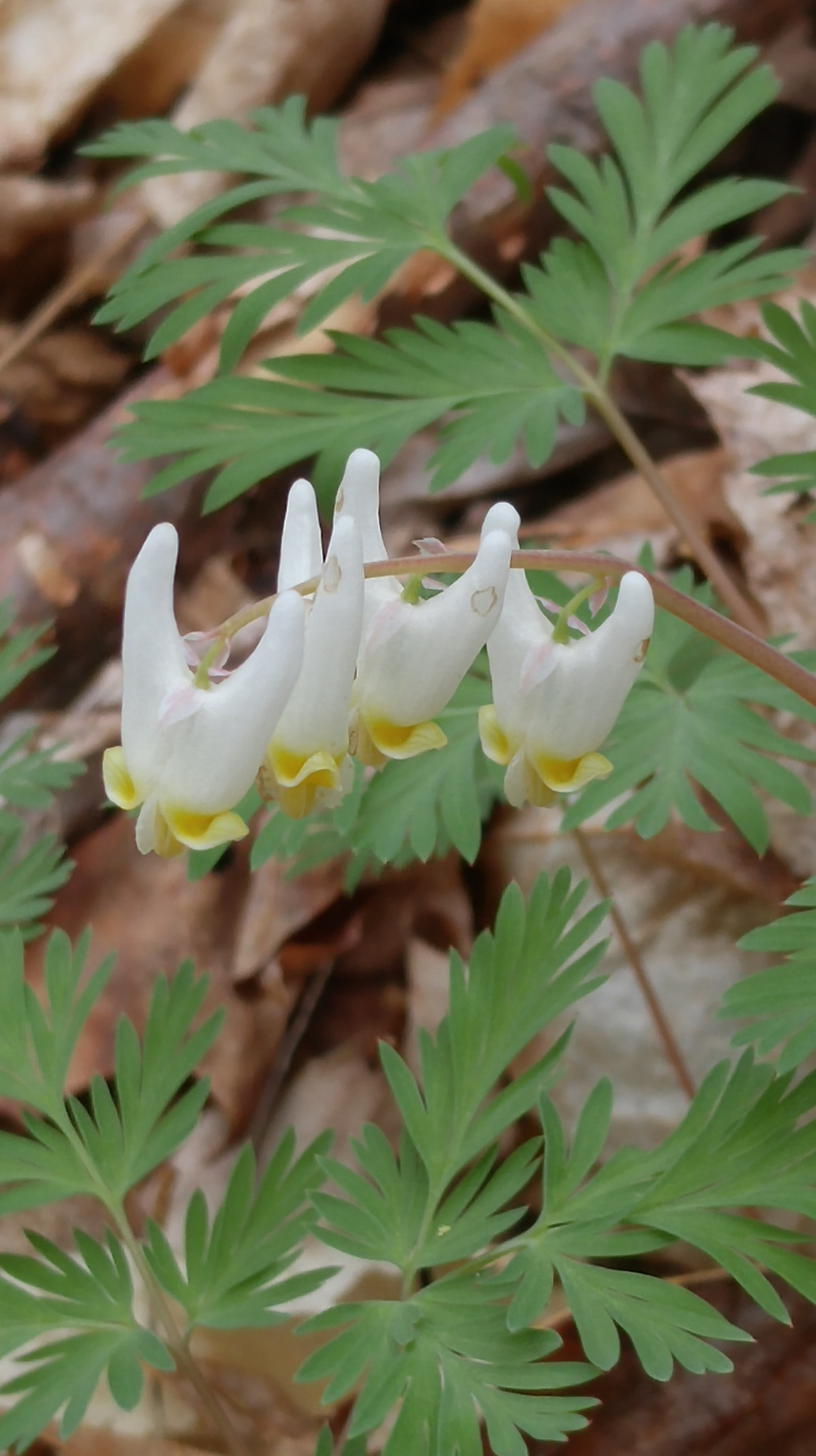
Spring is so fleeting in Maine. Oh, I know, it lasts the usual three months and the beginning and ending overlap with its seasonal partners, but really . . . one must take time to pause and watch or you’ll miss the most amazing action that occurs in slow motion right outside the window–and beyond.

For those who are new to my blog, Jinny Mae, who is featured in this and many blog posts, was a dear friend whose name I turned in to an alias as she faced cancer courageously and rather privately. In the end, the cancer consumed her, but the things we enjoyed along the way were bountiful, including this spring adventure to an incredible space in our little neck of the woods. Read more . . .

Universal Love

Written on Valentine’s Day, this post was dedicated to My Guy and all who wander and wonder with me.

When I wander, hearts frequently speak to me . . . Read more . . .

Nothing To Grouse About

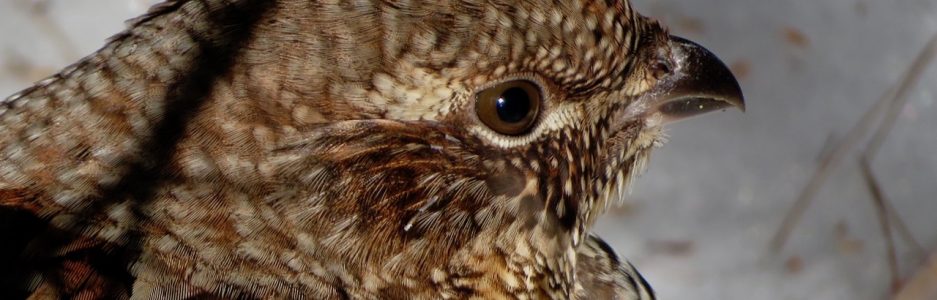
I shared a unique experience with five other naturalists, the majority of them in the six to eleven age range. For twenty minutes the six of us watched a Ruffed Grouse at it moved about, overturning leaves and foraging on buds. When we last saw it, the bird headed off in the opposite direction that we intended to journey, and so we moved on with wonder in our eyes and minds.

And then the next day I returned on a mission to study some twigs at the same property. No sooner had I stepped onto the trail when I heard the sound of leaves cracking a wee bit and what to my wondering eyes should appear but the same bird.

The curious thing: the bird followed me, staying about ten feet away as I tramped on. I stopped. Frequently. So did the bird.

And we began to chat. I talked quietly to him (I’m making a gender assumption) and he murmured back sweet nothings. Read more . . .

Amazing Race–Our Style

Okay, so My Guy and I have enjoyed The Amazing Race show over the years and felt like there were some challenges either or both of us could face, but others that neither of us would dare attempt. And so . . . I created our own version.

The thing is that until I take the time to change the order of this post on my website, you’d be best to start at the bottom and read each entry, going up one step at a time. As in, this: Scroll down to February 18 on this link and then after reading that entry, make your way up one episode at a time, until you reach the last recorded on February 2, 2019. Oh heck, read it in any order that pleases you. Just get into the spirit of the race I created cuze I certainly had fun with it. And fooled a few people along the way.

The Amazing Race–Our Style

I’m sure when we said our wedding vows back in 1990, there was something in there about only riding a snowmobile once. And I did that once two years or so ago–mostly because I knew it would please my guy. Certain memories remain from that experience: I felt like a bobblehead inside the helmet; I lacked control as I sat behind him and couldn’t see; when I did peek around, I was sure my head was going to strike a tree so narrow was the trail; and I didn’t like the speed. Oh yeah, and at a road crossing, I do believe I jumped off and walked to the other side. With all of that in mind, I’m not sure what I was thinking when I created a Valentine’s gift for him–our very own Amazing Race. Read more . . .

wondermyway turns five

Five years ago today (ten now!) I turned from taking a hundred million photos on each tramp to taking a hundred million photos and writing about them.

Typically, on the anniversary I scan the past year’s posts and choose one from each month, providing a photo to represent it, with a brief (or not so brief) comment and link to the full read.

But . . . because this is a milestone I never imagined reaching (posts: 733; views: 76,793; visitors: 44371; followers: 578), I thought I’d take the time to thank you, the readers, for wandering through the wonders with me.

Thank you! Read more . . .
Dragonfly Whisperer Whispers

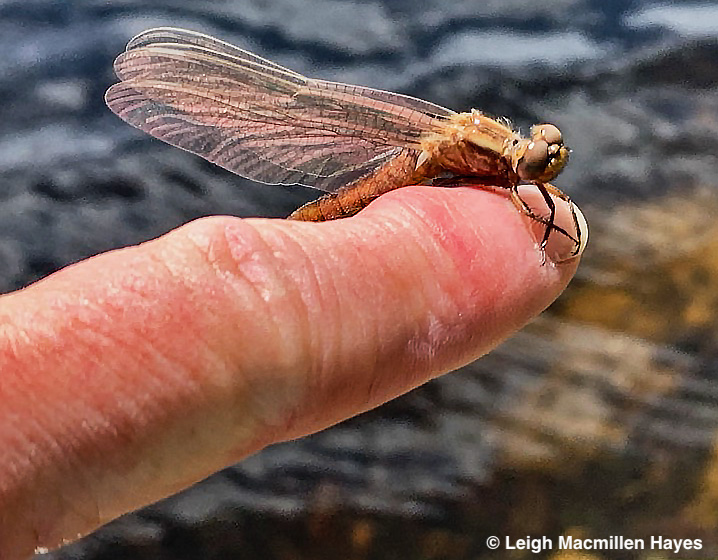
We had no intention of eating lunch in this spot today, but while looking for a mountain to climb, we kept encountering full parking lots and so our backroad meander put us beside a bog at lunch time and voilà, we managed to walk all of less than two tenths of a mile. Total.

But in that short distance, our eyes feasted. First it was all the Painted Turtles basking in the sun. Read more . . .
Surveying the Wildlife of Charles Pond

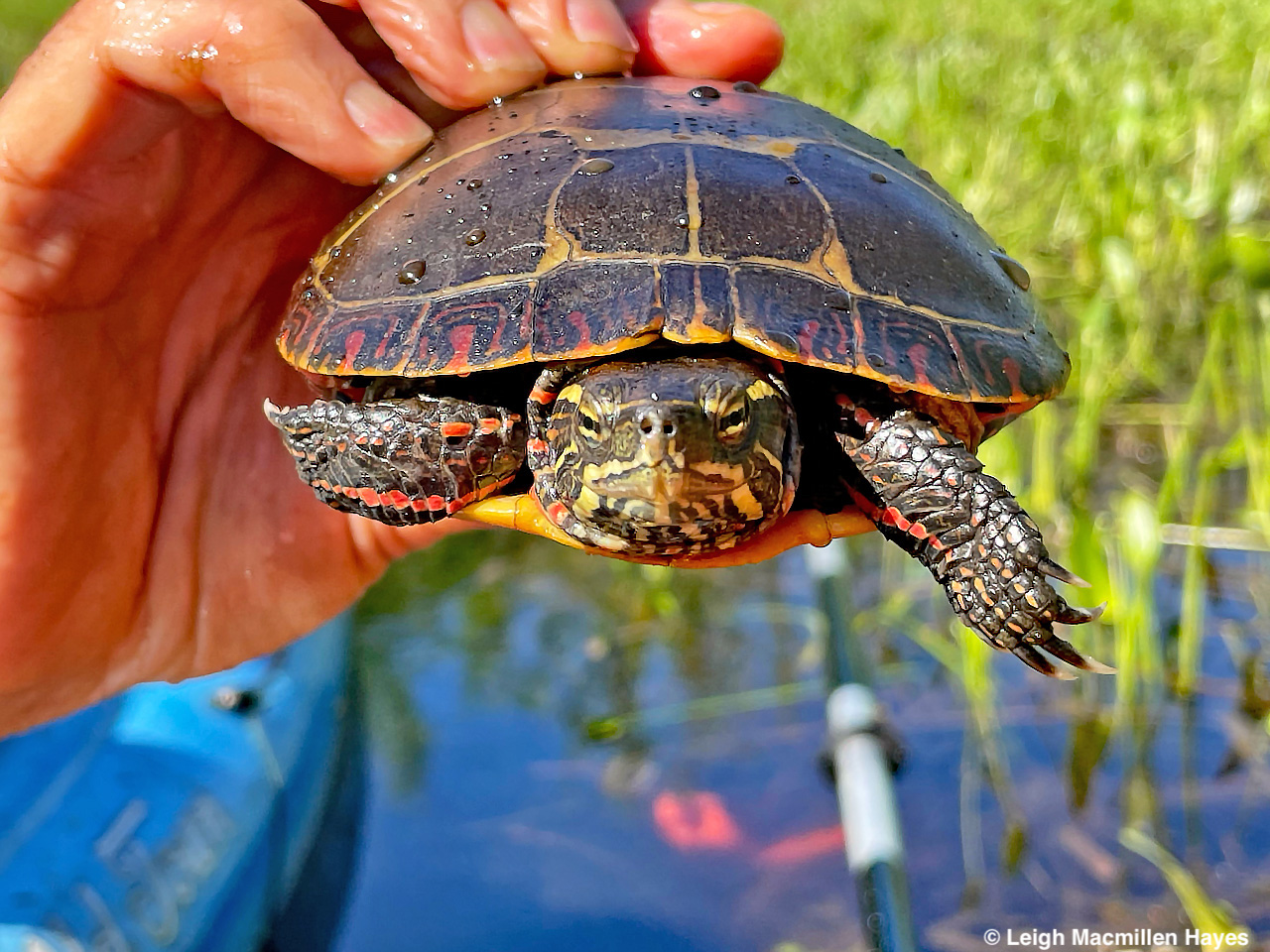
For the past two weeks at Greater Lovell Land Trust we’ve had the good fortune to conduct a wildlife survey in the waters that surround the newly acquired Charles Pond Reserve in Stow, Maine. Our hats are off to Alanna Doughty of Lakes Environmental Association (LEA) for her willingness to be the lead on this project and work in collaboration with us. Alanna, you see, has conducted previous surveys for Maine Inland Wildlife & Fisheries (MDIFW) at LEA properties, and was trained by wildlife biologist Derek Yorks to set these up.

MDIFW maintains a comprehensive database on the distribution of Maine’s amphibians and reptiles, as well as terrestrial and freshwater invertebrates and the data we’ve collected will add to the bigger picture. What we discovered was just as important as what we didn’t find. Read more . . .
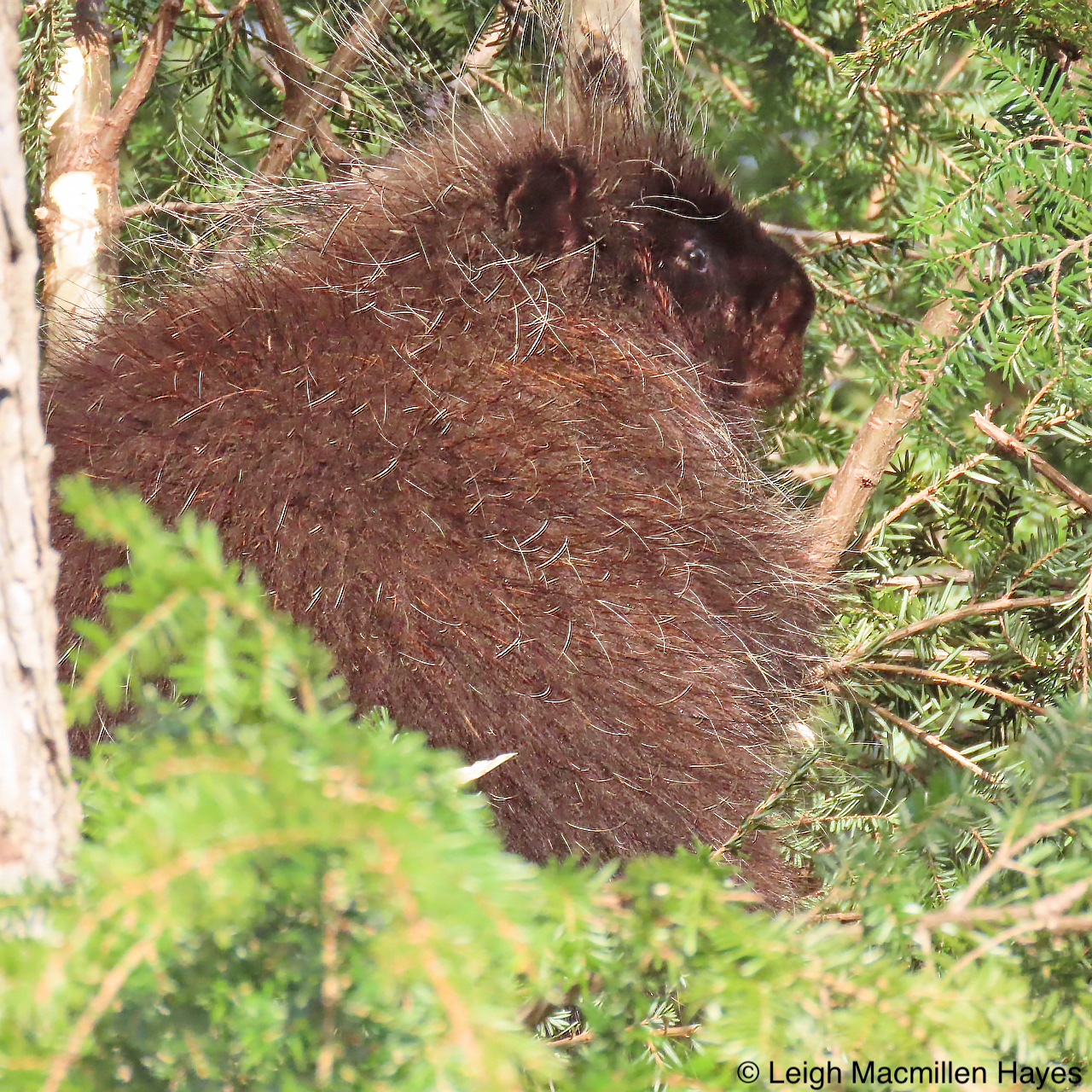
Hightailing It Home

Friends,
At the risk
of sounding redundant,
I bring forth
a prickly topic.

A quick glance
while surveying treetops
and suddenly
my heart sang
as I spotted
a well-armored back.
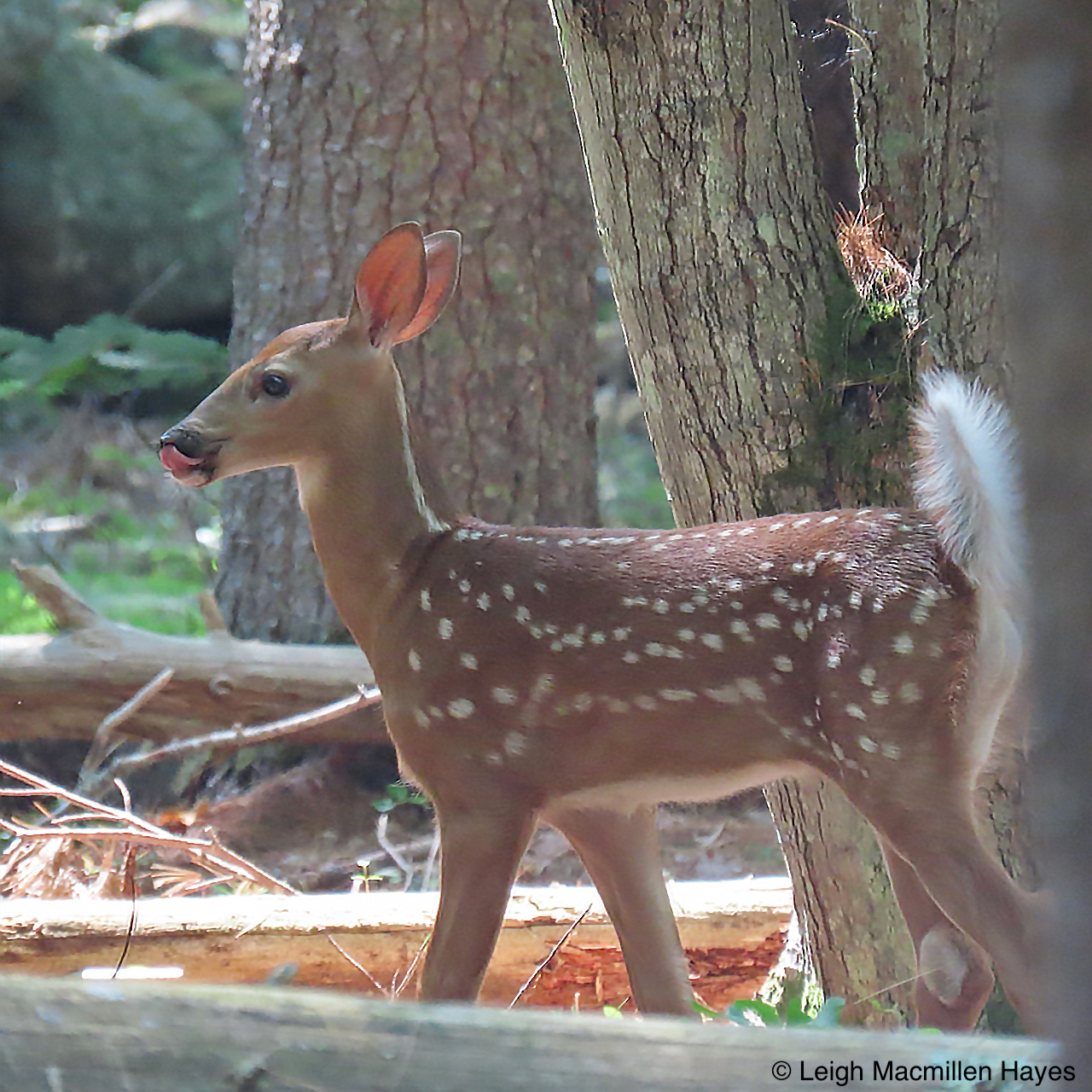
Read more . . .

Happy 9th Birthday, wondermyway!

Thank you to all who read and comment and share wondermyway.com. Some of you have followed my blog posts since the beginning, February 21, 2015. A few have joined the journey as recently as yesterday. I’m grateful for the presence of all of you in my life.

To mark this occasion, I thought I’d reflect upon those moments when my wonder gave me a glimpse of the “Thin Places” that I’ve experienced either by myself or in the company of others.

To quote my friend, Ev Lennon, “A Thin Place is a spot of beauty, loveliness, space–an example of the wideness and grandeur of Creation.”

I think of them as places that you don’t plan a trip to visit, but rather . . . stumble upon.

Read more . . .

And that brings me to this year and this anniversary, belated as it may be. I can’t believe it’s been ten years since I started this endeavor, which has served as my diary and memory, and been a place for me to share so many incredible extraordinary ordinary experiences with all of you. Thank you for being faithful readers.

As I compare the numbers to year five, I haven’t written as often in the last five years, but your support has been incredible.

wondermyway.com by the numbers:

Posts: 1,076

Visitors: 135,888

Views: 205,389 and increasing constantly.

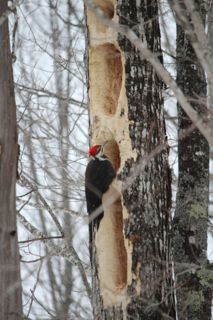
The most popular post of this new year was Giving Thanks for the Pileated Woodpecker. So far, anyway.
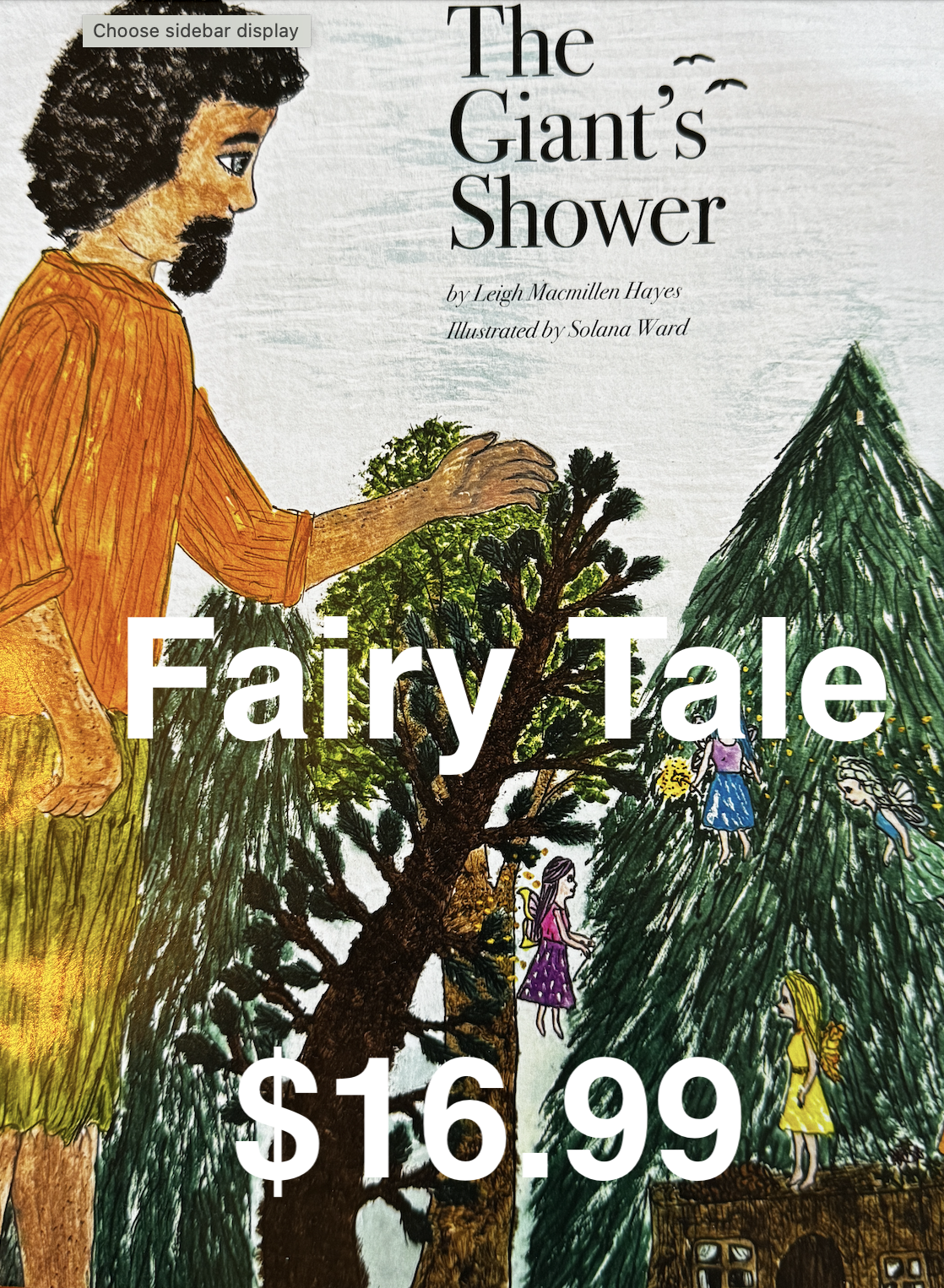
The Giant’s Shower

And since I retired as Education Director for a local land trust just over a year ago, I’ve added some other fun to the mix.

I did a thing. Years ago I wrote a children’s story. Well, a bunch of them actually. And I tried to sell this particular one to publishing houses. No takers. Then, a couple of years ago I purchased a Fairy Coloring Book created by the one and only Solana, teenage daughter of the Fly Away Farm Wards in Lovell and Stow, Maine, and approached her about illustrating my fairy tale. She took on the task and did an amazing job. Then I asked copyeditor Pam Marshall to wave her magic wand over it. And I asked local graphic designer Dianne Lewis to use some fairy dust and turn it into an actual book. I always said I’d never self-publish a book. And tada: I did just that. And now it’s even better because it’s published by http://www.indieauthorbooks.com.
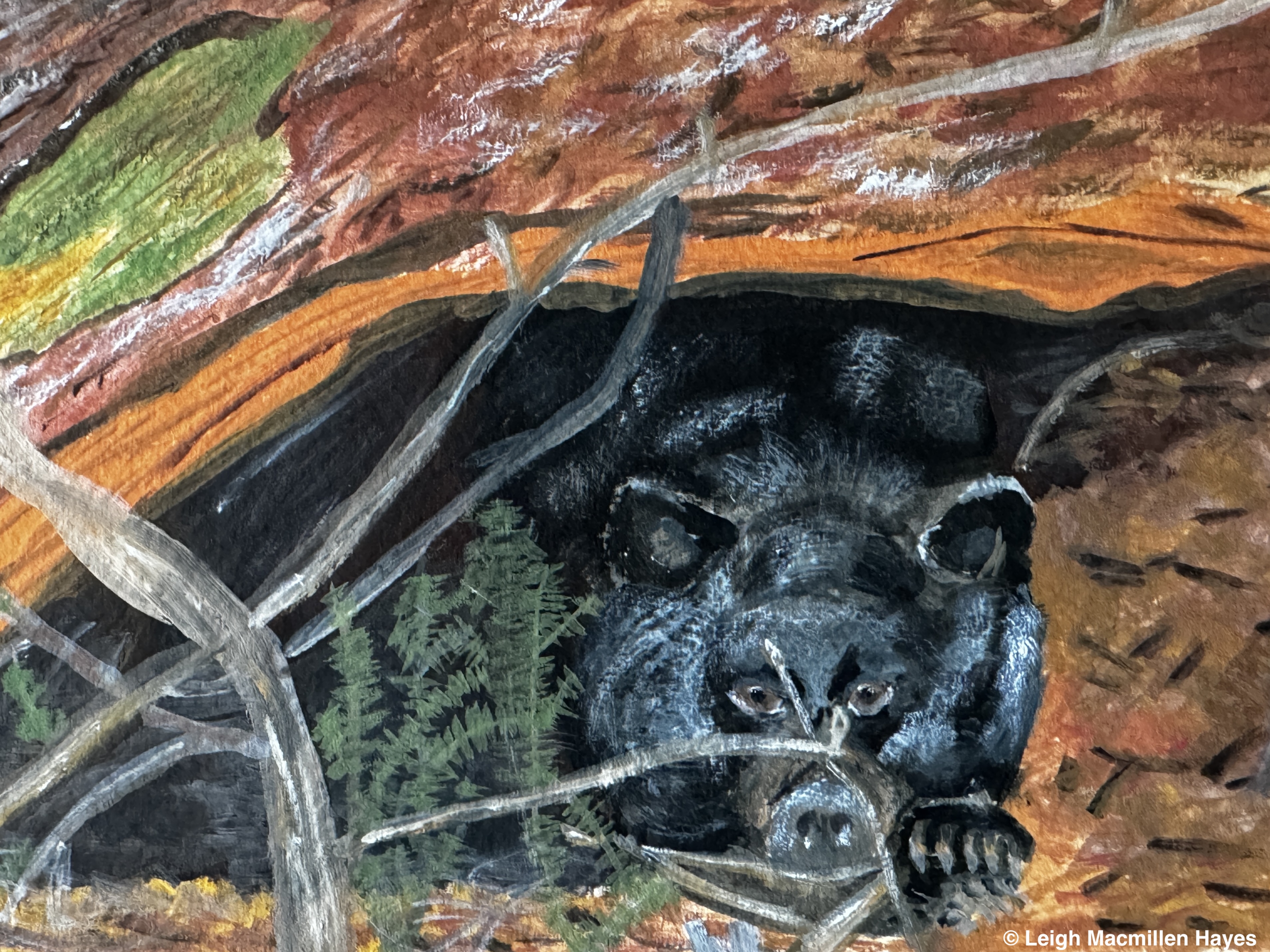
Read more . . .

My Art Gallery

At the end of April I began taking an art class offered by one of my peeps, a young woman who walked into the lives of many of us one day about twenty months ago; a young woman with a million talents to offer. Among those talents, she is a self-taught artist and we’ve been begging her to teach us.

At our first class, we had to draw a small box in the upper left-hand corner of the paper and place the person who has been our biggest art critic into it. That done, the critic was forever boxed–well, until she sneaks out, which she seems to do way too much.

And then we looked at some photographs in magazines and had to sketch them and determine the direction the eye would travel in the picture.

Next we looked at lines and perspective. I’d brought along my favorite colored pencils, but immediately felt my inner critic jump on me because all of my classmates were working with watercolor pencils, watercolor paint or acrylics. And the artist herself, gouache. Until I met her, I’d never even heard of gouache. Or at least never paid attention, if I had.
Read more . . .

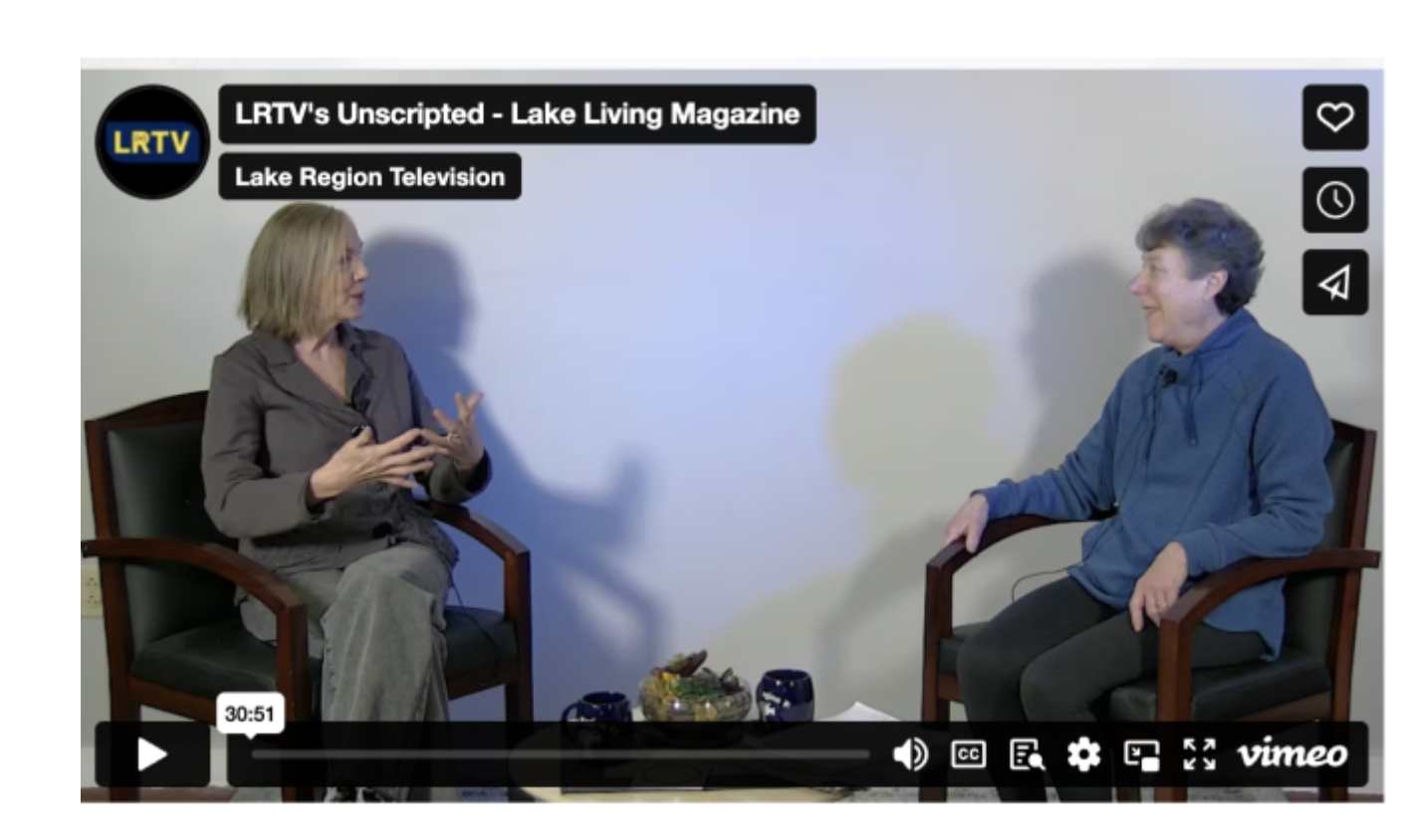
Lake Living on Lake Region Television!

And we said goodbye to Lake Living magazine, a glossy publication I’ve worked on since 2006.

We are movie stars! Well, maybe not quite. But, many, many thanks to Evan Miller of Lake Region Television for filming and editing Laurie LaMountain, owner and publisher of Lake Living magazine, and me recently as we said, “Fare Thee Well,” to working on this publication.

Read more . . .

And in the midst of it all, I still have the good fortune to share the trail with so many others . . .

and especially with My Guy, who is forever patient as I pause to consider the wonder of the moment.

My heart-felt thanks to him and to all of you for joining me so often as I wondermyway.

Wowza–ten years! I never imagined. No time like the present to wish wondermyway.com a belated 10th anniversary.

Time Travel: Trail Until Rail

Picture this: It’s 1888. You’re in a train car on what was once the Portland and Ogdensburg Railway (P&0), but is now leased by Maine Central (MEC) and renamed the Mountain Division Trail. You are making the journey from the White Mountains of New Hampshire to Portland, Maine, with a brief stop in Fryeburg, Maine.

Off the train you hop, and suddenly you find yourself wandering down the Mountain Division Trail in the year 2024. Only, it’s not the rail bed that you walk upon, but rather a paved path beside the tracks.

And you give thanks, because this is the season of doing such, though really we should do so every day, for the Mountain Division Alliance, formed in 1994, out of concern that the rail right of way would be lost. MEC had sold the line to Guilford Transportation in 1981, about twenty plus years after the demise of passenger service. About seven years later, freight service also ended.

In 1994, The Mountain Division Alliance, under the direction of Alix Hopkins, Director of Portland Trails, “brought people together from over 20 groups. Out of this group came the vision for a rail with trail connecting the nine communities [Portland, Westbrook, Windham, Gorham, Standish/Steep Falls, Baldwin, Hiram, Brownfield, and Fryeburg] along the rail corridor from Portland to Fryeburg.”

The Alliance was started to “convince the State of Maine to purchase the rail bed right-of-way. The vision that a bicycle and pedestrian trail could be built along the rail line connecting Fryeburg to Portland came about at this time [1994],” wrote Dave Kinsman, former president of the Mountain Division Alliance in an article published by The Brownfield Newsletter.

So back to going for a wander down the trail. I did such this afternoon, and it’s a path I love to follow at any time of year, because it offers such diversity so I hope you’ll not hop right back on the train just yet, but instead wander with me.

Some may see it as the land of dried up weeds and some trees, but oh my. There’s so much to see.

For starters, Black Locust trees, with their two-toned braided bark.

Dangling from the locust twigs are the “pea” pods that contain “bean-shaped” seeds ready to add another generation to the landscape.

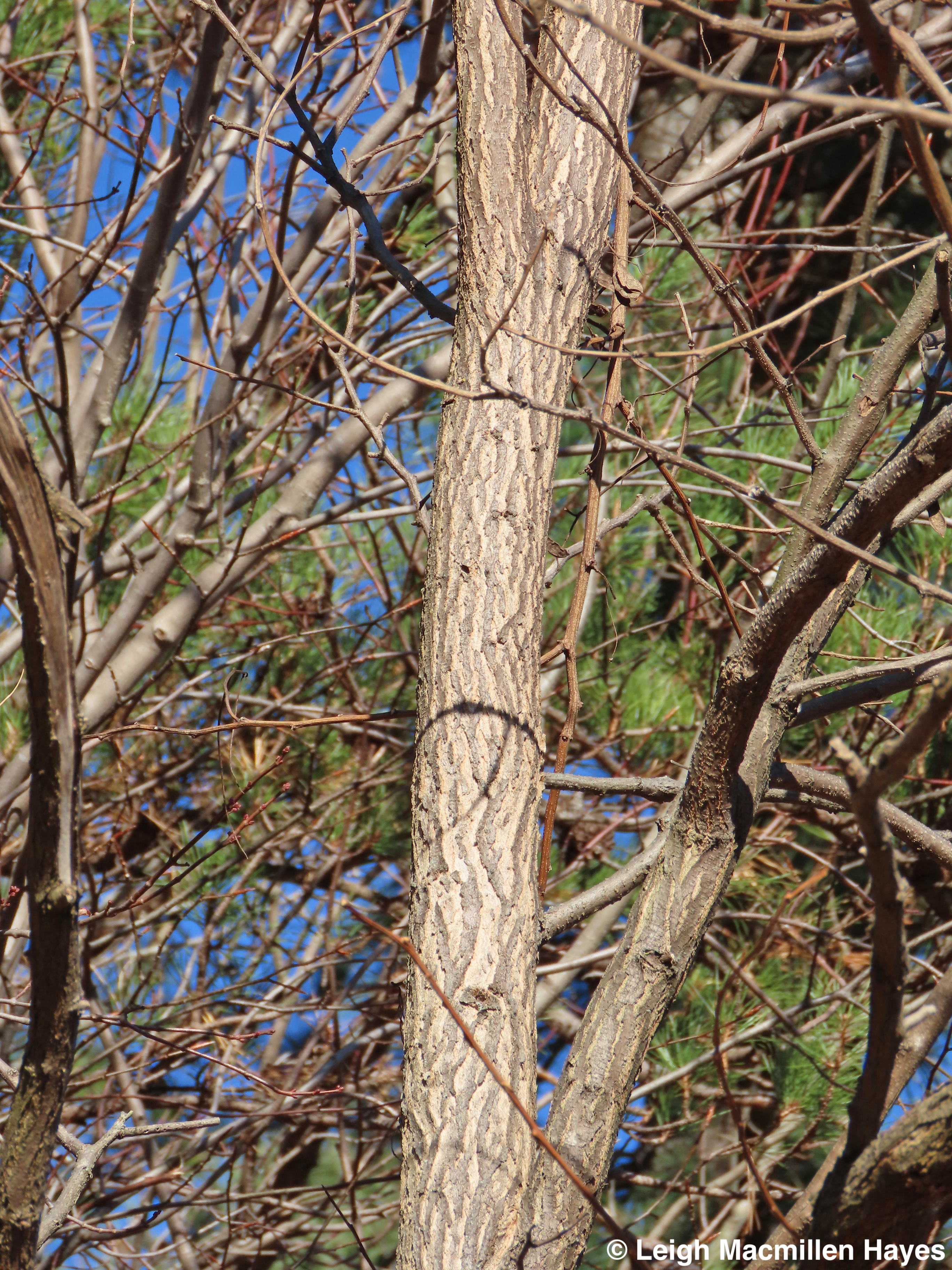
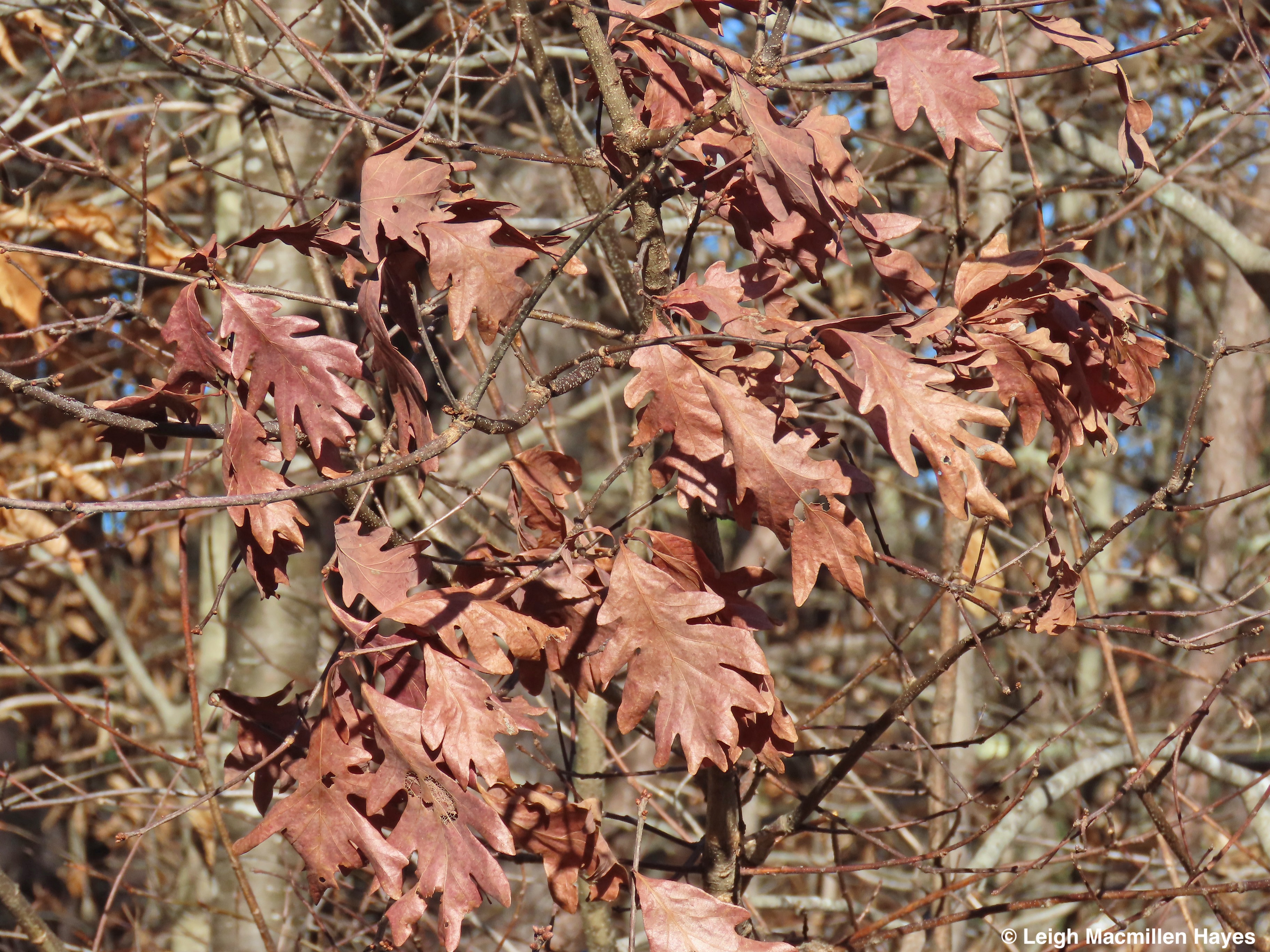
And then there are the oaks, this being the blocky bark of White Oak, which is always a treat for because I have to travel to locate it.

I’ve said it before and I’m sure I’ll say it again, but I LOVE White Oak leaves in their autumn/winter presentation. While they look like mittens with a thousand thumbs, it’s the salmony color and way that they dry on the twig as if they were caught in an awkward dance move that really captures me. Maybe because I can relate to those awkward movements, having never had a sense of rhythm.

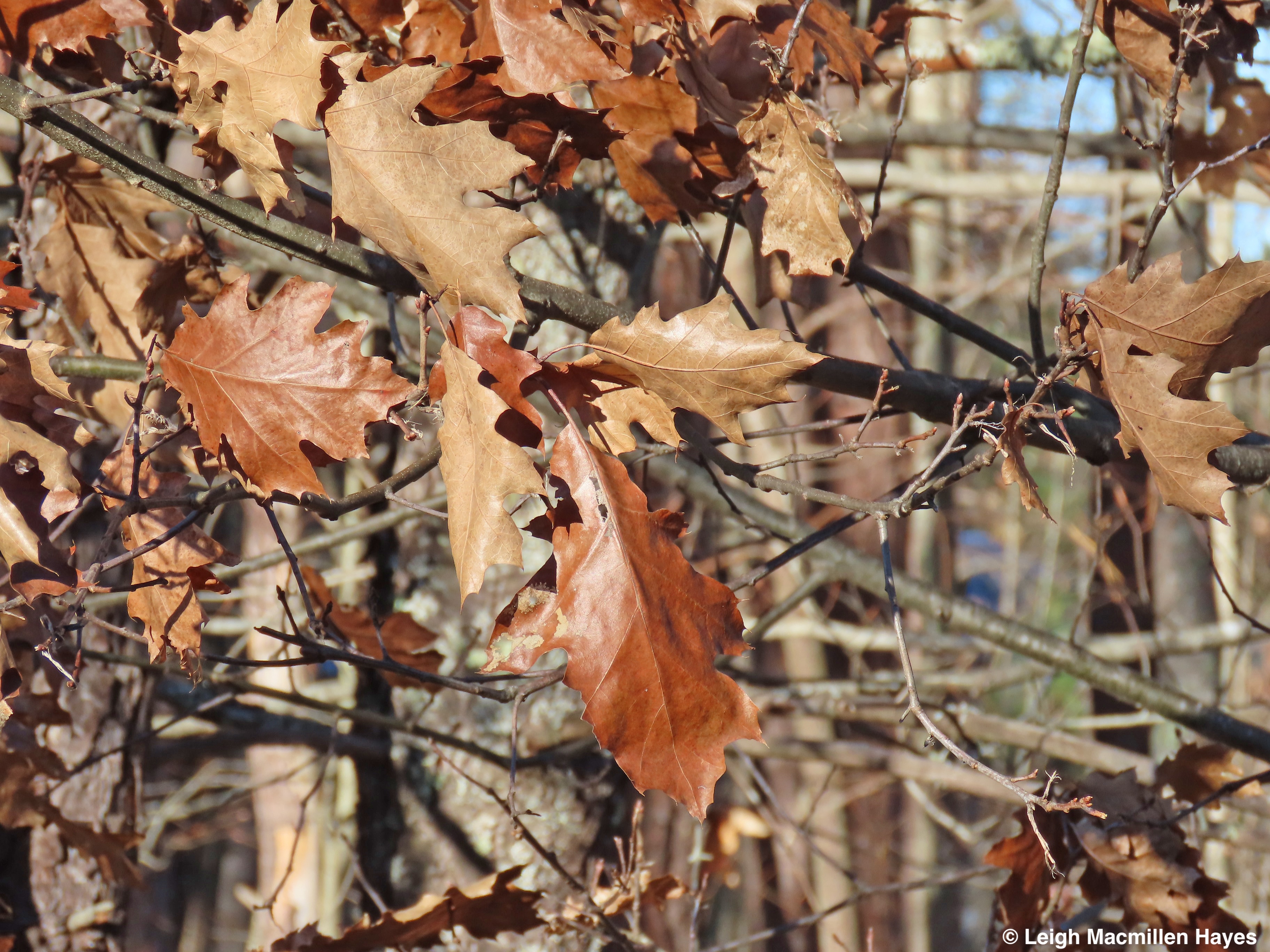
Behold also, the White Oak’s cousin, Northern Red Oak, with its raised ridges offering ski slopes for those who dare, accentuated by the red in the furrows.

It’s like a perfect classroom along the Mountain Division Trail because the bristly lobed leaves of the Red Oak are so shiny in their shade of mahogany.

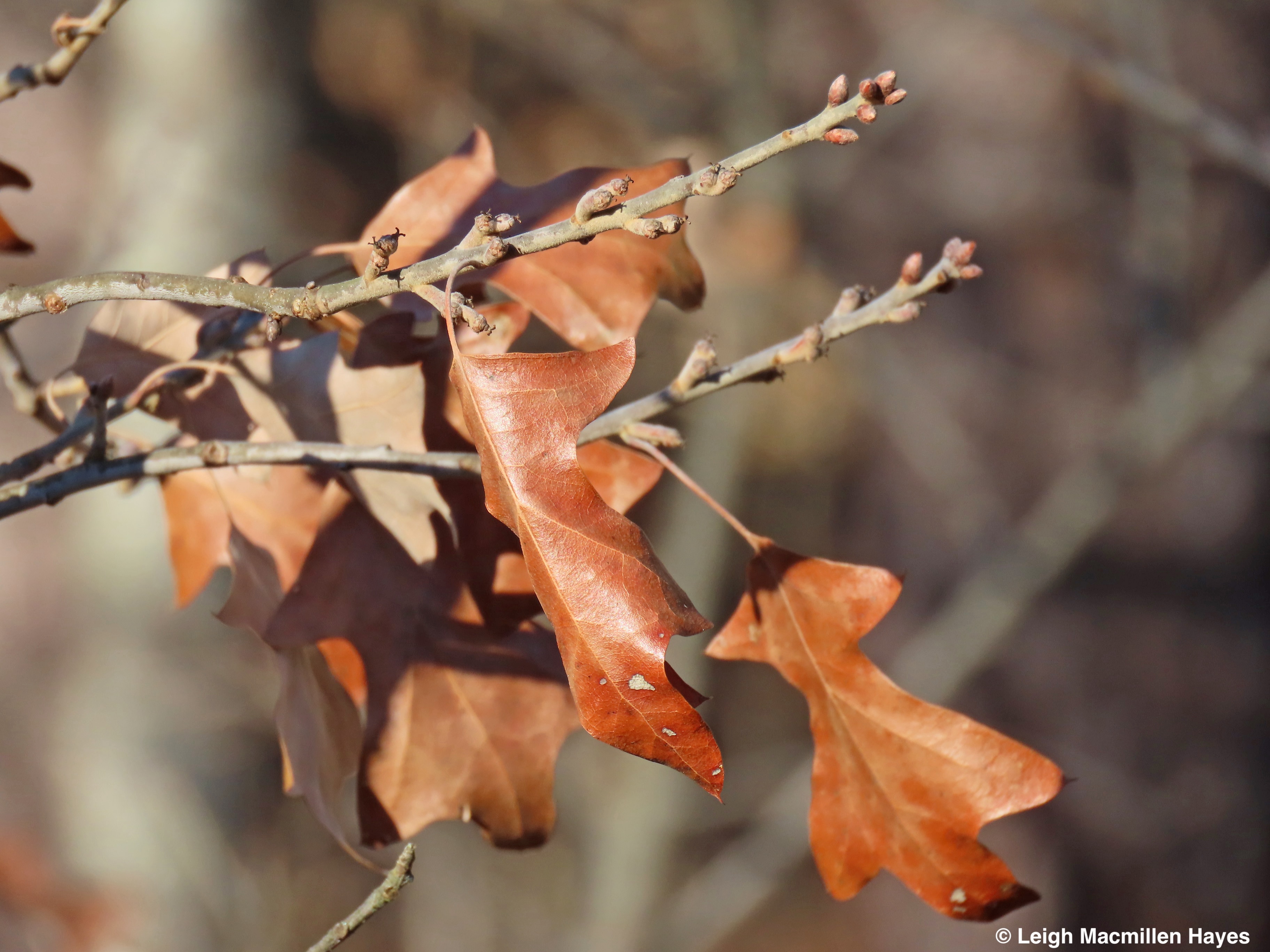
And not to be left out in this lesson: Bear Oak (aka Scrub Oak), growing in a more shrubby manner than the other two. It’s the leaves of this species that remind me who I’m meeting–notice how the second set of lobes from the stem are larger than any of the others.

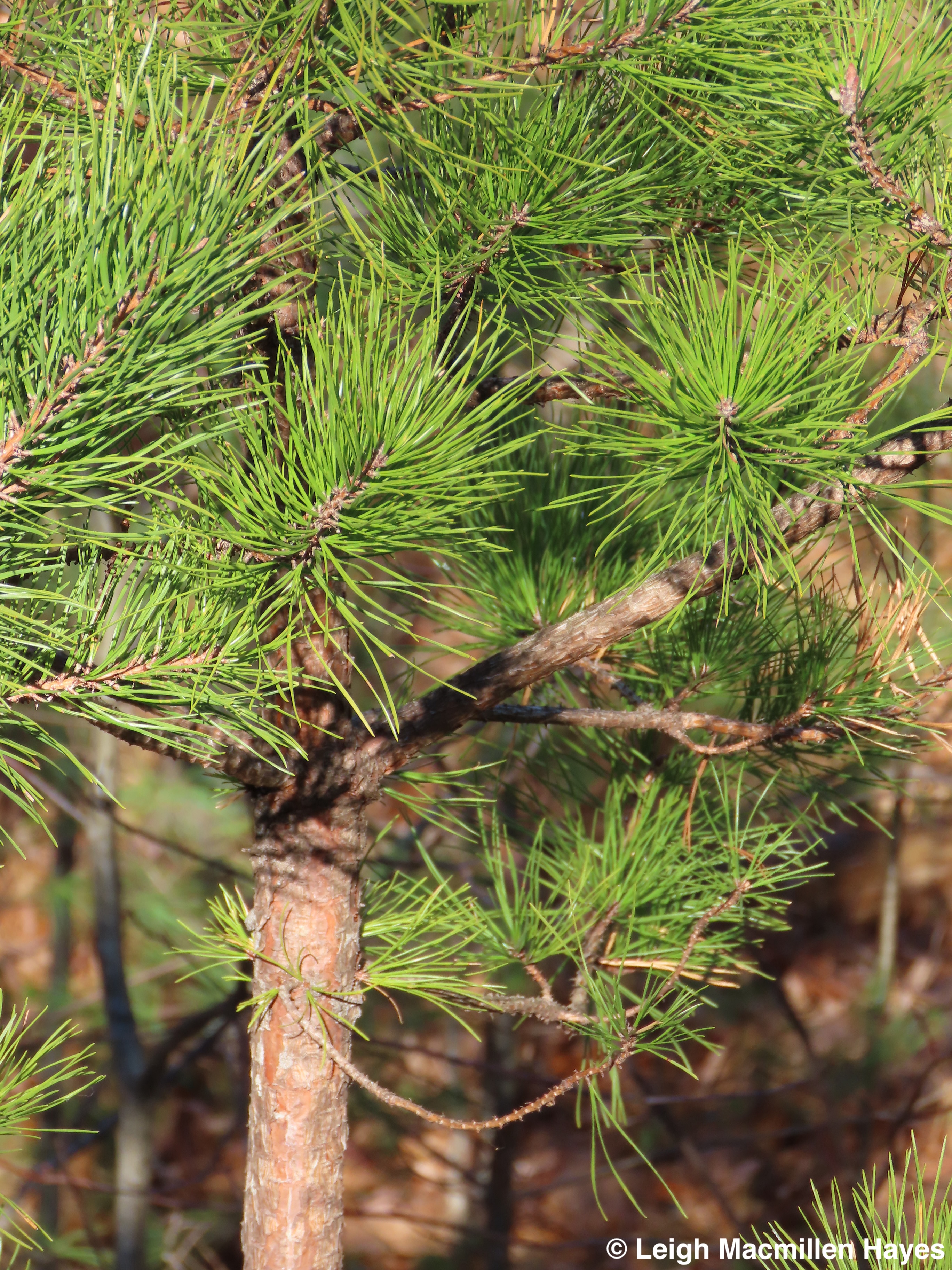
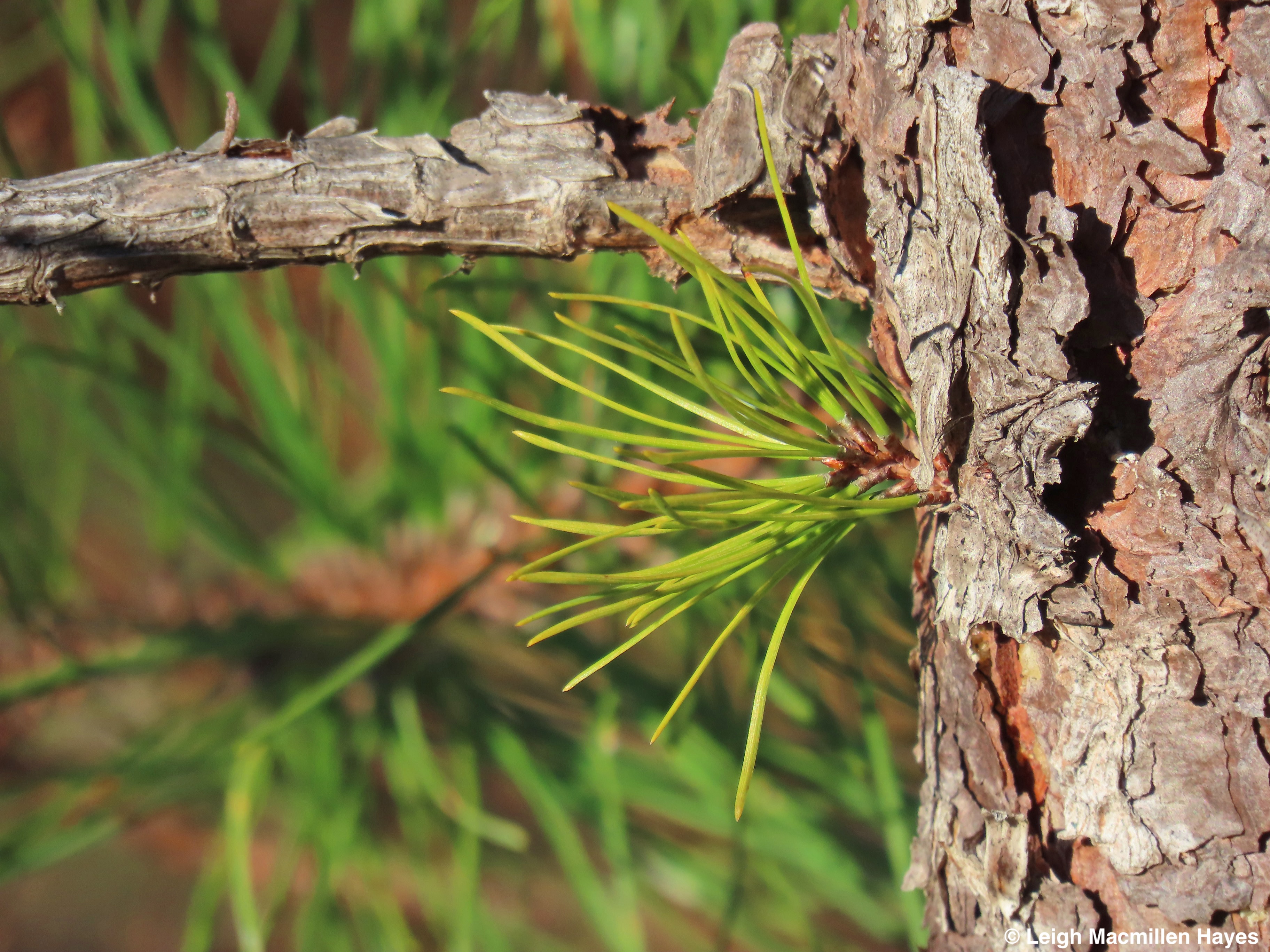
In the mix of deciduous or broad-leafed trees are plenty of conifers, including those we encounter often in this neck of the woods from White Pines to Eastern Hemlocks, and Spruce and Balsam Fir. But . . . there are a couple of standouts along the Mountain Division Trail such as this one with three needles in each bundle.

It’s those bundles of three, and the fact that occasionally a clump of needles grows directly out of the bark rather than on a twig that provide the clues for this species: Pitch Pine, three strikes and you are out. Get it? Baseball–pitch–three needles/bundle. I wish I could take credit for coming up with that mnemonic.

I promised more than one interesting conifer and tada. Only thing is, all the other conifers retain their leaves (needles) throughout the winter, thus giving them the name of Evergreens because they are forever green, even when they are shedding some needles.

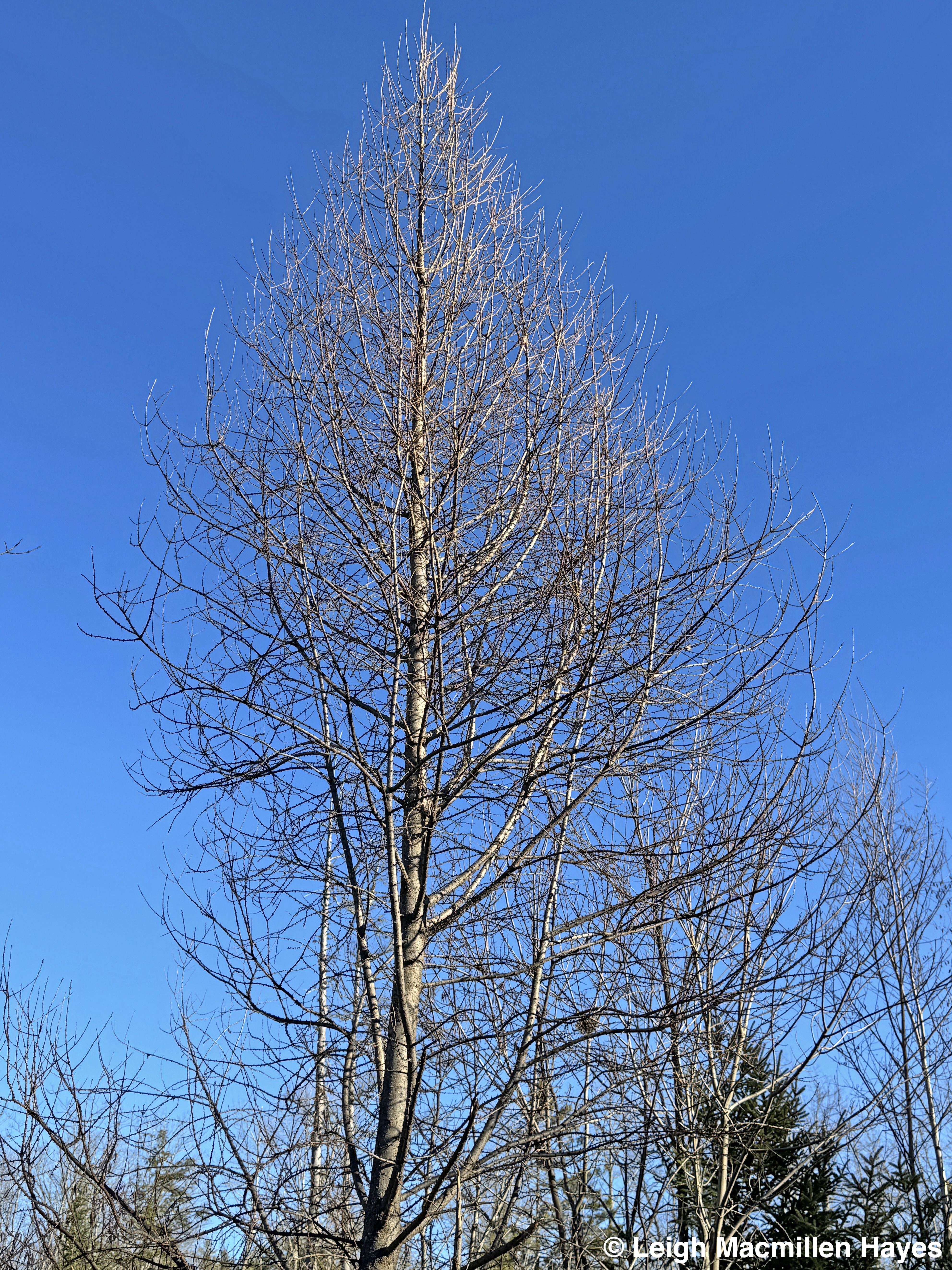
This pyramid-shaped tree is the only deciduous conifer in Maine: the Tamarack (Larch and Hackmatack being its other common names).

Tamarack’s needles turn a golden yellow in autumn, and eventually all fall off. But, it’s a cone-bearing tree, thus it’s a conifer.

Picking up speed now, along the rail grows Great Fox-tail Grass, and its name seems a great descriptor.

Then there’s the Sweet Fern, which isn’t actually a fern for it has a woody stem, but what I love most about it in fall and winter is the way its leaves curl, each doing its own thing.

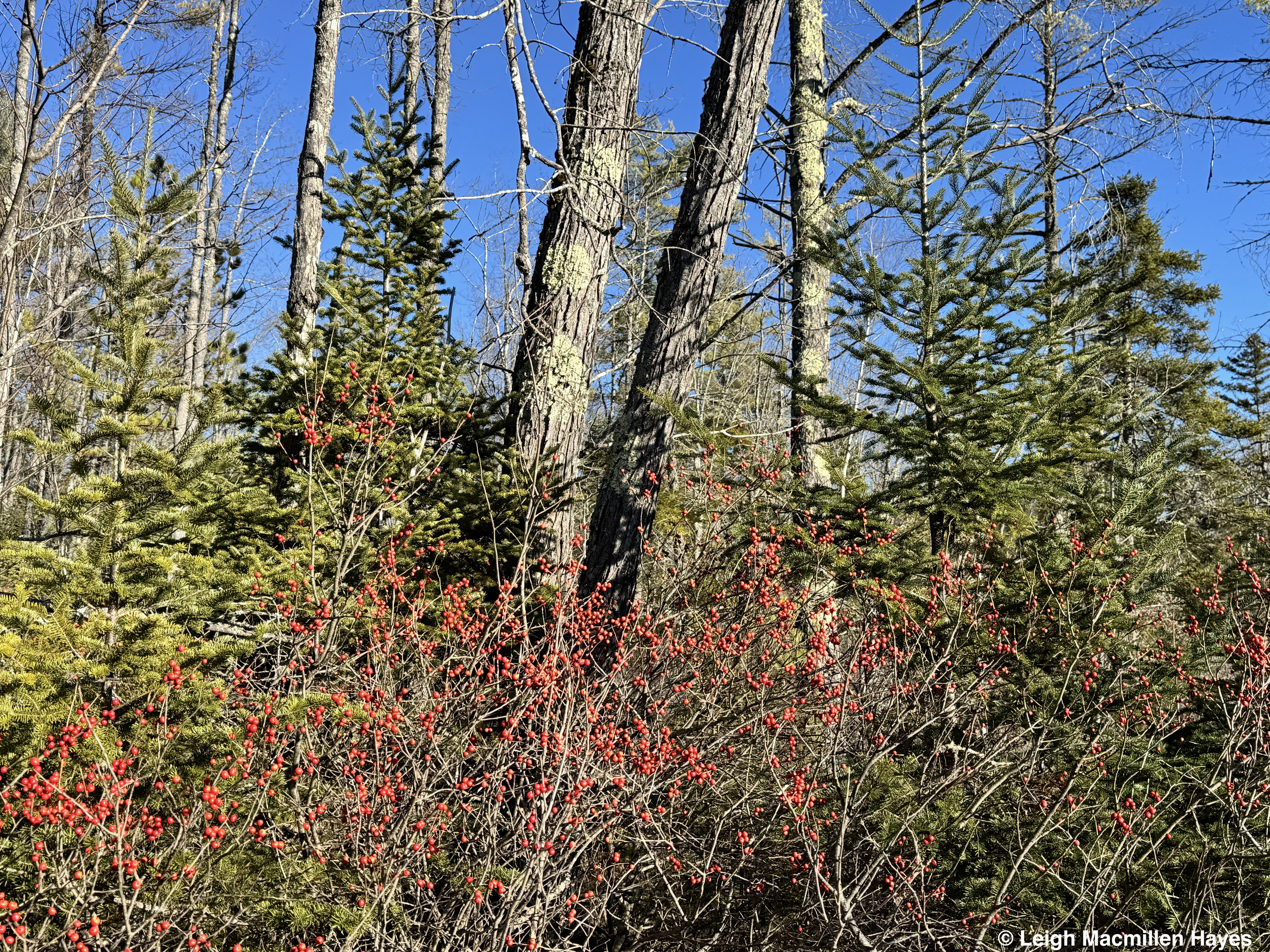
In a wetland, for the habitats vary along the way, Winterberry is now showing off its brilliant red berries. And the Robins are thrilled as are many other birds seeking fruit at this time of year.

Mullein, tall as it stands, has already spread many of its seeds as evidenced by the open pods.

And the same is true for the even taller Evening Primrose.

It’s the fruiting structures of both of these plants that make them beautiful standouts as winter weeds.

Aster seeds are slowly taking their own leave, one hairy parachute at a time.

But here’s the thing. Not all Asters have gone to seed and I was surprised to find several Calico Asters still flowering. Given that the past few days have been quite brisk, this didn’t make sense.

But the same was true for Yarrow.

And I saw a bunch of Blue-stemmed Goldenrods still blooming. While the Asters and Goldenrods flower late in the season, perhaps I shouldn’t have been surprised, except that this past weekend’s wild rain and wind, and temps that felt more like November than we’ve experienced lately, made me question what I was seeing.

I was thrilled as I approached the airport end of the trail to find a few Dog-day Cicada exoskeletons still clinging to the underside of the fence railings. My, what large lobster-like claws you have, the better to dig yourself out of the ground when you are ready to emerge from your root-sap-sucking days to form wings, and fly away, and find a mate.

Because my imaginary train had let me off at Porter Road in Fryeburg, about halfway between the two ends of this four-mile route, I wandered and wondered for about two miles toward the airport end, located just beyond the mileage sign.

Portland: 47 miles away.

But it’s not all rail trail . . . yet.

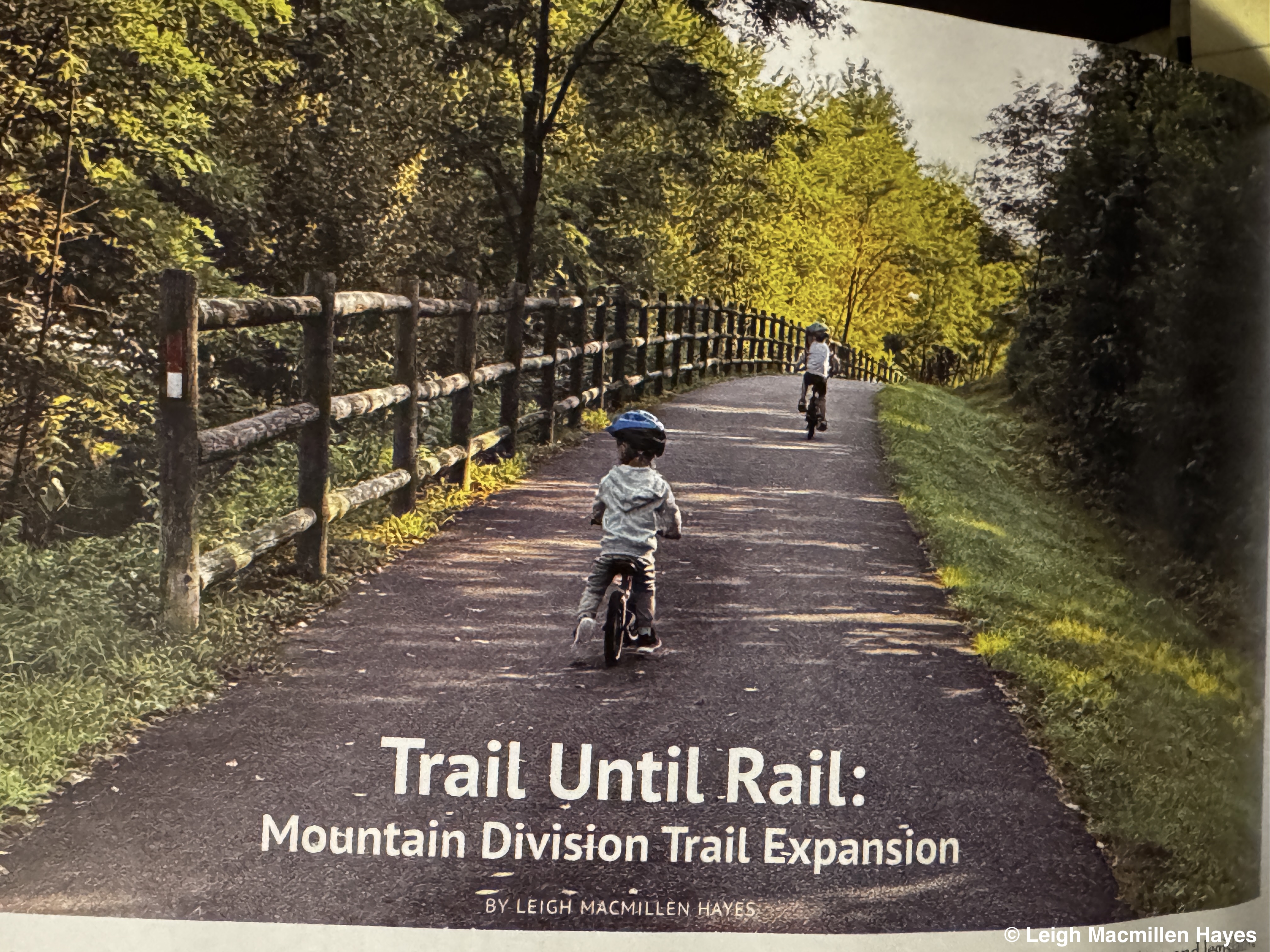
As I looked across Rte 5, I imagined what will happen next. “A twelve-member Mountain Division Rail Use Advisory Council was created in June 2021 to study and review the 31 miles of state-owned, inactive rail line in order to make recommendations for its future use. Frequent meetings occurred . . . at which the civil engineering consulting firm, HNTB, ‘presented feasibility studies for future rail, rail with trail, and interim trail/bikeway use options and economic benefits. It was determined that restoring rail use would cost $60,000,000. For rail with trail, the cost would be $148,300,000. Removing the rails and building a trail until rail, which would keep the rail bed intact so the trail could return to rail if needed, wold cost $19,800,000. The final vote was 11 – 1 in favor of Trail Until Rail . . . After thirty years of work and thanks to the efforts of so many people, on July 6, 2023, Maine Governor Janet Mills signed LD404 into law, authorizing MaineDOT [Department of Transportation] to remove the railroad tracks and construct a 31-mile, multi-use trail until rail on the Mountain Division Rail Line between Fryeburg and Standish . . . Trail Until Rail means that this will be an interim trail because it can be pulled up and the tracks restored to rail should the return of train operations be economically viable. As stated on the alliance’s website: ‘Most major rail corridors are federally protected in perpetuity (that’s forever!). If the tracks ever need to go back in for train service, they will.'” ~ from my article Trail Until Rail: Mountain Division Trail Expansion in published Lake Living, Fall 2024, vol. 17, no. 2.

I turned around by Route 5 and followed the rail with trail back to my truck. Though I’m a hiker, wanderer in the woods by nature, the Mountain Division trail always amazes me with all that it has to offer and today was no different.

If all goes as intended, this 31-mile rail until trail project will be broken into six segments and within two years work will get underway to connect the airport end to this spot by the intersection on Route 160 in Brownfield.

Thanks for taking the time to travel with me today.

Thanks also to Terry Egan, vice president of the Mountain Division Alliance, and Andrew Walton, secretary of the organization, for walking a section of the trail with me several months ago and sharing their stories and visions of this asset to our area.

The Power of Print Indeed

In the spring of 2006, I did one of the bravest things I’ve ever done. Picking up the phone, I dialed the number for Laurie LaMountain, owner, editor, and publisher of Lake Living: Southern Maine’s Leisure Lifestyle Magazine, and told her, um, that I thought, um, she needed an, um, assistant editor.

You see, a few years prior, Laurie had interviewed My Guy about his running career, and in particular about training for marathons (think: 2 Maine in Portland; 2 Marine Corp in D.C.; and 2 Boston, with qualifying time for a third that he never did run due to time conflicts). While I enjoyed the article, I was annoyed because she had spelled my name “Lee” and not “Leigh.” Plus, there were other grammatical errors that I had noticed.

To say I was nervous was an understatement. I wrote (and edited) what I wanted to say, knowing I had to be positive about the magazine at the start and make it personal. I also knew my voice would crack and quiver as I spoke, and it didn’t let me down.

But, I’d gone through a copy of the magazine — with the red pen of my teaching career and made all kinds of edits and suggestions. Toward the end of our phone conversation, Laurie politely said I should share the edited copy with her. Of course, I did.

And she couldn’t believe all the corrections I’d made. She said she’d send me article to edit and I should keep track of my time.

Eighteen years later, I’m still keeping track.

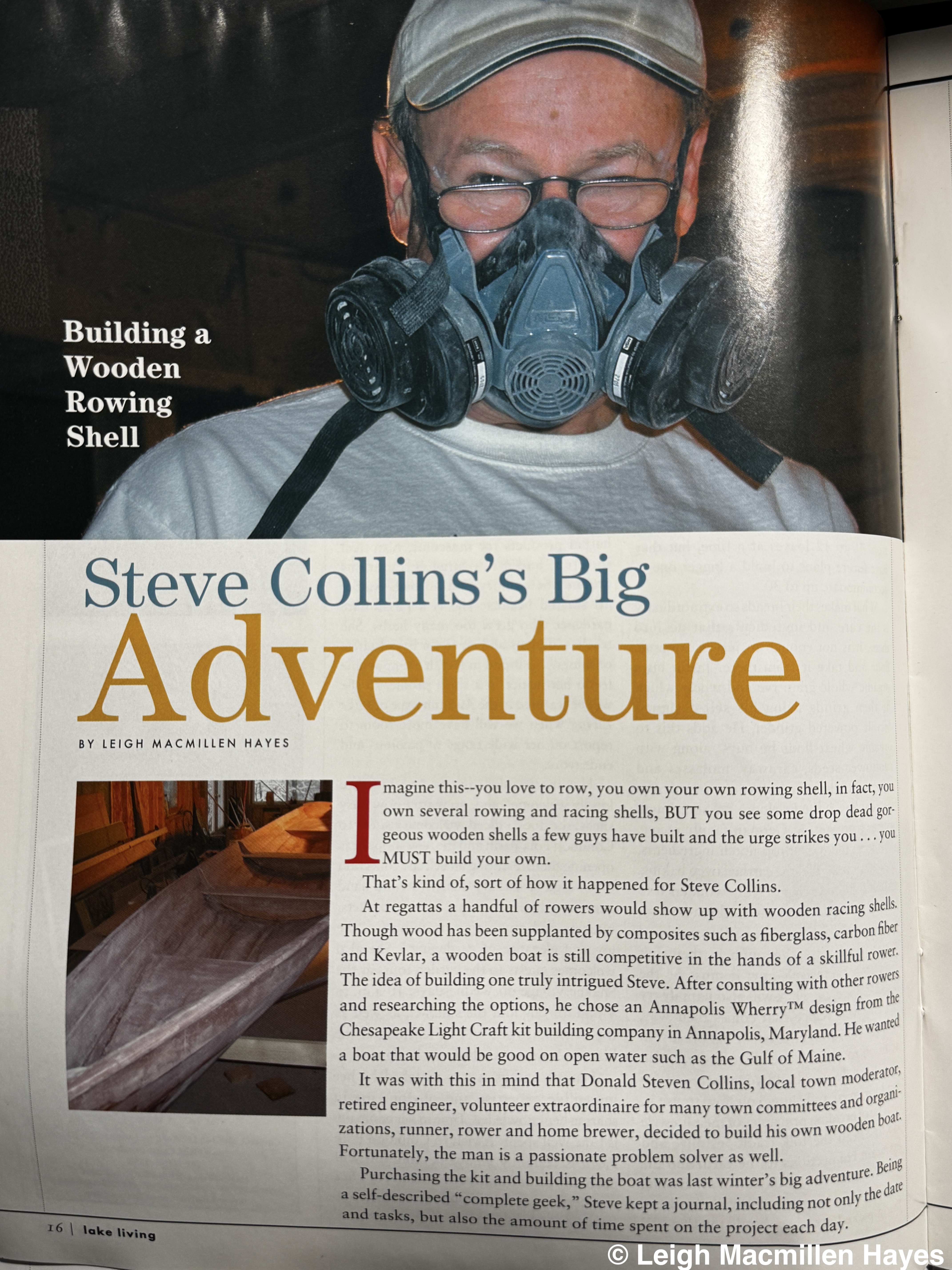
For the next issue, she asked if I had any ideas for articles and I suggested she should contact Steve Collins who had built an Annapolis Wherry® row boat from a kit. Much to my surprise . . . and delight . . . she suggested I interview Steve and write the article.

Sometimes my voice still cracks and quivers when I interview people.

It certainly did during that first interview with Steve, even though we were both serving on a local board, and I’d known him for years, and he and My Guy had trained for the 1st Boston Marathon together.

It’s just that it’s always a step out of my comfort zone to set up a meeting and then actually come face-to-face with the other person, knowing that in the end I had to tell their story they way they envisioned it.

That first article will always be my favorite–maybe because Steve let me borrow and read and quote from his diary of the building process, and watch him at work. Maybe because I really liked how I had organized it, describing his process, but including snippets from the diary. Maybe because it was my first published article in Lake Living.
It certainly wasn’t my last and I’ve had the good pleasure of writing two or three articles per issue. I’ve also had the opportunity to meet so many cool, creative people who call this place home.

In the past week, I’ve been reflecting on the magazine and though I won’t tell you my least favorite articles that I wrote, and I can think of at least two–both interviews with the same person, though about two slightly different topics, I will share a few that stand out.

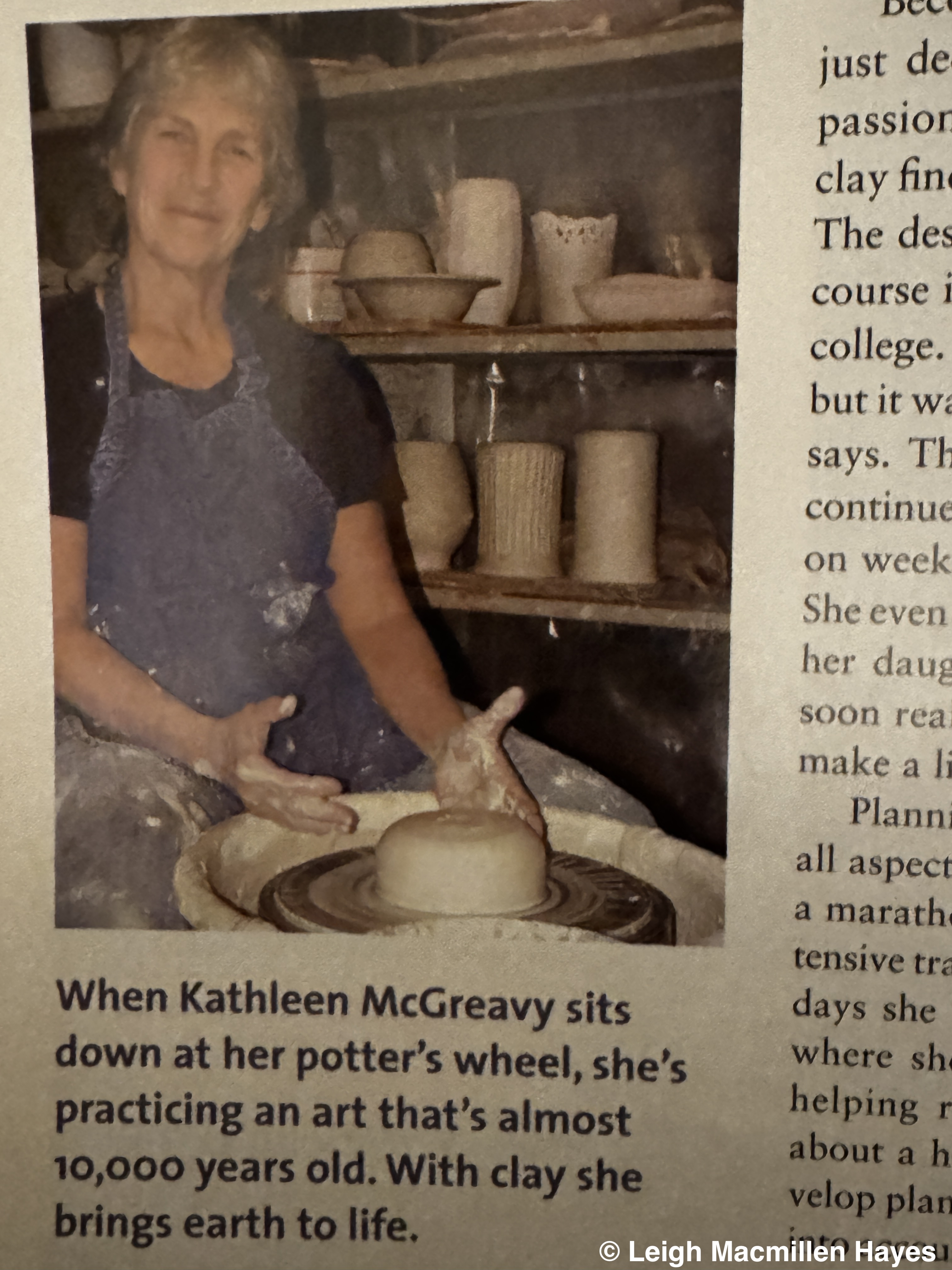
One was entitled “Bringing Earth to Life,” about Kathleen (Kathy) McGreavy, a potter from Brownfield we featured in Spring 2010. There were two memorable things about researching and writing that article: 1) Kathy let me throw a pot on the wheel, which she later finished, glazed, and gave to me.

It now holds some gear on my desk; and 2) I developed the article around the different steps of creating art on a potter’s wheel, beginning with wedging and continuing on through centering, opening and pulling, etc., and thought I was incredibly clever.

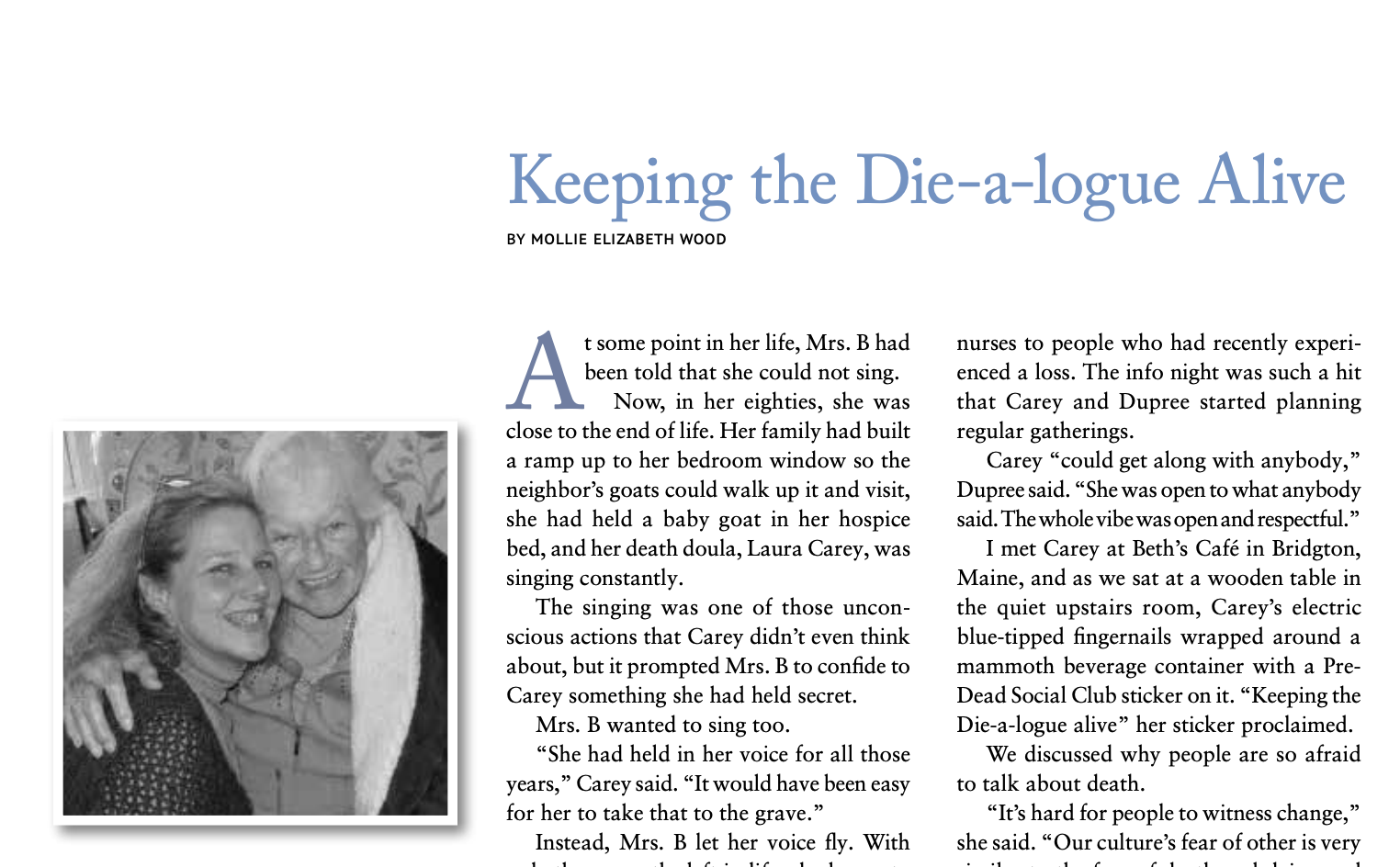
For the Winter 2013 issue, I wrote about a soul-filled choir–an a cappella group of women and men who sing for the terminally ill or those on the threshold between life and death, and their families. What was so special about that interview was that they invited me to sit in the center of their group. “I closed my eyes and suddenly I was surrounded with a cadence of voices in three part harmony singing ‘River of Jordan.’ I felt as if I was softly embraced by a warm blanket.” The memory still warms my heart.

There have been so many others, but the list is too long.

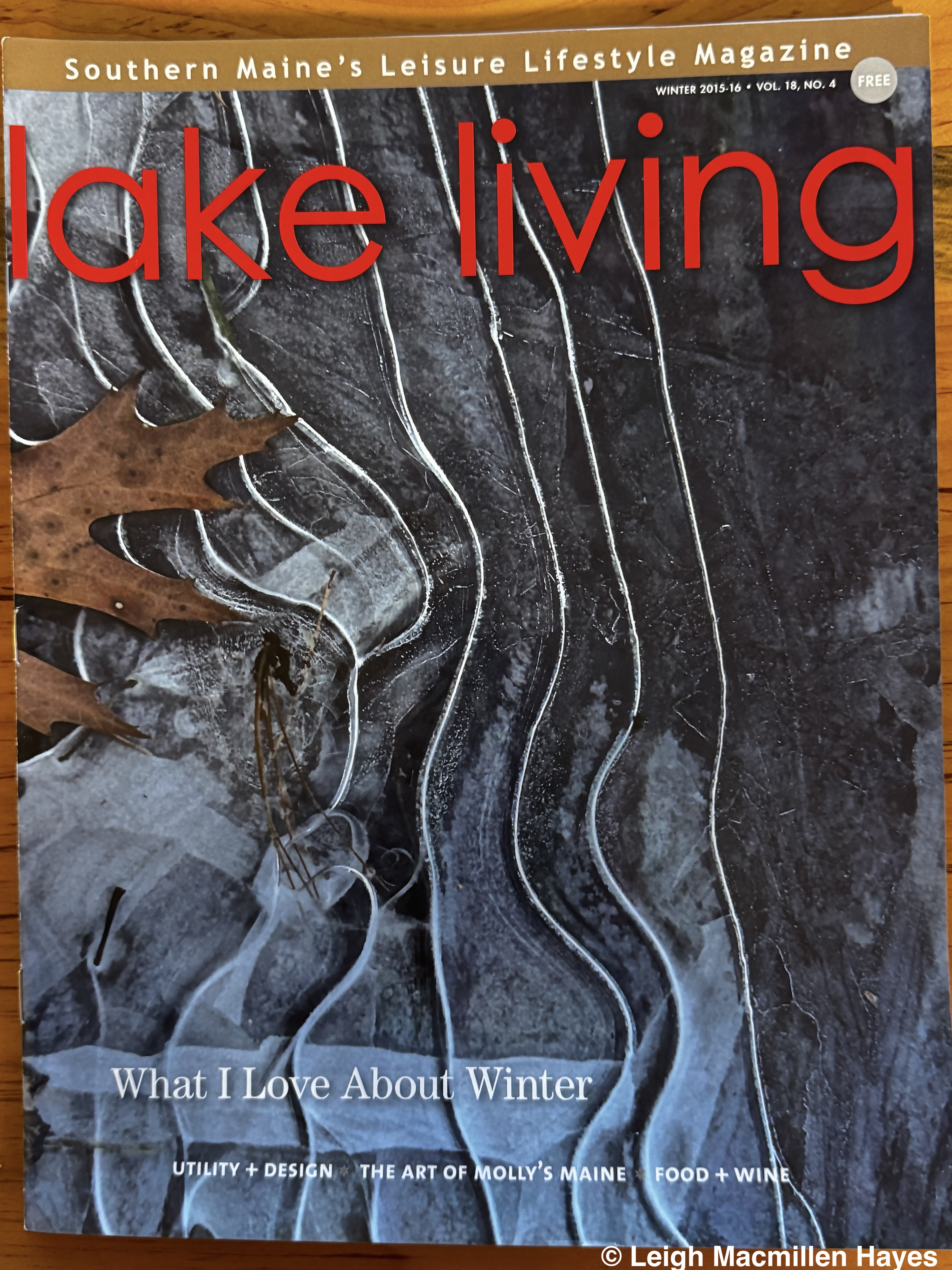
It was also a thrill to have a cover shot or two chosen from my many offerings, including this from Winter 2015-16.

And I do have to say I kinda like the article “What I Love About Winter” that appeared in that particular magazine. Things haven’t changed. “And the more time I spend outside, the more I love it [winter]. It’s not just the cool, crisp air that I find so exhilarating. During this season, the landscape reveals itself and all its complexities. Intense color gives way to details I may dismiss in other seasons . . . ”

All of this brings me ’round to the latest issue of Lake Living. If you’ve kept track since the start of wondermyway.com in 2015, you may have noticed that pre-COVID we published four issues a year. All that changed in 2020. This is a free magazine, which means advertisers are needed to pay for printing and distribution . . . and even me and my efforts!

With the onset of the pandemic it became difficult for Laurie to get advertisers (I’m proud to say My Guy has always advertised in the mag) and so we cut back to two issues: Summer and fall/winter.

This latest issue is probably the last.

Yes, let that sink in for a minute. You read it correctly.

Laurie is ready to retire. And it would be sweet if she could find a buyer.

I shall miss it.

I shall miss long conversations with Laurie where we first catch up with each other and our families and other interests, and then get down to the business of brainstorming as we bounce ideas around and laugh and talk and ask questions and toss presumed answers into the mix. It’s often out of these sessions that we notice a theme begin to emerge.

I shall miss seeking out all the people who do such interesting work in our communities and help make them thrive, despite my nerves when talking to them.

I shall miss the excitement of opening the final product–that smell of hot-of-the-press paper on crisp pages with fantastic layout created by Laurie and graphic designer Dianne Lewis.

What I won’t miss is opening the pages and realizing I’d missed a spelling or punctuation error or something else. But then again, I remind myself that only God is perfect and probably (I hope) only a handful of grammar police are on duty at any given time.

All of this said, dear readers, and now I present to you Fall 2024, vol 27. no 2.

Be sure to read my article about the Mountain Division Trail expansion coming our way soon. While writing this, I got to meet Andrew and Terry and Andrew’s young sons and learn about two incredibly involved people who care passionately about their respective communities and are volunteers extraordinaire.

Read also “Finding Rhythm in Weaving,” an article in which I not only learned a whole new technique, but also had the opportunity to get to know a fellow Episcopalian parishioner better.

You’ll find it here: Lake Living Fall 2024.

Be sure to read Laurie’s article, “In Praise of Print.” It’s her good-bye note after 27 years of creating this magazine that so many have come to love.

We know we’ve grown through this experience and hope the same has been true for you.

In praise of print indeed.

Lake Living & Maine Natural History Observatory

Two. Two publications this week. I’m always excited when the first appears on a local store shelf, but to have a featured article in the second as well (for the third time) is equally thrilling. Also scary. Why? Cuze once you put yourself out there you are out there and there are others out there just waiting to let you know how you erred. And if you know me, I err a lot. But it’s actually a good thing because it’s a humbling reminder that I’m not perfect. Thank goodness. That said, you don’t need to remind me–just sayin’.

So, take a gander and I hope you enjoy the reads. My two articles for Lake Living magazine are the first two in this issue.

The first is about the Bridgton and Saco River Railroad Museum that six young men are working to develop in Bridgton to commemorate the Narrow Gauge Railroad. I won’t give away any more of the story, but my hats go off to these guys and their passion and all of their efforts to make a dream come true.

My second article is about TimberNook Western Maine, a program set up to encourage kids to get outside and play. For hours. With varied age groups. Sometimes during school hours. Because play, and especially deep play, which it takes a bit of time to enter, are a critical part of growing up and interacting with others and the natural world. I have to say that before I sat in on a couple of sessions, I wasn’t so sure about this program–I mean, I’ve spent the last however many years playing with kids in nature, but teaching them about nature along the way, and this program is set up to let kids learn without too much adult intervention. And after watching the action and talking with kids and adults, I am now a huge fan of TimberNook and hope to sit in on more sessions, maybe as a volunteer.
There’s so much more in the magazine ranging from an article by Perri Black about birth and death; another by Laurie LaMountain about dock lights invented by the guys at Great Northern Docks; plus an appreciation of laundry by Suzanne Richards; book reviews from our friends at Bridgton Books; and some summer recipes by Perri. And the list of things to do and places to go–locally, of course.

It’s all right here, just a click away: https://www.lakelivingmaine.com/

Switching gears, I submitted an article about Dog-day Cicadas to the Maine Natural History Observer and was tickled to have it accepted.

According to their website: Maine Natural History Observatory’s mission is to improve the understanding of natural resources in Maine by compiling historic information and implementing inventory and monitoring efforts of Maine’s natural history.

The Observatory specializes in collecting, interpreting, and maintaining datasets crucial for understanding changes in Maine’s plant and wildlife populations. We are committed to filling data gaps for Maine’s least understood species and creating a legacy of data for use in nature conservation, land use policy decisions, and expanding scientific knowledge.

Specifically, our mission is to:

  • Compile and publish summaries of Maine’s natural history
  • Coordinate local and regional inventory and monitoring efforts of Maine’s flora, fauna, and habitats
  • Facilitate cooperation and exchange of information among organizations, agencies, and individuals conducting natural history research in Maine or caring for natural history collections
  • Engage in other activities related to the advancement of scientific knowledge and education of the public regarding the flora, fauna, and habitats of Maine.

As some of you know, one of my favorite summer activities is to watch Dog-day Cicadas emerge from their underground life and watch as they shed old skin for new before flying up into tree tops to sing love songs. I know of a couple of local cemeteries where I can usually watch the action and it’s even better when I can introduce someone else to the experience. But, not everyone can join me so in this article, I hope it feels like you are along for the journey.

It looks something like this:

You can read the entire article and a variety of others by clicking on the link: Maine Natural History Observer

Lots of cool stuff to read about. And if you do live locally, Lake Living is on a store shelf near you–up and down the Rte 302 corridor, plus north to Norway and Bethel, and south to at least Cornish.

Grab a copy and don’t forget to support our advertisers. They are the ones who pay so that you can pick up a free copy of the magazine. There’s one advertiser in particular that is close to my heart and I’d love to have you support. ;-)

Lake Living magazine, Fall/Winter 2023

It takes us several months to toss ideas around, set up and conduct interviews, and then let the writing process play out. The latter is among my favorite activities because it takes work to figure out how to present the topic and because people are passionate about their subject and share a lot more in an interview than we need, as writers we have to get to the gist of it and then hone, and hone, and hone some more. Even the final published piece is not really the final draft because always, at least when I read what I’ve written, there are things I would change or other words I wished I’d used or examples I wish I’d given. But . . .

With all that said, I present to you the Fall/Winter issue of Lake Living magazine, which is in its 26th year of publication (and I give great thanks that I’ve been privileged to write for and work on the magazine staff since 2006).

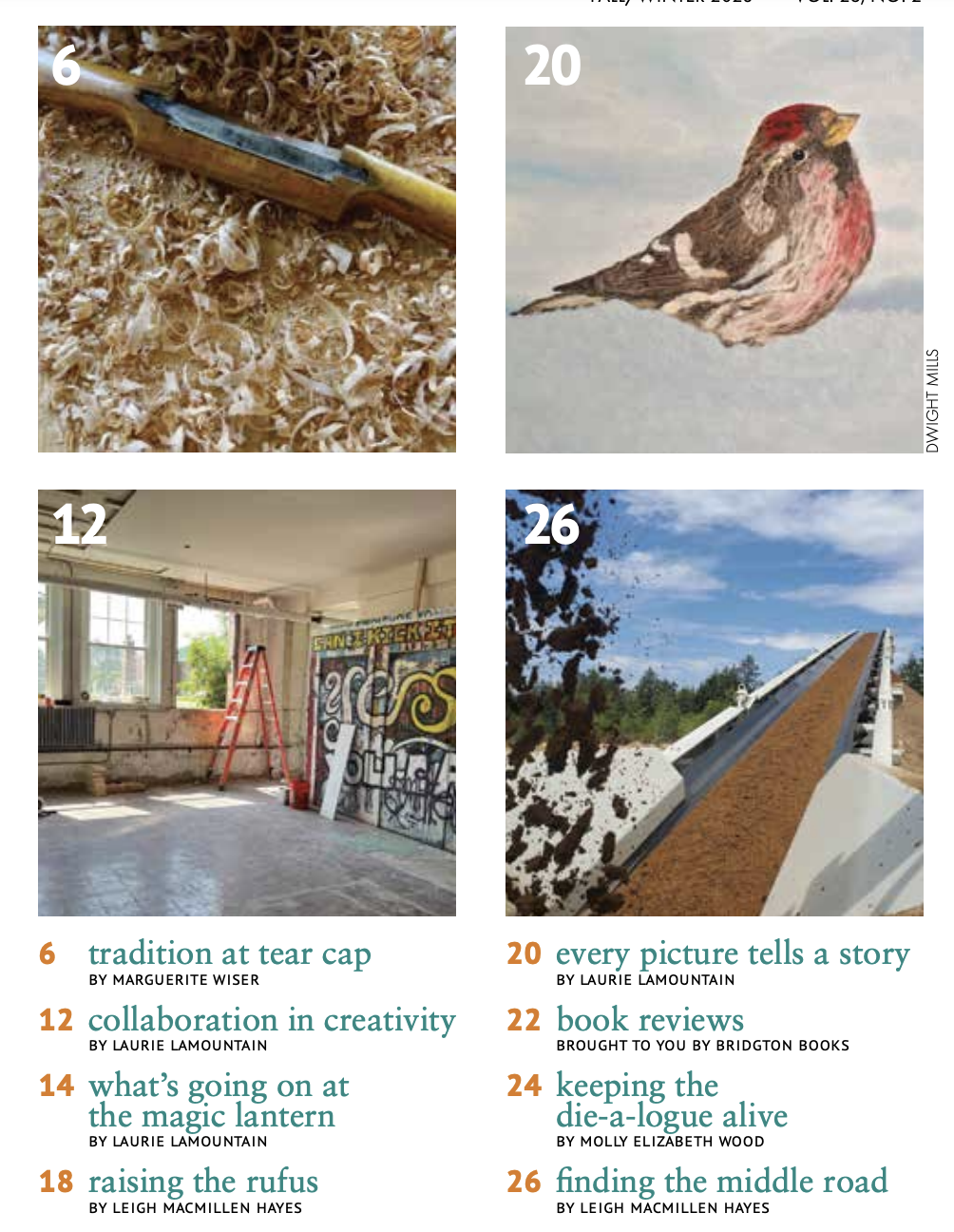
And the table of contents:

The cover photo and lead article were written by Marguerite Wiser, a young woman of many talents. Marguerite has written several articles for Lake Living in the last few years and it’s great to have her voice in the mix.

Tear Cap, as you’ll discover upon reading the article, is about a collaborative effort that celebrates community in an old mill in Hiram, Maine.

Editor and publisher Laurie LaMountain has written about Ian Factor’s studio in Bridgton in a previous issue, but now Ian has taken his work a step further and you can read all about what he’s bringing to Fryeburg Academy students in Fryeburg, Maine.

Laurie wrote several other articles as you can see from the table of contents, one about the Magic Lantern and their STEM programs, and another about an interesting painter who captured her whimsy with his own sense of whimsy. When we chatted on the phone after she’d interviewed Dwight Mills, I could tell she most jazzed about the man.

A new contributor to this issue was Mollie Elizabeth Wood. When I heard about her topic, my gut reaction was, “Really? For Lake Living?” But, you’ve got to read this article. It’s incredibly well written and brings death to the forefront, because, after all, it’s on the horizon for all of us.

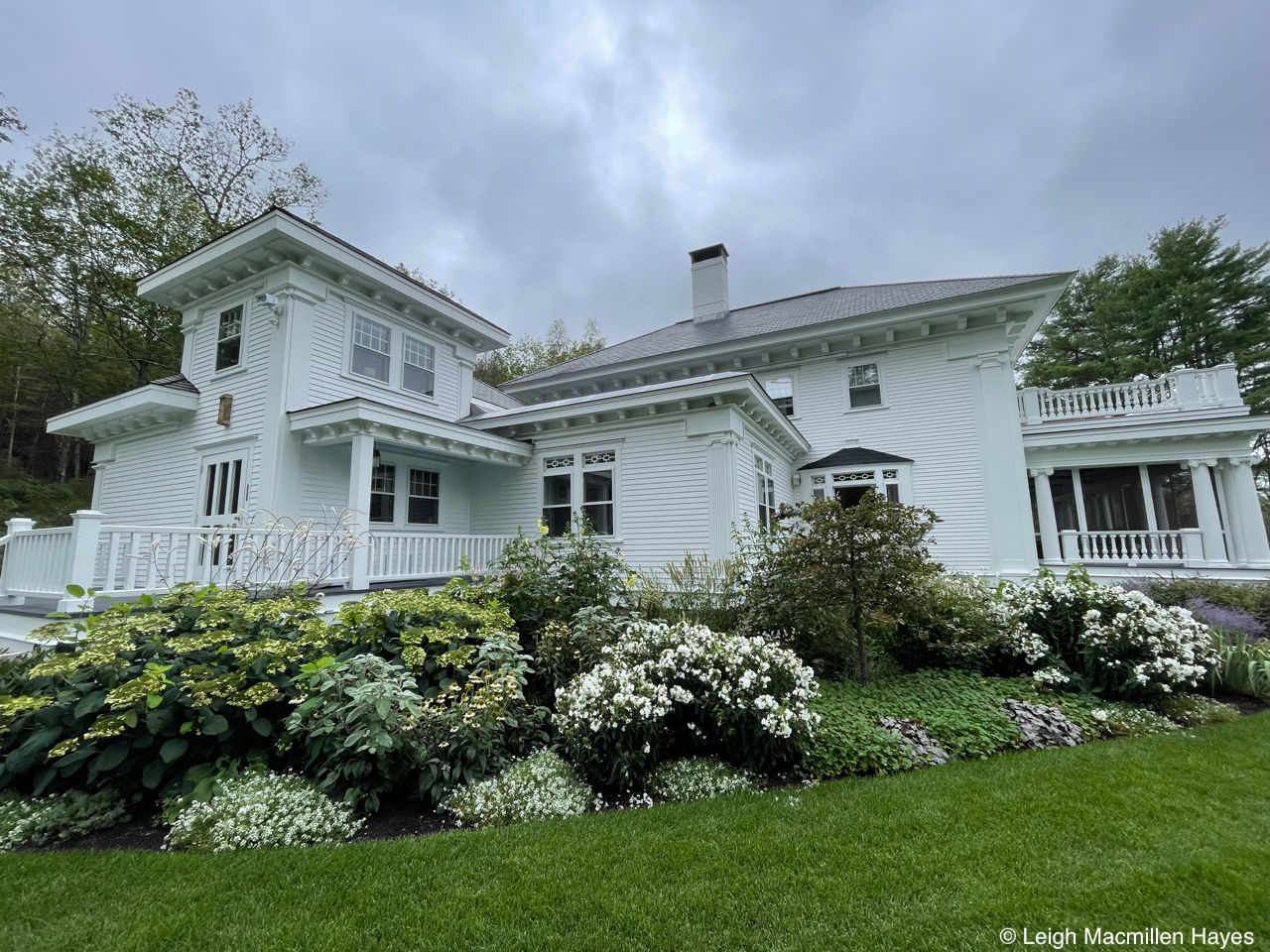
One of my articles is about a new building currently under construction at the Rufus Porter Museum in Bridgton, Maine. If you are a long time follower of wondermyway.com, you may recall the day the community walked the Church Building at the museum down Main Street. If you are new to wmw.com or have a memory like mine, here’s the link: Walking with Rufus Porter. Now, the campus is growing and it’s an exciting addition to town.

Pre-pandemic, when advertisers were more abundant, and publishing costs were lower, we published Lake Living four times/year and in the fall and spring issues you could find book reviews from the owners and staff of Bridgton Books, an independent book store. Above are Justin Ward’s picks from the bookshelf.

Now, we only publish two issues, so in each one you can see what they recommended each time you pick up a copy of the magazine. These are Perri’s Preferences.

This last article resonated with me because it’s about two people from different sides of the table who sat down to chat and realized they have a lot in common and figured out a way to work together. Rex Rolfe of Rolfe Corporation in Bridgton, owns an aggregate /excavation business, and Erika Rowland is the former Executive Director at Greater Lovell Land Trust, where I also work.

This past summer, a small group of us stood in one of Rex’s pits that abuts land trust property, and the two shared their story. It’s what got me thinking that we need to educate others about this topic.

Oh, and that pile of sand behind Rex–it’ll help keep you from sliding on local roads when the snow finally flies this winter as town trucks have been going in and out recently to fill their storage facilities.

When we came up with the editorial list for this issue I thought, “Well, this one doesn’t seem to have a theme,” but as Laurie wrote in her editor’s notes on page 4, “Community, connection, collaboraton, creativity–these are the concepts that thread through this issue of Lake Living . . . they are the hallmarks of where we live . . . ”

And on October 10, Laurie received this message from a reader:

I leave you all with an image of Rex Rolfe’s toy collection and hope that you’ll take the time to brew a cup of tea and sit down with the magazine and enjoy all that is within its covers . . . and then support the advertisers so we can continue to bring this to you for free!

Here’s a link to the whole shebang: Lake Living magazine

Lake Living Summer Issue 2023

With twists and turns along the way, somehow we once again pulled off a summer issue of Lake Living magazine.

This one is super cool because not only are all the articles written by women, but they each feature women. And one was actually written by a high school student; while another is about an fabulous twenties-something naturalist who is also an artist. I wrote an article about the middle school class I have the pleasure of working with each week during the school year. And another about Maine women who support an incredible group of women in Zambia. There’s another about The Summer Camp, a camp for girls from Maine and beyond who are at-risk (and an organization I worked for years ago). Plus, there’s one about mushrooms, because as most of us know, mushrooms are most intriguing. The issue also includes everyone’s favorites: The Summer Bookshelf list of recommendations by the owners and staff of Bridgton Books.

I hope you’ll take some time to savor this issue. And I hope this link works as intended because we don’t have it on the Lake Living website yet and that may take a bit.

Read it here: Lake Living Summer 2023

Lake Living Magazine, Fall/Winter 2022-23

Smack dab in the midst of a hectic work schedule, we pulled off another issue of the mag. And I have to say, I really loved working on this one. As did Laurie LaMountain.

It’s full of history, both local as I had the fortune to visit with Louisa Attenborough at the Garcelon mansion on Kezar Lake in Lovell, and across the pond (read the intros to the recipes in “One Potato, Two Potato”).

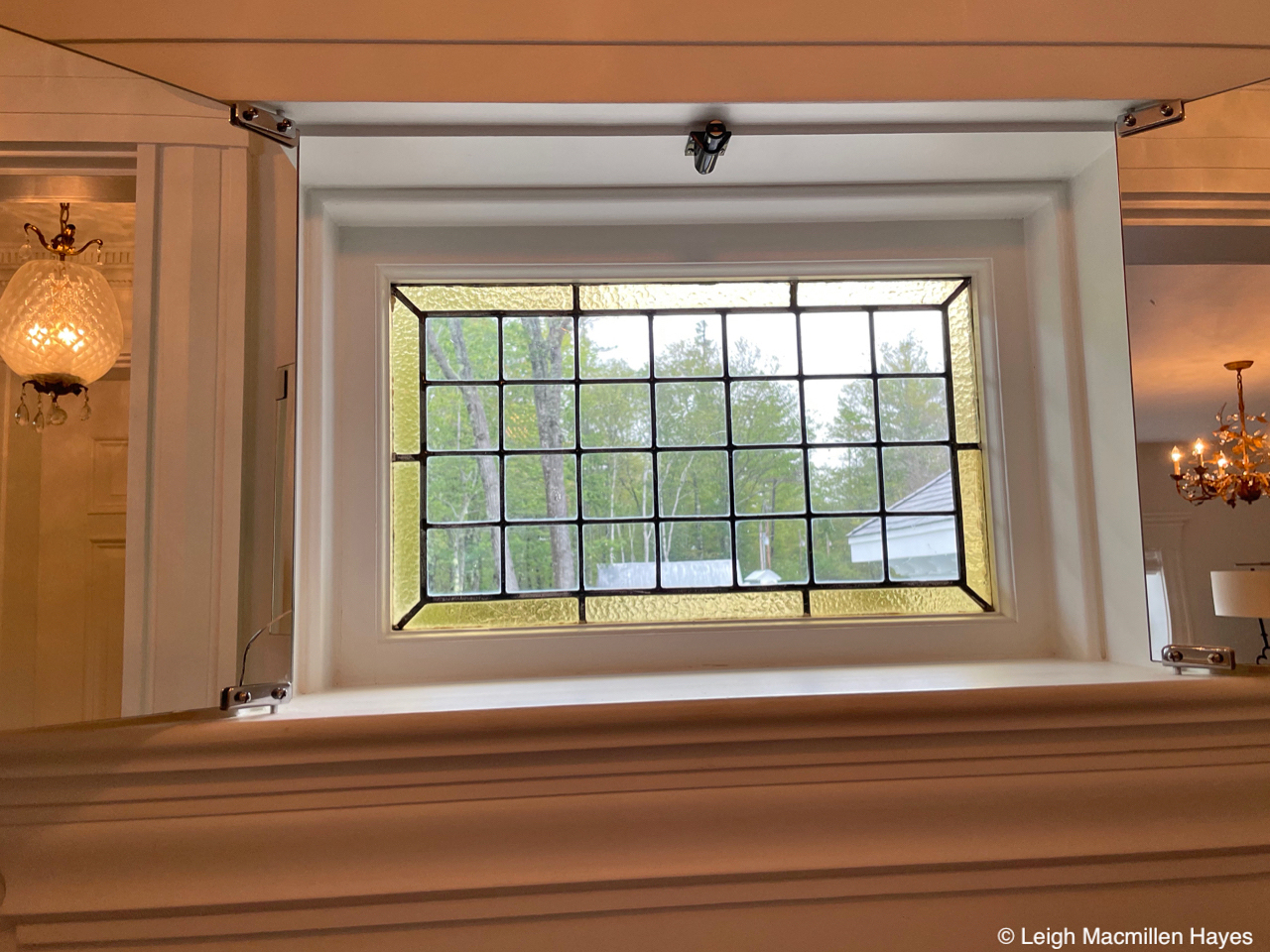
Here’s an exclusive look at a bathroom window at Garcelon, flanked by mirrors that reflect the lights in the room and in the bedroom beyond.

And a side view not included in the article. The servants’ quarters, circa 1908, were in the upper-left hand corner.

Another of my articles is about the big reveal at our local ski area, which was purchased last year by Boyne Resorts. According to general manager Ralph Lewis, lots of updates have been made since the ski area closed in the spring, but the biggest one is the name change, which excites many of us. You can read all about it in “Welcome Back Pleasant Mountain.”

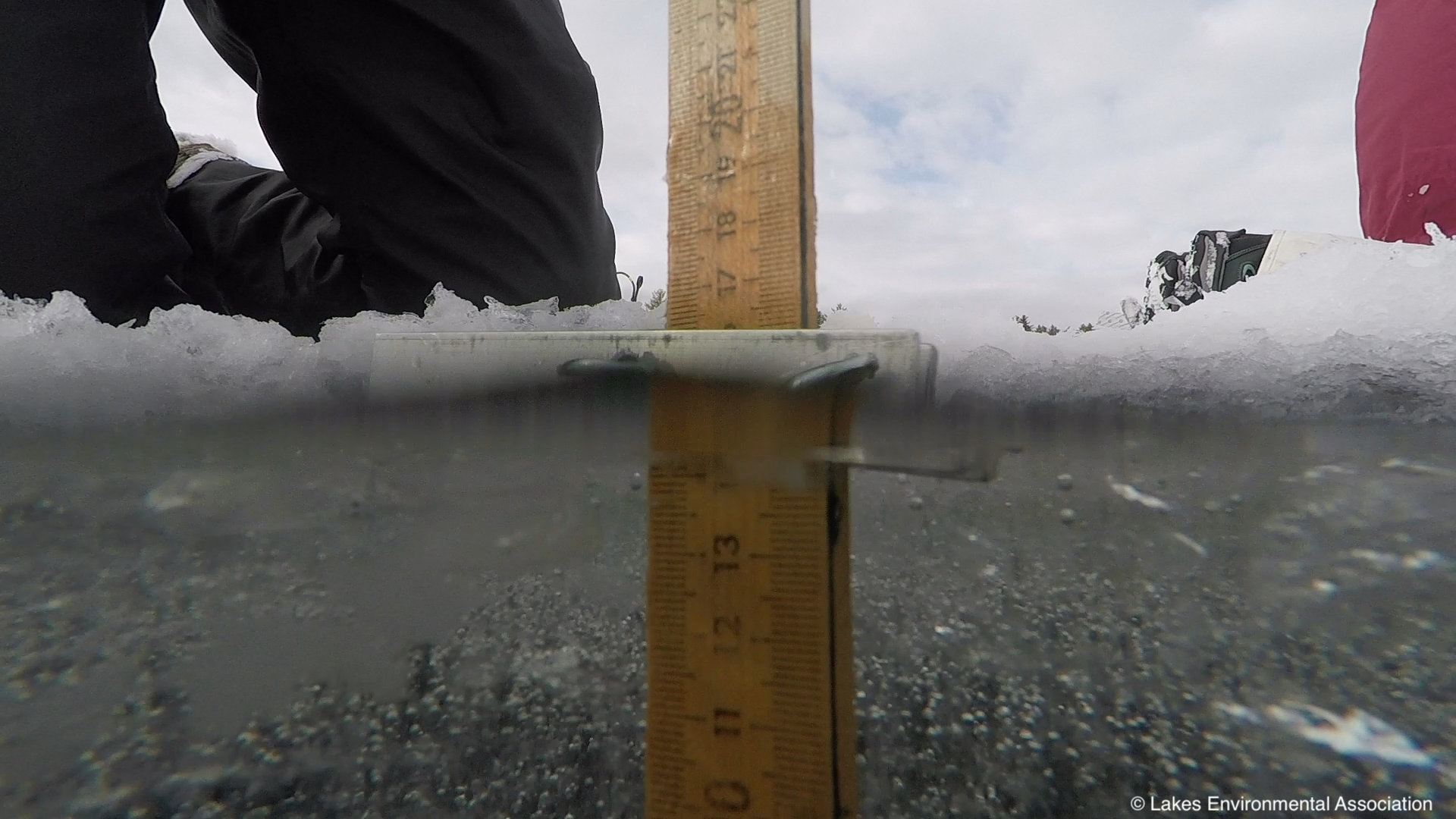
My third, and probably favorite article is entitled “Life Beneath the Ice,” which features the work of fellow Maine Master Naturalist Edwin Barkdoll and his discoveries as he worked on a capstone project, and Dr. Ben Peierls of Lakes Environmental Association.

“A calm winter day. Freezing temps. Thickening ice. A lid is placed on the ecosystem below. And all aquatic life goes dormant. Or does it?” You’ll have to read the article to find out.

So here’s a look at the cover, and a view of a Whirligig Bug walking under the ice that Edwin captured during his studies.

Within, you’ll also find articles by Laurie, including “Chasing Arrows,” about what happens to those items we so carefully recycle; “Fast and Affordable,” about the need for high-speed internet in our rural communities and what a collective group of towns is trying to do for affordable broadband, and “Creative Housing Solutions,” about what a group in Norway, Maine, is trying to do to bring equitable housing to the community. Plus the recipes (and history) in “One Potato, Two Potato.”

And always back by popular demand are the book reviews from the staff at Bridgton Books. Plus ads, ads, ads, for local businesses. Please take a look at them, and then visit the businesses and let them know you saw the ad in the mag.

If you’d like to read the magazine, you can find it by clicking here: Lake Living magazine

Happy reading.

Lake Living Celebrates 25 Years in Print

I wish I could say I’ve been along for the entire journey, but still, I’ve been working with Laurie LaMountain to produce Lake Living since 2006, so I’ve been here for sixteen of the magazine’s 25-year journey.

In her editorial note of the summer 2022 issue, Laurie comments about our brainstorming sessions, where with our shared brain we bounce off of each other and do come up with what we both think are great ideas and once we get going the thoughts flow like raindrops pouring out of the water spout. What she doesn’t mention is that we also solve all the problems of the world, or at least our small portion of it. And we don’t always agree, but still we listen to each other and maybe months later recognize that our guts were right or the other one knew best. There’s an article in this issue that ruffles my feathers a wee bit, but . . . as I said, we don’t always agree and that’s fine. I’m sure you as readers don’t always agree with us either.

I think the thing about working on the magazine all these years is that I’ve had the honor of meeting so many interesting people who live right here. We rarely travel far for an interview. And yet if you look at the archived magazines, you’ll see that we’ve covered a multitude of topics.

And the special thing for me about working with Laurie is that she gives me huge, read that as HUGE, leeway to pursue a topic at any angle that I see fit. She also knows what topics I prefer to write about and usually those come my way, but sometimes I have to do what is best for the magazine and leave my personal opinions in my truck. It’s rare, but it has happened over the years.

Enough of my jabbering. On with the magazine!

In the line-up: “Growing Up” about downtown Bridgton by Laurie; “Scribner’s Mill & Homestead” about a living history museum in Harrison by me; “Docks that Stay Sturdy” by Great Northern Docks owner Sam Merriam in Naples; “A Fascination for Fungi” about a local artist’s interpretation by Laurie; “Summer Living,” which is a modified calendar of local events by me; “Summer Bookshelf” by the owners and staff of Bridgton Books; “Click-free Shopping” about Main Street stores that somehow survived the chaos of the last few years and chose to meet customers’ needs without too many online sales by me; and “Salted” about cooking with salt by Laurie.

Here’s a link to the entire issue should you care to read it online: Lake Living Summer 2022

You may have noticed that we didn’t produce a winter or spring issue. Sadly, that was due to the pandemic and local economy. Lake Living is free and supported by the advertisers. For the last three years, we’ve been unable to get enough winter advertisers, so we combined fall and winter articles into one. And then this year when things became even worse, we couldn’t get enough to support a spring issue that we’d pulled together. Unfortunately, because of that, some of those articles are now in a folder and I don’t know if they’ll ever get published. And even when it seemed we could pull off a summer issue, again there weren’t quite enough advertisers to support the usual 40 pages and this one is only 32. That coupled with the fact that the cost of paper went up 40% this spring, added to the downsized summer issue and again, not all the articles we’d written made it in to the final copy and some had to be edited drastically in order to fit the page count.

But . . . the magazine is out there. On a shelf if you live locally, or in the link I included above. I hope you’ll take time to read it. And then take time to support the advertisers and let them know where you saw their ads because unless you tell them, they don’t know the effect of their dollars.

Happy 25th Birthday, Lake Living! And hats off to Laurie and editorial designer Dianne Lewis, and all those who have contributed over the years.

Lake Living magazine: fall/winter 2021

I always get excited when an issue of Lake Living hits the shelves and the fall/winter one is now being distributed. If you are able to pick up a copy, please do so. And if you aren’t local, you can find a link to it here and below. 

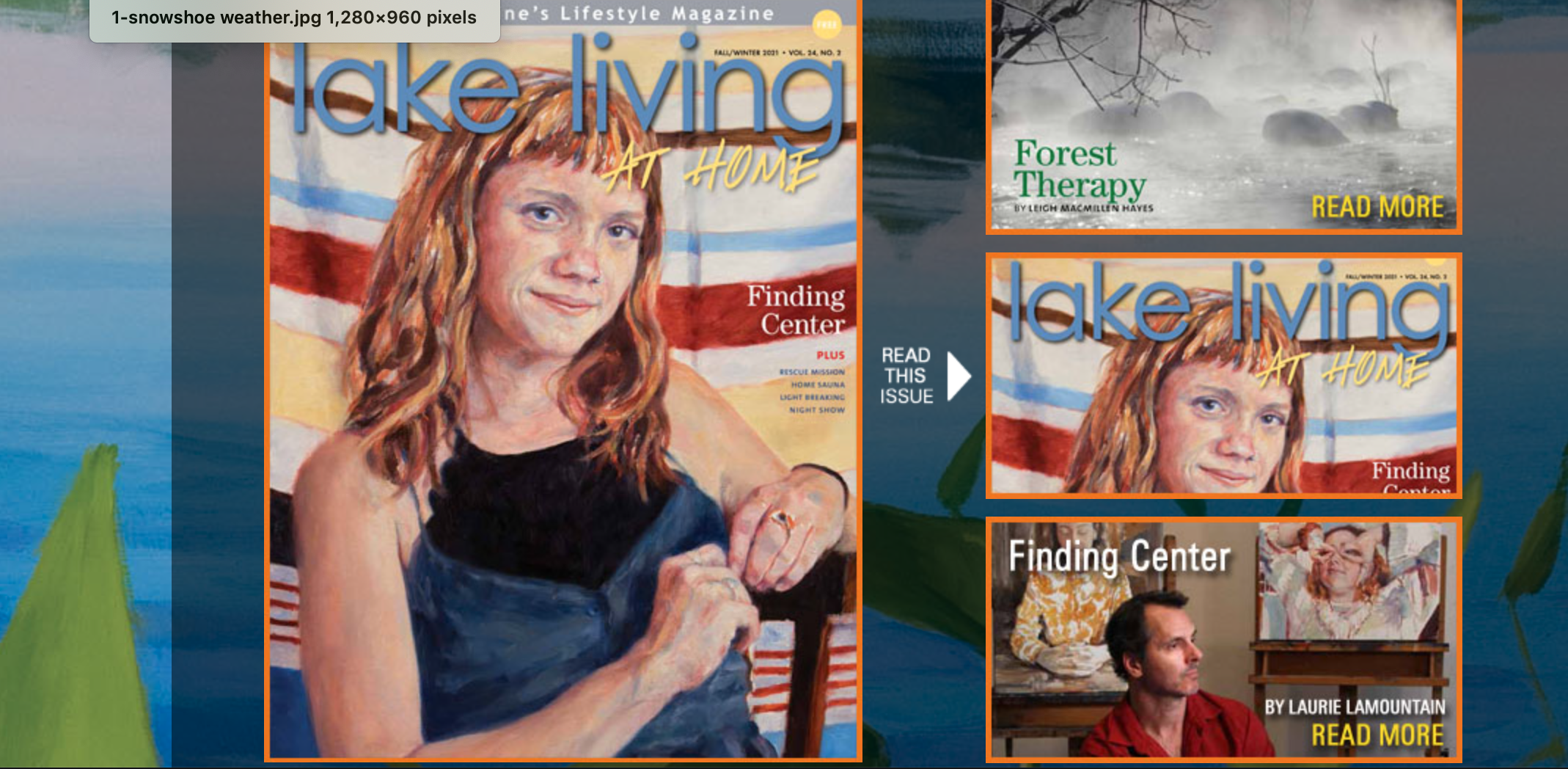
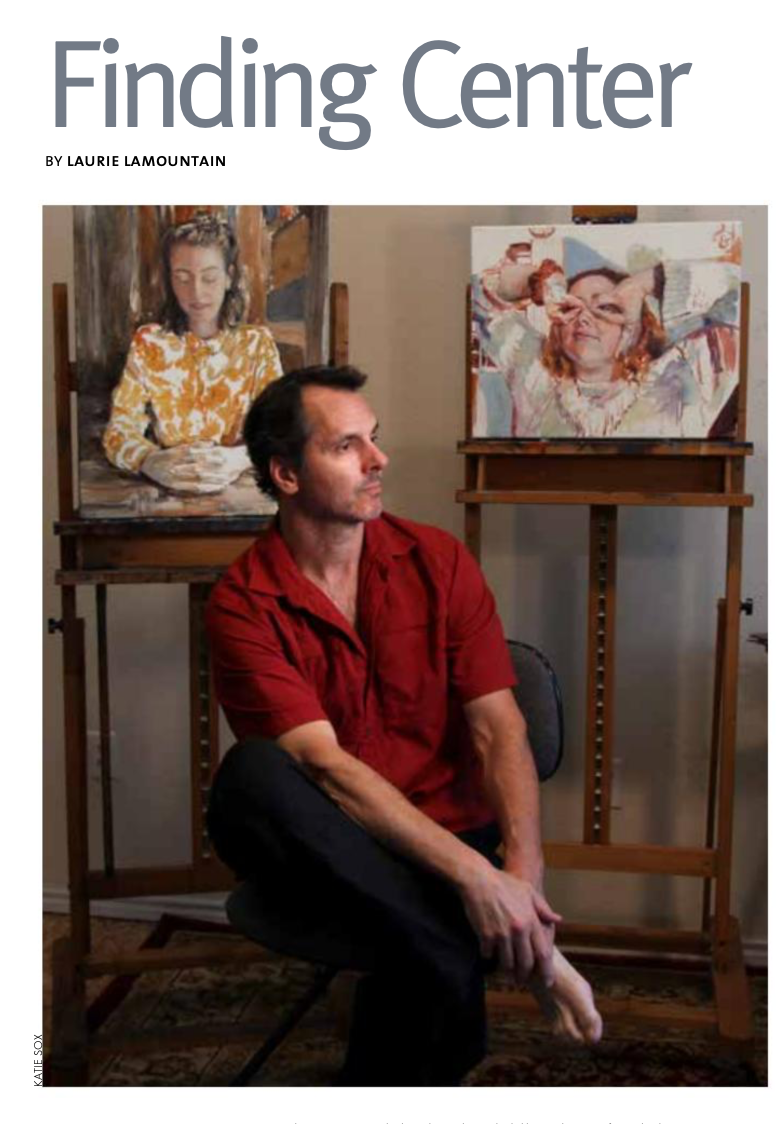
The first article, written by Laurie LaMountain, is “Finding Center” about an artist who purchased a building that began its life as a Roman Catholic Church, whose congregation outgrew it, and then for decades as Craftworks, a highly successful retail clothing and homewares store until it closed in March 2020. And now it is transforming into Factor Fine Art Center for the Arts and the story is as much about the building as it is about the man who is behind this repurposing project. 

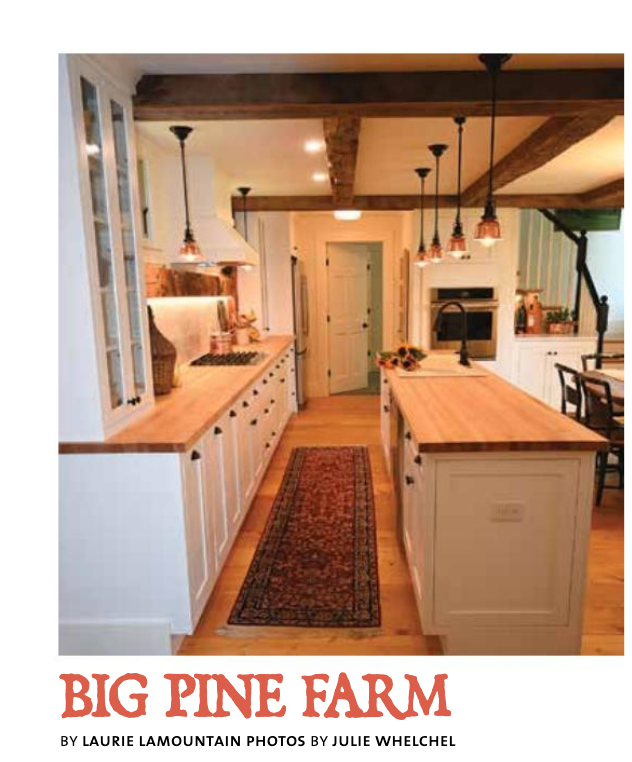
As always, in the fall issue, there is an article about a house renovation, this one entitled “Big Pine Farm,” also written by Laurie. The color scheme reminds me so much of our own kitchen renovation. 

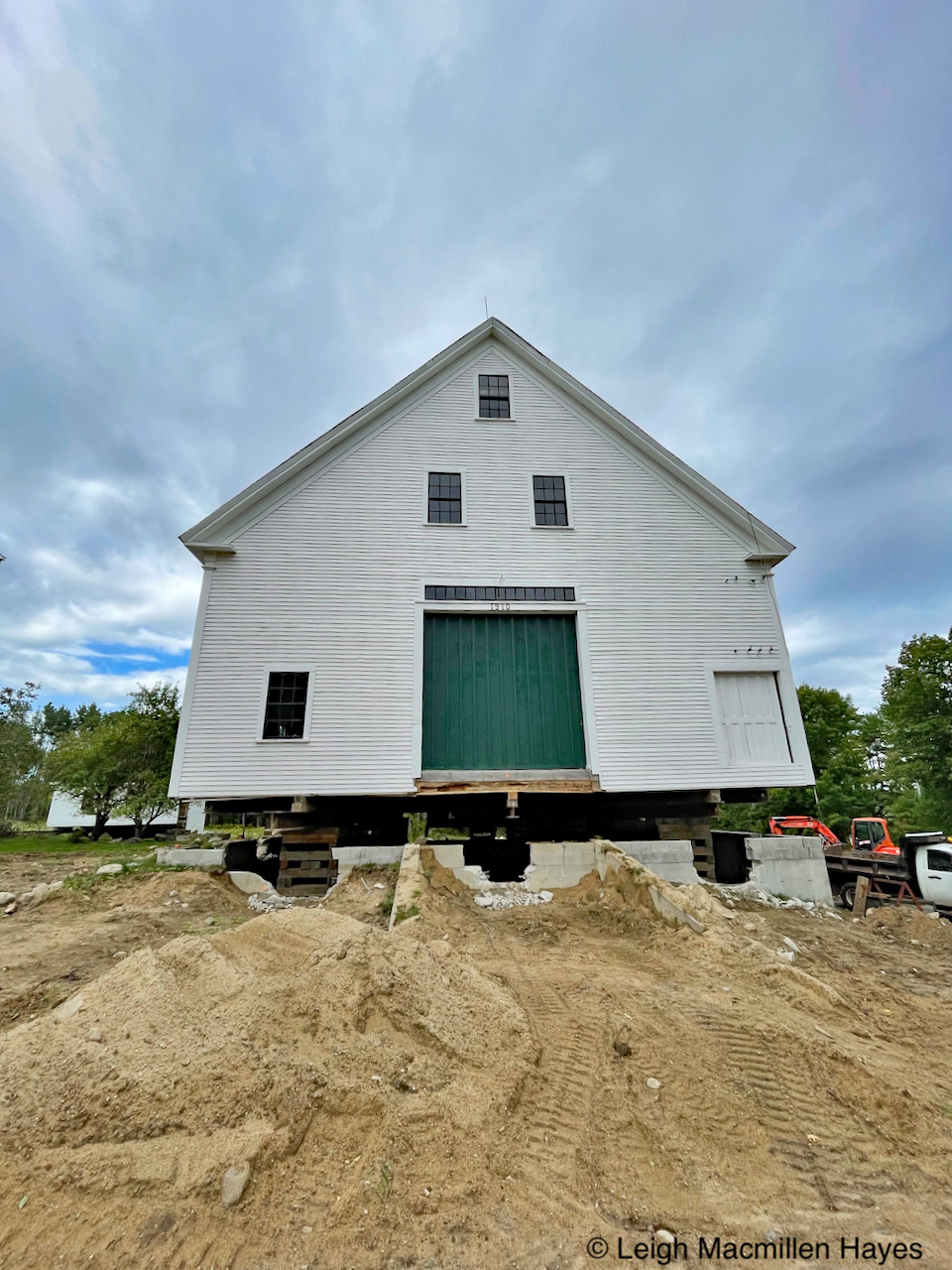
Next inside the cover is an article I wrote about a large barn that isn’t undergoing a renovation, but rather is being rescued from listing to the west and possibly toppling over, thus I titled it “Rescue Mission.” I had the great pleasure of meeting and interviewing a young man who is overseeing the project. Keeno Legare grew up looking at (and sometimes exploring) the barn and has a strong desire to continue to preserve the structure. 

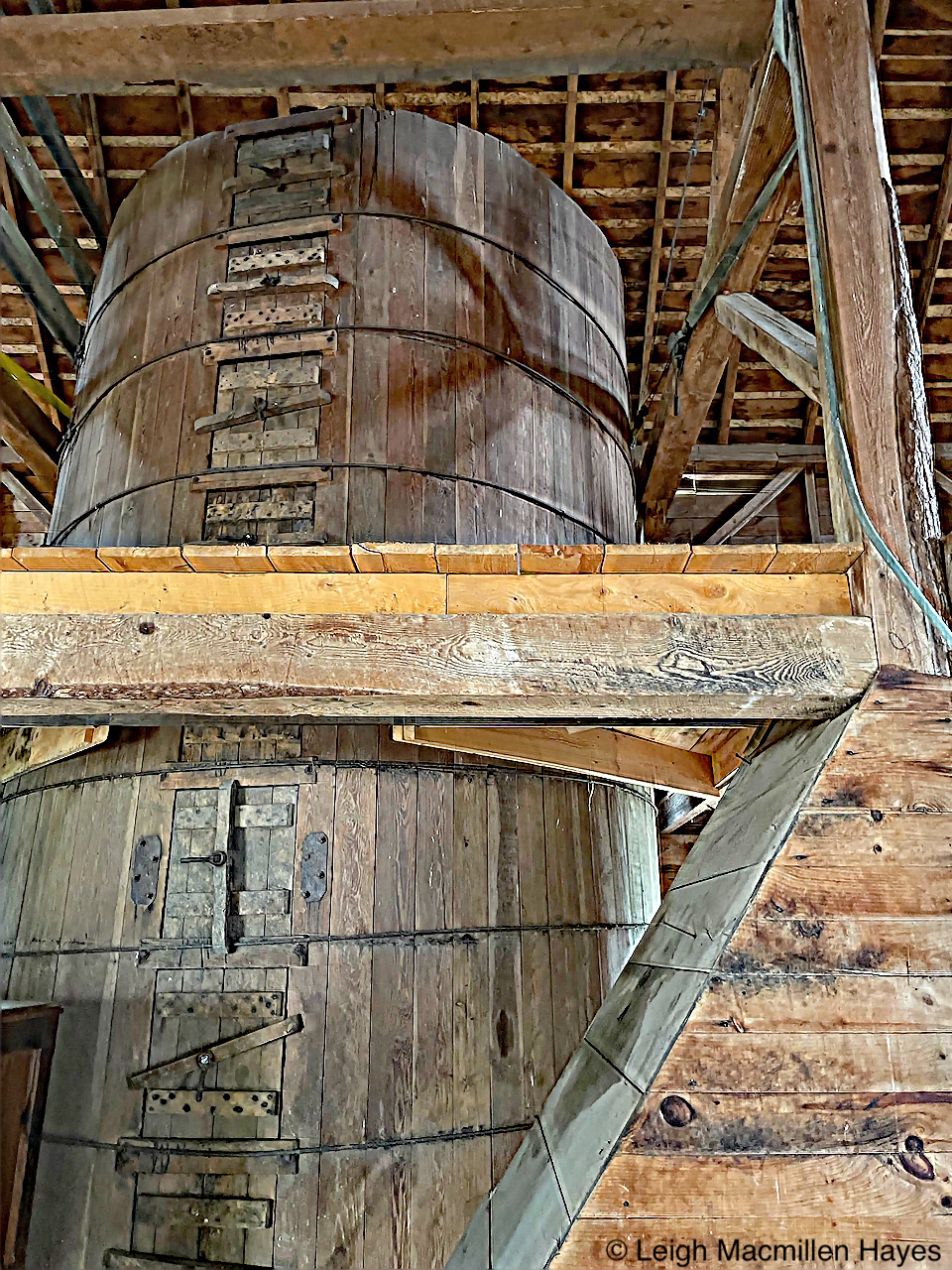
One of my favorite parts of the building is the silo—located inside rather than out. The article includes some of the history of the barn and the passion its owner, David McGrath, has for it. 

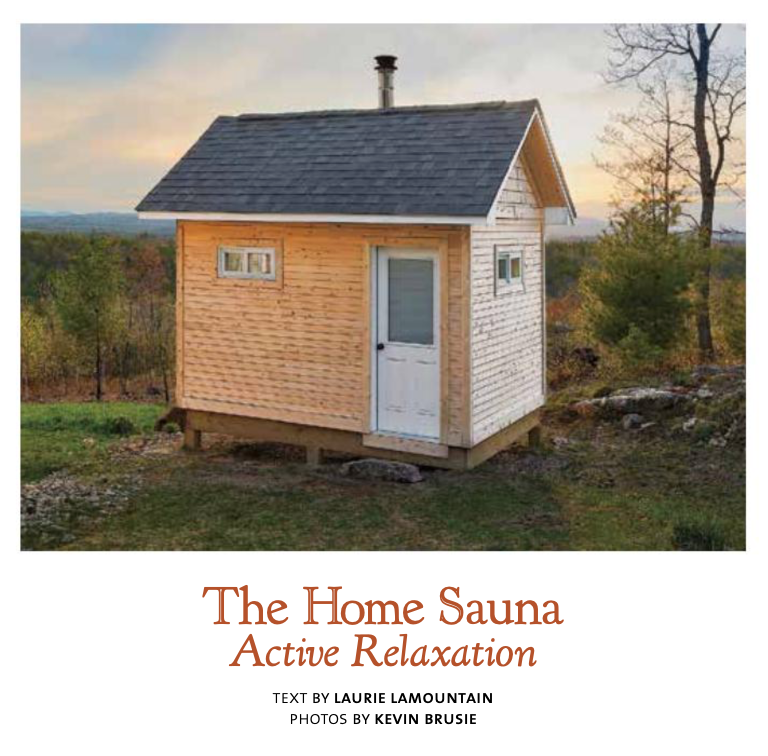
“The Home Sauna: Active Relaxation” is Laurie’s third article. This is about one man’s COVID project that resulted in a small building where he can reap health benefits while letting the world wash away.

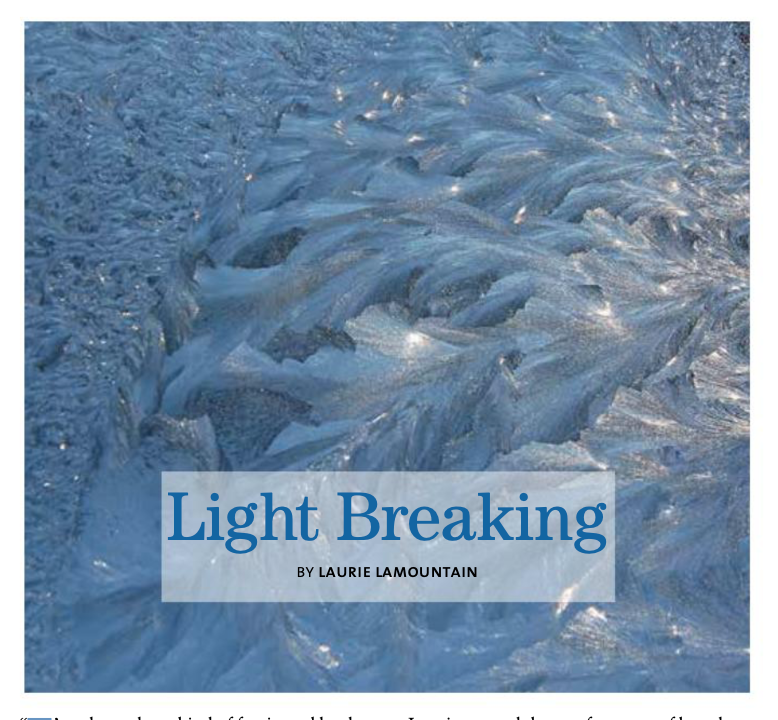
Laurie’s final article is entitled “Light Breaking.” This is about Laurie Downey, a woman who transformed her artistic direction after working as the set designer for her daughter’s school drama club. “Taking her cue from nature, she initially created a dozen lyos lightscreen patterns from drawings and photographs, or a combination of the two, that mimic rippling water, sun dappled foliage, forsythia in bloom, stands of saplings, and bare branches.” As you can see in the title photograph, ice also informs her art. 

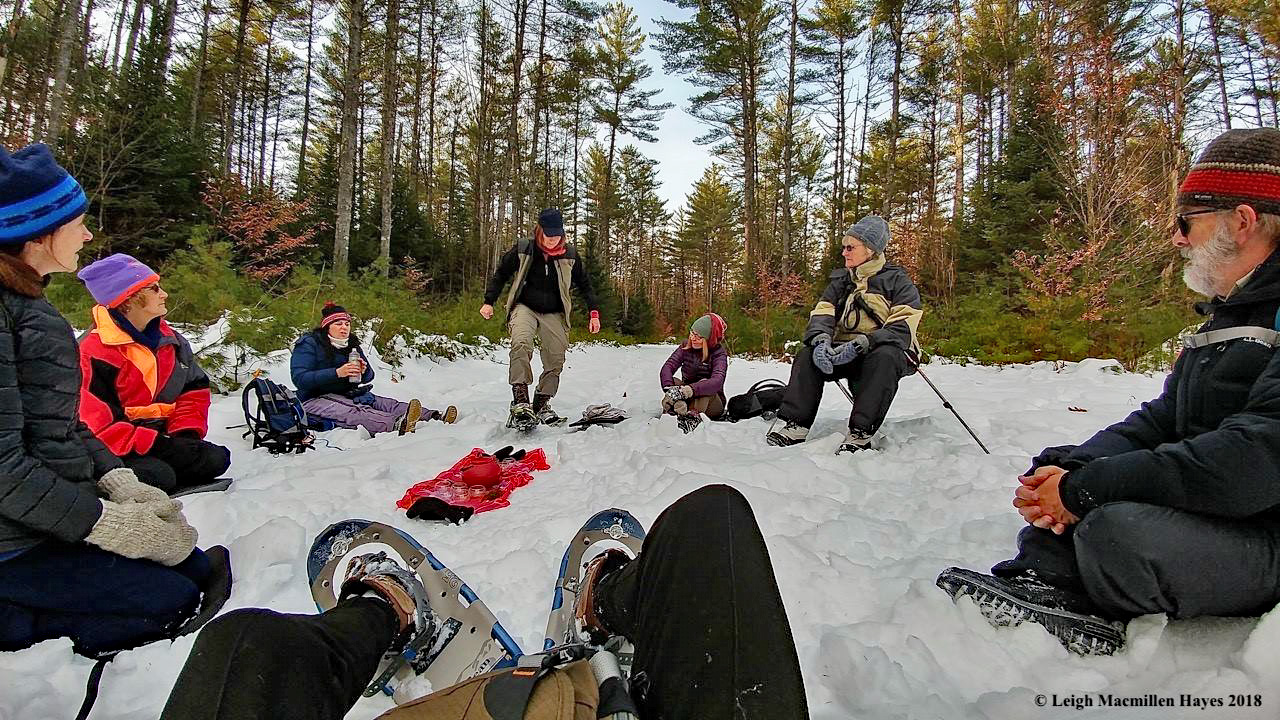
My second article is about Forest Therapy in the winter. Maine Master Naturalist and Forest Therapy Guide Jeanne Christie shared with me information about how a forest therapy session works, the values of participating in such a walk, and ways to make sure you stay warm while doing this in the cold season. I’ve participated in a few of Jeanne’s forest therapy walks and highly recommend that if you learn of one of these in your area, you strap on your snowshoes and head into the woods with a guide. 

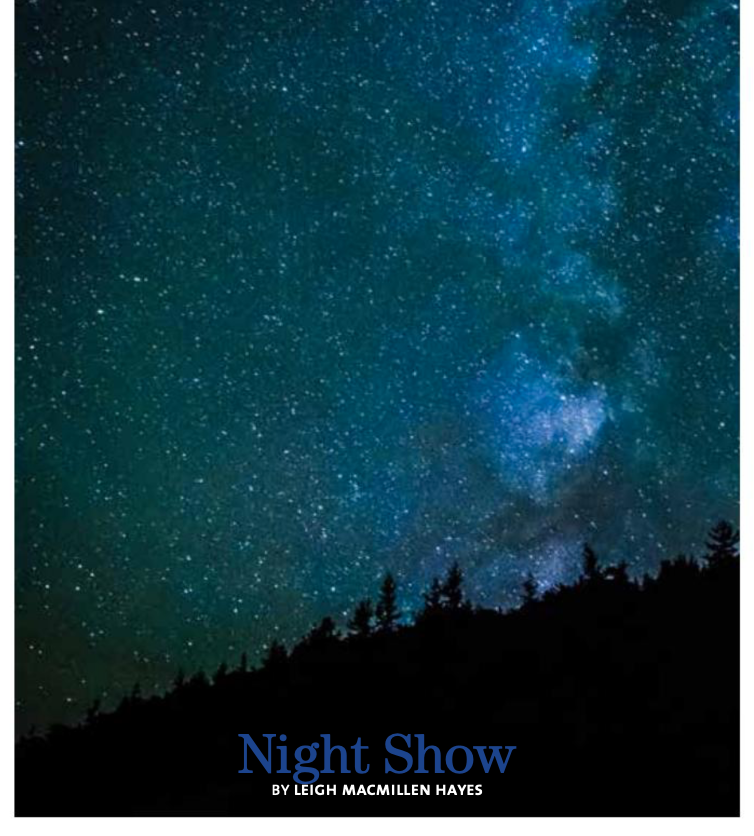
“Night Show” is my final article. The essence of this article is about light pollution from artificial light. “The International Dark Sky Association (IDA) defines light pollution  as ‘inappropriate or excessive use of artificial light,’ and goes on to stay that ‘it can have serious environmental consequences for humans, wildlife, and our environment.’” Since writing this article, my guy and I had the opportunity to visit Katahdin Woods and Waters National Monument, designated an International Dark Sky Place. It’s the first place on the eastern seaboard to receive this designation and only places as remote as Antartica have darker skies. 

The article includes information about light trespass and ways we can improve our own indoor/outdoor lighting for the benefit of all. Just imagine—if we all jumped on the bandwagon and turned off or down our lights, the stars would surely amaze us. 

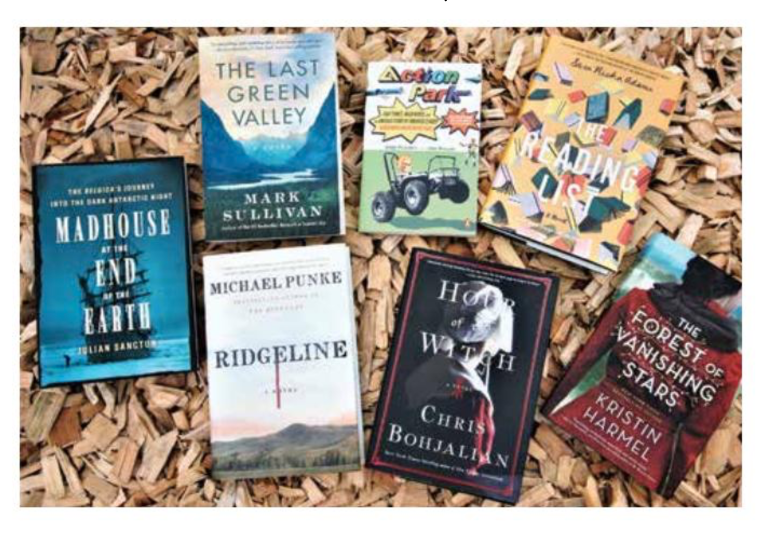
The magazine concludes with everyone’s favorite: the bookshelf with book reviews from the owners and staff of Bridgton Books. 

That’s a summary. I do hope you’ll either pick up a copy and read the articles and let the advertisers know that you saw their ads . . . cuze the magazine is free to you. And if you can’t pick up a copy, please click on the link here: lake living fall/winter 2021
lake living magazine: Summer 2021

It feels like forever, but has only been since last fall that we produced an issue of Lake Living. Our hiatus was due to the pandemic and the fact that we didn’t have the usual amount of advertisers (the mag is free to you, so please support the advertisers who make it happen–and tell them where you saw their ads. Thank you.), and stores and other businesses didn’t necessarily want to put a magazine on the shelf. That was all before we understood this devastating disease better.

But . . . we’re back! And with some timely articles I think you will enjoy.

The first article, “Conservation Collaboration,” by yours truly is about Sebago Clean Waters, an initiative that includes Loon Echo Land Trust, Western Foothills Land Trust, Portland Water District, Lakes Environmental Association, Mahoosuc Land Trust, and some bigger entities. I won’t give away how it works because I want you to read the article, but it’s all about clean water and the Sebago Lake watershed and what these organizations are doing to benefit all of us.

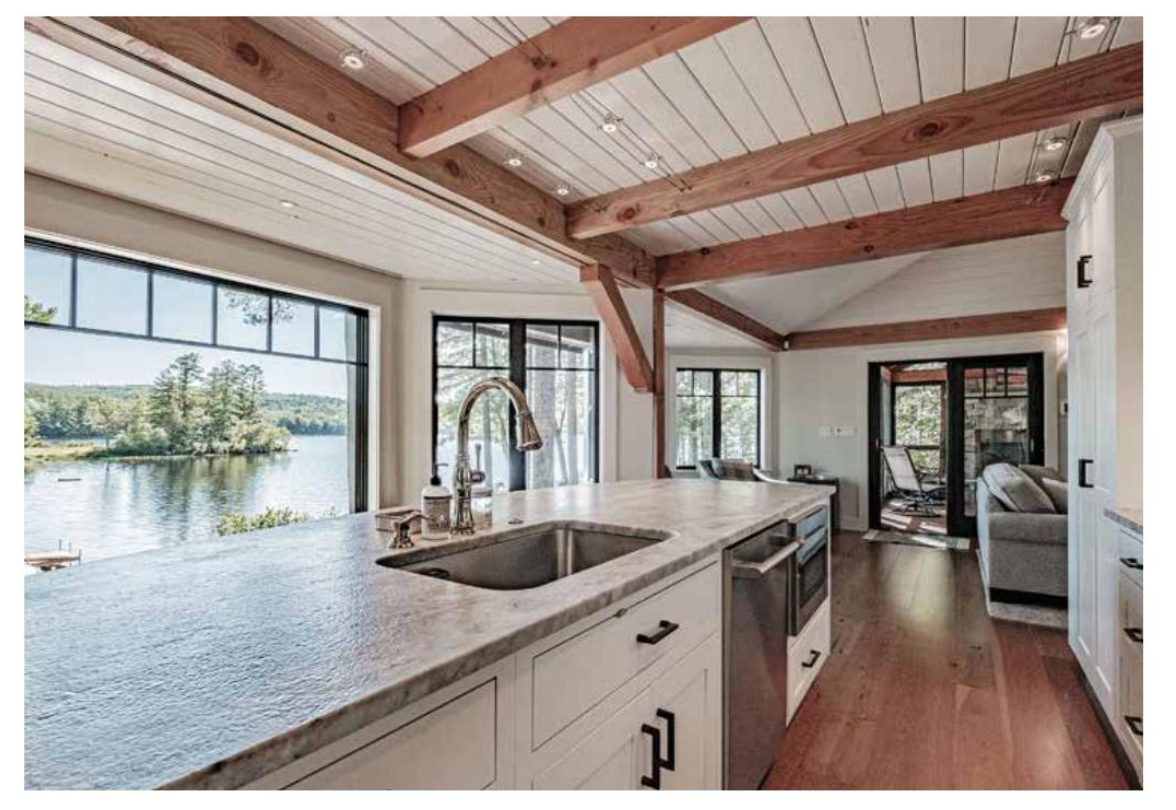
In “A Sense of Space,” Laurie LaMountain describes how architect John Cole recreated a lakeside house in a creative way given shoreland zoning laws in Maine. Not only is this an enjoyable read to learn more about how John and the homeowner problem solved to turn small living quarters into airy living quarters, but Laurie also provided valuable information about the laws that govern building beside our lakes and ponds.

Laurie is also the writer of this extremely important topic: protecting our most precious resource. A must read for everyone, both here in Maine and afar.

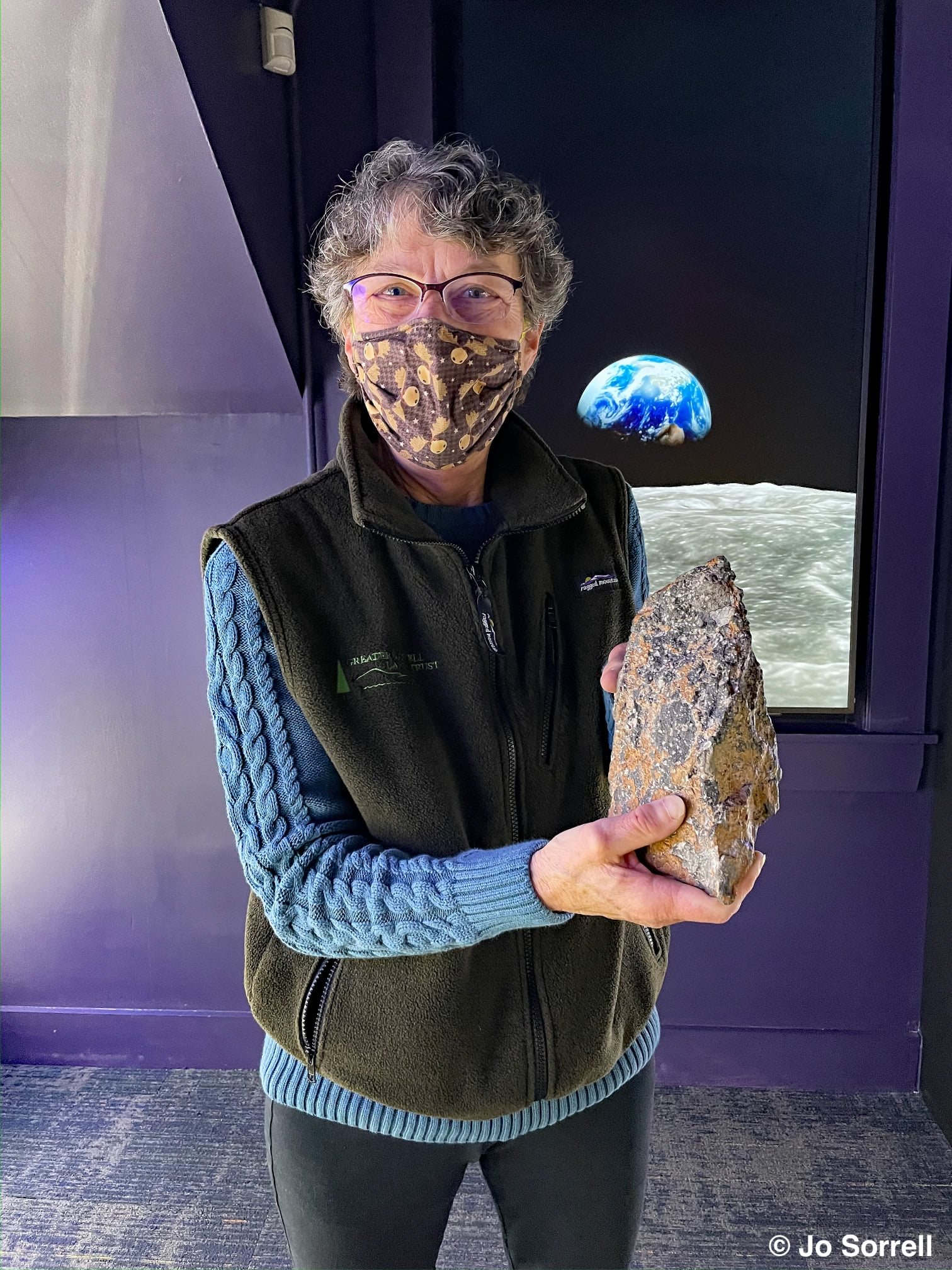
Up next is another article by me, “From the Earth to the Moon and Beyond,” about the world-class Maine Mineral and Gem Museum in Bethel, Maine, where I had the opportunity to hold this moon rock. You can too! But again, be sure to tell them you read about it in lake living.

That’s followed by the Summer Living calendar of events that comes with the warning that all items are subject to change because one of the take-aways from the last 15 months is that we all need to be flexible. So . . . check websites before heading out the door. I know this to be so true because at Greater Lovell Land Trust we’ve already made some changes since publishing our summer calendar.

“Eat What You Sow,” about three local gardeners including lake living‘s graphic designer, Dianne Lewis, is an informative article by my friend and emerging writer, Marguerite Wiser, Farm Lead at The Ecology School in Saco, Maine.

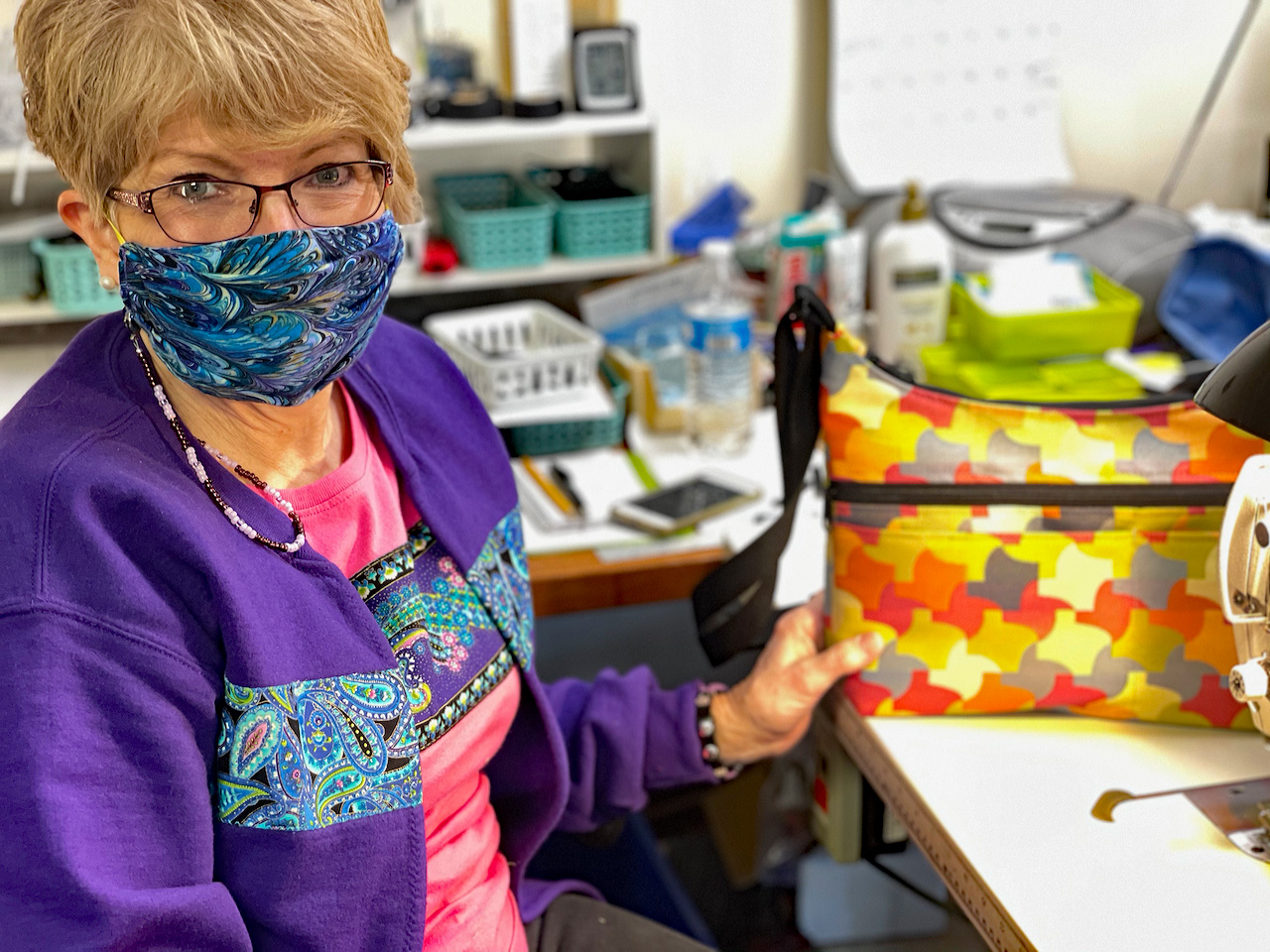
Possibly one of the most visually colorful articles I wrote, entitled “The Bag Lady,” features Designs by Diana Bags, a Lovell, Maine, business Diana Davis created and her story of how it came to be that’s she’s selling hand-made bags and other consigned items from her boutique and workshop on Main Street. Another one where you need to stop in and let Diana know you read her story here.

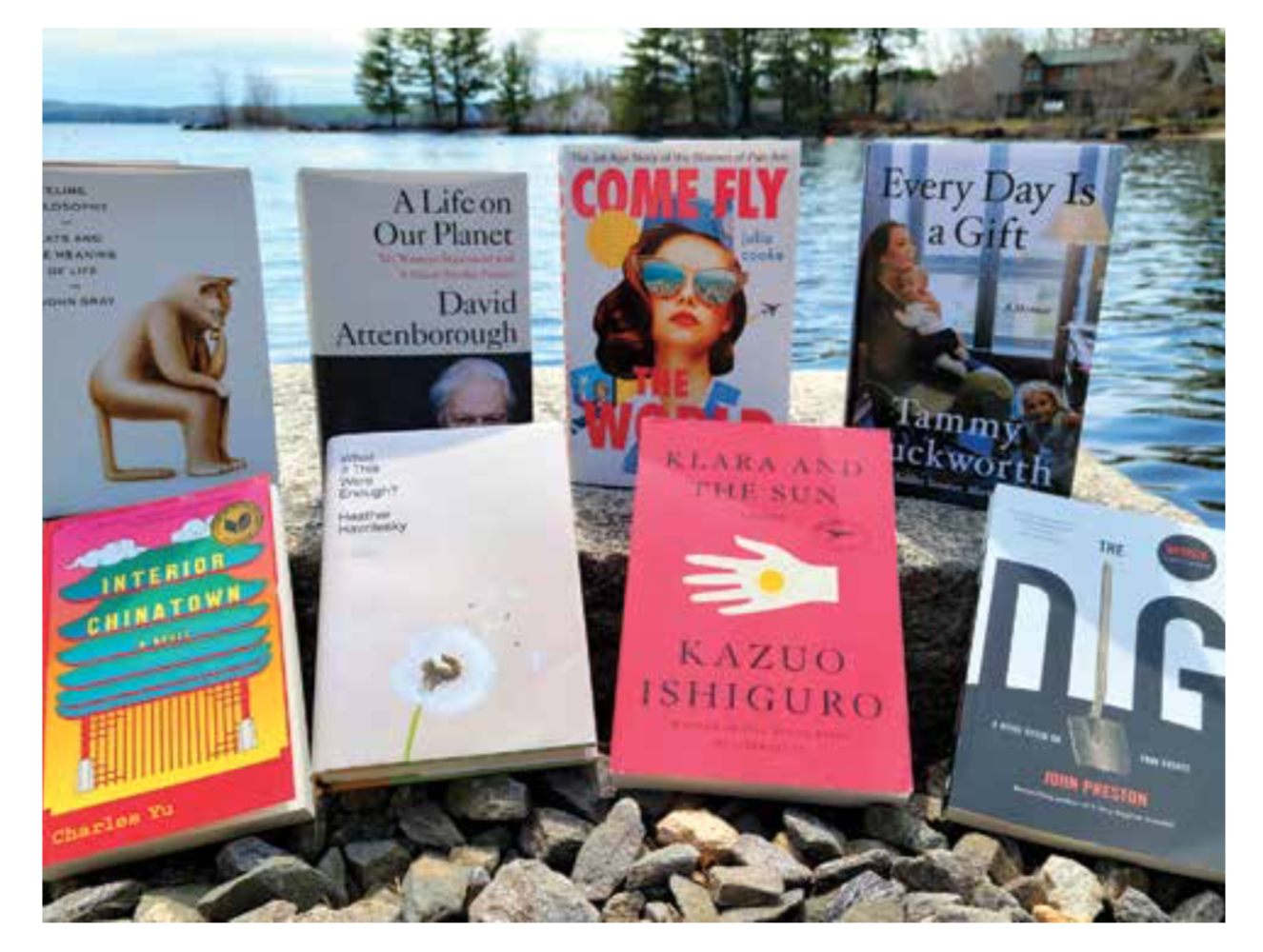
And no copy of the summer issue would be complete without book reviews from the folks at Bridgton Books, including owners Justin and Pam Ward, and employees Sue and Perri. There’s something in these pages for everyone, and once again I beg you to shop local. By now you know what to tell them when you step up to the counter to make your purchase. ;-)

Finally, Laurie brings us recipes as she always does, this time in the form of “l’apéritif.” If you don’t know what that means, you’ll have to check it out. Well, of course, you need to check it out because ’tis the season.

To say we’re excited to be back would be an understatement. I hope you’ll pour a cup of coffee or glass of lemonade and enjoy the read. Here’s the link: Lake Living Summer 2021

Resurrection

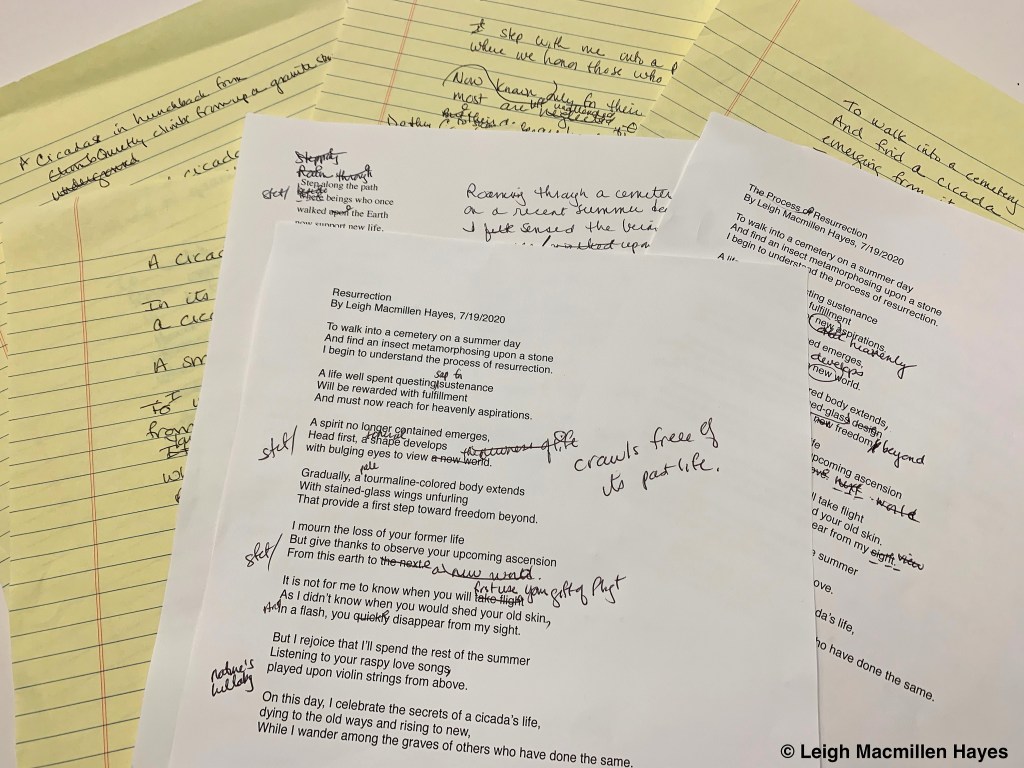
I warned you that last week’s Cemetery Cicada Celebration would be revised. And so it was. Over and over again as is my custom.

But the thing is that last week I took part in a poetry workshop offered through Greater Lovell Land Trust by Poet Judith Steinbergh. The title of the workshop was “Caring for Our Earth and Waters.” Judy shared various poems with us through a remote gathering and asked us to read them aloud while thinking “about what we might visualize from the images, and how the sounds and form blend together with the image and feeling.”

She encouraged us to make notes and suggested some different approaches: speak to the subject; become the subject; instruct the reader; show feelings toward the subject. She even gave us some beginnings and endings that might inspire us to begin.

And then she concluded with “Poetry Revision Guidelines,” which included such practices as reading the poem aloud several times, questioning whether or not the opening was strong enough, maintaining focus, creating images the reader could visualize, using tight language, finding a rhythm, helping the reader gain insight, and providing appropriate breaks.

We had one week to write a poem, submit it to Judy for comments, and then the big night would come: The Reading.

Just as it’s scary to publish in this blog manner or via Lake Living magazine and other avenues I’ve used over the years, it’s equally terrifying to read aloud–especially when you can see yourself on the computer screen.

But that’s what some of us did the other night for the remote Poetry Reading and you can watch and listen in: GLLT Poetry Reading 2020

My original subject was a pine tree, but after watching the magical emergence of cicadas last week, I knew I had to write about that experience. Figuring out the angle was much more difficult and I tried a variety of avenues. In the end, I chose a style that works best for me, teaching through imagery.

It’s not a done deal, mind you, for it is my belief that there is no such thing as a final draft. OK, so that’s my default in case you don’t think this works or have suggestions to improve my attempt. All comments are welcome. It’s only a draft and I haven’t written 18 drafts yet as I often do with an article. I’m at 7 or 8.

Resurrection
By Leigh Macmillen Hayes, 7/19/2020

To walk into a cemetery on a summer day
And find an insect metamorphosing upon a stone
I begin to understand the process of resurrection.

A life well spent questing sap for sustenance
Prepares to crawl free of its past
And reach for heavenly aspirations.

Through a tiny slit, a spirit no longer contained
Emerges head first as a teneral shape develops
with bulging eyes to view a new world.

Gradually, a pale tourmaline-colored body extends outward
With stained-glass wings unfurling
That provide baby steps toward freedom beyond.

I mourn the loss of your former soul
But give thanks for a peek at your upcoming ascension
From this place to the next.

It is not for me to know when you will first use the gift of flight
As I didn’t know when you would shed your old skin,
And I quickly offer a final goodbye when I see your wings spread.

I rejoice that I’ll spend the rest of the summer
Listening to your raspy love songs
Playing nature’s lullabies upon violin strings from above.

On this day, I celebrate the secrets of a cicada’s life,
Dying to the old ways and rising to new,
While I wander among the graves of others who have done the same.

To all who joined the Poetry Workshop or the Poetry Reading or wished they could, and especially to Judy Steinbergh, I dedicate this post. Thank you for sharing.

Summer by Nature

Given the fact that the day the spring issue of Lake Living was to be distributed to stores and other businesses throughout the lakes region of Maine was the day the state shut down because of COVID-19, thus meaning Laurie LaMountain had box loads sitting around with no where to go but her garage, and many businesses had completely shuttered their doors and windows and those that stayed open were serving a limited number of customers and didn’t necessarily want magazines, we weren’t sure there would be enough advertising dollars to produce a summer issue.

By the same token, we both felt it was our duty to produce a summer issue. And so we did. It did not come out on June 20th, as would have been the case in the past, but suddenly that didn’t matter. It’s not as long as prior summer editions, but suddenly that didn’t matter. The three to four page calendar spread is missing, because, um, not a whole lot is going on, but suddenly that didn’t matter.

As happens more often than not, a theme emerged. Laurie addressed it in her Editor’s Notes. I’ll just say this: Take your time. And notice.

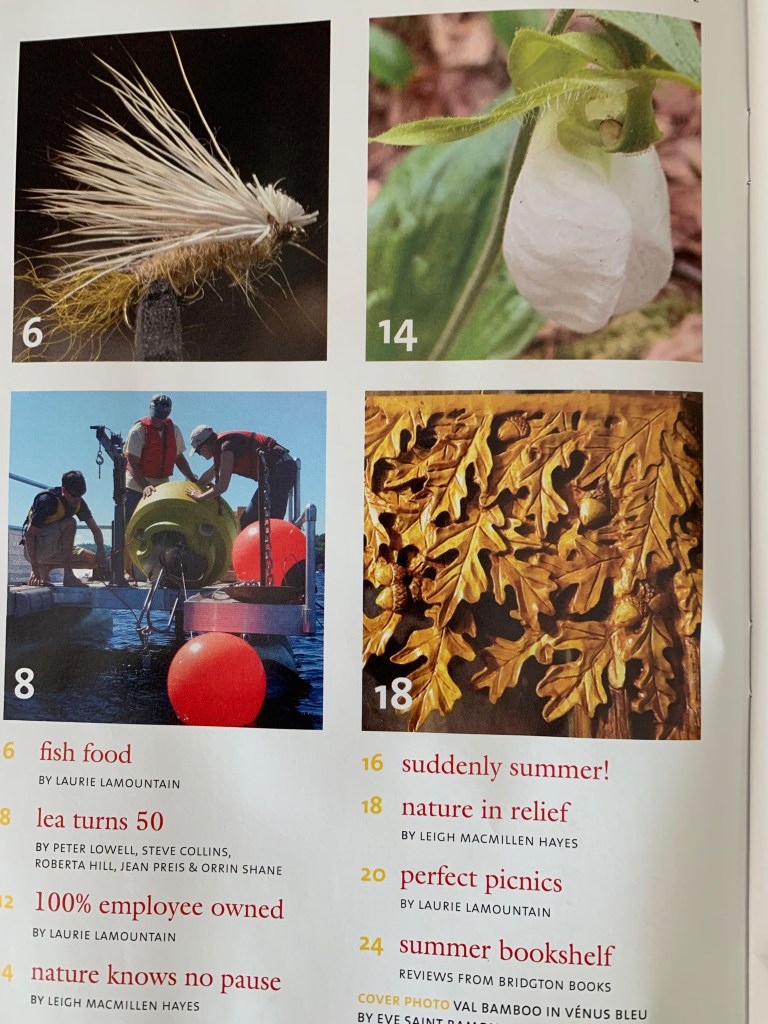
Be sure to check out the book reviews from Bridgton Books and picnic recipes. Plus read about some wicked cool fish food, Lake Environmental Association’s history, and a few local businesses that are employee owned.

I was given the good fortune to write about my passion for the world beyond doors and windows, which allowed me to weave a bunch of ideas together in a ramble of sorts.

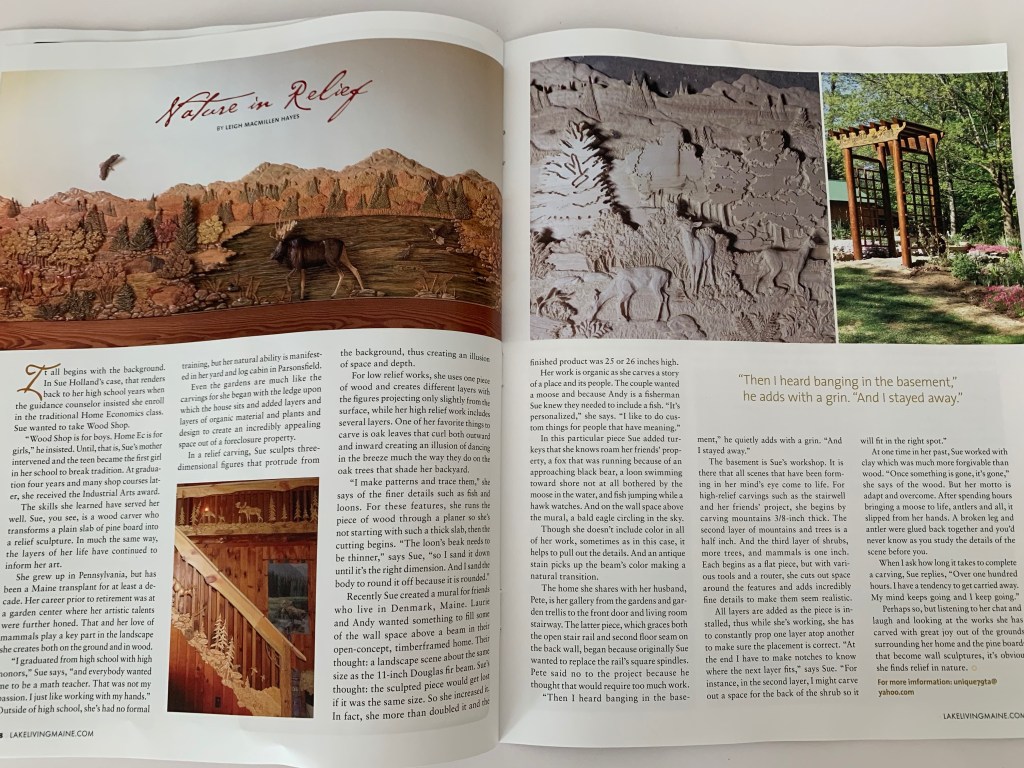
I also wrote about a woman who can take a slab of wood and turn it into a three-dimensional piece of art. Sue Holland’s work is incredibly intricate and always tells a story.

I can’t help but smile every time I look at the cover of this issue. Sports Illustrated move over!
We’ve even got a centerfold you might want to hang on a wall!

This issue of Lake Living is about summer by nature. Pour a cup of tea or glass of wine, click on the link and enjoy the articles: Lake Living Summer 2020

Lake Living Magazine: spring 2020

I’m always excited/anxious when an issue of Lake Living is finally published. And eager to share it with others.

Tada. Like magic it has begun to appear on store shelves. The sad thing is that most stores are closed, but the great thing is that if I’ve posted it correctly, you can click on it here. And if you receive this and discover the link doesn’t work, please give me a few hours and then visit wondermyway.com again and surely I’ll have worked out the kinks. Well, maybe.

One of my articles, “Boathouse Mystique,” is about those buildings of yore that still dot our lake shores. This was probably the most difficult to write because most of the structures’ stories have turned into lore, but I had a lot of fun talking with a variety of people and making a few site visits.

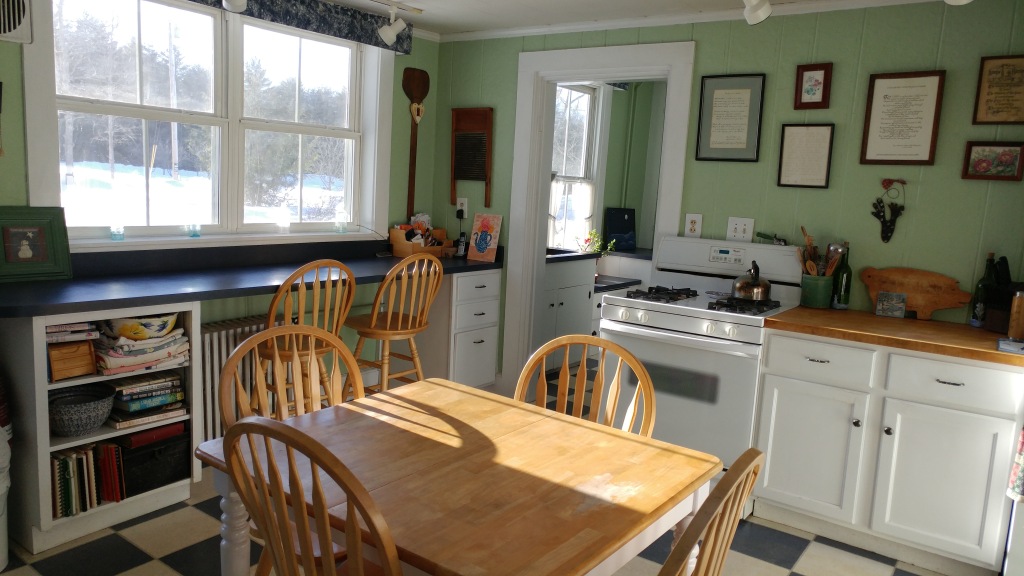
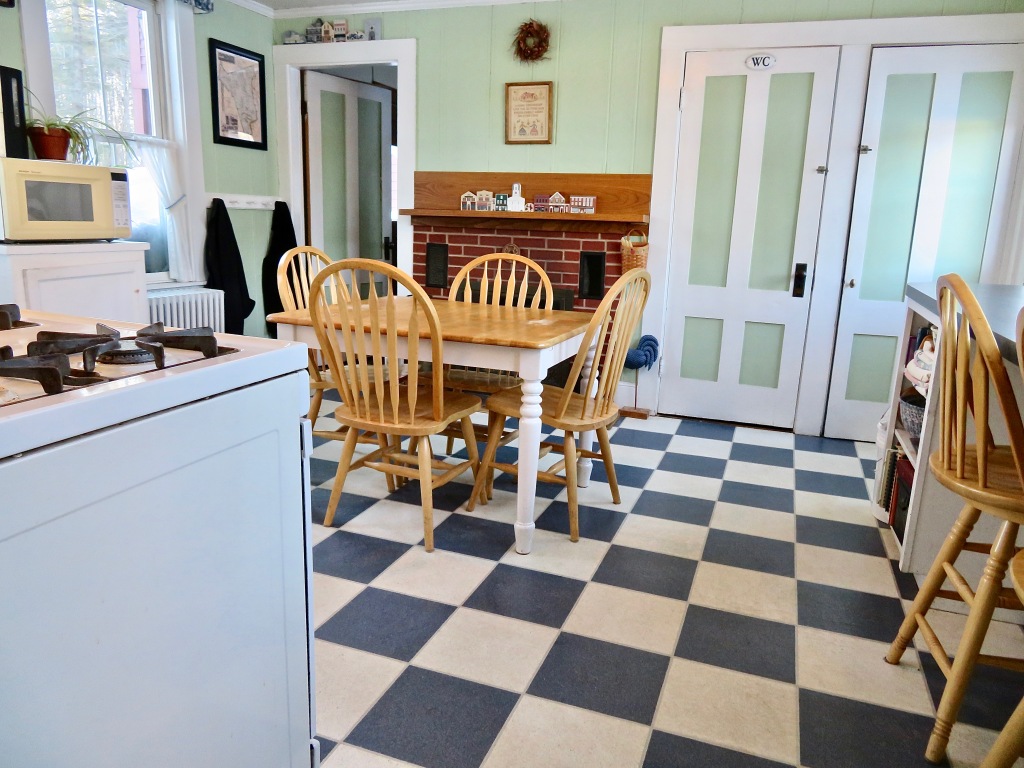
My second article, “A Compromised Remodel,” is about a kitchen redo of the past year for my guy and me. It was quite an undertaking and along the way we each had to learn to give a little. Or, maybe a lot. Given where we are in the world right now, it all seems so trivial.

Here’s a peak at what the room liked like before the walls were bumped out.

A different view of before.

For a while last fall, it looked like we were having a daily open house! Our neighbors loved it because for the first time, they could see into the field.

My third article, I don’t have photos for because we used photos offered by NEAAO, as it’s about the New England Arab American Organization that formed in Maine in 2014. The title, “We Are All One At Home” seems apropos in the current spirit of things.

Be sure to also read the articles by Laurie LaMountain and Marguerite Wiser. Laurie shares the story of “A Better Bathroom” about another remodel project, “Designed in Denmark” about some really cool benches you could purchase for your shorefront property, and “On Food” about food and the choices we make. Who knew that would be so timely, as is Marguerite’s well-researched article entitled “Food Sovereignty.”

My final comment about this issue is this: please, please, please as soon as you are able, support the advertisers who support us. Remember, the magazine is free . . . thanks to those advertiser, some of whom have seen their business come to a halt. Here’s hoping it’s all temporary.

In the meantime, happy reading.

wondermyway turns 5

Five years ago today I turned from taking a hundred million photos on each tramp to taking a hundred million photos and writing about them.

Typically, on the anniversary I scan the past year’s posts and choose one from each month, providing a photo to represent it, with a brief (or not so brief) comment and link to the full read.

But . . . because this is a milestone I never imagined reaching (posts: 733; views: 76,793; visitors: 44371; followers: 578), I thought I’d take the time to thank you, the readers, for wandering through the wonders with me

THANK YOU

This afternoon I decided to step back into my happy place where the journey began on February 21, 2015. I had no idea back then what I might write about, but I was so excited, and a wee bit anxious, no, I was wicked anxious (don’t you love that Maine descriptor?) to share the little things with others.

It felt a bit egotistical to invite people along, but I took the first step and so many others have followed.

Over these five years, I’ve been humbled by the opportunity to reconnect with old friends and greet new ones through this effort.

Please know that typically it is late in the day when I sit down to write a post, first having spent at least a few hours tramping (“You’re stating the obvious, Mom,” my sons would say if they actually read this; nor does my guy just so you know–those of you who comment to him about something that you read may have noticed his bewildered look; and then he realizes you must follow the blog), more time downloading photos in hopes of finding a few key ones to use, and then figuring out what the story is and how to tell it.

As I wander, whether alone or with you, the first draft often forms in my head, but by the time I stomp the snow or mud or pine sap off my boots, it shakes loose and disappears. I trust, however, that whatever phrase I thought was brilliant in the field will flash back through my mind at some point. Does it? Perhaps, but I’ll never know because that first draft doesn’t get recorded.

Writing is a process, one that I’ve forever enjoyed, but what you read is only part of the whole picture. Because it’s late in the day, as I said earlier, and I’m tired, I make mistakes, which I don’t always catch before I publish. For those who are email followers, or those who quickly read one of my “stories” just after I’ve posted it to social media, please forgive me. You see what I consider draft 2 without any further edits. Laurie LaMountain, the editor of Lake Living magazine, for which I’ve worked since 2006, knows full well that draft 3 is not the final from me. Sometimes it takes 18 drafts before I’m ready to go to print, and even then I know that when I turn the page to one of my articles, I’ll cringe with frustration for I missed something.

Thank you to all of you who catch my grammatical errors and gently let me know. I love having you along to share the journey.

And thank you to those who do the same when my identification or explanation is not quite correct. As in, it’s downright wrong. I appreciate your engagement.

Thank you to all of you for reading this long story and so many others that I’ve written. I know some of you just scan the photos, and I can’t say I blame you.

For me, wondermyway is a diary that I can look back upon to recall all the amazing sights and insights the natural world has shared with me. I’m happy to be able to share that with so many others–to invite you into this part of my life.

Thank you also to those of you who, because of the blog, have bestowed gifts upon me from books and calendars to ornaments, pillows, wrist warmers, scat, feathers, and even a camera on loan for an extended period of time when mine went kerplunk into the water.

No, I am not asking for more gifts; I just want to say that I am often surprised to know that what I shared or time I spent with you touched you as much as it did me.

As a parting gift, today, for helping me celebrate this fifth anniversary, let me share one post that I thought stood out this past year.

Do you remember The Secrets of Life Found Among the Dead?

Each journey has offered refresher courses and new learnings and I appreciate that you let me share them.

I don’t know what the future holds, but I celebrate the wonder that has been revealed on so many wanders thus far.

Again, thank you.

Lake Living Magazine: fall/winter 2019

For the past few years, we’ve either produced a limited winter issue or no issue at all of Lake Living magazine because those who purchase ads have been wary about spending money during those lean months. And it’s ads that support this free magazine. Everyone wants to be written about, but . . .

After some back and forth discussion with editor/publisher Laurie LaMountain, we decided to produce a fall/winter issue that would encompass the usual “at home” features of the fall magazine, but also include the book reviews written by the Pam and Justin Ward, plus their employees, Sue and Perri, of Bridgton Books, that typically appear in the winter issue.

Tada. Click on the link above and you can view the magazine in its entirety.

Laurie tackled four topics, while I worked on three ideas. Hers include “The Big Idea” about a Maine inventor, “Maine Dwelling” about a guy who flips houses locally, and “A Good Keeper” about winter squashes.

Her most interesting article, however, is one that everyone should read–whether you are a male or female. Don’t let the theme of it scare you. Entitled “Fierce Girls,” and yes that is Laurie in the photo, it’s about WOMEN. And more specifically . . . men-o-pause. When she proposed it, I was curious but not certain it would work. You have to read it.

My articles all ended up with a Lovell theme–probably because I spent most of the summer in Lovell and it was always on my mind.

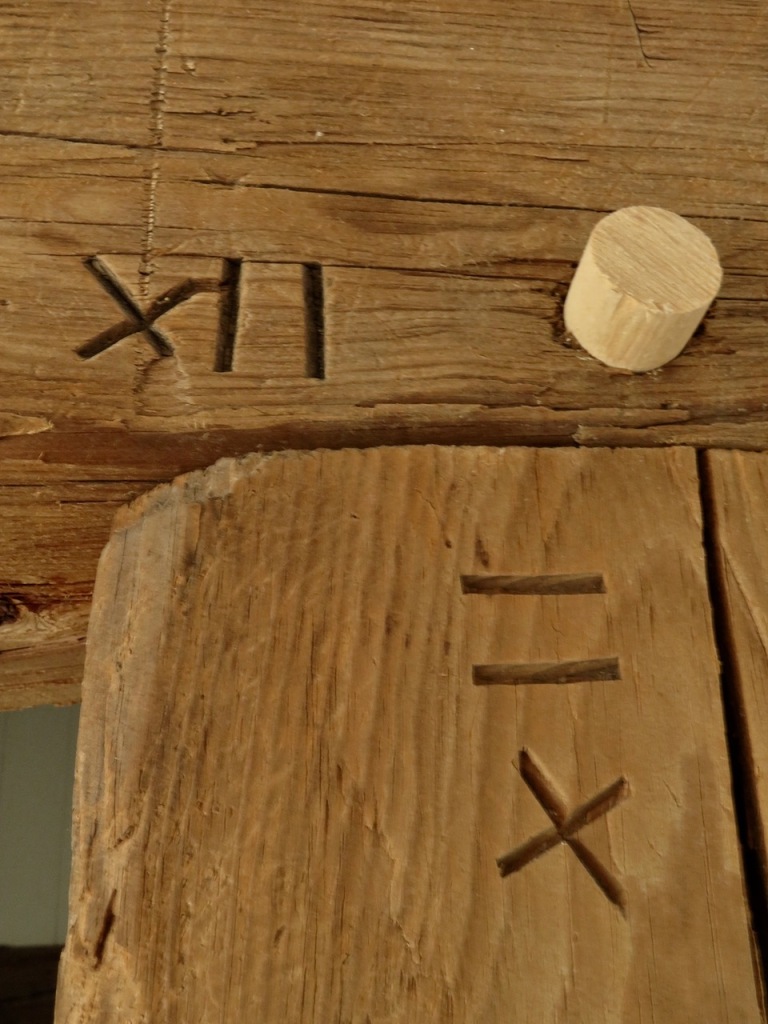
The first is entitled “Resurrecting the Past,” about the Harriman Barn that Robin Taylor-Chiarello (board member of the National Council on White House History and associate member of the American Institute of Architects) lovingly restored with the help of Timberframer J. Scott Campbell of Maine Mountain Post and Beam in Fryeburg and Builder Bryce Thurston of Lovell.

The marriage marks above were chiseled into the beams when the barn was built in the early 1800s. Scott used his own system as he pulled the timber frame down, and then reassembled it on a different site a couple of years later, but the early marks are still visible.

My second article is about two couples who chose to move north rather than south in retirement. Rather than snowbirds, as we fondly refer to those who spend six months in warmer climes, they are birdsofsnow. Okay, so I made that term up, but really, it does describe them.

In their retirement, they’ve discovered ways to get involved in their communities and that has made all the difference. Heinrich Wurm fills his days with environmental activities, especially as related to Kezar Lake Watershed Association or Greater Lovell Land Trust. Here, he’s studying a spider web. And that’s only part of his local involvement.

Linda, Heinrich’s wife, is a docent with Greater Lovell Land Trust, where she also enjoys looking at the finer details of the natural world.

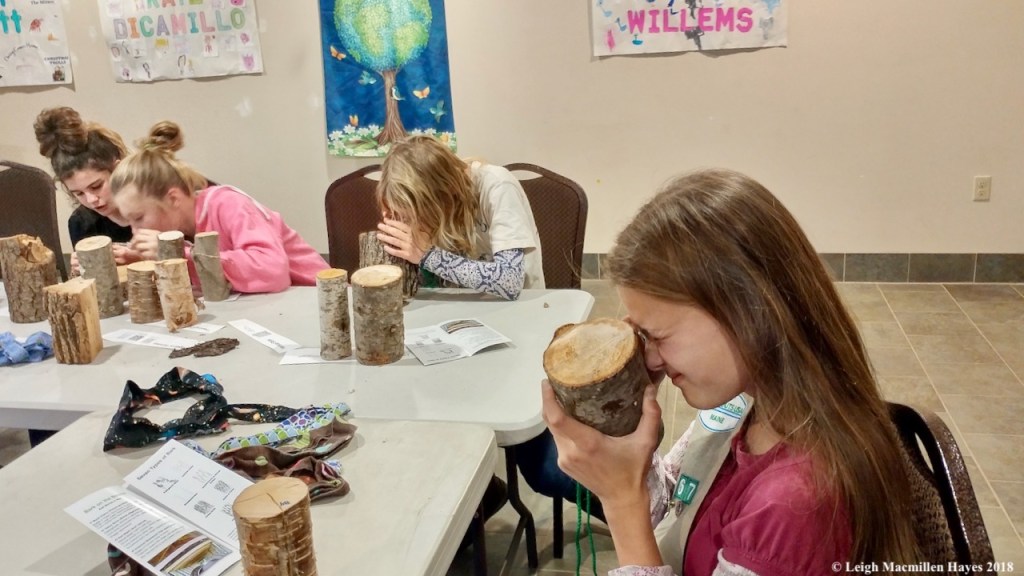
But one of her main fortes is sharing those details with youth, whether they be her own grandchildren, or kids involved in GLLT-sponsored events, like those in the after-school Trailblazers.

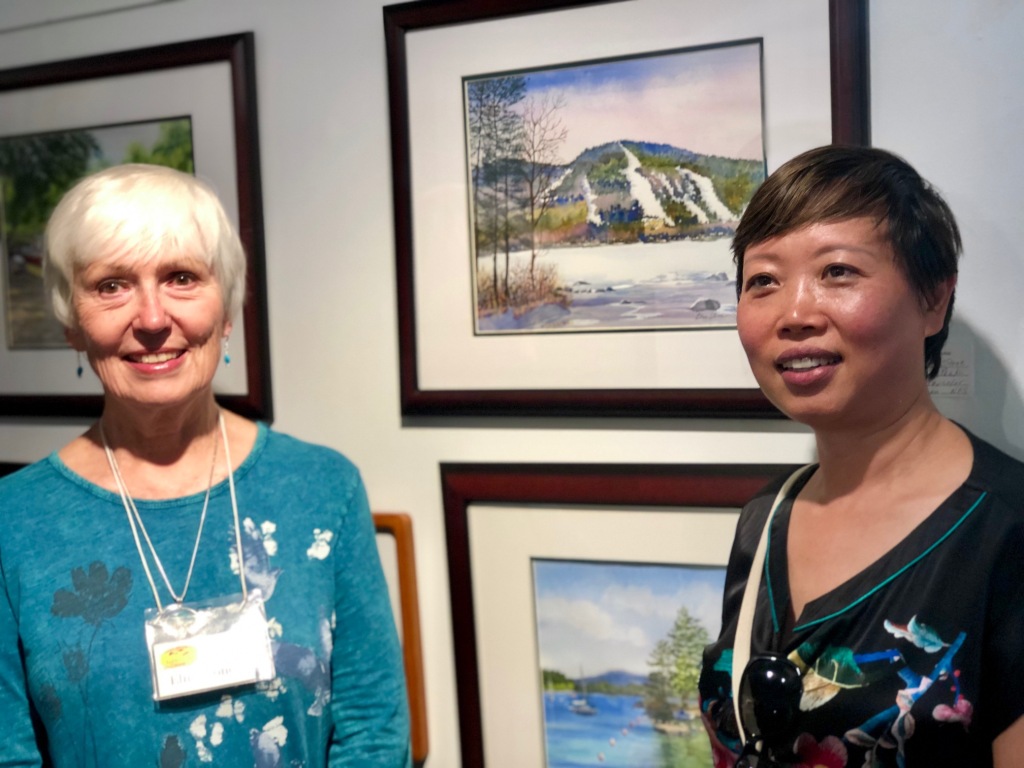
For Elna Stone, retirement gave her an opportunity to pursue her artistic talent and painting local landscapes has consumed much of her time. On the left, she poses beside a painting of Shawnee Peak Ski Area at Pleasant Mountain that she donated to a fundraiser for Gallery 302 in Bridgton. For years, Elna created calendars of local scenes that were sold as a fundraiser for St. Peter’s Episcopal Church.

Helping others either via the St. Peter’s or Bridgton Hospital
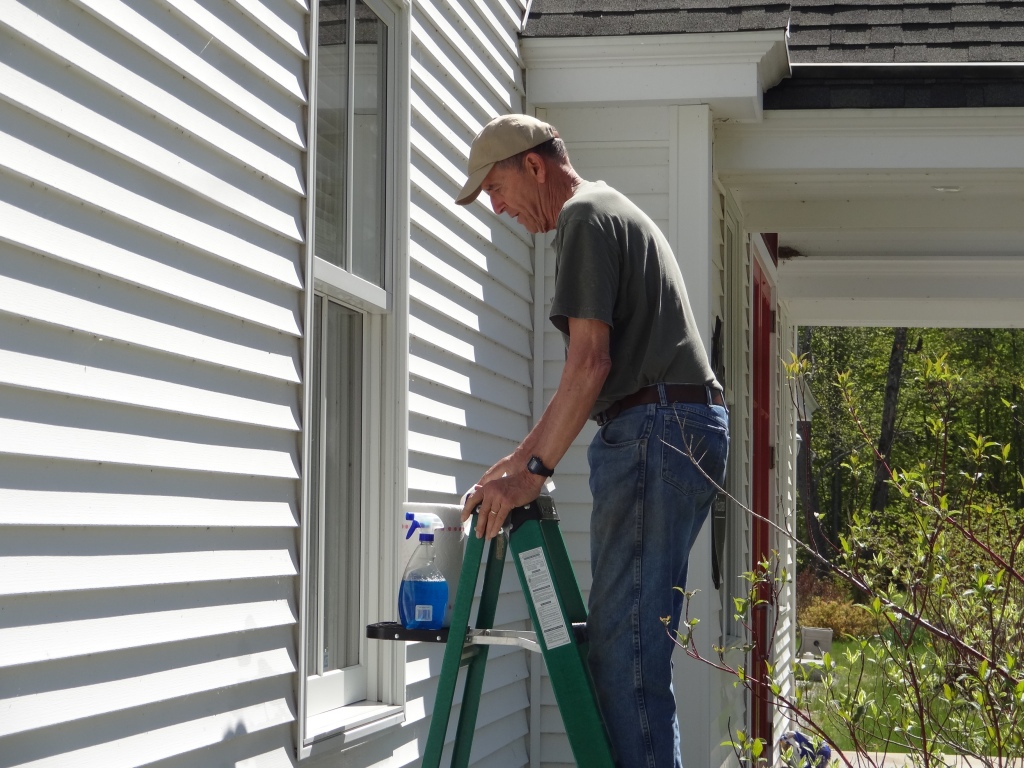
Cafe has long been a passion for the Stones. Even cleaning windows at church can offer Tom a sense of satisfaction.

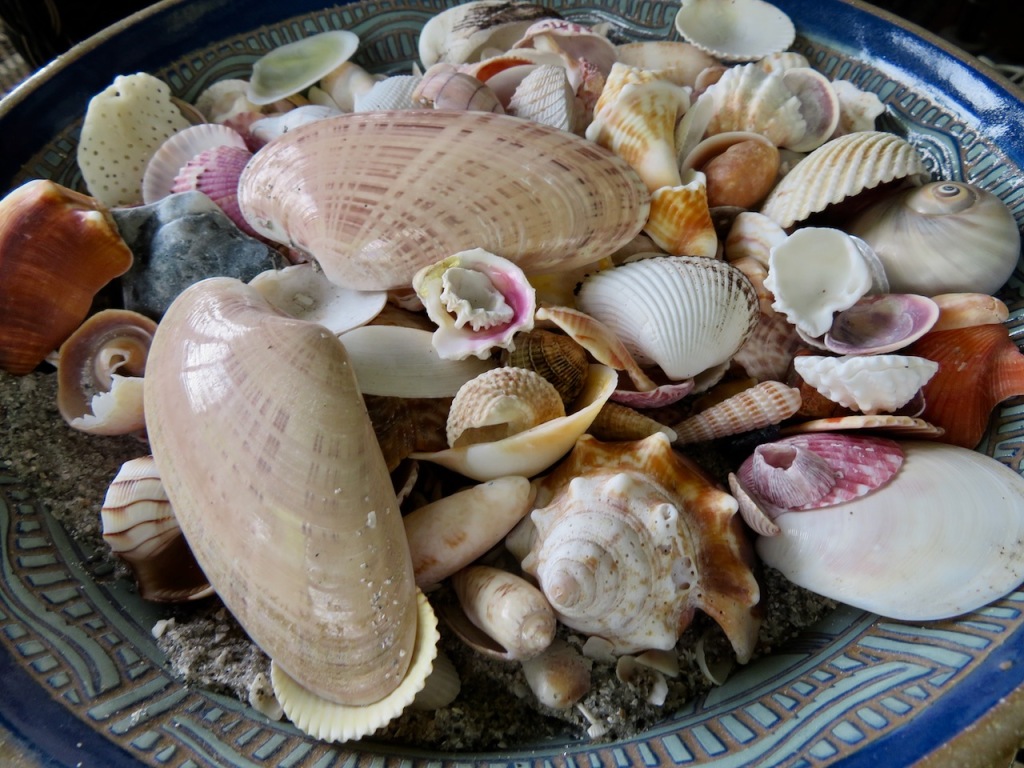
In the end, though they all love the life they’ve created in Maine, they admit there are some downfalls. One is that the winters seem to get longer each year. Linda Wurm has found a way to overcome that: a bowl of shells to gaze upon from time to time.

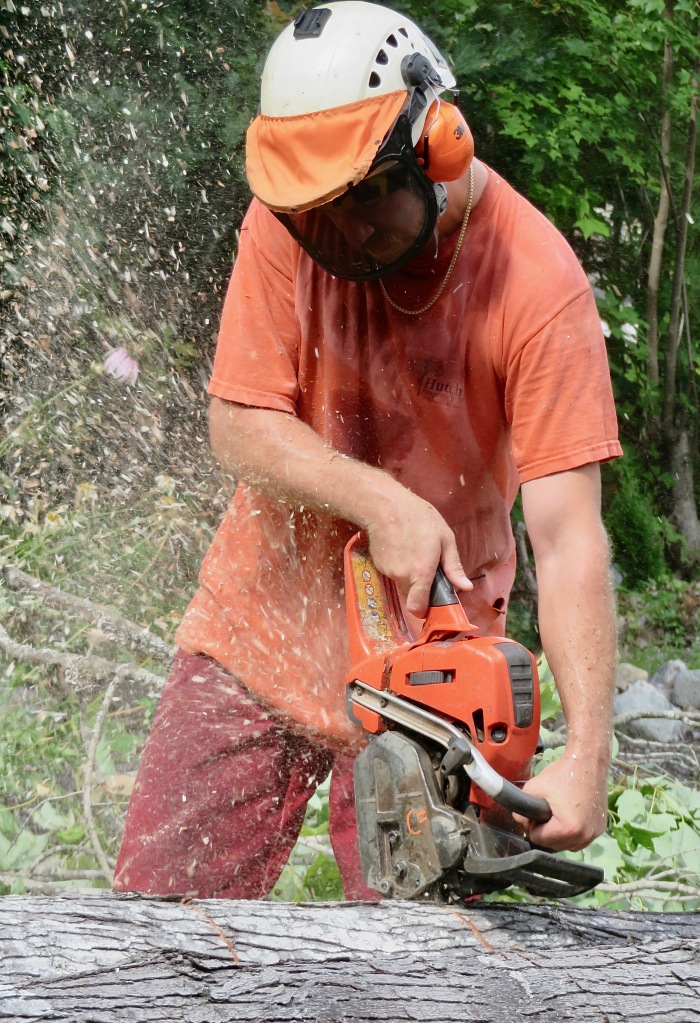
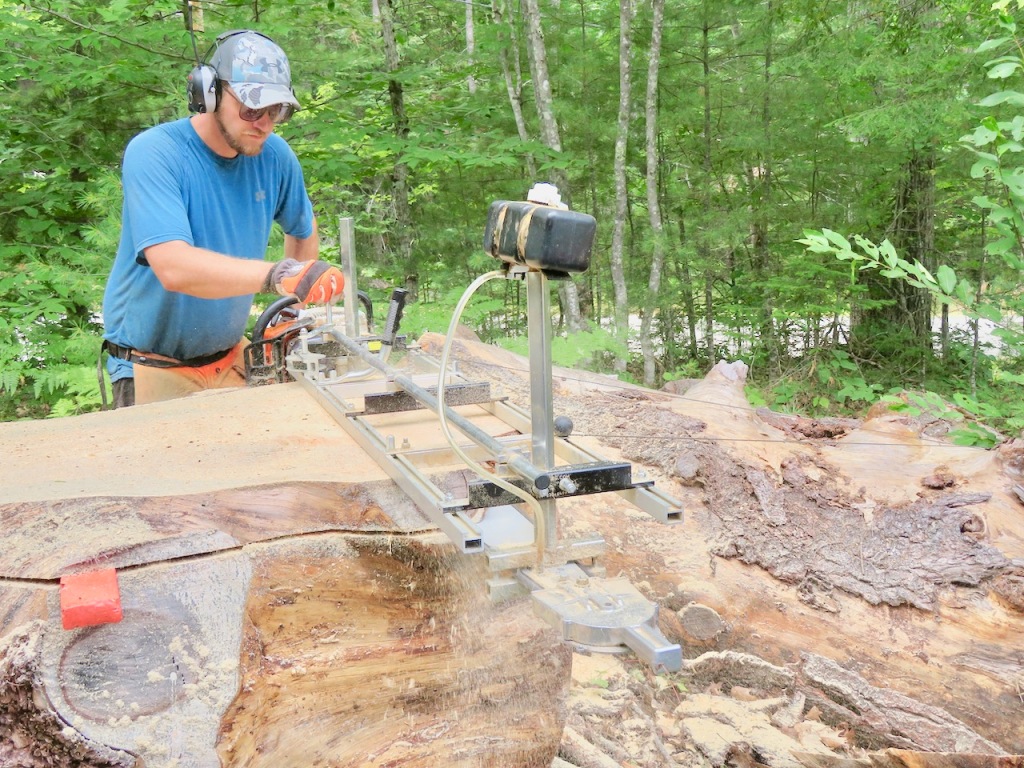
And then there’s my final article. It’s about three entrepreneurial men. They each bring a different talent to the . . . table. Literally. Eli Hutchins of Hutch’s Property and Tree chops the tree down.

Brent Legere of Lovell Box Company and Western Maine Slab Works cuts it into live-edge slabs.

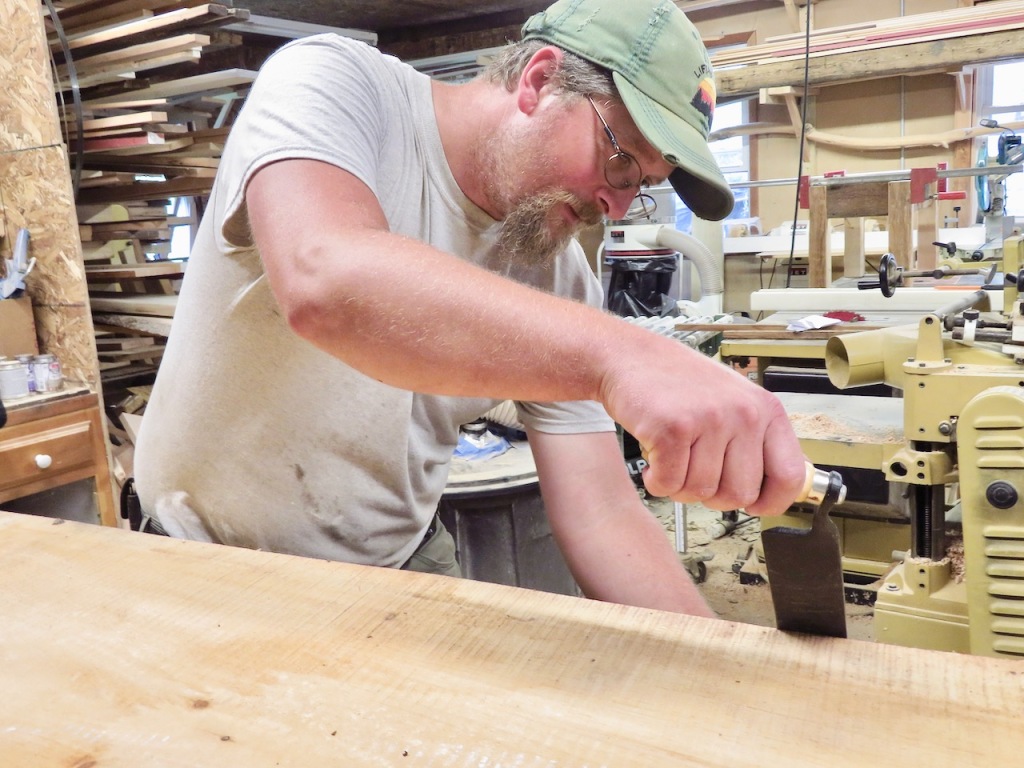
And Eugene Jordan of Jordan Custom Carpentry, Inc, turns it into a beautiful piece of furniture. You can read all about it in “A Tree Falls in Lovell.”

So, yeah. Brew a pot of tea, curl up in your favorite chair, and enjoy this issue of Lake Living magazine.

Oh, and please support the advertisers, including my guy, so we can keep doing what we love to do: learn about the many talented people in this area. I am constantly amazed. I hope you will be as well.

Lake Living magazine: Summer 2019

I’m always excited to share the latest issue of Lake Living magazine with you. Here ’tis: https://issuu.com/lakelivingmaine/docs/ll.summer.19.web

As Laurie comments in her editor’s note, a theme emerged while we brainstormed article ideas. You’ll have to read this from cover to cover to get the full effect.

My first contribution: “The Maine Event” about four local wedding or retreat venues–each one with a unique twist. Even if you aren’t planning a grand event, it’s still fun to peek into the places and meet the people who make the magic magical.

A second contribution: “Summer Living,” which is a listing of what’s happening in the lakes region of Maine this summer. There are several shout-outs throughout this section, including one for our local land trusts and LEA as we collaborate to bring history alive through a series of walks along our trails.

And my final contribution: “You Get What You Give.” This is probably my favorite for this issue because, well, I won’t tell you why. You have to read it. And figure out. Let’s just say I was completely moved by the experience.

Laurie has written about a new venture for a young couple in “A Passion for Play,” cuze Becca and Scott, plus their son Parker, do love to do that. Especially on our lakes and ponds, as well as mountains.

She also wrote about a local farmer who does more than that–something about music and feet in “Geof’s Farm Pedals.” Another gotta read.

And her final piece is about Cannabased Wellness, aka “The Back Room at Nectar.”

Then there are the book reviews a la Justin, Pam, Sue, and Perri of Bridgton Books.

Plus all the colorful ads. If you do live locally, please let the advertisers know that you saw their ad in Lake Living. It helps with ad sales, which are key because the magazine is free to you.

Finally, I just LOVE the cover–thanks to Mary Jewett’s fine photography. It makes me grin every time I look at it.

Lake Living magazine: Summer 2019 is upon us now. ;-)

Lake Living–spring 2019 issue

If you are receiving this for a second time, I apologize, but the link to the magazine was incorrect.

I am beyond excited to announce that the spring issue of Lake Living magazine is now available on a store shelf near you . . . or right here!

It’s our At Home” issue, where we feature articles about home-related items and projects. One of the projects is very close to my heart:

Yup, that’s our current kitchen. But as you can see by the title, change is in the air. You’ll have to read about it. The plans continue to evolve as I write, but we’re close to finalizing them. All that being said, nothing will happen until this summer as we still have a couple of feet of snow in the yard and after that melts, it will be quite wet for a few months. But stay tuned for The Evolving Home, part 2 in the fall issue.

Also featured: “Finding Home” by Laurie LaMountain–about rescue dogs and organizations that place them in forever homes; “Shaker Inspired”–a collaborative effort by Laurie and me about furniture built in Bethel, Maine; “A Patch of Land, part ii” by the up-and-coming writer Marguerite Wiser–describing the efforts of a local couple who have worked hard to turn their farm into a vibrant, year-round enterprise; “Cooking with Clay” by Laurie–highlighting the ever-delightful and creative Rusty Wiltjer, a local potter, and also featuring some cooking with clay recipes; “An Improved State of Home” by Laurie–offering fresh ideas for organizing and getting rid of some of your “stuff;” and finally, “Dear Earth” by yours truly–a heartfelt and funny homage to our wise and wonderful, but challenged Earth.

Please, please, please support the magazine’s advertisers (including a certain hardware store). Without them, we can’t continue to produce this little gem of a magazine (yes, I’m biased.)

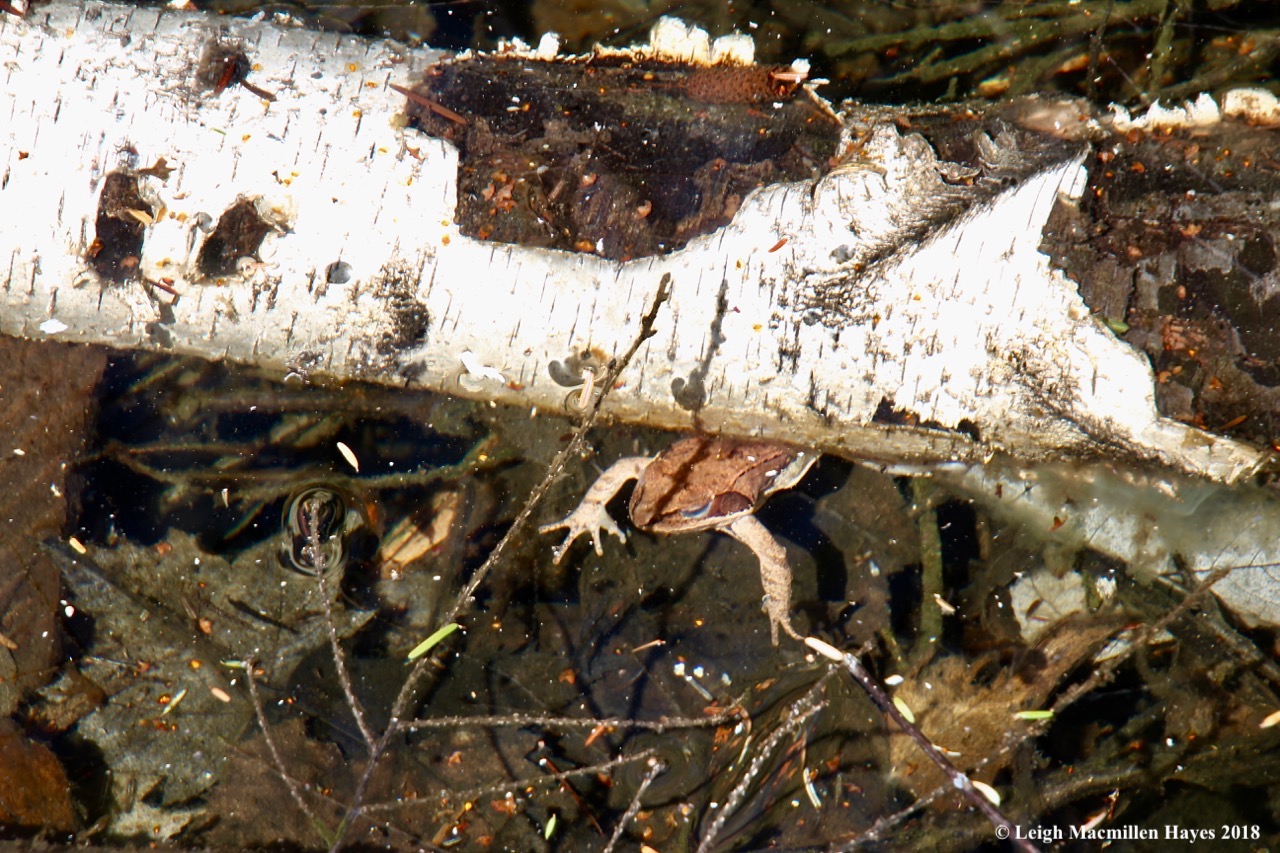
And get ready . . . for soon, I promise, the snow and ice will melt and the wood frogs and spring peepers will come to a vernal pool near you.

Book of December: Rewilding Our Hearts

It all started with an email message from my long-time mentor and former education director of the Greater Lovell Land Trust, Kevin Harding.

Wrote Kevin, “I rarely find a book that I’m willing to recommend to friends and colleagues. I rarely read books on saving the environment because I find them too depressing. I am guilty of feeling totally overwhelmed by the chaos and daily news of political disfunction that makes any kind of progress toward “saving the environment” seem impossible. Despite these feelings, I would like you to consider reading Rewilding Our Hearts by Marc Bekoff. No doubt many of you know this author and you may have already read some of his work. Bekoff can help us understand that the work we do in Lovell is in fact meaningful and productive.

Book of December

And so I added Rewilding Our Hearts by Marc Bekoff to my Christmas list and a few days ago my guy handed me this copy, which he’d ordered from Bridgton Books.

A professor emeritus of ecology and evolution at the University of Colorado, Boulder, (our youngest son’s alma mater), Bekoff is the author or editor of twenty-five books.

Since receiving the book, I’ve turned up the bottom corner of pages in the foreword and introduction that I want to reread and taken copious pages of notes.

In this book, Bekoff’s intention is to use the big picture challenges of “climate change, population explosion and constant damage to Earth’s ecosystems and loss of diversity” as the backdrop to encourage us all to change how we think and act–especially as it pertains to nonhuman animals.

“Rewilding our hearts is about becoming re-enchanted with nature. It is about nurturing our sense of wonder. Rewilding is about being nice, kind, compassionate, empathetic, and harnessing our inborn goodness and optimism,” writes Bekoff.

In the first chapter, he states, “Our effects on other species are wide-ranging and far-reaching, and we most likely understate the extent of our destructive ways. As with climate change, we often don’t know or fully understand what we’ve done or the extent of our negative impacts. Even worse, we have no idea how to fix the ecological problems confronting us, whether we are at fault for them or not.”

A live and dead spider within a pitcher plant leaf.

He encourages us to open our hearts and form a compassionate connection with nature–even in those moments when we don’t understand. For instance, in November a friend and I discovered two spiders in the water-filled “urn” of a pitcher plant on a land trust property. The larger spider was alive, while it seemed to play with the smaller dead spider that it kept moving with its hind legs. Was it trying to revive the youngster? Would the two or even the one be able to escape the carnivorous pitcher plant?

Great Blue Heron youngsters waiting for a meal

Watching something as small as the spiders or as large as young great blue herons is something some of us could easily take for granted, for we are fortunate to spend many hours as observers. Thankfully, we are constantly filled with awe and wonder.

ArGee as last seen a few weeks ago. A ruffed grouse startled me in the same area yesterday. Was it him? Or another? I’m not sure, but I am grateful that it behaved as a ruffed grouse should by flying off.

As I read Bekoff’s book, numerous visions flashed through my mind and I thought of the corridors that our local land trusts have worked diligently to create. And with that came the memory of an article I wrote for Lake Living magazine in 2015 entitled “Land That We Trust”:

My happy moments are spent wandering and wondering in the woods of the lakes region. And photographing and sketching what I see. And writing about the experience. And trying to find out the answers. Honestly though, I don’t want to know all of the answers. For the most part, I just like the wandering and wondering.

Passing through a stonewall, I’m suddenly embraced by the fragrance of white pines that form the canopy over what was once an agricultural field. Beech and hemlock trees grow in the understory. Lowbush blueberries, Canada mayflowers, bracken ferns, Indian pipe, partridgeberry, sessile-leaf bellwort, Indian cucumber root and a variety of mosses and lichens add to the picture.

I follow a former cowpath that opens to the power line. At the edge, taller hemlocks and northern red oaks stand high, with a few beech trees in the mix. But my eye is drawn to the ground cover, varied in color and texture. Sphagnum moss, several species of reindeer lichen, British soldier lichen, wintergreen, bunchberries, junipers and sheep laurel appreciate the bogginess and sunshine of this space.

To the right of another opening in the wall, the neighborhood changes. This time it’s gray and paper birch that grow side by side. Nearby, a vernal pool teems with life.

In each space, I encounter evidence of animals, amphibians, birds and insects. Sometimes I even get to see these neighbors with whom I share the land. Gray squirrels build their dreys up high in the hardwood trees, while red squirrels prefer the white pine forest. Deer bed under the hemlocks. Snowshoe hare browse among the birch grove and its vegetative undergrowth. Yellow-spotted salamanders and wood frogs lay egg masses in the vernal pool. Snakes slither nearby. Frequent visitors to each area include porcupines, raccoons, skunks, turkeys, gray and red foxes, deer, woodpeckers, thrushes, chickadees, nuthatches and warblers. Occasionally, I’m treated to moose and bear evidence and sitings.

People, too, are part of this habitat. They recreate along the snowmobile trail that follows the power line. The stonewalls, dug wells and rusty equipment speak to the area’s history.

It’s land like this that our local land trusts work diligently to preserve.

A wee disclaimer: I’ve been a volunteer docent for about eight years and am now education director for the Greater Lovell Land Trust. My involvement stems from my desire to learn about what makes up the landscape that surrounds me.

Sometimes alone, sometimes with my husband or friends, I hike all of the GLLT properties on a regular basis. Trekking along trails with like-minded people who pause frequently to identify and appreciate what they see in any season puts a smile on my face. Something stops us in our tracks every time we explore and we gain a better understanding of ourselves and this place we inhabit.

This past winter, I started recording my outdoor adventures, wonders and questions in a blog entitled wondermyway.com. Sometimes those hikes on land trust properties became the subject for a post.

Bear print and deer print in a kettle bog in Lovell

February 23, 2015: Bishop’s Cardinal Reserve, I’m fascinated by bear sign and love to find claw marks on beech trees. Oh, they climb other trees, but beech show off the scars with dignity for years to come. While bark on most trees changes as it ages, beech bark is known for retaining the same characteristics throughout its life . . . Seeing all the animal tracks and sign, some decipherable, others not so, makes me thankful for those who have worked hard to preserve this land and create corridors for the animals to move through.

March 31, 2015: John A. Segur Wildlife Refuge, It’s one of those places that I could spend hours upon hours exploring and still only see a smidgeon of what is there. I’m overwhelmed when I walk into a store filled with stuff, but completely at home in a place like this where life and death happen and the “merchandise” changes daily.

April 15, 2015: Otter Rocks, A princess pine club moss shows off its upright spore-producing candelabra or strobili. Funny thing about club mosses–they aren’t mosses. I guess they were considered moss-like when named. Just as the mills take us back in time, so do these–only much further back when their ancestors grew to 100 feet tall during the Devonian Period. They make me feel so small and insignificant. And yet, I’m thankful for the opportunity to be in awe of them.

Middle school students from Molly Ockett’s MESA program picking cranberries in the GLLT fen

May 3, 2015: Chip Stockford Reserve, There’s something about the Chip Stockford Reserve on Ladies Delight Road in Lovell that keeps pulling me back. I think it’s the history associated with this property that fascinates me. And the questions it raises. From the start, there is a cellar hole and barn foundation. Eldridge Gerry Kimball had purchased 200 acres on January 31, 1880 from Abraham E. Gray. Various journals from that time period include entries about driving cattle over to the Ladies Delight pasture, picking cranberries over by The Pond, as they called Kezar Lake, picking apples, driving sheep to pasture, picking pears, mowing oats and trimming pines. Today, it’s the huge pasture pines, stonewalls and a couple of foundations that tell part of the story. I’ve also heard that this area was used as a cattle infirmary. According to local lore, diseased cattle were brought to Ladies Delight to roam and die, thus preventing disease from spreading to healthy cattle. . . Another story about Ladies Delight hill is that this is the place where people would come to picnic in the 1800s. Did the women get dressed up to enjoy a day out, a break from their farming duties? I have visions of them wearing long dresses and bonnets and carrying picnic baskets. But could they really afford a day away from their chores?

May 10, 2015: Bald Pate Mountain, The “bald” mountain top is the reason I am who I have become. Being outside and hiking have always been part of my makeup, but when our oldest was in fifth grade, I chaperoned a field trip up this mountain that changed everything. The focus was the soils. And along the way, Bridie McGreavy, who at the time was the watershed educator for Lakes Environmental Association, sat on the granite surrounded by a group of kids and me, and told us about the age of the lichens and their relationship to the granite and I wanted to know more. I needed to know more.

June 16, 2015: Bishop Cardinal Reserve, Though we never plan it that way, our journey lasted three hours. Suddenly, we emerged from the wet woodland onto Horseshoe Pond Road–all the richer for having spent time in the land of the slugs, bears and caterpillar clubs. Oh my!

We are fortunate to live in an area where five trusts protect land for us and the species with whom we share the Earth: Greater Lovell, Loon Echo, Western Maine Foothills, Mahoosuc and Upper Saco Valley. This strikes me as a valuable reflection of who we are and where we live.

Land trusts work with community members to acquire land for permanent conservation through purchases and donations. They also create legal and binding conservation easements that allow residents to protect land holdings in perpetuity, while retaining private ownership. Scenic views, wildlife corridors, flora and fauna, and topography remain, subject only to the whims of nature itself, which is ever-changing.

Conserving the land doesn’t mean it can’t be touched. The organizations develop management plans and steward the land. Timber harvesting, farming, residency and recreation continue, while specific wildlife habitat, wetlands, unique natural resources and endangered or rare species are protected. And in the process, they strengthen our towns. Ultimately, they give us a better sense of our place in Maine and opportunities to interact with the wild.

The service area of each of the local trusts include watersheds and wildlife corridors. Greater Lovell Land Trust is committed to the protection of the Kezar Lake, Kezar River and Cold River and adjacent watersheds located in Lovell, Stow and Stoneham.

Loon Echo Land Trust serves seven towns: Bridgton, Casco, Denmark, Naples, Harrison, Sebago and Raymond, and their efforts actually reach beyond to the 200,000 residents of Greater Portland for whom Sebago Lake is the public drinking water source.

Western Foothills Land Trust serves the Greater Oxford Hills towns of Buckfield, Harrison, Norway, Otisfield, Oxford, Paris, Sumner, Waterford and West Paris. The watersheds they protect include Lake Pennesseewassee, Thompson Lake, Crooked River and Little Androscoggin River.

The Mahoosuc Land Trust works in central Oxford County, Maine, and eastern Coos County, New Hampshire. It strives to protect the watersheds and natural communities of Albany Township, Andover, Bethel, Gilead, Greenwood, Hanover, Milton Plantation, Newry, Rumford, Shelburne, Upton and Woodstock.

Likewise, the Upper Saco Valley Land Trust crosses the border and includes the communities of western Maine and northern New Hampshire that make up the upper watershed of the Saco River. Its service area flows from the source of the Saco in Crawford Notch toward the Hiram Dam and includes Harts Location, Jackson, Bartlett, Chatham, Conway, Albany, Madison and Eaton, New Hampshire and Fryeburg, Denmark and Brownfield, Maine.

In addition to their service areas, the land trusts collaborate with each other and local lake associations. Most recently, the GLLT, LELT, WMFLT and USVLT, plus the Portland Water District have joined forces to protect the fifty-mile Crooked River. The river is the largest tributary flowing into Sebago Lake and it provides primary spawning and nursing area for one of four known indigenous populations of landlocked Atlantic salmon in Maine.

Lovell Girl Scout Cadette Troop 67 up close and personal with tree cookies

Protection is key. So is education, which develops understanding and appreciation. I know for myself, my relationship with the landscape continues to evolve. The mentors I’ve met along the way have played an important part in my involvement and caring for the environment.

All five land trusts offer numerous hikes open to everyone, providing a great way to explore and learn more about the diversity of the natural communities. Staff and volunteers lead walks, stopping frequently to share a bit of knowledge, ask questions and wonder along with the participants. These organizations also offer indoor programs featuring knowledgeable guest speakers.

I’m thankful for the work being done to protect the ecosystem. There’s so much I still don’t understand, but with each nugget of knowledge gained, the layers build. Maybe someday I’ll get it. Maybe I never will. Either way, I’m happy for the chance to journey and wonder on land trust properties.

Even though we can’t all endow the future of our properties, we can get involved to ensure that these organizations continue to protect land for future generations of humans and wildlife so it will remain in its natural state for the benefit of all.

Water snake at the GLLT Otter Rock

So back to Bekoff’s book, he quotes many biologists and others as he makes the point that when we experience alienation from nature we make bad decisions including “wanton killing of wild species, clear cutting, pollution and other human impacts, and caging of nonhuman animals.”

“What we do,” writes Bekoff, “does make a difference and rewilding our hearts is about fostering and honoring our connections to one another and all life.”

My daily fox–12/30/18

After all, as evidenced in our yard each day and night when the visitors are many, we share this place with and in fact live in the world of our nonhuman neighbors. We need to figure out how to live together–and that premise is at both nonhuman and human levels since we are all interconnected in the web of life.

Inside structure of an oak apple gall

Though Bekoff’s focus is on nonhuman animals, I do wish he’d also addressed other forms of life, such as fungi, insects, plants, and the like.

He does list what he calls the “8 Ps of Rewilding” as a guide for action: Proactive, Positive, Persistent, Patient, Peaceful, Practical, Powerful, and Passionate. “If we keep these eight principles in mind as we engage one another and wrestle with difficult problems, no one should feel threatened or left out,” says Bekoff.

As the book continues, there are definitions provided for catch phrases such as compassionate conservation and stories of unsung heroes who have made it their life’s work to “rewild our hearts and to expand our compassionate footprint.”

GLLT/Lovell Recreation Trailblazers created a woodland map

Bekoff is a realist and so am I. He would love to see us all become vegetarians or vegans, but realizes we will not. He knows that it will take people time to unlearn preconceived notions, especially given that the media thrives on misrepresenting animals. He knows that his rewilding our hearts is a concept with a broad agenda.

One of my take-away thoughts was that all of local environmental organizations are working hard to create corridors and raise awareness and awe about the natural world. Of course, we could all do better. But, we’ve already got a good start on doing what Bekoff suggests: “Figure out how to foster a love of nature and other animals so that every generation sees this connection as precious and vital and worth nurturing.”

But . . . he concludes that “if we all made some simple changes to our lives, the world would soon become a more compassionate place for all beings and landscapes.

Great Horned Owl Plastica species

And he reminds us to be humble and able to laugh at ourselves. Yeah, so um, I was the one who stopped a small group of friends as we moved along a trail on private property because I was the first to spot a great horned owl this fall. Yeah, um. It was plastic. And a set up. I’m still laughing.

Dear readers, if you’ve read this far, you deserve a reward. I know I got a bit off track by including my own article, but I do believe that we’ve got a start on rewilding our hearts in western Maine. Yes, we have a long way to go. Let’s do this. Together!

And remember, my guy purchased this copy of Rewilding Our Hearts at Bridgton Books.

Rewilding Our Hearts: Building Pathways of Compassion and Coexistence by Marc Bekoff, 2014, New World Library.

Transitional Stars

I wandered a bit of the Tenmile River Demonstration Forest with Laurie LaMountain, owner/editor/publisher of Lake Living magazine, this morning as we played catch up. Typically, we are in frequent touch with each other, especially while producing a magazine each quarter. But this winter, there will not be an issue, and so our contact has been less frequent. 

Making our way via snowshoes was a bit of a challenge for the last heavy snowstorm downed many a tree and it was like maneuvering through an obstacle course. 

As I stated in a blog post last year, the Tenmile River Demonstration Forest was donated to the Oxford County Soil and Water Conservation District (OCSWCD) in 1950 by Frank Merrifield, three years after the Great Fire of 1947.

Back in October 1947, catastrophic wildfires erupted throughout Maine during what became known as “The Week Maine Burned.”

It hadn’t rained for 108 days and the dry woods were like tinder. Here in western Maine, Fryeburg, Brownfield and Denmark thought they had a fire under control, but overnight a strong wind blew and gave it new life. About 2,000 acres burned by the next night as the fire spread to the edge of Brownfield.

With the winds continuously shifting, town folks began to panic. Farmers either turned their livestock loose or herded them to neighboring towns. Others packed as many belongings as they could and evacuated.

By morning, most homes and public buildings in Brownfield were mere piles of ash. Stately places including the Farnsworth Place where Dr. Philo Farnsworth, a pioneer in the field of television, spent his summers, had burned. Churches, schools, the post office, Grange hall, library and town hall all went up in smoke–only twenty houses survived. In the end, 85% of the town was destroyed.

According to the property brochure available at the kiosk, “The District Supervisors replanted the property with red and white pine” between 1950 and 1960. “It was their plan to turn the land into an example of wise and sustainable forest management and to use it as an education resource area to demonstrate good conservation management practices.”

Today, we noted some of the work that had been done as we made our way to the Tenmile River for which the property was named. And at the river, it was the amount of water passing through that drew us to a stop.

Standing beside it, we paused for the longest time. As it always does, the sound of the flowing water and sight of the ice captured our attention. 

When the temperature dropped, the motion energy of water molecules dropped. At 32˚, water molecules slowed enough to link up with each other and formed a hexagon matrix.  At that point, the liquid that once flowed became brittle ice in its varying forms. 

There were examples of rime ice coating downed twigs. While frost forms from water vapor, the rime ice formed from water droplets–perhaps in a mist of our recent foggy days. If the temperature of the droplets was below the freezing point, they adhered to any surface below freezing.

Rime ice is hard and depending on conditions can be thick, heavy and white or clear in color. Today’s examples were the former and helped create unique shadows that danced in a way that will never be seen again. 

That’s the thing about ice. It is ever changing and the patterns created intertwined with reflections upon the water provided lines portraying all manner of motion.

If you look closely in the lower right-hand corner, you may see the outline of a few people being pulled into the picture–the true water worshipers.  

There was also a lady who reached up from her couch to grasp something–perhaps a bird of paradise. It appeared that the heart within her bosom was enlarged with love. 

Every second of every day the pattern changes and so our observations were in the moment. 

But no matter what, each rendition was a work of art, a sculpture to fill our souls and take with us. 

As we took our leave, Laurie and I gave thanks for the opportunity to stand in awe and notice and be filled by the wonder of it all. 

The stars of the show–forever in transition.