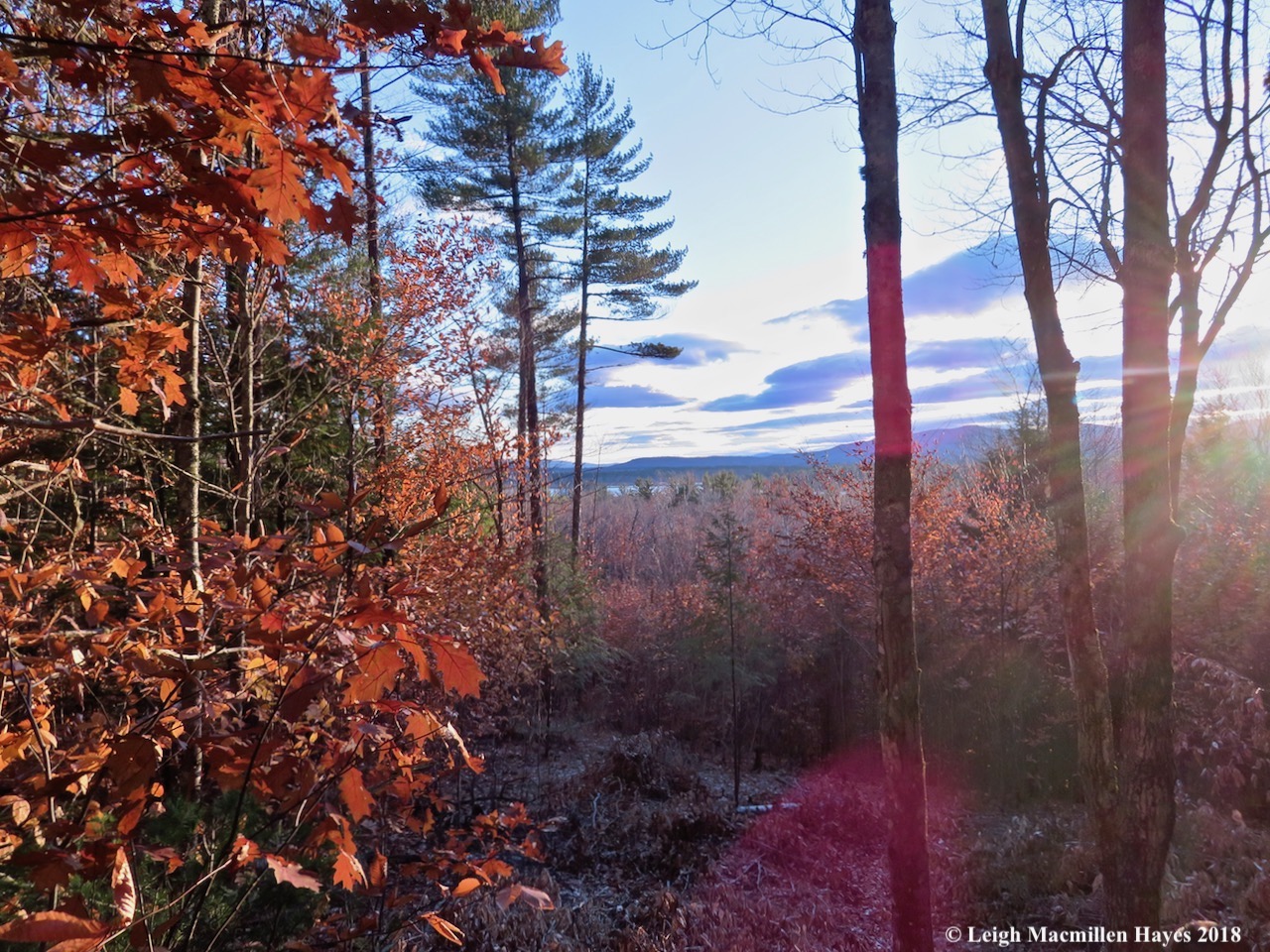
Merry Christmas from Narramissic

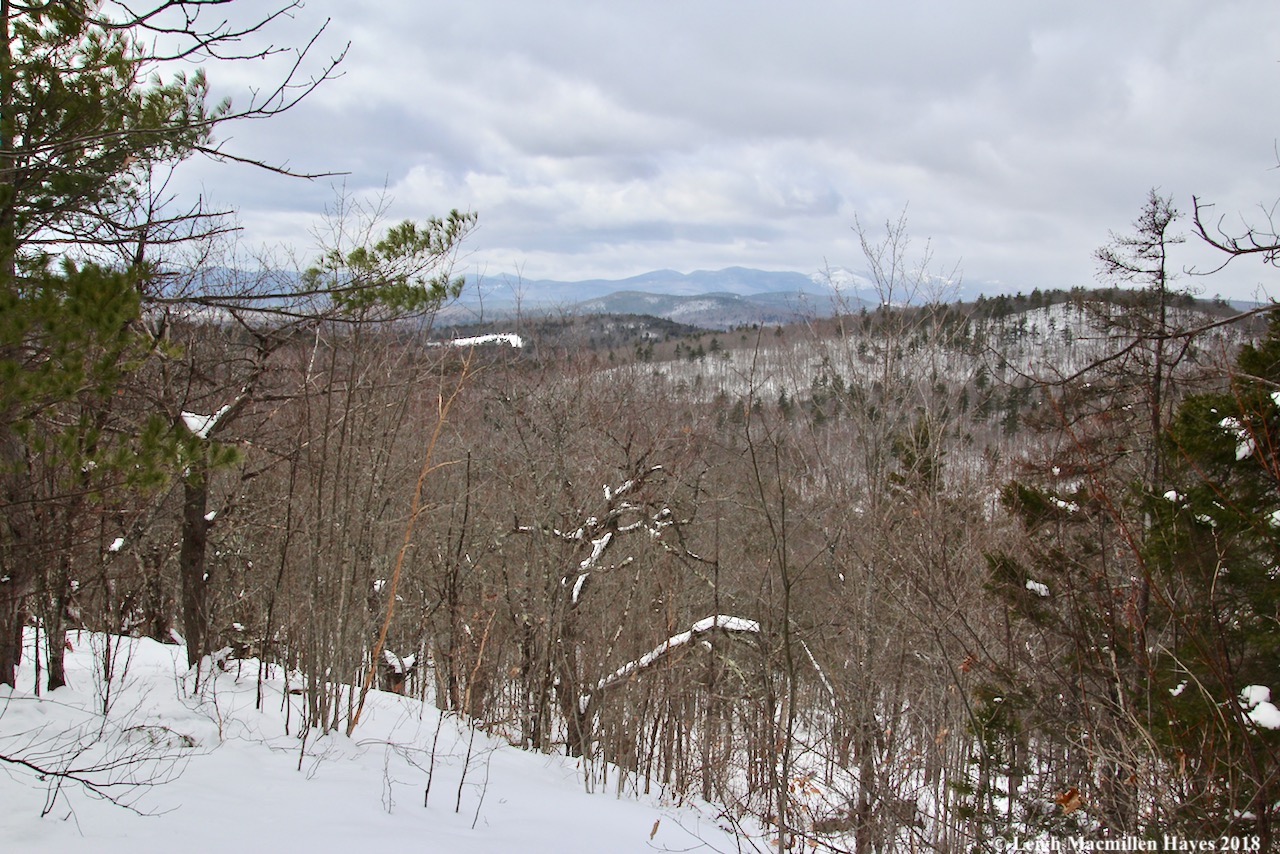
With Christmas rapidly approaching I decided to visit Narramissic, the Peabody-Fitch Farm gifted to the Bridgton Historical Society in 1987 by Mrs. Margaret Monroe of Providence, Rhode Island.

I had the honor of knowing Mrs. Monroe’s daughter, Peg Norman, who essentially grew up in the house having spent all of her summers there. Her mother purchased the house in 1938 after the death of her father. In Peg’s words as recorded in an essay entitled “Narramissic – Hard to Find” that she wrote when the deed was transferred from her mother’s estate to the historical society, she said, “[Mother] was searching for a refuge, a place to heal.” 
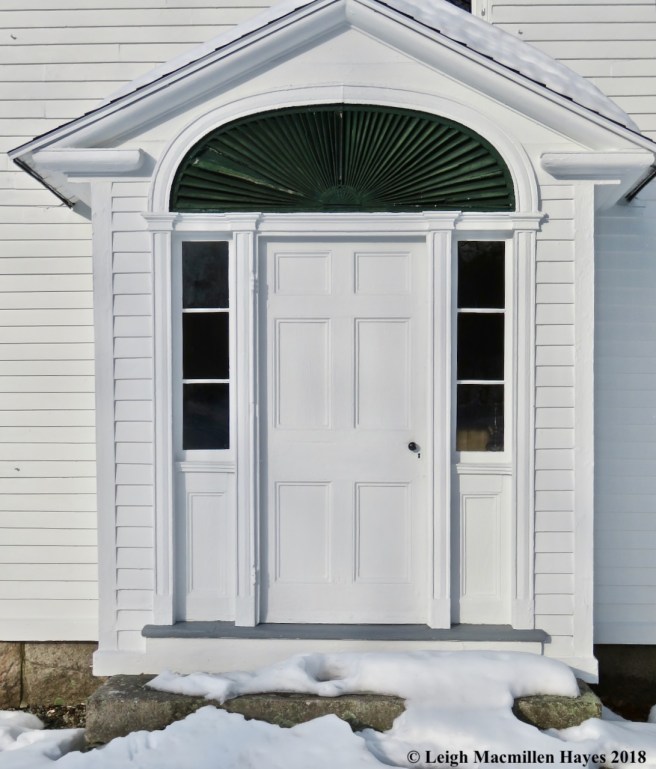
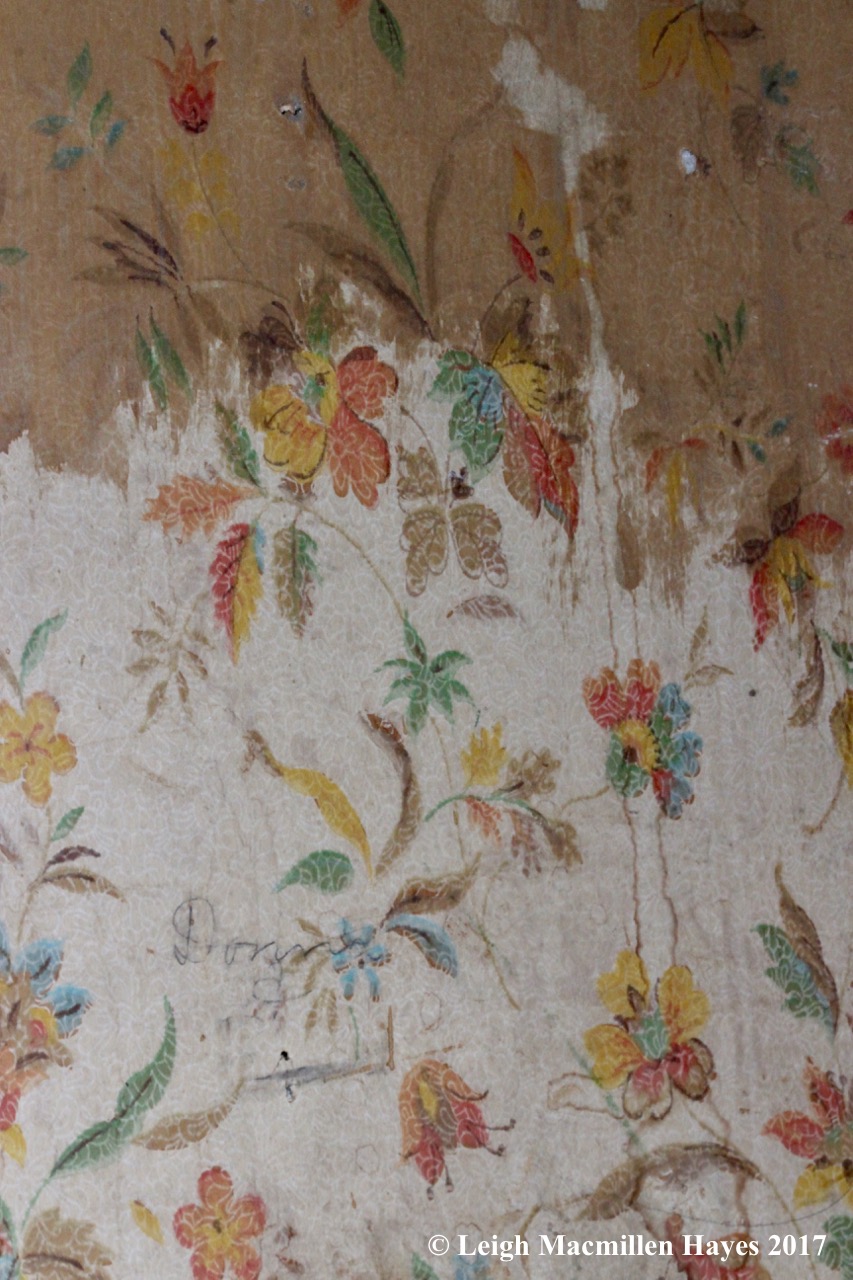
Peg continued, “Inside the house I remember only clothes hung everywhere and an unmade bed in the upstairs sitting room. My mother saw beyond. She saw the fans over the doorways, 

the granite hearthed fireplaces, Nancy Fitch’s name engraved in the wavey glass window pane, the sweeping arch of the carriage house entrance . . .
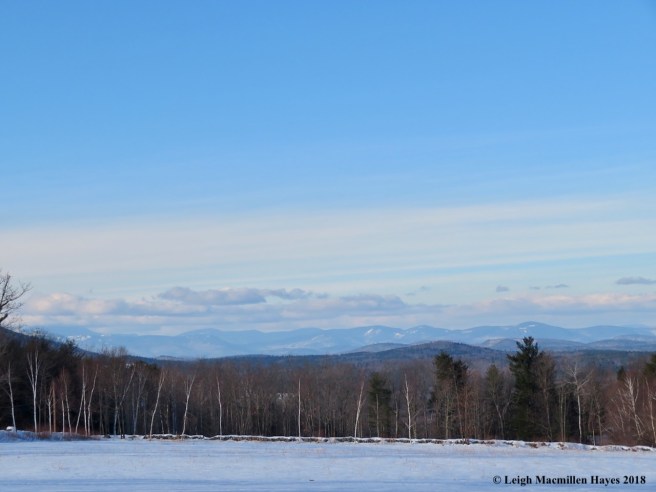
and the mountains, purple massifs unfolding out of the sky. She felt the history and eternity and peace.”

Peg went on to mention that her family spent “many Christmas holidays and ski weekends up there throughout the years — just the way the Peabodys and Fitches had (the original owners of the farm), heated by the kitchen stove and blazing fireplaces — and an old Franklin stove my mother finally allowed to be set in the living room fireplace ‘just for winter.'” 
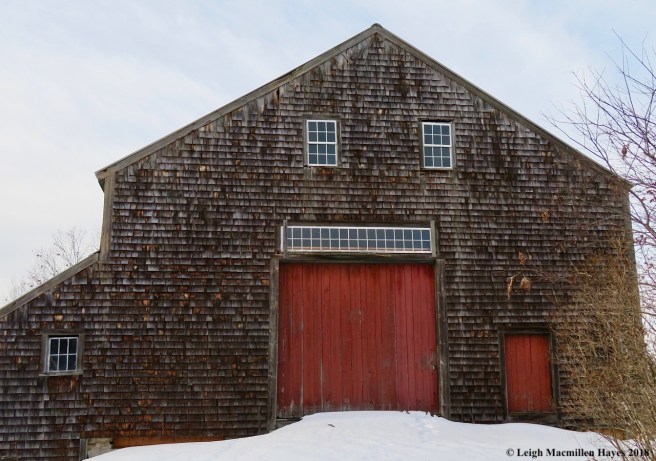
Peg’s mention of the outbuildings included the barn, “the huge barn with the biggest horse I had ever seen munching contentedly in the front stall.”

Still standing, though its had some help recently to that end, the barn was erected by the Fitches and has come to be known as the Temperance Barn; historical records claim it to be so named “because it was raised without the traditional barrel of rum.”

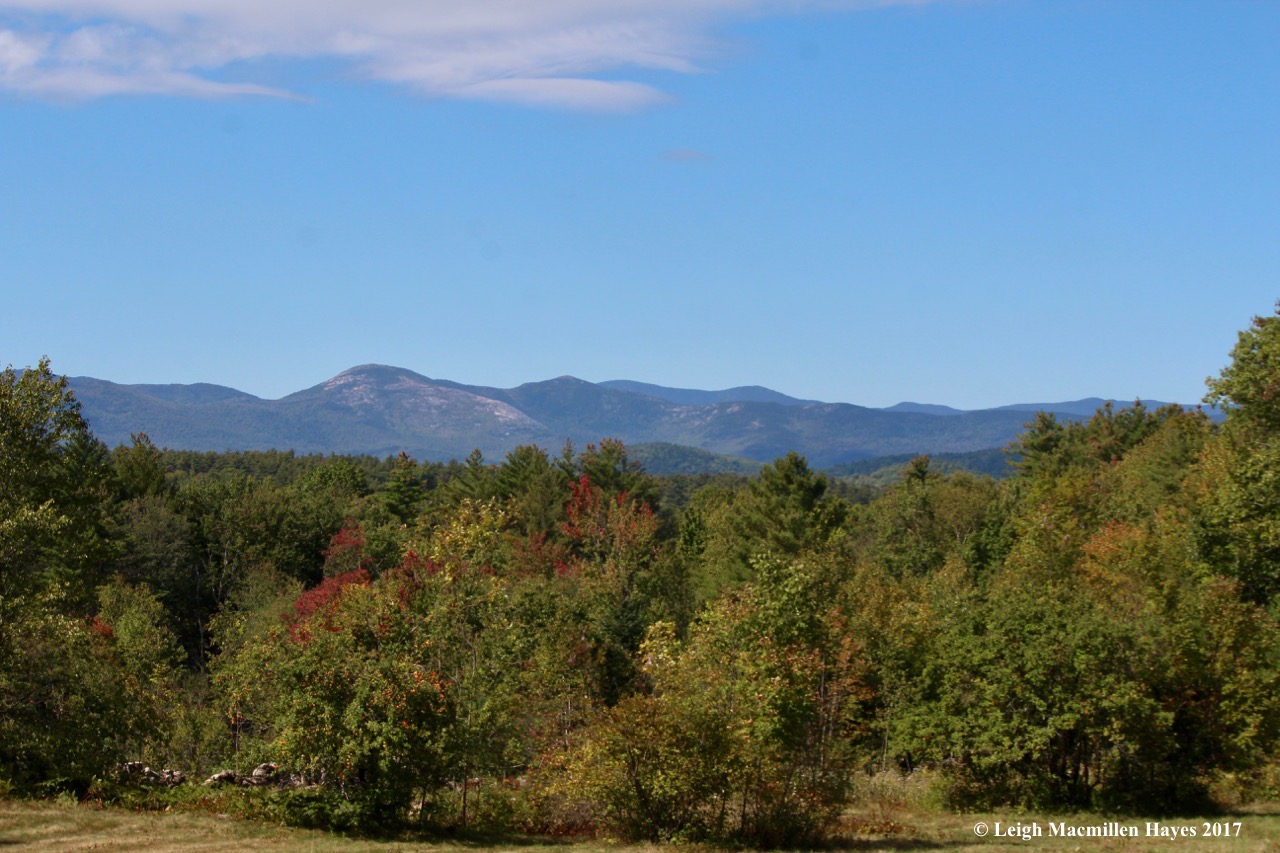
I chose to explore on this delightfully warm day(45˚ feels like summer given the recent temps), but also to gain a better understanding of the collaboration between the historical society and Loon Echo Land Trust as they raise funds to purchase the 252-acre Peabody-Fitch Woods from the Norman family and place it under conservation easement while adding to a contiguous forest with other protected properties both adjacent and nearby. As I crossed the field, I kept turning back–to admire the farm and the mountains, including the ridge-line of our beloved Pleasant Mountain. Between Loon Echo and The Nature Conservancy, almost 3,000 acres of the mountain is protected and LELT maintains the 10 miles of trails that we frequent. 
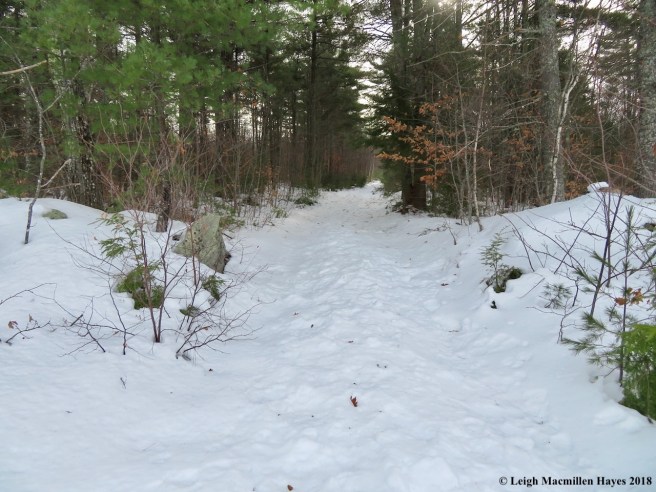
It occurred to me that I didn’t realize the blue trail that crossed the field and continued into the woods, as designed by Adam Jones for his Eagle Scout Project in 1999, wasn’t part of the historical society’s property. 
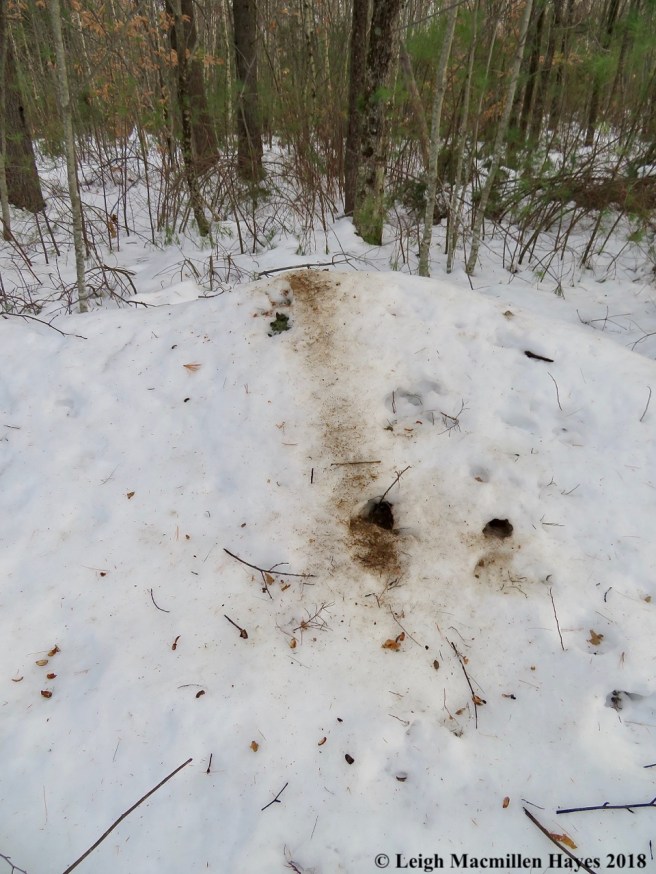
And yet, it’s just as important for many species depend on it. Should the property be developed, the historical and natural features might diminish.

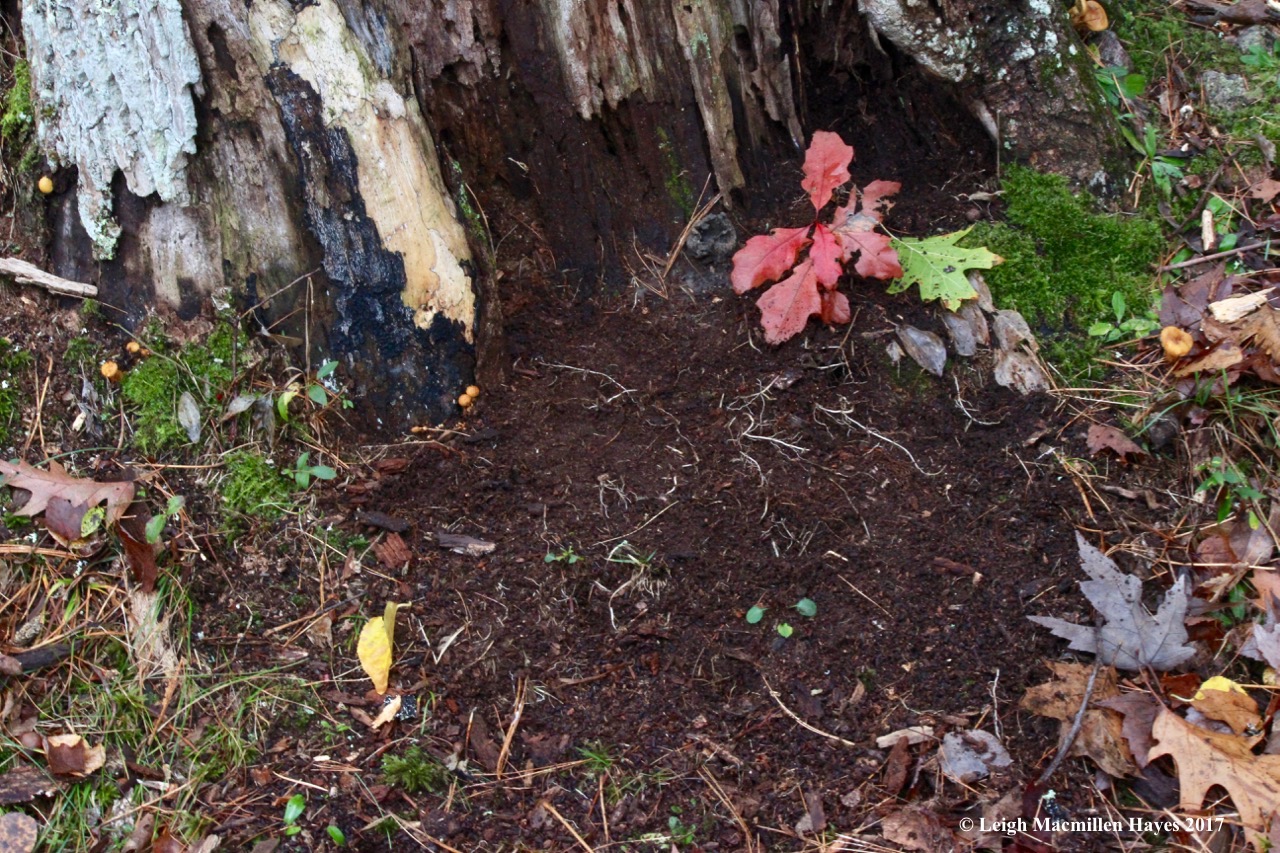
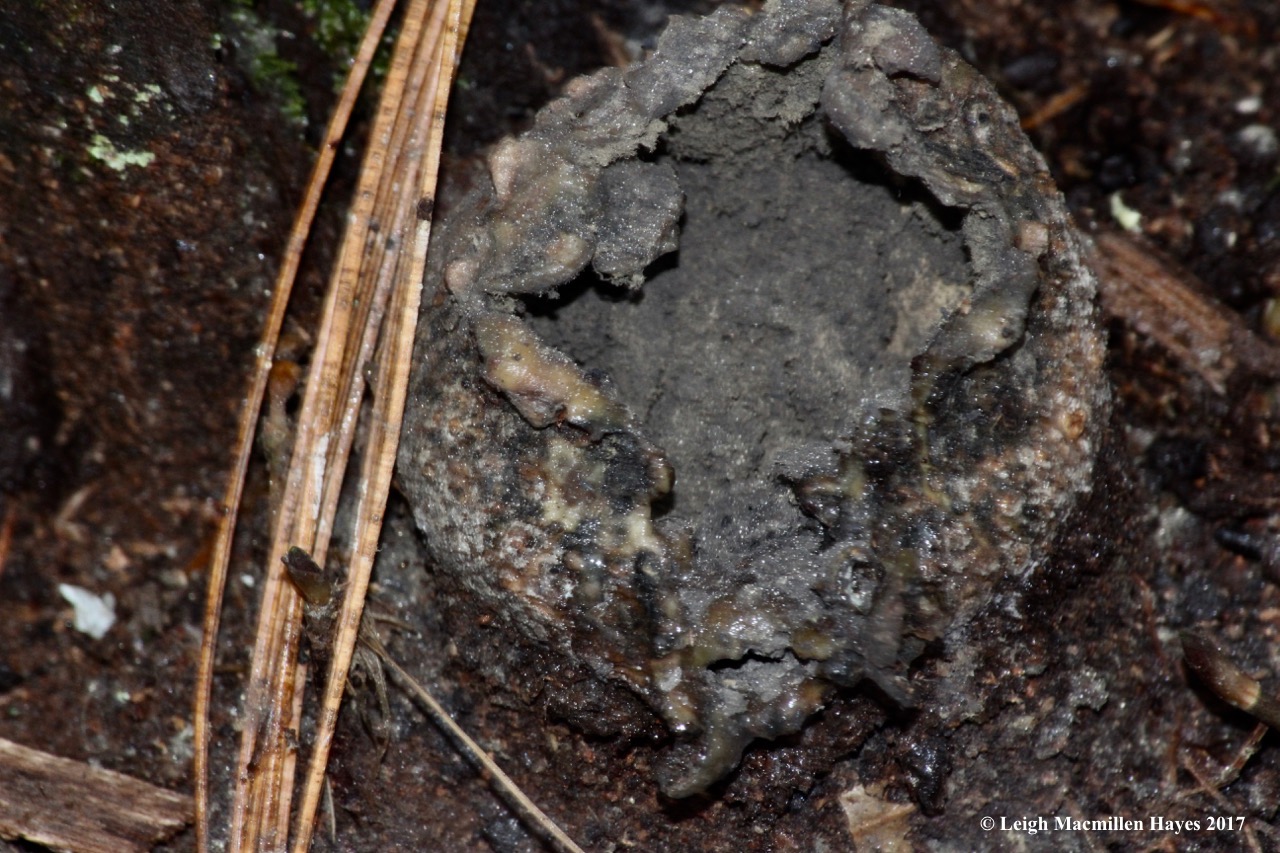
Should it be developed, I won’t be able to return in the future to figure out why the squirrel condominium featured a muddy carpet between doorways. 
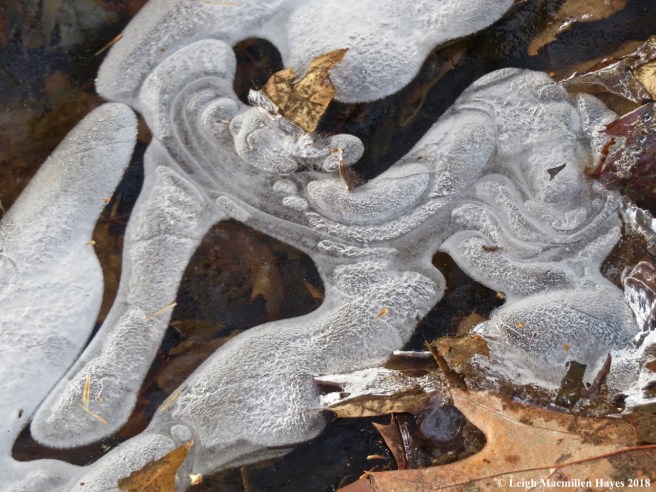
Should it be developed, I’d miss out on ice formations along the trail such as this miniature pony — saddle and rider included. 

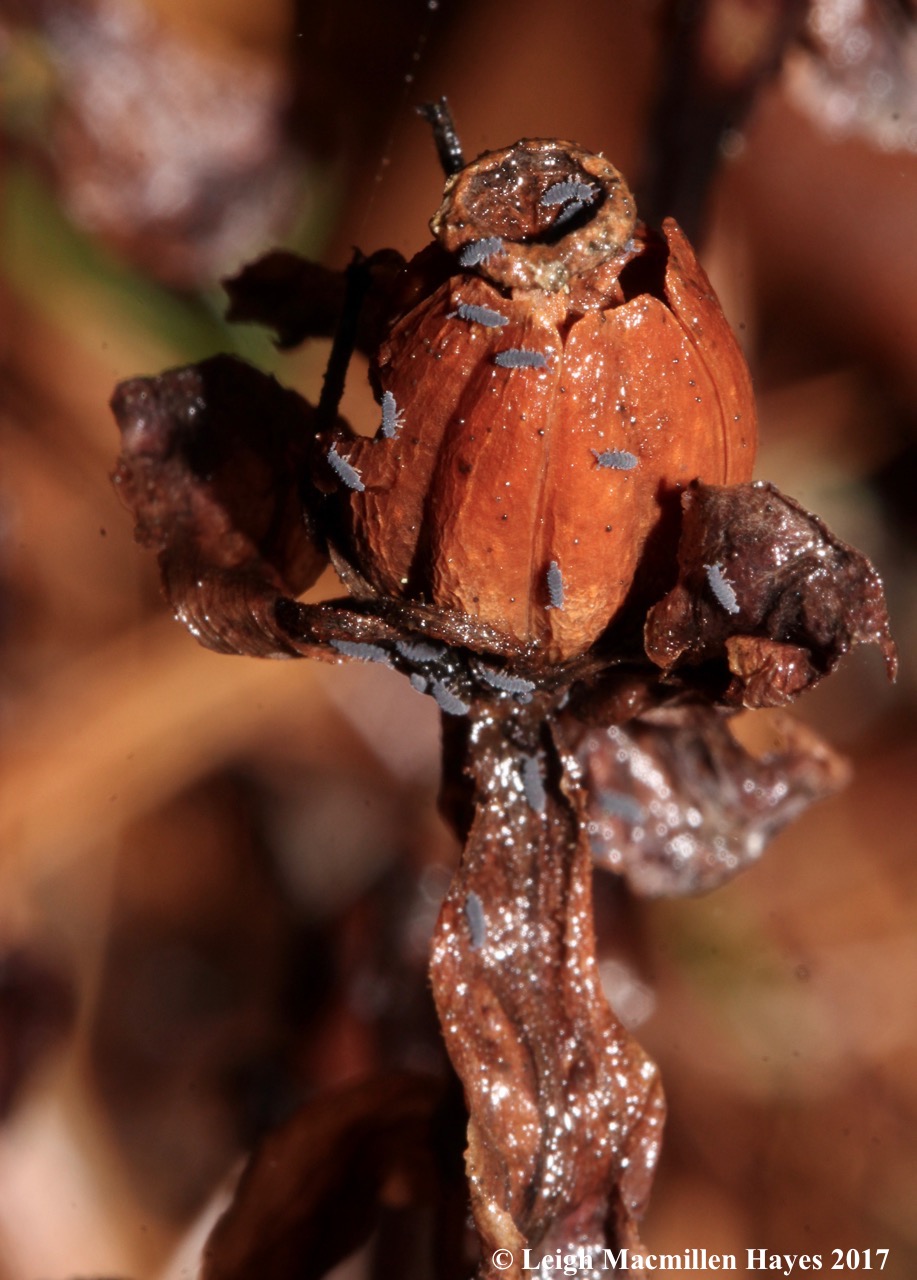
Should it be developed, new understandings would bypass me, such as the fact that white oaks do indeed grow in Bridgton. Well, at least in South Bridgton. This one was speckled with spring tails on this warm day. 

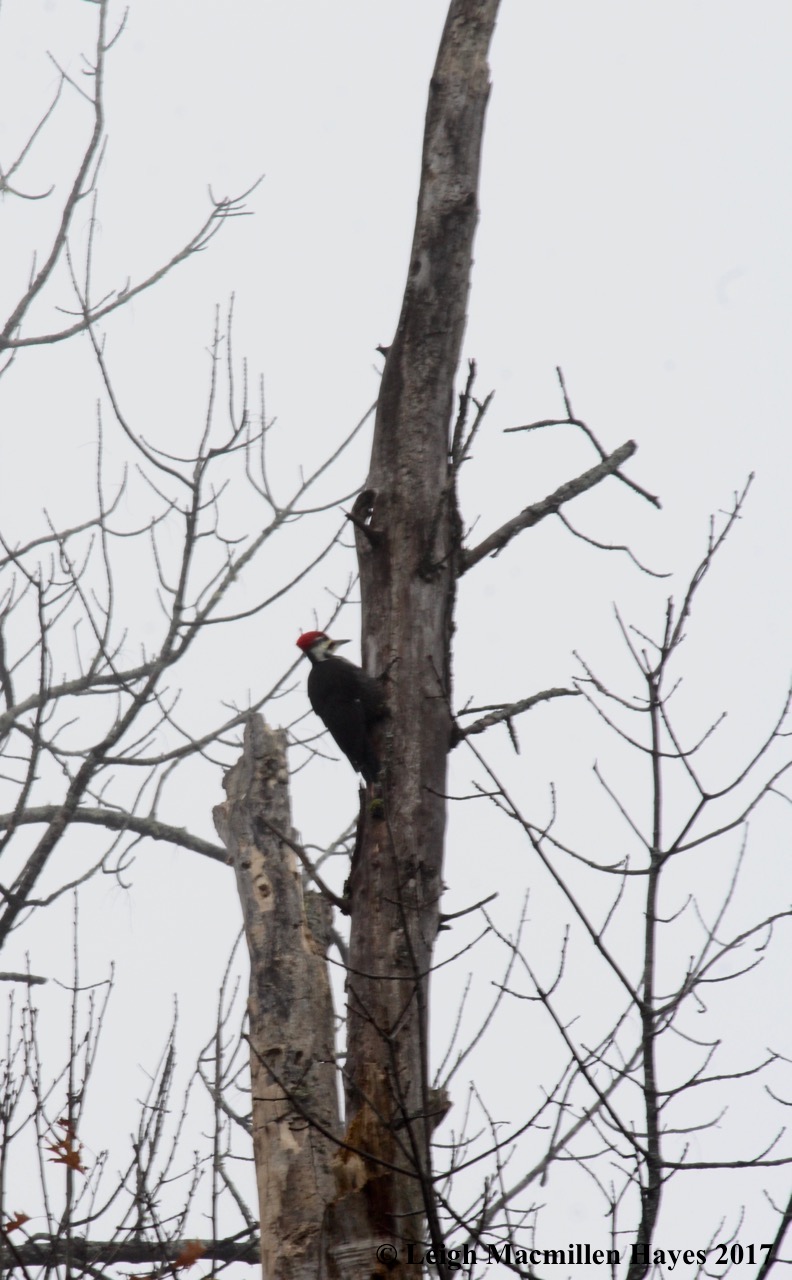
Should it be developed, the pileated woodpeckers will have fewer trees upon which to excavate. 

And selfishly, I’ll have fewer opportunities to search for their scat — filled with insect body parts. 
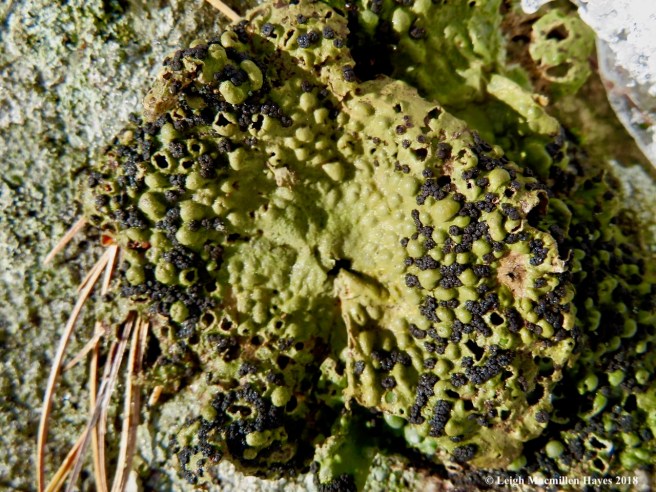
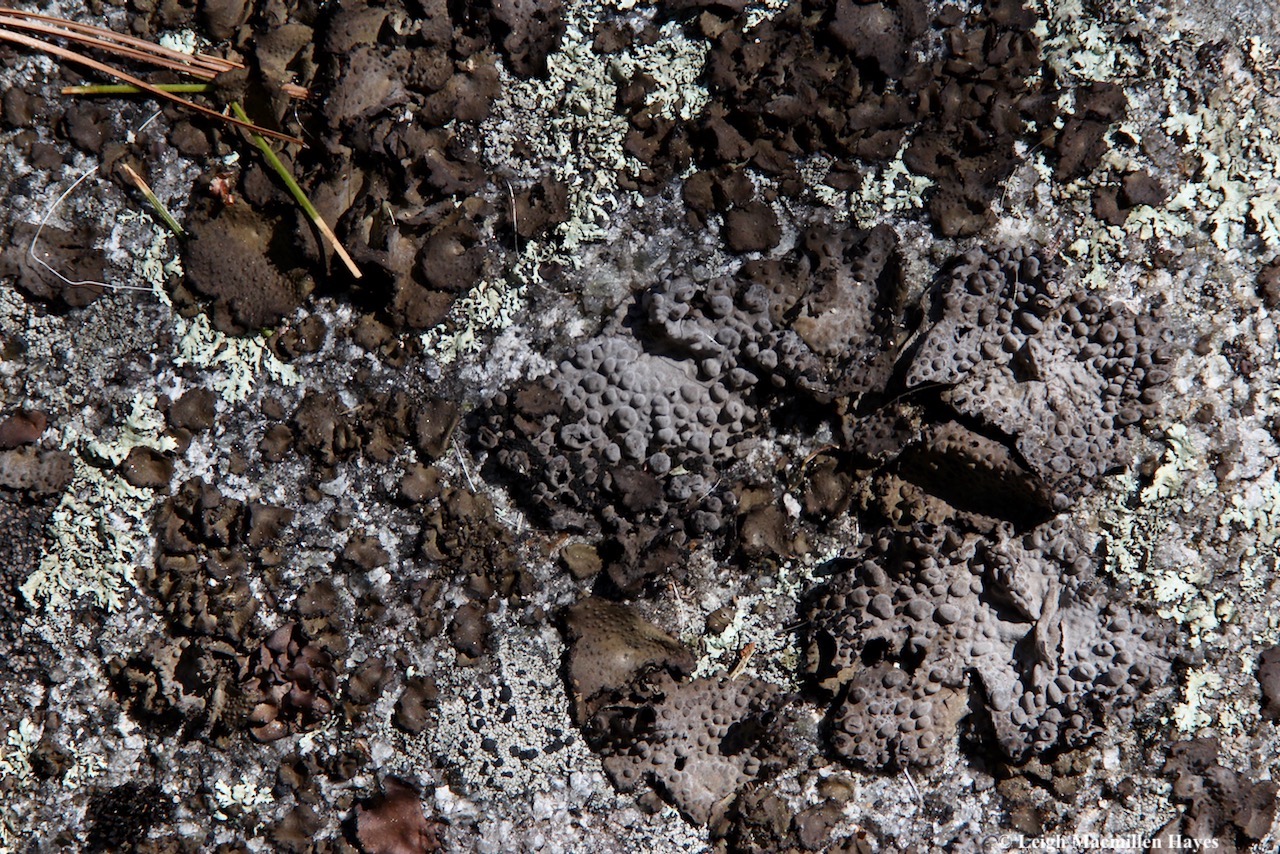
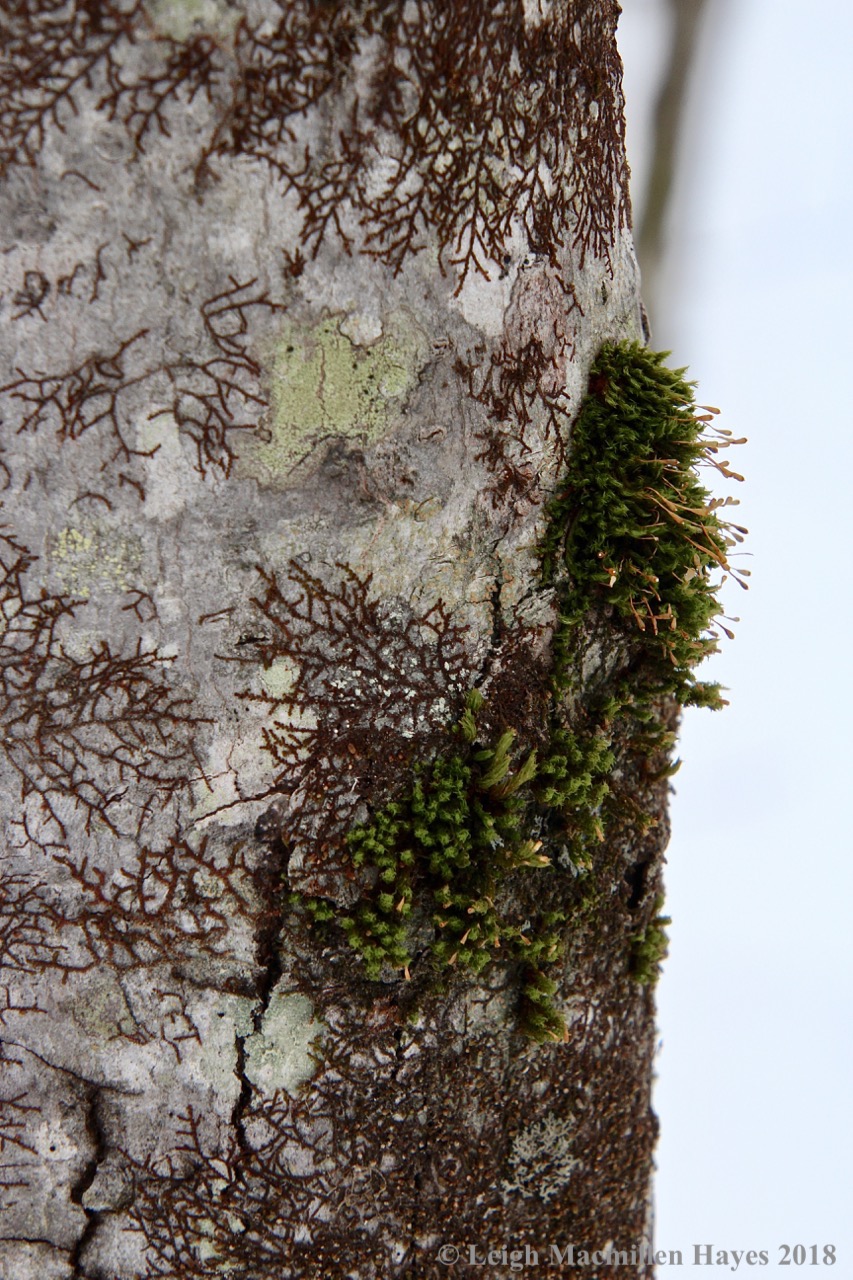
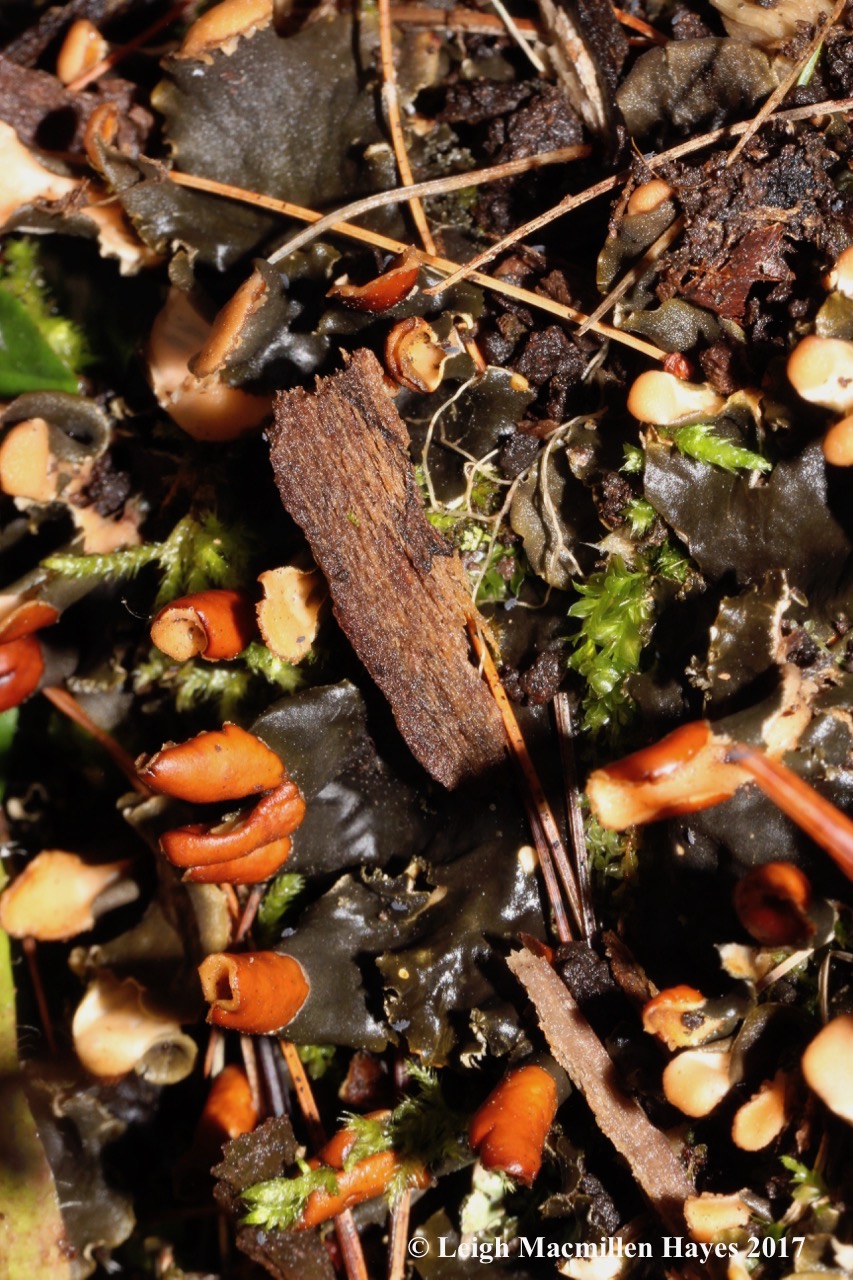
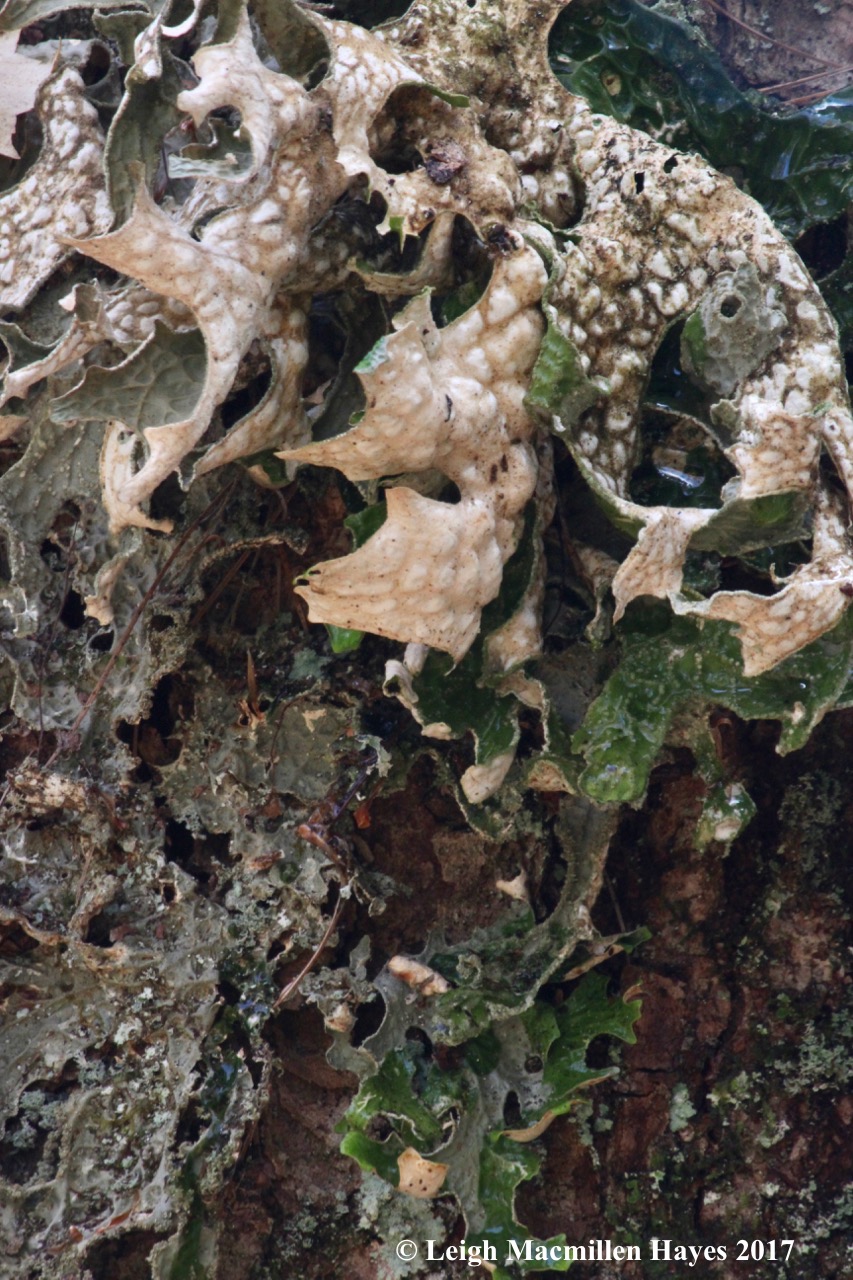
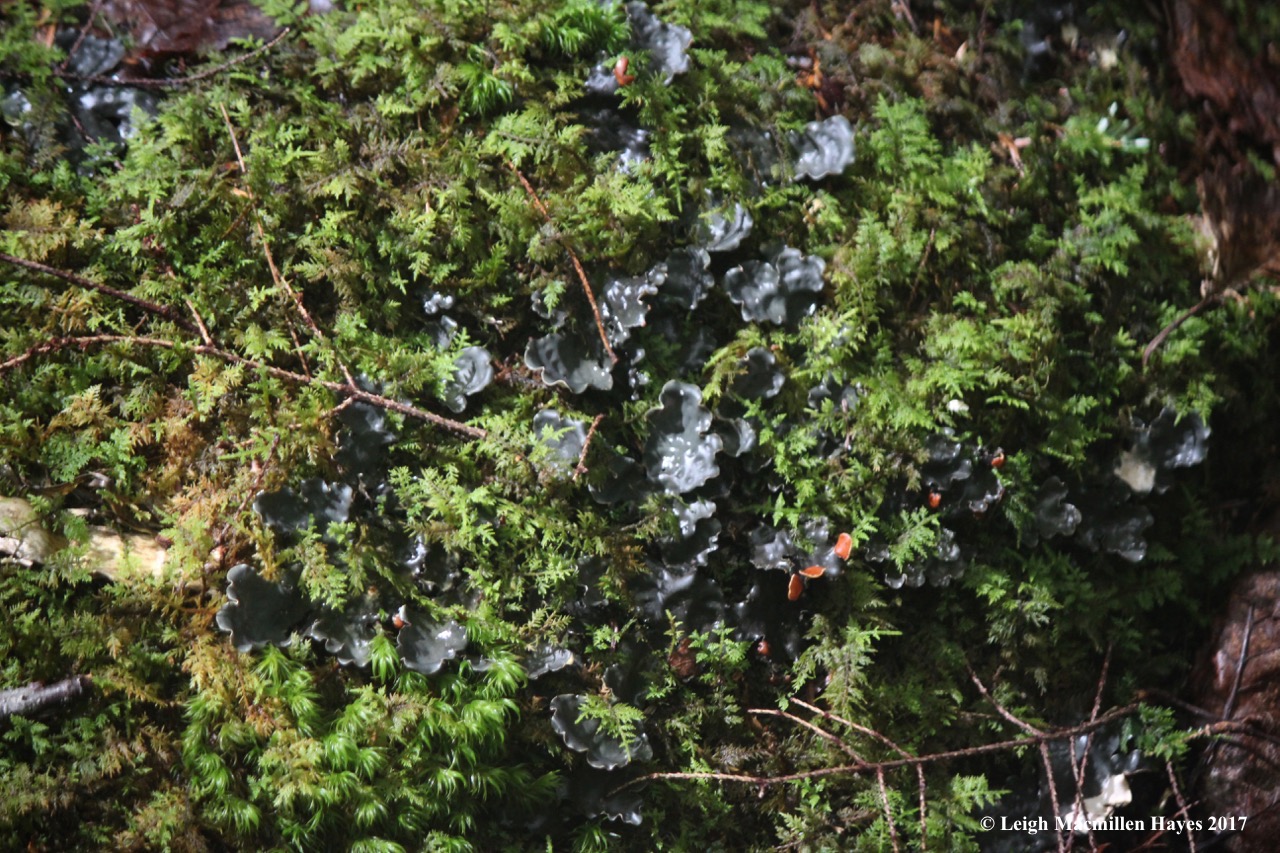
Should it be developed, there will be fewer toadskin lichens to admire. Thanks to the melting snow, many of the examples I found today were bright green, making the black-beaded apothecia where its spores are produced stand out in contrast. Toadskin lichen may be indestructible, but should the property be developed I wondered about the lichen’s immortality. 

Should the property be developed, where would the snowshoe hare scat? 

And the same for the ruffed grouse? 

Should it be developed, what would happen to K.F. and T.B.? 

Should the property be developed, would I see sights such as this and come to another new understanding?

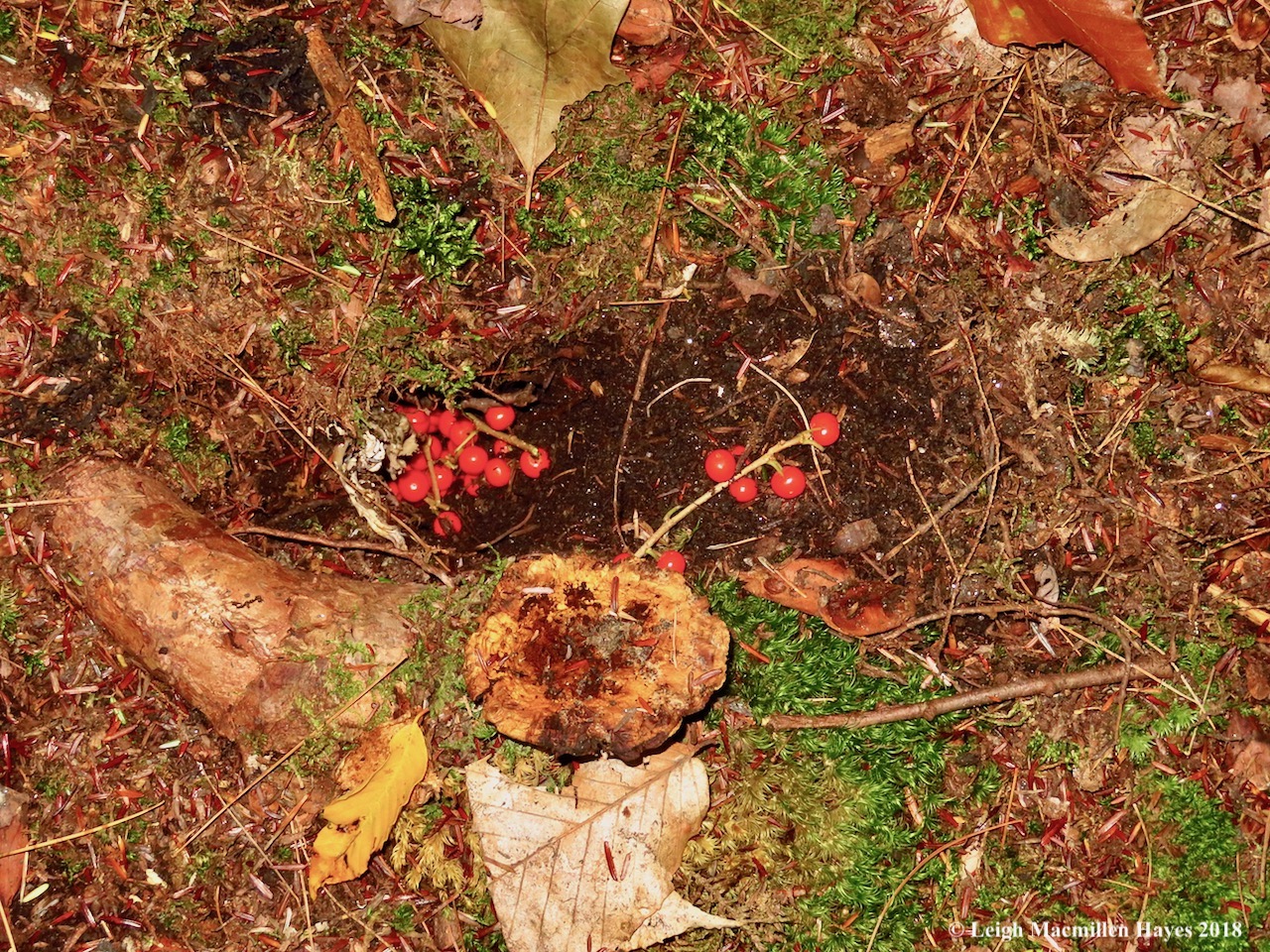
I was actually searching for bear claw marks that alluded me (and I know they are there for I’ve seen them before) and instead saw this red bloom decorating some beech bark. It was quite pretty and festive given the season. 

At first look, I thought it was the apothecia of a crustose lichen, but do you see the tiny white spots mingled occasionally among it? Those white dots are the minute beech scale insect. The holes the tiny insect makes in the bark create a perfect entry point for nectria pathogen to make its way into the tree. The pathogen, a type of fungus, kills some areas of the tree at the point of entry. In reaction, the tree develops a canker as a defensive attempt to ward off the invader, but by doing so the canker blocks the vascular tissue of the infected beech by stopping nutrient flow in that one area.
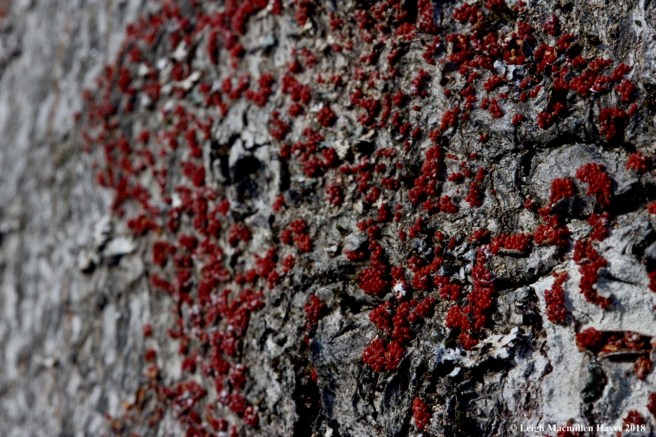
And those red spots, as pretty as they appear, are actually tarry spots which ooze out of the cracks in the bark caused by the canker. Essentially, it appeared the tree was bleeding. 
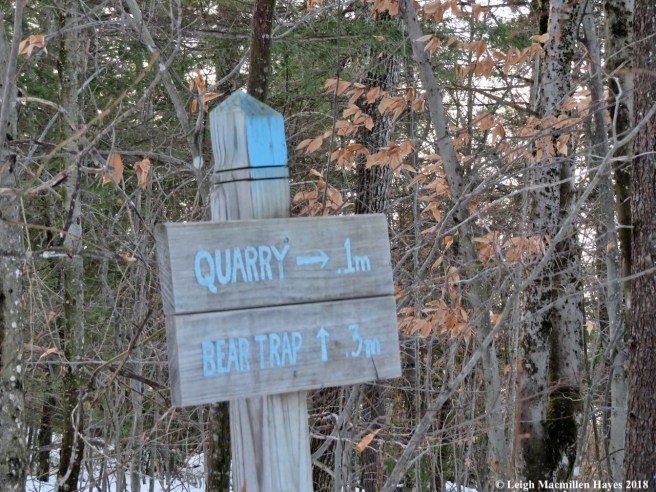
Should the property be developed, what would become of the quarry and bear trap? 

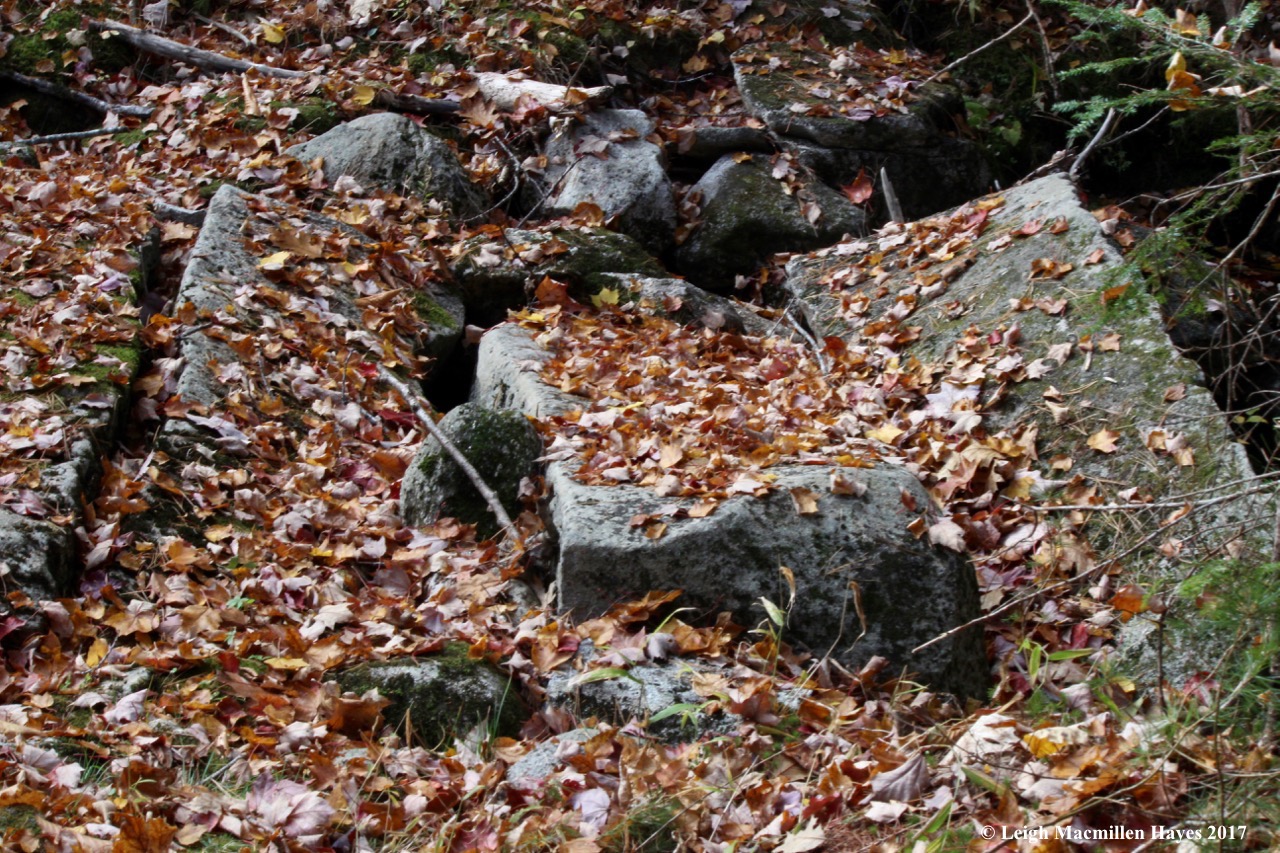
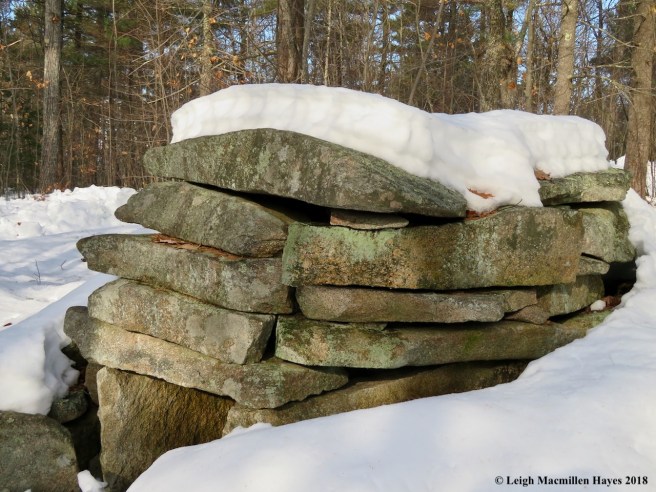
This is the spot from which the foundations for the buildings were split so long ago.

Should the property be developed, would the plug and feather holes left behind as reminders of an earlier time disappear from the landscape?
The land already has been developed around Bear Trap, which is located at the end of the trail. We used to be able to hike or drive there; now one can only hike and you kinda, sorta need to know where it is.

How did the bear trap come to be? According to an August 17, 1963 article in the Bridgton News, “Enoch Perley, early settler of South Bridgton, built his first house in 1777 and brought his bride to their new home in 1778. [I believe this was at Five Fields Farm.]

As Enoch acquired livestock, he was much troubled by depredations from bears. He built a bear trap on the hill back of his first home . . .

Tradition says that four bears were caught in this trap–not enough! So Mr. Perley later had an iron bear trap made which took care of eight bears. Without a doubt, many were disposed of by him personally. A story is told that in an unarmed encounter with a bear and two cubs beside a wood road at dusk, Mr. Perley allegedly strangled the mother bear with his garters . . .”
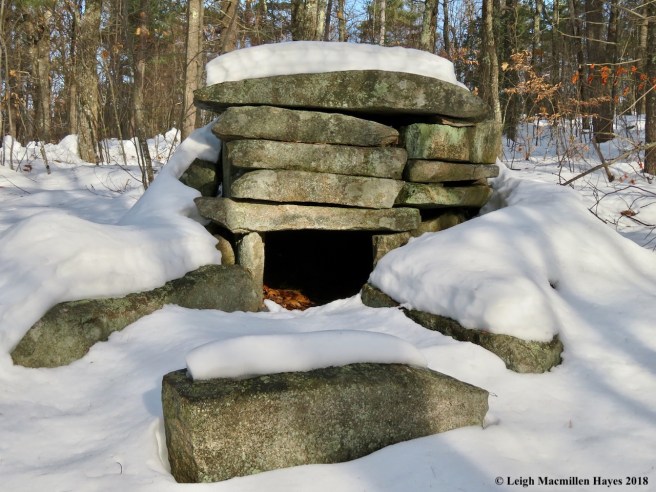
The article continues, “The bear trap is built of stone. A large stone door is suspended and as the bear takes the bait, he trips the lever and is caught in the stone enclosure.”

In a December 1954 issue of the Bridgton News, a brief article states: “The old stone bear trap on the mountain in South Bridgton known as ‘Fitch’s Hill,’ unused for more than one hundred years, has been reactivated by Dr. Fred G. Noble and Gerald Palmer and put in readiness to capture a bear.” As the story goes, they never did succeed.

Should the Peabody-Fitch Woods be developed, all of this will be lost.

My hope is that the Bridgton Historical Society and Loon Echo Land Trust will experience a Merry Christmas as they finish out their fund-raising drive to purchase the land.

I think I walked beyond the boundary they are considering, but Bear Trap is one of my favorite historical sites. And with today’s walk I came to the realization of how important it is to protect the land around the farm.

Before I finish, I have one final historical piece of writing to share. In his memoirs, “Ninety Years of Living,” Edwin Peabody Fitch (1840-1931) who grew up in the farmhouse wrote, “Holidays were not much in evidence in those days. Christmas was so far in the shade, we didn’t think much about it. In fact, we felt that it was just a Catholic holiday and not be be observed by us. We went to school on that day and the only notice we took of it was to shout “Merry Christmas!” to the classmates. 

Merry Christmas from and to Narramissic! 

Stepping Out For Others

With the most recent snowstorm now history, I strapped on my snowshoes this morning with a sense of eager anticipation about the possibilities. And then it hit me like the snow plops that fell from the trees and landed on my head or slid down my neck: I could do this while others could not and it was for them that I needed to focus. 

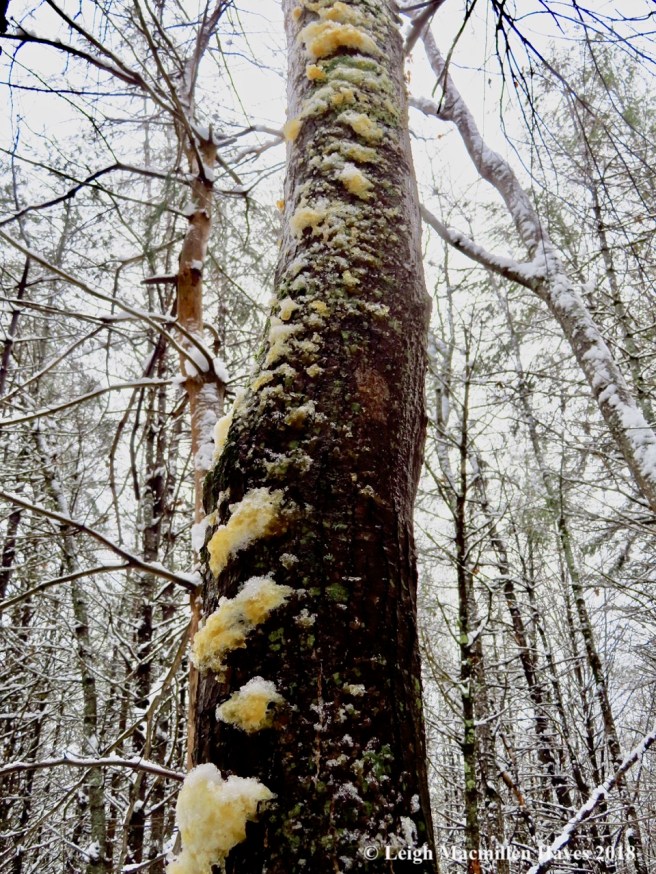
I hadn’t gone far when my first moment of wonder stood before me. Actually, just prior, I’d been looking at some pileated woodpecker works–ever on the search for the bird’s scat, and in the process had noticed other bird scat soiling the snow. But . . . what was all the amber color? 

Had snow collected on mushrooms that decorated the bark? If so, why hadn’t I seen them yesterday or the day before? 

Upon a closer look, I realized it was sap. But why the big clumps? And why so much on a dead snag? 

I poked it with my finger and found it to be of snow consistency. And so . . . the mystery remained. But it was certainly worth a wonder and I knew that those I was intentionally walking for would appreciate the sight. And yes, I did see plenty of other examples of dripping sap at the base of trees, but nothing like this. As usual, if you know what was going on, please enlighten me.

My next moment of wonder was one that always gives me pause–and again I knew that my friends would feel the same. A miniature evergreen world momentarily encapsulated in a droplet of melting snow. 

Everywhere, the meltdown offered a variety of shapes and designs, each worthy of reverence . . . and a photograph, of course. 

One of my favorites was plastered to a tree in such a way that it looked like it was flat against the bark until further study revealed otherwise. As it melted before my eyes, its ever changing formation resembled a series of little flowers scattered here and there. Just maybe you have to see that through my eyes. 

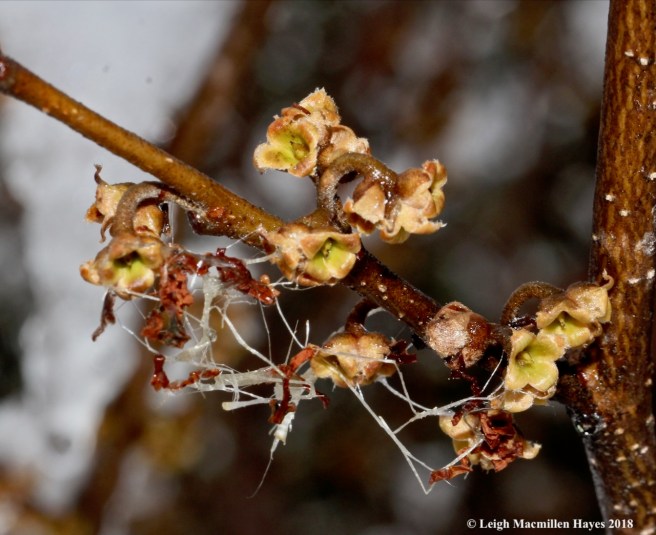
And then I stumbled upon another mystery–a web of sorts like Charlotte might have woven? I studied the shrub and found numerous examples of a similar pattern, but no arachnids in sight. Besides, the silky lines seemed too thick. But, what could it be? It took me a while as I studied the area and then I remembered. Before the snowstorm, I’d taken some photographs of the winter structure of a thistle. The storm had knocked down the fruiting form, but I think my gaze was upon the filaments that had served as parachutes for the thistle’s seeds. 

My journey into the winter wonderland continued, though not all the trees along the way were fortunate to withstand the weight of the snow that was quickly melting. It sounded like a rain storm as I walked under the arched branches. 

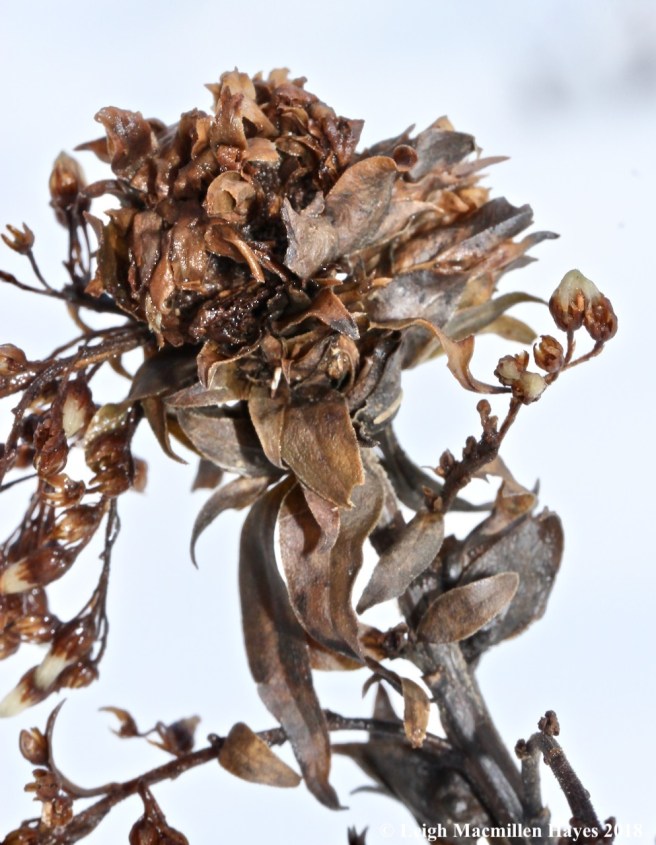
At the the other end of the snow tunnel, I emerged into a field with its own offerings. Typically, I pass by, but today I was inspired by those who virtually walked with me to explore. And I don’t think they’ll be  disappointed by the findings. First there was the Goldenrod Ball Gall. The round gall occurred in the middle of a stem, the top of which had broken off. In the spring, the Goldenrod gall fly laid her eggs on the stem. Hatched larvae chewed their way into the stem and the gall started to develop. And from the looks of the hole on the side, it appeared the creator had chewed its way out and flown off. 

Also in the field, a Rose Bedeguar Gall, aka Robin’s Pincushion Gall on Meadowsweet, which happens to be a member of the rose family. Burrowing in to the leaves and stem of the plant was a two-fold offering for the fly larvae it hosted, for the insect benefited from the nutrients while it was simultaneously protected from predators. 

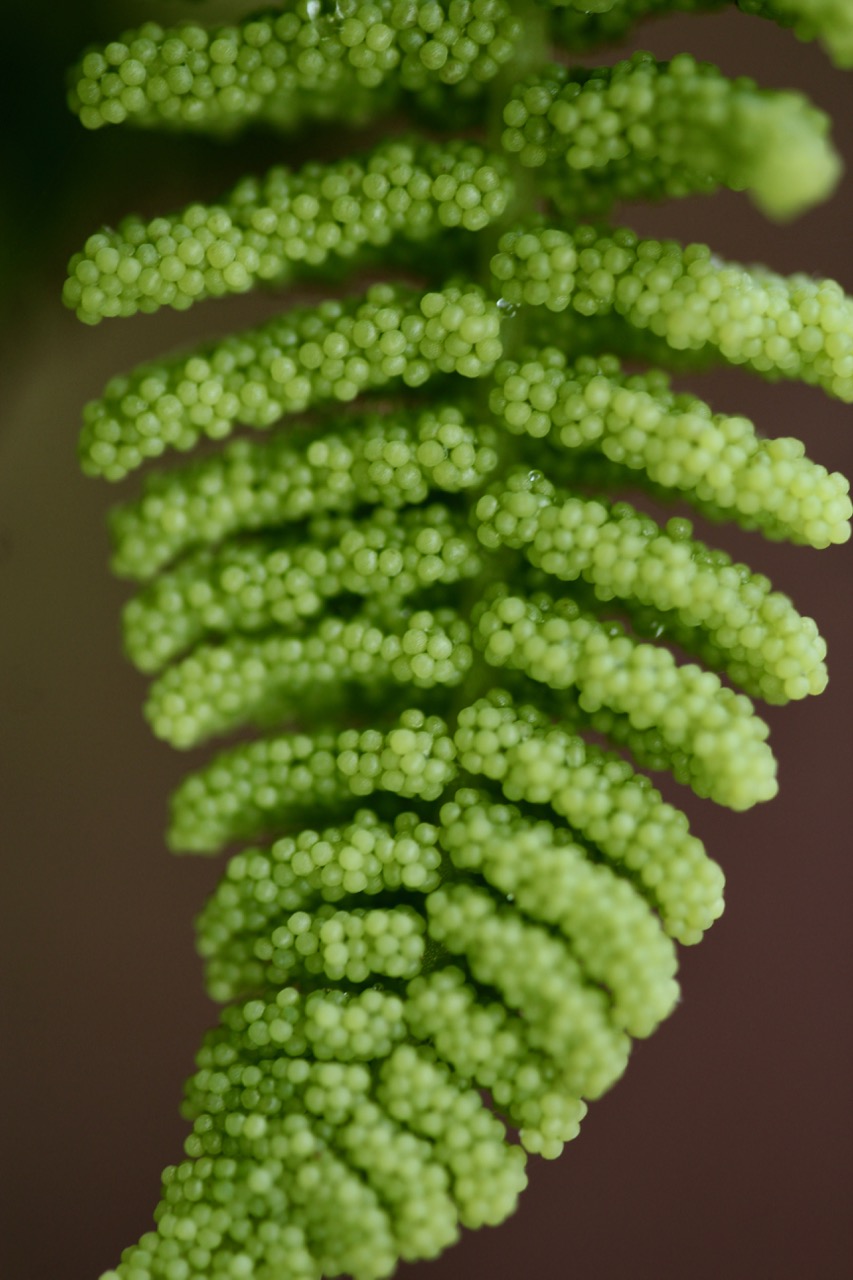
There were also numerous examples of a structure that might baffle the onlooker. Beaded formations of the fertile stalk from a Sensitive Fern poked up through the snow. Typically, the beads or capsules remain intact with their brown dust-like spores waiting inside for the structure to break open during the rains of early spring. 

I moved on from the field and eventually reached a wetland that I couldn’t cross. But, I could stand and listen and so I did. All around me the forest orchestra performed its Plop, Plop, Swish, Plop, Splash symphony. 

 At first, it sounded and looked like I was surrounded by a million wild animals, but really . . . all the sound and sights were a result of snow falling, either gently with a whisper of the wind or harshly with a thud and splash. 

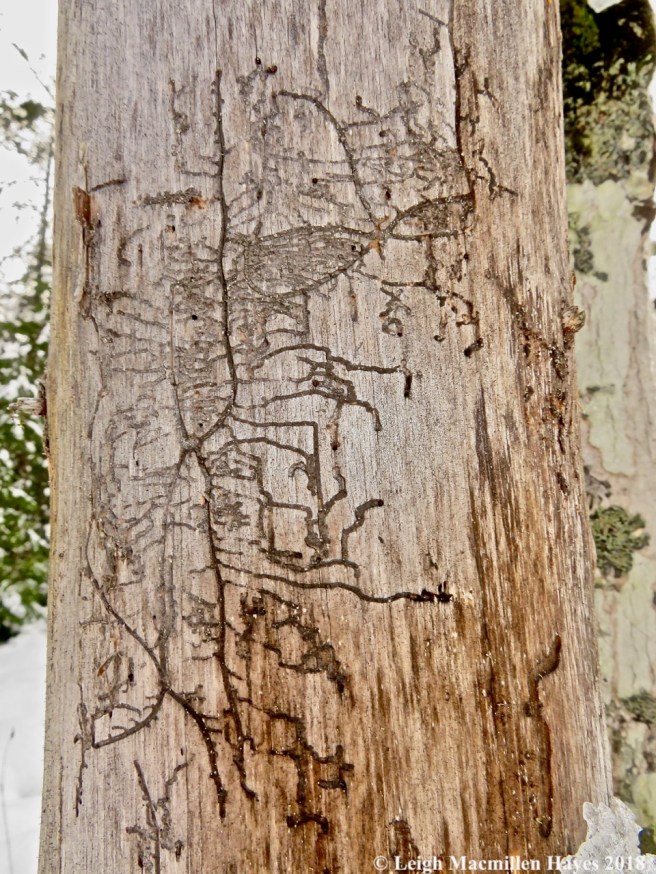
As I stood there looking for the million wild mammals, my eyes focused on the works of something much smaller. Insect egg tunnels on a dead snag’s trunk read like a story on paper. 

The longer tunnels were bored by a female Bark Beetle. From the sides of her tunnels, larval mines radiated outward. The overall design could have been an abstract drawing. 

At last  I started for home, thankful that I was retracing my steps for often new sights are revealed when one does that. And so, I believe it was a crust fungus and perhaps it was an oak curtain crust fungus, but let it remain that I discovered a fungus I don’t think I’ve seen before, with a warty, rust-colored underside and dark upperside. Suffice it to say, it was a mushroom of some sort. 

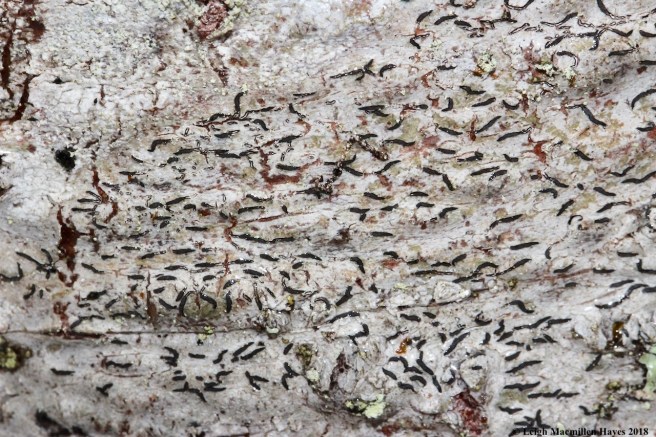
Along the way was a script lichen, which looked to me like someone had doodled. Commas and apostrophes decorated that page. 

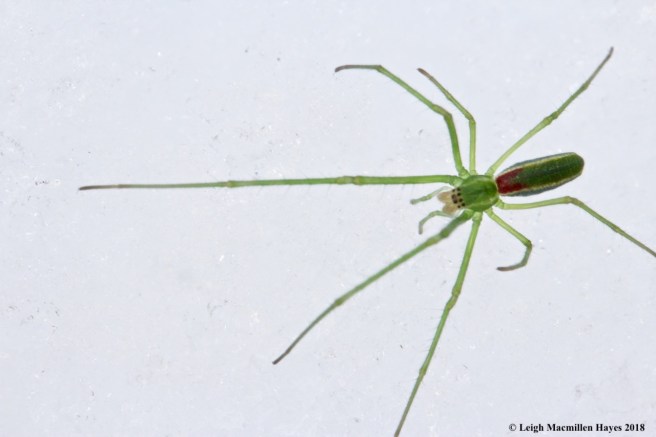
And then, and then, Tetragnatha viridis, a green long-jawed orb weaver. I actually saw two of them. Typically, the translucent green color helps them camouflage amongst pine needles, their usual habitat, but they can frequently be seen on snow, especially if the temperature is in the 25˚-35˚ range as it was this morning. 

The orb weaver’s characteristics: eight eyes in two parallel sets of four; long chelicerae (jaws); enlarged pedipalps; long legs with spines; and that color–oh my! 
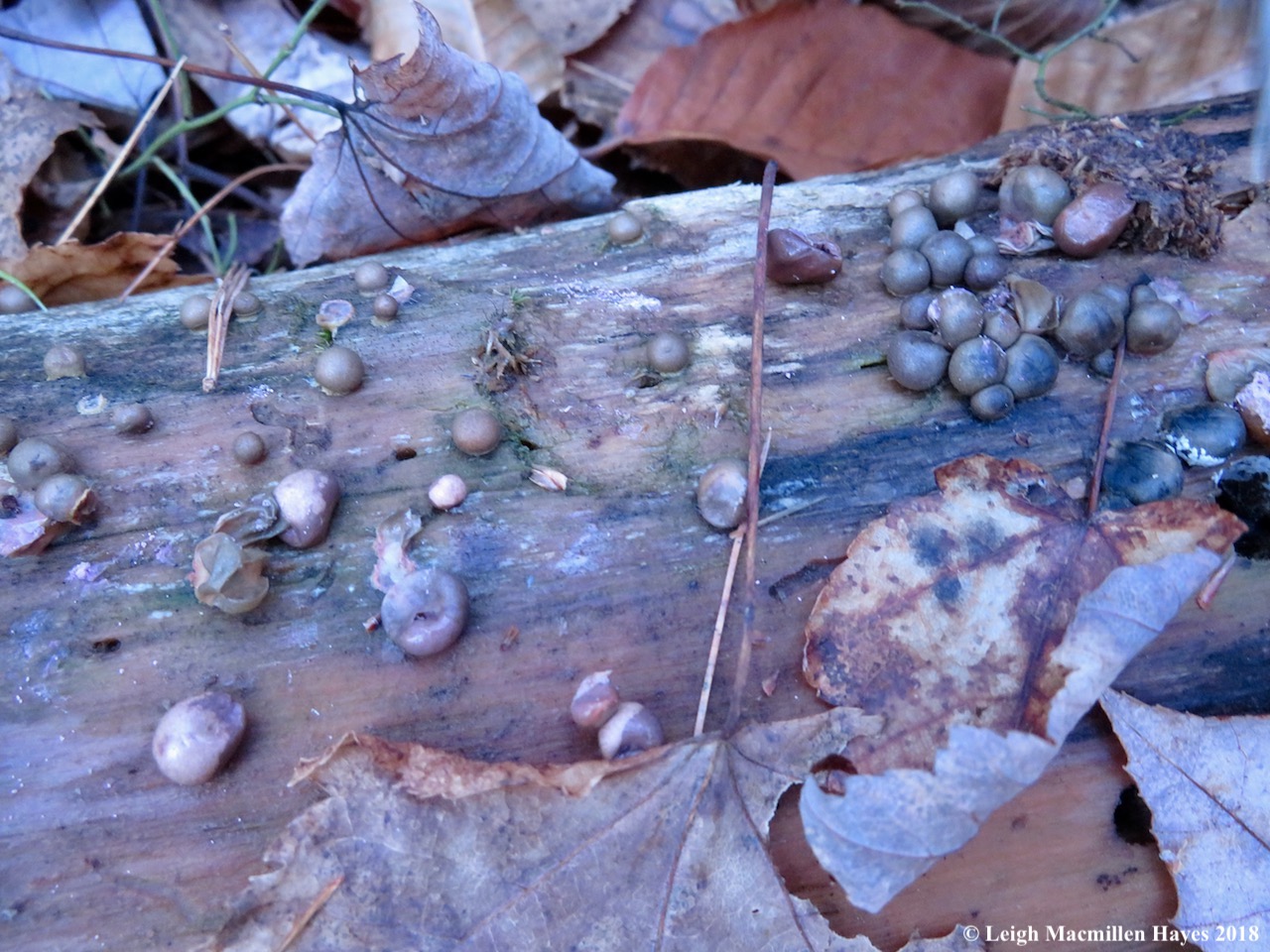
It was for eight parallel eyes that I walked today, the eight representing Jinny Mae, Dick, Kate, and Carol. 

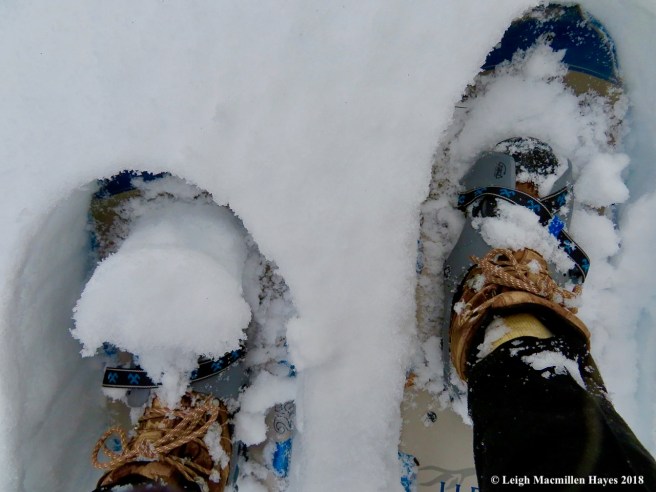
Where trees didn’t cover the trail the snow was about fourteen inches deep and as you can see I chose the wrong boots and forgot my gators. But that was okay because I knew that I would eventually wander home and change my sopping wet socks. What mattered more was the fact that I was honored to step out for others when they couldn’t necessarily do the same. Here’s to the four of you–thanks for letting me be your eyes. 

I Spy . . .

This afternoon’s goal: To find a Christmas Tree to decorate for the Christmas at Ladies Delight Walk on December 1st. For the reconnaissance mission, I joined the Coombs family at the GLLT’s Chip Stockford Reserve.

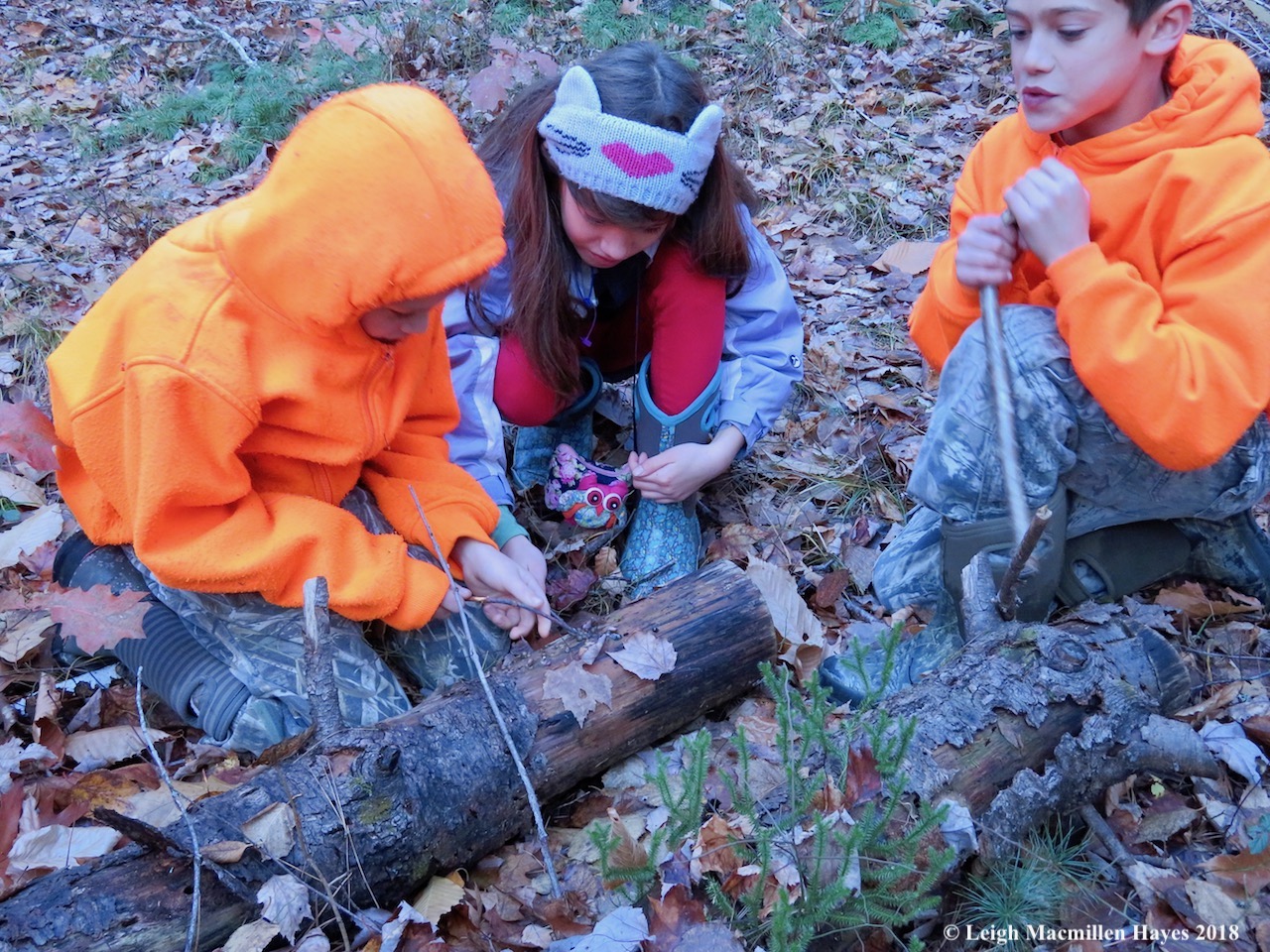
The Coombs children are homeschooled by their amazing mother, Juli, and though they learn many lessons at home, they are also well educated in the outdoors. In fact, they are among my favorite naturalists.

And they belong to a 4-H Homeschool group that will decorate a tree(s) with biodegradable ornaments prior to the December 1st walk.

1

And so we set off on our tour looking for just the right tree. But . . . as is always the case with this family, there was so much more to see.

2

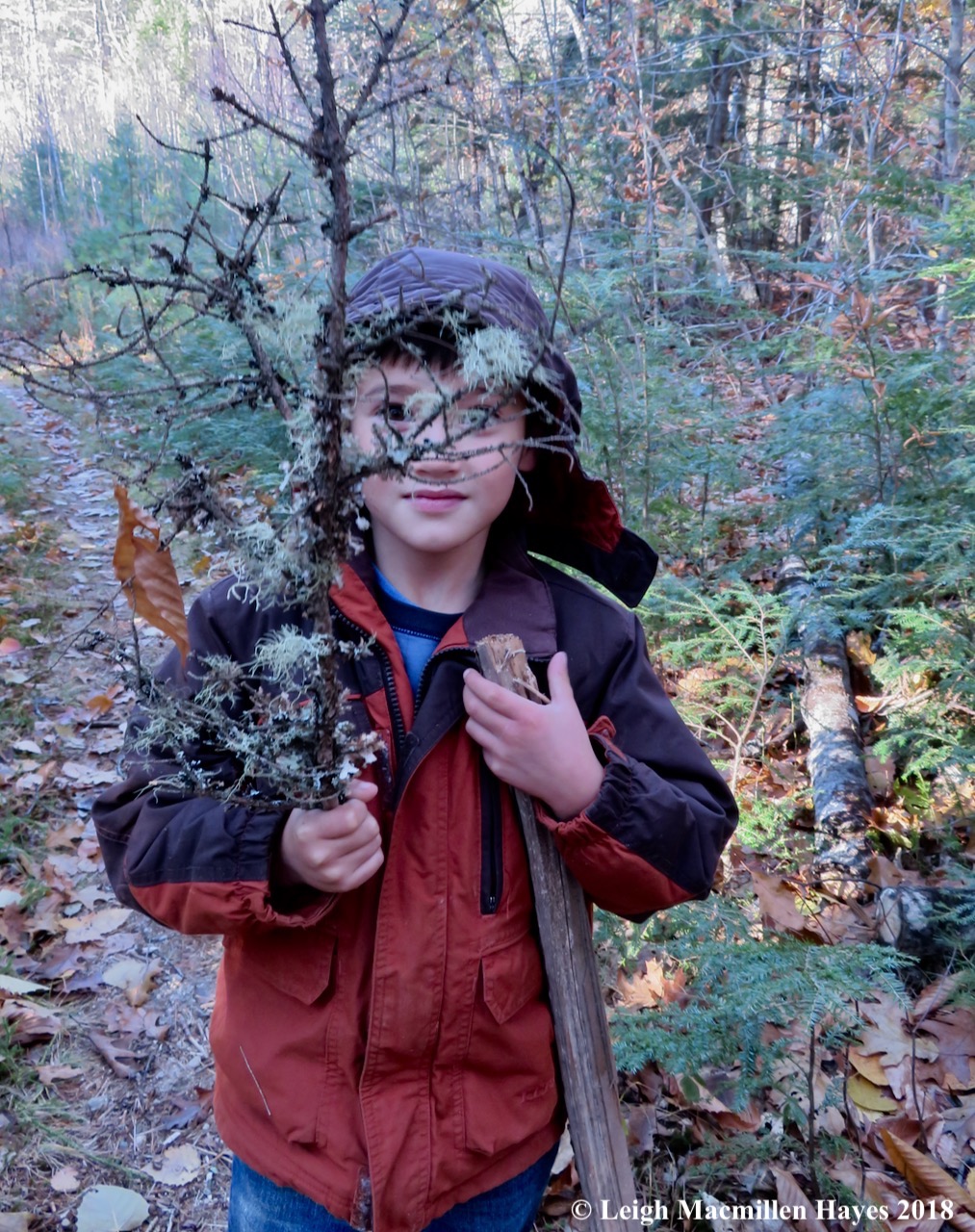
Since Juli is a Maine Master Naturalist Program student, so are her children. And every topic she studies, they study, so it was no surprise to me that six-year-old Wes picked up stick after stick loaded with various forms of lichens.

3

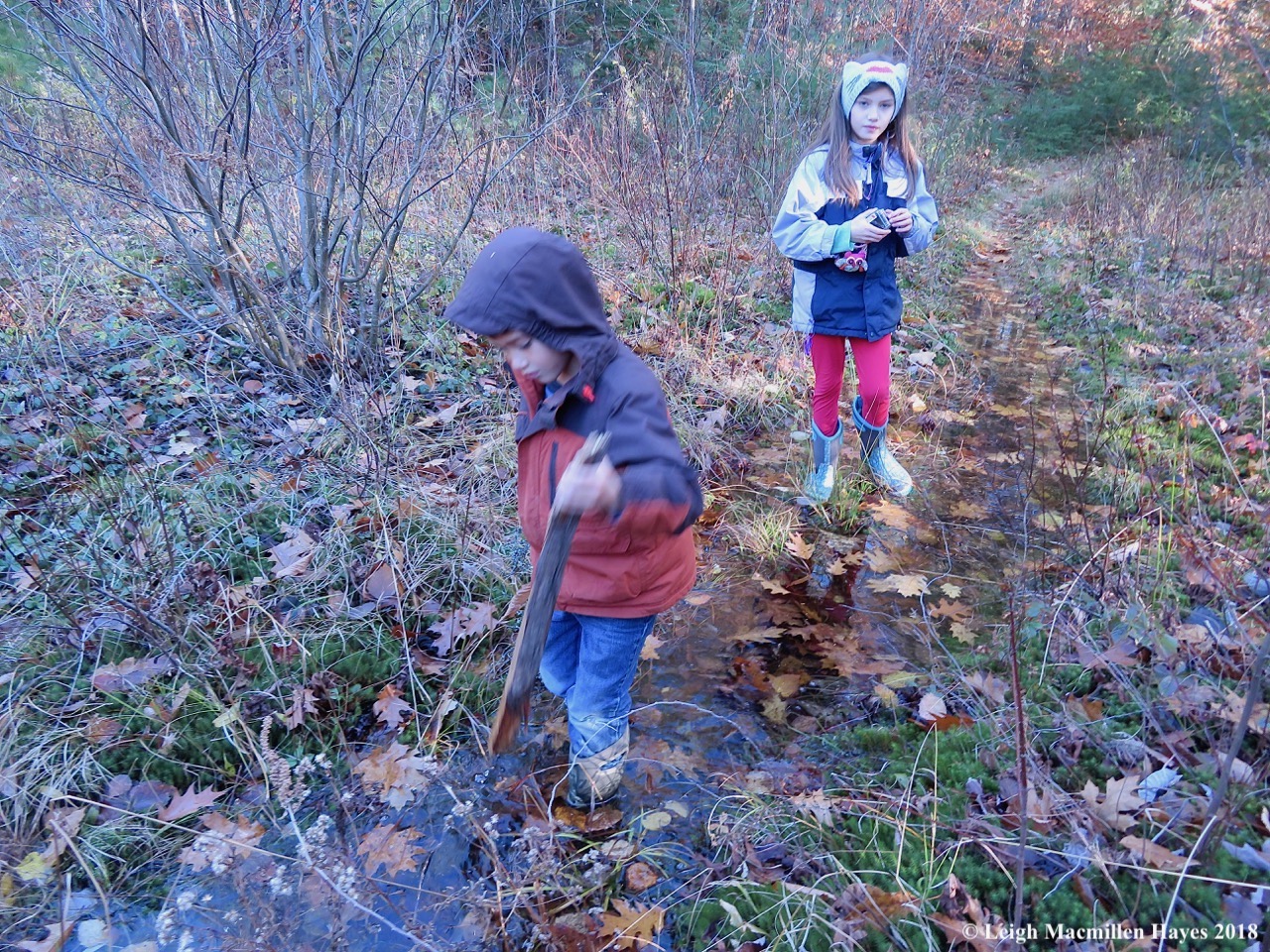
Of course, they are children, ranging in age from six to eleven, and puddles are invitations. The family motto is this: No puddle shall remain unsplashed.

4

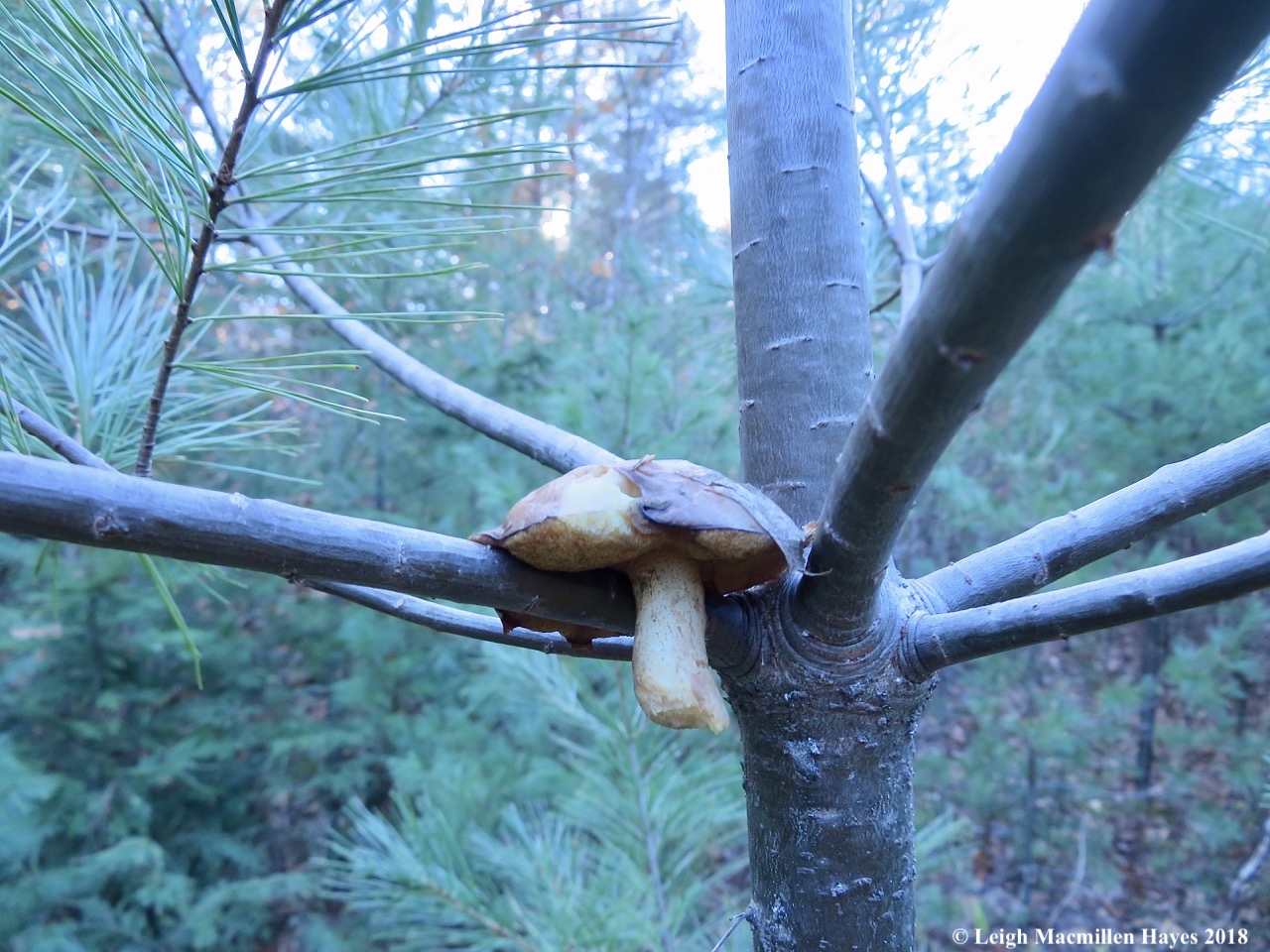
But just after the puddle, at the start of an old log landing, we began to notice something else. A mushroom drying on the whorl of a White Pine.

5

As we stood and looked at the first, someone among us spied a second.

6

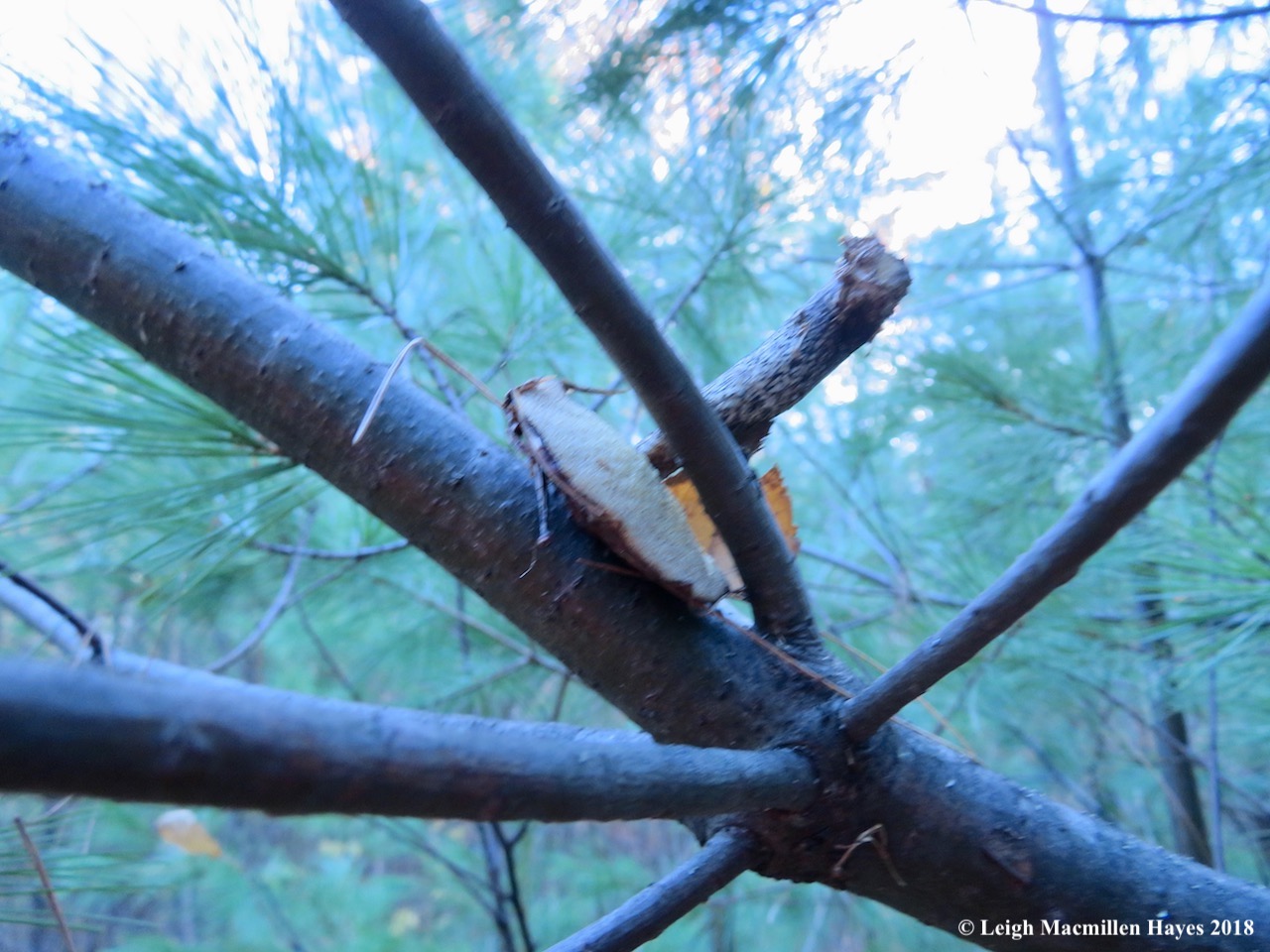
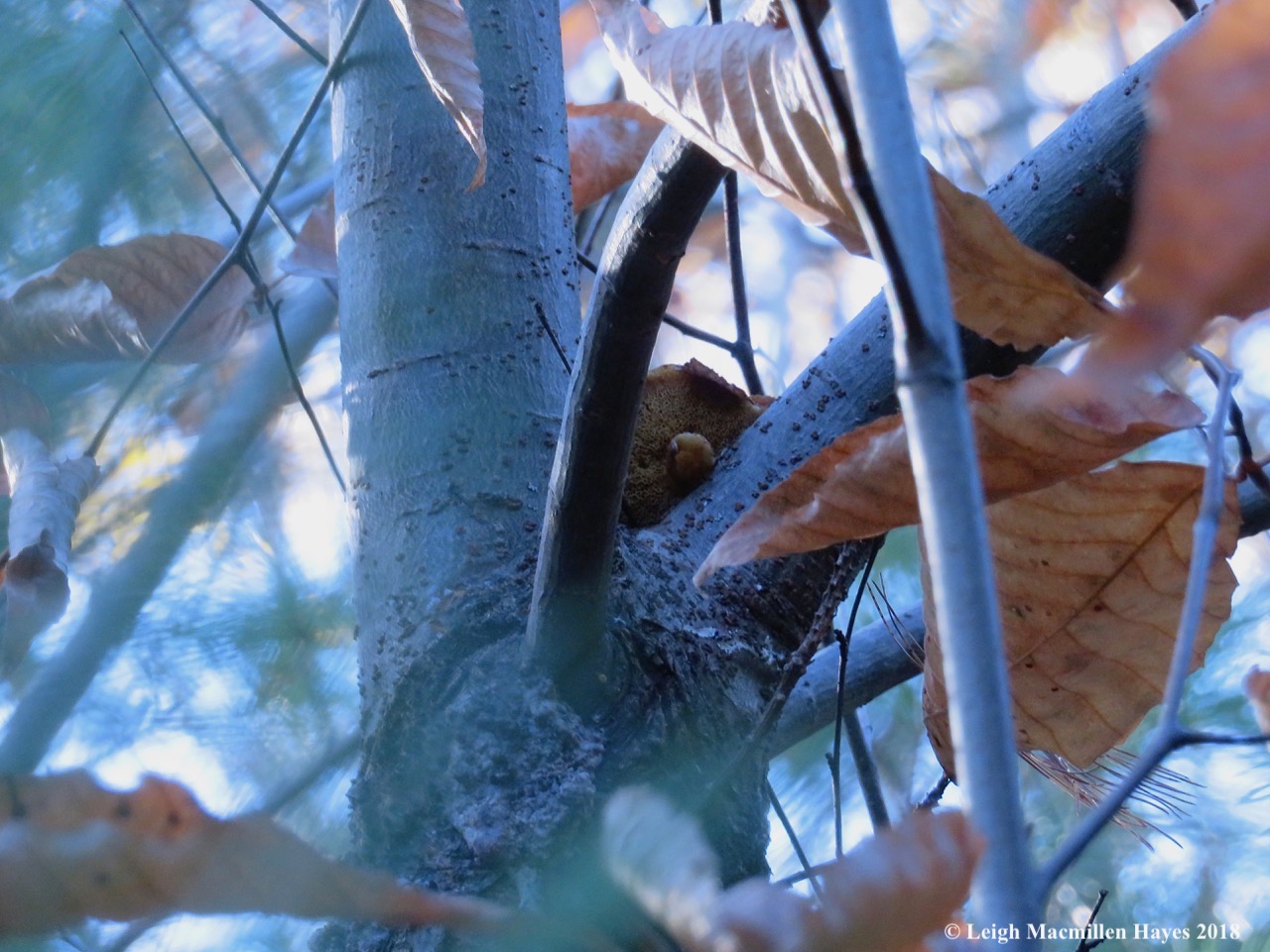
And then a third, and so it went. We knew that squirrels dried mushrooms in this manner, but never had we seen so many. It dawned on us that we were standing in a squirrel’s pantry. One squirrel? Two squirrel? Gray Squirrel? Red Squirrel? One Fish, Two Fish, Red Fish, Blue Fish.

7

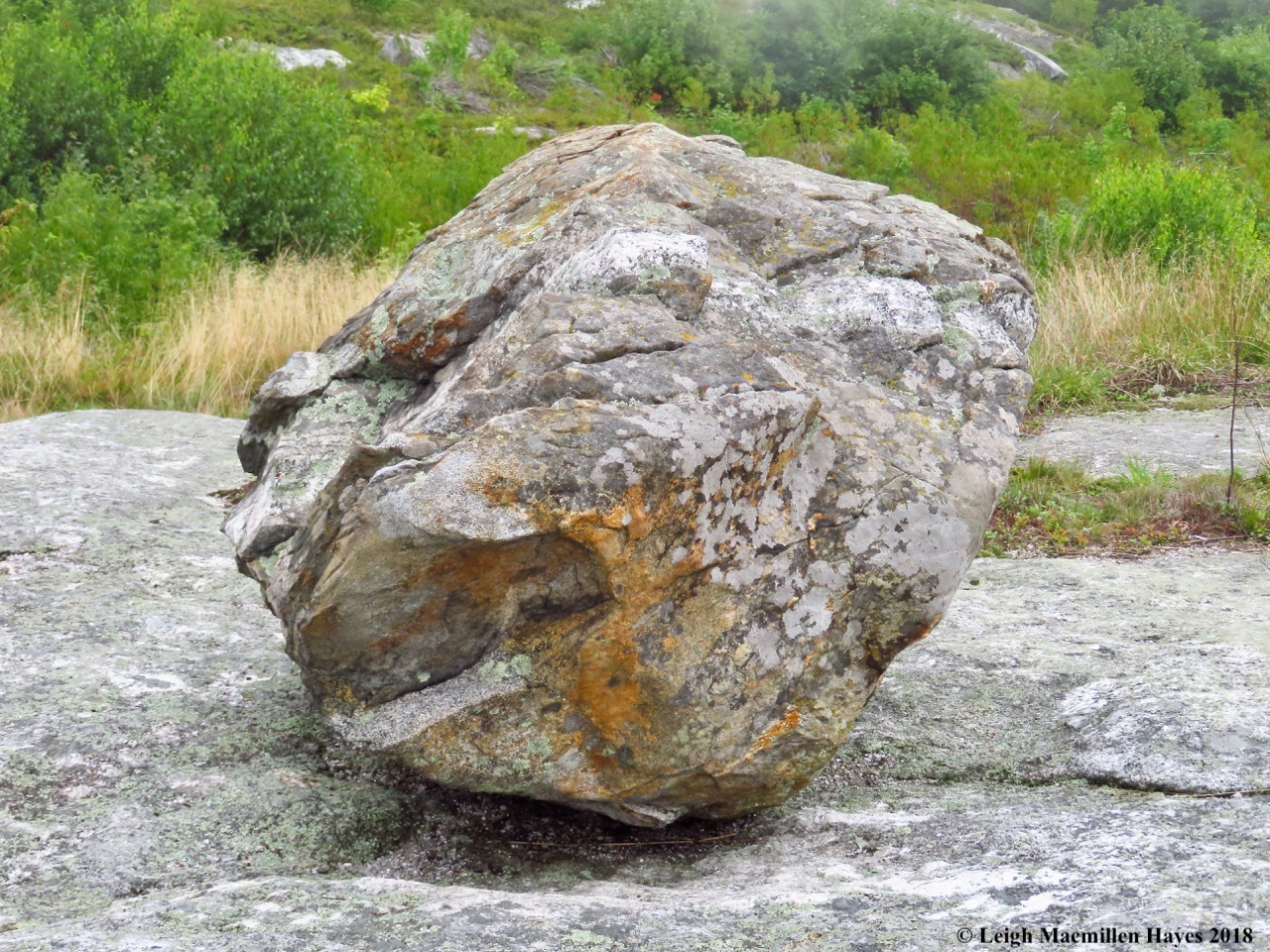
For a while we paused by an erratic boulder and looked at the lichens that grew atop it. The kids and their mom also checked the sand under and behind it and I told them that the only critter sign I’d ever noticed was that of a Ruffed Grouse sand bath–and I only recognized it as such because I’d startled the two birds and they startled me as they flew off. In fact, on another hike this morning at the GLLT’s Five Kezar Ponds Reserve, friend Teresa and I had startled a grouse and we talked about how the bird’s explosive behavior makes us feel as if we’ve encountered a moose.

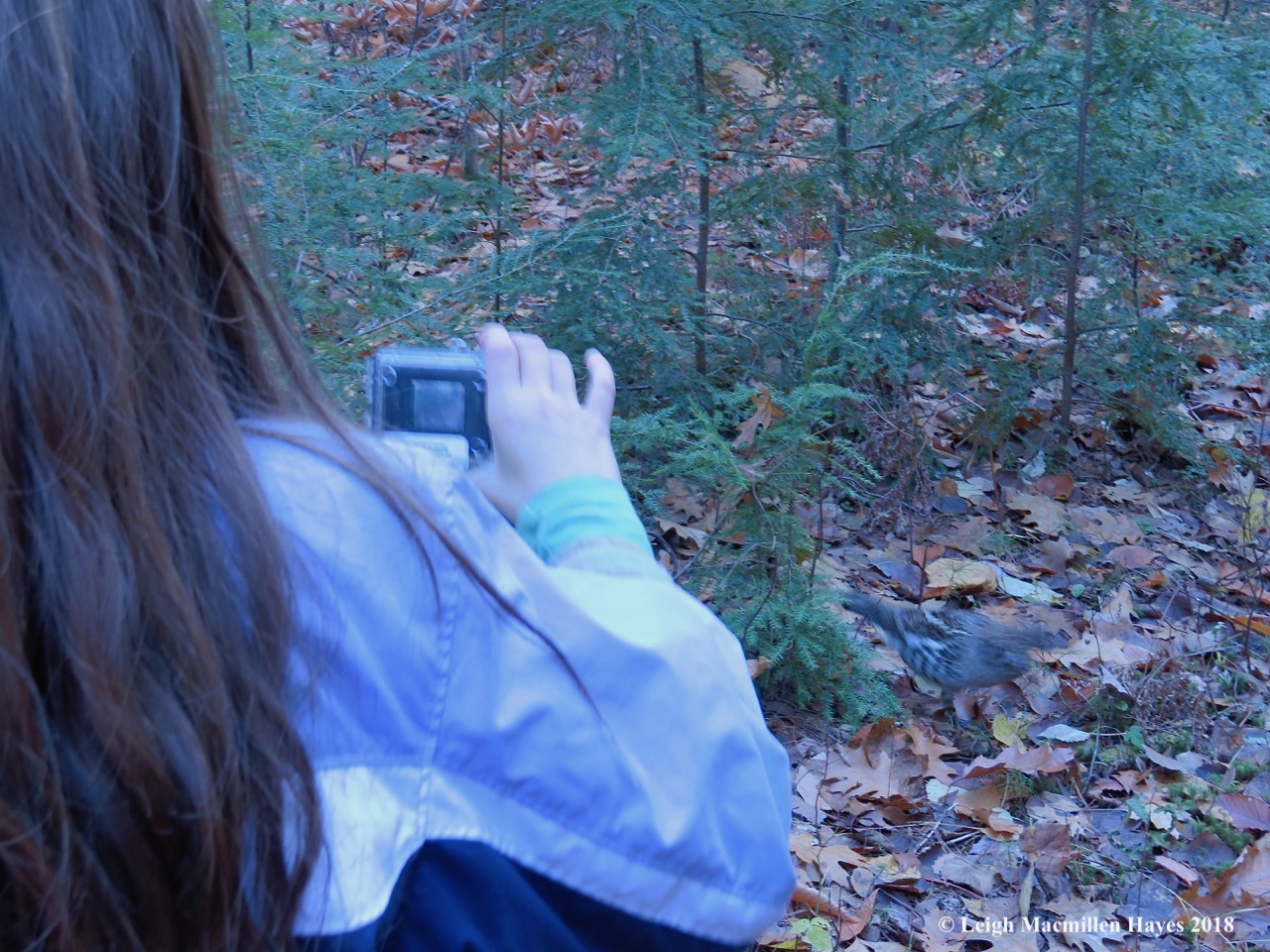
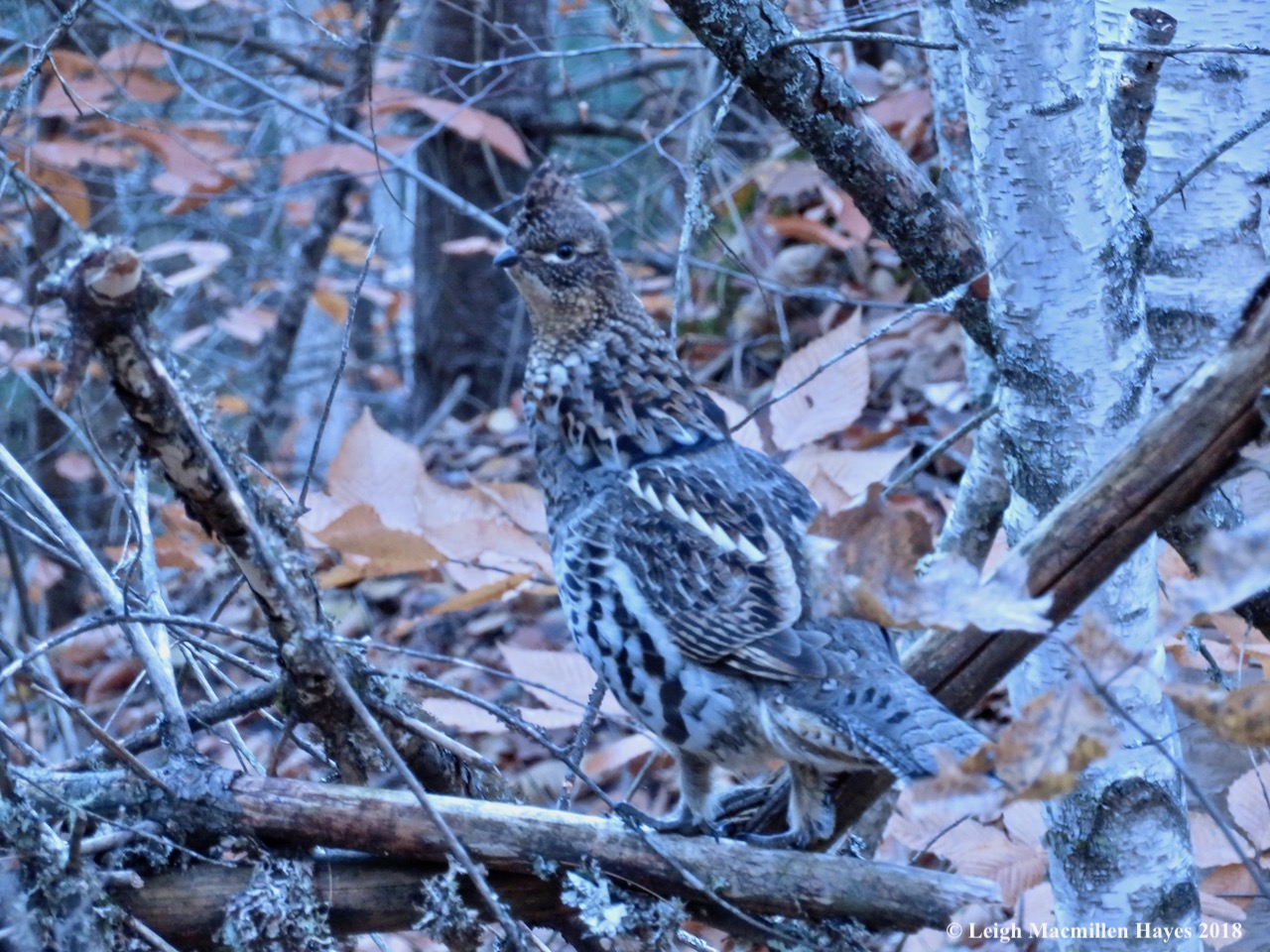
Well, just beyond the boulder, as we all chatted and moved about with quick motion, Caleb spotted something and told us to stop. A Ruffed Grouse!
8

It threw leaves about as it sorted through them in search of seeds and buds and we all watched in silence.

9

As we stood or sat still, the bird moved this way and that, making soft clucking sounds the entire time.

10

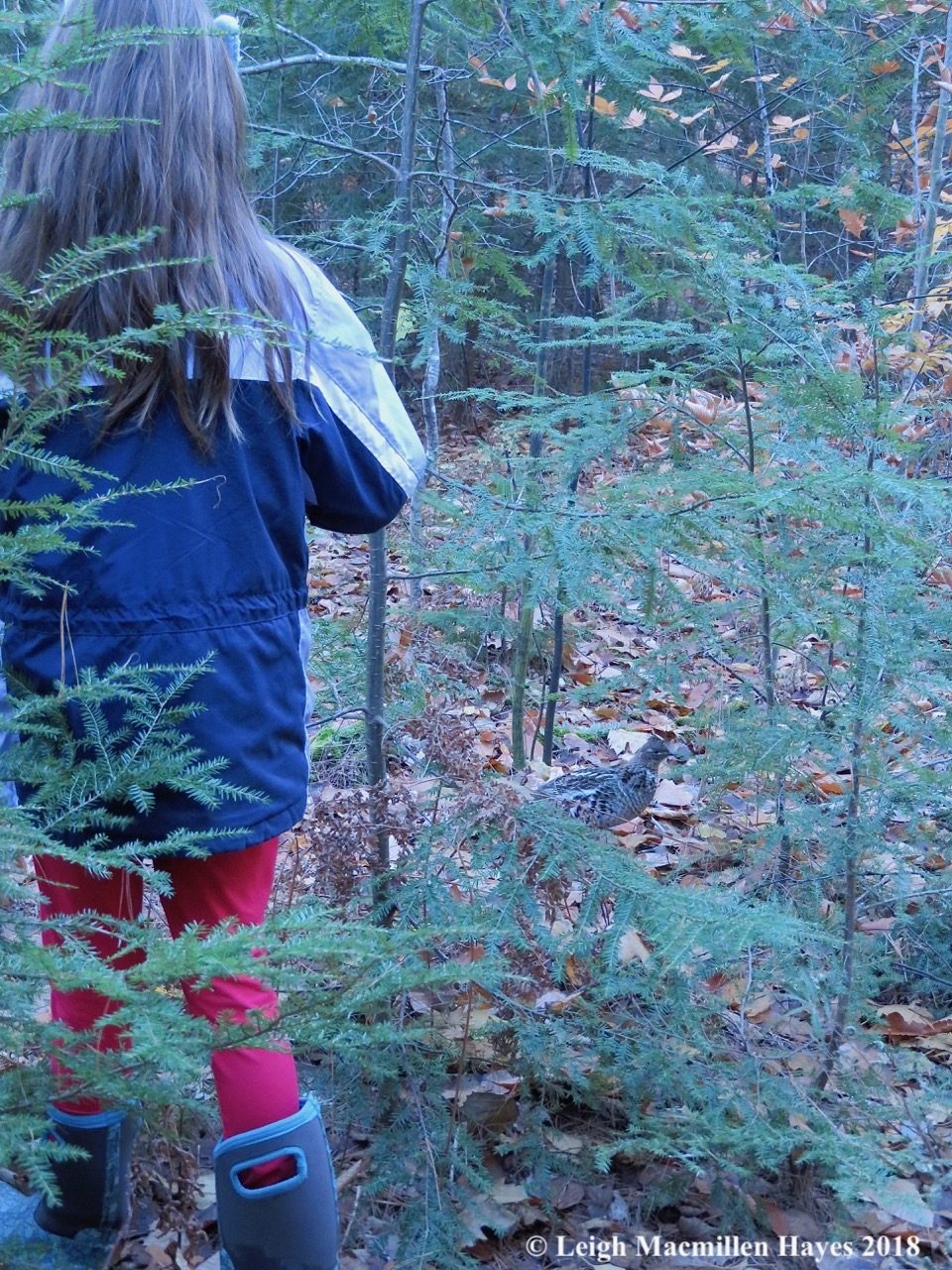
Ellie stood in front as the bird moved a few feet ahead of her and crossed the trail. I kept looking back at Juli in wonder. How could this be? Why wasn’t it disturbed by us? I’ve spotted Spruce Grouse in higher elevations and they are much “friendlier” or less wary of people, but I’d never been able to get up close to a Ruffed Grouse.

11

Our fascination continued and we noted its feathered legs, making us think perhaps it had pulled on some long johns for a cold winter night.

12

It eyed us and we eyed it back–our minds filled with awe.

13

Think about this: four children and two adults and we were starting to get fidgety because we’d been still for fifteen or more minutes and we had begun to whisper our questions and still . . . it let us watch.

14

And it let Ellie be the Grouse Whisperer for she began to follow it off the trail. Eventually, it climbed up a fallen tree and she knelt down beside, taking photos as it stood less than a foot from her. How cool is that?

15

We were all wowed by the experience, but when Ellie finally turned back, we continued on . . . sometimes running and other times pausing to ride imaginary horses.

16

Or listen to Birch Polypores! Yes, Juli did listen for it’s part of an assignment for the Maine Master Naturalist class. So what exactly does a Birch Polypore sound like? “I couldn’t hear the ocean,” she said with a smile.

17

And what does it smell like? “Wood.”

18

The next moment of glee–poking Wolf’s Milk Slime Mold and watching it ooze.

19

“It’s cool and gross at the same time,” said Ellie.

20

Onward and again, more fungi drying in trees as Aidan pointed out.

22

We even found a few stuck on spiky spruces much like ornaments might be and we reminded ourselves that we were on a mission and still hadn’t found the right tree to decorate.

23

At last, however, we did. And then we made our way out to the spur and recently opened view of Kezar Lake’s Lower Bay and Cranberry Fen, plus the mountains.

24

This became our turn-around point as it was getting cooler by the minute and the sun was setting. We promised Wes we’d look only at our feet as we followed the loop trail down, though occasionally we stopped again to admire more fungi tucked onto tree branches and a set of trees that formed a rainbow arched over the trail.

As for the fungi, we wondered if we were seeing so many because last year’s mast crop of pinecones, beech nuts, and acorns didn’t exist this year. And when the 4-H club returns in a couple of weeks to decorate the tree, will the mushrooms still be there? Will there be more? How long do the squirrels wait before consuming them? So many questions and so many lessons still to be learned.

25

And so many things to spy. We were honored with the opportunity to do just that and my heart smiled with the knowledge that the kids appreciated it as much as their mom and I did.

I spy . . . we spied . . . INDEED!

Oh, and  please join the GLLT for Christmas at Ladies Delight. I have the inside word that there will be hot cocoa and cookies somewhere along the trail.

December 1, 9:30 – noon
Christmas at Ladies Delight: The Maine Christmas Tree Hunt is a fun holiday scavenger
hunt to find decorated trees in western Maine. We’ll search for the decorated tree along the Bill Sayles Loop at the Chip Stockford Reserve and may add a few of our own biodegradable ornaments along the way. Location: Chip Stockford Reserve, Ladies Delight Road, Lovell.
Degree of Difficulty: Easy.

Focus on Home Mondate

Some days are meant to be spent at home, especially when there’s yard work to finish up before the snow flies. And so today was just such a day and my guy chose to work on the leaves while I finished putting the gardens to bed and mowed one last time for this year.

1-bird's nest fungi

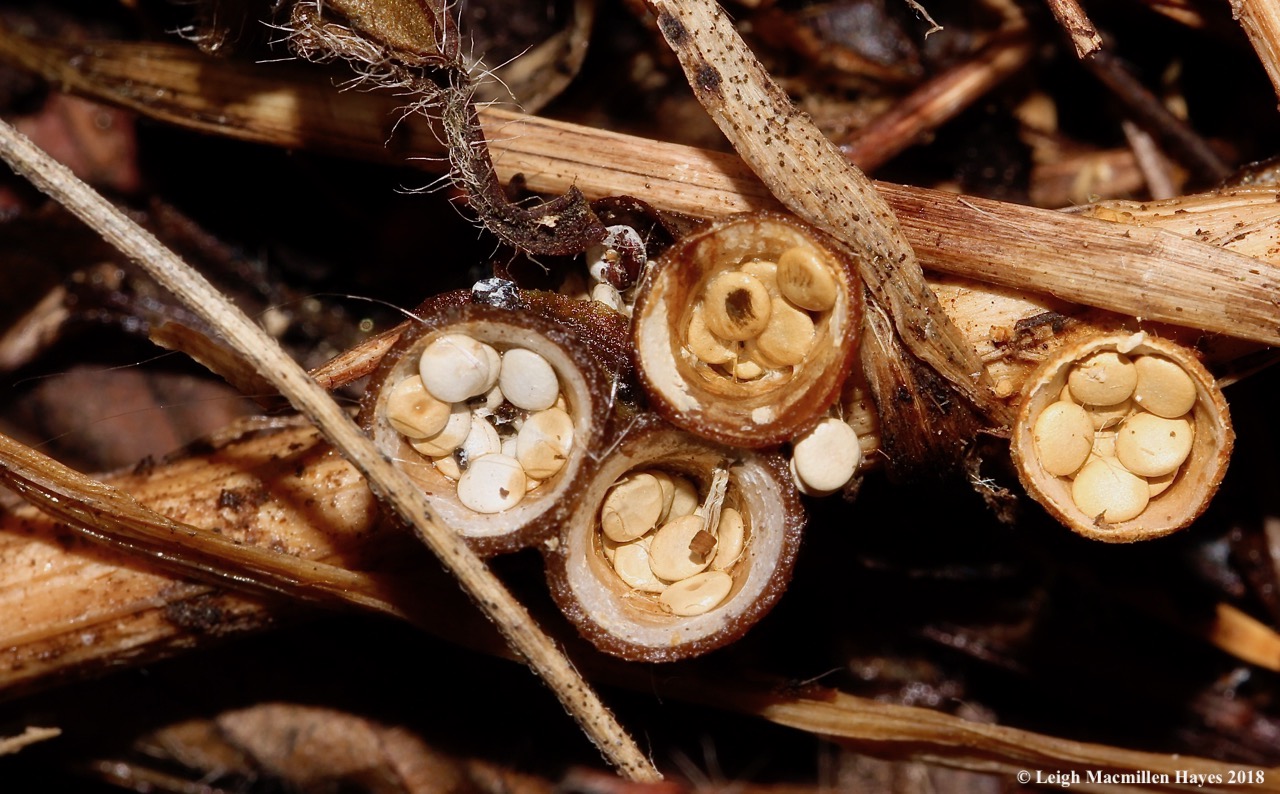
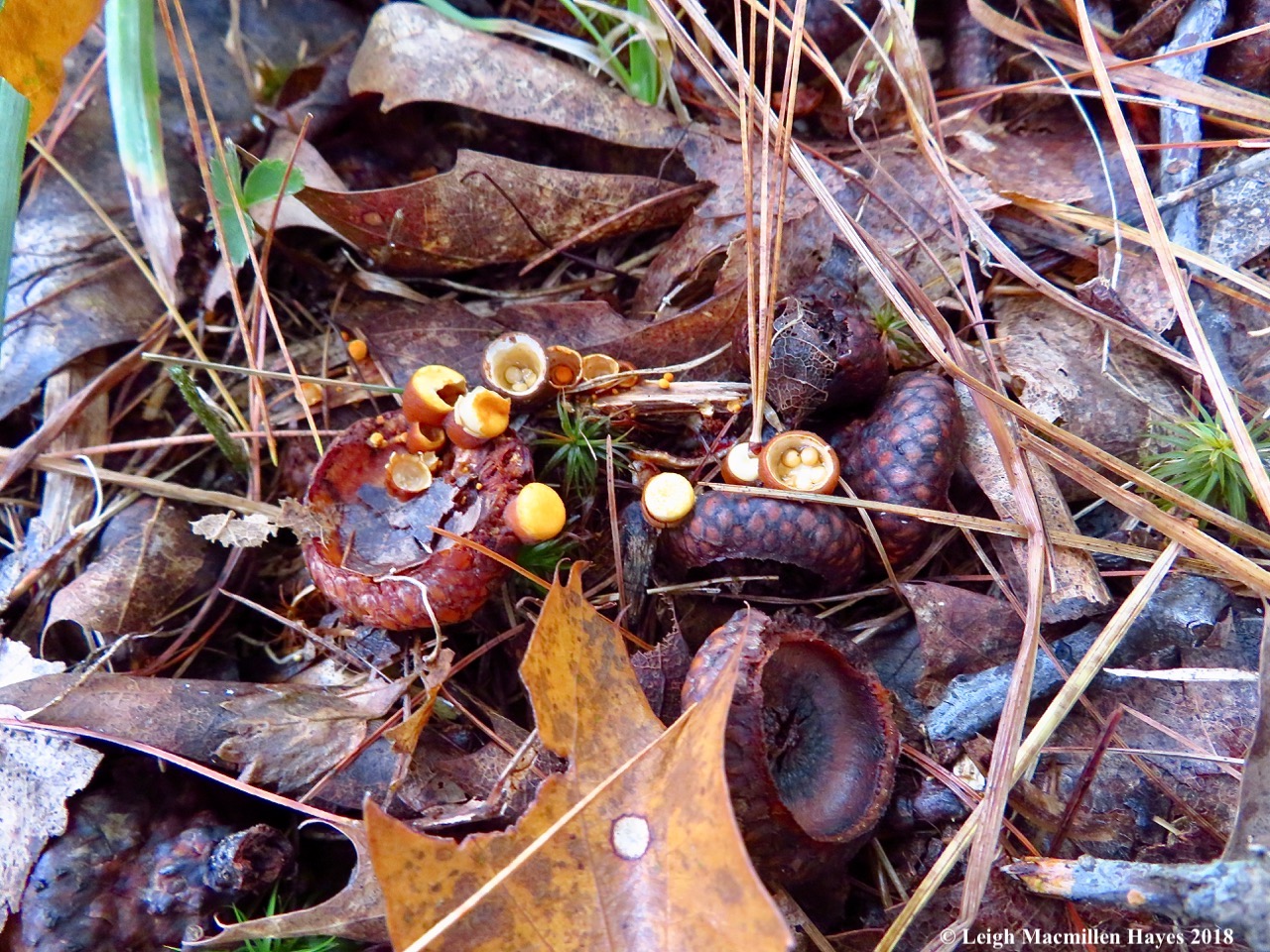
It was while putting the garden to bed that I made a discovery–a form of bird’s nest fungi, this one being Crucibulum laeve! The structure is so named because it resembles a tiny bird nest. Prior to spore distribution, each “nest” is covered with a yellowish lid. Inside, the little disc-shaped “eggs” are called peridioles, which contain the spores. When a raindrop falls into the nest, the eggs are projected out of the cup. I’ve had the honor or watching that one rainy day, but it was one of those “you had to be there” moments that will live on in my mind’s eye.

2-porcupine tree

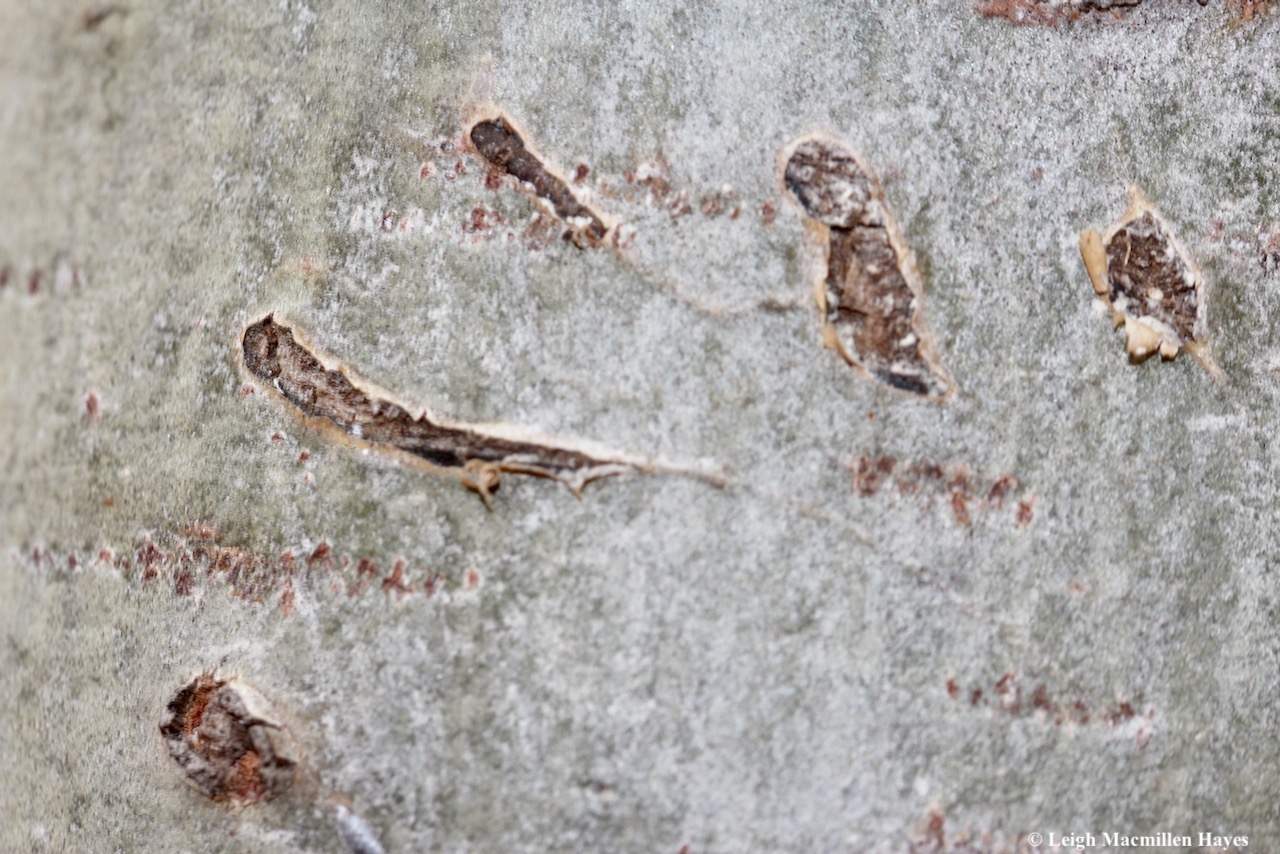
In one of the gardens stands a rather decrepit Quaking Aspen. It’s a favorite tree for woodpeckers and porcupines. thus it’s terrible condition. And usually I post photos of bear claw trees, but this particular aspen sports many, many porcupine scratches, some new and others older, such as these.

3-lady bug

As I looked at the bark to notice what else might be about, I spotted a spotted ladybug. We’d had a frost overnight, but she continued to move, however lethargically.

12-bagworm

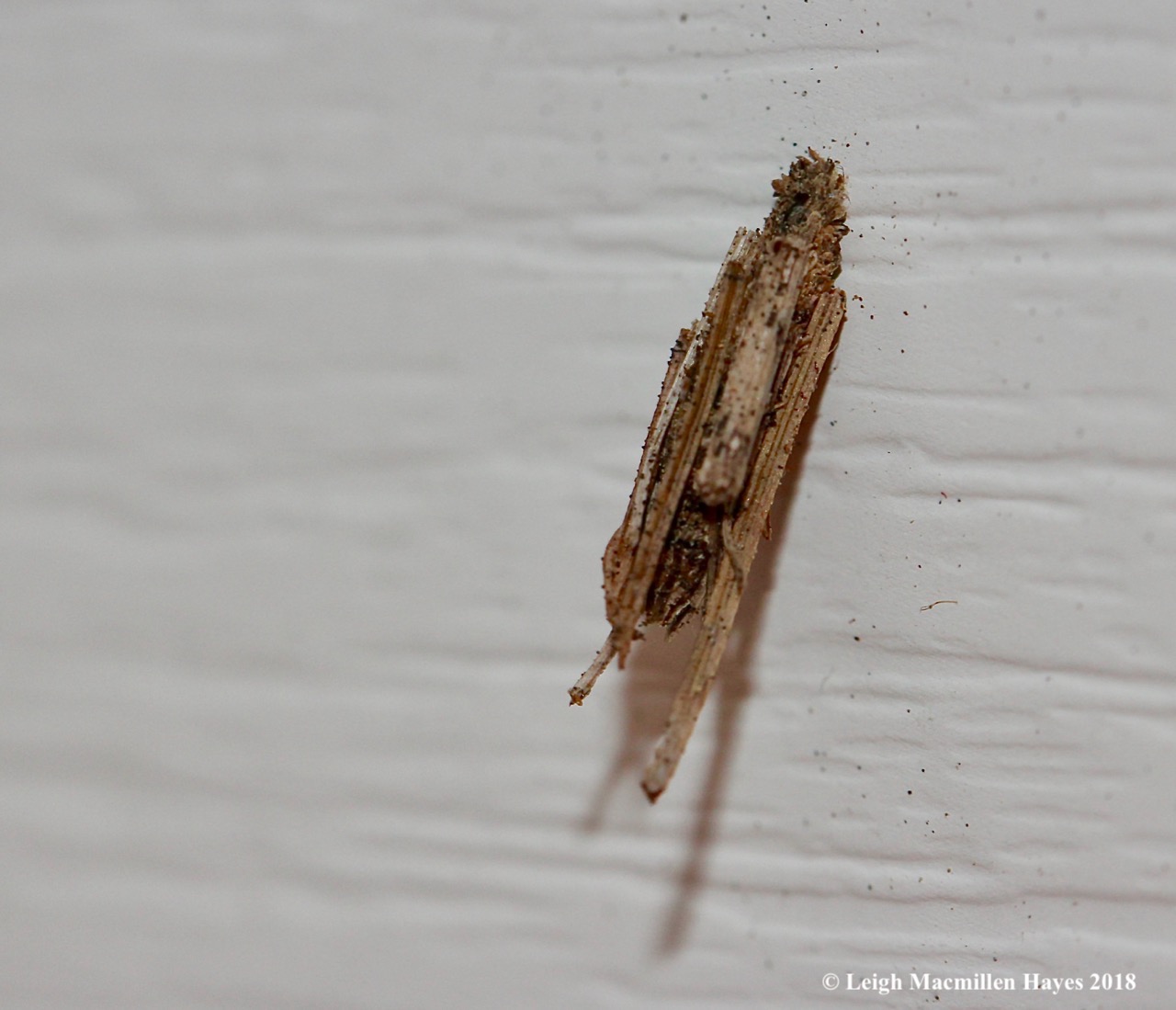
By the kitchen garden, I found another insect I’d forgotten all about these last few weeks–the caterpillar larvae of the Psychidae or bagworm moths that construct cases out of silk and environmental materials, much the way a caddisfly might. It’s the perfect camouflage from predators such as birds and even other insects.

4-milkweed seed

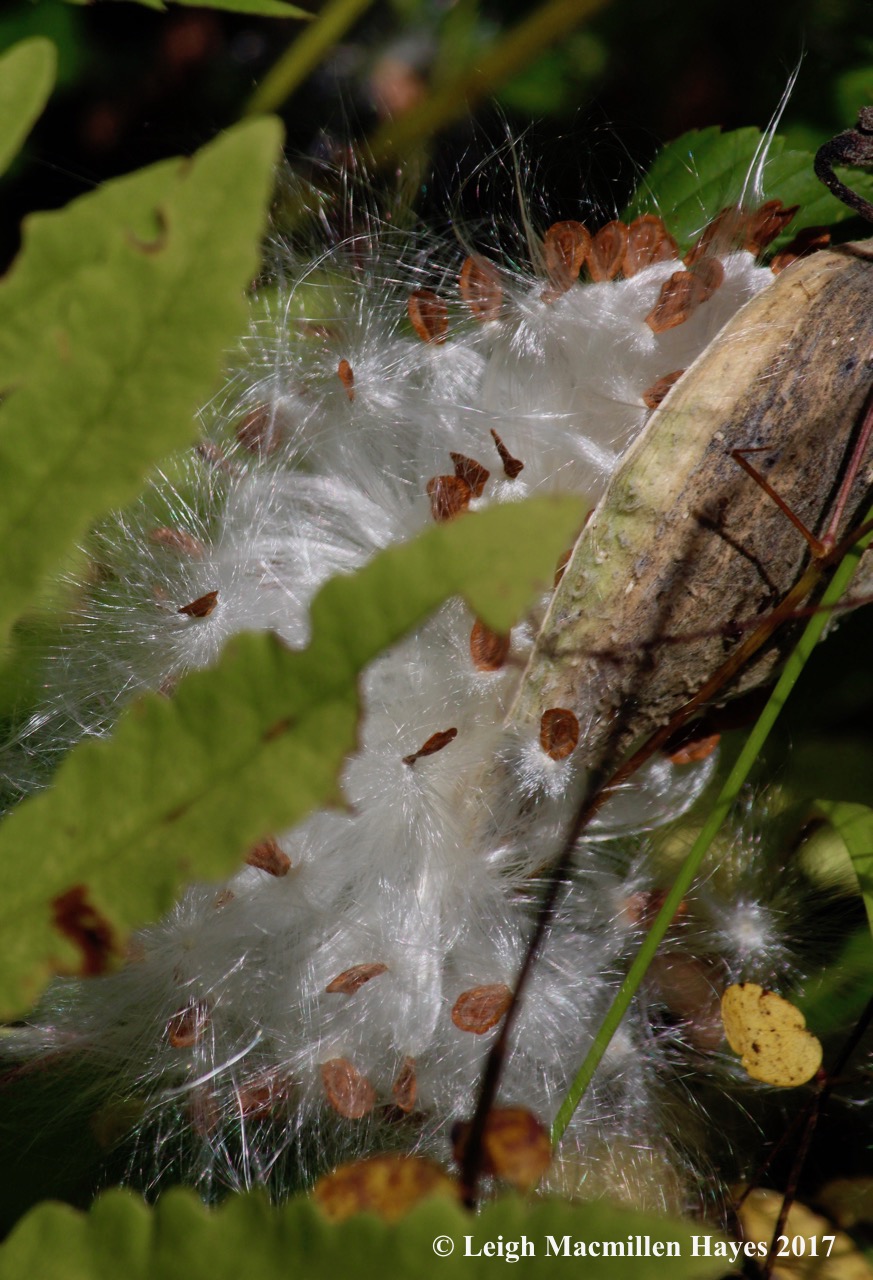
Everywhere throughout the garden were milkweed seeds, some wearing beaded skirts that will likely keep them in place. That’s fine with me, for I love milkweed. Even if this one does eventually fly away on a whim and voluntarily plant itself in another location, I know that my plants will produce more seeds for they also increase their population via underground tuberous rhizomes. Some call them invasive; I call them welcome.

12-hole in yard?

I’m not so sure the creator of this large hole in the yard is welcome. I know my guy wasn’t impressed. It’s about a foot wide and deep. We suspect one of “our” woodchucks. I’d rather think it was excavated by the beautiful red fox that crosses the yard several times a day, but it’s a bit away from the fox’s route.

5-mealy pixie cup lichen

My wander eventually took me from the garden to the stone walls, where lichens form their own little gardens and support such species as the Mealy Pixie Cups, a fruticose lichen with a stalk or podetia below the cup.

6-Rock Shield

Foliose-styled rock shield lichens grow abundantly on the rock’s surface, their success due to the numerous disk-shaped structures called apothecia. Reproductive spores develop on the rolled edges of the brown berets, awaiting the time when conditions are just right for them to move on and grow into a new lichen.

7-Cinder Lichen

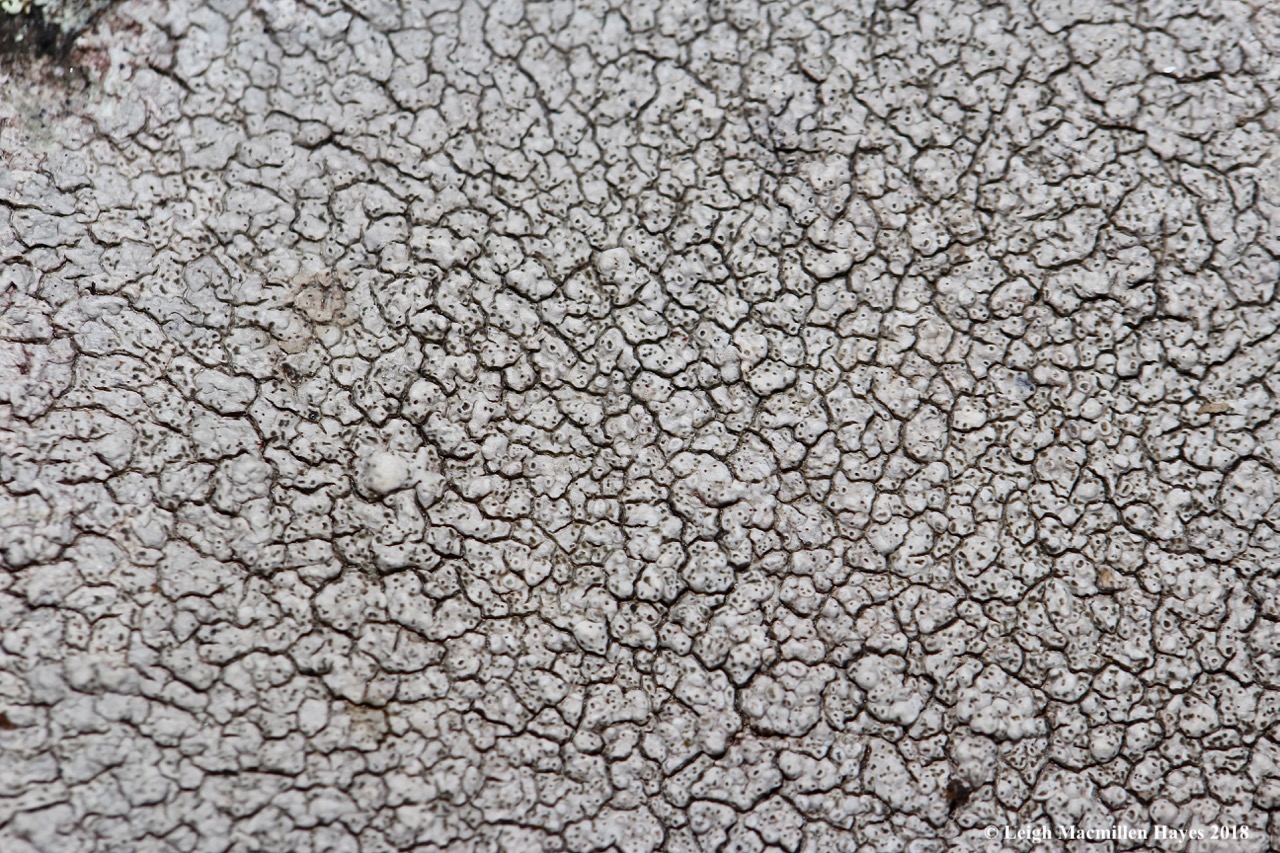
Crustose lichens were the most plentiful with their painted on appearance, like this ash-gray Cinder Lichen that reminded me of a mosaic piece of artwork.

8-Concentric Boulder Lichen

One of my favorite crustoses, however,  was the Concentric Boulder Lichen with its raised blackish-brown apothecia. Each time I saw the pattern created by the little disks, I felt like I was looking at a maze.

9-tent caterpillar egg cases

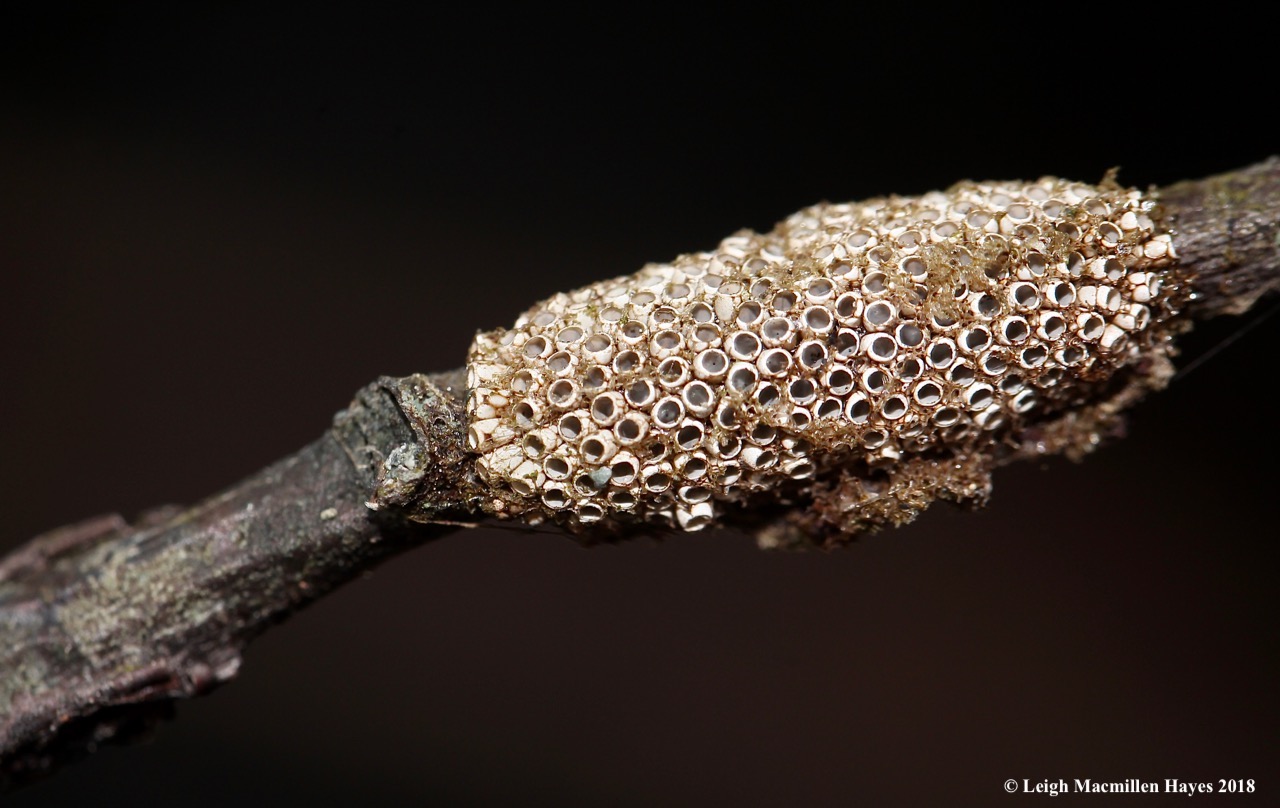
And then I stepped over the wall and turned my attention to some trees. That’s when I spied numerous tent caterpillar eggs cases. The Eastern Tent Caterpillar overwinters as an egg. Each one is part of a greater mass of anywhere from 150 to 400 eggs. They encircle a branch and are almost impossible to see, until your eye begins to recognize the structure. This was an old one and no longer had the shiny varnish-like coating that will help keep winter at bay.

11-red maple flower and leaf buds

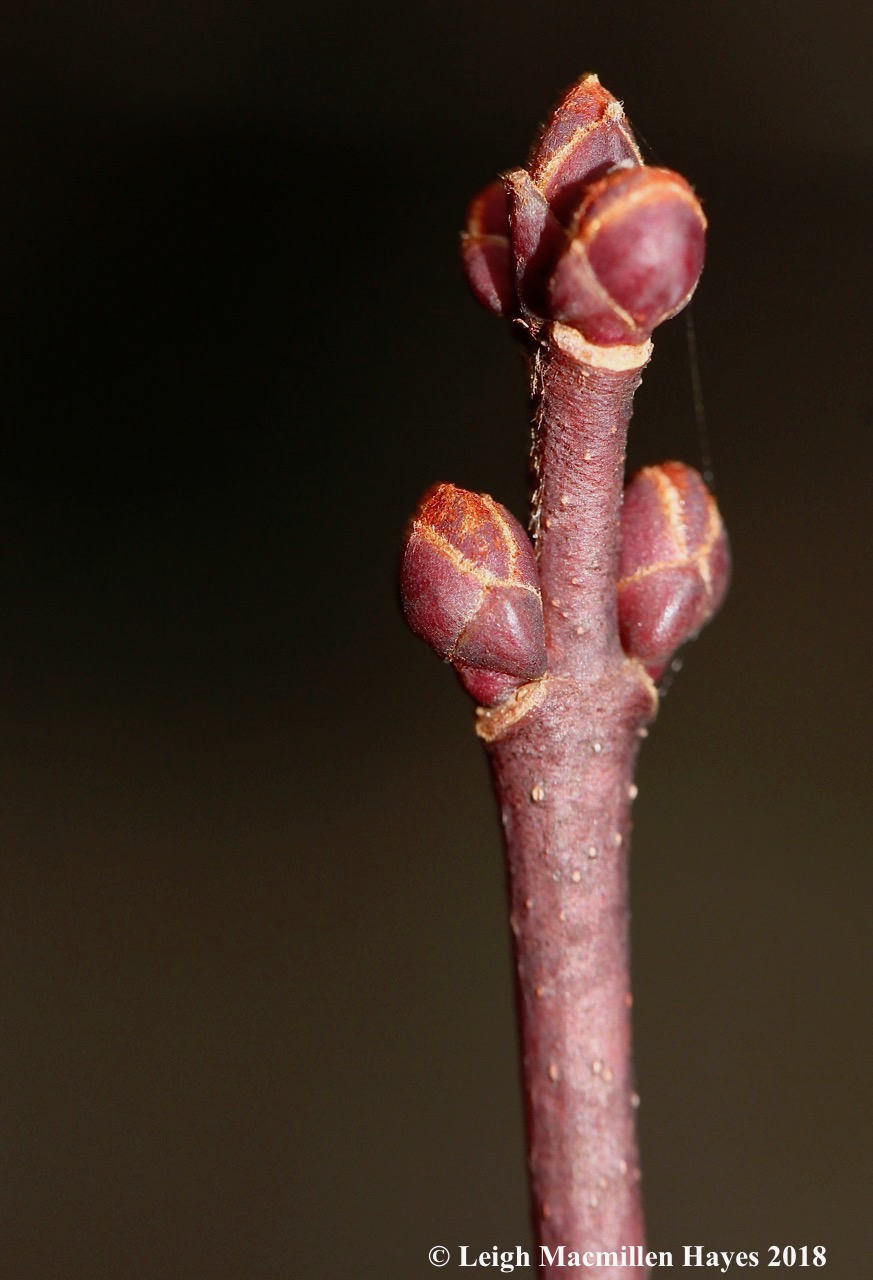
Also keeping winter at bay were the waxy scales of tree leaf and flower buds. The buds formed in the summer and now must wait for February’s warm sun before they begin to swell and ready themselves for next spring’s bloom. In the meantime, they are snug inside their tight structures.

10-tube caterpillar tube

My next great find–tubes or tunnels created by the Pine Tube Moth. Last summer, larvae hatched from eggs deposited on the needles. Though Eastern White Pine needles grow in packets of five (W-H-I-T-E or M-A-I-N-E is a mnemonic we use to remember how many needles on the white pine, spelling “white” for its name or “Maine” because it is the state tree.) Anyway, the tube moth used silk to bind a bunch of  needles together, thus forming a hollow tube. Can you see the silk at the top? Notice the browned tips–that’s due to the larvae feeding on them. Eventually the overwintering larvae will pupate within the tube and in April they’ll emerge. Two generations occur each year and those that overwinter are the second generation. The good news is that Pine Tube Moths are not considered a significant pest.

13-pinesap winter capsules

One of my favorite finds as I headed down the cowpath toward home was actually an old friend–Pinesap in its winter capsule form. Pinesap is similar to Indian Pipe, another Monotropa (once turned speaking to its flower that turns upright after fertilization). The creamy whitish flowers developed into woody capsules. As the capsules mature, the structures become erect. Once ripened, seeds will be released through slits that open from the tip to the base of the capsules.

14-False Tinder Polypore

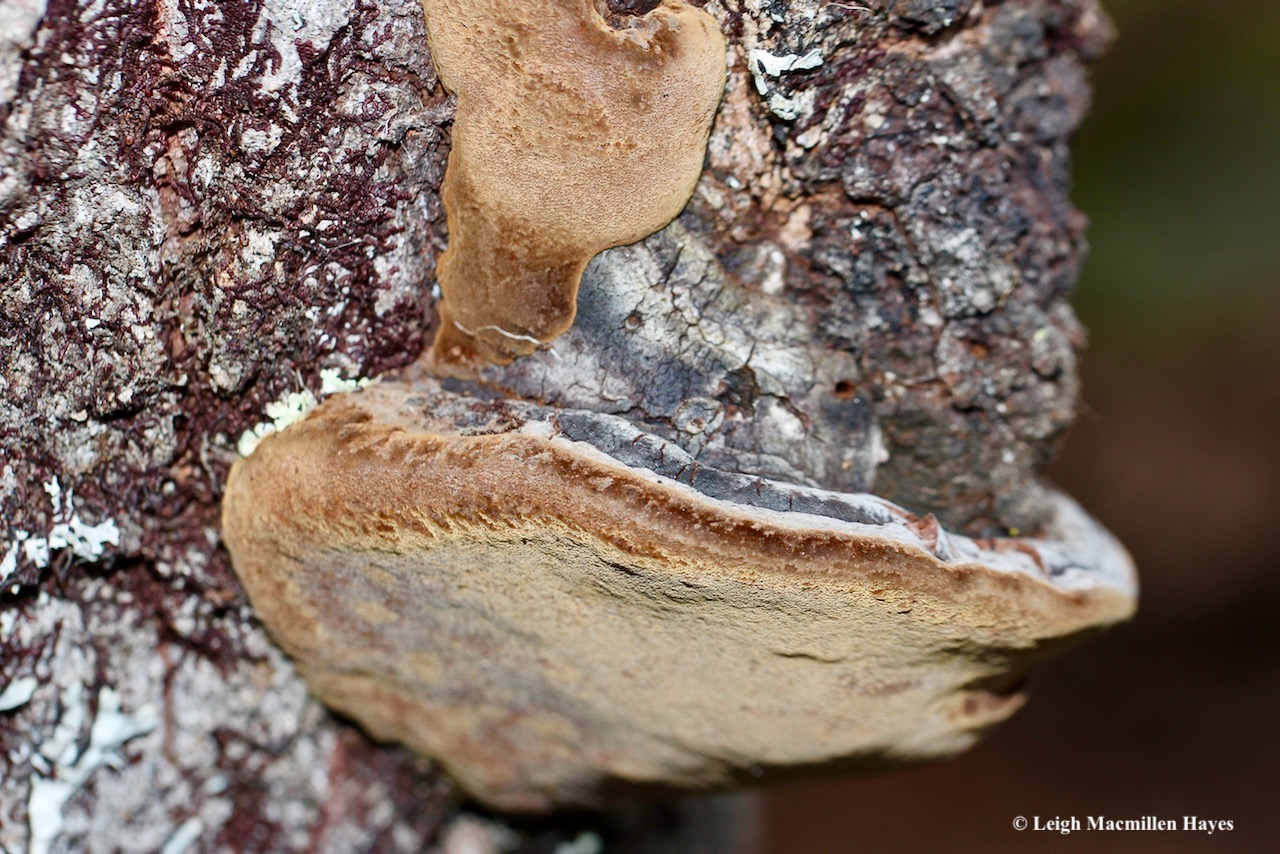
I was back in the grassy part of our yard when I passed by a tree in the corner and made a new discovery–a false tinder conk or polypore, with its black fissured cap. My very own Phellinus ignarius! While a Tinder Conks pore surface is usually concave, in the false specimen, it’s angled downward from the rim to the tree.

I know my friend Faith will see a smiley face in the upper spore surface; it rather reminds me of a weasel.

We never left home today, my guy and me. Our focus was on the yard, but mine was a wee bit different than his. And for those of you who have been asking–these photographs were all taken with the Canon Rebel T3i. Yep, that’s the one that got wet when I decided to flip off a boardwalk last May.

A Keen Eye for the Wonders at Our Feet

As beautiful as the trees are right now with their autumnal display in full force, if you walk slowly in the woods and on the bald faces of our local granite, I think you might find yourself amazed. I know a friend and I always are and this afternoon was no different. We didn’t journey far; we didn’t need to journey far. We just needed to be present in the moment.

1-bird's nest fungi

Our first find was actually a discovery she’d made the other day. In her front yard, mixed in with the acorn caps, were teeny tiny examples of Cyathus striatus or Splash Cup Fungi.

2-bird's nest

Only two weeks ago, she’d shown me a larger version of this Bird’s Nest Fungi in the form of Fluted Bird’s Nest, but today she had this miniature version to share. They really do resemble their common name.

3-beads of slime mold

Because our eyes were focused on the minute, it was no surprise that Wolf’s Milk Slime Mold, all beady in structure, should attract our attention.

4-stink horn

Our next great find discovered by my friend with the eagle eyes was a Common Stinkhorn (Phallus ravenelii). She said it stunk. I didn’t notice, but the flies loved it. Love, in fact, seemed to be a common theme, for on the stalk, which is typically white, appeared a heart, with arms/hands wrapped around below. Even though it’s “common,” I don’t often encounter any form of a Phallus fungus, so I’m not sure if the two-toned stalk is a common feature.

6-green stain fungi

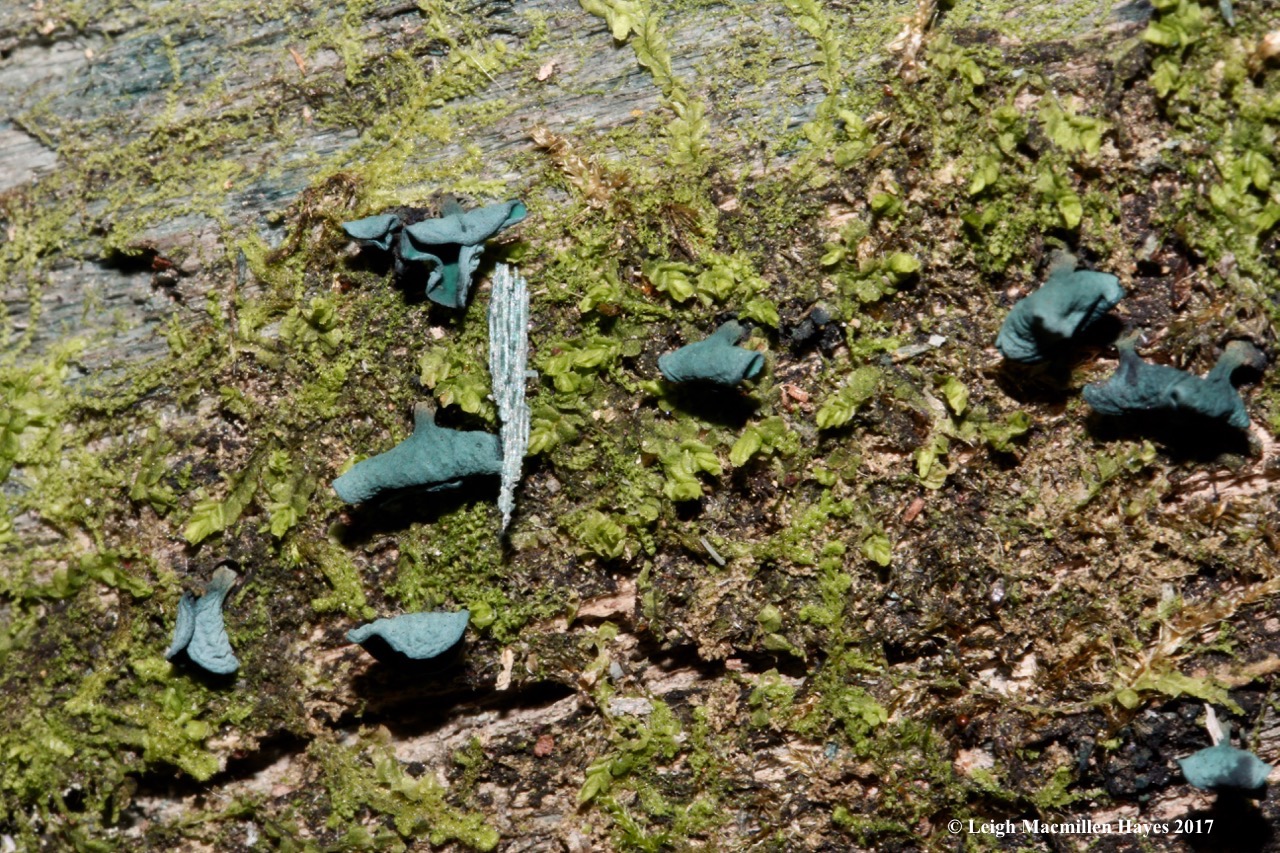
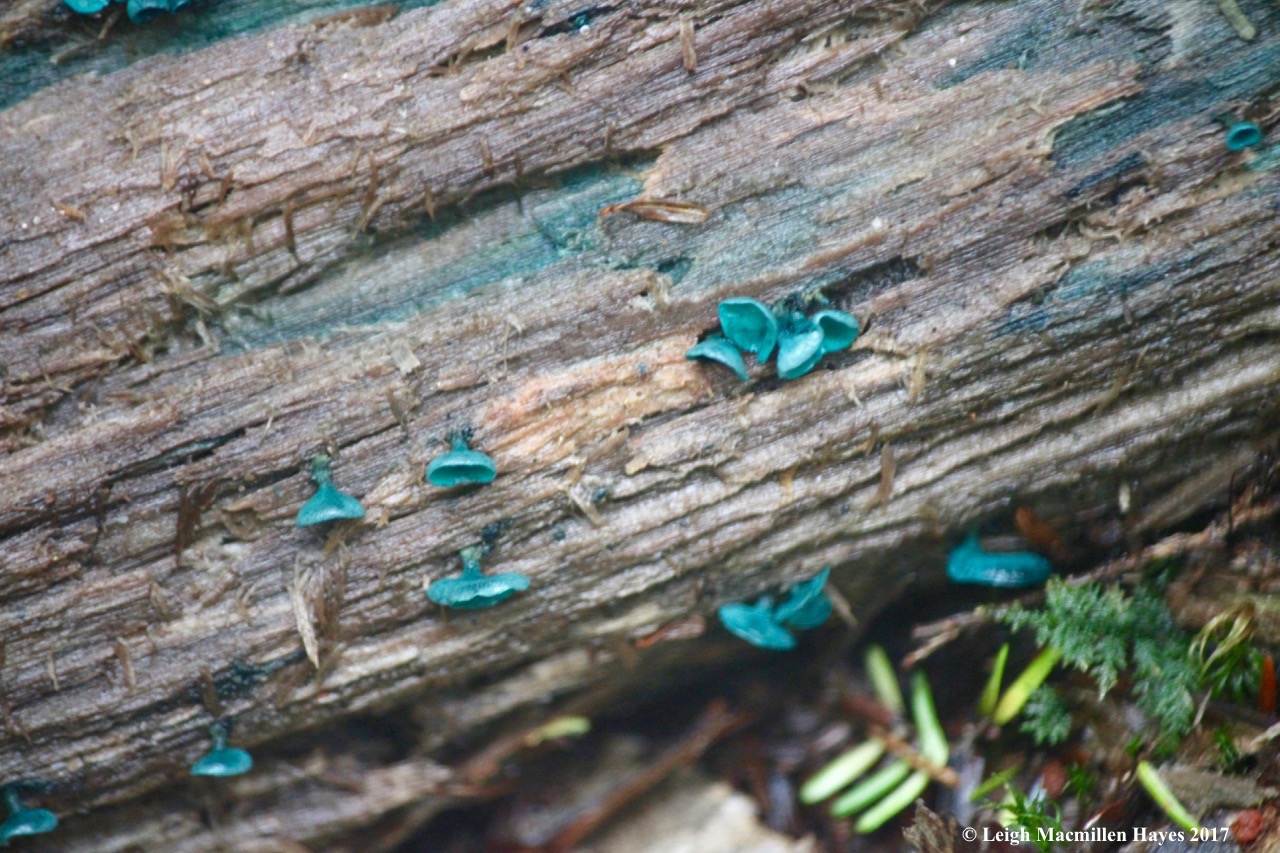
The next discovery–the fruiting form of Green Stain Fungi (Chlorociboria aeruginascens). The turquoise fruiting body was only about a third of an inch in diameter and so it’s another one that’s easy to overlook. But . . . our movement was intentionally slow as we moved without expectation and were constantly excited by our discoveries.

7-onto the granite

At last, we stepped out of the forest and onto a bit of a bald spot where granite greets sky, with lots of life layered between the two.

8-liliputian world

And onto our knees we knelt for life on the granite was lilliputian in nature.

9-candy lichen

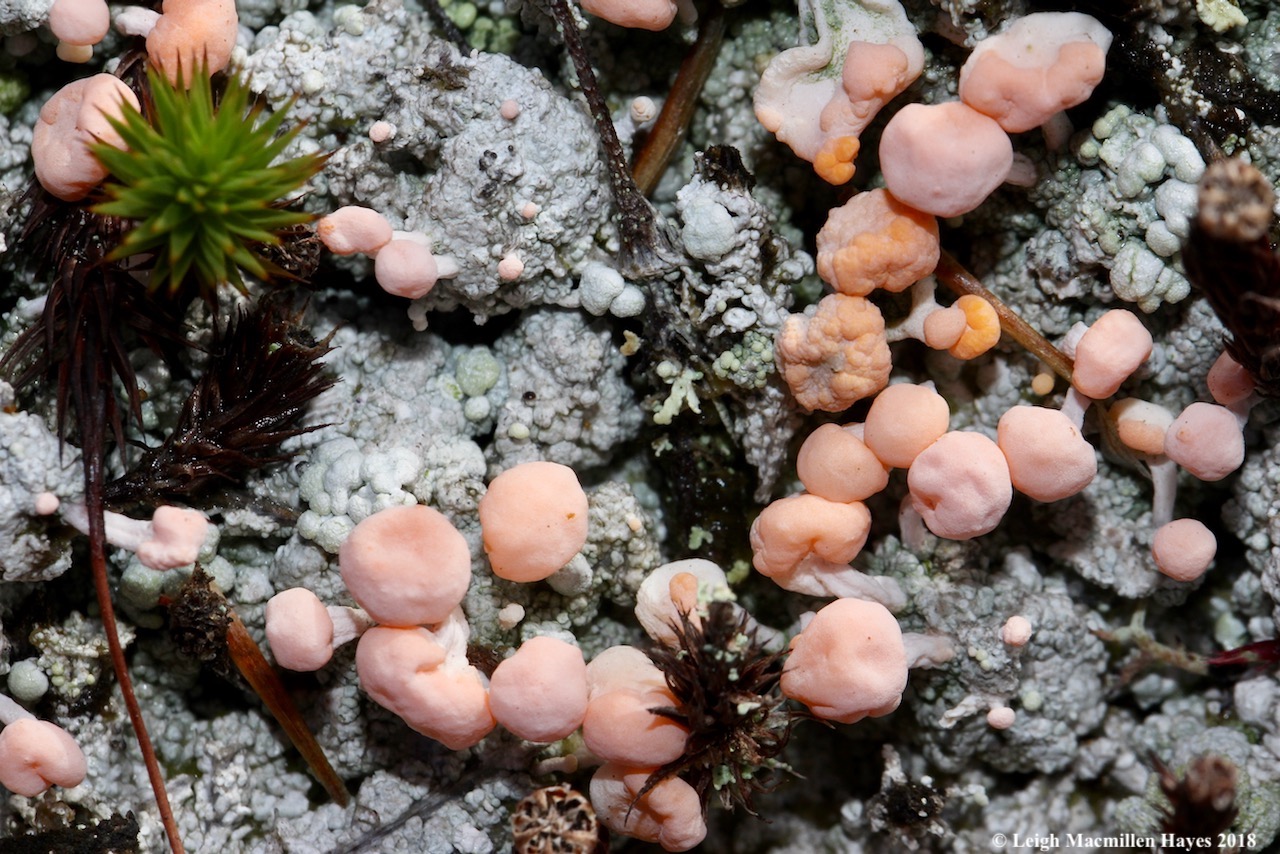
And varied, but it was the lichens that really pulled me into the fold. Some, like the Candy Lichen, a blue-gray crustose lichen with orange to salmon colored fruits, grew so abundantly that we practically ignored it.

9a-pixie cups

Then there were the delightful pixie cup goblets scattered throughout awaiting a visit from the wee folk.

10-British soldiers

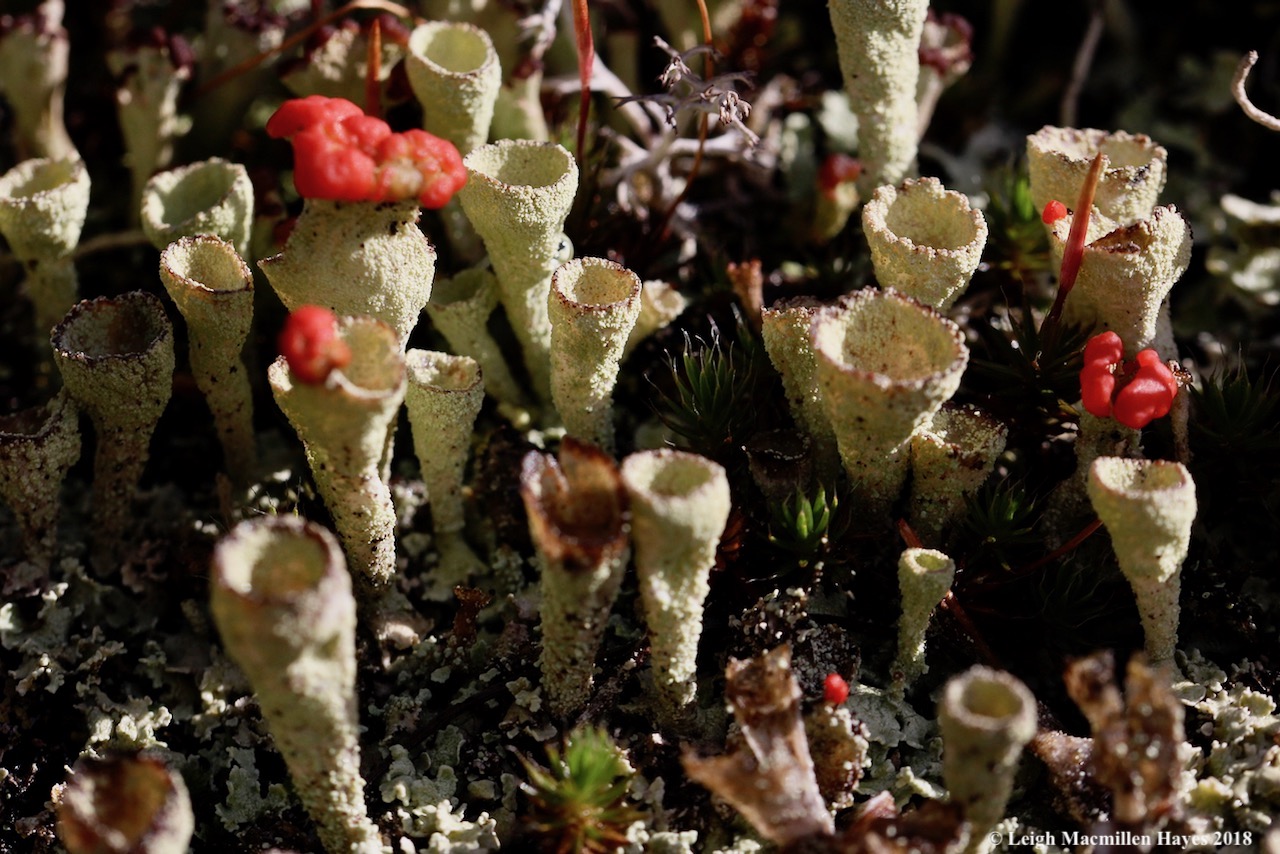
And British Soldiers (Cladonia cristatella) standing tall yet branched as they watched over all, their crimson red caps bespeaking their ancestral heritage.

11-lipstick powderhorn

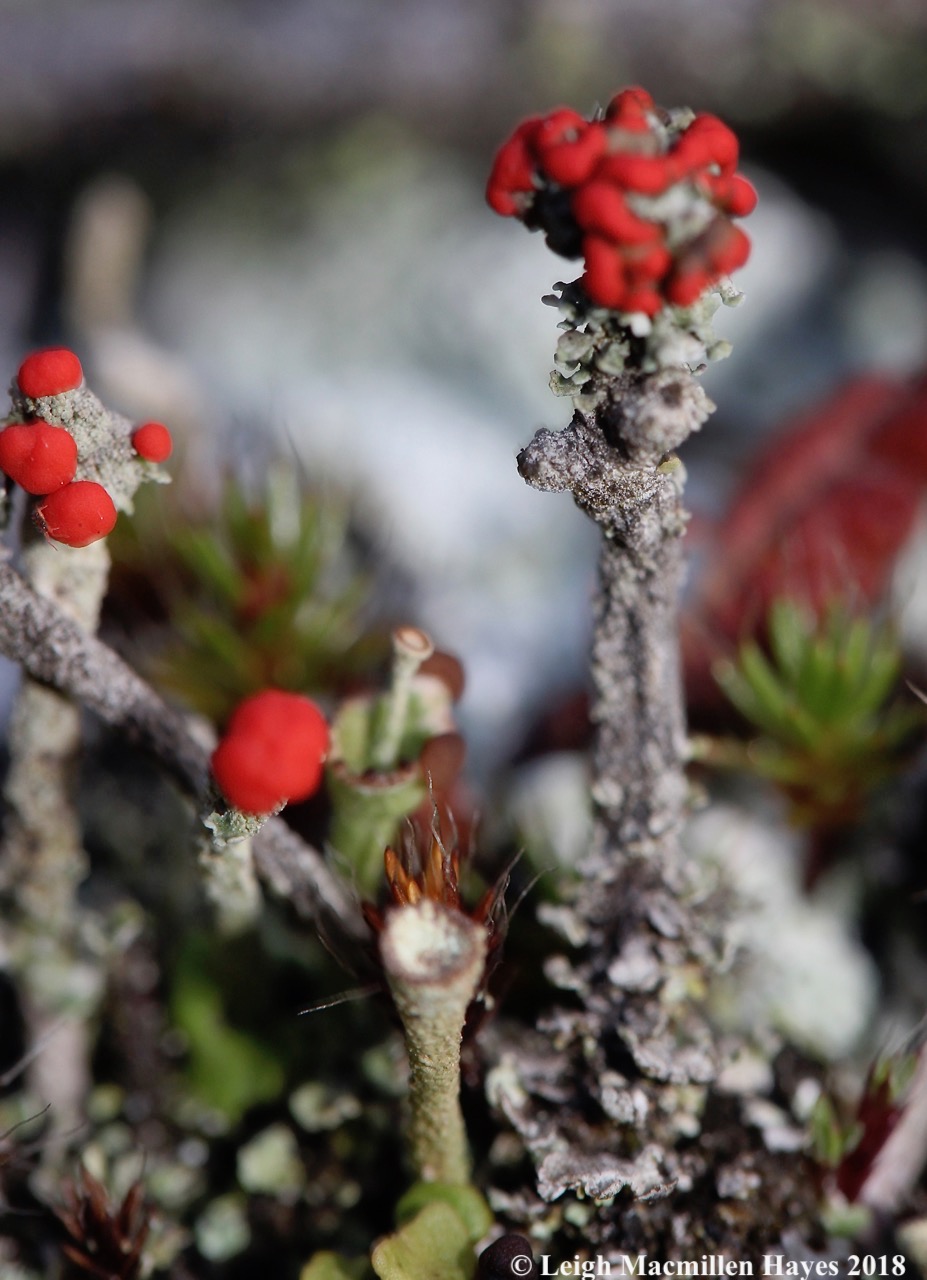
Beside them were a few Lipstick Powderhorns (Cladonia macilenta) with bright red caps above single stalks, rather like the lipstick I’ve never worn.

12-red-fruited pixie cups

And rounding out the red-cap series were the Red-fruited Pixie Cups (Cladonia pleurota), with their multiple red fruiting bodies outlining the cups.

13-red-fruited lichens

Pixie cups would have been enough. But pixie cups with bright red caps–and we were wowed. The other cool thing–like the Bird’s Nest Fungi with its splash cup form, these lichens offered something similar. The Bird’s Nest depends on droplets of water (think rain) to release its spores from the tiny “eggs” situated within each cup. For the Red-fruited Pixie Cups, it’s the same idea–the splash cup goblets allow the lichen to disperse its reproductive materials.

14-red-fruited brown

We found a few with the red caps turned brown and assumed they’d done their duty.

15- Ladder Lichen Cladonia verticillata

Just when we were about to move on my friend made another exciting discovery. Ladder Lichen (Cladonia verticillata) with its brown fruits reminded me more of fountains containing chocolate treats at the outer edge of each level.

16- Ladder Lichen Cladonia verticillata

Or perhaps a way for Jack to ascend from the world of the minute to the giants in the sky.

17-milkweed seeds

And with that, our eyes moved upwards–to the milkweed seeds that awaited their turn for release and a chance to find their own place in the world.

18-large milkweed bug

A Large Milkweed Bug reached the end of one pod, but the future possibilities seemed endless for it–as long as the spider web didn’t hinder any progress.

19-ash leaves

With upturned attention, we noted a young ash tree presenting its fall colors ranging from golden green to magenta all on the same trunk.

20-oak leaves

And even higher up, a Red Oak already showing off its carotenoid chemistry with yellows and oranges overtaking the green pigment.

21-colors

While fall foliage is at or near peak in western Maine and causing all of us to stop in our tracks to note the beauty of the live paintings that surround and embrace us in their ever changing way, its the color and variety and wonders at our feet that drew the attention of my friend and me today. And I’m forever grateful for her keen eye.

(And help searching for a needle in a haystack a little while later–thanks J.M.)

Detecting the Nature of Wilson Wing

Before heading onto the trail beside Sucker Brook at the Greater Lovell Land Trust’s Wilson Wing Moose Pond Bog Preserve on Horseshoe Pond Road in Lovell, today, a friend and I walked down the road to the pond where we hunted for dragonflies and frogs.

1-Horseshoe Pond

There wasn’t a cloud in the sky on this first day of fall and a crisp day it was, bringing smiles to our faces and adding sweatshirts to our attire.

3-green frog

Though we saw a few darner dragonflies and even a meadowhawk, it was the green frogs that we spent the most time trying to spy for they blended in well with their grassy surroundings at the water’s edge.

2-bobber

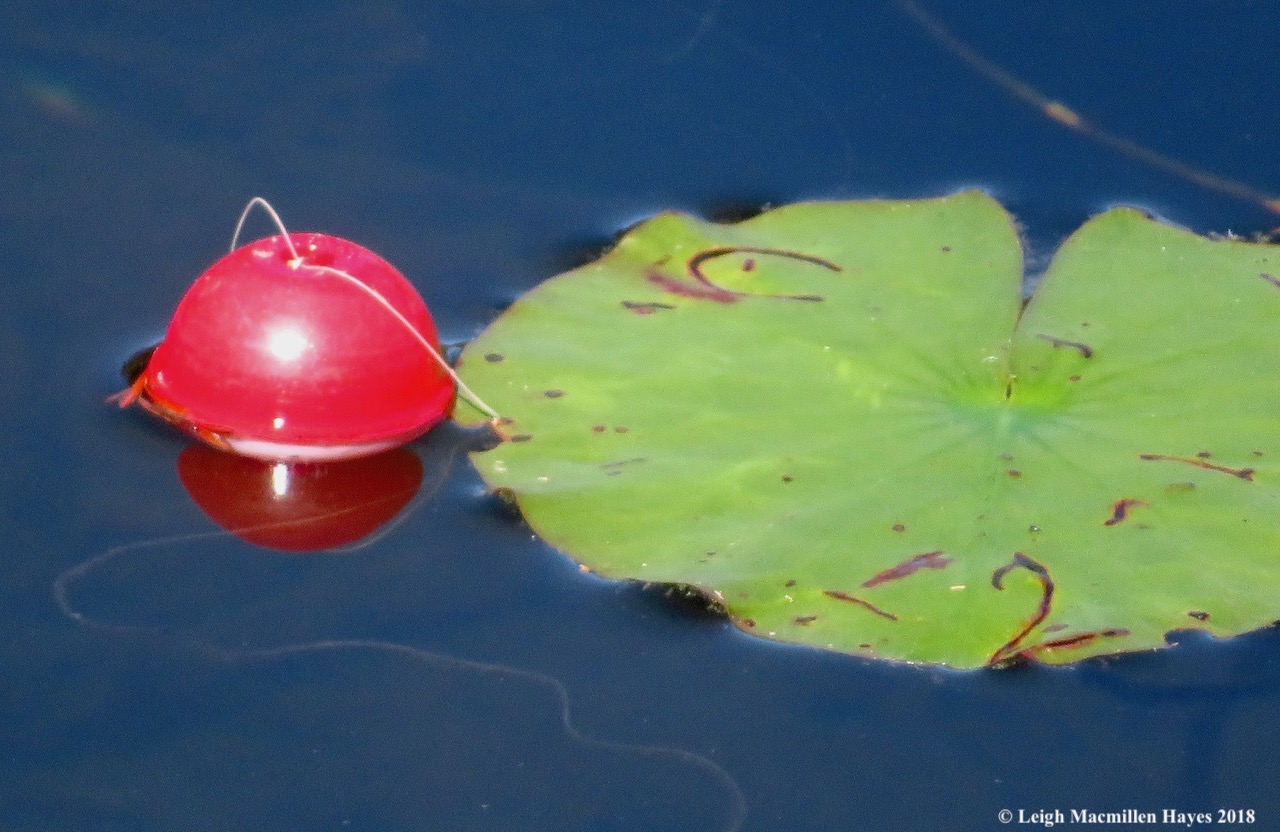
A bit further out, and unfortunately beyond our reach, we spotted a bobber and fishing line. While it offered a picture filled with color and curves, the reality wasn’t so pleasant.

4-Common Loon

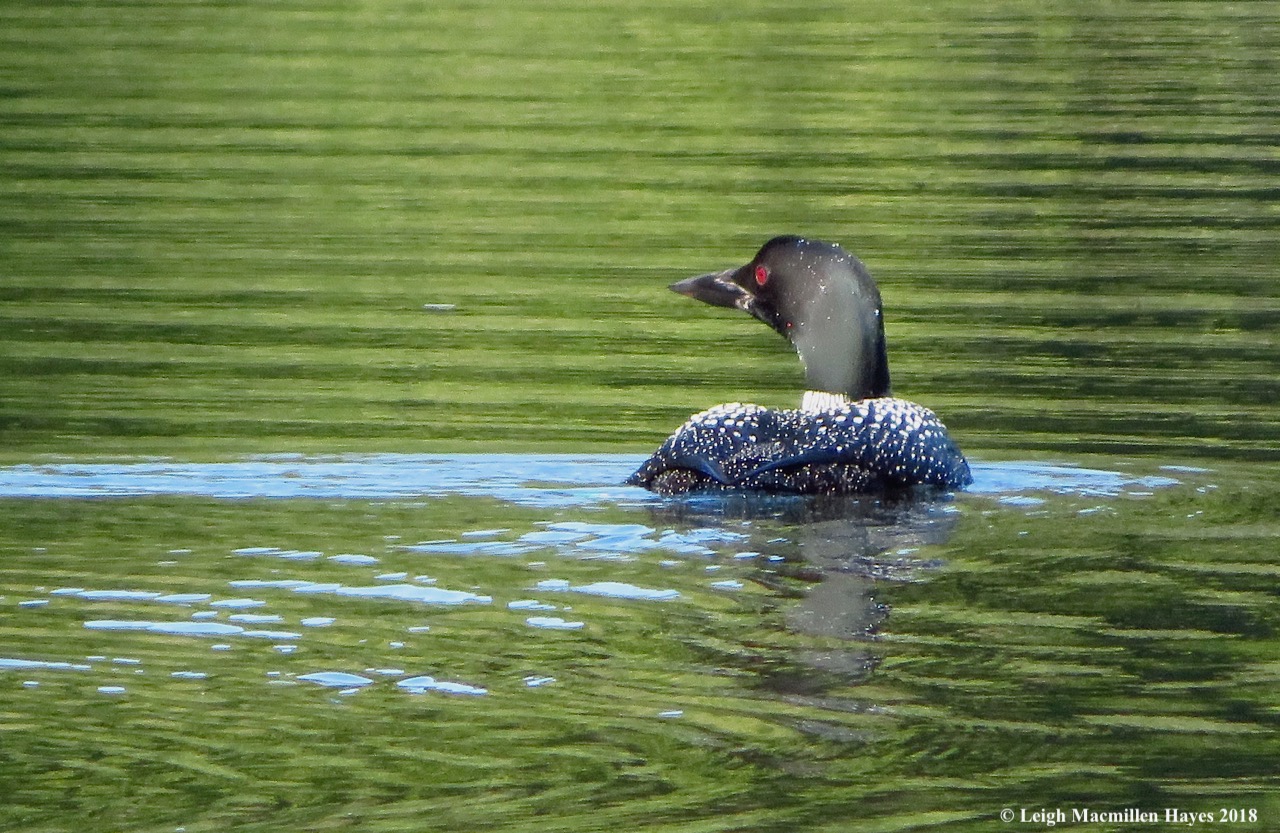
Nearby, this loon and a youngster swam and fishing line left behind is bad news for them as they could get tangled in it. Please, please, please, if you are near the Horseshoe Pond boat launch, and have the means to retrieve the bobber, do so. And if you are anywhere else in this world, do the same–for the sake of all birds everywhere.

7-Sucker Brook

At last, we pulled ourselves away from the pond and followed the brook that flows from it–Sucker Brook.

5-Jack in the Pulpit

Right away, we were in awe of the Jack-in-the-Pulpit plants with fruits still intact. Jack is actually a curious plant and sometimes channels its feminine side. While the plant starts life as a male, if the soil is poor, it turns female, flowers and bears seed. It could turn male again. In the case of what we saw today, meet Jill.

6-thin maze polypore

As our journey continued, we noted fungi everywhere. Some had rotted and added to the earthy smell of the woods. Others displayed their unique structures, colors, and lines, including the Thin-mazed Polypore.

11a-earth tongue

We also found at least one Black Earth Tongue, its common name reflecting its tongue-like appearance as it stuck up from the ground.

11-Dead Man's Finger

And in keeping with human body parts, we noticed a singular Dead Man’s Finger. But . . . its presentation offered questions we couldn’t answer. It was our understanding that on Xylaria longipes the young fruiting bodies would be covered with a whitish or gray powder in the spring. The powder isn’t really a powder, but rather the asexual spores of the species. So, did we find a confused youngster? Or was it an oldster parasitized by a mold?

10-Choclolate Tube slime

Speaking of molds, we stumbled upon a log featuring a feathery appearance reminiscent of antennae on a moth or butterfly. Well, maybe a collection of antennae. A huge collection.

10a-chocolate tube slime

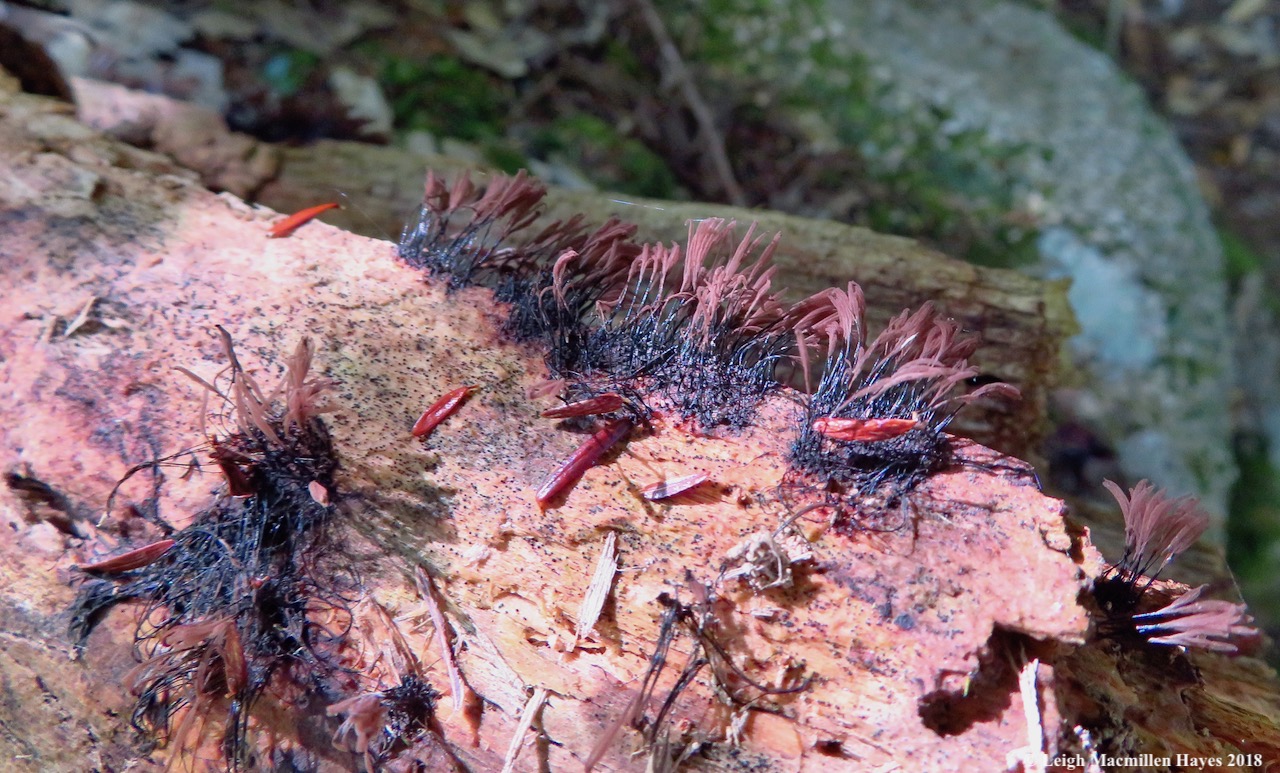
Turns out it was Chocolate Tube Slime, a new discovery for me. In his book, Fascinating Fungi of New England, author Lawrence Millman describes it as “dozens of erect, brown tubes mounted on thin, seemingly polished black stems.” Bingo.

9-green frogin sucker Brook

Also appearing a bit chocolate in color was another green frog. And being the first full day of autumn, I began to realize that my time spent admiring amphibians and dragonflies will soon draw to an end. But . . . on the horizon . . . tracks and scat ;-)

8-Conocephalum salebrosum

Because we were beside the brook, and we’d seen this species before, we searched each and every rock and weren’t disappointed. Conocephalum salebrosum showed off its snakeskin-like leaves.

8b-cono

The conspicuous grooves of the thalli on this liverwort defined the surface and gave it that snakeskin appearance.

12-Moose Pond Bog

Continuing on, we finally reached the platform and climbed up to look out toward Moose Pond Bog. Of course, we hoped to see a moose. No such luck. We did spy one dog named Bella and her owner, Meg Dyer, the Lovell Rec Director, out for a Sunday walk in the woods. But they were on the trail below us and not in the bog. One of these days . . . maybe we’ll see a moose. When we least expect it, that is.

12-winterberry fruits buried

Back on the trail ourselves, our next great find–winterberries in a recently dug hole about four inches deep. Who done it? We poked the hole with a stick and determined that it didn’t go any deeper or have any turns, such as a chipmunk might make. Nor did it have a clean dooryard, which they prefer. Turkey? Perhaps. Squirrel?

13-winterberries among midden

We think we answered the question for on top of a tall hemlock stump that has long served as a red squirrel diner, some red winterberries appeared among the pine scales left behind.

14-liverwort?

Almost back to the road, we crossed the final bridge and then backtracked. We knew our destination was up the streambed it crossed over and were thankful that it held not much water. That meant we could climb up and take a closer look at the large boulders in the middle. And it was there that we made a new discovery.

14a-Peltigera aphthosa

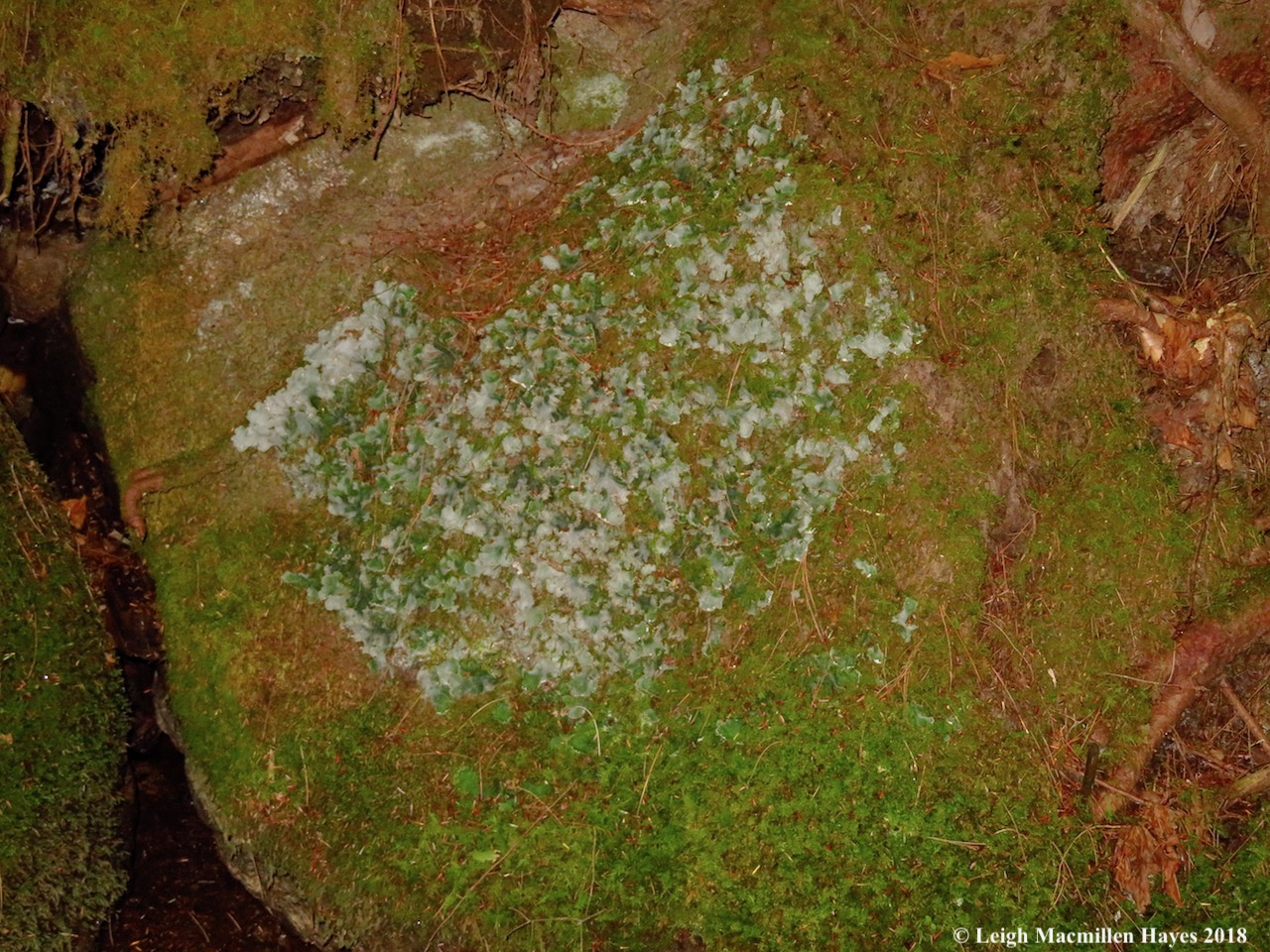
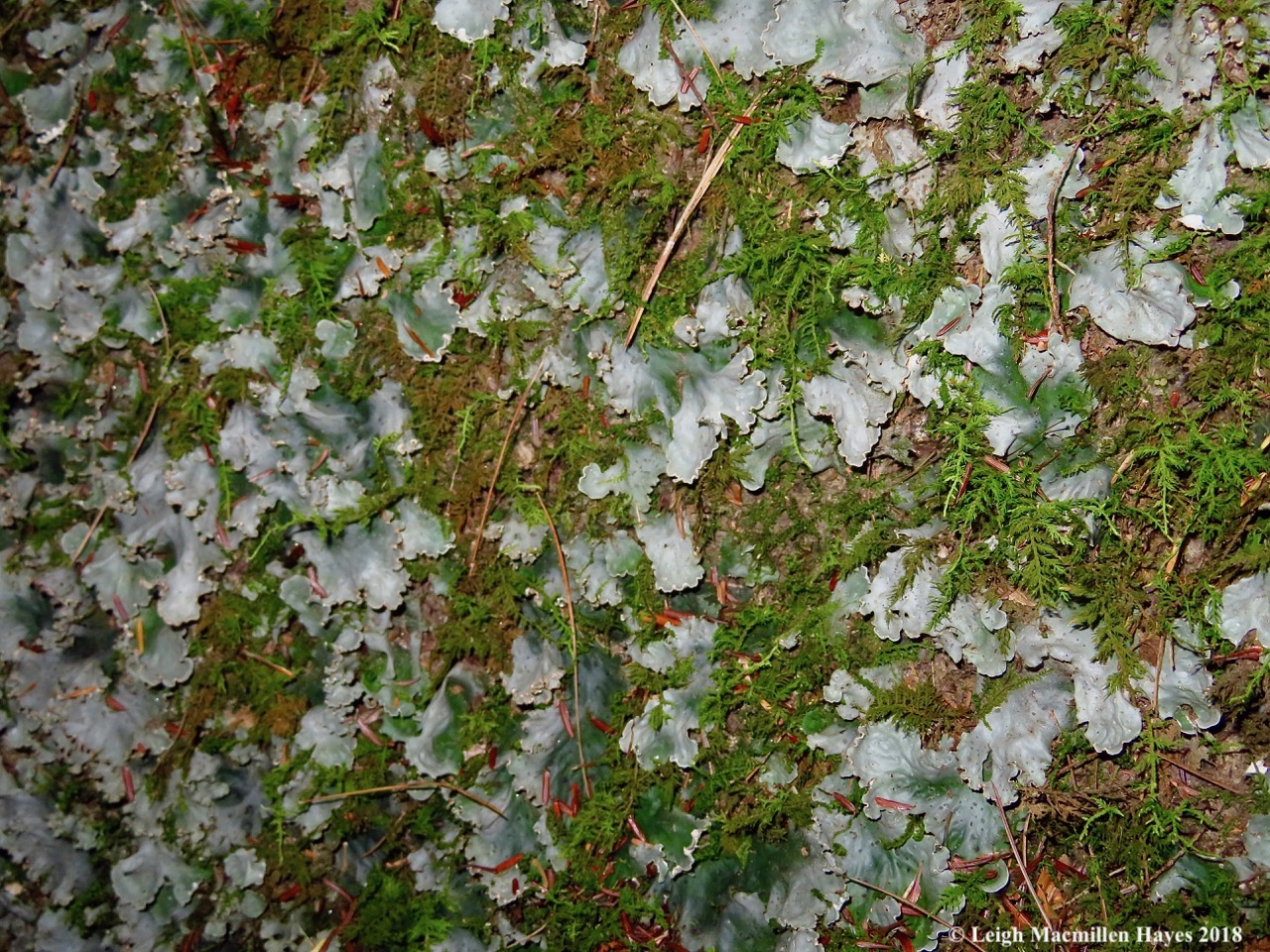
You see, in the past we’ve not been able to get too close to the boulders and from a bit of a distance we were sure we had looked at more snakeskin liverwort. But our ability to get up close and personal today made us question our previous assumption. Suddenly, the gray-green leafy structure took on a more lichen-like appearance. Though its color wasn’t the same, it very much reminded me of rock tripe.

14c-Peltigera aphthosa

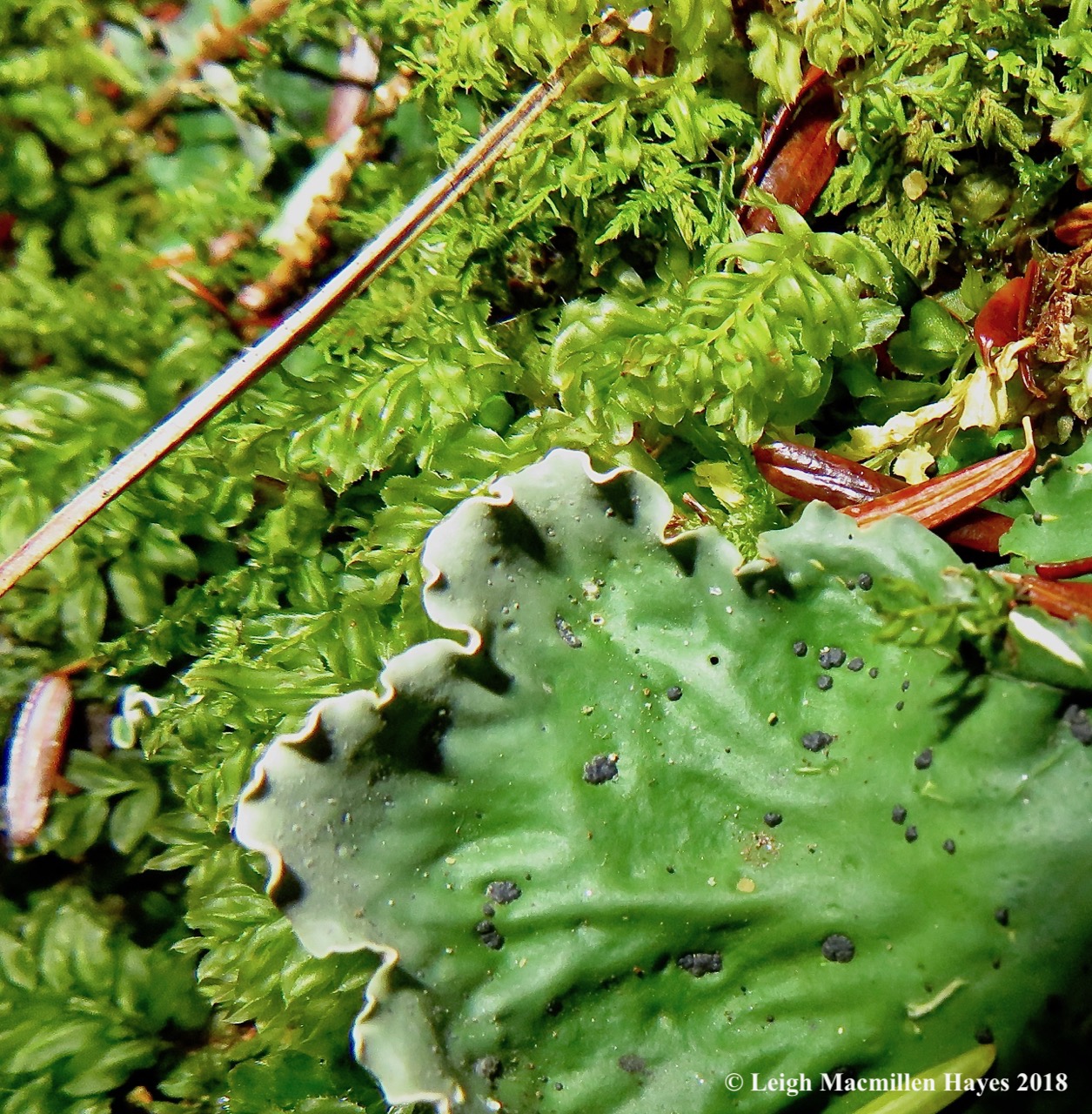
We studied its lobes and structure, including the tiny warts and questioned ourselves as we continued to examine it. I kept thinking it was an umbilicate based on the way it adhered to the rock substrate.

14b-Peltigera aphthosa

A little research and I think I’ve identified it correctly, but know some will alert me if I’ve assumed too much–Peltigera aphthosa, aka Freckled Pelt Lichen, also called Spotted Dog Lichen. The bright green center indicated it was wet. From borealforest.org, I learned that the little warts contain tiny colonies of cyanobacteria, which supply the lichen with nitrogen.

15-Racomitrium aciculare?

And right beside the lichen, we found a moss that also reminded us of a liverwort for it resembled Bazzania. But . . . if I identified this correctly, it’s Racomitrium aciculare. Some know it as Yellow-fringe Moss.

15a-Racomitrium

In his book, Mosses, Liverworts, and Hornworts, Ralph Pope described it as “common on wet rocks along streams and under waterfalls.” In watery seasons for this particular stream, that would be its exact location–under a waterfall.

16-dry stream bed

Today, the stream bed leading down to Moose Pond Bog and Sucker Brook was just about dry. But . . . because of that we were able to take a closer look.

In fact, it took us almost four hours to follow the mile or so trail, but it was all about taking a closer look through our 10X lenses and cameras, slowing down our brains,  and channeling our inner Nancy Drew as we paid attention to clues and tried to decipher the scene around us–all the while detecting the nature of Wilson Wing.


Filling Our Buckets Mondate

Our day began with a journey to Green Thumb Farms in western Maine because we were curious about their native blueberry sod. We had hoped to see some, but that wasn’t to be and instead we were given a contact number for a sales rep. Our hope is to purchase a couple of pallets worth and use it as one more filter system at our camp in our continuing efforts to protect water quality. We recently learned that we qualified for a LakeSmart Award, but don’t want that to stop us from finding other ways to create a more lake-friendly property. Stay tuned on the sod because once we figure that out, it will be a story worth telling.

1-lunch spot, Eaton Village Store

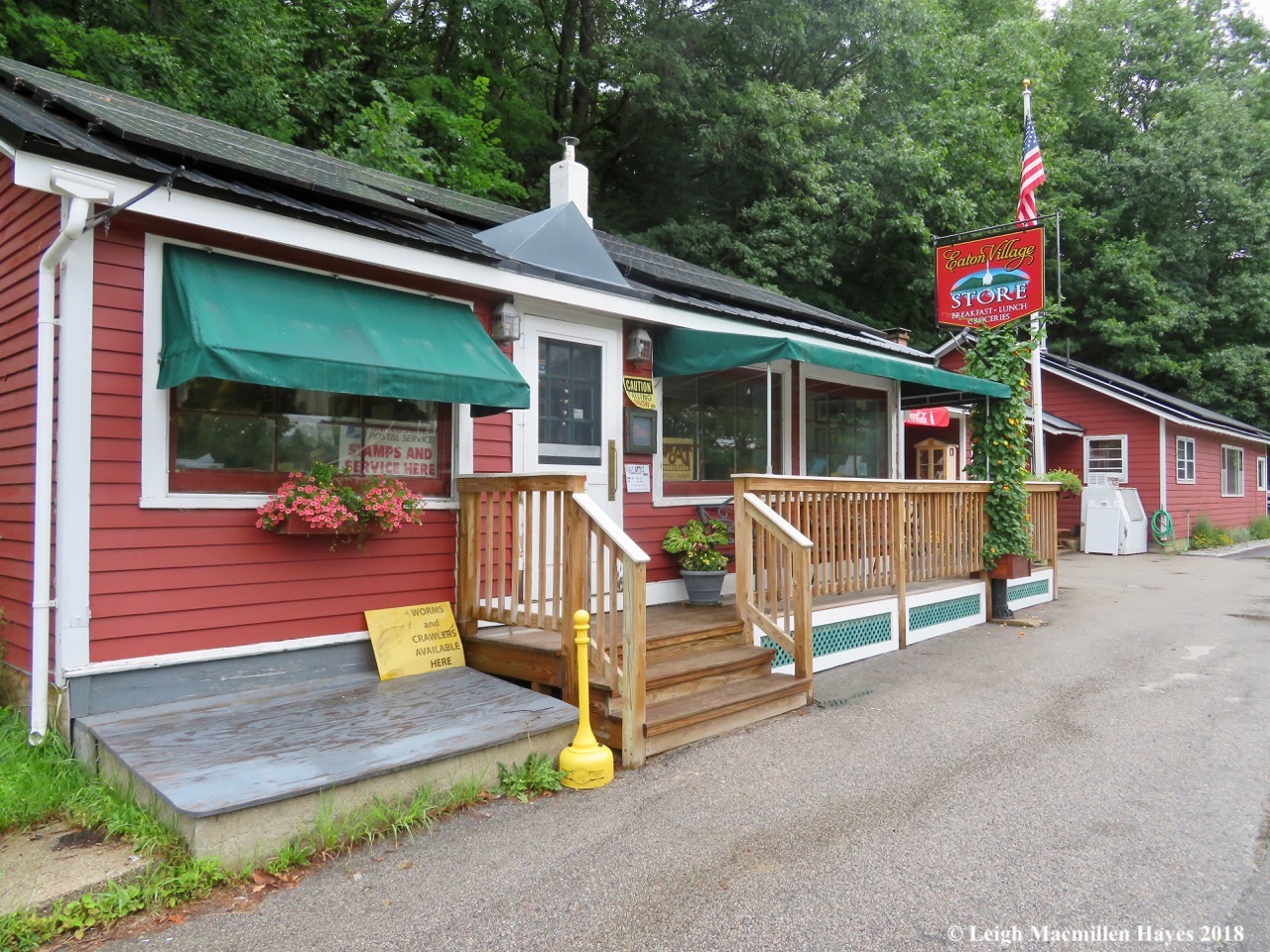
From Green Thumb Farms we zigged and zagged along the back roads until we reached Eaton, New Hampshire. Lunch awaited at the Eaton Village Store on Route 153. Inside, one wall is covered with mailboxes and the post office. Grocery and gifty items are displayed in an aisle or two. And then there’s the lunch counter and a few tables for the eatery. A most pleasant eatery. The menu is simple, food fresh, and all served with a smile and conversation.

2-falling snow sign

Oh, and one more thing. They are eternal optimists! Or procrastinators like me. Heck, eventually there will be falling snow to watch for again.

3-Foss Mtn Trail

After lunch, we zigged and zagged again, winding our way up a road we once remember sliding down–in the winter on our bellies with our eight and ten year old sons in tow. Our destination today was much easier, though I did put the truck into four-wheel-drive to reach the trailhead parking lot for Foss Mountain. I’d told my guy about the blueberries and views and neither of us gave a thought to today’s weather for in the newspaper the forecast predicted it to be “rather” cloudy, “rather” being a rather unscientific term. It turned out to be more than “rather.” And raindrops fell, but still we went.

4-Foss Mtn Map

We examined the sign and my guy was thrilled with the possibilities.

6a-no picking

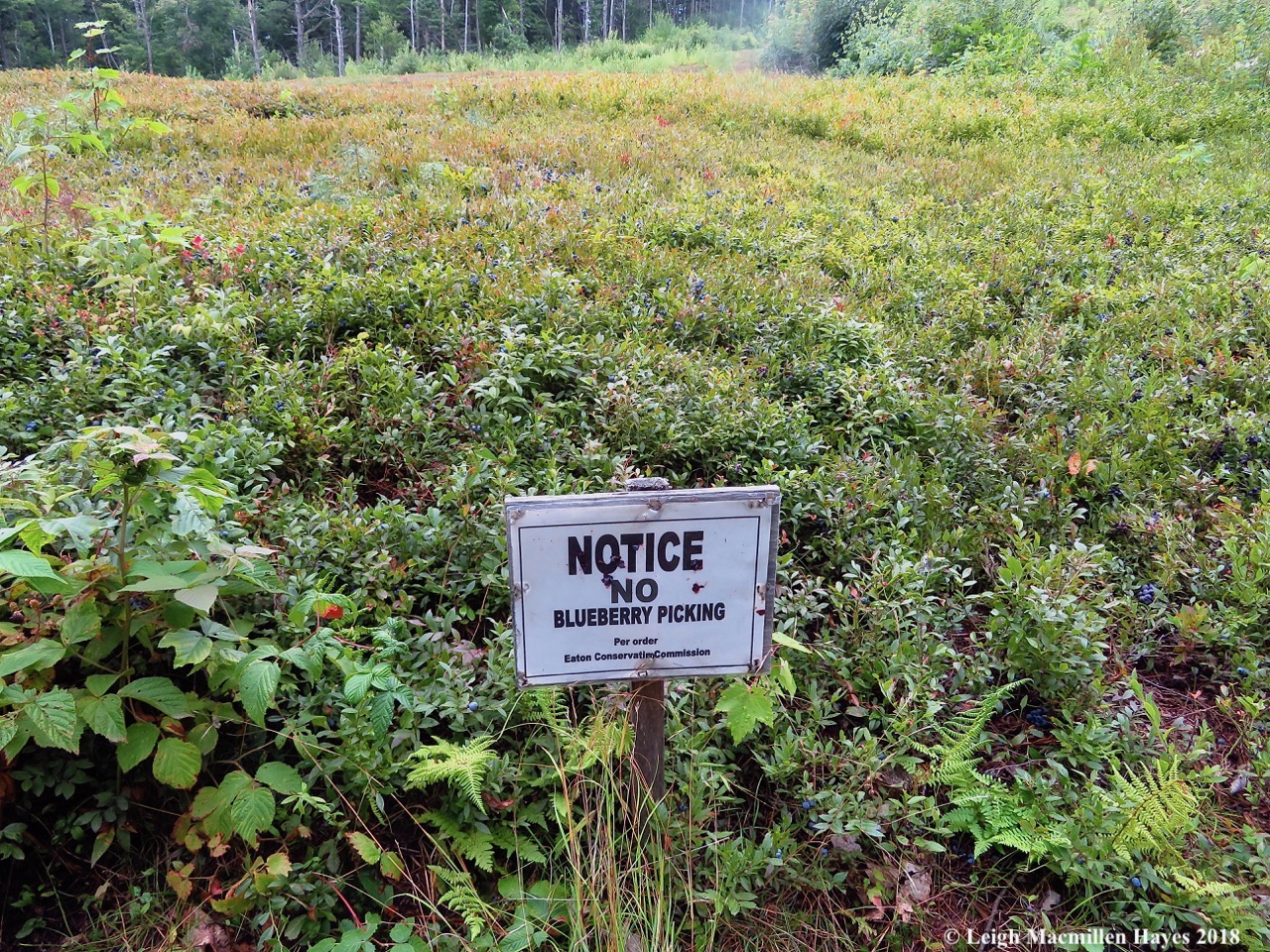
Some fields, however, were closed to public picking for a private operation leased those from the town.

5-Ryan Bushnell Blueberry Operation

Off to the side, we spied their sorting machines. Note the blueberry color of the equipment.

6-blueberry envy

And the abundance of blueberries.

7-hands in pockets

After testing a sample to make sure they were acceptable for human consumption, my guy stuck his hands in his pockets to avoid further temptation.

8-Joe Pye Weed all in disarray

Upward we journeyed, following the path of this property that is owned by the Town of Eaton. Along the way, a large patch of Joe Pye Weed shouted for attention, its petals disarrayed much like my own hair on this misty of days.

9-into the fog

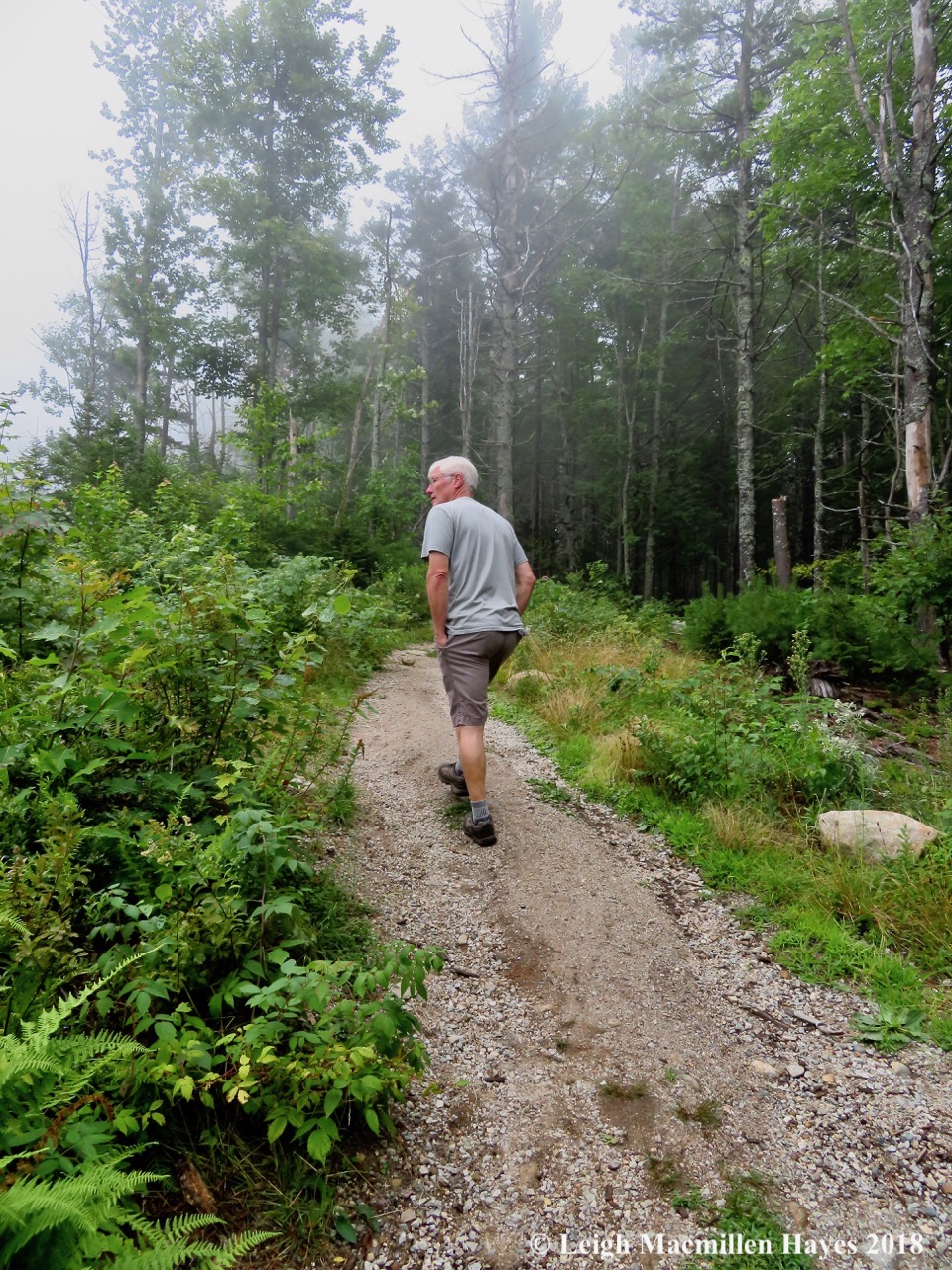
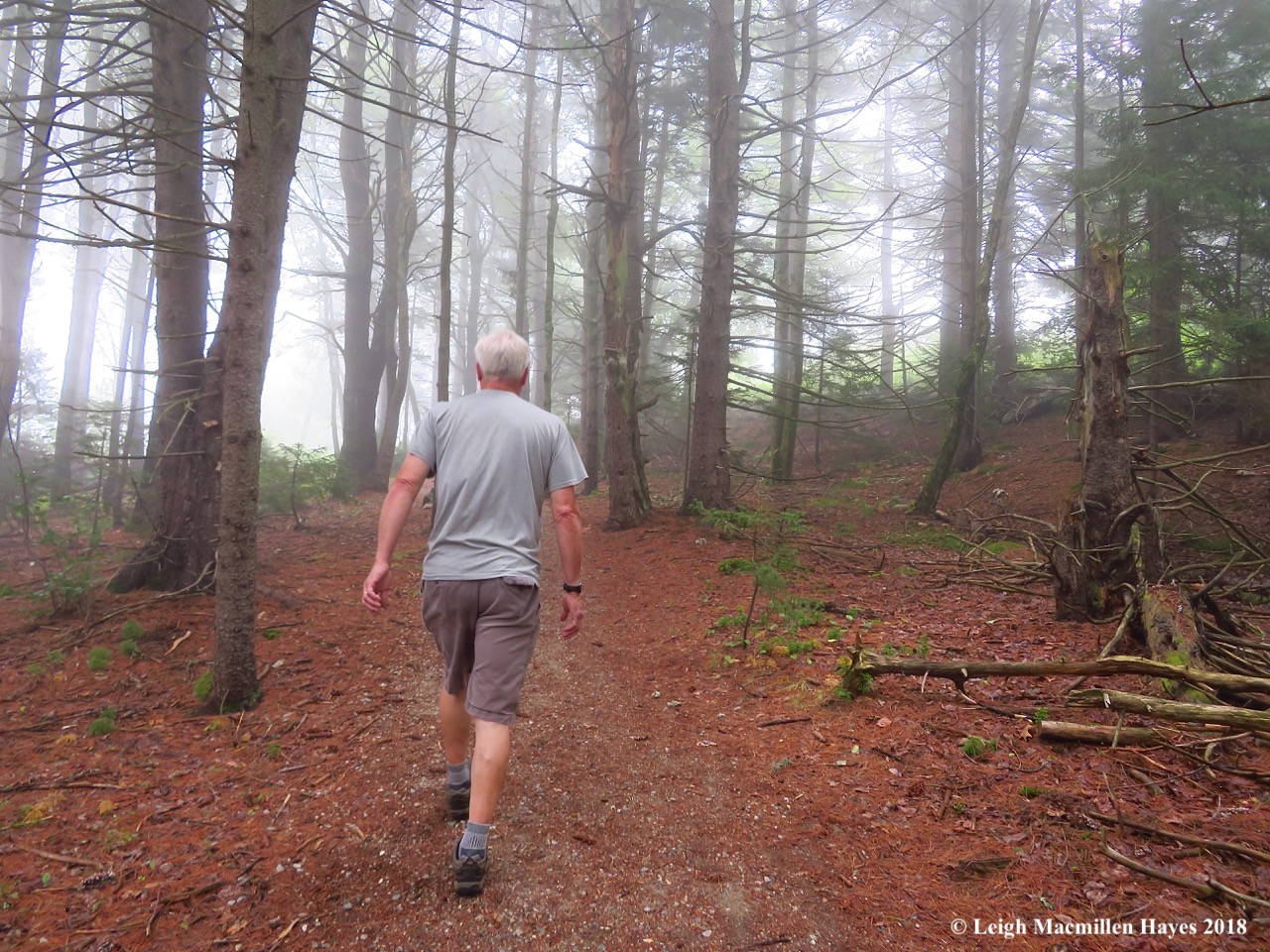
The habitat changed and still we climbed–anticipation in every step my guy took at full speed.

10-pick blueberries sign

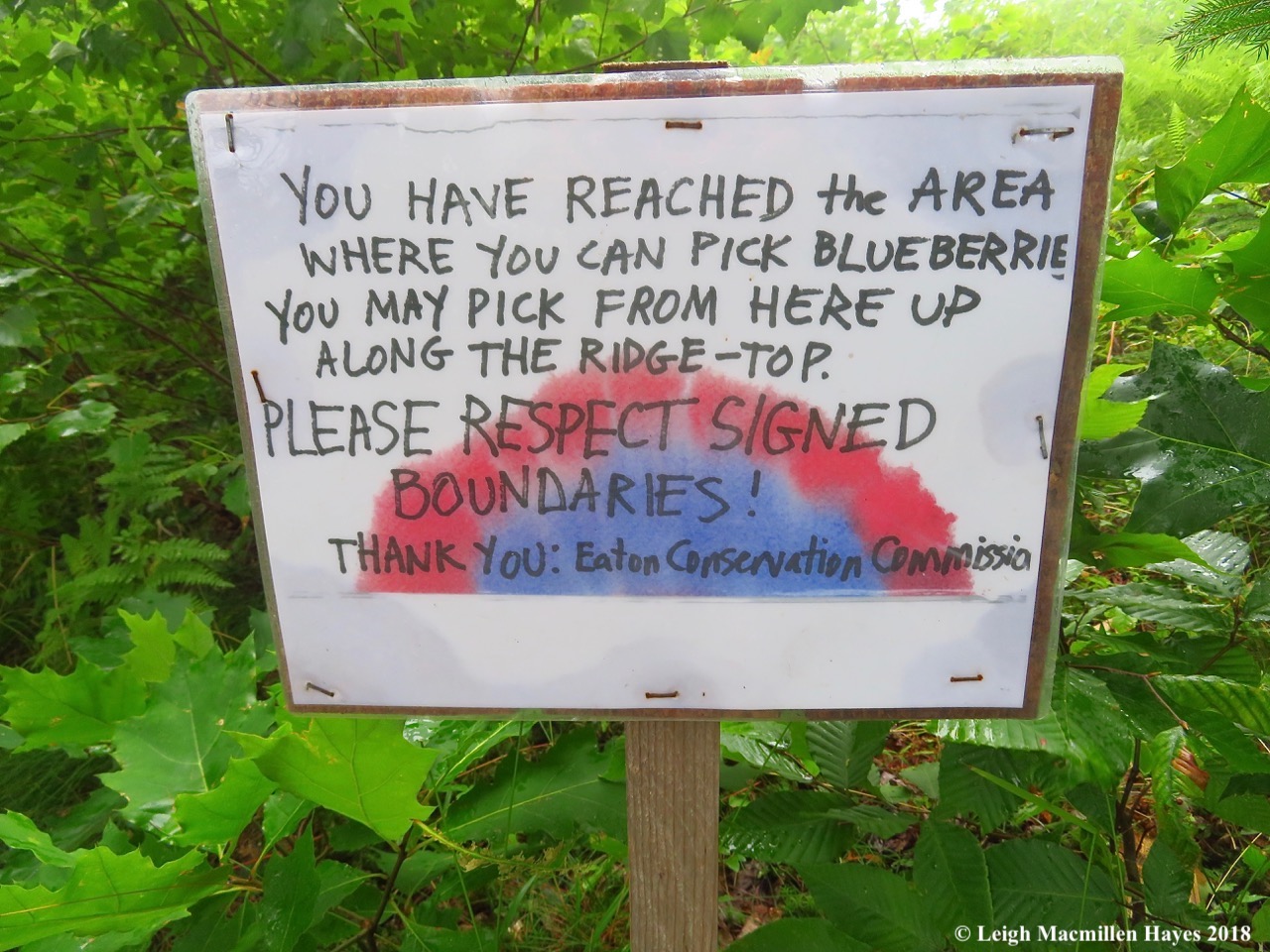
At the next natural community boundary, where conifers gave way to saplings and undergrowth, my guy rejoiced. At last we’d reached the promised land.

11-my guy disappeared ;-)

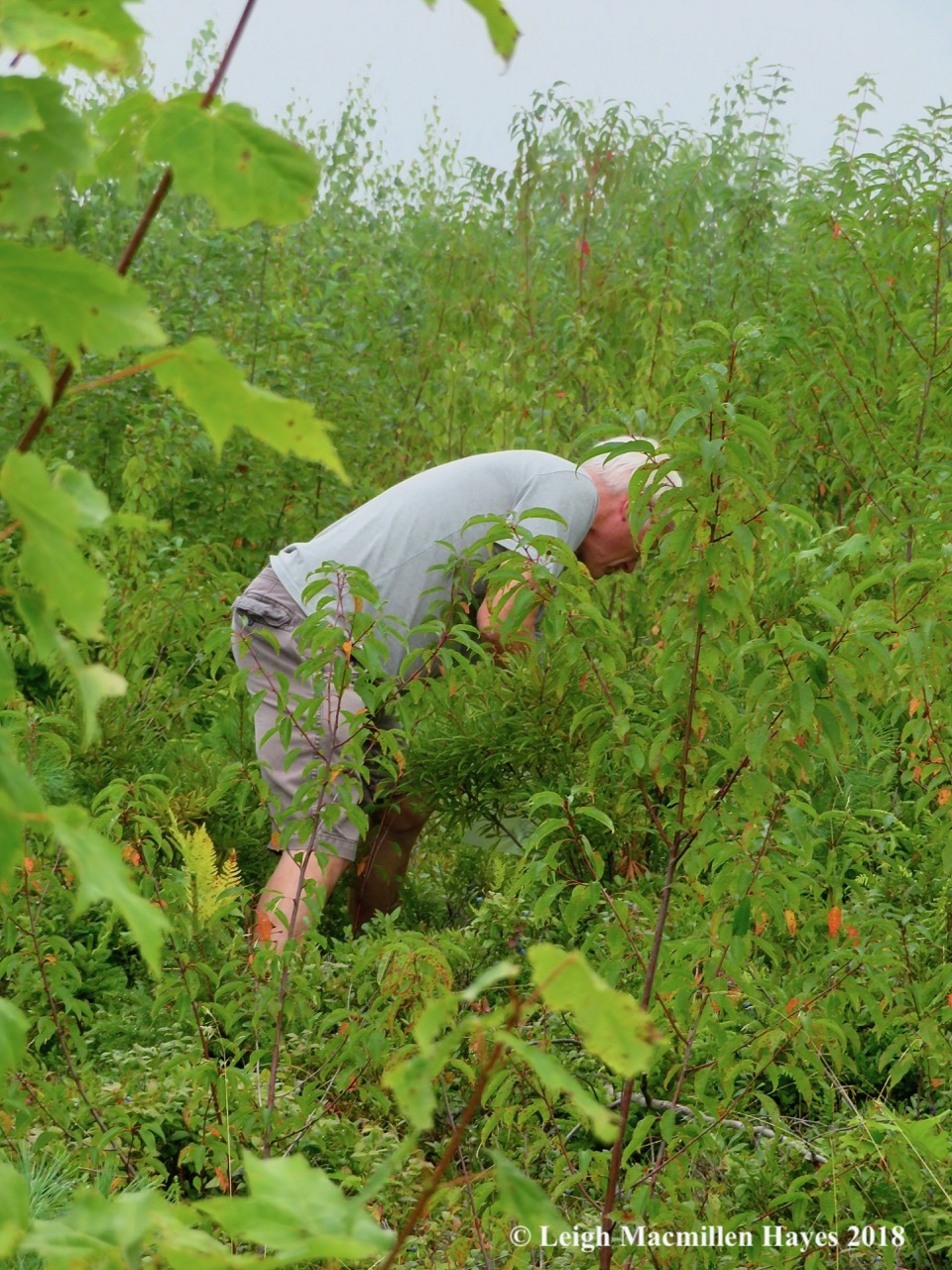
And immediately he stepped off the trail to find those tiny blue morsels that bring him such delight.

12-summit fog

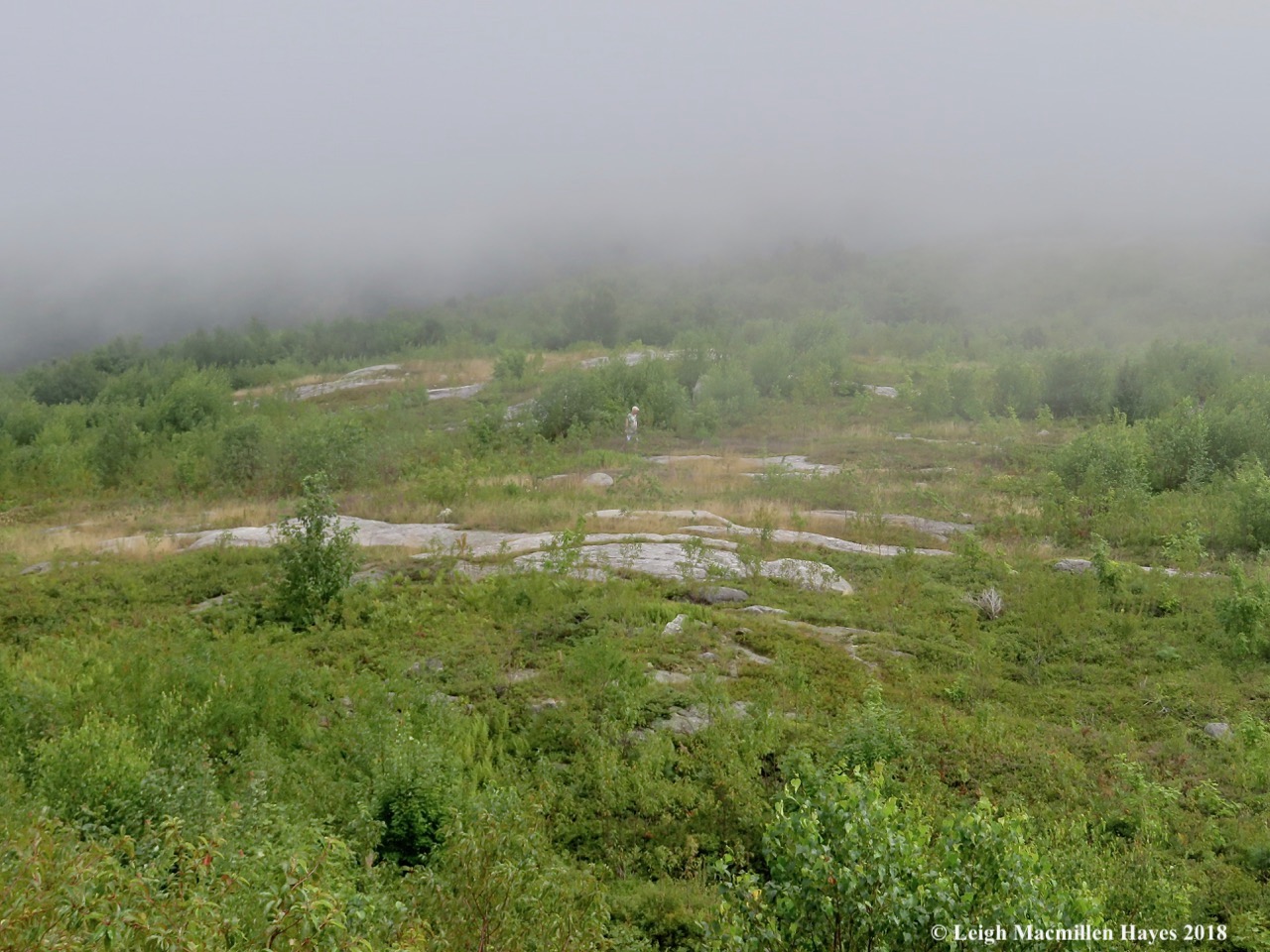
While he picked, I headed toward the summit, where a blanket of fog enveloped the view. It didn’t matter, for our focus zeroed in on what was before us rather than being swept up with the beyond.

14-my guy picking

From my place at the top, I could see him below–a mere speck intent on filling his bags to the brim.

15-erratic

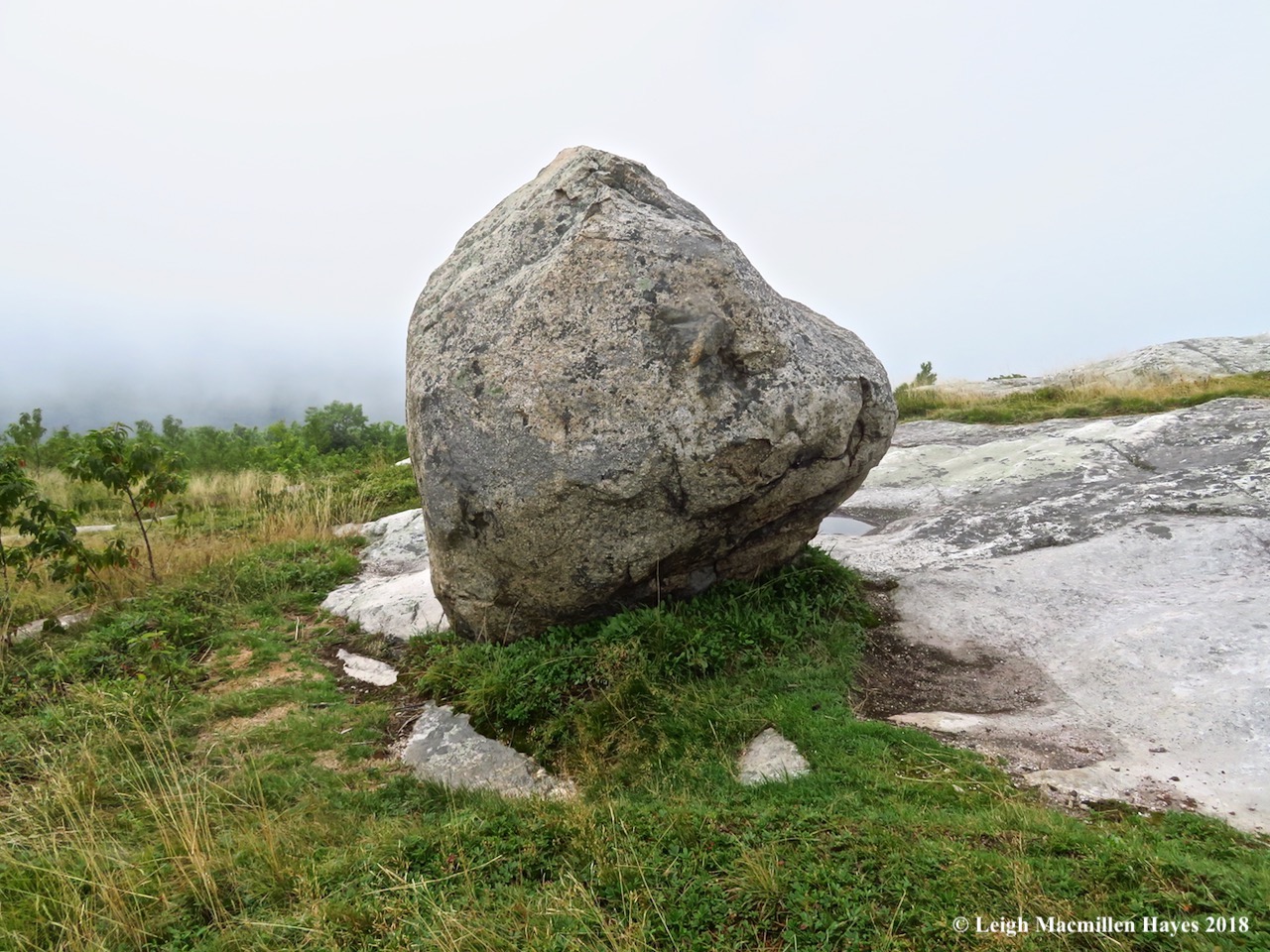
I began to look around and felt an aura that made me feel as if I was in Ireland rather than New Hampshire. The fog. The green. The gray. The world disappeared.

16-more colorful eratic

And the world before me opened up.

17-Common goldspeck lichen (Candelariella vitellitta

Like yellow caterpillars that are all the rage right now, Common Goldspeck Lichen inched across the granite face.

18-granite-speck rim lichen

Beside it, Granite-speck Rim Lichen stood out like tiles in a mosaic work of art.

19-fog danced across ridge

Meanwhile, the fog danced across the ridgeline, twirling and whirling in a ghostly quiet manner, its transparent gowns touching the ground ever so tenderly before lifting into the next move.

19-my guy picked some more

And my guy found a new location and picked some more.

15-steeplebush

My attention turned to the Steeplebush, a spirea that grew abundantly at the summit, its flowers of pink offering a tiny splash of color to brighten any day.

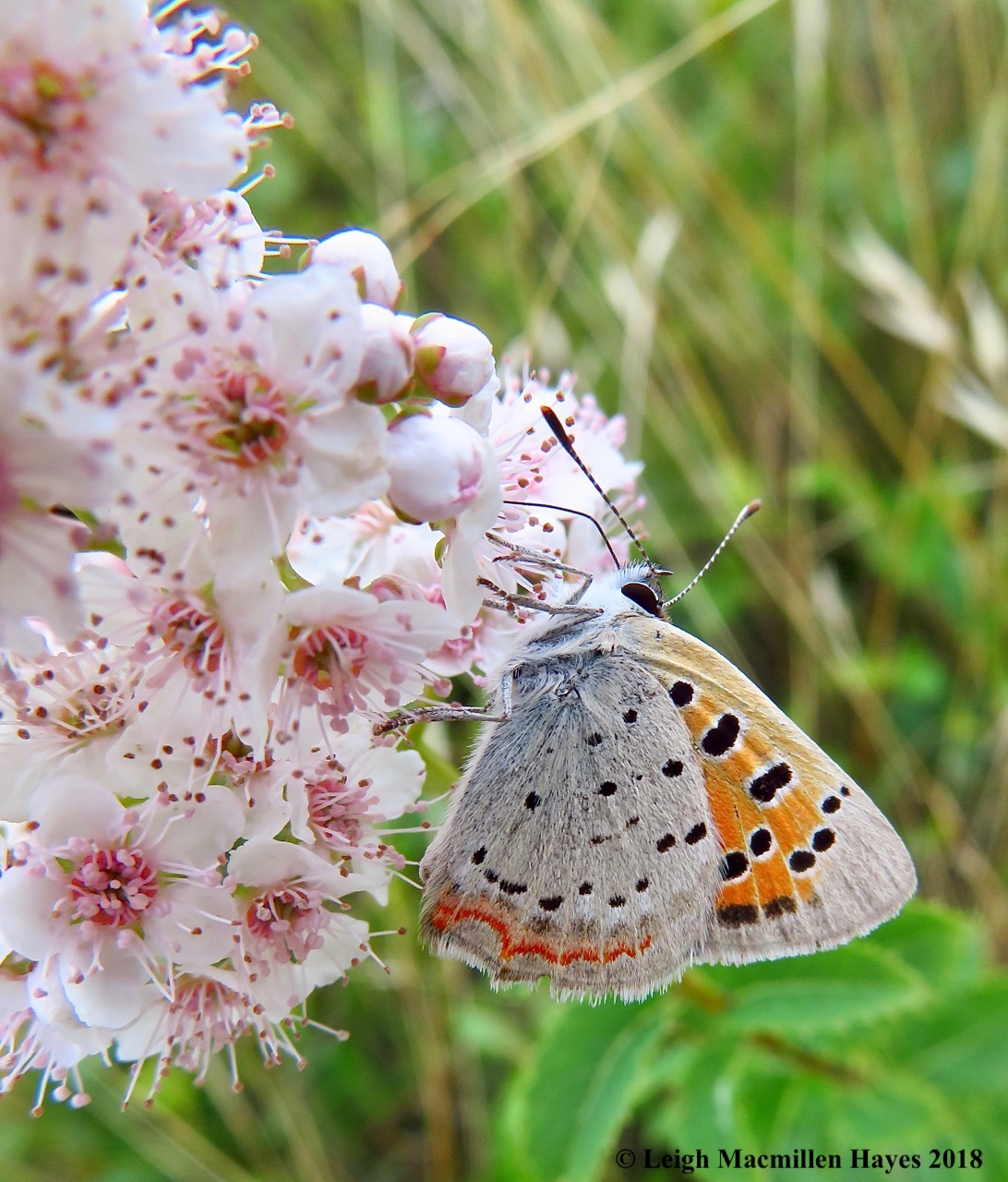
25-American Copper Butterfly

The American Copper Butterfly and a bumblebee also found the Steeplebush much to their liking.

26-American Copper

And I, I couldn’t pull my eyes away from admiring this tiny butterfly and its beautiful markings.

28-American Copper Butterfly

From every angle that it posed while seeking nectar, I stood in awe–those striped antennae, giant black eyes, copper-silver color, and hairy scaled wings.

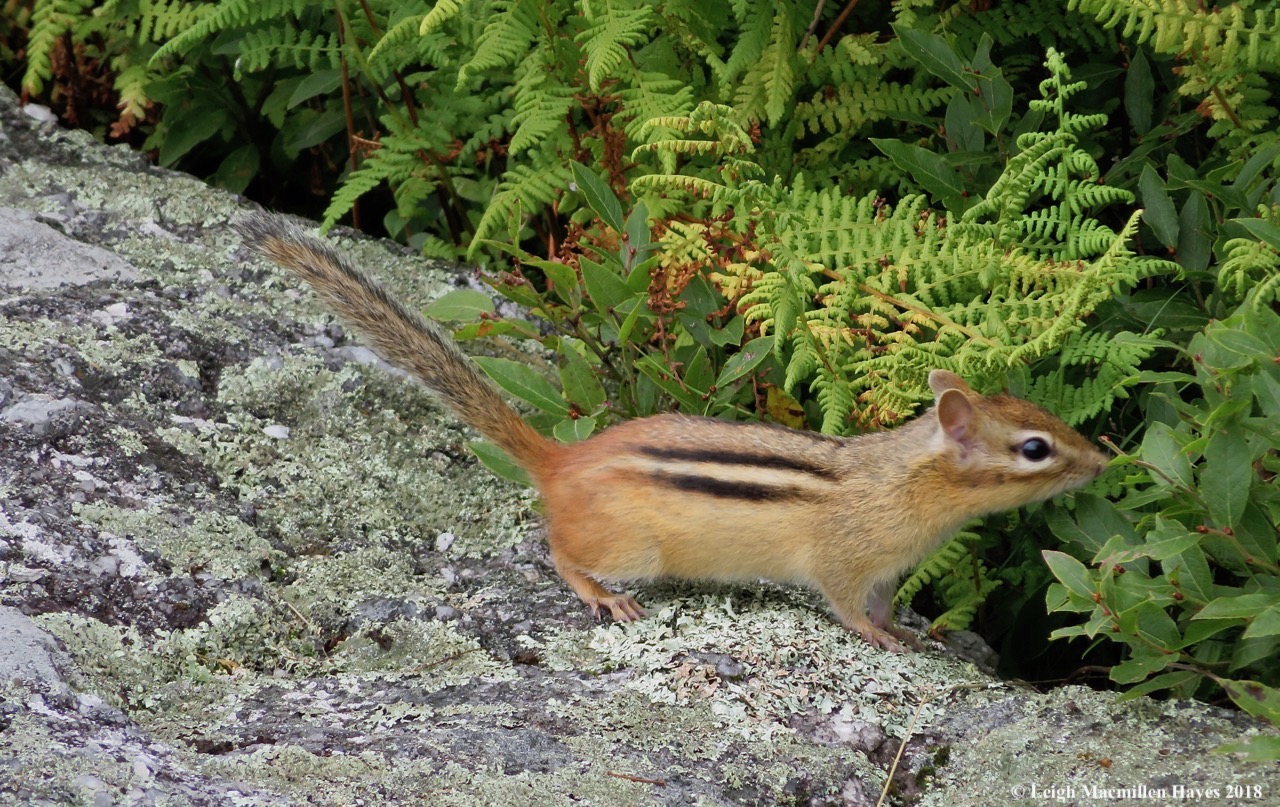
21-chipmunk

And then there was another, which I thought was a bird when I first heard it scamper out of the bushes.

22-chippie eating berries

But Chippie soon made himself known and I discovered that he, too, sought those little morsels so blue. Competition for my guy.

23-fog lifts a bit

Ever so slowly, the fog lifted a bit and even the sun tried to poke through for a moment or two. Still, my guy picked–somewhere. I couldn’t always see him, but trusted he was in the great beyond.

24-cedar waxwings

Much closer to me, three Cedar Waxwings circled the summit over and over again in a counter-clockwise pattern. Thankfully, they also paused, eyeing the potential for their own berry picking sights from the saplings on which they perched.

24-cedar wax wing bad hair day

I fell in love . . . with their range of colors:  cinnamon, black, gray, brown, red, yellow, and white. And the bad-hair day tufts, for like the Joe Pye Weed, the Cedar Waxwings and I also shared a resemblance.

29-My guy finishing up

At last my guy finished up, though not before standing on a yonder piece of granite, looking west and calling for me. “I’m up here, behind you,” I shouted softly into an almost silent world, where the only sounds came from cicadas and crickets and occasionally the Cedar Waxwings.

30-blueberry caterpillars

As we made our way down, he stopped again for about a half hour to pick some more in a spot he’d noted on the way up. And I looked around, discovering other blueberry lovers among us–Yellow-necked Moth Caterpillars were slowly stripping some bushes of their greenery.

35-blueberries!

At last we passed by the forbidden fields, where my guy later confessed he felt like we were in Eden.

31-Burnt Meadow Blueberries in operation

Ryan Bushnell of Burnt Meadow Blueberries was at work, raking and sorting the sweet morsels of blue.

32-Blueberries!

It was his business to make sure each pint would be filled by day’s end.

33-Filling the buckets

We wanted to chat with him more about the operation, but he was intent upon working and so after the initial greeting and a few more words, we knew it was time to move on. Mr. Bushnell’s buckets would be filled over and over again. (And I suspected that upon seeing this operation, my guy, should he ever decide to retire from his hardware business, may just ask to work in the field–the blueberry field.)

Our buckets were full as well–for my guy, it was bags of blueberries to freeze for future consumption. For me, it was all that I saw as I poked about the summit, thankful that I wasn’t distracted by the 360˚ view. We did indeed fill our buckets on this Mondate.


A’pondering We Will Go

August 3, 9:30 am – 12:30 pm
A’pondering We Will Go: Get inspired by the beauty along the trail at the John A. Segur Wildlife Refuge East. This will be a stop-and-go walk as we pause frequently to sketch, photograph, and/or write about our observations, or simply ponder each time we stop. Location: John A. Segur Wildlife Refuge East, Farrington Pond Road, Lovell.
Degree of Difficulty: Easy.

j1-pickerel frog

That was our advertisement for this morning’s Greater Lovell Land Trust walk, but we weren’t sure the weather would cooperate. Docent Pam and I emailed back and forth as we looked at various forecasts and decided to take our chances. As it turned it, it did sprinkle occasionally, but we didn’t feel the rain until we finished up and even then, it wasn’t much. Instead, the sound of the plinking against the leaves in the canopy was a rather pleasant accompaniment to such a delightful morning. Our group was small–just right actually for it was an intimate group and we made a new friend and had a wonder-filled time stopping to sit and ponder and then move along again and were surprised by tiny frogs and toads who thought the weather couldn’t get any better, as well as other great finds. Here, a pickerel frog showed off its rectangular spots for all of us to enjoy.

j2-Sucker Brook

After a first 20-minute pause in the woods, we continued on until we reached Sucker Brook.

j3-Colleen

Each of us settled into a place to listen . . .

j4-Bob

photograph . . .

j6-Judy

and write.

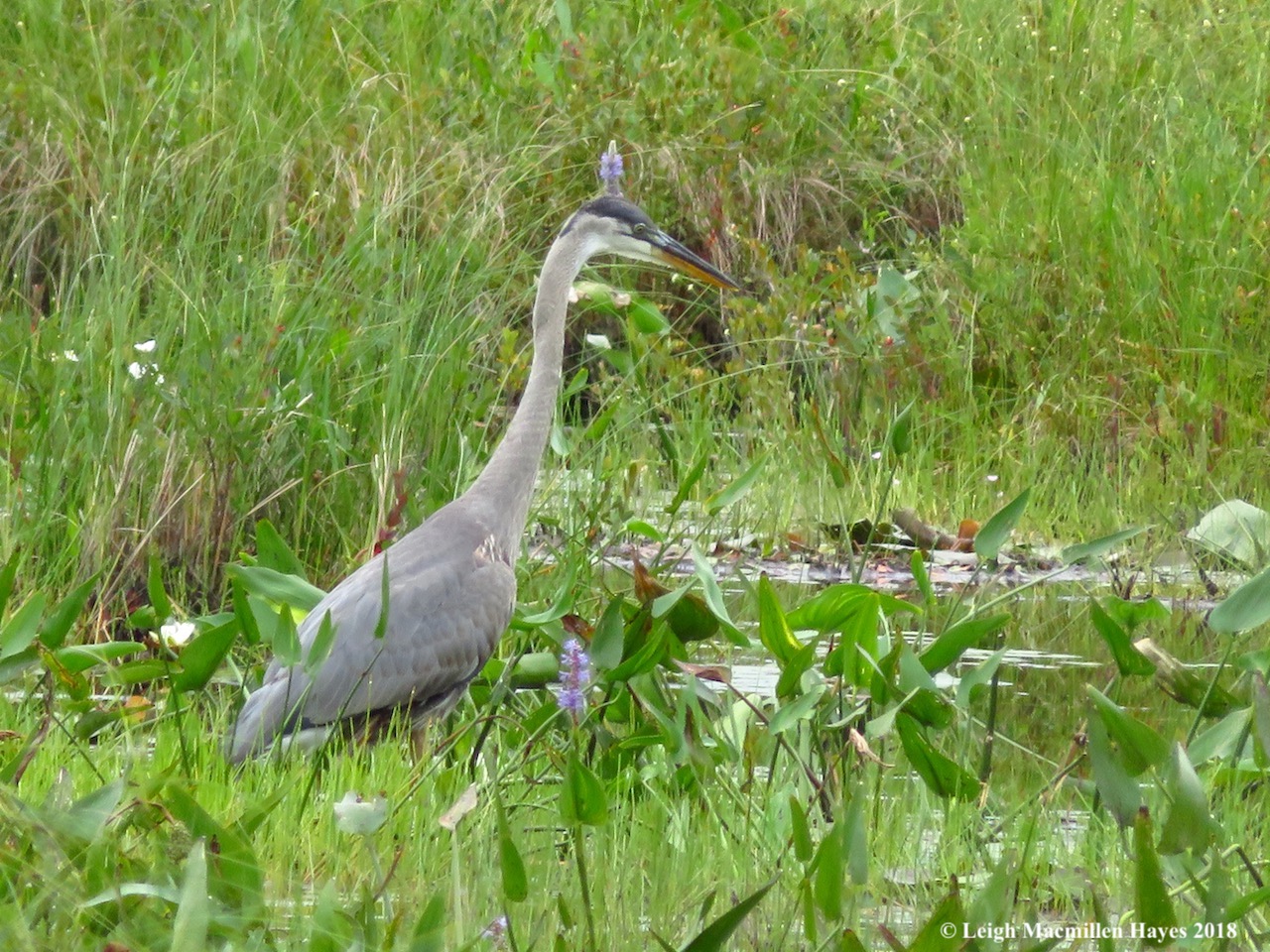
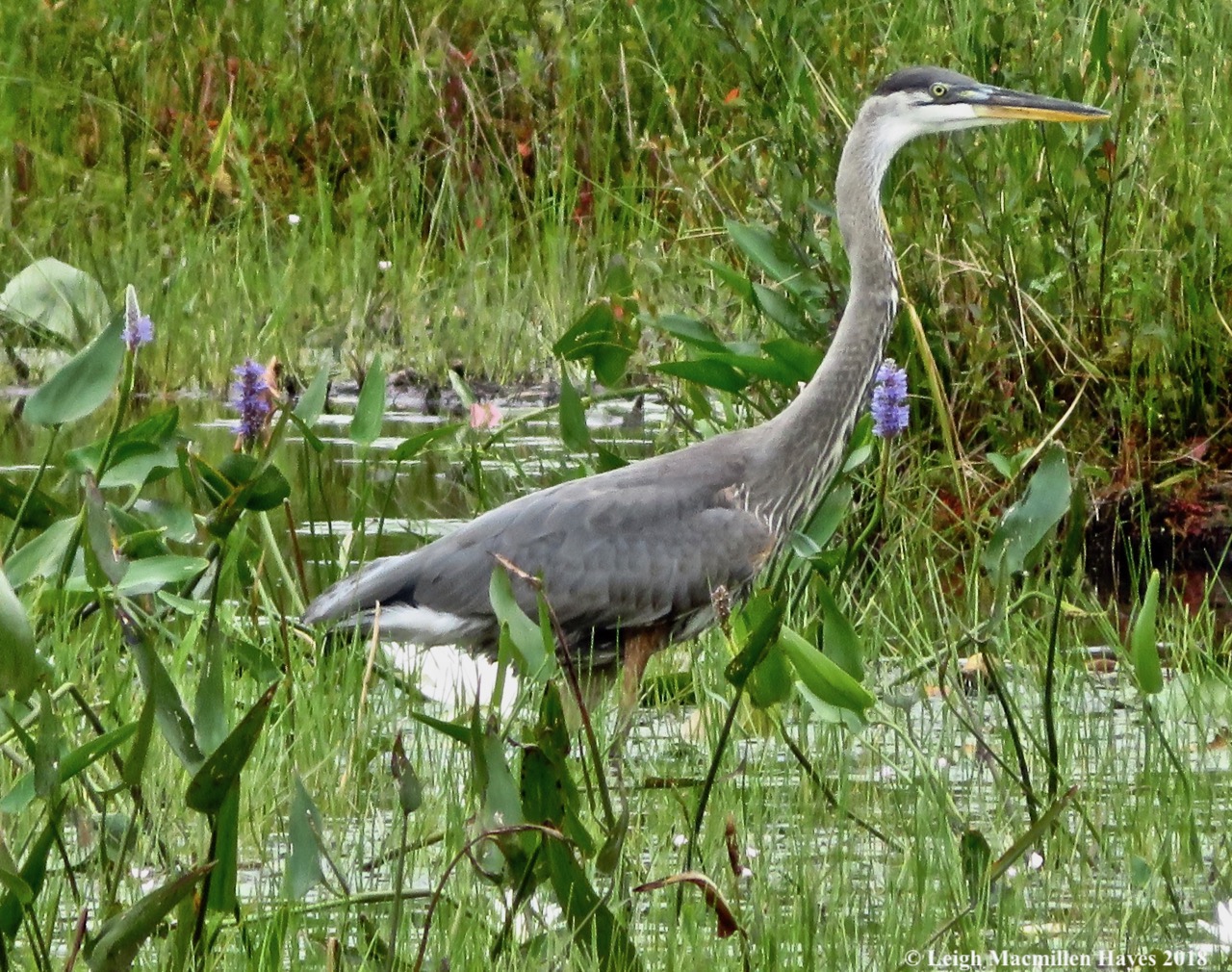
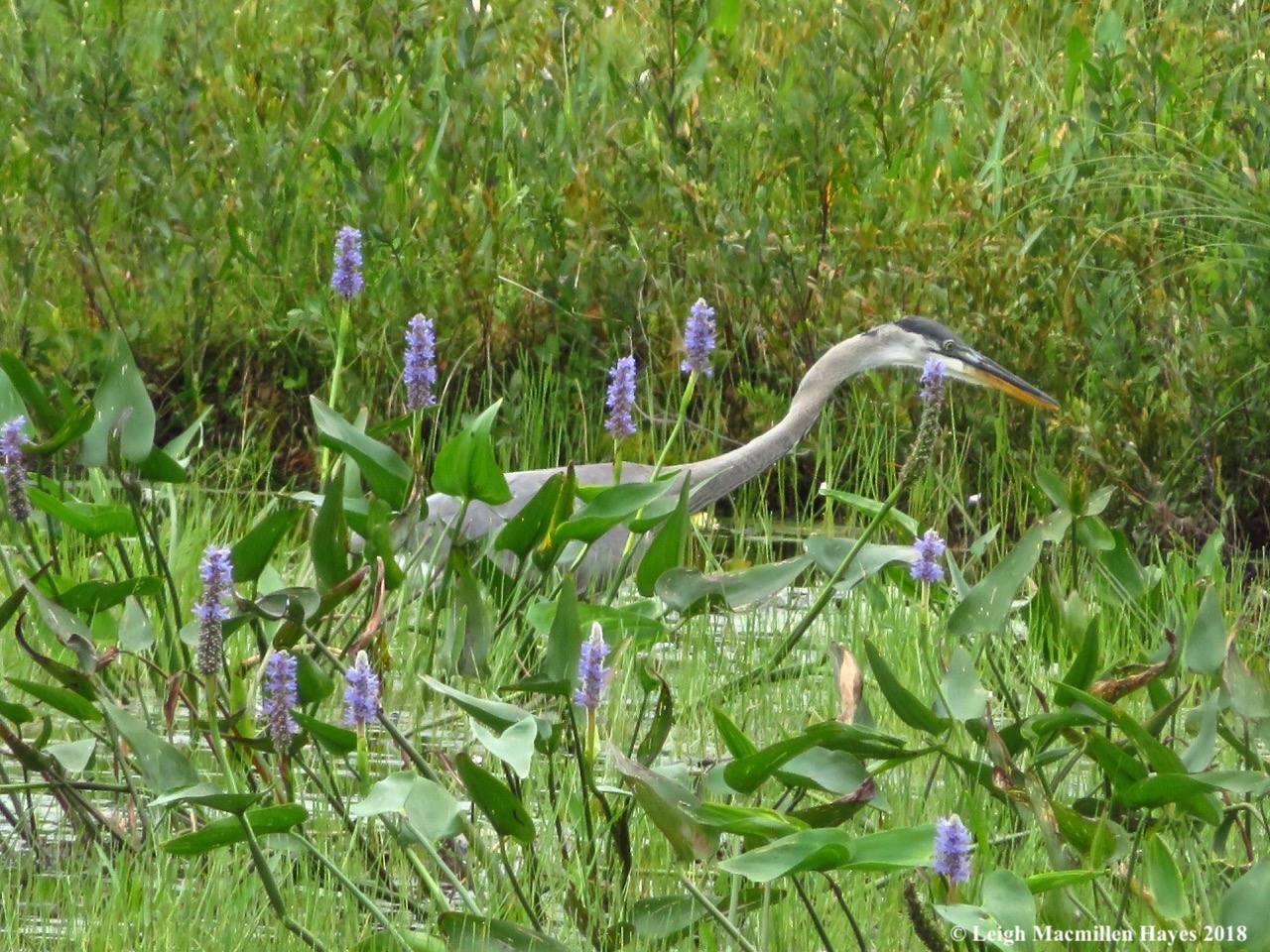
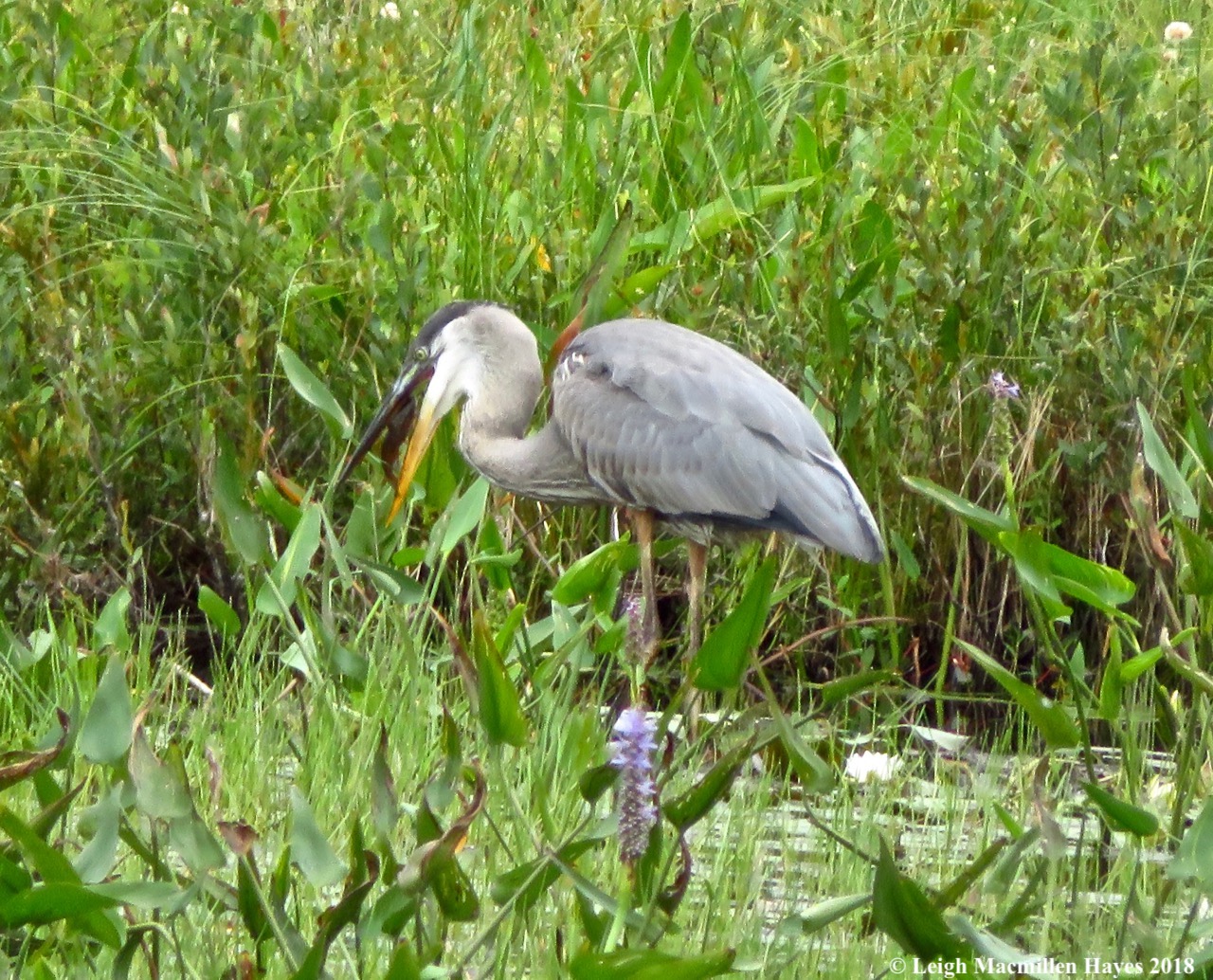
j7-heron

I have no idea how much time had passed, but suddenly we all stirred a bit and then someone who was noticing (I think it was Ann) redirected our attention.

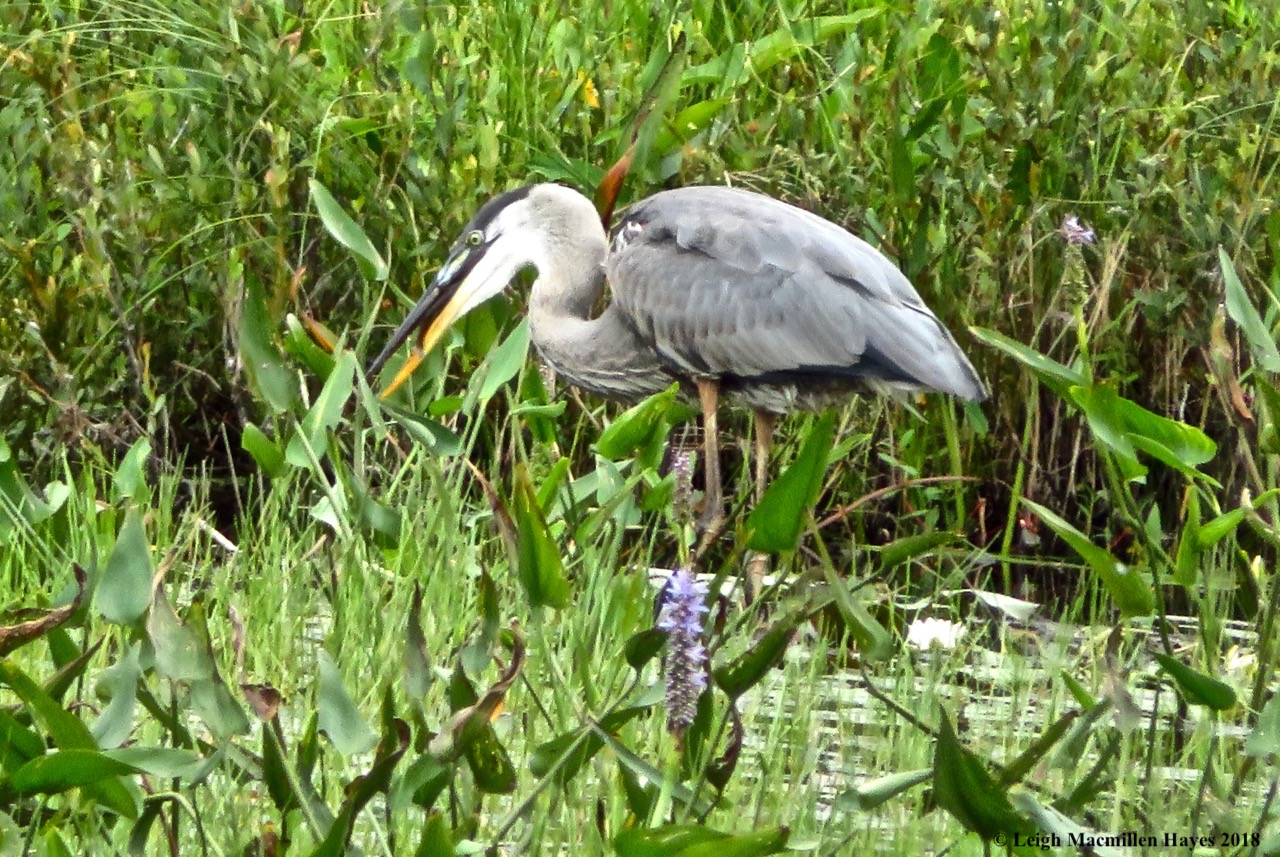
j8-heron

We were encouraged to focus on another who was also paying attention.

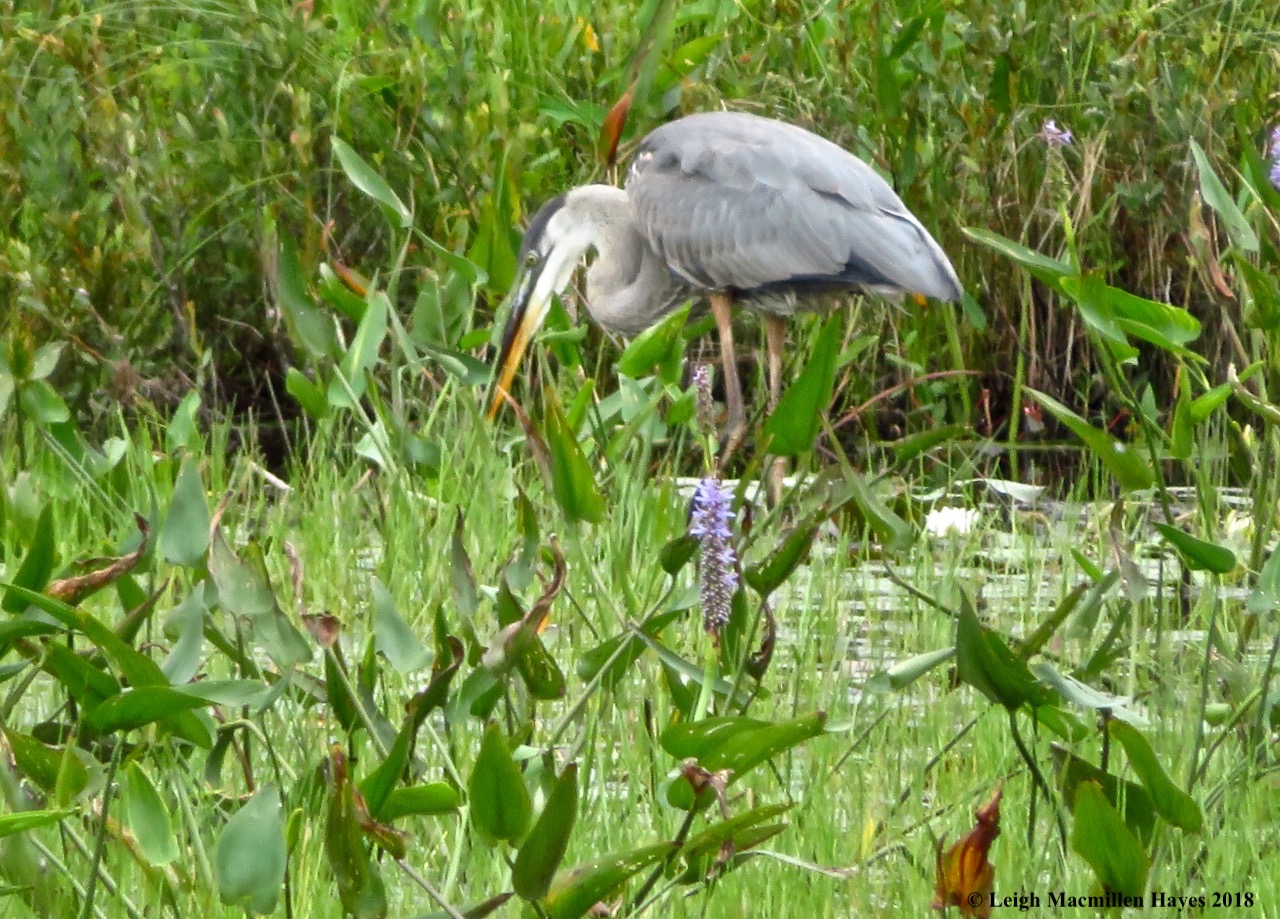
j9-heron

And narrowing in . . .

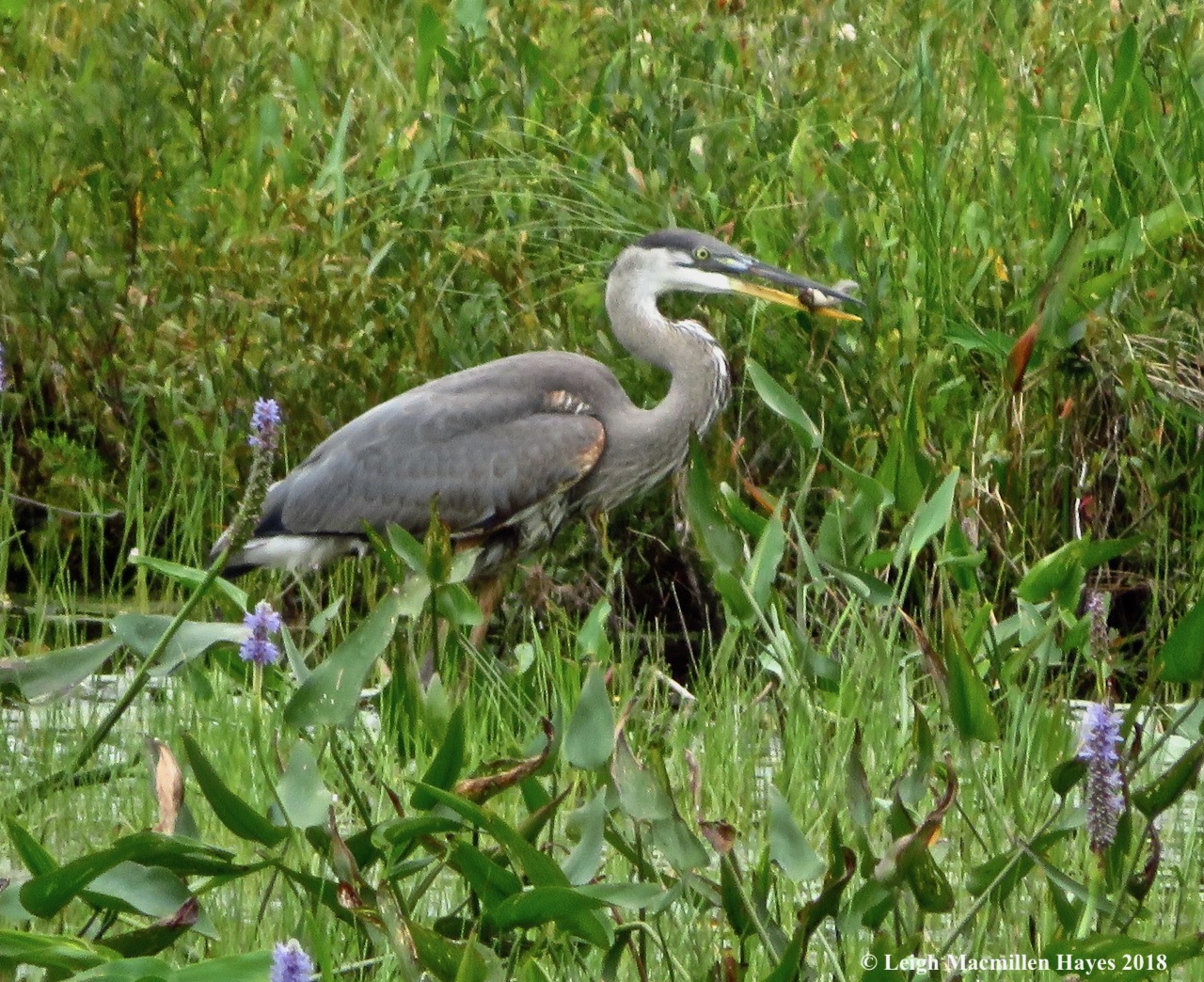
j10-heron and fish

on lunch.

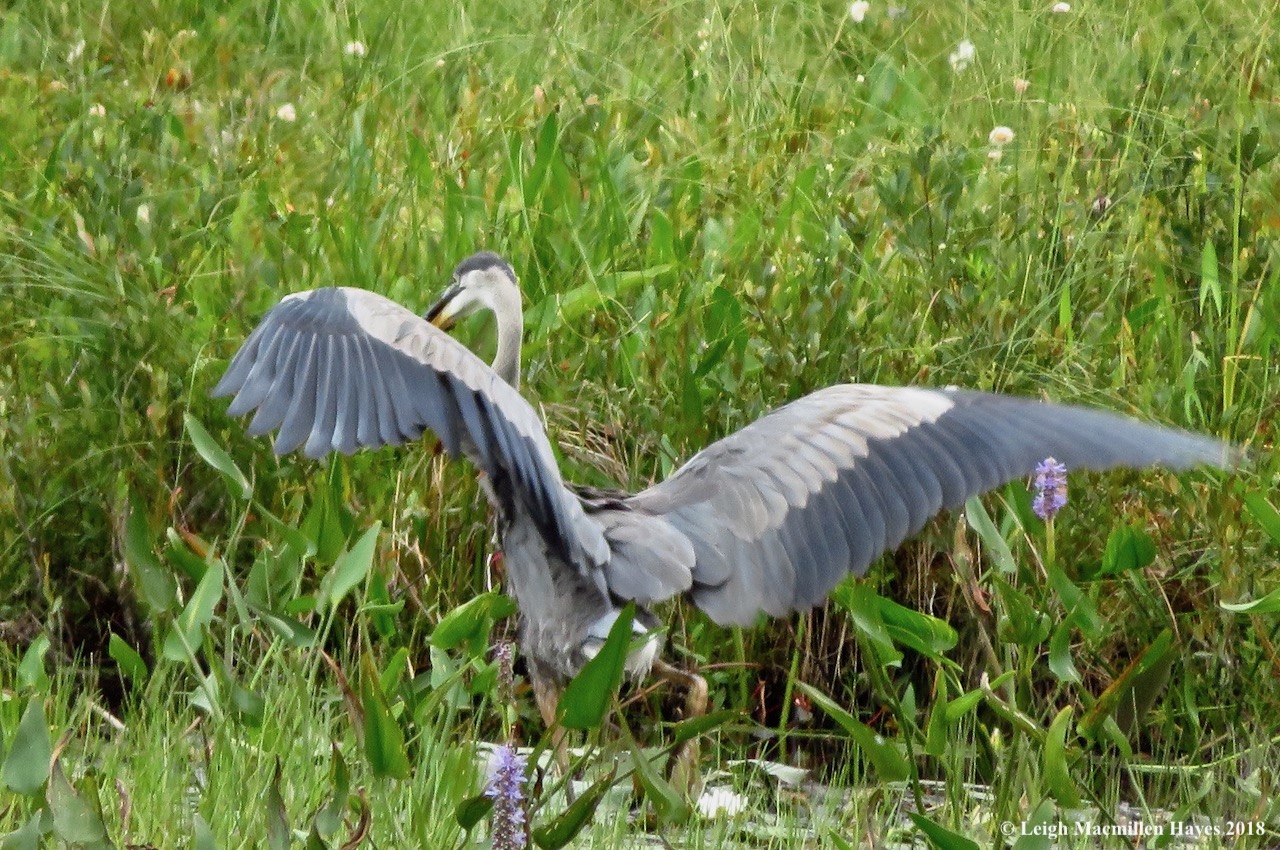
j11-wings

When the young heron flapped its wings, we were all sure the meal was meant “to go.”

j12-securing the catch

But thankfully, the bird stayed.

j13-lunch

And played with its food.

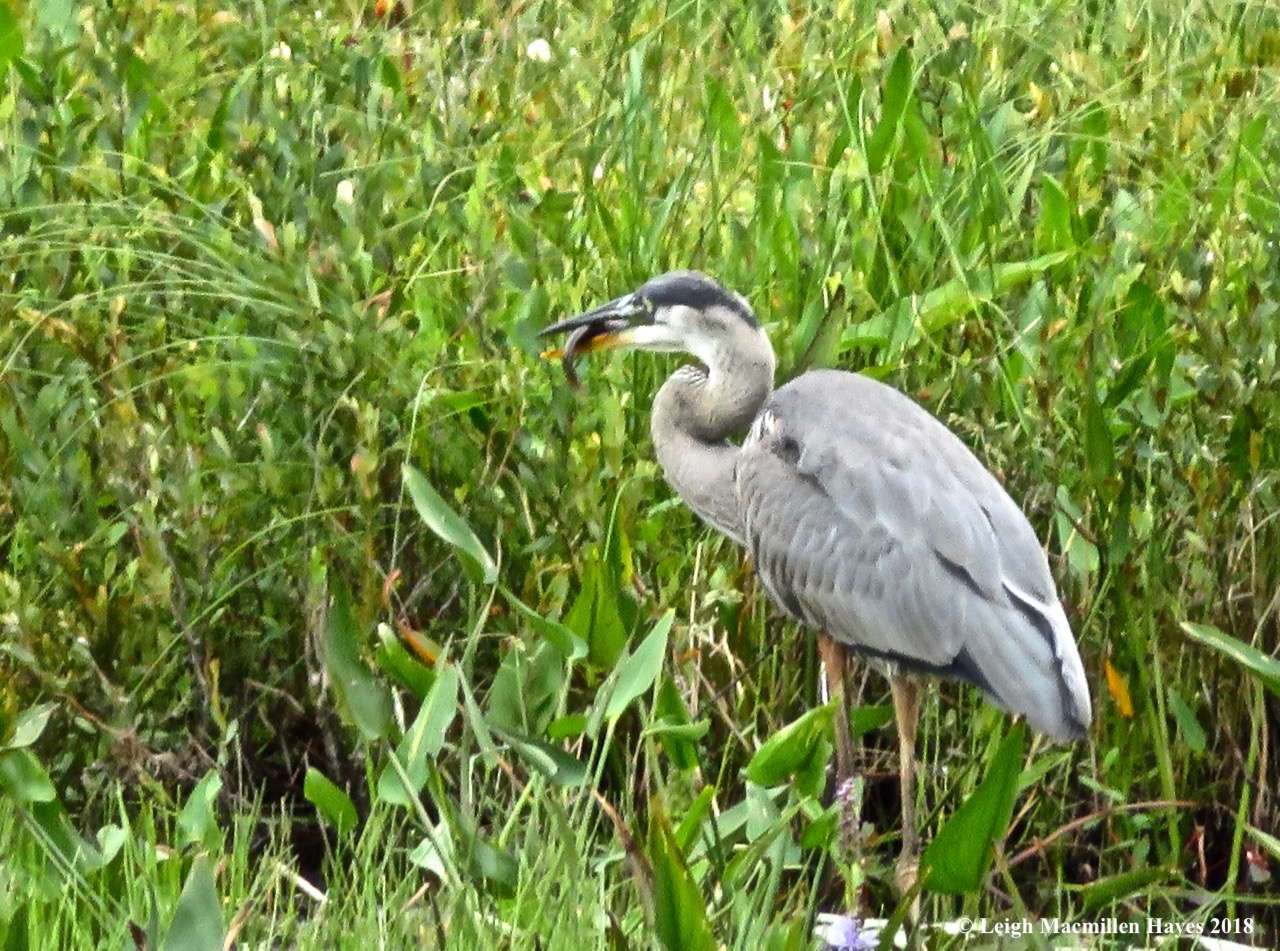
j14-lunch making its way down

Ever so slowly, the fish was maneuvered into its mouth.

j15-gulp

And swallowed.

j16-down the throat it goes

Down the throat it slid.

j16-feathers ruffled

And then the feathers were ruffled–rather like a chill passing through its body.

j17-movement

Wing motion followed.

j18-searching

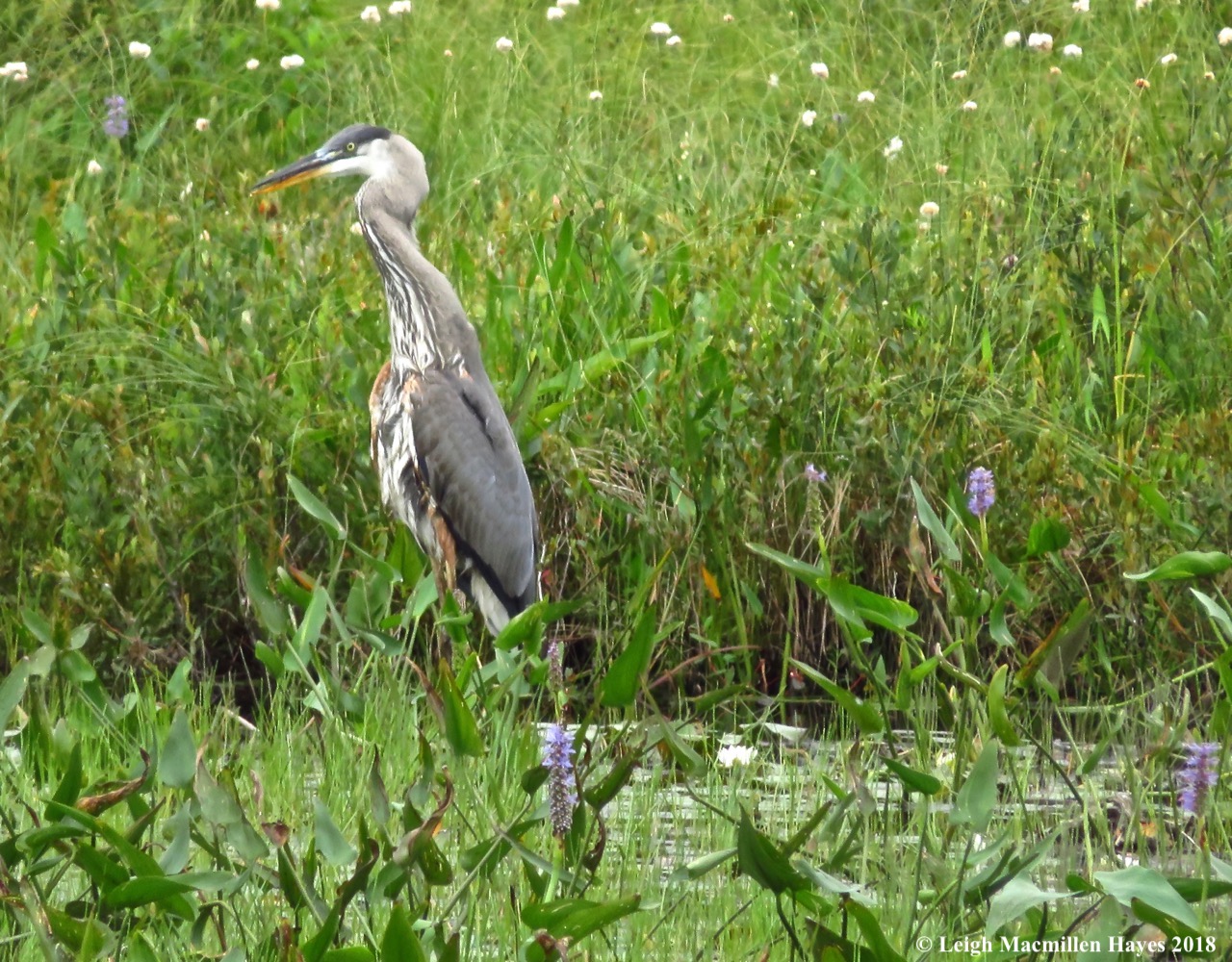
But still, the Great Blue Heron stayed.

j19-next course

And stalked some more.

j20-Isaiah

We continued to watch until we knew we had to pull ourselves away.

j21-the journalists

If we didn’t have other obligations, we might still be there. Gathered with me from left to right: Judy, Colleen, Isaiah, Pam, Ann, and Bob.

j22-owl pellet

On our way back, again we made some interesting discoveries that we’d somehow missed on the way in, including White Baneberry, aka Doll’s Eye, a bone we couldn’t ID, Indian Pipe, and this owl pellet smooshed, but full of tiny bones–vole-sized bones.

j22-Pam reading what she wrote

We stopped one more time, to share our morning’s observations.

j23-Judy reading her poem

Reading aloud is never easy, but because our group was small and we’d quickly developed a sense of camaraderie and trust, the comfort level was high.

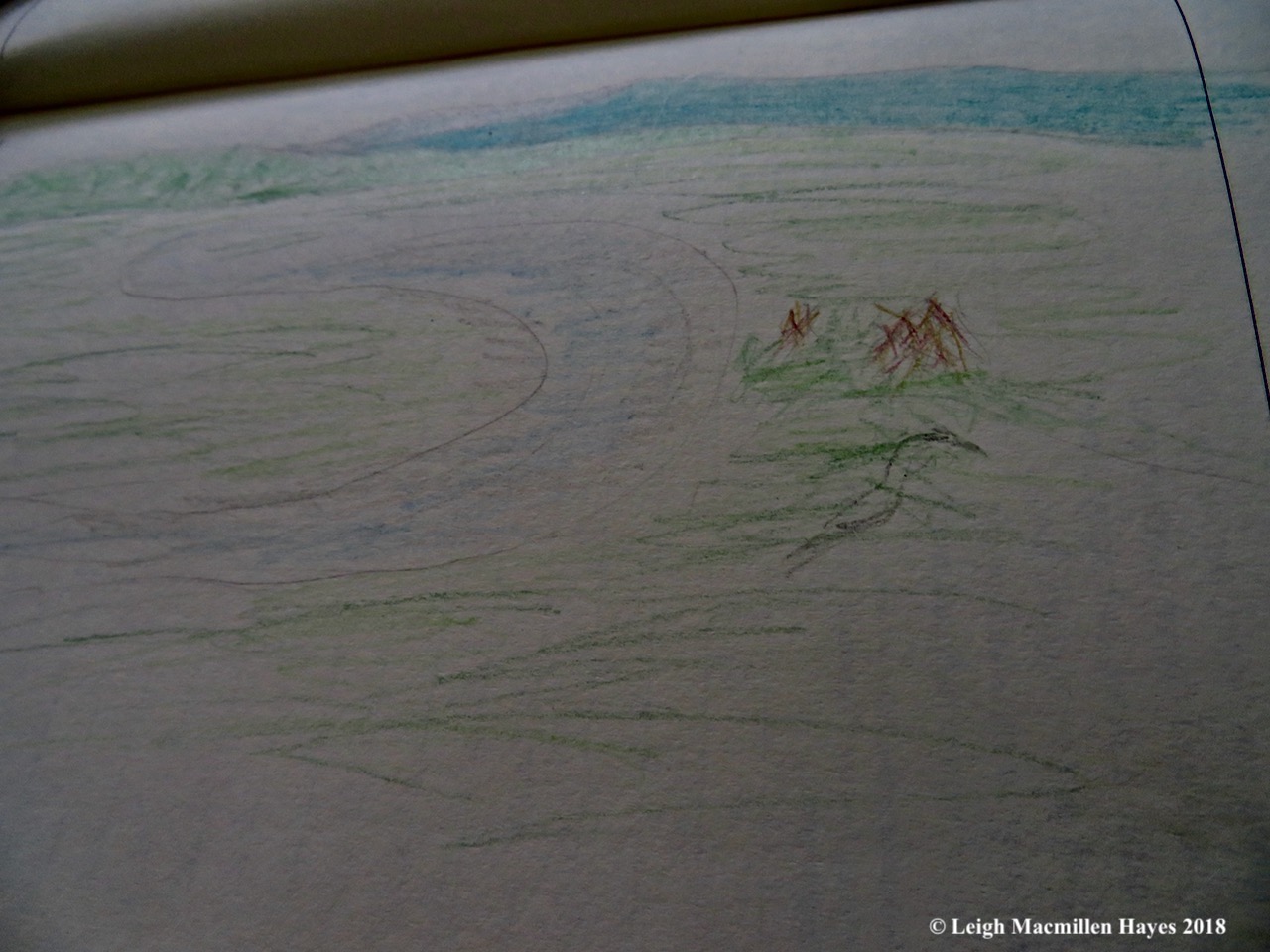
j24-Ann's landscape sketch with heron

Sketches were also shared, including this one of the landscape that Ann drew–including the heron that entered the scene just before she quietly called our attention to it.

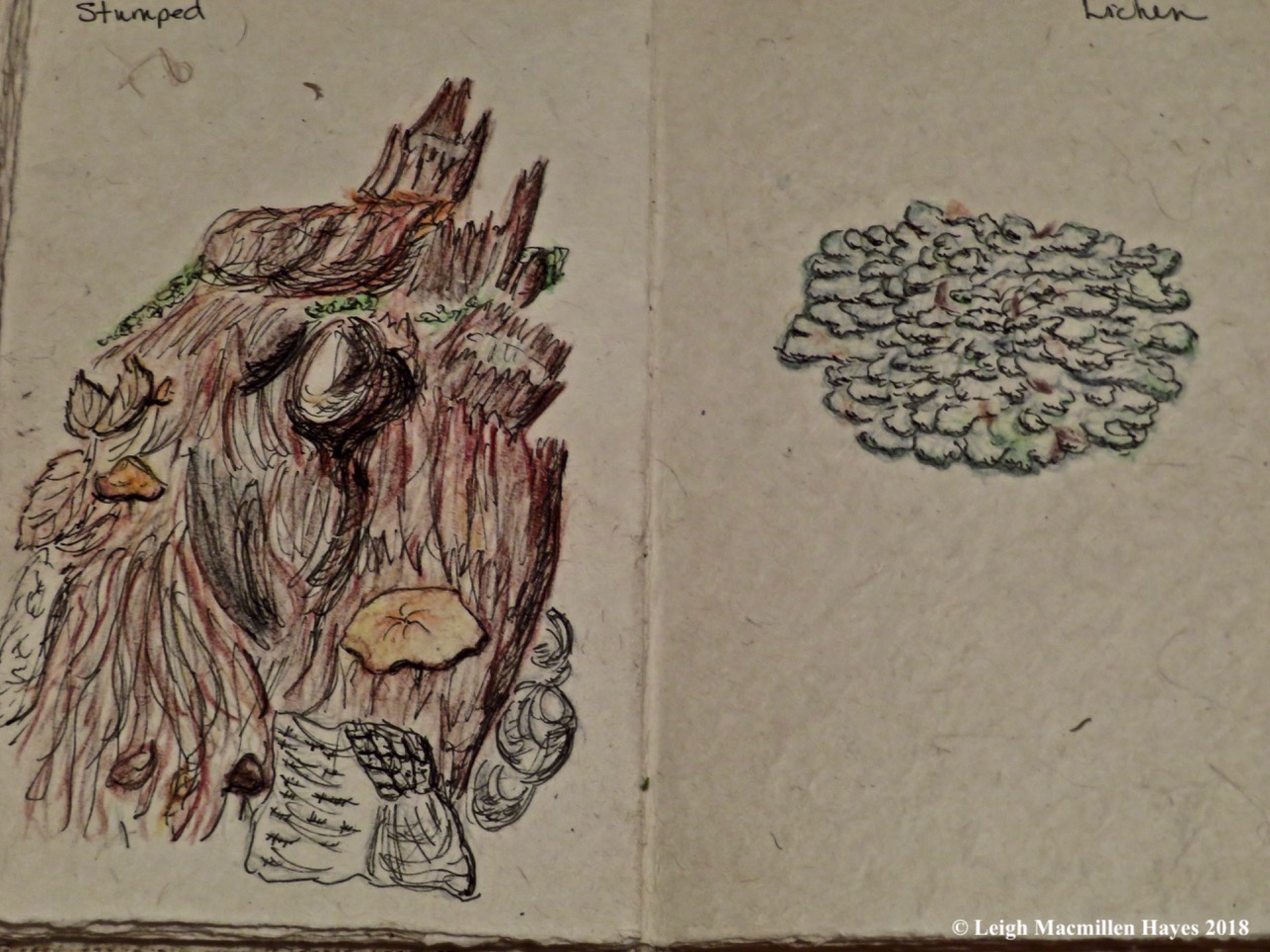
j25-stump and lichen

And my attempts–the first of a tree stump from our woodland stop, and then a lichen when we were by Sucker Brook.

A’pondering We Did Go–and came away richer for the experience. Thanks to all who came, to Pam and Ann for leading, and to Isaiah for his fine eye at spotting interesting things along the way.


Dying To Get In

When I told my guy that Connie was taking me to Evergreen Cemetery in Portland today, he gave me a questioning look and asked, “Why?”

‘Why not?” I responded.

But really, it was because both she and I have friends who have posted incredible photographs of the natural world that is part of the cemetery and we wanted to discover what it was all about.

e1-evergreen cemetery

At first glance, Evergreen Cemetery may look like Anytown Cemetery for it features gravestones, memorials and tombs throughout. But . . . as we read on a panel near the entrance: “Established by the city in 1854, the cemetery was designed by Charles H. Howe as a rural landscape with winding carriage paths, ponds, footbridges, gardens, a chapel, funerary art, and sculpture. It also includes extensive wooded wetlands. Evergreen was modeled after America’s first rural cemetery, Mount Auburn in Cambridge, Massachusetts.

The cemetery, the second-largest publicly-owned open space in the City at 239 acres, has been host to a variety of wildlife such as geese, ducks, pheasants, swans, turtles, blue heron, fox, mink, deer, and moose. Its spaciousness combined with old growth pine and oak, vegetation, ponds, and surrounding wetland, provides a true wildlife oasis. It is considered a premier birdwatching sanctuary. Maine Audubon utilizes the cemetery for field trips, to include their annual Warbler Weeks conducted in May. Evergreen Cemetery is also a wonderful location to enjoy the vibrant colors of fall foliage in Maine.

e2-sunburst lichen

We didn’t actually spend much time exploring the cemetery itself, though that would be fun to do on a return trip, but as we waited for Connie’s friend Linda to join us, we did look at a few gravestones and were especially enamored with the sunburst lichen that lightened a stone gray morning.

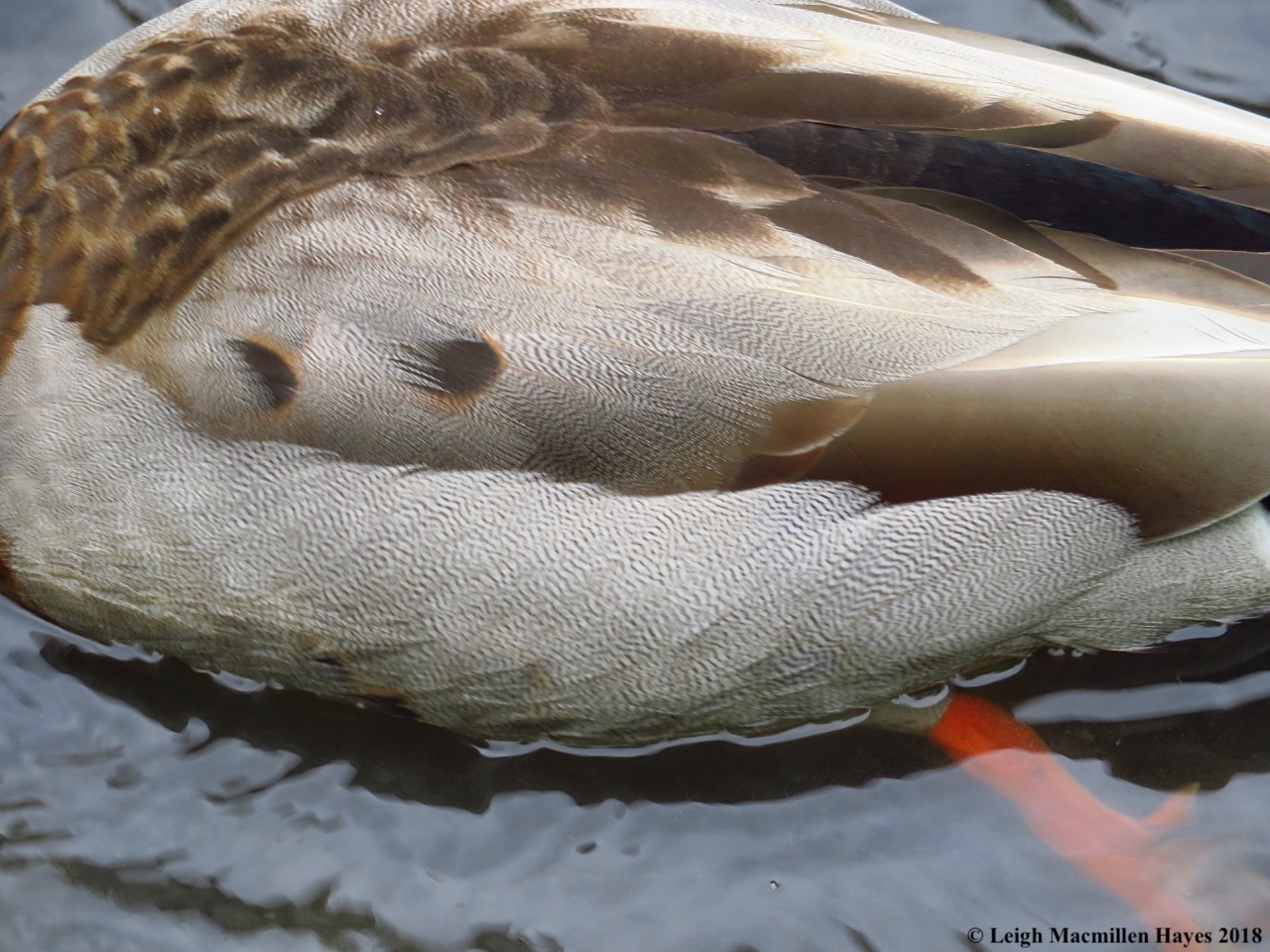
e3-male mallard

Linda was only a few minutes behind us and then we all traveled to the back end of the cemetery, where the Mallards stopped us in our tracks. While you might ask why, remember that we are women of wonder and wonder we did: about his iridescent head,

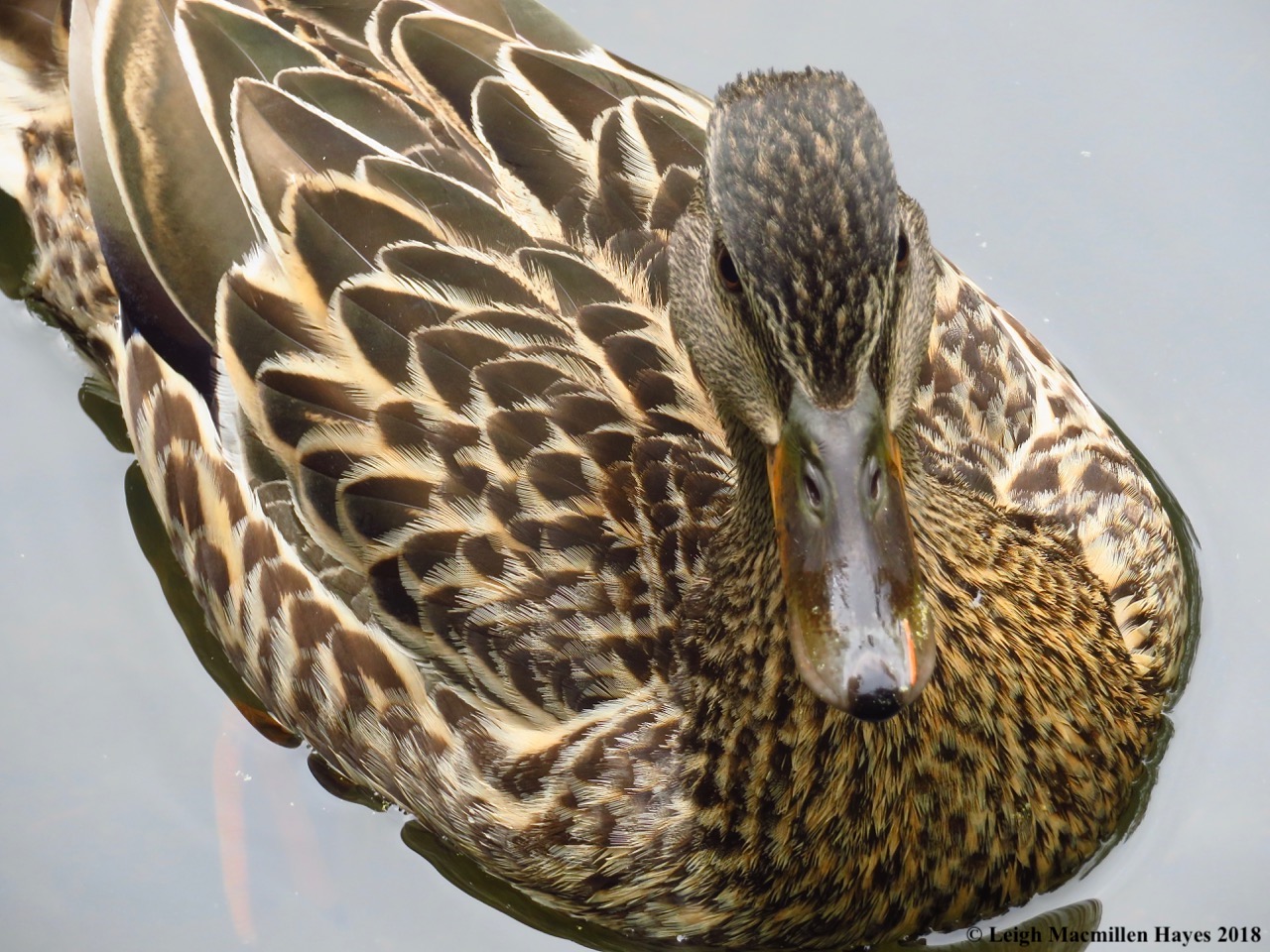
e4-famale mallard

her lack of ducklings despite four attentive males,

e5-mrs. mallard

why their feet were orange,

e6-duck tweed

and the tweedy pattern of their feathers.

e7-ducklings

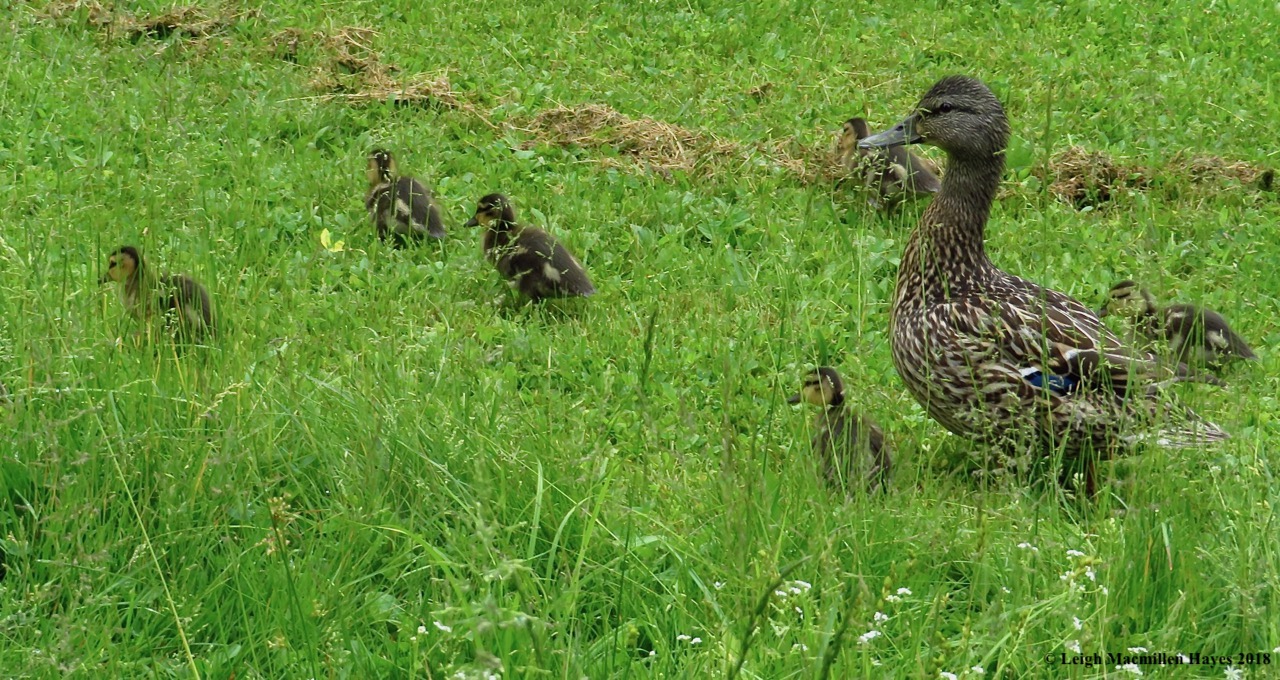
And then we spied a couple of other females with ducklings, this one standing tall as she allowed her youngsters to explore.

e7-chipping sparrow

They weren’t the only ones exploring–a Chipping Sparrow was doing the same, though it was almost impossible to see given that it blended in so well with its surroundings.

e8-black swallowwort

At last we pulled ourselves away from the ducks and our view of the car, and started down a trail where flowers and leaves made us take note. Last year, I first met the dark maroon flowers of Black Swallowwort, an invasive. Diminutive and pretty, it was difficult to dismiss them, especially when juxtaposed as they were against a sensitive fern frond.

e9-ragged-robin

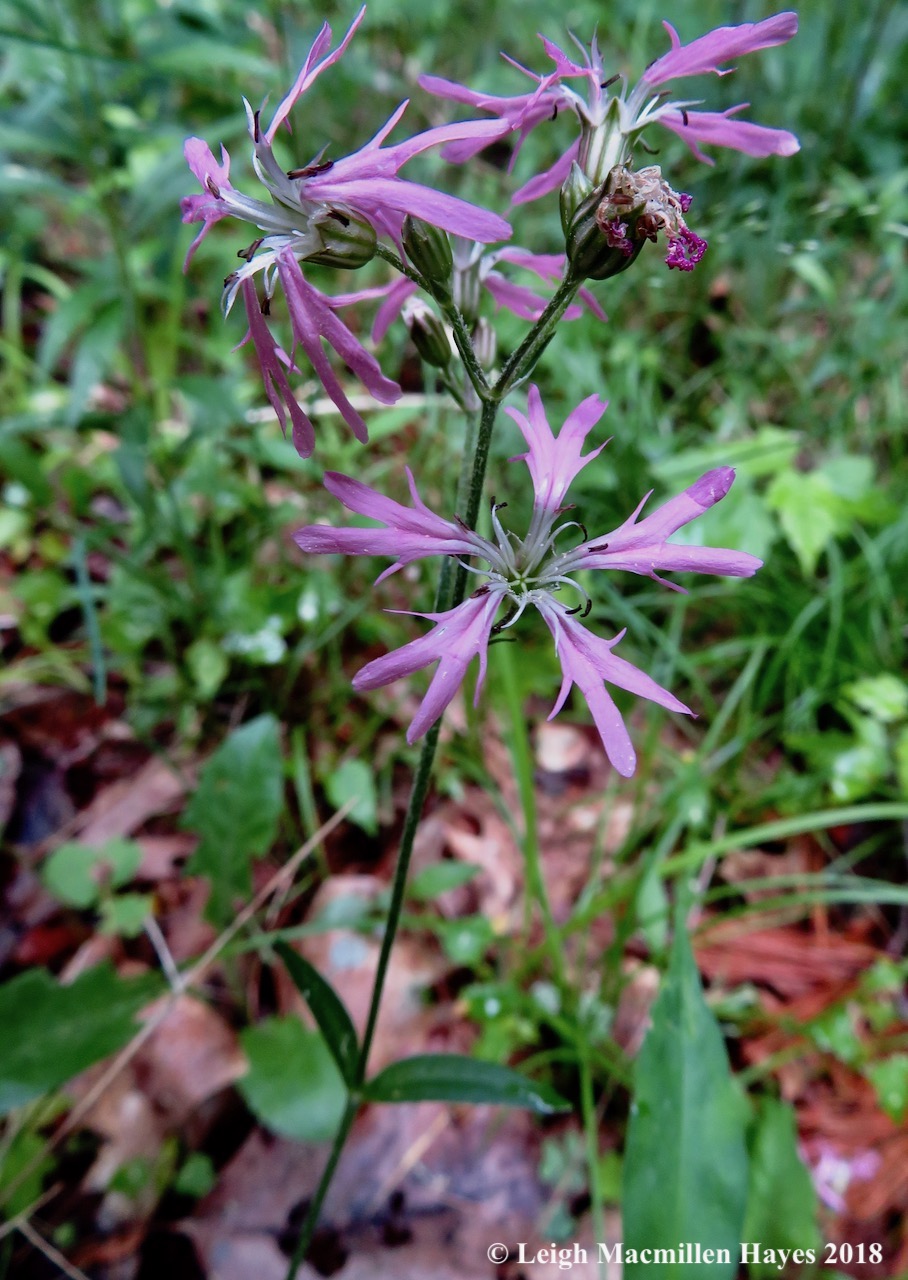
Connie introduced us to another invasive that she immediately recognized as Ragged-robin. Linda and I were wowed by the pink petals, irregularly cleft.

e10-sunburned oak meat

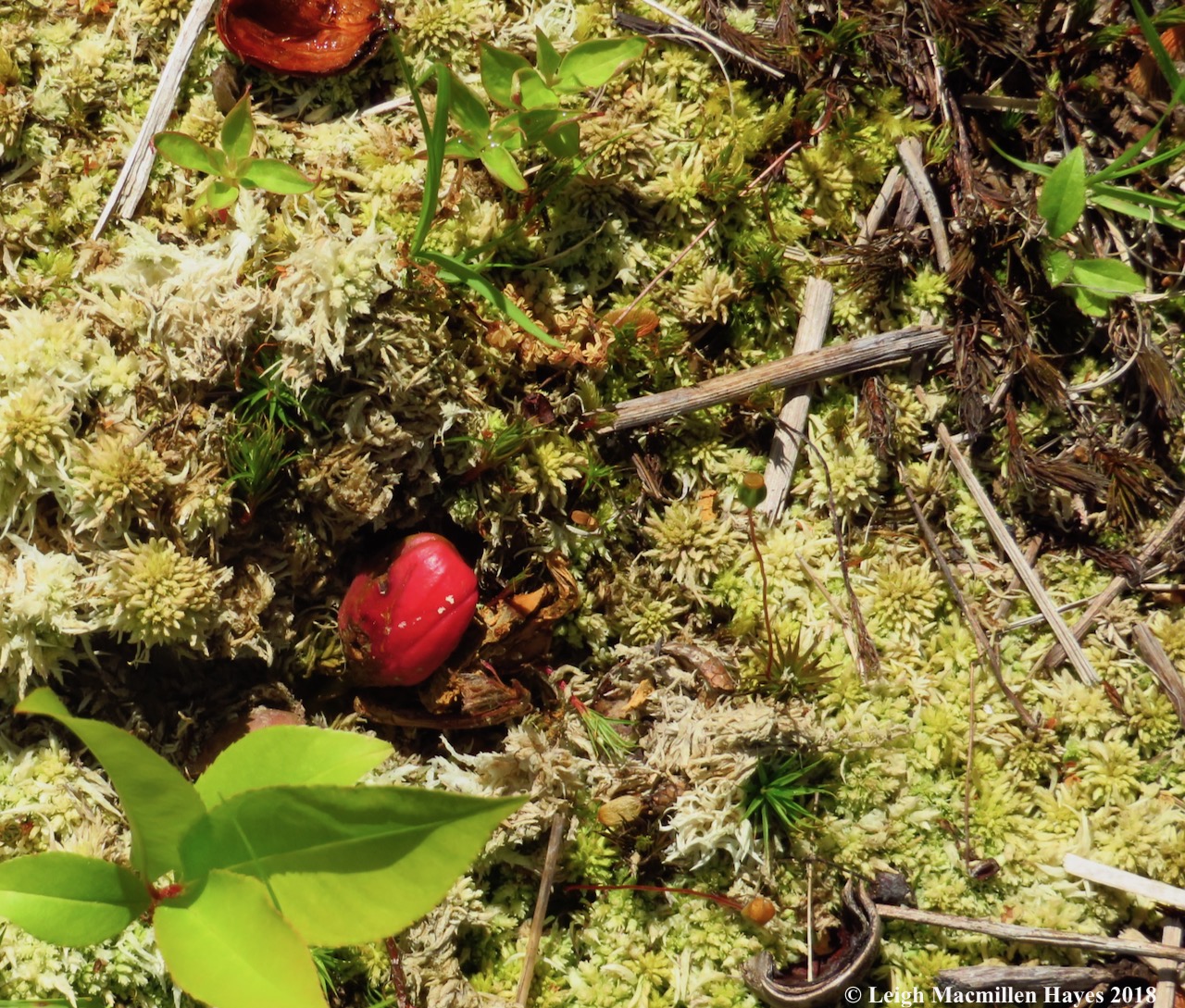
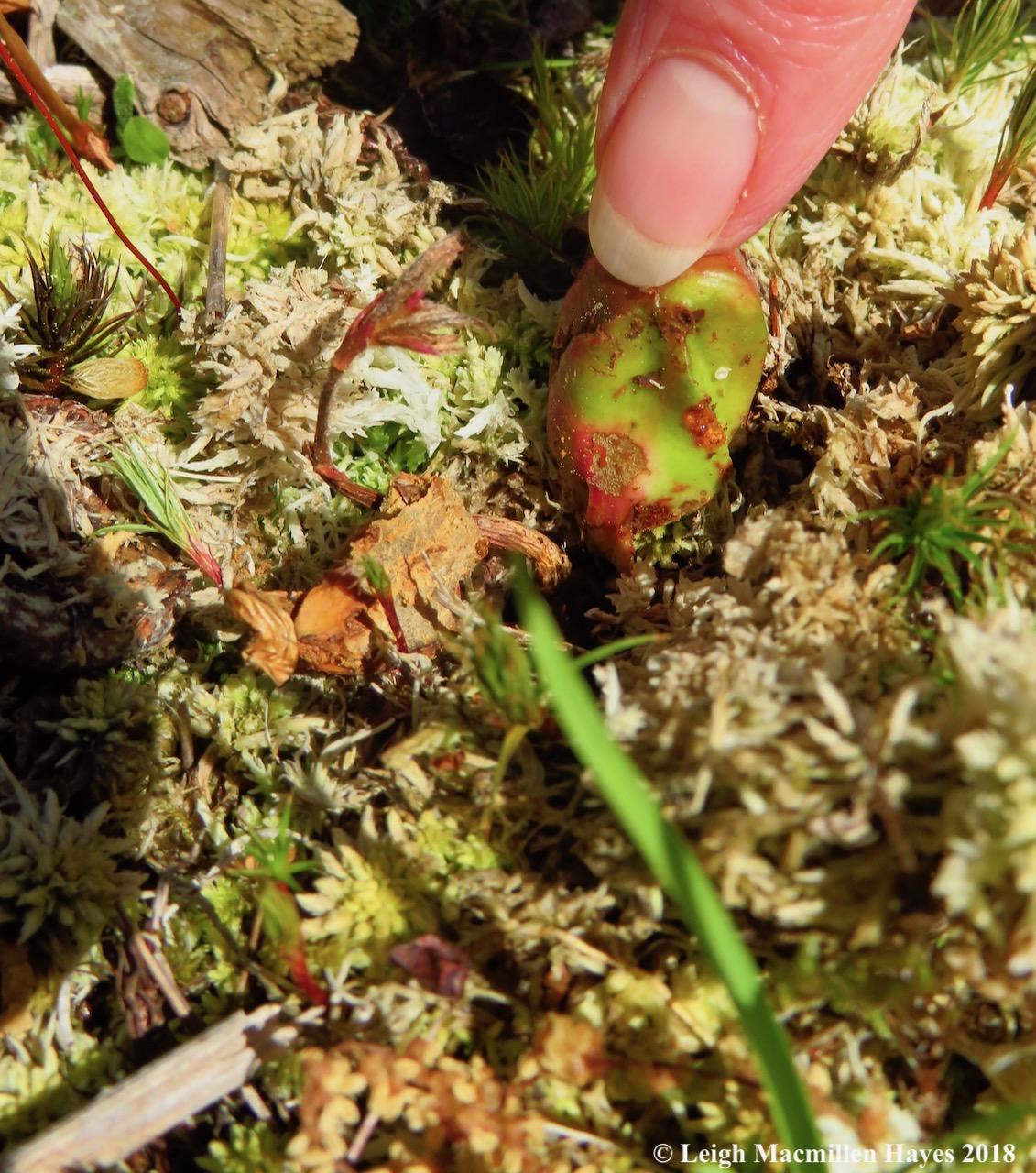
The natural community kept changing and suddenly we found ourselves under a power line where dried spaghnum moss made us wonder if the land was typically wet. And then we saw something red, and the discarded outer shells nearby spoke to its source. It was the “meat” of an acorn, the red being its “sunburned” presentation.

e11-oak setting root

The evolution of an oak tree–it begins with an acorn.

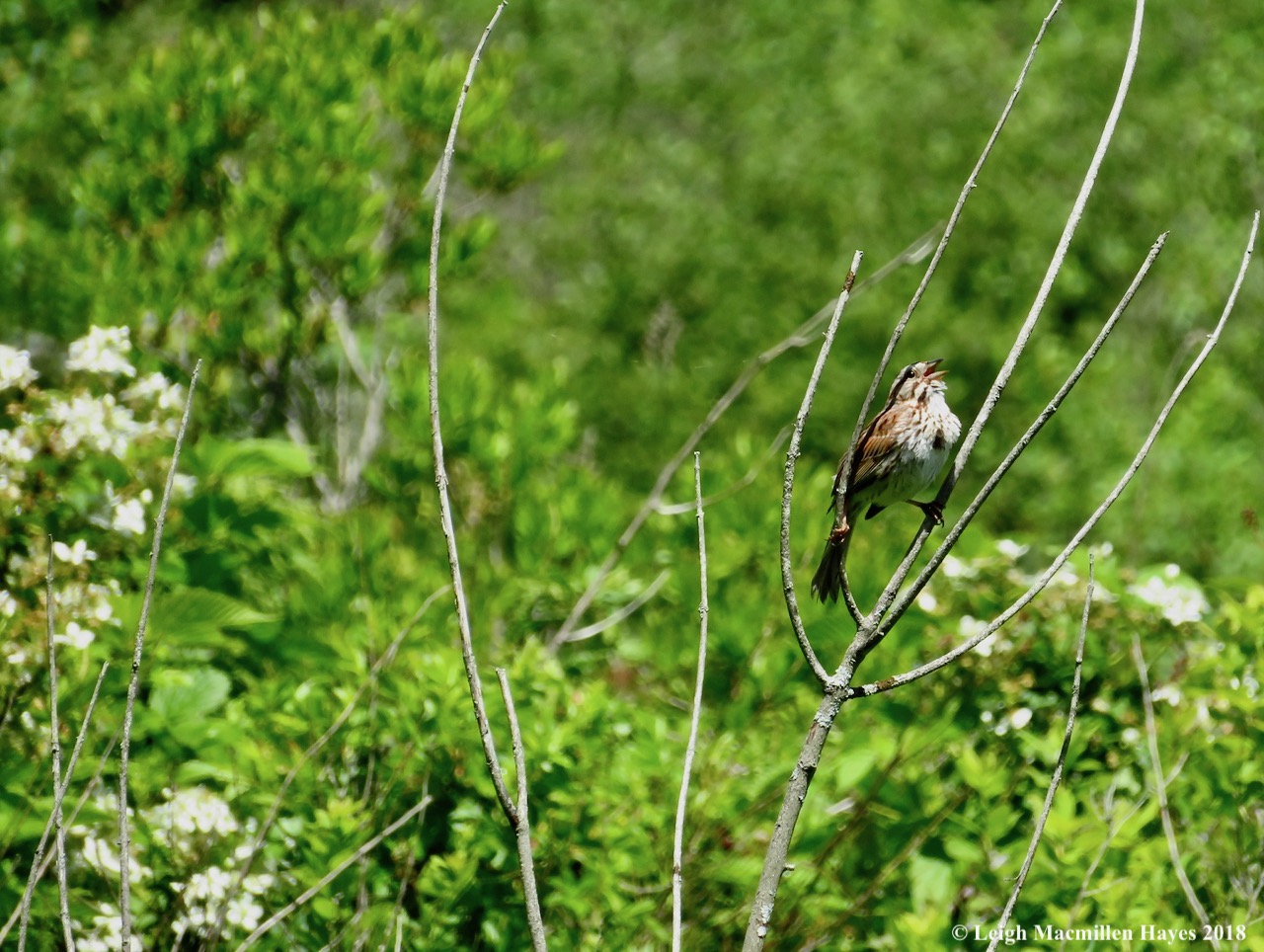
e12-song sparrow

In the same opening, we watched several Song Sparrows move among the shrubs, and then one paused to serenade us.

e13-song sparrow

Upon finishing, it waited as if for our applause.

e14-arrowwood viburnum

Before moving on, we had one more plant to ID. Thanks to iNaturalist, Connie informed us that it was Arrowwood Viburnum. While we appreciated its umbel of flowers and large-toothed leaves, one stem in particular drew our attention. In a symbiotic relationship, ants stroked brownish-red aphids with their antennae, while the aphids released drops of honeydew sucked from the stem. The process was much like a cow being milked. It was actually rather creepy, but wicked cool and all three of us used a loupe to take a closer look.

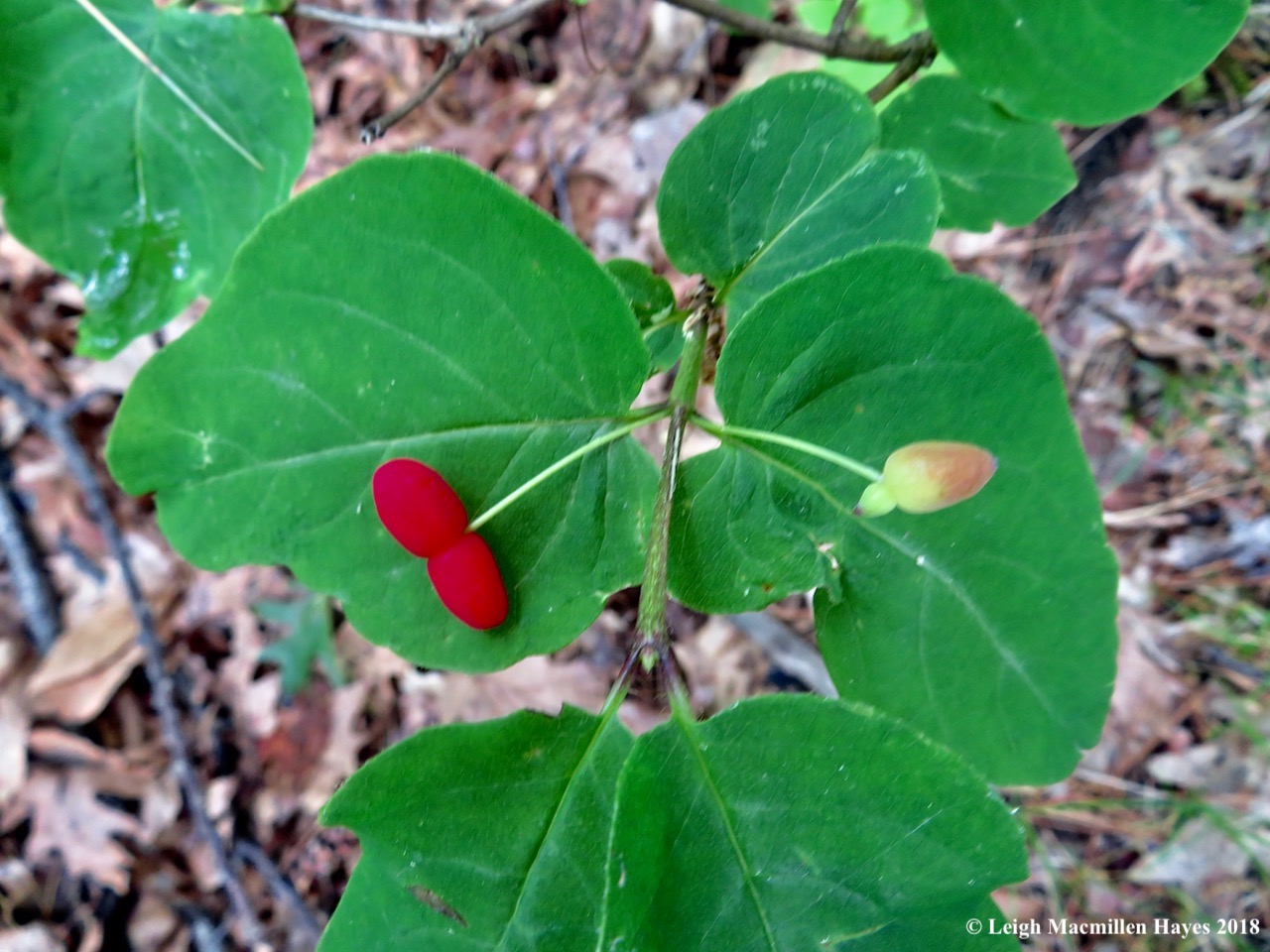
e15-American honeysuckle

Back along a woodland trail we continued, again stopping periodically to take in the sights, ask questions, and appreciate our surroundings. Among our finds we discovered the newly forming fruits of a native honeysuckle.

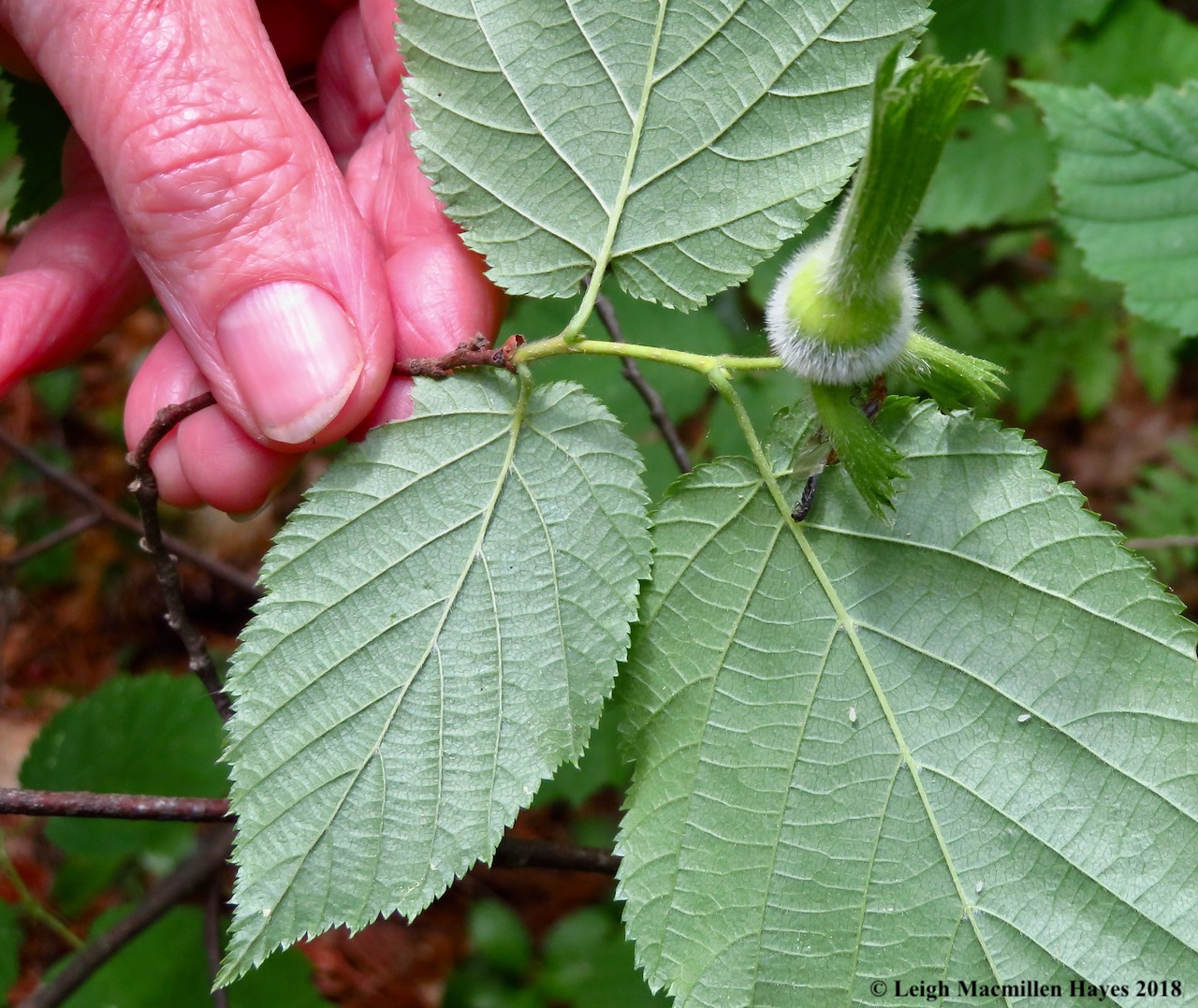
e16-beaked hazelnut

We also rejoiced when we encountered the beaked fruits of Beaked Hazelnut.

e17-mallards

At last we’d completed a short loop, and found ourselves drawn in again by the Mallards, both young and old.

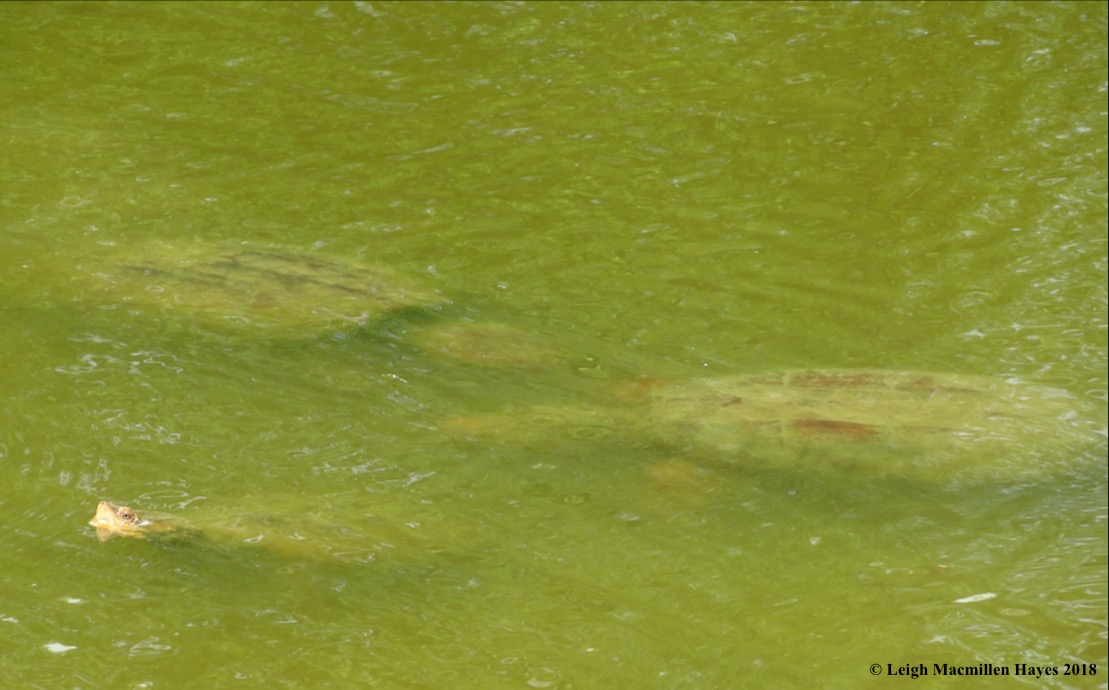
e19-snapping turtle

But then our eyes focused on other residents in the shallow water.

e20-ducks and turtle

And we feared that we’d witness a snapping turtle devour a duckling. We kept encouraging mama to move her kids out of the way.

e21-3 turtles

Especially when we realized the pond was full of snappers and they all seemed focused on swimming to the same focal point.

e22-injured duck

But mamma took her time and let the kids roam freely. We did realize that she had an injured foot or leg and moved with a hop, which added to our anxiety. I also felt a certain affinity with her, given my current one-armed bandit situation due to a broken wrist that is slowly healing. Here’s hoping that she heals as well.

e22-mouth open

As we watched the drama play out before us, we noted two adult ducks hanging out under some alders beside the shore. Suddenly, a snapper approached them quickly and opened his mouth wide. Was he exhibiting aggressive behavior?

e23-mouth closing

We weren’t sure, but as suddenly as he’d approached, he closed his mouth and turned away.

e18-ducklings all in a row

We noticed that turning away was typical turtle behavior. They seemed to get within a couple of feet of the ducks and then turn. Why? We were, however, glad when momma got her ducklings all in a line and moved on.

e25-green heron

We, too, moved on . . . a few more feet toward the car. And then we stopped again to check on the action in the pond. That’s when a Green Heron flew in.

e26-green heron

He was also looking for lunch, though we never saw him succeed in his search.

e27-turtle wars

We did see the ducks and turtles again. And our turtle questions continued for we noticed that they would gather and then one would go after another and the water would boil. An act of aggression? Or a mating ritual?

e28-turtle face

We didn’t have all the answers, but one thing we knew–we’re dying to get into the cemetery again.


Greenwood Nature Mondate

We love Maine both for its natural beauty and historic nature. And so it was today that we enjoyed a wee bit of both as we headed off to Greenwood.

m1-Greenwood City sign

More specifically, Greenwood City.  According to the town website, “The first saw and shingle mill was constructed at ‘Greenwood City’ in 1805. In the mid-1800s, the wood industry moved to the Village of Locke’s Mills as a result of the railroad and a fire which destroyed Greenwood City.” Apparently, the city had been the economic and civic center of Greenwood, but the fire of 1862 changed everything. Nevertheless, this was our kind of city and our intention was to climb the mountain to the left of the sign–Peaked Mountain.

m3-Maggie's Nature Park sign

For years now, I’d heard of Maggie’s Nature Park, but never gave it much thought as a destination. That all changed today. The park encompasses 83 acres of mixed forest across the street from South Pond. It was gifted to the town by Maggie Ring, who had placed it under conservation easement with the Mahoosuc Land Trust. According to an article by Josh Christie in an April 2016 issue of the Portland Press Herald, “As Ring told the MLT in 2005, ‘I gave the land so my grandchildren and everyone else’s grandchildren can enjoy these woods. I want them to enjoy some of God’s good earth.’” 

Our plan was to begin on the orange Ring Hill Trail, and consistently stay to the right as we wove our way around the hill and up Peaked Mountain before descending via Harriet’s Path and finishing with the yellow trail.

m4-elbow tree

Because the temperature was on the crisp side, the snow pack was firm, though there were icy portions in the hemlock grove, and bare trail and ledges as well. As we began, we immediately noted an elbow tree, so formed probably when another tree landed upon it.

m4a-cedar

Moving along at my guy’s brisk speed, I was delighted to note the variety of trees, including cedar, and couldn’t help but imagine the teaching opportunities.

m6-evergreen wood fern

Where the snow had melted, shades of green drew my attention. And with a new season ever so slowly unfolding, I realized I needed to practice my fern ID and so I slowed my guy down for a wee bit. I think he secretly welcomes the breaks for he always finds a rock upon which to sit. One of the characteristics that helped in this ID was the first downward pointing pinnule–it being shorter than the one next to it. I also noted that the stipe or lower stalk, was shorter than the blade, and it was grooved.

m6a-evergreen wood fern

A look at the underside added to my conclusion for last year’s sori were round and all in a row between the midrib and margin. So what was it? Evergreen Wood Fern or Dryopteris intermedia if you choose to get technical. I choose to brush up on my fern ID.

m5-icicles

As we continued along Ring’s Hill, we took in the views from the ledges and under them as well, where icicles pointed toward the land they’d nurture.

m7-snack log

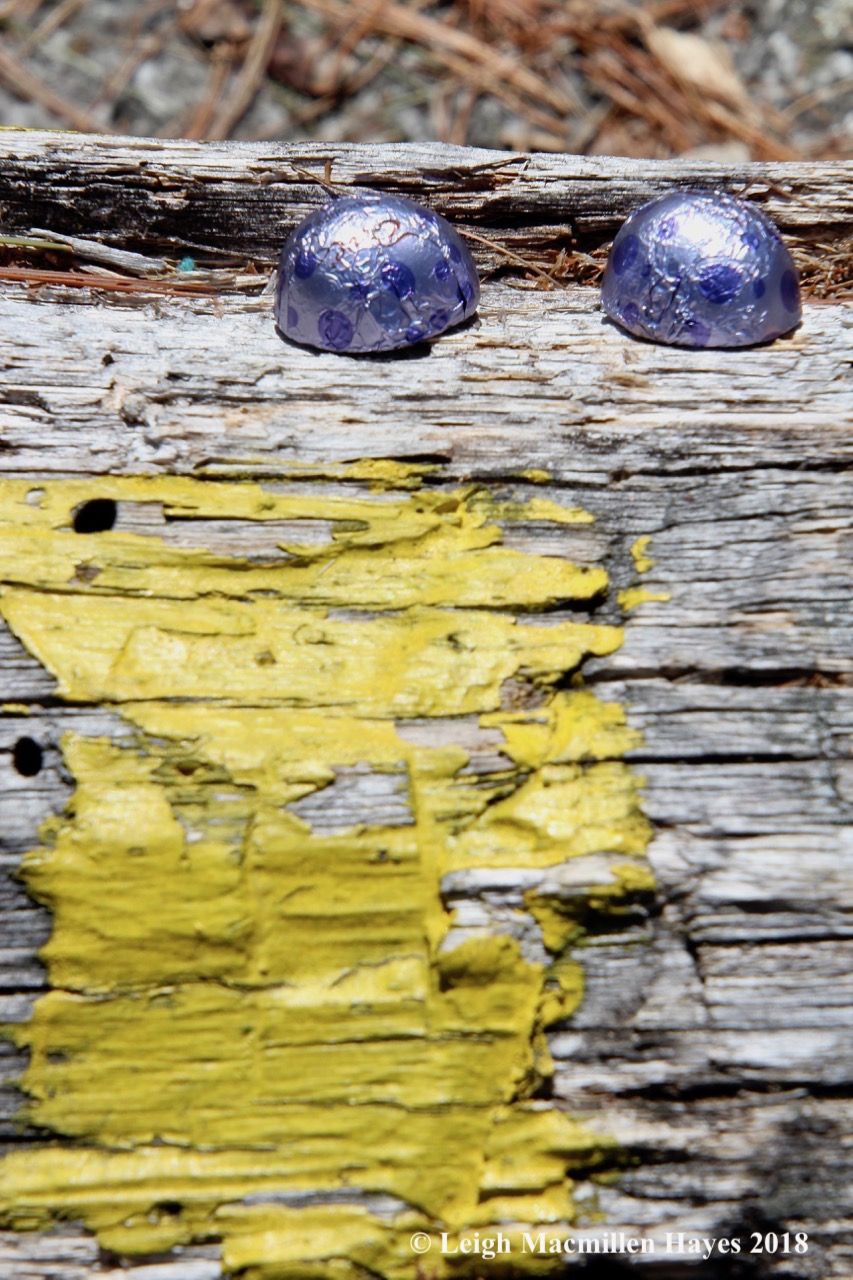
Eventually we followed the yellow blazes to the summit of Peaked Hill–and what to our wondering eyes should appear at a downed log near the view point? Two Dove eggs–the dark chocolate species. A perfect reward for our efforts. But really, the trail required little effort due to its well-executed construction with many zigs and zags to prevent erosion. We hardly felt like we were climbing yet we constantly moved upward.

m8-Mount Abram

The summit of Peaked offered the best views–this one being of Mount Abram, with its ski area at the top and to the right. The ski area is closed for the season, but snow still covered the trails that we could see.

m9-blueberry bushes

Also within our view–highbush blueberry buds suggesting a delightful treat for another day.

m9-toad lichen

And common toadskin lichen reminded me that Big Night is coming soon–that special rainy night(s) when we become sally savers and help amphibians cross that the road to their natal vernal pools. Stay tuned for that–there might be some migration later this week.

m10-trail well marked

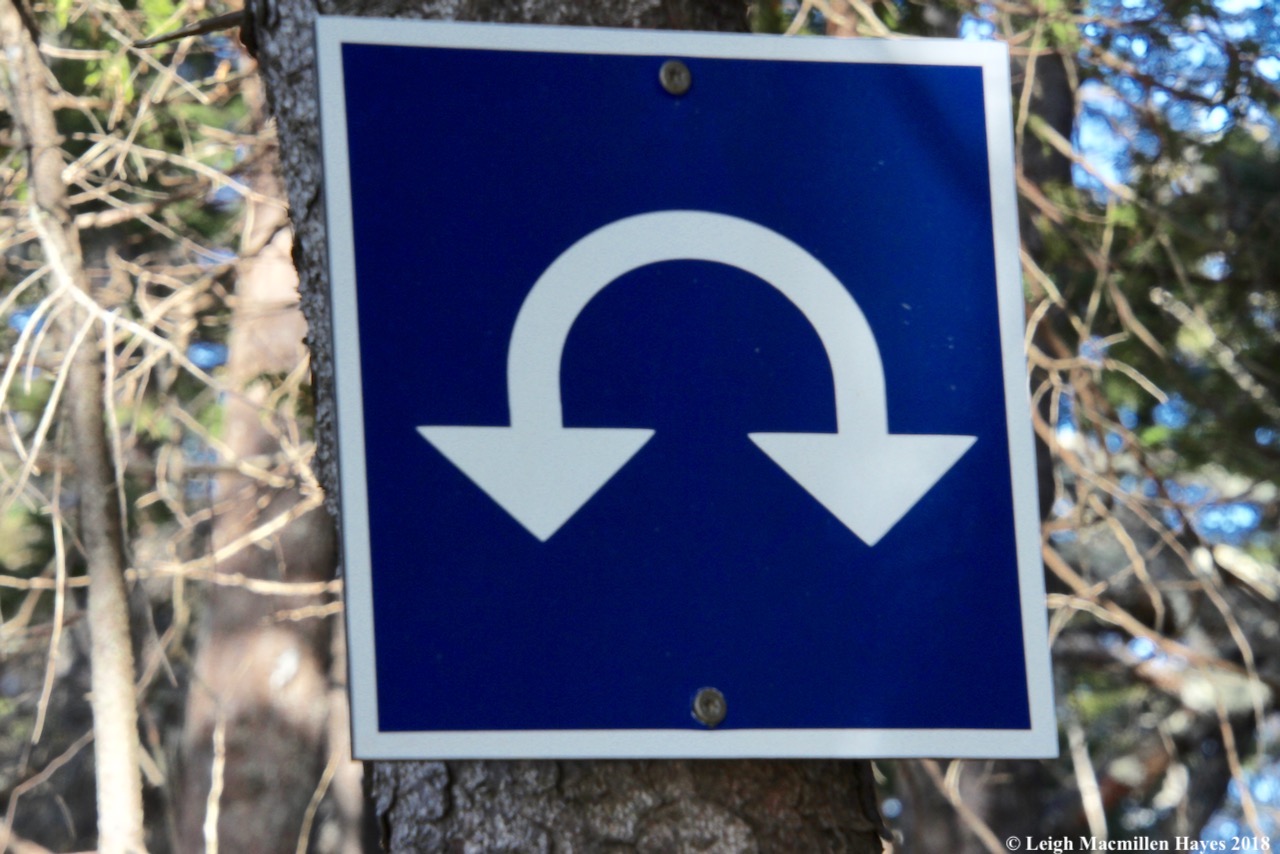
All along, we’d noted the trail markers–bright colors and frequent placement made it easy to stick to the trail. But one caused me concern for it looked like it pointed us over the edge.

m11-trail makers

Not to worry, it was merely noting a junction and curve–my guy came in from the right because he’d chosen to follow the ledge from the Mt. Abram viewpoint, while I chose to return to our snack log and then follow the trail to meet him. Together again, we journeyed to the left as the trail markers indicated.

m12-marker curving 'round rock

Rather than stay on the Peaked Mountain Trail all the way back to the parking lot, we continued with our right-hand-turn progression and chuckled when we found one trail marker painted around the curve of a rock–so indicating yet another zig.

m13-dead end

A short spur on the red trail, aka Harriet’s Path, lead to one last point of view.

m14-pond view

South Pond below with Buck and Lapham Ledges in the distance–hikes saved for another day.

m15-boulder field

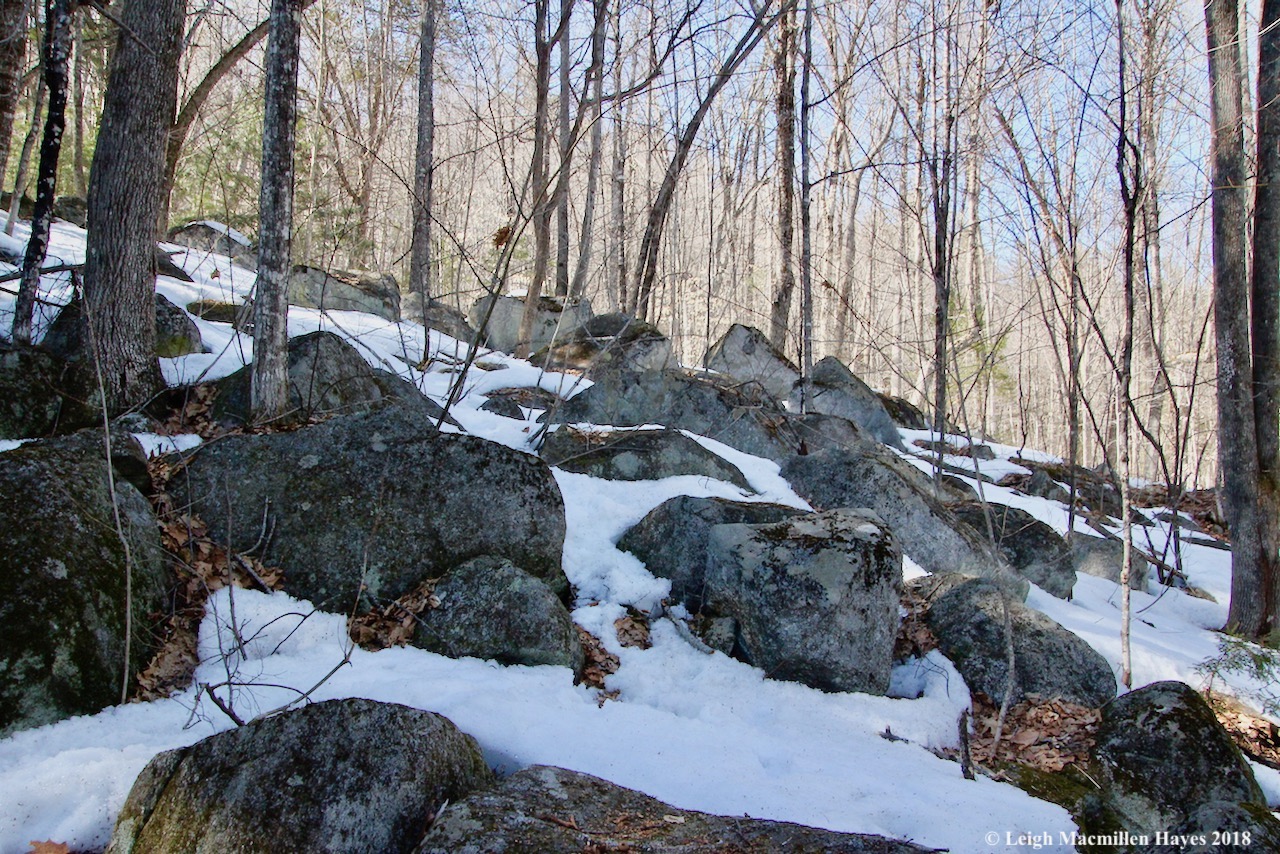
We looped back to the yellow trail and continued down through a boulder field–one more piece of what made this hike so interesting. It wasn’t long after that we completed the journey, but talked immediately about returning in other seasons for so delightful a trek it was. I can’t wait to see what flowers it has to offer and we both could only imagine it decked out with autumn’s tapestry.

m17-Greenwood Cattle Pound

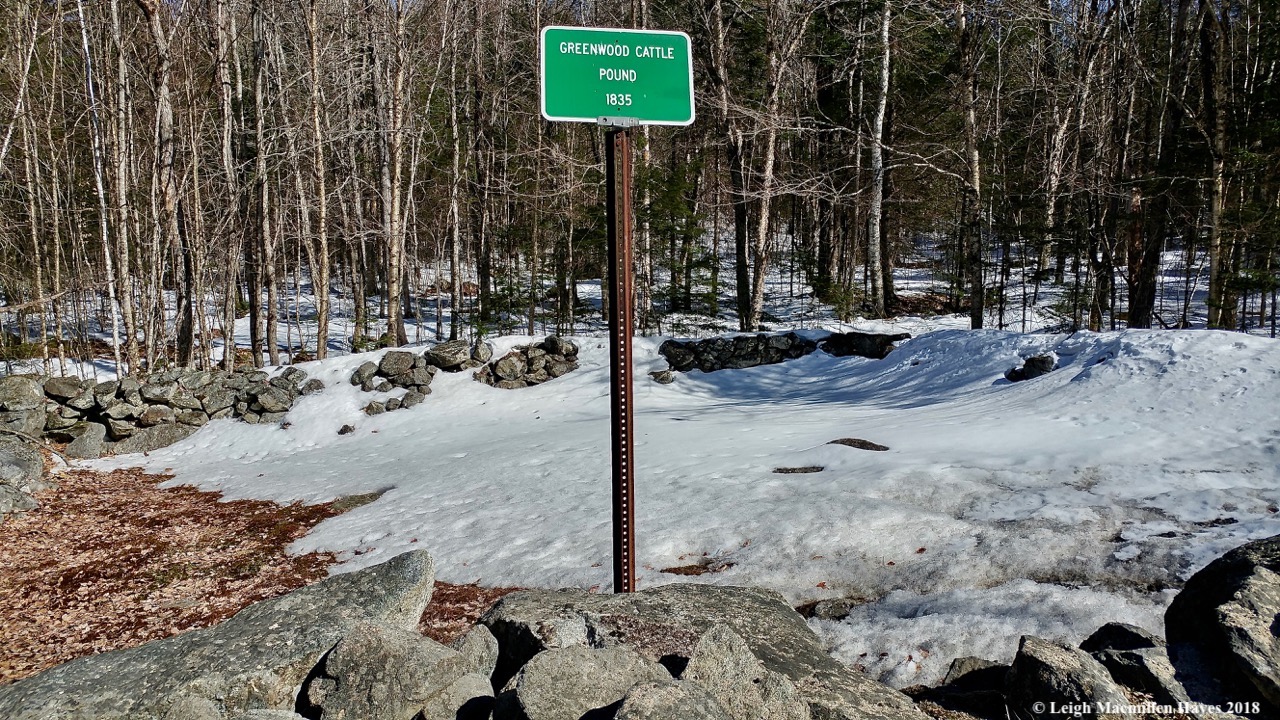
On the way home, because I was driving, we had one last stop to make–by the Greenwood Cattle Pond built in 1835 just north of the city. Pounds were important features to secure stray animals prior to the invention of barbed wire and the stones would have stood taller than they do today, but still . . . another piece of history saved for this one is on the National Register of Historic Places.

At the end of the day we wondered why it had taken us so long to discover Maggie’s Nature Park, but thankfully we now have. And we gave thanks to Maggie Ring and her vision to protect “God’s good earth” for all of us. We loved the nature of Greenwood on this Mondate. Indeed.

P.S. Another claim to fame for this town: LL Bean was born in Greenwood in 1872.


Cozy Cabin

This afternoon Jinny Mae and I went in search of the perfect location to build a cabin. A tiny cabin. A one room cabin. With an outhouse of course. And an infinity pool.

p1-Old Beaver Pond

Deciding where to place it proved to be the most challenging part of the building process. We didn’t want to rush into the things and so we stood. For a long time. And absorbed the sun’s warmth. And reveled in the quiet. It was a contender, but decided we might have to return in another month or so when the song birds sing to decide if it was the right spot, for it was almost too quiet.

p4-brook

And so we continued our journey beside a stream where the ice had melted and water gurgled.

p5-water

In fact, it gurgled so much that it was irresistible and we began looking about because we felt drawn to the spot.

p3-hexagonal-pored polypore (Polyporus alveolaris)

The neighborhood also appealed to us because it had so many interesting landmarks including the hexagonal-pored polypores,

p11--tinder conk pore surface

tinder conks (aka hoof fungus) with their pore surfaces exposed,

p10-false hoof fungus

and even some false tinder conks.

p7-script lichen

One of the things that surprised us was all the writing on the bark for we found script lichen on many a tree trunk. It felt like we’d stumbled upon volumes of research about the construction process.

p12-hairy curtain crust fungus 2

When building, the old adage is location, location, location, but it helps when local resources are available–which we found in the form of curtains, aka hairy curtain crust fungus (or so I think).

p15-many fruited pelt lichen

We also spied multi-fruited pelt lichen that would be suitable to cover the floors.

p17-beaver 2

And then we began to notice the available lumber.

p19-beaver 4

It came in a variety of tree species.

p20-beaver 5

And was already de-barked.

p19-beaver 6

And pre-hewn.

p23-infinity pool

When we saw the infinity pool, we were certain that we’d found the prime location.

p24-lodge roof top

And then we spied a pre-built cabin with a new roof top and we imagined a chimney in the center of the structure.

p25-lodge and dinner raft below water

As it turned out, there was no need for us to build a tiny cabin after all, for we found one already constructed and it even included a refrigerator filled with a cache of branches. Fine dining was definitely in our future.

We were excited because we wouldn’t need to do the building ourselves and our dream was realized in a lodge that was well placed as it graced the landscape and took advantage of the local offerings. A cozy cabin indeed.

What the Bobcat Knows

As I drove down Heald Pond Road in Lovell today I wasn’t sure what awaited me. But isn’t that the point? Every venture into the great outdoors should begin as a clean slate and it’s best not to arrive at the trailhead with expectations.

f1-Heald Pond Road barn

And so I didn’t. Well, sorta. I really wanted to see a porcupine. And maybe an otter. And definitely an owl. But I knew better and so I passed the last barn on the road and then backed up and stepped out, captivated by the colors in the scene before me.

f2-trail signs

A few minutes later, I strapped on my snowshoes and headed up the trail. My plan–to climb to the summit of Flat Hill at the Greater Lovell Land Trust’s Heald and Bradley Ponds Reserve and then circle around Perky’s Path upon my return.

f3-trail up flat hill

Breaking trail was my job in the rather deep snow given recent storms, but easy to move upon and so I sashayed up. What surprised me, however, was the lack of tracks left behind by the mammals that I know live in these woods.

f4-pine cone bird feeders

I did stop at the balsam firs decorated by a local 4-H club in December as part of the Maine Christmas Tree Hunt. The dangling pinecones once sported peanut butter and birdseed, but today that was all a memory so I knew birds and deer had stopped by in the last few months.

f5-bobcat 1

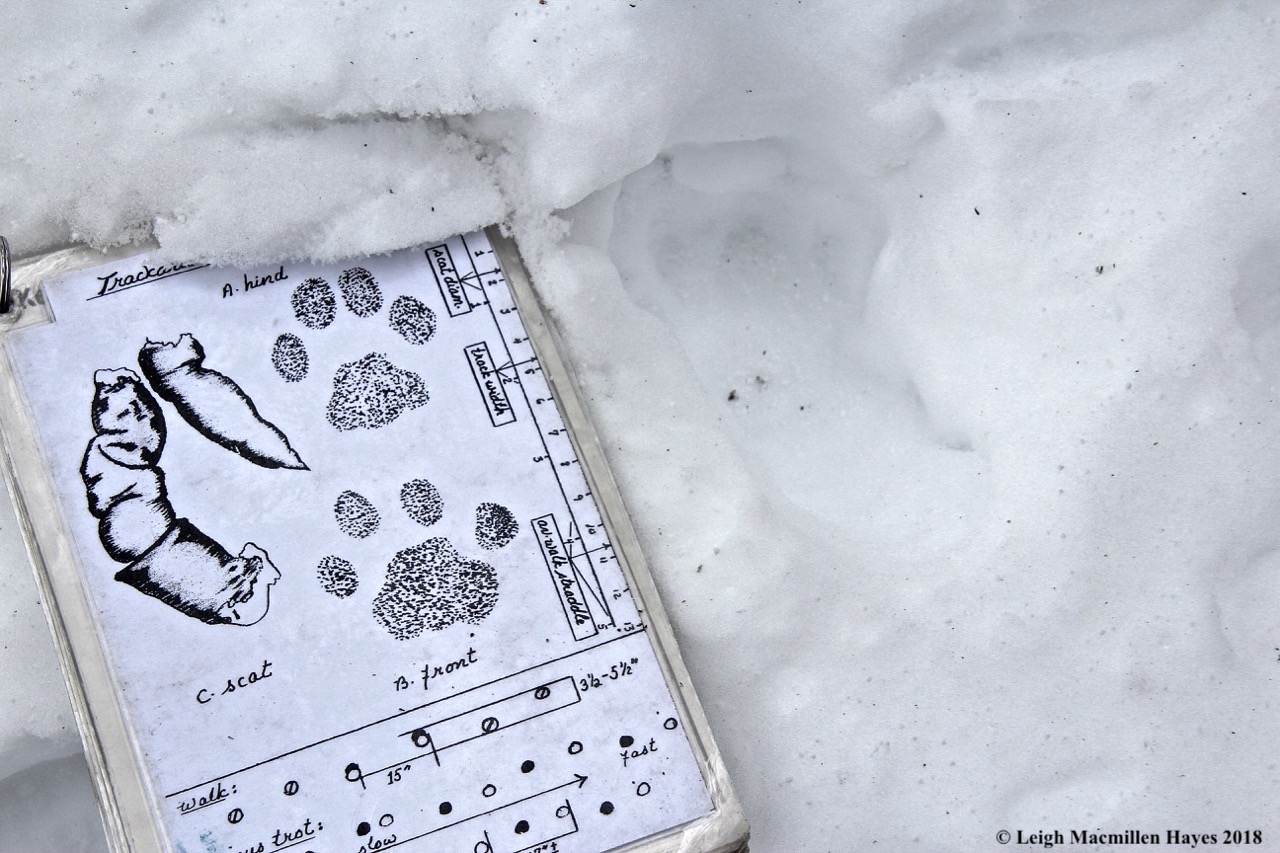
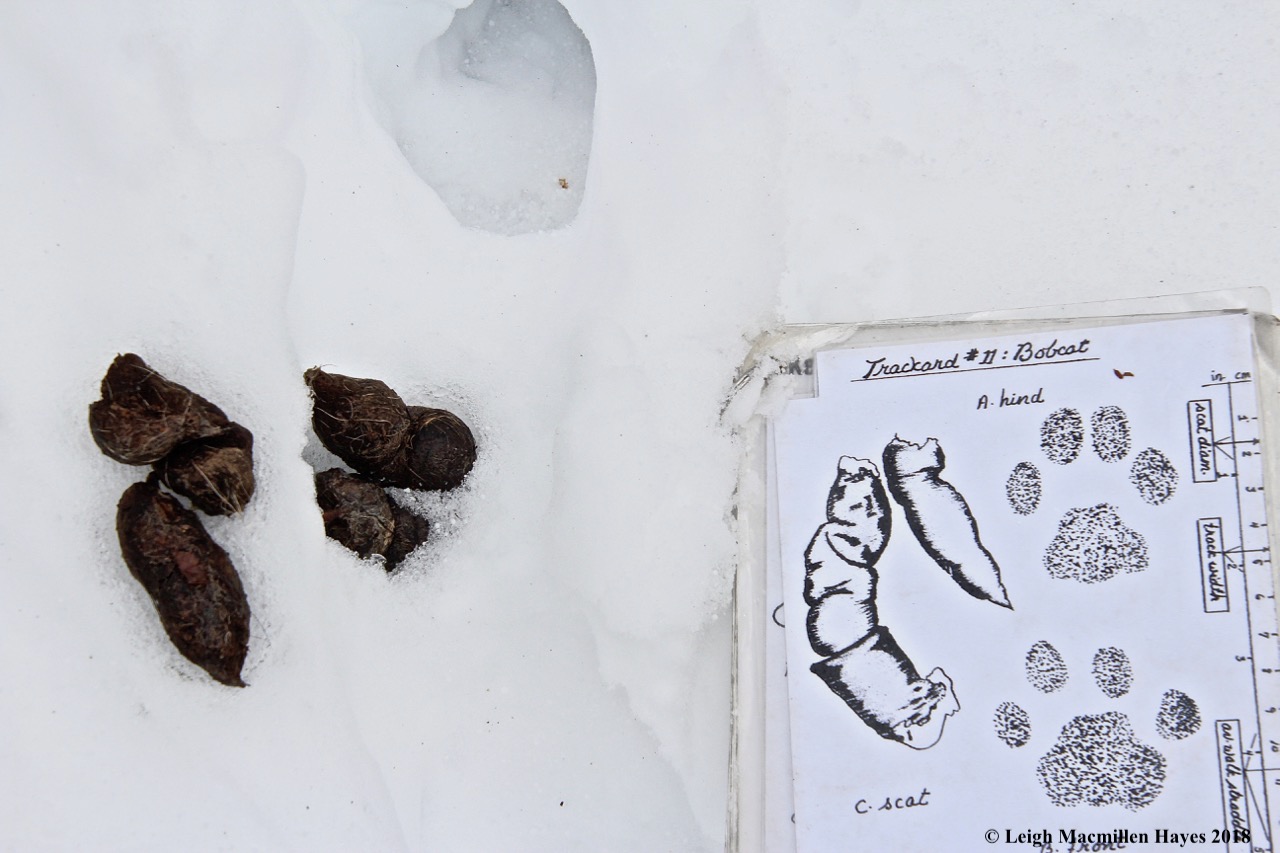
And then, as I neared the flat summit, I found tracks of a mammal that had checked out the base of every tree and under every downed limb. In fact, as I soon realized, it was more than one mammal that I followed as I went off trail. Bobcats. Indeed. Though typically solitary, these two traveled together. It is mating season and males and females will travel together during courtship.

f11-bobcat print

Though the prints were difficult to photograph given the glare, by the toes, ridge and overall shape, I knew them.

f12-bobcat scat and print

And scat! Filled with white hair. I have close-up views should you choose a closer look, but chose to give those who find scat to be rather disgusting a break. ;-)

f6-porcupine and bobcat

And then I found another set of tracks and knew that besides squirrels and little brown things, the bobcats were also searching for a bigger dinner. On the left–a porcupine trough, and on the right, the bobcat trail.

f8-porky work

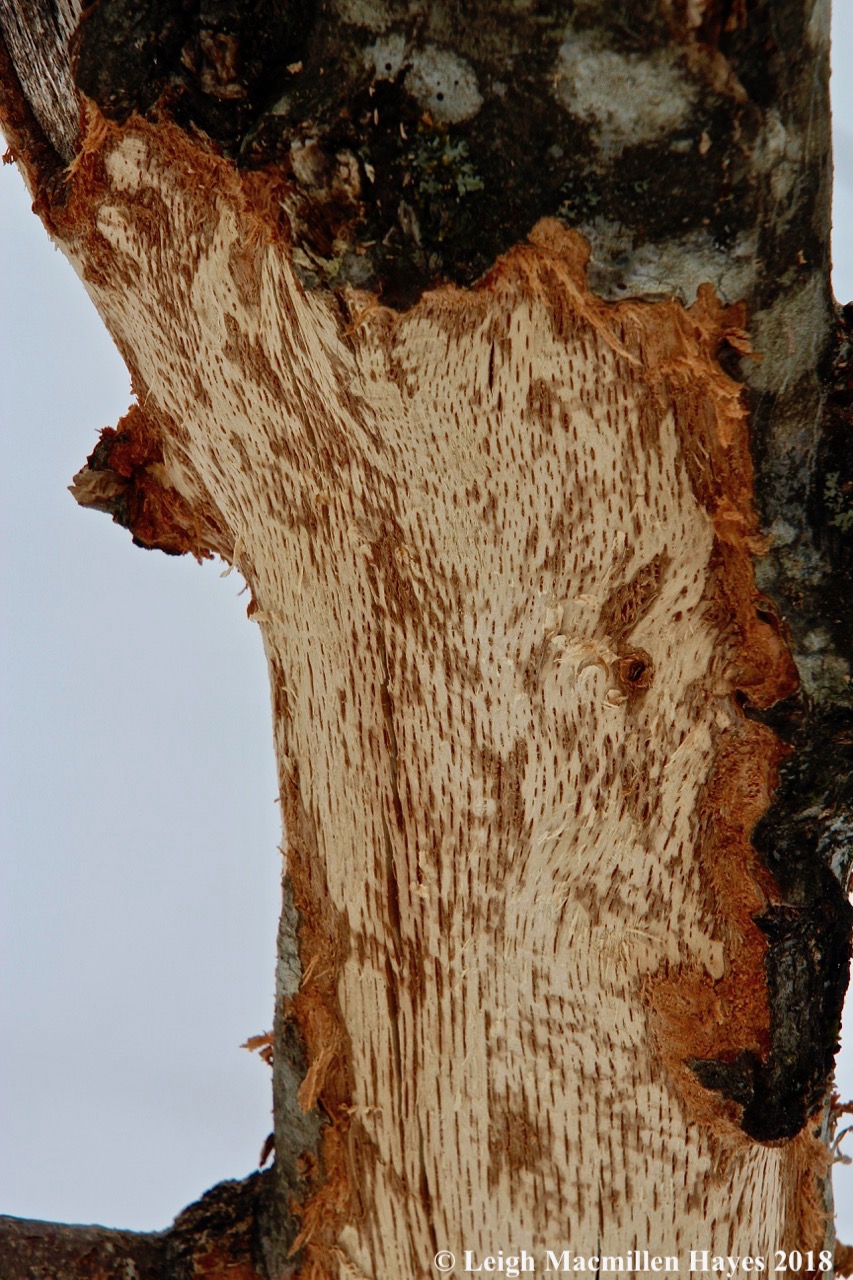
Ever since I’ve traveled this trail, I’ve seen the work of the porcupines at the summit. And sometimes I even get to see the creator. In winter, porcupines eat needles and the bark of trees, including hemlocks, birch, beech, aspen, oak, willow, spruce, fir and pine. And they leave behind a variety of patterns.

f7-porky work

If I didn’t know better, I could have been convinced that this ragged work was left behind by a chiseling woodpecker, but it, too, was porcupine work.

f9-porky work

All about the summit, recent chews were easily identified for the inner bark was brighter than the rest of the landscape. And below these trees–no bark chips such as a beaver would leave, for the porcupine consumed all the wood.

f10-flat hill view

While snow flurries fluttered around me, the summit view was limited and it looked like the mountains were receiving more of the white stuff. (Never fear–we’ll get more as our third Nor’easter in two weeks or so is expected in two more days. Such is March in Maine.)

f13-script lichen between pine lines

From the summit, rather than follow the trail down, I tracked the bobcats for a while, first to the north and then to the south. I had hoped to find a kill site, but no such luck. Instead, the writing on the page was found upon the pines where script lichen, a crustose, was located between the lines of bark scales.

f14-ulota moss and frullania

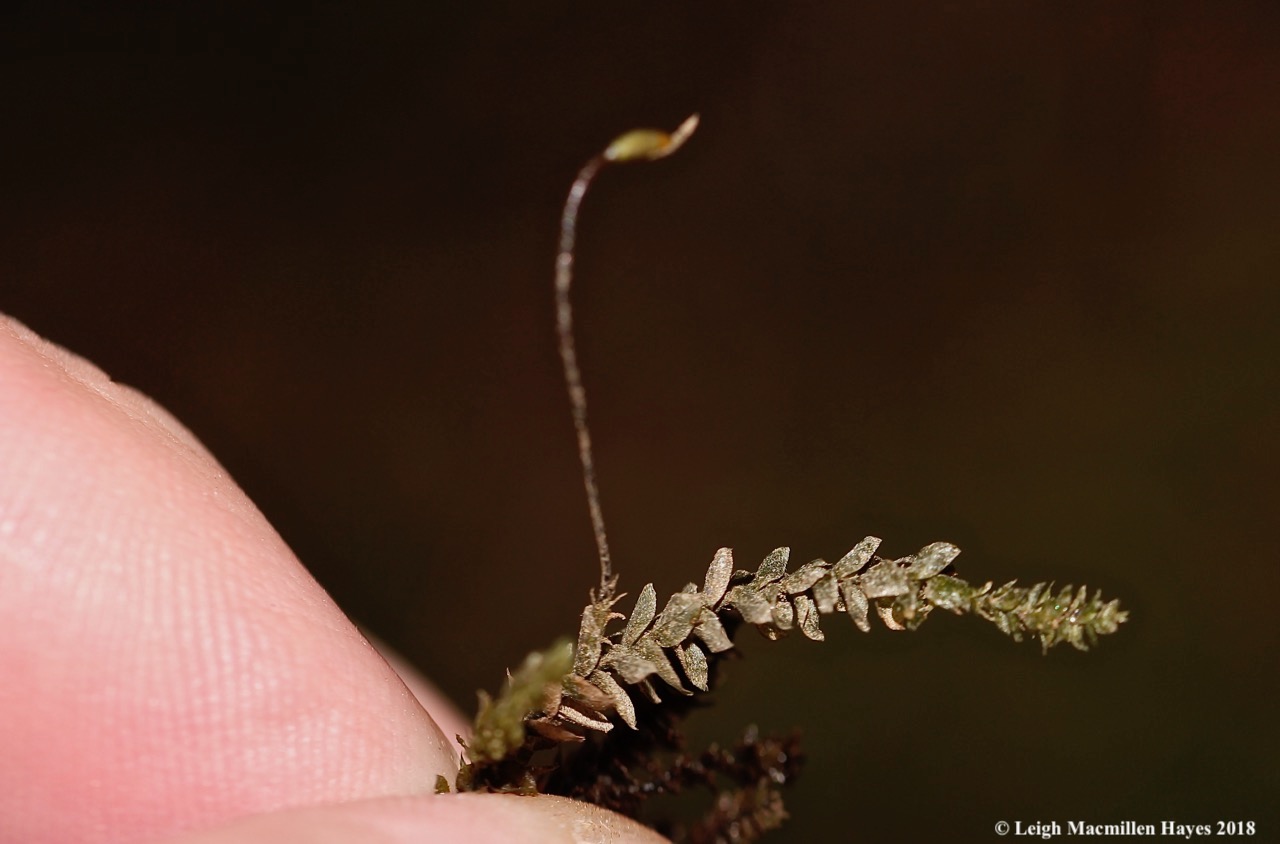
I also found plenty of Frullania, that reddish brown liverwort that graced so many trees. And among it, a moss I’ll simply call an Ulota. As I looked in Ralph Pope’s book, Mosses, Liverworts, and Hornworts , upon arriving home, I realized I should have paid attention to capsules for that would have helped me determine whether what I saw was Ulota crispa or Ulota coarctata. Another lesson for another day.

f15-beaver pond on Perky's Path

At last I reached Perky’s Path, which may not seem like a major feat if you’ve been there, but actually I’d explored off trail for quite a ways and it took me a while to get down to the wetland.

f16-maleberry

And because I was in the wetland, maleberry shrubs bordered the edge and showed off their bright red buds and woody, star-shaped seedpods.

f16a-bobcat across wetland

After focusing on them for a while, I looked down at the snow’s surface and the most subtle of prints appeared before my eyes. My two bobcats. The curious thing–at the summit the mammals had sunk into the snow and the prints were a bit difficult to decipher. I assumed those summit impressions had been made about two days ago. But on the wetland, the bobcats walked atop the snow–when conditions were firmer and I suspected they’d been created last night.

f17-brook toward Bradley Pond 1

I followed the edge of the wetland to the bridges that cross a brook that forms at the outlet of Bradley Pond, constantly on the lookout for the bobcat tracks again.

f18-more bobcat

And I found them! Beside the brook.

f19-beaver pond from bridge

What had they found on the wetland, I wondered?

f21a-beaver trail

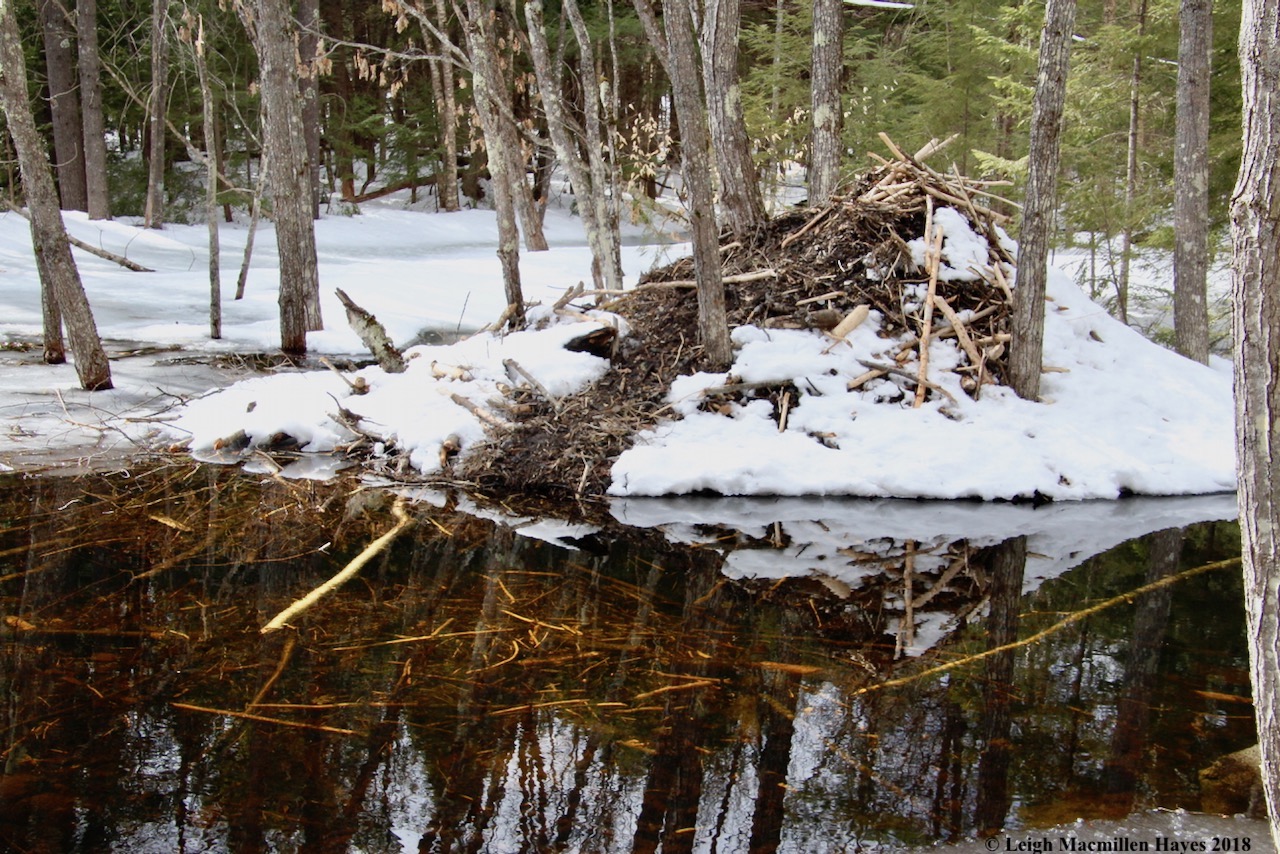
Continuing on, I found that they’d checked on the woodwork left behind by another critter of these woods who had also moved about last night.

f20-beaver works

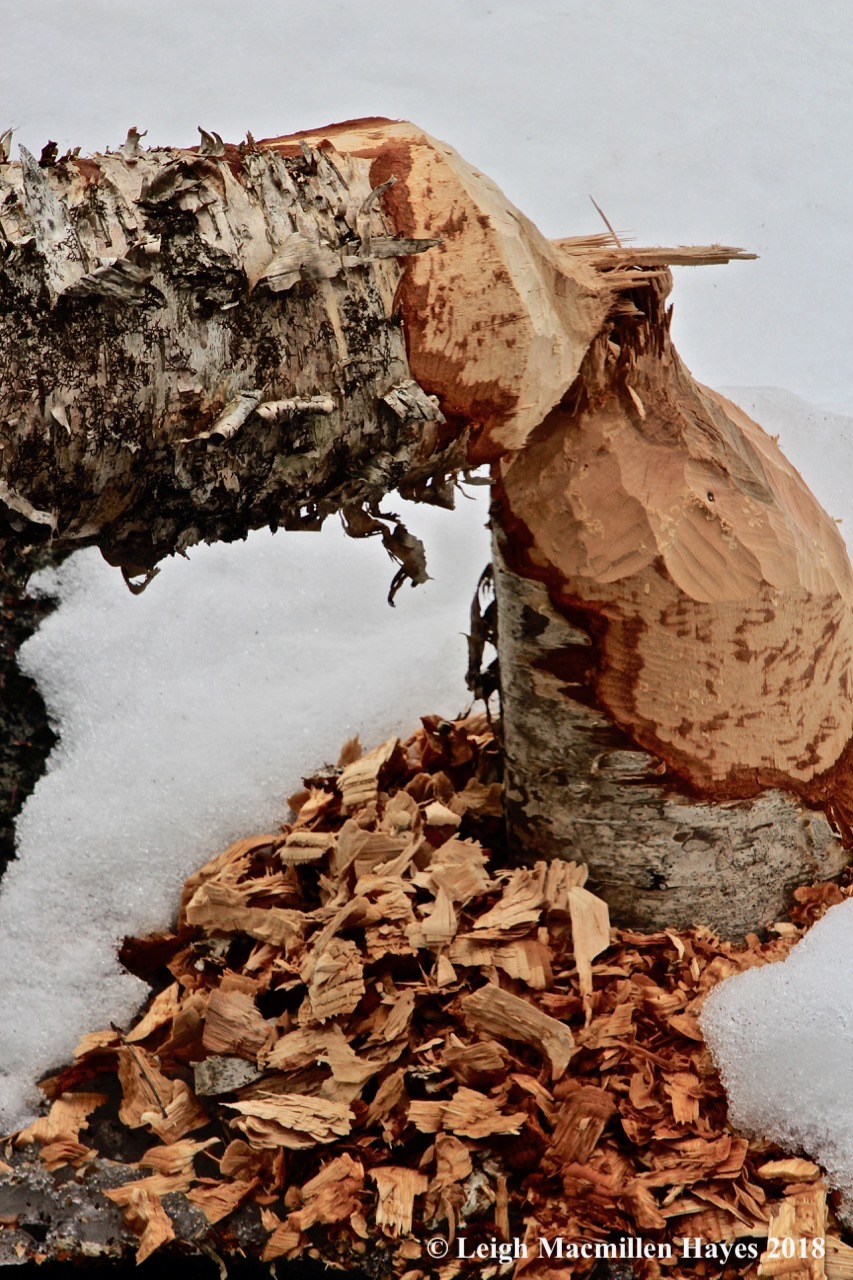
Beaver works. And their piles of woodchips. Unlike a porcupine, a beaver doesn’t eat the chips. Rather, it cuts down a tree for food or a building material. The chips are like a squirrel’s midden of cone scales–the garbage pile of sorts.

f22-beaver trail to water

I noted where the beaver had moved into the brook . . .

f23-beaver treats

And left some sticks behind. For future food? Future building? Stay tuned.

f27-brook to Bradley pond

Typically in other seasons I can’t move beside the edge of the brook, but today I could. The lighting kept changing and water reflected the sky’s mood.

f24-Diamesa sp. and snow flea

And because I was by the water, I kept noting small insects flying about–almost in a sideways manner. Then I found some on the snow–a member of the Diamesa species, a midge I believe. And do you see the small black speck below it–a snowflea, aka spring tail.

f25-Diamesa sp.:haltere

And do you see the two little nobs on the fly’s back, the red arrow pointing to one? Those are the haltere: the balancing organ of a two-winged fly; a pair of knobbed filaments that take the place of the hind wings.

f29-beaver pond wetland low

Eventually, I followed the eastern edge of the wetland back to my truck, wondering if there was any more action but found none. In fact, the water was low so I knew the beaver works weren’t to rebuild the dam. Yet. Nor did I find any more bobcat tracks. But I’d found enough. And I think I know some of what the bobcat knows.


The Amazing Race–Our Style, episode 2

Even though we’d won the first leg of our Amazing Race adventure, we were disappointed with the start time we received for today’s journey. We couldn’t leave home until 10:24 a.m. But, despite that, we’d read the clue carefully, checked the maps and navigated to the starting point:

a1-cribwork bridge

The world-famous cribstone bridge that connects Bailey Island and Orr’s Island in Harpswell, Maine. Though it may look rickety, it’s stood since 1927 and as far as we knew had only been repaired once–in 2010. The stacked granite blocks are held together only by gravity and allow the tide to flow freely. The bridge was placed on the the National Register of Historic Places in 1975. Would we make it across?

a2-Maine Fishermen monument

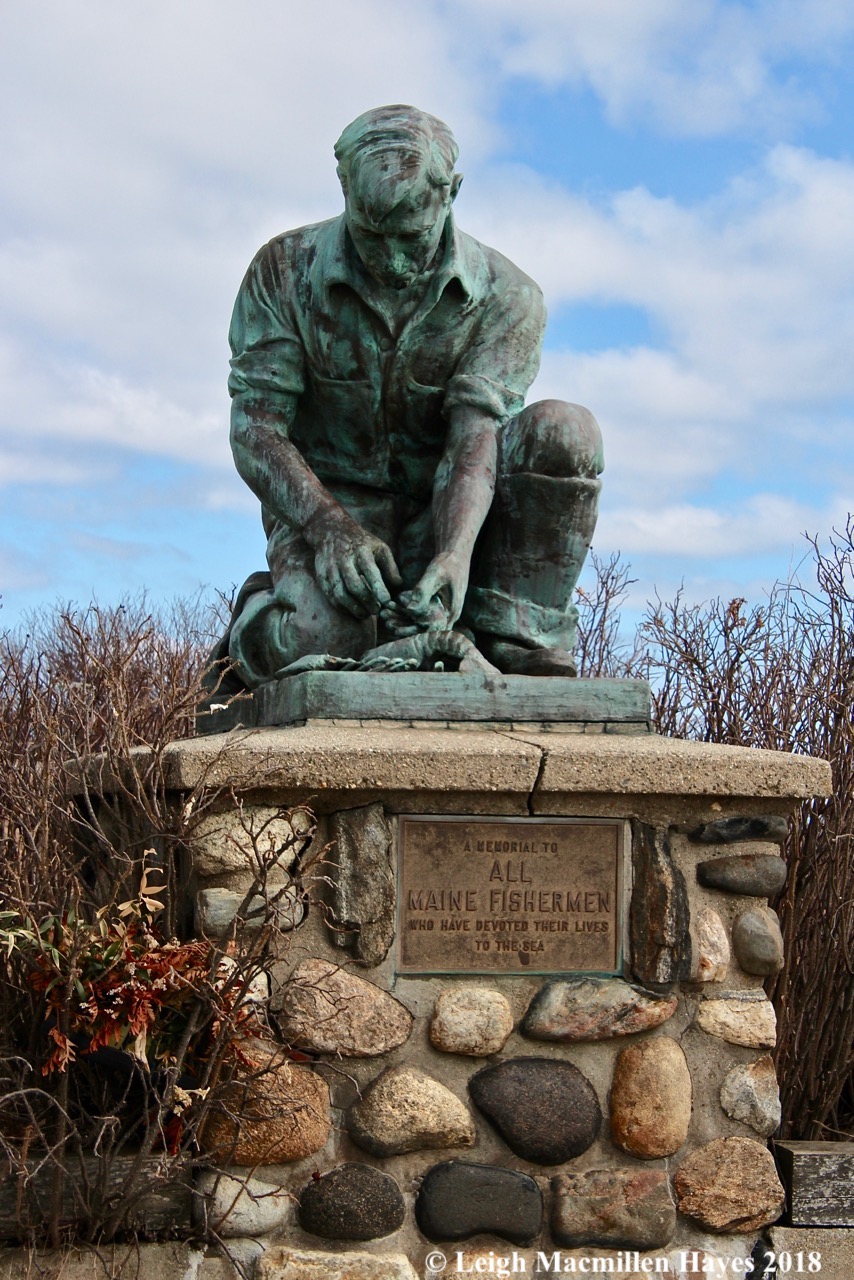
We did. And continued on to Land’s End, where our next clue awaited by the Maine Fishermen’s memorial. It was also a memorial to my mother, for the only other time we’d been to this place was either before we were married or shortly after and Mom was with us–enjoying most the Land’s End Gift Shop. Today–it was closed for the season. It was also a memorial to Dad for he would have told us to fill the innermost recesses of our lungs with salt air. And so we did.

a3a-following the path

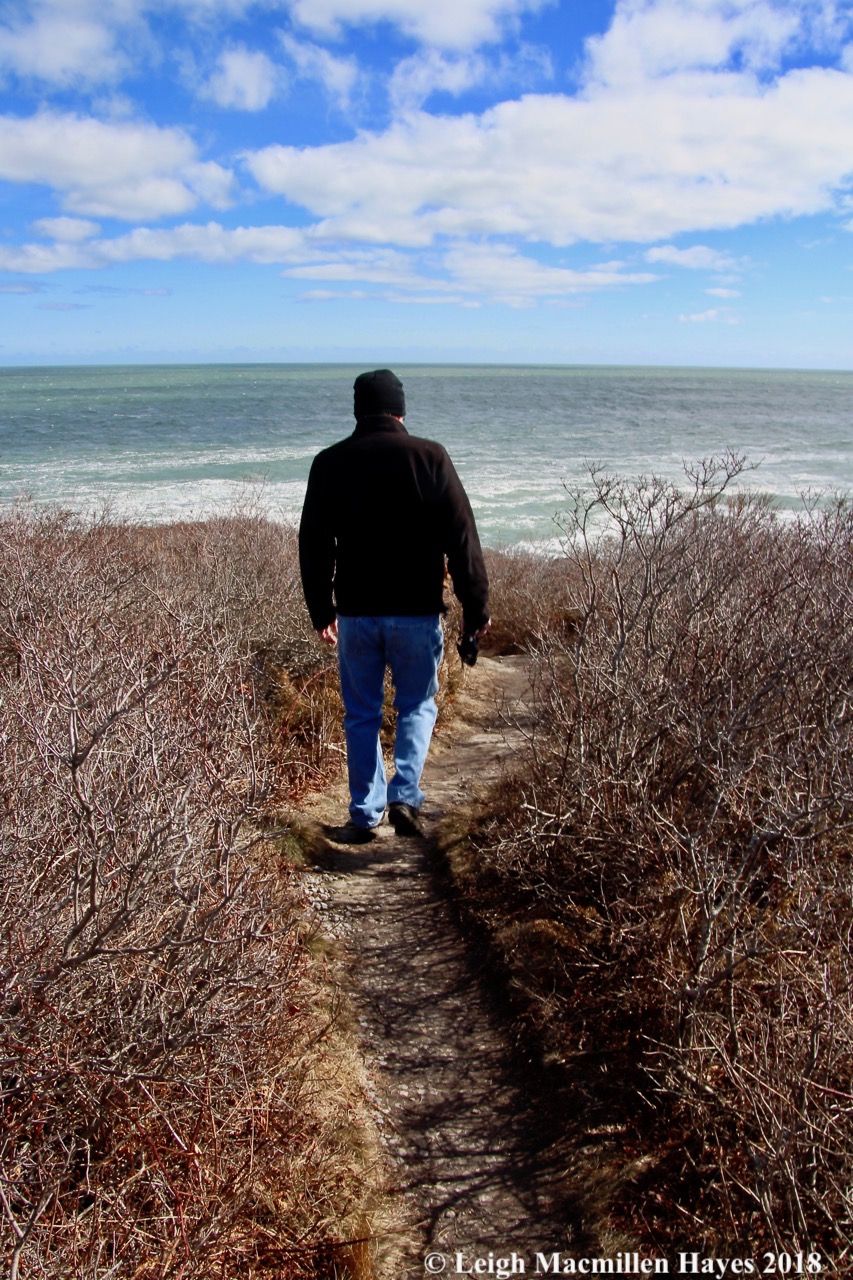
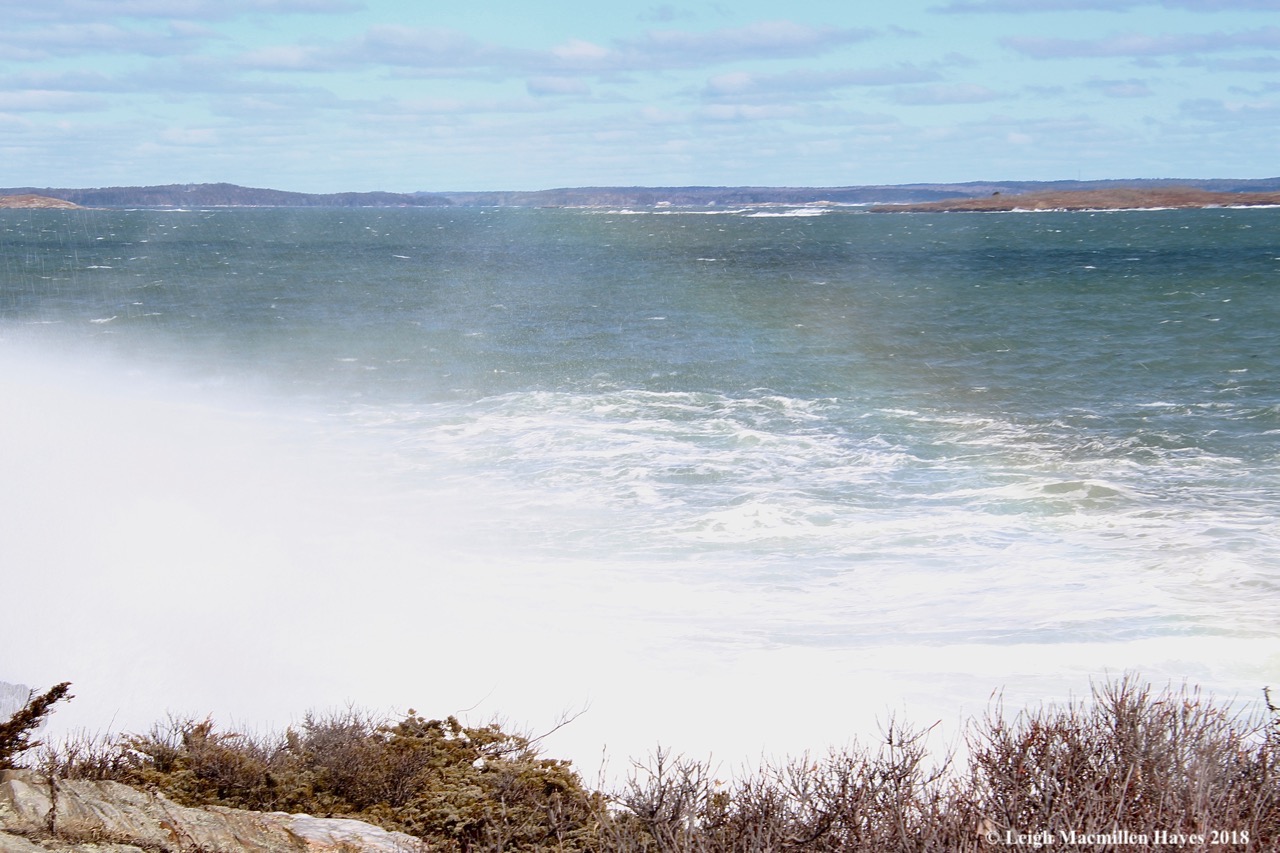
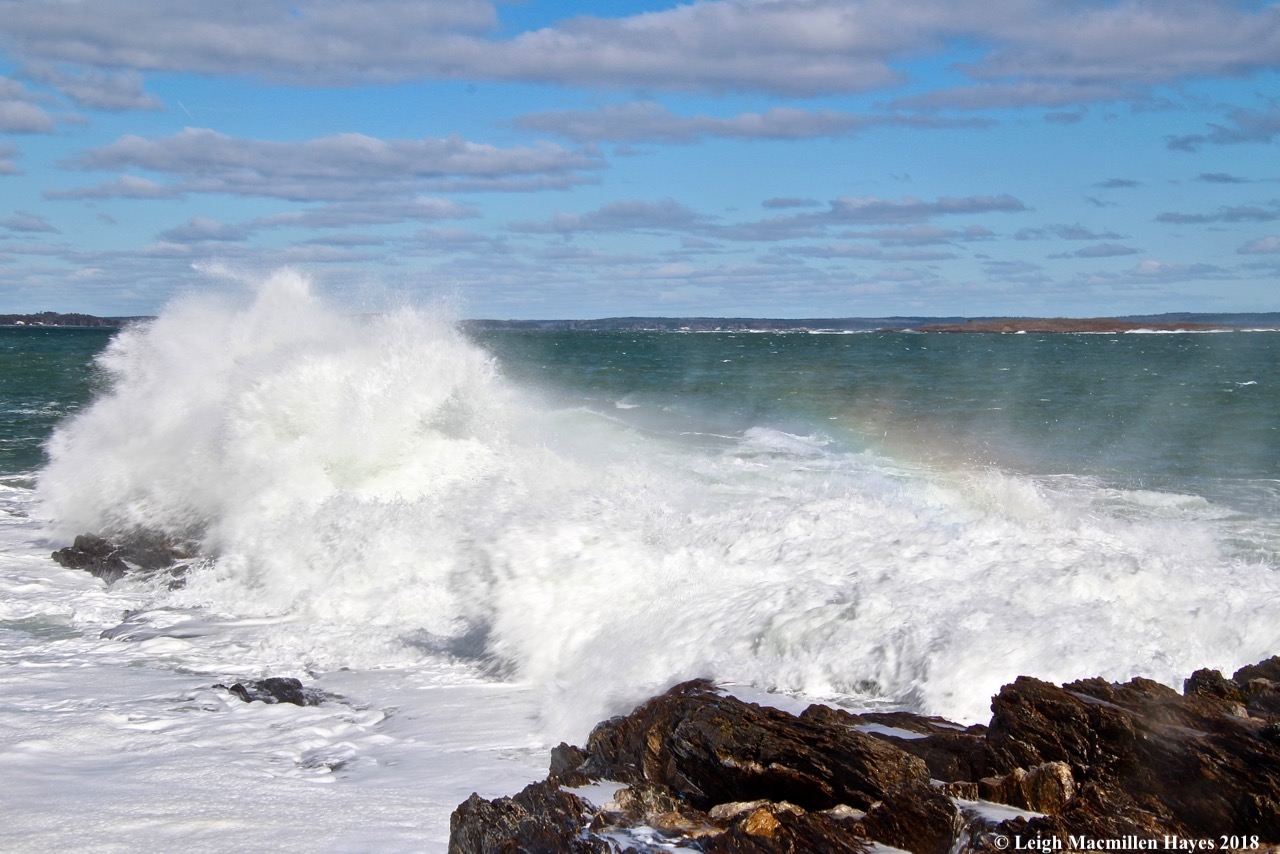
Out to the rugged coast of Maine we headed. Just a few days ago, a Nor’easter had made its presence known in these parts and still today the surf spoke to its force.

a3-surfs up 1

Our task–to be mesmerized.

a4-surf's up 2

And to record it in a variety of renditions.

a6-surf's up

And so we did both.

a7-surf's up

Numerous ohs and ahs escaped our lips.

a9-surf's up

And we hadn’t even ventured far.

a9-thunder hole

Finally, we arrived at Thunder Hole and though the wave action wasn’t all that spectacular, we did hear the thunder. Our job–to note which side sounded louder. We chose the left and received our next clue.

a13-on the edge

One of us had to get as close to the surf as possible. And so he did.

a14-surf's up

Together, we needed to appreciate the power.

a15-surf's up

And so we stood.

a16-surf's up

And watched.

a17-surf's up

As water exploded.

a18-continuing on

And then we received our next clue–to move on to the next spot.

a20-Giant's Stairs 1

The Giant’s Stairs.

a21-giant's stairs

The blocky formation earned it the whimsical name of the Giant’s Staircase many years ago. We were reminded of the Giant’s Causeway in Ireland and prior to arriving wondered if it might look the same. It didn’t, but every giant leaves his own mark on the world. Fortunately, we didn’t need to climb down for today’s challenge–just to acknowledge it. Which we did with pleasure. It seemed only the waves were allowed to ascend and immediately descend–so quick was their exit.

a22-rainbow 1

Having accomplished that leg of the race, we next needed to spy five rainbows. One.

a22-rainbow 2

Two.

a22-rainbow 3

Three.

a22-rainbow 4

Four.

a22-rainbow 5

Five.

a25-ocean spray

Task done. And then my guy had to tell me when to take a shot for dramatic effect.

a26-wave explosion

He nailed it.

a28-devil's back

We were feeling good about our position when our next clue told us to eat locally so we grabbed sandwiches at “BIGS,” aka Bailey Island General Store and Eatery. And then we headed to our next destination located on Orr’s Island–Devil’s Back. The name was curious to us, but the trail system is located on either side of Route 24, which apparently is known locally as Devil’s Back. It does form an obvious spine between the two sides of the Harpswell Heritage Land Trust property.

a30-cedars

Winds had wreaked havoc mainly on the Gun Point Cove side where we walked all of the trails first.

a32-cedars

And then we slipped across the spine or Devil’s Back to the Long Cove side. Curiously, the land trust describes the forest here as being mixed, but mostly I noted evergreens including cedars like these, spruce, fir, and pine, with a few maples and paper birch in the mix. I suppose it’s all in the eye of the beholder.

a33-U turn

As we were cruising along, we did get U-turned. It happens on the Amazing Race and was to be expected because we had been in the lead for so long.

a34-folds

And so we had to recall the folds of the rock along Casco Bay. By looking at the angle, our eyes began to see the metamorphic rock turned on its side due to intense pressure in its long-term history and understood that over time various pressures and results of heating and cooling events caused the variation in color and mineral size of the bands. We could also see the arc the folds created that had since eroded.

a34-polypody fern

An easy one for us (well, me anyway) was to identify the fern that grew on the rocks along the Long Cove side of Devil’s Back–Common Polypody it was.

a34-sausage-shaped boudins

And then there was the geologic formation–an igneous dike (lighter color) that cut across the metamorphic rock created we believed by the pinching and swelling from compression and shearing to the Northeast that formed sausage-shaped boudins.

a34-starburst lichen

And we had to name that lichen–sunburst with deep orange disks of its fruiting body or apothecia. Again, we were feeling kinda confident, but one never knows in a race such as this.

a34-stone wall

Our final U-turn challenge was to locate a stone wall–and we did. Island style is so much different from inland style.

a35-fairy home

We thought we were done, but discovered we still had a couple of more challenges to complete. The first was to locate two whimsical sites–in keeping with the Giant’s Stairs. And so we found a fairy house.

a35-octupus

And an octopus.

a38-Cundy's Harbor

Our last challenge before we headed to the mat–to locate two American flags blowing in the breeze at Cundy’s Harbor. Bingo. One.

a40-American Flag

And two.

a5-getting wet

At last we arrived at the mat and much to our surprise–got a wee bit sprayed! But that didn’t matter for we’d beat our imaginary contestants and once again finished first. Our prize from the Gnome and Travelocity–a leftover homemade pizza dinner. That meant we didn’t have to prepare a meal when we arrived home on this Mondate. Yippee.

The Amazing Race–Our Style: episode 2. Check back in with us in April to see what challenges we’ll face next.


Distracted by Nature

A morning message from my dear friend Carissa set the tone for today. Her Lenten devotional is based on the poetry of Mary Oliver and she thought of me when she read “The Summer Day.”

The Summer Day
Who made the world?
Who made the swan, and the black bear?
Who made the grasshopper?
This grasshopper, I mean-
the one who has flung herself out of the grass,
the one who is eating sugar out of my hand,
who is moving her jaws back and forth instead of up and down-
who is gazing around with her enormous and complicated eyes.
Now she lifts her pale forearms and thoroughly washes her face.
Now she snaps her wings open, and floats away.
I don’t know exactly what a prayer is.
I do know how to pay attention, how to fall down
into the grass, how to kneel down in the grass,
how to be idle and blessed, how to stroll through the fields,
which is what I have been doing all day.
Tell me, what else should I have done?
Doesn’t everything die at last, and too soon?
Tell me, what is it you plan to do
with your one wild and precious life?
~Mary Oliver

A perfect beginning, indeed.

w-Horseshoe Pond

A short time later I joined a couple of other friends and we traveled together to the Greater Lovell Land Trust’s Wilson Wing Moose Pond Bog Preserve. Our snowshoe journey began beside Horseshoe Pond where we paused to enjoy its beauty and recall trips up Lord Hill, whose face was obscured to the left.

w-hemlock cones and seed below

Once we got onto the trail, it was the little things that we noticed, like the hemlock cones with partially opened scales, their seeds all released. One tiny seed sits atop my name in this photo, but we wondered together why we’ve always seen the cones only in their closed up formation, whether fresh or old. Had they always looked like this one in late winter and we just never realized it previously?

w-frullania liverwort with new growth

And then we paused beside yellow birches where the liverwort Frullania eboracensis grew in abundance. Again, a new realization for us. We knew it to have brown stems, but today spied the green. As it turns out, in his book, Mosses, Liverworts and Hornworts, author Ralph Pope begins his description with this: “Plant dark green to brown . . .” Our eyes were opened.

w-crowded parchment laterally fused

Next there was the Crowded Parchment fungus that threw us off momentarily. We recognized the cap, but were unsure about the part of the fungus that was spread out flat like a crust. It turns out, the flat parts or fertile surfaces of this mushroom laterally fuse or join together at the dark ridges. This behavior certainly spoke to its name of crowded. In Fascinating Fungi of New England, Lawrence Millman refers to it as “One of the most common fungi as well as one of the most crowded in New England . . . It’s not unusual to see several hundred gregarious fruiting bodies laterally fused or in dense clusters on a single branch.” Common or not, we were wowed.

w-script lichen

And because we stopped to gain a better understanding of the Crowded Parchment, another gift was offered in the form of script lichen writing its own story on an adjoining branch.

w-nectria fruiting bodies?

Nearby, there was a similar cinnamonish color on beech bark. This particular beech was dotted with the waxy exterior winter coating of the beech scale insect. As I’ve noted before, the scale insect or more technically, Cryptococcus fagisuga, is a tiny insect that sucks sugar and other nutrients from beech trees only.

Soon, the beech scale insect will molt into its second, legless nymph stage and emerge. Immediately, it will start sucking sap through its tubular mouthpart or stylet. That instar stage doesn’t last long, and quickly it will become a mature female. For the rest of its life it will remain sedentary, but repeatedly remove and reinsert its piercing stylet, wounding the tree and providing entry points for fungi to enter. An interesting fact about beech scale insects–its a world of females who reproduce by parthenogenesis; there are no known males.

w-closer look

But what about that cinnamon color? Was it a fungus? Or was it related to the insects? Yes and yes. As some further research revealed, two species of nectria fungi are associated with beech bark disease, Nectria coccinea var. faginata and Nectria gallengiaIt is now my understanding that what we examined was a large area of the former’s fruiting bodies. Oh my.

w-lichen garden1

We also paused frequently beside gardens dominated by lichens. Crustose, foliose and fruticose varieties completely enveloped the bark of this toppled tree, their individual colors and textures adding to the visual display.

w-mink 1

And then . . . and then . .  . as we looked, a motion captured the attention of one in our group. I only wish my focus had been better, but still, it was enough.

w-mink 2

We were blessed with the opportunity to spend a few moments with a mink as it bounded down the hill before realizing it had an audience.

w-mink measurements

Of course, after it disappeared down a hole into a stream and we’d waited a bit, we checked out the tracks it left behind. The size of the prints and length of the straddle or measurement from the outside of one print to the outside of the other confirmed our ID.

w-mink prints

From that point on, we continued to find evidence that the mink had traveled to and fro over the course of several days. Our hearts were grateful to have shared such a moment.

w-hairy, bony find

And as we took measurements, we spotted something else on the snow. Something hairy and bony found about three or four inches from the fresh mink tracks.

w-hairy, bony--scapula

A scapula from a little brown thing, possibly a vole. Dropped from the mink or from above by a bird? We’ll never know. But we do know that someone consumed someone else–as it is in the natural world.

w-Sucker Brook

Seeing the mink made perfect sense because we traveled on and off trail beside Sucker Brook.

w-hobblebush flower and leaf buds

It was there that the naked but hairy hobblebush leaves and flower buds reminded us that spring isn’t far off. The three of us don’t necessarily want winter to end for we love how it forces us to notice other things such as the nectria’s fruiting bodies. And we love to track. But . . . we also love the other seasons, so we’re happy exploring at any time of the year.

w-suds

Beside the water, the icy formations kept calling my name and I honored many by snapping a photograph. But, then we met the suds. Water foam is caused by the decay of twigs and plants and occurs naturally in streams and brooks. As they release compounds, the interaction breaks the surface tension, allowing air to mix in and create bubbles. And just as we found the Crowded Parchment living in a large community, we also found this congregation of bubbles–creating a design all its own.

w-Wilson Wing Moose Pond Bog

Despite the short trail, it took us forever to reach the point where the brook becomes Moose Pond Bog, but we did.

w-stream with rattlesnake liverwort

And then we beelined (sort of, for still we kept stopping) to the final stream crossing on the trail for we wanted a glimpse of the rattlesnake liverwort we’d discovered growing there last year. Alas, it was buried under snow. And that means we’ll have to return again. Darn.

w-sucker brook reflections

In the end, it was a morning well spent as we dillied and dallied over the littlest of things. And watched a mink. We got to see a mink!

No, it wasn’t a summer day. But . . . we were distracted by nature. As Mary Oliver asked, “What else should we have done?”


For the Benefit of All

Living in an area where five land trusts protect land for us and the species with whom we share the Earth strikes me as a valuable reflection of who we are and where we live. Land trusts work with community members to acquire land for permanent conservation through purchases and donations. They also create legal and binding conservation easements that allow residents to protect land holdings in perpetuity, while retaining private ownership. Scenic views, wildlife corridors, flora and fauna, and topography remain, subject only to the whims of nature itself, which is ever-changing.

m1-first lodge

One of the biggest re-designers of the landscape is the beaver. And this afternoon, Jinny Mae and I ventured onto land owned by a friend and under conservation easement by the Greater Lovell Land Trust, to see what changes may have occurred in the past two months since we last visited.

First, we tramped off a logging road and checked on a lodge that was active two years ago. Today, the water level was low and there was no sign of activity. And so we continued on.

m2-pipsissewa

As we climbed up a small incline we stumbled upon a large patch of pipsissewa and had to celebrate our find.

m5-hexagonal pored fungi upperside

Back on the logging road, a tree brought down by one of nature’s recent whims introduced us to a fungi we had not met before–or at least as long as we could remember. And once we saw the underside, we were sure we would have remembered it.

m4-hexagonal-pored

Hexagonal-pored polypore (Polyporus alveolaris) caused us to emit at least six ohs and ahs.

m6-grape fern

Our next discovery–a grape fern. Actually, more than one grape fern once our eyes keyed in on them.

m7-checkered rattlesnake plantain

And then the checkered rattlesnake plantain; and again, once we spied one, we noticed that a whole patch shared the space. We just needed to focus for their presence was subtle amidst the brown leaves.

m8-bees nest 1

Before we met a snake of another kind, Jinny Mae spotted honey combs on the ground.

m8-excavation site

A look about and the realization that a raccoon or skunk had probably excavated the nest.

m9-snake liverwort

And then we met that other snake. You see, the last time we walked this property, we did see a garter snake. As we began our wander today, we commented that there would be no snakes or toads. But . . . we were wrong. This second snake was a snakeskin liverwort (Conocephalum salebrosum). For us, this was a second in another way for it was our second sighting of the species. Maybe now that we are aware of it, we’ll notice it growing in other places. We do know that its preferred habitat is wet or damp.

m10-umbilicate lichen?

In the same area, but across the brook in a place that we couldn’t reach today due to high water, we saw what looked like an umbilicate lichen, aka rock tripe. The color and substrate threw us off and so we’ll just have to visit again for further study. (“Oh drats!” they said with a smile.)

m11-beaver 1

The liverwort and mystery lichen were our turn-around point. On our way back, we decided to follow the water because we were curious. And within minutes our curiosity was appeased. The beavers we’d suspected might be casually active two months ago, had become incredibly active.

m12-beaver 2

Statue . . .

m13-beaver 3

upon statue . . .

m19-beaver 6

upon statue . . .

m20-beaver 7

upon statue announced their presence. And we acknowledged the fact that they have to turn their heads to scrape off the bark.

m14-beaver 4

Any trees that hadn’t been hauled away had been downed and gnawed upon in situ.

m15-beaver 5

It looked as if this one was a more recent dining adventure for there were wood chips upon the thin layer of ice and a hole showing were the diners had entered and exited the refectory.

m16-oak leaf and ice

Because of the ice, we noted other works of art worth admiring.

m18-lungwort 2

And occasionally, our downward gaze turned upward when we spied trees covered in lungwort worthy of notice.

m21-beaver 8

But really, it was the beaver works that we celebrated the most.

m23-beaver 10

And the fact that thanks to the beavers we learned that the inner bark or cambium layer of a red maple is . . . red.

m23a--not all cuts work in the beavers favor

No matter where we looked, in addition to recent windstorms, the beavers had changed the landscape. The curious thing is that most often the trees landed in the direction of the water, making it easier for them to enjoy their chews of inner bark and twigs in a relatively safe environment, but occasionally, hang ups occurred. And that brought about the question, how is it that most trees are felled toward the water? But not all?

m23a--lodge

While our focus was on the trees along the shoreline, we also kept admiring the water view as well.

m24-lodge

And noted the most recent activity at this particular beaver lodge, including a mud coating to insulate it for the winter.

m28-welcome flag on lodge

We also appreciated that a welcome sign blew in the breeze–in the form of an evergreen branch.

m29-otter scat

And where one finds water and beavers, there are otters. We knew of their presence by the scat left behind in a trail well traveled. Several times we found examples of the same.

m31-main channel open

As the sun lowered while we approached the beaver dam, we quietly hoped to see North America’s largest rodents at work, but settled for sky reflections on water and ice. And the knowledge that by their works and sign, we trusted they were present.

m32-dam1

At last we reached the dam, an expansive one at that. It’s in great shape and so no time had been wasted repairing it. That’s a good thing given that a few flurries floated earthward on this day that felt like winter. There’s food to gather and a home to prepare so work must be efficient.

m33-dam other side

Water trickled through in a few places and ice formed, but the infinity pool created by the dam continued to exist.

m34-brook

And below, the water flowed on–to other beaver dams and otter adventures we were sure. For Jinny Mae and me, our adventure needed to draw to a close. But . . . we made plans to explore again in a few months to see what changes may have occurred–with land owner permission, of course.

As we walked out, we gave thanks for the owners and their appreciation of the landscape and those that call it home today and tomorrow.

From the land comes food and water that benefits the critters who live here and us. It also offers us good health when we take the time to embrace it by exploring, exercising and just plain playing outdoors.

Protection is key. So is education, which develops understanding and appreciation. I know for myself, my relationship with the landscape continues to evolve.

I’m thankful for the work being done to protect the ecosystem. There’s so much I still don’t understand, but with each nugget of knowledge gained, the layers build. Maybe someday I’ll get it. Maybe I never will. Either way, I’m happy for the chance to journey and wonder on properties owned by land trusts and individuals.

Even though we can’t all endow the future of our properties, we can get involved to ensure that these organizations continue to protect land for future generations of humans and wildlife so it will remain in its natural state for the benefit of all.


Time Well Spent

Time. I never seem to have enough of it. Time with my guy. Time with our sons. Time with family. Time with friends. Time to explore. Time to reflect. Time to write. Time to sketch. Time to be . . . in tune with the world around me and my own soul.

b-pileated 1

And so today, when I heard a pileated woodpecker as it worked on a dead ash tree by one of the stonewalls, I decided to take a break from my own work and give it the attention it so loudly demanded.

b-pileated 2

Its a repeat visitor to that tree; along with crows and hawks and smaller birds as well. The tree can no longer create its own source of food, but it continues to provide for others, be they bird, insect or mushroom. And I suspect that it secretly shares its knowledge of the world with the younger ash it towers over–to the right. As for the pileated, his time at that tree came to an end . . . for the moment. He’ll be back–probably soon.

b-ash tree 1

Because I stood below and no longer need to look up, I turned my gaze downward. And then had to pause. What had happened? Who had visited? And scraped the ground right down to the roots? And left a pile of leaves and sticks and other debris at the edge? A mushroom foray? An acorn frenzy? I looked for hair and found none. Turkey? Squirrel? Porcupine?

b-ash tree 2

And at the base of the next old ash, similar behavior.

b-scat 2

Returning to the first tree, I discovered that what looked like dirt was actually little pellets of scat . . . tiny scat. Tons of scat. A latrine. Did perhaps a meadow vole live somewhere nearby and a predator went after it? I did also suspect that there may have been a bunch of mushrooms that were harvested and in the process the vole’s latrine was exposed. I’m not sure if I’ll ever really know, but since I had stopped to look, I noticed something else.

b-pigskin poison puffball (Earthball)

Tucked near the base of the tree and relatively untouched by whatever had spent some time clearing the area, was a pigskin poison puffball, so named for its outer skin that feels like a football. (In his book, Fascinating Fungi of New England, Lawrence Millman writes: “historical note: footballs used to be made of pigs’ bladders, not pigskin.”) The dark spore mass within seemed to reflect the ashen color of the tree beside which it grew.

b-pelt lichen1

I should have returned to work then, but the puffball discovery and my wonders about the latrine made me want to poke about some more. Since I’d missed the puffball, what else hadn’t I noticed. A few steps to the left upon another tree root–a pelt lichen with many fruits, aka many-fruited pelt. I first discovered this lichen upon Bald Pate Mountain a few years ago, but didn’t know that it grew here–right under my nose.

b-many-fruited 2

Its smooth brown lobes shone brightly due to all the recent moisture, but it was the reddish-brown apothecia or fruiting forms that I found so intriguing. They’re described as saddles, and I suppose if you look at one from the right angle, yes, you can see the saddle-like structure.

b-field dog lichen

On the next tree, another pelt known as dog lichen–apparently named because its fruits reminded someone of dog ears.

b-spring tails 1

The algal component of a lichen goes into food production during rain, and so I continued to peer around. But first, a clump of Indian pipes caught my attention and upon them I noticed springtails doing their thing–springing about in search of food. Their diet consists of fungi, pollen, algae and decaying organic matter. Springtails are among the most abundant of insects, but because they are so small, they often go undetected unless you see them on snow in the winter.

b-mealy pixie cups

And then back to the lichens it was. I found mealy pixie cups in great number growing on a stonewall.

b-pixie cups fruiting

And one large patch looked like it was going to produce another, for so prolific were its fruits of tiny round balls.

b-lichen design

Also among my great finds, were the lichens decorating branches that had fallen to the ground in our recent wind storm. I loved the picture they painted with variations on a theme of color . . .

b-foliose and fruticose

and form.

b-lichen 3

My favorite of all reminded me of so many things–a rose in bloom, waves echoing forth with ripples, and even a topographical map.

Alas, I was short on time and needed to head in, but my finds–were the greatest. Even a wee bit of time spent wondering is time well spent.


Peering In

As I pulled into the parking lot beside the old school in Sweden, Maine, I was excited to see the door open, meaning that for the first time I’d get to step inside and take a look.

S1-old school

The Sweden Historical Society had recently had the building cleared of asbestos and hopes to possibly turn the 1827 structure into a museum.

S2-lathe

My friend, Janet, who is past president of the SHS, invited me in and gave me the short tour–especially of the former bathrooms where the renovation revealed the plaster and lath originally used to finish a wall. The wooden lath was attached directly to the studs and then embedded with plaster; often horsehair plaster.

s3-wall paper

Once the plaster dried and formed a hard, smooth surface, it was either painted or covered with wallpaper. Janet was thrilled by the discovery of the latter and has plans to preserve it within a frame. Do you see Donny’s signature? I wondered if he got into trouble for writing his name on the wall.

s4-original entrance

We didn’t stay in the building long because we had a walk planned, but first, Janet provided a bit more history including pointing out the original door on the front of the building.

s5-foundry

And beside that in this small hamlet that is home to a community church, town hall, town office and the old school, sits another building that looked like it had been there forever. It was an old foundry that Janet explained had been moved from another location–a frequent happening during yesteryear. This year it was dedicated to the founders of the SHS (apropos–foundry for the founders), Kay and Dick Lyman.

At last, we were ready to begin our walk.

1858Map_comp_1000

1858 Map

1880_Sweden_small

1880 map

The route was a short one, but it took Janet, her friend Karen, and me about three hours to walk from Route 93 to Webber Pond Road and back again.

s6-the road

We began beside the foundry on the colonial road. Though it’s still a town road, it’s no longer traveled (except by logging trucks a few years ago).

s7-fence post

Not far along, Janet pointed out two granite pillars, indicating a fence line. And then we went off-roading, in search of other evidence of the use of this land.

s8-well

And what to our wondering eyes should appear, but an old well, its covering slabs now turned upright. We poked about some more, but found nothing else in that spot and suspected it was a well for the farm, rather than for a house.

s9-barbed wire

As we returned to the road, our suspicion was correct, for we found barbed wire that would have held the animals in. We stepped over it.

s12-bridge

Our journey continued and at a brook that flows from Keyes Pond to the north down to Webber Pond, we came to a crossing. It was a crossing that also had us wondering for it was made of large granite slabs than ran east to west in the direction of the road. Number one, we didn’t expect the slabs to serve as a bridge, and number two, if such was the case, we thought it would have made more sense if they were turned 90 degrees. And so again, we wondered what the story might be. Perhaps wood once covered the stone?

s19-single wall to double

For most of the journey, the road was bordered on both sides by stone walls–all freestanding, but some single-wide and others double. Single indicated either boundary or a way to keep animals in, while the double made us wonder about a plowed field. We noted neat construction where the stones were carefully stacked and messy sections where it seemed they’d been tossed, and again did some more wondering–were the messy parts the work of youngsters?

s11-Christmas fern 2

It wasn’t just the historical artifacts that drew our attention. Check out the withered leaflets on the Christmas fern. Its spores formed on the underside of a few leaflets, aka pinnae, of one or two fronds and that was sufficient for reproduction.

s15-lungwort 1

We also found an old favorite, lungwort; an indicator of old growth, thus a rich, healthy ecosystem.

s14-lungwort 2

And an equally fun lesson for Karen, who lives in Illinois, and had never encountered it before. Janet poured some water onto the lungwort, which is a foliose lichen, and the miracle occurred on cue.

s16-lungwort 4

With a twitch of her nose and a wink of one eye, we watched as the water reached the lungwort’s surface and changed its color from gray to bright green, while where no moisture flowed, it didn’t transform. Lichens have a high resistance to damage by dehydration and will suspend photosynthesis when they dry out. The cool thing about them is that once wet, they can quickly absorb water and get back to food production.

s18-bluestain 2

We also spied a cool fungi, and one that we seldom see fruit, but this year has been different and we’ve discovered it periodically. This is green stain fungi, so graced with the common name because it really does look as if the wood had been stained green. I used to think it was an old trail blaze. When it does fruit, the mushrooms are tiny, but among the most beautiful–at least in my mind.

s20-Mrs Webber

At last we reached Webber Pond Road and we crossed to the cemetery, where Janet pointed out those for whom the nearby pond and road were named. She also noted that while most foot stones in a cemetery are positioned in front of the headstones, these were located behind. Indeed curious.

The cemetery was our turn-around point and we followed the route back, but actually went off route because we were looking for a foundation or two. We found none as we paralleled the road, but that’s okay because it just means we need to return.

Back at the old school house, I said goodbye to Karen (on the left) and Janet (on the right) and gave thanks for the opportunity to look keenly with them–as we peered into history.


Summer Sendoff with Jinny Mae

Last week a friend sent me some photos of an odd phenomenon in a wasp nest over her porch door. Thankfully, she also included Mary Holland in the e-mail, who probably had a much better idea of what was going on than I did.

m1a

My two thoughts–green in the woody tissue the paper wasps consumed or small green caterpillars somehow at the nest. Neither made sense. My friend is away for a while, but she suggested I go take a look and bring a ladder.

m1-ladder shake

And so I did, but first I invited Jinny Mae to join me. Feeling well these days, I’m thankful she’s up for some adventures. We found the nest and up I climbed, but I guess I was a wee bit shaky for my photos were fuzzy. Nonetheless, I saw no green and so the mystery remains. But, if you have such a nest nearby, take a look–going only as close as you are comfortable. And let me know if you see anything green.

m2-ladder 2

We found another nest over a different door, but it appeared the wasps had abandoned it. Why is that? They work so hard to build these and then move on.

m3-asters

Since our wasp adventure wasn’t successful, we decided to take advantage of the situation and explore our friend’s property, a lovely woodland and garden under conservation easement. (Hope you don’t mind, MY.)

m8-tree across trail

Along the trail we came upon a downed beech tree that seemed equally alive in death as in life.

m7-lichen moss map 2

It sported lichens and mosses that combined looked like a 3-D topographical map of the property. And only now am I seeing something I can’t believe Jinny Mae and I missed earlier–script lichen across the bottom of the map. As it should be.

m5-puffballs 1

Puffballs also appreciated the substrate and fruited en masse.

m9-leafed out

.While we both looked into the hollow of the tree hoping to find someone at home, we didn’t. But, we did note that before the trunk snapped and toppled, it had leafed out–a last shout out to the world that sugar and water flowed through its pipeline.

m10-prince charming 1

We pulled away from that exploration, when something else caught Jinny Mae’s eye. I didn’t see it at first, and can’t imagine how I missed it–Prince Charming, the king of the toads.

m11-Prince charming 2

He had so many warts that he had warts atop warts, a right robust old guy.

m12-aliens among us

A little further along, more fungi attracted Jinny Mae, while I pulled out my hand lens to take a closer look at some fuzz balls that I first thought were cocoons. You might say they are also fungi upon fungi, so coated were they with a hairy mold. Or you could see them as alien forms frolicking on a fallen log. I prefer the latter.

m13-stairway to the castle in the clouds

Everywhere we turned it seemed fungi presented itself in various forms and patterns, which was apropos given that the friend who owns this land is a mushroom aficionado.

m15-beaver works 2

As we walked, we looked and looked for bear trees, finding none. We did, however, find some beaver works–both fresh and . . .

m19-beaver works 3

old. Even tree roots attracted their attention.

m18-brook view

Beside the wetland, we scanned high and low–hoping for activity of some sort. Jinny Mae saw what was probably a cormorant, but that was all.

m20-lodges

Our view, of course, included a lodge that looked like it had some fresh wood atop. The winter prep was under way.

m21-spider lodge

And nearby, a lodge of a different sort, its construction equally intricate in an interesting geometric form.

m16-winterberry

After expressing our awe, we finally turned ourselves around–our stomachs indicating that it must be getting toward noon.

m24-false tinder 2

We walked out the same way we’d walked in, and as was to be expected, found more, like a false tinder conk that measured almost ten inches across.

m25-little snake

And a young snake about ten inches long.

m27-big snake 1

And then we spied something even longer in the grass.

m28-bigger snake 2

This guy stayed absolutely still, its head held high.

m29-bigger snake 3

But we noticed the thickness about halfway along its body.

m30-bigger snake 4

It had beat us to lunch and we wondered what we’d missed.

m31-bigger snake 5

Whatever it was, it apparently put up a bit of a fight if that’s blood on the snake’s neck.

m32-stream

We’d wandered and wondered for three hours on this last summer morn.

m33-clouded sulfur butterfly

And gave thanks for the opportunity to spot several clouded sulphur butterflies on red clover,

m35-milkweed seeds

the first of the milkweeds spilling its beans,

m34-painted lady

and painted ladies feasting on Joe Pye Weed. Summer was slowly coming to an end.

m36-fall on the horizon

But Jinny Mae and I managed to embrace its last moments thanks to MY’s question about the wasp nest. We knew that before the sun set over the mountains, fall would be upon us.

Happy Autumn.

Lichen Everything We See

The Tuesday morning Greater Lovell Land Trust docent tramps don’t typically have a theme–we just like to explore a property together to see what it has to offer and learn from each other. But this morning I tried to invoke one–lichens–since we recently had Maine Master Naturalist Jeff Pengel present a talk on the topic and a few days later he led a walk for us.

w-on the trail (1)

I’m happy to say, we are who we are and within minutes we found ourselves easily distracted.

w-many fruited pelt lichen

We did spot a variety of lichens and talked about their forms and substrates. The youngest among us at age 5 found this pelt lichen growing among the mosses.

w-Wes

In fact, he spotted it just after he’d jumped off what he deemed Jockey Cap, a rock that represented the 600-foot ledge that overlooks neighboring Fryeburg. We welcome his keen eyes and those of his siblings, for they see things we overlook and have a natural curiosity. (Don’t you just want to pinch those cheeks?)

w-green stain fruiting

In fact, his oldest brother was the first to spot this fungi, the turquoise fruiting bodies of green stain fungi that I used to think was a remnant trail blaze. The fruits are minute but the color spectacular.

w-scaly vase chanterelle

And so our eyes began to focus on other fungi, the fruiting bodies of which are a result of all the rain we’ve received. Another great find today–scaly vase chanterelles. Our British docent, who is a fungi aficionado, reminded us, “It’s veys here, but back home I’d say vahz.”

w-ant pupa in heart shape

And then there was the heart that we had to love. One of our group had stumbled by a tree stump and some bark slipped off. Beneath it, the adults in an ant colony quickly went to work, moving their pupa to a safer location and we watched for a few minutes as they worked–the heart slowly losing form.

w-interns and young naturalists 2

All along the way, our interns took time to explain things to the younger set.

w-interns and young naturalists 1

And the younger set took time to practice what they knew,

w-poking a balsam blister

such as the fact that if you pop a balsam blister, the resin will ooze out. And your fingers may stick together. But it will smell like Christmas.

w-docents 1b (1)

It took us almost two hours to walk less than a mile and climb the “eagle nest” overlooking Wilson Wing Moose Pond Bog.

w-docents 3 (1)

A few stayed below and made more discoveries.

w-pipsissewa

We finally reached Horseshoe Pond Road, turned right and slowly made our way back to the kiosk where we’d parked. But still, we stopped periodically and took in the sights, including the pipsissewa in bloom.

w-spider

And a spider that was dangling when first spotted by one, but on the dirt road when we all gathered round. Check out the design on its legs.

w-lungwort

After all but one had left, she and I chatted over our brown bag lunches and then ventured across the street to the Bishops Cardinal Reserve in preparation for tomorrow’s  Lovell Rec Summer Camp Nature Hike. We offer two hikes–one for the younger set and another for the older kids, who wish we’d talk less and walk more. We can take a hint and so we do that for them. But still, there are cool things to see. We determined some fine stopping points today for the mammal theme, but the lungwort lichen also called out with its bright green coloration after yesterday’s rain.

w-Horseshoe Pond

Once we’d completed our reconnaissance mission, I decided to stop down the road at the Horseshoe Pond boat launch, ever in search of dragon and damselflies.

w-pickerel weed

It wasn’t warm or sunny enough, so I didn’t spy any of the odonatas.

w-pickerel and hoverfly 2

But I did notice hoverflies nectaring the pickerelweed flowers.

w-green frog

And a young green frog jumped into the water upon my approach. As I stood and looked at it, I heard rustling behind me.

w-snake 8

And in the grass, I spied the creator.

w-snake 9

Notice how thick its body was and the keels or ridges on its scales. Plus the coloration–dark brown to gray with reddish brown and even black splotches.

w-snake 1

It held its head up as if searching for me and I could see a variation of color on its neck.

w-snake 3

And then I moved again while it stayed still–the better to see it with.

w-snake 6

That’s when I realized that what I thought was a six-foot-long snake . . .

w-snake 4

turned into two three-foot-long Northern water snakes. Two? Why? They are known to be solitary. And mating season has since passed.

A few minutes later, a vehicle approached on the road above and slowed down. The driver reached out and grabbed a few blueberries from a high-bush shrub. We exchanged greetings and he told me he was stopping by for his daily dose on his way home from work. I asked if he’d seen the snakes, for I recalled seeing one in the same spot a year ago. As he jumped out of his jeep, he told me he’s caught water snakes in the pond while fishing, but he hadn’t seem them by the boat launch. And then . . . he said he wanted to pick one up and in a flash he did just that, catching one by its tail as the other quickly slithered into the water. I was a bit taken aback but the snake danced with such rhythm and force that he had to let go.

w-snake 11

It dropped into the water where we could admire its colors even more.

w-snake 12

And then it swung around–not necessarily to say hello. We noted a small frog nearby and commented on how still green frogs can be.

w-snake 13

Eventually, the snake moved off, all the while its forked tongue dashing in and out . . .

w-snake 14

and in and out some more as it snacked on insects.

So much for a lichen walk–instead, as always, everything spied on today’s adventure was worth liking.


Sharing My Site

I count myself among the fortunate because pollen doesn’t keep me inside during its high season. Nor do the bugs or rain. Mind you, I do my fair share of complaining–after all I am human. At least I think I am, though I was honored to be called an ent yesterday. (Thanks Cyrene.)

Enough of that. Let’s head outside to see what we might see.

IMG_5267

True confession. I took this photo yesterday, but didn’t have time to write. Finding this jack-in-the-pulpit beside a granite bench by my studio was a complete surprise.

IMG_5741

Today’s journey began in the front yard where sugar maple samaras dangled below full-grown leaves. Their presence will soon offer presents to the world below.

IMG_5302

My next stop was beside another secret giver of gifts–blueberry flowers.

IMG_5301

And then I stepped into the woodlot, where a single striped maple which was the bearer of a deer antler rub last year and scrape (upward motion with lower incisors) this past winter, had something else to offer.

IMG_5480

Below its almost dinner-plate size leaves–flowers. Happy was I to find these little beauties.

IMG_5287

Perhaps . . . just maybe . . . there will be more striped maples offering their bark to those in need.

IMG_5517 (1)

Moving along, I stopped at the opening of the cowpath to admire baby hemlock cones when something white and bubbly caught my attention. My first spittle bug sighting of the year. An adult spittlebug whips up some slimy froth to cover its eggs in late summer and the nymphs cover themselves while feeding in the spring–and so I concluded that I was viewing a nymph’s locale.

IMG_5327

Emerging under the power lines, the community changes. It’s here that the land is especially wet and species one might find in a bog grow–such as the black chokeberry shrub. These also like rocky ledges, but such is not the case in this spot.

IMG_5532

I was thankful to find it for those flattened bright pink anthers brightened this damp day.

IMG_5696 (1)

Heading north, I sloshed through the deep puddles on a quest to find the sundews I discovered growing in this area for the first time last fall.

IMG_5703

No such luck, but I did welcome the sight of the candy lichen fruits exploding from their crustose base. And then . . . and then . . . what did I see (but only when I looked at the photograph on my computer, and so now I know where they are located)? The round-leaved sundews–do you see them in the bottom right-hand corner? These are carnivorous plants (think Venus Flytrap) and their prey consists of small insects. Already, I can’t wait to make their acquaintance again.

IMG_5583

I turned around and headed south–on my way to the vernal pool. But before passing through a stonewall, I had to look at the bunchberries in bloom.

IMG_5581

Normally, a bunchberry plant has two-sets of leaves. But . . . when one is mature enough to grow a third set, typically larger leaves (perhaps to capture more energy) than the first two sets, it produces four white bracts that we think of as petals but they are actually modified leaves. The flowers are in the center–tiny as they are.

IMG_5680 (1)

And because I was in the neighborhood, in the land of mosses, reindeer lichens, Canada Mayflowers and wintergreen, trailing arbutus (aka Mayflower) spoke up. Its flowers were slowly transforming from white to rust and I shouldn’t rush the season, but I can’t wait to see its fruit again.

IMG_5586

At last I reached the vernal pool and realized I wasn’t the only visitor. What perfect hunting ground it proved to be for the . . .

IMG_5593

phoebe. I cheered for its insatiable insect appetite.

IMG_5596 (1)

Because the day was dark, it was difficult to see tadpoles, but I did note that many spotted salamanders were still forming. I also noted that the water level has dropped a wee bit–hard to believe–and where yesterday I found a few egg masses a bit high and dry, today they were gone. Something enjoyed eggs for dinner.  Scrambled or otherwise, I’m not sure.

IMG_5625

Back on the trail and at the next stone wall, interrupted fern showed off its fertile pinnae near the middle of the blades. It’s called interrupted because of the interruption in the blade. Again, this is an inhabitant of moist to wet forests and so it was no surprise to find it growing there.

IMG_5609

A fertile blade, such as this, may have two to seven pairs of middle pinnae.

IMG_5619

The globose sporangia is bright green when young, but darkens to tan or black as it matures.

IMG_5362 6.10.27 PM

On the other side of the wall, I spied some more flowers.

IMG_5360

These were the elongated loose clusters of black cherry trees, that open when the leaves are fully developed.

IMG_5636

One that flowers and fruits before its leaves are fully developed is the red maple.

IMG_5630

And fruits and fruits . . . need I say more?

IMG_5375

Though the wind blew, the samaras weren’t yet ready to let go and set down their roots. It won’t be long though, I’m sure.

IMG_5403

Finally returning home, I passed by the granite bench once more and was still stymied by the site I saw about a half hour after discovering the jack-in-the-pulpit yesterday.  It had been consumed. I suspected the woodchucks that live under the studio. Either that or a bear came along and I missed it.

And so ended today’s tramp. Thanks for traipsing along with me to visit these sites out our back door. I especially welcome those who are homebound with allergies, like my friend Jinny Mae. She gave me the inspiration to take a look today–to be her eyes for the moment and share my sight.