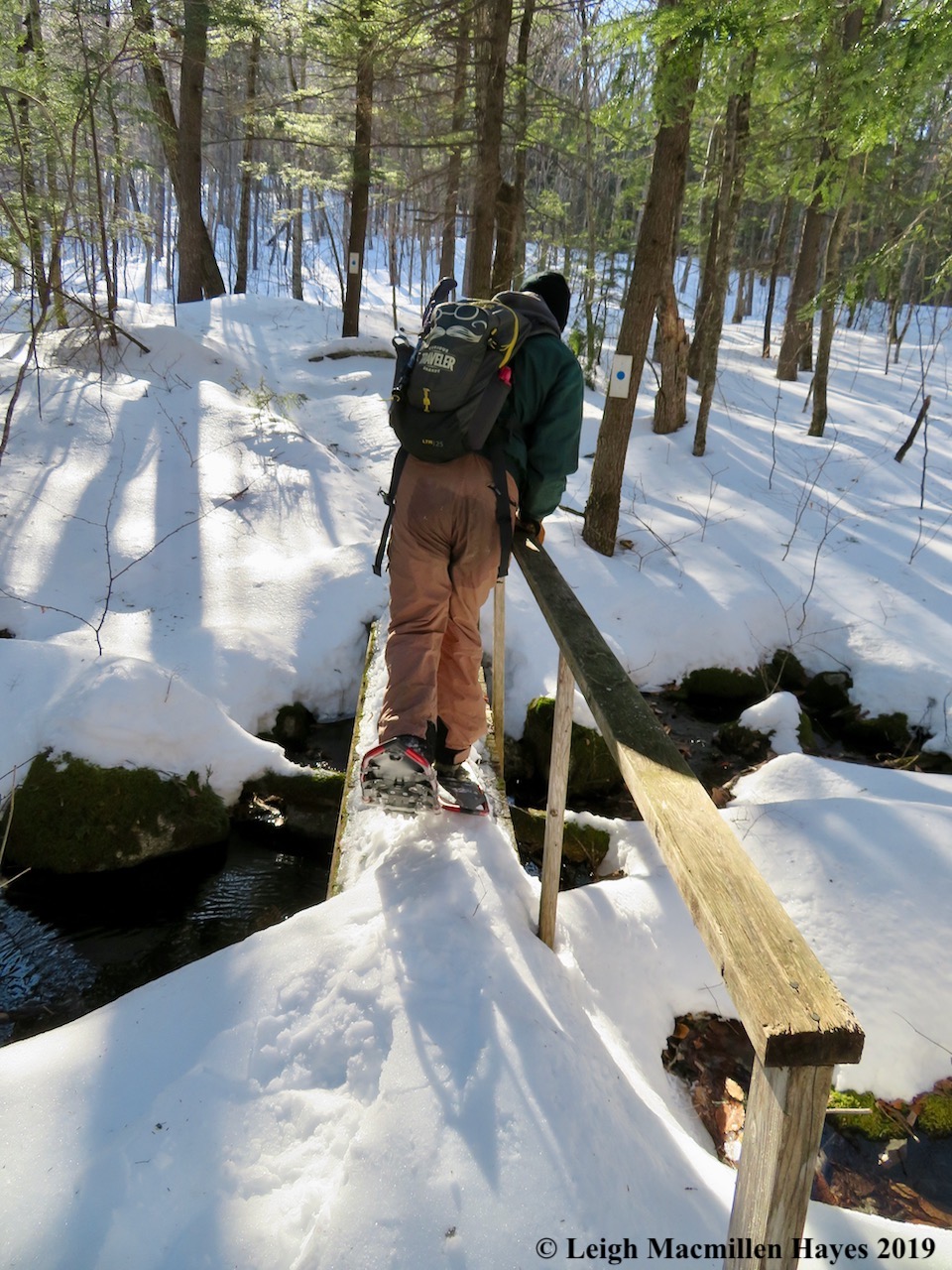
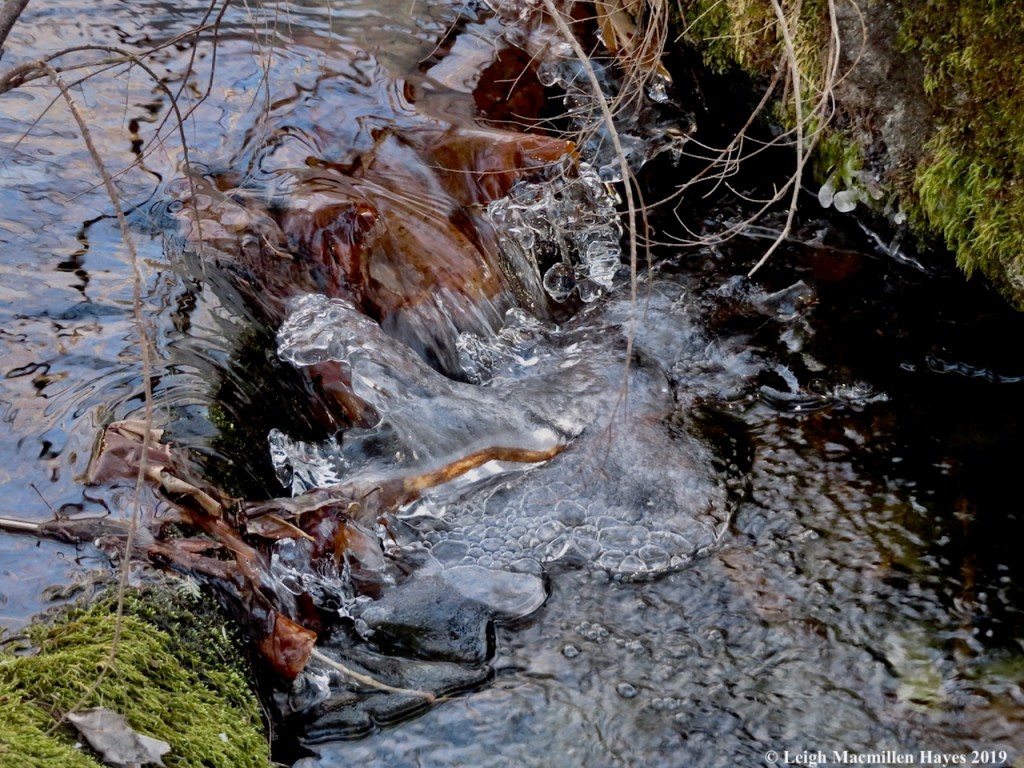
Stop, Look, and Listen

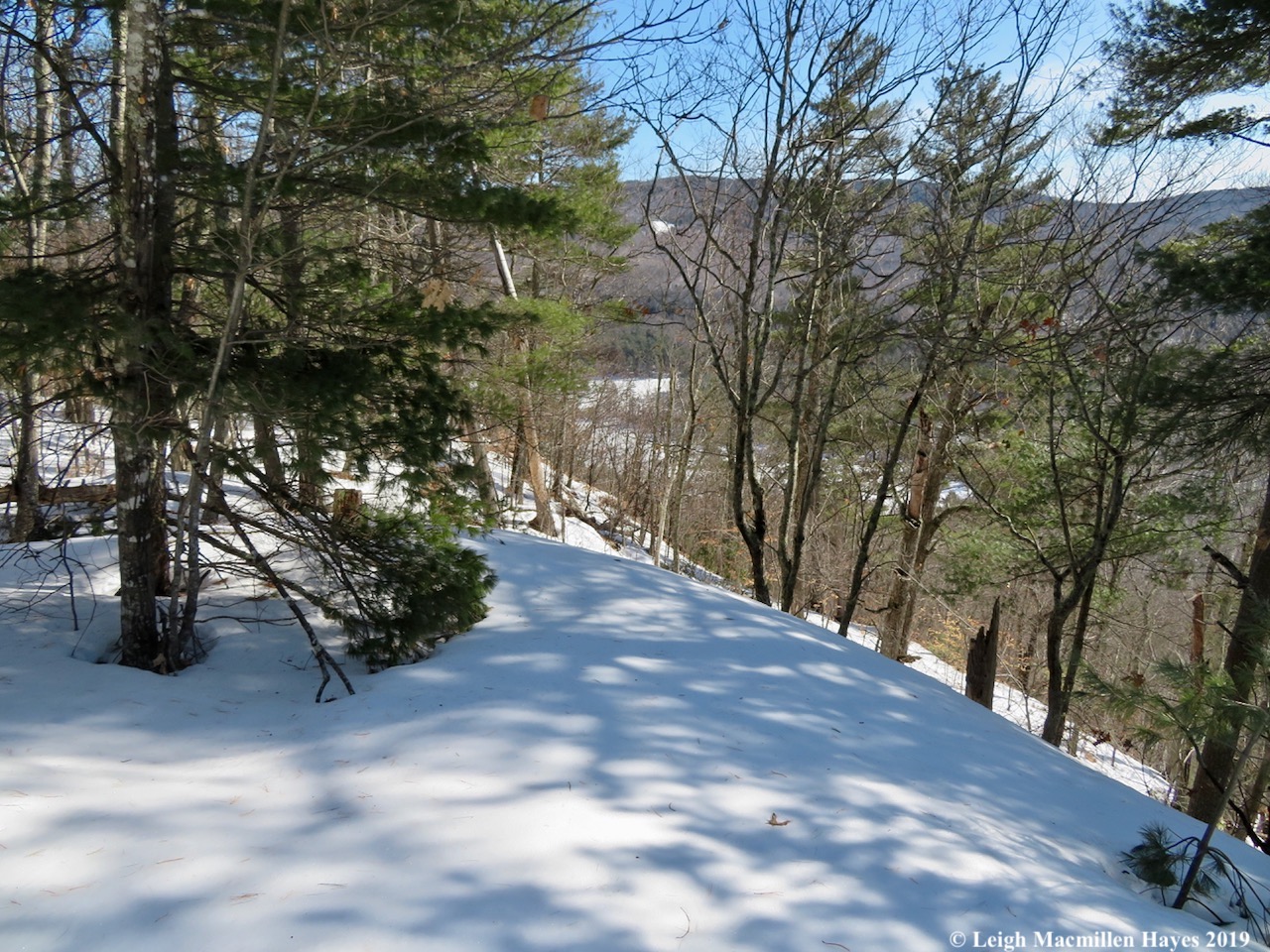
I’m a wanderer both on and off trail, and sometimes the path has been macadamized. Such was my following this morning as I paused on the way home from running an errand in North Conway, New Hampshire.

I’d stuck to the backroads on my way out of state to avoid road construction on Route 302, but knew that upon my return I wanted to stretch my legs along the Mountain Division Trail in Fryeburg.
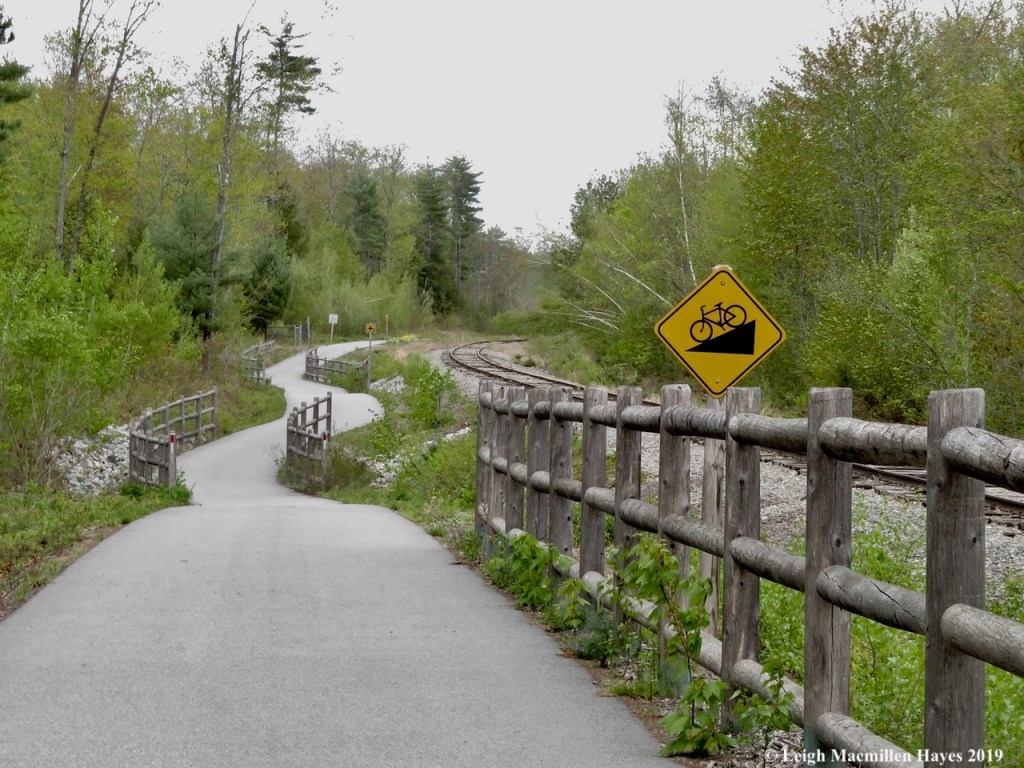
The delightful four-mile rail trail, so named for the railroad line it parallels, intended for walkers, runners, bikers, roller bladers, etc., extends from the Maine Visitors Center on Route 302 to the Eastern Slope Airport on Route 5 and can be accessed from either end or several points between.

The wind was blowing and the bug count low, so though it wasn’t a warm, sunny spring day, it was a purely enjoyable one. And the cheery cherry flowers enhanced the feeling.
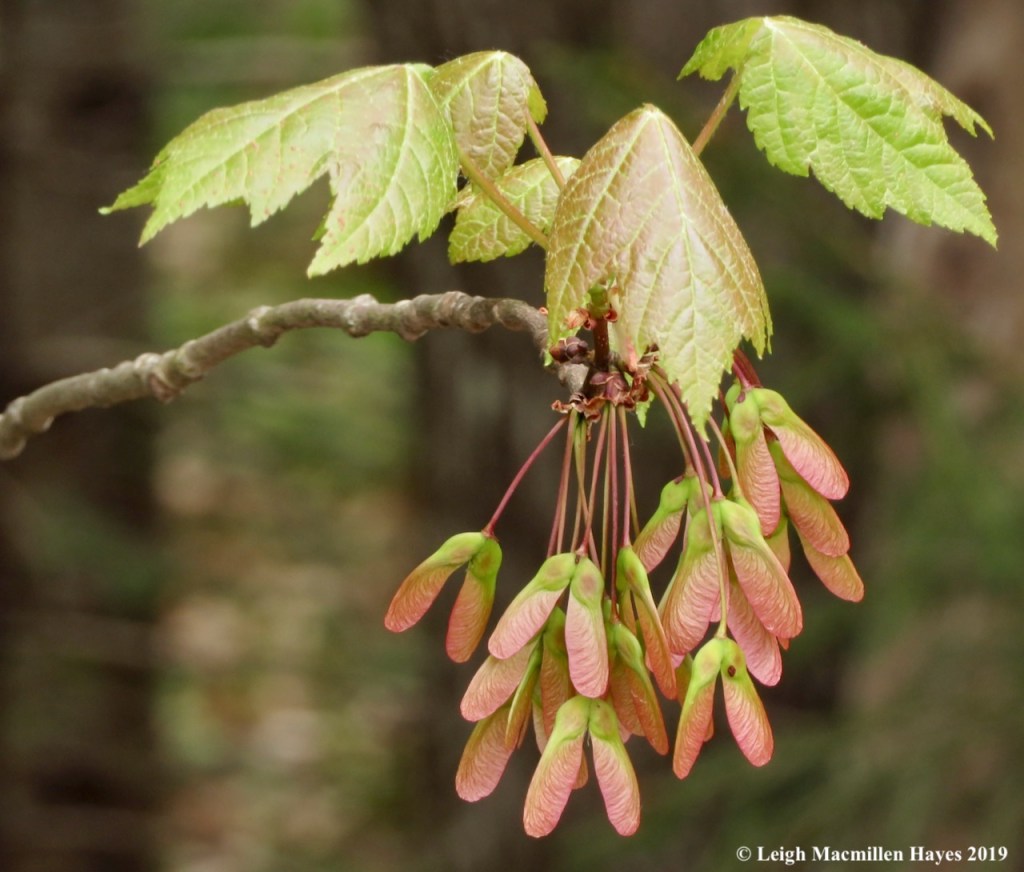
All along the way, it seemed, the Red Maples had not only leafed out, but yesterday’s flowers had magically transformed into today’s samaras that dripped below like chandeliers.

Lovely tunes and chips were also part of the landscape and I have no idea if I’ve identified this species correctly, but I’m stepping out on a branch and calling it an Alder Flycatcher. I’m sure those who know better will correct me. The naming isn’t always necessary, however. Sometimes, it’s more important to appreciate the sighting, the coloration, and the sound. For this bird, it was the dull olive green on its back that caught my attention.

And then up above on the other side of the track, it was the “Cheery, Cheery, Cheerio” song that helped me locate the American Robin in another maple raining with seeds.

Maples weren’t the only trees showing off their flowers, and those on the Northern Red Oaks reminded me of grass hula skirts below Hawaiian-themed shirts.

Even the ordinary seemed extraordinary like the Dandelion. Each ray of sunshine was notched with five “teeth” representing a petal that formed a single floret. Fully open, the bloom was a composite of numerous florets.
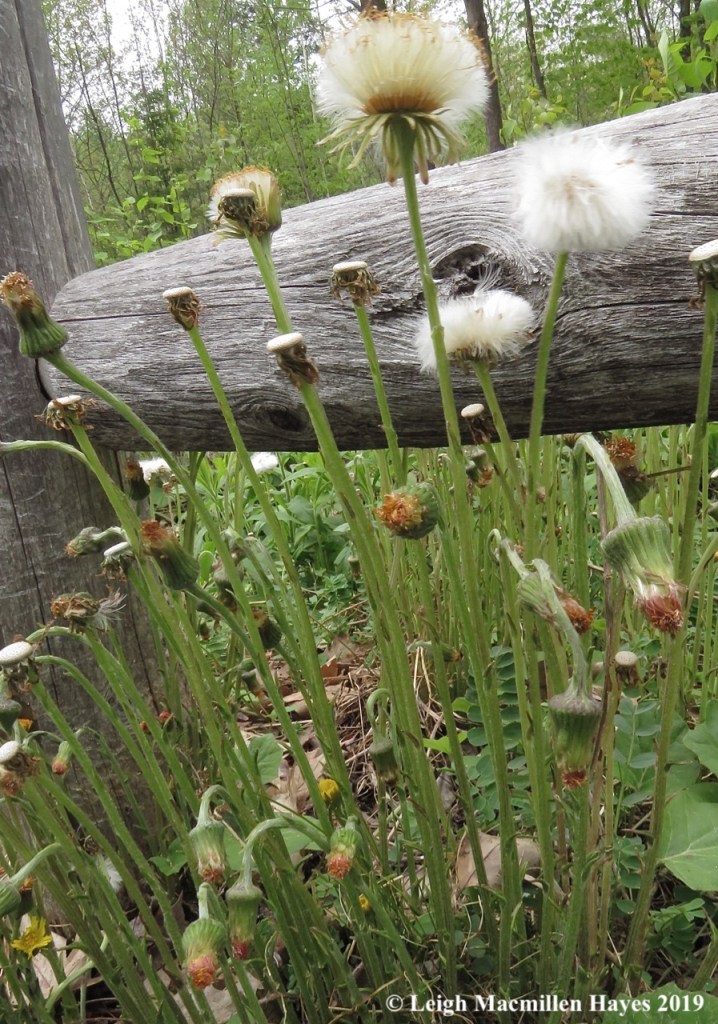
Nearby, its cousin, the early blooming Coltsfoot, already had the future on its mind and little bits of fluff blew in the breeze.

Eventually, I reached Ward’s Pond and after scanning the water found a Painted Turtle seeking warmth. The day was overcast and there was a bit of a chill in the strong breeze. Being down below the trail, at least the turtle was out of the wind and I had to assume that the temperature was a bit higher than where I stood.

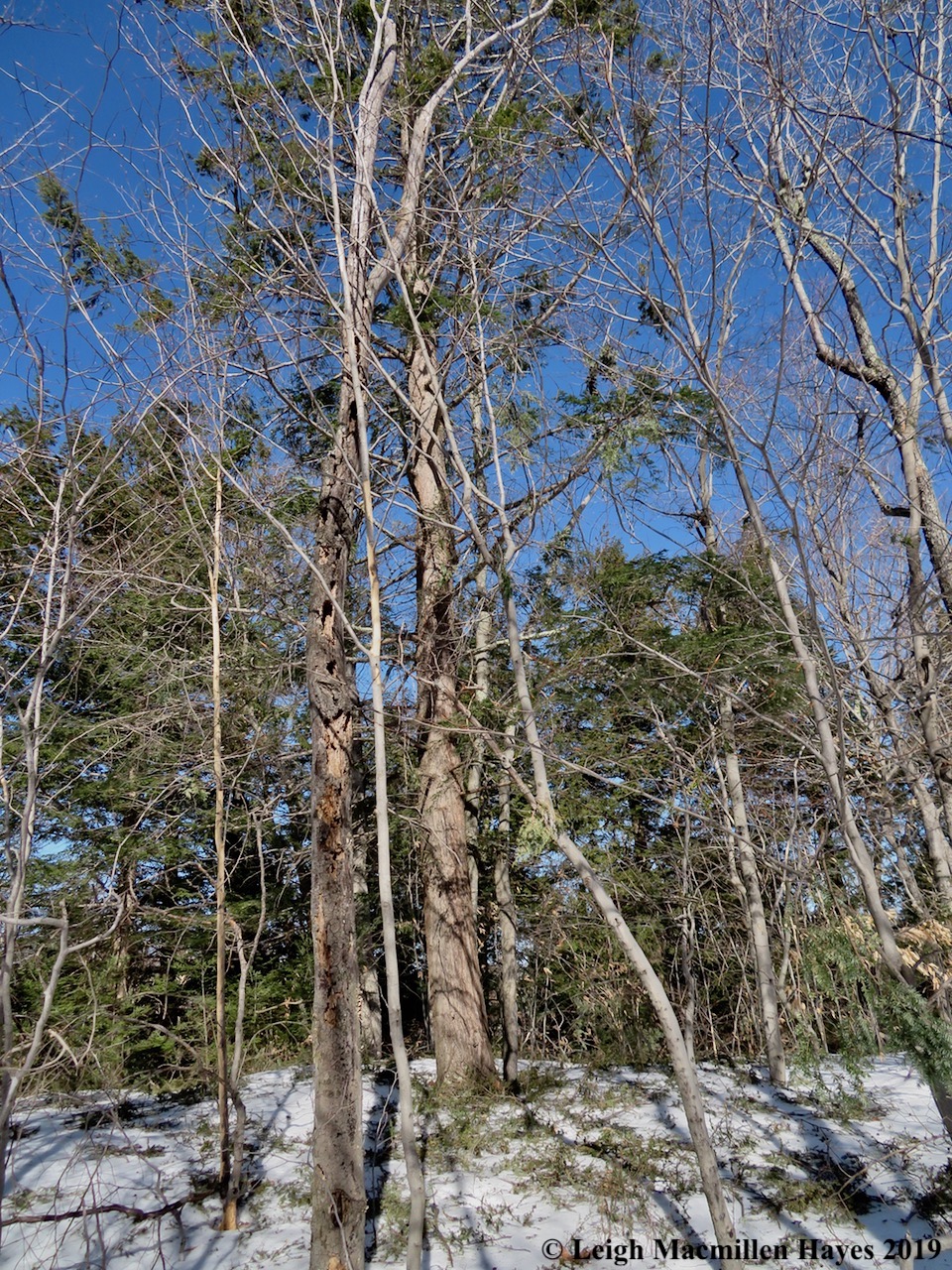
This is a trail that may look monotonous, but with every step there’s something different to see like a Pitch Pine showing off three generations of prickly cones. What was, is, and shall be all at the tip of the branch.

It seemed like every time I looked to the left, such as at the pine, a sound on the other side of the trail caught my attention. And so it was that I realized a White-tailed Deer was feeding on grasses behind a fence by a now-defunct factory (so defunct that the roof had collapsed under the weight of snow). Notice her ears.

And now look at her again. A deer’s ears are like radar and she can hone in on a sound by turning them.

I don’t know if she was listening to me or to the Eastern Towhee telling us to drink our tea.

After 2.5 miles, I decided to save the rest for another day and follow the path back. Though loop trips are fun, following the same path back brings new sights to mind, like the Interrupted Fern I’d walk past only a few minutes before. Notice its clump formation known in the fern world as vase-like.

And the butterfly wings of its interrupting leaflets covered with sporangia. My wonder came with the realization that within the interruption not all of the pinnules or subleaflets were covered with the bead-like shapes of fertility. Spores stored within essentially perform the same function as a seed: reproduce and perpetuate the species. So–is part of the pinnule fertile while the rest remains sterile? Do I need to check back? Oh drats, another trip to make along the Mountain Division Trail. Any excuse to revisit it works for me, though one hardly needs an excuse.
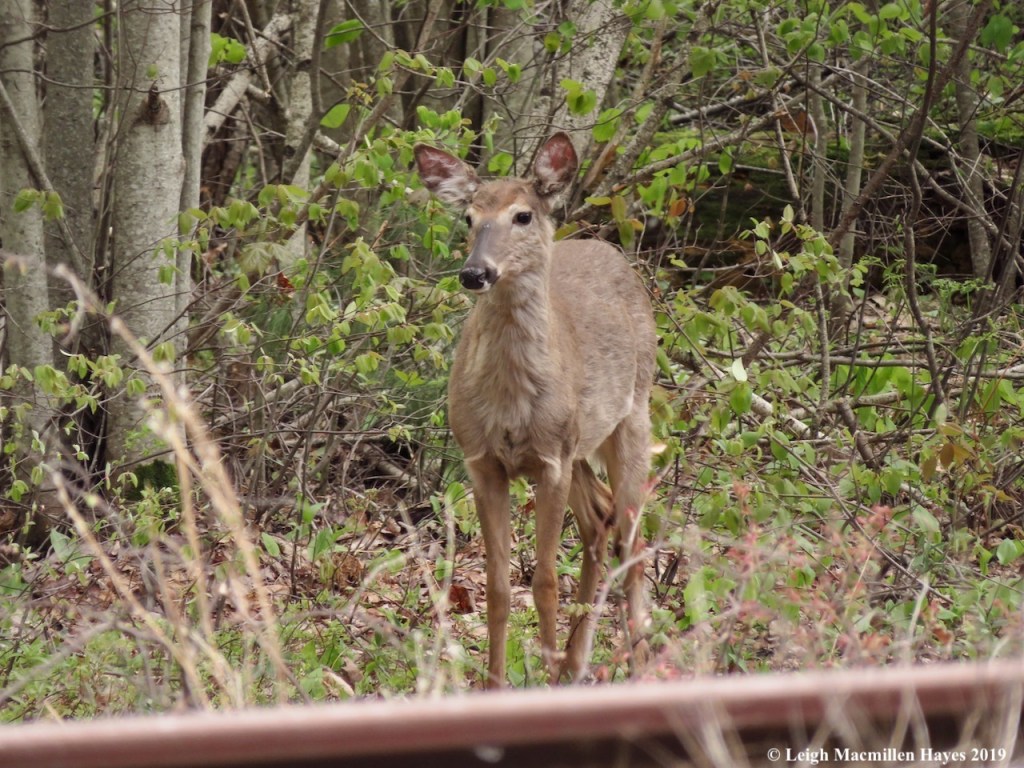
Further along I looked to the other side of the tracks for I’d spotted bird movement. Behind it was the reason–my White-tailed Deer friend. I have a feeling people feed it for it seemed not at all disturbed by my presence, unlike the ones in our yard and the field beyond that hear my every move within the house even in the middle of winter and are easily spooked.

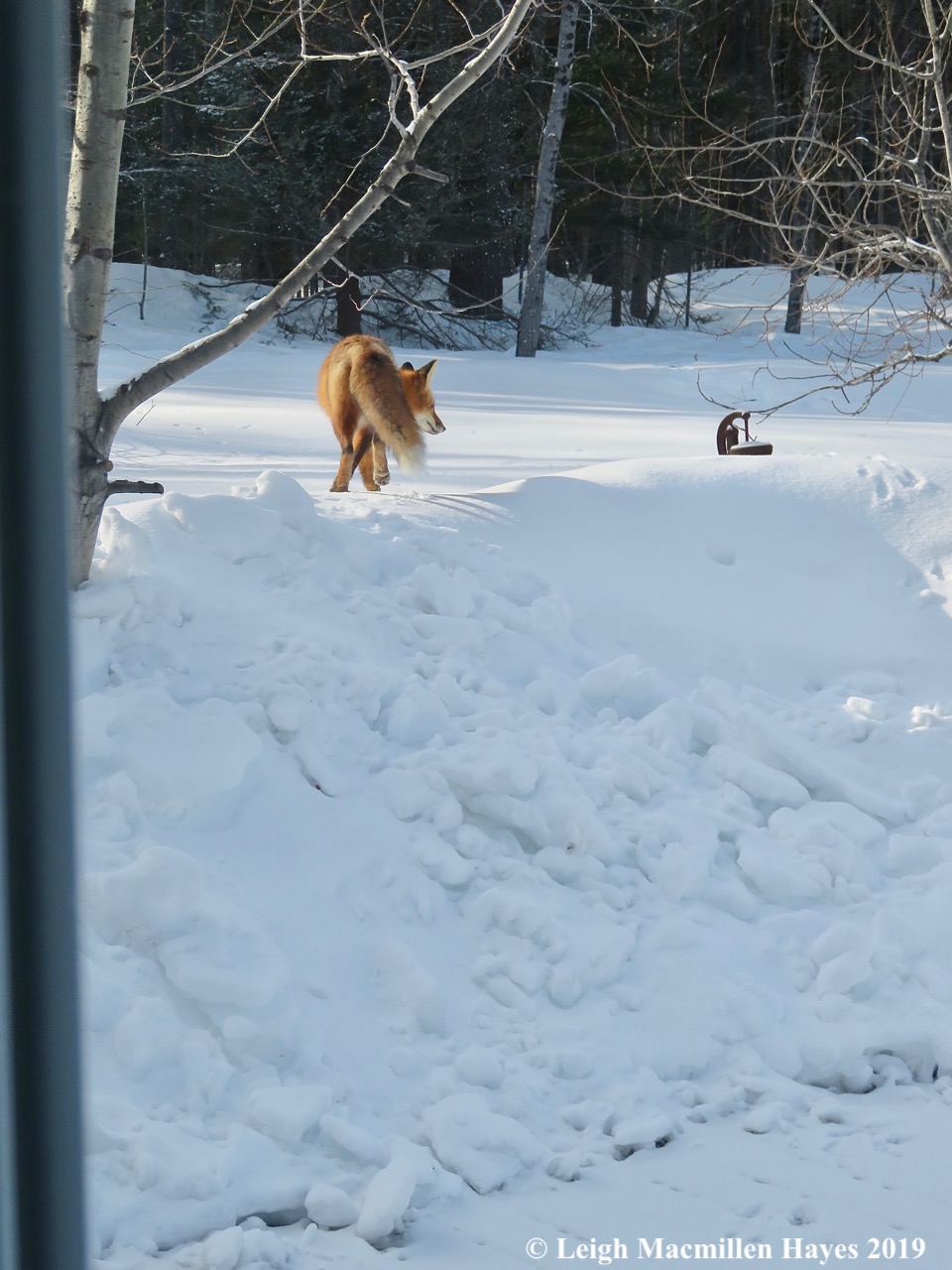
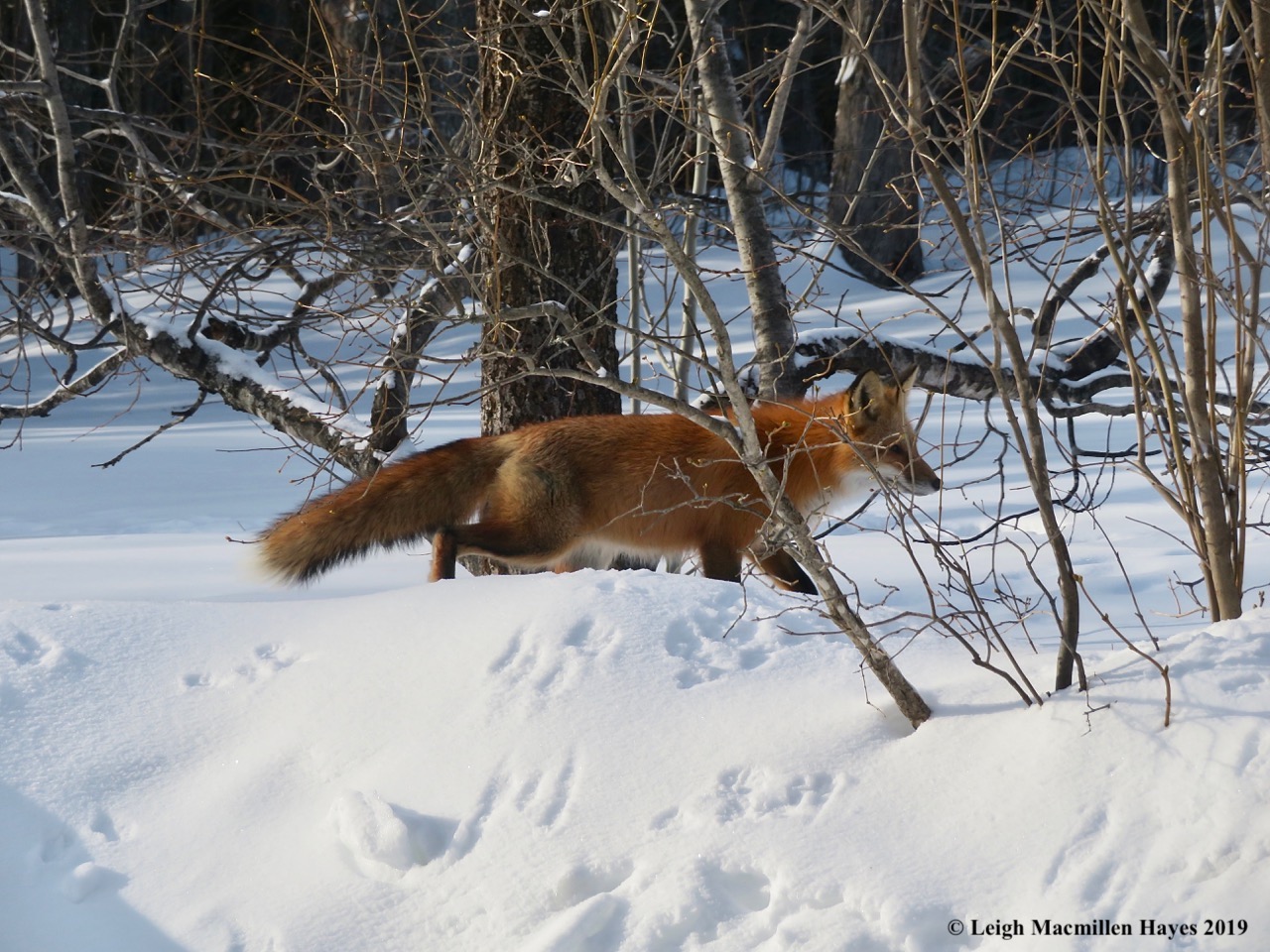
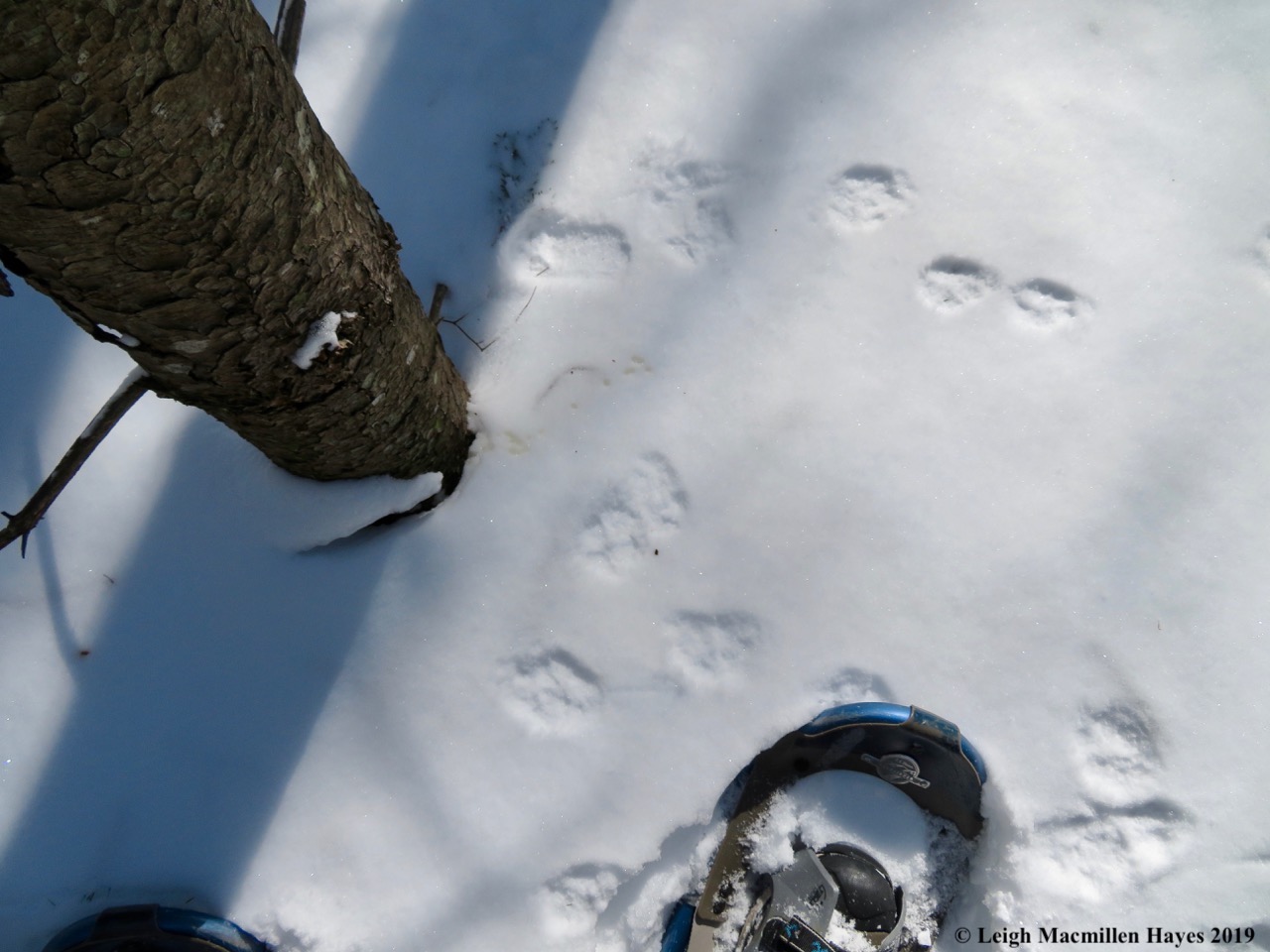
The deer, however, wasn’t the only wildlife on or near the trail. Suddenly, a Red Fox appeared and we each considered the other. He blinked first during our stare down and trotted away.

Passing by Ward’s Pond once again, I stopped to check on the turtle. It was still in the same spot I’d seen it probably a half hour before.
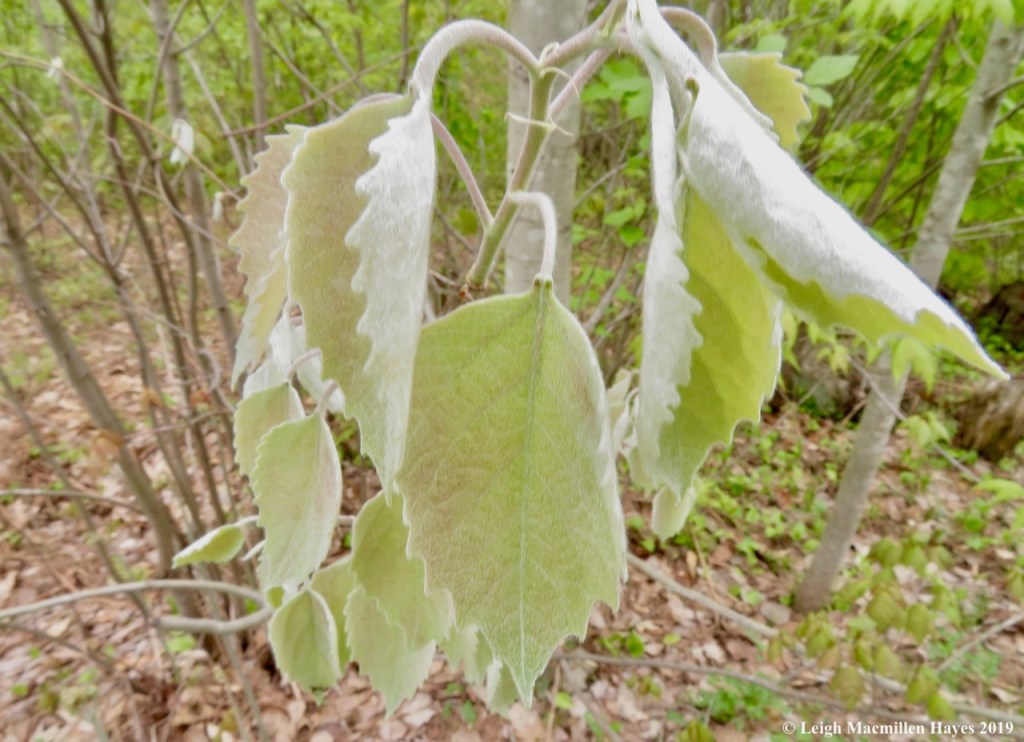
Not far from the visitors center, a Big-Toothed Aspens chose to be examined for the soft downy feel as well as color of its leaves. The various hues of color in leaves during spring is caused by the presence of pigments called anthocyanins or carbohydrates that are dissolved in the cell sap and mask the chlorophyll. As the temperature rises and light intensity increases, red pigment forms and acts as a sunscreen to protect the young leaves from an increase in ultraviolet rays.

Because I was standing still and admiring the leaves, I heard another bird song and eventually focused in on the creator.

And so I have the Big-Toothed Aspen to thank for showing me the Indigo Bunting. My first ever. (Happy Birthday Becky Thompson.)

A turtle. A deer. A fox. A towhee. A bunting. All of that was only a smattering of wonder found along the Mountain Division Trail. If you go, make sure you recall the old railroad signs: Stop, Look, and Listen.

Bear to Beer: Bishop Cardinal to Lord Hill

Our destination sounded rather regal; as if we’d be paying our respects to Bishop Cardinal and Lord Hill. And indeed we did.

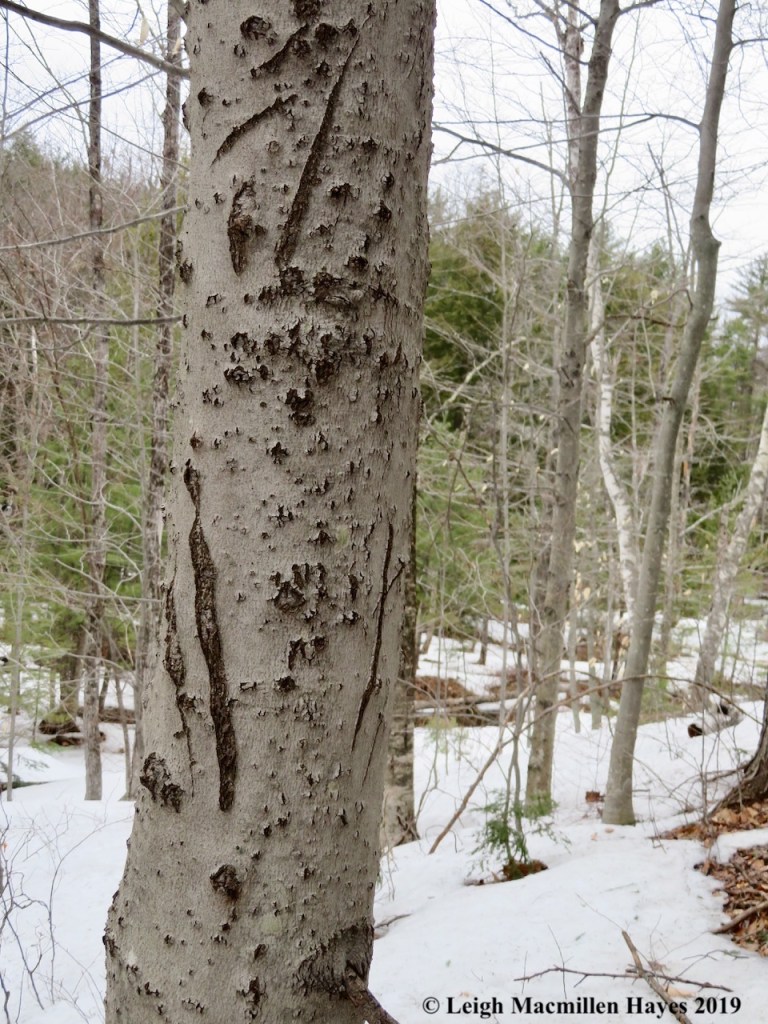
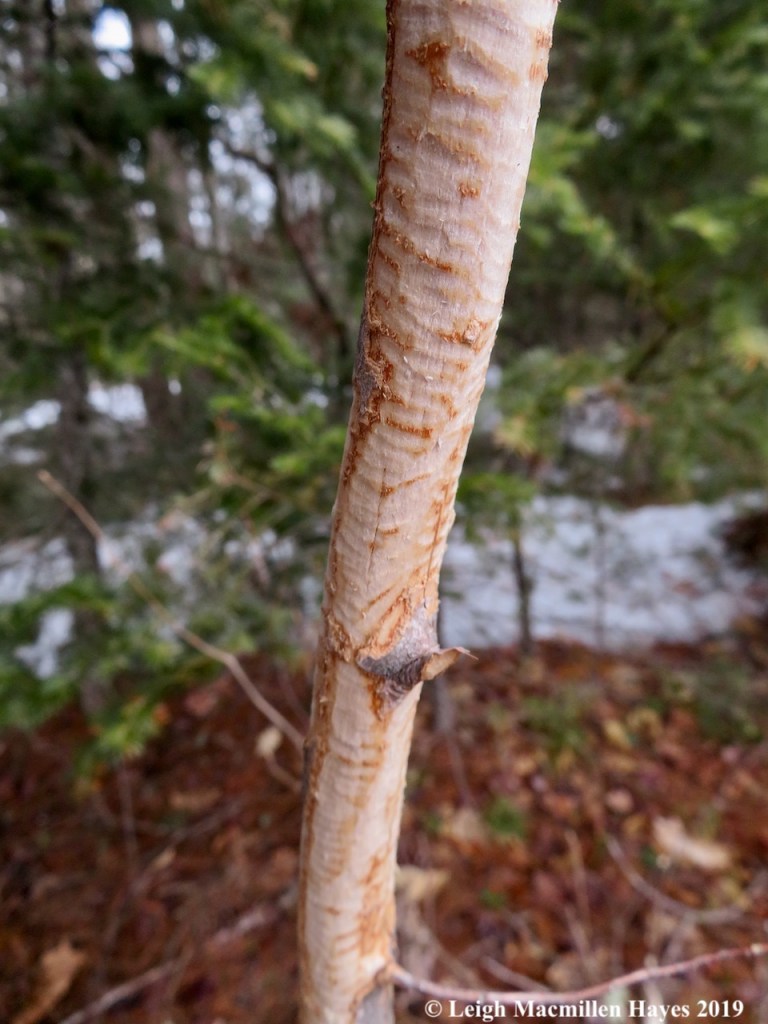
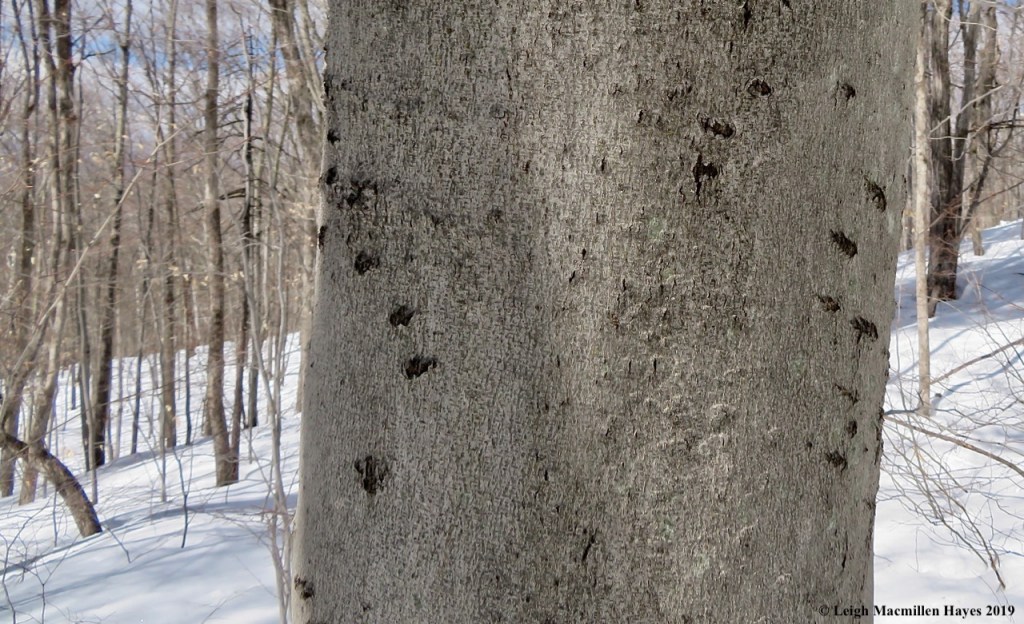
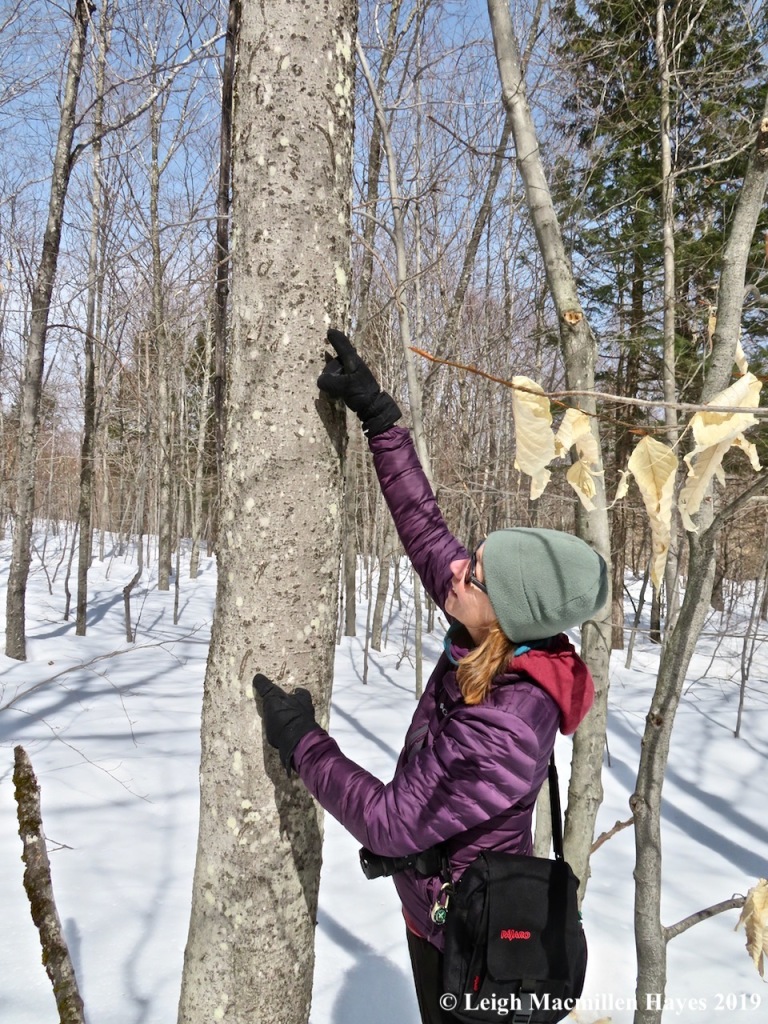
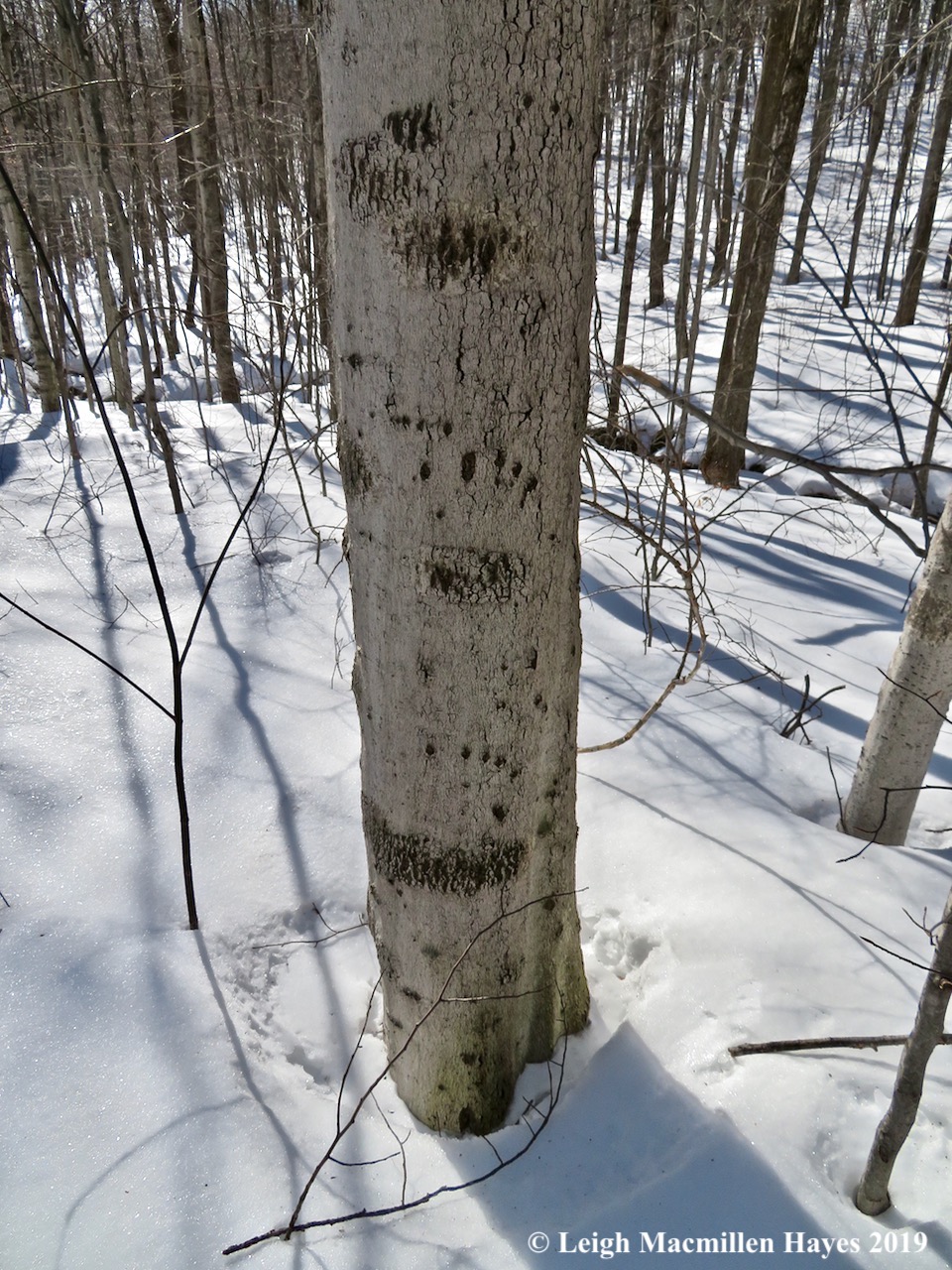
We also paid our respects to telephone poles. Well, actually only certain ones. They had to have a certain look–as if a Black Bear had backed into the pole and turned its head around at an angle and bit the wood with its upper and lower canine teeth thus leaving nearly horizontal marks that look like a dot and dash. In the process, the aluminum numbers had to be a bit mangled in order to receive our attention. This particular pole was right by the trailhead and so after examining it, we headed up the blue trail at the Greater Lovell Land Trust’s Bishop Cardinal Reserve on Horseshoe Pond Road in Lovell.

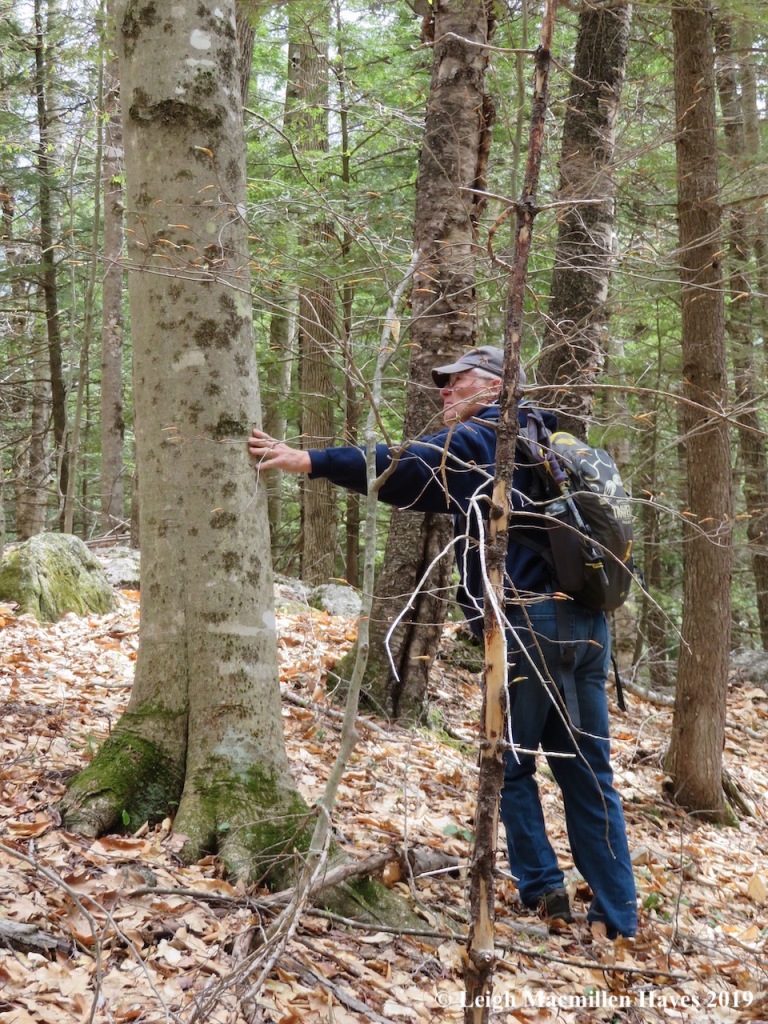
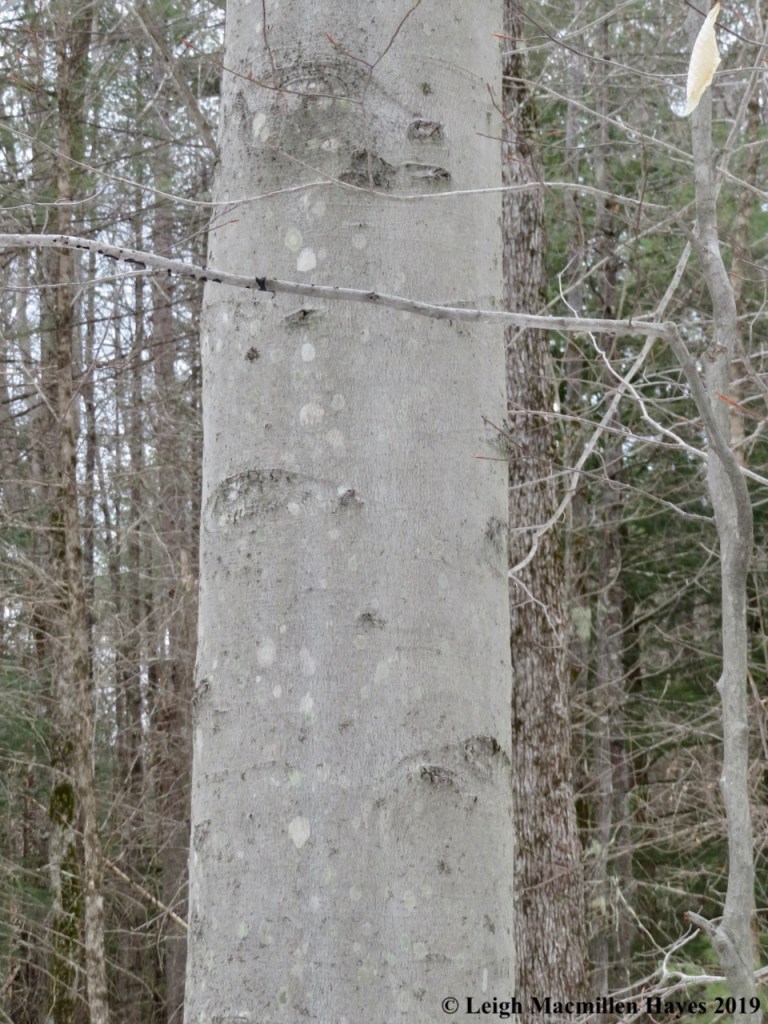
Along the way, we examined every American Beech we saw, but actually passed by a spot where we know there are several with the marks we sought. If you go, look for the blue dot on the white arrow and hike in at a diagonal from there.

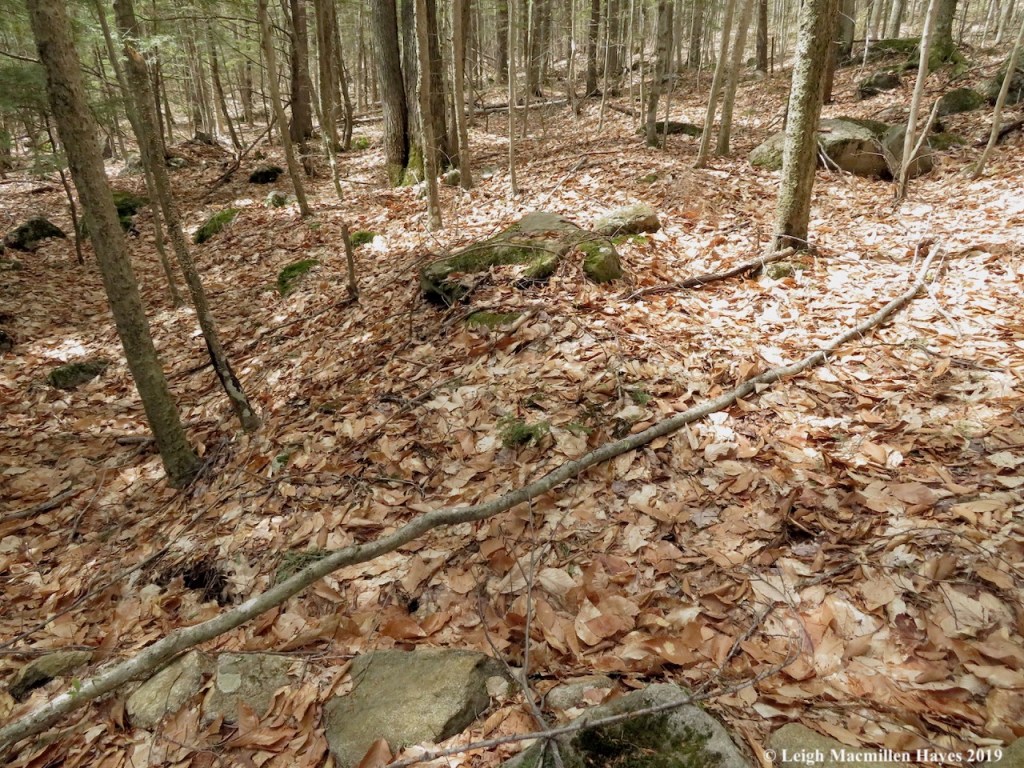
Our hope today was to find other bear claw trees we’d missed previously and so we kept going off trail in search. Turning onto the red trail, we continued to check. Sometimes it’s the shape of the tree’s crown that makes us wonder.

We have learned that we can’t dismiss any bark without walking all the way around and bingo–we had a new-to-us bear claw tree.

I don’t know why it is, but those marks make our hearts sing. Perhaps it’s the knowledge of the wildness of it all and the fact that we share this place with such intelligent beings.

Whatever it is, we decided that rather than creating waypoints for each tree we found, we’d try to remember the location by using other landmarks such as a certain waterbar that was intended to divert snowmelt and rain from washing out the trail. When you reach that certain waterbar on the red trail, turn left and walk in about twenty yards. If you don’t find our tree, perhaps you’ll discover another.

Continuing up the trail, we did note a few other favorites off to the right.

Sometimes, in my mind’s eye, I could just see the movement of the climber.

With one such tree, the marks were lower than most and I wondered if it was a younger bear. Of course, we have no idea how long ago those marks were left behind. Mary Holland suggests a way to age them that we haven’t tried yet. And we didn’t look for fresh marks. Really, we need to be better sleuths going forward.

In case you are wondering, occasionally we noted other points of interest, such as the burst of beech buds, their spring green leaves all hairy and soft, which is actually quite a contrast to the papery feel they eventually acquire.

Here and there, the cheerful display of Round-leaved Violets brightened the path.

And drone flies, with their bigger than life eyes, posed. Any black flies? Yes, a few, but not biting . . . yet.

We were almost to the old shack site, if you know where I mean, when our journey off trail revealed another fine specimen. Again, the claw marks were on the backside since we approached from the trail. Always, always, always circle about and you might be surprised.

Eventually, we reached the intersection with the trail to Lord Hill and continued our surveillance as we continued our hike.

Once we turned right onto the Conant Trail, we did find one tree with marks long ago made . . . by some bears with either an extreme understanding of relationships, or more likely, a few who weren’t all that intelligent after all.

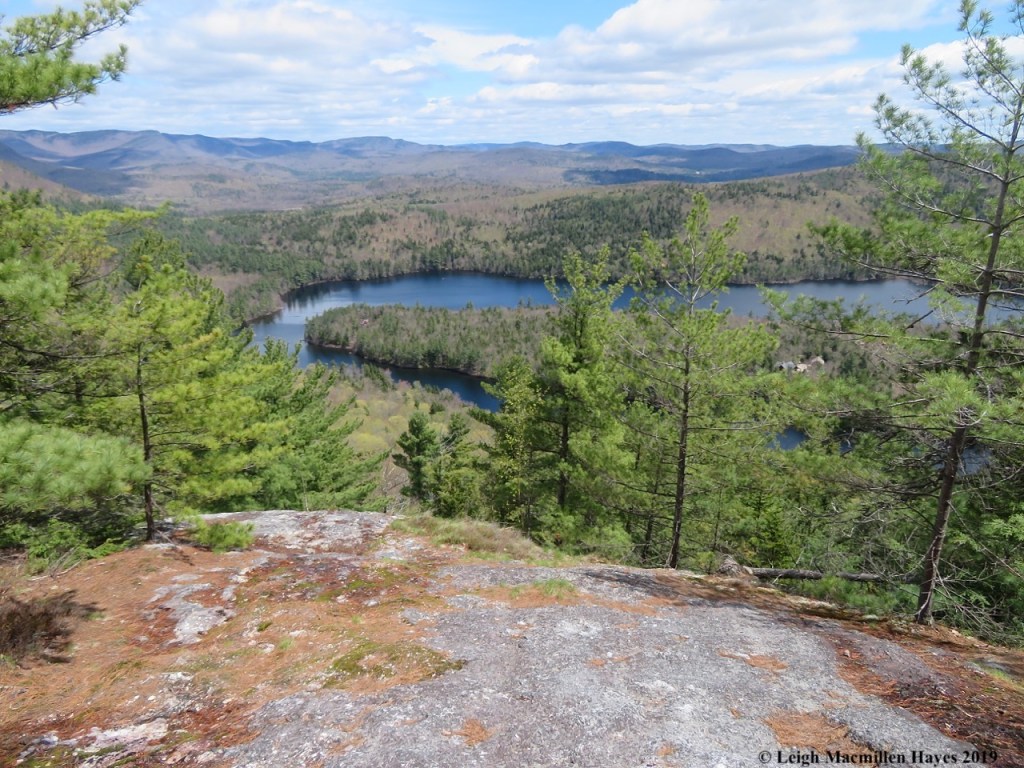
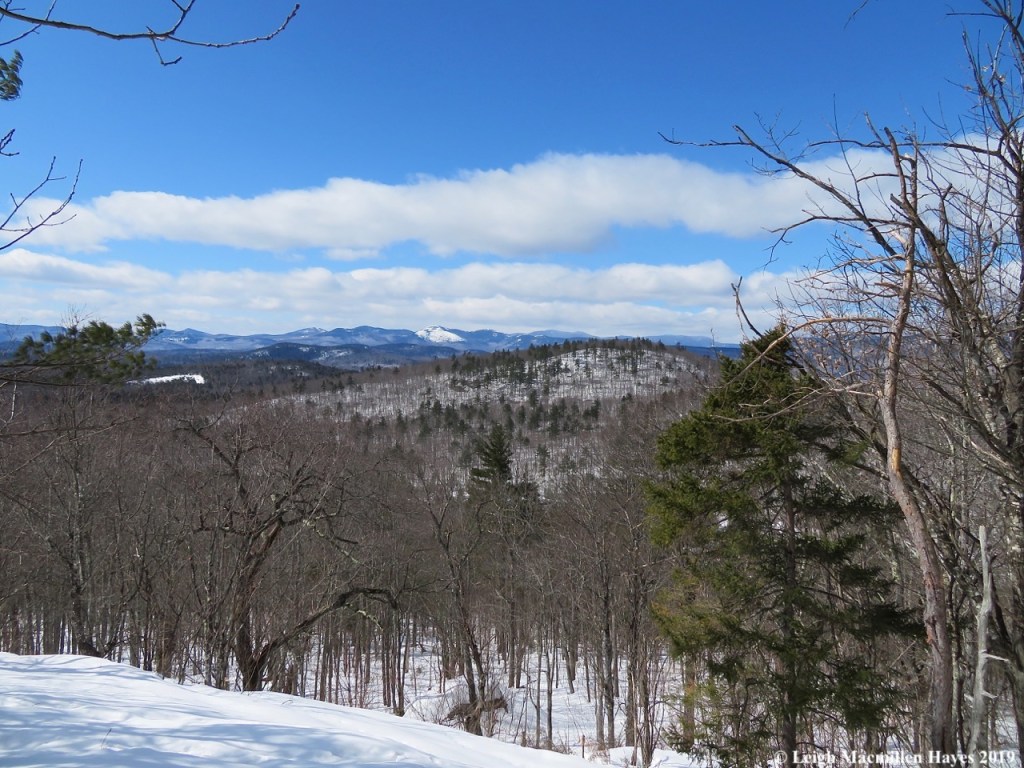
At last, the trail opened onto the ledges overlooking Horseshoe Pond and it was there that we sat down on the warm granite as a nippy breeze flowed across. Enjoying the view of Horseshoe Pond below and the mountains beyond, we ate lunch.

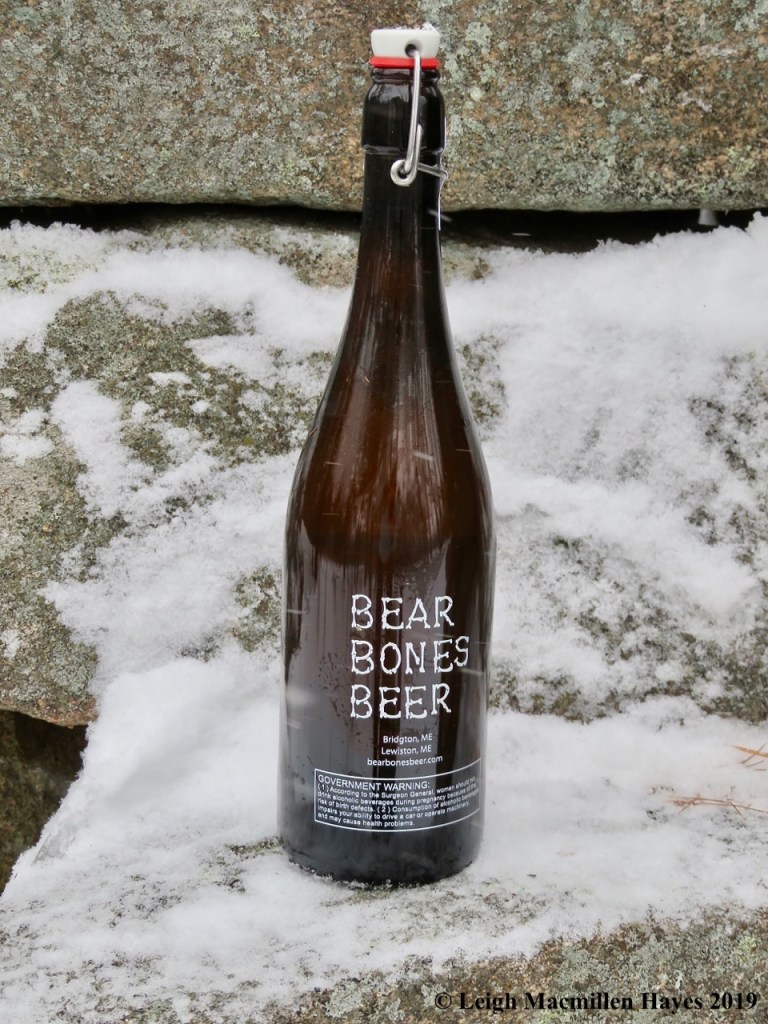
We also toasted a few others with a Honey of a Beer brewed by Lee of another spelling! Dubbel Trouble was double delicious. Thank you, Lee Fraitag. ;-) Our toast was also doubled for we gave thanks to Paula and Tom Hughes, who live just below on the pond. Tomorrow we’ll enjoy a Mother’s Day Brunch at the Old Saco Inn courtesy of the Hugheses. ;-)

Clink. Clink.

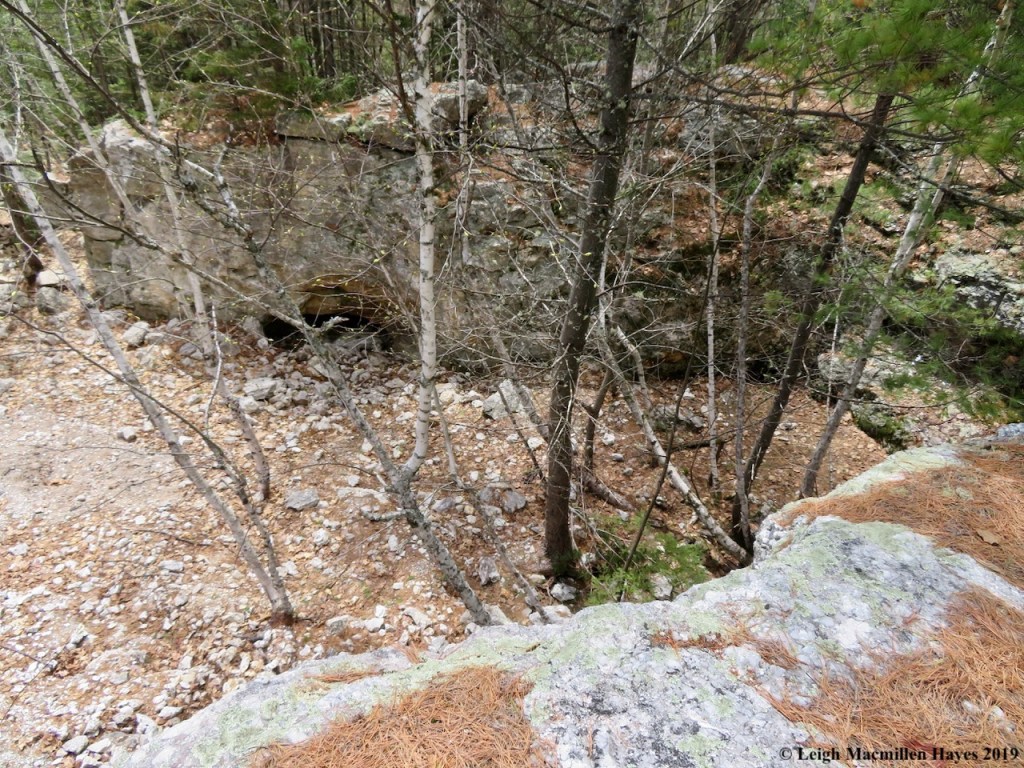
After enjoying lunch rock we journeyed up to the Lord Hill Mine.

According to mindat.org, Lord Hill Mine was “a former rare mineral specimen quarry. Briefly worked in episodes in the mid-20th century for feldspar. Originally a mineral collector’s site in the late 1870s. Opened by Nathan Perry and Edgar D. Andrews in the early 1880s. Originally called Harndon Hill, but the named changed in a complex change of names about 1917. Operated solely by Nathan Perry by 1882. Operated for massive topaz for educational mineral collections in the 1970’s by Col. Joseph Pollack of Harrison, Maine. The locality is the type locality for hamlinite, now regarded as a synonym for goyazite. Granite pegmatite. Oxford pegmatite field. Local rocks include Carboniferous alkali feldspar granite (muscovite accessory mineral).

We spotted several people busy digging for their fortunes and decided to let them. They either were so tuned in to their work that they didn’t hear us or they chose not to. No matter. After a quick look about, we quietly followed the mine trail down–our own focus still on the trees.

And at the point where the National Forest abuts the Greater Lovell Land Trust’s property, we turned back onto the land trust’s loop trail. We’d come up from the left, so turned right to continue our descent.

And yes, we found one more bear tree. Somewhere along the way, I lost track of the number of new finds. But, we trusted that for all we found, there were so many more we must have missed. And then some.

Back on Horseshoe Pond Road, we turned left and checked all the telephone poles along the edge, examining each for bear hair because we’ve seen it stuck on them before. Today, no hair.

So why do the bears pay attention to telephone poles? Think of it as a combo backscratcher and messageboard. Pretend I’m a young male, ready and available. Wanna go out for a date tonight? Give me a call.

Despite the lack of hair, because we were looking, we found a Mayfly. That in itself, was another reason to celebrate.

Bishop Cardinal and Lord Hill. We thank you both. Black Bears, we thank you. Lee, we thank you. Paula and Tom, we thank you. (Happy Mother’s Day, Paula) All are regal indeed.

Bear to beer possibilities: Bishops Cardinal Reserve and Lord Hill Mine.

Doubting Spring?

Finicky weather–rain one day and then another, sunshine the next, and then snow in the forecast as it is for Tuesday morning. But still, all the signs are there.

Take for instance the clumps of deer hair that have been shed and now decorate areas where the ungulates do bed.

And the masses of eggs attached to twigs and vegetation within vernal pools, the Spotted Salamander’s a milky white contrasting the Wood Frogs tapioca presentation.

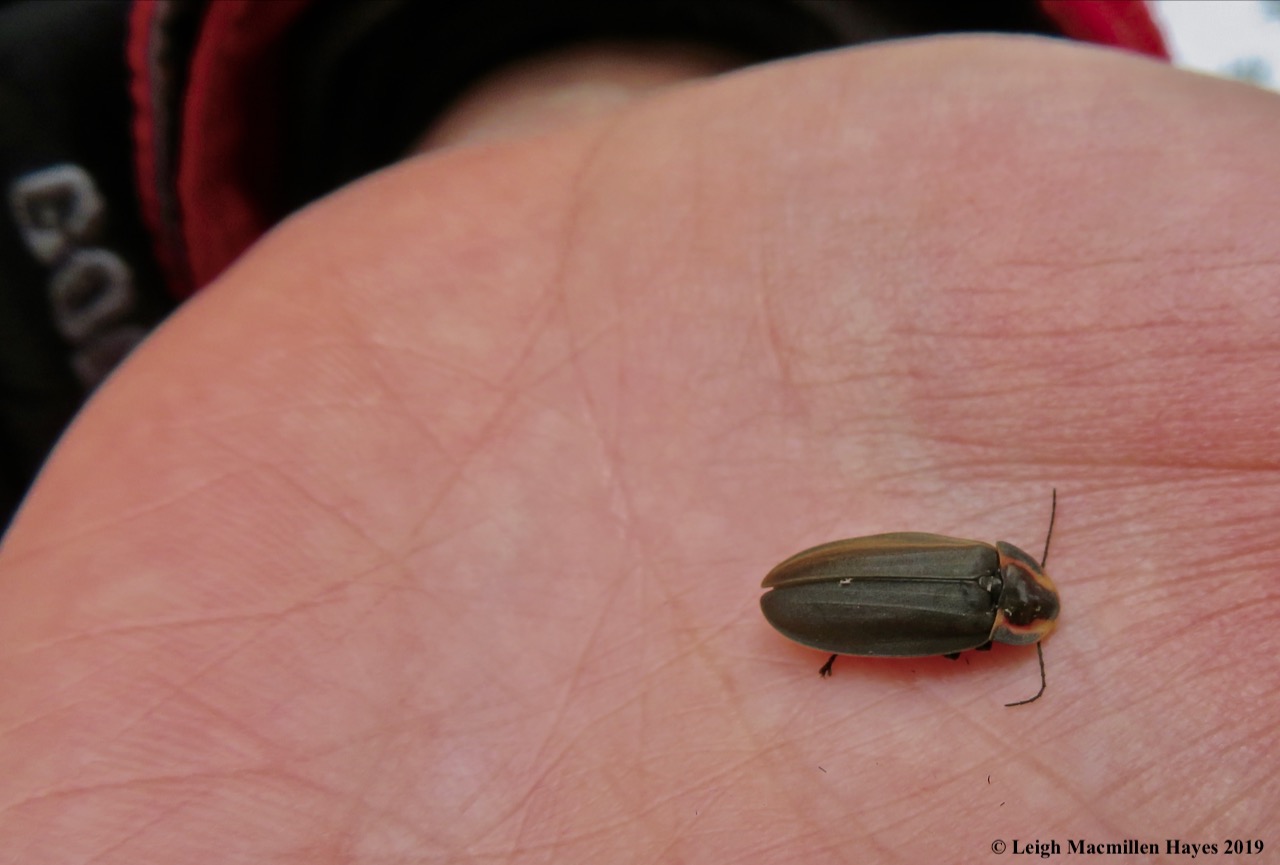
Then there’s the winter firefly in one of his favorite habitats where the water stands still . . . until a breeze ripples across.

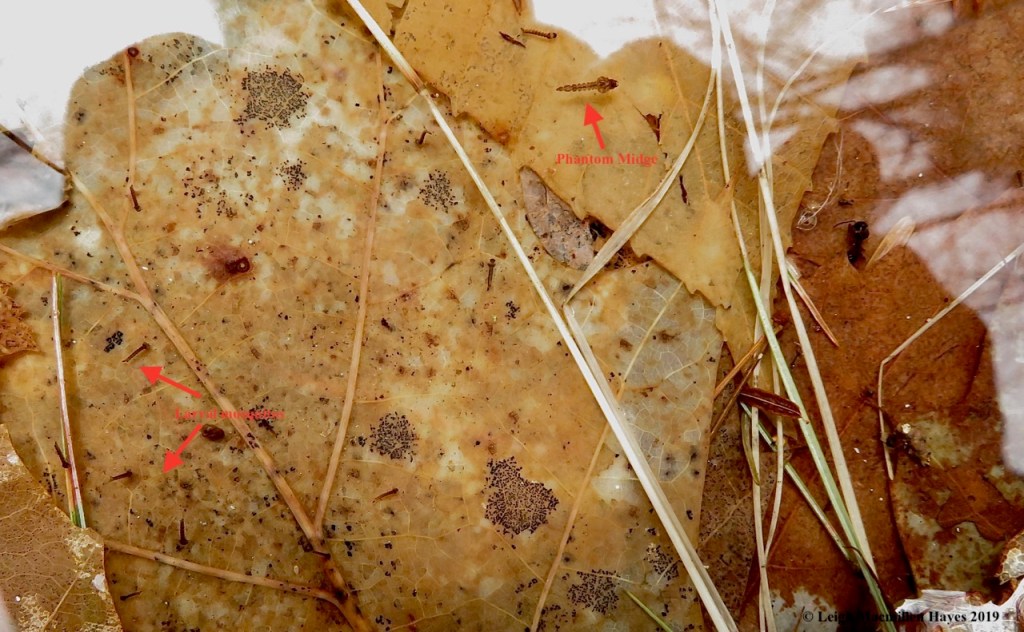
And within the water column, the wriggling Larval Mosquitoes continuously somersault, while the Phantom Midge floats as it waits for a meal to pass by.

Drone flies do just that–fly, their compound eyes announcing alarm as they take in every teensy bit of movement in the surrounds.

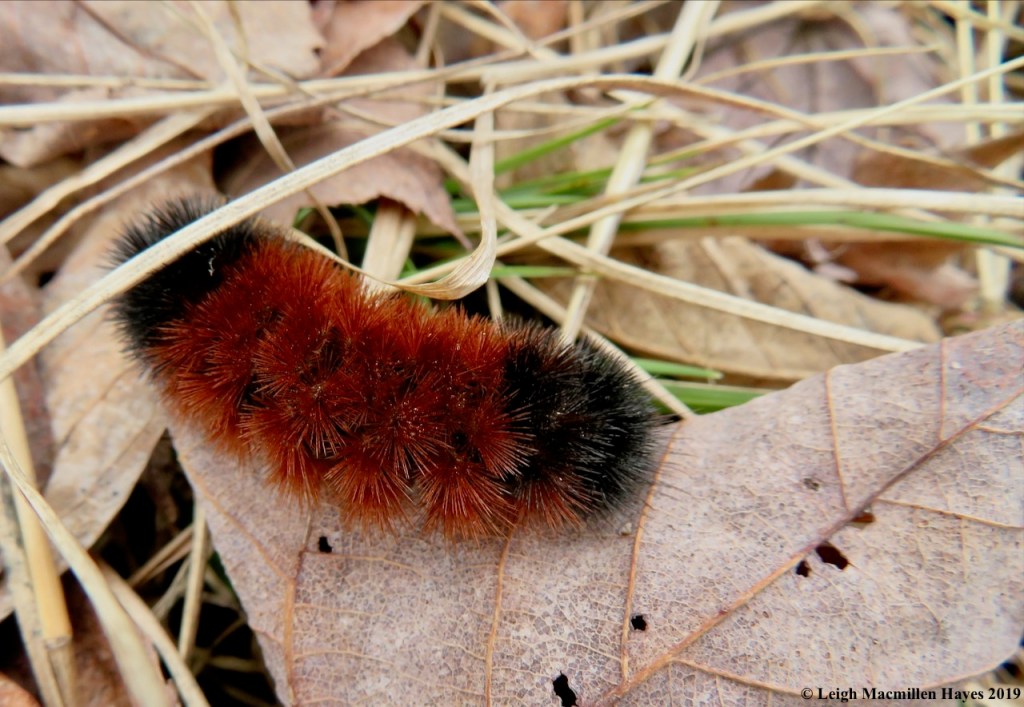
The sight of a wooly caterpillar might make one think the season is six months out, but a cryoprotectant in its tissues so it can literally freeze solid, has thawed and the fuzzy little bear crawls.

The Saco River with Mount Tom behind was another sign, for over its banks had it flowed.

And then, where previously I’d spotted only the vixen, not one or two, but five kits frolicked.

Mom was nowhere in sight, but I trusted she had sent them out to get some fresh air while she cleaned the den.

A move to another location, brought more sights and scents and sounds, but one of the most delightful was that of the sweet-fern–its spicy aroma suddenly filling the air.

And at a semipermanent pool, a few wrucks chorused by distant Wood Frogs.

But by my feet, Eastern Red-spotted Newts swam about camouflaged by last year’s foliage.

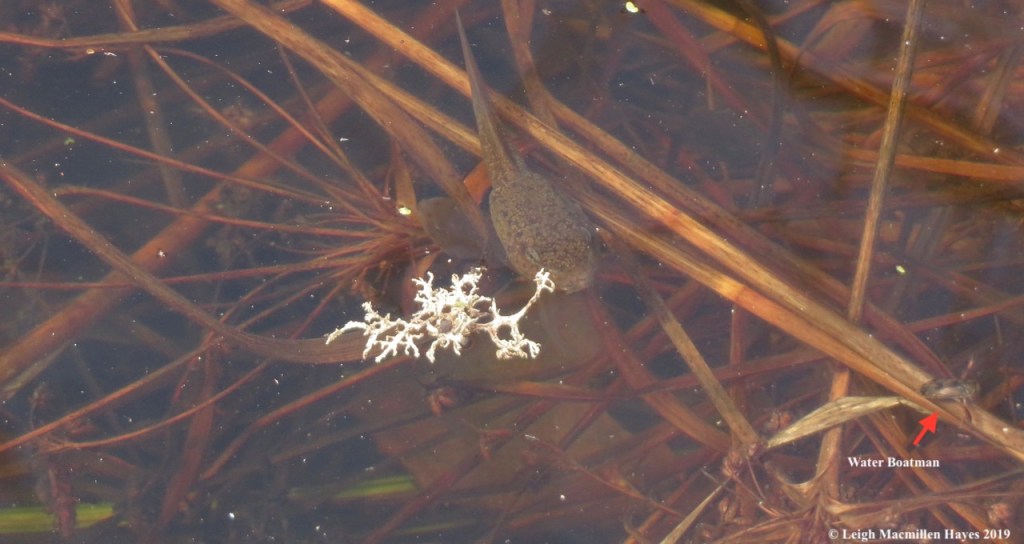
One climbed another, and then slide off, any mating waiting for another time. Curiously it also mounted a Bull Frog tadpole, but quickly moved on when it wasn’t well received.

The chunky Bull Frog larvae had overwintered as tadpoles, but their metamorphosis into adult form probably won’t be completed by the end of this season or the next.

In fact, it can take several years for them to completely develop. In the meantime, they sat motionless basking in the diluted sunlight offered.

There was so much to see on this day and only so much time, but from the Red Maple flowers falling to the ground to the Tamarack needles growing with new life, I knew that every moment was fleeting.

This is a time to not let life pass you by. Rather–be like the Bull Frog tadpoles and slow down.

Make time to watch. Every. Single. Subtle. Change. For even though the temperature may still feel raw at times and snow is in the forecast, it really is spring in western Maine. Don’t be a doubting Thomas or you’ll miss the transformation.

Lessons from the Earth

Dear Earth,

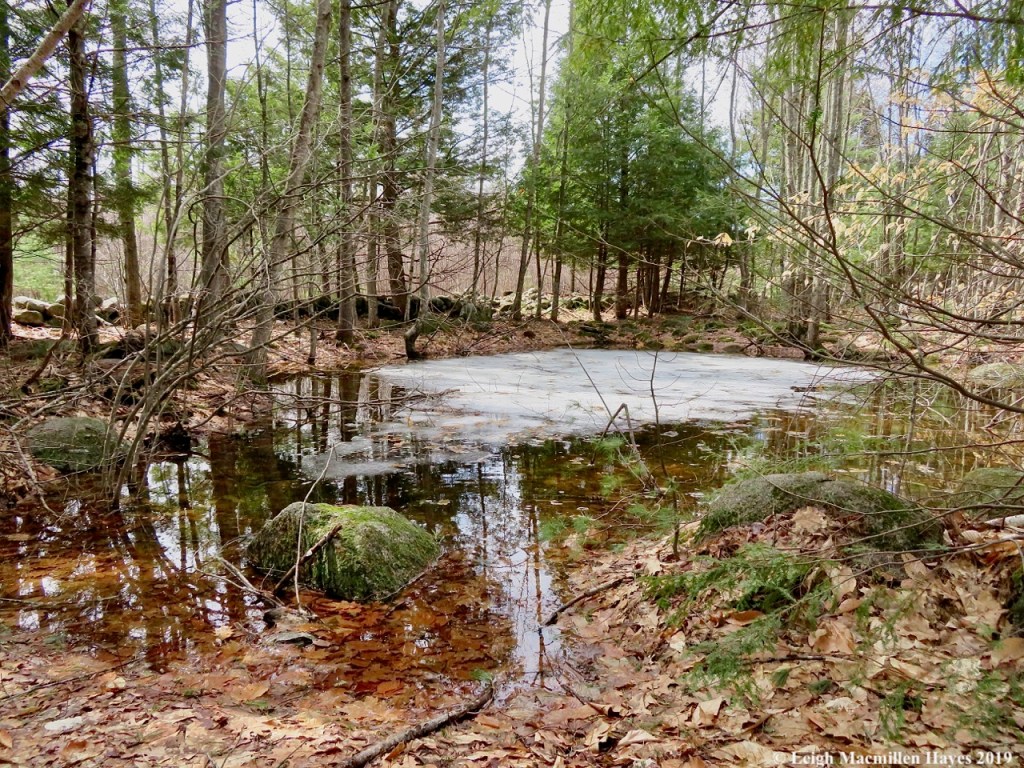
This year found me once again staying in my home territory to honor you and so while my guy did some yard chores, I chose to visit a few of your vernal pools.

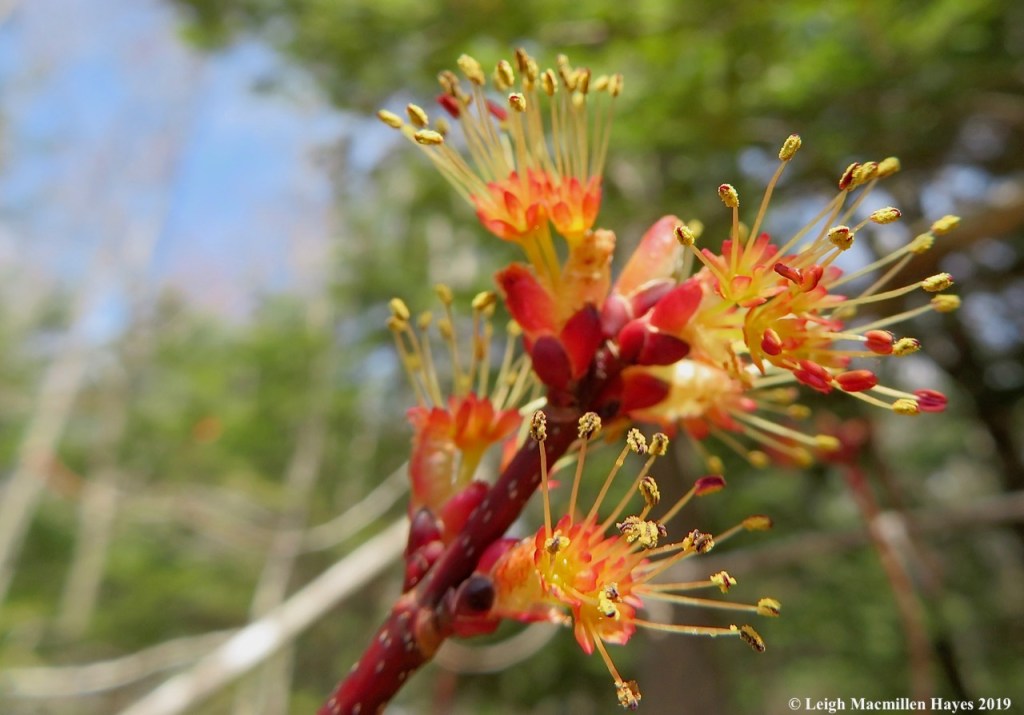
Along the way, I stopped to smell the roses! Opps, I mean admire the flowers of the Red Maples, their pistils and stamen all aglow.

As I approached the first and nearest pool, I new love was in the air for I heard the deep wrucks of the Wood Frogs. That is, until I got to within about ten feet, and then the only sounds were small splashes that barely created ripples as the frogs sought cover under the leafy pool lining.

But, as you’ve taught me in the past, I stood as still as possible and waited patiently. It was then that my eyes began to focus on the pool’s tenants. And I realized that the usual population of larval mosquitoes, aka “wrigglers” already somersaulting their way through the water. That may be bad news for me, but it’s certainly good news for the birds and dragonflies of the neighborhood. While I try to practice mind over matter when I’m stung by a mosquito, I have to remember that your plan to offer “Meals on the Fly” sustains so many others.

And then, and then I spied something disturbing. Actually it was two somethings. Frog legs of two frogs. And even a head. Dinner? For whom? Typically, I rejoice at a kill site for I realize that one species feeds another, but this one disturbed me. Perhaps, dear Earth, it was because I think of this pool as mine even though it’s located on a neighbor’s land, and I want to protect it and all that live within, as well as all who venture to it for nourishment. Eventually, I realized that perhaps someone had been nourished by the frogs, but why didn’t they consume the entire beings? Could it be one of their own species who went into attack mode? I don’t have the answer–but once again you’ve given me more to question. And so in the end I realized I should be grateful for having the opportunity to wonder.

The good news–right behind the two dead frogs was a recently deposited egg mass. Its form made me think Spring Peepers, but I’ll need to watch them develop.

Death. Life. The cycle plays out as if a best seller in this dramatic genre.

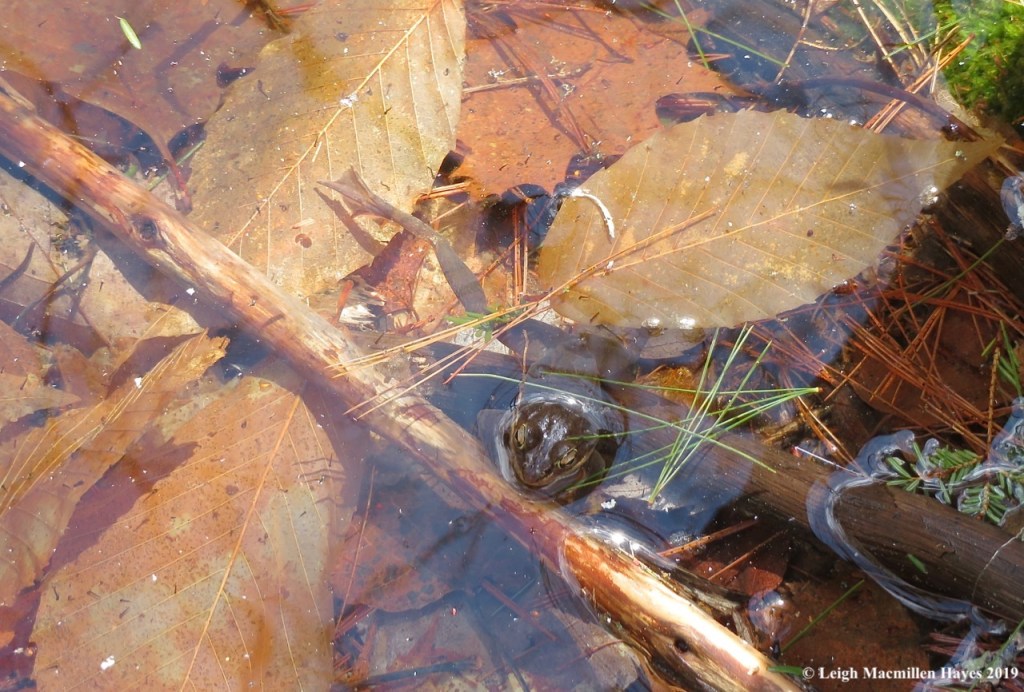
I circled the pool looking for any other unusual sights or clues, but found none. Eventually I stood on my favorite rock and appreciated that you finally rewarded me, dear Earth. A Wood Frog appeared by my feet and we both remained as still as possible–that is until my feet began to fall asleep and I needed to move on.

As you know, dear Earth, I located several more pools, their wruck choruses giving them away. And within one, it was obvious by the egg masses that the lover frogs had found their mates.

Walking back toward home, I got a bit nosey, as you know, and turned over some bark that had fallen from dead trees. To my delight: millipedes, earth worms, bark beetles, slugs, and . . .

At least five Red-backed Salamanders. That reminded me, dear Earth, that though I wasn’t able to join Lakes Environmental Association for Big Night on Saturday, that rainy night when the temperature ranges about 40˚ and the amphibians decide to return to their vernal pools to mate and folks try to help them cross our roadways to do so, I trust that you made sure the Red-backed Sallies and worms made their presence known in the grass behind the Masonic Hall. Did you?

As for my walk today, I followed our trails and then an old logging road, where the deer and moose and coyotes and foxes and turkeys also roam.

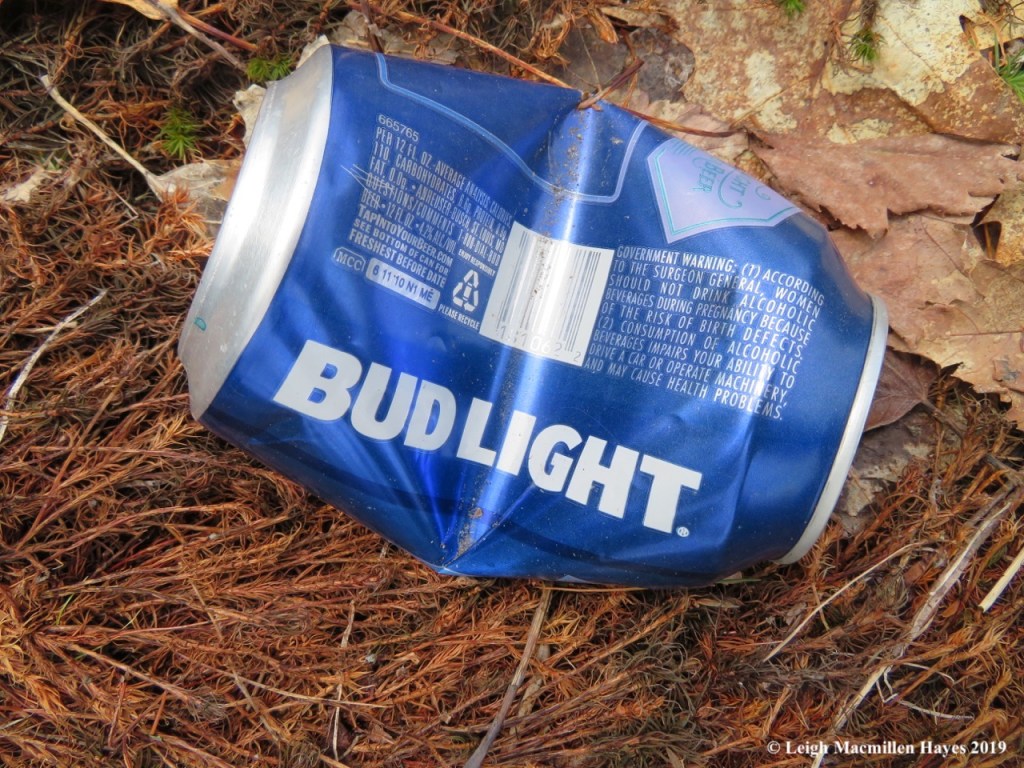
And because part of my journey took me along the snowmobile trail, I picked up some empties and realized that not all turkeys are created equal.

But you don’t judge, do you dear Earth. Nor do you pretend that the world is perfect.

That being said, the sight of my first butterfly of the season, the pastel colored Clouded Sulphur, was rather perfect in my book.

Thanks for once again taking the time to teach me a few lessons . . . lessons from the Earth on this, your day, Earth Day 2019.

Bear to Beer: Fogg Hill, Center Harbor, NH

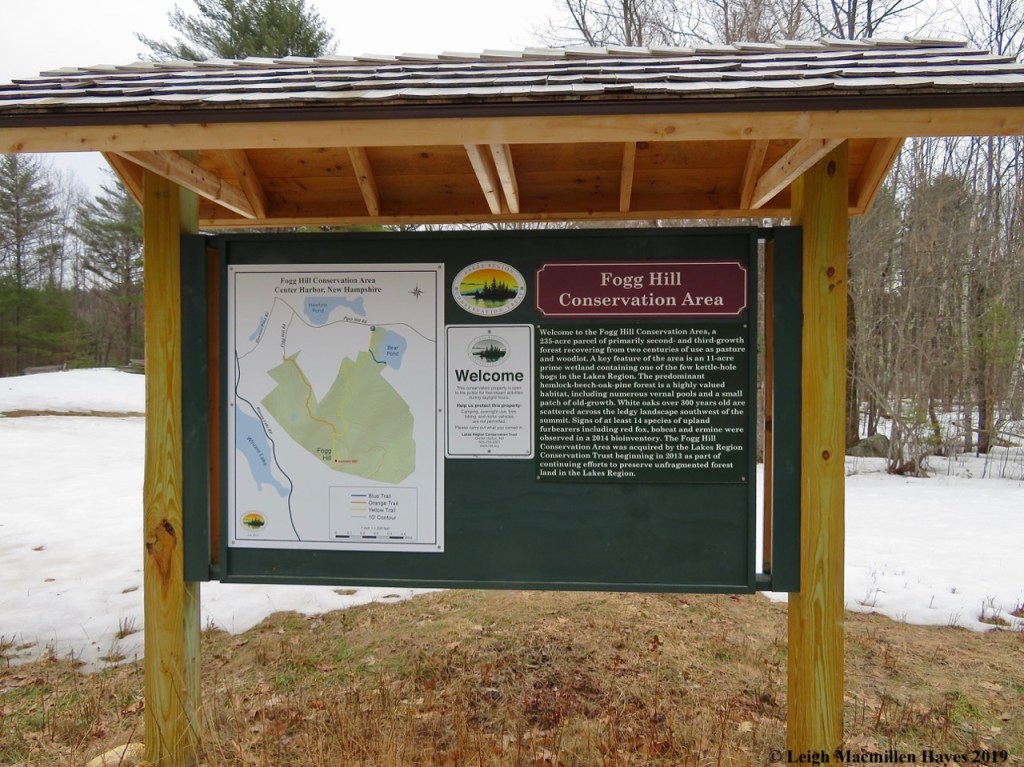
Today’s adventure meant a bit of a drive to Center Harbor, New Hampshire, but it was a journey down memory lane for me as I recalled my time spent teaching and living in the Lakes Region of NH. My guy endured the stories, many of which I’m sure he’s heard before, so I suspect he was grateful when we finally arrived at our destination.

We’d never been to the Fogg Hill Conservation Area before, but prior to Christmas when I was creating the Bear to Beer Possibilities gift, I found Bear Pond on the property and thought it had potential. Besides, we love to explore new areas . . . then there’s always that challenge of looking for a bear sign.

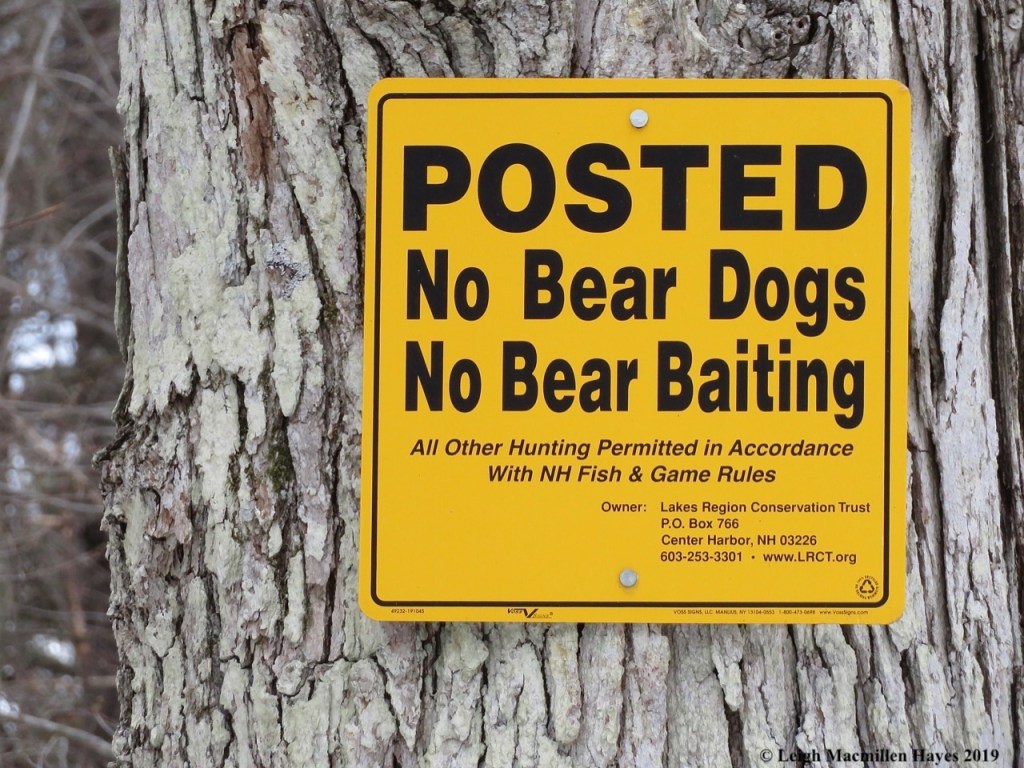
The sign was easy to find for it’s nailed to a tree at the trail head, but it wasn’t quite what we had in mind. It did, however, give us hope. Perhaps we would find a tree with signature bear claw marks left behind.

Our choice of footwear was questionable from the get go as we passed between two canoes onto the trail blazed with yellow. We chose hiking boots and for me, spikes. He tossed his spikes into the pocket of his sweatshirt. Rather than keep you in suspense, I’ll jump ahead and tell you it was the right choice. We walked on bare ground, ice, and snow sometimes a foot deep, but it was constantly changing. And he never did wear his spikes. I, on the other hand, was glad to don them.

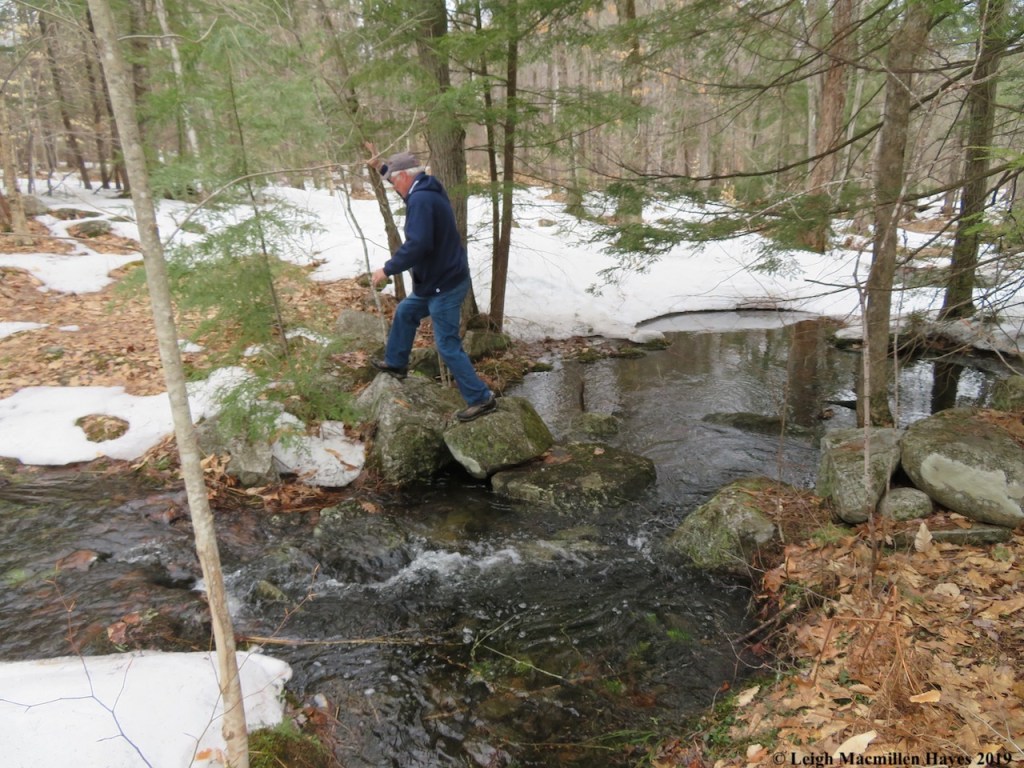
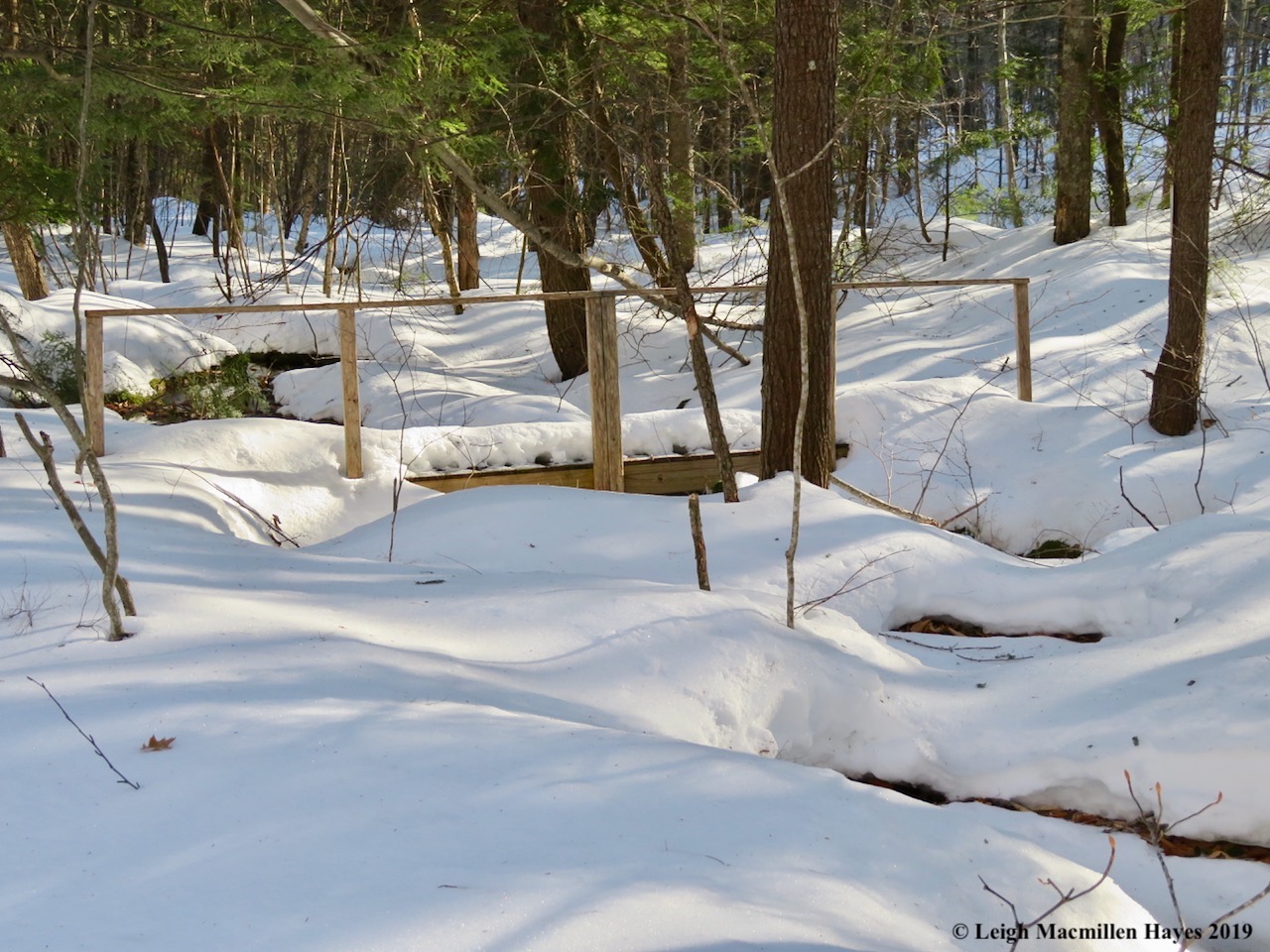
Sometimes our path also included stream crossings.

Not long into our journey, we followed the blue blazes to Bear Pond. Our hopes of finding what we were looking for there were soon dashed. But . . .

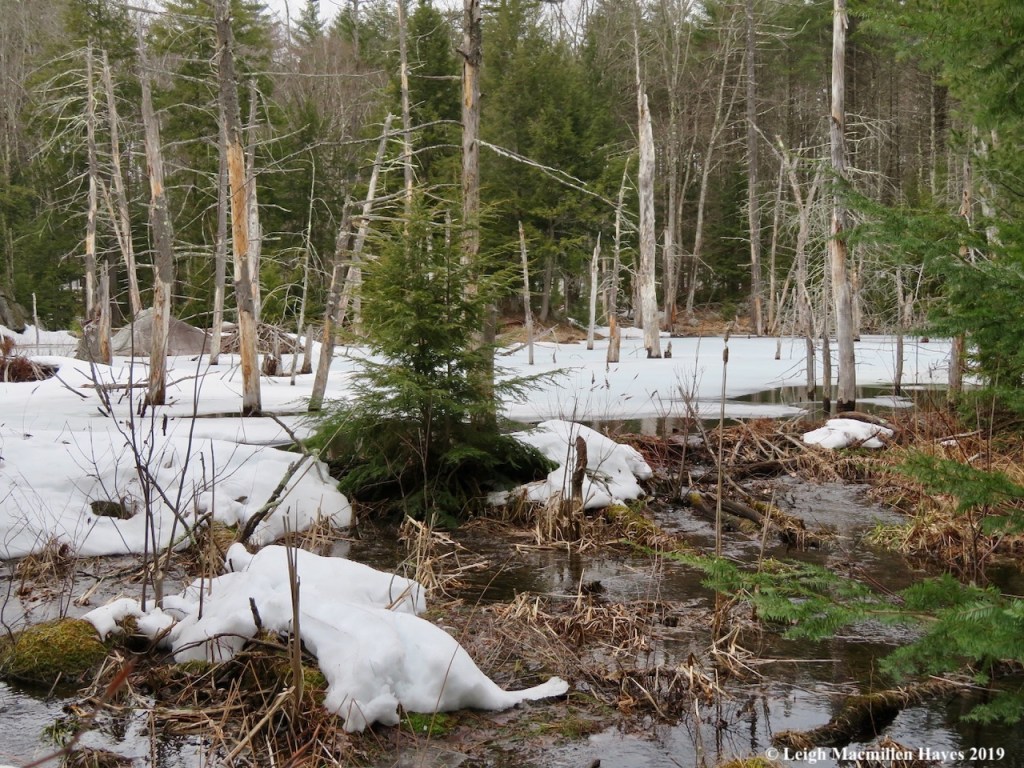
we saw beaver works of past years that now supported a variety of other growth.

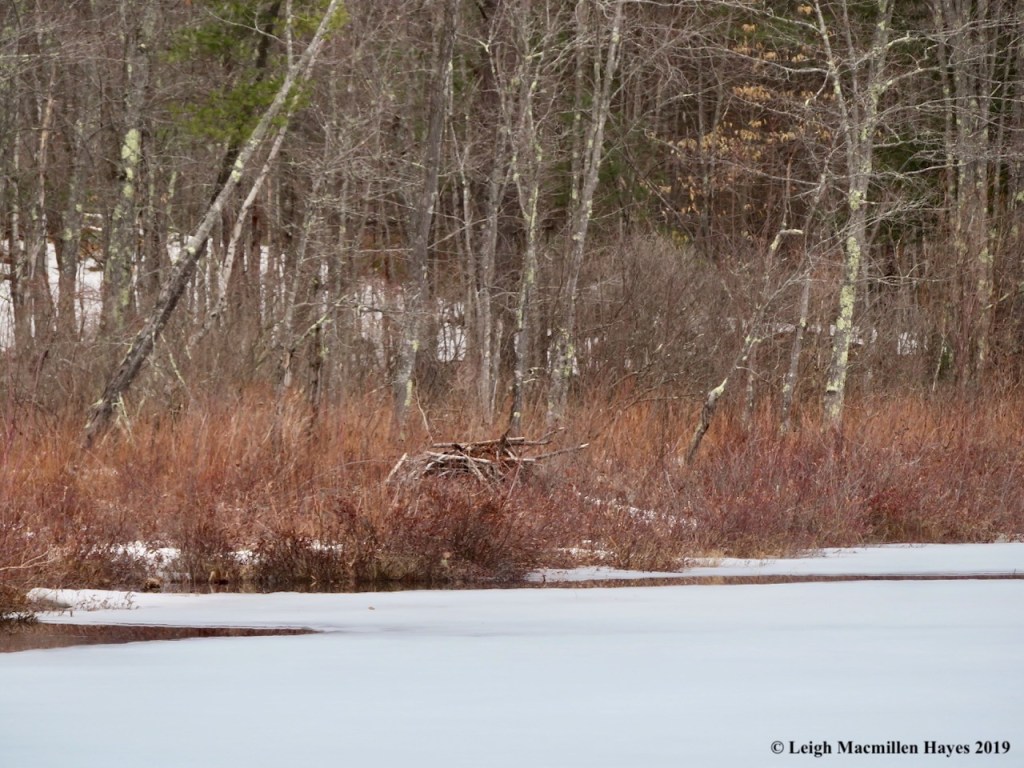
A lodge stood tall in the wetland, but by its grayed sticks we knew it hadn’t been used recently. Maybe rather than Bear Pond it should have been named Beaver Pond, but then again, maybe not.

Back on the yellow trail, we continued on, but paused again beside another beaver pond. You’ll have to squint to see the lodge, but it’s there, beside a boulder that mimics its shape. As we stood there, my brain fast-forwarded to summer and I could imagine not only the vegetation in full bloom, but also the insects and especially the dragonflies providing a display.

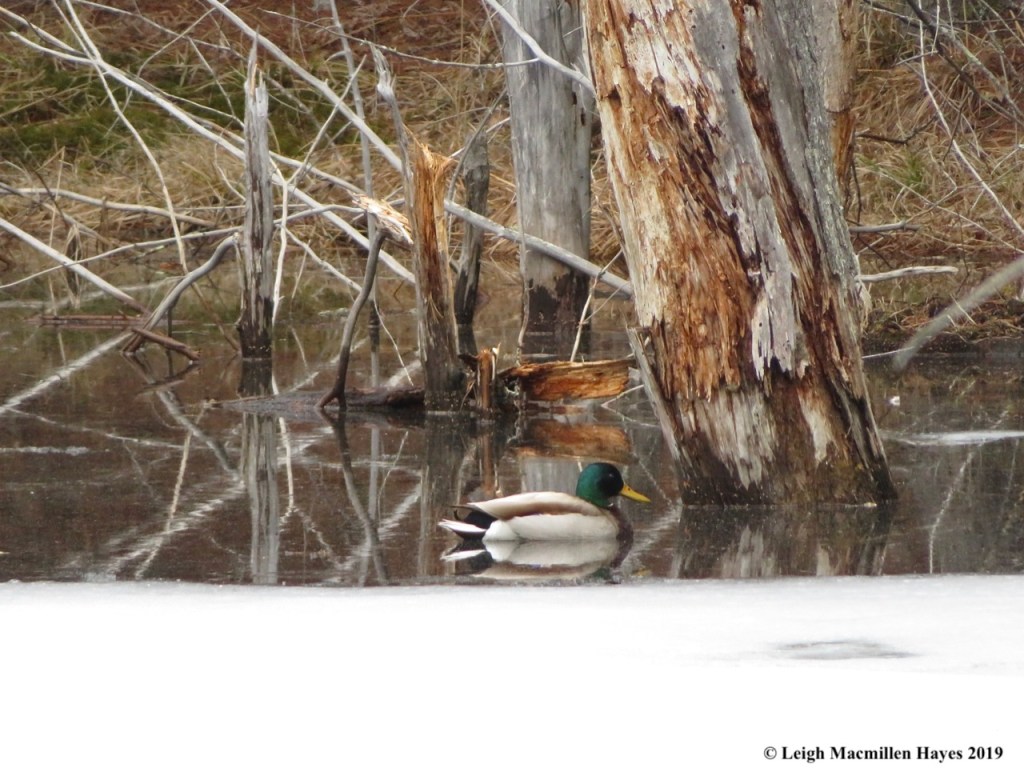
Back to reality–I did spy a Mallard on the far side of the pond.

Onward and upward we climbed, our eyes scanning the trees for any bear sign. Sometimes the bark of the Beech was all blocky as a result of beech scale disease.

Others were as smooth as could be and we both thought, “If I were a bear in the woods, this would be my tree.” But none had claimed it.

We were almost fooled when we looked up at one of the old trees–until we realized we were looking at sapwells created by Yellow-bellied Sapsuckers. And I realized I hadn’t associated them with American Beech previously. A lesson learned from the bark I thought I knew so well.

Mind you, we weren’t always looking up because we did have to choose the next spot to place each foot much of the time and we were often surprised when what appeared to be firm wasn’t. But because we were looking down so much, we saw several scats left behind by the locals including Coyote and Bobcat. The above is Coyote scat–filled with hair and chunks of bone.

We also spotted another Winter Firefly–this one cross a boulder in the trail.

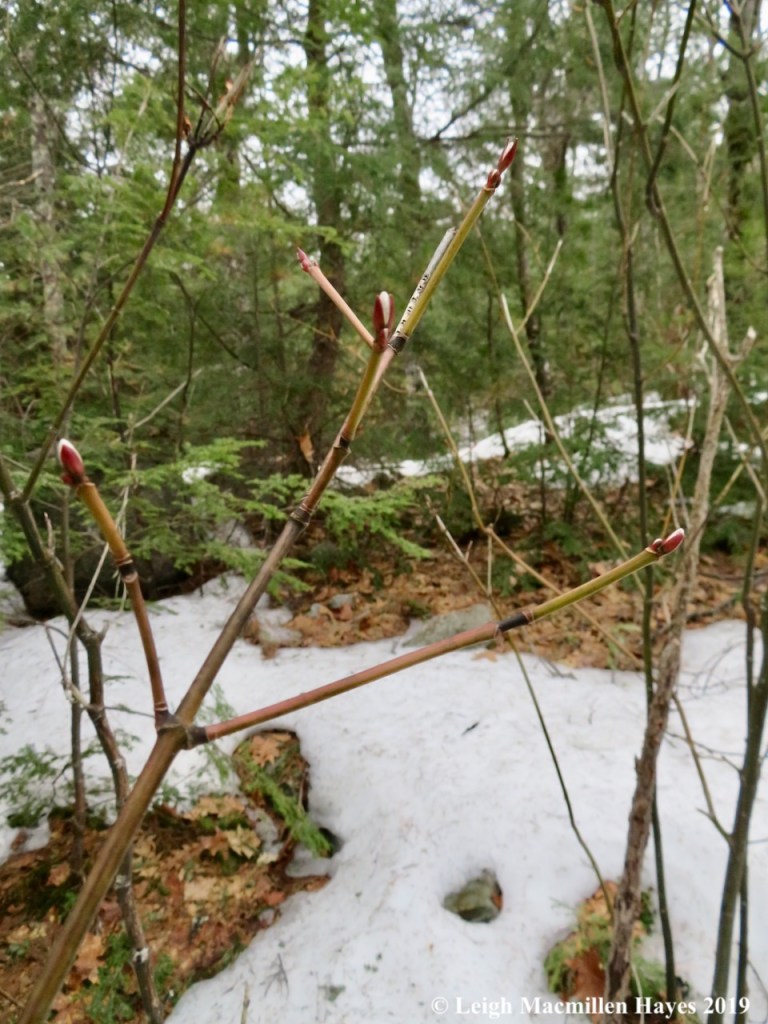
And a treat to top them all–Striped Maple breaking bud! Suddenly spring feels rushed and I want to slow it all down and savor every sweet moment. ;-)

Just beyond the Striped Maple, we chuckled when we found the first cairn. Maybe its structure was a homage to the summit ahead.

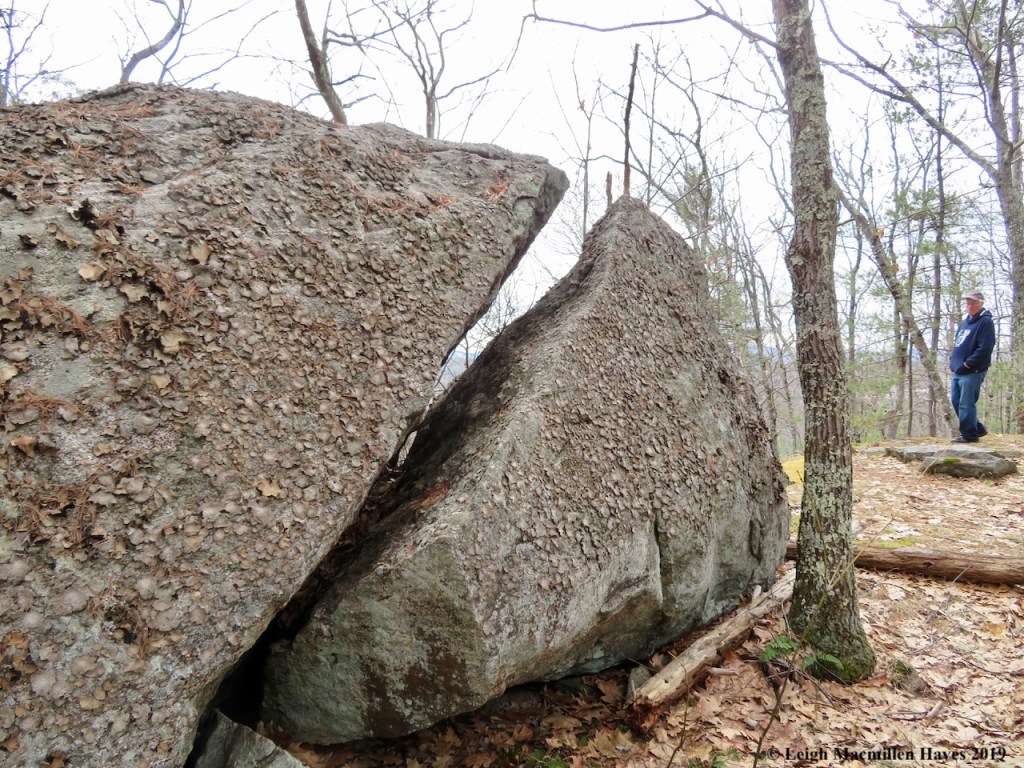
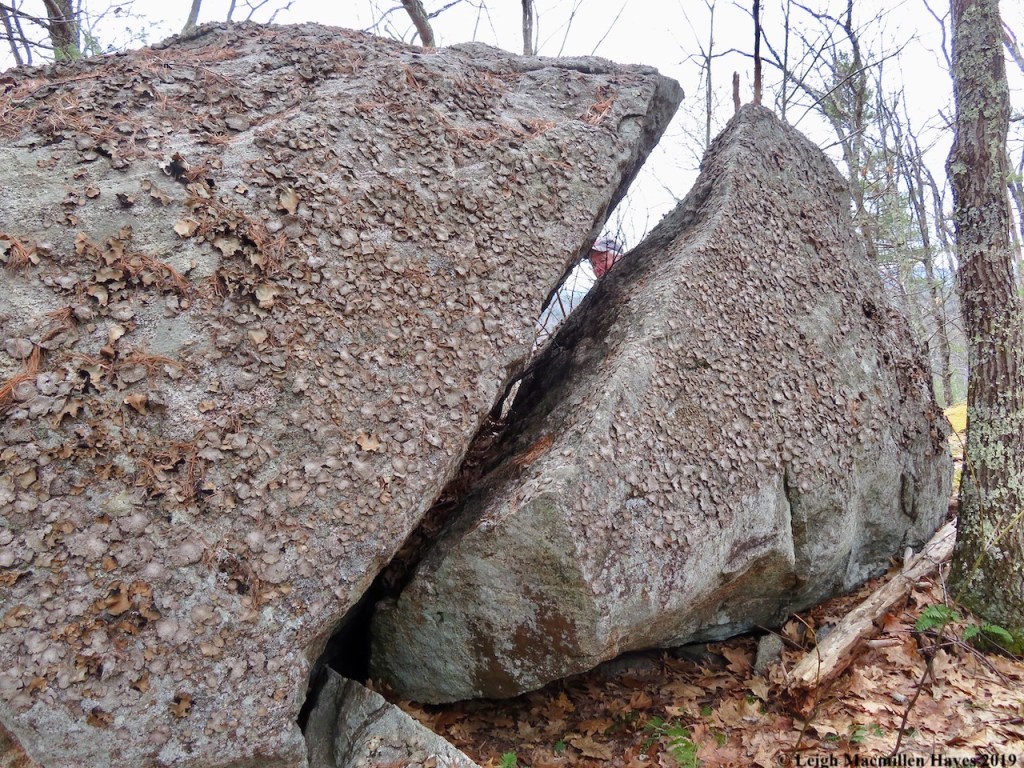
At the summit a split glacial erratic was as interesting as the view, covered as it was with two umbilicate lichens, Rock Tripe and Toadstool.

I asked my guy to stand beside it for perspective, but he chose instead to go behind and peek at me through the division.

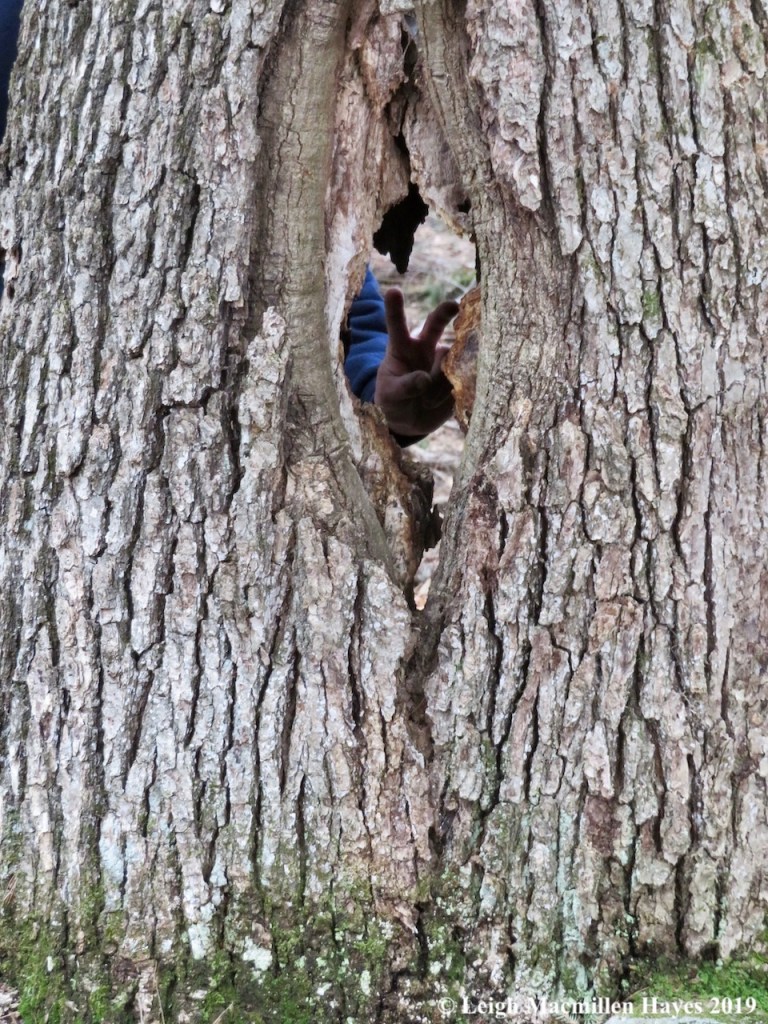
And on the way down, he found the perfect frame for his peace sign.

As for bear sign, we found one tree with some potential, but wondered if instead it was scratch marks created by near branches.

At last we left the conservation area a wee bit disappointed but promised ourselves we’ll return. Perhaps we didn’t find more than the bear sign at the very start due to the fact that we really spent a lot of time looking at our feet. And never went far off trail.

We also want to check out the orange trail to the Kettle Bog, which we passed by today. A few years ago, Dr. Rick Van de Poll completed an ecological survey of the area and discovered rare plants on the land. Having spent a couple of days working with Rick at a Lakes Environmental Association site in Bridgton, Maine, I can’t wait to figure out what he discovered on the Fogg Hill property.

Today’s adventure was topped off with a late lunch at Canoe overlooking Lake Winnipesaukee in Center Harbor. For me an Allagash White and a burger. For my guy: Jack’s Abby Lager and a reuben.

Bear to beer possibilities: Fogg Hill, Center Harbor, NH.

My Eagle Eyes

From my first sighting this morning I had a feeling that today’s views were going to be amazing. I just didn’t know at the time how amazing.

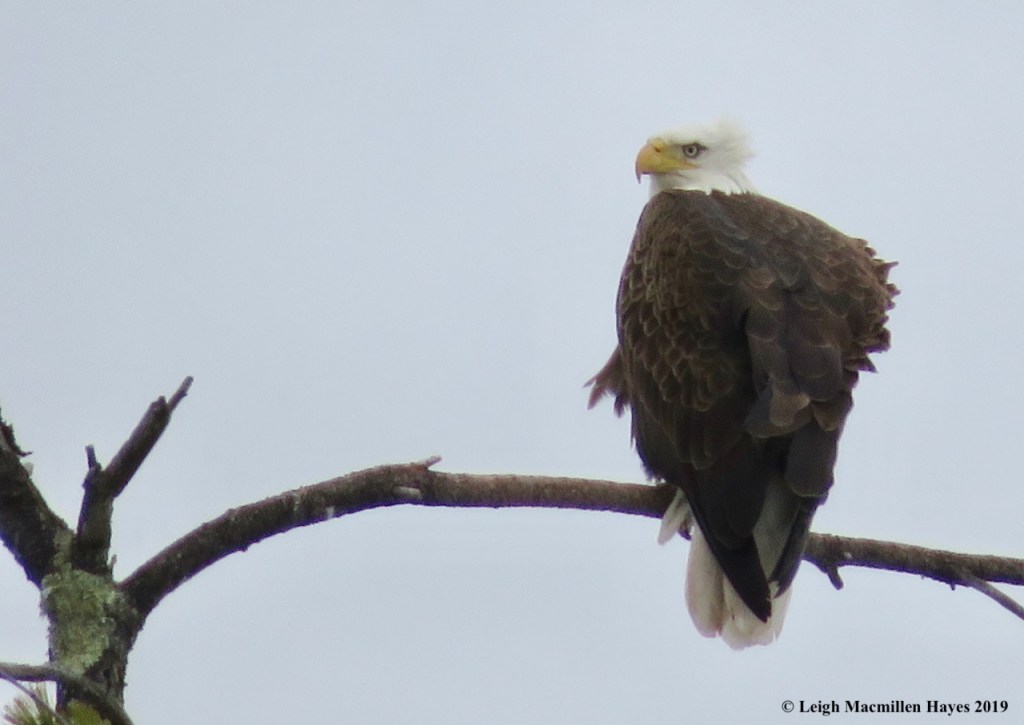
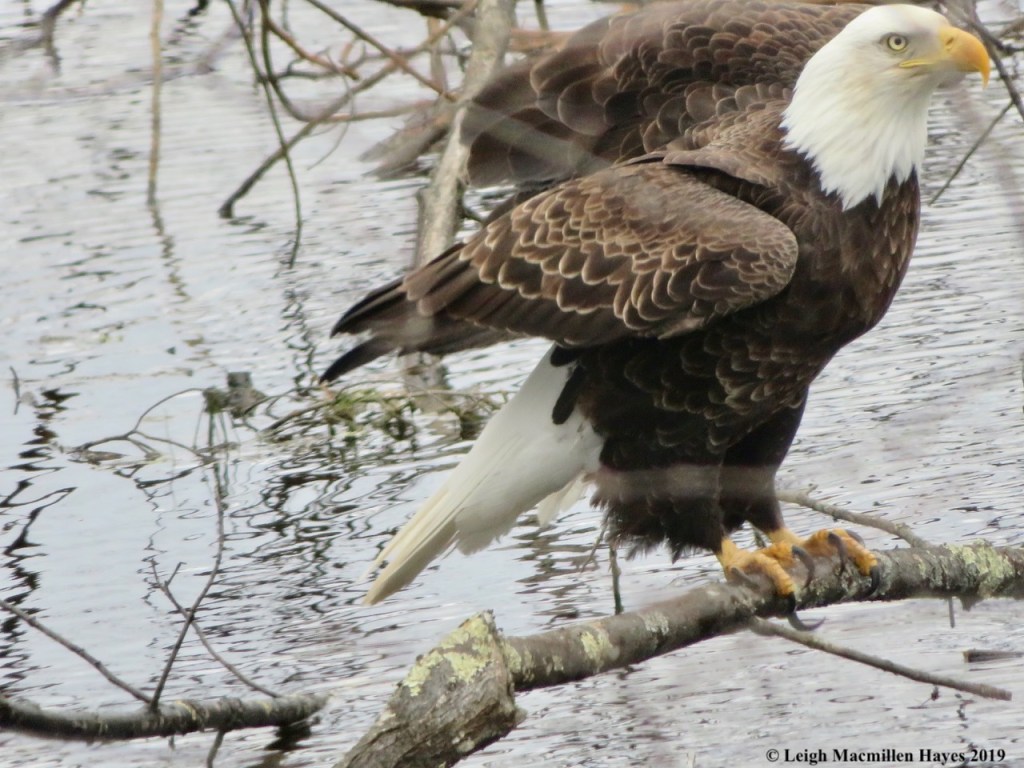
It all began when this Bald Eagle gave me a backward glance as I drove west. He posed as usual on his favorite hangout and I knew that he was patiently awaiting his turn to dine on some recent roadkill. In the meantime, the crows had a feast.

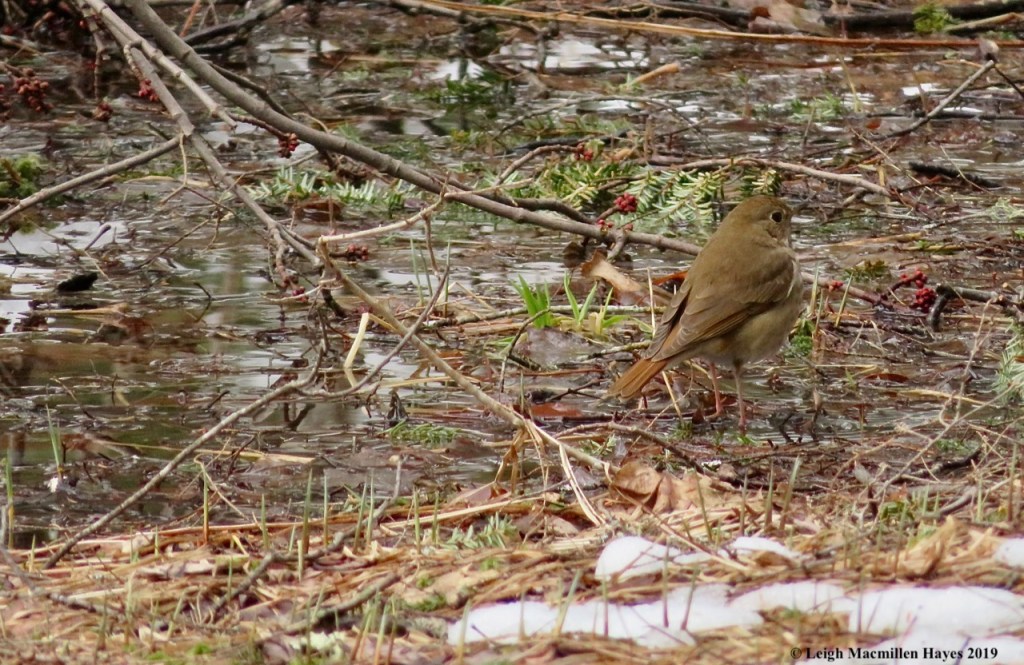
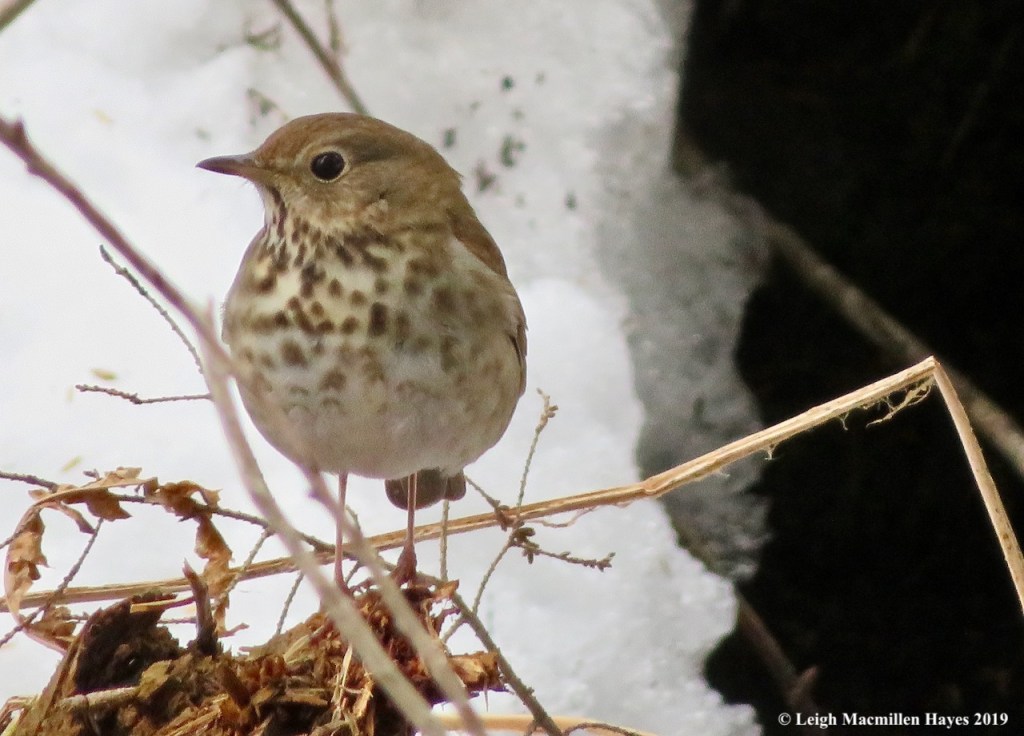
What I didn’t expect was to see a second Hermit Thrush this week, but so it was as I snowshoed through a land trust property with a couple of other people. I have them to thank for they spied the bird first.

And then we stood silent and watched. And dreamed of its enchanting song to come.

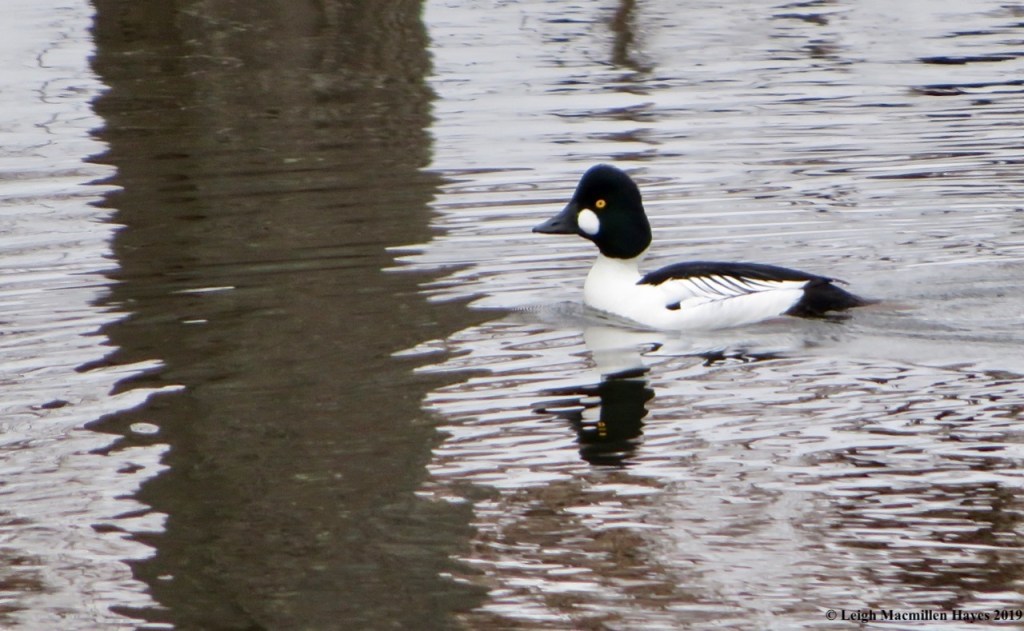
Finding my way beside water a few hours later, it was a pair of Common Goldeneye ducks, his eyes even reflected below, that made me pause next.

Despite a couple of branches slightly obstructing my view, her eye of gold stood out vividly as well. What exactly is it that’s common about them? Their presence I suppose, but still I’m thrilled each time we meet.

Nearby, I almost missed Donald and Daffy, but he hollered for attention, while she stood by on one leg.

Why do birds stand on one leg? And how do they do it? The why I think I can answer–to keep the other leg warm. Unlike some avian species, ducks don’t have hairy sweatpants and so by tucking one leg up under a wing, they can retain some heat. That was important for today while the temperature was in the 40˚s, with a breeze, it was overcast and felt rather raw.

As for my second question, how do they do it? Stand still on one leg without toppling over, that is. I don’t know, but do wonder if it has to do with the feet located toward the center of the body so its weight can be evenly distributed–maybe it turns the one foot a wee bit to insure stability. And perhaps the splayed foot also helps assist what for me would be an awkward position.

Perhaps. And perhaps she looked at me as if to say I was daffy.

And he smiled in agreement.

The next great sight was not a bird, nor was it caged in. And it wasn’t an original find for me because some friends met me at a location where they’d spied it yesterday. But in yesterday’s warm sun, the Red Fox let her four kits frolic about. We watched for a while today, but apparently she’d told the kits to stay in. Her choice for a den sight was remarkable and we learned she’d chosen the same fair spot last year.

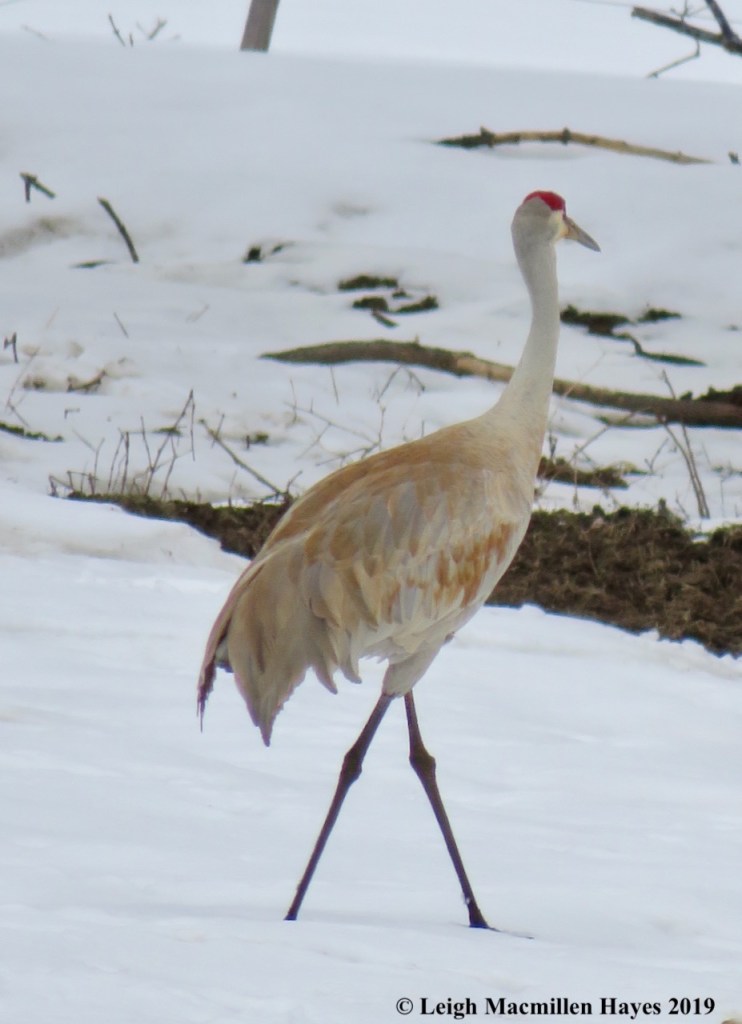
At last I began my journey homeward, but first I had to stop by a spot I’ve been frequenting often of late, for it’s where the Sandhill Cranes have been dining. At the moment there are only two, but by last fall they numbered at least eighteen. Will the same come true this year? Only time will tell.

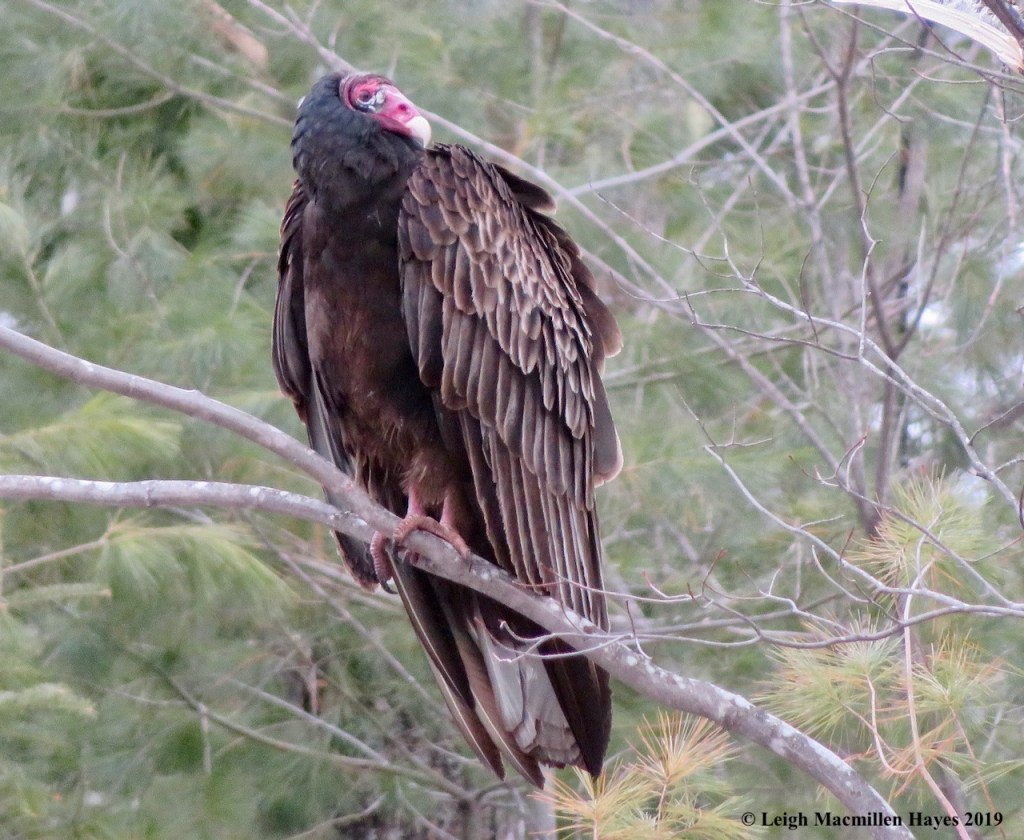
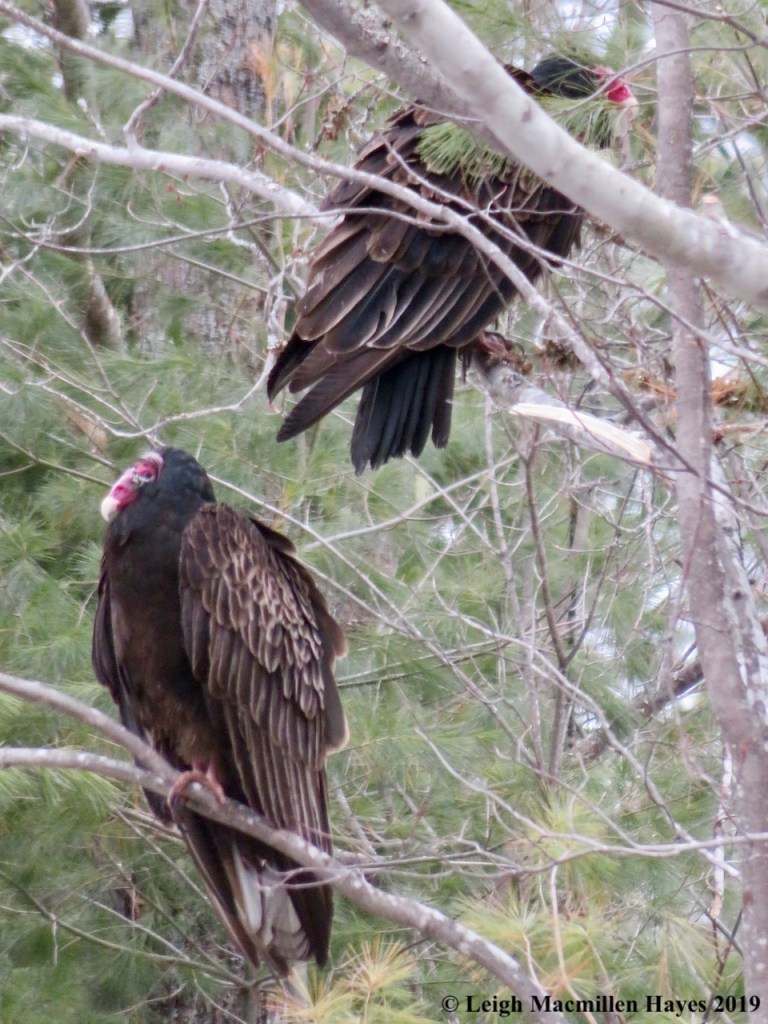
And then, another bird called out and when I realized what it was all I could think of is “Here Comes the Judge” for so its feathers and stance reminded me of a robed magistrate.

This scavenging creature has no feathers on its head in order to keep bits of carrion (dead meat) from adhering to the skin as they would to feathers.

Yes, these were Turkey Vultures. Where there was one, I soon realized there were two. Actually, on a tree behind these two were two more. I wonder if I missed any.

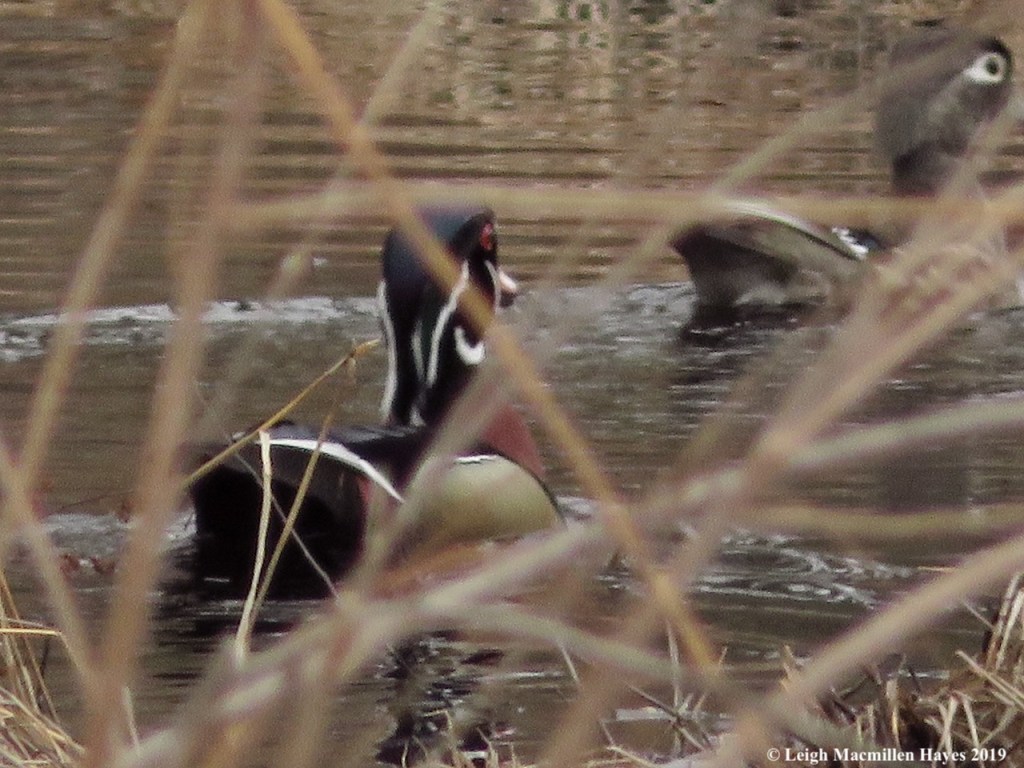
If I had eyes as big and bright as the Wood Ducks that swam quickly through a brook nearby, I’m sure I wouldn’t miss anything, including food in the water below as well as those above who might think of me as food.

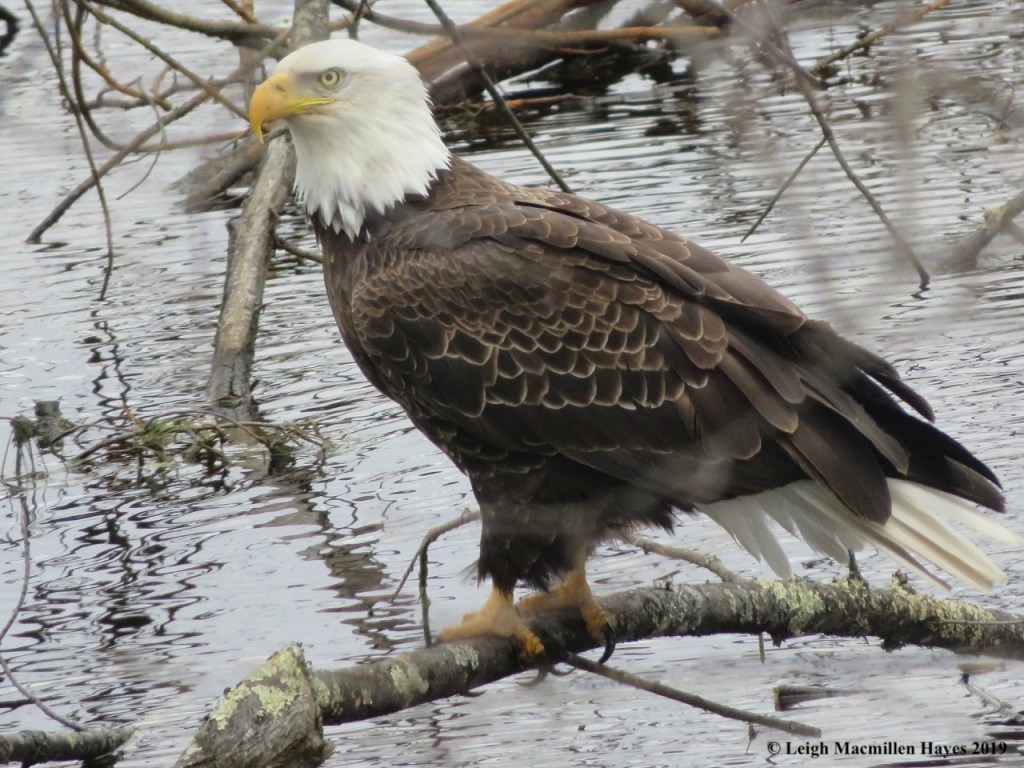
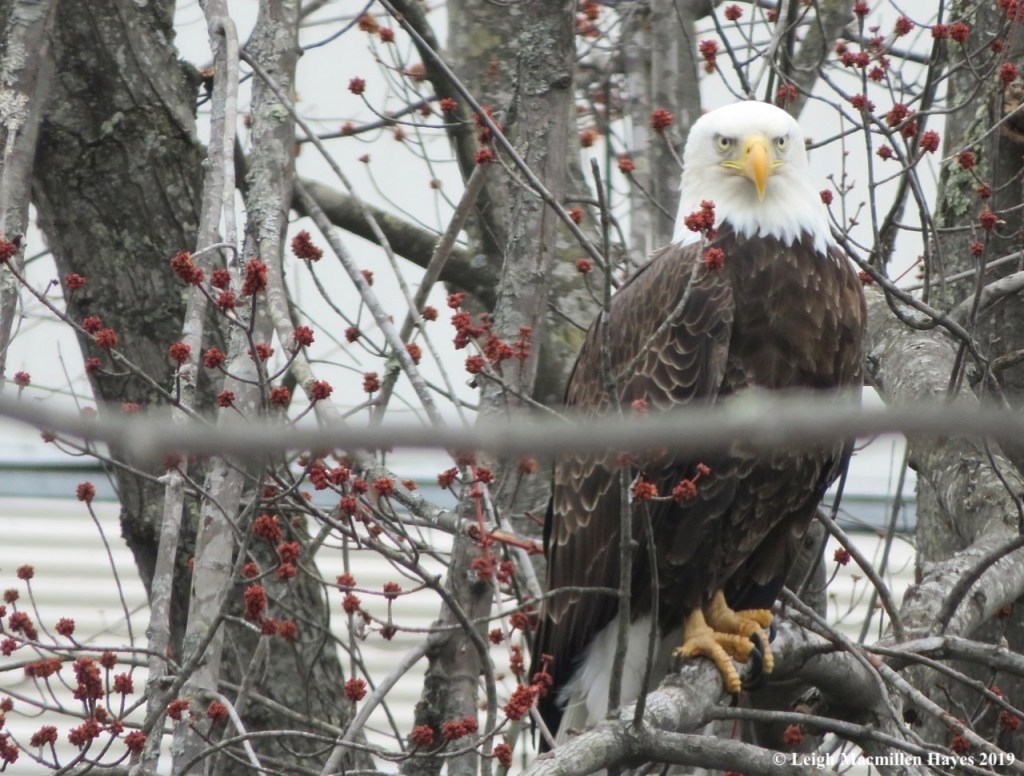
Like this guy! As with so many of my finds today, I’m not sure how I happened upon him, but I did. I guess it was that I tried to look for the anomaly in nature. What shape or color stands out from the surroundings?

As I watched, the Bald Eagle changed its orientation. And then it flew and I was sure that that would be the end of our time spent together.

But it landed on a branch above and continued to look about. I swear it even looked at me and I gave thanks for the opportunity to begin and end the day with such a noble bird in two different locations.

I knew I’d been honored to share a few moments with friends as well as notice those things that deviated from the norm. My eagle eyes certainly felt keen today.

Duck, Duck, Porky Bear!

Our mission today, which we chose to accept, was to revisit a Porcupine den and check on the activity there and if time allowed, find a certain Red Pine tree in the forest. We knew the location of the den for we’ve visited it several times in the past three or four months, but had only a vague idea of where the Red Pine grew tall.

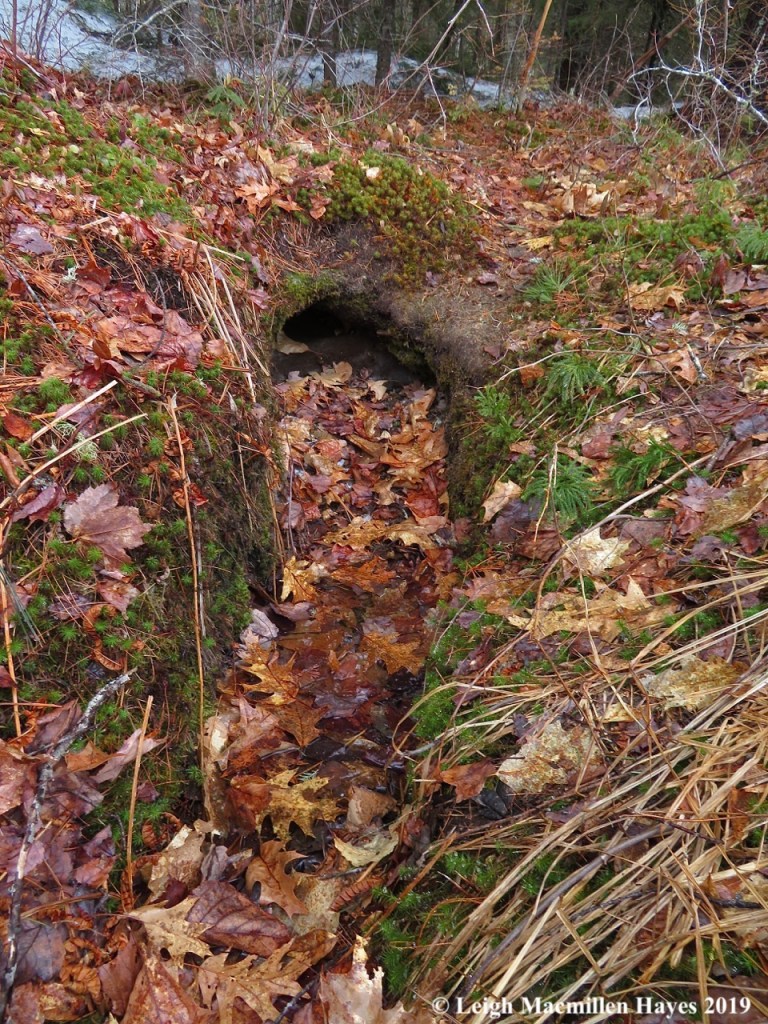
The Porcupine’s entry hole was just as we’d remembered it, but it was the scene about that had changed since our last visit. Hemlock boughs decorated the still snow-covered forest floor in great quantity.

And so we looked up–at two trees now mere skeletons of their former selves. All that was left–backbones and ribs. The meat and flesh had been almost completely nipped off. But, it still made us smile for the Porcupine had done what Porcupines do. And except for our occasional visits, it seemed they’d not been interrupted by human interference.

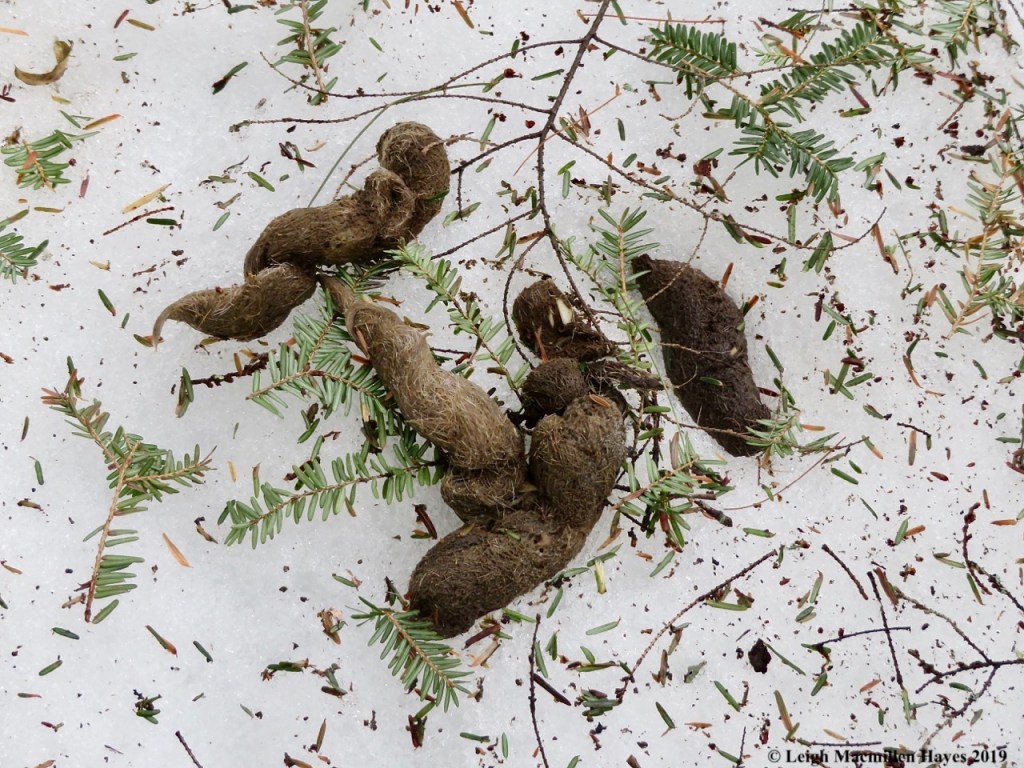
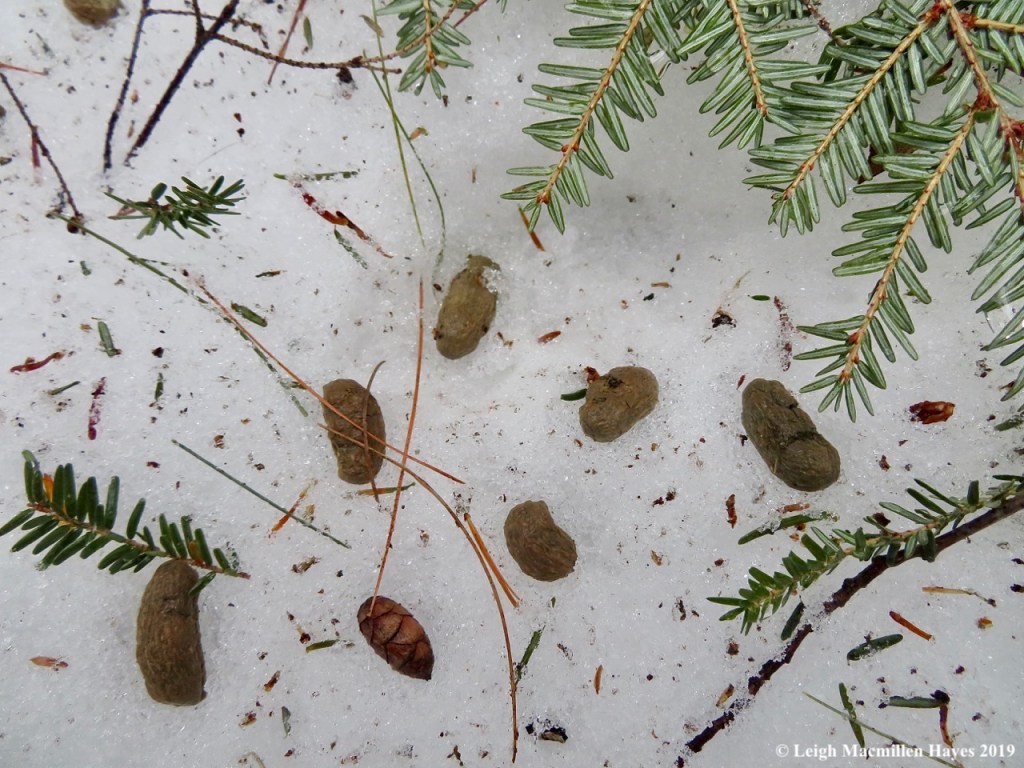
The other thing Porcupines do is scat. Prolifically. Below their tree of choice. And by their dens. Of course, I needed to document such. This presentation offered a delightful contrast, subtle though it may have been, of the prickly rodent’s scat and a Hemlock cone. Sometimes the color is so similar, and as you can see the size is as well, that it’s difficult to tell them apart. But, if we are what we eat, then their similarities make perfect sense.

After admiring the Hemlocks, we returned to the hole and noticed a few quills. You may need your detective eyes to locate them. I’ll leave it at that (Faith and Sara–good luck).

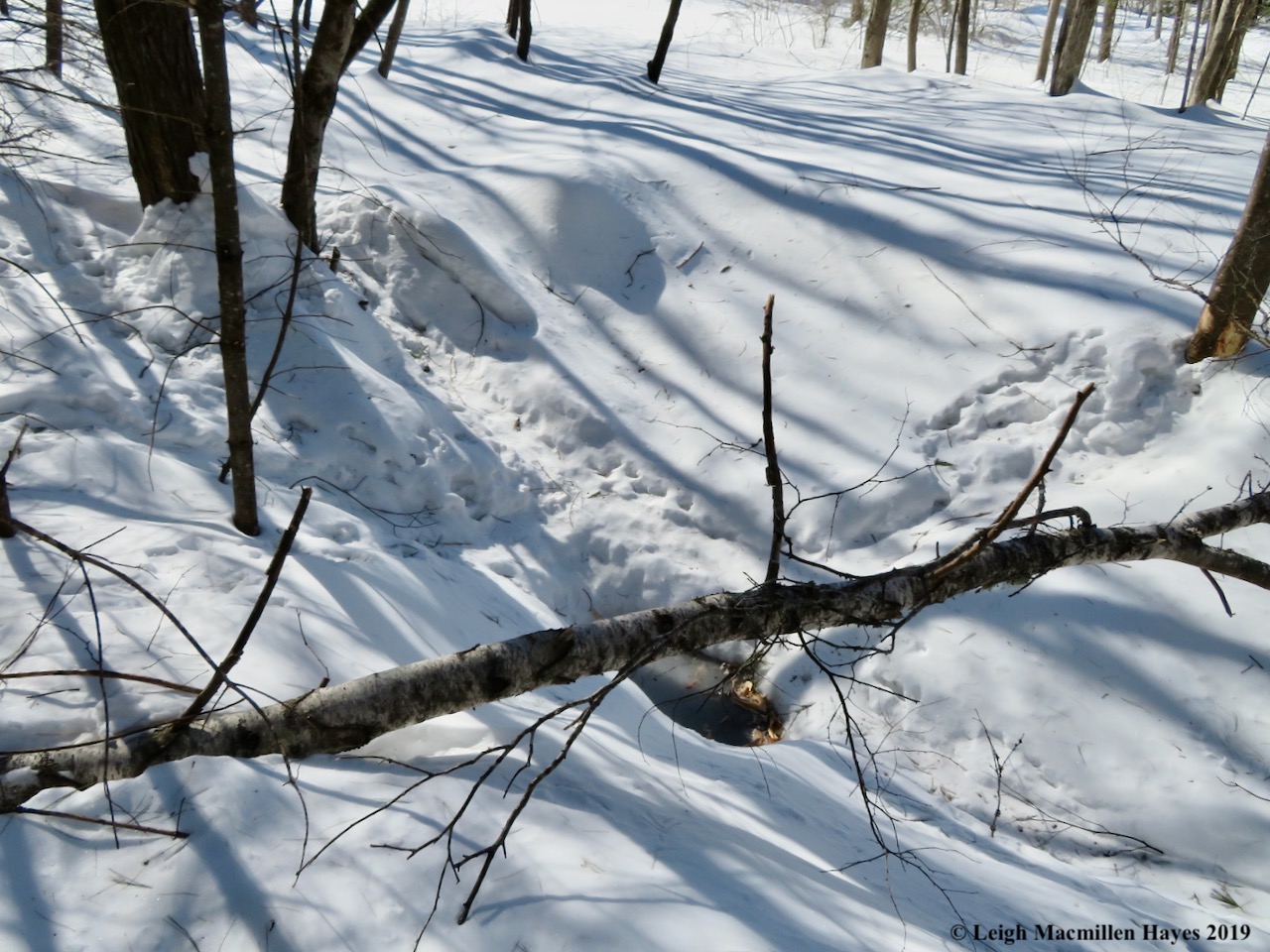
And then we moved out to the edge of the brook to check on another entrance to the same den. It didn’t appear to have been used recently, but that got us wondering about the melting snow. Having said that, we could see the pathway created to the upper right of the tunnel was worn, but any scats we found there were quite dried out and deteriorated to the point of being almost unrecognizable.

Just above the tunnel, however, a new discovery–another Porcupine tree. This one a Beech sapling–most of it denuded of bark and even a few twigs. Our questions continued. Was the upper part of this seven or eight foot tree dined upon when the snow was deep? And the lower part as the snow melted? Or had the Porcupine recently climbed up? How in the world can such a large animal climb such a small tree without snapping the trunk in half? I could practically wrap my thumb and pointer finger around it. Ah, but they do. Another amazing feat by one with grippers for feet.

Leaving the Porcupine area behind, we moved along beside the brook and paid our respects to the Itt family. Cousin Itt and his cousins stood clustered together eagerly awaiting the sun that was to come.

Our slow motion then found us beside a stump upon which Pixie Cup lichens grew. Pixie Cups or Goblet lichens are members of the Cladonia group. This find made us realize that as the snow pack dwindles we have so much to learn or relearn. Thank goodness it’s a slow melt and we have time. ;-)

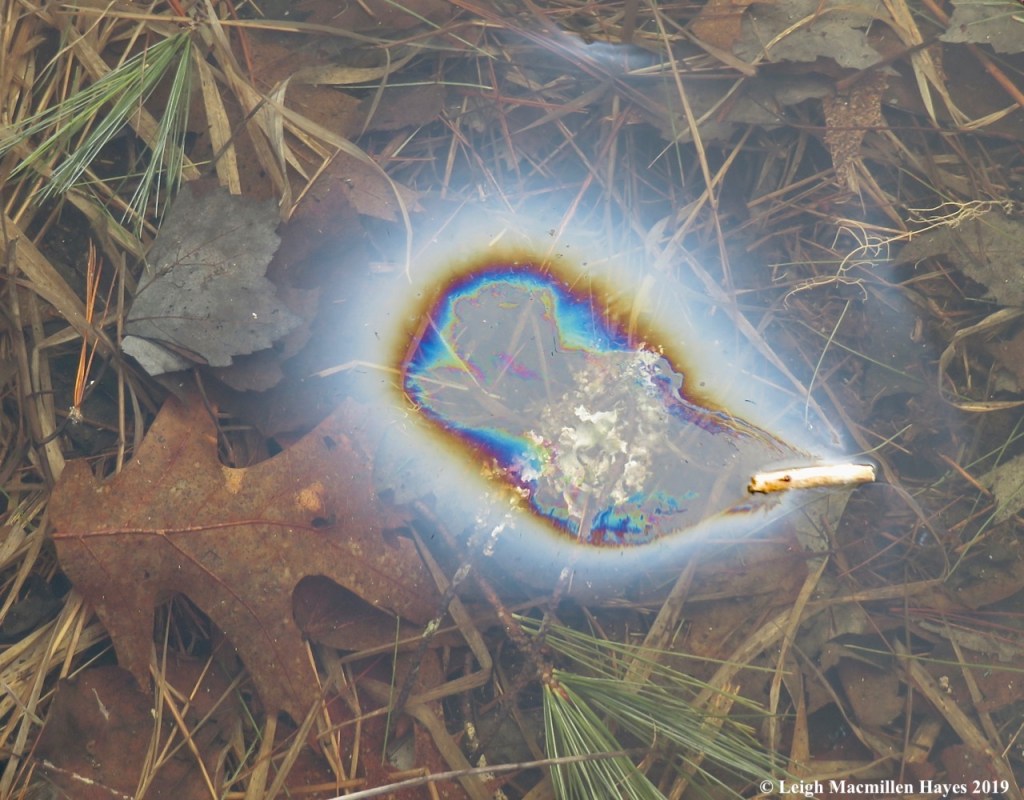
Our time today next involved a magic trick. One of us poked the blisters on the trunk of a Balsam Fir.

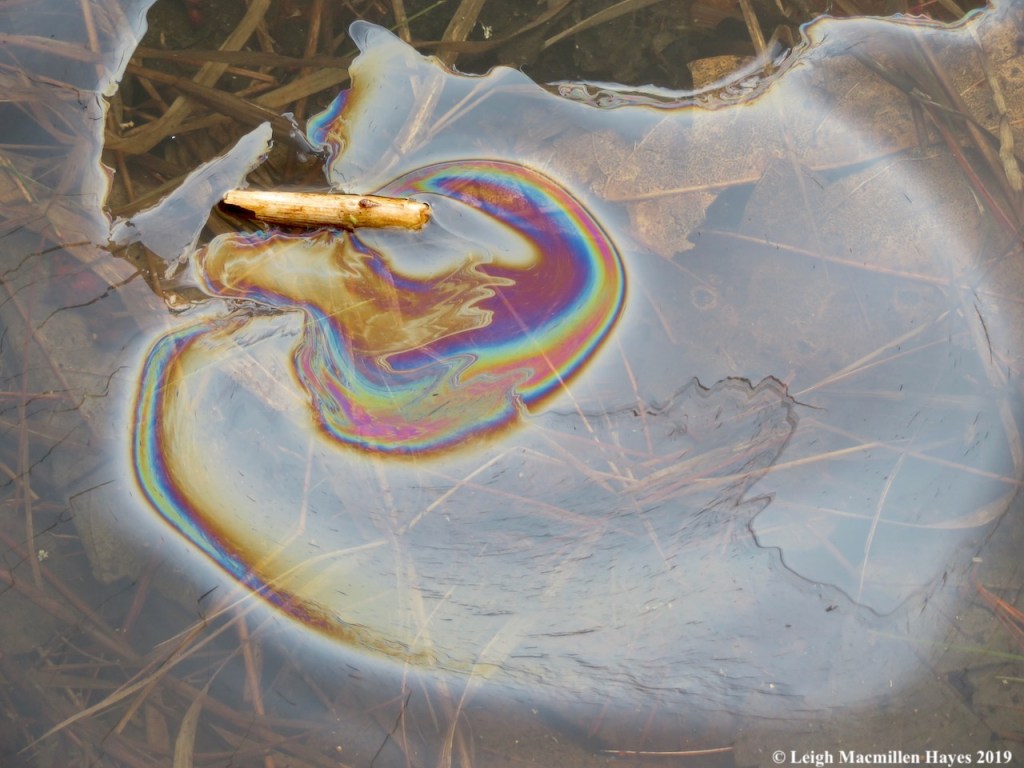
With a glob of resin attached to the broken twig, she tossed it into the water. Then we stood and watched . . . as the oil dispersed, changed shape and colors, and the tiny piece of twig moved about like a water fairy’s motorboat.

The essential oil within the sticky tree goo propelled the twig and created a map that could have been the United States.

As we watched, some of the oil broke away and feathered out in the movement of the water . . . but in a fashion we didn’t understand for it seemed to only float so far and then circled back.

As I said, we watched for a while, and where the little twig settled, we began to notice another shape emerging . . . a duck. Some people look at clouds, but we were fascinated by a substance that has antiseptic properties to seal cuts and protect them from infection, lessens the pain of burns if smeared gently onto skin, and serves as nature’s gasoline when one wants to start a fire. Oh, and reacts in water by creating fascinating rainbows while propelling objects.

At last we pulled away for I had a time crunch, but we still wanted to reach the Red Pine. To get there, we passed a Turkey kill site we’d discovered in January. The feathers remained and reminded us of the day we’d spent trying to solve the mystery of the Turkey’s demise. If nothing else, we came up with a good story that day.

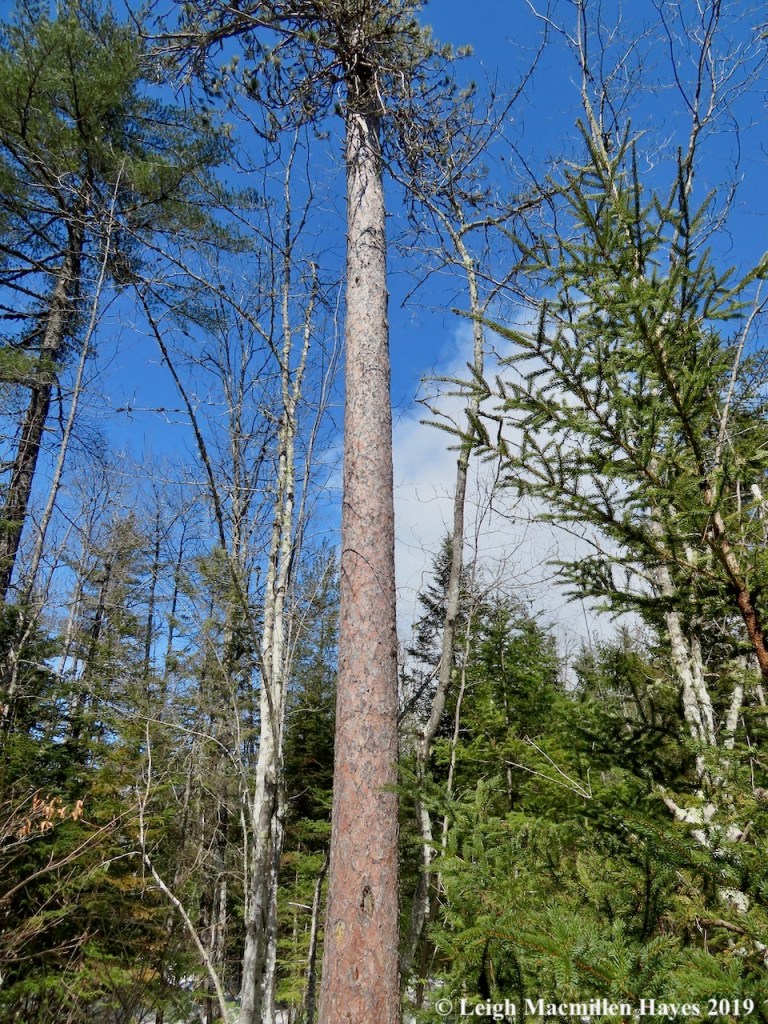
From the feathers, we journeyed on, reaching the edge of a wetland that stretched away from the brook. My time was running out, but we gave ourselves six more minutes (why not five, you ask? Why not?) and scanned the tree tops in search of one Red Pine. And then . . . we spied it.

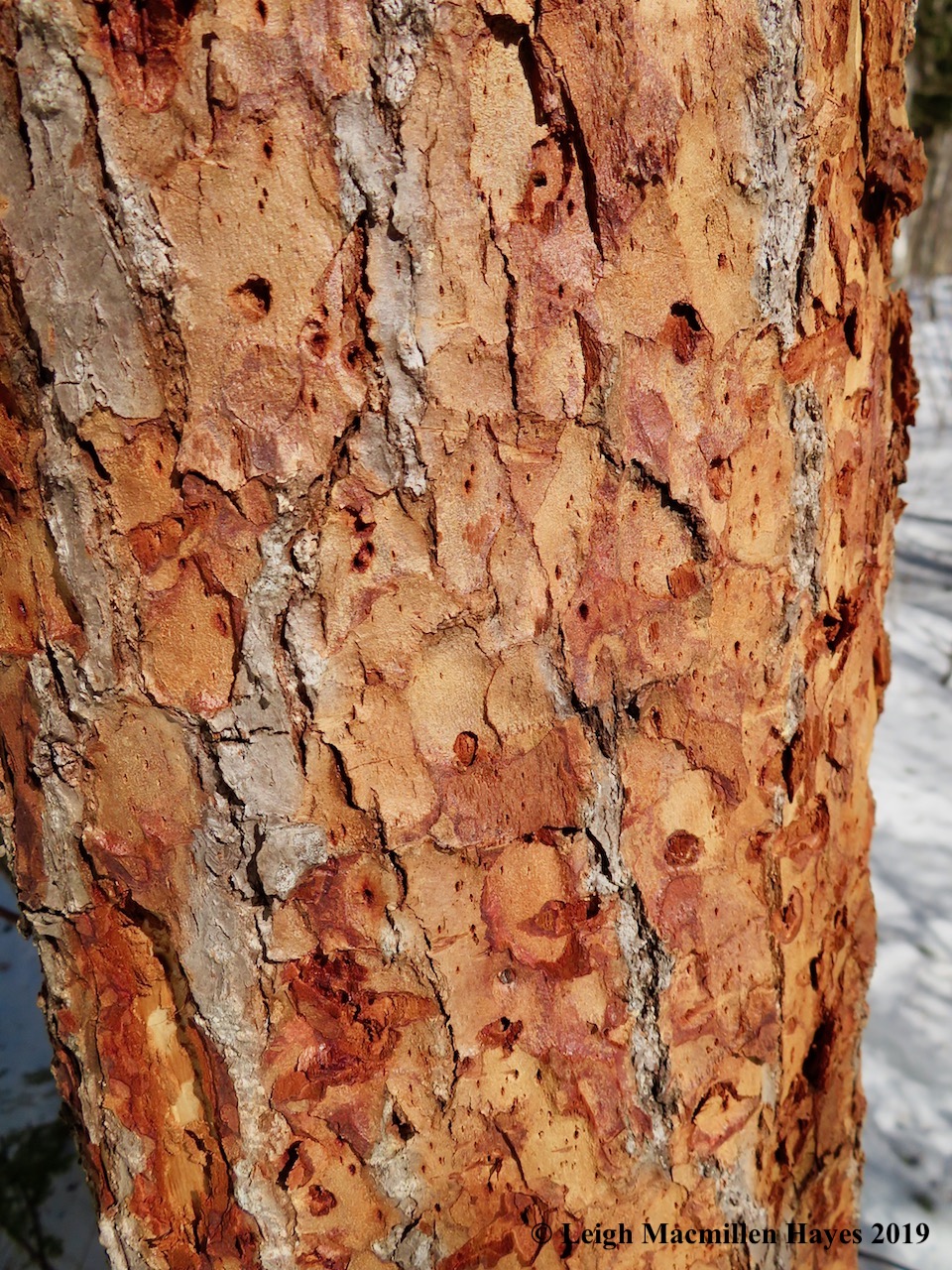
We weren’t the first, for a Winter Firefly moved out from under the bark as we admired its colors and jigsaw presentation–of the bark that is. We admired the insect as well, but that bark. Oh my.

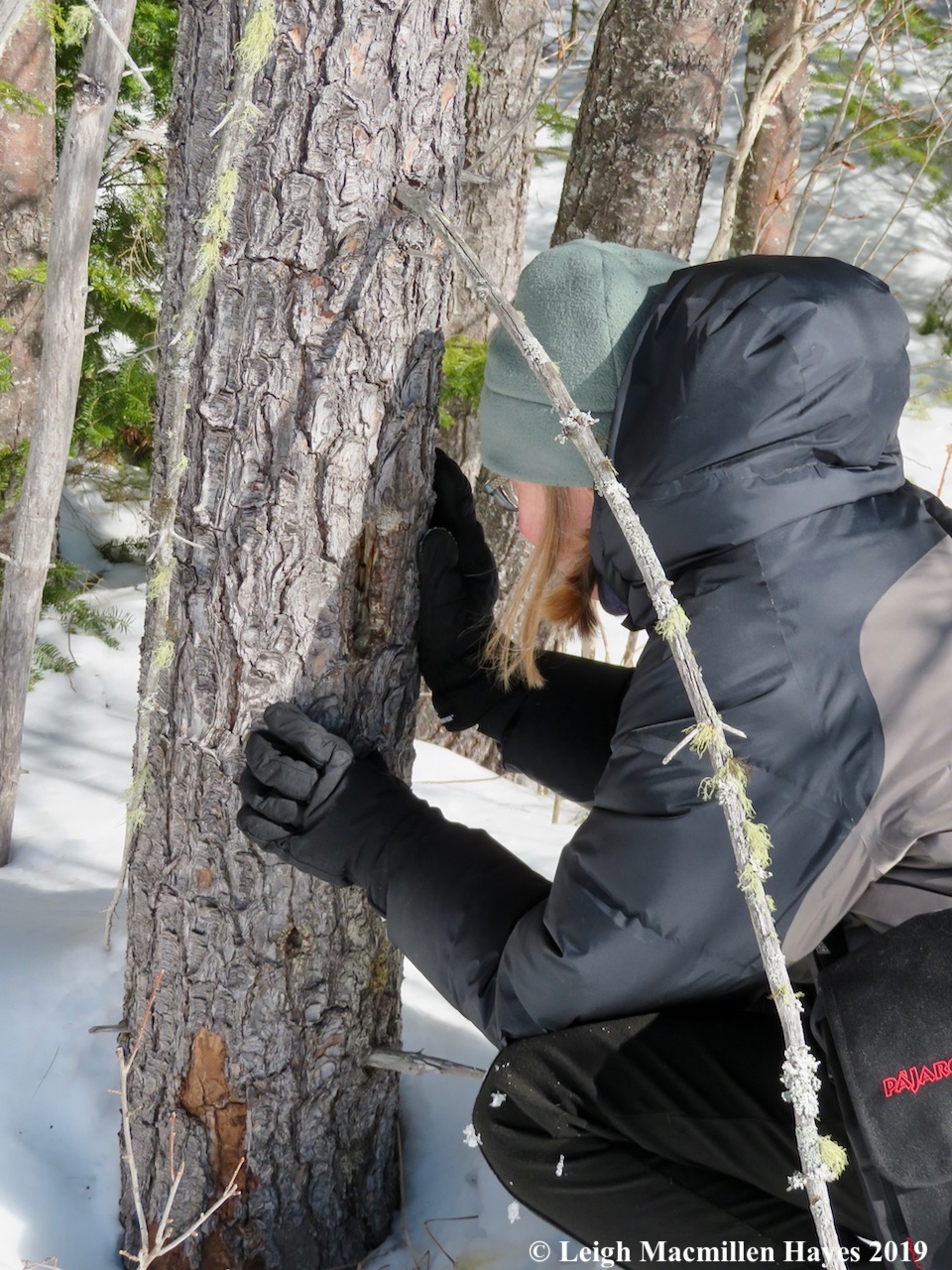
And then our real “Oh my!” exclamations began for we had found what we sought. Bear claw marks on the bark! They are much more subtle on Red Pines than American Beech, but as we circled the tree we kept seeing them.

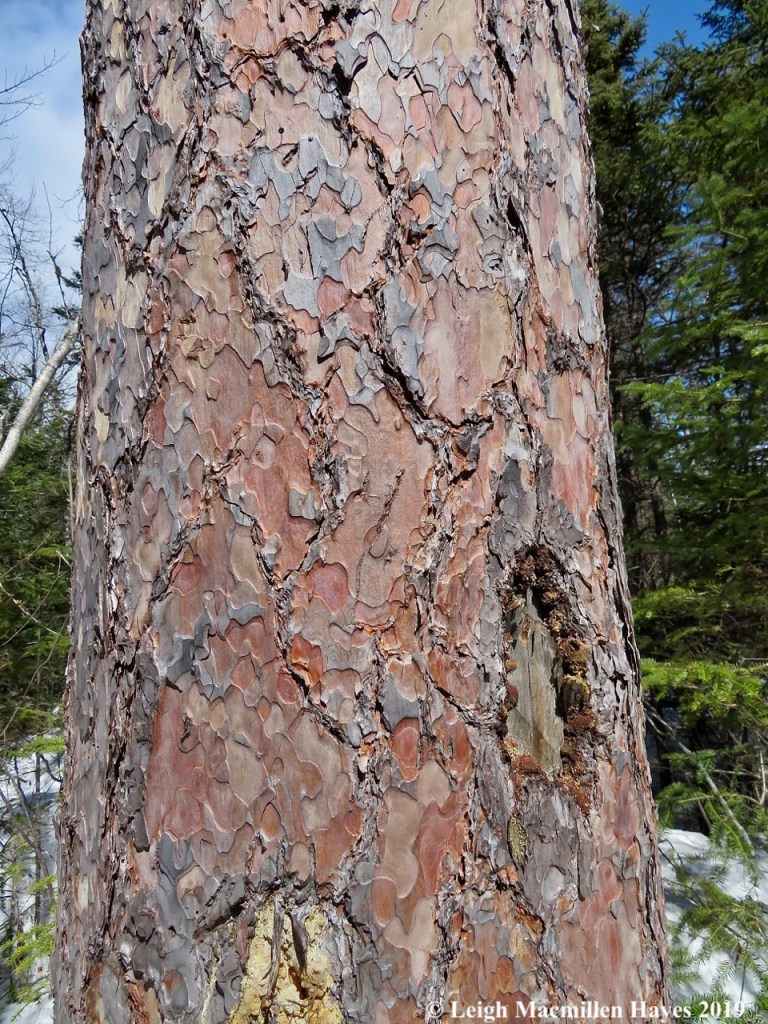
The thing about the Red Pine is that the flaky bark must make it difficult to climb, but then again, we couldn’t tell how high Ursus americanus had gone. Mind you, we didn’t look at any other trees in the forest, and as I sit and think about this one now, I can’t wait to return (I’ve a feeling my guy will want to be in tow for the next expedition) because this morning I’d forgotten that Black Bears use lone Red Pines as communication poles–turning their heads and biting into the tree while rubbing their backs against it to leave a scent (Think date night invitation). Usually, some hair is left behind in the sap. We did located old Pileated Woodpecker holes filled with sap, but no hair. Yet.

Our journey out was more of a bee-line because our six minutes took longer and I was a wee bit late to an interview, but my hostess was gracious when I explained that a Red Pine had held me up! And then on my way home I stopped by some more open water and much to my delight, a pair of Wood Ducks struck just the right pose.

And now I’m torn. Which duck do I prefer? The Balsam Fir Duck or the male Wood Duck? Such decisions to have to make at the end of the day.

Duck, duck, porky bear! They were each special in their own way.

March Madness

To my guy and our sons, March Madness means only one thing: NCAA basketball.

To folks at the grocery store it seems to mean something else: a disdain for snow.

To me, while there was a time when I admit thinking that March was indeed the longest month, despite the fact that others like January, May, July, and August also have thirty-one days, I’ve changed my tune over the years. Perhaps it was a move north so many moons ago as I sought a land where more snow blanketed the earth that helped me transition. What I do know is that it’s a month of constant change as we move from winter to spring and while I never want to see the snow melt, I equally enjoy all the hints of what is to come that slowly join the display.

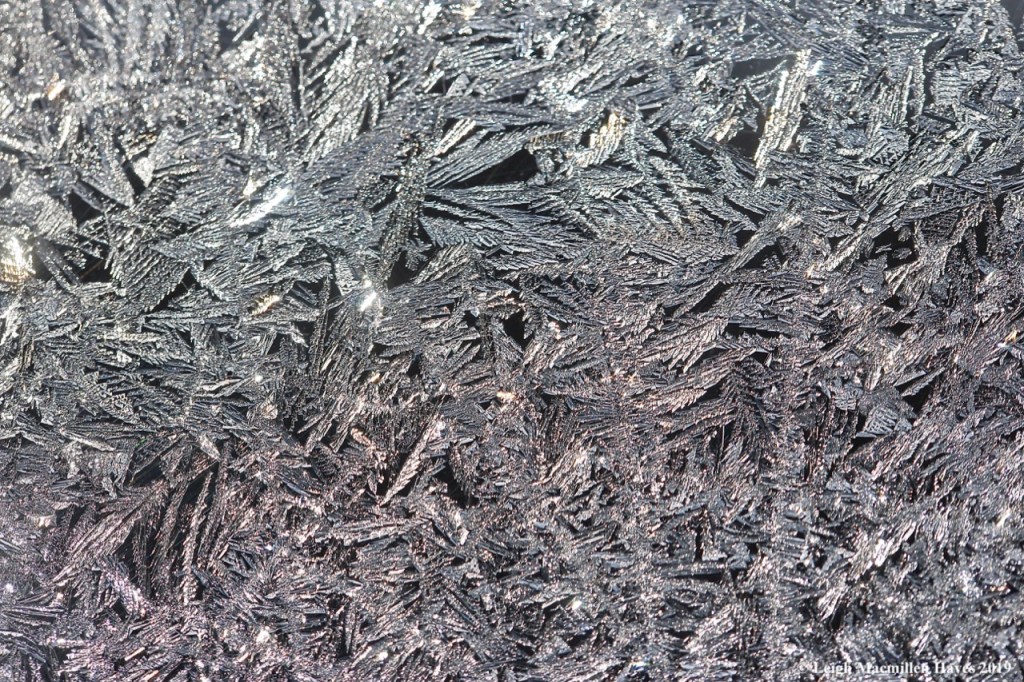
That display began on the first day of March when the frigid morning temperature created a mosaic of color and form on the window behind our bed. Feathery fern fronds and dragonfly wings danced across the glass as the morning light added subtle hues to the frosty collage.

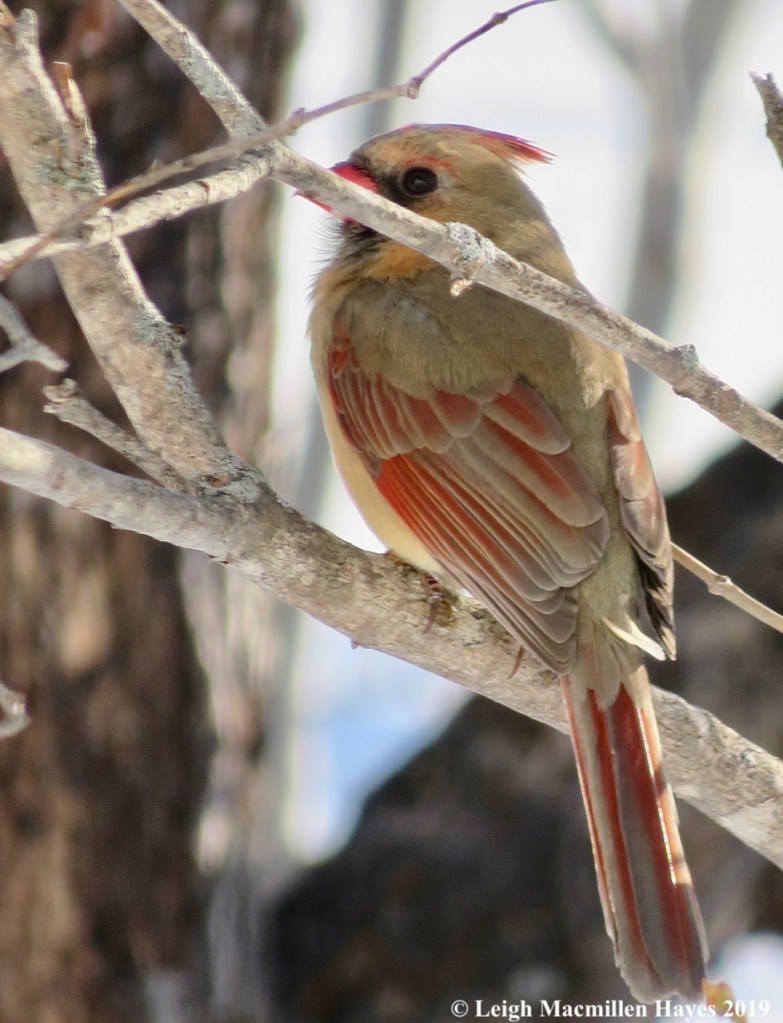
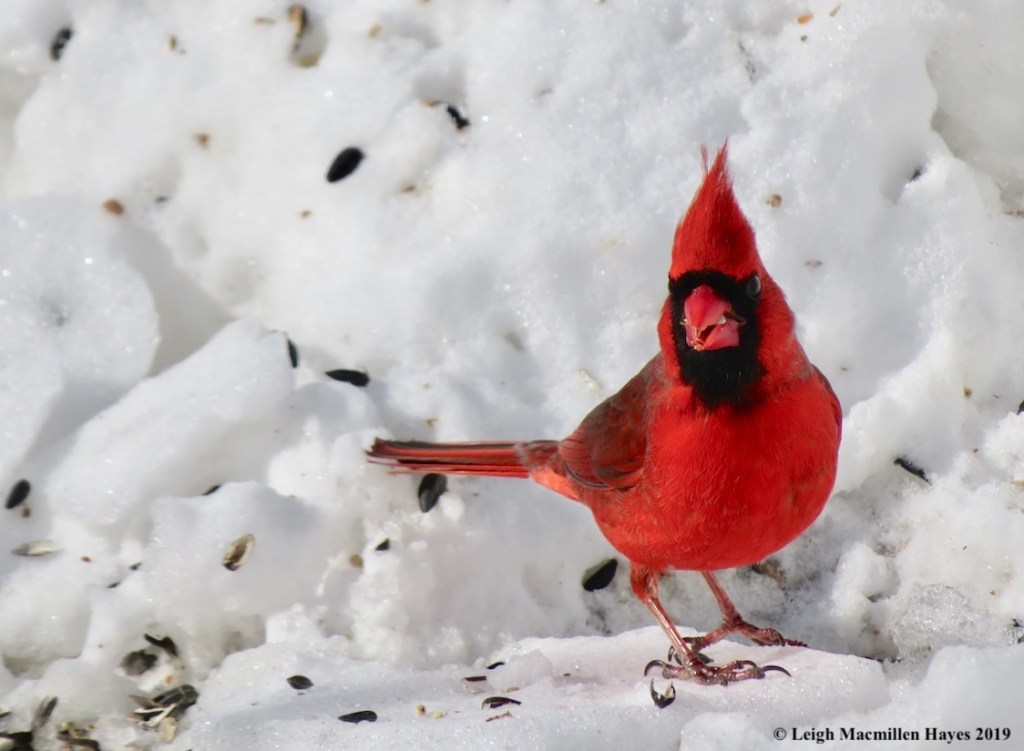
Outdoors, the female Cardinal showed off her brilliant colors in the late afternoon sun.

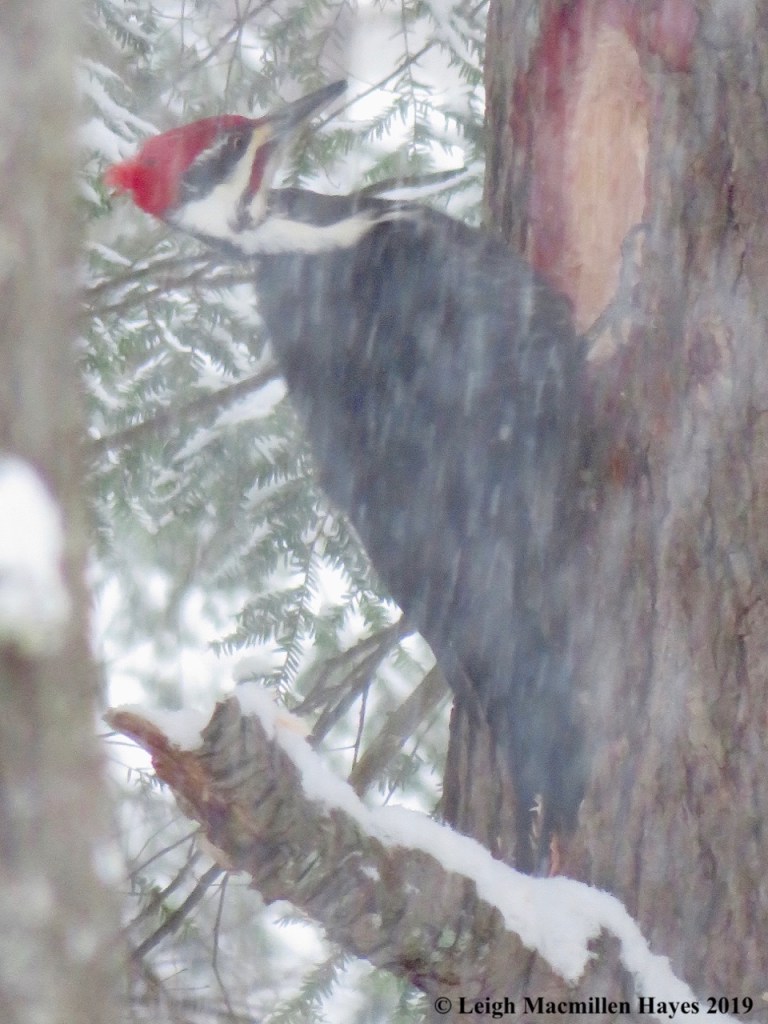
Even in snowstorms, the male Pileated’s excavation work never ceased.

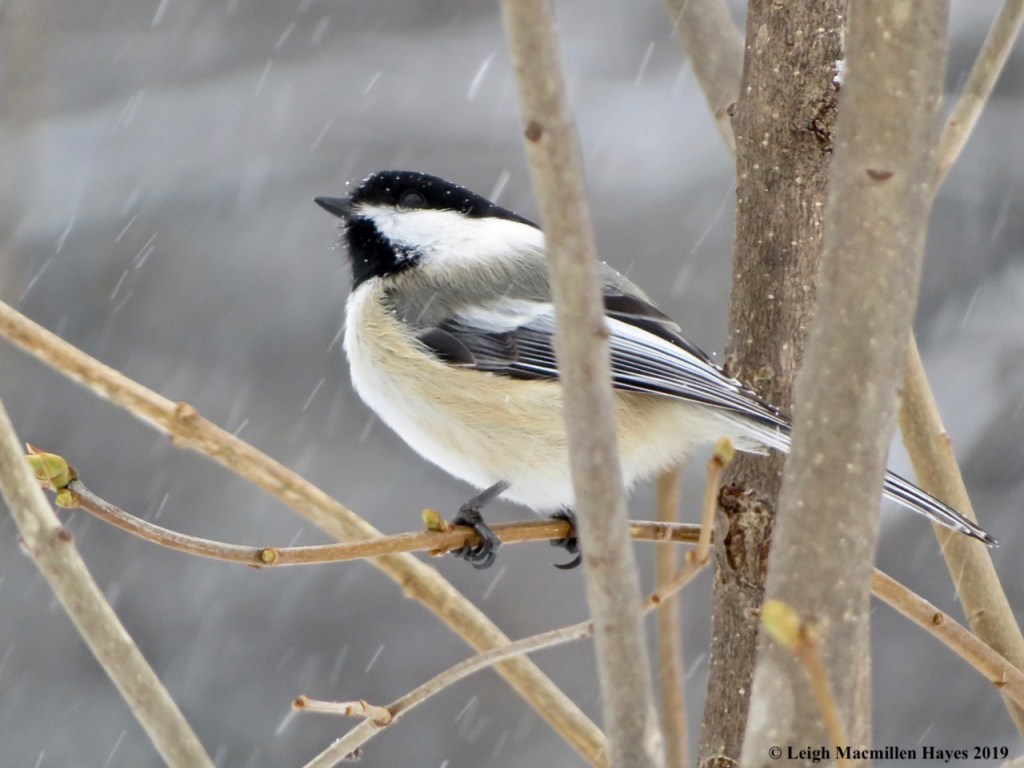
I did, however, spy a chickadee upon a lilac who looked at the snow as if to say, “Enough is enough.”

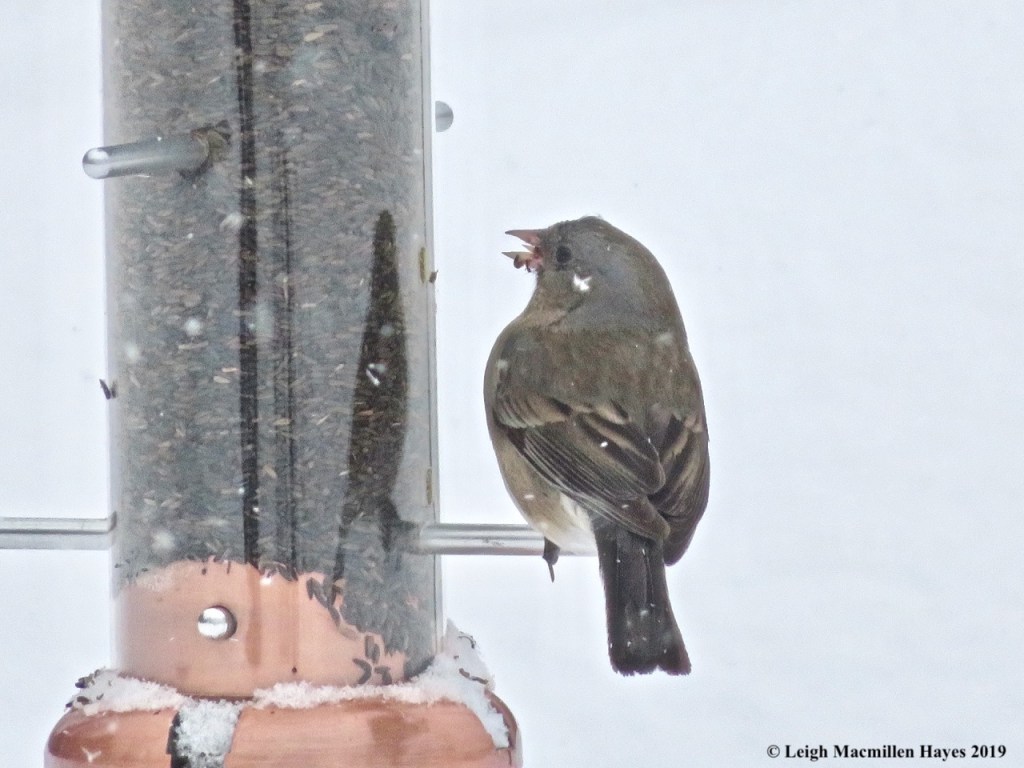
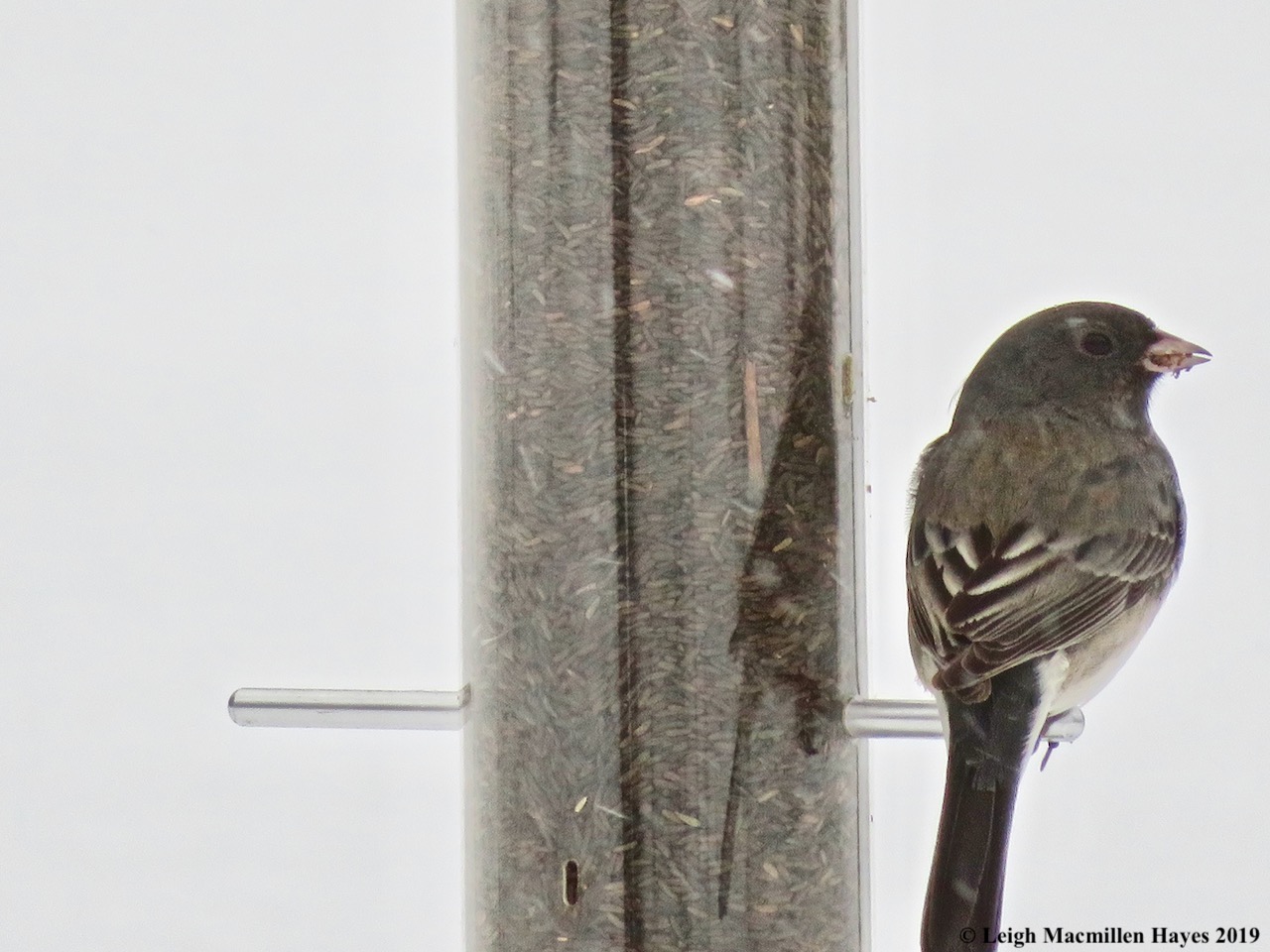
And a Junco who seemed to admire either its reflection or the prospect of plenty of thistle seeds.

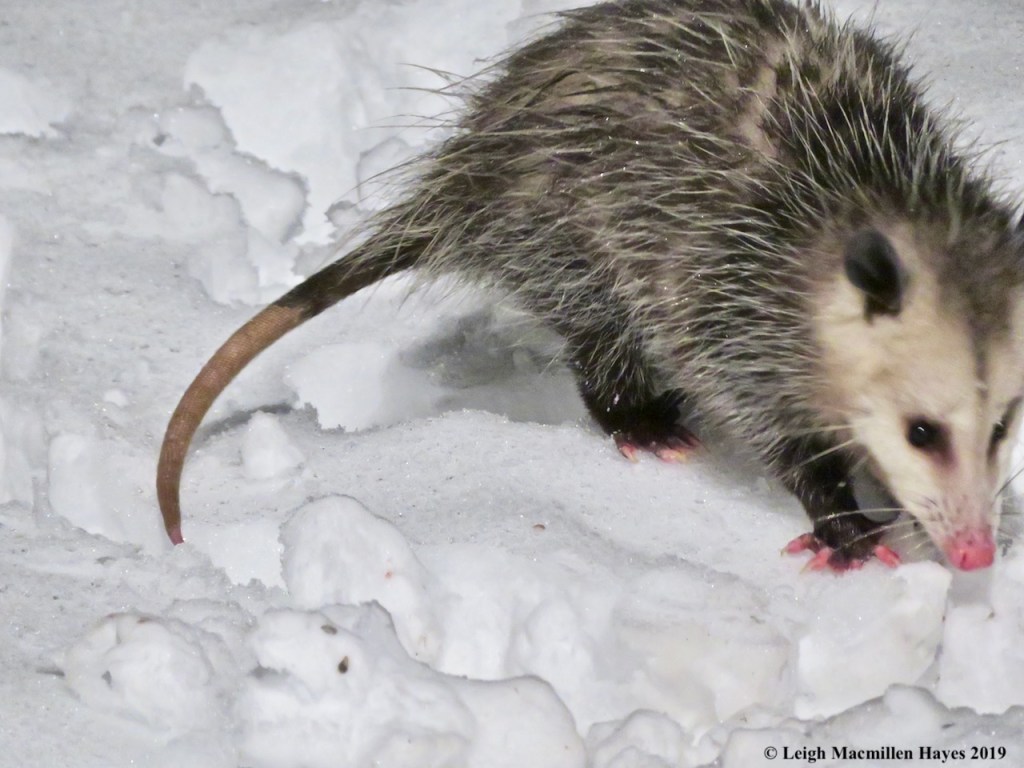
Over the course of the month, we welcomed various nocturnal visitors including this member of the marsupial family.

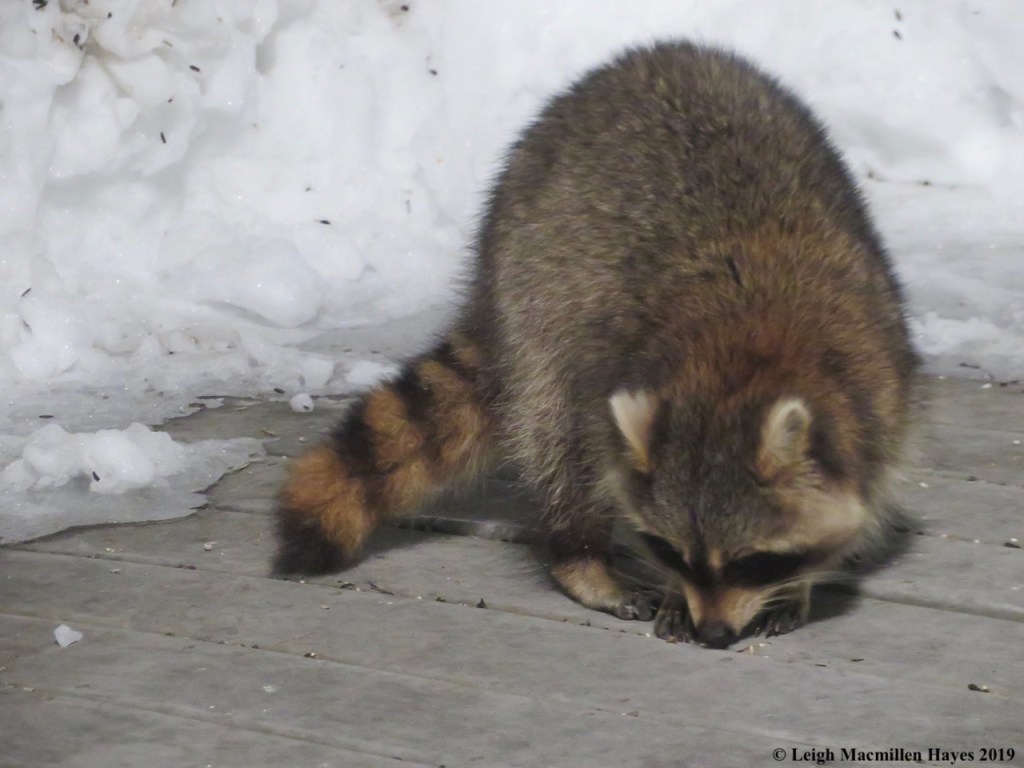
Other nighttime visitors were masked bandits, indeed.

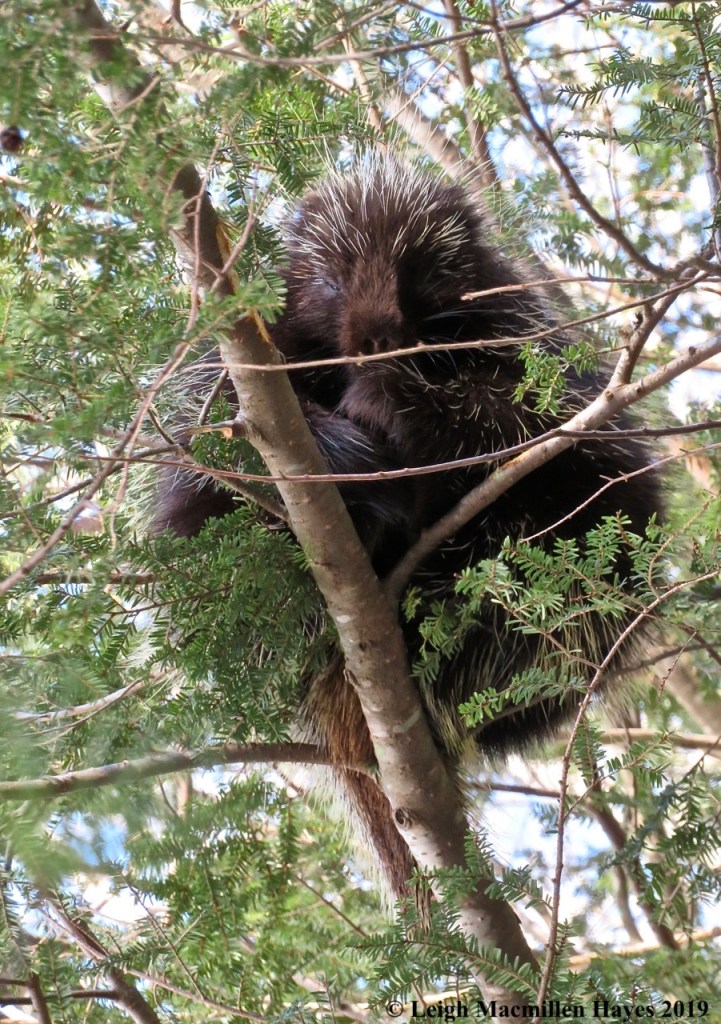
One nocturnal visitor surprised me one day by napping in a hemlock tree.

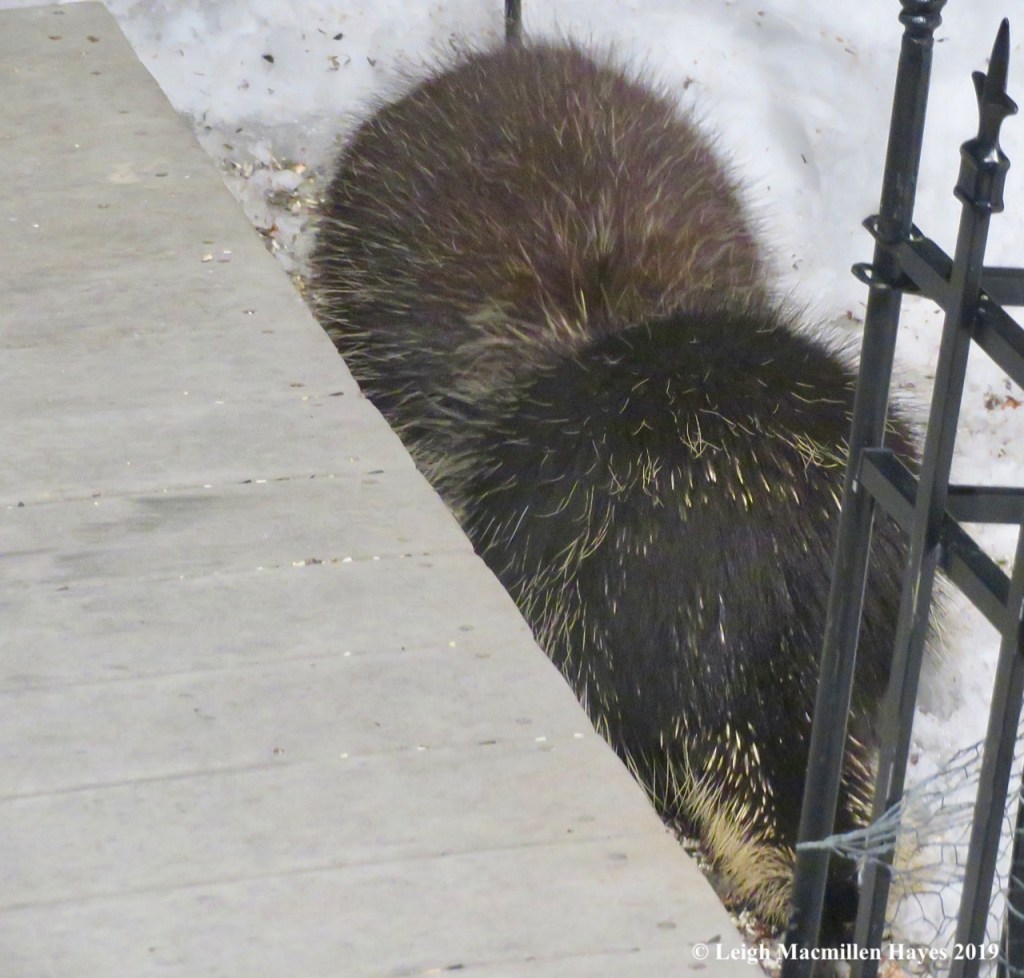
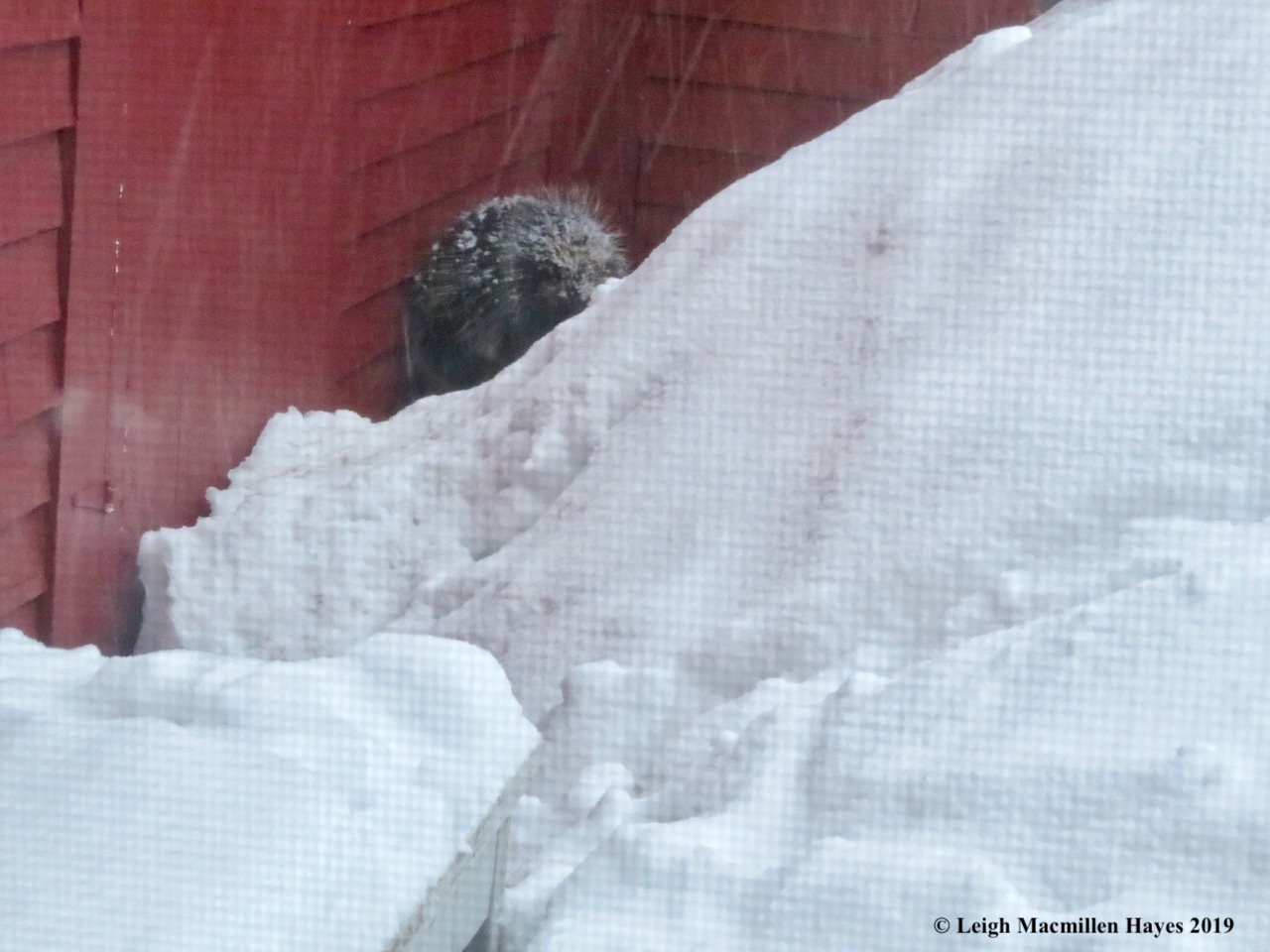
But, as the month progressed, I discovered we had not one, but two, porcupines living under the barn who made the transition from hemlock to seeds as their seasonal diet changed.

Even if we didn’t see them at night, we knew by the scat they left behind that they had emerged to dine.

And every day–the red and gray squirrels made their own quick work of the bird seed.

Of course, the birds also enjoyed such offerings.

Even if their feathers were astray as they began to molt despite, or because of, the weather conditions.

Some cracked me up with their stances at the suet feeder like this Red-breasted Nuthatch who appeared to casually step up to the bar and place his order.

March also brought the turkeys back, though I don’t know why they’d ignored us for the previous two months.

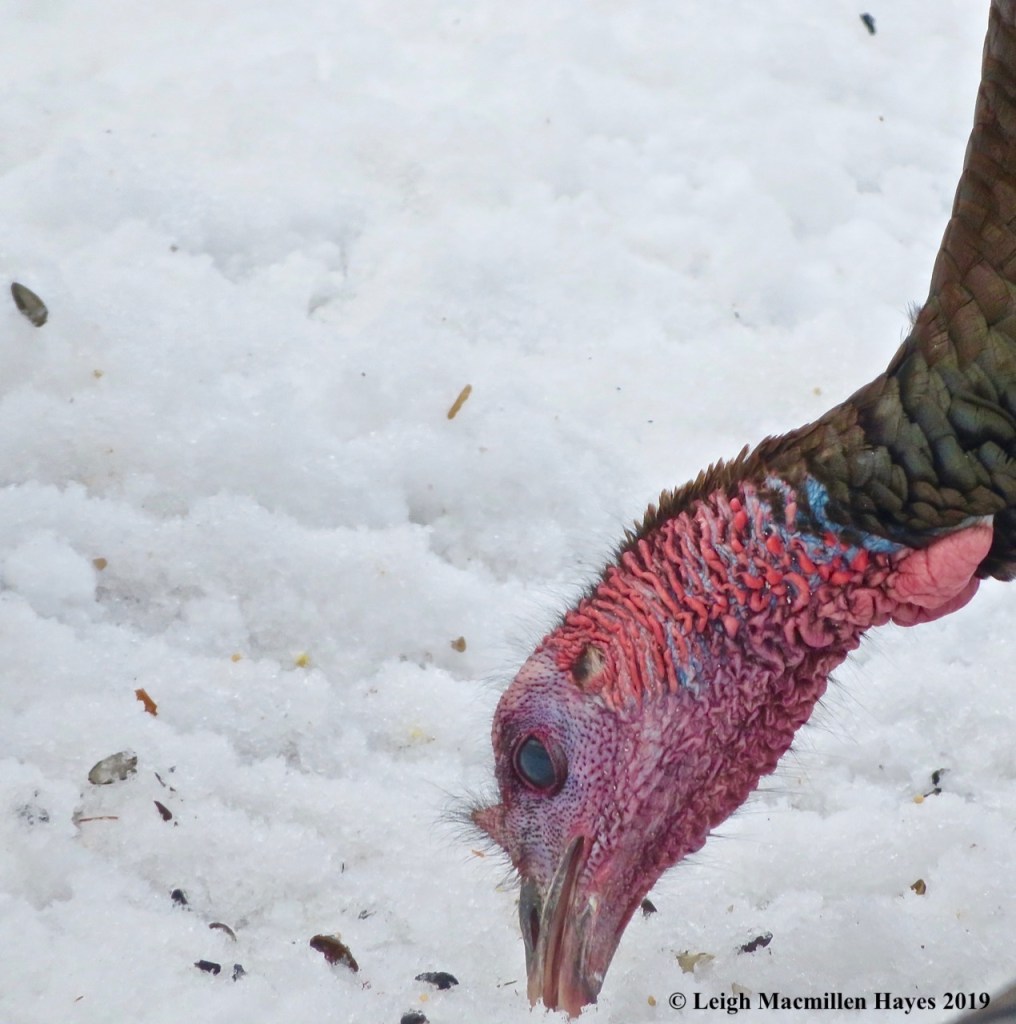
The Toms’ featherless heads of blue and pink and red raised bumps, called caruncles, changed colors with their moods.

That wasn’t the only thing about them to notice and I began to pay attention to their feet for like Ruffed Grouse, they seemed to have “snowshoes” and “treeshoes” that helped them stay atop snow and stable in their treetop roosts.

As the month advanced, others like this House Finch, returned to the north country and brightened my days.

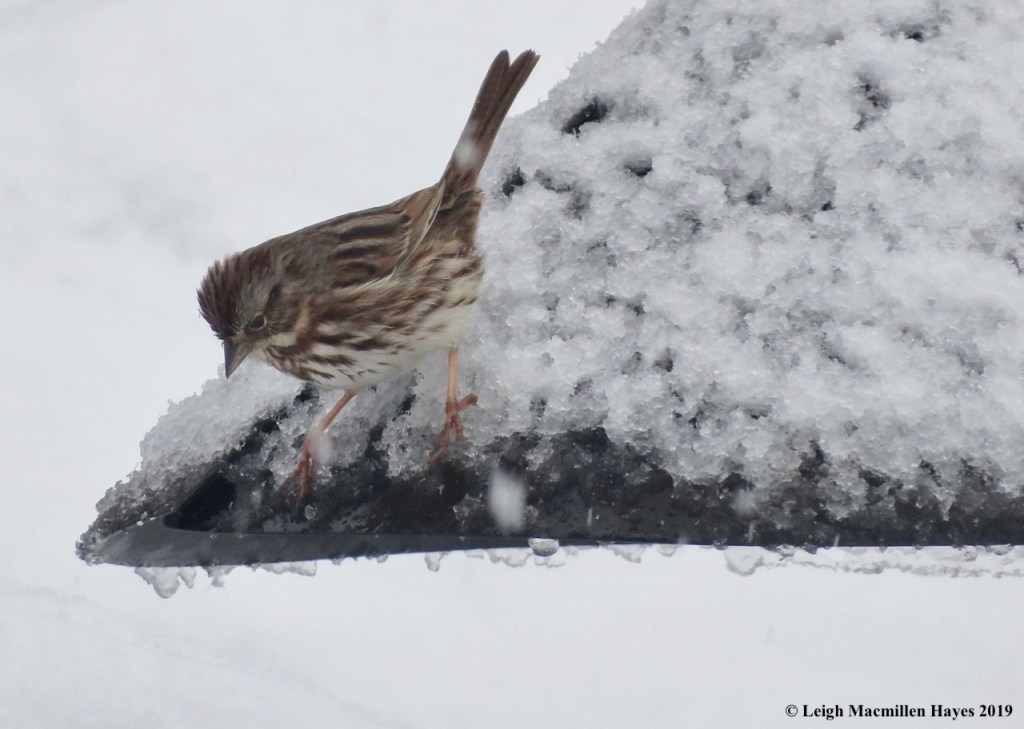
And though he’s not singing yet, the Song Sparrow also made a come back and invited others of his species to join him.

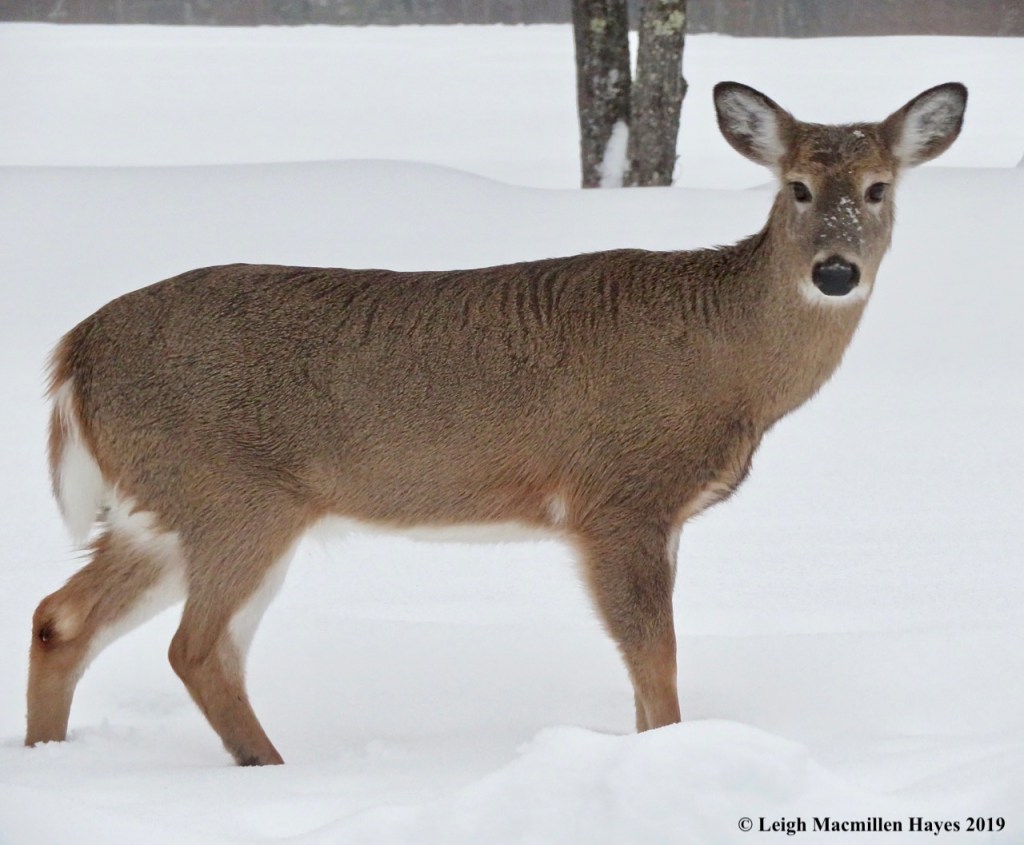
The bird seed became an important supply for all forms of life and the deer cleared their own path from the hemlock grove to the feeders.

And then one day, spring dawned!

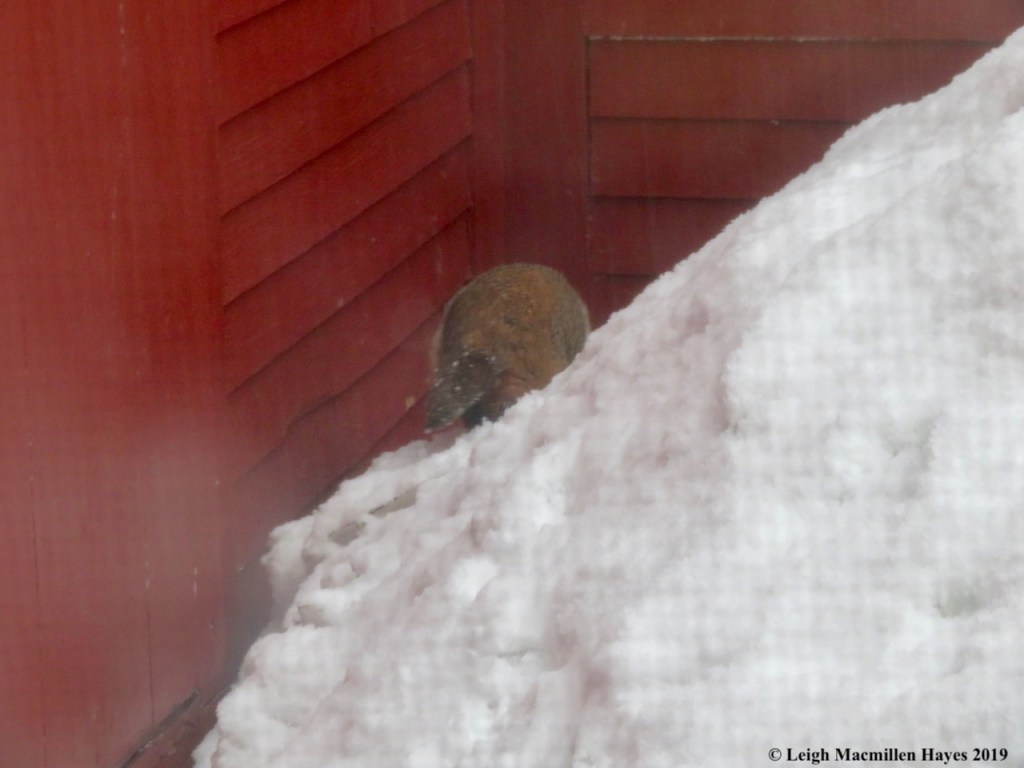
Still we had snow, but that didn’t stop the woodchuck from crossing the deck during a storm.

I chuckled when I watched him head to the familiar corner of the barn, that same corner that the porcupines emerge from and retreat to each night and morning. Oh, and the raccoons and opossum also know it. I’m just waiting for the skunks–I’ve smelled them, but have yet to see one.

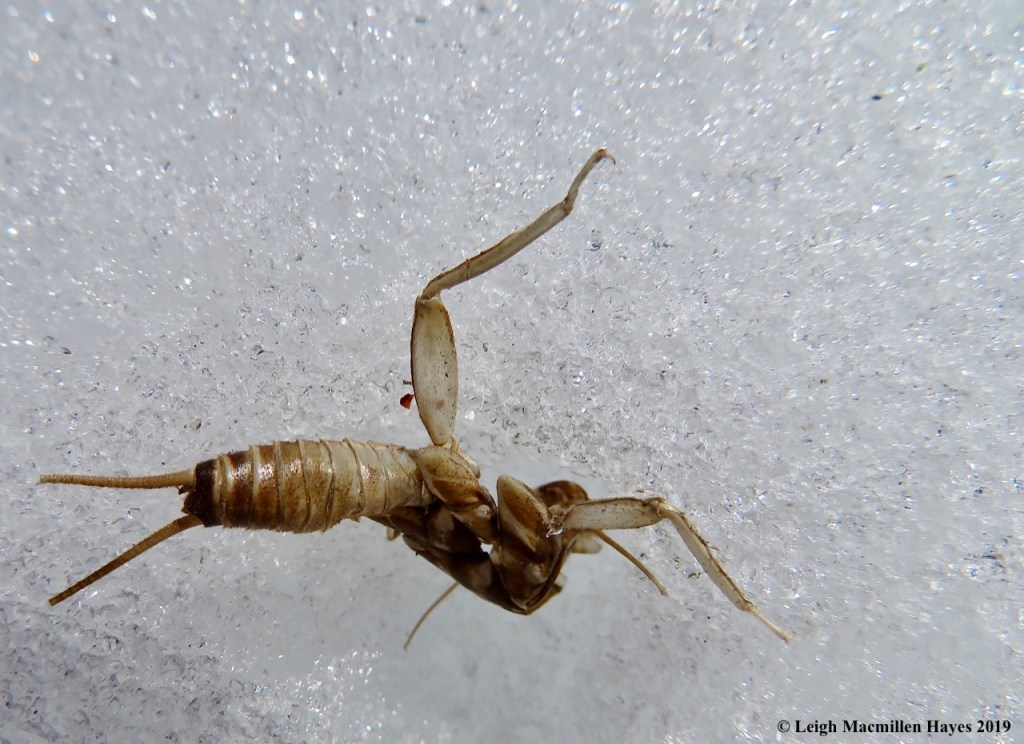
Some days I spent near water where I was delighted to find exoskeletons such as this upon the snow.

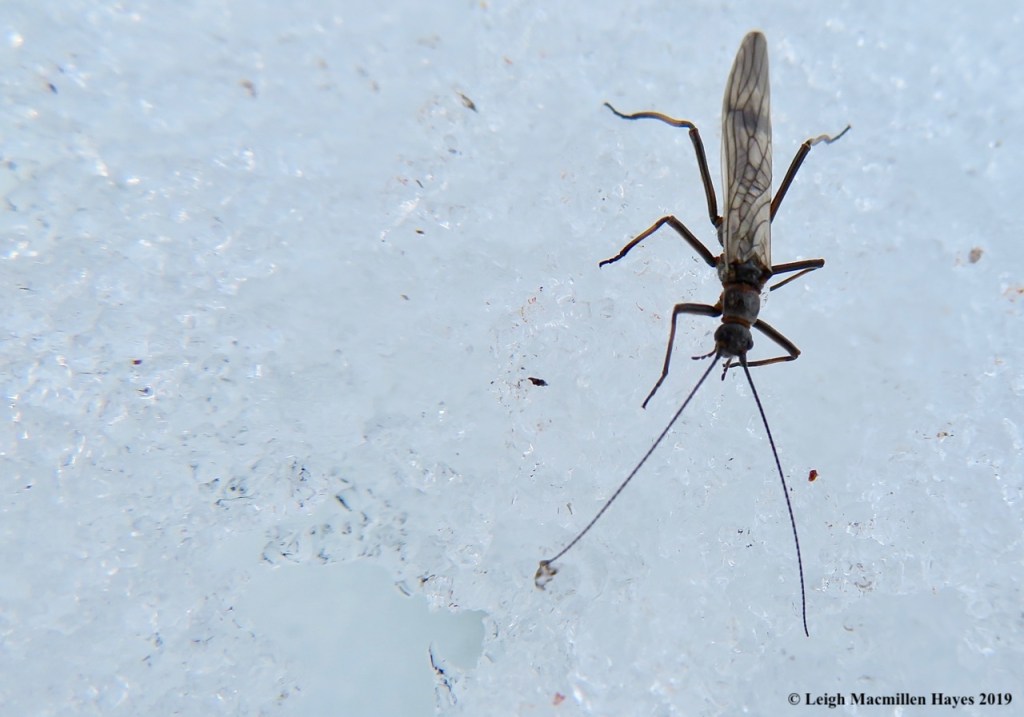
The exoskeleton had belonged to the larval stage of a winter stonefly such as this one that crossed the snow as they do.

Other insects didn’t fare so well in the weather and behind plexiglass they remained in frozen form.

Within the last few days, as the month winds down, I’ve noted areas beside trees with southerly orientations where the snow has melted and the wintergreens grow.

And though I’ve seen Robins all winter, their flock numbers have increased significantly this past week.

But still we have plenty of snow as this Tom Turkey well knew this afternoon while he marched forward with a spirit of hope in each step.

I hope you can find some spring in your steps as this month gives way to the next and enjoy the wonder of it all. For me, March Madness is really March Gladness.

Bear to Beer: St. Patrick’s Day

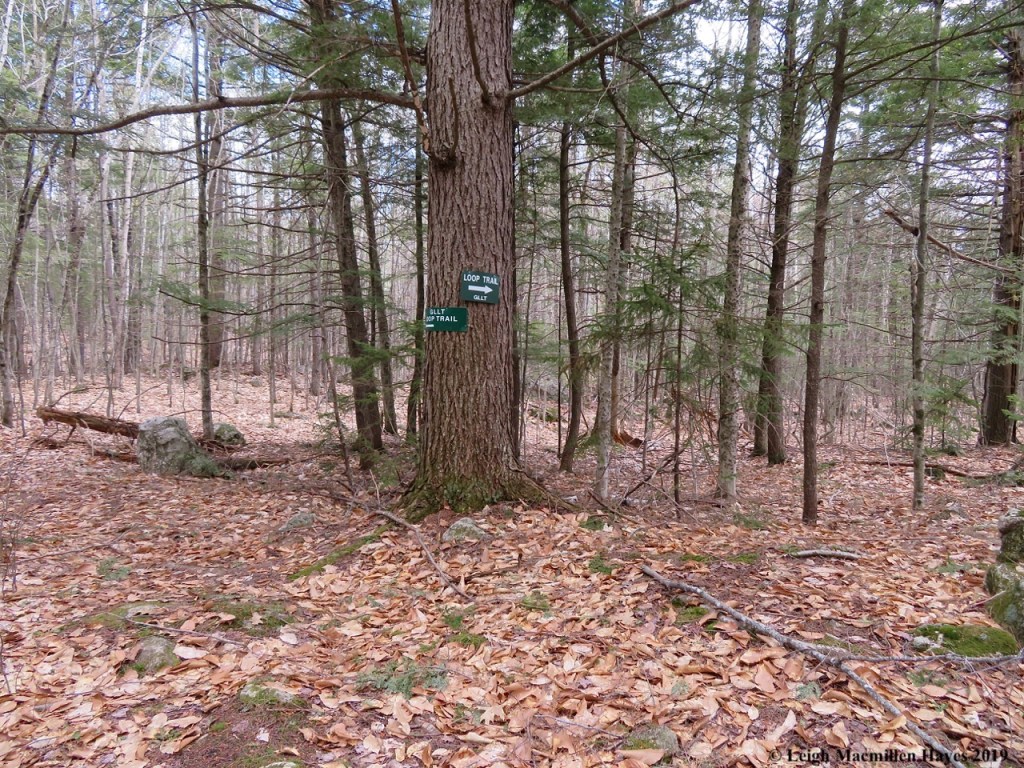
We drove to O’Lovell in western Maine late this morning with the plan to search for bear trees in an area where I’ve seen them in the past.

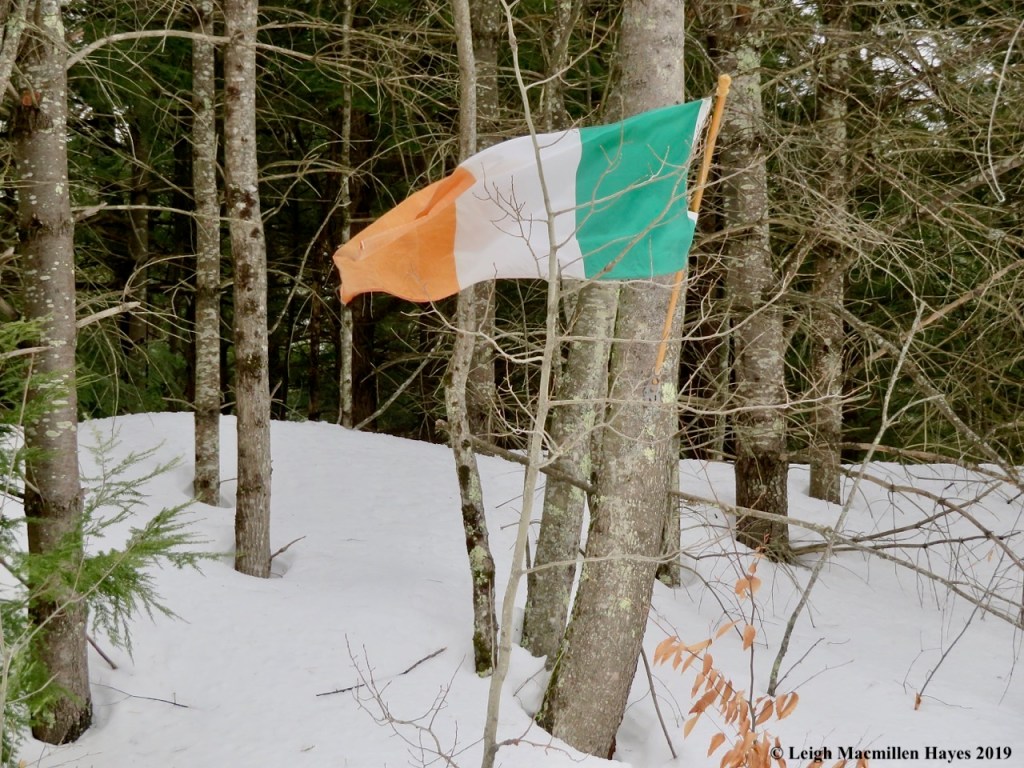
All along the main road to the Greater Lovell Land Trust property, Irish flags decorated random telephone poles and even a tree. The latter was our favorite for the person who hoisted it had to climb up the steep snowbank in order to show off the colors of the Emerald Isle.

Braving a thousand bumps, or so it felt as we negotiated potholes, frost heaves, and culvert depressions, we at last arrived at the end of a dirt (read: muddy) road and prepared for a hike up the oxymoron called Flat Hill.

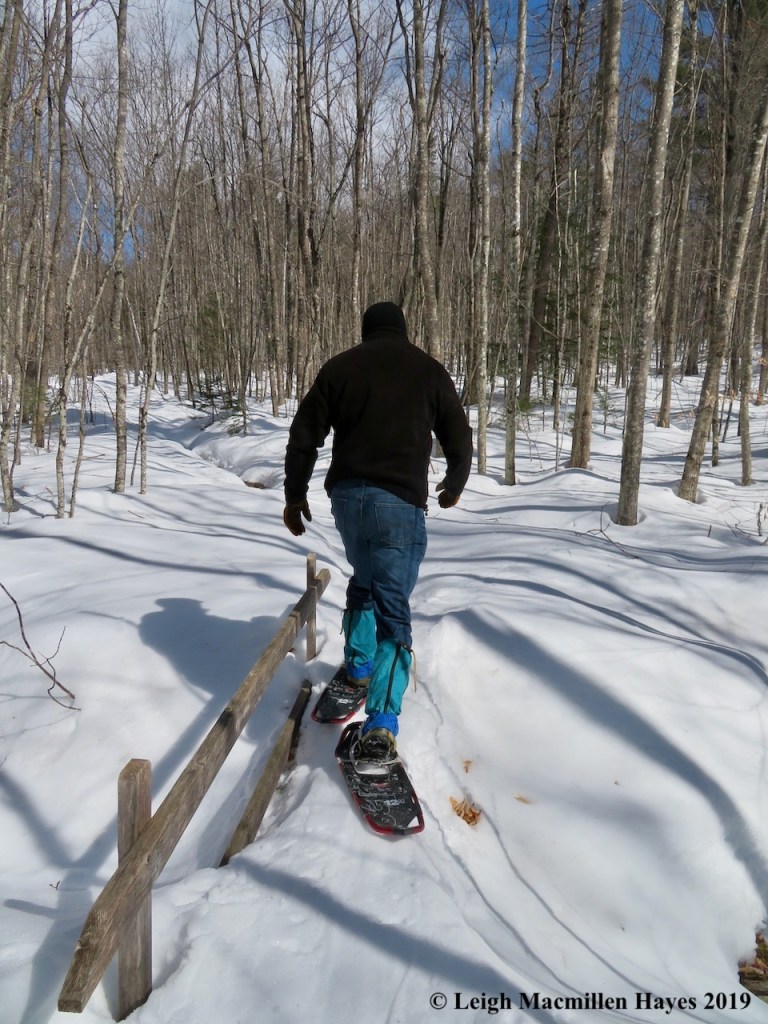
While yesterday’s trek meant slogging through the wet snow, today’s brisker temperature allowed us to stay on top of the wintery surface, though we were thankful for our snowshoes.

Upward we climbed until we reached the coppiced red oaks and knew to turn right, walk off trail and begin our search among the beeches in the forest. You see, I knew there were trees to be found for I’ve seen them before, and I knew the turning point tree, but . . . the last time I looked, I couldn’t locate the trees with the bear claw marks. That, however, is a challenge my guy heartily accepts and so we split up and each set off to check all the trees in the forest. Well . . . almost all.

As is to be expected, my guy covered much more territory at a faster rate than I did and I wasn’t surprised to hear the distant call, “I got one!”

Indeed, he did. And a beauty was it. Can’t you just see the bear shimmying its way up and down the tree–several times over.

In my brain, a bear hug was the real deal from one of the original tree huggers. And I gave thanks for being accused of doing the same.

All the way to the top we could envision the quest for those tiny beech nuts that offered nutrition. Hmmm . . . isn’t it curious to note that the core of nutrition is “nut”? Or is it curious?

From the big tree, we moved up the mountain until we reached its sort of flat top where the view to the west is always a treat. And then we began to look about, for usually there is porcupine sign in the immediate vicinity to enjoy–that is . . . until I offered a porcupine prowl there two weeks ago and all we found were fisher tracks.

Today, however, was different and we found some fresh evidence that the porcupine is still in the area. We knew it by the teeth impressions left behind.

Further evidence was seen in some diagonally clipped twigs, scat, and even a strand of hair! Yes, porcupines have hairy bodies–including their quills. But on their bellies and faces they have a silkier variety–do you see it?

While I looked about the summit for more evidence, my guy stalked about below. Can you see him in the middle of the photo?

Eventually I wandered down to join him, pausing halfway to note some porky tracks leading upward . . . and downward, of course.

Below the ledges we hunted for his den, but found only tracks moving along the edges.

Though we never found the critter that we assume could easily look like a miniature bear if one were to remove all its quills, we enjoyed exploring the territory that is part of his home.

The delightful part of paying attention is the noticing. There were the organ pipes attached to the ledges, their music enhanced by drips onto rock tripe, ferns and mosses.

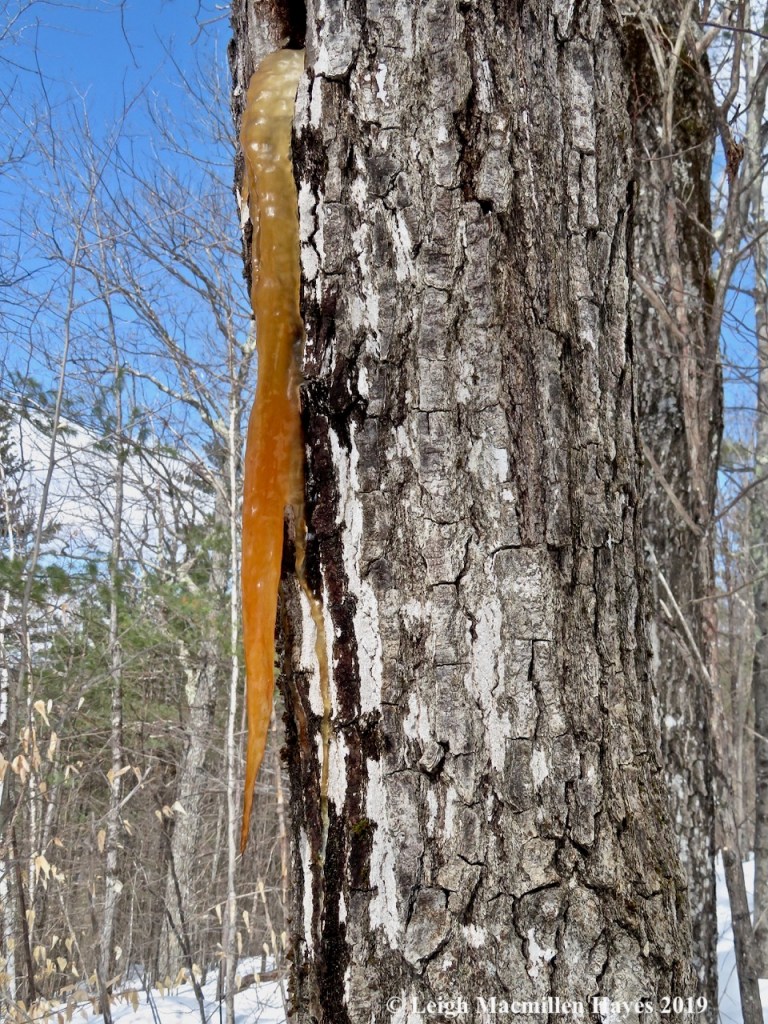
And an icicle of amber that stood at least two feet long.

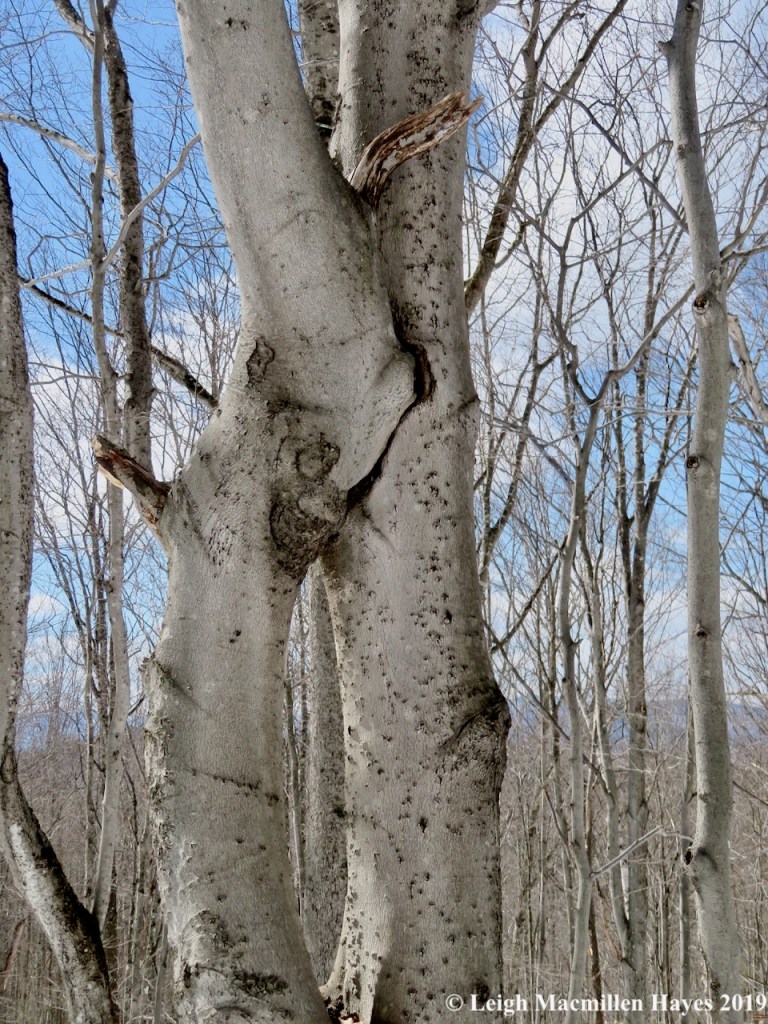
Eventually we made our way back up and then down, again bushwhacking to look for more bear trees. We found a couple, but it was the works of others that also garnered our attention, such as this one that decided to split, but then came back together as if it was making up for time spent apart.

We found another tree with a burl that could easily have been mistaken for bear cubs spending time in a nurse tree. Typically, however, mama bear would choose a white pine for it would provide cover for her young ones as she went off to search for food for her brood.

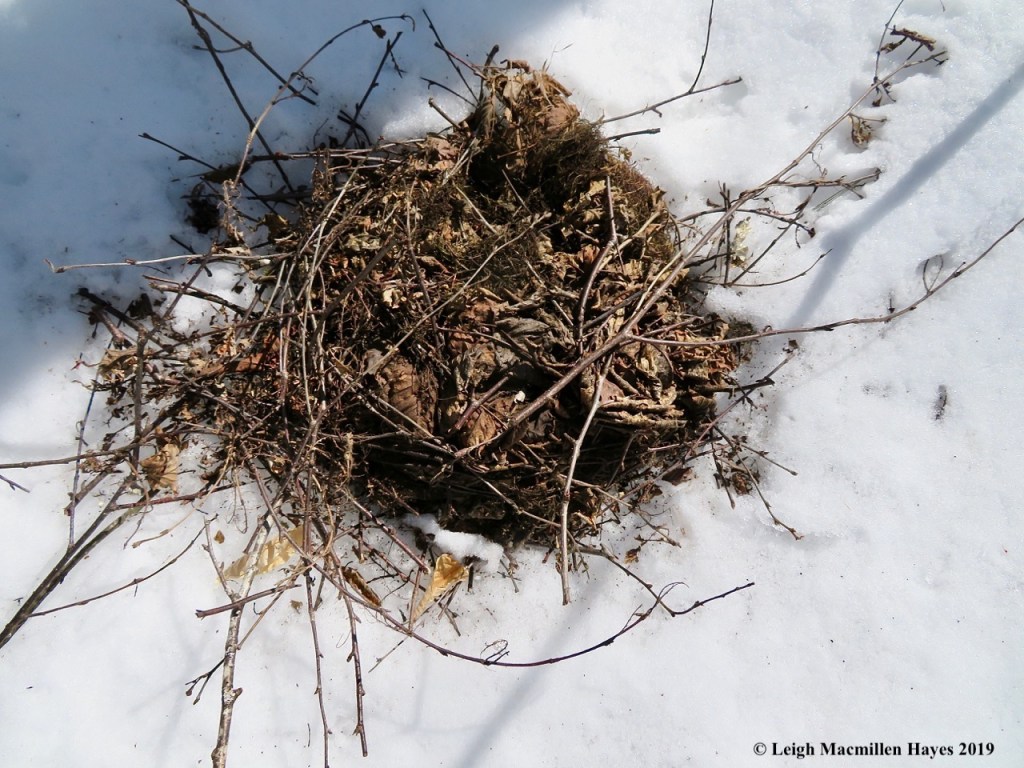
Embedded in the snow was a squirrel drey and we mentally noted its location so we can go back another day after its no longer frozen in place and try to dissect it in hopes of better understanding such a structure.

And we spied a stonefly exoskeleton–an offering of total delight for despite its minute size, its discovery was right up there with the bear hug.

At last we left O’Lovell, with its Irish flags flying in the breeze, and found our way to O’Harrison, where we joined our friends, the O’Wisers for a beer and dinner.

The evening was topped off with Irish music performed by our favorite local acoustic folk band, Bold Riley.

From bear to beer, everyone was Irish today as we celebrated St. Patrick’s Day. Well, almost everyone–I did wear some orange and donned my Macmillen plaid flannel shirt. O’Macmillen! O’Hayes! O’Bear!

Framed by the Trees

Our journey took us off the beaten path today as we climbed over a snowbank at the end of Farrington Pond Road and onto the Greater Lovell Land Trust’s John A. Segur Wildlife Refuge East. We began at a piece of the parcel neither Pam Marshall or I had ever explored before, which added to the fun. At first, we followed the tracks of a giant, and eventually decided they might have belonged to another human being. Might have. Always wonder.

And then we were stopped in our tracks as we looked up and recognized a Great Blue Heron–or so it seemed in the dead snag that towered over the edge of Farrington Pond. Except for one tiny area of water, the pond is still very much ice covered so it will be a while before this ancestor of the Greats sees her relatives return.

Standing beside the bird-like structure was another that helped us find beauty and life in death.

We peered in, and down, and up, and all around. With each glance, our understandings increased. So did our questions.

There were holes that became windows looking out to the forest beyond.

But those same windows helped us realize they were framed by the results of their injuries. You see, it appeared that a pileated woodpecker had dined on the many insects who had mined the inner workings of the tree. After being so wounded by the birds, the tree attempted to heal its scars as evidenced by the thick growth ring structure that surrounded each hole. Or at least, that’s what we think happened.

To back up our story, we looked from the outside in and saw the same.

We also noted the corky bark with its diamond shapes formed where one chunk met another.

And much to our surprise, we found one compound leaf still dangling. No, this is not a marcescent tree, one of those known to hold its withering leaves to the end of time (or beginning of the next leaf year). But instead, this old sage is one of the first to drop its leaves. So why did one outlast the race? Perhaps to provide a lesson about leaves and leaflets, the latter being the components of the compound structure.

Adding to the identification, we realized we were treated to several saplings growing at the base of the one dying above. By its bud shape and opposite orientation we named it Ash. By its notched leaf scars and lack of hairs, we named it White. White Ash.

Because we were looking, Pam also found a sign of life within. We suspected a caterpillar had taken advantage of the sheltered location, but didn’t know which one.

About simultaneously, our research once we arrived at our respective homes, suggested a hickory tussock moth. Can you see the black setae within the hair?

Pam took the research one step further and sent this: “I read that the female lays eggs on top of the cocoon and then makes a kind of foam that hardens over them so they can survive the winter. How cool is that?” Wicked Cool, Indeed!

We probably spent close to an hour with that tree, getting to know it from every possible angle.

And then it was time to stop looking through the window and to instead step into the great beyond.

We did just that, and found another set of mammal tracks to follow. Tracking conditions were hardly ideal and we followed the set for a long way, never quite deciding if it was a fisher or a bobcat, or one animal traveling one way and another the opposite but within the same path.

Eventually, we gave up on the shifty mammal and made our way into the upland portion of the property where I knew a bear claw tree stood. Pam’s task was to locate it and so she set off, checking all the beech trees in the forest.

Bingo! Her bear paw tree eyes were formed.

It was a beauty of a specimen that reminded us of all the wonders of this place.

From that tree, we continued off-trail, zigzagging from tree to tree, but never found another. That doesn’t mean we visited every tree in the refuge and so we’ll just have to return and look some more.

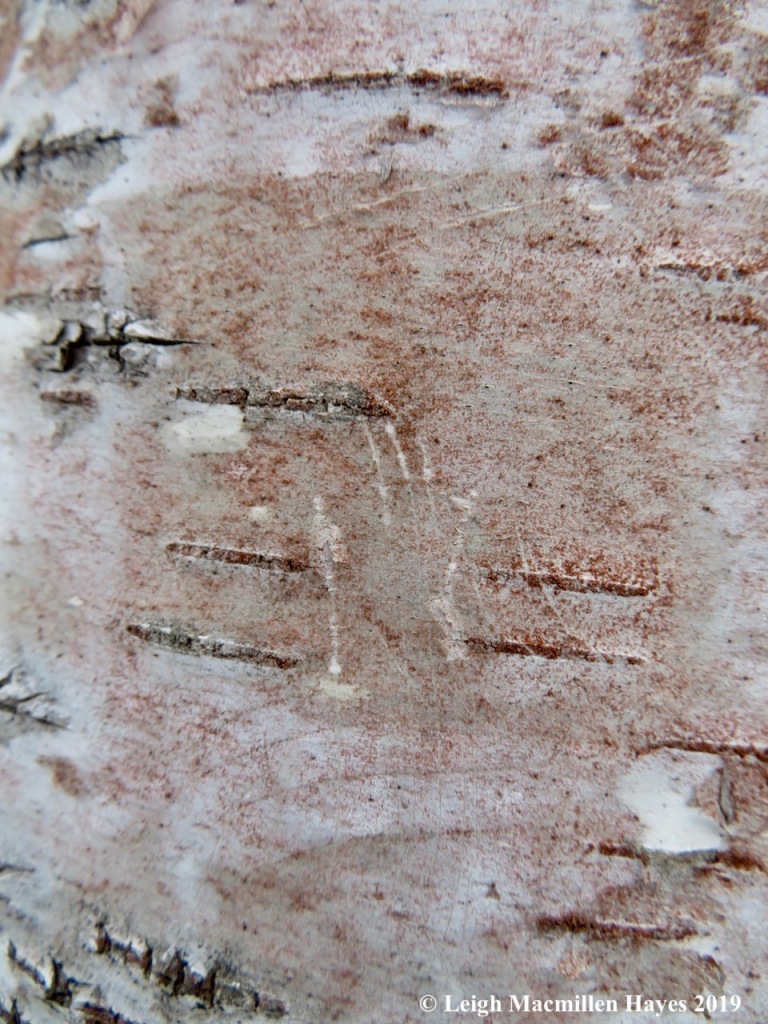
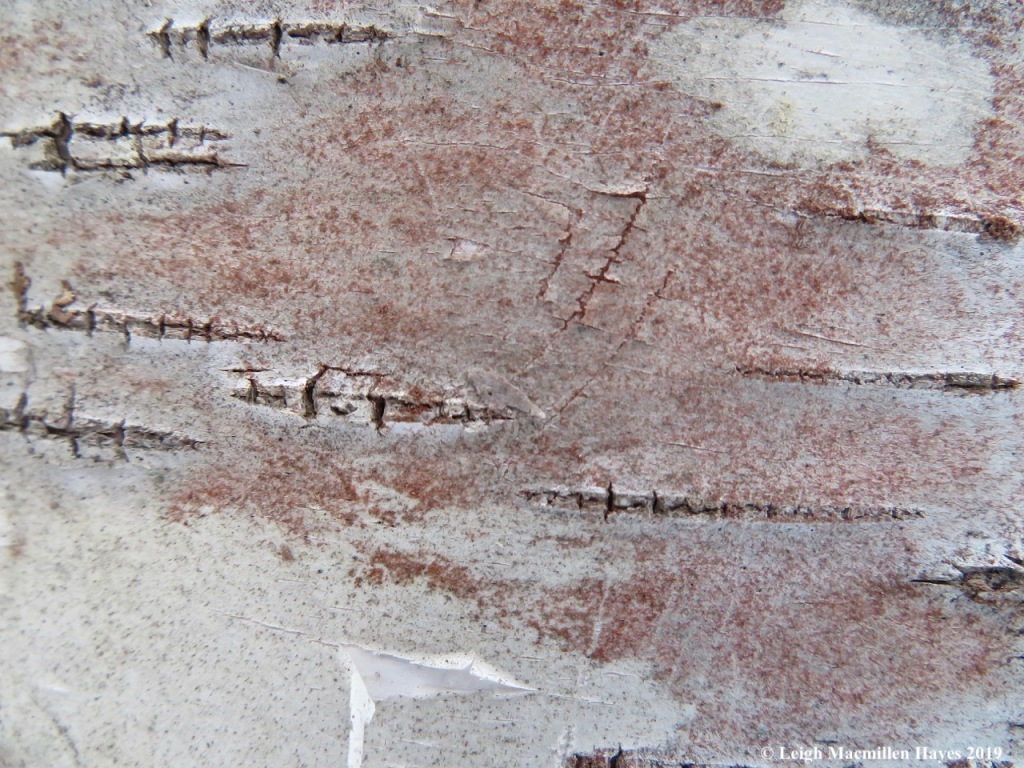
We did, however, find some scratch marks on a paper birch.

They were too close together to have been created by even a young bear, but we did consider squirrel. Wiping off the rosy-white chalk that coated the bark, we did find actual scrapes below. Now we’ll have to remember to check that tree again in a year or so and see what we might see.

What we finally saw before making our best bee-line out (don’t worry, our Nature Distraction Disorder still slowed us down) was the view of Sucker Brook and the mountains beyond.

At last we pulled ourselves away, but gave great thanks for that ash tree that framed our day and our focus and for all that we saw within it and beyond.

Book of the March: Entering the Mind of the Tracker

A few weeks ago I’d contacted my friend Parker Veitch of White Mountain Mushrooms, LLC, to make sure he was willing to co-lead a couple of fungi walks this summer and in his response he included this paragraph: “I have a book for you. Should I leave it at the office? The first 20 or so pages are a little slow, but I think you will really like it.”  

Like it? I LOVE it. And I haven’t even finished reading it. So you must be curious by now. As I was when I saw it sitting on the table at the Greater Lovell Land Trust office. You see, I was sure the book would be about fungi because Parker is always trying to help me learn about the principal decomposers of the world. Ah, but one should never assume.

May I present to you the Book of March: Entering the Mind of the Tracker by Tamarack Song.

This book is like no other tracking book that I’ve read. As I wrote back to Parker, “Thank you so much for sharing the book with me. I’m in the midst of reading Eager by Ben Goldfarb, The Invention of Nature by Andrea Wulf, which is about Alexander von Humboldt, and a book of essays by E.B. White (thanks Judy and Bob for gifting me that gem), but right now I’m most captivated by the teaching of Tamarack Song and I am going to have to ask Bridgton Books to order a copy for me. I want to be him and have the understandings and slow down and ask the questions he asks. And teach others to do the same.

At first I couldn’t put the book down. But now I’ve changed my tune a bit because I want to savor it. Typically, when I read a book such as this I underline key phrases, write notes in the margin and turn page corners up. But, because I’m only borrowing this copy I’m not doing that. (Did I have you nervous for a minute there, Parker?) And that’s making me soak it all in and savor each chapter more fully than I might.

You see, Tamarack, according to the back cover blurb, “has spent his life studying the world’s aboriginal peoples, apprenticing to Elders, and learning traditional hunter-gatherer survival skills. He has spent years alone in the woods as well as living with a pack of Wolves. In 1987, he founded the Teaching Drum Outdoor School in the wilderness of northern Wisconsin, where he runs the yearlong Wilderness Guide Program.”

In each of the sixteen chapters, Tamarack plays the role of guide, but not by telling. Rather, he takes the reader along on an exploration with one of his students, and encourages all of us to question what we see. In other words, to never assume, which is what I did when Parker first mentioned the book and what I often do when I’m tracking.

Instead, he wants us to notice and think about why the animal might be behaving in a particular manner, even if we know what it is by its tracks and its sign. What’s the rest of the story?

In fact, why did Opossum suddenly appear toward the tail end of the snowstorm on Sunday night?

And why is he in western Maine? How has he survived this winter with its frigid temps (mind you, it’s finally starting to warm up a tad). Where has he been since I last saw his prints in the snow a few months ago? What brought him to our yard again? Does he live under the barn with the rest of the neighborhood?

And what about last night’s visitor, Raccoon. Where has he been all winter? What brought him out? I have to say I wasn’t surprised to see him as once the temps do begin to rise the slightest bit, he appears. I also know that the bird seed attracted him, though he surprised me by not stealing the suet.

Tamarack encourages us to become the animal, especially if we don’t see it, but do see the signs it left behind. Had there been snow on the deck, I imagine I would have recognized the raccoons prints, but I would have wondered about other lines that probably would have appeared. Having the chance to watch Raccoon as I did, I now know that those lines would have been his nose and tongue as he tried to vacuum the seeds.

But then there was Raccoon’s coloration. Why the mask? Why the striped tail? I have so much to think about and learn.

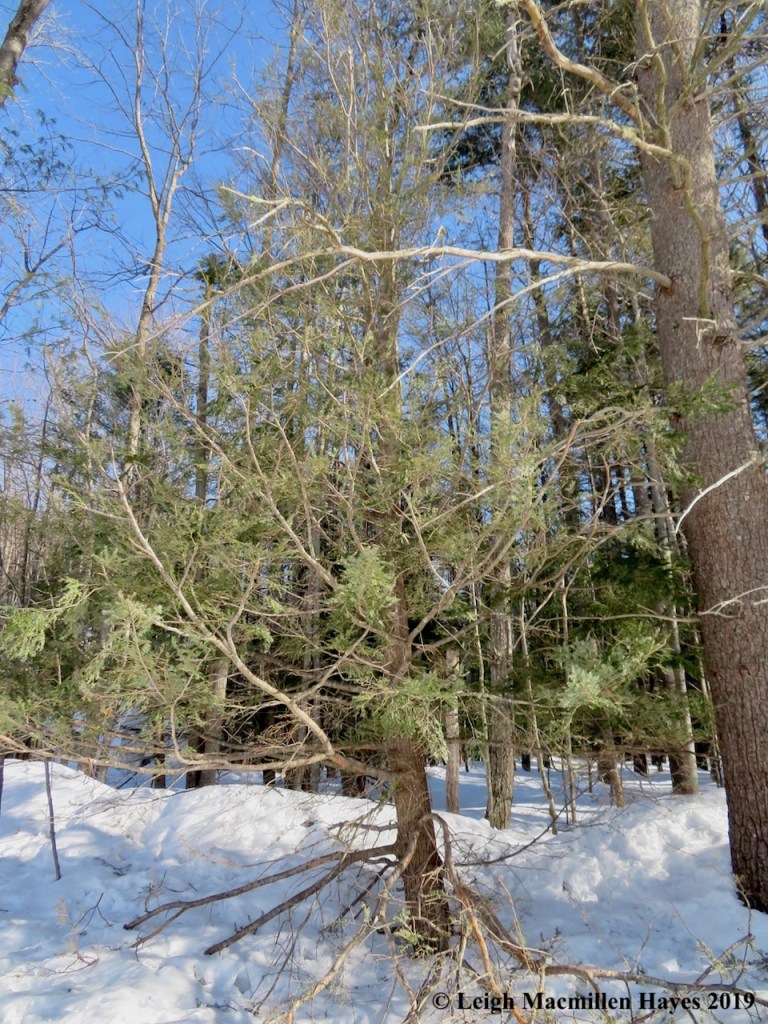
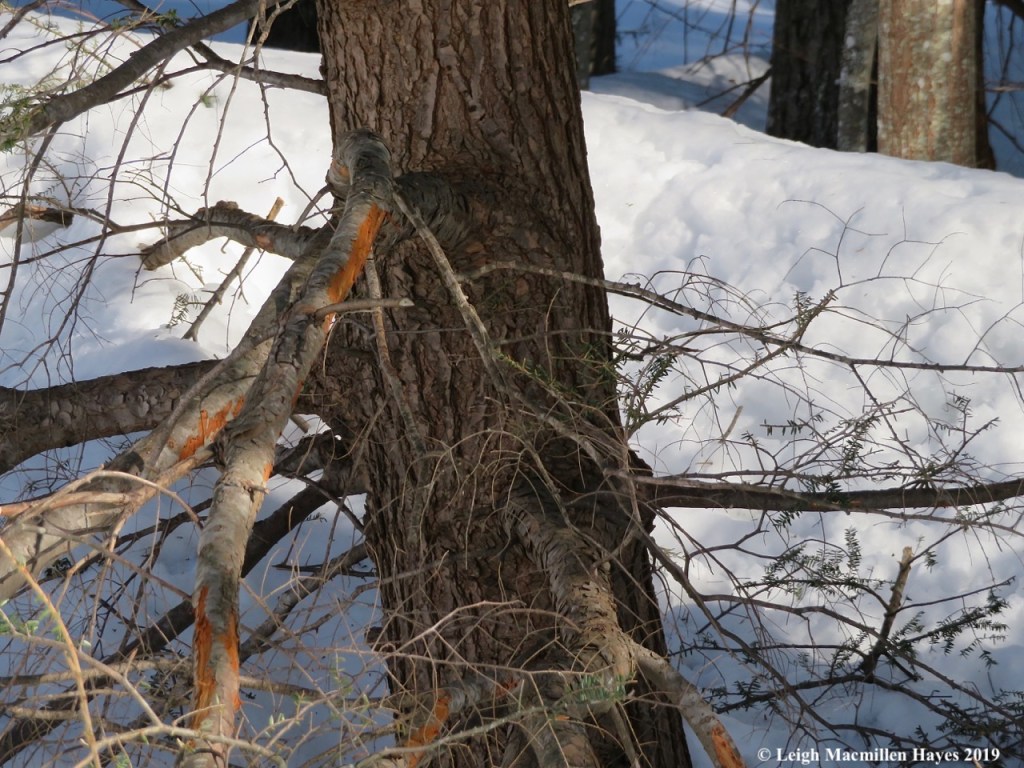
And then late today, I headed out the door through which I’d taken those photos the previous two nights, and noted the Hemlock tree that Porcupine had denuded this winter. It used to be one of my favorites in the yard. But today it occurred to me that though we pay taxes on this property and try to “maintain” it, it really isn’t ours. It never has been. It belongs to the animals and the trees, and yes, even the fungi. Maybe especially the fungi.

One thing I have noticed is that all of Porcupine’s activity has aided Deer who also stops by daily.

As I continued over the stone wall, noting the six or seven other Hemlocks Porcupine has visited, a shape high up in one tree caught my attention.

I moved under Hemlock for a better look. Well, not all the way under, for I sometimes know better than to stand below such an exhibit.

As I looked with the aid of a telephoto lens, I noticed that Porcupine had apparently dined briefly and then fell asleep. Hmmm. I know some people who do that.

But the sight of Porcupine got me thinking–was this friend who lived under the barn a he and not a she after all?

And how did he/she sleep as the breeze swayed that not so thick Hemlock bough upon which Porcupine was balanced?

I did gain a better appreciation for the various types of hair that cover Porcupine’s body.

But still, so many questions, some that haven’t even formed in my mind yet.

I give thanks to Tamarack and his stories within Entering the Mind of the Tracker for that. Now I must practice the art of slowing down and paying more attention.

And I give special thanks to Parker for the offering of this book. In many ways, he emulates Tamarack Song, for both are hunter-gatherers and Parker understands the ecological systems in a way I will never know. At less than half my age, he has already slowed down and learned to pay attention.

To be attuned to the hidden nature–that is my wish. To that end, I shall purchase a copy of this book. And hope you will consider it as well.

Book of March: Entering the Mind of the Tracker: Native Practices for Developing Intuitive Consciousness and Discovering Hidden Nature.

Entering the Mind of the Tracker: Native Practices for Developing Intuitive Consciousness and Discovering Hidden Nature, by Tamarack Song, Bear & Company, a division of Inner Traditions International, 2013.

For Whom The Crows Caw

At 6am, a flock of crows outside our bedroom window drew me out of bed. There were three birds in the quaking aspen by our back deck, and all were squawking as they stared at the ground.

I peeked about, but saw nothing. That is, until I went down to the kitchen and looked out the door.

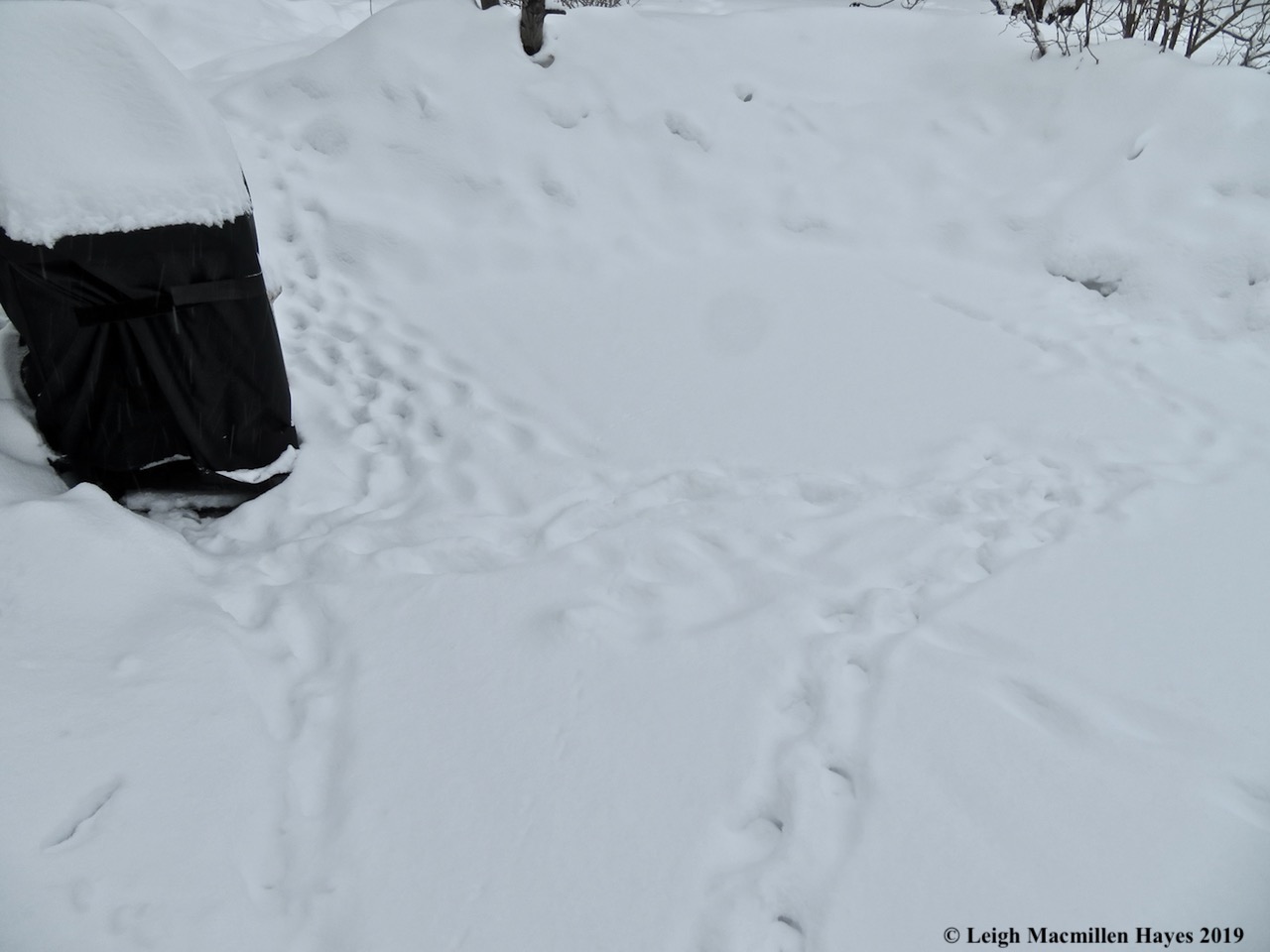
That’s when this set of tracks drew my attention. It took a moment for my sleepy brain to click into gear, but when it did I began to wonder why the critter had come to the back door and sashayed about on the deck. Typically, her journey takes her from under the barn to the hemlock stand in our woodlot, where she visits several a night before returning to her den. I say she for two reasons. “She” includes “he” so I can’t possibly be wrong and it’s my understanding that the males of this particular species are more likely to spend the day outside than the female. She returns home every morning and I never see her. Until . . .

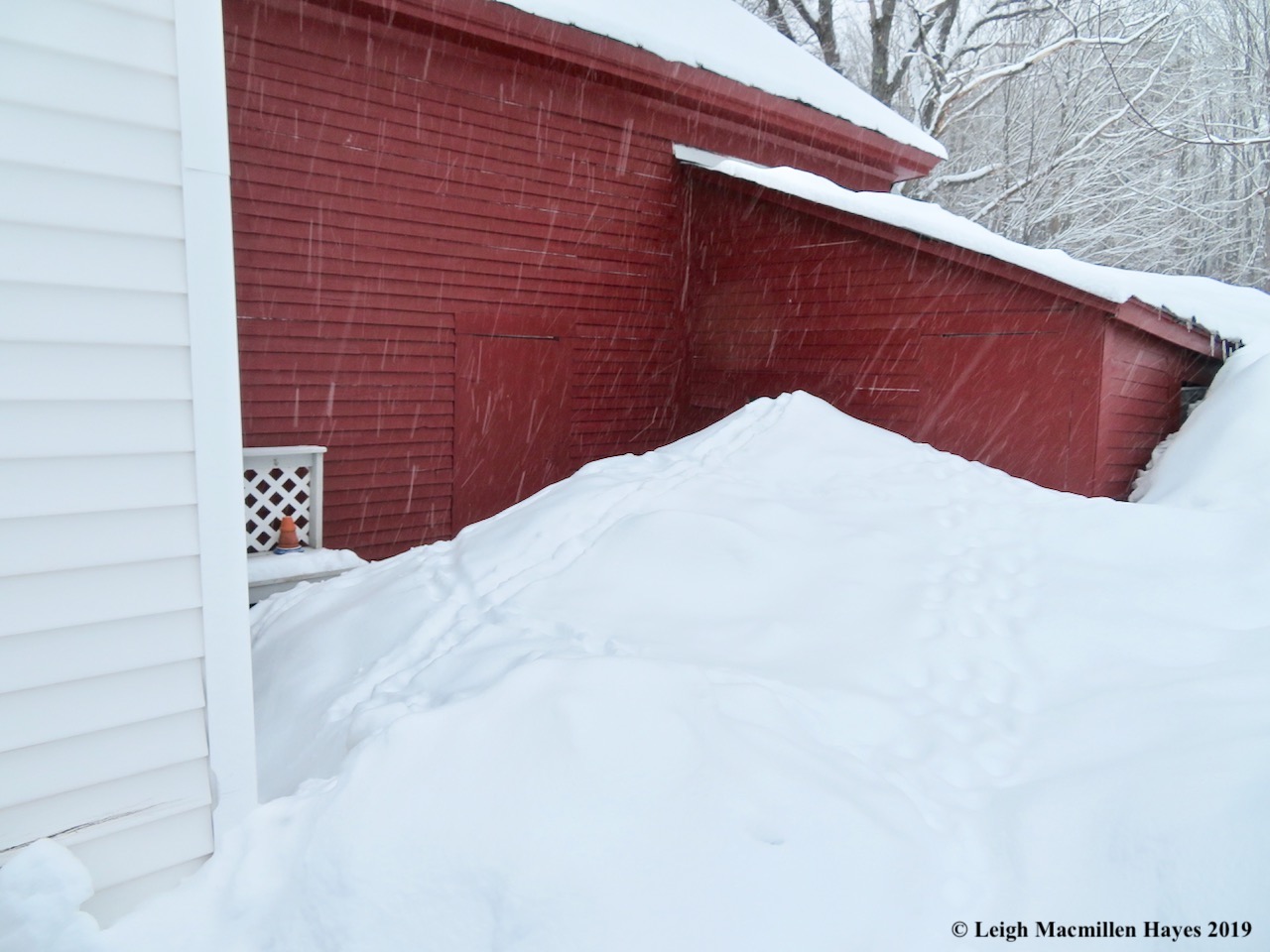
This morning for when I stepped into the summer kitchen that serves as my office, there she was in the corner, near her entryway to her under-barn den. And numerous other sets of her tracks decorated the snowbank.

The birds continued to scold, but not quite as vehemently as they had ten minutes earlier. And the snow continued to fall. Why hadn’t she headed down under?

The thing about porcupines is that they are rather lackadaisical, so maybe she didn’t care about the birds?

My interest in her was far greater I’m sure than she cared and so I stood and watched every move. And noted that in her dance she’d also crossed over the potting table that’s almost hidden by the snow. Why so much movement for such a slow-moving critter? Was it because of the birds? And why did they care about her presence?

Eventually, she did what I expected and disappeared under the corner between the barn and shed.

And so I headed out the door, where I discovered even more tracks. It’s not like its mating season, for porcupines mate in the fall. So why all this movement, including a visit to the grill. Was she pacing?

Peering toward the barn, I couldn’t see her, but I did hear some mini-grunts coming from the corner.

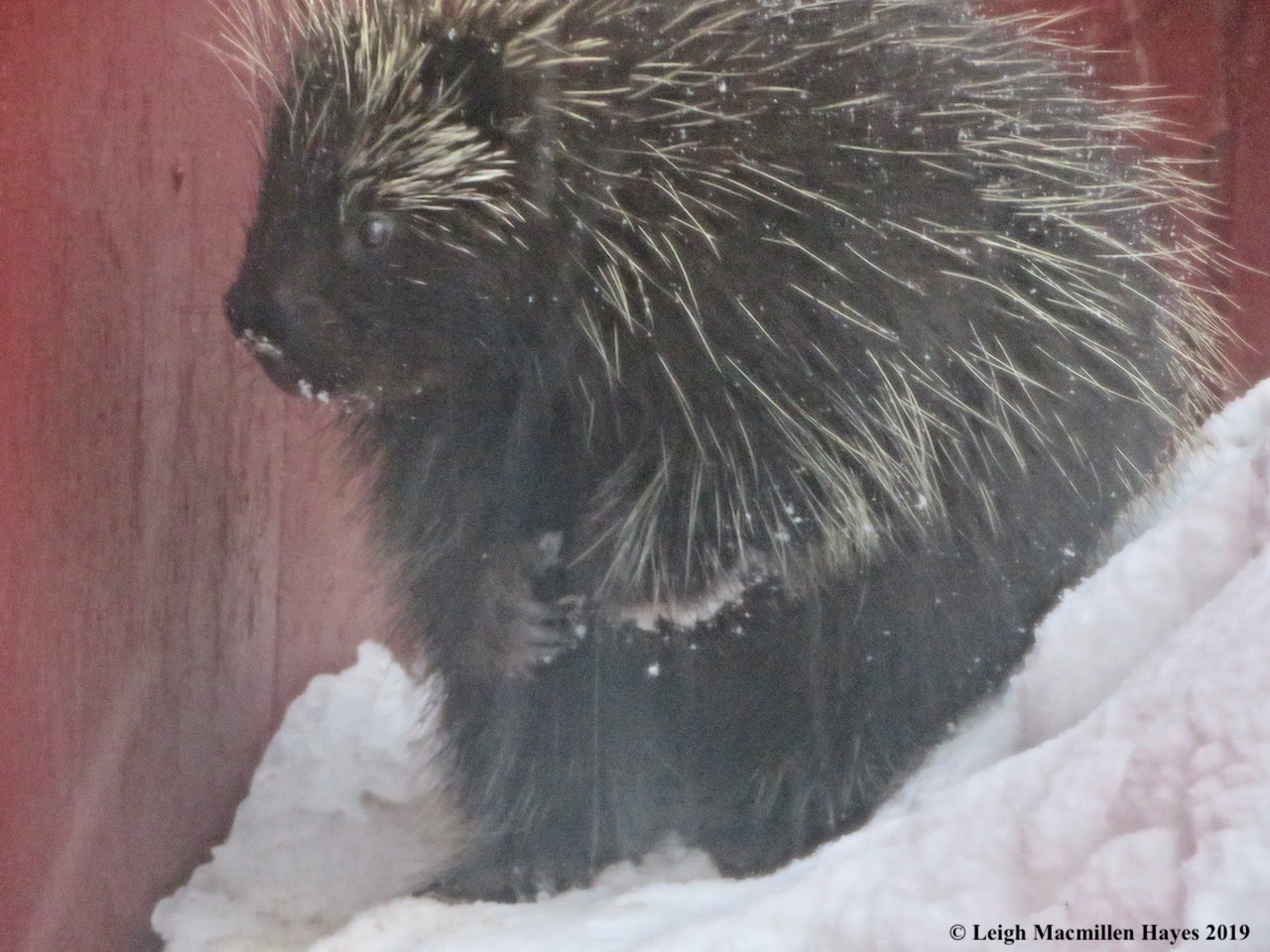
And then she emerged and I headed back in to give her space. Check out those quills. Did you know that they are a form of hair. In fact, from Mary Holland’s Naturally Curious Day-by-Day, I learned that a porcupine has five forms of modified hair–each with its own purpose: dark, woody underfur serves as insulation, which is important as she journeys outside her den every single night no matter the weather or temperature; long guard hairs sensitive to touch that help her maneuver; stout whiskers also sensitive to touch; short, soft bristles on her tail’s underside provide stability when she grips bark; and then there are the roughly 30,000, yes 30,0000, quills that cover all but her face, ears, and part of her belly.

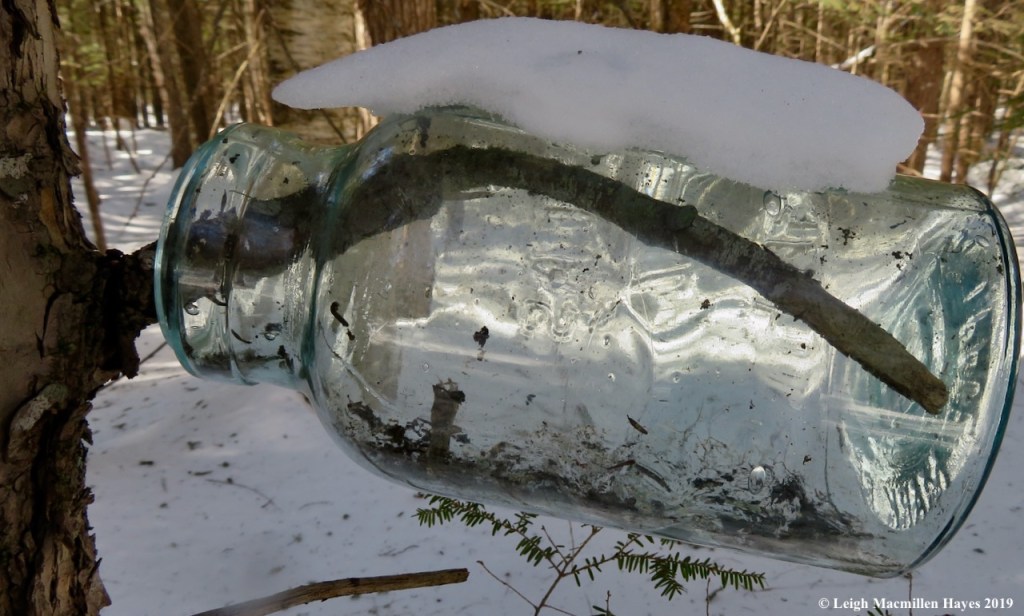
It’s those 30,000 quills that provide me with the most awe. So here’s another “did you know” fact: Within one square inch on her back, she has 100 quills. I got to thinking about that recently and cut out a square inch (well, sorta as it’s not exactly straight) of material that I glued to the top of a Ball jar.

And then I filled it with 100 toothpicks left over from a Valentine’s Chocolate Fest the PTA put on when our sons were in elementary school.

One hundred quills/square inch. Talk about prickly! Of course, she looses some especially when she squeezes into tight places, like under the barn. And others detach easily when touched (no, porcupines do not shoot quills).

There’s also her coloration to consider. Like a skunk, the black and white of the quills should be a STOP sign to her predators, who are colorblind as well as nocturnal. BEWARE is subtly written in that black line up the middle of her tail that is bordered in white.

After we’d spent almost an hour together, sometimes with window glass and a screen between us, my porcupine finally disappeared under the barn. And so I stepped into her space for a closer look. Notice the mud and scat in her track. She is the pigpen of the woods who scats and urinates at her den entrance, which perhaps helps provide further insulation.

Scat Happens! 75 – 200 times per day does she eliminate and depending on what’s she’s feeding on determines its structure. Of late, it’s the bark and twigs of hemlocks that constitute the fibrous structure. I’ve heard them described as macaroni or cashews. I prefer to think of her scats as commas, perhaps indicating a brief pause in her routine.

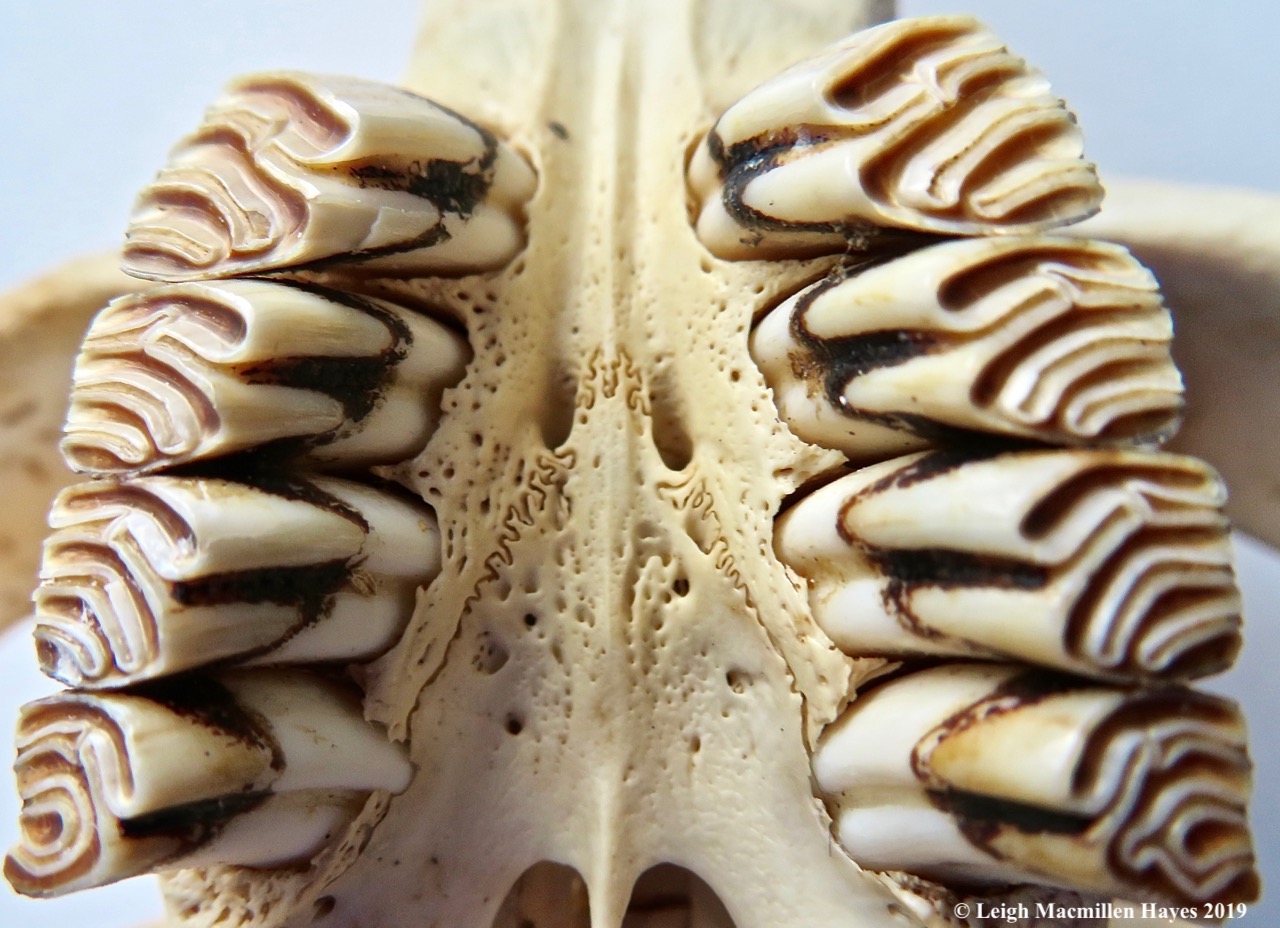
As strict herbivores, porcupines have strong, flat molars that are good for grinding plant material. This is the skull of a beaver, but it provides a good example for a porcupine’s check teeth are similar.

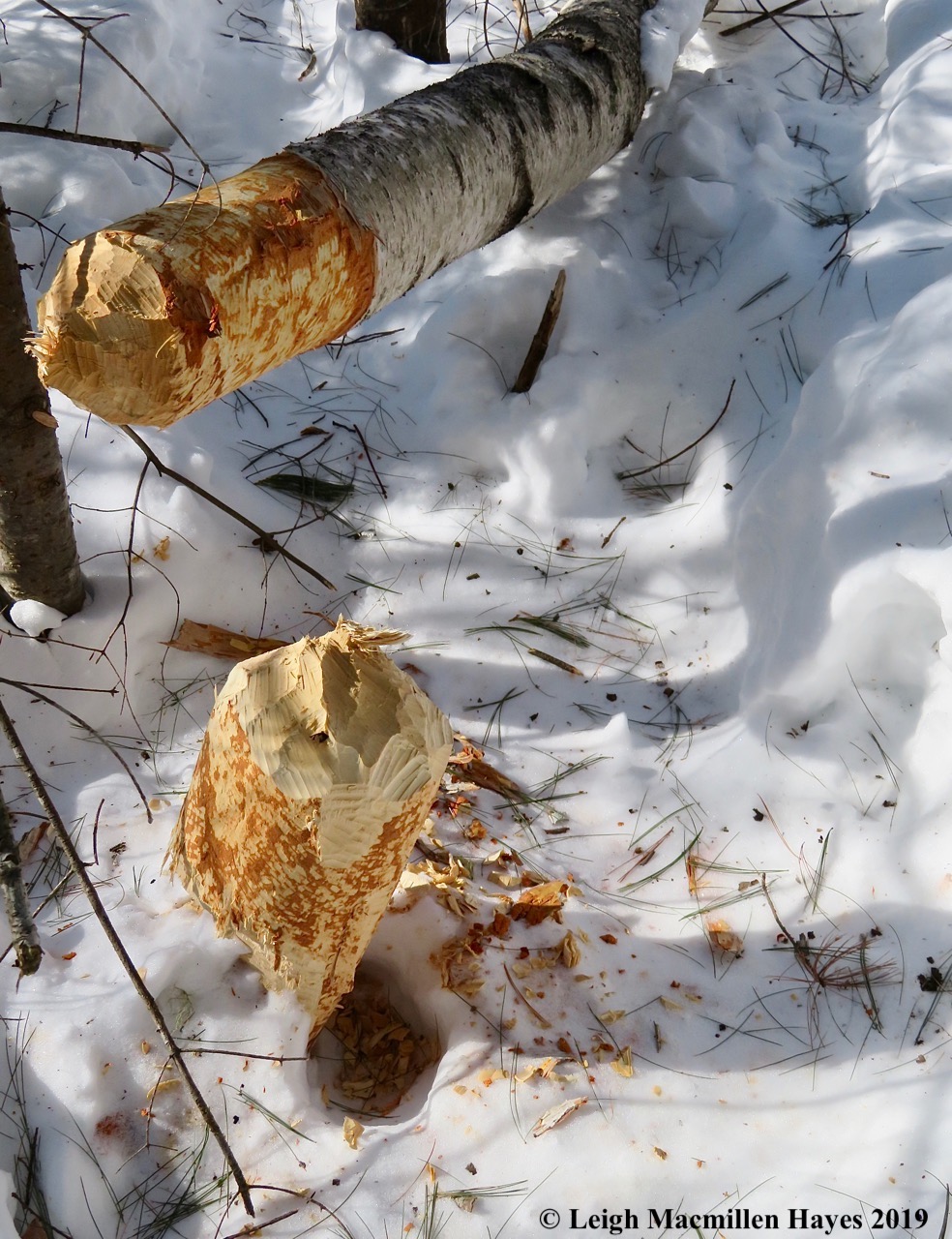
Also from the beaver skull are these prominent incisors. The difference is that a porcupine’s incisors are a bit thinner. For both, the front surface is enamel, while the back is a softer dentine. Their incisors are rootless and grow continually–up to twelve inches per year. Gnawing, therefore is rather important to wear down those chisels.

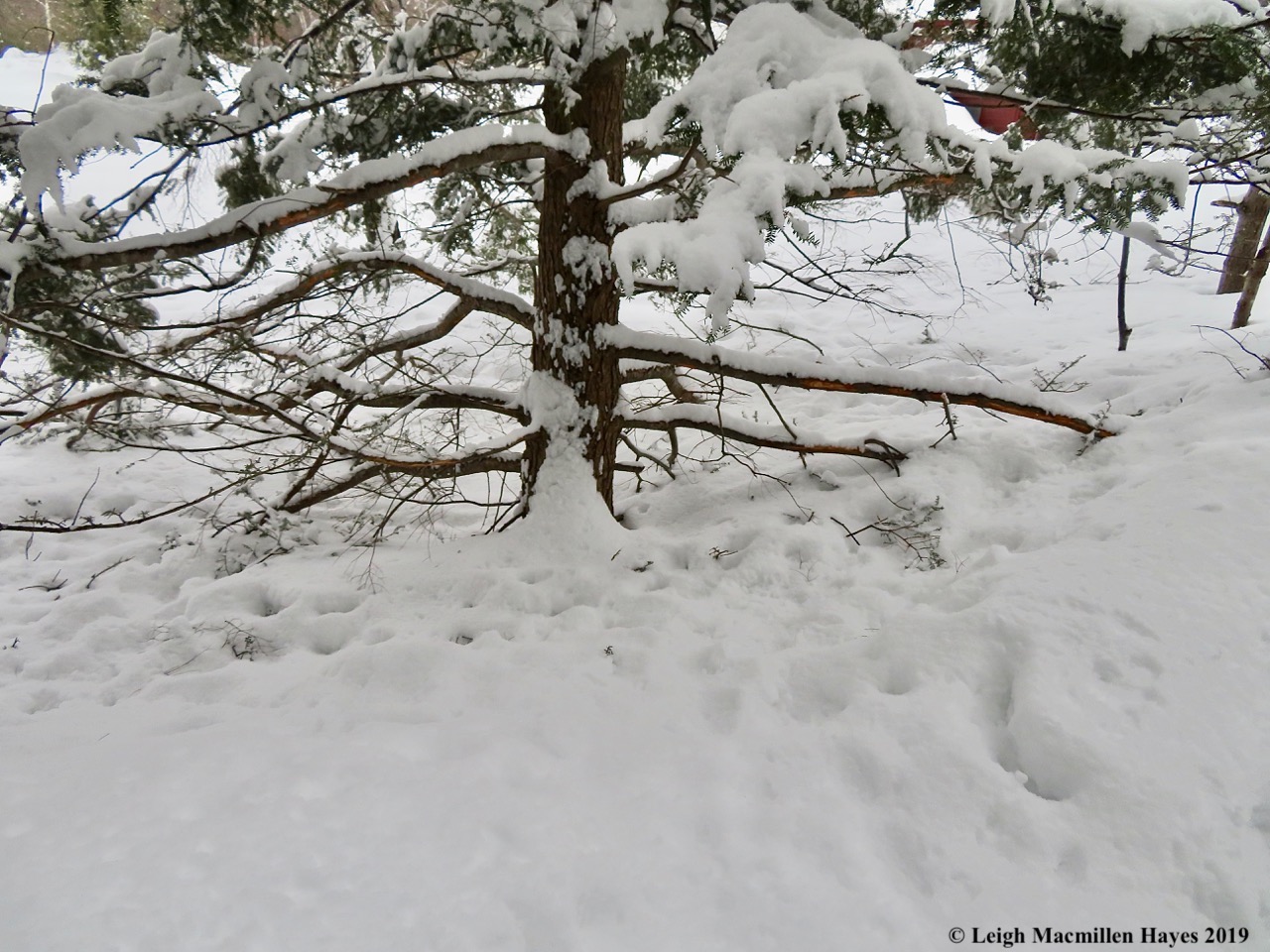
She’s managed to maintain normal dental wear by working on this hemlock in the corner of our yard and others in our woodlot.

As the day progressed, I wandered around looking for her tracks and those of any others. Strangely enough, she didn’t visit the hemlock last night, but rather checked on the sugar maple in our front yard–perhaps a sign that the season is changing and she’s ready to feast on some sweet buds for a while.

She also circled the barn in a random style. Was she seeking other entryways that are now well hidden below the snow? What was she thinking? Was she thinking? Or acting by instinct? I didn’t see any predator tracks to speak of, but perhaps there was an aerial predator she strived to avoid?

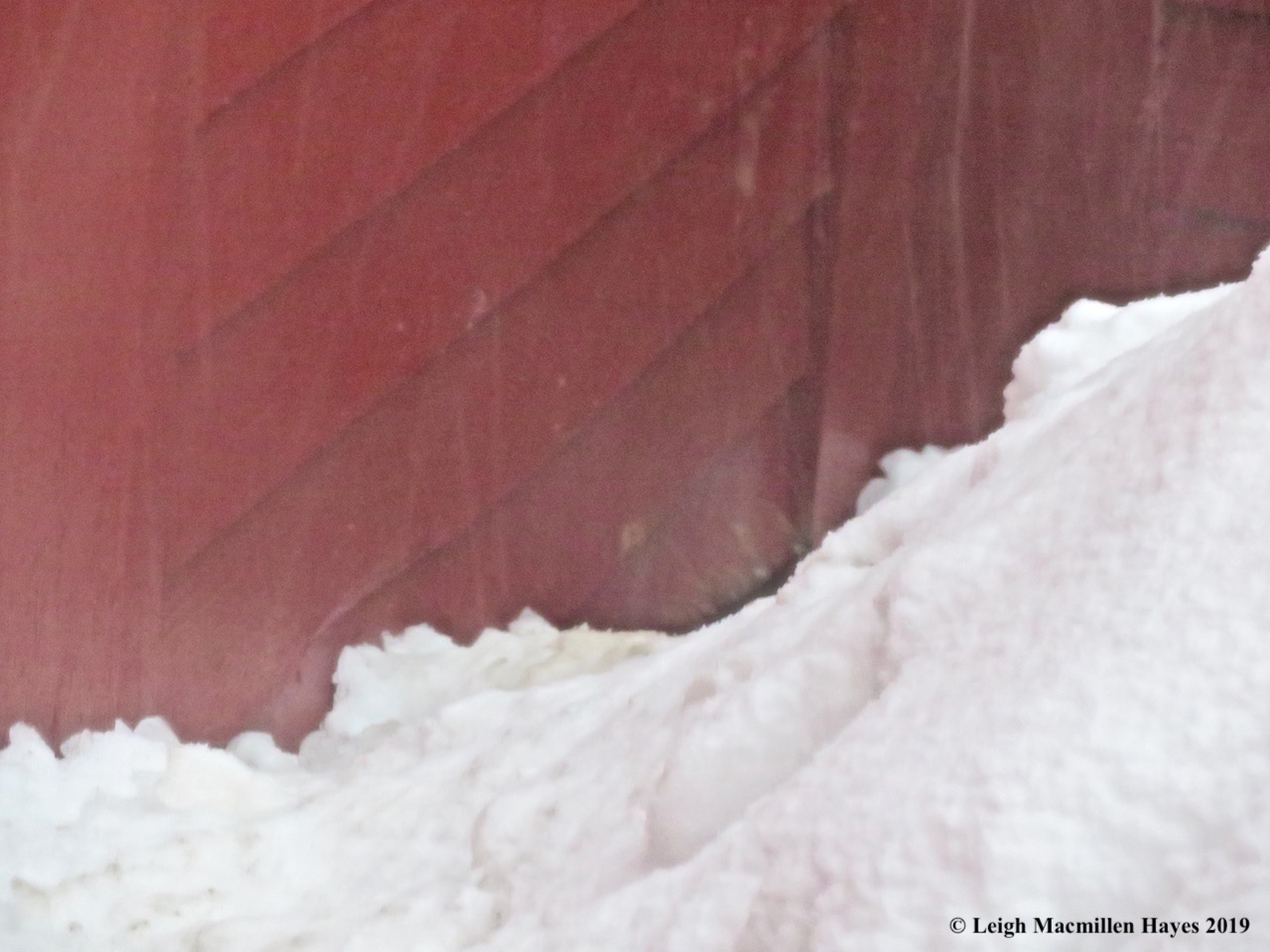
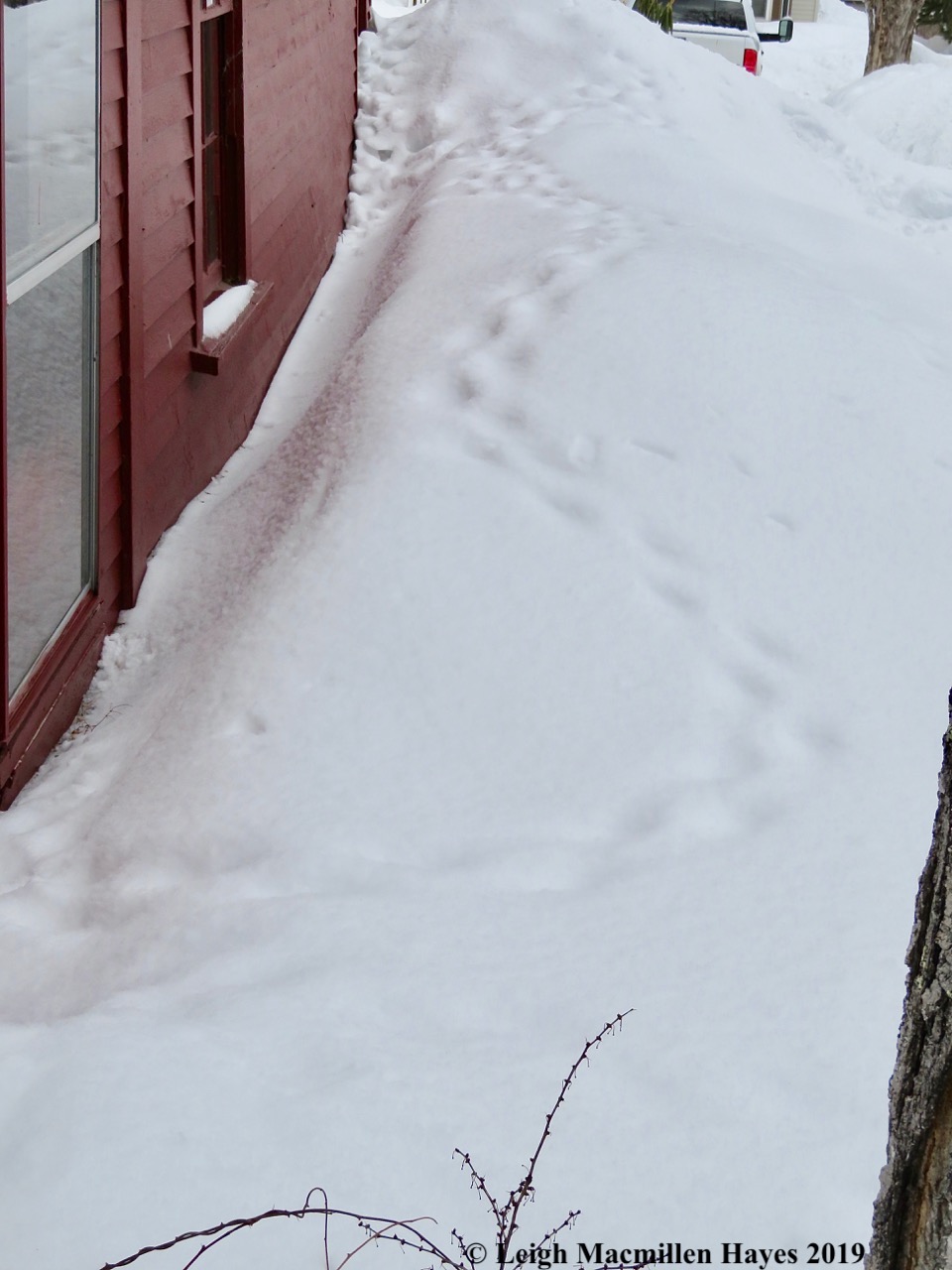
I don’t know. What I do know is that because I climbed up the snow mound, I discovered that she’s been sharping her teeth on the barn clapboards. And where the corner between the shed and barn has long had a cut-out presumably created by her and probably her ancestors, it appeared today that she’d munched a wee bit more and come spring’s meltdown, we’ll be surprised by the damage. My guy reminded me that she and her family members have been dining below the barn for more than the 26 years that we’ve lived here and the structure’s integrity has long been compromised.

As the snow slid off the barn roof, the hole began to disappear.

Until finally, it was only a memory.

I went out again at dusk in hopes of seeing the grand lady dig her way out, but her time schedule was not the same as mine. In the morning, however, I’ll check on her trail as I do every day. I can’t wait to see where she went–will she give me any more clues as to her strange behavior this morning? Was it a reaction to the crows? I don’t know.

But this I do know: when the crows caw–listen. And look. And wonder.

Forest in a Bottle

When Pam and I stepped into the woods this morning, I don’t think either one of us understood the enormity of the task before us. You see, our job was to gather all the pieces of the forest through which we’d pass.

And so we began by collecting a recent beaver masterpiece with fresh wood chips below.

There was a beaver sculpture as well, those tooth grooves deep and distinctive.

And their tracks, which all emerged from a recently frozen-over hole. The tracks were a few days old, but we added them to our findings just the same.

Because we were in beaver territory, to our delight we found otter tracks and slides galore–many of them fresh.

There was even an otter hole that we wondered if the beavers had used as well. We decided we might as well throw it in to our bag.

And we couldn’t resist our favorite otter activity of all–the spot where the infamous slider slid.

Following the trail to a different part of the forest, we spotted a diptera pupa that gave us pause for quite a while as we admired its structure and the perfectly formed circle where the fly had chewed its way out. We were so in awe that it seemed only obvious we would want to include it in the collection.

Further on, we reached a brook and spied a muskrat, that dark body in the center. As it turned out, it was a stone muskrat and we left it behind as we chuckled about our mistaken ID.

By the brook, we did, however, find mink prints in the dust of snow that had settled upon thin ice. Those were certainly worth capturing.

We also gathered more otter slides, and then stumbled upon an apparent otter roll, an area where the playful critter made a lot of fuss and left behind some urine and tarry-looking scat. We were sure we’d hit the jackpot.

Because we were beside running water, the icy baubles were not to be ignored.

Nor was the snow depth, which we determined to be close to four feet deep.

And then we marched onto a wetland, where we were stumped for quite a while about some mystery tracks. Should we take them or leave them, we wondered. The pattern indicated a perfect walker, as in a candid or feline, but the depth was deep and the toes threw us off.

The curious thing was that those tracks and others left behind by a mink and a fox led to a deep hole beside a tree.

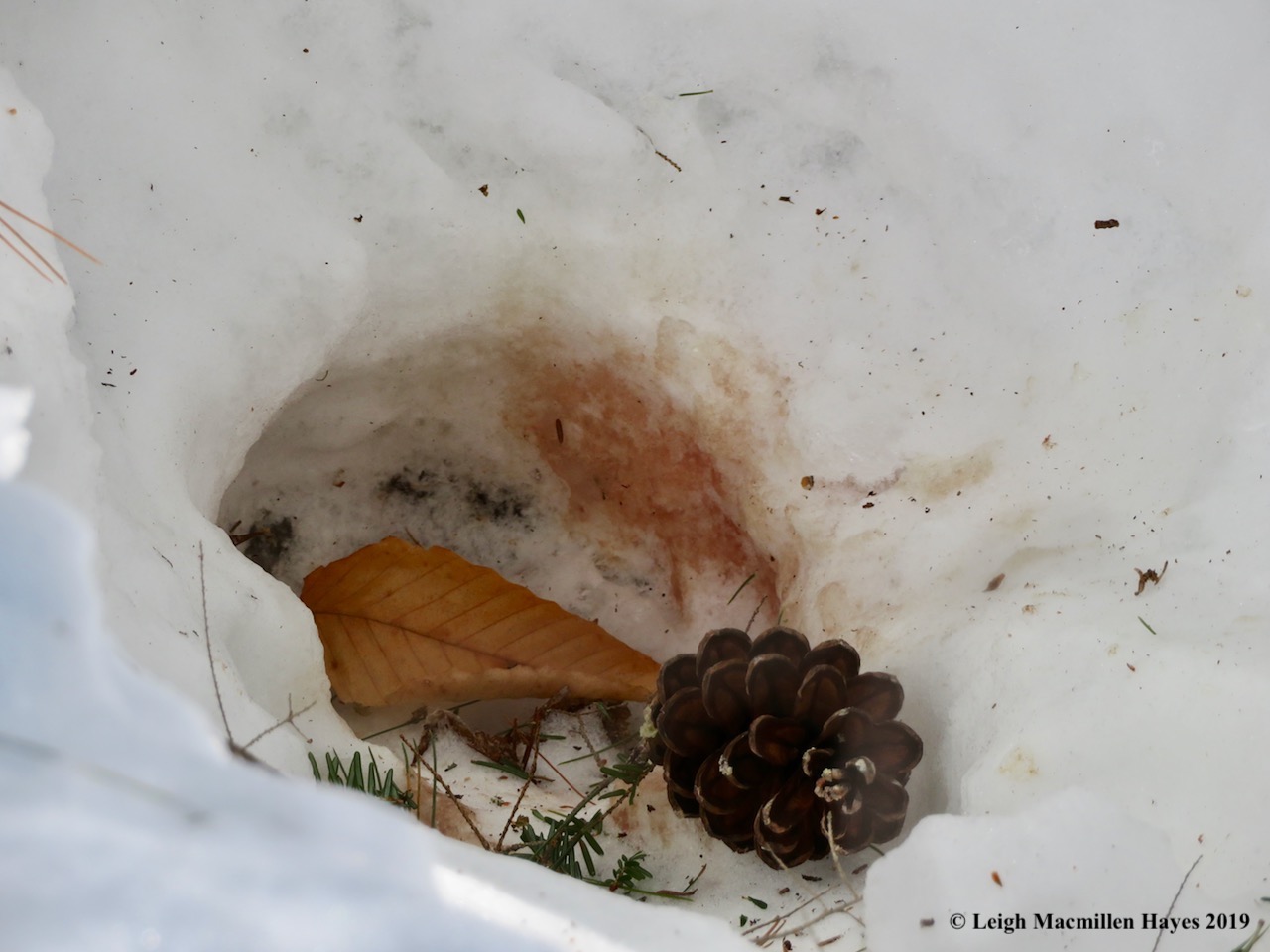
I thought the frozen fluid within was blood, but Pam leaned more toward urine. One thing we knew for sure, if it was a kill site, there were no remains. Had the mammals been on the hunt to no avail? Take it or leave it–we put it in the same category as the mystery prints.

The mystery tracks also led to a beaver lodge and it appeared that the mystery track maker had tried to locate another meal. Given that there was no air vent at the top of the lodge, we doubted anyone was at home at the time of its visit, and so we left the lodge behind.

After standing in the middle of the wetland and eating our own lunches, we discovered a set of perfect red fox prints that we just had to include in our collection. The top print in this photo is actually the hind foot and the lower print is the front. Can you see the chevron in the foot pad?

There was another lodge we considered grabbing because the top of it appeared to possibly have a vent, but like the fox, we took a closer look and discovered that it, too, was abandoned so we left it behind.

Instead, we made our way off the wetland and back into the woods where a debarked hemlock tree stopped us in our tracks. Nuthatches and woodpeckers are known to scale trees–removing the outer bark to get at the insects underneath. Can you see the insect holes? And the cinnamon color of the inner bark? This one was a keeper, for sure.

Especially since a section where the inner bark had been removed revealed a polished layer like one might find on a table top.

There was also a huge snow-capped burl to pick.

And a small cross-section of the liverwort Frullania juxtaposed beside script lichen. Everyone should have a sample of those two.

Two old heron nests were well worth adding into the mix. They’d been used in the past until two years ago. If the herons do return to the rookery, we suspect they’ll build new structures so we didn’t feel so bad gathering these.

And then there was a pileated woodpecker hole that would have to represent all woodpecker holes in these woods. Before tossing it into the bag, Pam made sure that no other critter had set up housekeeping within.

Our final finding was one that made us think back to the mystery tracks. The more we studied these and later met the mystery tracks again and followed them for a while, the more we understood that not only did beavers, otters, foxes, deer, mink, and snowshoe hare romp in these woods, but so did coyotes.

The best thing about this coyote was that it made a coyote angel in the snow! We most definitely scooped that up.

For you see, our mission was to put it all together–in a glass jar. Haven’t you always wondered about the magic involved with placing a ship in a bottle? Well, today, we spent six hours amassing various items in the woods and then assembled them–creating a forest in a bottle. Can you see it?

Book of February: Ferdinand Fox’s First Summer

Yikes. Here it is the end of February and I’ve spent the month mentally flipflopping between two books to recommend–one about tracks and the other about tree buds.

And then this day dawned. Not long into the morning as I sat at my desk beside a window, a swift motion captured my attention . . .

and I knew immediately that Ferdinand Fox’s First Summer by Mary Holland would be the February Book of the Month.

In this factual, yet delightful story, Mary tells of Ferdinand’s birth, childhood activities, and growth as he and his siblings are born and eventually weaned. Her amazing photographs fill the pages and alone are worth a reason to purchase this book. But there’s so much more and one doesn’t need to be 3-8 years old to enjoy it. Even those of us who are more “mature” can surely learn from the information shared on each of the book’s 32 pages.

And there’s even more to the book because at the end is a section her publisher labels “For Creative Minds.” Though one can’t copy other pages in the book, we are encouraged to use the material in this section for educational, non-commercial purposes.

Included are “Red Fox Fun Facts and Adaptations” with photographs and brief blurbs to describe various behaviors of these canines. (I remember a time when I had to get it through my brain that a fox was a canine and not a feline.)

One of my favorites from this section: “Red foxes are most active at dusk and dawn (crepuscular). In summer, they are more active at night (nocturnal) because their prey, mice, are more active then. Foxes may hunt during the day (diurnal) in the winter because it’s harder to find food.”

Bingo! That brings me to the reason why I chose this book for February.

Remember that motion I mentioned observing this morning. Well, I went to the kitchen door and there on the snowbank by the back deck was my neighborhood fox.

He was on the prowl. Do you see all the gray and red squirrel tracks on the snow? And Mary’s comment that foxes will hunt during the day in the winter. One would think that given all the squirrels and mice folks were dealing with last fall, a result of the previous year’s mast crop production of acorns, pinecones, and beechnuts, the foxes and coyotes and bobcats would have plenty to feast on. But . . . there wasn’t so much food for those little brown things to cache this winter and so it’s a rare occasion that I find a squirrel midden or even mouse tracks in the snow right now. Instead, they are all at my bird feeding station. And my daily fox knows this. Though I haven’t seen him find success, he returns repeatedly and follows the same route each time so I suspect he’s helped himself to a few local delicacies.

Notice that long snout–the better to smell you with, my dear. Oh wait, that was the big bad wolf, not the big, bad fox.

Just after I shot this photograph, he pivoted and dashed off in the direction from whence he’d come.

And then he returned, with nothing dangling from his mouth. His eyes, in the front because he was born to hunt (eyes on the side, born to hide–like a deer), focused on something in the quaking aspen that I couldn’t quite see from my vantage point.

He went back to the tree and for a second I thought he was going to climb it. Hmmm, gray foxes climb trees, not red.

Again, this was from the edge of the door and I couldn’t quite see what had captured his attention. Prior to his visit, the feeders and ground had been a party spot for a slew of squirrels and birds. I doubted a bird would hang out in a tree while a fox lurked below, but wondered if a squirrel was trying its darnedest to blend in with the tree trunk. And if it was a red squirrel, it was keeping its mouth shut for a change for I heard not a bit of its usual chatter.

After a minute or two, Fred, as I’ll call him (after all, Mary named her fox) moved a few feet away, sat down and began to scratch behind his ear. Those darn fleas.

He sat there for a few minutes and then got up and began to walk away. But his eyes . . . still they were focused on that tree.

At last he gave up on that particular quarry and ran off, following his usual route across the yard toward the neighbor’s house. I wonder how many cats they have left.

I gave Fred a wee bit of time to move on so I wouldn’t disturb him and then I headed out because, after all, who can resist the opportunity to check out brand, spanking fresh tracks? Remember that red fox’s feet are quite hairy so their prints look rather muffled, even in the fresh dusting of snow that fell overnight.

Do you see the X between toes and pad? Some semblance of nails? And can’t you just envision him loping across the yard?

Remember how he sat down to scratch behind his right ear (looking head on it would have been his left to us)? Well, I found the spot where he’d left an impression on the snow. And more. A tad of pee and SCAT! He’d dined on something.

I backtracked him for a while, crossing over stonewalls and into neighboring tree lots curious about where he comes from, but as Mary Holland reminded me, “As the weather turns cold, Ferdinand and his siblings sleep outside on the ground and no longer use their den.” Instead, they curl up and their bushy tails keep them warm. At last, I came to a tree where he’d dillydallied.

And then I spied a tiny amount of yellow snow–he’d tinkled (what fun to write “tinkled”) there. The sniff test results: skunky scent. Has he not mated yet? One day more than a month ago he did bring a gal by, but I haven’t seen her since. Red foxes typically breed in January and February, and it is, after all, still February for a few more hours.

At the end of our cowpath, he’d turned south as he always does and his track became but a memory.

Mary’s book can help keep that memory alive. It’s only one of numerous children’s books she’s now written. All have cross-curriculum teaching activity guides that one can download from www.SylvanDellPublishing.com.
Mary is also the author of Naturally Curious, which is now out of print (though someone told me there is an updated edition, but I’m not sure its been published yet), and Naturally Curious Day-by-Day, and she shares a blog post about five times a week with those who wish to learn more.

I’ve had the honor of being in her presence twice, both times here in western Maine, and she is delightful, down-to-earth, and extremely gifted as a naturalist, photographer and author. She’s also quite approachable and I’m always amazed that she takes the time to answer questions via e-mail.

If you follow her blog or read her books, you’ll feel as if she’s either walking beside you or just ahead. Mary, if your ears are burning, it’s because those of us who do follow in your tracks often comment on the fact that what we see you just happened to post. Thank you for helping all of us, no matter our age, become naturally curious.

Once again, the February Book of the Month: Ferdinand Fox’s First Summer.

Ferdinand Fox’s First Summer by Mary Holland, Sylvan Dell Publishing, 2013.

Neither Snow, Nor Freezing Rain, Nor Sleet . . .

Church was cancelled this morning and it seemed like the perfect day to stay inside, read the newspaper, complete the crossword puzzle, and keep an eye on the bird feeders.

And so I did. Among my feathered friends was a Tufted Titmouse that seemed to stand back and consider the offerings,

a Junco that chose the thistle,

and an Eastern Starling who made quick work of the suet. For those who aren’t fans of the Starling, this was the first of the season and actually four flew in today. I have to say I’m rather taken by their coloration.

Of course, not one to go unnoticed, a red squirrel came out of its tunnel below one of the feeders and looked about as if to say either, “Hey lady, where’d you hide the peanuts?” or “Hey lady, when are you going to come out and play?” I preferred to think it was the latter and so I headed out the door.

Because of the weather, I chose a baseball hat for headgear so the visor would keep the snow off my glasses. And then I did what I always do when wearing a baseball cap–I forgot to look up and bumped into the pergola. Boink.

But, the pain was momentary and so I continued on. Soon I realized I wasn’t the only one who had responded to the call to head outdoors. Quite often mammals leave behind sign that tells me who has passed by and I wasn’t disappointed for today I found signatures . . . of Eddie, Annie, Emma, and Veronica.

I wondered if I might find their creators. Was Eddie the mink that had slid and bounded just moments before and left fresh prints?

I followed his tracks in hopes of catching a glimpse and knew he’d passed under a fallen tree and traveled along a brook.

He’d also paused briefly beside an opening, but it appeared that rather than enter the water to forage as he could have done, he continued on. And so did I, meeting his tracks quite often, but never spying the mink that he was.

Any other tracks I spied were diluted by the precipitation, and so I turned my attention to the mushrooms that had donned their winter caps. From the false tinkerconk to . . .

the tinkerconk,

hemlock varnish shelf,

and red-belted polypore, all appeared to have shopped at the same hat boutique.

Traveling through these woods on such a day with not a soul about made me ever mindful of the transition taking place as snow gave way to freezing rain and then sleet.

But it didn’t bother the female mallard that flew in and landed right below me.

Nor did it bother me. In fact, I loved it. I know the advent of frost heaves and potholes along our roadways are signs that spring is around the corner and even today’s weather was an indicator, but I don’t want winter to end just yet.

Neither snow, nor freezing rain, nor sleet . . . can keep the squirrel or me from digging our way out of our tunnels.

Wondermyway Celebrates Fourth Anniversary

My comings and goings are often a tramp through the woods, where I pause frequently to contemplate the world through which I wander. These provide me with glimpses at a small portion of the wonders of the universe. Please join me for a few minutes as I share the mysteries of the hills that have been revealed to me this past year.

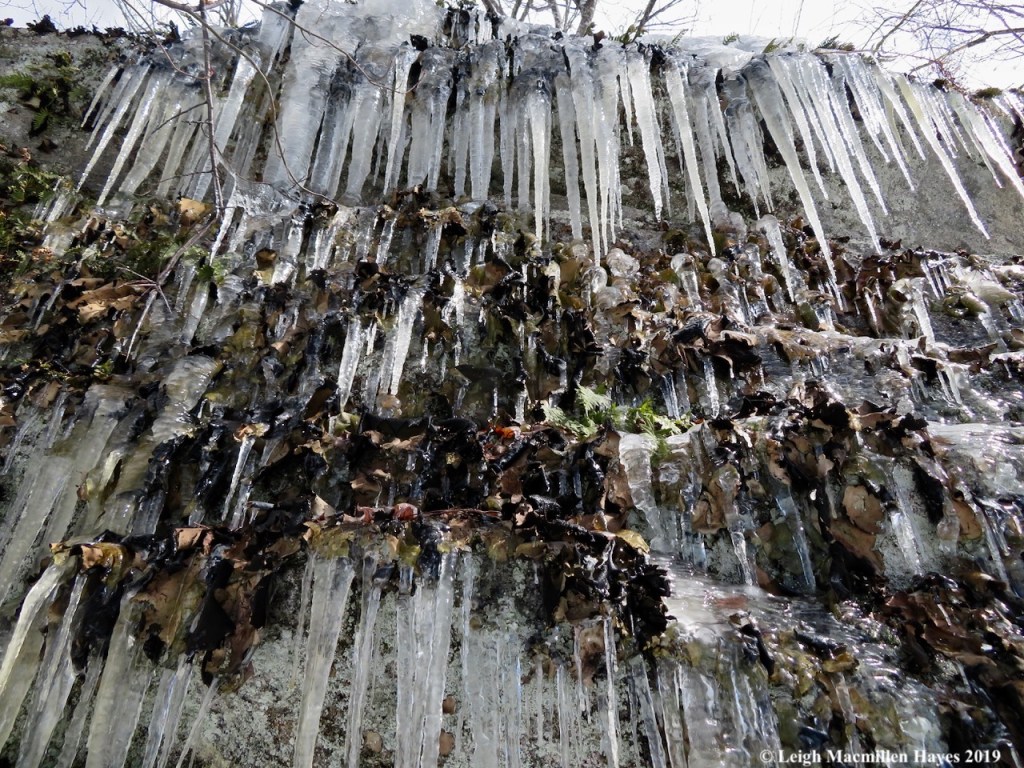
The ice delighted our sense of sight, understanding, and artistic form. Like the water from which it was created, it flowed in much variety.

And then . . . as we looked, a motion captured our attention. We were blessed with the opportunity to spend a few moments with a mink as it bounded down the hill before realizing it had an audience.

Next a splash startled us. What caused it? There was no snow high up on the trees that might have fallen. At last we saw the creators. There were actually three–swimming about slowly. Suddenly splashing again, they disappeared into the depths below. And the chambers within. We were in awe and felt honored to have shared a few minutes with members of the beaver family.
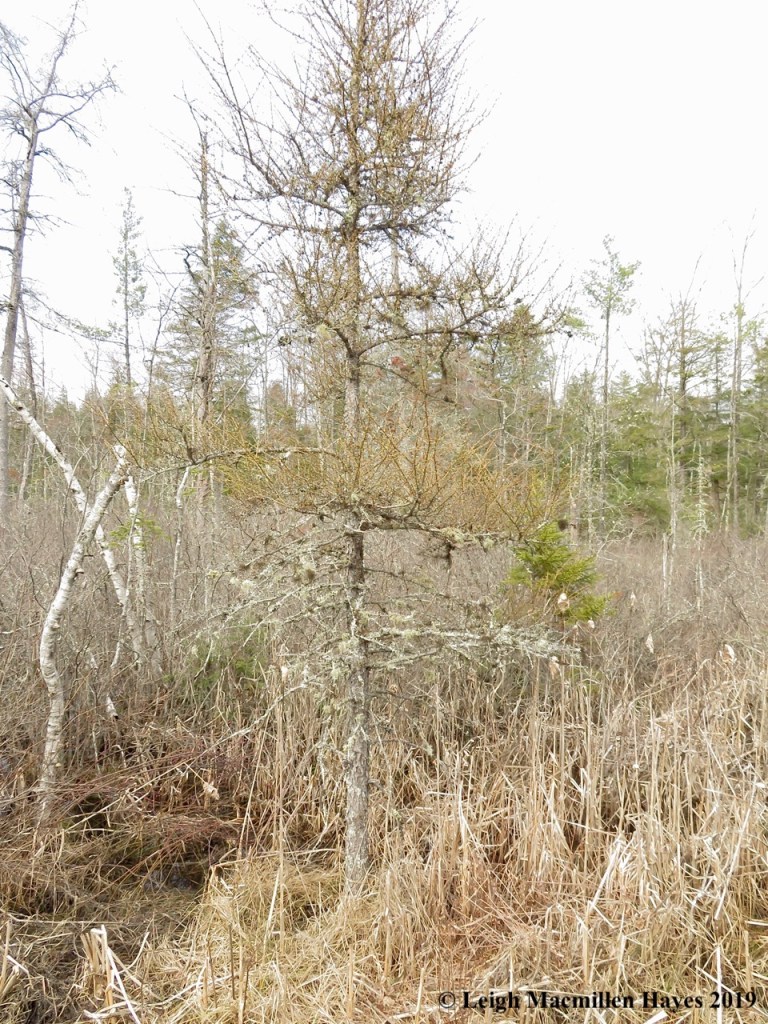
Sometimes our stops were to contemplate our next steps–especially when it came to the water that covered the cobblestones. Spying a bird nest, we wondered about its creator. There were some acorn pieces inside, so we thought it had hosted more than one inhabitant. Because we were near water, though most of it still frozen, and the temp was high, we weren’t surprised to find a set of baby handprints created recently by a raccoon.

As I stood there looking for a million wild mammals, my eyes focused on the works of something much smaller. Insect egg tunnels on a dead snag read like a story book page. The overall design could have been a map leading to hidden treasures.

Within each soft snowflake I felt millions of wings brush against my face–reminding me of those I know who are at the moment downtrodden and have hurdles to conquer. Some tiny, others immense, all were angelic in nature. As the flakes gathered together, they enhanced the reflection of harmony with illumination. They brought Heaven down to Earth . . . and reminded me that even in the darkest hours I hope my friends remember that grace surrounds them.

Life, it seems, is always in transition. So it feels, when one season overlaps another.

The scene is never the same, nor is the light. What may have appeared monochromatic was hardly that. When the sun began to set, the water harbored reflective moments as it transformed the views from crisp representations into impressionistic paintings.

Right away, the trail’s tree spirit whispered a welcome. And another of my favorite trees begged to be noticed again. It’s an ancient yellow birch that has graced the granite for more than a century. The tree itself, wasn’t in good health, but the roots atop the rock splayed out in support of a life to be continued.

Beside it stood one that some know as white; I prefer to call it paper. The curled-back birch bark offered hues of a different color reminiscent of a sunrise in the midst of a graying day.

And not to go unnoticed, bark from another birch had fallen to the ground. It too, offered subtle pink hues, but it was the stitchery created by the tree’s pores that drew my eye. They reminded me of a million zippers waiting to reveal hidden secrets.

Near the stonewall along the cowpath stood tall an old pine that perhaps served as the mother and grandmother of all the pines in my forest. Today, bedecked in piles of flakes, her arms reached out as if to embrace all of her offspring.

I had only walked a wee distance when I heard a Barred Owl call, “Who cooks for you? Who cooks for you all?” It was noon, after all, so it seemed totally appropriate. Suddenly, I heard a response somewhere ahead. For about five minutes they echoed each other. And then the world was silenced.

At last we reached the boardwalk, where we embraced stillness and listened to the green frogs strum their banjo voices and red-winged blackbirds sing their conk-la-ree songs. Our gaze became more focused when we realized we stood in the midst of a newly emerged dragonfly. We felt a sense of caretakers for suddenly it was our honorable duty to watch and protect this vulnerable being from becoming prey. With wonder, we observed it slowly change position and suddenly spread its wings. For at least an hour we stood sentry and noted the slightest movements while we delighted in how the breeze occasionally fluttered through the dragonfly’s wings. And then, in a flash, it flew off and we were proud parents who had sent our offspring into the world.

I have no idea how much time had passed, but suddenly we all stirred a bit and then someone who was noticing redirected our attention. We were encouraged to focus on another who was also paying attention. And narrowing in . . . on lunch. When the young bird flapped its wings, we were all sure the meal was meant “to go.” But thankfully, the bird stayed. And played with its food. Ever so slowly, the fish was maneuvered into its mouth. And gulped. Down the throat it slid, a slight bump in the long neck. And then the feathers were ruffled–rather like a chill passing through its body. Wing motion followed. But still, the Great Blue Heron stayed. And stalked some more.

A blanket of fog enveloped the view. It didn’t matter, for my focus zeroed in on what was before me rather than being swept up into the beyond. I began to look around and felt an aura. It was as if I stood in another place and time. The fog. The green. The gray. The world disappeared. And the scene before me opened. One yellow lichen inched across the granite face. Beside it, another stood out like tiles in a mosaic work of art. Meanwhile, the fog danced across the ridgeline, twirling and whirling in a ghostly quiet manner, its transparent gowns touching the ground ever so tenderly before lifting into the next move.
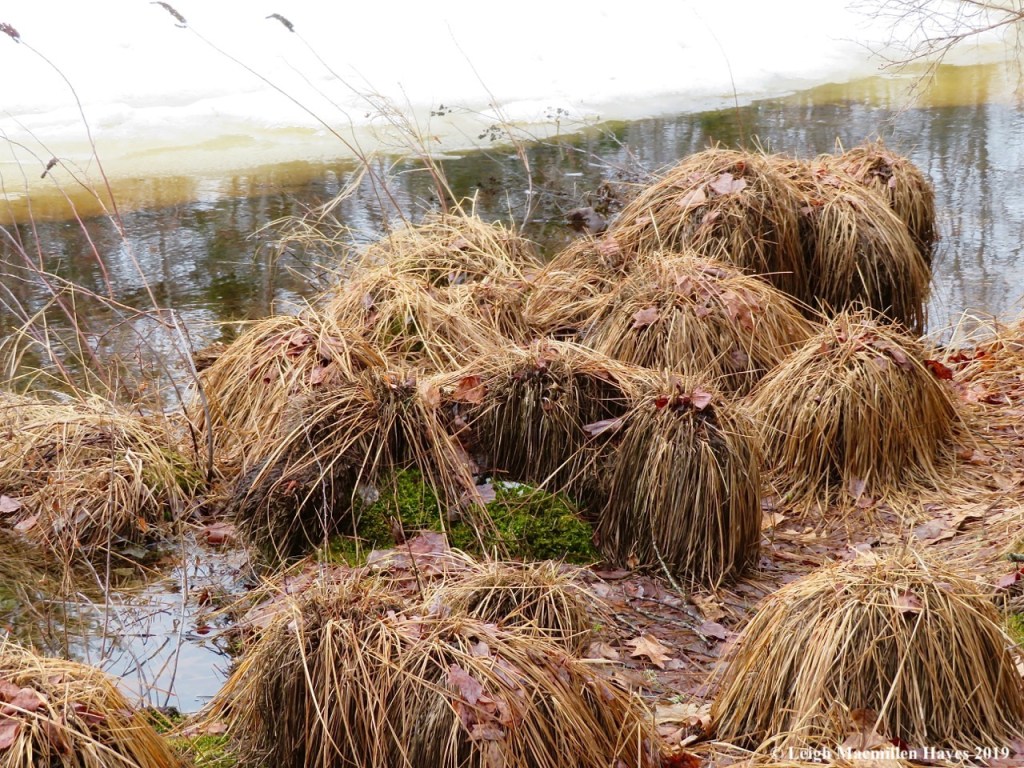
We watched him forage for seeds and wondered about his behavior. Typically, such birds are loners, except for mating season. But this one greeted visitors to its territory with somewhat regular frequency. When we moved, he did likewise–usually a few feet to either side of us. And when we stopped, the Ruffed Grouse did the same, seeming to share our curiosity.

One doesn’t necessarily step into the woods and expect transcendent events to occur, but then again by learning to live in the moment one never knows what to expect. 

These are my thin places, where I see the light more on this side of than the other. May the answers slowly reveal themselves by day and by night, while the questions and awe never end.

Thanks to all of you who continue to wonder and wander with me whether literally or figuratively. I truly appreciate our time spent together.

Otter Delight

Once upon a time in a land close, close at hand, there lived a family of Otters who were mothered by a Snowshoe Hare.

They spent most of their days and nights exploding through the ice and sliding up and down the mill pond’s edge.

But one day their momma rounded up some snowshoes large and small and strapped them on to all.

The family headed off through the woods where moments of wonder captured their attention.

It wasn’t long into their journey when a winter firefly upon the snowy surface stopped them in their tracks.

E. Otter took the firefly that overwinters as an adult and looked for a safe place to deposit it.

She found such in an old beetle hole upon a dead snag and wished it well before she hopped away.

W. Otter found another tree that he quickly identified as a yellow birch and then honored with a hug.

C. Otter looked upon the bark of a beech tree and was thrilled to spy a fungi.

On the tree’s back side he spied another and posed above the false tinder conk.

Soon, the little Otters convinced their momma that they didn’t want to try to be hares any more and so they shed their snowshoes.

Within moments, A. Otter decided to instead try his feet at being a frog.

Catching some air, he leapt up the trail.

By a vernal pool he revealed his true identity–a tree frog.

Soon, his siblings joined him as they channeled their inner tree frogs.

A short distance later, momma couldn’t help but smile when her young’uns displayed their angelic nature.

Those angelic Otters eventually found their way to the top of a huge boulder.

And then they began to do what Otters do.

They slid.

And climbed back up.

To slide some more.

Sometimes, it seemed as if they flew down the boulder’s face.

Other times they bounded.

In true Otter rhythm, one foot landed diagonally in front of the other.

After creating a series of troughs in the snow, they begged their momma to join them.

Being a Snowshoe Hare, she wasn’t sure she would be able to slide quite the way they did.

But she shed her inhibitions and climbed up to join her children.

After noting how scary it was, she smiled and slid down in one of the troughs the children had created.

Once was not enough and up and down she went again.

At last it was time to head for home. Being Otters, the children thought they might just den up below their favorite boulder. The youngest, of course, pouted for he wanted to slide some more.

But moments later, he showed his momma how much he loved her by presenting her with a snowheart.

What an otterly delightful family and equally otterly delightful way to spend the day!

Bear to Beer: Peabody-Fitch to Bear Trap

Our bear to beer tour was supposed to last a year, but here it is February 18, and we’ve already completed three of the treks. I think my guy really likes this Christmas present.

If you aren’t aware, for Christmas I gave him a small box I’d decorated with hiking stickers. Inside were thirteen pieces of paper (actually bobcat prints post-its) upon which I’d written the name of a trail where I thought we might find what we call bear trees for they are trees with bear claw marks, plus a place to grab a pint after the hike.

Because it was snowing today, we decided to stay closer to home and visit a property we hope Loon Echo Land Trust will soon own. It surrounds the Bridgton Historical Society’s Narramissic Farm and is one of our favorite places to wander in any season.

Rather than cross through the field as we usually do, I suggested that we follow the former road (current snowmobile trail) behind the barn. At the first stone wall, we passed from the Narramissic property on to what we hope will become the 252-acre Peabody-Fitch Woods that Loon Echo will own once they reach enough dollars to make the purchase.

Another part of my guy’s Christmas present was a donation toward said purchase, which an anonymous foundation will match. It seemed like a win-win deal when I sat down with Thom Perkins, former executive director of LELT to discuss the property proposal. And then last month I co-led a walk along part of the route we followed today and had the joy of learning more about it from Jon Evans, Loon Echo’s Stewardship Manager, and Matt Markot, LELT’s new executive director.

Not far down the snowmobile trail, we turned left at a stone wall, the same as we had during the LELT walk in late January. I was sure this was a route new to my guy, but it turns out it used the be the snowmobile trail and so he knew it. Right away, as we hobbled over and pulled up some downed trees, we began to see a variety of mammal prints muffled by the morning’s snow. Both prey and predator make their homes there and the property’s importance as part of the animal corridor was obvious.

Eventually, the trail swung around and rejoined the snowmobile trail. We followed it for a bit, then turned off at the blue arrow for that was our chosen way for today. It appeared that someone had an eye on my snowshoes.

We’d no sooner started along the trail when I heard the rat-a-tat drumming of a male hairy woodpecker. Of course, I needed to pause and watch him for a few minutes. And wonder about the purpose of his drumming. Was he establishing territory? Trying to get a date?

My guy was patient with me, but our mission was about more than the birds, and so we journeyed on. Mind you, we kept looking at the trees along the way, but suspected we’d find bear evidence on our return trip when we planned to go off trail. In the moment, we were eager to get to the quarry and find lunch rock.

It was buried, but my guy in his chivalrous manner, wiped the snow off and we each ate a slice of cold, homemade pizza and drank some water.

Behind lunch rock, plug and feather holes served as reminders of an earlier time–much earlier than either of us remembered. The quarry was the source of the stone foundations for Narramissic, the Peabody-Fitch Farm, which dates back to 1797.

With lunch under our belts, onward and upward we hiked until we reached a certain stone pile.

Mind you, it’s located a tad from the proposed Peabody-Fitch Woods, but still, we love to visit bear trap and imagine the past.

I’ve quoted this before, but it’s worth sharing again.

How did the bear trap come to be? According to an August 17, 1963 article in the Bridgton News, “Enoch Perley, early settler of South Bridgton, built his first house in 1777 and brought his bride to their new home in 1778. [I believe this was at Five Fields Farm.]

As Enoch acquired livestock, he was much troubled by depredations from bears. He built a bear trap on the hill back of his first home . . .

Tradition says that four bears were caught in this trap–not enough! So Mr. Perley later had an iron bear trap made which took care of eight bears. Without a doubt, many were disposed of by him personally. A story is told that in an unarmed encounter with a bear and two cubs beside a wood road at dusk, Mr. Perley allegedly strangled the mother bear with his garters . . .”

The article continues, “The bear trap is built of stone. A large stone door is suspended and as the bear takes the bait, he trips the lever and is caught in the stone enclosure.”

In a December 1954 issue of the Bridgton News, a brief article states: “The old stone bear trap on the mountain in South Bridgton known as ‘Fitch’s Hill,’ unused for more than one hundred years, has been reactivated by Dr. Fred G. Noble and Gerald Palmer and put in readiness to capture a bear.” As the story goes, they never did succeed.

In honor of the Perleys, Peabodys, Fitches, and the bears, we’d brought along a growler, a Valentine’s Day present from my guy to me.

We each enjoyed a few sips and then peered inside the trap to see if anyone had taken up residence. Perhaps we should have done that first! Thankfully, no one was home.

Eventually, we headed back to the trail, but didn’t spend long on it.

Instead, we began looking for bear trees. To test your visual acuity, can you spot my guy?

I couldn’t always see him for we split up for about an hour and zigzagged our way from one beech tree to another. I found one that gave itself a hug.

There were those with false lines. Well, they weren’t really false, but they weren’t caused by a bear either. Instead, surrounding saplings blowing in the wind had scratched them.

Then there was the tree that seemed to have stitch marks on the outside of its wound. Unfortunately, the stitches didn’t help.

One of my favorites was the beech that made me think it was a deer bending over as if to take a bow.

That made perfect sense in these woods where the deer did dine.

And at least one rubbed its antlers.

Suddenly, from a distance I heard my guy call to me. He thought he’d found what we sought. A bear tree. The growth at the top certainly leant itself to that assumption.

I’m not one hundred percent sure that he was right, but there were some marks that looked consistent with bear activity–a bear with a very big hand.

Closer to the trail, we did find another tree with bear sign–left behind by Teddy Bear and K.F., whoever that might be.

About three hours after crossing through the stone wall behind the barn to enter the future Peabody-Fitch Woods, we did the same at the far end of the farm field.

And in the end, even if our bear tree wasn’t exactly that, we’d still had a bear sighting–in the form of the trap. Today’s brew was Double C.R.E.A.M. Ale from Bear Bones Beer Brewery. Bear to beer possibilities: Peabody-Fitch to Bear Trap.

I’m with the TREES

When Alanna Doughty, education director of Lakes Environmental Association asked me to join her in co-leading and co-sponsoring a tree identification walk during Great Maine Outdoor Week(end) at LEA’s Highland Research Forest in Bridgton, I jumped at the opportunity. Alanna, you see, is a great joy to be in the presence of and I knew she’d make it a fun and unique experience.

I wasn’t disappointed; nor were the thirteen others who joined us this morning for a two-hour hike that turned into two and a half and even a little bit more.

Alanna had gone out ahead of us and placed hearts with tree-related information along the trail we’d travel. Our crew was a delightful mix that included young and old, with members of LEA and the Greater Lovell Land Trust, which I was representing, as well as a woman from North Conway and man from Portland. Yes, Linda and Henri–that would be the two of you.

The first heart provided information about hemlock trees and after she read it, we encouraged everyone to channel their inner hemlock and so they leaned as this particular evergreen does. Check out those smiles. Don’t you want to be a hemlock too?

Of course, because we were among the trees on this property that the David and Carol Hancock Charitable Trust donated to LEA several years ago, and the snow was super soft from yesterday’s storm, the mammal tracks were outstanding.

One of the favorites of the day–that of the snowshoe hare. It’s not often that one can see the hare’s toes so clearly, but today was the day. And as David Brown’s Trackards indicated, the footprint size depends upon the conditions.

When it came to demonstrating and identifying the action of the mammal there were two rock stars among our group. Alanna was one for she got down on all fours and demonstrated how a hare moves (before she sorta fell). And Pam Marshall was the other for she correctly identified and shared information about how to recognize all of the track and print patterns that we saw. Pam only began tracking this year with the GLLT’s Tuesday Trackers, but she’s a quick study.

Onward we trekked, pausing whenever we saw a heart of red. And each time, Alanna’s voice came through in the message. Love at first bite! Indeed.

At a beech tree, we paused for a bit longer as we noted not only the twigs and buds that are beginning to swell, but also talked about how bear claw marks are most visible on them and how the beech scale insect has altered the once smooth look of the bark. The word marcescent, meaning withering but remaining attached to the stem, also entered the conversation.

After a bit of time, we emerged onto a wetland where only last week Alanna and a couple of people including one in our midst, Anne, had spotted a hole and lots of tracks and scat left behind by an otter. Today, no sign of that member of the weasel family, but still . . . we enjoyed the warmth of the sun.

And I took advantage of the time to dress Alanna as a twig. She was the perfect Miss Twiggy model and Henri took time to pose with her.

Back in the woods, we were stopped in our tracks by the tracks of another weasel–a mink.

And then as we retraced out steps and paused by a speckled alder to admire its male and female catkins and last year’s cones, someone honed in on something that wasn’t a remnant of yesterday’s snowstorm.

The cottony white masses of wooly alder aphids decorated a couple of branches. As Alanna explained, in a symbiotic relationship, during the warmer months, ants stroke the aphid with their antennae, while the aphid releases a drop of honeydew, much like a cow being milked. It’s actually rather creepy. Today, there were no ant farmers about, but a few like Justin, did step forward to take a closer look.

After that, we were confronted with a math problem. And you thought we were just out for a walk in the woods.

Finally, well sorta, we made our way back to an opening and stood around enjoying hot cocoa and tea, plus some goodies, and each others company.

Sherpa Anne had been kind enough to haul the supplies to the opening for us as our trek began. I know she was thankful she didn’t have to pull the sled all the way out to the wetland. And we were thankful for the good tidings it bore.

You see, Alanna is a woman of many, many talents, and baking is one of them.

Did she get carried away with the cookie cutters?

We didn’t think so for we all love Maine.

And we also love trees, including red oaks with their bristly-tipped leaves and acorns.

That wasn’t all Alanna had created.

Her tree model was to be envied (at least by me). And she explained the different functions, from roots to leaves and outer bark to inner workings.

And just in case you are interested, I’ve come up with a new mnemonic, because we love memory aids.

Xylem is the vascular tissue in plants that conducts water and dissolved nutrients upward from the root and also helps to form the woody element in the stem.

Phloem is the vascular tissue in plants that conducts sugars and other metabolic products downward from the leaves.

My mnemonic: Xy high (think upward); Phlo low (think downward).

Of course, that didn’t occur to me until several hours later.

Before we finished off our delightful morning, there was one last heart with tree information to read. Hmmm. Porcupines, bark, needles, scat, look up? “You might spot one dining!”

And so up we looked.

And down as well. We found some tracks and even took a closer look at some comma-shaped scat.

Because . . . the resident male was high up in the tree! Look at that handsome fella! We did. Over and over again. Henri was sure we had planted him and that he wasn’t real.

But he was. And if you look closely, you might see his orange teeth which one (like me) could almost mistake for a Valentine heart. Check out those toe nails. And can you see the rough soles of his feet, the better to grip the tree with?

Male porcupines are known to hang out on a tree during the day. I know we’re particularly thrilled about this one because he hasn’t let us down yet.

Think about this–while the male was hanging out in the sun, porcupines (like the one that lives under our barn) typically stay in their dens until dusk and then head off to munch on bark and needles in the darkest and coldest hours of a day. That’s to be admired.

So is the work of our two organizations, Lakes Environmental Association and the Greater Lovell Land Trust. Both of us are with the Trees and we loved sharing the trail together this day.

We’re doing the same again on Sunday at 12:30 in Lovell, where we’ll go on a Porcupine Prowl–will we actually see the rodent as we did today? Who knows, but we’ll have fun as we join together again to celebrate Great Maine Outdoor Week(end).

I’m with the TREES. Are you?

Mondate Shared with Tom and Ron

Midmorning found us driving down a lane in Stoneham, Maine, made extra narrow by high snowbanks. At the second entrance to the Greater Lovell Land Trust’s Five Kezars Reserve we were delighted to discover the driveway had been plowed just enough to allow a vehicle or two to park. And so we did.

Our initial plan had been to wear micro-spikes and carry snowshoes, but as we’d passed by the first entrance, we noted that no one had climbed the Mountain Trail, and the road leading back to it had been well sanded, so we left the spikes behind.

Walking back up the road was easy, but then . . . we had to conquer what was probably the most difficult part of the entire journey–the snowbank between the road and the trail.

Thankfully in northern New England, those who drive plow trucks know to knock the snow back a day or so after a storm, thus leaving room for the next storm. (In this case, there’s one on the horizon for tomorrow night with another 8-12 inches predicted). The result is a shelf that makes the snowbank easier to climb up and over.

We did just that with the utmost grace in our steps.

Once on the other side, where the sign gave an indication of depth, we donned our outer footwear.

And walked up to the kiosk where we stood eye to eye with the roof rather than the map.

We did study if for a moment as my guy had not been on the new spur trail overlooking all five of the Five Kezars.

The trails are incredibly well blazed and blow down wasn’t much given the winds of winter, but . . . we did note one small beech that had fallen off trail and taken the signs with it.

A little further up we found another sign encouraging us to climb even higher–as in skyward. Perhaps it knew something we didn’t know.

For the first half of the trail, we mainly focused on our feet, making sure that the cleats on our snowshoes dug into the slippery surface.

Once the trail leveled off, we started looking around. And being winter with no leaves to distract one’s view, the snow-topped boulders stood out like tiny homes in the woods.

About halfway up the Mountain Trail, where it turns left and joins an old jeep road to the summit, a new path was carved last summer–Tom’s Path so named for the late Tom Henderson, who had long served as the land trust’s executive director.

My guy had walked about on the ledges there with me on previous excursions, but this was his first time actually following the new trail and so he studied the “You Are Here” spot on the map.

Along the way, I wanted to pause just before the trail turned left for I had a suspicion about the area below the rock. My suspicion proved correct; a porcupine had created a den under the ledge.

That was further verified by the downed hemlock twigs.

A bit further up the trail we found even more evidence of porcupine activity for many of the trees showed off the tooth scrape marks left behind as the critter sought the cambium layer below the bark.

Recently I saw bark under a porcupine tree that confused me for I’ve always thought of them as eating the bark completely and leaving no mess–unlike a beaver. But today’s findings indicated that all had been consumed.

Behind all of the porcupine artwork trees stood another much larger that will probably be naked by spring.

The debris was the typical–nipped twigs cut at an angle . . .

and plenty of healthy looking scat. ;-)

The bark on the big old hemlock, however, had flaked off revealing its cinnamon color beneath for the porcupine had created a regular climbing route.

From below, I looked up in hopes of seeing the rodent, but realized all the evidence had to be enough. I did wonder–Tom always said he wanted to return as an otter, but just maybe he’s a porcupine right now. He was a forester, after all, and loved anything tree related.

A few minutes beyond the porcupine area we found our way to the termination of the spur and took in the view of four of the Five Kezars below: Little Mud, Mud, Middle and Back.

Being winter, a few more steps to the left revealed the fifth of the Five: Jewett.

Retracing our steps, we returned to the Mountain Trail and followed it to the summit where lunch rock had been graciously cleared . . . just for us.

There was no wind and the sun felt delightful–so we sat for a bit taking in the view of the ponds below and Pleasant Mountain with Shawnee Peak Ski Area in the distance.

When we finally decided to move on, we first stepped out to the north so we could get a glimpse of Mount Washington in the backdrop.

And then we pulled it in with a telephoto lens.

Following the orange connector trail down, we began to notice more mammal activity. We’d left the porcupines behind, but the snowshoe hare always seem to dine in one particular location.

And scat ;-)

We also noticed bobcat tracks like these, muted though they were, crossing over the trail, while we followed coyote tracks down the trail.

And twice we encountered engravings in the snow that at first glimpse we thought were wing marks, but changed our story to one of the predators playing with a prey as it dangled from the mouth. Hmmm.

Continuing down, we constantly looked up–at beech trees for we knew many revealed bear claw marks. Sometimes we had to look extra closely because the cankers on the tree hid the possibilities.

Though this wasn’t part of the Christmas present to my guy in the form of Bear to Beer Possibilities, it could have been a contender.

Our eyes scanned many a tree and we know we missed a bunch today, but we’ll save those for another day. I did think about returning and creating waypoints to mark each one on GPS, but then we wouldn’t have the fun of looking.

And because we were doing such, we found a new one today. Chances are the next time we look, it will be new to us all over again–if you know what I mean.

One other tree also drew my attention. Well, really, they all did. But yesterday I was explaining this very pattern to some folks on a guided walk, and wish I’d had such an example: target fungus on red maple. Indeed!

Eventually we reached the bridge crossing at Ron’s Loop, so named for Ron Gestwicki who was the first president of the Five Kezars Watershed Association and driving force behind creating this reserve that we could enjoy upon occasion, but the mammals know best.

While my guy sashayed straight across the bridge, I chose to go forth in a sideways pattern. In the middle, I remembered once slipping down under the rail, but thankfully today I reached the other side without incident.

The mammal activity continued along the half of the loop that we traveled. Other travelers included the coyote that left its mark on a high spot in the middle of the trail and several more crossings by the bobcat.

I was hoping for an otter slide because sometimes we are so blessed, but instead we found a few tracks of fisher passing through, their five tear-drop shaped toes on display.

Though we’d spent several hours on the trail, it seemed we reached the final bridge crossing in no time and my guy performed a chivalrous act of stomping down the snow to make for an easy crossing.

The water below offered a hint of every season as it flowed forth: summer’s blue sky, autumn’s dried leaves, winter’s clear ice, and spring’s fresh greens.

As we passed by the kiosk for Ron’s Loop on the way back to my truck, we gave thanks to the two men for which the trails were named: Tom Henderson and Ron Gestwicki. We were grateful for their leadership and the opportunity to continue to share the trail with them, especially on our Monday Date or Mondate.