Book of August: BARK

IMG_2913

Book of August

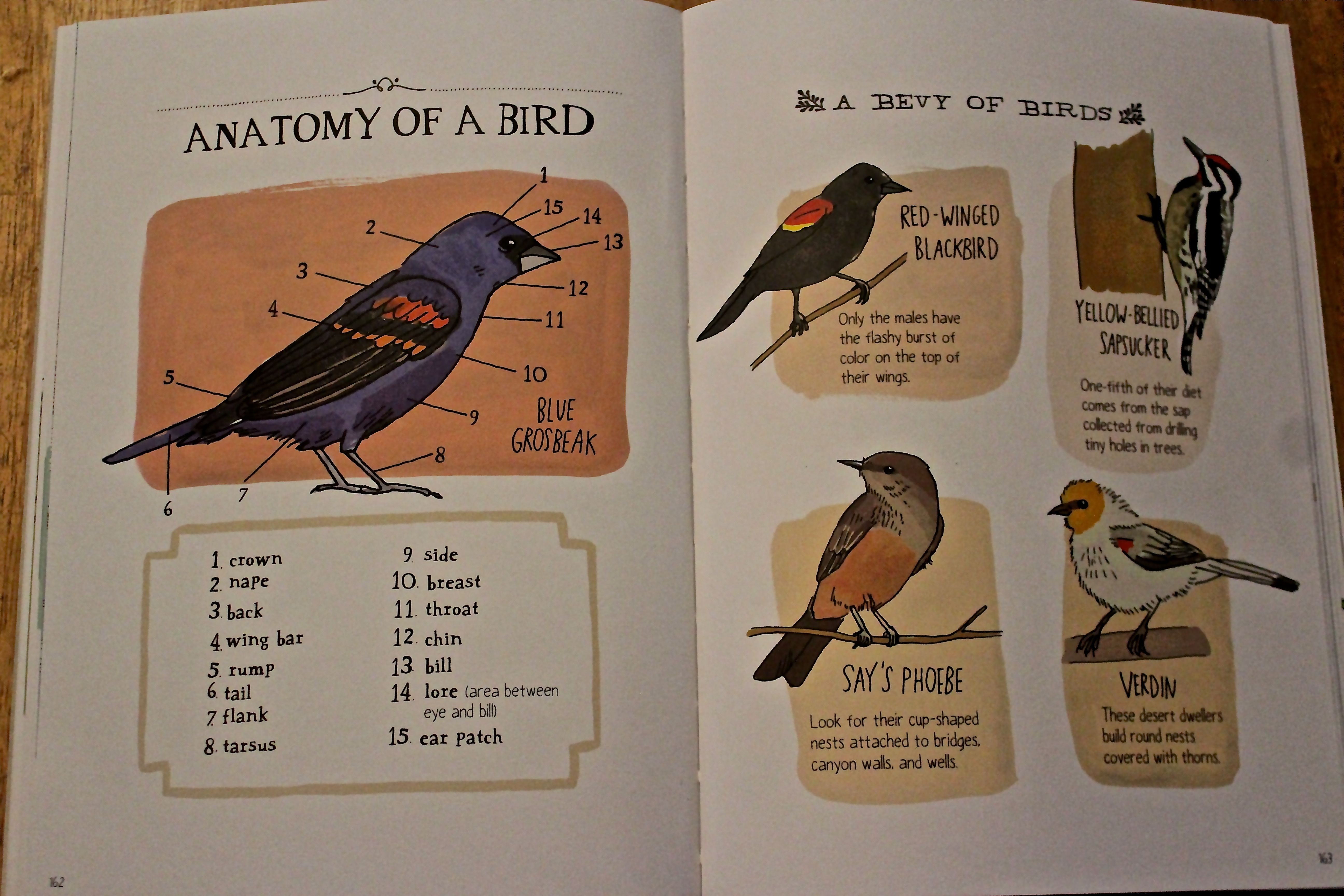
It was my journey through the Maine Master Naturalist class several years ago that lead me to this book of the month: BARK–A Field Guide to Trees of the Northeast by Michael Wojtech.

The book actual evolved from Wojtech’s work, under the tutelage of Tom Wessels, toward a Master’s degree in Conservation Biology at Antioch University New England.

Between the covers you’ll find information about bark structure, types of bark and bark ecology. There is a key for those who are so inclined.

And then the biggest chunk of the book is devoted to photographs and descriptions for each type of tree that grows in our New England and eastern New York State forests. These include the common and Latin names, family, habitat, range maps, leaf and branch pattern, leaf shape and notes.

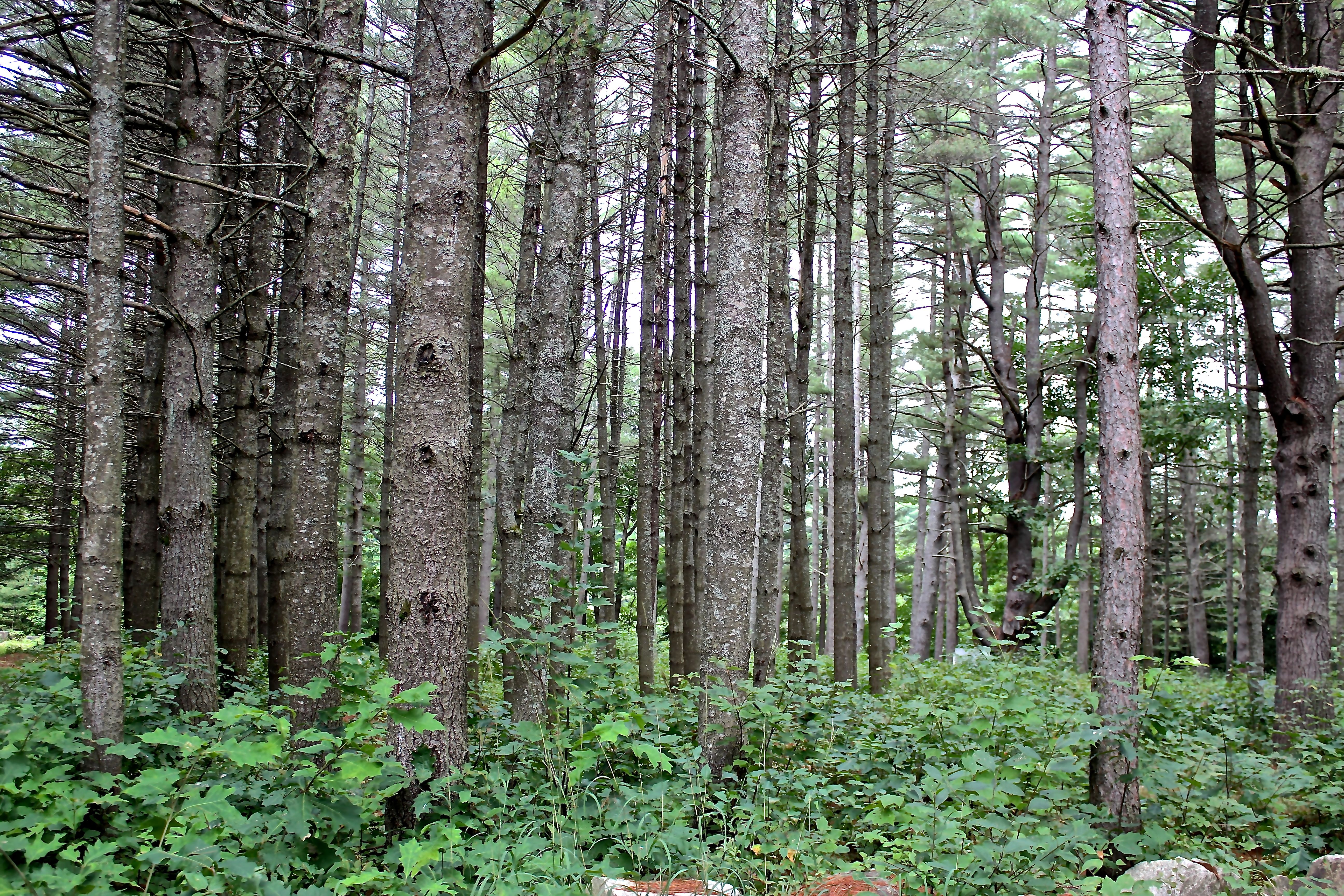
For me, there are two take away items from this book. First, I learned to categorize bark based on its pattern from smooth to ridges and furrows, vertical strips, curly and peeling to others covered in scales and plates. He breaks bark type into seven varieties that I now find easy to identify.

Second, I came to realize something that I may have known but never gave much thought to–except for  American beech bark, which remains smooth all its life (unless it’s been infected by the beech scale insect), bark differs from young to mature to old for any particular species. Oy vey!

Though this book is useful in the winter, now is the time to start looking. To develop your bark eyes. The leaves are on and will help with ID, thus you can try the key and you’ll know if you’ve reached the correct conclusion or not.

Go ahead. Purchase a copy and give it a whirl. I must warn you, it becomes addictive and can be rather dangerous when you are driving down the road at 50mph. As Wojtech wrote in the preface, “If you want to experience a forest, mingle among its trees. If you want to know the trees, learn their bark.”

While you are at it, I encourage you to visit the small western Maine town of Bridgton, where the Bob Dunning Memorial Bridge leads into Pondicherry Park. Each of the sixteen bridge beams is constructed from a different tree and the bark is still on them. Test yourself and then grab one of my brochures at the kiosk to see if you got it right. If there are no brochures, let me know and I’ll fill the bin.

And while you are there, stop by the independent bookstore, Bridgton Books, to purchase a copy of BARK.

BARK: A Field Guide to Trees of the Northeast by Michael Wojtech, University Press of New England, 2011.

Samplings of Wonder

The day began with a journal hike along Perky’s Path, a trail in the Greater Lovell Land Trust’s Heald and Bradley Ponds Reserve. It was a first for us–a journal walk that is, and we had no idea how it would turn out. But our fearless docents, Ann and Pam, did a wonderful job of listening to the voices of those gathered and knew when it was time to stop and when it was time to move on again.

h-LMH

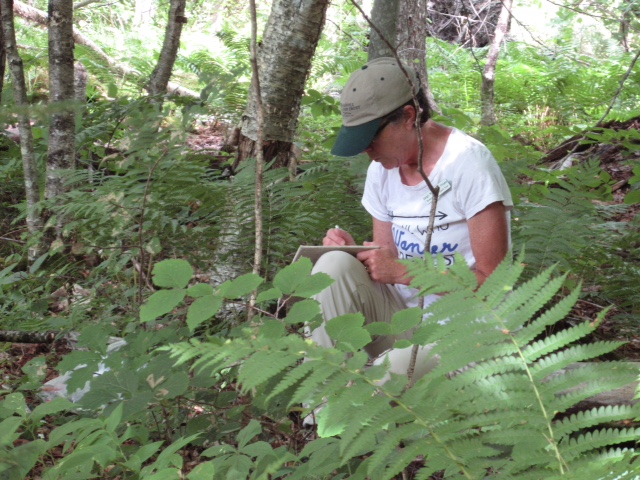
Each of us got lost in the world around us as we sat. We looked. We listened. We contemplated. We wrote. We sketched. We photographed. I know that I was so intent on sketching that I never realized Pam took this photo until she sent it to me. Thank you, Pam.

h sampling

Ever since I’ve started looking at the natural world through my macro lens, I haven’t taken as much time to sketch, so today was a welcome excuse to do so. And to color. Since my Aunt Ruth gave me colored pencils at least 50 years ago, those have been a favorite medium. I no longer have the gift from her, but my guy replenishes my supply when necessary.

IMG_2706 (1)

Our group was small, seven in total. We all admitted that small is good for this sort of activity.  And we came away thankful for the experience of making time to notice.

h beetle

And then I walked to the summit of Hawk Mountain with Jinny Mae–on a trail that may seem rather sparse in offerings, but actually proved to be quite rich. This banded longhorn beetle didn’t really like being the center of attention. His focus was on steeplebush pollen and I kept getting in his face. So–he did what flying insects do–and flew off.

h fern indusium

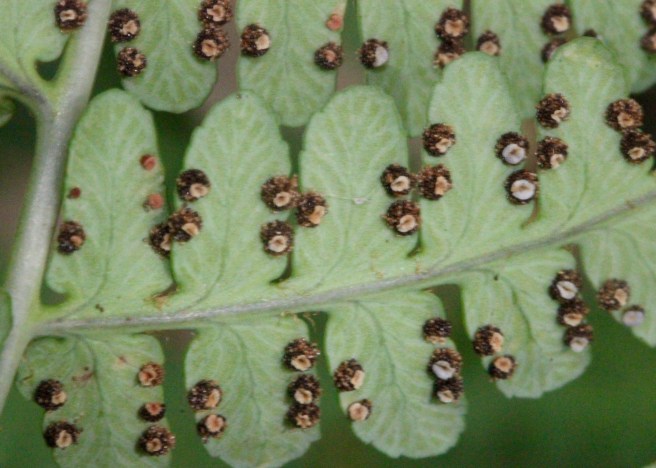
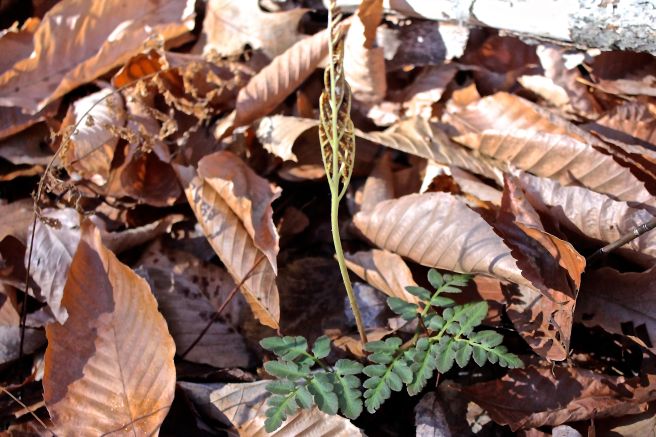
We were excited to discover several clumps of marginal wood ferns and some even with the indusium still intact. The indusium is a membranous covering that protects the sporangia inside the spore cases until they are ready to leave home on a dry day. In this case, the indusium is kidney shaped. As the sporangia ripen, they push the covering off and dust-like spores fly off in a wee cloud, breaking free to set down their own roots.

h white oak

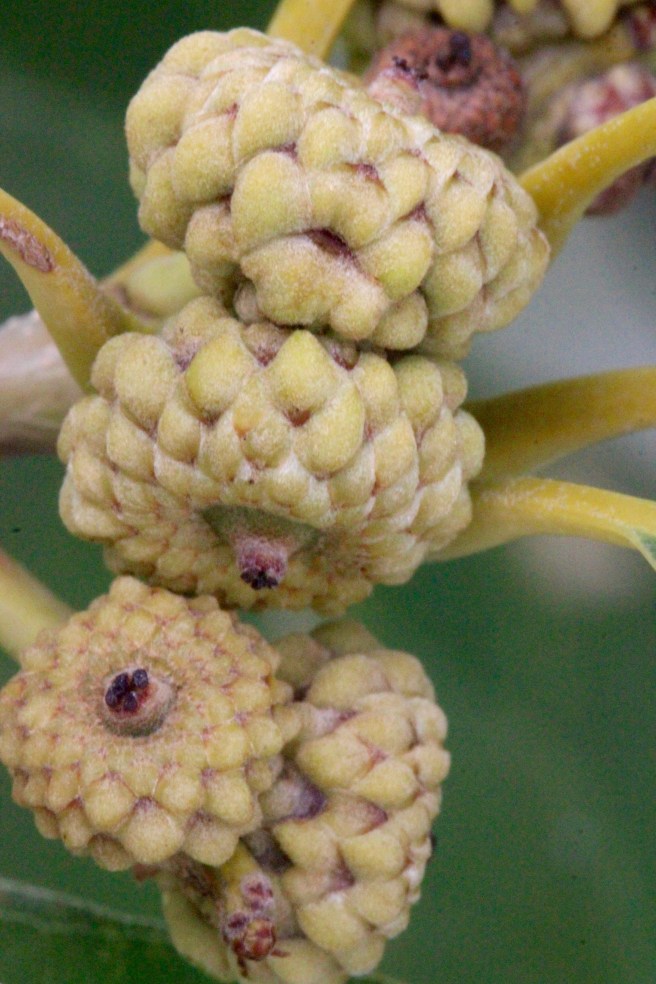
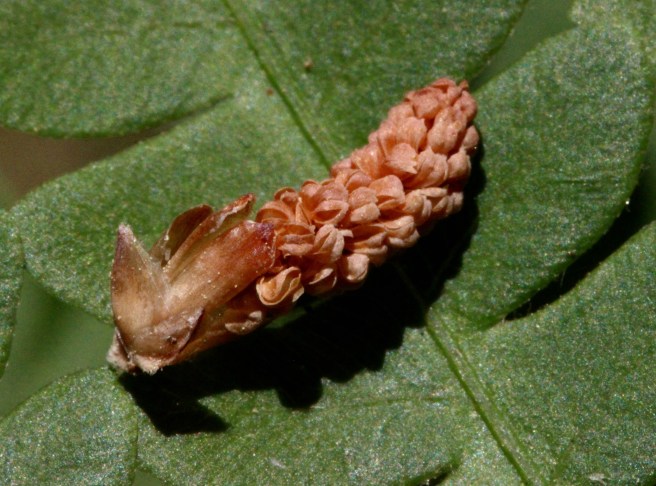
Here, both Northern red and white oak grow side by side. It was the white oak’s fruiting structure that called our names. The immature acorns growing in pairs are both warty and hairy, but their structure is more reminiscent of a miniature pine cone at this stage. They should mature by fall.

h stag stalk

And then we celebrated the one who is all hair and color . . .

h stag leaves

and distinct shapes and

h stag leaf

a combination of all three.

h stag flower

Staghorn sumac. The king of the mountain.

h berries 2

Little things excited us and the twin fruits of the Hairy Solomon’s Seal that tried to hide beneath the leaves didn’t escape our focus. Or our cameras. Sometimes we are sure that we share all the same photos.

h indian pipe

One of our final stops as we headed down the trail–to worship the heads-up version of a fertilized Indian pipe. While most flowers nod when fertilized, Indian pipe chooses to be different. It wins in my wonder department.

I’ve only shared a few finds from today’s wanders. Just a smattering or a sampling. All worth a wonder.


Searching for the Source of Sweetness

I wore down a path between gardens today as I traipsed from one to the next and back again. But if air space is anything like lawn space, then those who visit the garden via flight have created their own well-worn passageways as they also search.

w-post face scrub

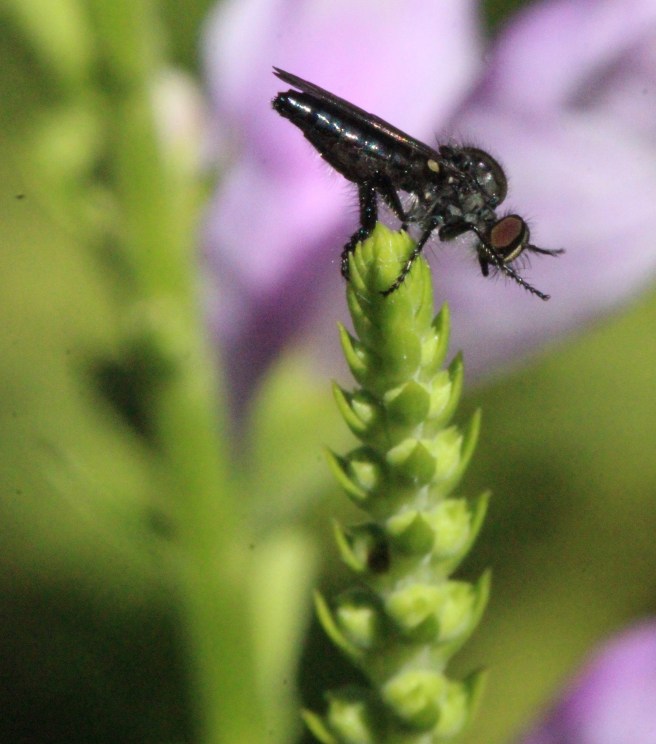
My mission was to see the hummingbird again. But, this little guy, no longer than a half inch, stood atop a false dragonhead yet to bloom and waited to be noticed.

w-face scrub

He even took the time to scrub his face as I watched.

w-double or triple daylily

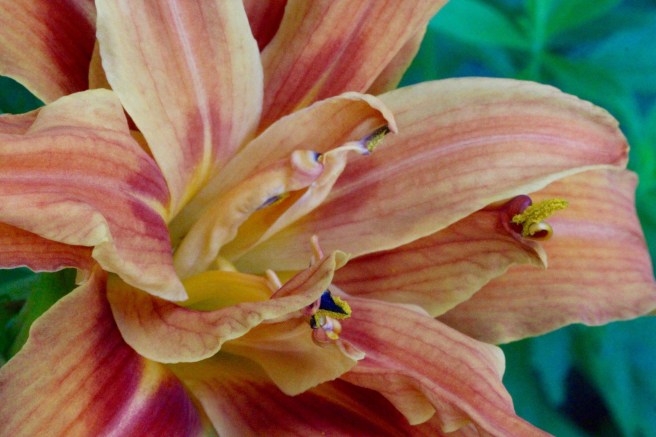
Continuing my wander, I stopped by the daylilies and made a discovery. We’ve lived in this house for more than two decades and I never realized until today that we have some double daylilies. The previous owners had green thumbs and we’ve benefited from the fruits of their labor. But how had I missed this before? I know we have double daffodils, but loved my new find. Especially as this past weekend, my friend Beth invited us to her hundred acre wood and her mom showed us their daylily gardens. Beth’s mom, Mary, talked about hybridizing the lilies and so she’ll know best about this.

w-lily pollen

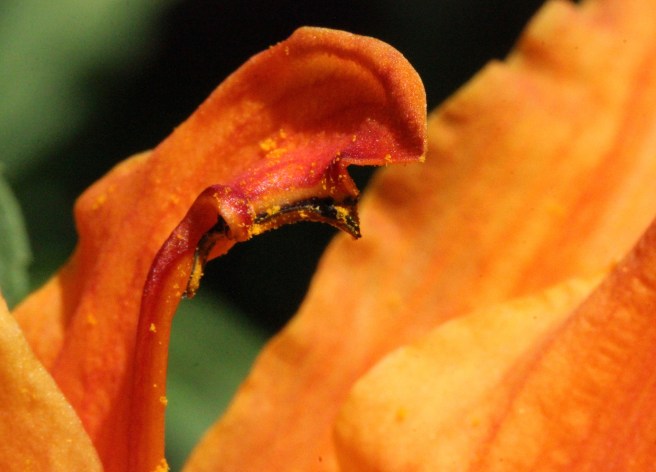
When I revisited the flowers later in the day, the sun shone brilliantly on them, enhancing their orangeness. Correct me if I’m wrong, but what I think has happened is that the petal formed along the stamen and imbedded the anther, thus it looks like a petal with grains of pollen. Crazy cool. And beautiful. And yummy.

w-fritillary1

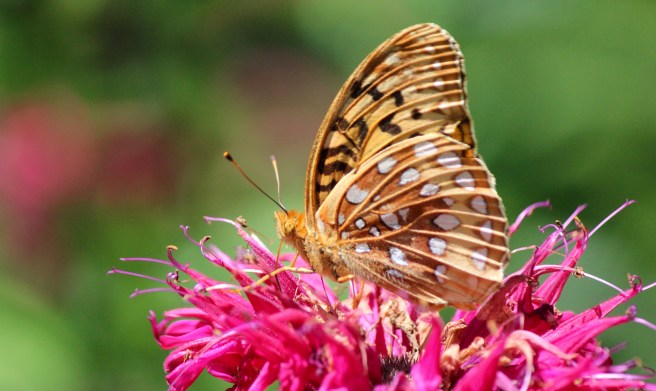
That wasn’t the only shade of orange worth wondering about. And it was no mistake the this fritillary butterfly chose the beebalm on which to land.

w-frit 2

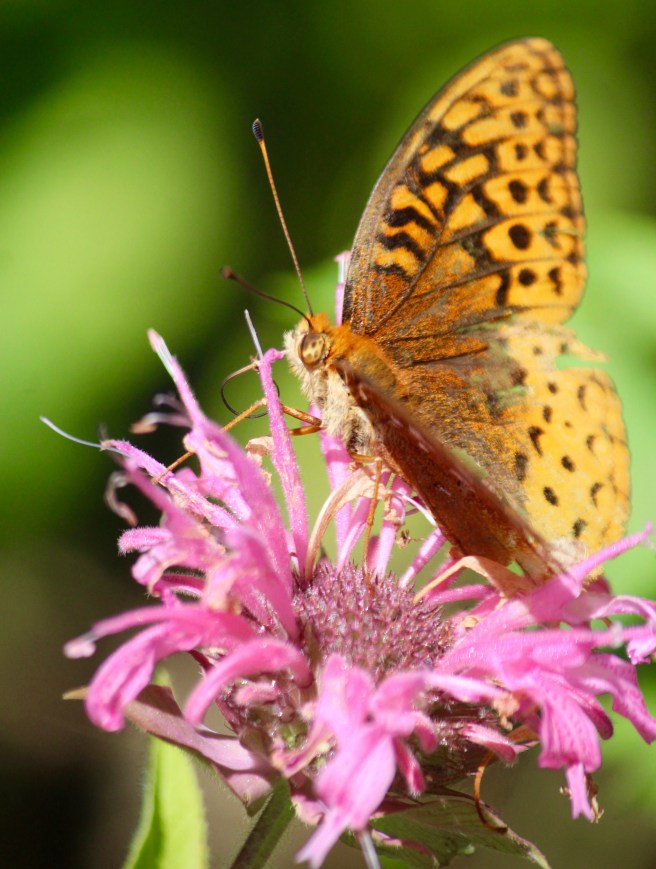
Check out its mouth. A butterfly feeds through a coiled mouth part called a proboscis. When not in use, the proboscis recoils and is tucked into position against the butterfly’s head.

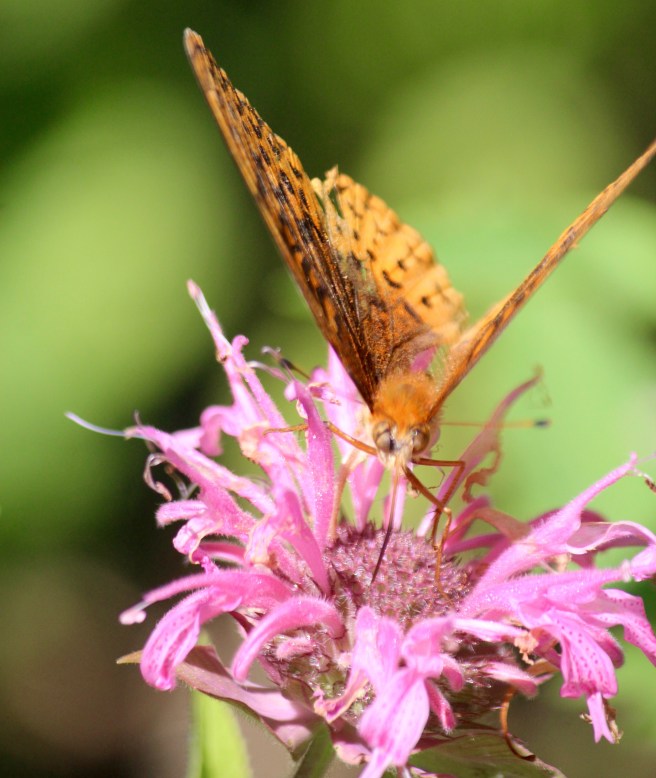
w-frit 3

Since the proboscis is narrow and straw-like, it allows the fritillary to extract sweet nectar from tubular-shaped flowers. Suck away, dear fritillary.

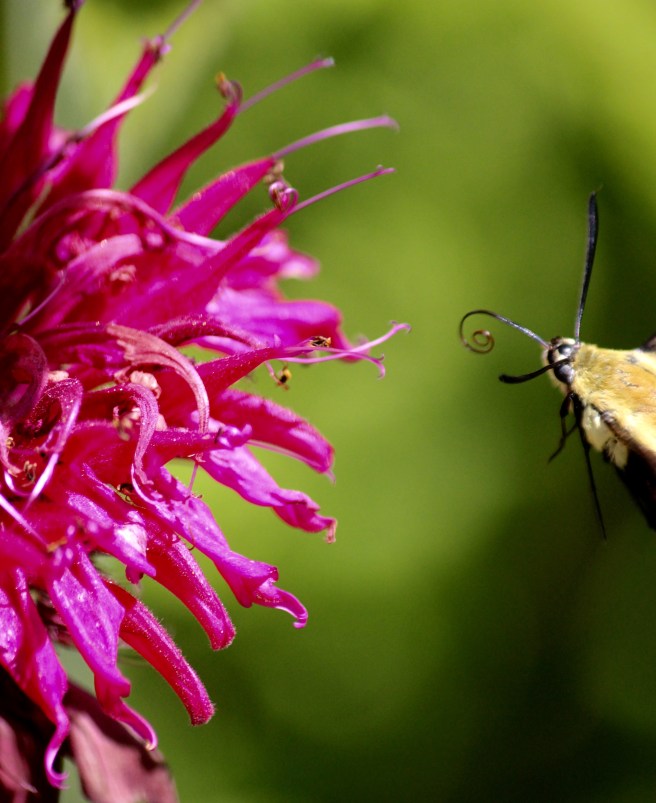
w-hummoth 1a

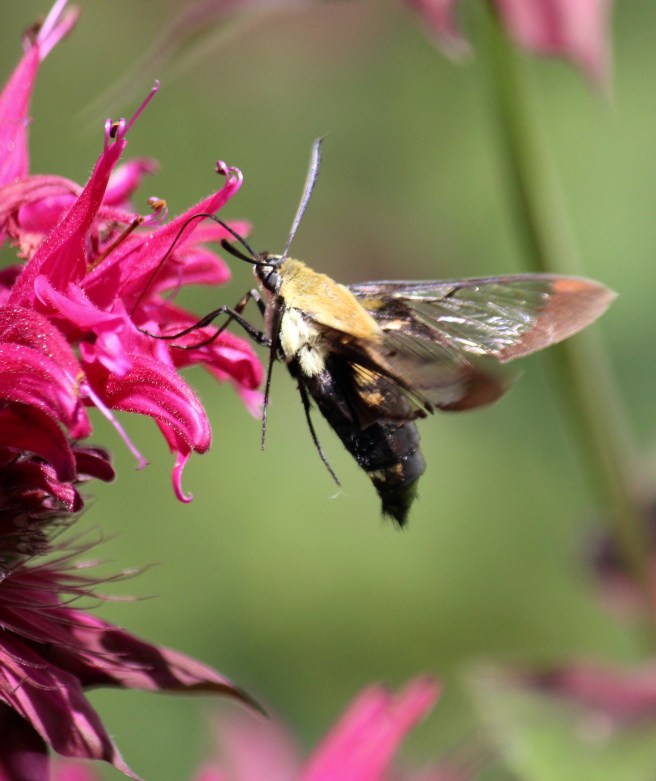
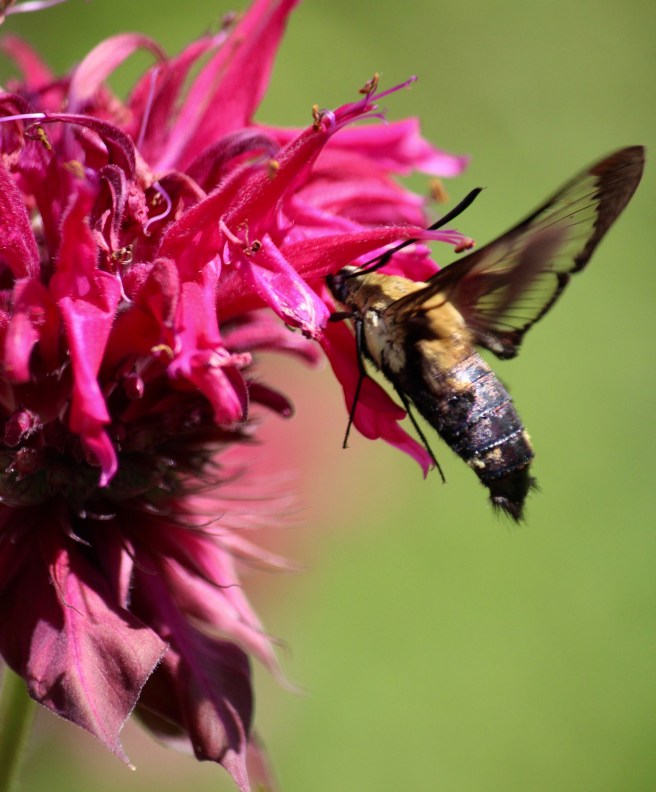
The fritillary wasn’t the only beebalm visitor with a coiled proboscis.

w-hummoth 3

I actually heard it before I looked up and saw this moth. It sounded like a hummingbird and flapped its wings as fast or nearly as fast as a hummingbird and shared the name hummingbird. This is a hummingbird moth.

w-hummingbird moth 1

Notice how the proboscis begins to unfurl as it approaches the flower.

w-hummoth 3a

While it hovers, it probes.

w-hummoth 4

Searching deep for the source of sweetness, where others can’t reach.

Sluggish Moments

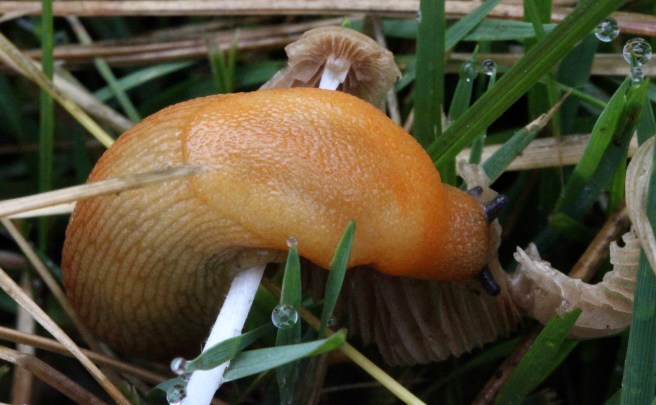
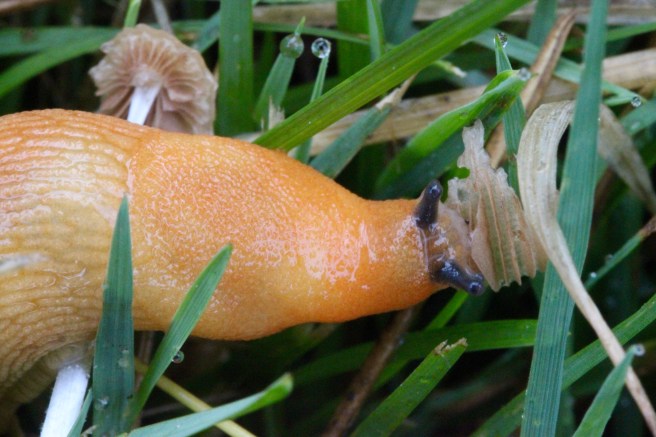
It’s not every day that someone shares time with a slug, but this morning that’s exactly what I did. It had poured until about 5:30am, so the conditions were prime.

4

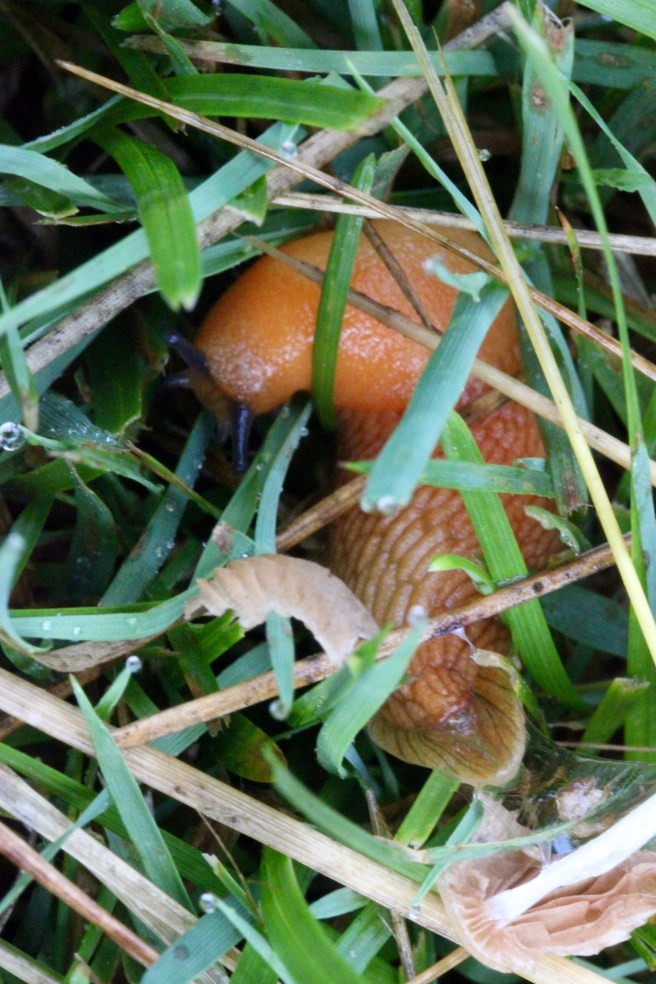
Actually, I was hunting for a spring peeper that frequents one garden and the grasshoppers that live in another, when a spot of orange caught my attention. And so I bent down for a closer look.

3

A slug is like a snail without a shell, which makes it vulnerable to dehydration. That’s why we only see them foraging on rainy or cloudy days. I suppose we should think of slugs as weather predictors, much the same way common polypody indicates the temperature. Of course, if you look under leaf cover in the garden, you’ll surely find them as well, no matter what the weather is. Cool and damp conditions prevail in their world view.

1

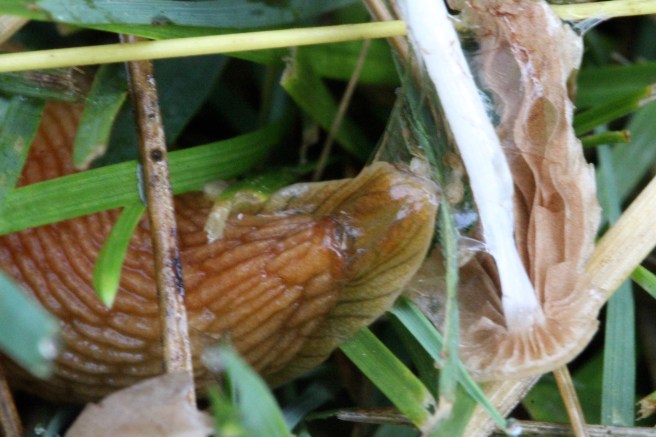
As Mr. Slug munched on a mushroom at my feet, I admired the pattern on his back and thought about my past experiences with slugs. I’ve licked their backs because I’d heard that they release a chemical which works like a natural anesthetic, thus providing a cure for toothaches. The numbness did last for a short period of time. That being said, my nursing friends encouraged me to stop because slugs may also carry parasites. And so I did.

6

Since I was upclose and personal, I could see Mr. Slug’s two short antennae and even shorter eye stalks. Then there was his accordion-shaped mouth that he used to grasp and shred plant material. At first I thought he sucked it in, but as I watched, I could see the chewing motion.

7

Being a mollusk like a clam or oyster, one might think about sautéing slugs. Or not. Really, I’m surprised my parents never tried that. Dad always sacrificed some beer so Mom could pour it into a tin pan in the garden to attract slugs. It worked–better for her than the slugs who thought they’d found the holy grail only to instead meet their fate. A perfect marinade. Thank goodness Mom and Dad didn’t think of that. But really, though slugs do have a bad reputation because they eat plant material in our gardens, they also play an important role as decomposers–of fungi and lichens and dead insects and plant material, all of which they turn back into soil.

10

And here’s another curious thing about slugs–their mode of transportation. Remember their vulnerability to dehydration? Well, in order to move along they must create a slimy mucous. And so a chemical reaction occurs in their bodies causing them to secrete a sticky, slippery substance. That probably helps in keeping their predators, like toads and snakes and birds, at bay. Once they’ve moved on, it dries up.

9

This morning, after we’d spent about a half hour together, Mr. Slug decide it was time to move on–toward the garden. It’s raining again as the sun sets and he’s probably slip sliding away across the yard in search of another feast.

ant

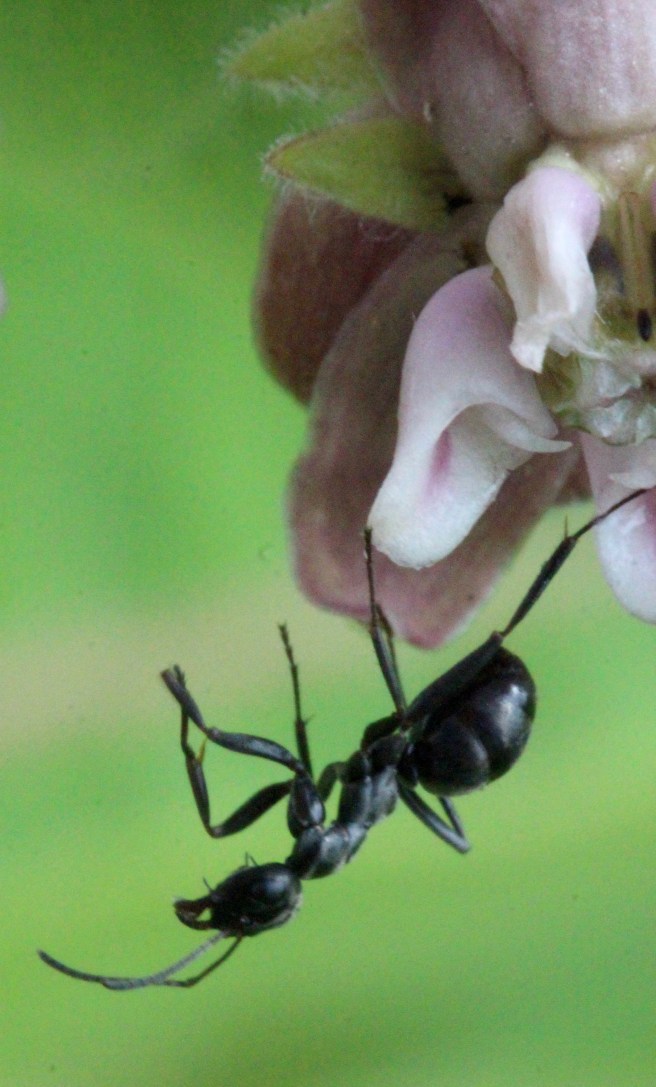
Because you stayed with me through my slug praise, dear reader, I thought you’d enjoy stopping by to wonder about a few pollinators like the ant that visited the milkweed. Did you know that insects get their feet caught in the sticky pollen sacs of the flower? They have to twist and turn as this one did while trying to get out. In the process, their feet get covered with pollen that they carry to the next flower.

bee

Pollinators come in all shapes and sizes, but I found one who looks like it wears a Halloween costume on a daily basis.

pollen

And this final pollinator of the day–loves to get totally immersed in its job.

I never did find the spring peeper today, and only one grasshopper, but my moments spent wandering and wondering were hardly sluggish.

Capturing Wonder

I’m envious of friends who own acres and acres of land with layers of trail loops that provide a diversity of habitats for exploration. But then I remember that beyond our six acres there’s a vast forest that I’m welcome (well, I think I’m welcome–it’s not posted and in Maine that generally means I may trespass) to tramp through. For the most part, that’s my late fall to early spring playground. But we also live within walking distance of a large woodland park where I spend an equal amount of time. Of course, I tend to get greedy about it and think of it as my own. That’s how it felt this morning when I wandered there after church without encountering another soul. I went in search of wonder. And I found it both there and back at home.

rice 2

Everywhere I walked, or so it seemed, rice krispies lay scattered at my feet.

rice krispie

They are the newly fallen male pollen cones of our white pines. And yes, they are the size of rice krispies. Once mature, their sacs split open, sending pollen wafting through the air where some of it actually finds the female seed cones. And much of it covers our vehicles, driveways, lawn furniture and window sashes, like a coating of yellow snow. When their mission is completed, they turn brown and fall to the ground. Eventually, they’ll disintegrate, adding to the richness of the forest floor. Worth a wonder.

spruce gall

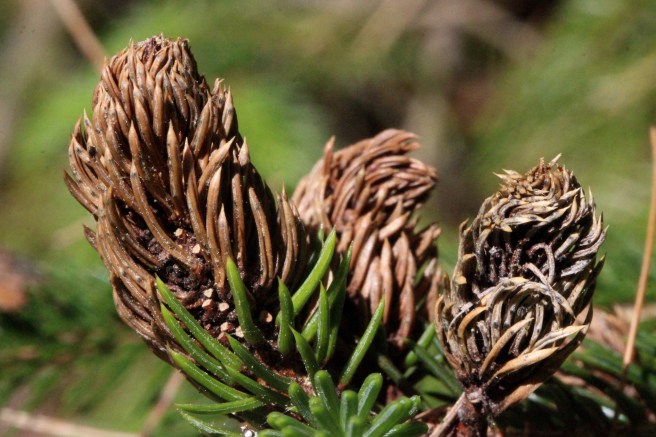
Further along, I encountered the rather cone-like shape that adorns the tips of spruce trees. These brown, prickly galls were caused by the Eastern spruce gall adelgid, which is closely related to aphids. Will the tree die? Perhaps. Certainly, it’s disfigured.

Eggs are laid in early spring and emergent nymphs begin feeding at the base of tender new shoots. The gall forms as they feed and completely encloses them like a warm, protective covering–keeping predators and diseases at bay. The galls I noticed are older as they are dried out. But typically, the nymph emerges from the gall in August, molts and flies to another branch to start the cycle again. The adelgids are parthenogenetic, meaning only females occur, reproducing without males. They typically produce two generations each year, with the latter overwintering as partly grown females. Worth a wonder.

mullein 4

And then I came to a dry, sunny spot where common mullein stands tall, this one almost as tall as me. According to lore dating back to Roman times, it is said that the stems were dipped in tallow to make torches–either for witches to use or to be used against them. Thus, some know it as hag taper. Others refer to it as candlewick plant because the dried leaves and stems were used to make lamp wicks.

mullein 2

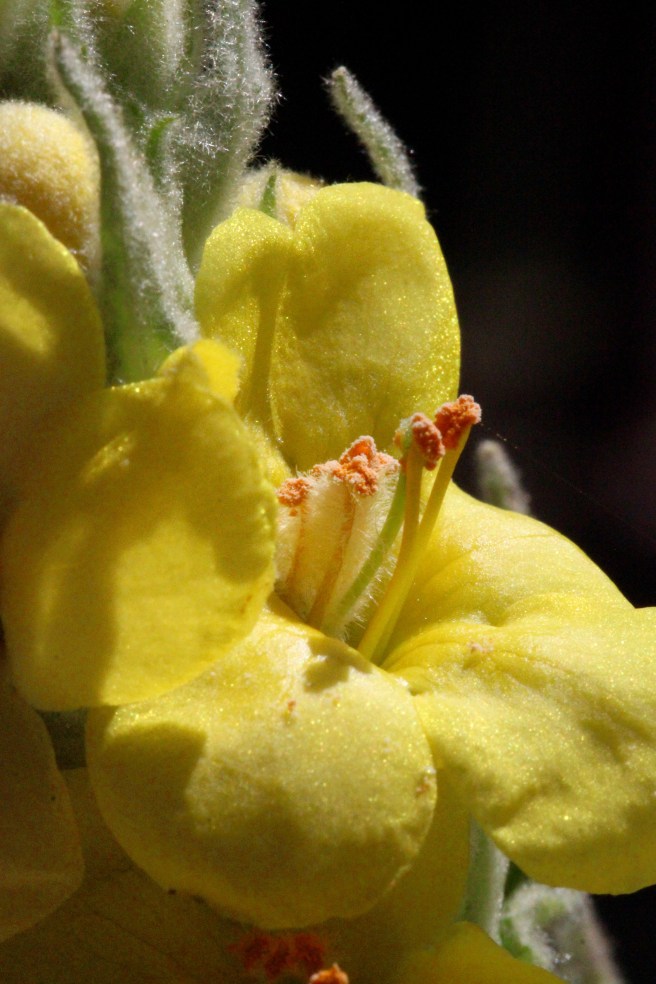
It seems to me that it’s hardly common at all given its uses and structure. Over the course of the summer, five-petaled yellow flowers will bloom randomly in a dense,  terminal cluster.

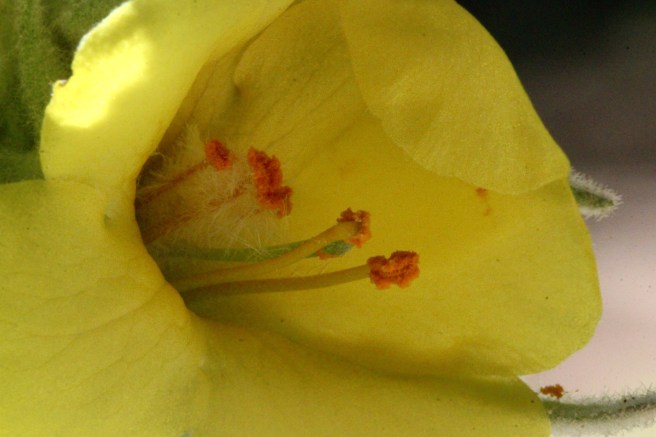
Though it’s also called flannel leaf and bunny’s ear for its wooly leaves, they aren’t the only hairy spots. Check out those three upper stamens, short and extremely woolly. Apparently, they contain a sap that lures insects to the plant. The longer and smoother two lower stamens serve a different purpose. They produce the pollen that fertilizes the flower. Worth a wonder.

Goat's beard seedhead

As I headed out of the park via a different trail than I’d entered, I was stopped in my tracks by a plant that stood about three feet above ground. I think this was my favorite find of the day. I have so many favorites that it’s hard to choose one. But just maybe this is the one.

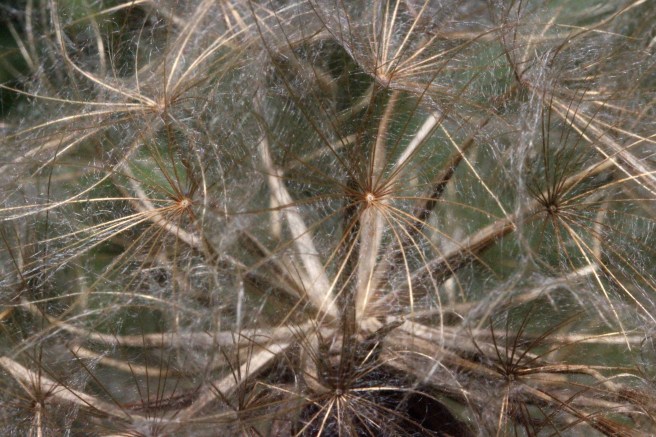
Meet meadow salsify, aka meadow goatsbeard. The latter name refers somehow to the fluffy seed head. Though there were not goats nearby for me to examine the similarity, these were beside a donkey pasture. (And donkeys are known to protect goats from predators.) The feathery down that will become parachutes during dispersal is finer than the finest spider web. And perhaps more beautiful. Worth a wonder.

Day lily--perfect.jpg

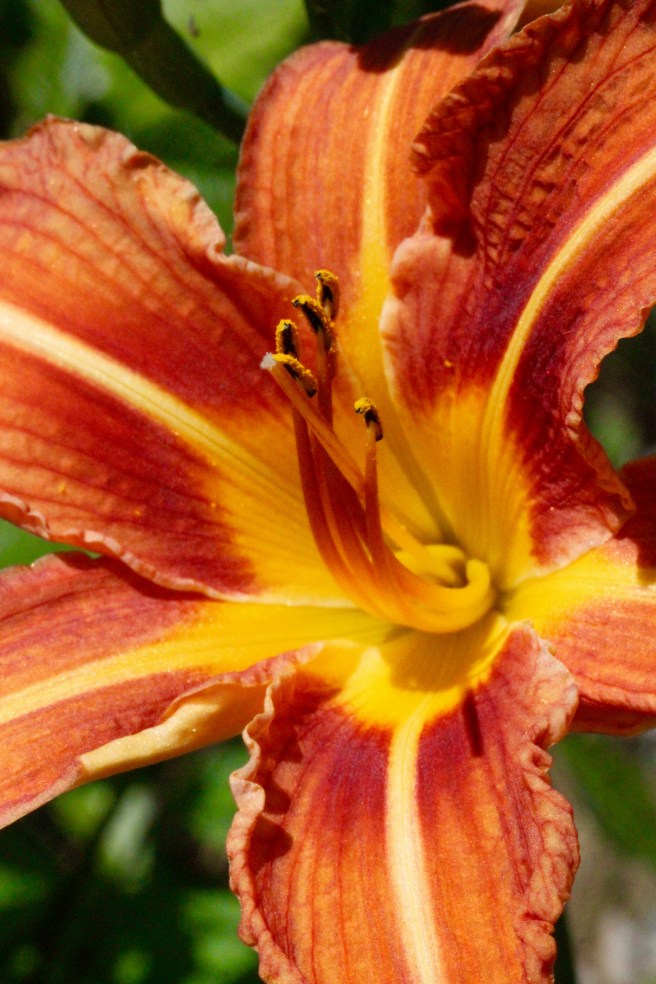
On my way home, I stopped to admire my neighbor’s day lilies–the first blossom of the season for this perfect flower.

milk 0

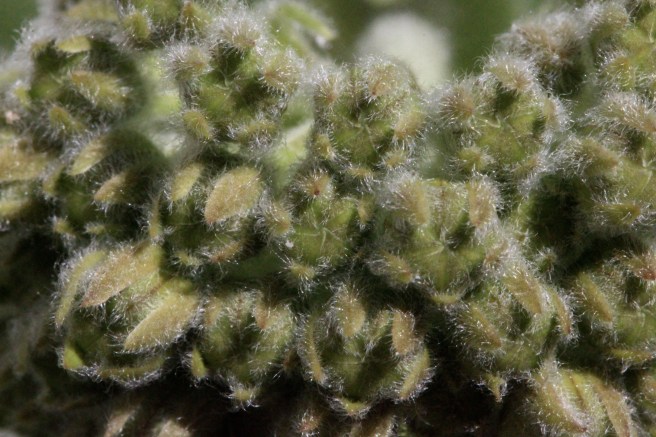
Back at home, it was the fuzzy coating of another summer flower that grabbed my attention.

milk 4

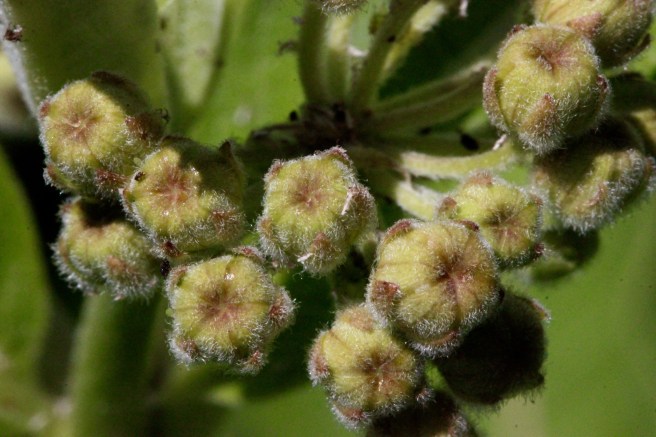
The flowerhead offered a show featuring a variety of presentations.

Milkweed 1

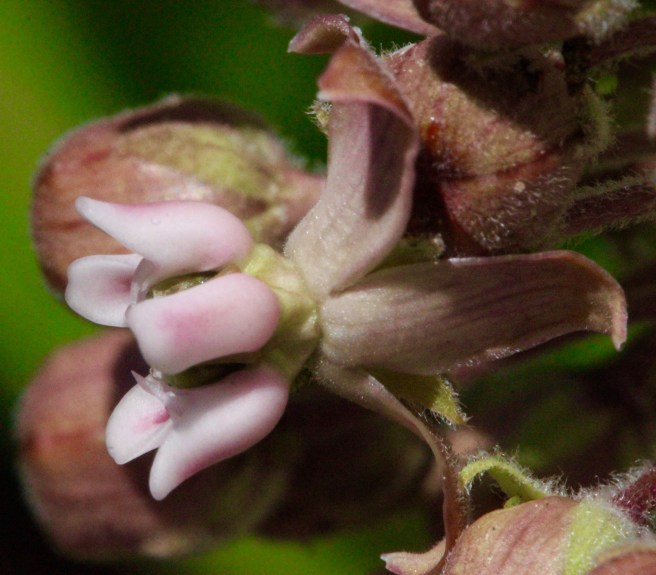
Ever so slowly, the pinkish flowers of common milkweed are beginning to open.

milkweed 2

In my mind, it’s an example of another hardly common common plant.

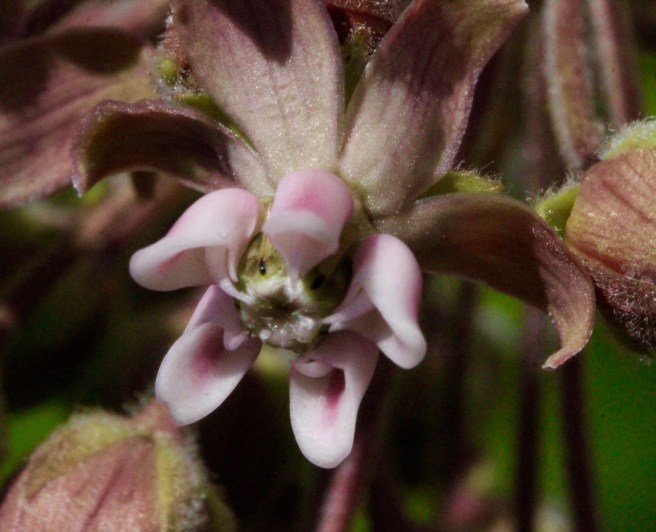
milkweed 5

The flowers are complex and invite a closer look. Overall, they droop in a globe-like umbel. What you see here is five upright hoods, each with a pointed, incurved horn.  Surrounded by those hoods are the fused column of stamens and heads of the styles–where the magic happens.

Since there is no scent yet, the insects don’t seem to have discovered it, but they will. It will nourish many with its nectar and pollen and provide shelter and hiding spots for others. I promise to keep an eye on it and all its visitors because it also is –worth a wonder.

I’m thankful that each day offers new opportunities to capture wonder.


Fun with Focus

I must confess. I’m a stalker. Of flowers and ferns and leaves and twigs and buds and bark and insects and birds and mammals and tracks and scat and cycles and systems. Of nature. Every day. All day long.

Sometimes I circle round and round, checking on the activity of a particular area over and over again–all the while mentally noting any changes. Minute by minute, day by day, week by week. I can’t help myself. My stalking is addictive. As it should be.

multiflora1

Right now, one of my focal points is the multiflora rosa that blooms in our yard. Yes, we can get into all the reasons why this invasive shouldn’t grow here, but I, too, am an invasive species–my ancestors arrived on a boat, possibly bringing some seeds or roots with them.

fly on multiflora rose

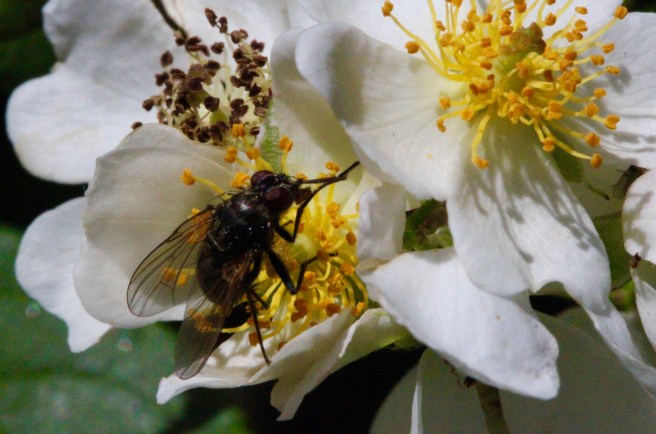
Multiple species pollinate the massive display.

bee on multi

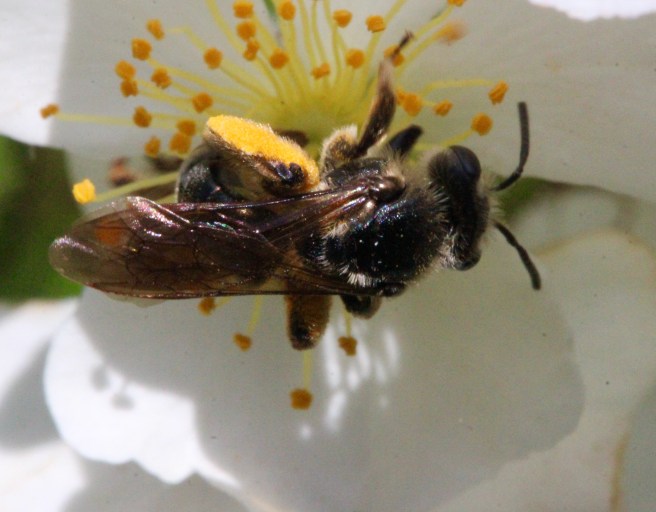
Their pollen sacs bulge as they quickly move from anther to anther.

sawfly larvae

Meanwhile, sawfly larvae munch their way across leaves.

saw 2

Sawfly is another word for wood wasp–certainly makes sense. But right now, their larvae look like caterpillars. Very hungry ones.

spring peeper1

And because I took time to look, I noticed. When I first spied this little guy about the size of a nickel, I thought it was either a small snail or a dried up leaf that. Curiosity pulled me in closer–thank goodness. Located about three feet above ground, this spring paper hid from predators all day, waiting to munch on insects and spiders tonight. I know this shot is sun drenched, but do you see the X on its back? Its name–Pseudacris crucifer–breaks down to Pseudo (false), acris (locust) and crucifer (cross bearer).

grasshopper

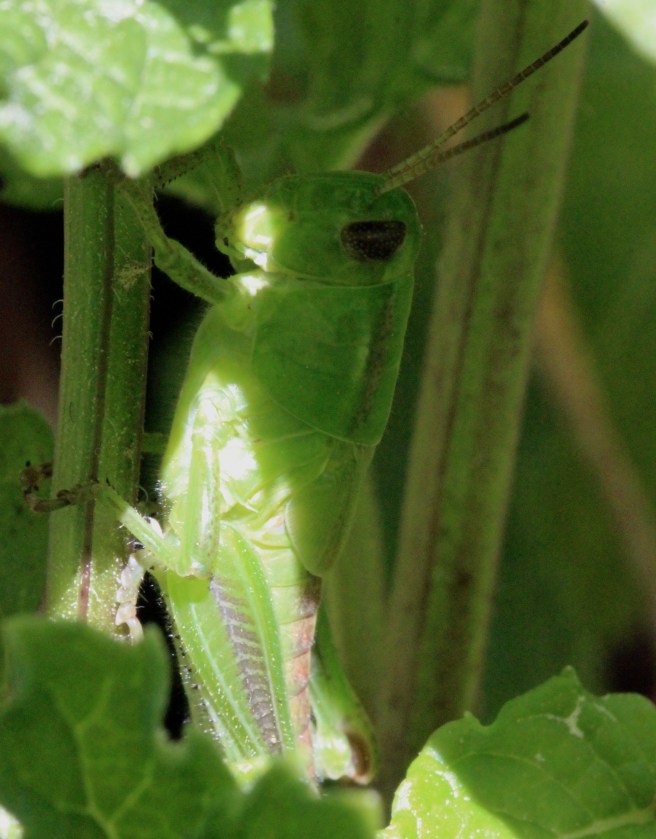
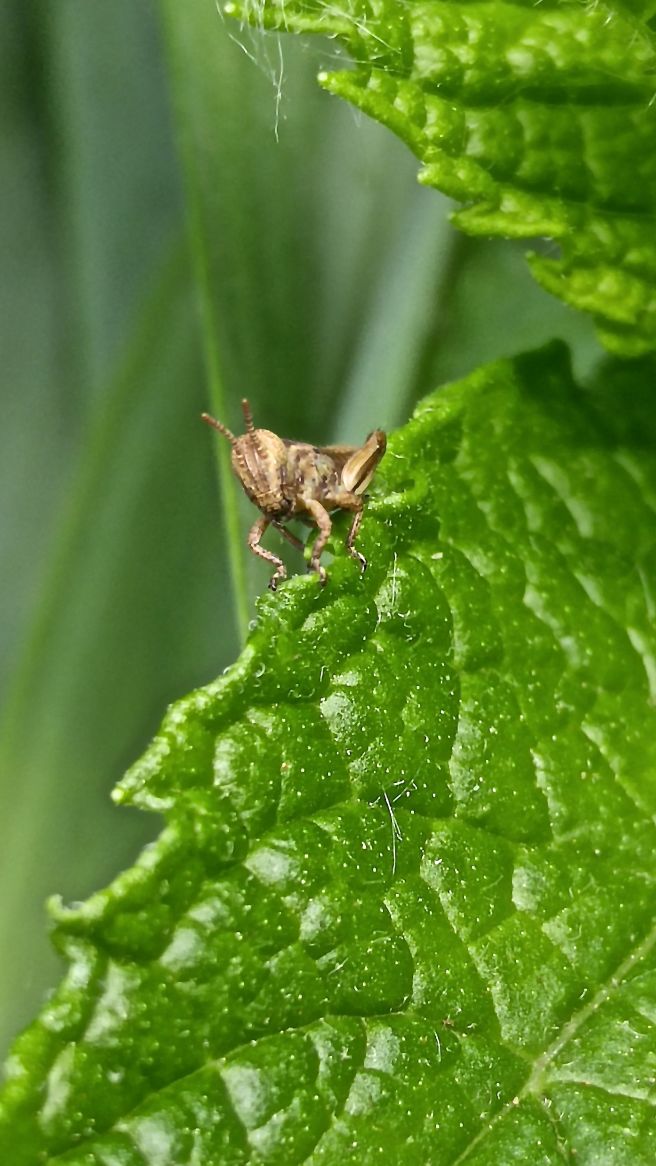
I’ve also been stalking the grasshoppers again, much as I did last year. Every day, I’ve noted that they are a wee bit larger–measuring almost an inch. But today, I found a giant among them.

Heal all

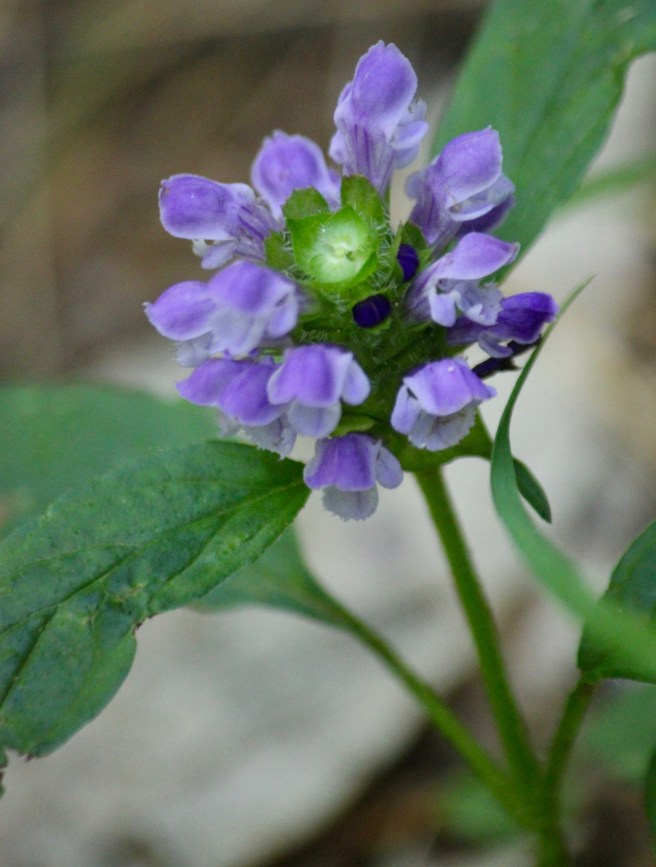
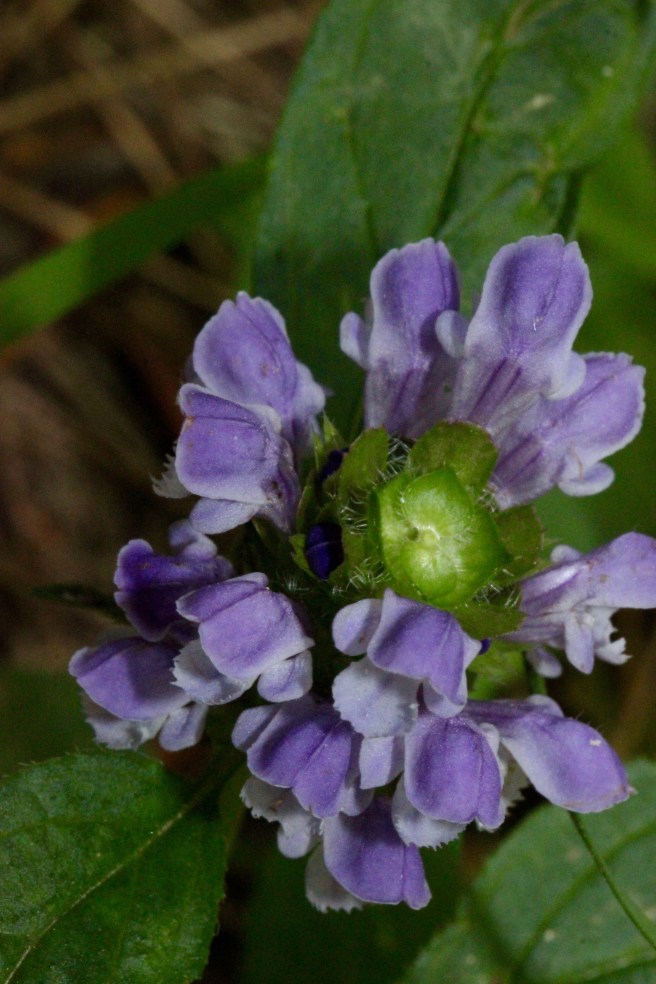
Then I went further afield, but to another familiar spot that I frequent. Heal-All blooms there with its square stem and whorls of florets.

heal all 2

The upper part of each floret provides a darker hood over the lower fringed landing platform. I’m surprised I didn’t see any action today. But don’t worry. I’ll keep  stalking.

Lady fern spores

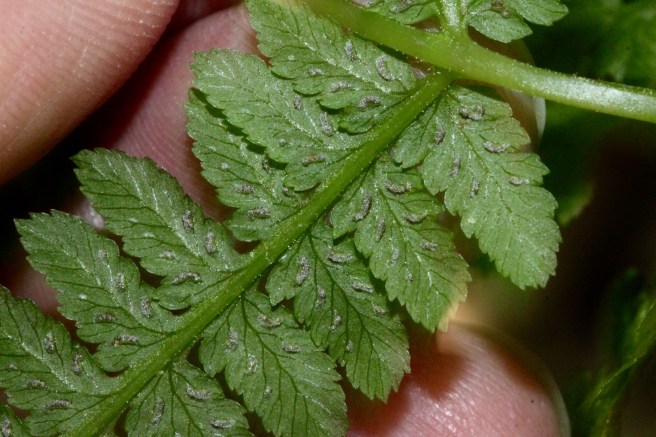
The ferns also drew my attention, like this lady fern, with its graceful appearance and sori in the shape of eyebrows.

hayscented fern

Hay-scented fern offers another lacy look, but the size and shape of its spore cups at the margin of the underside make it easy to recognize. Look underneath. Always.

cinnamon fern 1

While I’m focused on ferns, here’s a clue to differentiate a cinnamon fern from an interrupted fern once if it doesn’t feature a spore stalk. Cinnamon ferns have obvious hairy underarms. Do you see the tuft of hair at the rachis?

interrupted fern

Not quite the same for an interrupted fern. I love the hunt.

royal 2

Cinnamon and interrupted ferns are both members of the Osmundaceae family, which also includes royal fern, so named for the fertile frond topped with a crown.

royal crown

Bead-like in structure, the capsules have evolved from their aqua-green color a couple of weeks ago to a rusty shade. Eventually, they’ll turn dark brown after releasing their spores.

exoskeletons

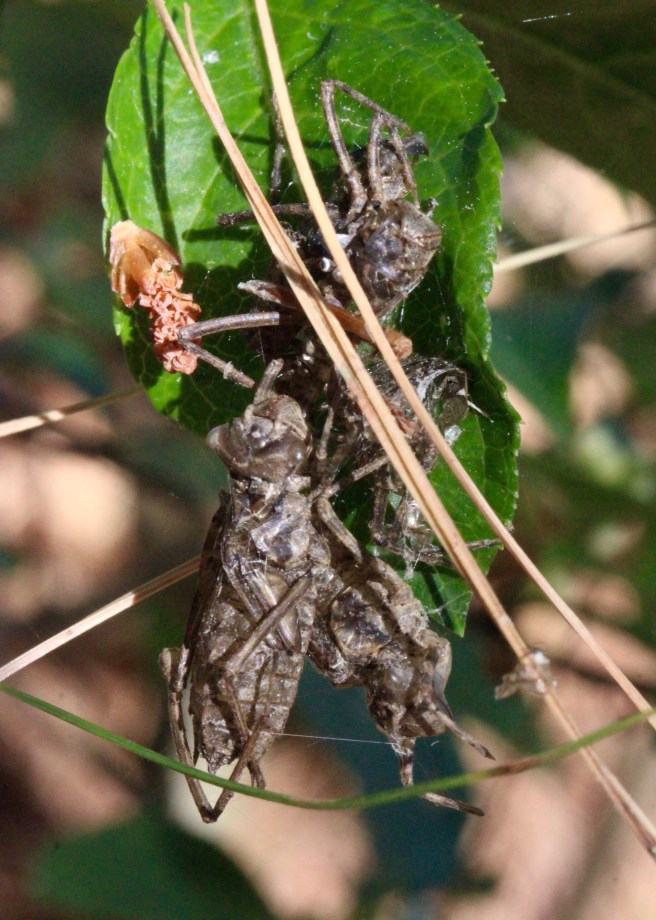
Because I was near water when I spied the royal ferns, I also had the joy of once again stalking exoskeletons that remain where dragonflies emerged. Such a special monument to their metamorphosis.

American toad

And  . . . young American toads hopped all about at my feet.

turtle 2

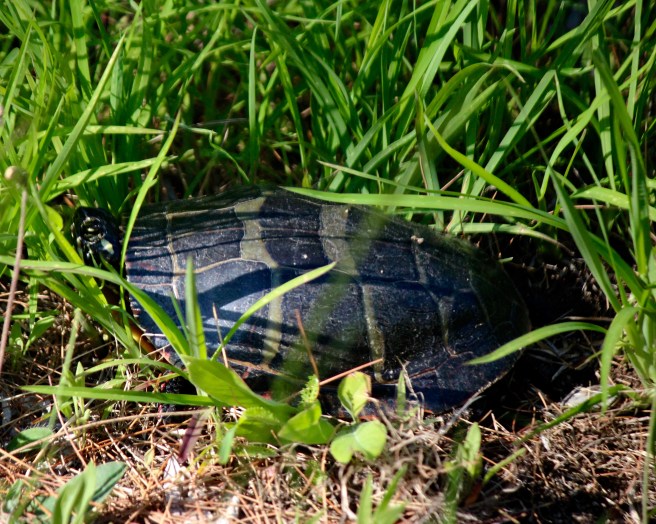
But one of my favorite focal points of the day–a painted turtle. She had her own mission–to lay eggs. After I saw her, I noticed another and so I did what any good stalker would do, I circled about the area looking for others. Only the two. But that was enough.

I’d made the two-hour round trip to Portland this morning to pick up my macro-lens that had taken two months to repair–0r so they say. As I got used to using it again, I found myself having fun figuring out the focus. I’ll continue to stalk and continue to learn–on so many levels.


Book of June: Insects, A Golden Guide

So, yeah, insects. They aren’t my thing. And yet . . . they are fascinating. I only know this because my eyes were opened when I took the Maine Master Naturalist course. And this year, we’ve added a new title to the course: Insects from the Golden Guide series.

i-2 books

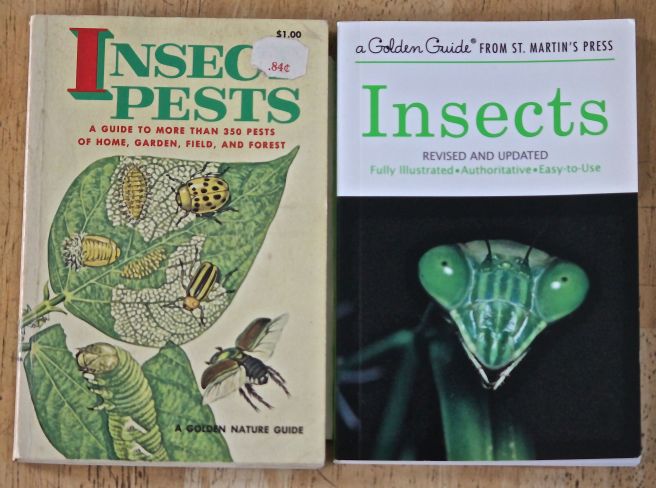
Our students received the 2002 edition, which is on the right. I also have the 1966 edition. Notice the price–$1.00 marked down to $.84. The newer edition: $6.95.

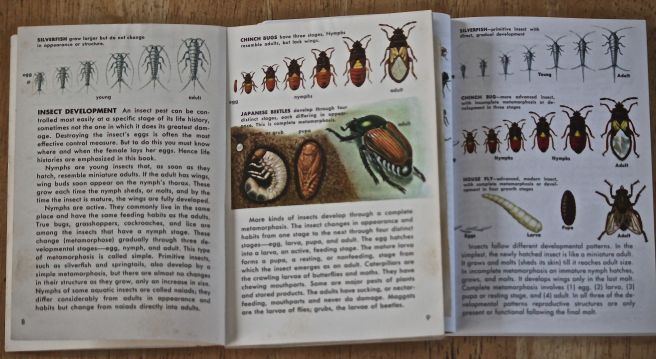
i-development

Price is not the only change. Though some things have stayed the same, the presentation has been reformatted and updated.

One of my favorite differences–attitude.

In the 1966 edition, “the battle to control insects is a never-ending necessity.” The purpose of the book–to help identify those bothersome pests. Insecticides were highly recommended, though precaution mentioned.

Fast forward to 2002: The foreword ends with a statement encouraging all to use the guide as an aid to “recognize and appreciate” insects that are part of our daily world.

i-31

For someone like me, it’s a great jumping-off point. I have a key and I have Peterson’s Guide and I have used bug guide.net, but this little book (6″x4″) offers a quick, easy-to-read glance and sometimes that’s all I need.

It’s certainly insect season (she wrote as she swatted a mosquito) and I encourage you to take a closer look. Like everything in the natural world, once you open your eyes to something, you’ll be amazed at what you find.

i-11

As a kid, I always thought this was snake spit. Huh? Do snakes climb flower stalks? Do they spit?

i-10

No, but spittlebugs (page 41) whip up some slimy froth to cover their eggs in late summer and the nymphs cover themselves while feeding in the spring.

i-27

I’m not sure if I’m seeing the nymph in the bubble house, but what I did notice as I looked at various masses this morning is the pattern or Fibonacci sequence. Cool stuff.

Meet my other friends:

i-bee 4

Some do good works.

i-20

Others–not so good.

i-spider on daisy

I’m amazed by color

i-5

and camouflage,

i-7

short antennae

i-1

and long,

i-2

bulging eyes,

i-3

veined wings and

i-26

jointed legs.

i-33

Last year, I spent hours stalking the parents or relatives of this little one because the body structure amazed me so. I suspect I’ll do the same this year. Be forewarned.

Notice I didn’t ID any bugs–that’s for you to do if you choose. But even if you don’t, I do hope you’ll take a closer look.

And if you are looking for a great introductory guide, I highly recommend Golden Guides Insects. My copy was a gift, but I’m sure your local, independent book store (aka Bridgton Books–always like to give them a plug) can locate a copy for you.

Hawk-eye Mondate

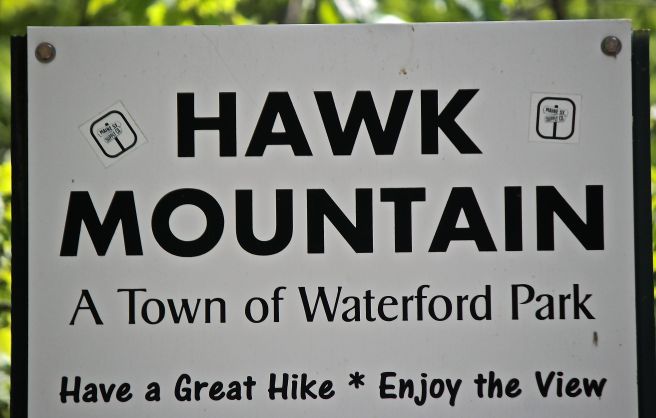
Some Mondates are shorter than others and such was the case today. But . . . we made the most of it as we walked up the trail to Hawk Mountain in Waterford.

hm-sign

It’s a half mile trek up a dirt and gravel road–just right when you want a great view and time is short. Of course, you could spend hours at the summit, but we weren’t there long.

hm-interrupted1

On the way up, I noticed interrupted fern in its interrupted form. Fertile leaves toward the middle are densely covered with sporangia (spore-bearing structures). I’m fascinated by their contorted, yet beautiful structures.

hm-lady1

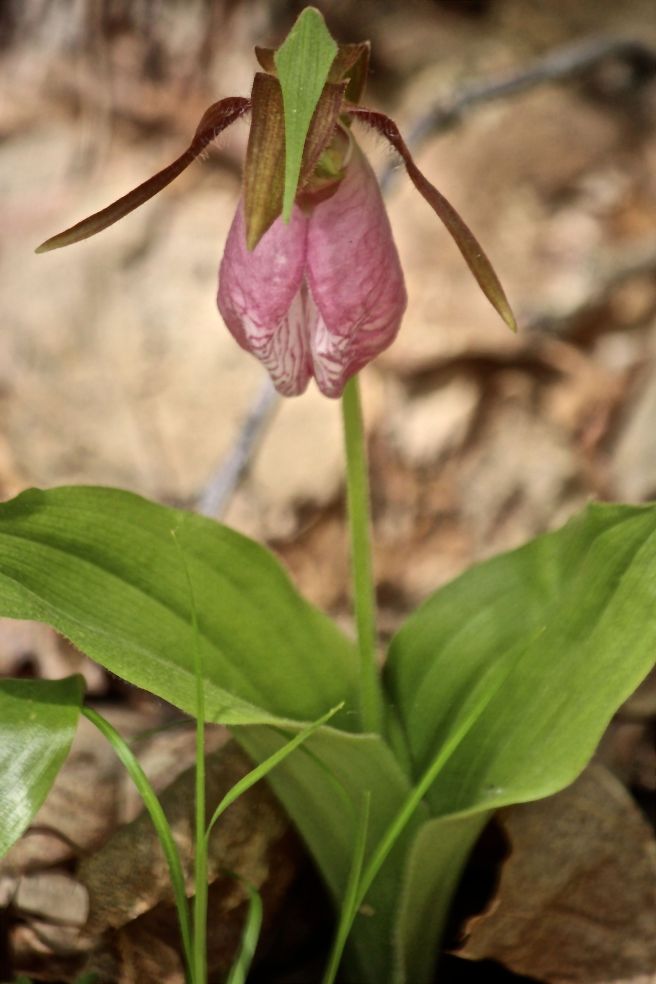
Another favorite–lady’s slippers. Again, its structure is beyond my understanding.

hm-cyrstal and long2, ph

At the summit, we paused briefly and gazed toward Crystal and Long Lakes.

hm-white oak 4, ph

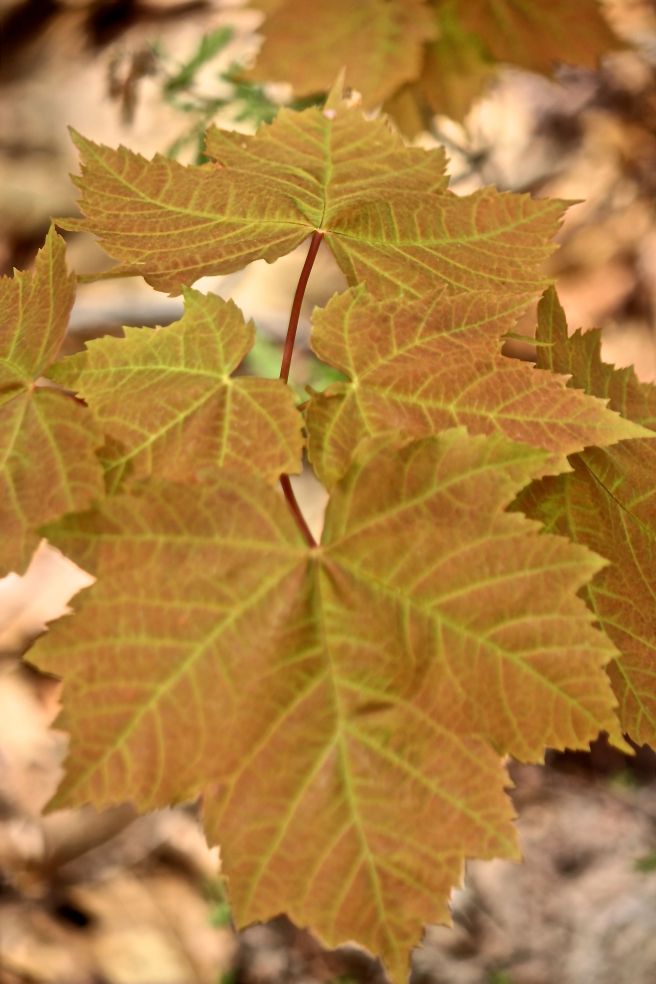
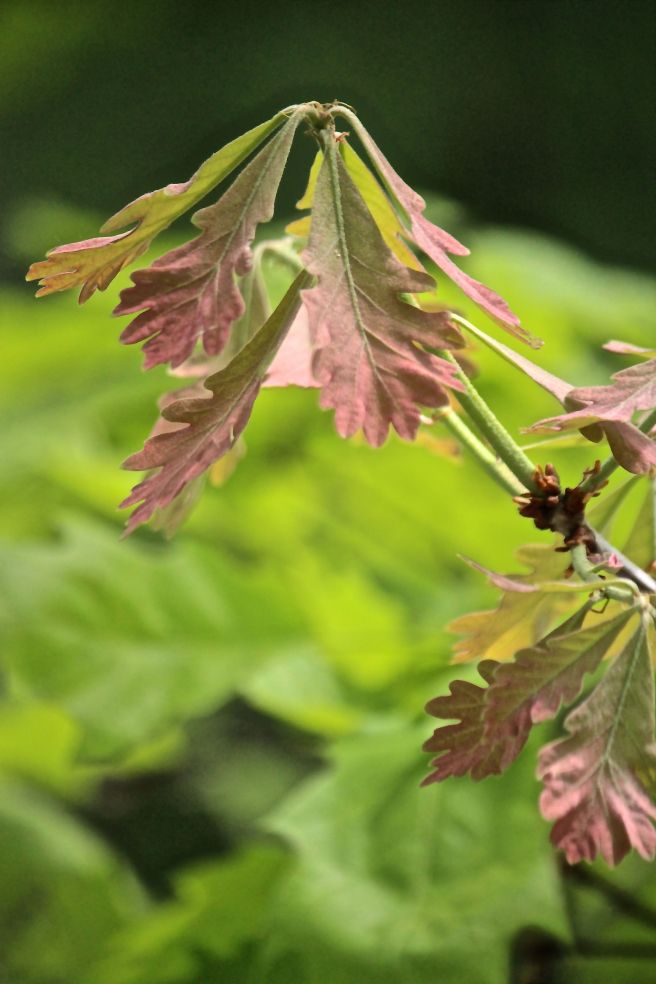
While my guy moved on to the better vantage point, I stopped several times. First, it was the color of these leaves that slowed me down. Have you noticed how spring foliage provides a subtle play on fall foliage? A few friends and I have been thinking about this lately, and this morning I had the opportunity to pick the brain of Dr. Rick Van de Poll, a well-known mycologist/naturalist/educator.

hm-red maple 1

He reminded me that the various hues of color in leaves is caused by the presence of pigments called anthocyanins or carbohydrates that are dissolved in the cell sap and mask the chlorophyll. As our spring temperatures rise and light intensity increases, red pigment forms on a leaf and acts as a sunscreen to protect the plant from an increase in ultraviolet rays.

hm-white oak1

It wasn’t only the color that caught my eye. Take a look at the lobe shape of the reddish leaves and that of the green in the background. In my continuing personal citizen science project to informally connect the dots of where white oaks meet red oaks, I added another pin on the map. Rounded lobes=white oak in the foreground. Pointed lobes=Northern red oak in the background.

hm-bee1

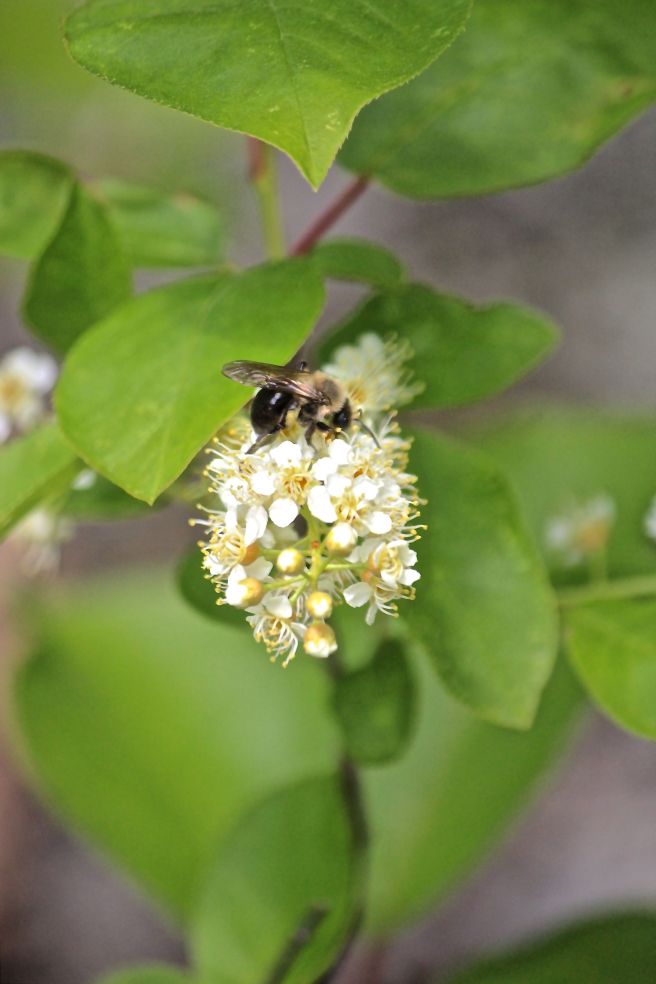
As I headed toward my guy, I noted that the cherry trees were abuzz.

hm-wild columbine1, ph

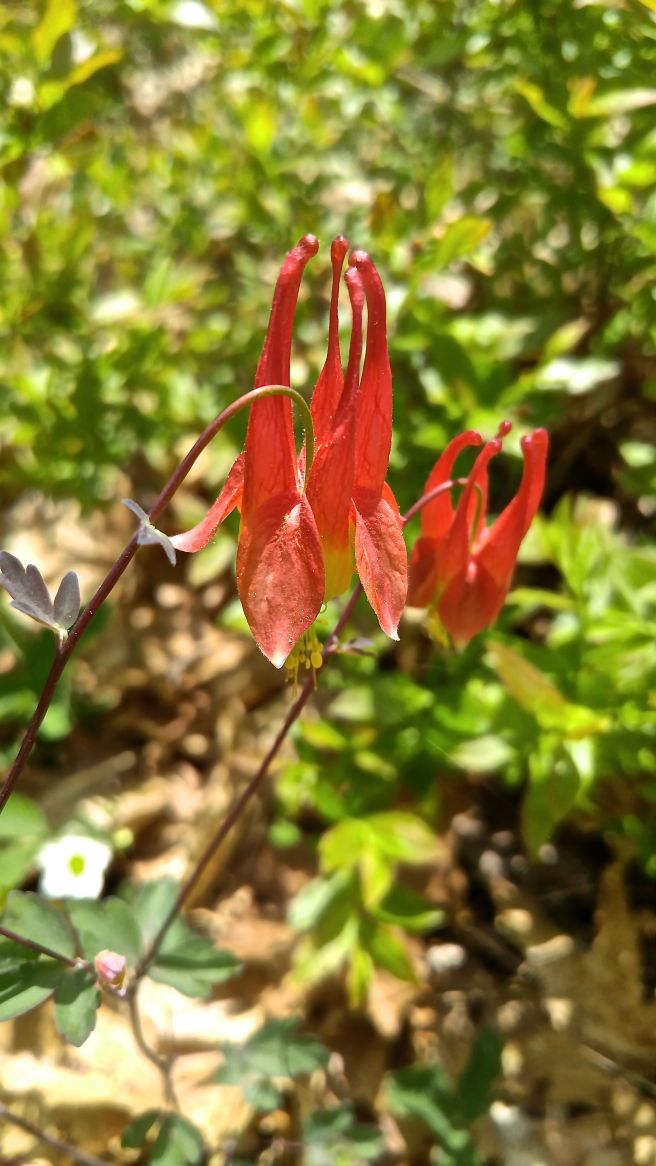
And hiding among the rocks at the base of a tree–another treat for the eyes. Wild columbine. Splendid indeed.

hm, cyrstal and long, ph

Equally splendid–the view from the ledges. Crystal and Long Lakes again.

hm-bear river

Bear River below. I always expect to see a moose here. Or maybe a bear. One of these days.

hm-pm1, ph

Pleasant Mountain and my guy.

hm-dragon5

As we walked back down the trail and concluded our Mondate, we celebrated the fact that dragonfly season has begun. With their hawk eyes, may they capture and consume a kazillion black flies and mosquitoes.


Wallowing in Wonder

We knew what flowers we’d show off and had a general idea of what birds we’d see when we headed down the trail from the Flat Hill parking lot at the Greater Lovell Land Trust’s Heald and Bradley Ponds Reserve in Lovell early this morning. But from the get-go this turned into one very special hike that filled us all with the wonder of life.

p-silent march

Maybe it was because we headed off on a silent march, the better to take in the cacophony of bird songs. With Linda and Heinrich in the lead, our intention was to make a bee-line to the viewing platform. Linda encouraged everyone to note the flowers along the way–with a promise to stop and celebrate them on the return trip. We’d decided during a pre-hike that we wouldn’t follow the loop trail around Perky’s Path. We wanted this to be a different experience.

p-ph view from bench

The view from the bench was beautiful, but the birding there was only so-so, much to our dismay.

p-ph birding 2

On to the bridge we moseyed. Our one disappointment, we didn’t hear the American bittern that had entertained us with its toilet plunger call during the pre-hike.

p-ph birding1

But that didn’t stop us from raising our binoculars frequently–for red-winged blackbirds, Canada geese, blue jays, several species of woodpeckers, sparrows, warblers, wood ducks, chickadees, a wood thrush and more. We heard the ovenbird and vireos, but never caught sight of them.

p-ph rosy 2

While Heinrich was our birding guide, Linda used the area just beyond the bridge to begin our examination of flowers.

p-ph rosy 1

It was while we were moving in for a closer look at the rosy twisted-stalk, that someone spied what became the center of our attention for the next hour.

p-dragon begin1

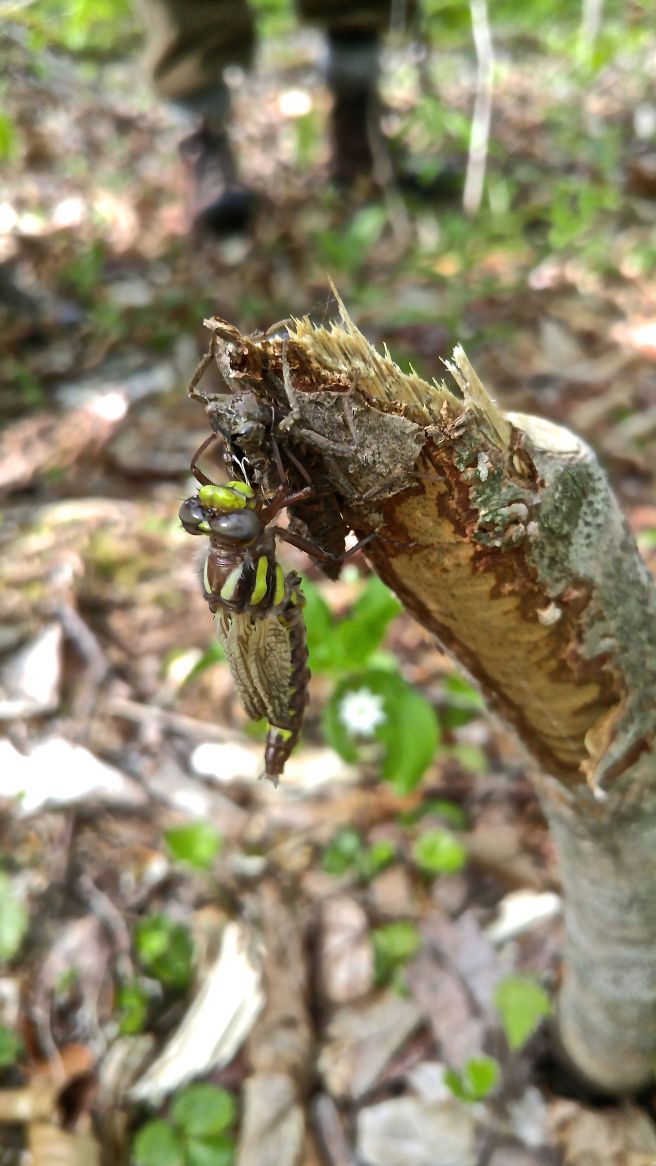
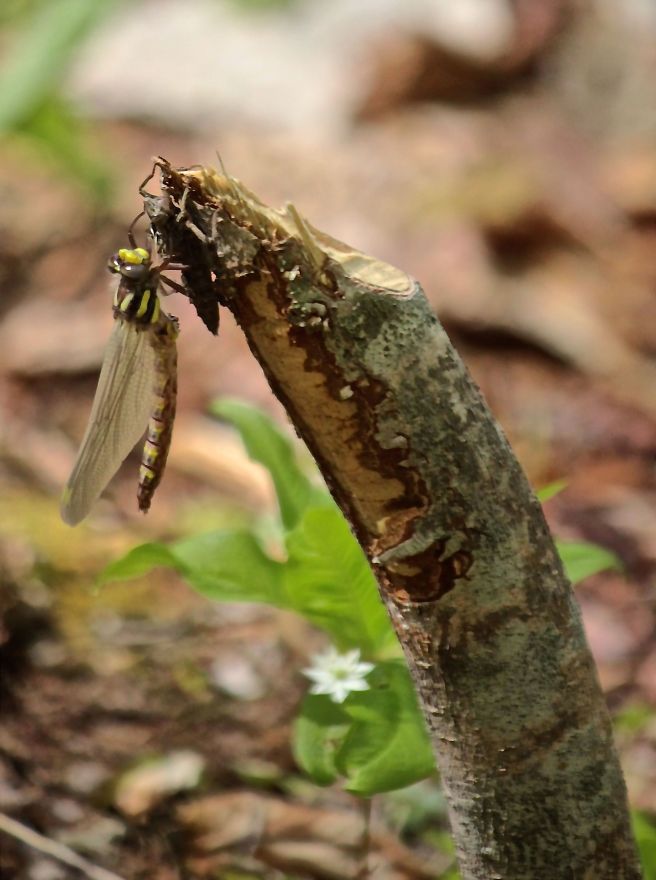
A dragonfly had just split open its exoskeleton and emerged from the nymph stage. Of course, we were standing by a beaver pond, and so it seemed only appropriate that it would use the top of a sapling cut by a beaver.

p-ph dragon middle 4

By pumping air into its body, the adult slowly grew larger.

p-dragon end 1a

As it inflated the wings with blood pressure, they began to extend.

p-ph dragon end7

The veinous wings remained folded over its back as we continued to watch.

p-ph early coralroot orchid 2

We were in that one spot for a long time, but when Linda inquired if anyone wanted to start back, all were silent. We did, however, take our eyes off the dragonfly for brief moments. And because of it, we got to know a small area rather well. A few of our discoveries included  the yellow-green, early coral-root orchid, which has no leaves,

p-ph starflower 7

star flowers with their seven petals, seven stamens and sometimes seven leaves, though the latter wasn’t consistent,

p-ph yellow clintonia

and yellow clintonia, aka bluebead lily.

p-ph springtails 1

We also saw hot chili pepper on the leaf litter and . . .

p-spring tails 1

in the water. Springtails galore. Yes, aka snow fleas, but obviously we can see them even when there isn’t snow on the ground.

p-dragon end 1b

As we explored, we continued to keep a watchful eye on our friend. In fact, he became “our” dragonfly. An hour later, the melodic song of a Baltimore oriole pulled us away and we finally started back along the path.

p-cloak 5

We paused frequently to admire the flowers and leaves, but then another flyer slowed us down and became “our” mourning cloak as it settled on a fallen tree and then fluttered amongst us. Happy were we to have shared such moments of awe.

p-ph pack on Amos

Though our walk had lasted longer than intended, I wasn’t ready to head home, so once everyone left, I turned back and climbed Amos Mountain using the Saddle Trail. It was hot and buggy, but I went for a reason and wasn’t disappointed.

p-amos 1

Among the grasses and violets,

p-ph wild strawberry

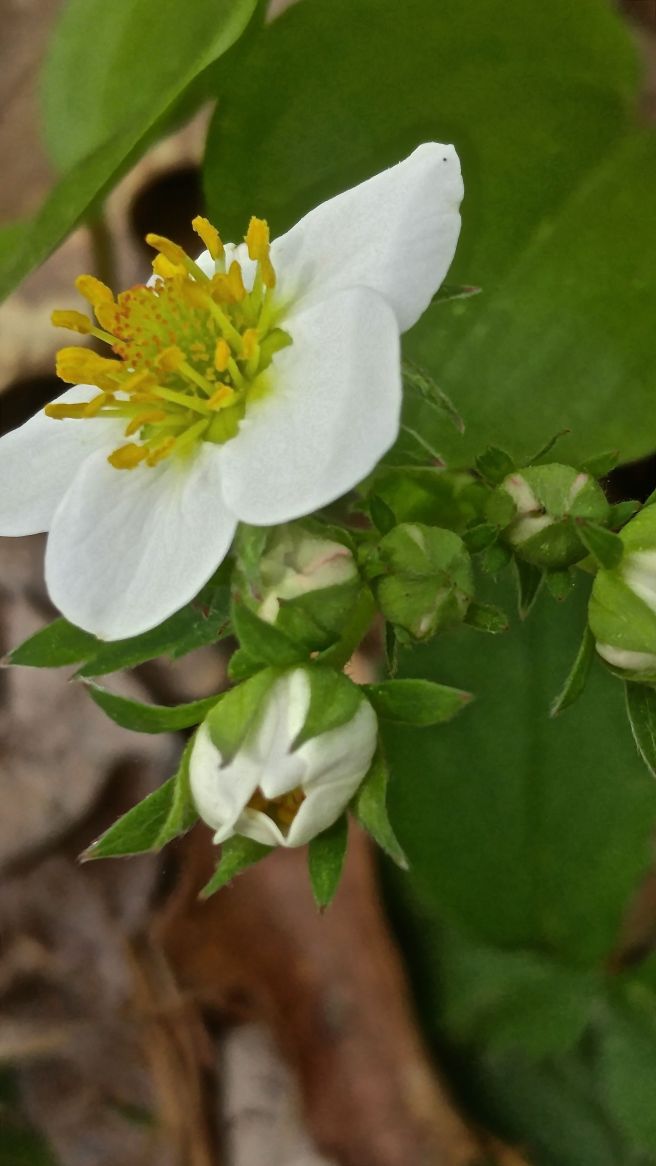
the wild strawberries grow. But that’s not all.

p-ph colum 5

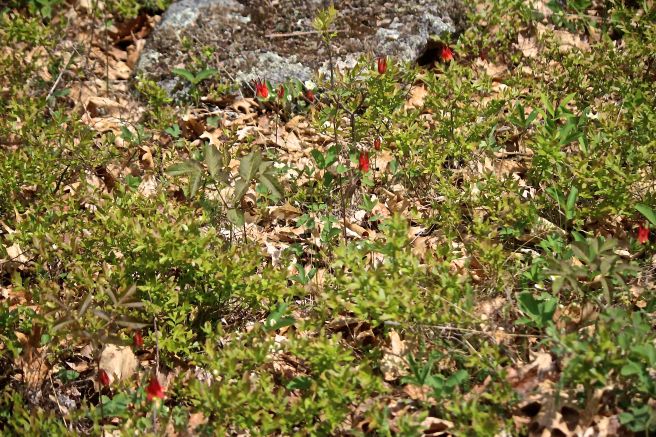
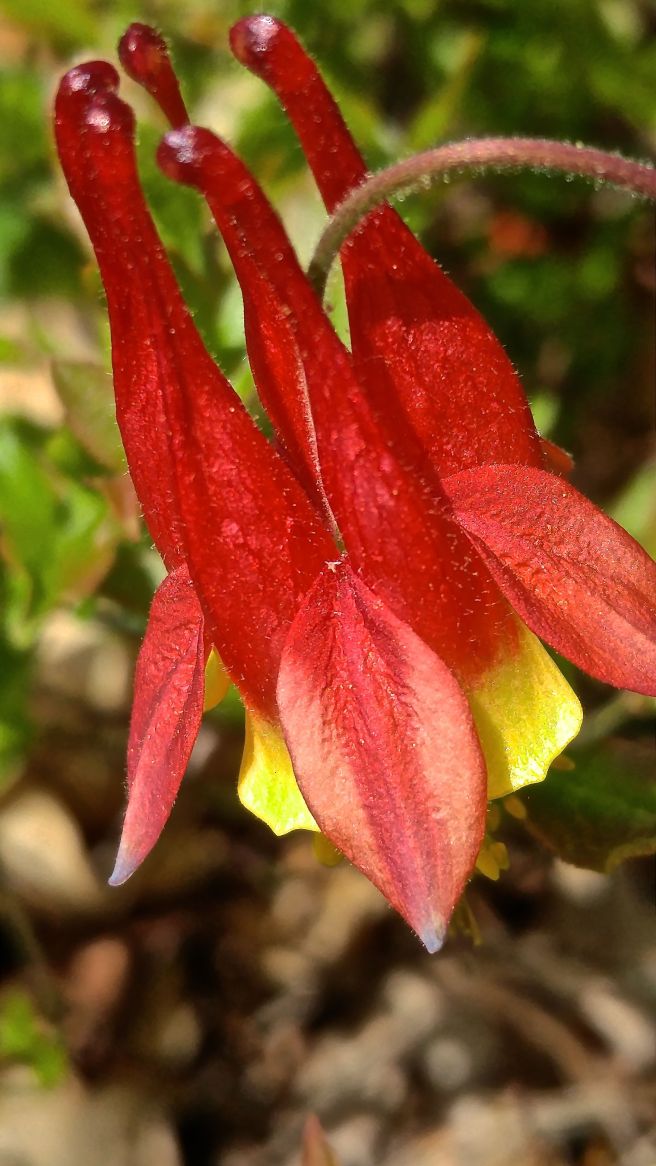
It was the spurred red and yellow flowers of wild columbine that I wanted to see.

p-ph colum 4

Their heads drooped dramatically.

p-columbine 1

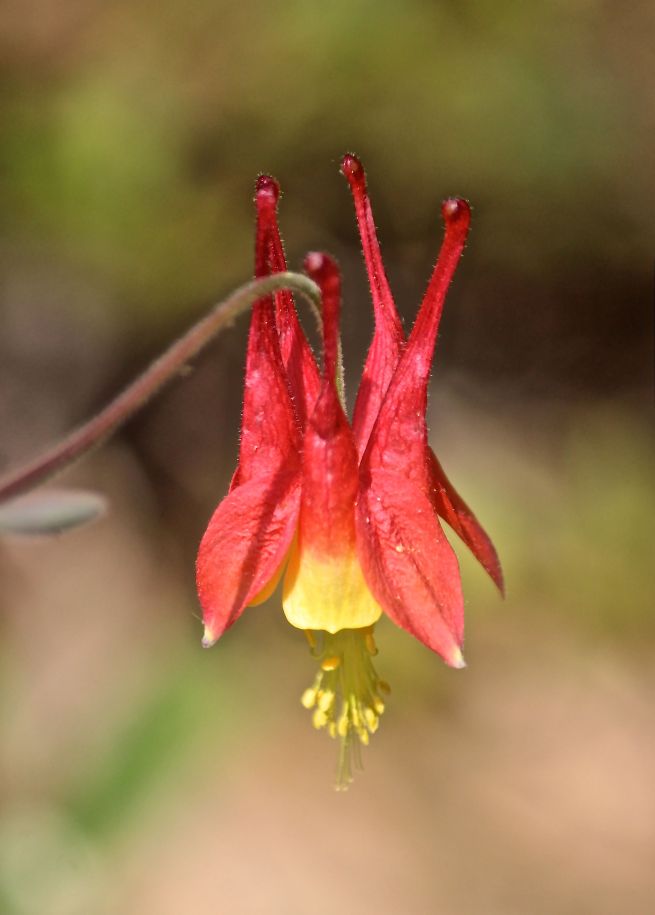
Numerous yellow stamens projected downward and surrounded the green pistils with their long, thin styles, creating the look of an ornate lantern dangling from a post–thus its other common name, little lantern. I really don’t care what it’s called. Spending time in its presence was all that mattered.

The same was true for our dragonfly experience. We wallowed in wonder today and let nature reveal its glory.

Three Times A Charm

One might think that following the same loop through the woods in slow motion three times in one day would be boring. One would be wrong. My friend Joan and I can certainly attest this fact.

Round One: 9 am, Wildflower and Bird Walk with Lakes Environmental Association co-led by birder/naturalist Mary Jewett of LEA and the ever delightful botanist Ursula Duve.

h-hobblebush

In abundance here, the hobblebush bouquet–a snowy-white flower that is actually an inflorescence, or lacy cluster of tiny fertile flowers surrounded by a halo of showy, yet sterile bracts. Yeah, so I’ve showed you this before. And I’ll probably show it again. Each presentation is a wee bit different.
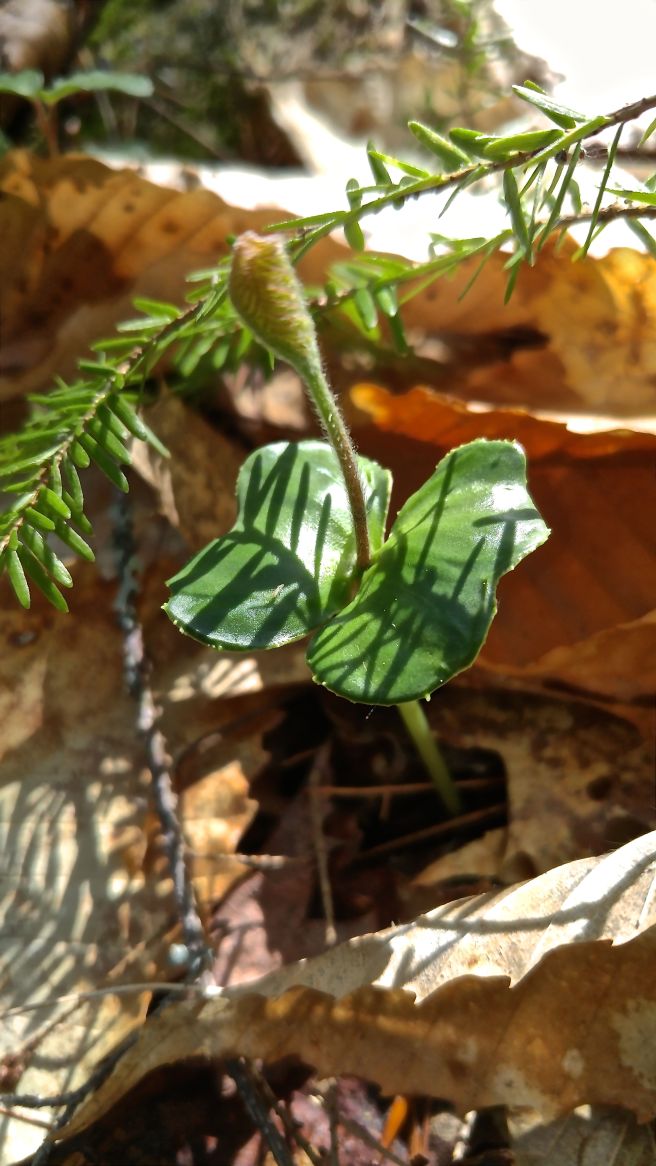
h-beech cotyledon1ph

And then we spied something that I’ve suddenly seen almost every day this week.
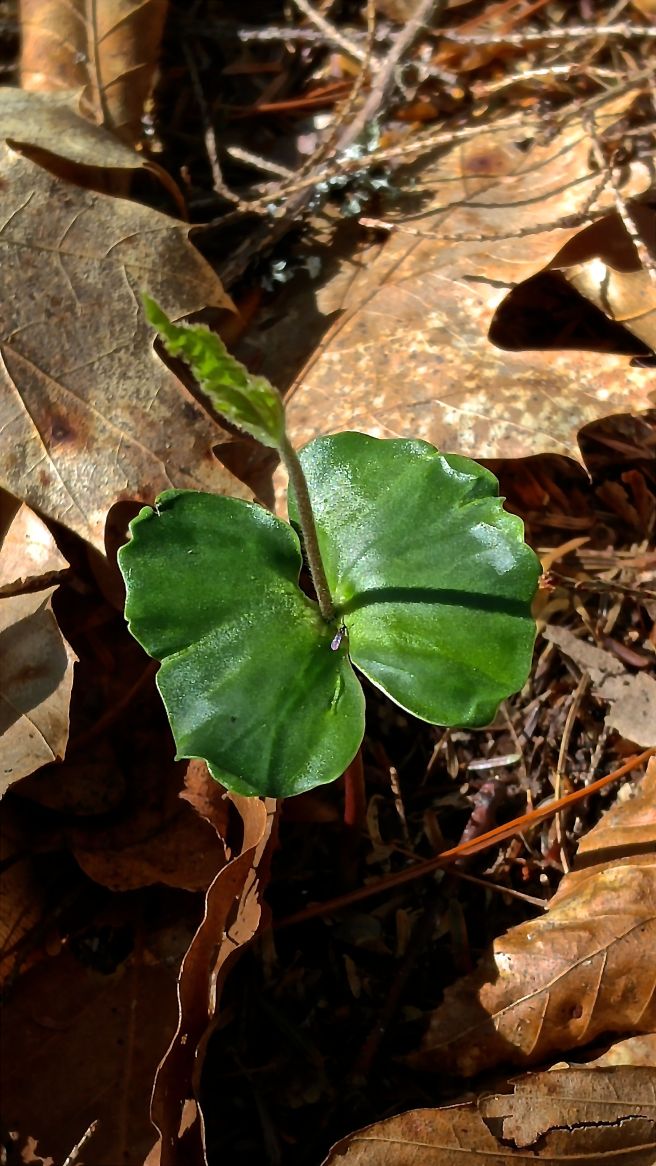
h-beech coty 4ph

The cotyledon or seed leaf of an American beech. Prior to Monday, I don’t know that I’ve ever seen this and yet, since then I’ve continued to discover them almost every day. Worth a wonder.

h-beech coty 3ph

Think about it. The journey from seed to tree can be a dangerous one as the root is sent down through the leaf litter in search of moisture. Since the root system is shallow, lack of moisture can mean its demise. When conditions are right, a new seedling with a rather strange, yet beautiful appearance surfaces. The seed leaves of the beech, aka cotyledons, are leathery and wavy-margined. They contain stored food and will photosynthesize until the true leaves develop, providing a head start for the tree. I realize now that I’ve seen them all my life in other forms, including maple trees, oak trees and vegetables. But . . . the beech cotyledon captures my sense of wonder right now, especially as it reminds me of a luna moth, which I have yet to see this year.

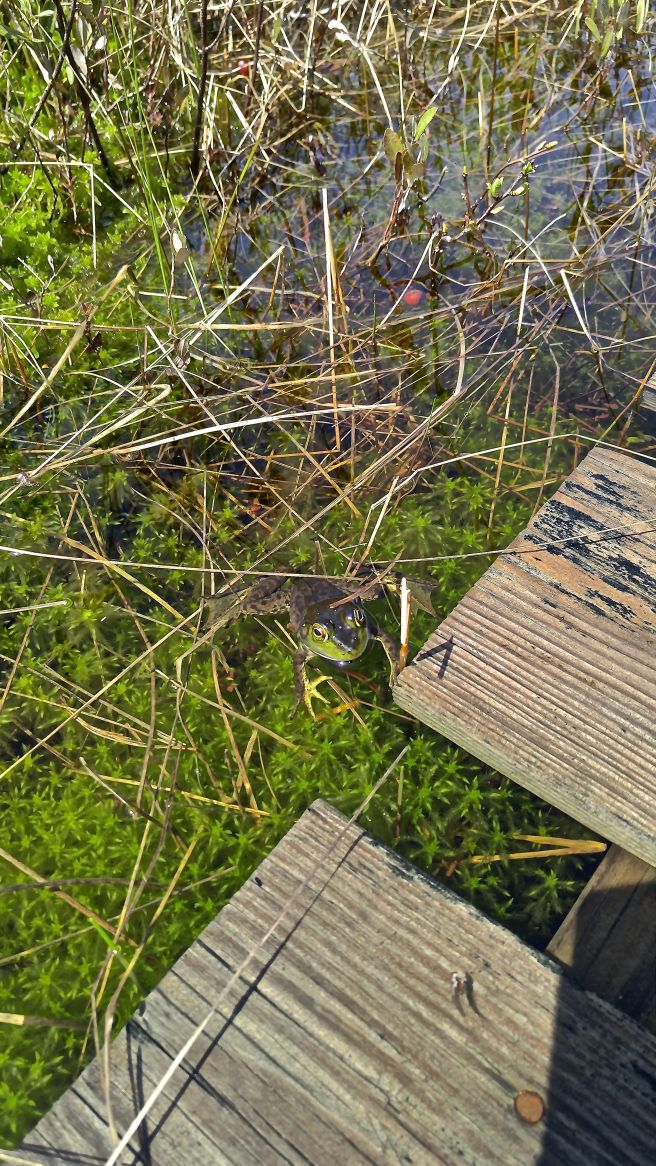
h-green frog 2

Crossing the first boardwalk through the red maple swamp, a large male green frog tried to hide below us. Notice the large circular formation behind his eye. That’s the tympanum, his visible external ear. A male’s tympanum is much larger than his eye.
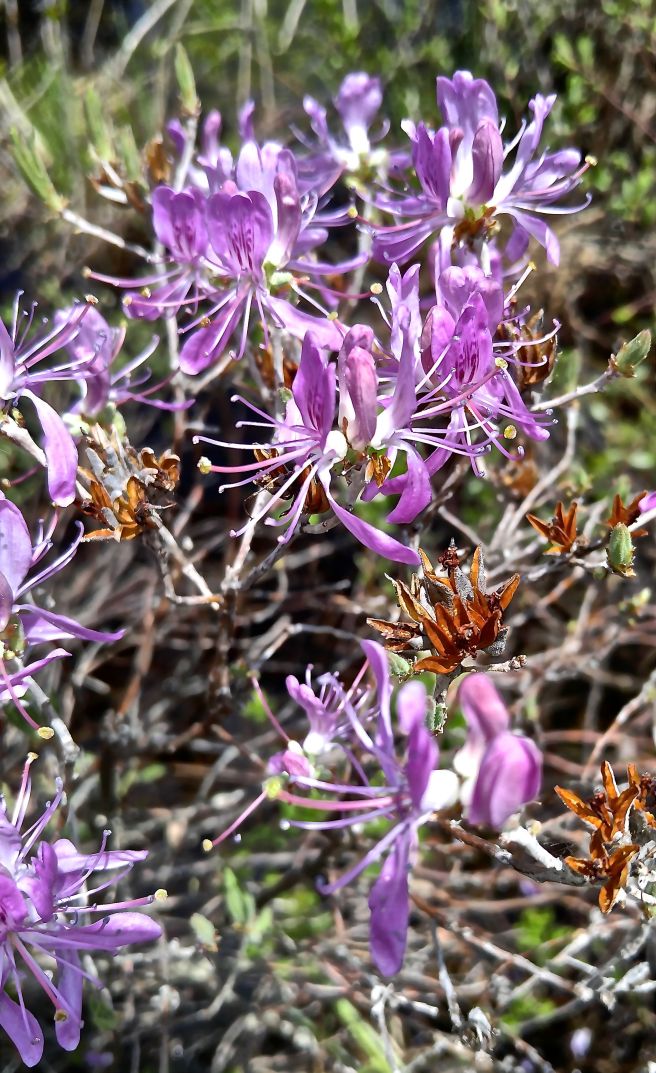
h-rhodora ph1

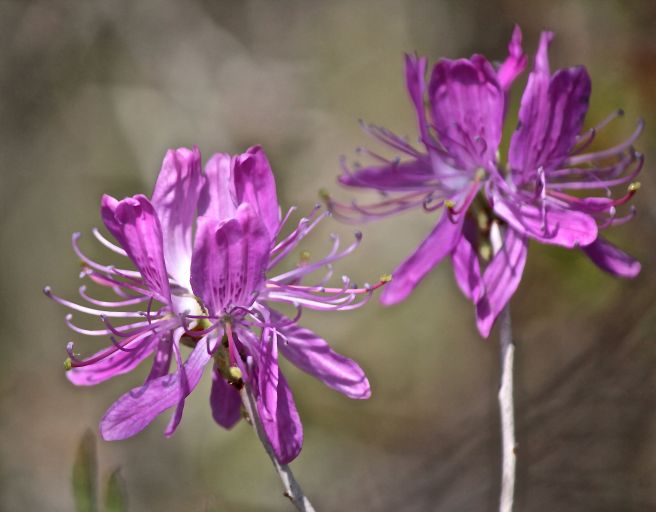
Other red maple swamp displays included the showy flowers of rhodora and their woody capsules.
h-rhodora1

Ralph Waldo Emerson knew the charm of this spring splendor:

The Rhodora

On being asked, whence is the flower.
In May, when sea-winds pierced our solitudes,
I found the fresh Rhodora in the woods,
Spreading its leafless blooms in a damp nook,
To please the desert and the sluggish brook.
The purple petals fallen in the pool
Made the black water with their beauty gay;
Here might the red-bird come his plumes to cool,
And court the flower that cheapens his array.
Rhodora! if the sages ask thee why
This charm is wasted on the earth and sky,
Tell them, dear, that, if eyes were made for seeing,
Then beauty is its own excuse for Being;
Why thou wert there, O rival of the rose!
I never thought to ask; I never knew;
But in my simple ignorance suppose
The self-same power that brought me there, brought you.
h-LEA group

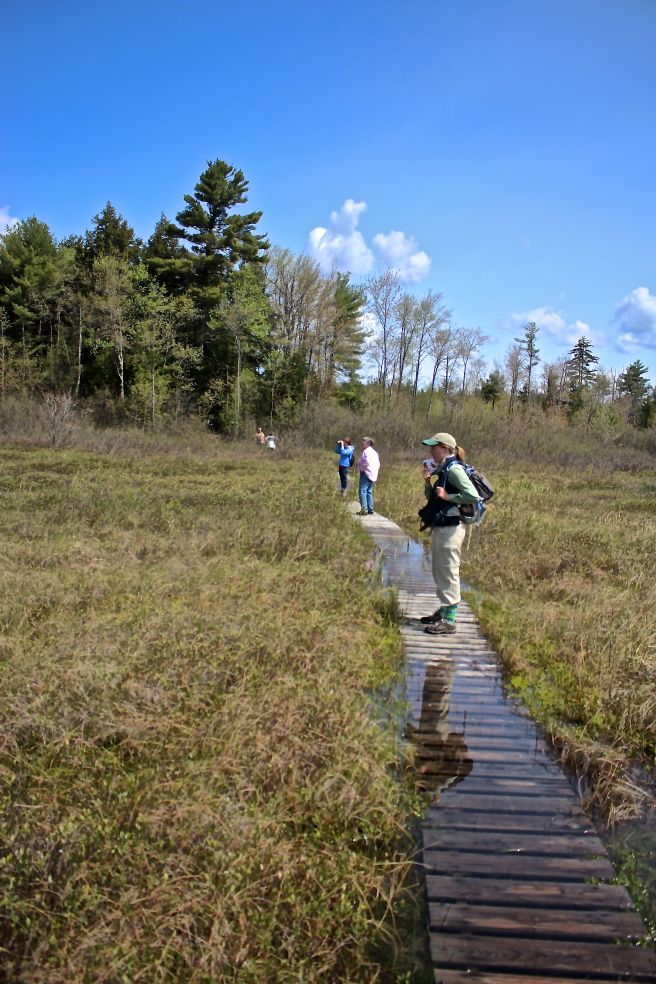
To avoid getting our feet too wet, we spread out as we walked on the boardwalk through the quaking bog.

h-five morning

Morning light highlighted the layers from the pond and sphagnum pond up to Five Fields Farm and Bear Trap above.

h-trill 1

And because it was ever present, I couldn’t resist pausing to admire the painted trillium once again (don’t tell my guy).

h-dwarf ginseng1ph

One plant that I will always associate with this place and Ursula, who first introduced me to it years ago, is the dwarf ginseng. I love its global spray of flowers and compound leaves. But maybe what I love most is its beauty in diminutive form–just like Ursula.

Round Two: Noon, Lunch and a walk with my dear friend Joan.

h-bigtooth aspen

After returning to our vehicles following the morning walk, Joan and I grabbed our lunches. And I paused in the parking lot to enjoy the silvery fuzziness of big tooth aspen leaves. The quaking aspen in our yard leafed out a couple of weeks ago, but big tooth aspen leaves are just emerging. Like others, they begin life with a hairy approach–perhaps as a protective coating while they get a start on life?

h-muddy riverlunch

We ate lunch beside Muddy River where the spring colors were reflected in the water.

h-blueberries 1ph

And then we heard something jump in the water, so we moved silently like foxes as we tried to position ourselves and gain a better view. In the back of our minds, or perhaps the front, we wanted to see a turtle, beaver or especially an otter. Not to be. But we did see highbush blueberries in flower.

h-bee 1

And the bees that pollinate them.

h-pitcher 5ph

In their out-of-this universe form, we knelt down to honor the pitcher plant blossoms that grow along a couple of boardwalks.
h-red maple samaras

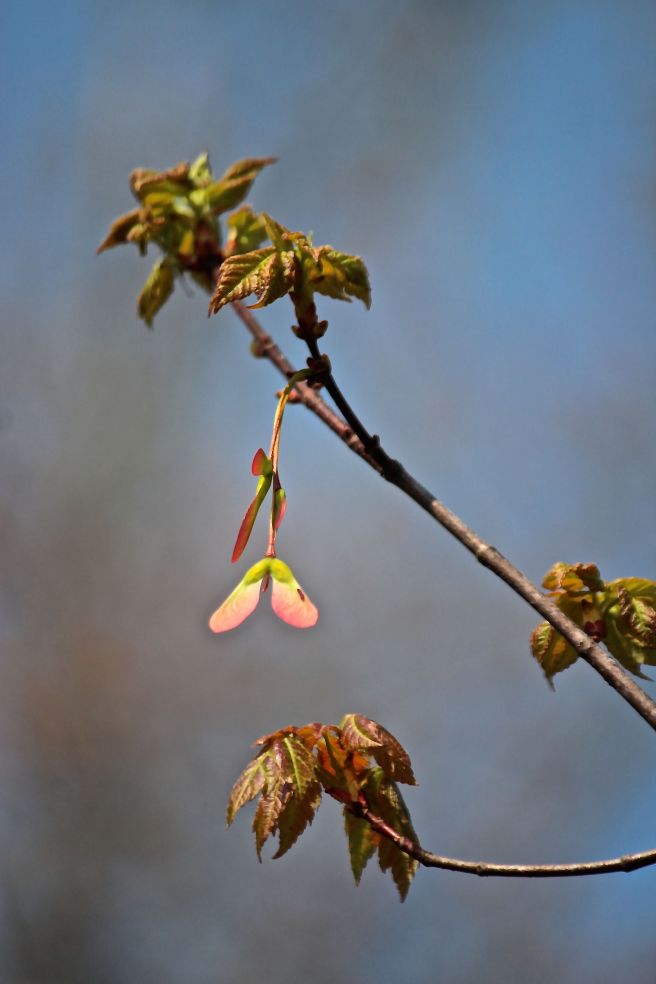
We were wowed by the color of the red maple samaras,
h-red winged

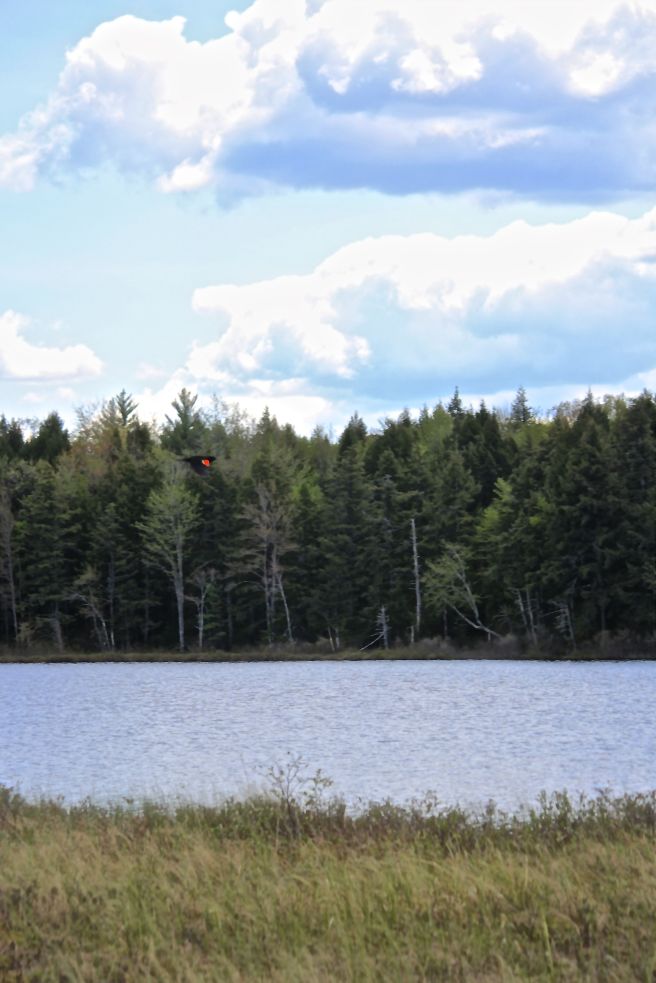
prominent shoulder patch of the red-winged blackbird,

h-cranberries

and cranberries floating on the quaking bog.

h-lone larch

And then our eyes were drawn to the green–of the lone larch or tamarack tree
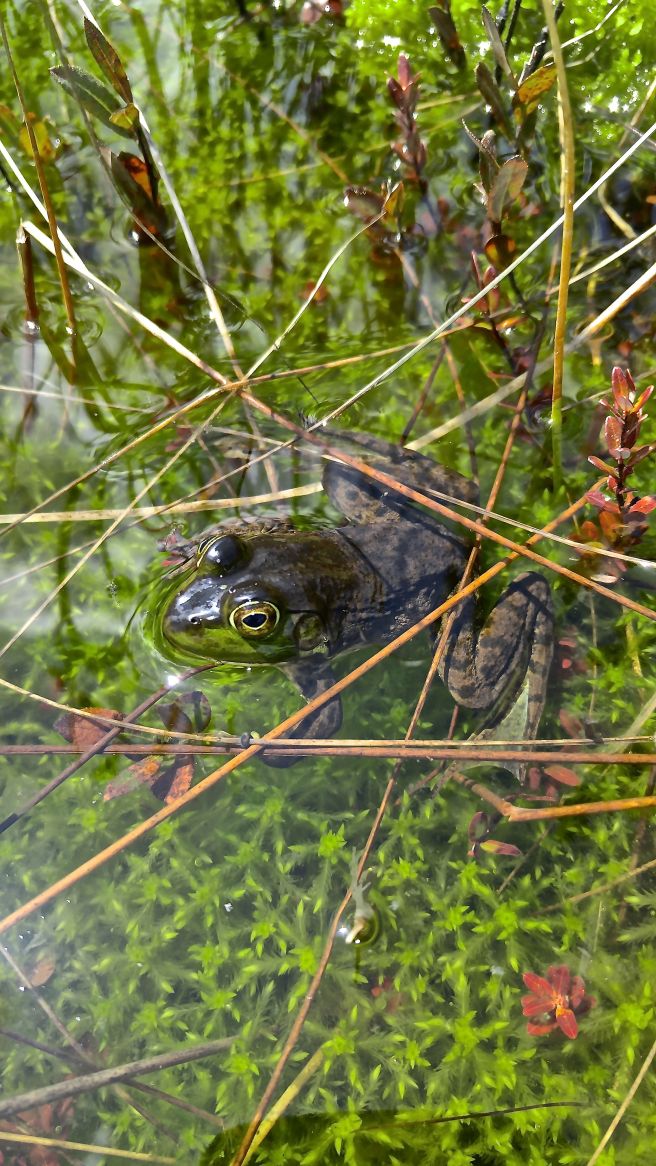
h-green 9ph

and the green frogs.

h-green 8ph

I spent some time getting to know one better.
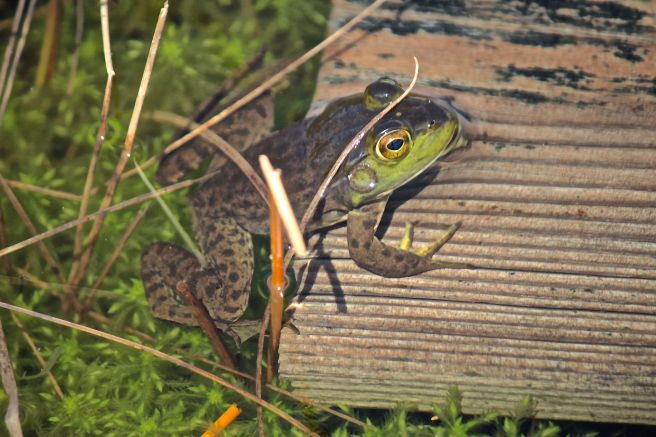
h-green 3

She even climbed out to accommodate me–I’m sure that’s why she climbed up onto the boardwalk.
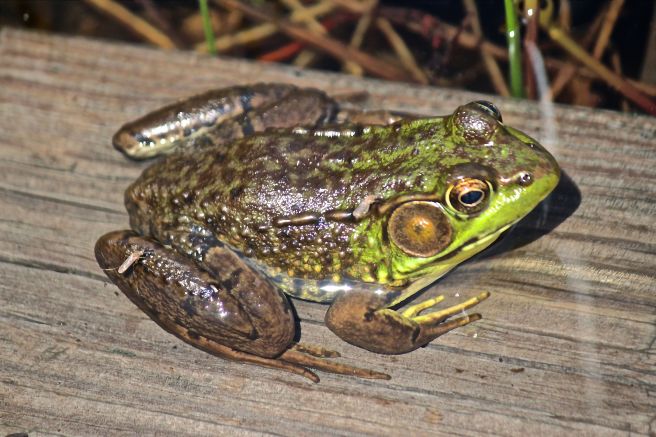
h-green 6

Or maybe she knew he was nearby. What a handsome prince.

Round Three: 2:30pm, Joan and I (co-coordinators of the Maine Master Naturalist Bridgton 2016 class) were joined by another MMNP grad, Pam Davis Green, who will lead our June field trip to explore natural communities at Holt Pond.

h-striped maple flower

h-spriped flowers 2

Cascading down from the striped maple leaves, we saw their flowers, which had alluded us on our first two passages.

h-speckled 2

The cottony white masses of wooly alder aphids decorated many of the speckled alders in the preserve. In a symbiotic relationship, ants stroke the aphid with their antennae, while  the aphid releases a drop of honeydew, much like a cow being milked. It’s actually rather creepy.
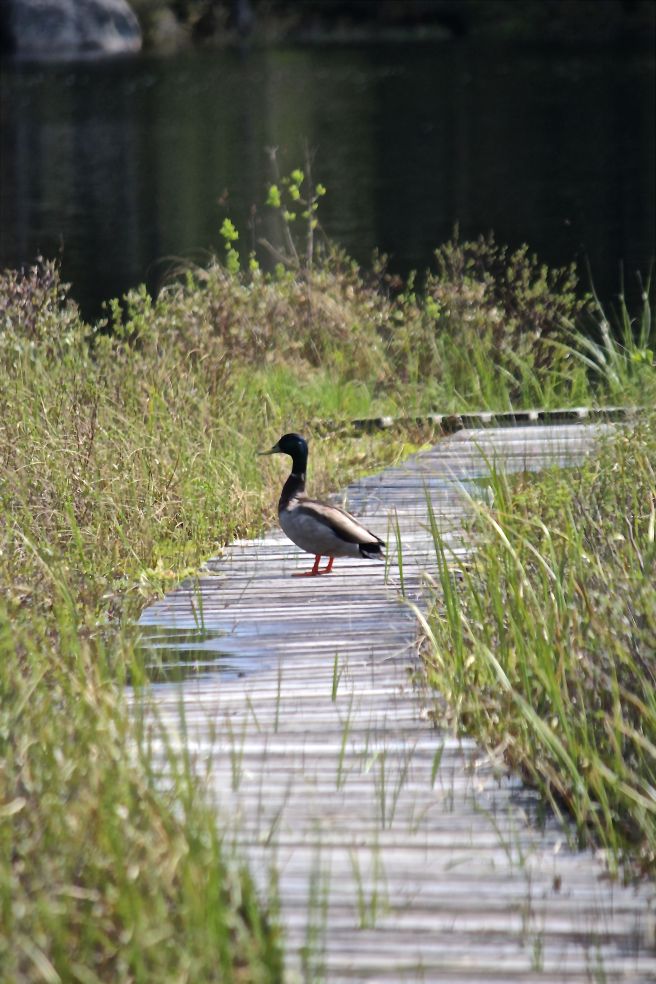
h-duck

Two Canada Geese squawked from another part of the pond, but Mrs. Mallard stood silently by.

h-tree pants

Our final sight brought a smile to our faces–someone put his or her pants on upside down!

We hope that charms your fancy. Joan and I were certainly charmed by our three loops around and those we got to share the trail with today.

We also want to thank Ursula, Mary and Pam for their sharings. And we send good vibes and lots of prayers to my neighbor, Ky, and Pam’s brother-in-law.       
 

 

Book of the Month: TREES and SHRUBS of NORTHERN NEW ENGLAND

Sometimes the biggest gems arrive in the smallest packages. Such is the case with this month’s book–and this isn’t an April Fools’ Day joke, though I did briefly consider posting an upside-down photo of the cover.

t-book

I picked up this copy of  TREES and SHRUBS of NORTHERN NEW ENGLAND at a book swap during the Maine Master Naturalist Program’s first conference this past year. This third edition was compiled by Frederic L. Steele, Chairman of the Science Department, St. Mary’s-in-the-Mountains, Littleton, NH, and Albion R. Hodgdon, Professor of Botany, University of New Hampshire, Durham, NH, and published in 1975 by the Society for the Protection of New Hampshire Forests.

One of the things I like about it is that it measures 4.5 x 7 inches and fits easily into my pack. Plus, it includes more shrubs than many of my current books.

t-leaves

And check this out from the introduction: “In the preparation of this guide, the authors have received help and encouragement from a number of people. The following, in particular, should be mentioned . . . Mrs. Priscilla Kunhardt and Miss Pamela Bruns have done the illustrations . . . ” Mrs. and Miss! Ah, what happened to those days?

t-quaking description

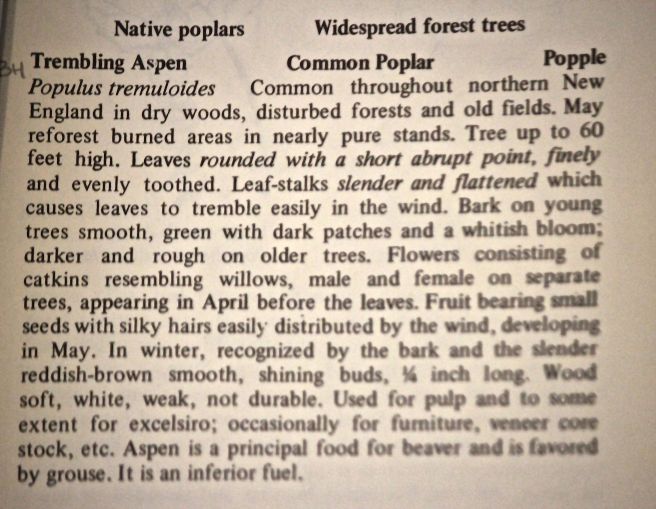
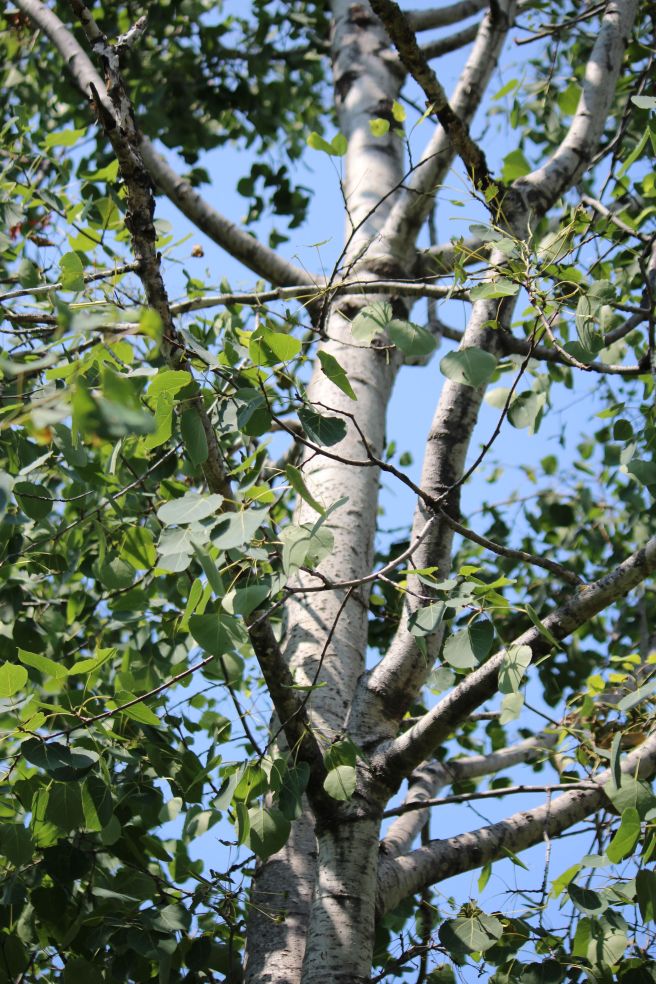
The descriptions are not lengthy, but enough for a quick reference. I choose the Trembling Aspen, which I’ve learned as Quaking Aspen (I know–that’s the problem with common names say my Latin-oriented friends) because two are located right out the back door. They are the trees of life in our yard.

t-catkins forming

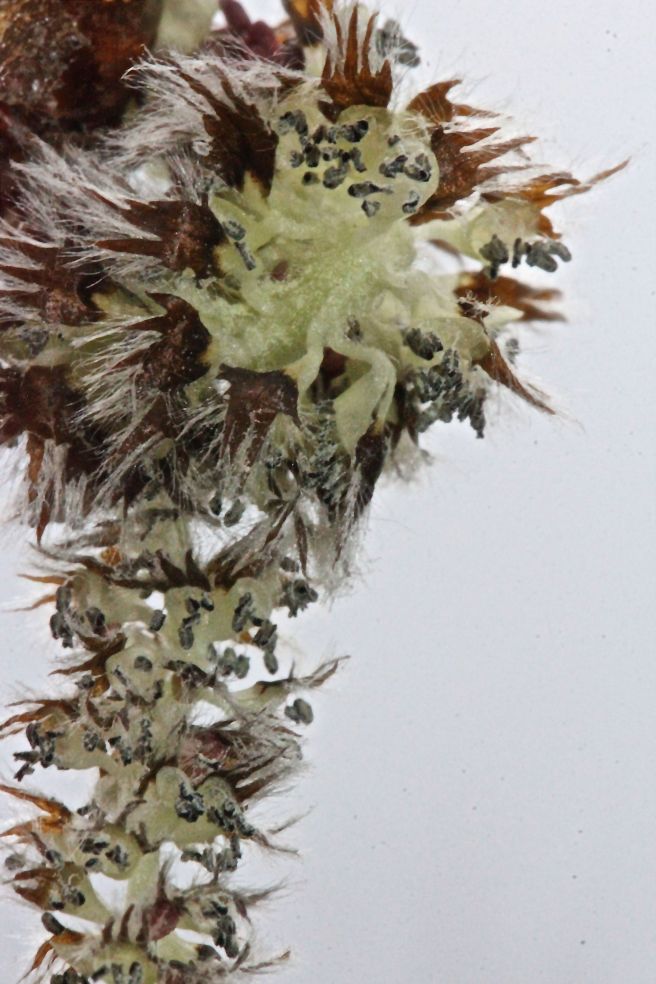
Catkins slowly emerge from waxy-coated buds

qa 1

and grow longer with lengthening days.

qa 5

Tufts of hair adorn tiny seeds.

T-summer

Soon, leaves on flat stems quake in the breeze,

t-caterpillars

until visitors arrive.

t-leaf eaters

Very hungry caterpillars.

t-porky

They aren’t the only ones. Porcupines nip off branches.

t-leaf

Eventually, leaves that survive fall to the ground.

t-hairy woodpeckers

All year long, birds visit to dine

t-cardinal

and view the world.

t-cat

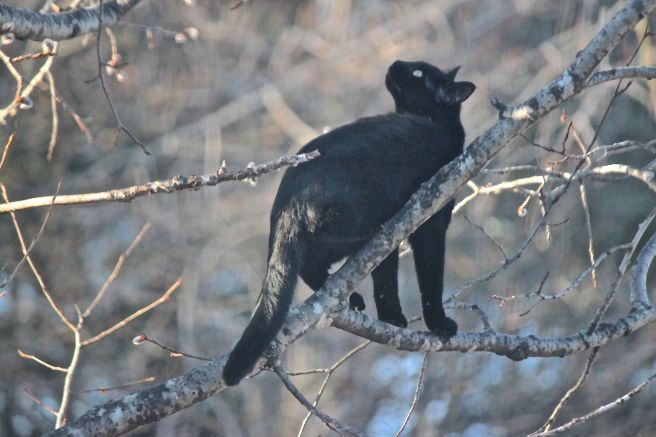
The world looks back.

t-ice

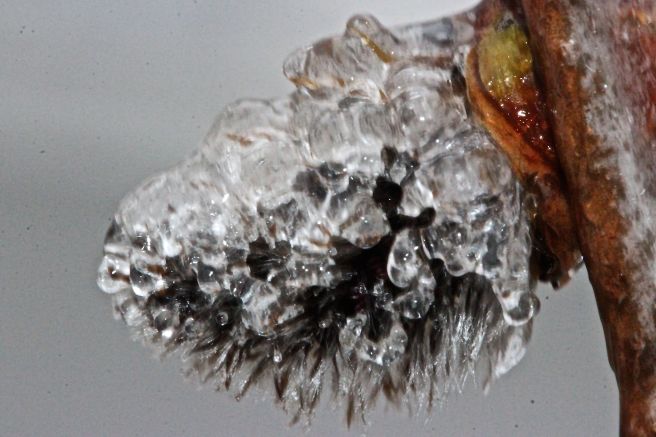
Ice slowly melts

qa 2

and life continues.

TREES and SHRUBS of NORTHERN NEW ENGLAND doesn’t include photos, but that’s OK because I have my own. Instead, as any good guide, it’s a jumping off place. So many books, so much different information–and sometimes guides contradict each other. Just the same, I love to read them and then to pay attention. For me, it’s all about forever learning. And wondering.

TREES and SHRUBS of NORTHERN NEW ENGLAND, by Frederic L. Steel and Albion R. Hodgdon, Society for the Protection on Northern Forests, 1975.

Book of the Month: The Country Diary of an Edwardian Lady

D-cover 1

In 1980, after I’d spent time studying in York, England, my sister gave me a copy of The Country Diary of an Edwardian Lady by Edith Holden. I’d kept diaries on and off over the years and continue to do so today, but nothing will ever match this masterpiece filled with poetry, personal observations and thoughts, plus enchanting watercolors.

D-nature notes 1906

Written in 1906, the book wasn’t actually discovered and published until 1977. Ms. Holden passed away in 1920.

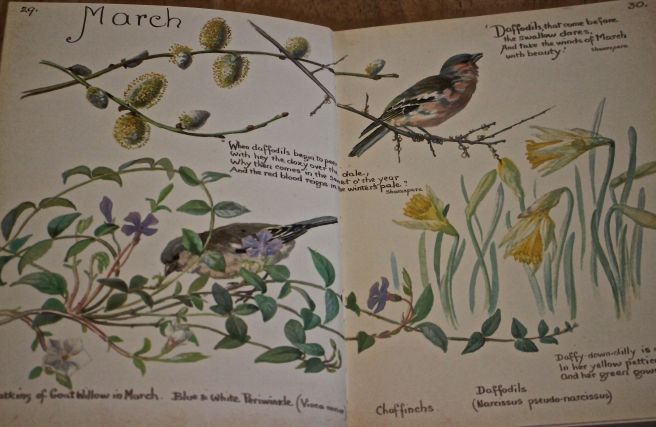
D-March display

Printed on yellowish paper, each page has darkened edges that give the reproduction an aged appearance–making me feel as if I’m holding the original in my hands.

D-march phenology

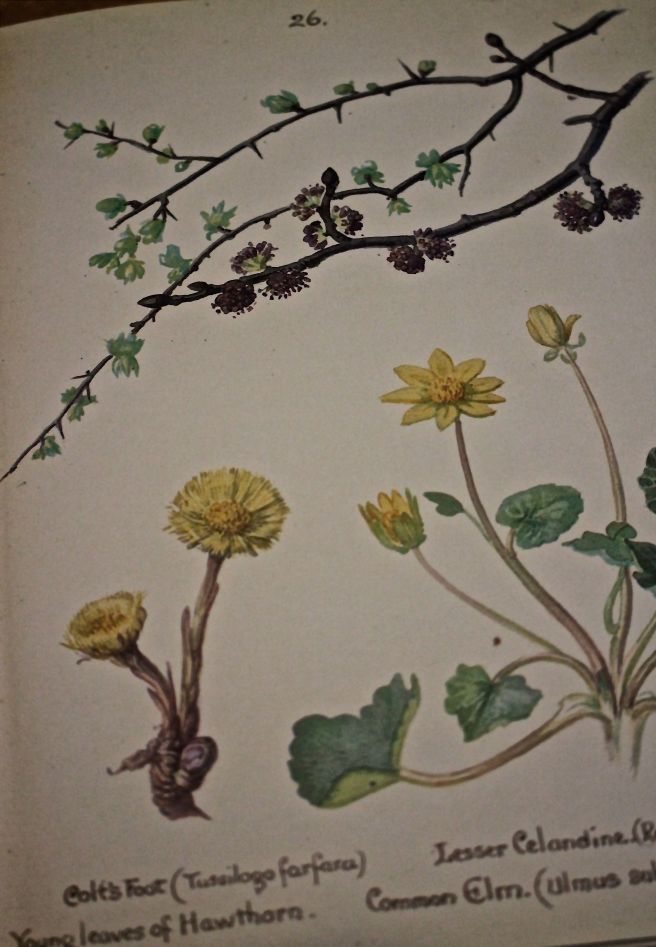
She included her daily wonders and wanders, and poems and quotes that caught her whimsy. She was a teacher and a thinker who captured the physical world of the flora and fauna that surrounded her and combined it with a sprinkle of her own soul.

IMG_2340

On the opening page for March, she quotes Bryant:

“The story March is come at last

With wind, and cloud, and changing skies;

I bear the rushing of the blast

That through the snowy valley flies.

Ah! passing few are they who speak

Wild stormy month in praise of thee;

Yet though they winds are loud and bleak

Though art a welcome month to me.

For thou, to northern lands again

The glad and glorious sun dost bring

And thou hast joined the gentle train,

And wear’s the gentle name of Spring.

And in thy reign of blast and storm

Smiles many a long, bright summer day

When the changed winds are soft and warm

And heaven puts on the blue of May.”

d-colt's foot

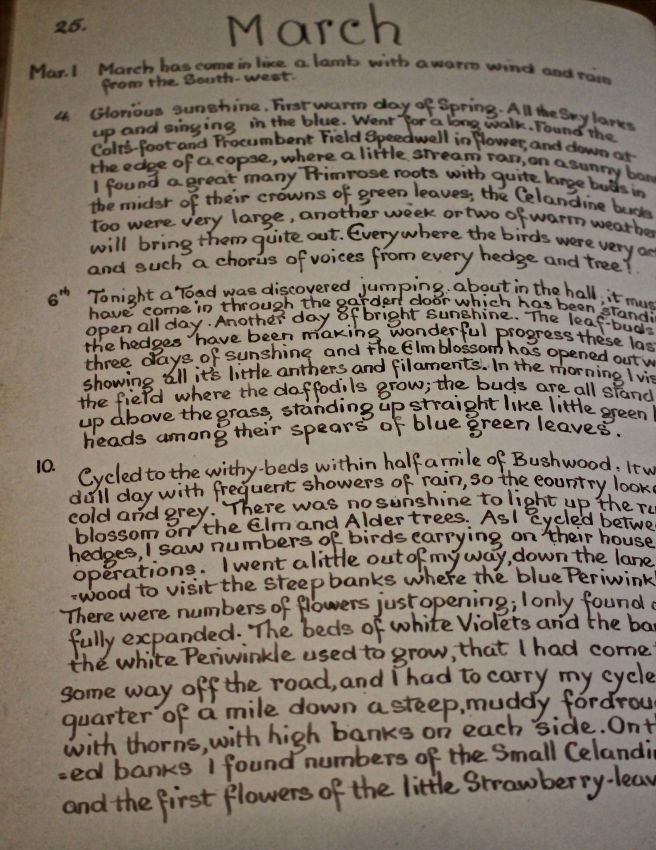
As I sit here this morning , I gaze upon trees whose limbs are embraced in snow and twigs glazed with a coating of ice while the rain falls. Since daybreak, the male cardinal has been singing at regular intervals. On March 12, 1906, Ms. Holden noted: “After a wet, windy day, we wake this morning to a regular snow storm, the air was full of whirling flakes, but in the midst of it all I heard a Sky-lark singing.”

Though she doesn’t know it, Ms. Holden has long been one of my mentors as she explored, catalogued and enjoyed nature. I can only hope to continue to pursue the daily wonderment she knew so well in my own way. I’m grateful to her and to her family for publishing the book posthumously. (Apparently there is a new edition, but I love my 1977 version) And to my sister for giving me this gem so many years ago.

The Country Diary of an Edwardian Lady, written and illustrated by Edith Holden, published 1977, Holt, Rinehart and Winston.

Book of January: A Guide to Nature in Winter by Donald W. Stokes

Stokes 1

Book of January

I have a number of winter nature books, but one of my go-to favs is A Guide to Nature in Winter by Donald W. Stokes. My copy is old (1976–it was a very good year–I graduated from high school) and a bit weathered, but that’s because it has seen frequent use.

Divided into eight field guides, Stokes covers all aspects of winter: winter weeds; snow; wintering trees; evidence of insects; winter’s birds and abandoned nests; mushrooms in winter; tracks in the snow; and woodland evergreen plants.

For each topic,  pen-and-ink drawings by illustrator Deborah Prince and the author are included in the key, as well as natural history descriptions.

The natural history descriptions are just that–Stokes’s descriptions are part of the story that Kevin Harding of the Greater Lovell Land Trust reminds us to share with others. Here’s an example: “St. Johnswort (Hypericum perforatum)–An old country custom in Europe was to hang a special yellow-blossomed plant in your window on the eve of St. John’s Day (June 24), in order to repel bad spirits and counteract the evil eye. In general, the presence of this plant was considered a good omen, and since it was thought that the plant warded off lightning and revealed the identity of passing witches, St. Johnswort was allowed to prosper around the farmhouse. It became known as St. John’s Plant or St. Johnswort (wort meaning “plant” or “herb”). When the plant immigrated to North America it left its traditions behind, and although still as effective as it probably ever was against evil, St. Johnswort is now seldom used for that purpose.” Of course, then he goes on to describe how the plant grows and the seed heads that will appear in the winter landscape.

One of the things I’ve learned from this book is to keep it simple. In the chapter about winter trees, Stokes encourages the reader to begin with the six most common deciduous trees: oak; maple; ash; beech; birch; and aspen. Learning these along with the evergreens provides you with knowledge about 80% of the trees in your forest. I’ve spent the last couple of years developing my bark eyes. I still have much to learn, but can eliminate the common species when I encounter bark I’m uncertain about.

It’s well worth taking the time to read A Guide to Nature in Winter from cover to cover–it’s an easy and enjoyable read. I say it won’t take long–unless you are like me and you pause to underline (yes, I mark my books up–even write in the margins, oh my!) details and take time to understand what you do see along the trail. I probably should invest in a more up-to-date copy, but I feel right at home engrossed in the one that I have.

And it’s also easy to turn to a particular chapter to figure things out. The simplified, illustrated keys should bring you quickly to an identification. And as I said before, the natural history description will further enhance your learning.

The book is available at Amazon.com, but if you live near an independent book store like Bridgton Books, then I strongly encourage you to shop there.

A Guide to Nature in Winter: Northeast and North Central North America, by Donald W. Stokes, illustrated by Deborah Prince and the author, published 1976, Little, Brown & Company.

Trending Blaze Orange

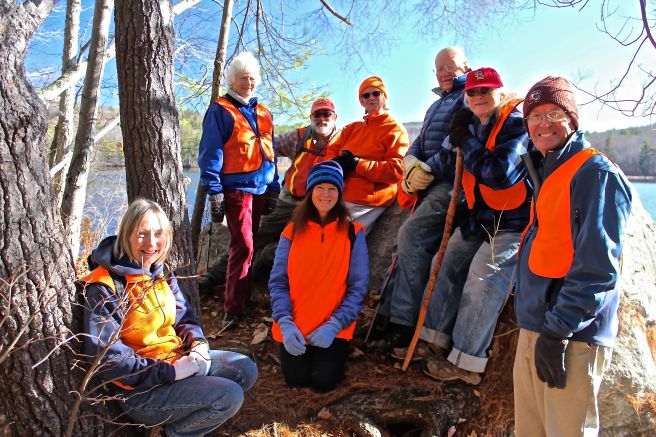
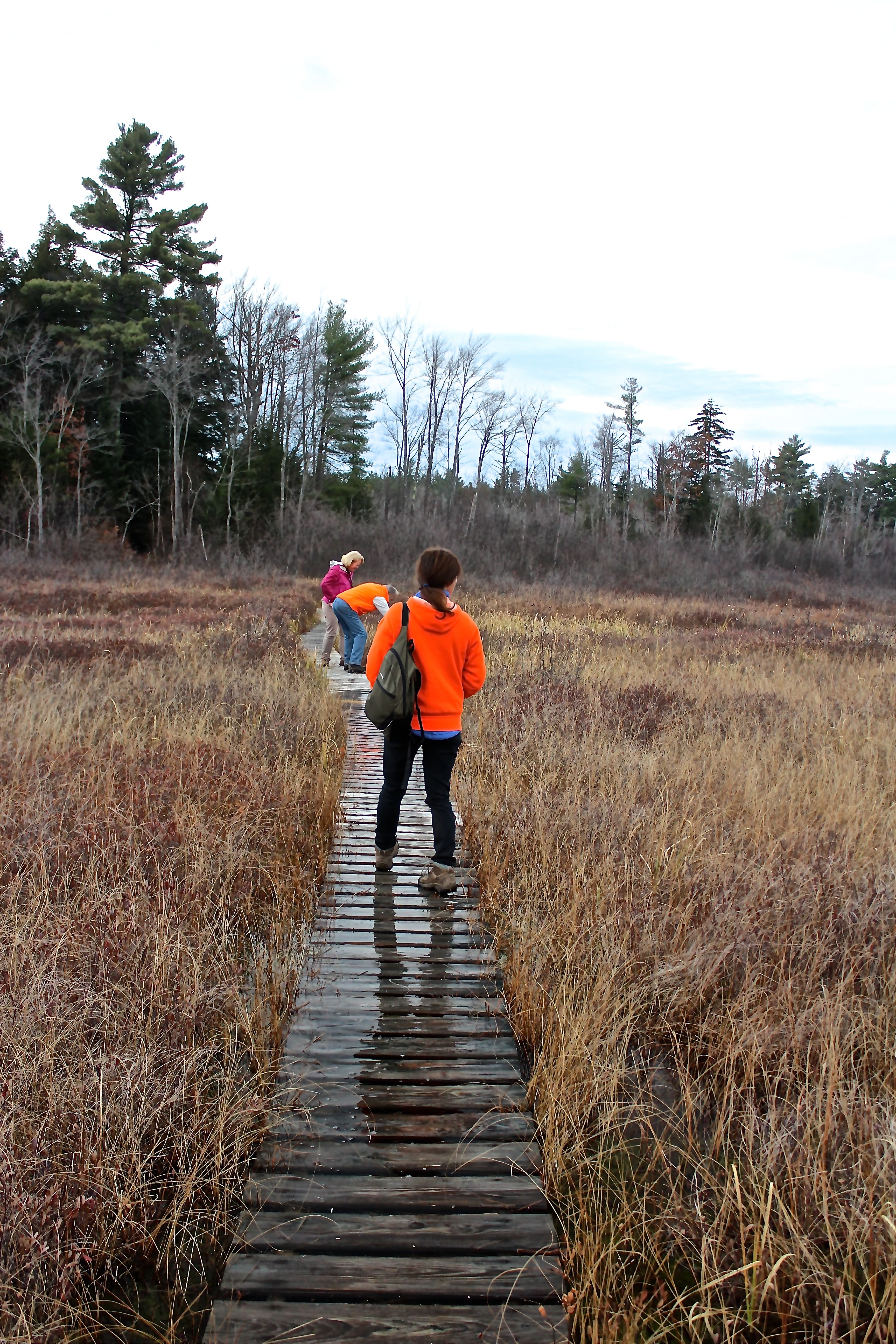
Donning our blaze orange, eight of the Greater Lovell Land Trust‘s docents joined me today for an exploration along the trail to Otter Rock at the Heald and Bradley Ponds Reserve.

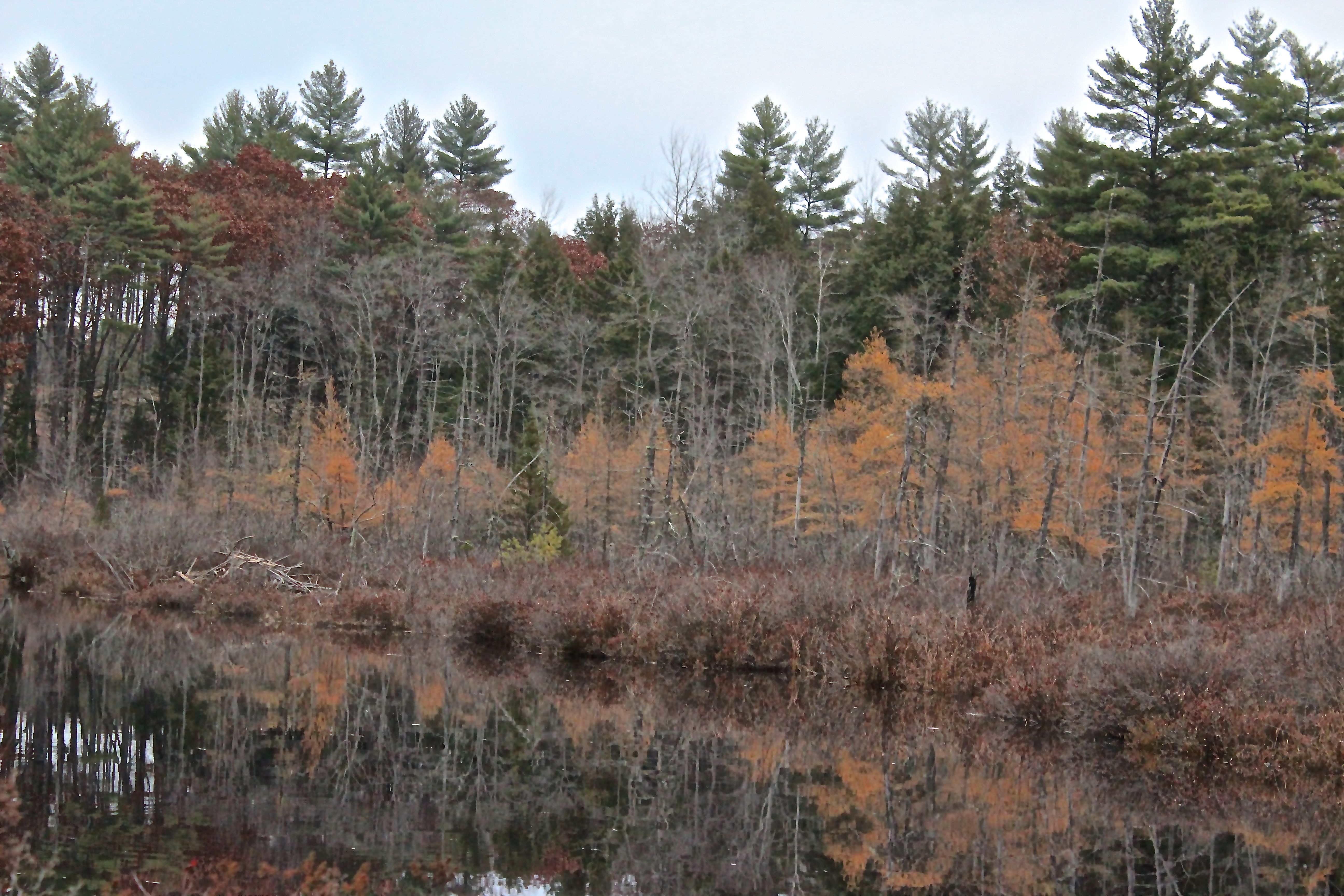
Our destination was the Otter Rock spur, not very far, but it’s amazing how long it can take us and we were impressed that we actually reached our goal.

grape fern 1.jpg

Along the way we stopped to admire the blunt-lobe grape ferns and their separate fertile stalks, some still intact.

4 birches.jpg

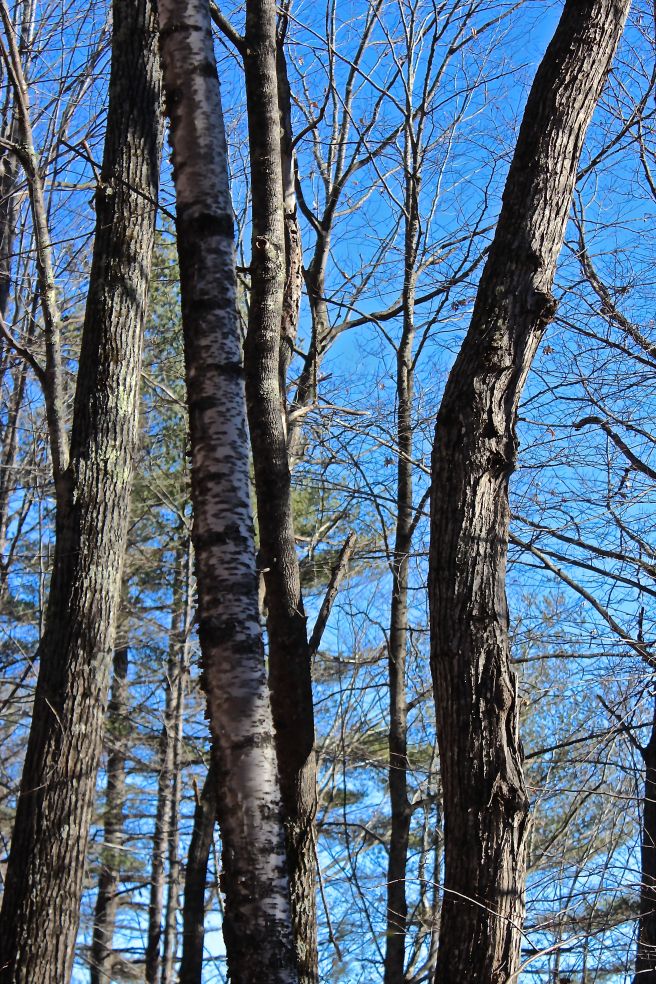
And then we looked up. We’d been talking about tree bark, and right before our very eyes were four members of the birch family.

paper birch

Paper Birch (Betula papyrifera) features chalky white bark that often peels away in large sheets. The peeled bark reveals pink or orange tints, only partially visible here, but evident on other trees in the neighborhood.

yellow birch

To the left of the Paper Birch stands a Yellow Birch (Betula alleghaniensis), with its curly ribbon-like strips of bronze or yellowish-gray bark giving it a shaggy appearance.

black birch

And to its left the one that excited us most, Black Birch (Betula lenta), sporting gray bark with long, horizontal lenticels. All trees have lenticels, but they are more obvious on some than others. These slits allow for the exchange of gas so the tree may breath.


gray birch

Last in the family line-up, a Gray Birch (Betula populifolia) showing off its almost dirty appearance and chevrons below the former branch sites.

dragonfly nymph 1

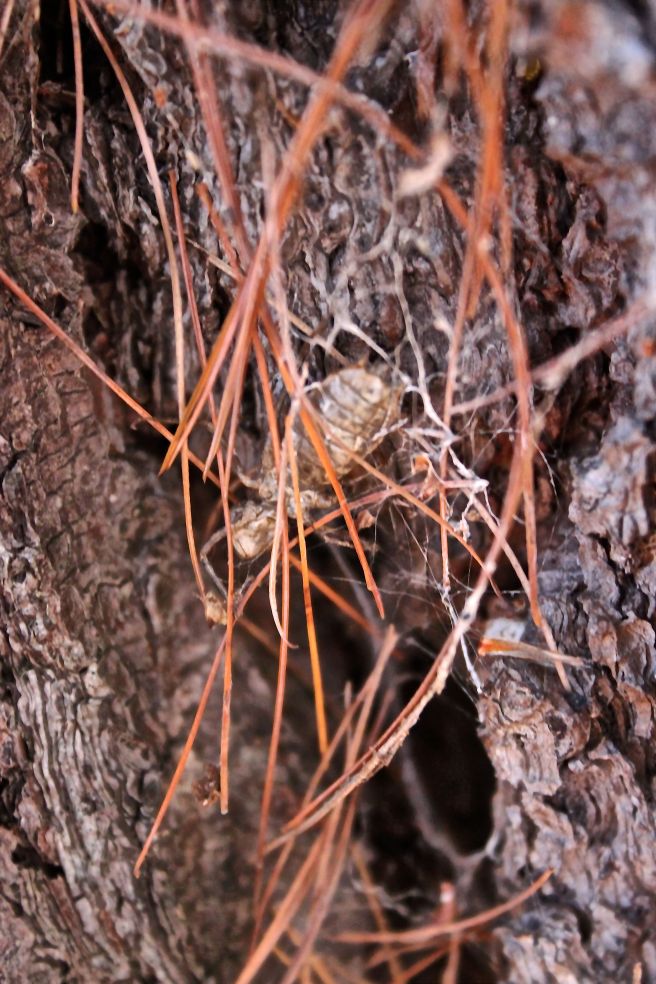
At Otter Rock, we found dragonfly nymph exoskeletons still clinging to tree bark

df 2

and rocks.

shell remnants

Our discovery of shells made us wonder and smile about others who have passed this way.

wh b

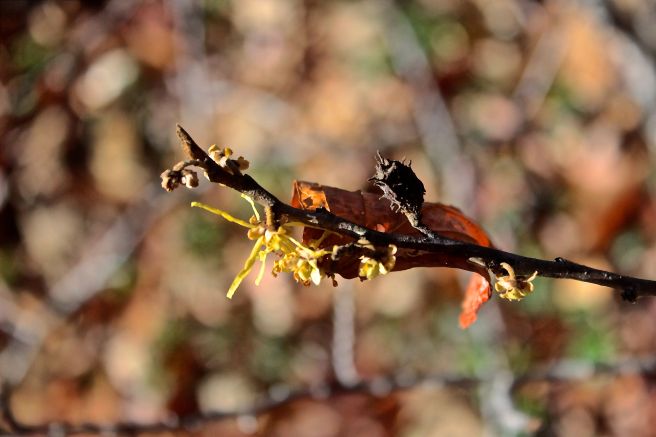
Now that the leaves are gone, we delighted in the knowledge that there is so much more to see, including Witch Hazel.

witch hazel gall

We examined one of the few remaining ribbony flowers, the scalpel-shaped buds, fruiting bodies, asymmetrical leaves and a spiny gall all on one branch.

witch hazel Bob.jpg

Our very own Witch Hazel Expert, Docent Bob, demonstrated the way the seeds pop–referencing Henry David Thoreau’s discovery of this phenomenon.

docents 1.jpg

Before we headed back to the main trail, the group posed for a photo call. They all look so sporty in their blaze orange.

wild raisins

A few more finds as we walked back to the parking lot: remnants of a wild raisin (Viburnum cassinoides), so named because the shriveled fruits that remain look like raisins;

black cherry bark.jpg

Black Cherry bark (Prunus serotina), easily identified by the small scales that curl outward like burnt cornflakes or potato chips;

red oak leaves

and Northern Red Oak leaves displaying holiday colors.

Mill Stream

Though most of us parted company just beyond the mill stream, a couple of us continued on to the John A. Segur Wildlife Refuge off New Road.

Heal All

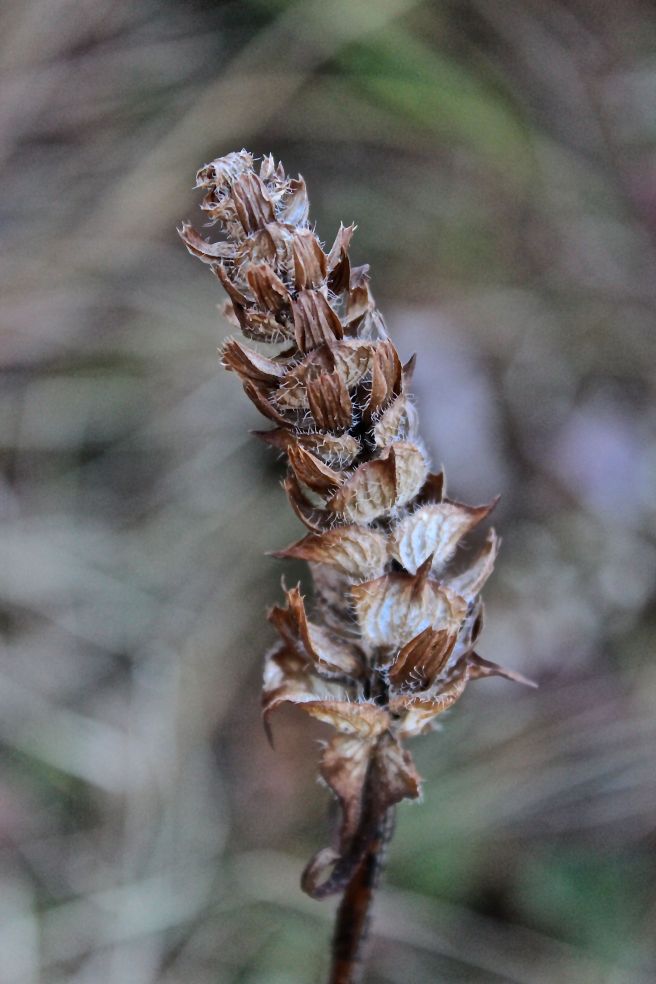
We focused our attention on winter weeds, a topic for our January 9th walk. On this old logging road, some of the Selfheal or Heal-all (Prunella vulgaris) stands at least a foot and a half tall. As pretty as it is in the summer, it’s still a sight to behold in its winter structure.

evening primrose

Another to look forward to is the Evening Primrose (Oenothera biennia). Its fruits are four-parted capsules arranged in a spike at the tip of the stem, looking rather like flowers themselves.

There’s more to see, but I don’t want to give it all away.

CS view 1

My last stop for the day was a loop around the Chip Stockford Reserve. I wasn’t the only one trending blaze orange. The glow of the late afternoon sun cast an orange hue across the beech leaves.

November in western Maine. We’re happy to don our blaze orange and get out on the trails.


Wer-if-est-er-i-a-ing A-long

12074842_10153632630537731_2769008110586363497_n

Thank you to my friend, Judy Lynne, who shared this word with me today. I know I do it, but I didn’t know there was a word for it. And I love that it’s an Old English word–takes me back to college days and my History of the English Language Class where we learned to read in Old and Middle English.

And so it was that today I wandered longingly through the forest in search of mystery with five other naturalists–all MMNP grads who will bring the Master Naturalist course to Bridgton in the spring of 2016.

After a tour of Lake Environmental Association’s Maine Lakes Science Center, we took care of some housekeeping items (coursework) before heading out the door. I made them practically run through Pondicherry Park–well, maybe run is an overstatement, but we moved quickly for us–not much time for werifesteriaing.

It was our afternoon tramp at Holt Pond when we allowed ourselves more time to pause and wonder.

HP snake

As we started down the trail, Beth saw this snake hidden among the leaf litter. It’s the third garter snake I’ve seen this week. The day was overcast and we weren’t sure if he was coiled up because he was cold or if something had attacked him.

HP Muddy River

We stepped onto the boardwalk to view the Muddy River and it almost sank beneath our weight. The water is quite high and I suspect I know why.

HP beaver works

Off to the side, we saw fresh evidence of beaver works.

HP beaver lodge, Muddy River

And in the river, a lodge topped with new sticks. I think the dam down the river has probably been rebuilt.

Looking from this vantage point, the layers of communities are pronounced, with the wetland plants like leatherleaf, sheep laurel and sweet gale growing low by the river, topped by alders and small red maple trees, topped by tamaracks, topped by white pines, hemlocks and Northern red oaks.

HP layers from Muddy River

Similar layers surrounded us with the bright red winterberries forming the creme between two wafers.

HP pitcher 1

As happens each time I pass this way, I am forced to photograph the pitcher plants.

HP pitcher 2, picture

Have you ever noticed the pictures on the hairy inner lip? Do you see what I see? A woodland landscape–trees with extended branches, a layer of colorful foliage and a grassy edge leading to the lake (water in the cup)? I know the hairs and design are important for the attraction of insects, but I never really paid attention to the actual design before.

HP Wooly aphid

We also found more woolly alder aphids, which Joan and Ann held in their hands so everyone could get an unclose look at the squiggly insects. Rather disgusting, yet fascinating.

Holt PondHP north 2

Even a single moment at Holt Pond translates into tranquility. (And I had to channel this moment for Judy Lynne.)

HP bog boardwalk, water

Gordon, Beth and Joan tried to keep their feet dry as we examined the plant life along the quaking bog boardwalk.

HP cranberries

Karen spotted one cranberry and then another, and another, so everyone could sample the tart flavor. Pucker up.

HP owl pellet

Our next fun find–a raptor pellet comprised of hair and bones galore. For the naturalist course, this will come into play.

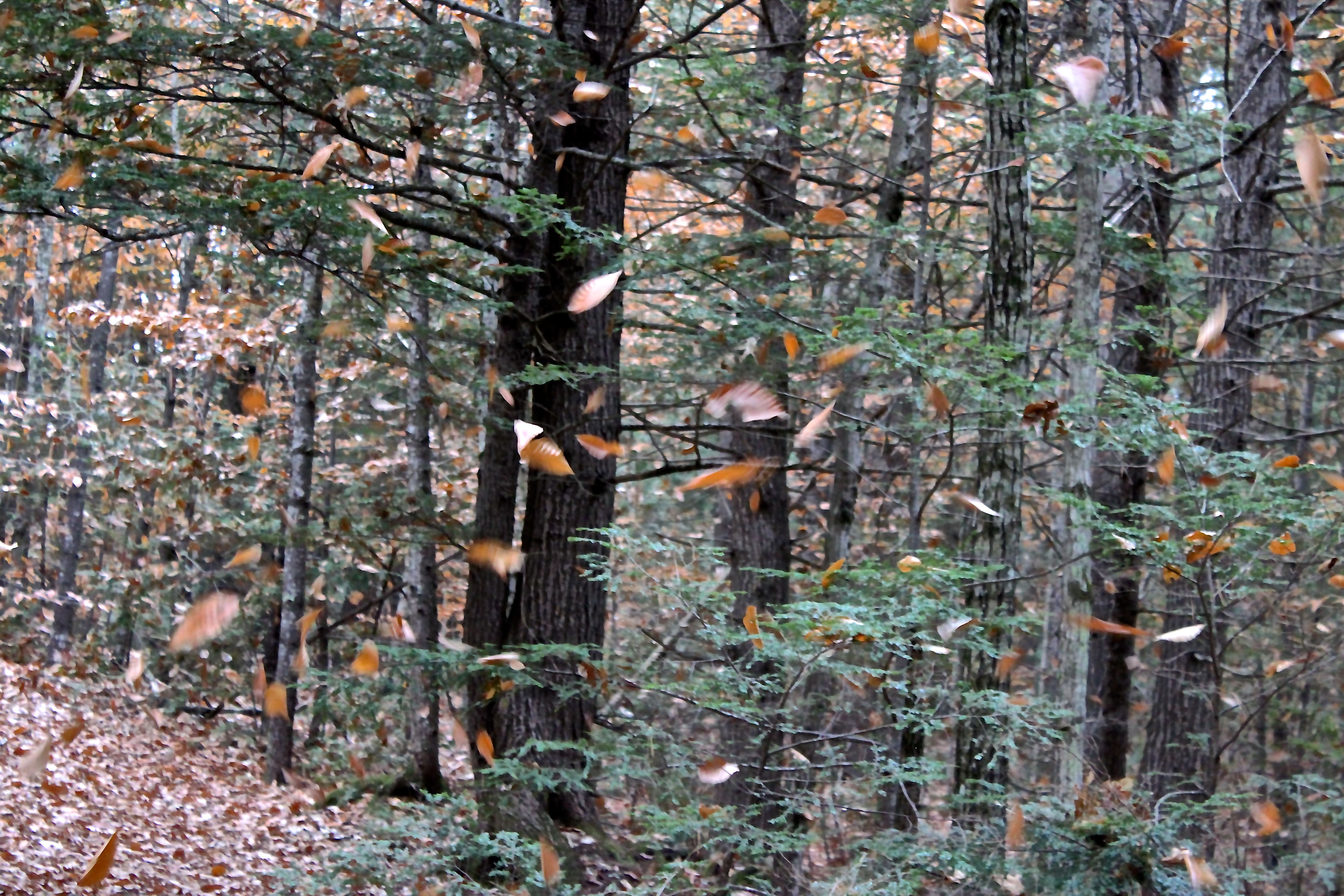
HP raining leaves 3

Every once in a while, I’d ask if it was raining. It was–beech and oak leaves.

HP old hemlock varnish conk

While we stopped to admire several older hemlock varnish conks, something else caught our attention.

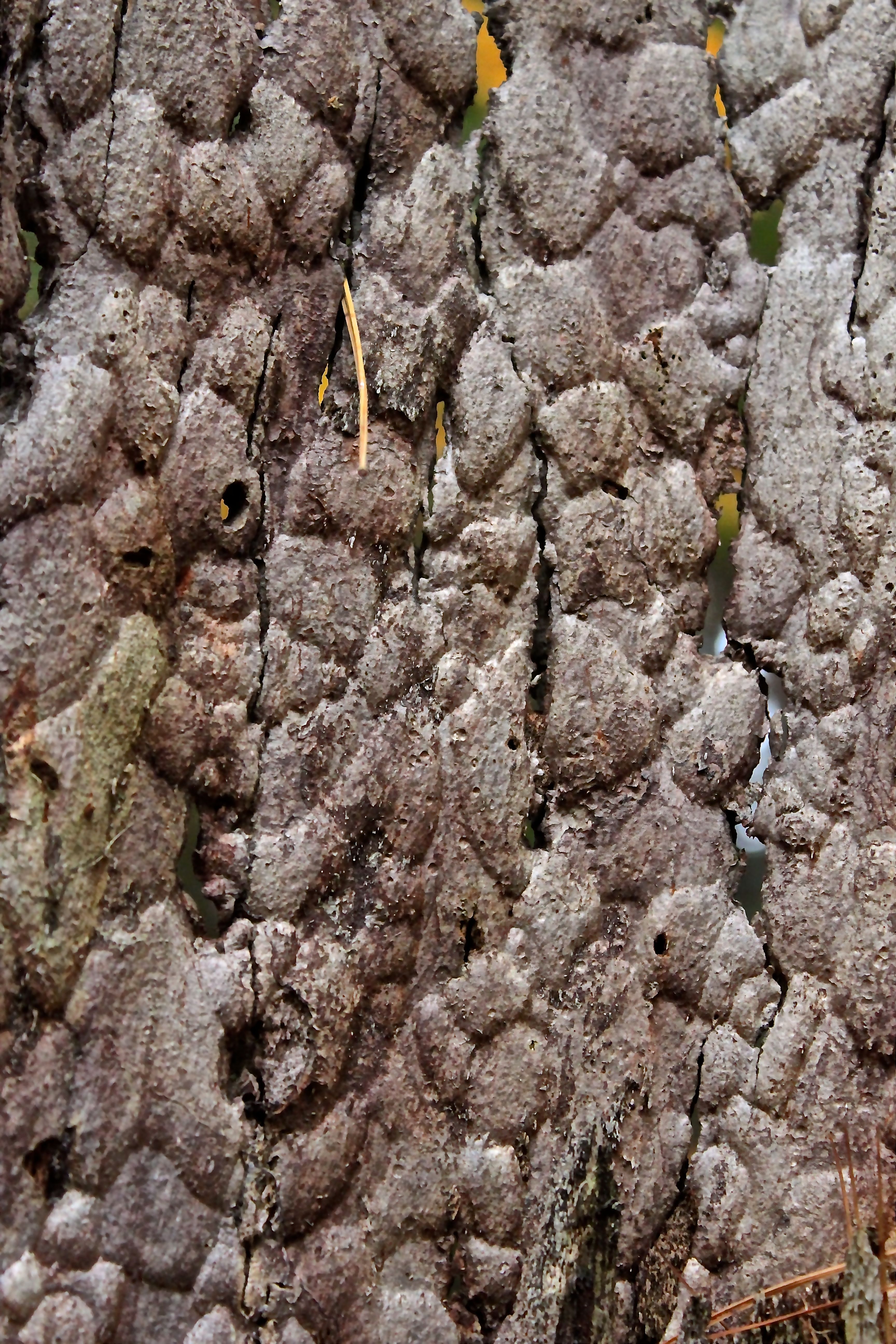
HP mystery bark

Do you know what it is?

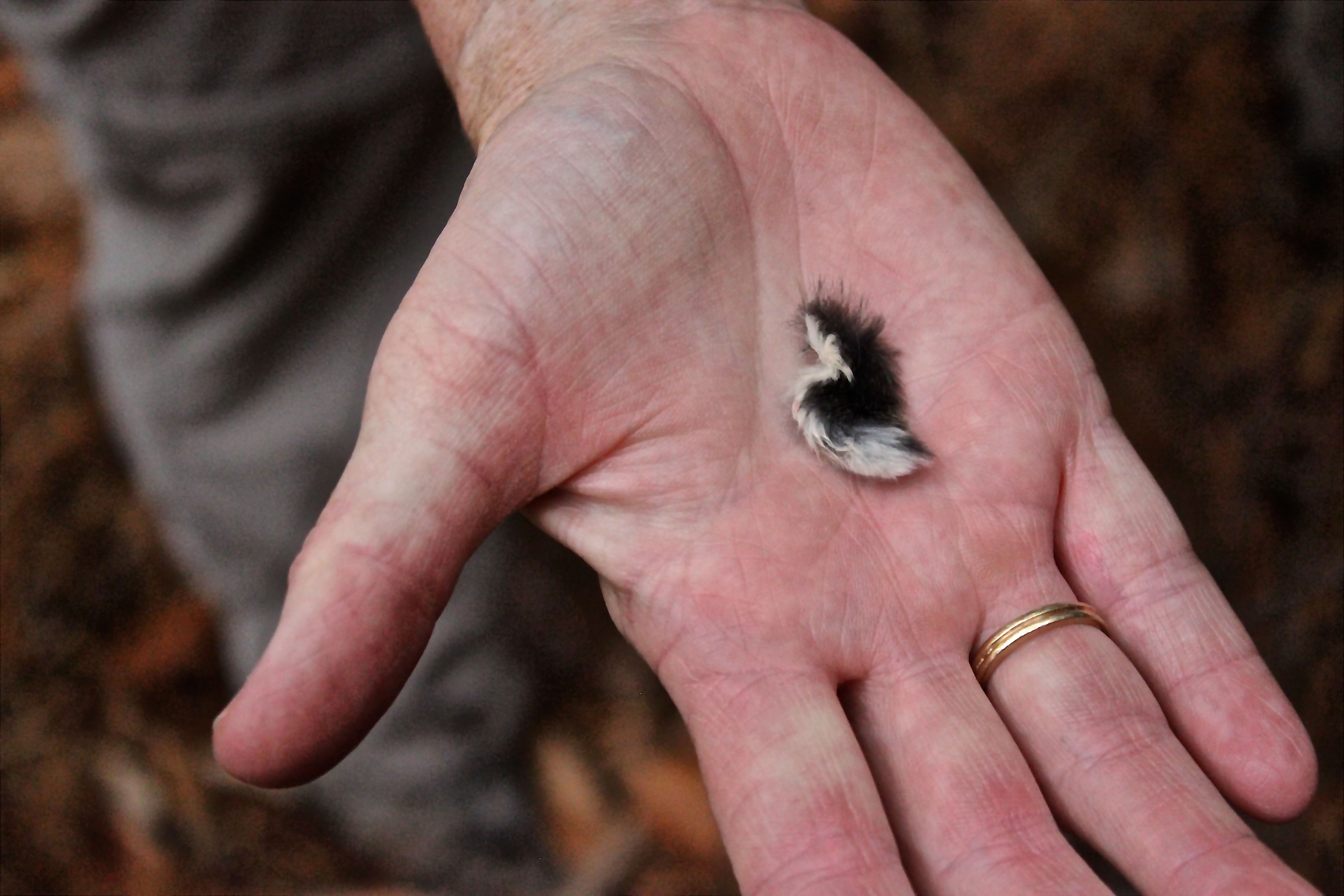
HP fur

And then Ann spotted this little tidbit–leftover from someone’s dinner. We still don’t know who ate whom. Or if it was related to our earlier find of the pellet.

What we do know is that we spent a delightful day werifesteriaing along.

HP fun mystery

As for the mystery photo–the inside of hemlock bark. This is the bark that I think of when trying to remember how trees decay–hardwoods rot from the inside out, softwoods rot from the outside in, but hemlock bark often remains. In the 19th century, hemlock bark was used in the tanning process because the tannins found in the bark preserved a hide and prevented natural decay while giving it a brown hue. At the same time, the tannin left the leather flexible and durable.

Here’s hoping you’ll have the opportunity to wander longingly in search of mystery.

Book of November: Nature Anatomy–The Curious Parts & Pieces of the Natural World

As I walked a woodland path late this afternoon, I was thinking about my curiosity. About how much I don’t know, but also, about how much I’ve learned over the course of 50+ years.

And the book of November is written by a woman who shares that insatiable need to learn more. Curiously, though she’s probably half my age and grew up in the Bronx, she spent her childhood “collecting and categorizing shells, studying horseshoe crabs undersides and swallowing salt water.” The same was true for my early years spent scouring the mudflats in Clinton Harbor.

While she continues to live in the city, she discovered nature right outside her apartment door–in Prospect Park. Obviously a labor of love, Julia Rothman, with the help of her friend, John Niekrasz, created Nature Anatomy: The Curious Parts & Pieces of the Natural World.

NA- cover

It’s a book you could read from cover to cover, but why do that? I like to open to a random page and savor it.

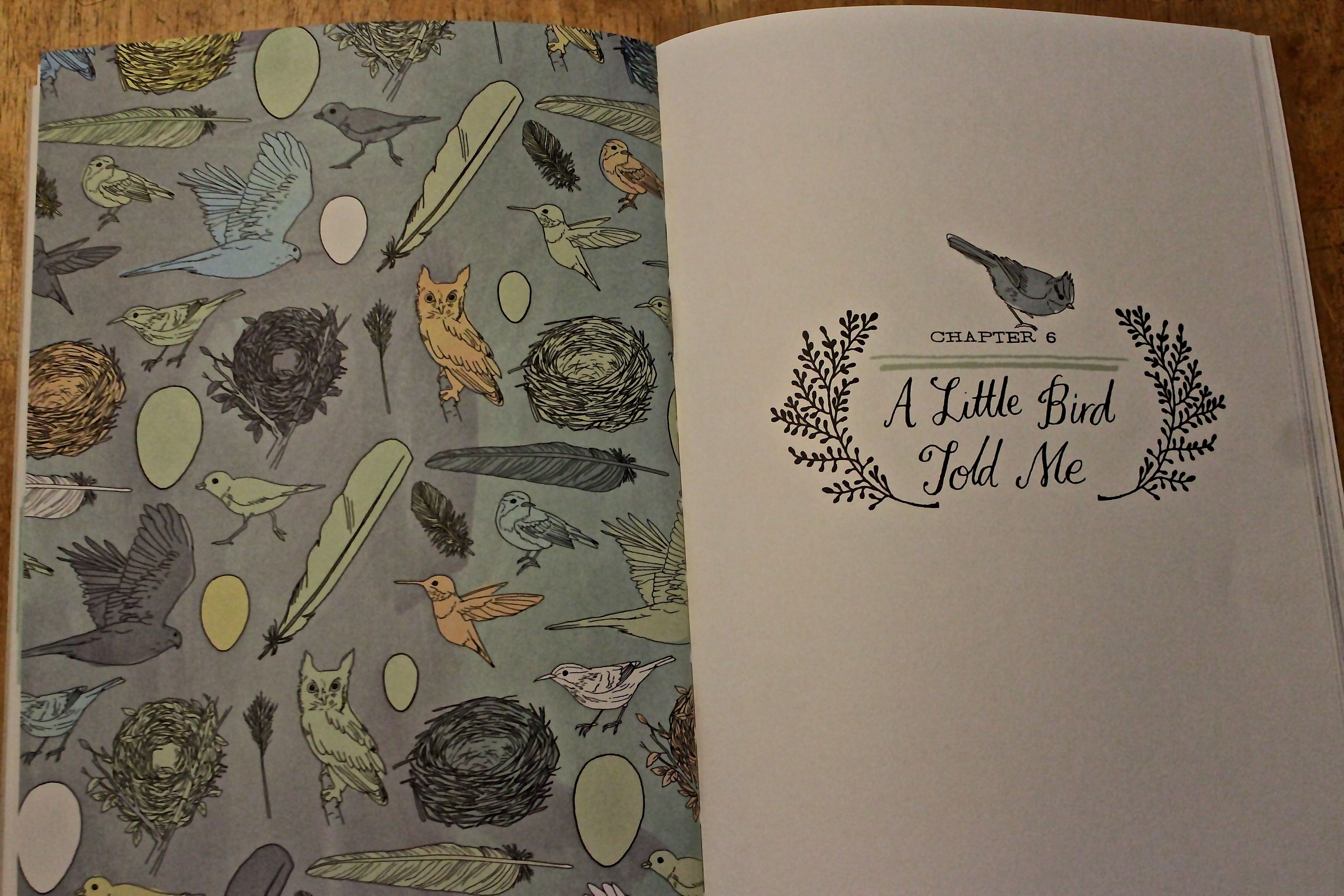
NA- bird chapter

Julia’s voice reminds me of my own. I love the titles of her chapters: Common Ground–about layers of the Earth, minerals, the rock cycle, fossils, landforms, mountains, North American landscapes, field succession and–loose landscape painting. Other chapters: What’s Up; Come Close; Take a Hike; Creature Feature; A Little Bird Told Me and Head Above Water. I won’t tell you what each is about, but you can see that she covers multiple topics within each category.

NA- toads & frogs

It’s as much a joy to read the brief facts as it is to look at the illustrations. Julia is the illustrator, with a little help from her mom.

NA- birds

NA-tree fruits and flowers

NA-Beaver Dam:lodge

This is just a sneak peak at this delightful book which provides a combination of “drawings, diagrams and dissections” to explain the wonders of the natural world. You’ll also find a few art projects and recipes between the covers.

The book ends with a shout-out to conservation organizations. Rothman writes, “No matter where you live, connect with the nature near you in a conscientious way.” Amen.

In many ways, this is the book I wish I could write.

A must have for your bookshelf. I found Nature Anatomy at Bridgton Books.

Nature Anatomy: The Curious Parts & Pieces of the Natural World, by Julia Rothman with help from John Niekrasz, published 2015, Storey Publishing.

Fall Issue of Lake Living

I’m always excited when we pull together an issue of Lake Living. The fall “At Home” issue is now available on-line and in local shops. I wrote two articles for this one: “Land That We Trust” & “Catch and Release.” But it’s not just my stuff. The whole magazine is a work of art. Take a look. And enjoy.

Renewing the spirit

My guy and I drove to the central Maine town of Madison this morning to join Master Naturalist Kate Drummond on a walk that combined the natural and historical context of a trail beside the Kennebec River.

The Pines

The Pines, as this area is aptly named, once served as an Abenaki settlement.

Kate D

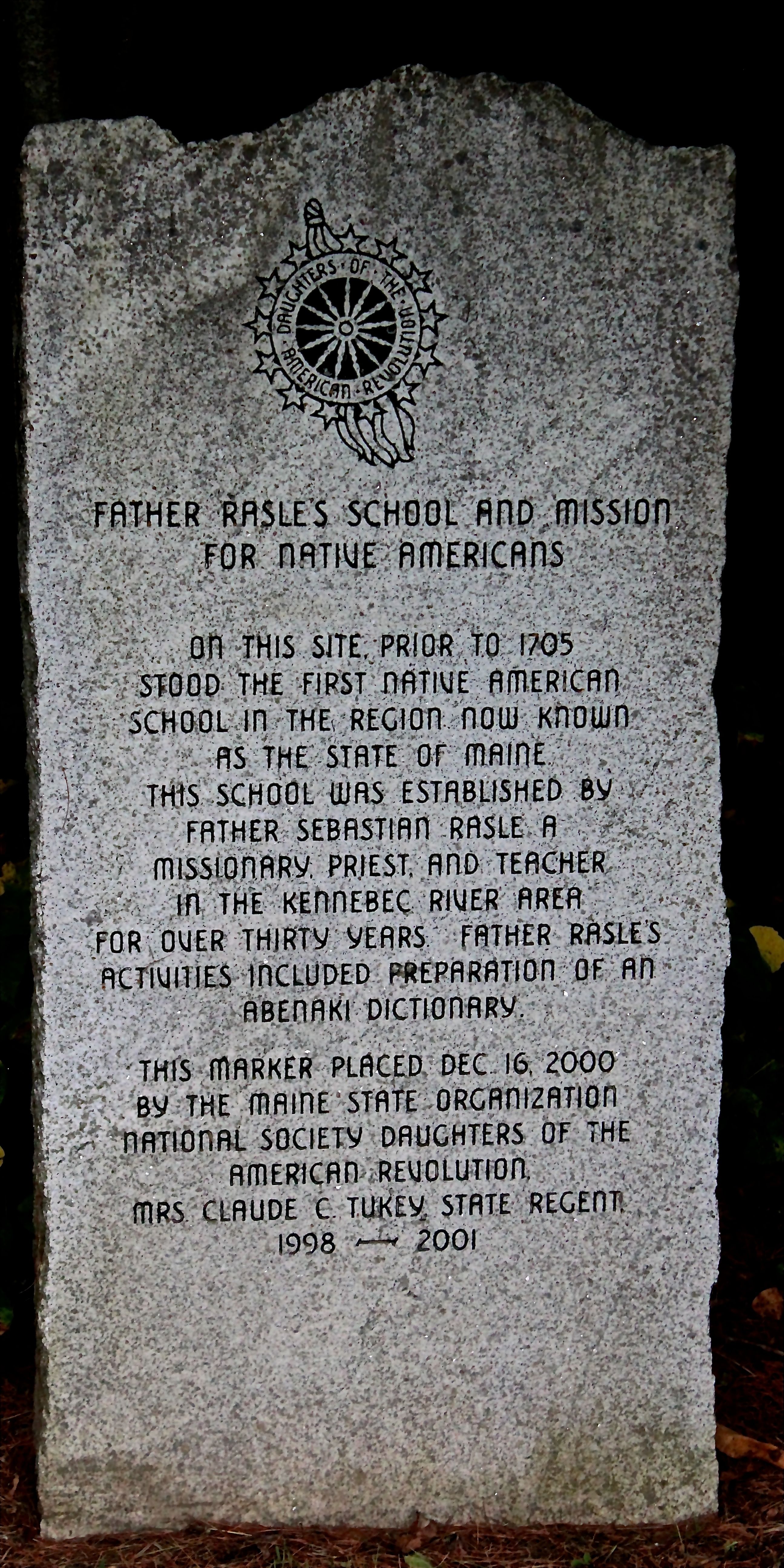
Kate began by sharing the history of Father Sebastien Rasle, who lived among the Abenakis, learned their language and converted them to Catholicism. For more than thirty years in the late 17th/early 18th century, he served as a Jesuit missionary and built at church here. Father Rasle educated the children and developed a dictionary of the native language. He also helped keep the English at bay when they tried to encroach upon Indian lands–until that fatal day–August 23, 1724.

While Father Rasle had earned the respect of the Abenakis, the English militia was wary of him. They combined forces with the Mohawk Indians to destroy the village and killed at least 80 Abenakis and Father Rasle 300 years ago today.

And so it was that Kate chose to honor Father Rasle and the Indians he lived amongst by sharing the trail with local townspeople (and us–from two hours away) to tell his story and recognize the natural elements that were a part of their daily life.

Kate is a high school chemistry teacher, so captivating her audience is a part of her makeup. To begin, she asked us to stand still for a minute and listen, look, be in the moment. After we shared our observations, she took us back in time, to imagine what the area looked like three hundred years ago.

matching cards to cool facts

matching cards

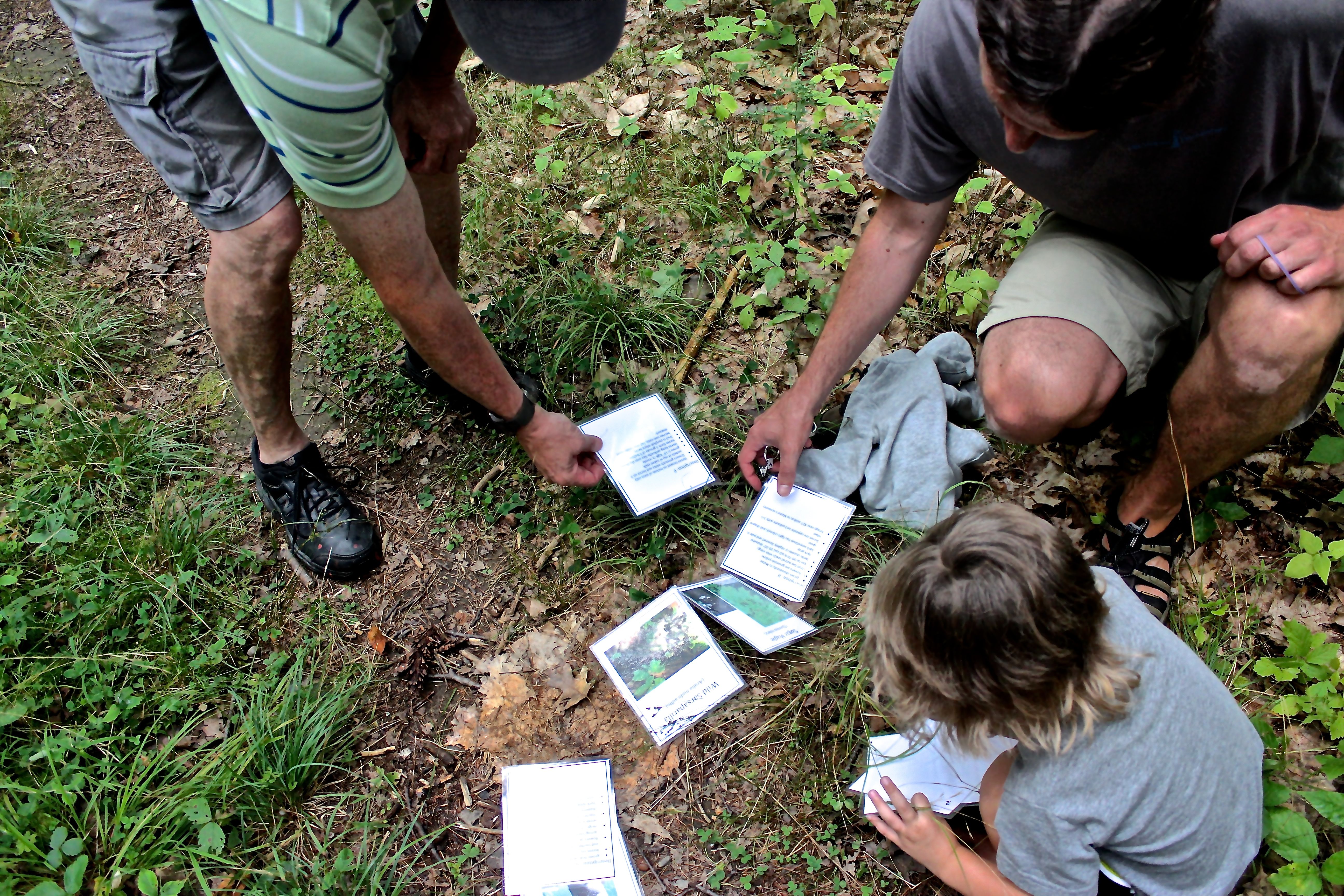
And then our real work began. We were given a set of cards and had to match the photos to the card listing cool facts about a particular species. Thankfully, there was no quiz at the end, but I suspect this group would have passed with flying colors–everyone was equally engaged.

We found some cool finds along the way:

acorn plum gall

Our first was a mystery. This speckled red ball, about the size of a jawbreaker, had us puzzled. We found several on the ground beneath Northern red oaks and Eastern white pines. Cutting one open, it looked rather fleshy and we could see what appeared to be an insect, but we still weren’t sure. And when we later found an empty acorn apple gall, we realized it was the same size. Well, a quick Google search for “large speckled red ball beneath oak” revealed acorn plum gall. It’s the home of a wasp species that uses this as a nursery. The grub slowly eats the gall’s tissue and metamorphs into a pupa before changing into a small wasp that eats its way out through a hole. This particular gall grows at the base of the acorn cup.

red and sugar maple leaves

A red maple and a sugar maple stood side by side, making for a lesson on leaf id. Red on the left, sugar on the right. Red–more teeth, or as Kate said, R=rough. Sugar–a U between the lobes, and as Kate said, Sugar has a U in it. It’s their sap that the Abenakis knew.
beaver works

Though we didn’t see any fresh sign of beaver activity, we knew by this statue that they’ve been here in the past. I love that those who actually cut the rest of the tree down to prevent it from falling across the path, had the foresight to leave the beaver works for all to see. The beavers were important to the Abenakis for a variety of reasons, including as food, tools and warmth.
basswood leaf

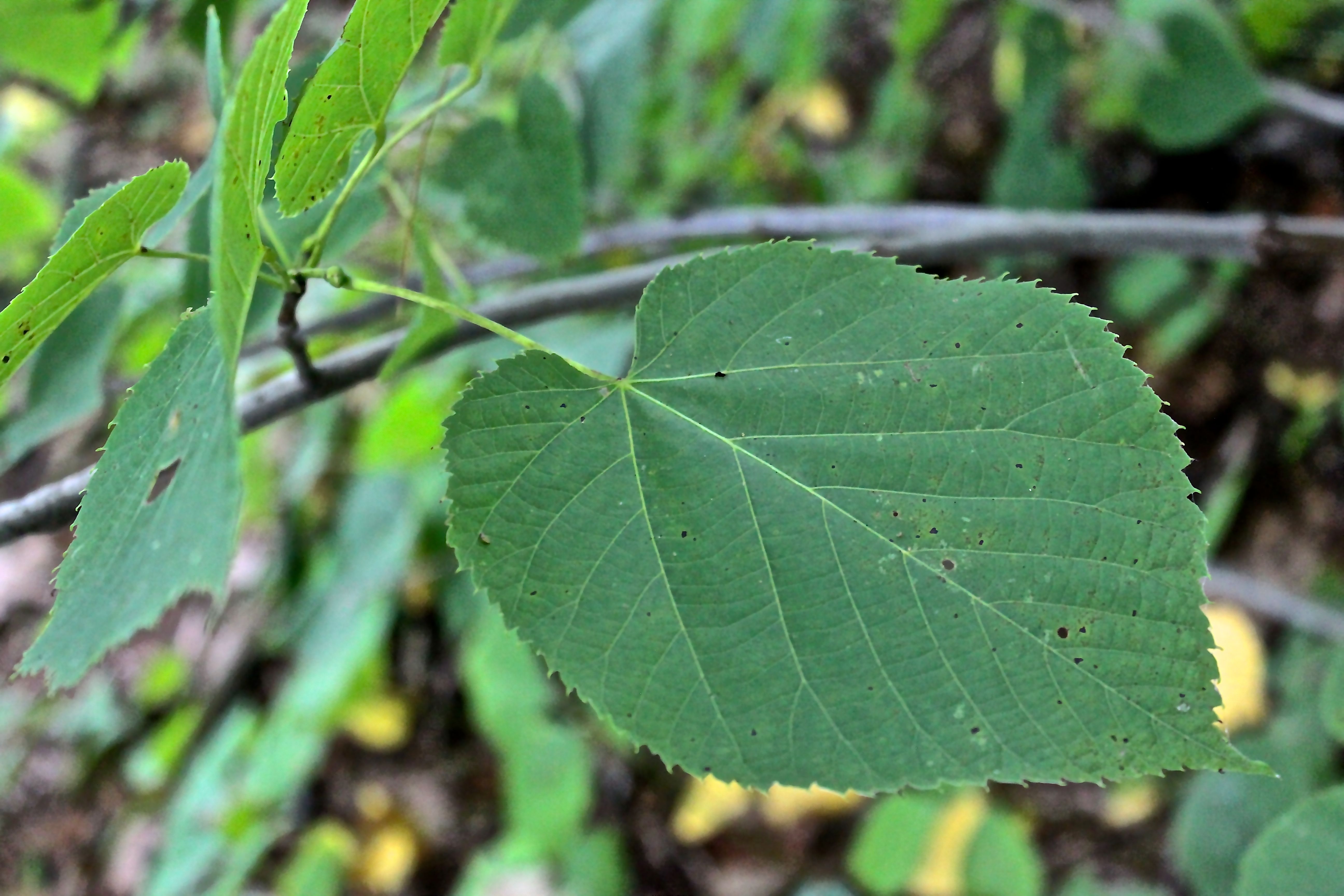
The asymmetrical base of the basswood tree makes it easy to identify. It was the bark, though, that was of prime importance all those centuries ago–the stringy fibers were used to make line or rope.

jer art 1

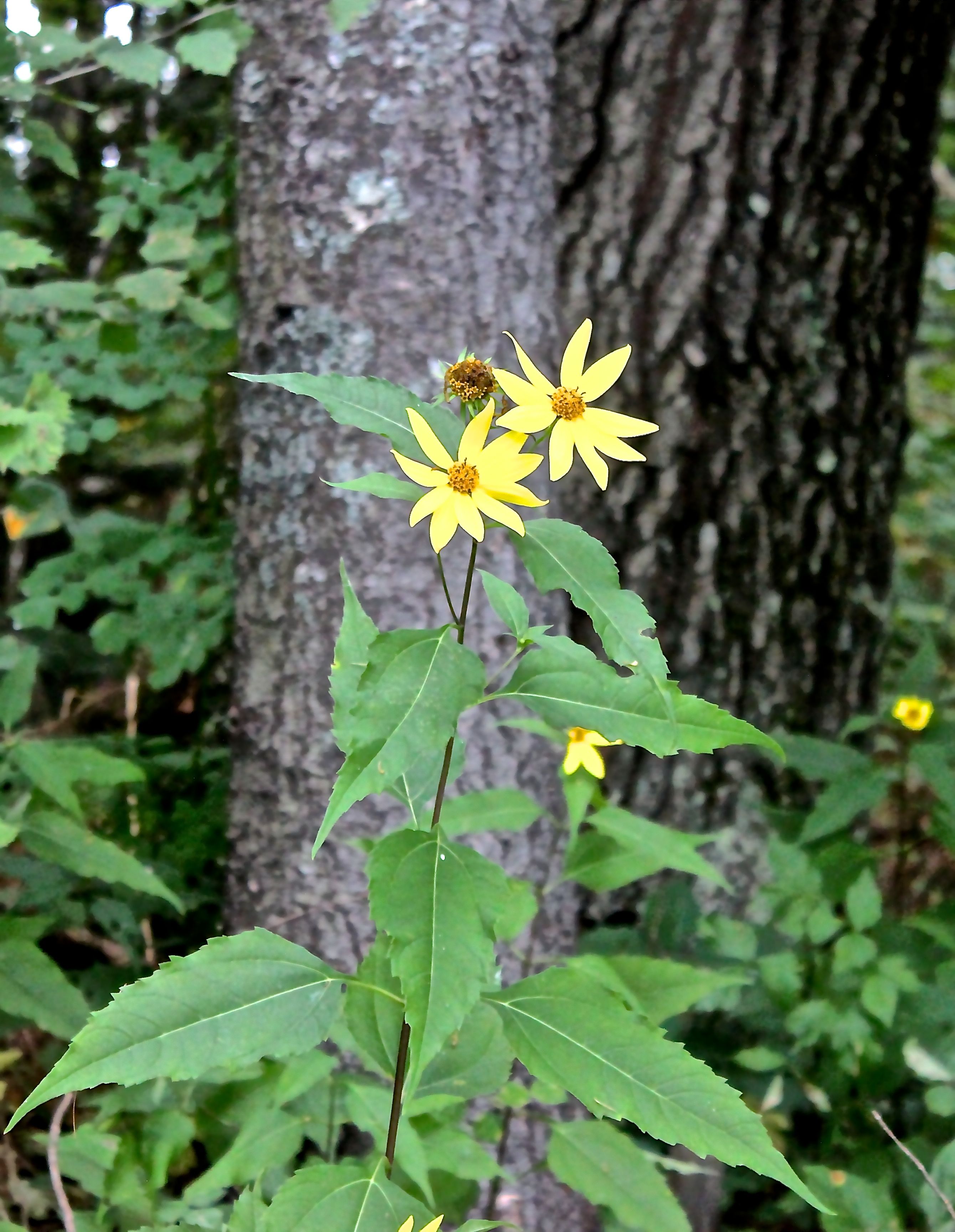
In bloom were the Jerusalem artichokes. In Notes on a Lost Flute: A Field Guide to the Wabanaki, author Kerry Hardy writes, “Peeking out of the woods at Old Norridgewock are Jerusalem artichokes, the penak [ground nut]of the Abenakis who lived here.  I believe these plants must be descendants of those grown here centuries ago.” How cool is that? The plants tubers are edible.

jersaleum artichoke

On this day of reflection, remembrance and revelation, they shown brilliantly, perhaps a sign that reconciliation is possible.

Kennebec River 2

We spent some time beside the Kennebec where eels and alewives were important food sources.

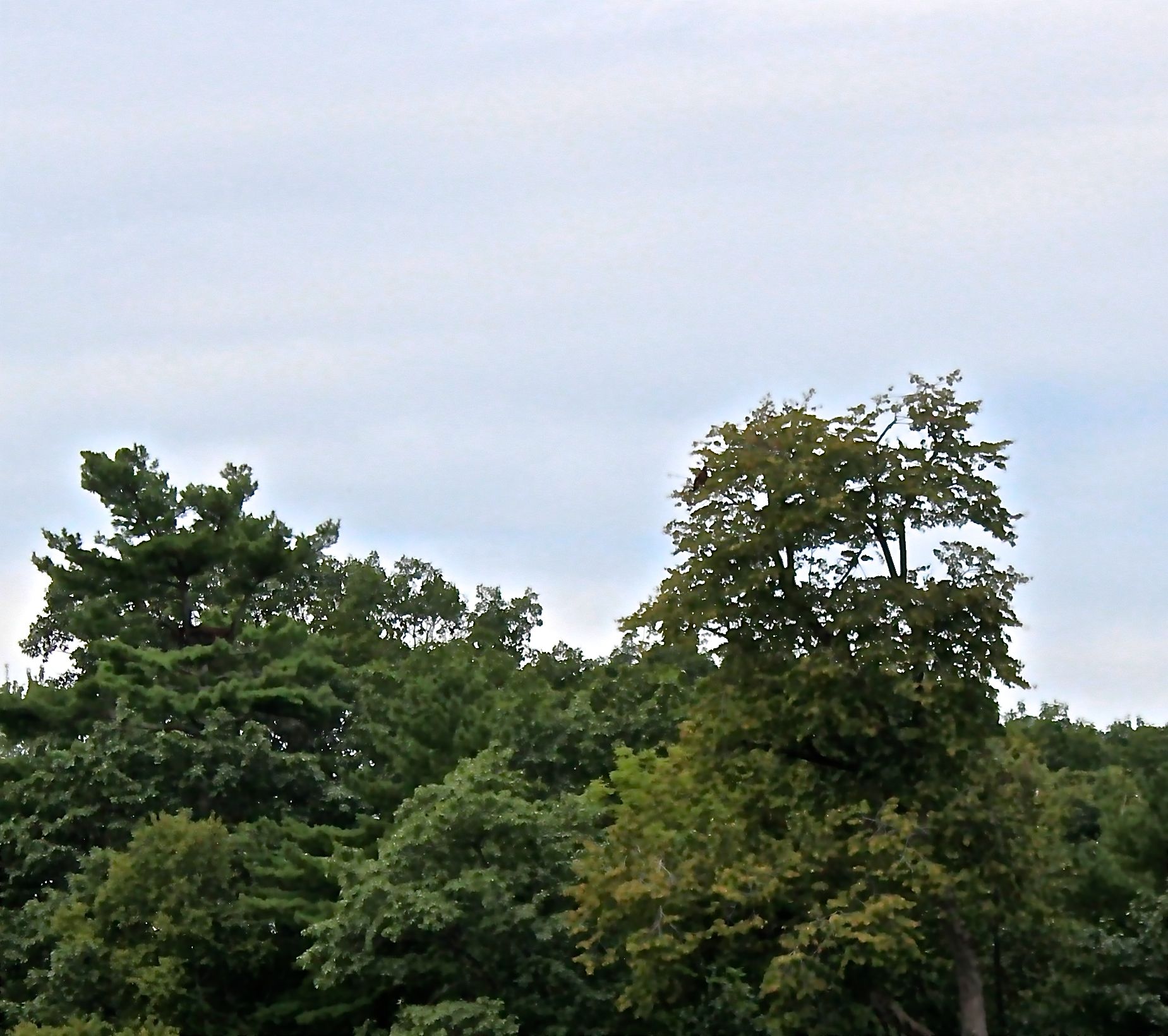
immature bald eagle and nest

And an immature bald eagle let us know of his presence. He’s in the oak on the right, while his nest is toward the top of the pine on the left.

FR monument 1

FR mon 2

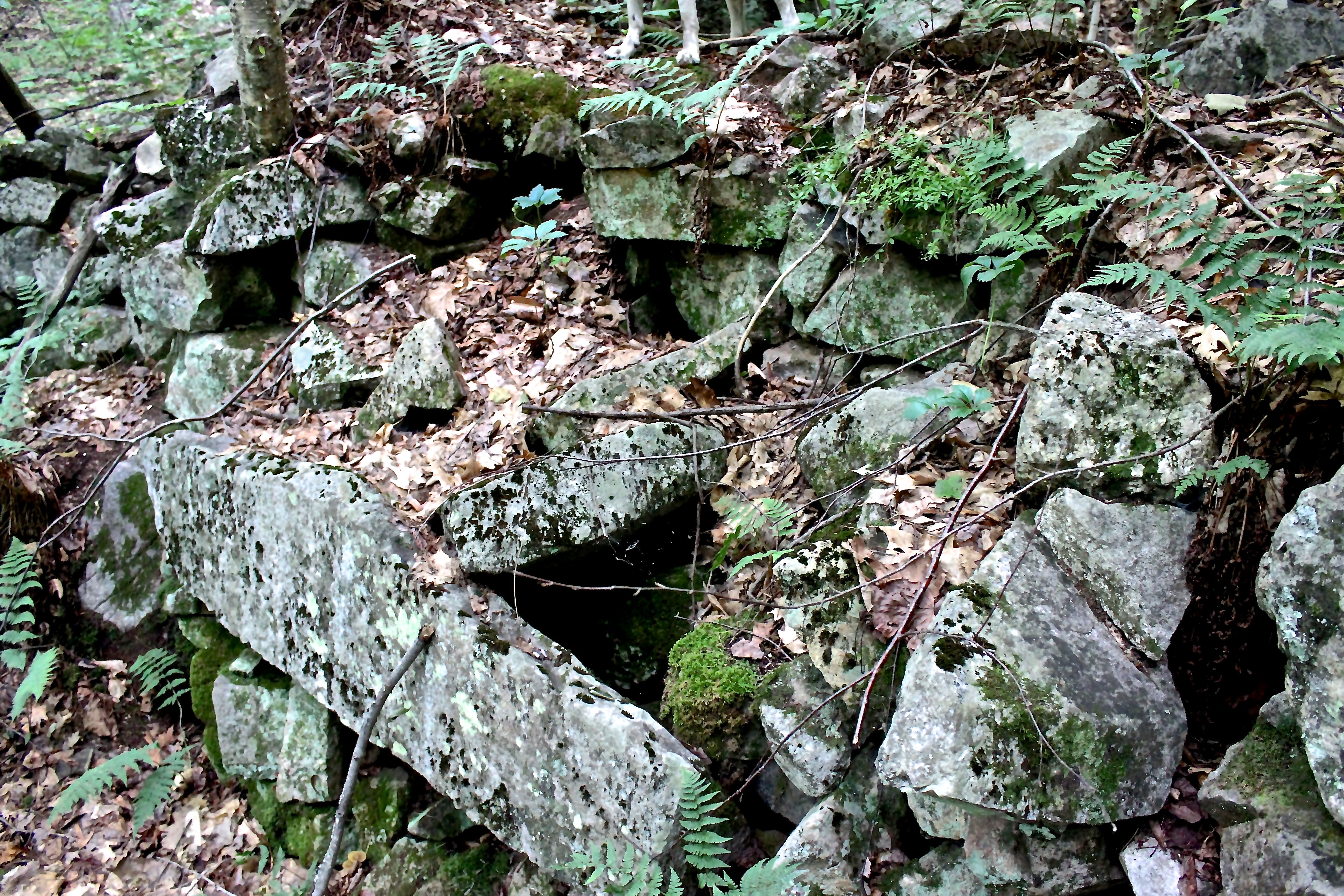
FR school

It is Kate’s hope that more people will want to learn about the history of this place. Kudos to her for embarking on renewing its spirit.

Summer Fly By

It’s the height of summer. I love every season, but wish I could slow this one down and spend more time soaking in all that it has to offer. This week alone is flying by.

mystery stones

My offerings are a mishmash of what I saw and did during the week, beginning with the mystery stones on the backside of Amos Mountain at the Heald and Bradley Ponds Reserve in Lovell.

me mystery stones 2

My friend, Jinny Mae, would love this mystery, so I’m going to ask her what she thinks this is all about. It’s a huge structure and I hope some people will want to check it out with me this Saturday during the Family Fun Day–A Celebration of People, Place and Nature hosted by the Greater Lovell Land Trust.

me mystery structure and mystery legs

There’s one more mystery in this photo–four legs. Do you see them?

trail signs

I continued on to the Wilson Wing Moose Pond Bog Preserve to make some tweaks along the newly installed self-guided nature tour beside Sucker Brook.

Shout out to docent Linda Wurm for all the work that went into re-creating and installing the signs. Warning to the wise: Do not hire the two of us for any house renovations. We discovered talents we don’t possess. A humbling experience.

me hobblebush fruit

One of my favorite plants along this trail–hobblebush showing off its fruits.

me hobblebush

And letting us know that times are a-changing. Say it isn’t so–it’s too early for fall colors. I only found it on this one shrub. Phew.
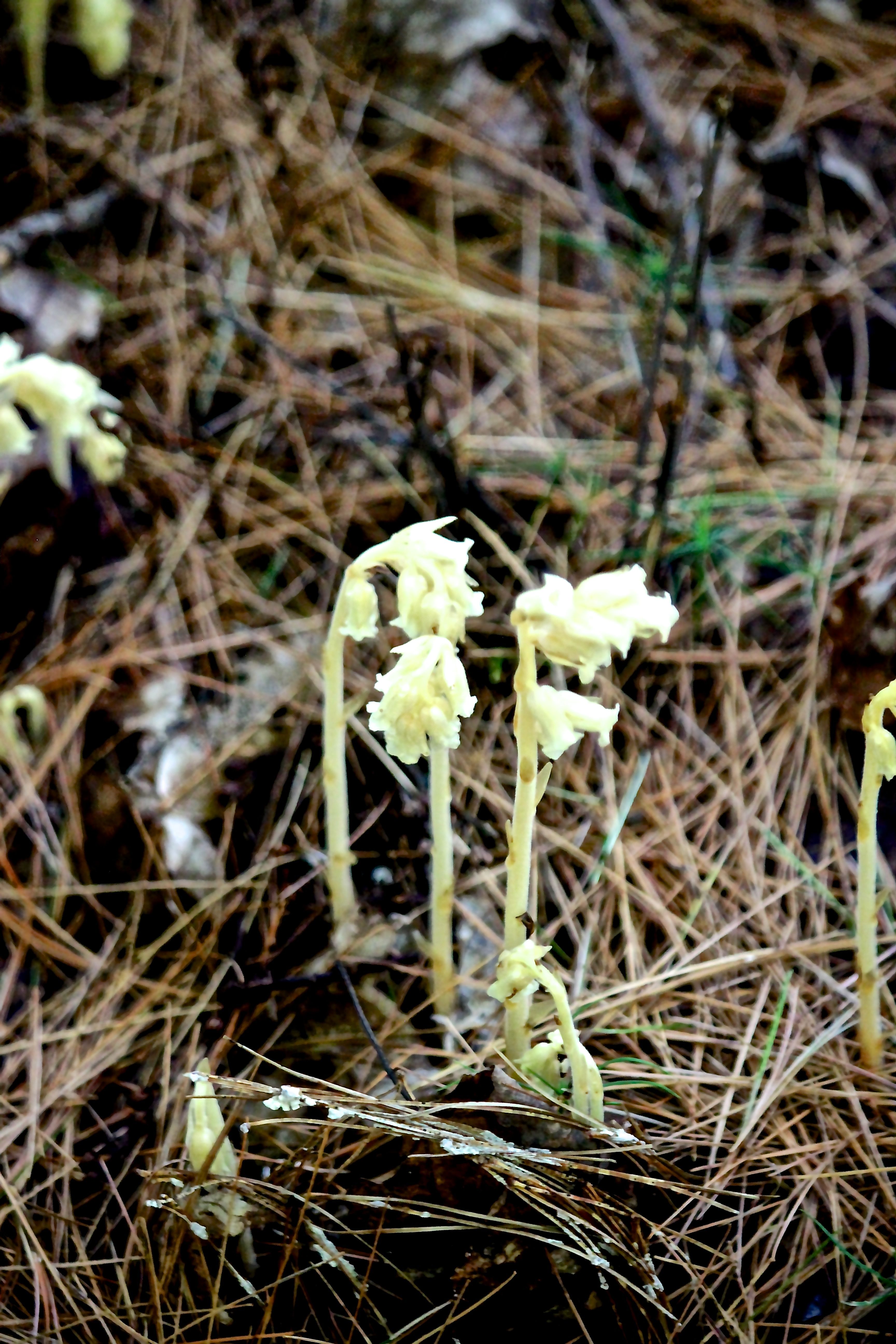
Indian pipe

A docent tramp at the Chip Stockford Reserve on Tuesday took a wee bit more than the usual three hours. The loop trail is only about a mile long, but we’re passionate about checking everything out. The parasitic plants were in full bloom, like this Indian Pipe,

pine sap

yellow-flowered pine-sap, and

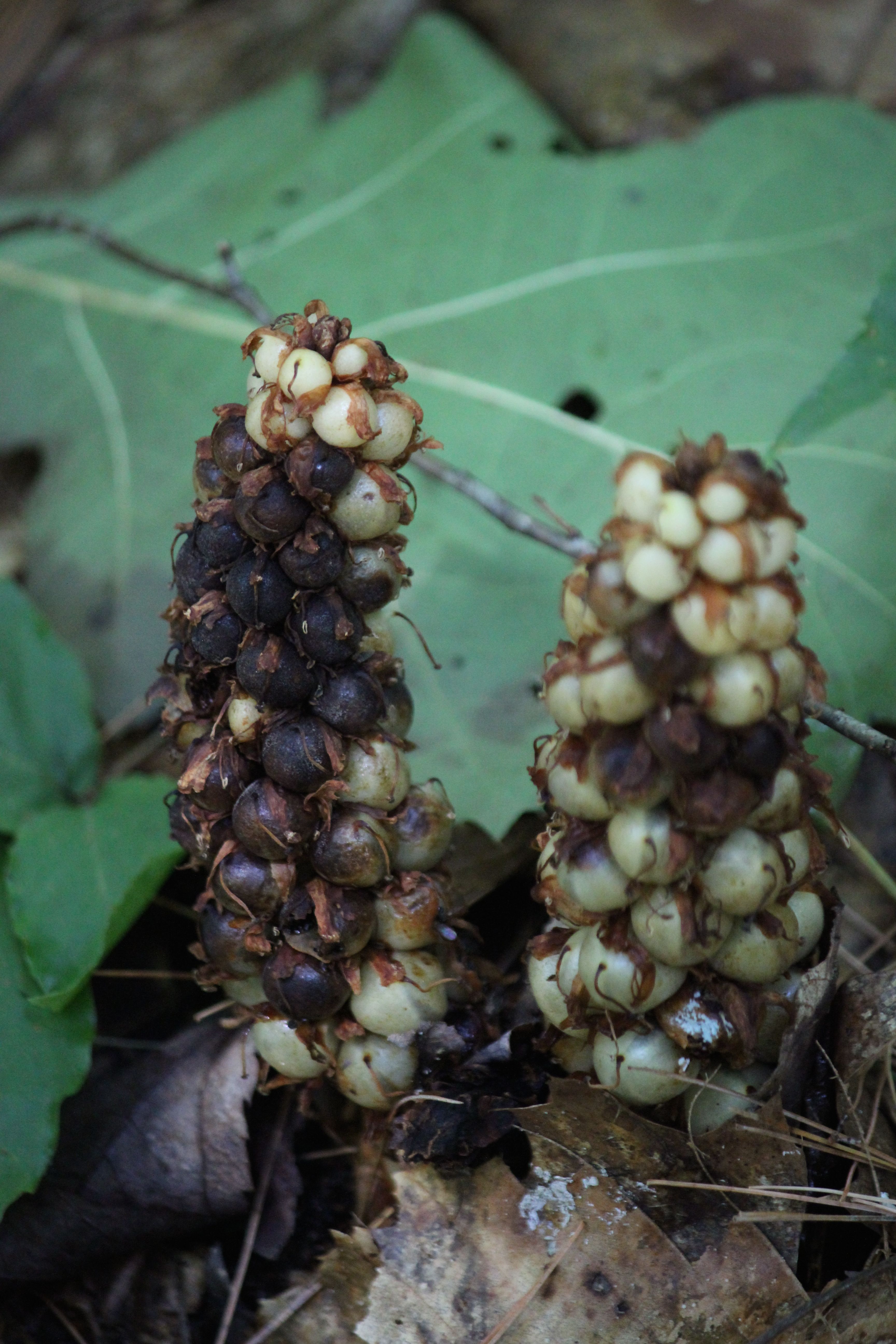
squaw-root

squaw-root. Kind of looks like corn on the cob, doesn’t it? Or a pine cone?

painted turtle

Yesterday, I joined the Lovell Recreation Program for the grand finale to our land trust nature program–a field trip to the Maine Wildlife Park in Gray. Though it can be disconcerting to see wild animals caged, these are here for some reason–and they give us an opportunity to see animals that surround us but are elusive.

me brook trout

What were the kids’ favorites? The turtles and brook trout. Feeding the brook trout especially.

me jf houseme jf house 2

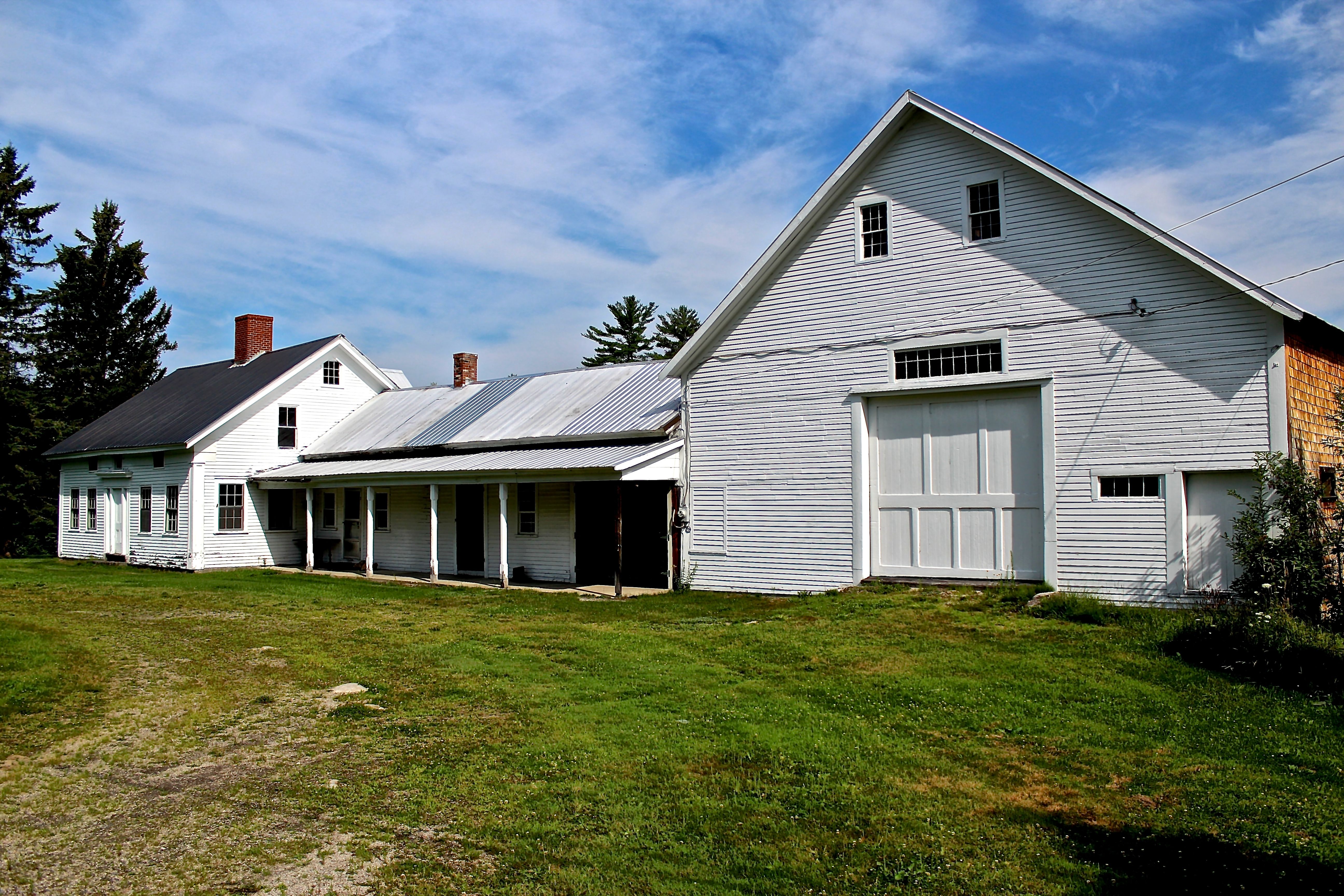
Last night, Brian Fox and Heidi Dikeman, grandchildren of John Fox, hosted a talk for the GLLT about their grandfather and his Yankee ingenuity.  This was John’s house–at the southern end of Heald Pond. Though they thought it funny that I entitled the talk “The Legendary John Fox,” I think it became more apparent as the evening wore on and the stories unfolded that he was indeed a legend in these parts. A magical evening for many who attended.

me dam

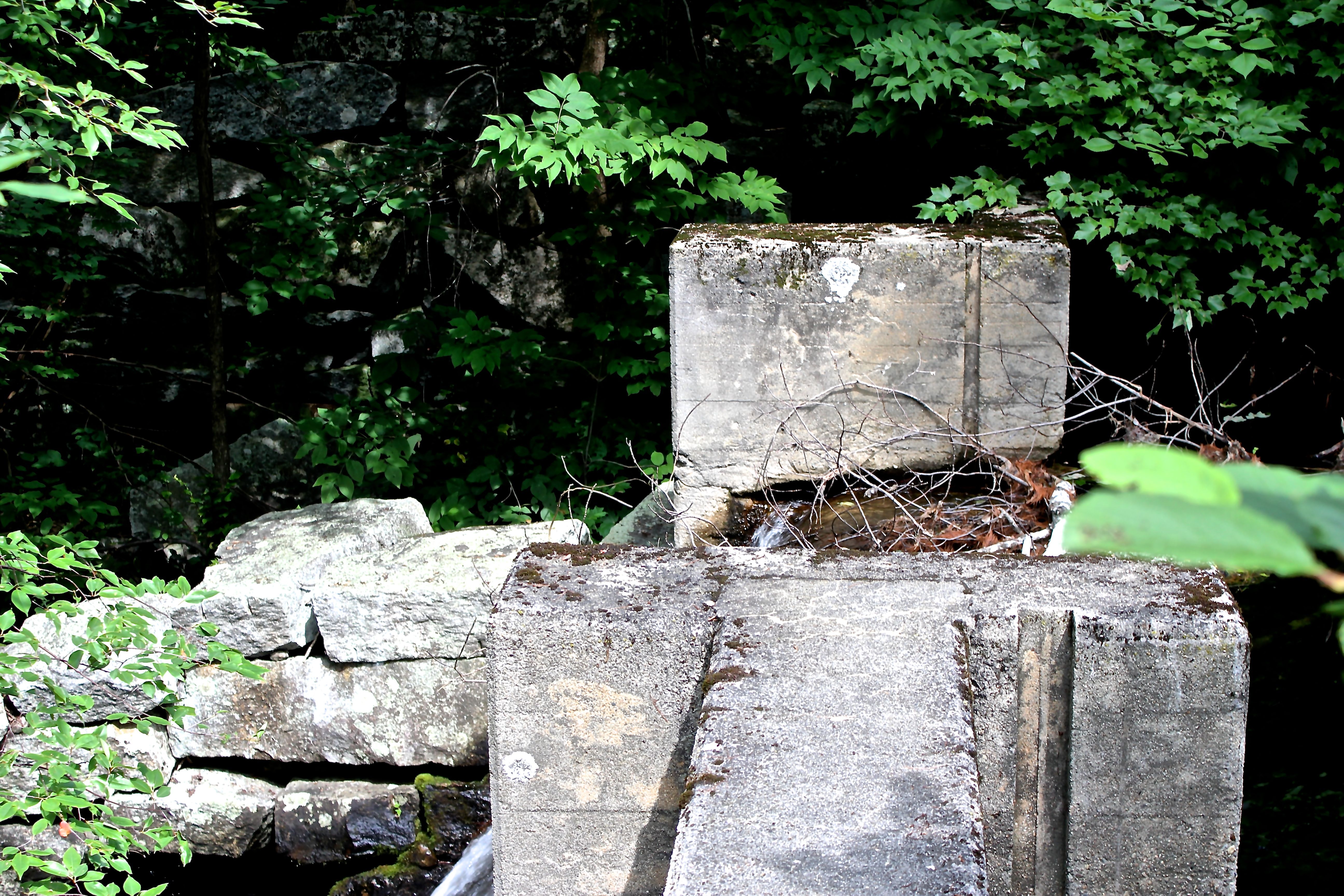
We returned today to learn more about the mill by John’s house. Another shout out–this time to docent Bob Winship, who shared his knowledge of dams with a large crowd. The rocks–a contrast of age and history.

me beech fern

A third shout out to docent Susan Winship for helping us all learn how to identify ferns, like this beech fern with its lowest leaflets pointing diagonally outward, winged attachment to the mid vein, and growth pattern arching toward the ground.

Pam 2

A final shout out to Pam Katz, who starred in her debut appearance as a docent. :-)

view from otter rocks

We reached Otter Rocks and looked back toward John Fox’s house.

me sr2

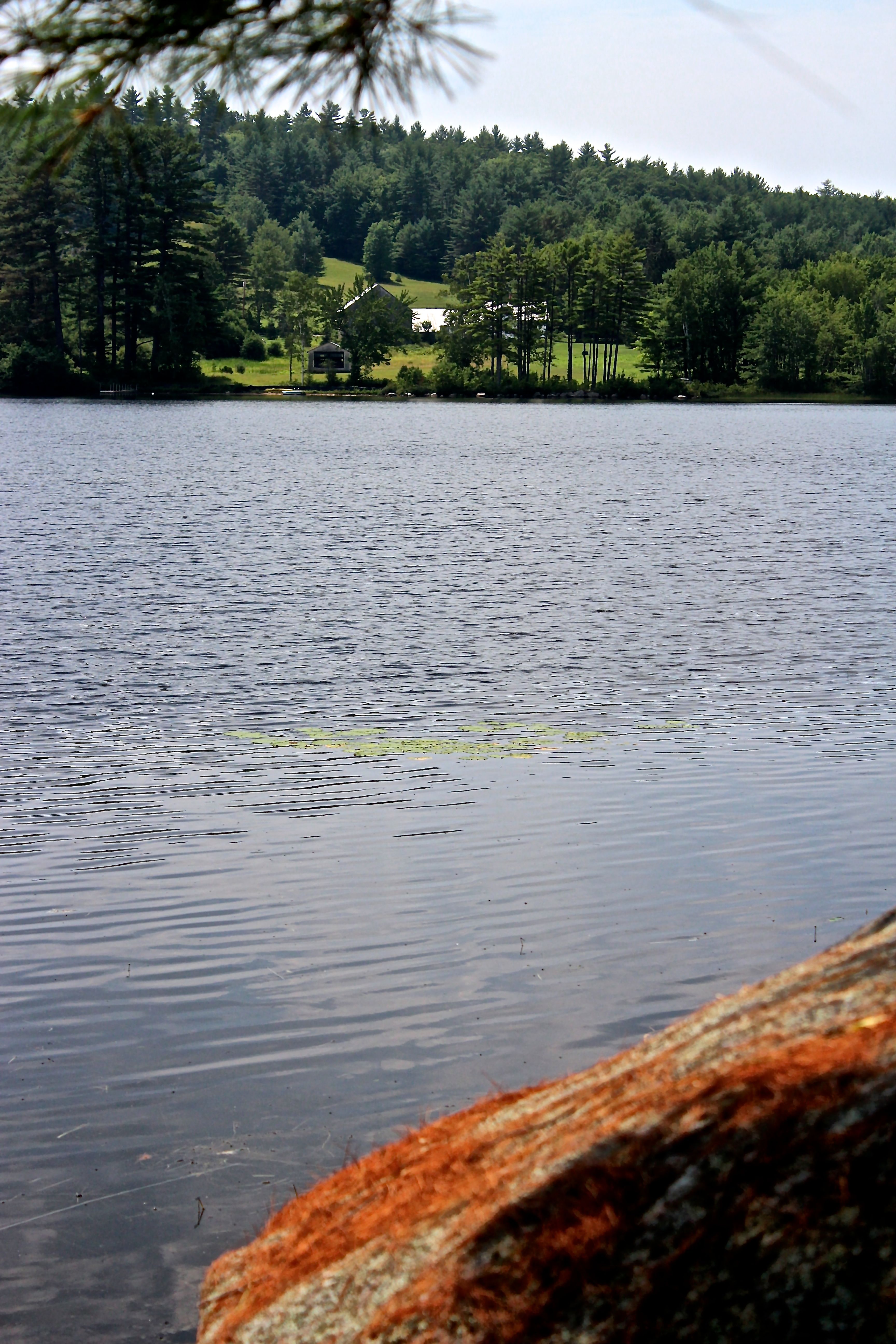
My final stop, though the week isn’t over–the Songo River, which is the connection in the chain of lakes–Long Lake, Brandy Pond and Sebago Lake.

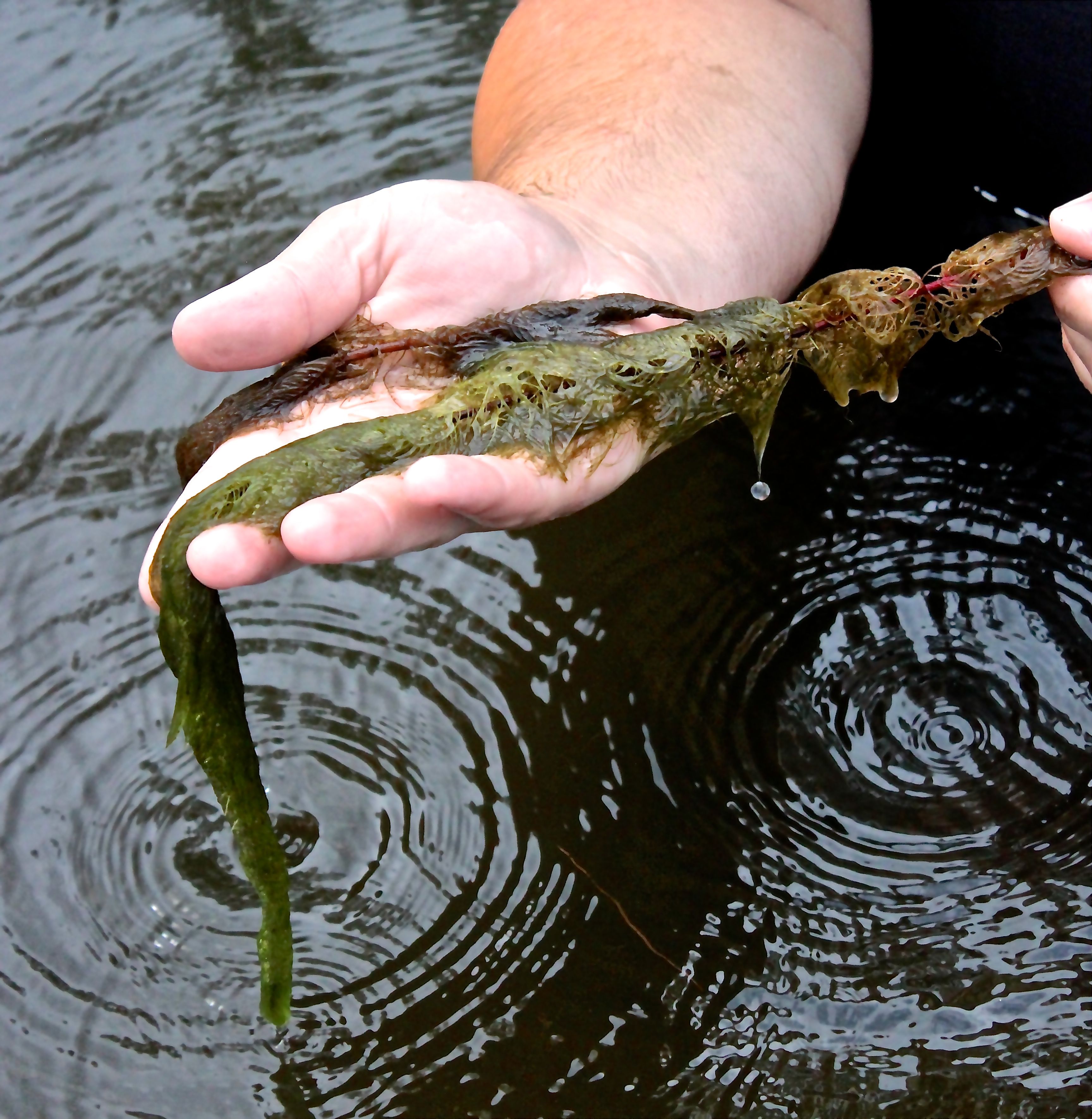
me-variable-leaf

The Songo was the source of a major variable-leaf milfoil infestation that Lakes Environmental Association has been working to eradicate. Notice the red stem? Underwater, it looks similar to our native bladderwort, but that stem is the giveaway.

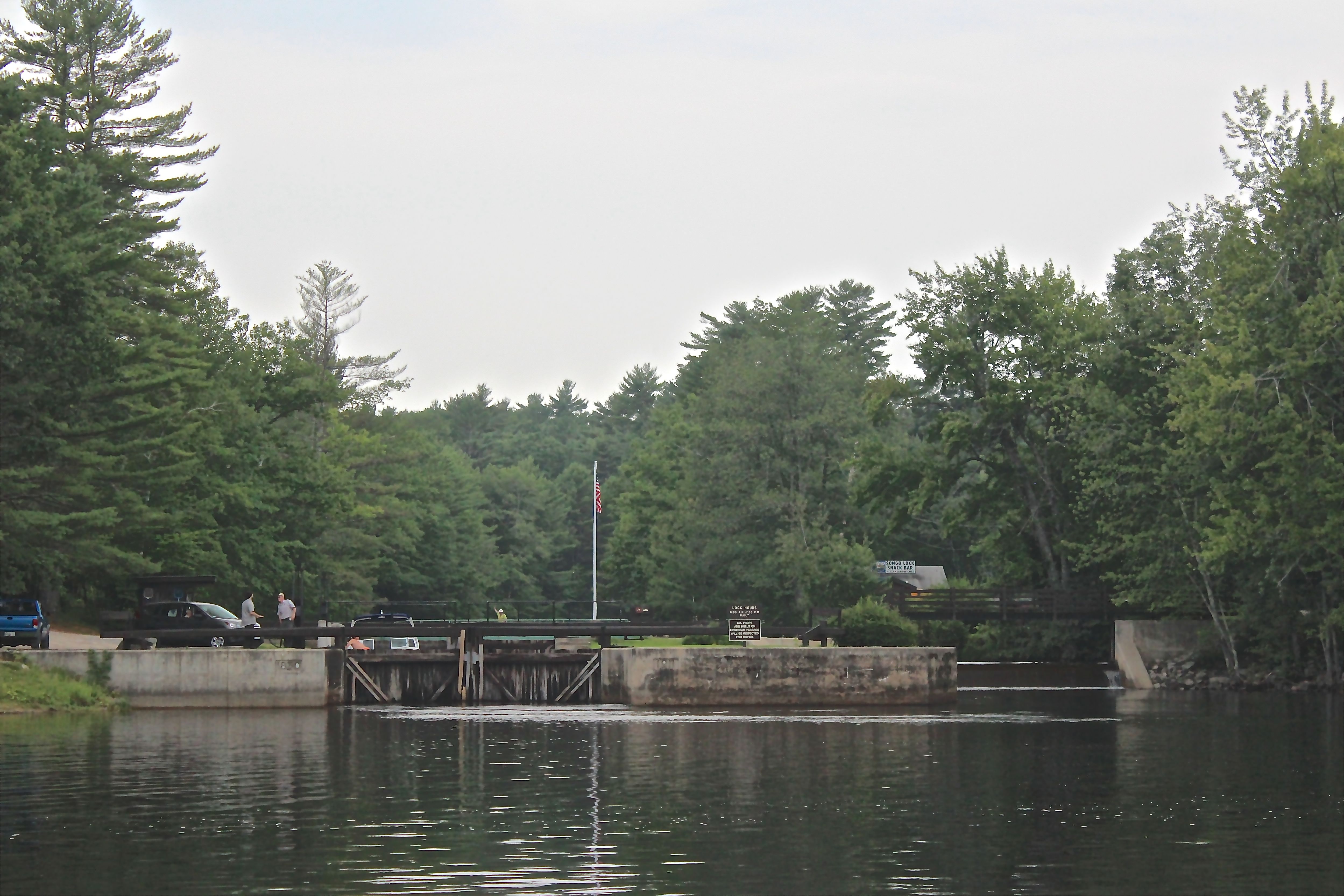
Songo Lock

Among the heavily infested areas–the basin just below the Songo Lock. Today, it’s part of an LEA success story and I get to share that story in a newspaper article.

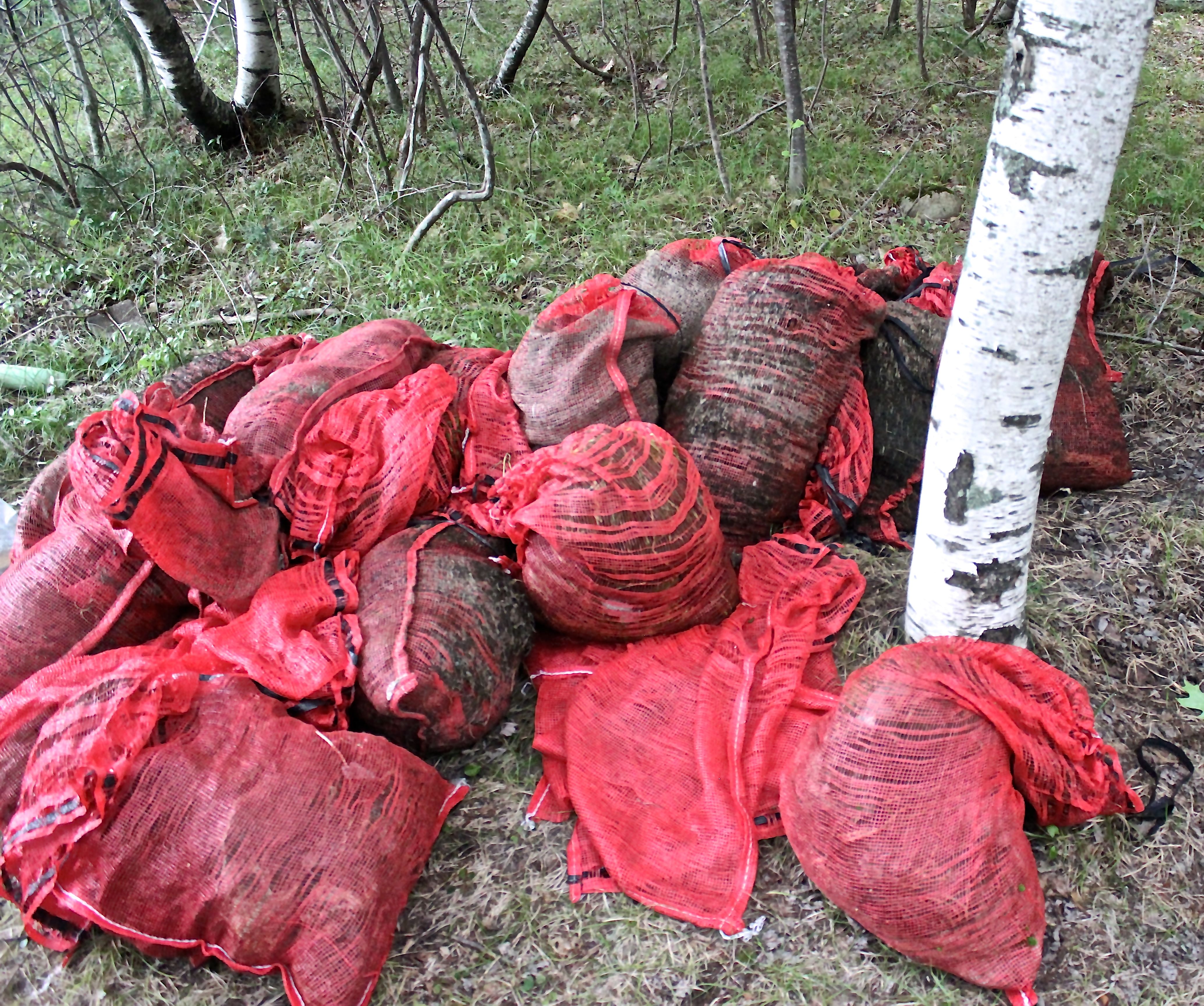
bags of milfoil

These mesh onion bags are filled with milfoil handpicked from the river. But . . . this is nothing compared to the past when the milfoil team used the suction harvester and benthic barriers as their major defense. This pile represents a couple of weeks worth of finds and will warrant a trip to the compost pile soon. In previous years they made daily trips to the compost pile.

me classic boats

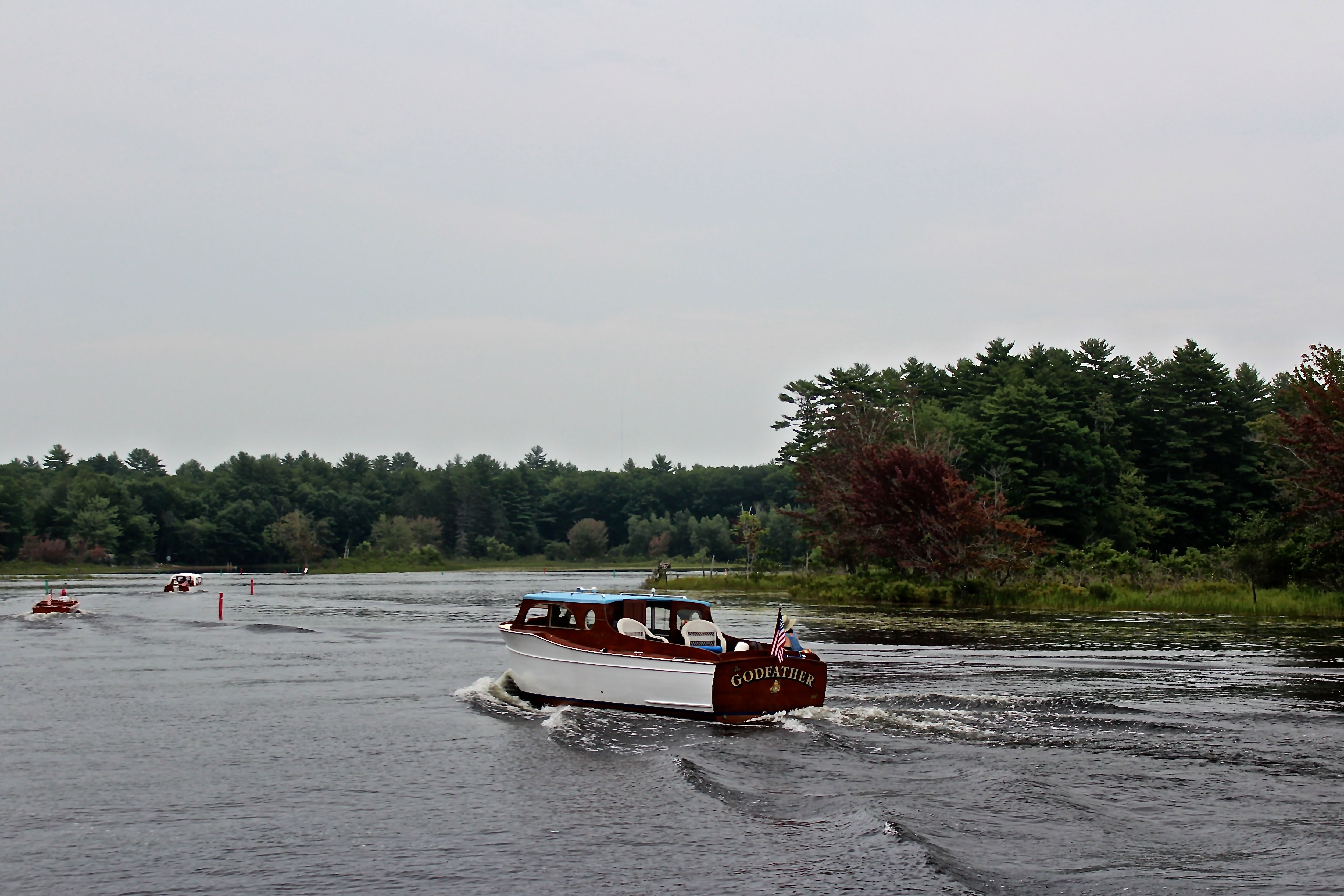
Before leaving the river, we saw a couple of wooden Chris Crafts travel by–enroute to Naples for this weekend’s Antique and Classic Boat Show on the causeway.

me land trust sign

That being said, come to Lovell on Friday afternoon for Bonny Boatman’s presentation on the Uncommon Common Loon, Friday night for the annual education meeting featuring Geri Vistein, conservation biologist for Project Coyote, and on Saturday for the 2nd annual Family Fun Day. Follow the signs.

Summer may be flying by, but we’ll show you how to get out and enjoy it.

life IS good, but we NEED rain

Logger PHil 2

“Einstein said ‘The difference between stupidity and genius,” quoted Maine logger Phil Dow, “is that genius has its limits.'” Whether or not Einstein actually made that statement doesn’t matter. What’s matter is that on a beautiful day in May, Mr. Dow stood beside the reading tree at China Schools Forest in China, Maine, and in his soft-spoken way he informed the students sitting on picnic tables in front of him about Maine’s history and the logging industry. They were mesmerized. So was I. Life IS good. And check out his beard and that reading tree platform. Wow!

China Schools Forest

A friend and I had journeyed to China this morning to observe Forest Days in the 50-acre forest abutting the China Primary and Middle Schools. Six hundred, yes, you read that correctly, 600 kids participated in the program. With their teachers and parent volunteers, they moved from station to station, learning about forest management, pond critters, soil composition, tree id, flower dissection, and so much more from over 30 presenters. They were engaged, happy, polite . . .  and not in school. 600 kids roaming about. We loved hearing their voices wafting through the woodland.

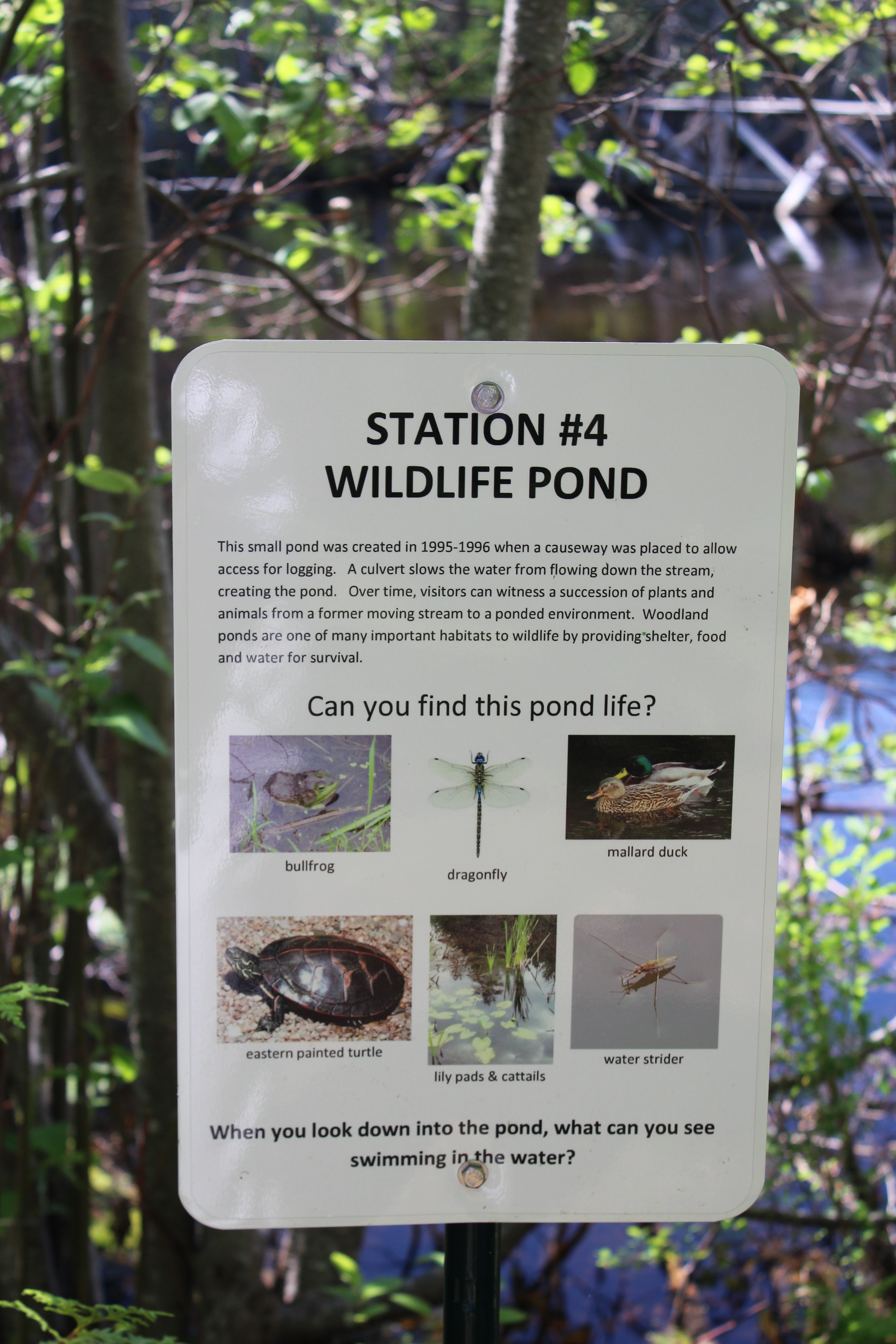
station 4, wildlife pond

We not only wanted to see how the program worked, but also to take a look at the outside classrooms. Created in the 1990s, this demonstration forest is an on-going project. To date, there are seventeen classrooms. At each, an interpretive sign explains what you should notice. (Disclaimer: the signs were created by Anita Smith, a former teacher at the schools and a Maine Master Naturalist graduate, who served as our most gracious guide today. Anita and a colleague have spent the last year developing today’s program. They offer Forest Day every other year, but the outdoor classrooms are always available.)

kids on bridge

There’s a silviculture classroom, a red pine plantation, a tracking pit, den tree and more. And across the man-made pond, is a bridge that expands at the center, creating plenty of room for an entire class of students. Today, they used nets to explore pond life from the bridge.

leach

My friend and I explored pond life as well. Check out this leach.

dragonfly

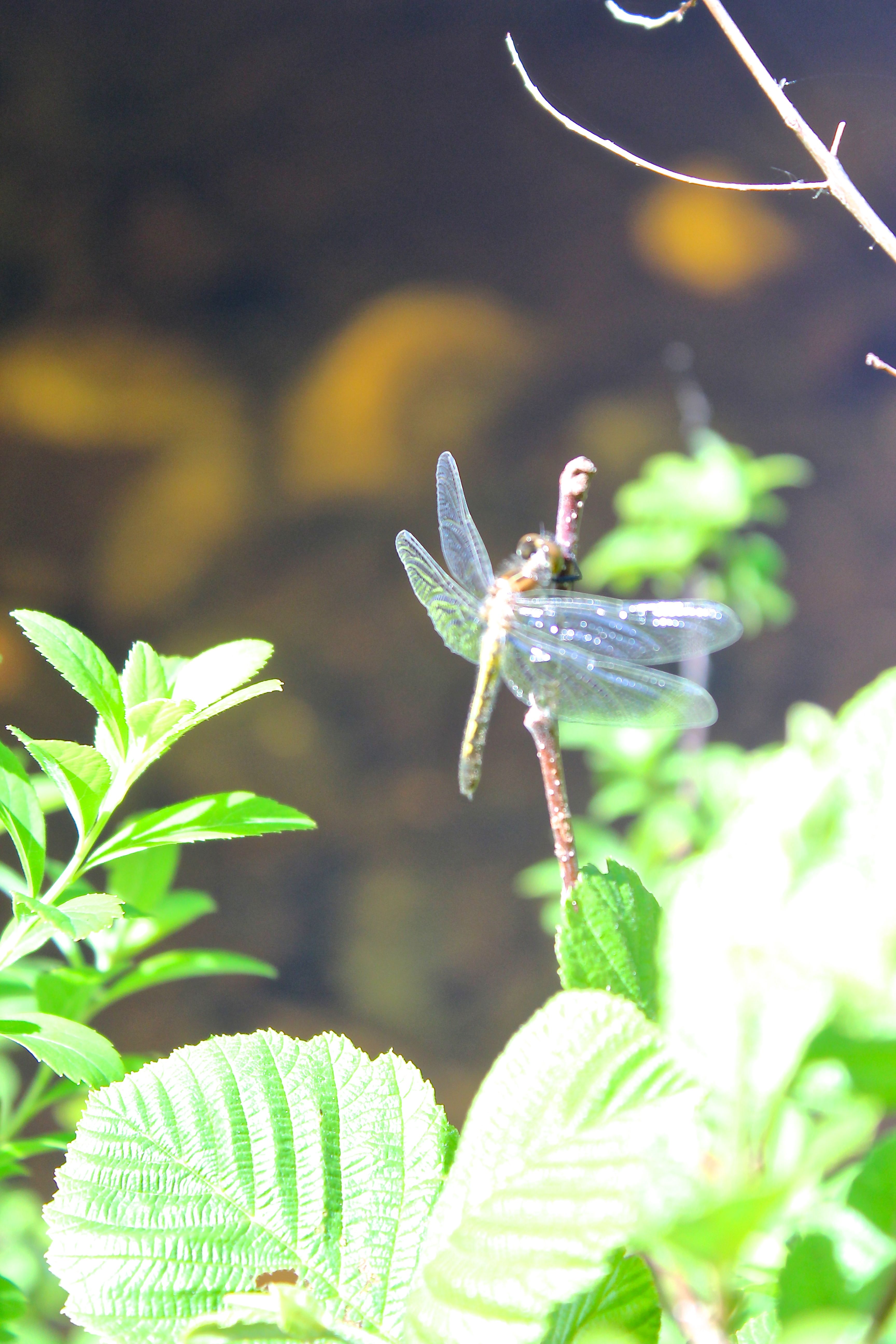
And a dragonfly. Dragonfly sitings–always worthy of a celebration.

measuring-wood-300x200

Though I didn’t see them work with this today, at the Forest Measurement classroom, they learn how to measure a cord of wood and board feet. And about the clinometer, a hand-held instrument used to measure ground slope, road grade and tree height, plus a biltmore or woodland stick used to estimate tree height and diameter. When we paused today, a local forester had middle school students simulate best forest management practices.

white lady's slipper

As we walked along part of the 1.4-mile path, we also noticed the flora–a White Lady’s Slipper. In Newcomb’s Wildflower Guide, this is listed as very rare.

pink

Pink Lady’s Slippers grow abundantly in these woods.

False Solomon's Seal

We also saw False Solomon’s Seal or Wild Spikenard.

job-started-300x200

I have a lot of favorite things about this place, but the two that top my list are the reading tree where Logger Phil spoke and the signs above the pavilion–especially this one: “Congratulations on a job well started.” Indeed.

The driving was a cinch because we chatted non-stop and two hours later, I was home again, home again, jiggity jig.

If you read my post yesterday about the vernal pool, you won’t necessarily want to read any further. The life cycle is complete. Less than 24 hours after my visit yesterday afternoon, the pool has dried up.

VP 1

And, I’m afraid the tadpoles have succumbed.

dead tadpoles

To the earth they shall return in one form or another.

flies galore

The place was buzzing with flies.

Moose Pond

So on a brighter note, I visited my third “pond” of the day–Moose Pond. It was the perfect setting for a late afternoon interview.

life IS good, but we do NEED rain.