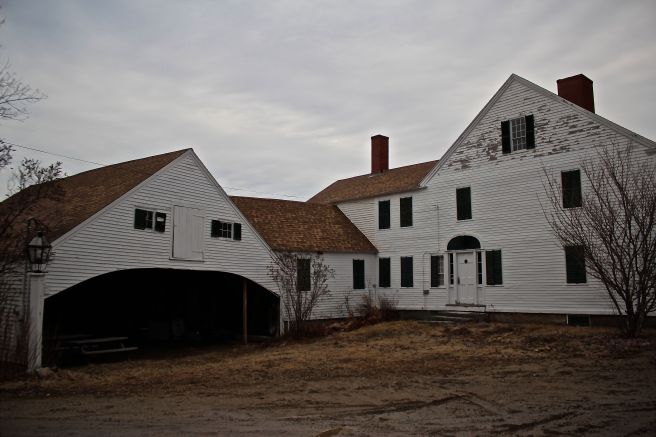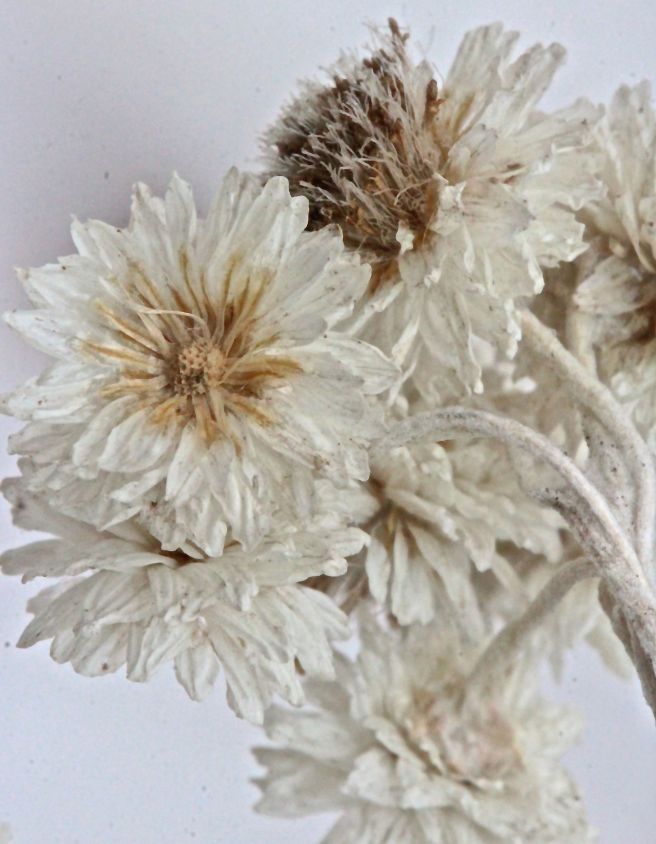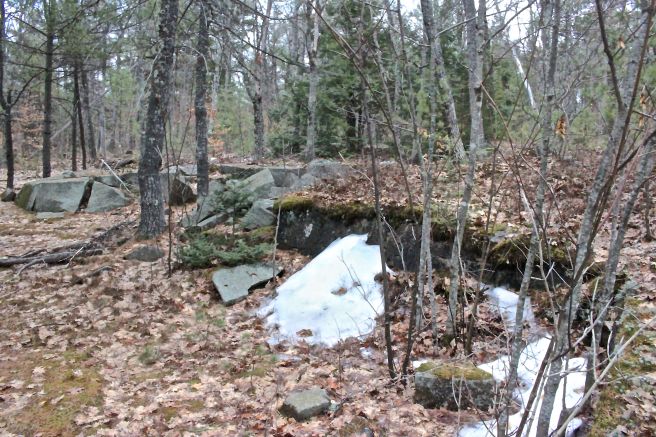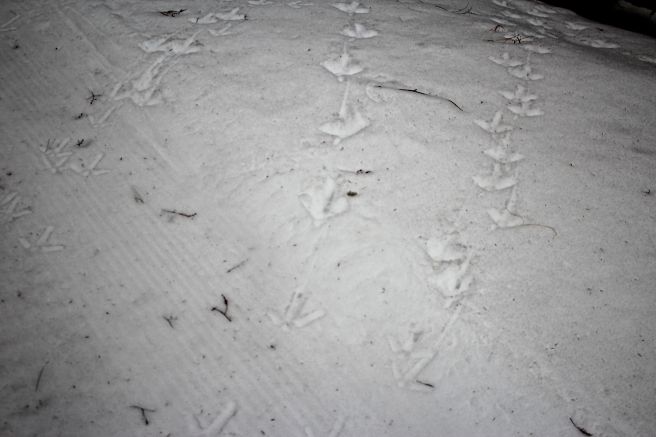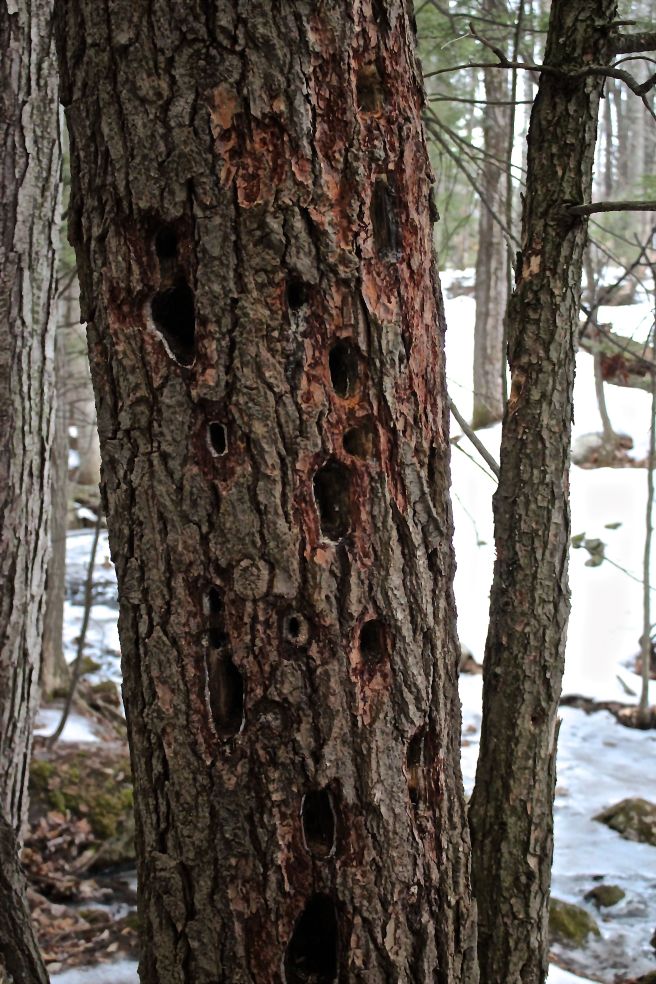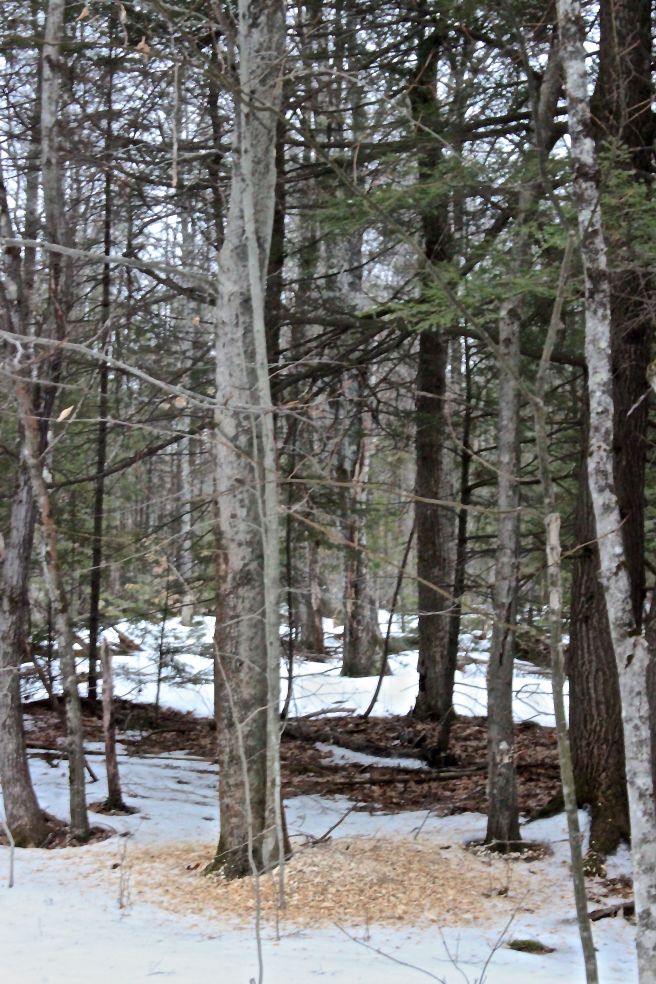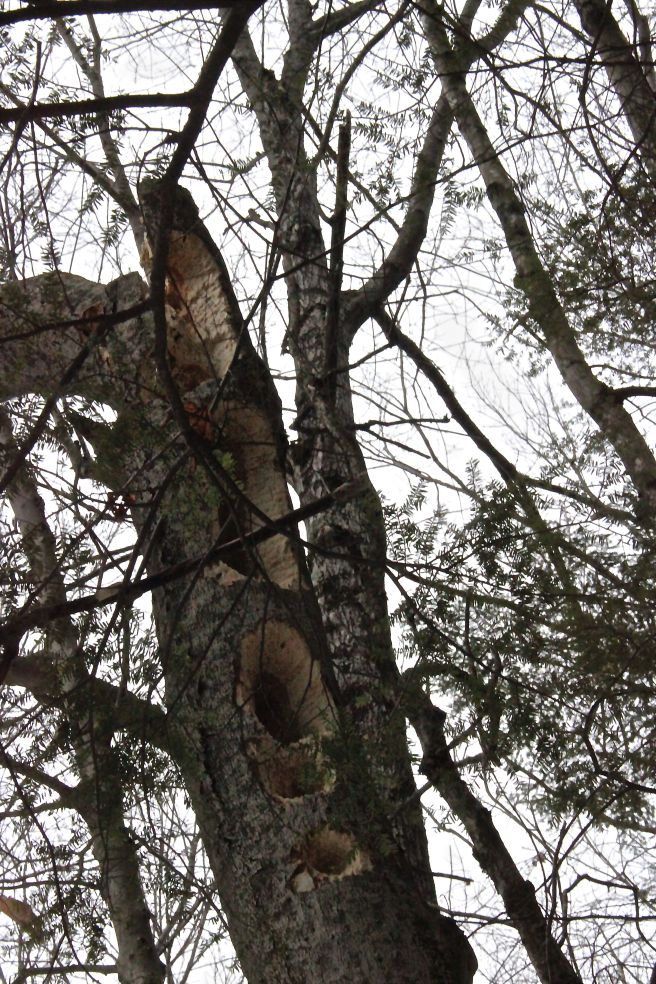
On the Prowl at Heald & Bradley Pond Reserve

My original intention when I set out this morning was to snowshoe from the Gallie parking lot on Route 5, follow the Homestead Trail and then connect with the Hemlock Trail as I climbed to the summit of Whiting Hill. I planned to make it a loop by descending via the red trail back to the green Gallie Trail.

w-mill-in-morning-light1

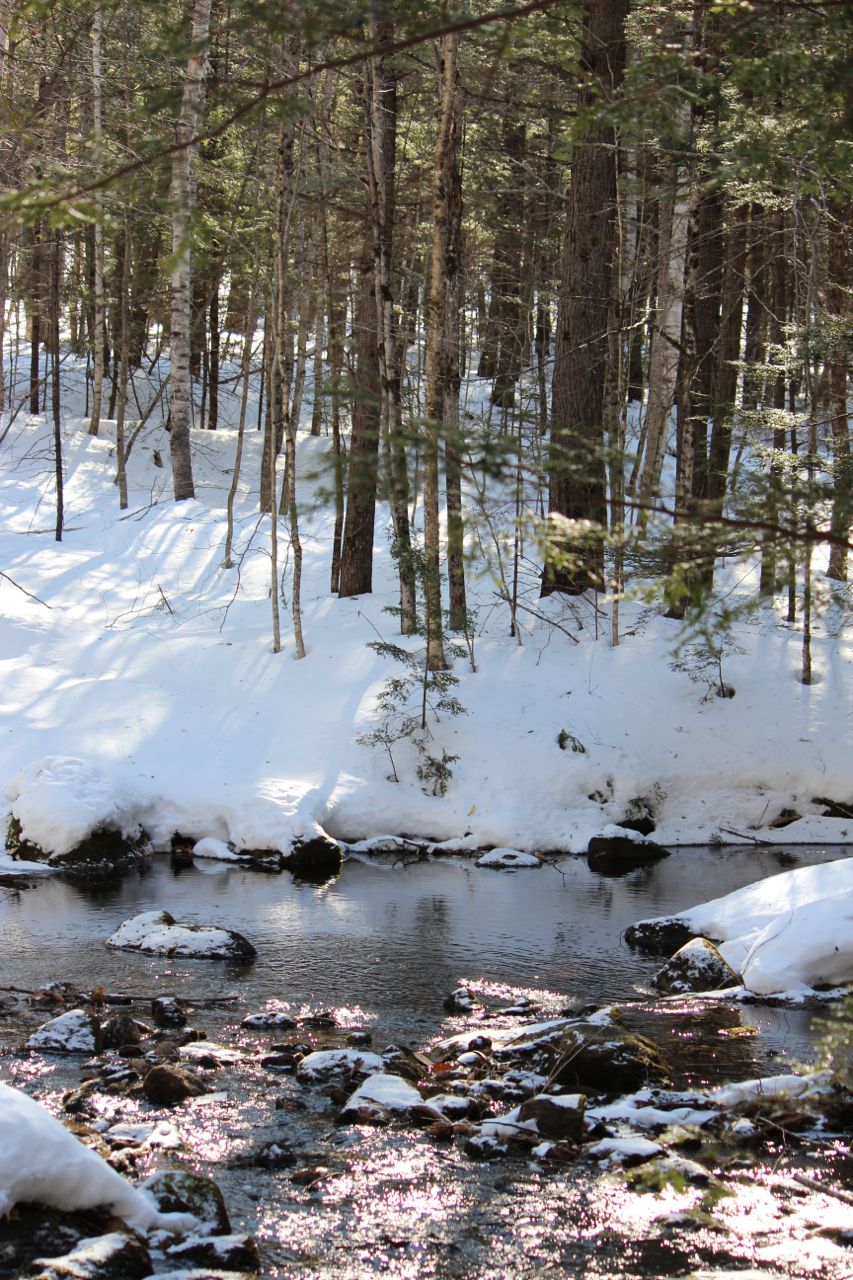
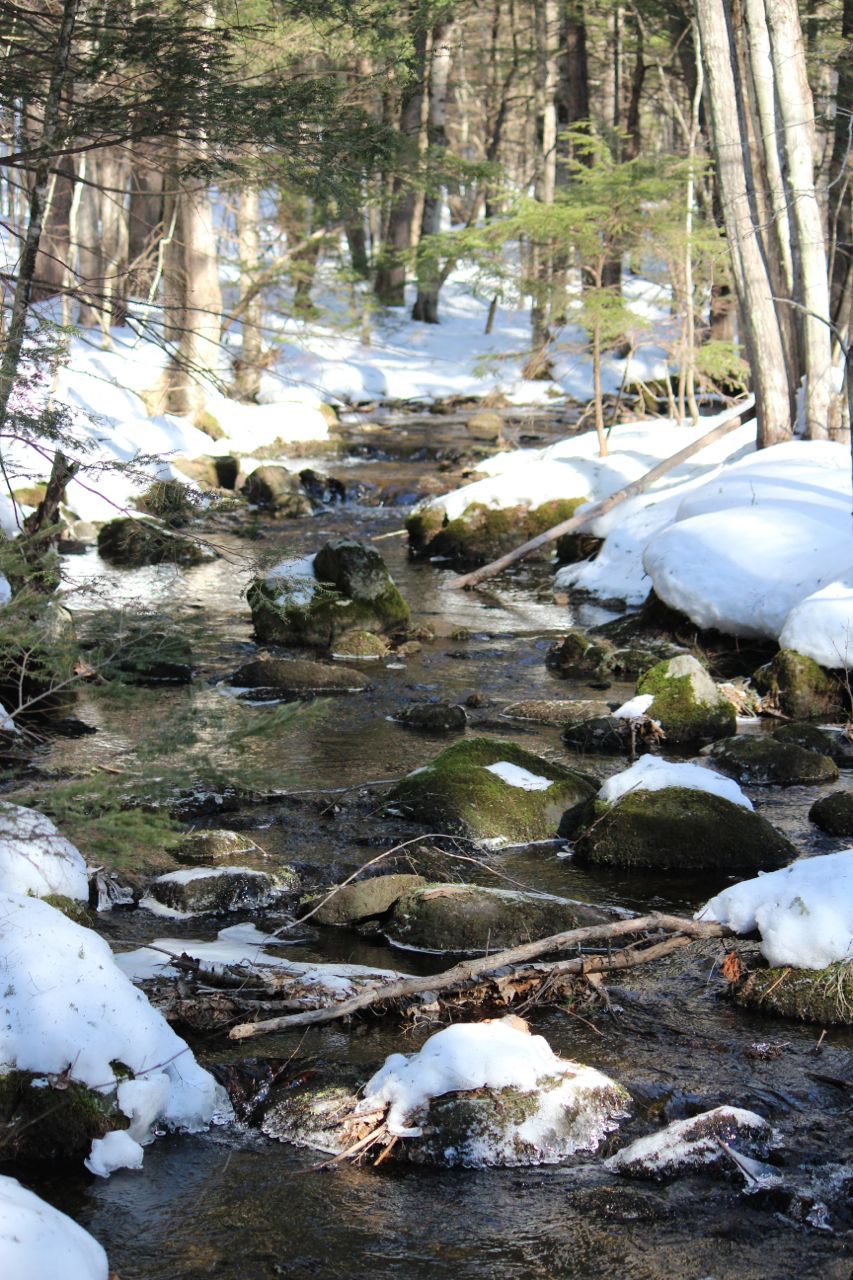
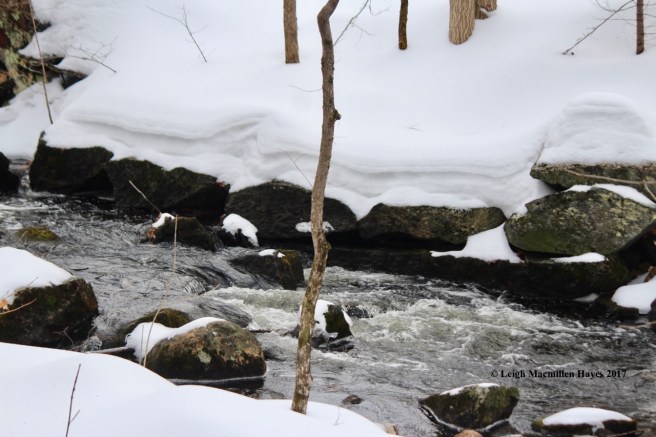
Not to be as the parking lot hadn’t been cleared yet of yesterday’s Nor’easter, which dumped several inches of snow, sleet and freezing rain upon the earth. When Plan A fails, resort to Plan B. A drive down Slab City Road revealed that the Fairburn parking lot wasn’t yet cleared either, but the boat launch was open (because the pond serves as a water source for the fire department) so I parked there and headed to the trailhead beside Mill Brook. The sight of so much water flowing forth was welcome, especially considering it was a mere trickle a few months ago.
w-snow-layers-brookside

The layers of snow overhanging the brook told the story of our winter. And it’s not over yet–at least I hope it isn’t. We’re in the midst of a thaw, but let’s hope more of the white stuff continues to fall. We need it on many levels, including ecologically and economically.

w-fox-print

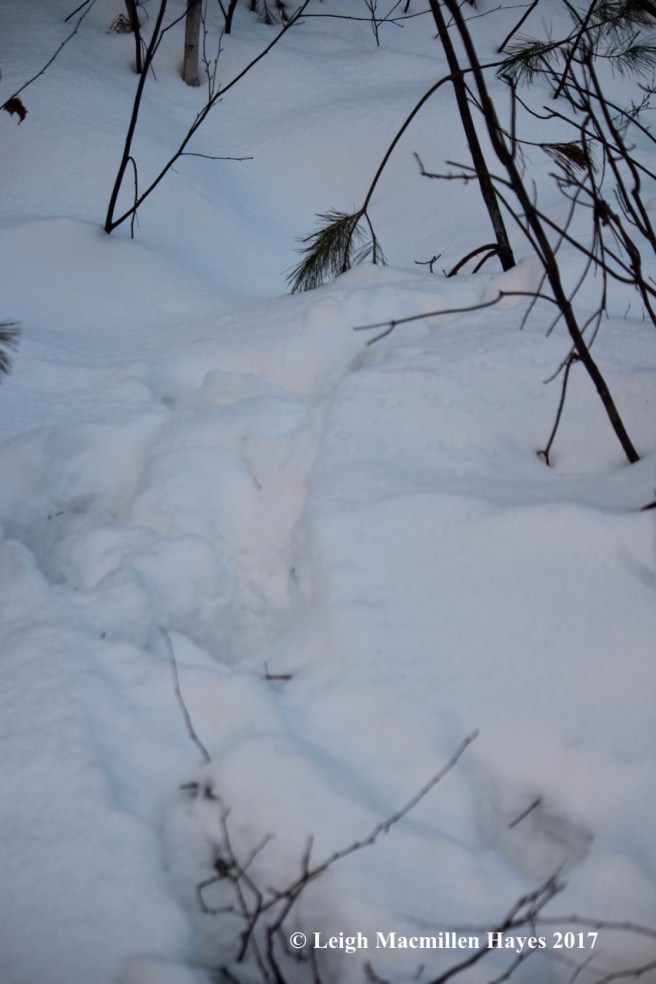
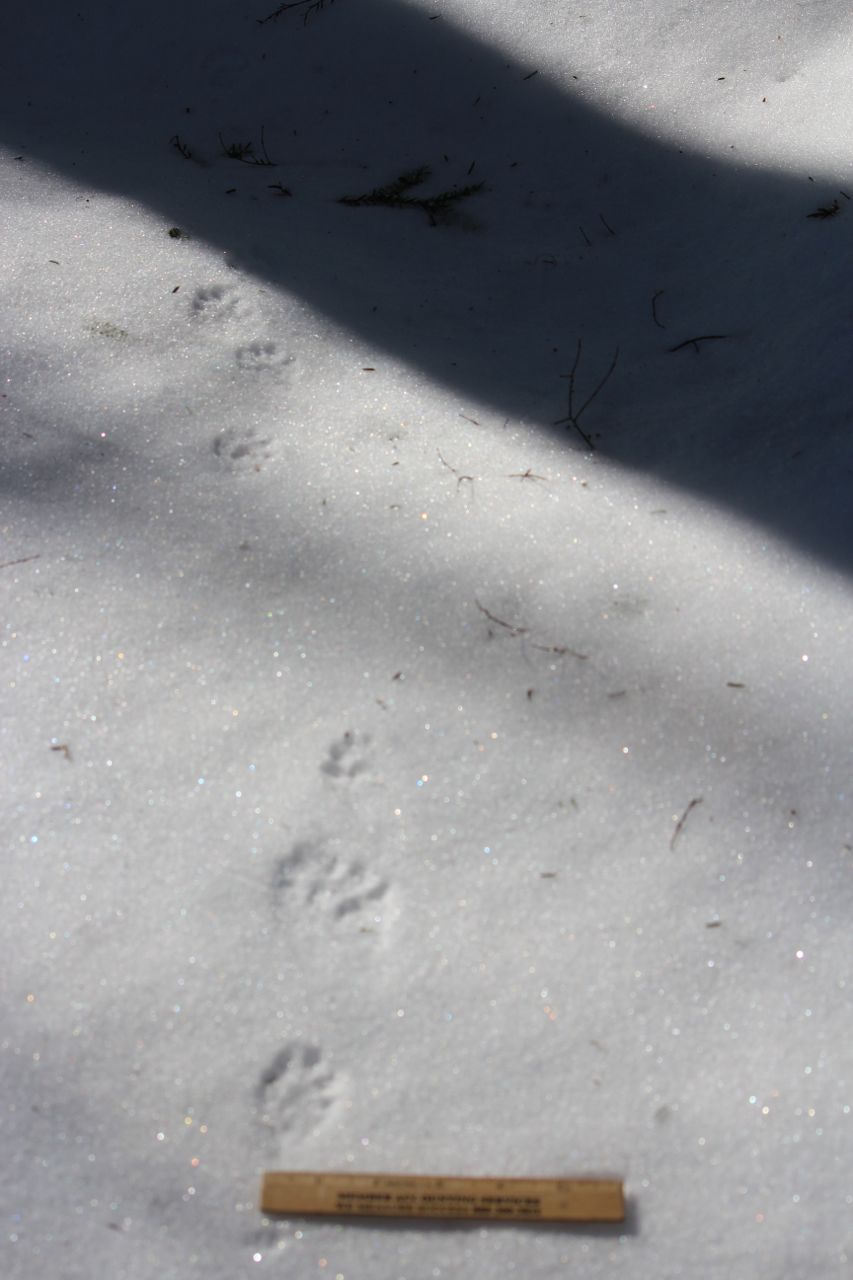
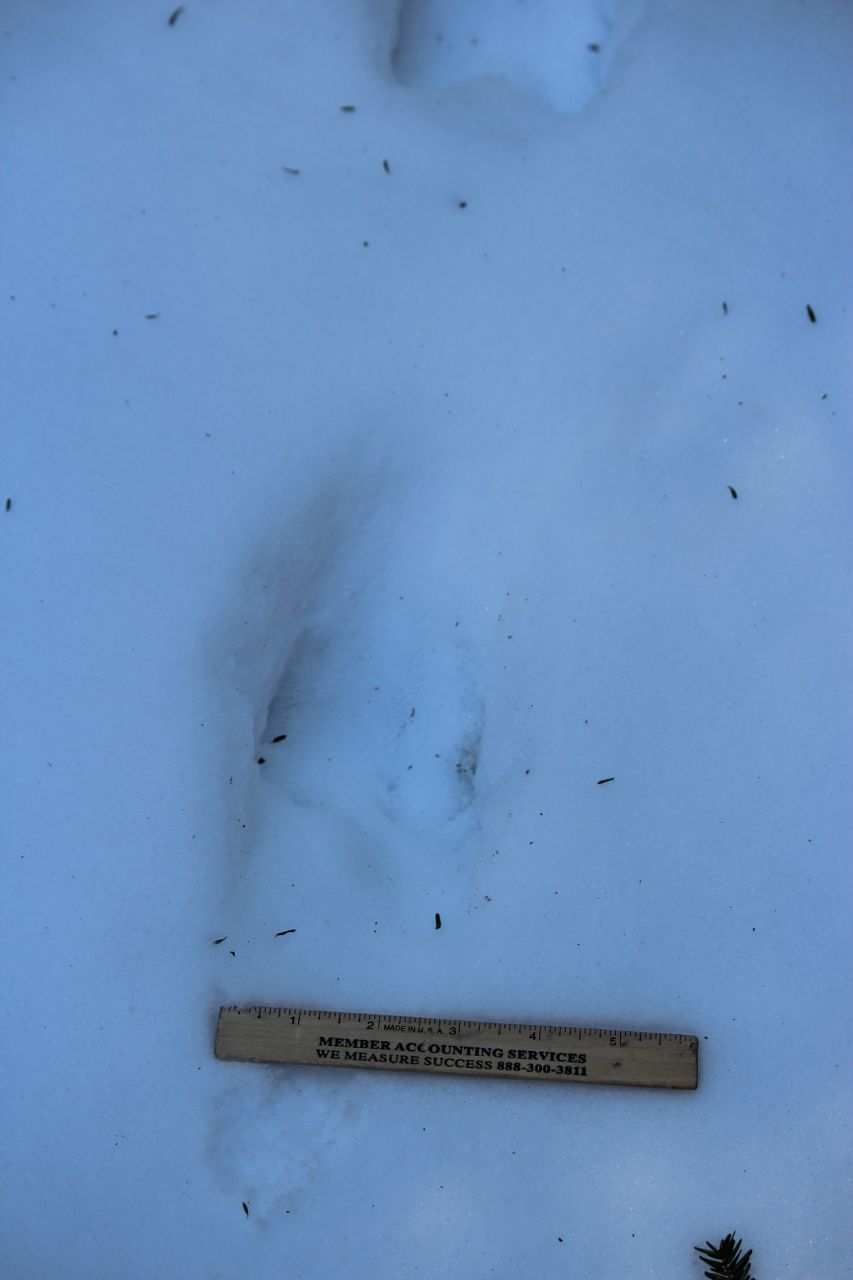
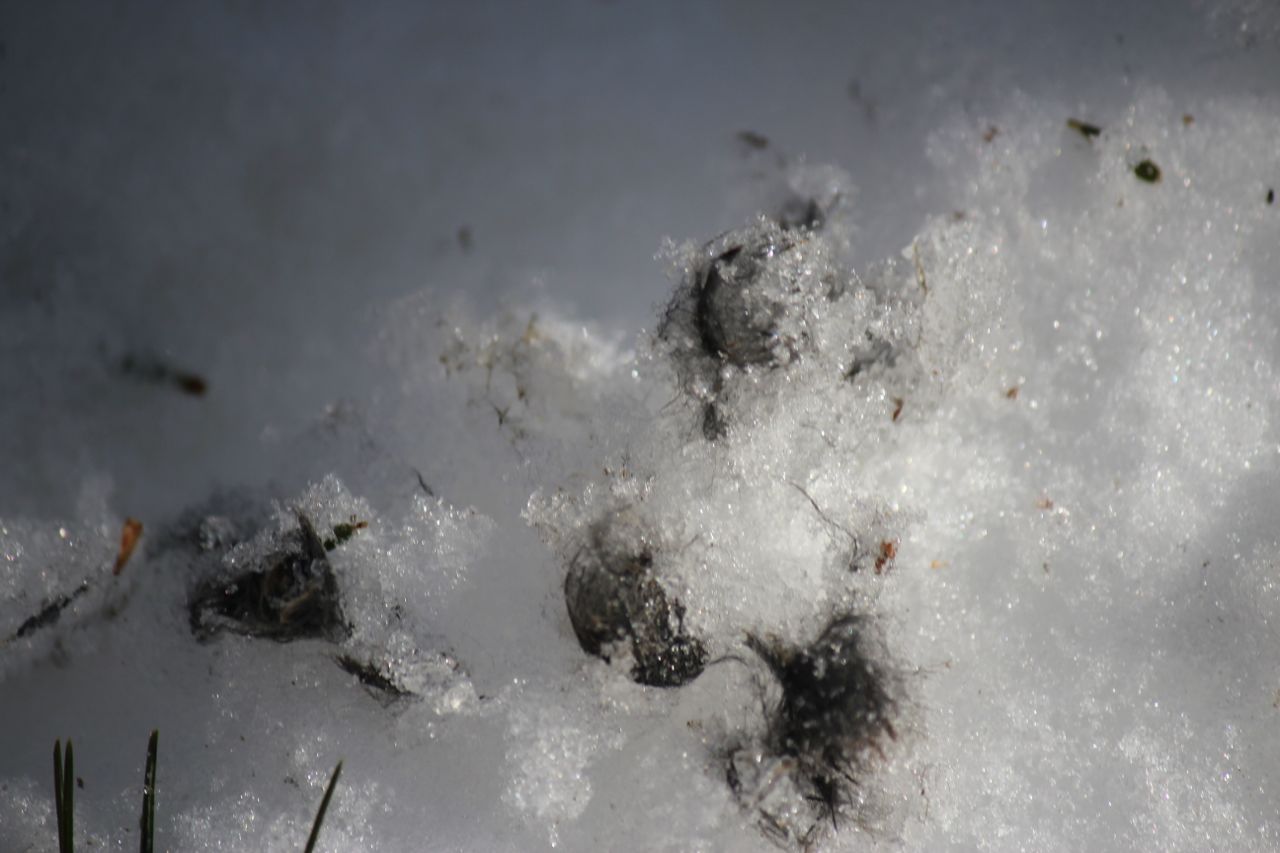
Because of the storm, I thought I wouldn’t see any tracks, but from the very beginning a red fox crossed back and forth between the pond’s edge and higher elevations.
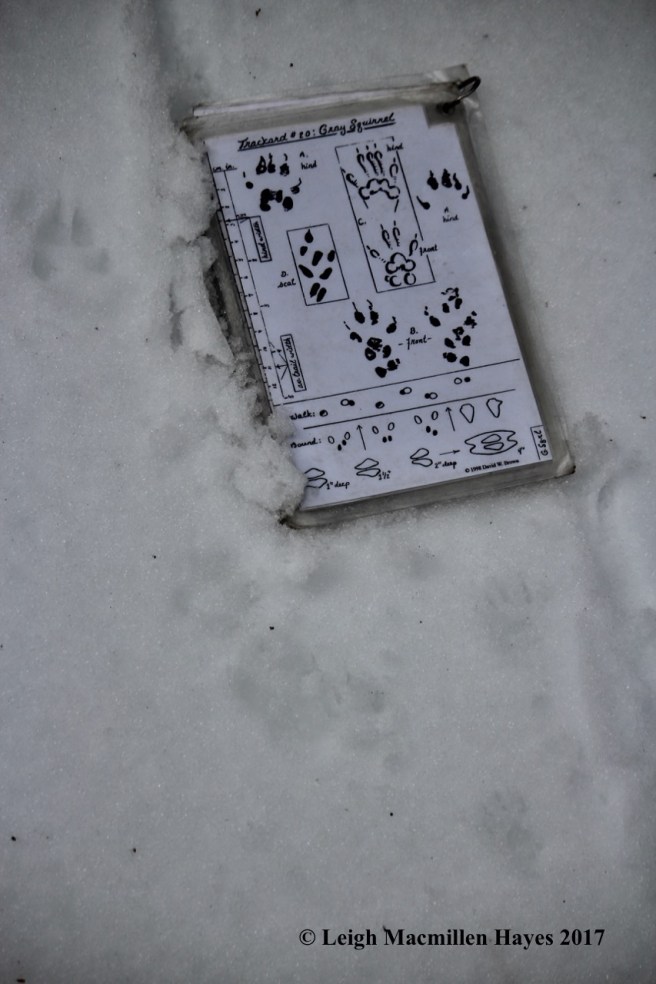
w-fox-and-squirrel

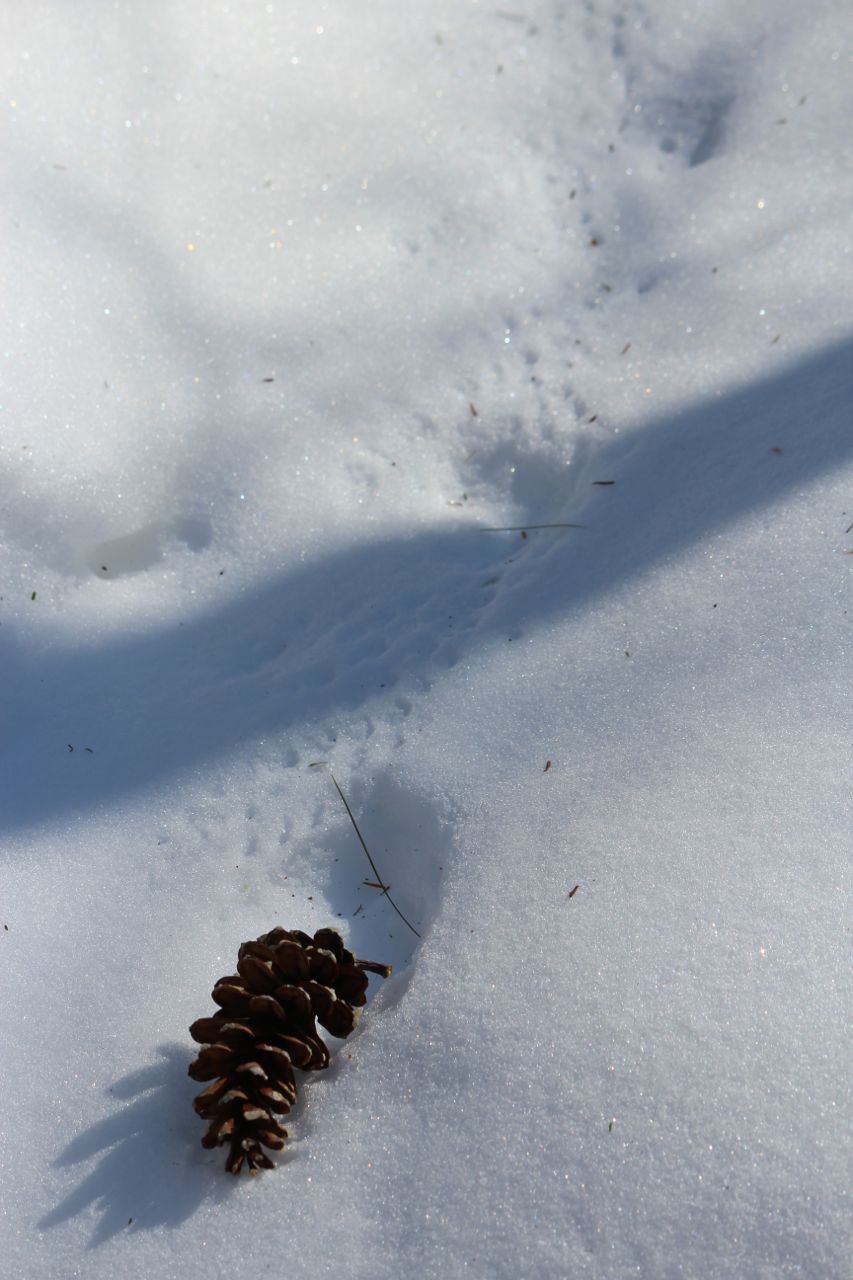
While it may be difficult to discern, a gray squirrel, the four prints with long toes below the Trackards, had leaped up the hill, perhaps after the fox. Lucky squirrel. The fox prints can be viewed to the left of the cards.
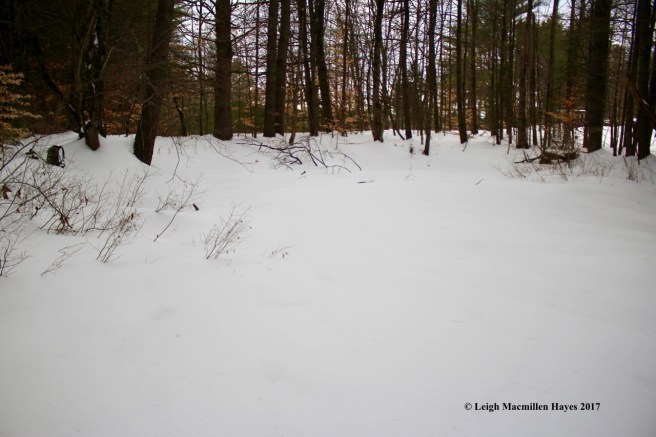
w-vernal-pool

My new plan was to follow the red/blue trail to the summit of Whiting  Hill. And along the way, a side trip to the vernal pool. Visions of fairy shrimp swam in my head. No, I wasn’t rushing the season, just remembering a fun time pond dipping last spring.

w-fringed-wrinkle-lichen

Back on the red/blue trail, I noted that most of the recent seed litter was covered by yesterday’s storm. The Fringed Wrinkle Lichen, however, did decorate the snow. Tuckermanopsis americana, as it’s formally known, grows on twigs and branches of our conifers and birches and often ends up on the forest floor.

It’s a foliose lichen that was named for Edward Tuckerman, of Tuckerman’s Ravine fame on Mount Washington. According to Lichens of the North Woods author Joe Walewski, Tuckerman was “the pre-eminent founder and promoter of lichenology in North America.As a botanist and professor in Boston, he did most of his plant studies on Mount Washington and in the White Mountains.”
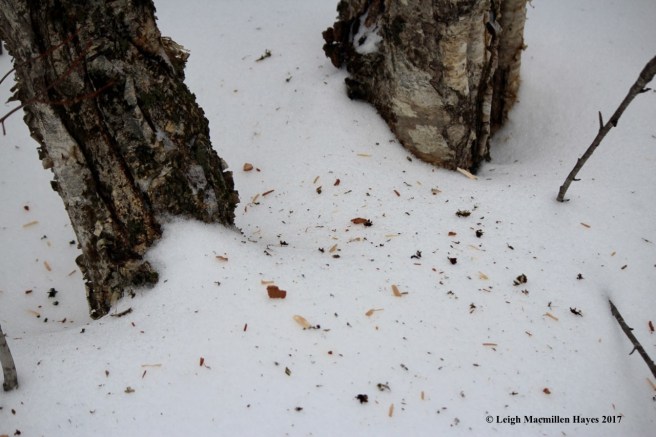
w-pileated-debris

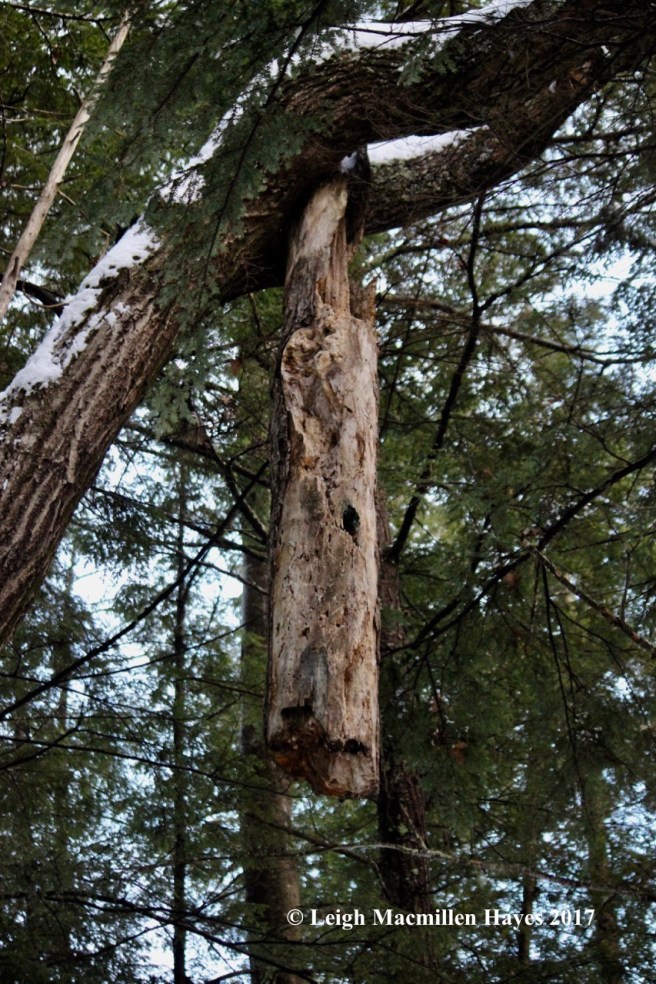
Further along, I saw some pileated woodpecker scat about twenty feet from the tree it had hammered in an attempt to seek food. It made me realize that even when I don’t find scat in the wood chips below the tree, I should seek further.
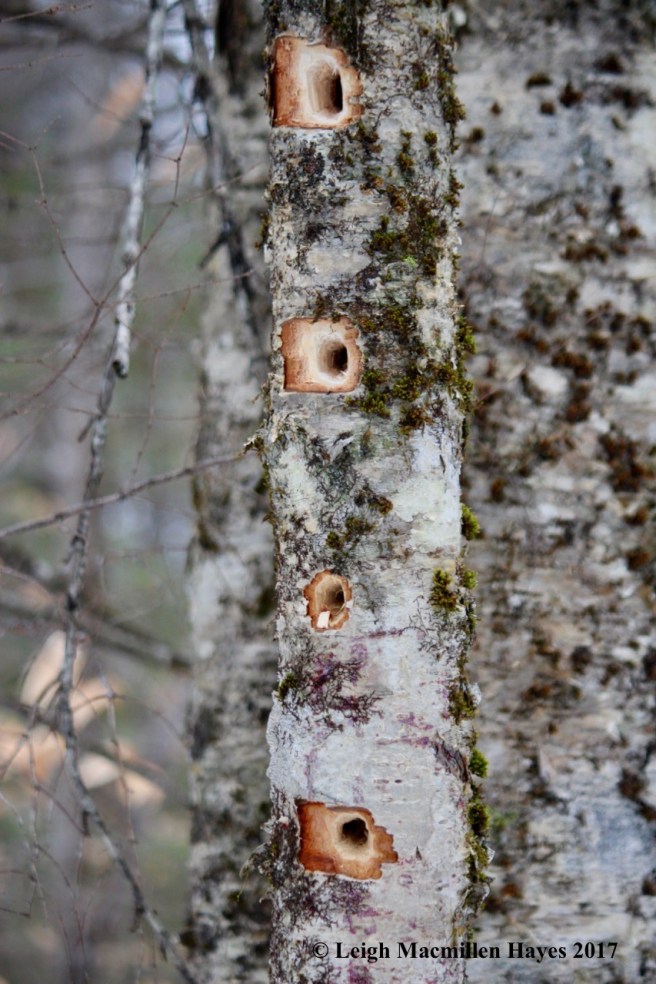
w-pileated-holes

The holes weren’t big–yet.

w-pileated-scat-bursting-with-body-parts

But the scat–oh my. It looked as if insects were trying to escape the small cylindrical package coated in uric acid.
w-mossy-maple-fungi

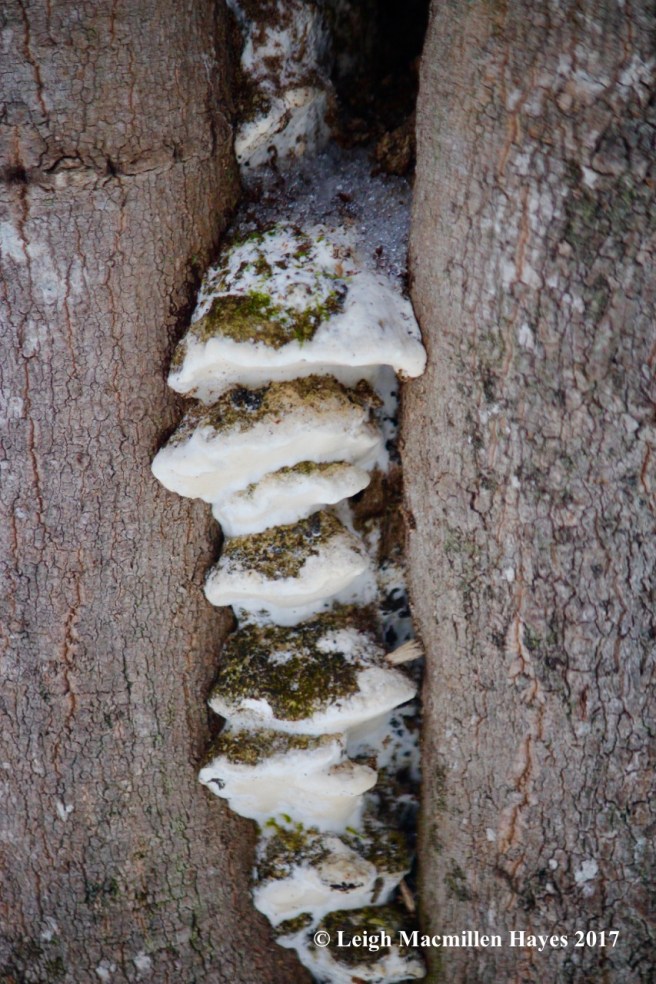
The trail turned right and so did I, beginning the climb. For most, the ascension doesn’t take more than five or ten minutes. Um . . . at least 45 on my clock today. There was too much to see, including the mossy maple fungi hiding in a tree cavity.

w-tube-moth-3

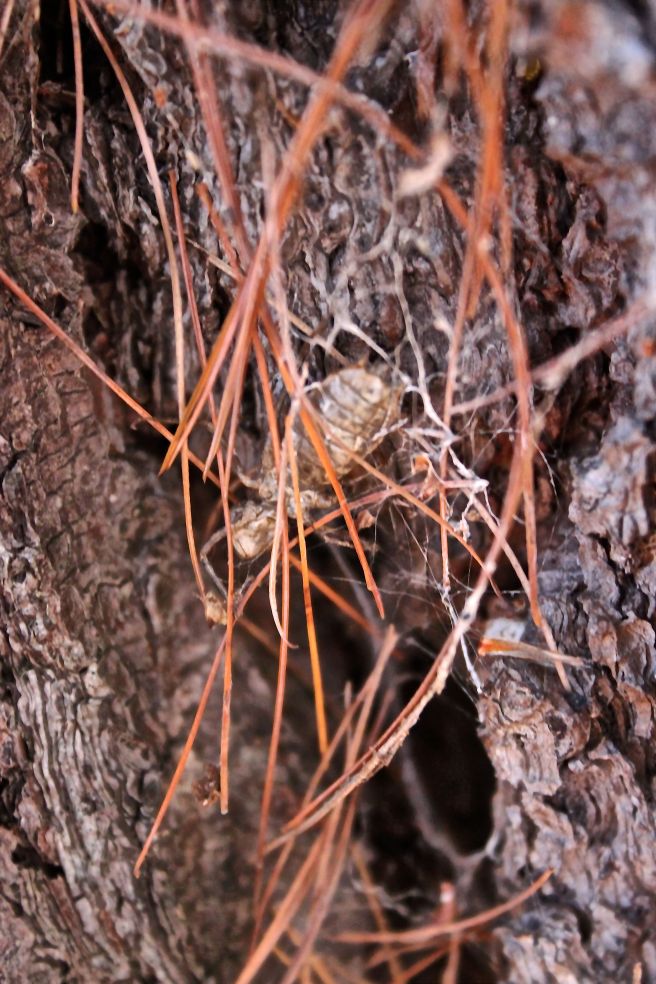
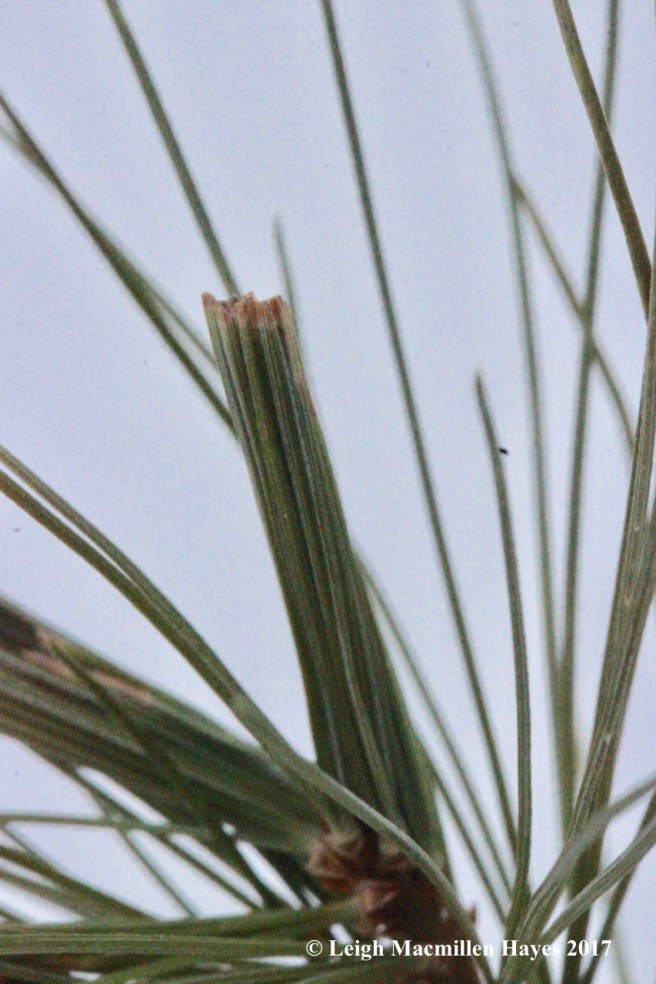
And then I saw something I’d looked for recently after seeing it on the blog  Naturally Curious with Mary Holland. Notice how the pine needles are clumped together?
w-pine-tube-moth-pupae-overwintering-1

Eastern White Pine needles grow in bundles of five (W-H-I-T-E or M-A-I-N-E for our state tree), but the clumps consisted of a bunch of needles from several different bundles.

w-tube-moth-2

What I learned from Ms. Holland is that these are tubes or tunnels created by the Pine  Tube Moth. Last summer, larvae hatched from eggs deposited on the needles. They used silk to bind the needles together, thus forming a hollow tube. Notice the browned tips–that’s due to the larvae feeding on them. Eventually the overwintering larvae will pupate within the tube and in April when I come back to check on the vernal pool, I need to remember to pay attention, for that’s when they’ll emerge. Two generations occur each year and those that overwinter are the second generation. The good news, says Holland, is that “Pine Tube Moths are not considered a significant pest.” I only found the tubes on two young trees, but suspect there are more to be seen.
w-beaked-hazelnut-1

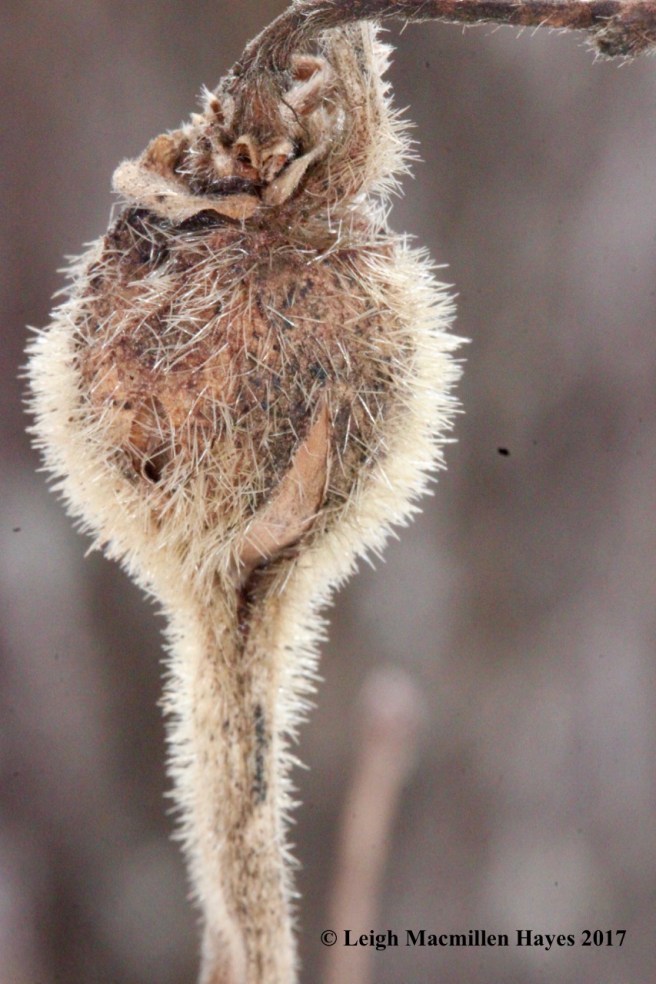
And a few steps later–an old beak. I couldn’t believe my luck. It was then that I realized if I’d been able to stick with the original plan I would have missed these gems. Oh, I probably  would have found others, but these were in front of me and I was rejoicing. Inside that bristly tan husk was the protein-rich nut of a Beaked Hazelnut overlooked by red squirrels and chipmunks, ruffed grouse, woodpeckers, blue jays and humans.
w-beaked-hazelnut-2

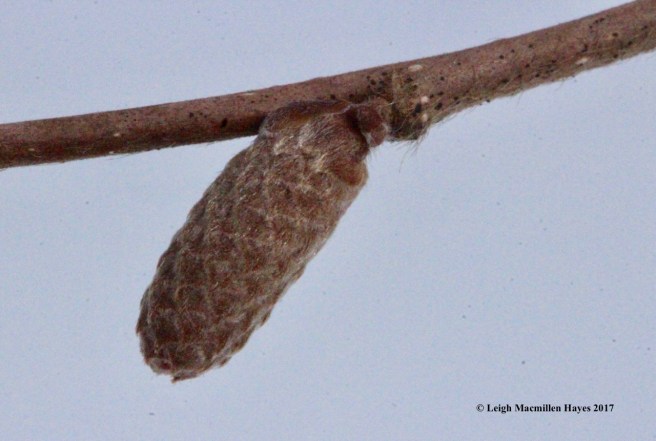
Catkins on all of the branches spoke of the future and offered yet another reason to pause along this trail on repeated visits.

w-burl-on-sugar-maple

With my eyes in constant scan mode, I looked for other anomalies. One of my favorites was the burl that wrapped around a Sugar Maple. If I didn’t know better, it would have been easy to think this was a porcupine or two.

w-buried-bench-on-way-up-whiting

About two thirds of the way up, there was no rest for the wary, for the bench that offered a chance to pause was almost completely buried.
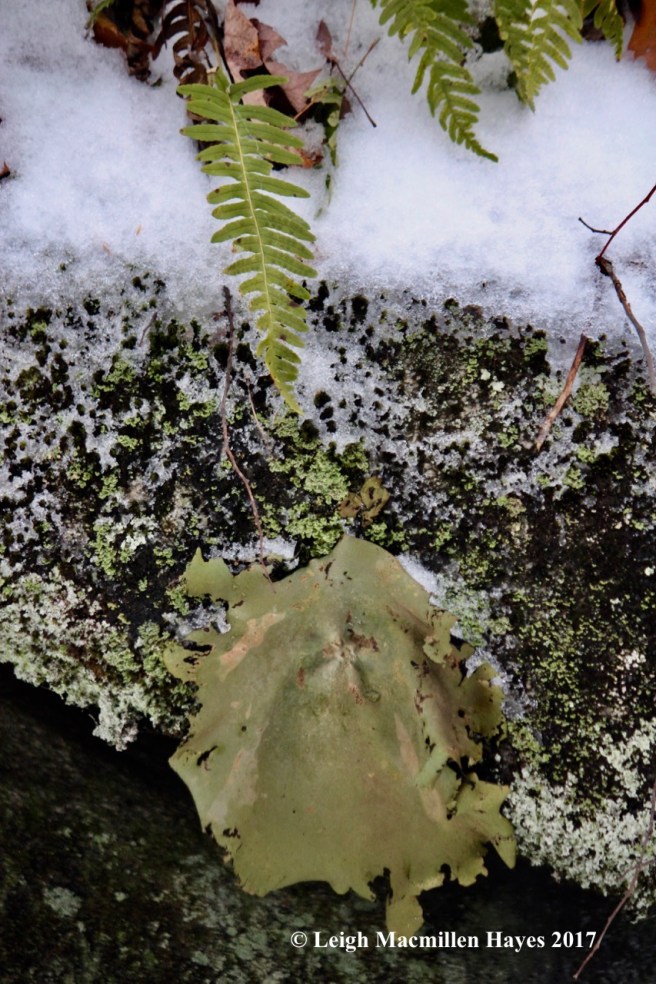
w-polypody-and-rock-tripe

Closer to the summit, the ledge boulders were decorated with snow, Common Polypody ferns and lichens, including Common Rock Tripe, its greenish hue reflecting yesterday’s precipitation.
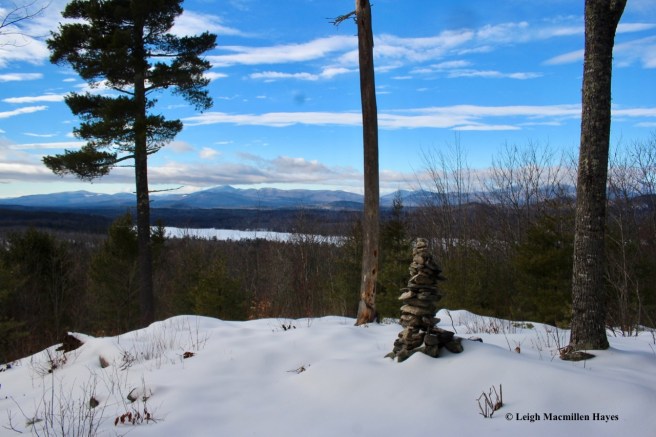
w-whiting-view-1

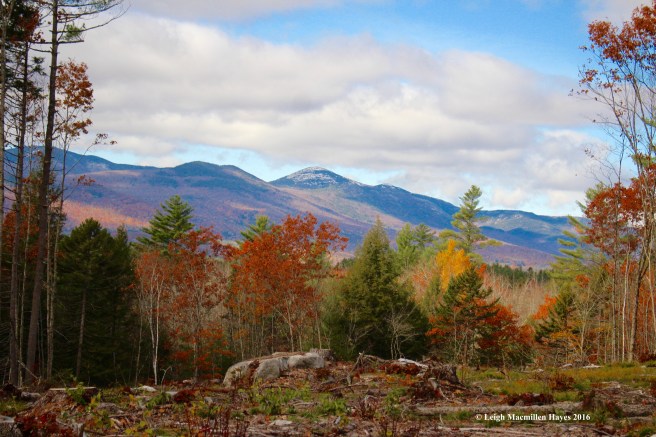
And suddenly, the summit and its westward view, Kezar Lake in the foreground and Mount Kearsarge  showing its pointed peak in the back.

w-whiting-other-bench

As I’d hiked along the red/blue trail, I noted that the red fox had crossed several times. At the other end of the summit, I checked on the bench where on our First Day 2017 hike for the Greater Lovell Land Trust, we’d discovered the remains of a red squirrel. Today, fox tracks paused in front of the bench before moving on and I had to wonder if had been the one to use this spot as a sacrificial altar.

w-bear-claw-tree

Finally, it was time to head down. My choice was to follow the red trail toward the Gallie Trail. I love this section because it features some of my favorite bear trees.
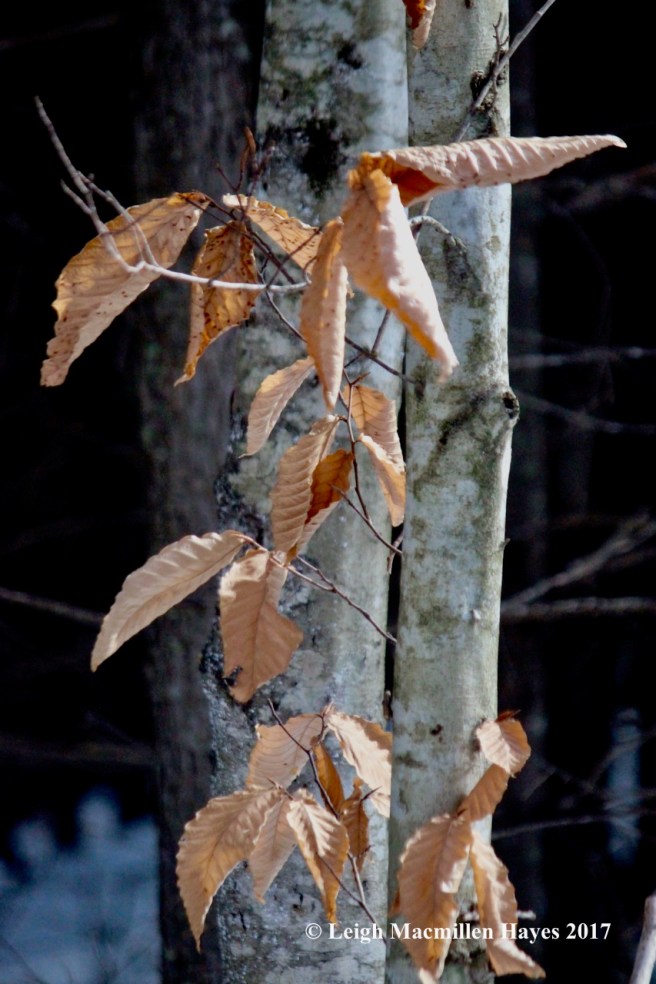
w-beech-leaves-rustling

The fox tracks continued to cross frequently and so I paused often. And sniffed as well. What I smelled was a musky cat-like scent that I’ve associated with bobcats in the past. What I heard–dried beech leaves rattling in the breeze. They always make me think something is on the move. Ever hopeful I am.
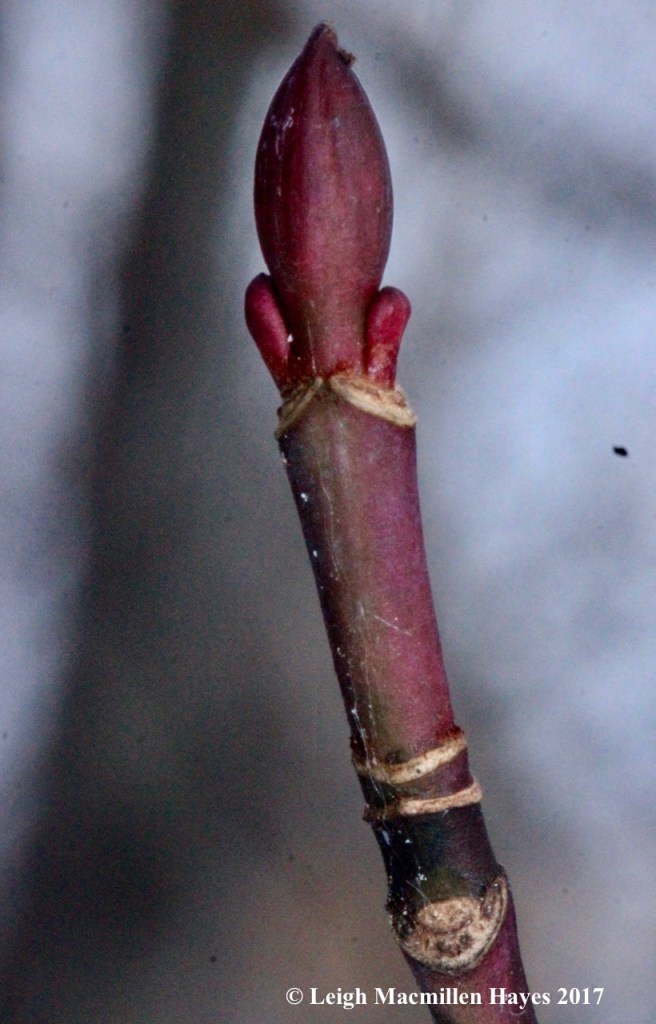
w-striped-maple-buds-and-twig

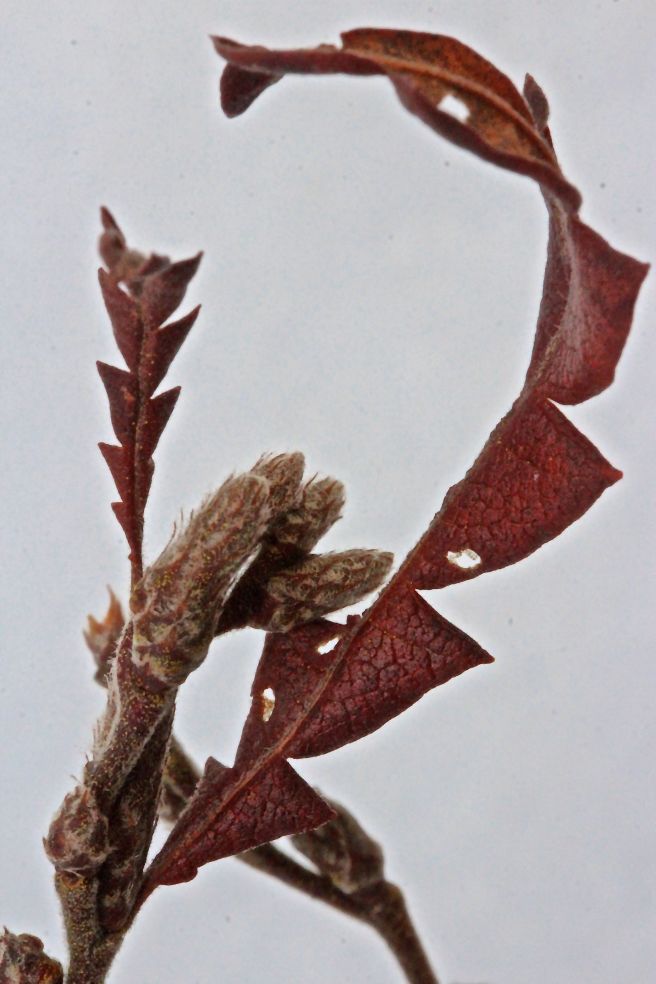
One of my favorite finds along this section was the bright red branches of young Striped Maples. From leaf and bundle scars to growth lines, lenticels and buds, their beauty was defined.

w-striped-maple-leaves

Another sight that surprised me–Striped Maple leaves still clinging, rather orangey in hue.
w-red-pine-on-red-trail

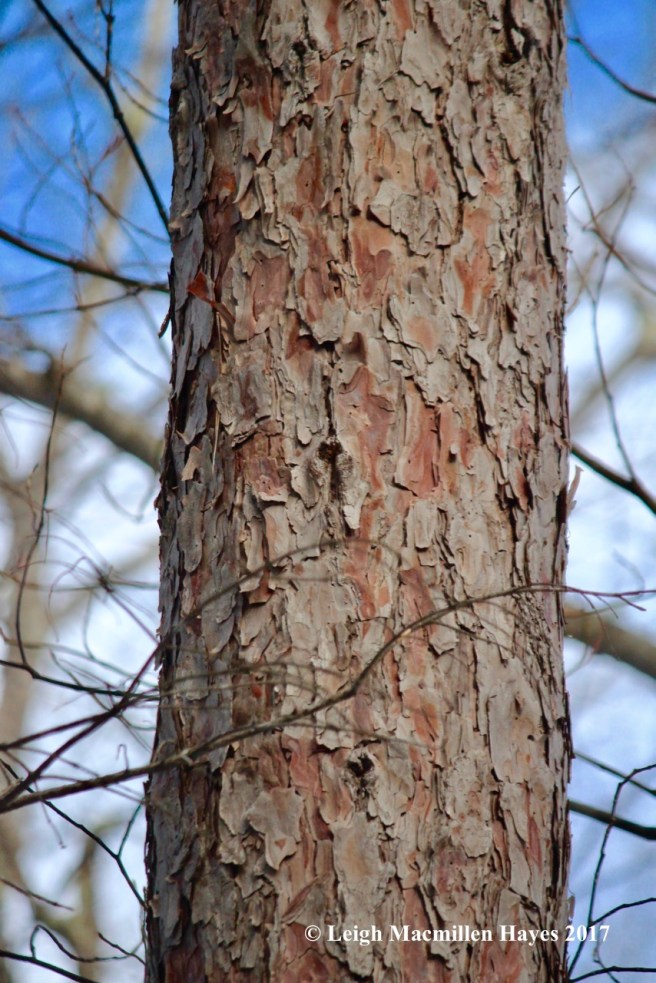
And here and there, as if in honor of the trail color, Red Pines reached skyward.
w-redgreen-trail

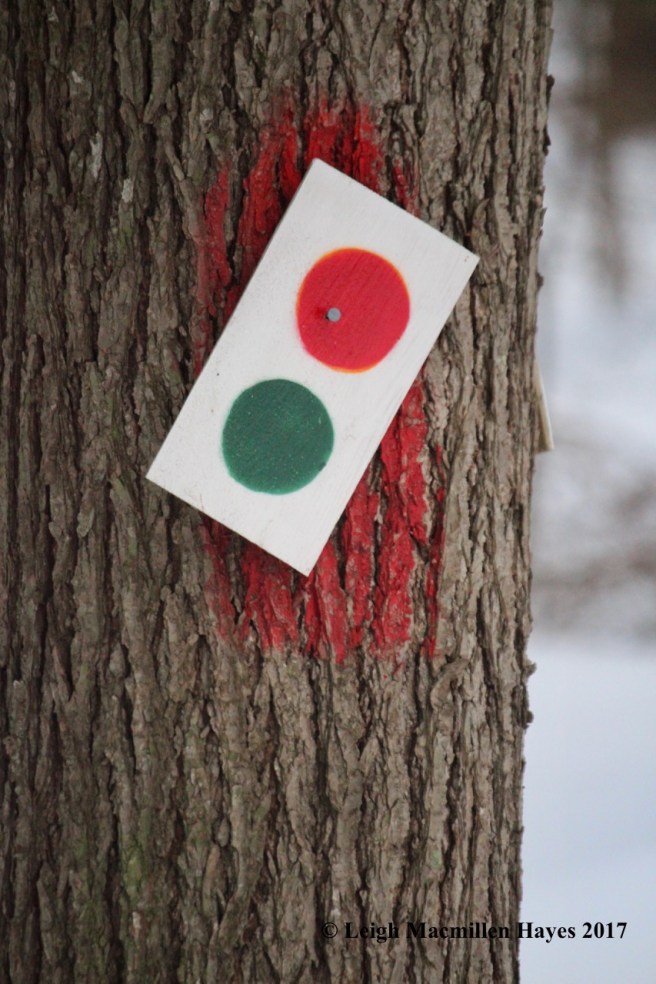
Eventually I reached the bottom, and turned right again, this time onto the stoplight trail–well, red and green at least.
w-squirrel-midden

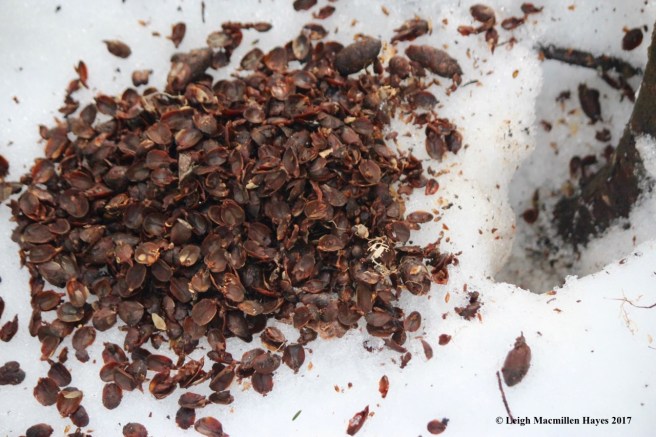
My wildlife sitings were few and far between, but red squirrel tracks and a midden of discarded cone scales next to a dig indicated where the food had been stored in preparation for this day.
w-tinder-2

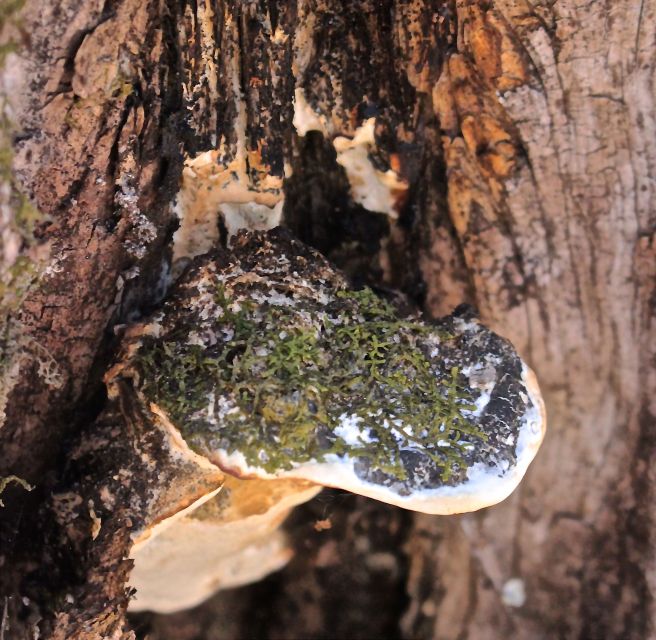
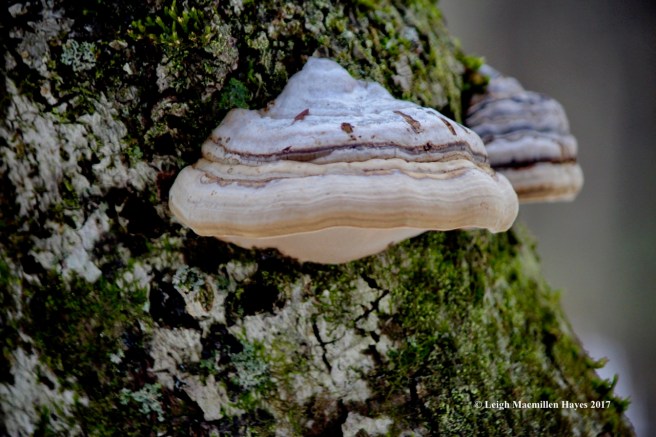
Following some grouse tracks took me off trail and tinder conks made their presence known.

w-tinder-fungi

The swirled appearance of these hoof fungi threw me off for a bit, but I think my conclusion is correct.
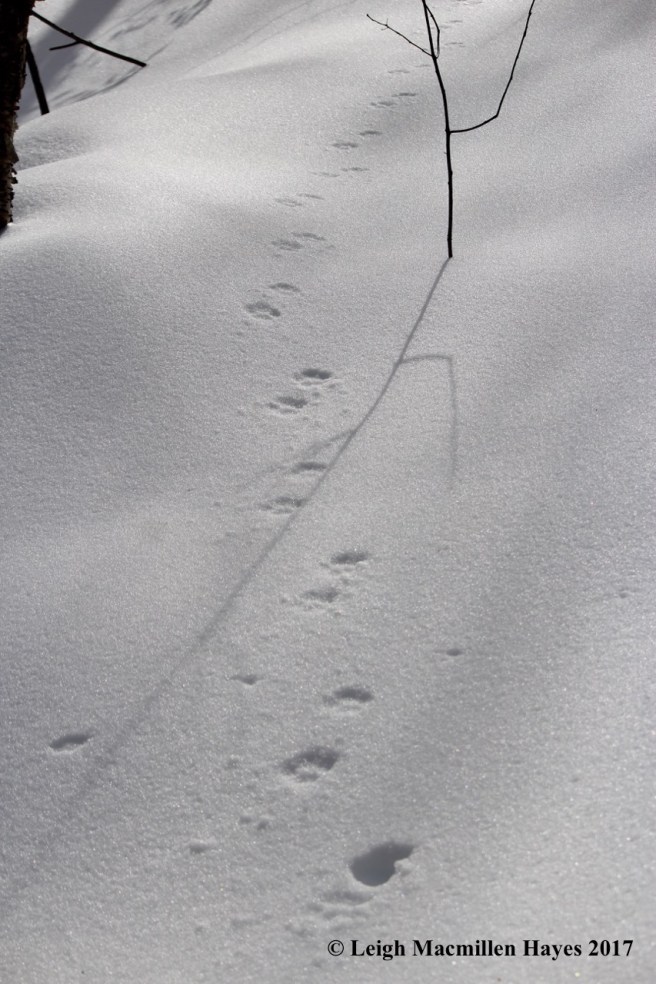
w-bobcat-trail

At last I reached the red trail that runs parallel with Heald Pond. Again, the fox tracks crossed frequently, but beside the path and leading to and fro the water and higher heights, another set of tracks confirmed my earlier suspicions.

w-bobcat-prints

Bobcat. I thought I smelled a pussy cat. I did.
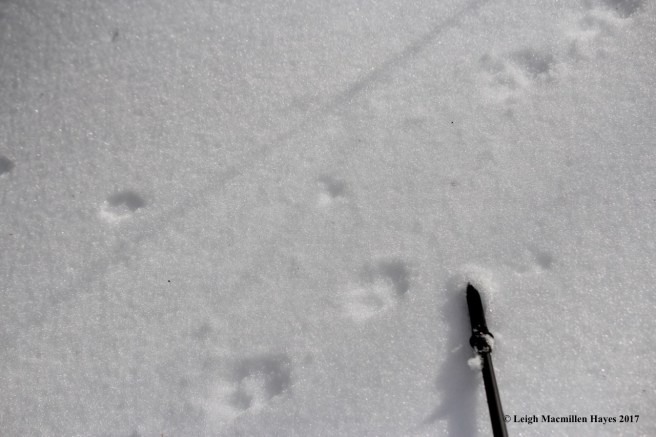
w-fox-and-bobcat

Sometimes the bobcat moved beside the trail, while the fox crossed over. I’d thought when I started out this morning that I wouldn’t see too many tracks because the animals would have hunkered down for the storm. I was pleasantly surprised–for my own sake. For the sake of the animals, I knew it meant they were hungry and on a mission.
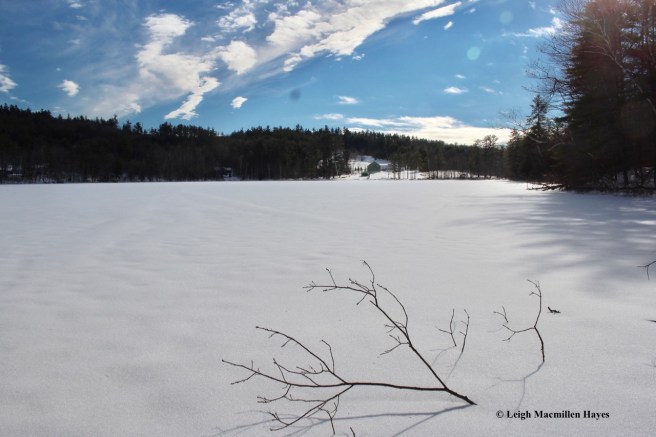
w-john-fox-1

My own mission found me following the spur to Otter Rock. I noted that the fox had walked along the shoreline on its eternal hunt.
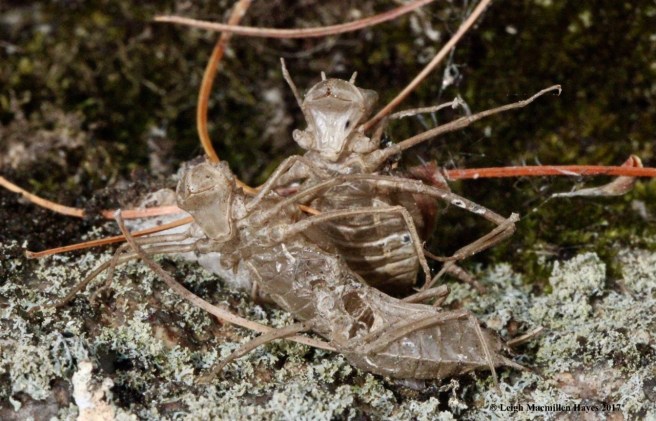
w-dragonflies-2

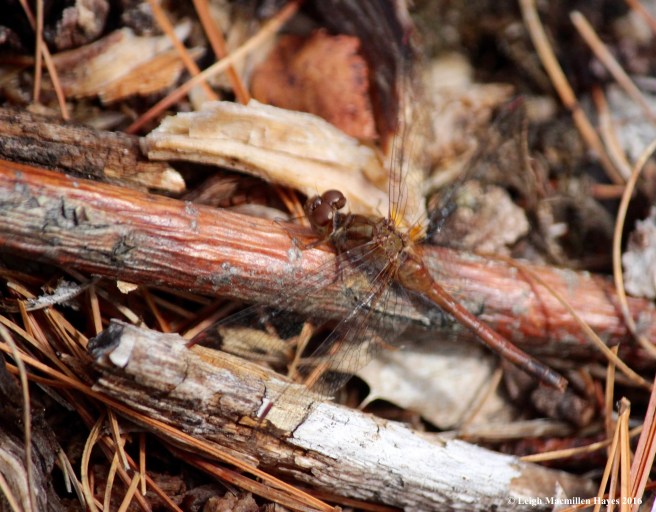
My hunt was of a different sort. No visit to the rock is complete without a look at the dragonfly exoskeletons. But today, it was a bit different because I, too, could walk on the ice. And so I found exoskeletons on parts of the rock I haven’t been able to view previously. Their otherworldly structure spoke to their “dragon” name.

w-dragonfly-nymph-exoskeleton

The slit behind the head and on the back of one showed where the dragonfly had emerged from the nymph stage last spring. Or maybe a previous spring as some of these have been clinging to the rock for a long time.

w-other-pupae-overwintering

While I was looking, I noticed some other pupae gathered together within a silky covering. Another reason to return–oh drats. I don’t know if I’ll be there at the right time, but with each visit, I’ll check in.

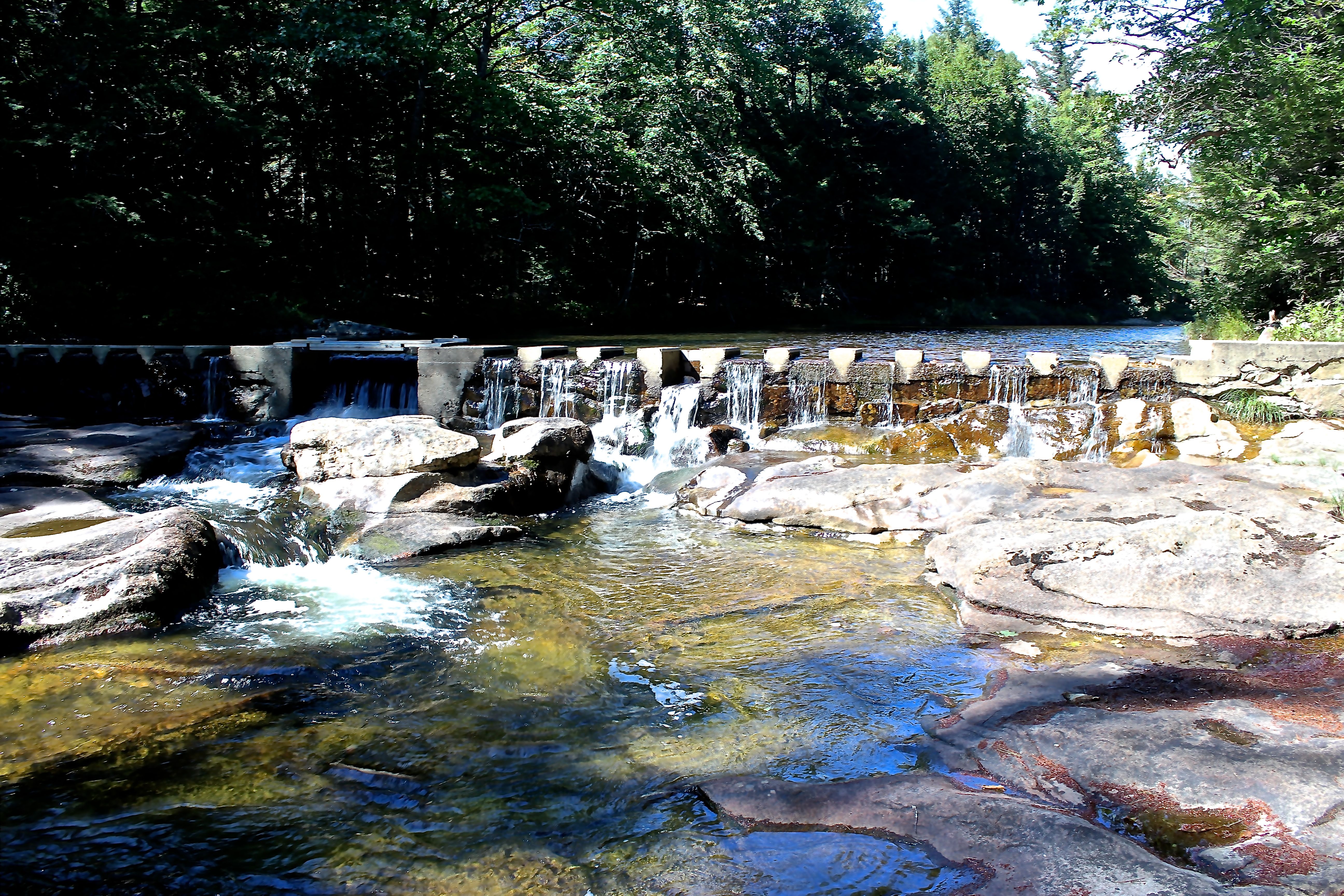
w-mill-dam-in-afternoon-sun

The sun was shining and warm. High 30˚s with slight breeze–felt like a summer day, with the sun reflecting off the snow. And at the mill, further reflection off the water. After four hours, it was time for me to check out.

As always, I was thankful for my visit, even though it wasn’t my original plan. Like the mammals, I’d been on a prowl–especially serving as the eyes for a friend who is currently homebound. I think she would have approved what I saw.


Keep an Open Mind

While I always head out with expectations of what my forest wanderings will offer, I’m happily surprised time and time again with the gifts received.

o-deer

And so it was the other day when a friend and I happened upon this trophy in an area I’ve only visited a few times. We’d been noting the abundant amount of deer tracks and realized we were between their bedding and feeding areas and then voila–this sweet sight sitting atop the snow. It now adorns a bookcase in my office, a wonder-filled addition to my mini natural history museum. (I’m trying to give Henry, Jessie, Violet, and Benny of the Boxcar Children series a run for their money in creating such a museum.)

o-deer-1

Being on the receiving end of such a gift can lead to want or greed. And when I spied several deer crossing the trail before I slipped into the woods today, I expected to find numerous more antlers.

Certainly, I thought I’d find at least one, but the possibility for several seemed realistic given the local population.

o-deer-tracks

To that end, I followed fresh tracks and examined areas they’d pawed as they sought acorns and mosses. My eyes scanned the surface, but perhaps it was the fault of the fresh layer of snow that hid the possibilities. Then again, we’d only received a few inches of fresh white stuff and it was rather warm for a January afternoon, the snow’s surface dotted with drip drops.

o-landmark

I didn’t pay attention to my direction as I moved and then suddenly found myself nearing an old landmark, surprised as usual that it still existed. I did notice that the deer didn’t travel below this widow maker. Nor did I.

o-moose-tracks

Eventually my wanderings found me following tracks left behind by a larger mammal.

o-gray-birch-forest

I worked my way through a thicket of gray birch, those early successors in an area logged about ten years ago, and then heard a sound–a crashing noise.

o-red-maple-browsehair

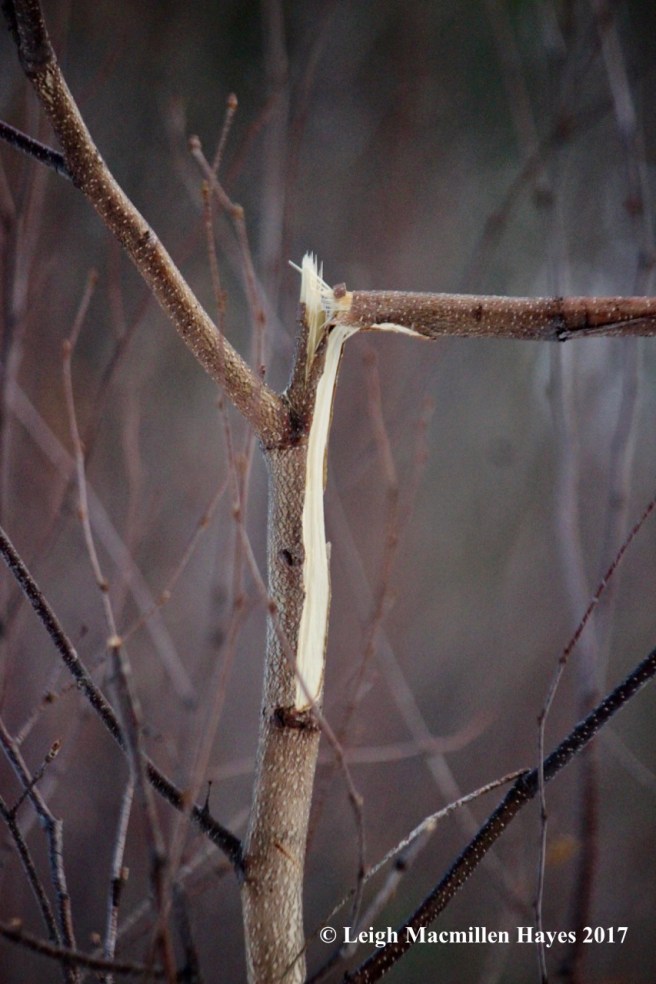
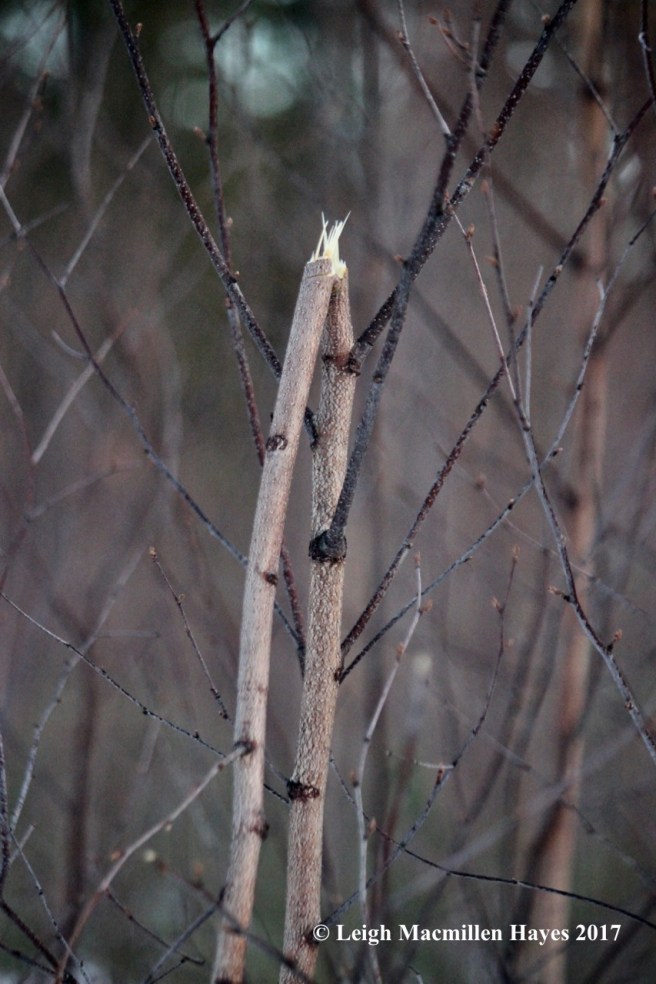
As I stood still and waited, I looked around. Everywhere, the young gray birch and red maple buds had been nipped. Everywhere. It was almost as if no tree had been left untouched. Sometimes I noted traces of hair.

o-moose-rub-2

There was no further sound of crashing branches, but plenty of evidence of who had been crisscrossing through these woods on a regular basis. Signs indicated action and I had visions of antler velvet being rubbed off.

o-bent-branch

Sometimes bent . . .

o-moose-rub-3

and other times completely broken, I saw moose behavior that meant antlers in my future.

o-moose-rub-1

On some trees, rubs were smooth in the middle and ragged on the ends, with points scratching the surface. At least that’s what I thought I was seeing.

o-moose-food-1

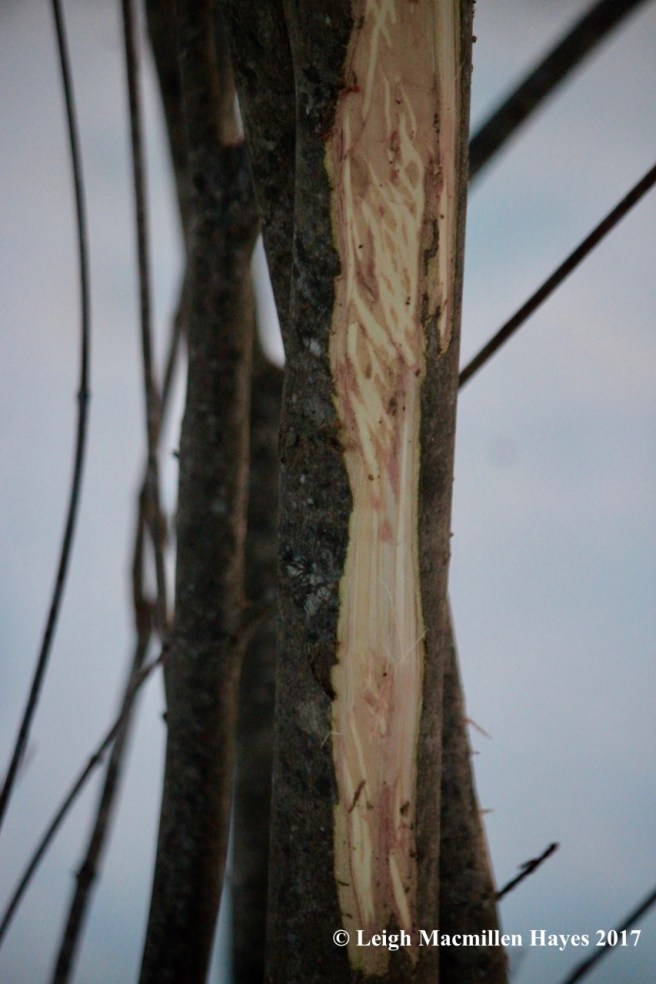
Scrapes, those areas where the moose had used their lower incisors to pull bark and the cambium layer from the trees, were also visible everywhere I looked.

o-moose-bed-1

In a matter of minutes I found a bed and that’s when I realized that this was probably the moose I’d frightened off, given the freshness of the structure.

o-moose-heart

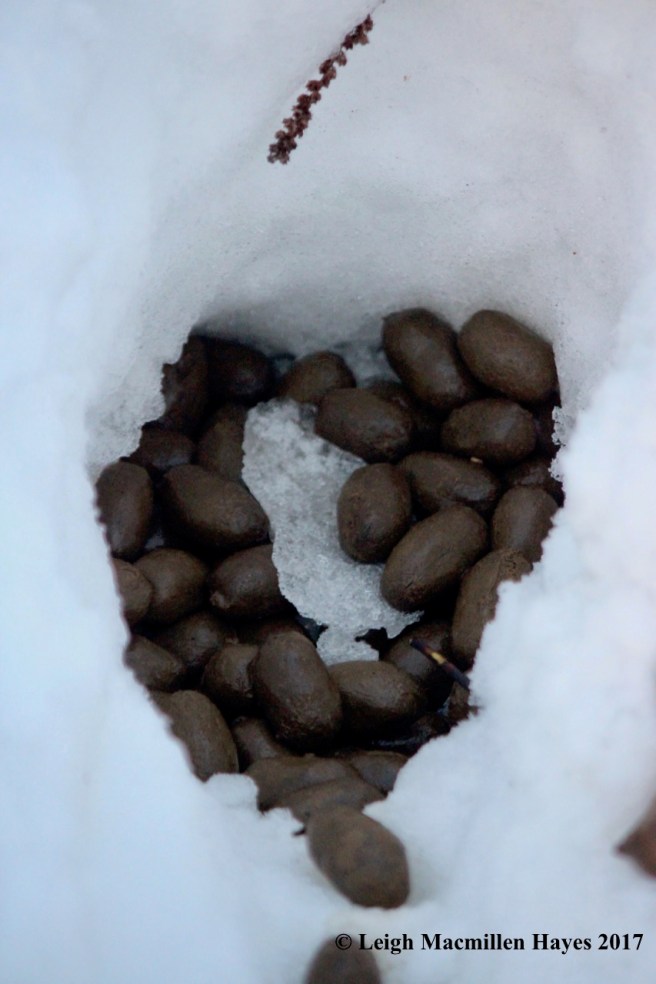
One of my favorite parts of the find–moose scat within a moose track. And all in the shape of a heart.

Indeed, no antlers. Indeed, other offerings. And a reminder to keep an open mind. And heart.


Books of December: A Holiday Wish List

In the spirit of changing things up a bit, I decided that I’d include five books I highly recommend you add to your holiday wish list and two that I hope to receive.

These are not in any particular order, but I’m just beginning to realize there is a theme–beyond that of being “nature” books.

b-forest-forensics-1

Book of December: Forest Forensics

Tom Wessels, forest guru and author of Reading the Forested Landscape, published this smaller work in 2010. Though only 5″ x 7.5″, the book is rather heavy because it’s filled with photographs. Despite the weight, Forest Forensics fits into a backpack and is the perfect guide for trying to figure out the lay of the land. Using the format of a dichotomous key, Wessels asks readers to answer two-part questions, which link to the photos as well as an Evidence section for Agriculture, Old Growth and Wind, plus Logging and Fire. In the back of the book, he includes Quick Reference Charts that list features of particular forest and field types. And finally, a glossary defines terms ranging from “age discontinuity” to “Uphill basal scar,” “weevil-deformed white pines” and “wind-tipped trees.” In total, it’s 160 pages long, but not necessarily a book you read from cover to cover. If you have any interest in rocks, trees, and the lay of the land, then this is a must have.

Forest Forensics by Tom Wessels, The Countryman Press, Woodstock, VT, 2010.

b-shrubs-1

Book of December: Shrubs of the Northern New England Forest

Michael L. Cline is executive director of Tin Mountain Conservation Center in Albany, New Hampshire. In September, I had the pleasure of attending a talk he gave at the center about Shrubs of the Northern New England Forest. The 6″ x 9″ book weighs about the same as Wessels’, and will also fit handily into your pack. Of course, you might want to leave the books in your vehicle or at home and look up the items later–thus lightening your load. Using Brownfield Bog as one of his main go-to places, Cline describes 70 species of shrubs from Creeping Snowberry to Mountain Ash. The book is arranged by family, beginning with Mountain Maple and Striped Maple of the Aceraceae (Maple) family and ending with the American Yew of the Taxaceae (Yew) family. Each two-page layout includes photographs (and  occasionally drawings), plus a description of habit, leaves, flowers, twig/buds, habitat, range, wildlife use, notes and other names. I have no excuse now to not know what I’m looking at as I walk along–especially near a wetland. That being said, I’ll think of one–like I left the book at home, but I’ll get back to you.

Shrubs of the Northern New England Forest by Michael L. Cline, J.S. McCarthy Printers, 2016

b-bogs-and-fens-1

Book of December: Bogs and Fens

Ronald B. Davis’ book, Bogs and Fens, was a recent gift from my guy. I hadn’t asked for it, and actually didn’t know about it, so I’m tickled that he found it. I’m just getting to know Dr. Davis’s work, but trust that this 5.5″ x 8.5″ guide about peatland plants will also inform my walks. Again, it’s heavy. The first 26 pages include a description of vegetation and peatlands and even the difference between a fen and a bog. More than 200 hundred pages are devoted to the trees, plants and ferns. In color-coded format, Davis begins with the canopy level of trees and works down to tall shrubs, short and dwarf shrubs, prostrate shrubs, herbaceous plants and finally, ferns. He also includes an annotated list of books for further reference, as well as a variety of peatlands to visit from Wisconsin to Prince Edward Island. As a retired University of Maine professor, Davis has been a docent and guide at the Orono Bog Boardwalk for many years. Field trip anyone?

Bogs and Fens: A Guide to the Peatland Plants of Northeastern United States and Adjacent Canada by Ronald B. Davis, University of New England Press, 2016.

b-lab-girl-1

Book of December: Lab Girl

I’d never heard of Hope Jahren until this summer and then several people recommended her book, Lab Girl, to me. Rather than a guide, this is the story of Jahren’s journey from her childhood in rural Minnesota to the science labs she has built along the way. As a scientist, Jahren takes the reader through the ups and downs of the research world. And she does so with a voice that makes me feel like we’re old friends. Simultaneously, she interweaves short chapters filled with  information about the secret life of plants, giving us a closer look at their world. I had to buy a copy because for me, those chapters were meant to be underlined and commented upon. I do believe this will be a book I’ll read over and over again–especially those in-between chapters.

Lab Girl by Hope Jahren, Alfred A. Knopf, 2016.

b-hidden-life-of-trees-1

Book of December: The Hidden Life of TREES

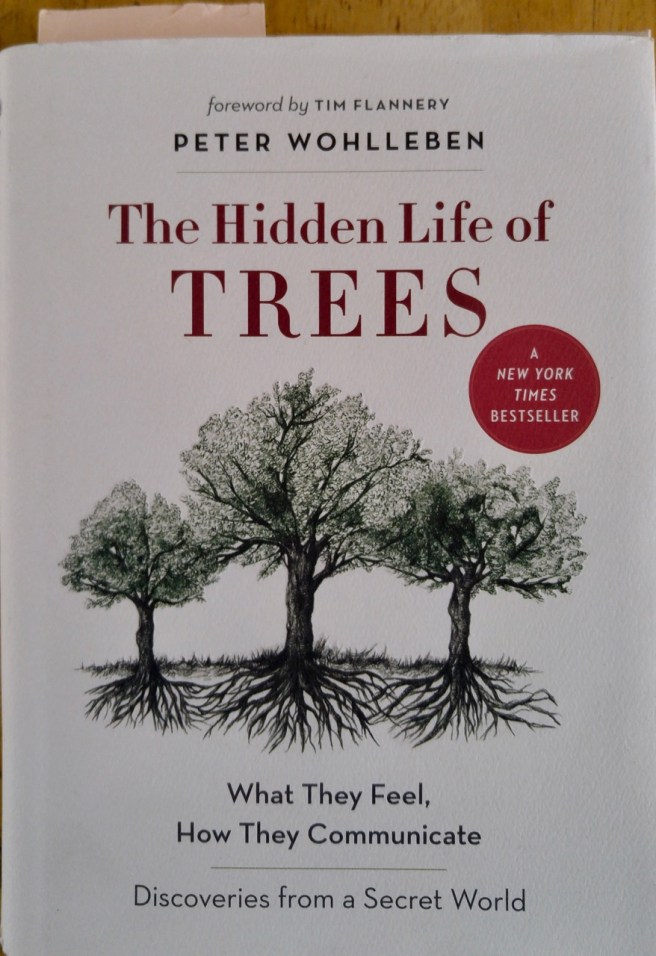
And finally, a gift to myself: The Hidden Life of TREES by Peter Wohlleben. I’d first learned about this book in a newspaper article published last year and had to wait until recently to purchase it after the book was translated from German to English. Again, it’s not a field guide, but offers a delightful read that makes me think. And thus, you can see my bookmark. I’ve not finished reading it yet, but I’m having fun thinking about some different theories Wohlleben puts forth. As a forester, Wohlleben has spent his career among trees and knows them well. He’s had the opportunity to witness firsthand the ideas he proclaims about how trees communicate. And so, I realize as I read it that I, too,  need to listen and observe more closely to what is going on in the tree world–one of my favorite places to be. Maybe he’s right on all accounts–the best part is that he has me questioning.

The Hidden Life of TREES: What They Feel, How They Communicate by Peter Wohlleben, Random House, 2016.

And that’s just it–the underlying theme of these five books you might consider is TREES. I can’t seem to learn enough about them. One word of caution, each author has their own take on things, so the best thing to do is to read the book, but then to head out as often as you can and try to come to your own conclusions or at least increase your own sense of wonder.

And now for the books on my list (My guy is the keeper of the list):

Naturally Curious Day by Day: A Photographic Field Guide and Daily Visit to the Forests, Fields, and Wetlands of Eastern North America by Mary Holland, Stackpole Books, 2016

Mosses, Liverworts, and Hornworts: A Field Guide to Common Bryophytes of the Northeast by Ralph Pope, Cornell University Press, 2016.

Do you have any other suggestions for me?

One final thought about books–support your local independent book store as much as you can. Here in western Maine, we are fortunate to have Bridgton Books. Justin and Pam Ward know what we like to read and if they don’t have a particular book we’re looking for, they bend over backwards to get it for us.


The Way of the Land at Long Meadow Brook Reserve

Last month the Greater Lovell Land Trust purchased a new property along Long Meadow Brook that further develops the wildlife corridor. A couple of weeks ago I first visited it with GLLT’s Executive Director Tom Henderson and a number of the land trust’s volunteer docents. As we left the property, Tom said to me, “I didn’t oversell this, did I, when I said this will become one of the docents’ favorite properties.” Indeed.

And so I couldn’t wait to get back there myself to spend a few hours exploring the almost one-hundred-acre reserve.

l-mullein-flower-2

Because the land was last logged by the previous owner in 2014, it’s in the early succession stage of regrowth.

l-mullein-flower-3

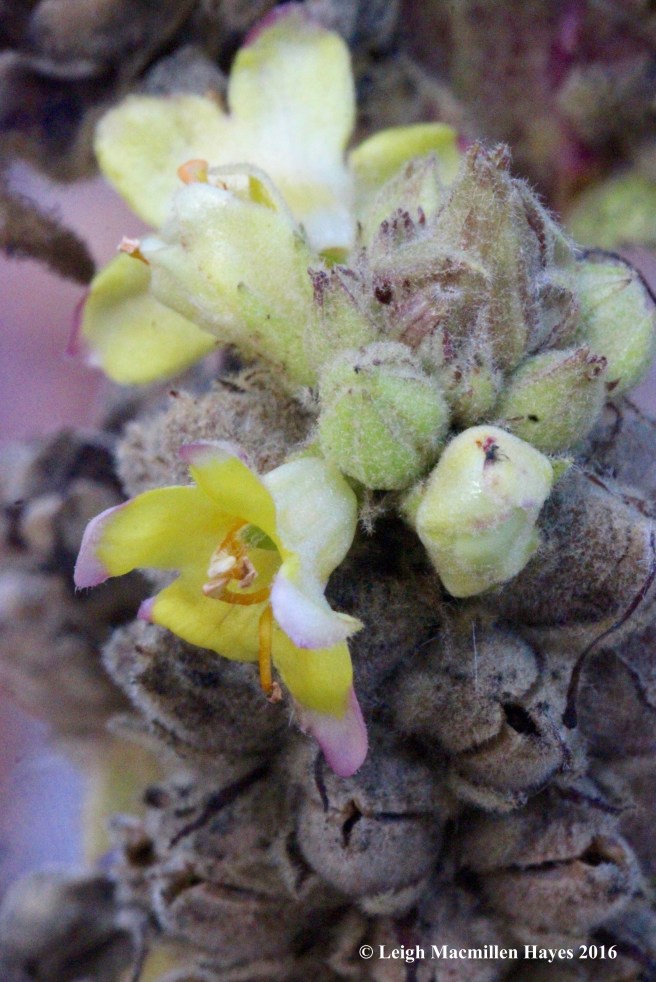
And so, it’s a place where those who like disturbed places tend to grow, such as the common mullein. What surprised me most was that I found a few still offering blooms.

l-mullein-cactus

Of course, it reminded me that I was in the great West–WESTern Maine, that is–with its occasional cacti-like form.

l-seeds-holidng-on

Scattered throughout are also the seedheads of white lettuce, waiting for release in lampshade-like formation.

l-orange-peel-fungi

Orange-peel fungi fruited prolifically in the gravel logging road.

l-future-parking-lot

That was all before I even reached the future parking lot, which had served as the log landing a few years ago. Already, sweet ferns and berry bushes have made themselves known.

l-sweet-fern-colors

The leaves of sweet fern, which is really a shrub rather than a fern, exhibited their version of autumn hues.

l-trail-marker

If you go, I encourage you to look for the blue ribbons that indicate where a future trail will be placed. It’s a loop trail that summer interns Hannah and Aidan laid out and leads to two focal features.

l-stonewall-double-to-single

The trail nears a neighboring property, which just happens to also be under conservation easement thanks to the foresight of its owners. I stepped off the blue flag trail and started to follow the wall for a bit–noticing that soon it changed from a double (garden or plowed land) wall to a single wall. A large pasture pine grew at the change-over point.

l-stonewall-barbed-wire-1

And where the wall switched to single formation, barbed wire indicated its former use a pasture boundary. And white pine scales indicated its current use–as a red squirrel’s dining room table.

l-forest-succession-2

After moving away from the wall, I noticed the mountains in the offing and ferns and young trees already filling in the empty spaces.

l-kearsarge

One of my favorite mountains to climb stood tall in the backdrop–Mount Kearsarge.

l-forest-succession-1

My bearings were off a bit, but I knew where the eastern boundary was as I moved across this opening.

l-pitch-pine-bark-1

Walking along the back edge, my tree passion was ignited yet again.

l-pitch-pine-1

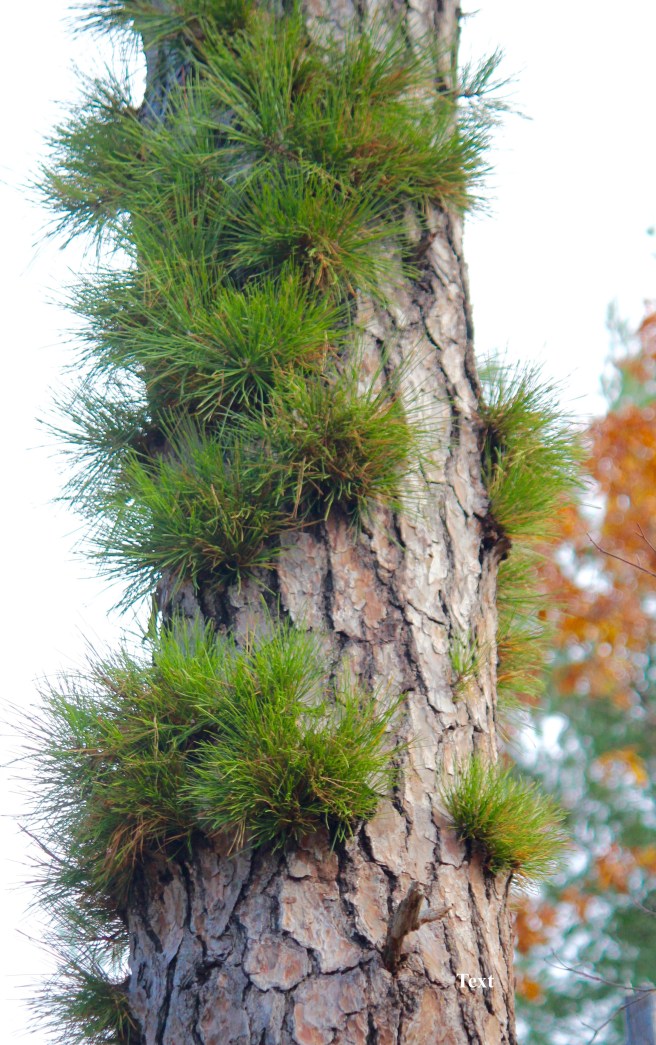
Several pitch pines grow in this space. While the bark is similar to that of red pines, it’s platier (is that a word?). And the tufts of needles that grow along the trunk were a dead give-away.

l-pitch-pine-cone

l-pitchpine-needles

But . . . I always quiz myself and so I looked around. And right below the trees, pitch pine cones and the triple needle bundles common to this species.

l-wintergreen-berries

It was here that I discovered wintergreen growing by the base of a tree stump. What made me wonder was the amount of fruit on each plant. Yes, wintergreen grows prolifically in all of western Maine, but I can’t recall ever seeing so many little red globes dangling below the leaves.

l-marshy-1

From my half-circle around the opening, I wasn’t positive about my whereabouts and so decided to follow the land downhill because it looked like there may be an opening below. A few minutes later, I realized I was in a marshy spot where the cinnamon ferns grew. And the earth beneath my feet was rather spongy and damp.

l-beaver-lodge

I reached what I thought was the meadow I sought–only to realize that I was looking at a beaver lodge. I knew that beaver lodge, but from a different perspective–the neighbors’ property.

l-first-marsh

And then something else caught my attention.

l-marsh-tamaracks

Tamarack (aka larch) trees–our only deciduous conifers, which had turned a golden yellow as is their autumn habit.

l-tamarack-2

The spray of tamarack needles reminded me of witch hazel flowers, which also grow on this property. But soon, the former will drop, leaving only their barrel-like stems as a reminder of their presence.

l-maple-leaf-viburnum

I left that spot, retraced my steps and headed to the north on a cross-country bushwhack, where the mauve colored maple-leaf viburnum grew.

l-turkeys

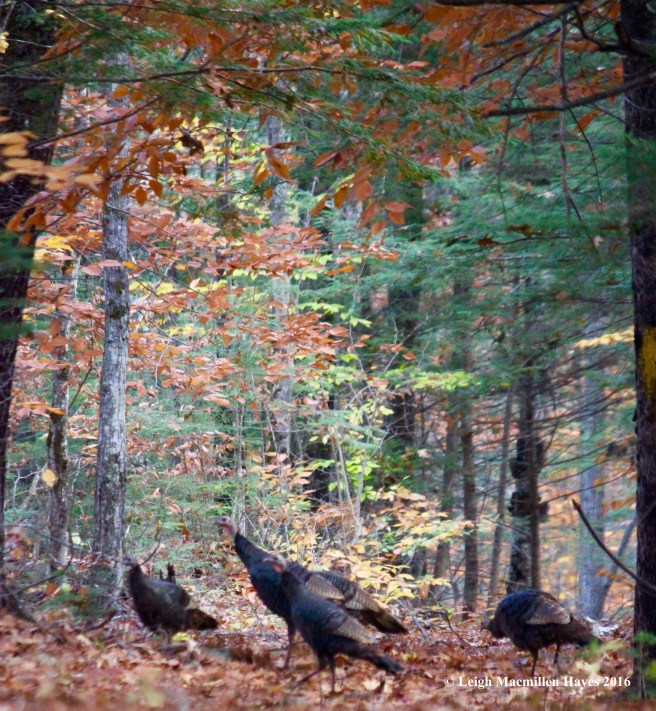
I saw lots of mammal sign and even a few birds, including turkeys who are loving the fact that this is a mast year for acorns.

l-trail-to-meadow

At last I emerged onto the trail I remembered and headed downhill again.

l-meadow-brook-2

And then . . . I was rewarded for my efforts. Long Meadow Brook and the mountains beyond provided a WOW moment.

l-meadow-east

I looked to the east for a few minutes.

l-meadow-layers

And then turned west again, where the layers and colors spoke of diversity.

l-meadow-snags

Even the dead snags added beauty.

l-cat-n-nine-tails

Cat-in-nine tails added to the view and I noted others who like wet feet including steeplebush, meadowsweet and bulrushes growing along the old beaver dam. It’s also a place for a variety of evergreen species–hemlock, white pine, balsam fir, red spruce and tamaracks. Future teaching moments await.

l-hobble-2

My intention to stick to the trail was soon thwarted when I spied hobblebush.

l-hobble-bud1

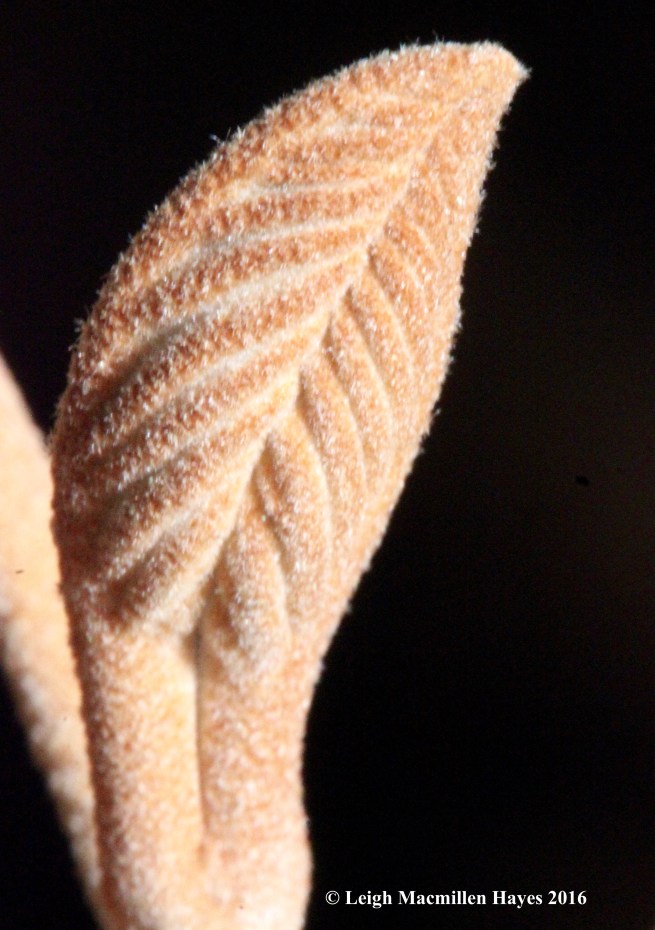
Like all trees and shrubs, the future was already encased in a bud–in this case a bud we refer to as naked because it doesn’t have the waxy coating of most others. Methinks its furry presentation offers the same protection from winter’s cold.

l-back-of-hobblebush-leaf

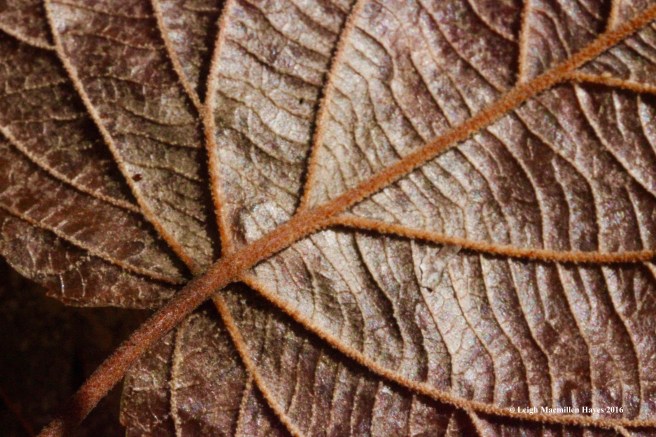
And as I studied the back side of fallen leaves, I paid attention to the venation–reminiscent of the bud’s pattern.

l-hobble-leaves-2

In the glow of sunlight, I felt like I’d found the pot of gold.

l-meadowhawk-2

A short time later I reached the second opening that Hannah and Aidan’s trail encompasses. And what to my wondering eyes should appear–a meadowhawk dragonfly.

l-snow-on-balds-1

It provided a sharp contrast to snow on the Baldface Mountains.

l-secod-opening-2

It was at this six-acre opening that I poked around for a while longer. And watched a goshawk fly to a pine tree with something dangling from its talons. Did I take a photo? No, of course not. I was too mesmerized to focus my camera. But sometimes, the photo doesn’t matter. Being there in the moment does.

I’m thankful for such opportunities made possible by organizations such as the Greater Lovell Land Trust. I know that ultimately this property is for the mammals that travel through and I saw plenty of evidence that they use this place. But then again, I’m a mammal who also appreciates the land bridges created and opportunity to observe the connectivity. I spent the day getting to know the way of the land at Long Meadow Brook Reserve–and can’t wait to return.


Book of September: Forest Trees of Maine

The other day a friend and I made plans for an upcoming hike. Before saying goodbye, she said, “Don’t forget to bring your tree book.”

t-cover (1)

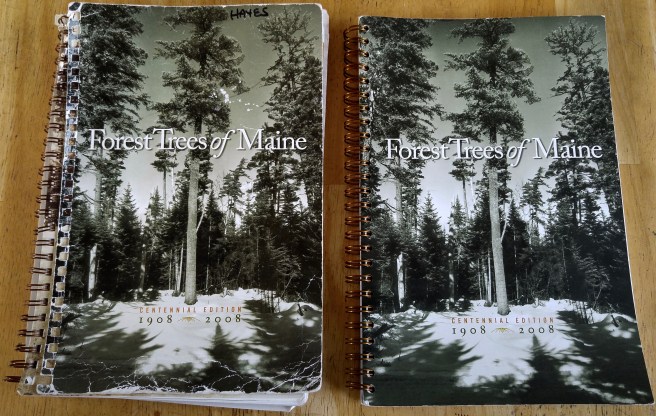
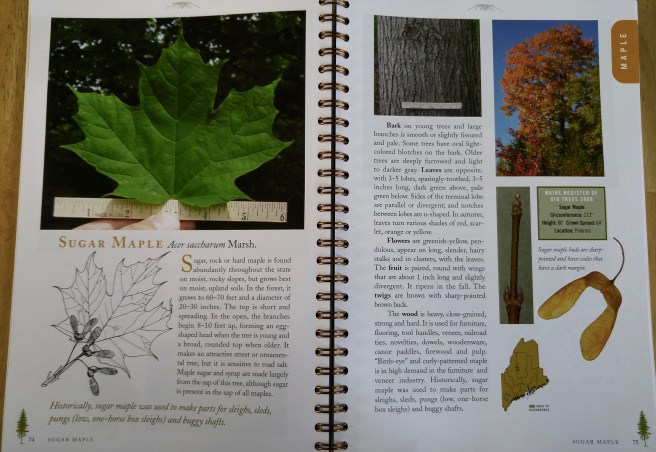
Really? I have at least thirty books dedicated to the topic of trees. But . . . I knew exactly which one she meant: Forest Trees of Maine. I LOVE this book–or rather, booklet. You’ll notice the tattered version on the left and newer on the right. Yup, it gets lots of use and often finds its way into my pack. When I was thinking about which book to feature this month, it jumped to the forefront. I actually had to check to see if I’d used it before and was surprised that I hadn’t.

Produced by the Maine Forest Service, the centennial issue published in 2008 was the 14th edition and it’s been reprinted two times since then.

t-b:y 2 (1)

In previous years, the book was presented in a different format. Two editions sit on my bookshelf, and I need to share with you two things that didn’t find their way into the most recent copy.

From 1981: Foreword–“It is a pleasure to present the eleventh edition of Forest Trees of Maine. 

Many changes have occurred in Maine’s forest since 1908, the year the booklet first appeared. Nonetheless, the publication continues to be both popular and useful and thousands have been distributed. Many worn and dog-eared copies have been carried for years by woodsmen, naturalists and other students of Maine’s Great Out-Of-Doors.

We wish the booklet could be made available in much greater quantity, however, budgetary considerations prevent us from doing so. I urge you to use your copy of Forest Trees of Maine with care. If you do, it will give years of service in both field and office.”

Kenneth G. Stratton, Director.

From 1995: One of two poems included. I chose this one because it was one my mother often recited.

Trees

I think that I shall never see
A poem lovely as a tree.

A tree whose hungry mouth is prest
Against the earth’s sweet flowing breast;

A tree that looks at God all day,
And lifts her leafy arms to pray;

A tree that may in Summer wear
A nest of robins in her hair;

Upon whose bosom snow has lain;
Who intimately lives with rain.

Poems are made by fools like me,
But only God can make a tree.

~Joyce Kilmer

t-how to use keys (1)

The most recent edition of Forest Trees of Maine provides a snapshot of the booklets history and information about the changes in the Maine landscape. For instance, in 1908, 75% of the land was forested, whereas in 2008, 89% was such. The state’s population during that one hundred year period had grown by 580,457. With that, the amount of harvested wood had also grown. And here’s an intriguing tidbit–the cost of the Bangor Daily News was $6/year in 1908 and $180/year in 2008.

Two keys are presented, one for summer when leaves are on the trees and the second for winter, when the important features to note are bark and buds.

t-leaves (1)

t-glossary (1)

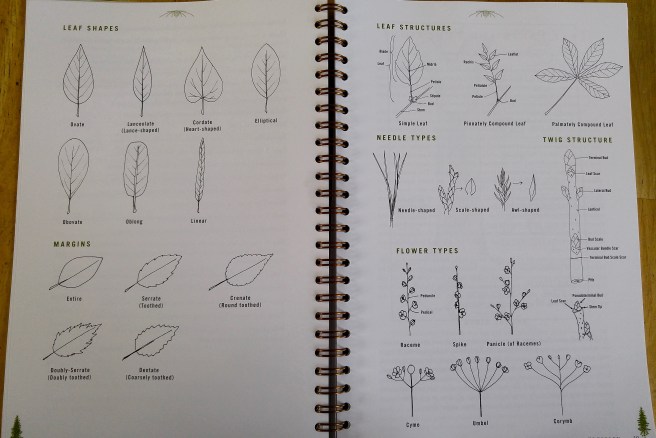
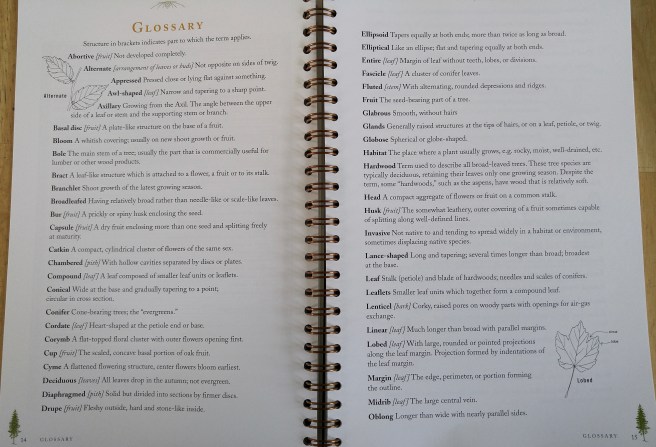
Terms for leaf shapes, margins and structure, twig structure, plus needle types and flower types are illustrated and various terms defined.

t-tree parts (1)

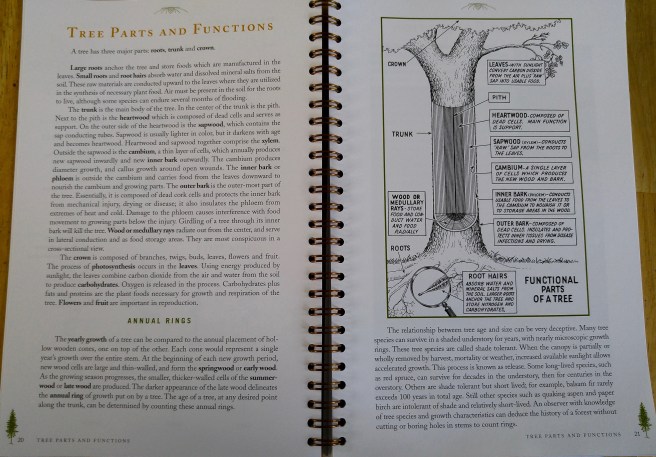
There’s even information on how a tree works because they do–for our well-being and for the benefit of wildlife.

t-white pine (1)

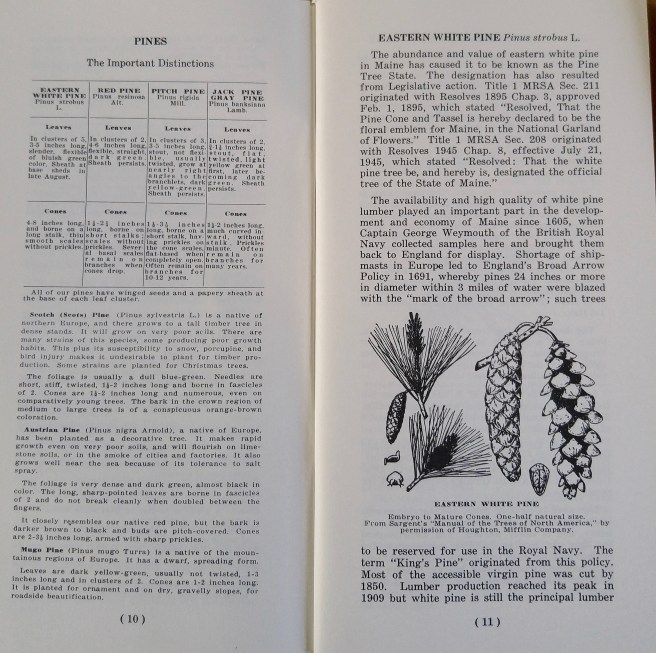
And then the descriptive pages begin. Each layout includes photographs, sketches and lots of information, both historical as in the King’s Arrow Pine, and identifiable as in bark, leaves, cones, wood, etc.

t-pines blue book (1)

1981

t-pines yellow book (1)

1995

Though some of the information is the same, it’s fun to note the differences from the two earlier publications.

t-maple key (1)

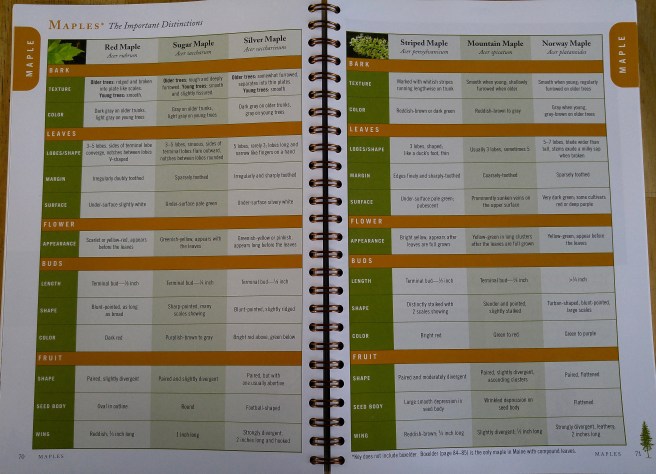
At the beginning of each family, major descriptions are noted in an easy to follow format.

t-maple (1)

And like the conifers, the broadleaves are portrayed.

Tomorrow, when my friend and I venture off, I’d better remember to pack this booklet. She’s peeked my curiosity about what she wants to ID because I’ve climbed the mountain before and perhaps I missed something. She already has a good eye for trees so I can’t wait to discover what learning she has in mind for us.

This Book of September is for you, Ann Johnson. And it’s available at Bridgton Books or from the forest service: http://www.maineforestservice.gov or forestinfo@maine.gov.

Forest Trees of Maine, Centennial Edition, 2008, published by The Maine Forest Service


From Bare to Bear on Burnt Meadow Mountain

Back in October 1947, catastrophic wildfires erupted throughout Maine during what became known as “The Week Maine Burned.”

It hadn’t rained for 108 days and the dry woods were like tinder. Here in western Maine, Fryeburg, Brownfield and Denmark thought they had a fire under control, but overnight a strong wind blew and gave it new life. About 2,000 acres burned by the next night as the fire spread to the edge of Brownfield.

With the winds continuously shifting, town folks began to panic. Farmers either turned their livestock loose or herded them to neighboring towns. Others packed as many belongings as they could and evacuated.

By morning, most homes and public buildings in Brownfield were mere piles of ash. Stately places including the Farnsworth Place where Dr. Philo Farnsworth, a pioneer in the field of television, spent his summers, had burned. Churches, schools, the post office, Grange hall, library and town hall all went up in smoke–only twenty houses survived. In the end, 85% of the town was destroyed, including a mountain trail.

Today, Marita and I ventured to Burnt Meadow Mountain for a loop hike. It used to be that one had to hike up and back on the same trail, now known as the North Peak. Though that’s the shortest way up and back (about an hour each way), I for one, am thankful to the Friends of Burnt Meadow Mountain, who sought landowner permission to create a loop and spur–Twin Brook Trail and Stone Mountain Trail.

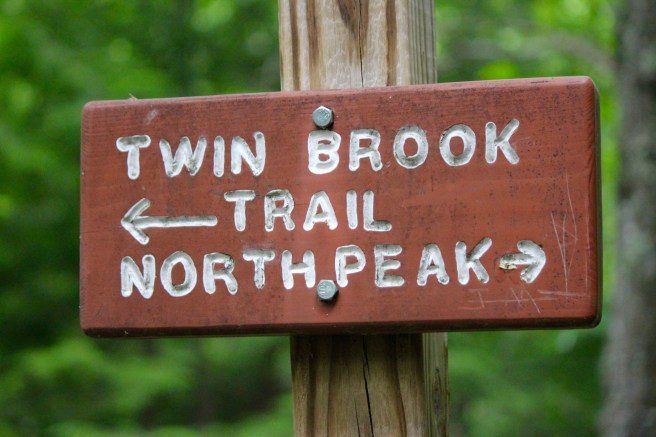
trail sign

From the parking lot and kiosk, it’s a bit of a climb to reach the trail split. We followed the blue blazes of the North Peak trail, which though it is shorter, is also the more difficult of the two.

white pine 1

Immediately we noticed that the white oaks that grow at the bottom of the mountain play host to numerous leaf miners and other insects.

white oak gall

Some are decorated with pronounced galls. I always think about how a bud protects the whisp of a leaf all winter long, and how hairy it is as it slowly unfolds and then–kaboom–the insects have to survive too. And they do. Until something eats them. And their energy passes up through the web, where it’s enhanced at each level by sun and air and rain and . . . even when life doesn’t look so good, it is.

Blueberries

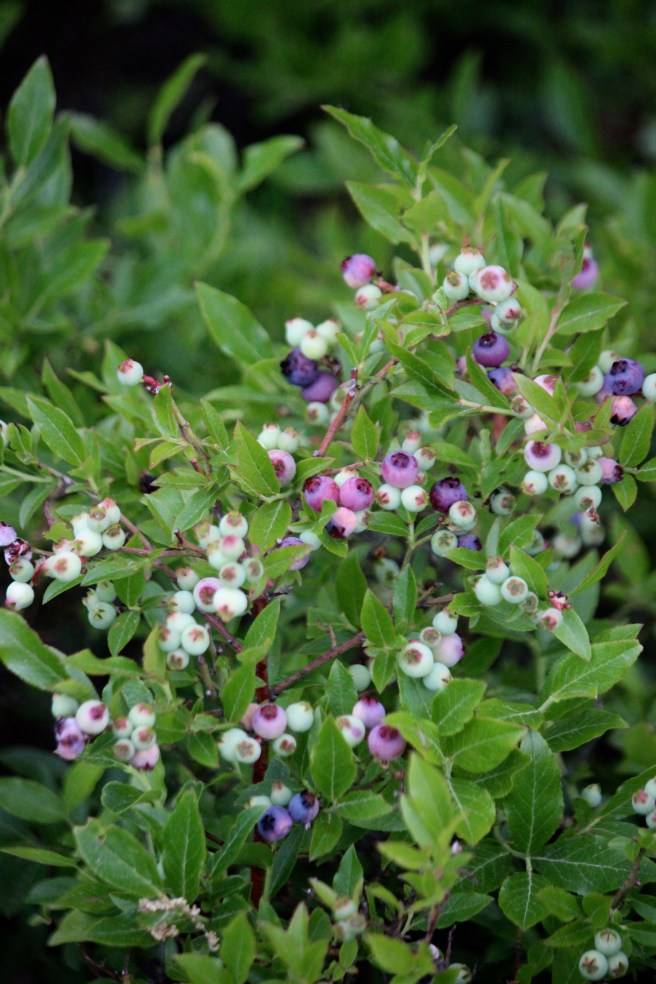
As we climbed, the blueberries became more prolific. And bluer.

spreading dogbane

Spreading dogbane showed forth its tiny pink bells.

ph rocky ascent (1)

And the trail became a scramble. If I said we scampered up the ledge quickly, I’d be telling a fib. (Do people still tell fibs?) Near the summit is a section of hand-over-hand climbing. It doesn’t really last long, but in the moment it seems like forever.

ph view on way 2 (1)

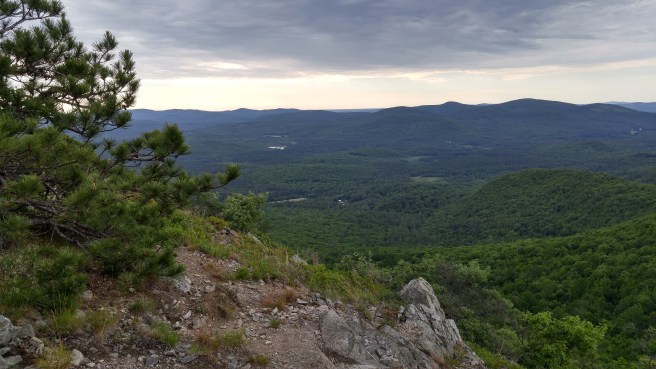
And so it invites a pause to take in the view to the south and east.

ph summit view 5 (1)

The relatively flat summit is rather barren–in memory of those 1947 wildfires.

ph summit view3 (1)

We were glad it was cloudy as there are no shade trees at the top.

ph summit view 2 (1)

Our view included Stone Mountain and the saddle between it and Burnt Meadow Mtn.

ph red pine 3 (1)

Normally in the landscape, red pines stand tall and proud. At the summit, however, their scrubby form presents their features at eye level–bundles of two needles, pollen cones and older seed cones. Young red pines typically germinate and grow only after forest fires or some other event that causes tree loss.

Eastern Towhee 2

Eastern Towhee

While we took a break, an Eastern Towhee sang its metallic yet musical “drink your tea” song.

ph view on way down 4 (1)

Descending via the much longer, but a wee bit easier Twin Brook trail, we were treated to mountain views to the west.

driftwood

And driftwood. Oops. Wrong setting. But still, mountain wood can be as beautiful as ocean wood.

ph bear 5

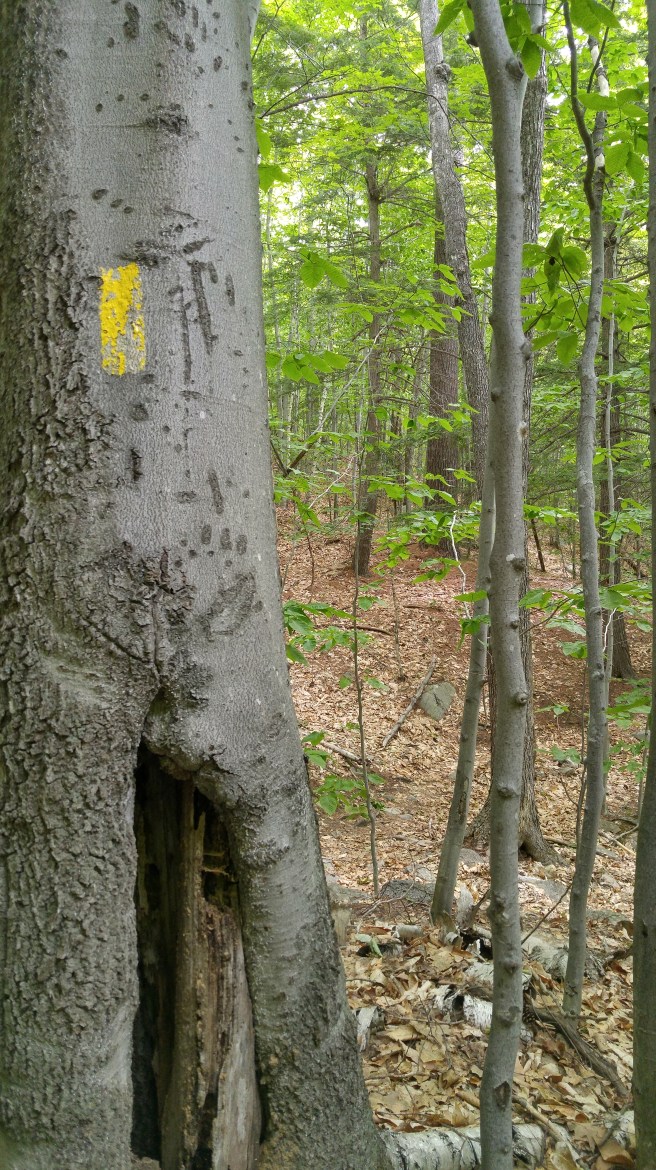
One of our pleasant surprises was the discovery of bear claw marks on rather small beech trees. Perhaps made by even smaller bear cubs who scampered up and down a year or two ago, leaving their marks much the way we left our own today without knowing it.

ph bear 2

Further along, the hole in this older beech stopped Marita in her tracks. We noticed saw dust on the ground below. And numerous bear claw marks on the bark above.

bear 3

Another oft visited tree.

From bare to bear, Burnt Meadow Mountain in Brownfield is worth the trek. (You probably thought we saw a bear today. No such luck, but my guys and I encountered a bear on the North Peak trail on a summer day years ago. It seemed content to lumber along about fifteen feet from us–probably full of blueberries.)


Beulah’s Mystery

One of the fun happenings in my life is that friends send me nature photos and ask me to help them ID a species. Sometimes I know immediately what it is and can ask them questions to help them get to the answer. Other times I’m as stumped as they are. Thus was the case today, when I drove to Brownfield to look at a tree growing in the field beside an old farmhouse.

t-beulahs 2

Beulah’s farmhouse, to be exact. My friend’s brother recently purchased it and the adjacent barn. Though the farmhouse is a fixer-upper, Beulah’s sign looks as if it was created yesterday.

t-tree1

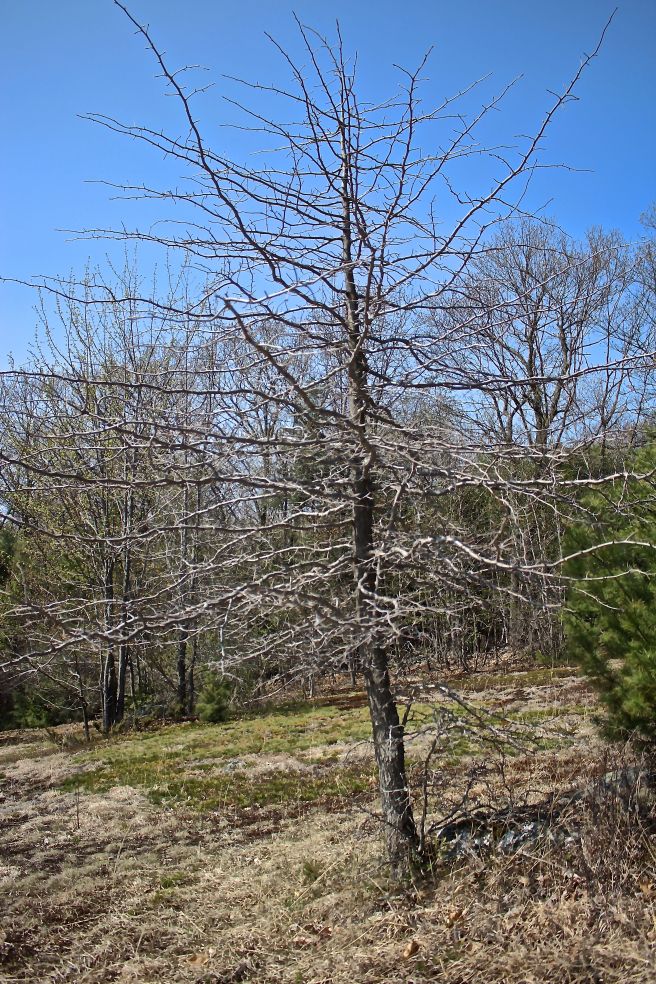
This is the tree. If you know it right off, my hat goes off to you. I was in my Forest Trees of Maine mode and kept looking at it from that perspective. It’s overall appearance didn’t match what I know. We began with the key and slowly (painfully slowly as the black flies swarmed us–mind over matter, mind over matter), worked our way through the choices, two by two.

t-dwarf shoots

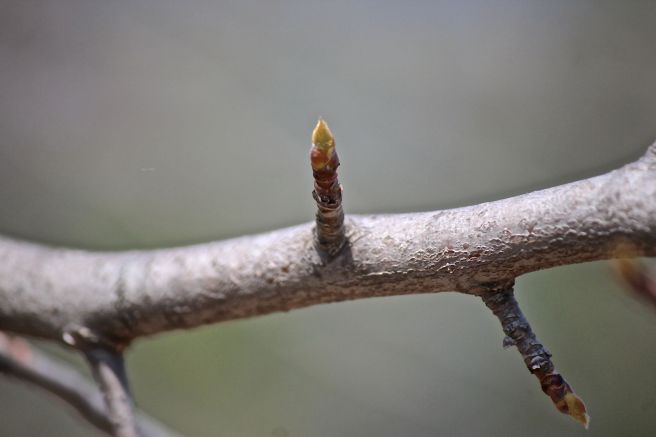
Because it’s not in leaf yet, we used the Winter Key. With each question, we paused to examine the tree–looking at the alternate leaf shoots, hairy scaled buds, pith, bark–every detail. We considered its location in the middle of a farm field, where the land sloped slightly and was rather dry. We also looked at the ground and found decaying leaves as well as deer scat. As I suspected, it wasn’t in the key. So I came home and scoured other books. I think I reached the answer and that the deer scat is actually a clue. Do you know? Now you may say so.

t-porky den

On our way to see one more cool thing, we paused to look at a den located beside the old foundation. Though much of the scat has since been removed, plenty of it and numerous quills painted the picture of who’d created this pigpen.

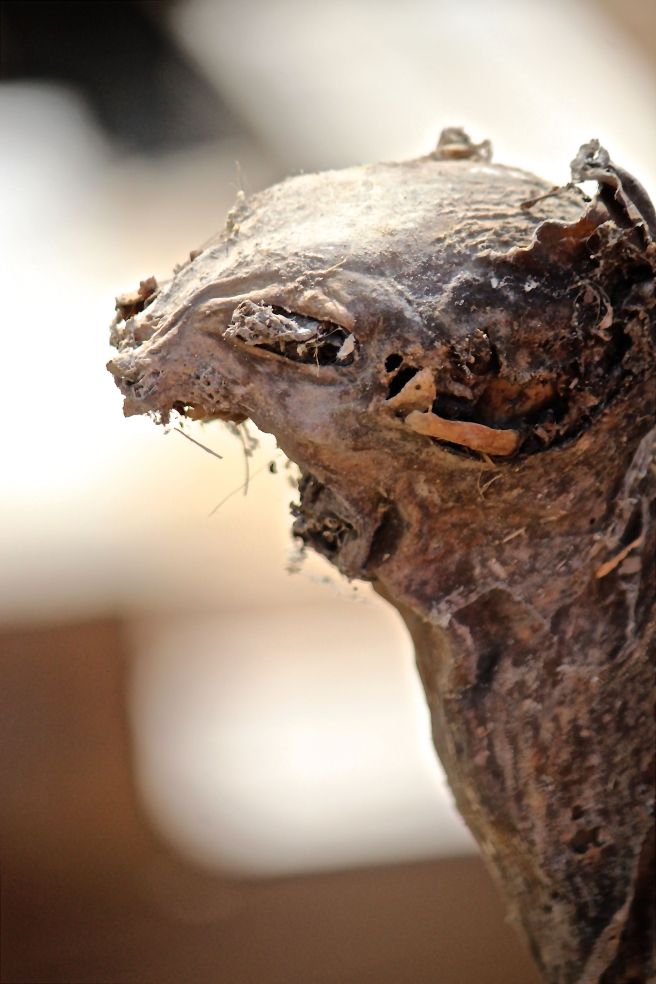
t-critter 2

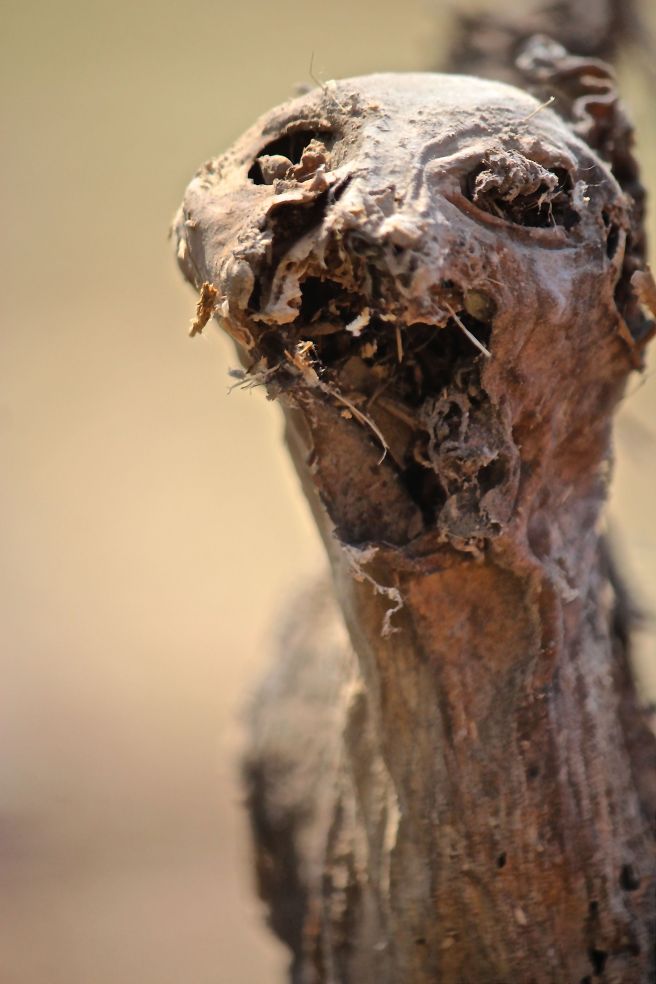
And then they had one more mystery item to show me. I hope this doesn’t freak you out. It’s part of many renovations in old farmhouses–a dried-up animal carcass. The front of the face was missing, but as we say, eyes in the front, born to hunt.

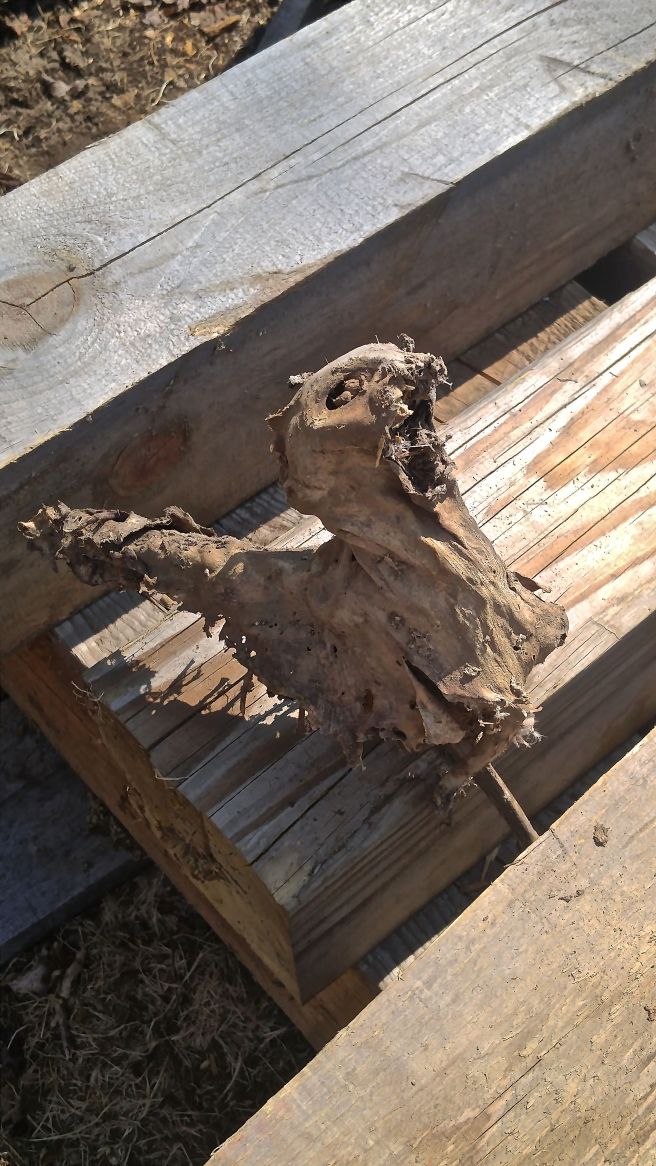
t-critter 1

A side view of this handsome critter. Can you see the ears?

t-critter 4

Talk about all skin and bones.

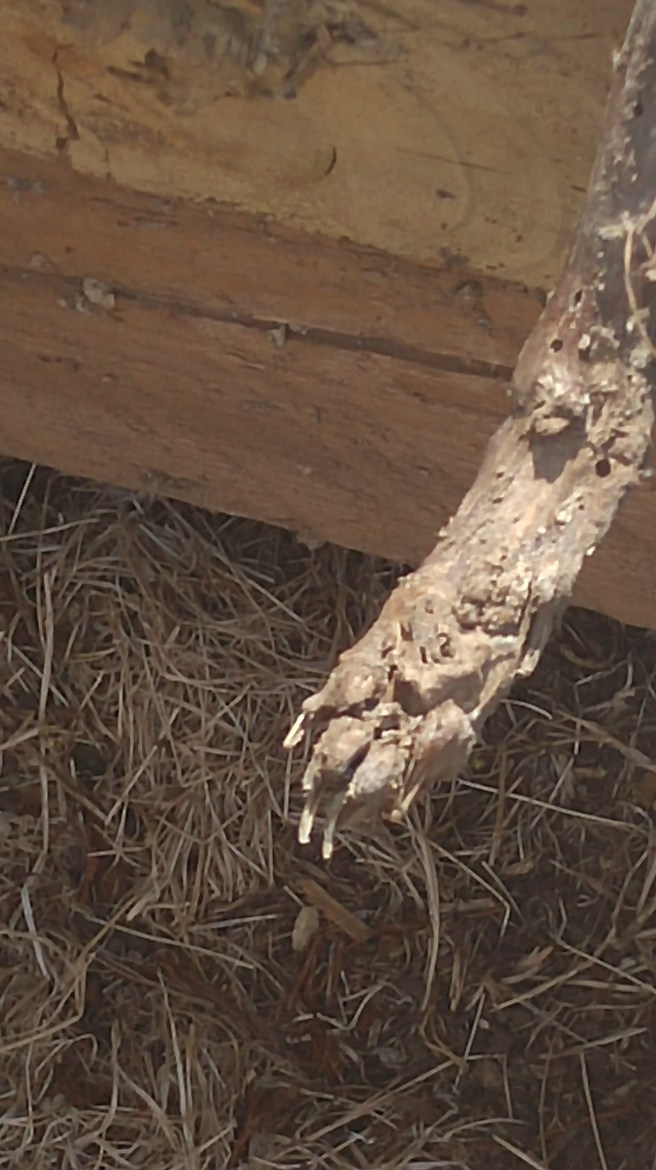
t-critter pads

And then the foot pads and nails. Four toes, nails, about the size of a nickel. Do you know?

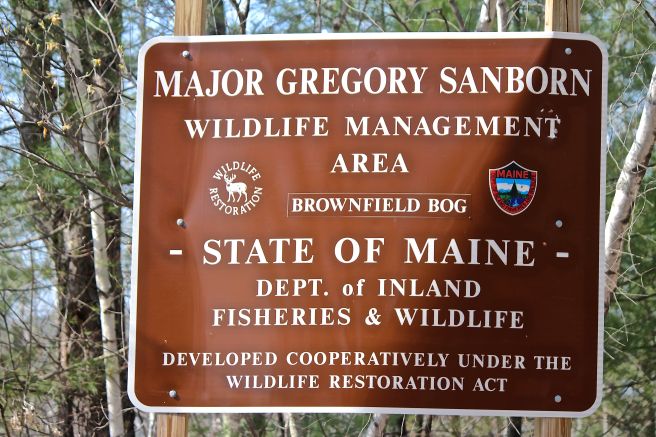
t-bog sign

Because I was in the neighborhood, I visited Brownfield Bog and continued my afternoon exploration. (Yeah, I had work to do, but playing hooky for a couple of hours is allowed once in a while if I don’t abuse the privilege–ah, the life of a freelancer.)

t-red oak emerging

I remember suddenly becoming aware of spring colors about thirty-five years ago, when I taught  school in New Hampshire by the convergence of the Pemigewasset and Merrimack Rivers. Until then, I’d never realized that tree leaves emerge in a variety of colors–they all weren’t suddenly green. (BTW– do you see the spittlebug? )

t-red oak mini leaves

In a quickness equal to fall foliage, spring colors may not be as flashy, but their subtle beauty deserves notice.

t-gray birch 2

And those leaves that are green offered their own reasons to stop me in my tracks as I took in the details–in this case the double-toothed elephant’s trunk. What? Notice the shape and outer margin of the leaf.

t-gray birch 4

The lovely elongated catkins demanded a glance that lasted more than a second.

t-willows cat1

Adding a festive fuzziness to the celebration of spring was another set of catkins.

t-willow gall

Unwittingly, this shrub also played host to a gall gnat midge that overwintered in a structure created by the reaction to a chemical released by the larva–what would have been leaves were forced to harden into a pine cone look alike.

t-bog colors 2

The subtle colors graced the meadow,

t-pleasant

were reflected in the bog,

t-river

and blessed the Saco River.

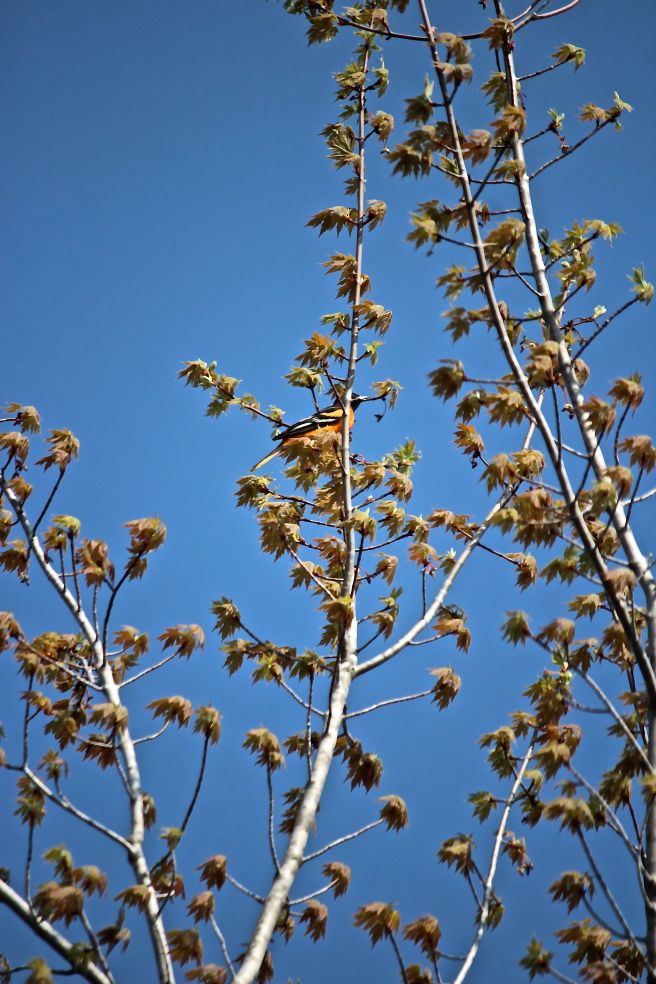
t-baltimore 2

There were bits of flashy color–do you see who was feeding on the upper branches?

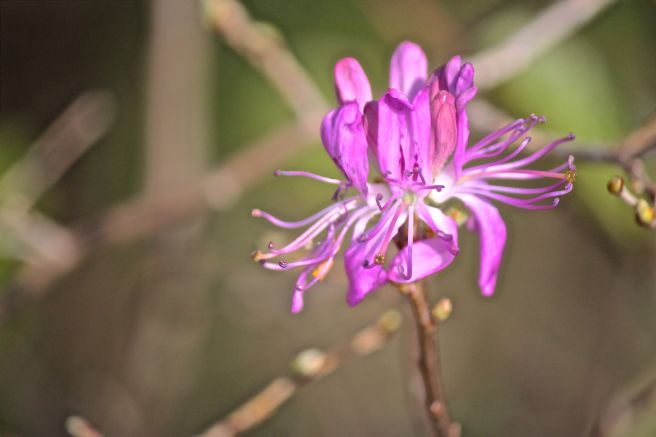
t-rhodora 1

And this spring beauty exploded with love and life.

At the end of my journey, I was grateful to P&K for an excuse to step away from my desk and check out the mystery standing in Beulah’s field. Especially as it led me further afield.

Book of the Month: TREES and SHRUBS of NORTHERN NEW ENGLAND

Sometimes the biggest gems arrive in the smallest packages. Such is the case with this month’s book–and this isn’t an April Fools’ Day joke, though I did briefly consider posting an upside-down photo of the cover.

t-book

I picked up this copy of  TREES and SHRUBS of NORTHERN NEW ENGLAND at a book swap during the Maine Master Naturalist Program’s first conference this past year. This third edition was compiled by Frederic L. Steele, Chairman of the Science Department, St. Mary’s-in-the-Mountains, Littleton, NH, and Albion R. Hodgdon, Professor of Botany, University of New Hampshire, Durham, NH, and published in 1975 by the Society for the Protection of New Hampshire Forests.

One of the things I like about it is that it measures 4.5 x 7 inches and fits easily into my pack. Plus, it includes more shrubs than many of my current books.

t-leaves

And check this out from the introduction: “In the preparation of this guide, the authors have received help and encouragement from a number of people. The following, in particular, should be mentioned . . . Mrs. Priscilla Kunhardt and Miss Pamela Bruns have done the illustrations . . . ” Mrs. and Miss! Ah, what happened to those days?

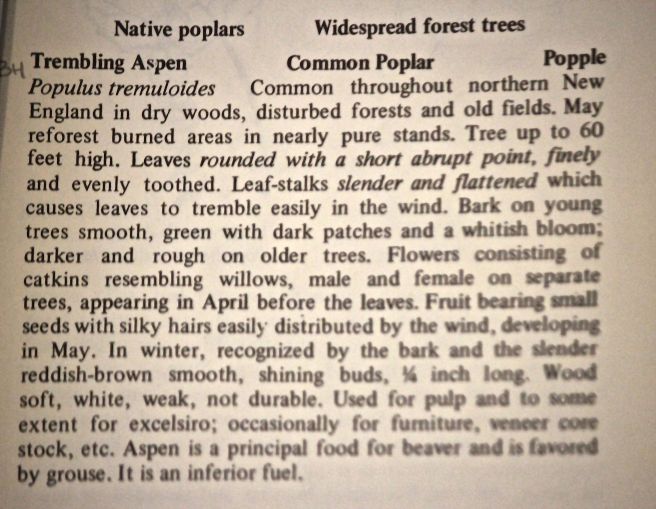
t-quaking description

The descriptions are not lengthy, but enough for a quick reference. I choose the Trembling Aspen, which I’ve learned as Quaking Aspen (I know–that’s the problem with common names say my Latin-oriented friends) because two are located right out the back door. They are the trees of life in our yard.

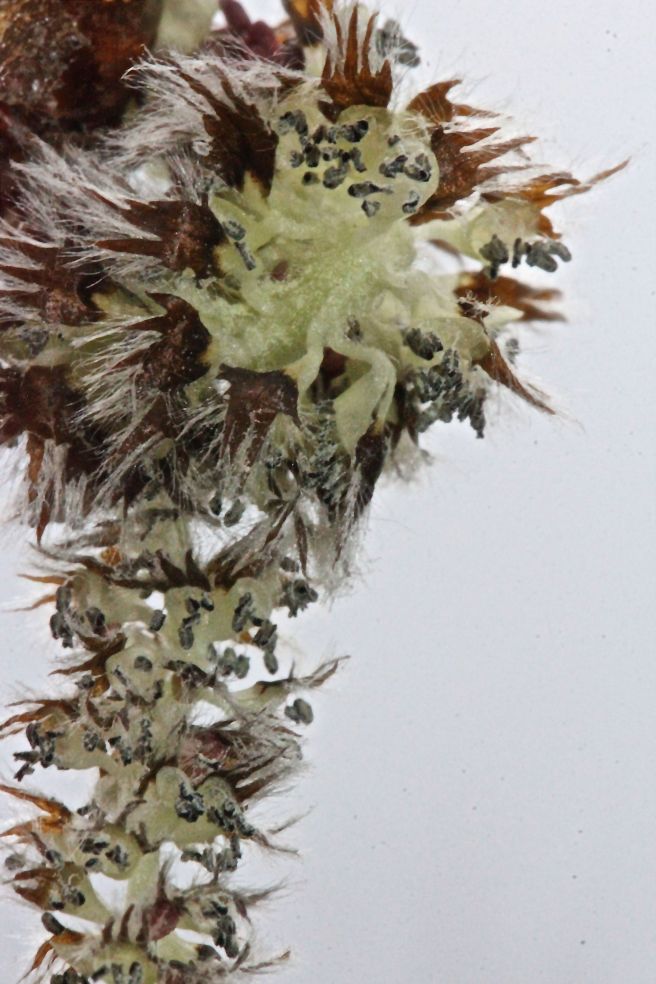
t-catkins forming

Catkins slowly emerge from waxy-coated buds

qa 1

and grow longer with lengthening days.

qa 5

Tufts of hair adorn tiny seeds.

T-summer

Soon, leaves on flat stems quake in the breeze,

t-caterpillars

until visitors arrive.

t-leaf eaters

Very hungry caterpillars.

t-porky

They aren’t the only ones. Porcupines nip off branches.

t-leaf

Eventually, leaves that survive fall to the ground.

t-hairy woodpeckers

All year long, birds visit to dine

t-cardinal

and view the world.

t-cat

The world looks back.

t-ice

Ice slowly melts

qa 2

and life continues.

TREES and SHRUBS of NORTHERN NEW ENGLAND doesn’t include photos, but that’s OK because I have my own. Instead, as any good guide, it’s a jumping off place. So many books, so much different information–and sometimes guides contradict each other. Just the same, I love to read them and then to pay attention. For me, it’s all about forever learning. And wondering.

TREES and SHRUBS of NORTHERN NEW ENGLAND, by Frederic L. Steel and Albion R. Hodgdon, Society for the Protection on Northern Forests, 1975.

Summit of Three

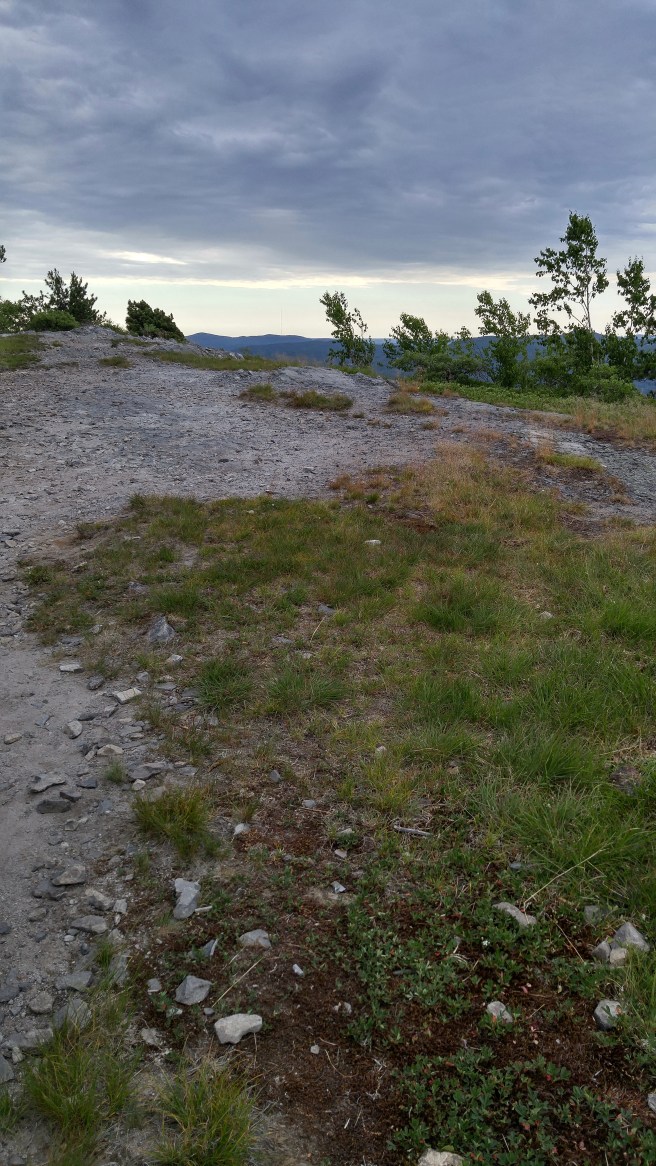
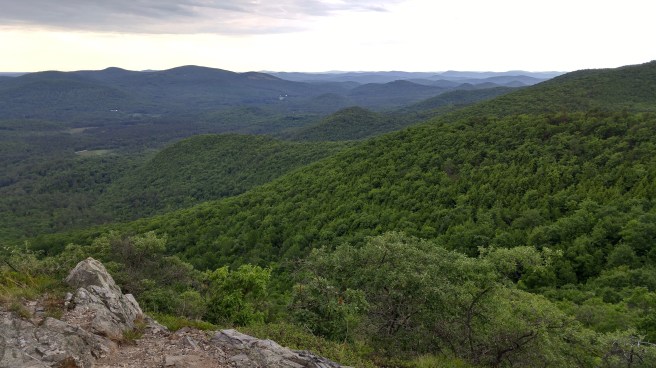
It was the perfect day for an exploration of the scenic vistas at the Greater Lovell Land Trust’s Heald and Bradley Ponds Reserve.

h-mill pond

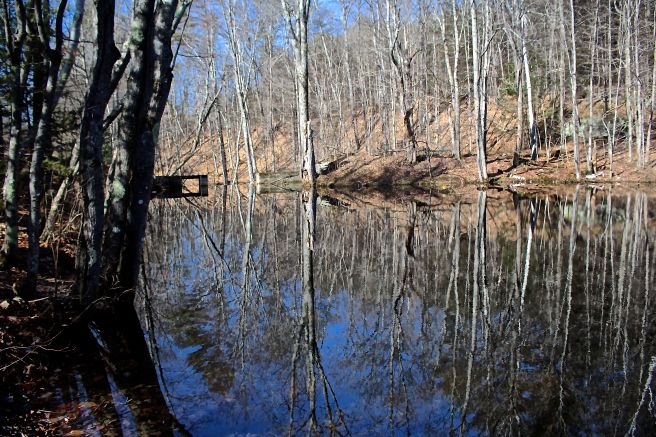
My journey began with time for reflection at the mill pond, a crystal clear reflection–if only life were so.

h-mill dam

It was here that “shook” and cooper mills were located. Reportedly, the men created barrels to hold Caribbean rum and molasses.

h-whiting snow

At the beginning of the journey, a bit of ice and snow covered the trail indicating that others had passed previously.

h-whiting vp

Ascending Whiting Hill (801 feet), I paused at the vernal pool–frozen in time.

h-whiting summit 1

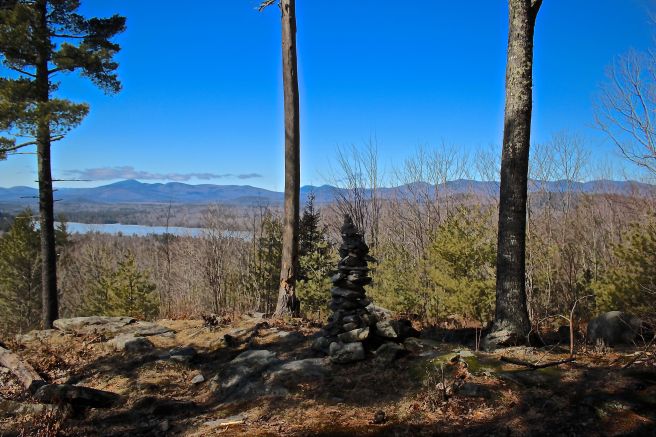
And then the first summit overlooking Kezar Lake–glory in the making.

h-whiting, columbine

When I’d mentioned my hiking plans to a friend this morning, he’d encouraged me to see well–and so it began with the leaves of wild columbine.

h-whiting to heald

On the back side of the summit, a view of Heald Pond.

h-whiting wintergreen

Wintergreen showed off an Easter display of color against a swatch of snow.

h-whiting bear tree

I spied . . . bear trees,

h-whiting cache

a squirrel cache of pinecones,

h-whiting gnome

and a gnome home. Well, I’m not so sure that the squirrel cache was just that. Though red squirrels do cache pinecones, the gnome home was on the other side of the tree trunk. Just goes to show that things aren’t always as they seem.

h-amos cache

Hiking up Amos Mountain, I did find many squirrel tables and this sign–an acorn cache.

h-amos, owlet moth

Sitting still on a rock along the trail, a furry moth from head to toe to antennae, possibly an owlet–capturing the warmth of the sun.

h-amos

After lunch, I poked about the summit of Amos Mountain (955 feet) looking for more wild columbine leaves because I know they grow here. Maybe next time, offering a reason to visit again–as if I need a reason.

h-candy 1

Traveling down the old road behind Amos, I suddenly found myself admiring the miniature  world of candy lichen, its pink disks rising from a pale green surface.

I also noticed a variety of scat from weasel to coyote and realized the importance of this reserve as a corridor for the many mammals who travel here.

h-red maple 1

And then I saw red maple buds decorating the forest floor. Seems to me a red squirrel nipped the buds in hope of future food. Maybe the squirrel will return or maybe it became food itself.

h-amos hophornbeam

Though trail signs shouldn’t be nailed all the way in, I chuckled when I saw this one along the saddle trail–not easy to drive nails into a hophornbeam, the hardest of all woods in our forest.

h-amos, many fruited pelt lichen

I’m not sure that my ID is correct, but along the way, I found what I think is multi-fruited pelt lichen.

h-perky's fen

And then on to Flat Hill via Perky’s Path.

h-flat hill mossy maple

Among other fungi, mossy maple grows here.

h-flat, beaver works

Beaver works are evident all the way around.

h-flat, lodge

And in the pond, the lodge. Below my feet, otter scat. Lots of otter scat. I have to wonder about the action that passes this way.

f-flat hill

The name Flat Hill (891 feet) has always amused me–an oxymoron at best. But really, all three summits are flat.

h-MT W from Flat Hill

In the distance, Mount Washington was the only snow-covered summit.

h-porky first

And right before my eyes–evidence of a visitor who frequents this spot.

h-flat hill porky

While we often think of them as only eating hemlock bark in winter, porcupines dine on other species including spruce and beech.

h-flat hill, porky 2

h-flat hill, porky 3

Despite the damage they do, I’m intrigued by the pattern of their works.

h-flat, walkers

Oh yes, and a treat that appeared in my Christmas stocking made for just the right snack.

h-basswood

At the base of Flat Hill, I paused to admire the basswood buds and leaf scars–offering a smile on this day. Another reason to smile, two barred owls calling to each other. I didn’t see them, but loved listening to their “Who cooks for you? Who cooks for you all?” call. I contributed my own, but they seemed to prefer each other. Can’t imagine why.

h-otter point grape fern

A side trip as I looped back took me to Otter Point. Grape Fern’s winter complexion is so easy to overlook as it blends into the forest floor, but I’m glad I paid attention.

h-otter point view

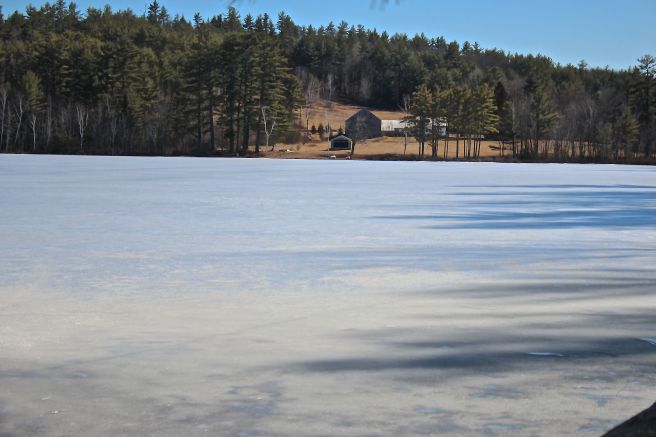
Though a friend informed me this morning that the loons have returned to an open area of Kezar Lake, Heald Pond is still completely coated in ice.

h-vireo nest

Delicate offerings like this vireo’s nest are delightful surprises.

h-seeing well

I’d been encouraged to see well and trust that I kept my focus. It was a solo hike for me and I met no one along all the trails I traversed over the course of six hours–an offering of peace and solitude that I wish everyone could experience.

h-amos heart

On this Saturday before Easter, the universe spoke a language of love and hope along the three summits and I had the honor of listening.


To Bear Trap and Back

A change of plans today meant I had time for a trek to Narramissic Farm and the historic bear trap in South Bridgton before the rain began.

N-view from road

From Ingalls Road, where I decided to park, I took in the view of the front fields and house.

N-Narramissic Road

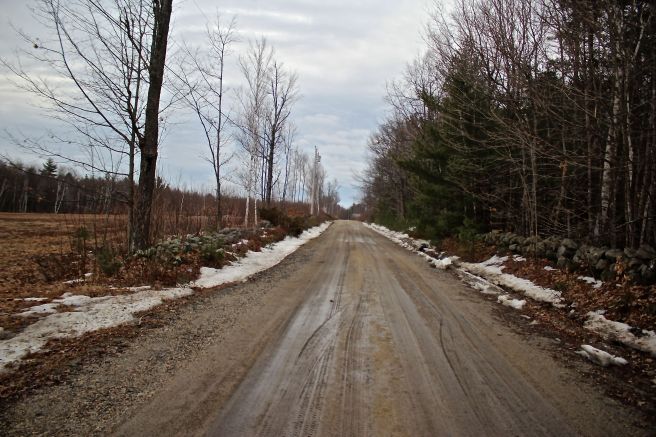
Narramissic Road is passable, but I wanted to slow down and soak it all in.

N-pussy willow 1

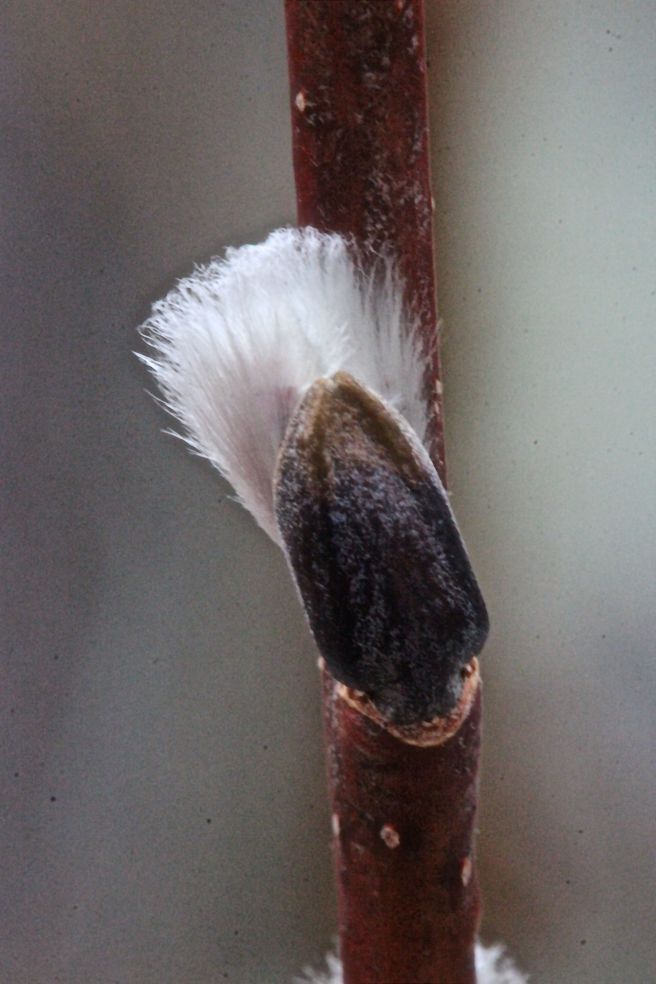
From pussy willows to

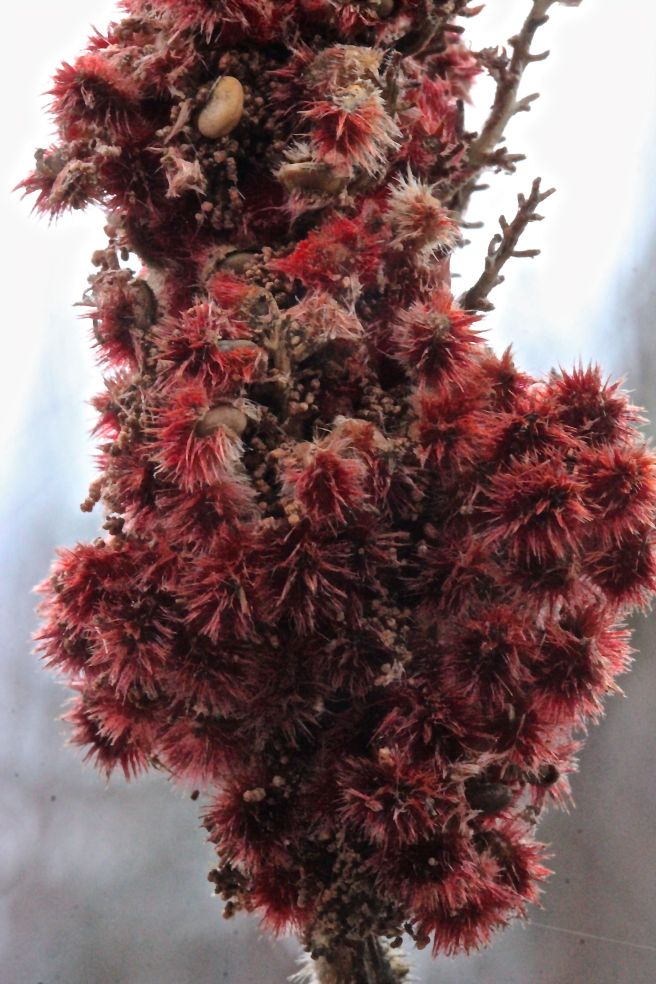
N-staghorn

fuzzy staghorn sumac, I was thankful I’d taken time for the noticing.

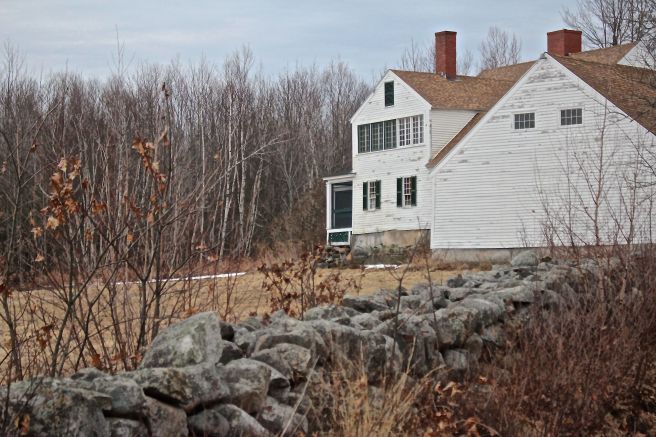
N-house & attached barn

The Bridgton Historical Society acquired the 20-acre property in 1987 when it was bequeathed by Mrs. Margaret Monroe.

N-house

Turning the clock back to 1797, William Peabody, one of Bridgton’s first settlers, built the main part of the house.

Peabody sold the farm to his daughter Mary and her husband, George Fitch, in 1830 and they did some updating while adding an ell.

N-barn front

The Fitches had a barn erected that has come to be known as the Temperance Barn; historical records claim it to be so named “because it was raised without the traditional barrel of rum.”

N- barn face

Both the barn and the house are in need of repair, but I couldn’t help but wonder about what mighty fine structures they were in their day. While today, a visit to the farm feels like you’re in the middle of nowhere, during its heyday it was located in the center of somewhere–at the junction of two roads that have since been abandoned.

When Mrs. Monroe purchased the property in 1938, she named it Narramissic, apparently an Abenaki word for “hard to find” because it reflected her long search for just the right piece of real estate.

N-blacksmith shop

A blacksmith shop is located between the house and Temperance Barn, and beside the trail I chose to follow through another field and off into the woods.

N-garden wall 1a

Massive stone walls indicate the fields had been plowed.

N-rock uplifting

Even today, “stone potatoes” continue to “rise” from the ground, making them one of the farmer’s best crops.

N-pearly 2

My destination was two-fold: the quarry and bear trap. But along the trail, I stopped to smell the roses. Or at least admire the beauty of pearly everlasting in its winter form.

N-gray birch litter

Several trees had snapped in the season’s wind, including a gray birch that scattered scales and seeds as it crashed to the ground.

N-gray fruit seeds

But . . . because the top of the tree was no longer in the wind zone, a surprising number of catkins continued to dangle–all the better for me to see. Notice the shiny seeds attached to the scales.

N-gray birch generations

The tree speaks of generations past and into the future.

N-jelly 2

Further along, I found a wavy and rubbery jelly ear (Auricularia auricla) beside a gray birch seed.

N-sign 2

Finally, I reached my turn-off.

N-quarry 1

N-feather 2

This is the spot from which the foundations for the buildings were quarried so long ago, using the plug and feather technique that was common in that time.

N-common toadskin 2

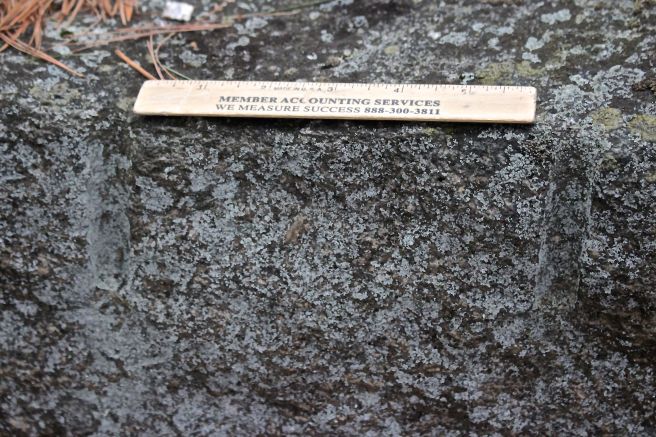
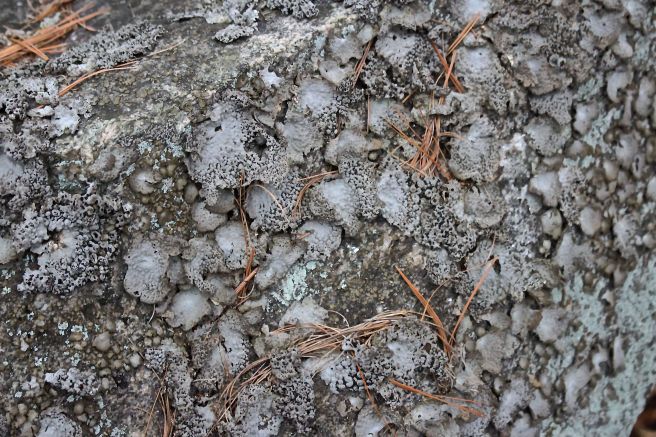
Life of a different sort has overtaken some of the stones–common toadskin lichen covers their faces.

N-common toadskin 3

In its dry form, it looks perhaps like the surface of a foreign planet, but this is another lichen that turns green when wet–allowing the “toad” to become visible.

N-bishop's face in ice

Speaking of becoming visible, I noticed the bishop’s face topped with a mitre as water dripped off the rocks and froze. My thoughts turned to my sister–she doesn’t always see what I see, but maybe this one will work for her.

N-young beech

Heading back out to the main trail, I startled a snowshoe hare and of course, didn’t have my camera ready. As I turned toward the bear trap, I continued in the land of the beech trees. Most are too young to produce fruit, but I looked for larger trees and, of course, checked for claw marks.

N-beech slashes

The best I found were slashes–probably caused by another tree rubbing against this one.

N-initials

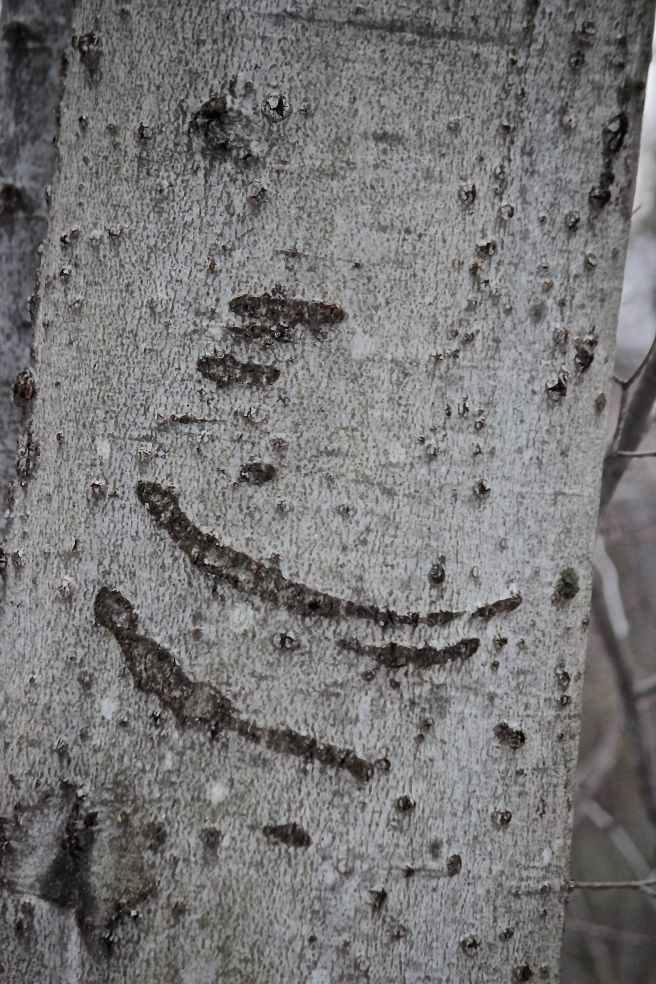
Oh, and some initials carved by one very precise bear.

N-No parking

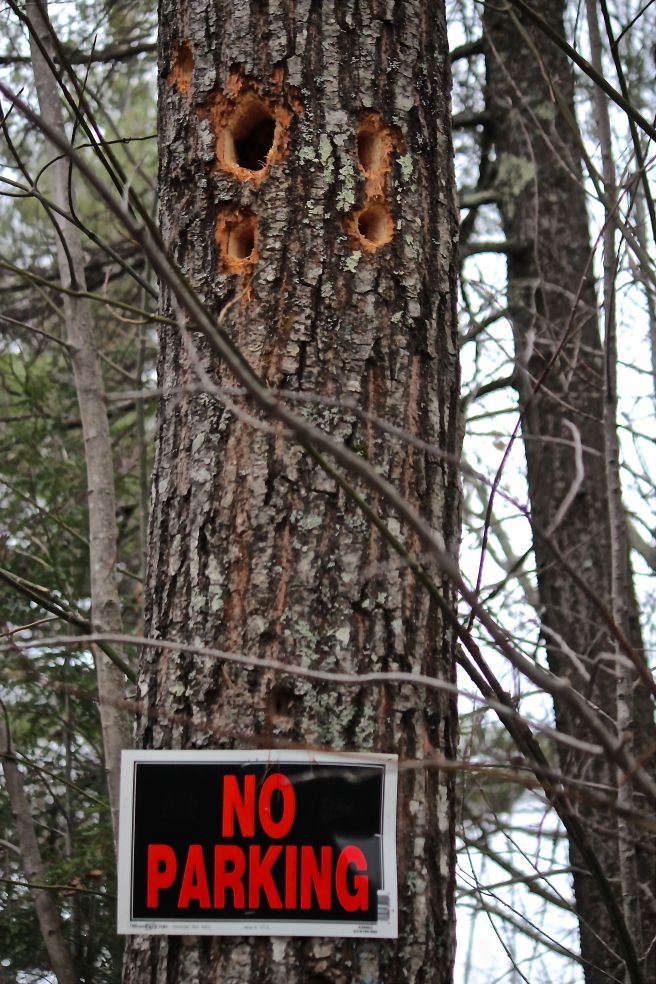
I was almost there when I encountered a “No Parking” sign. A new “No Parking” sign. On a trail in the middle of nowhere that used to be somewhere. The pileated woodpeckers obviously ignored it. Me too.

N-BT1

At last, Bear Trap! According to an August 17, 1963 article in the Bridgton News, “Enoch Perley, early settler of South Bridgton, built his first house in 1777 and brought his bride to their new home in 1778. [I believe this was at Five Fields Farm.]

As Enoch acquired livestock, he was much troubled by depredations from bears. He built a bear trap on the hill back of his first home . . .

Tradition says that four bears were caught in this trap–not enough! So Mr. Perley later had an iron bear trap made which took care of eight bears. Without a doubt, many were disposed of by him personally. A story is told that in an unarmed encounter with a bear and two cubs beside a wood road at dusk, Mr. Perley allegedly strangled the mother bear with his garters . . .”

N-bear trap 1

The article continues, “The bear trap is built of stone. A large stone door is suspended and as the bear takes the bait, he trips the lever and is caught in the stone enclosure.”

N-BT inside

I looked inside and found no one in residence. In a December 1954 issue of the Bridgton News, a brief article states: “The old stone bear trap on the mountain in South Bridgton known as ‘Fitch’s Hill,’ unused for more than one hundred years, has been reactivated by Dr. Fred G. Noble and Gerald Palmer and put in readiness to capture a bear.” As the story goes, they never did succeed.

N-BT back view

A side view.

N-BT*back side

And a rear view. A few years ago there was talk of moving this monument because land ownership had changed. I hope it stays put because its authenticity would be lost in a move.

N-pine scale?

Just below the trap, I noticed a white hue decorating only one of a bunch of young pine trees. I can’t say I’ve ever seen this before or venture a guess about its origin. I’m waiting to hear back for our district forester–maybe he has some insight.

N-heading back 1

As I headed back down the trail and the barn came into view, I spied a single red pine thrown into the mix of forest species that have taken over this land.

N-red pine

Ever on my bear claw quest, I checked the bark of this tree. Though beech provides an easy display of such marks, it’s not the only species of choice. Among others, single red pines that appear to be anomalies have been known to receive a visit.

N-hare

There was sudden movement as I approached the pine and then what to my wondering eyes should appear, but a second snowshoe hare! It paused long enough for me to snap a photo. Do you see it? Also known as the varying hare, its fur is still white.

Behind the tree, I found where it had been dining and defecating.

N-Pleasant Mtn ridge

N-farm view from back

As I crossed the upper field, the ridge line of Pleasant Mountain and ski trails at Shawnee Peak made themselves known to the west. And beyond the farmhouse, the White Mountains.

And then,

N-shagbark hickory

and then . . .  an oversized bud captured my attention as I walked back down the road.


Shagbark hickory isn’t a common species around here. But, Jon Evans of Loon Echo Land Trust had recently told me some mature trees were found on a property in South Bridgton that is under conservation easement. (We actually may visit them tomorrow). The bulbous, hairy bud scales and large leaf scar made even the young trees easy to identify. Curiously, according to Forest Trees of Maine, the wood “was formerly used in the manufacture of agricultural implements, axe and tool handles, carriages and wagons, especially the spokes and rims of the wheels.” That fits right in with the neighborhood I’d been visiting.

N-mud season

One final view–yup, it’s mud season in western Maine. But still worth a trek to bear trap and back. Thankfully, the rain held off until my drive home.


Treasure Trove

I know. It’s Monday. And we should be celebrating with a Mondate, but my guy got involved with a project and so it was that I went on a solo expedition–ever in search of nature’s treasures.

s-snow 1

A fresh coating of snow decorated the world.

s-vp

A quick stop at the vernal pool and I mentally noted the changes of the past two weeks from slush to ice to snow. According to temperature predictions for the middle of this week, I’ve a feeling it will cycle back to slush mighty soon.

s-2nd vp

A visit to a second vernal pool shows the transition all in one. With this one, however, I couldn’t help but think about how low the water level is and what this winter’s lack of snow will mean to the land, the critters and us. That being said, I hope it doesn’t rain all summer.

s-willow

Someone asked me the other day if I go out with a topic in mind. Hardly ever, but today I did go in search of hairy things like this willow twig adorned with buds. Plant hairs, I’ve recently learned, are called trichomes. And what purpose do they serve? Well, for starters, they aid the plant in the absorption of water and minerals. But they do more, like reflecting radiation, lowering temperature when it’s hot and keeping the plant warm when it’s cold outside. Though they also provide defense against insects, I have to wonder if some insects find them to be an invitation.

s-bulrush 1

It’s a very hairy world out there.

s-interrupted

Indeed.

s-paper birch twig1

Not all hair is created equal. It ranges from short and fine to  . . .

s-blackberry

rather stiff and irritating.

s-beech 1

It can be so fine, that you hardly notice it, like the hair on the beech leaf’s petiole or stem. While it’s not so evident on the bud scales, in about two months as new beech leaves unfold, pay attention. They are incredibly hairy. But, over the course of the summer continue to watch, because it seems to me that the insects are not deterred by the hairiness–beech leaves take a beating.

s-witch hazel bracts

Another purveyor of fine hair–the witch hazel flower bracts showing off their fuzzy edges and tips (and subtle colors).

s-witch hazel leaf fuzzy

And don’t forget to notice their leaves–still attached to many trees. The wavy rim and salmony bronze color catches my eye.

s-witch hazel leaf fuzz

But today, I realized that along the veins on the back side and that wavy edge, teeny, tiny hairs are almost invisible.

s-sweetfern1

Sweetfern is not to be ignored.

s-aster 1

The asters and goldenrods feature another type of hair–used as a parachute to disperse new life far and wide.

s-milkweed pod

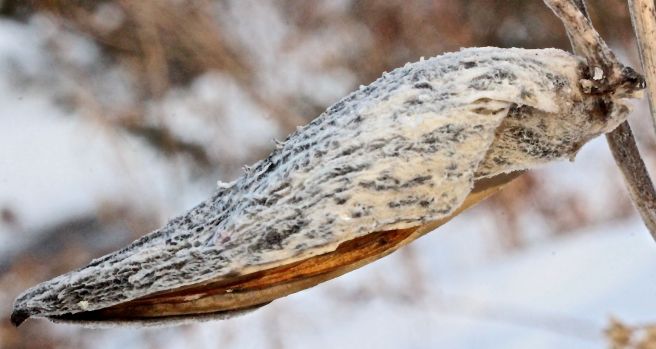
Sometimes, the hair is hidden inside, to be sent off when the time is right. In the end, just a woody pod remains.

s-british soldier 1

But . . . being me, it wasn’t just hair that was transfixing. The color and texture of British soldiers enhanced by the melting snow were a sight worth beholding.

s-conk1

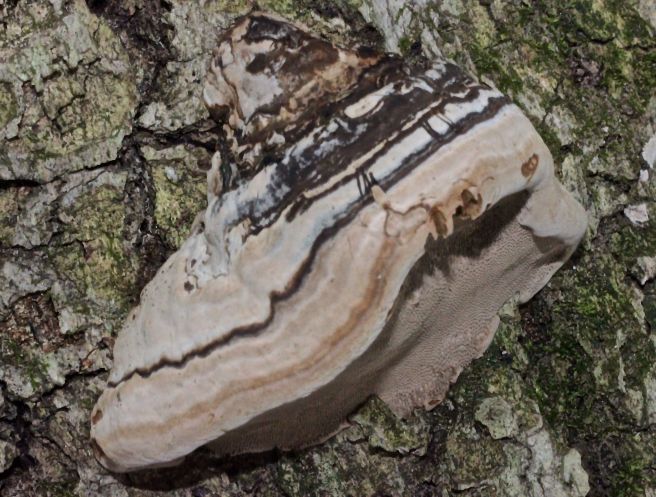
And there was what I think is a false tinder conk growing on a hemlock. I couldn’t help but imagine an ice cream sundae, complete with hot fudge sauce. And check out the pattern of the pore surface on the underside.

s-nest

I revisited some old friends, including this bald-faced hornet nest. There’s not much left of it now, but still it exudes beauty.

s-striped maple buds, winged bug

And finally the seeds of a striped maple that cling still. With a bit of imagination, you might see a winged insect in this arrangement.

As I stood near an opening in the woodland, three crows squawked continuously. I paused and watched as they circled about, moved off and returned. My telephoto lens was ready to capture the subject of their discontent. About five minutes later, they were joined by two others, and then two others and eventually a murder of at least a dozen crows. The group circled one more time and then headed off, I know not where. But that was my turning around point–perhaps they were regrouping and heading home for the day. I needed to do the same. My guy had said he’d send the troops out looking for me if I didn’t return in two hours. Then we both chuckled because we knew that was an impossibility.

Three hours later, I arrived home filled with a treasure trove of finds.


Leaping Mondate

My guy happens to be Irish so it seemed only appropriate that I propose to him today following the example that St. Brigid set when she struck a deal with St. Patrick. Yes, we’ve been married for 25+ years, but I proposed anyway.

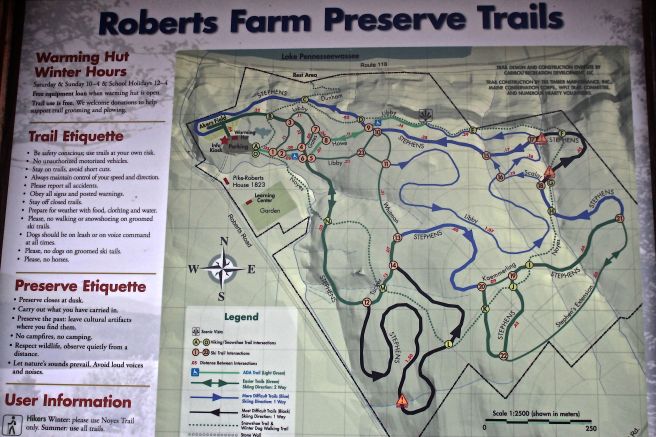
And he accepted. So today’s Mondate found us at Roberts Farm Preserve in Norway. Norway, Maine, that is.

R-sign

In her book, Hikes and Woodland Walks in and around Maine’s LAKES REGION, my friend Marita Wiser states that the preserve was “farmed by the Pike and Roberts family for 200 years.” She adds, “The property was purchased by the Western Foothills Land Trust in 2007.”

r-parking

Though the trails are mostly maintained for Nordic skiers, we didn’t see any today.

r-trail map

Had it been open to skiers, we wouldn’t have been able to do what we did–follow the network of trails around the perimeter of the property.

r-cherry bark

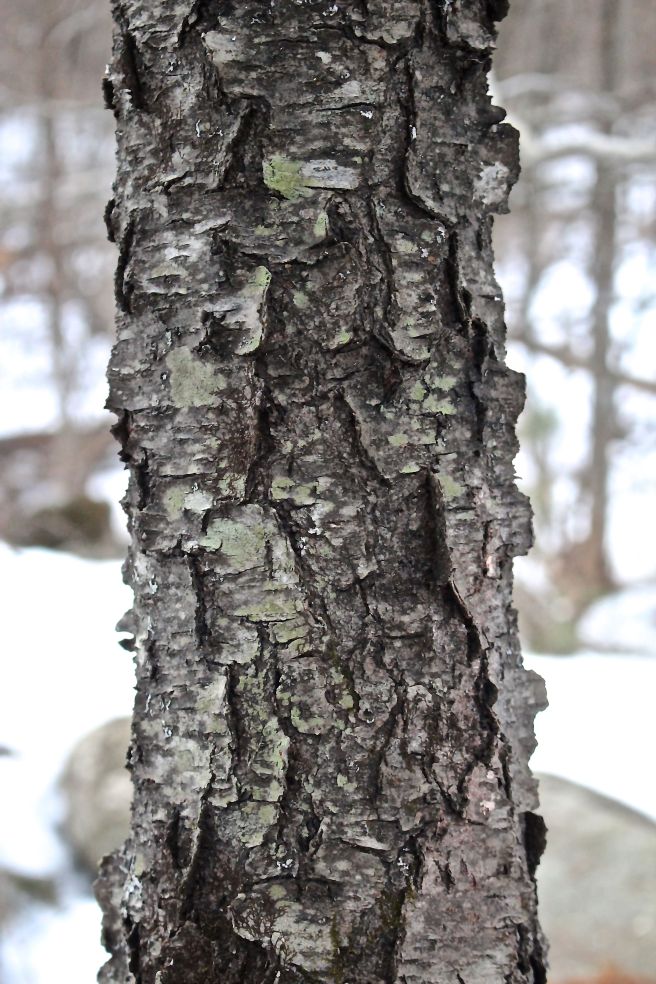
We’d only walked a few feet when I had to pause–the burnt cornflake look of black cherry bark insisted upon being noticed.

R-Northern White Cedar

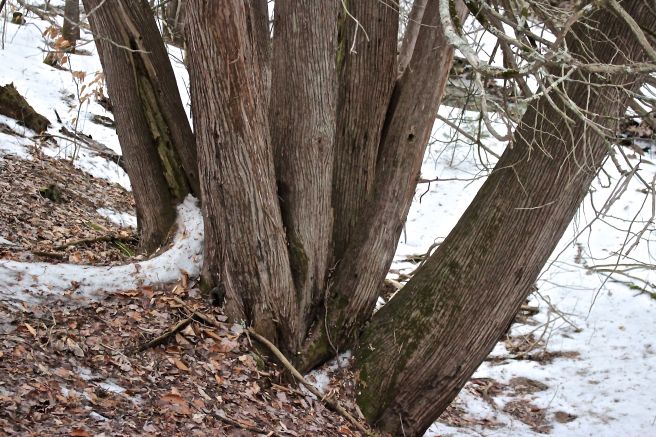
Visiting here a couple of times previously, one of the things I’d come to like about it is the opportunity to gush over Northern white cedar bark.

r-northern white bark2

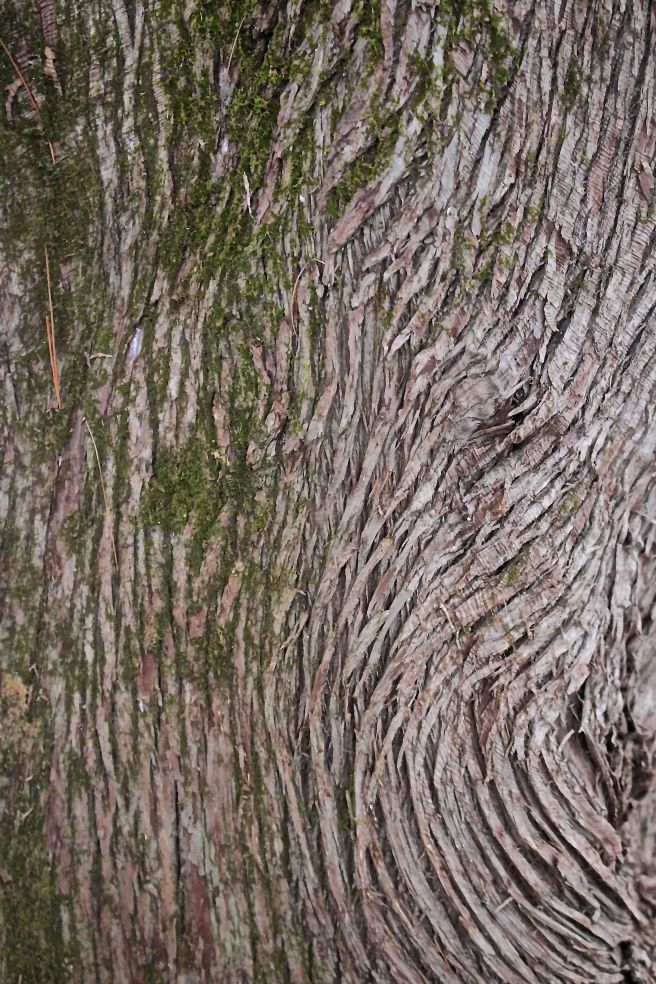
I love its red-brown color, sheddy strips that intersect in diamond formations and habit of spiraling left and then right with age. In his book BARK, Michael Wojtech states of the cedar: “In the 1500s, the native Iroquois showed French explorers how to prevent scurvy using a tea made from the bark, which contains vitamin C. The name arborvitae means ‘tree of life.'”

r-northern white leaves

Equally beautiful are its flat sprays of braided, scale-like leaves.

Since I’m on the topic of tree bark, I have two others to share, including this one–the red inner bark of Northern Red Oak made a stunning statement.

r-hop hornbeam bark

Displaying its shaggy presentation was the hop hornbeam.

My heart leaped (appropriate movement for today) when I saw these papery fruits on the ground–hop hornbeam is named for its fruiting structures that resemble hops.

r-stone wall

Stone walls crisscross the preserve and provide evidence of its former use as a dairy farm.

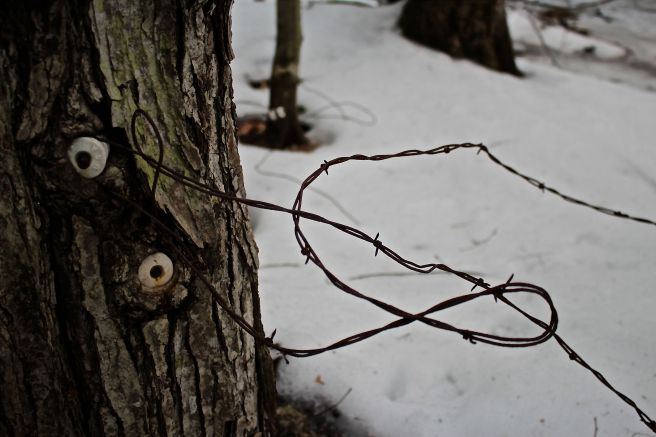
r-barbed wire

Barbed wire adds to the story.

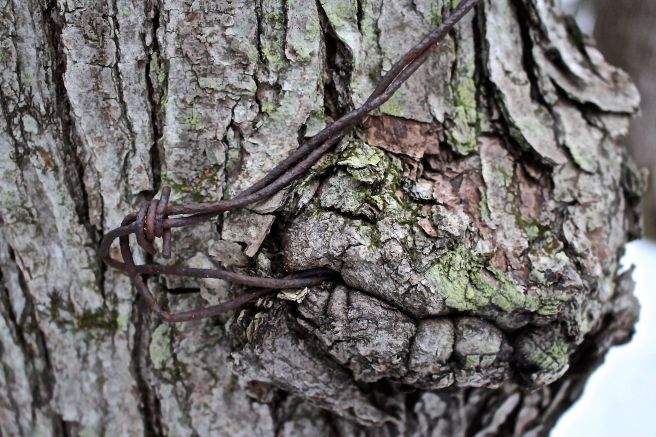
r-barbed wire grimace

Installed long ago, this tree formed a grimace in response.

r-large pine

Along the edge of some walls stand much happier trees–those that were allowed to grow tall and wide in the sun, like this Eastern white pine. Perhaps it provided a bit of shade for Roberts’ Jerseys.

r-generation gap

The land was farmed until 1968. Since then, it returned to woodland, was sold and logged and sold another time–finally to the land trust. Generational gaps are visible throughout. This is the perfect place to take some youngsters and ask them to locate a white pine that matches their age.

r-brook 2

We cross several streams that I’m sure sustained the farm and its inhabitants. Today, they sustain the wildlife that wanders here, including deer.

r-turkey trot

We realized there had been a recent turkey trot and

r-voles 1

vole convention.

r-pileated condo

Birds also have played a major role in this community. This pileated woodpecker-created condominium has been around for a while.

r-pileated pile

From the trail, I spied the largest pile of wood chips I’ve ever seen and of course, had to investigate.

r-pileated tree

The old beech was recently excavated for new condos.

r-pil pile 2

Below, the wood chip pile was a couple of inches deep.

r-pileated scat 1

r-pil scat 2

The best part–lots of scat cylinders filled with insect body parts. Good stuff to see.

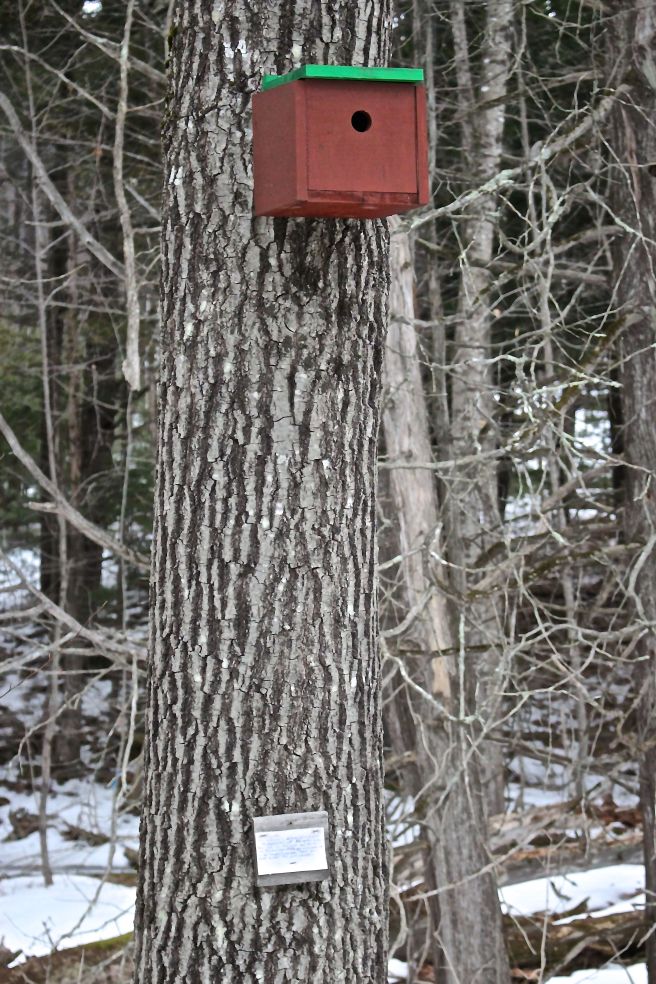
r-birdhouse

Pileated woodpeckers aren’t the only ones in the building industry.

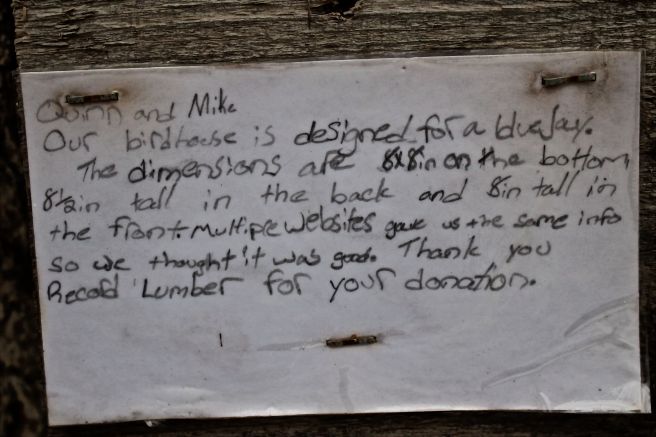
r-birdhouse sign

I think you’d agree that Quinn and Mike did a fabulous job constructing this birdhouse.

r-mullein capsules

In several open areas we spotted the winter display of common mullein.

r-mullein 2

Its crowded performance of two-parted capsules atop a tall, fuzzy stem made it easy to identify.


The pointed prickly bracts of thistles also offered a winter show.

r-lungwort on ash

Lungwort tried to hide on the backside of an ash tree, but I found it. I only wish we’d had rain, or better yet, snow, recently, because I love the neon green that it becomes once it is wet.

r-lunch rock

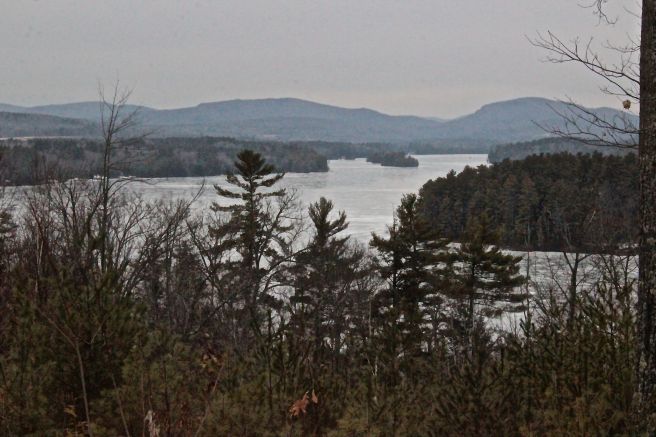
Be careful what you wish for. Though the day was sunny at the start, it began to rain as we ate our sandwiches on lunch rock overlooking Lake Pennesseewassee, aka Norway Lake.

r-lake 1

It wasn’t a downpour, but enough that it encouraged us to eat quickly and move on.

r-beaked bud

Well, I didn’t move far. Within steps, I found a shrub I was seeking yesterday–beaked hazelnut.

r-beaked hazel

It’s a member of the birch family and features catkins–the male flowers that will release pollen this spring to fertilize the shrub’s delicate red female flowers.

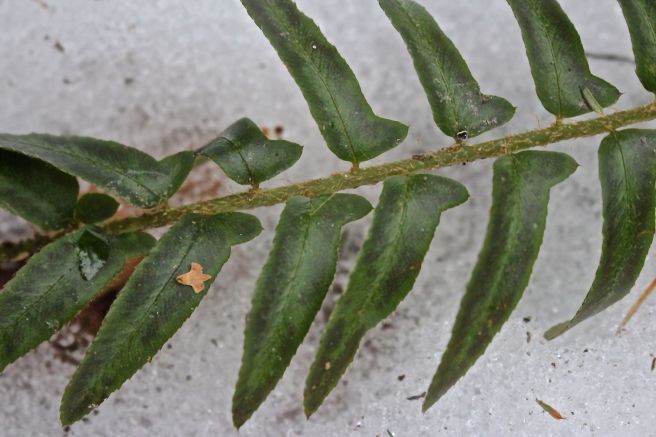
r-christmas fern

Another quick find–Christmas fern–one pinnae topped with a birch fleur de lis.

Typically, during the winter there is only one trail open to hikers. Today, however, we figured it would be OK to walk on the ski trails because they are either icy or bare. It was definitely a micro-spike kind of day, which has been more the norm this year.

r-painted cow

Other than birds and squirrels, we saw no wildlife. But we did stumble upon the “Painted Cows” created by Bernard Langlais in 1974 and gifted to the land trust by Colby College and the Kohler Foundation.

We had planned to explore the inner network of trails, but the cold raindrops drove us out. Despite that, I think my guy enjoyed himself as much as I did. And he was extremely patient each time I paused. Sometimes he even gave me a heads up–I took that to mean he didn’t mind that I had to stop, wonder and photograph. This is one Leap Date I hope we don’t forget.


Book of January: A Guide to Nature in Winter by Donald W. Stokes

Stokes 1

Book of January

I have a number of winter nature books, but one of my go-to favs is A Guide to Nature in Winter by Donald W. Stokes. My copy is old (1976–it was a very good year–I graduated from high school) and a bit weathered, but that’s because it has seen frequent use.

Divided into eight field guides, Stokes covers all aspects of winter: winter weeds; snow; wintering trees; evidence of insects; winter’s birds and abandoned nests; mushrooms in winter; tracks in the snow; and woodland evergreen plants.

For each topic,  pen-and-ink drawings by illustrator Deborah Prince and the author are included in the key, as well as natural history descriptions.

The natural history descriptions are just that–Stokes’s descriptions are part of the story that Kevin Harding of the Greater Lovell Land Trust reminds us to share with others. Here’s an example: “St. Johnswort (Hypericum perforatum)–An old country custom in Europe was to hang a special yellow-blossomed plant in your window on the eve of St. John’s Day (June 24), in order to repel bad spirits and counteract the evil eye. In general, the presence of this plant was considered a good omen, and since it was thought that the plant warded off lightning and revealed the identity of passing witches, St. Johnswort was allowed to prosper around the farmhouse. It became known as St. John’s Plant or St. Johnswort (wort meaning “plant” or “herb”). When the plant immigrated to North America it left its traditions behind, and although still as effective as it probably ever was against evil, St. Johnswort is now seldom used for that purpose.” Of course, then he goes on to describe how the plant grows and the seed heads that will appear in the winter landscape.

One of the things I’ve learned from this book is to keep it simple. In the chapter about winter trees, Stokes encourages the reader to begin with the six most common deciduous trees: oak; maple; ash; beech; birch; and aspen. Learning these along with the evergreens provides you with knowledge about 80% of the trees in your forest. I’ve spent the last couple of years developing my bark eyes. I still have much to learn, but can eliminate the common species when I encounter bark I’m uncertain about.

It’s well worth taking the time to read A Guide to Nature in Winter from cover to cover–it’s an easy and enjoyable read. I say it won’t take long–unless you are like me and you pause to underline (yes, I mark my books up–even write in the margins, oh my!) details and take time to understand what you do see along the trail. I probably should invest in a more up-to-date copy, but I feel right at home engrossed in the one that I have.

And it’s also easy to turn to a particular chapter to figure things out. The simplified, illustrated keys should bring you quickly to an identification. And as I said before, the natural history description will further enhance your learning.

The book is available at Amazon.com, but if you live near an independent book store like Bridgton Books, then I strongly encourage you to shop there.

A Guide to Nature in Winter: Northeast and North Central North America, by Donald W. Stokes, illustrated by Deborah Prince and the author, published 1976, Little, Brown & Company.

Trending Blaze Orange

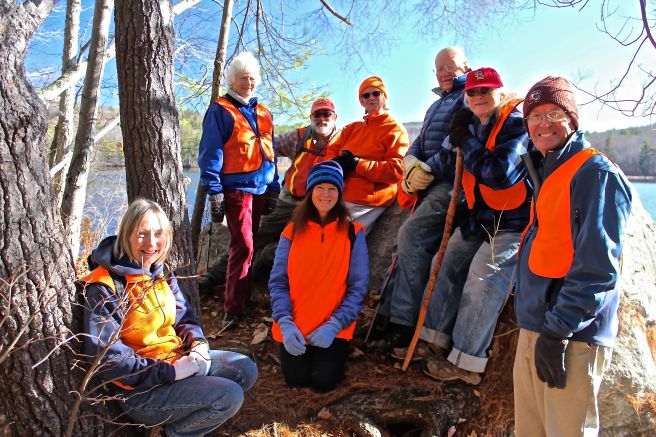
Donning our blaze orange, eight of the Greater Lovell Land Trust‘s docents joined me today for an exploration along the trail to Otter Rock at the Heald and Bradley Ponds Reserve.

Our destination was the Otter Rock spur, not very far, but it’s amazing how long it can take us and we were impressed that we actually reached our goal.

grape fern 1.jpg

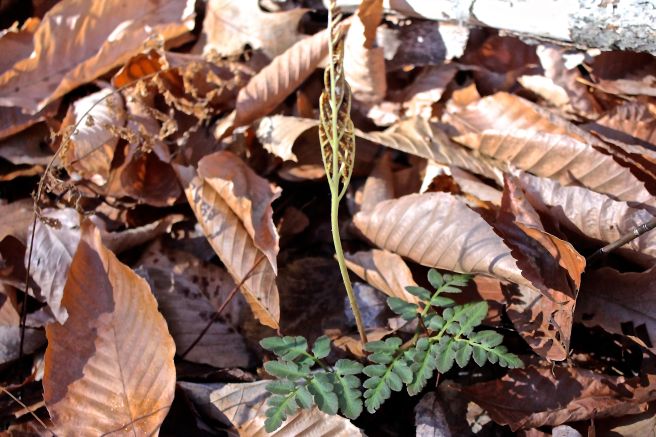
Along the way we stopped to admire the blunt-lobe grape ferns and their separate fertile stalks, some still intact.

4 birches.jpg

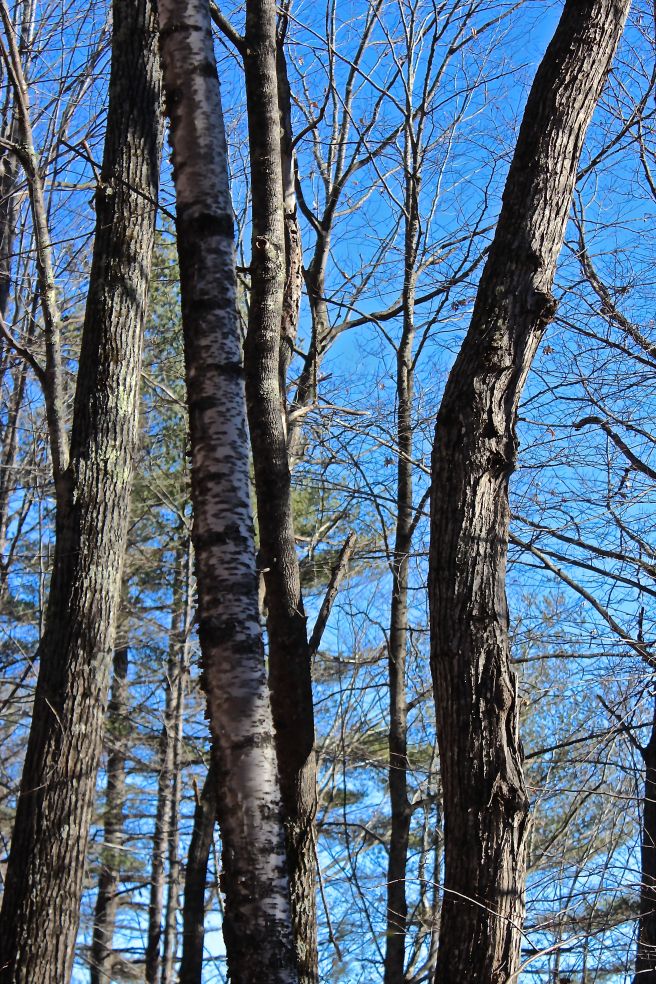
And then we looked up. We’d been talking about tree bark, and right before our very eyes were four members of the birch family.

paper birch

Paper Birch (Betula papyrifera) features chalky white bark that often peels away in large sheets. The peeled bark reveals pink or orange tints, only partially visible here, but evident on other trees in the neighborhood.

yellow birch

To the left of the Paper Birch stands a Yellow Birch (Betula alleghaniensis), with its curly ribbon-like strips of bronze or yellowish-gray bark giving it a shaggy appearance.

black birch

And to its left the one that excited us most, Black Birch (Betula lenta), sporting gray bark with long, horizontal lenticels. All trees have lenticels, but they are more obvious on some than others. These slits allow for the exchange of gas so the tree may breath.


gray birch

Last in the family line-up, a Gray Birch (Betula populifolia) showing off its almost dirty appearance and chevrons below the former branch sites.

dragonfly nymph 1

At Otter Rock, we found dragonfly nymph exoskeletons still clinging to tree bark

df 2

and rocks.

shell remnants

Our discovery of shells made us wonder and smile about others who have passed this way.

wh b

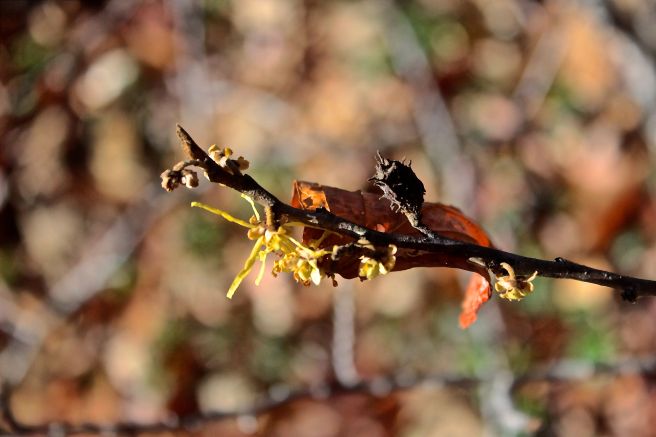
Now that the leaves are gone, we delighted in the knowledge that there is so much more to see, including Witch Hazel.

witch hazel gall

We examined one of the few remaining ribbony flowers, the scalpel-shaped buds, fruiting bodies, asymmetrical leaves and a spiny gall all on one branch.

witch hazel Bob.jpg

Our very own Witch Hazel Expert, Docent Bob, demonstrated the way the seeds pop–referencing Henry David Thoreau’s discovery of this phenomenon.

docents 1.jpg

Before we headed back to the main trail, the group posed for a photo call. They all look so sporty in their blaze orange.

wild raisins

A few more finds as we walked back to the parking lot: remnants of a wild raisin (Viburnum cassinoides), so named because the shriveled fruits that remain look like raisins;

black cherry bark.jpg

Black Cherry bark (Prunus serotina), easily identified by the small scales that curl outward like burnt cornflakes or potato chips;

red oak leaves

and Northern Red Oak leaves displaying holiday colors.

Mill Stream

Though most of us parted company just beyond the mill stream, a couple of us continued on to the John A. Segur Wildlife Refuge off New Road.

Heal All

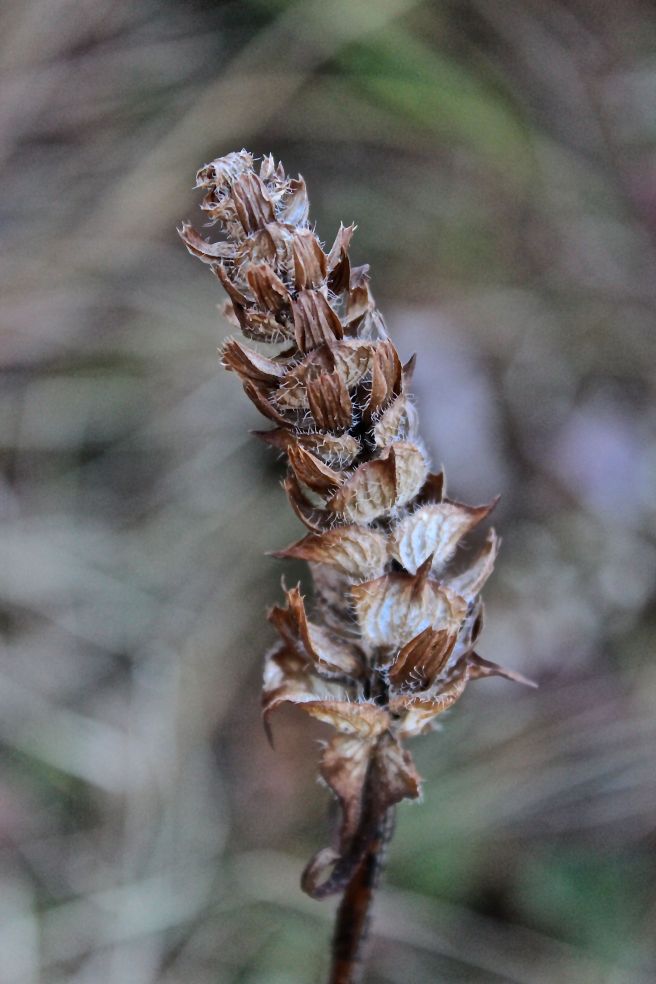
We focused our attention on winter weeds, a topic for our January 9th walk. On this old logging road, some of the Selfheal or Heal-all (Prunella vulgaris) stands at least a foot and a half tall. As pretty as it is in the summer, it’s still a sight to behold in its winter structure.

evening primrose

Another to look forward to is the Evening Primrose (Oenothera biennia). Its fruits are four-parted capsules arranged in a spike at the tip of the stem, looking rather like flowers themselves.

There’s more to see, but I don’t want to give it all away.

CS view 1

My last stop for the day was a loop around the Chip Stockford Reserve. I wasn’t the only one trending blaze orange. The glow of the late afternoon sun cast an orange hue across the beech leaves.

November in western Maine. We’re happy to don our blaze orange and get out on the trails.


Questions To Be Asked

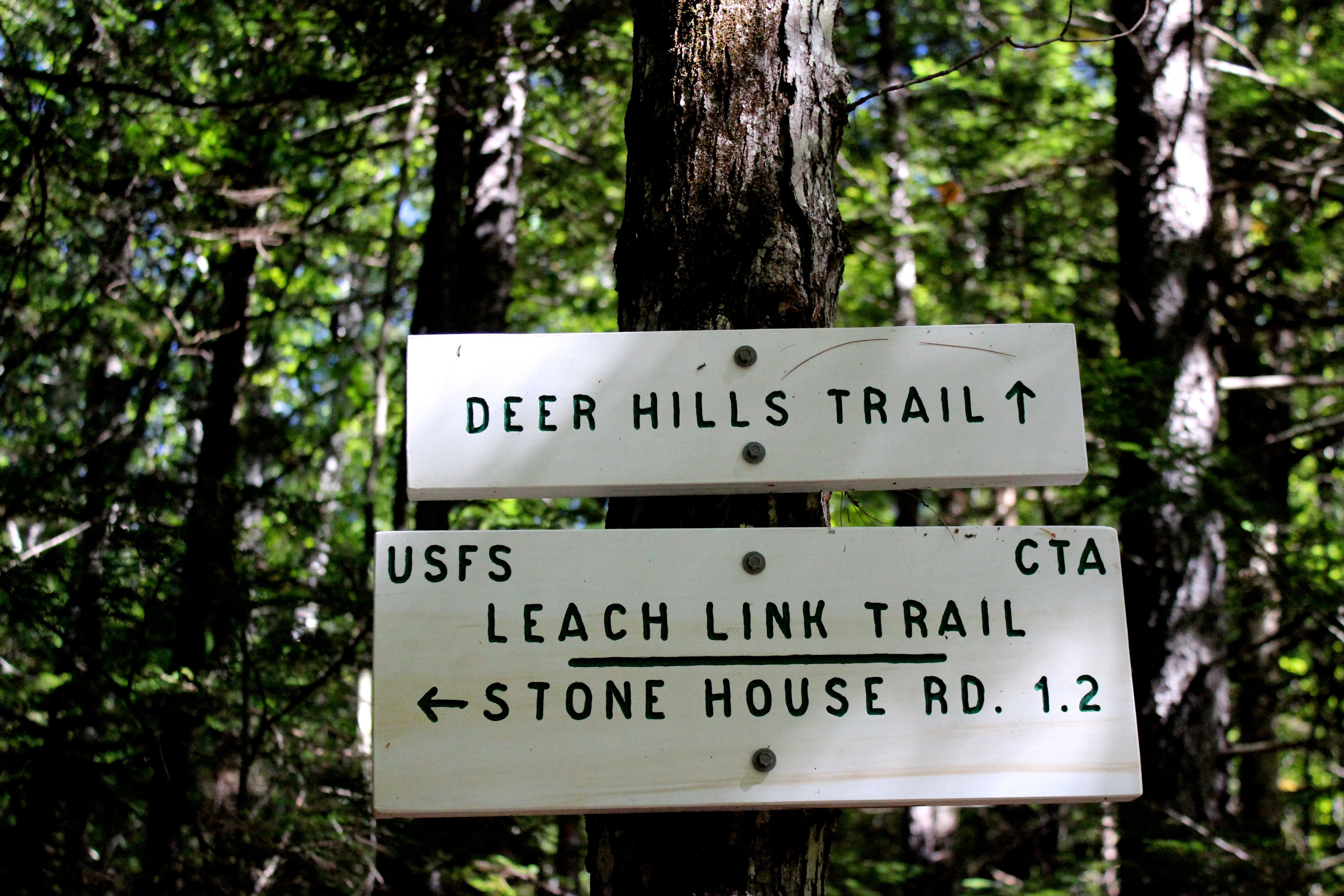
A friend and I drove to Evans Notch today with the mission of exploring a trail that was new to us. The Leach Link Trail connects Stone House Road to the Deer Hill trail system.

IMG_1338

We started at Stone House Road and turned back at the Cold River Dam. Not a long trail, certainly. And rather flat for the most part. Despite that . . . it took us four hours to cover 2.4 miles. You might say we stopped frequently.

There was a lot to see along this enchanted path. And questions to be asked.

CB 2

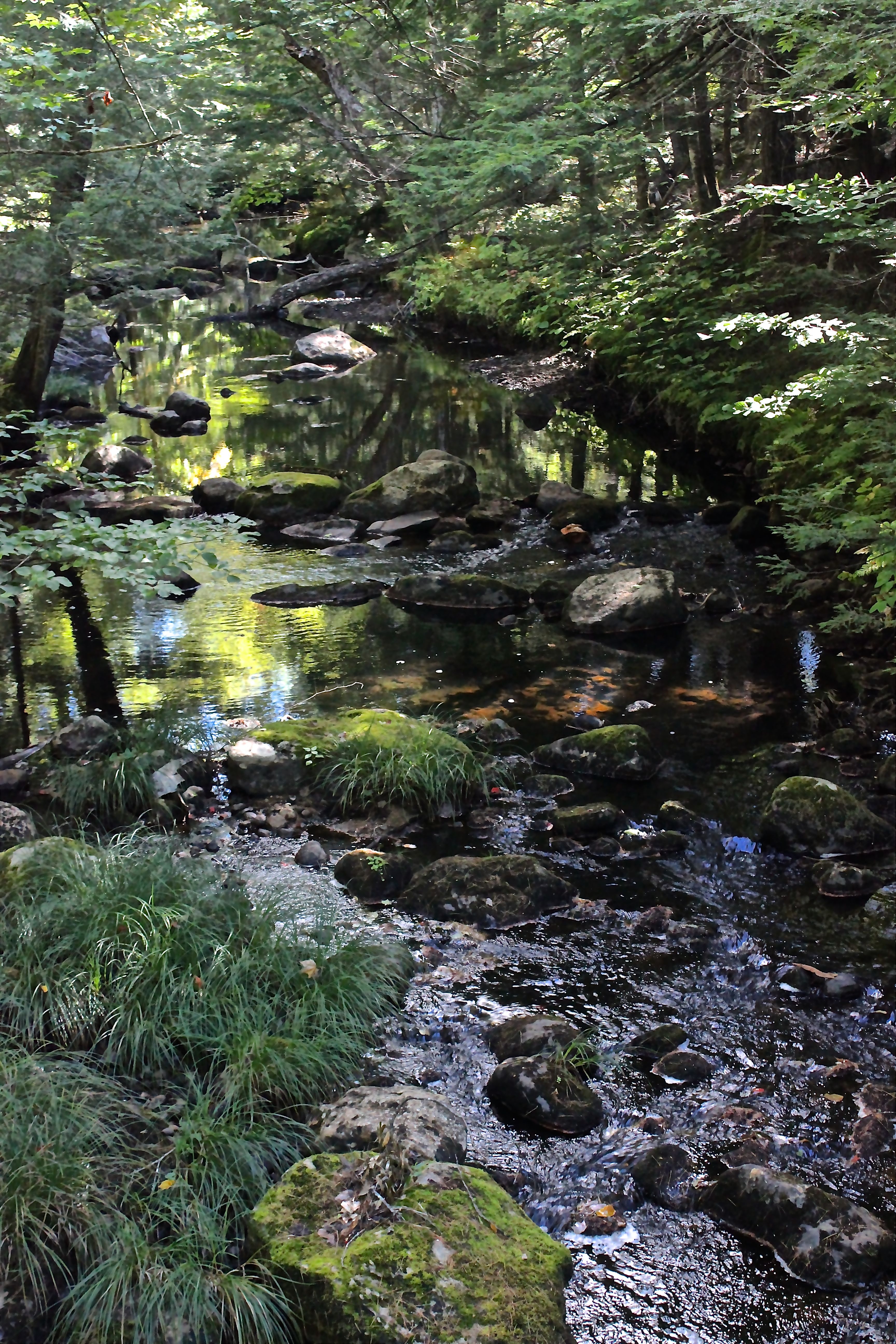
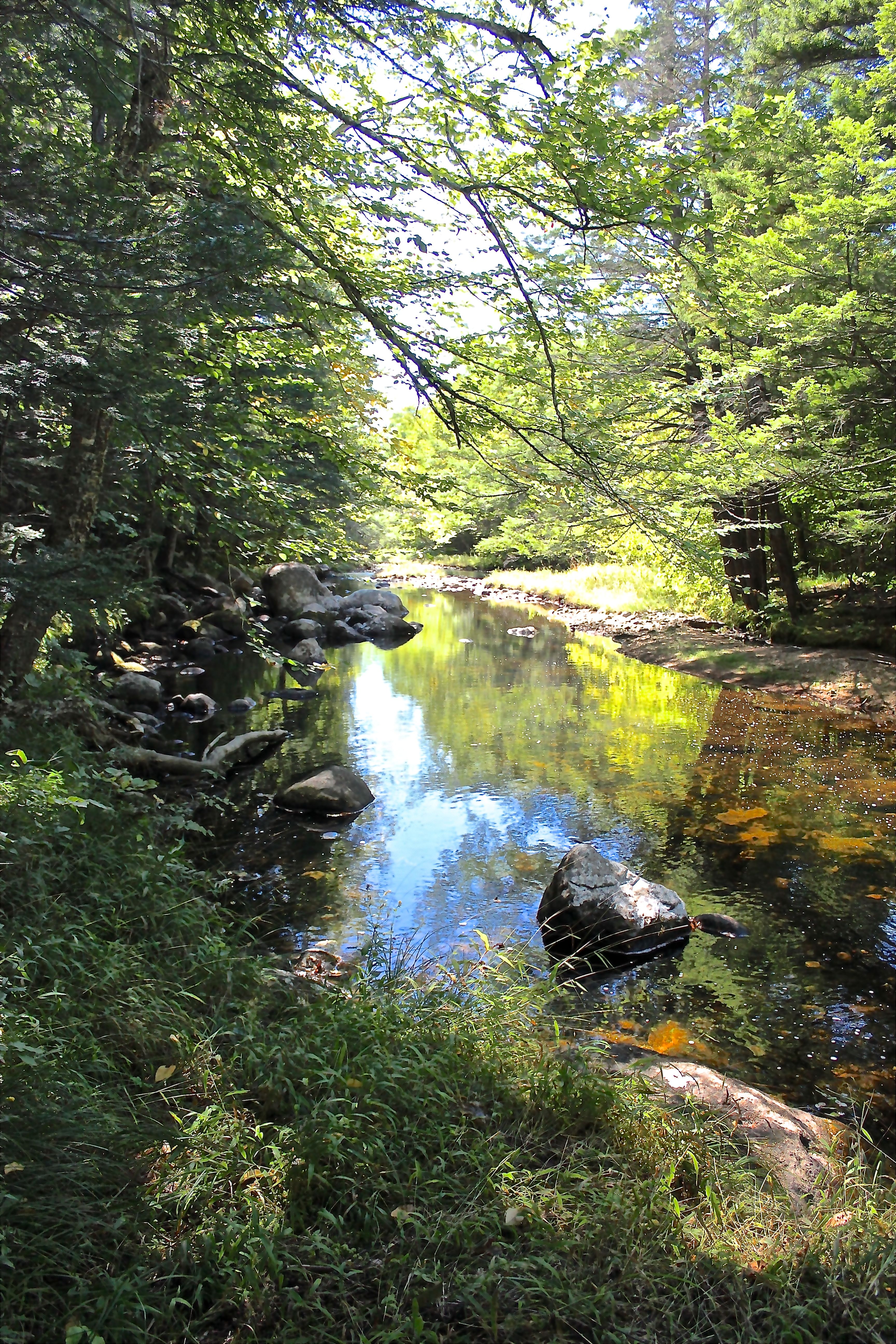
We walked beside the Cold River as we passed through hemlock groves and mixed hardwoods covered with a myriad of mosses and liverworts.

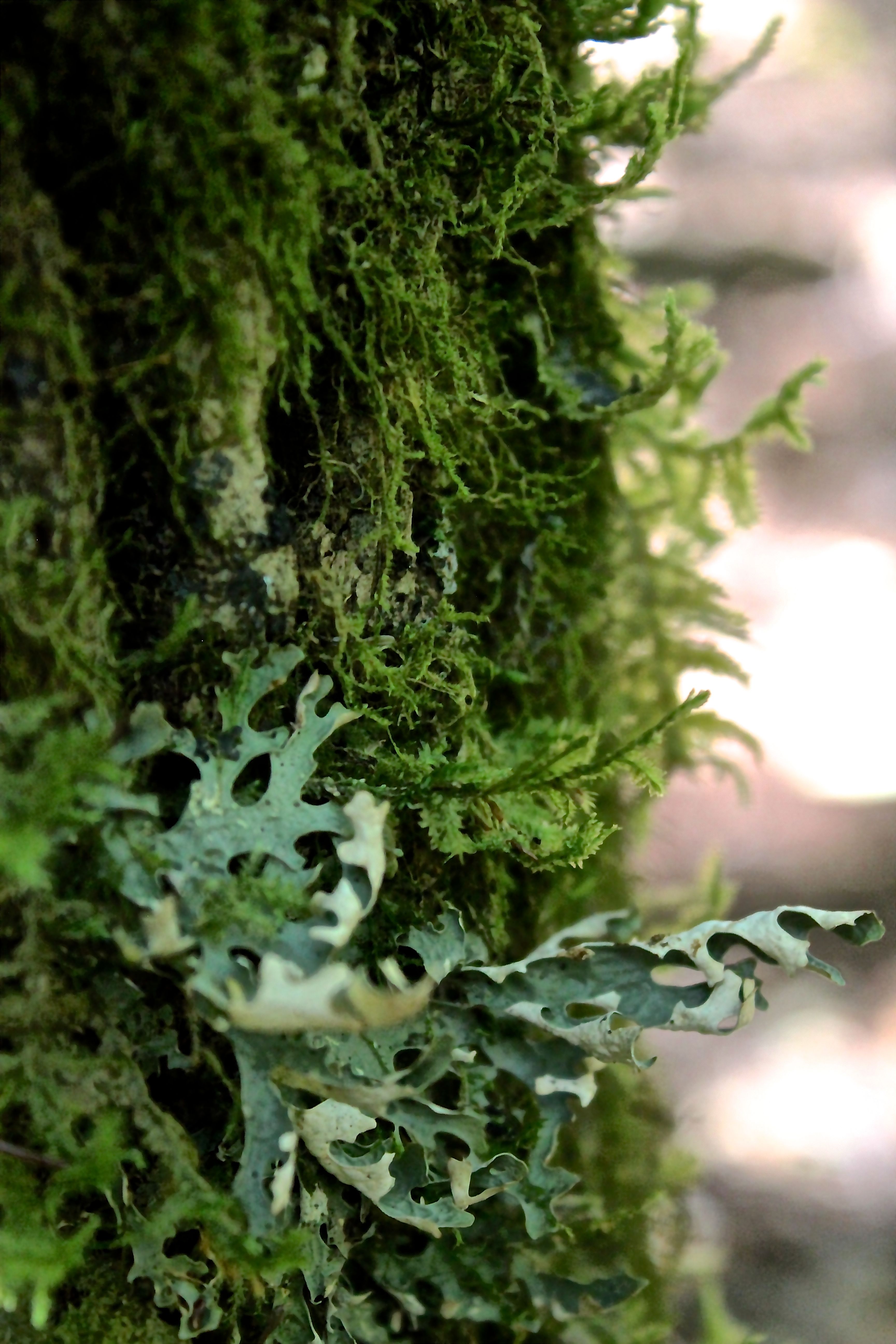
lungwort

Because it had rained last night, Lungwort, an indicator of rich, unpolluted areas, stood out among the tree necklaces. Why does it turn green when wet?

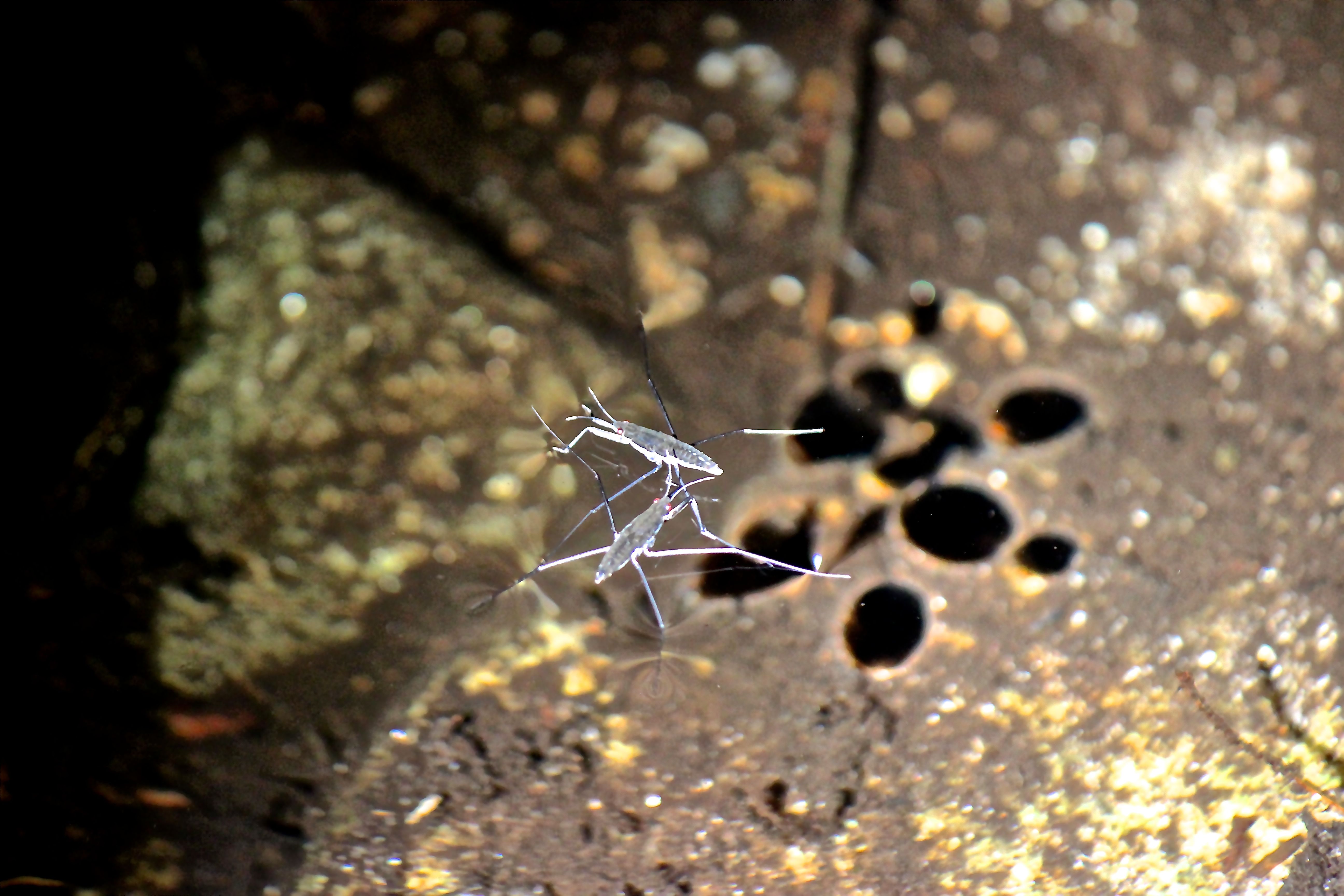
water strider

The shadow of the water strider tells its story. To our eyes, it looks like their actual feet are tiny and insignificant. What we can’t see is the  fuzzy little hairs that both repel water and trap tiny air bubbles, thus allowing them to float or skate along the water’s surface. But still, why is the foot shadow so big while the body shadow is more relative to the strider’s size? Is it the movement of the foot against the water that creates the shadow?

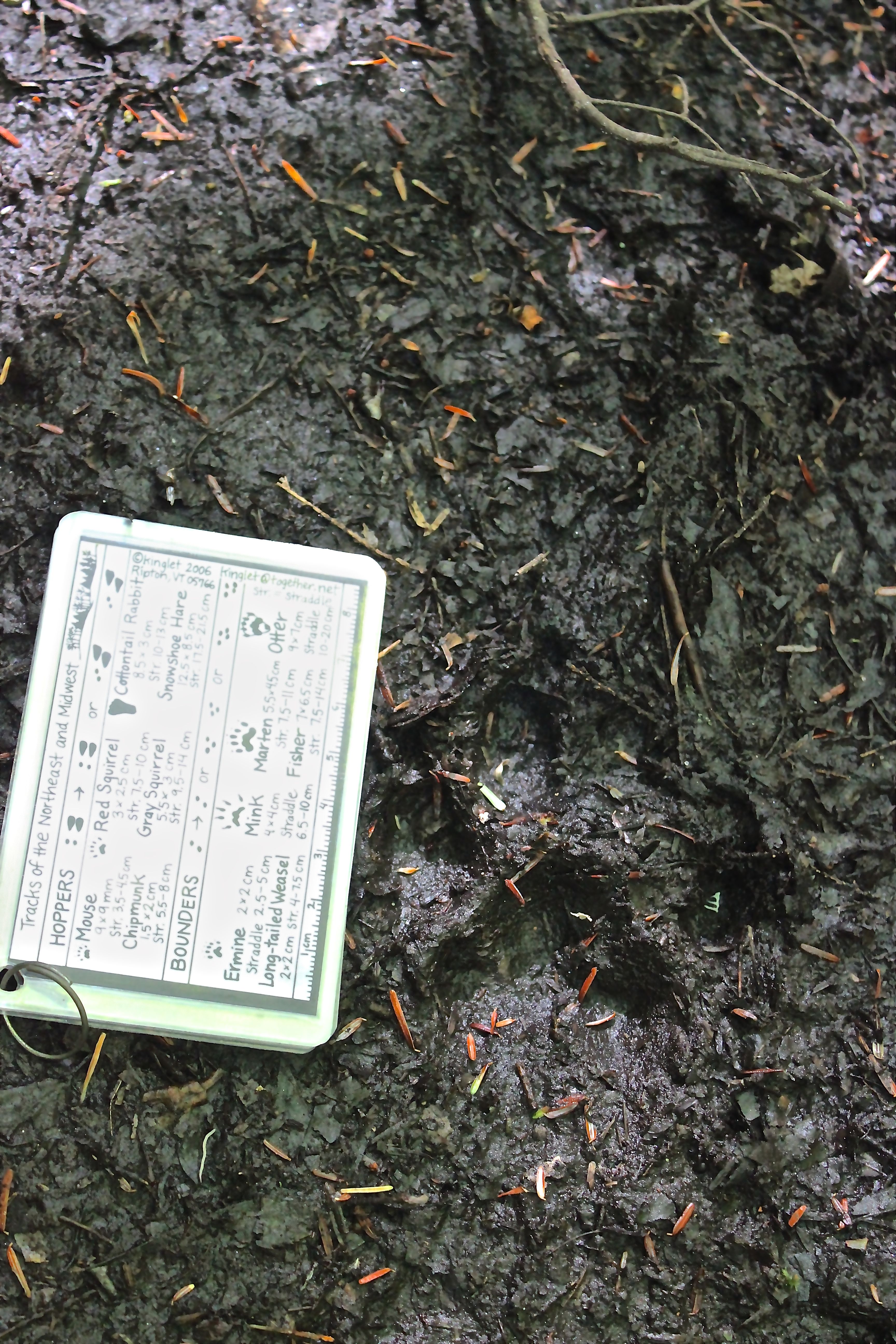
bobcat

While the river was to our right on the way to the dam, we noted ledges on the left. Prime habitat for the maker of this print: bobcat. You might be able to see nail marks in front of the toes. We always say that cats retract their nails, but in mud like this, traction helps.

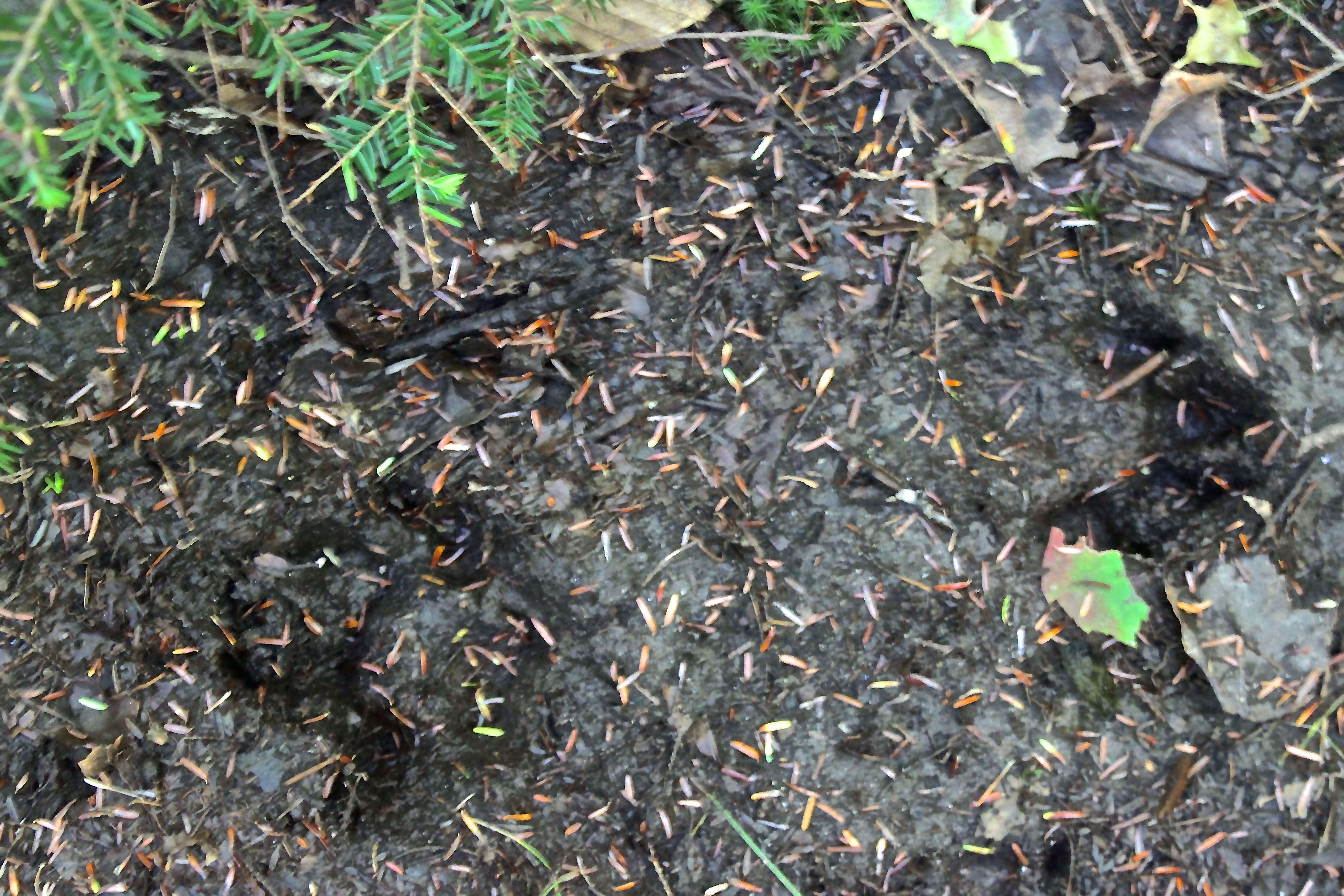
bobcat & coyote

A little further along we discovered the bobcat was still traveling in the same direction and a coyote was headed the opposite way. What were they seeking? What was the difference in time of their passing?

CR4

Periodically, we slipped off the trail to explore beside the river.

WH 3

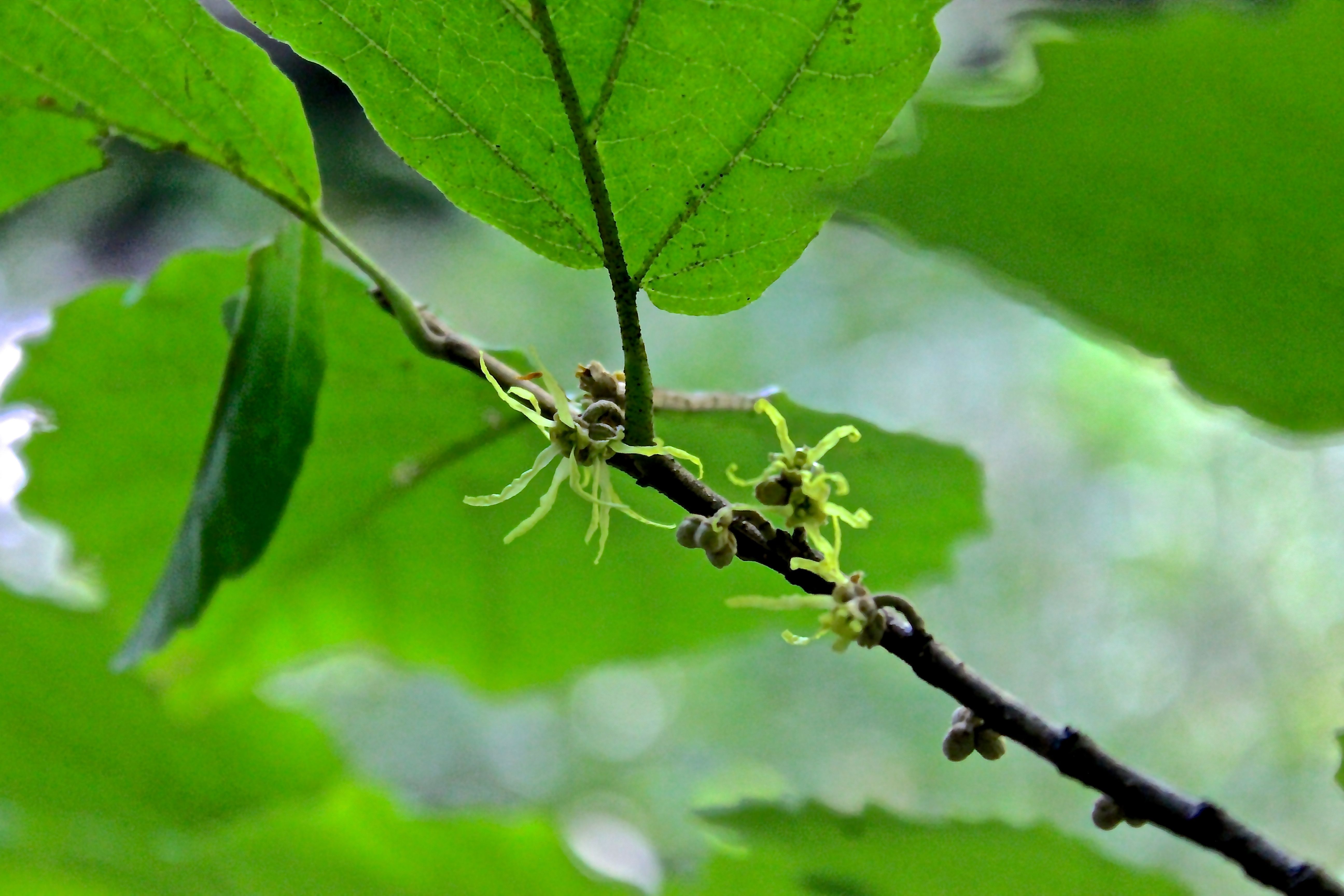
Ribbony witchhazel blossoms brightened our day–not that it was dark.

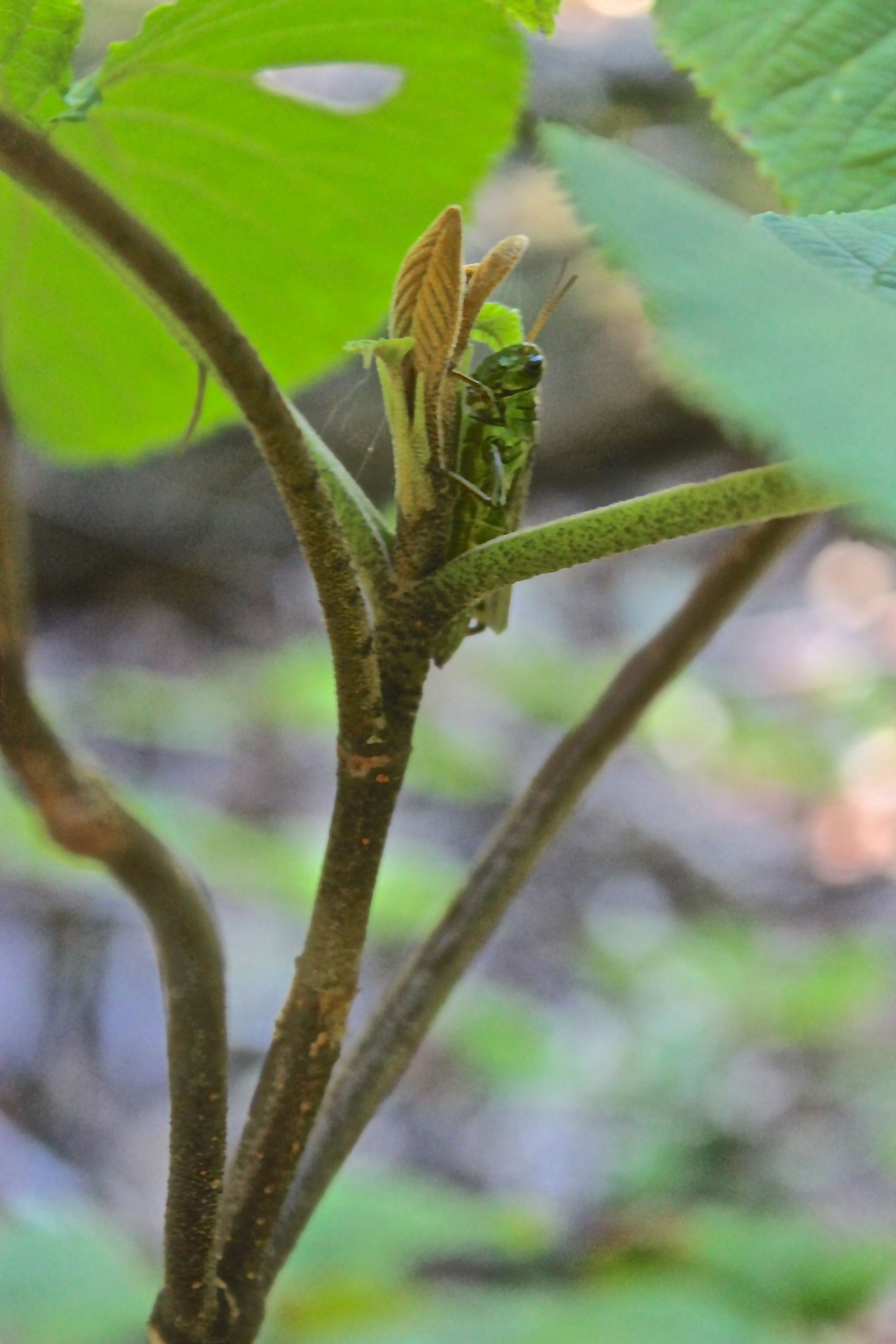
grasshopper 1

We weren’t the only ones taking a closer look at hobblebush.

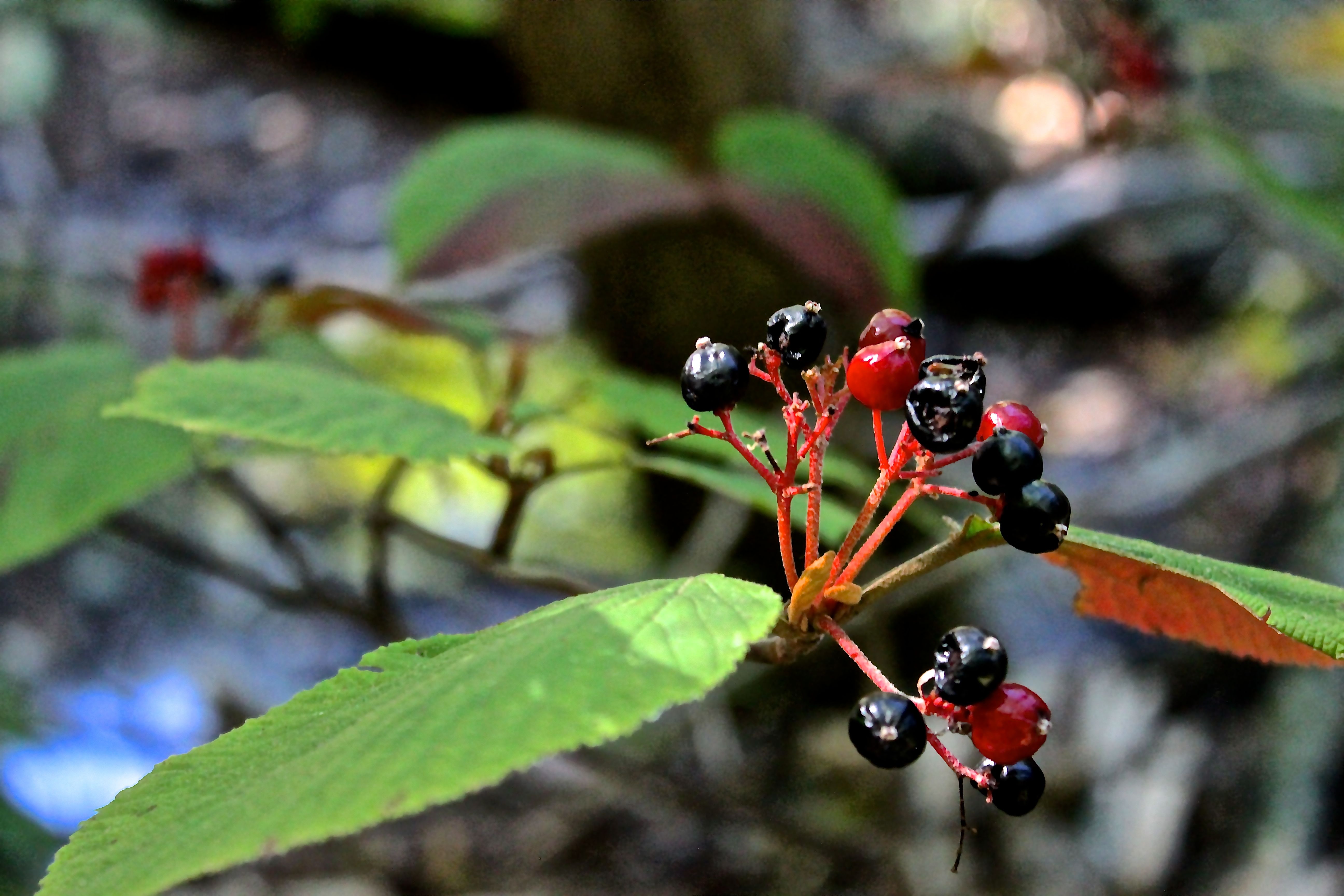
hobblebush berries

As its leaves begin to change from green to plum, the berries mature and transform from red to dark blue. Will they get eaten before they all shrivel? We think they’ll be consumed by birds and mammals.

doll's eye

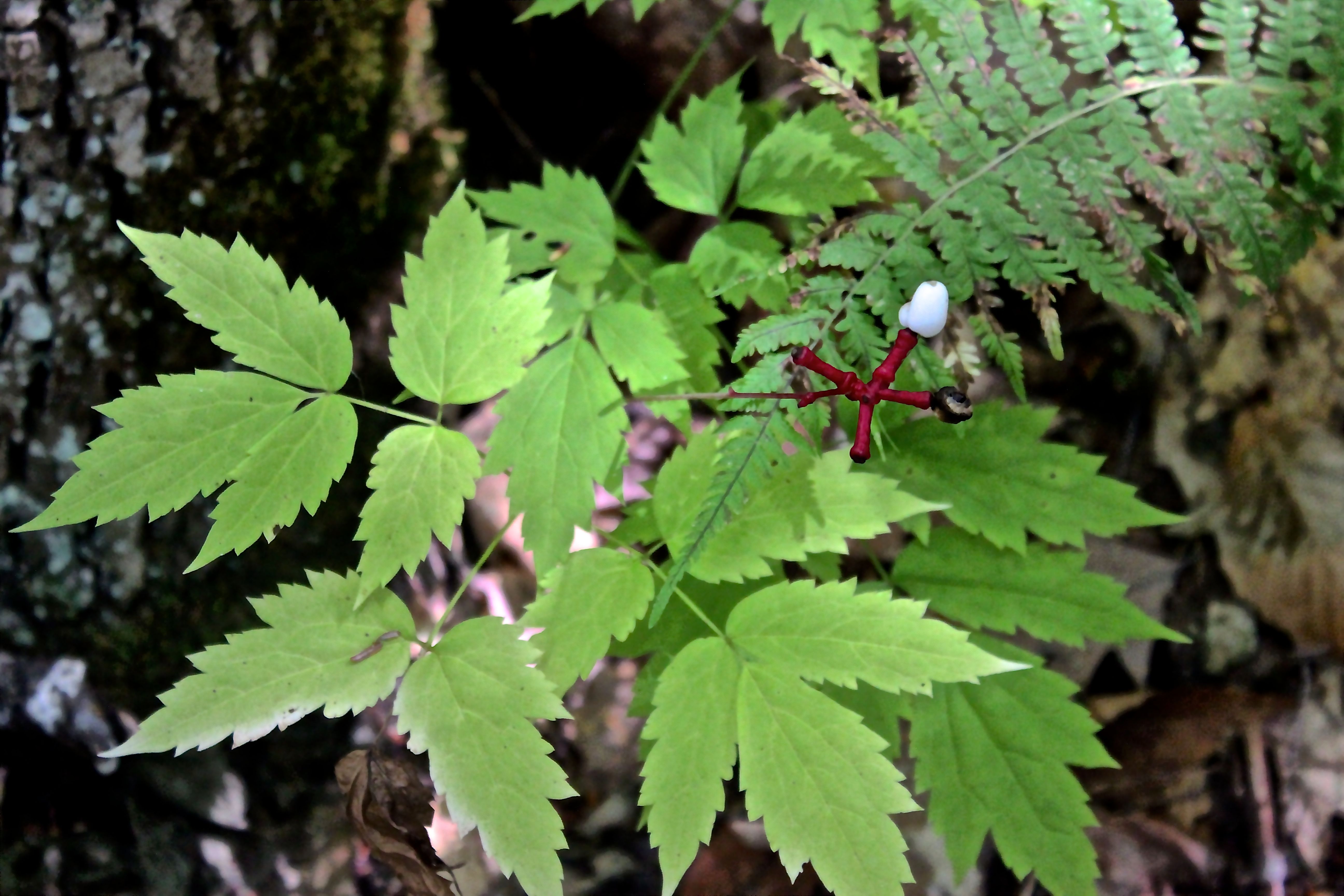
Most of the “doll’s eye” fruit is missing from this white baneberry. The archaic definition of “bane” is something, typically poison, that causes death. I’ve read that  ingesting the berries can bring on symptoms such as stomach cramps, vomiting, diarrhea, delirium and circulatory failure. Think: respiratory distress and cardiac arrest. YIKES. So what may have eaten these little white eyeballs? Wildlife may browse it, but it’s said to be quite unpalatable and low in nutrition. Interestingly, birds are unaffected by its toxic qualities.

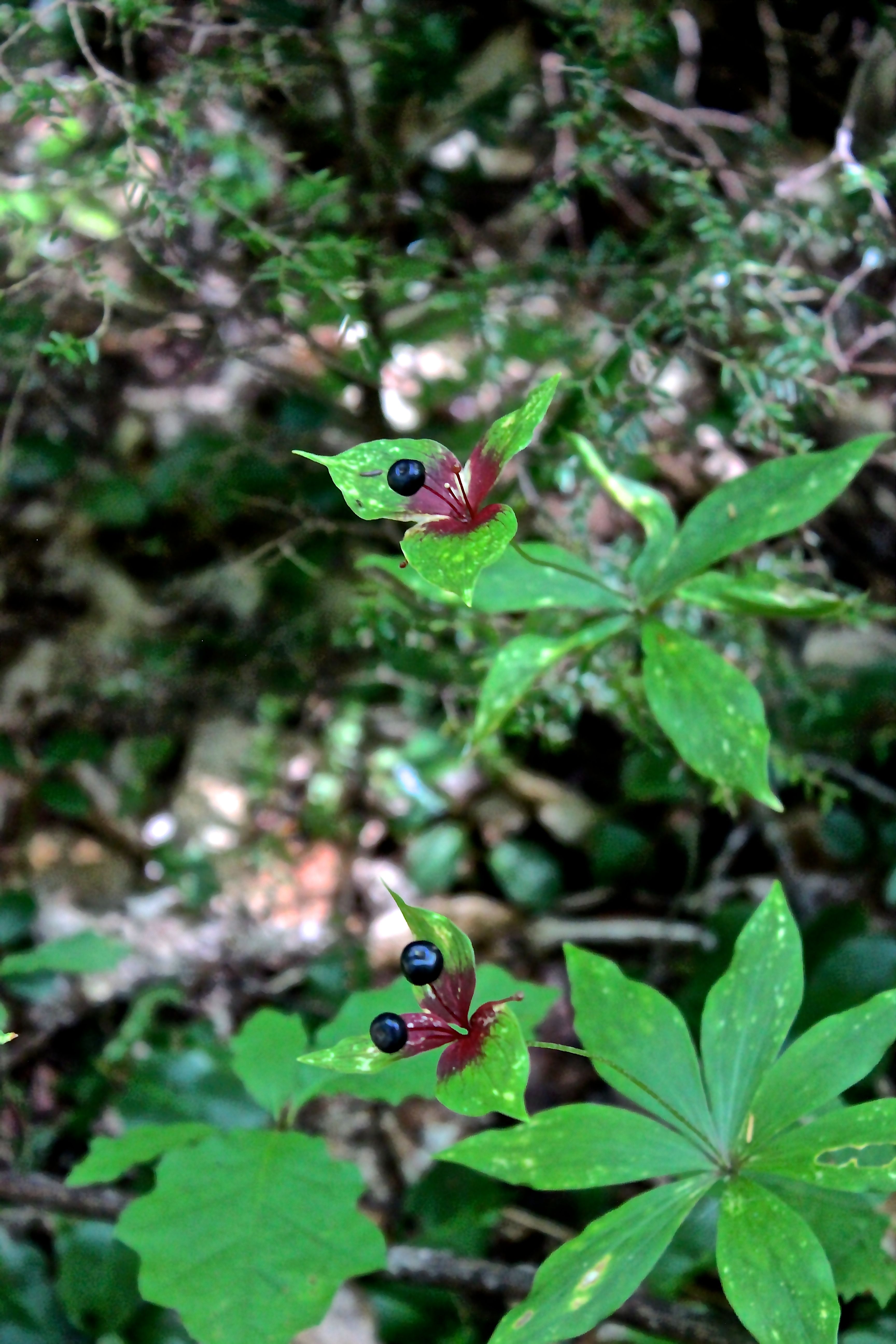
Indian Cucumber root

Berry season is important to migrating birds. The purplish black berries of Indian Cucumber-root are only consumed by birds. Other animals, however, prefer the stem and cucumberish-flavored root of this double decker plant. Why does the center of the upper whorl of leaves turn red? Is this an advertisement for birds?

state line

Soon, well, not all that soon, we arrived at the state line and passed onto Upper Saco Valley Land Trust property.

dam 3

And then we came upon the dam.

dam 2

It was the perfect day to sit on the rocks and eat a peanut butter and jam sandwich–with butter.

 tree face

As we walked back toward Stone House Road, we realized we were being watched. Perhaps this tree muse has all the answers.

Thanks to P.K. for a delightful wander and a chance to wonder together.

Mustelids, Oh My!

kiosk sign

This morning I drove to the Wilson Wing Moose Pond Bog Preserve on Sucker Brook in Lovell. This is a Greater Lovell Land Trust property.

Station !

My mission was to photograph the eight station signs along the nature walk so another docent and I can spend some time this spring updating them.

station 2:a

Before I even reached Station 2, I realized I had a bad case of NDD. Nature Distraction Disorder. OK, so I think I just coined a new term and acronym, but maybe I heard it somewhere else and had it tucked away in my mind. (NawDee for short?–corny joke alert and I might be the only one who gets it) Anyway, what it boiled down to was what you see on this sign and then some.

Fisher

Fisher tracks were all along the brook and through the woods. I’m almost certain these are fisher. I was beginning to question my “I’m always 100% correct when alone” statement. These were quite fresh.

mink1mink slide

Mink tracks and slides were also visible, especially in and out of Sucker Brook.

otter

And then I found these. River Otter.

Silent and graceful are the weasels. From them I should learn so many lessons as they move about quietly observing and discerning what is important. I always think of them as fun loving with all the sliding some of them, like the mink and otter, do. But . . . they are carnivores who have to consume a lot of food to keep warm in the winter.

hole activity

This hole was one of several that I saw. It was across the brook, so I don’t know who entered here. Perhaps they all checked it out. Or maybe it’s a sleeping space for these nocturnal animals.
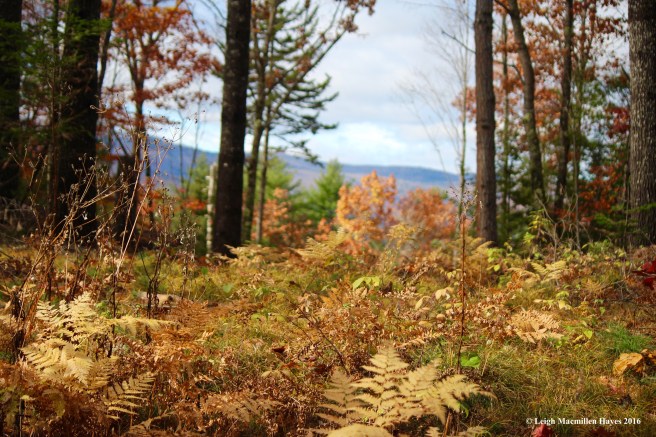
little brown thing hair

And I found what remained of hair from a little brown thing–either a deer mouse or white-footed mouse. There were tracks leading up to it, but it’s difficult to discern the difference between the two. Who had dinner here? The fisher, I believe.

pinecone tracks

It wasn’t only mammal tracks that I found. Look at the trail left behind by this pinecone.

morning lightbrook 1brook 2

The morning light was beautiful–the beginning of a crisp, clear day.

water and ice 2

Movement frozen in time. water and ice 3

tranquility

And then the brook calms down. Chickadees sing their cheeseburger song while white-breasted nuthatches call, “Yank, yank,” over and over again.

platform

Finally I reached the platform–a hidden oasis that encourages us all to take time to pause and wonder.

bog

And search the brook and bog for signs of wildlife. One of these days, I’m going to see a moose. I think I heard a river otter here either last summer or the previous one. And I’ve been on owl prowls to this very location–occasionally even heard them respond to our calls.

false tinderhoof

Now for some other fun stuff I saw along the way–false tinder polypore. I love that I can now identify this one by its hoof-like appearance on top, but also the way the pore surface angles down toward the tree’s bark. And it’s a perennial, growing taller with the years. I sound so smart, but I’m only just beginning to understand woody fungi. Only a very wee bit.

Some signs that spring is around the corner . . .

wintergreen

Wintergreen appearing where the snow is melting. You may know it as Checkerberry and Tea Berry. We used to chew teaberry gum when we were kids. You can purchase it at Zeb’s General Store in North Conway, New Hampshire. Today, however, the wintergreen extract is produced synthetically.

Hobblebush 2Hobblebush

Hobblebush! While most of the buds we see in the winter landscape have scales to protect them from the weather, hobblebush buds are naked. How do they survive? They are hairy–maybe that helps. I can’t help but wonder. I do know that it won’t be too long before the flat heads of flowers the size of my hands will bloom.

One last thing to share about today’s wander. I thought I was seeing the tracks of this true hibernator and then I saw the real McCoy.

chipmunk

Actually, I saw two of them. It may snow tomorrow, but methinks spring will make  an appearance this year.

Thanks for wondering along beside me on today’s wander. I hope you enjoyed it as much as I did.