Hiking to the Vanishing Point

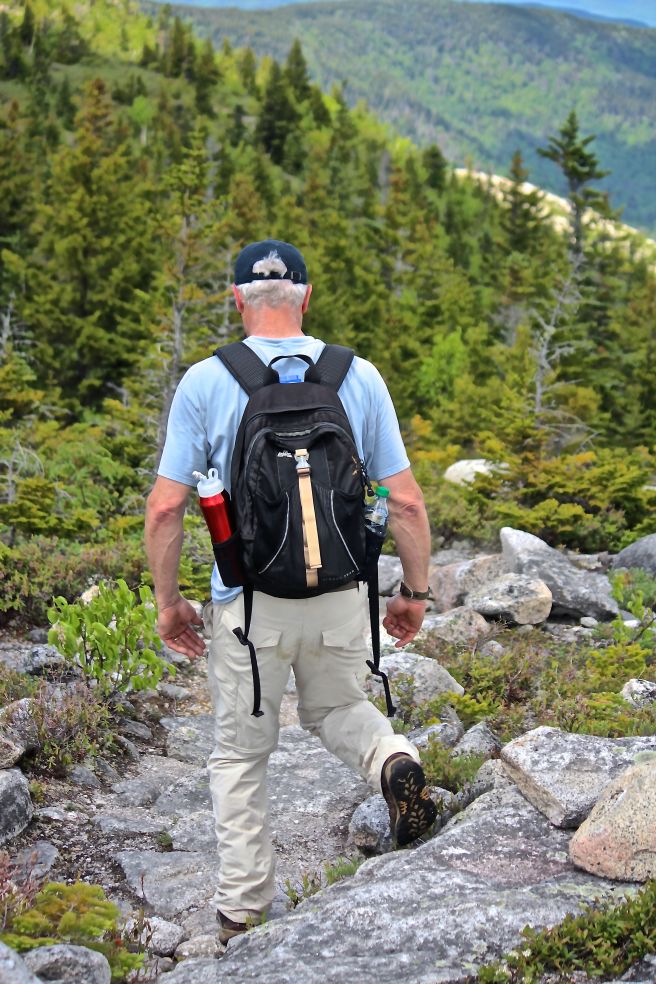
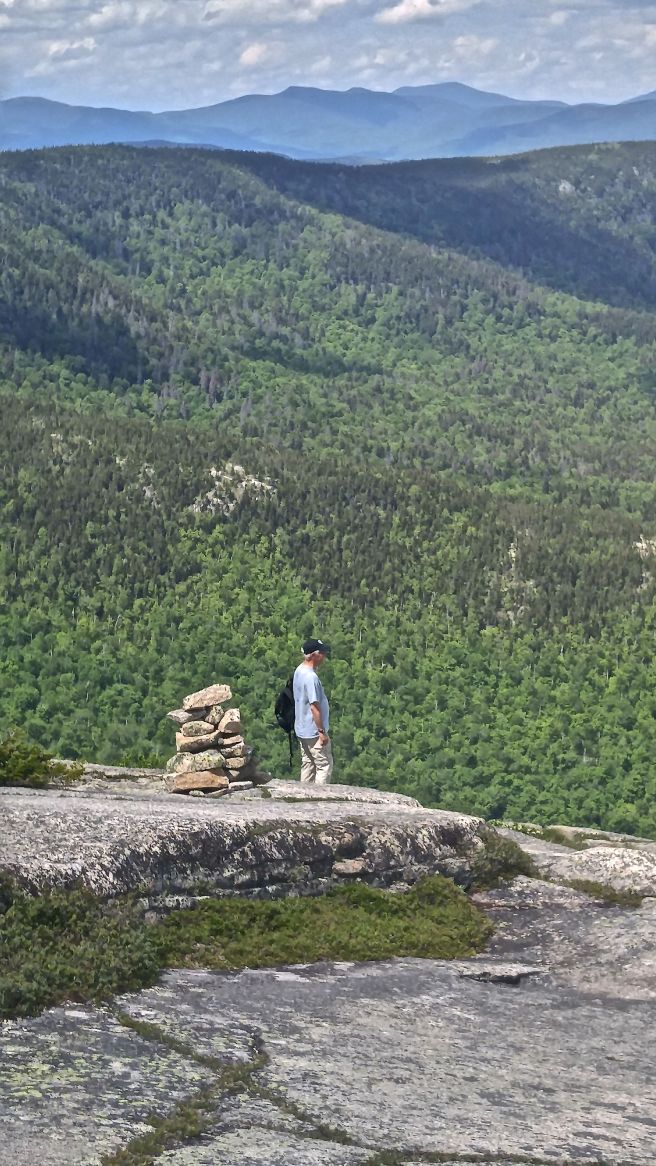
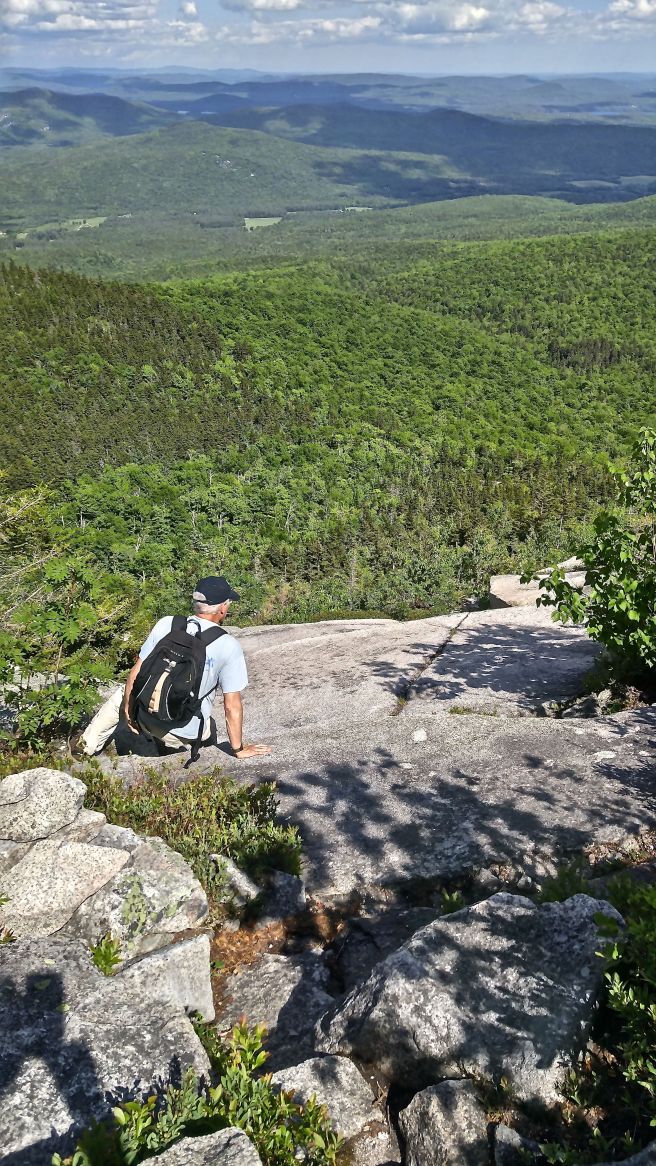
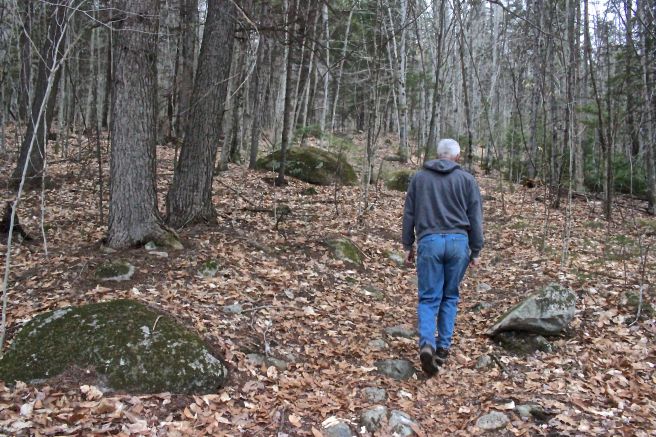
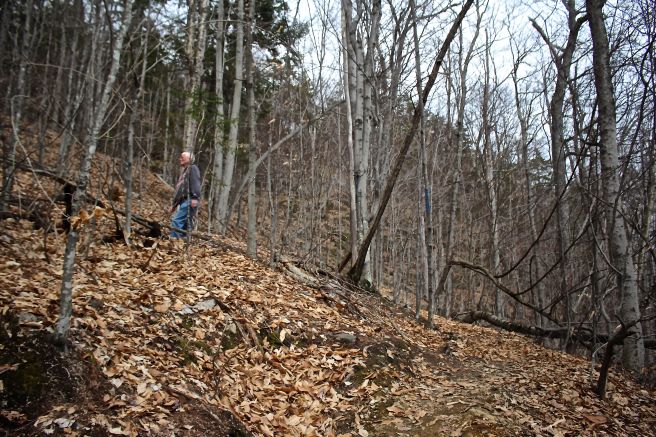
My friend, Ann, and I spent today focused on points close to us, while those in the distance also drew our attention.

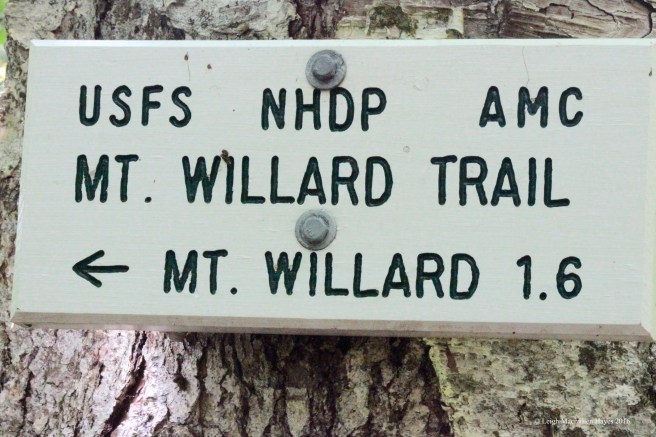
h-trail sign

Our chosen trail to accomplish such, Mt. Willard in Crawford Notch State Park, New Hampshire. We began on the Avalon Trail and then turned onto the Mt. Willard Trail. I kept thinking I’d last travelled this way in the early spring, but now realize it was last November that my guy and I ventured forth on a Top Notch Mondate.

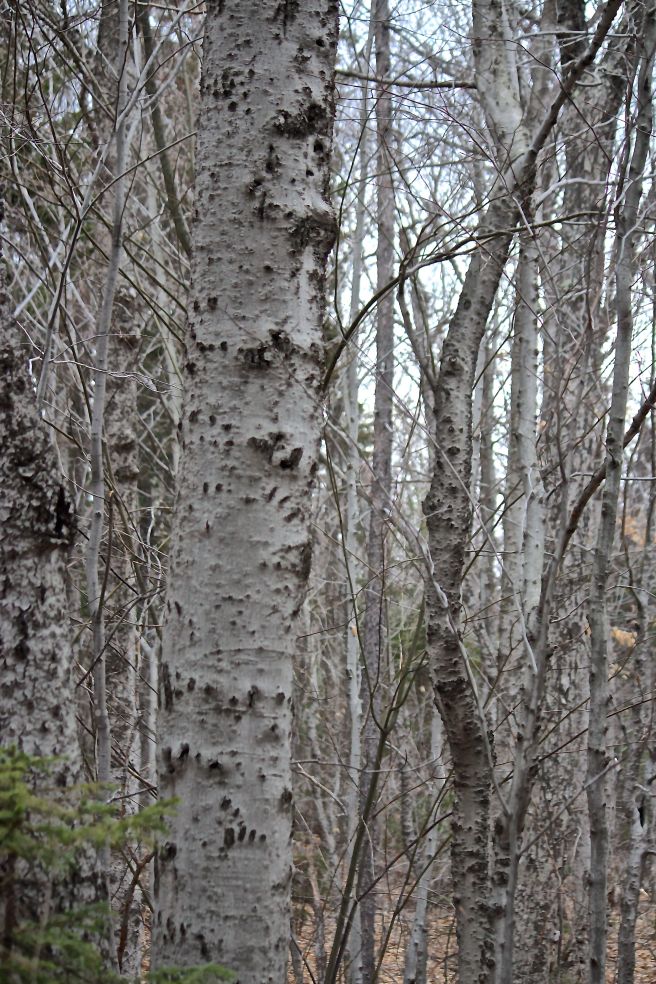
h-paper birch bark

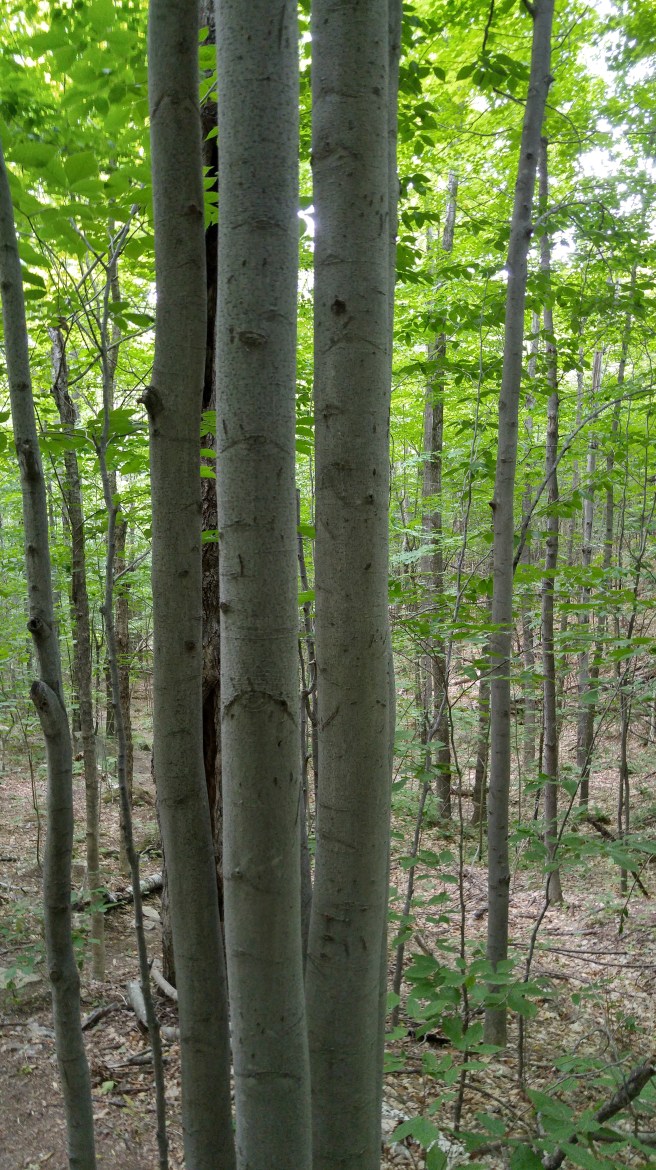
Ann had in her mind that there were several varieties of birch trees along the way. We did marvel at pastel colors revealed by the paper birch.

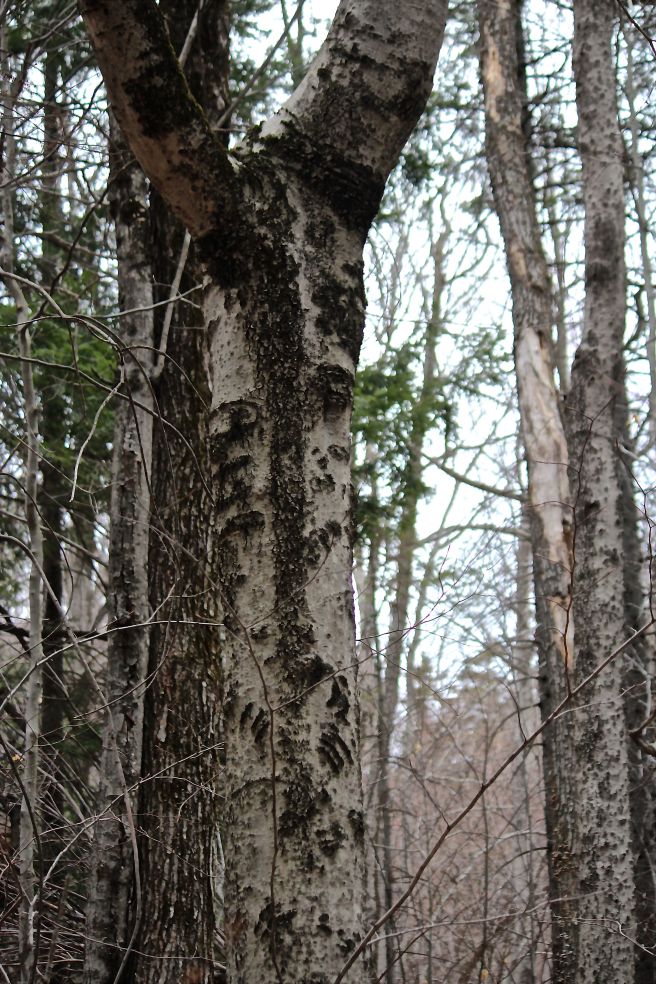
h-yellow birch bark

And the golden ribbony peeling of the yellow birch. But those were the only two birch species we saw over and over again. It had been a while since she’d last hiked here so the forest had changed.

h-rocky trail (1)

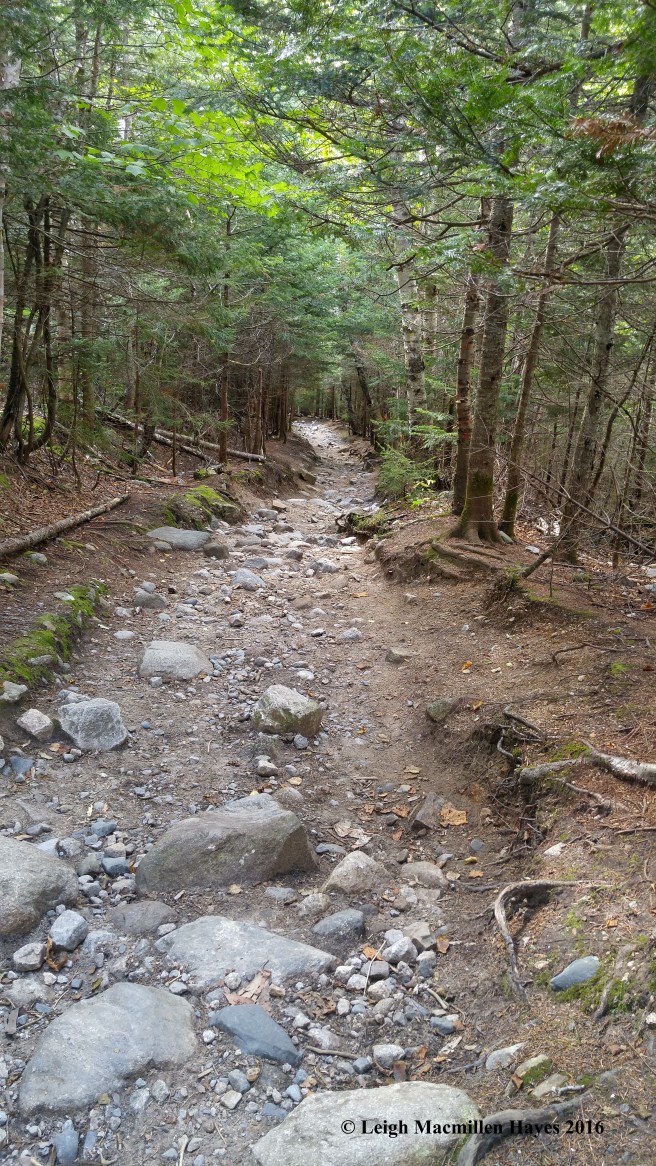
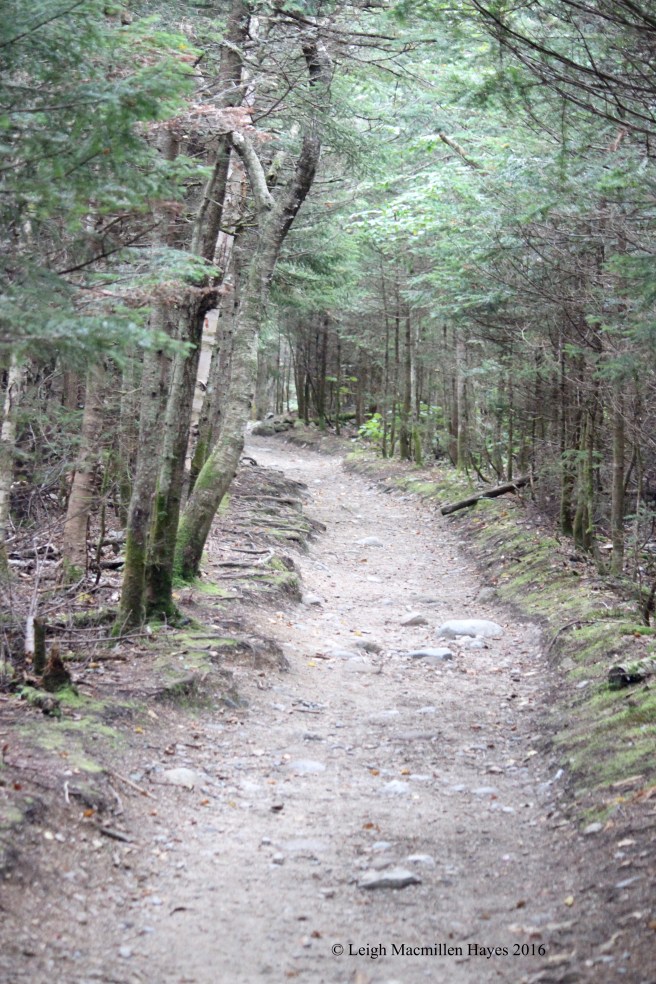
The trail has also changed. Somewhere stuck in my memory (despite the fact that I hiked here ten months ago) is a fairly flat, graveled carriage path. Um . . . I truly think that was the case years ago, but perhaps funding means it’s no longer maintained like it once was and stormwater has washed the trail out.

h-culvert stones (1)

The carriage road was built in 1845 by Thomas Crawford, owner and host of the Notch House in Crawford Notch. Daniel Webster and Henry David Thoreau reportedly slept there. Crawford wanted to provide his guests with an easy excursion to the summit of the mountain. Old culverts and stone diversions still mark the way.

h-hobble leaf and bud 1

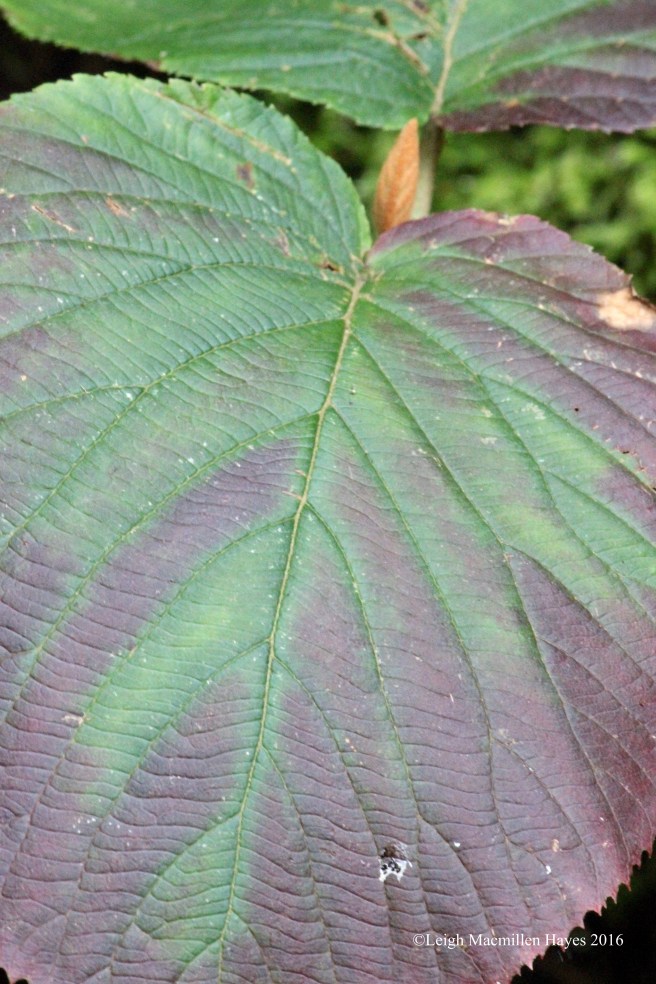
One of the most predominant plants from beginning to end is the hobblebush shrub, so named because its horizontal growth pattern trips hikers, causing them to hobble through the woods. This shrub wows us in any season and right now it’s displaying its late summer colors.

h-hobble berries

On a few, we even found some fruit. I especially loved the new buds posed together like praying hands beneath the berries.

h-hobble in row (1)

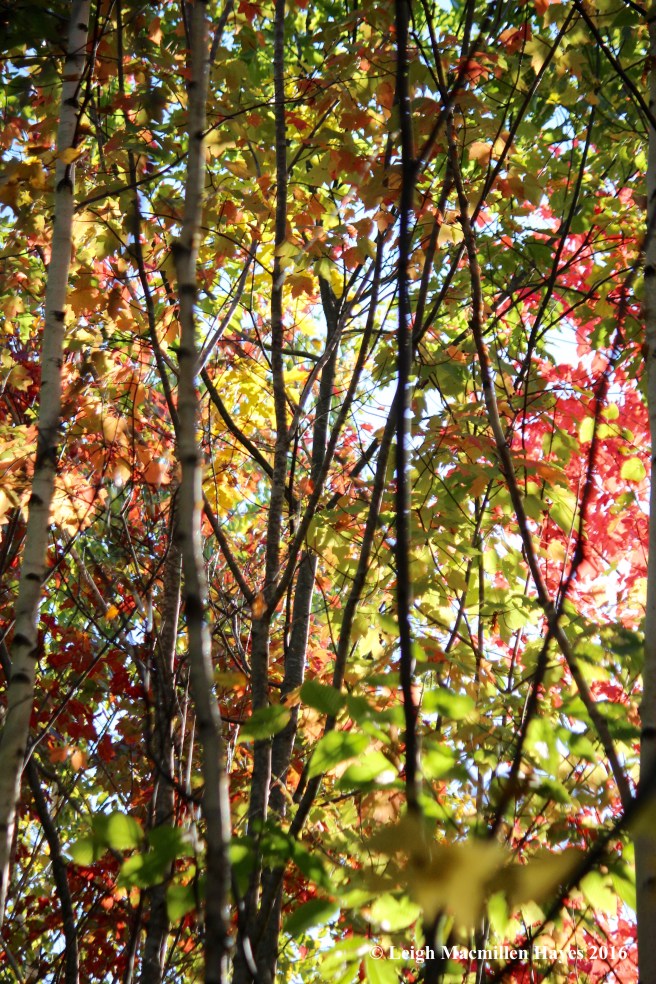
And leaf displays that led to vanishing points.

h-water funnels

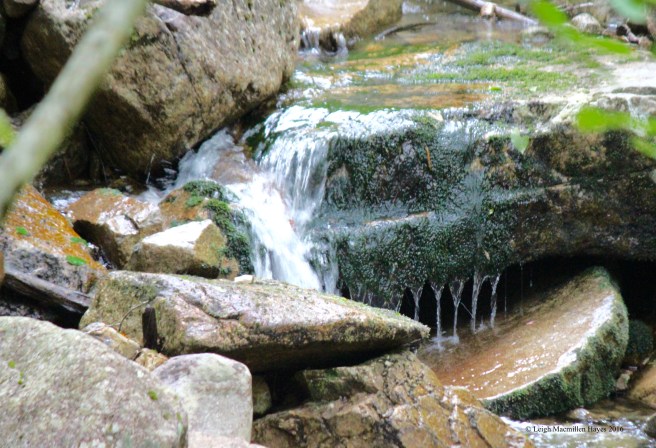
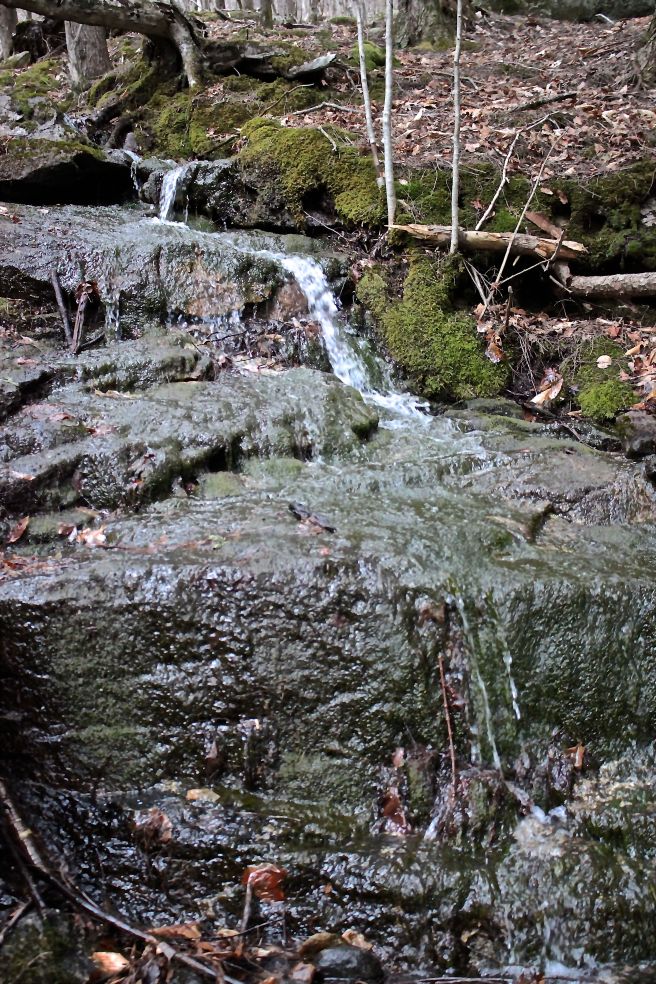
We chuckled to ourselves as others passed by, sweating in their efforts to reach the summit quickly. Our purpose–a slow and steady climb filled with opportunities to notice, like the funnels of water that dripped from rock to rock.

h-centennial pool

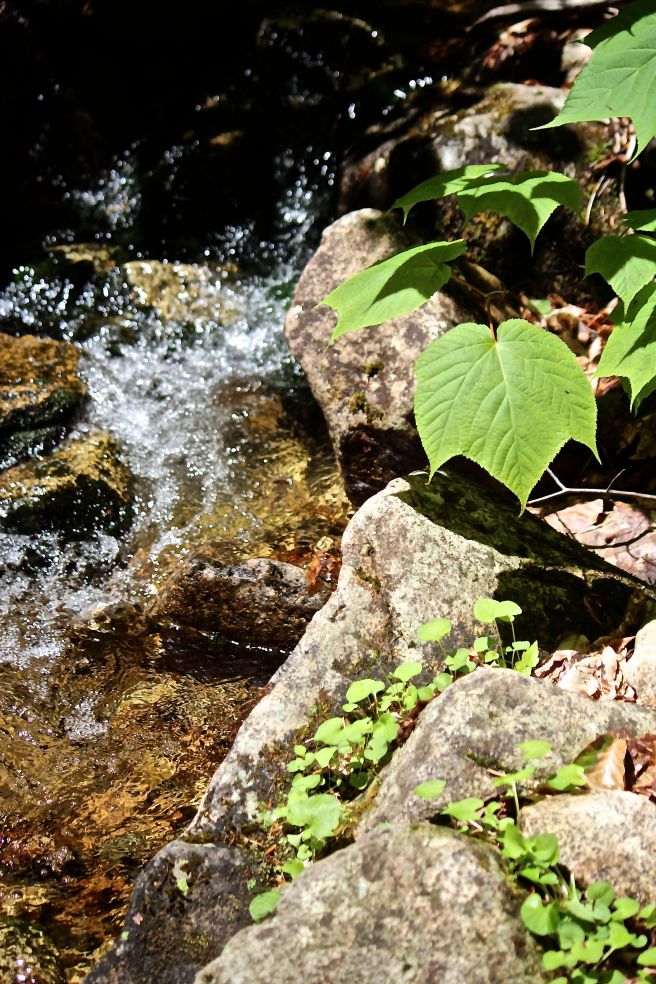
One of our favorite stops–Centennial Pool, where water mesmerized us as it cascaded over moss-covered rocks.

h-chipmunk.jpg

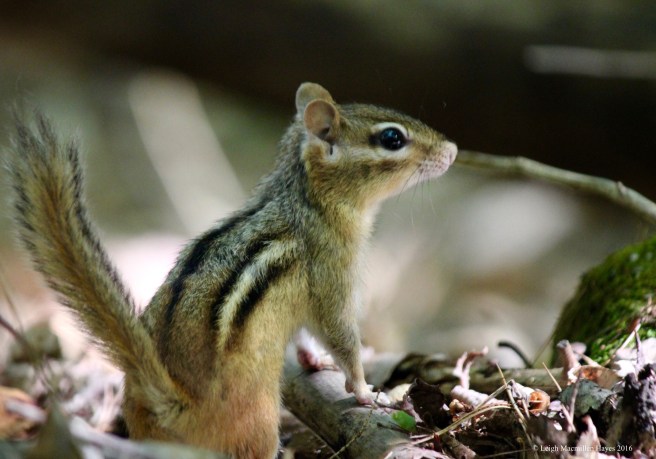
And a chipmunk darted about, surprising us with its close proximity–until we looked up and saw a couple with a dog. Perhaps we looked like we’d offer a safe haven.

h-narrow beech fern

We spent a lot of time wallowing in ferns because Ann has developed a keen interest in them this year. One of our fun finds was the narrow or northern beech fern, which portrayed its natural habit of dripping downward. We loved that we could ID this one by beginning with its winged attachment to the rachis or center stem.

h-artist's conk

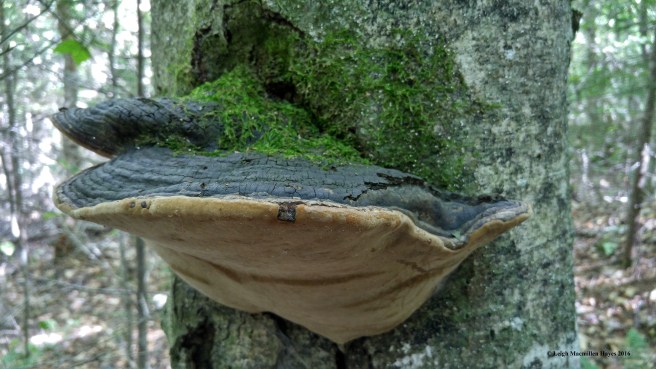
Fungi also drew our attention. The mountain had been in the clouds as we approached, so it was no wonder that dew drops decorated this artist’s conk.

h-false tinder conk (1)

Among our fungi sightings–a false tinder conk.

h-fairy ring (1)

And among my favorites–a fairy ring.

h-purple aster 2 (1)

Though the flowers were few, we did spy some purple asters.

h-paper art

And then there were sculptures that caught our attention, like this paper birch artwork framed by moss-covered trees.

h-birch art yellow

And a yellow birch offering its own message to the universe.

h-mossy roots

Some tree roots also begged to be noticed. So we did as we acknowledged the resident faeries.

h-carriage road 1.jpg

At last we found my carriage road. Or at least something that slightly resembled it.

h-tunnel light.jpg

And then the tunnel.

h-tunnel 2

And a glimpse of the world beyond.

h-view 2 (1)

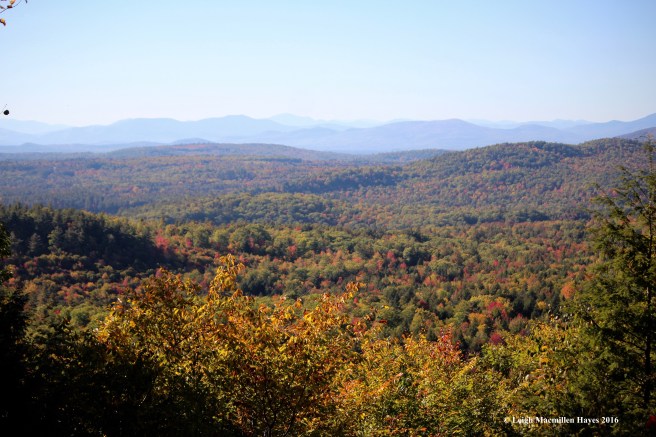
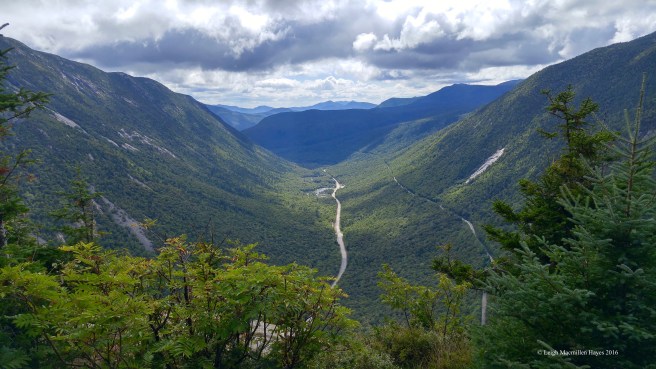
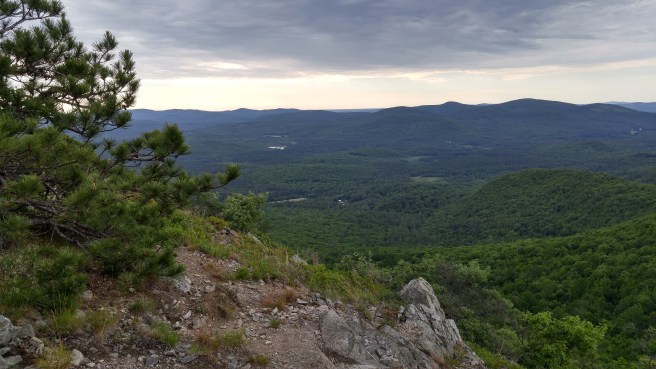
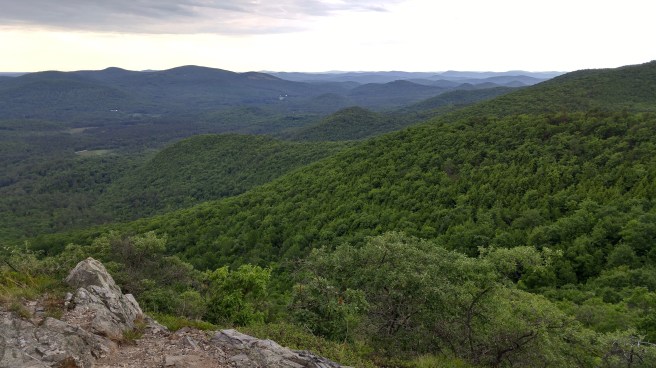
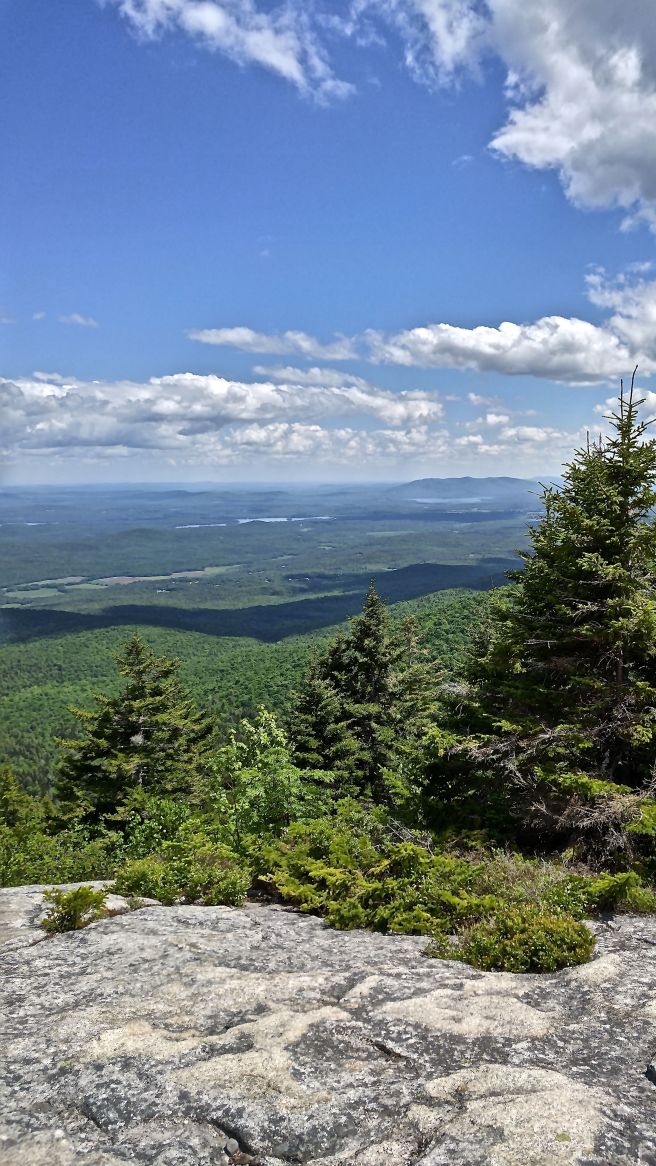
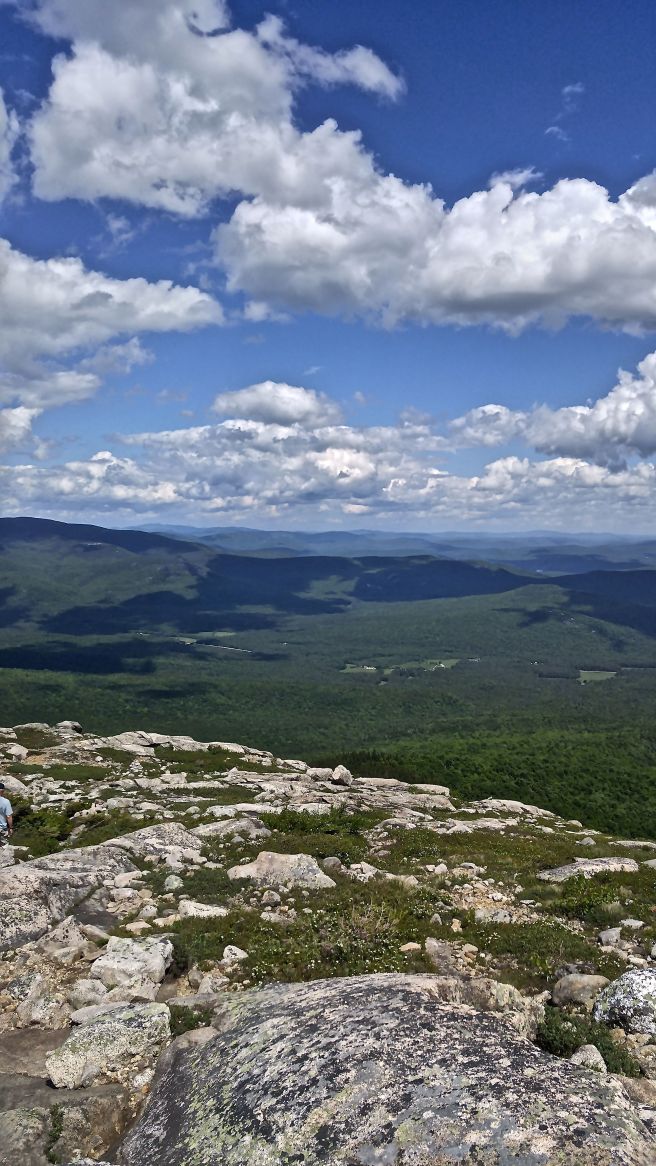
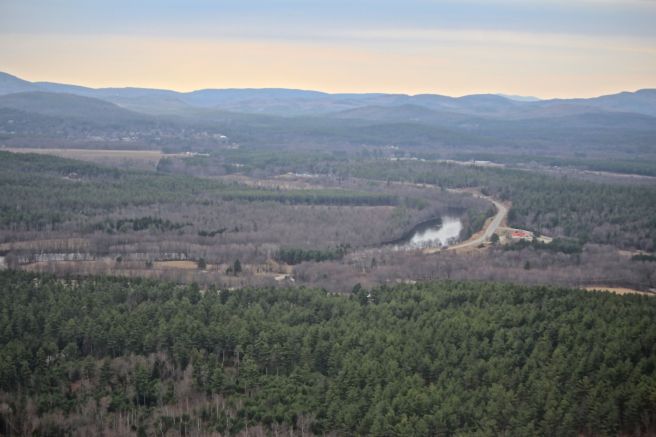
Within seconds, without a drum roll, the jaw-dropping view of the Notch enveloped our focus.

h-squirrel 2

As we ate lunch, another human-savvy critter came closer than is the norm–a red squirrel. We think he coveted Ann’s lunch–a peanut butter and blueberry sandwich with whole blueberries. Who wouldn’t?

h-mtn ash display

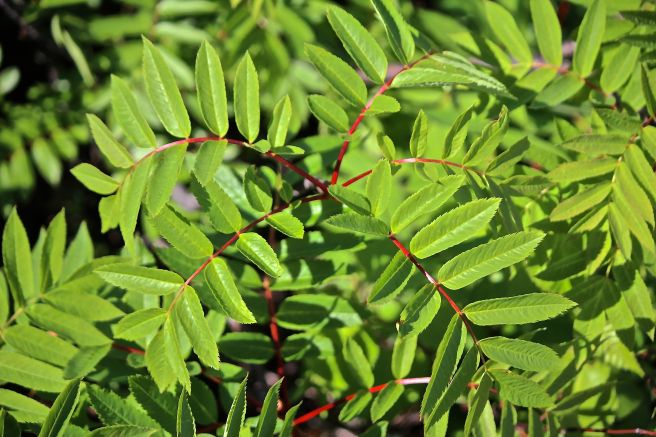
Mountain summits in these parts often feature Mountain Ash trees. Today, I paid attention to the pattern, including the six finger splay of its leaflet.

h-mtn ash twigs

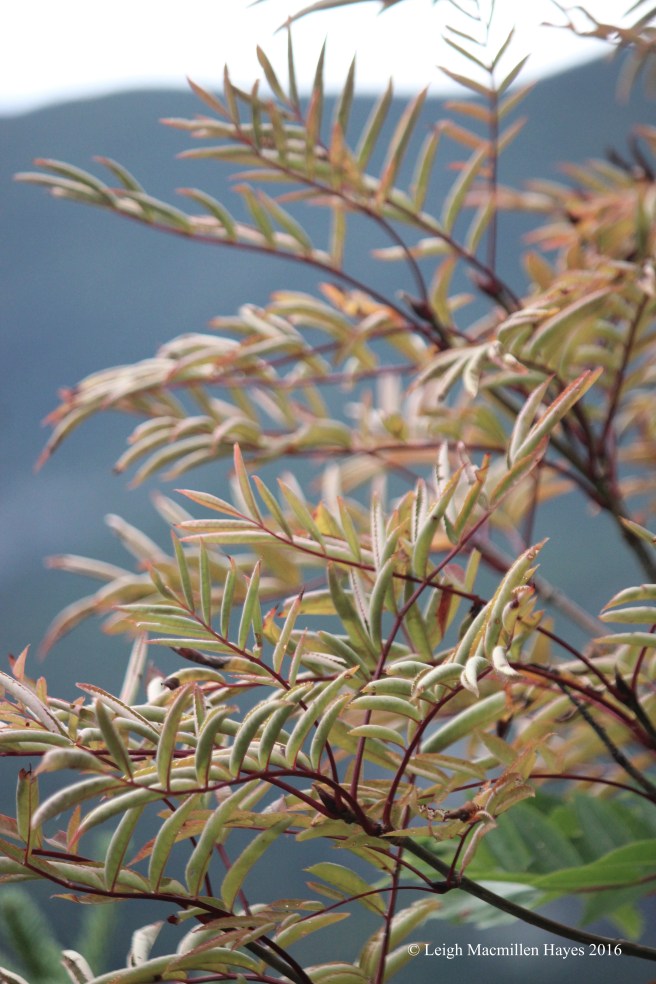
And I couldn’t resist the contrast of color it offered against the mountain backdrop.

h-mtn ash leaf

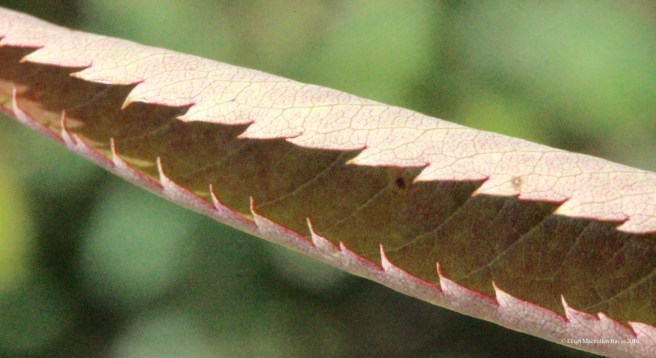
Though we didn’t see any Mountain Ash berries, each individual leaf presented its own point of view.

h-Ann (1)

At the beginning of our hike and again at the summit, we kept hearing a helicopter. Mount Washington was obscured by cloud cover, but with her binoculars, Ann observed a helicopter with a litter. It seemed to follow the same route again and again.

IMG_5996

Our hope was that it was practice over mission. We had no idea of the purpose.

h-maple tree? (1)

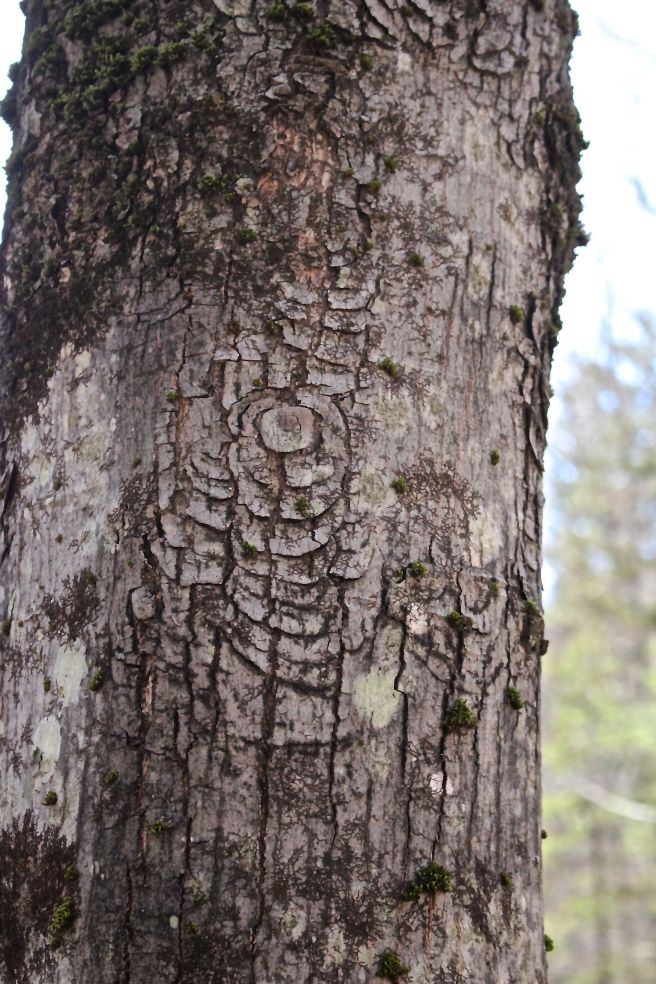
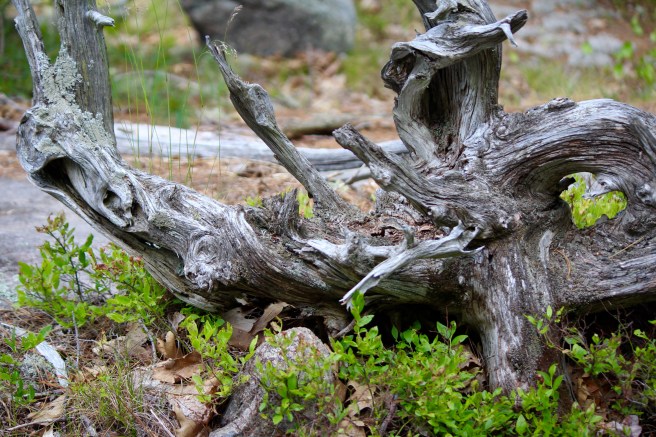
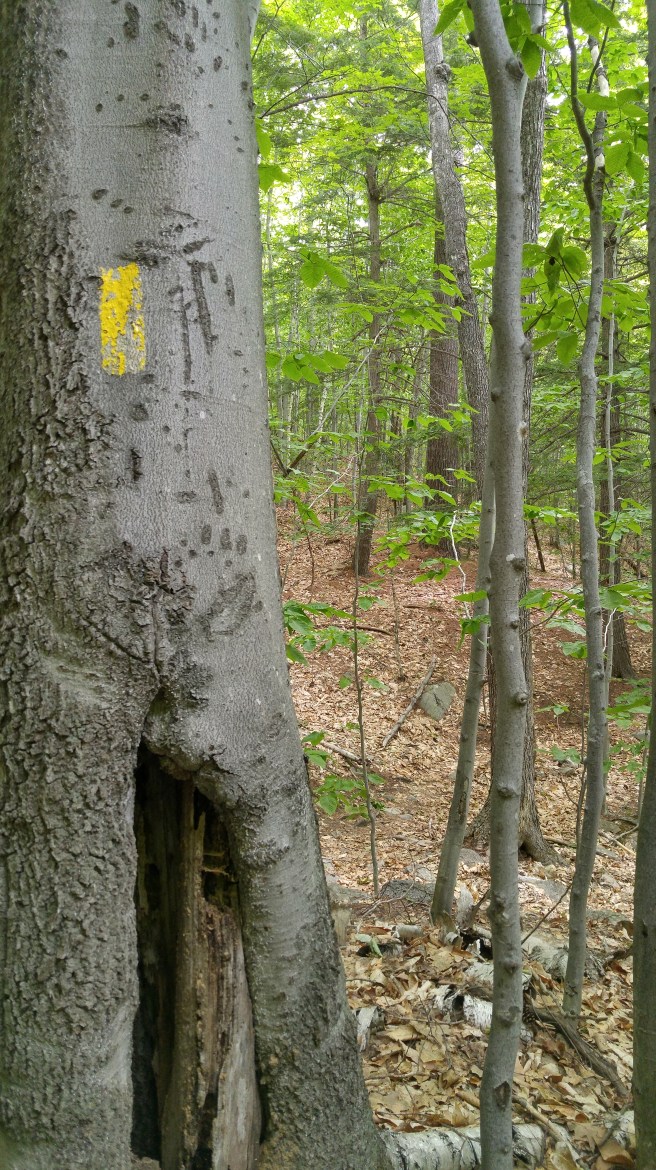
At last we hiked down. One of the best parts about following the same path is that new stories await–when you can take the time to look up. And our pièce de résistance–an old snag. A beautiful old snag. Notice its vertical lines intersected by horizontal lines. We spent a long time studying and caressing this natural sculpture.

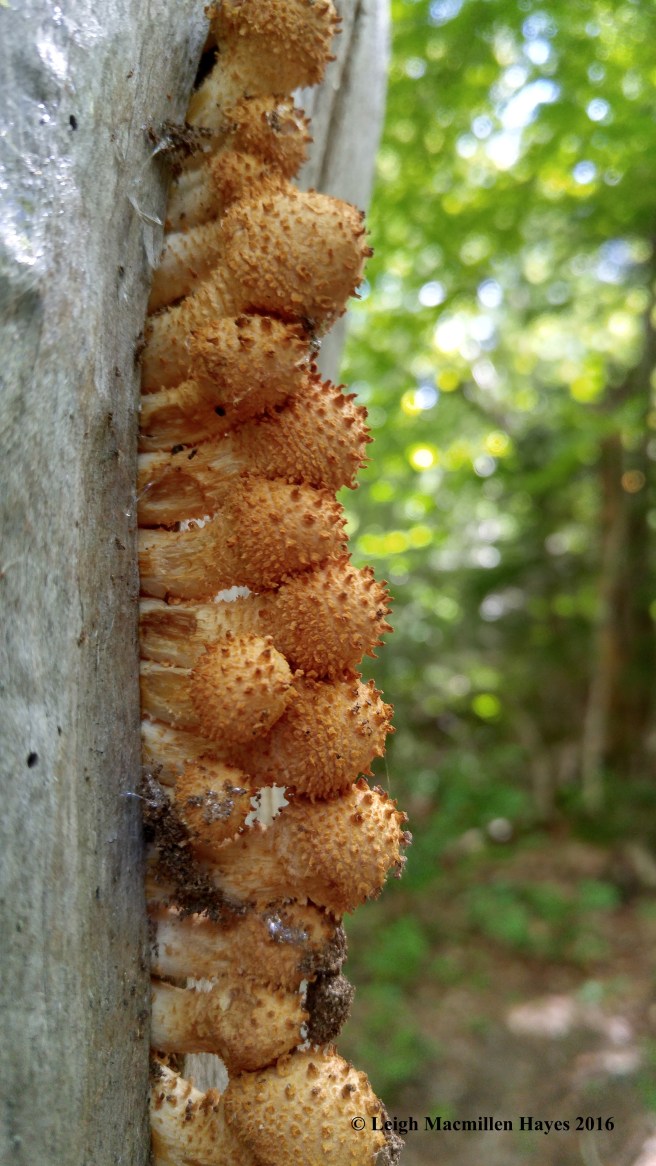
h-Sharp-scaly Pholiota (Pholiota squarrosoides) (1)

Though it appeared to be dead, life reigned.

h-sharp scaly 2 (1)

I know my mentors will correct me if I’m wrong, but I do believe this is Pholiota squarrosa, commonly known as the shaggy scalycap, the shaggy Pholiota, or the scaly Pholiota. Whatever you want to call it, it seemed to have its own vanishing point.

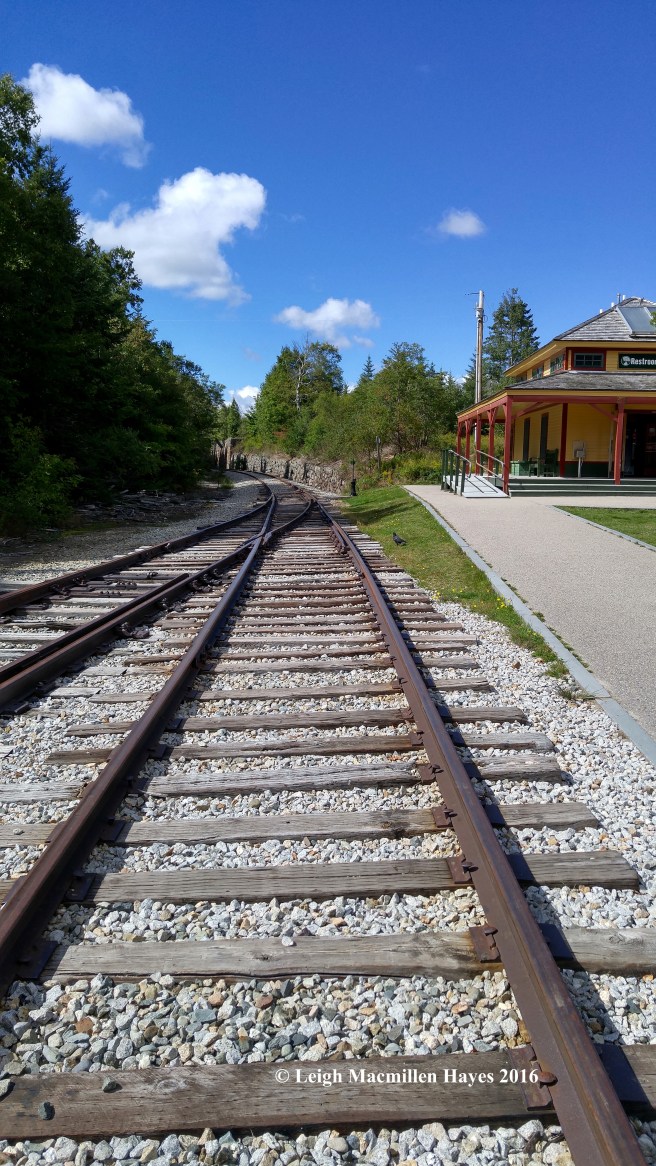
h-train tracks (1)

Much the same was true for the train tracks we crossed that head north toward Breton Woods.

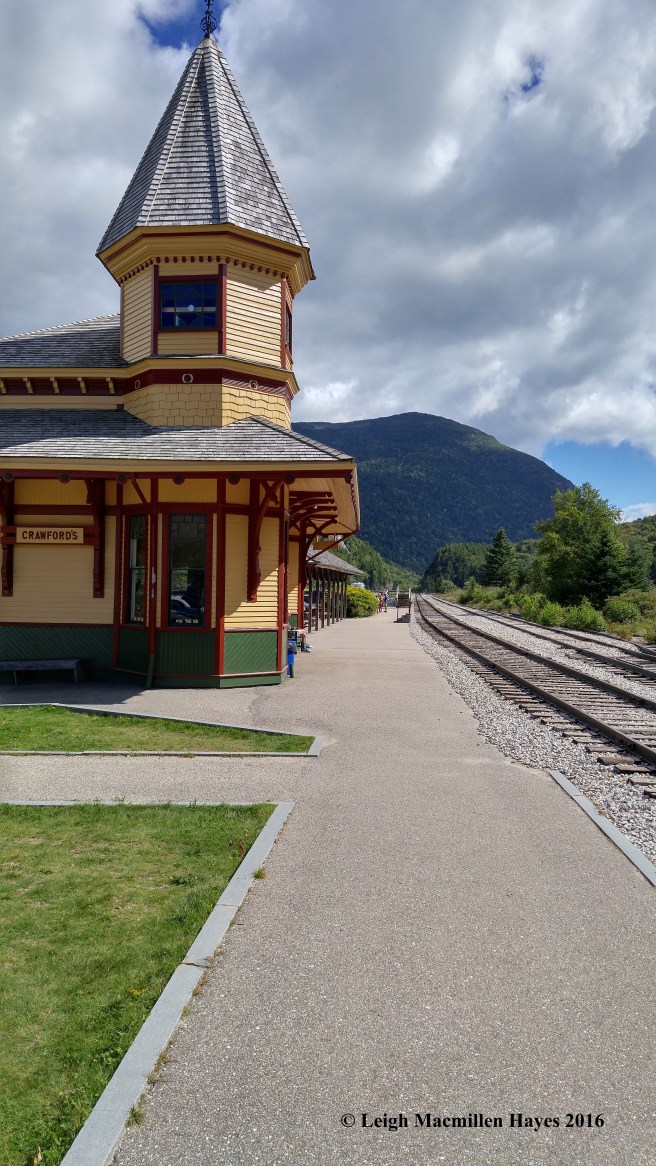
h-train tracks south (1)

And those that lead south from Crawford’s Notch.

Thanks to Ann for today’s hike into the vanishing point, a disappearance into the woods for a visual exploration.

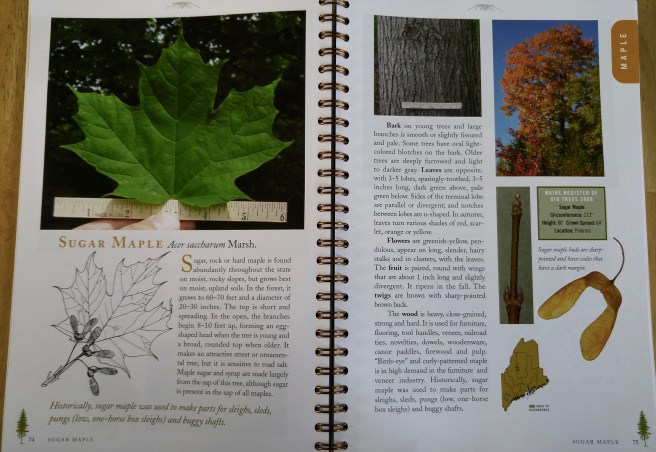
Book of September: Forest Trees of Maine

The other day a friend and I made plans for an upcoming hike. Before saying goodbye, she said, “Don’t forget to bring your tree book.”

t-cover (1)

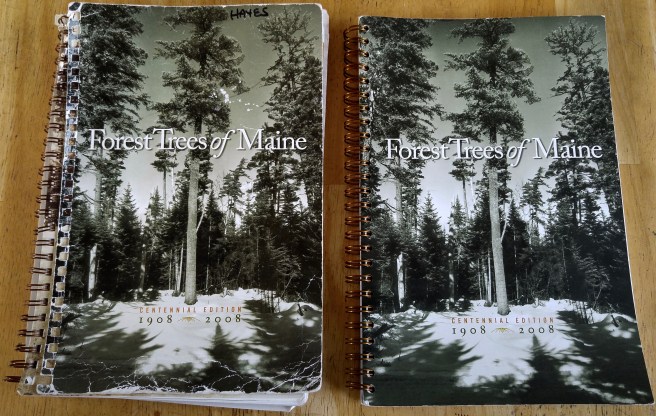
Really? I have at least thirty books dedicated to the topic of trees. But . . . I knew exactly which one she meant: Forest Trees of Maine. I LOVE this book–or rather, booklet. You’ll notice the tattered version on the left and newer on the right. Yup, it gets lots of use and often finds its way into my pack. When I was thinking about which book to feature this month, it jumped to the forefront. I actually had to check to see if I’d used it before and was surprised that I hadn’t.

Produced by the Maine Forest Service, the centennial issue published in 2008 was the 14th edition and it’s been reprinted two times since then.

t-b:y 2 (1)

In previous years, the book was presented in a different format. Two editions sit on my bookshelf, and I need to share with you two things that didn’t find their way into the most recent copy.

From 1981: Foreword–“It is a pleasure to present the eleventh edition of Forest Trees of Maine. 

Many changes have occurred in Maine’s forest since 1908, the year the booklet first appeared. Nonetheless, the publication continues to be both popular and useful and thousands have been distributed. Many worn and dog-eared copies have been carried for years by woodsmen, naturalists and other students of Maine’s Great Out-Of-Doors.

We wish the booklet could be made available in much greater quantity, however, budgetary considerations prevent us from doing so. I urge you to use your copy of Forest Trees of Maine with care. If you do, it will give years of service in both field and office.”

Kenneth G. Stratton, Director.

From 1995: One of two poems included. I chose this one because it was one my mother often recited.

Trees

I think that I shall never see
A poem lovely as a tree.

A tree whose hungry mouth is prest
Against the earth’s sweet flowing breast;

A tree that looks at God all day,
And lifts her leafy arms to pray;

A tree that may in Summer wear
A nest of robins in her hair;

Upon whose bosom snow has lain;
Who intimately lives with rain.

Poems are made by fools like me,
But only God can make a tree.

~Joyce Kilmer

t-how to use keys (1)

The most recent edition of Forest Trees of Maine provides a snapshot of the booklets history and information about the changes in the Maine landscape. For instance, in 1908, 75% of the land was forested, whereas in 2008, 89% was such. The state’s population during that one hundred year period had grown by 580,457. With that, the amount of harvested wood had also grown. And here’s an intriguing tidbit–the cost of the Bangor Daily News was $6/year in 1908 and $180/year in 2008.

Two keys are presented, one for summer when leaves are on the trees and the second for winter, when the important features to note are bark and buds.

t-leaves (1)

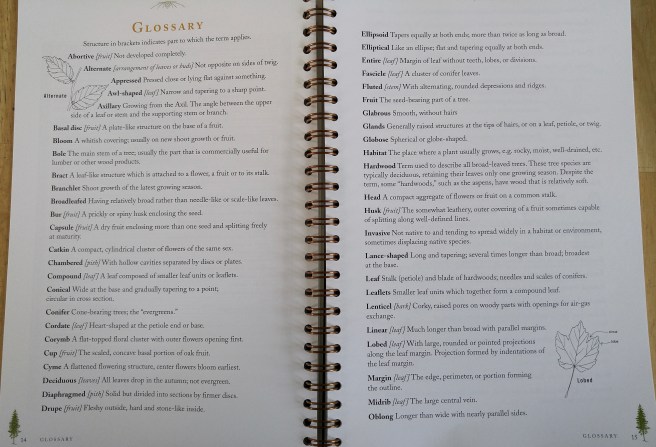
t-glossary (1)

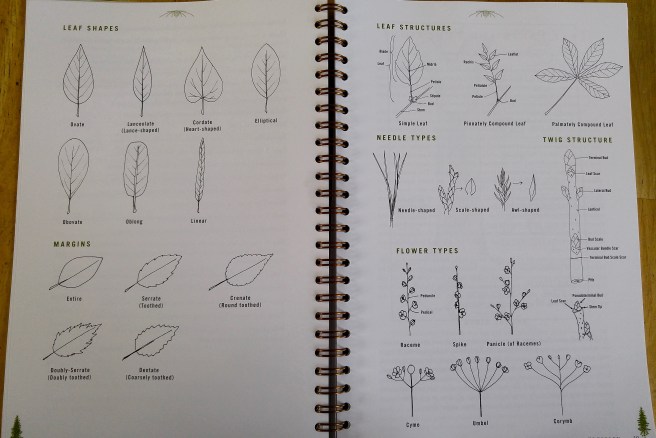
Terms for leaf shapes, margins and structure, twig structure, plus needle types and flower types are illustrated and various terms defined.

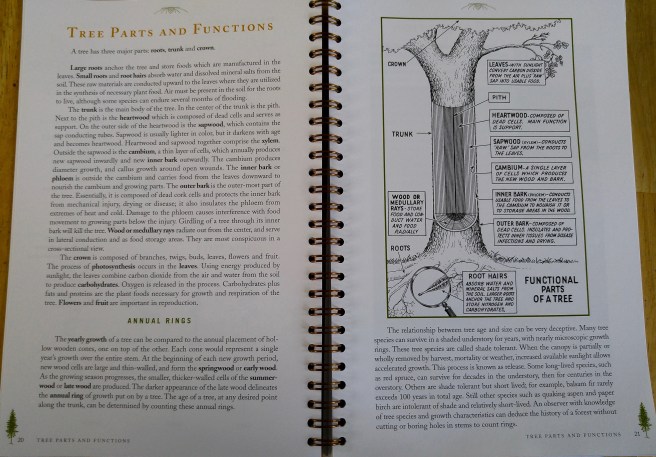
t-tree parts (1)

There’s even information on how a tree works because they do–for our well-being and for the benefit of wildlife.

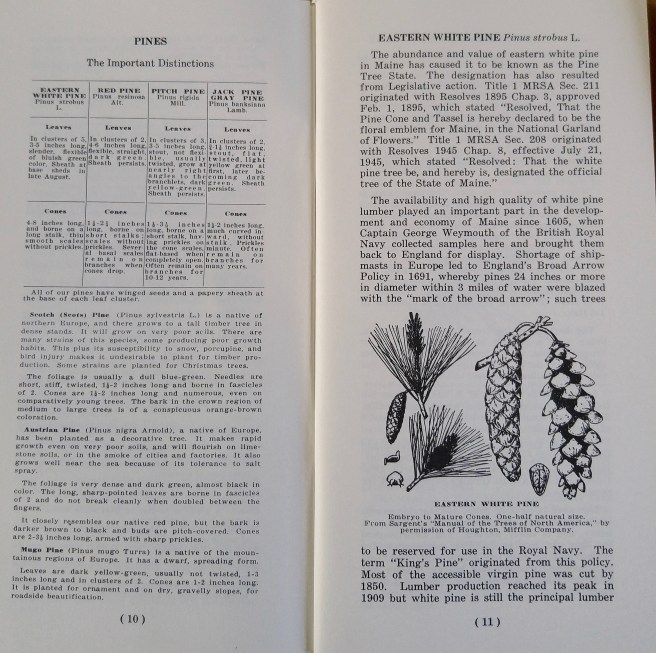
t-white pine (1)

And then the descriptive pages begin. Each layout includes photographs, sketches and lots of information, both historical as in the King’s Arrow Pine, and identifiable as in bark, leaves, cones, wood, etc.

t-pines blue book (1)

1981

t-pines yellow book (1)

1995

Though some of the information is the same, it’s fun to note the differences from the two earlier publications.

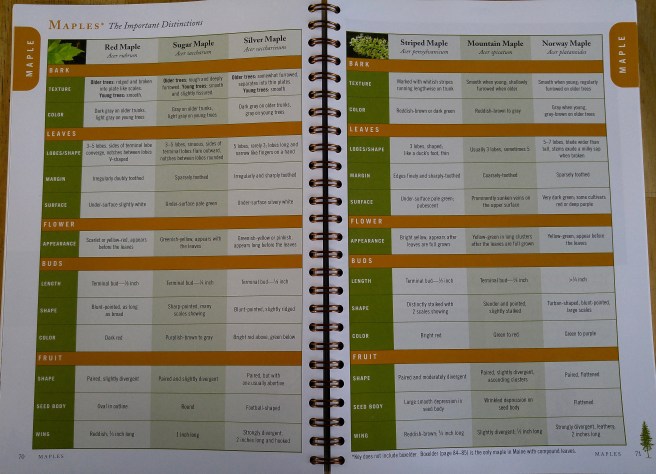
t-maple key (1)

At the beginning of each family, major descriptions are noted in an easy to follow format.

t-maple (1)

And like the conifers, the broadleaves are portrayed.

Tomorrow, when my friend and I venture off, I’d better remember to pack this booklet. She’s peeked my curiosity about what she wants to ID because I’ve climbed the mountain before and perhaps I missed something. She already has a good eye for trees so I can’t wait to discover what learning she has in mind for us.

This Book of September is for you, Ann Johnson. And it’s available at Bridgton Books or from the forest service: http://www.maineforestservice.gov or forestinfo@maine.gov.

Forest Trees of Maine, Centennial Edition, 2008, published by The Maine Forest Service


Halting Beside Holt Pond

Halting–prone to pauses or breaks. I didn’t break, but I certainly was prone to pauses as I moved along the trails and boardwalks at the Holt Pond Preserve in South Bridgton this afternoon.

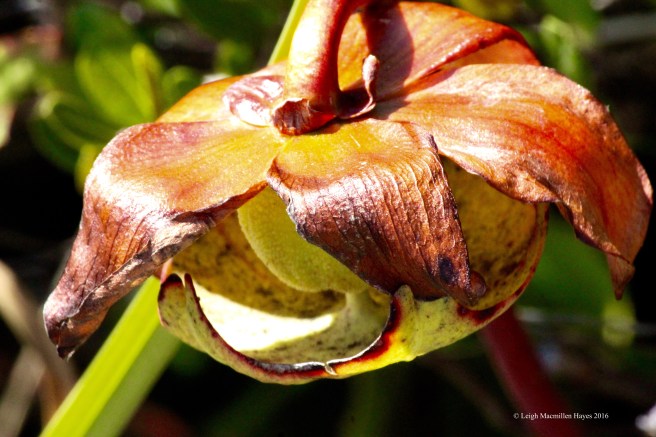
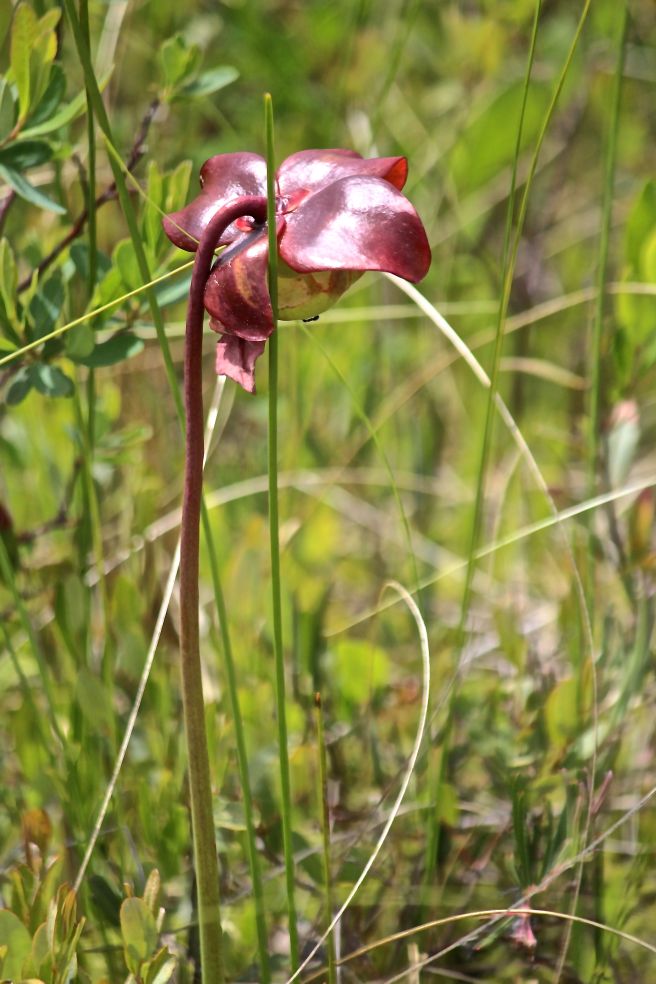
h-pitcher flower2

One of my first stops–to admire the pitcher plant flowers in their August form.

h-pitcher  flower up close

When I took a closer look, I realized that the seeds were developing–certainly a WOW moment in the world of wonder.

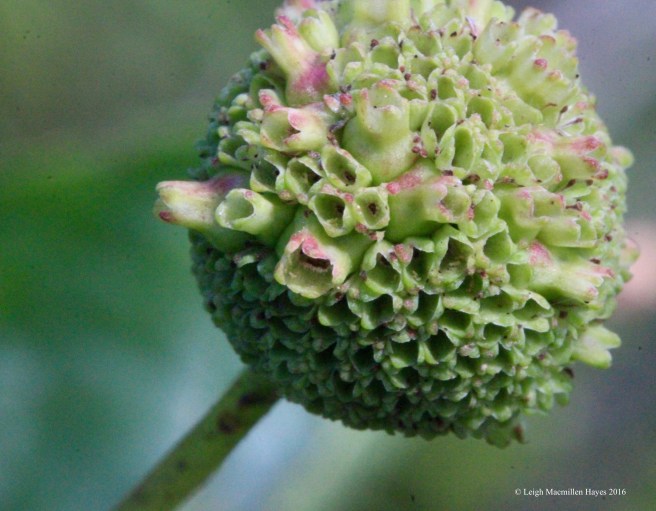
h-buttonbush.jpg

The global seed heads of buttonbush also demanded to be noticed. Upon each head are at least two hundred flowers that produce small nutlets. What strikes me as strange is the fact that this plant is a member of the coffee family. Maine coffee–local brew; who knew?

h-Muddy across

At the Muddy River, the water level reflected what is happening throughout the region–another case of “Honey, I shrunk the kids.” It’s downright scary.

h-speckled bug and speckles

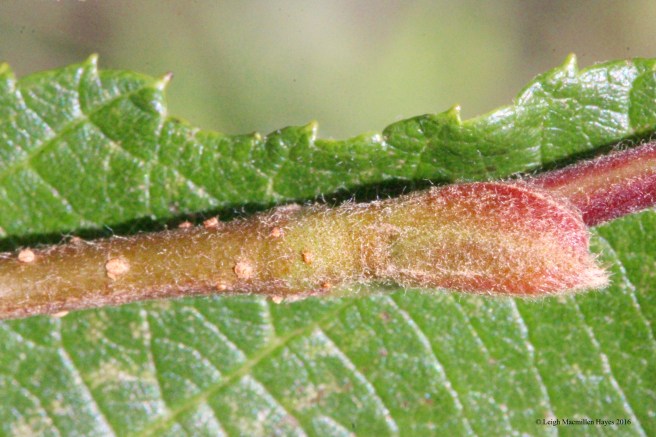
Both by the river and on the way to the quaking bog, this wetland features a variety of shrubs, including one of my many favorites, speckled alder. Check out the speckles–those warty bumps (aka lenticels or pores) that allow for gas exchange. And the new bud covered in hair.

h-speckled alder catkins

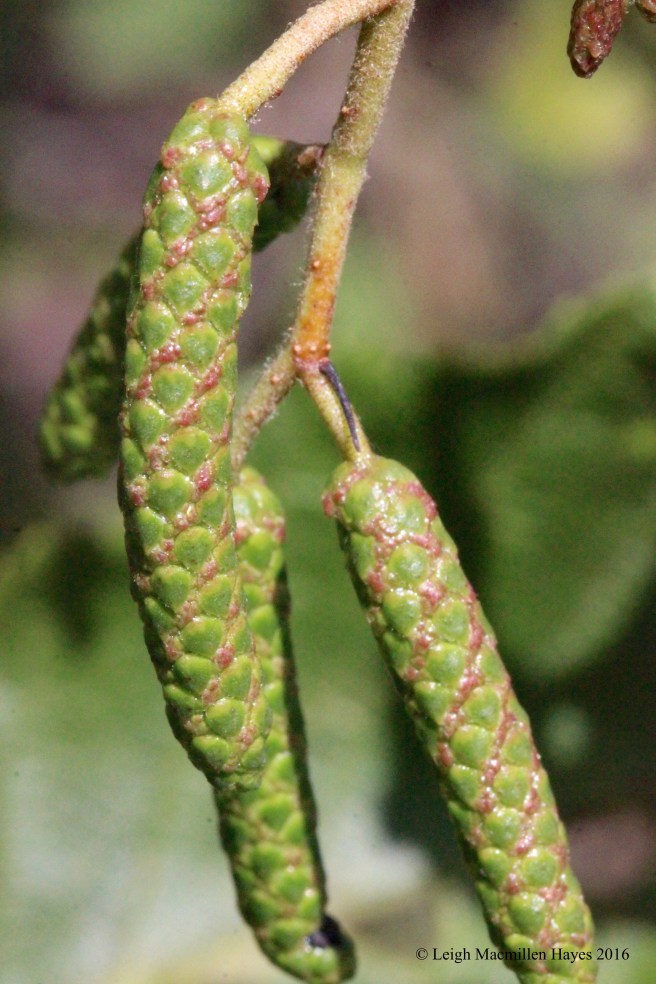
This shrub is so ready for next year–as evidenced by the slender, cylindrical catkins that are already forming. This is the male feature of the shrub.

h-speckled cones new

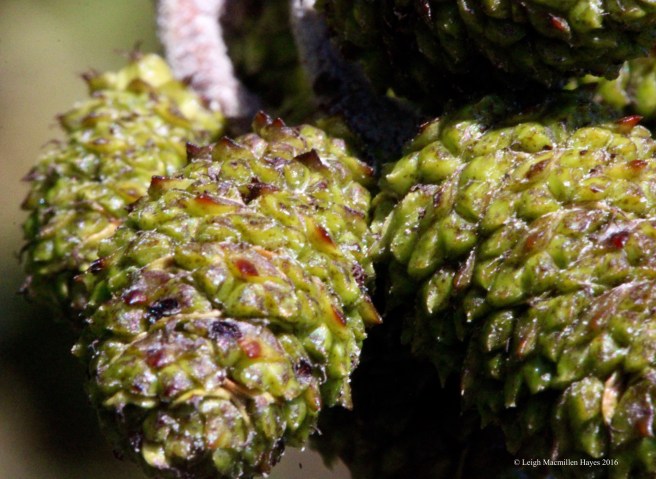
It also bears females–or fruiting cones filled with winged seeds.

h-speckled old cones

It’s not unusual for last year’s woody cones or female catkins to remain on the shrub for another year.

h-cranberries

Whenever I visit, it seems there’s something to celebrate–including ripening cranberries.

h-cotton grass

Common Cotton-grass dotted the sphagnum bog and looked as if someone had tossed a few cotton balls about. Today, they blew in the breeze and added life to the scene. Note to self–cotton-grass is actually a sedge. And sedges have edges.

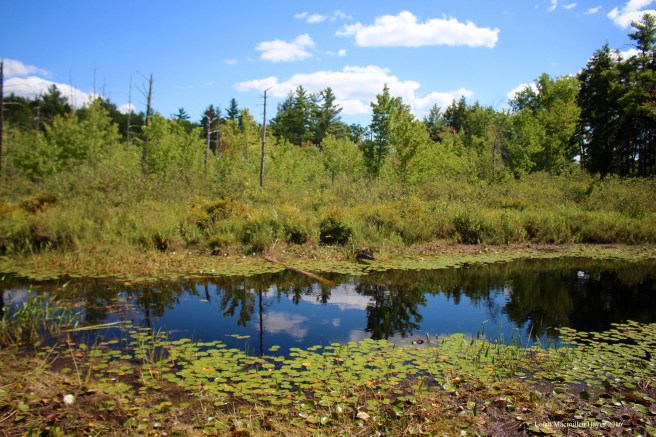
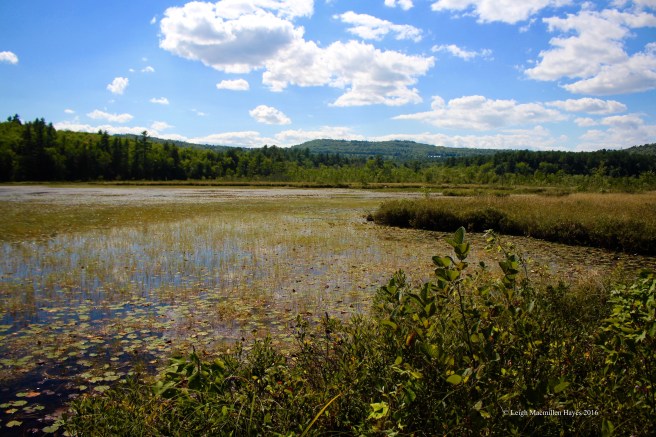
h-holt pond left

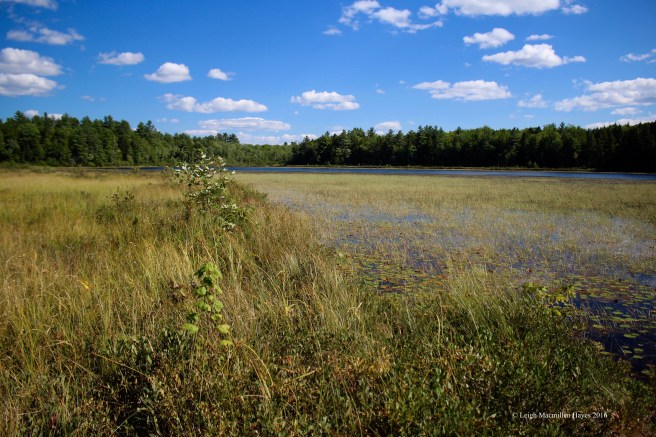
Just like the Muddy River, Holt Pond was also obviously low. Perhaps the lowest I’ve ever seen. At this spot, I spent a long time watching dragonflies. They flew in constant defense of their territories.

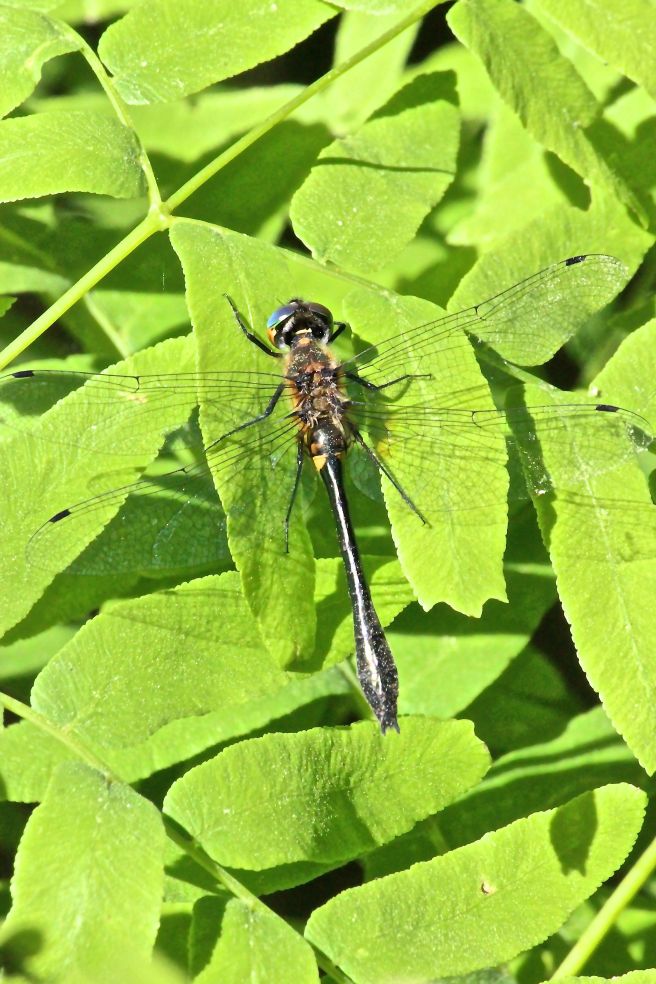
h-slaty skimmer, male

Male slaty skimmers were one of the few that posed for photo opps.

h-canoe on pond

As I watched the dragonflies flit about along the shoreline and watched and watched some more, I noticed a couple of fishermen making use of the LEA canoe. I don’t know if they caught any fish, but I heard and saw plenty jumping and swimming. Well, a few anyway. And something even skimmed across the surface of the water–fish, snake, frog?

h-rose hips.jpg

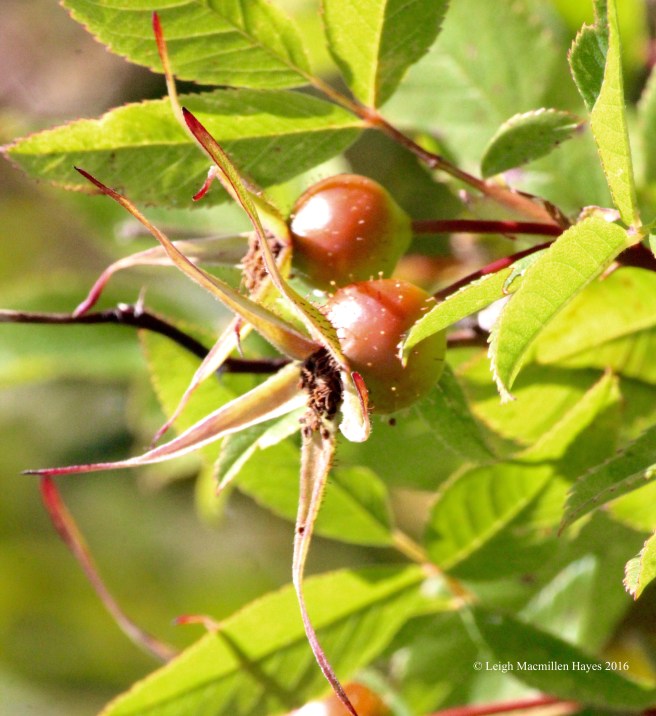
Rose hips by the pond’s edge reminded me of my father. He couldn’t pass by a rose bush without sampling the hips–especially along the shoreline in Clinton, Connecticut.

h-pond toward 5 Fields

The view toward Five Fields Farm was equally appealing.

h-pickerel frog

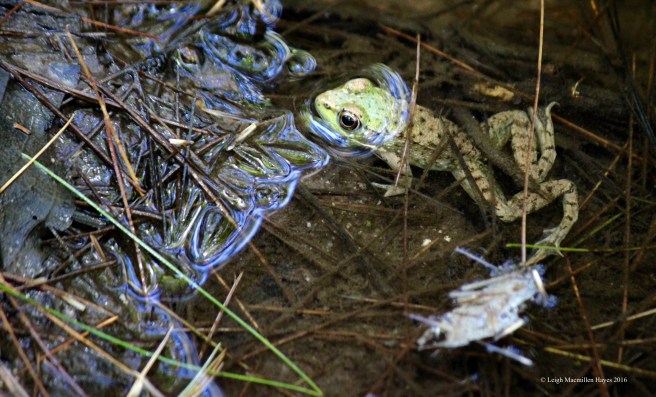
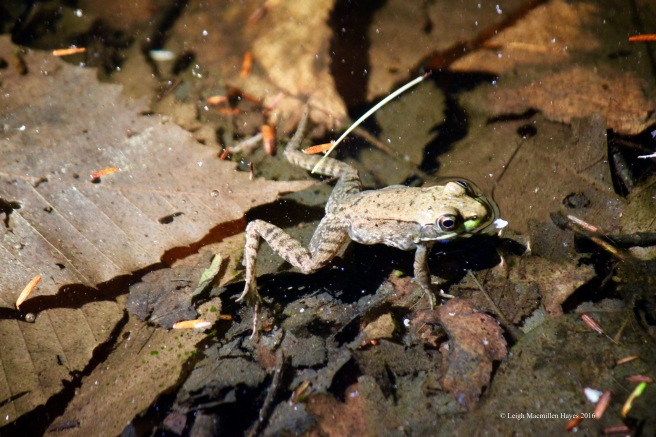
And then I moved down tire alley, which always provides frequent sightings of pickerel frogs. I’m never disappointed.

h-golden spindle

At the transition from a red maple swamp to a hemlock grove, golden spindles embraced a white pine sapling as if offering a bright light on any and all issues.

h-hairy woodpecker

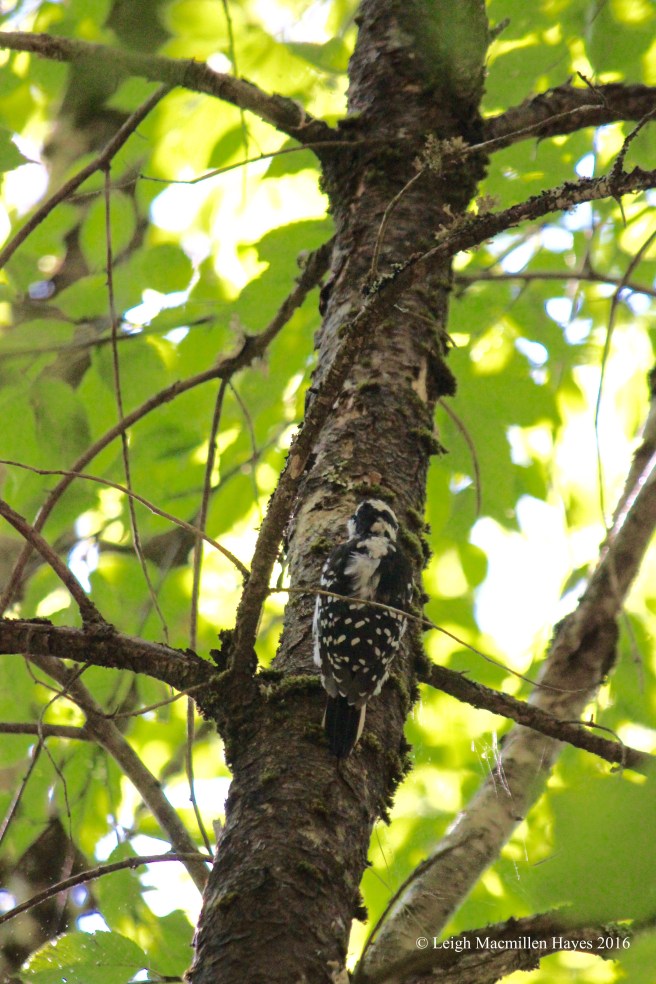
In this same transitional zone, a female hairy woodpecker announced her presence.

h-green frog

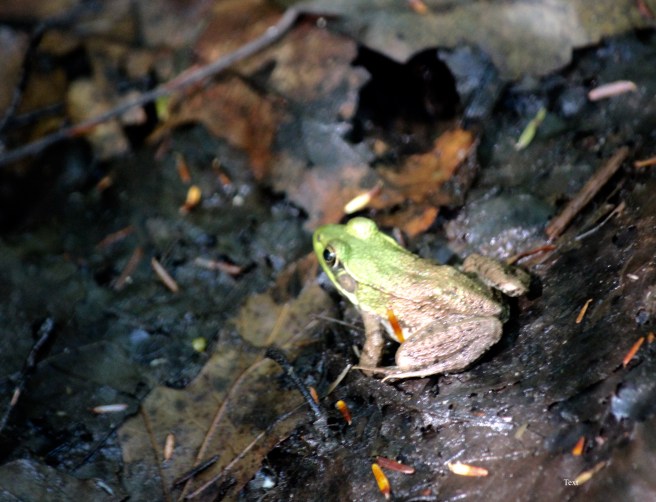
When I crossed Sawyer Brook, green frogs did what they do best–hopped into the water and then remained still. Do they really think that I don’t see them?

h-hobblebush berries

At last, I walked out to Grist Mill Road and made my way back. One of my favorite surprises was the amount of hobblebush berries on display.

h-meadowhawk

Walking on the dirt road gave me the opportunity for additional sights–a meadowhawk posed upon a steeplebush;

h-chicken

chicken of the woods fungi grew on a tree trunk;

h-chipmunk

and a chipmunk paused on alert.

h-American Woodcock

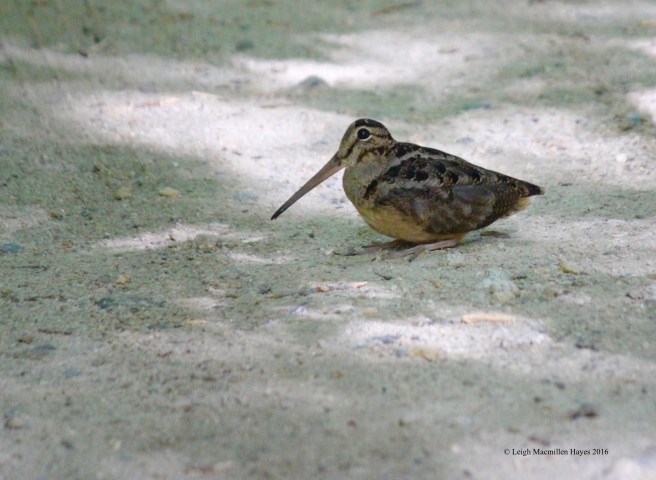
But the best find of the day–one that caused me to halt on the road as I drove out of LEA’s Holt Pond Preserve–an American Woodcock.

Worth a wonder! And a pause. Certainly a reason to halt frequently at Holt Pond.


Tagging Along with Jinny Mae

“Don’t walk behind me; I may not lead. Don’t walk in front of me; I may not follow. Just walk beside me and be my friend.” ~ Albert Camus

While I sometimes walked beside Jinny Mae this afternoon, I spent more time following her and am still her friend (I think).

A HOT afternoon. Despite the heat, however, I’m always tickled to follow her because she knows her 40-acre property intimately–including all of its nooks and crannies and cool sights.

j-green frog in water


We had some rain this morning, but Jinny Mae’s land is naturally wet and well loved by mosses and ferns . . . and green frogs. As we approached, several leaped into this mini pool and then posed.

j-green frog

Others waited patiently–probably hoping we’d move along.

j-polypore

J.M. has a fascination for fungi. Many fruiting bodies, like this gilled polypore, showed their faces as we moved about.

j-gilled polypore

We rolled the log to get a better look at the maze-like underside.

j-false chanterelle

Among our finds–chanterelles (deleted false because fungi expert, Jimmie Veitch informed me that they are true chanterelles. If you want to know more about Maine fungi or to purchase some, visit White Mountain Mushrooms) and . . .

j-coral

a coral fungi. Given today’s humidity, it felt like we were in the Bermuda of the North.

j-fern

Jinny Mae also showed me a fern-like moss that I don’t think I’ve ever seen before: stair-step moss. This moss is particularly fond of the moist coniferous and hardwood forest we tramped through. Its new growth arose from the previous year’s growth–climbing like a staircase.

j-yellow birch and hemlock

Nearby, she pointed to one of her favorite tree displays–a hemlock and yellow birch sharing space. Both have seeds that germinate best on rotting logs or rocks, where moss gathers and provides moisture. In a compatible relationship, they’ve reached for the sky with equal success. I’m reminded of two friends who know the importance of supporting each other–similar to the chitchat and occasional silence Jinny Mae and I share as we bushwhacked.

j-lightning 2

And then she introduced me to Excalibur. Even King Arthur probably couldn’t pull this    sword-like piece of a tree out of the ground–well, maybe he could. But we couldn’t.

j-lightning tree 1

The reason for Excalibur’s existence: a recent lightning strike.

j-lightning 4

We looked around and saw that the energy passed through at least three trees.

j-lightning 5

Bark peeled off.

j-lightning 3

And shredded wood scattered. What surprised us both was that we couldn’t find any burnt wood. Thankfully.

j-beech drops

Making our way back toward her house, we entered a beech forest and began to see beechdrops everywhere we looked.

j-beech drops2

These are parasitic plants that don’t manufacture their own nutrition, thus they depend on the roots of American beech trees for food.

j-coteledon

In this same area, we come across a young beech tree Jinny Mae flagged in the spring when she first observed a cotyledon. We chuckled when we remembered how we both were so taken with cotyledons a few months ago–a new sighting for us. One of those things that was always there, but we’d never noticed it previously. Today, she was filled with pride for this young beech. It’s had a healthy start and in forty years may provide beech nuts for the neighborhood bears. In the meantime, it will probably nourish a few beech drops.

j-Indian pipe .jpg

And then she showed me the final cool find of the day–an Indian pipe with stamens that appear to have split away from the flower. It seems that these friends made the move together–much the same as Jinny Mae and I did today.

I may have tagged along and followed her, but really, we walked side by side and I’m thankful for her friendship.

Book of August: BARK

IMG_2913

Book of August

It was my journey through the Maine Master Naturalist class several years ago that lead me to this book of the month: BARK–A Field Guide to Trees of the Northeast by Michael Wojtech.

The book actual evolved from Wojtech’s work, under the tutelage of Tom Wessels, toward a Master’s degree in Conservation Biology at Antioch University New England.

Between the covers you’ll find information about bark structure, types of bark and bark ecology. There is a key for those who are so inclined.

And then the biggest chunk of the book is devoted to photographs and descriptions for each type of tree that grows in our New England and eastern New York State forests. These include the common and Latin names, family, habitat, range maps, leaf and branch pattern, leaf shape and notes.

For me, there are two take away items from this book. First, I learned to categorize bark based on its pattern from smooth to ridges and furrows, vertical strips, curly and peeling to others covered in scales and plates. He breaks bark type into seven varieties that I now find easy to identify.

Second, I came to realize something that I may have known but never gave much thought to–except for  American beech bark, which remains smooth all its life (unless it’s been infected by the beech scale insect), bark differs from young to mature to old for any particular species. Oy vey!

Though this book is useful in the winter, now is the time to start looking. To develop your bark eyes. The leaves are on and will help with ID, thus you can try the key and you’ll know if you’ve reached the correct conclusion or not.

Go ahead. Purchase a copy and give it a whirl. I must warn you, it becomes addictive and can be rather dangerous when you are driving down the road at 50mph. As Wojtech wrote in the preface, “If you want to experience a forest, mingle among its trees. If you want to know the trees, learn their bark.”

While you are at it, I encourage you to visit the small western Maine town of Bridgton, where the Bob Dunning Memorial Bridge leads into Pondicherry Park. Each of the sixteen bridge beams is constructed from a different tree and the bark is still on them. Test yourself and then grab one of my brochures at the kiosk to see if you got it right. If there are no brochures, let me know and I’ll fill the bin.

And while you are there, stop by the independent bookstore, Bridgton Books, to purchase a copy of BARK.

BARK: A Field Guide to Trees of the Northeast by Michael Wojtech, University Press of New England, 2011.

From Bare to Bear on Burnt Meadow Mountain

Back in October 1947, catastrophic wildfires erupted throughout Maine during what became known as “The Week Maine Burned.”

It hadn’t rained for 108 days and the dry woods were like tinder. Here in western Maine, Fryeburg, Brownfield and Denmark thought they had a fire under control, but overnight a strong wind blew and gave it new life. About 2,000 acres burned by the next night as the fire spread to the edge of Brownfield.

With the winds continuously shifting, town folks began to panic. Farmers either turned their livestock loose or herded them to neighboring towns. Others packed as many belongings as they could and evacuated.

By morning, most homes and public buildings in Brownfield were mere piles of ash. Stately places including the Farnsworth Place where Dr. Philo Farnsworth, a pioneer in the field of television, spent his summers, had burned. Churches, schools, the post office, Grange hall, library and town hall all went up in smoke–only twenty houses survived. In the end, 85% of the town was destroyed, including a mountain trail.

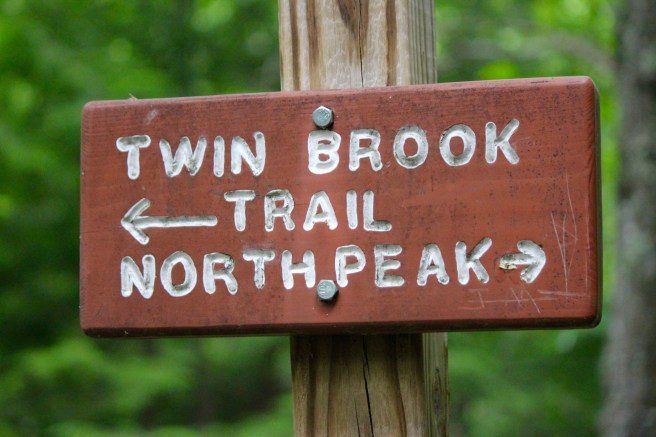
Today, Marita and I ventured to Burnt Meadow Mountain for a loop hike. It used to be that one had to hike up and back on the same trail, now known as the North Peak. Though that’s the shortest way up and back (about an hour each way), I for one, am thankful to the Friends of Burnt Meadow Mountain, who sought landowner permission to create a loop and spur–Twin Brook Trail and Stone Mountain Trail.

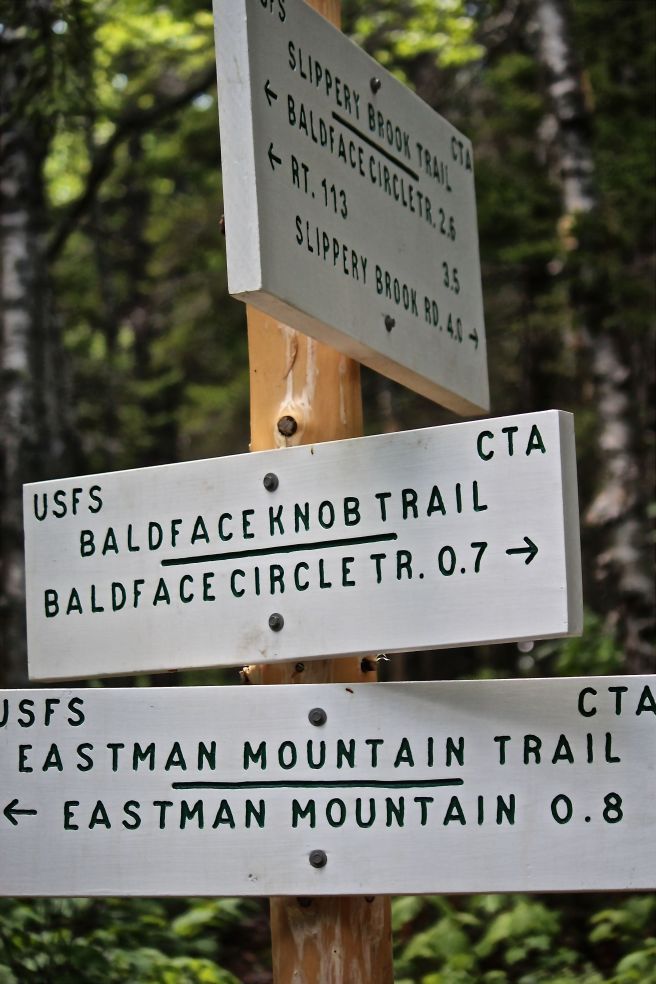
trail sign

From the parking lot and kiosk, it’s a bit of a climb to reach the trail split. We followed the blue blazes of the North Peak trail, which though it is shorter, is also the more difficult of the two.

white pine 1

Immediately we noticed that the white oaks that grow at the bottom of the mountain play host to numerous leaf miners and other insects.

white oak gall

Some are decorated with pronounced galls. I always think about how a bud protects the whisp of a leaf all winter long, and how hairy it is as it slowly unfolds and then–kaboom–the insects have to survive too. And they do. Until something eats them. And their energy passes up through the web, where it’s enhanced at each level by sun and air and rain and . . . even when life doesn’t look so good, it is.

Blueberries

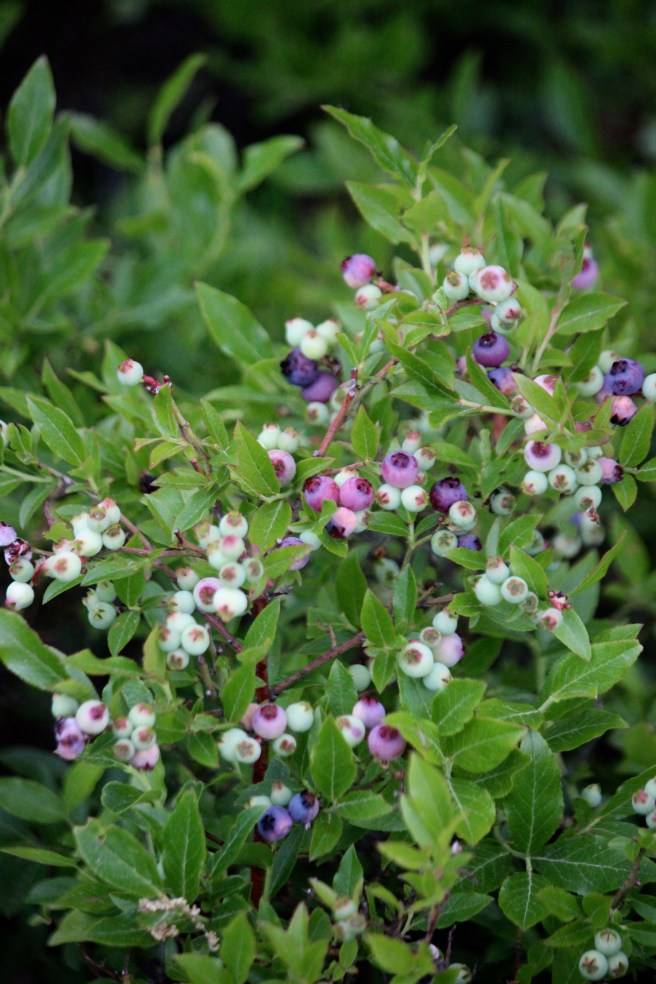
As we climbed, the blueberries became more prolific. And bluer.

spreading dogbane

Spreading dogbane showed forth its tiny pink bells.

ph rocky ascent (1)

And the trail became a scramble. If I said we scampered up the ledge quickly, I’d be telling a fib. (Do people still tell fibs?) Near the summit is a section of hand-over-hand climbing. It doesn’t really last long, but in the moment it seems like forever.

ph view on way 2 (1)

And so it invites a pause to take in the view to the south and east.

ph summit view 5 (1)

The relatively flat summit is rather barren–in memory of those 1947 wildfires.

ph summit view3 (1)

We were glad it was cloudy as there are no shade trees at the top.

ph summit view 2 (1)

Our view included Stone Mountain and the saddle between it and Burnt Meadow Mtn.

ph red pine 3 (1)

Normally in the landscape, red pines stand tall and proud. At the summit, however, their scrubby form presents their features at eye level–bundles of two needles, pollen cones and older seed cones. Young red pines typically germinate and grow only after forest fires or some other event that causes tree loss.

Eastern Towhee 2

Eastern Towhee

While we took a break, an Eastern Towhee sang its metallic yet musical “drink your tea” song.

ph view on way down 4 (1)

Descending via the much longer, but a wee bit easier Twin Brook trail, we were treated to mountain views to the west.

driftwood

And driftwood. Oops. Wrong setting. But still, mountain wood can be as beautiful as ocean wood.

ph bear 5

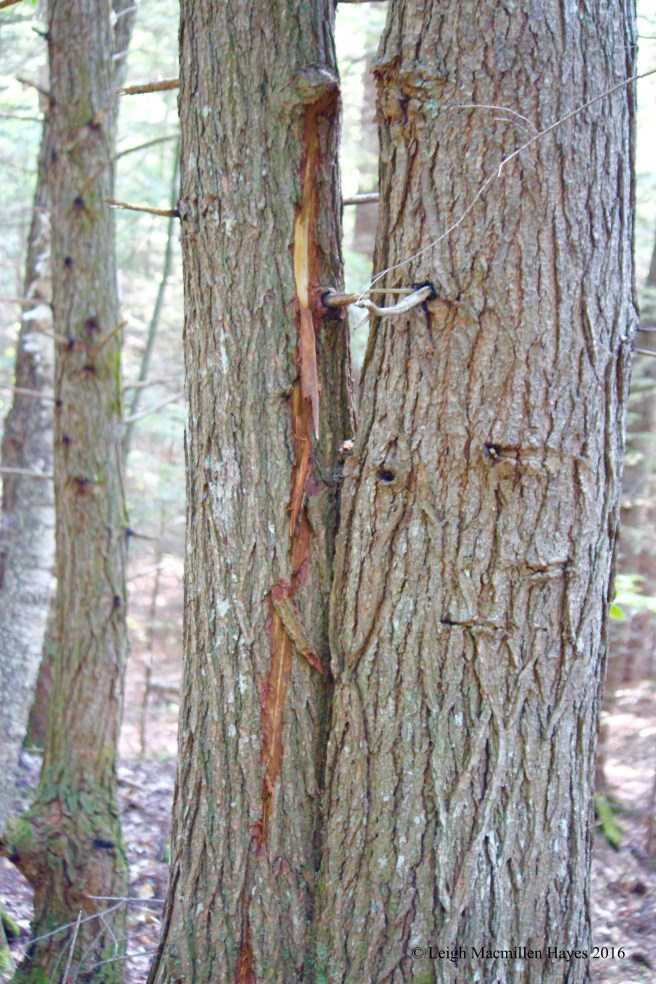
One of our pleasant surprises was the discovery of bear claw marks on rather small beech trees. Perhaps made by even smaller bear cubs who scampered up and down a year or two ago, leaving their marks much the way we left our own today without knowing it.

ph bear 2

Further along, the hole in this older beech stopped Marita in her tracks. We noticed saw dust on the ground below. And numerous bear claw marks on the bark above.

bear 3

Another oft visited tree.

From bare to bear, Burnt Meadow Mountain in Brownfield is worth the trek. (You probably thought we saw a bear today. No such luck, but my guys and I encountered a bear on the North Peak trail on a summer day years ago. It seemed content to lumber along about fifteen feet from us–probably full of blueberries.)


Lonesome Mondate

My guy has worked way too many hours in the last few weeks, including this past weekend, so today we ran away. Well, he went for a run early this morning while I dilly dallied around the house. And then we ran away.

plly 1

Our destination was our favorite breakfast place, though we went for lunch today–Polly’s Pancake Parlor in Sugar Hill, New Hampshire. As we walked toward the door, we noticed a family standing outside chatting and laughing. Hello neighbors! Yup, we were almost two hours from home and our neighbors from down the road had just finished breakfast. “We passed you on your run,” they said to my guy–equally surprised to see us there.

Lunch was the combo sampler–three small pancakes with sausage for him and thick, crispy bacon for me, followed by three more pancakes and full bellies. Good thing we only make this a once-a-year habit. I’d planned to only order the plain batter with blueberries because of all the choices that’s my favorite, but I have to say that the gingerbread and chocolate chip was also yummy.

ph-lupine fest 1 (1)

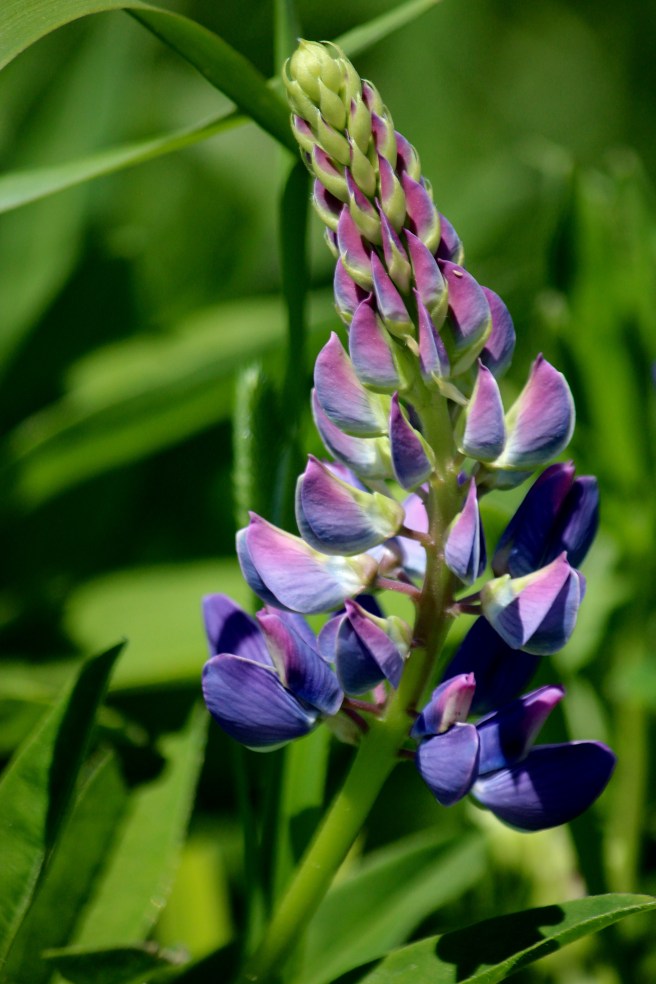
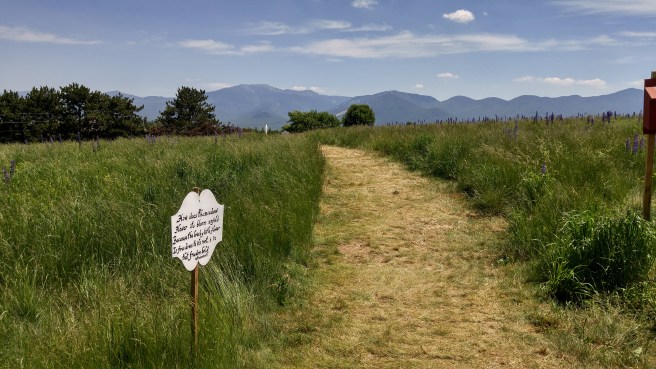
And then we moved on to the lupine fields. Actually, lupines bless the fields throughout town, but the Sugar Hill Sampler Lupine Fields feature trails with poetry along the way.

lupine sign

Such simple words of wisdom ring true

lupine 7

amid the beauty.

ph-lupines 4 (1)

The actual lupine festival occurred two weeks ago,

ph-lupines 2 (1)

but our timing wasn’t so off.

lupine 10

Color and structure wrote their own verses.

ph-tree1

A few more miles down the road, we started up a trail that appeared relatively flat in the land of giant yellow birch trees.

xylophone1

One of the brook crossings danced to the beat of its own song

xylo 2

interpreted by my guy who channeled his inner Tom Hanks as he moved across the xylophone to the beat of  “Heart and Soul” featured in the 1988 movie “Big.” So be it.

maple 2

A few months ago when I presented a workshop on tree bark, a colleague asked me about mountain maple, which I didn’t know existed. Since then, I’ve been paying attention–at least to the leaves, which I found today. Please don’t ask me what the bark looks like. That’s for a future lesson.

trill2

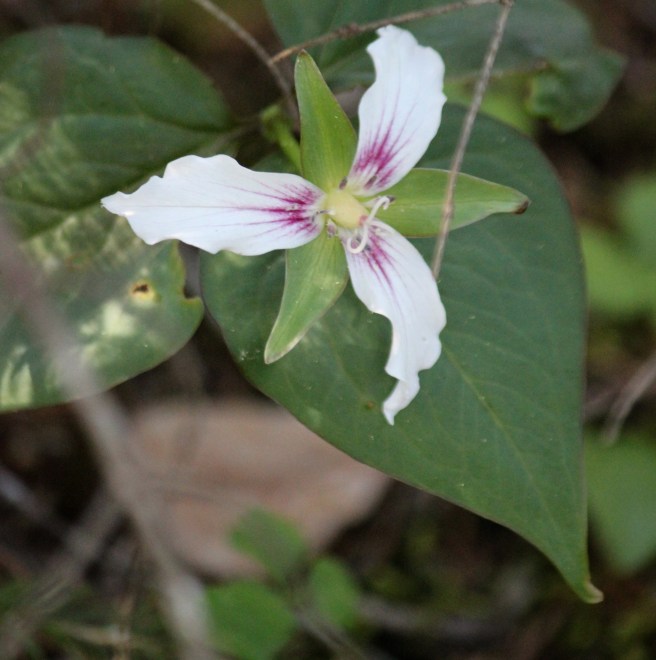
And though most have gone by, we found one painted trillium to add to my collection of a trillion trillium photos.

ph-mud (1)

After a steady climb among rocks and roots, we reached level land and bog walkways–thanks to the AMC employees and volunteers who worked on new passageways. Talk about getting into your work–check out the mud on this guy and he wasn’t the only one. We met others who had worked for the AMC 30 years ago and were volunteering their time and expertise to complete the trails that we all may enjoy. I hope there was a chilled beer at the end of their day because they were all muddy and sweaty, but smiled as they worked and suggested ways for us to bypass the mud.

salamander1

We slipped off the trail (not literally) and found today’s special find–Eastern newts in a couple of stages.

sally 1

Growing older, the eft began to resemble adults. Don’t we all! Eventually.

lake view 1

Cannon Mountain formed part of the backdrop. For me, Cannon has always evoked a childhood memory. About 50 or more years ago, as my family traveled up the tram to the summit we looked toward Canada and my parents mentioned that our next-door neighbors, the Mansfields, were on their way to Canada, which we could see. I saw the Mansfields’ station wagon. I swear. And every time I pass this way, that memory jumps to the forefront. Once I mentioned it today, my guy and I started sharing past memories as we made our own.

ph Lonesome Lake hut (1)

At last we reached the  Taj Mahal and paused to use the bathroom.

ph mts 4 (1)

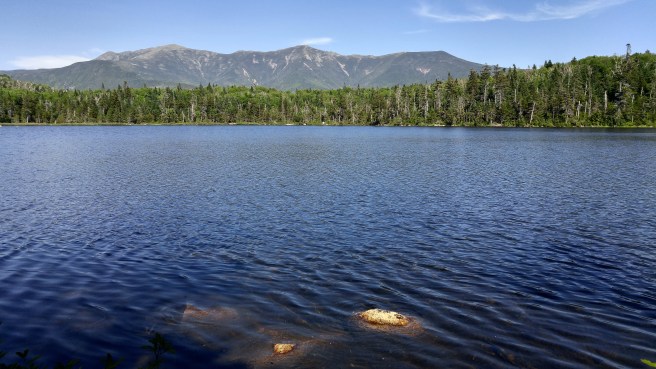
We were beside Lonesome Lake and had a splendid view of Mt Lafayette and Franconia Ridge as spring came to a close for 2016.

bog trail

ph-bog (1)

Our journey continued around the lake before we headed back down the trail–for scent and sound think balsam pillows and the banjo plunks of green frogs.

We were hardly lonesome on this trail that is described as tranquil and heavily travelled. We will attest that it is both and loved the hike to Lonesome Lake on today’s Mondate.


The Main(e) Exotics

If you’ve traveled with me before, you know that I often frequent the same trails. And so it was today. Oh, there was a change-up in the early morning hours when I joined a couple of members of the Lakes Environmental staff to oversee a volunteer project by the Rotary Club. Rotary members from around the state and beyond (think Argentina) spent four hours clearing a new trail we’d laid out at LEA’s Maine Lake Science Center. They provided humor and hardwork hand-in-hand.

And then a friend and I drove to LEA’s Holt Pond Preserve where everything was in exotic mode.

oak g 3

One of our first finds was an apple oak gall about the size of a golf ball. So, the apple oak gall female wasp (yes, there is such a species) crawled up the tree trunk of a Northern red oak in early spring and injected an egg into the center vein of a newly emerged leaf. As the larvae grew, it caused a chemical reaction and mutated the leaf to form a gall around it that provided sustenance.

oak g 5

Recently, the wasp drilled its way out and probably found a mate.

oak gall 1

All that remained–wispy fibers.

blue 3

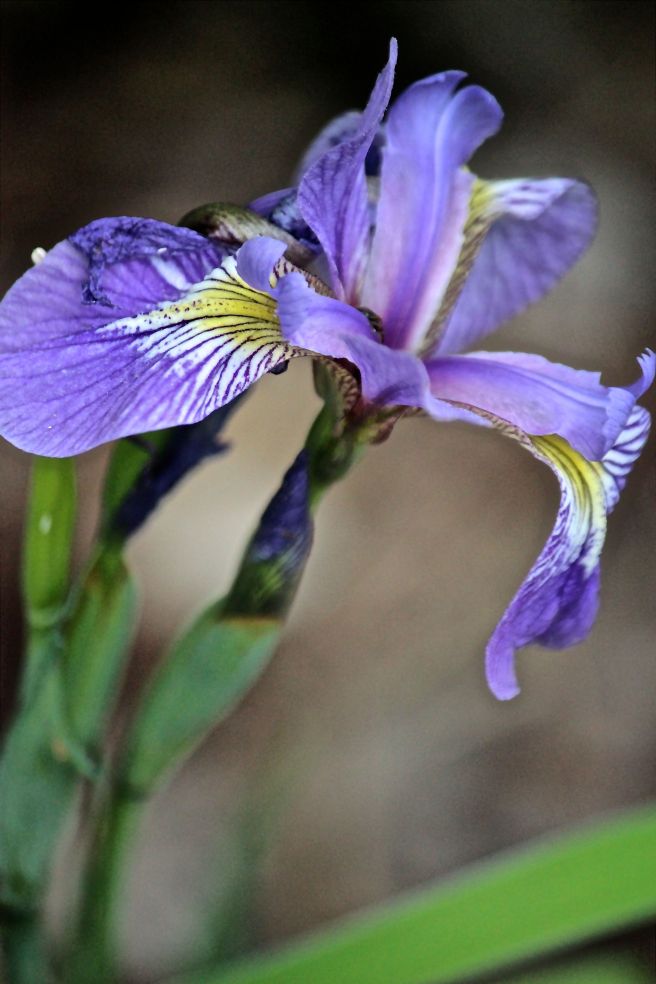
Along the first boardwalk in the red maple swamp we found Northern blue flag iris in bloom. Flag irises are wild irises that tend to grow in boggy areas. Unlike the irises that grow in our gardens, they don’t have beards. The venation of the gracefully downturned sepals was intense–the better to attract pollinators.

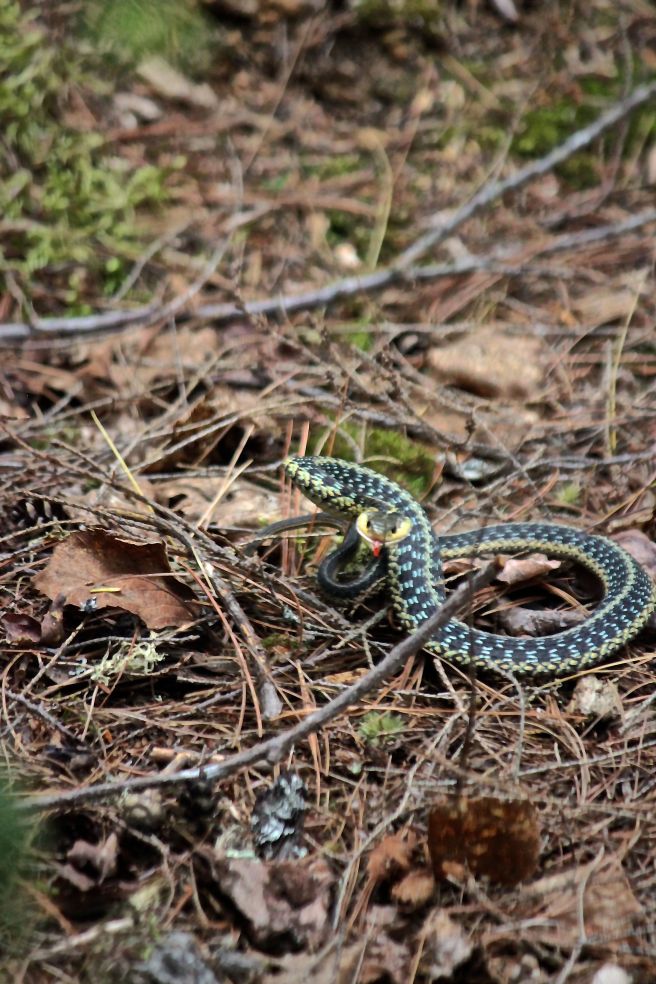
snake2

We moved from the swamp to the first hemlock hummock and chatted about natural communities when suddenly we realize we were being hissed at.

snake 10

Its coloration threw us off and beautiful though it was, the hairs on the back of our necks stood on end. Apparently we made it feel likewise. And so we retreated. We retraced our steps and decided to complete the same loop in the opposite direction. When I got home, I looked it up and realized that it was a common garter, but really, there didn’t seem anything common about it in the moment.

hemlock v

Because we backtracked, we were treated to fresh and older hemlock varnish shelf fungi that  we may not have seen otherwise.

hemlock v 6

We know where they’re located. F0r big $$ we might (MIGHT) show you.

park 1

Later on, as we left, we recognized a friend’s vehicle in the parking lot. Our question–did he see what we saw?

pitcher 9

Throughout the preserve we found one of our favorite plants that in my book is the most exotic of them all.

pitcher 3

The carnivorous pitcher plant obtains nitrogen and phosphorus by eating insects. Its oddly shaped leaf forms a unique pitcher partly filled with water and digestive enzymes. The spout is a hairy landing platform for insects attracted by its red venation and nectar glands. Imagine this: An insect crawls to the edge of the leaf, aka pitcher, slips on the downward-sloping hairs and plunges into the liquid below where enzymes and bacteria break it down. Any chance for escape are zapped by those stiff hairs. Oh my.

pitcher & sundew1

The pitcher plant isn’t the only carnivorous plant that thrives here. Check out the glistening tentacles of the sundew intended to capture small insects like a mosquito. Should one land on the tiny leaf, its feet become ensnared in the sticky secretion and the end is eminent. YES! Within mere minutes the tentacles curl around the victim and suck the nutrients out of it. Go sundews. Go pitcher plants.

sheep 4

Only beginning to bloom was sheep laurel with its deep crimson-pink flowers. Located below the newly emerged leaves, each flower has five sepals, with a corolla of five fused petals and ten stamens fused to the corolla. Beauty and danger are also encompassed here–it contains a chemical that is poisonous to wild animals, thus one of its common names is lamb kill.

exo 1

Because we were beside the pond, we thought to look for dragonfly exoskeletons and weren’t disappointed.

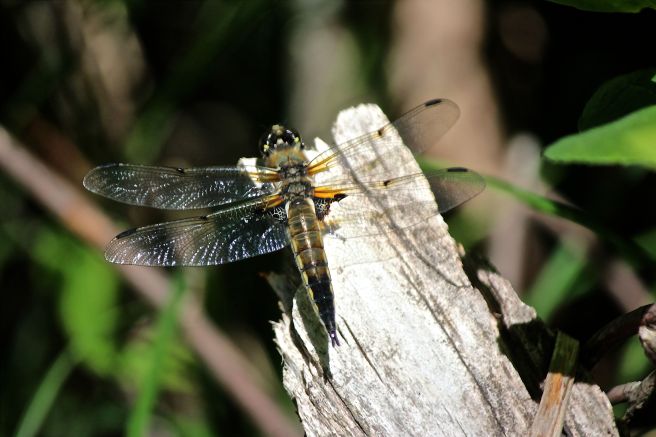
broad-tailed shadow dragonfly

And the dragonflies themselves were worth our attention. I’m not sure my ID is correct, so help me out if you know better, but I think this is a broad-tailed shadowdragon and if that’s true it is one that Maine is paying attention to because it only occurs in one or two states.

beaverpond clubtail dragonfly

Another that I name without certainty–beaverpond club tail.

ebony 2

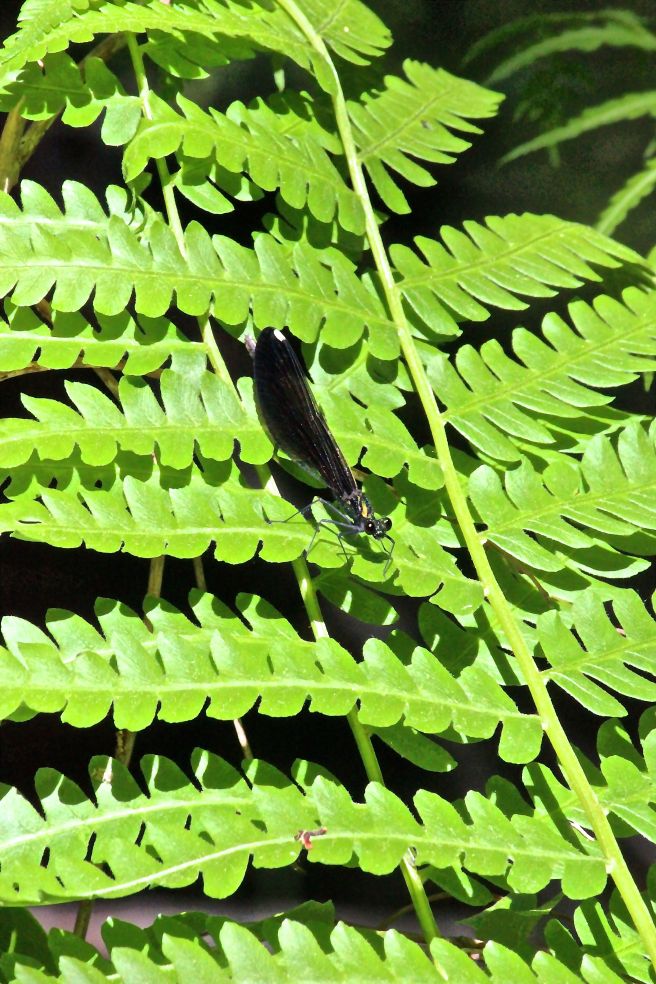
I’m much more confident about my ID of this ebony jewelwing damselfly.

cuke 7

We found a double-decker Indian cucumber root that displayed flowers in varying stages. The yellow or green-yellow flowers drooped below the upper leaf whorl and as is their custom, were slightly hidden. Each flower had three long, brown styles in the center that curved outward and the stamens were magenta.

LEA boats

Among the unnatural offerings, a few boats to explore the river and pond. Though we noted a couple of paddles and one pfd, we highly recommend you bring your own.

LEA 2

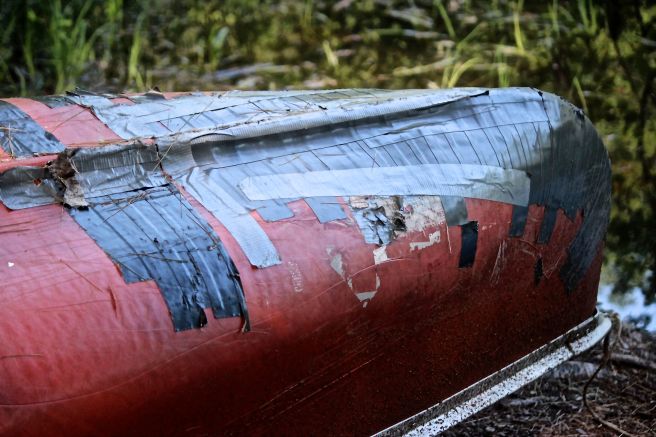
Some extra duck tape is also a good choice just in case. ;-)

HP view1

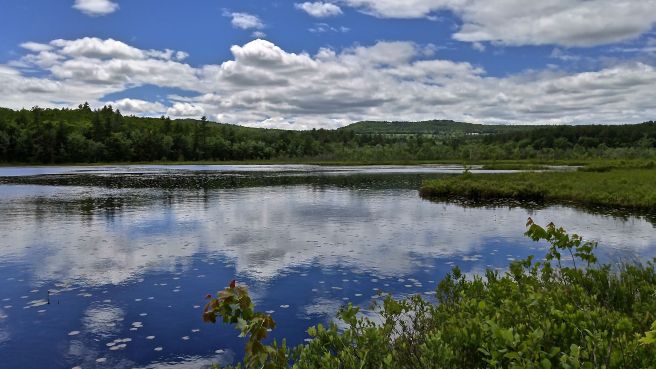
Like the ever-changing reflection, life changes constantly at Holt Pond. The more I look, the more I realize how exotic life is in Maine. Who knew?

Be Together Mondate

It took us a while to get our act together this morning, but by 10:30 we were finally at the trailhead for the Baldface trails off Route 113 in Evans Notch. Okay, so true confession, I did not want to hike these trails. For thirty years I’ve managed to avoid them, but my guy promised me this morning that if I wasn’t comfortable we could turn back at any point.

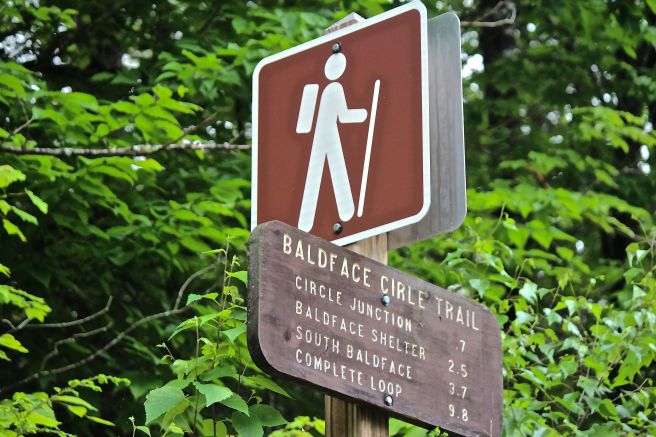
b-start sign

And so our Mondate began.

b-ph emerald 3

The first .7 miles were familiar to us as we’d passed this way many times in the past, often with friends or family in tow. The destination, Emerald Pool. A forever nippy Emerald Pool.

b-ph emerald 2

We stood above the pool today and shared memories of past visits. And the people that made those visits memorable.

b-ph emerald above

Even the water above the pool provided hours of entertainment in days gone by.

b-ph emerald above 2

Today, it was the water’s force and volume, increased since last night’s rain, that gave us pause.

But we couldn’t pause for long. We had a mountain to conquer. And so, we headed back to the main trail and at the junction followed the Baldface Circle Trail . . . until it disappeared before our eyes. We backtracked but couldn’t figure out what we’d done wrong, except that we couldn’t see trail blazes anywhere. And so we retraced our footsteps until the trail petered out again. And then we decided to bushwhack and climb uphill because it only made sense that we’d find our way. At last, success–we found yellow blazes and an obvious trail. But . . . we didn’t know if we were on the Circle Trail or Slippery Brook Trail.

Our plan had been to hike up the first and down the latter. Out came the map and compass and we were fairly sure we were on the latter trail. To be certain, we hiked a wee bit, until we came to the brook. Yup. So, decision time. Turn around and head back to the other trail or continue on because we’d already come so far. We continued on. Plan B when we didn’t even know we had a Plan B.

b-ph brook 3

And Slippery Brook held its own tribulations. The water–oh how it flowed. It didn’t bother my guy and within seconds he stood on the other side grinning back at me. Meanwhile, I hemmed and hawed. And hawed and hemmed. How in the world? I thought perhaps I should return to Emerald Pool and wait for my guy to complete the round trip. He wasn’t buying that. Neither was I, truth be told. But sometimes my head gets the better of me. He knew that. And so he dropped his pack, took off his boots and sloshed through the cold water to grab my pack.

b-ph brook crossing 2

I didn’t have a choice. I had to follow him. And so I did. Of course, this guy knows I’ll follow him anywhere.

b-lunch rock

We continued on the Slippery Brook Trail and a delightful trail it was. I kept waiting for the bald face to show, but it wasn’t to be. The worst part, if there was one, would be the mosquitoes. It poured last night and the trail was rather wet, but still, it provided a pleasant climb. We paused for lunch beside a stream where the mosquitoes abated.

b-ph mayfly1

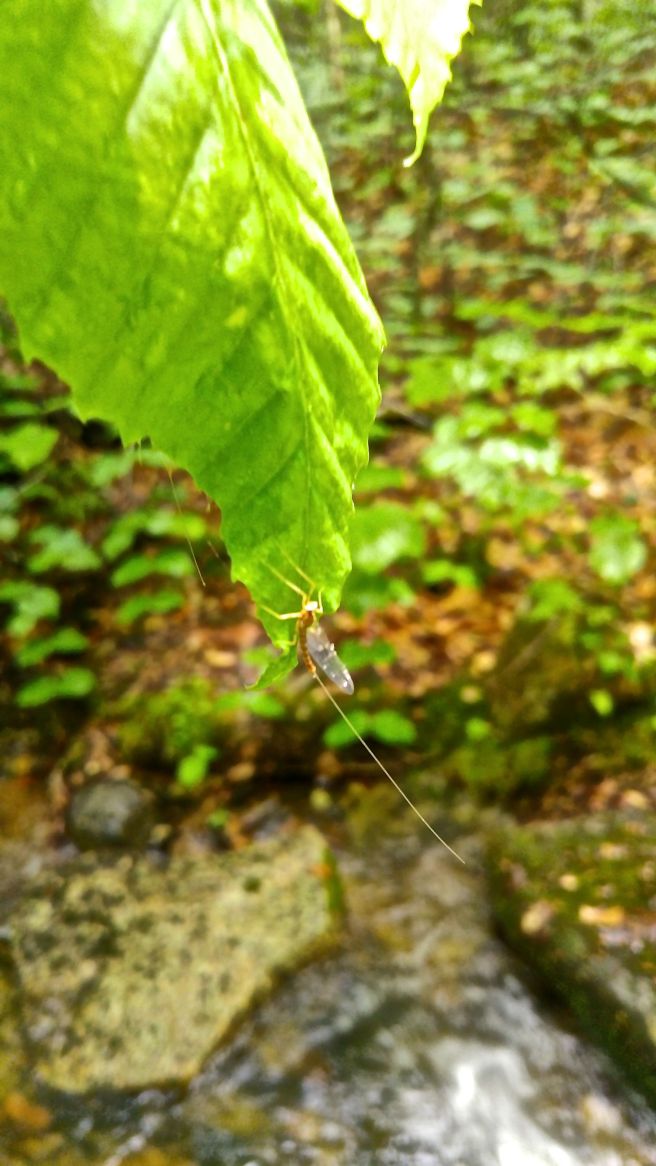
One of the things I like about stopping for lunch, besides eating because I’m always hungry, is taking time to notice. Mayflies.

b-mtn maple1

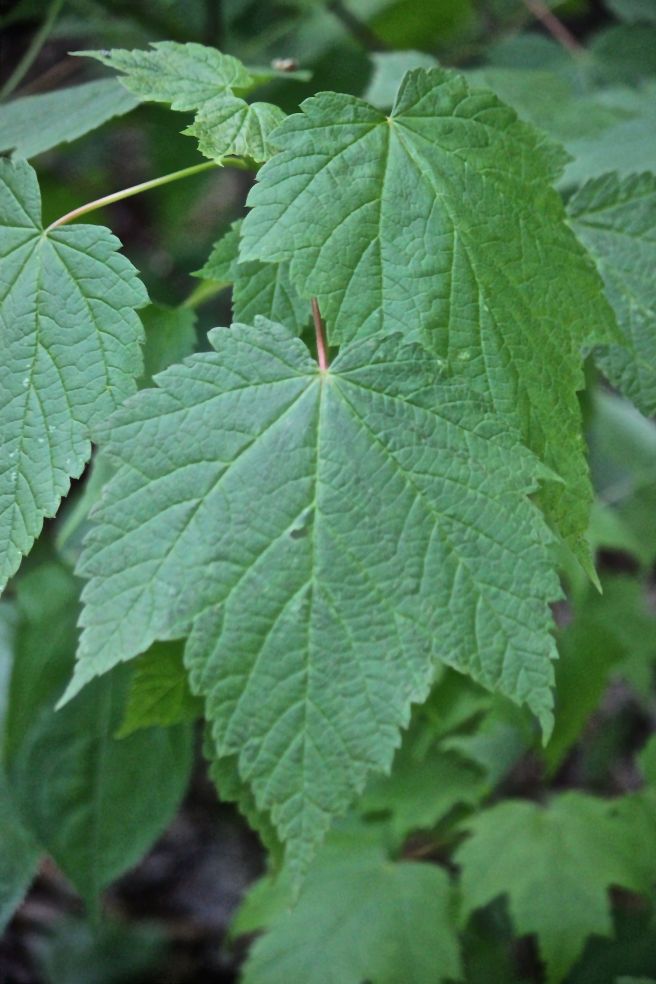
The deeply impressed veins of mountain maple leaves.

b-sugar maple

And u-shaped lobes of sugar maples.

b-dogwood

Dogwood.

b-beech fern1

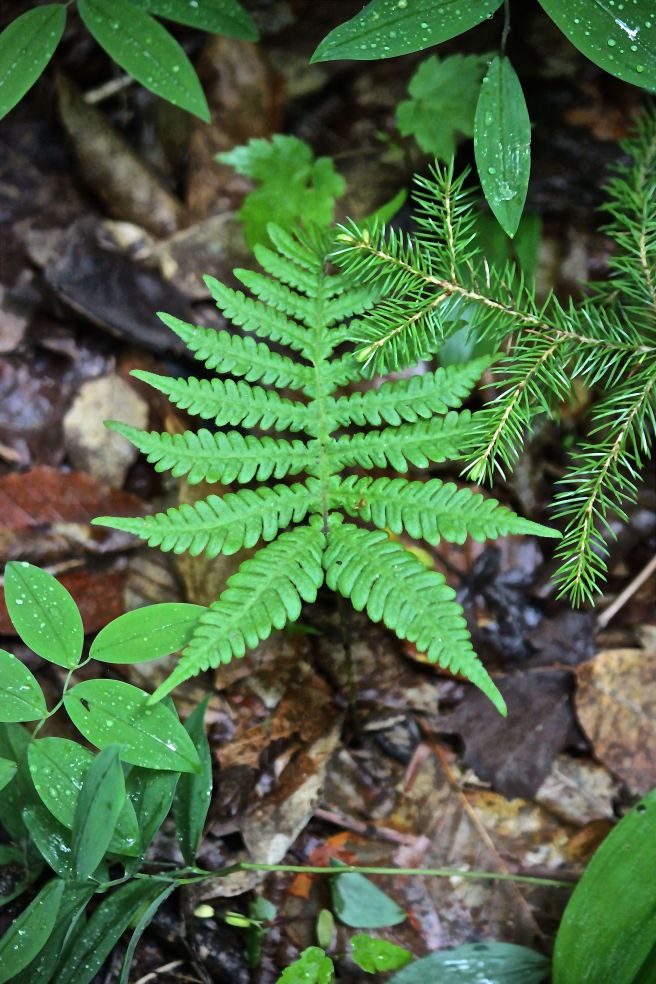
And beech fern.

b-bunch:hobble

Following lunch, we continued to climb and noticed things like the great pretender–a bunchberry posing as a hobblebush flower.

b-ph moose works

And moose works carving the greenery.

b-halfway sign.jpg

At last we reached our halfway point at 3.5 miles. I kept wondering–where is the bald face that I’ve been dreading? The Slippery Brook Trail was a delight, be it long, with no bald rocks in sight.

While we climbed, I’d not only noticed my surroundings but also planned my funeral. I know who I want to conduct the service and he’s out of town this week. I figured that was OK. My guy would just have to delay it for a bit. And I thought about who might come and how the different folks would interact with each other. It’ll be a celebration of life, of course. And people should be encouraged to get outside and notice. Maybe they could go on a group walk.

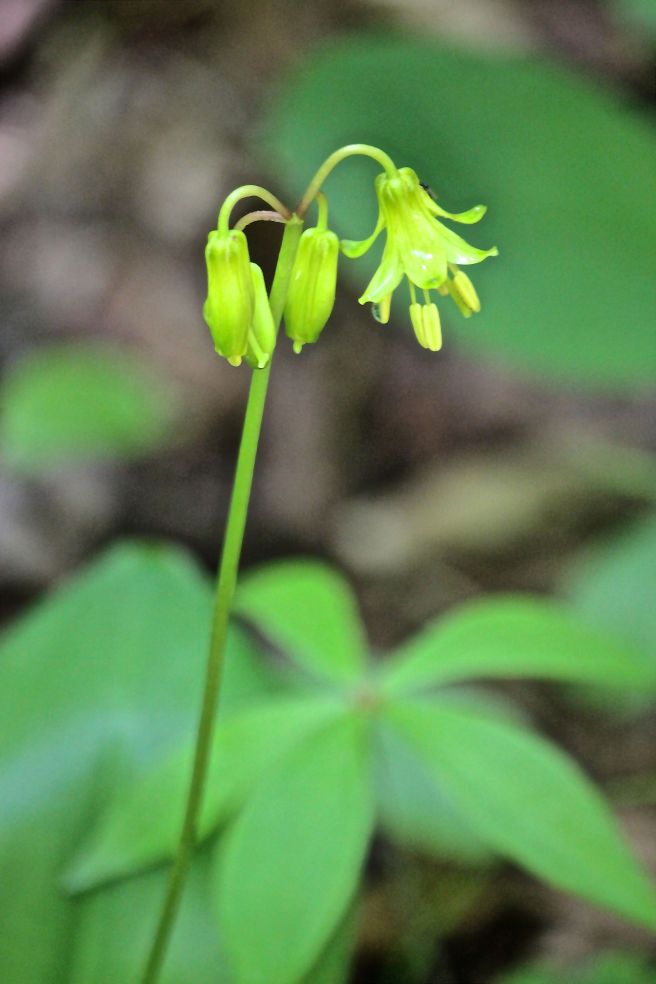
b-yellow clintonia.jpg

And then we followed the Baldface Knob Trail where the yellow clintonia grew in such abundance that my guy actually started to ID it. I’ll make him a naturalist yet. ;-)

b-lady's x2

Equally abundant were the lady’s slippers.

b-ph trail up

And then we met my nemesis. But really, it wasn’t so bad. All that worry for naught. I could do this. If we decided to hike down this way, I would survive.

b-ph first view

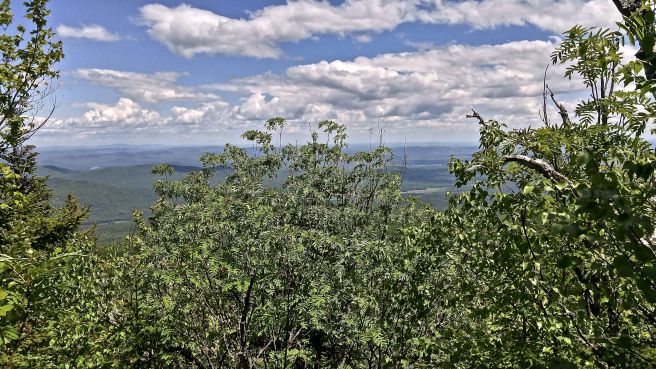
At last we reached our first vantage point with the world we normally inhabit spread out beyond.

b-ph hiking up

It just kept getting better, and cooler and windier–a relief for our sweaty bodies. But . . . the black flies increased significantly. I swallowed a few. All that swarmed must have been males because they didn’t bite. But they certainly were annoying.

b-ph Pleasant Mtn

As we approached the top of the Baldface Knob we recognized our neighborhood with Pleasant Mountain in the backdrop.

b-ph panoramic

A 180˚ panoramic provided half of the picture. I thought I caught the other half, but it’s not to be. South Baldface was behind us and completely doable. We decided to save it for another day because it was getting late and we weren’t certain about the trail before us.

b-ph chokeberry

Among the selections at our feet, chokeberry

b-summit mtn ash

and mountain ash.

b-hummer 3

At eye level–a hummingbird moth who moved in supersonic speed.

b-hiking down 1

And then we followed the path down.

b-ph forever view

The world stretched before us

b-ph hiking down 3

to infinity and beyond. My guy insisted that parachutes were available at this spot, but they must have been previously claimed because I couldn’t find one . . . anywhere. And believe me, I looked.

b-ph heading down

It all seemed so innocent from the top, but really, it was a scramble. A major scramble that lasted a long time until we got back into the hardwood forest. Our footing–precarious and often wet. We both have a fear of heights in open spaces. My guy has forever had such a fear–my own is newly developed and I know not its source. Oy vey. We were in over our heads, but had no choice. I kept thinking about a rescue mission, but I don’t think they show up for those who whine. We practiced our crab walks, slid and skidded and hugged rocks and trees as we made our way down this precarious trail.

b-ph lichens1

The lichens were beautiful and we got to see them up close and personal. We also practiced our trust jumps. Yup, several times my guy positioned himself to catch me as I jumped. Remember my funeral plans on the way up. I was preparing as we climbed and facing the inevitable as we descended.

b-ph lady 2

Finally, we were rewarded with a more even trail–sort of–and lady’s slippers.

b-ph chandler 5

About a mile before the trailhead, we followed a spur to Chandler’s Gorge.

b-phdirty lady

On the way out, I realized I wasn’t the only dirty lady.

Oh, and we found where we zigged rather than zagged at the start of the trail. Honestly though, we both realized that if we’d hiked up the Baldface Circle Trail, we probably would have turned back. So as luck would have it, we went the right way.

Since we were on stable ground, I mentioned my fears to my guy. He admitted he’d had the same. And when I said I was sure we’d both fall when I jumped down and he caught me several times, he said at least we’d be together.

Be together on a Mondate. That’s what it’s all about.


America the Beautiful

This morning’s rain and overcast sky embraced the melancholy emotions of this day as we remembered  family, friends, acquaintances and strangers who have served our country, especially those who died during times of conflict.

And then the sun shone.  It didn’t mean that we stopped remembering. But it did shine a light on the beauty that surrounds us and that we have the opportunity to observe if we so choose. Because of the service of others, we’re fortunate in that regard–we get to choose.

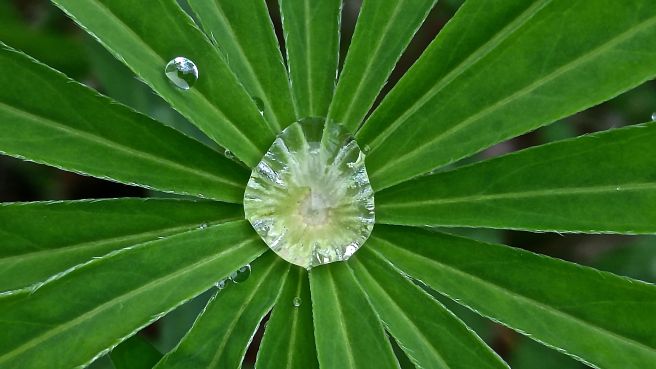
ph droplet on lupine leaf

I chose to step out the back door and notice.

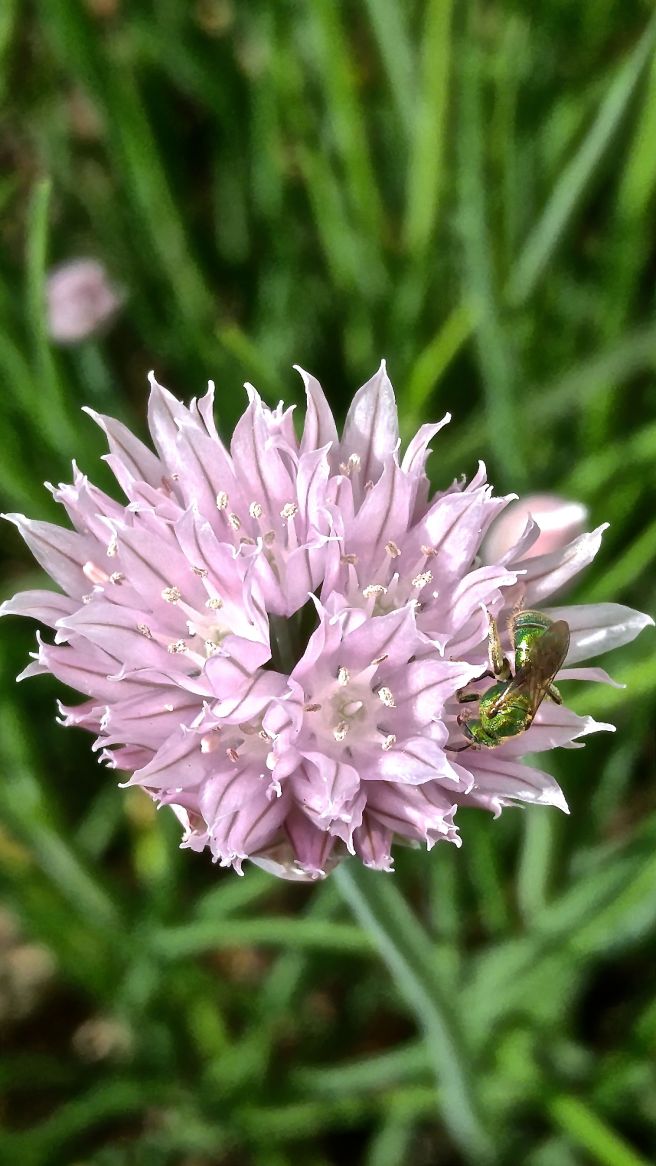
ph-chives 2

Visitors upon chive florets.

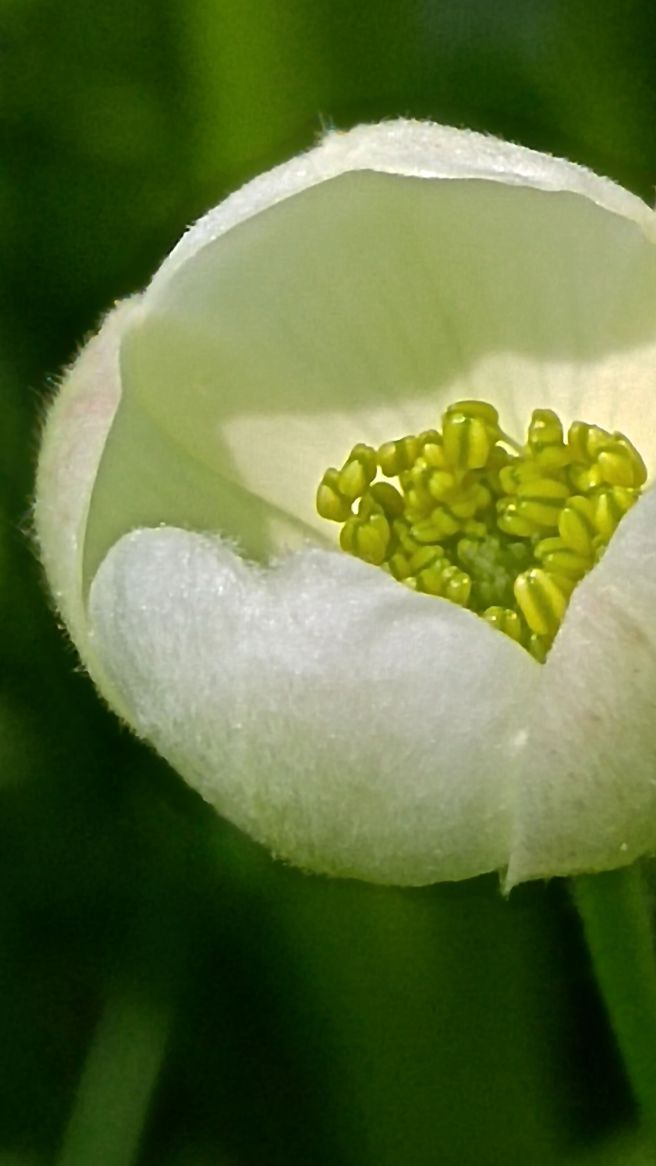
ph-anem2

Unfolding Canada anemone.

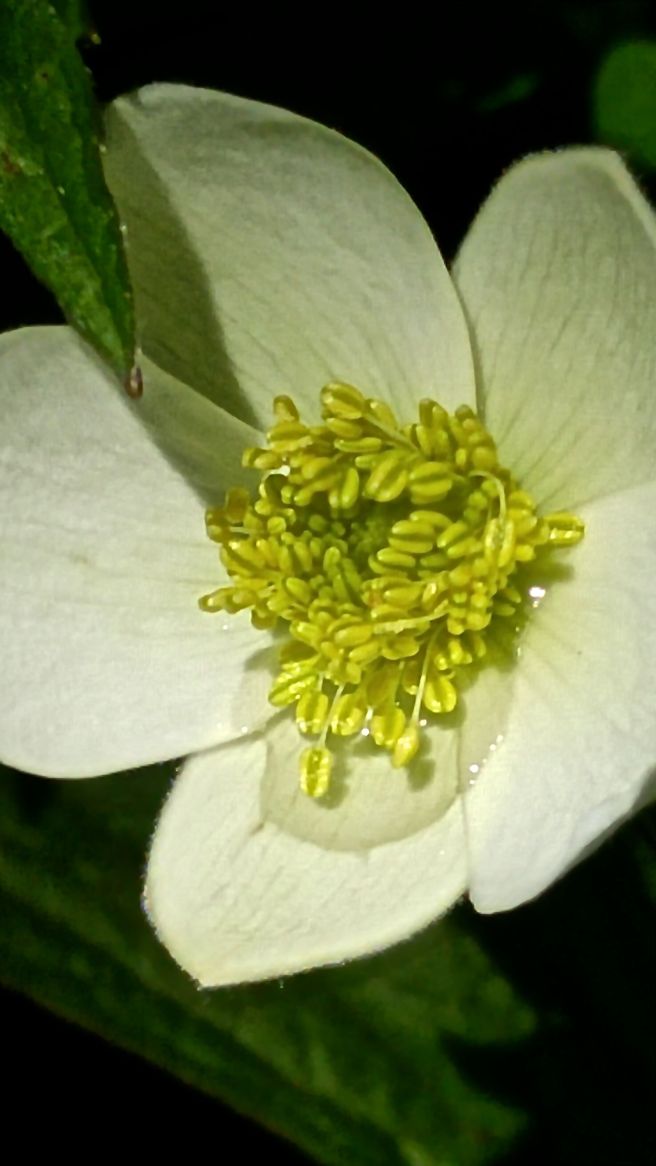
ph-anem3

And the first to open.

ph-cherry

Black cherry blossoms all in a column.

ph-chokec2

And chokecherry blooms in terminal clusters.

ph-hemlock cone1

Blue-green baby hemlock cones.

ph tad 6

And life teeming in the vernal pool.

I’m thankful for the freedom of choice. America is beautiful.


Hawk-eye Mondate

Some Mondates are shorter than others and such was the case today. But . . . we made the most of it as we walked up the trail to Hawk Mountain in Waterford.

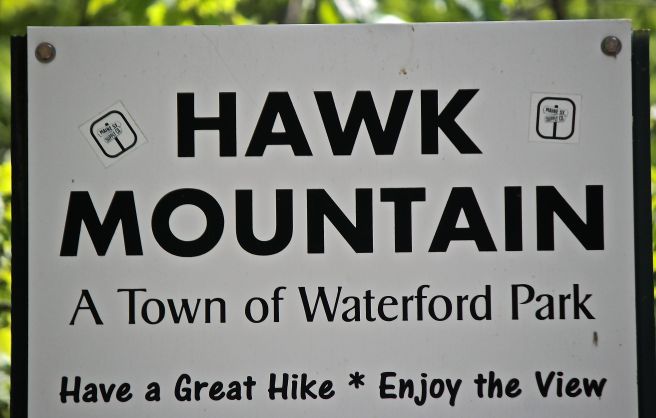
hm-sign

It’s a half mile trek up a dirt and gravel road–just right when you want a great view and time is short. Of course, you could spend hours at the summit, but we weren’t there long.

hm-interrupted1

On the way up, I noticed interrupted fern in its interrupted form. Fertile leaves toward the middle are densely covered with sporangia (spore-bearing structures). I’m fascinated by their contorted, yet beautiful structures.

hm-lady1

Another favorite–lady’s slippers. Again, its structure is beyond my understanding.

hm-cyrstal and long2, ph

At the summit, we paused briefly and gazed toward Crystal and Long Lakes.

hm-white oak 4, ph

While my guy moved on to the better vantage point, I stopped several times. First, it was the color of these leaves that slowed me down. Have you noticed how spring foliage provides a subtle play on fall foliage? A few friends and I have been thinking about this lately, and this morning I had the opportunity to pick the brain of Dr. Rick Van de Poll, a well-known mycologist/naturalist/educator.

hm-red maple 1

He reminded me that the various hues of color in leaves is caused by the presence of pigments called anthocyanins or carbohydrates that are dissolved in the cell sap and mask the chlorophyll. As our spring temperatures rise and light intensity increases, red pigment forms on a leaf and acts as a sunscreen to protect the plant from an increase in ultraviolet rays.

hm-white oak1

It wasn’t only the color that caught my eye. Take a look at the lobe shape of the reddish leaves and that of the green in the background. In my continuing personal citizen science project to informally connect the dots of where white oaks meet red oaks, I added another pin on the map. Rounded lobes=white oak in the foreground. Pointed lobes=Northern red oak in the background.

hm-bee1

As I headed toward my guy, I noted that the cherry trees were abuzz.

hm-wild columbine1, ph

And hiding among the rocks at the base of a tree–another treat for the eyes. Wild columbine. Splendid indeed.

hm, cyrstal and long, ph

Equally splendid–the view from the ledges. Crystal and Long Lakes again.

hm-bear river

Bear River below. I always expect to see a moose here. Or maybe a bear. One of these days.

hm-pm1, ph

Pleasant Mountain and my guy.

hm-dragon5

As we walked back down the trail and concluded our Mondate, we celebrated the fact that dragonfly season has begun. With their hawk eyes, may they capture and consume a kazillion black flies and mosquitoes.


Three Times A Charm

One might think that following the same loop through the woods in slow motion three times in one day would be boring. One would be wrong. My friend Joan and I can certainly attest this fact.

Round One: 9 am, Wildflower and Bird Walk with Lakes Environmental Association co-led by birder/naturalist Mary Jewett of LEA and the ever delightful botanist Ursula Duve.

h-hobblebush

In abundance here, the hobblebush bouquet–a snowy-white flower that is actually an inflorescence, or lacy cluster of tiny fertile flowers surrounded by a halo of showy, yet sterile bracts. Yeah, so I’ve showed you this before. And I’ll probably show it again. Each presentation is a wee bit different.

h-beech cotyledon1ph

And then we spied something that I’ve suddenly seen almost every day this week.

h-beech coty 4ph

The cotyledon or seed leaf of an American beech. Prior to Monday, I don’t know that I’ve ever seen this and yet, since then I’ve continued to discover them almost every day. Worth a wonder.

h-beech coty 3ph

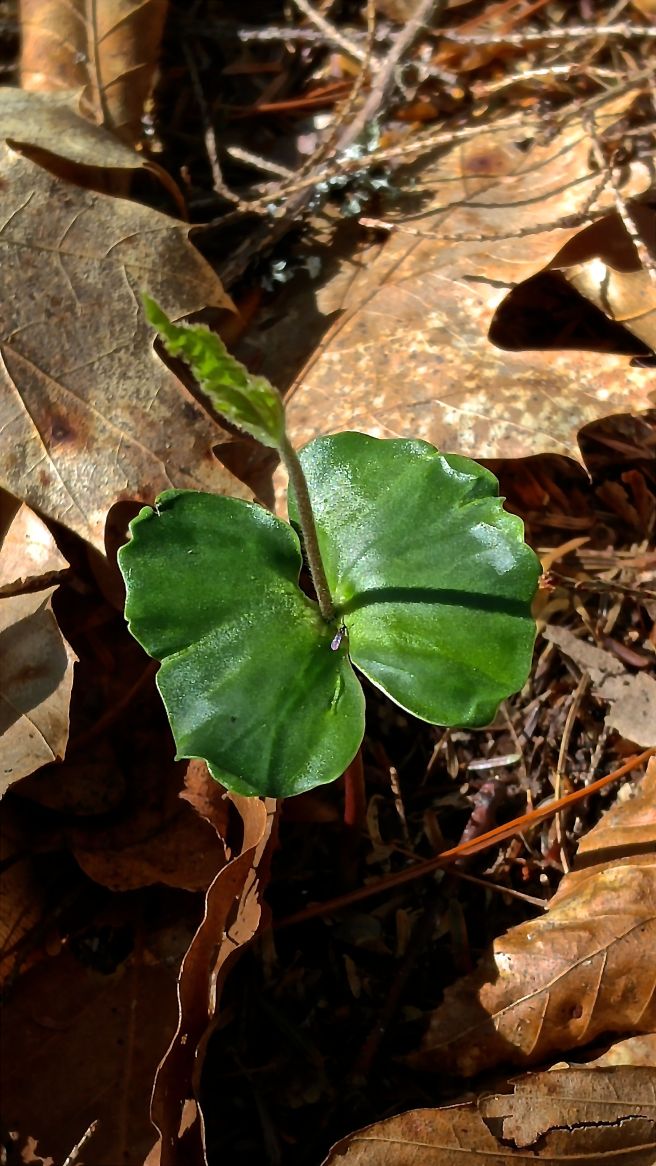
Think about it. The journey from seed to tree can be a dangerous one as the root is sent down through the leaf litter in search of moisture. Since the root system is shallow, lack of moisture can mean its demise. When conditions are right, a new seedling with a rather strange, yet beautiful appearance surfaces. The seed leaves of the beech, aka cotyledons, are leathery and wavy-margined. They contain stored food and will photosynthesize until the true leaves develop, providing a head start for the tree. I realize now that I’ve seen them all my life in other forms, including maple trees, oak trees and vegetables. But . . . the beech cotyledon captures my sense of wonder right now, especially as it reminds me of a luna moth, which I have yet to see this year.

h-green frog 2

Crossing the first boardwalk through the red maple swamp, a large male green frog tried to hide below us. Notice the large circular formation behind his eye. That’s the tympanum, his visible external ear. A male’s tympanum is much larger than his eye.

h-rhodora ph1

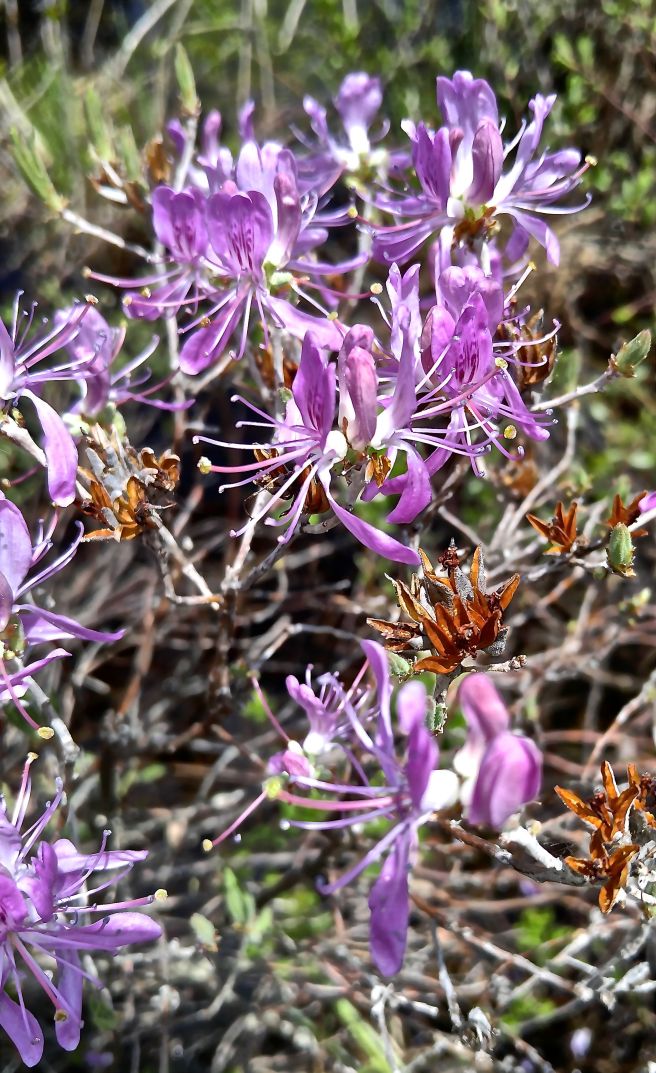
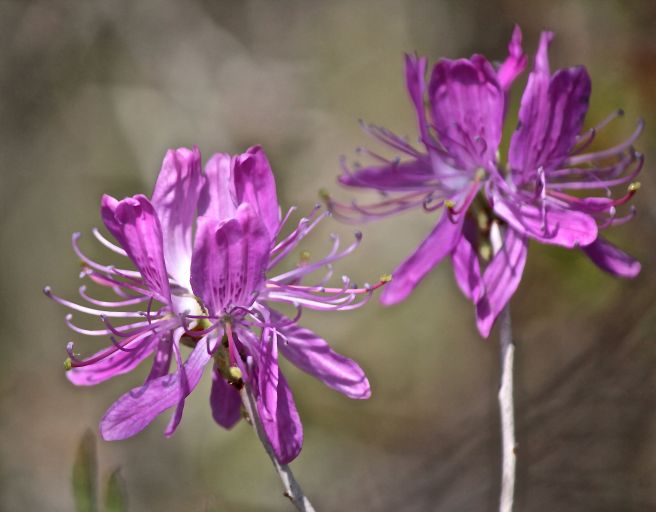
Other red maple swamp displays included the showy flowers of rhodora and their woody capsules.

h-rhodora1

Ralph Waldo Emerson knew the charm of this spring splendor:

The Rhodora

On being asked, whence is the flower.
In May, when sea-winds pierced our solitudes,
I found the fresh Rhodora in the woods,
Spreading its leafless blooms in a damp nook,
To please the desert and the sluggish brook.
The purple petals fallen in the pool
Made the black water with their beauty gay;
Here might the red-bird come his plumes to cool,
And court the flower that cheapens his array.
Rhodora! if the sages ask thee why
This charm is wasted on the earth and sky,
Tell them, dear, that, if eyes were made for seeing,
Then beauty is its own excuse for Being;
Why thou wert there, O rival of the rose!
I never thought to ask; I never knew;
But in my simple ignorance suppose
The self-same power that brought me there, brought you.

h-LEA group

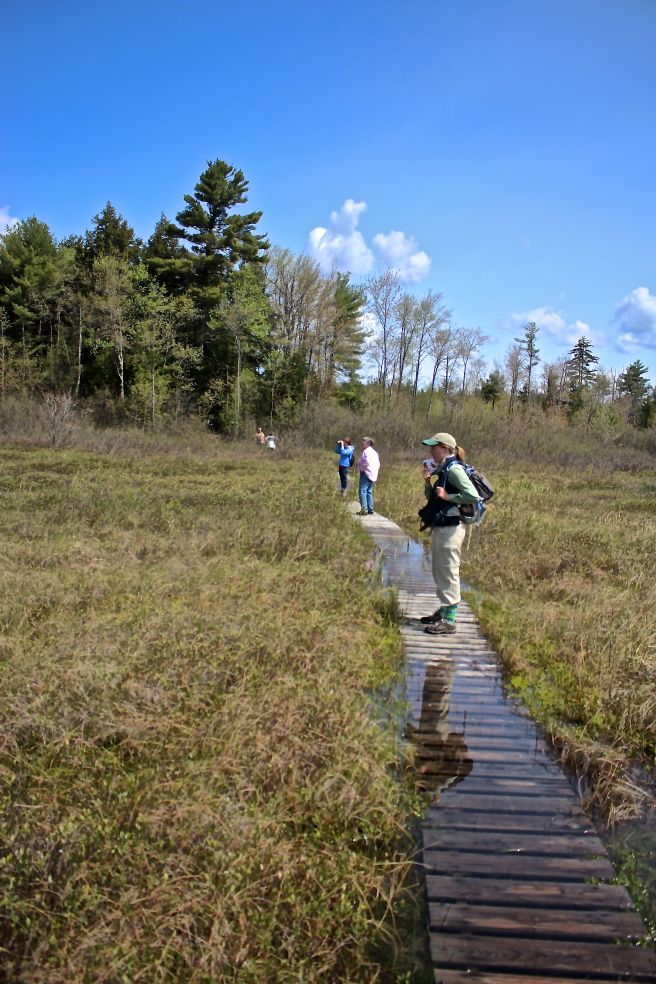
To avoid getting our feet too wet, we spread out as we walked on the boardwalk through the quaking bog.

h-five morning

Morning light highlighted the layers from the pond and sphagnum pond up to Five Fields Farm and Bear Trap above.

h-trill 1

And because it was ever present, I couldn’t resist pausing to admire the painted trillium once again (don’t tell my guy).

h-dwarf ginseng1ph

One plant that I will always associate with this place and Ursula, who first introduced me to it years ago, is the dwarf ginseng. I love its global spray of flowers and compound leaves. But maybe what I love most is its beauty in diminutive form–just like Ursula.

Round Two: Noon, Lunch and a walk with my dear friend Joan.

h-bigtooth aspen

After returning to our vehicles following the morning walk, Joan and I grabbed our lunches. And I paused in the parking lot to enjoy the silvery fuzziness of big tooth aspen leaves. The quaking aspen in our yard leafed out a couple of weeks ago, but big tooth aspen leaves are just emerging. Like others, they begin life with a hairy approach–perhaps as a protective coating while they get a start on life?

h-muddy riverlunch

We ate lunch beside Muddy River where the spring colors were reflected in the water.

h-blueberries 1ph

And then we heard something jump in the water, so we moved silently like foxes as we tried to position ourselves and gain a better view. In the back of our minds, or perhaps the front, we wanted to see a turtle, beaver or especially an otter. Not to be. But we did see highbush blueberries in flower.

h-bee 1

And the bees that pollinate them.

h-pitcher 5ph

In their out-of-this universe form, we knelt down to honor the pitcher plant blossoms that grow along a couple of boardwalks.

h-red maple samaras

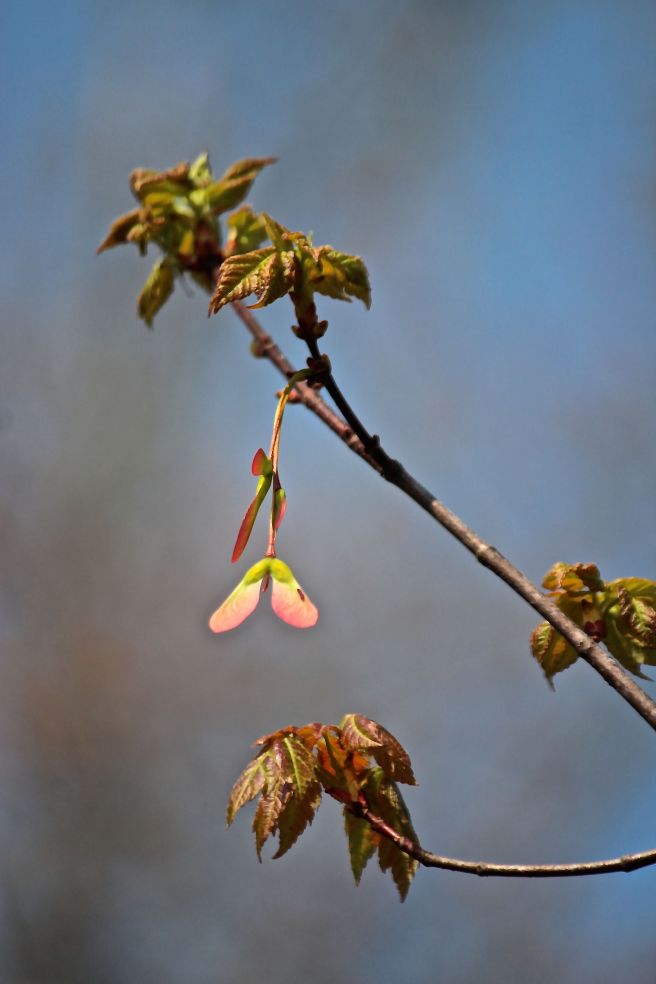
We were wowed by the color of the red maple samaras,

h-red winged

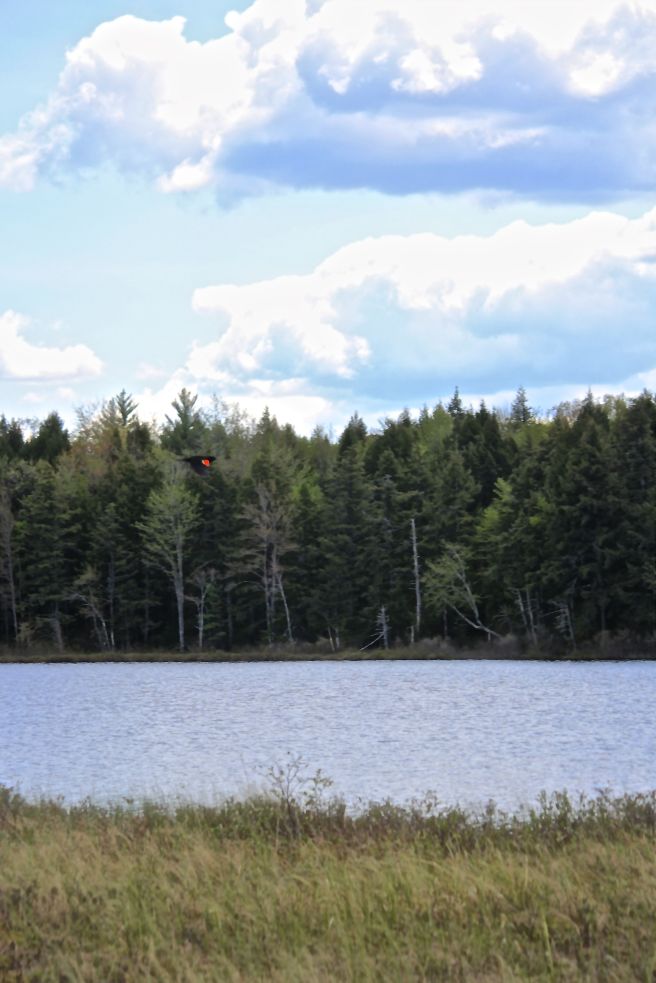
prominent shoulder patch of the red-winged blackbird,

h-cranberries

and cranberries floating on the quaking bog.

h-lone larch

And then our eyes were drawn to the green–of the lone larch or tamarack tree

h-green 9ph

and the green frogs.

h-green 8ph

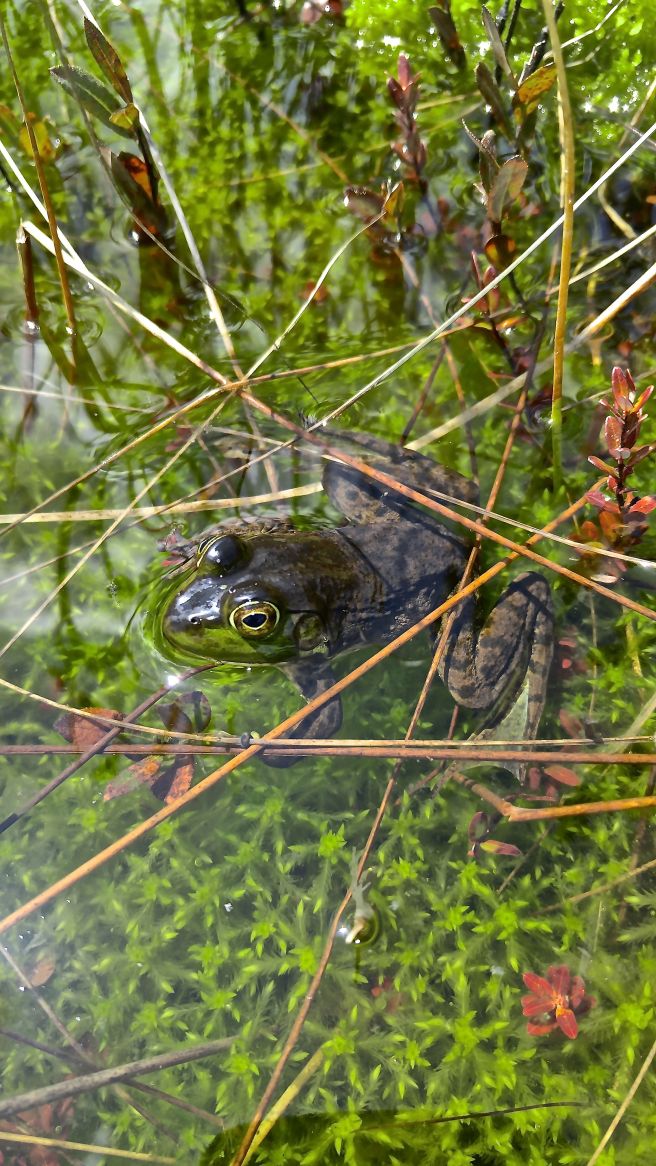
I spent some time getting to know one better.

h-green 3

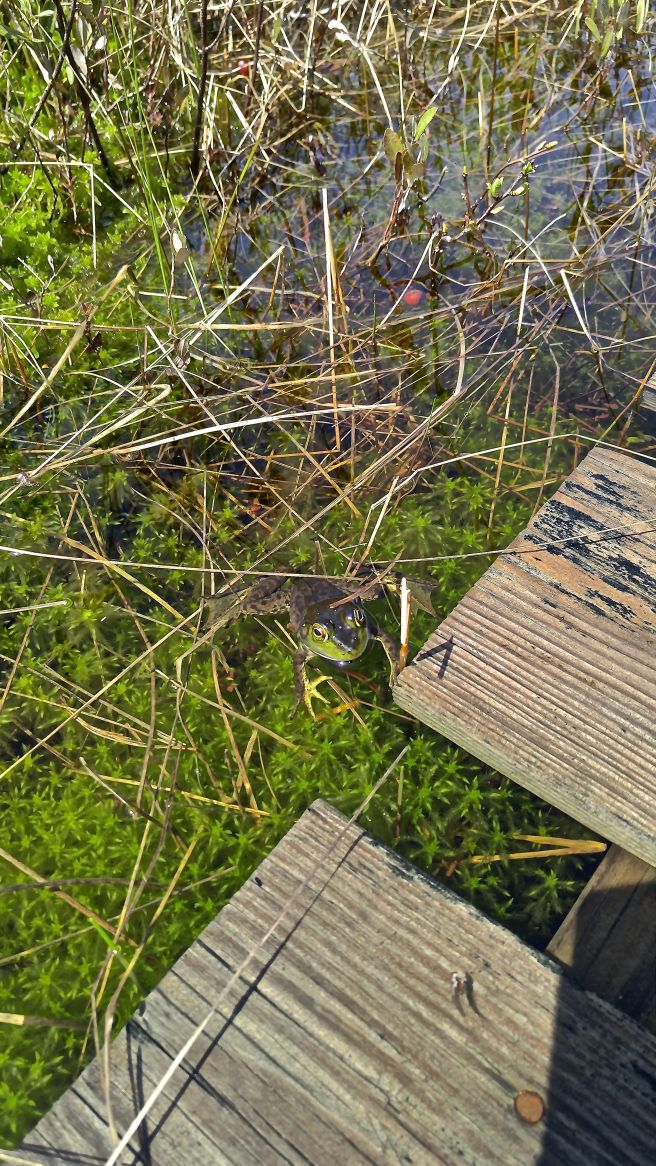
She even climbed out to accommodate me–I’m sure that’s why she climbed up onto the boardwalk.

h-green 6

Or maybe she knew he was nearby. What a handsome prince.

Round Three: 2:30pm, Joan and I (co-coordinators of the Maine Master Naturalist Bridgton 2016 class) were joined by another MMNP grad, Pam Davis Green, who will lead our June field trip to explore natural communities at Holt Pond.

h-striped maple flower

h-spriped flowers 2

Cascading down from the striped maple leaves, we saw their flowers, which had alluded us on our first two passages.

h-speckled 2

The cottony white masses of wooly alder aphids decorated many of the speckled alders in the preserve. In a symbiotic relationship, ants stroke the aphid with their antennae, while  the aphid releases a drop of honeydew, much like a cow being milked. It’s actually rather creepy.

h-duck

Two Canada Geese squawked from another part of the pond, but Mrs. Mallard stood silently by.

h-tree pants

Our final sight brought a smile to our faces–someone put his or her pants on upside down!

We hope that charms your fancy. Joan and I were certainly charmed by our three loops around and those we got to share the trail with today.

We also want to thank Ursula, Mary and Pam for their sharings. And we send good vibes and lots of prayers to my neighbor, Ky, and Pam’s brother-in-law.       

 

 

Beulah’s Mystery

One of the fun happenings in my life is that friends send me nature photos and ask me to help them ID a species. Sometimes I know immediately what it is and can ask them questions to help them get to the answer. Other times I’m as stumped as they are. Thus was the case today, when I drove to Brownfield to look at a tree growing in the field beside an old farmhouse.

t-beulahs 2

Beulah’s farmhouse, to be exact. My friend’s brother recently purchased it and the adjacent barn. Though the farmhouse is a fixer-upper, Beulah’s sign looks as if it was created yesterday.

t-tree1

This is the tree. If you know it right off, my hat goes off to you. I was in my Forest Trees of Maine mode and kept looking at it from that perspective. It’s overall appearance didn’t match what I know. We began with the key and slowly (painfully slowly as the black flies swarmed us–mind over matter, mind over matter), worked our way through the choices, two by two.

t-dwarf shoots

Because it’s not in leaf yet, we used the Winter Key. With each question, we paused to examine the tree–looking at the alternate leaf shoots, hairy scaled buds, pith, bark–every detail. We considered its location in the middle of a farm field, where the land sloped slightly and was rather dry. We also looked at the ground and found decaying leaves as well as deer scat. As I suspected, it wasn’t in the key. So I came home and scoured other books. I think I reached the answer and that the deer scat is actually a clue. Do you know? Now you may say so.

t-porky den

On our way to see one more cool thing, we paused to look at a den located beside the old foundation. Though much of the scat has since been removed, plenty of it and numerous quills painted the picture of who’d created this pigpen.

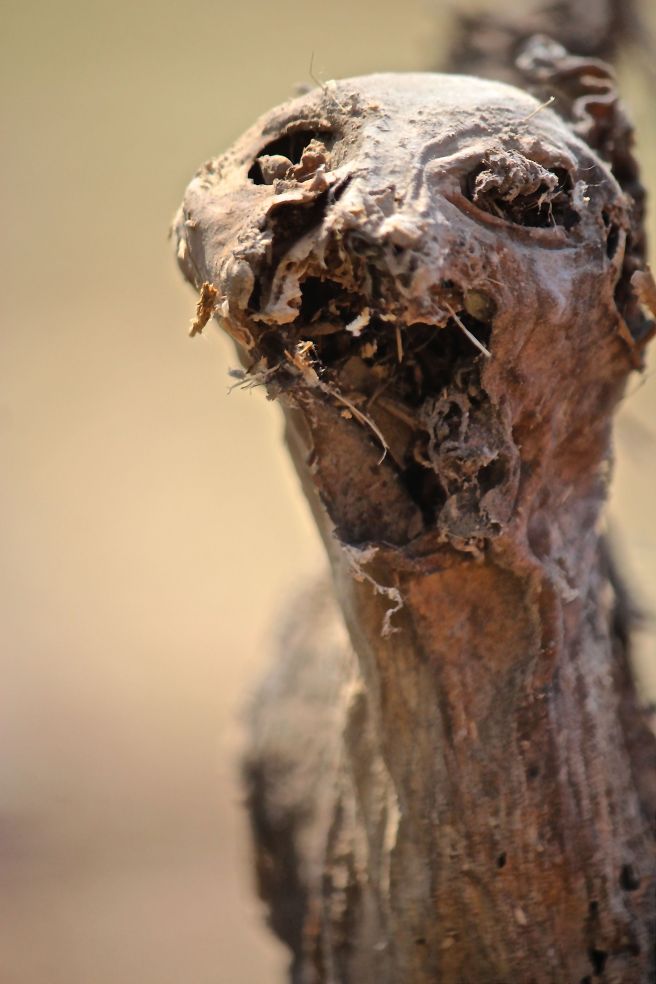
t-critter 2

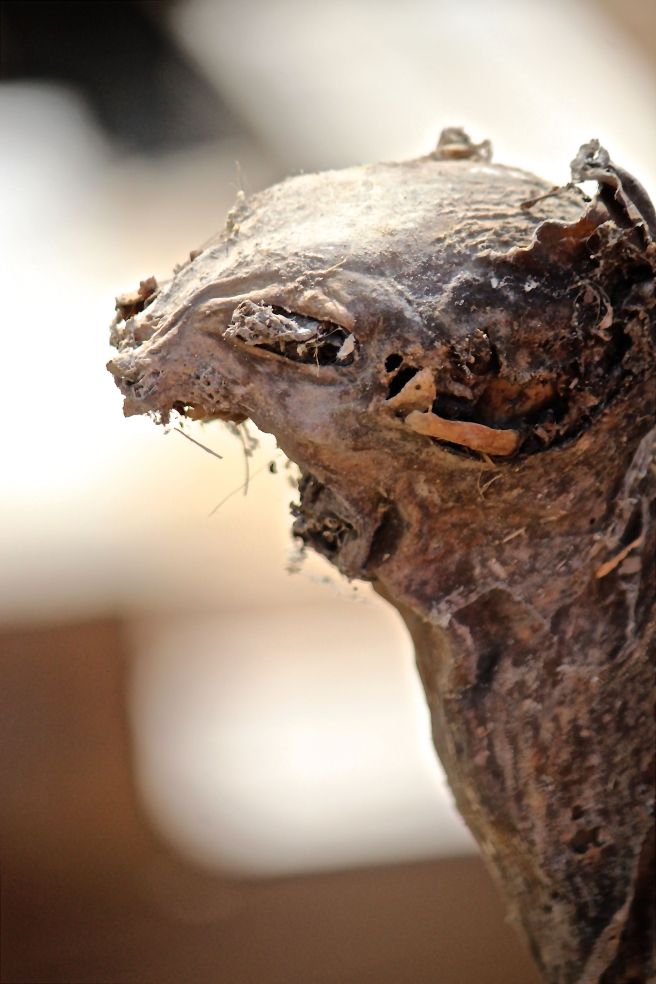
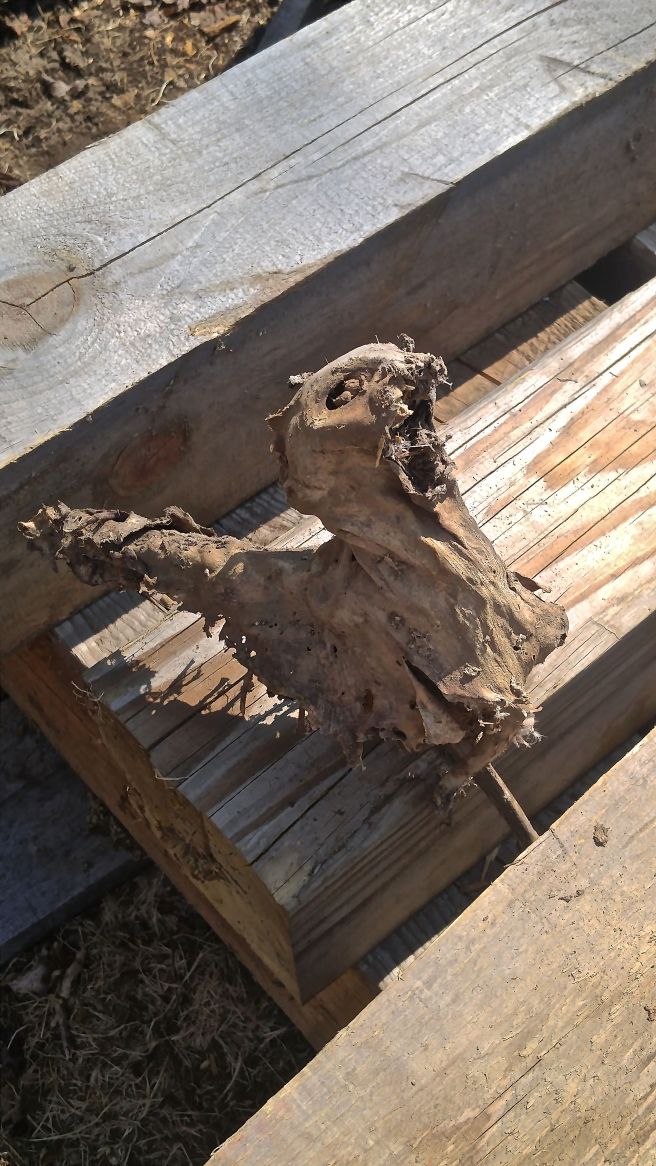
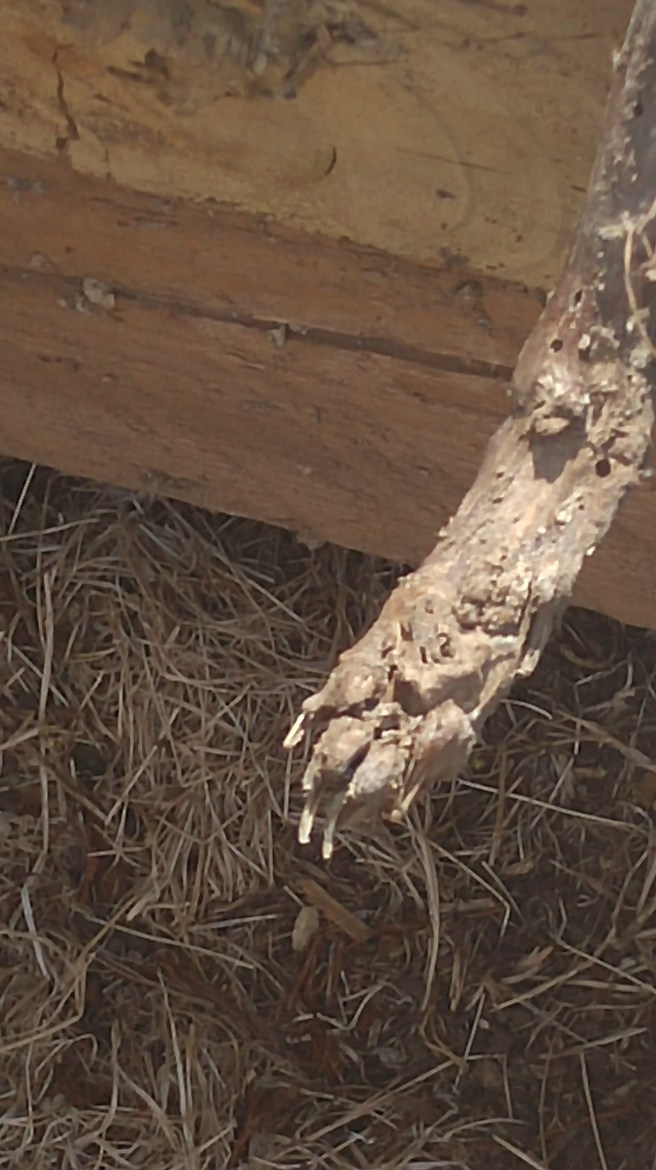
And then they had one more mystery item to show me. I hope this doesn’t freak you out. It’s part of many renovations in old farmhouses–a dried-up animal carcass. The front of the face was missing, but as we say, eyes in the front, born to hunt.

t-critter 1

A side view of this handsome critter. Can you see the ears?

t-critter 4

Talk about all skin and bones.

t-critter pads

And then the foot pads and nails. Four toes, nails, about the size of a nickel. Do you know?

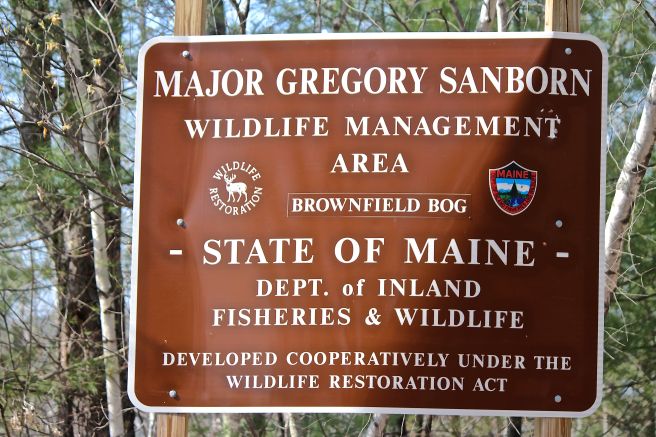
t-bog sign

Because I was in the neighborhood, I visited Brownfield Bog and continued my afternoon exploration. (Yeah, I had work to do, but playing hooky for a couple of hours is allowed once in a while if I don’t abuse the privilege–ah, the life of a freelancer.)

t-red oak emerging

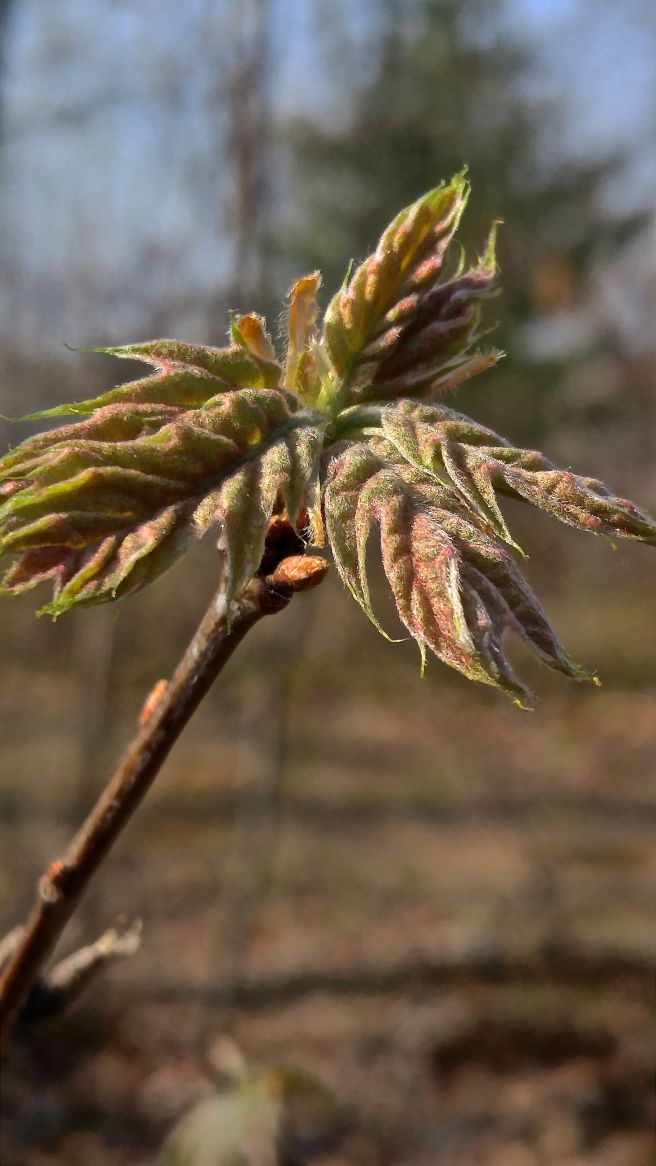
I remember suddenly becoming aware of spring colors about thirty-five years ago, when I taught  school in New Hampshire by the convergence of the Pemigewasset and Merrimack Rivers. Until then, I’d never realized that tree leaves emerge in a variety of colors–they all weren’t suddenly green. (BTW– do you see the spittlebug? )

t-red oak mini leaves

In a quickness equal to fall foliage, spring colors may not be as flashy, but their subtle beauty deserves notice.

t-gray birch 2

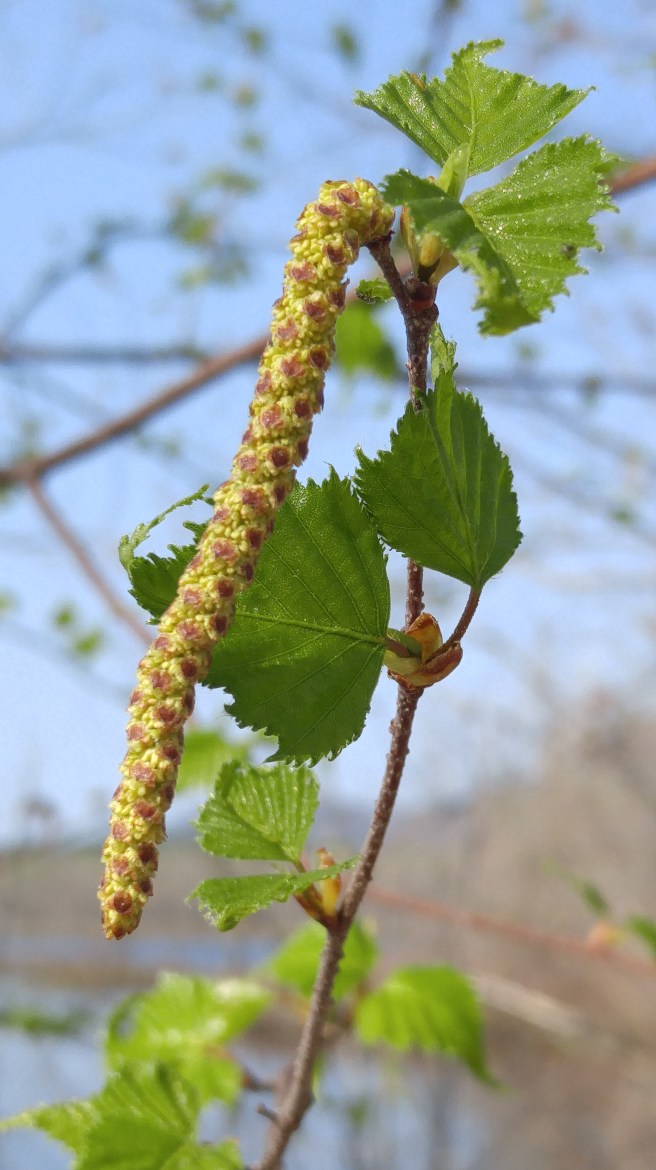
And those leaves that are green offered their own reasons to stop me in my tracks as I took in the details–in this case the double-toothed elephant’s trunk. What? Notice the shape and outer margin of the leaf.

t-gray birch 4

The lovely elongated catkins demanded a glance that lasted more than a second.

t-willows cat1

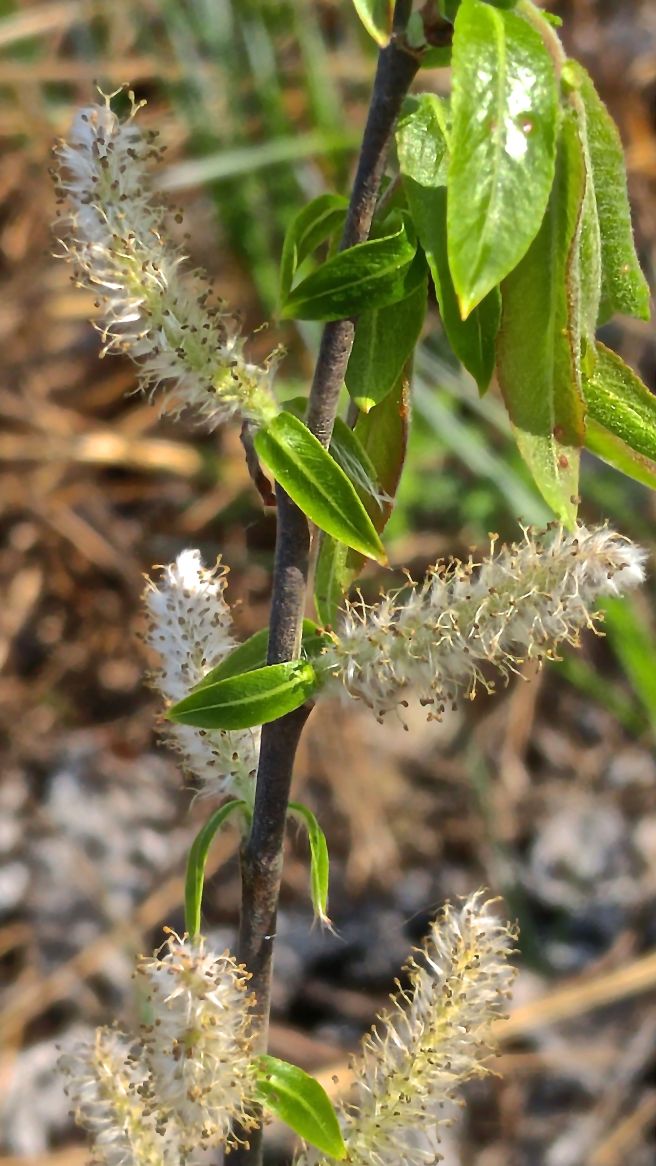
Adding a festive fuzziness to the celebration of spring was another set of catkins.

t-willow gall

Unwittingly, this shrub also played host to a gall gnat midge that overwintered in a structure created by the reaction to a chemical released by the larva–what would have been leaves were forced to harden into a pine cone look alike.

t-bog colors 2

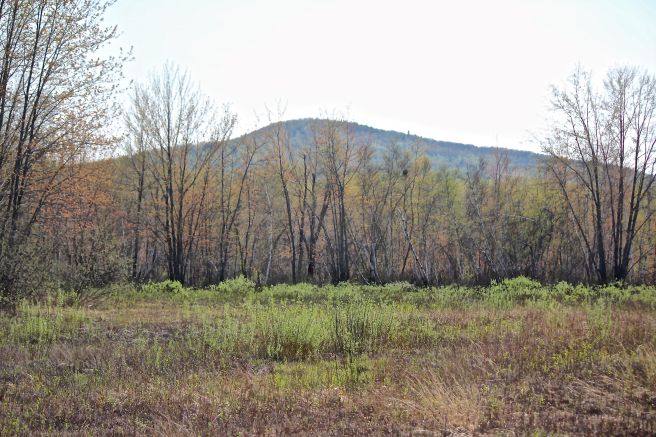
The subtle colors graced the meadow,

t-pleasant

were reflected in the bog,

t-river

and blessed the Saco River.

t-baltimore 2

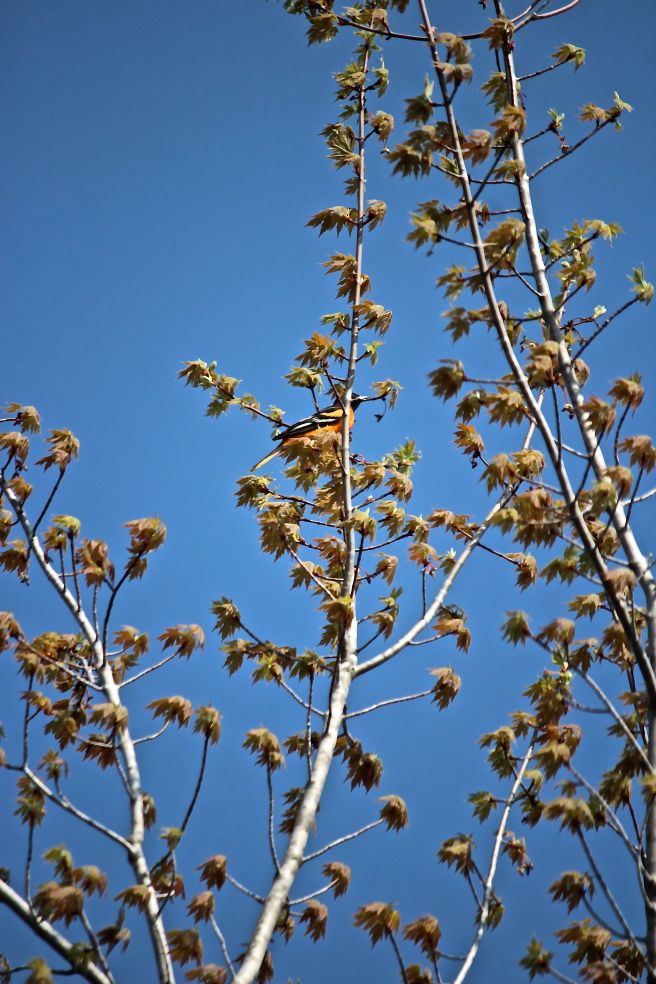
There were bits of flashy color–do you see who was feeding on the upper branches?

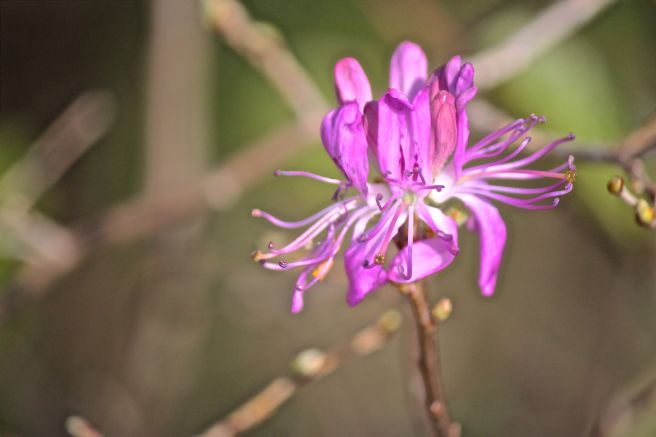
t-rhodora 1

And this spring beauty exploded with love and life.

At the end of my journey, I was grateful to P&K for an excuse to step away from my desk and check out the mystery standing in Beulah’s field. Especially as it led me further afield.

Spring In Slo-Mo

Spring is so fleeting in Maine. Oh, I know, it lasts the usual three months and the beginning and ending overlap with its seasonal partners, but really . . . one must take time to pause and watch or you’ll miss the most amazing action that occurs in slow motion right outside the window–and beyond.

s-red trill 1

Jinny Mae and I drove beyond today to catch a glimpse of this most splendid season.

s-red trill 10

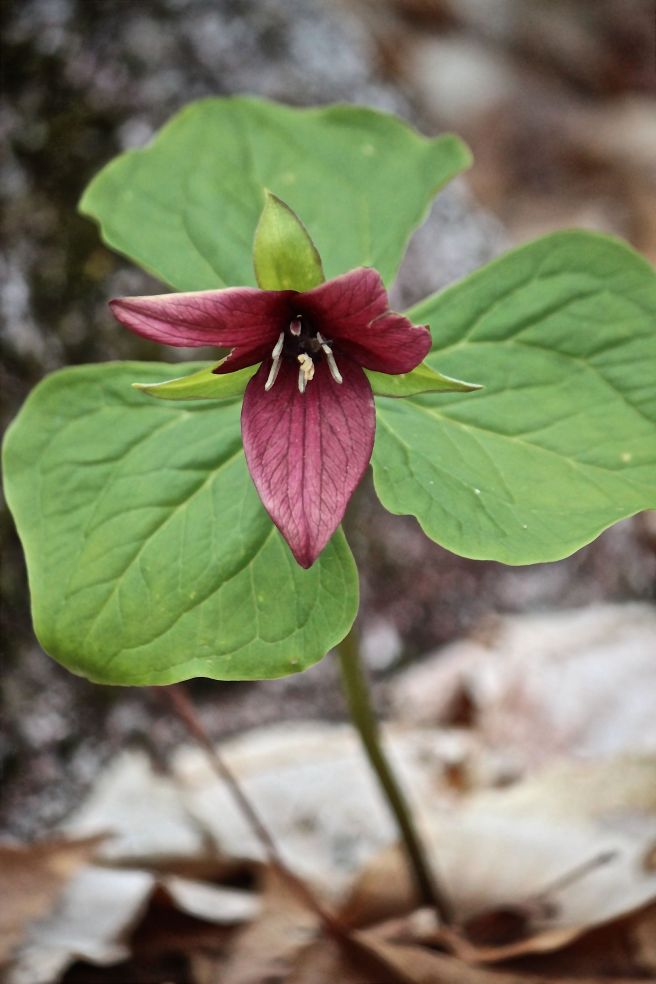
Among the offerings, red trillium also known as stinking Benjamin. The Benjamin part is from benzoin, a mid-16th century word derived from the French benjoin, that refers to “a fragrant gum resin obtained from a tropical tree of eastern Asia, used in medicines, perfumes, and incense.”  It’s been tagged “stinking”  because its nodding flower has an unpleasant odor. We didn’t bother to sniff. We were too busy being wowed by the fact that it surrounded us in great number.

s-red trill 2

That smell, however, is of extreme importance. Along with the flashy coloration, the odor helps to attract pollinators–green flesh-flies that prefer to lay their eggs on rotting meat. Though this isn’t the perfect nursery, the flies assist the plant on the procreative end. And in this spot, stinking Benjamin rules, but I prefer to think of it as red trillium.

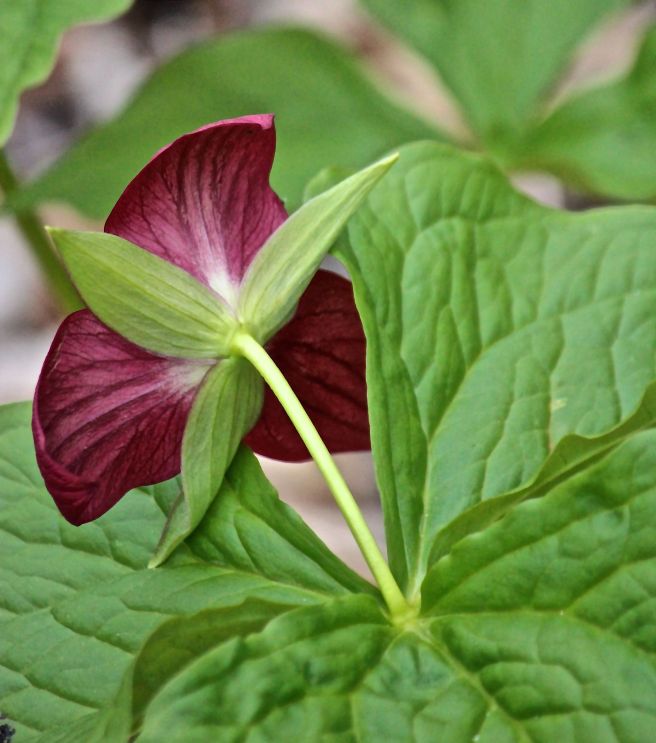
s-red trill back

Even from the backside, its design is one to behold.

s-false 1

Equally abundant were the leafy structures of false hellebore.

s-fals3e4

I was mesmerized by its pattern.

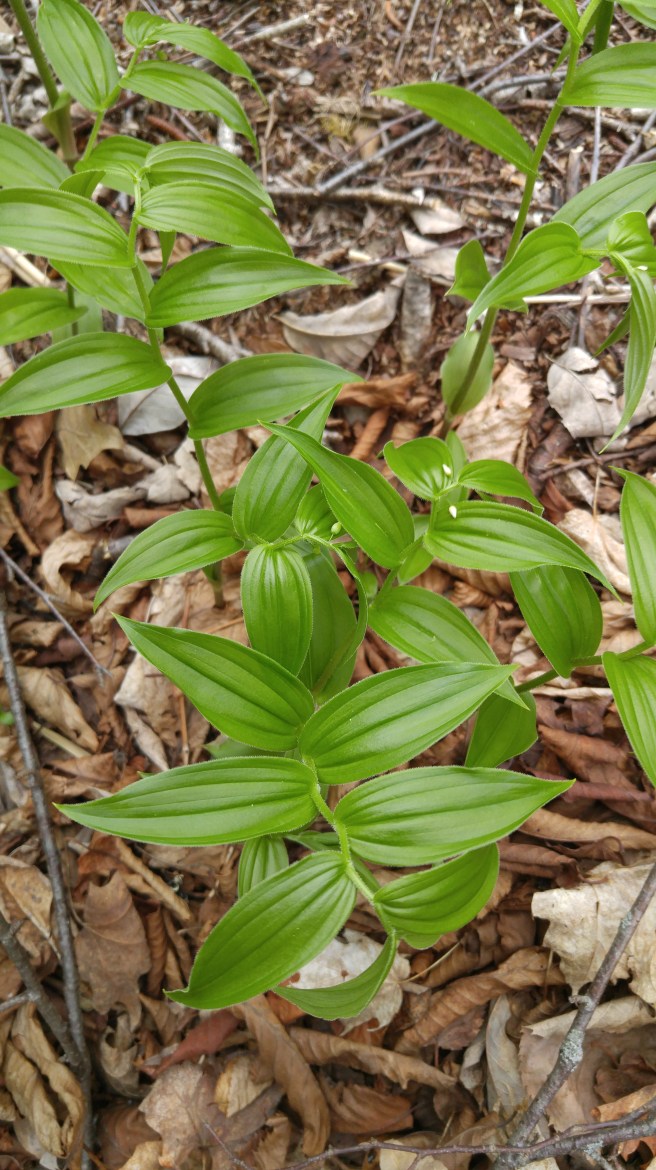
s-wood 2

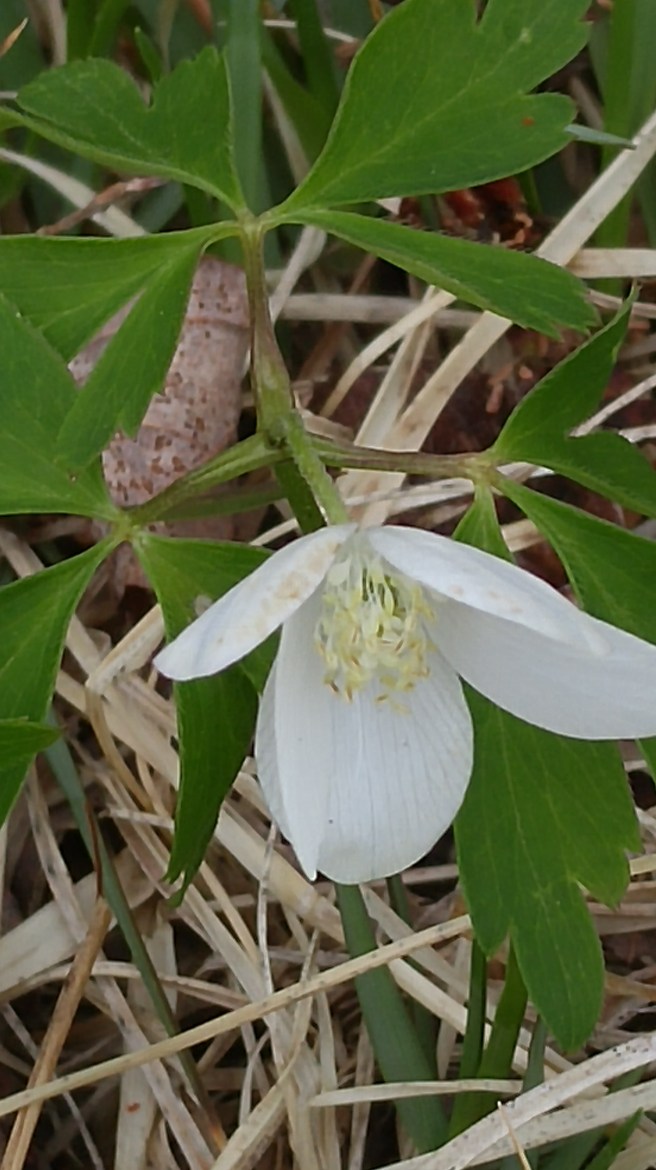
Unlike the trillium, wood anemones have little scent.

s-wood 1

Their graceful heads drooped, perhaps because the day threatened rain.

s-bellwort 3

The offerings included sessile-leaved bellwort (aka wild oats),

s-dutchmen1

Dutchman’s breeches with leaves as interesting as their flowers,

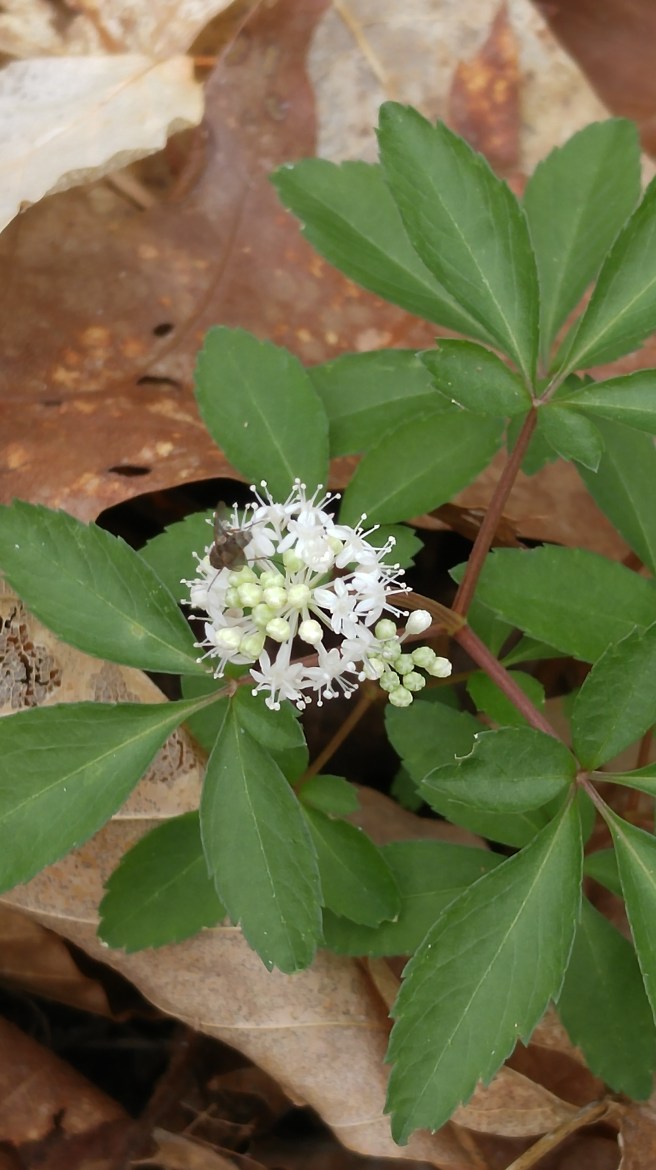
s-ginseng 2

the delicate white flowers of dwarf ginseng,

s-twisted 4

and  zigzag pattern of clasping twisted stalk.

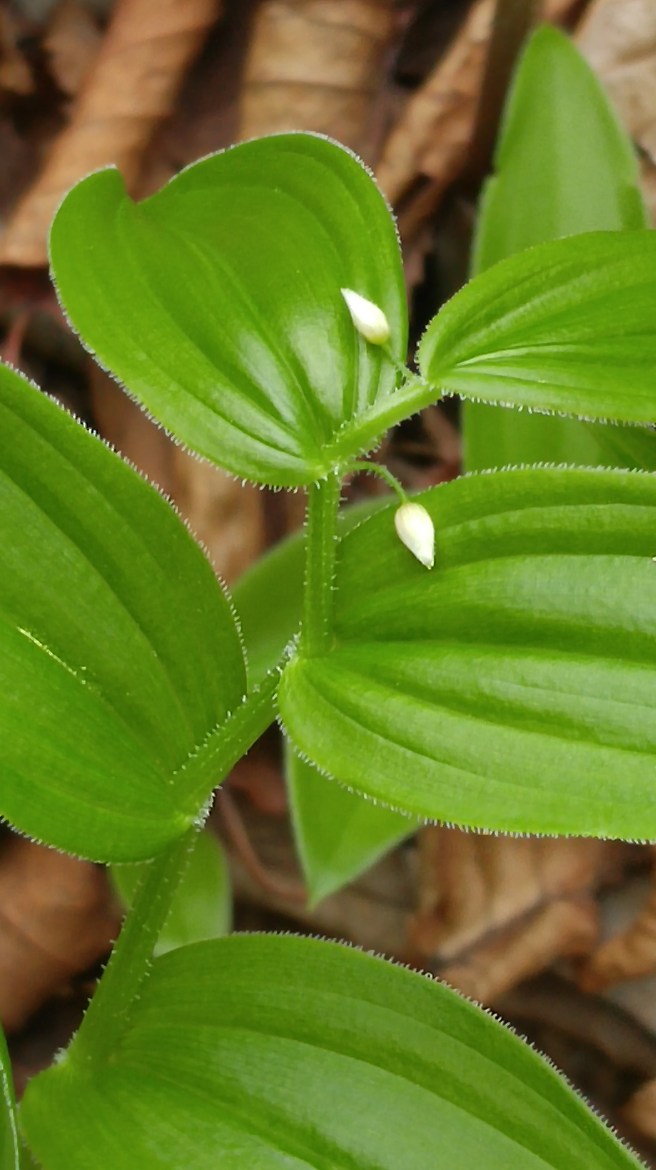
s-twisted1

Its key features are minutely-toothed leaf margins, stalkless leaves that clasp the stem, and flowers dangling below.

s-twisted 3

The flowers hadn’t opened, but the closer we got, the more we appreciated its finer details.

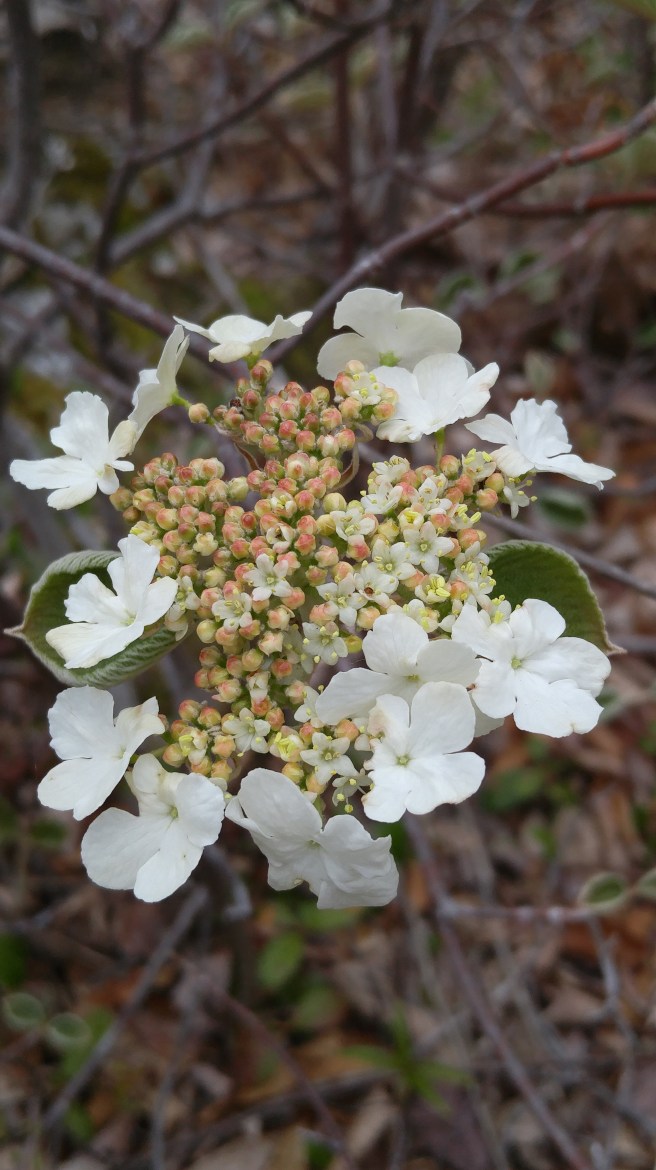
s-hobblle 1

Ever so slowly, as is the case in all things, hobblebush flowers began to bloom.

s-hobble2

Outer sterile flowers form a ring around the delicate inner flowers that are fertile. Nature has a way of protecting its own.

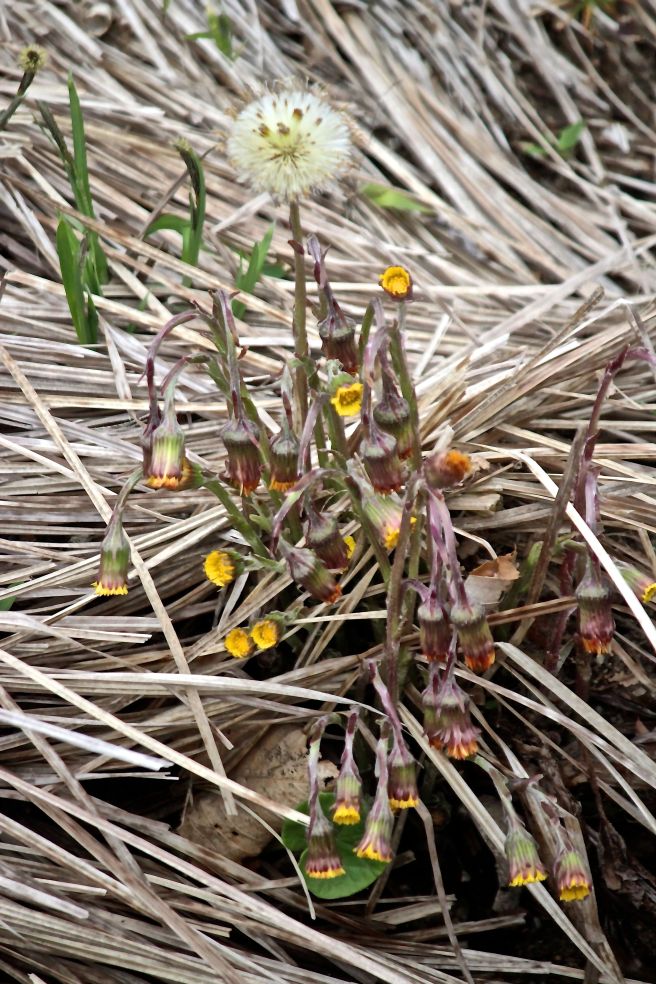
s-colts 2

When we first spotted the fluff ball of seeds across the brook, we thought we were looking at dandelions. And then we saw the scaled stalks and lack of leaves. Coltsfoot it is.

s-cinnamon 3

It wasn’t just the flowers that had us getting down on our hands and knees. There was the brownish wool covering of the cinnamon fern.

s-ostrich 1

And the hairless ostrich fern

s-ostrich 2

with its crook-shaped crosier, reminiscent of a bishop’s staff.

s-christmas 2

But my favorite today was one I’d never noticed before.

s-Christmas 4

Oh, I know it’s a Christmas fern, but the tightly-wound, silvery-scaled crosiers were new to me. It was yet another chance for us to wonder how we could have missed something that’s been here all along.

s-striped maple 1

And then we looked up. Well, sort of up. Striped maple leaves slowly opened in the understory.

s-red maple 1

And have you ever noticed that young red maples are a tad hairy along the margin?

s-beech 6

Even hairer, beech leaves.

s-beech 7

All winter long, bud scales enclosed leaves that are now slowly emerging.

s-beech 8

They’re absolutely beautiful in their plaited and hairy state.

s-beech 2

What leaves me wondering (ah, a pun), is the fact that these leaves are so hairy. It seems the hairs are intended to keep insects and others at bay.

s-beech 1

And yet, it won’t be long before the insects discover that beech leaves make a good meal and home.

s-ladybug

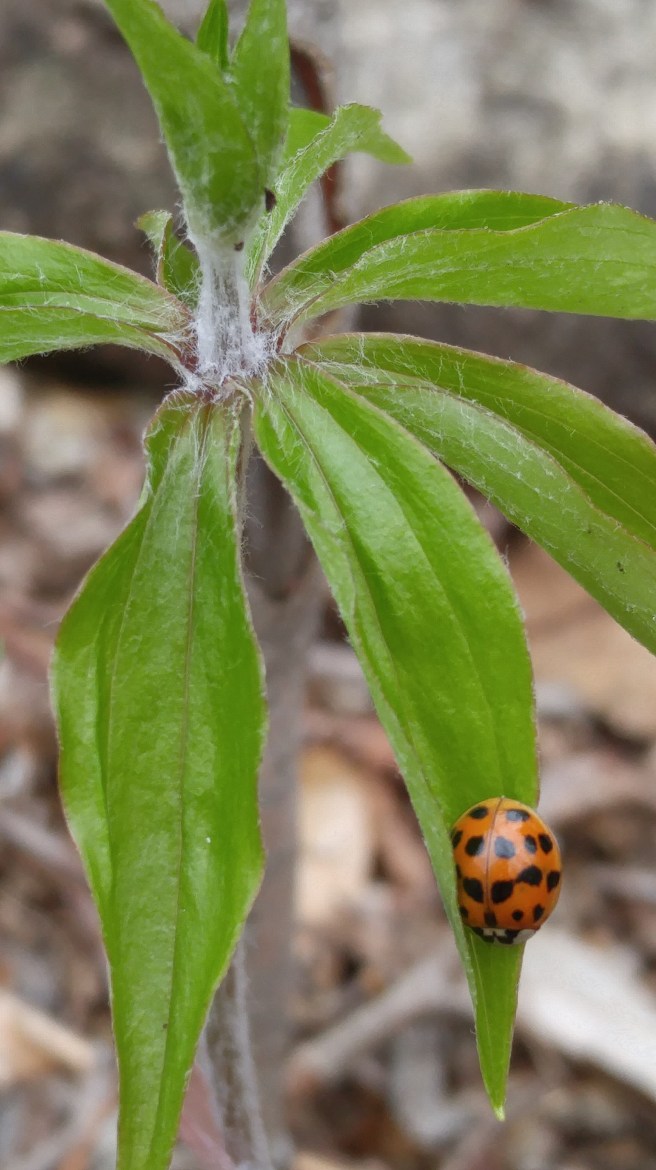
Speaking of insects, we found a ladybug presumably feeding on aphids–already. So why do ladybugs sport  bright orange or red color and distinctive spots? To make them unappealing to predators. They can secrete a foul-tasting fluid from their leg joints–the coloring is therefore intended to shout out,  “I taste awful.”

s-Mayfly 1

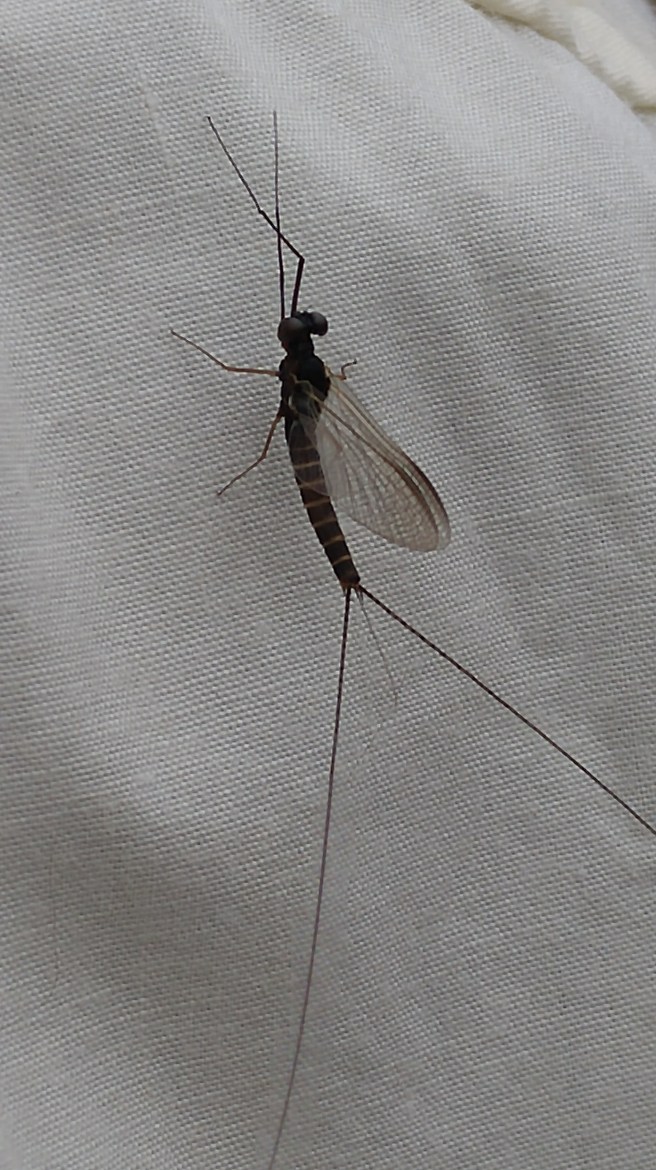
And Jinny Mae sported her own insect–a Mayfly, known to be more fleeting than spring, landed on her jacket. Oh, and did I mention the black flies? They swarmed our faces, but we practiced mind over matter.

s-brook

We were in one of the most beautiful places on Earth,

s-shell1

as evidenced by brook,  pond and mountains beyond.

s-gorge 4

And then there was the gorge.

As we watched the water rush through, we gave thanks for a day spent moving in slo-mo to take in all that this fleeting season has to offer in its spring ephemerals.

Book of May: Lichens of the North Woods

Everywhere we look as we hike (or even drive), be it ground, rock or tree, lichens make themselves known.

b-greenshield

Some are easy to ID even if we are driving 60mph (on the highway, that is), like common greenshield. Others, however, require closer examination and consideration. And that’s why this month’s book is . . .

b-book

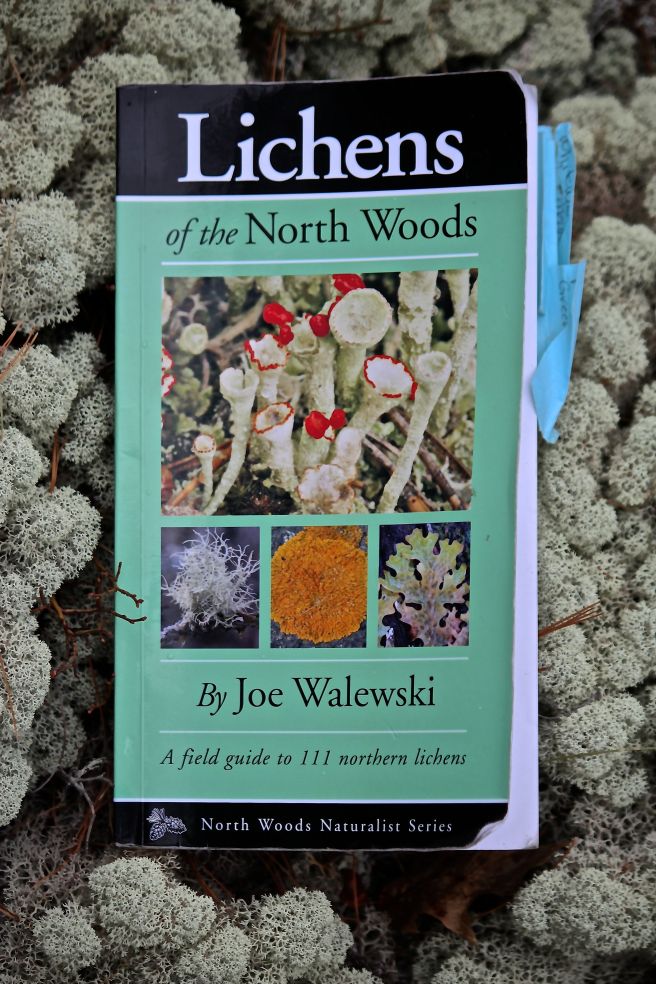
Lichens of the North Woods by Joe Walewski. From the get go, it’s another one of those books where it feels like the author is by my side. “Welcome to the Lilliputian world of lichens!” he begins.

Lilliputian indeed! And complex. But Walewski helps the rest of us develop an understanding of such complexity. Through illustrations and photographs, he presents us with Lichen Biology 101. And then he takes us into the field, showing us how to collect and preserve our specimens.

He explains how to use the field guide and then gets into the nitty gritty. I appreciate that the book is divided into the three substrates–ground, rock and tree–though sometimes I need to remember that though the lichen I’ve found appears to be on a rock, it might be listed under ground because the soil has built up over time.

Within each of the three sections, he further divides it by type: crustose (think those lichens that appear to be flat like a crust of bread), foliose (leafy like foliage) and fruticose (branching like grape branches). Common greenshield is leafy–therefore a foliose lichen.

For each lichen, Walewski includes a photograph, description, chemistry, similar species and nature notes.

Finally, there is a glossary, followed by titles of interest, and a list of lichen groups and Web sites.

It’s a small book, measuring 8 x 4.5 and only about a half inch thick, so it’s easy to toss in the backpack.

b-Quill 2

Walewski’s study focuses on Minnesota, but here in the Northeast, we have many of the same varieties.

I’ve encouraged you to develop your bark eyes in the past. This summer, look out! We’re going to work on our lichen eyes. And any puns you wish to share are most welcome :-)

I found my copy of Lichens of the North Woods at Bridgton Books. Look for it at your independent book store.

Lichens of the North Woods, Joe Walewski, Kollath+Stensaas Publishing, 2007


Mondate on Mount Will

It’s been a while since we’ve actually had a Mondate. After two days of hiking the trails up Pleasant Mountain, today’s journey found us venturing a wee bit out of the neighborhood as we made our way through Bethel to Mount Will.

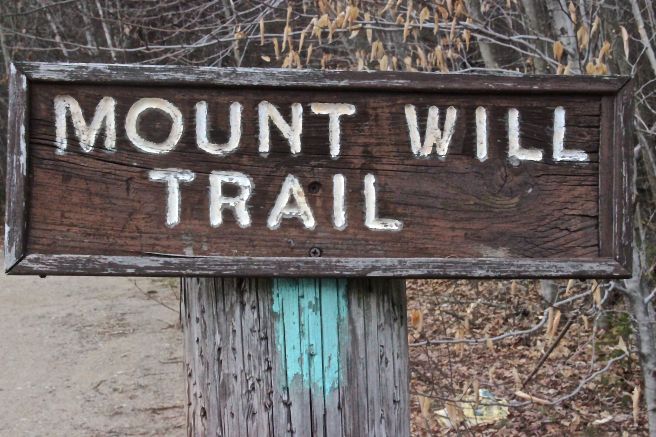
w-mount will sign

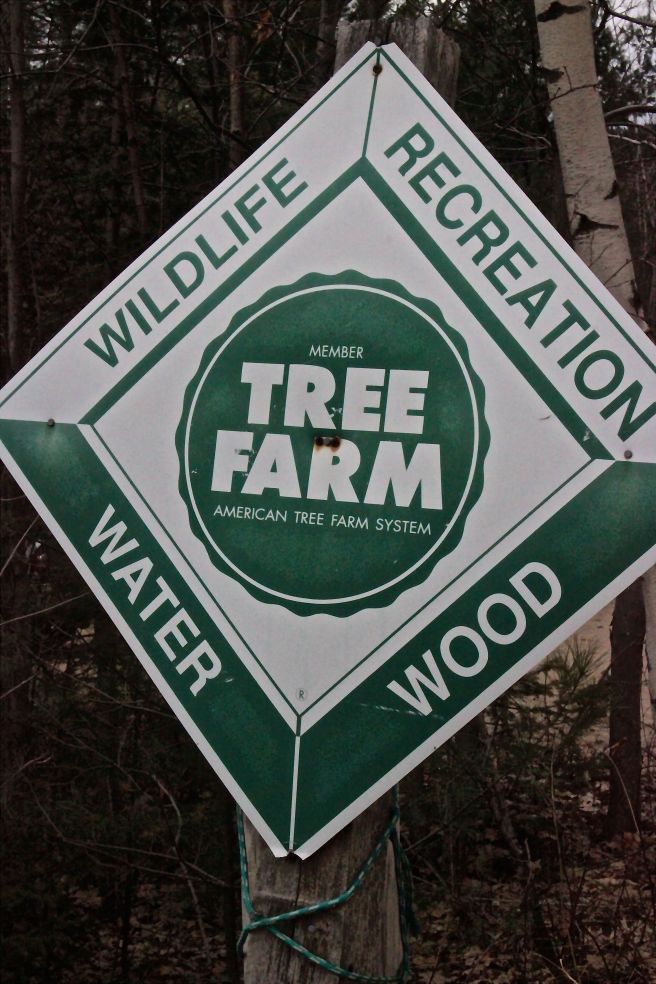
w-tree farm sign

The parking lot is located between these two signs. Part of the Mount Will trail system is within the 115-acre Bethel Town Forest that had served as the Town Farm back in the day.

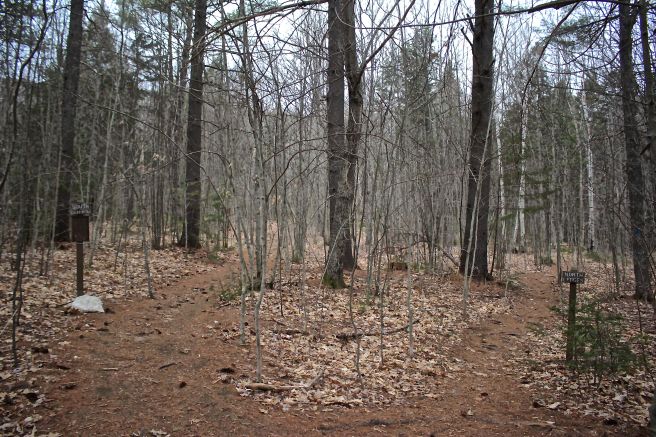
w-2 trails

The South Cliff trail leaves from the left, while the North Ledges is on the right. This is a loop and we decided on a counterclockwise trek. It had been at least five years since we last hiked here and we’d forgotten about some of the steep sections.

w-n-parklike

Of course, at the start, it seemed almost parklike. Three years ago, several local organizations including Mahoosuc Pathways, the Oxford County Conservation Corps, Outward Bound and the Bethel Conservation Commission rerouted this particular section of the loop.

w-n-switch

Now switchbacks wind their way up toward the North Ledge.

w-bear 8

When I wasn’t looking down, I scanned the woods, ever searching for my favorite species–bear claw trees.

w-bear

And I wasn’t disappointed.

w-bear 7

We saw them over,

w-bear9

and over again. Oh happy day! We found more than these, which leads me to believe that there are even more. Let the search continue!

w-gargoyle 2a

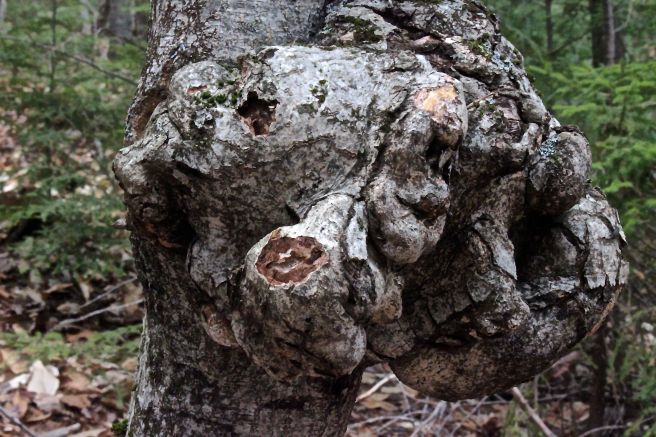
A few trees displayed other surprise packages–burls or warty growths caused by some environmental condition such as injury, virus, fungus, insect infestation or mold. Though this growth can put stress on a tree if it becomes too heavy, generally trees with these features are healthy. And woodworkers covet burls for the unique pattern and beauty found within. That sounds like a comment on the world–we all have hidden treasures, but they aren’t always visible.

w-n-artist conk

Other tree growths include artist’s conk and

w-s-redbelted polypore

red-belted polypores.

w-n-bobcat

The trail passed below rocky outcrops–and my imagination saw bobcats. But, what would they eat? The undergrowth is limited, so I doubted snowshoe hare. That being said, spruce and hemlock cones are many and red squirrels chided us constantly.

w-n-vp

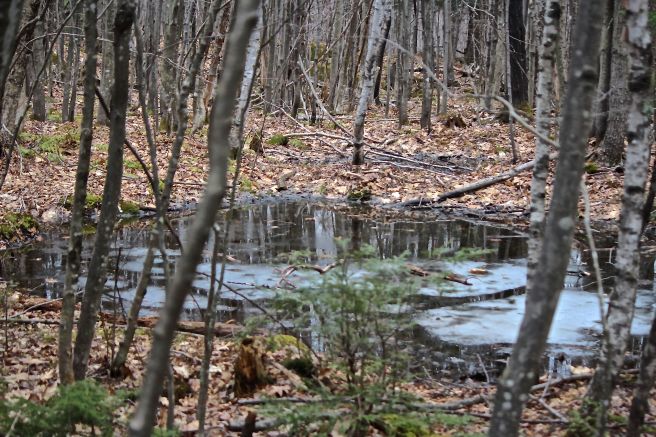
Meanwhile, at a vernal pool just off the trail, all was quiet–and still partially covered in ice.

w-n-lunch rock

Lunch rock was the North Ledge. Below, the Androscoggin River wends its way through the landscape. The Androscoggin has a long history as a life-giving force–beginning with the Abenaki Indians who used it as a water trail and knew the nuances of this 170-mile river.

w-n-carters

The fertile, ancient floodplain has served many a farmer, including the Carters who own the farm across the river below where we sat. While we ate, we shared our memories of cross-country skiing across those fields, beside the river and into the woods.

w-spruce sap

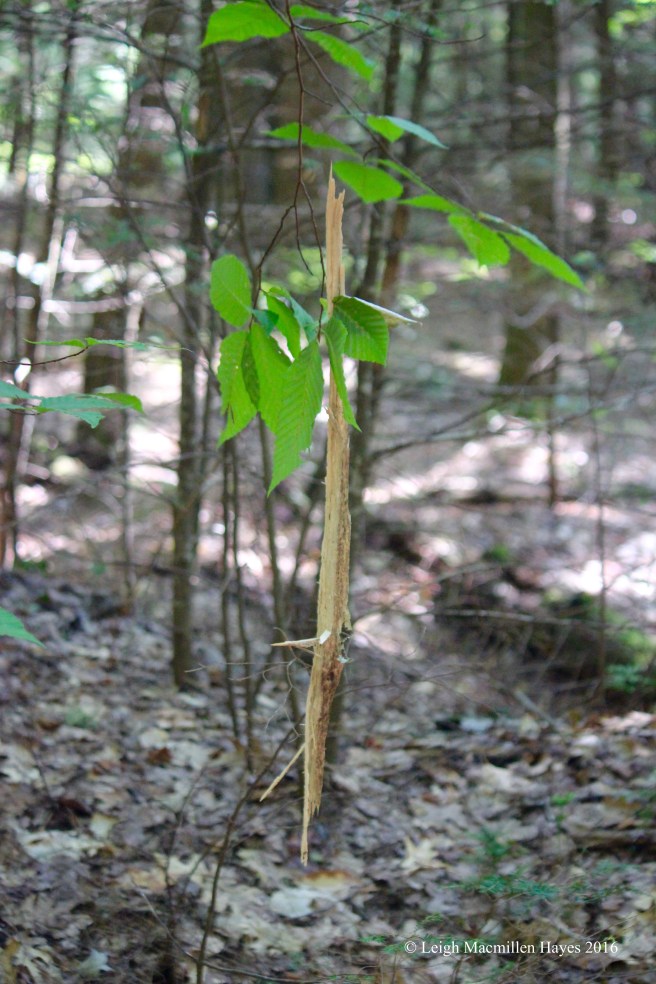
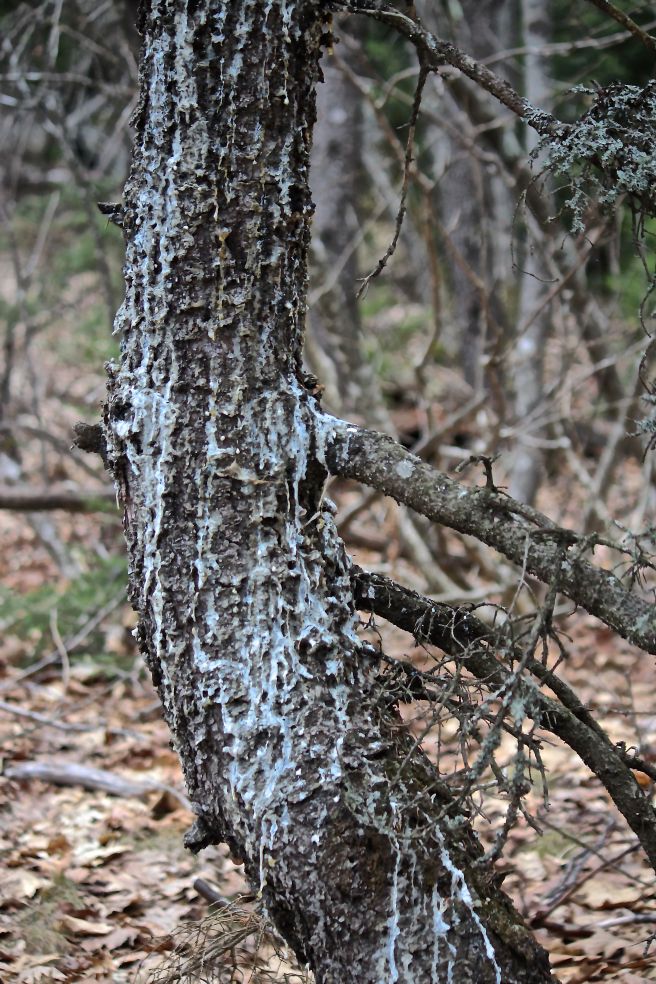
We continued on across the ridge and through the spruce forest where the sap ran blue.

w-s-sunday river

Before turning toward South Cliffs, we caught a glimpse of the trails at Sunday River Ski Area in Newry.

W-gray 1

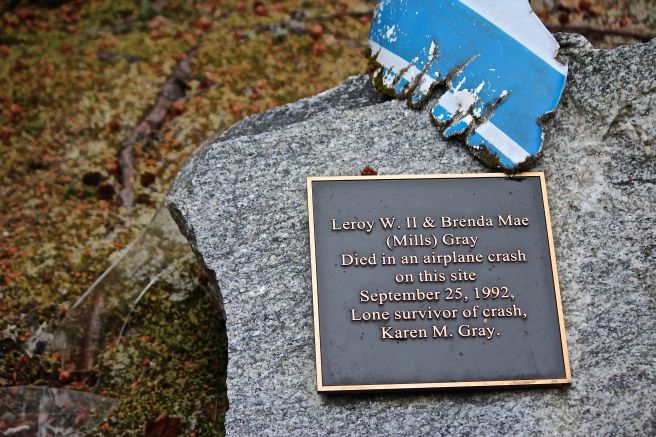
And then we saw a sign that had us wondering. The Gray Memorial? We had no previous memory of it, so we followed the detour and walked along a snowmobile trail for about a quarter of a mile.

w-s-gray memorial

The story is sad. The airplane remnants powerful in suggestion. Upon arriving home, I found an article in the Sun Journal referencing the event. Leroy was a state trooper and his wife, Brenda, an executive secretary who became head dispatcher for the Bar Harbor Police Department. With their 14-year-old daughter, Karen, they were flying their Cherokee Piper to Bethel to spend time with relatives when the plane “crashed nose first” into Mount Will about 7:30pm. Despite her own injuries, Karen hiked down the steep mountainside to seek help. A somber site indeed.

w-s-cliff view

We backtracked to the trail and continued on to the South Cliffs, where our view again showed the river, with Route 2 following beside and both leading to Bethel village.

w-s-mtn goats

Moving off the cliff, we were sure mountain goats had laid out the trail.

w-s-ledges

Again, we were in bobcat territory, frequented by chatty red squirrels who seemed to feel quite safe as they scrambled from tree to tree.

w-oz

And then we moved into the land where the monkeys in the Wizard of Oz jumped out upon Dorothy and her friends. My guy started humming the music from his favorite movie. The reality is that these trees knew the wrath of previous storms.

w-s-heading down

Once again the trail turned S curves as we continued downward and

w-s-brook

listened to water trickling over the mossy stream bed beside us.

w-s-logging

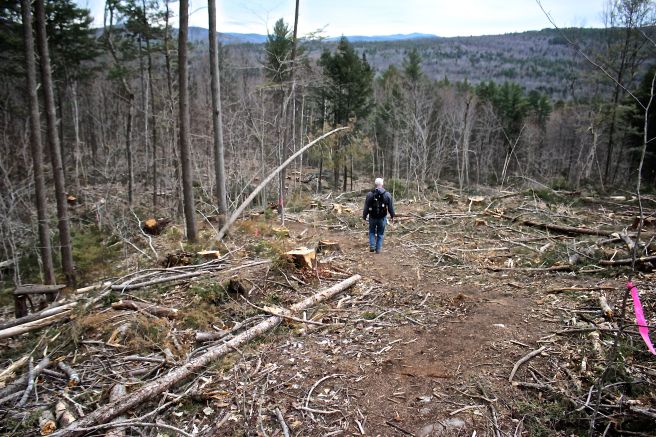
And then we found ourselves in the midst of a recent logging operation–remember, this is a working forest. Slash galore decorated the landscape, but we suspect that all of this will be chipped eventually. One thing we happily noted–bird song. Lots of bird song at this spot.

w-s-weather1

We were almost to the bottom of the trail when an anomaly grabbed our attention and forced us to investigate.

w-s-weather 1

w-s-weather tape

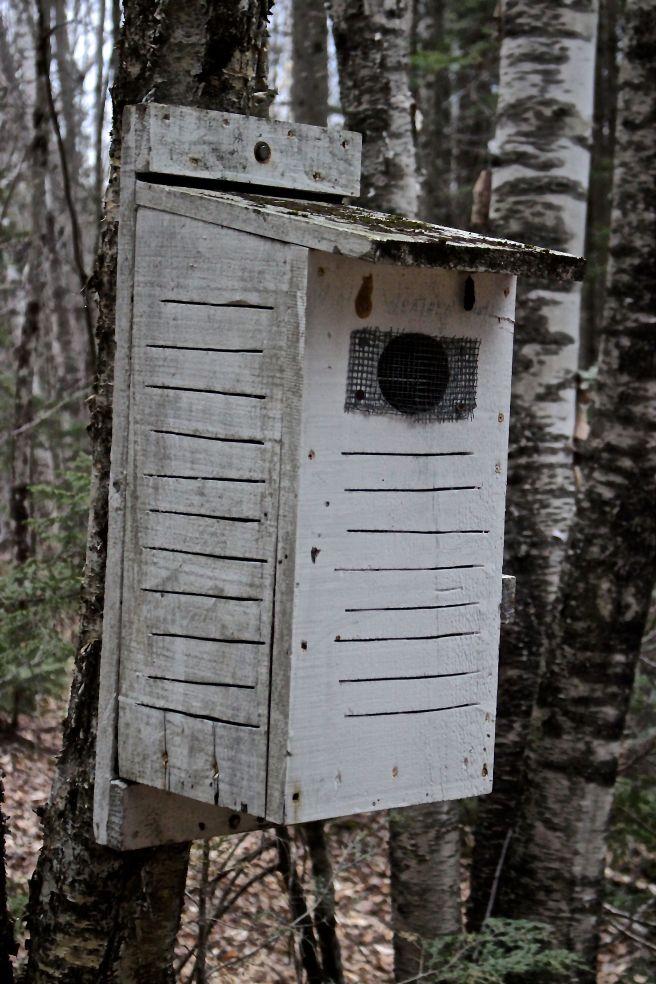
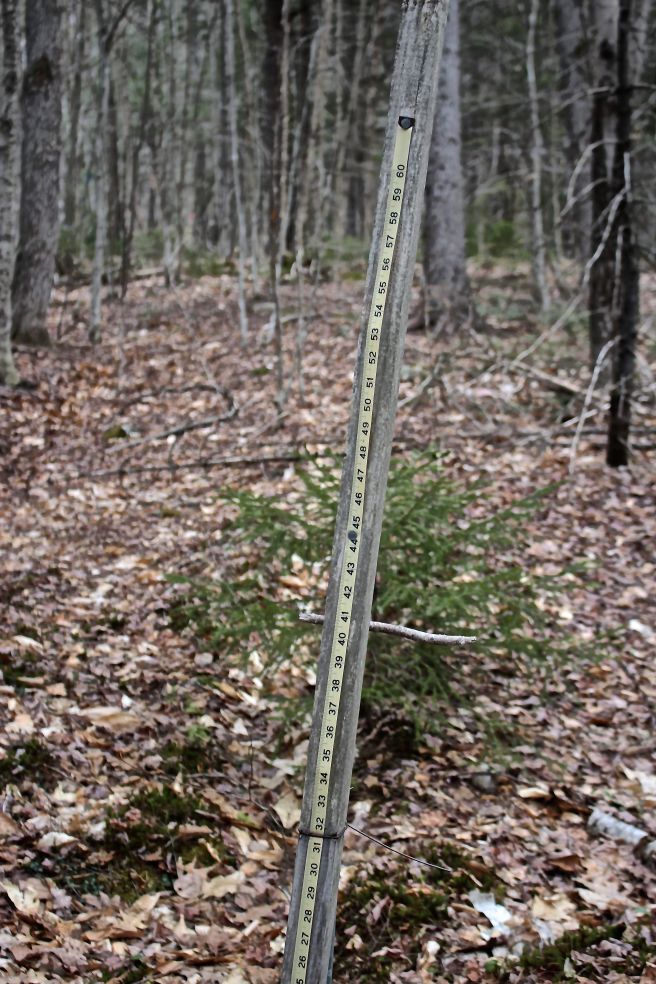
We’d stumbled upon a winter weather station. We only knew that because “winter weather station” was printed in faded paint across the box. So, we get the tape measure for snow depth, but the box? And the hole covered with mesh? Worth a wonder, so we did.

w-s-weather cocoon

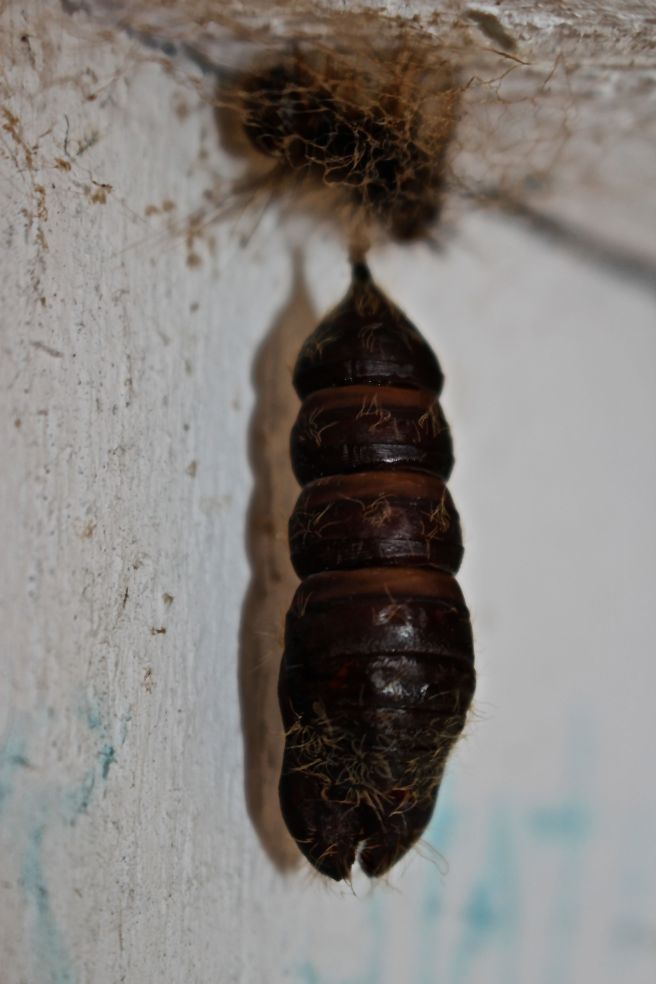
Apparently, a moth appreciated the efforts of the citizen scientists who created this shelter. Our hike was over, but this chrysalis holds the future.

w-covered 2

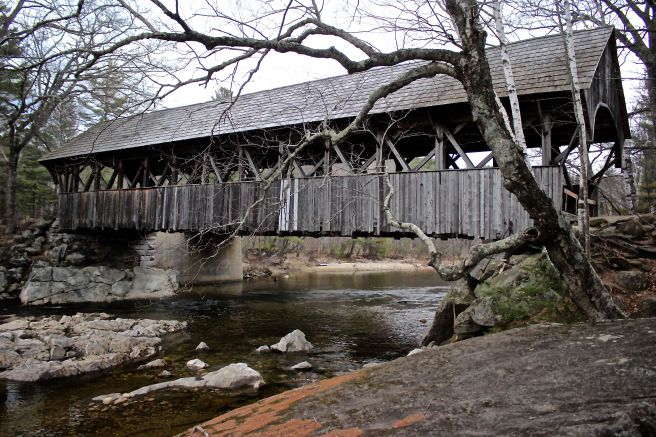
We decided to complete our Mount Will Mondate with a visit to Artist’s Bridge over Sunday River–the perfect culmination of our love for nature and history.


So Many Quacks

Stepping as quietly as possible through the woodland, my heart quickened when I heard a particular chorus vibrating from the vernal pool.

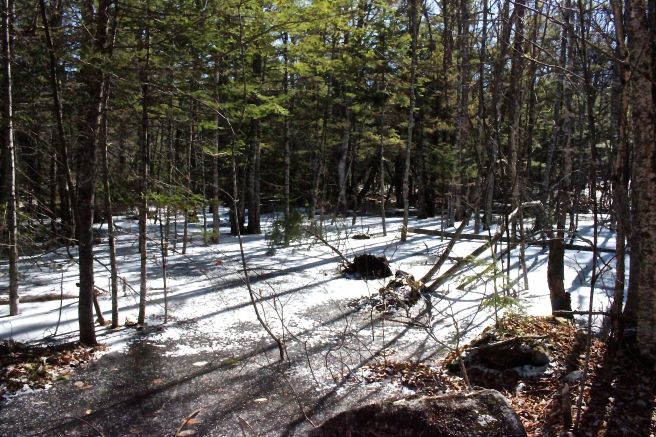
v-ice 2

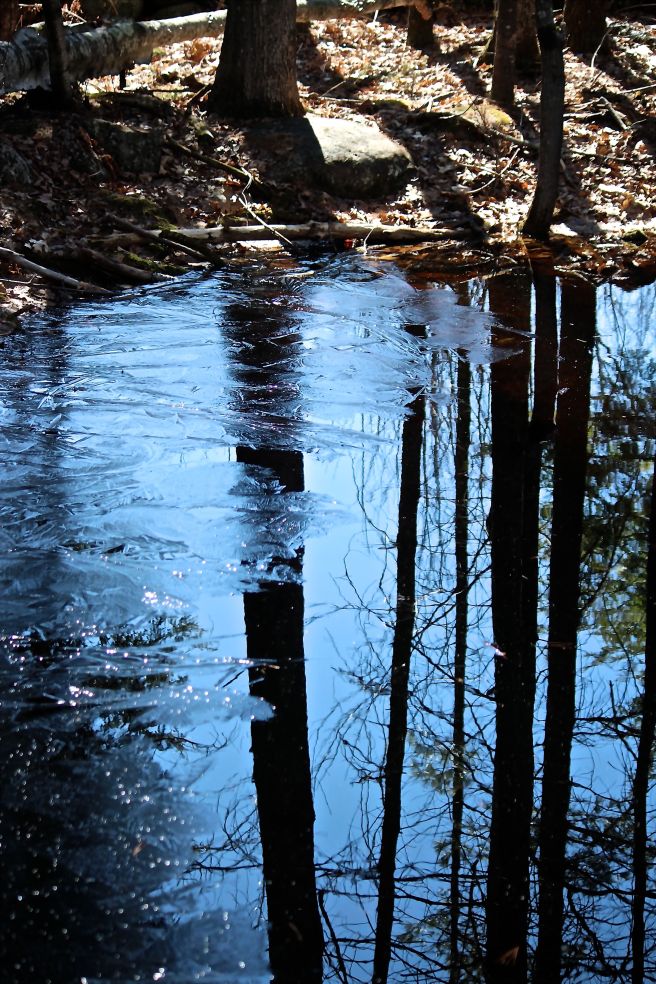
Three days ago a thin layer of ice still covered half of it.

v-ice 3

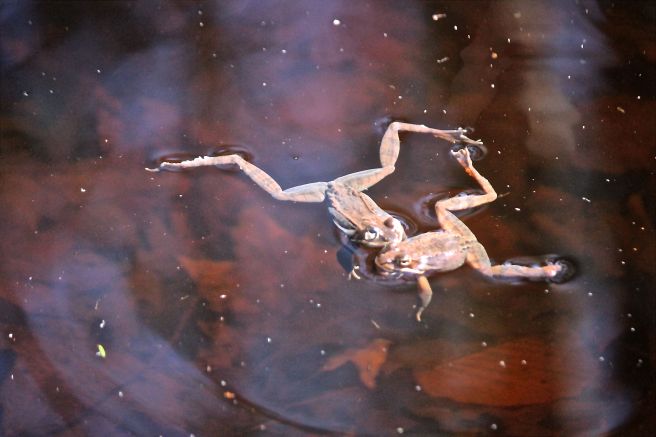
But I was happy to note that despite last week’s frigid nighttime temperatures, the wood frogs had been active.

v-many heads

While I stood and waited on Sunday, there’d been no movement or sound and I thought that the frogs had already moved on–mission accomplished. My ears and then my eyes knew differently today. I heard the quack of the males and then saw a number of heads on the water’s surface. Quickly, I snapped a photo–the little balls of light represent those precious heads.

v-ripples

They sensed my approach and began to make waves. Water rippled as they dove under the leaf cover below. And all was silent.

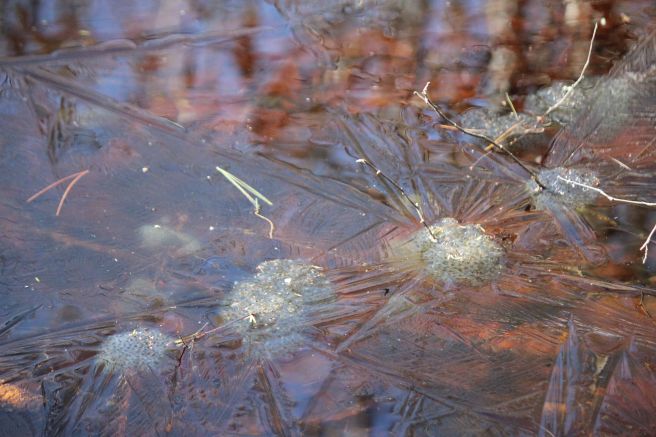
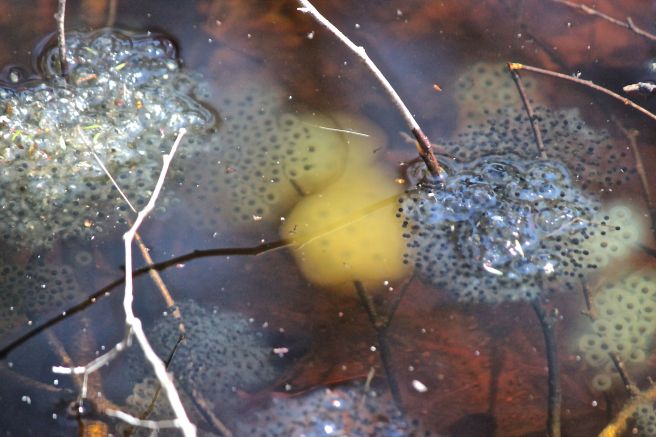
v-eggs 3

The community of egg masses, however, showed that their efforts continued to be fruitful.

v-egg masses 2

In general, each mass laid by different females is attached to a twig or branch. They tend to take advantage of the same site for attachment and usually in a sunny, warm spot. Already, some floated to the surface. Eventually, they’ll gain a greenish tinge from algae, which actually helps to camouflage them. One of the many wonders is that any given mass may contain up to 1,000 eggs–from a two-to-three-inch frog.

v-egg mass 1

A couple of masses were positioned independent of the rest, like this one–embraced in oak and maple leaves. It’s almost out of the water, though yesterday’s rain helped, but I questioned whether or not it will be viable.

v-frog and sally eggs

Then again, will any of them? Last year, the pool dried up before the tadpoles reached maturity. And it isn’t just tadpoles that begin life in this pond. Notice the white, gelatinous masses below those of the wood frogs? Spotted salamanders had also returned to this small body of water.

v-sally 3

They, too, attached clusters to vegetation. Smaller in number of individual eggs, salamanders lay 30-250 within each clear or opaque white mass. As they absorb water, the masses enlarge.

I walked around the pool looking for spermatophores produced by males and left on the leafy bottom, but saw none. Earlier today, my friend, JVP, and I walked along the Narrow Gauge trail and saw them in several pools. Unfortunately, though I had my camera in tow, I’d left the battery at home–still sitting on the charger. Oy vey!

v-beech leaves

As beech leaves continued to cling and blow in the slight breeze over the pool, I finally settled down at the edge and waited for action.

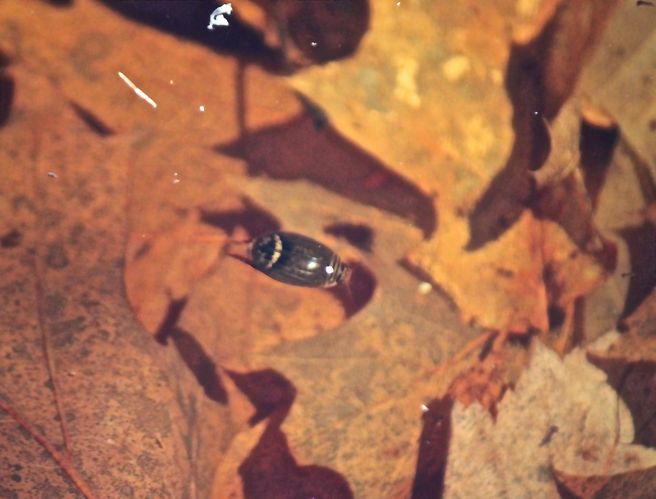
v-diving beetle

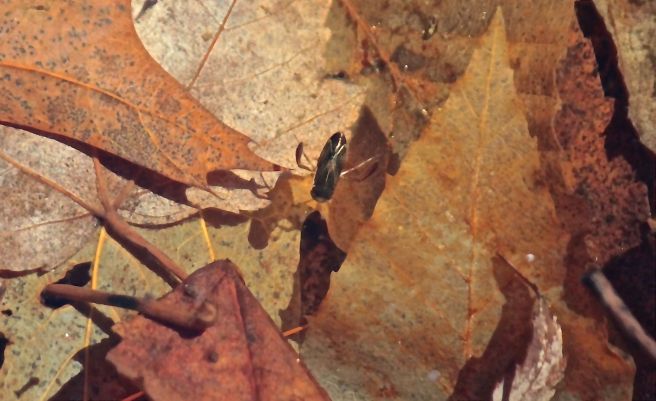
Moving with aquatic beetle speed, predaceous diving bugs swam about in constant motion.

v-water boatman

Also calling this small pool home were numerous water boatmen.

v-peaking out:blending in

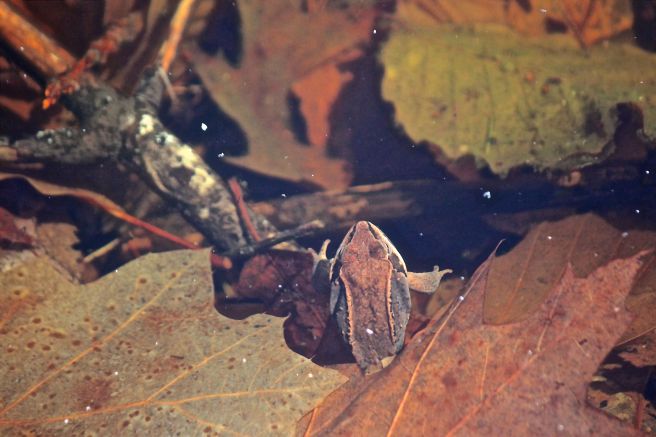
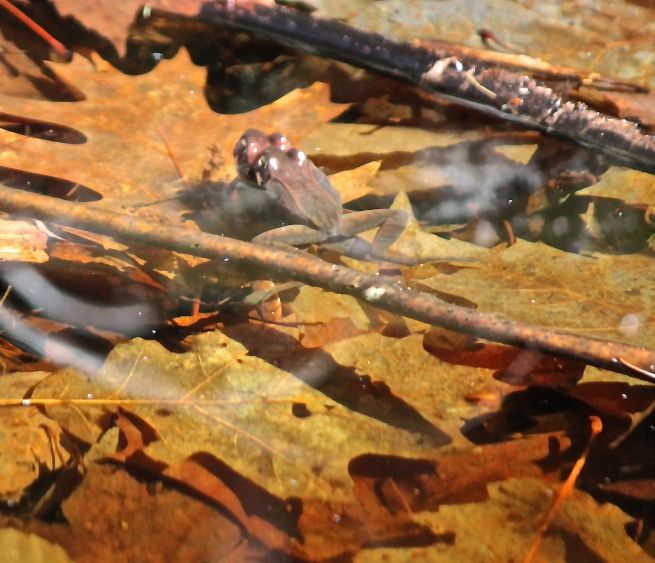
But what I most wanted to see–the wood frogs themselves. Ever so slowly, they began to emerge from the leaf cover.

v-frog 1

Once by the surface, they floated.

v-frog 5

As long as I didn’t make any sudden moves, they stayed–showing off the dorsolateral ridges that run from the back of their eyes toward their hind legs.

v-frog 4

Color variation was evident–from rusty browns to gray and tan.

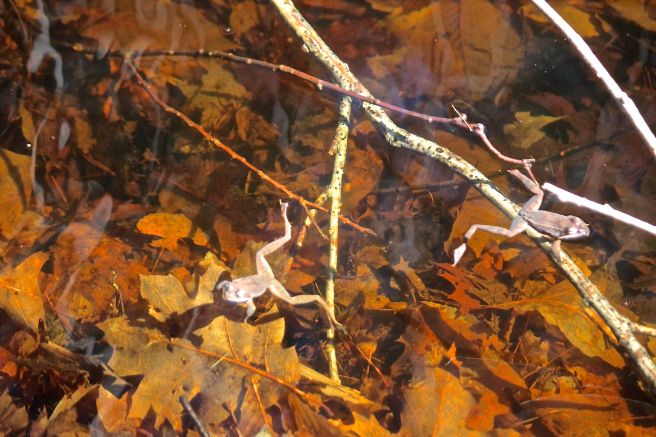
v-frogs hanging

Sometimes, several floated near each other–probably wishing I would leave so they could continue their serenade.

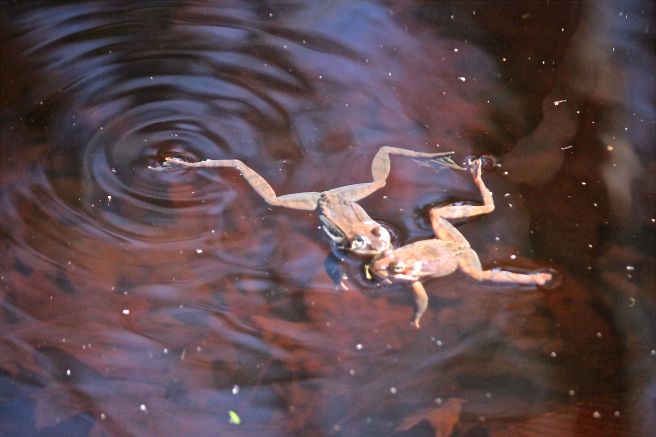
v-2 frogs

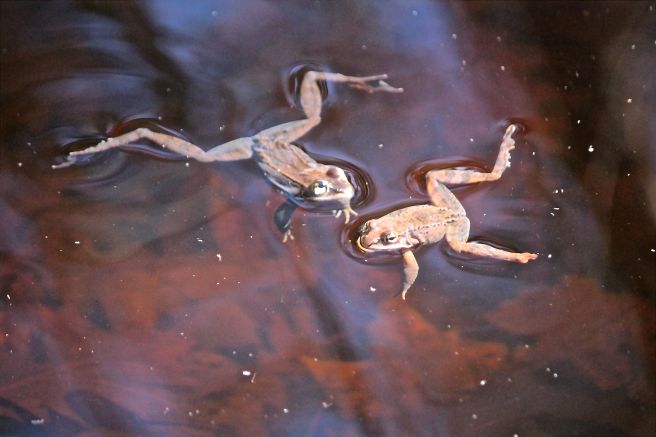
And then there were two that seemed intent upon one another.

v-2 frogs 3

I’m sure they spoke–probably cursing my presence.

v-2 frogs 1

With the flick of a frog leg . . .

v-2 frogs depart

they suddenly went their separate ways.

v-love 1

One couple, however, did hug. So that brings up another curious thing about wood frogs. Males cannot identify females by sight or sound, so he has to clasp the other frog. If the frog is thin, it’s either  another male or a female that has already released her eggs–thus he’ll release it quickly. Yup–females are generally fatter because they carry eggs.

My eyes were as wide as the frogs I watched–I’ve never had the pleasure of seeing so many in this particular pool. And I was sure that due to the ice, all the action was completed a few days ago. But the multiple chortles I heard upon my initial approach created a racket today–and sounded, of course, like a bunch of mallards. I rejoiced over the sound of so many quacks.


Temporarily Giving a Dam

Another frigid morning and a dusting of snow set the scene for the Greater Lovell Land Trust docents and me as we tramped about the woods today.

b-trail

Hiking up a trail, it suddenly occurred to us that we were zooming–not exploring in our usual slow pace. Blame it on the cold. Blame it on the fact that we had a mission and I had a time frame.

b-pond 1

We knew of the beaver activity in these woods and were eager to take a closer look at their recent work. Oh darn. Such a task.

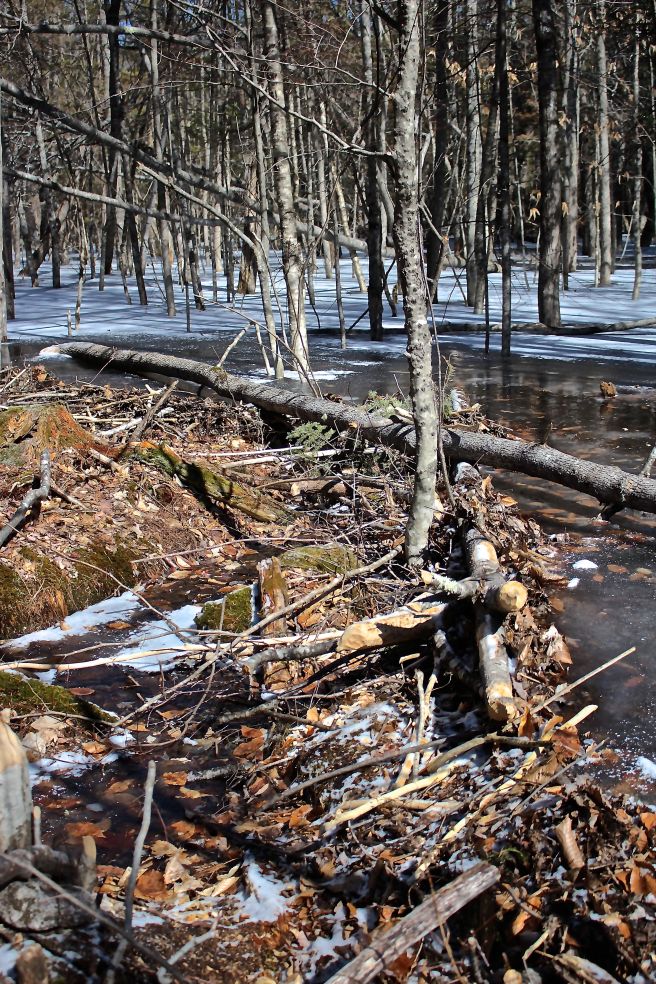
b-roadway dams

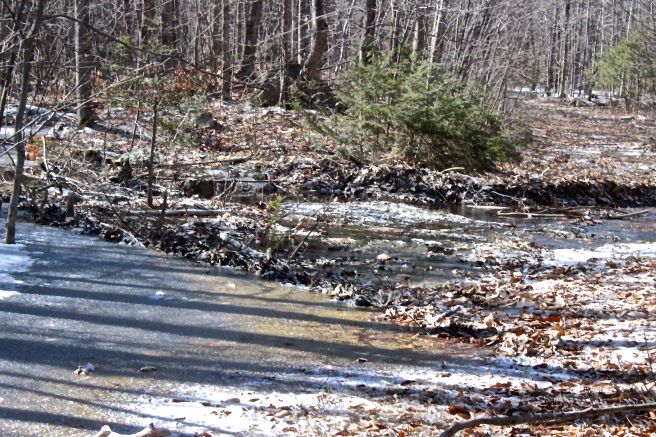
A couple of small dams stopped us in our tracks.

b-beaver log

And then we slowed down and began to notice.

b-chew and hole 1

Debarked logs and holes caught our attention.

b-beaver hole 2

Fairly fresh holes where a beaver recently came up for air.

b-lodge 1

Through the trees we spied the lodge.

b-beaver works 1

Cut saplings spoke of food and construction,

b-beaver works 3

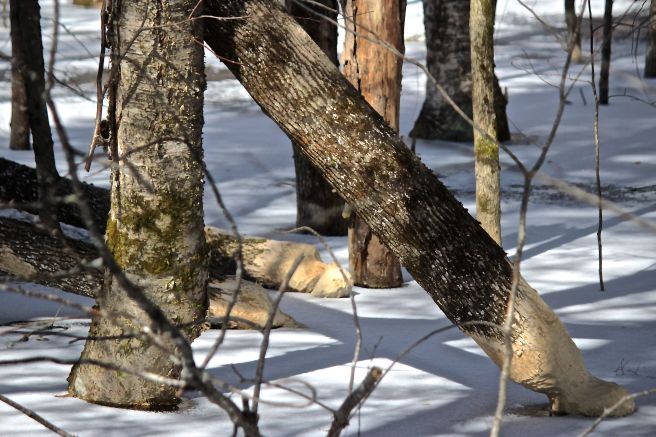
while carved statues dotted the landscape.

b-beaver works 2

Hieroglyphics marked many a tree base.

b-beaver works 4

We saw signs of success,

b-beaver trees

near success,

b-tree falls wrong way

and potential failure–this one fell away from the pond and was hung up on other trees.

b-catkins

While circling the pond, we paused to offer admiration–of the speckled alder catkins,

b-ice on stream

ice works,

b-burl 1

burls,

b-yellow birch, hemlock

and relationships.

b-lodge 2

We reveled in a close-up view.

b-channel 5

And recognized more activity in broken ice and air bubbles.

b-beaver path to channel

With discerning eyes, we recognized a pathway and water channel,

b-tracks over log

and wondered about melted snow that possibly indicated recent action.

b-beginning of main dam

Dam construction occurred in a variety of ways and created more than one shallow pond.

b-dam crossing

An obligation I had ended our exploration sooner than is our norm. On our way out, we crossed a small dam–thankful that we’d taken time to ponder and wonder about these ponds that serve as pantries and highways. Though our visit was as temporary as this change in the landscape may be, we were happy to have the opportunity to give a dam.


Wondering Beside Willard Brook

I dragged my guy along for a wander in the Hut Road neighborhood today and we made Willard Brook the center of our attention.

That being said, our journey began at Great Brook. I parked by the gate that isn’t open yet due to  road conditions–not realizing that the only other vehicle belonged to a friend, who kindly left us a note we found under the windshield wiper as we drove away hours later.

The wind was wild and we felt it rattle our bones while we walked along Forest Service Road #4. That just meant a fast walk to the start of our adventure.
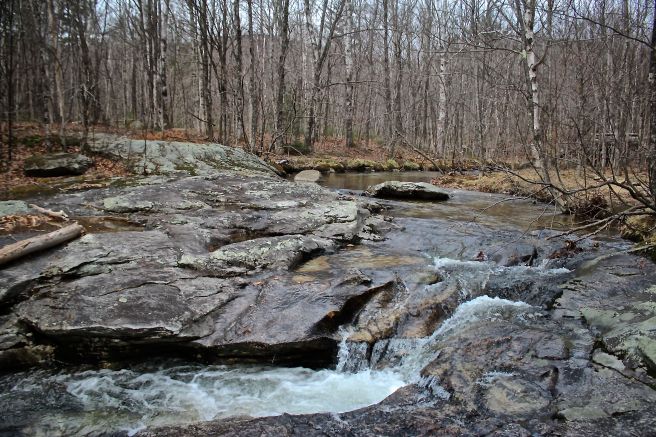
h-Great falls

The beauty of this spot never ceases to take my breath away.
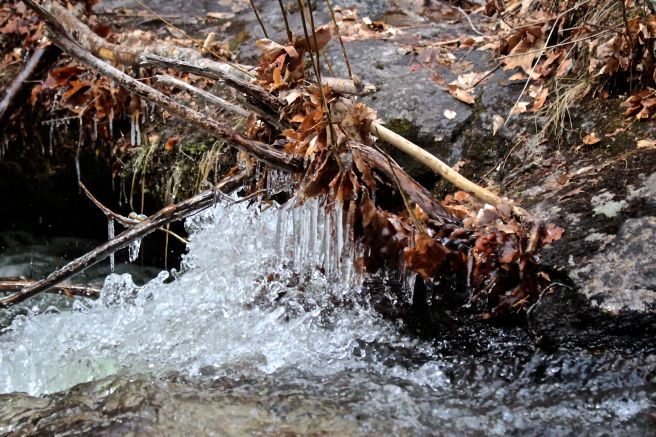
h-ice

But we didn’t pause long because that wind was cold and icicles helped tell the story.

h-map

Lately, when I’ve tramped about in this area, I’ve been on the Great Brook Trail to start, but I contacted a few folks in the past two days because they’ve made comments on previous posts that indicated they have some understanding of the Native American presence that once existed here. And perhaps still does.

Stoneham_Hut_Road_1858_12-06-2015

My friend, Jinny Mae, had intended to join us today, but that didn’t work as planned. She and I have explored this area a couple of times in the past few months and she’s my GPS techie, as well as a talented historian and naturalist. The above map is from a section of the 1858 map of Stoneham she posted. (Thanks JM for letting me borrow this without asking.)

Stoneham_Hut_Road_1880_12-06-2015

As Jinny Mae indicates on her blog, this is from the 1880 map and there’s been a change in ownership of the neighborhood homes.
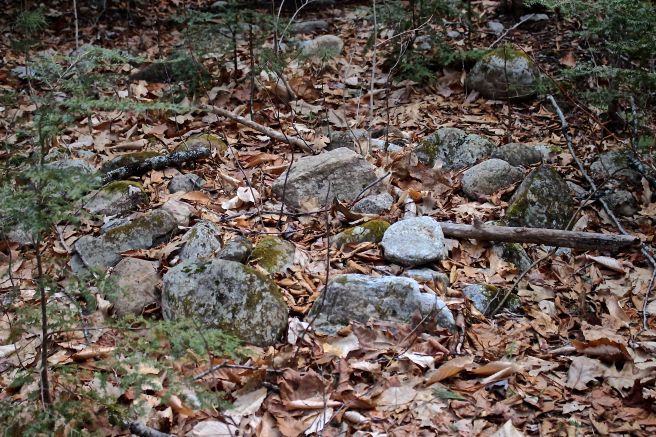
h-stone pile beside willard

We chose a different route than the one she has outlined in red. Ours led to Willard Brook. Just before the snowmobile bridge, we turned right and began to follow the brook. I realized immediately that I’d been here before. Part of my quest was to take a look at stone placement and think about it not as Colonial only, but also as Pre-colonial or Native American. And so, I paused at every rock formation I found, including this circular configuration beside the brook. Current day fire pit? My guy didn’t think so. I don’t know.

h-stove 2

As happens in our woods, we suddenly found ourselves visiting an old camp. Debris is scattered about. This particular piece from a stove front caught my guy’s attention. He was born in Taunton, Massachusetts, and immediately recognized this as coming from The Weir, an industrial section of town. If memory serves him right, there were at least three stove companies in that area.

h-mailbox

My favorite will always be the mailbox, truly a tribute to snail mail.

h-yellow birch

Our intention had been to follow the brook north, but we let an already traveled trail lead us instead. Soon we came to another landmark I remembered, the great yellow birch. An old yellow birch. Very old. I led a bark workshop yesterday and this is one of the trees we talked about. Yellow birch can live to be 200 years old, much longer than any of their relatives. I don’t know the age of this monument, but I do wish I could hear the stories it has to tell of this land.

h-colonial road

We turned left and followed the former road to Willard Brook. Colonial road or older?
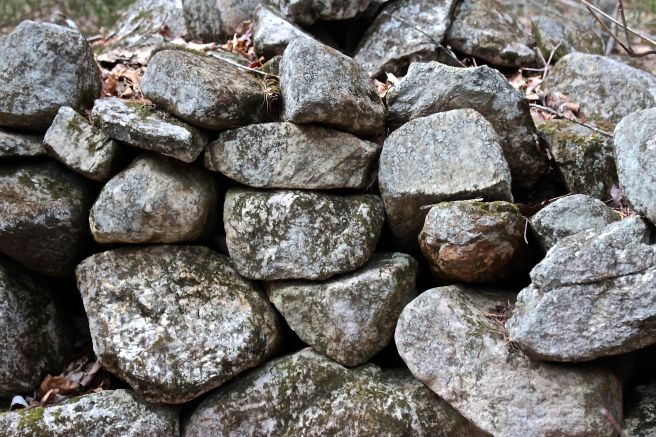
h-stone wall turtle

I’ve learned from others to look at the shapes incorporated into stone walls and fences. I may be making this up because I’ve had an affinity with turtles since I was a young child and own quite a collection even to this day, but I see a turtle configured in this wall. Planned or coincidence? Worth a wonder.

h-stone wall 2, turtle

Potentially another in this section of the same wall, but at the same time, this part seems more consistent in structure.

h-Willard 1

We ate the quickest lunch in our hiking history because our fingers were so cold. Even winter temps didn’t seem to bother us as much as today’s temp and wind chill. Lunch rock  sat beside Willard Brook with Speckled Mountain above.

h-entering neighborhood

And then we backtracked up the road and I took my guy up to the Hut Road neighborhood. He’d not visited this particular community before, so was happy to make its acquaintance.
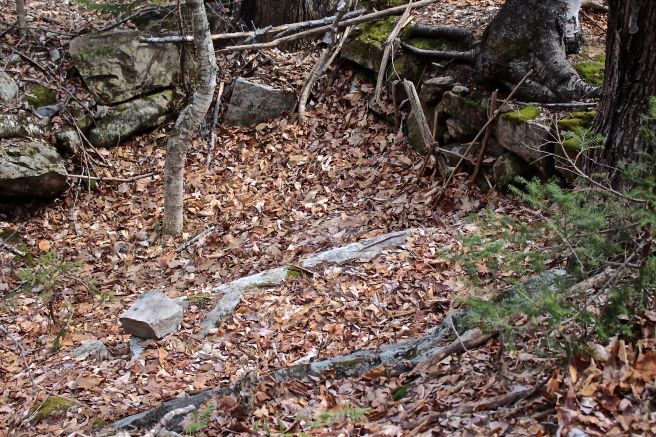
h-1st fdn

Our first encounter was with the Willard homestead of 1858; later known as the McKeen homestead of 1880.

h-wall on hill, balancing

As we moved up the hill to another foundation, we passed by this stonewall, where I wondered about the difference in stone size. A balancing act perhaps?
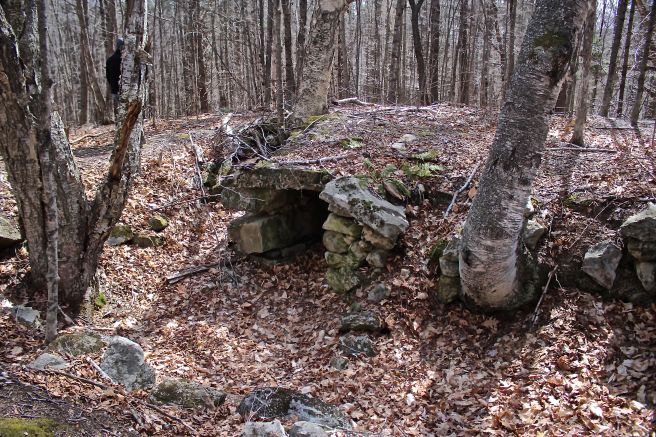
h-fdn 2 and chamber

Homestead #2 belonged to the Durgins in 1858 and Rowlands in 1880. It’s one of my favorites because of the stone chamber within. Which came first–the stone chamber or the rest of the cellar? Was the entire cellar considered a root cellar?

h-chamber interior

Hence, a closer look. Oh yes, and the porcupine scat pile is still there in the back right-hand corner, but none of it is fresh. Darn.
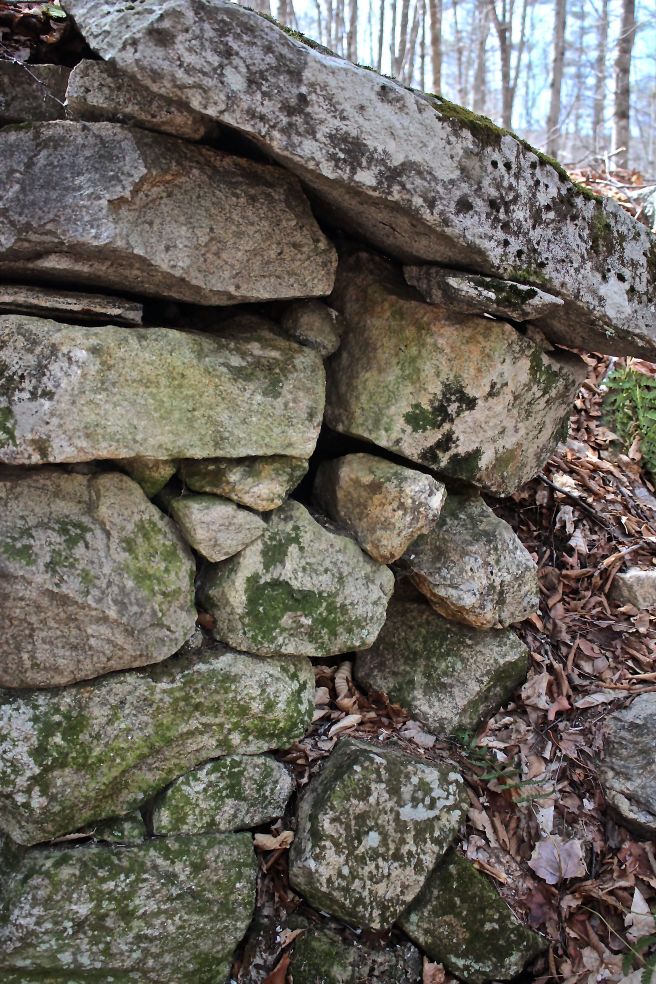
h-chamber stones 1

On the outside of the chamber’s edge that connects with the cellar–again my imagination took over. Perhaps my turtle’s head is the large blocky rock bottom center. Or is it a smaller version in the rocks above. Am I seeing things that are not there? Overthinking as my guy would suggest?

h-chamber back

Perhaps in the back wall?

h-chamber int 2

And in the side? Again, I see a face peering out at me just up from the bottom center/left. Do you see it?
h-rock pile 2

h-stone 5

h-stone pile 4

h-stone pile 3

While I was busy photographing stone piles in the woods and wondering about their significance, my guy followed his nose and made a discovery that has eluded Jinny Mae and me for months.

h-tombstones 1

Just like that he found the cemetery.

h-Sarah Dergin

Sarah, daughter of Anna and Ephraim, is the first tombstone. She died in 1858 at age 22.
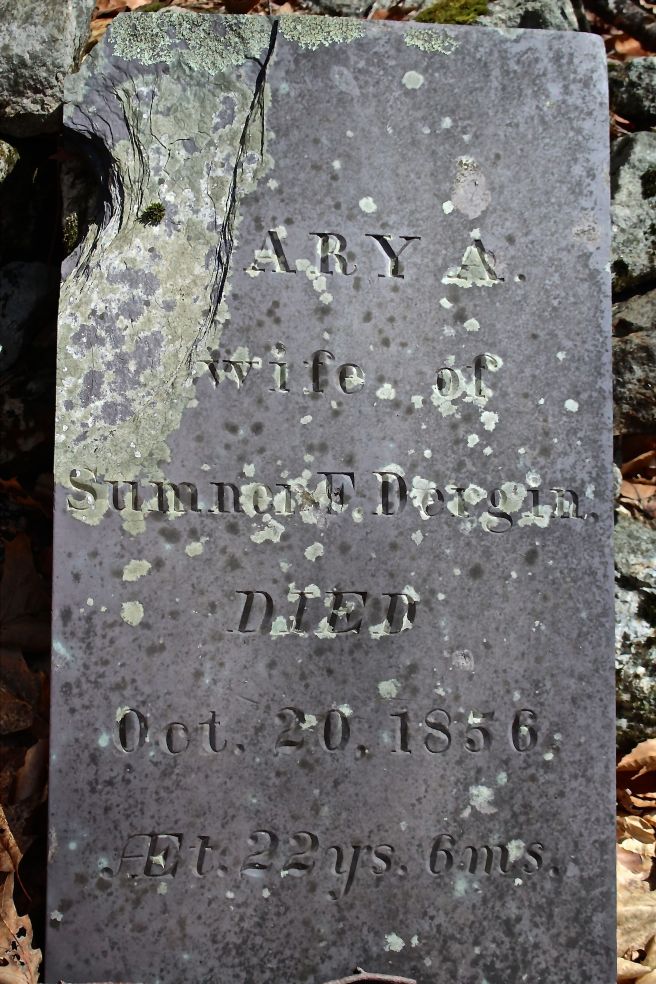
h-Mary Dergin

Beside her, Mary, wife of Sumner Dergin, who died before Sarah–in 1856. She, too, was 22 years old. As best I can tell, Sarah and Sumner were siblings.

h-Ephraim Durgin

And Ephraim, Sarah’s father, who died in 1873 at age 81. Notice the difference in stone from the two girls to Ephraim? Slate to cement. And the name spelling–Dergin and Durgin. As genealogy hobbiests, we’ve become accustomed to variations in spelling.

I found the following on RootsWeb:

8. ANNA3 FURLONG (PATRICK2, JOHN1) was born 1791 in Limerick, Maine, and died 1873 in Stoneham, Maine. She married EPHRAIM DURGIN June 18, 1817 in Limerick, Maine14. He was born April 13, 1790 in Limerick, Maine, and died in Stoneham.

Children of ANNA FURLONG and EPHRAIM DURGIN are:
i.OLIVE4 DURGIN, b. 1811, Stoneham, Maine; m. DUNCAN M. ROSS, April 11, 1860, Portland, Maine.
ii.SALOMA DURGIN, b. 1813.
iii.ELIZABETH DURGIN, b. 1815.
iv.SALLY DURGIN, b. 1817.
v.SUMNER F. DURGIN, b. 1819, Of Stoneham, Massachusettes; m. MARY ANN DURGAN, July 11, 1853, York County, Maine; b. Of Parsonsfield, Maine.
vi.CASANDIA DURGIN, b. 1821.
vii.EPHRAIM DURGIN, b. 1823.
viii.FANNY DURGIN, b. 1825.

Sarah isn’t listed above. But . . . Sally and Sarah were often interchangeable.
h-cemetery view-Durgin

Though only these three stones stand upright, leaning against a wall, this potentially was a large cemetery. And the view–Durgin Mountain.

h-down from cem

Rather than backtrack again, we decided to travel cross-country back toward Willard Brook.

h-bog

At the bottom of the hill, the area was filled with sphagnum moss and cinnamon and interrupted fern.
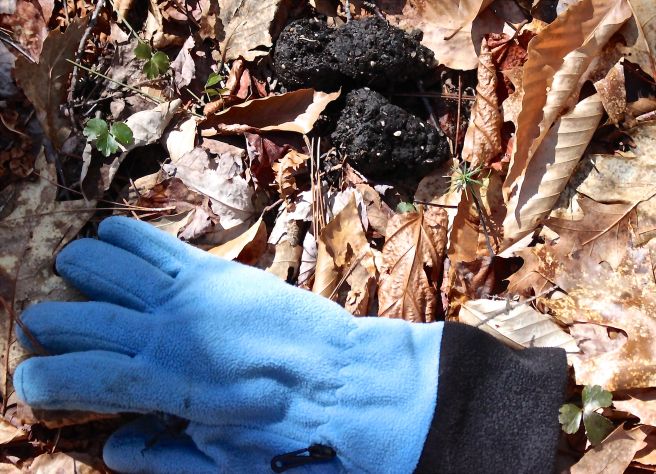
h-bear scat

Though I didn’t find any bear trees today, I did find bear scat ;-)

h-moose scat

And plenty of moose sign.

h-red maple

The red maples offered numerous examples of the bull’s-eye fungi that I told yesterday’s workshop participants to notice. I encouraged them to develop bark eyes. Meanwhile, I’m working on my stone eyes. (not stoned!)

h-willard dry bed

As we traipsed across the landscape, my guy recognized the large yellow birch we’d come upon earlier. And then we followed the walls down to Willard Brook where bushwhacking became the name of the game. Sometimes we found ourselves moving cautiously along the rocks in a dry section of riverbed–the overflow.

h-rock slide by Willard

I kept my eyes open for stone treatments and found this twenty-foot rock slide that didn’t look natural. I have no idea what it represents.

h-wheels

One of the things I continue to notice and love about the woods around us–no matter how far from civilization you think you are, you never are. Notice the wooden wheel spokes.
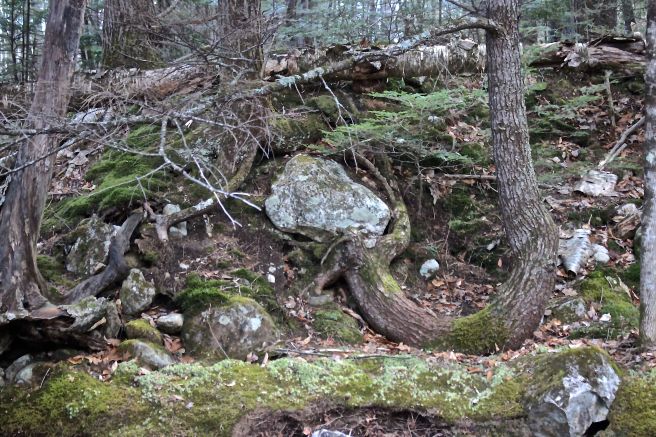
h-trees and rocks beside willard

I also noticed the trees and rocks across Willard, where the water’s rise and fall over the years has carved out a unique landscape and each entity is intertwined with the other.

h-2nd bridge

Eventually we came out at the spot where we’d headed off the snowmobile trail and decided to turn right and follow it toward Evergreen Valley.

h-cairn

Though the walk was nice and the wind not so strong, we got to this modern-day cairn and felt we’d gone far enough. We turned back and bushwhacked down to Willard Brook.

h-scouting willard

Like Lewis, my guy scouted for a crossing. Like Clark, I followed.
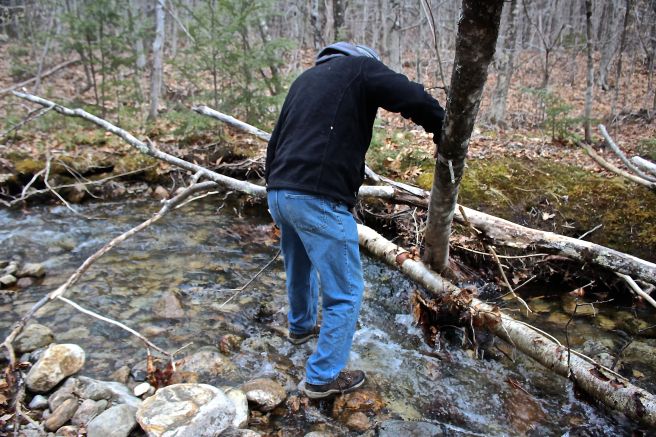
h-brook crossing

Our spot to ford the brook looked easier than it was. He crossed first and landed without issue. Me too–um, almost. Only one foot slipped. His comment, “Good thing your hiking boots are waterproof.” My response, “Yeah, but my socks aren’t.” Oh well. I’ve had wet feet before and will again. When I finally took my boot off at home, I was surprised at how drenched the sock was.

h-great brook on way back

We made our way through balsam fir saplings and hobblebush and a variety of other species and turned away from Willard assuming we’d eventually encounter Great Brook again. Success.

h-great structure 2

I’d been told to pay attention to Willard for Native American sites, and found this beside Great Brook. I have no idea what it represents.

h-3rd fdn central chimney

And lo and behold as we headed back to our starting point, we found ourselves at a third foundation–a rather large one with a center chimney between two cellar holes and an addition behind it. It’s where the school probably stood in 1858 and A. Gray’s home in 1880.

h-fnd 3 chimney

Bricks still top the central chimney.

h-final

Just like that, we were back at our starting point–looking at it from the opposite side of the brook.

Thanks to all those I bugged about what to look for as we tramped about today. And thanks again to Jinny Mae for her talent. I can’t wait to share this trail with you again.

We’d wandered for hours and found plenty to wonder about–especially along Willard Brook.
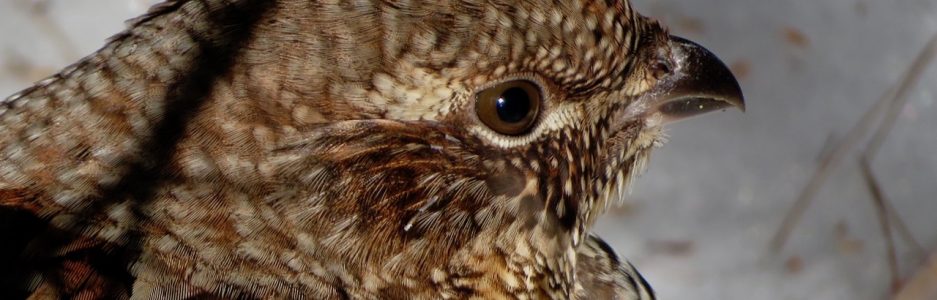


Book of the Month: TREES and SHRUBS of NORTHERN NEW ENGLAND

Sometimes the biggest gems arrive in the smallest packages. Such is the case with this month’s book–and this isn’t an April Fools’ Day joke, though I did briefly consider posting an upside-down photo of the cover.

t-book

I picked up this copy of  TREES and SHRUBS of NORTHERN NEW ENGLAND at a book swap during the Maine Master Naturalist Program’s first conference this past year. This third edition was compiled by Frederic L. Steele, Chairman of the Science Department, St. Mary’s-in-the-Mountains, Littleton, NH, and Albion R. Hodgdon, Professor of Botany, University of New Hampshire, Durham, NH, and published in 1975 by the Society for the Protection of New Hampshire Forests.

One of the things I like about it is that it measures 4.5 x 7 inches and fits easily into my pack. Plus, it includes more shrubs than many of my current books.

t-leaves

And check this out from the introduction: “In the preparation of this guide, the authors have received help and encouragement from a number of people. The following, in particular, should be mentioned . . . Mrs. Priscilla Kunhardt and Miss Pamela Bruns have done the illustrations . . . ” Mrs. and Miss! Ah, what happened to those days?

t-quaking description

The descriptions are not lengthy, but enough for a quick reference. I choose the Trembling Aspen, which I’ve learned as Quaking Aspen (I know–that’s the problem with common names say my Latin-oriented friends) because two are located right out the back door. They are the trees of life in our yard.

t-catkins forming

Catkins slowly emerge from waxy-coated buds

qa 1

and grow longer with lengthening days.

qa 5

Tufts of hair adorn tiny seeds.

T-summer

Soon, leaves on flat stems quake in the breeze,

t-caterpillars

until visitors arrive.

t-leaf eaters

Very hungry caterpillars.

t-porky

They aren’t the only ones. Porcupines nip off branches.

t-leaf

Eventually, leaves that survive fall to the ground.

t-hairy woodpeckers

All year long, birds visit to dine

t-cardinal

and view the world.

t-cat

The world looks back.
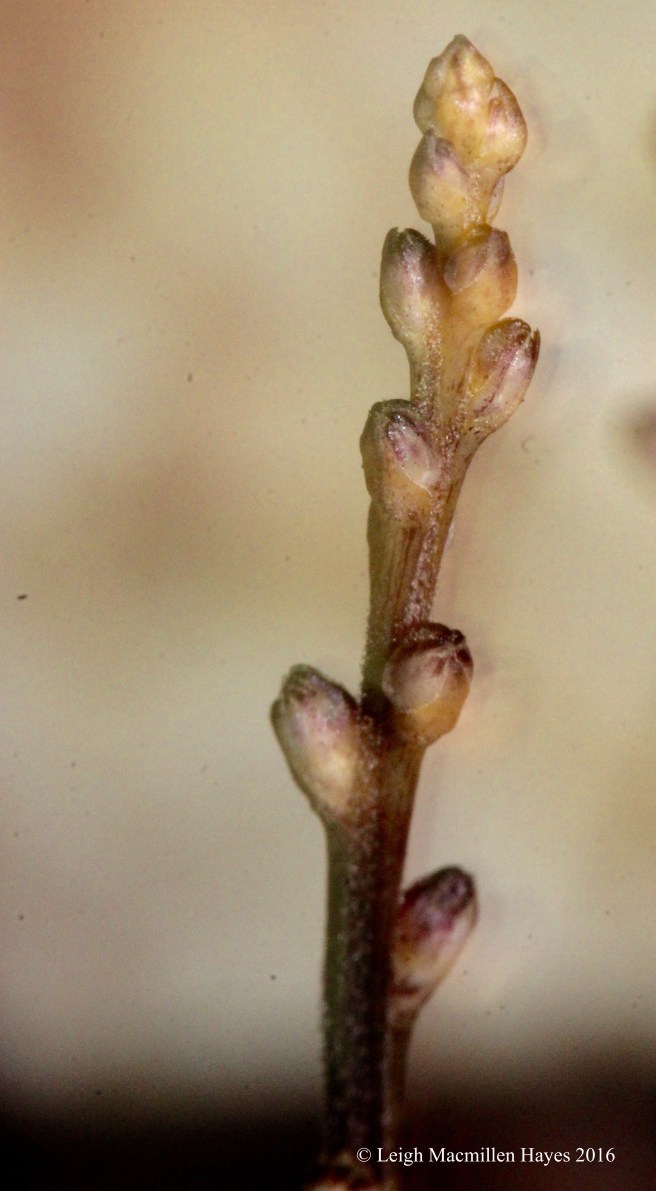
t-ice

Ice slowly melts

qa 2

and life continues.
TREES and SHRUBS of NORTHERN NEW ENGLAND doesn’t include photos, but that’s OK because I have my own. Instead, as any good guide, it’s a jumping off place. So many books, so much different information–and sometimes guides contradict each other. Just the same, I love to read them and then to pay attention. For me, it’s all about forever learning. And wondering.

TREES and SHRUBS of NORTHERN NEW ENGLAND, by Frederic L. Steel and Albion R. Hodgdon, Society for the Protection on Northern Forests, 1975.