Another Amazing Lesson From A Squirrel

Maybe I’m a slow learner. Maybe I just need the same lessons over and over again.

Whatever it is, I’m grateful for all who teach me, non-human to human, because there is always something to learn.

This week it was my friend Red who led the class. If you were down the hall in this outdoor school, you may have heard him, for he tends to be quite loud, and a bit critical, when he’s not dining upon a pinecone that is.

His plan, as it often is, was to strip the cone of its protective scales and seek the tiny seeds tucked in by the core or cob of the cone. Each scale contains two winged (think samara that help the seeds flutter toward the earth when its warm enough for the scales to open on their own) seeds and to me it seems like a lot of work for a little gain.

But if you’ve ever watched a Red Squirrel at work, you’ve noticed they are quick and can zip through one cone in mere minutes. Of course, it helps that they don’t worry about the “trash” and just let the scales and discarded seed coverings or pods, and even half consumed cones and cobs pile up in a garbage pile known as a midden. Spotting one of these is a sure sign you’ve entered Red’s classroom. And if you pause and look around, surely you’ll find many more middens. After all, Red Squirrels are voracious consumers. But again, given the size of the seeds, they need to be.

So here’s lesson #1: Leave the scraps. Oh wait, not on our indoor dining tables, but in the woods. And not our food in the woods, unless you are composting. But downed trees and snags and leaves and all that will replenish the earth, just as my squirrel’s garbage will do.

I should clarify that Red shares the school with many others who have their own classrooms and I’m sure when I finish my latest assignments I’ll have more to learn from the porcupines and deer and hare and coyotes and foxes and bobcats and yada, yada, yada who live under the mixed forest canopy.

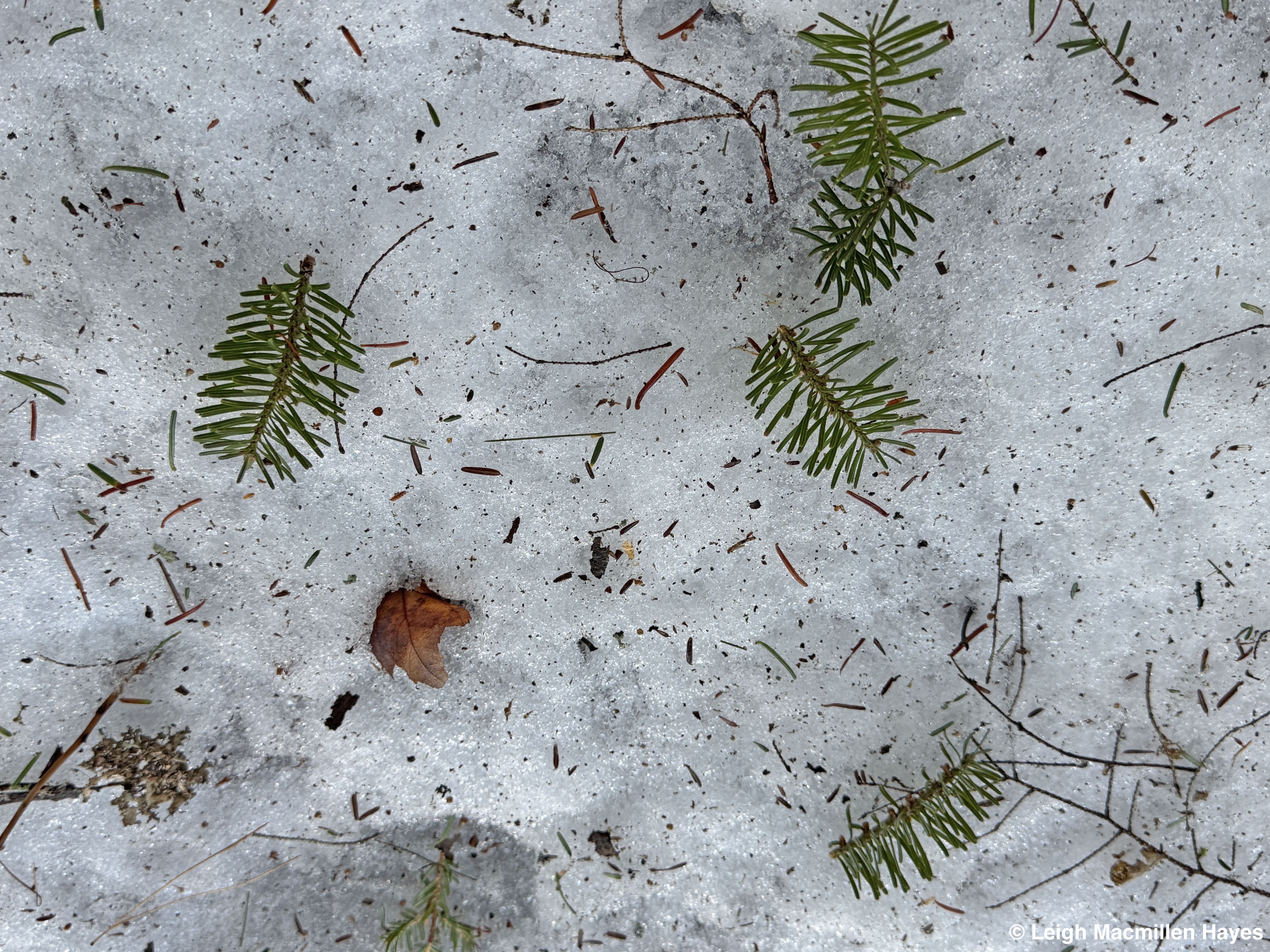
The sight of so many Eastern Hemlock twigs on the forest floor told me I’d stepped into Porky’s room so I looked for evidence, wondering if he was at his desk or not.

Lesson #2: Slow down and observe.

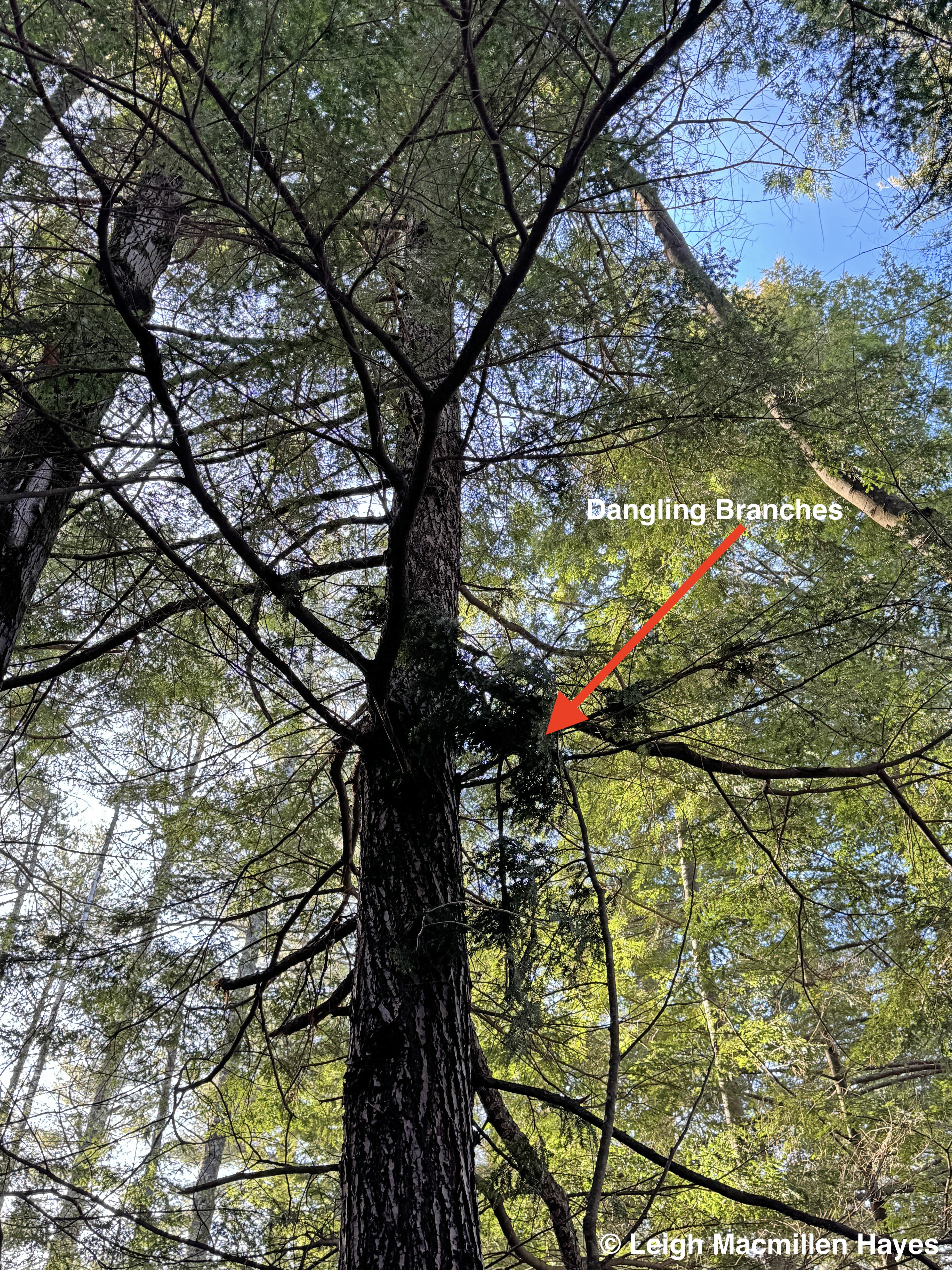
The answer was no, but he’d left his calling card on a dangling twig and so I know where I might find him should a prickly question enter my mind.

Because I was told by Red to slow down and observe, I noticed another spot where he’d visited and this time his midden was of a different sort in the form of snipped twigs. Much smaller snips than Porky drops, which is a good way to tell the two critter’s food source apart.

Just as Porky’s twigs had been cut with the rodent diagonal, so were Red’s.

I noted that he hadn’t eaten the buds at the tip of the twig, but once I flipped one over I discovered numerous buds or seed pods had been dined upon.

Lesson #3: Check twigs more often. And remember, this year was not a mast year for Eastern White Pines, so Red has to supplement with hemlock buds and cones. (And also remember, cones on hemlocks are not called pinecones because they don’t grow on pine trees. Conifer refers to cone-bearing, so both pines and hemlocks are coniferous trees.)

Back inside I decide to sketch a pinecone. It was a sketch I’d started months ago, but abandoned because it seemed to difficult to draw.

But then, thanks to Red, a realization came to mind.

Lesson #4: Pinecones have overlapping bracts or scales that protect those seeds developing inside of them. They close in the dark and open in light, especially on sunny days and it is then that the seeds become airborne on their samaras. And the bracts or scales grow in spirals around the core or what I think of as a cob. I knew that, but had forgotten it until I decided to sketch.

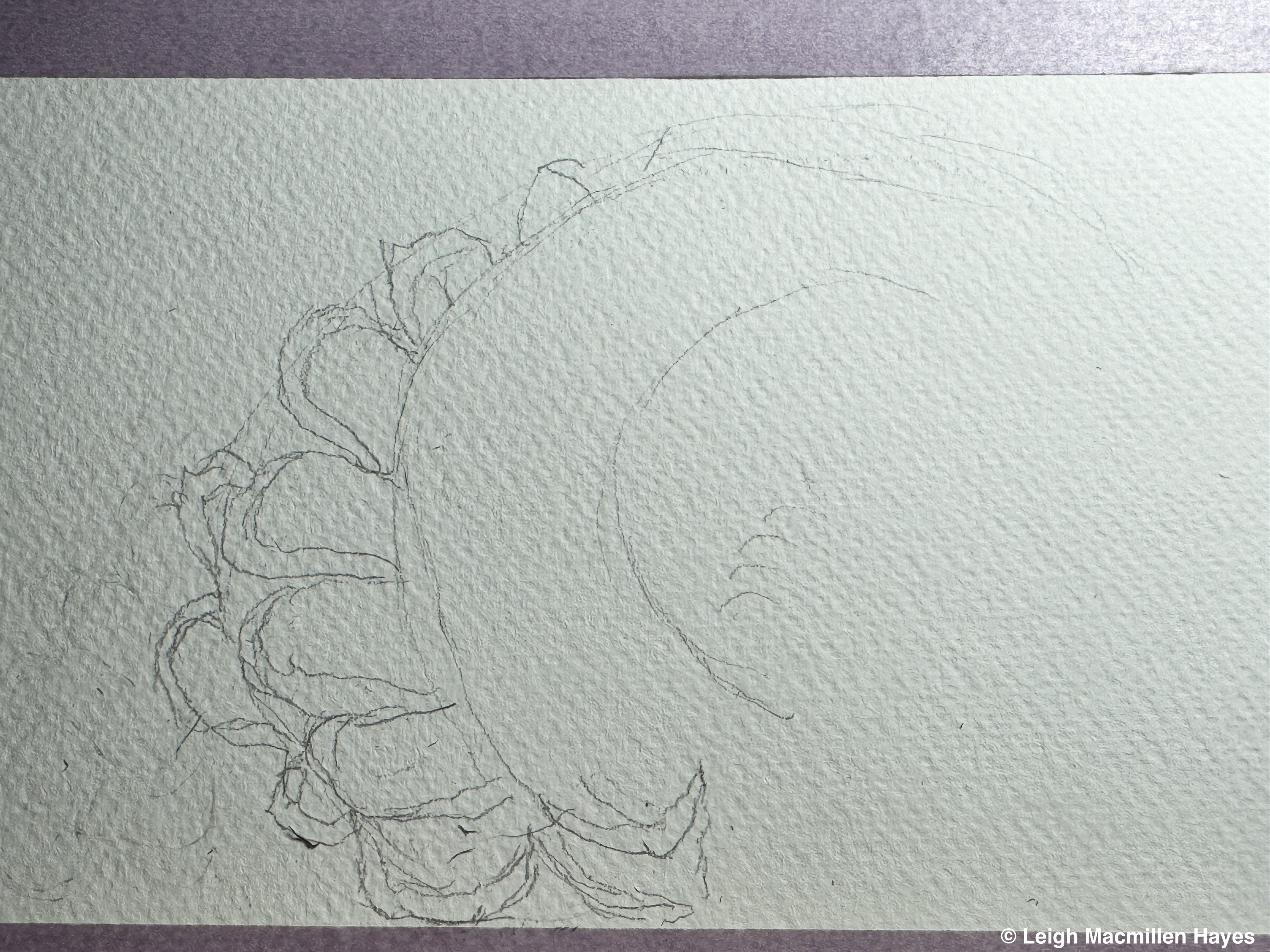
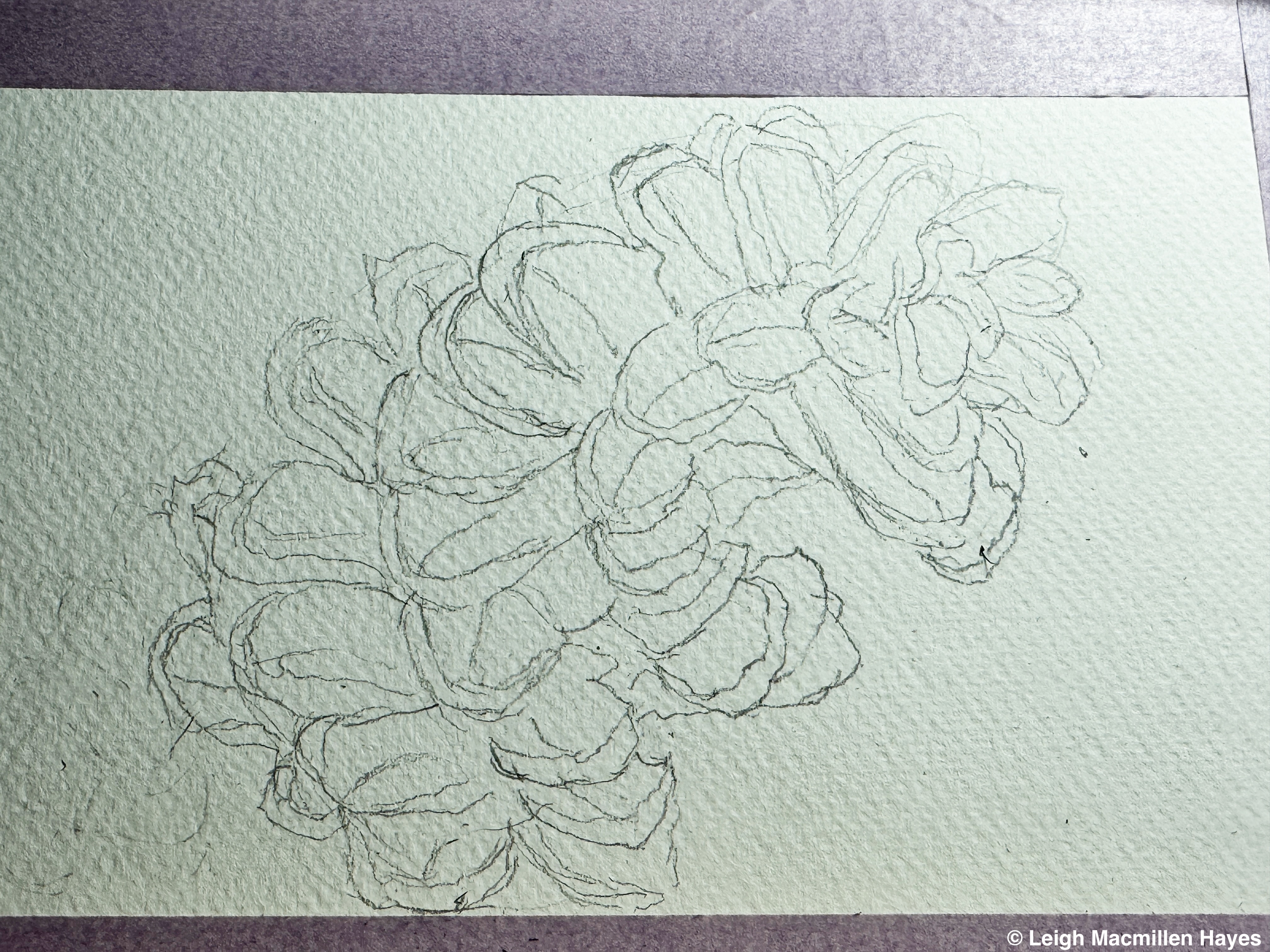
And so I drew some guidelines to aid me as I tried to recreate the cone’s spiral staircase.

It was fun to watch it grow and realize each cone actually fans out in a Fibonacci spiral sequence. It’s an amazing wonder of nature.

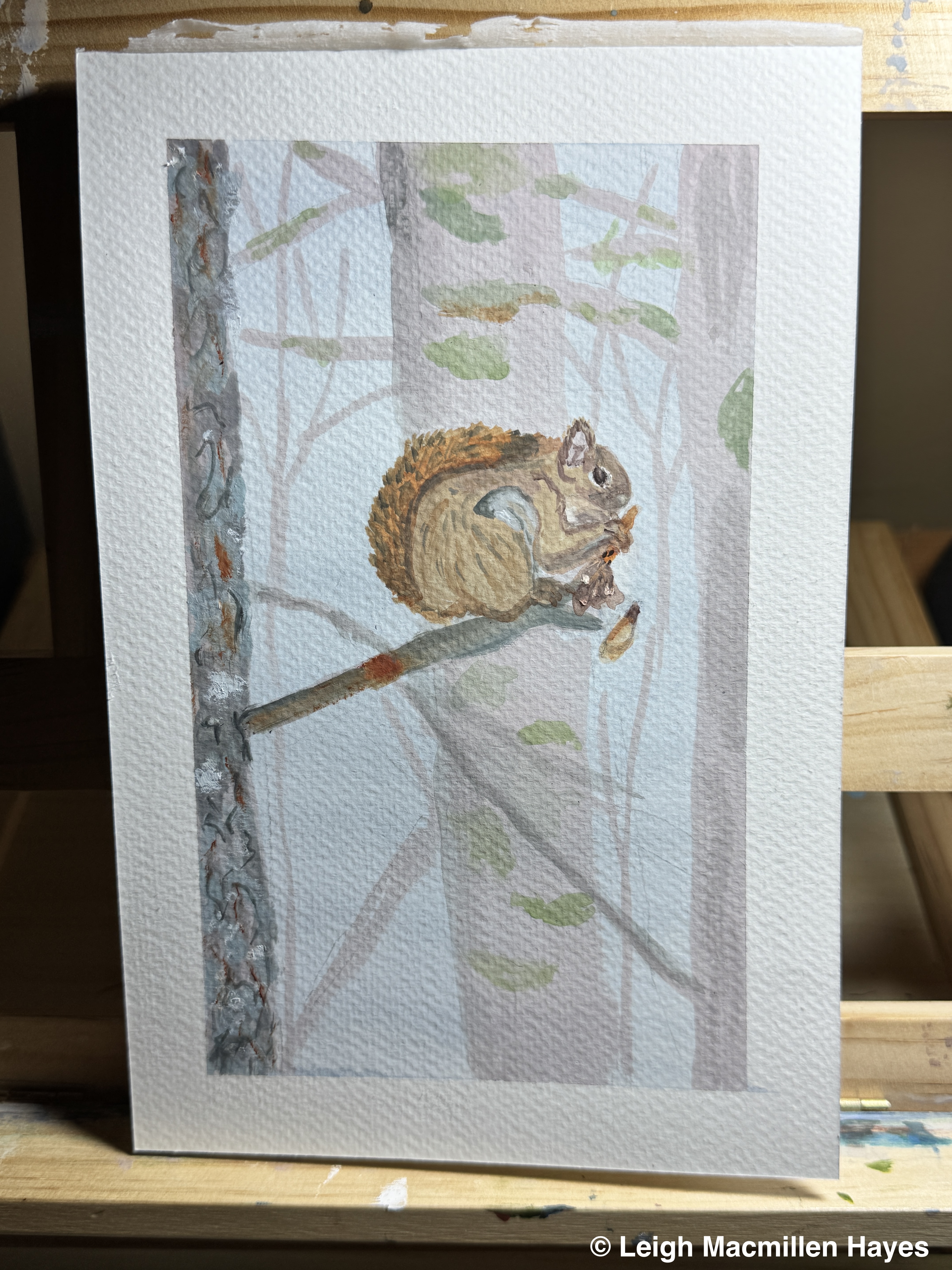
Feeling my drawing was complete, I began to add color in the form of gouache paint, scale by scale.

And slowly, the painting began to represent a cone . . . at least in my mind’s eye.

A dash more color and voila–my amateur attempt at painting a pinecone. I have to admit, I was rather tickled because I really didn’t think I could pull this one off. But I have my art teacher, the talented Jessie Lozanski, to thank for giving me the confidence to try.

And I have Red, my other teacher, to thank for the lessons because it was in watching him turn the cob ever so effortlessly that I was reminded about the cone’s spiral.

And so I tried to honor him as well. I may be a teacher, but I’ll always be a student.

Lesson #5: As we head into this new year, I hope you’ll join me in slowing down and noticing and honoring. Especially outdoors. Or even out your window.

I’m forever grateful to Red and all the other teachers who come in many forms, not just as mammals, for the amazing lessons I’ve learned and can’t wait for the next class.

Becoming Tree Wise

So here’s the deal. A friend and I were supposed to lead a tree workshop today, but the weather didn’t cooperate. I’m not complaining about the few inches of snow–it’s the sleet that came first and the rain that is now eating up some of the snow that bothers me.

That said, I’m going to take you on a deep dive to meet some of the trees of Maine in their winter format. We are so fortunate to live in a section of the country where there is such variety, but that doesn’t mean we all know a species with just a quick glance. Oh, maybe you do. I know I sometimes have to slow my brain down before my mouth makes an announcement.

I found a drawing of a tree “cookie” on the internet this past week and decided to recreate it in one of my sketch books this morning. I like it because it helps me better understand how a tree works.

The key factor here is that trees are made of . . . wood. You knew that. But, what exactly is wood? Think scaffolding and plumbing. A tree needs structure to grow so tall, but it also very much needs food and water. Two components, therefore, make up the wood: Xylem and Phloem. Xy (think sky high) transports water from the roots, while Phloem (Think flow low) moves the sugar made in the leaves via photosynthesis during the summer down through the trunk.

As you can see from the sketch, the Phloem is only present on the outer layer of a tree–right under the bark. The Xylem makes up the majority of the wood.

And all those Xylem cells–they are made up of an outer wall of lignin, which gives the trees structure, and an inner layer of cellulose, which provides flexibility. Some trees, like Gray Birch, have a high concentration of cellulose, thus allowing them to bend under the weight of the snow, usually, but not always, without snapping.

The Xylem actually acts as a bunch of straws pulling up water, along with nutrients and minerals, from the soil. But can we actually see this action occuring in the trees? The answer is a resounding, “No.” It’s not at all like we might use a straw to slurp up a frappe, but rather a passive flow, where the water molecules evaporate through the stomata (holes in a leaf surface, similar to our pores), they draw other water molecules upward from the soil to the roots, and the roots to the Xylem, and the Xylem to the leaf, and the leaf to the air (Think water vapor = Transpiration).

Going back to the sketch above, the early wood of each year, which occurs in spring and summer, is much lighter in color than that of the late wood, but the two together create a ring documenting that particular year.

The heartwood, which isn’t labeled, is the inner core. It provides support for the trunk and is actually dead because over time the Xylem gets clogged up with resin. And each year more of the tree dies from the inside out.

If you are still with me, let’s get to the actual trees I want you to meet.

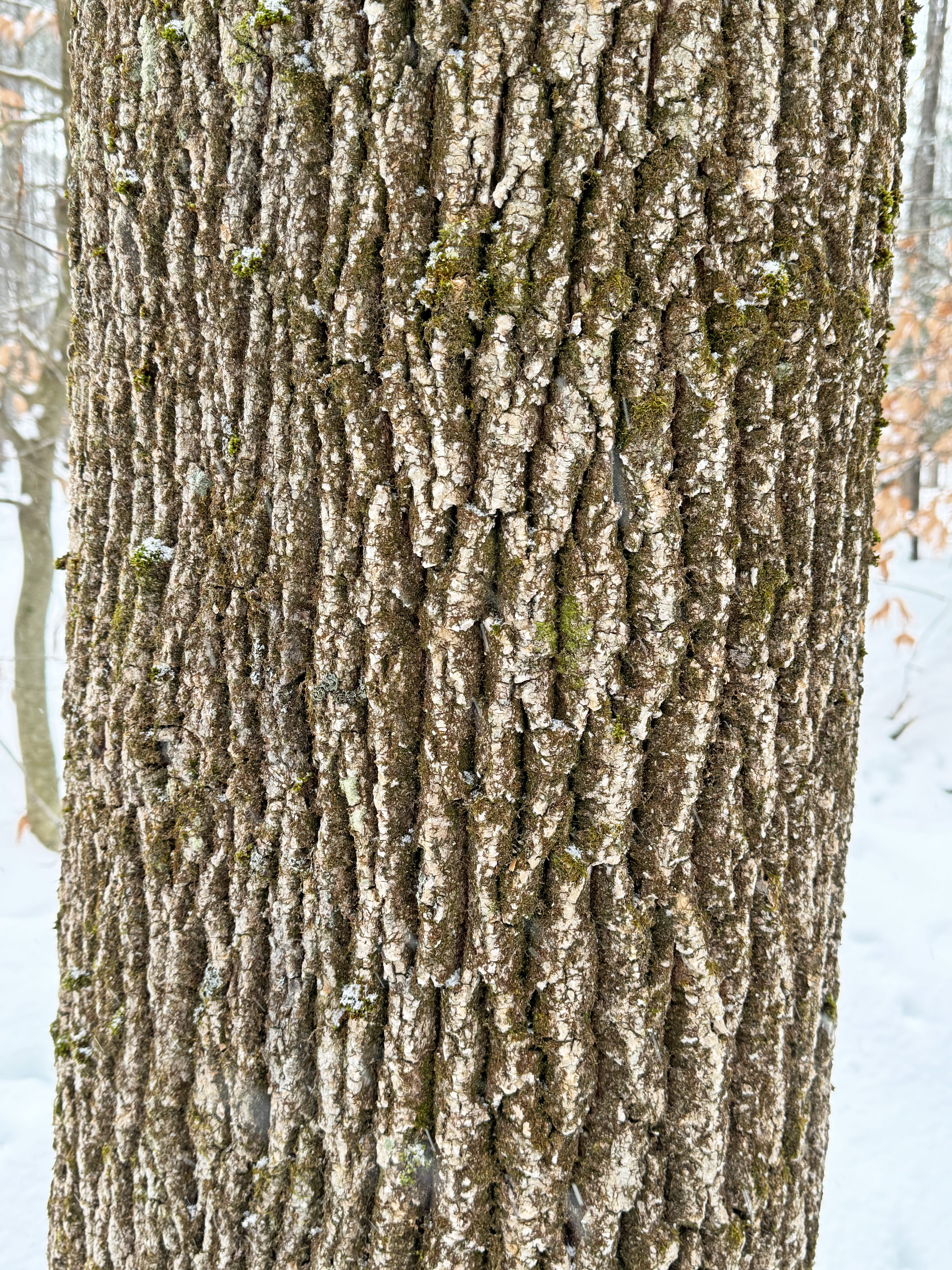
Up first is a White Ash, Fraximus americana. This is one of those species that once you get to know it, you spot it from a distance because of the pattern of the bark. What exactly is the pattern? Well, I see intersecting ridges that form obvious diamond-shaped furrows which appear as an X or cantaloupe rind, but others see an A for Ash, and still others see a V, and some even spy a woven basket. The thing is, whatever pops out for you and will help you identify it in the future should be your go-to image stored in your brain.

One of my favorite things about Ash bark is that it is corky and after a storm, you can pinch water out of it or stick a fingernail into it.

The twig is quite stout and ashy-gray in color. The buds are opposite, and the terminal bud at the tip of the twig is rounded or dome-shaped.

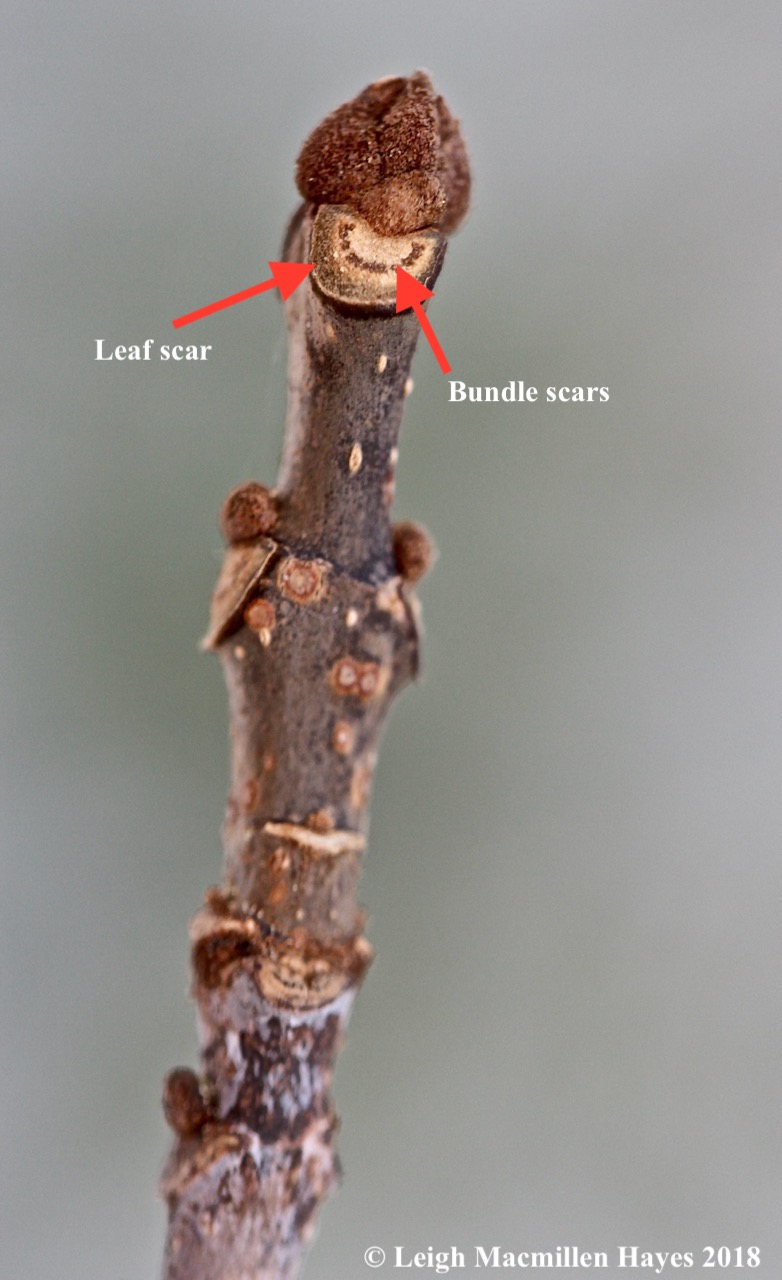
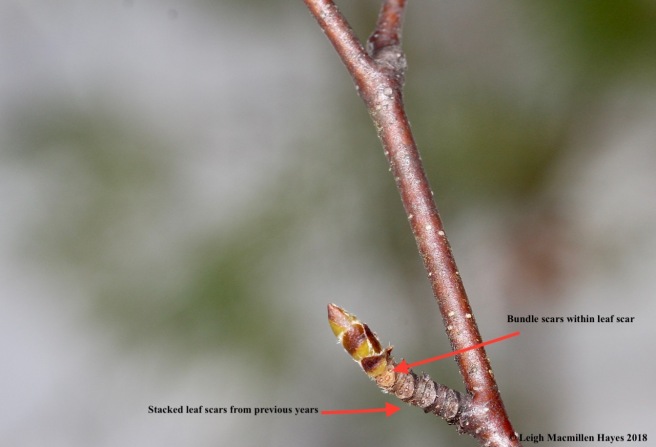
One of the features that speaks to the color of this Ash is the shape of the leaf scar below the new bud. A leaf scar is where last year’s leaf was attached until the end of the growing season. At that time an abscissa layer formed between the petiole (stem) and the twig. The leaf fell off and the tree healed the wound quickly with a protective cork. The bundle scars are part of the pipeline as they were the vascular tissue contained in the petiole of the leaf. Each tree has its own number of bundle scars located within each leaf scar.

Back to the shape–can you see how the bud dips a bit down into the leaf scar rather than sitting across the top of it. This tells us it is a White Ash and not a Green Ash. Add to that the fact that the terminal bud is not hairy.

And my rendition of White Ash bark.

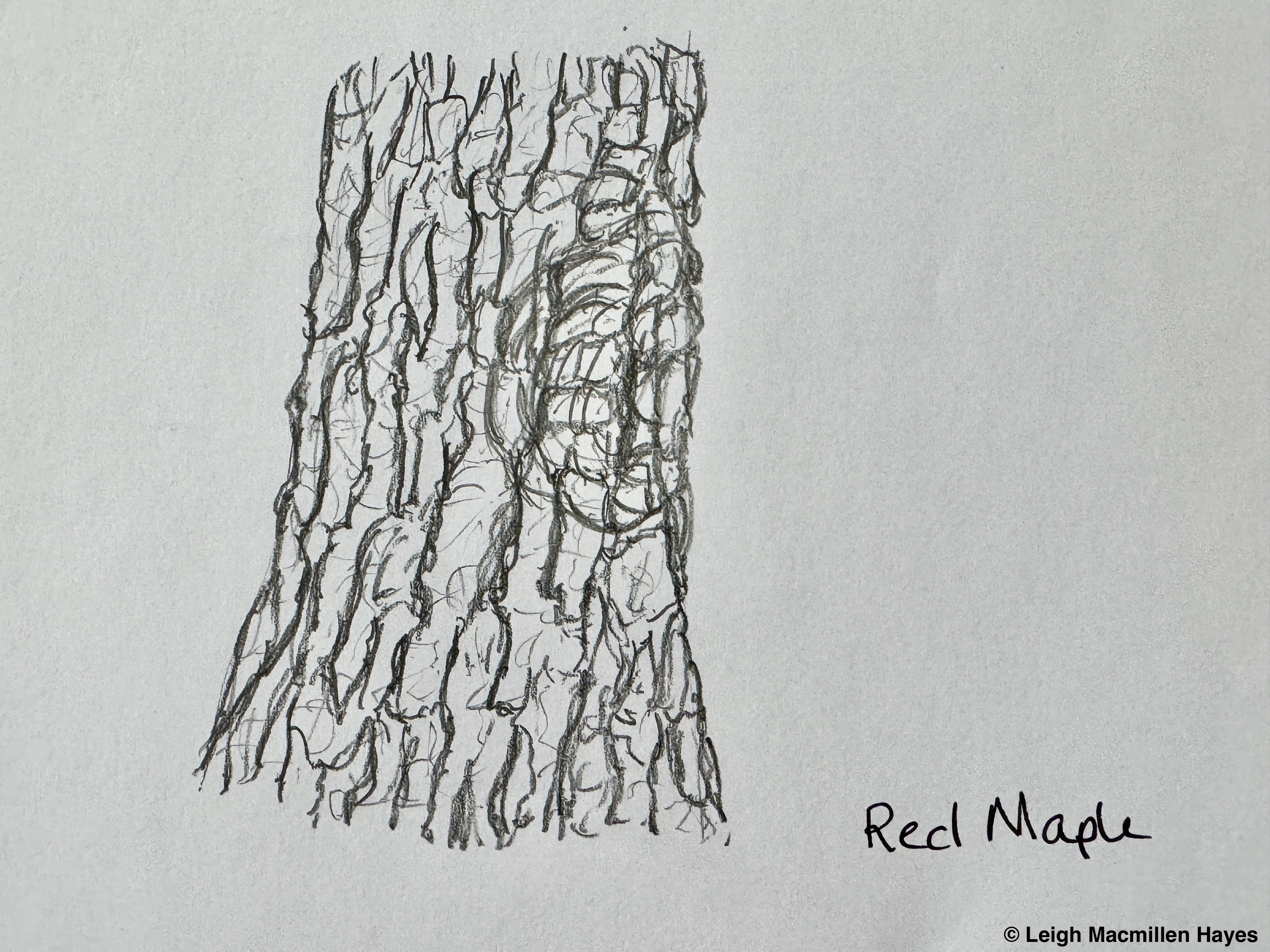
Up next is another favorite. Oh never mind. They all are my favorites. This is a Red Maple, Acer rubrum.

The bark is light to dark gray in coloration and almost smooth with crackled, vertical, plate-like strips. It curls outward on either side, and on older trees, look for tails to curl out on ends of strips.

Sometimes, it is difficult to determine if a maple is Red or Sugar, but one of the clues I look for is the Bull’s Eye target on the bark. There are several on this one, can you see the rounded patterns that aren’t completely formed? The target is formed as a reaction to a fungus.

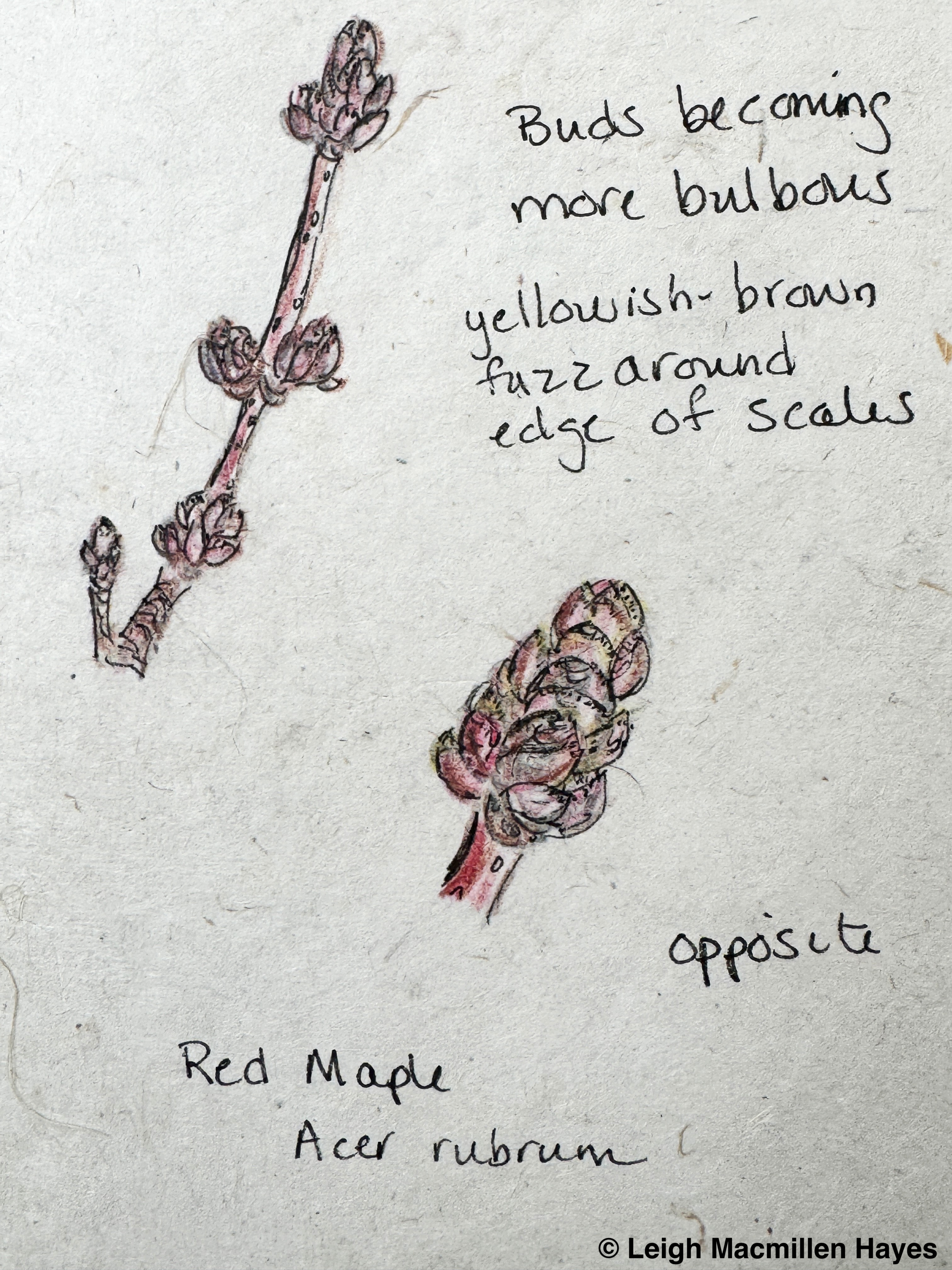
Again, this is a tree with opposite branching. So one of the keys to tree ID is to know if the branching is opposite or alternate. I love this mnemonic devise: Very MAD Horse. Trees/shrubs with opposite branching include Viburnums like Hobblebush; Maples; Ash; Dogwoods (unless it’s the Alternate-leafed Dogwood); and Horse Chestnut.

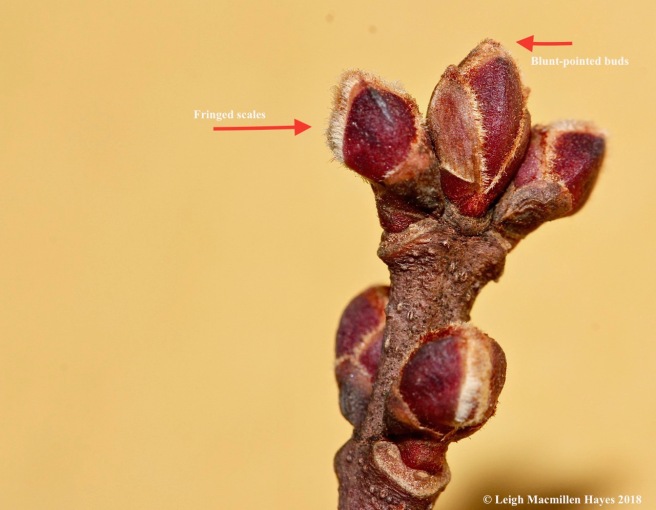
As you can see, the buds are red. This is another clue that it’s a Red Maple: there’s always something red on the tree. Sugar Maple buds are much smaller and brown.

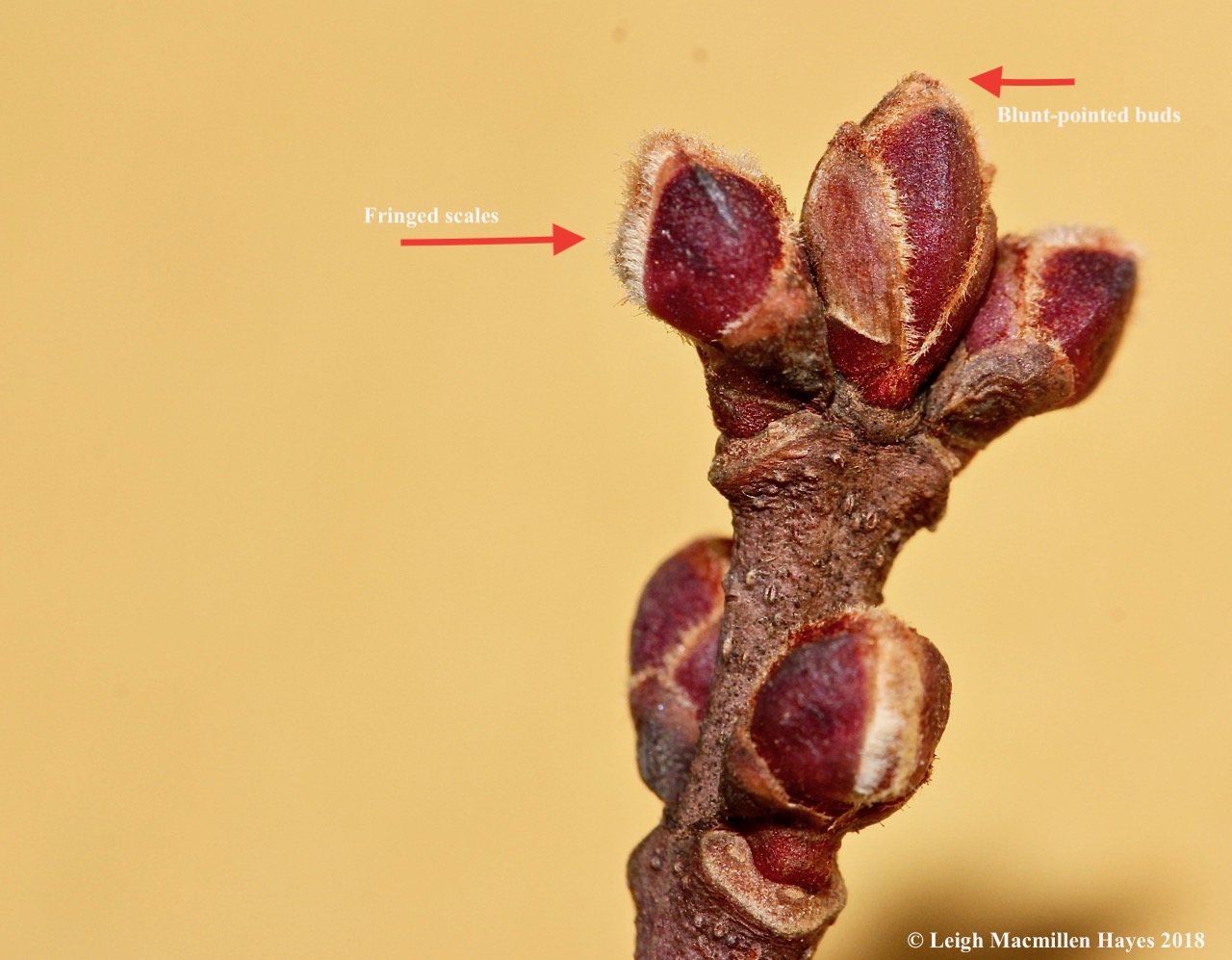
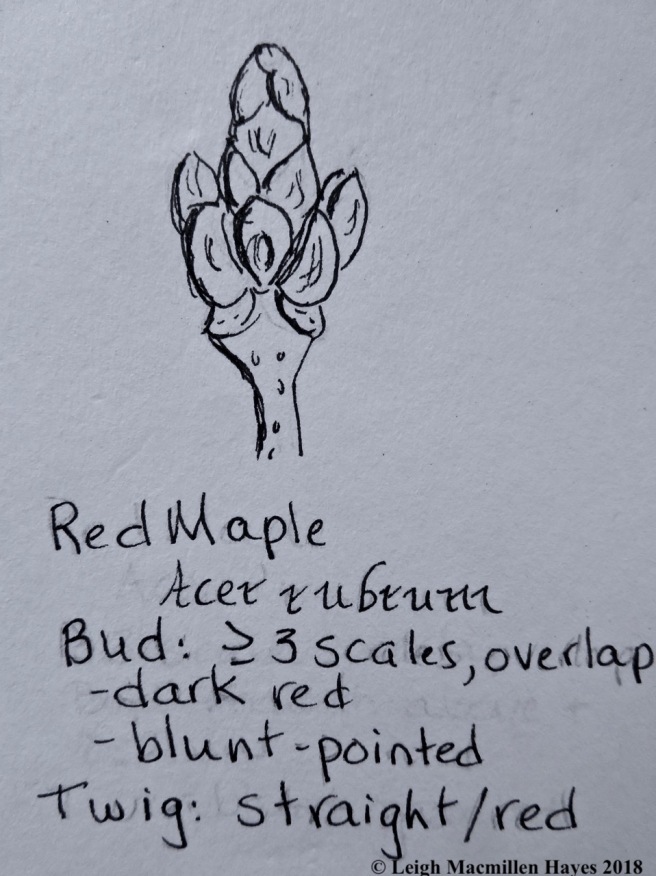
Each bud has 3 or more scales and each scale is fringed with little hairs. The twigs are straight and also red, especially newer wood.

My rendition, though I do need to work on the target.

And the twigs/buds, which are already becoming more bulbous. I have to be honest with you. As a kid and young adult, I did not know that buds for the next year form in the previous summer and overwinter under those toasty scales for protection. I suppose I never actually thought about it. But of course they do, because that’s when the tree has the most energy. In April, they will flower, and by May the leaves will begin to form.

But right now, it is snowing again–YAHOO!

American Beech, Fagus grandifolia, is our next exhibit. These trees can tolerate shade and I will never forget when a local forester showed some students a tree cookie that was about two inches in diameter and he asked one to count the number of tree rings. Sixty years old. Yes, they tolerate shade.

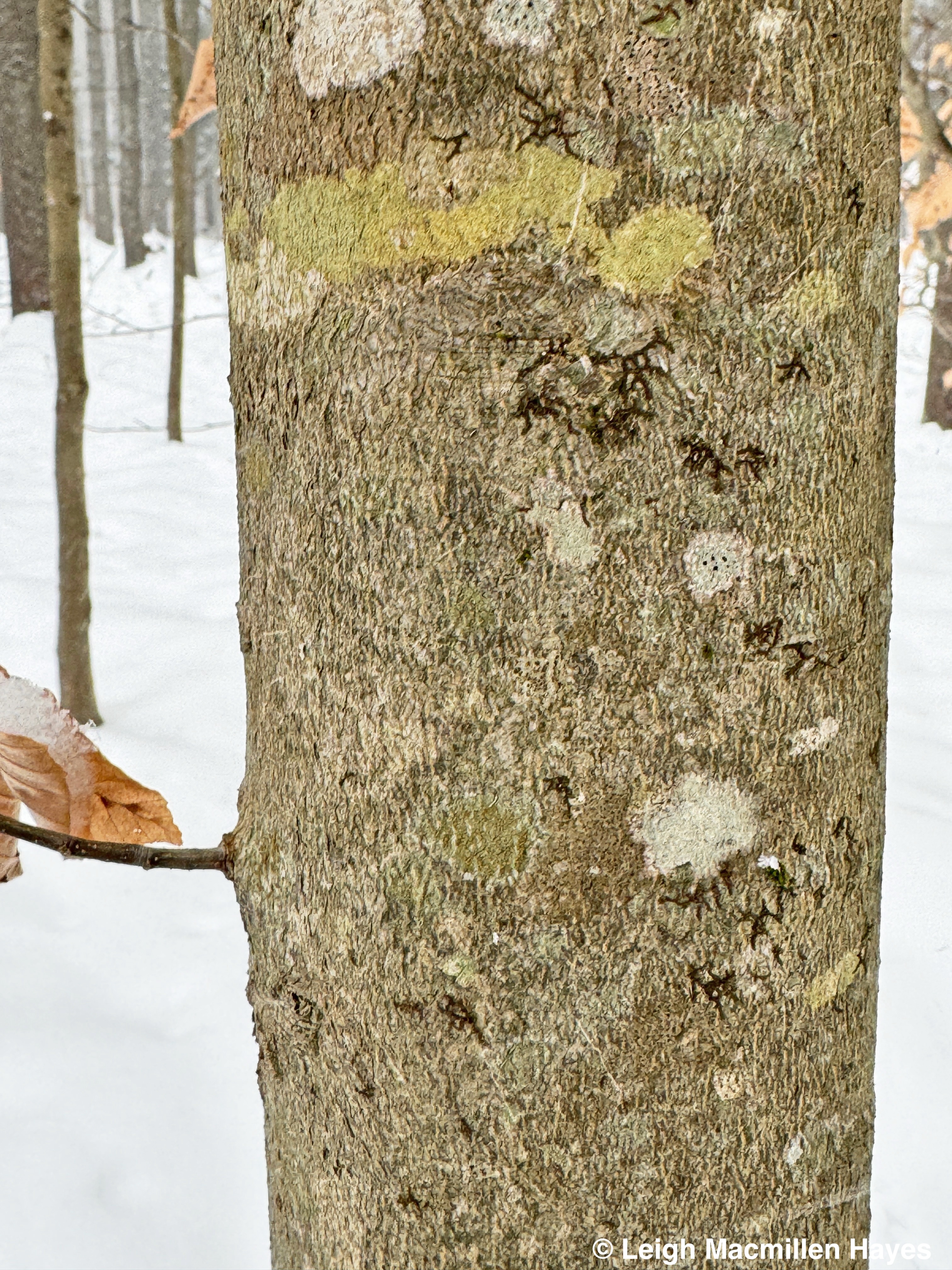
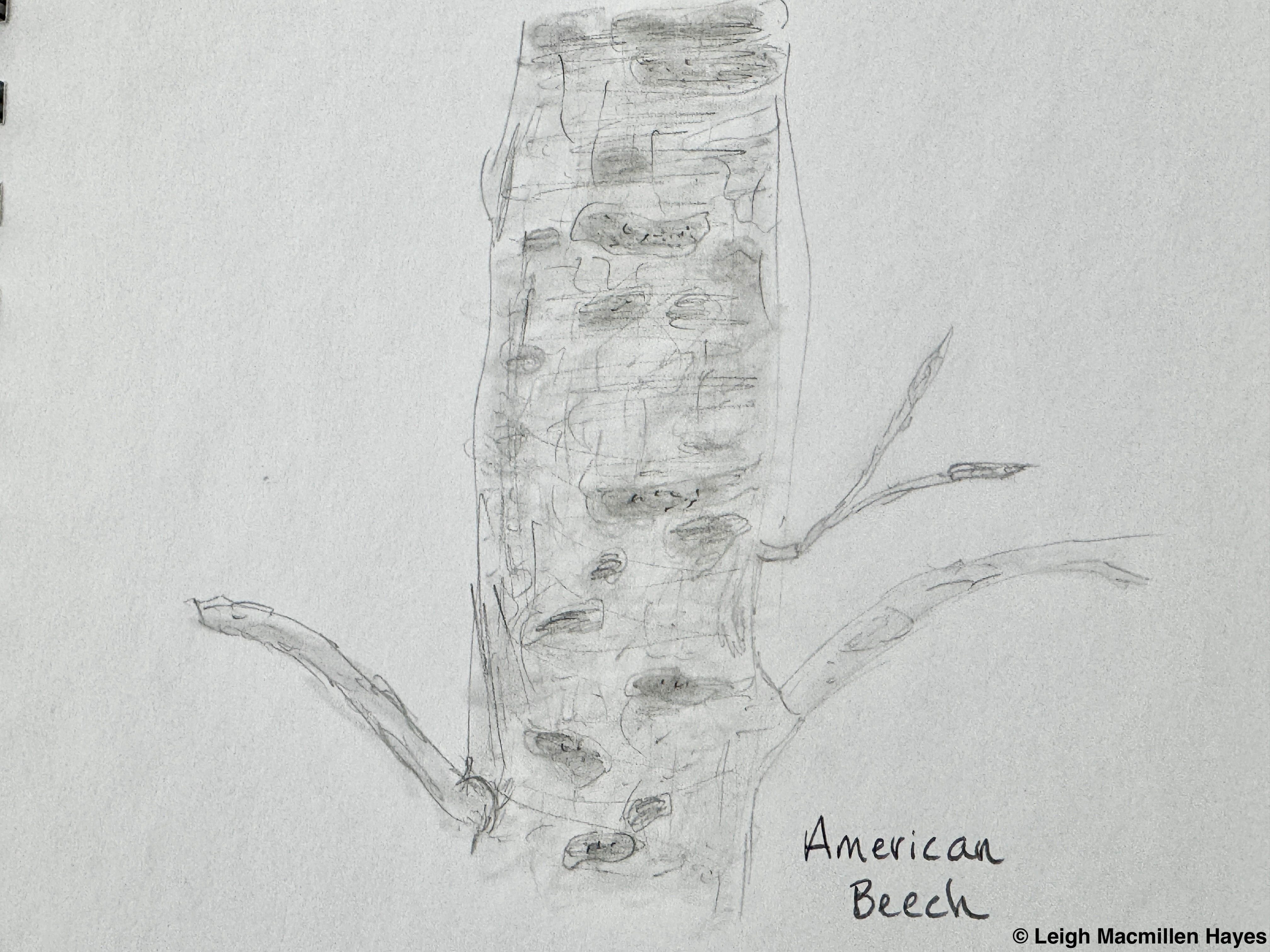
In fact, Beech trees tolerate a lot. Typically, the bark is smooth, unless . . . there are cankers or blisters dotting it that are caused by the tree’s reaction to a fungus that gains access via a tiny puncture made by Beech Scale Insects. The insects are teeny little things, with fluffy white coatings, and they congregate on the bark for 50 weeks, where they pierce the tree repeatedly to get sap. For two weeks of their lives, they can fly. The rest of the time, they stay put and sip.

Another thing that Beech trees tolerate is Bear Claw marks and if you are a follower of wondermyway, I need say no more. If not, search for bear claw trees in the search bar.

They also tolerate humans carving initials. More than they should; And those initials and those bear claw marks will always be present as long as the tree lives. In fact, they’ll be in the exact same place at the same height that they were originally made, but they’ll have widened a bit each year.

All trees grow out from the heartwood, and up from the uppermost branches. So if you place a trail blaze on a tree, it will always be in the same spot, you just need to make sure that you don’t screw it all the way into the tree or the tree will grow around it eventually. (Rule of thumb: leave about two inches between the sign and the tree; and check it each year)

Beech twigs are deep brown with white lenticels. Oh yikes. We haven’t talked about lenticels yet. All trees have them. A lenticel is like the pores in our skin and allows the tree to exchange gases. Lenticels come in a variety of shapes including raised circular, oval, and elongated. (Remember, leaves have stomata for the same purpose.)

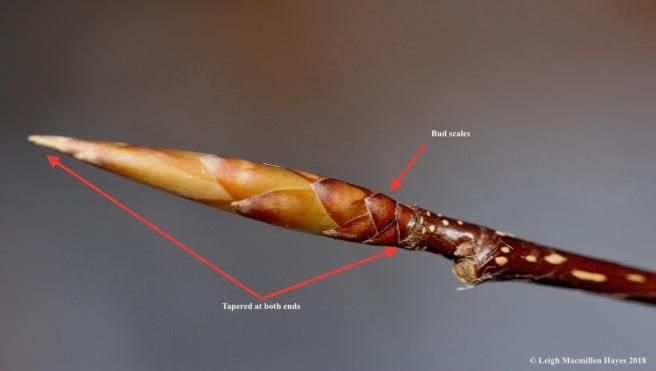
As you can see, the bud is sharp-pointed, covered with many scales, and a delightful golden brown. Some see it as a cigar. That description doesn’t work for me, but it is tapered at both ends. And really, nothing else looks like this in the north woods. While this photo is of a terminal bud, the twigs and buds are alternate.

Leaves on Beech are marcescent and wither on the trees over the winter. In fact, if there is a sudden breeze and the leaves start to rattle, I’ve been known to become rattled, thinking there is something or someone else in the woods with me.

And this time I present American Beech, which can be blotched with crustose lichens (look like they’ve been painted onto the bark).

And a twig, showing the growth rings, which occur where the previous year’s terminal bud had been.

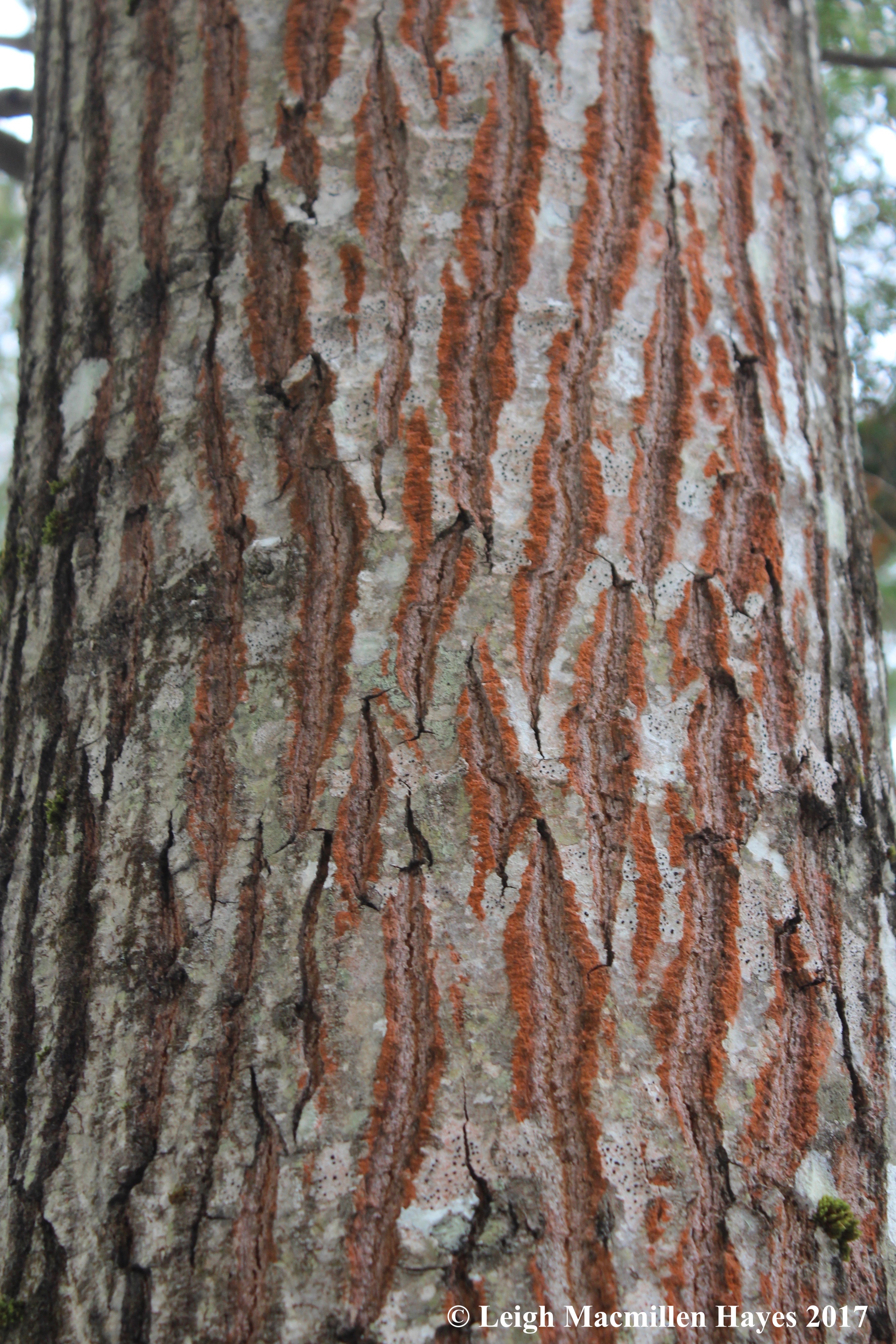
And now for an upclose look at the bark of Northern Red Oak, Quercus rubra. (I almost wrote Maple, and for some you’ll know that as “my mouth or in this case my fingers before my brain”–like when I call a Beech, that I know darn well is a Beech, a Birch. Such is life.)

Red Oak bark is greenish brown or gray and has rusty red inner bark. When I look at it, I see wide, flat-topped ridges that run vertically parallel but also intersect like ski tracks. Shallow furrows separate the ridges.

The red inner bark is especially noticeable in winter.

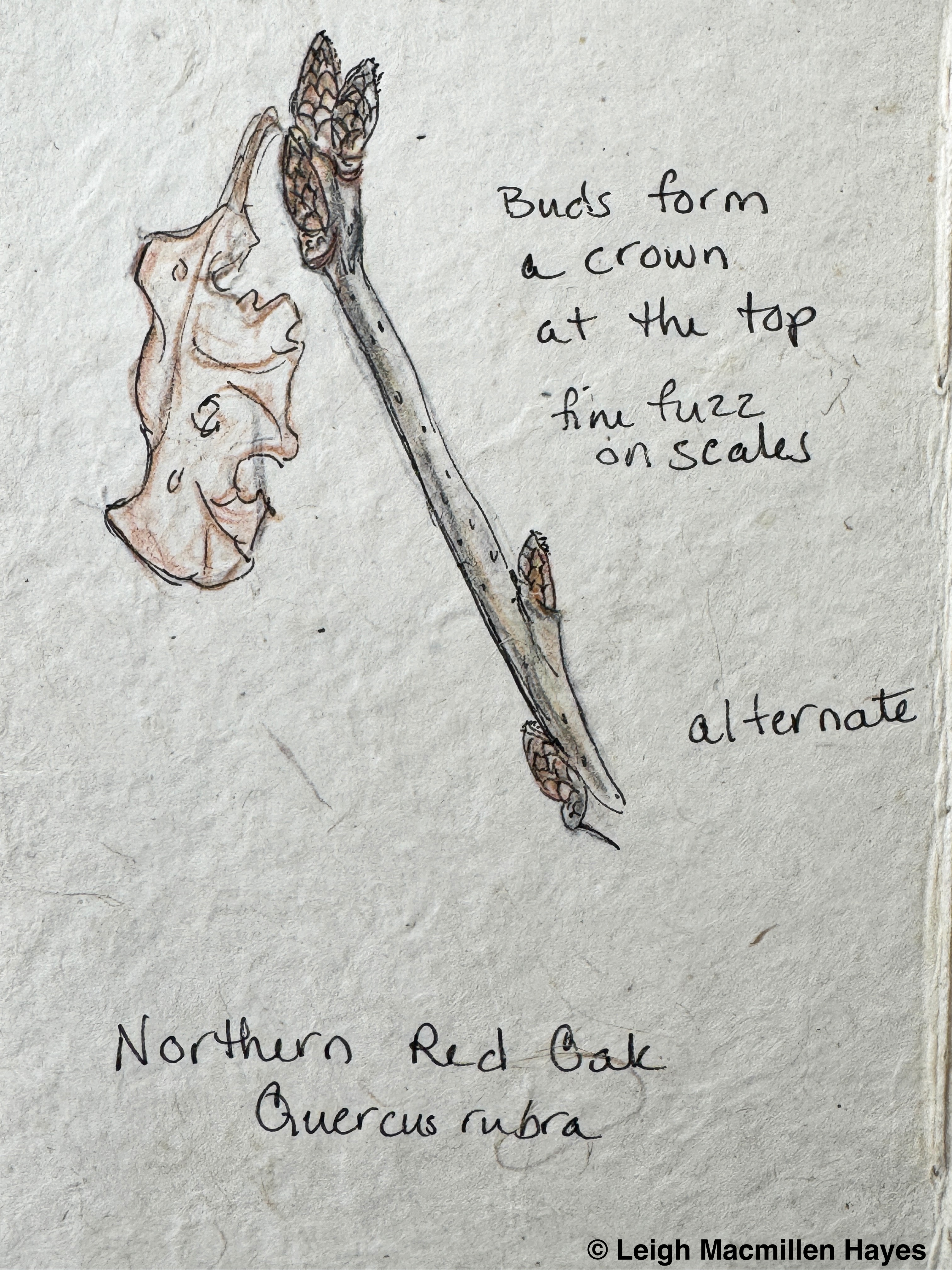
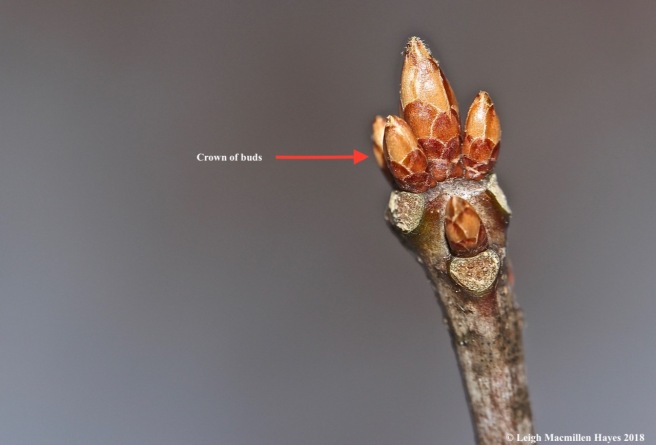
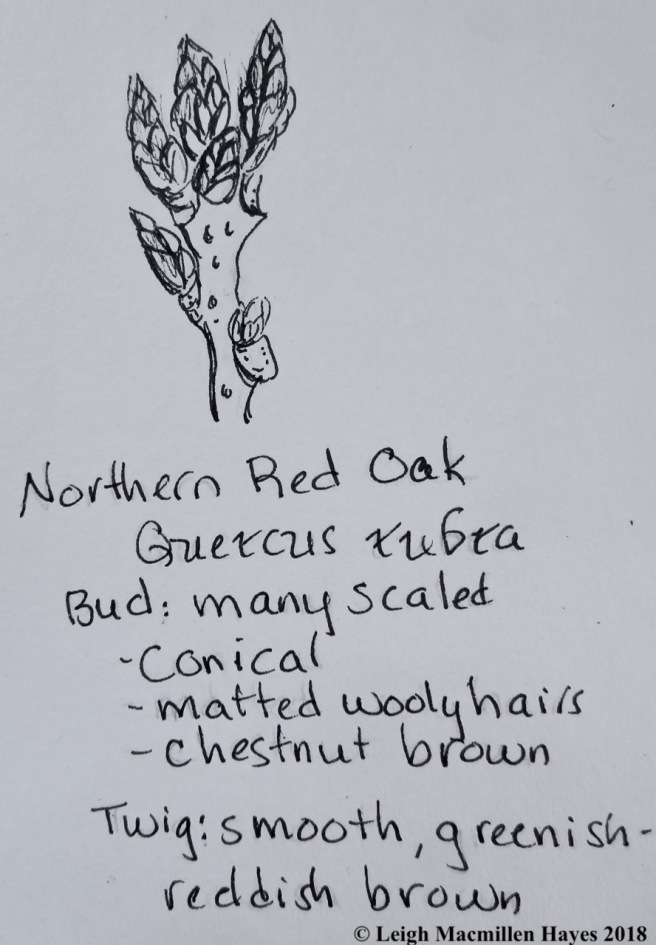
The twigs and buds are alternate in orientation. The twigs are smooth, and greenish brown, but the buds are much more intersting as they occur in a crown at the tip of the twig. Each bud has many scales and matted wooly hairs. I love their chestnut brown color.

My rendition of a Northern Red Oak.

And the twig. As you can see, there are also buds along the twig, not just at the tip, and they do grow alternately. Also, Oaks have marcescent leaves as well, though most fall off before spring. I did spot a very mature Red Oak the other day that is overwhelming full of dried leaves.

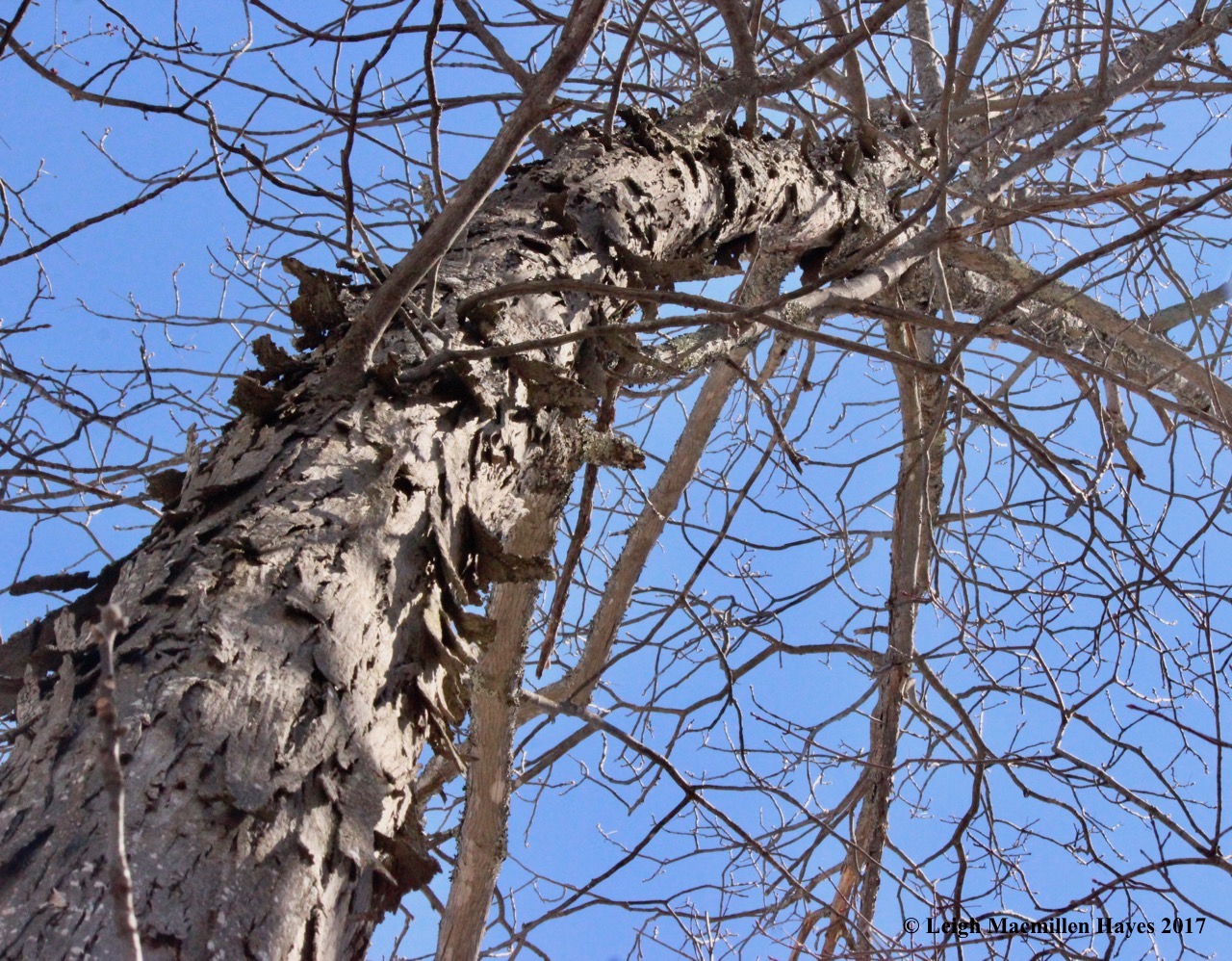
And now let’s meet several members of the Birch Family. Up first is the Paper Birch, Betula papyrifera. You may know this commonly as a White Birch, but I prefer Paper, and will explain why after introducing you to its kin.

Betulin is a compound in the cells of the outer bark that is arranged in such a way as to reflect light and make it appear white. The betulin crystals provide protection from the sun as well as freeze/thaw cycles. It also protects the tree from pests. And to top it off, betulin is the reason the bark is a good fire starter as its highly flammable and waterproof. Your go-to for a rainy day fire. It was also used to build birch bark canoes.

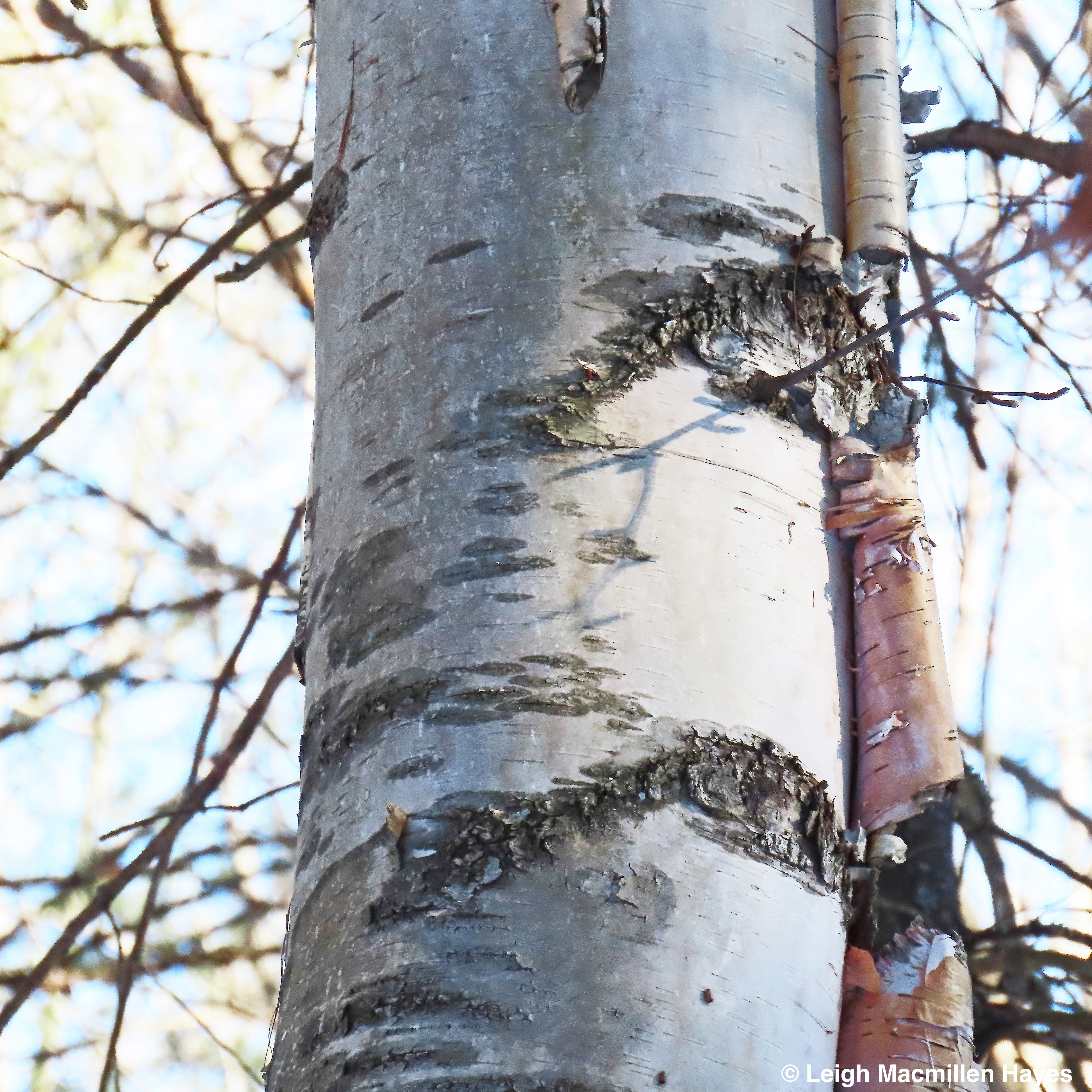
Young Paper Birch bark is white, but often with an orange and pinkish tinge. It has thin, horizontal, light-colored lenticels. As it matures, the bark changes from white to creamy white. Sometimes I even see the colors of a sunset in it, including some blue in the winter.

The outer layers separate from the trunk into curled sheets, thus the paper nomenclature. But, I caution you not to pull it off, as prematurely exposing the cambium layer may harm the tree.

Older bark can sometimes make this tree more difficult to identify because it has gray sections of rough, irregular designs, especially around the base.

One of the features I look for on a Birch to determine if it is a paper, besides the curly bark, is the mustache that is drawn over the branches on the trunk. In the photo above, the branches are no longer there, but do you see two mustaches? Sometimes both ends droop down even more.

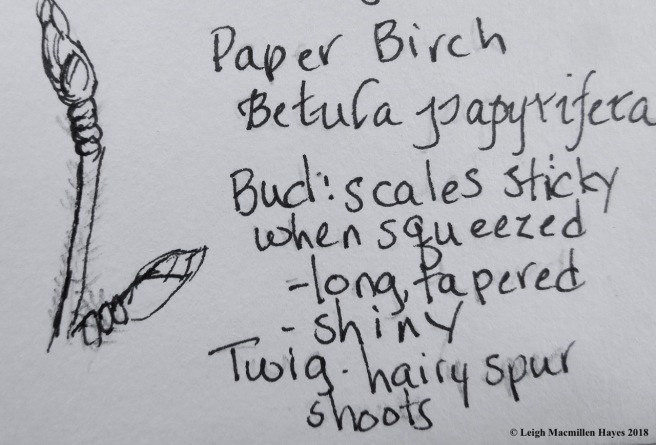
The twigs of Paper Birch are alternate, as are the buds. New growth on a reddish brown twig is usually hairy. And buds may grow on shoot spurs, which I’ll show you in a minute.

Paper Birch buds are covered with scales that are sticky, especially if squeezed. And for the most part, they are not hairy.

Their flowers are in the form of catkins, with tiny seeds protected by fleur de lis-shaped scales. Paper Birch catkins appear mostly in clusters of three.

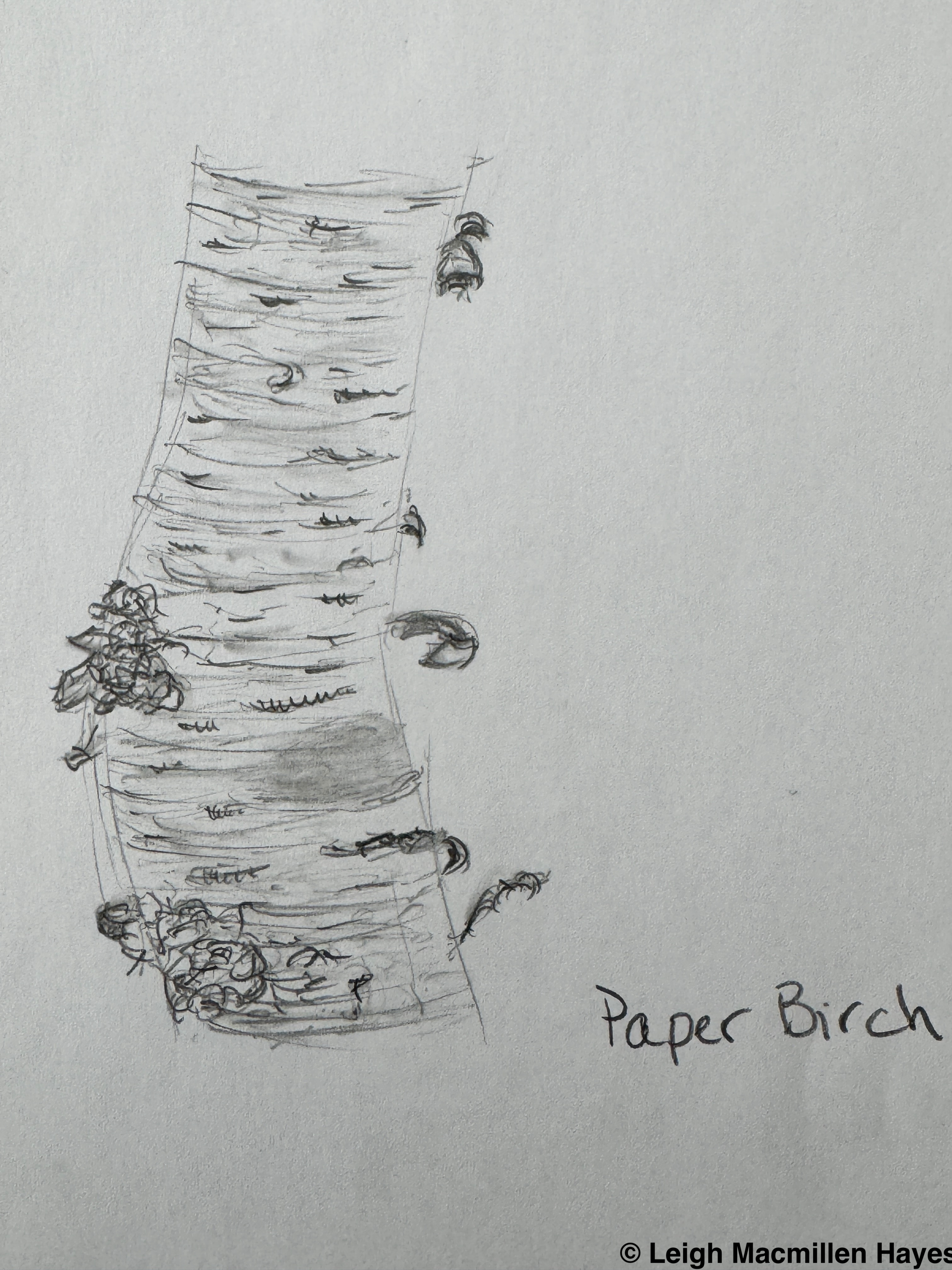
My rendition, though I need to sketch one with the branches and mustaches. Another day.

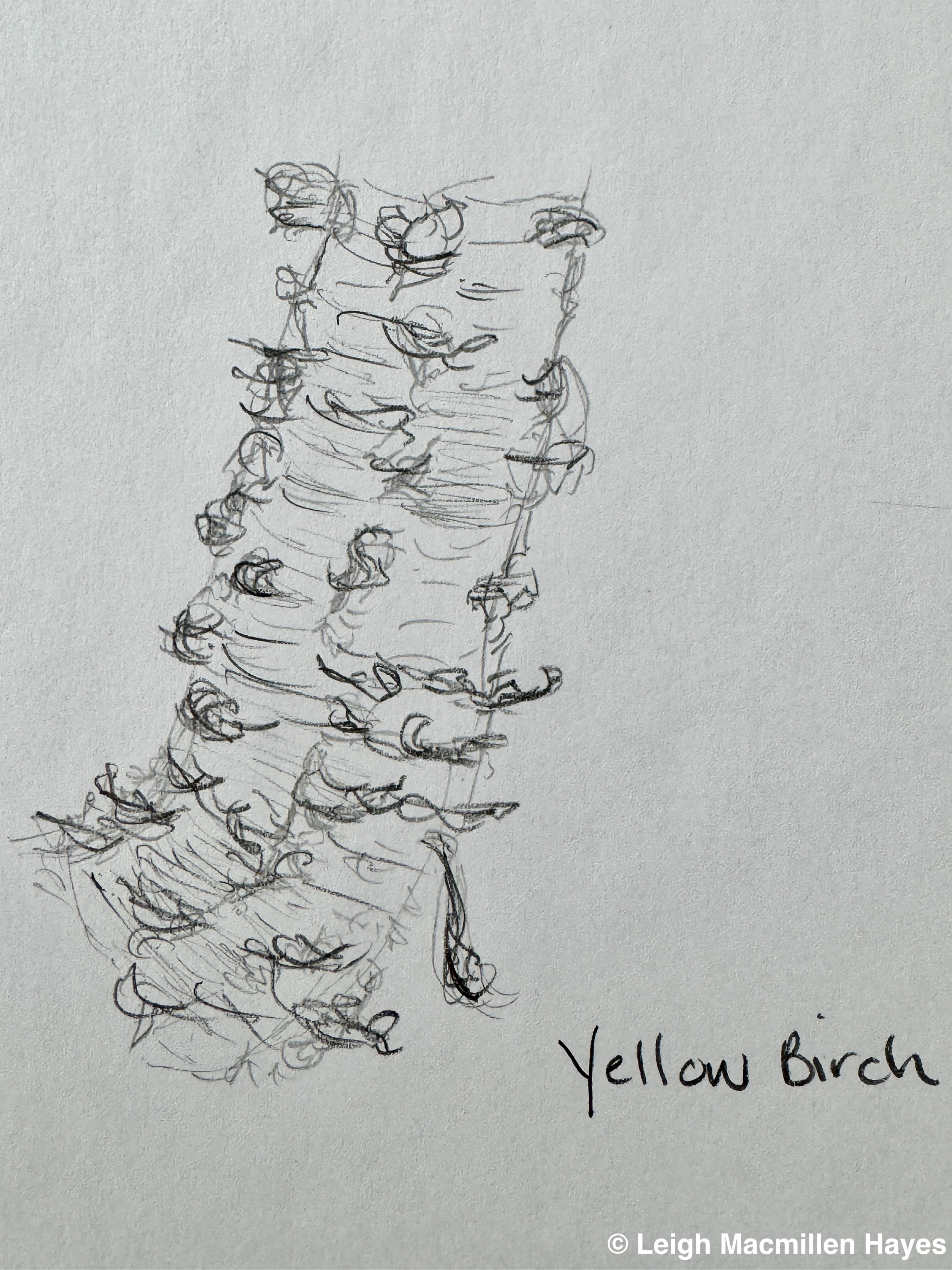
This sweet tree has long served as a reminder to me to go off trail and look for a mesmerizing spring of water. Oh, not every Yellow Birch reminds me to do that, but I know where I took this particular photo and the spring is about an eighth of a mile behind it.

Yellow Birch, Betula alleghaniensis, has bronze to yellowish-gray bark that is shiny. And it too curls, but this time it curls away in thin, ribbony strips, giving the bark a shaggy appearance.

One special note about Yellow Birch, and the same is true for one of our conifers that I’ll discuss soon, is that the seeds struggle to germinate on the forest floor, but give them a moss-covered rock, or tree stump, or nurse log, and bingo, a tree grows on it. As it continues to grow, the roots seek the ground below and if it is upon a stump or log that eventually rots away, you have a tree in the forest that appears to stand on stilted legs.

So I mentioned for Paper Birch that they have spurs of stacked buds and so do the Yellow Birch. The bud appears at the end of the stack and by the leaf scars left behind you can count the age of the spur.

The twigs are not hairy, but they have their own unique distinction. I wish I could share this with you, but you’ll have to go out on your own and find a Yellow Birch twig–the distinction is a scratch ‘n sniff test. If you scratch it and smell wintergreen, then you have found a Yellow Birch.

Three to four catkins appear on Yellow Birches, but they are not clustered, so that’s another clue as to the color/name of the tree.

My Yellow Birch.

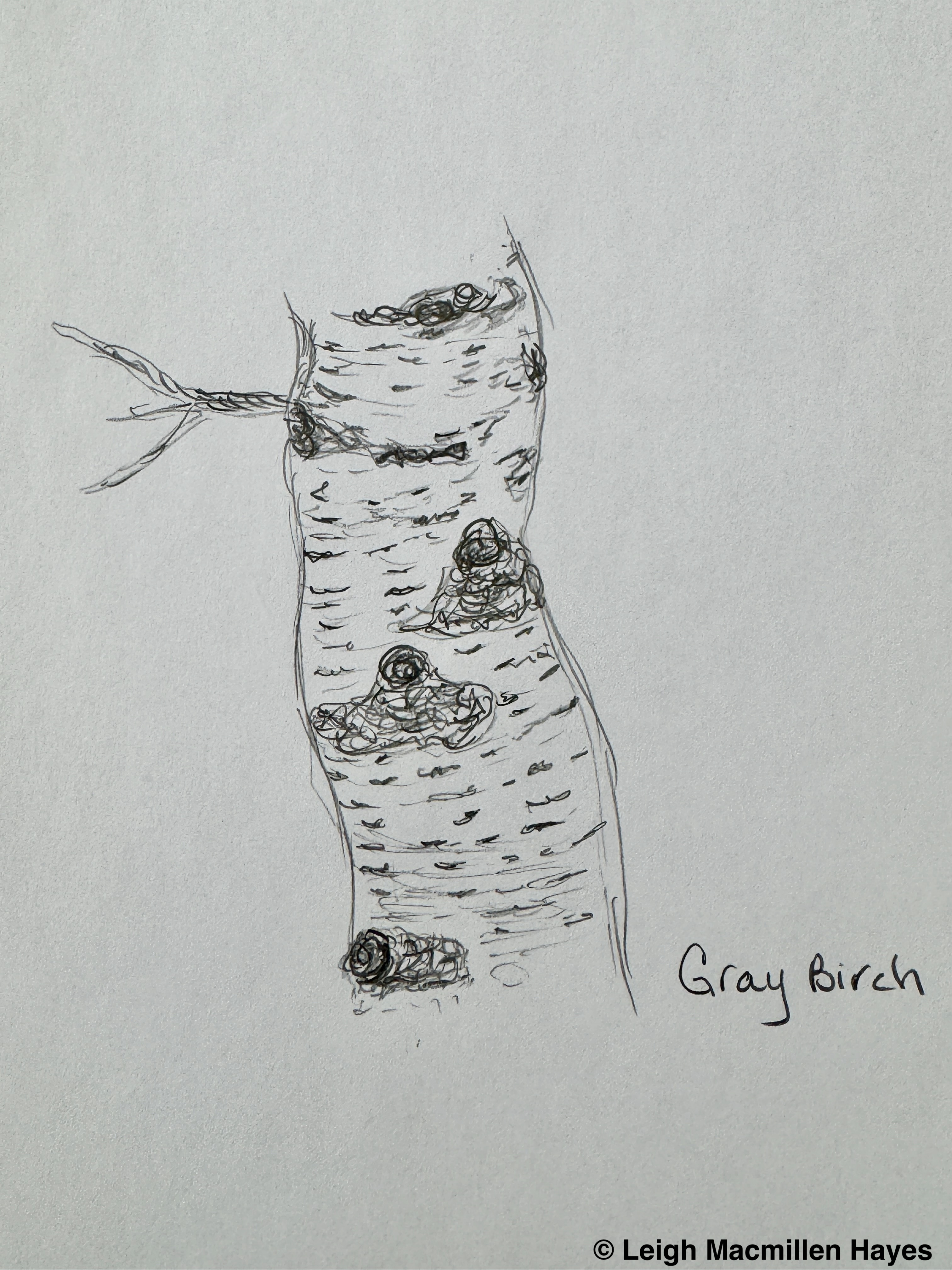
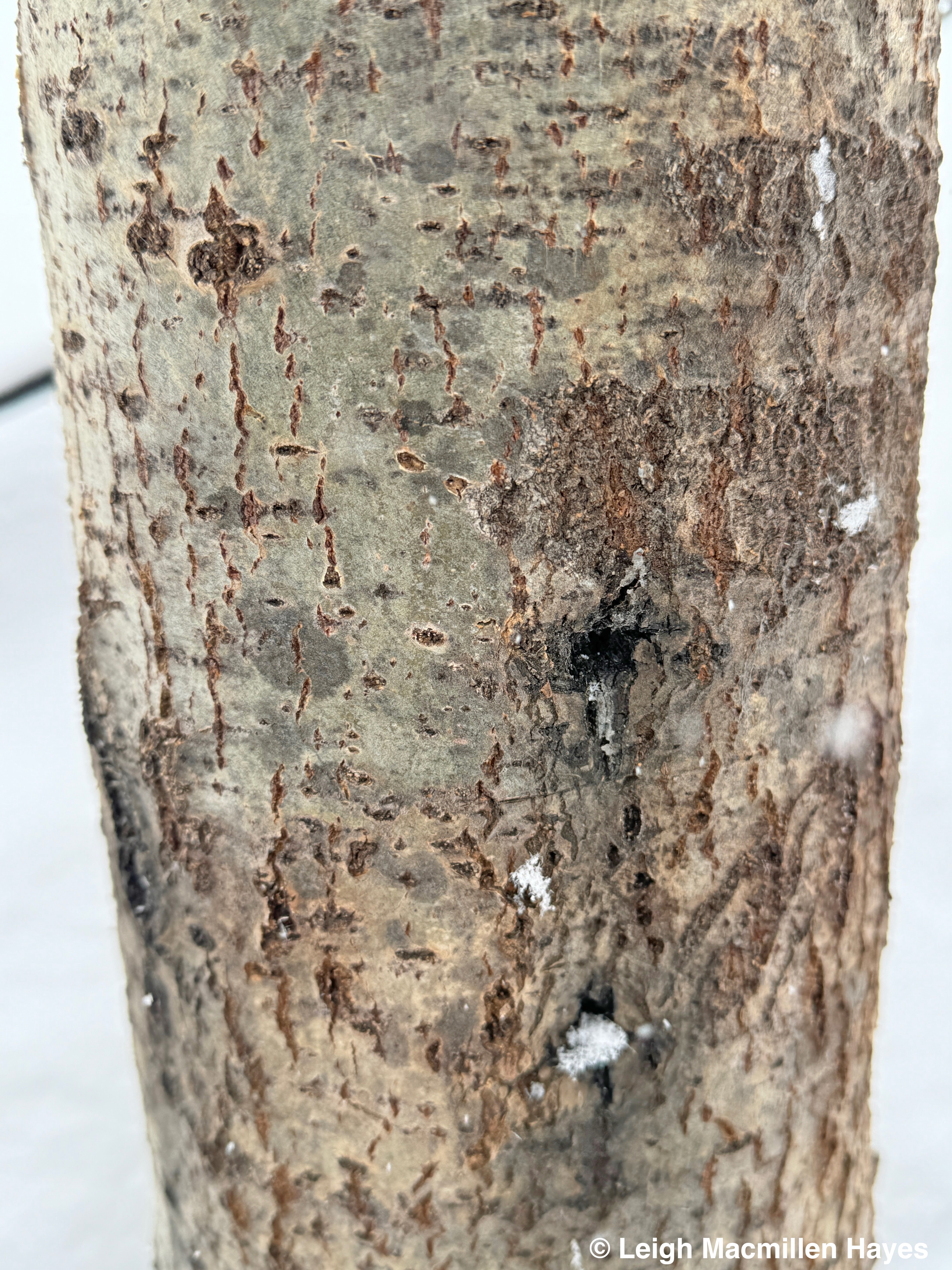
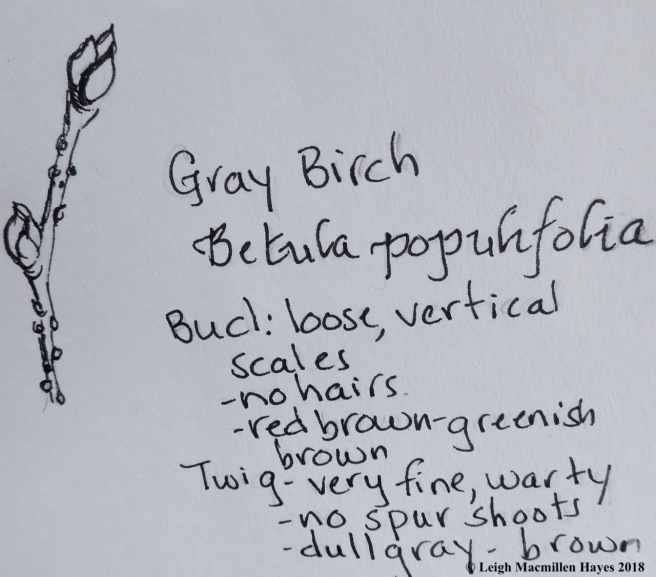
Gray Birch, Betula populifolia, is an early succession tree, meaning when an area has been cleared, this is one of the first trees to grow. Unlike Paper Birch, which can live to the ripe age of 90 or so if conditions are right, and Yellow Birch that can survive over 200 years, Gray Birches are not long lived and many only survive 30 – 60 years.

Often these trees are leaning, even if they don’t have snow piled upon them. And their lower branches remain on the tree, where Paper Birch tend to self-shed. The branches are pendulum, leaning toward the ground in an arc. And below each branch or where a branch had been, is a triangular shaped gray beard.

I mentioned earlier that I prefer Paper over White for a Paper Birch, and one reason is because Gray Birch also appear white. But Gray does tend to have a dirtier look to it and it has little to no peeling.

Gray Birch twigs are very fine, and super warty. In fact, it’s fun to run your fingers over them and feel the lenticels, like someone glued salt crystals to them. Their coloration is dull gray to brown and they are not hairy, nor do they smell like wintergreen when scraped.

The red brown to greenish brown buds are short, with scales that also lack hairs, and they are not sticky.

As for catkins, most appear in early spring as a single one or a pair. If you spot a single one in the fall/winter, then it is usually a solitary male.

Tada. A Gray Birch.

The final deciduous tree is a Quaking Aspen, Populus tremuloides. (I bet you are thinking, “Oh phew, she’s almost done, but never fear, I have four conifers to share with you.)

Quaking Aspens are also early succession trees, and they can grow from seeds, but also like to root sprout. One tree in Utah has over 50,000 stems from one root and covers over 100 acres.

The bark is grayish-green, and more so green on a wet day like today. It also has horizontal bands that become more evident as the tree matures.

The buds of the Aspen are alternate, shiny and dark brown. They aren’t sticky like its cousin, the Big Tooth Aspen. I think the most defining feature of these buds is their varnished appearance. My experience is that Porcupines love them.

The twigs are thick, smooth, and chestnut brown.

I haven’t sketched this tree yet, so I’ve added it to my to-do list.

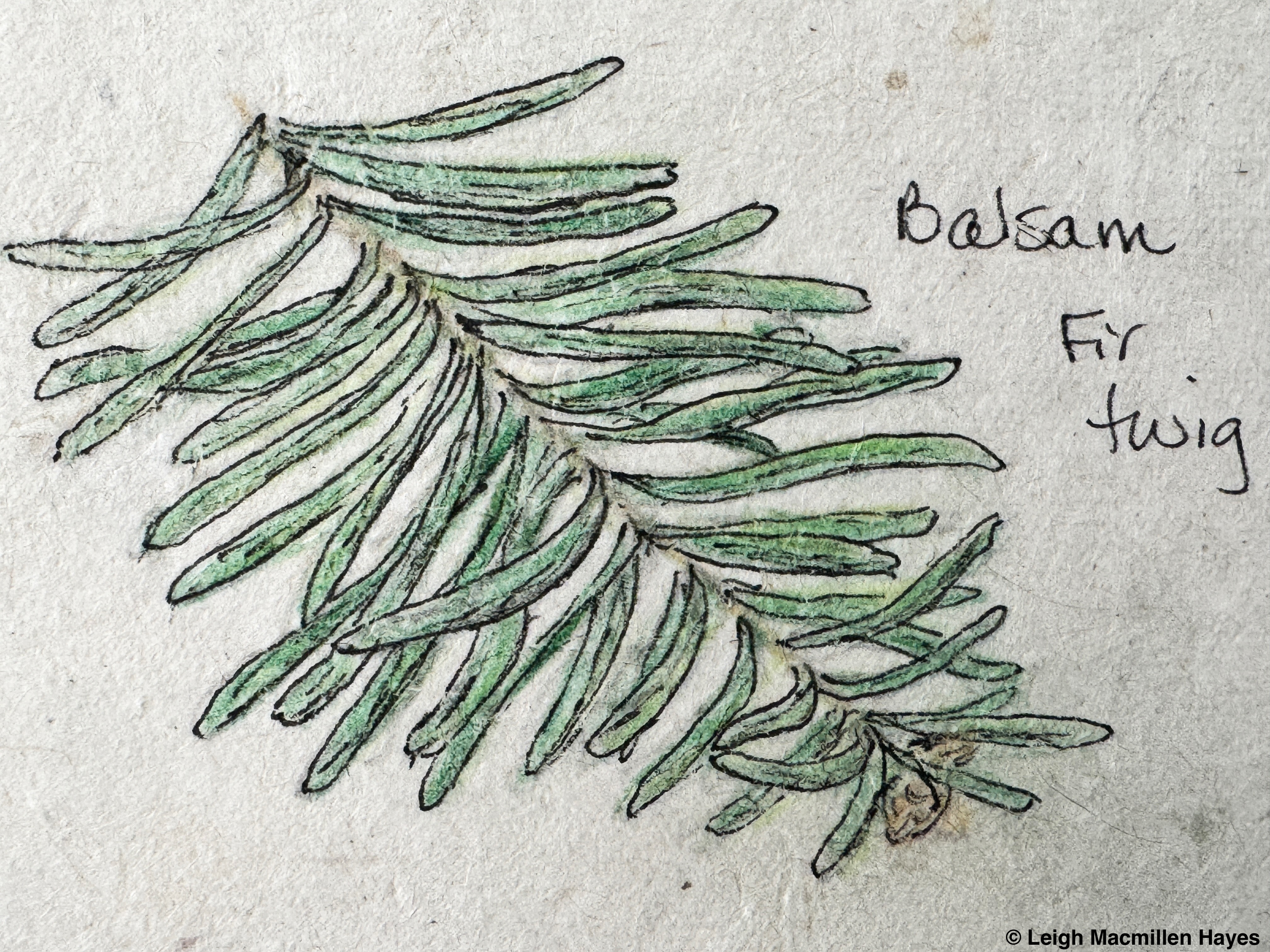
Balsam Fir, Albies balsamea, smells like a Christmas Tree. This is a conifer that stands straight and tall as if in military fashion.

Its bark is pale gray and smooth, but covered with small dash-like raised lenticels and blister bumps filled with a sticky resin. Pick up a stick when there are puddles nearby, poke a blister and let the resin ooze onto the tip of the stick and then place the stick into a puddle and watch the essential oils form and change shape on the water’s surface. This works best on calm water.

Being an evergreen, Balsam Fir have leaves (needles) that are always on them, though they lose some each year. And gain new ones, of course. If you were to remove all the needles, you’d find a smooth twig.

The needles appear to be arranged in a flat manner, but actually spiral around the twig. They are shiny above and have two rows of white lines below, which are actually the stomata.

At about an inch in length, they attach directly to the twig and some have notched tips.

Their cones are 2 – 4 inches in length, and are dark purple before maturity. The unique thing about Balsam Fir cones is that they stick up from the twig rather than hanging down like other conifers.

I think I found the only Balsam Fir in the forest that wasn’t military straight, but as I always say, “Not everything reads the books we write.”

And my offering of the twig.

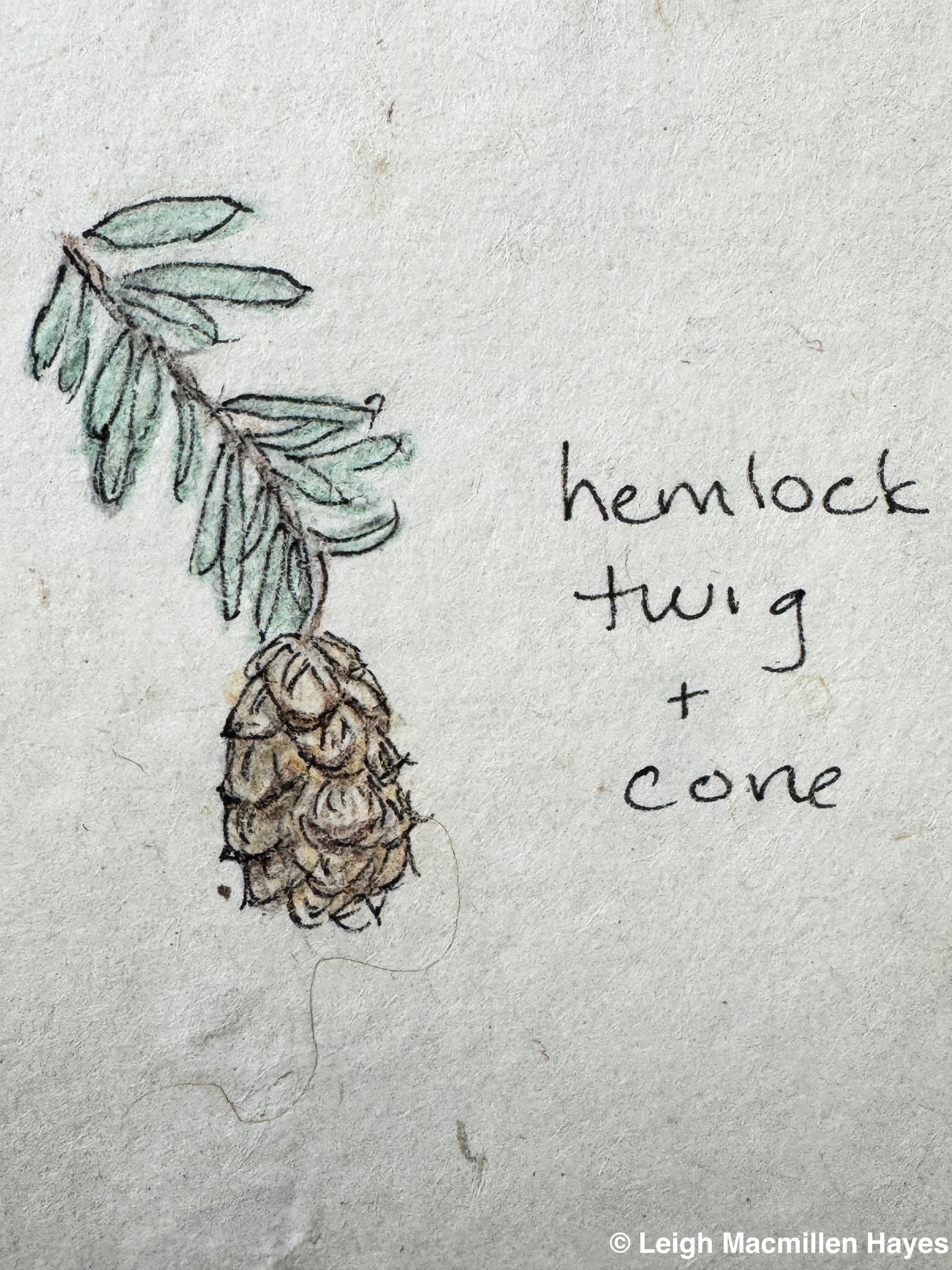
Eastern Hemlock, Tsuga canadensis, has cinnamon red to gray bark. As the tree matures, the bark features narrow, rounded ridges covered with scales that look like they could flake off, but they are rather sturdy.

Overall, the tree has a lacy look and its leader bends over making it appear to dance in the forest.

Hemlocks are like Yellow Birches, in that they need a moist area to set root and often grow on moss-covered rocks or tree stumps or nurse logs, so called because they are rotting trees that provide nurturing places for other things to take form.

While the Balsam Fir needles are about an inch long, Hemlock needles are about a half inch in length. And whereas the Fir needles are directly attached to the twig, Hemlock needles are attached via tiny petioles or stems. And the underside also has two rows of stomata, but so close together, they may appear as one.

The twigs are very fine and very flexible.

Hemlock cones are about 3/4 inch in length ( I got carried away with the size of this one, or you could say its a macro look at the cone) and oblong in shape. They are pendant, meaning they hang off a slender stalk. And small rodents and birds love to eat their seeds that are attached as a pair to the underside of the scale.

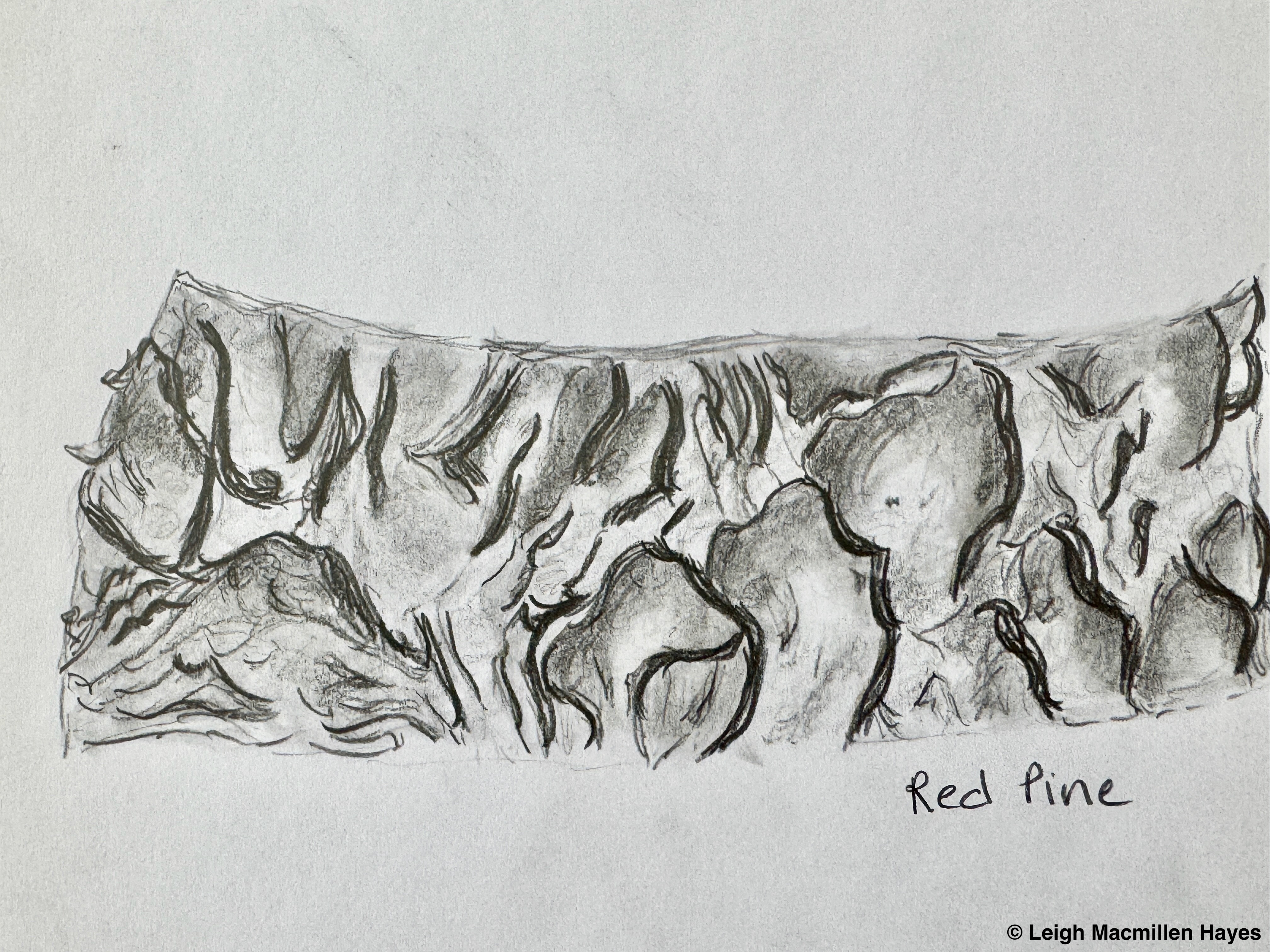
Oh, did I say they are all my favorites? Well, maybe my favoritist of all is the Red Pine, Pinus resinosa.

The bark is reddish brown to pinkish gray. I see it as a jigsaw puzzle, but my friend and fellow naturalist Dawn, sees it as a topo map.

Its broken into irregular, thin, flaky scales, that you may see on the ground surrounding the trunk.

As the tree matures, those scales are broken by deep fissures into irregular looking blocks.

Red Pine was of particular importance during the 1930s to 1960s, when the Civil Conservation Corps (CCC) planted plantations of this species on former pastureland as a reforestation project. Once in a while I stumble upon a grove of Red Pines planted in rows and realize that I’m in such a plantation. They were considered a cash crop for telephone poles.

The orange-brown twigs of the Red Pine tend to curve upwards and if you look upward you’ll notice that the needles are all clustered at the end, giving them the look of bushy chimney sweep brooms.

The needles are in bundles of two, and they are about 4 – 5 inches long. If folded in half, they break cleanly.

Red Pine cones are egg-shaped, about two inches in length, and lack prickles like some other species sport. It takes two years for them to mature.

What do you see? Jigsaw puzzle? Topo map? Or something else entirely?

Finally, we have reached the last species for today, White Pine, Pinus strobus. I’m showing you the bark of a mature tree, but if you look at a young pine you’ll note it is very different with its smooth, pea green bark.

Mature trees, such as this, have dark gray to brown bark, with long flat ridges, and deep, dark furrows. What I love about mature White Pines is that the flat ridges have lines that resemble writing paper and I love to write.

White Pine twigs are slender and gray-green to orange-brown. Bundles of five needles is the count for White Pine, which is cool because it spells its name: W-H-I-T-E, or M-A-I-N-E, since it is our State Tree. (Please remember that Red Pine has only two needles in a bundle, and doesn’t spell its name.)

Cones are 4 – 8 inches long, cylindrical, and also take two years to mature. And it takes a Red Squirrel about 2 minutes to peel back the scales and eat all the seeds as if they were corn kernels on a cob.

Dear readers, if you made it this far, I thank you for sticking with me. I do love to write and maybe I’ve written too much.

But I hope you’ll venture out and get to know these trees better by studying their idiosyncrasies and coming up with your own mnemonics to remember their names.

May you become tree wise and may I continue to learn about and with the trees.
It was a dark and dreary day . . .

I’m working on a challenging article and can’t quite figure out how to introduce the topic. After a bunch of attempts, I suddenly had an inspired idea . . . drop the pen, walk away from the legal pad and head out the door.

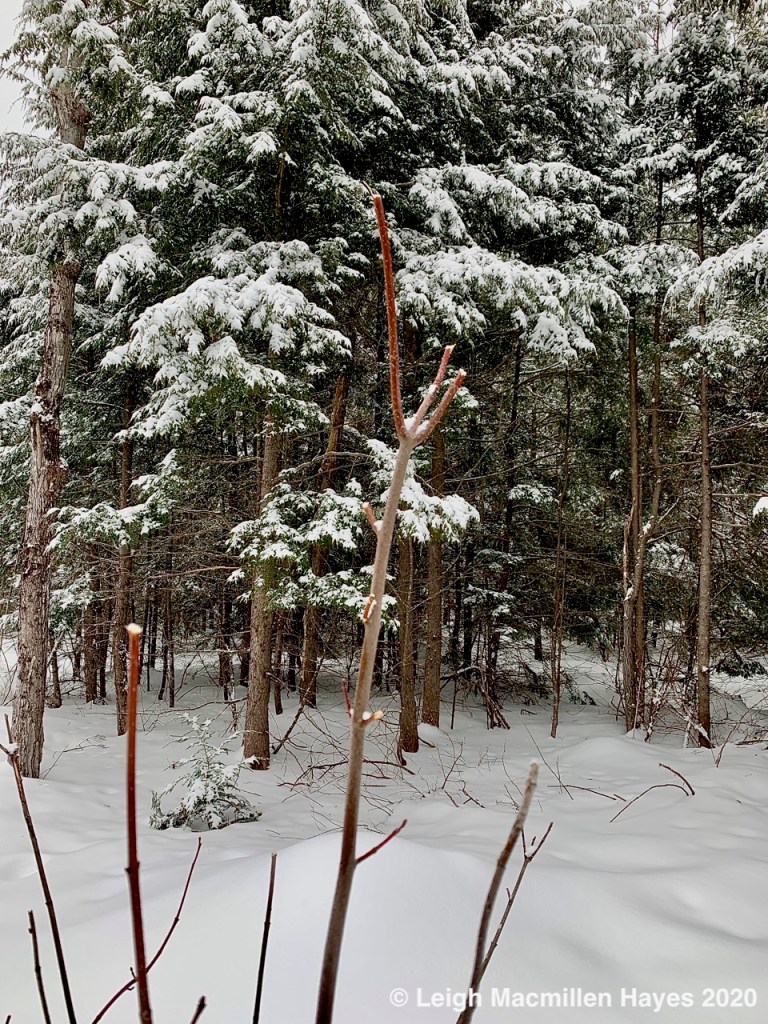
And so I did despite the freezing rain that was falling atop this morning’s snow. Heading down a trail I haven’t had a chance to step upon in months, I realized that I was among old friends who had passed by prior to the storm.

In fact, every where I went for the next two plus hours, they had been there before me.

Their tree of choice also gave away their presence and I fear that there won’t be too many red maple leaves in bloom come spring. Imagine this: a moose needs to consume fifty to sixty pounds of vegetation daily–that’s a lot of buds, twigs, and bark.

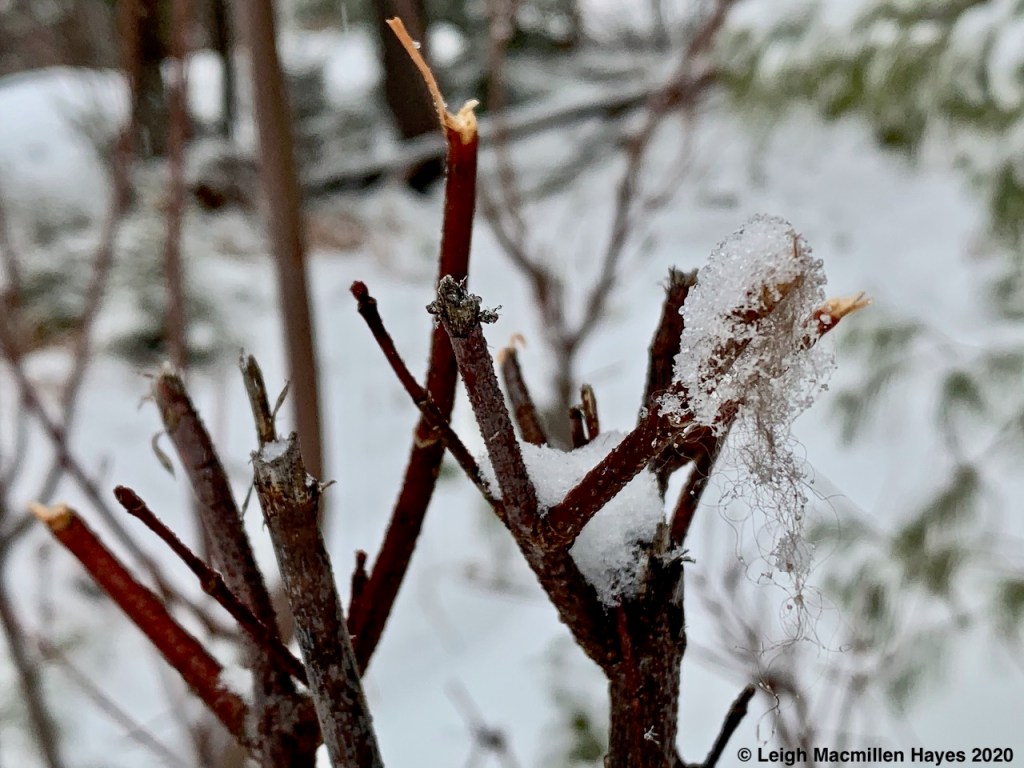
With their lower incisors and hard toothless upper palate, they grabbed the twigs and yanked to pull the buds off for consumption. Left behind were their calling cards–long dangling tags. Some were at least three feet above my head.

Also think about that moose face–homely and ungainly as it may be with a large upper lip that can wrap around the twig in order to dine, and the bell or dewlap dangling below its mouth.

With utter glee I found some hair stuck to one twig and it wasn’t the hollow shafts of its dense coat, so I wondered if in the process of browsing, hair had come off its face or dewlap.

As I said, the moose had traveled throughout the woods and I began to follow their tracks exclusively, for they always lead to coppiced red maples that are trying to make a comeback in these woods that were logged within the last five to ten years.

It was on one of the trees that I did find the hollow hair shafts, and I’ve used black arrows to try to point them out to you. There were three which seemed to intersect at the point where the twig had been swiped. Notice how straight they are, especially in contrast to the slender, curly hair.

The more I looked, the more soft, curly hairs I found. Hmmm, I have a feeling any of my hunter friends can enlighten me, for now I’m considering belly hair? Is it softer? Or am I correct in thinking about the chin hairs?

It doesn’t matter. Well, it does because I’d like to know.

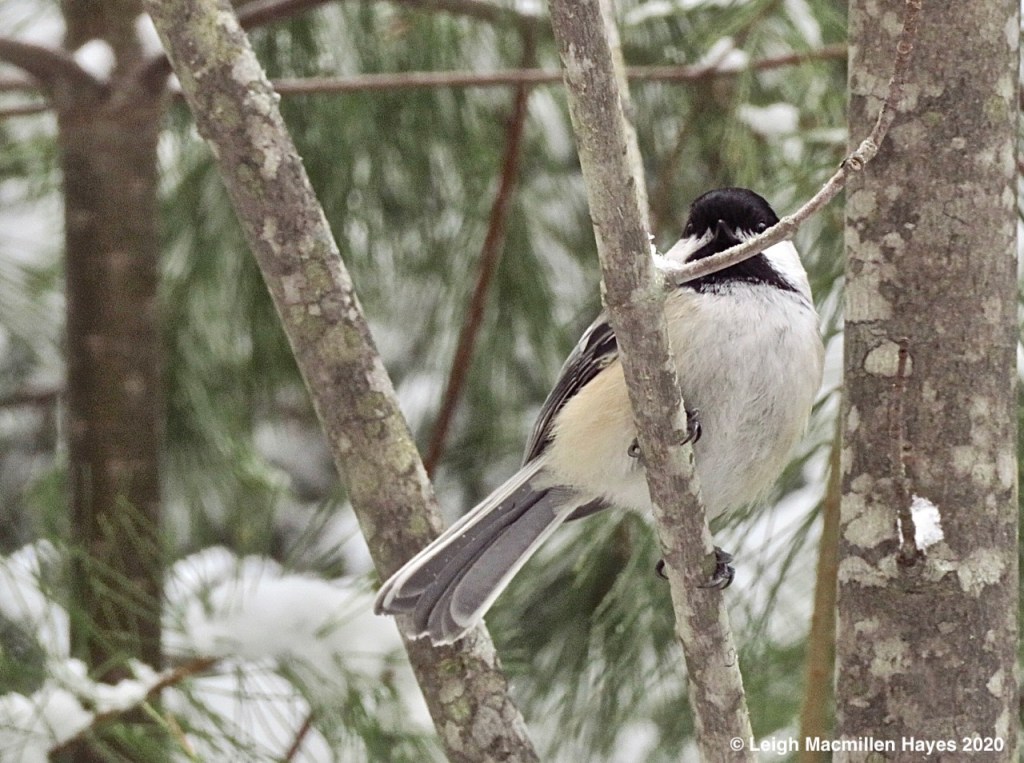
And maybe the chickadees were trying to tell me as they flew in and landed on maples while singing their “Chick-a-dee-dee-dee” song. But what mattered most was that I got outside and cleared my brain and came up with an introduction to the challenging article: It was a dark and dreary day . . . oh drats, I can’t use that–especially since despite the snow and rain, I hardly found it dark or dreary.

I think instead, I’ll begin in the middle and see where the article takes me from there. In the meantime, though I didn’t see them, I’m tickled to know that there are still several moose in the woods behind our house.

I’m with the TREES

When Alanna Doughty, education director of Lakes Environmental Association asked me to join her in co-leading and co-sponsoring a tree identification walk during Great Maine Outdoor Week(end) at LEA’s Highland Research Forest in Bridgton, I jumped at the opportunity. Alanna, you see, is a great joy to be in the presence of and I knew she’d make it a fun and unique experience.

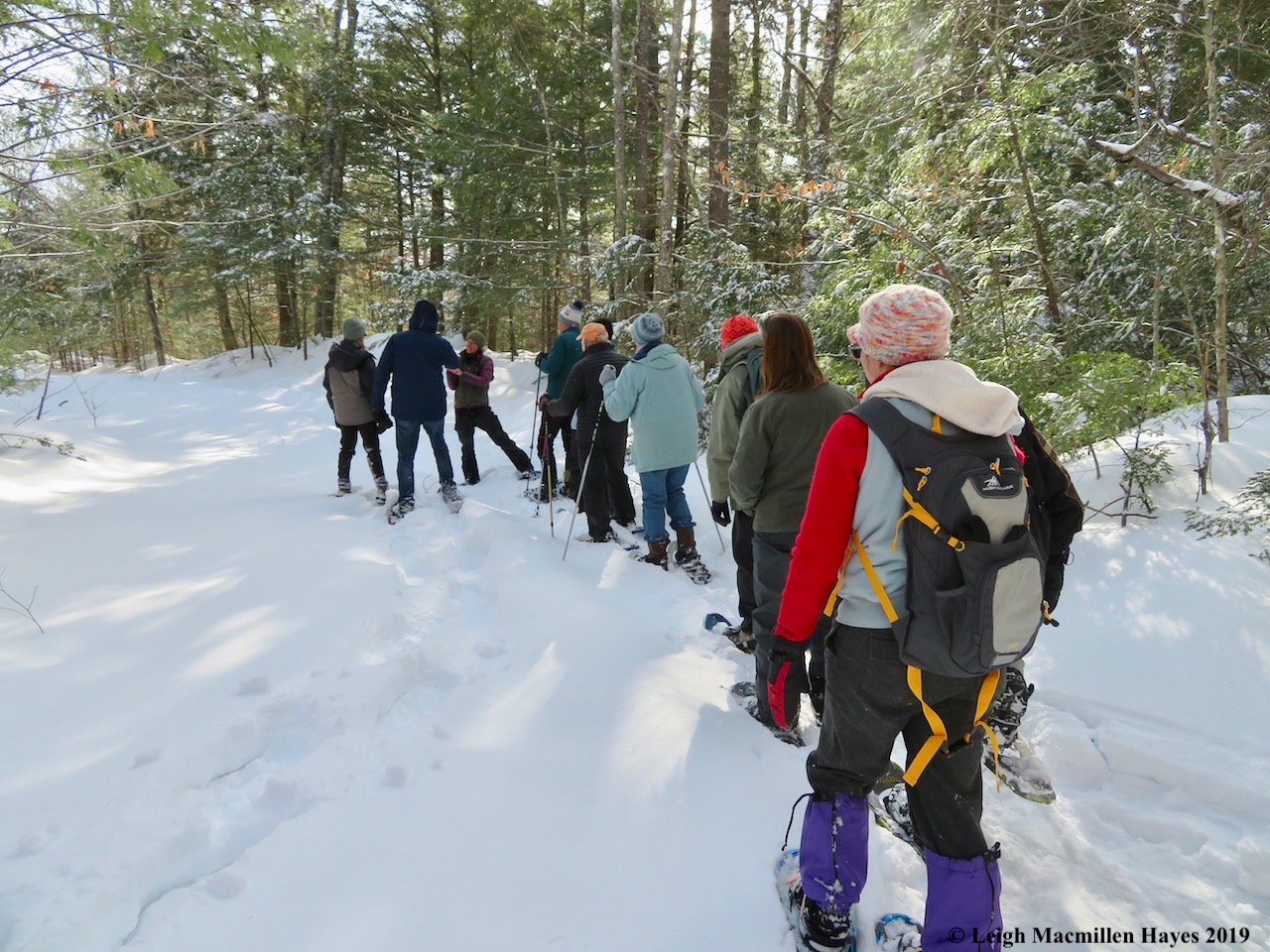
I wasn’t disappointed; nor were the thirteen others who joined us this morning for a two-hour hike that turned into two and a half and even a little bit more.

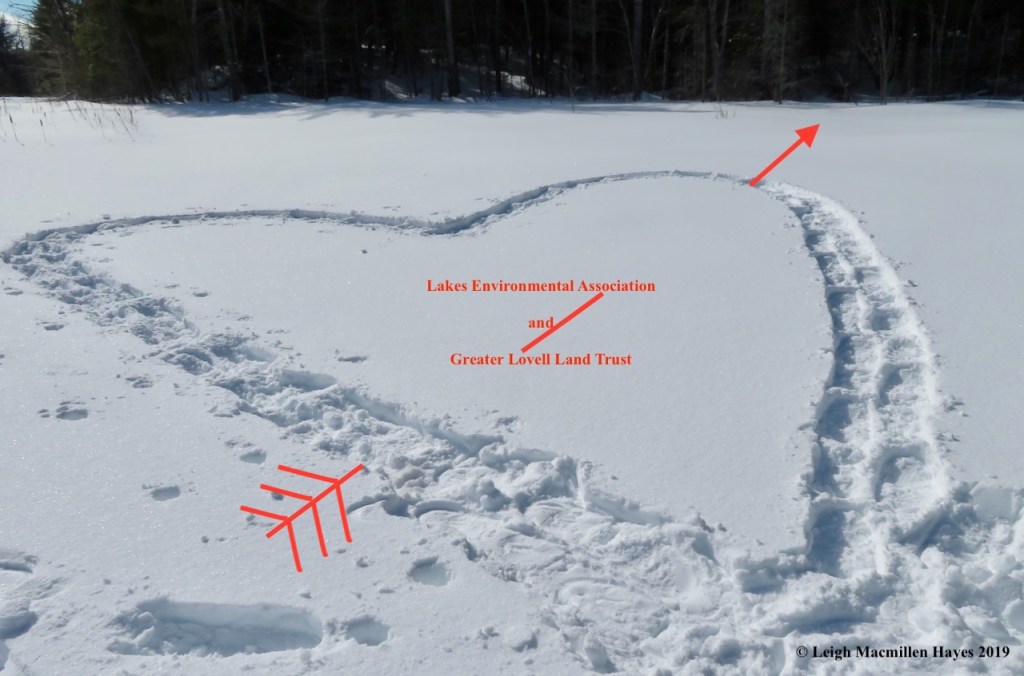
Alanna had gone out ahead of us and placed hearts with tree-related information along the trail we’d travel. Our crew was a delightful mix that included young and old, with members of LEA and the Greater Lovell Land Trust, which I was representing, as well as a woman from North Conway and man from Portland. Yes, Linda and Henri–that would be the two of you.

The first heart provided information about hemlock trees and after she read it, we encouraged everyone to channel their inner hemlock and so they leaned as this particular evergreen does. Check out those smiles. Don’t you want to be a hemlock too?

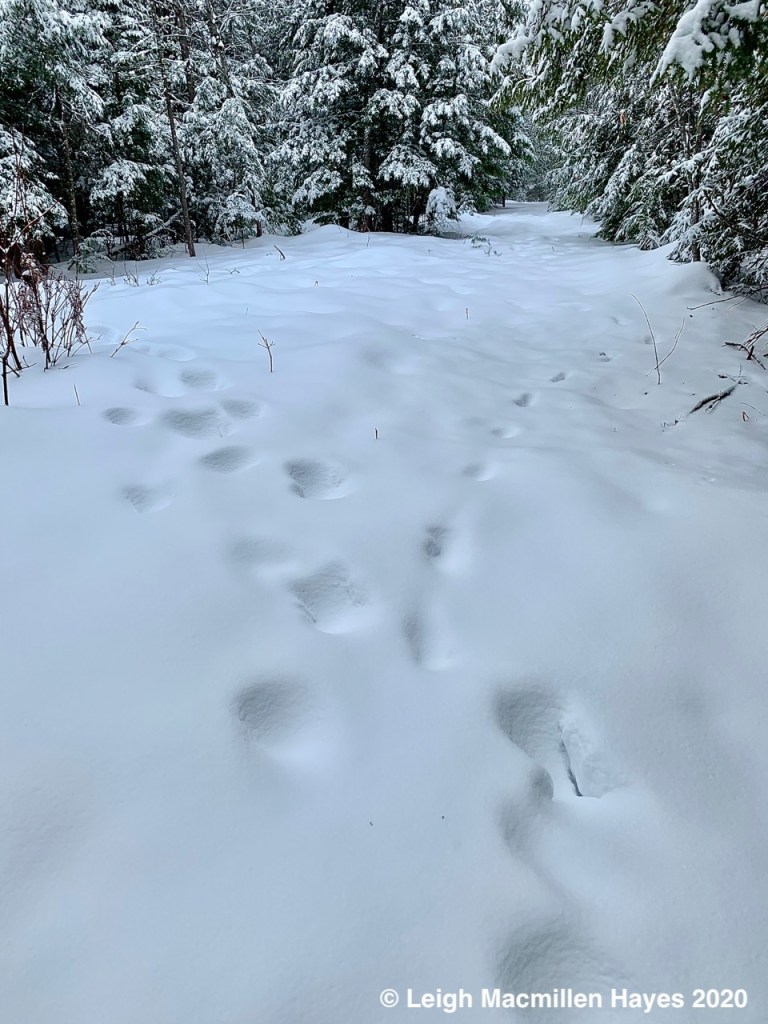
Of course, because we were among the trees on this property that the David and Carol Hancock Charitable Trust donated to LEA several years ago, and the snow was super soft from yesterday’s storm, the mammal tracks were outstanding.

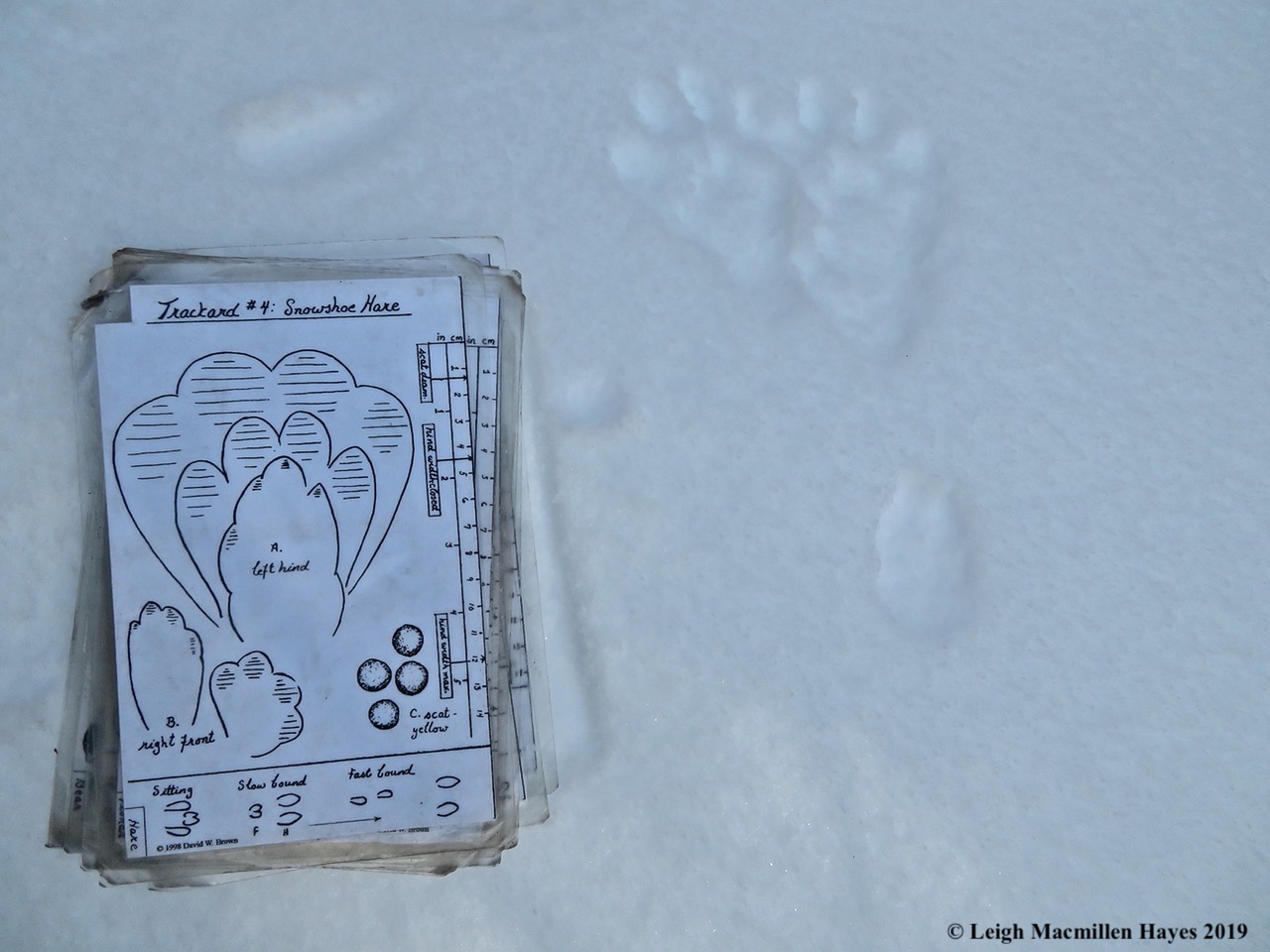
One of the favorites of the day–that of the snowshoe hare. It’s not often that one can see the hare’s toes so clearly, but today was the day. And as David Brown’s Trackards indicated, the footprint size depends upon the conditions.

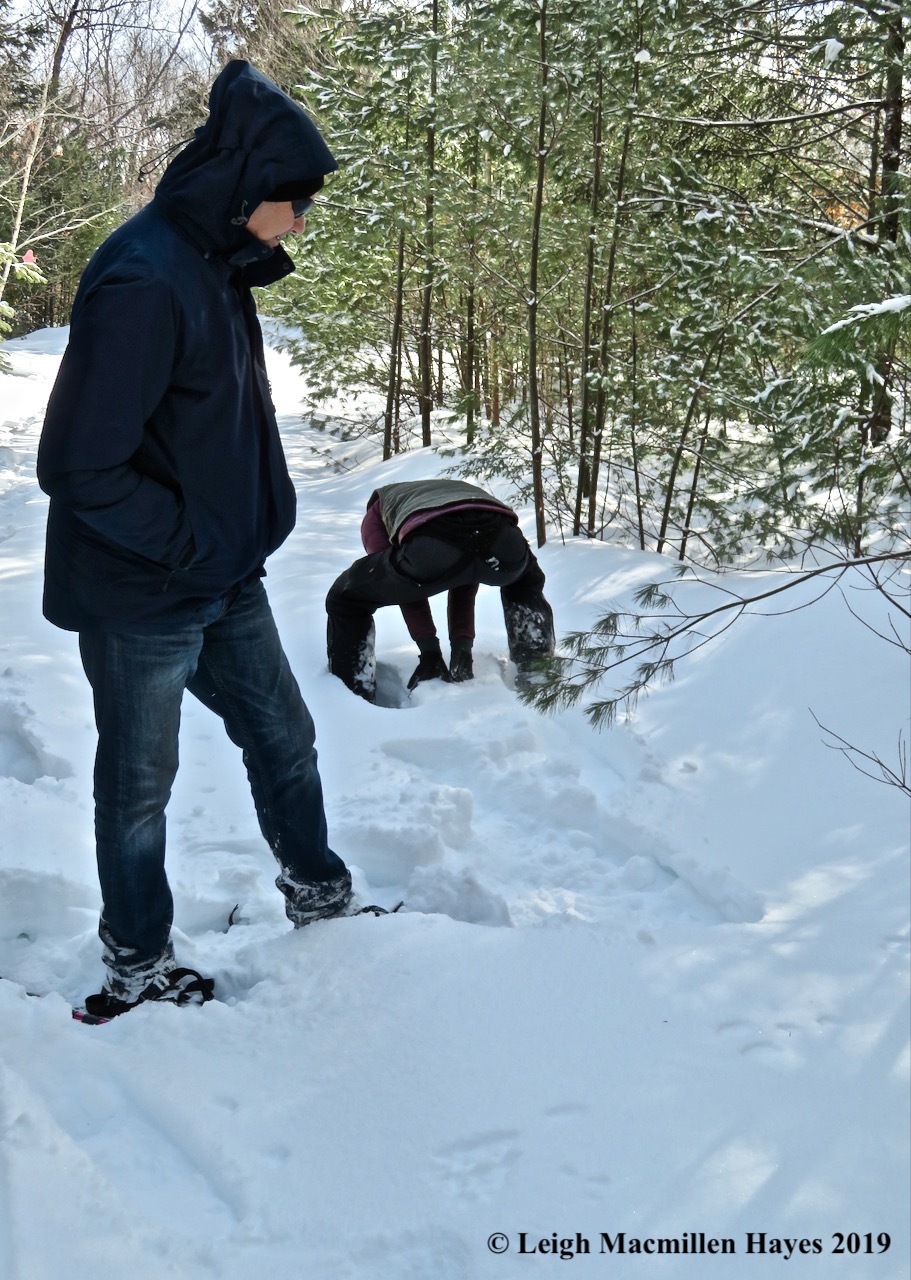
When it came to demonstrating and identifying the action of the mammal there were two rock stars among our group. Alanna was one for she got down on all fours and demonstrated how a hare moves (before she sorta fell). And Pam Marshall was the other for she correctly identified and shared information about how to recognize all of the track and print patterns that we saw. Pam only began tracking this year with the GLLT’s Tuesday Trackers, but she’s a quick study.

Onward we trekked, pausing whenever we saw a heart of red. And each time, Alanna’s voice came through in the message. Love at first bite! Indeed.

At a beech tree, we paused for a bit longer as we noted not only the twigs and buds that are beginning to swell, but also talked about how bear claw marks are most visible on them and how the beech scale insect has altered the once smooth look of the bark. The word marcescent, meaning withering but remaining attached to the stem, also entered the conversation.

After a bit of time, we emerged onto a wetland where only last week Alanna and a couple of people including one in our midst, Anne, had spotted a hole and lots of tracks and scat left behind by an otter. Today, no sign of that member of the weasel family, but still . . . we enjoyed the warmth of the sun.

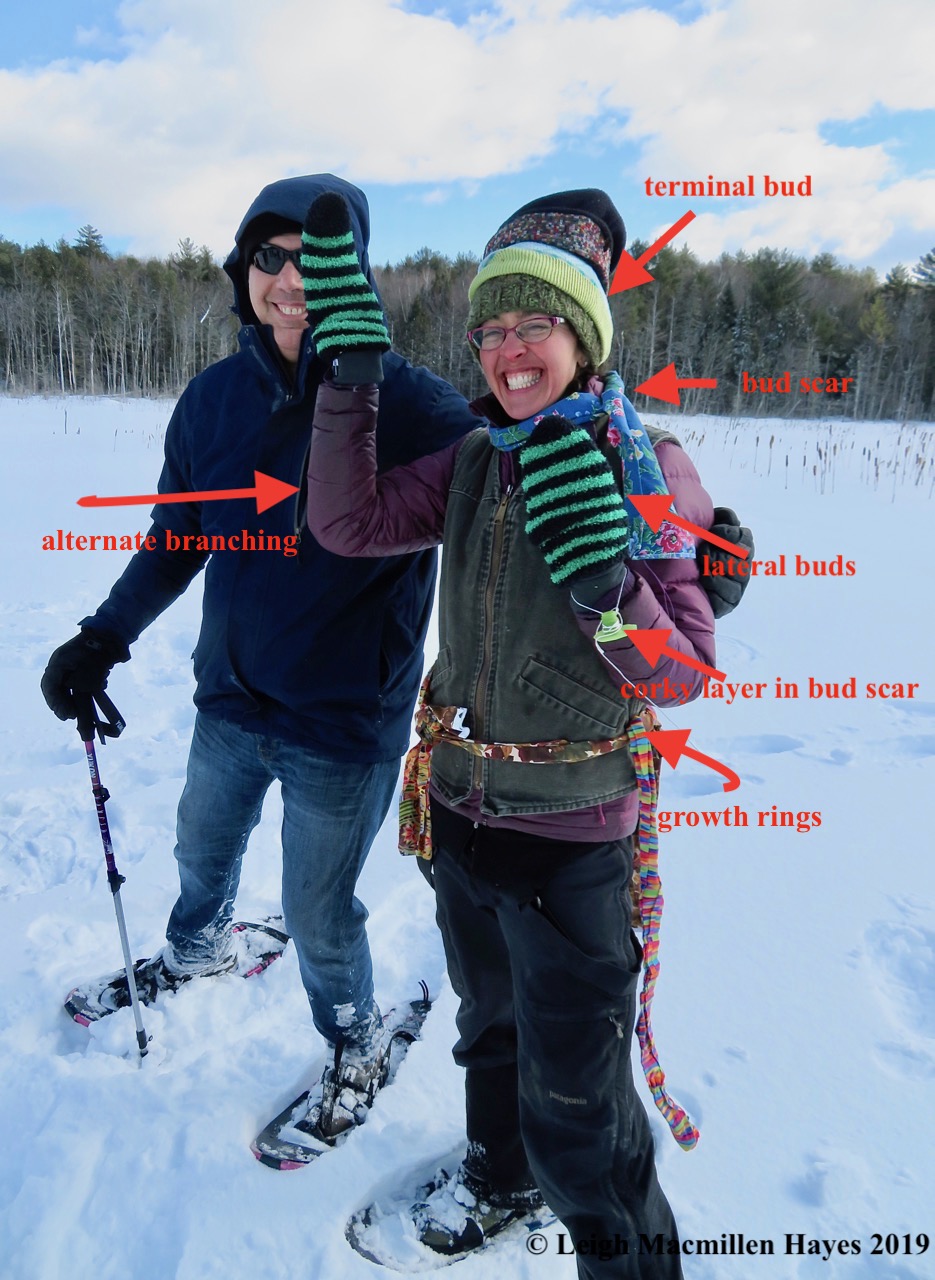
And I took advantage of the time to dress Alanna as a twig. She was the perfect Miss Twiggy model and Henri took time to pose with her.

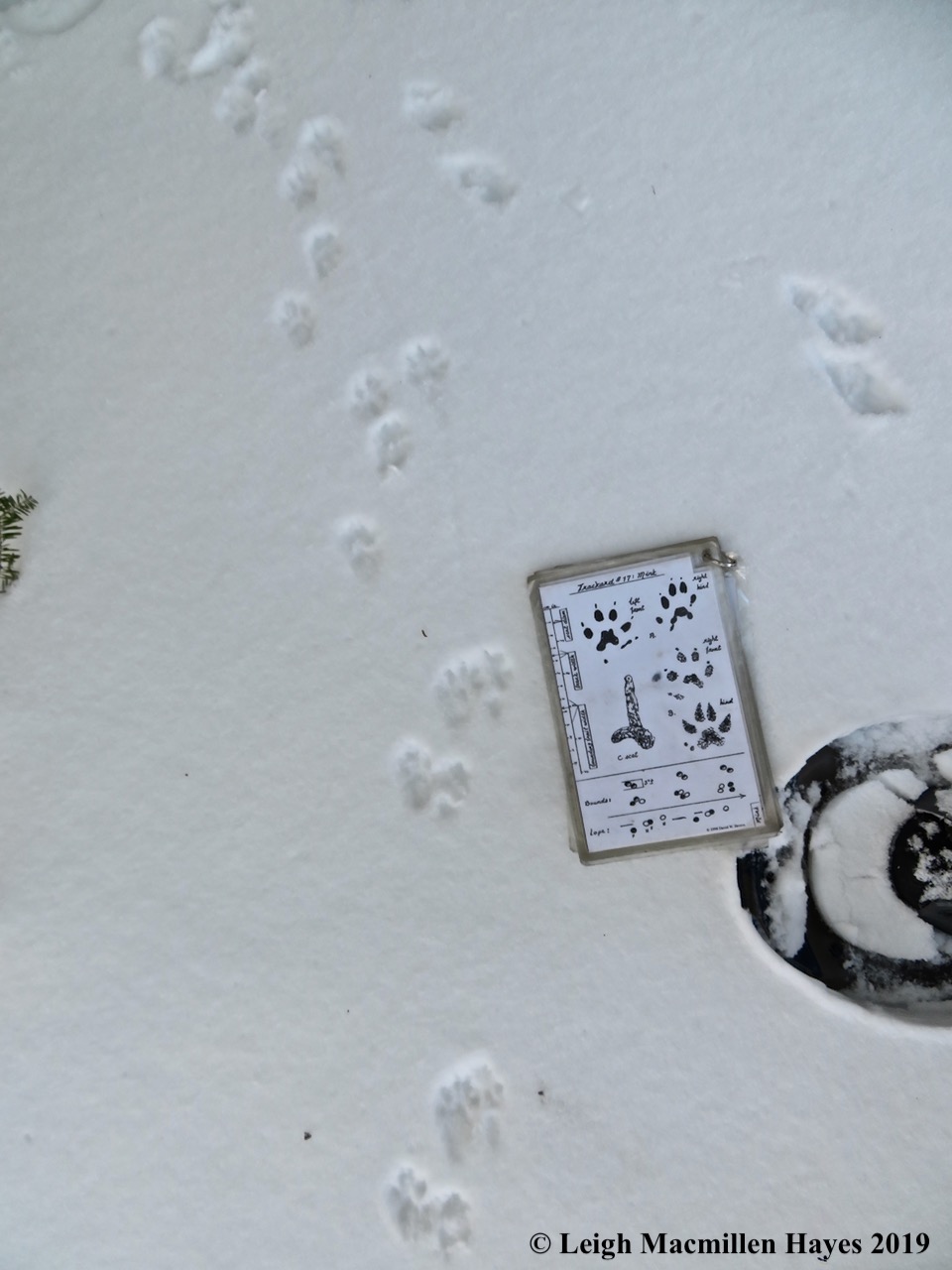
Back in the woods, we were stopped in our tracks by the tracks of another weasel–a mink.

And then as we retraced out steps and paused by a speckled alder to admire its male and female catkins and last year’s cones, someone honed in on something that wasn’t a remnant of yesterday’s snowstorm.

The cottony white masses of wooly alder aphids decorated a couple of branches. As Alanna explained, in a symbiotic relationship, during the warmer months, ants stroke the aphid with their antennae, while the aphid releases a drop of honeydew, much like a cow being milked. It’s actually rather creepy. Today, there were no ant farmers about, but a few like Justin, did step forward to take a closer look.

After that, we were confronted with a math problem. And you thought we were just out for a walk in the woods.

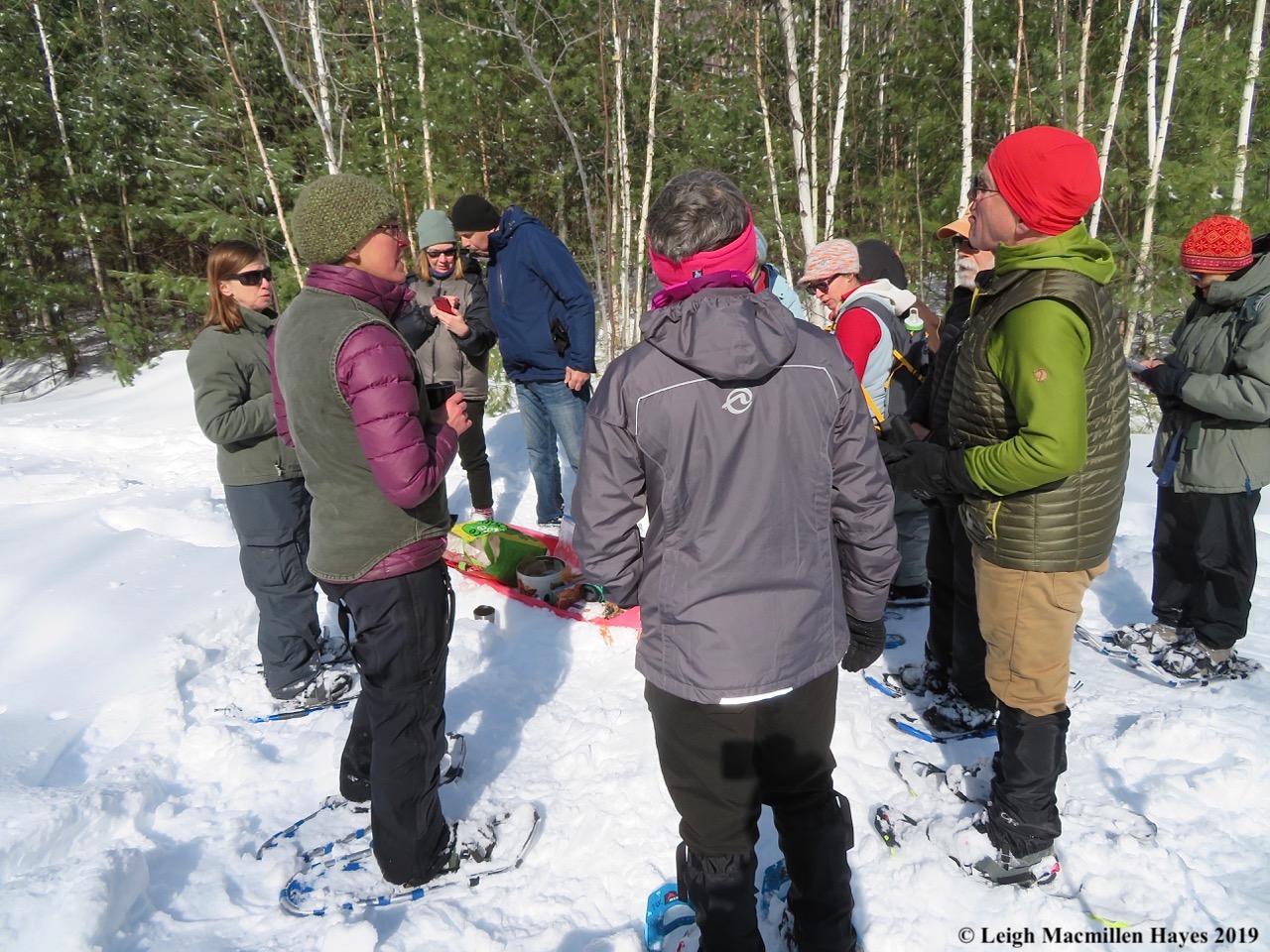
Finally, well sorta, we made our way back to an opening and stood around enjoying hot cocoa and tea, plus some goodies, and each others company.

Sherpa Anne had been kind enough to haul the supplies to the opening for us as our trek began. I know she was thankful she didn’t have to pull the sled all the way out to the wetland. And we were thankful for the good tidings it bore.

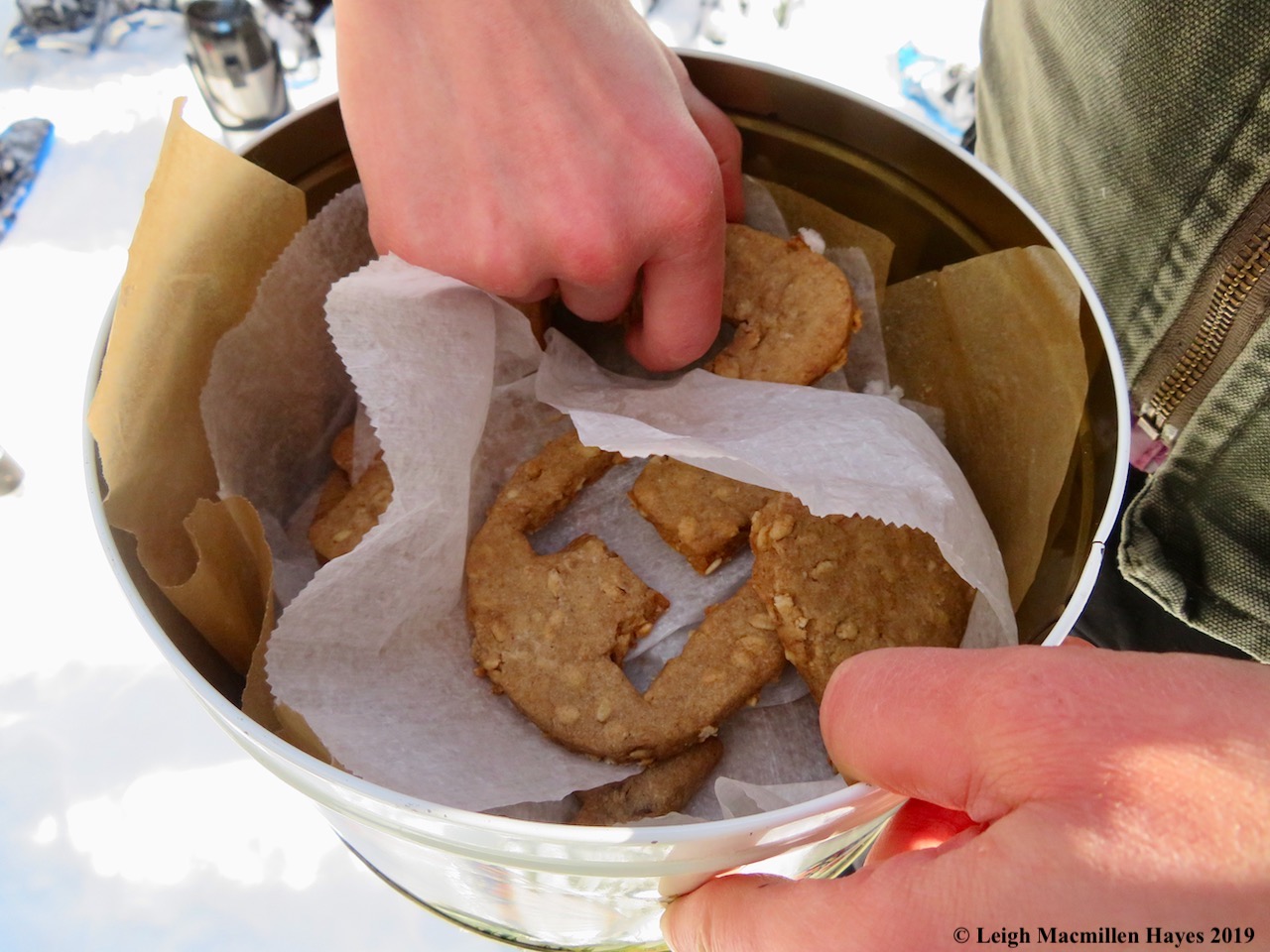
You see, Alanna is a woman of many, many talents, and baking is one of them.

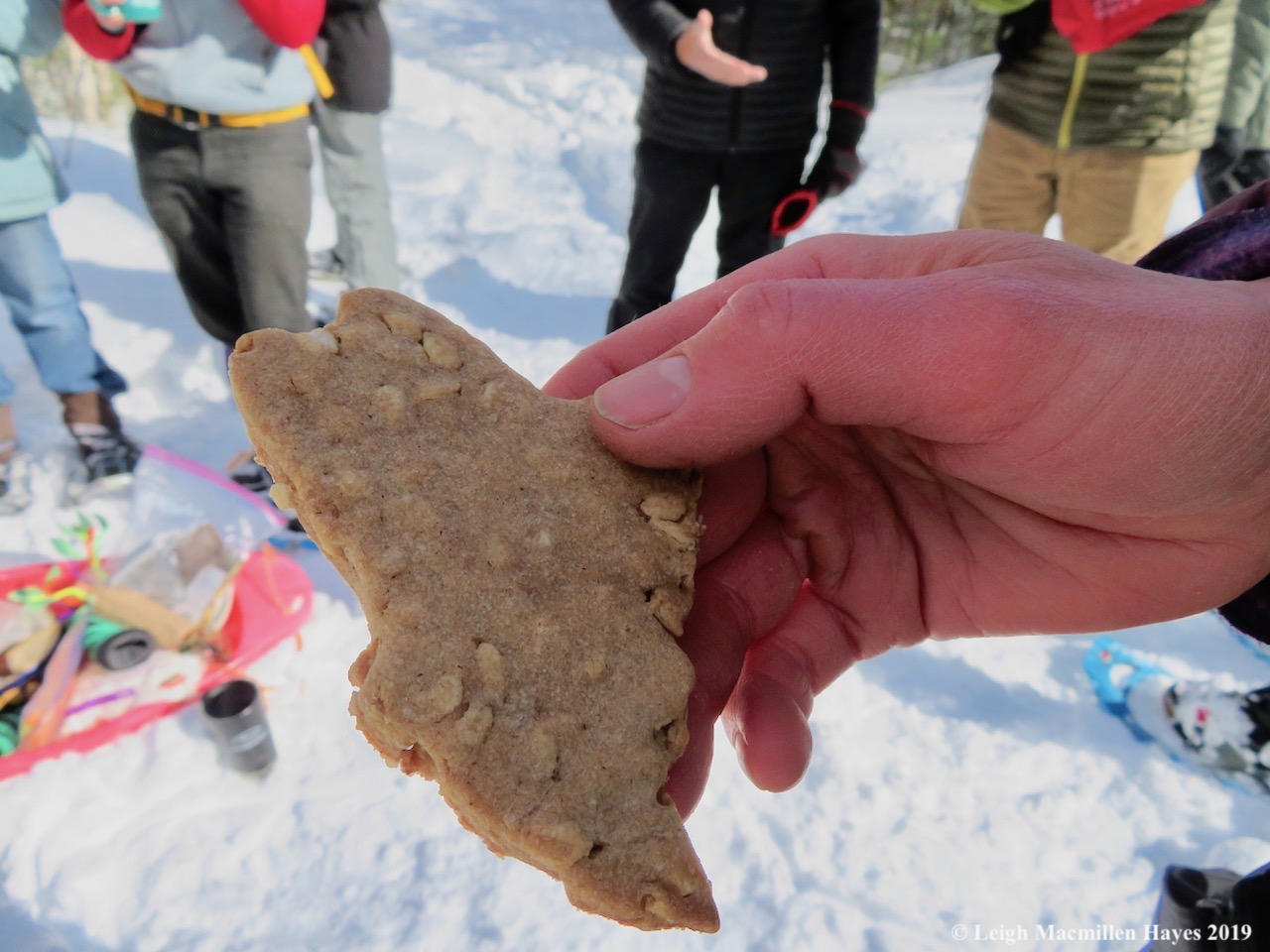
Did she get carried away with the cookie cutters?

We didn’t think so for we all love Maine.

And we also love trees, including red oaks with their bristly-tipped leaves and acorns.

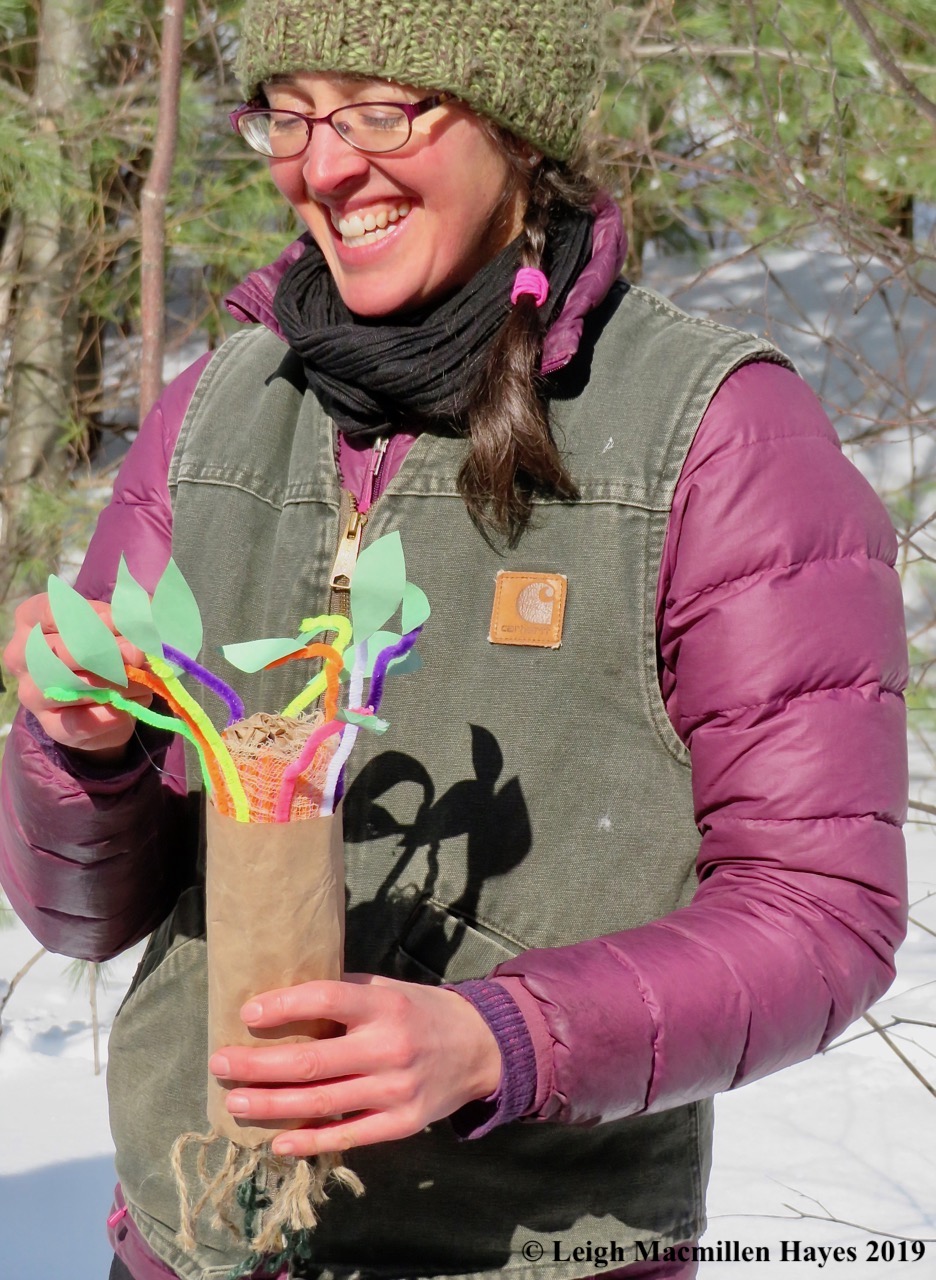
That wasn’t all Alanna had created.

Her tree model was to be envied (at least by me). And she explained the different functions, from roots to leaves and outer bark to inner workings.

And just in case you are interested, I’ve come up with a new mnemonic, because we love memory aids.

Xylem is the vascular tissue in plants that conducts water and dissolved nutrients upward from the root and also helps to form the woody element in the stem.

Phloem is the vascular tissue in plants that conducts sugars and other metabolic products downward from the leaves.

My mnemonic: Xy high (think upward); Phlo low (think downward).

Of course, that didn’t occur to me until several hours later.

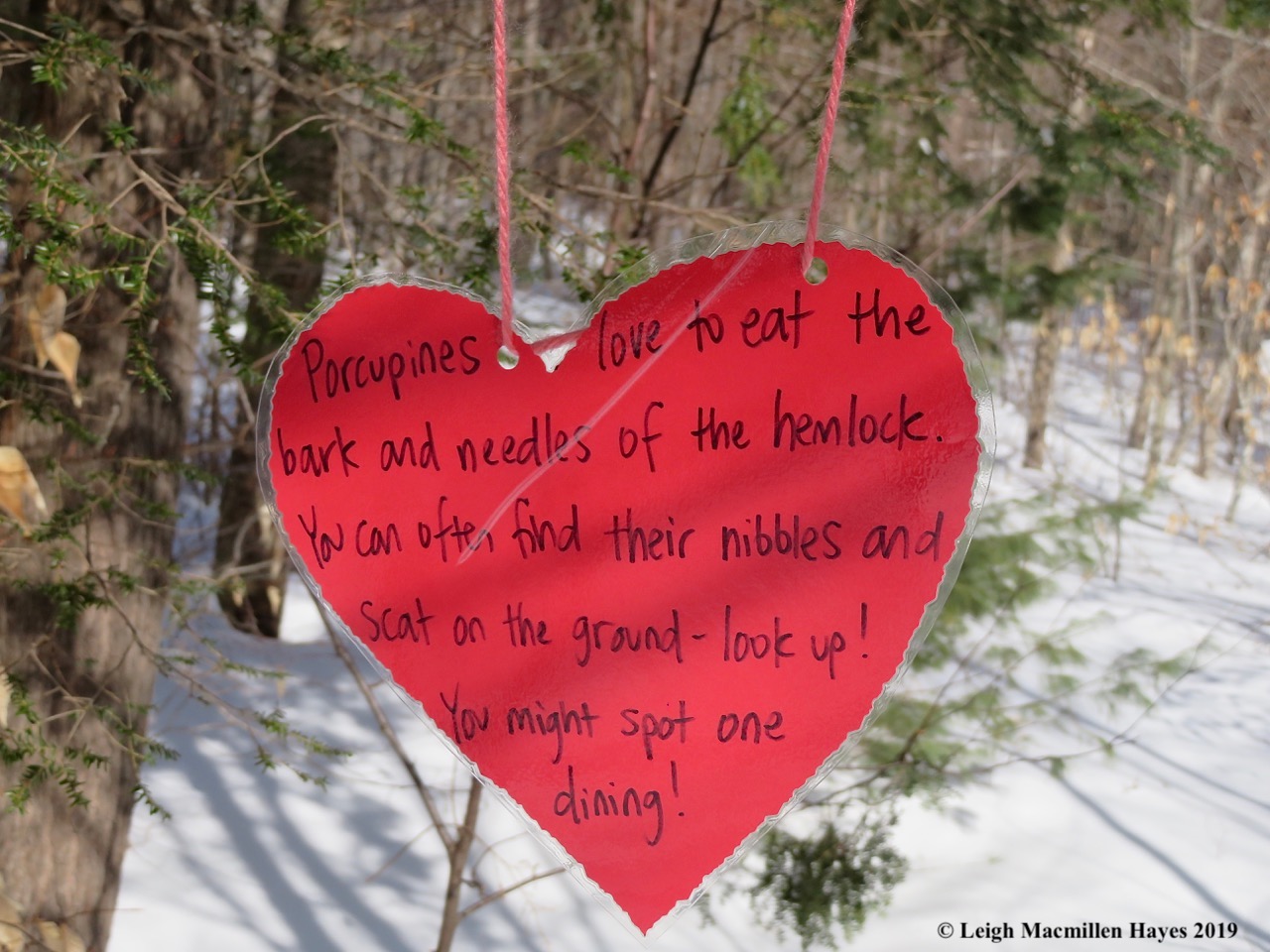
Before we finished off our delightful morning, there was one last heart with tree information to read. Hmmm. Porcupines, bark, needles, scat, look up? “You might spot one dining!”

And so up we looked.

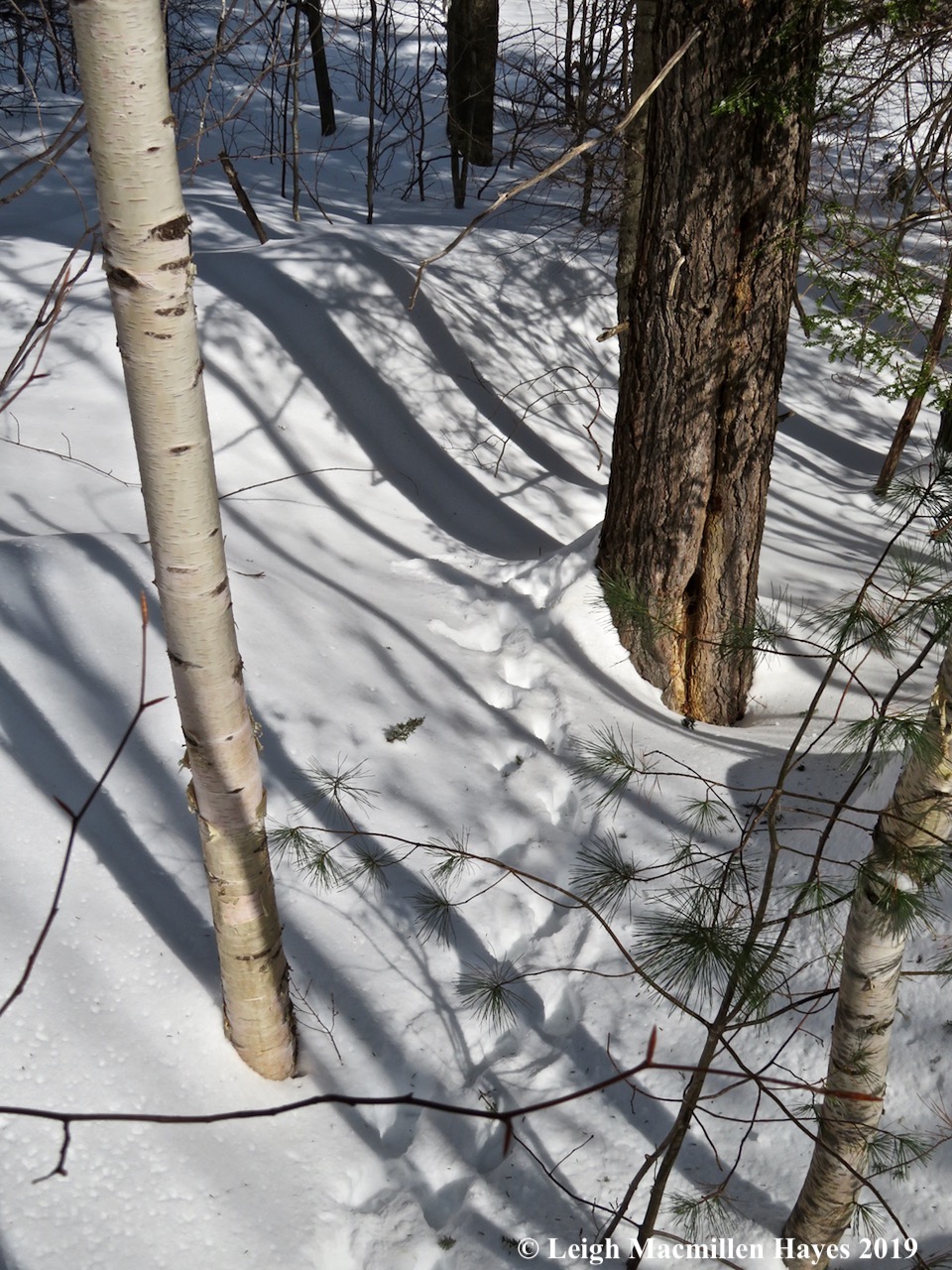
And down as well. We found some tracks and even took a closer look at some comma-shaped scat.

Because . . . the resident male was high up in the tree! Look at that handsome fella! We did. Over and over again. Henri was sure we had planted him and that he wasn’t real.

But he was. And if you look closely, you might see his orange teeth which one (like me) could almost mistake for a Valentine heart. Check out those toe nails. And can you see the rough soles of his feet, the better to grip the tree with?

Male porcupines are known to hang out on a tree during the day. I know we’re particularly thrilled about this one because he hasn’t let us down yet.

Think about this–while the male was hanging out in the sun, porcupines (like the one that lives under our barn) typically stay in their dens until dusk and then head off to munch on bark and needles in the darkest and coldest hours of a day. That’s to be admired.

So is the work of our two organizations, Lakes Environmental Association and the Greater Lovell Land Trust. Both of us are with the Trees and we loved sharing the trail together this day.

We’re doing the same again on Sunday at 12:30 in Lovell, where we’ll go on a Porcupine Prowl–will we actually see the rodent as we did today? Who knows, but we’ll have fun as we join together again to celebrate Great Maine Outdoor Week(end).

I’m with the TREES. Are you?

Holey Mysteries

It all began with a photo sent to me by a friend two days ago. “Any ideas? 8 inches wide. 20 yards from a bog,” he wrote. 

I asked him about tracks in the area, but other than deer, he saw none. He did, however, see two track makers–a fisher and a weasel. 

And so, I contacted a few other friends and invited them to join me on a quest to figure out what the hole was all about. 

We met at the designated location, determined it would probably be in our best interest to wear snowshoes rather than Micro-spikes, and set off to search for the hole and clues. 

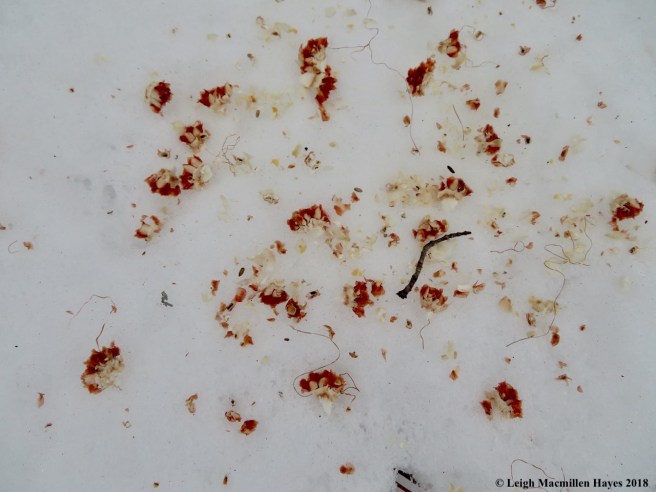
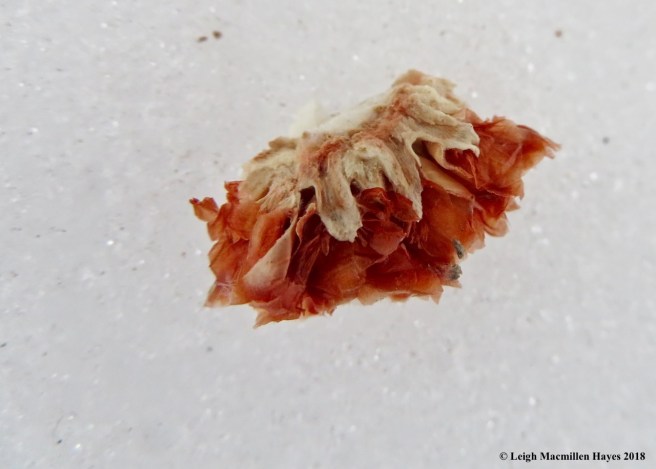
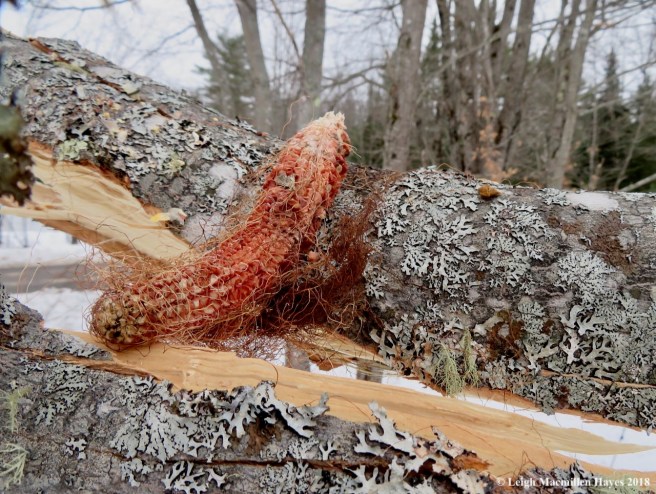
But first, something else stumped us. Oh, wait. I wasn’t stumped. I knew it was sumac and a bird must have been munching on the seeds. But . . . I didn’t remember sumac having such long hairs and there certainly were strands associated with the droppings. 

The color, however, made it incredibly obvious. Sumac indeed. 

Until . . . 

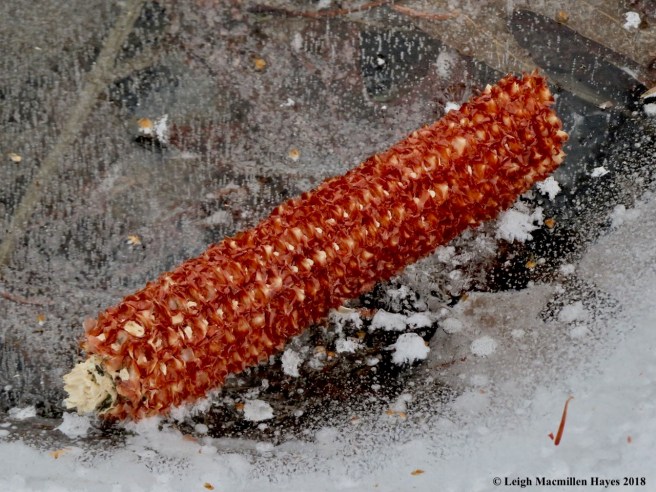
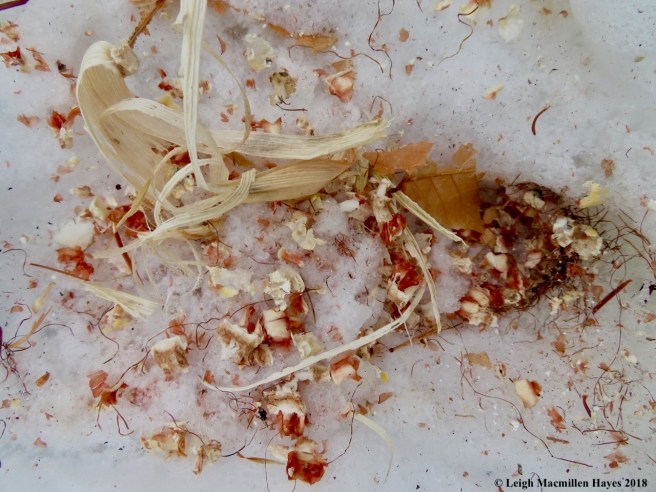
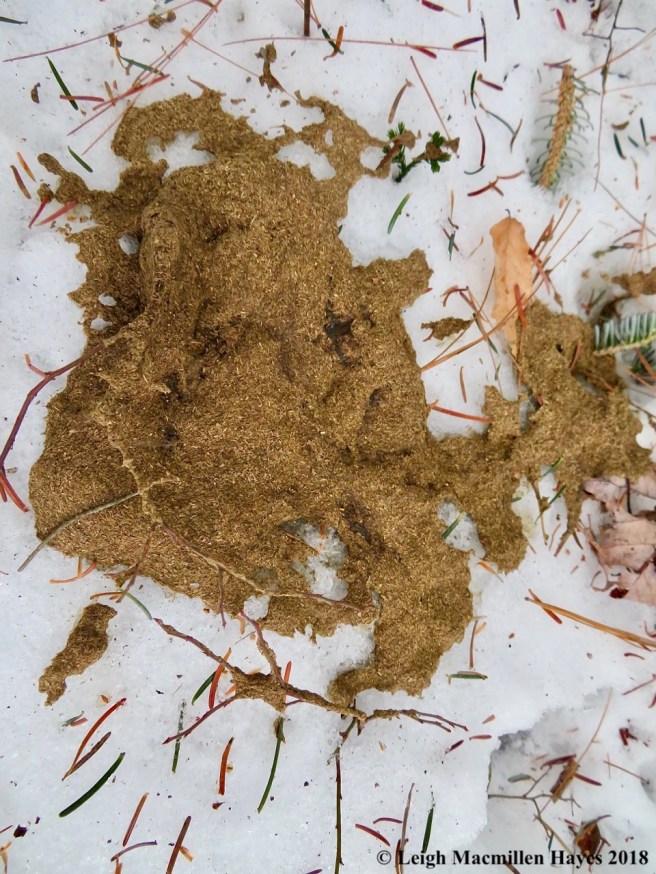
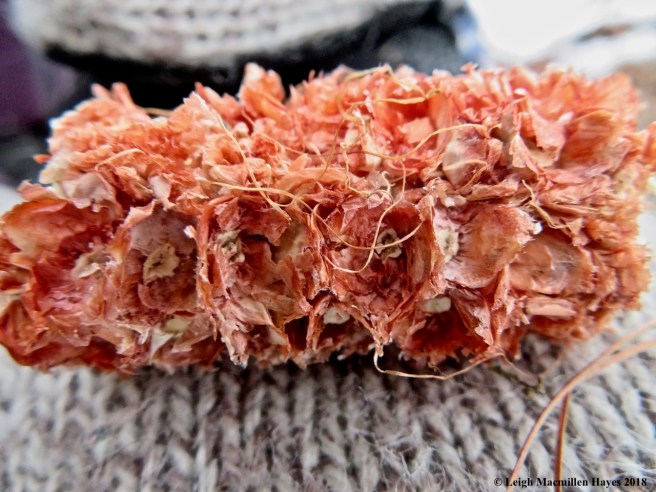
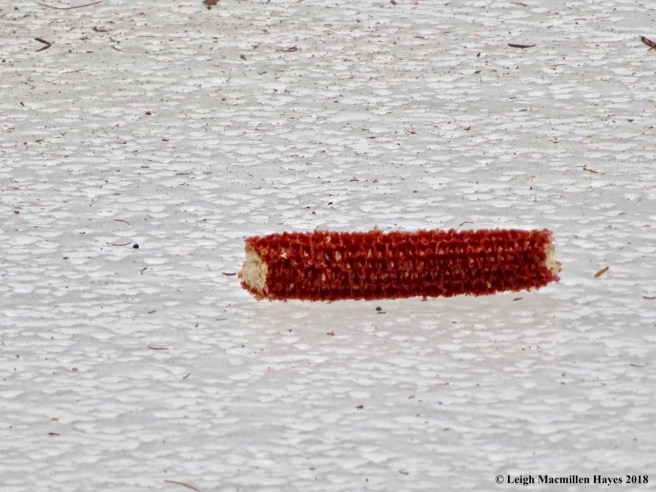
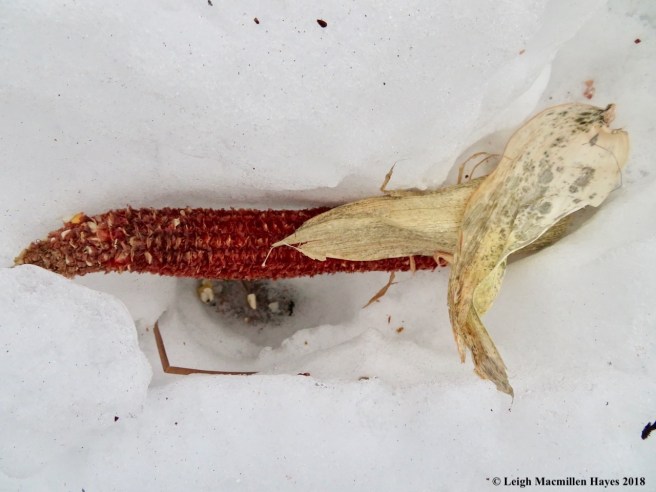
it wasn’t! Corn on the cob? On ice? And then we remembered that there was a cornfield located directly across the road. So . . . that made sense. But, how did it get to the other side? We’d noticed plenty of turkey tracks. Would turkeys carry cobs of corn? Not the ones that visit my backyard on a daily (sometimes twice daily) mission to eat as much bird seed I’ve tossed on the ground as possible. They scratch about and eat whatever is available on the spot rather than carrying it–as far as the four of us knew anyway. 

Did the deer bring it across? Again, we’ve always seen them dine on site. And . . . we noticed that the cobs, and even occasional husks, were left within their prints, so the corn arrived after the deer. 

As we continued to look around, we began to see kernels in small piles everywhere. 

And with that, we suddenly spied something else that looked oddly familiar. 

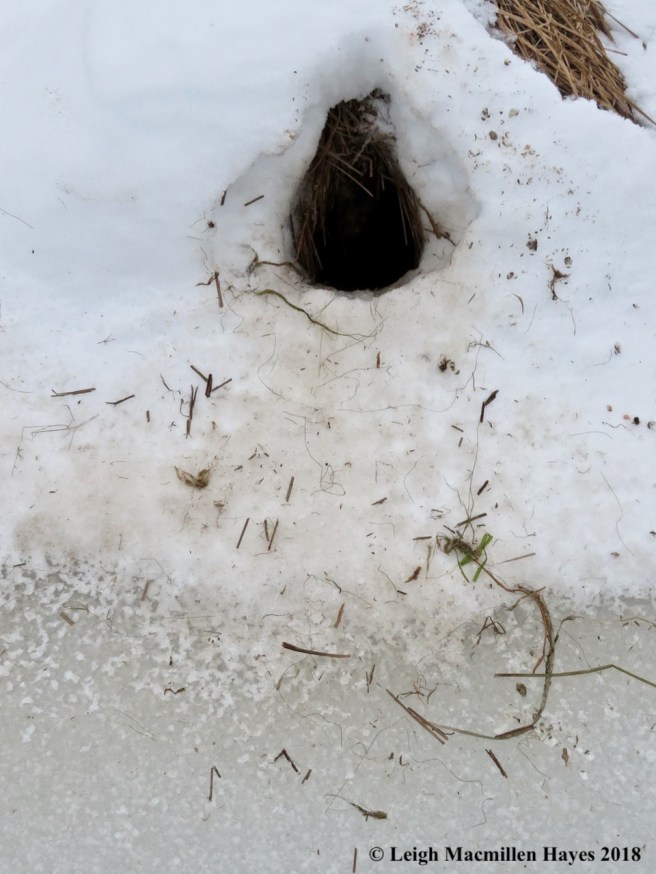
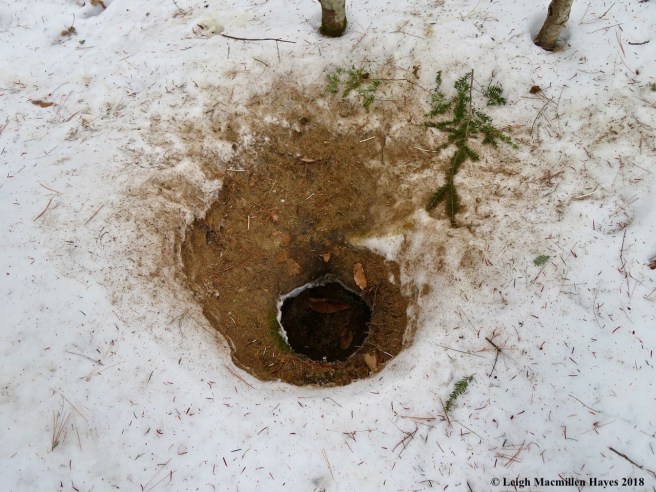
The hole! Notice its spiral shape. Discernible tracks? No. Dirt? Yes. Hoar frost? Yes. Hmmmm . . . 

We looked around for signs. “So and So lives here” would have made it too obvious. But, we found hoar frost on an adjacent hole, which raised a few questions: 1. Were the holes connected? 2. Was a critter breathing within? 3. Or, because we were near the bog, was there warmer water below that was creating the frost? 

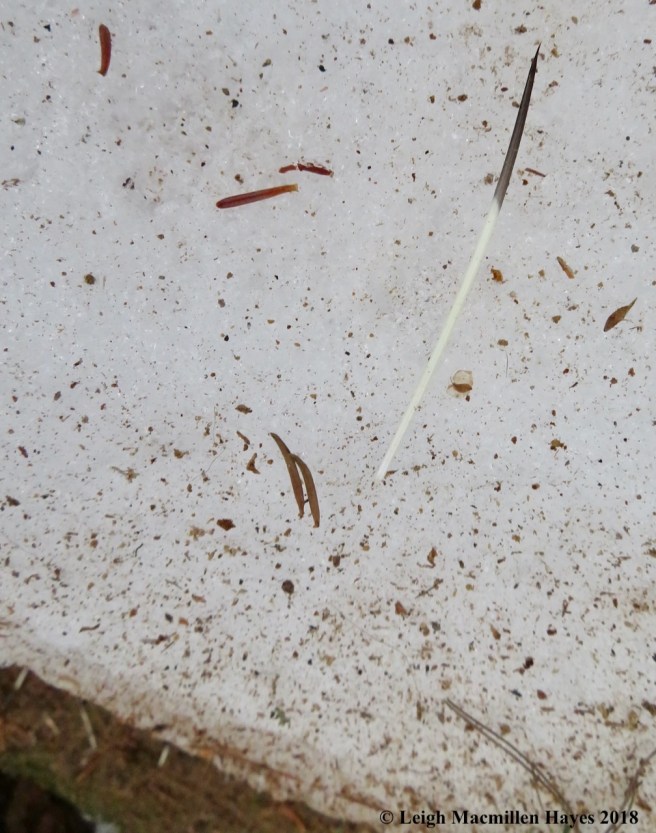
Then we found something none of us had ever seen before. A smattering of sawdust on the snow located about five feet from the hole. Scat? Upset stomach? Two of us got down with a loupe to take a closer look and came to no conclusions. 

As we continued to look around, we noticed that though there wasn’t a discernible track, it did seem that activity led to two hemlock trees.

And there were snipped off twigs cut at an angle below the trees, plus some comma-shaped scat. 

With that in mind, we returned to the hole in question. 

Bingo! There was a sign that clearly read “So and So lives here.” A quill! When I first looked at the photo the other day I’d suggested porcupine or fox. Porcupine it was. 

Within the hole which we could tell was deeper to the left, we spotted more quills. 

Mystery solved–almost, for we didn’t know about that smattering of sawdust. Porcupine scat consists of sawdust because their winter diet includes tree bark and needles. Did the animal have a bellyache? 

Our excitement at finding the hole wasn’t diminished by the unsolved portion of the story. And still, we continued to find corn cobs as we moved closer to the water in hopes of finding tracks. 

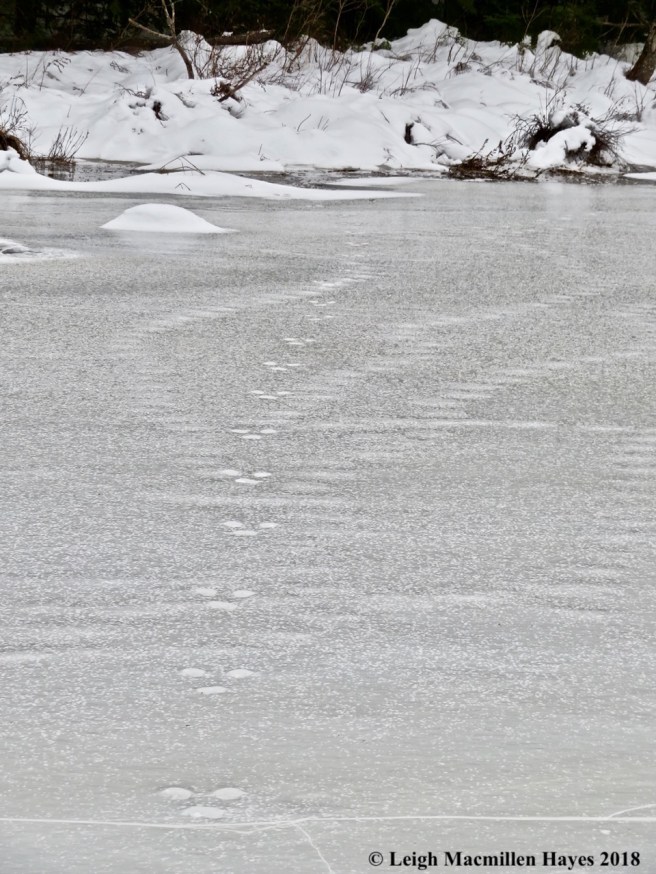
Indeed, there were some and we tried to figure out the pattern to determine what mammal had crossed the ice. 

But before taking a closer look, there was ice on the bog’s edge to admire and we each found artistic displays to our individual liking. 

Back to the tracks on the ice.

At first, with porcupine on my mind, I thought I recognized the pigeon-toed behavior. 

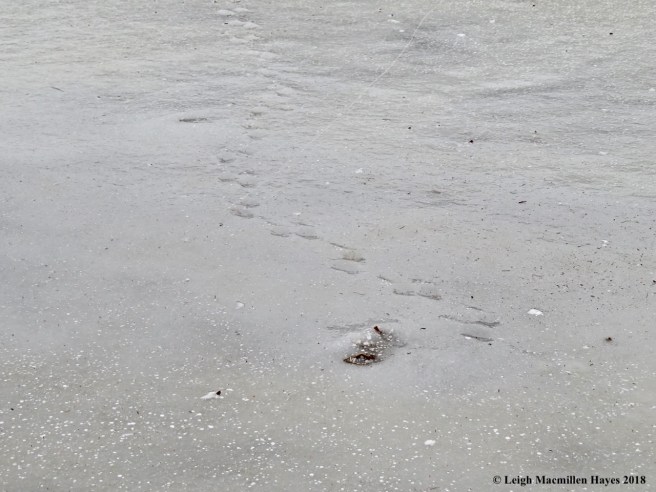
But my companions couldn’t see it. And then I realized that I was seeing a different pattern instead. Opposite diagonals became important in the overall look of two feet together. 

Studying that one pattern of a waddling animal, we soon realized another had crossed over it–in a leap and a bound. Do you see the intersection of the two in the middle of the photograph? 

And, there were a couple of corn cobs on the ice. 

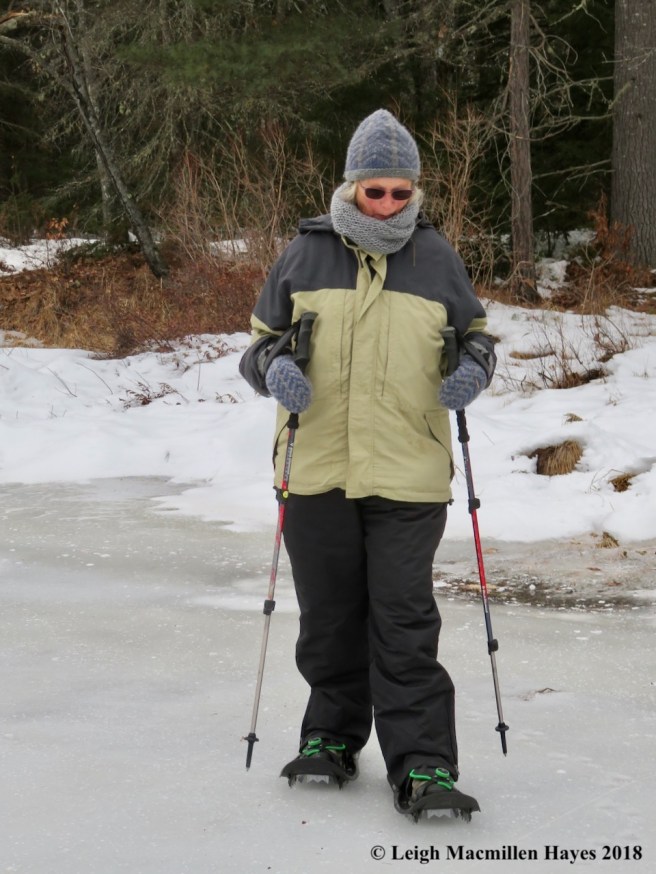
It was all too enticing, and so we got up the gumption, threw risk to the wind, and stepped out. One of us, stepped onto all fours as she slid across, the better to distribute her weight. It also gave her a better view of the tracks. 

Another came forth with caution, though she admitted she’d hoped we’d go for it. 

Her husband was the smart one and he stood on shore–looking at tracks in the snow created by one of the critters we were examining on the ice. And ever ready to call for help should we need it. 

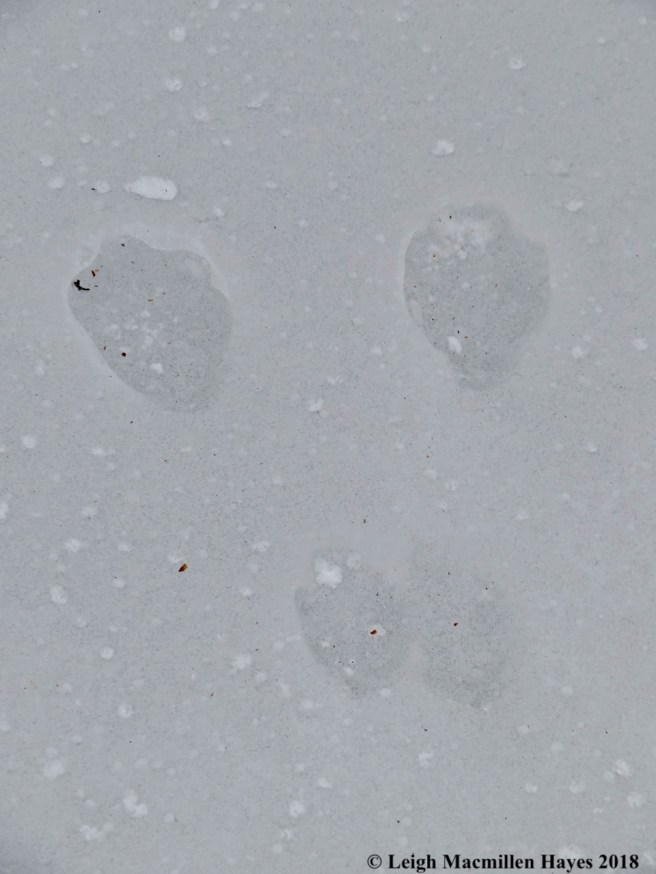
Back to the pattern–do you see three sets of two feet? In the lower set the diagonal is higher on the left and lower on the right. It switches with the middle set of prints. And goes back to the same with the upper set. 

Where debris had frozen into the impressions you can almost see the toes. The smaller, almost rounder right hand print is a front foot and the longer left hand print is the opposite back foot. That’s how it goes with a waddler such as this. 

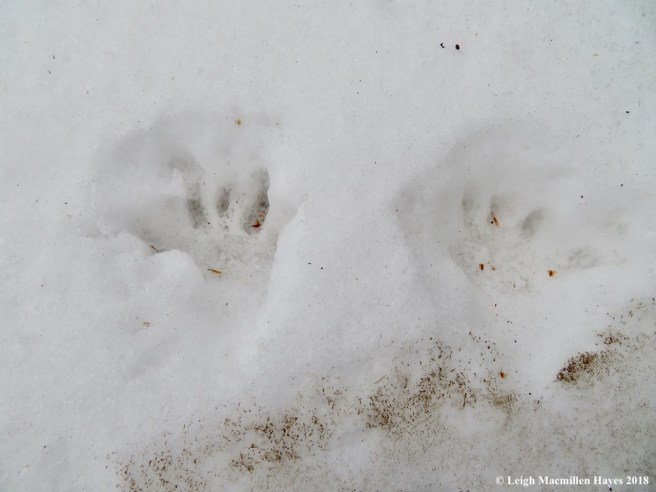
We’d actually seen clear prints near where we’d parked and so we knew this mammal had been in the area–those baby hand-like prints belonged to a raccoon. Raccoon tracks and corn on the cob. Hmmmm. We were beginning to make some connections. 

With that figured out, we moved on to the next set of tracks and determined they belonged to a snowshoe hare–the larger front prints actually representing its back feet as they had landed after the front feet bounded forward. 

As we studied the hare track, we noticed lots of movement had previously been made by another critter and I’m going to go out on a limb to say based on its size and behavior that it was related to the next mystery we encountered. 

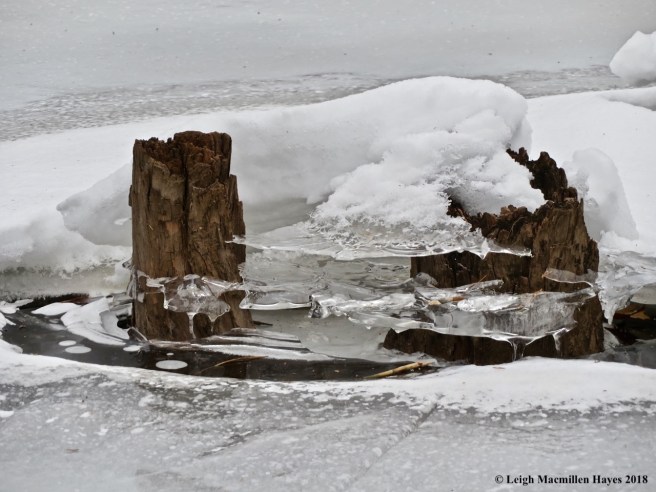
First, there was a hole around a couple of tree stumps and it was the layers of ice that drew our admiration. 

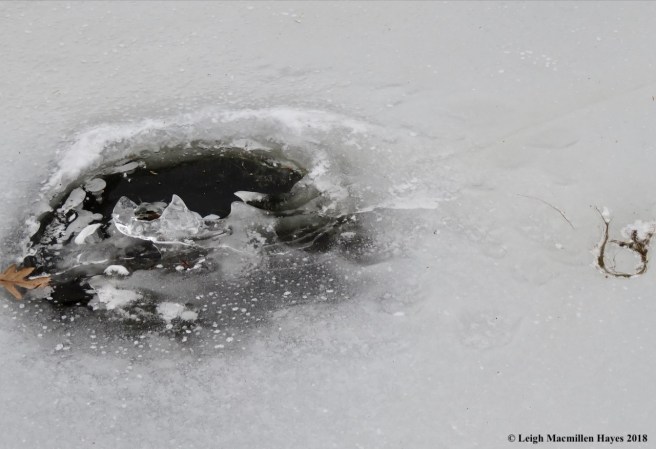
Right near it, however, was another frozen over hole and we could see some tracks that were difficult to read. 

But the ice was glorious and there was another small tree stump in the center. 

We weren’t sure who had made the holes until we spied another and some prints in the snow. 

The five tear-drop shaped toes provided a huge hint. 

And a bigger hint–a hole nearby. 

As usual, it commanded a closer look. 

And what did we find? Fish scales. With that signature, and the prints and even the pattern of the older tracks near the snowshoe hare activity, we knew a river otter had recently eaten. 

Eventually, we made our way back to the road, crossed over and checked the cornfield for we still weren’t sure who had brought the cobs to the bog. It made sense that the raccoon may have, but all of them? 

We found plenty of deer tracks, many of which were again filled with either kernels or nearly complete cobs. 

But it was the one stuck up in a broken red maple limb and the chitting nearby, plus scat below, and the actual sighting of a particular mammal that we think gave us the answer as to why so many piles of kernels–red squirrels. 

With that, it was time for us to take our leave. First, we gave great thanks, however, to Parker for sending me the photo of the hole. When I’d shown it to another friend, he asked why the spiral. I think that was the lowest point and the porcupine climbed out and then made its typical swath around until it reached the higher ground each time it exited and entered.

The question none of us could answer–what about that sawdust smattering?  

Ah well, we saved that for another day and left thankful for the opportunity to solve most of the holey mysteries. 

Twig and Bud Primer of western Maine

Some people collect salt and pepper shakers, others small figurines or coins or stamps or antique cars or beer caps or . . . TWIGS! Yep, I would fall into the latter category and because I used them last week to teach a class, I thought I’d also share them with you.

If you stop reading right now, I understand. If you choose to continue, please know that some of what you read I’ve learned from the Maine Master Naturalist course, which first opened my eyes to twigs and buds; some from a variety of books on the subject; and lots from personal observation. You may not always agree with me, but I strongly encourage you to step outdoors and take a look. Keep track of your observations and begin to note idiosyncrasies.  But do remember this: nature hasn’t read the books and doesn’t always follow the rules we’ve insisted upon as we try to make sense of the world around us. 

Next year’s flower and leaf buds formed this past summer and overwinter inside bud scales, which are actually modified leaves. Most scales, such as this one, provide protection with a waxy coating. (Species: Norway Maple, Acer platanoides)

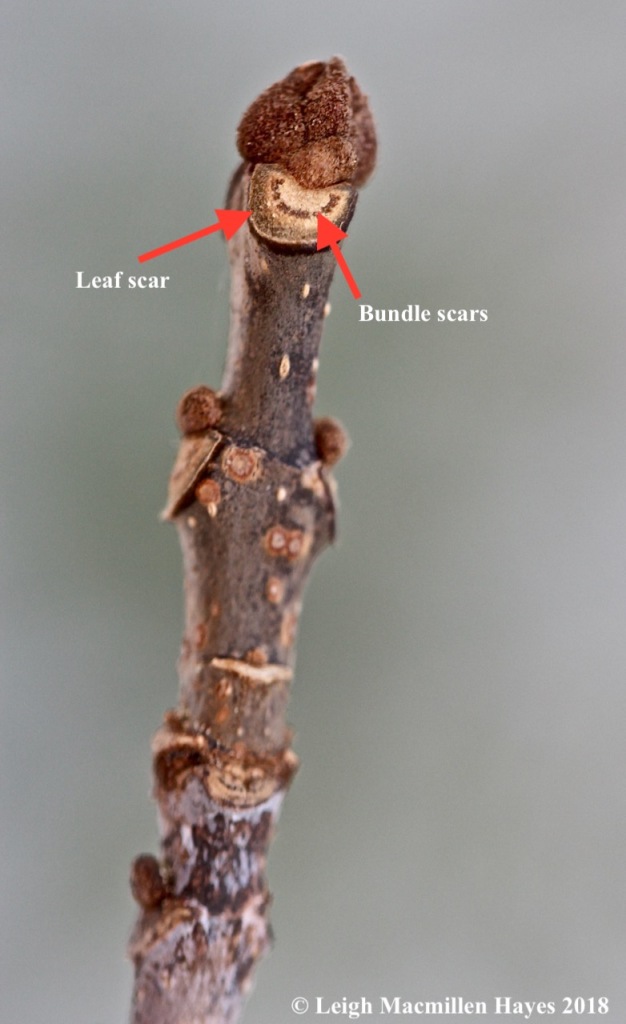
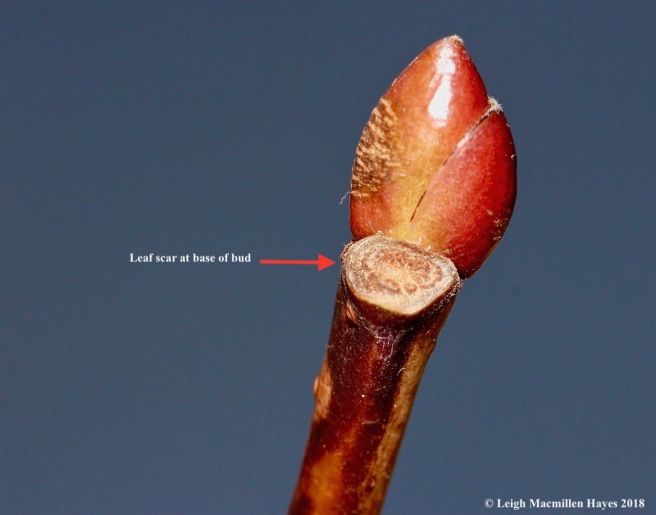
Terminal buds are  located at the tips of most twigs. When that bud forms, the tree ceases to grow for the year. At the base of the terminal bud is a leaf scar where a former leaf stem was attached to the twig. And within the leaf scar are little corky dots called bundle scars that were actually the vascular tissue that had connected the leaf to the twig. Think veins. The shape of the leaf scar and number of bundle scars can be used as an identifying mark since they are often consistent across a species. (Species: White Ash, Fraximus americana)

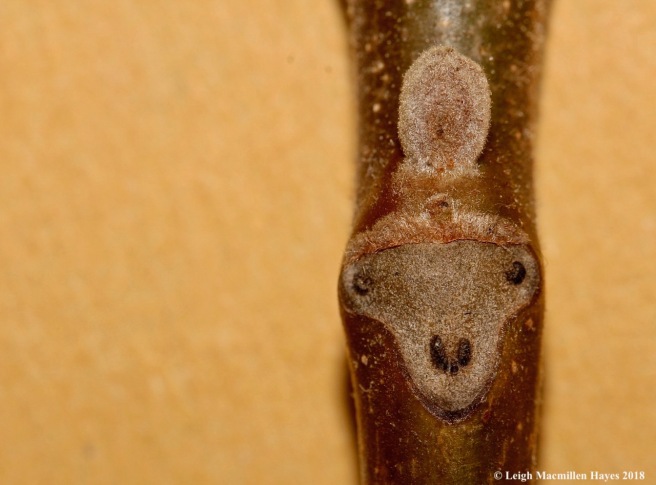
Leaf scars come in a variety of shapes, including monkey faces topped with hairy caps. (Species: Butternut, Juglans cinera)

Others may be shield shaped, though you could also see a bit of a funny face in this one. (Species: Shagbark Hickory, Carya ovata)

And there are those that nearly encircle the bud. (Species: Staghorn Sumac, Rhus hirta)

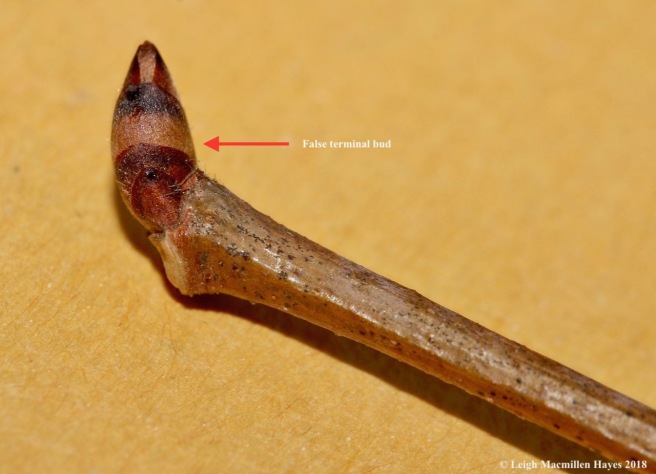
Some twigs feature a false terminal bud. In reality, it was a lateral or side bud that took the position of the terminal bud. On twigs that don’t have actual terminal buds, such as American Elm and Basswood, the wood kept growing until the tree could no longer supply it with nutrients or something else impeded its growth. The twig then died back to the last terminal bud and dropped off. (Species: American Elm, Ulmus americana)

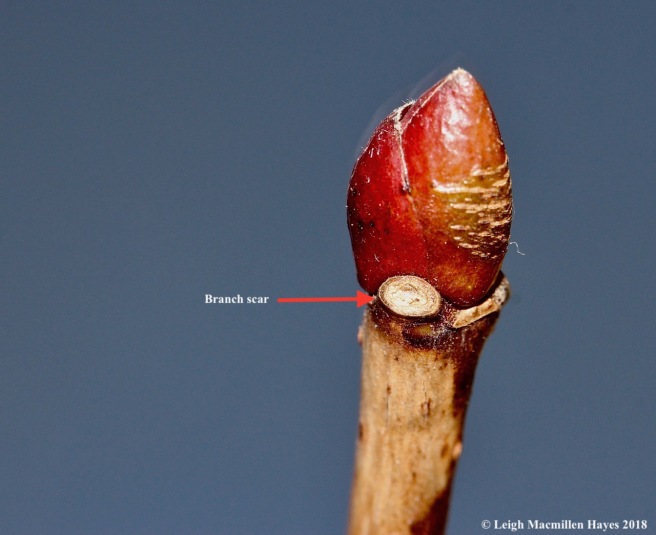
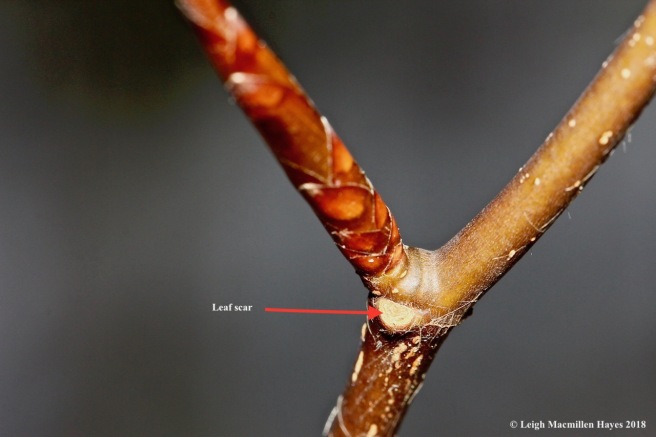
On those twigs with a false terminal bud, a branch scar was left behind when the woody structure broke off. The branch scar is located . . . 

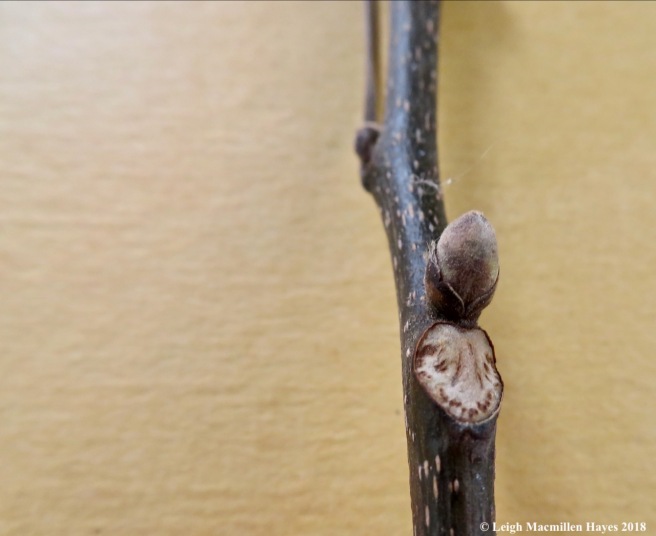
opposite the leaf scar, which contains bundle scars. (The branch scar does not have bundle scars.) (Species: American Basswood, Tilia americana)

Below the terminal or false terminal buds are lateral buds, those which grow on the side of the twig. Their orientation may be opposite, such as this example. (Species: Sugar Maple, Acer saccharum)

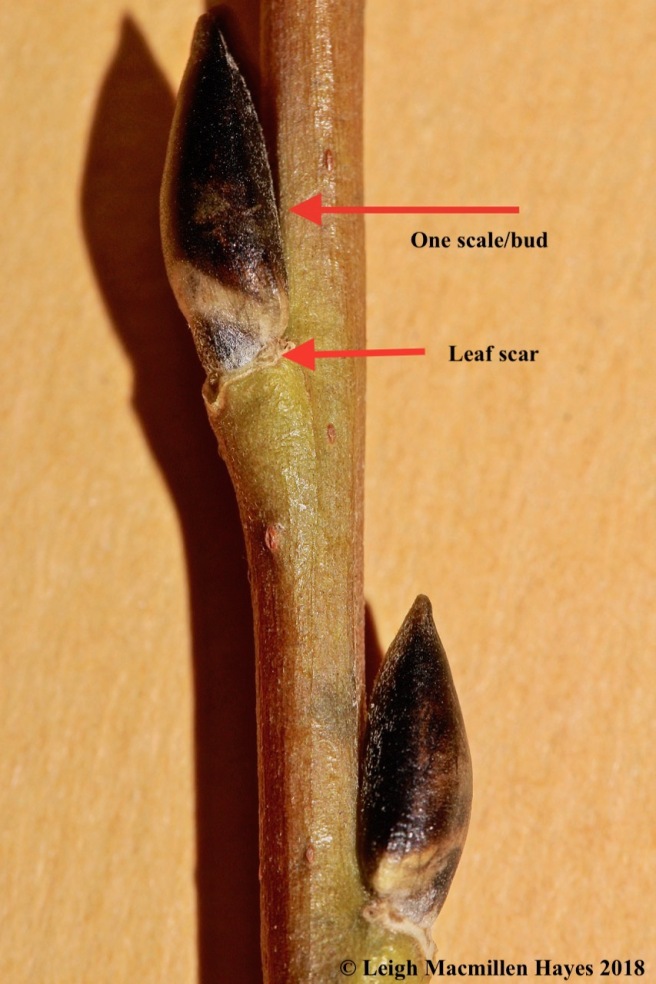
Others are alternate. The cool thing about this example is that the alternate buds are also appressed, meaning they grow flat to the twig; and they are one scaled (well, actually two scales fused together as one). (Species: Willow, Salix spp.)

Alternate appressed buds may grow far apart or quite close to each other such as with this particular tree and its globous buds. (Species: Quaking Aspen, Populus tremuloides)

Others are divergent and stick out away from their twig. (Species: American Beech, Fagus grandifolia)

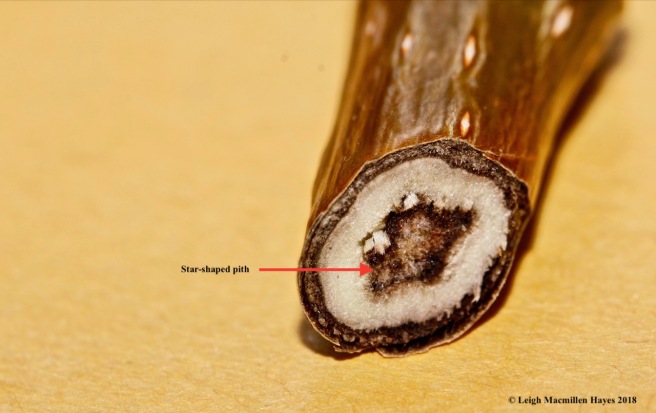
Then there’s the pith. I just like saying that word–pith, pith, pith. Pith is the soft central core or interior of the twig. It comes in a variety of patterns including round, triangular and star-shaped such as is illustrated here. (Species: Quaking Aspen, Populus tremuloides)

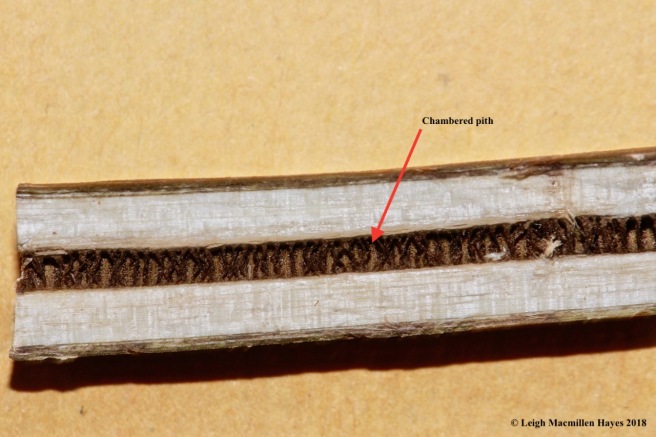
In some species, its shape is best viewed in cross-section by halving the twig lengthwise with a sharp knife. Diaphragmed pith, solid with partitions, can be seen in Black Gum, which I didn’t find. But this example is chambered pith, which is hollow with partitions. (Species: Butternut, Juglans cinerea)

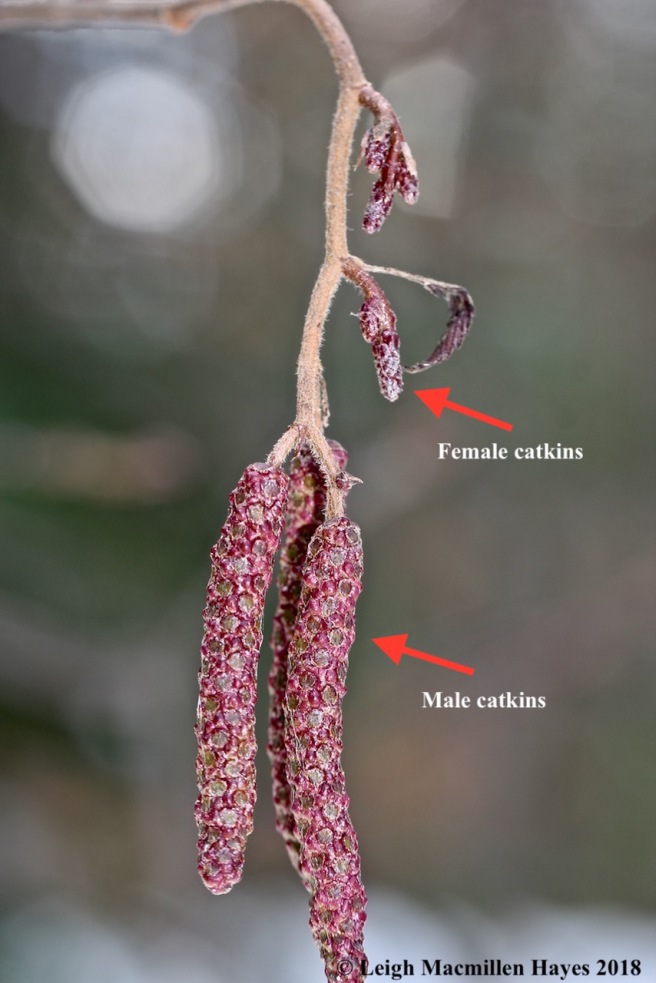
Another fun characteristic that aids in identification is the occurrence of catkins on members of the birch family. (Note: Betulaceae, the birch family, includes six genera of deciduous nut-bearing trees and shrubs: the birches, alders, hazels, hornbeams, hazel-hornbeam, and hop-hornbeams.) (Species: Speckled Alder, Alnus incana ssp.rugosa) Speckled Alder is really a shrub, but don’t tell it that. 

Another fun thing to point out are the growth rings on twigs. We often think of aging a tree by counting the rings from the heartwood out to the bark, but . . . twigs have rings of their own. They’re a bit raised and wrinkled in presentation, but each cluster of rings indicates where that year’s leaf and flower buds had formed, developed, and released their seeds. After that, the twig continued to grow. The same will develop once the current buds complete their cycle. (Species: Striped Maple, Acer pensylvanicum)

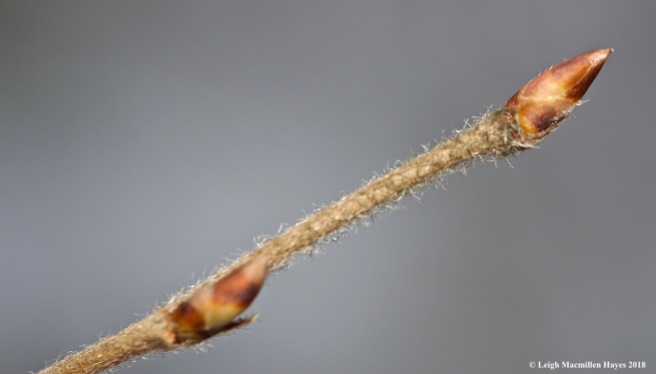
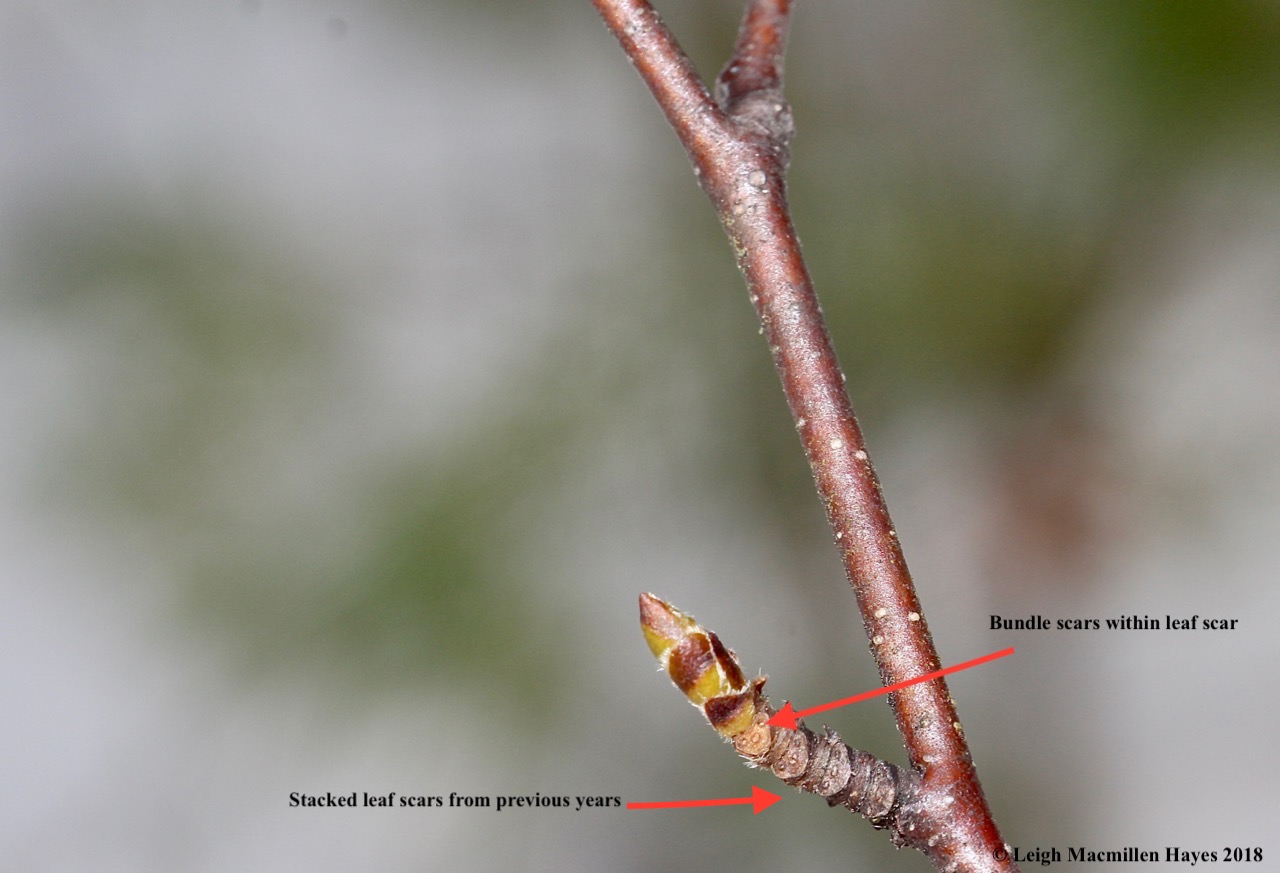
If you’ve stuck with me, know that the end is in sight. I’d like to conclude this post with examples of some of my favorite trees found in the western Maine woods. I’ll begin with those deciduous trees with alternate buds. This particular twig is in a family that features catkins. It has several cousins so it’s worth getting to know a few of them. Notice the hairy twig, but not so hairy and rather pointed buds. Buds on older branches grow on stacked scars, which I’ll share an example of in a minute. If you were to squeeze these buds, they’d be sticky. Those are all great clues, and here’s one more. The tree’s bark is white and it curls away from the tree in rather big sheets. 

Did you guess correctly? 

Here’s a cousin and that example of stacked scars with the bud at the end that I promised. Notice the lack of hair? The clues for this species: scrape the bark on the twig and sniff it. Does it smell like wintergreen? And the bark on the trunk–does it peel away like ribbons? (Species: Yellow Birch, Betula alleghaniensis)

And another member of the Betula family. This one is an early succession tree, meaning it grows quickly in fields and along roads that have been disturbed. But it is also the shortest lived of the family and doesn’t reach an old age in tree years (Yellow Birch can grow to be about 250 years and Paper Birch about 150). This species is lucky if it reaches its 90th birthday. Though you can’t see it here, the twig isn’t hairy, but it is quite bumpy or warty. And it doesn’t have a wintergreen odor if scratched. Also, the bud isn’t sticky. Though only one catkin is shown here, it could have two, while Paper Birch has three and Yellow three or four. Who is this? 

I’m sure you guessed it. 

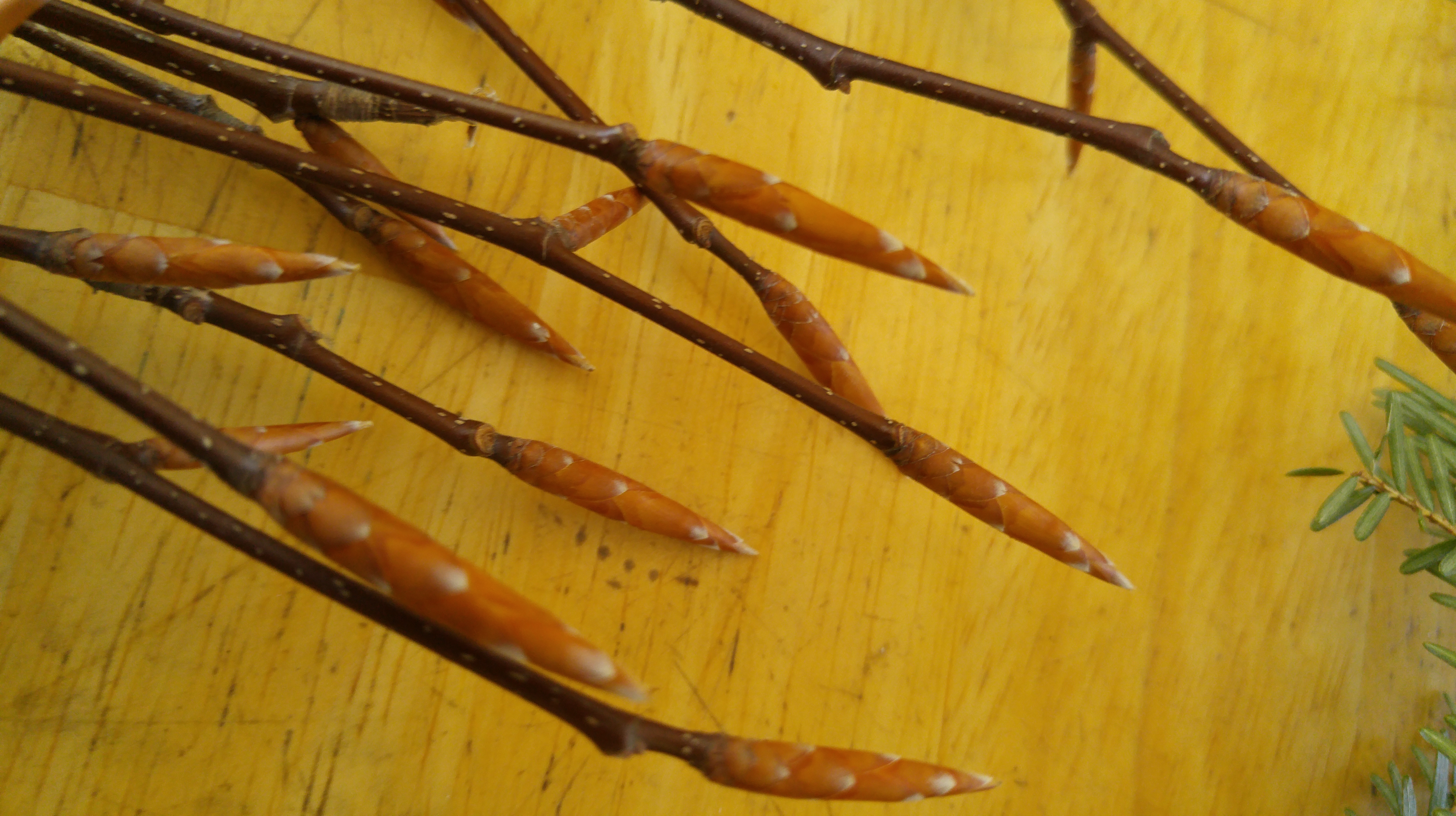
Another of alternate twig and bud orientation, this particular bud is often described as a cigar. I’m not sure that works for me–maybe as it expands a bit in the spring, but the multiple overlapping scales and pointed tip make it seem obvious as its different from all other presentations. Plus, its leaves are marcescent, meaning they wither or remain on many younger trees throughout the winter. Actually, it’s easy to be fooled into thinking a mammal is moving nearby for in a slight breeze the marcescent leaves rattle. I’ll admit I’ve jumped a few times. Back to the buds–the other thing to note is that like a New York Fern, it tapers at both ends (maybe they, too, keep their lights on at both ends of the day). Who is this? 

Bingo! You are on a roll! I should define lenticel at this point. Those raised white dots on the twig are the lenticels, which are the pores that provide openings for air-gas exchange. 

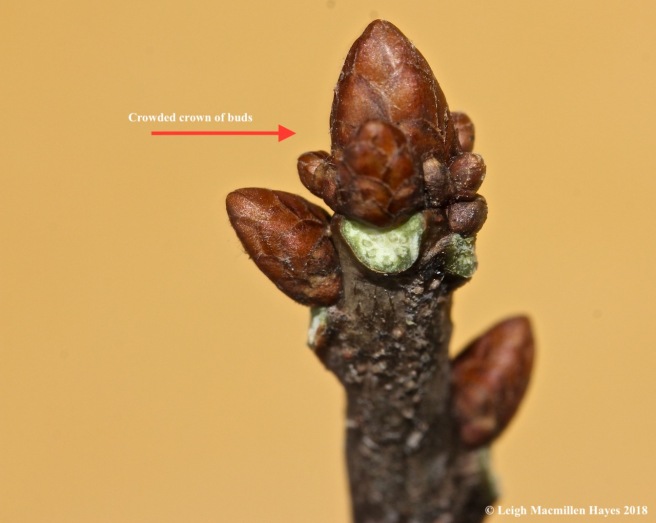
We haven’t talked about the fact that some twigs have buds crowded at the tip. In this particular case, I think of them as a crown. 

This cousin also wears a crown. So, what are their differences? The first is more conical and shinier than the second. And look at their colors. Number 1 comes in shades of chestnut brown, while number 2 is much darker and almost reddish brown in tone. You’d have to look carefully to see the silky hairs at the pointed tip of number 1, but trust me that they are there. Number 2 is hairless and blunt. 

This is number 1. Did you guess that correctly? And number 2 is . . . White Oak, Quercus alba

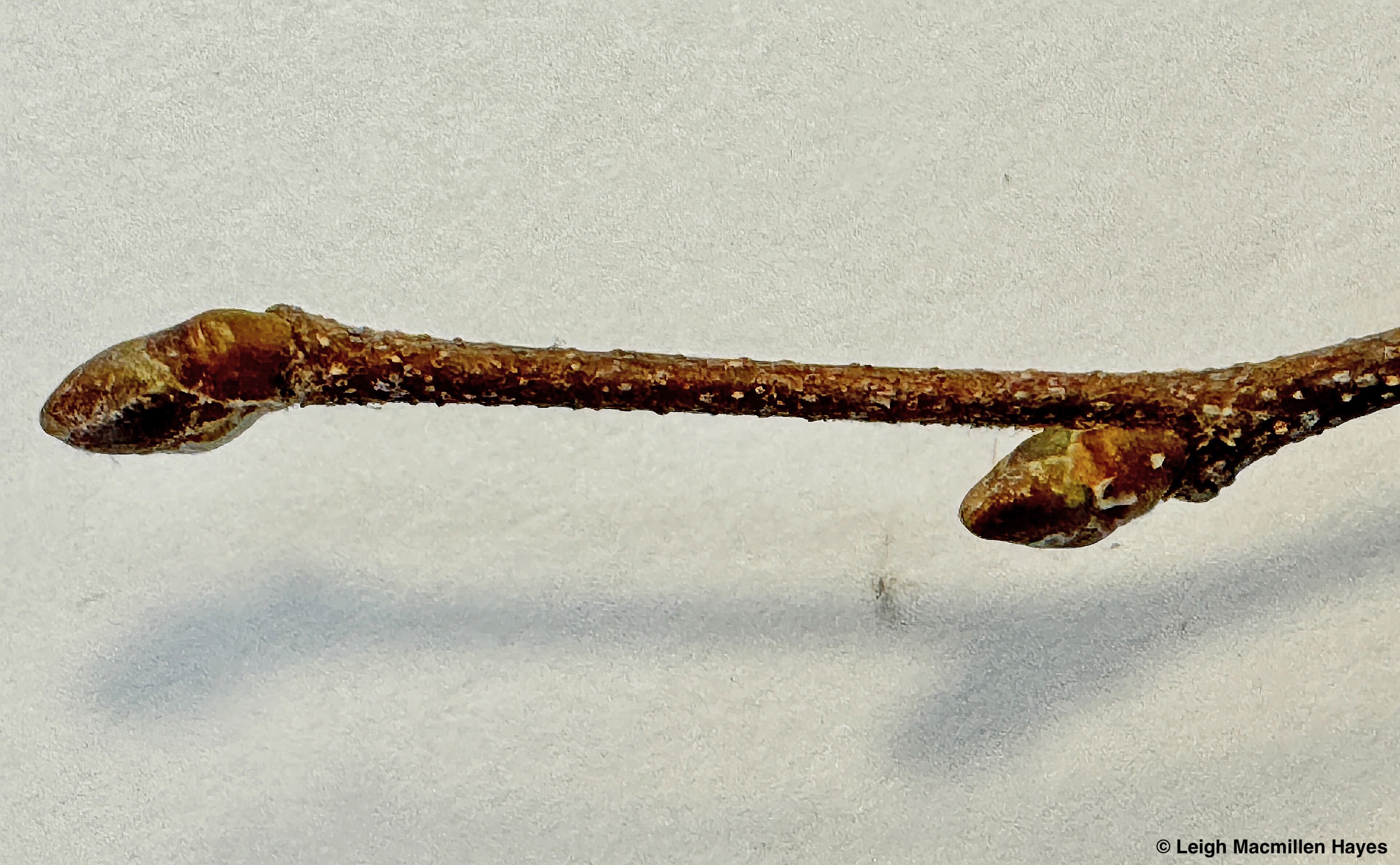
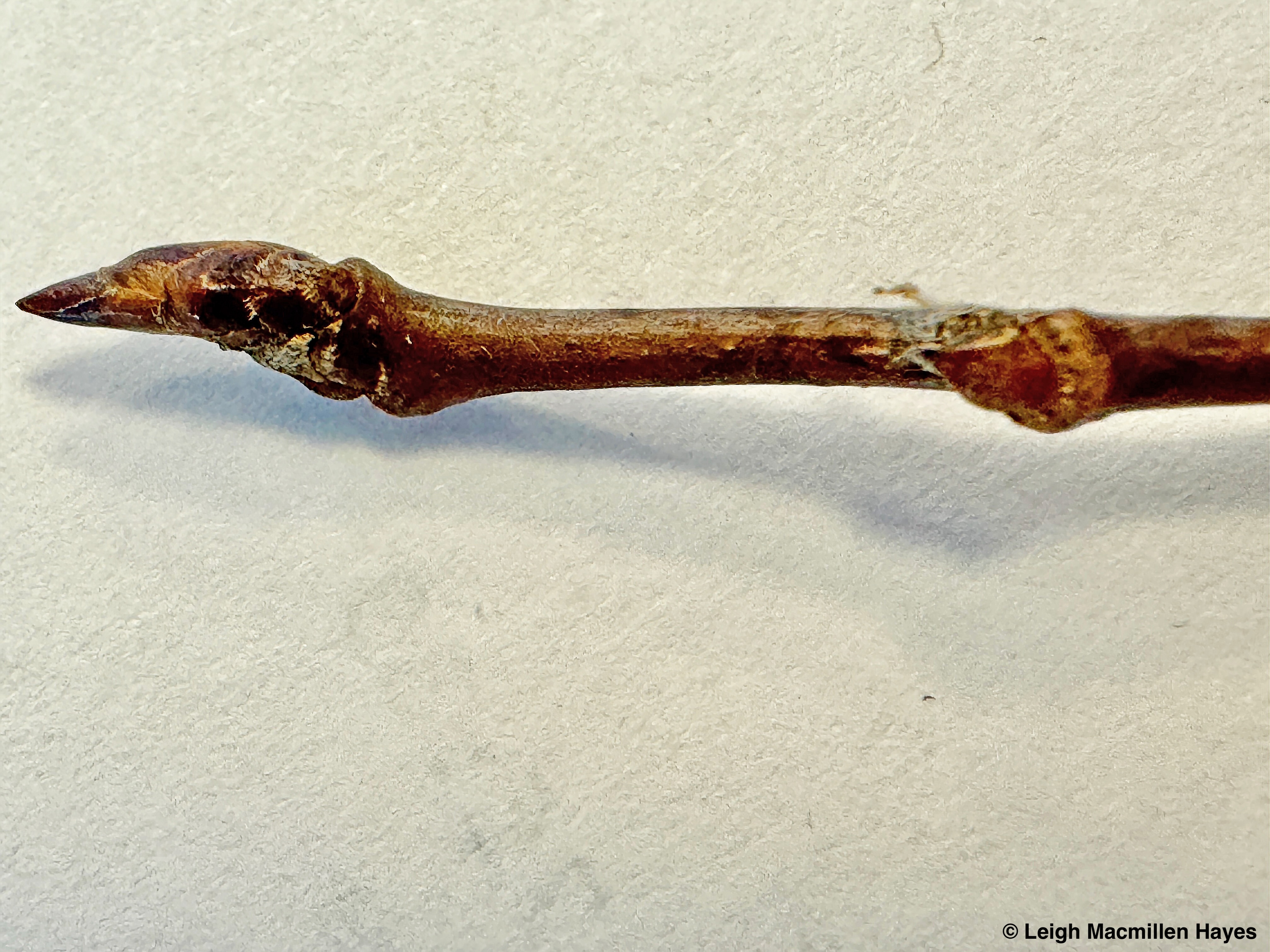
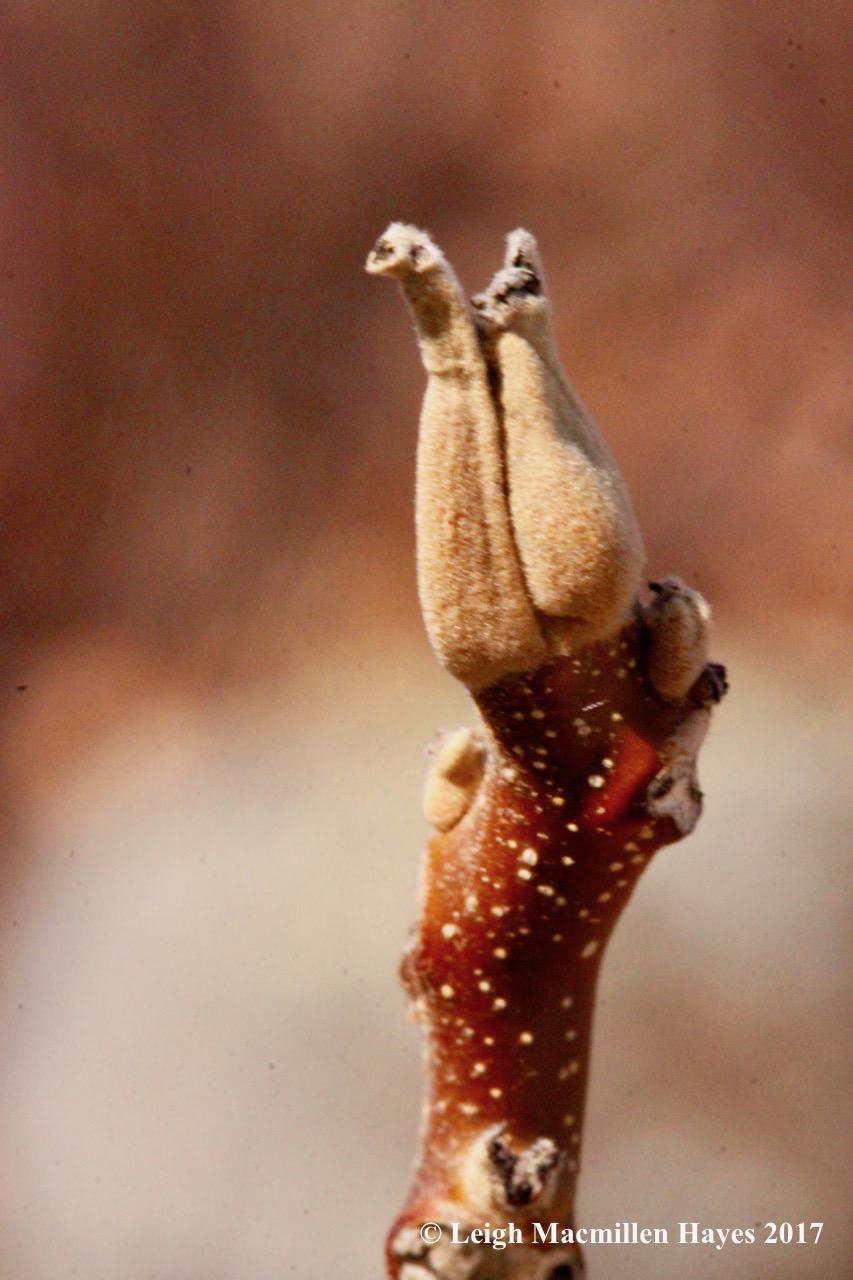
Now it’s on to trees with opposite orientation. And if you think you’re seeing double, you are! I used this photograph at the start. But now, let’s compare this twig to that of a cousin. 

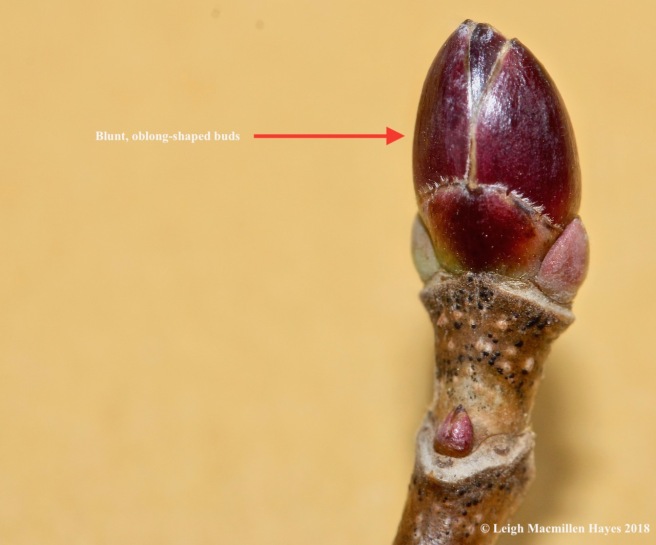
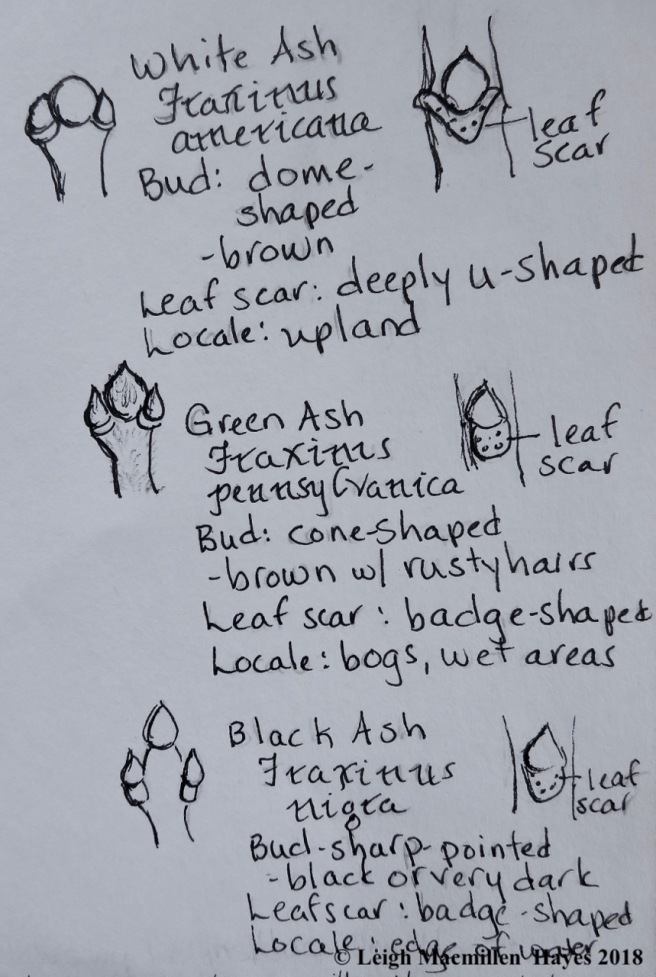
Can you see the fuzz on this one? And no fuzz on the one above? Also, notice in the first one the notched leaf scar. The second is not deeply notched. Who are they? 

Two of the three ashes that grow locally. Identifying White and Green Ash, as they are respectively, is never easy, but the hairs or lack of, and the shape of the leaf scars are the key elements. 

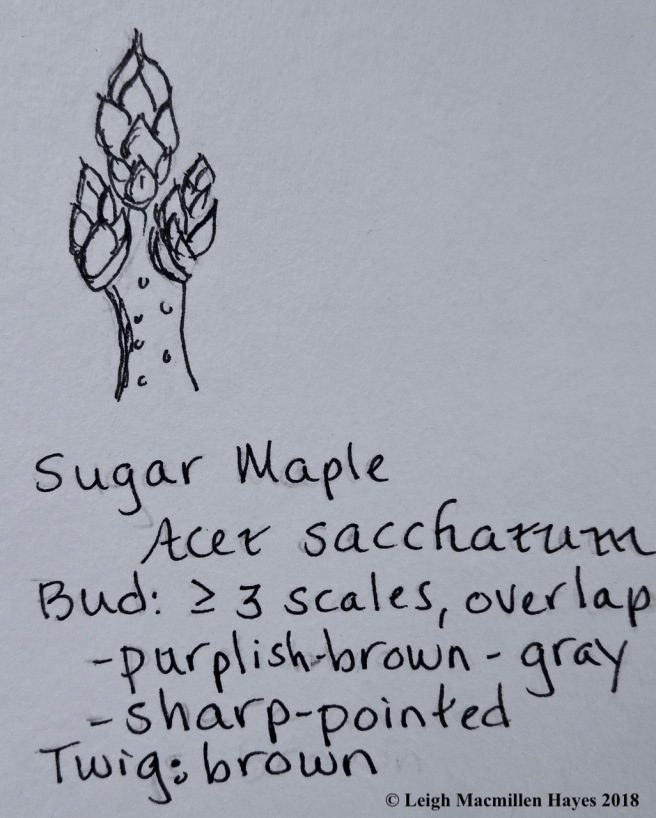
And finally, two members of probably everyone’s favorite fall trees. Notice the lateral buds are arranged on opposite sides. The buds and branch are purplish brown. On the twig, the buff colored lenticels practically jump out. The bud is a tad bit hairy and sharp pointed. Do you see the leaf scar bundles? How many? I hope you counted three. And who might this be? 

You are almost done. Only one last twig to examine. 

This one is probably Maine’s signature tree when it comes to fall foliage. And of all the members of the Maple family, this is the most abundant species. So, remember the crowded buds on the Oaks? Well, this twig also sometimes wears a crown. But, the terminal bud is wedged between two opposite lateral buds. And the color–red, because there’s always something red on this tree. Hint. Hint. If that didn’t give it away, this will . . . 

I love Red Maple. If you haven’t done so, follow the progression of its buds and I hope you’ll be wowed when it flowers next spring. Until I looked, I never noticed its dainty flowers. Now, I can’t not look. 

If you’ve stayed with me thus far, congratulations. You deserve an award. Or at least a hearty THANK YOU!   

 There’s more, but I’ll let the bigwigs handle that. I just learned of a new book about trees that I plan to purchase soon entitled Woody Plants of the Northern Forest: A Photographic Guide by Jerry Jenkins. Thanks to fellow naturalist Anita Smith for the recommendation. I can’t wait to add it to my bookshelf. 

Who knew there could be so many idiosyncrasies? After all, aren’t they all just twigs and buds? Ah, the wonder. 

I hope you’ll refer to this primer periodically as you gain a better understanding of twig morphology. And share it with your friends ;-)

A Blue Bird Kind of Good Friday

When Jinnie Mae picked me up this morning, our destination was the Narrow Gauge Trail. But somewhere between here and there, she pulled a U-turn and drove to Narramissic Farm owned by the Bridgton Historical Society.

It had been just over a year since I last visited and I wanted to show her the shagbark hickory buds. And maybe even the bear trap.

n-Pleasant Mtn to Narramissic1

We crossed the field behind the house and started off on the path to the quarry and bear trap, but snow and water in the woods resulted in another U-turn. We’d been talking so much, we’d hardly noticed our surroundings, but the view stopped us in our tracks.

n-Pleasant Mountain

To the left, the long ridge line of Pleasant Mountain, where the ski trails of Shawnee Peak Ski Area made themselves known.

n-Narramissic

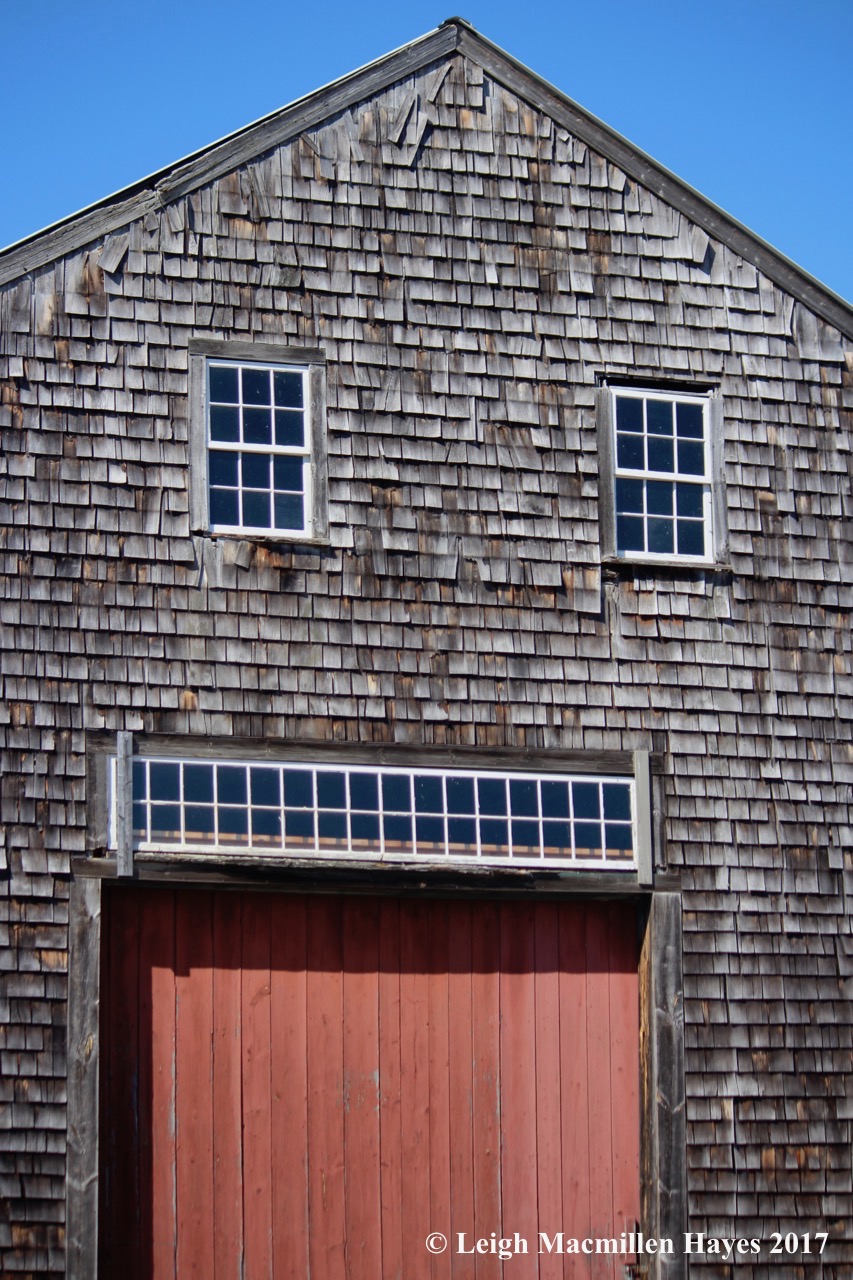
And in front of us, the Temperance Barn and Peabody-Fitch homestead, built in 1797. We had the place to ourselves and reveled in the quiet of the day–when we weren’t talking, that is.

n-shop and flagpole

Heading to the road for our tree bud search, we passed by the blacksmith shop where horseshoes were probably made in the day.

n-temperance barn

And at the Temperance Barn, so named “because it was raised without the traditional barrel of rum,” I can never resist admiring the structure even though it’s in great need of repair.

n-ash tags

And then we were stumped by a flowering tree. It sure looked like an ash as Jinnie Mae suggested, but what were those lacy tips? What came to my mind first were the tags on red oaks that I didn’t understand a few years ago until a friend helped me realize that they were leaf stems left behind when the wind finally claimed the dried leaves. Was this the same?

n-double-wide stonewall

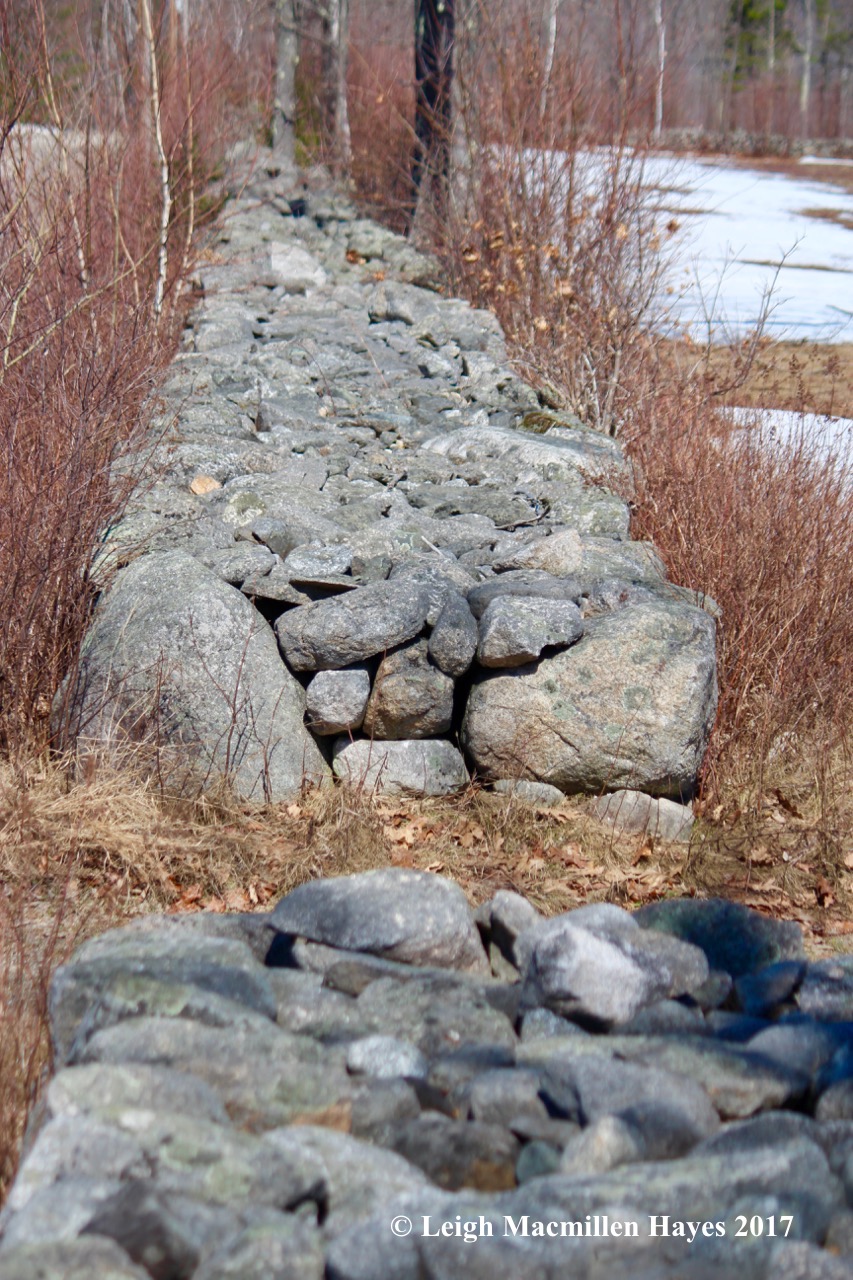
Climbing onto the double-wide wall, I took a closer look.

n-white ash danglers 1

Turns out Jinnie Mae was right. But my question still remains. Were these the stems of the ash samaras or compound leaves?* For some reason I’ve never before seen them left behind. Ah, there are so many things to discover in this world.

n-black walnut 3

We continued down the road, noting budding pussy willows and flowering red maples. And then I spied the bulbous buds I wanted to show her. Only, it turns out that we hadn’t reached the hickory trees yet.

b-black walnut leaf scar 2

The monkey face leaf scar should have been a clue. But my brain was stuck in hickory mode and I completely forgot that black walnut leaves leave such a formation. At home, I pulled out Forest Trees of Maine and then seesawed between black walnut and butternut (aka white walnut). Both feature leaf scars shaped like a monkey’s face. But the top of the leaf scar serves as the give away–this one did not have thick fuzzy eyebrows like a butternut, so I’m going out on a limb and declaring this a black walnut.

n-shagbark bud hairy 1

A bit further down the road we spotted more bulbous buds. These were definitely the ones I was looking for–shagbark hickory. In the moment and because the two trees weren’t close together, we thought they were all one in the same. But hindsight being 20/20 as it is, the photographs tell the story.

n-shagbark bud 6

The subtle colors and fuzziness wowed us and we both took numerous photos.

n-shagbark leaf scar1

Then there were the leaf scars–definitely more heart-shaped than the previous trees.  And lacking that smiling face. We smiled for them.

n-Long Lake below

It wasn’t enough to find the small saplings beside the road and so we crossed another field in search of the mother tree.

n-grasshopper 1

Along the way, Jinnie Mae spotted a wee grasshopper–the first of the season for us.

n-shagbark bark from distance

And then her newly trained shagbark hickory eyes keyed in on the momma.

n-shagbark bark 3

If you go, it’s located behind the barn.

n-shagbark bark 5

And shouts its name in presentation.

n-shagbark bark 4

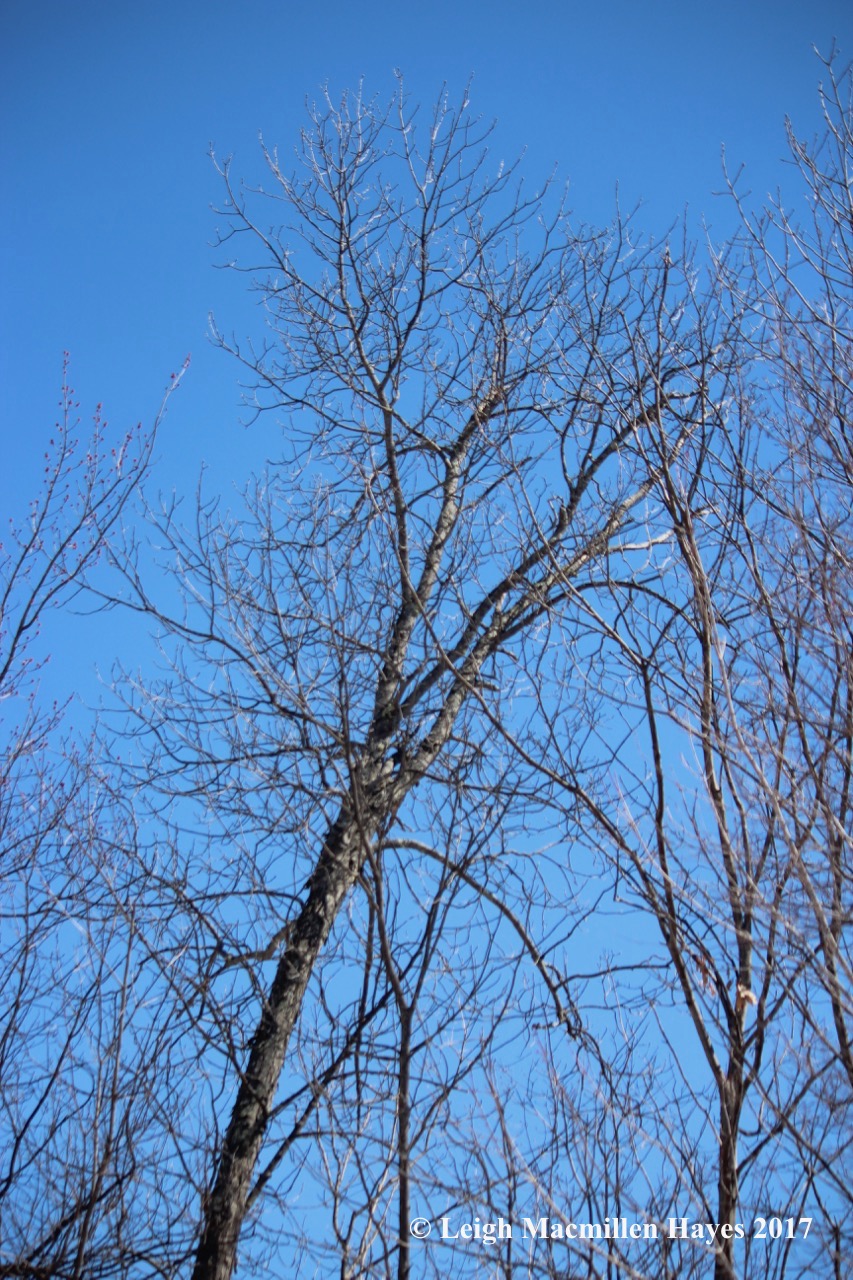
Looking upward, we could see the bulbous buds on the twig tips contrasted against the bright blue sky.

n-bluebird

Happiness is a blue bird kind of day–sweetened by time spent exploring with Jinnie Mae, making discoveries and watching bluebirds move between the field and the trees. Indeed it was a Good Friday.

Now we need to return and find the mother black walnut.

*Thanks for Maine Master Naturalist Pam Davis for IDing the ash strand as the rachis of the compound leaf. She reminded me that I have seen these on the ground in the fall. But–to be still dangling from the tree was new to my eyes and mind.


All Twigged Out

In preparation for a senior college class I’ll be teaching this week entitled “All Things Spring,” I headed out the door in search of twigs.

t-Mount Wash

Of course, it doesn’t look like spring quite yet. But then again, it does. And on this crystal clear day, the silhouette of the buildings atop Mount Washington were visible.

t-vernal pool

Before I could settle down to the work at hand, I visited the vernal pool, where all was quiet. But, I know the time is nearing. I could smell spring in the air and feel it in the warm sunshine that enveloped me and my surroundings.
t-chick 4

And then I slipped into the gray birch grove to begin my hunt,

t-chick 3

while a black-capped chickadee wondered what I was up to–no good, as usual.
t1-table top (1)

At last, I filled my satchel, but only enough–never wanting to take more than necessary. In fact, since I don’t know how many students will be present, they may have to share.

My plan is to begin with a slide show of flowers and ferns, mammals and birds, and of course, life evolving at the vernal pool (all photos were taken a year ago). I’ll bring some fun things to share, including scat–I sure hope they (whoever they are) think it’s fun.

And then we’ll look at twigs through a hand lens so together we can examine the idiosyncrasies of our common deciduous trees,

t1-sugar maple (1)

such as these sugar maples and . . .

t1-striped maple twigs (1)

a few striped maples.

t-beech

We’ll look at beech,

t-quaking aspen

quaking aspens and several others.
t-opposite

My materials are almost ready, though I still need to pull something together about fern crosiers. Oh my!

t-alternate

I’m nervous, but excited. My hope is to instill a sense of wonder, but maybe no one will show. That would be okay–I’d just quietly slip back into the woods.

Until then, I’m trying not to feel all twigged out.