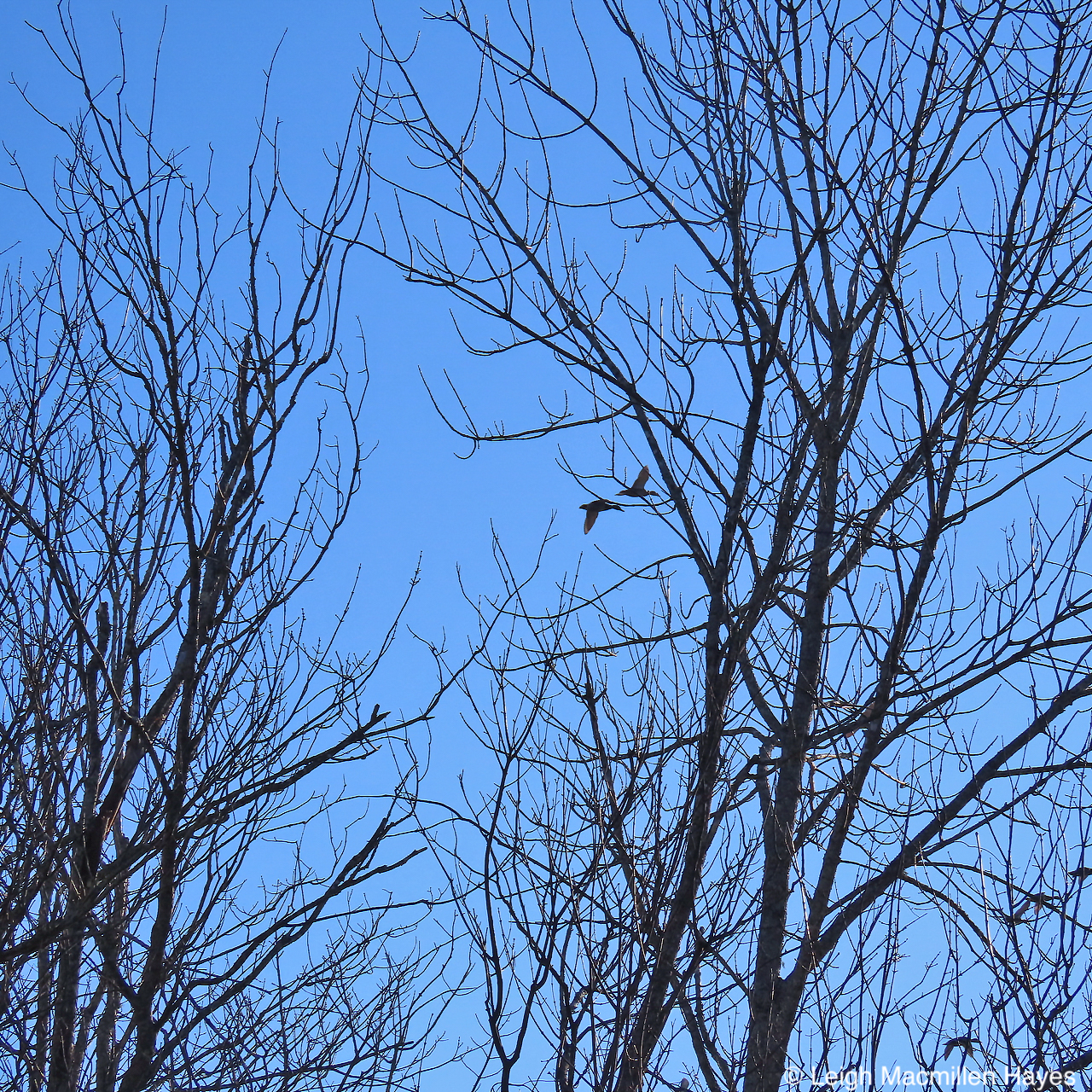
Collecting Birds

OK, I admit it. I’m a collector. Of things. But they are all special things. And many of them handcrafted. And most of them with a story to tell.

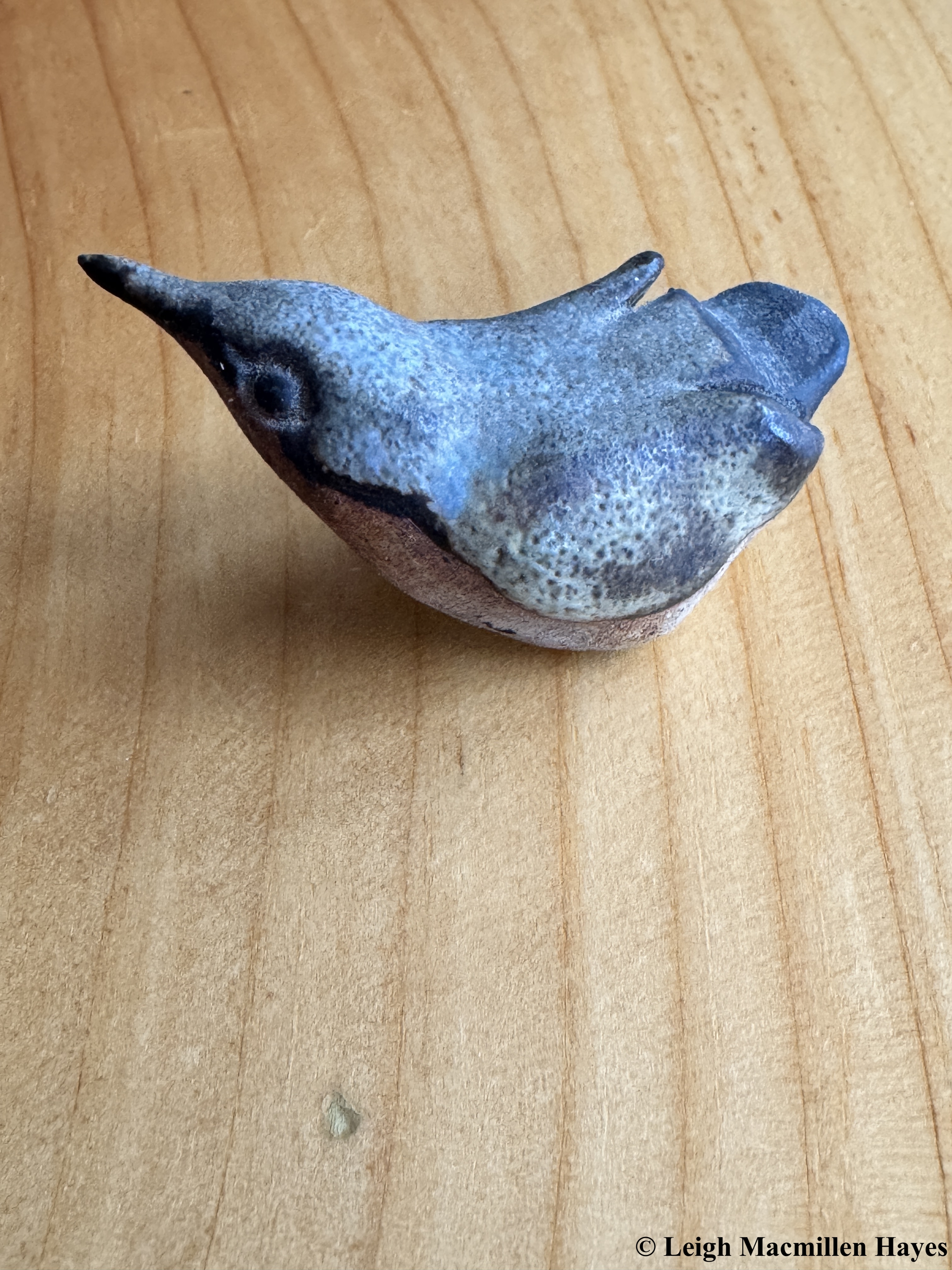
So, yes, I collect birds. No, not dead or dying birds. And certainly not living birds. Just . . . birds. My collection is actually quite small, and until today I hadn’t given it much thought, but it began a hundred years ago when I was a senior in college and my roommate and I hosted a student from Great Britain in our dorm room for a week.

I honestly cannot remember her name or too much about her. But I do remember that at the end of her stay she gave us each a bird.

And I remember she told us they were of the Tit species, which didn’t mean a whole lot at the time, but now that I see and hear Titmice on a regular basis, I have a better appreciation. This little bird has graced my desk for decades and the young woman’s name keeps flitting in and out of my mind, so maybe I’ll recall it by the time I finish writing. I now realize I haven’t thought about her in years, despite my fondness for the gift she bestowed upon me.

Another gift was the carving of a Chickadee, and I received this one about 35 years ago from a sweet little man named Carl and I only wish he’d lived long enough to know how much I still appreciate it.

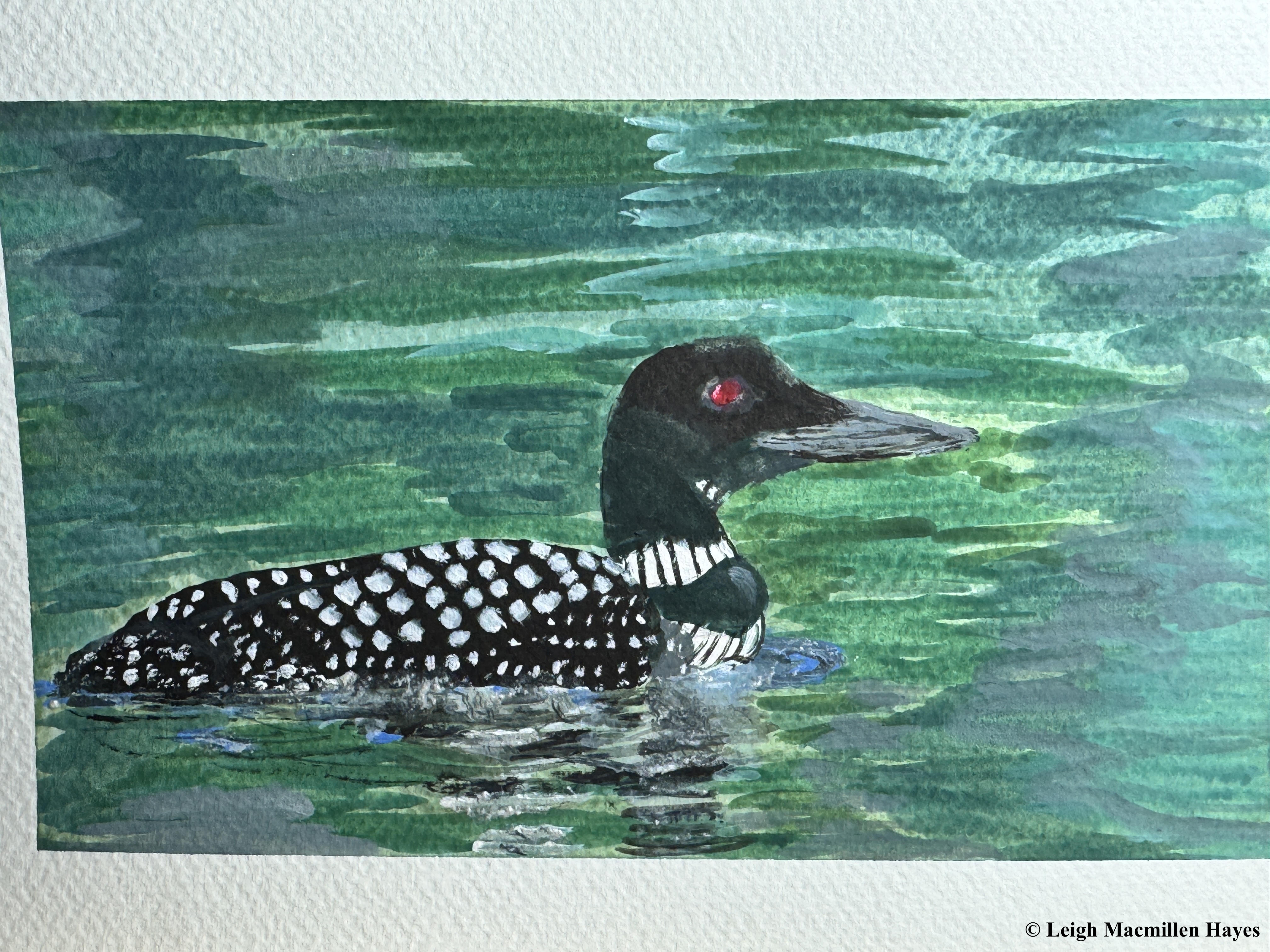
Likewise with this Loon, crafted for us by my Godfather Russell because he knew My Guy and I love our encounters with these birds who symbolize Maine. And he loved to paint, among many other talents.

I also cherish these two ornaments that never made it to a Christmas tree because they pose instead from a vase of twigs in my study. The one on the left was created by Dr. Fred, a founder of the Maine Master Naturalist Program, and the Hummingbird was gifted to me by my friend Marita after she spent some time bicycling around Cuba last year.

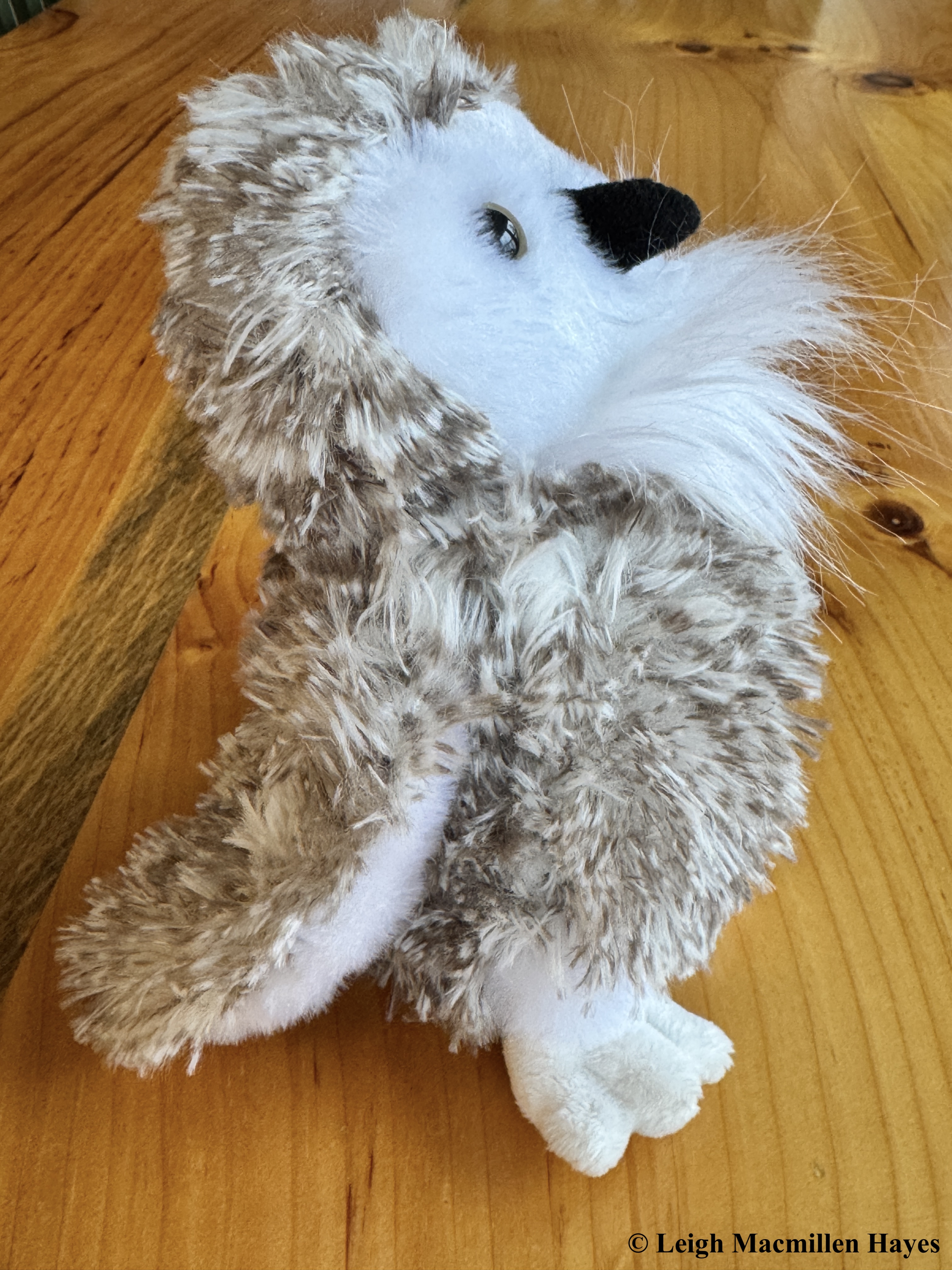
And then there is the Token Owl. Token, because if one is leading an Owl Prowl and there is no guarantee of spotting an Owl, it always pays to pull such a stuffie out of one’s pack so that everyone can leave saying, “I saw an Owl.” Sometimes you just need to make things happen.

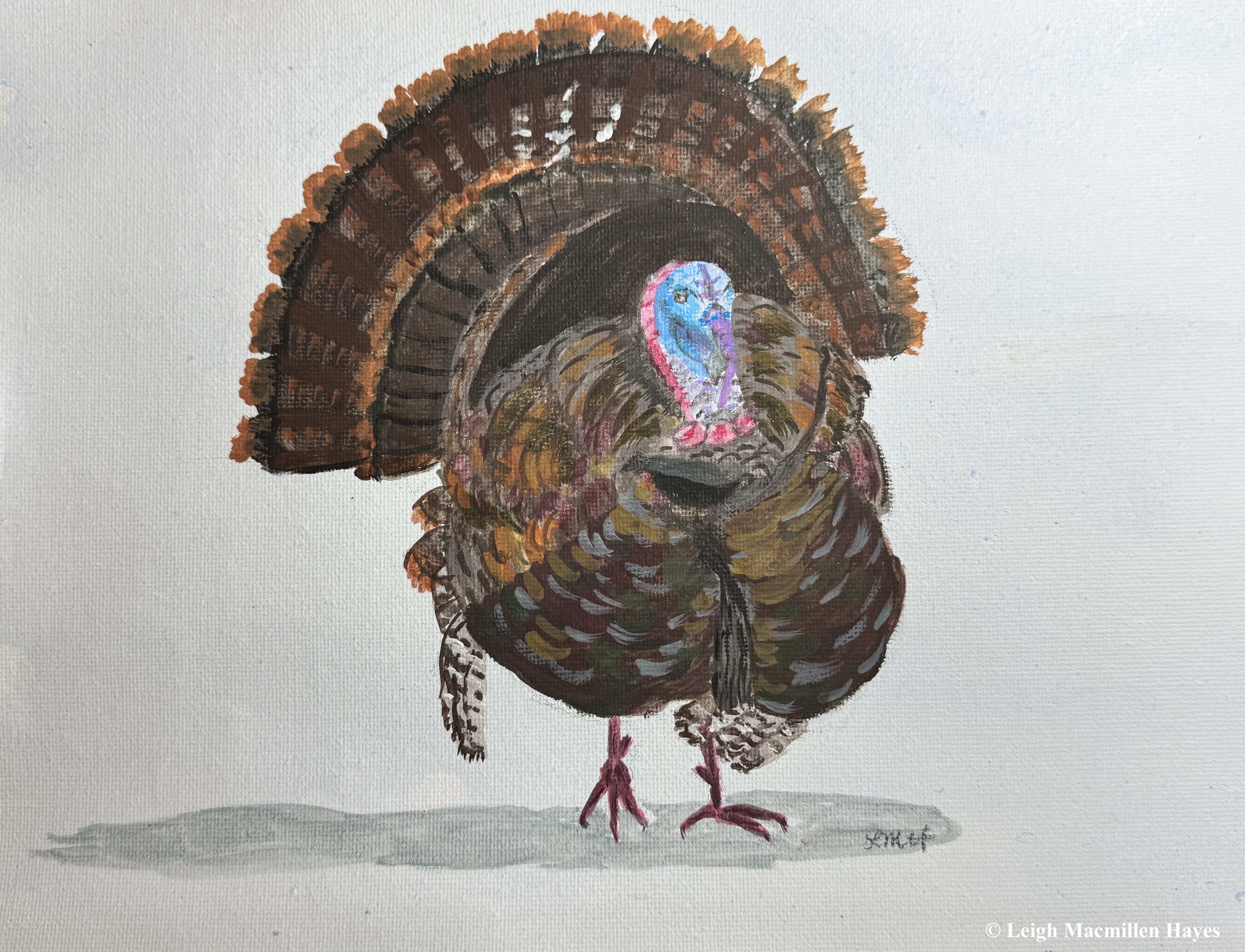
All of this leads me to what I realized today is becoming quite a collection: my paintings of birds.

Pileated Woodpecker in our back forty, which is actually only five more acres beyond the house. One of his favorite trees, however, is at the edge of our yard before the woods, where we’ve left several super tall dead snags and he uses them to mark his territory early in the morning, and later in the day as he taps away. Every day.

Tom Turkey strutting his stuff across the yard in hopes of wooing a hen. I can only assume he did though I never caught them in the act, but so large is the Turkey population round these parts.

A Common Loon in front of the dock at camp. I admit that like dragonflies, I can never take too many photographs of loons.

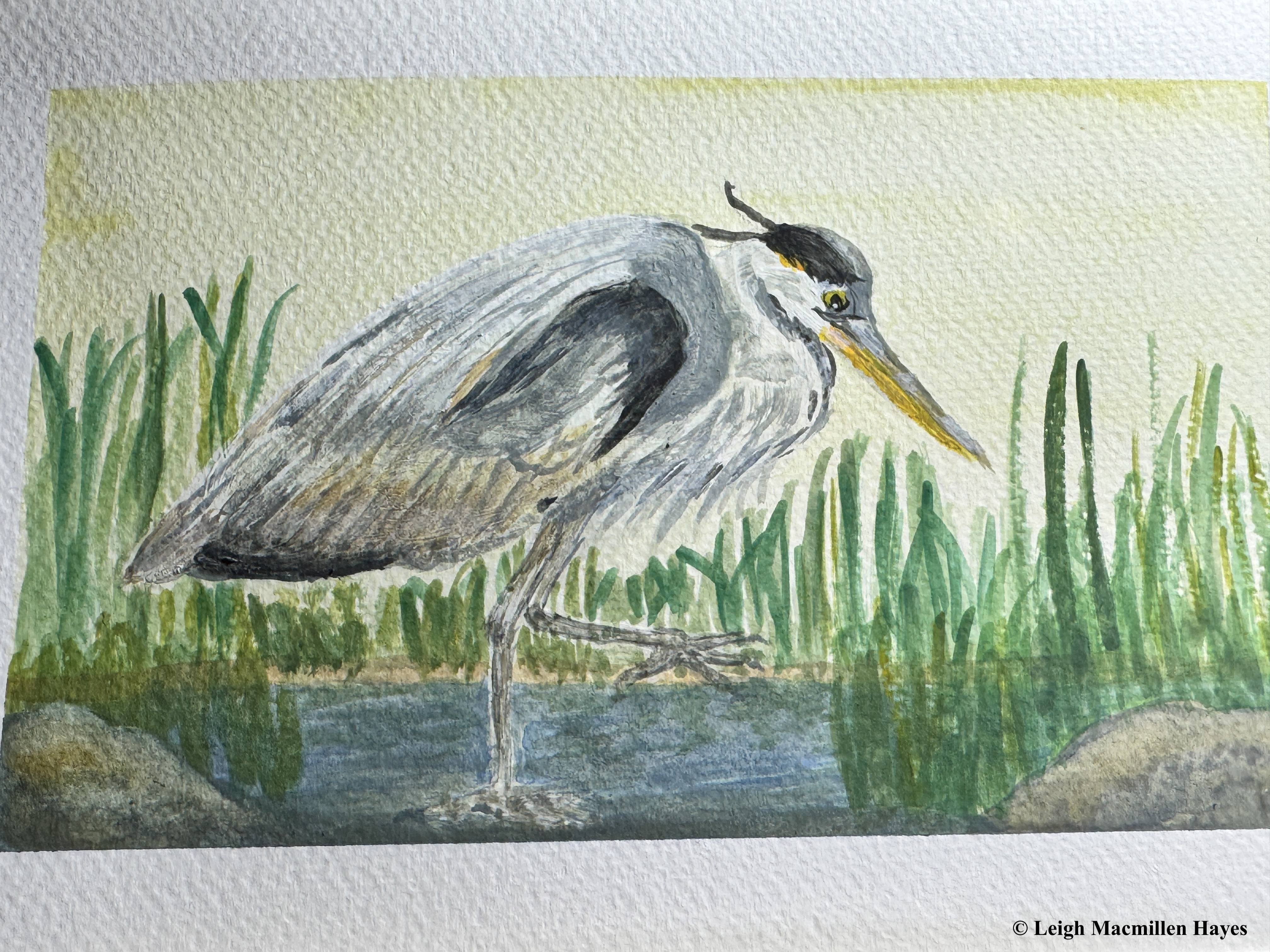
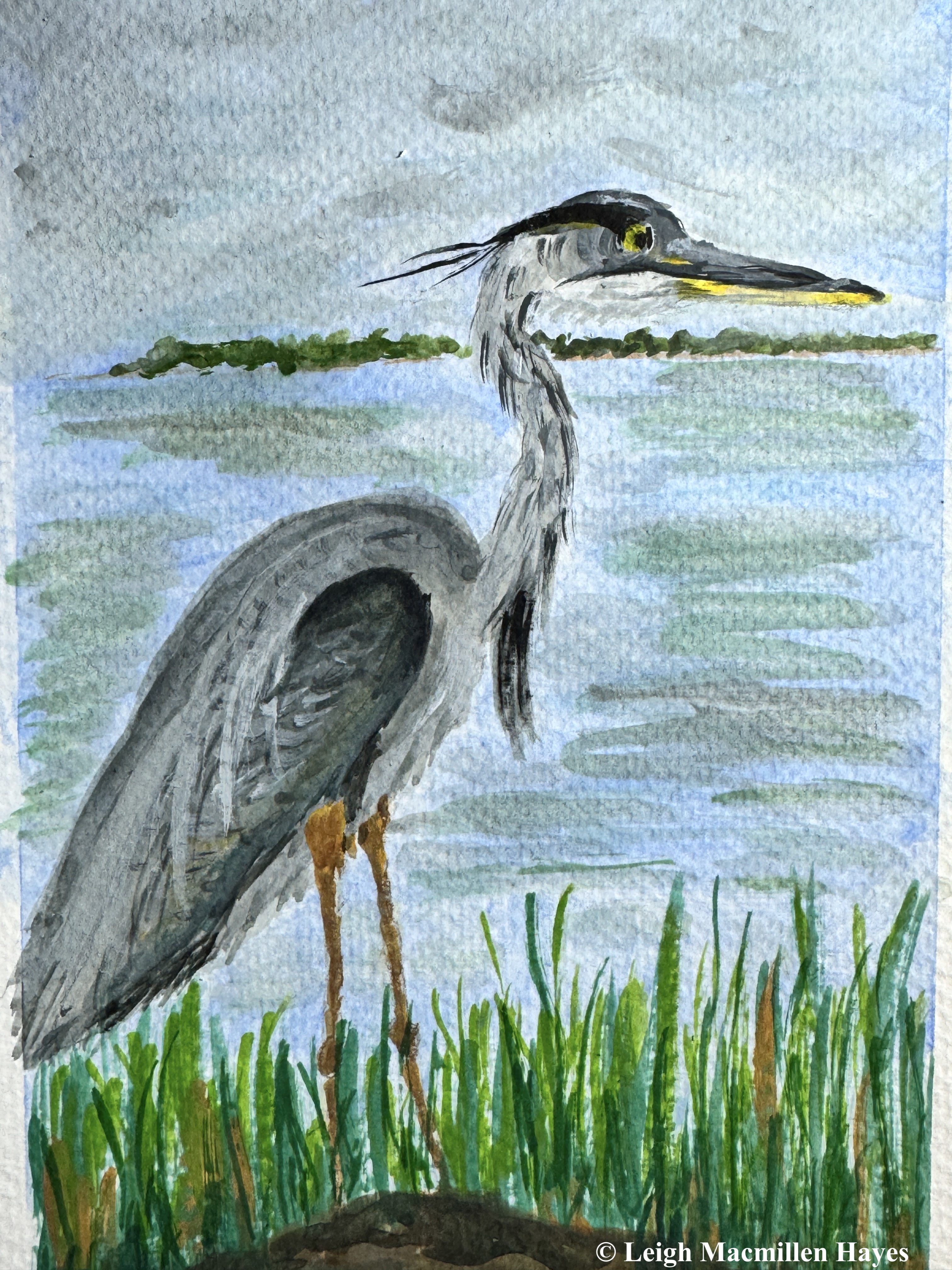
Great Blue Heron scoring a wee fish for a snack.

And another searching for another meal.

And still seeking more, its eyes always intent as it stalks its prey.

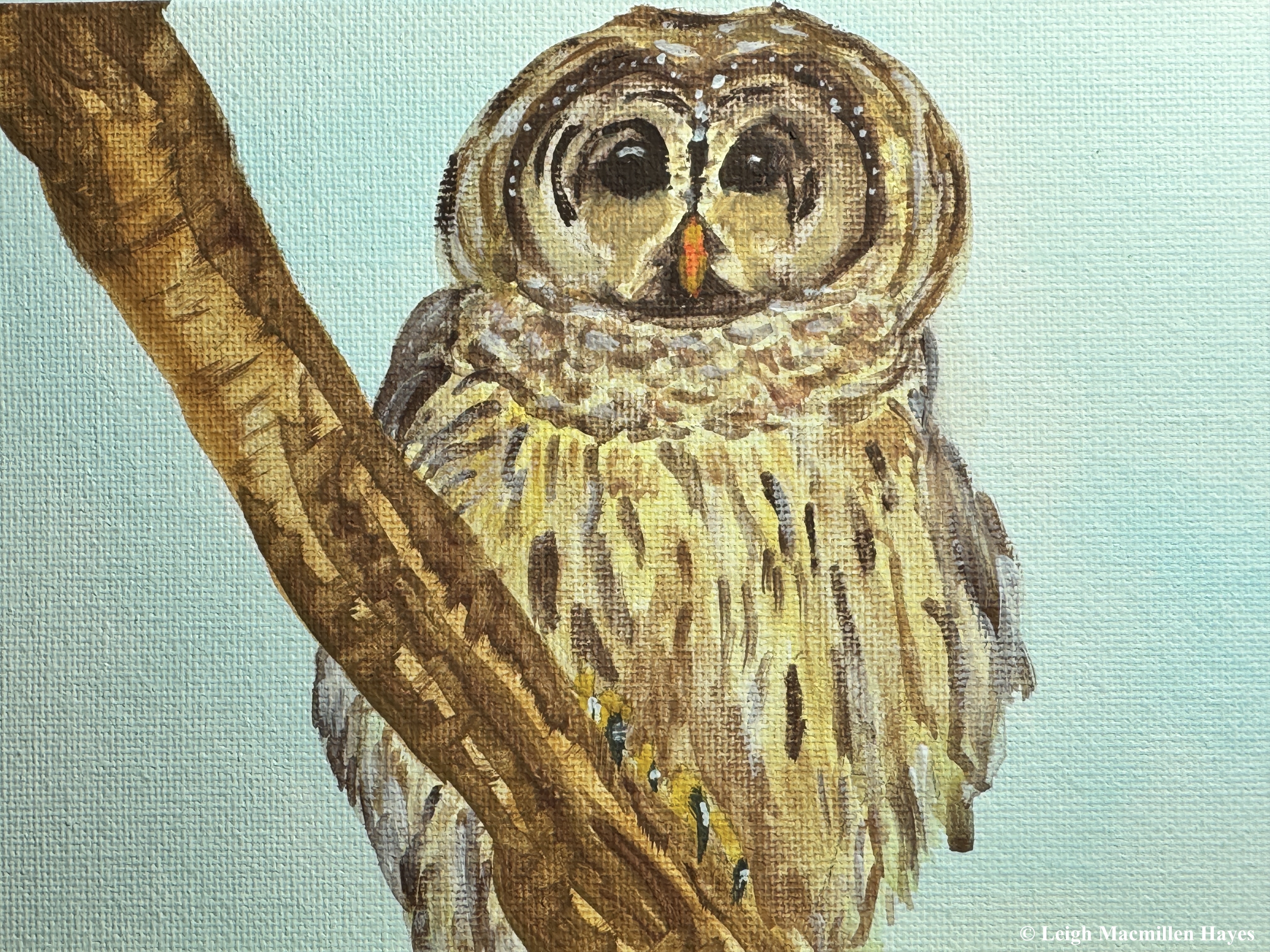
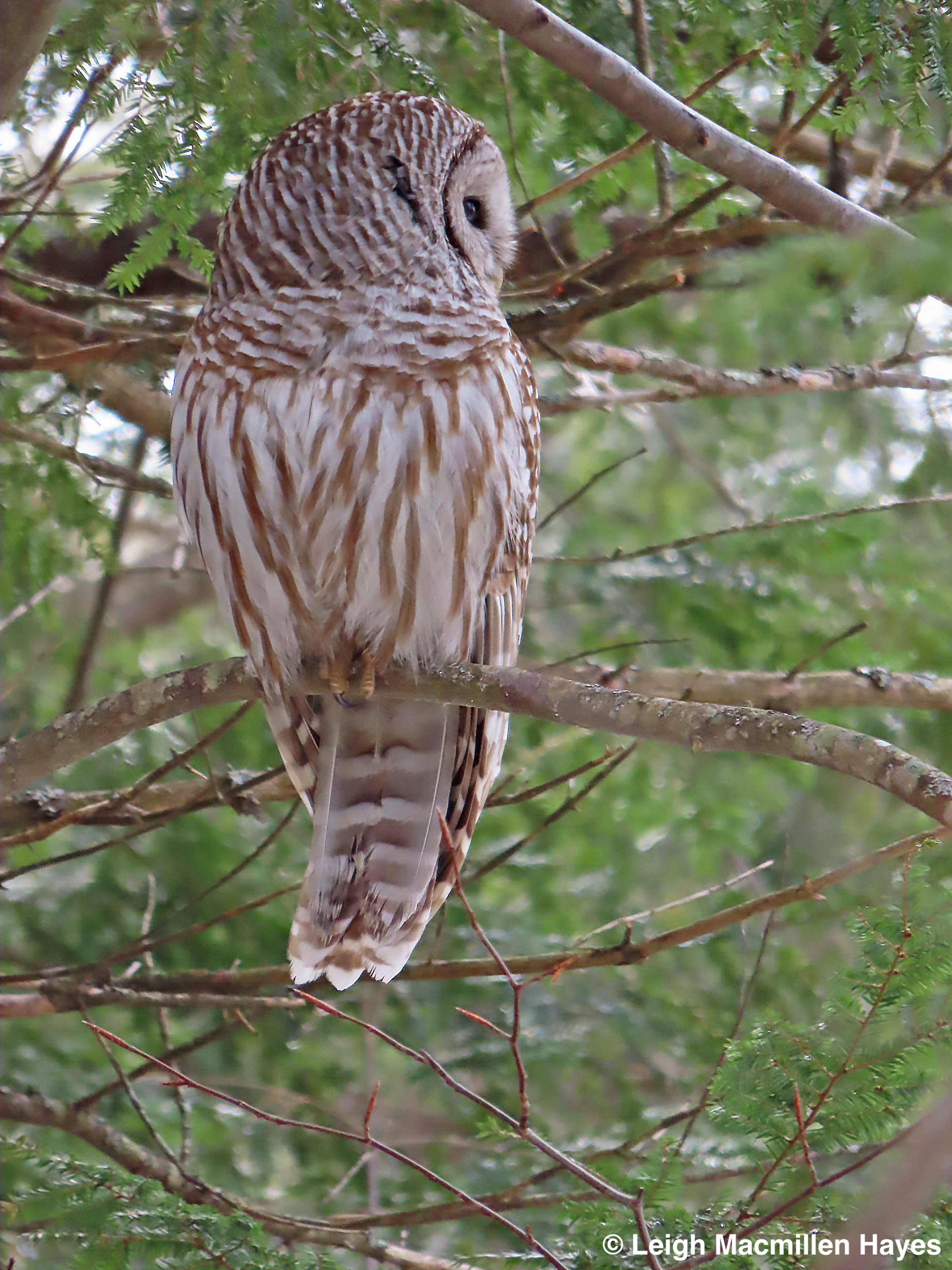
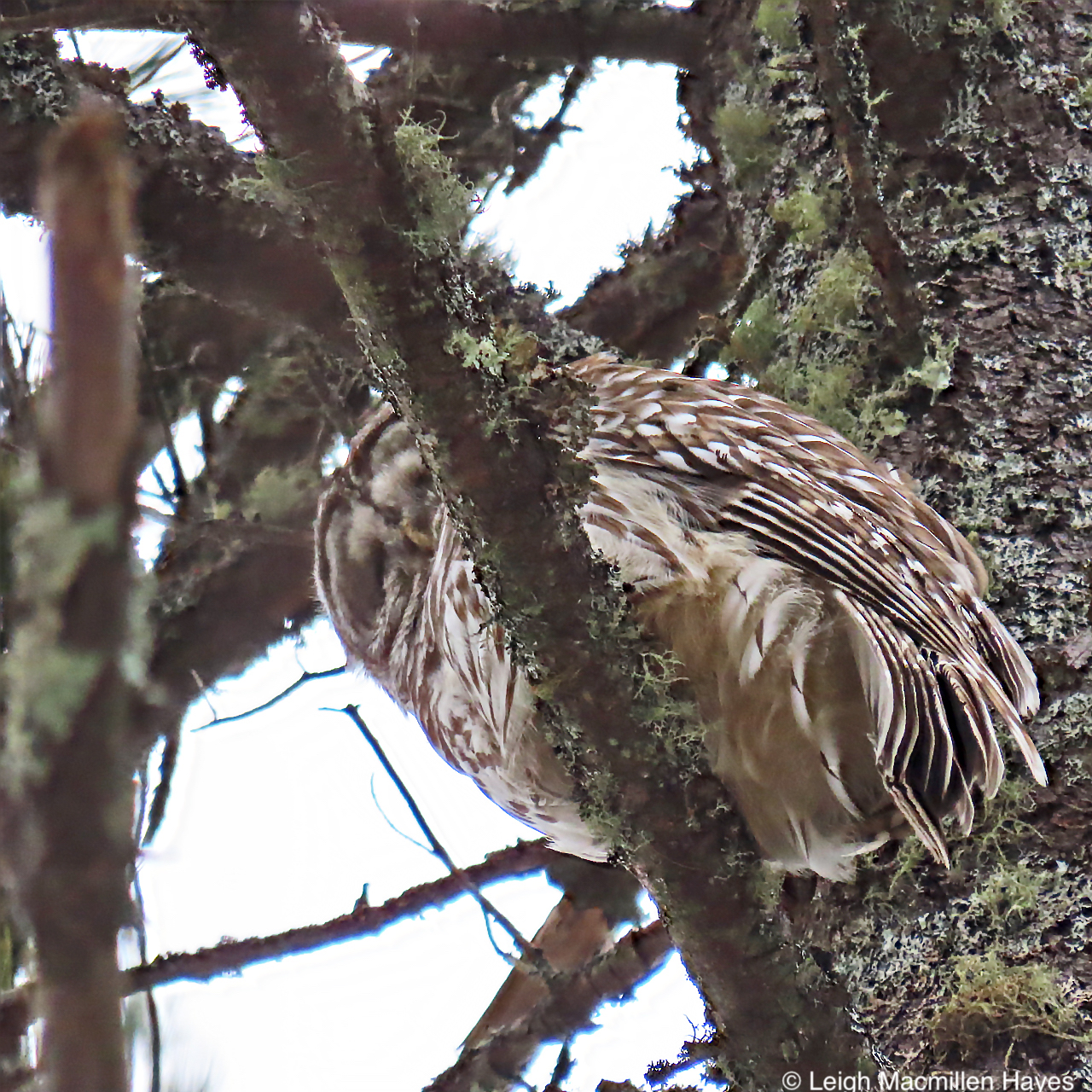
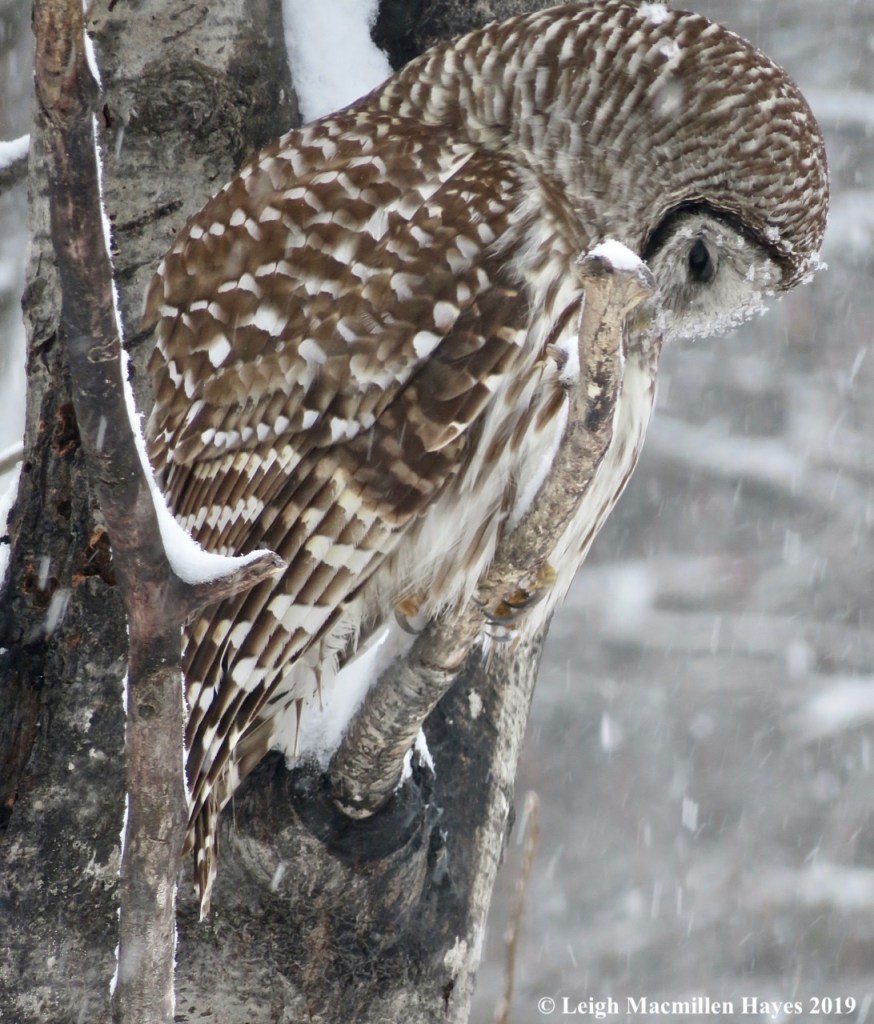
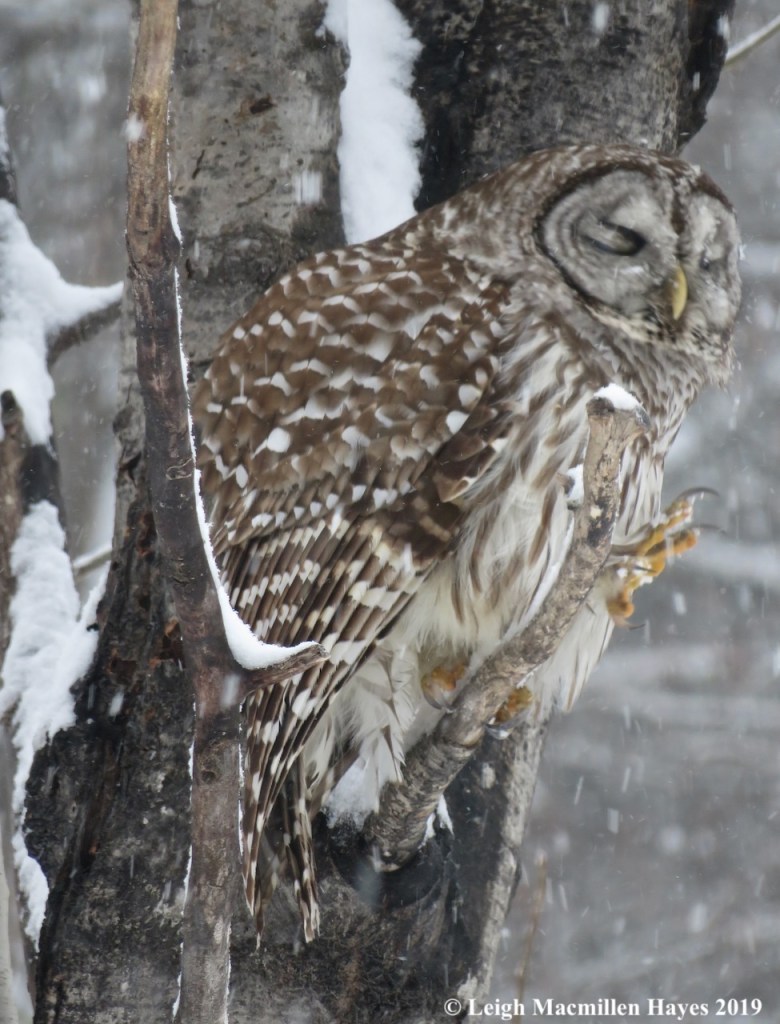
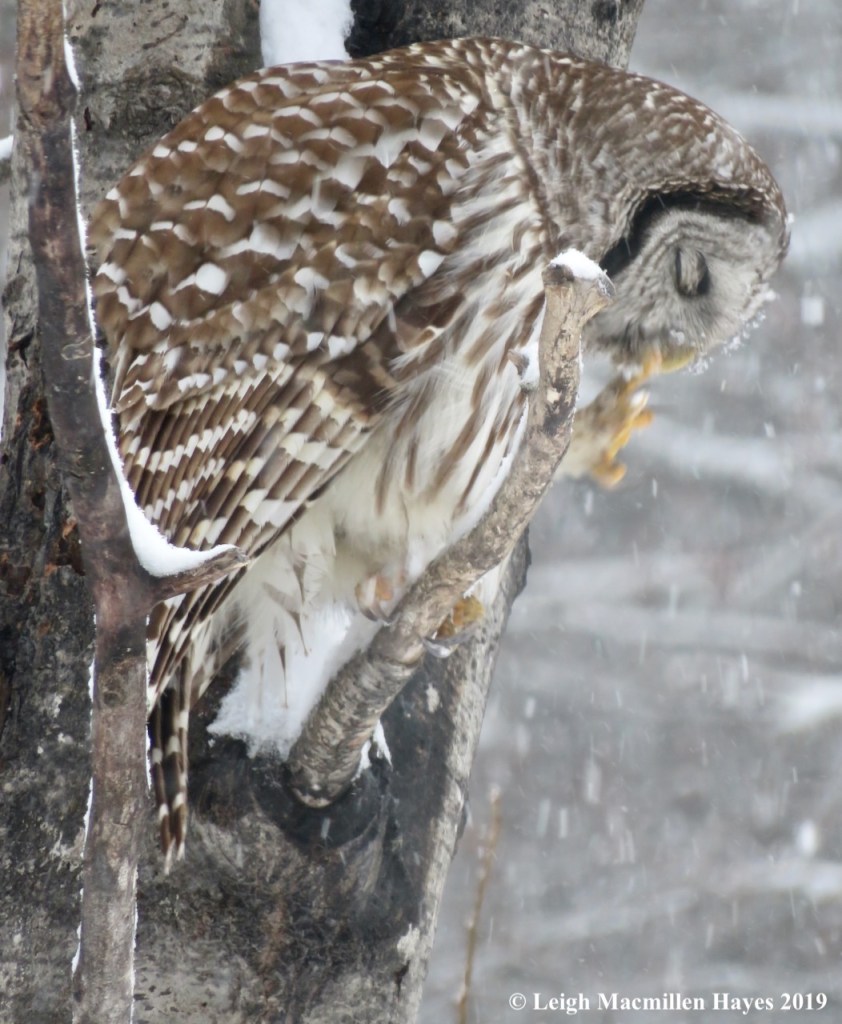
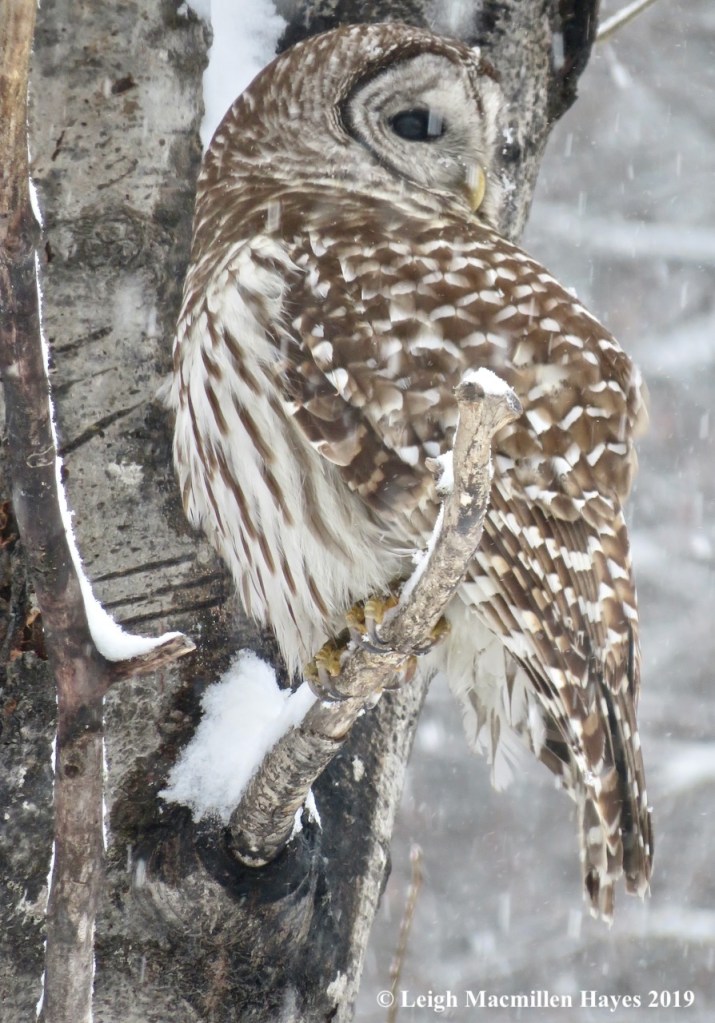
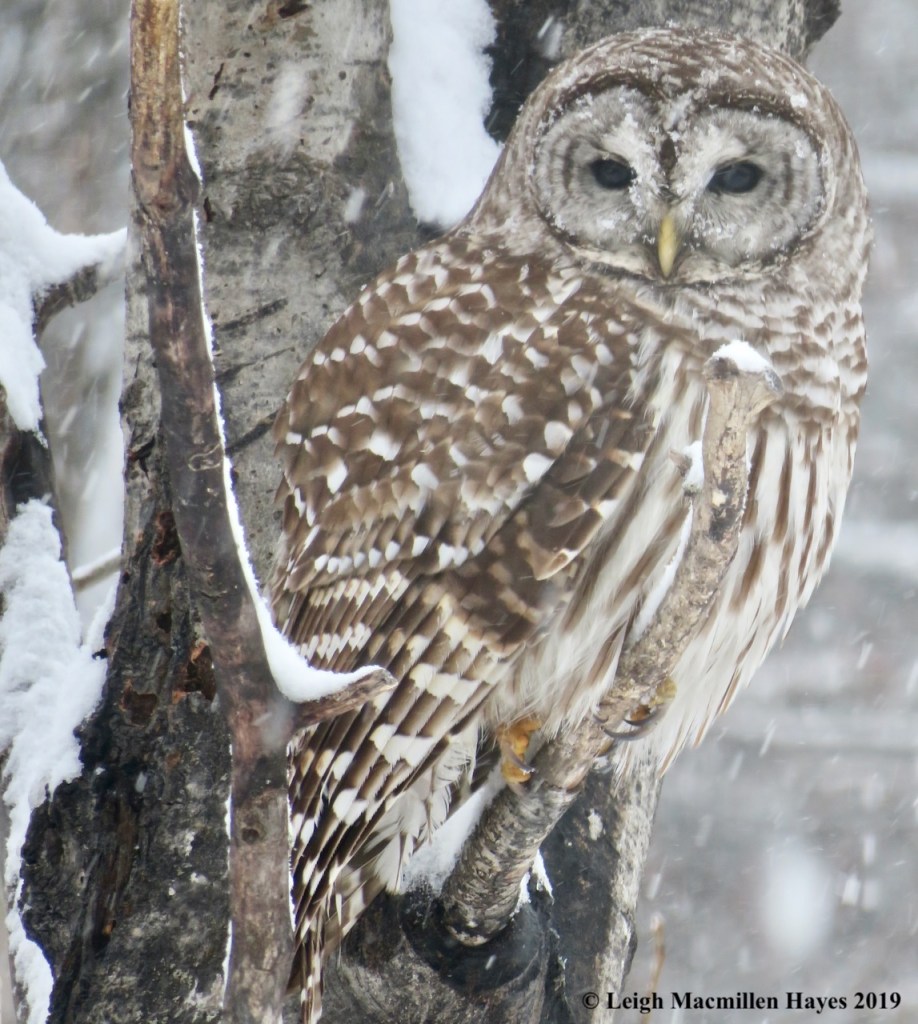
A Barred Owl near the vernal pool, thankfully when there was still ice on it about a month ago, but he’s in the area, so anything can happen.

Ah, but how I love to meet these critters, who unless they are calling, remain incredibly still and blend in with the scenery and I’m sure I pass by more than I actually spot.

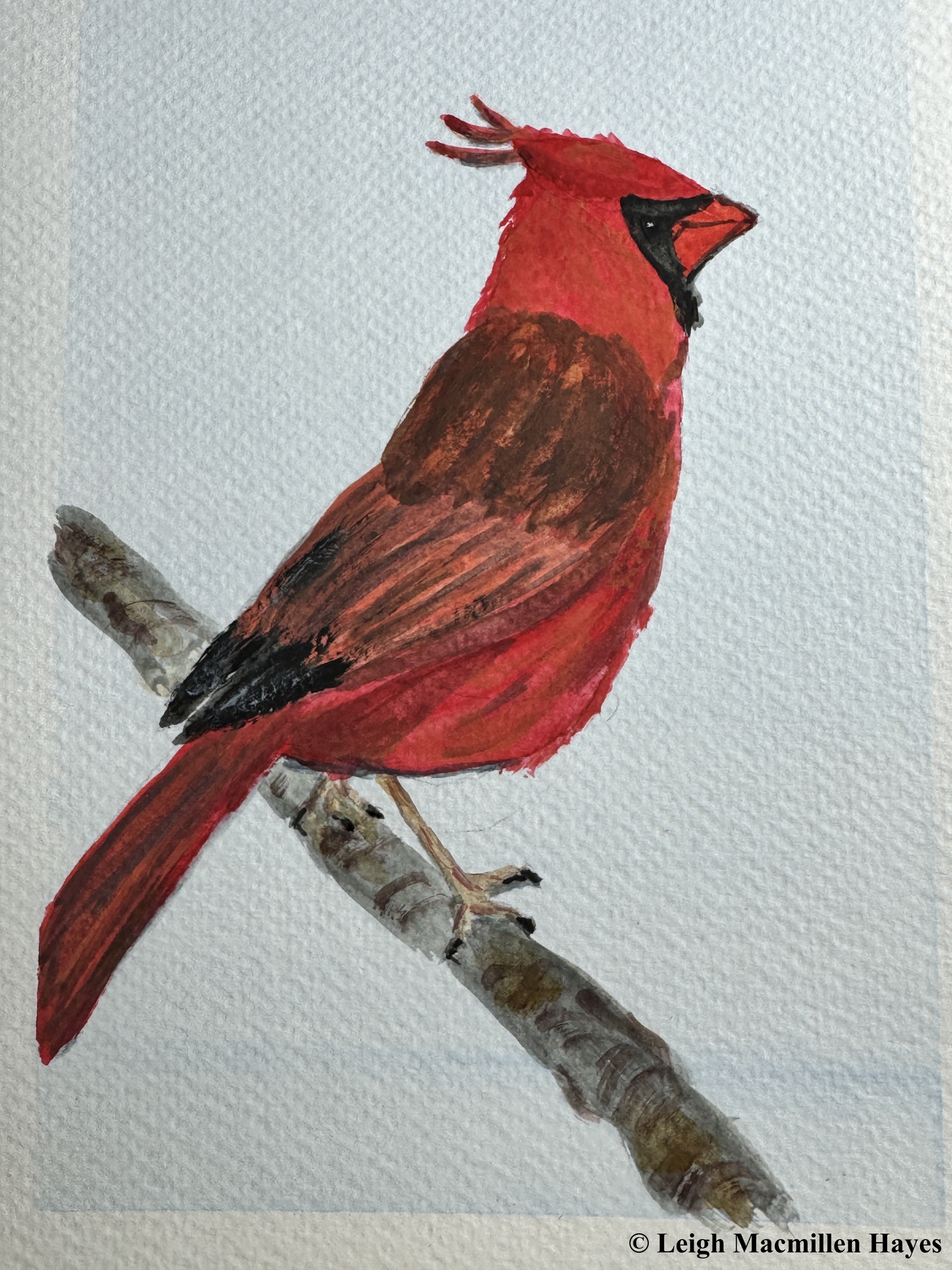
Mr. Cardinal, and I’ve been waiting for him to pass sunflower seeds on to his Mrs. because I’ve seen him do it in the past and it’s such a lovely gesture.

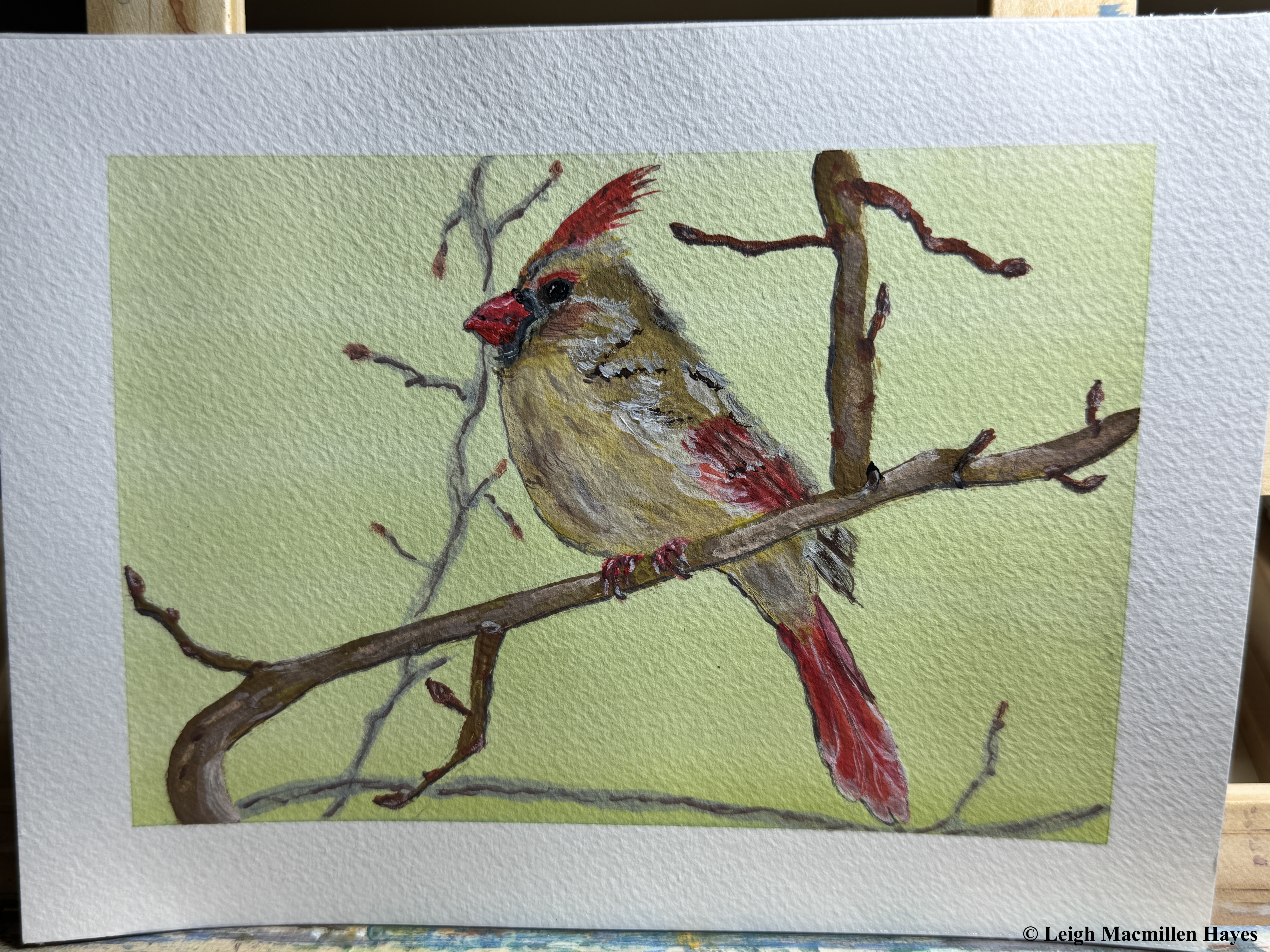
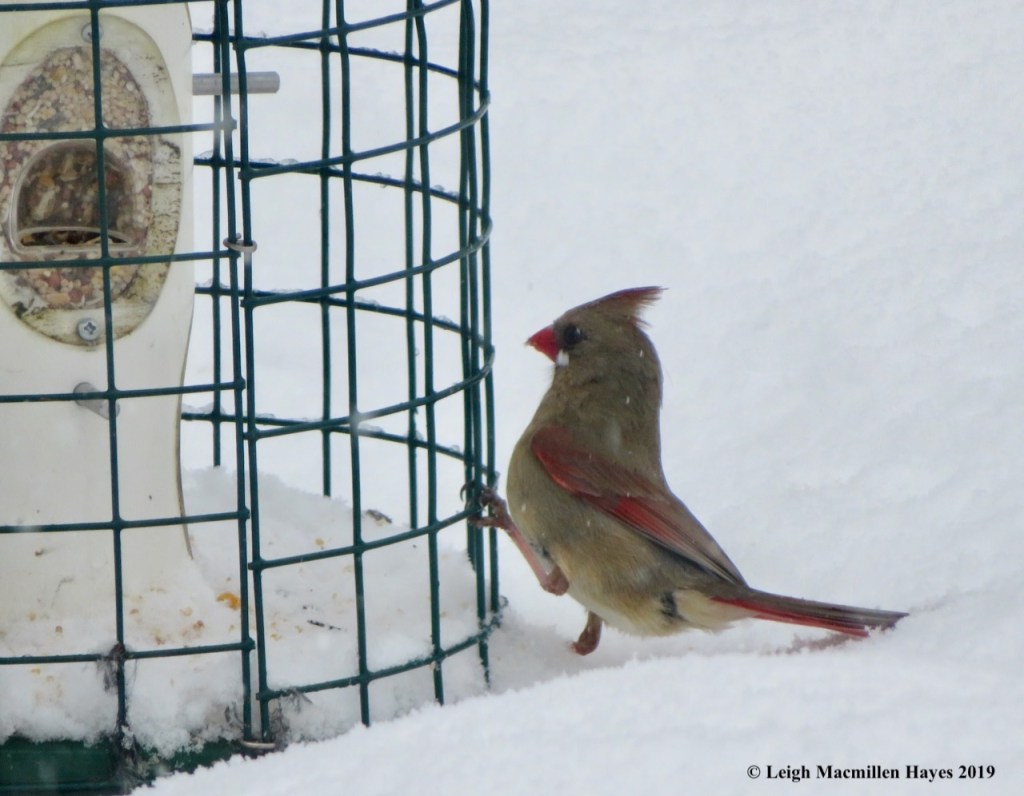
The Mrs. waiting for a gift from her betrothed. To my knowledge, she’s still waiting. One of these days he’ll surprise both of us.

Mr. Bluebird, who also visits daily, as does his Mrs., and from the direction of their travel, I believe they are setting up housekeeping in a house my neighbor erected just for them.

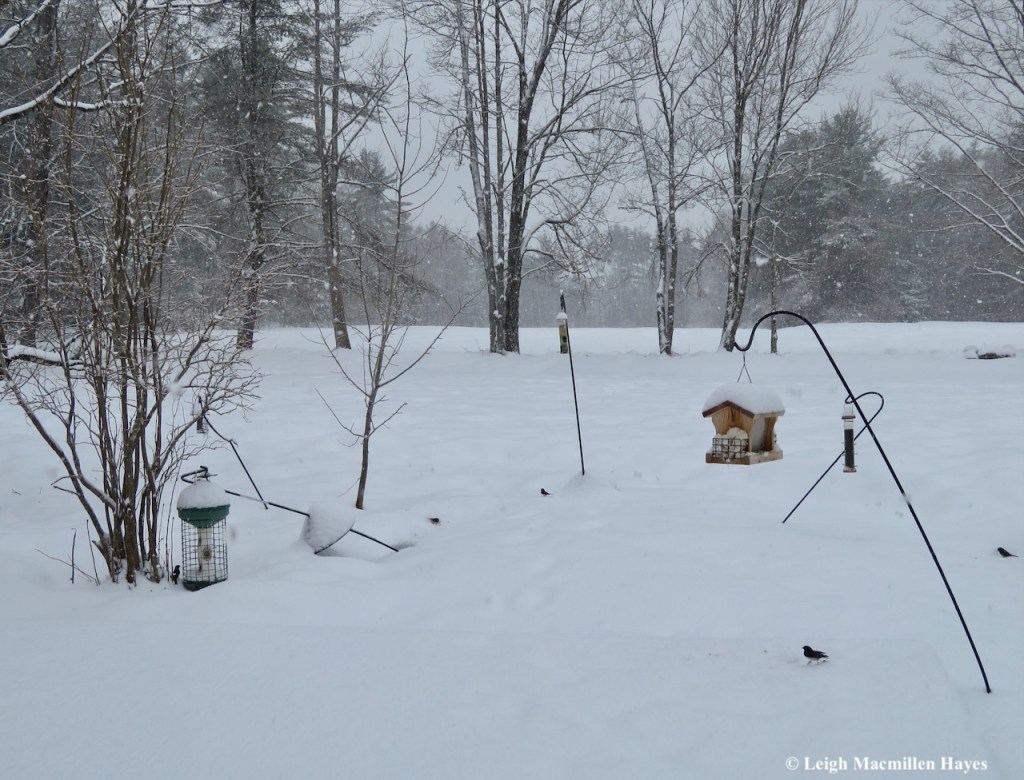
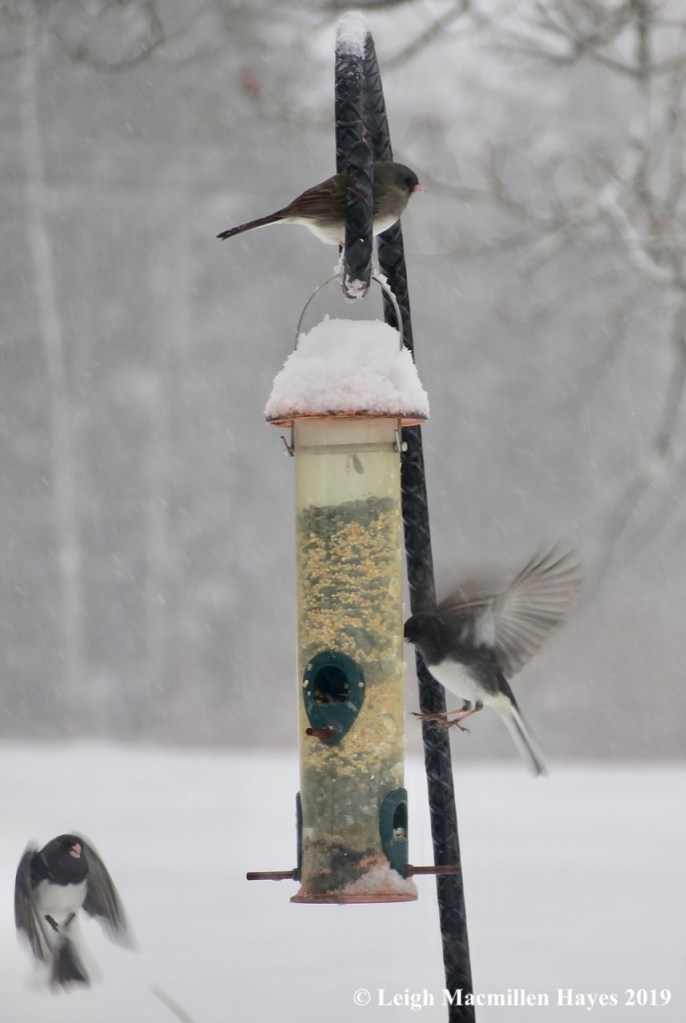
One of the zillion Juncos my friend Kate sent up from Connecticut. They arrived the day she told me they were on their way. That was a few weeks ago. In a snowstorm the other day, we had quite a large flock, but I think most are continuing their journey north as now I only see a few at a time.

My first attempt at painting a Robin following instructions in a book.

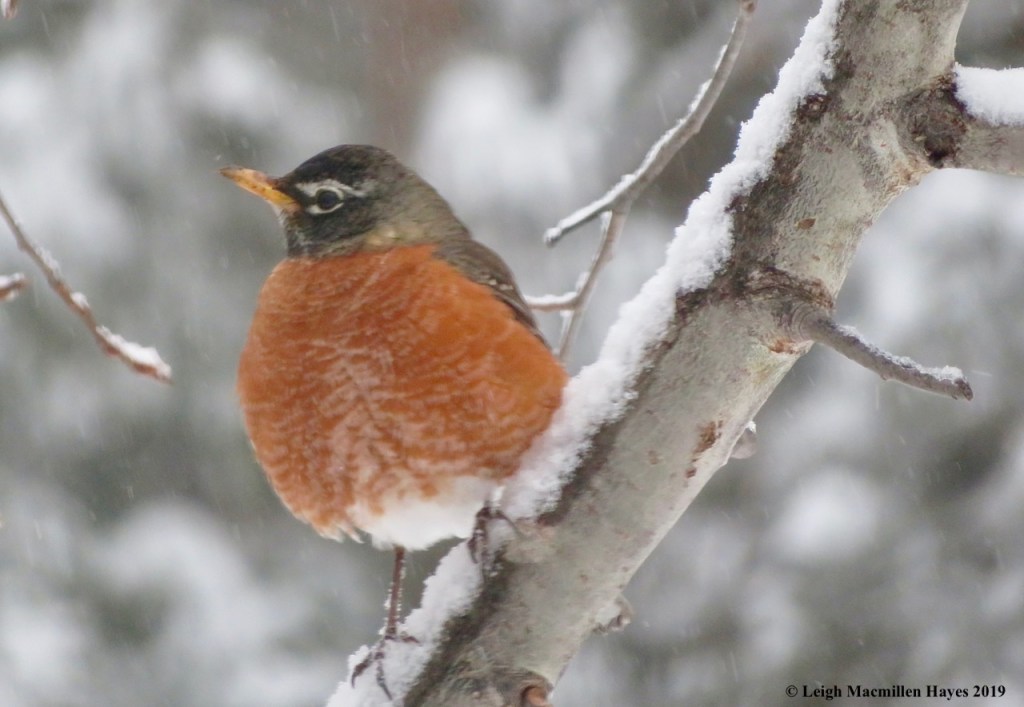
And then trying to tweak the painting and turn it into an American Robin. I fooled SEEK, a free app developed by iNaturalist. It came right up with A. R.

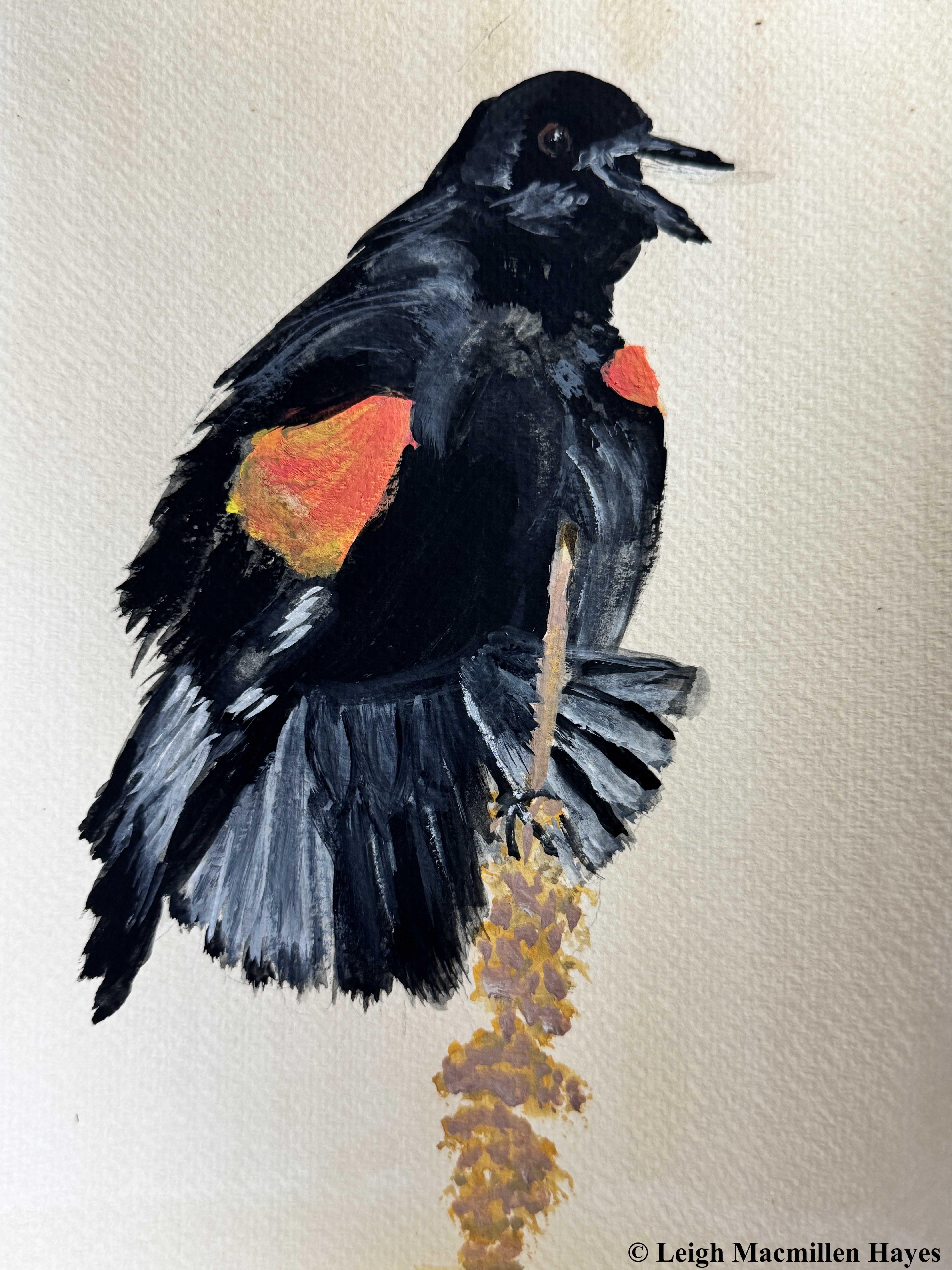
SEEK also knew this to be a male Red-Winged Blackbird. What it didn’t know is that it was one I saw calling a few weeks ago when there didn’t seem to be any females around.

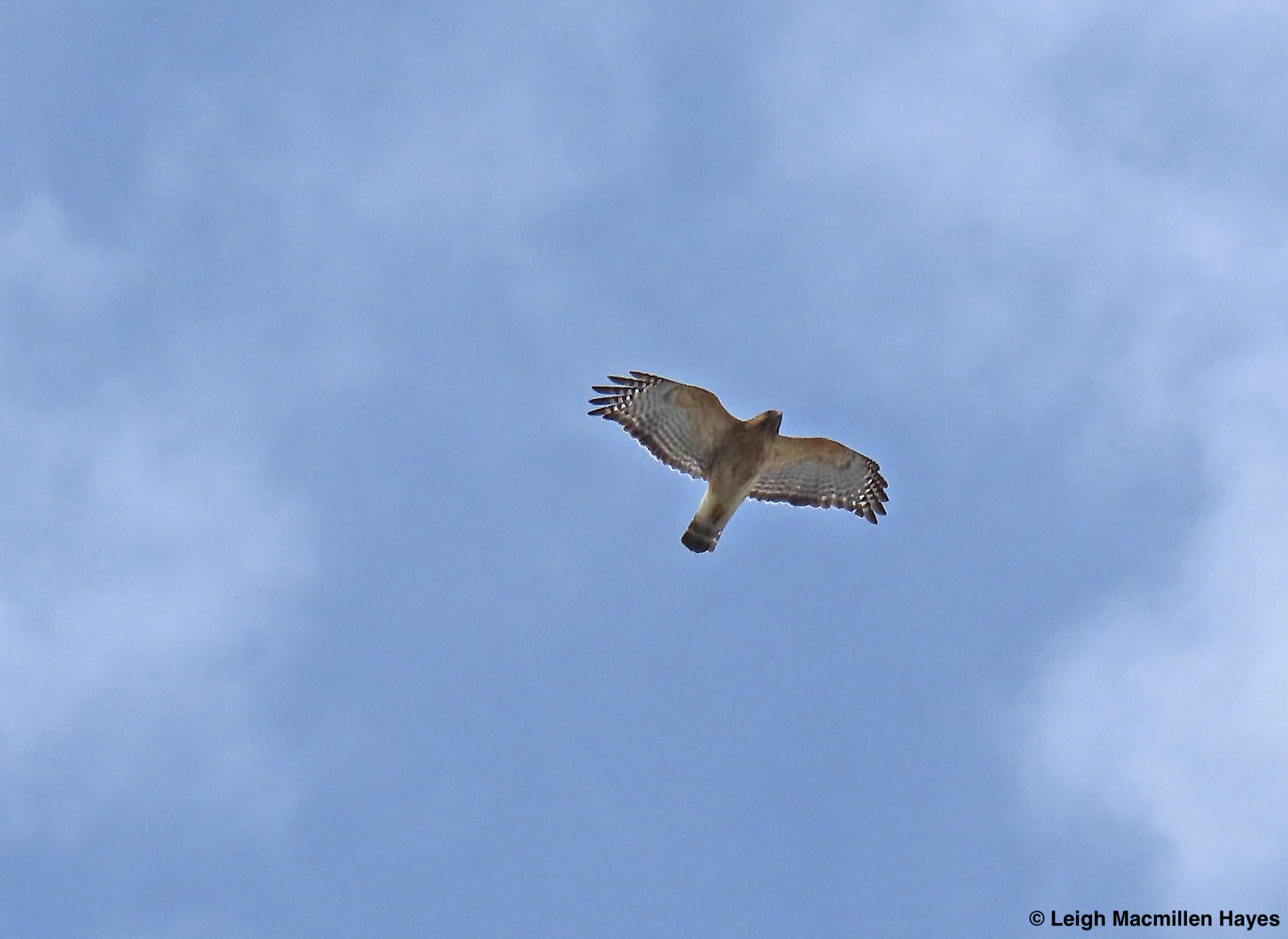
And finally, my new friend, who has actually been in the neighborhood for a long time, but we only recently spent a few minutes together the other morning: Sharp-shinned Hawk.

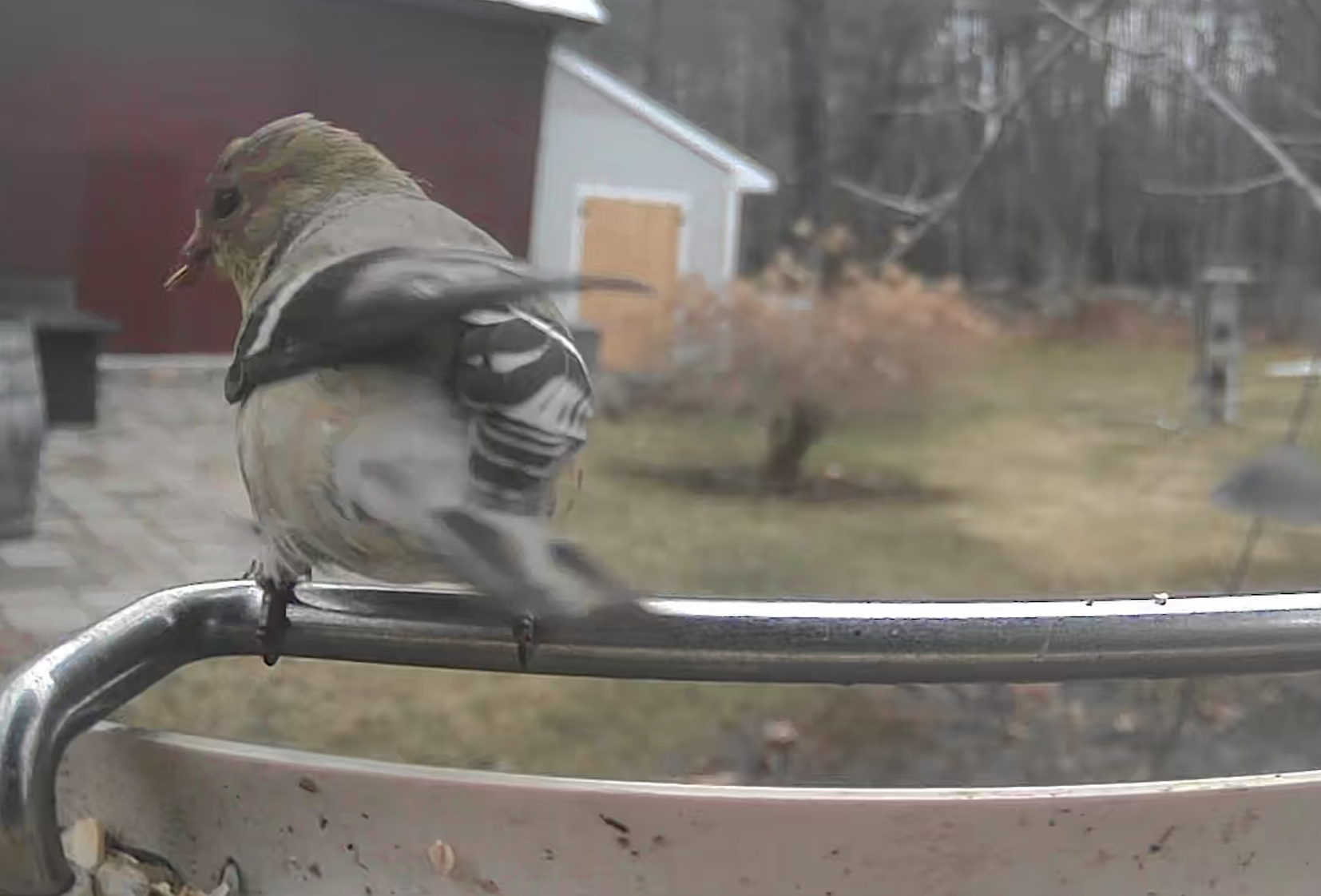
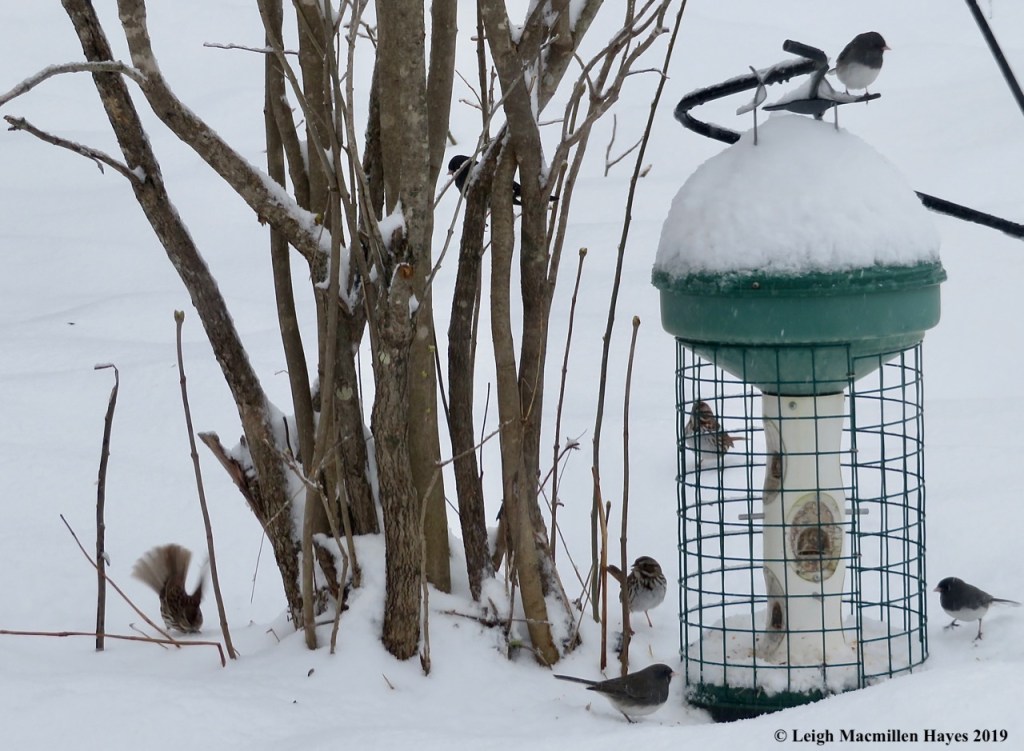
As I look out the window right now, besides this Goldfinch, the Bluebirds are both here, plus Robins, Juncos, Chickadees, Tree Sparrows, White-Breasted Nuthatches, and Mourning Doves. And actually, there are more Juncos than I expected.

That is the extent of my bird collection–at least for the moment. Thanks for stopping by to take a look.

The student from Britain: Jillian. It just came to me.

Part of the Neighborhood

The text arrived from one of my first playmates on Wednesday. “Good morning,” she wrote, “Just wanted to give you a heads up my fat and sassy Juncos are headed your way. Only had a couple yesterday and none this morning. Hope they had a safe trip! Blow them a kiss for me. Hugs.”

A few hours letter I wrote back that I’d let her know when they arrived.

And a few minutes, voilà! My second text to Kate: “No sooner said than BINGO! I looked out the back door and there were three!”

On Thursday afternoon, the Bluebirds arrived. Kate told me she’d had three couples all winter in Connecticut. “They are so stunning! They seem to be the kindest of breeds. They don’t squabble as much as others and share better.”

After that, it was a Tree Sparrow. And many more Juncos each day.

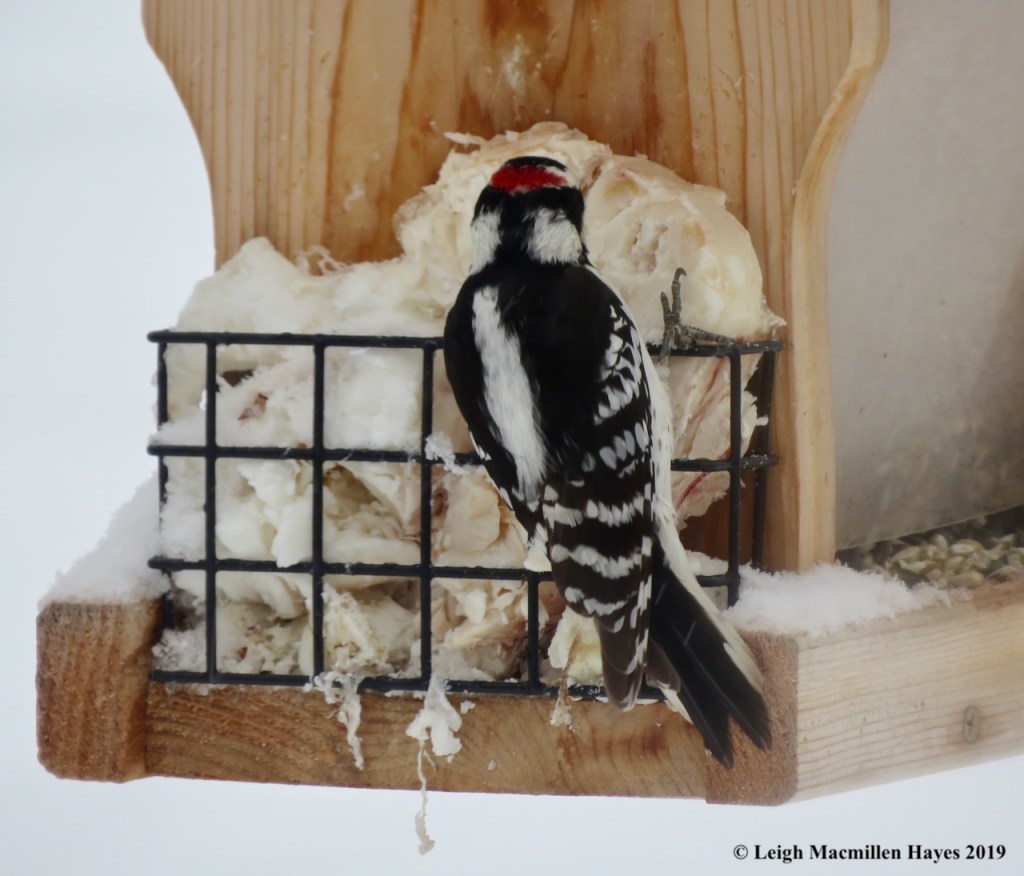
And today, the Chickadees and Tufted Titmice and Bluejays, of course, but also Goldfinches, and one Tree Sparrow, and Mourning Doves, and Red-breasted and White-breasted Nuthatches, and Downy and Hairy Woodpeckers, and I’m sure others that I’m missing, and suddenly, the feeders were busy. Toss into the mix Red and Gray Squirrels, and Crows, though the latter stayed about ten feet away from the action, while the former got right into it, and it was a full house.

This afternoon, I interrupted the action for a few minutes when I headed out the back door to go for a tramp in the woods and had just reached an opening when I heard, then saw this guy and knew that our resident Red-shouldered Hawk had returned.

According to Stan Tekiela’s Birds of Prey of the Northeast, “Adults return to the same nest and territory for many years; the young also return.”

Welcome home!

I had no sooner lost sight of the hawk, when movement from another source caught my eye.

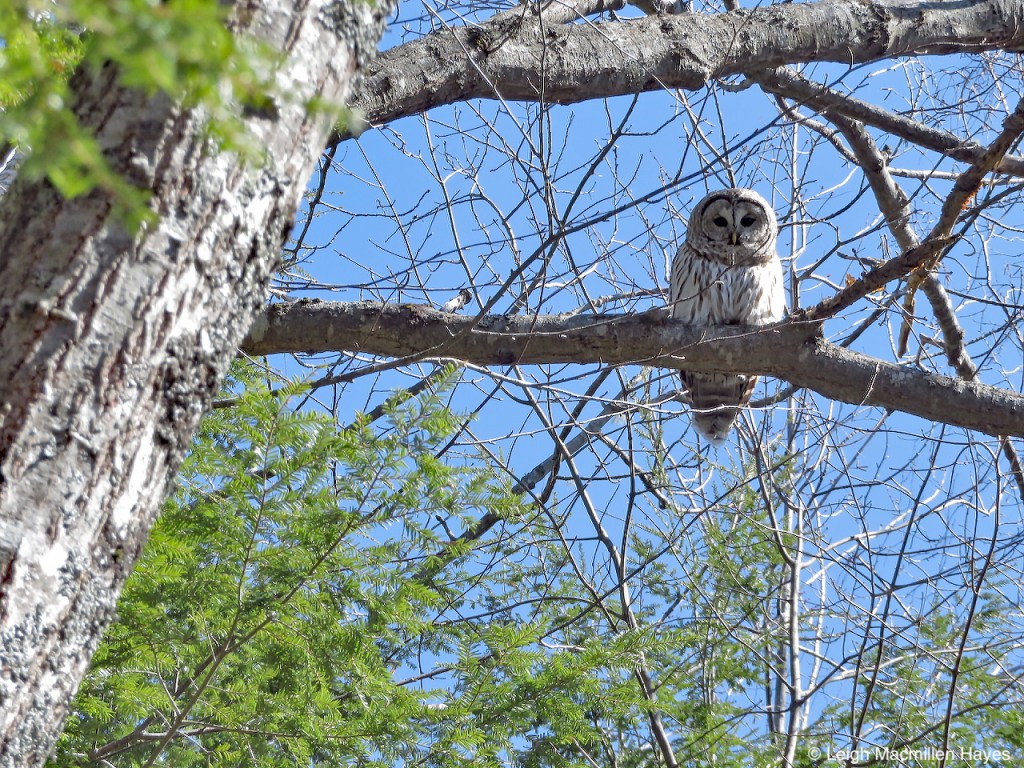
Flying from the ground up to a tree limb was a Barred Owl. And my heart was even happier than it had been.

We spent a few minutes together and I gave great thanks also that the vernal pool over which the owl perched is still rather frozen. No frogs or salamanders would be on the menu yet. I did, however, worry about the birds in my yard, but there was nothing I could do.

Except, that is, watch my friend for a few more minutes before waving goodbye to him and moving on.

And that’s when I heard a song, or rather many songs, that took me back to a summer morning and realized that as much as I don’t want winter to come to an end this week, the time has come because there is so much more to see and welcome and wonder about. The Red-winged Blackbirds were in a large flock with Grackles, and Robins, and more Crows. And the chorus was most delightful.

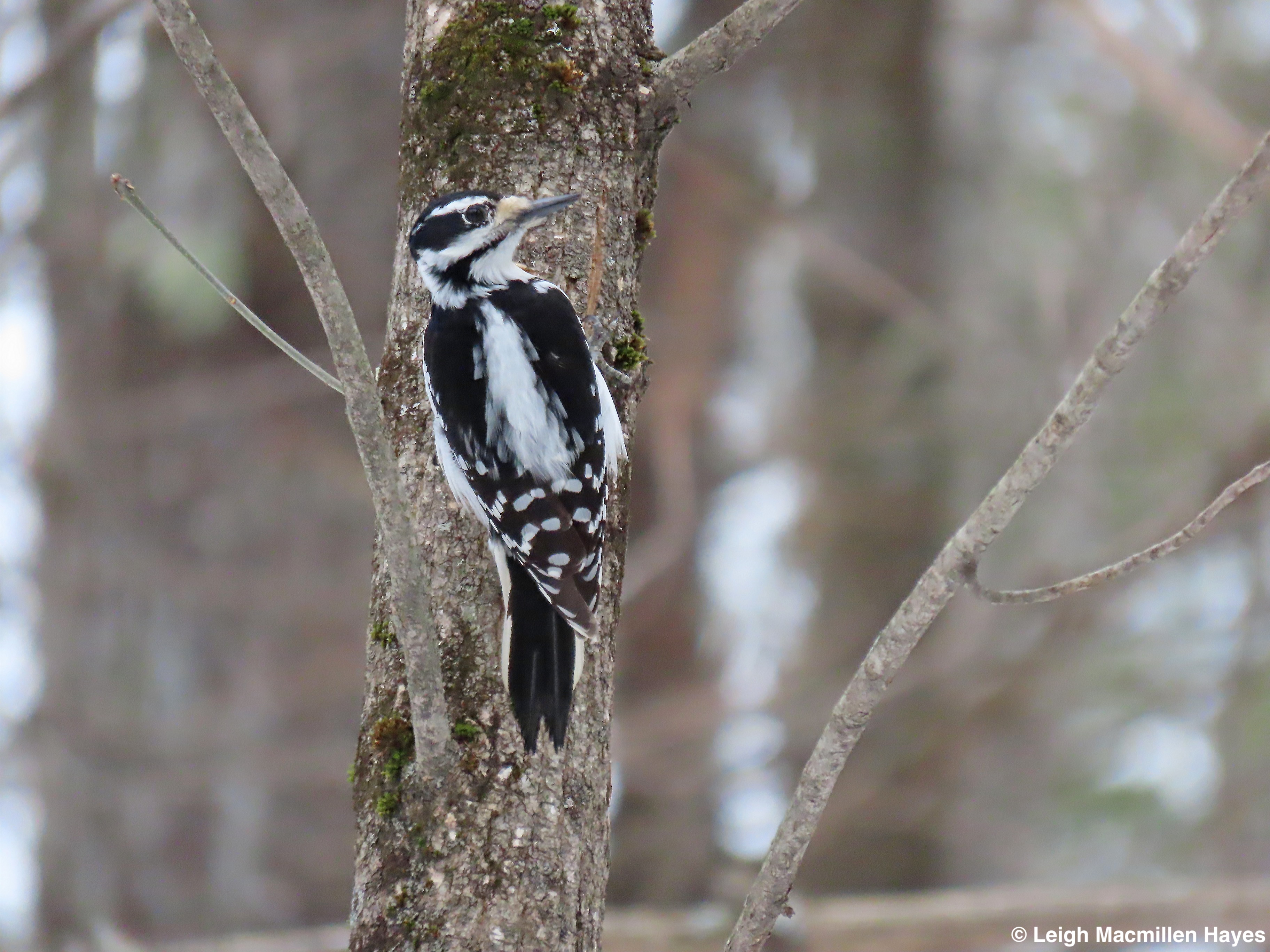
I’d say the female Hairy Woodpecker was much quieter than the others, but it was her inflight song that encouraged me to look for her.

I just hope it wasn’t Emerald Ash Borers she was seeking as she drilled a few test holes in the tree. Of course, if she can help control them, then that’s a good thing.

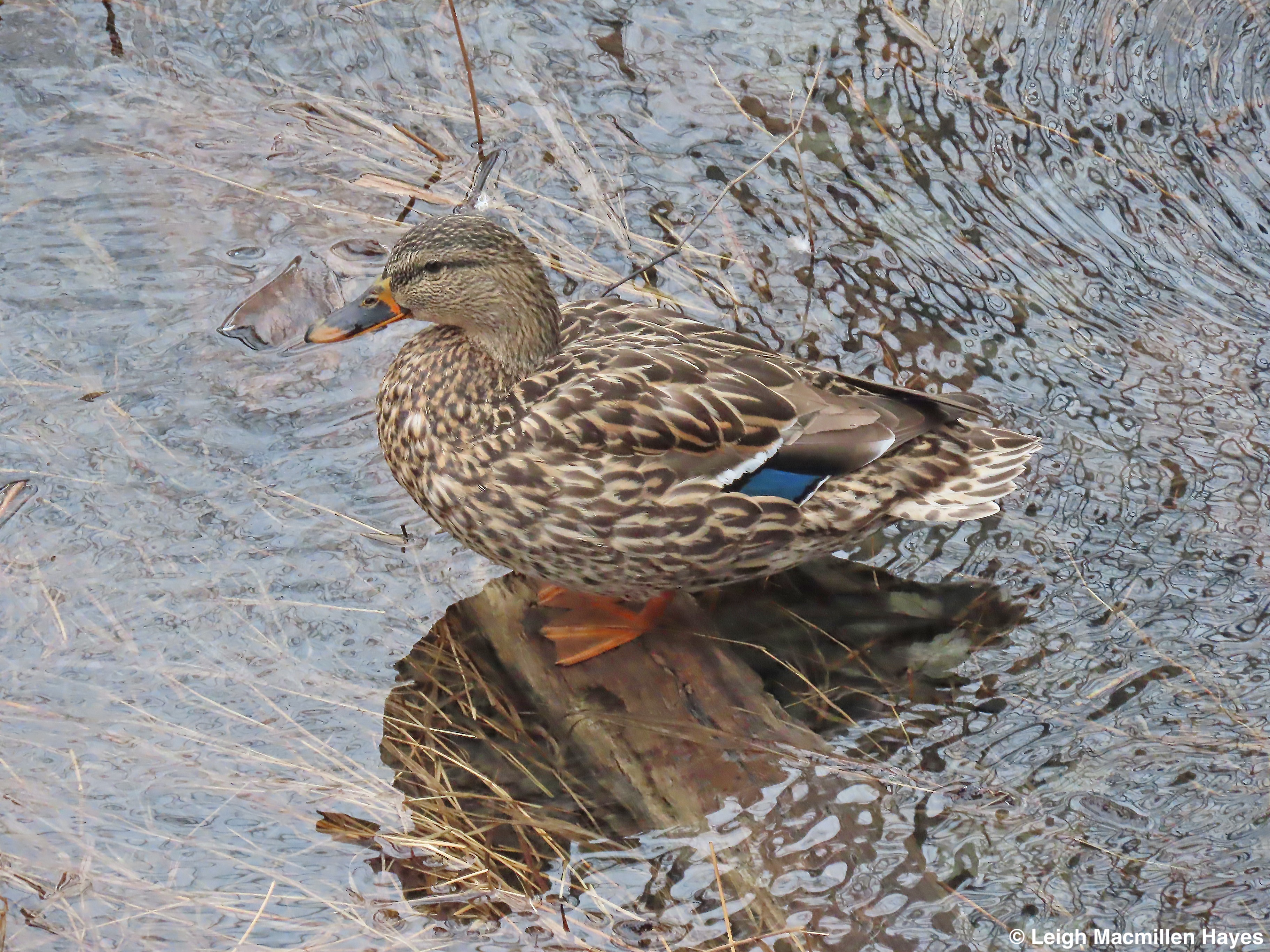
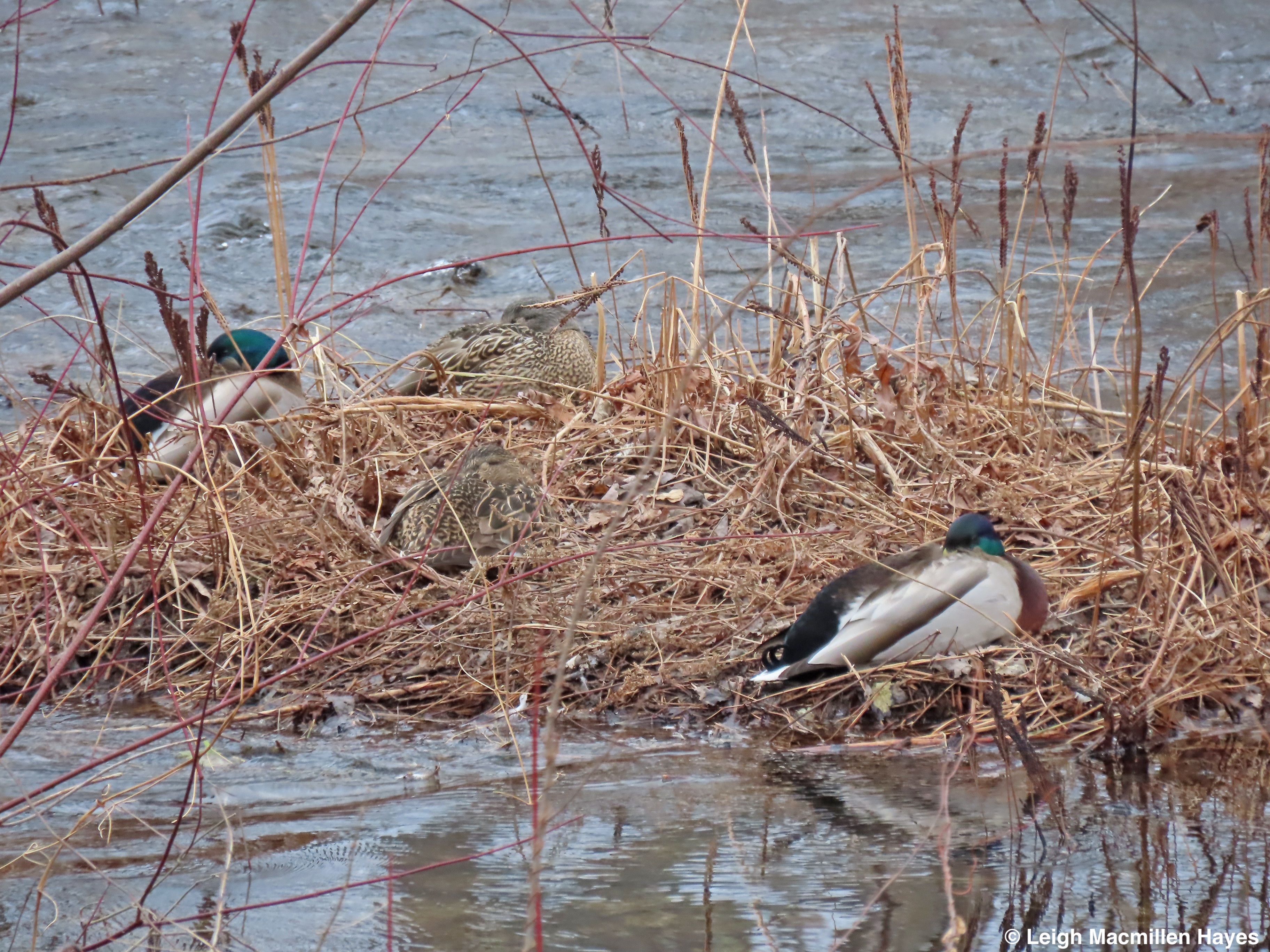
My journey led me to a local brook where the Mallard flock is spreading out more as the ice is receding quickly during these suddenly 50˚ days.

That said, they are still there.

He preened . . .

as she looked on.

Others did what we should all consider doing on a Sunday afternoon: stick our heads under our wings and take a nap.

But I didn’t. How about you?

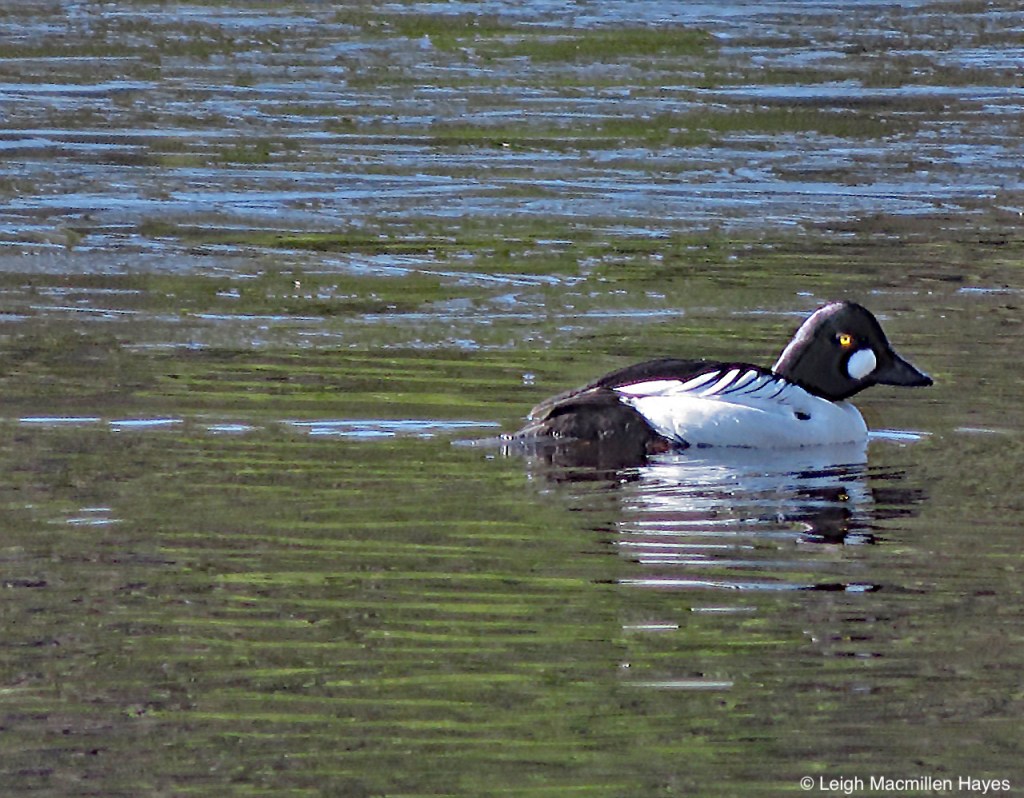
Upon a second brook that flows into the first, another species caught me by surprise as I rarely see it in this place. A female Common Goldeneye. I’ve always had a problem with the descriptor “common.” That prominent golden eye is hardly common in my book.

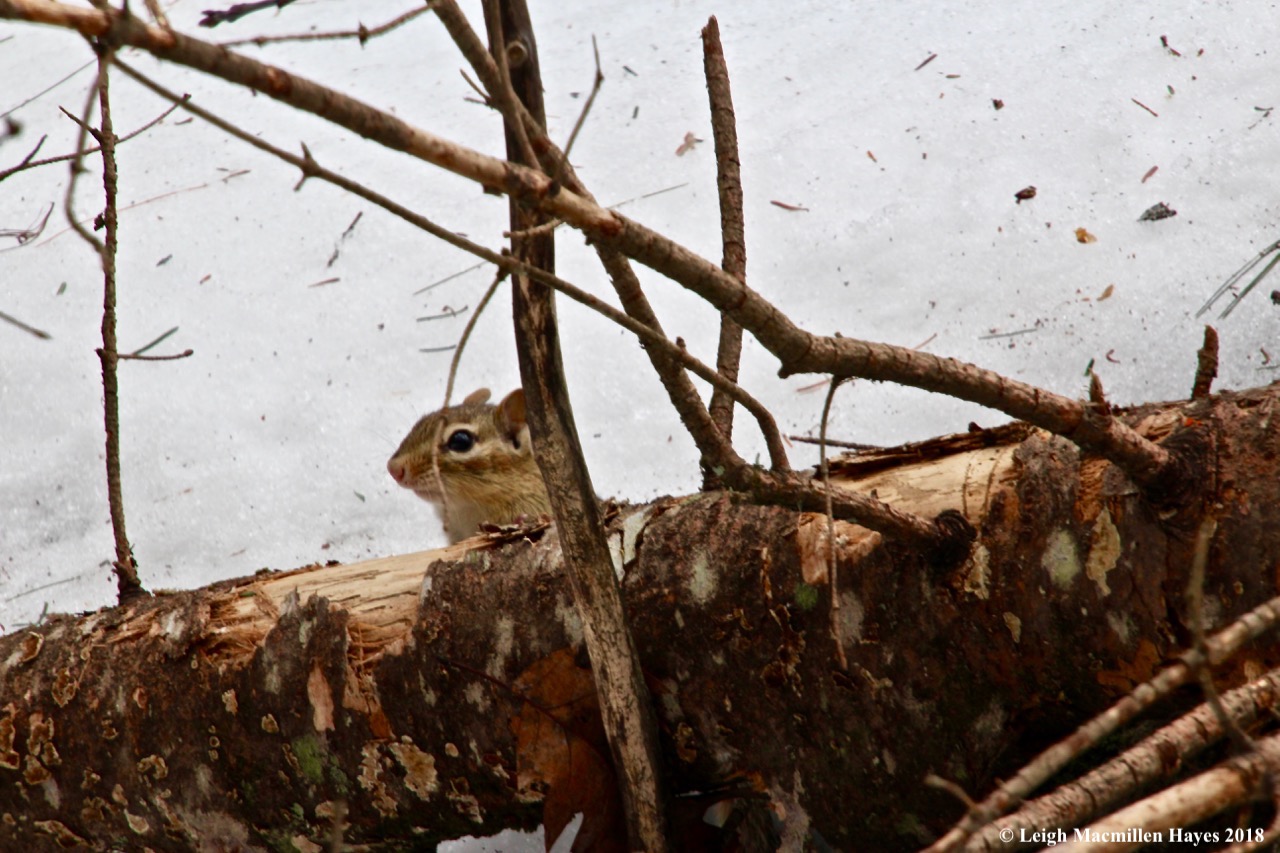
Moseying along, I realized it wasn’t just birds who were greeting the day. Chipmunks have been dashing about on the snow for the last week or two, taking advantage of any acorns the squirrels may have hoarded. (And birdseed–as I watched one stuff its cheeks the other day.)

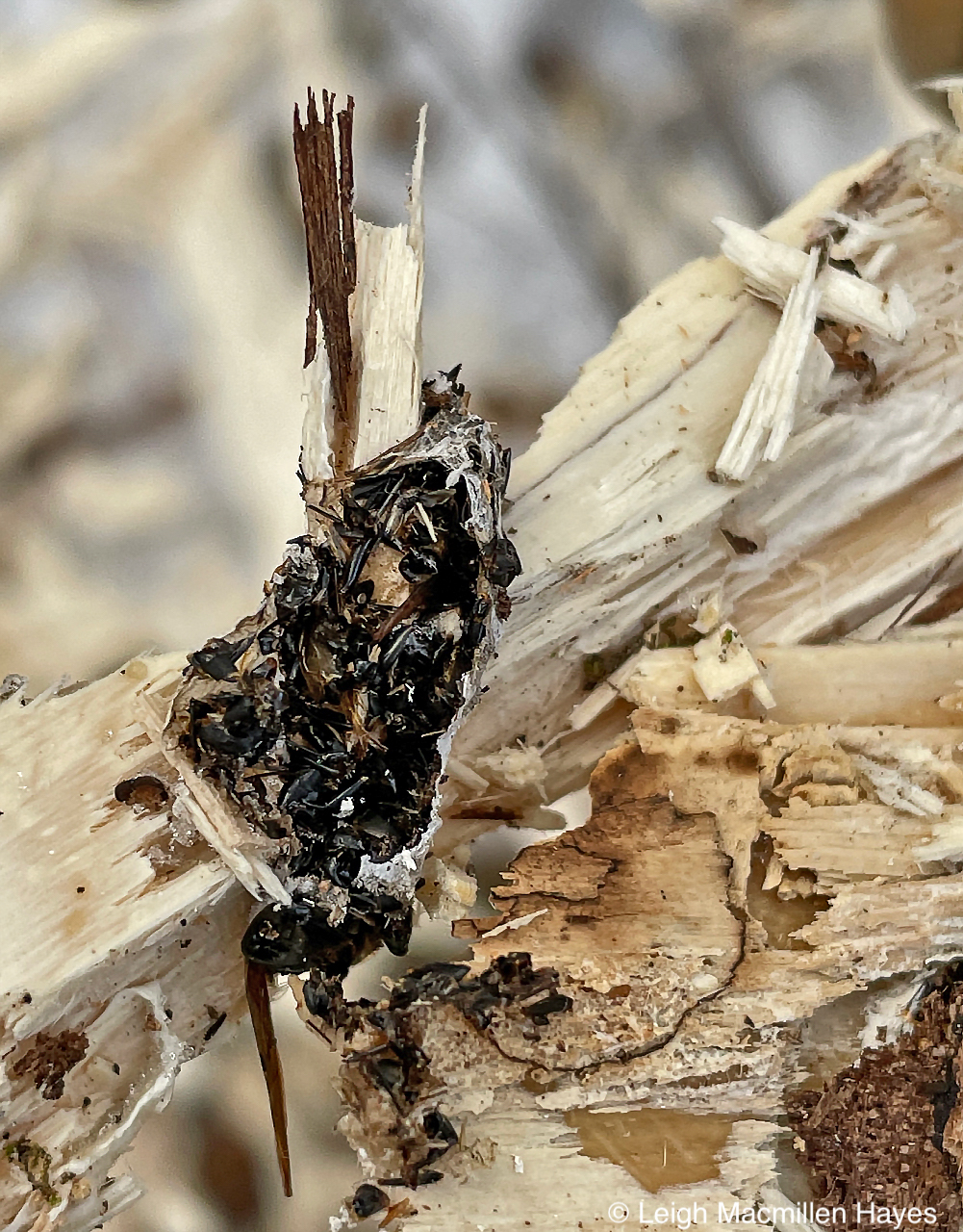
One critter that surprised me was a Carpenter Ant making its way toward a boulder rather than a tree. Though I see the exoskeletons of these ants in Pileated Woodpecker scat all the time and even found some fine specimens in our woods today, I don’t recall ever spotting one on snow before.

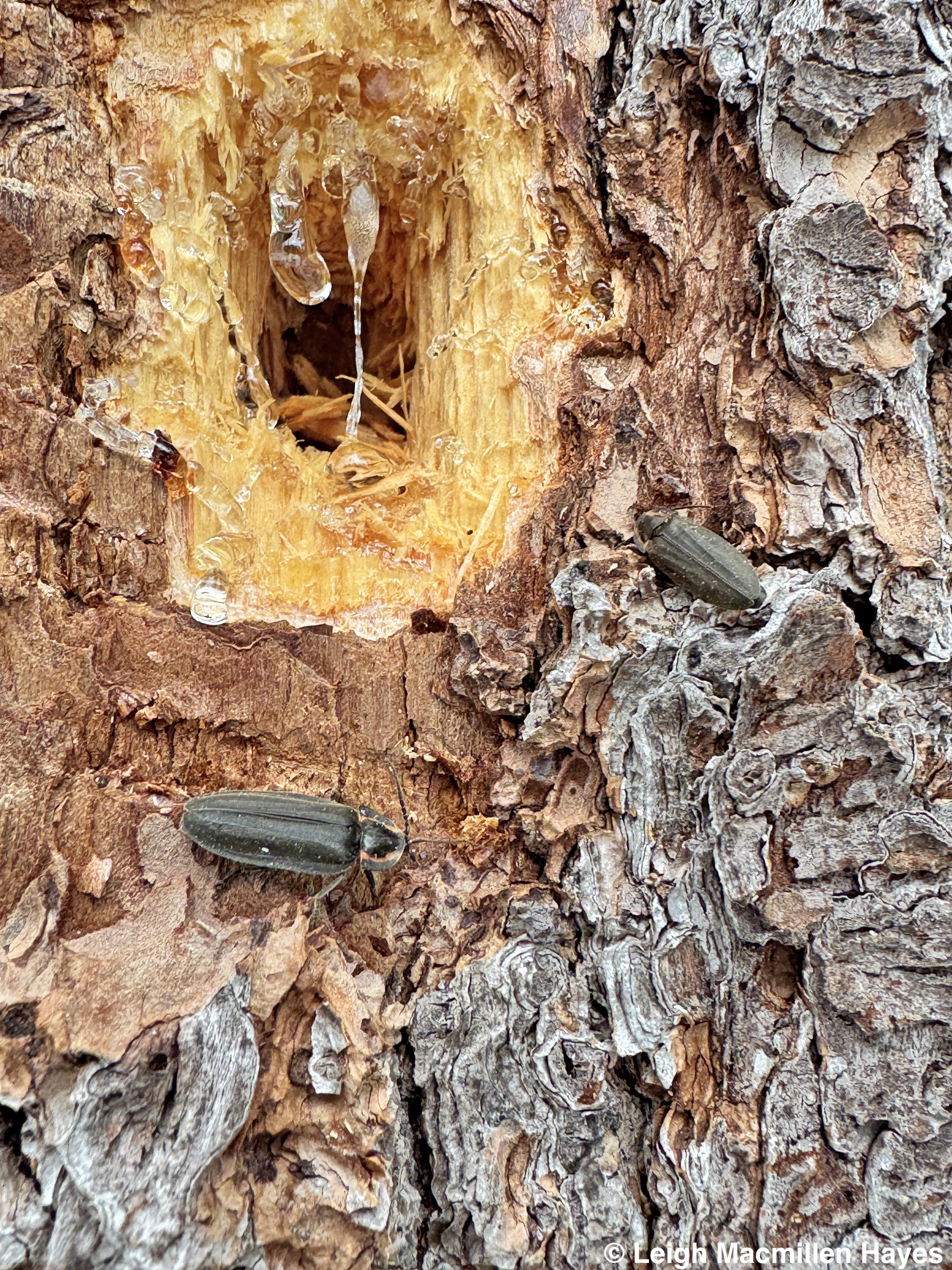
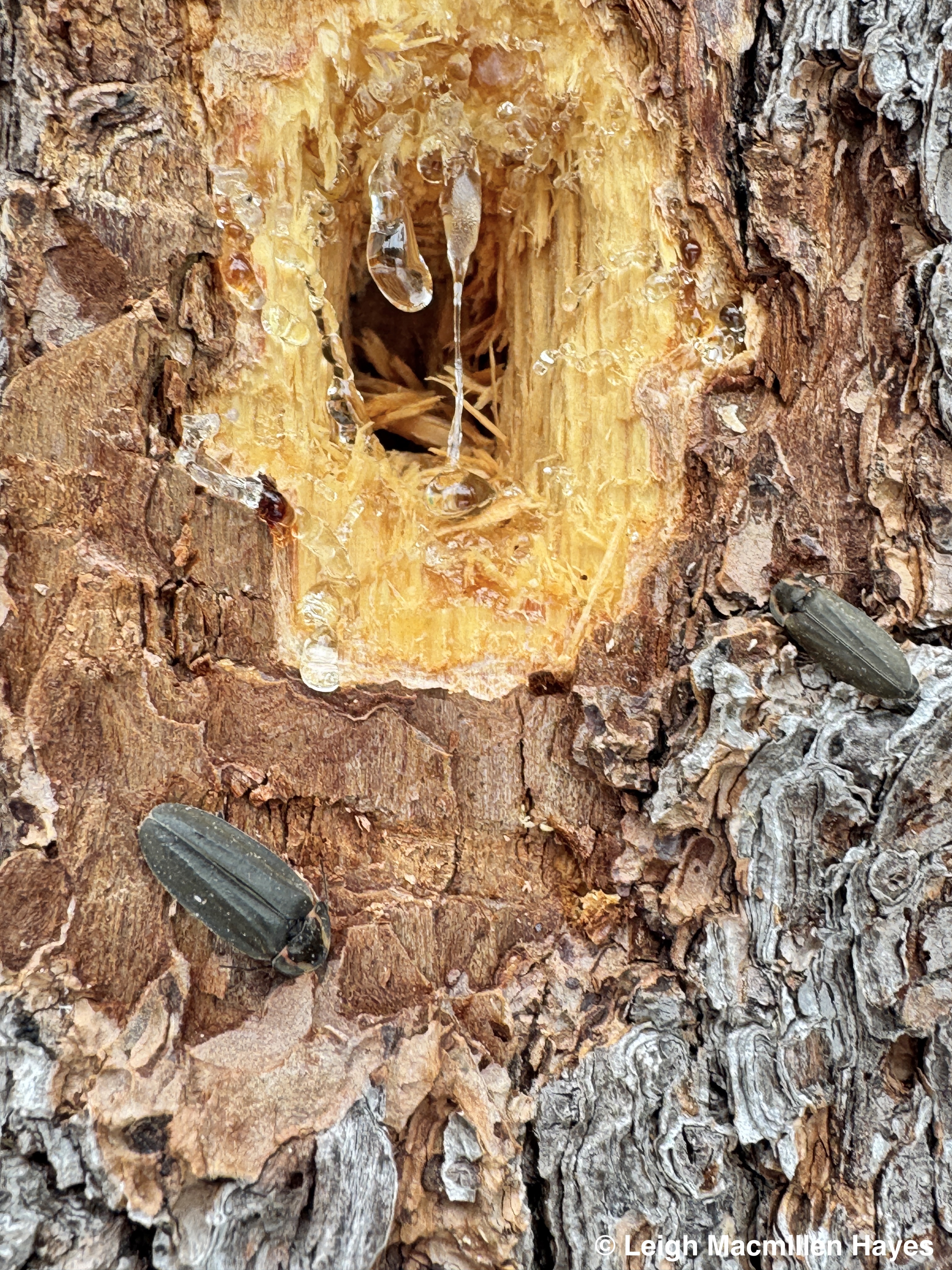
Speaking of Pileated Woodpeckers, their freshly excavated holes are dripping with sap and by this hole I found a couple of Winter Fireflies. So, um, Winter Fireflies are fond of Maple Sap. In fact, some call them Sap-bucket Beetles. But White Pine sap? Do you know how sticky it is? As in, you can practically glue =-your-fingers-together sticky.

When I first spotted these two, I wondered if the sap might have given them pause. Were they stuck?

But then there was movement and in that moment, all was good with the world.

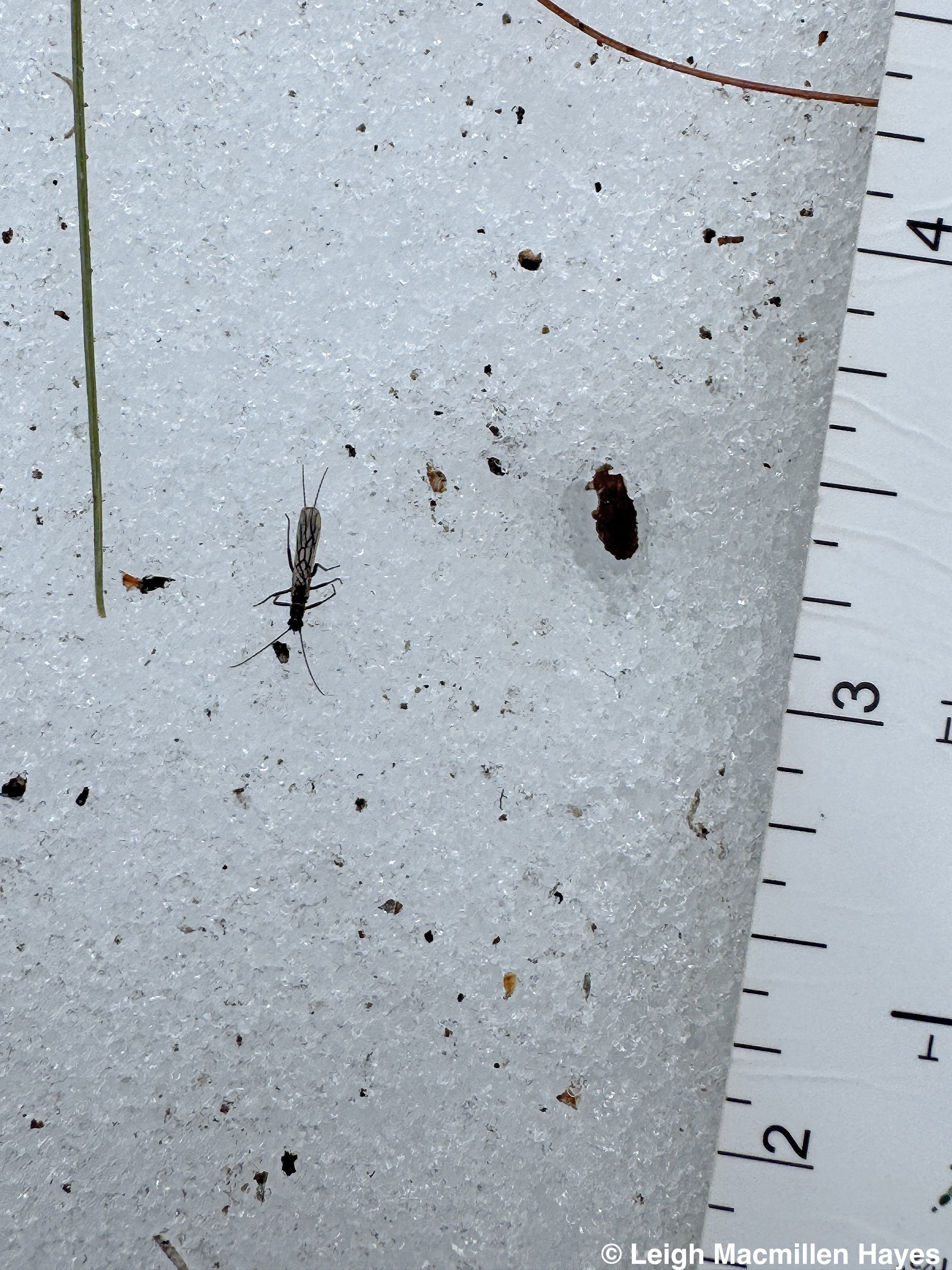
I had one more discovery to make–actually, it’s been my quest this year to find this species and its relative who is only about a half inch longer.

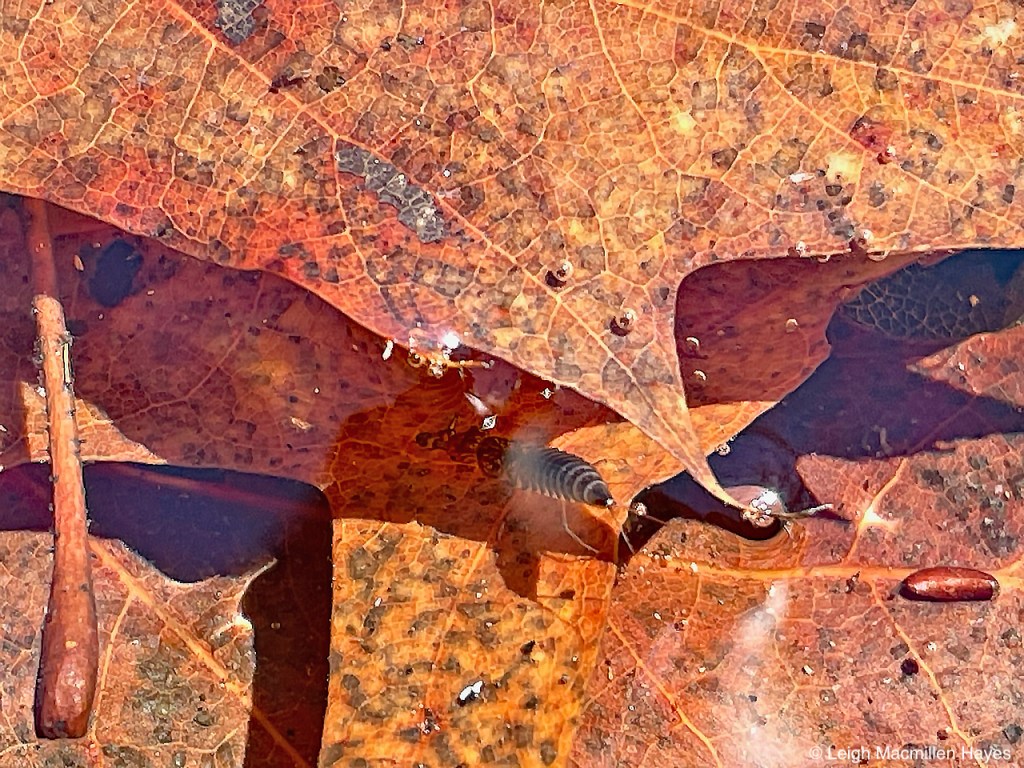
But I must have missed the mass emergence of Small Winter Stoneflies, and their cousins, Winter Stoneflies, for like today, I’ve only seen one or three or maybe five on any particular occasion near these brooks, when in the past there were so many more. Might last summer’s drought and water conditions be the reason for so few? After all, these species are highly sensitive to pollution and thus, are indicators of excellent water quality. I have to hope that I just missed the right day.

After the Stonefly discovery, I did find one more thing that always brings me around to the cycle of life. A small bird was plucked and became the meal of a larger predator.

Curiously, some feathers were stuck to the bark of the tree . . .

My thought was that the predator sat high above, and let the plucked feathers drop and being a pine, a few stuck to the sap, or maybe just to the rough bark. Or maybe the bird was consumed right there on the side of the trunk.

I don’t know and I don’t know who the predator was, but energy was offered and sunshine turned into seeds and insects that fattened up the smaller bird were passed on to the bigger critter.

Perhaps the Barred Owl knows the whole story. Or the Red-shouldered Hawk.

All I know is that I gave thanks for this day to wander and wonder and be greeted by so many who are all a part of my neighborhood. Well, really, I’m a part of their neighborhood, and I appreciate that they share it with me.

CBC: Everything Counts

December 27, 2024. 8:15am. 5˚. Blue sky. No wind.

The perfect day to count birds for Maine Audubon’s Annual Christmas Bird Count.

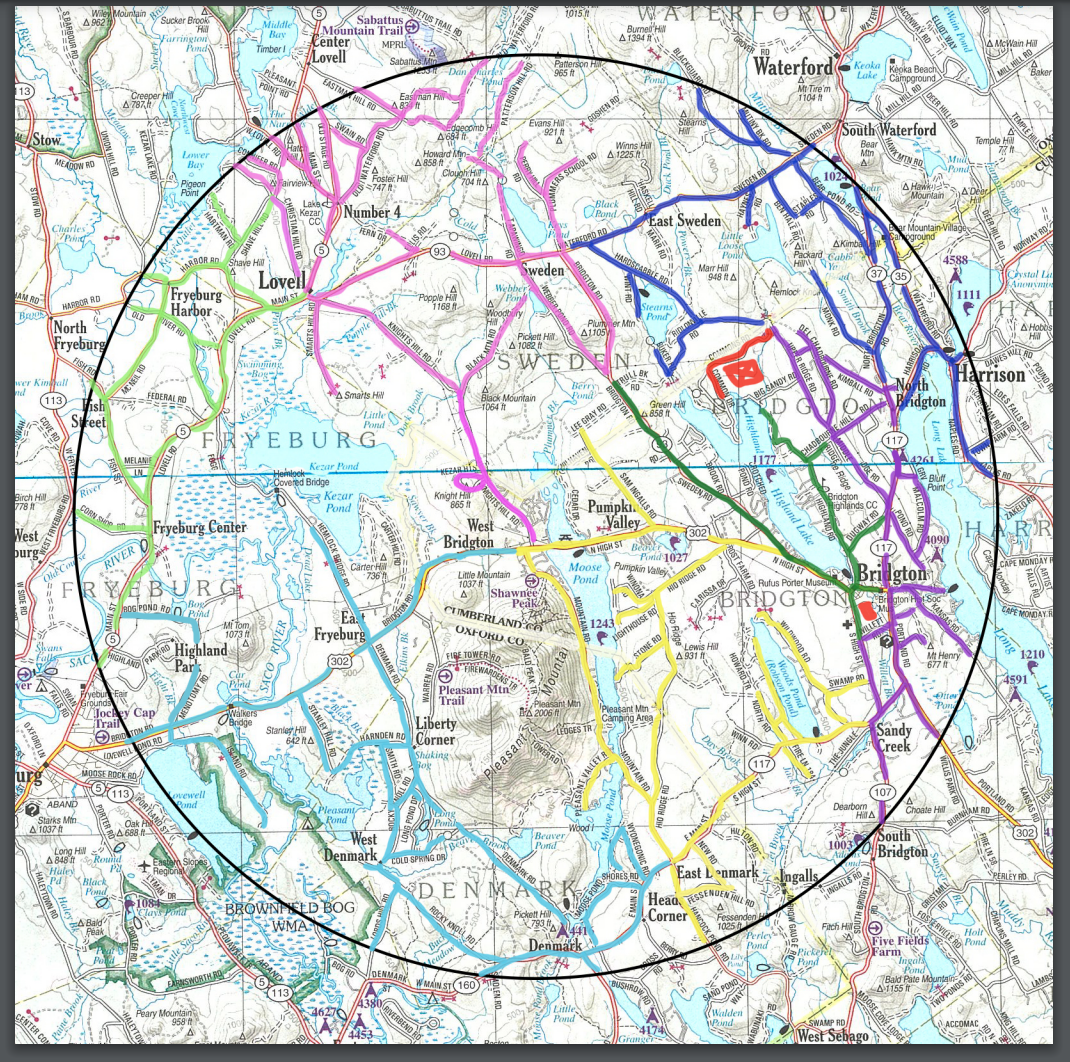
Focus area: Sweden Circle, Maine.

Super focus area: Pondicherry Park and Highland Research Forest, both located in Bridgton, Maine.

Partner in counting: Dawn Wood.

The Christmas lights on Bob Dunning Memorial Bridge in Pondicherry Park rather said it all for so coated were they with ice crystals when we arrived this brisk morning. Fortunately, though, we knew it was going to be as cold as it was and had dressed appropriately.

And really, there is nothing more beautiful than the world beside water on such a morning for everything was coated like the candle and the world was transformed into a glistening display.

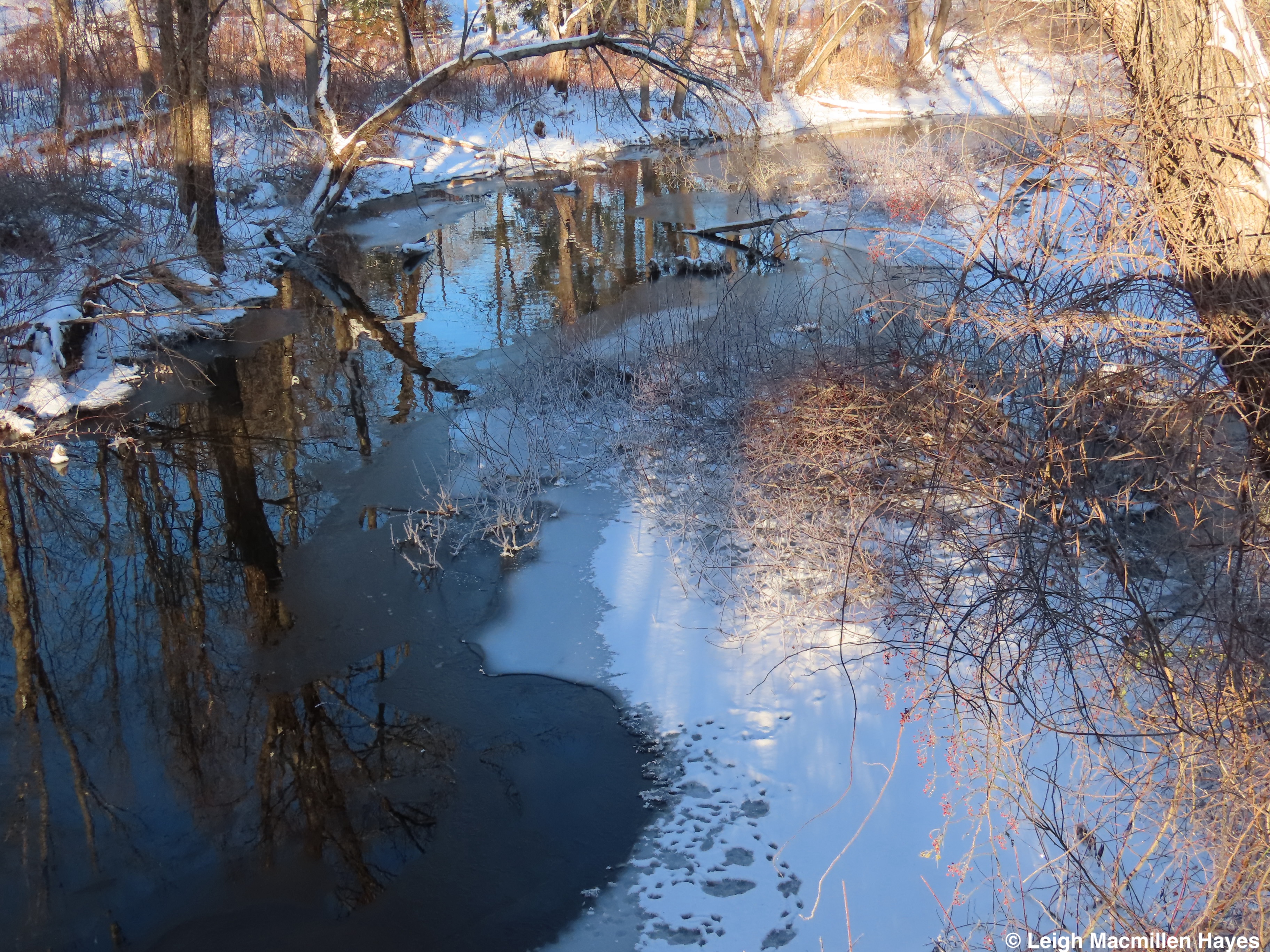
Just a few days prior, when I’d walked in the park, I had noted that Stevens Brook was almost completely frozen and feared we wouldn’t even see ducks on today’s count. But . . . wind a couple of days ago had done its own deed and opened things up.

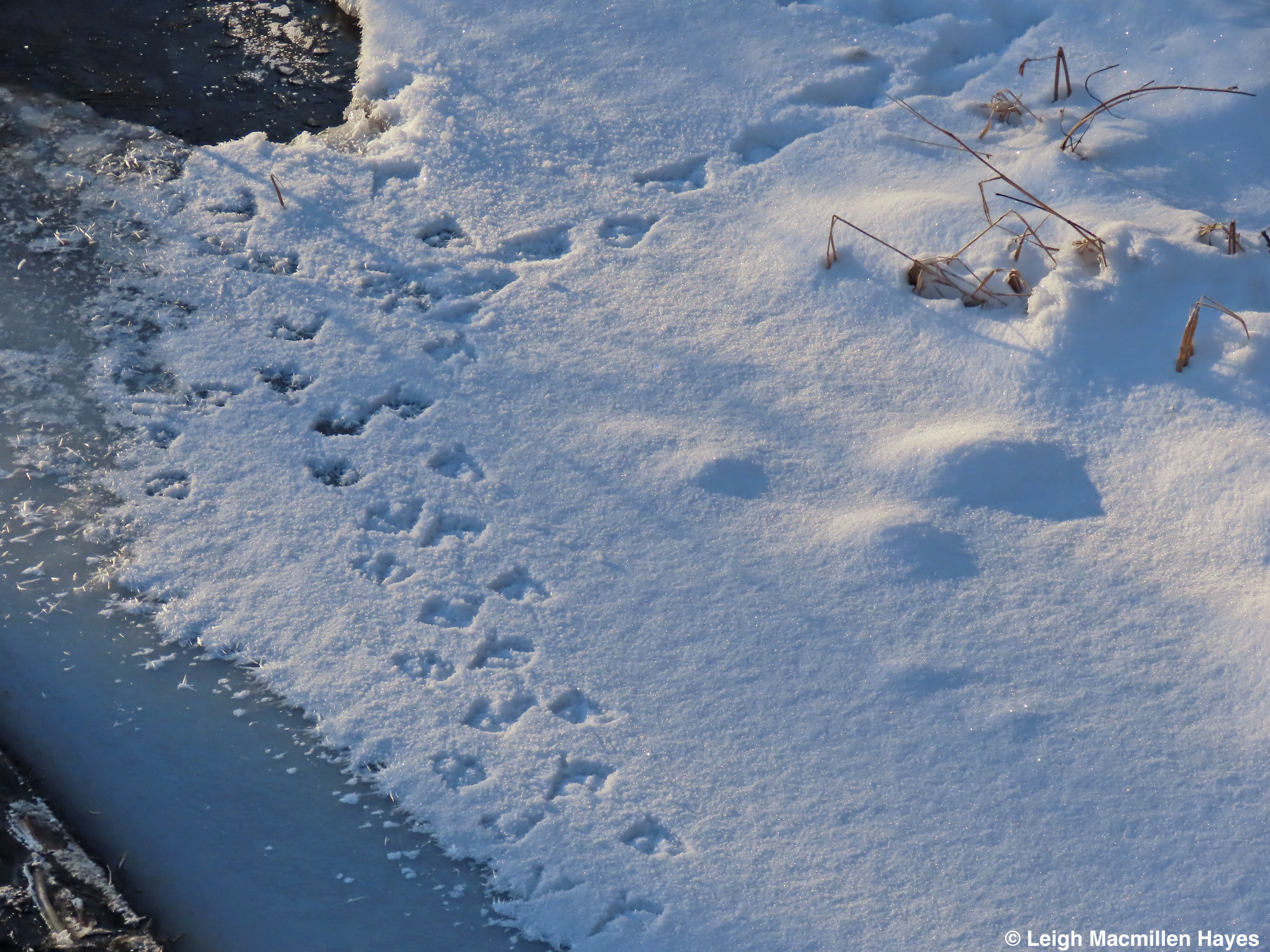
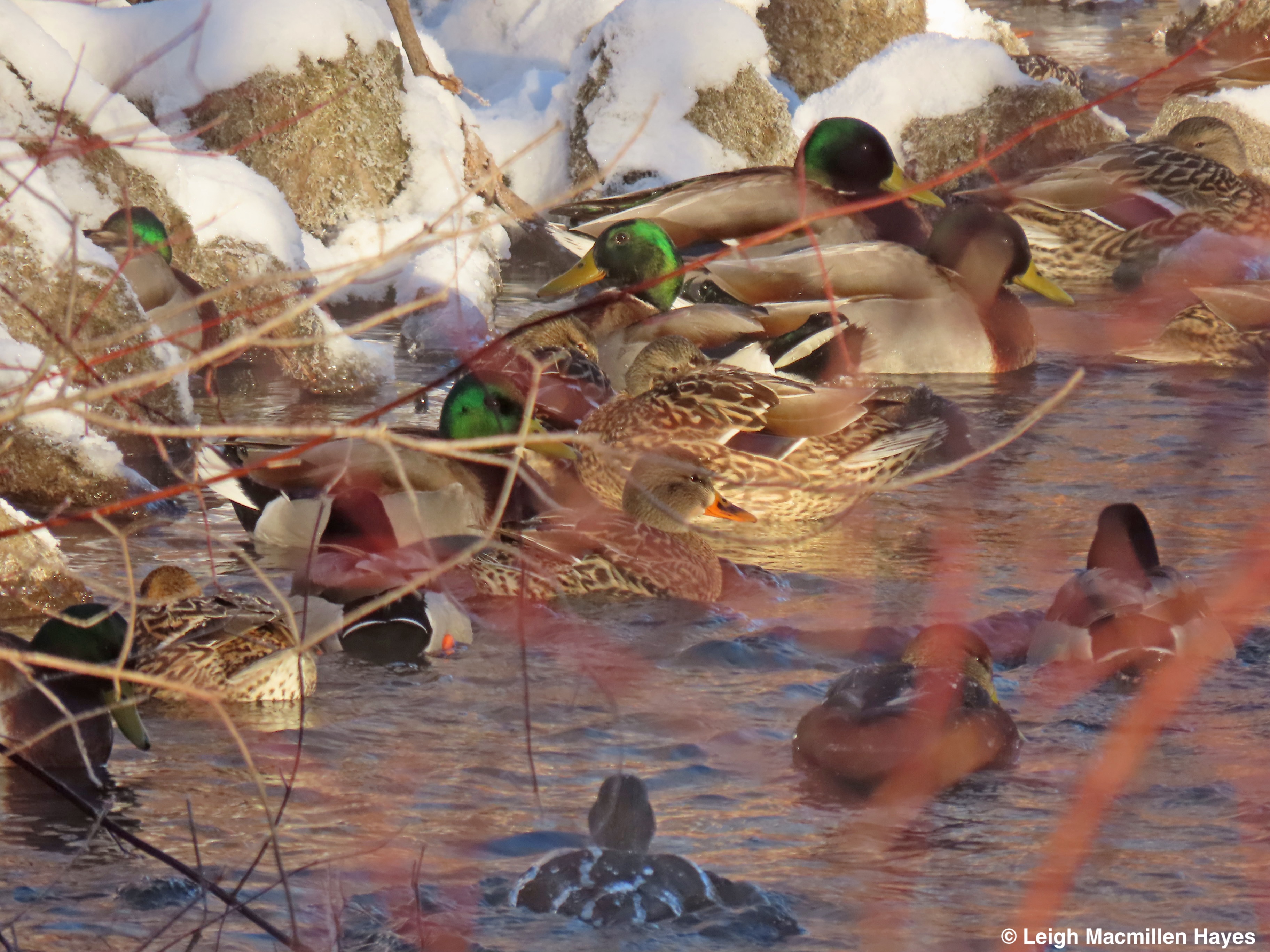
And much to our delight, we spotted duck tracks along the edge at about the same time that we heard a few Mallards quack in their Mallardy way that sounds much like a laugh.

And then we spotted more ducks and had to walk around a building to get a closer look. And count. And count again. And eventually decided on 100 as a number to represent the ducks as best we could for there were so many and they were in constant motion and some flew in in the midst of our efforts.

Half of birding is listening and it was the “Peter, Peter,” call that told us to look for the Tufted Titmouse.

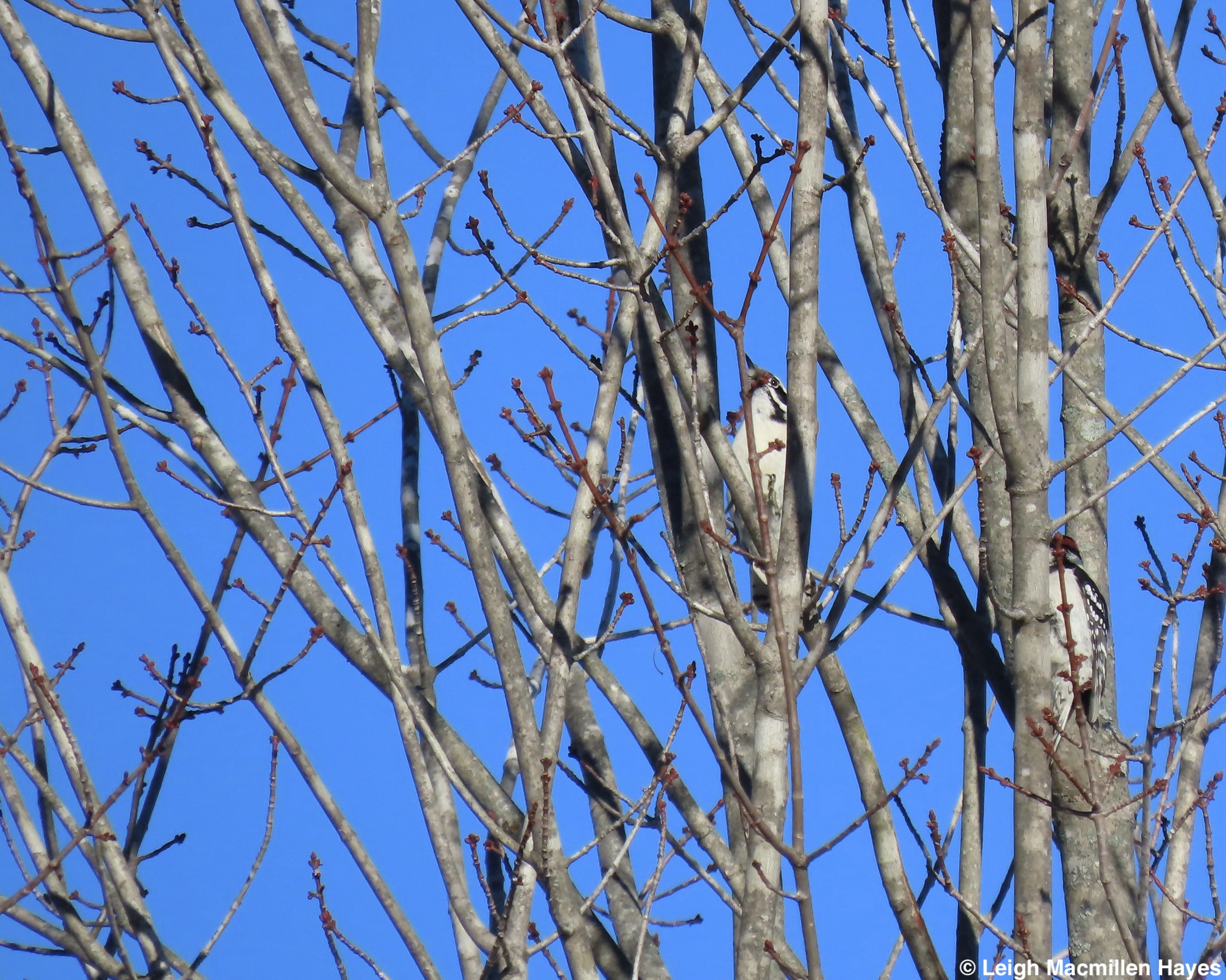
We also spotted two Hairy Wookpeckers playing a game, or so it seemed, as one would fly to a branch, the other would follow, and then the first would move again and on it went with them trying to mimic the branches between their flying sprints.

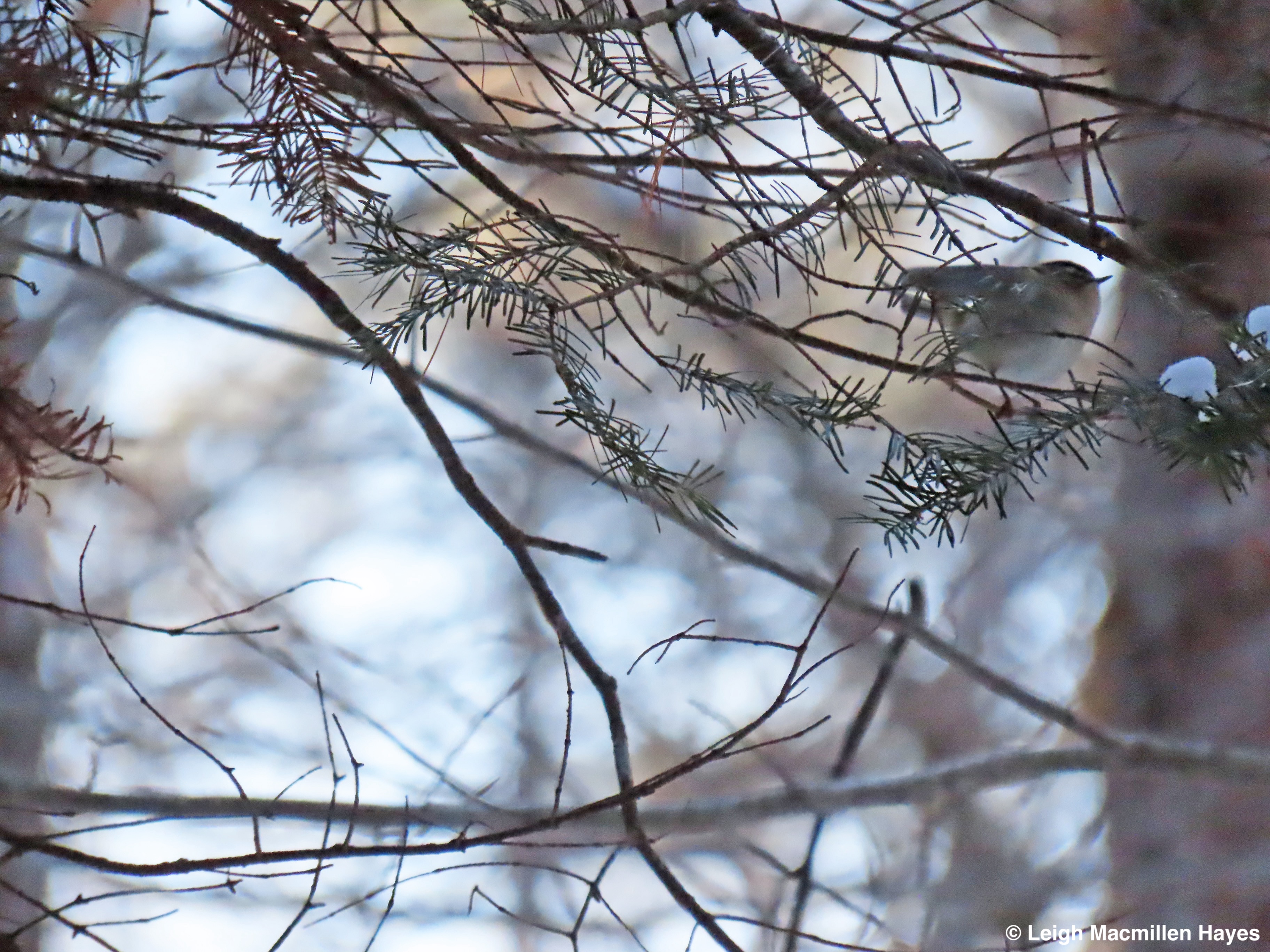
And talk about moving, we saw five Golden-crowned Kinglets, who performed their own acrobatic moves for us, which made them difficult to photograph for they were never still. That’s the thing about photographing birds–“And then it flew,” we’ve often been heard to say once we spot one.

As we moved along the trails, another site garnered our attention: wing prints. Dawn measured the wing span–36 inches. A bit too short for a Barred Owl, but it was still our best guess. And there was plenty of food available either atop the snow or just below in the form of mice and voles. We’ll never know who actually left these impressions or if a meal was part of the deal, but that’s okay because sometimes mysteries can’t be solved and that’s what keeps us going.

We did wonder if we could add such a sighting to our bird count, but since we couldn’t name the species, thought better of it.

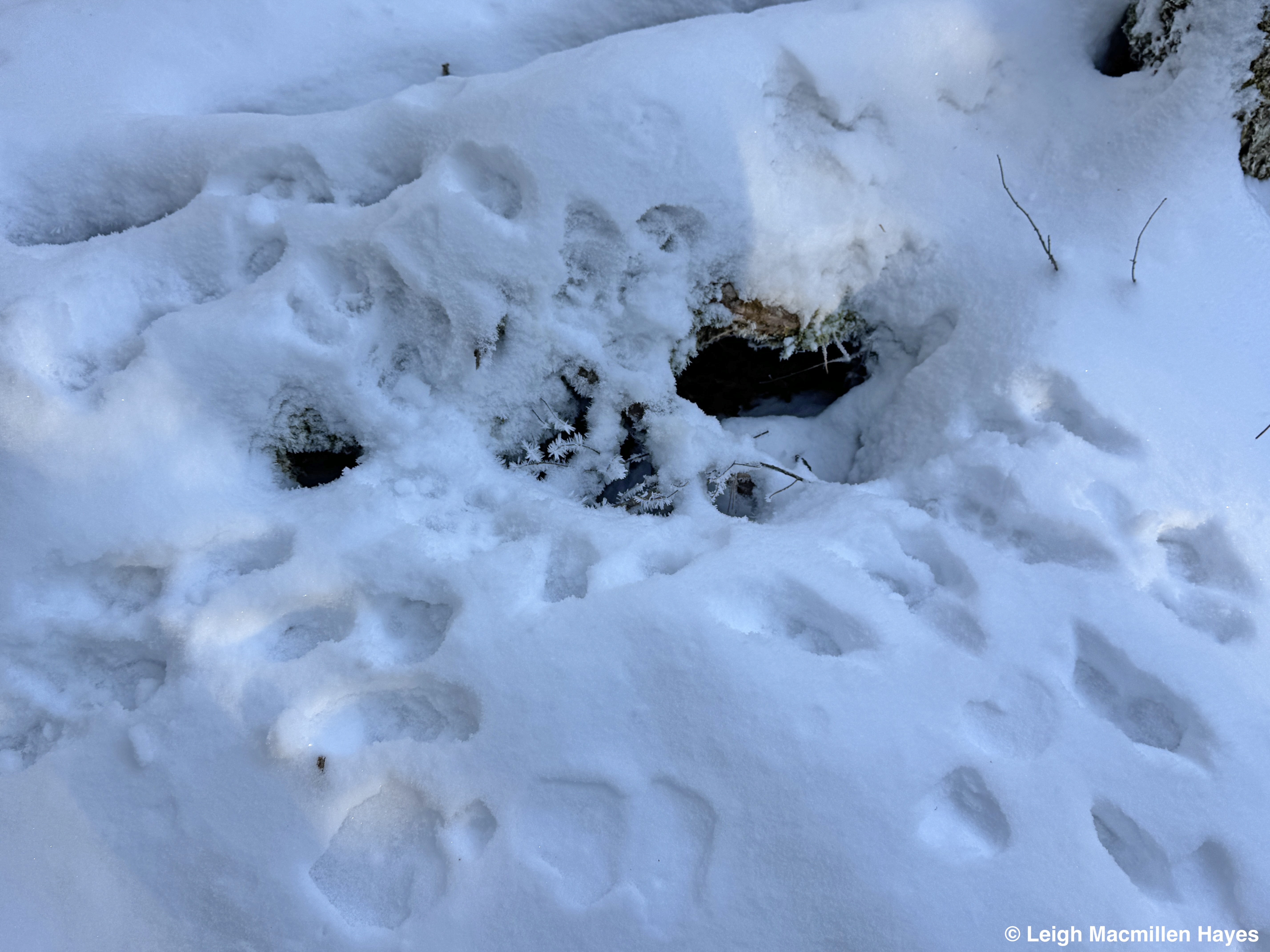
In another area, we noted no birds, but plenty of fox tracks and even faintly sniffed the skunky scent of Red Fox. It seemed very curious about some holes so we went in for a closer look.

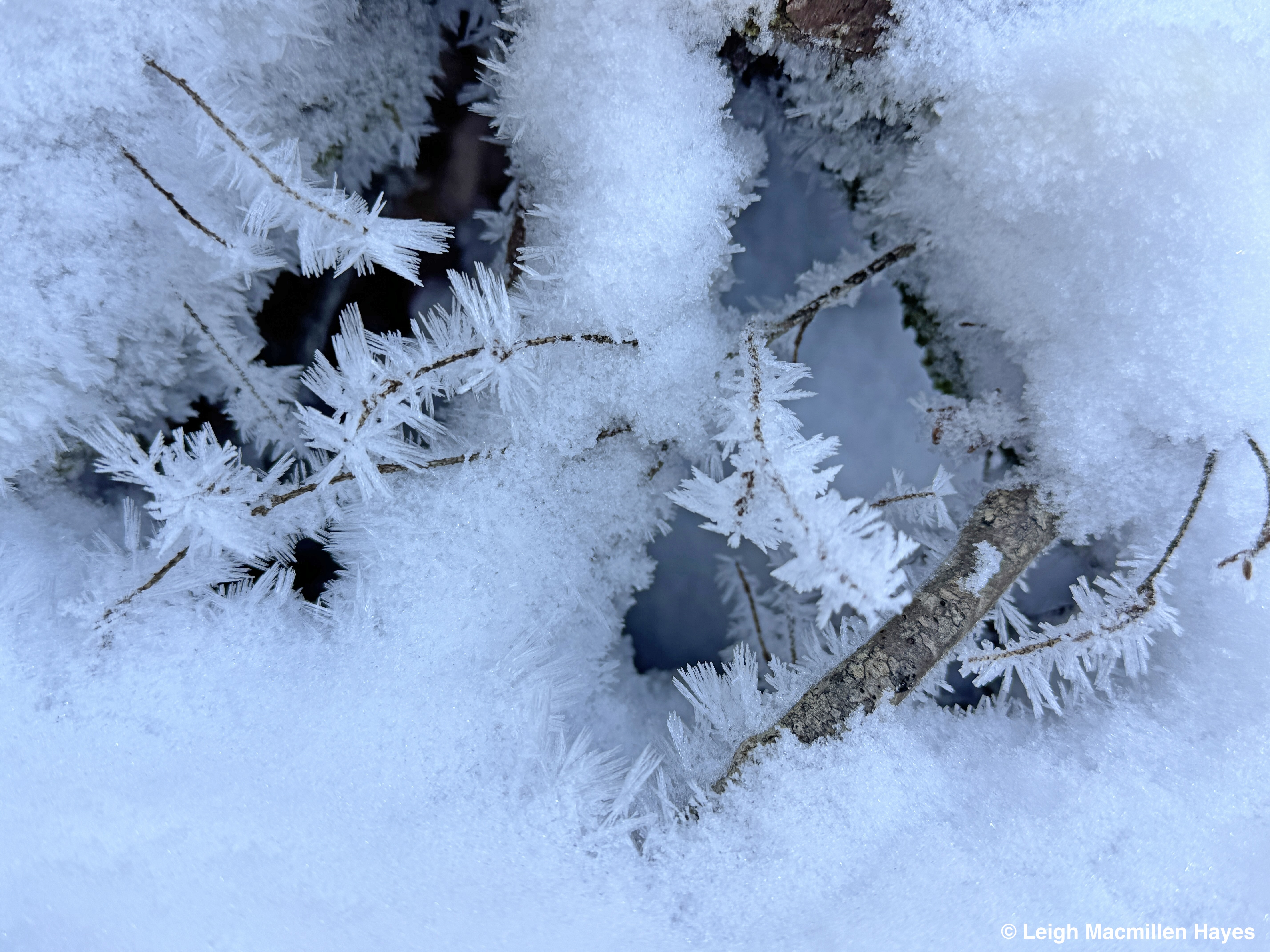
The best we saw–ice needles indicating one of two things: a critter surviving and breathing in the holes; or moisture below rising and freezing. We decided to stick to the first story and knew that we were one hundred percent correct because when no one else is around, we can think what we wish.

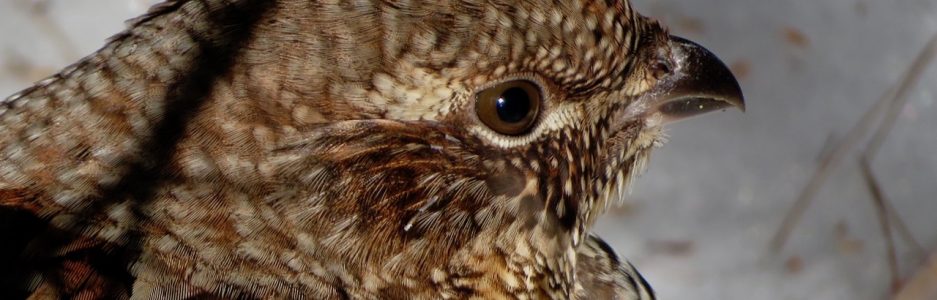
Another set of prints tricked us for a few minutes. Our first thought when we spotted the sashay look of the track was a Porcupine. Especially since we had just been talking about one that resides somewhere in my woods. But the prints within the track didn’t strike me as porky. And then we realized it wasn’t really a trough, but rather had a ridge in the middle. And it was skinnier than a porky trough would be.

What else could it be? And had we seen this sort of track before? And then it hit us: A Ruffed Grouse! Another bird sighting without the sight of the bird. Again, it didn’t count, but it was a great lesson as we ease into this year’s tracking season.

Before we left the park, we were in an area where I often see and hear lots of bird activity and today there was absolutely none. And then a Bald Eagle flew out of a tree. I wasn’t quick enough to focus the camera, but we both will hold that shot in our minds’ eyes.

After completing our survey of Pondicherry Park, we drove north to Highland Research Forest, and not far into the property began to spot Snowshoe Hare tracks. These are the snow lobsters of the North Woods for so do the set of four feet look when arranged perfectly, which doesn’t happen with each hop. But, if you look at the set of four prints in the bottom-most impression, you’ll see the two smaller front feet that landed on an angle thus forming the lobster’s tail, with the hind feet swinging around and landing in front of them to form the claws.

And where there are Snowshoe Hare tracks, there is scat.

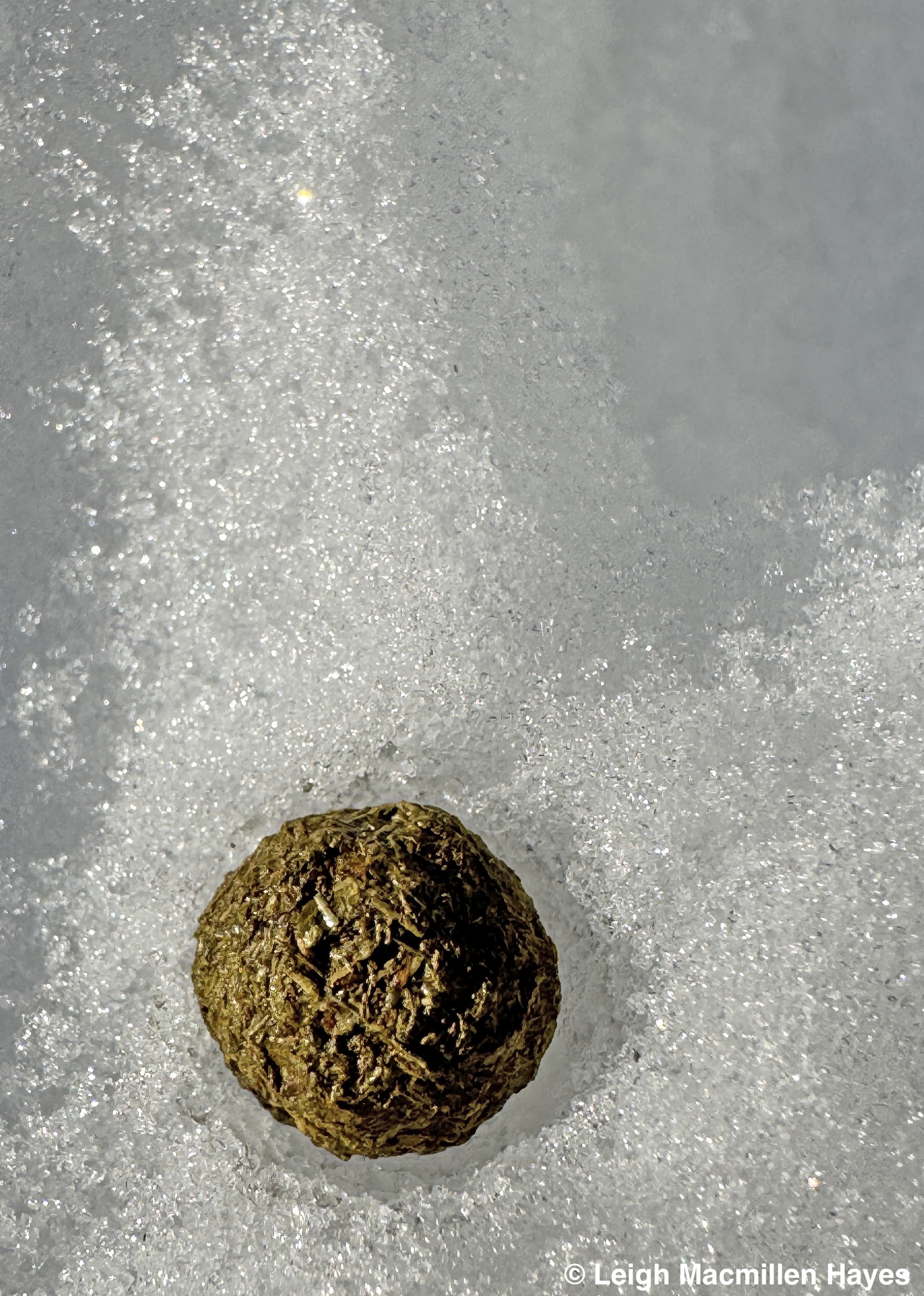
Malt Ball-sized scat full of plant fiber, as it should be.

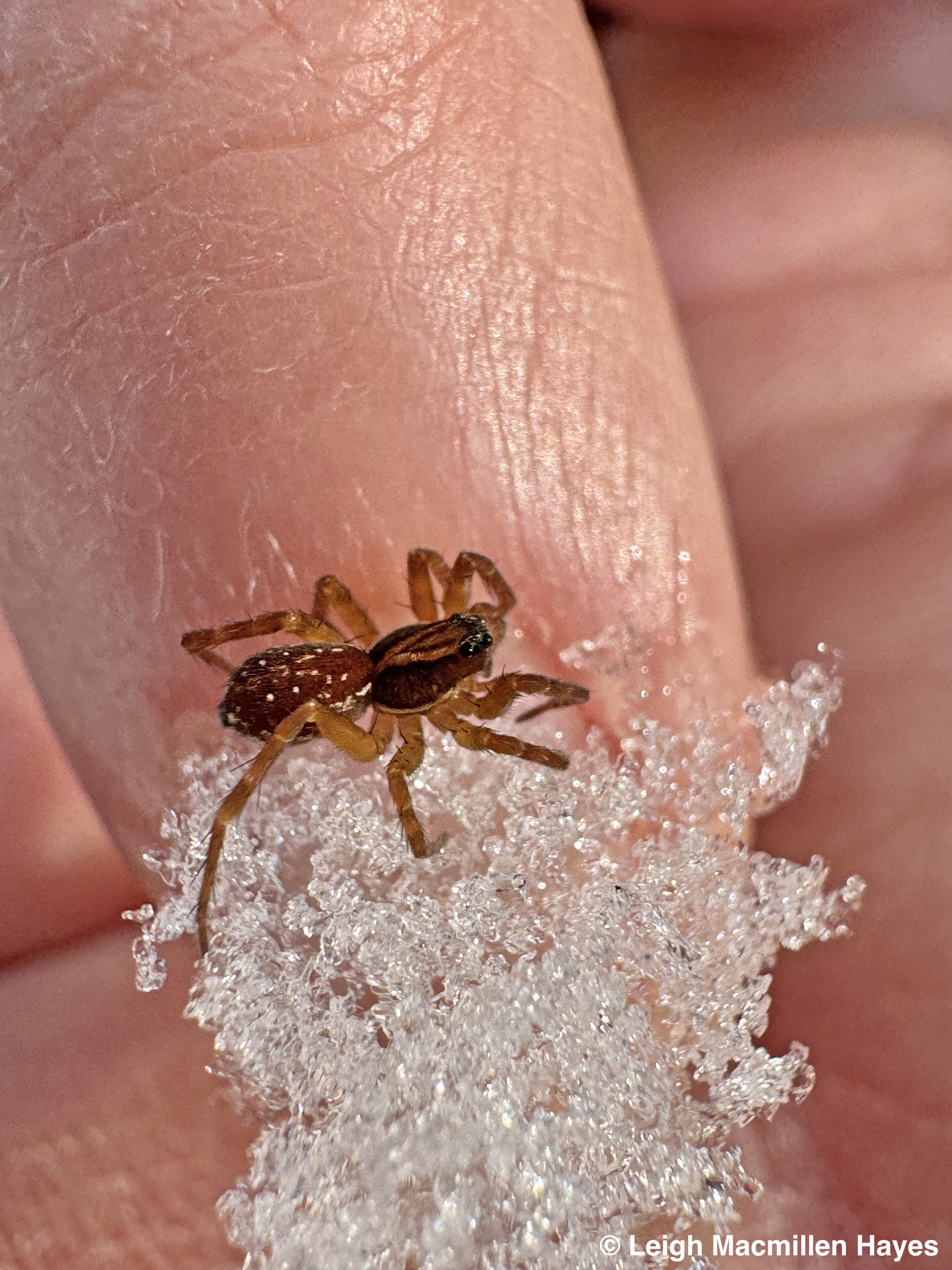
And when one is looking and listening intently, one sees all kinds of things. Yesterday, while hiking along a trail near our home with My Guy, we began to count Long-jawed Orb Weaver Spiders walking on the snow, proving not all spiders are dormant in the winter. That made sense for yesterday afternoon as the temperature was above freezing, but today’s temp was colder and though it eventually reached 32˚ by the time we finished, it was still in the 20˚s when we began to spot this behavior.

I assume the spiders are able to lower their bodies’ freezing point by producing a cryoprotectant, a glycerol anti-freeze compound that prevents them from freezing. An amazing adaptation.

Going in for a closer look, check out those hairy legs! And the long pedipalps used in reproduction; they are also tactile and function like insect antennae.

It’s funny how once you notice one thing, your attention is attracted to another, and such was the case that as we hunted for spiders, we spotted a caterpillar, that didn’t seem to be alive and can only trust that it was blown off a twig.

Like the park, Highland Research Forest is located beside a wetland and a lake, with lots of waterways in between. And like the park, the frost offered artwork, each crystal unique.

Since we were there to scan the wetland for birds but came up empty handed, we were forced to observe the newest beaver lodge in town. We didn’t walk out to it, because of course, tracking was not our official business of the day, but we suspect based on the mud and resent log additions, that it continues to be inhabited.

We really were birding. Honest. It’s just that this property usually has less activity of the avian sort than the other and today was no different. And then we realized that a year ago we said we’d start here in the morning and may be be honored with more sightings, but in the planning stages forgot, so have promised ourselves that next year we will begin our birding adventure at Highland Research Forest and then go to Pondicherry.

But tracks. Oh my. We saw tracks. Which brought up another discussion. Two years ago Dawn assisted me in leading a Senior College tracking expedition on this property. I chose it because I knew it to offer many tracks of a variety of mammal flavors. And that year, we walked a loop trail and finally found signs when we were about two tenths of a mile from the starting point: a Deer rub on a tree; and one or two sets of Snowshoe Hare tracks.

Today, however, while bird activity was almost non-existent, the mammal activity was overwhelming. Including these Fisher prints. (Note to the wise: Fishers are in the weasel family and not the cat family, so they are Fishers and not Fisher Cats.)

And on a high spot near the trail in the midst of the Fisher track: another sign post. Fisher urine. Apparently he was marking his territory with a mere dribble here and another dribble there.

Reaching Carsley Brook, we paused on a bridge, again in hopes of hearing a few peeps. There was an occasional Black-capped Chickadee and a White-breasted Nuthatch, but few others making their presence known.

That said, there were other presents to honor, again two other members of the weasel family: an Ermine and a Mink. The giveaways, track width and foot orientation on a diagonal.

Moving away from the brook, we again found bird sign in the form of . . . Turkey prints. But again, though birdy they were, they couldn’t count toward the bird count.

Pausing as we did frequently to make sure we didn’t miss anything in the bird department, we spotted others flying from twigs. Well, maybe not flying yet. But certainly dangling. As is their habit in the winter. The first was the cocoon of a Promethea Moth, which will fly in the future.

And a few feet farther along the trail, that of a Polyphemus Moth.

Both are attached to the twigs with an incredible reinforcement of silk, and reminded me of how my friend Marita recently reinforced the “idiot strings” on my mittens so they can dangle from my wrists when I take them off to jot down notes or take a photograph.

We also found another spider to admire.

And a kazillion mouse tracks showing their keen interest in risky night-time missions.

Just before we finished, and while we were searching the trees for a Woodpecker, an anomaly caught my attention and I realized I was starring at a Barred Owl. Unfortunately, it flew off before I had a chance to focus the camera on it, but like the Bald Eagle earlier in the day, it was a thrill.

Oh, and did I mention the Great Horned Owl that we spotted this morning as it kept watch in the exact spot we saw the Eagle? It’s amazing the Bald Eagle didn’t take it out, but this bird seems to lay claim to the area for it sits in the same spot day after day.

At the end of our Christmas Bird Count today, these were our findings:

Distance covered: 5.8 miles

Time of travel by foot: 6 hours

Mallards: 100

Downy Woodpeckers: 5

Hairy Woodpeckers: 3

Pileated Woodpecker: 1

Blue Jay: 5

American Crow: 10

Black-capped Chickadee: 17

Tufted Titmouse: 3

Red-breasted Nuthatch: 1

White-breasted Nuthatch: 9

Golden-crowned Kinglet: 5

Dark-eyed Junco: 2

Bald Eagle: 1

Barred Owl: 1

Long-jawed Orb Weaver Spiders (12/27/24): 14; (12/26/24 with My Guy): 94

Caterpillar: 1

Moth Cocoons: 2

Tracks: a zillion including Ruffed Grouse and Turkey.

Surely the bird tracks count for something as everything counts.
Lions, and Otters, and Moose Mondate!

We drove across the border and south today in search of wildlife. And we were not disappointed as our sightings were numerous.

But first, lunch. That in itself was a treat–mine being an Avocado and Roasted Veggie Panini. You are looking at the second half, which was supposed to follow me home. But . . . the avocado would have turned brown. And so I gobbled it all down. Sometimes, you just have to do the right thing.

We may not have been the only ones eyeing lunch, though what this Bobcat was looking at, we could not determine.

It was less than ten feet away from this second Bobcat and it appeared that they had their eye on the same little tidbit. Perhaps a mouse or chipmunk was on their menu.

With a lick of the chops, it appeared that the nearby Mountain Lion had indeed enjoyed a morsel of delight. So, the fact that we saw a Mountain Lion is rather curious because they were officially extirpated in New Hampshire. But . . . sometimes one makes it way into the state and perhaps this was one of those.

I love how its front paw rests so naturally on its back leg. And my, how big those paws are. Notice also that the claws are tucked in. Members of the cat family only use their claws to capture prey (or if conditions are muddy or in some other way slippery, then the claws are extracted to help with stability).

In the midst of our adventure, we stepped into a garden filled with flowers and flowering shrubs and trees, a haven for pollinators this early in the season.

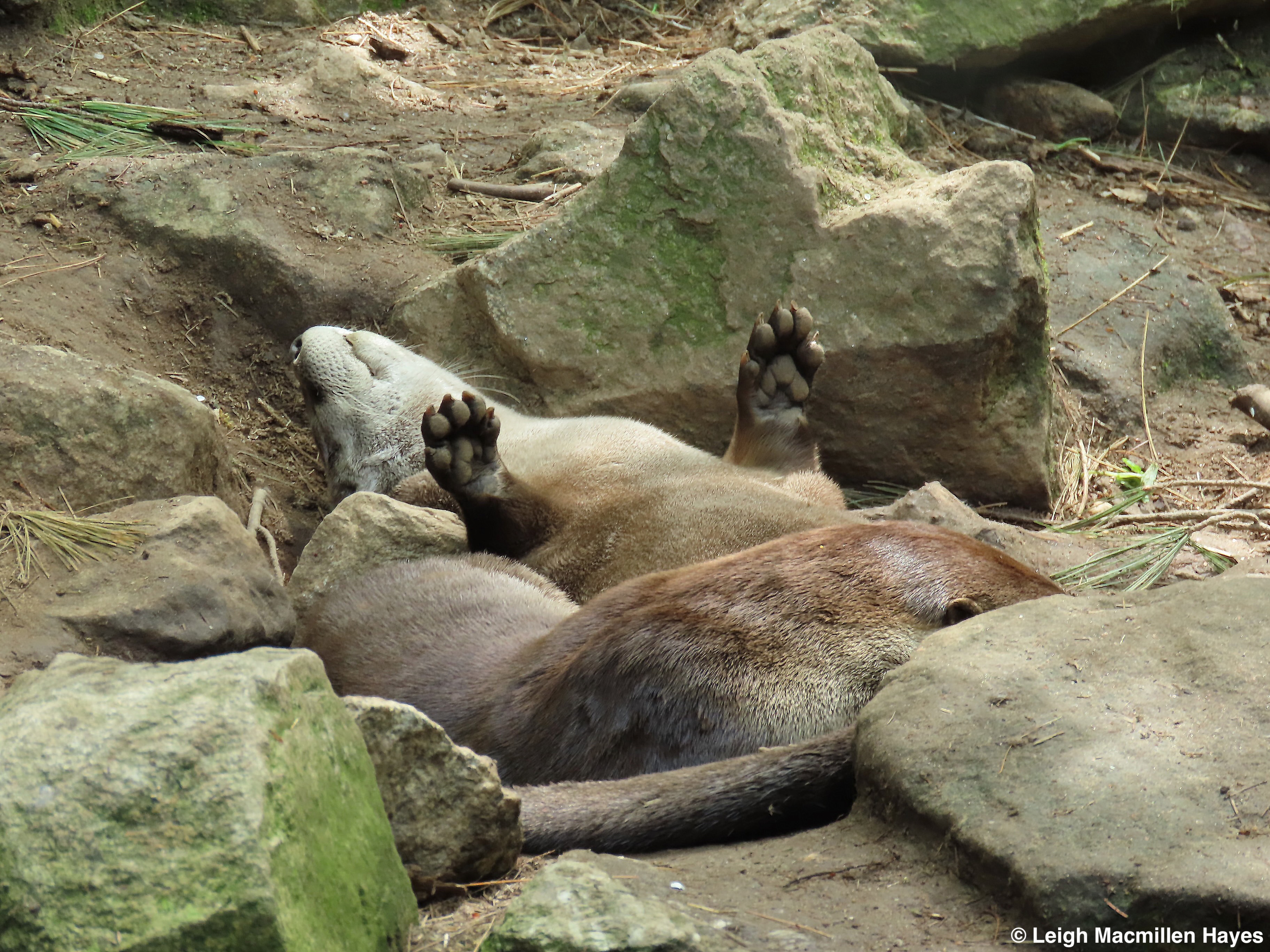
And then it was on to search for River Otters, who had obviously decided to take a post lunch nap. And rejoice in the opportunity. Or so it seemed with those front feet raised.

Take a look at the bottom of those paws–with their five tear-drop shaped toes identifying them as members of the weasel family.

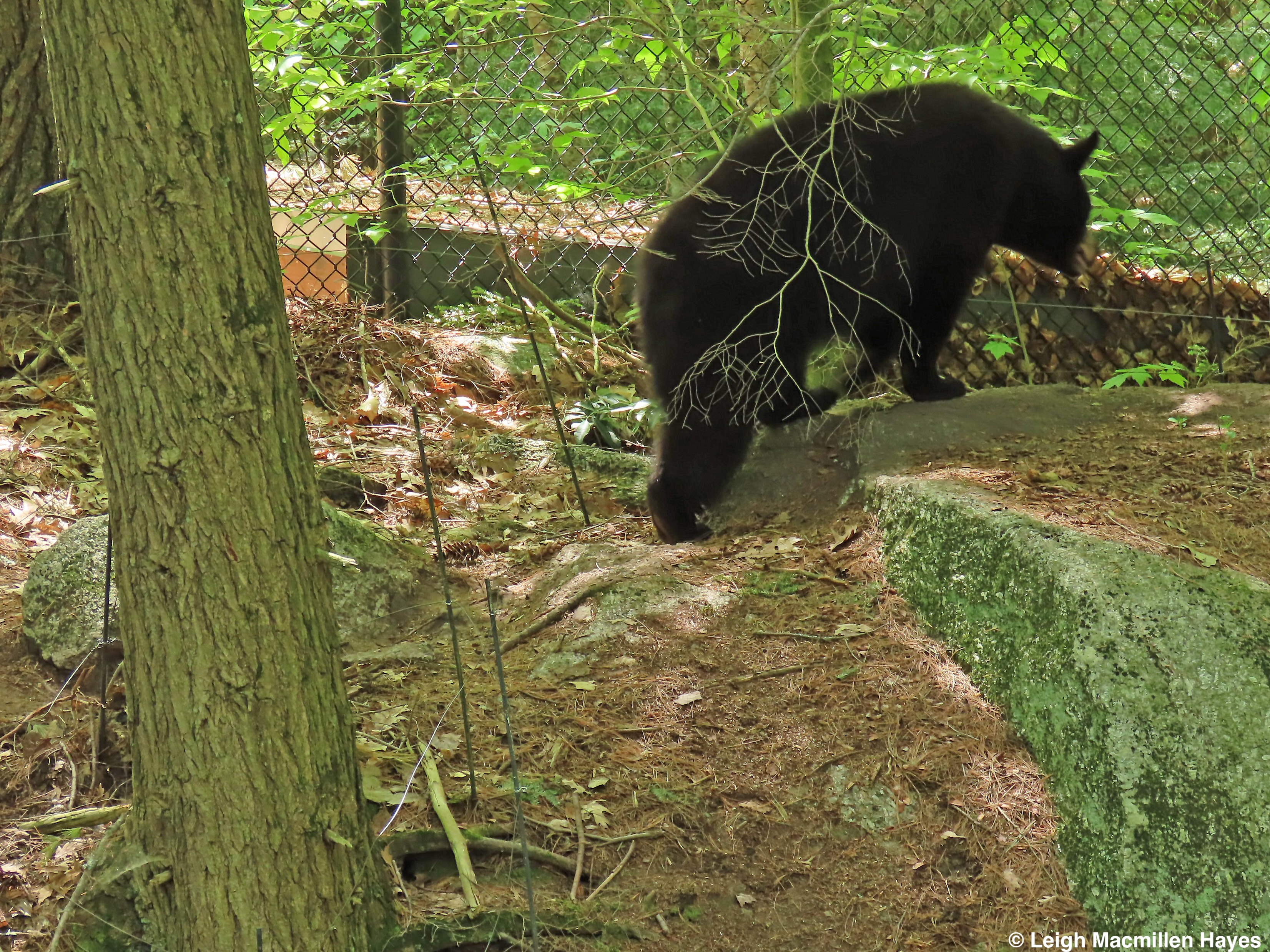
Our next sighting mystified us a bit. As two who are always looking for signs of Black Bears, we were thrilled to see this one. Every once in a while we are granted such views, but the troubling thing today was how the bear paced. Back and forth and back again. It was obviously anxious about something despite its ability to roam in a large area.

Birds were also part of our view, this being a Black-crowned Night Heron, or more simply Night Heron. Look at that eye–its color allows it to hunt at dawn, dusk, and even during the night.

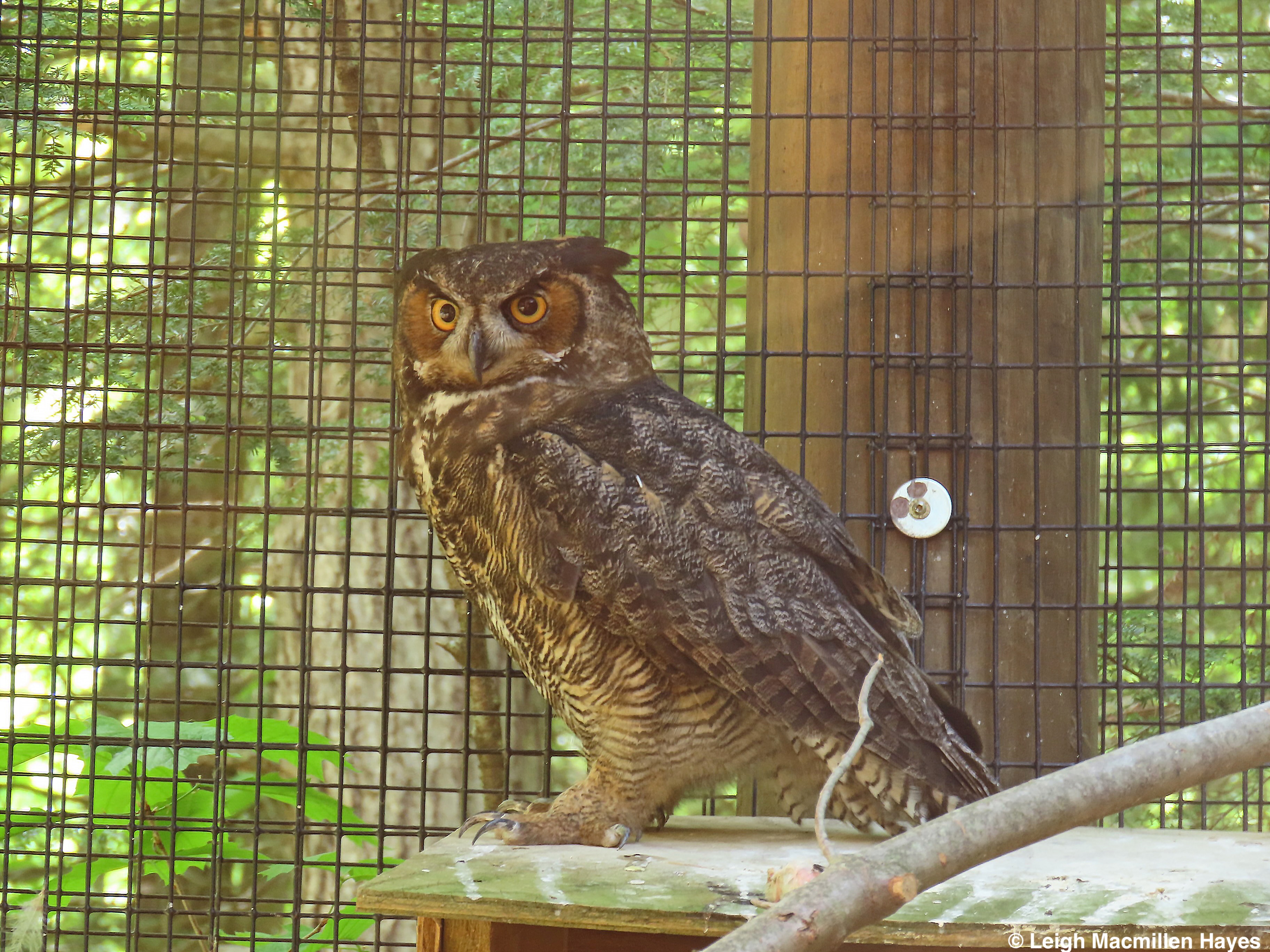
The same is true for the eyes of the Great Horned Owl.

Okay, so by now you’ve turned into a great tracker and hunter and realized that there is fencing behind these animals. Yes, we had travelled to Squam Lakes Natural Science Center in Holderness, New Hampshire, about an hour and a half from home. All photos were taken through glass. Glass that was smeared with finger and nose prints.

The animals are only there because they were orphaned or injured or for some reason couldn’t survive in the wild. And they live in habitats that equal their preferred home territory.

The Red-tailed Hawk offered a shrug, maybe because it thought it should be out in the open. But, it had an important job to do here: to educate all of us. To be an ambassador.

How often do we get to eye all of these species up close. Their behavior might not be entirely natural given their confinement or injury, but I think it’s amazing that we can visit with them and that so many tots were there with their moms today, and there were a couple of school groups visiting as well. These kids get to meet these critters, and maybe will develop an appreciation of them, and who knows where that might lead.

Today was the beginning of a heat wave, and the Bald Eagle reacted by panting, its way of cooling down.

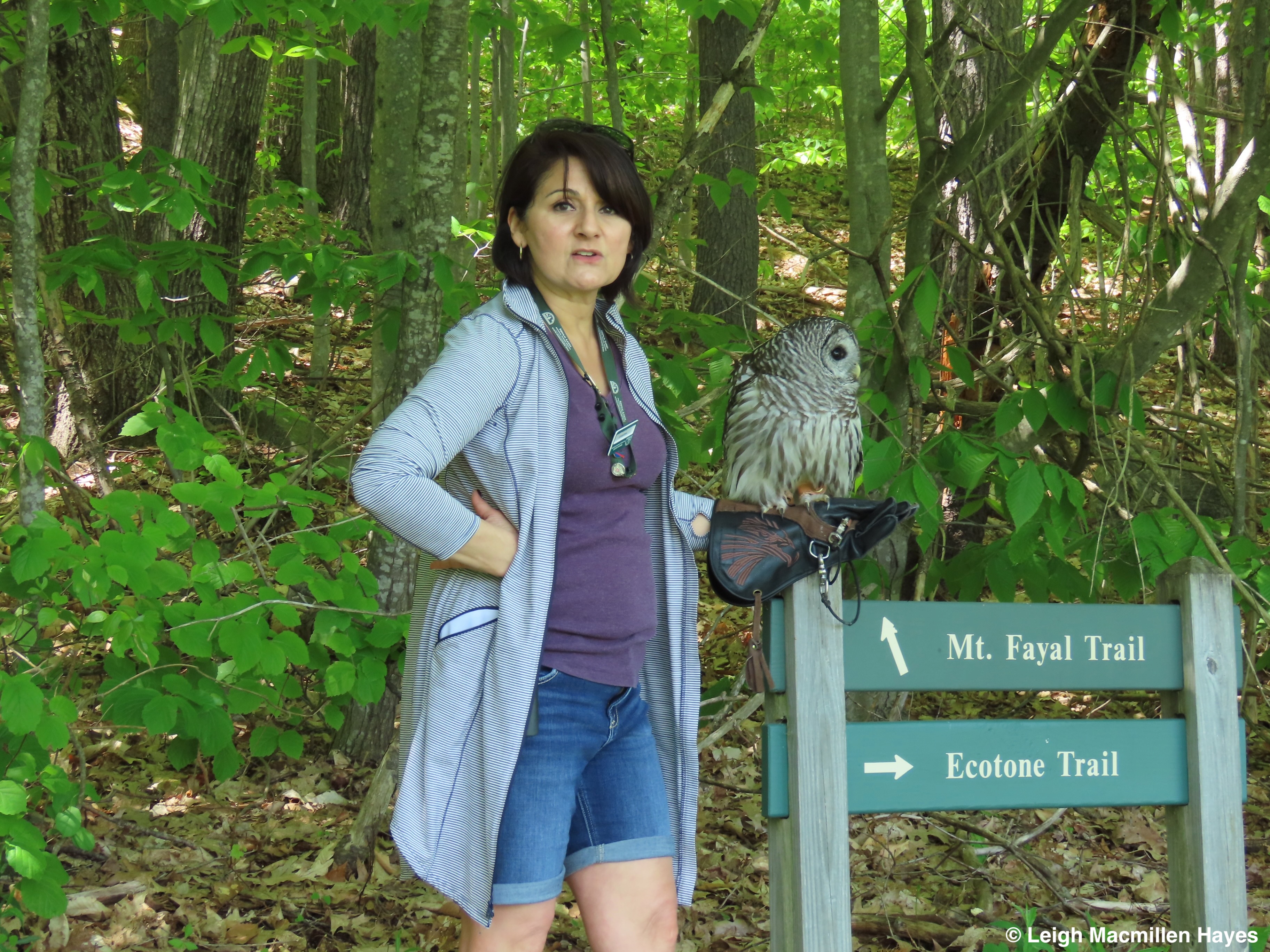
Our plan was to walk through the exhibits, and then hike some of the trails, including climbing to the summit of Mt. Fayal.

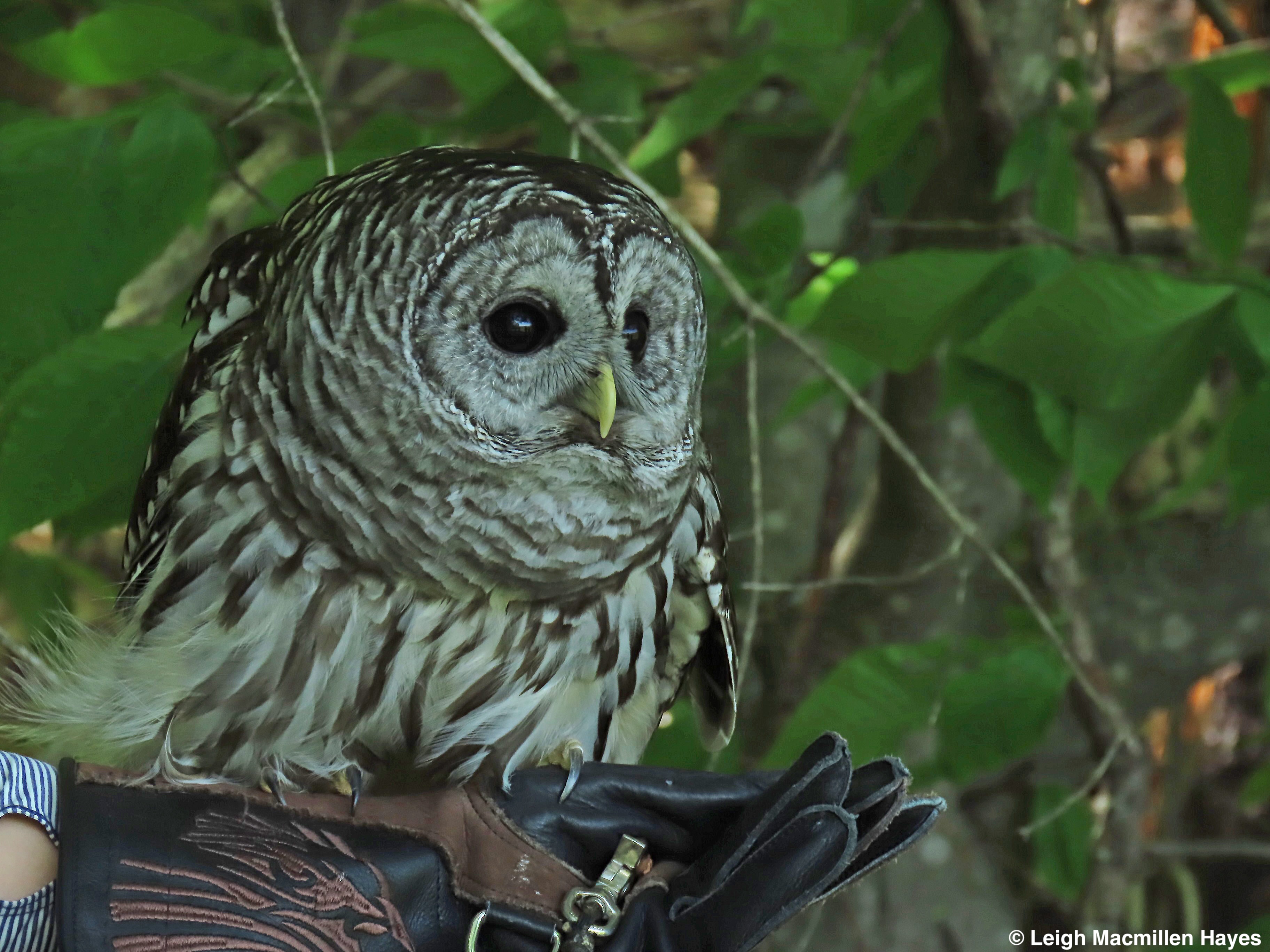
Along the way, we had a special treat, for we got to meet Barred 13, who was out for a walk as well, and panting.

The “name,” Barred 13 refers to the fact that this was a Barred Owl that came to the Center in 2013. As a policy, they do not name the critters who reside there so folks like us won’t think that wild animals should become pets.

Barred 13 was very curious about something in the vicinity. We learned that she once heard a Black Bear before her handler turned and saw it. And that she’s at the Center due to a broken wing.

The Barred Owl’s hearing is so acute that it can pinpoint the location of its prey. There’s a cool exhibit to help us humans better understand how well they hear, but I’ll leave that for you to discover upon a visit.

At the summit of Mount Fayal, My Guy found a bench upon which to sit for a bit and enjoy the view of Squam Lake.

What he missed, I discovered behind the bench.

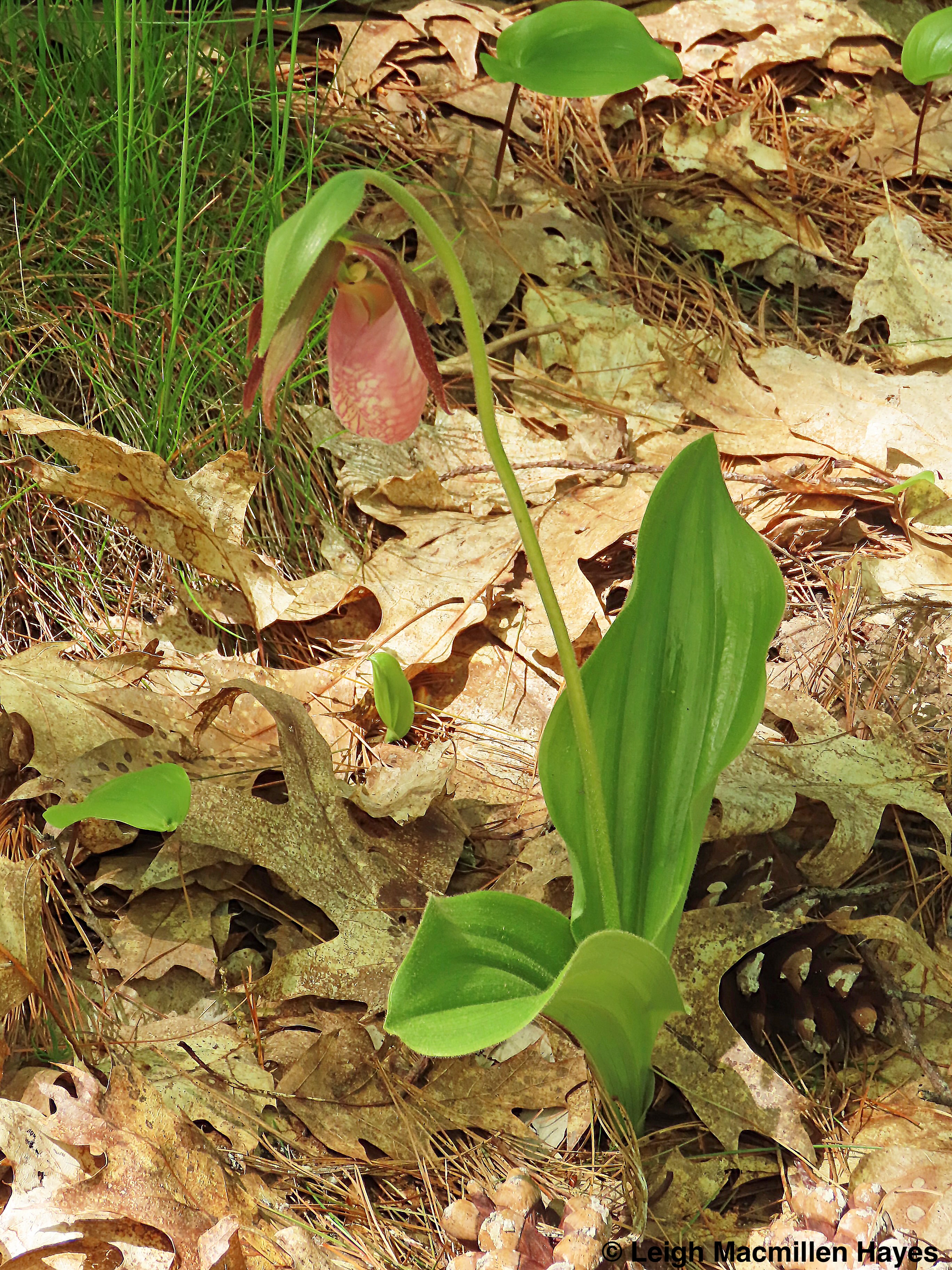
A Pink Lady’s Slipper. The first for us for this year.

His comment: “Only one?!”

We are rather Lady Slipper’s Snobs. Truth be told.
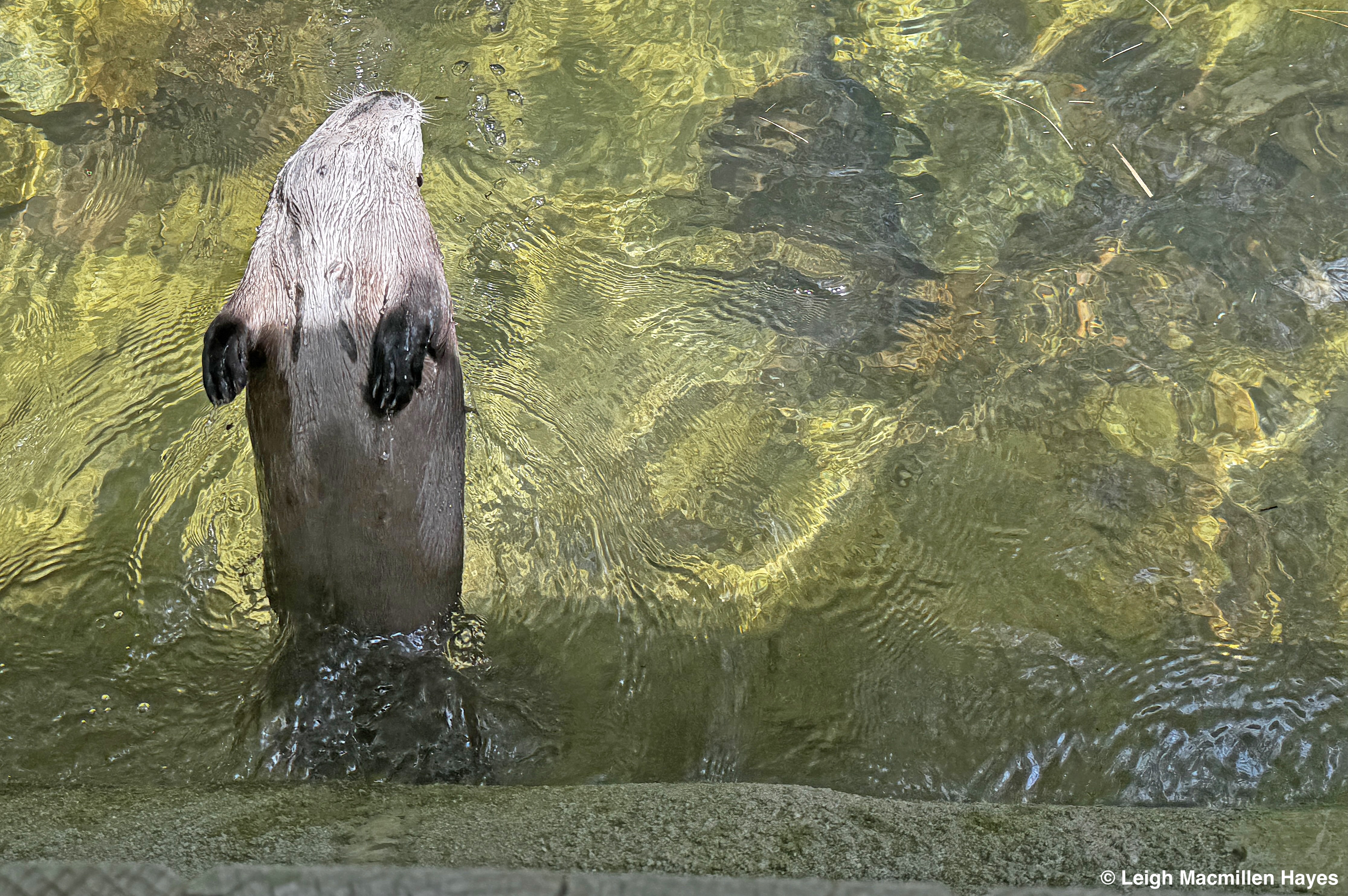
Back on the animal exhibit trail, we stopped by to visit the Otters again. Thank goodness. The most amazing thing–we were the only ones there. The Otter exhibit is usually packed.

We quickly realized that the time to visit the Center is in the mid to late afternoon, after the kids have packed up and gone home. Or if you go earlier, do like we did and head off for a hike before returning to the exhibits.

The two Otters entertained as they constantly climbed up toward us and then did backflips into the water.

Up . . .

Bend over . . .

And swim.

And flip over and swim some more.

Lions, and Otters, and Moose–but wait. This moose was in the same pose when we left as it was in when we arrived. Allegedly we saw a moose. Well, we have a photo to prove it. But, unlike all the other critters, it wasn’t alive. Still.

Squam Lakes Natural Science Center–we highly recommend a visit, no matter how many years you have under your hat.

And lunch from Squam Lake Marketplace. The flour-free Chocolate Chip and Peanut cookies–a great way to end a meal, even if you wait three hours for the ending because your belly was filled by your sandwich.

A Mondate worth noting.

Crows Count

Really? Can birds count? It’s a curious thought and we impose so many of our attributes onto wildlife that we come to believe it all true and that they have feelings and abilities that match ours. And so on this day of the Sweden Circle Christmas Bird Count in western Maine, I set out with Dawn to seek numbers and answers.

The territories assigned to us are marked in red within the circle for we had the opportunity to explore Pondicherry Park in downtown Bridgton and LEA’s Highland Research Forest on foot, rather than driving along a bunch of roads.

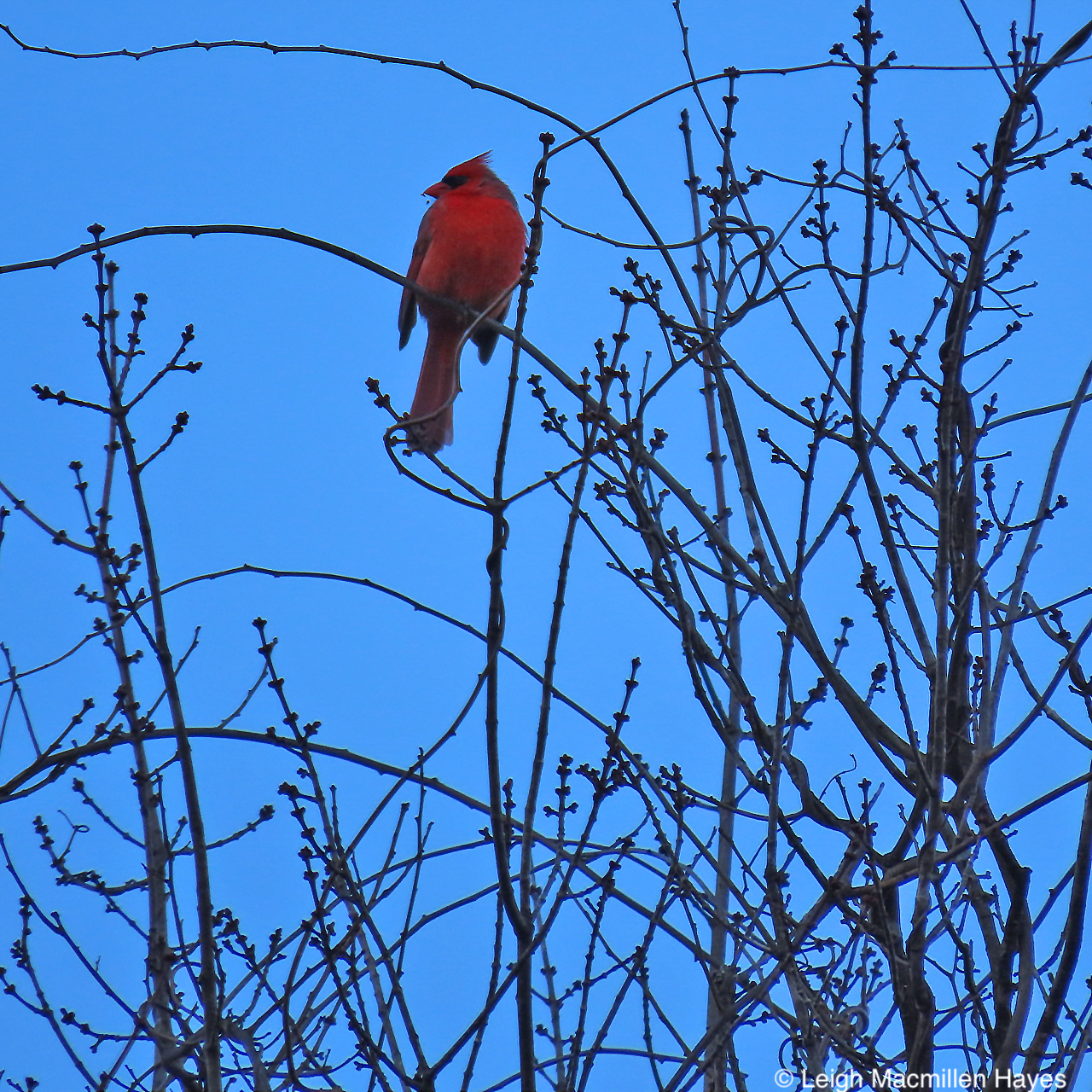
Mere steps from where we’d parked we heard and then spotted Northern Cardinals. Not one, but two, then three, then four. Three being a male such as this one, with one female in the mix.

Below the cardinals were other birds that we heard first and shared a simultaneous thought, “I hear Wood Frogs.” Oops, that would be ducks. But the thing is that when we approach a vernal pool in the spring, and the frogs croak before they sense our trespass into their territory, they sound like ducks quacking.

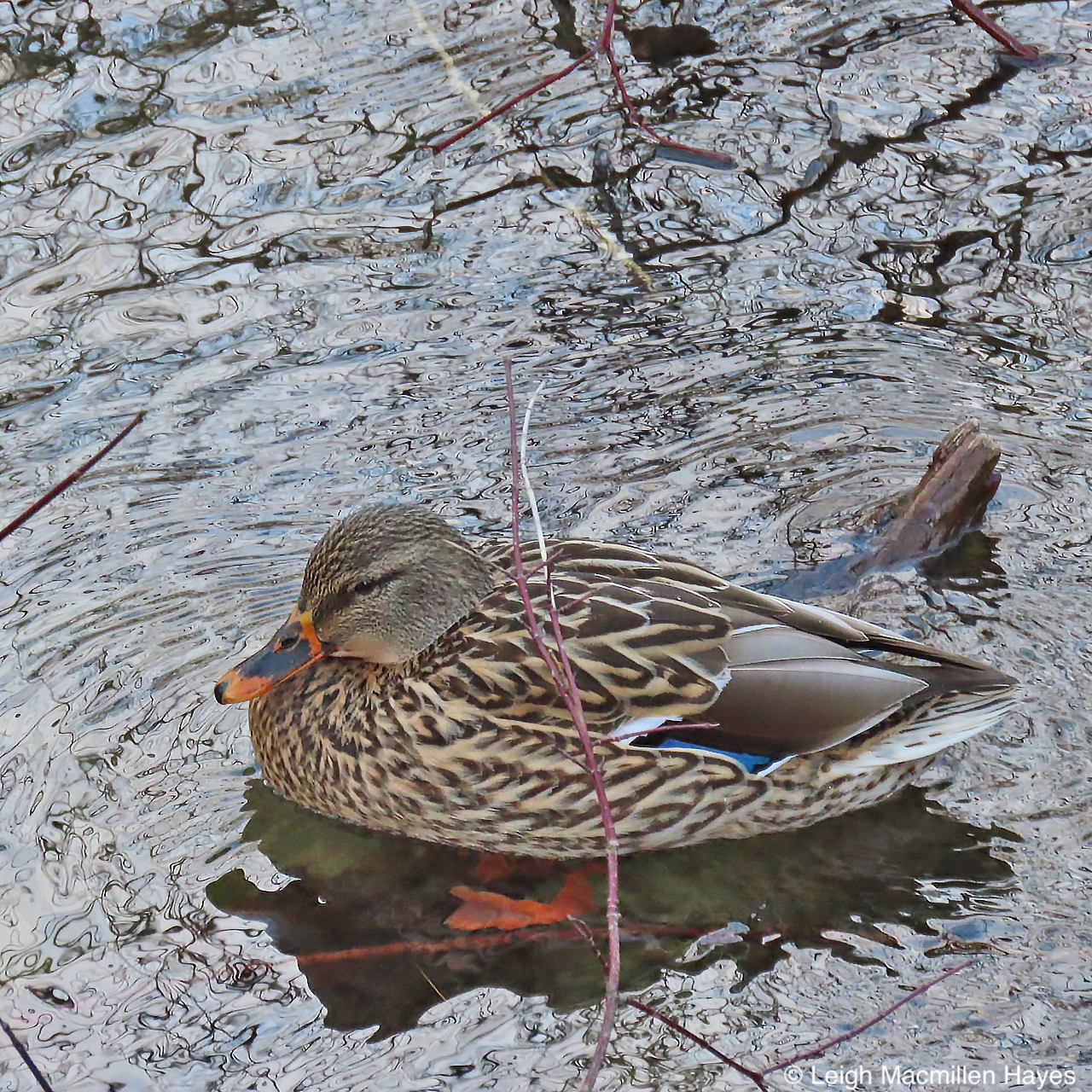
We counted 45 Mallards who quacked and swam and preened and paused and dabbled and quacked some more. Her markings soon became important to us.

As did his. Notice the differences between the two from coloration of heads and bills and feathers. It’s been said that the male is much more handsome than the female. Maybe he is, but she offers her own sense of beauty and design. Again, pay attention to his markings.

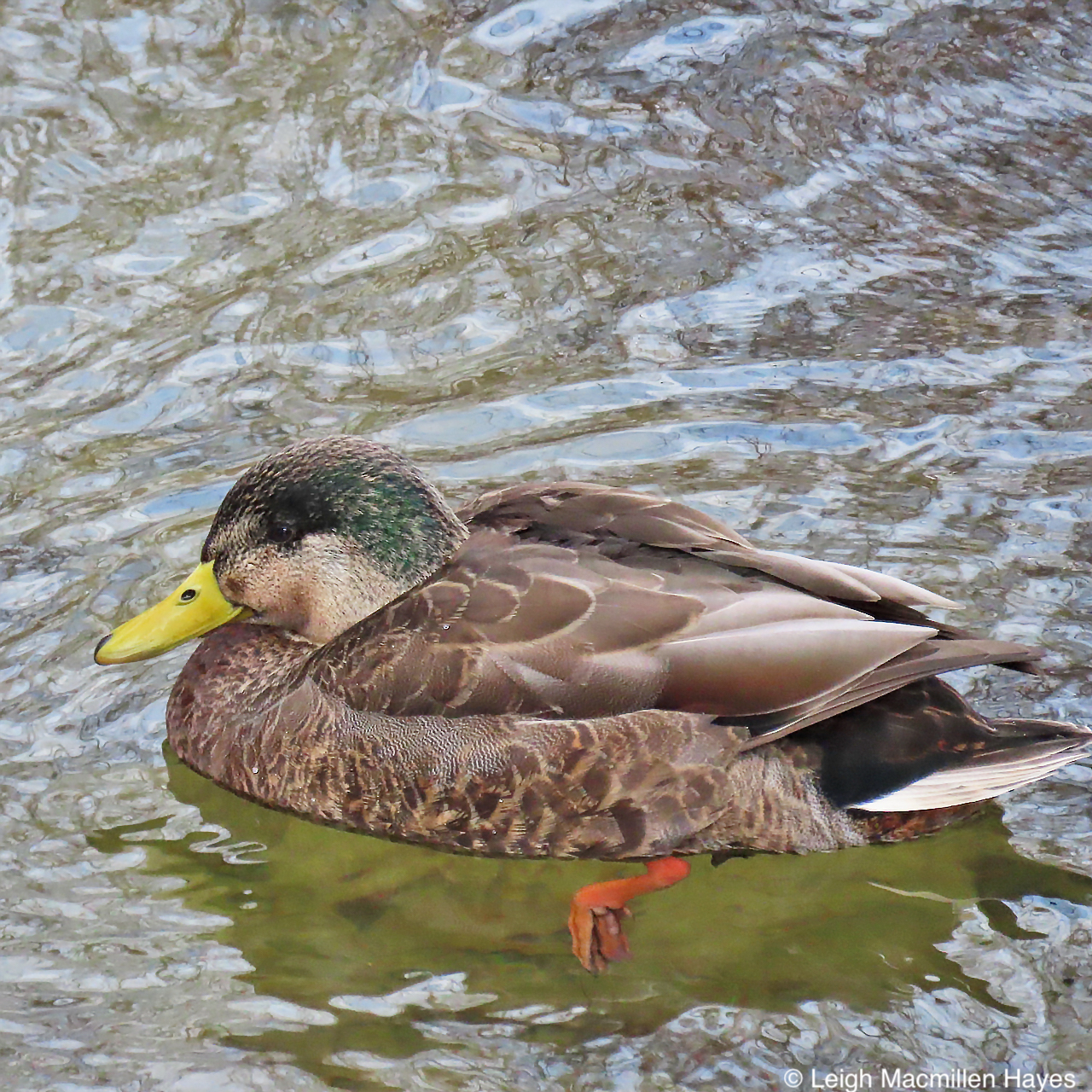
Why? Because we noted this one hanging out for a while under some shrubs. And immediately, we realized that it was somehow different. Look at the color of its head–muted green and a hint of purple or mauve crowning its head. Like the female Mallard, there was an eyeline, but much more subtle in presence. We thought it might be a female, but like the male, the bill was bright yellow with a dark spot at the tip. Plus the overall plumage was different from either the female or male Mallard. And yet, it looked so similar.

The curled tail led me leaning more toward a male, but if you have information to clear up this identification, please don’t hesitate to share. We were just thrilled to be able to state definitively that this particular duck was a hybrid. And I’m still jazzed by the color hues of its head.

The point of it being a hybrid was driven home when the male Mallard and this other specimen shared the focal point of my camera. The hybrid even had a neck ring like the Mallard, though a bit creamier in color.

The Mallard collection in the brook below kept changing and what spooked them (other than us), I do not know, but fly they would and then land a wee bit further down the river before flying upstream again a few minutes later.

We eventually moved farther from the parking lot (maybe an hour later) and just after we’d made a turn on the trail, we saw a bird take flight. And a dog and its person move along the trail (not part of the dog trail, mind you, but people don’t seem to see the dog trail/no dog trail signs anymore). As it turned out, we gave a quiet thanks to the dog for it flushed out this bird and we were gifted the opportunity to get quite close to it. That opportunity made us realize that we probably often are in the presence of this owl, but its ability to not only fly in silence, but also perch in absolute silence, meant that it could hide from us–camouflaged as it was upon a tree limb. We felt like our day was done with that sighting, but we continued in the name of science for we were participating in an annual bird count for Maine Audubon.

A few hours and a few bird species later, we made our way back to the park entrance where this Mallard’s head color, accented by the sun as it was, captured my awe. But what was the duck doing? Quite possibly, it had tucked its bill into its feathers to retain heat. Bills obviously have no feathers, so they can loose a lot of heat. Think of it like warming your hands with hand warmers inside your mittens.

His Mrs. was doing the same nearby. Dawn asked if Mallards are monogamous. What I’ve learned in the hours since is that generally speaking they are. BUT . . . paired males are known to pursue females other than their mates.

Mixing it up, after lunch we moved on to Highland Research Forest where our first bird sighting was in the shape of . . . a Red Squirrel. Yes, a squirrel hide. Since it sat at our eye level, we knew the predator wasn’t a coyote, raccoon, or weasel, but rather an eagle, hawk, or owl. We really wanted to spy the perpetrator, and searched high and low with our binoculars, but came up empty handed.

Sadly, and much to our misunderstanding, as we moved along the trails, we spotted and/or heard few birds calling. But, much to our delight, we did find some sign, such as this, the excavating works of a Pileated Woodpecker.

In. the mix of wood chips below the tree, for the woodpecker consumes only a wee bit of bark in the process of seeking Carpenter Ants from the innermost paradise of a tree trunk, scat happens. And this offered a great opportunity for Dawn to make her first P.W. scat discoveries. Bingo, She found at least three displays upon the wood chips.

Pileated Woodpecker scat is most often coated in uric acid and contains the undigestible parts of the consumed ants. Of all the possible finds in the natural world–this is one of my favorite discoveries on any given day.
All that said, did I mention that much of our journey was beside water, my favorite place to be? And that over and over again we noted not only water levels from a few days ago when brooks and rivers overflowed in our region, and since have been enhanced by ice formations given frostier temperature? This sculpture brought to mind another with whom we shared today’s trails.

Do you see the match between the ice formation and tail feathers?

Our overall sums were low compared to years past, but the learnings we gained of this hybrid outnumbered what we tallied.

That said, when we heard an American Crow caw, our response was rather bland. Until . . . we looked at each other and Dawn said, “Crows count,” because of course they do as any bird does.

We departed ways about 3:30pm, leaving with questions about why numbers were so low. Oh, we counted chickadees, and nuthatches, and robins, and others, but overall, not so many species and not so many of said species.

Taking all of that into consideration and awaiting thoughts from others about the state of our winter birds in Maine, we were equally overjoyed that during today’s Christmas Bird Count we got us a Barred Owl. Can birds count? Certainly!

May the Best Wruck Win

Rainy days that turn into sunny days are the best days of spring. And today was one such. That meant, of course, that I needed to visit one of my favorite wet spots.

Along the way, because it was raining, I noticed the White Pines were foaming at the mouth! What really occurred: sap salts and acids that had accumulated on the bark’s surface mixed together in the rain and formed soapy suds. The rainbow colors and hexagonal forms–worth a natural engineering wonder.

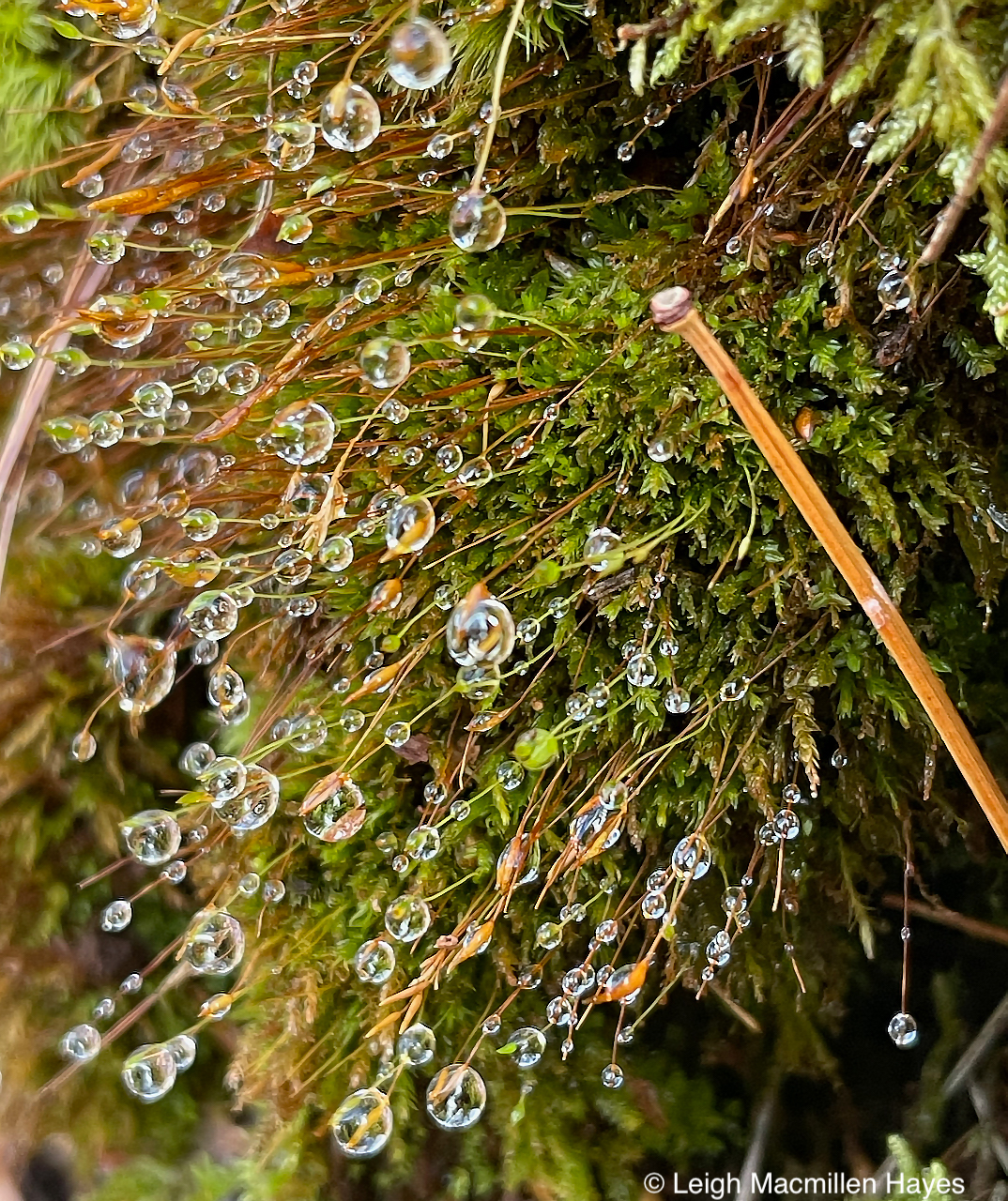
And upon a moss covered tree stump . . . a million more tiny bubbles dangling from reproductive capsules creating a hint of the future.

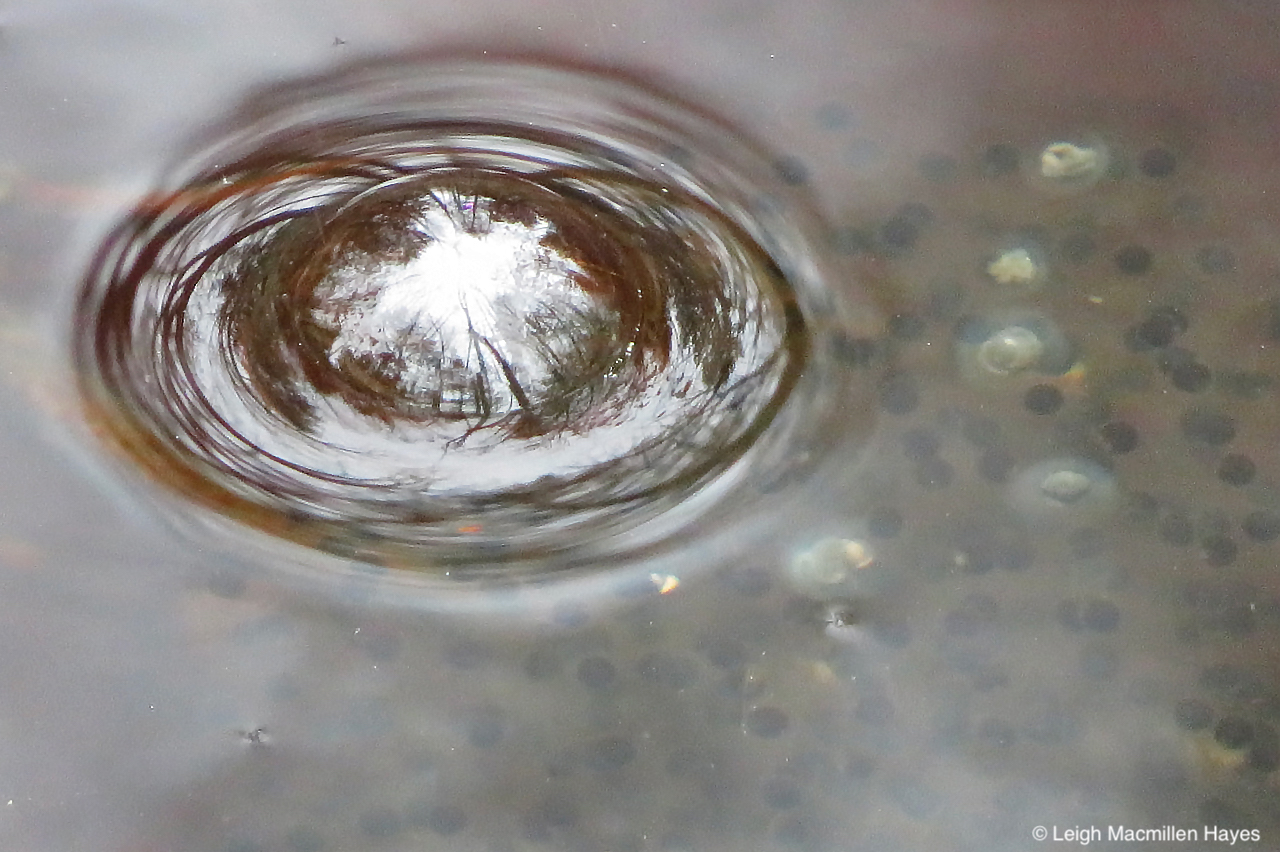
At the pool, one might say raindrops distorted the reflections captured on the surface. Or perhaps they enhanced it with a design that was ever evolving.

Bubbles kept forming as the raindrops fell . . . and then they’d burst. Just prior to their disappearance, however, they mirrored the canopy above the pool.

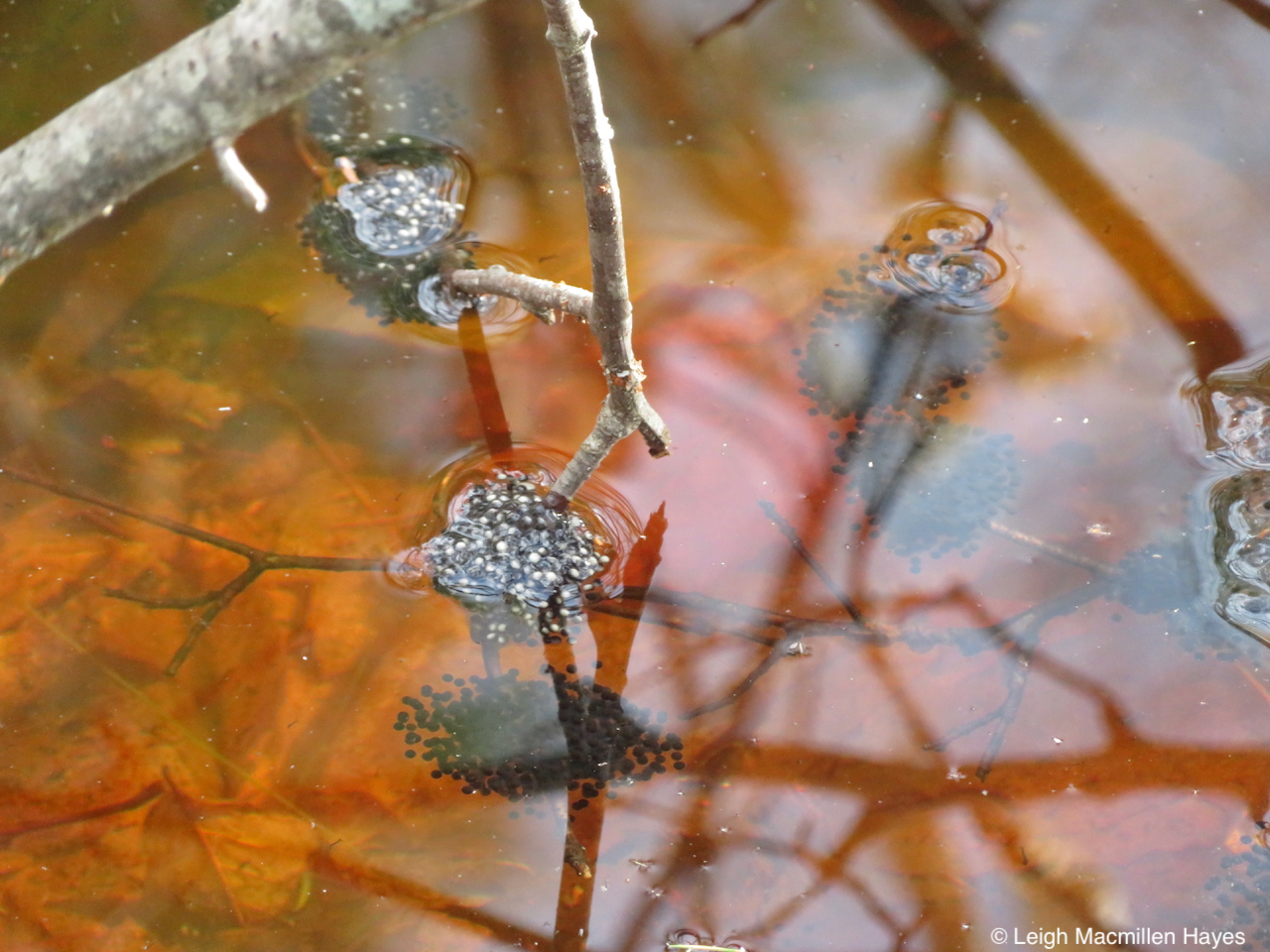
Oh, and do you spy what I spied? Wood Frog eggs . . . tadpoles in the making. But all the while that I stood there, and it was a while as the rain fell, not a frog did I spot.

As the skies cleared late in the afternoon, again I headed to the pool. Click on the arrow above and you should hear what I heard. A chorus of wrucks.

Of course, once I stood beside the pool, the frogs had all disappeared. But, with a bit of sun shining, I suddenly could see that in the last week numerous egg masses had been laid in communal style, as is the Wood Frog manner.

Some even exhibited the green hue indicating that mutualistic symbiosis, or a relationship between algae and developing embryos, was already underway. Shallow, ephemeral ponds such as this one, experience severe oxygen depletion during periods of high sunlight and warmth. The algae provides oxygen for the tadpoles, allowing them to survive longer and grow larger before metamorphosis, while the algae receive carbon dioxide from the tadpoles, which aids algal growth.

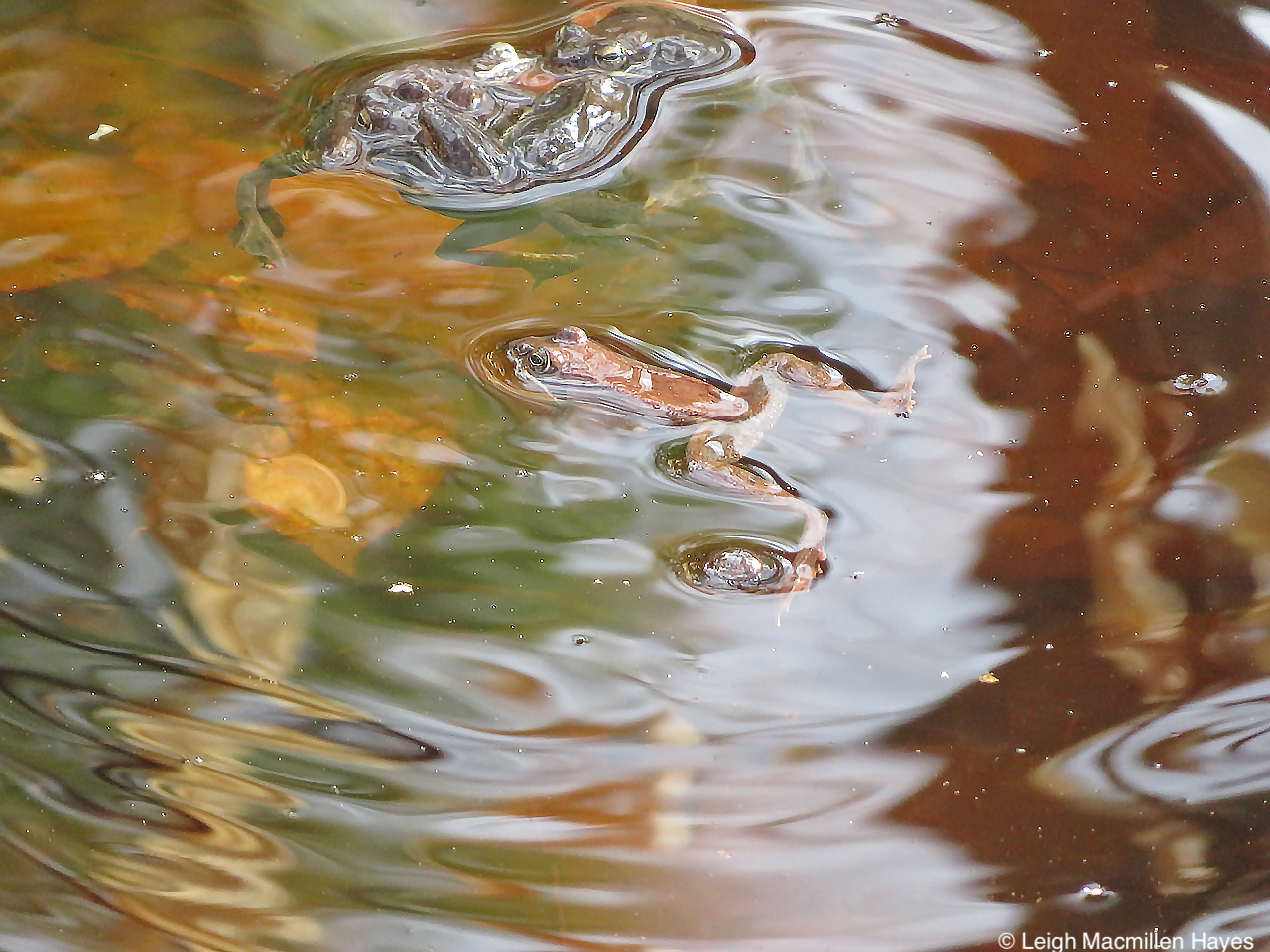
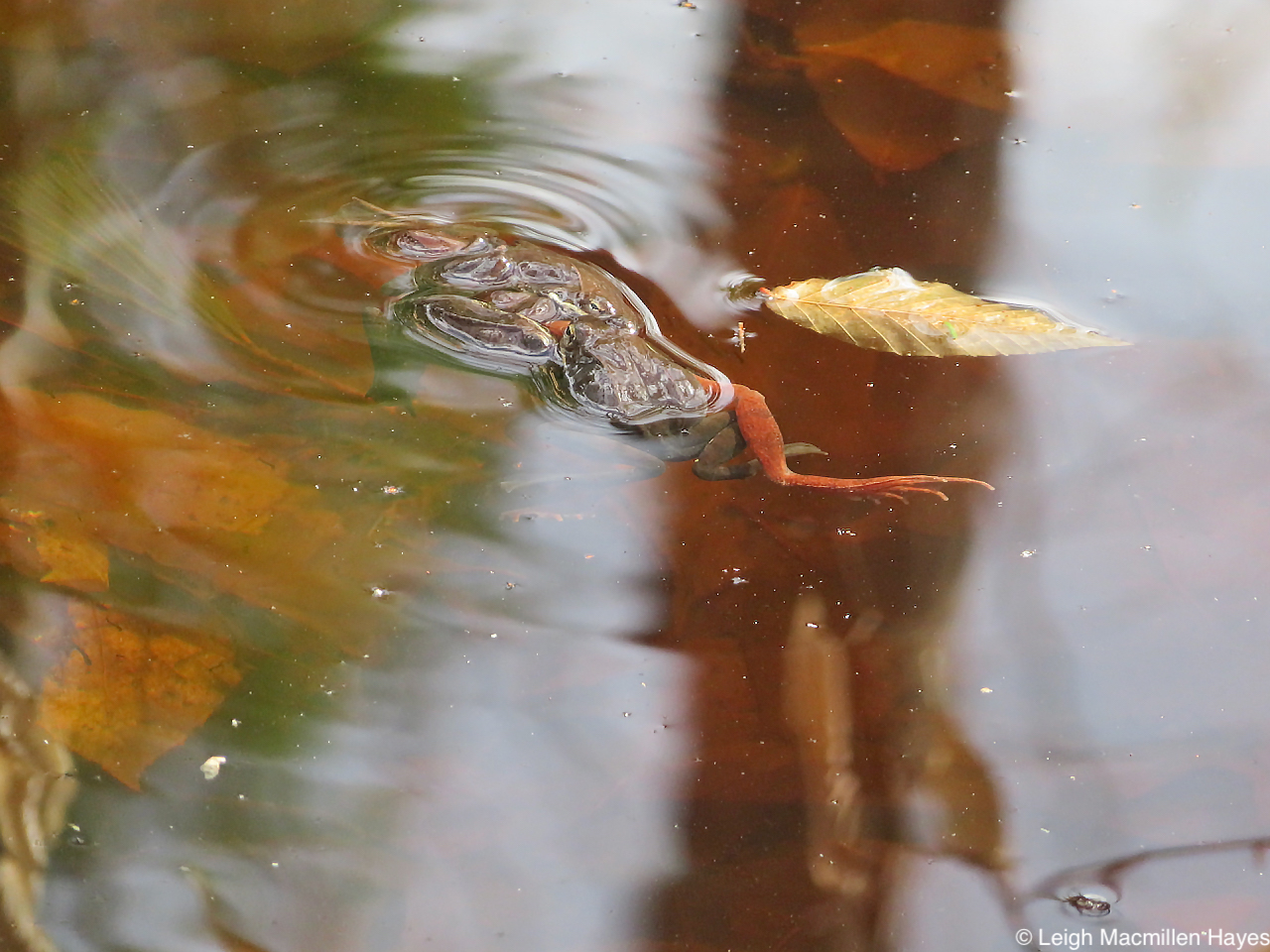
And then, ever so slowly, frogs silently floated to the surface, and waited . . . for that special woman to happen along. The fact that I had happened along, didn’t turn out to be special enough and so most were silent rather than wrucking as they waited . . . for me to disappear.

And then . . . and then the water began to boil. It took me a moment to realize what I was witnessing.

That moment expanded into about ten minutes as several male frogs tried to outwit each other and grab one female in amplexus.

She occasionally chirped her discontent, but that didn’t stop the good old boys from trying to do their thing.

Around and around they went, this threesome or foursome or fivesome, for it seemed to be an ever evolving grouping.

Her swollen belly betold the fact that she had eggs that needed to be fertilized, but which of these Romeos would win the right to externally fertilize her bounty?

They tumbled and tussled. She chirped. They tumbled and tussled some more.

They calmed down for a moment, but still no decision had been made.

And then, if you click on the arrow above and listen, you’ll hear what the frogs and I heard . . . as a Barred Owl called its “Who Cooks For You?” phrase several times. The frogs split up and I’ll never know which of the best wrucks one, but I suspect one of them finally succeeded in its quest to sire the next generation.

Dedication: This post is for Patti and Kate and Billy and Rob (Howie) and Johnny, in honor of your mom, Bobbie, who passed from this world to the next today. At the sight of each bubble that the day offered, it seemed another memory popped up. And I’m pretty sure we are all living proof that eating her raw Congo Bar dough adds years to ones life. Virtual hugs to all of you. And Tommy too.

Looking Up

With recent encouragement I changed my focus and gazed skyward.

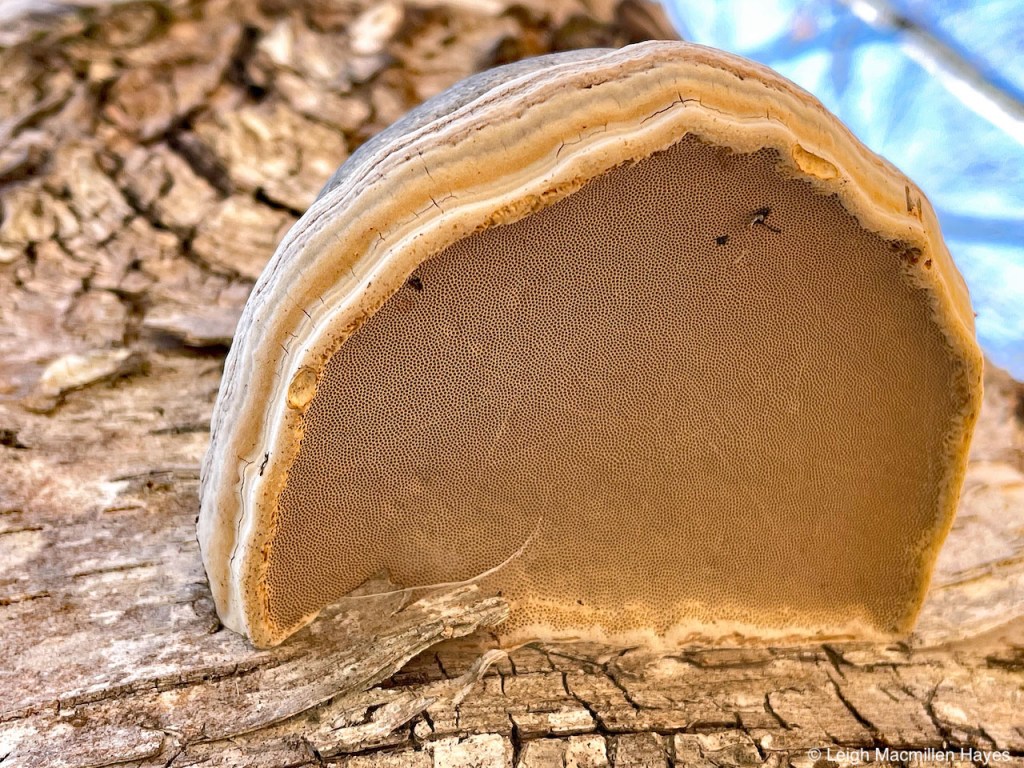
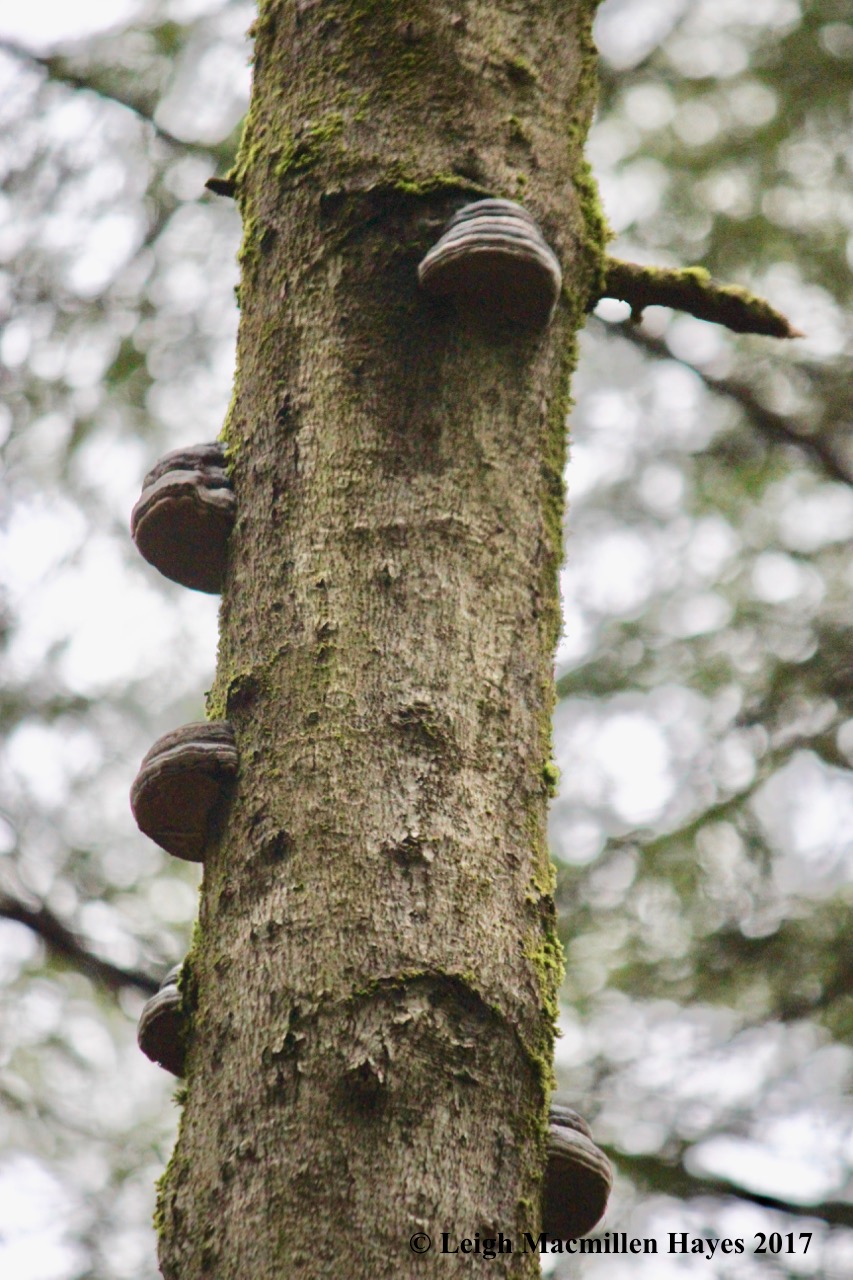
Rewarded immediately, the porous and slightly concave underside of Otzi, the Ice Man’s Tinderconk fungi, revealed a pattern repeated over and over again.

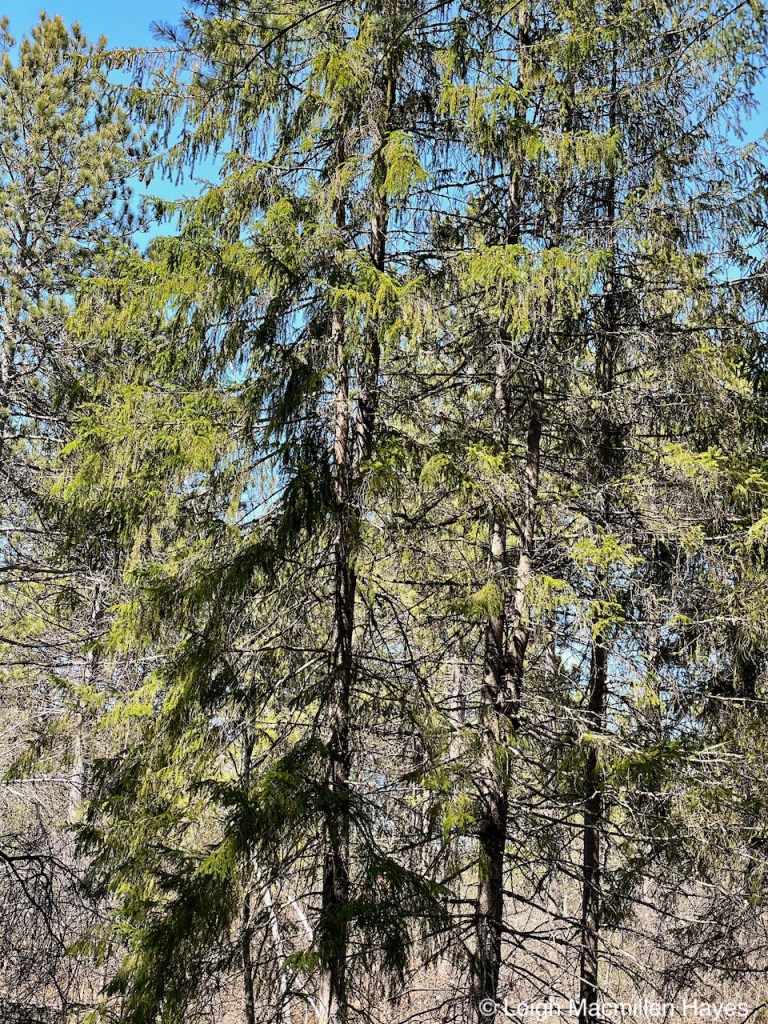
In another place where the forest is intended as a demonstration project, the dancers of the woods let their boughs reach down as if they were ladies dressed in gowns rather than Norway Spruce standing in a foreign community.

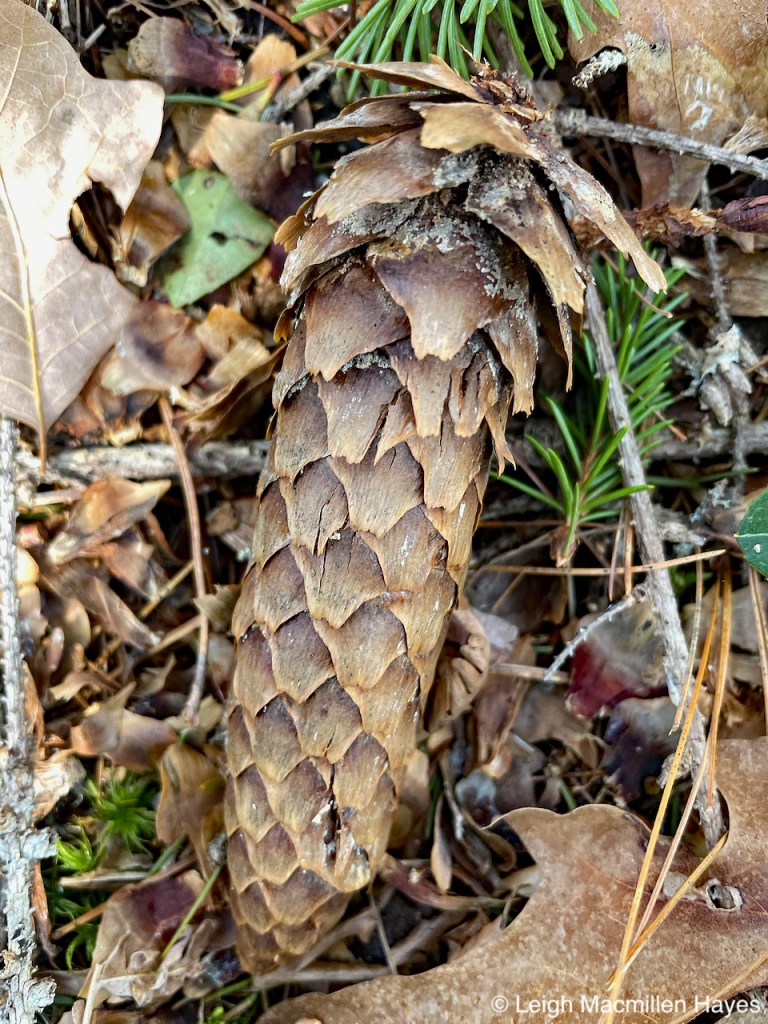
The upward gaze, however, was soon drawn down to the cone with scales numerous, thin and irregularly toothed, attracted my eye and that of a squirrel who left a large midden at the tree’s base.

And then that gaze focused outward where Common Mergansers whispered amongst themselves in a language only they understood.

In their midst, a Common Goldeneye swam and once again I wondered about that descriptive term “common.” Exactly what is common about that golden eye and all the other features of this duck?

Moments later I gazed skyward again from under a princess pine clubmoss that ends each leaflike structure with a Y as in “Why”? Certainly. Perhaps because.

Distracted once again–I spotted a spring stonefly with its rolled wings providing a stain-glassed venation.

The next upward gaze turned a tree stump into a nurse nourishing an entire deciduous forest as if it could.

Downward, I focused on a black-capped chickadee puffed up on a cold spring morning . . .

and a Mourning Cloak butterfly who had overwintered as an adult under the bark of a nearby tree.

So as a friend reminds me, I’ve entered a new season, one where I squat over vernal pools and beside streams and search for life within for hours on end.

For now, the ice is only just melting and life within the pool taking time to emerge, such as this predacious diving beetle larva.

At last I stand up straight and turn for a reason I don’t recall. But . . . there it is. A bird I’d seen swoop over the pool and stand at its edge as I approached. Of course, then it took off, not giving me an opportunity to identify it . . .

Until the barred owl did just that. Flew back in and posed above. And I realized that as I looked up at it, it looked around . . .

and then down at me. My gaze might be upward, but the owl also searched outward and downward.

As it should. This well-focused visionary knows that one must look in every direction for there’s always something to wonder about. Especially as we celebrate Easter 2021.

And my guy and I give thanks for receiving our second Pfizer shot this weekend. In the midst of joining the owl’s vision, we’re all looking upward.

All In A Day’s Walk

My mission was two-fold. Hike up a small mountain and capture a one minute video to post on a work website next week, and retrieve a game camera so we can download the photos and then place in a different location.

And so it was that on this brisk morning, snow-capped Mount Washington greeted me. If you zoom in, you might see the buildings at the summit.

Because I was at a different summit that I frequent, I knew I had to check on the activity of the local residents and wasn’t disappointed. First, I followed their trails, where leaves are well packed. Those led to trees, but no downed nip twigs as one might expect. That could only mean one thing–there are still plenty of acorns on the ground for them to eat. Because I was searching, however, I was thrilled to discover one sign that the season is changing. I knew that by the five layers I was wearing, but the stripped bark and cambium layer of a birch indicated the same. A porcupine’s diet varies with the offerings and part of their winter dining includes just this. Notice, too, the pattern of the incisor marks. Such a design thrills me no matter how often I encounter it.

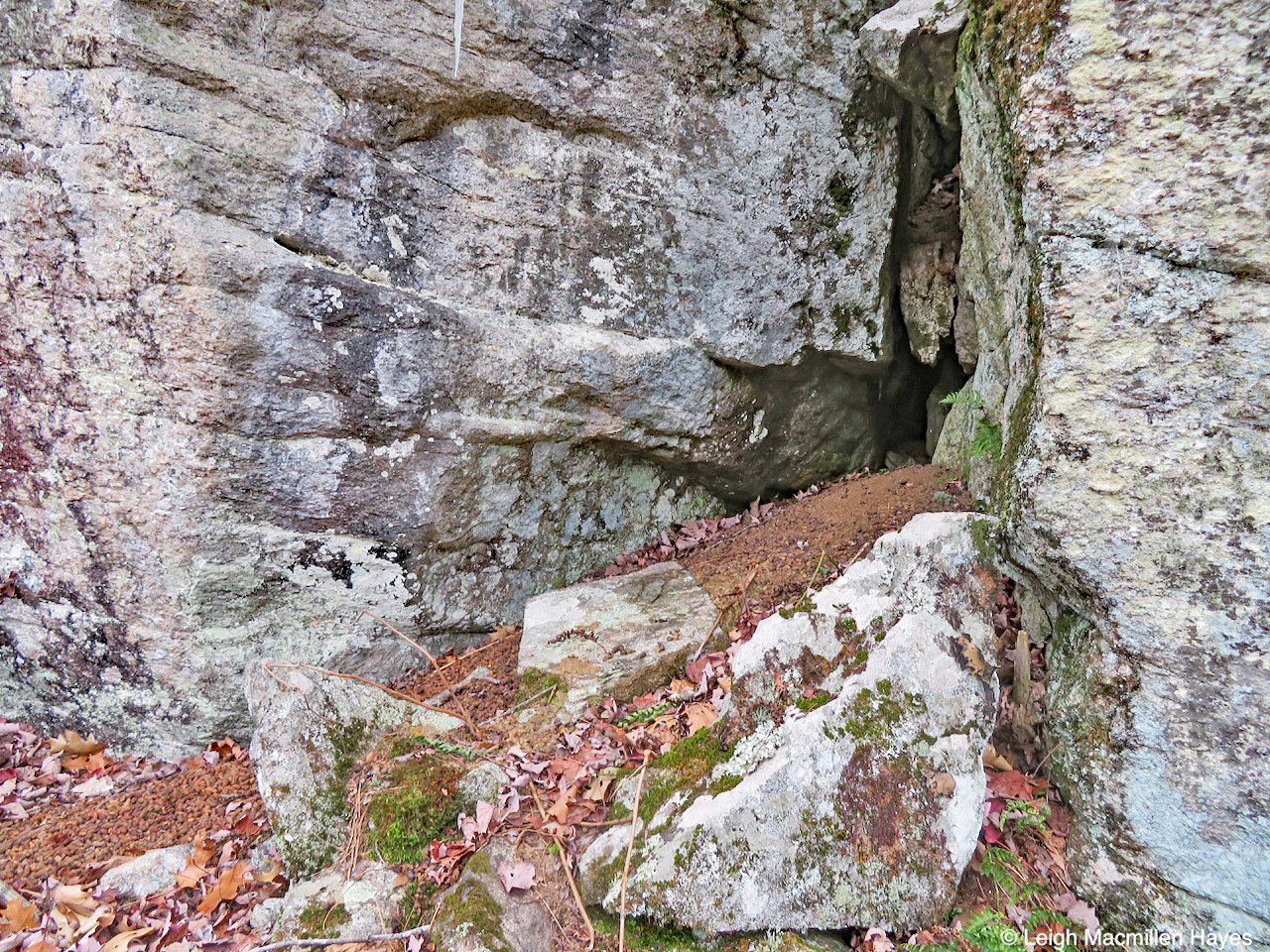
One of the porky trails led into a crevice below where I stood. It was there that I caught the first glimpse of icicles and knew I had to climb down. My route wasn’t the same as the porcupine’s for I’m not quite as nimble on rocks and slippery leaves.

But, with grace, I descended and made the surprise discovery of Mount Rushmore East. At least, that’s how the rock faces looked to my eyes.

But seriously, I wanted to spy the icicles from below and they became the inspiration for next week’s GLLT Moment.

That wasn’t all I wanted to spy and I wasn’t disappointed for the trail of scat indicated one potential den site.

And more scat led to another. I suspect those aren’t the only two, but I wanted to keep moving, such was the temp.

That said, right beside the second porcupine den, I found a small hole in the ground capped in hoar frost and suspected that someone was inside. It seemed a bit larger than a chipmunk hole. Maybe a squirrel? Or a weasel? Or even, the porcupine’s den vent?

While those choices rolled around in my brain, I climbed up the ledges and made my way down the trail until it intersected with another. Eventually, water once again stopped me as it often does.

Only two weeks ago the temperatures in western Maine were in the 60˚s and 70˚s, but the past few days have been chilly and already dancing elephant legs are forming over sticks that dangle above moving streams.

Even the froth created by the friction of the stream’s movement had frozen in place.

I stopped a few more times, but finally reached the spot that was my second intention of the day. While exploring in this area a couple of week’s ago with several Greater Lovell Land Trust docents, we noticed beaver trees. The work looked rather recent and so we set up a game cam in hopes of getting a view of the perpetrator.

Today’s visit, however, showed no fresh work on this tree.

And a skim of ice indicated no one had recently walked out of the water. I snagged the camera and dropped it at the office so the photos can be downloaded. I hope they reveal more than a few test pics of us homo sapiens.

It was while heading back to my truck that this splash of color caught my attention. Notice the Striped Maple leaf on the mushroom–they are like a matched set. I’ve been torn in my identification between an Artist’s Conk and a Red-belted Polypore, whose belt is not always red.

But more important than identification was presentation. And the knowledge that the middle mushroom grew when the tree was still standing, while the others fruited after the tree had fallen, for mushrooms must always orient toward the ground, the better to spread one’s spores, of course.

My final sighting of the day, that still has me smiling, occurred in the middle of the adventure, but I wanted to save it for last. Do you see what I saw?

How about now?

Surely now you can.

Who cooks for me? I wish this Barred Owl would, for I must now prepare dinner. But that’s okay because I’ll take him with into the kitchen in spirit and give thanks that I had the opportunity to spend a few minutes with him . . . all in a day’s work.

Book of April: I’m in Charge of Celebrations

Serendipity: the occurrence and development of events by chance in a happy or beneficial way.

And so it was that upon arrival home from a short hike with my guy this morning, we discovered a package addressed to me in the mailbox. When I saw the town in Florida I knew exactly from whence it had come, but still didn’t know what was inside.

Well, much to my delightful surprise it was a children’s book.

I’m in Charge of Celebrations by Byrd Baylor with illustrations by Peter Parnall.

Upon opening to the inside cover, several pieces of paper fell out. The first was a letter from Ben and Faith Hall; though actually it was written by Ben. Here’s an excerpt: “One of my favorite children’s books is Everybody Needs a Rock. It was written by Byrd Baylor and illustrated by Peter Parnall. When Byrd Baylor’s name appeared on the cover of the book I saw, I purchased it for fifty cents.

Ben and Faith, you see, are part of a group of twelve retired residents in their Florida town who tutor second graders struggling with reading comprehension. Given that, they are always on the lookout for appropriate books to share with their students.

Ben continued in his note to me, “After reading the book, I left it by Faith’s chair without saying anything. Obviously, I wanted to see if her reaction was similar to mine. It was. The story reminds us of your blog with its information and imagination. Thank you for sharing your gift with us. Keep going!

My ulterior motive in sending you the book is that hopefully you will write a children’s book. In no way should you take time away from your blog, but with your depth of spirit it would be worthwhile.

The illustrations in the book are fascinating and remind me of your skill with photography.”

Well, Ben and Faith, thank you so much for this gift. And for your love and support for what I enjoy doing. As for the children’s book, ideas fly through my brain all the time, but . . . I’d have to self-publish and it isn’t going to happen.

As for I’m in Charge of Celebrations, I totally get it. My guy wasn’t in the house when I sat down to read it and it’s a book that needs to be read aloud. And so I did. When he walked around the corner into the living room, he thought I was talking to someone on the phone.

For those of you not familiar with the title, Baylor begins the story with an explanation of how she’s never lonely as she explores the desert.

I feel the same way and on January 11, 2019, I actually wrote, “People often ask me this question: Aren’t you afraid of hiking alone. My response is that I’m more afraid to walk down Main Street than through the woods, the reason being that it’s a rare occasion I encounter a mammal. Oh, I do move cautiously when I’m alone, but there’s something uniquely special about a solo experience.”

As Baylor goes on to say, part of the reason she’s not lonely is this: “I’m the one in charge of celebrations.” Indeed. Each celebration marks the day she made an incredible discovery.

And so, I took a look back at some of my blog posts, and it’s all your fault Ben and Faith that this is a long one. But you inspired me to review some exciting discoveries I made just in the past year. With that, I attempted to follow Baylor’s style.

Friends,
while reveling
in the colors 
of dragons and damsels,
their canoodling
resulting in 
even more predators
of my favorite kind,
I met Prince Charming,
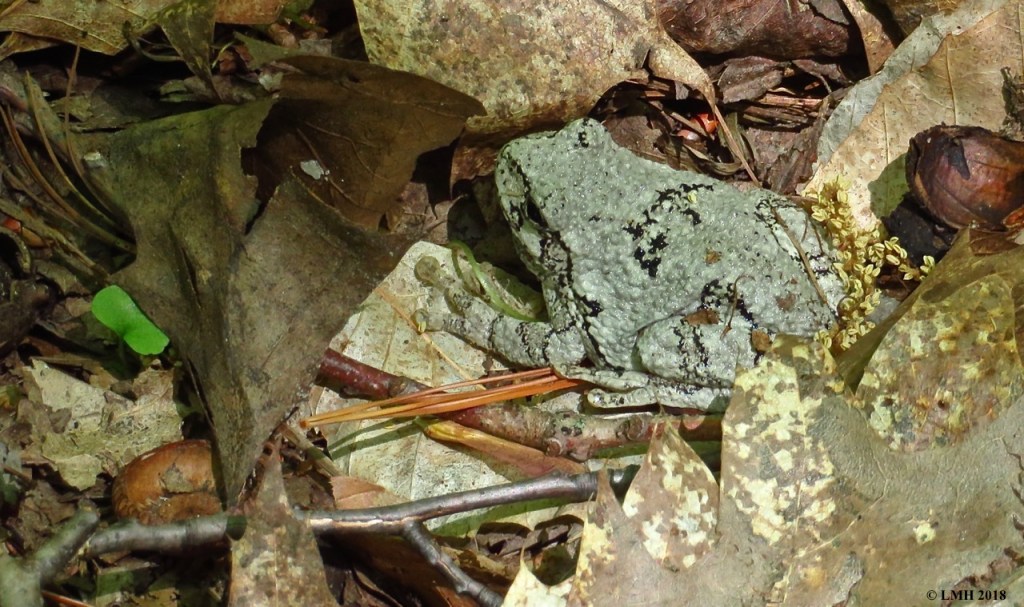
a Gray Tree Frog
who offered
not one rare glimpse, 
but two.
And so it is
that May 30th is
Gray Tree Frog Day.
For over thirty years
I've stalked this land
and July 14th
marked
the first time 

noticed
the carnivorous plant
growing beside
the lake. 
Droplets glistened
at the tips 
of the hair-like tendrils 
of each leaf
filled
to the brink 
as they were
with
insect parts. 
On this day
I celebrated
Round-leaved Sundews. 

A celebratory parade 
took place
on
September 22.
The route
followed the old course
of a local river.
Along the way,
trees stood in formation,
showing off 
 colorful new coats.
Upon some floats, 
seeds rustled 
as they prepared
to rain down
like candy tossed
to the gathered crowd. 
My favorite musicians
sported their 
traditional parade attire
and awed
those watching
from the bandstand.
With an 
"ooEEK, ooEEK,"
and a
"jeweep"
they flew 
down the route.
Before it was over
a lone lily
danced on the water
and offered
one 
last 
reflection. 
And then summer marched into autumn. 
With wonder
in my eyes
and on my mind
I spent November
in the presence 
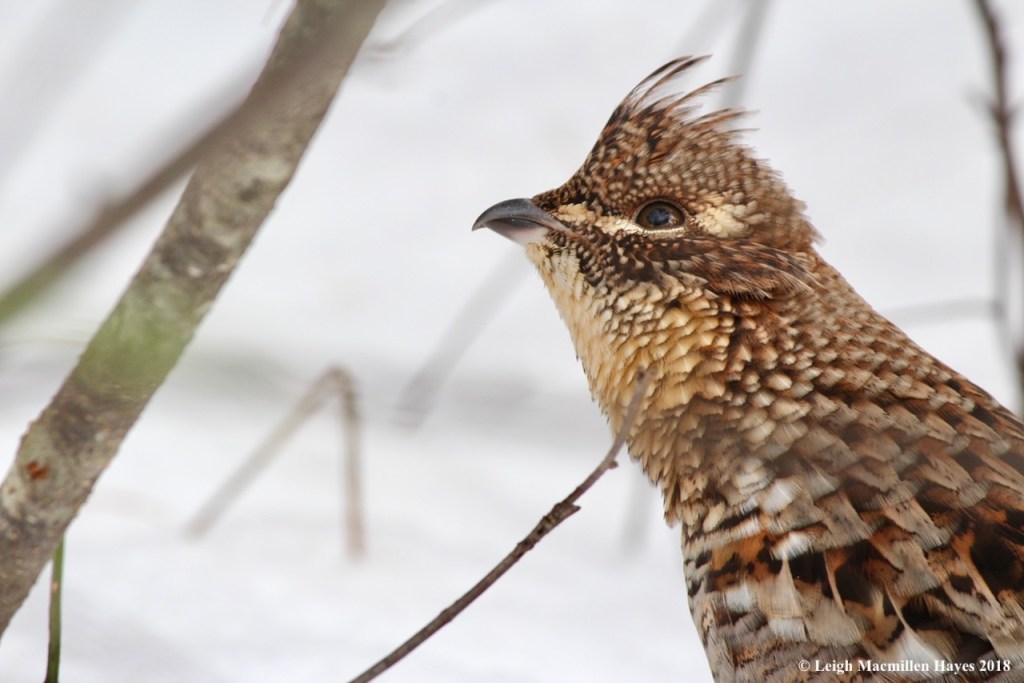
of a Ruffed Grouse. 
The curious thing: 
the bird followed me, 
staying a few feet away
as 

tramped 
on. 

stopped. 
Frequently.
So did the bird. 
And we began 
to chat. 
I spoke quietly
to him
(I'm making a gender assumption)
and he
murmured back
sweet nothings. 
Together 
we shared the space, 
mindful
of 
each other. 
As he warmed up
below a hemlock,
I stood nearby, 
and watched, 
occasionally offering
a quiet comment, 
which he
considered
with
apparent nonchalance. 
Sometimes
the critters 
with whom we share
this natural world
do things
that make no sense,
but then again, 
sometimes we do 
the same. 
Henceforth,
November will always be 
Ruffed Grouse month 
for me. 
At 6am 
a flock of crows
outside the bedroom window
encouraged me 
to
crawl out of bed. 
Three black birds
in the Quaking Aspen
squawked
from their perch
as they stared 
at the ground.
I peeked
but saw nothing 
below.
That is,
until I looked
out the kitchen door
and tracks drew
my attention.
It
took
a
moment 
for my
sleepy brain
to click into gear, 
but when it did
I began to wonder
why the critter
had come
to the back door
and sashayed about
on the deck. 
Typically,
her journey
takes her
from under the barn
to the hemlock stand.
Today,
as the flakes fell, 
and the birds scolded,
she sat on the snowpile,
occasionally retreated 
to her den, 
grunted, 
re-emerged, 
and then
disappeared
for the day. 
I went out again
at dusk
in hopes
of seeing 
the prickly lady
dig her way 
out
but 
our time schedules
were not synchronized. 
I don't know
why she behaved
strangely this morning,
but I do know this:
when the crows caw--listen.
And look. 
And wonder. 
April 8th
will be the day
I celebrate
the Barred Owl
for he finally
flew in
and landed.
As I watched
he looked about
at the 
offering of treats. 
Cupcakes and cookies
were for sale
to the left
in the form
of Juncos and Chickadees. 
And then he turned 
his focus right, 
where drinks
were on tap
as the snowflakes fell.
He even
checked out 
the items 
below his feet, 
hoping upon hope 
to find
a morsel
of a vole
to his liking. 
Eventually, 
he changed
his orientation
to take 
a better look 
at the 
entire spread
of food. 
But still, 
he couldn't
make up his mind
and so
he looked some more, 
swiveling 
his neck. 
In the end,
he never did 
choose. 
Instead,
off he flew 
without munching 
any of 
the specialty items. 
But I finally got to see my owl. 

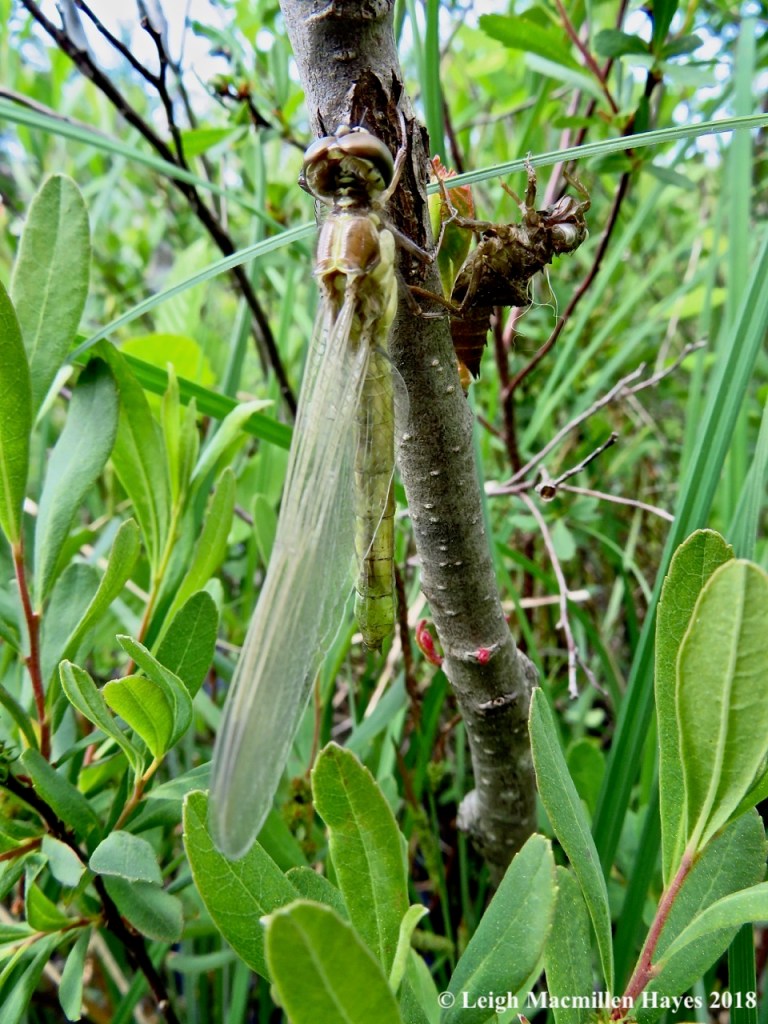
Ah, Ben and Faith, there are moments when one miraculously arrives in the right place at the right time, such as when a dragonfly emerges from its exuvia and slowly pumps blood into its body and you get to be a witness.

It strikes me as serendipity that this book should arrive today. You see, all month I’ve been debating what book to feature and time was of the essence as May approached. And then today, your lovely note, a copy of I’m in Charge of Celebrations, and the Christmas homily you wrote, Ben.

You are both the salt of the earth and I am honored to be your friend. Thank you for your kindness. (I’m only now realizing that we’ve shared a few celebrations that we’ll never forget including the fawn at Holt Pond and your smiling Bob the Bass.

Once again, the April Book of the Month: I’m in Charge of Celebrations.

I’m in Charge of Celebrations, by Byrd Baylor, illustrated by Peter Parnall, Charles Scribner’s Sons, 1986.

Cheap Seats

Setting: A backyard in western Maine on what some might consider a bleak spring day, e.g. a snowy April 8th.

(Cock-eyed bird feeders indicative of ground thawing—really)

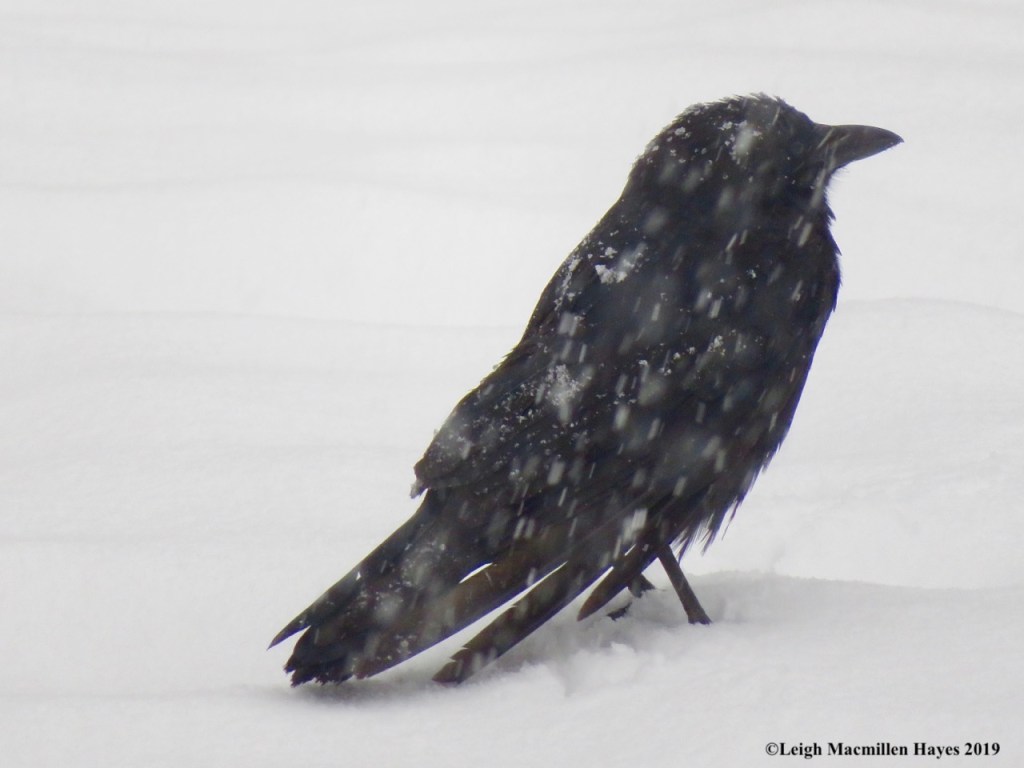
Act I, Scene i: I must wonder when “In there stepped a stately Raven of the saintly days of yore.” This one, however, marched on, soon to leave, not once uttering, “Nevermore.”

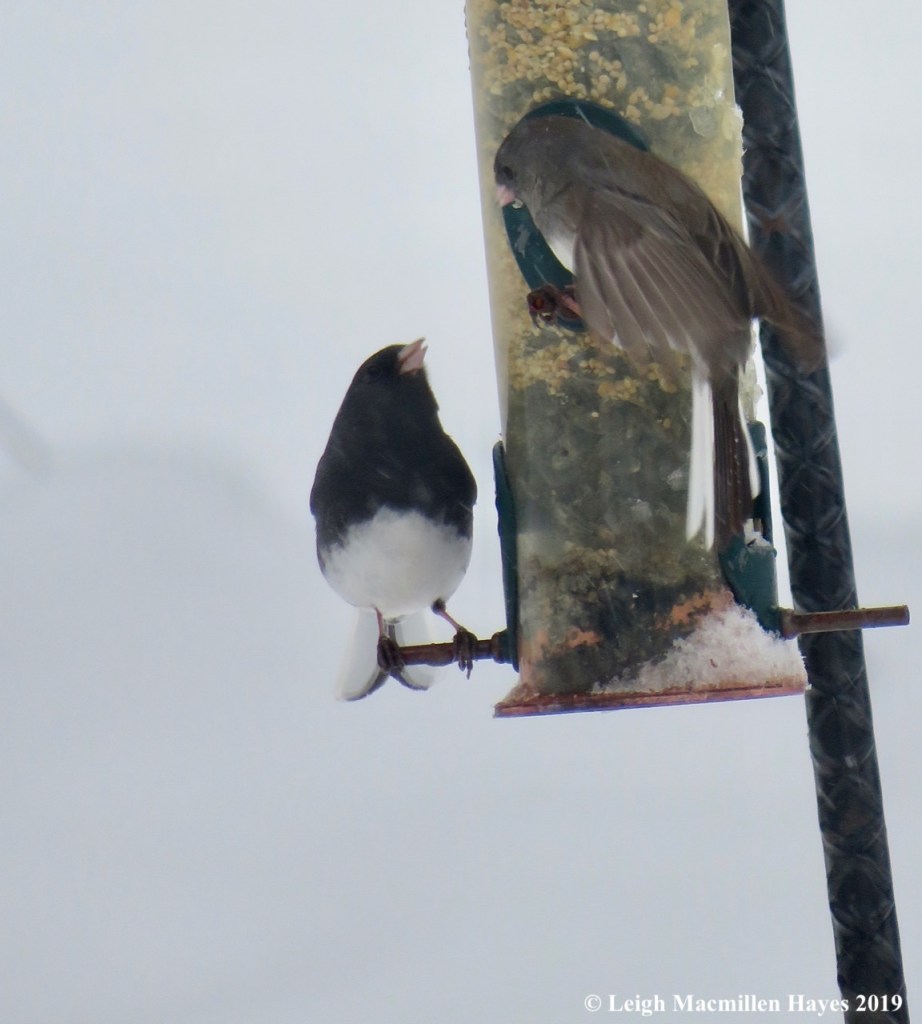
Act II, Scene i: (enter stage left), And then said one Junco to another, “Junco, Junco, wherefore art thou Junco?” (exit center stage only when sliding snow falls from the roof and lands on the ground with a smack, thus startling all)

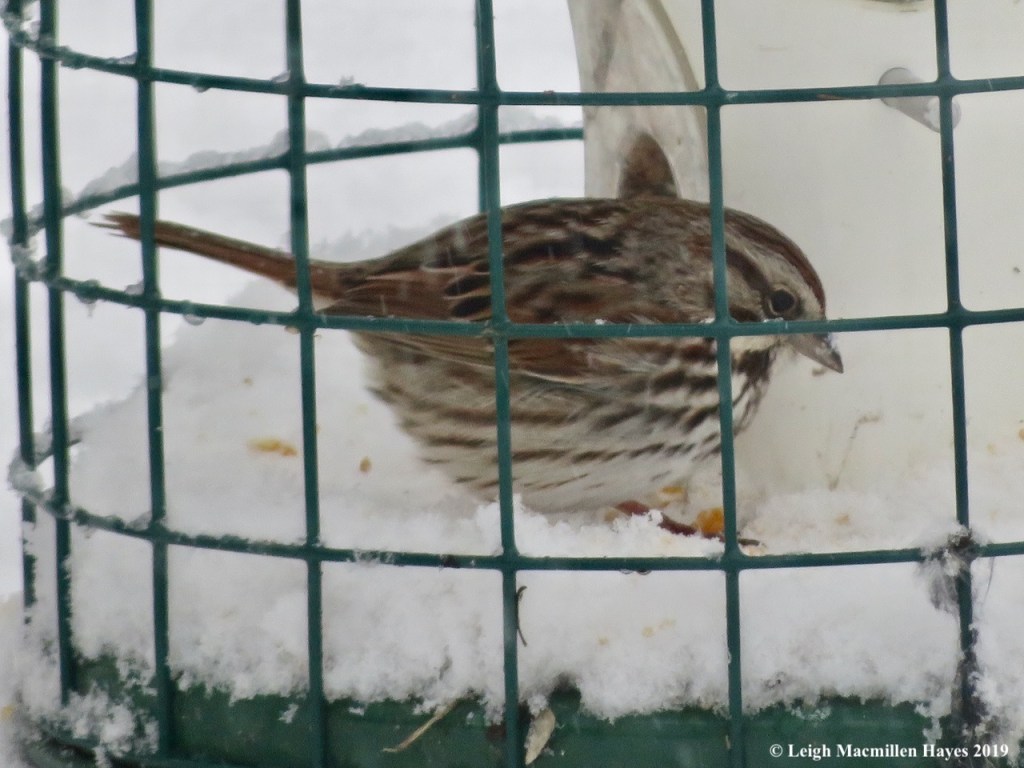
Act II, Scene ii: (enter stage right) Where there’s a Junco these days, so is there a Song Sparrow, its conical beak ever ready to crack open a seed. (exit stage left after chasing the Juncos around)

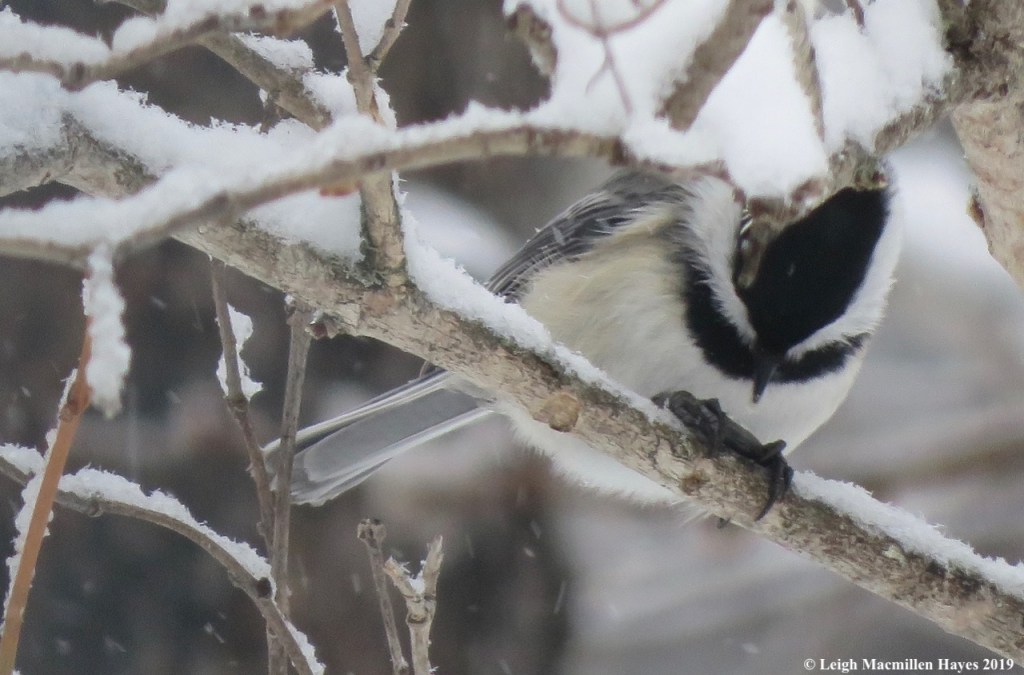
Act II, Scene iii: (enter stage left, right and center) Not to be left out of the gang, Black-capped Chickadees flew in and out at a much quicker pace, grasping a seed and taking it to a Lilac branch to break it open. (exit stage left and then fly in and out, over and over again.)

Act II, Scene iiii: (enter stage right) Making noise as he arrived, a Downy Woodpecker showed off his preference for suet over seed. (exit stage left, with undulating flight)

Intermission: All goes silent as the lights go up in the theatre and in flies a Barred Owl. (finally)

As often happens during Intermission, the owl looked about at the offering of treats. 

He checked the cupcakes and cookies on sale to the left. 

And then he turned his focus to the right, where the drinks were on tap. 

He even checked out the items below his feet, hoping upon hope to find a morsel to his liking.

Despite all the choices, or maybe because of them, he had to stretch out one leg . . . 

and scratch an itch. 

Eventually he changed his orientation to take a better look at the entire spread of food. 

But still, he couldn’t make up his mind and so he looked some more. 

And swiveled his neck around. 

By the time intermission ended, he hadn’t made up his mind and so he moved off without munching any of the specialty items. 

Act III Scene i: (enter stage left, right, and center) The large flock of Juncos flew in, flew out, and flew in again. (exit the same way came in, dispersing in every direction)

Act III, Scene ii: (enter stage left) From the shrubs we hear the song first and then Mr. Cardinal flies to the Lilac. (quickly exit stage right)

Act III, Scene iii: (enter stage left) Mrs. Cardinal arrives only after her guy has flown off. She shows her determination to dine on some morsels of corn.

Act III, Scene iv: (stay on stage, move to the right, then turn sharp left) Showing her determination, she lets nothing stop her. 

Act III, Scene v: (center stage) With a kernel of corn in her beak, she shows off her success. (exit stage right as she searches for her Mr.)

Act IV, Scene i: (enter stage left, right and center) A repeat performance of the Juncos and Song Sparrows (exit every which way when the snow once again flies off the roof)

Act V, Scene i: (enter stage right) With its own flash of color an American Robin pays a brief visit to the stage (exit stage left)

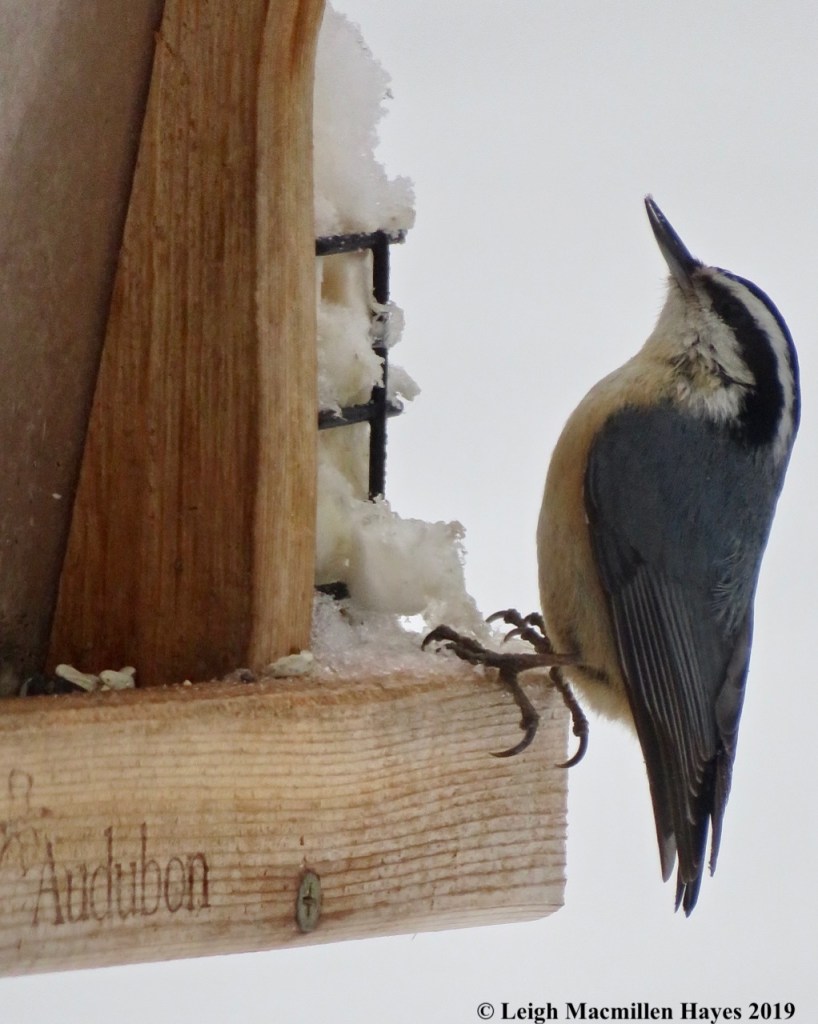
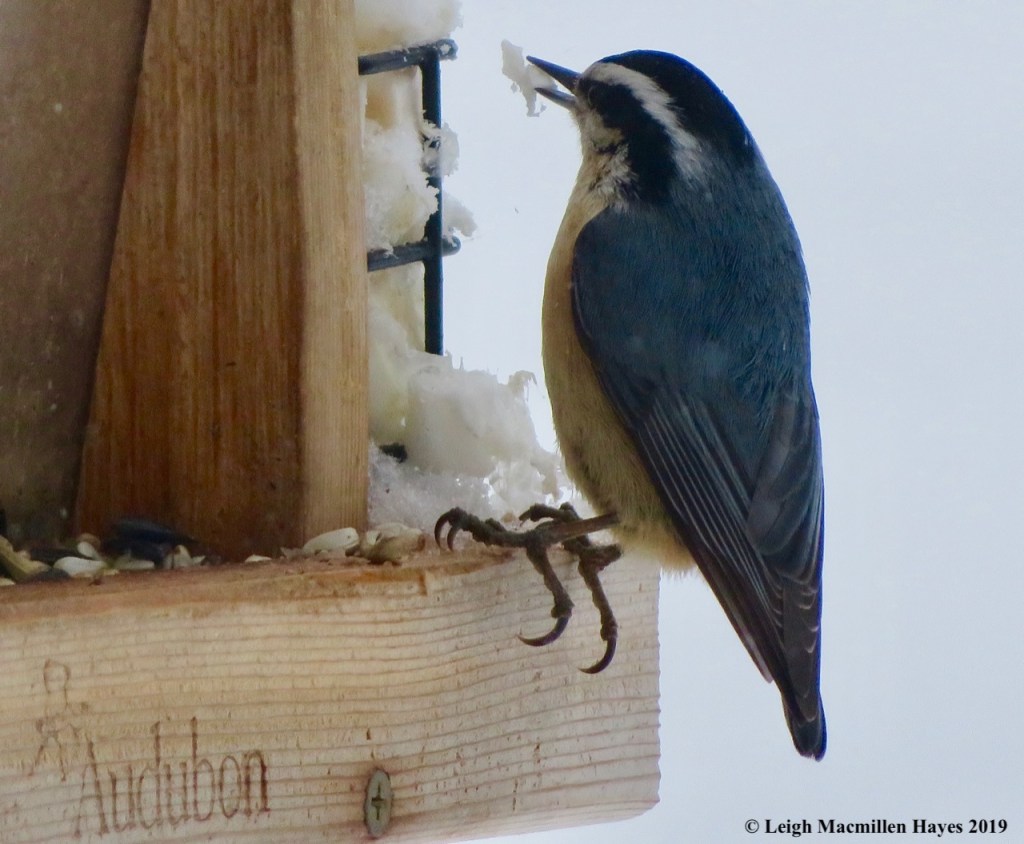
Act V, Scene ii: (enter stage left) With its breast not quite as vibrant, a Red-breasted Nuthatch ponders the possibilities. 

Act V, Scene iii: (center stage) And a decision was made, a morsel of suet consumed. (exit stage right)

Act V, Scene iv: (enter stage right) Waiting until almost the end of the performance, a pair of Tufted Titmice flew in, grabbed a quick bite, and flew off again in the direction from whence they’d come. (exit stage right)

Act VI, Scene i: (enter stage right) Outlasting his Junco relatives, the Song Sparrow continued to eat . . .

Act VI, Scene ii: (center stage) and eat evermore, whether a caged bird or not. (exit stage right)

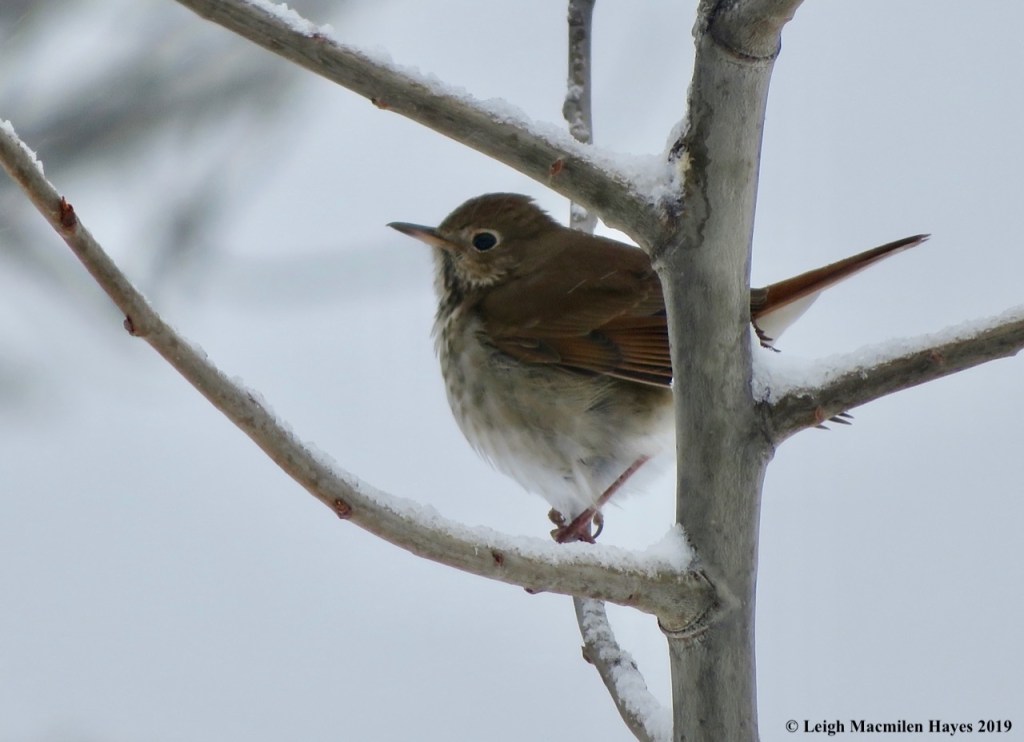
Act VII, Scene i: (enter stage right) And then a Hermit Thrush sat upon the Quaking Aspen sapling to mark the final act.

Act VII, Scene ii: (center stage) Its upturned bill will soon provide us with the most beautiful, yet hauntingly exquisite song; clear, musical phrases will blend brilliantly as ethereal, harmonious tones. Spring really has arrived in western Maine. (exit stage left)

Grand Finale: (center stage) Spring arrives in its own rendition each year. And the Barred Owl watches.

We watched as well, thankful for the cheap seats that turned out to be the best seats.

The Ayes Have It

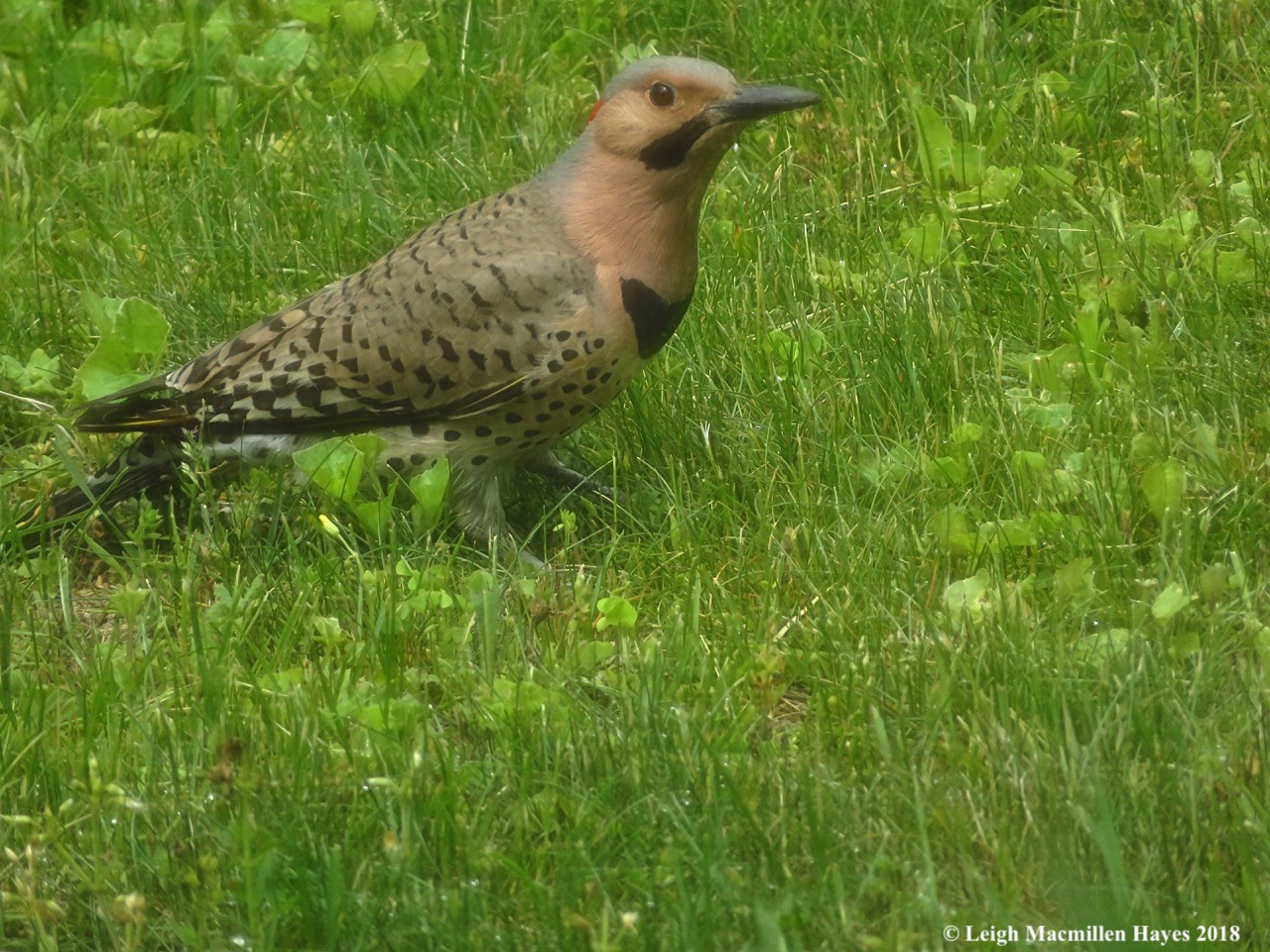
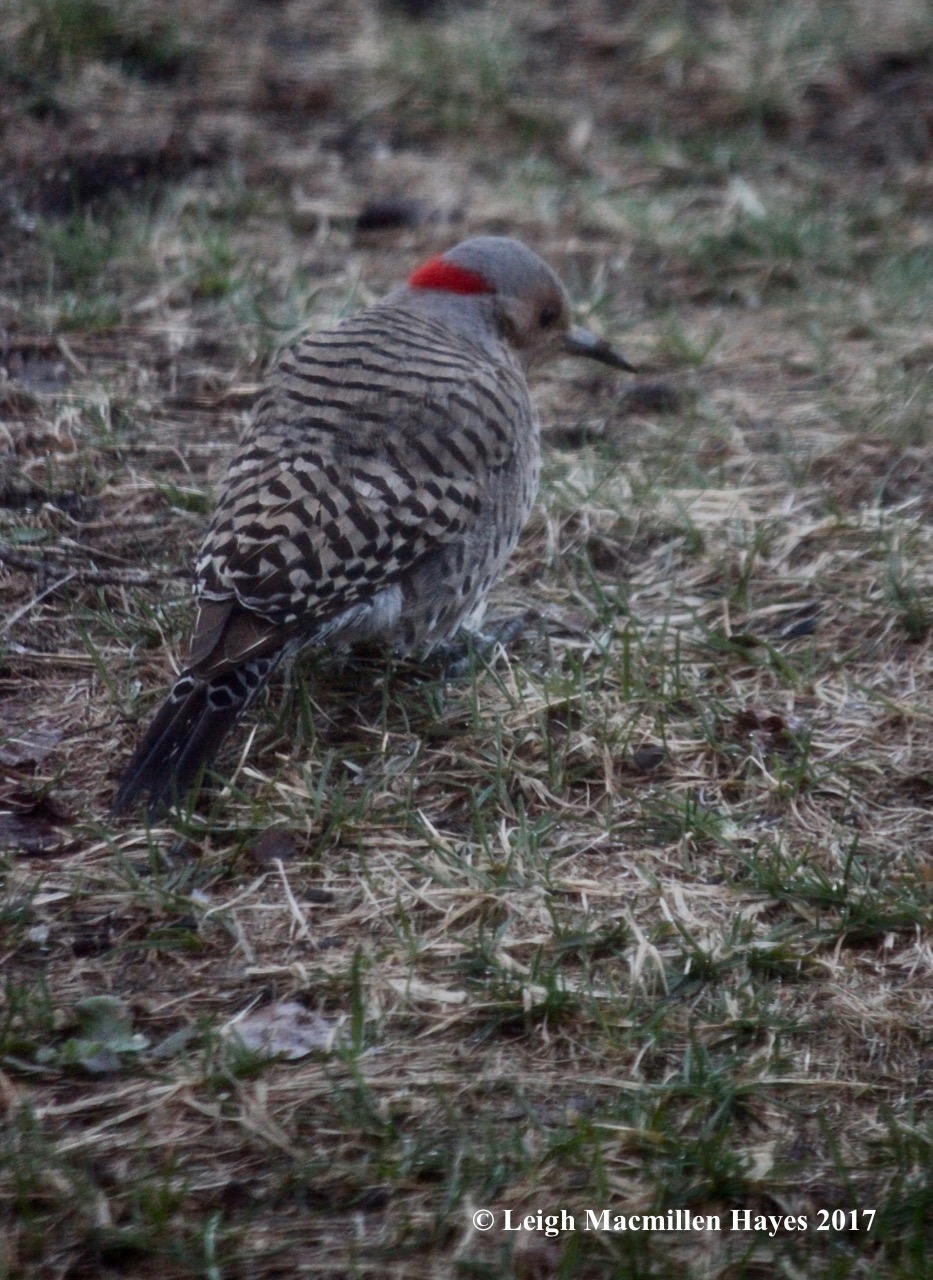
I knew I was blessed when I spied a Northern Flicker in the backyard early this morning. This is the one woodpecker that doesn’t behave like a typical family member for it forages on the ground rather than a tree trunk.

e1-northern flicker

From the kitchen window, I watched this guy for a while as he looked for food. I knew it was a male because of the so called black mustache on either side of its bill. But . . . it was the bird’s eyes I was most curious about . . .and their placement on the side of its head.

e2-flicker feeding

Like mammals, birds with eyes on the side are born to hide . . . from predators. His field of vision, therefore, was wide and the ants on the ground were the ones who needed to scurry and hide.

e4-tachinid fly

After dining for a while, the flicker flew off and I stepped out the door–in search of other  sets of eyes to behold–like the red ones of a tachinid fly,

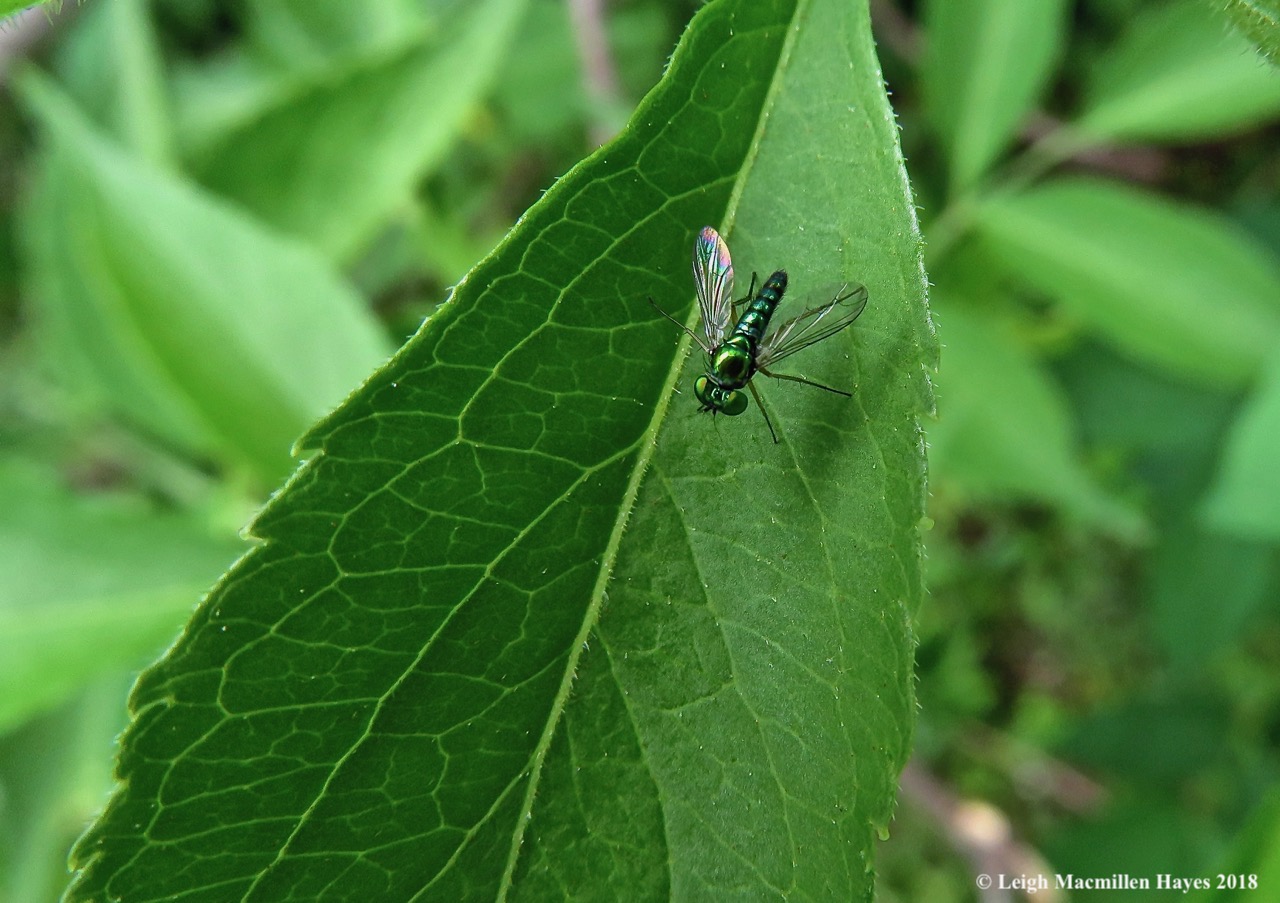
e8-long-legged fly

and metallic green on a long-legged fly. Like the flicker, flies also have a wide field of vision due to the fact that they have compound eyes. Each eye consists of thousands of individual visual receptors, or ommatidia, (singular ommatidium) (om·ma·tid·i·um, äməˈtidēəm.) Each hexagonal-shaped ommatidium (think honeycomb) is a functioning eye in itself. With thousands of eyes on the world, it’s no wonder flies and other insects see us coming–especially when we have a flyswatter in hand.

e7-green and brown stink bug

I kept looking and among the elderberry shrub leaves I found a strikingly beautiful green and brown stink bug, or shield bug, if you’re looking for a more pleasant name. Like all insects, it featured those compound eyes, but I was struck by how tiny they were. Apparently, it was enough to see movement and kept trying to hide from me.

e8-stink bug eyes

Despite its efforts, I could zero in on it even after walking away and returning.

e9a-song sparrow

Eventually I moved my focus to Pondicherry Park, where a variety of eyes greeted me, including those of a Song Sparrow.

e7a

What did he seek? Insects and other invertebrates, such as weevils, leaf beetles, ground beetles, caterpillars, dragonflies, grasshoppers, midges, craneflies, spiders, snails, and earthworms.

e11-slug eyes

What about a slug? I suspected the sparrow would enjoy such and today was a decent slug-like kind of day. But, how does a slug see?

A slug has two pairs of retractable tentacles on its head. The upper, optic tentacles, feature light-sensitive eyespots on the ends. And just like a deer can move each ear independent of the other, slugs can do the same with each eye-stalk. Another cool fact: an eye stalk can be re-grown if something attacks it.

e11a-spider eyes

Further along, I found a wolf spider hanging out on last year’s fertile frond of a sensitive fern. Did you know that spiders have eight legs AND eight eyes? Two of them are large and prominent–the better to see you with.

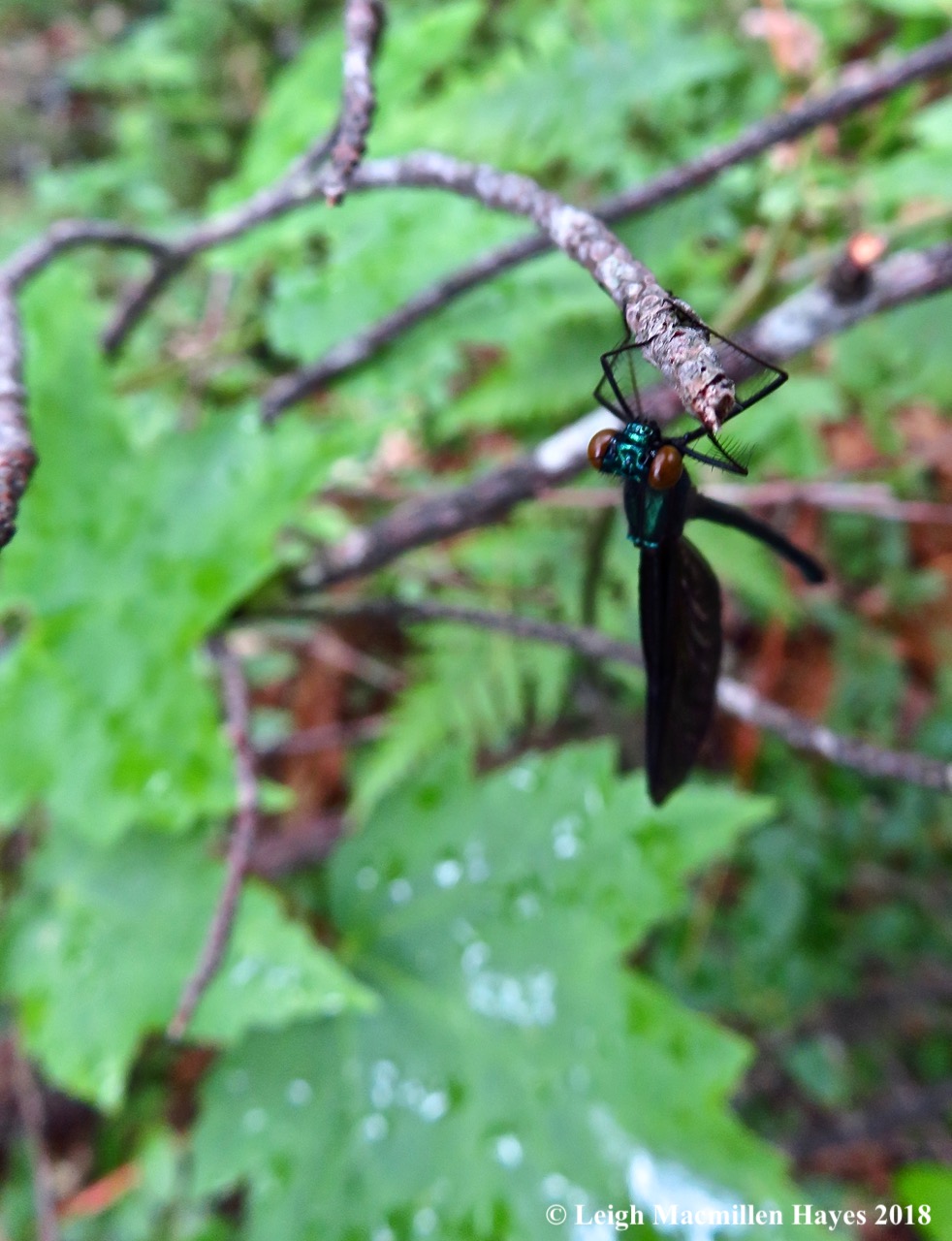
e11-ebony jewelwing

As I continued to look for the sparrow’s prey, I discovered an ebony jewelwing that I determined had just emerged for it posed as I took numerous photographs. Usually, they flit about like woodland fairies. Unlike its larger dragonfly cousins who have eyes in front in order to hunt, the damsels’ are on the sides. Though zoom-and-swoop attacks may not be possible for the damselfly, it can see all-round–including above and behind– giving it control of its airspace.

e12-barred owl

My wander continued and then I heard a sound and saw some action in a tree about thirty feet off trail. And just like that, in what felt like a miracle of miracles, I realized I was in the presence of the wise one.

With his eyes in front, a Barred Owl is born to hunt. For several minutes we starred at each other and I was honored by his presence. Of course, I hoped he might cook for me tonight, but he let me down. Possibly he had others more in need of supper than I was at the time.

In the end my vote was aye in favor of all the peepers I’d met along the way, both in the yard and the forested park, for I knew that the eyes had it.


Spring Erupts–Sort of

Two days ago the thermometer climbed to 68˚ and old records were broken. But then, as it does in New England, we had a low of 15˚ this morning. And now it is sleeting.

w-beech snag in complete decay

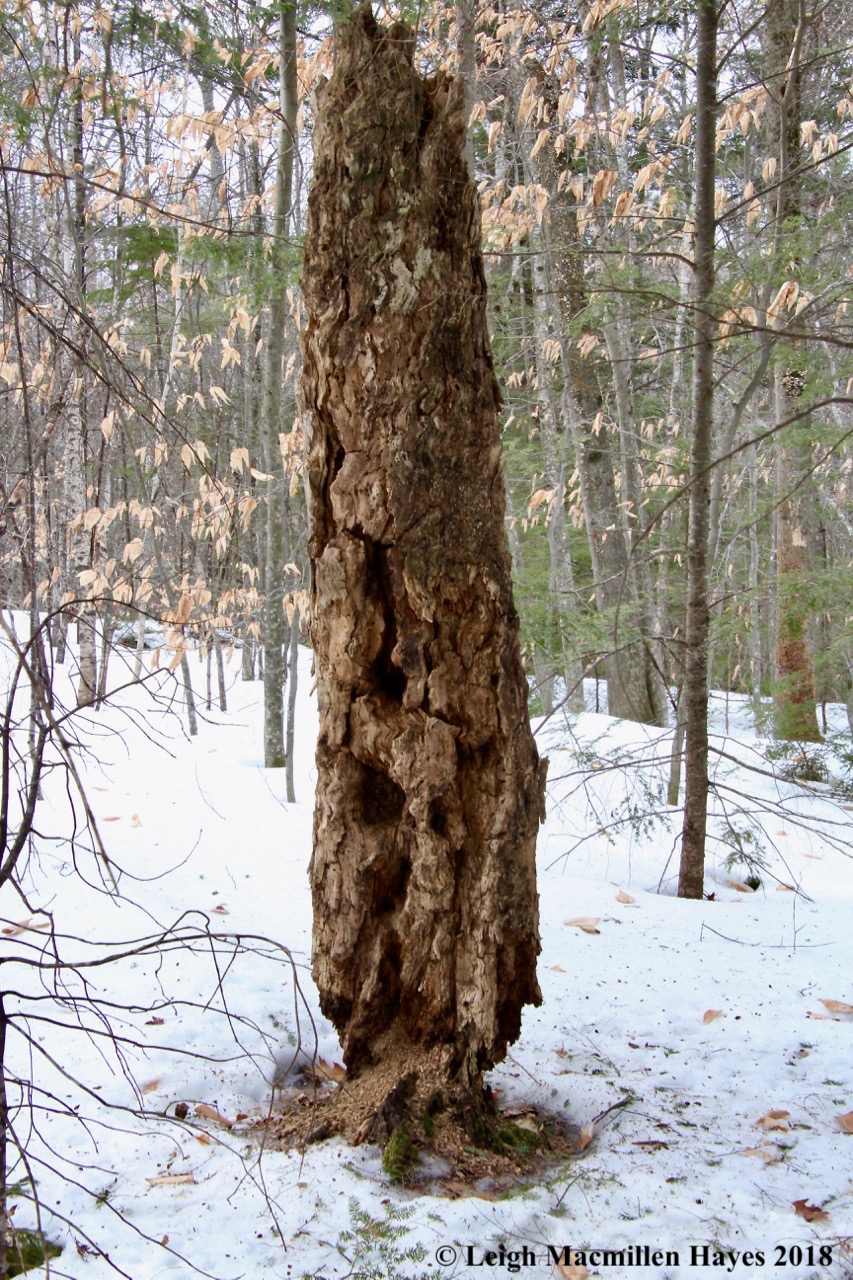
Before the sleet began, however, I decided to do a loop hike at the Greater Lovell Land Trust’s Heald and Bradley Ponds Reserve, beginning from the Gallie Trail and climbing up the Hemlock Trail to the summit of Whiting Hill, with a return via the Red Trail back to the Gallie. It’s a perennial favorite that always has some different things to offer, including the skeletal remains of a beech snag. I think what intrigued me most, besides the pileated woodpecker holes, were the lines of the wood, curved in nature.

w-Lactarius deterrimus (orange latex milk cap)?

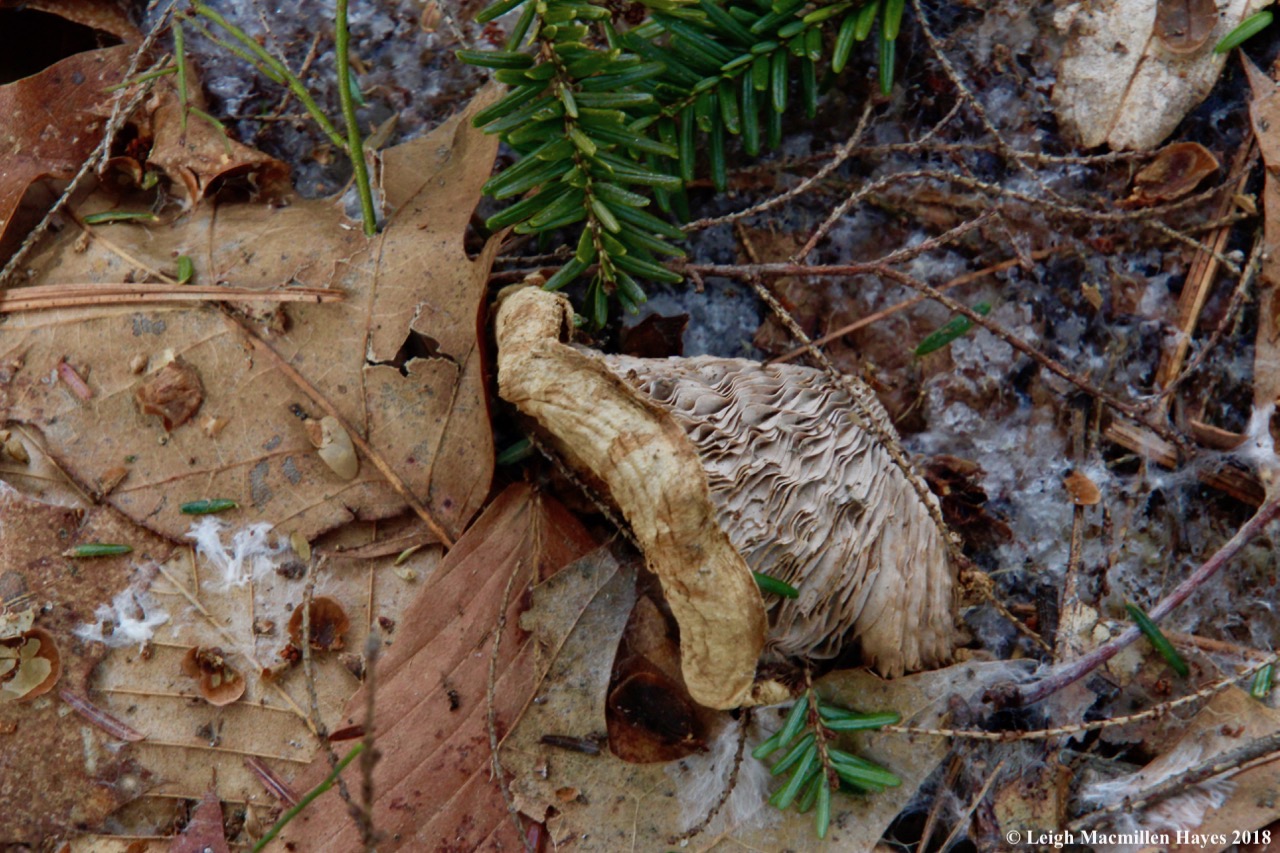
Similarly curved were the gills of a decaying Orange Latex Milk Cap (Lactarius deterrimus)–at least that’s what I think it was–found beneath a hemlock.

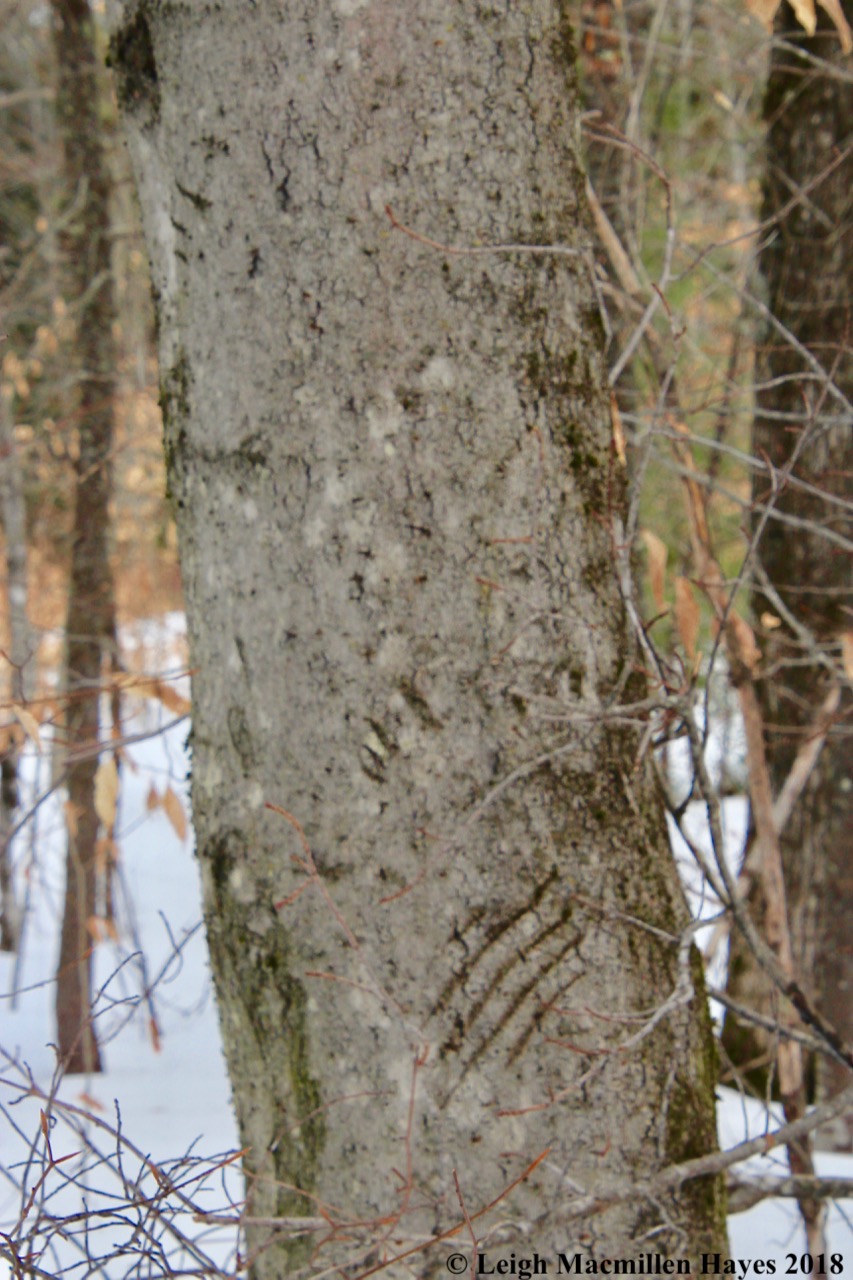
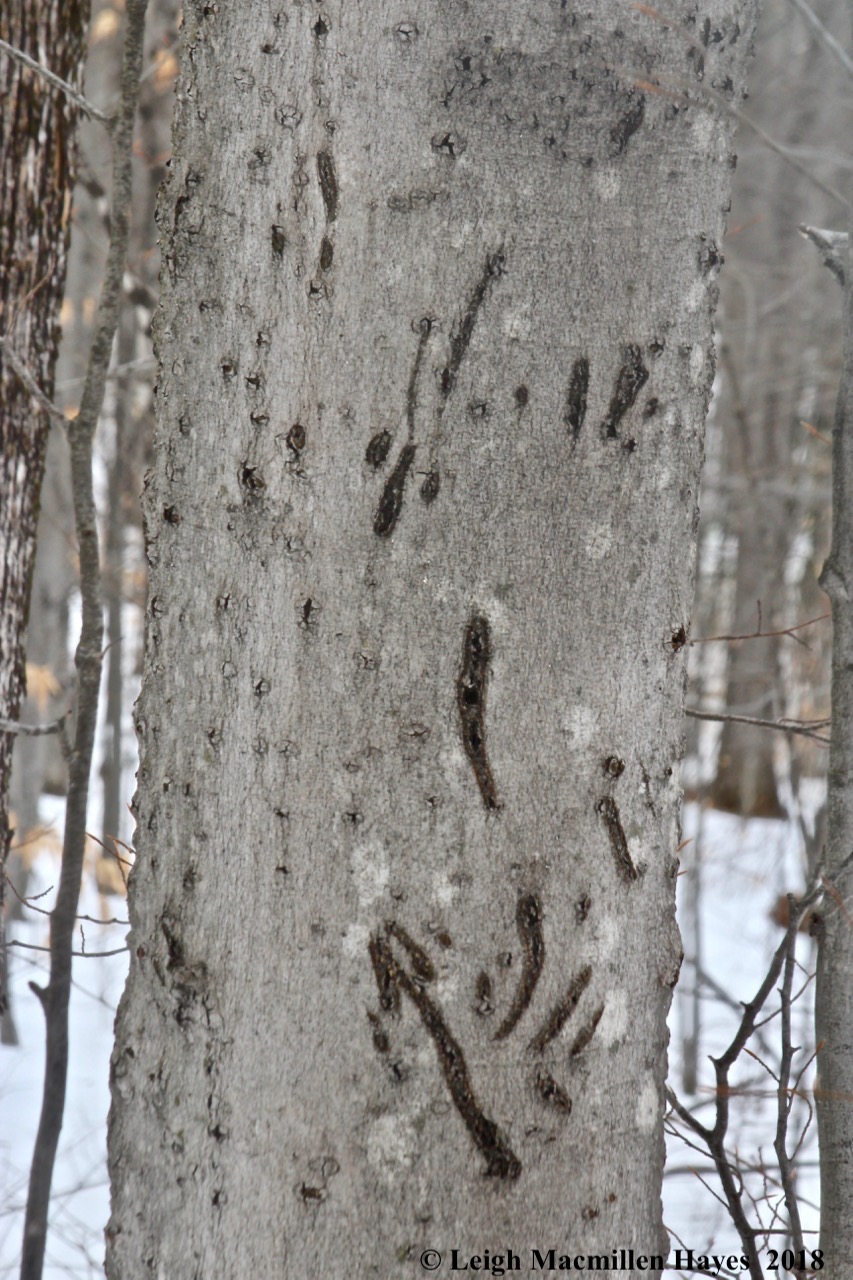
w-bear 1

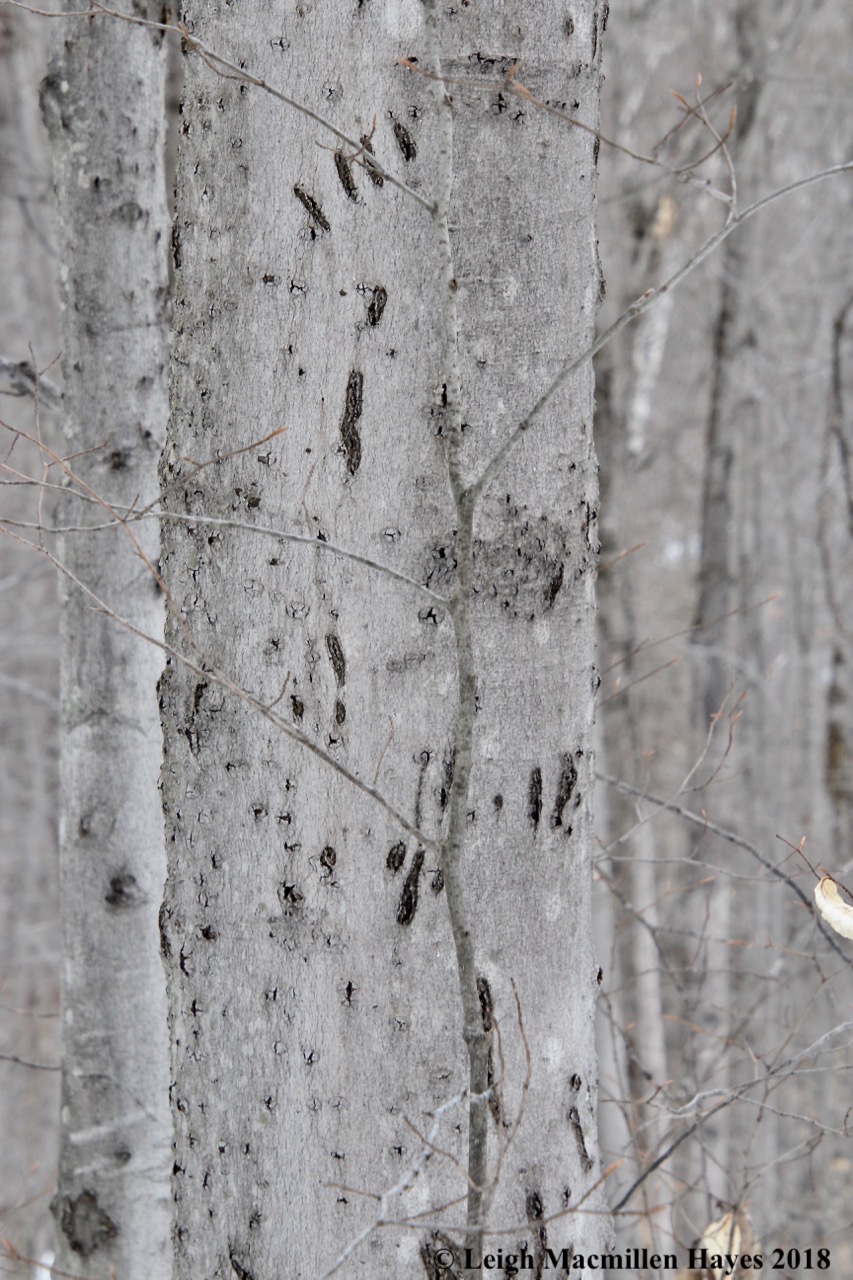
Part of my love for the Hemlock Trail can be found among the beech trees that also grow there and it is my habit to admire the lines that decorate them as well.

w-bear 2

No matter how many times I visit, I’m filled with awe.

w-bear 3

And wonder.

w-bear 4

For the black bears that left their signatures behind.

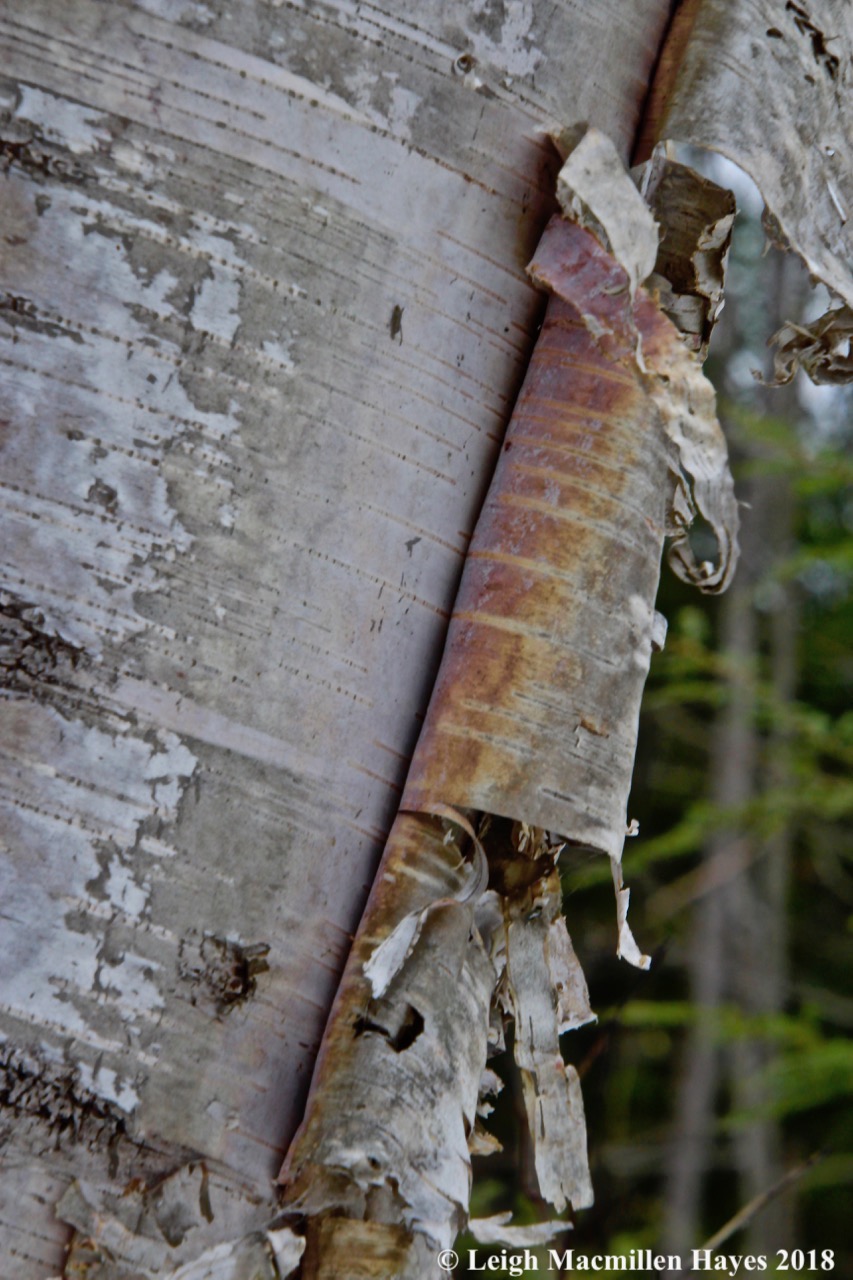
w-paper birch bark 2

Other trees also gave me pause, for though some know them as white, I prefer to call them paper birch. The curled-back bark offered hues of a different color reminiscent of a sunrise in the midst of a graying day. As my mother was fond of saying, “Red sky in the morning, sailors take warning.” Today was a day to heed said warning.

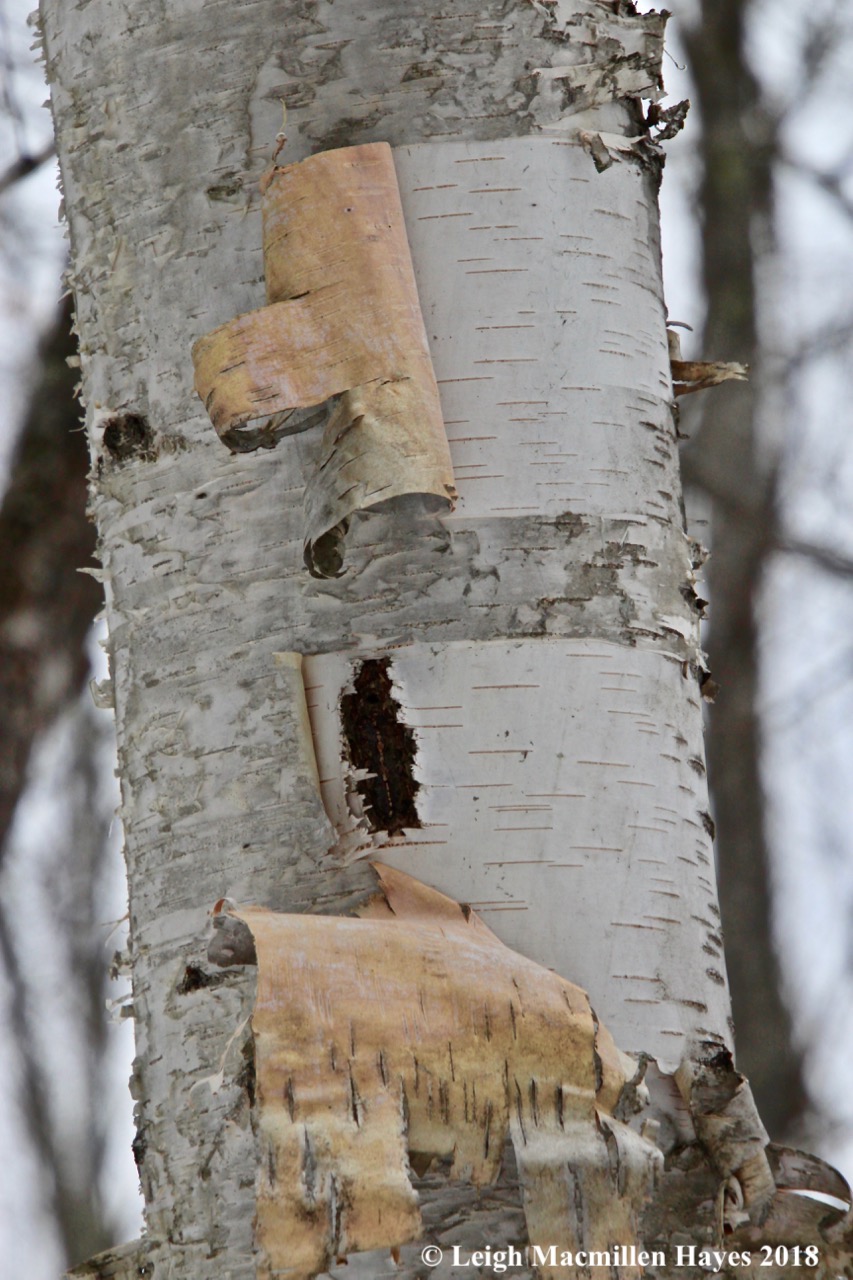
w-paper birch bark 1

Others bespoke a setting sun.

w-paper birch bark--stitchwork

And not to go unnoticed, more bark from another paper birch that had fallen to the ground. It too, offered subtle pink hues, but it was the stitchery created by former lenticels (the tree’s pores) that drew my eye. They reminded me of a million zippers waiting to reveal hidden secrets.

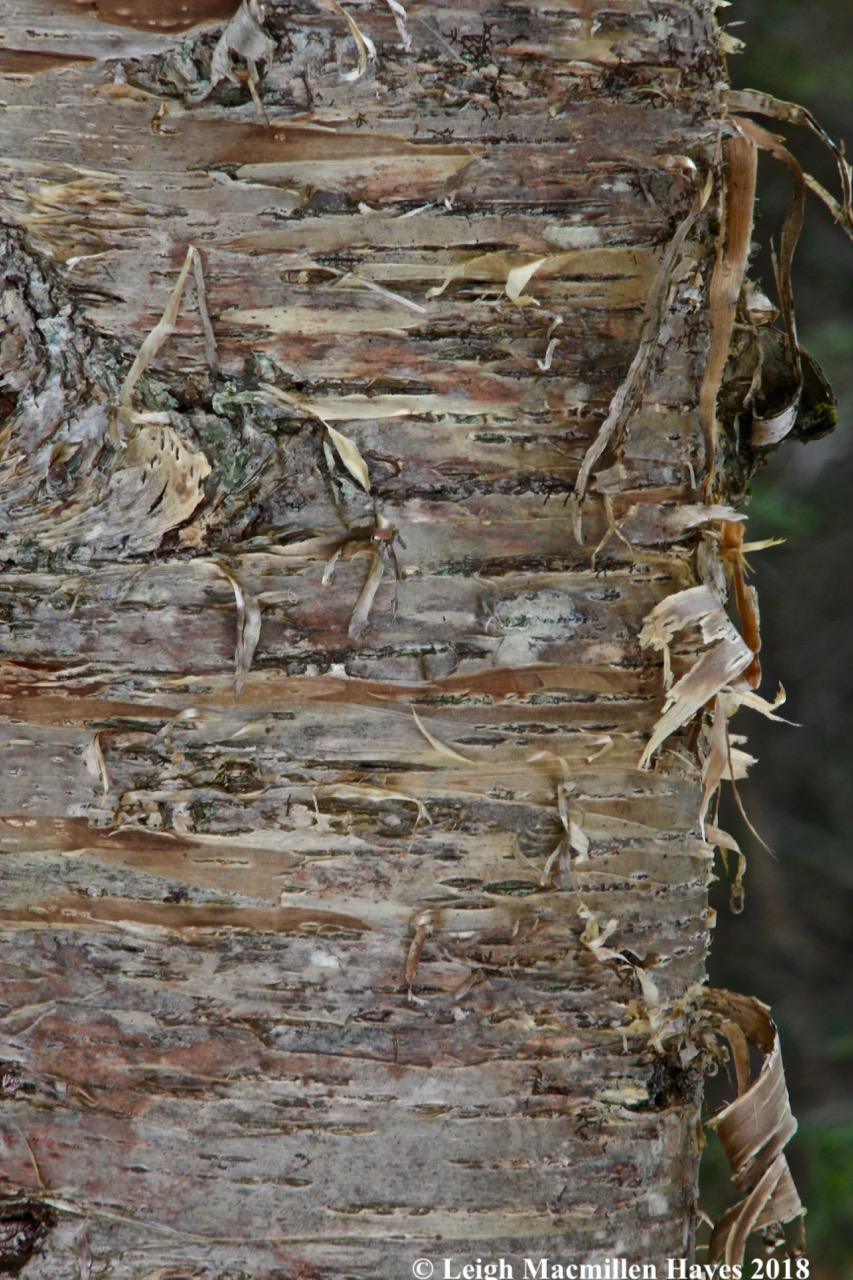
w-yellow birch bark

And then there was the yellow birch–with its ribbony bark shedding its own light on the world.

w-wintergreen

Around the base of some trees, the snow had melted and wintergreen plants showed off their transitional colors–winter magenta giving way to summer green.

w-bench over Heald Pond

At last I reached the summit and headed to the east side first, where Heald Pond was visible through the bare trees.

w-Mollisia cinerea--gray cap?

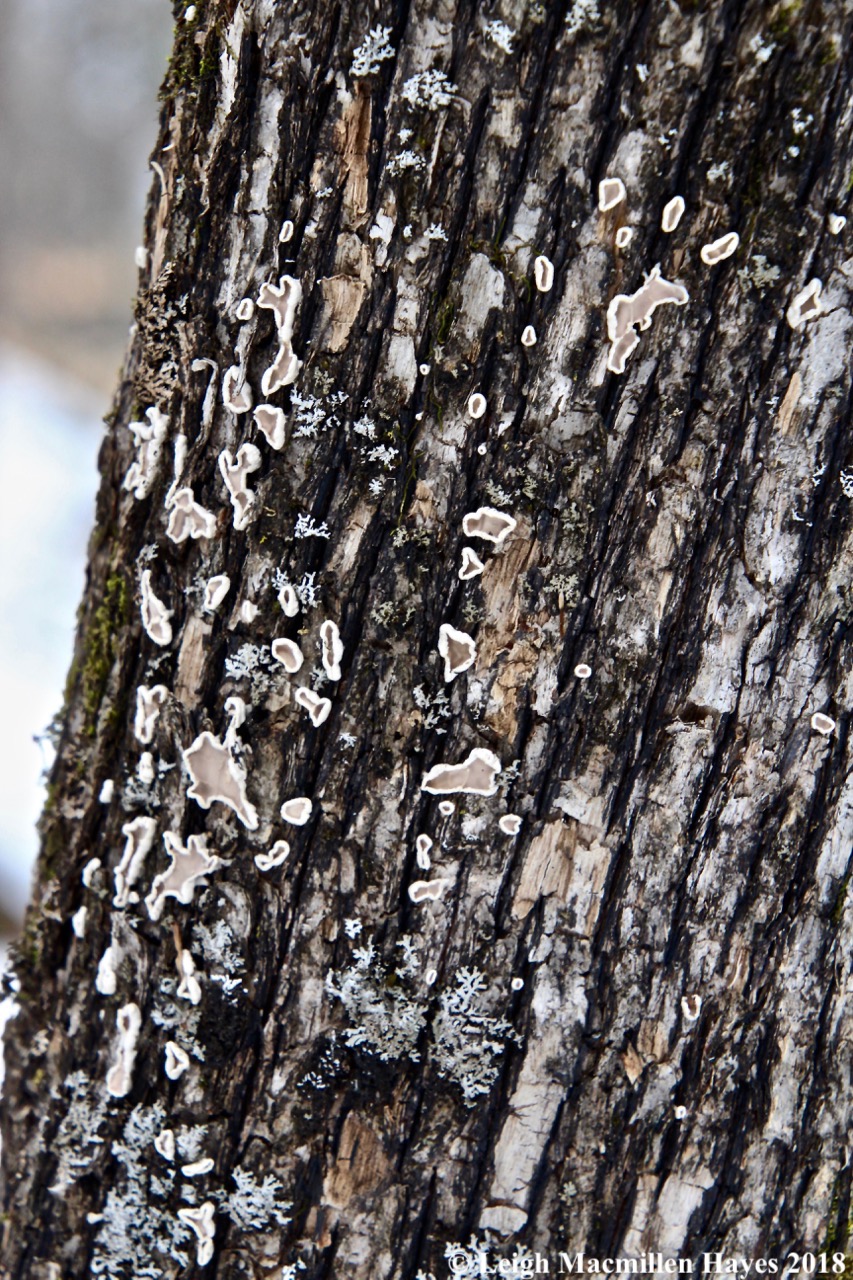
Nearby, still another tree invited a closer look. I love the bark of hophornbeams, but this one sported a growth I wasn’t familiar with until I checked Lawrence Millman’s Fascinating Fungi of New England upon my return home. In the world of mushrooms my knowledge is enough to be dangerous, but I trust my fungi friends will weigh in if I’m wrong on the ID. I’m going out on a limb and calling this one Gray Cup (Mollisia cinerea), for it seemed to match Millman’s description: “With luck, you might find several hundred of these stalkless ascos . . . each fruiting body will be more or less cup or saucer-shaped, but wavy or irregular in age.” And he describes their habitat as scattered or densely crowded under hardwood logs. Well, these weren’t under a log, so that made me question my ID, but they certainly seemed to match the rest of the description and hophornbeam is among the hardest of the hardwoods.

w-hophornbeam

Below another hornbeam I found the ground scattered with little fruits.

w-hophornbeam hops

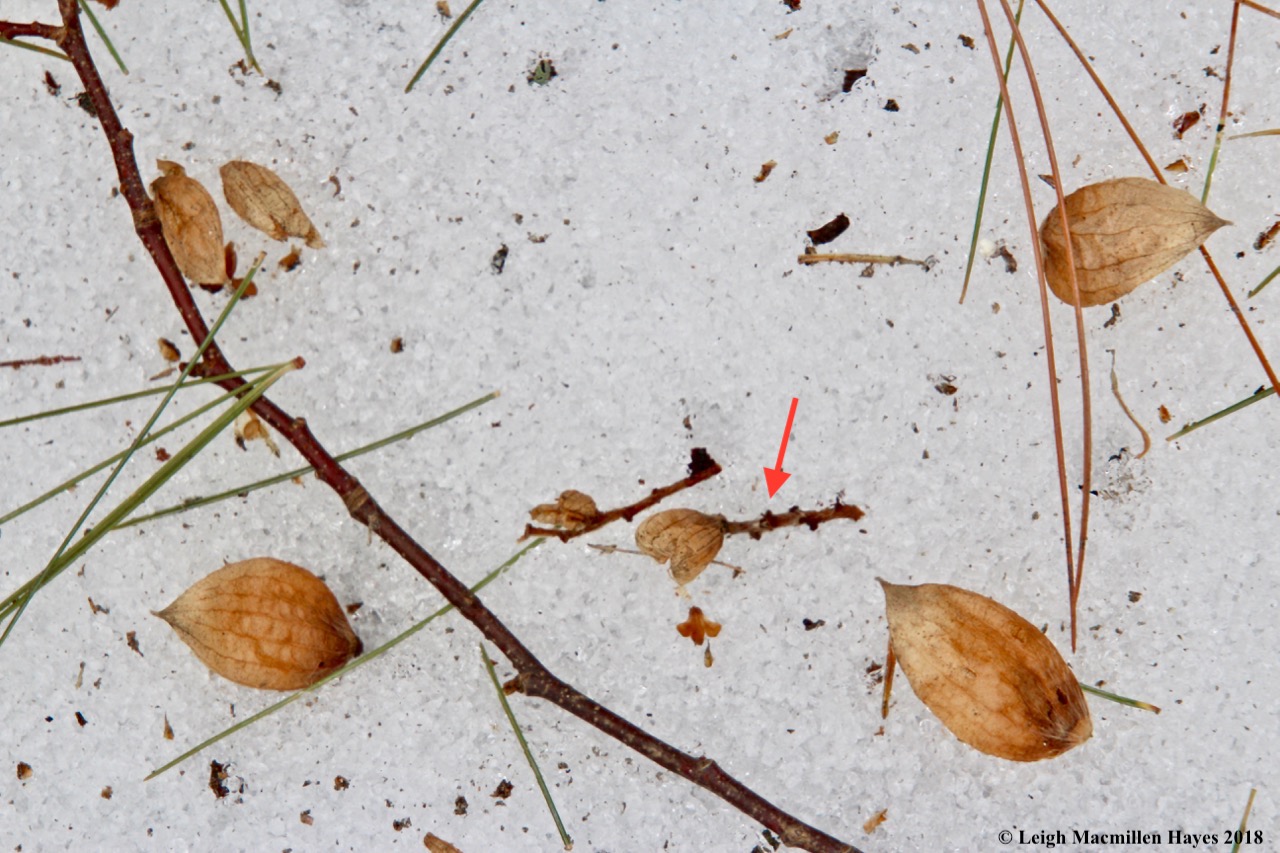
The common name for the tree derived from those fruits, which when attached to their twig (the arrow points to such) are so arranged that they look like hops. As they fall, each little bladder that contains a single seed separates from the group in hopes of finding the right spot to grow into the future.

w-vole tunnels

As I moved toward the western outlook, half tunnels in the snow let me know that the vole community had been active. It probably still is . . . maybe.

w-Whiting Hill view toward Kearsarge

And then, the view to the west, which encompasses Kezar Lake, Mount Kearsarge and the Whites. The scene changed a bit last October when a windstorm just before Halloween toppled a dead white pine . . . and the cairn that marked the summit.

w-asters in snow

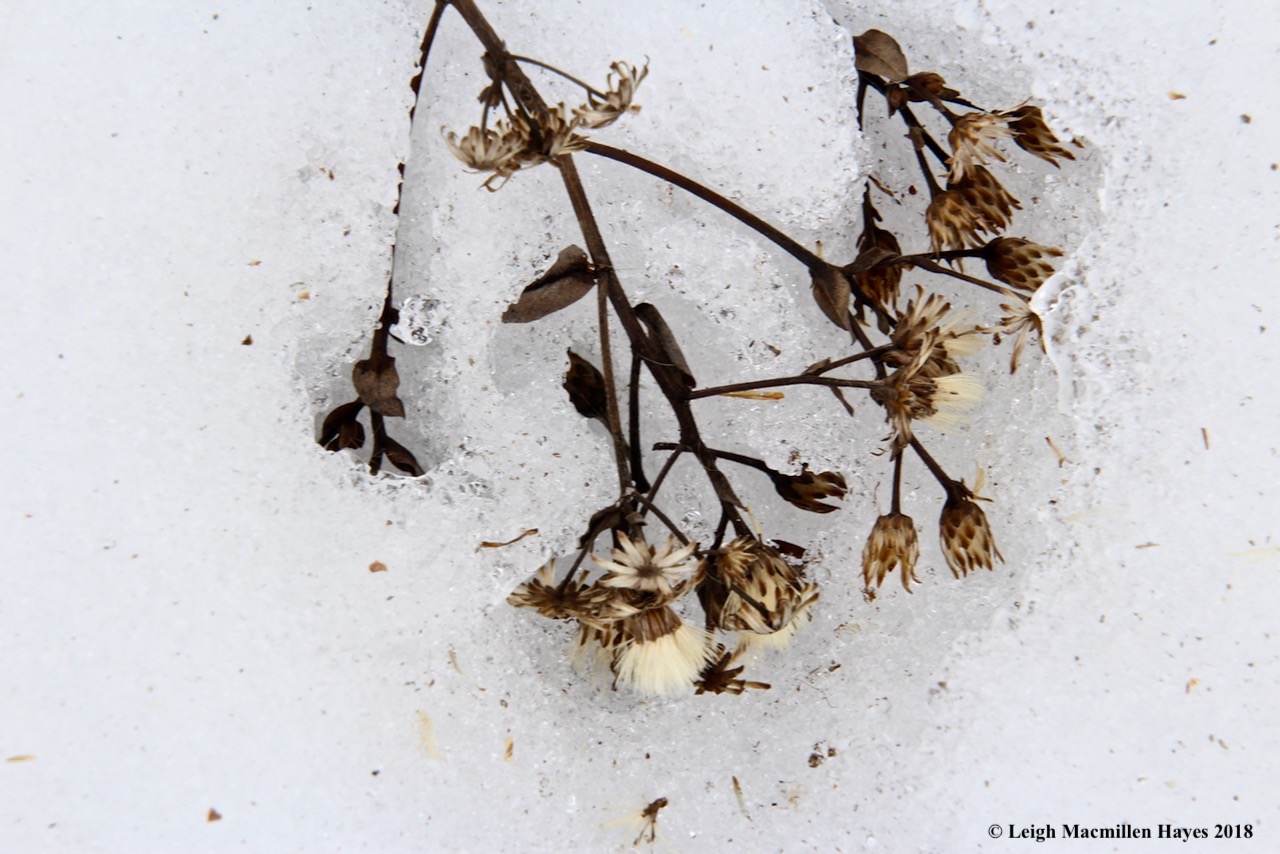
While there, I looked around for evidence of the wild columbine that will bloom in a few months, but found only asters hugging the snow.

I stayed for a few minutes, but the wind had picked up and so I finally turned to head back down.

w-white pine blue sap

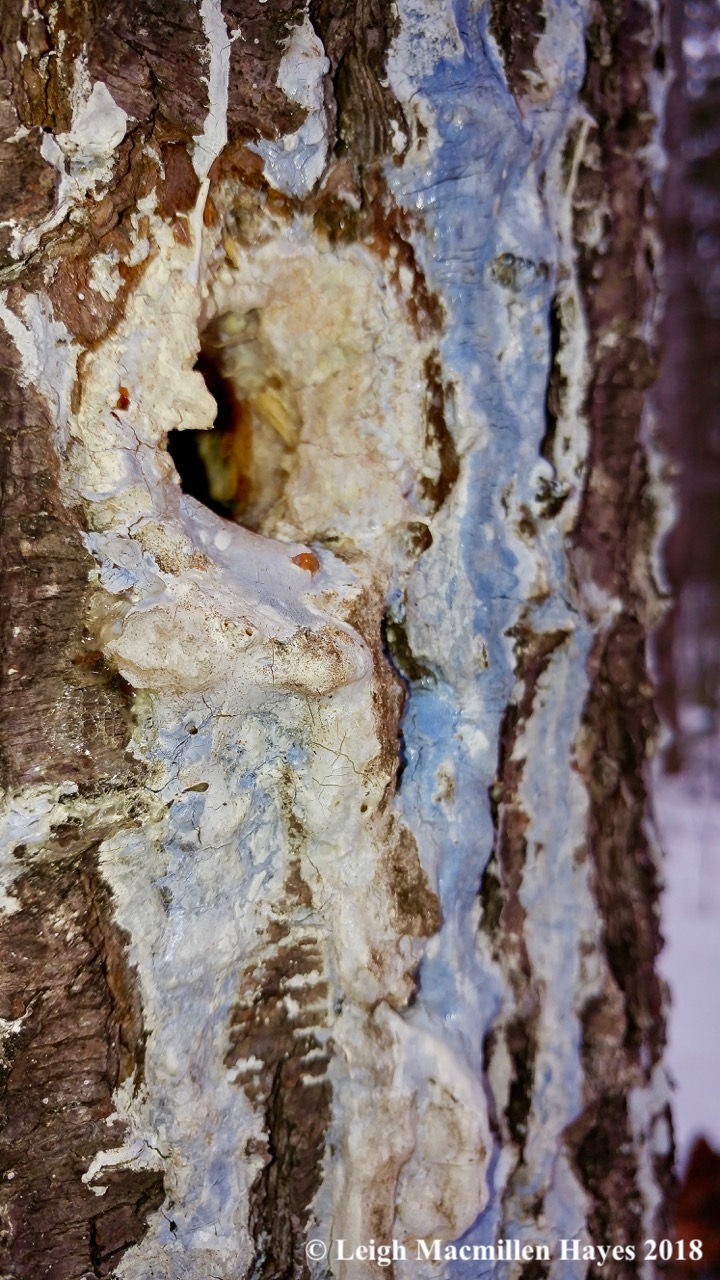
For a short link, I followed the same path until I turned right onto the Red Trail. Just prior to that I realized I’d missed a sight on my way up–the blue sap that bled from a white pine. I’ve seen it often over my years of noticing, but have no idea why the color blue, which was really almost periwinkle. In this case, the sap flowed because a pileated woodpecker had been hard at work.

w-pileated scat

And that meant I had to look–and wasn’t disappointed. Woodpecker scat. It was so well packed, that I pulled out my hand lens and got down on my knees for a closer examination. I practically kissed it but can say for certain that insect parts were layered within.

w-heart

A few minutes later, the trail split and as I said earlier, I followed the Red Trail to descend. I had only gone a wee bit when I heard a barred owl call, “Who cooks for you? Who cooks for you all?” It was noon, after all, so it seemed totally appropriate. The call came from somewhere near the summit and I had to wonder if I’d made the mistake of not looking up quite enough, so taken was I with the hops and the view to the west. Perhaps that vole had provided a meal. And then I heard a response somewhere quite possibly along the Hemlock Trail by which I’d ascended. For about five minutes they called back and forth and I thought of the irony, for months ago I’d scheduled an Owl Prowl for this evening, but had cancelled it this morning due to the weather forecast. That decision was the right one, but perhaps the prowl should have been scheduled for an earlier time. No matter–what’s not to love about hearing an owl hoot at any time of day or night? Especially if one happens to be standing near a tree sporting a heart.

w-lunch bench

Continuing down, another critter made me scan the forest constantly for I saw bobcat tracks and smelled a musky cat odor that I’ve previously associated with this trail. But . . . all I saw were gray and red squirrels scampering from tree to tree and signs of lunch consumed on benches.

w-chipmunk

At the bottom, I switched back and forth between the Gallie and Homestead Trails. It was along the Homestead that another sign of spring’s advent being around the corner showed its face as a chipmunk darted in and out of a hole in a stonewall and watched me from the safety of a fallen tree.

w-foundation filled with chunks of ice

Because I was there, I decided to pay a visit to the McAllister family spirits and told them of my great finds. Of course, what I shared was nothing new to them for they’ve been keeping an eye and ear on this property since the mid 1800s.

w-foundation 2

I also let them know that I was impressed they’d stacked up on ice blocks in the root cellar–certainly their produce had remained fresh throughout the season.

w-spring 1

I was almost back to my truck when I detoured by a certain yellow birch. All along I’d been walking on tracks others had made, so packed was the snow. And even when I went off trail, which was frequently, I didn’t sink. But . . . up to my knees I went as I approached my final destination–the light colored sand in the middle of  the water.

w-spring 2

It was well worth the wee challenge to get to it for the action of bubbles and sand flowing like lava was ever mesmerizing. At last I’d reached a spring that erupts in all seasons.


The Books of February: The HIDDEN LIVES of OWLS & OWLS of the NORTH

“Who cooks for you?” was the question I heard being asked as I fell asleep last night. And “Who cooks for you all?” the response I awoke to this morning.

‘Tis the season for owl mating calls, in this case Barred Owls, and therefore the season to promote two books about some species that hoot in our neighborhoods.

o-The Hidden Lives of Owls

The first, The HIDDEN LIVES of OWLS: The Science and Spirit of Nature’s Most Elusive Birds by Leigh Calvez, provides a fun and informative read. Perhaps I like it so much because we share a name and an interest in nature. But really, it’s the stories she tells about her experiences in the night world that make me feel as if I’m sitting on a tree stump or rock wall beside her–waiting and watching.  Listening and learning.

Calvez begins her book with silhouettes for eleven owls and a list that includes the scientific name of each, overall length, and wingspan.

s-screech owl 2

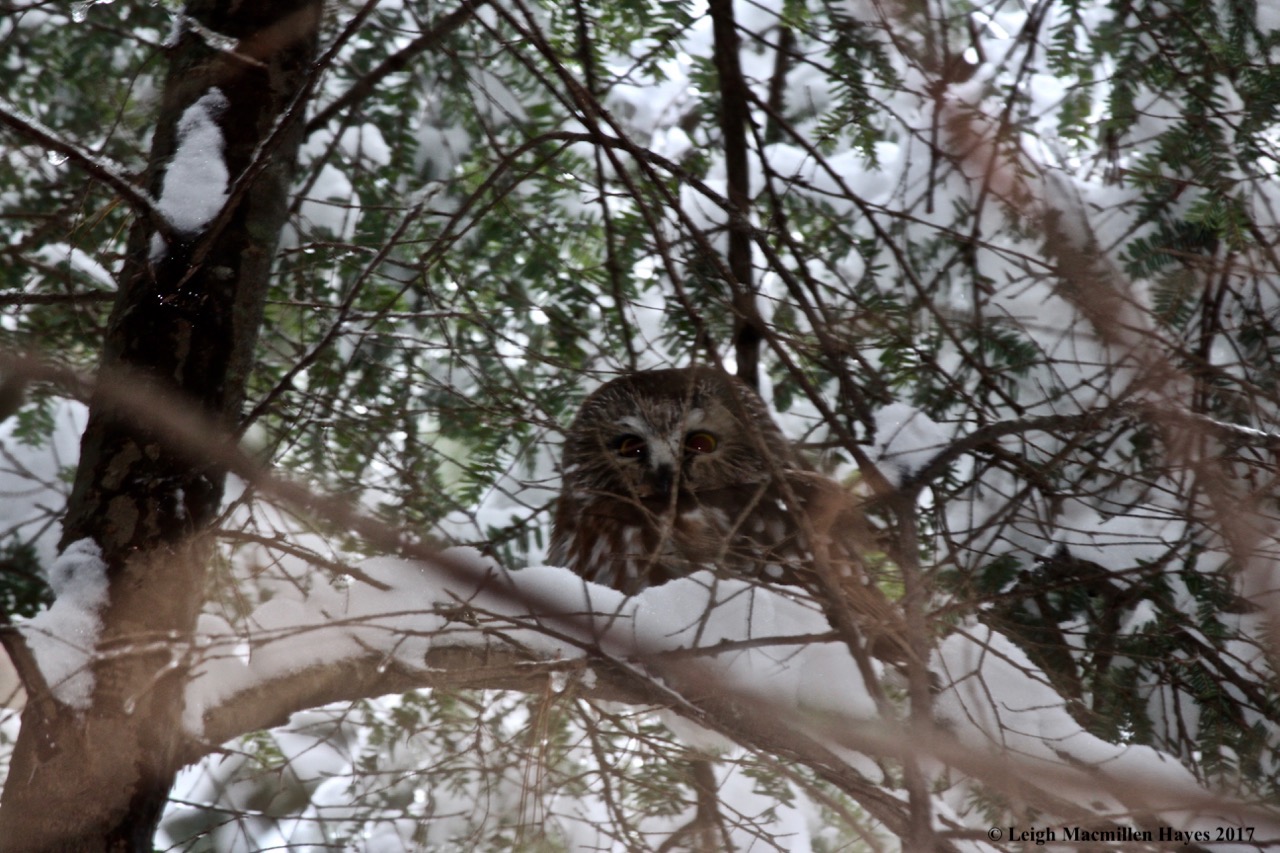
The first chapter is about Northern Saw-whet Owls, a new favorite for me since I was honored with the opportunity to meet one at the end of 2017 as I snapped my way through a thicket of hemlock trees, twigs breaking with each movement. Despite all the noise, this owl flew in and our eyes connected. Like Calvez, that sighting quivered in my mind and heart as I tried to remain calm and maintain my focus. I felt like a little kid wearing big girl boots, such was my excitement.

It’s through Calvez that I learned the origin of this bird’s name: the rasping call reminding those who named it of the sound made when “whetting” or sharpening a saw against a file.

And did you know that within mated pairs of these little birds, minute members of the owl family as they aren’t much bigger than a robin, the female sits on the nest for an almost one-month incubation period, while the male dutifully brings food? He actually continues this process even after the young’uns fledge, while momma goes off to the spa in order to regain her strength (or start another brood).

Since she first became fascinated by owls, Calvez had the good fortune to travel to a variety of locations and learn from others–as well as from the owls. She delved into the science of the species and the spirit of some individual birds; her stories are all tucked into this 205-page book. While some are species we may not see in the Northeast, for she writes about those she most familiar with in the Northwest, there’s still plenty to be gained from reading this book.

The book ends with the following: “Notes from the Field: Insights from an Owl.” I wish I could share it with you, but don’t have permission to do so. Let me just say–this list and the silhouettes and comparisons at the beginning make the book well worth the purchase. And the stories in between, filled with wit and wisdom, make it well worth the read.

o-Owls of the North

The second book, which I purchased the same day, is OWLS of the NORTH: a naturalist’s handbook by David Benson.

This book is more of a guide, filled to the brink as it is with photographs and facts about ten owls. For each species, Benson includes a global map and quick list of the following: description, range, size, wingspan, other names, diet, a brief personal story about an experience with the particular owl, identification, sounds, habitat, food, hunting, courtship and nesting, juveniles, and behavior. Almost every page features one or two action shots.

And then there are the sidebars, highlighted within an orange box on each of the odd-numbered pages. One included information about pellets, whitewash and skulls.

o-owl pellet

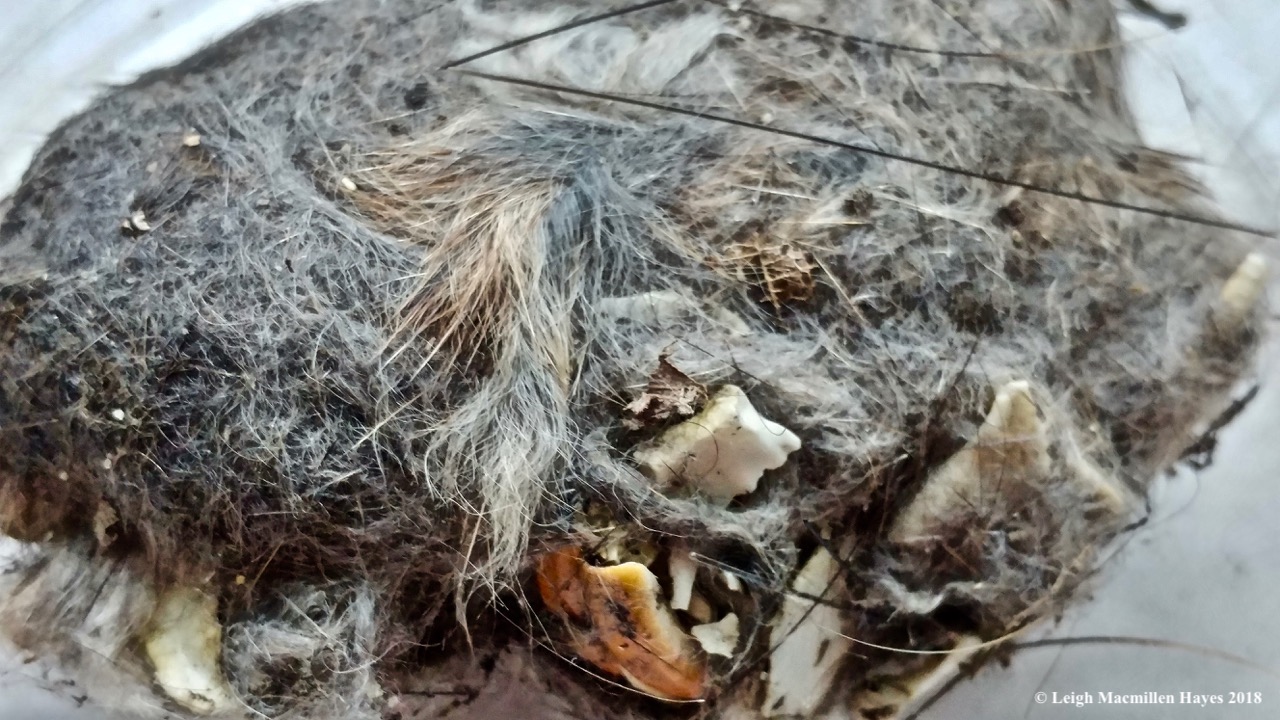
Of course, that reminded me that I have an owl pellet in my collection of all things natural. I found it in March 2016 at Brownfield Bog. According to Benson’s sidebar: “Owls usually swallow their prey whole. An owl catches a mouse, kills it with its talons or by biting its neck and then bolts the whole thing down. Much of the mouse is not very digestible though–the bones, fur and other tough parts don’t provide much nutrition. These are compacted together in the owl’s digestive tract. Then, about six hours after the meal, a pellet of these indigestible parts is coughed up and it drops to the ground beneath where the owl is roosting.”

o-pellet critters--voles

I’ll probably never dissect the pellet I found, but did dissect one for the Maine Master Naturalist Course–and determined that the owl had consumed two voles. (Don’t look too closely for I know that I put a couple of bones in the wrong place–nobody’s perfect.)

We have an Owl Prowl coming up at the Greater Lovell Land Trust and I’m trying to learn as much as I can. The two books, The HIDDEN LIVES of OWLS by Leigh Calvez and OWLS of the NORTH by David Benson, have proven to be valuable resources. I purchased both at Bridgton Books, an independent book store.

If you want to learn more, I encourage you to check out these books, join us for the Owl Prowl, or step outside–tis mating season and the calls can be heard. You might even think about responding. Go ahead–give a hoot.

The HIDDEN LIVES of OWLS: The Science and Spirit of Nature’s Most Elusive Birds by Leigh Calvez, published 2016, Sasquatch Books.

OWLS of the NORTH: a naturalist’s handbook by David Benson, published 2008, Stone Ridge Press.

Honoring the Earth

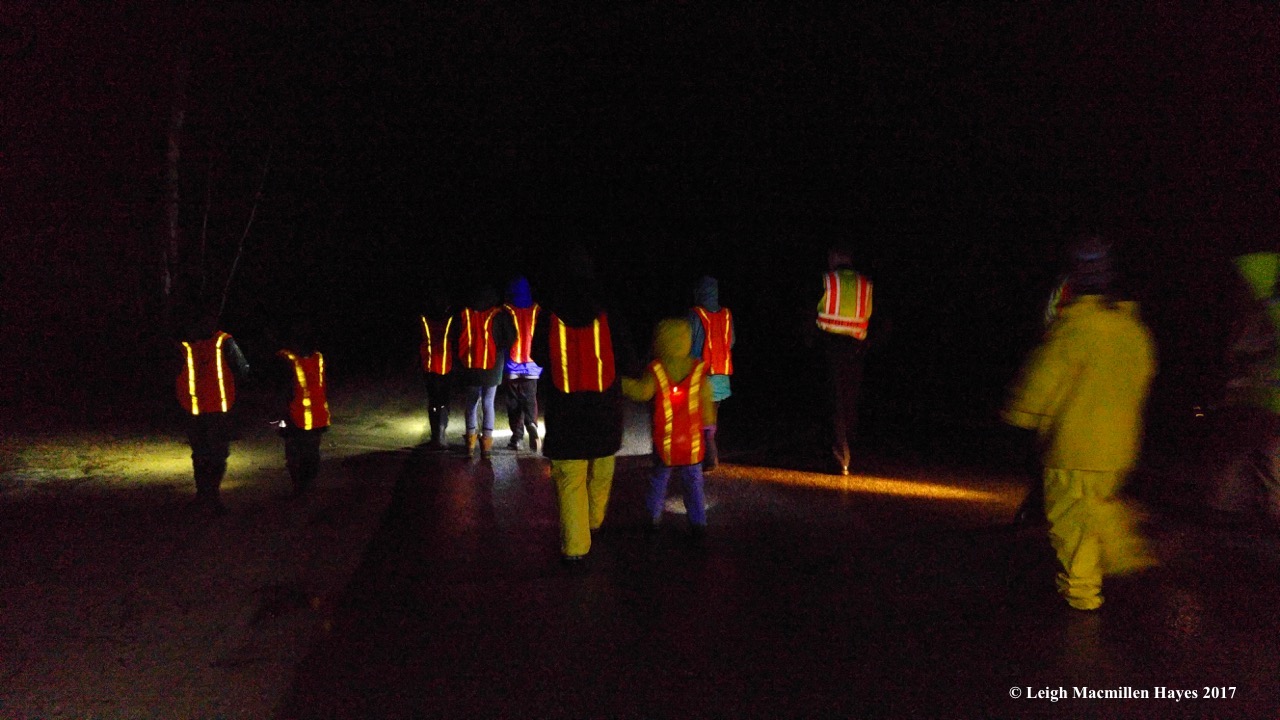
It would have been so easy to stay home last night, curled up on the couch beside my guy while watching the Bruins play hockey. After all, it was raining, 38˚, and downright raw. But . . . the email alert went out earlier in the day and the evening block party was scheduled to begin at 7:30. And so, I piled on the layers from a wick-away shirt to Under Armour, a turtleneck, sweater, LL Bean vest and rain jacket. I slipped into my Bogg boots and made sure I had the right gear–smartphone for photos, reflective vest, headlamp and flashlight. With a visored hat on my head to shield my glasses from the rain, I was finally ready. Out the door and down the road I went, headed to the Lakes Environmental Association‘s office for Big Night.

h-Big Night Patrol 3 (1)

I wasn’t the only one crazy enough to attend the party. Our number was about twenty. I think the best part was that we ranged in age from 6 to almost 60, the latter being me–the oldest kid on the block. And in that mix, one teen who was celebrating his 15th birthday (Happy Birthday, Kyle), and several teens who had never attended before but came because one of their crowd was an annual participant. We even had two policemen in the mix–and though their job was to slow traffic and keep us safe, they had as much fun as we did completing our mission.

h-spotted sallie 2 (1)

Said mission–to help spotted salamanders . . .

h-spring peeper 1 (1)

and spring peepers cross the road.

h-redback salamander (1)

We did so for a while and then headed back to our vehicles. Just before reaching the spot where we’d all parked, someone spotted this redback salamander–I smiled because its the symbol of the Maine Master Naturalist Program.

We were wet. We were cold. And we were happy. As nature would have it, Big Night preceded Earth Day–a perfect beginning.

h-candy lichen

Earth Day began appropriately with a board meeting at Lakes Environmental, where among other topics, Dr. Ben Peierls, the new research director of LEA’s Maine Lake Science Center, shared with us his plans for the water quality testing laboratory. Ben addressed us first so that he could drive to Portland and join the March for Science. We continued our meeting, but were thankful for his representation. Meanwhile, directly outside and all around town, another gathering was taking place as many people participated in an Earth Day cleanup.

By the time I left the meeting pleased with all that had been accomplished, I was ready for a solo adventure to find out what the Earth wanted to share with me since most of the snow melted this past week. Despite being another raw day, or maybe because of it, the candy lichen brought a smile to my face. I think one of the cool things about this lichen is that even though its salmon-colored fruits stand atop stalks, this is really a crustose (crust-like) lichen, the bluish-green surface being the actual structure.

h-juniper berries

Near the candy lichen, the bright blue of some berries stood out on the common juniper. They remain on the shrubs all winter and it seemed only a wee bit ago they looked all withered. Today’s offerings were plump and pretty.

h-pine droplets

And then there were the raindrops, each waiting its turn to continue the journey toward the earth. I had to wonder what else it might fall upon before reaching its final destination–each little ball encapsulating nourishment.

h-lambkill

One of the receivers, sheep laurel, which displayed its own new life.

h-trailing arbutus

And at the base, trailing arbutus. One year ago, as I noted in my Earth Day post, it was already in bloom. This seemed a reminder from Mother Earth that we need to practice patience.

h-wild turkey

I continued my mosey, as quiet as could be, and so was startled when one large, exotic bird, and then another, and a third flew off from behind a stone wall. And then I realized they were wild turkeys–who truly are exotic if you take a look at all the colors in their feathers.

h-tinder conks on beech

I’d been on the snowmobile trail, but traveling was difficult given some remaining icy snow and deep ruts filled with water. As if I needed an excuse, I decided to slip into the woods. One of my first delights–tinderconks lining a tree as I looked up.

h-moss covering

But really, it was the thick moss coating at the top of the tree that first drew my attention. Several trees in the neighborhood displayed the same fashion.

h1-woods south (1)

My wander was aimless, taking me through boggy areas . . .

h-snow1

and small sections where snow still blanketed the ground.

h-deer prints in snow

Besides plenty of deer scat, I found prints . . .

h-deer hair

and hair.

h-deer hair bubbles

Raindrops enhanced the hair.

h1-moose scat 1 (1)

And though I suspect they’ve moved toward open water, there was plenty of evidence that the moose had also spent the winter in these woods.

h-moose hair

They, too, have shed hair–preparing for the summer scene.

h-moose maple

A couple of months ago, I’d been concerned that the moose had consumed all the tree buds, but the red maples showed me otherwise.

h1-woods south 2 (1)

At one point, I stood for a while atop a rock and looked to the south.

h1-woods north (1)

And then to the north. It was as I stood there that I heard a repeated sound. It began with a few slow beats, and then a swift series of beats. All seemed muffled. It finally occurred to me that I was listening to a ruffed grouse. Eventually, I followed the drumming and came close to the one beating its wings against a log–the work of a displaying male. I didn’t bother to seek out the actual bird for I knew I’d startle it and it would fly off, so I let it drum in peace, thankful for the opportunity to at least hear it. Really, it was a first for me. Oh, I’ve possibly heard it before, but only today did I recognize it for what it was.

h1-widowmaker (1)

For a while, I was fake lost . . . and then I heard another repeated sound that lead me to a widowmaker and I knew exactly where I was. But where was the maker of the sound?

h-owl 1

In a tree above me.

There were actually two barred owls and I was so thankful for the honor of listening to and watching them on this Earth Day.

I was also thankful for all the privileges bestowed upon me. The privilege of living. The privilege of noticing. The privilege of questioning. The privilege of understanding. The privilege of wandering. And especially, the privilege of wondering. Thank you for your offerings, Mother Earth. I am honored to know you.


A Wiser Soul

It all began when I stepped out the back door just before six o’clock this morning. From the treeline I heard a barred owl call, “Who cooks for you? Who cooks for you all?” I could have returned to bed then, happy for the opportunity to hear such a wise one.

n-Northern Flicker

Not long after that, as I passed by a window in the butler’s pantry (no, we don’t have a butler, just an old farmhouse), a splash of red on the ground drew my focus–a Northern flicker had stopped by to feed. Notice the subtle curve of its bill? The better to dig up ants and beetles, as is the custom of this ground-feeding woodpecker.

n-water coursing 2

An hour or so later, I met my friend, Marita, for a hike up the Bald Peak trail at Pleasant Mountain. Our destination–not the summit as we had a time constraint–but rather, Needles Eye.

n-beside the brook

Our climb included frequent stops at vantage points to take in the sound and beauty of the place.

n-water art 2

The flow of the living water and its ever changing presentation mesmerized us much as leaping flames do.

n-water art

It spiraled over the rocks like a sculpture in fluid motion.

n-ice hiding

And while so much poured forth and wound its way down the mountain stream,

n-ice at Needles Eye

some remained frozen in time.

n-crossing toward Needles Eye

At the sign pointing toward Needles Eye, we crossed a stream and then worked our way across the short spur to the narrow formation of rocks that water threads through.

I should qualify that. Marita sauntered across the ice and snow, seeking the wee bit of dirt and leaves at the edge of the trail. It’s a steep edge and even on a summer day, I pick my way carefully over rocks and tree roots. Today, my brain suggested I call it good and sit still. But, she’s a good friend, and realizing my trepidation (I’d forewarned her), she spoke to me calmly about each foot placement, and even turned back to demonstrate exactly what I should do, waited patiently as my brain shouted, “Don’t do it!” and my heart said, “I think you can, I think you can,” and offered a hand when necessary.

n-marita 3 (1)

Together, we did it. This photo is Marita’s as I didn’t want to change my camera lens once we stood in the chasm and watched the water fall.

n-inside the needle

On a summer day, it’s a delightfully damp place to rest before continuing up the mountain. Sometimes, there’s only a hint of a stream. Today, it was equally enchanting–perhaps we should have bowed in respect of the beauty and power before us. And just maybe we did.

n-climbing down 2

Returning on the spur, Marita again came to my aid. And then we hiked a bit further up until time forced us to head down again.

n-morning light

The descent seemed easier as the snow had softened a bit in the two hours we’d spent enjoying each other’s company and filling our senses with the sights and sounds surrounding us.

n-vp visit

Back at home, I was pulled out the door again and made my way to the vernal pool. Ever so gradually, the ice is melting.

n-crack across vp

And across the center, a crack divided it in two from east to west, while a line between the sunshine and shade completed the quadrants from north to south.

n-snowfleas 2

Piles of pepper, aka springtails, floated on melted water atop the ice.

n-snowfleas

Others clustered on the open water at the pool’s edge. Other than that, I could see no action. Every day, however, will bring something new so I know I’ll check back frequently.

n-our house:field

Leaving the pool behind, I headed toward the area where I’d heard the barred owl several hours earlier–and I called. It didn’t respond. But, I reminded myself that this morning’s greeting was enough.

n-crocuses1

Returning home again, I couldn’t resist the crocuses that I first noticed yesterday. In the past few days, the snow has receded quickly and with today’s light, these spring beauties finally opened.

n-first daffy--a double

And then, in the garden beside the house, I found one more surprise–a double daffodil blossoming under some leaves. In this season of watching with wonder, my heart was full.

n-Marita

This day will stick with me for its offerings and I’ll be forever grateful to Marita . . .

n-marita 4 (1)

for without her help, I wouldn’t have had the gumption to stand in the Needles Eye. She is a kind and funny and wise(r) soul. And I am blessed by our friendship.

P.S. Two minutes after posting this blog, a woodchuck ran across the deck–headed toward the barn, of course.