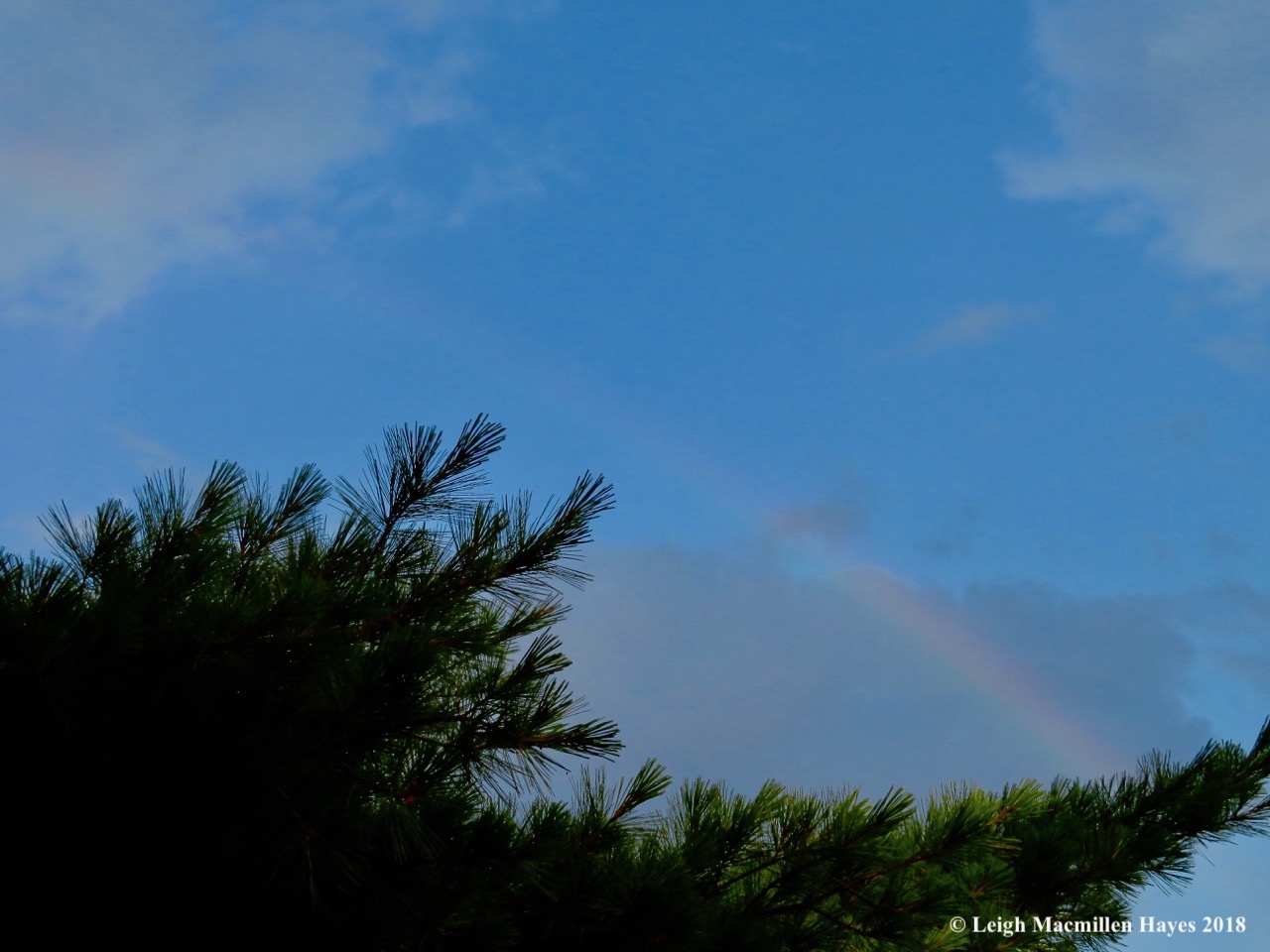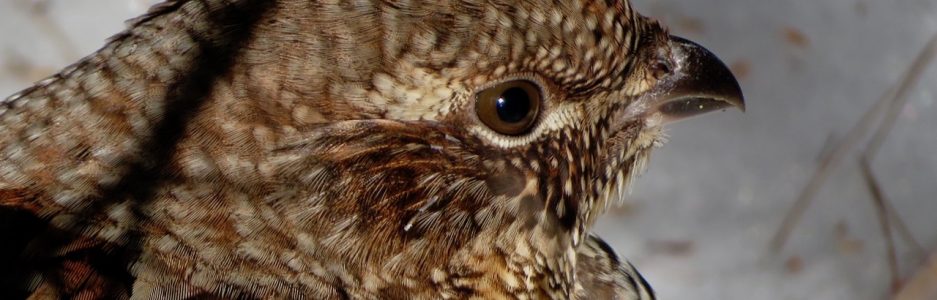
Heron Accomplishments

For the last fifteen years I’ve had the honor of stepping into a wetland or two early in the morning on a regular basis for at least six weeks to check on the activity of heron rookeries. It’s a community science program called HERON that the State of Maine runs: “HERON” is short for the Heron Observation Network, a network of volunteers across Maine who monitor nesting areas, or colonies, of wading birds such as the Great Blue Heron. HERON is managed by the Maine Dept. of Inland Fisheries and Wildlife.”

Herons are colonial nesting birds, meaning they nest in groups. Their nesting community is known as a rookery.
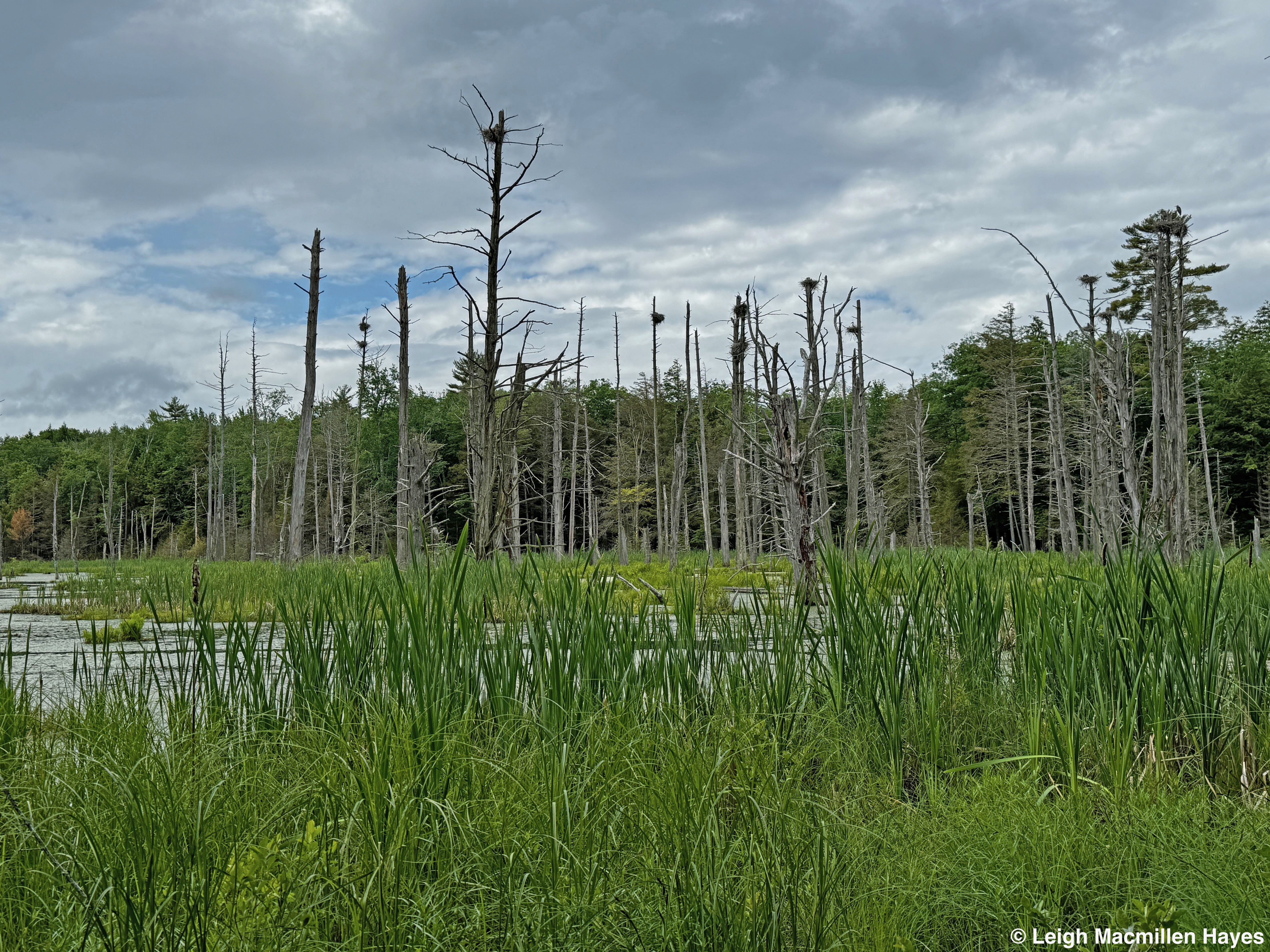
If I could get away with it, I’d spend all day in this place where the wild things go about their daily duties as co-observers and I stay on the edge in hopes of not disturbing them.

I think what amazes me most is that they build their stick nests high up in trees and I always expect the wolf in The Three Little Pigs to huff and puff and blow their homes down. Or at least the wind to do such.
The most difficult day of the count may be the first. May be. First, the number of nests must be counted. Then the number of active nests, those with birds in them. Next, it’s the number of adults and then young, if visible. If the adults are incubating, for how long?

And that’s where it gets tricky. If eggs aren’t visible because one cannot get close to the nests, since they are anywhere from about 50 to 200 feet from land, and high up in dead snags, this is a challenge. Spotting adults on the nest, however, indicates there possibly are eggs within.

Nest building and rebuilding is a constant, and a clue that there’s hope for a new generation. Adding sticks with one’s mouth sounds difficult to us, but it is the way of life for a bird.

Spotting little bundles of fuzz brings smiles to observers’ faces–as if we have given birth or are at least the grandparents of these bouncing babies.

Two weeks later and they already have Great Blue Heron markings and crazy hairdos and the counting gets a wee bit easier. Of course, the youngsters hop up and down and so nests have to be reviewed several times to make sure the number is at least close to accurate. It’s not unusual for a nest to support three, four, or five youngsters.

If you’ve never been near a heron rookery in those early days, you haven’t experienced the pterodactyl fly ins as adults arrive with food or the intense and loud and constant squawking of the youngsters demanding to be fed.

Once the adult has landed, the birds still must beg, sometimes for ten or more minutes and I can’t help but wonder if the squawking encourages adult regurgitation.

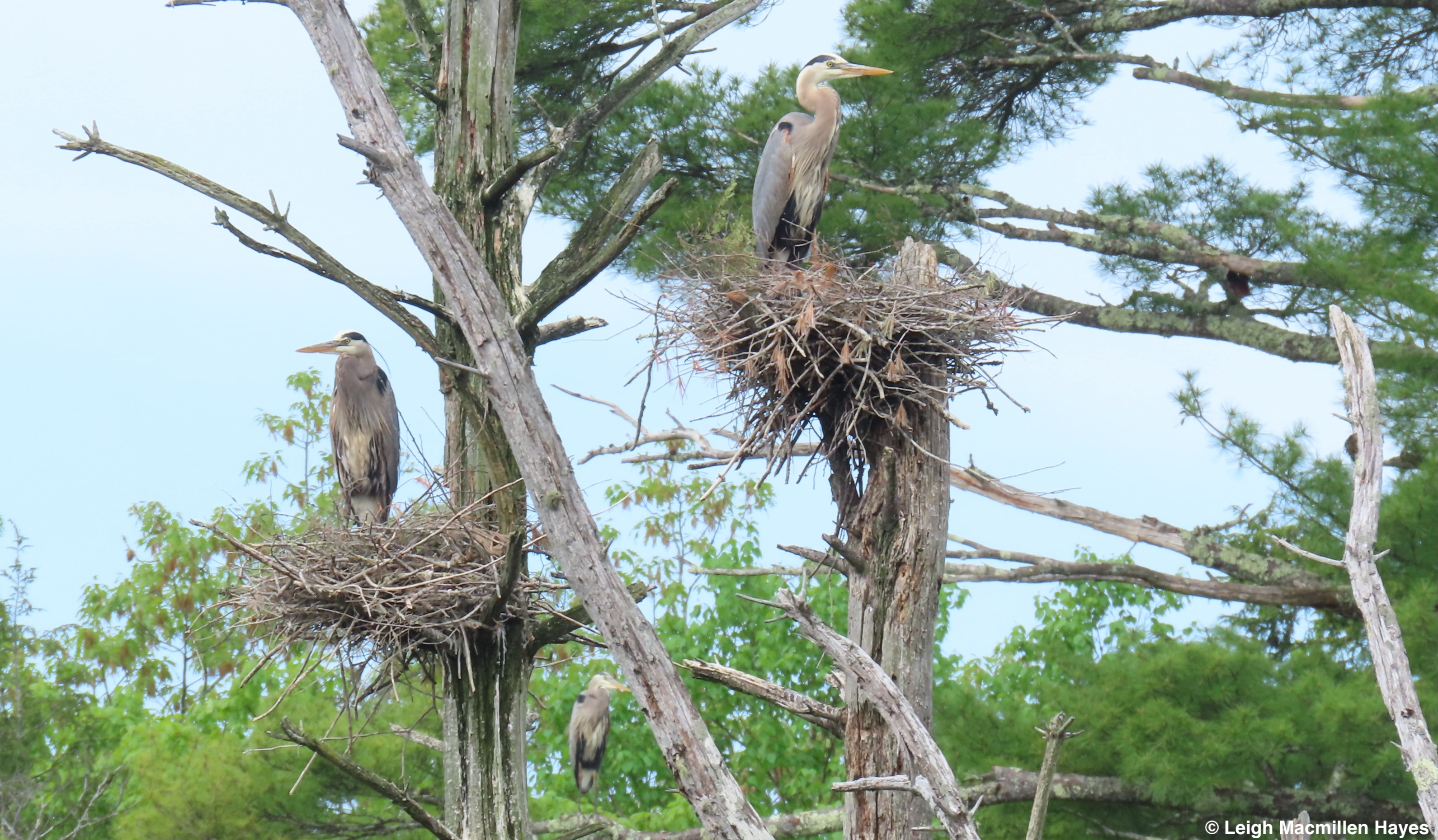
If you look closely at this photo, you’ll notice the two on the left are in one nest waiting ever so patiently for an adult to return with a meal, while the nest in the back to the right hosts two beggars waiting for the food to slide up the adult’s throat and down into their mouths.

Those awkward tween years only last a few weeks in a bird’s life, for so rapidly must they grow given the short season of our northern clime. Hairdos are a good indication to separate adult from young.

Remember when I said that the first day was the most difficult day to count. Well, that is debatable, for as the weeks go on and the youngsters grow, it becomes difficult sometimes to distinguish parent from child. If the plume on the head is spotted, then it’s an adult, but sometimes the lighting or angle isn’t right.

That said, the count is completed about six weeks after the first visit for the birds begin to fledge and the nests won’t be used again . . . until next spring.

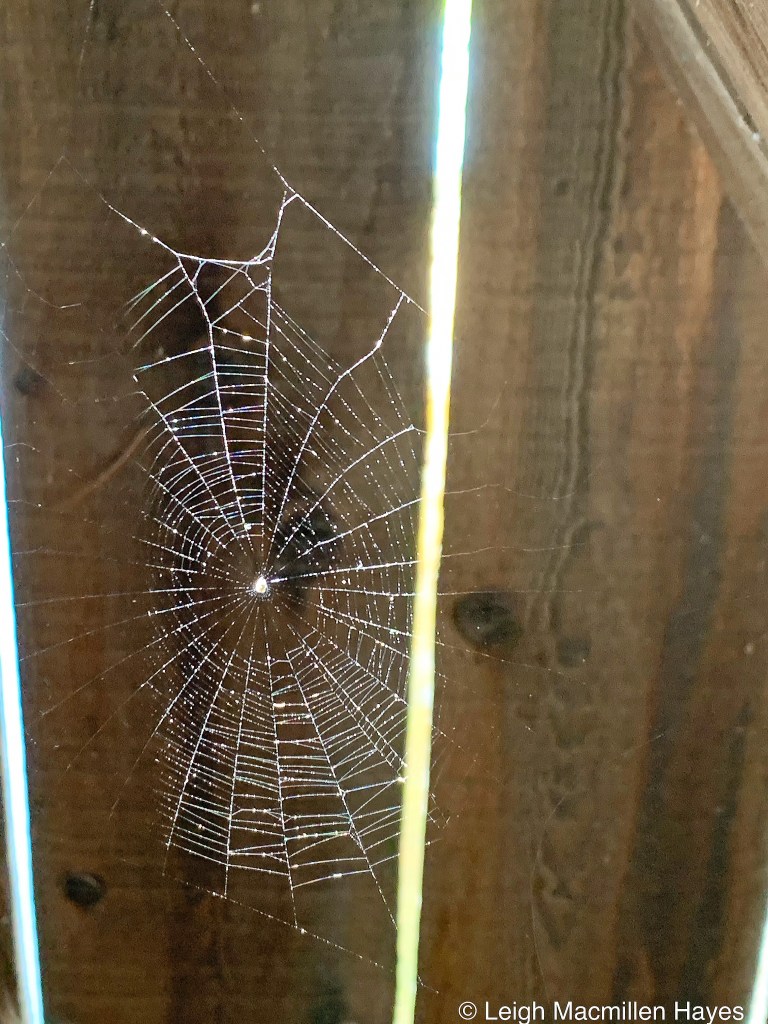
There are so many joys about spending time in the wetland, but a few include dew upon spider webs,
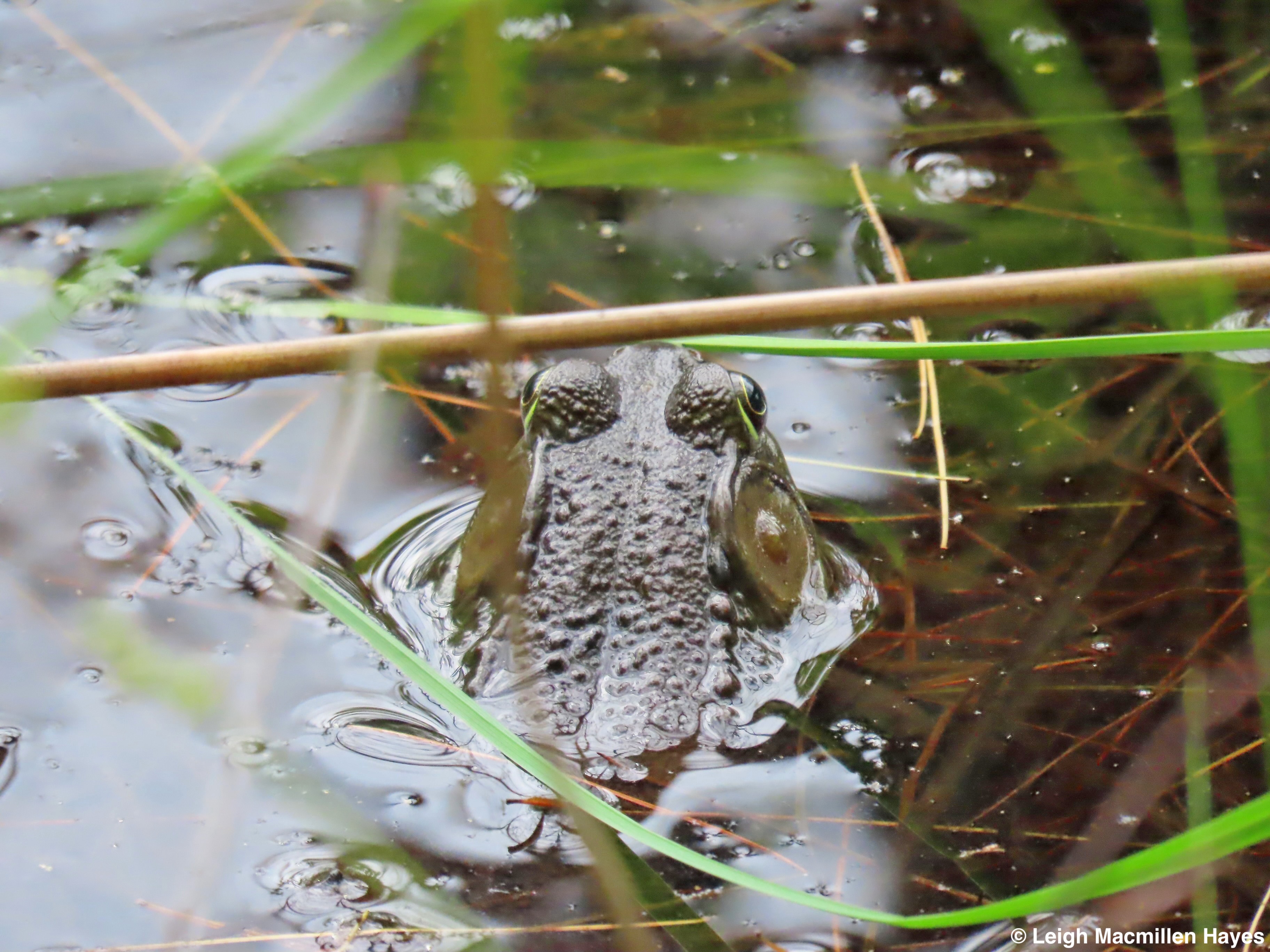
Frogs who ga-dunk, ga-dunk at our feet,

a young Robin calling for its parents,

and the spotting of four Wood Ducks on a snag.
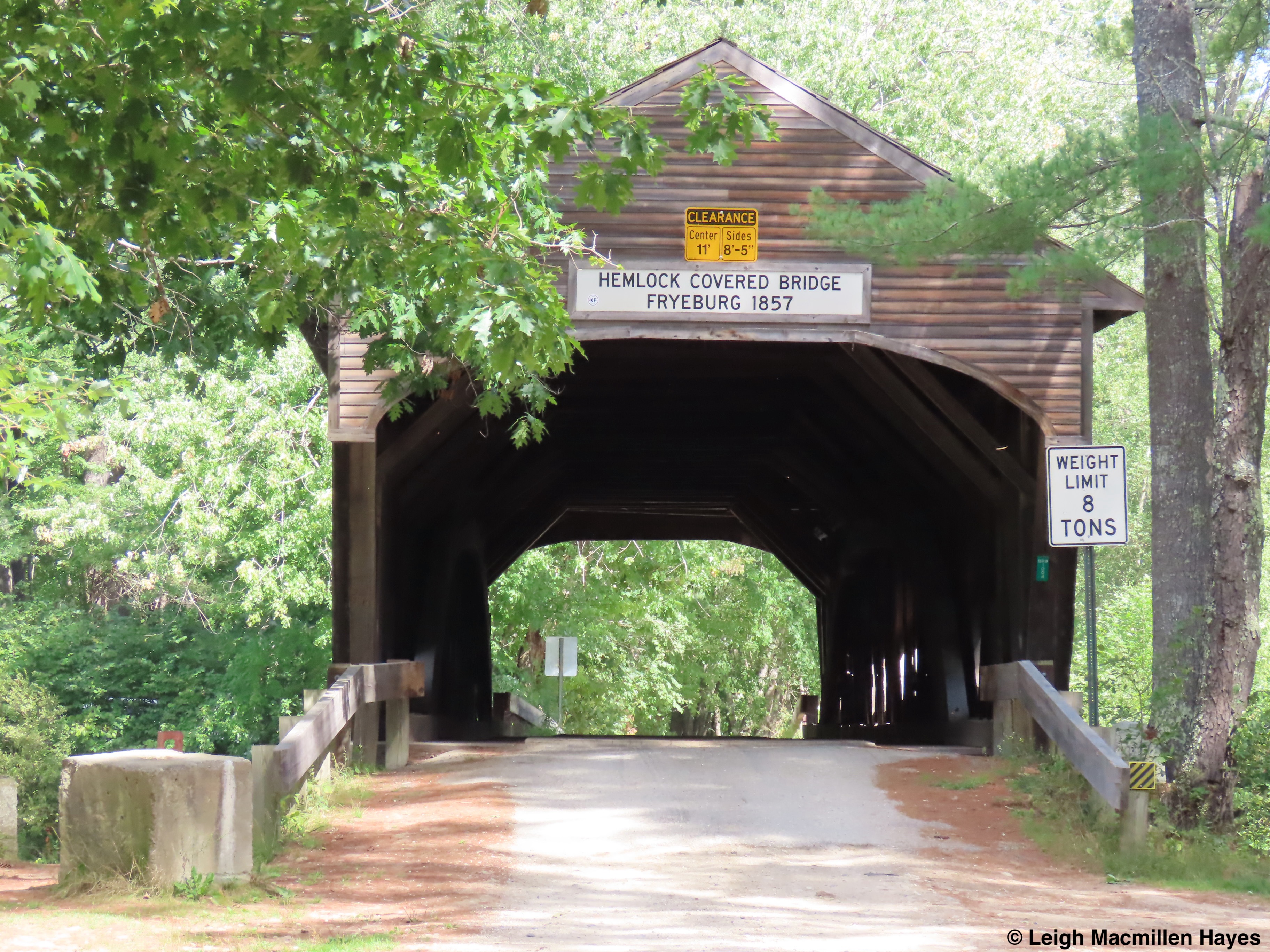
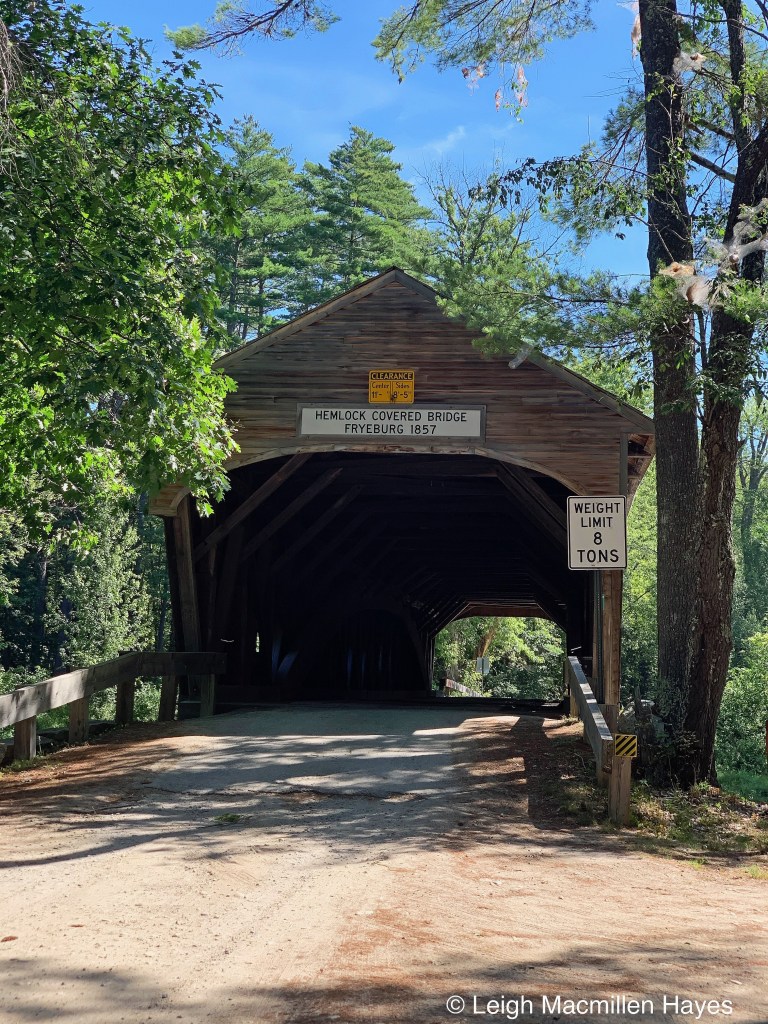
Fast forward two months and this afternoon found me walking the roadway on either side of Hemlock Bridge, my eyes darting here and there taking in flora and fauna with each step.

I love the Paddeford construction of this bridge. Or maybe it’s just that I love that we live so close to a covered bridge. And recently, because I’m taking a painting course, I tried my hand at showing off some of its beauty.
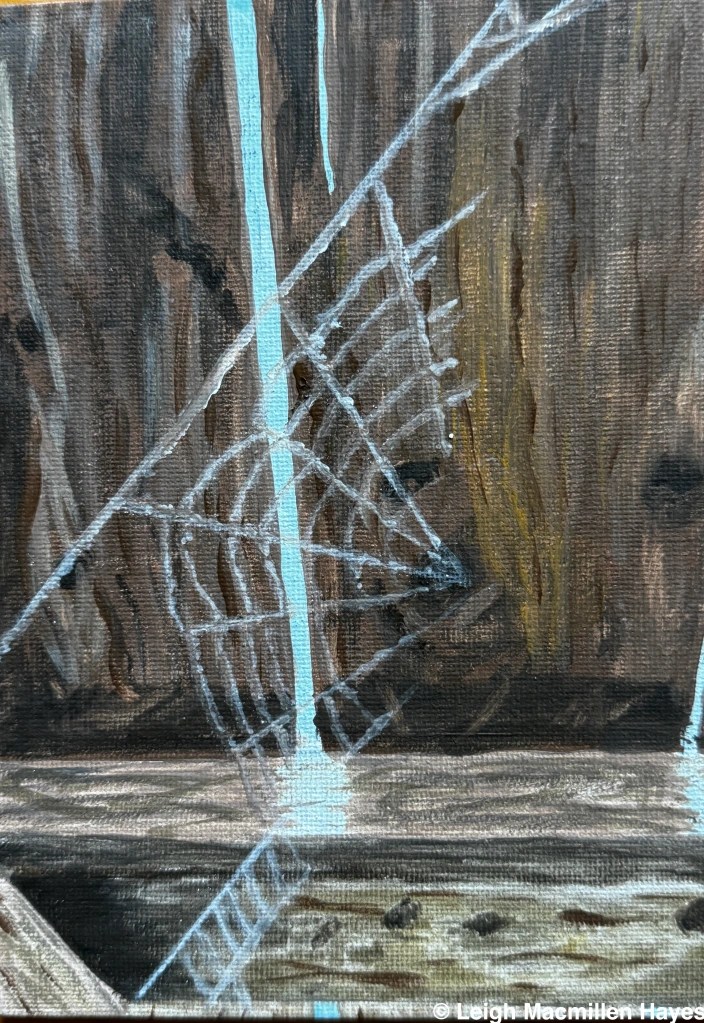
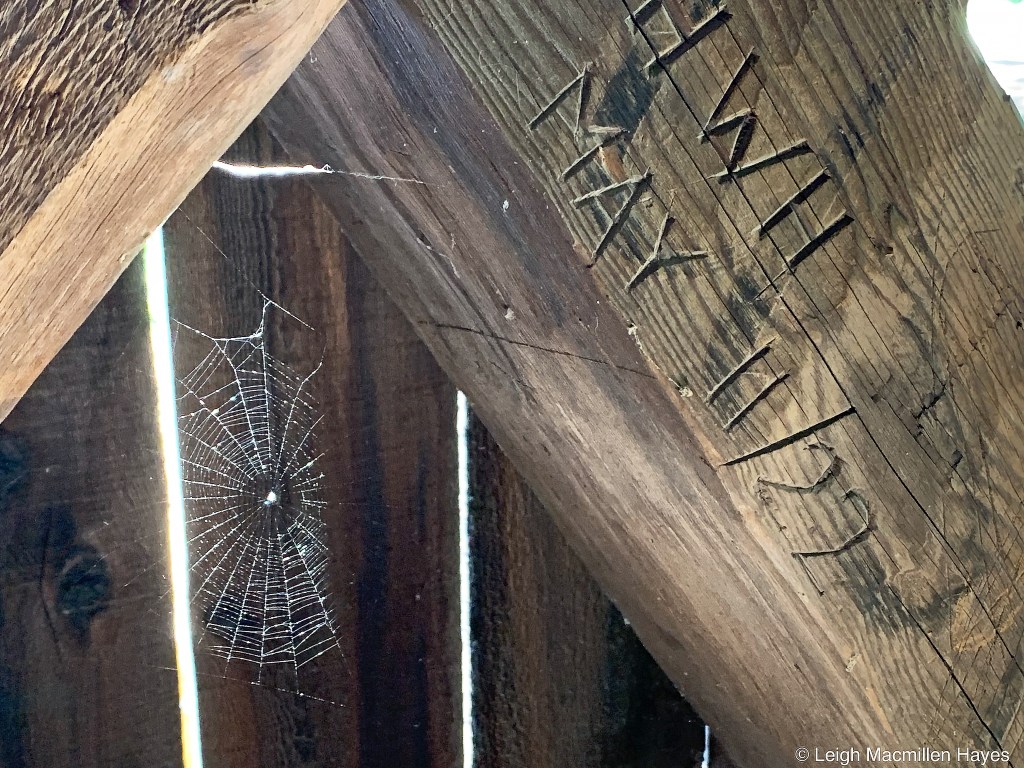
Spider webs did not go unnoticed by me. I didn’t spot the creator, but trust that an orb weaver was hiding somewhere nearby.

As I walked along the old course of the Saco River, I spotted a few Painted Turtles basking in the sun, but also noted all the debris clinging to branches, a sign of the high water we had this past spring.

And then something else caught my eye. One of my teenagers was on a fishing expedition. And panting to cool down.

I got excited when it seemed he’d spotted a meal.

Apparently that didn’t pan out and he turned his attention in the other direction. As I watched, he tiptoed ever so gently for such a big bird, and I was certain he was on to something.
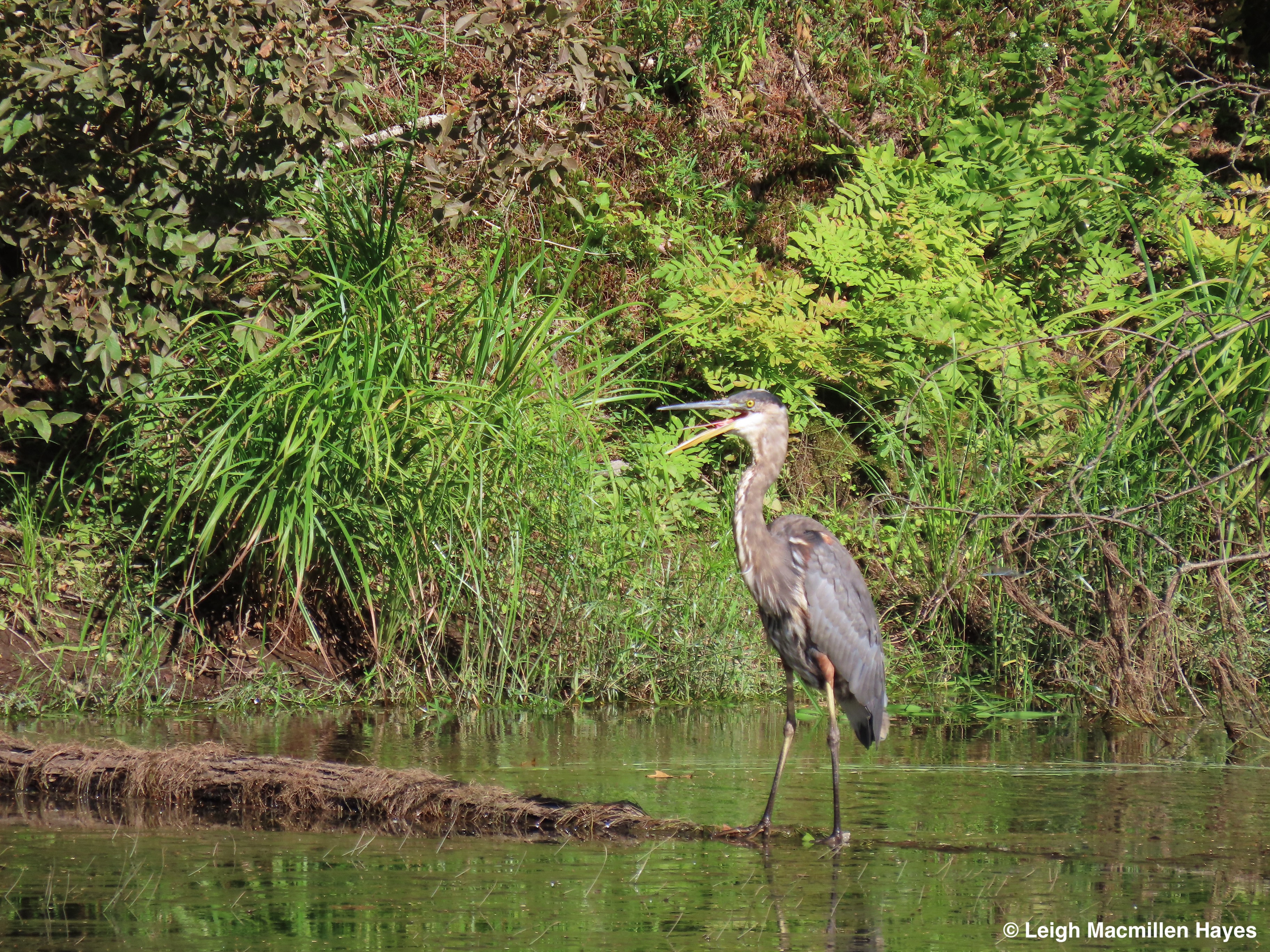
But then he stood there and panted some more.

Until there was a bit of a tussle and I realized he and a snake had a brief encounter. Both survived. And left each other alone.
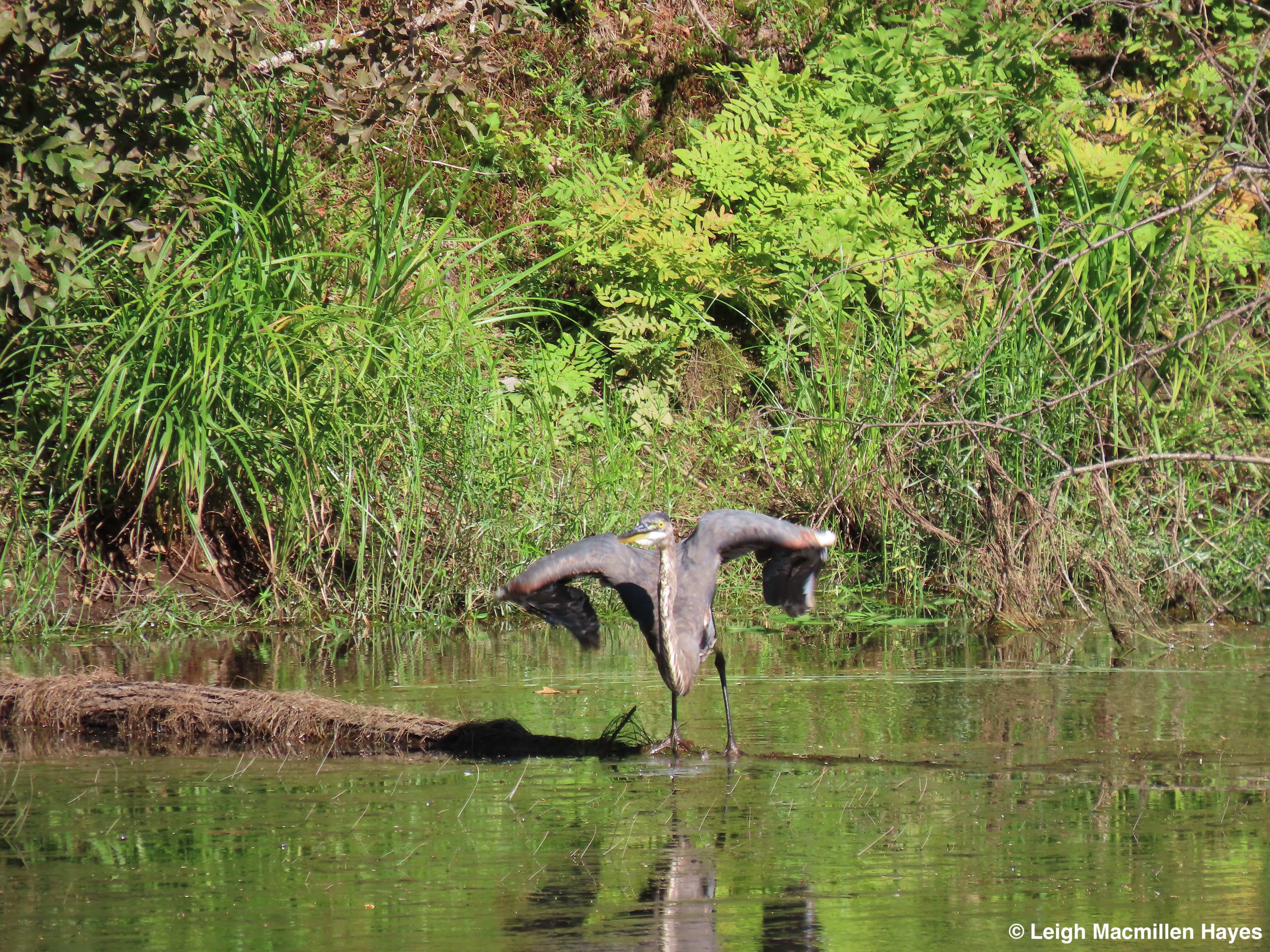
And then the bird flew and I was bummed. I wanted to witness a meal being taken. But I have to have faith that it found success somewhere else upon the river. Just as I trust that the sun will rise tomorrow, and the day after that. This bird will not go hungry.
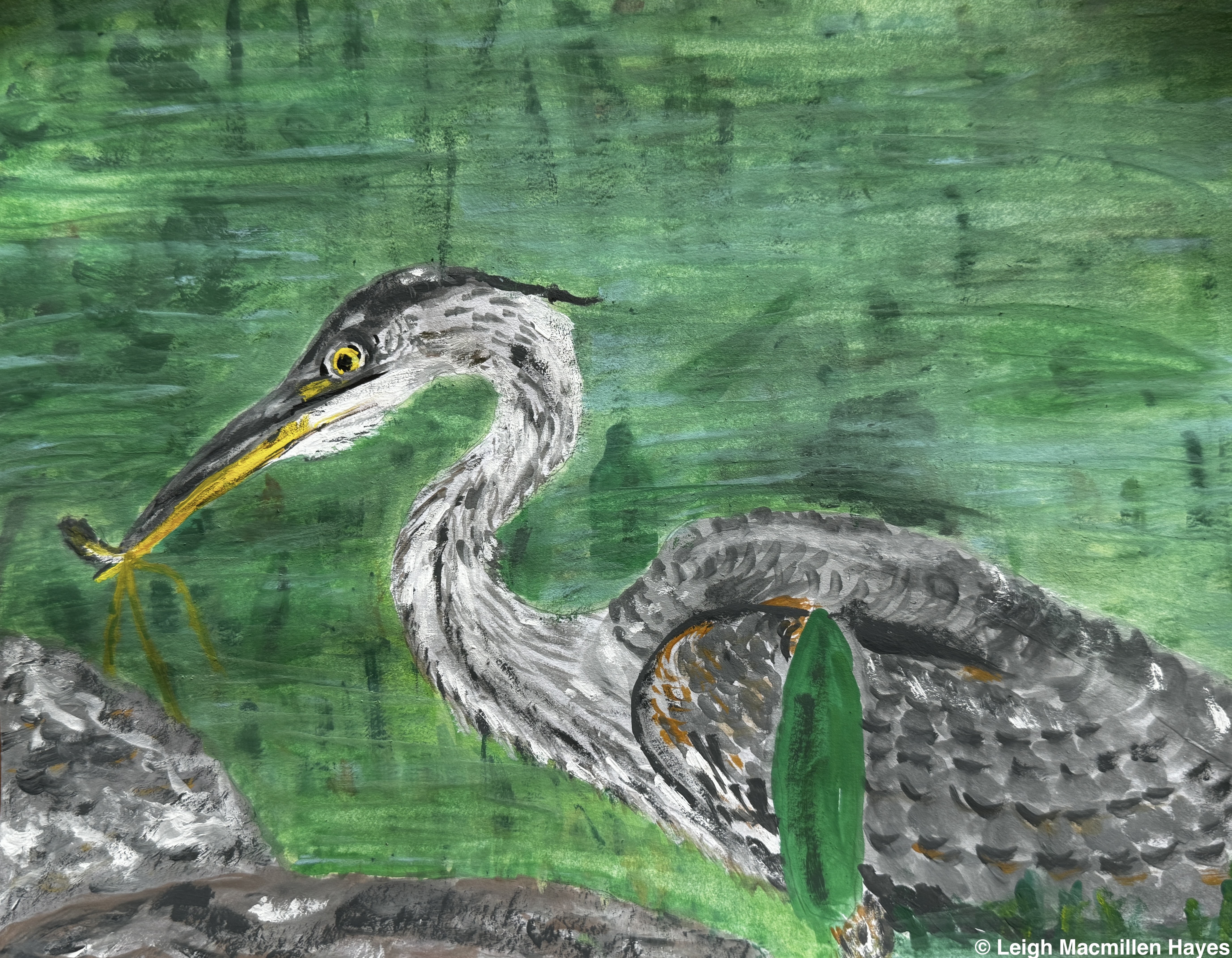
Instead, upon arriving home I pulled out a painting I completed a couple of weeks ago of a Great Blue Heron I watched snatch a fish last summer.

Just as the young heron’s accomplishments may take time, so do mine as a painter. But it sure is fun trying.

As for the count:

One rookery featured 19 active nests at the start, but only three toward the end, and I have to wonder if a predator found many a meal high up in those trees.

The other rookery featured 53 nests, with all but a few being active and lots of youngsters produced.

That, in itself, is a great heron accomplishment.
Frog Alley

I’m pretty sure I said to the friend whom I met on the dirt road that I never see frogs there except for the painted boulder that has faded with age and I no longer even think to honor with a photograph.

But still, she reminded me, “I’m sure we’ll see something interesting.”

No way.

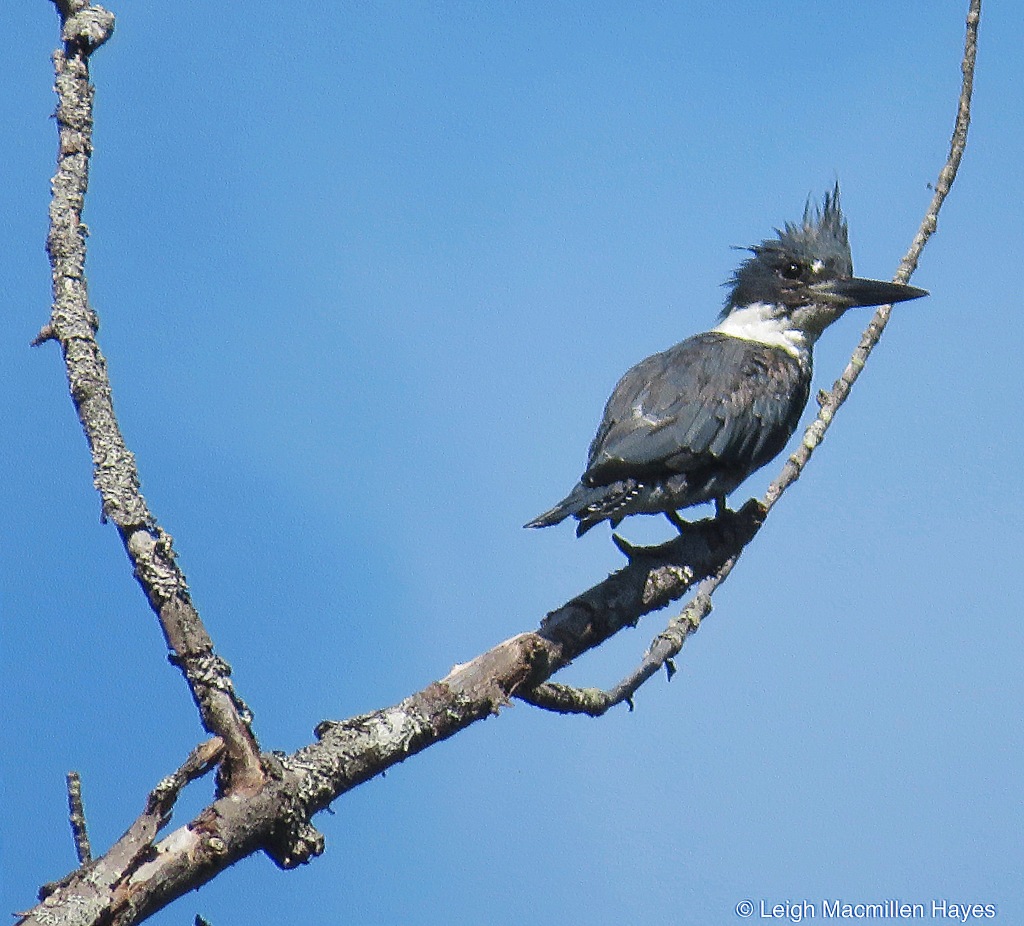
After walking one stretch of the road and only pausing a few times in the hot sun, we hopped back into our vehicles and made our way to a much more shaded location. As we stepped toward the river, in flew a Kingfisher. And we knew we were in for a treat or two or three . . .

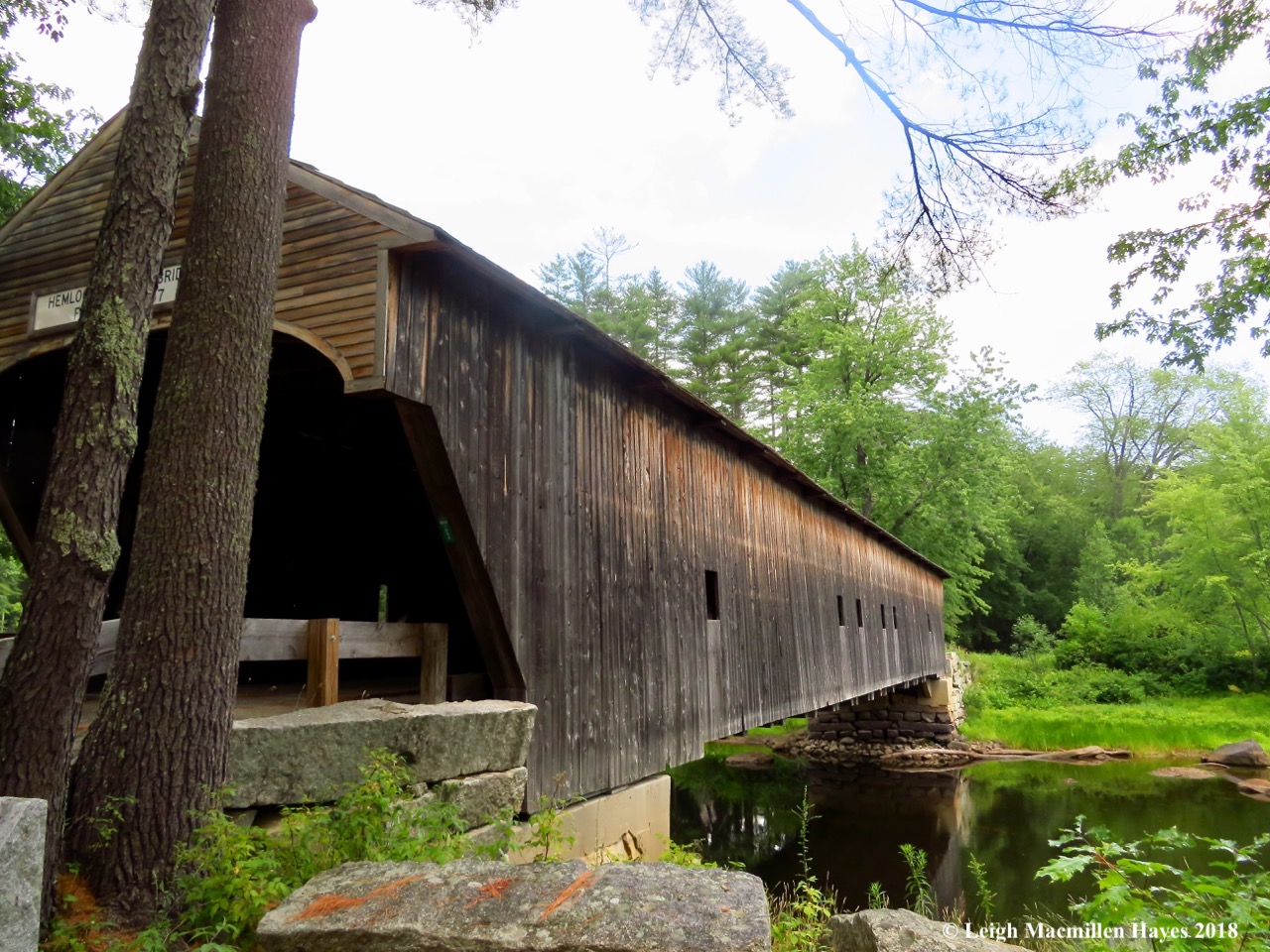
But first, we had to explore the structure that has spanned the river for 163 years: Hemlock Covered Bridge. My friend is a history buff and I’m a wanna-be so it was apropos that we should take our time as we walked across–pausing to look and wonder as frequently as when we’re on a path.

I first saw this relic of the past years ago when I canoed up the Old Course of the Saco River with a group of tweens whom I took on weekly adventures when my summer job was as Laconia YMCA’s Summer Camp Director. In those days, one could get permission to camp by the bridge. Things have changed and that land is now posted with No Trespassing signs.

The bridge is a woodworking masterpiece and a symbol of the pioneering spirit of the 19th Century. In this 21st Century, there are others who also have a pioneering spirit and create their own masterpieces within.

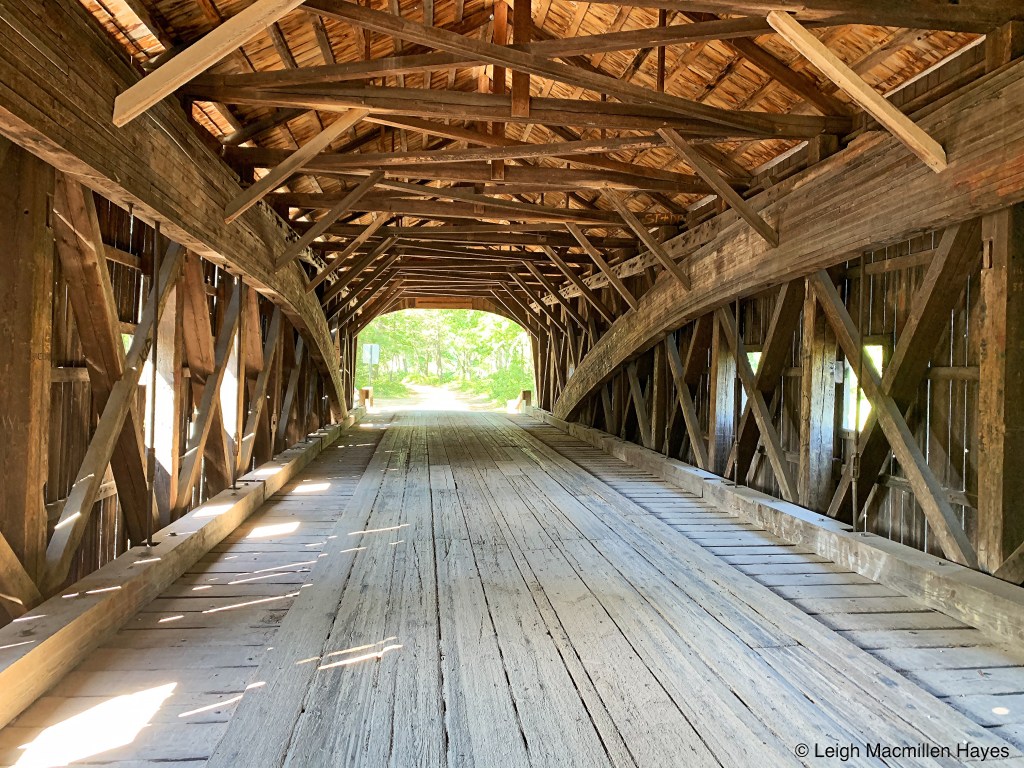
Built of Paddleford truss construction with supporting laminated wooden arches, Hemlock Bridge is one of the few remaining covered bridges still in its original position. Peter Paddleford of Littleton, New Hampshire, created this design by replacing the counter braces of the Long-style truss bridge, creating an unusually strong and rigid structure.

Though reinforced in 1988 so you can still drive across, it’s more fun to walk. As we did we took time to admire the work of our forefathers,

peer at the river,

and read the carved messages on Maine’s oldest remaining covered bridge.

It was designated as a Maine Historic Civil Engineering Landmark by the American Society of Civil Engineers on January 17, 2002. I’m not sure what happened in 1922, but obviously it was another date to note.

Originally there were 120 covered bridges which spanned rivers throughout Maine. Covers or houses were constructed to protect the wooden span from the weather.

They were also places where travelers and animals could seek refuge from a storm, or lovers could sneak a kiss. Six of the remaining nine in Maine are located in the Lakes and Mountains Region.

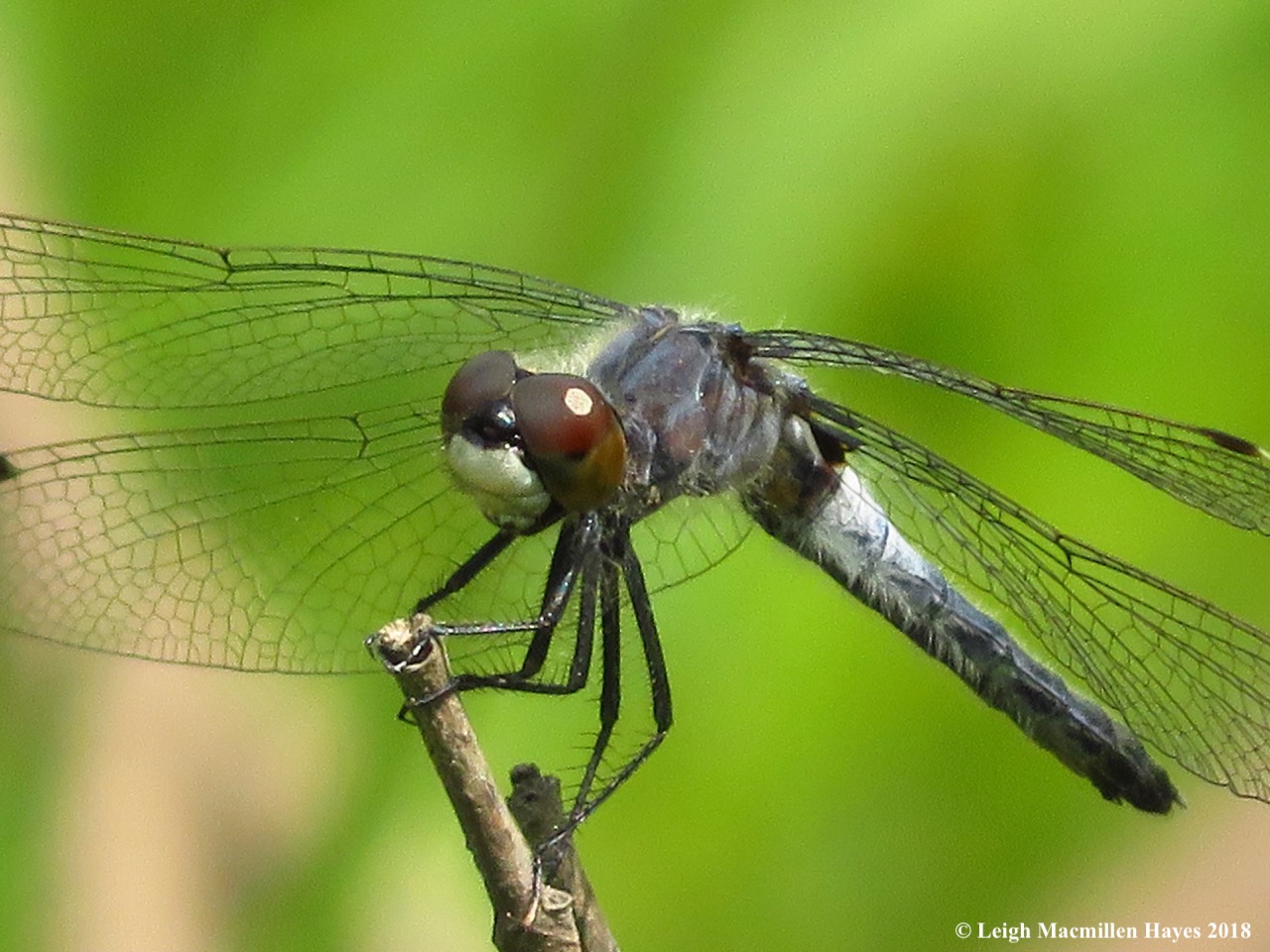
We admired every facet of the bridge for moments on end, and then made our way to the river’s edge, where Slaty Blue Skimmers continued to dance. But as is their habit, this one kept landing on the same broken branch. Eventually, I coaxed it onto my finger, but then a sweetheart zipped by and he was off, hoping to sneak a kiss of his own making.

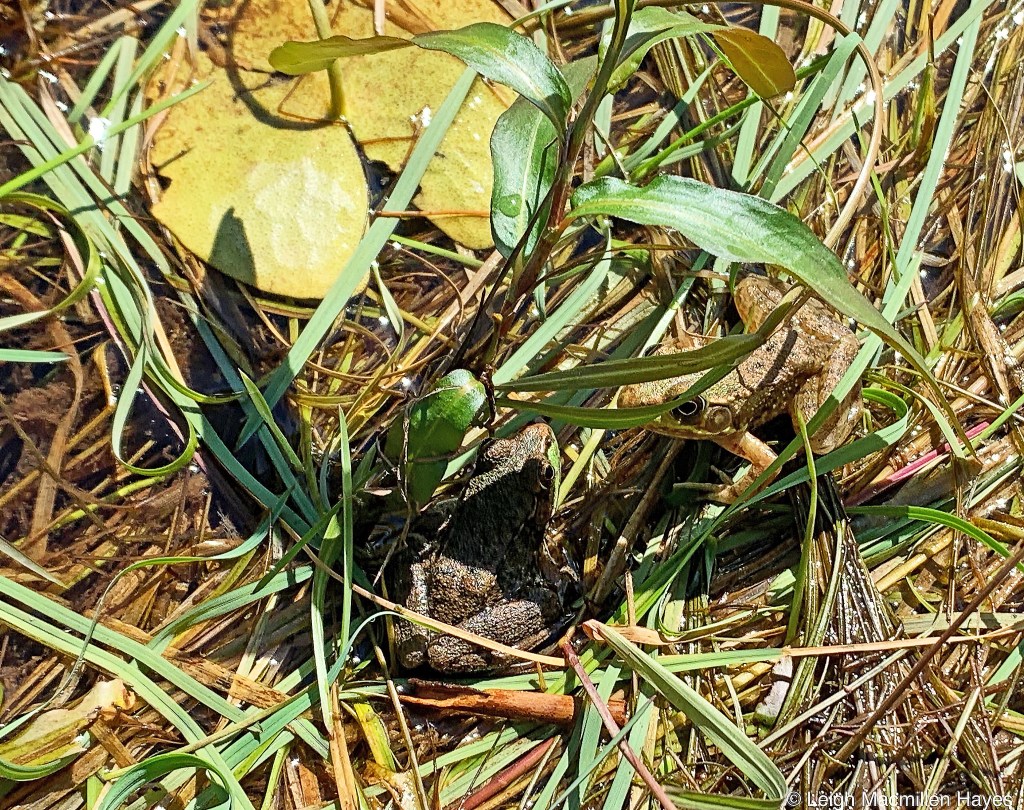
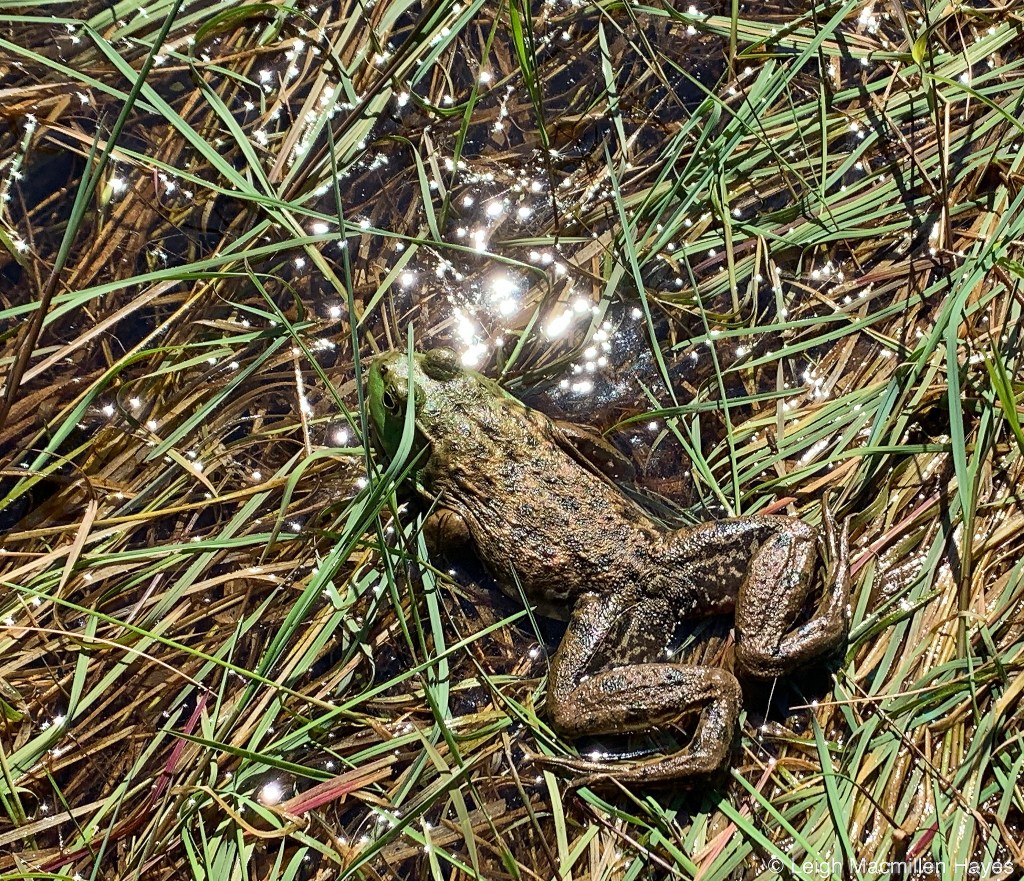
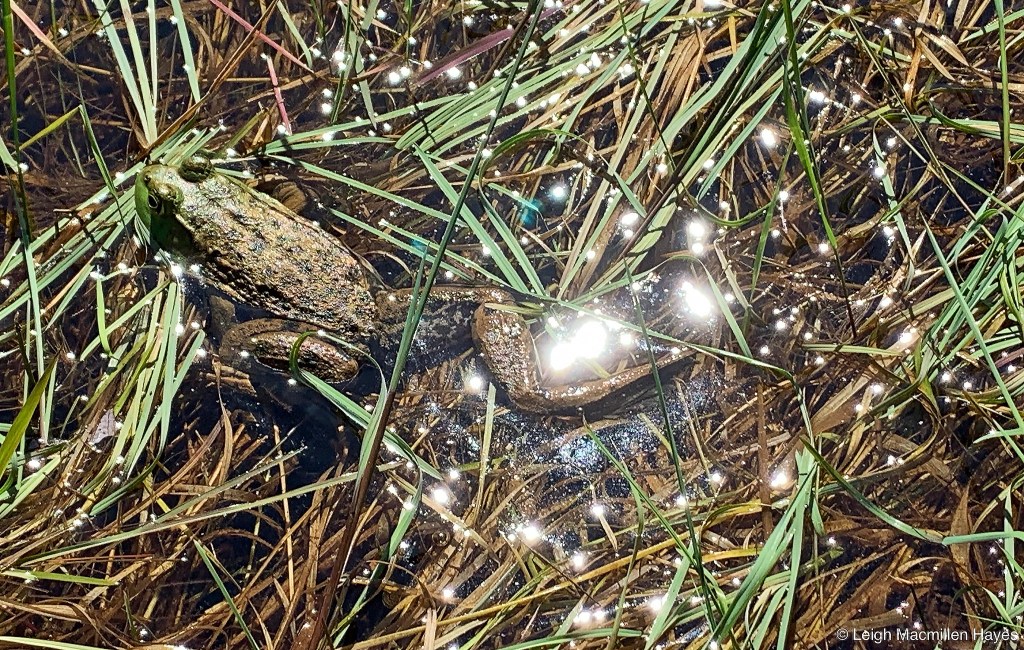
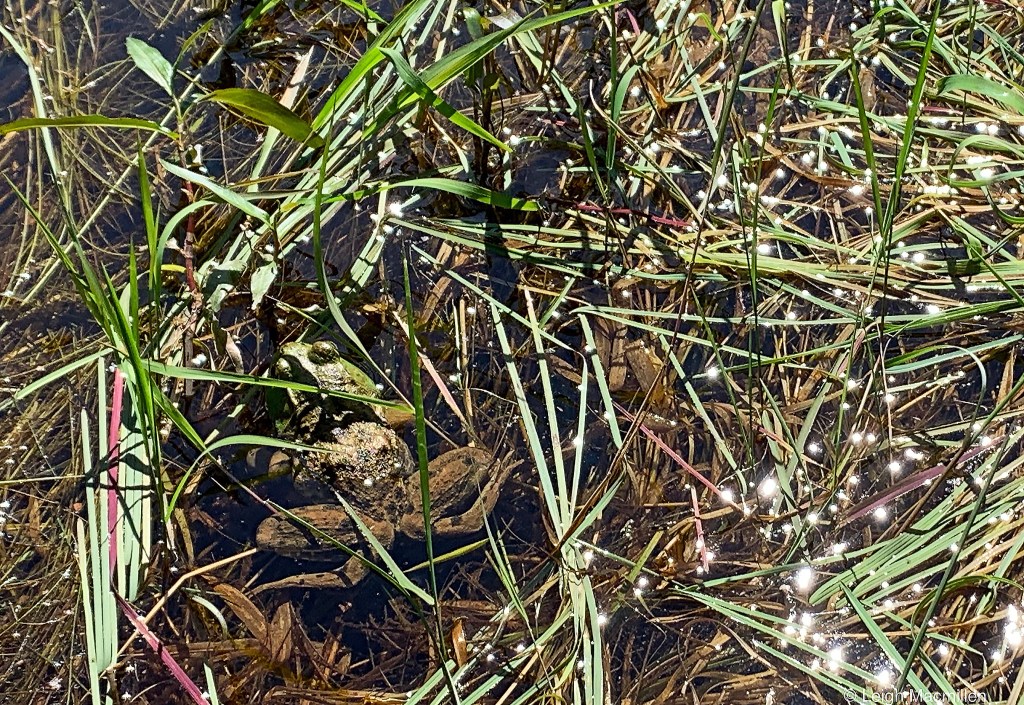
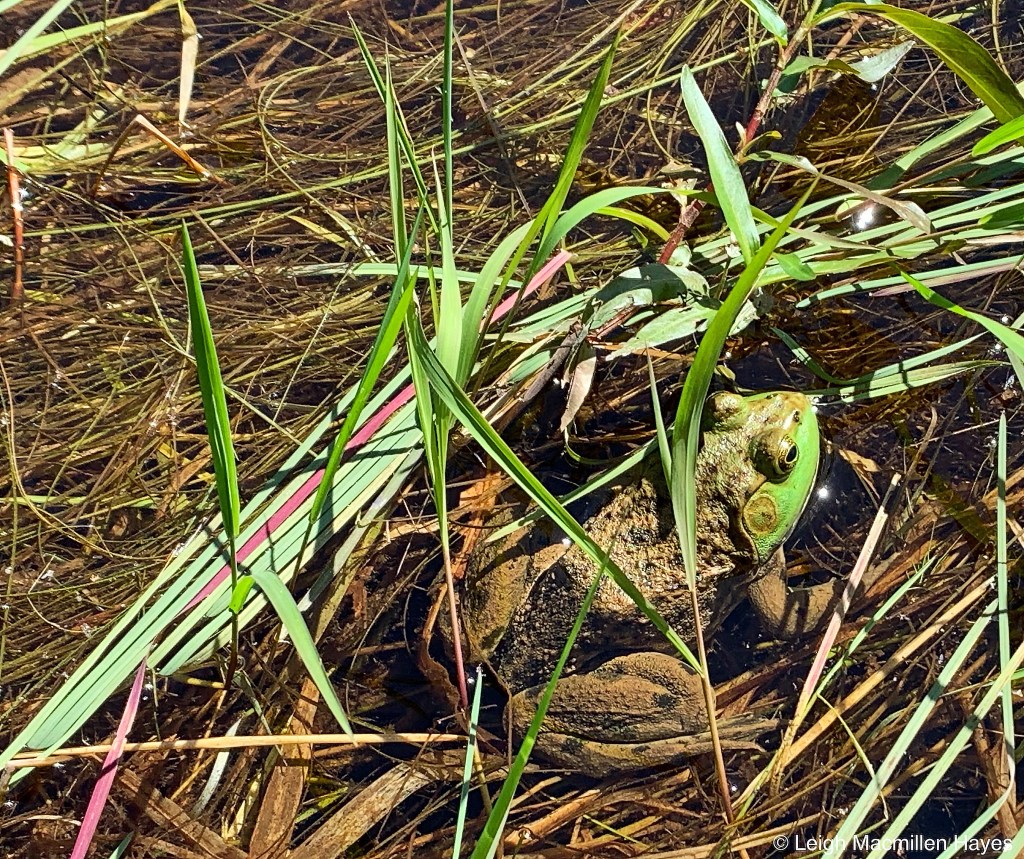
Next, our attention focused on a bullfrog. A huge bullfrog.

Two little Green Frogs were focused on the same and remained as still as possible in hopes of not attracting Mrs. Bully’s attention.

She at last began to move and her forward motion was slower than either of us have ever witnessed. We watched as she slithered forth one frog leg length at a time.

At last she reached a destination and paused. Was she hiding from us? Had she slithered like a snake in hopes we wouldn’t see her? Or did she have her eyes on a meal?

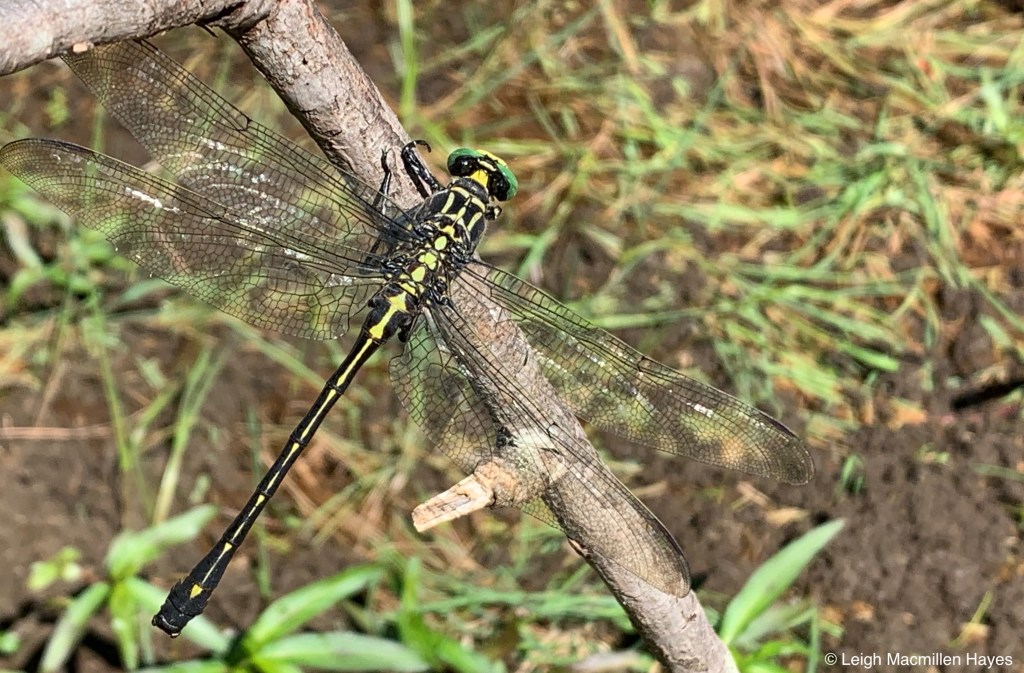
We’ll never know for a rare treat suddenly flew onto the branch where Slaty Blue had posed time and again. Meet a Dragonhunter. This huge clubtail dragonfly is known to eat butterflies and even other dragonflies. Thank goodness Slaty Blue had moved on.

Suddenly it was time for us to move on as well, but not before spying one more frog–this one a small Pickerel with sets of dark rectangles decorating its coppery-colored body.

With that, before my friend and I bid adieu, I had to eat my words that there are no frogs on Frog Alley. But technically, we weren’t on Frog Alley, but rather Hemlock Bridge Road. Still, the two are connected and we gave thanks for the chance to honor the past and wonder about the present in this locale.

Taking Flight

Morning had broken . . .

h1-morning has broken

and Pleasant Mountain’s reflection marked a new day.

h2-variable dancers conducting variable dance

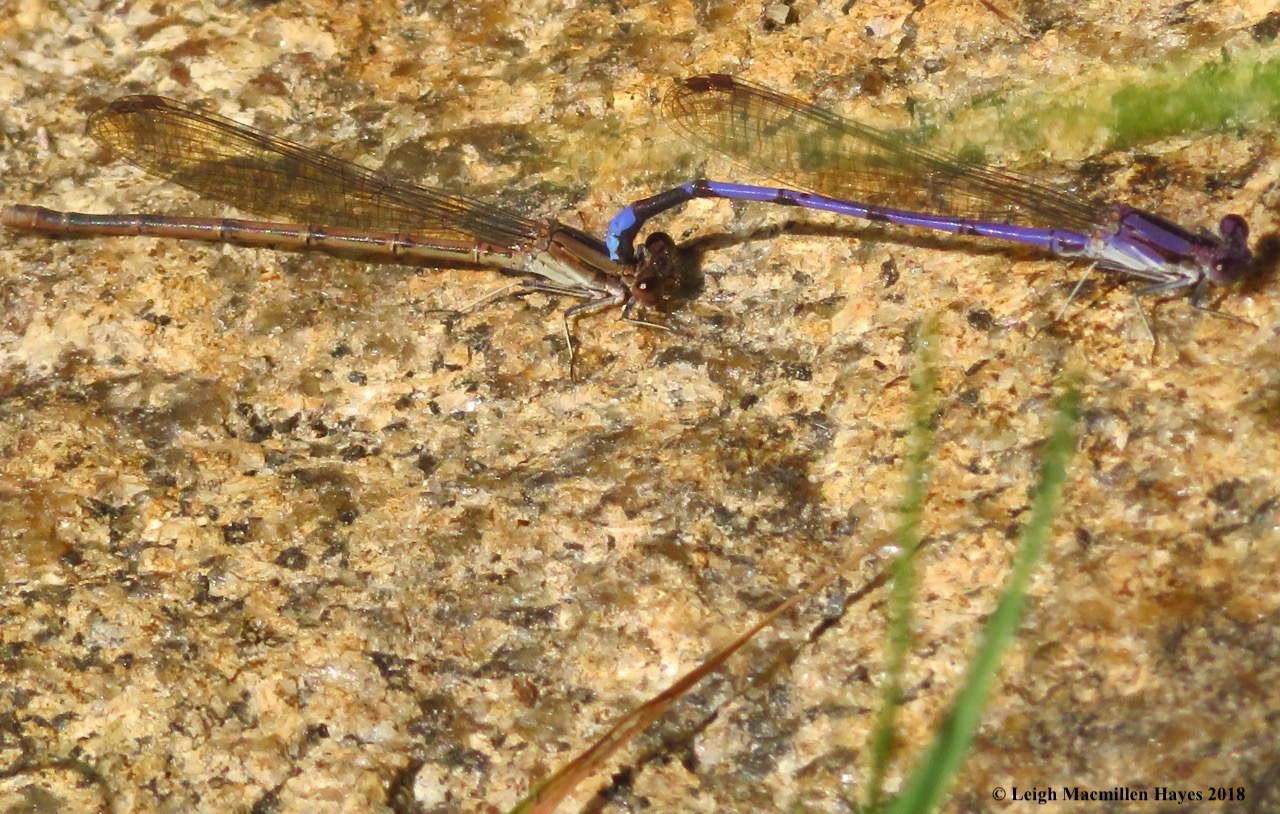
New life was also in the making as the Variable Dancer Damselflies practiced the fine art of canoodling. I’d never noticed an oviposition aggregation before, but it made sense if it minimized the threats a couple receives from unattached males. Plus, if the spot was good enough for one pair to lay their eggs, then it must be fine for another. And so I learned something new today.

h3-slaty skimmer

Perhaps it also cut down on predation, though I couldn’t stay long enough to note if the Slaty Skimmer that hung out above turned either pair into breakfast. If so, I hope they at least had a chance to leave their deposits.

h4-Hemlock covered bridge

That was my morning view, but I changed it up a bit this afternoon and darted across the Hemlock Covered Bridge that spans the Old Course of the Saco River in Fryeburg. Built in 1857 of Paddleford truss construction with supporting laminated wooden arches, the bridge is a quaint and charming reminder of days gone by.

h5-bridge

Though reinforced in 1988 so you can drive across, it’s even more fun to glide while admiring the work of our forefathers and . . .

h8-water low

peer out a window at the river from Maine’s oldest remaining covered bridge.

h6-LOVE

The handiwork of more recent travelers . . .

h7-love lasts forever

was also clearly visible.

h9-river jewelwing-female, white dots in sync

Down by the Old Course, I spotted a female River Jewelwing, the white dots on its four wings showing off in the day’s light. Just prior, a few sprinkles had fallen and one teeny droplet rolled down her thorax. A few even teenier ones clung to her legs.

h10-Hemlock Covered Bridge

With one more look back to reflect upon the bridge, I was then ready to set sail again.

h11-Mt. Kearsarge

Heading toward Frog Alley, the view across the fields included Mount Kearsarge amid the summer haze that had developed.

h18-Mount Tom

Mount Tom was more clearly visible for it was so much closer.

h12-Dianthus armeria, Deptford pink

But what I really stopped to look at where those things closer to the ground, like the brilliant pink Dianthus with their petals all spotted and toothed at the tips.

h14-bindweed

Offering a lighter hue of pink, a bindweed twined its way through the roadside wildflowers.

h13-honeybee on milkweed

Also with shades of pink and the yellow complexion of those flowers already pollinated, milkweed was in full bloom and the ants and some flies were making the rounds, but I only saw one honeybee taking advantage of the sweet nectar. It reminded me that the same was true on the milkweed growing in my garden where, at most, I’ve seen four honeybees rather than the usual swarms.

h17-sulphur cinquefoil

And then there was the subtle yellow of the Sulphur Cinquefoil showing off its cheery face despite a few tear drops. Actually, it may have cried for only a few drops had fallen from the sky and we really do need a soaking rain.

h16-clouded sulphur butterfly

As if taking a cue from the cinquefoil, Clouded Sulphur butterflies flitted and danced along the road.

h16- clouded sulphurs puddling

And then I realized that they kept gathering in groups. It’s a form I’d read about but never observed before–puddling. This was a male habit and apparently their intention was to suck nutrients from the wet ground. I guess even a few raindrops served the purpose.

h15-dragonhunter

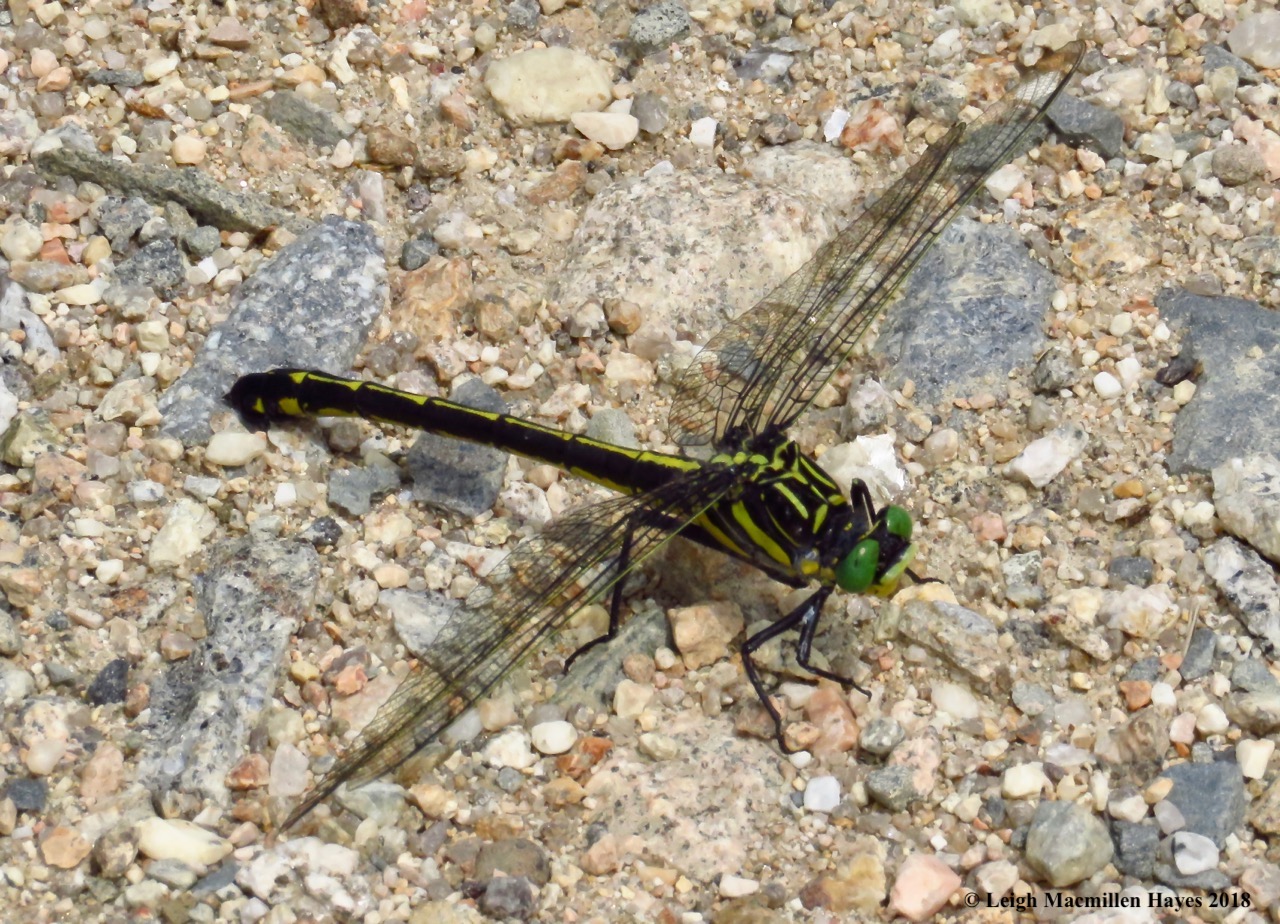
Before I moved on again, my heart was still as more yellow entered the scene in the form of a striped thorax and I realized I was watching a Dragonhunter Dragonfly. Though it wasn’t so easy to see the tip of tail once it landed, as it flew about in my vicinity it kept its abdomen curved down–a habit of these big guys.

h29-Fryeburg Bog

The Fryeburg Bog was my next landing and though I didn’t head out to the water that was more like an over-sized puddle, I found plenty to focus on.

h19-buttonbush

For starters, the Buttonbush had begun to bloom and I loved its otherworldly presentation.

h21-frosted whiteface

It was there that I saw the smallest of dragons, in the form of the Frosted Whiteface.

h22-frosted whiteface

At most, he was about 1.5 inches long–quite probably the smallest of the species that I know.

h20-ruby meadowhawk

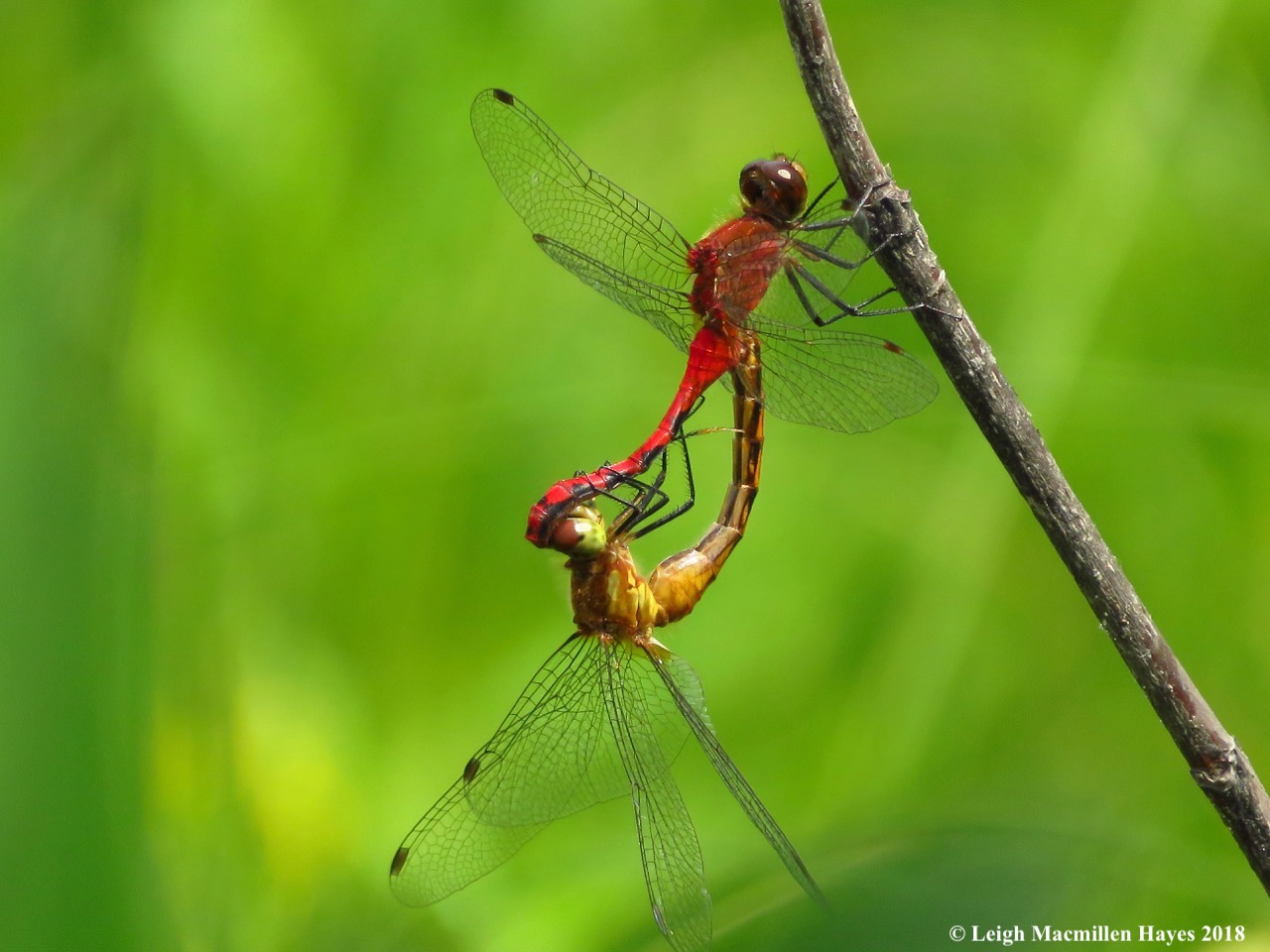
It was there that I also spotted my first Ruby Meadowhawk of this year.

h23-ruby meadowhawks canoodling

And then there were two! And in the future, obviously, there will be more.

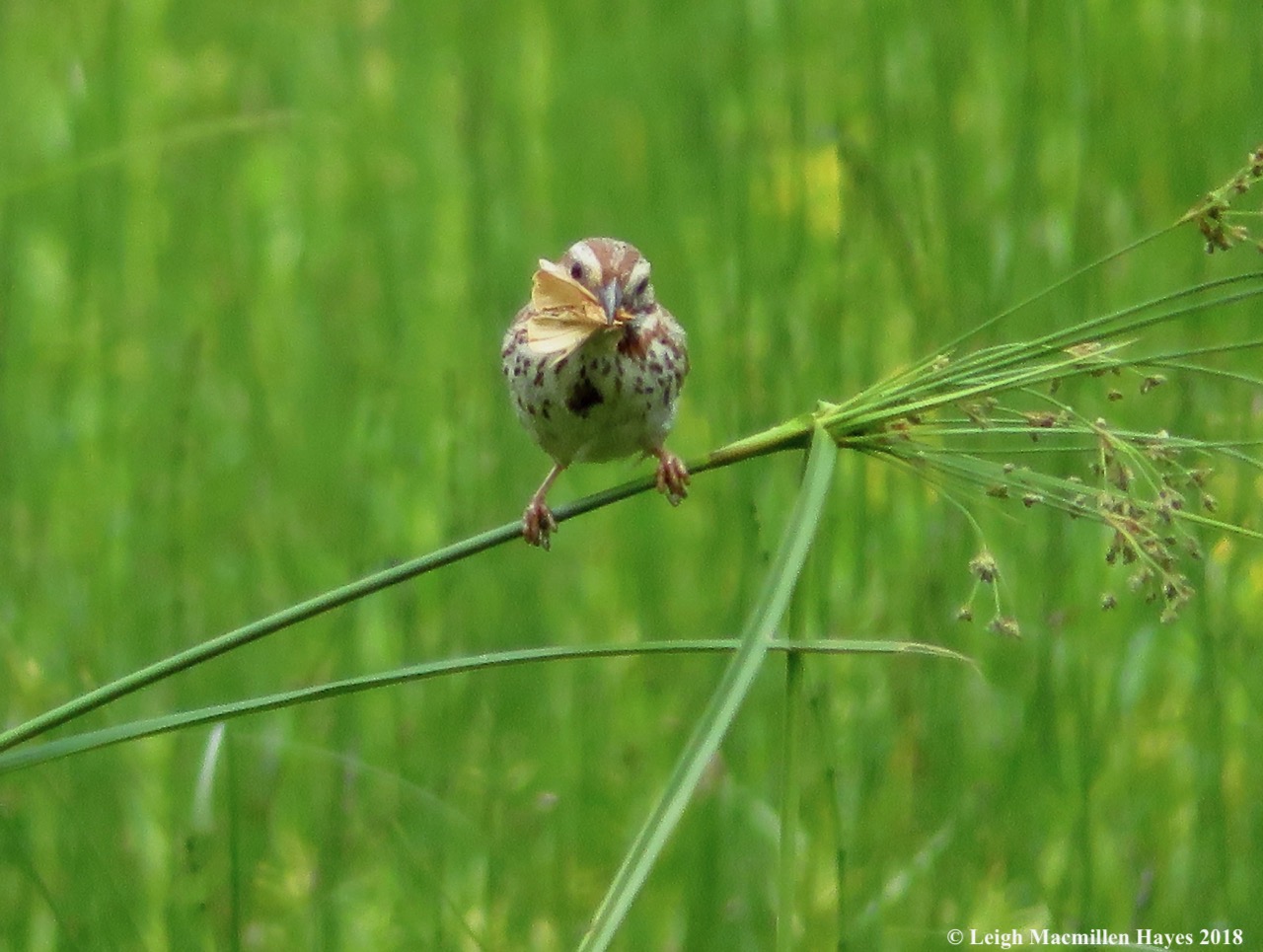
h23--late afternoon snack

And finally, it was there that I noticed a Song Sparrow had nabbed a butterfly snack–all part of the circle of life.

h30-Smarts Hill

My final stop on today’s journey was at Popple Hill Brook along Smarts Hill Road in Sweden.

h25-variable dancer

And like the Variable Dancers I’d seen this morning, I found many more beside the brook. Not only was the male’s purple coloring stunning, but notice those silvery legs.

h26-variable dancers canoodling

Of course, where there is more than one dragonfly or damselfly, there is love.

h27-variable dancers canoodling

As my tour began, it ended–with the Variables dancing to their heart song.

h28

And with that, I flew back to camp, where the mountain’s reflection was conducting its own dance routine as the sun began to slip toward the horizon.

h31-rainbow

And a few more raindrops produced a rainbow in the eastern sky.

Thanks for taking flight with me on this wonder-filled wander and soaring above some of the areas that are so unique and yet we tend to overlook them.