Naturally Wavy

The roads were coated in black ice when I drove toward Jefferson, Maine, early this morning to meet up with the Maine Master Naturalist class. The morning sun, brilliant blue sky with scattered cumulous clouds, and mist rising from open waterways, made me want to pause along the highway and take some photos, but I wasn’t sure how I’d explain to a state policeman that indeed it was an emergency. Instead, I continued on to Gardiner, got off the highway and followed backroads over rolling hills and through farm country to my destination–Hidden Valley Nature Center. 

Aptly named, the 1,000-acre natural education center consists of contiguous forest dotted with vernal pools, a kettle bog, ponds and 30 miles of trails.

Bambi

Bambi Jones, a Master Naturalist and co-founder of HVNC, spent the morning with us, showing us the vernal pools and sharing her knowledge. Things aren’t exactly hopping at the pools yet, but . . . the weather is supposed to warm up this week and once the snow melts–look out!

vp1

When I first looked at this vernal pool photo, I thought it was upside down–such is the reflection.

vpsign

A wee bit of info and a reason why we should pay attention.

fen2

This is a kettle hole bog apparently, caused by glacial action. I was looking up the difference between a bog and a fen and found this on The International Carnivorous Plant Society’s Web site: “People commonly describe wetlands with words like pond, bog, marsh, fen, and swamp, thinking these are mostly interchangeable. Actually, there are careful definitions for each of these names. The only problem is that a hydrologist may use one set of definitions, while a botanist may use another, and an ecologist may use yet another.”

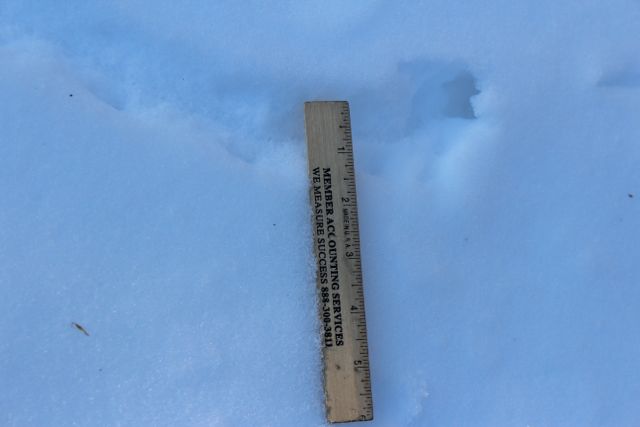
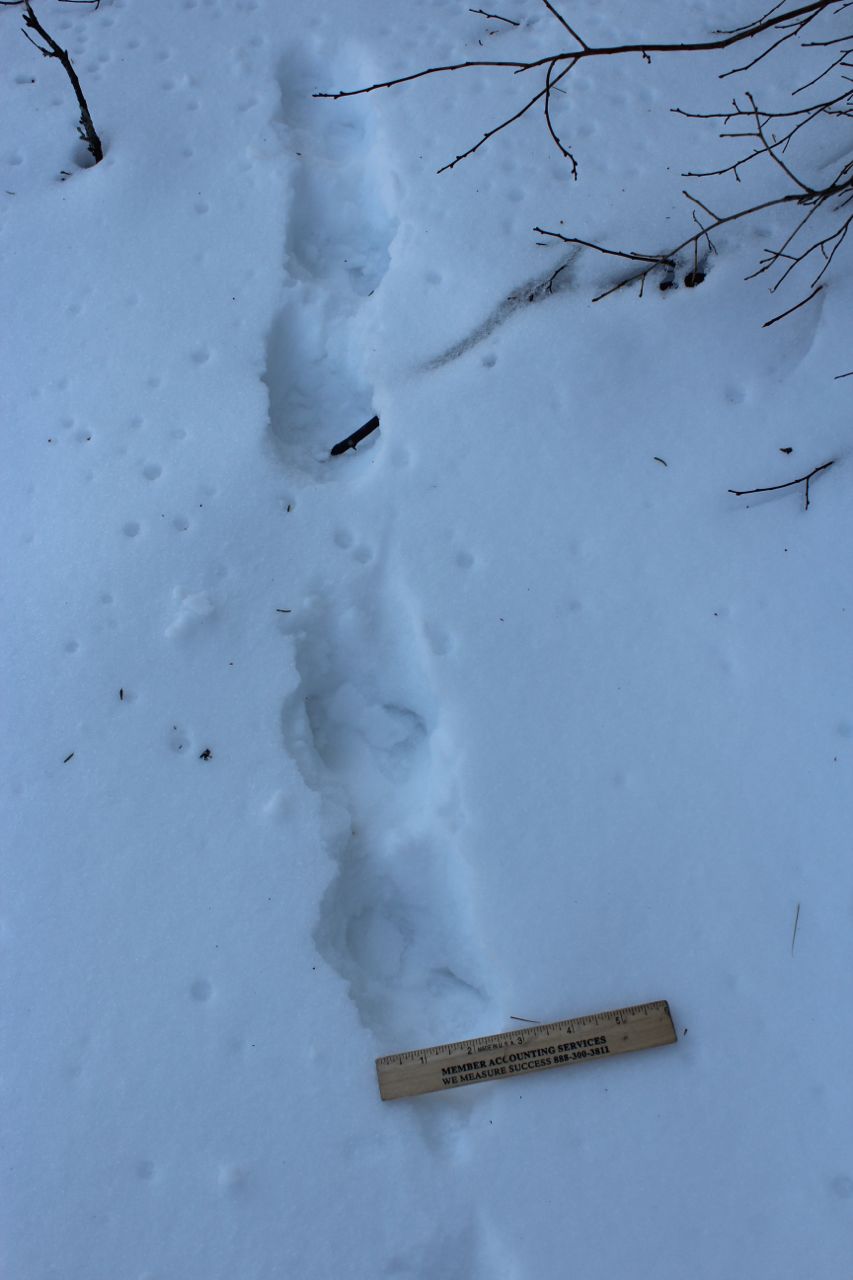
While we stood looking across, someone in the group spotted what they thought was a bobcat across the way and coming down a hill. I never saw it, but I did note lots of ledges in the area and on the way out saw some potential bobcat tracks.
fen1

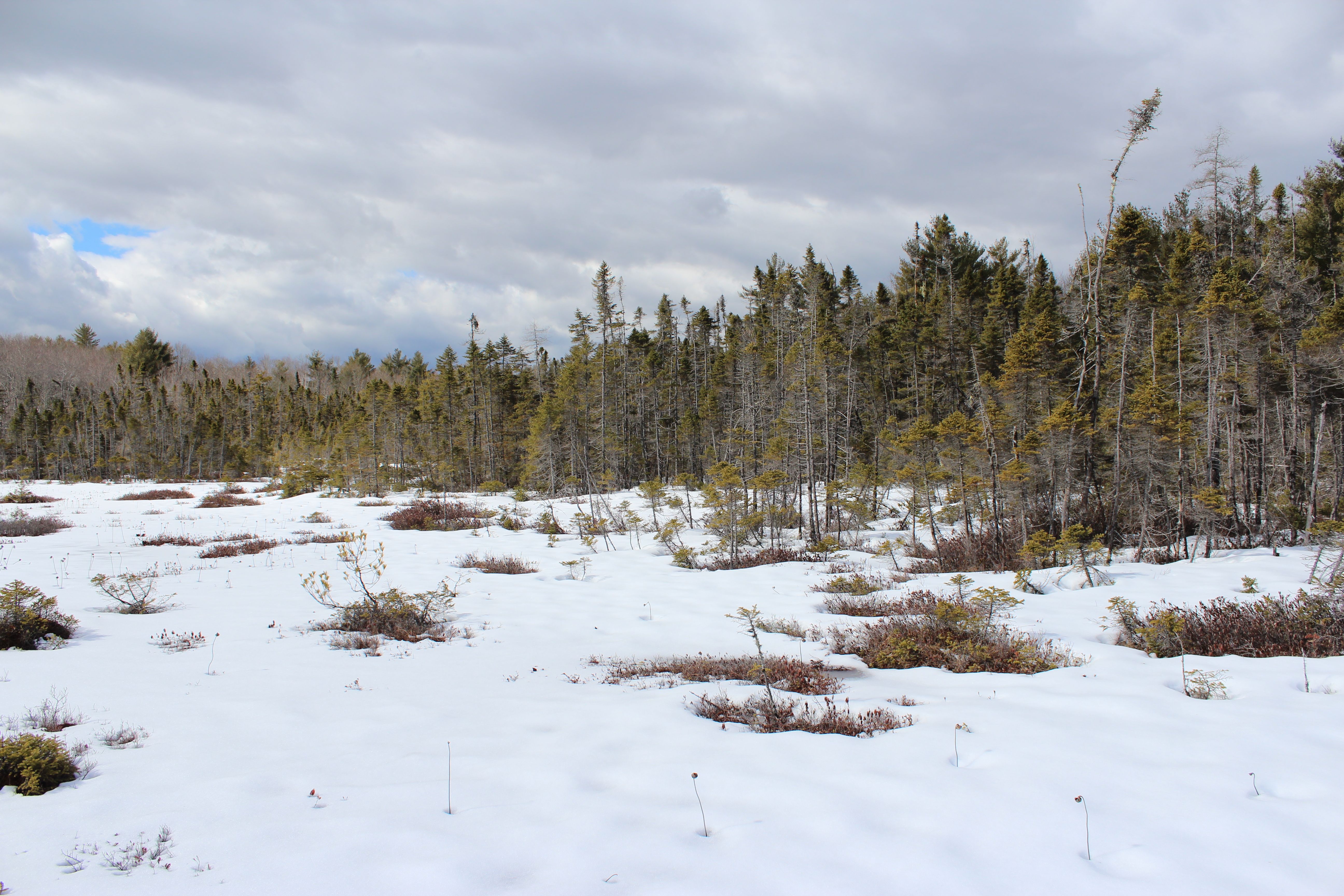
Another view. Lots of black spruce, sheep laurel and pitcher plant seed pods visible.

pitcher plant flower

The seed pod of a  pitcher plant, one of our carnivorous plants.

beaver lodge:fen

And a beaver lodge along the edge.

2nd beaver lodge

There were so many things to see, including a second beaver lodge that may have more action. Do you see it in the center of the photo?

beaver dam

This dam is nearby and had seen lots of activity. Due to yesterday’s rain, it’s a bit hard to decipher the tracks.

Cheryl , spring tails

Remember when I mentioned snow fleas or spring tails in my post entitled, The Small Stuff? Well, this is one of our students enjoying a circus performance.

cat

You never know what you might see when you take the time to look.
looking for life

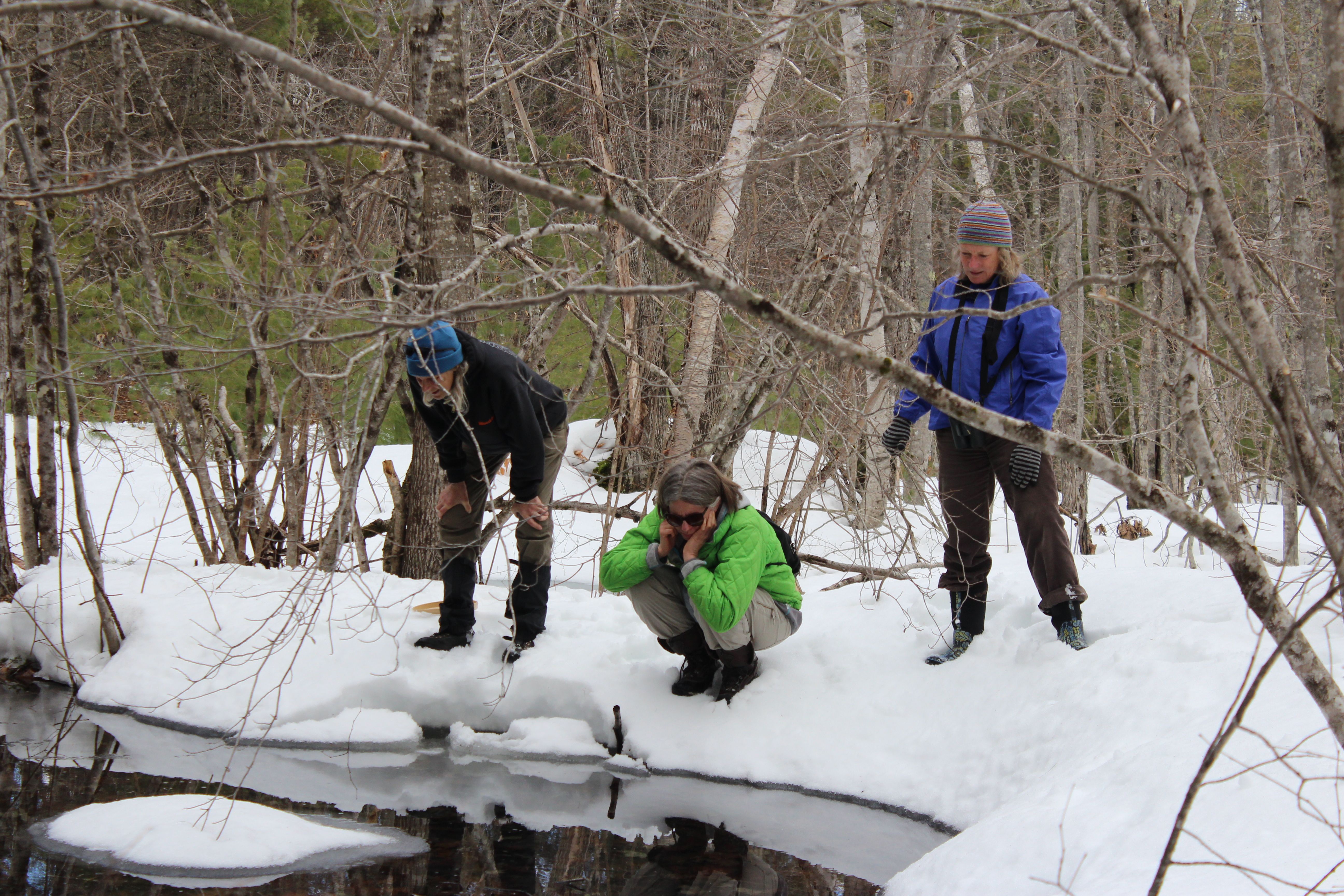
So they did–look that is. And almost fell in.
what's in your dannon?

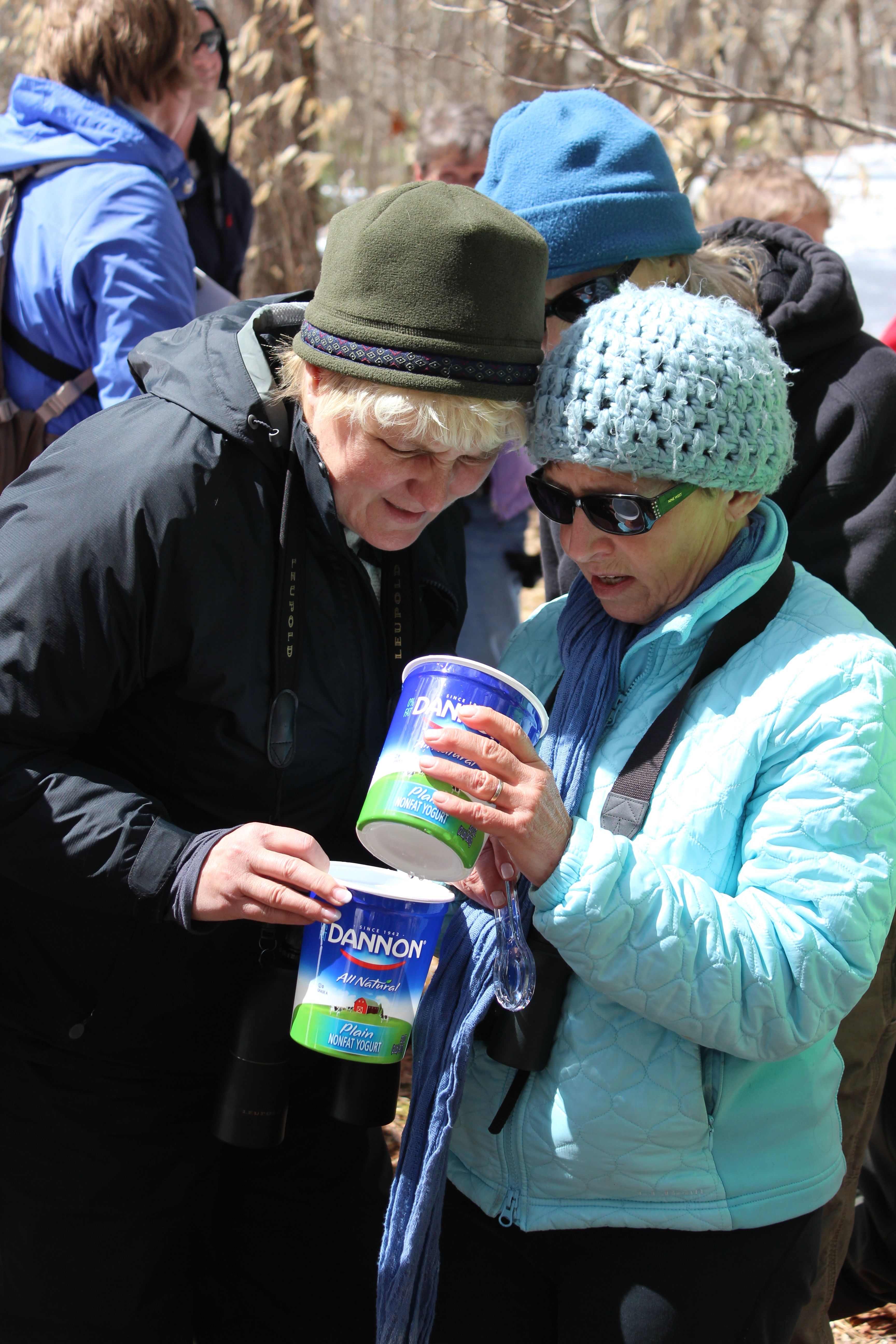
More observations–whatcha got in your Dannon container?

white oak1

One of my joys was meeting two new trees. I was excited to make the acquaintance of White Oak (Quercus alba) today. Rather than the ski trails and redness of Northern Red Oak, this species features bark that looks like irregular blocks.

white oak 2

And sometimes it looks shaggier, with long, vertical plates. Like its red brethren, the leaves are marcescent, meaning they stay on the tree through the winter months.

white oak leaf

What I love about the White Oak leaf is its rounded lobes.
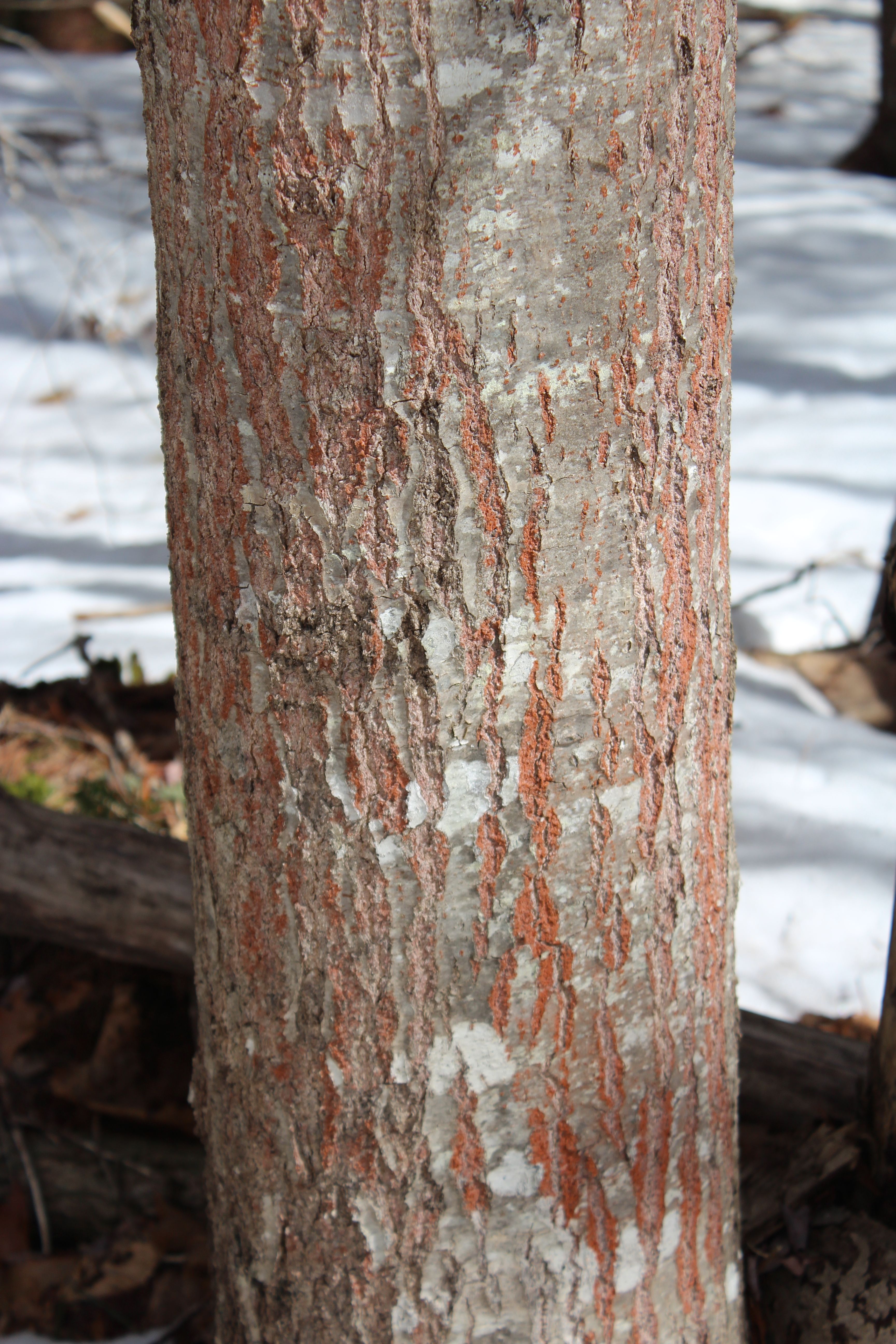
red oak

Here’s a middle-aged (just like me!) Northern Red Oak for comparison. The flat-ridged ski trails are forming and the red is clearly visible between them.

red oak leaf

Then there’s the bristle-tipped leaf.

amer hornbeam

My second new encounter was with the American Hornbeam (Carpinus caroloiniana). Again, a thrilling experience. OK, it doesn’t take much. Now I understand why it’s called musclewood. It could easily be mistaken for a beech tree because the bark of a young  tree is smooth, but there is a sinewy beauty to it. My bark eyes are now cued into this one.
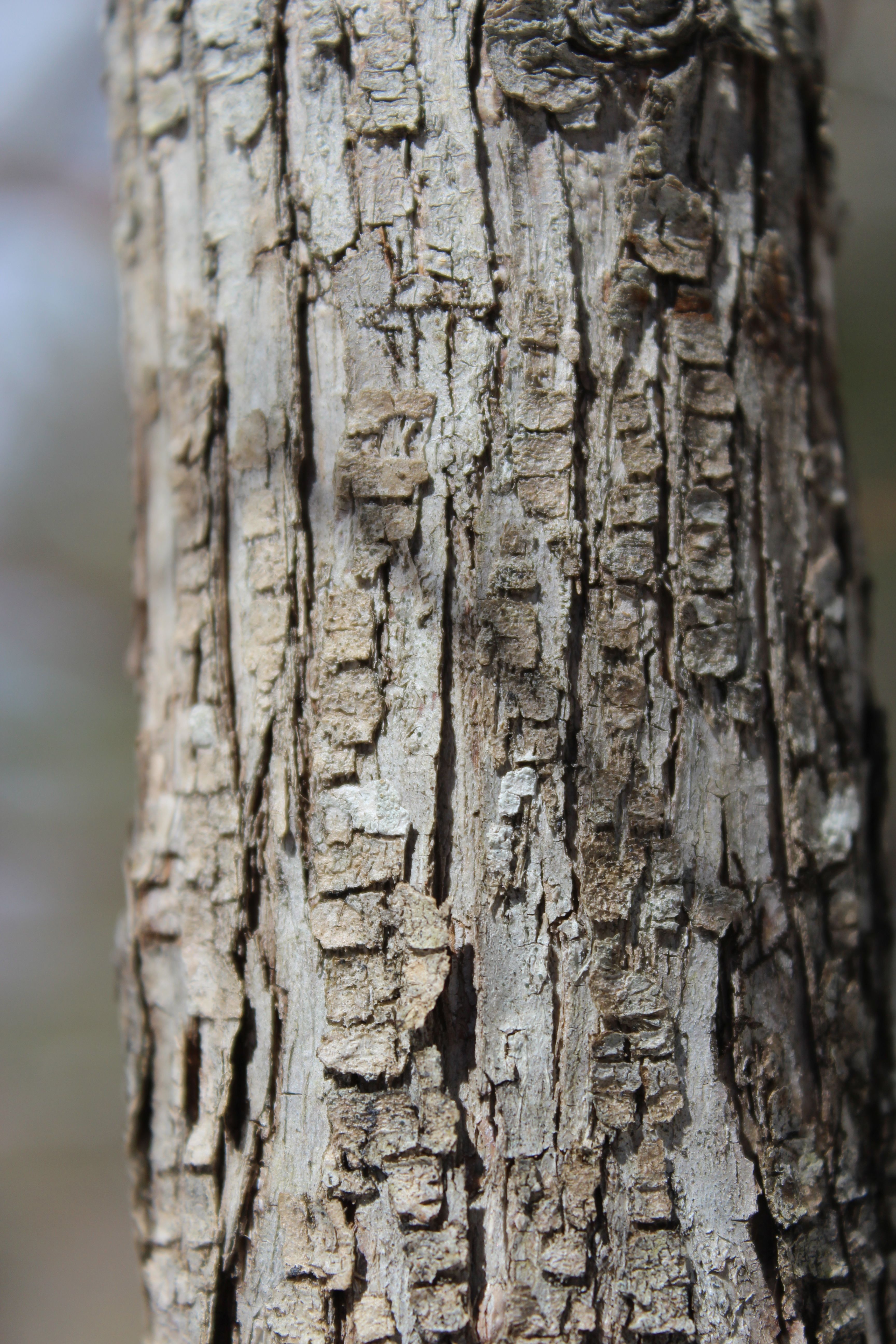
Hop Hornbeam

The fun part was that not far away stood this old friend. Hop Hornbeam (Ostrya virginians) has thin, flaky vertical strips. Both species, members of the birch family, are known as ironwood.
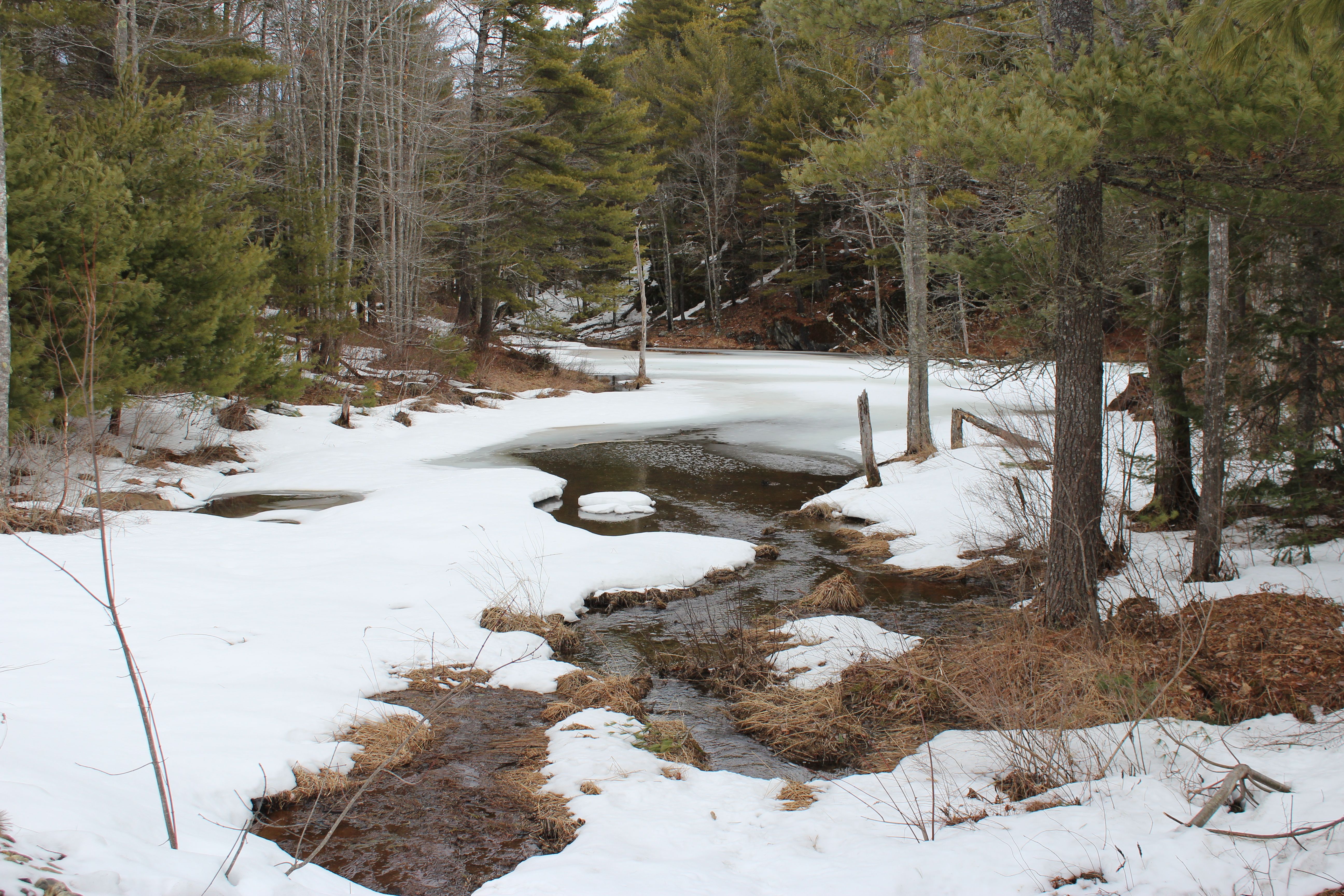
stream

As the day went on, though our focus was on vernal pools and communities, we often got distracted by other things–which I’ve dubbed Nature Distraction Disorder.

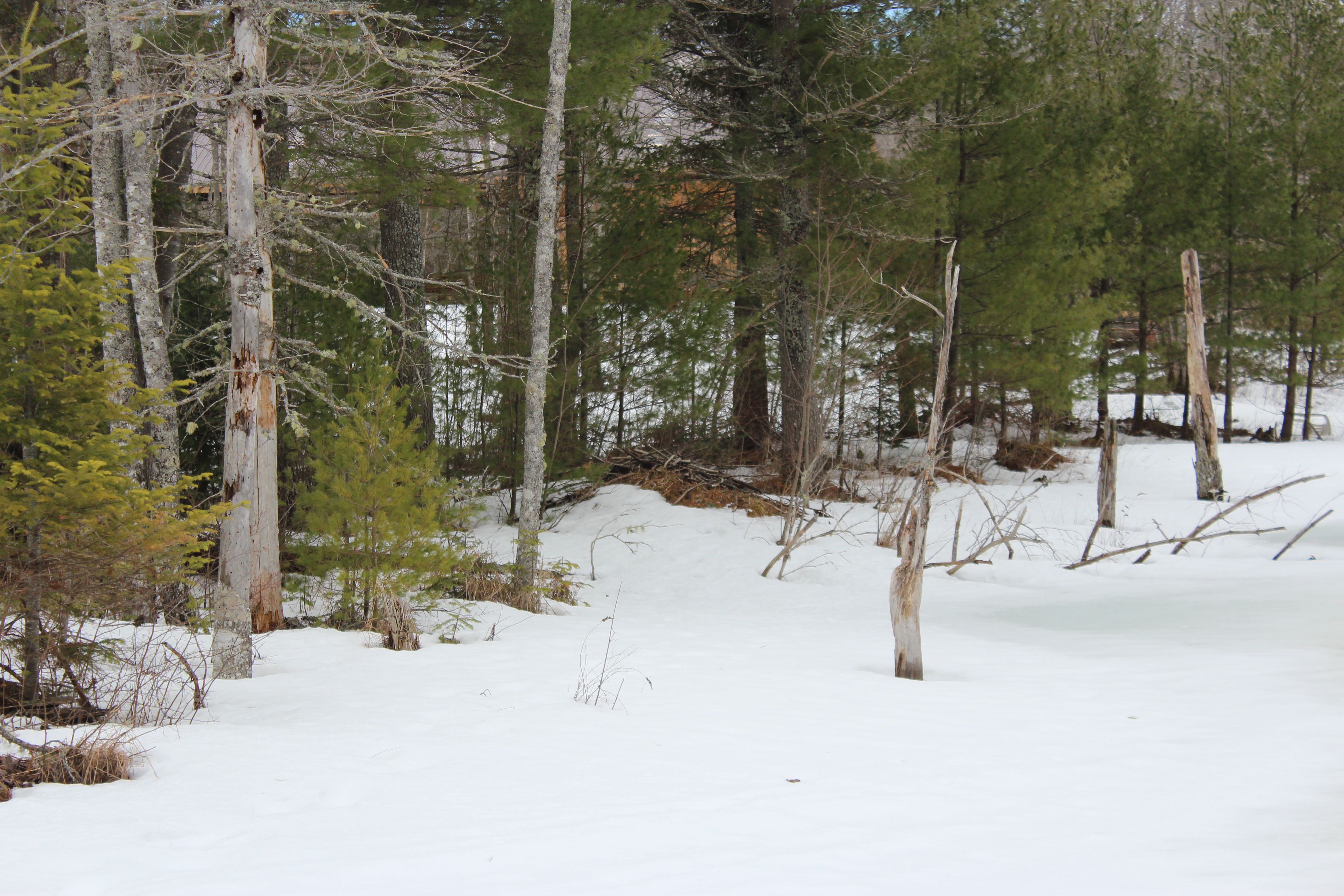
What I began to notice was a natural waviness. I saw it in the snow along the edge of this stream.

folds

In the folds of the rocks.

more folds

And more folds.

beech 2

In the scar on this beech tree.

red oak growth

And the growth on this red oak.

 sculpture

But probably my favorite, this naturally wavy sculpture on display by the barn where we convened a few times. It invites reflection.

Thanks for joining me for today’s wonder-filled wander.

Speed Date

dunning bridge

Some Mondays we only have time for a quick trek. Such was the case today, so we walked down the  street and headed off on the trails in Pondicherry Park. We actually exited a couple of hours later via this bridge, but it’s the entrance most people use and a work of art. The Bob Dunning Memorial Bridge was built by master craftsmen and women, family and friends to honor Bob, himself a master craftsman who was taken from this world much too early. One of my favorite  features is that each of the sixteen crossbeams was created from a different tree species and the bark was left on all. For my Maine Master Naturalist capstone project, I created a brochure and slide show to help others identify the trees. The slide show is available on the LEA Web site and the brochure is available at the kiosk by the bridge (when I remember to fill it. My guy pointed out that it’s empty again–tomorrow, tomorrow.)

bittersweet

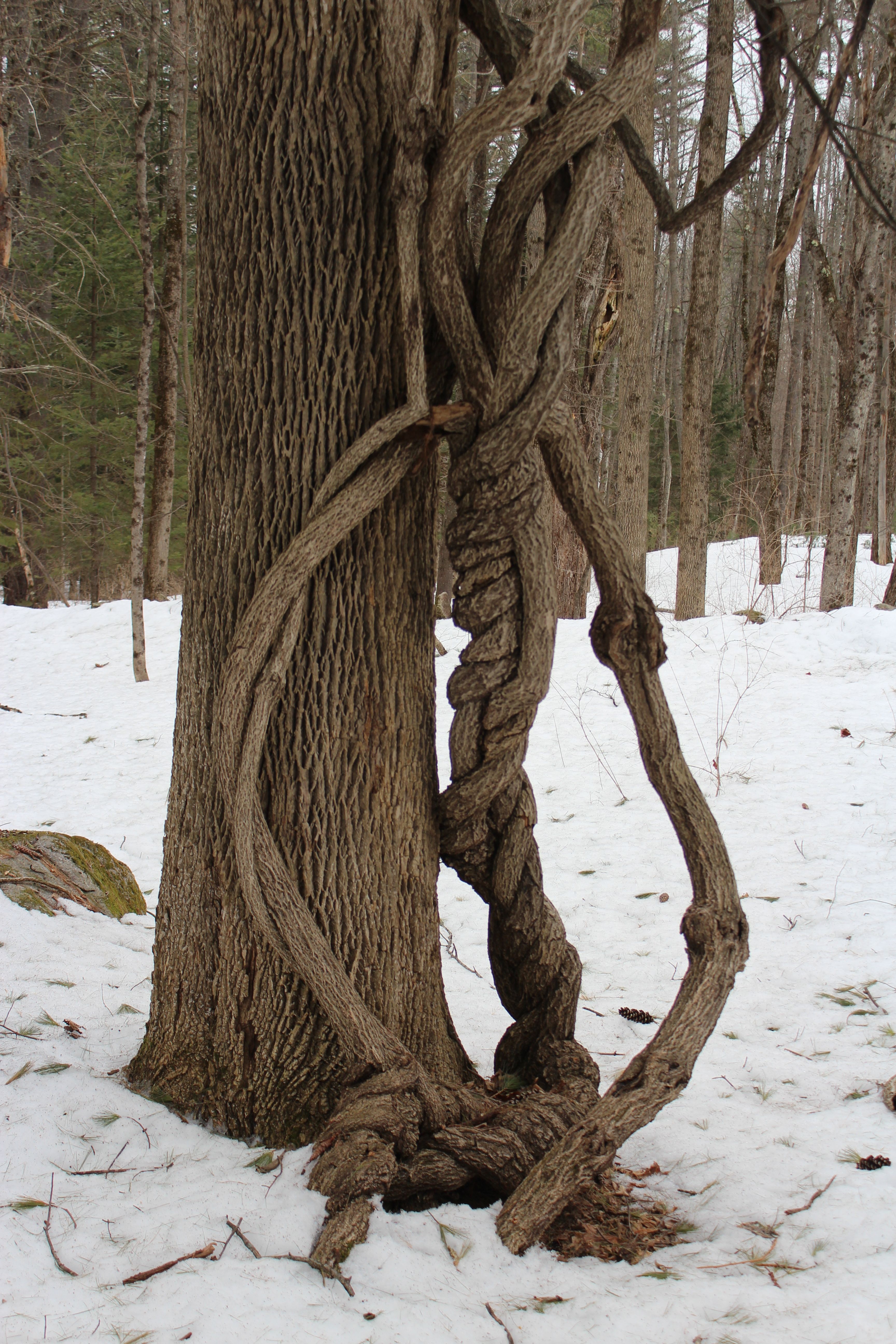
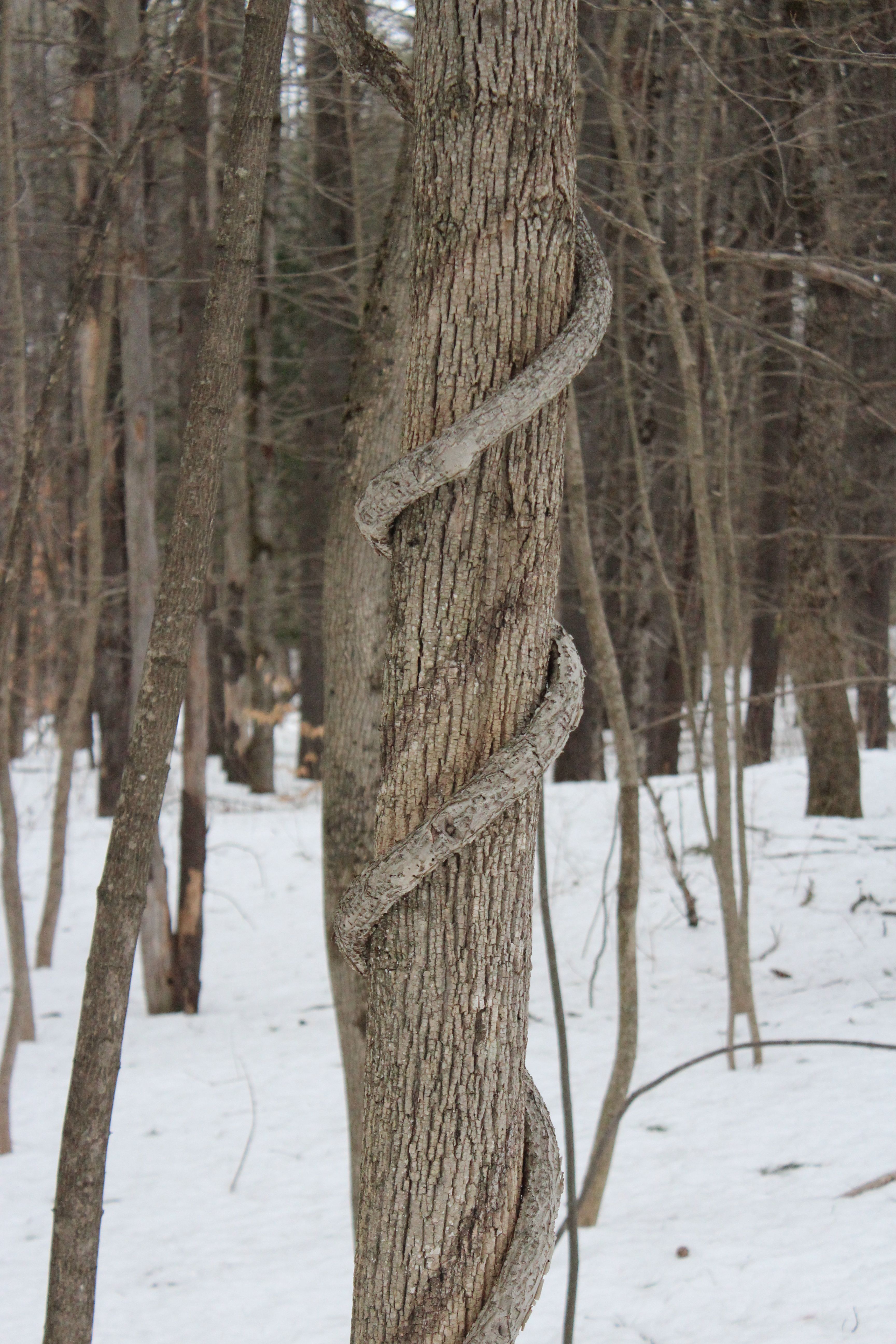
I know it’s an invasive species and this photo proves it, but I didn’t realize that for years. I used to cut it in November and use it for decorations. This is a bittersweet vine. It does make for an interesting scene. And provides the birds with lots of berries . . . which, um, provides the park and town with more bittersweet.

bittersweet up close

A closer look.

bittersweet on ash

It’s got a grip hold, that’s for sure.

MLSC1

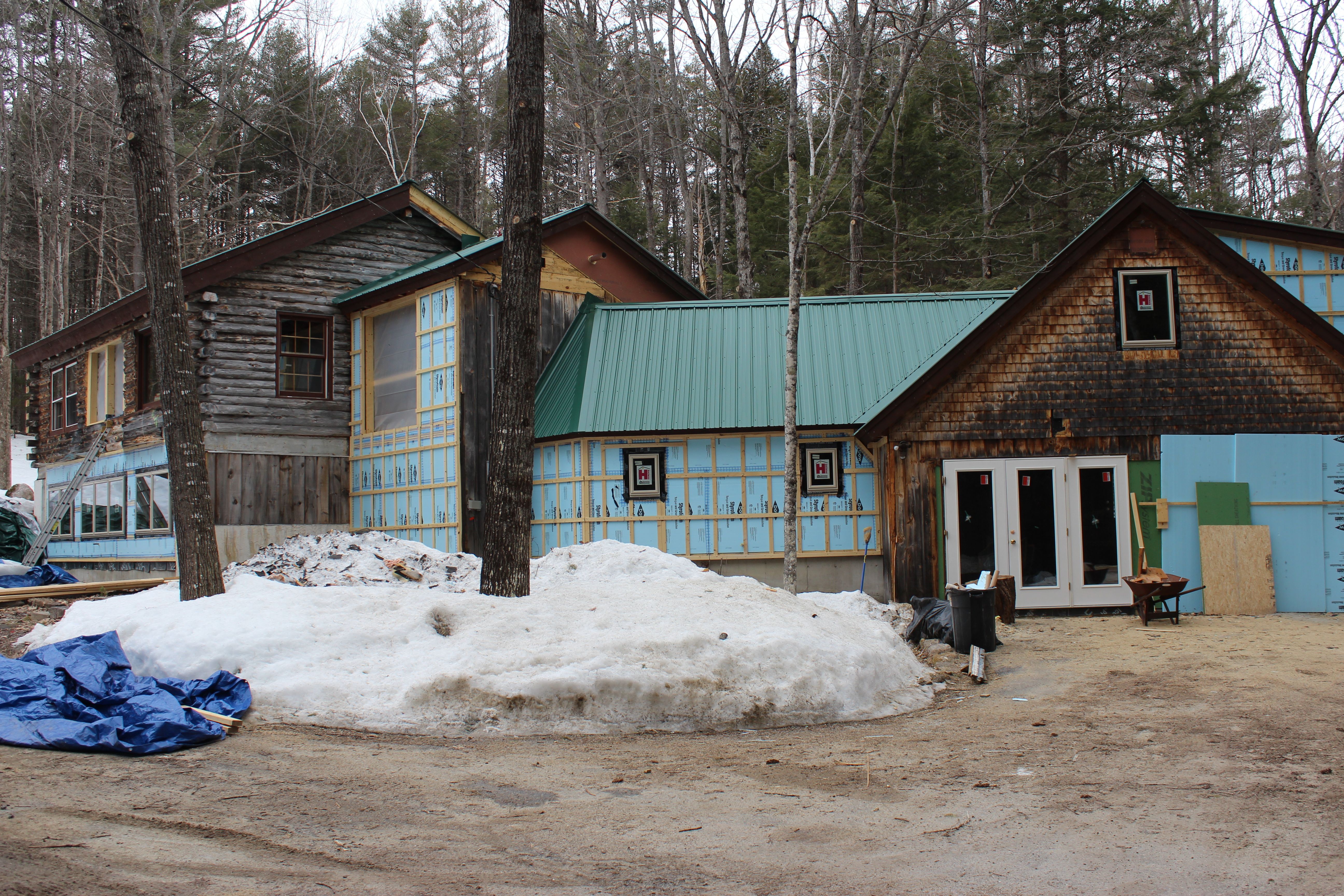
Because it’s too early for leaves, the new Maine Lake Science Center stands out among the trees. This is a pet project of LEA (Lakes Environmental Association), where yours truly serves on the Board of Directors.

MLSC2

Last year, LEA purchased a sixteen-acre lot with an existing building adjacent to Pondicherry Park. The building is being renovated to serve as researcher housing, a meeting room, lab, education center and a park welcome center.

This is destined to become a hub for world-class lake research by providing support to researchers in Maine and beyond who come to study our lakes. While Executive Director Peter Lowell will continue to head LEA, Dr. Bridie McGreavy will serve as the director of the center. I’m tickled about that because she has always been one of my mentors. In fact, she taught me the joy of sniffing red fox pee. Yup, it doesn’t get any better than that.

MLSC3

We are the Lakes Region of Maine, and the lake science center will serve as the voice of change. We are on the brink of something really big here.

MLSC Bridie's view

Though she won’t officially work here full-time until 2016, this is part of Bridie’s new digs.

MLSC main conf room

And what once was a living room, dining room and kitchen is being transformed into a conference room. When my guy and I stepped over the stonewall and onto the property this morning, Peter happened to be pulling in so we had another tour. The building is on schedule to open this summer.

beaver 1

We looped back into the park because I wanted to check on the beaver works.

beaver 2beaver 3

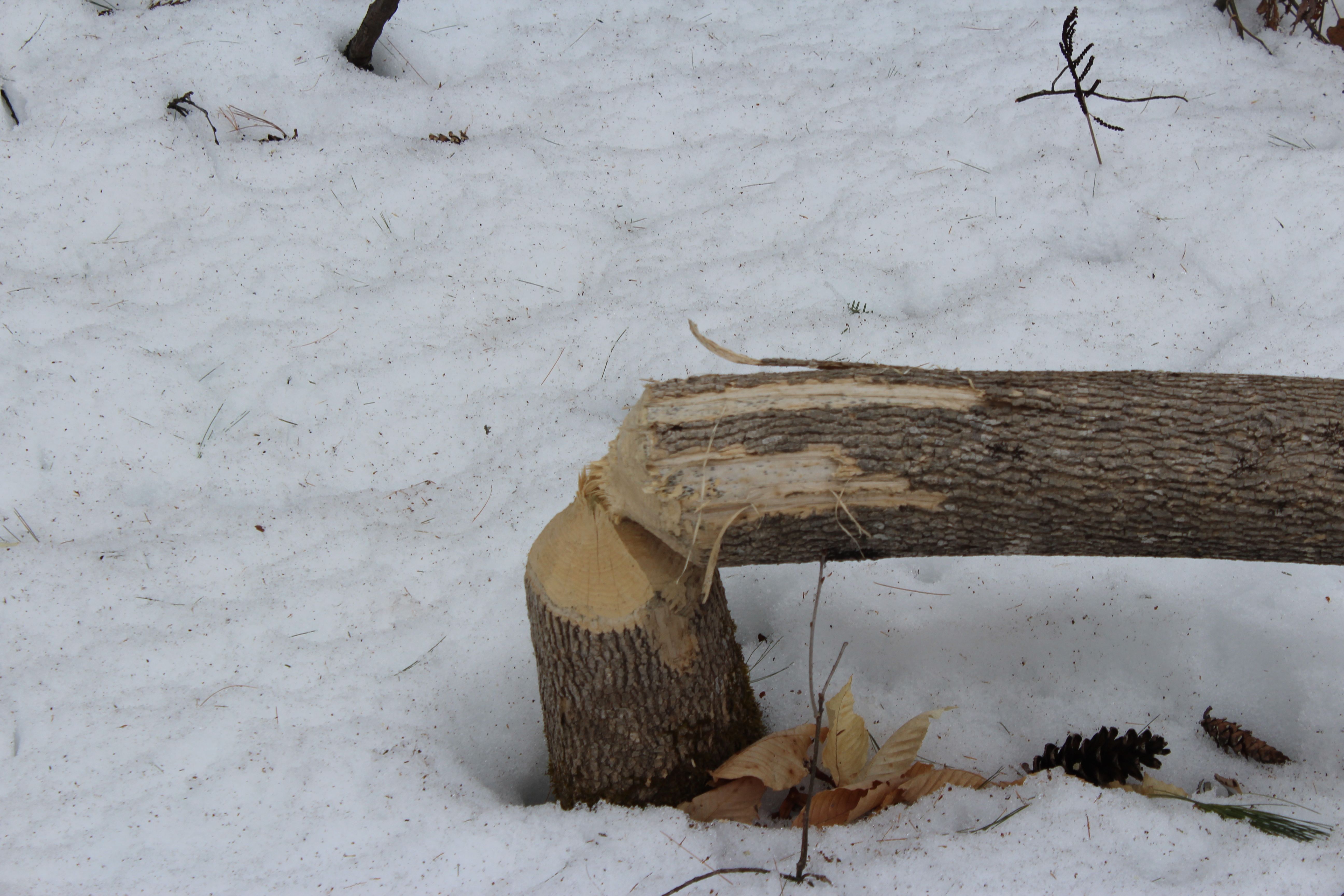
Yup, they’ve been busy. Some of this work was done in December. But the tree on the left has been worked on since then.

beaver teeth

My, what big teeth you have. Their teeth, which never stop growing, are like chisels.

Beaver tracks Dec 5

I have to be honest. I took this photo of beaver tracks in December.

Willet brook

We paused quickly at Willet Brook.

new uniform

But we had to keep moving. As you can see, my guy’s uniform is changing. It’s a wee bit warmer in these parts.

Stevens Brook

And then we were back on Main Street and heading homeward bound. Our speed date had come to an end. I didn’t even bother to make PB&J.

Thanks for stopping by and taking a quick wander with us today.

Small Rewards . . .

are huge in my book of life. Today’s Mondate (Monday date) found us climbing The Mountain at GLLT’s Back Pond Reserve in North Waterford.

name signs

As is the tradition around these parts, family names are posted at the beginning of the road. A sure welcome.

5 Kezars Pond Road

Since yesterday’s precipitation, no one had traveled down the Five Kezar Ponds Road–except for the red fox and snowshoe hares that crossed it. We know the red fox marked its territory as it moved along, because even though we didn’t climb over the snowbank to follow its tracks, we could smell the skunky scent. Seems a bit late in the year for that, but this year, everything is a bit late.

Hi Ho

Hi Ho! Hi Ho! It’s off to climb we go. Oh–be thankful you can’t hear me sing. My voice is as flat as the computer screen you are staring at and someone reminded me that enough was enough. :-)

ponds coming into view

Pausing along the way, the ponds were coming into view. It won’t be long before leaves obscure this. That’s one of the things I’ll miss about winter, which I know must come to an end eventually. But it provides us with sightings we might not see during other seasons.

bear claw marks1

Like this. I was scanning the landscape, with the hope of finding this. And I was rewarded. Yes, this tree has a case of beech bark disease and exhibits the perennial cankers, but look toward the left of the trunk and you’ll see the pattern of bear claw marks.

snowshoe hare tracks

As we continued to climb, we were also rewarded with a variety of animal tracks, from mice and squirrels to snowshoe hare, weasels and porcupines. I really wanted to see bobcat, but it wasn’t to be. I’ve seen their tracks and coyote tracks here in the past. The thing I should remember is that I need to live in the moment and enjoy what I see, rather than have expectations of what I want to see.

view

The view of several of the ponds at Five Kezars. I’m not sure, but I think this view is of Back Pond, Middle Pond and Mud Pond. Pleasant Mountain and Shawnee Peak Ski Area are in the background.

rock tripe

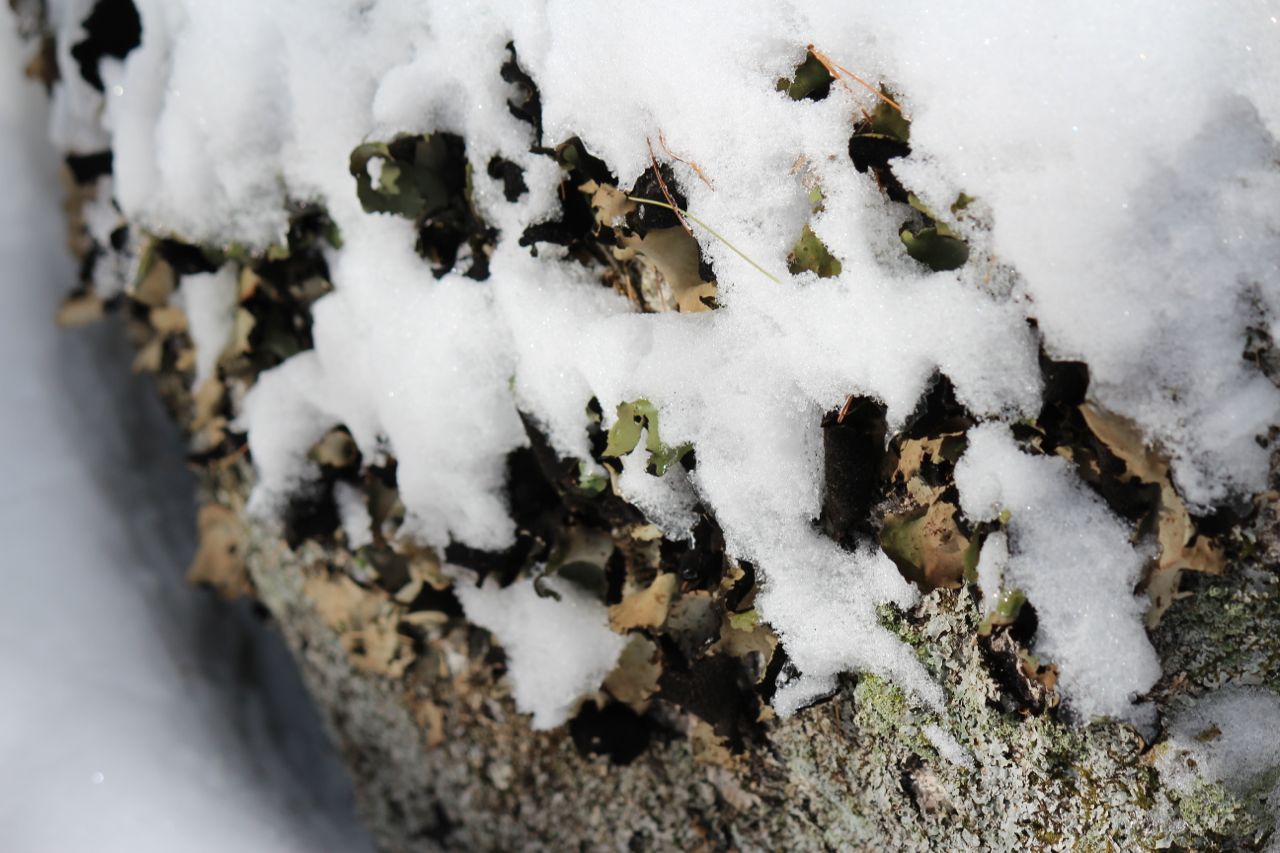
As we started down the connecting trail, marked with orange blazes, the flat and  flappy growths of rock tripe lichen jumped out at me. Though it’s supposed to be edible, I think you have to do some severe boiling and who knows what else to eat this. I’m not about to try, but what I do appreciate, is that like the lungwort that I shared in a previous post, rock tripe changes with the weather–from leathery and brown to pliable and bright green.

split maple

And then there was this maple. What in the world? Talk about resilience. We decided that maybe a weather event caused the split and then the tree reacted. Some reaction. And recovery. This tree has the will to live, despite any obstacles put in its way.

bear claws 3

Yup, another bear claw tree. It never gets old. Sighting one I mean. The claw marks become more apparent with age, so getting old is good in this case–to me.

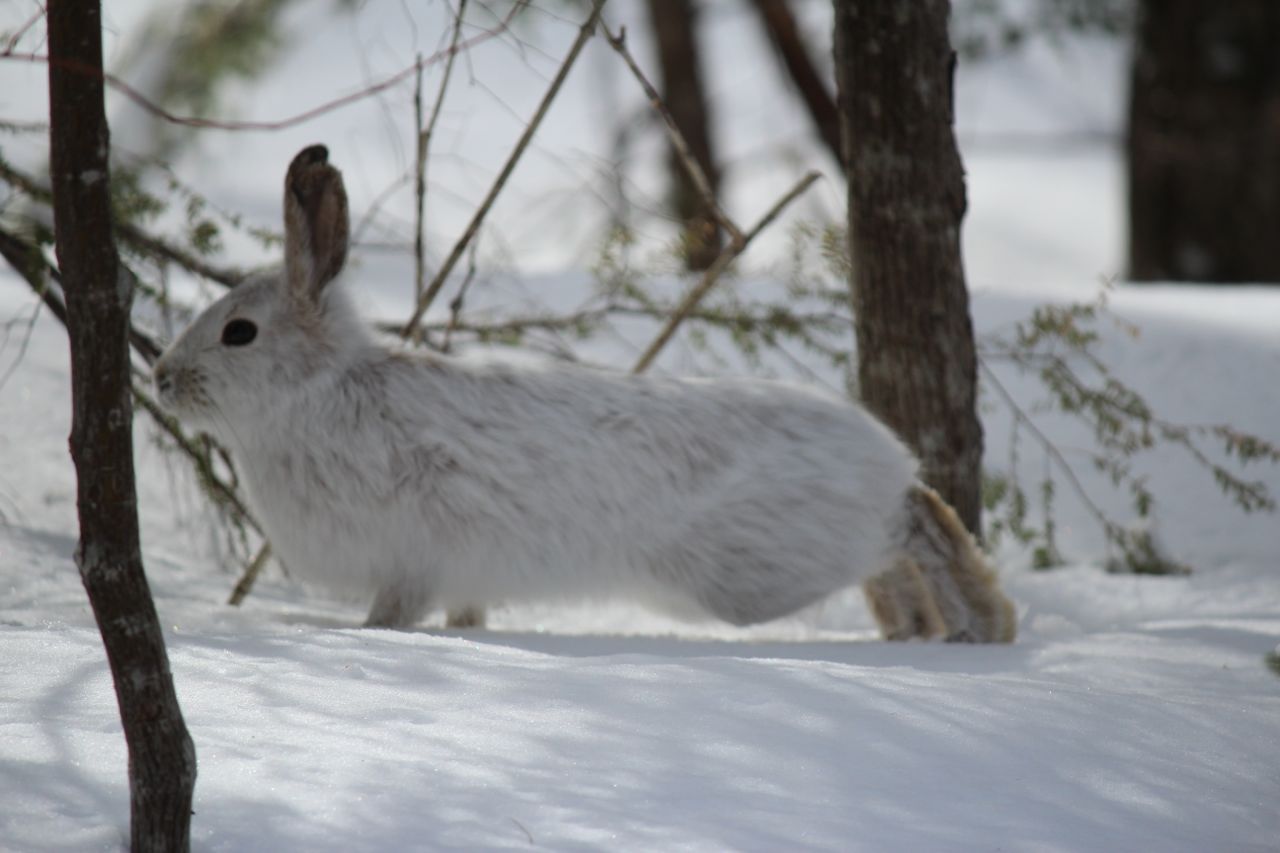
hare

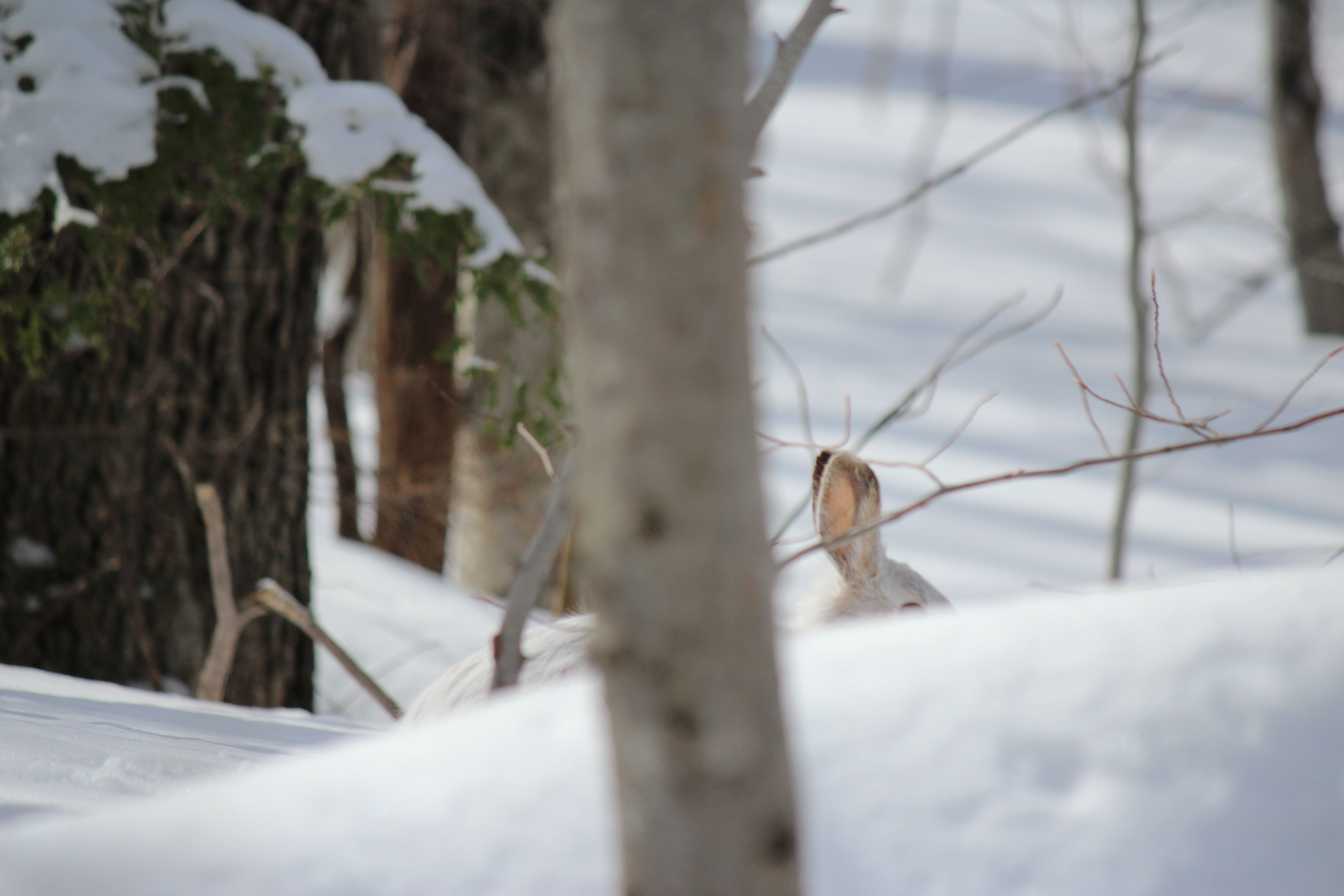
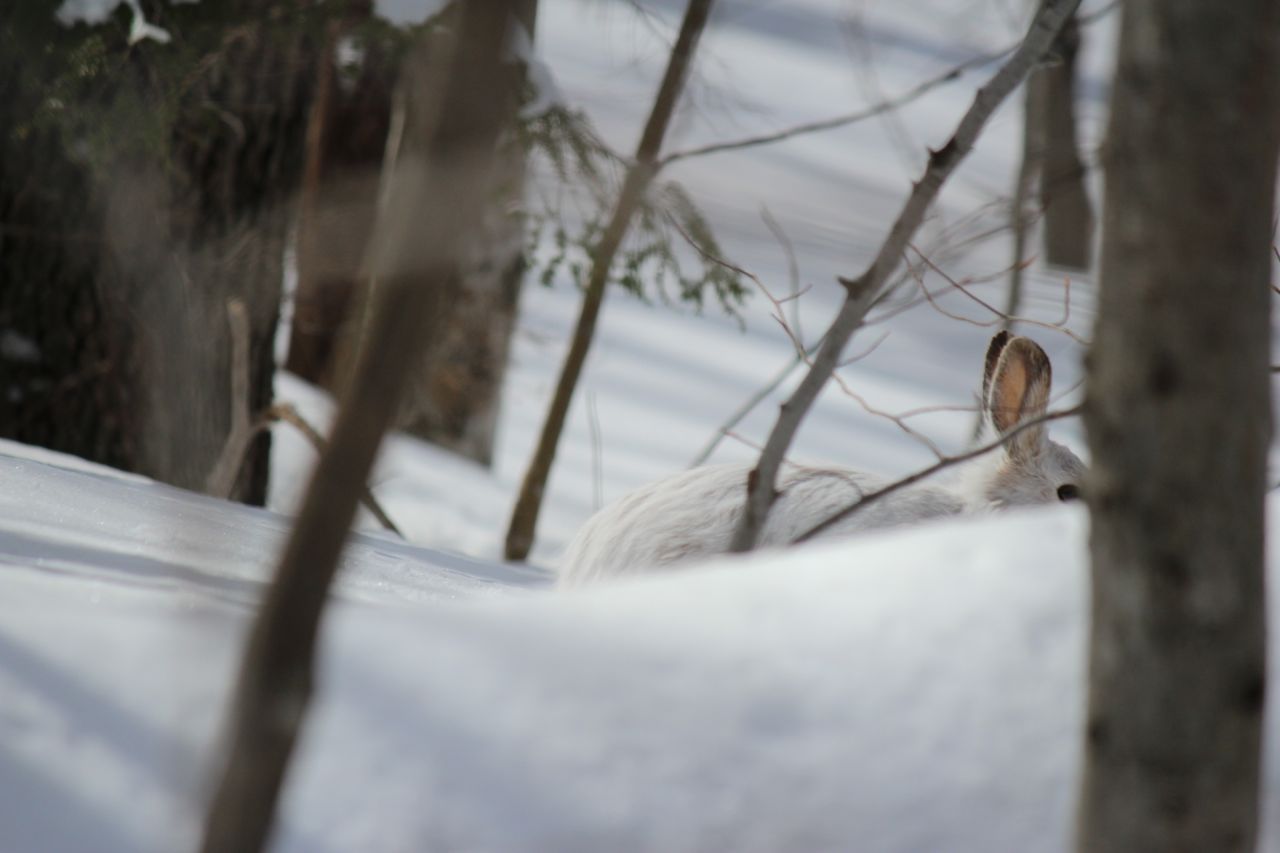
But I’ve saved today’s best reward until almost the end. Do you see it?

snowshoe 1

How about now?

snowshoe 2

This guy was big. As were its eyes and ears. Eyes on the side–born to hide. A prey animal for a predators like bobcats.

snowshoe 3

My, what big feet you have. And to you we gave thanks today for our snowshoes.

selfie

Selfie.

lunch rock view

We crossed the bridge and then sat on a rock to eat lunch. PB&J as usual. And the final reward–homemade brownies. Life is good.

Thanks for stopping by for another wonder-filled wander. I hope you found today’s tramp as rewarding as I did.

To Old City and Back

Leaving camp

From camp. To Old City. Bridgton to Sweden. Via Moose Pond.

Toward Black Mtn

The temp was about 40 degrees, but with the brilliant sunshine, it felt even warmer. We reminisced about kayaking and rowing as we headed north on the pond.

Mink 1

Beside one of the islands, a mink had made numerous trails and holes.

Mink 2

I love it when a critter behaves like it’s supposed to. In this case, the prints are on the slant that the weasel family is known for. A mink is a small mammal with a long body and short legs. It has partially-webbed feet, an adaptation to a near-aquatic habitat. A few years ago, an acquaintance and I were helping with the Moose Pond watershed survey. We were sitting on some rocks by the shore, with a dock in front of us, as we jotted down notes. Much to our surprise, a mink came up from under the rocks by the dock. We starred at it, it starred at us. We had cameras. Did we take a photo? Nope. Another one for the mind’s eye.

Mink3

Bound and slide. Like otters. I still want to be an otter in my next life, but minks do have fun too.

following tracks

Tracks tell the story about behavior, but it’s often a guessing game. I think I got this one right. Homo sapiens. Male. About 6 feet tall. Handsome. Puts up with a lot.

finding a seat

He borrowed a resting spot while I examined those mink tracks and holes. There were tons of holes.

on the trail

At the northernmost end of the pond, we followed the snowmobile trail toward Old City. Today it’s a wooded snowmobile trail around the base of Black Mountain in Sweden, Maine, but during the 19th century a road passed by at least six homesteads. All were reportedly occupied by young men who chose not to live at home–perhaps increasing their status as eligible bachelors. Their names included Cushman, Farrington and Eastman, among others–names long associated with Sweden and Lovell. (Sweden was originally part of Lovell)

foundation

The area was abandoned at some point after the Civil War, but foundations like this one remain. This may have belonged to P. Farrington or J. Edgecomb, but I’m thrown off because it occurs on the wrong side of the current “road.” That doesn’t mean the road was originally in the same spot.

stone walls

Stone walls, like this one near the I. Eastman property, formed boundaries to keep animals in or out. I suspect this guy was a major landowner.

stone wall 2

I’m fascinated by stone walls. Not only are they beautiful and functional, but they also represent a tremendous amount of labor. And the stones have their own story to tell about the lay of our land in New England.

color in the woods

I’d been looking at tracks, trees (always looking for bear claw marks on beech trees and quizzing myself on bark) and stones. On the way back, this touch of color caught my eye. Red Pine bark is among my favorites. Then again, I haven’t meet a tree I didn’t like. And the contrast with the hemlock needles, beech leaves and touch of blue sky gave me pause.

vine?

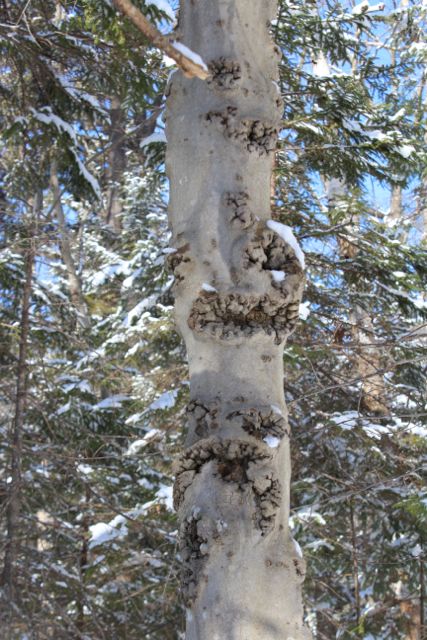
This also caught my eye. Last fall, a friend had sent me a photo of a beech tree with a similar case of strange scars. I didn’t know what it was, so I sent it on to a forester I know. He sent it on to someone in the invasive insect department at the state level. It all boiled down to what they thought was wounds from bittersweet vine being wrapped around the tree at one time.

vine 2

That made sense then. Today, I dunno. As I looked around, I noticed the same phenomenon on other beech trees. But I didn’t see any evidence of vines nearby. Of course, there’s still a lot of snow on the ground, as my guy can tell you since he chose not to wear snowshoes. The area had been logged at some point. But, I’m just not sure.

heading back to camp

Back on the pond and heading toward Bridgton and camp. Shawnee Peak and Pleasant Mountain provide the perfect backdrop. Yesterday, my guy took one of our grand-nephews for another ski lesson. The young’un skied straight over moguls on the Pine, slipped off the trail into the woods several times and fell a kazillion times. On the ride home this tired seven-year-old said that his younger brother probably spent the day playing Xbox. When asked if he wished he’d done the same, he remarked, “No, this was the most fun day I’ve ever had in my ENTIRE life.” I can hear my mother-in-law guffawing in heaven. :-)

islands and mountain

Only another mile to go before we rest. Thanks for wondering along with us on today’s wander.
My Smiling Place

gateway

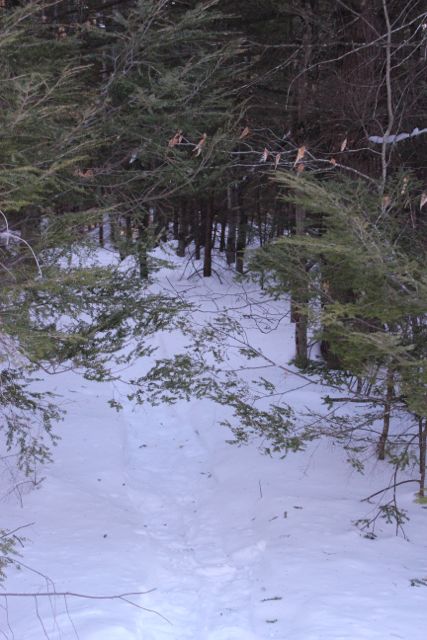
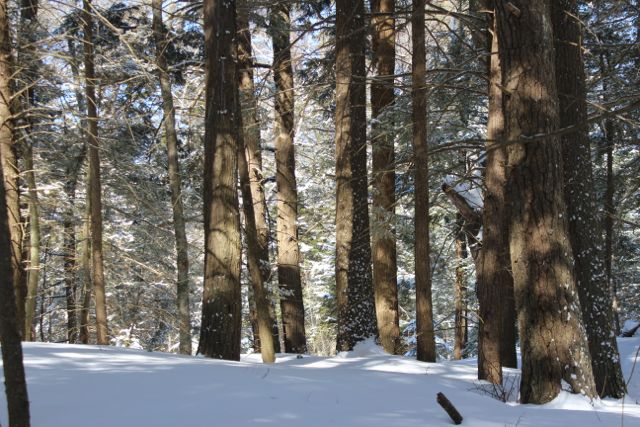
Hemlocks and beech trees create the gateway to my special place where few others wander and wonder. I’ve intentionally left these trees as is at the edge of the snowmobile trail so I can pass through and disappear into my own world. It never ceases to amaze me that I suddenly feel alive as I step into this section of the woods.

I spent this morning at the Maine Milfoil Summit and thought it was one of the best I’ve ever attended. And then a friend and I enjoyed lunch at Fishbones in Lewiston before I drove back to western Maine and she returned to her home closer to the coast. All in all, it was a wonderful day, but the moment I stepped through those tree branches, I was home. I was in my smiling place. It’s a feeling that I don’t think I can put into words. Some things are best left unsaid.

saplings

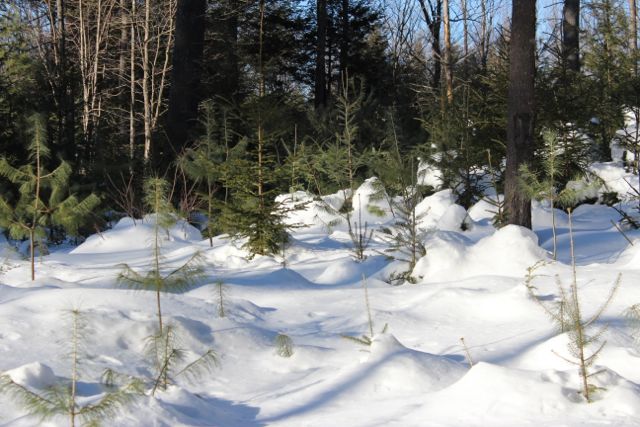
Part of the woods that I explored today had been logged about ten years ago. The openings created a nursery for hemlocks, pines, fir and spruce to spring up. Who will be the winner in the end? It’ll be a while before I know the answer to that one.

white pine whirl

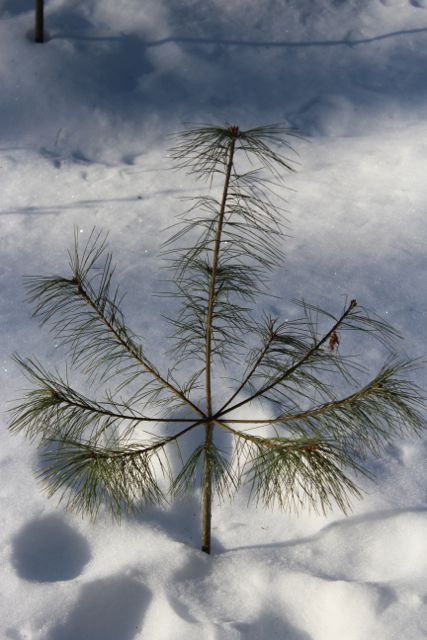
Eastern White Pine trees win the prize when it comes to the kitchen growth chart, which, by the way, I finally painted over in our kitchen this winter and no one seems to have noticed. Each year, a white pine produces a whirl like the one you see here. A whirl is a group of branches that radiate out from the tree’s trunk.

white pine growth

So, our boys never had a growth spurt quite like this one–thank goodness. I should have measured it, but this white pine grew about two feet in one year as evidenced by the distance between one whirl and the next. Why? Because it’s in an area where most of the canopy or taller trees that would have blocked the sun and prohibited its growth, were taken down. Ample sunlight will do that to you.

snow tree 1

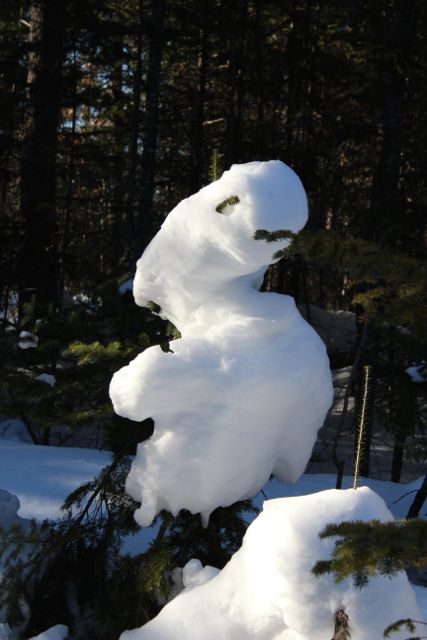
Snow ghosts! Even my computer suggested there was a person hiding under this snow costume–it wanted me to provide a name. Was someone in there? What would you name it?

snow tree creature

And a snow creature. Snowzilla?

deer run

The snow is quite deep, but the deer are moving about more and more. I found numerous deer runs like this one today–trails that they use over and over again. Sometimes other mammals follow them as well.

in my tracks

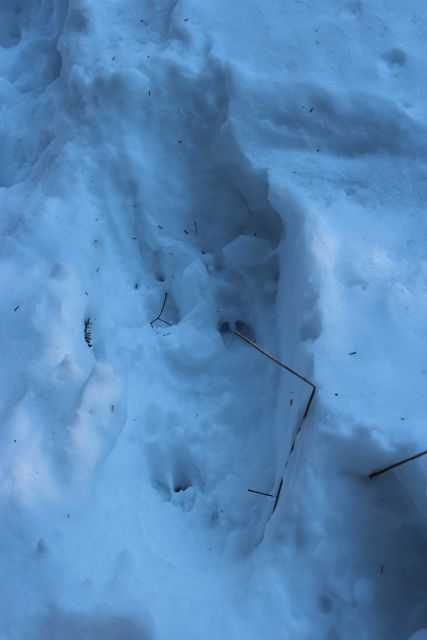
And sometimes the deer follow in my tracks as is the case here. The prints to the left indicate that a deer was traveling toward you as you read this. And the print to the right indicates that another was traveling in the opposite direction.

track

Deer prints are heart shaped. The point leads to the direction of travel.

deer beds

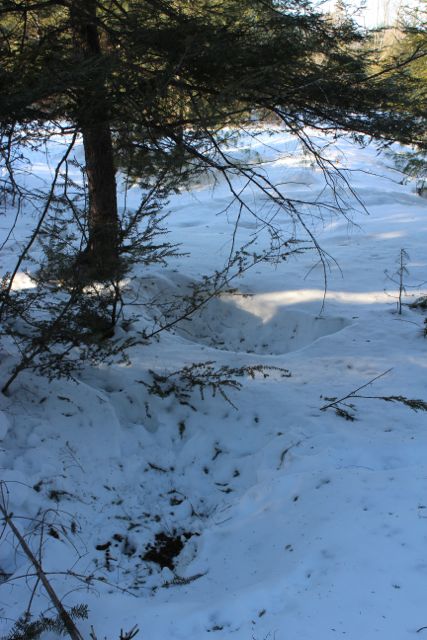
I’m always thrilled when I find deer beds. These two were quite large. And filled with scat–all I can say is, scat happens! The curious thing to note about deer beds is that when two or three are gathered, they tend to sleep with their backs to each other so they can keep an eye out for predators.

another bed

You can see where this deer pawed at the snow to get comfy for the night. Oh yeah, and more scat :-)

print with dew claws

So some say that when you see the dew claws in a deer print, those two small toes above the foot that look like two dots at the back, you have a buck. Maybe. Or maybe the snow is soft and deep and more shows in the impression.

oak leaf phenom

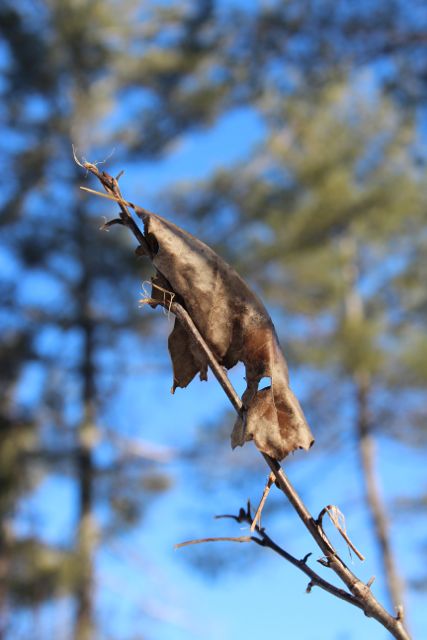
I was thrilled to find this young oak tree, one of the few that has grown in this area since the logging event. I don’t know if you can see from this photo, but there are frayed ends along the branches. I’d never noticed this until about a month ago when exploring a property in Lovell, where it seemed that every oak tree surrounding a field displayed these frayed ends. That field was near a porcupine condominium, so my first thought was porcupine activity. But there were no tracks to the trees. Then I thought of squirrels. But again–no tracks.

oak leaf phenom1

It wasn’t until recently that a friend who is a retired forester showed me it was a wind event that caused this. Like beech trees, oak leaves are marsescent. During wind events, and we’ve had plenty of those this winter, the leaf may get ripped from the tree–leaving a frayed stem or petiole. It makes perfect sense now. And the tree I found today, which displayed this phenomenon, is in the open, leaving it vulnerable.

vole

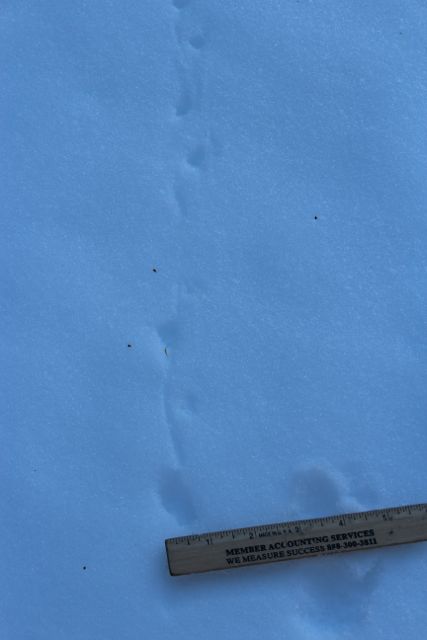
I was almost home when I discovered these tracks. Notice that they are a bit erratic.

vole2

Not a big mammal.

vole 3

Sometimes it exhibits the zig zag or alternate pattern of a perfect walker like a coyote, fox, deer, but . . . it’s a great deal smaller. A great deal smaller. And other times, it tunnels a bit.

vole hole

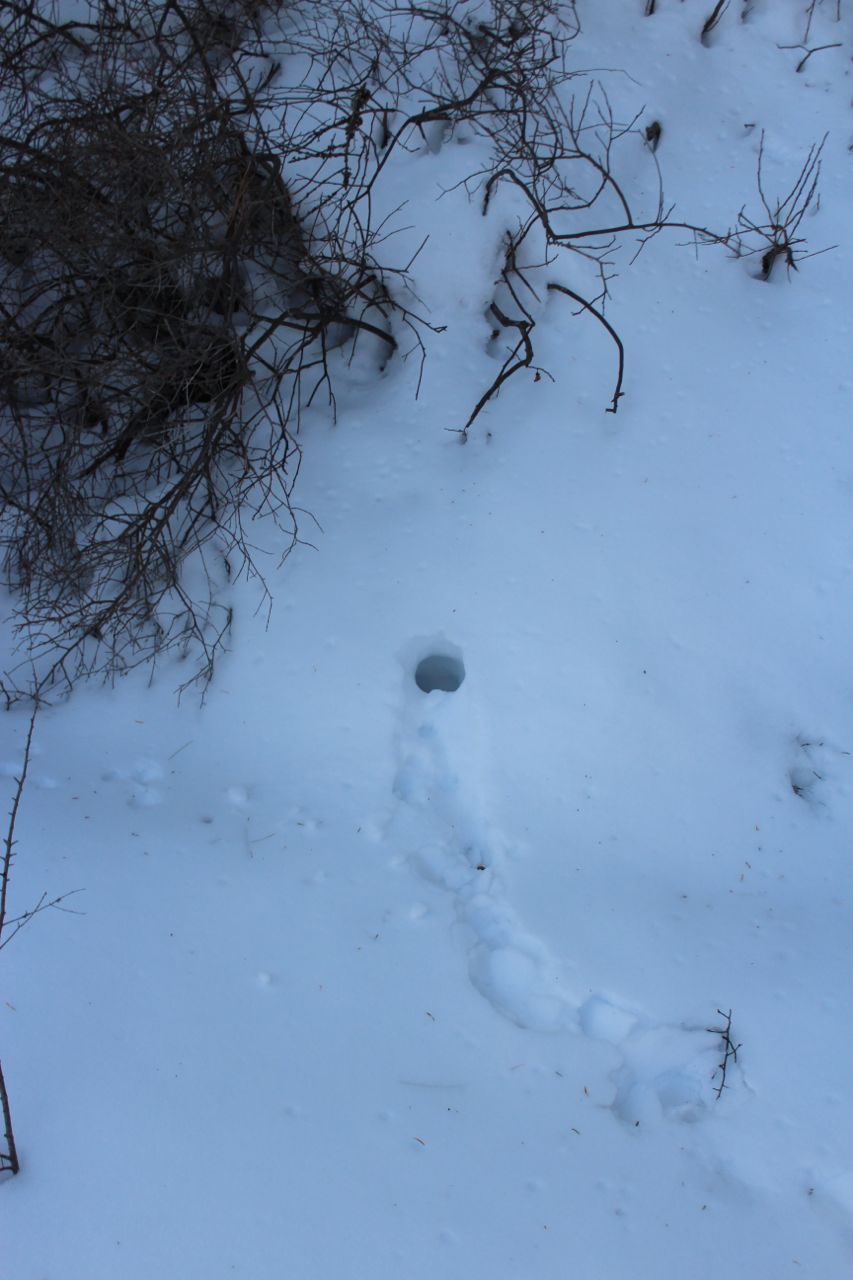
And leads to a small hole. A vole hole! I was excited because I found this in the same area where I found vole tracks last year. Voles are highly delectable treats for some predators. Ah, the food web.

snowmobile

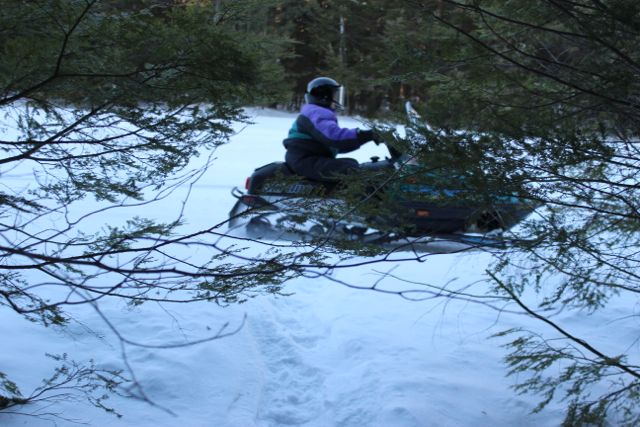
And then I was back at the snowmobile trail and this traveler never saw me. Yup, I like it that way. Rather like the mammals that I know are out there. I can’t see them, but I have to assume they know I’m about and watch me from their hidden spots. Maybe they share a smile with me.

I can only wonder as I wander. Thanks for joining me.

Wondering Among Giants

Robinson Woods

It’s not every day that I get to wander and wonder among 300-year-old giants, but such was the case today. A friend and I met at Robinson Woods in Cape Elizabeth. It was a reconnaissance mission for me as I’ll be leading a senior college class there next month. And for both of us, it was a delightful way to spend three hours snowshoeing on and off the trail, with frequent pauses to look, listen, touch, smell and learn.

Because the land was not suitable for farming (terrain rocky and uneven), it was left unchanged for all these years. Actually, we met the executive director of the Cape Elizabeth Land Trust along the way, and he told us that the Robinson family was a paper company family, but they left this piece untouched. Thanks go to them. And to the land trust for preserving the land so that it will remain in its natural state.

feeding cone

We could hear the birds sing and call as we moved along. Someone apparently wanted to make sure they have enough to eat as we found a couple of these “bird-seed” pine cones dangling from trees. (Separate note: back at home, for the second day in a row, I’ve had chickadees landing on my mitten to eat crushed peanuts–well, they don’t actually eat them on my hand, they just grab and fly to a nearby branch, where they use their feet to hold the nut or seed and then peck away at it.)

porcy trail

We followed this porcupine trail for a bit. As we backtracked our way toward the people trail, something caught our attention:

bear claws

Yes, even in Cape Elizabeth, and only steps from the ocean, you can find bear claw sign on beech trees.

bear claws2

We showed these photos to the executive director of CELT–he had no idea they were there. I’ll be curious to see if he adds black bears to the list of mammals that frequent the property. I did see that they have pine martens on the list–that surprises me.

gnarly tree

I know I’ve spent a lot of time writing about beech trees, but this one looks like a totem pole of gnarly faces. Think gargoyles. Was the beech scale disease initially responsible for this? I wonder.

gnarly face

more gnarliness

Very gnarly indeed. In the center, you can see where a branch broke off.

burls on a maple

This Red Maple had some serious burls. Perhaps they were caused by stress or injury, though researchers don’t know for sure why they occur. Despite the bumpy, warty growths, the tree appears to be healthy. You can see that there is new growth–young red branches sprouting from the burls. Removing a burl causes a large wound that could eventually harm the tree, so they’re best left alone–though I know woodworkers covet them.
walnut?

We were almost back to our trucks when we came across this tree. It’s a young tree and we tried to key it out. We’re pretty sure it’s Shagbark Hickory, but if you know otherwise, please enlighten me.

Thanks for wondering along with me on today’s wander through the woods.