Celebrating Creation aLONG the MOUNTAIN

When asked the other day if I am enjoying spring, I responded, “I’m still loving winter.”

So is My Guy.

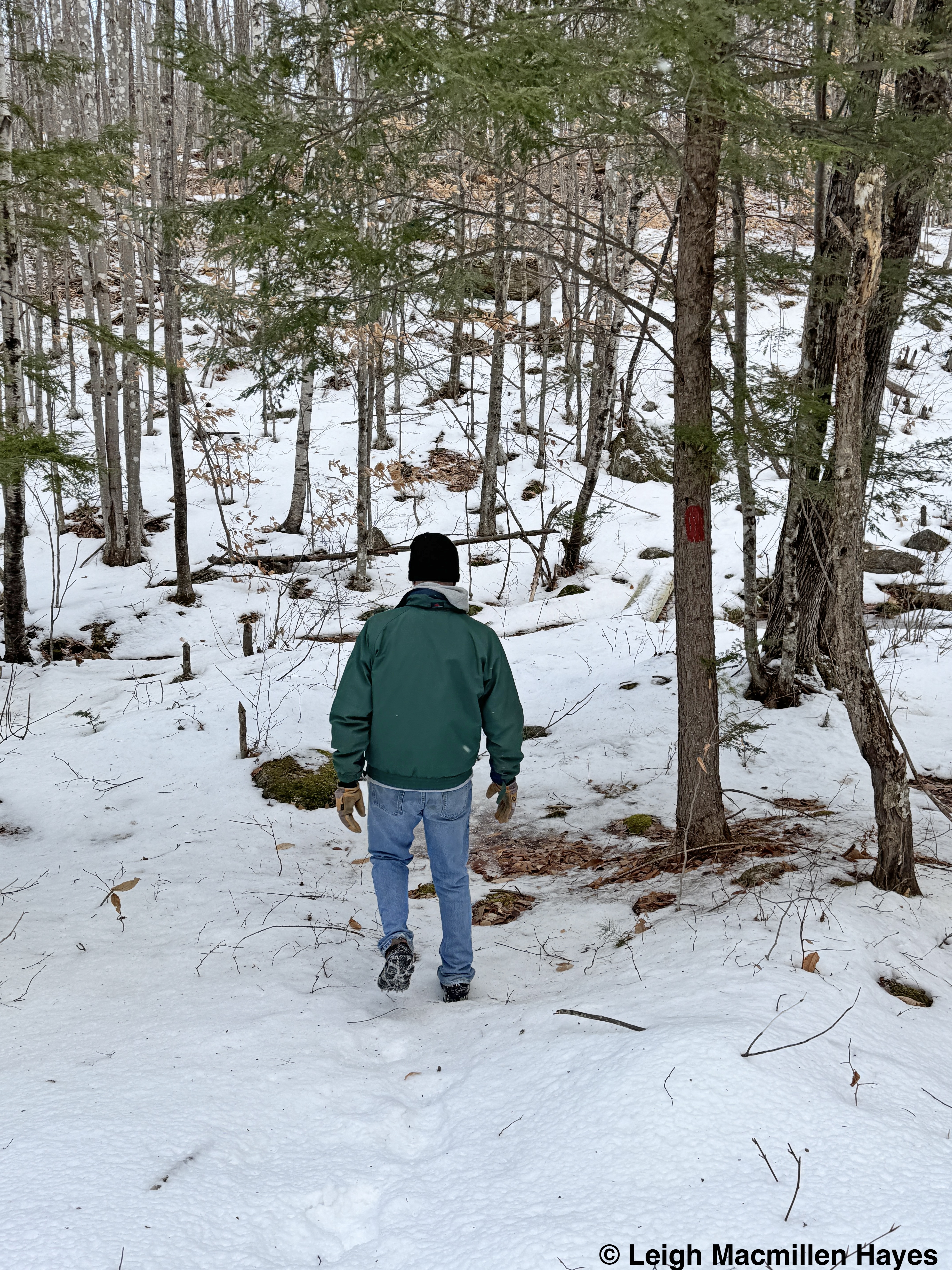
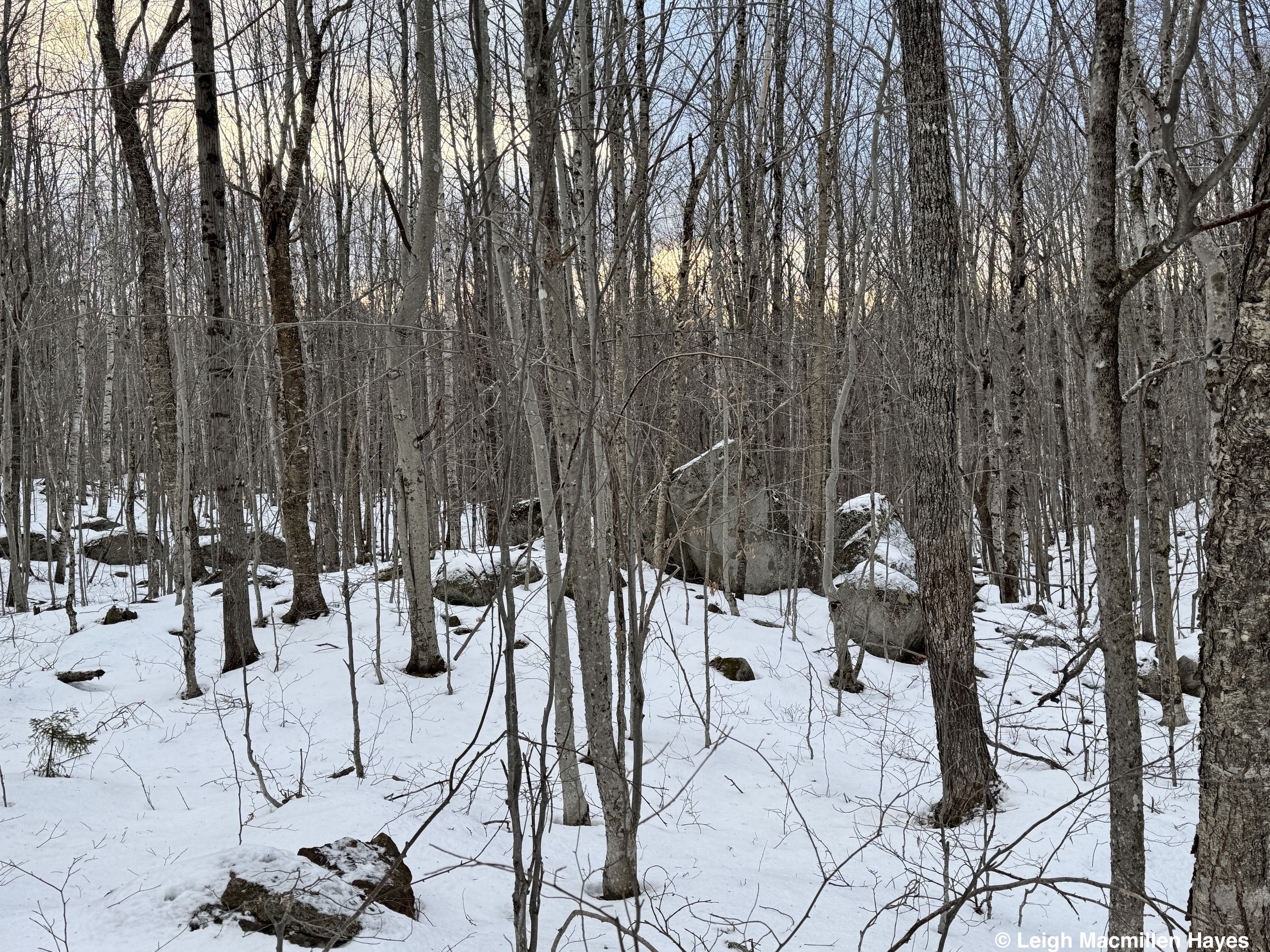
And so today, we took to a beloved mountain trail and reveled in the sights and sounds.

Beside a brook, our journey began, where as the water flowed, nature’s artistic hand created a magnificent display of ice sculptures.

On the way up the loop trail, and again on the way down the other side, the golden carpet was set before us, for into the warn pathway do leaves settle after a wind event.

Because we were hiking in a deciduous forest to begin, our eyes kept scanning the tree trunks, and tada, we were rewarded. Well rewarded.

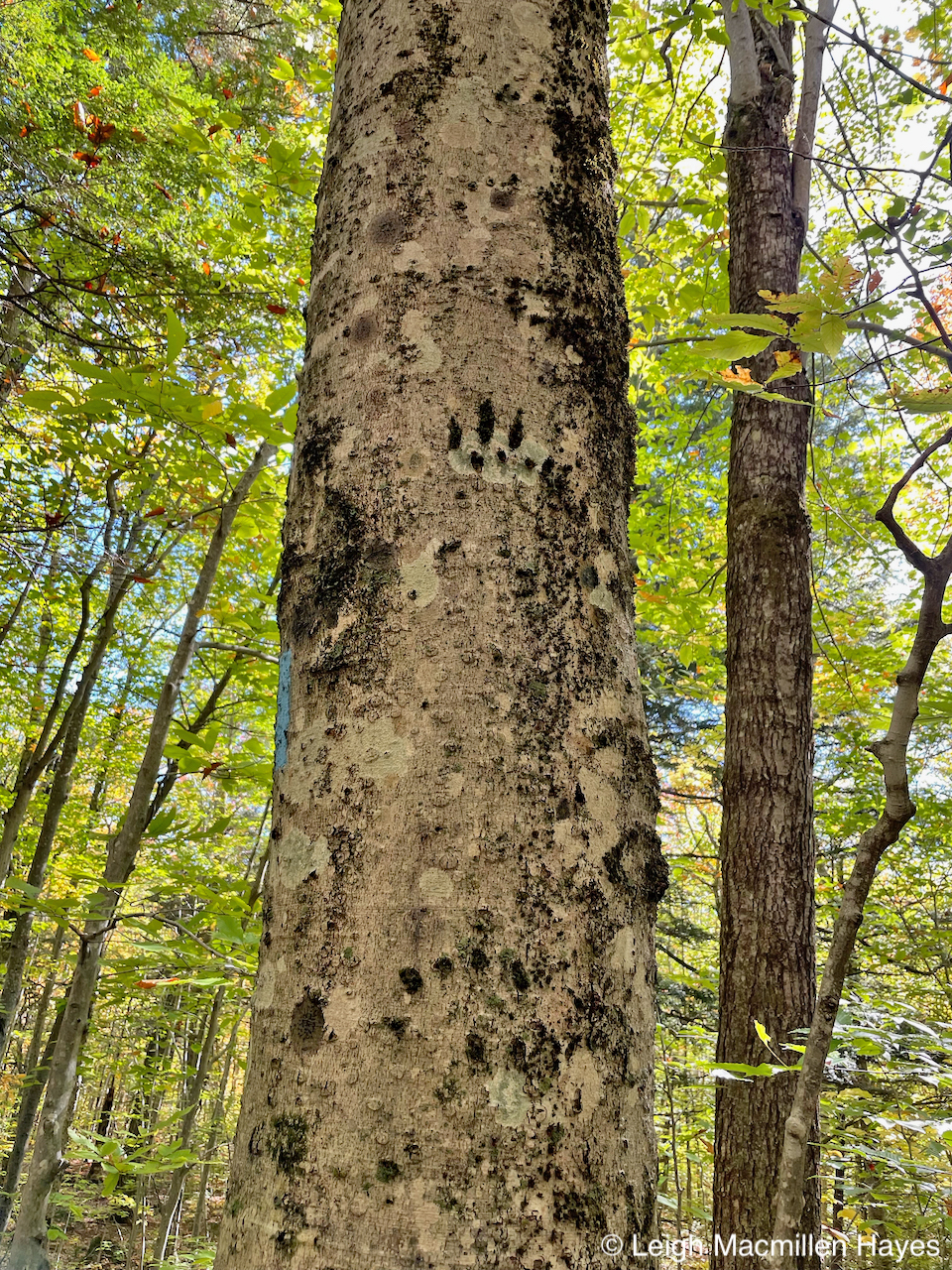
It seemed like everywhere we looked, we spotted American Beech trees with bear claw marks indicating multiple visits to feast upon the beech nuts.

We suspected some of these trees we were meeting again as if for the first time, but though we lost track of how many we spied, we knew it was more than we’d seen in the past and gave thanks to the trail conditions that allowed us to move without caution, and the fact that it is still winter and there were no leaves to hinder such views.

While studying almost every tree for a while, I kept noting the trunks of another species, this the two-toned aspen that looks like an oak toward its base, but morphs into a birch toward the top.

There was no question whether Quaking or Big-Toothed for leaves upon the snow told the species name: My, what big ____ you have!

As we continued to climb, the neighborhood changed and so did the forest floor–of course, still upon firm snow, for suddenly, we walked upon a green carpet.
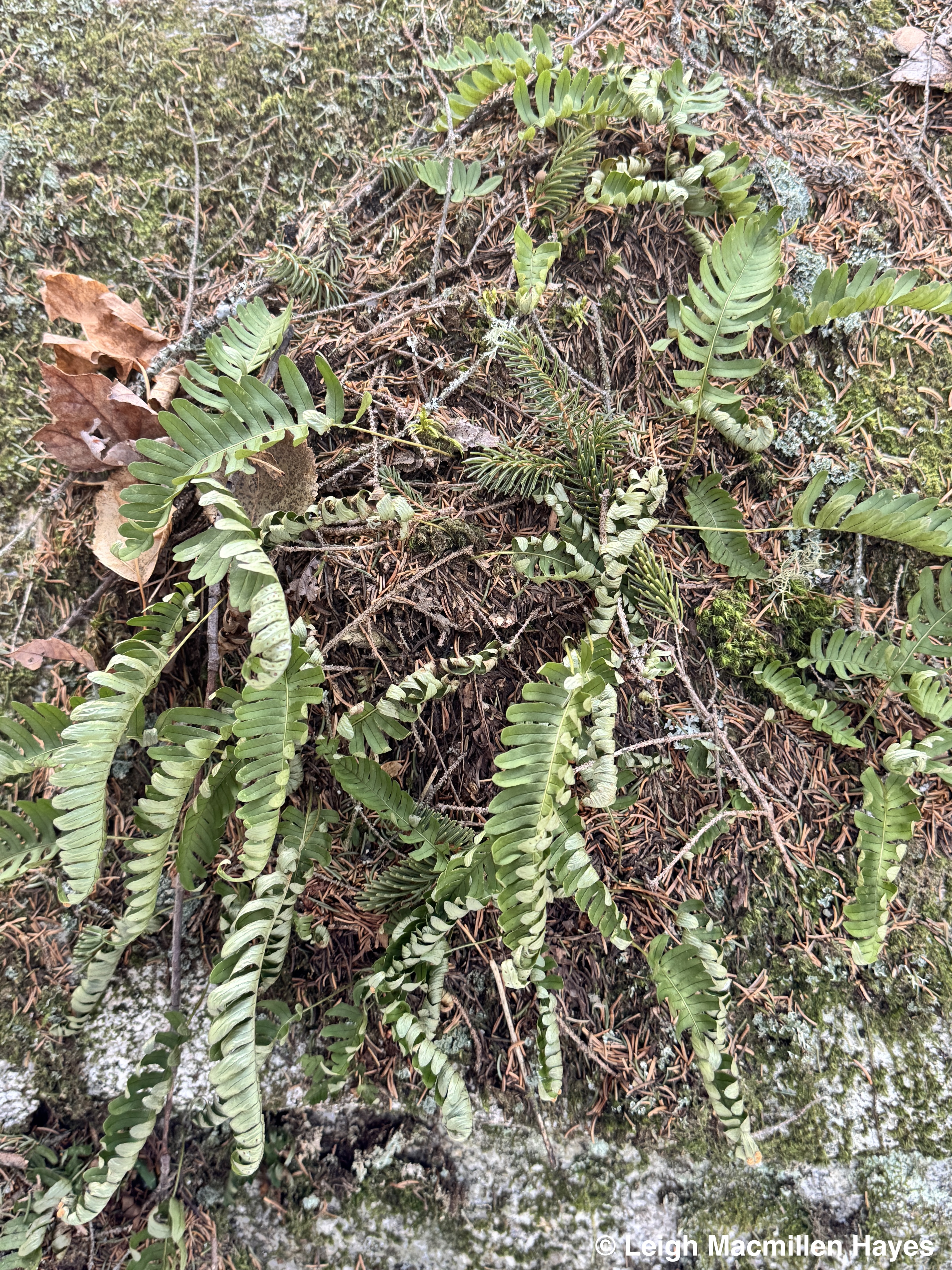
It was in this section of forest that I began to spot Common Polypody ferns predicting the temperature, for they were still a tad bit curled indicating it wasn’t exactly warm, but not completely curled telling us it wasn’t freezing cold either. It was just right!

Well, almost just right, for because of recent rain and warmer temps last week, the melt down has begun and ice flows along the trail were frequent in the coniferous forest.

That same flow continued down a crevasse that we admired from the path, but didn’t need to descend. Thankfully.

A short distance later, we reached Lunch Ledge, aka North Ledge, and took in the view toward Mount Washington.

As we ate, we looked at all the Beech trees below (and other species, of course) and wondered how many more Bear Trees there are in these woods since we saw so many just from the trail. And we wondered if there might be a den nearby.

Following lunch, we continued our trek, and then found a spot where another had dined.
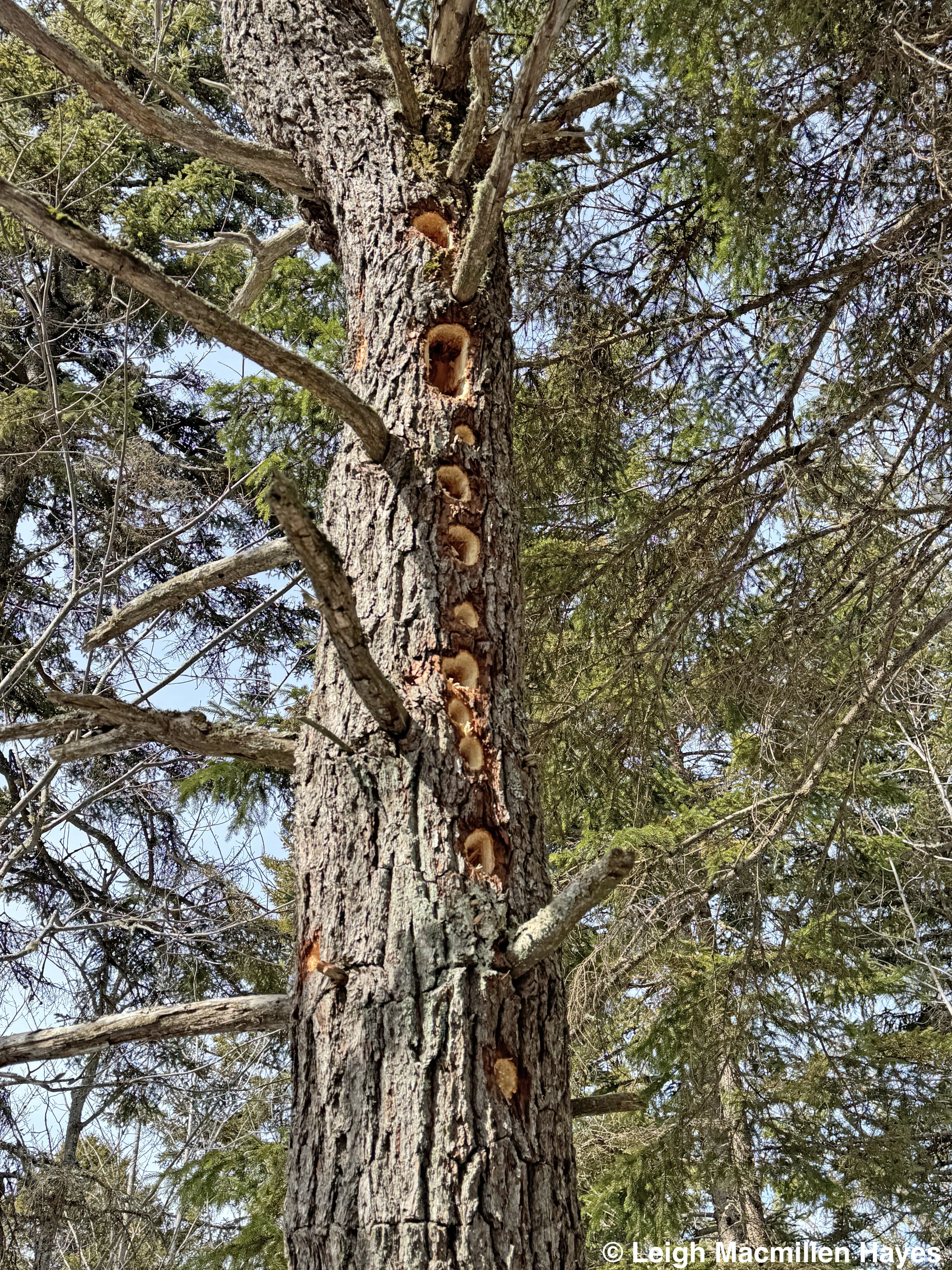
By the number of fresh holes in the tree, we knew the Pileated Woodpecker had visited this spot on more than one occasion, rather like the Bears and the Beech trees.
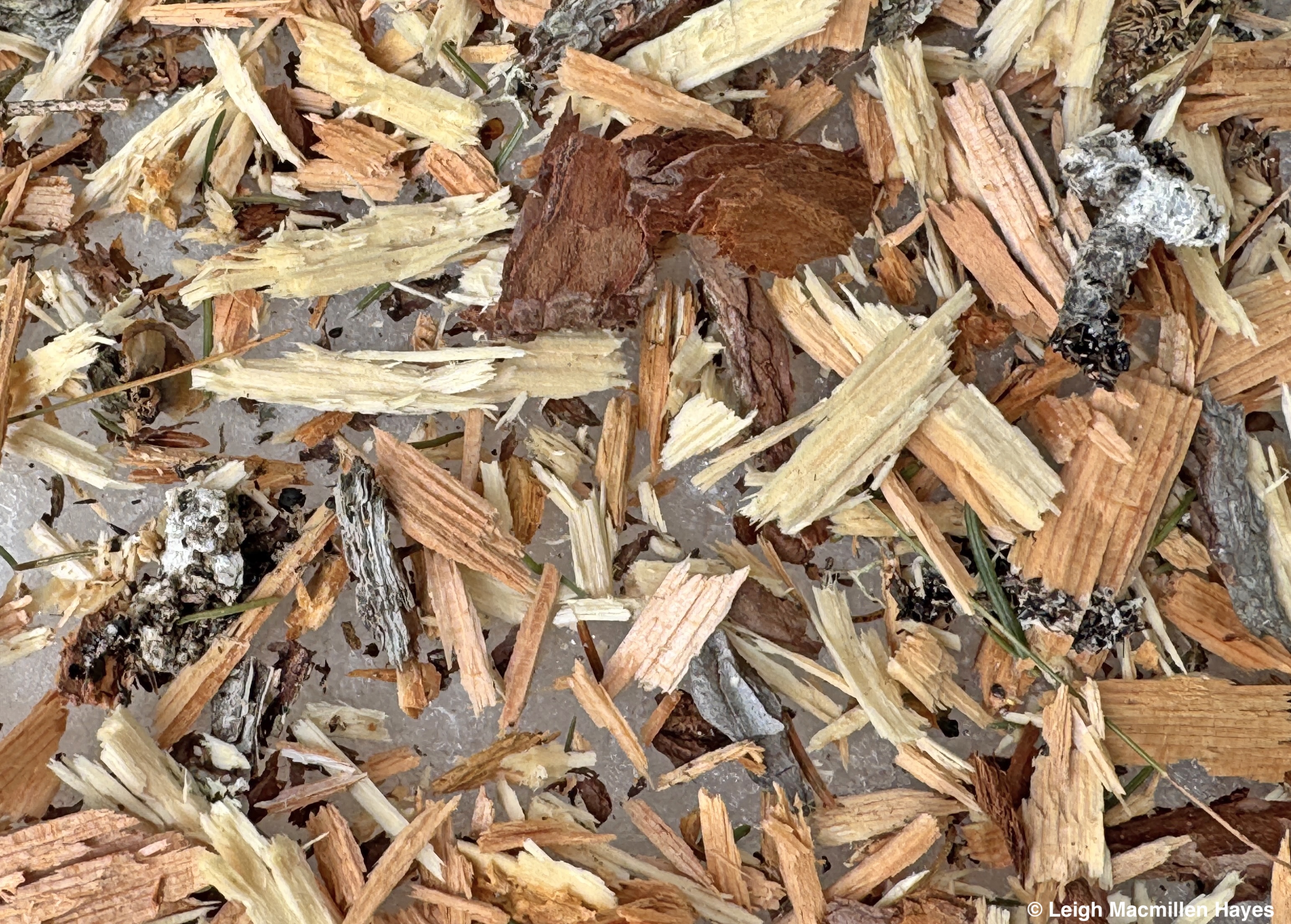
I must confess, I cannot pass up the opportunity to look for scat and so I heeded the invitation to hunt for the treasure. And again was well rewarded.

At this time of year, Pileated Woodpecker scat includes bits of indigestible Carpenter Ant exoskeletons and some wood fiber. The whitewash is uric acid since birds evacuate the acid and feces simultaneously–from an opening just under their tail called the cloaca or vent.

Some of the trees along this part of the trail are Balsam Fir and we kept spotting their cones on the ground.
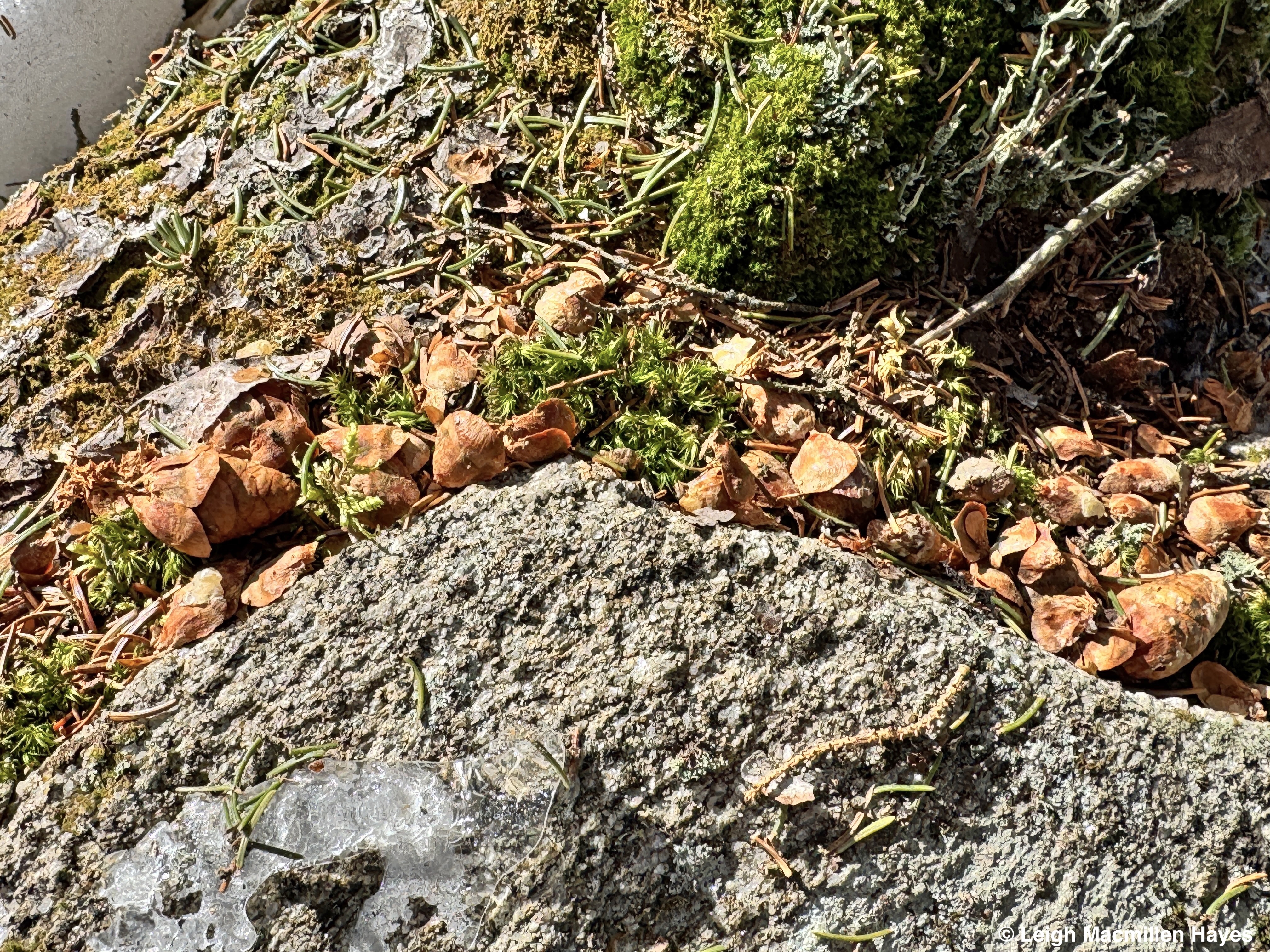
And then middens or garbage piles of Balsam Fir cone scales started to appear and we knew that a Red Squirrel had been dining. We saw some tracks, but never actually heard a squirrel, red or gray, though a Chipmunk dash across the snow and hid from us.

In one area, there were multiple middens, the one in front being about eight inches high. And that brought us to a discussion about the fact that until about 25 years ago, I had no idea what a midden was. Or a cache.

Nor scat. But oh my. A midden and scat on the same rock!

Which came first? My thought is that a Red Fox deposited its twisted and hairy scat–in typical manner upon a high place by a trail, and that the Red Squirrel came along at a later date to dine upon the same rock. I don’t think the Fox’s meal was this particular squirrel. In fact, by the color of it, I don’t think it was a Red Squirrel at all.

But this brought up an additional comment from My Guy about the fact that I can’t stand to see someone spit (think baseball games), but get all excited over scat. (And kill sites.)

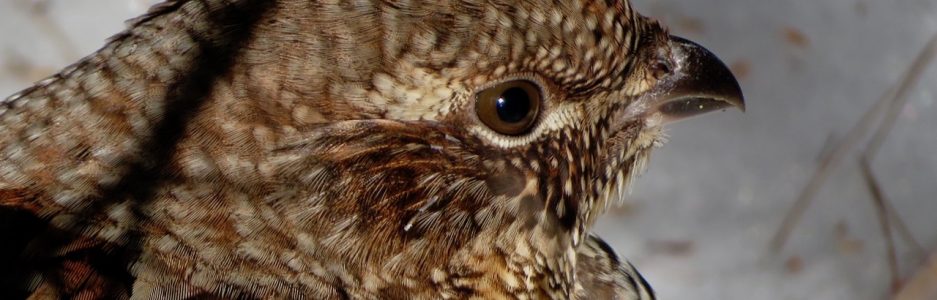
I blame it all on Bridie McGreavey for teaching me about such, and once again rejoiced when I spotted Ruffed Grouse scat in a pile that told me the bird had roosted in this spot along the trail one night this winter.

My Guy claimed that he was going to contact Bridie and tell her that she took a mild-mannered English teacher and turned her into . . . me! (There was a reference to Lois Lane in there;-) )

I might have to mention that I never imagined him practicing Yoga!
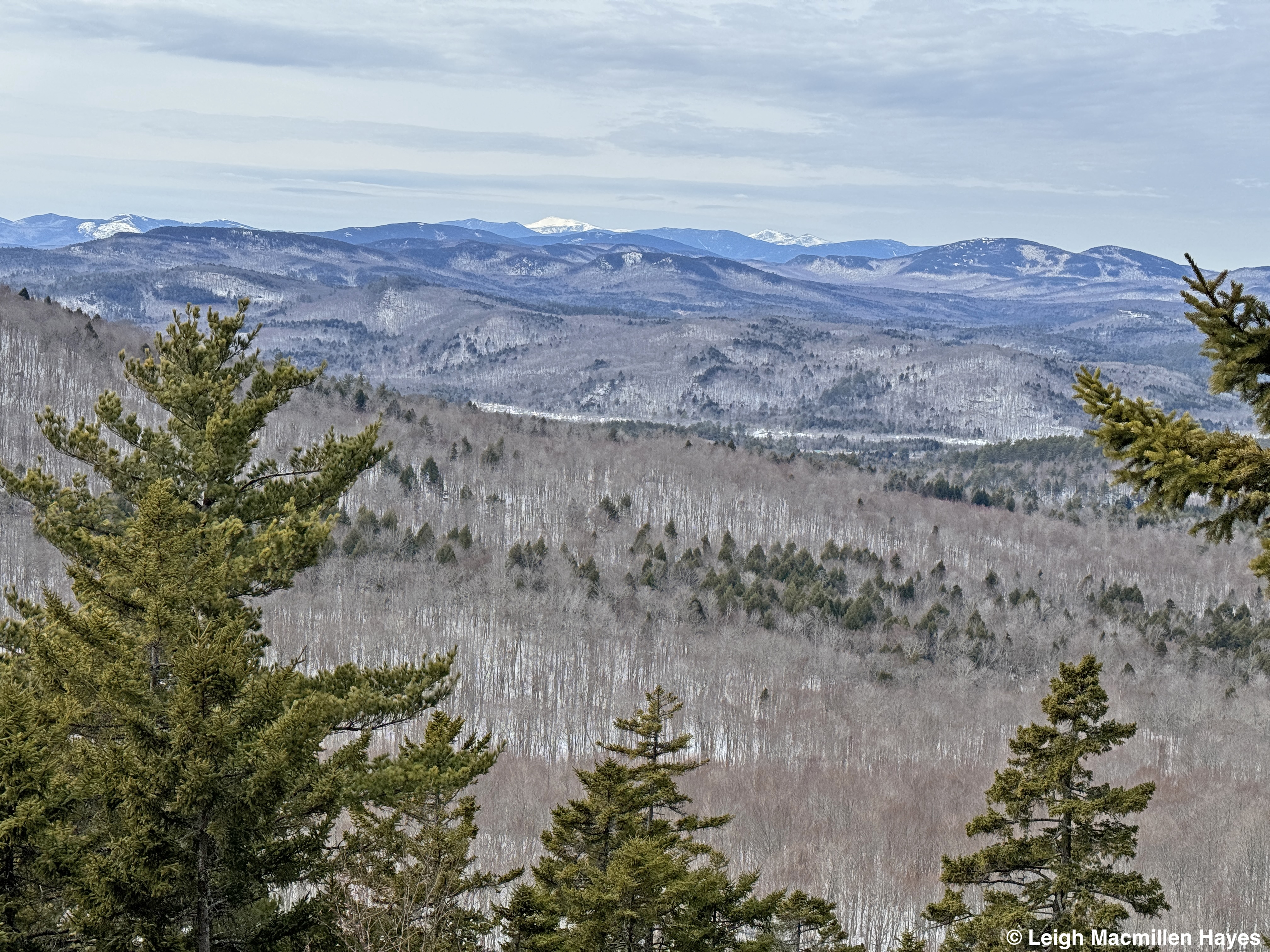
At last we reached Dessert Ledge, aka South Ledge, again with Mount Washington in the offing, and the northern slope of Round Mountain in front of us.
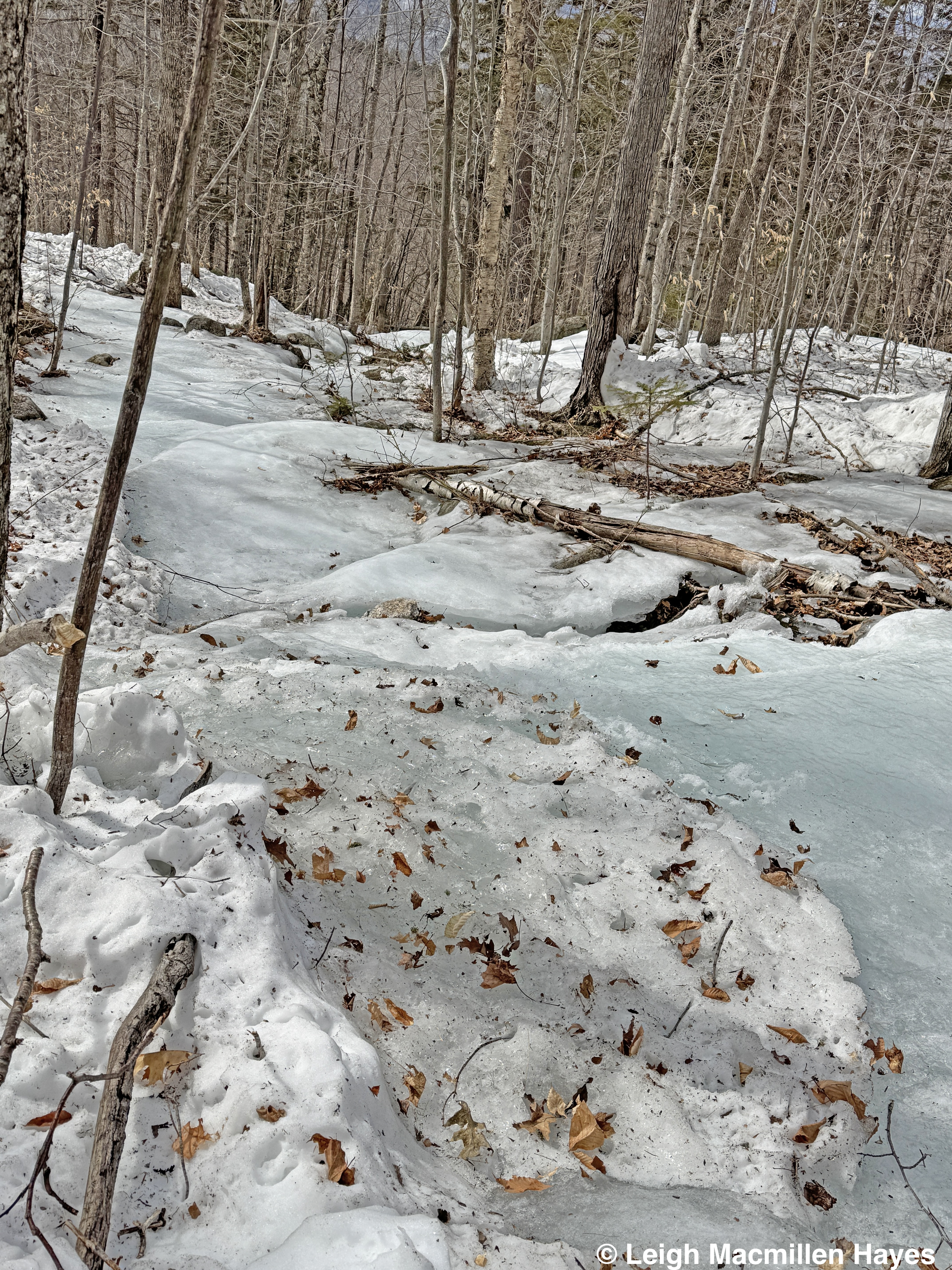
From there we began our descent, pausing again to admire the ice and water that were part of the display and the blue hues exhibited.
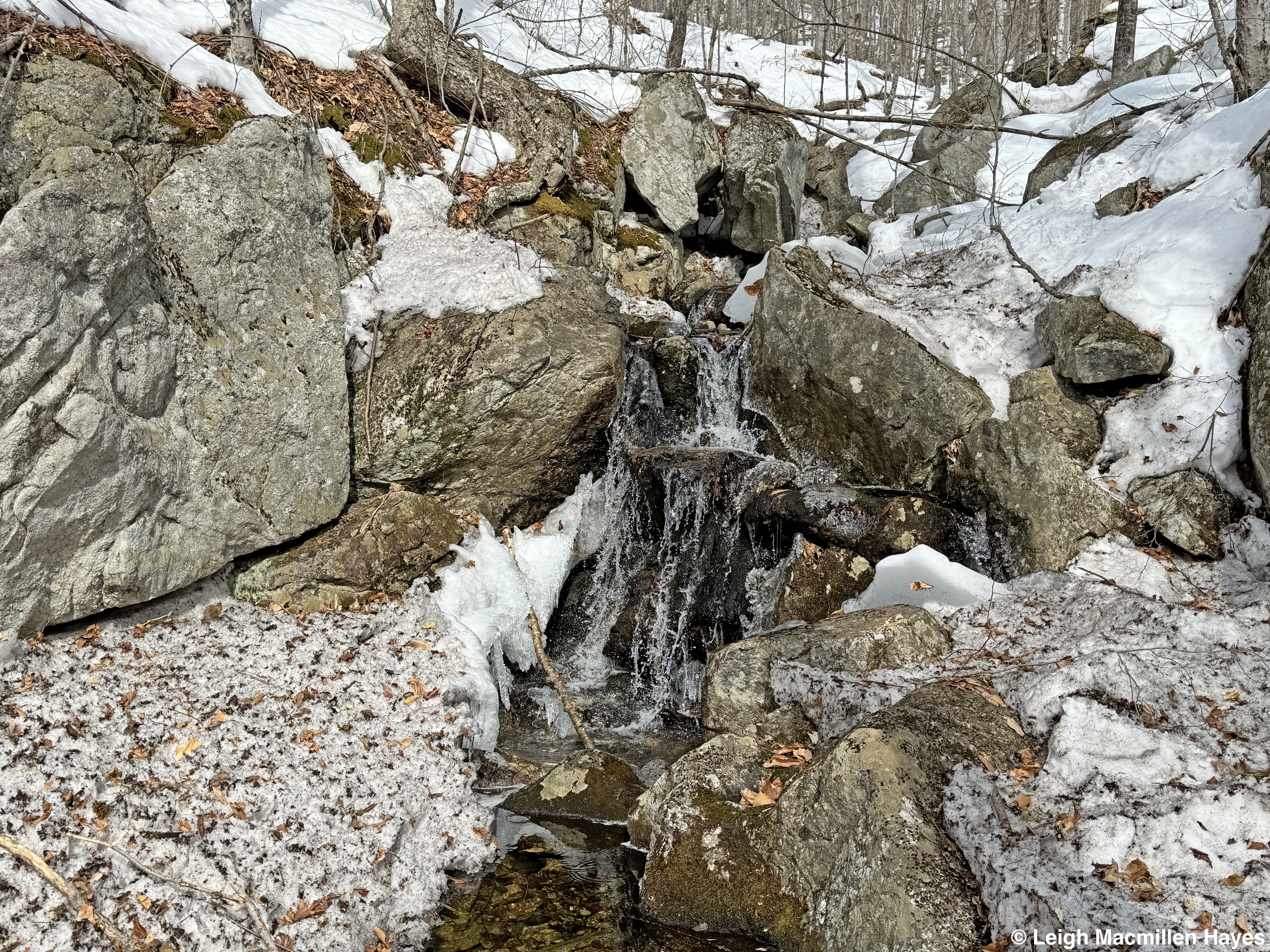
This one crossing I have to admit I was dreading for I thought it might be under ice, but the rocks, which you can’t see because I was standing on them, were bare, and I felt comfortable pausing to take in the view.
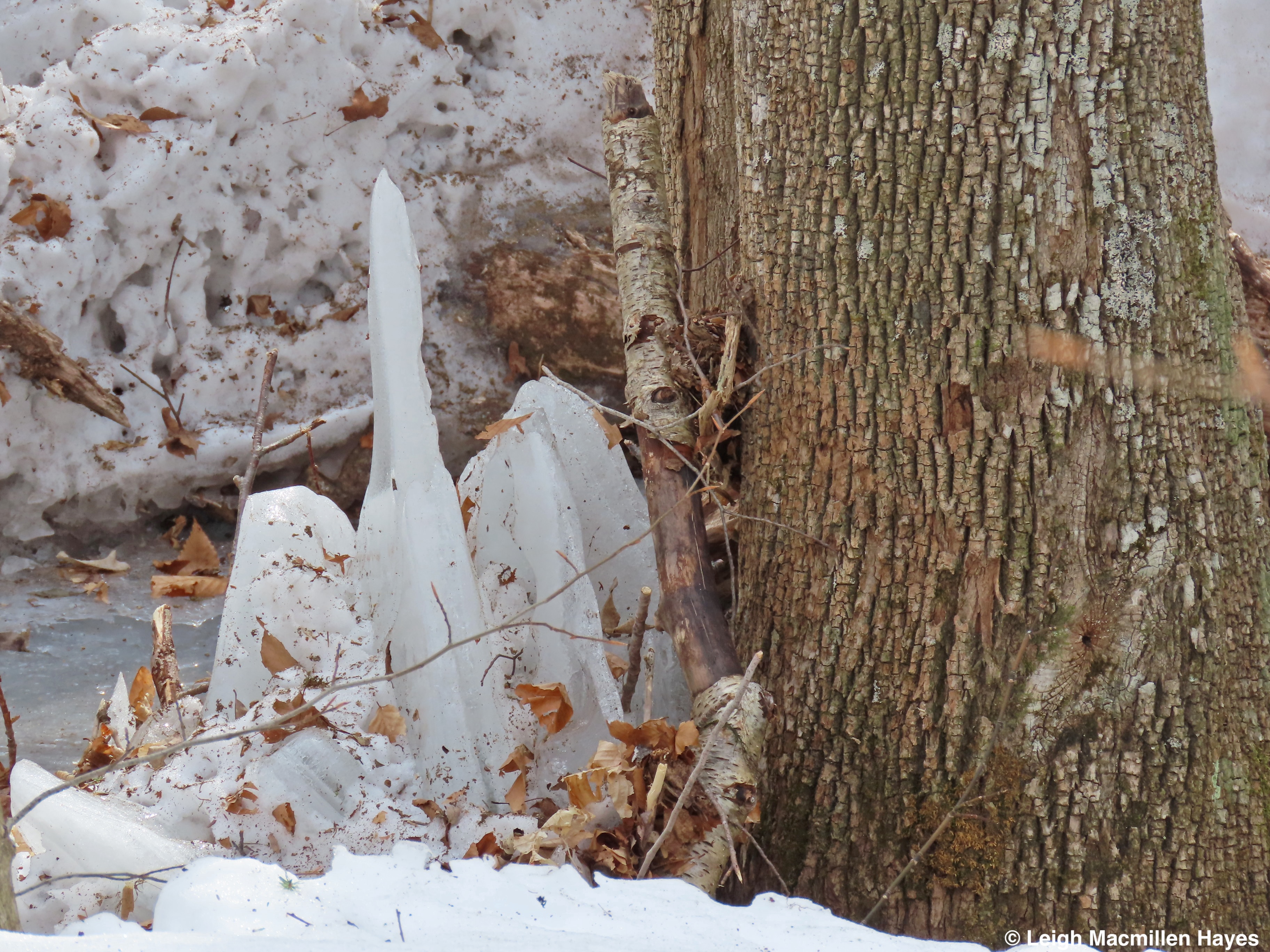
We knew by what we spotted, such as these four slabs of ice somehow caught and wedged by a tree, that the force of the water had been quite strong in the past week, given the weather conditions.

We even spotted an ice berg upon the opposite bank.

Water always soothes my soul, so I thought I’d offer this short video for you to enjoy.

The planet offered us some amazing sites and sounds today, but our favorites were probably the Bear Claw trees.

Yes, we’re still enjoying winter as we did today while we celebrated Creation along the mountain: Long Mountain.

And gave thanks as we always do to Larry and Mary who share this trail and others with so many of us, and Bruce, their trail creator, who does an amazing job.
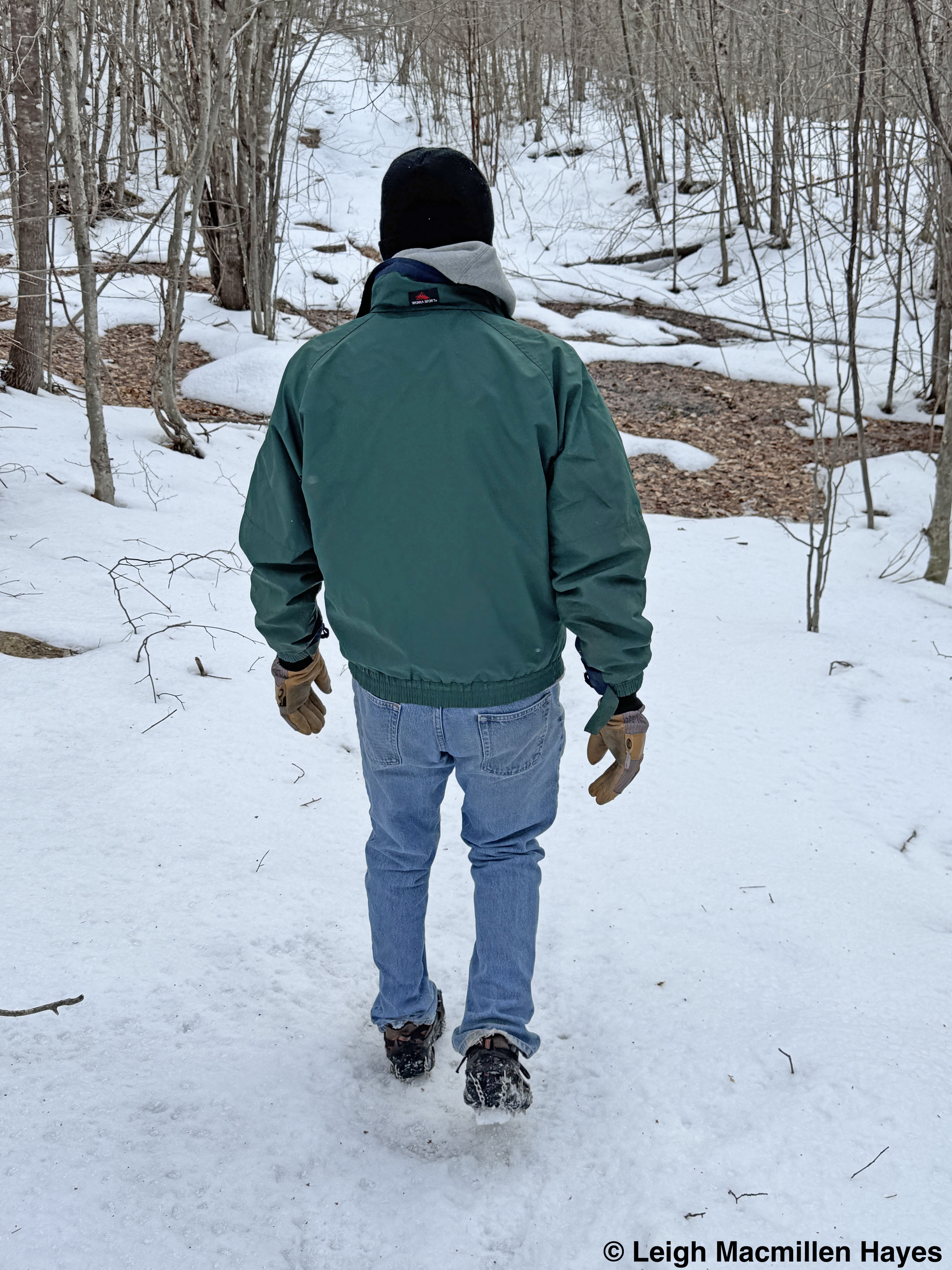
The Beaver’s Tale

Much to our delight,
just after parking the truck
at a local trailhead,
the caretaker crossed the road
to bid us hello.
After sharing with us
his plans for an upcoming adventure,
we wished him Bon Voyage,
and started down the trail,
giving thanks that friends
had pre-packed it
with their snowshoes
last week
so we only had
to wear micro-spikes.
(Thank you, Sue and Lee)
At last reaching one of two ponds,
around which we planned to tour,
we chuckled at the juxtaposition
of summer and winter,
in the forms of
canoes, snow, and ice.
A few more steps,
and we weren't sure
which season witnessed
what must have been an immense crash
as part of this old hemlock
slammed onto the ground.
Meanwhile, 
the upper most section
of the fallen tree
was caught by friends
who are still doing their best
to hug it
and keep it
from careening
to the forest floor.
And farther still, 
a bunch of
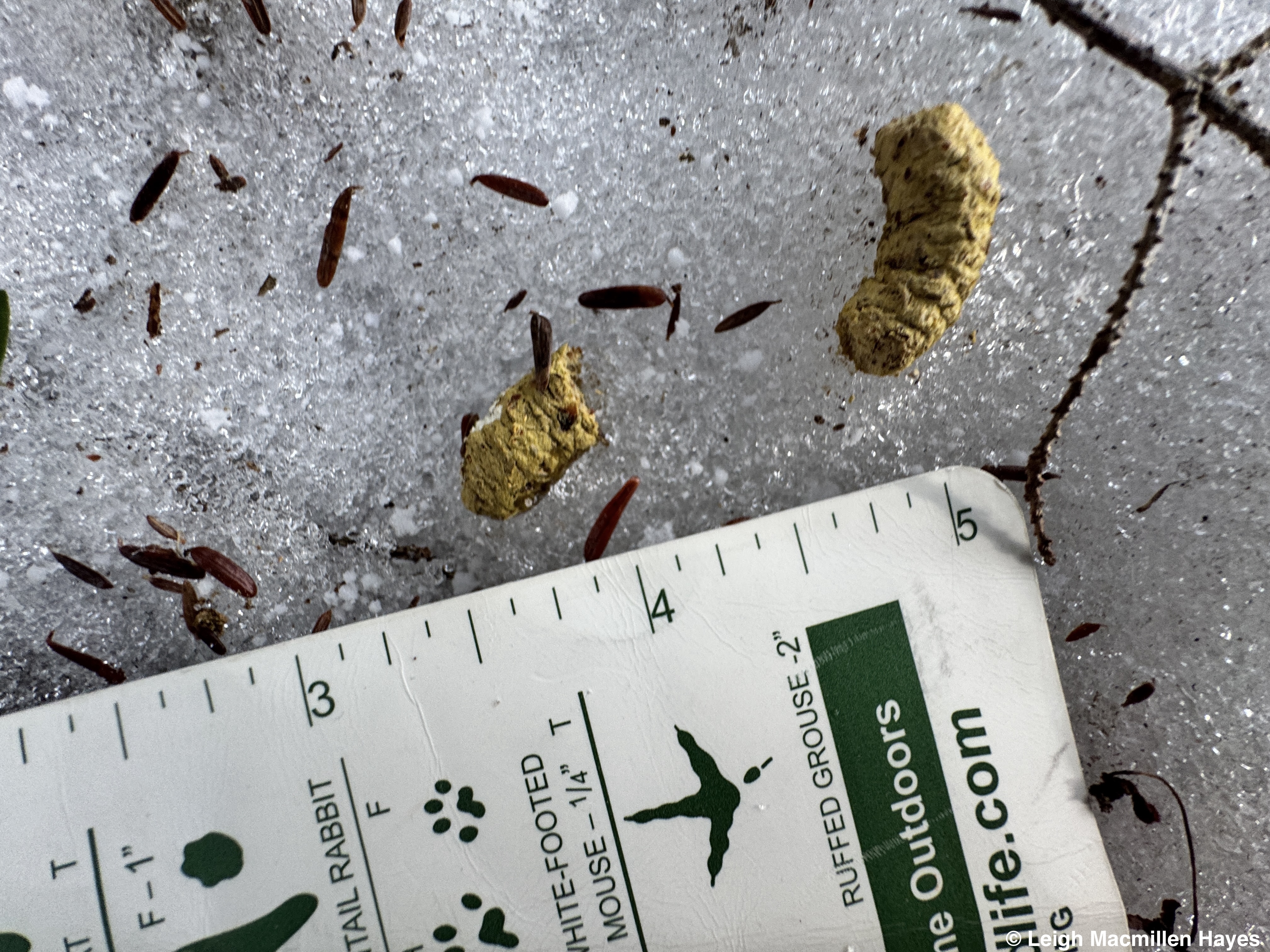
mustard colored droppings,
aka scat,
bespoke the past presence
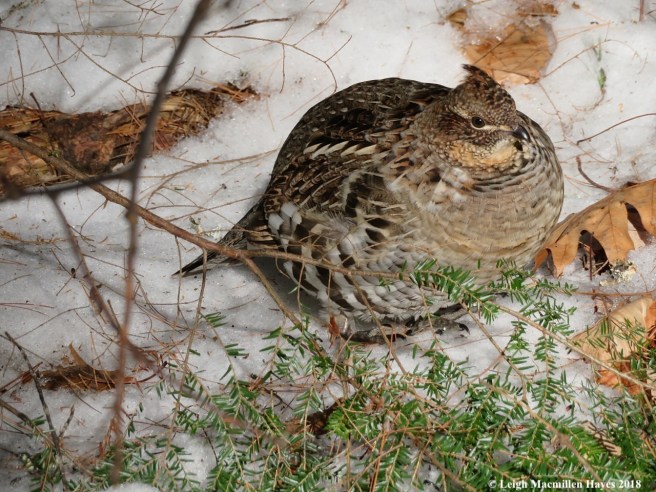
of a Ruffed Grouse
who must have dined well.
By the shape of the prints 
in front of him on the trail,
My Guy immediately new the maker,
for one was a wee hand,
and the other a bit longer,
and both were
offered on opposite diagonals,
as is this waddler's presentation,
it being a Raccoon.
When we reached the lifesaver,
we knew we were at the halfway point,
and had to decide
to continue to the next pond,
or only circle this one
because our time was limited.
We chose the latter,
saving the other for another day.
The trail next passed
beside a wetland,
and in the middle
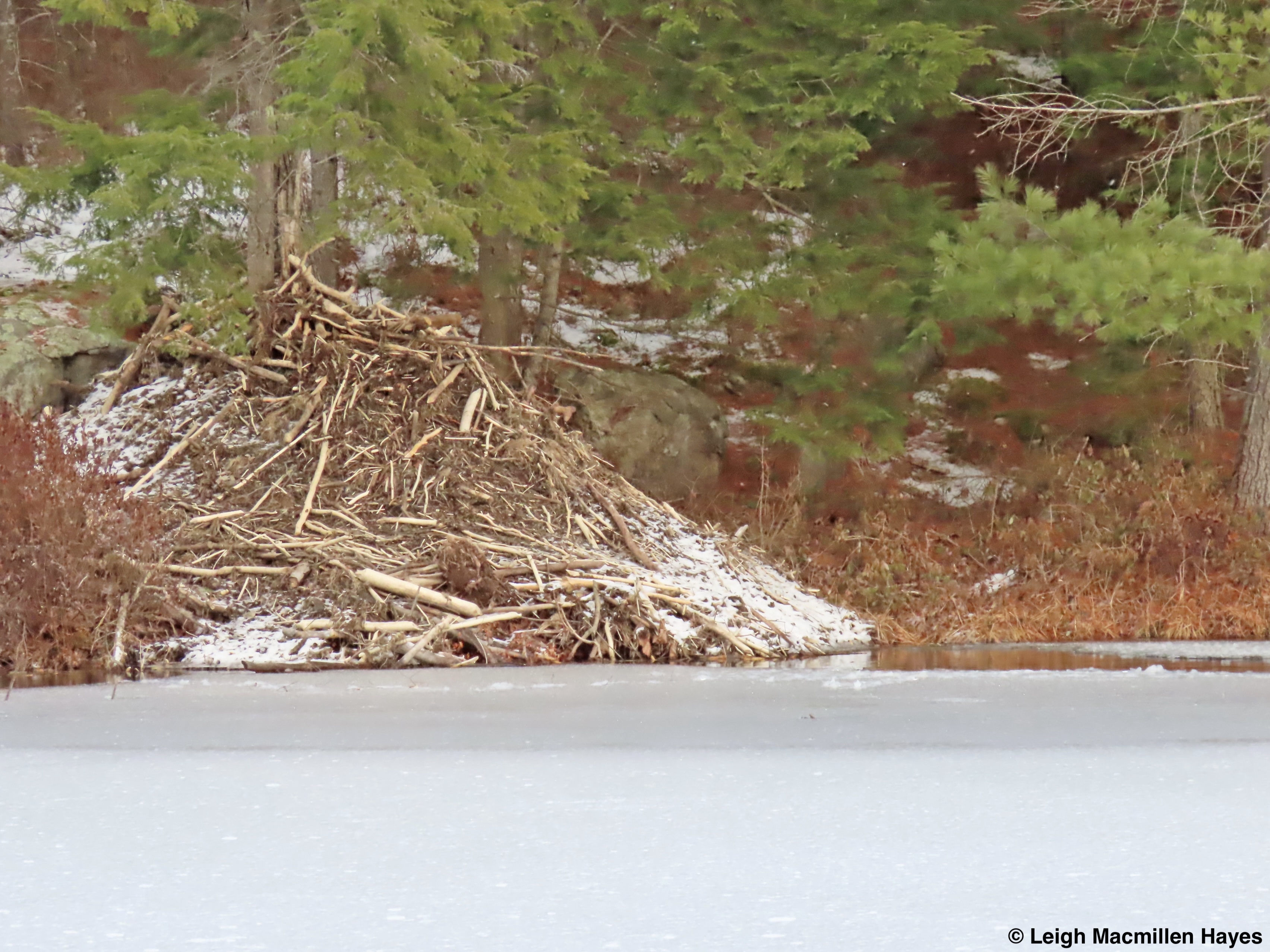
I spotted the Big House, Little House, Back House, Barn,
of a Beaver family,
with fresh wood
indicating someone was probably
in residence.
Continuing on, 
it soon became apparent,
that a logging operation,
had taken place,
but the workers
were of the non-human sort,
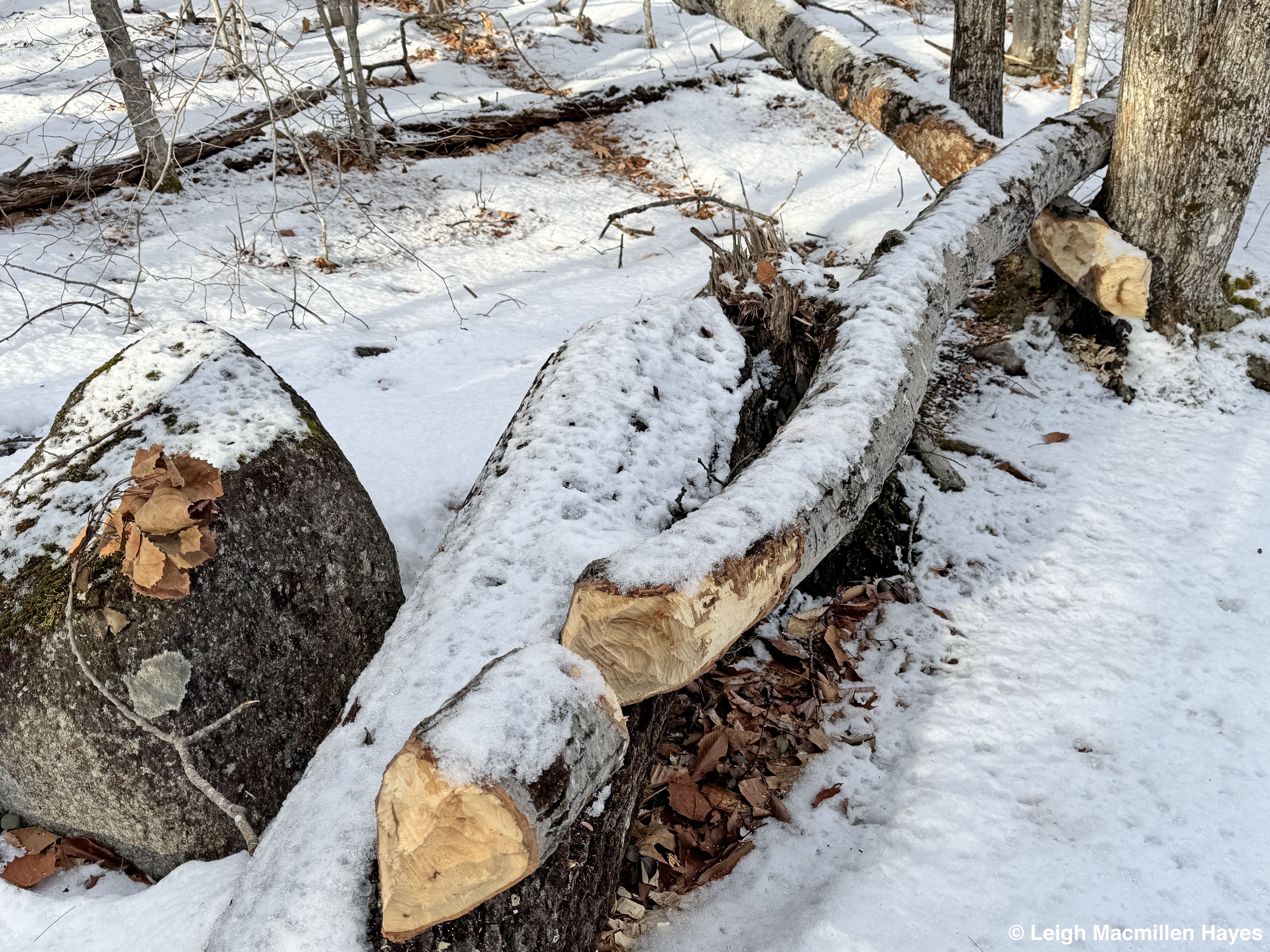
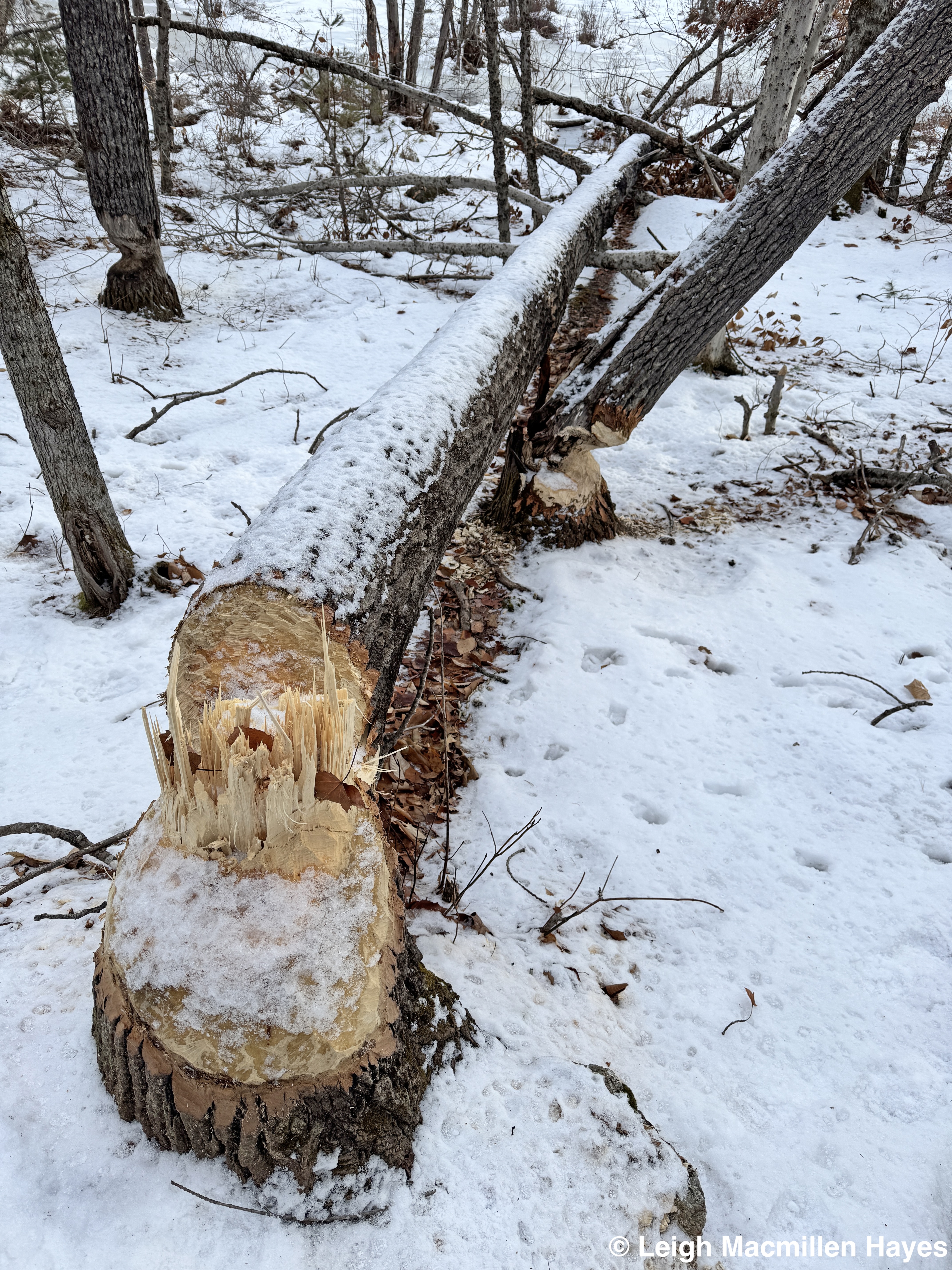
for such were the toothmarks
of said Beavers.
We found 
example after example
of trees sawed
with their chisel-like teeth,
and some even crossed the trail
we followed
for our route
was of no concern to them.
Upon reaching 
the other side
of the wetland,
I looked at the lodge again,
and found it curious
that there was no open water,
given that up until today's frigid temps,
we had a bit of a melt,
and surely the Beavers
would have been
on the move.
And then mere minutes and steps later,
because there are no leaves on the trees,
I spied across the way,
a huge new lodge
that we somehow missed
as we hiked above it
a half hour earlier.
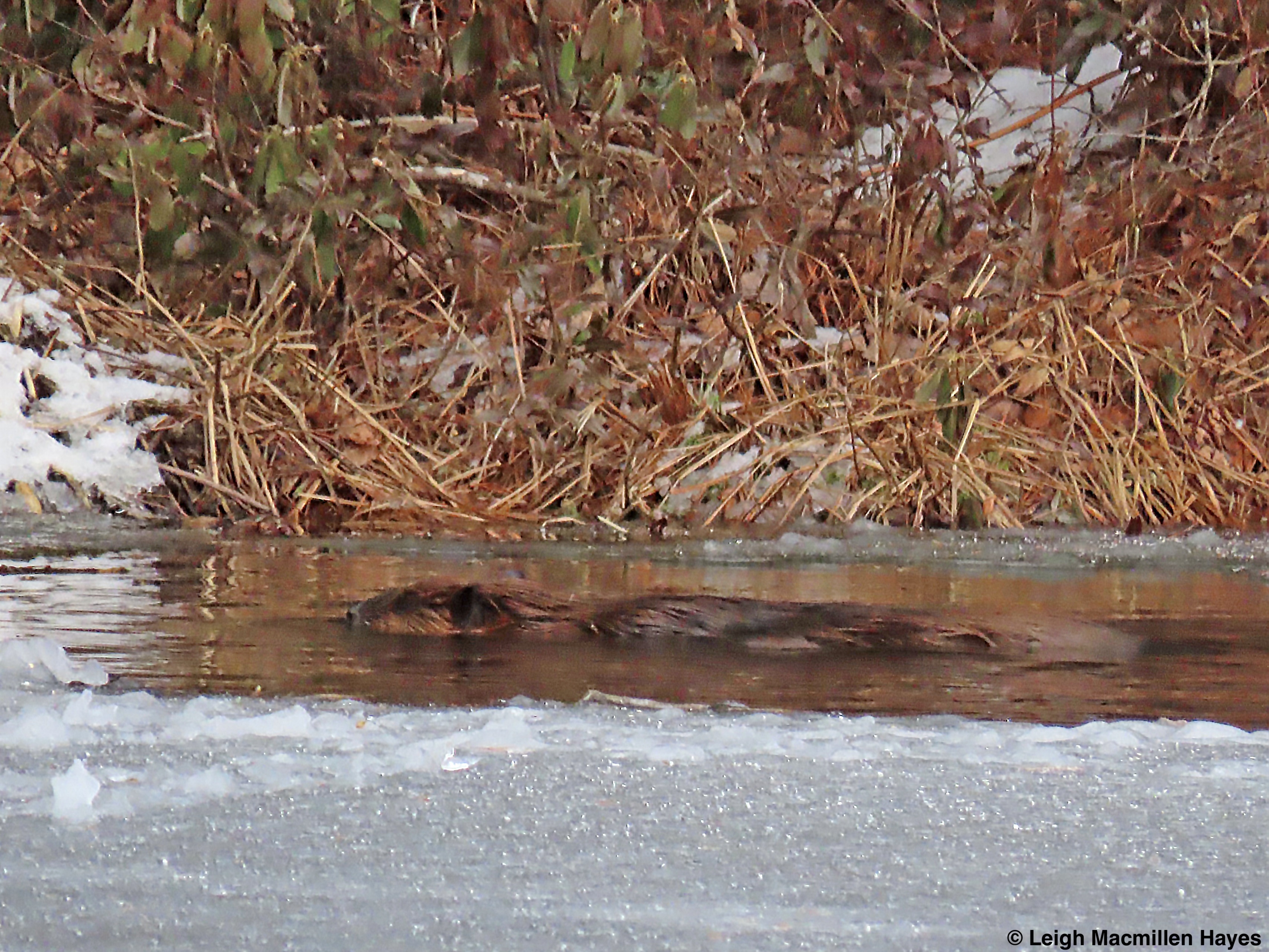
As I zoomed in with the camera,
what should I see,
but a Beaver swimming
in open water,
and my heart was still,
and I wanted to stay
in that spot forever.
For about ten minutes,
that Beaver and I shared the space,
mind you from a distance.
My Guy was just up the trail,
and did not see what
I was focused on.
And this was not the time
to shout,
"Hey look, there's a Beaver!"
because no sooner said,
then there would not
be a Beaver anymore.
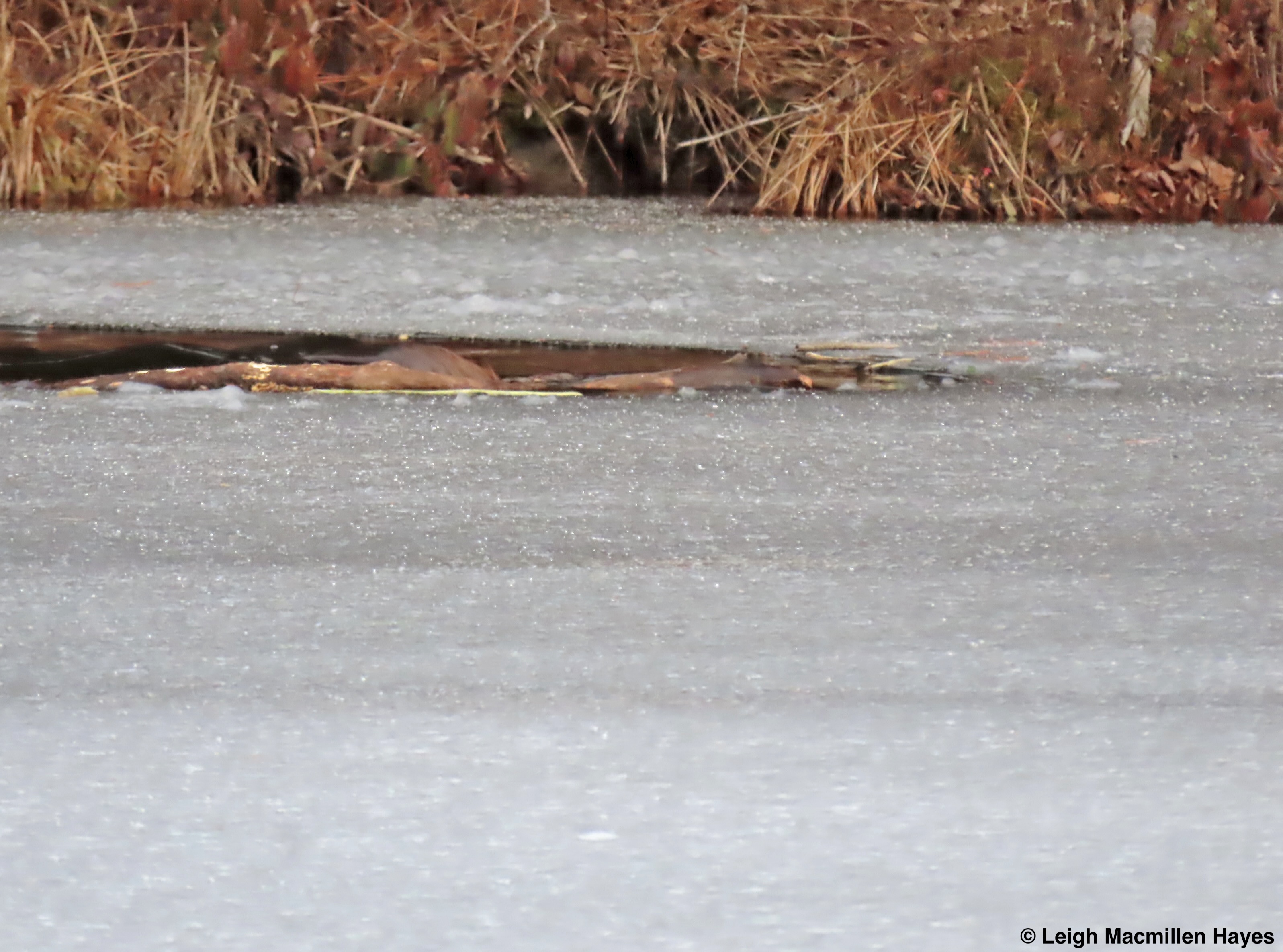
Chew sticks were visible
on either side of the pool
he had created
and I suspected he was grabbing a few
from an underground "raft"
of sticks previously stored,
or cached as we say,
and bringing them in
for the rest of the family to dine.
I think my assumption
may have been correct,
for when he reached
the far end of the pool,
he slipped quietly underwater,
rump first rising in the air,
and then whole body disappearing.
It's a funny thing
to realize
that when a Beaver
isn't aware of my presence,
it doesn't need
to slam its tail
and surprise me
or warn its family
that I am there.
Rather, it barely
leaves a ripple
upon the water's surface.
About five minutes later, 
the Beaver appeared again,
and then disappeared under water
beside the lodge
and I again assumed
I was correct
that chew sticks
were on the menu
this night
as they are every night.
With that 
I took my leave
from my lookout spot,
and followed My Guy
toward the conclusion
of our journey,
giving thanks all the way,
for the Beaver
who went about its daily duties
and let me be a witness.
As the sun 
began to set
on this day,
January 2, 2025,
I realized that it
shall be forever more
the day I celebrate
this Beaver's Tale.
Thank you to the owners of the land,
Mary and Larry,
and to their caretaker Bruce,
for conserving this place
so all may live
as nature intended.

Wait. Watch. Wonder. Learn.

As I waited for the sun to rise on this final day of autumn 2024, before the dawning of the winter solstice, I watched the sky. It seemed late. Of course it seemed late. Tomorrow will be the shortest day of the year.

Ever so gradually, the sky brightened. First, there was barely a hint of light shining through the trees as if taking its time was a way to remind me to slow down.

And then I began to see it. Not the orangey-yellow I expected, but rather a blue gray that slipped out from behind the silhouettes of the tree trunks, who stand as watchers, observers, of every dawn every day.

Ever so slowly, a hint of pinkish purple rose in the East and the blue gray was transformed.

I, too, wished to be transformed. By this first light. By this new day.

And then it occurred to me that I do rejoice at each daybreak and look forward to its offerings.

Today, however, was a wee bit different as it was the day to enter a place I’ve barely visited since the spring and I felt drawn to part the hemlock boughs and venture forth into my own secret garden, that isn’t a garden at all, at least not if you expect it to be a place where flowers and vegetables are tended. Ah, but it is a garden from so many others. And its those others that I hoped to meet.

In her book entitled Church of the Wild: How Nature Invites Us Into The Sacred, author Victoria Loorz writes, “You wander slowly and intentionally. It is your full presence along the path that matters. It is an act of reverence, a saunter. John Muir hated the word hike. He urged people to saunter. ‘Away back in the Middle Ages,’ he told his friend once, ‘people used to go on pilgrimages to the Holy Land, and when people in the villages through which they passed asked where they were going, they would reply, ‘A la sainte terre,’ ‘To the Holy Land.’ And so they became known as sainte-terre-ers or saunterers. Now these mountains are our Holy Land, and we ought to saunter through them reverently, not ‘hike’ through them.”

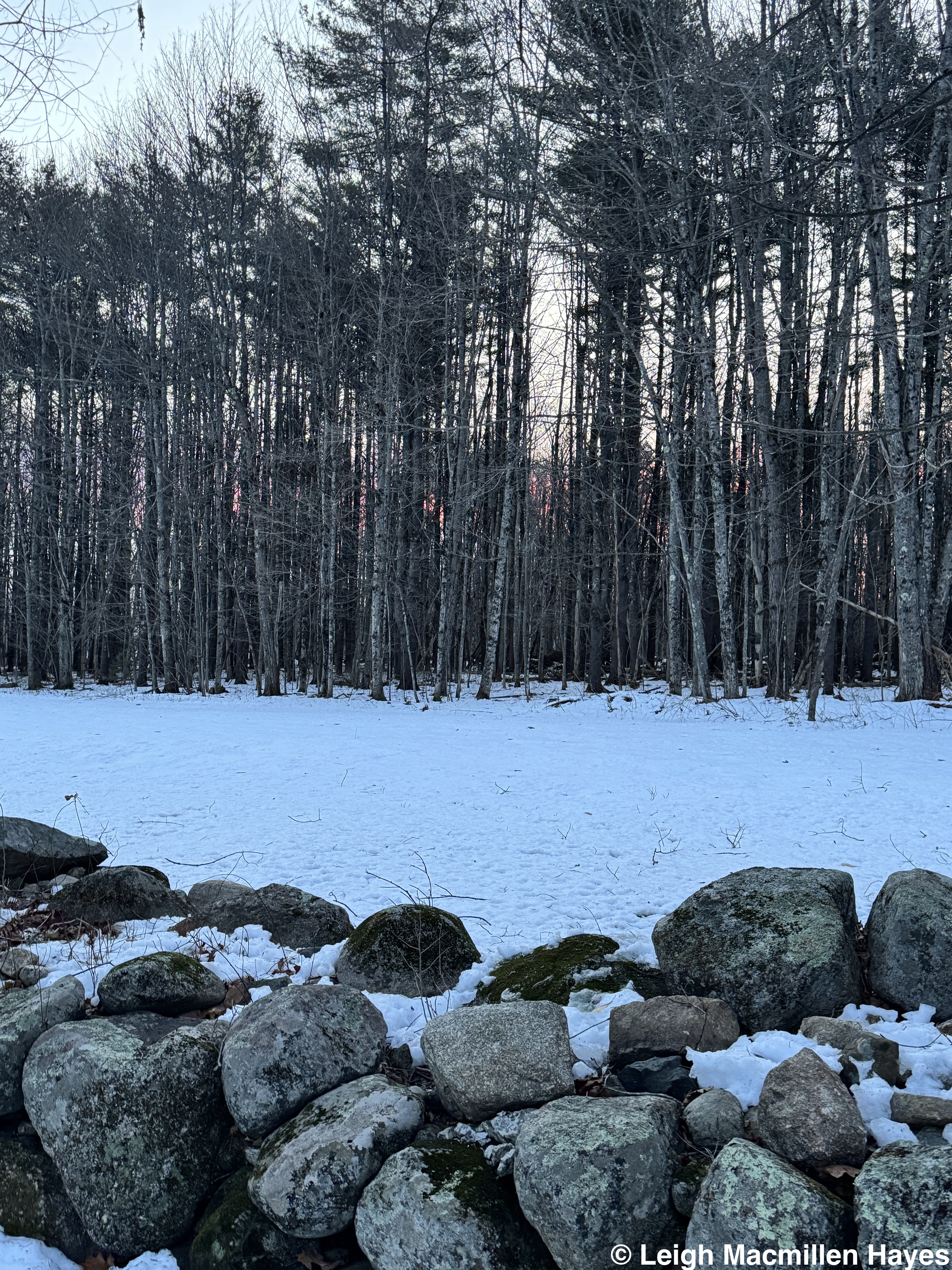
And so I sauntered, not letting the stone walls or barbed wire stop me from crossing over manmade boundaries.

All the while, I wondered, “Who will I interact with today?” and “Will I be able to shut down my inner ramblings and really wait, watch, and listen?”

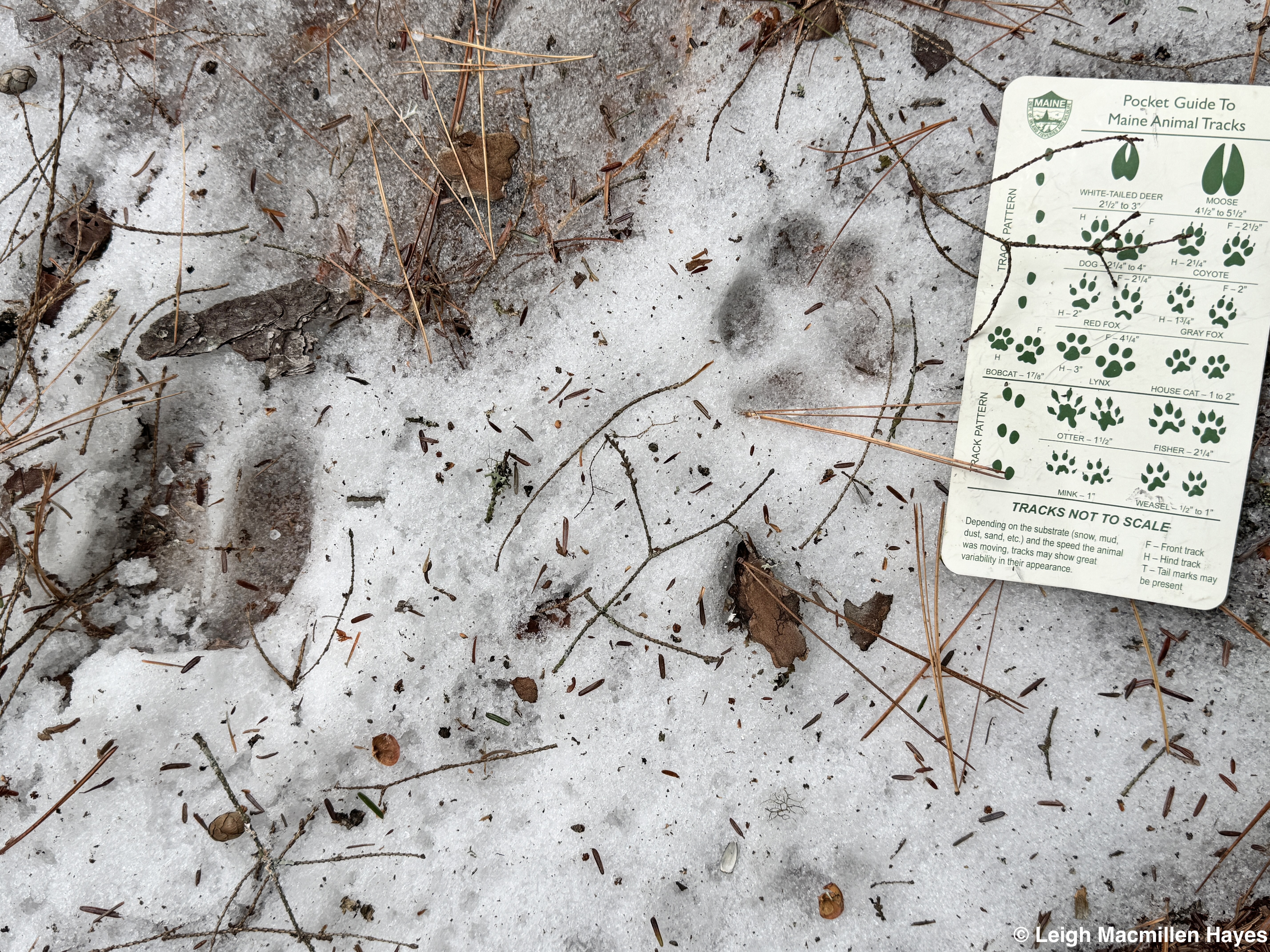
My heart quickened despite my efforts to slow my breathing, when I spotted not only the heart-shaped prints of White-tailed Deer who really own these woods, but also one who pursues them, the Bobcat.

Would I spot any evidence that though they travelled in opposite directions a day or so apart, their paths eventually crossed? That remained to be seen.

What I did know was that unless I sat for a time, I would not spot any critters because the snow conditions were such that I stood firmly on top–like walking on water–frozen water, and made a loud crunching sound with the fall of each footstep.

Those who know me well, know that I am a cradle Episcopalian. Among other things, I love the liturgy. But what I’m discovering I love the most is the shared fellowship with a diverse group of people.

And in the same way, I love the woods out my door and how each and every other-than-human being IS diverse, and how they aid and abet their neighbors, sometimes offering a helping tree limb or shared nutrients, and other times feeding upon others because they, too, need energy.

And in the forest, there is life and death, and a dead snag can be just as beautiful as a live tree. And in its death, offer space for others to live.

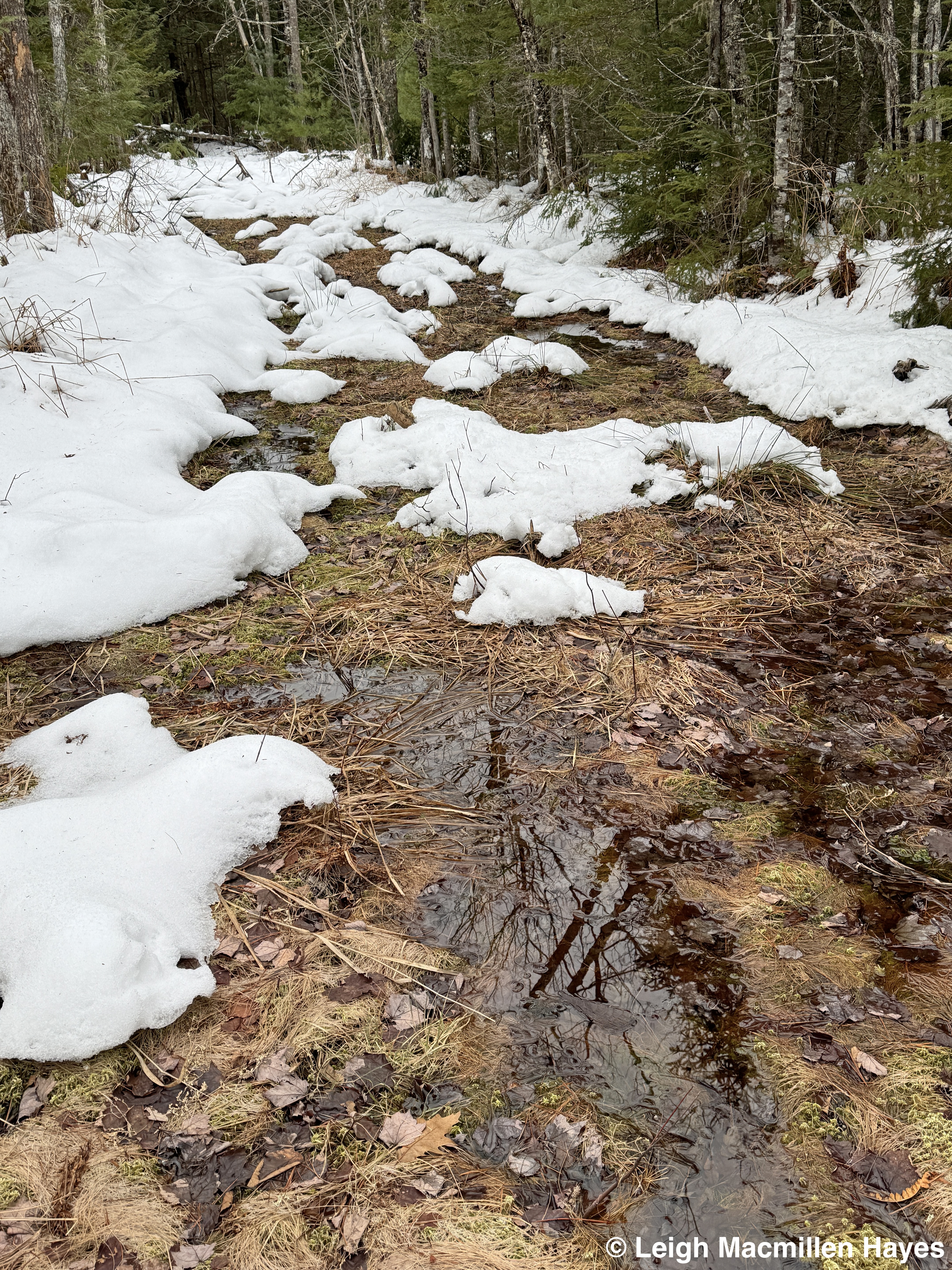
During today’s saunter, I bushwhacked sometimes and followed old logging trails in other moments. During all of my visit, I often encountered places that needed consideration for navigation, but in the pause as I gave thought to my way forward, I noticed reflections that reminded me of my desire to do the same. Take time to reflect.

I made sure to look up and down and felt a need to celebrate discoveries, such as this perfectly round Snowshoe Hare scat. Last year there weren’t many hares in this part of the woods, so I can only hope that this year will be different.

Evidence of deer activity was everywhere, from well tramped routes that generations have followed for eternity to freshly rustled up Northern Red Oak leaves indicating a search for acorns to dine upon.

What made me chuckle, however, was the realization that it wasn’t just the deer who were taking advantage of an abundant acorn crop. A squirrel had cached one here and another there–that should serve as a meal for a later day.

After searching for a friend I doubted I’d meet, and I didn’t (Porky is saving our meeting for another day), I stepped out to an old logging road and instead met another I couldn’t recall from previous saunters. Perhaps it was because I was approaching it from a different direction than my norm.

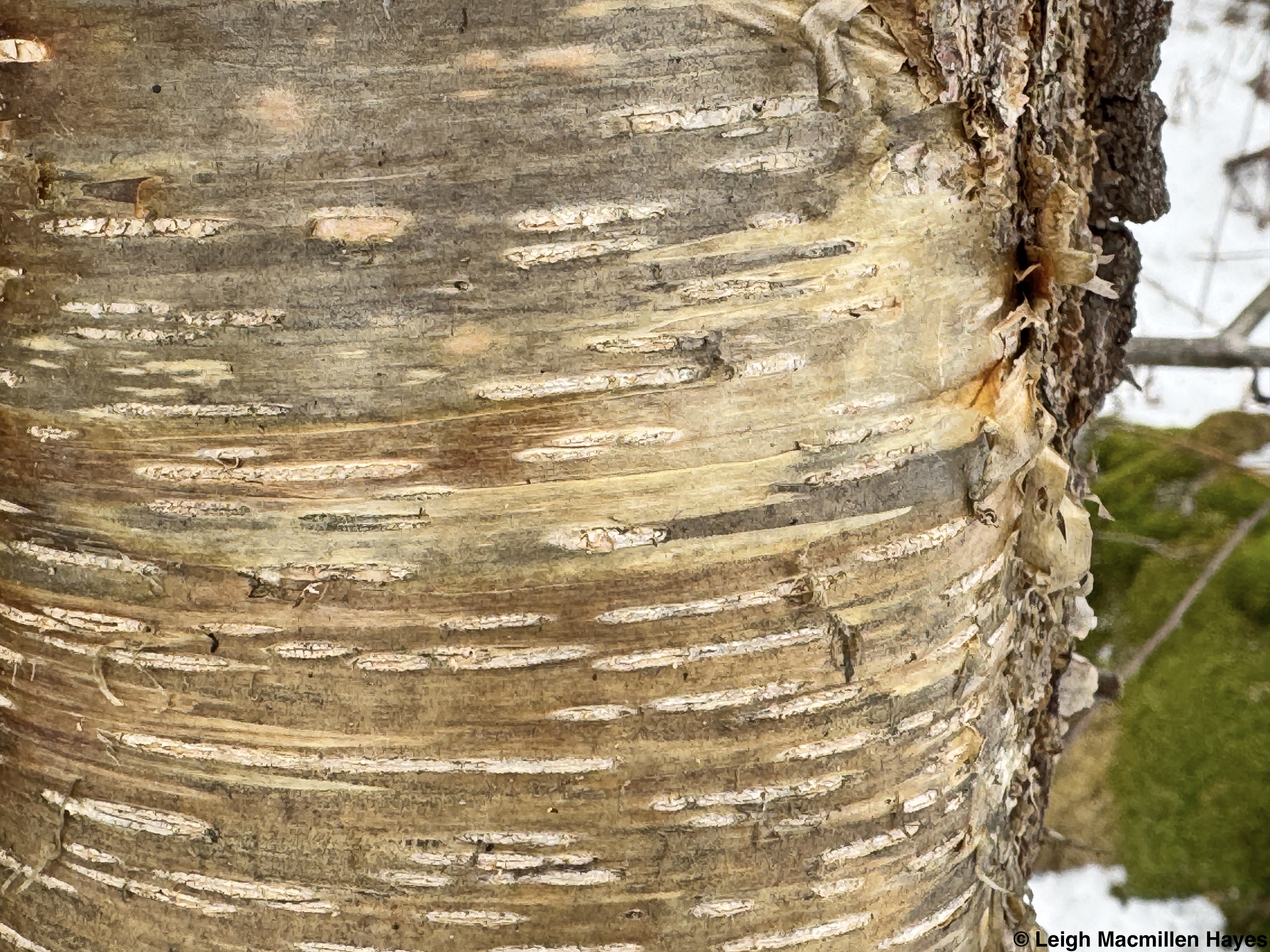
This Yellow Birch has apparently graced this spot on a boulder for many years. And though it looks as if it served as a turning tree during a logging operation about ten years ago, it still stands tall.

In fact, by the amount of catkins at the tips of its branches, it appeared the birch was full of life and love and ready to make more birches in the future.

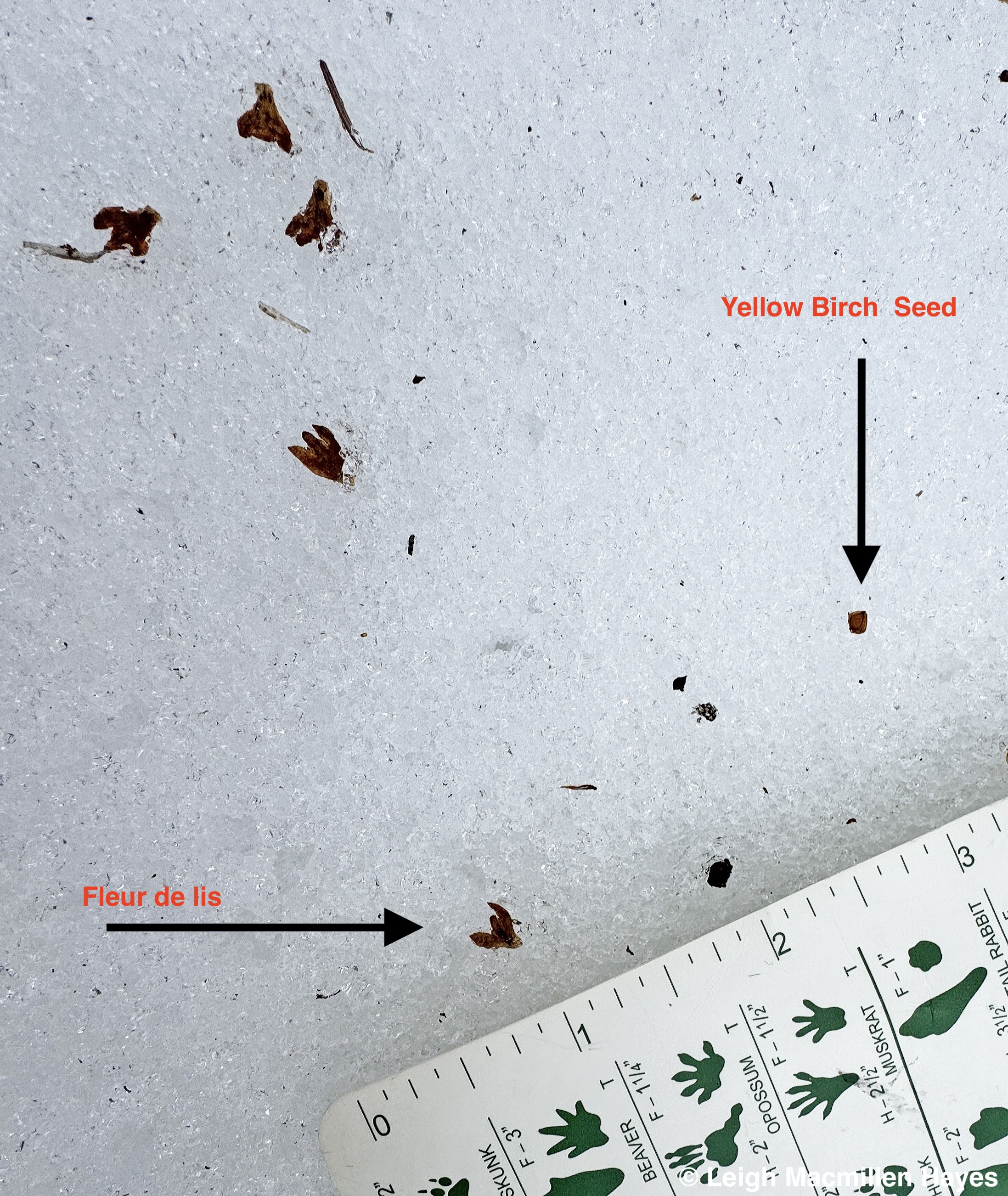
At its feet, fleur de lis scales that protected its tiny seeds had fallen from last year’s pollinated catkins and will eventually break down and add to nutrients to the forest floor.

What I am always wowed by, and today was no different, is the shape of a birch seed–which reminded me of a tiny insect with antennae. A future is stored in that wee structure and maybe this one seed will some day germinate on the boulder below it. Unless a bird eats it first. But then again, maybe it will germinate somewhere else when it comes out in the bird’s scat.

The bark of the birch made me think of landscape paintings I’ve seen from deserts far from this place in western Maine. And I realized I don’t have to go far to travel to other places.

Even as I left the Mother Birch behind, I turned back to see if I could remember it from so many other visits, because certainly it didn’t just appear today. Or did it?

Turning around again, I nearly tripped over a few fallen twigs, but it was what stood out among the dying vegetation covering the twigs that drew my attention. A random feather?

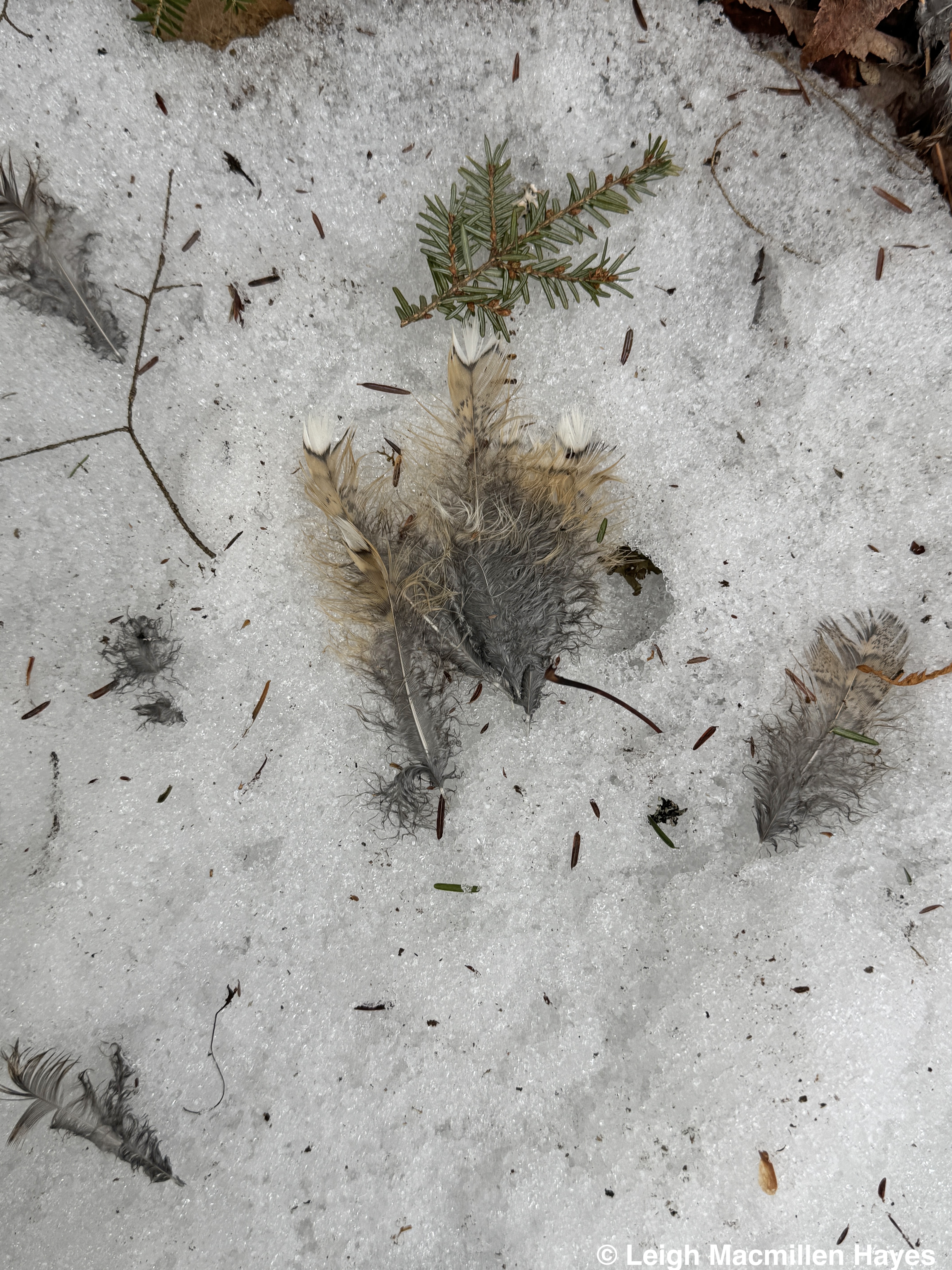
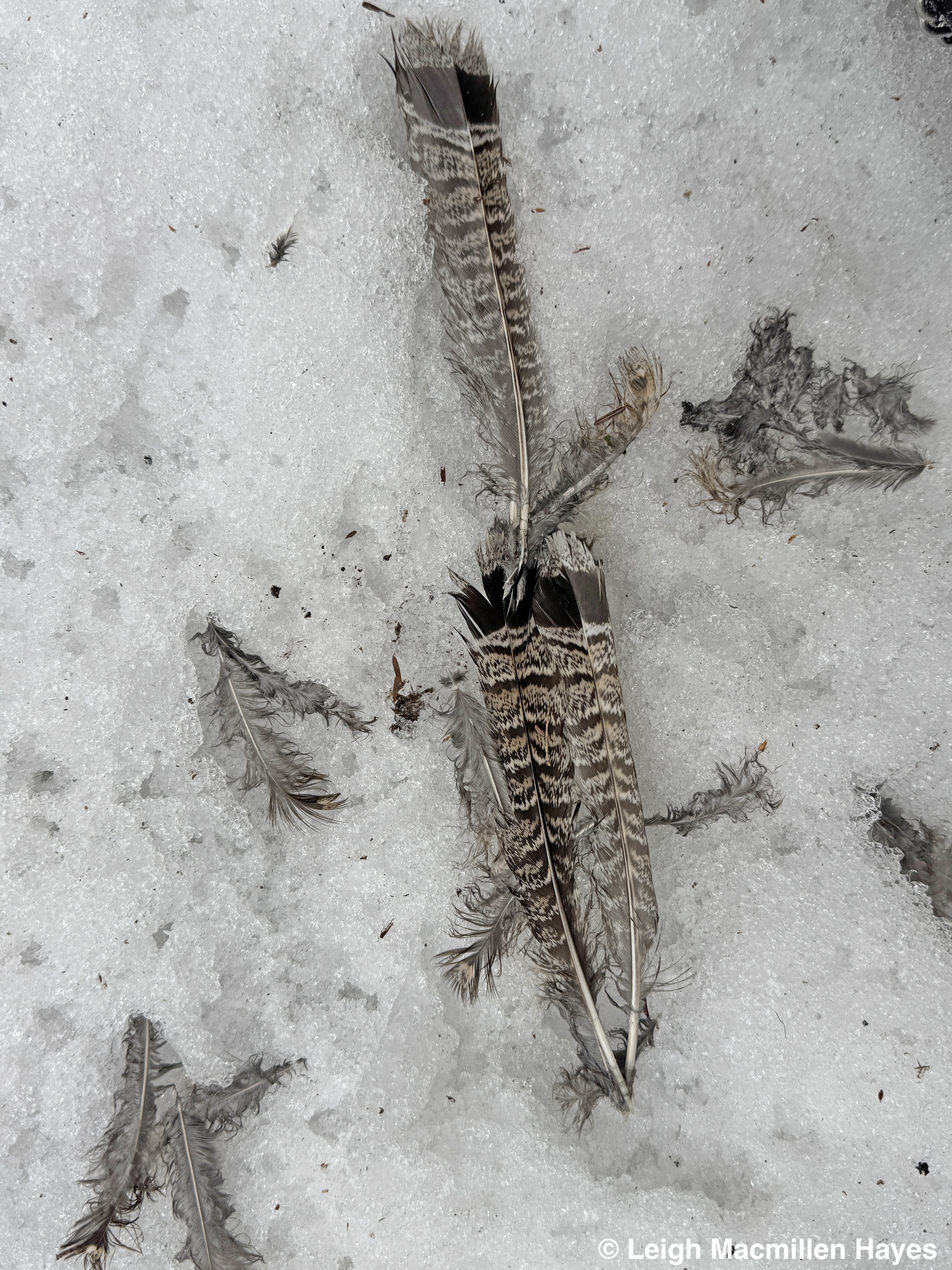
Not at all. I’d stumbled, rather than sauntered, upon a site where a bird had given up its last breath so that another critter could live.

The bird happened to be a Ruffed Grouse, and I had to remind myself not to be sad about the loss because of the joule or energy units procured by another. In its death, sunshine and birch seeds and whatever else the bird had eaten provided sustenance in the form of a gift.

Of course, spotting the Ruffed Grouse’s track did give me pause for I suspected it to be the bird’s last impression.

Moving on toward a former log landing, I smiled again at the sight of another who took a risk of crossing the large forest opening, but knew enough to tunnel under the snow frequently. Was it frequently enough? Voles are everyone’s favorite food. Well, maybe not mine. But I’ve possibly eaten meat from some critter that dined on a vole and so maybe some of its joule had been passed on to me as well.

Frequently on my journey, as often happens in these woods, I encountered the one who greeted me at the start. Well, its footprints greeted me at least. But I always give thanks for such sightings for though Bobcats are solitary and elusive, knowing they are here and that we walk in the same woods and perhaps see and smell the same things makes me happy.

And then it occurred to me. I need to be more like the Bobcat and improve my waiting and watching and listening skills. I’m always in too much of a rush to see what might be next on the agenda. So much for sauntering.

As this last day of autumn 2024 gives way in the wee hours of December 21 to winter, and the sun once again rises in the East, I need to remember to be more like the saunterers. To be alert to offerings. To wait. To watch. To wonder. To learn.

Each day is a new awakening with teachings. Thank God for that.

Beautiful Maine

Two weeks ago a week of vacation loomed before us and we had no plans. Where to go? What to do? My friend, Marita Wiser, suggested the Bold Coast of Maine. Though she hadn’t been, she’d collected articles about it and felt a yearning to get there. I told my guy. He liked the idea, but also wondered if we might spend some time inland. Bingo. Another friend, Molly Ross, serves on the board of Friends of Katahdin Woods and Waters National Monument and so I asked her to suggest some trails. Somehow we lucked out and found places to stay and so on Monday morning, October 4, our adventure began.

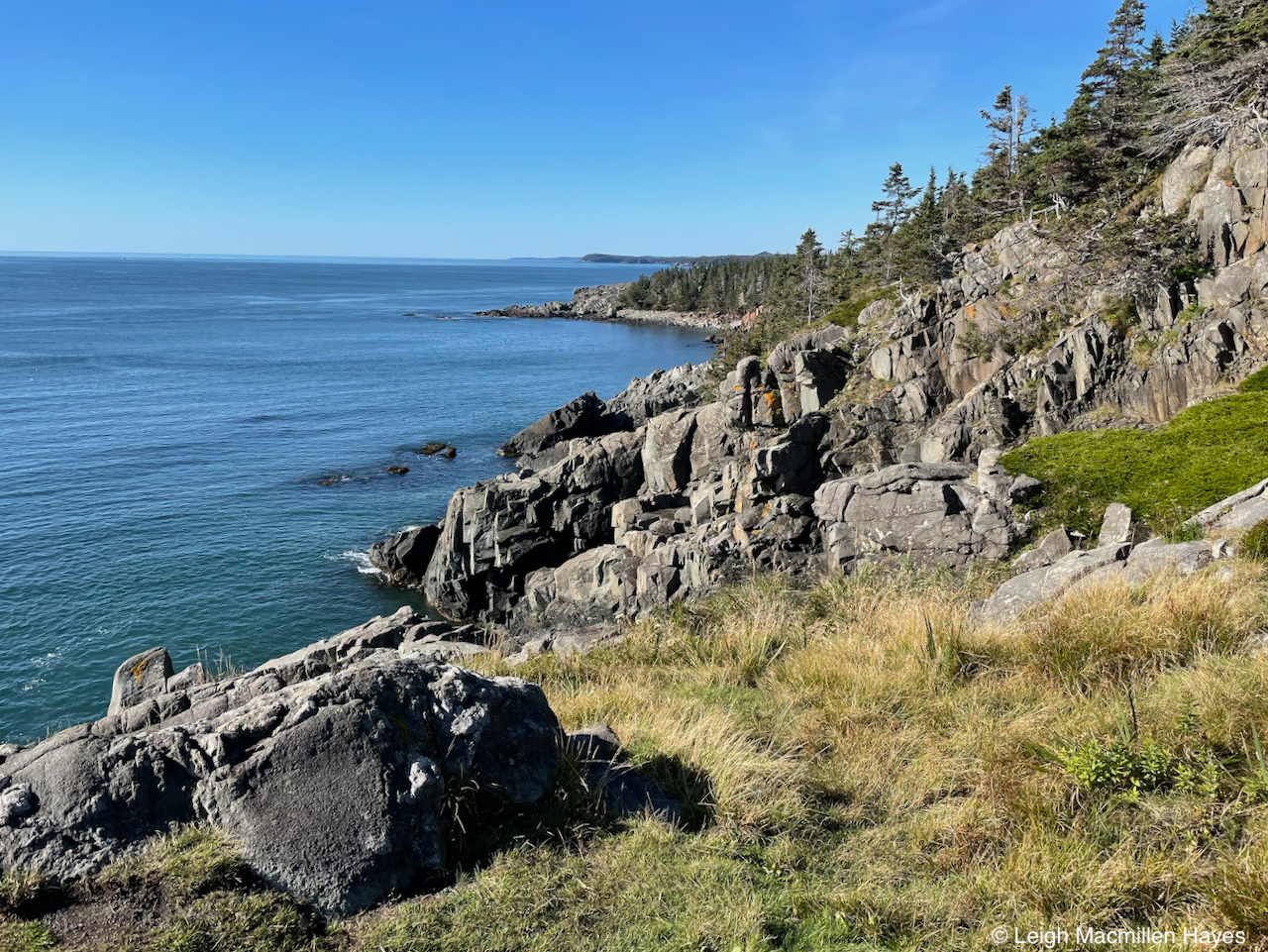
We broke up the drive to Lubec with lunch in Machias, and then a quick five mile out and back hike at Cutler Coast Public Lands for a view of the Bay of Fundy. From there it was on to our resting place where we settled in for a couple of nights’ stay.

Thankfully, we left the curtain open as our hostess had mentioned something about sunrises. When the dormer window suddenly lit up, we threw on as many layers as possible and headed outside.

I’m pretty sure we were the first people in the world to ever observe sunrise, or so it felt to us in that moment.

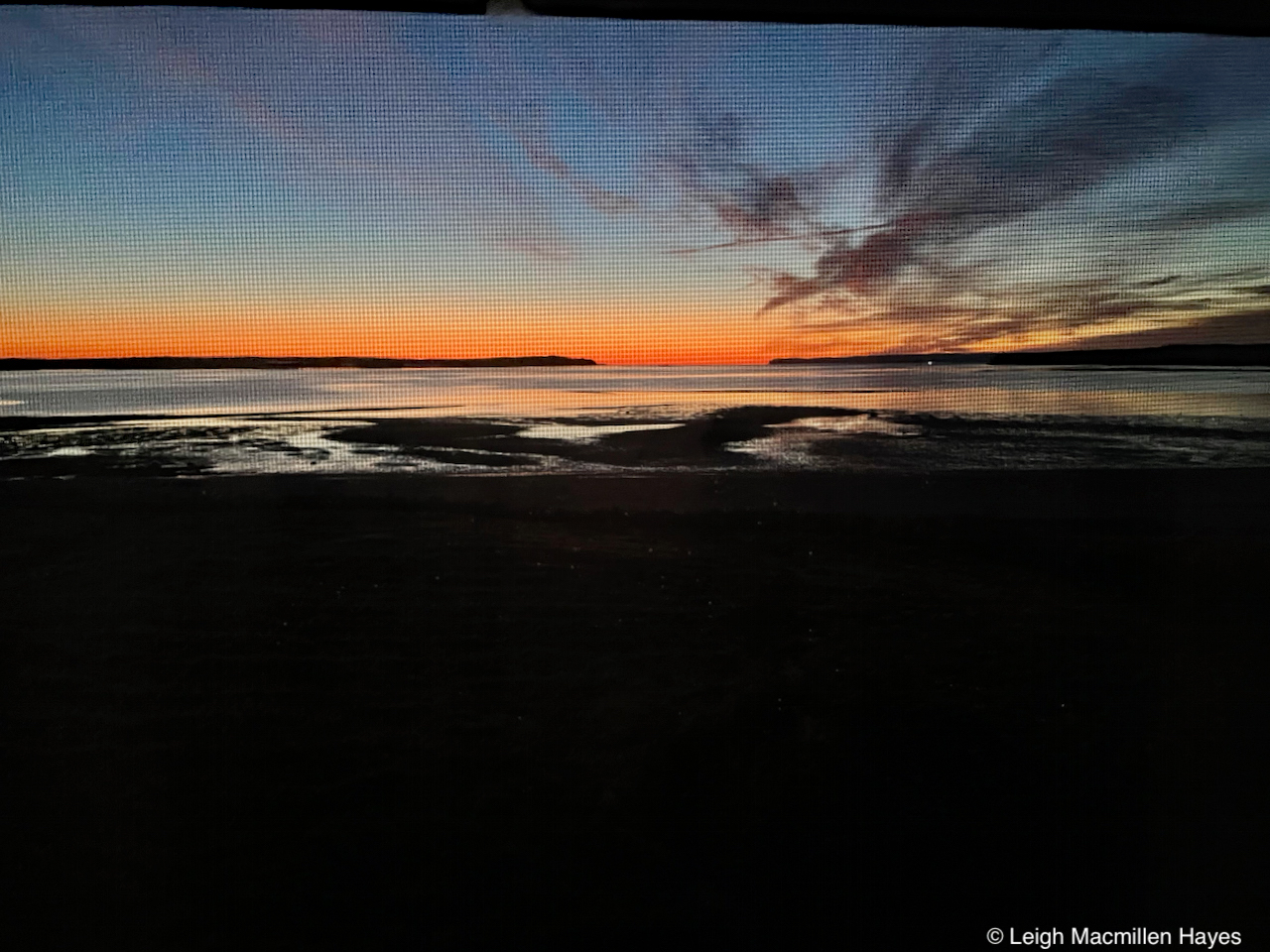
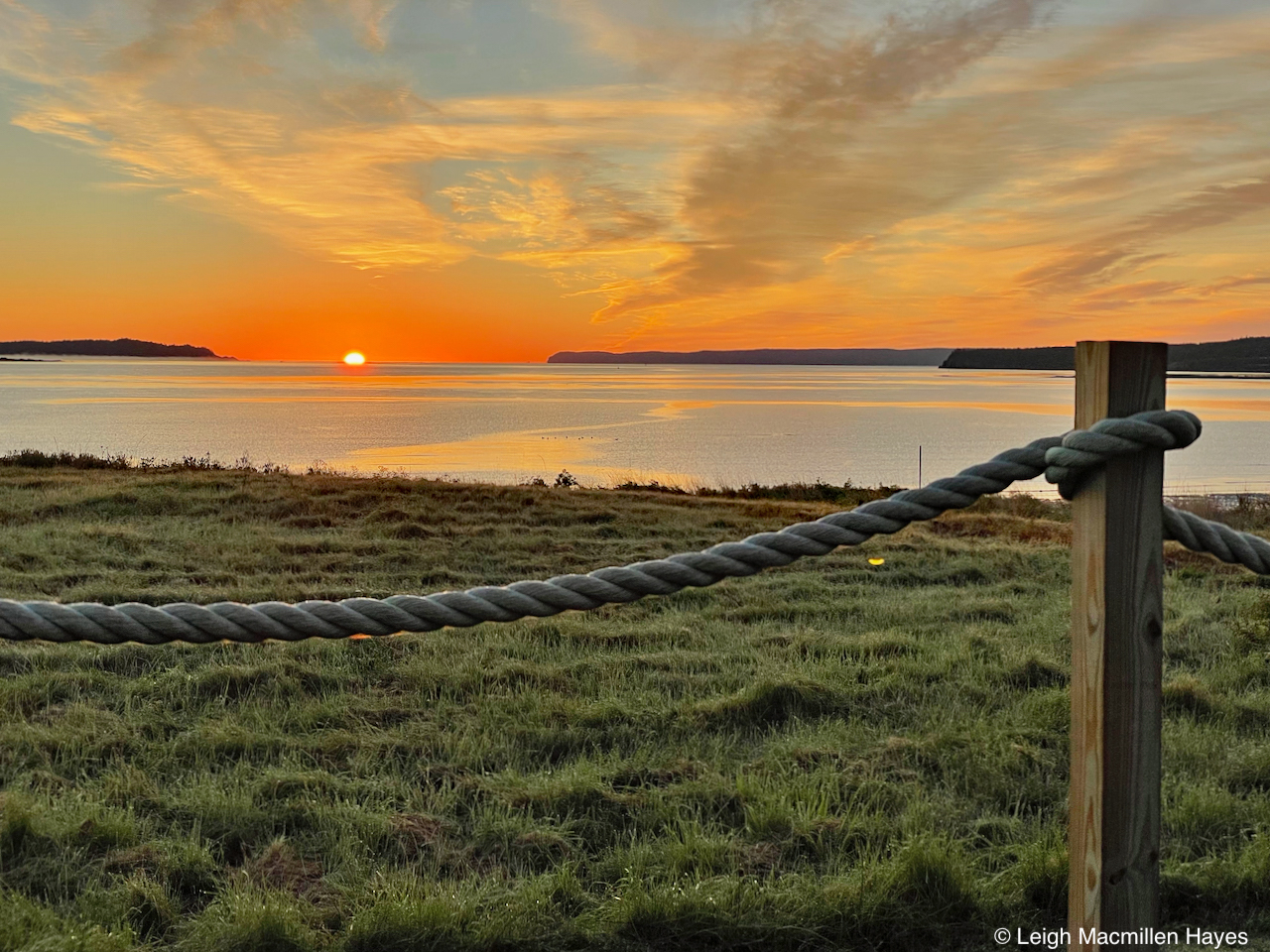
Sitting on the deck, we each took a million photos as the sky kept changing and then, in a flash, there it was–that golden orb upon the horizon between Campobello Island and Grand Manan, with Lubec Channel in the foreground.

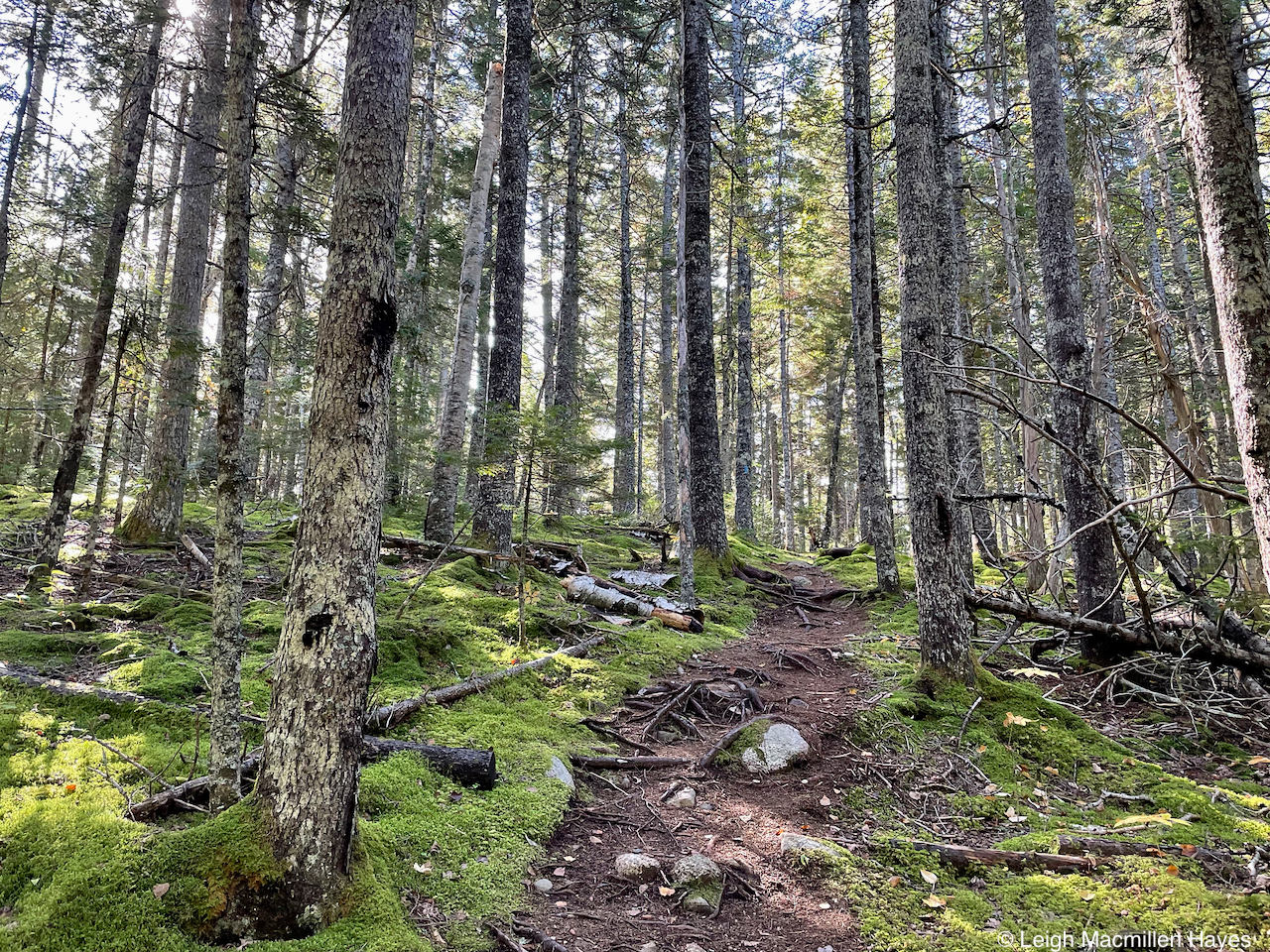
It was that same morning light that we rejoiced in as we journeyed along the trails at Bog Brook Cove Preserve and then a return to Cutler Coast Public Lands for a much longer adventure. Along the Inland Trail, though there were rocks and roots, there was also so much moss gracing the scene as spruce and birch and maples towered above that we felt the presence of fairies.

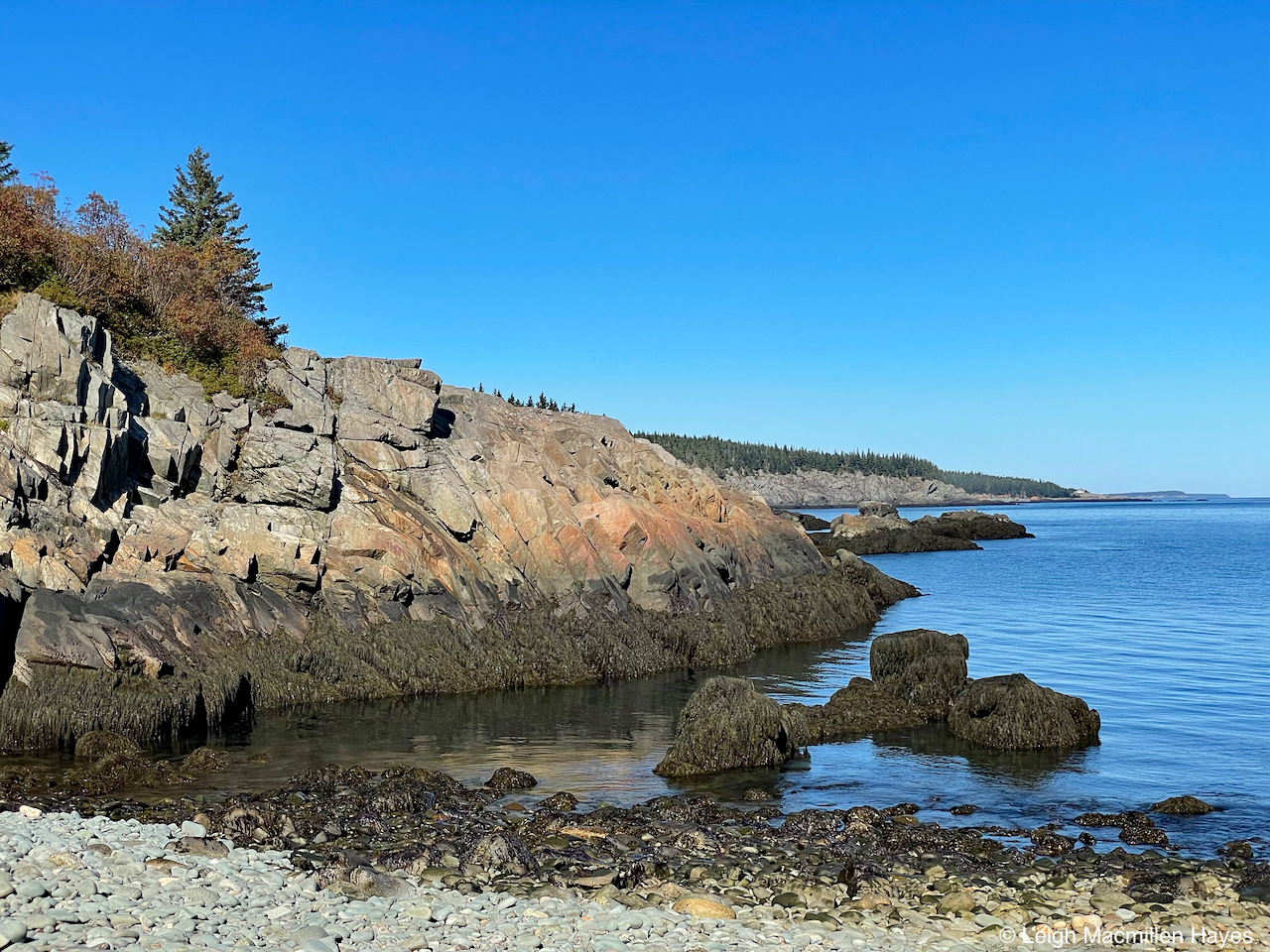
The Coastal Route offered a different feel and we soon learned to appreciate that the coast was indeed bold. And bouldery. Even the beaches featured rocks; rocks so warn by the sea that they had become rounded cobbles.

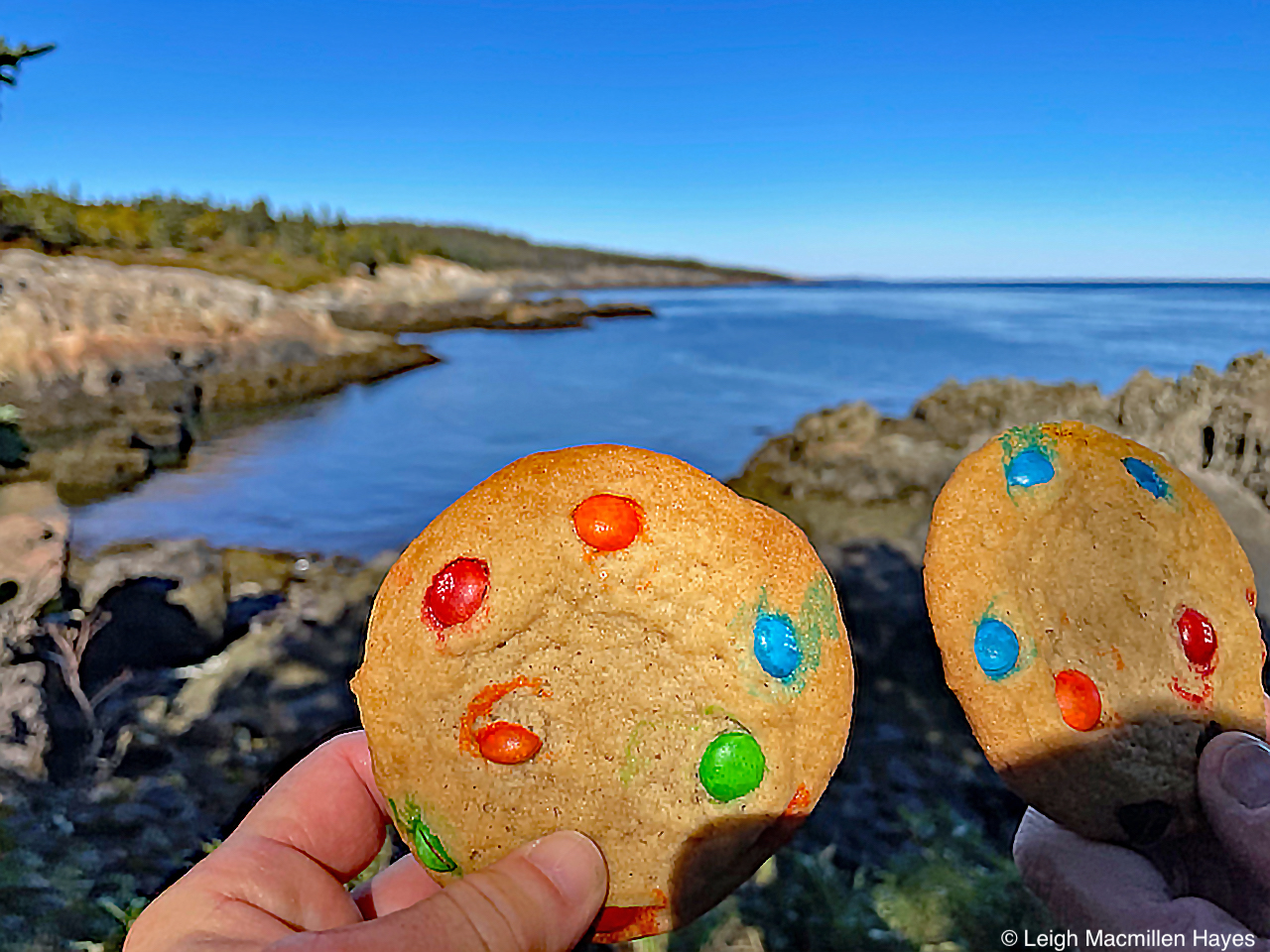
Speaking of round, lunch and lots of water kept us going, but the real treats were what we looked forward to most, these being M&M cookies baked by a long-ago student of mine, Lisa Cross Martin, owner of Stow Away Baker in Stow, Maine.

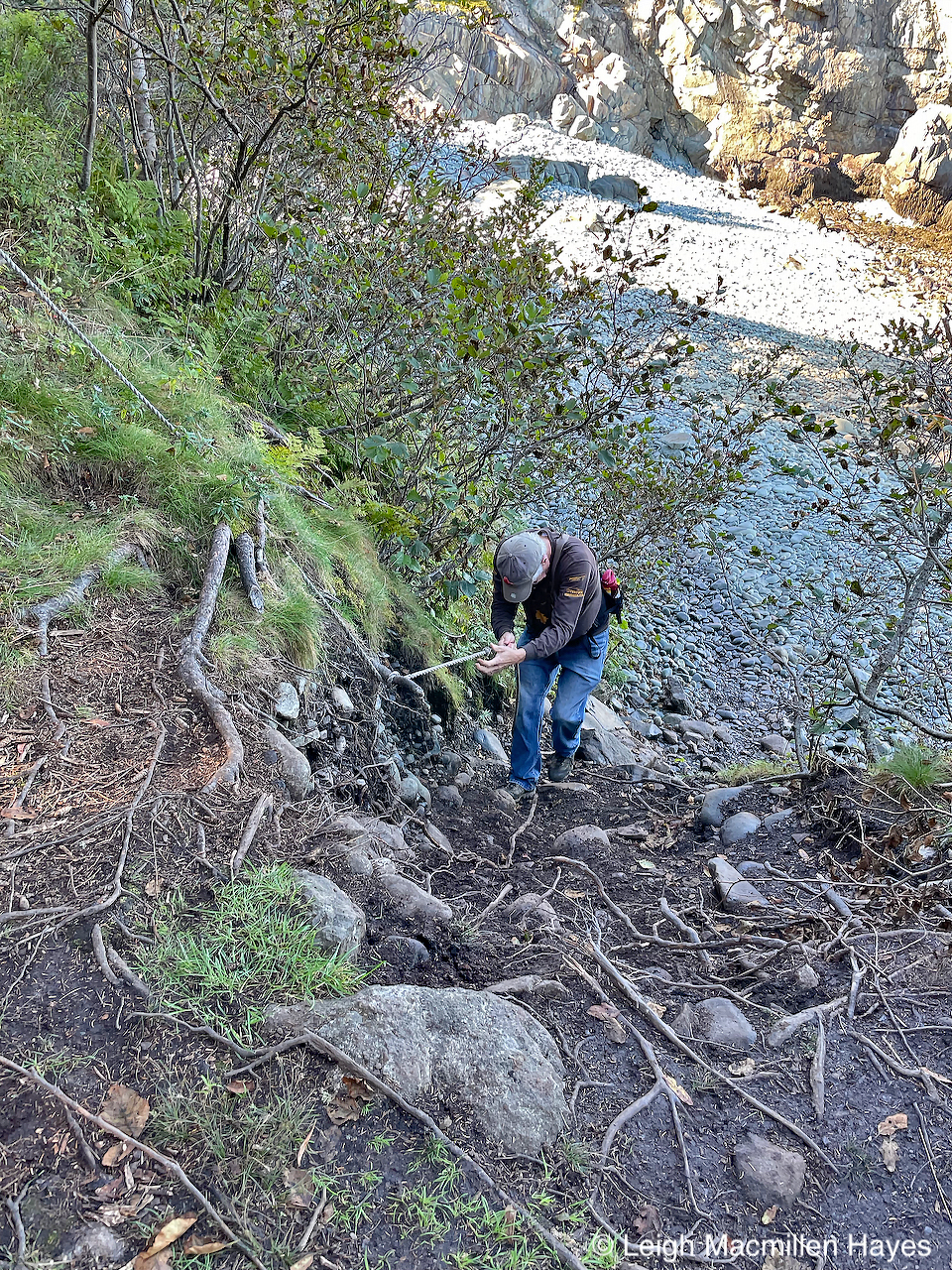
Cookies consumed, we soon realized sometimes a helping hand was most welcome–or at least a helping rope.

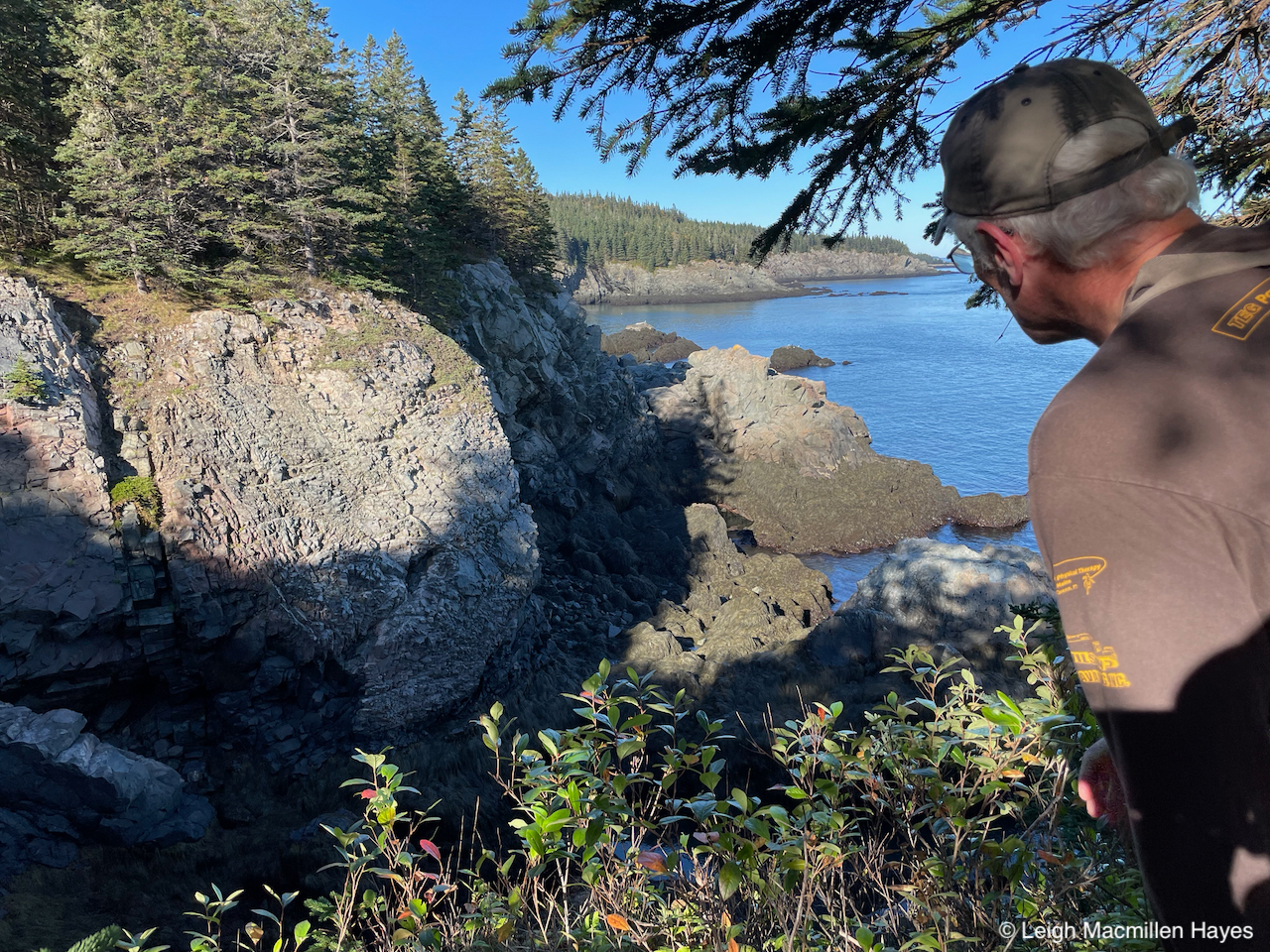
Other times found us peering down into thunder holes where we could only imagine the water crashing in at high tide.

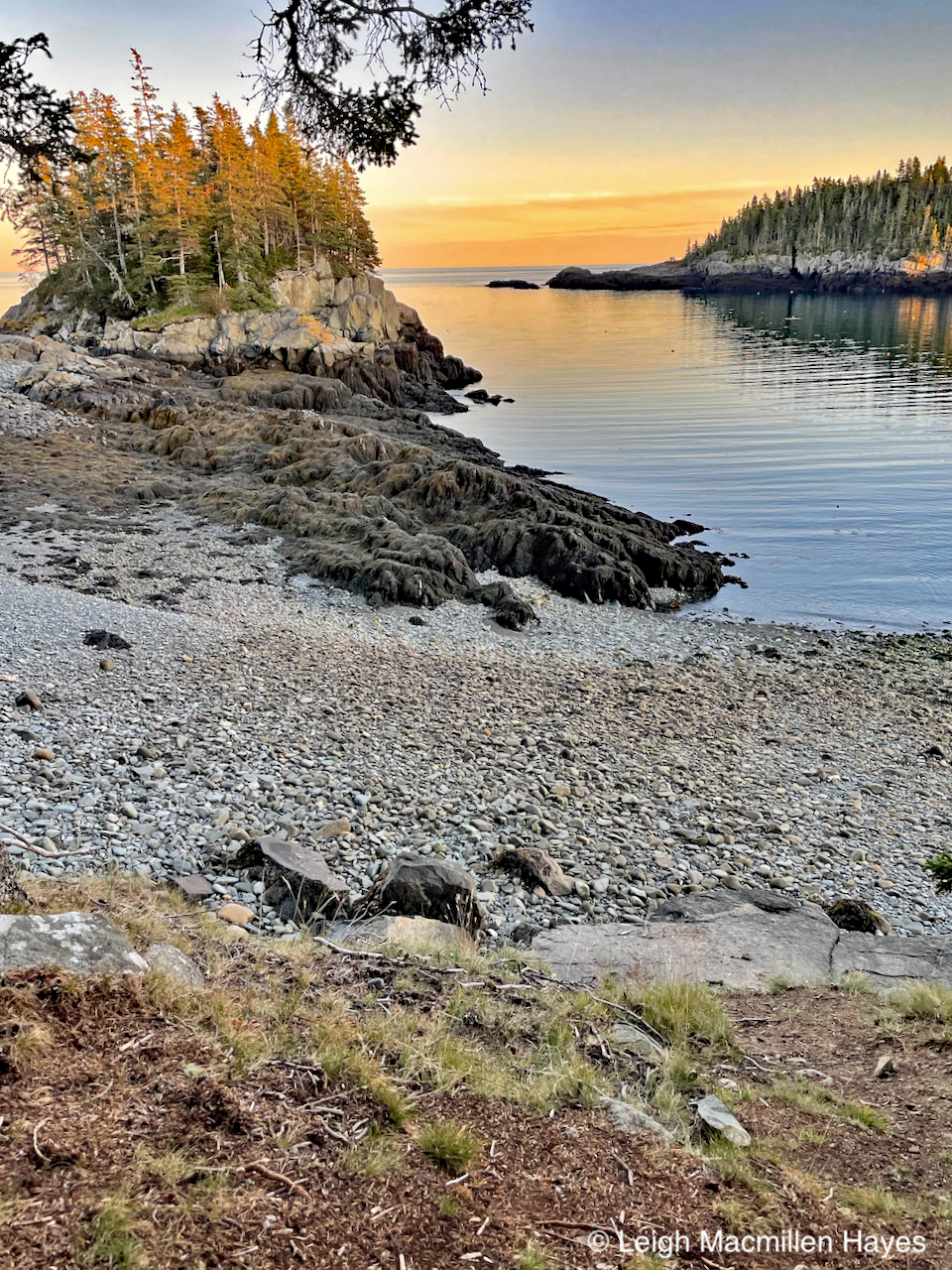
As the sun had risen, so did it set with us enjoying one more trail at Eastern Knubble Preserve. Because the tide was low, the cobble bar connecting the mainland to Eastern Ear (also known as Laura Day Island) was visible. With the setting sun lighting the treetops, campfire flames came to mind.

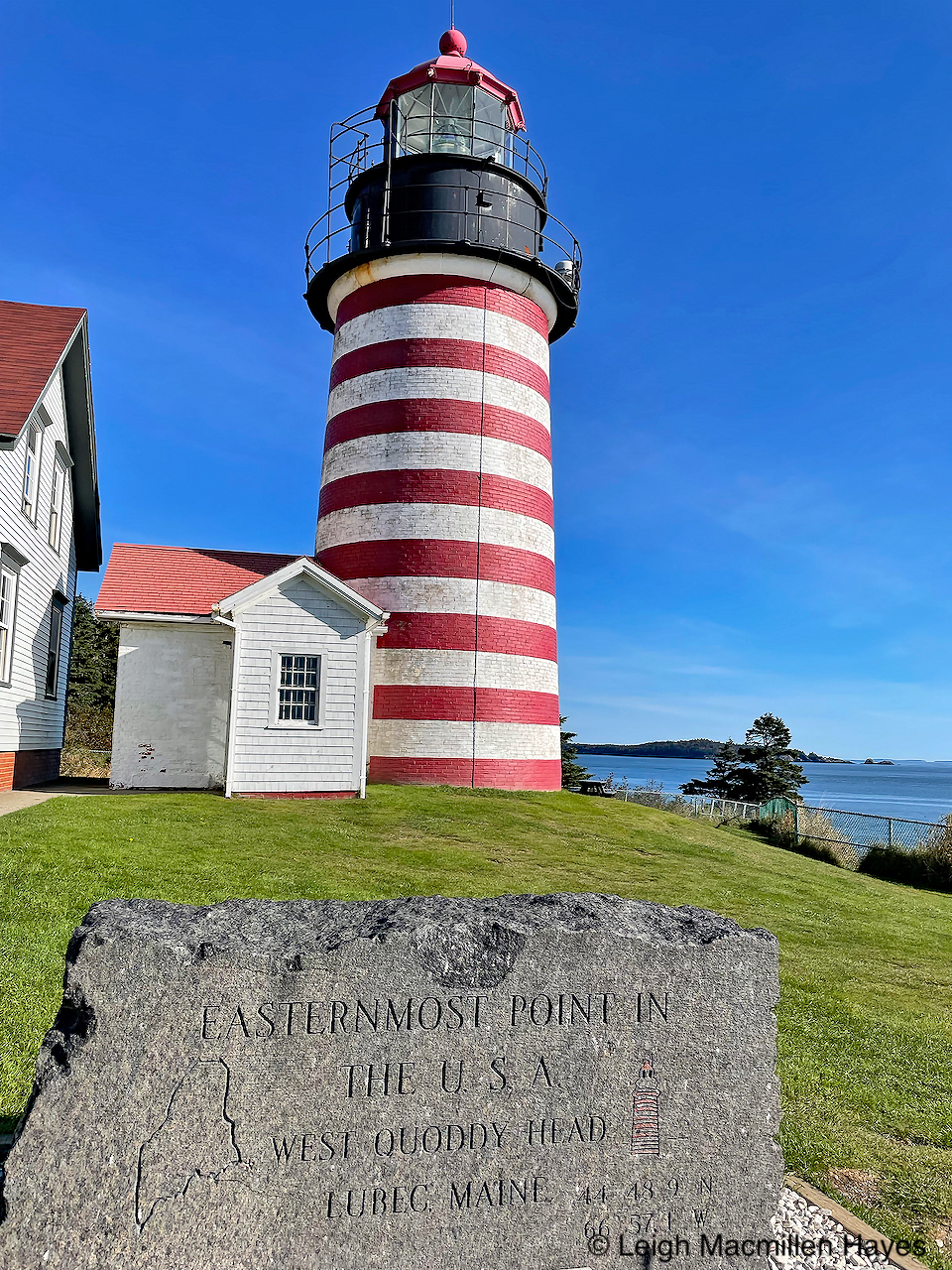
Another beautiful day found us exploring some of the trails at Quoddy Head State Park, the easternmost point in the USA. The candy-striped lighthouse was originally fueled by sperm whale oil, and later lard oil, and then kerosene, and finally electricity.

Why the stripes? It’s easier to spot in fog and mist, and given that the coast is rather bold, that makes perfect sense.

We walked a section of the trails at the park, but saved some for another day in another year deciding that we will return because there is so much more to see than our time allowed.

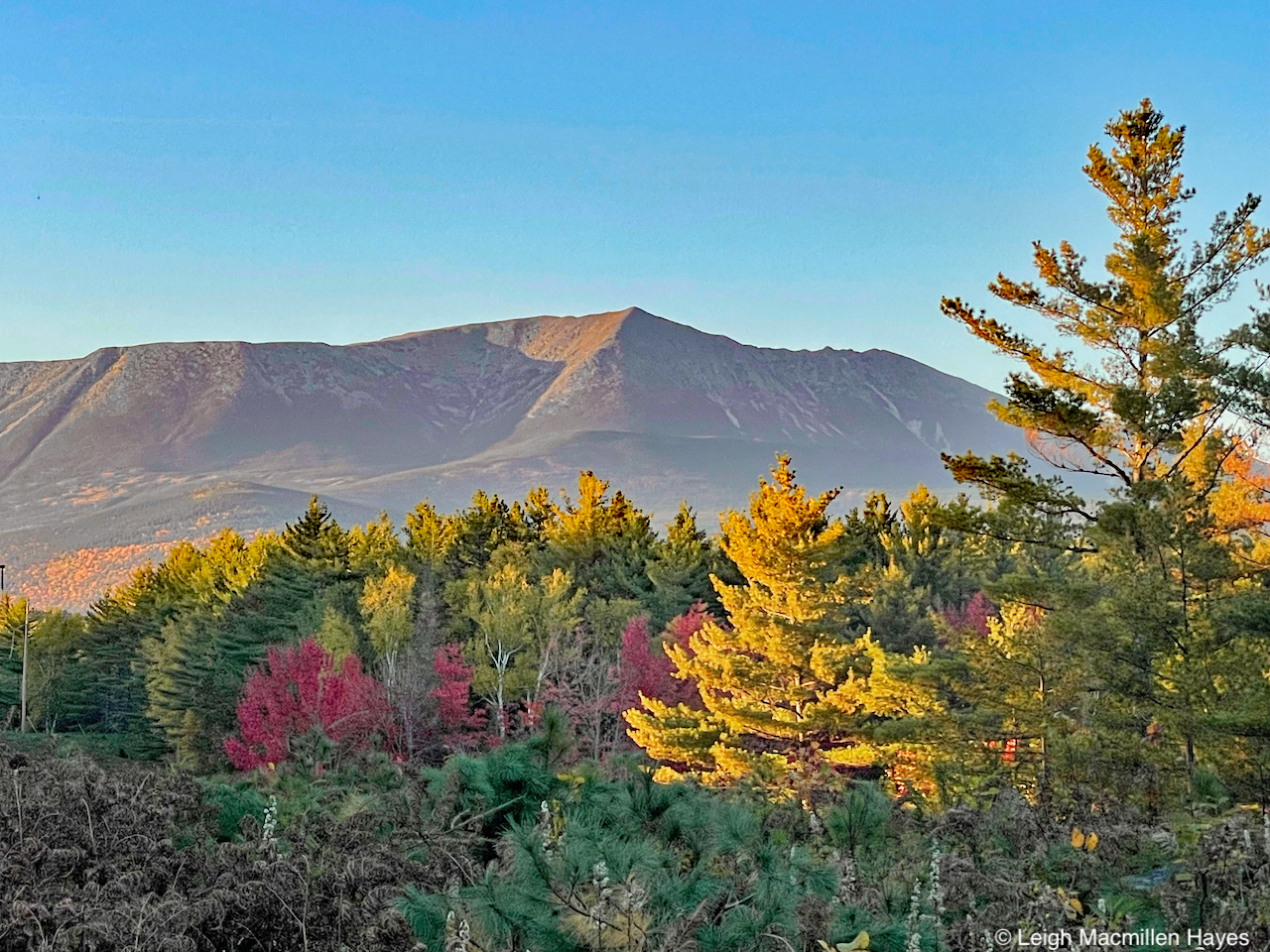
And then we transitioned to our inland location where the setting sun cast a glow upon the mighty Mount Katahdin. It had been years since we’d last visited the area and upon that previous trip we’d rafted on the West Branch of the Penobscot River. Our plan was to support Millinocket businesses as much as possible, and to explore the new Katahdin Woods and Waters National Monument.

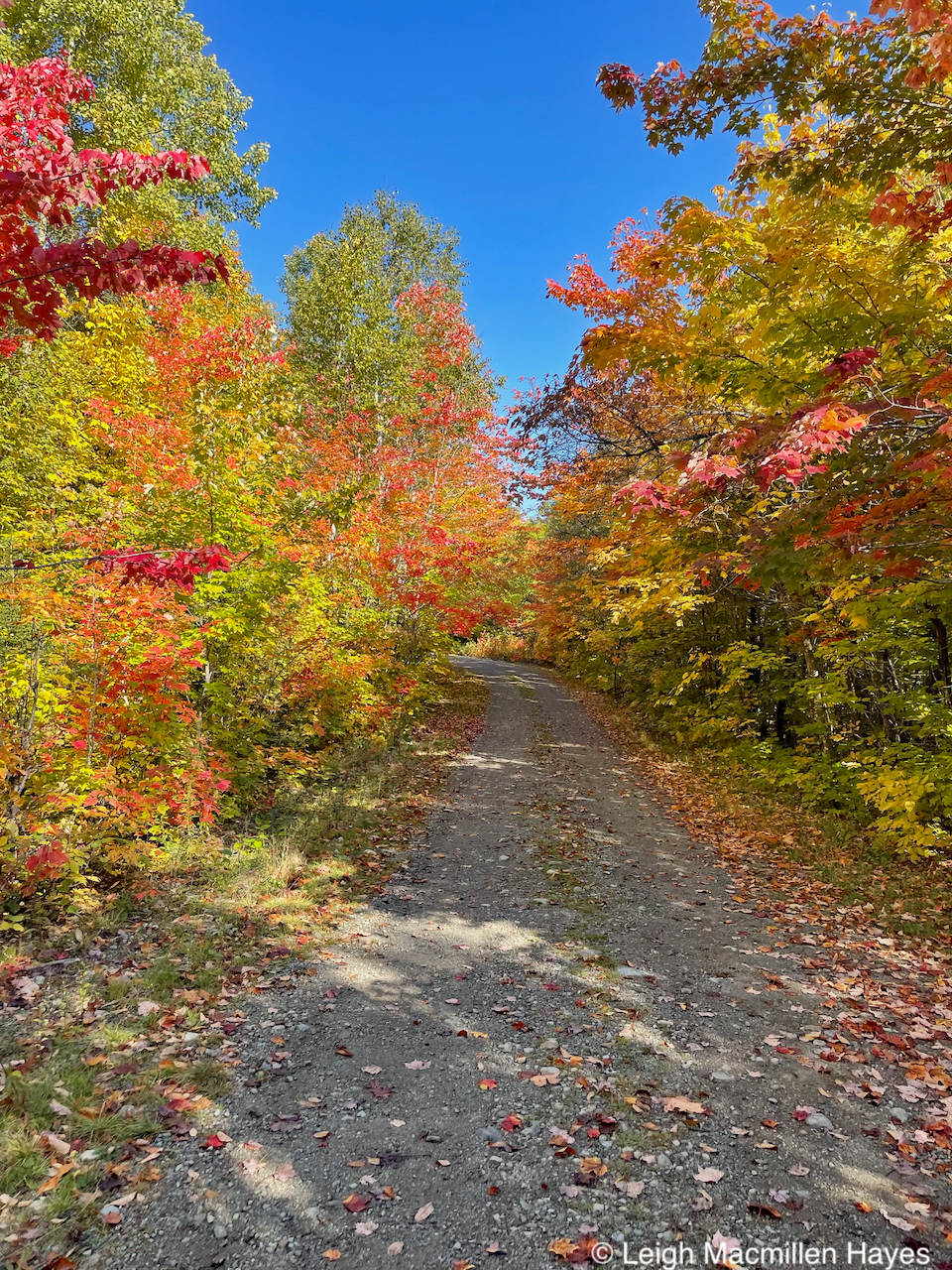
We knew we were blessed when another morning dawned with a brilliant blue sky that accentuated the fall foliage. The funny thing, to us anyway, is that we hadn’t given a thought to this being a peak foliage week. But then again, we’d hardly made time to give much thought to this trip.

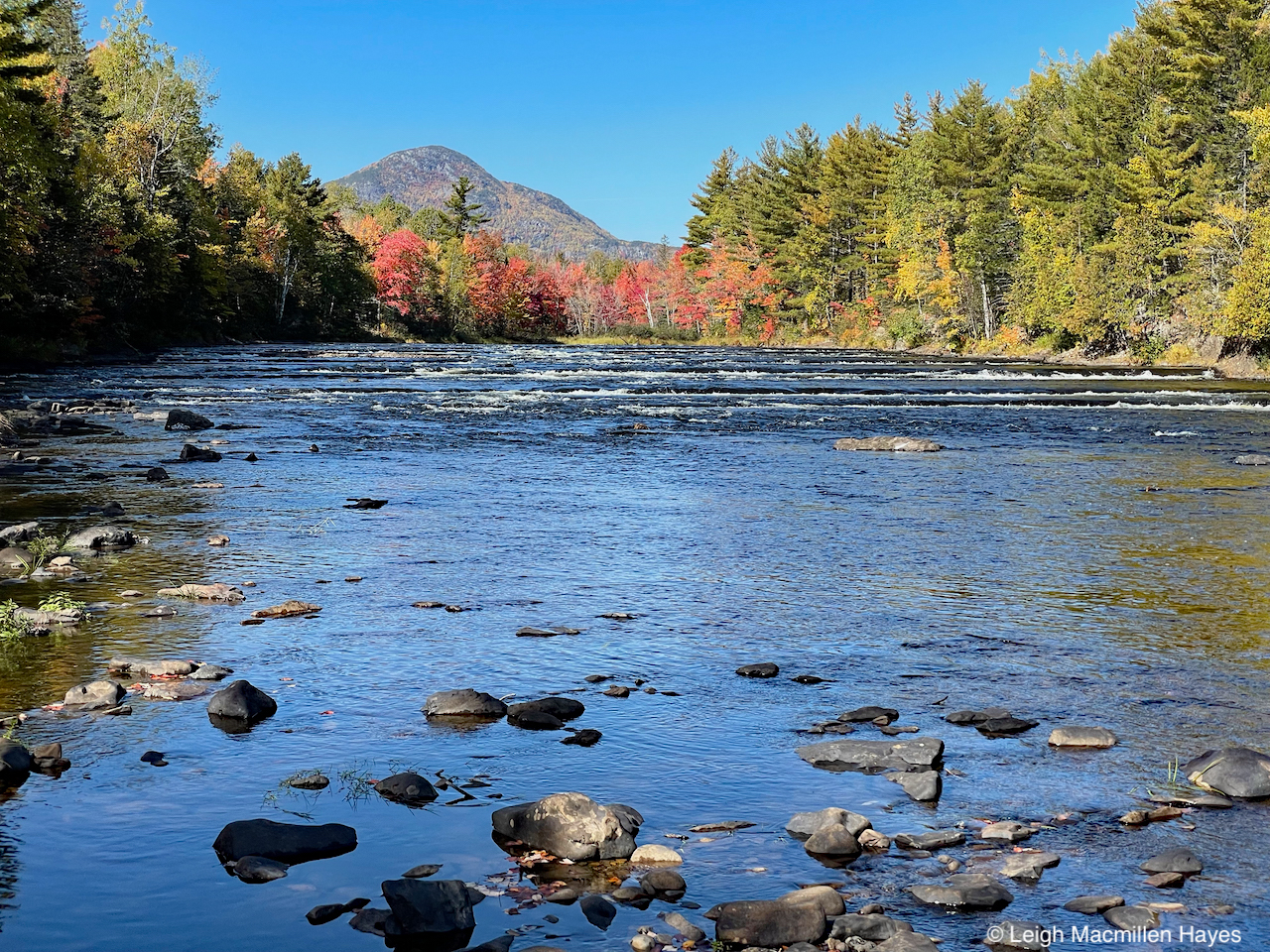
Our first adventure into the monument found us driving to the northern most part and then hiking beside the East Branch of the Penobscot, where we followed as many spur trails as possible to the water’s edge, this one being Stair Falls, so named by a surveyor in the 1700s.

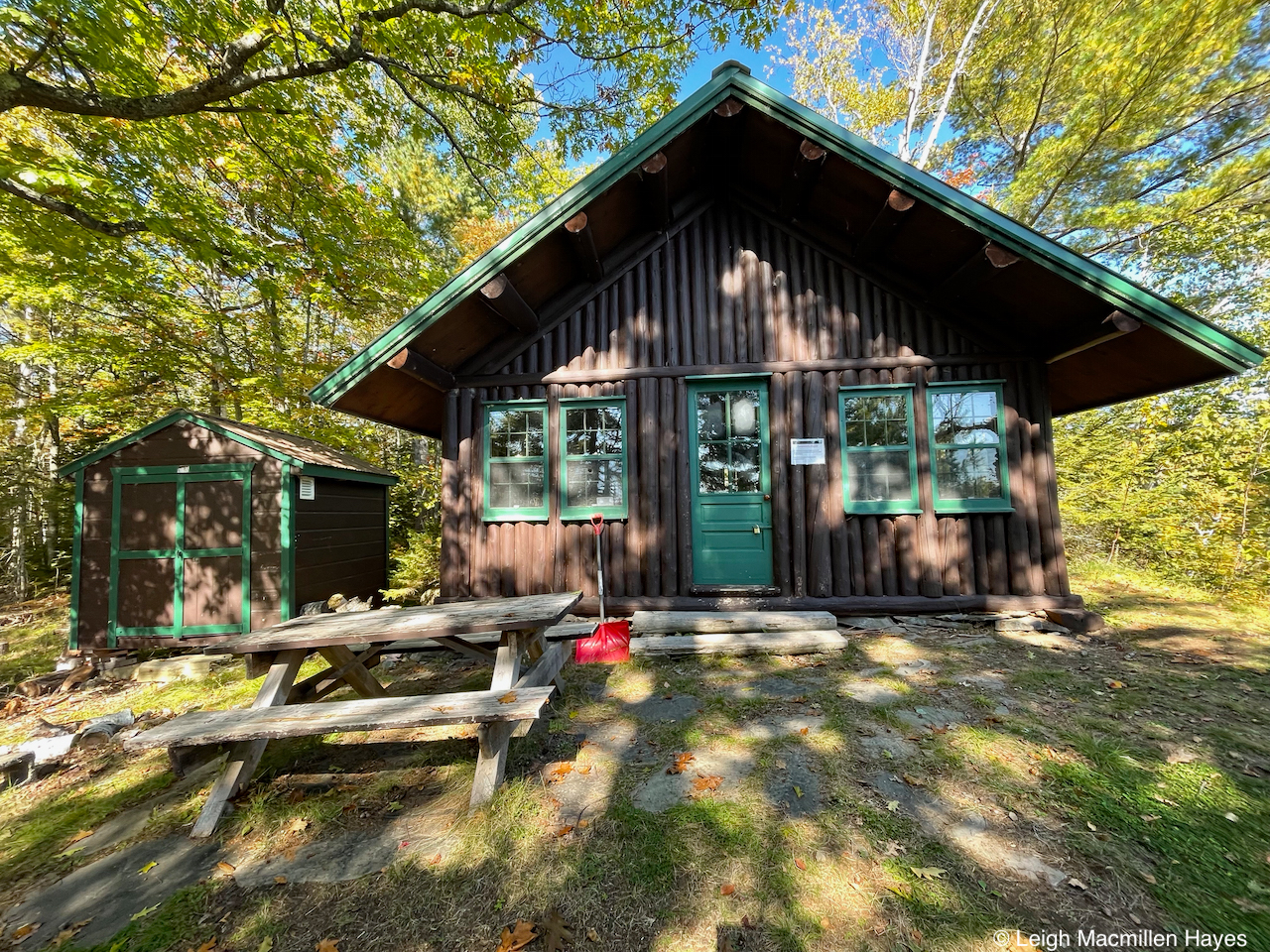
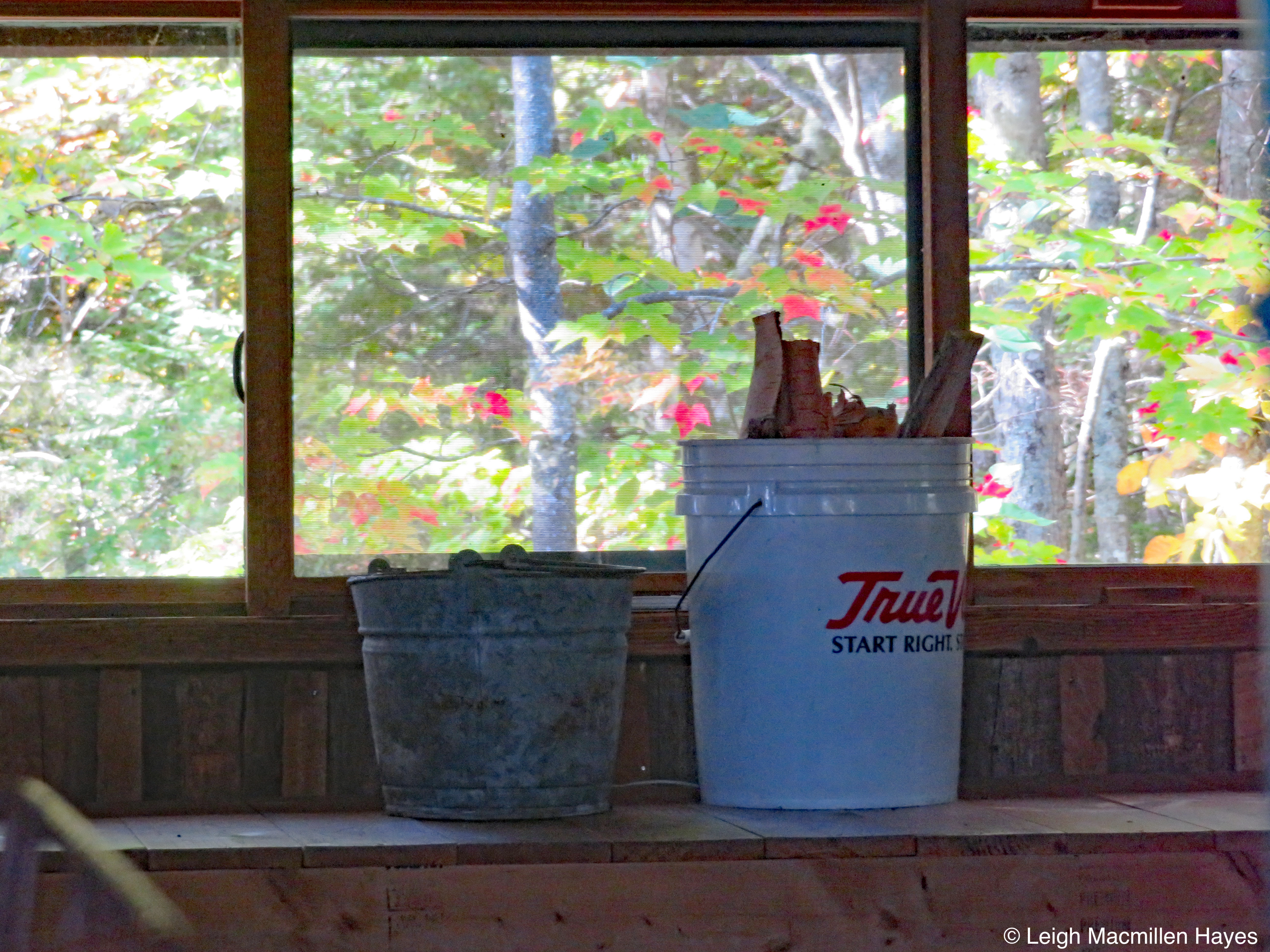
Our next stop, Haskell Hut, a cabin open to the public when there isn’t a pandemic wreaking havoc with the world. We peeked through the windows and what should stand out on a shelf across the kitchen?

Why a True Value bucket, this one filled with kindling for a fire. And we thought we’d left our work worlds behind!

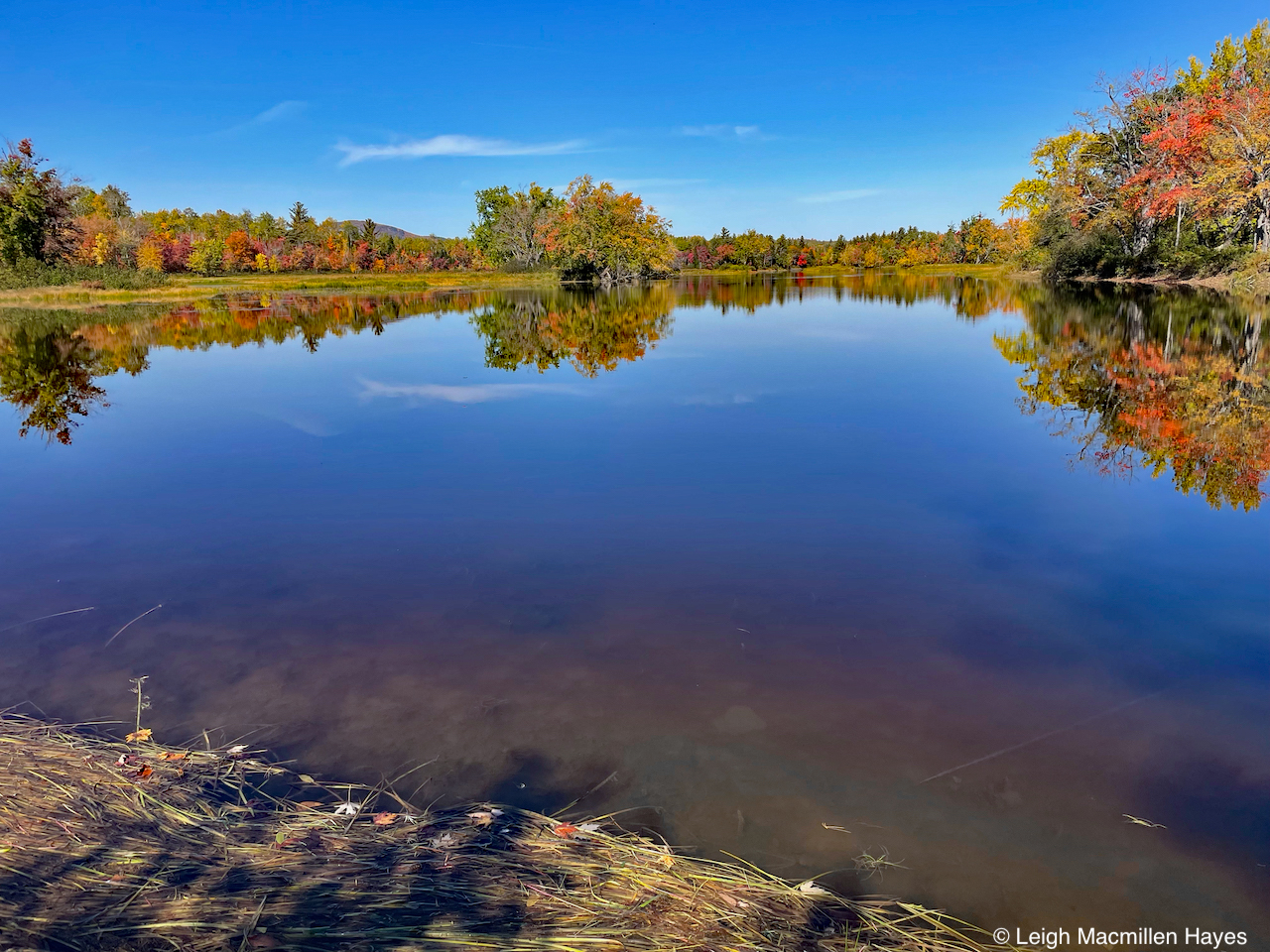
Beside Stillwater we paused and ate lunch, finding nourishment not only in our PB&J sandwiches, but also the scene that surrounded us.

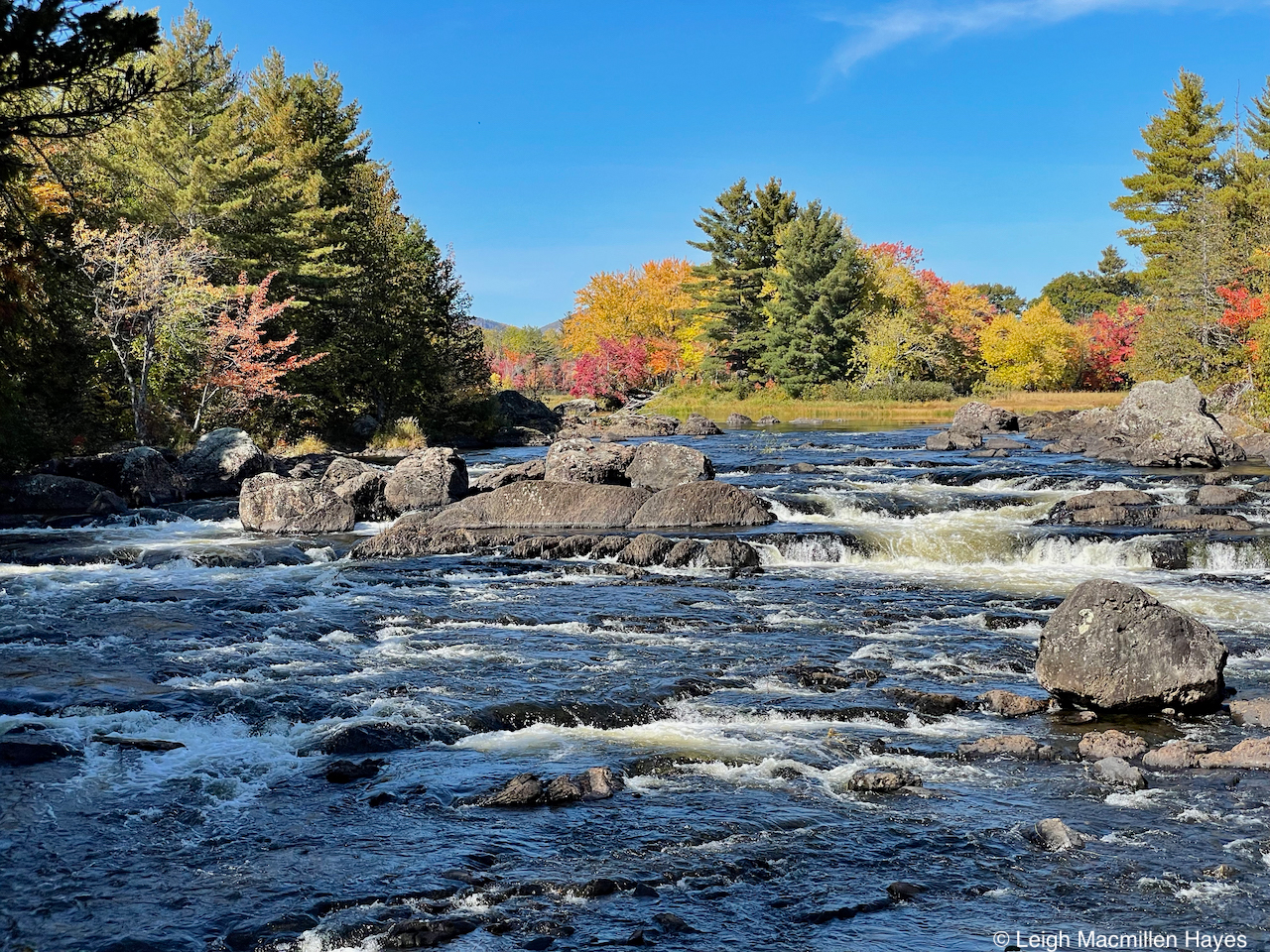
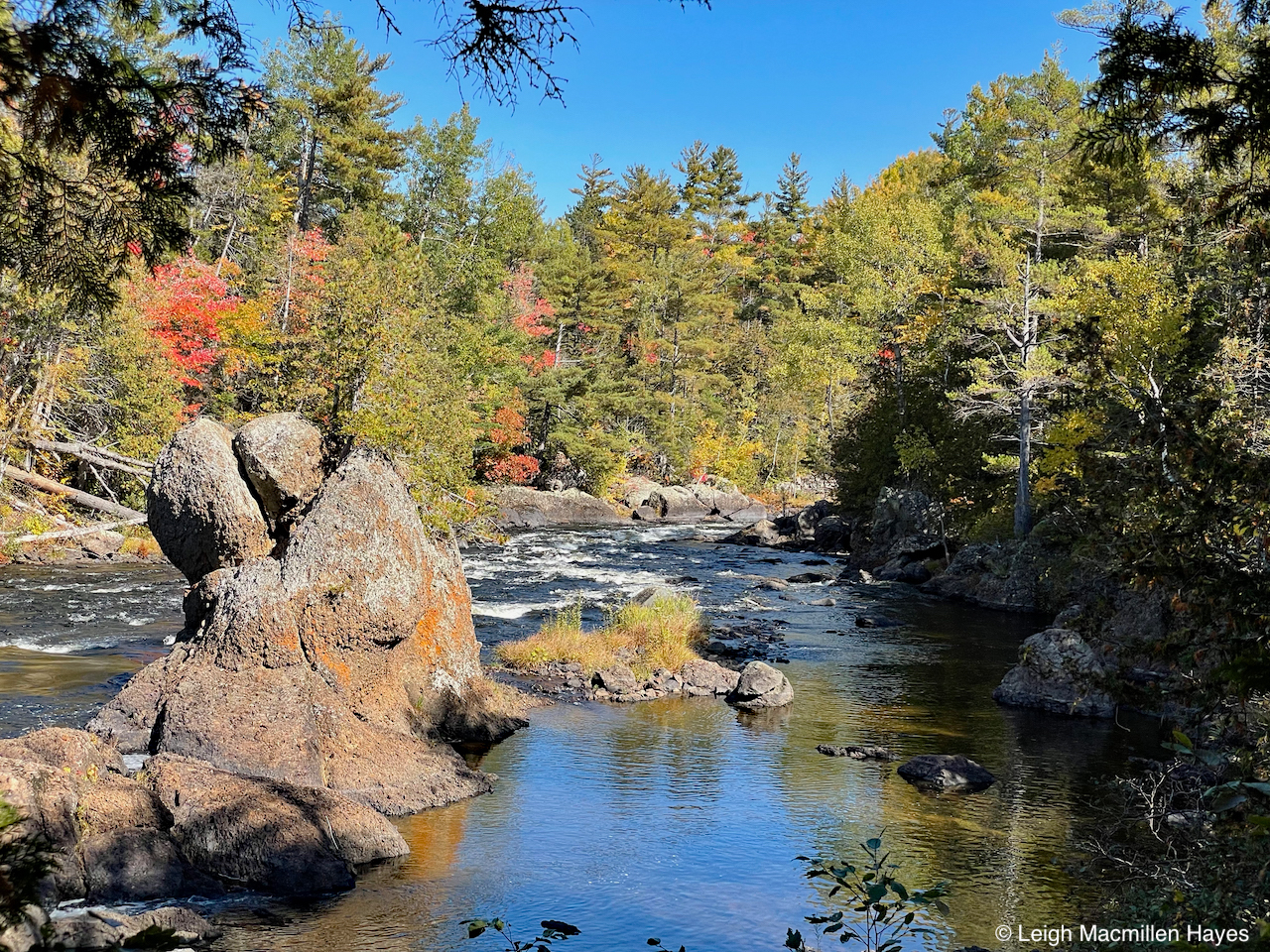
Beyond Stillwater, the water was hardly still. We didn’t know this previously but on Maine rivers, a pitch is a waterfall that’s too large to navigate in a canoe and one must portage around it. In what seems a play on words, falls are navigable whitewater.

A curve of the river and downstream, we discovered a conglomerate mass reported to be about fifteen feet tall. The right hand structure bespoke a person to me, perhaps leaning against a river creature, the two giving thanks for sharing the space. We certainly gave thanks for the opportunity to be witnesses.

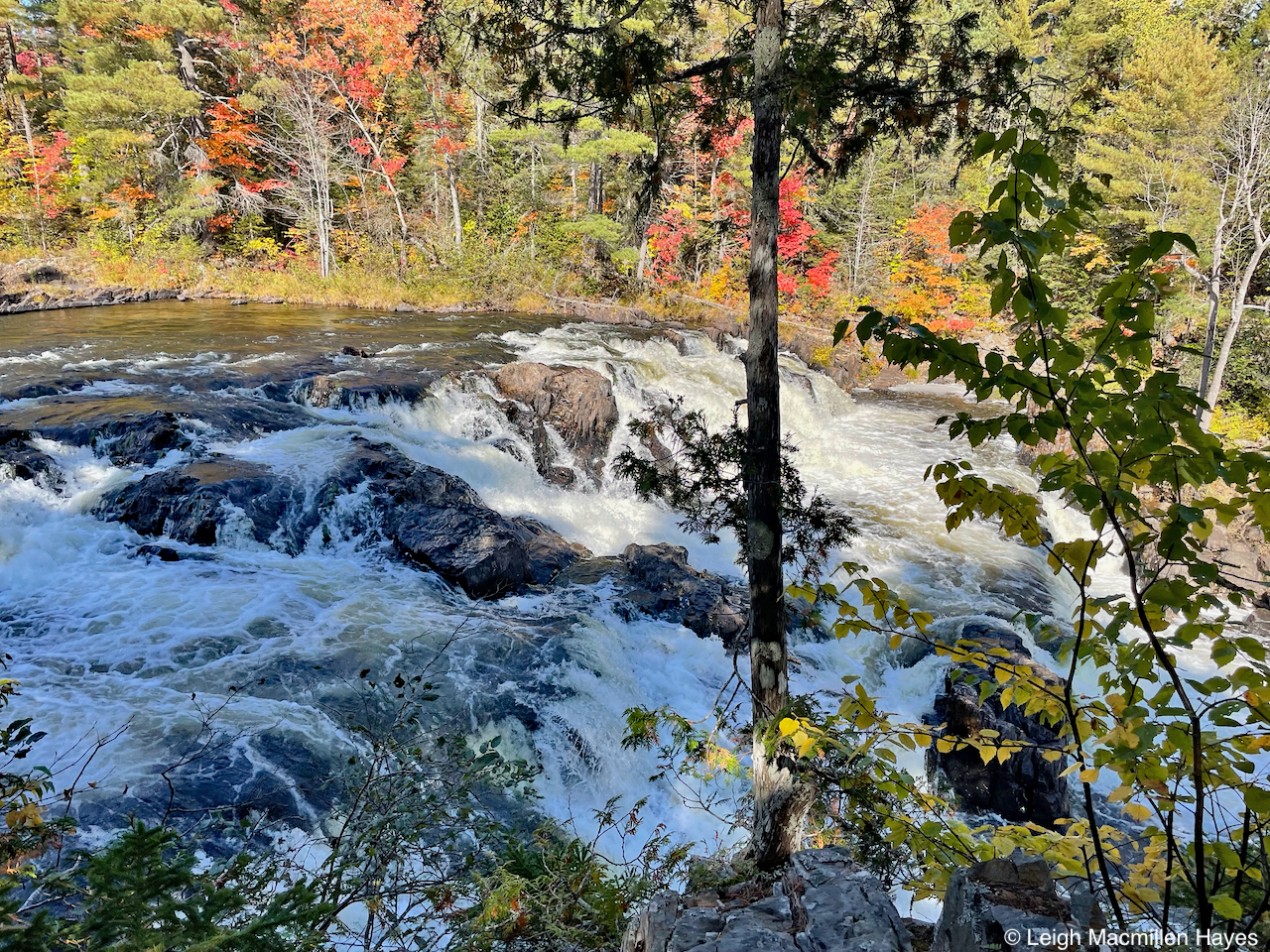
Our turn-around point was Grand Pitch, where the water thundered over the rocks.

Take a moment to listen to the roar.

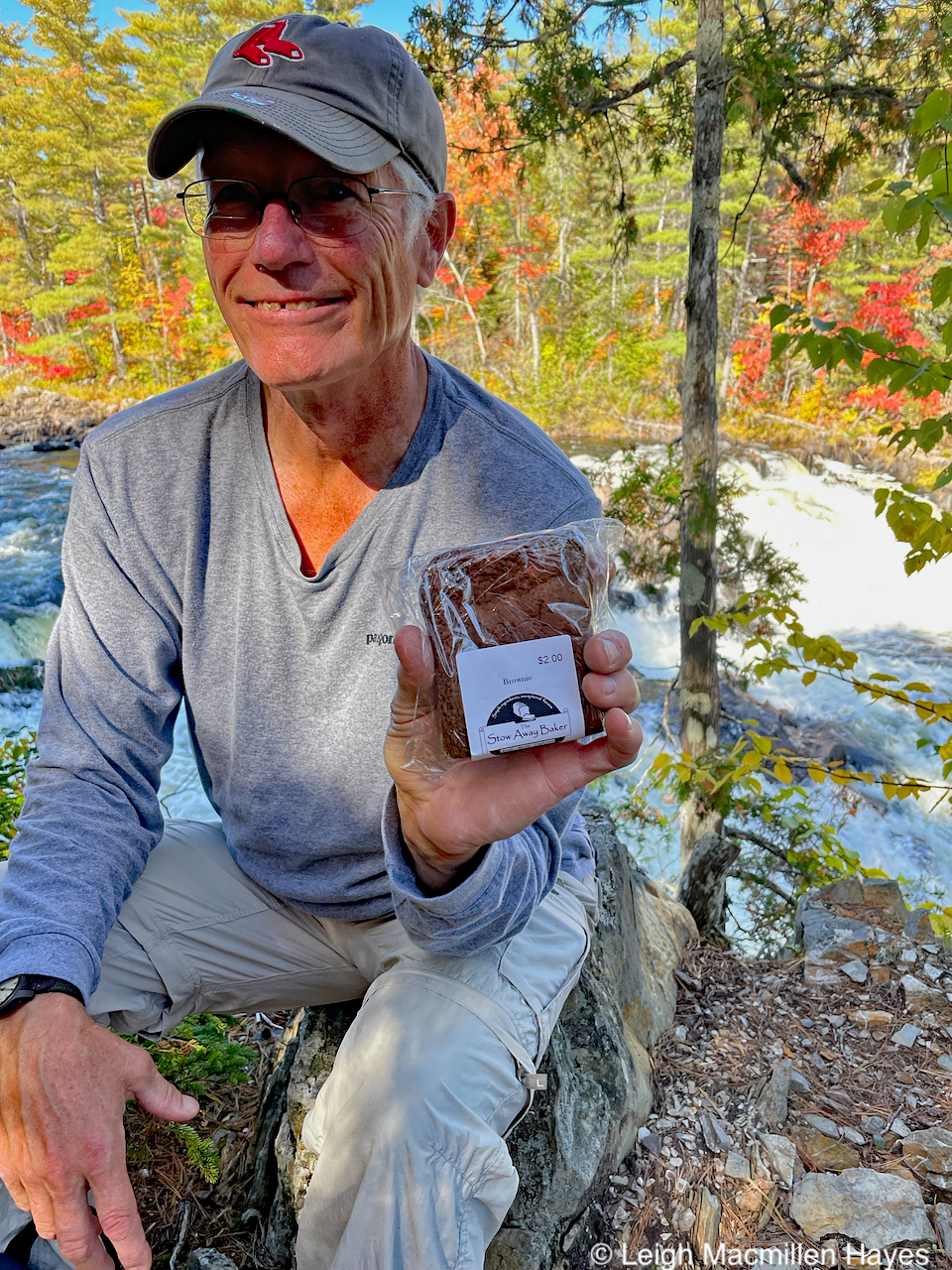
Before turning completely around, however, we had to pull another sweet treat out of the bag. Again, a creation by Stow Away Baker, this one being a brownie for it was my guy’s birthday.

If you are getting a sense that we hike to eat, you would be correct. What I neglected to mention is that we also dined upon pie we’d purchased from Helen’s Restaurant located in Machias. It made for a delicious breakfast. Yes, we ate pie for breakfast–lemon meringue for him and chocolate cream for me. And it didn’t occur to us until after we’d finished, that we should have offered each other at least a taste!

Our final day at Katahdin Woods and Waters dawned rather gray, and so we drove along Swift Brook Road to reach the loop trail, with our first stop being a hike to Deasey Pond.

The next stop in our line-up was a hike to Orin Falls. It’s along an old logging road and as we walked, we met another traveler who complained that the trails weren’t more “trail-like.” At times they are, but this is an area that had been logged and we actually enjoyed the roads because we could walk side-by-side for a ways.

We also met another traveler on this trail, but first I must back up a bit. I’m not sure how this happens, but frequently we can be in places we’ve never been before, either here in Maine, in another state, or another country, and inevitably my guy will run into someone he knows. It happened to us at Bog Brook Cove Preserve when he greeted a young couple and then the parents behind them. All of a sudden the light bulb went off simultaneously for my guy and his counterpart as they realized that though out of context, they knew each other for they had played on opposing town basketball teams about thirty years ago, and the other man is a frequent customer at my guy’s hardware store.

And then on our way to Orin Falls, we met a single hiker and paused to chat, only to discover that he was on a birthday celebration hike. It turns out he is one day younger than my guy. And because the other man lives in Old Town, Maine, he knows some of my guy’s former classmates at UMaine. Though trite, it’s apropos to say it’s a small world.

At last we reached Orin Falls along Wassataquoik Stream, fearful we’d be disappointed after the wows of the previous day, but this offered a different flavor that complemented lunch.

And to think I can’t remember what we ate for dessert!

Finishing up the hike, we continued around the loop road, realizing we were probably doing it backwards for we’d chosen to drive counterclockwise. But, given the grayness of the morning, I think it was the right choice for the mighty mountain for whom this land was named, had been shrouded. By the time we reached the Scenic Outlook, the weather had improved and once again we were graced with an incredible view. It was our last look before we drove home to western Maine.

Being home didn’t stop our vacation, and after two days of yard work, we treated ourselves to a hike today that proved to be much longer and more difficult than anticipated. But the reward–more incredible fall foliage to fill our souls.

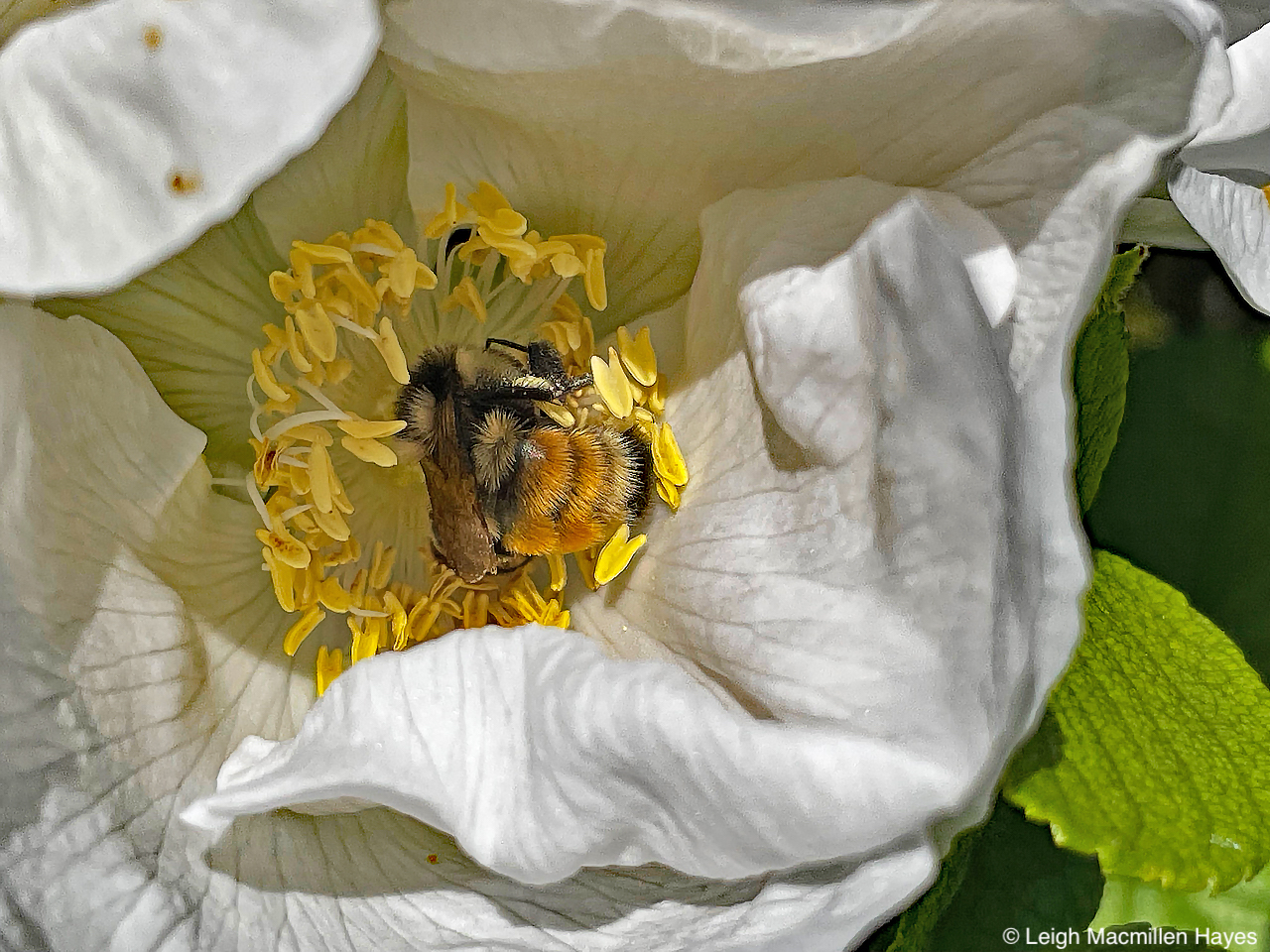
In the end, it wasn’t just the bigger landscape that made us smile. We also enjoyed all that presented itself along the way such as this Tricolored Bee frantically seeking nectar and pollen upon a White Beach Rose.

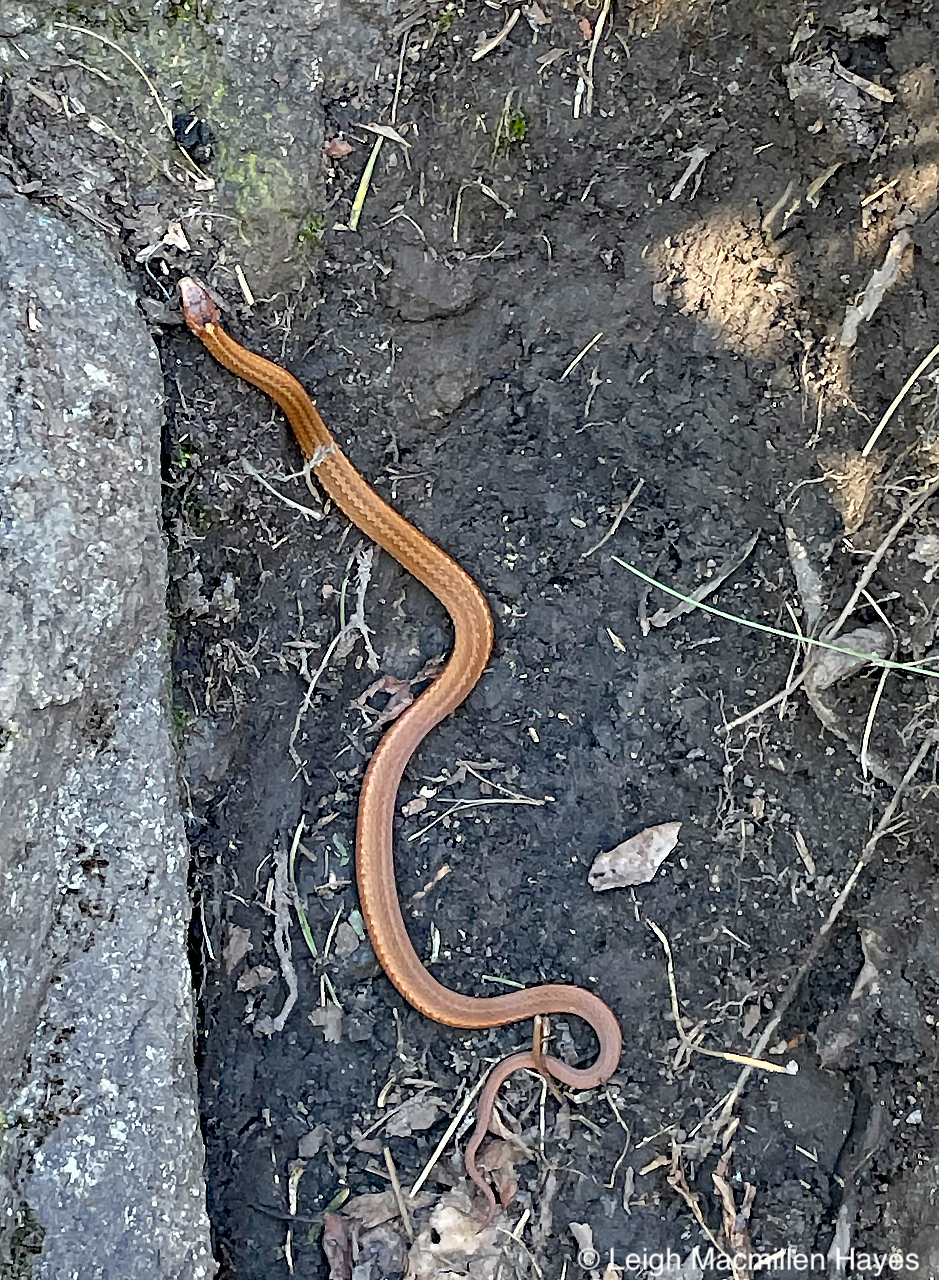
And then there was a small Red-bellied Snake on the coastal trail at Cutler Coast Public Lands, a new species for me.

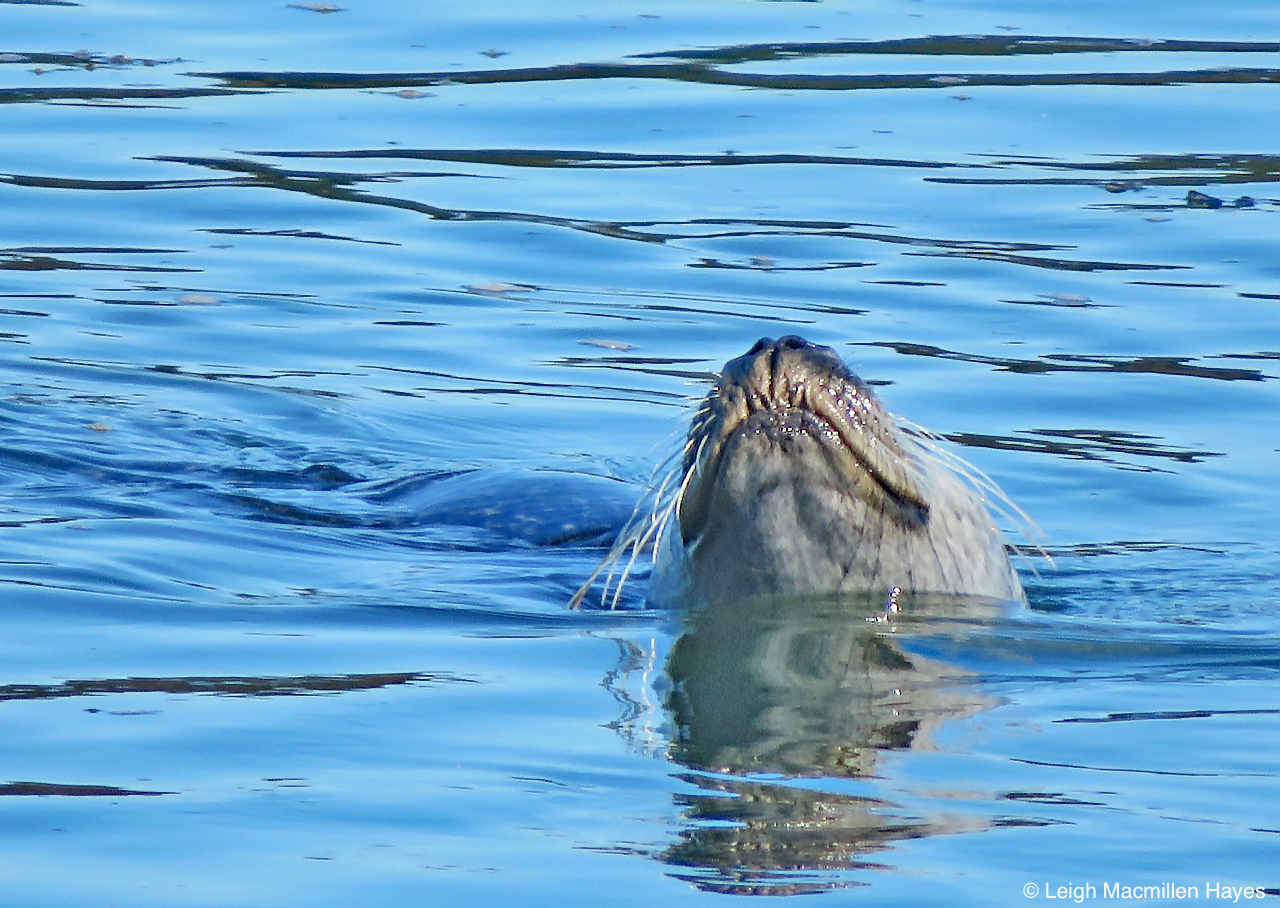
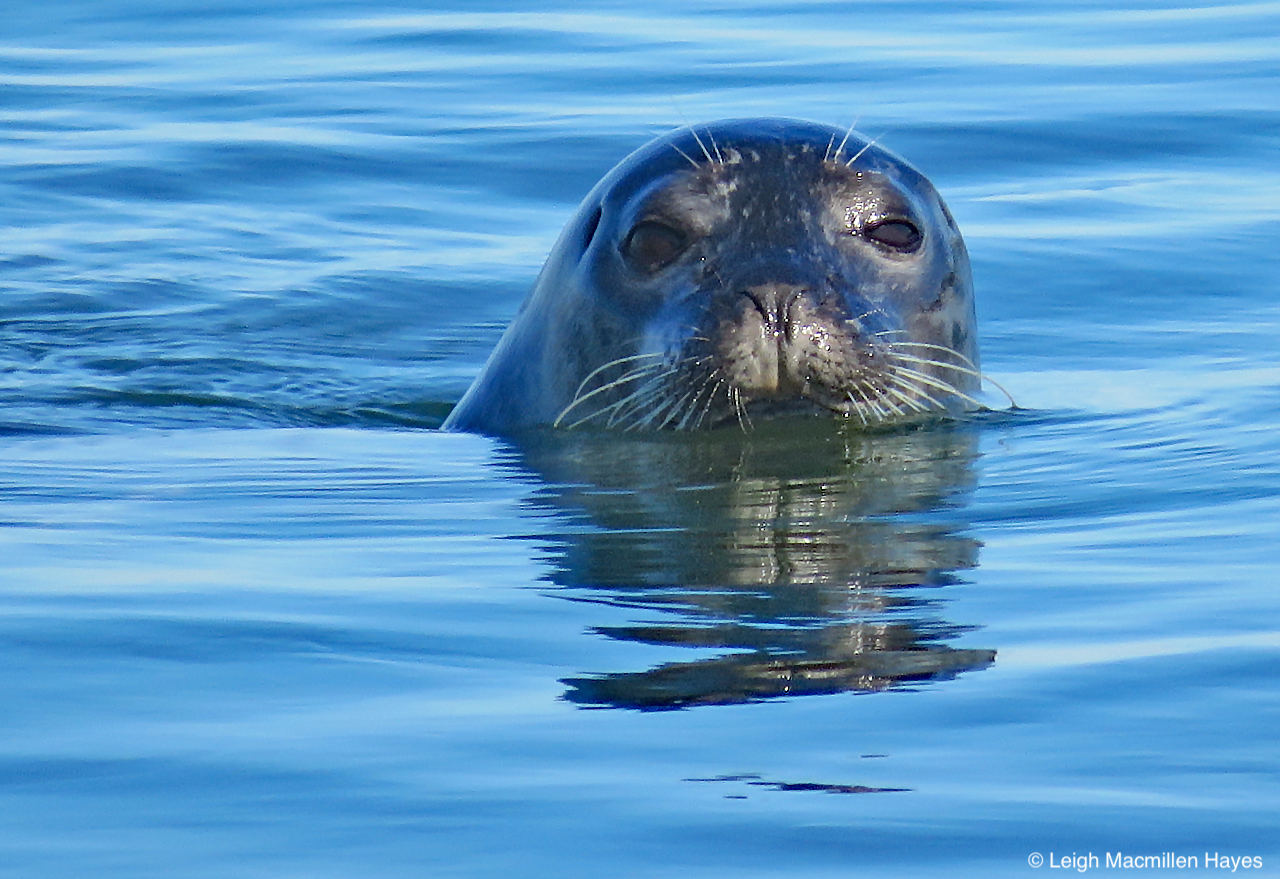
My guy rejoiced when we spotted seals frolicking by the bridge to Campobello in Lubec.

I have to admit that I rather enjoyed them as well.

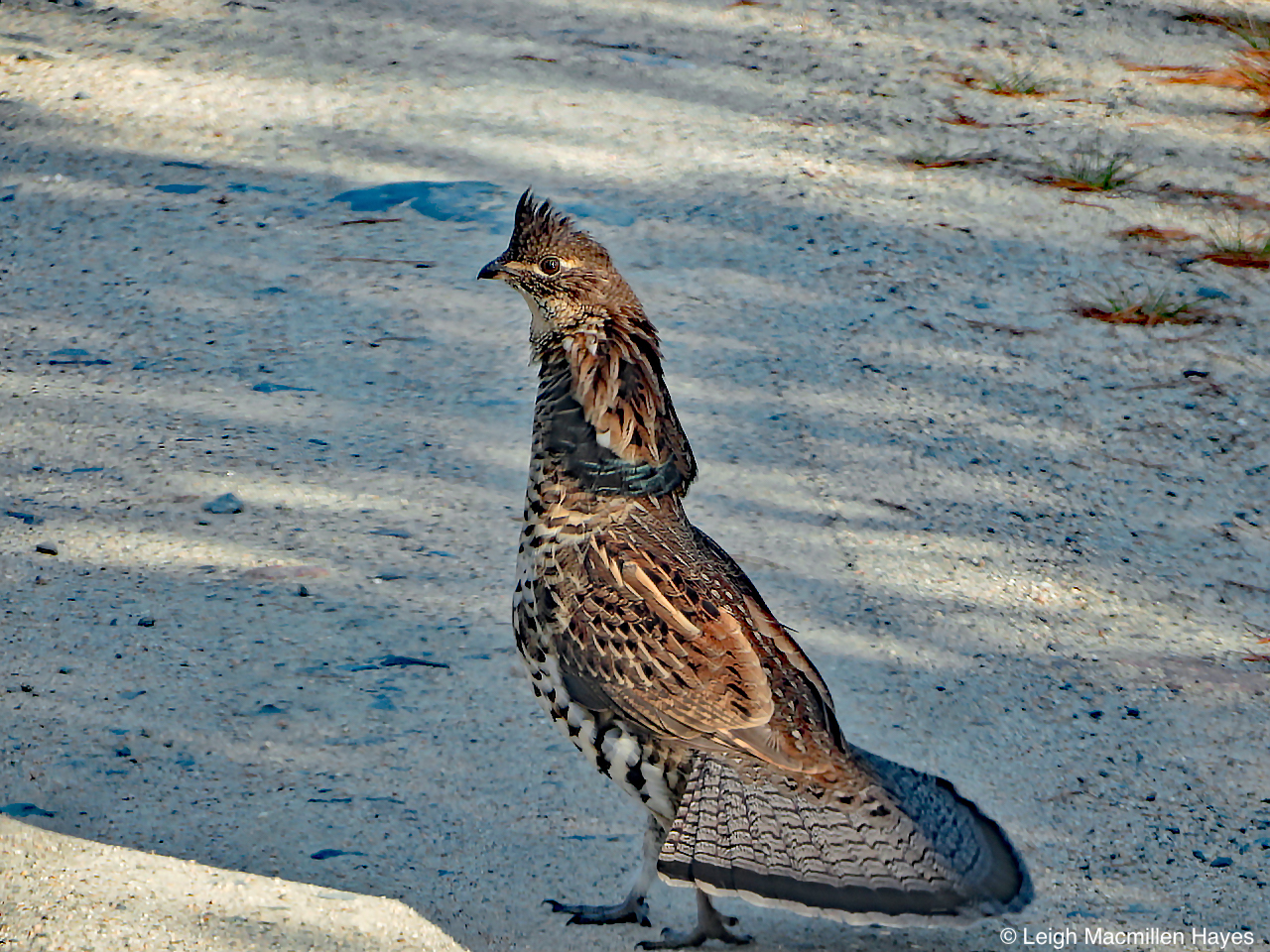
Another fun sighting was that of a Ruffed Grouse that walked out of a Spruce Bog and onto the loop road as we made our way around.

Today, we also found an oft-visited bear tree that made us smile as they always do.

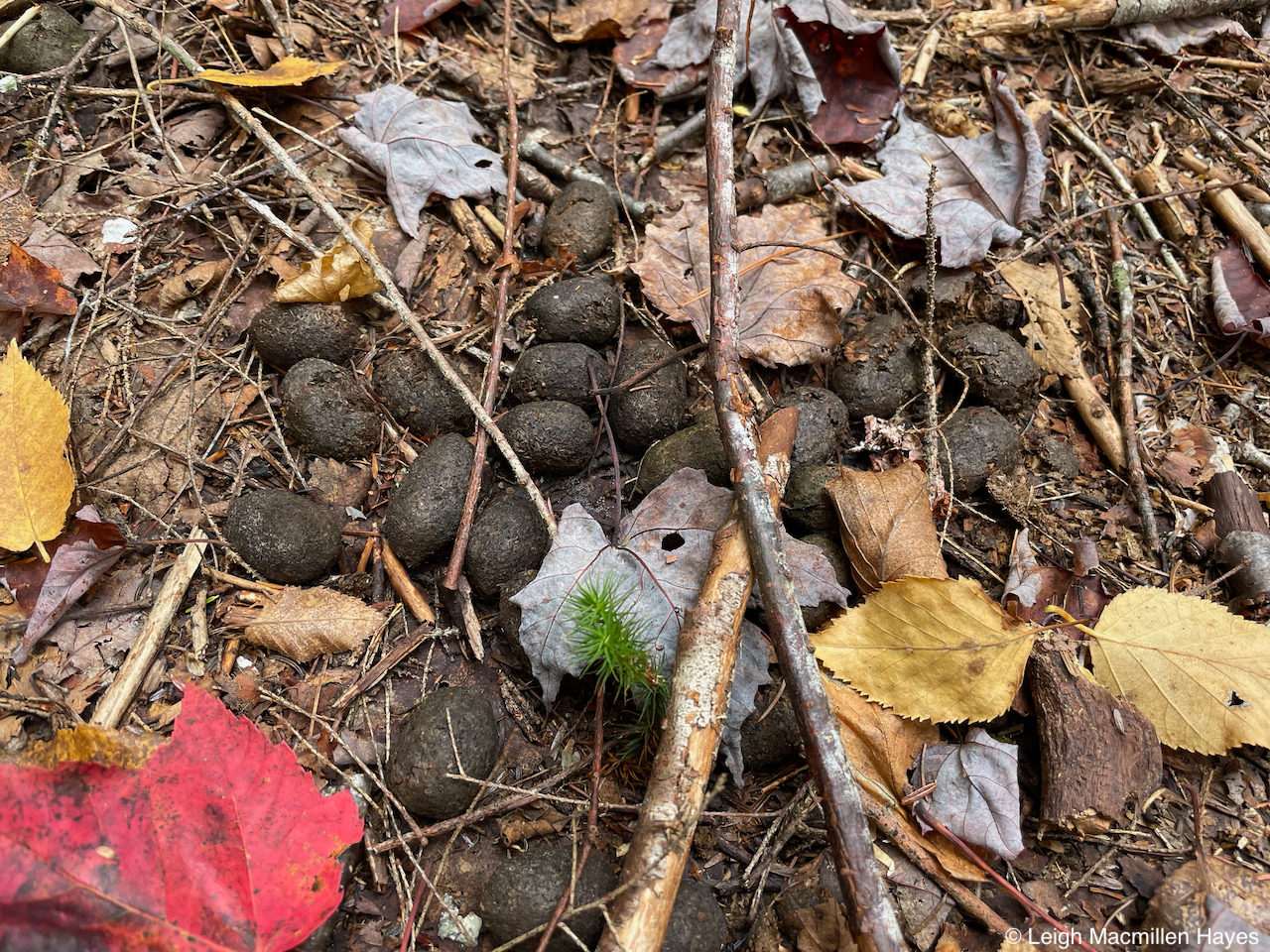
The funny thing for us–we found only two piles of moose scat while in the national monument, but upon today’s hike we counted over thirty piles along the trail. My guy really wanted to spot a moose. Anywhere.

I reminded him that we need to go without expectation.

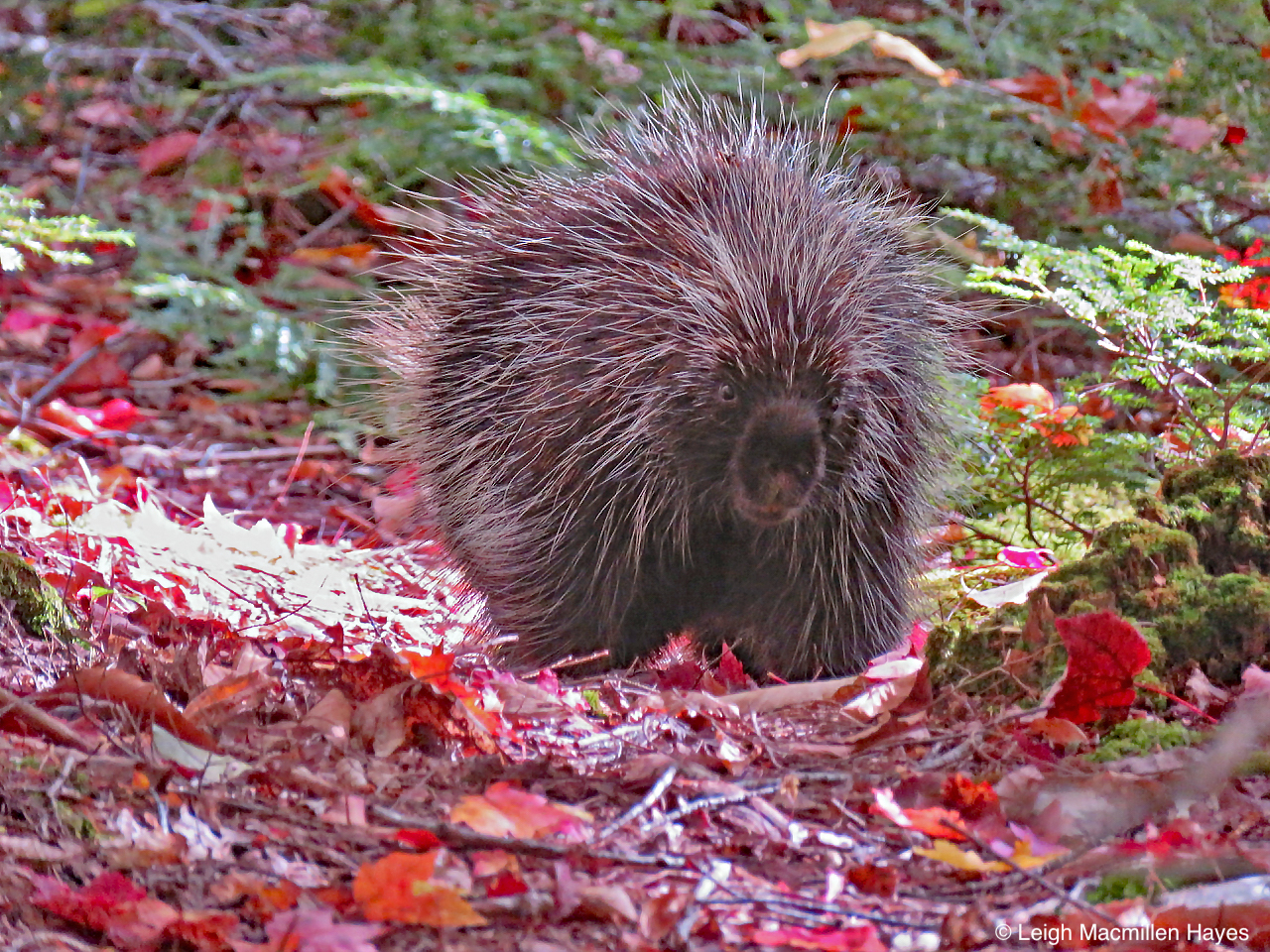
And so we did and were completely startled to spy a porcupine waddling toward us this morning.

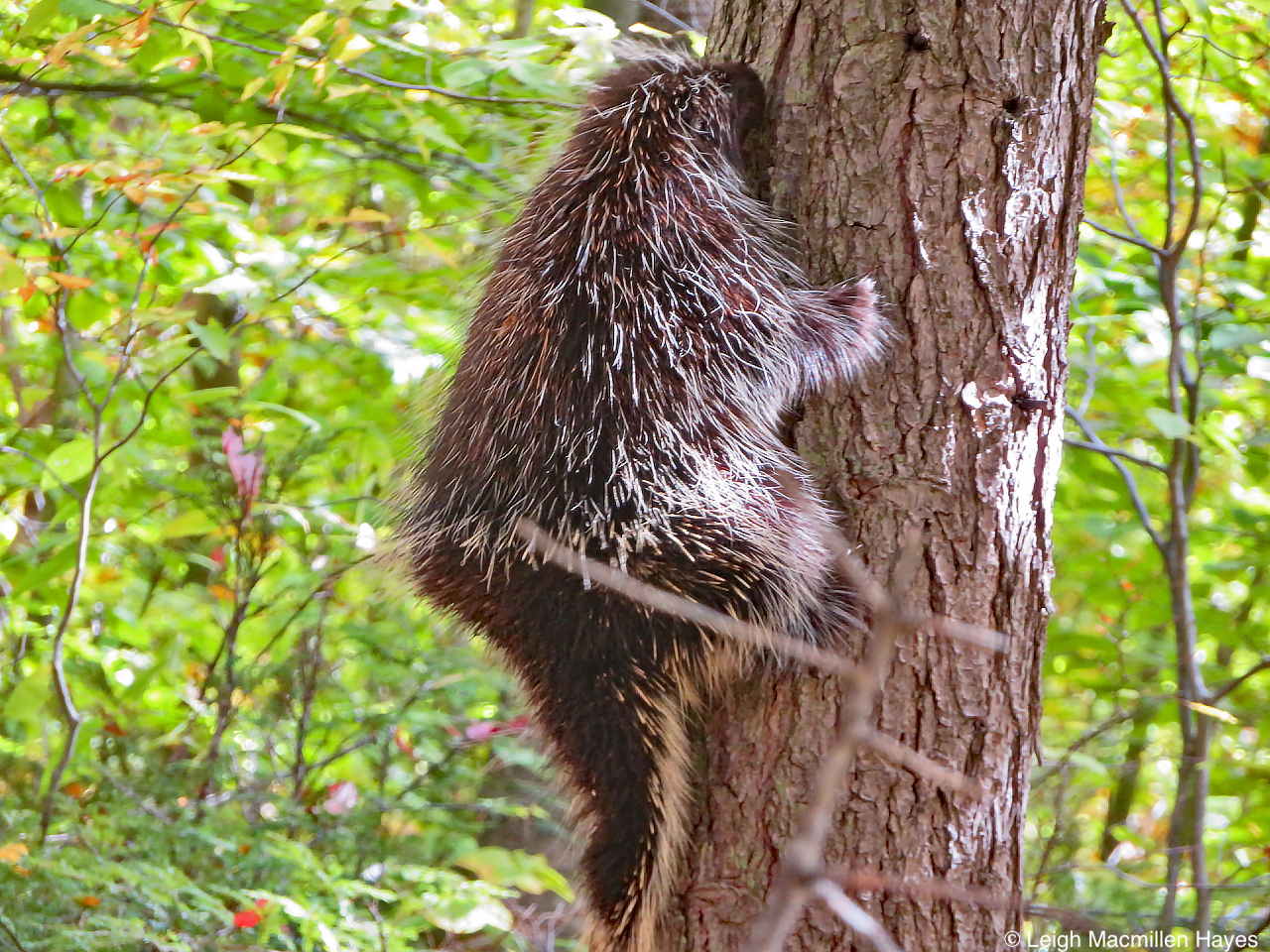
Fortunately he did what porcupines do and climbed a hemlock tree beside the trail, then walked out onto a branch, keeping an eye on us. We skirted off trail for a second to get out of his way.

The end of his tail marks the end of vacation 2021 that allowed us the opportunity to explore bunches of new trails and corners of our state that we’d not seen before and we gave thanks for the suggestion from Marita and recommendations from Molly because this tour certainly reminded us that Maine is a beautiful state. And we all need to work to keep it that way.

Book of April: I’m in Charge of Celebrations

Serendipity: the occurrence and development of events by chance in a happy or beneficial way.

And so it was that upon arrival home from a short hike with my guy this morning, we discovered a package addressed to me in the mailbox. When I saw the town in Florida I knew exactly from whence it had come, but still didn’t know what was inside.

Well, much to my delightful surprise it was a children’s book.

I’m in Charge of Celebrations by Byrd Baylor with illustrations by Peter Parnall.

Upon opening to the inside cover, several pieces of paper fell out. The first was a letter from Ben and Faith Hall; though actually it was written by Ben. Here’s an excerpt: “One of my favorite children’s books is Everybody Needs a Rock. It was written by Byrd Baylor and illustrated by Peter Parnall. When Byrd Baylor’s name appeared on the cover of the book I saw, I purchased it for fifty cents.

Ben and Faith, you see, are part of a group of twelve retired residents in their Florida town who tutor second graders struggling with reading comprehension. Given that, they are always on the lookout for appropriate books to share with their students.

Ben continued in his note to me, “After reading the book, I left it by Faith’s chair without saying anything. Obviously, I wanted to see if her reaction was similar to mine. It was. The story reminds us of your blog with its information and imagination. Thank you for sharing your gift with us. Keep going!

My ulterior motive in sending you the book is that hopefully you will write a children’s book. In no way should you take time away from your blog, but with your depth of spirit it would be worthwhile.

The illustrations in the book are fascinating and remind me of your skill with photography.”

Well, Ben and Faith, thank you so much for this gift. And for your love and support for what I enjoy doing. As for the children’s book, ideas fly through my brain all the time, but . . . I’d have to self-publish and it isn’t going to happen.

As for I’m in Charge of Celebrations, I totally get it. My guy wasn’t in the house when I sat down to read it and it’s a book that needs to be read aloud. And so I did. When he walked around the corner into the living room, he thought I was talking to someone on the phone.

For those of you not familiar with the title, Baylor begins the story with an explanation of how she’s never lonely as she explores the desert.

I feel the same way and on January 11, 2019, I actually wrote, “People often ask me this question: Aren’t you afraid of hiking alone. My response is that I’m more afraid to walk down Main Street than through the woods, the reason being that it’s a rare occasion I encounter a mammal. Oh, I do move cautiously when I’m alone, but there’s something uniquely special about a solo experience.”

As Baylor goes on to say, part of the reason she’s not lonely is this: “I’m the one in charge of celebrations.” Indeed. Each celebration marks the day she made an incredible discovery.

And so, I took a look back at some of my blog posts, and it’s all your fault Ben and Faith that this is a long one. But you inspired me to review some exciting discoveries I made just in the past year. With that, I attempted to follow Baylor’s style.

Friends,
while reveling
in the colors 
of dragons and damsels,
their canoodling
resulting in 
even more predators
of my favorite kind,
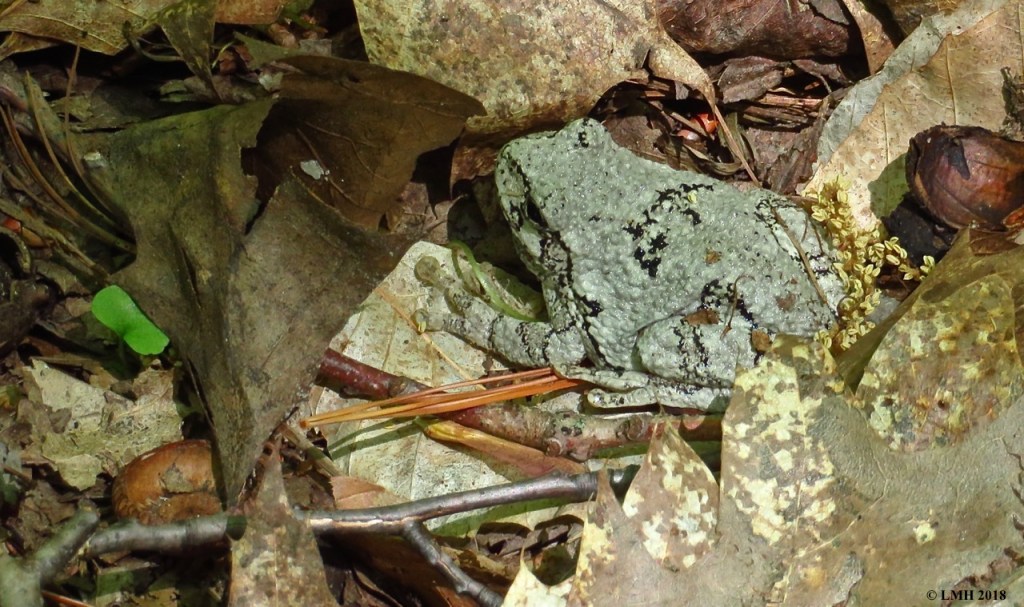
I met Prince Charming,
a Gray Tree Frog
who offered
not one rare glimpse, 
but two.
And so it is
that May 30th is
Gray Tree Frog Day.
For over thirty years
I've stalked this land
and July 14th
marked
the first time 

noticed
the carnivorous plant
growing beside
the lake. 
Droplets glistened
at the tips 
of the hair-like tendrils 
of each leaf
filled
to the brink 
as they were
with
insect parts. 
On this day
I celebrated
Round-leaved Sundews. 

A celebratory parade 
took place
on
September 22.
The route
followed the old course
of a local river.
Along the way,
trees stood in formation,
showing off 
 colorful new coats.
Upon some floats, 
seeds rustled 
as they prepared
to rain down
like candy tossed
to the gathered crowd. 
My favorite musicians
sported their 
traditional parade attire
and awed
those watching
from the bandstand.
With an 
"ooEEK, ooEEK,"
and a
"jeweep"
they flew 
down the route.
Before it was over
a lone lily
danced on the water
and offered
one 
last 
reflection. 
And then summer marched into autumn. 
With wonder
in my eyes
and on my mind
I spent November
in the presence 
of a Ruffed Grouse. 
The curious thing: 
the bird followed me, 
staying a few feet away
as 

tramped 
on. 

stopped. 
Frequently.
So did the bird. 
And we began 
to chat. 
I spoke quietly
to him
(I'm making a gender assumption)
and he
murmured back
sweet nothings. 
Together 
we shared the space, 
mindful
of 
each other. 
As he warmed up
below a hemlock,
I stood nearby, 
and watched, 
occasionally offering
a quiet comment, 
which he
considered
with
apparent nonchalance. 
Sometimes
the critters 
with whom we share
this natural world
do things
that make no sense,
but then again, 
sometimes we do 
the same. 
Henceforth,
November will always be 
Ruffed Grouse month 
for me. 
At 6am 
a flock of crows
outside the bedroom window
encouraged me 
to
crawl out of bed. 
Three black birds
in the Quaking Aspen
squawked
from their perch
as they stared 
at the ground.
I peeked
but saw nothing 
below.
That is,
until I looked
out the kitchen door
and tracks drew
my attention.
It
took
a
moment 
for my
sleepy brain
to click into gear, 
but when it did
I began to wonder
why the critter
had come
to the back door
and sashayed about
on the deck. 
Typically,
her journey
takes her
from under the barn
to the hemlock stand.
Today,
as the flakes fell, 
and the birds scolded,
she sat on the snowpile,
occasionally retreated 
to her den, 
grunted, 
re-emerged, 
and then
disappeared
for the day. 
I went out again
at dusk
in hopes
of seeing 
the prickly lady
dig her way 
out
but 
our time schedules
were not synchronized. 
I don't know
why she behaved
strangely this morning,
but I do know this:
when the crows caw--listen.
And look. 
And wonder. 
April 8th
will be the day
I celebrate
the Barred Owl
for he finally
flew in
and landed.
As I watched
he looked about
at the 
offering of treats. 
Cupcakes and cookies
were for sale
to the left
in the form
of Juncos and Chickadees. 
And then he turned 
his focus right, 
where drinks
were on tap
as the snowflakes fell.
He even
checked out 
the items 
below his feet, 
hoping upon hope 
to find
a morsel
of a vole
to his liking. 
Eventually, 
he changed
his orientation
to take 
a better look 
at the 
entire spread
of food. 
But still, 
he couldn't
make up his mind
and so
he looked some more, 
swiveling 
his neck. 
In the end,
he never did 
choose. 
Instead,
off he flew 
without munching 
any of 
the specialty items. 
But I finally got to see my owl. 

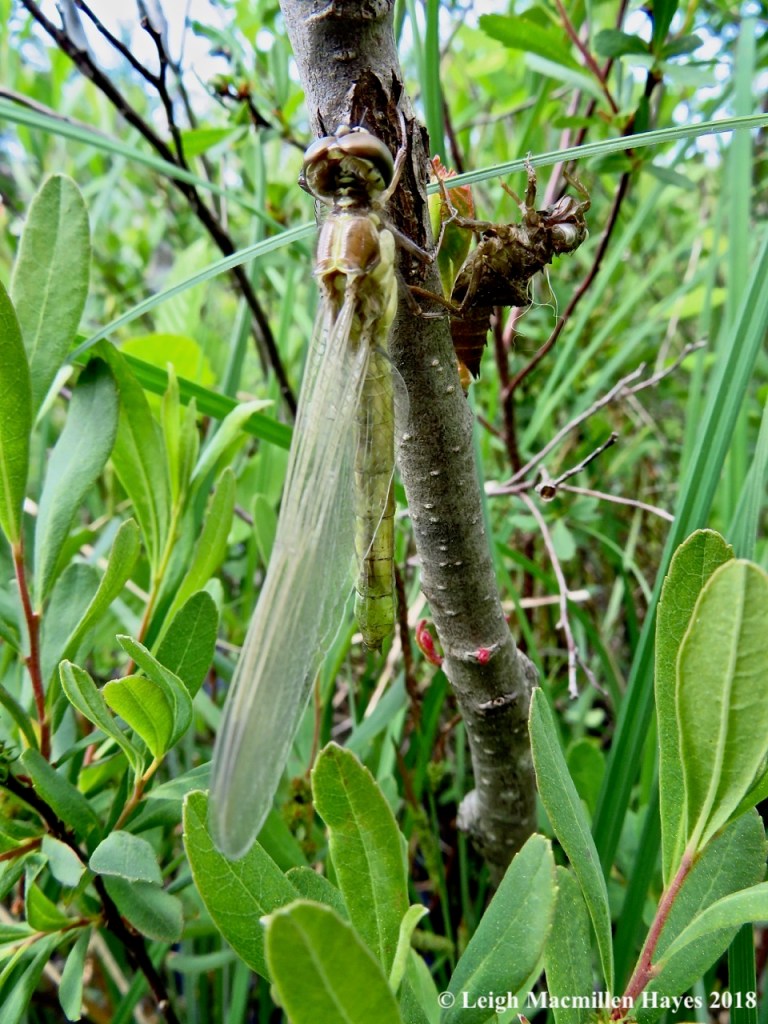
Ah, Ben and Faith, there are moments when one miraculously arrives in the right place at the right time, such as when a dragonfly emerges from its exuvia and slowly pumps blood into its body and you get to be a witness.

It strikes me as serendipity that this book should arrive today. You see, all month I’ve been debating what book to feature and time was of the essence as May approached. And then today, your lovely note, a copy of I’m in Charge of Celebrations, and the Christmas homily you wrote, Ben.

You are both the salt of the earth and I am honored to be your friend. Thank you for your kindness. (I’m only now realizing that we’ve shared a few celebrations that we’ll never forget including the fawn at Holt Pond and your smiling Bob the Bass.

Once again, the April Book of the Month: I’m in Charge of Celebrations.

I’m in Charge of Celebrations, by Byrd Baylor, illustrated by Peter Parnall, Charles Scribner’s Sons, 1986.

Bird Brain

Wrote Aldo Leopold, “Everyone knows…that the autumn landscape in the north woods is the land, plus a red maple, plus a Ruffed Grouse. In terms of conventional physics, the grouse represents only a millionth of either the mass or the energy of an acre yet subtract the grouse and the whole thing is dead.”

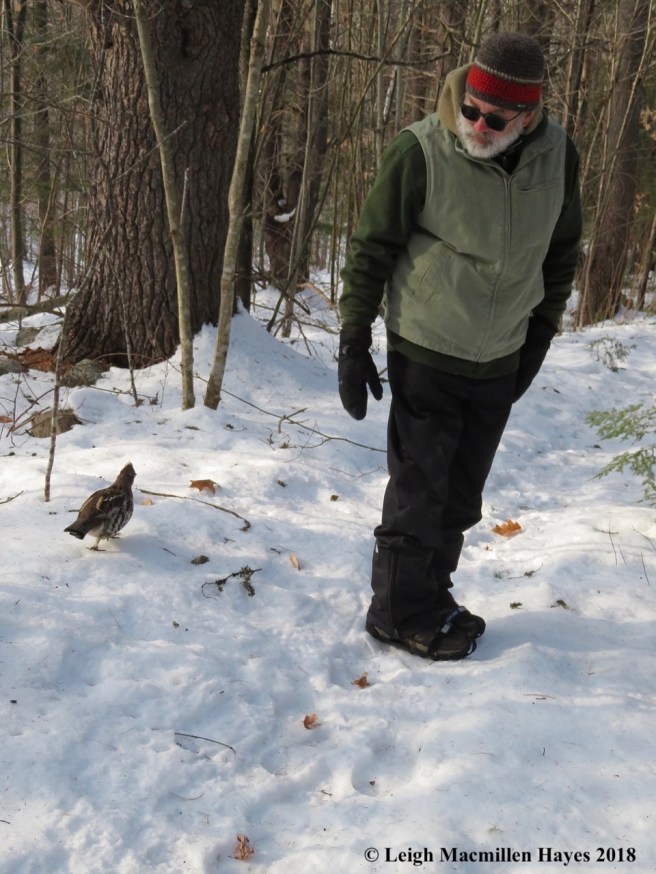
And so it was that I tramped with a couple of friends today who had the delightful pleasure of meeting ArGee (R. G. for Ruffed Grouse). We’d been chatting and searching for a few red blooms on a tall staghorn sumac when suddenly we spied him crossing over a stone wall and approaching us. 

He circled and circled for a while as we stood still yet continued to talk–sharing admiration and awe at the opportunity to be in his presence. 

We watched him forage for seeds and wondered about his behavior. Typically, Ruffed Grouse are loners, except for mating season. But this one seems to greet visitors to its territory with somewhat regular frequency. 

When we moved, he did likewise–usually a few feet to either side of us. 

And when we stopped, he did the same, seeming as curious as us. 

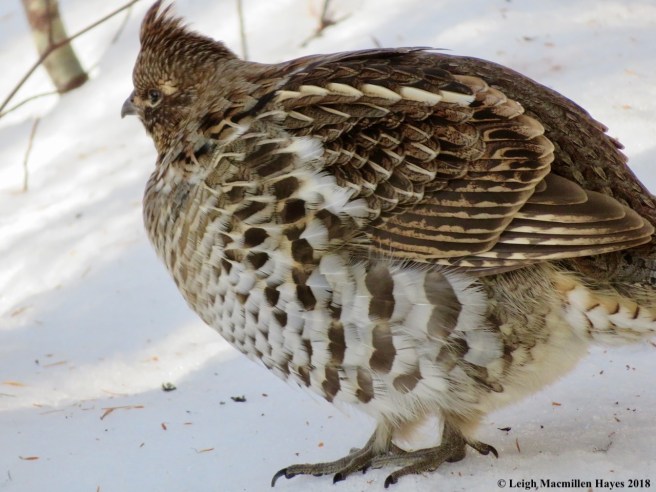
It was a brisk morning, so periodically he did what birds do to warm up–turned into a football of sorts as he fluffed up his feathers to trap warmer air. A bird’s body heat warms the air between its feathers and the more trapped air, the warmer the bird. After all, he didn’t have the luxury of hand warmers. But then again, we didn’t have the luxury of trapping air within our feathers. 

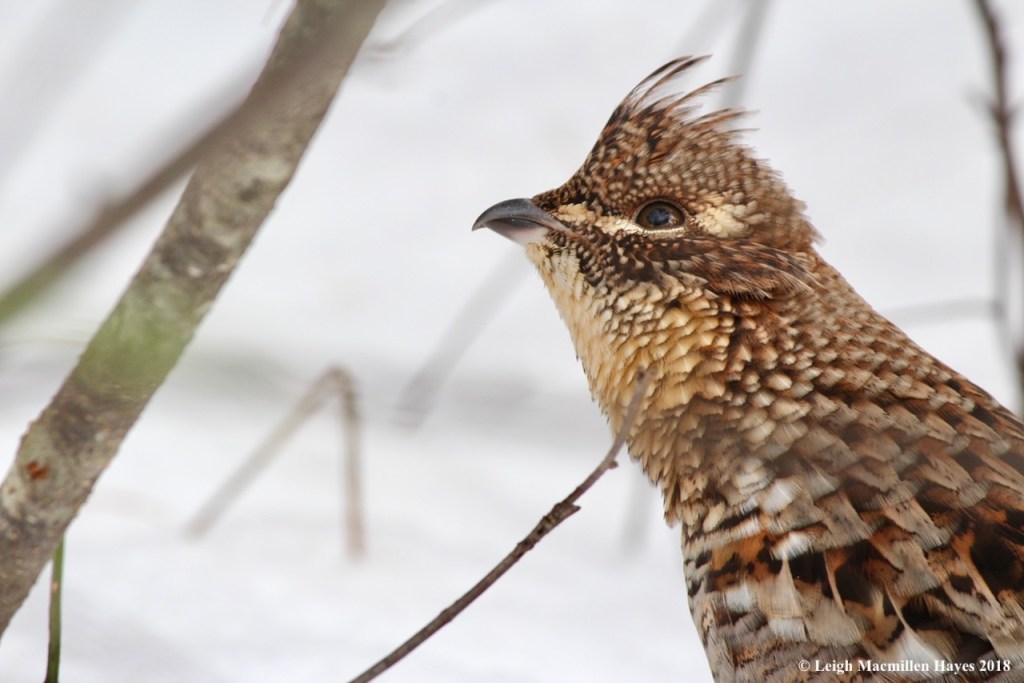
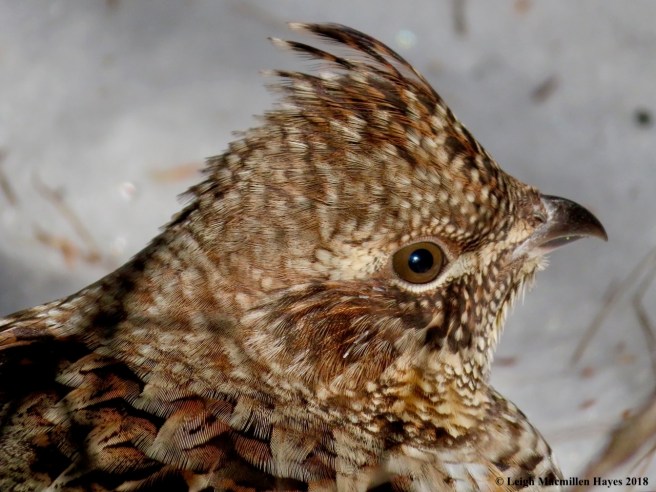
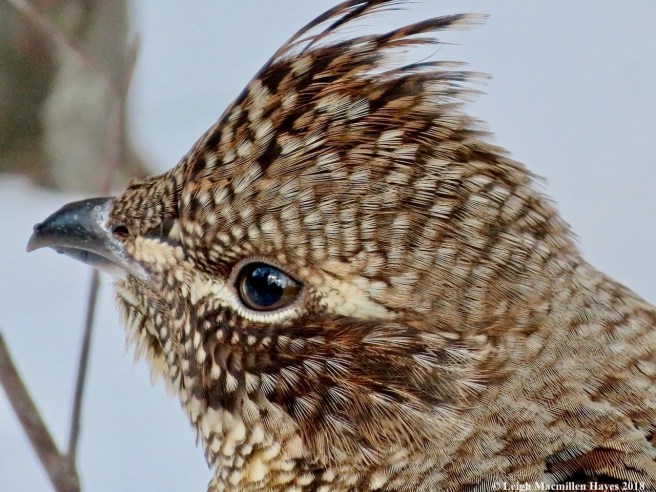
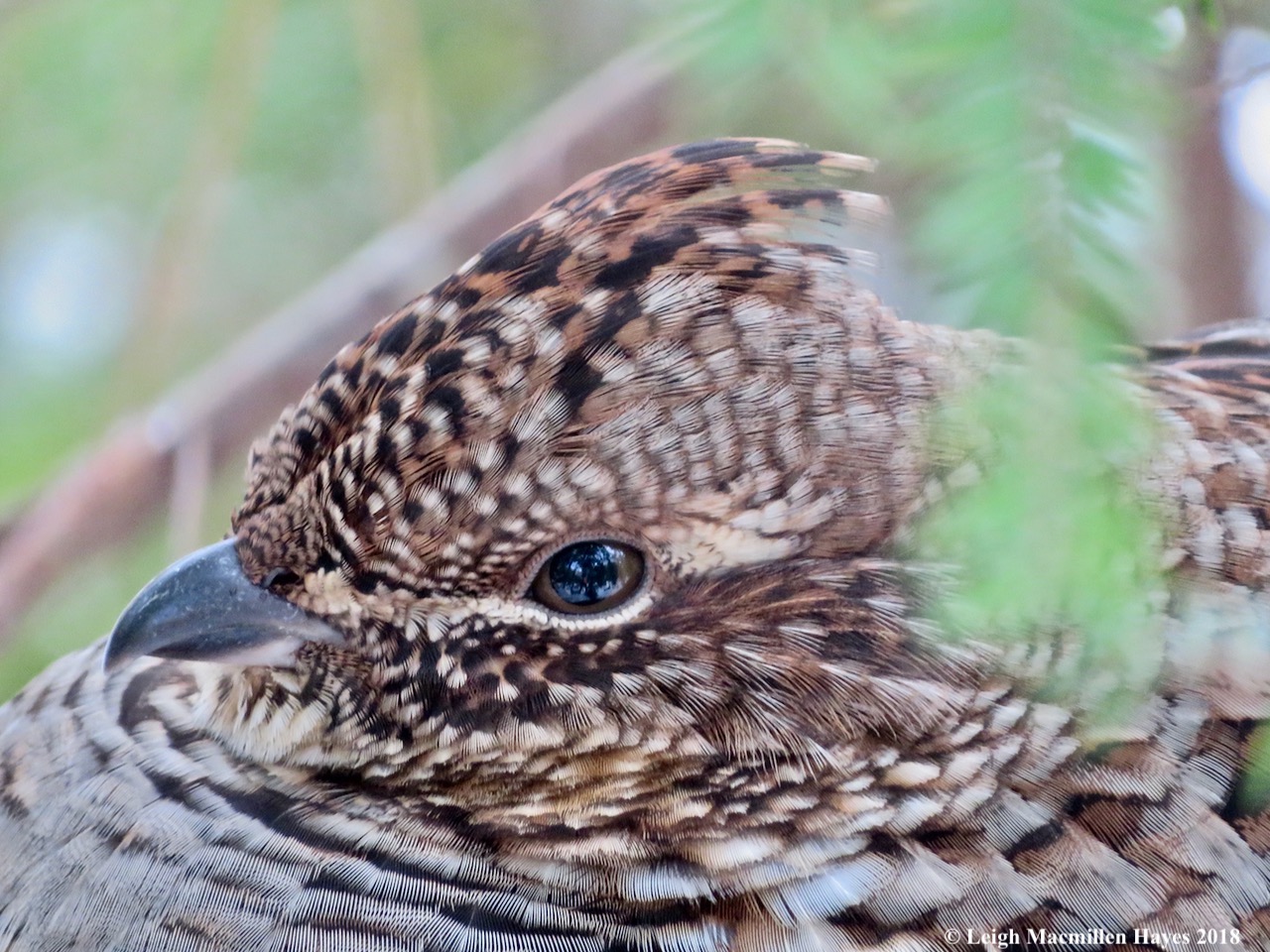
While we watched, I couldn’t help but notice the auricular feathers–those stiff feathers that cover the bird’s ear and form a triangular patch that extends back from the bill and the middle of the eye. 

Do you see what I mean as they fan out below ArGee’s eye? 

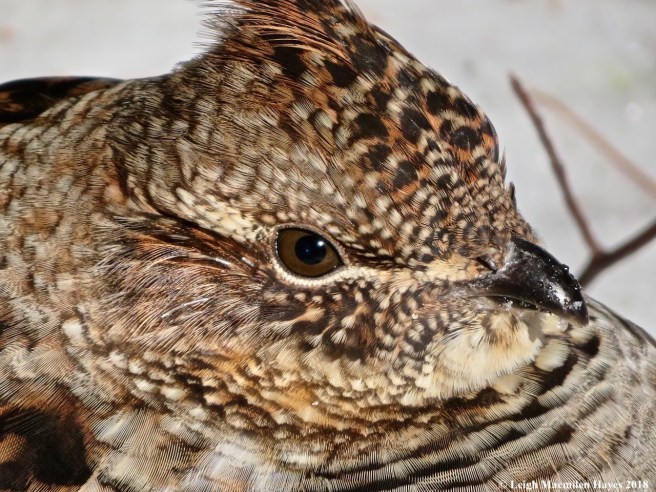
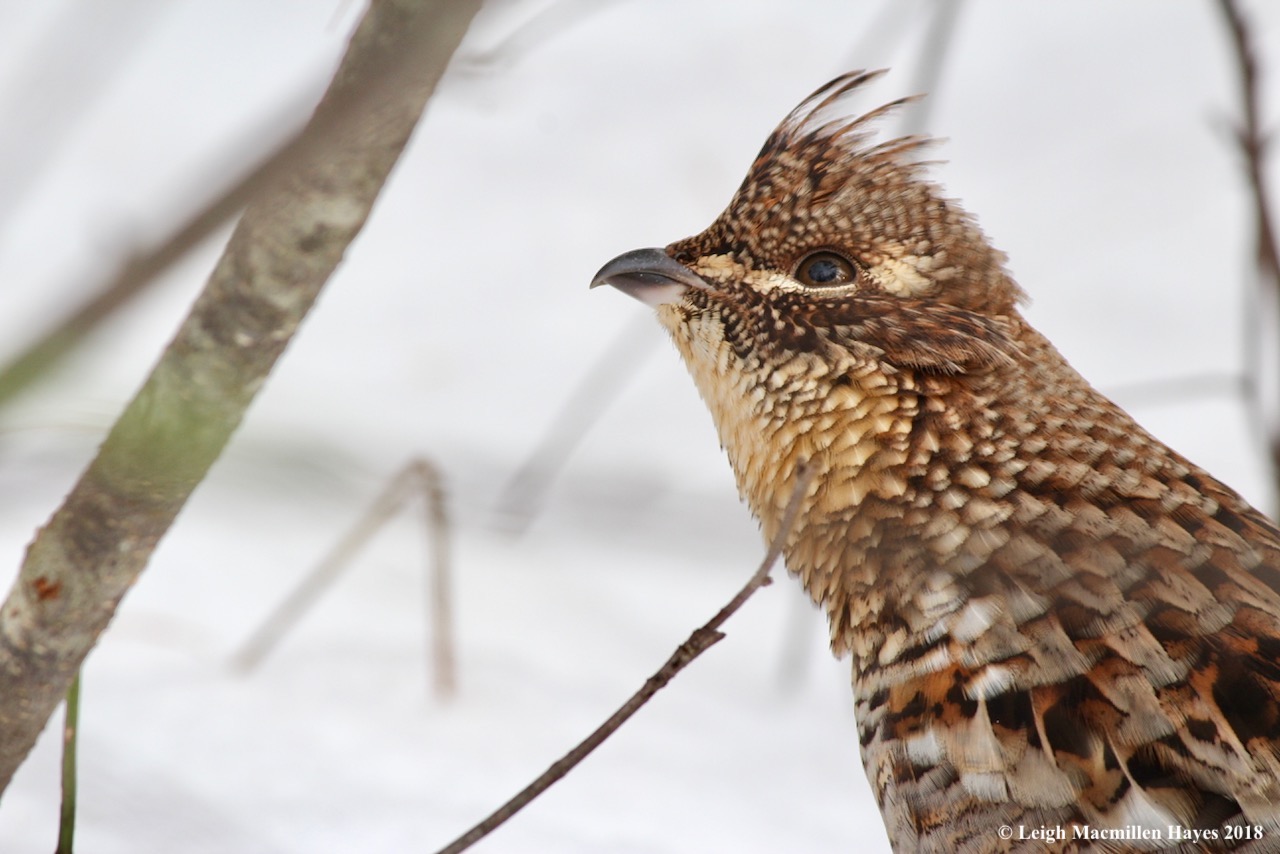
Here’s another look. And notice that beak–sturdy and down-curved for eating buds and twigs, the bird’s staple in winter. 

Survival isn’t easy for a Ruffed Grouse, but despite his affinity for people, ArGee knew to take cover occasionally and perhaps that is why he is still among us. That and maybe the fact that we’re honored to be in his presence and learn more about his species as we have the ability to study him. 

While I’d previously noted the comb-like scales on his feet that act as snowshoes and perhaps add stability somewhat like a porcupine as he’ll search for buds in trees once winter advances, today’s understanding included noting how ArGee moved–with one foot placed in front of the other. 

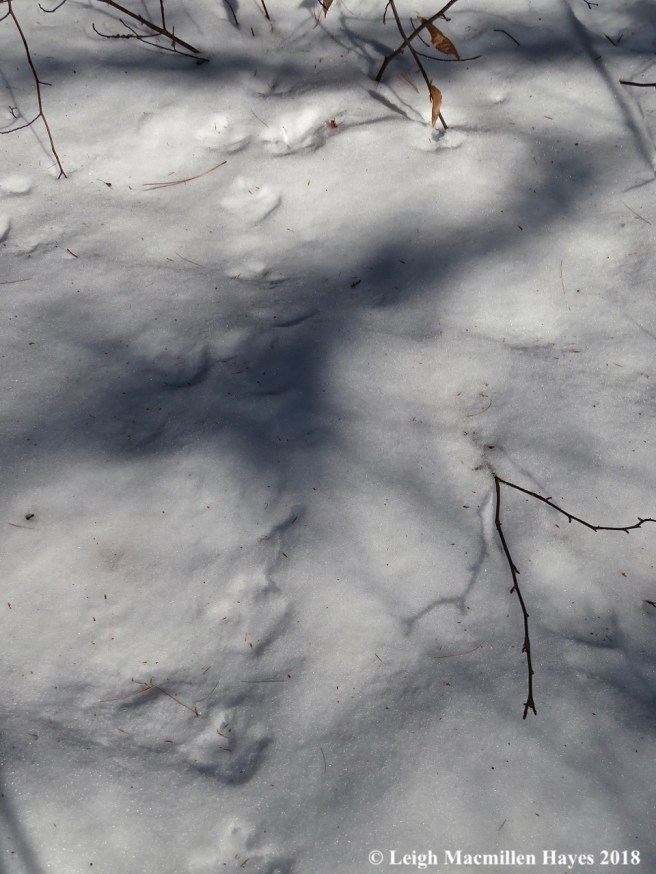
 I’ve seen it displayed in the tracks left behind including this old set we found further along, but watching the proximity of one foot to another as ArGee moved added a vision and understanding to the signs left behind. 

Sometimes it seemed the feet were practically touching and other times there was a bit of space between them. Then again, at times ArGee paused and that seemed to be when his feet where closer together and other times he marched or ran beside us and there was a bit of distance between the two feet. 

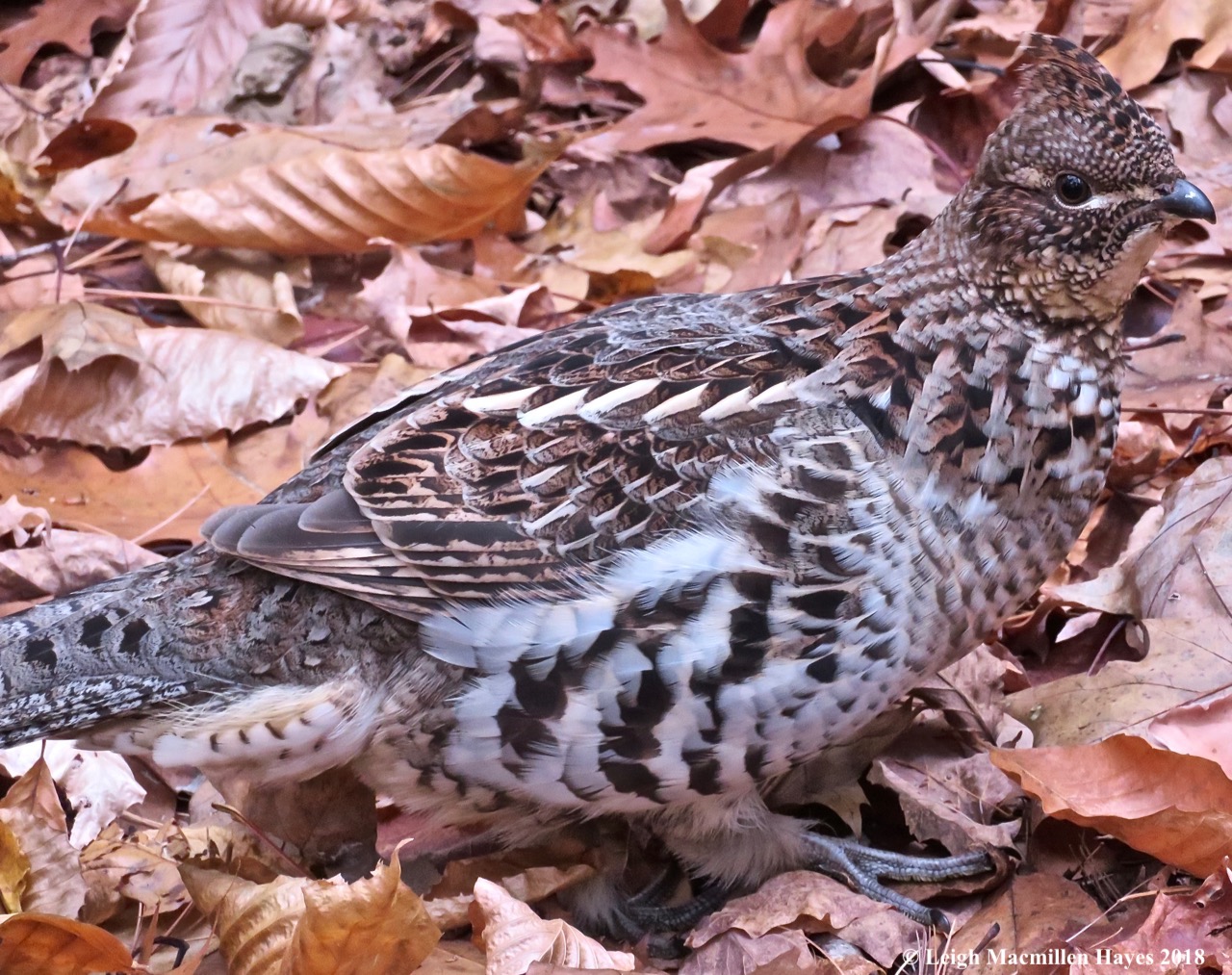
Our time with ArGee lasted maybe a half hour or less. And he wasn’t always puffed up to stay warm. When he returned to his original size, his chicken-like form seemed more apparent.

Always, he searched for buds to consume. Ruffed Grouse have a special internal adaptation, most helpful for their winter diet–similar to that of deer and moose, which is rather funny when you think about the fact that most Ruffed Grouse burst out of the snowpack and scare the daylights out of us as we approach and make our hearts beat rapidly as we’re certain we’ve encountered a moose. Maybe they should be named Ruffed Moose instead.

So back to that internal winter adaptation: they store food in their crops (esophagus) until later and then within their bodies are two offshoots of their intestines, called caeca, which grow enormous each autumn and allow them to break down cellulose so they can get nourishment from the woody aspen and birch buds that they prefer. Come spring, the caeca atrophy for the warmer months.

Our lesson from ArGee ended in much the same time frame as it usually does, but he left us wondering all the same. After we’d spent time moving and stopping together, suddenly he started to gently attack the backs of our legs. It was at a spot that seemed to delineate his territory given past experiences, but why the attacks? Did he want us to leave? Not leave? Were we suddenly seen as the aggressor? All along he’d seemed as curious about us as we him and so we were left to ask questions which we did for the rest of our journey. But wow. We were given the opportunity to wonder. 

And wonder we did. What did ArGee see in us? 

And what was he thinking? 

Bird brain? What passes through it? We may never know, but we do know that our lives were enriched and the landscape is alive. 

P.S. Pam and Bob–this one is for you! Wow! 

Nothing to Grouse About

A week ago I shared a unique experience with five other naturalists, the majority of them in the six to eleven age range. For twenty minutes the six of us watched a Ruffed Grouse at it moved about, overturning leaves and foraging on buds. When we last saw it, the bird headed off in the opposite direction that we intended to journey, and so we moved on with wonder in our eyes and minds.

2

And then the next day I returned on a mission to study some twigs at the same property. No sooner had I stepped onto the trail when I heard the sound of leaves cracking a wee bit and what to my wondering eyes should appear but the same bird.

The curious thing: the bird followed me, staying about ten feet away as I tramped on. I stopped. Frequently. So did the bird.

And we began to chat. I talked quietly to him (I’m making a gender assumption) and he murmured back sweet nothings.

It was then that I did the unthinkable–I named him: ArGee.

Again I started down the trail, and again ArGee followed about ten feet to my right. And then I thought I got ahead of him, but a few minutes later he caught up and foraged by my feet as I examined twigs and buds for their idiosyncrasies.

When I finally turned back, ArGee did the same. Eventually I ran because I didn’t want him to follow me to my truck. Would he have? I don’t know. Would he survive? I sure hoped so. Would I visit again? I knew the answer was yes. Would I see him again? Who knew?

The next day I dragged my guy along. But much to my dismay, no ArGee. I’d been blessed twice and had to accept the possibility that he’d either flown off or became part of the food chain. My hope was that if the latter was the case, it was a four-legged predator or larger bird and not a human bi-ped.

Since last week, about five or six inches of snow blanketed the area and this morning dawned frigid with the temperature at about 5˚. I dressed for it and headed to a nearby spot in hopes of meeting up with a group that was going to count salmon and redds. But, I missed the link-up and decided instead to wander in ArGee’s territory so I could reaffirm his disappearance and move on.

1-looking for food

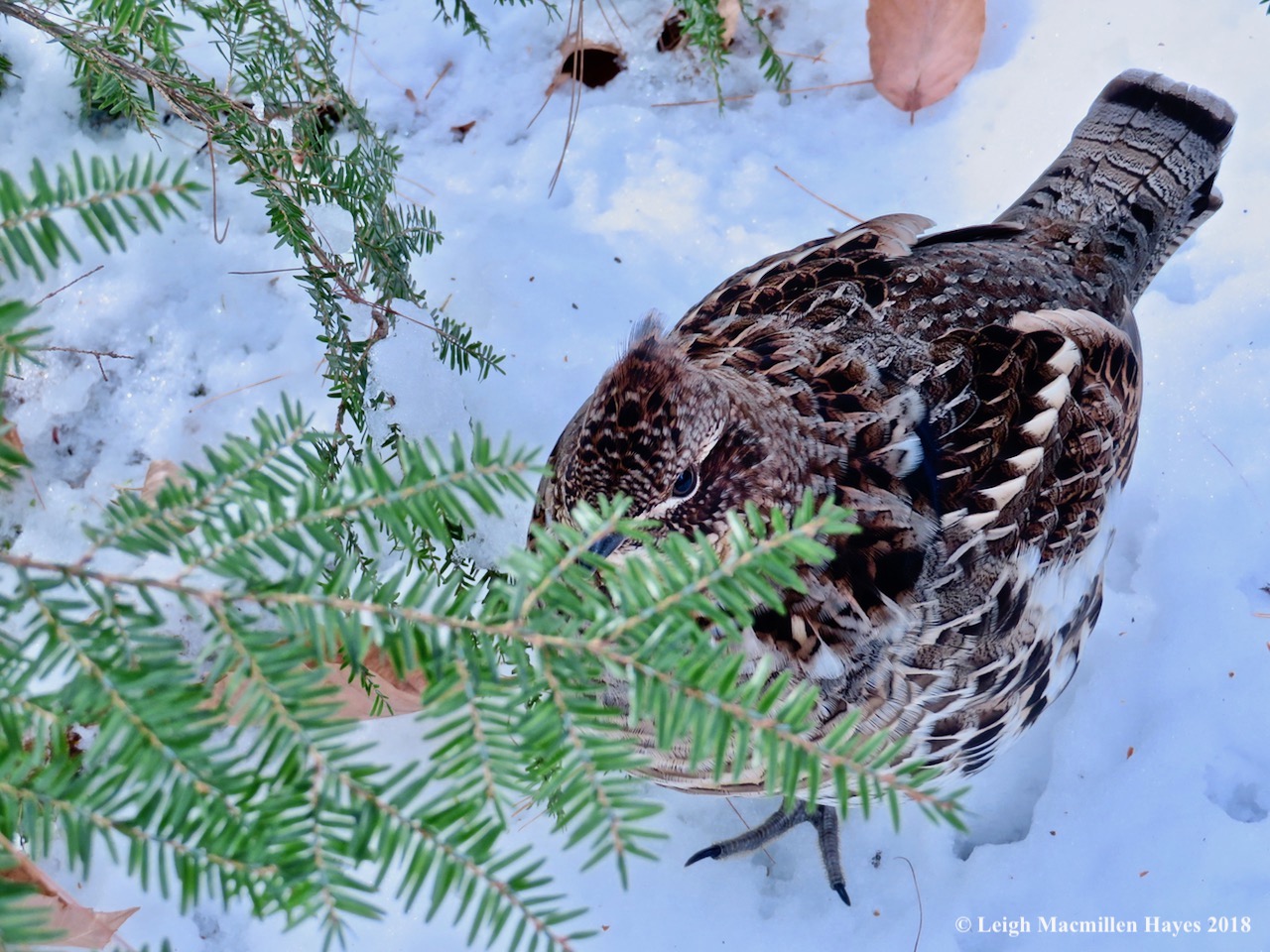
As I looked up at something in a tree, I heard a slight noise by my feet and guess who? I greeted ArGee with a quietly grand hello and together we shared the space, mindful of each other. After about twenty minutes he headed under a stand of hemlocks that provided some cover.

2-hiding and feathers bloated

I snapped and crackled through the woods, bushwhacking over to his position, all the while wondering if I was getting too close and perhaps he didn’t want me to spend more time with him.

2a-hiding

But what I discovered was that he’d stopped foraging, stood still, though occasionally turned his head, and puffed up his dappled and barred plumage. While I had donned several layers to keep the brisk air at bay, ArGee needed to fluff up in order to trap air in his feathers. Cool fact (or cold!): A bird’s body heat warms the air between its feathers and the more trapped air, the warmer the bird.

4-crown

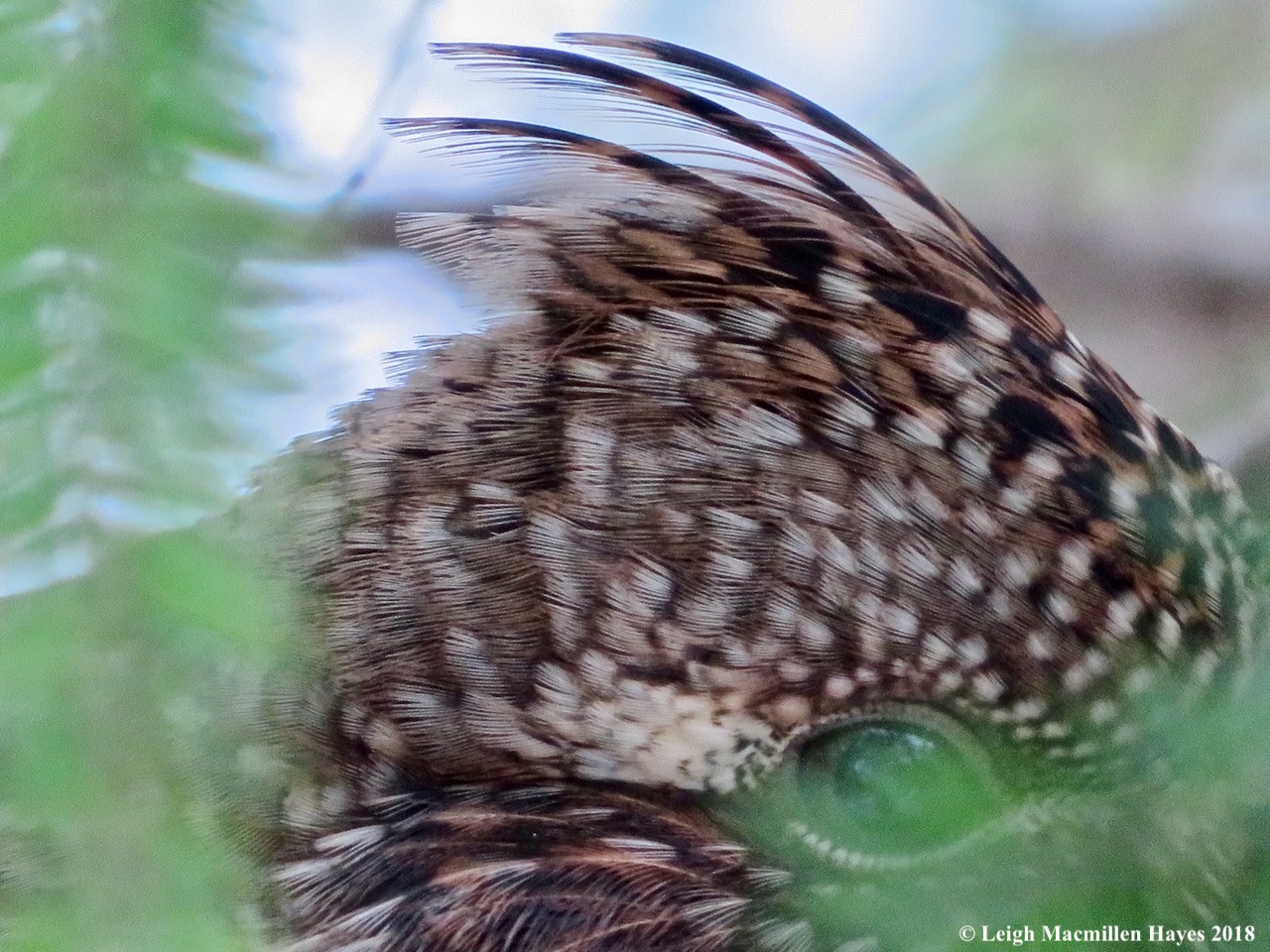
While ArGee warmed up, I focused on some of his features, including the crest feathers on top of his head. Their formation brought to mind ocean waves cresting, but perhaps they were actually standing upright because he saw me not as friend, but rather a foe?

5-eye to eye

I knew I was overextending my stay, but I couldn’t leave. And he didn’t seem agitated, so I continued to look. There was that eye-ring to notice, rather bead-like in appearance.  And the contrasting orientation of the feathers above and below his dark eye, their comb-like tips spread out like miniature fans.

6-looking at me

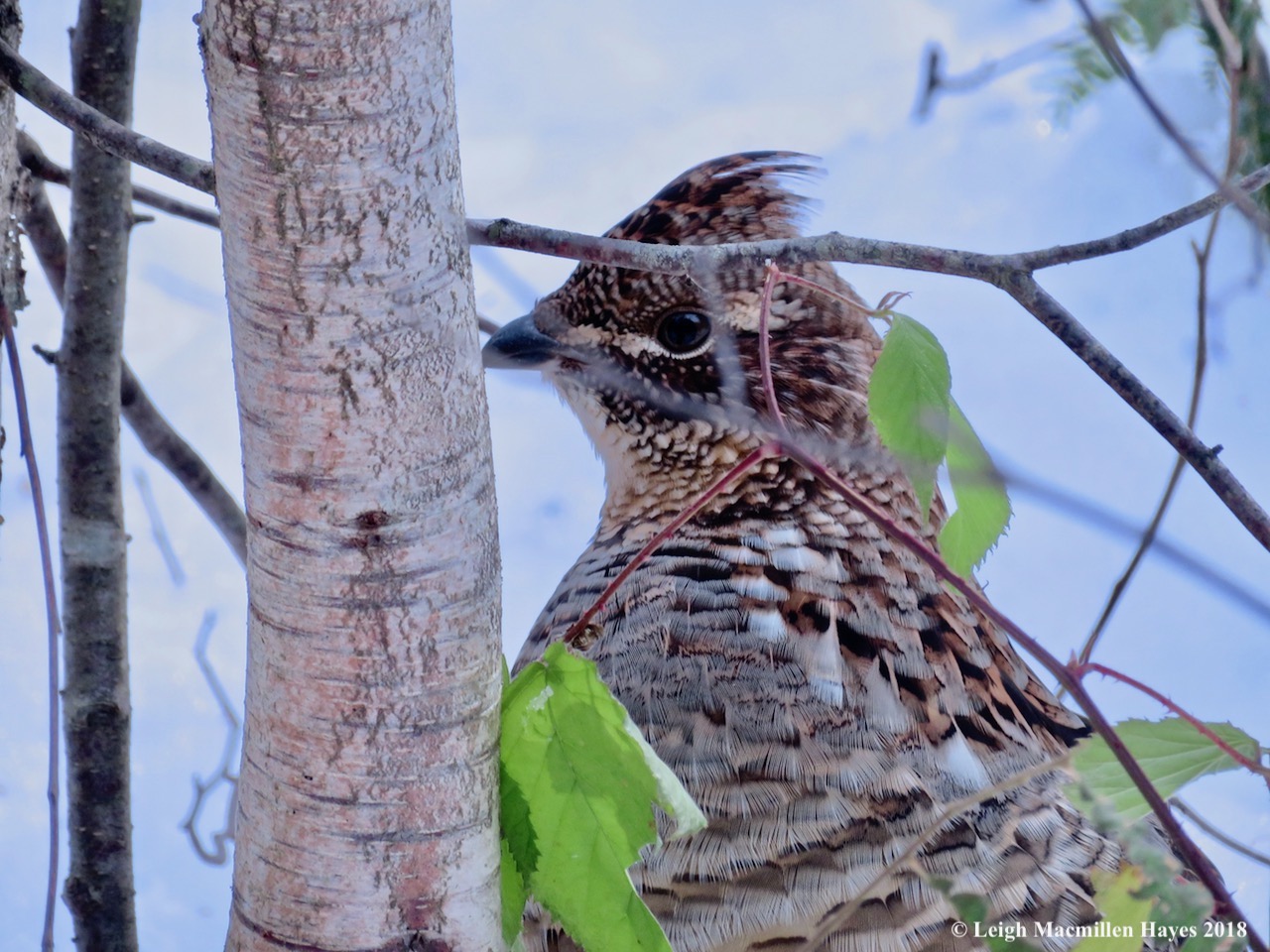
For another fifteen to twenty minutes, he warmed up below the hemlock, while I stood nearby and watched, occasionally offering a quiet comment, which he considered with apparent nonchalance.

7-beak

I had time to consider his robust down-turned beak and figured it must be adapted for the coarse vegetation it consumed. Ruffed Grouse are known to feed on buds or catkins of aspens, birches and cherries, and that was the habitat in which ArGee had made himself at home. They’ll also consume, seeds, fruits, leaves and twigs, insects, and maybe even salamanders, in season of course.

8-coming out of hiding

Finally, my friend seemed to have warmed up and so out from under the hemlock ArGee emerged.

9-dining on leaves

And immediately he found bramble leaves still green.

10-leaf in its mouth

Ripping one leaf off, he made quick work of it.

11-gobbling it up

And in a matter of seconds it disappeared into his mouth.

12-looking for more food

Then it was time to think about another.

12-those feet

Out in the open again, I had a chance to get a better look at ArGee’s feet. Though today’s snow was rather crusty, there’s potential for up to ten inches of fluff to fall tomorrow and then his feet will play a key role.

12a-combs on feet

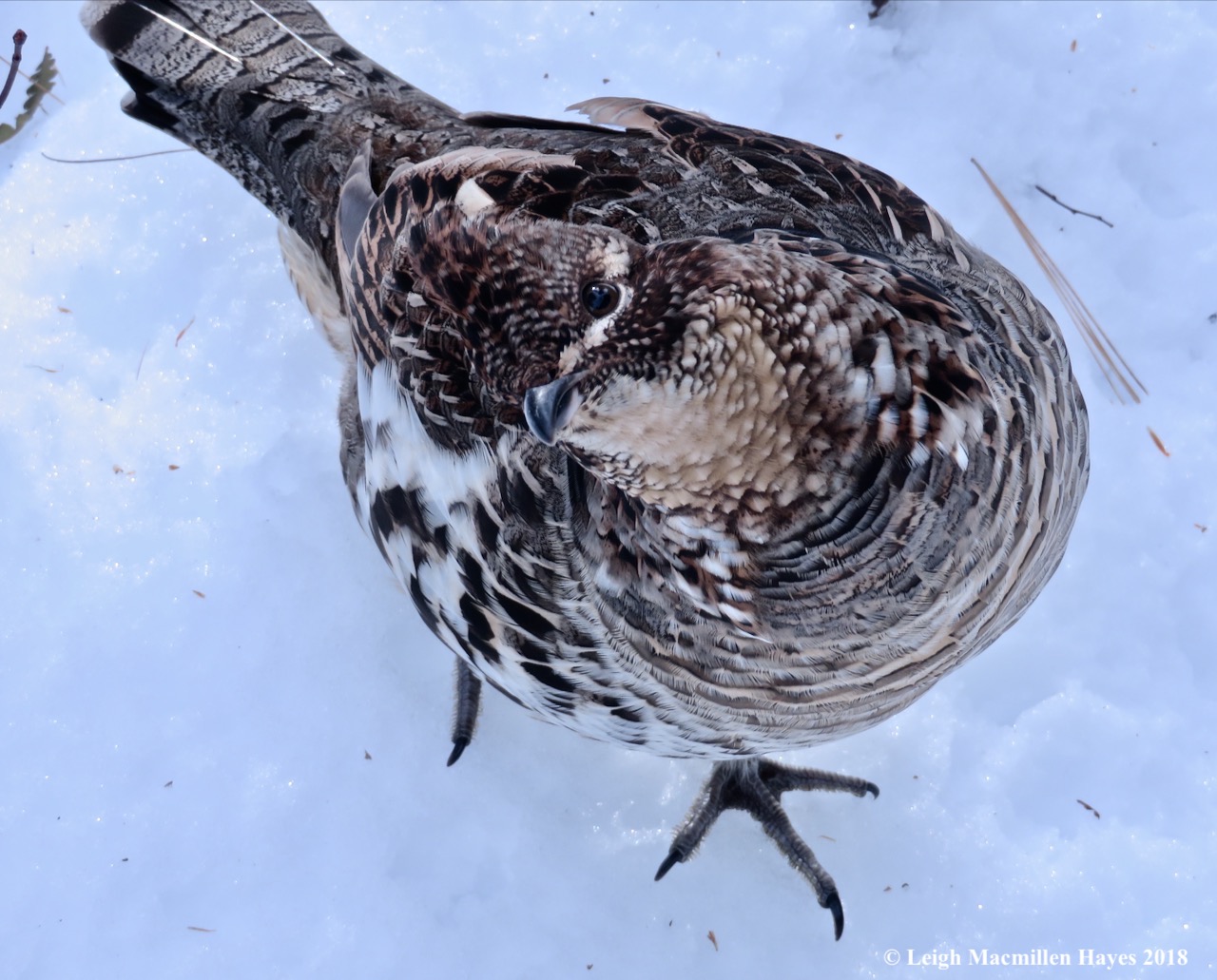
Where the snow is deep and soft, grouse travel atop it with the help of their “snowshoes”—lateral extensions of their toes. Can you see the comb-like rows of bristles, aka pectinations? They began growing in September and reminded me of a centipede serving as each toe. It’s those bristles that act like snowshoes.

They also have stout legs for walking or running and those were also covered with insulating feathers that looked like an old pair of furry sweatpants.

12b-tail feathers

It’s difficult to tell a male from a female based on appearance, but typically the bird is a female if the color is faded or absent on the central tail feathers, thus I leaned toward ArGee being a male. No matter what the sex of this particular bird, the varied shades of black, gray, rusty red and buff all presented in a variety of patterns, including small hearts–what wasn’t to love?

13-I see you

For a while longer, ArGee and I played “I See You” and I continued to wonder about his behavior. Usually this species is quite elusive and difficult to approach. In fact, most often I am startled by the loud wing beat of a bird exploding, or so it sounds, from the ground or snow in front of me, and my heart responds with rapid beats for a second . . . and then I realize it was a Ruffed Grouse trying to avoid me.

13-so close

Today, and this past week, that has not been the case.

13b-are you looking at me?

ArGee has seemed as curious about me as I’ve been about him.

16-saying goodbye

Is he tame? Or has he been defending his territory? Perhaps it’s a hormone imbalance as the season changes, especially given that winter seems to have arrived early.

I’m not sure what’s going on, but I’m grateful for the time I have had to get to know this bird of the Maine woods a wee bit better. As has happened in the past, we parted ways at the same point, so I’ve a better understanding of his actual territory.

I’ve experienced grouse being aggressive when protecting their young in the spring, and wonder if at some point a close encounter with ArGee could switch dramatically from fascinating to hostile as he defends his territory.

Sometimes the critters with whom we share this natural world do things that make no sense, but then again, sometimes we do the same. For now, I have nothing to grouse about!


I Spy . . .

This afternoon’s goal: To find a Christmas Tree to decorate for the Christmas at Ladies Delight Walk on December 1st. For the reconnaissance mission, I joined the Coombs family at the GLLT’s Chip Stockford Reserve.

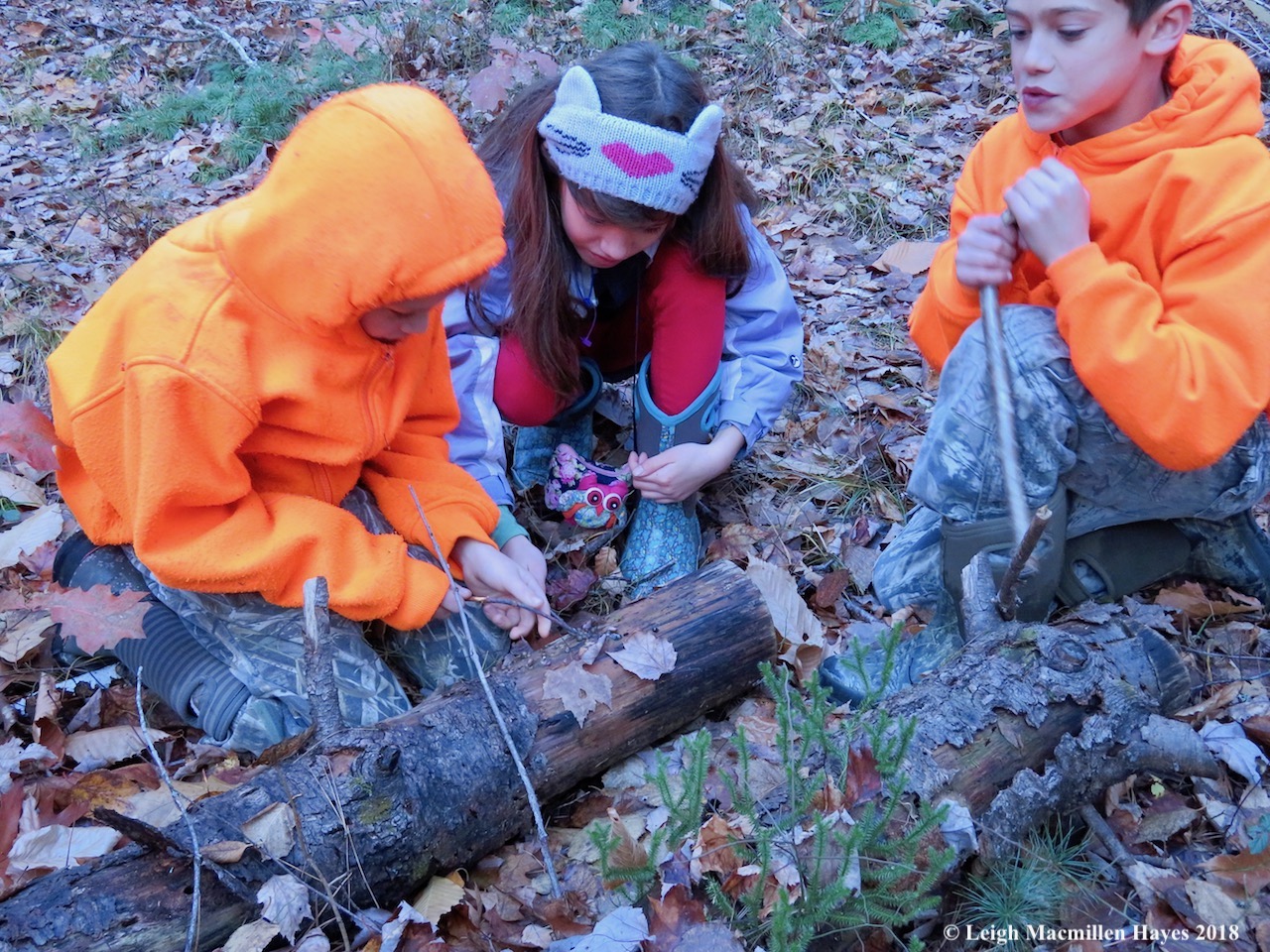
The Coombs children are homeschooled by their amazing mother, Juli, and though they learn many lessons at home, they are also well educated in the outdoors. In fact, they are among my favorite naturalists.

And they belong to a 4-H Homeschool group that will decorate a tree(s) with biodegradable ornaments prior to the December 1st walk.

1

And so we set off on our tour looking for just the right tree. But . . . as is always the case with this family, there was so much more to see.

2

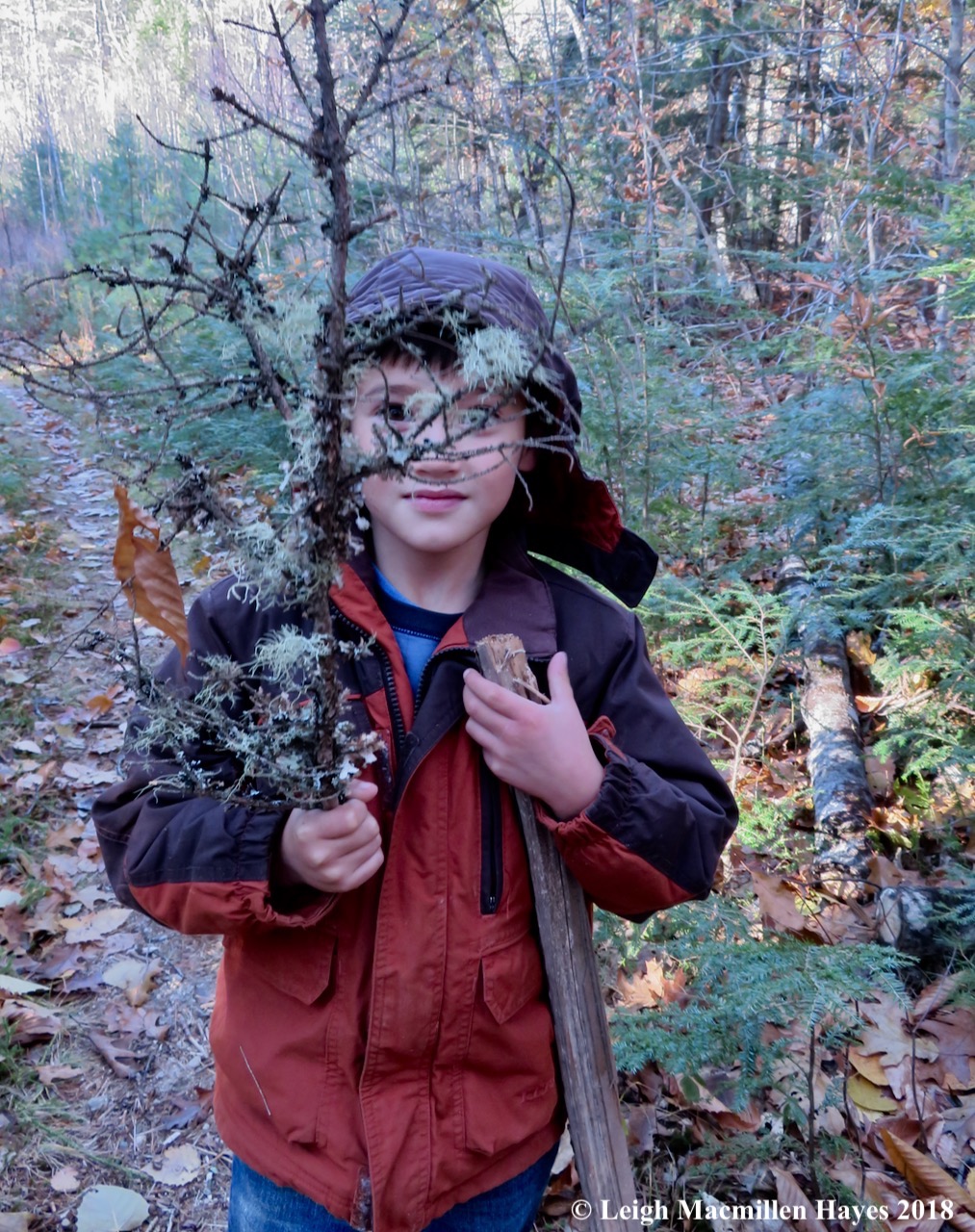
Since Juli is a Maine Master Naturalist Program student, so are her children. And every topic she studies, they study, so it was no surprise to me that six-year-old Wes picked up stick after stick loaded with various forms of lichens.

3

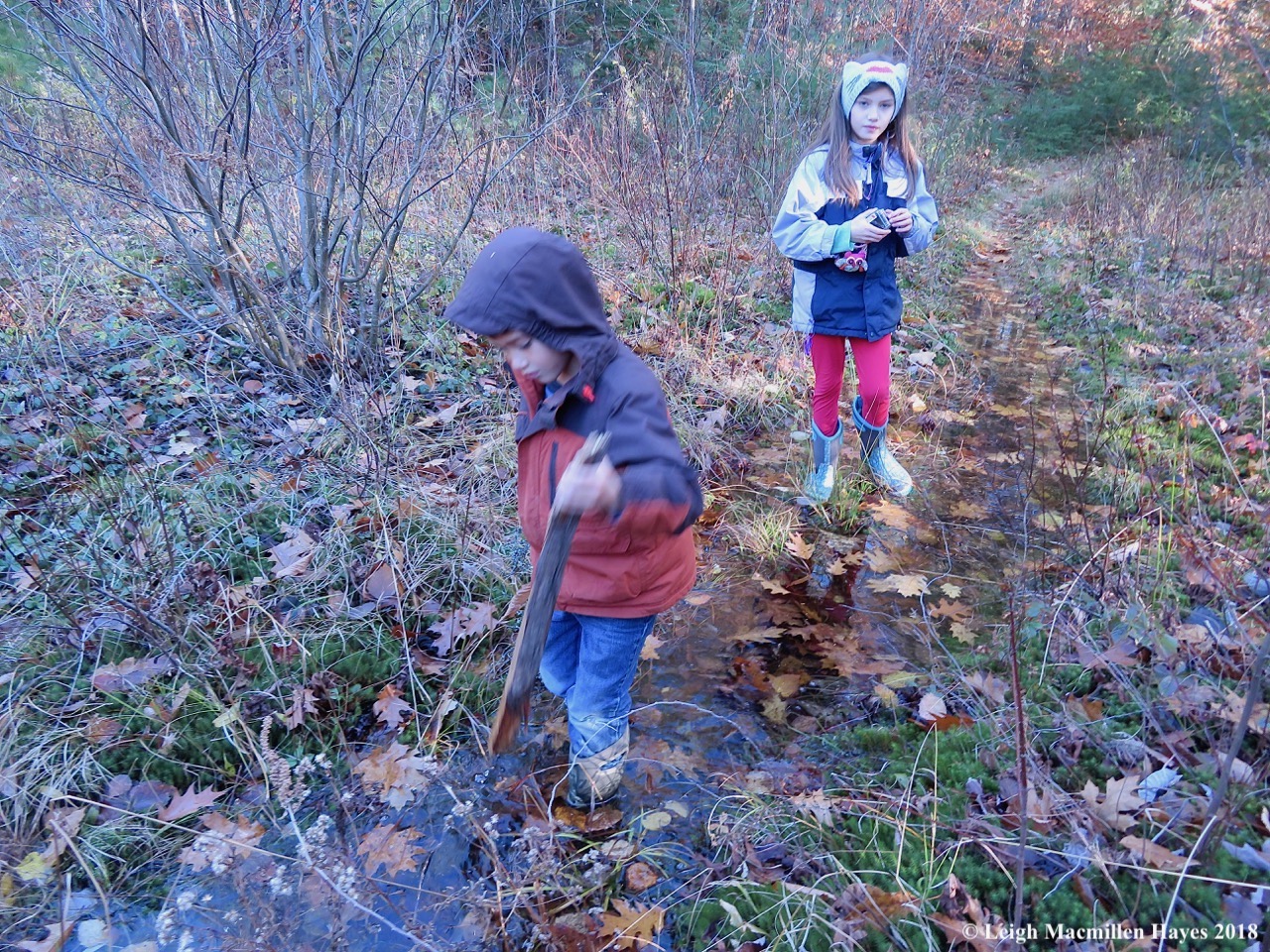
Of course, they are children, ranging in age from six to eleven, and puddles are invitations. The family motto is this: No puddle shall remain unsplashed.

4

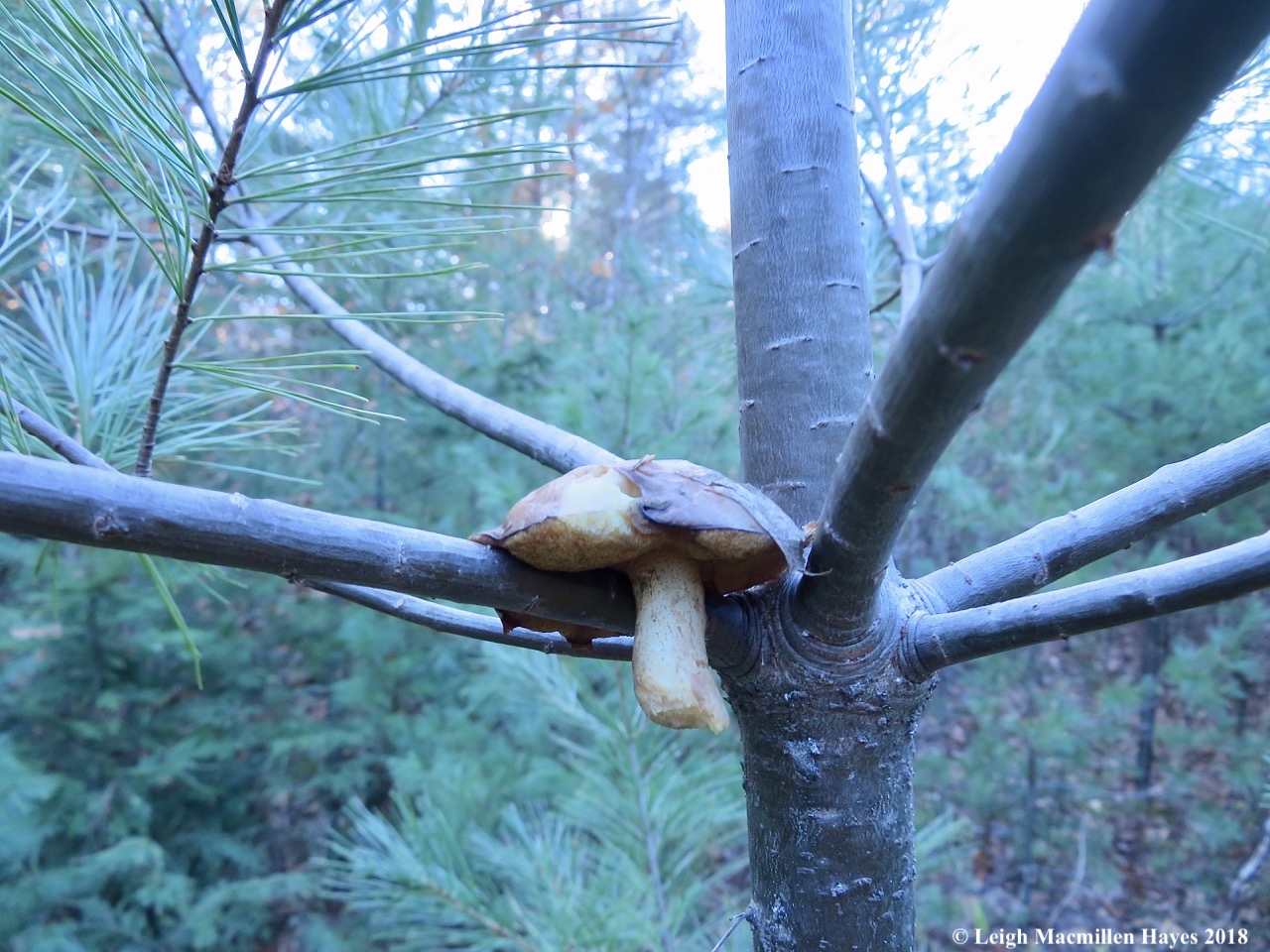
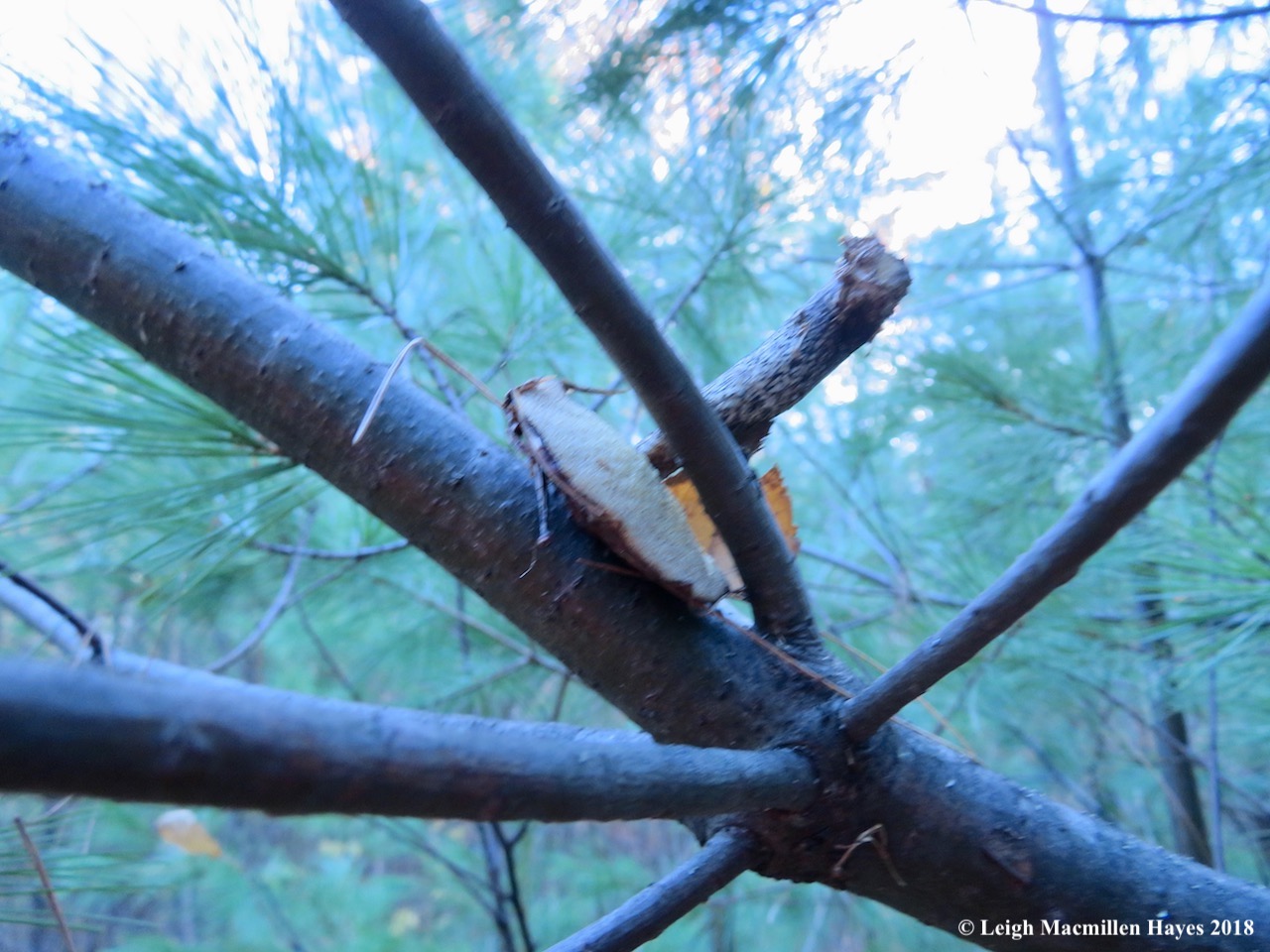
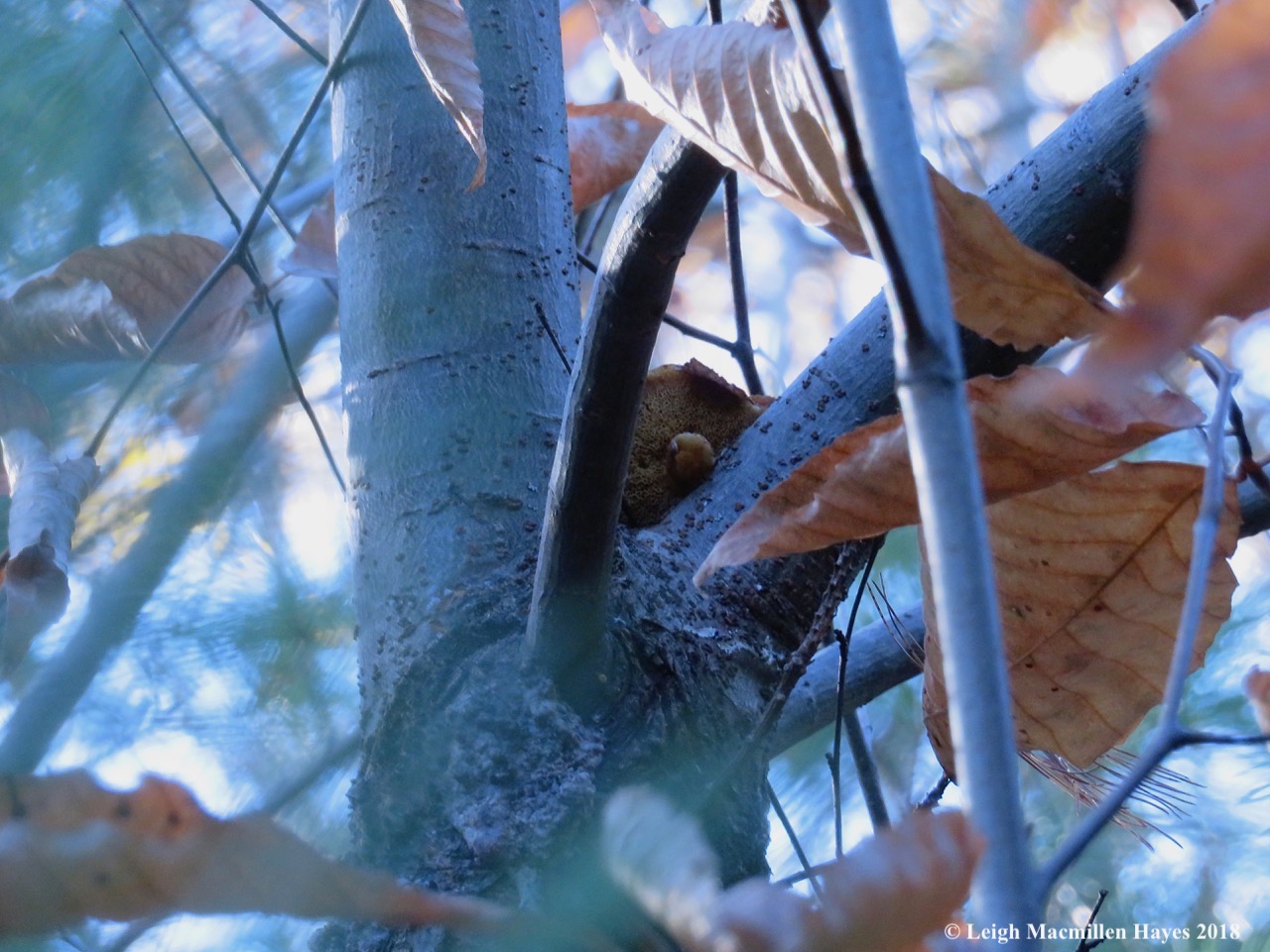
But just after the puddle, at the start of an old log landing, we began to notice something else. A mushroom drying on the whorl of a White Pine.

5

As we stood and looked at the first, someone among us spied a second.

6

And then a third, and so it went. We knew that squirrels dried mushrooms in this manner, but never had we seen so many. It dawned on us that we were standing in a squirrel’s pantry. One squirrel? Two squirrel? Gray Squirrel? Red Squirrel? One Fish, Two Fish, Red Fish, Blue Fish.

7

For a while we paused by an erratic boulder and looked at the lichens that grew atop it. The kids and their mom also checked the sand under and behind it and I told them that the only critter sign I’d ever noticed was that of a Ruffed Grouse sand bath–and I only recognized it as such because I’d startled the two birds and they startled me as they flew off. In fact, on another hike this morning at the GLLT’s Five Kezar Ponds Reserve, friend Teresa and I had startled a grouse and we talked about how the bird’s explosive behavior makes us feel as if we’ve encountered a moose.

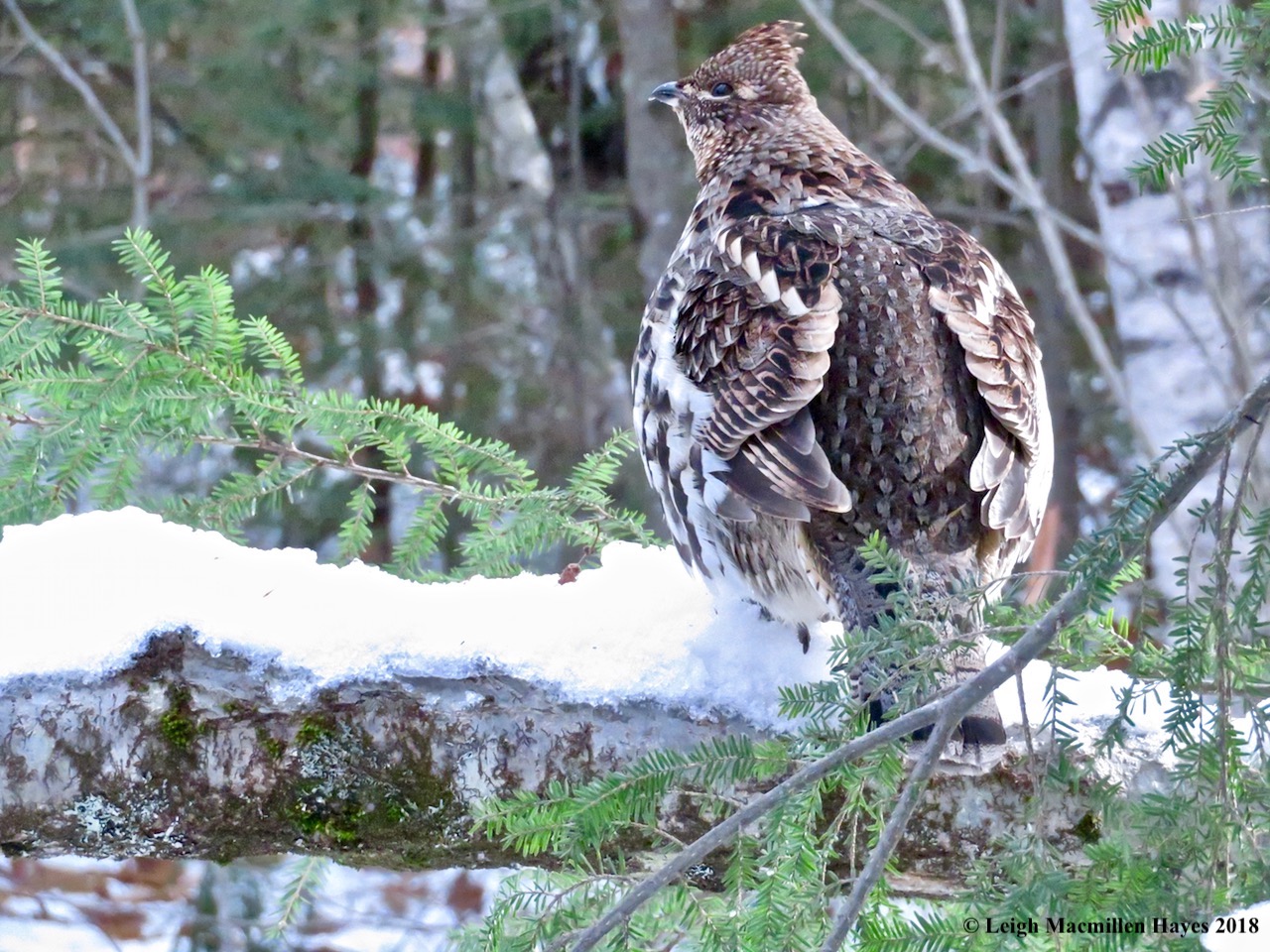
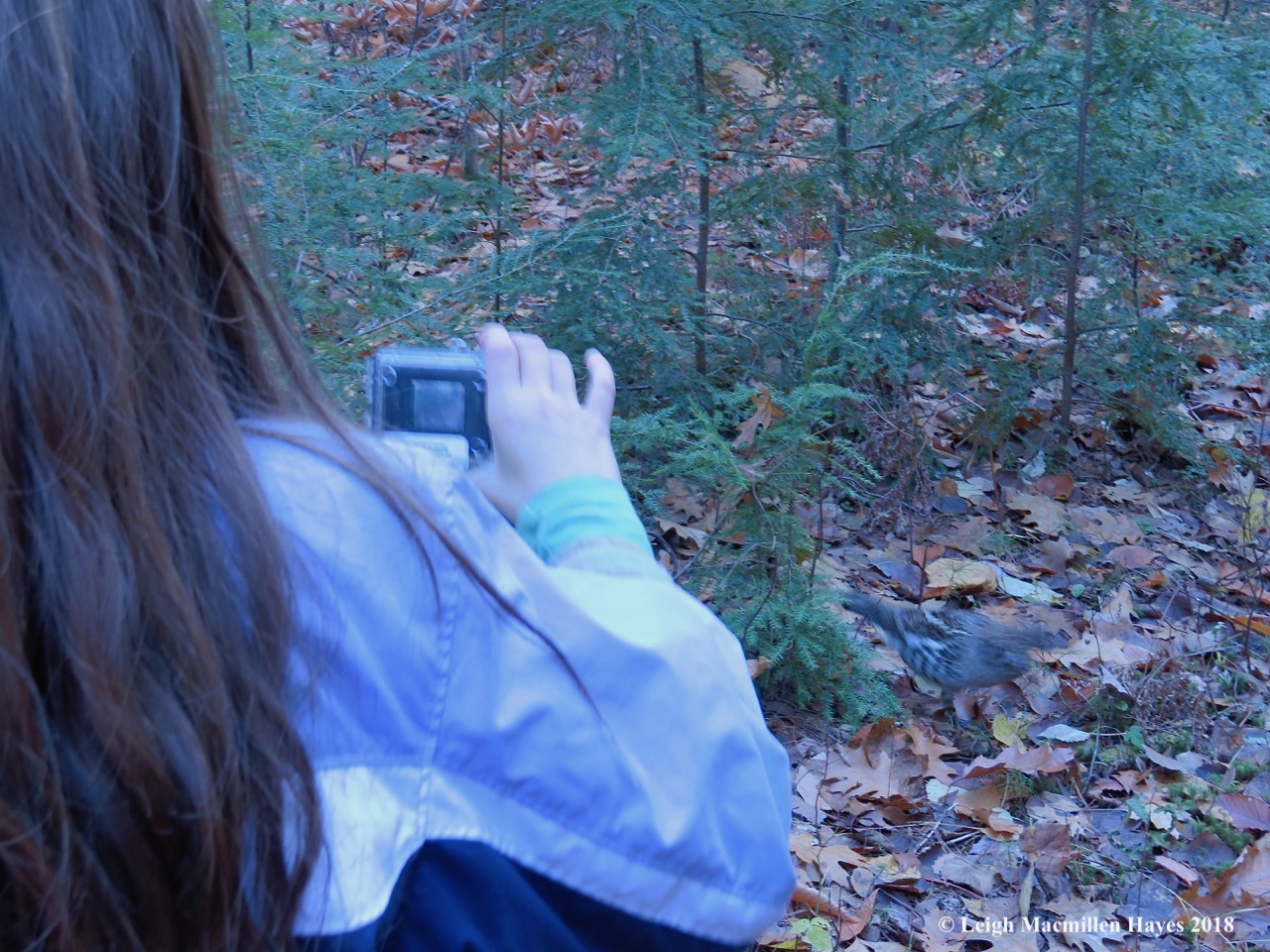
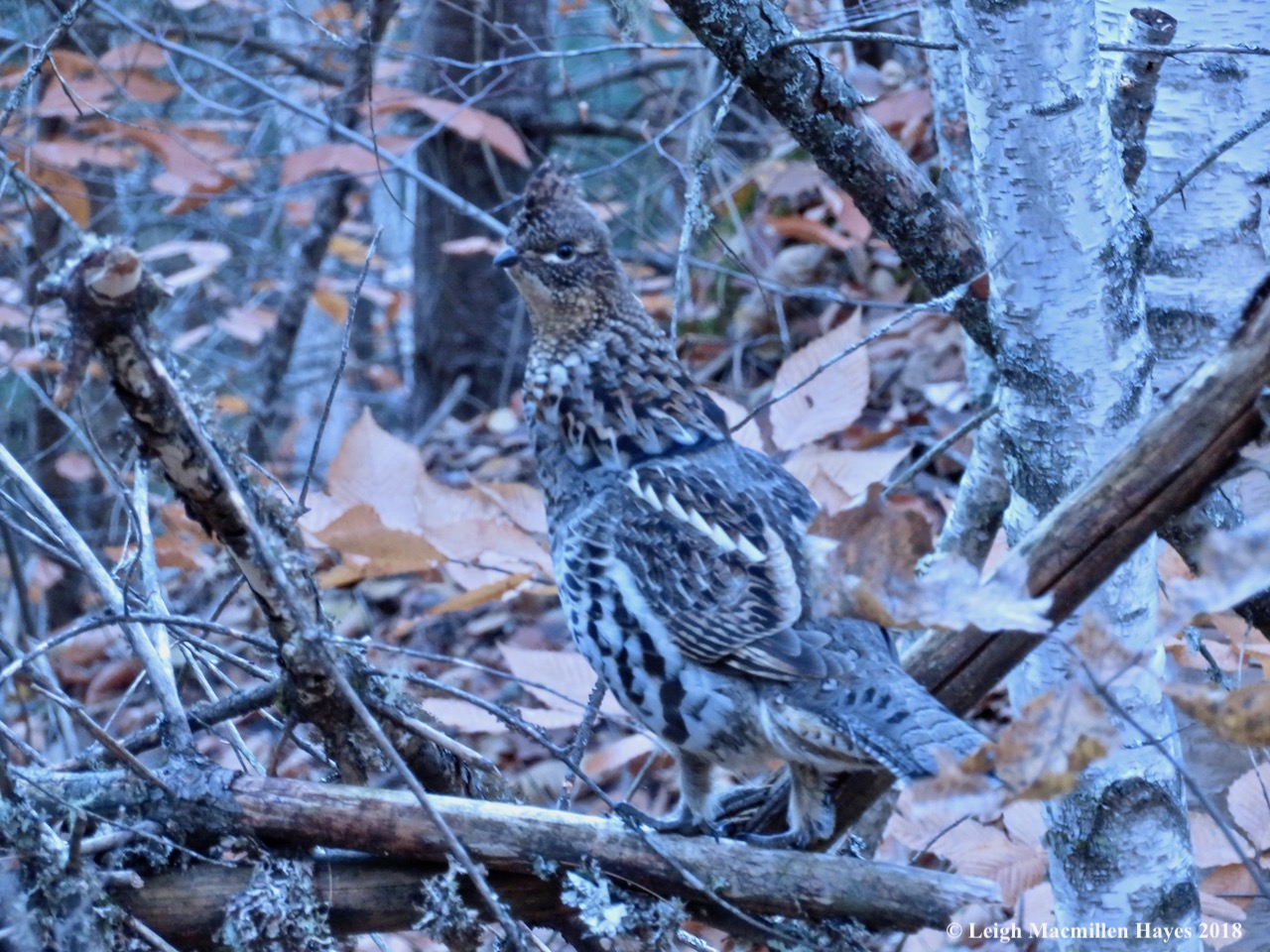
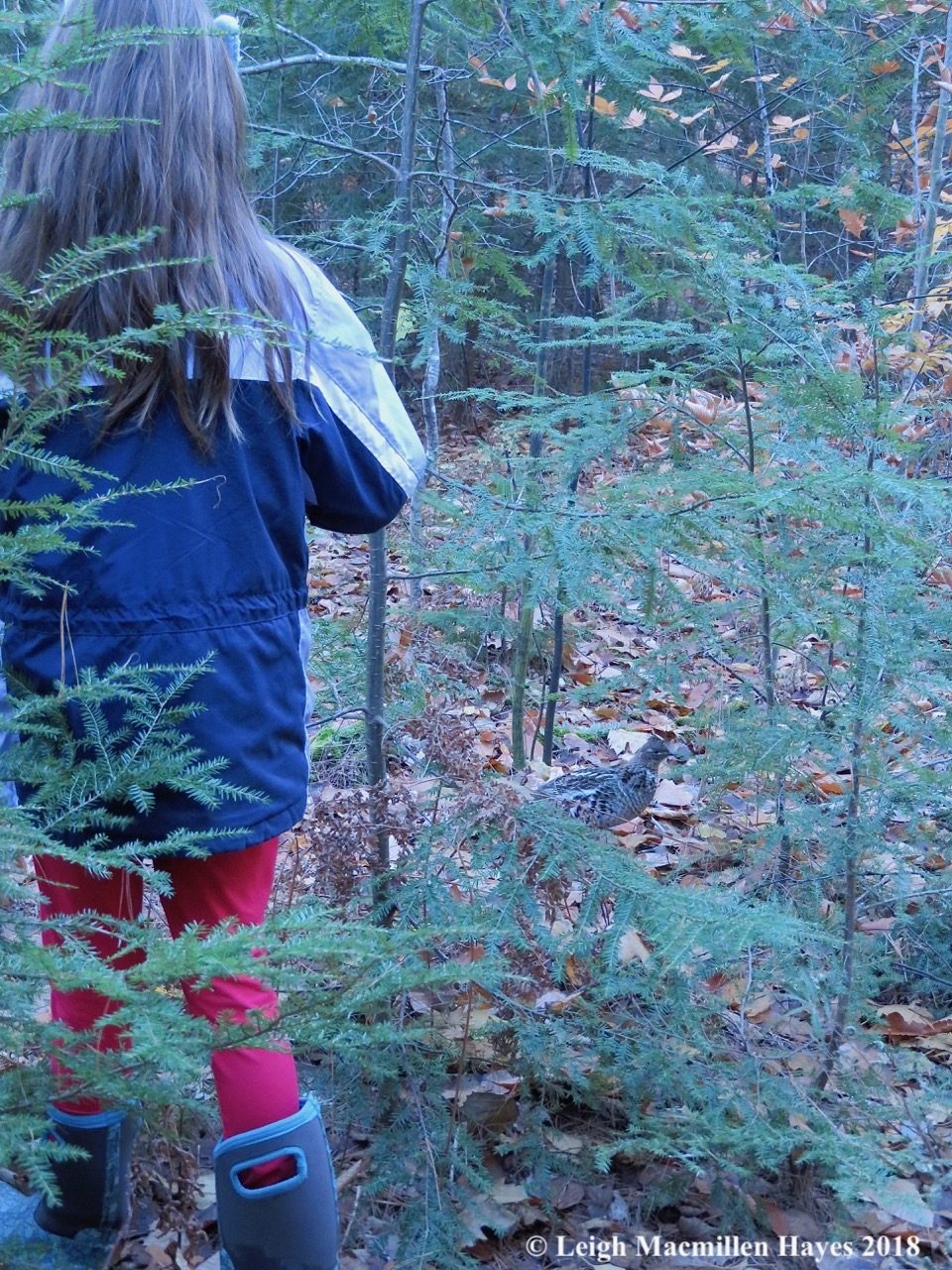
Well, just beyond the boulder, as we all chatted and moved about with quick motion, Caleb spotted something and told us to stop. A Ruffed Grouse!

8

It threw leaves about as it sorted through them in search of seeds and buds and we all watched in silence.

9

As we stood or sat still, the bird moved this way and that, making soft clucking sounds the entire time.

10

Ellie stood in front as the bird moved a few feet ahead of her and crossed the trail. I kept looking back at Juli in wonder. How could this be? Why wasn’t it disturbed by us? I’ve spotted Spruce Grouse in higher elevations and they are much “friendlier” or less wary of people, but I’d never been able to get up close to a Ruffed Grouse.

11

Our fascination continued and we noted its feathered legs, making us think perhaps it had pulled on some long johns for a cold winter night.

12

It eyed us and we eyed it back–our minds filled with awe.

13

Think about this: four children and two adults and we were starting to get fidgety because we’d been still for fifteen or more minutes and we had begun to whisper our questions and still . . . it let us watch.

14

And it let Ellie be the Grouse Whisperer for she began to follow it off the trail. Eventually, it climbed up a fallen tree and she knelt down beside, taking photos as it stood less than a foot from her. How cool is that?

15

We were all wowed by the experience, but when Ellie finally turned back, we continued on . . . sometimes running and other times pausing to ride imaginary horses.

16

Or listen to Birch Polypores! Yes, Juli did listen for it’s part of an assignment for the Maine Master Naturalist class. So what exactly does a Birch Polypore sound like? “I couldn’t hear the ocean,” she said with a smile.

17

And what does it smell like? “Wood.”

18

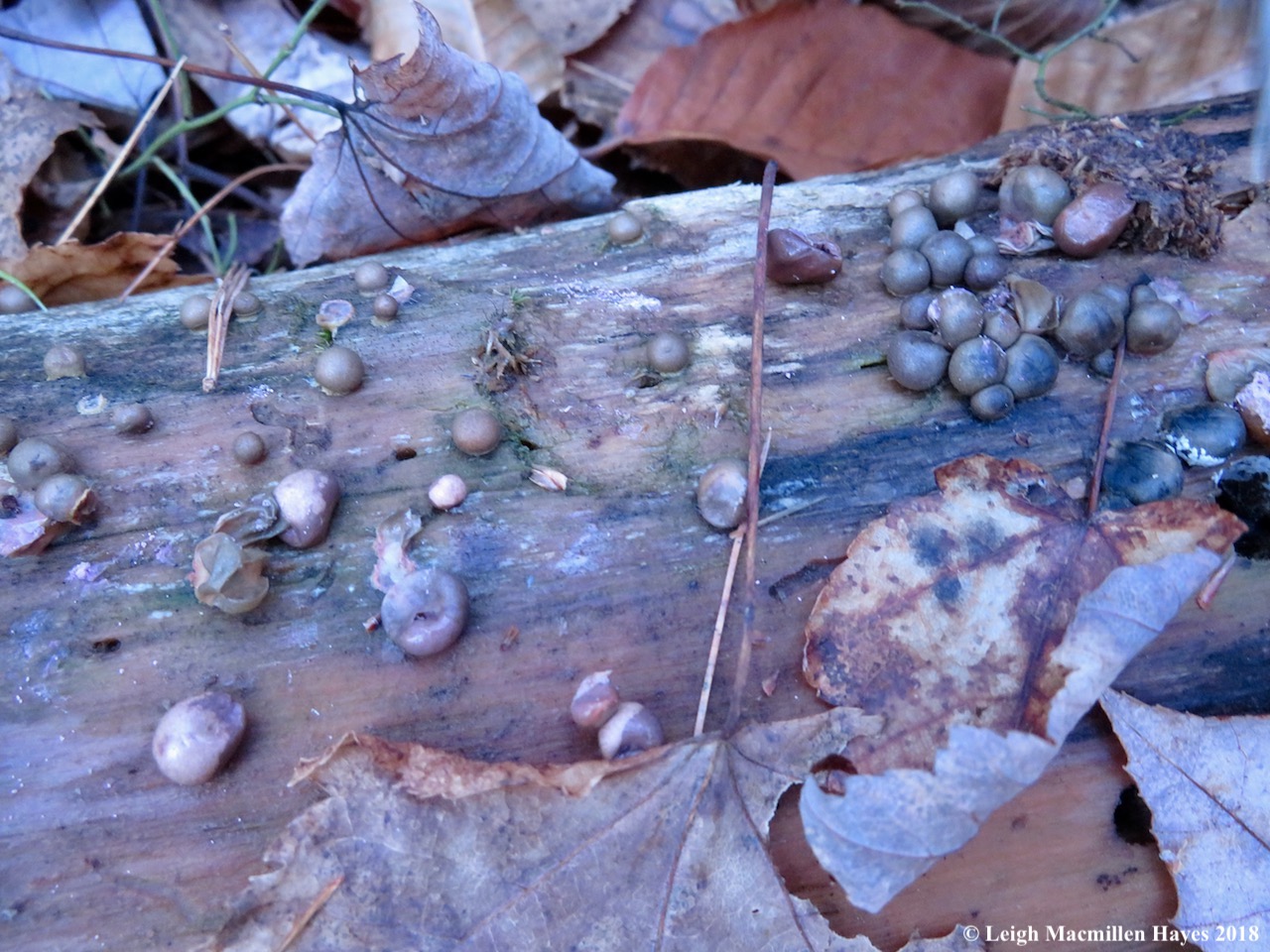
The next moment of glee–poking Wolf’s Milk Slime Mold and watching it ooze.

19

“It’s cool and gross at the same time,” said Ellie.

20

Onward and again, more fungi drying in trees as Aidan pointed out.

22

We even found a few stuck on spiky spruces much like ornaments might be and we reminded ourselves that we were on a mission and still hadn’t found the right tree to decorate.

23

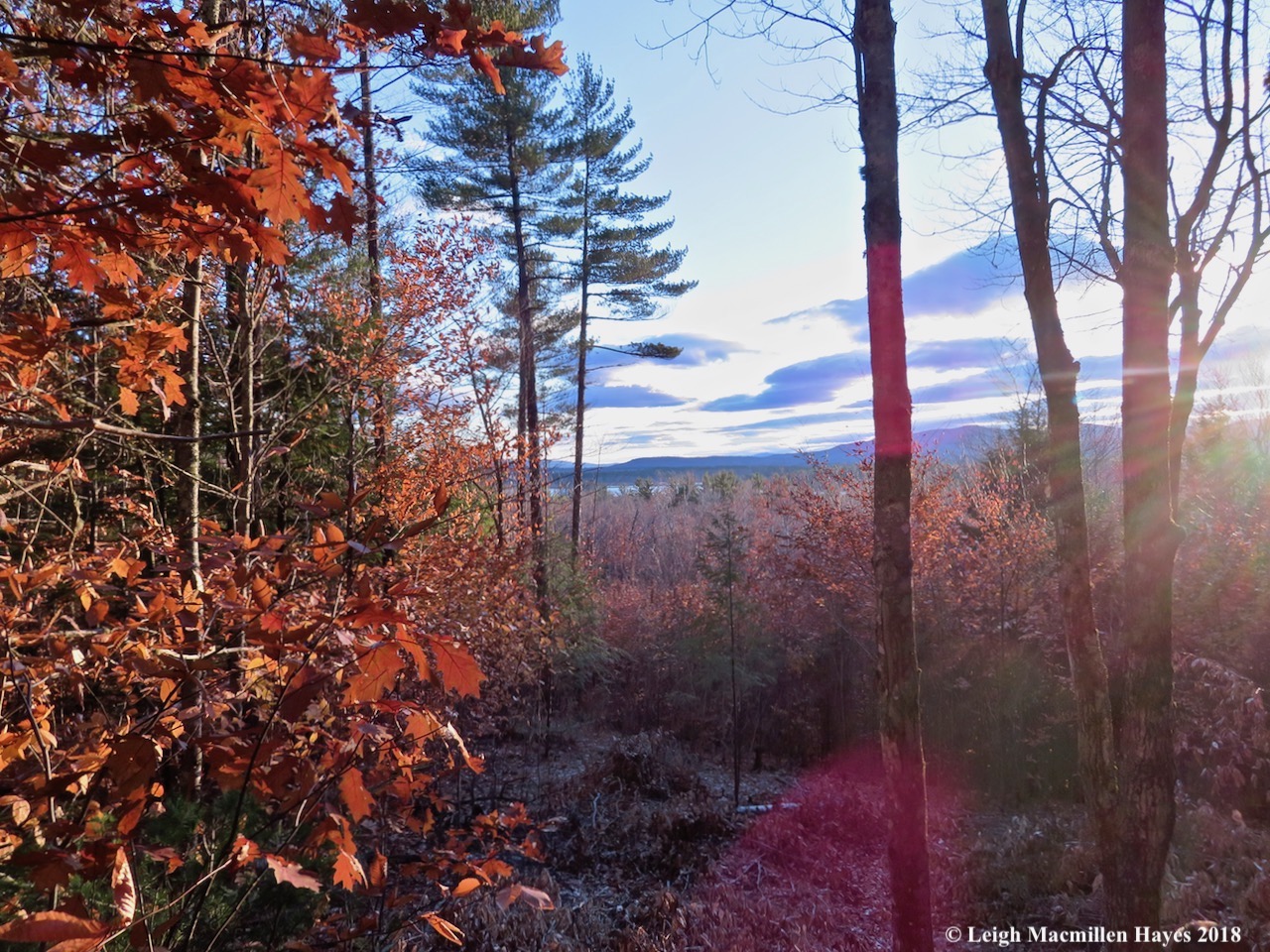
At last, however, we did. And then we made our way out to the spur and recently opened view of Kezar Lake’s Lower Bay and Cranberry Fen, plus the mountains.

24

This became our turn-around point as it was getting cooler by the minute and the sun was setting. We promised Wes we’d look only at our feet as we followed the loop trail down, though occasionally we stopped again to admire more fungi tucked onto tree branches and a set of trees that formed a rainbow arched over the trail.

As for the fungi, we wondered if we were seeing so many because last year’s mast crop of pinecones, beech nuts, and acorns didn’t exist this year. And when the 4-H club returns in a couple of weeks to decorate the tree, will the mushrooms still be there? Will there be more? How long do the squirrels wait before consuming them? So many questions and so many lessons still to be learned.

25

And so many things to spy. We were honored with the opportunity to do just that and my heart smiled with the knowledge that the kids appreciated it as much as their mom and I did.

I spy . . . we spied . . . INDEED!

Oh, and  please join the GLLT for Christmas at Ladies Delight. I have the inside word that there will be hot cocoa and cookies somewhere along the trail.

December 1, 9:30 – noon
Christmas at Ladies Delight: The Maine Christmas Tree Hunt is a fun holiday scavenger
hunt to find decorated trees in western Maine. We’ll search for the decorated tree along the Bill Sayles Loop at the Chip Stockford Reserve and may add a few of our own biodegradable ornaments along the way. Location: Chip Stockford Reserve, Ladies Delight Road, Lovell.
Degree of Difficulty: Easy.

Honoring the Earth

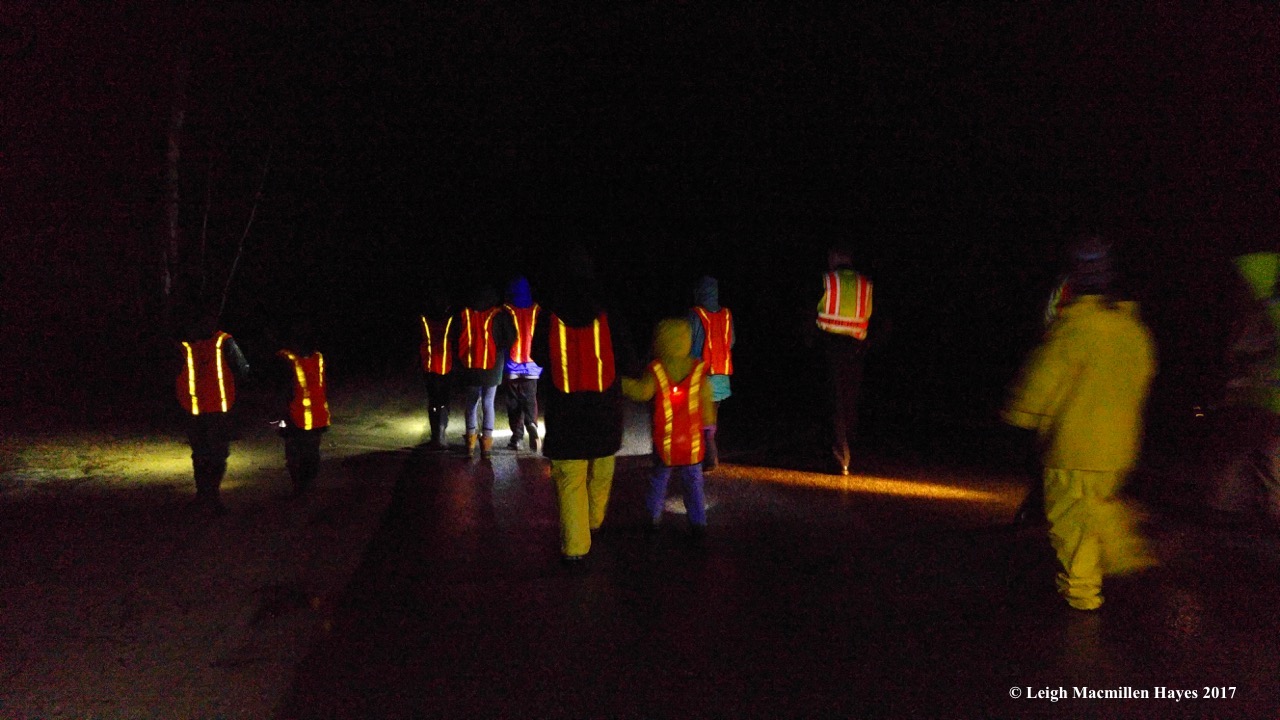
It would have been so easy to stay home last night, curled up on the couch beside my guy while watching the Bruins play hockey. After all, it was raining, 38˚, and downright raw. But . . . the email alert went out earlier in the day and the evening block party was scheduled to begin at 7:30. And so, I piled on the layers from a wick-away shirt to Under Armour, a turtleneck, sweater, LL Bean vest and rain jacket. I slipped into my Bogg boots and made sure I had the right gear–smartphone for photos, reflective vest, headlamp and flashlight. With a visored hat on my head to shield my glasses from the rain, I was finally ready. Out the door and down the road I went, headed to the Lakes Environmental Association‘s office for Big Night.

h-Big Night Patrol 3 (1)

I wasn’t the only one crazy enough to attend the party. Our number was about twenty. I think the best part was that we ranged in age from 6 to almost 60, the latter being me–the oldest kid on the block. And in that mix, one teen who was celebrating his 15th birthday (Happy Birthday, Kyle), and several teens who had never attended before but came because one of their crowd was an annual participant. We even had two policemen in the mix–and though their job was to slow traffic and keep us safe, they had as much fun as we did completing our mission.

h-spotted sallie 2 (1)

Said mission–to help spotted salamanders . . .

h-spring peeper 1 (1)

and spring peepers cross the road.

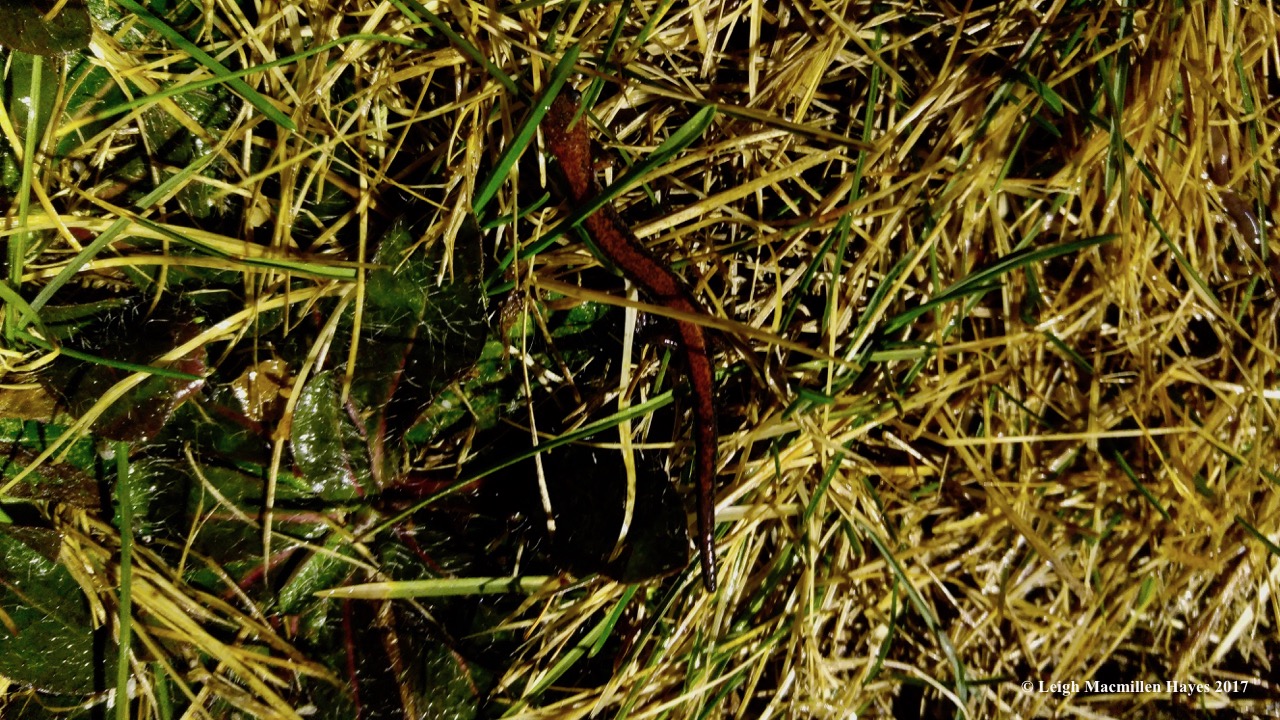
h-redback salamander (1)

We did so for a while and then headed back to our vehicles. Just before reaching the spot where we’d all parked, someone spotted this redback salamander–I smiled because its the symbol of the Maine Master Naturalist Program.

We were wet. We were cold. And we were happy. As nature would have it, Big Night preceded Earth Day–a perfect beginning.

h-candy lichen

Earth Day began appropriately with a board meeting at Lakes Environmental, where among other topics, Dr. Ben Peierls, the new research director of LEA’s Maine Lake Science Center, shared with us his plans for the water quality testing laboratory. Ben addressed us first so that he could drive to Portland and join the March for Science. We continued our meeting, but were thankful for his representation. Meanwhile, directly outside and all around town, another gathering was taking place as many people participated in an Earth Day cleanup.

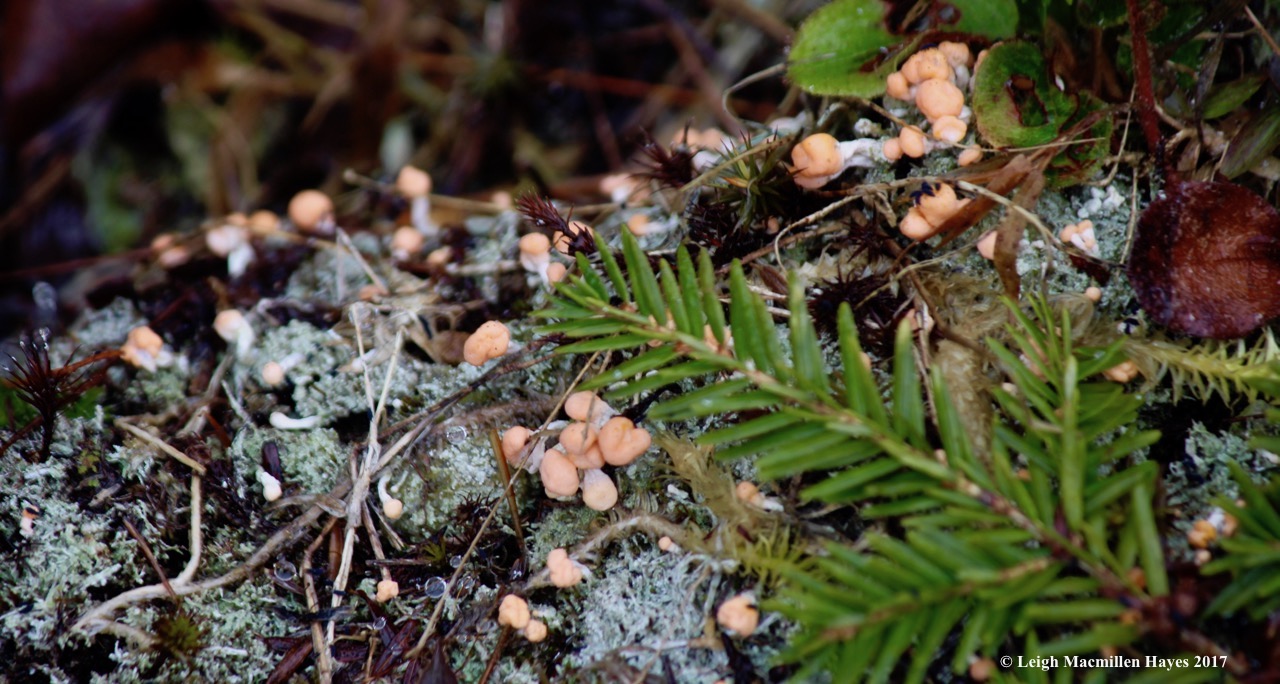
By the time I left the meeting pleased with all that had been accomplished, I was ready for a solo adventure to find out what the Earth wanted to share with me since most of the snow melted this past week. Despite being another raw day, or maybe because of it, the candy lichen brought a smile to my face. I think one of the cool things about this lichen is that even though its salmon-colored fruits stand atop stalks, this is really a crustose (crust-like) lichen, the bluish-green surface being the actual structure.

h-juniper berries

Near the candy lichen, the bright blue of some berries stood out on the common juniper. They remain on the shrubs all winter and it seemed only a wee bit ago they looked all withered. Today’s offerings were plump and pretty.

h-pine droplets

And then there were the raindrops, each waiting its turn to continue the journey toward the earth. I had to wonder what else it might fall upon before reaching its final destination–each little ball encapsulating nourishment.

h-lambkill

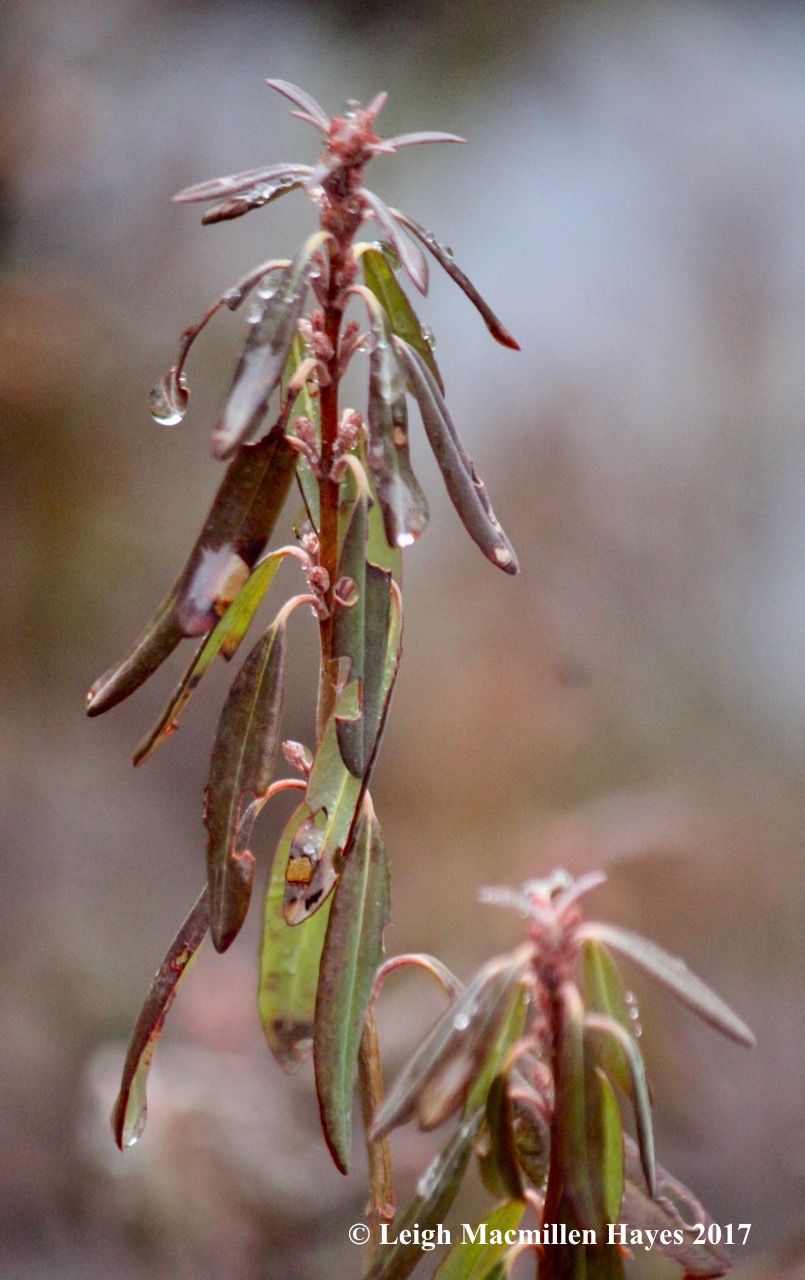
One of the receivers, sheep laurel, which displayed its own new life.

h-trailing arbutus

And at the base, trailing arbutus. One year ago, as I noted in my Earth Day post, it was already in bloom. This seemed a reminder from Mother Earth that we need to practice patience.

h-wild turkey

I continued my mosey, as quiet as could be, and so was startled when one large, exotic bird, and then another, and a third flew off from behind a stone wall. And then I realized they were wild turkeys–who truly are exotic if you take a look at all the colors in their feathers.

h-tinder conks on beech

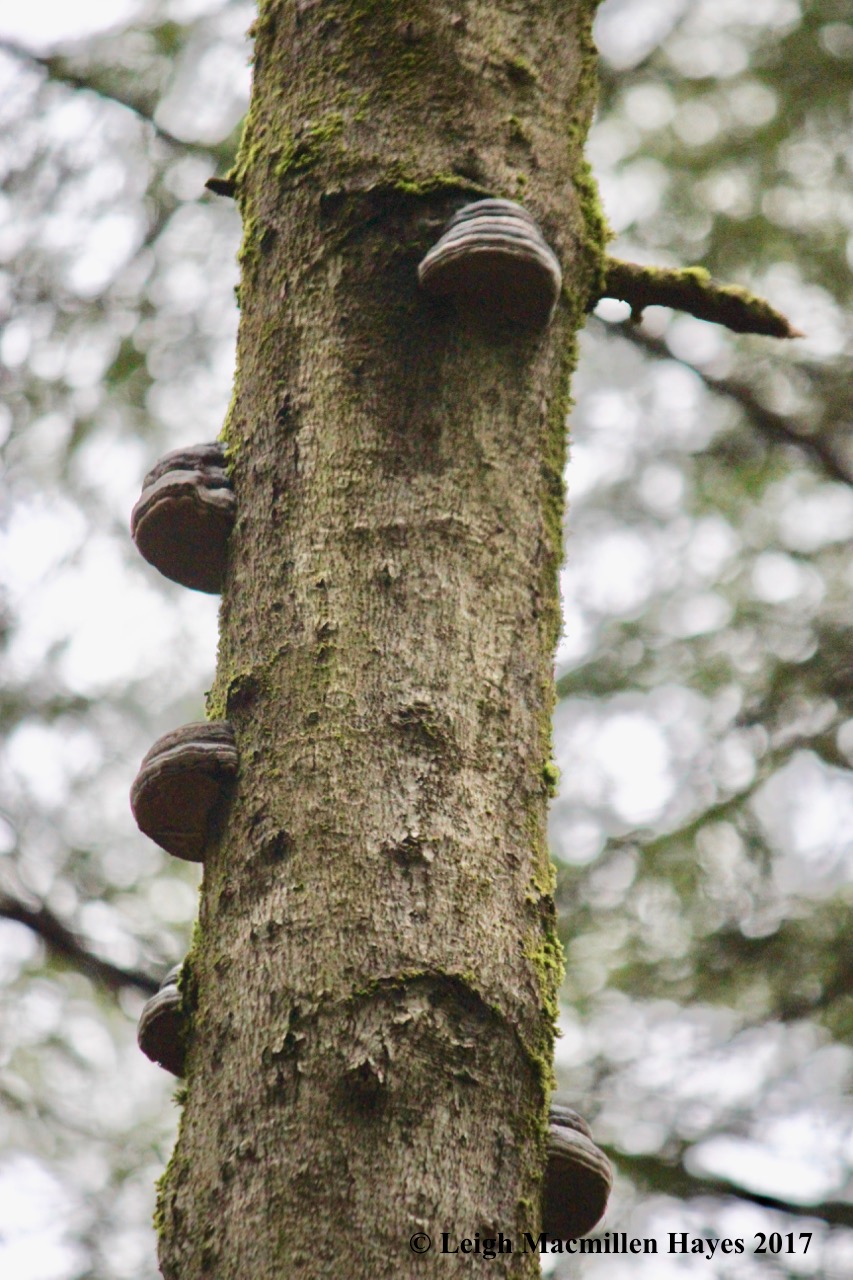
I’d been on the snowmobile trail, but traveling was difficult given some remaining icy snow and deep ruts filled with water. As if I needed an excuse, I decided to slip into the woods. One of my first delights–tinderconks lining a tree as I looked up.

h-moss covering

But really, it was the thick moss coating at the top of the tree that first drew my attention. Several trees in the neighborhood displayed the same fashion.

h1-woods south (1)

My wander was aimless, taking me through boggy areas . . .

h-snow1

and small sections where snow still blanketed the ground.

h-deer prints in snow

Besides plenty of deer scat, I found prints . . .

h-deer hair

and hair.

h-deer hair bubbles

Raindrops enhanced the hair.

h1-moose scat 1 (1)

And though I suspect they’ve moved toward open water, there was plenty of evidence that the moose had also spent the winter in these woods.

h-moose hair

They, too, have shed hair–preparing for the summer scene.

h-moose maple

A couple of months ago, I’d been concerned that the moose had consumed all the tree buds, but the red maples showed me otherwise.

h1-woods south 2 (1)

At one point, I stood for a while atop a rock and looked to the south.

h1-woods north (1)

And then to the north. It was as I stood there that I heard a repeated sound. It began with a few slow beats, and then a swift series of beats. All seemed muffled. It finally occurred to me that I was listening to a ruffed grouse. Eventually, I followed the drumming and came close to the one beating its wings against a log–the work of a displaying male. I didn’t bother to seek out the actual bird for I knew I’d startle it and it would fly off, so I let it drum in peace, thankful for the opportunity to at least hear it. Really, it was a first for me. Oh, I’ve possibly heard it before, but only today did I recognize it for what it was.

h1-widowmaker (1)

For a while, I was fake lost . . . and then I heard another repeated sound that lead me to a widowmaker and I knew exactly where I was. But where was the maker of the sound?

h-owl 1

In a tree above me.

There were actually two barred owls and I was so thankful for the honor of listening to and watching them on this Earth Day.

I was also thankful for all the privileges bestowed upon me. The privilege of living. The privilege of noticing. The privilege of questioning. The privilege of understanding. The privilege of wandering. And especially, the privilege of wondering. Thank you for your offerings, Mother Earth. I am honored to know you.