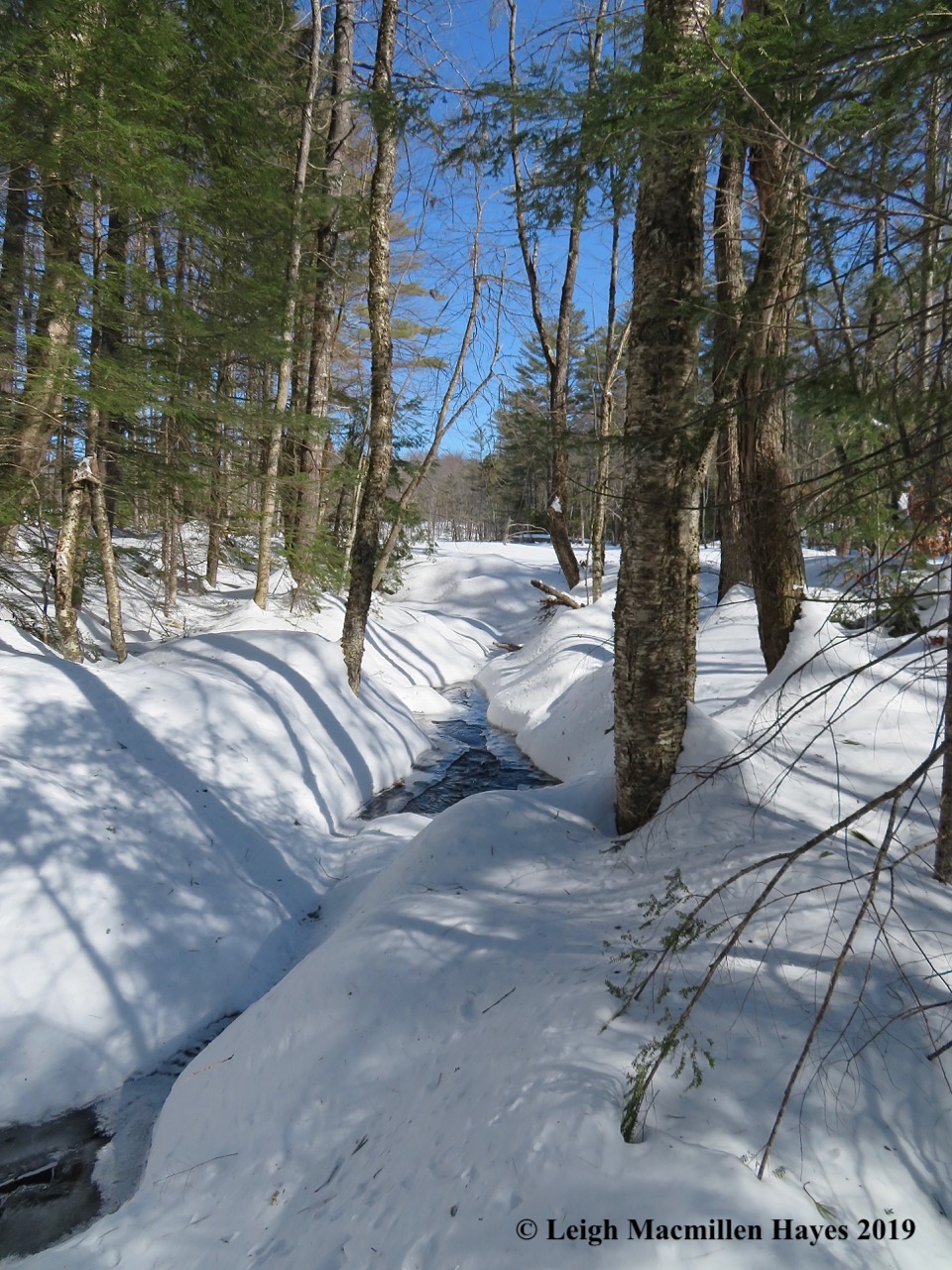
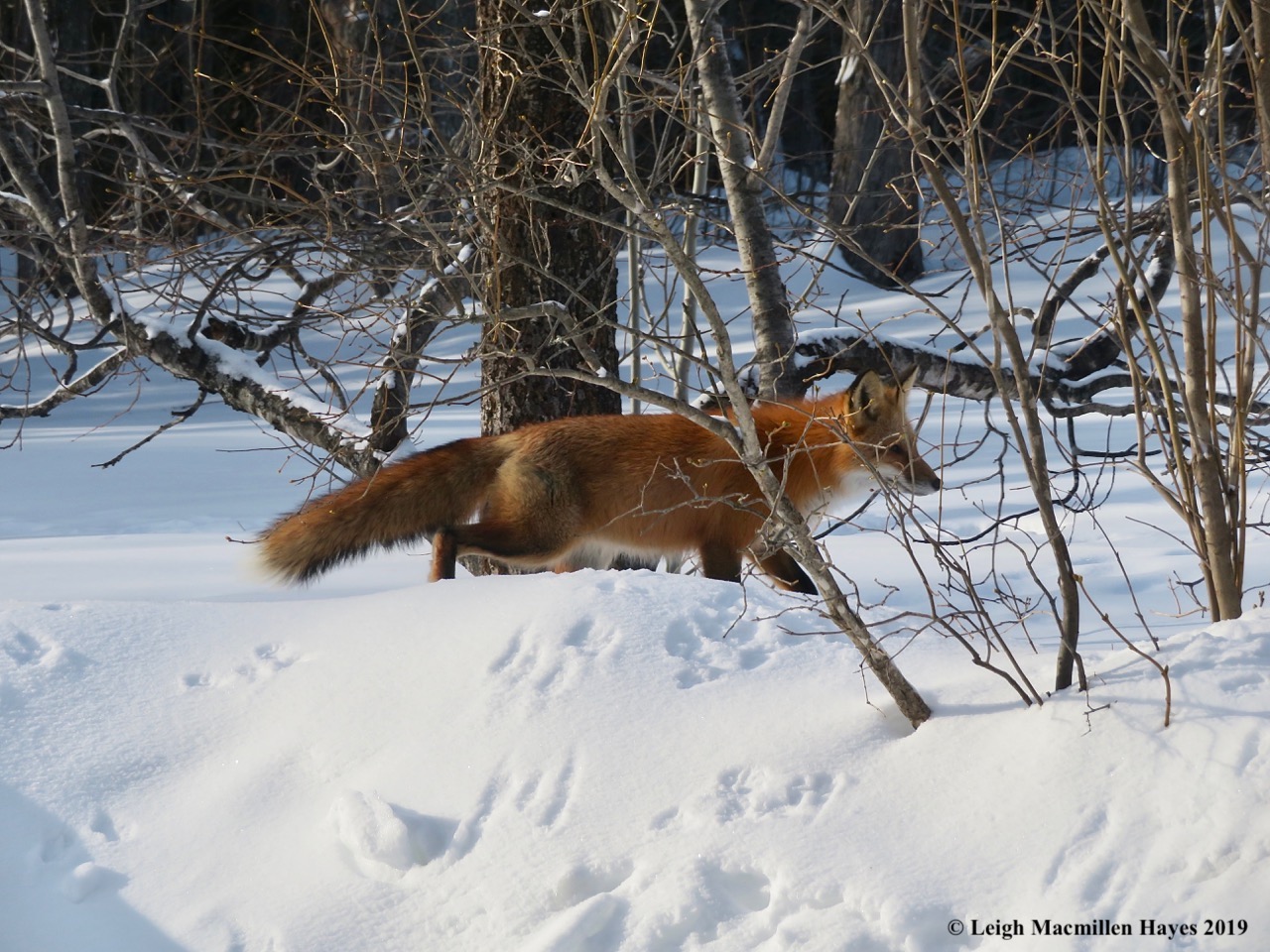
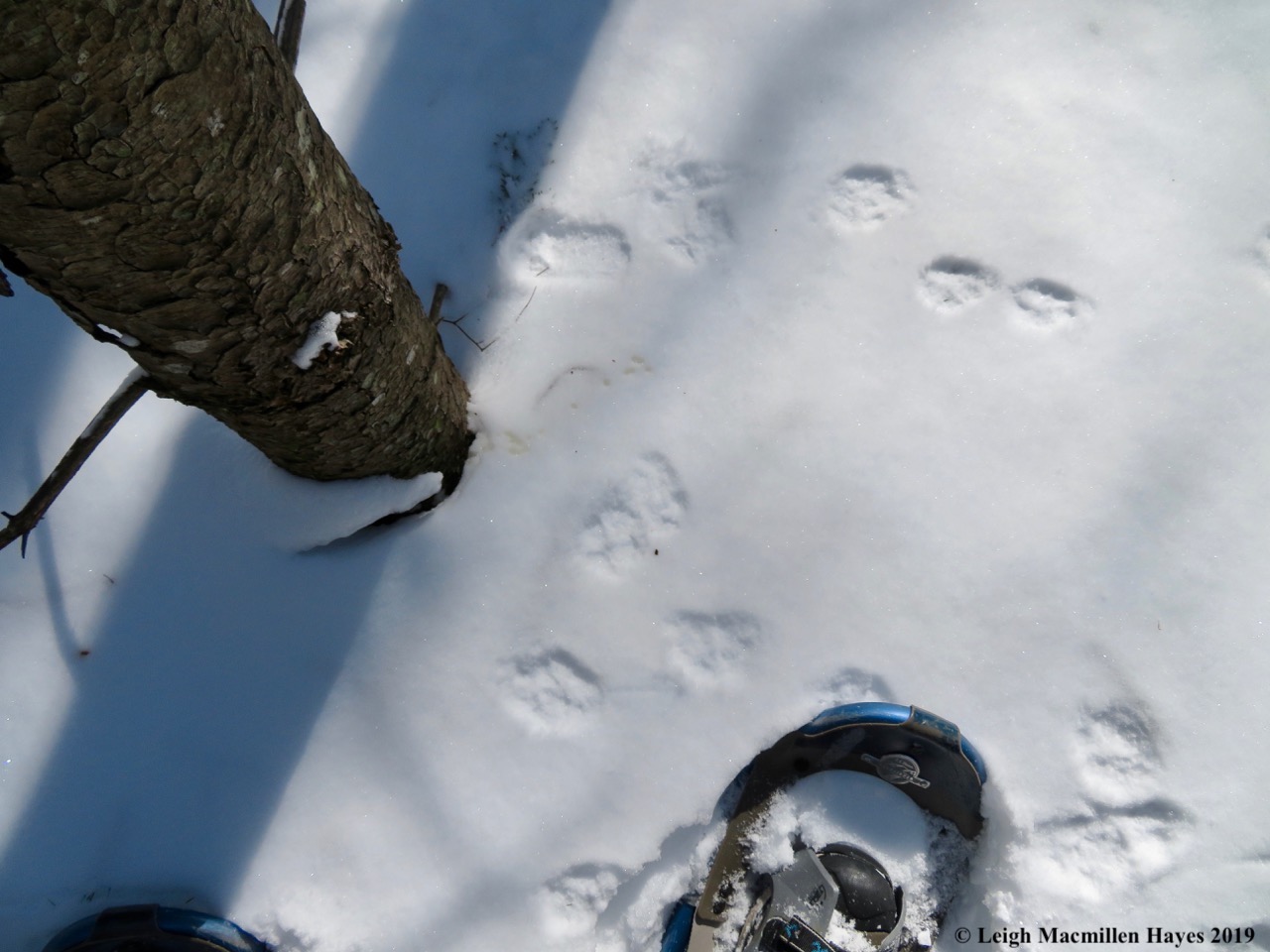
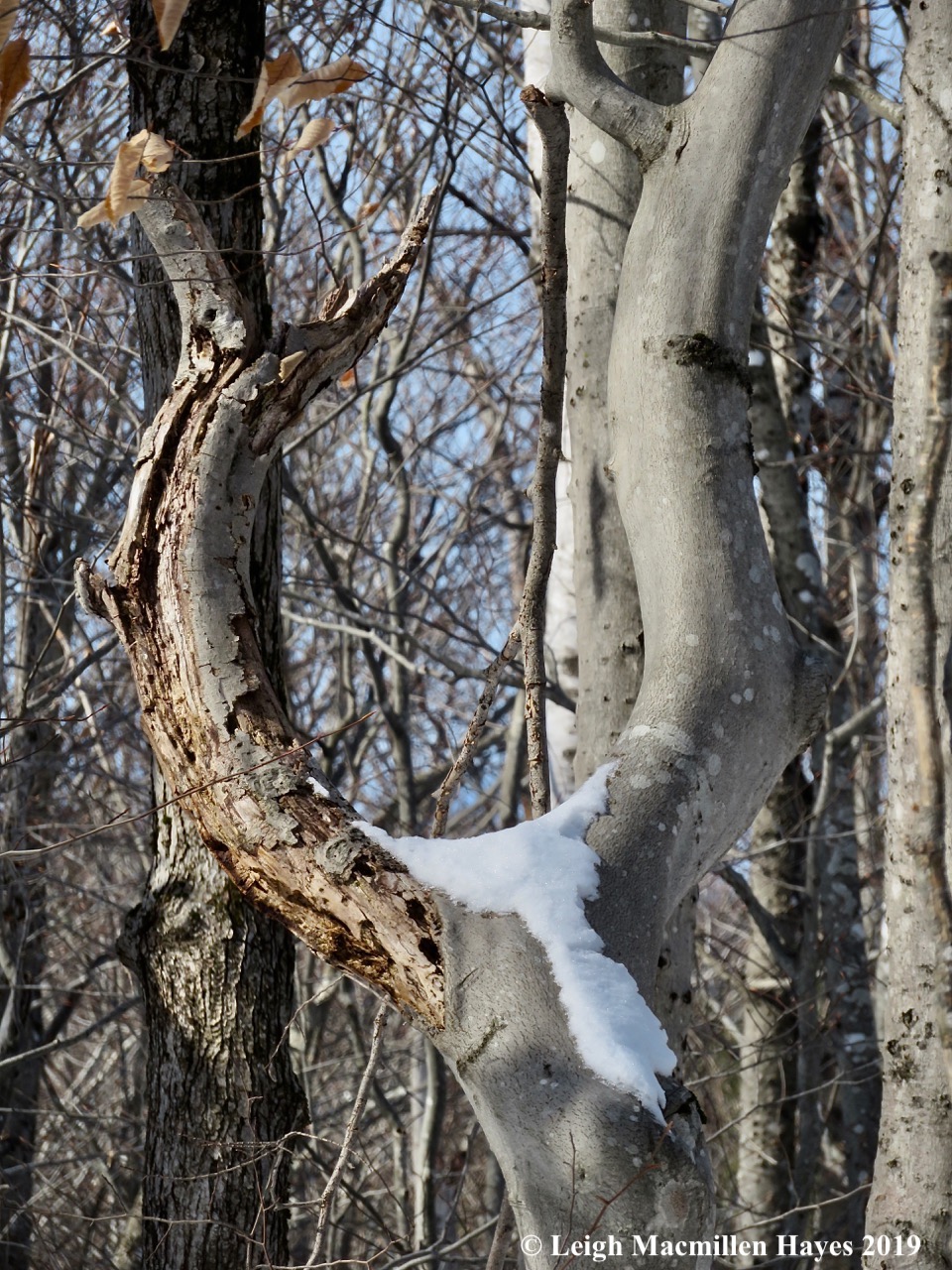
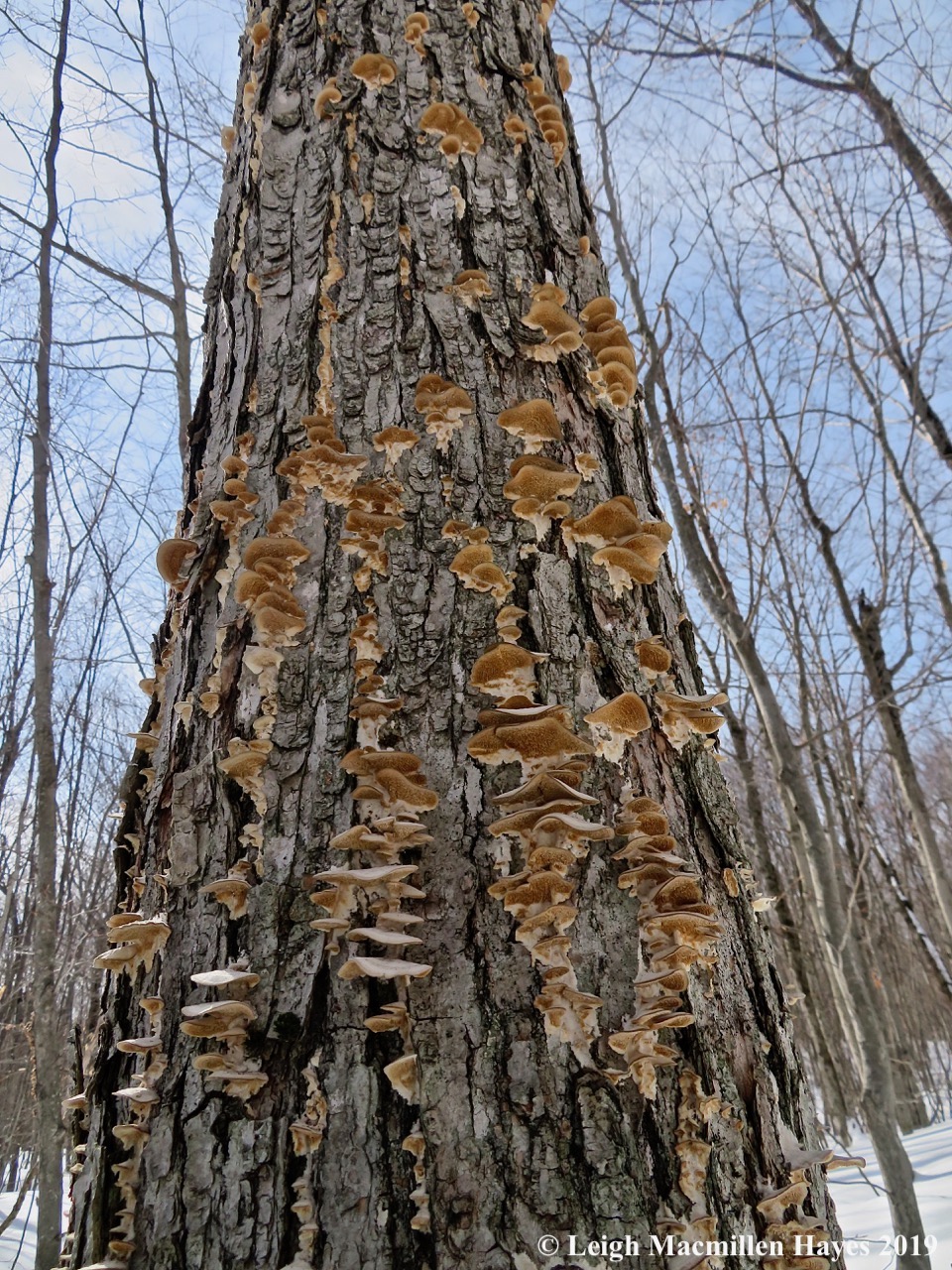
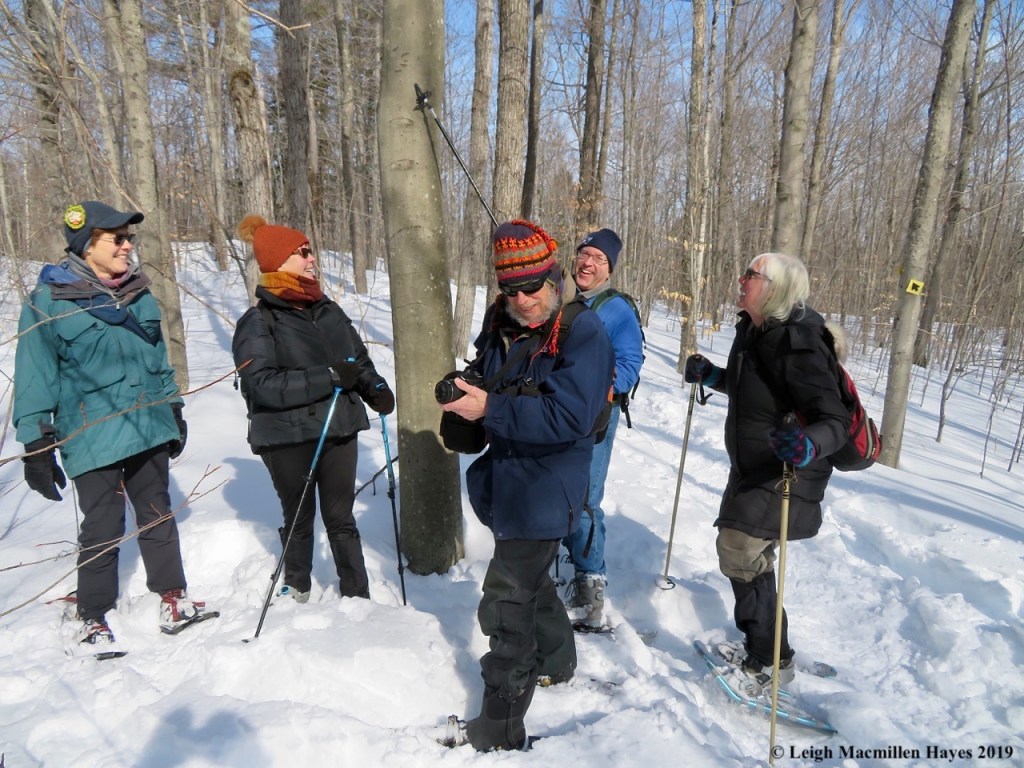
It was a dark and dreary day . . .

I’m working on a challenging article and can’t quite figure out how to introduce the topic. After a bunch of attempts, I suddenly had an inspired idea . . . drop the pen, walk away from the legal pad and head out the door.

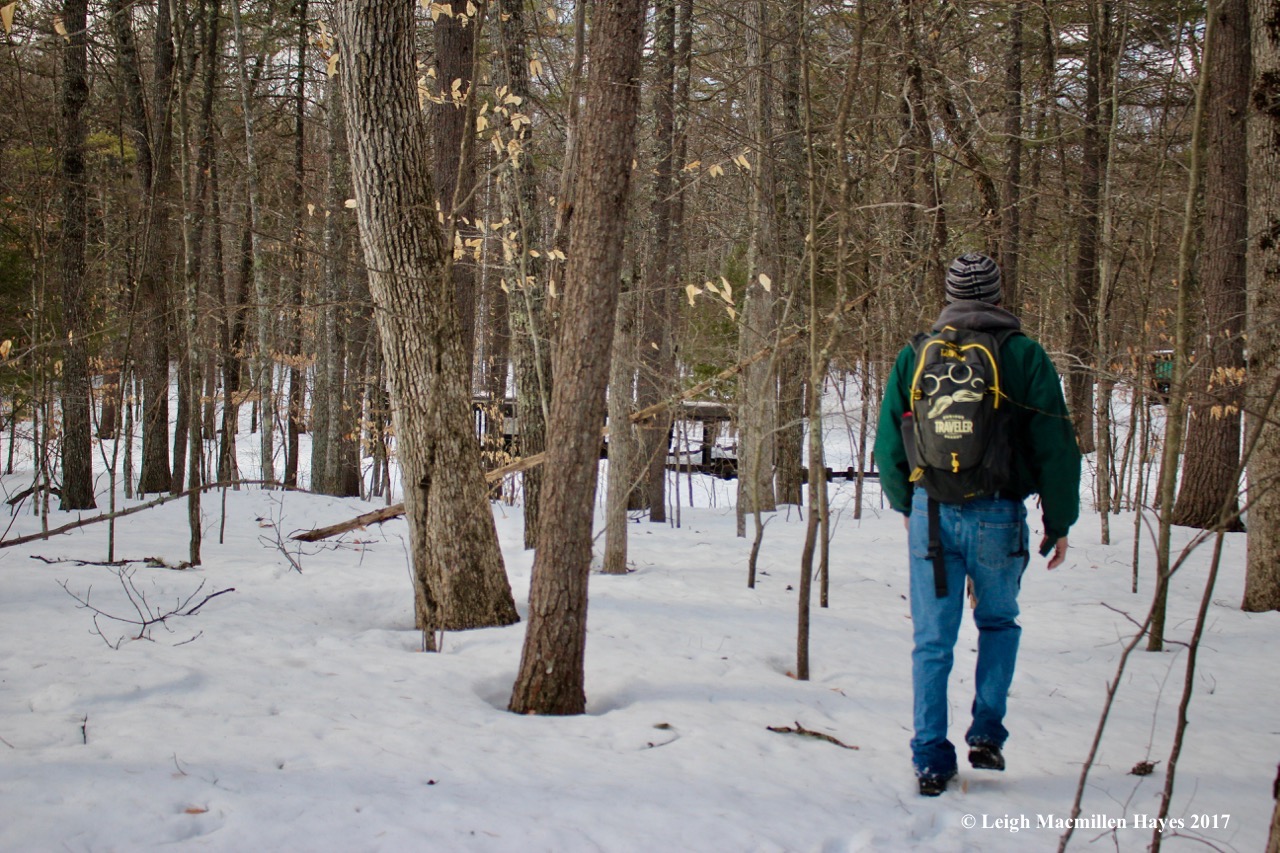
And so I did despite the freezing rain that was falling atop this morning’s snow. Heading down a trail I haven’t had a chance to step upon in months, I realized that I was among old friends who had passed by prior to the storm.

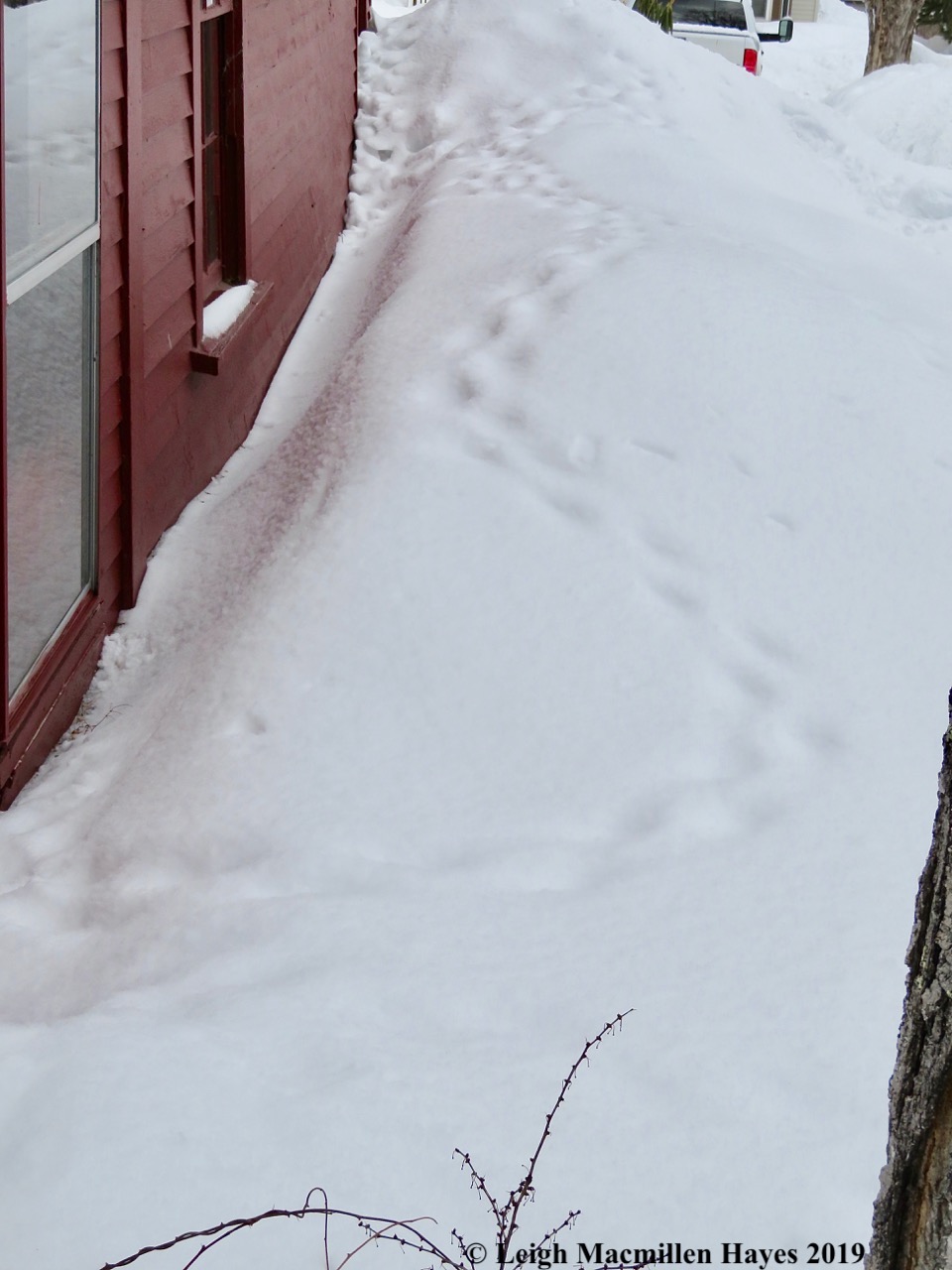
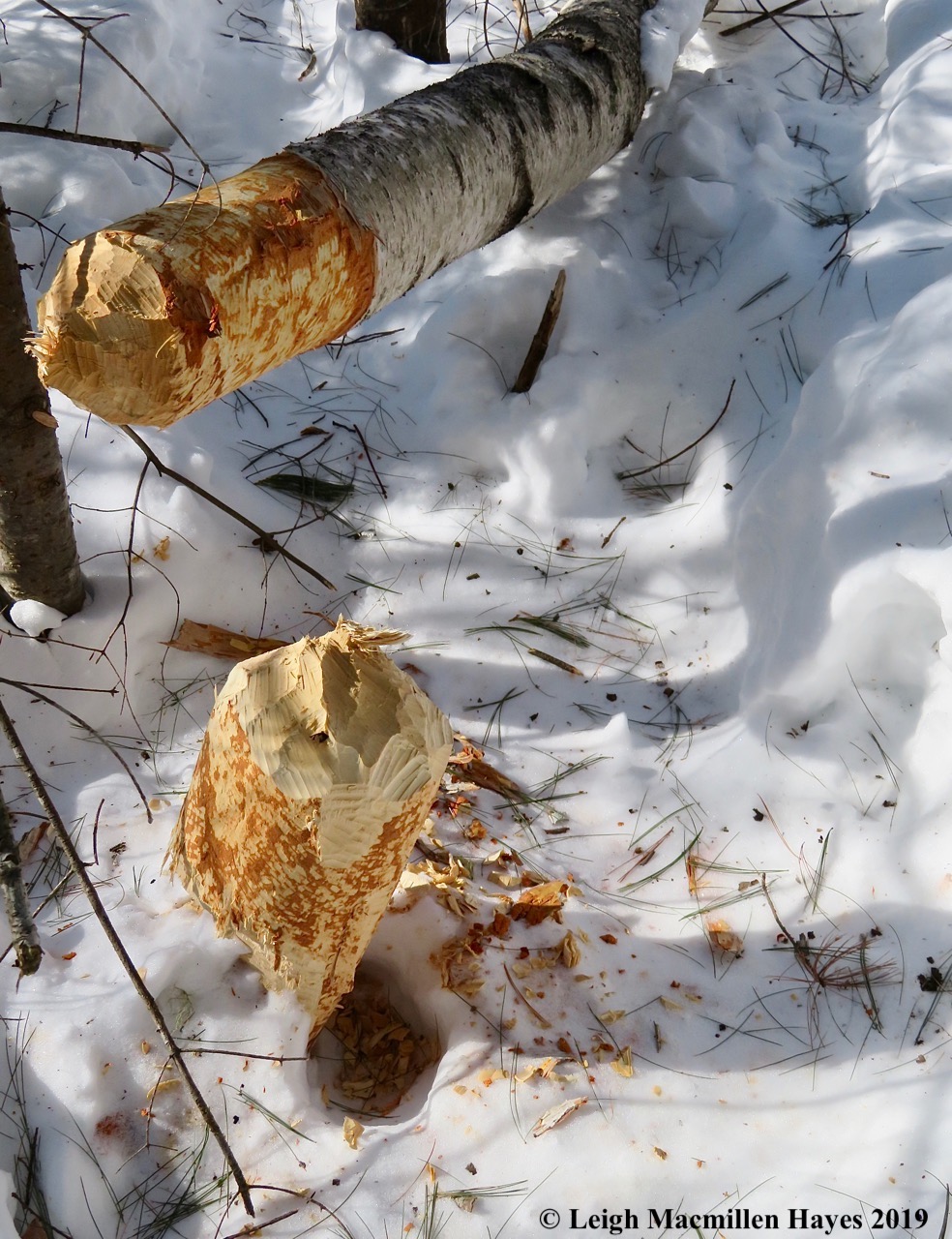
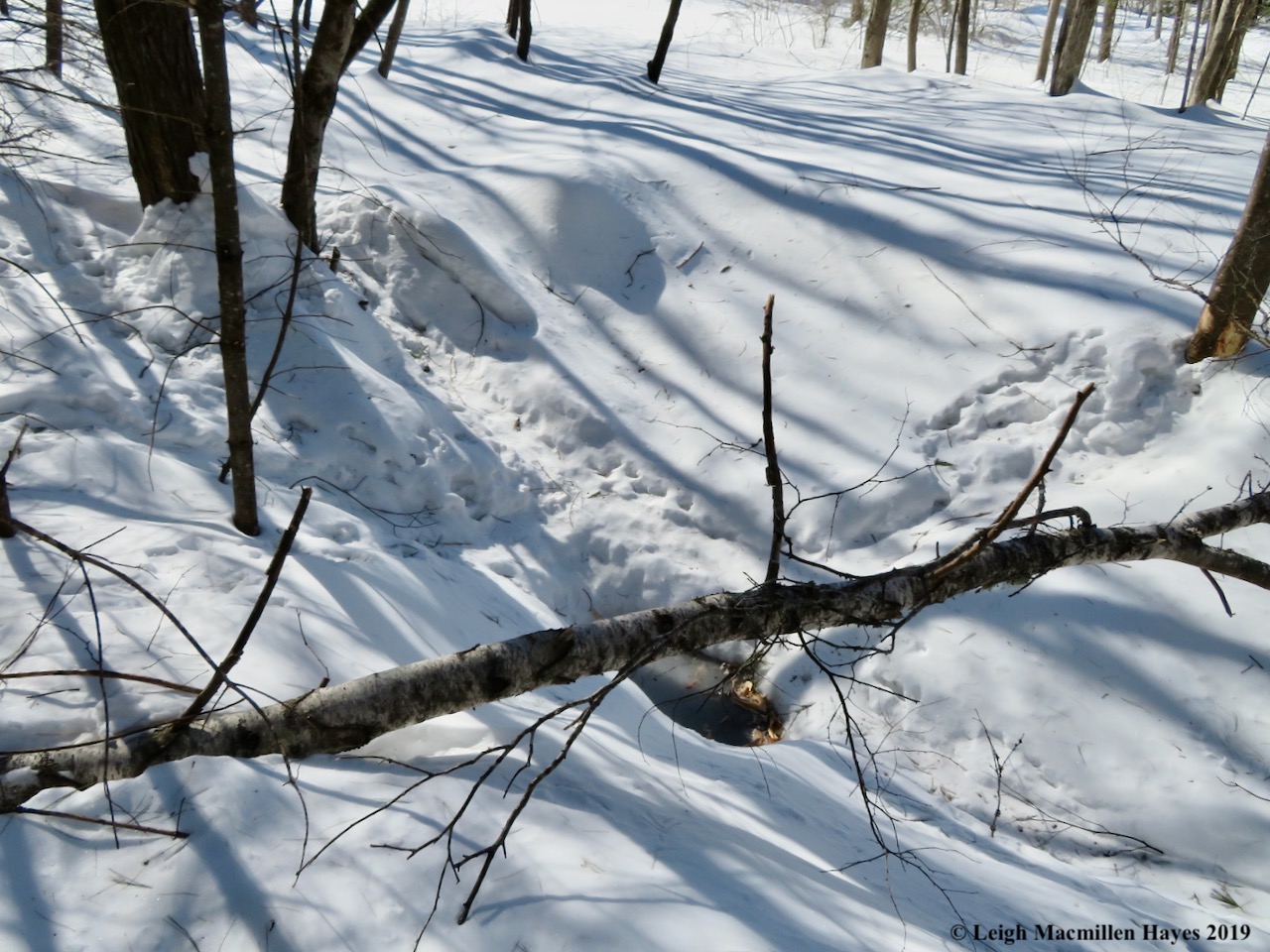
In fact, every where I went for the next two plus hours, they had been there before me.

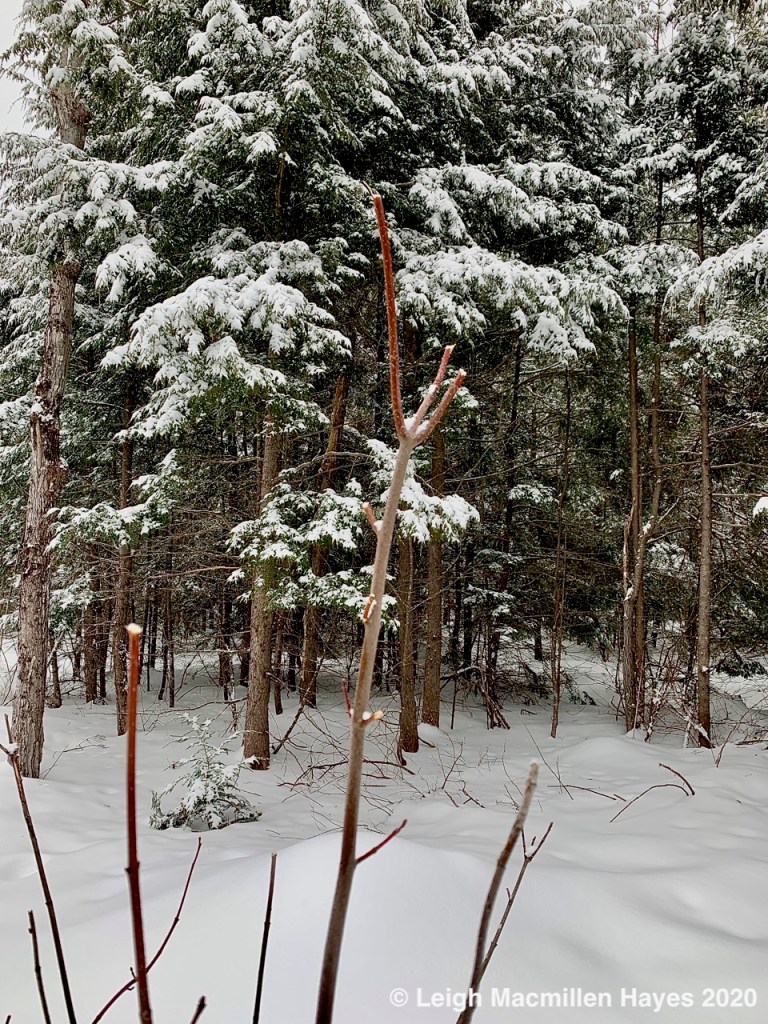
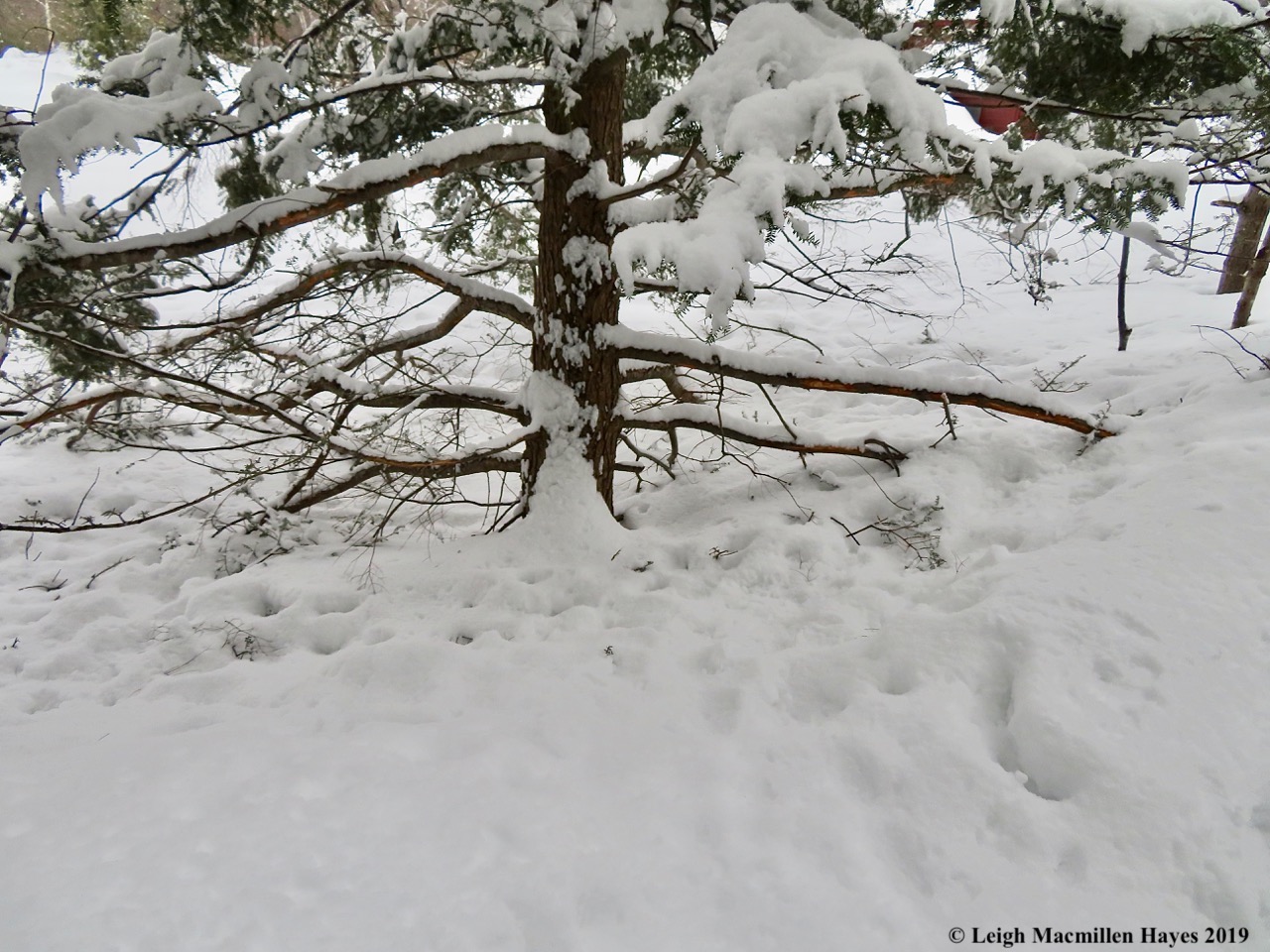
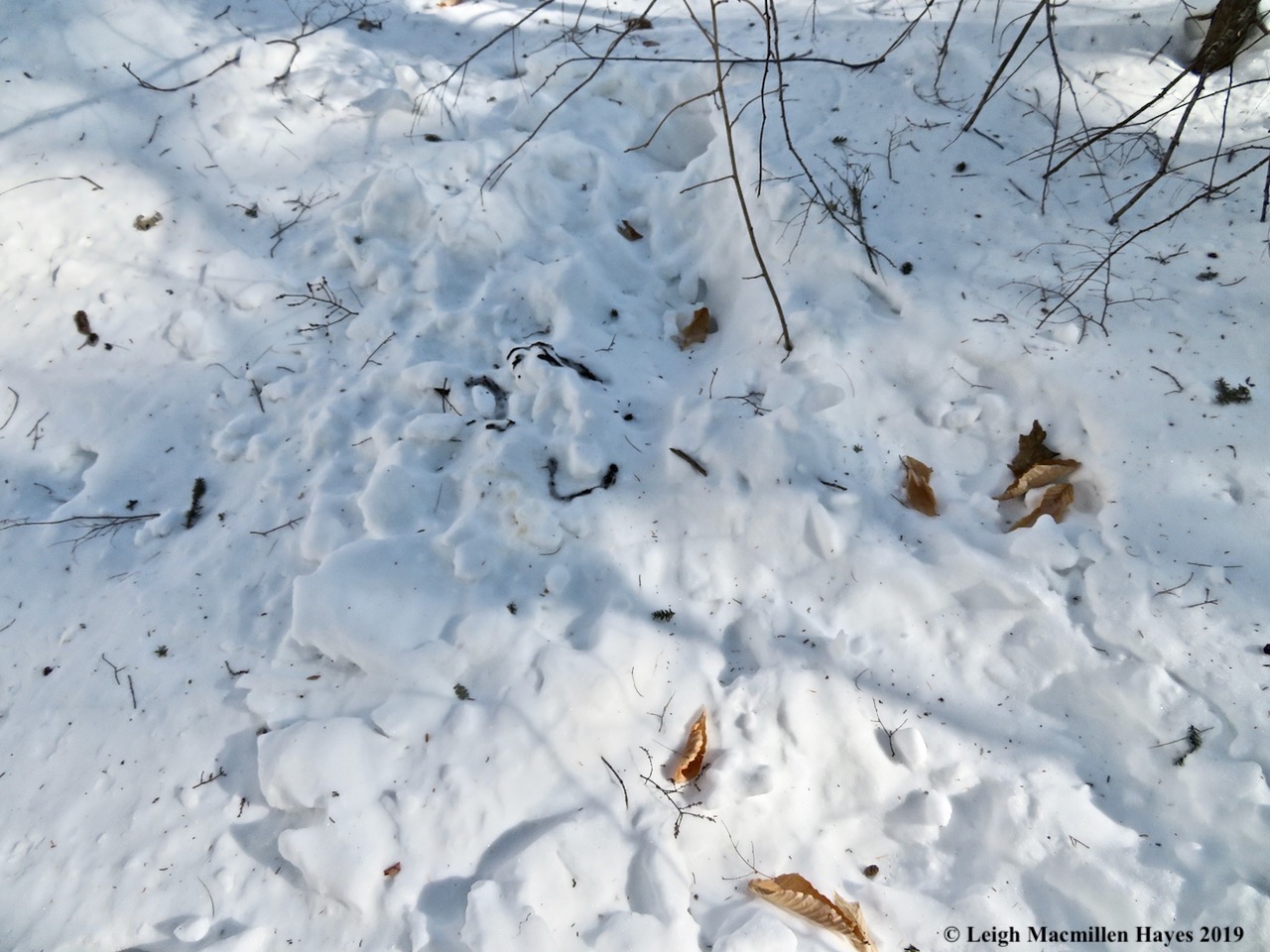
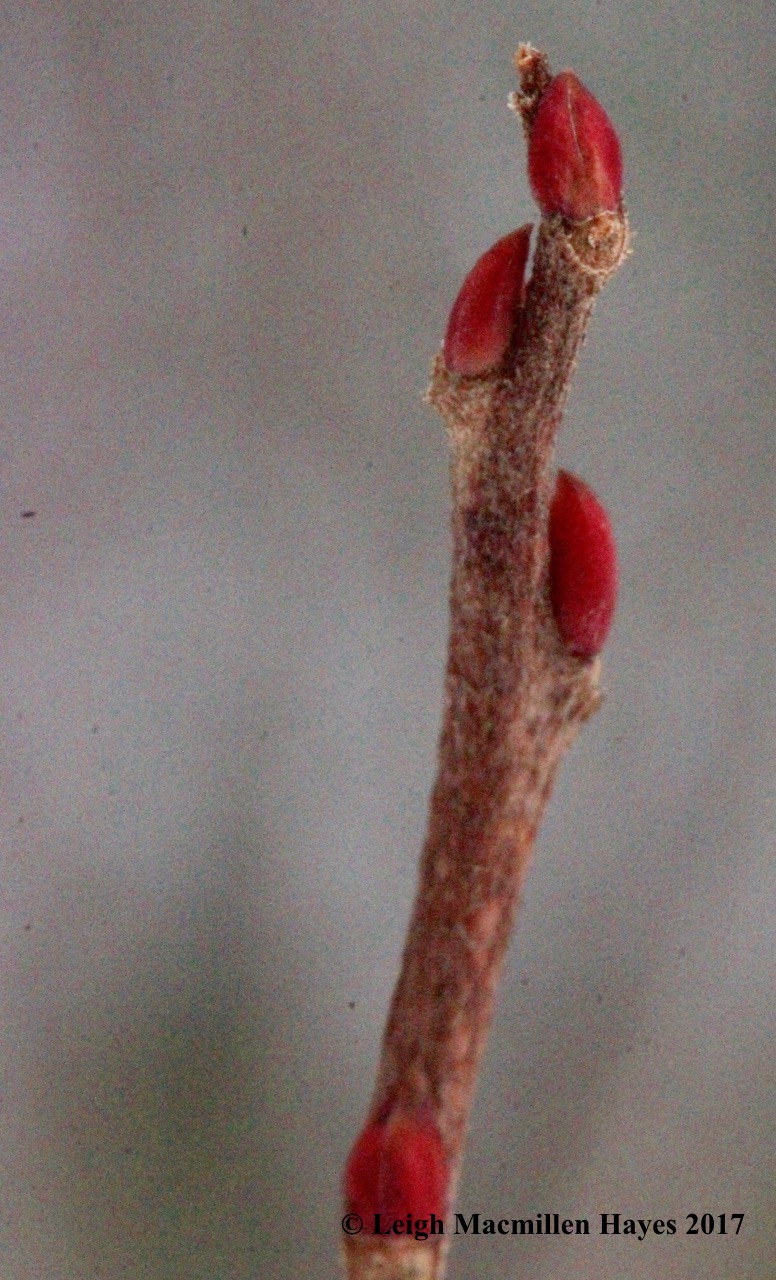
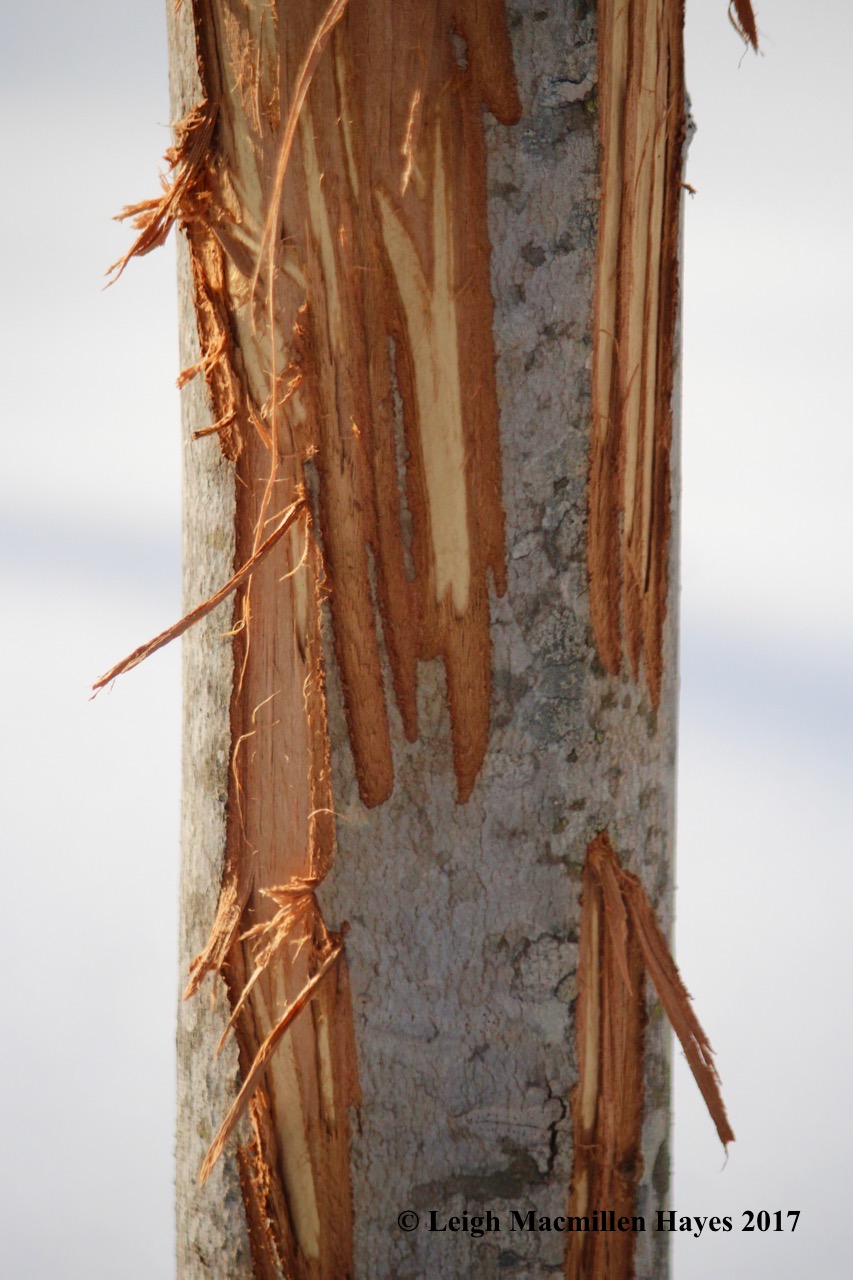
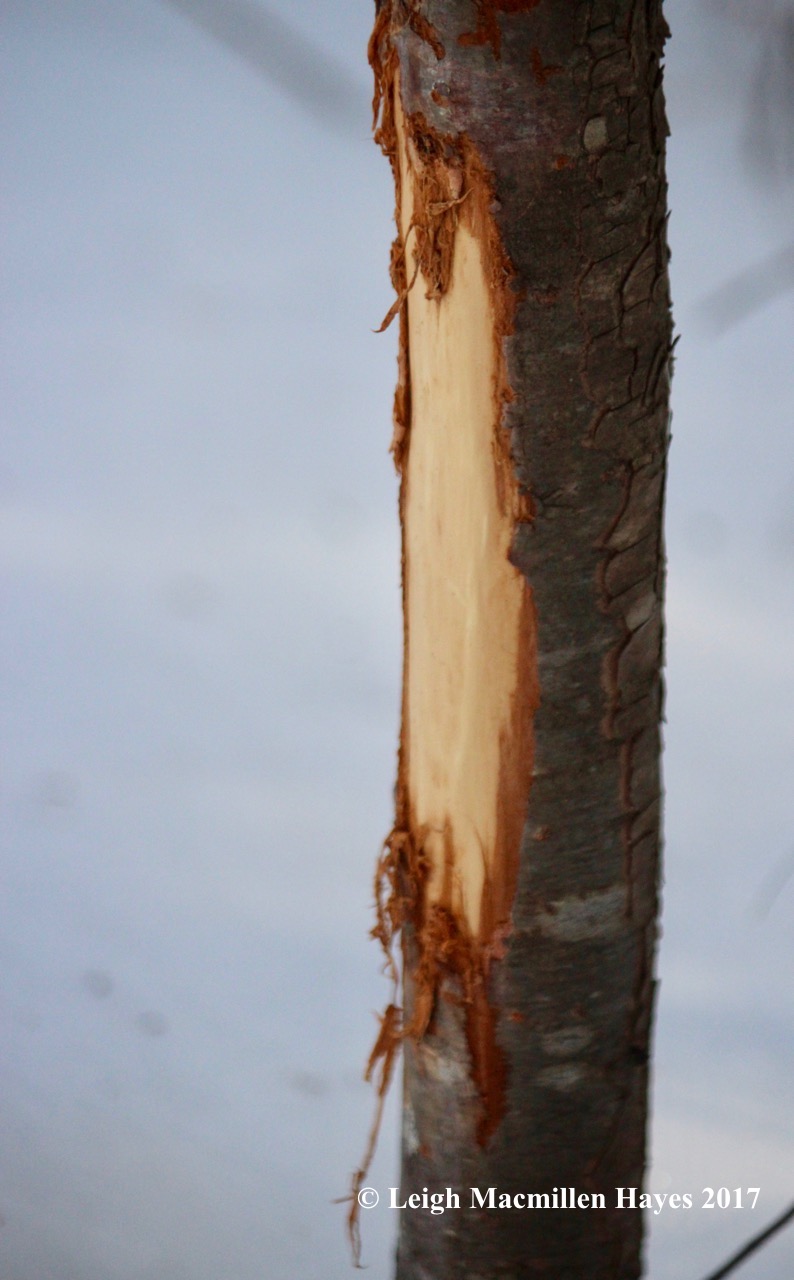
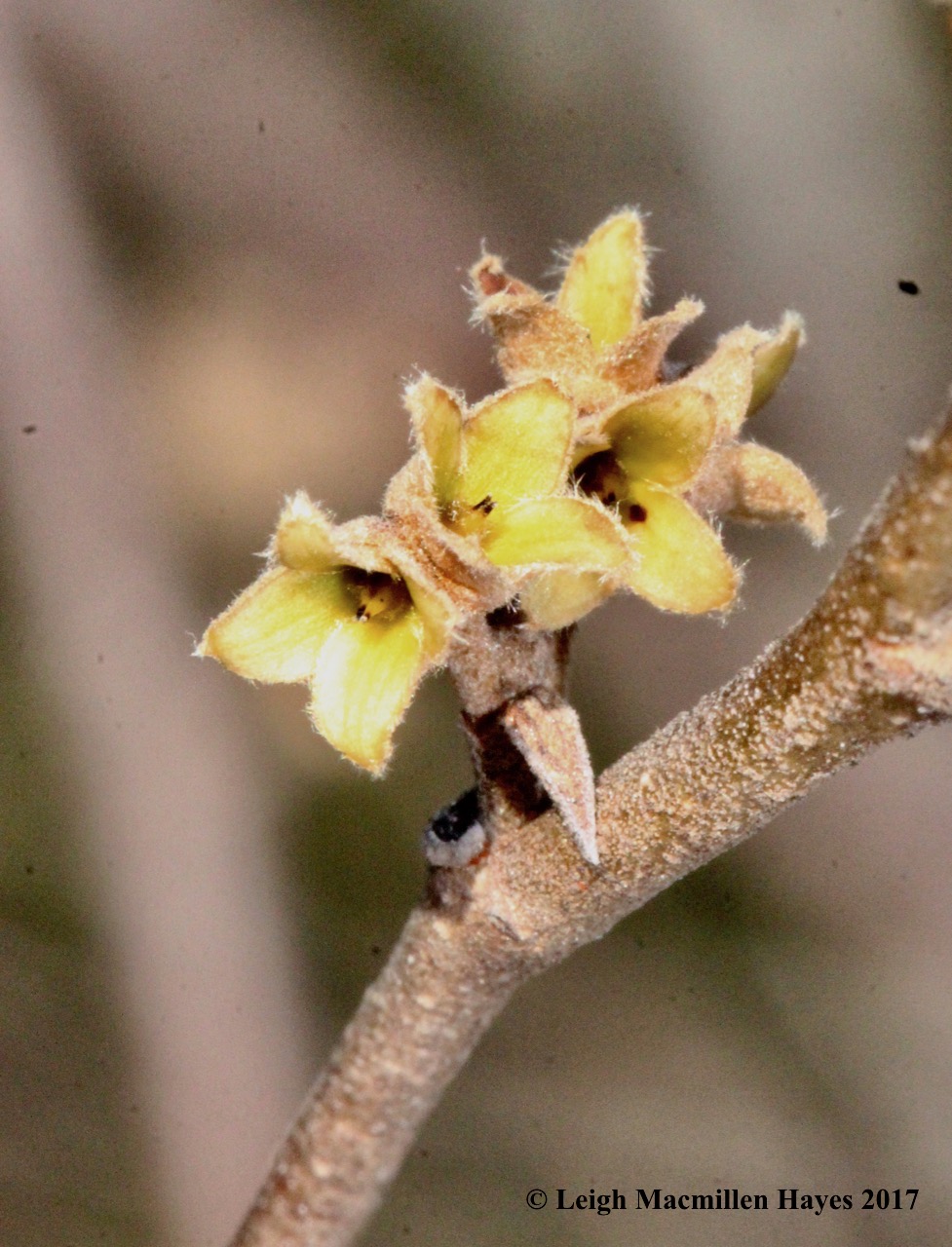
Their tree of choice also gave away their presence and I fear that there won’t be too many red maple leaves in bloom come spring. Imagine this: a moose needs to consume fifty to sixty pounds of vegetation daily–that’s a lot of buds, twigs, and bark.

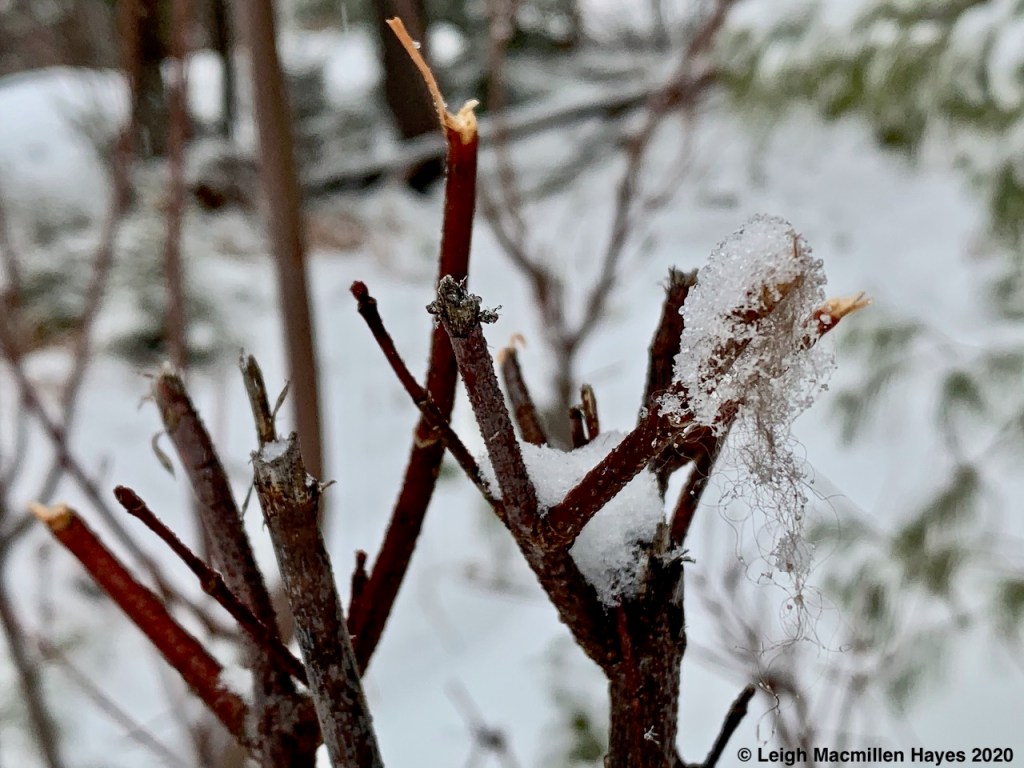
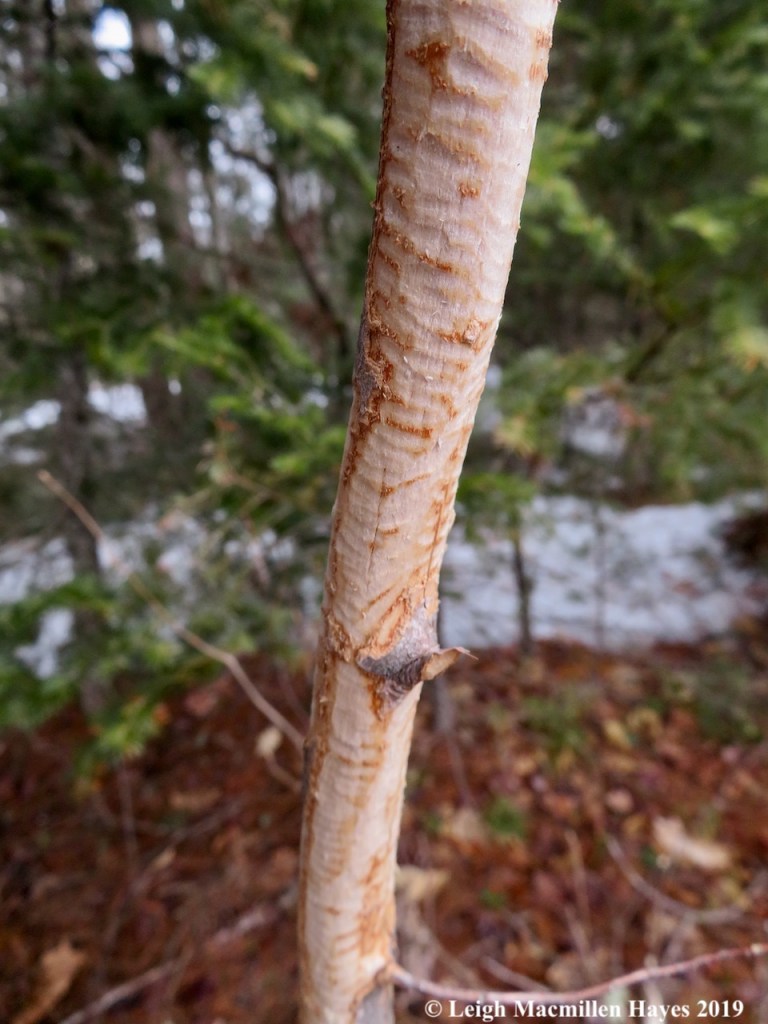
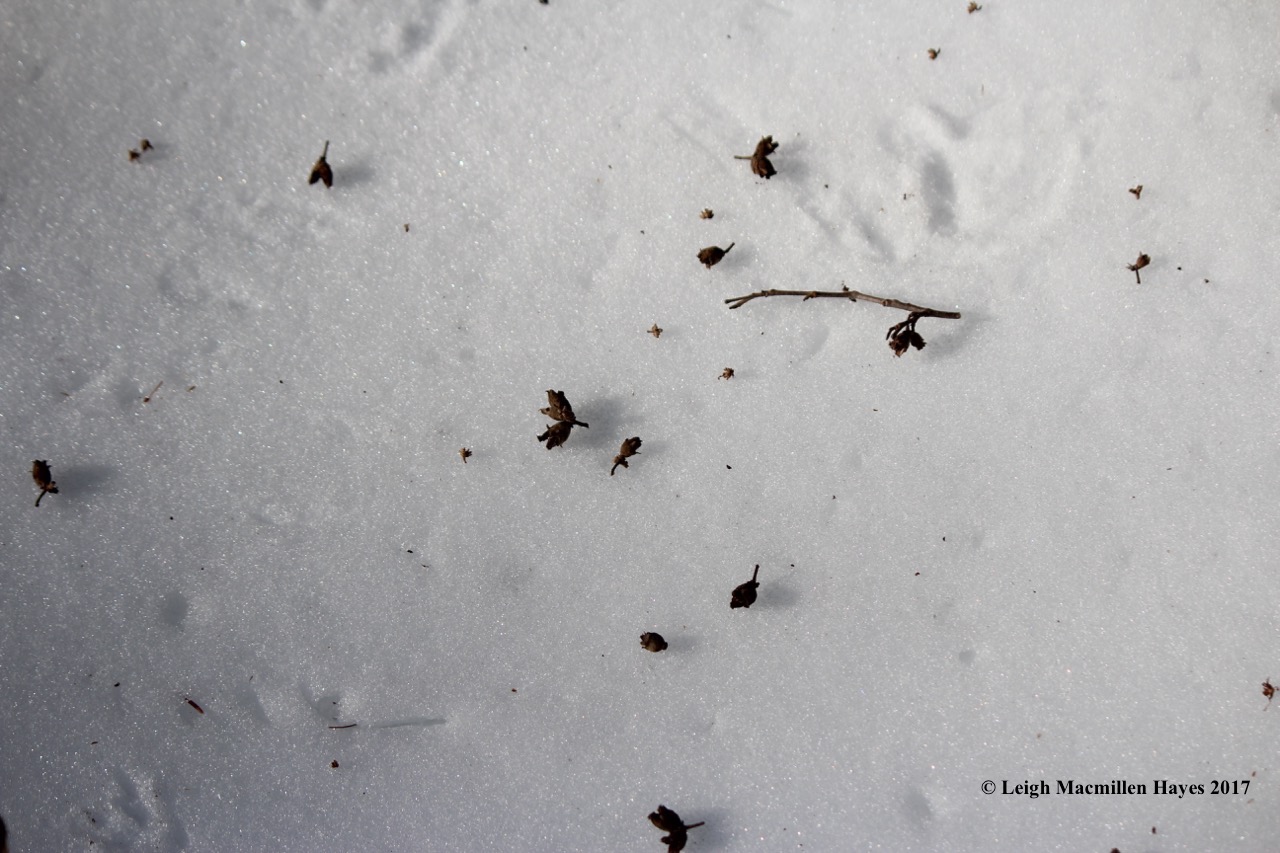
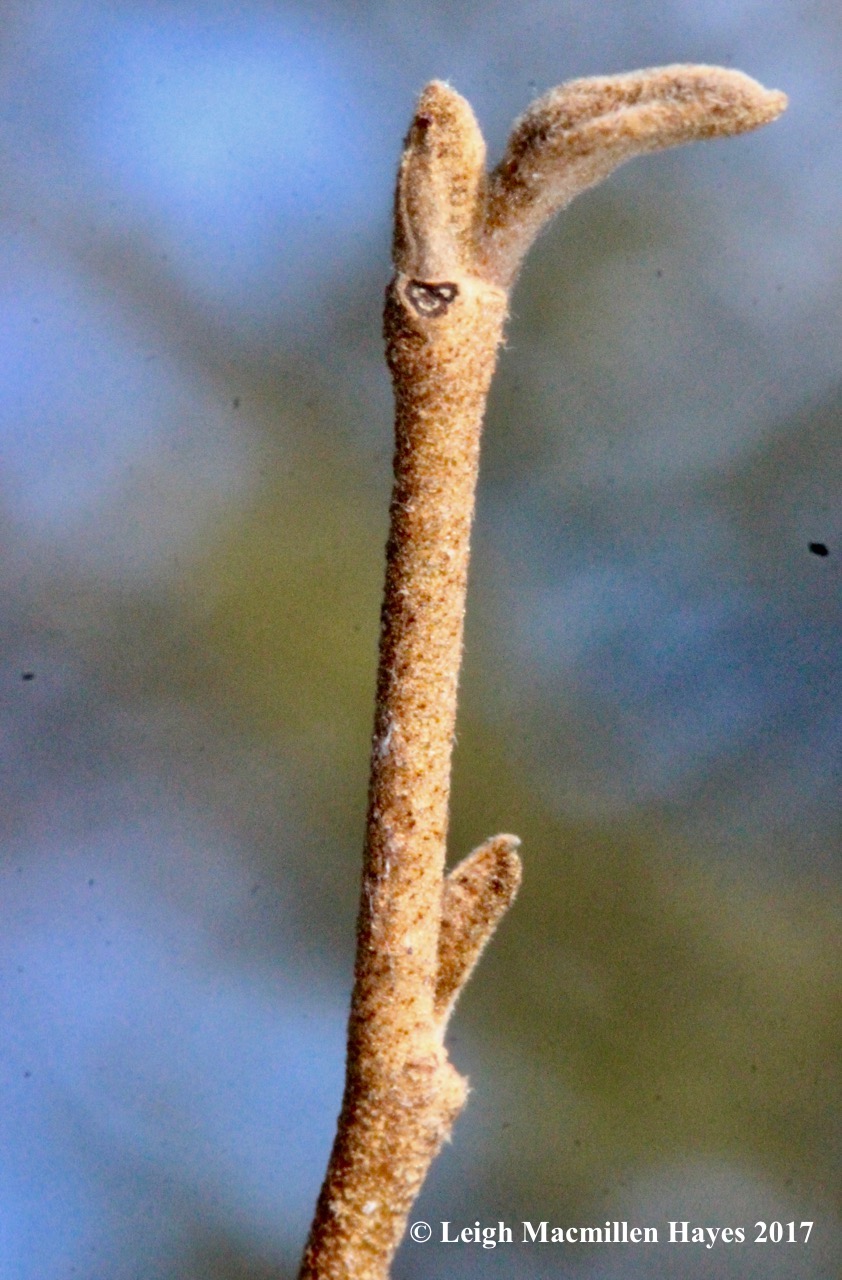
With their lower incisors and hard toothless upper palate, they grabbed the twigs and yanked to pull the buds off for consumption. Left behind were their calling cards–long dangling tags. Some were at least three feet above my head.

Also think about that moose face–homely and ungainly as it may be with a large upper lip that can wrap around the twig in order to dine, and the bell or dewlap dangling below its mouth.

With utter glee I found some hair stuck to one twig and it wasn’t the hollow shafts of its dense coat, so I wondered if in the process of browsing, hair had come off its face or dewlap.

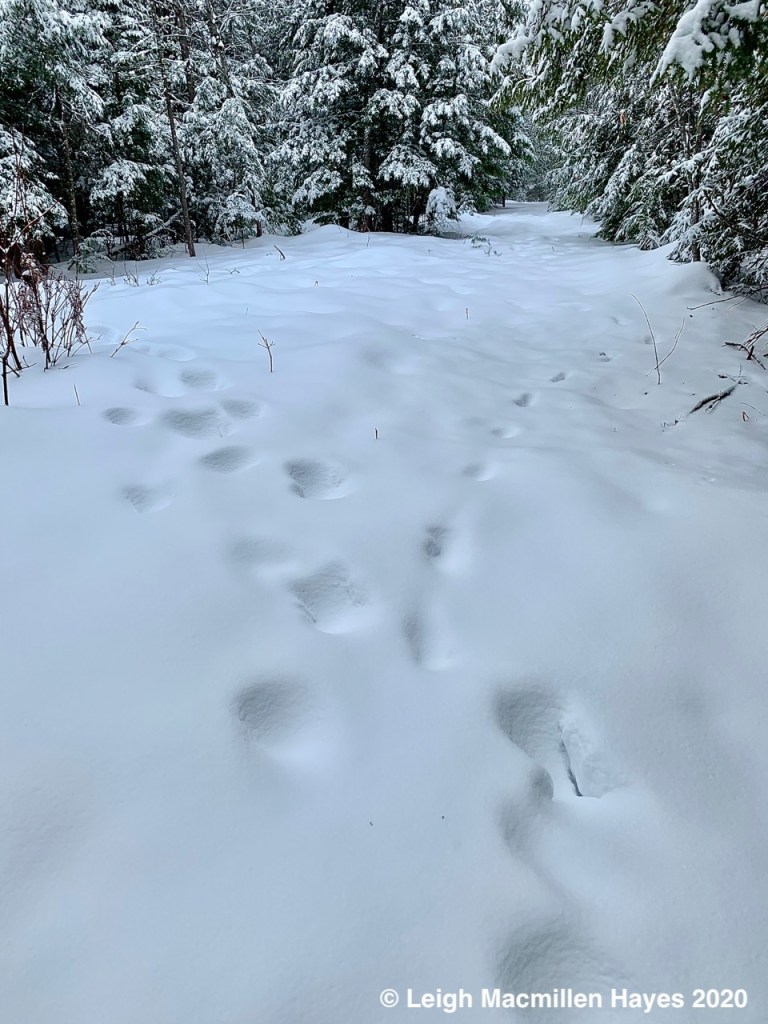
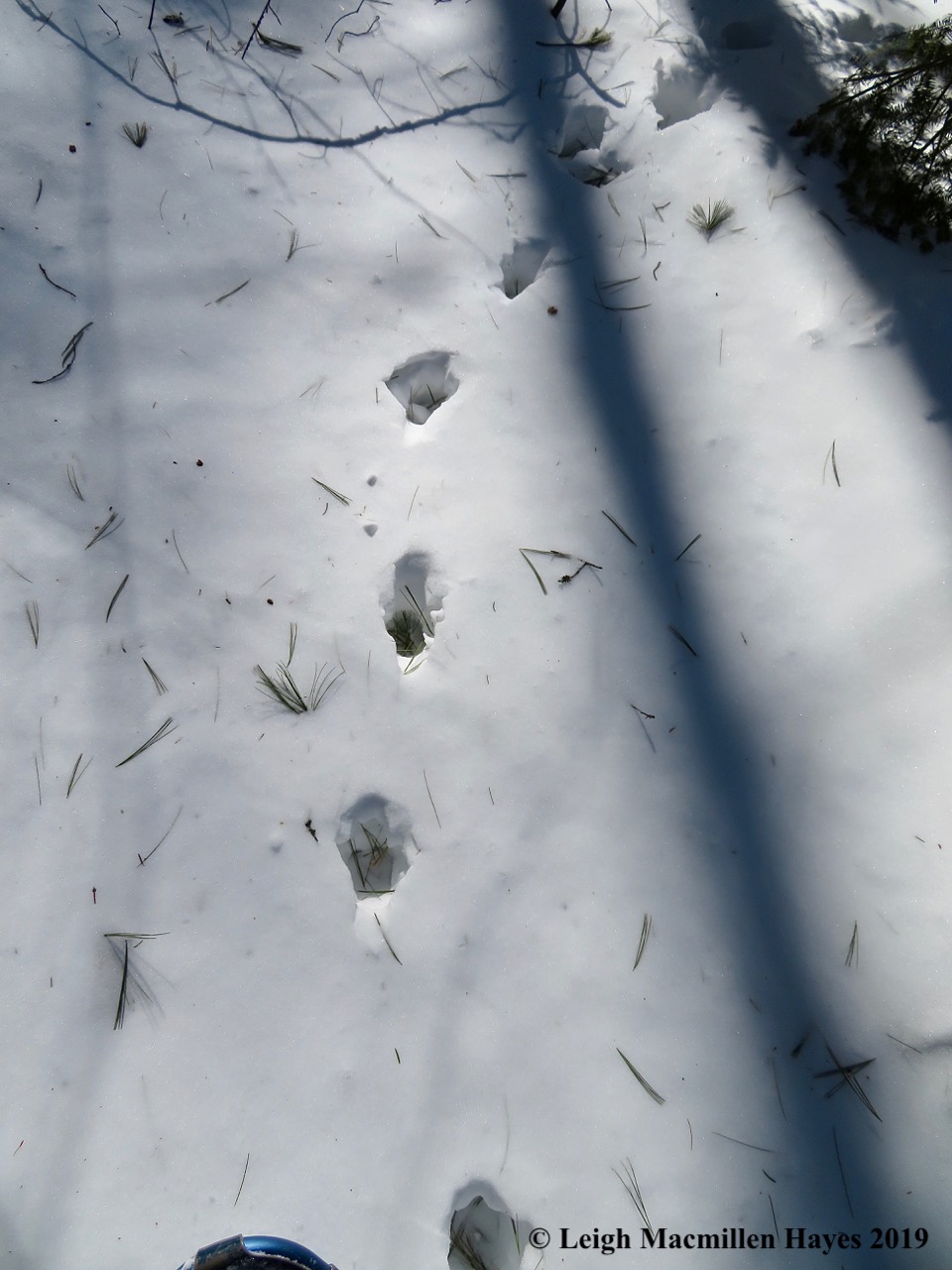
As I said, the moose had traveled throughout the woods and I began to follow their tracks exclusively, for they always lead to coppiced red maples that are trying to make a comeback in these woods that were logged within the last five to ten years.

It was on one of the trees that I did find the hollow hair shafts, and I’ve used black arrows to try to point them out to you. There were three which seemed to intersect at the point where the twig had been swiped. Notice how straight they are, especially in contrast to the slender, curly hair.

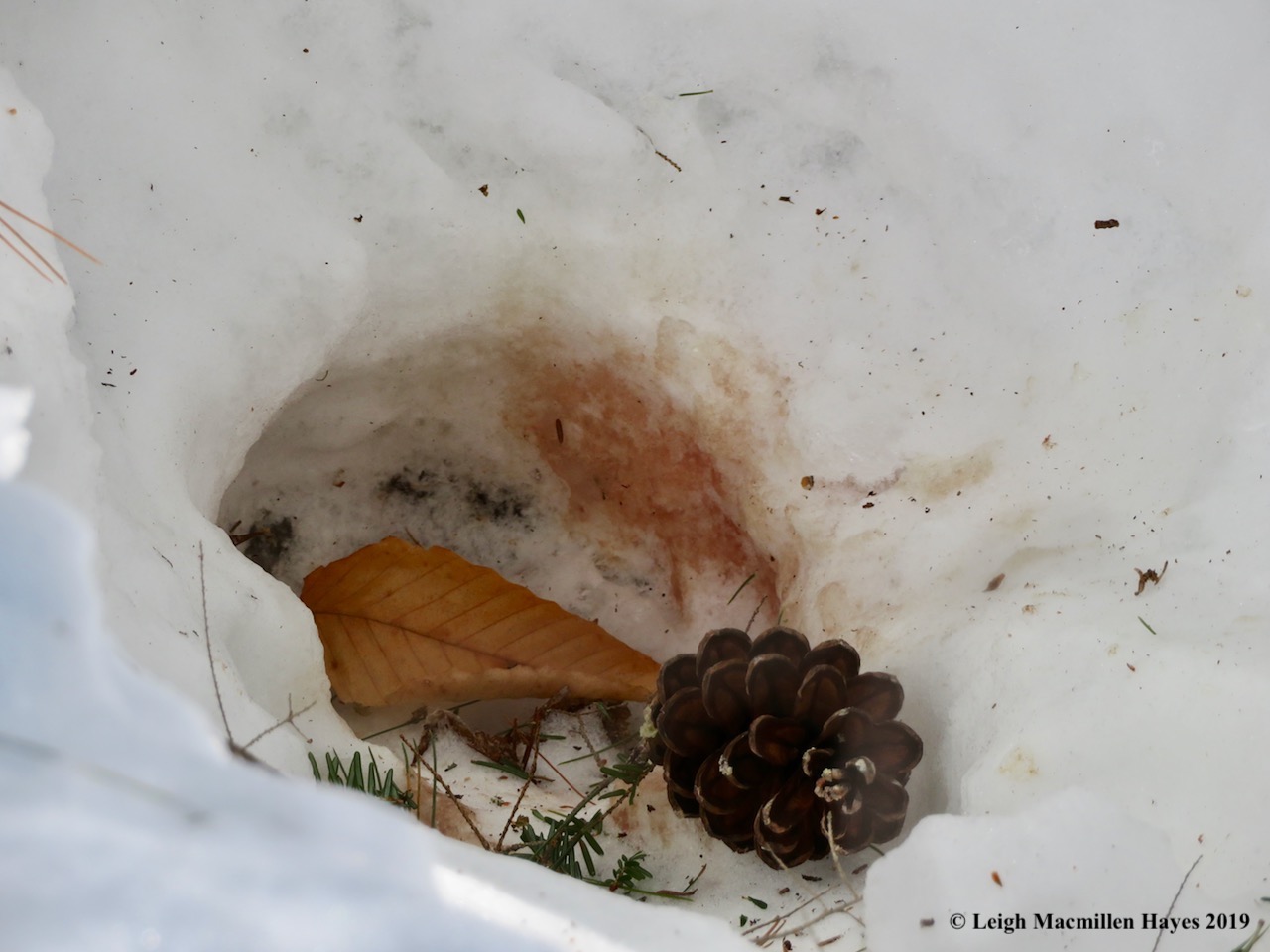
The more I looked, the more soft, curly hairs I found. Hmmm, I have a feeling any of my hunter friends can enlighten me, for now I’m considering belly hair? Is it softer? Or am I correct in thinking about the chin hairs?

It doesn’t matter. Well, it does because I’d like to know.

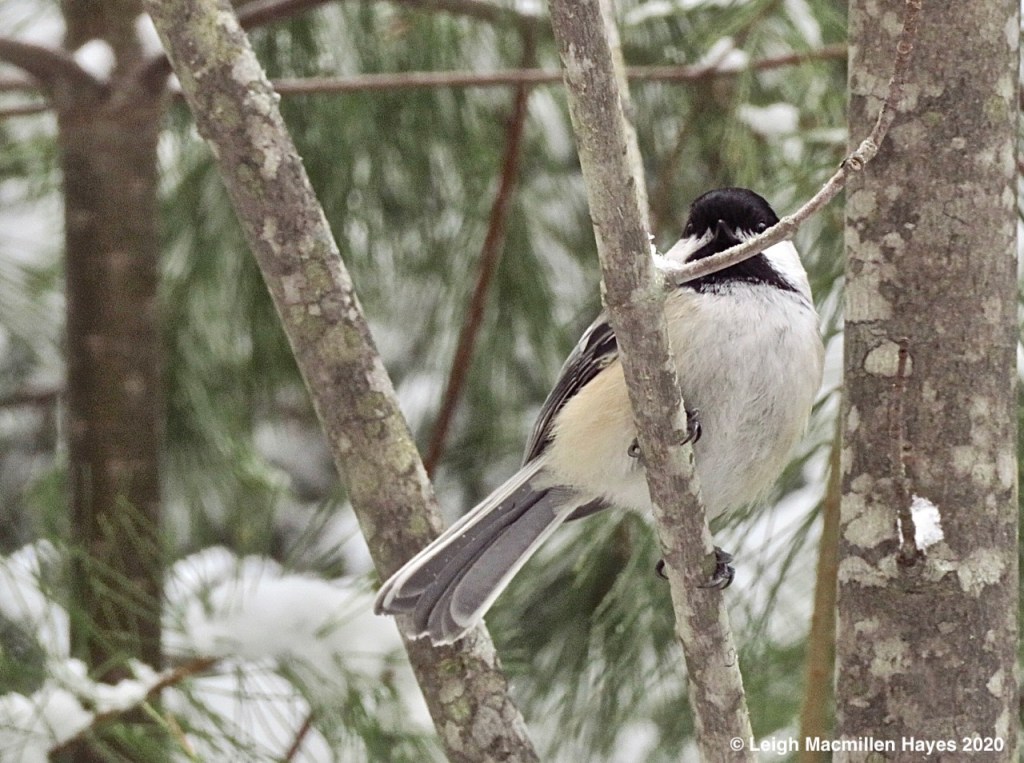
And maybe the chickadees were trying to tell me as they flew in and landed on maples while singing their “Chick-a-dee-dee-dee” song. But what mattered most was that I got outside and cleared my brain and came up with an introduction to the challenging article: It was a dark and dreary day . . . oh drats, I can’t use that–especially since despite the snow and rain, I hardly found it dark or dreary.

I think instead, I’ll begin in the middle and see where the article takes me from there. In the meantime, though I didn’t see them, I’m tickled to know that there are still several moose in the woods behind our house.

Laughing All The Way, Ho, Ho, Ho

It’s an eager group, the Greater Lovell Land Trust’s Tuesday Trackers, and since we had to cancel our expedition two weeks ago, I decided to go forth with today’s plan despite the weather forecast predicting snow.

And so we gathered, most meeting at the library to carpool and another at the trailhead.

Not long into our tramp, we moved off trail and began looking for green-tinted tan milk duds. We’d barely finished describing them to some newbies when one among us spotted a pile. And then, we realized they were everywhere.

Also everywhere, for we were in an early succession forest, were the fleur de lis and teeny seeds of gray and paper birches.

Scanning the area, we recognized the diagonal cut on woody vegetation indicating the source of the hare scat. Once the frost kills succulent plants, a hare’s diet switches to saplings of aspen, birch, maple, willow and cedar. Oh, they’ll browse other species, but these are their favorites and the site we were in offered at least four of the five.

Of course, examining scat is one of a Tracker’s favorite things to do and today was no different. Bob got excited when he saw rainbow reflections in one little specimen. Mind you, we know better than to pick it up for scat can contain parasites, but . . . (don’t do this at home).

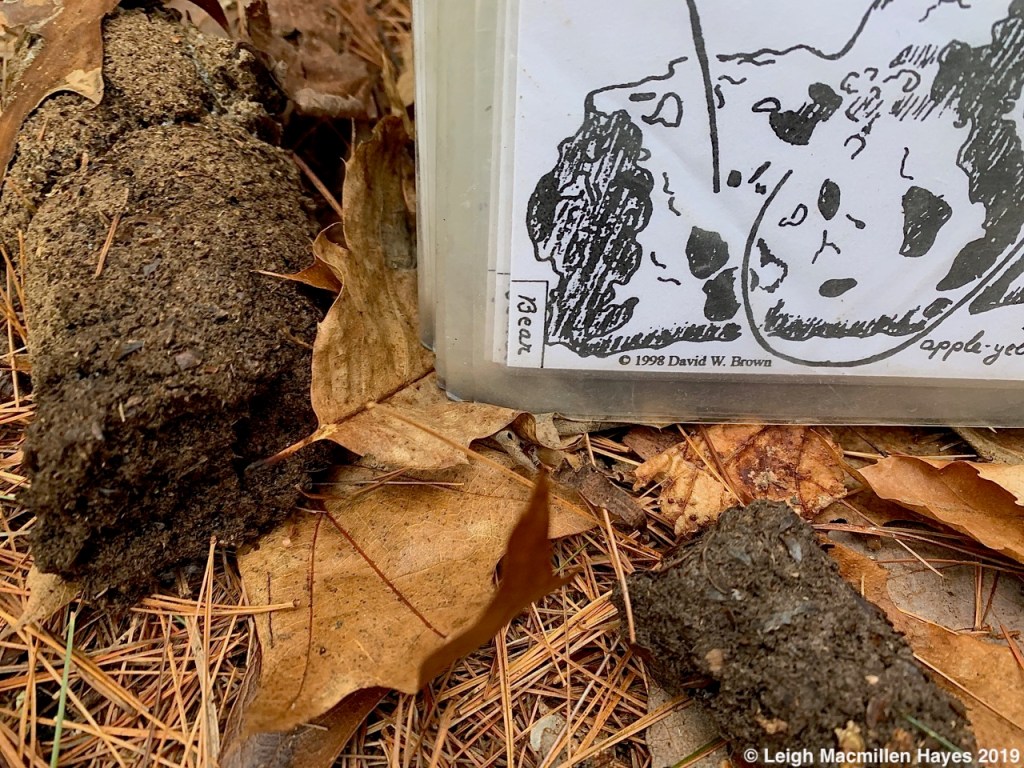
Our journey soon found us starring at a much larger scat. Truth be told, Pam had discovered it last week and I joined her the next day to admire it. It is indeed, MUCH larger than the hare scat, because it was created by Ursa Major, a black bear.

The funny thing (at least to us) was that the day Pam spotted this, Mary Holland posted a blog on her Naturally Curious site about black bears scent marking on telephone poles during the non-breeding season and reminding people to bring their bird feeders in at night because it hasn’t yet been cold enough for the bears to hibernate.

It’s often like that if you follow Mary’s blog. She’ll post something that you either just spotted or can expect to see that day or the next. (Thank you, Mary)

Oh how I wish I had a photo of Joan and Bob as they simultaneously spotted the scat after Pam and I had walked a wee bit to the side and paused to chat–ever so nonchalant were we. Their eyes expressed their excitement over such a find.

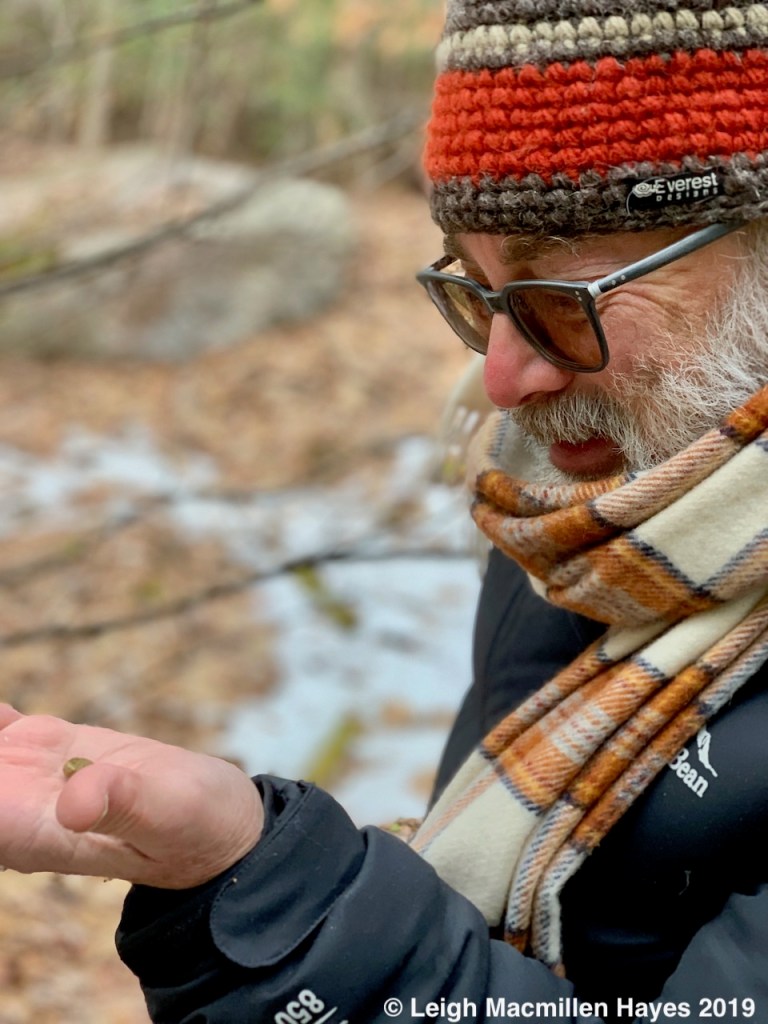
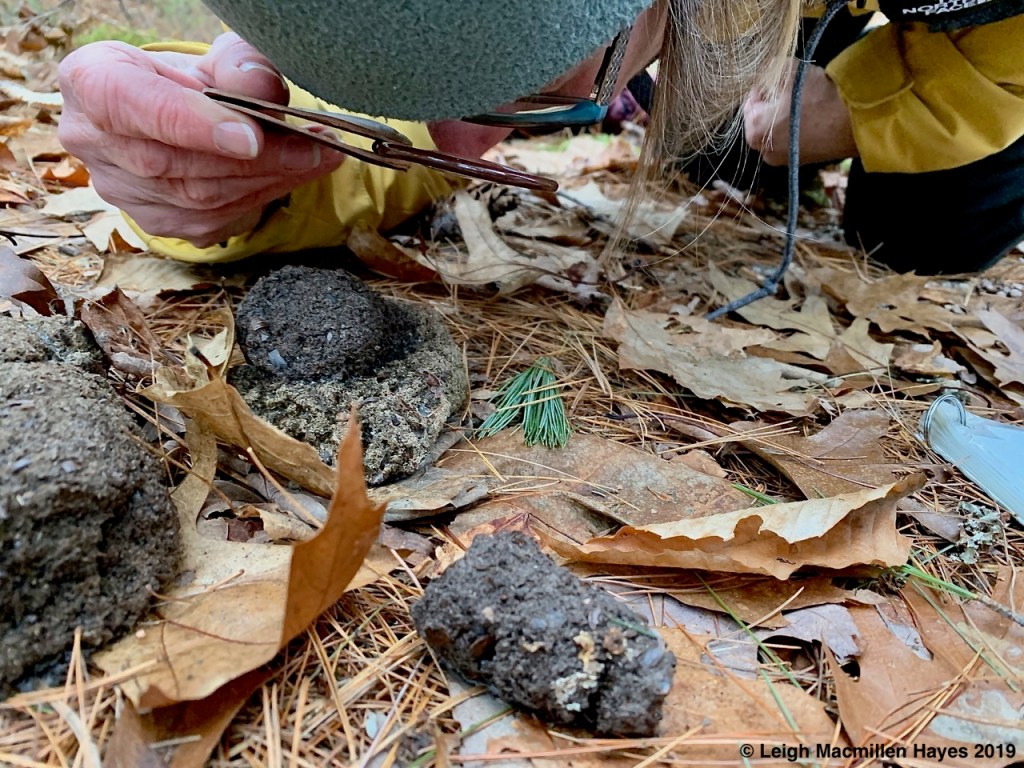
Again, we know not only not to handle scat, but also not to sniff it. But, we couldn’t resist getting close to see that this hearty specimen was chock full of acorn shells. And so we held our breath as we looked.

We told the newbies that the initiation ceremony included taking a closer look.

And so Joe did.

And Dawn followed suit.

It was almost as if David Brown had used this specimen to sketch the scat on his Trackard, but . . . his find was full of apples.

I, however, may do the same, for true confession is that I took a wee bit. Well, okay, I took a huge piece. To dry out and add to my collection. All in the name of education.

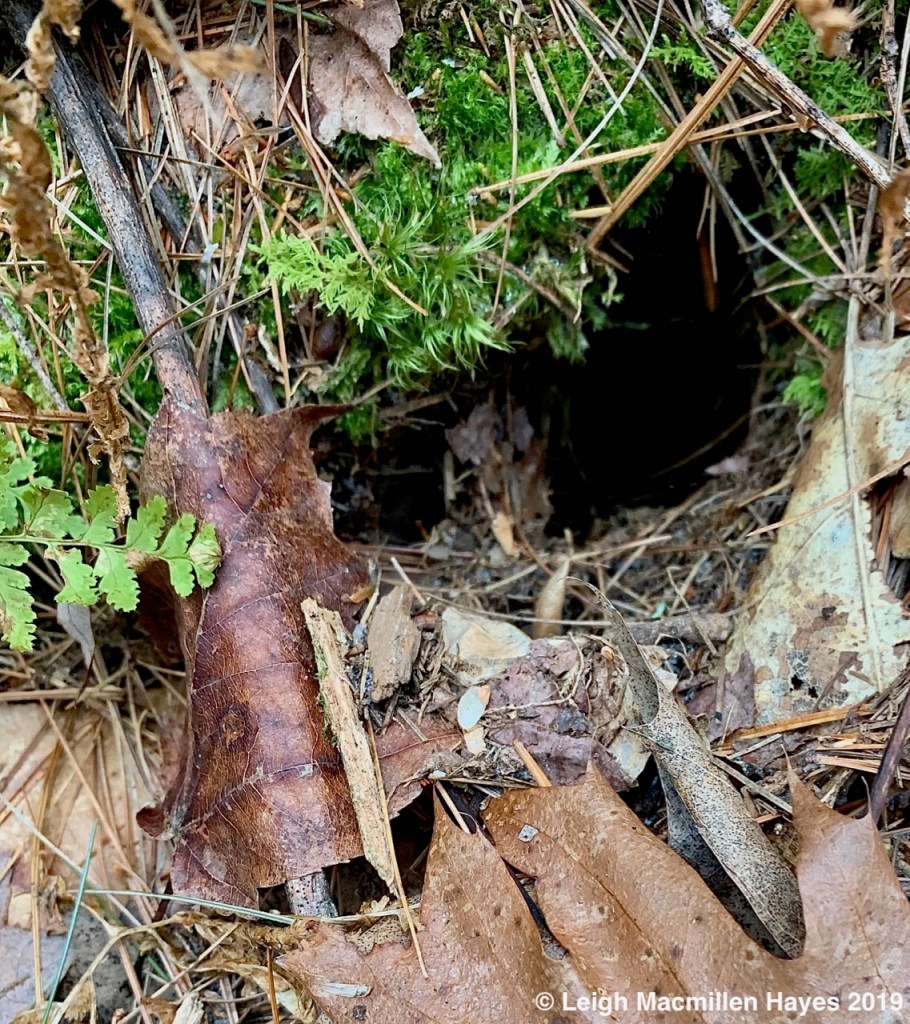
At last we pulled ourselves away and continued on in search of more mammal sign, which we found in the form of a small hole with a clean dooryard. Where there is one hole, there is usually another.

Our curiosity was satisfied when it was spotted not too far away and then we actually found a third on the other side of the path and suspected that a chipmunk had a castle below and knew how to avoid sky space above the trail. Sky space can be hazardous to a little brown thing if a bird of prey spots it and trails often create that opening that the LBTs fear.

Because we are who we are, and curious about every little thing, it wasn’t just mammal sign that captured our attention. There were sawfly cocoons to examine.

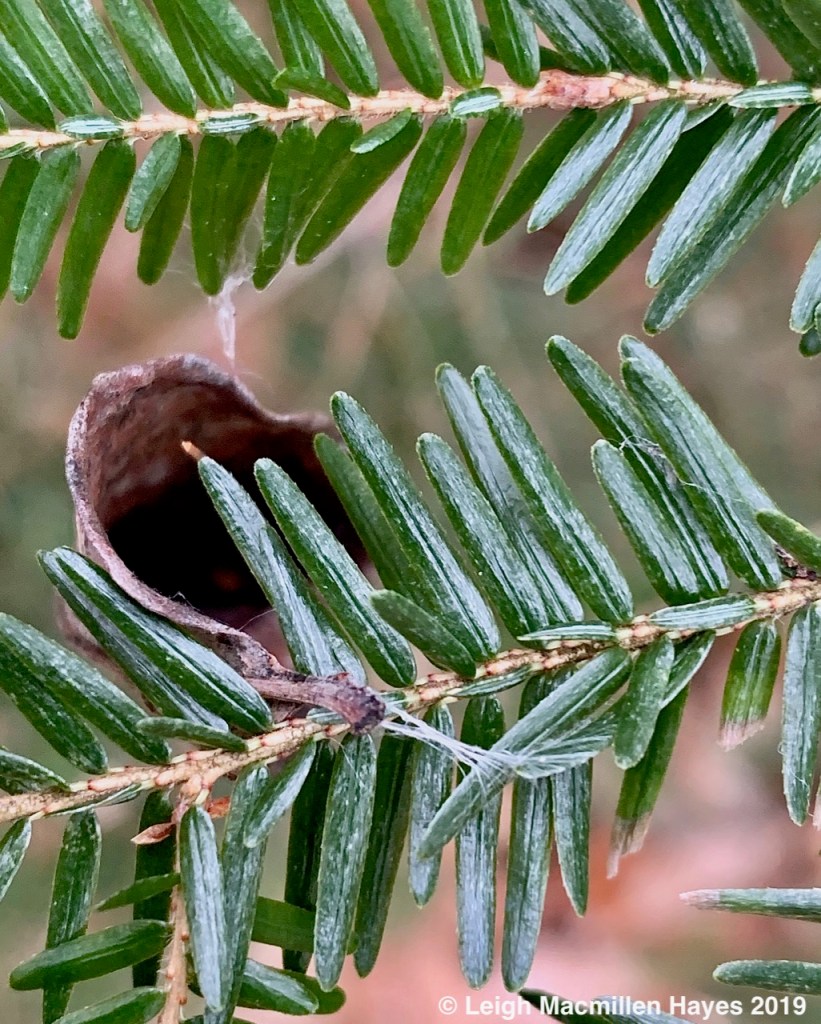
And then, the leaf that dangled from a hemlock. All we could think of was that a deciduous leaf had landed on the conifer and a leafroller insect took advantage of the opportunity to create its cocoon in situ. Can you see the threads that hold the leaf’s petiole or stalk to the hemlock needles?

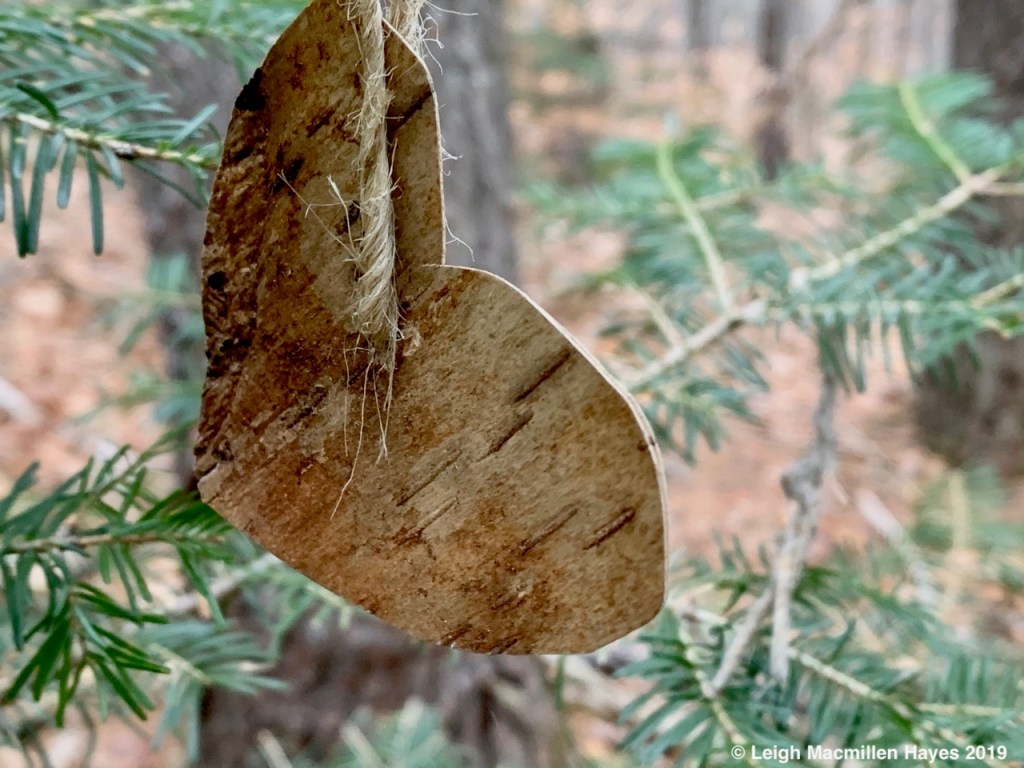
There were other danglers as well, all befitting the current season for this was the trail that the GLLT’s Nature Explorers, a group of homeschool families, had used to decorate a Christmas tree last year for the Maine/New Hampshire Christmas Tree Quest.

This year’s tree is located along the Homestead Trail at the GLLT’s Heald and Bradley Ponds Reserve, so be sure to get your quest on and go take a look.

And speaking of Christmas, snowflakes began falling as we made our way and we paused for a few moments to admire how they’d gathered on spider webs and danced in the slight breeze.

One of our other great finds and we found many, was the tubular shape of pine needles, which had been constructed by a pine tube moth caterpillar, Argyrotaenia pinatubana. The caterpillar had used a bunch of needles to form its hollow cocoon, binding them together with silk and munching on the ends of its winter home.

Later in the day, when I was alone, I discovered more tubes on pines and while I was looking I spied movement created by Tetragnatha viridis, the green long-jawed orb weaver. Do you see it? The green color helps it camouflage amongst pine needles, its usual habitat.

I bet you can see it now.

I only wish I’d been able to spy the spider when I was with this crew for we chatted about how after a winter rain droplets decorating webs make us realize how active spiders can be despite the temperature.

Today’s crew included Joan, Joe, Pam, Dawn, and Bob, and I suspect we all drove home with smiles in our hearts as we reflected upon the discoveries we’d made and fun we’d had during our time together.

We didn’t go over the river, but we certainly did go through the woods, laughing all the way, ho, ho, ho.

Making a New Friend, Naturally

I don’t always find it easy to get to know someone upon our first greeting, especially if our time together is brief. And sometimes it takes me a year or even longer to feel comfortable in the presence of another. But there was something a wee bit different about today’s encounter that encouraged me to break down any false barriers.

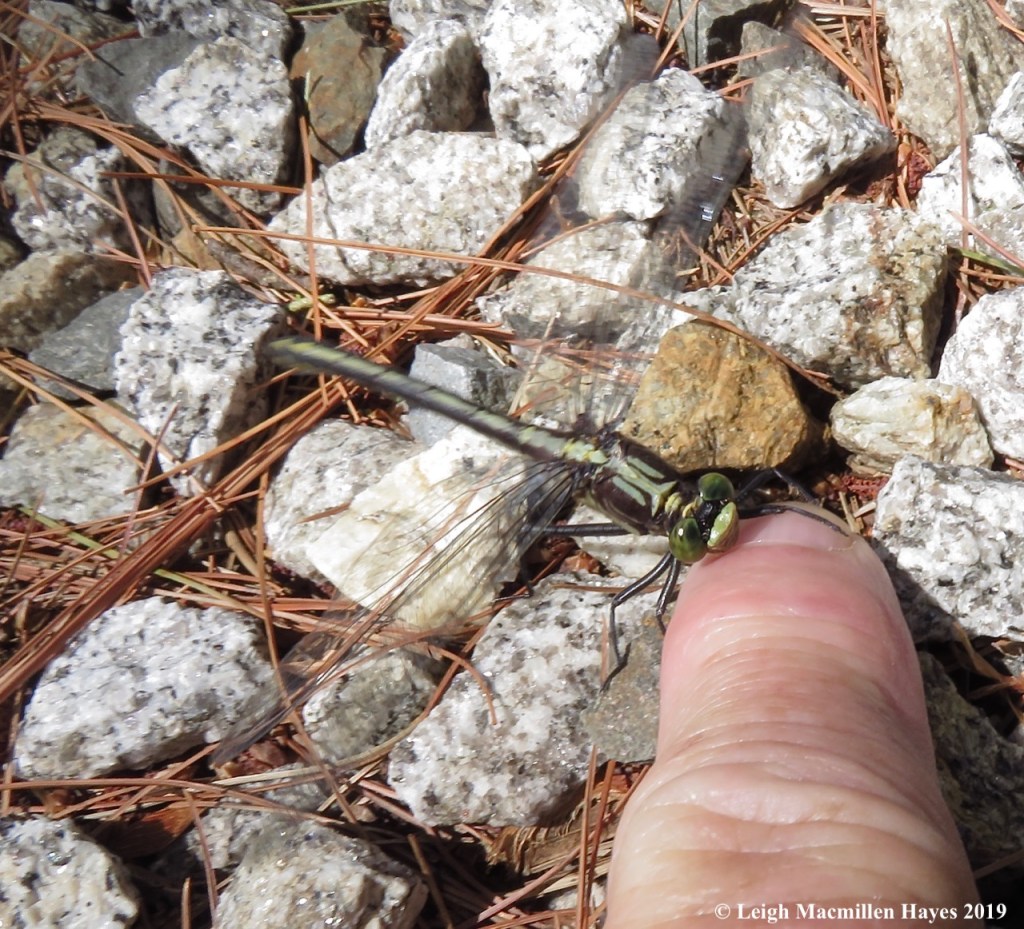
Maybe it was because at first glance I thought an old friend had stopped by for the clothing it wore on its back looked familiar.

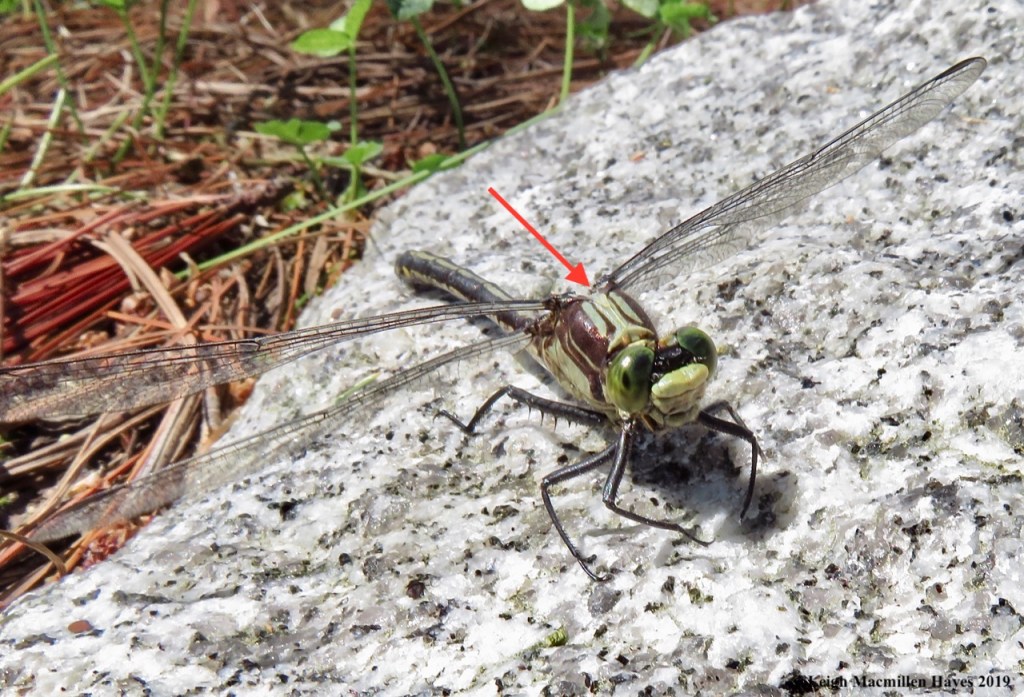
But my old friend, Ashy, wears a cloak with a yellow triangular spot on segment eight on the coat tails and segments nine and ten have no coloration above.

If you look back at my new acquaintance, you’ll realize that the pattern is quite different all the way to the hem line.

That’s when I began to realize I was in the presence of someone I hadn’t had the pleasure to meet before. Or, if I had, perhaps I hadn’t taken the time to notice the idiosyncrasies that earned it a name. To really get to know him.

Notice, for instance, the wide black shoulder stripe on the side of his thorax.

And the spines along the thigh of his hind leg.

Those two features were key, but there was more to see: look at the thorax again. Can you see two long, thin bluish-green ovals and the “I” that separates them?

Because he looked similar in some ways to Ashy and another friend I know as Sir Lancelot, I wondered if he’d be comfortable with an up close and personal meeting.

It appeared he didn’t mind as my steel-gray-blue eyes peered into his of vivid green.

He didn’t stay on my finger long and despite the fact that he was at least a half inch longer than his cousins, he felt like a lightweight.

I, of course, could not let the chance encounter pass without another opportunity to gain a closer perspective.

He seemed to feel the same . . .

and ever so slowly climbed aboard again. Three times we stared at each other, but each time it was only for a brief period.

At last he flew off and I could only hope that he felt as excited about our meeting as I did.

My only other hope is that the next time we meet, I remember his name: Black-shouldered Spinyleg Clubtail Dragonfly or Dromogomphus spinosus.

Today, I made a new friend, naturally. And it wasn’t so hard after all.

Nothing False About This Celebration

With a mission
to check upon
a heron rookery,
I invited
a friend
to join me.

The young’uns
sat upon their
nests of sticks
waiting for
the next meal
to arrive.

With the flap
of wings
slowed in rhythm,
landing gear
was extended
in the form
of long legs
and feet.
Within minutes,
a meal of fish
was regurgitated
and
passed
from
parent
to
child.
Because of 
our location
beside
a slow-flowing river,
many other sights
caught our
attention.
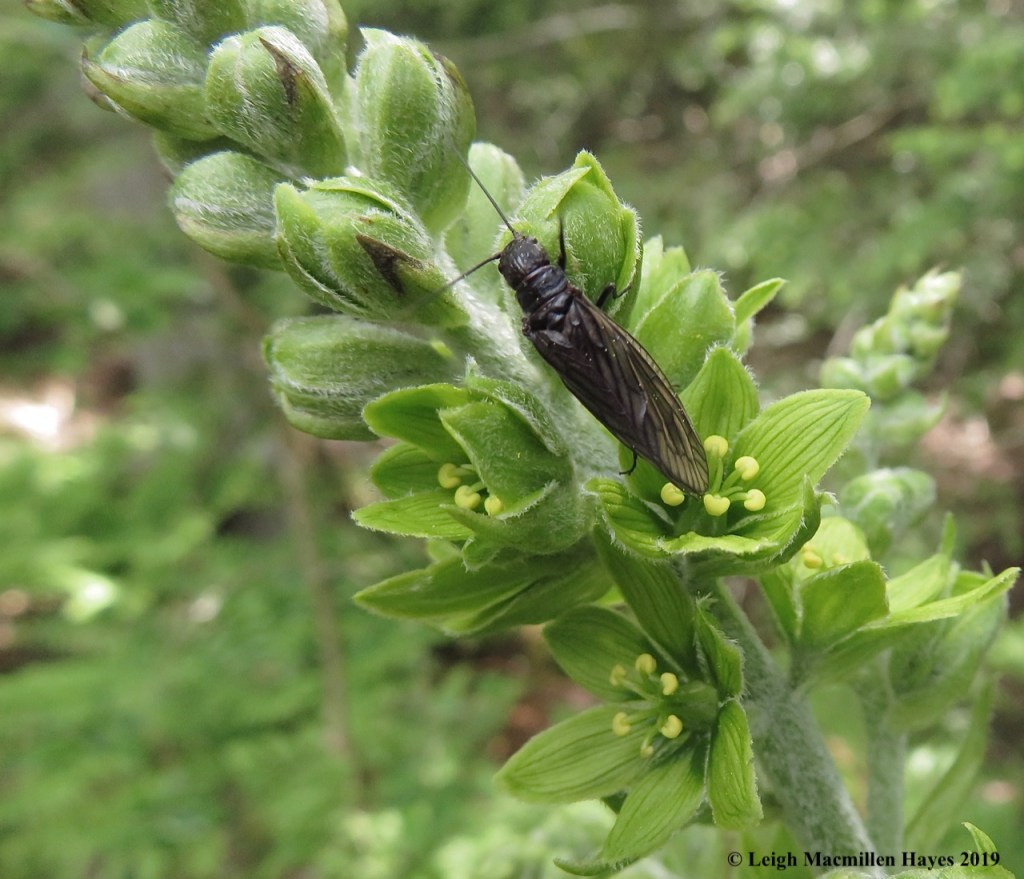
But it was one
with a
penchant for moisture
who stood
as tall
as my chin
that garnered
the most attention.
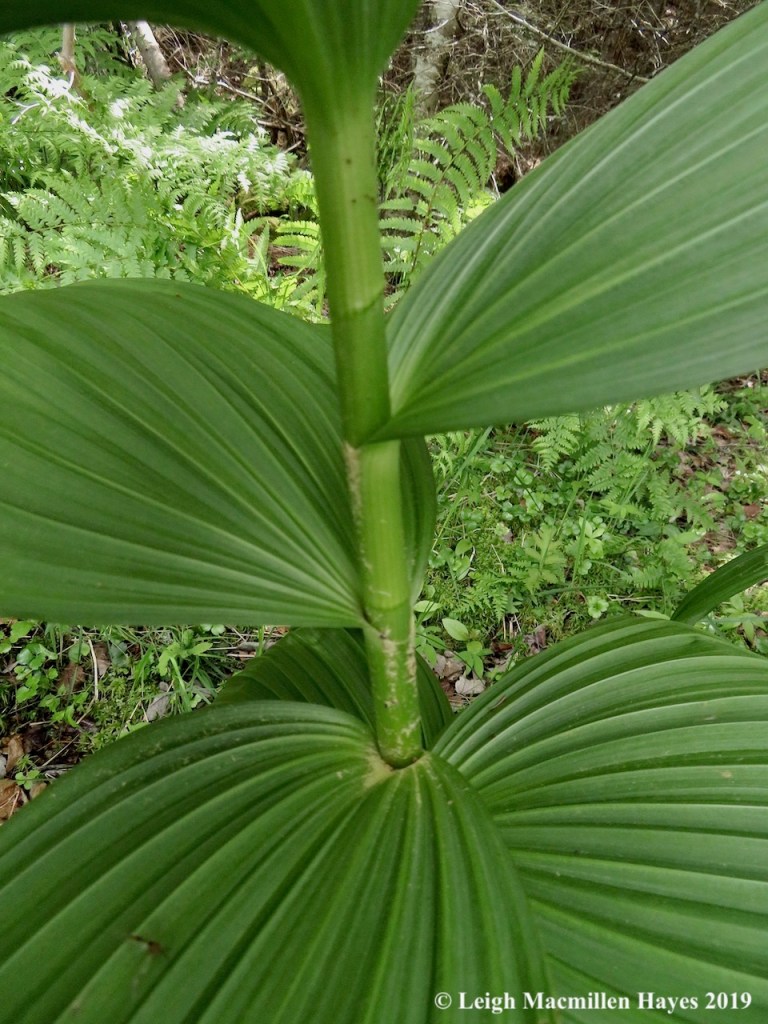
I've oft 
relished its
pleated leaves
of green,
their manner
that of the
lily family.
In a 
clasping formation,
they attach
to the main stem,
spirally arranged
from bottom
to top.
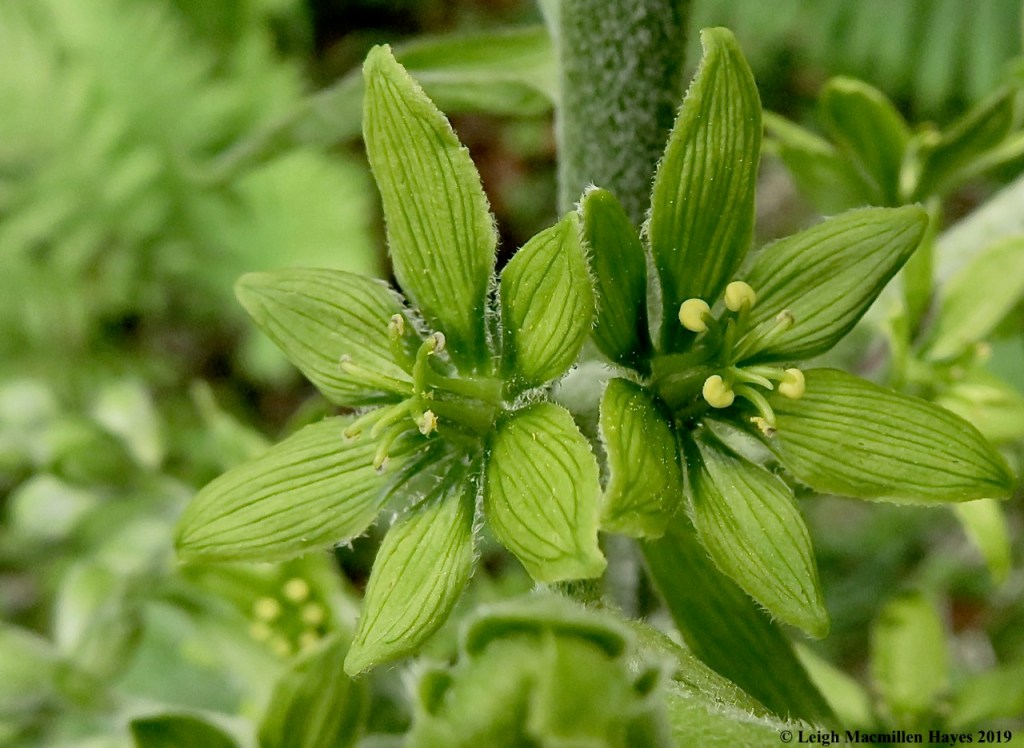
I've seen 
the plant often
in its leafy rendition,
but today
was the first time
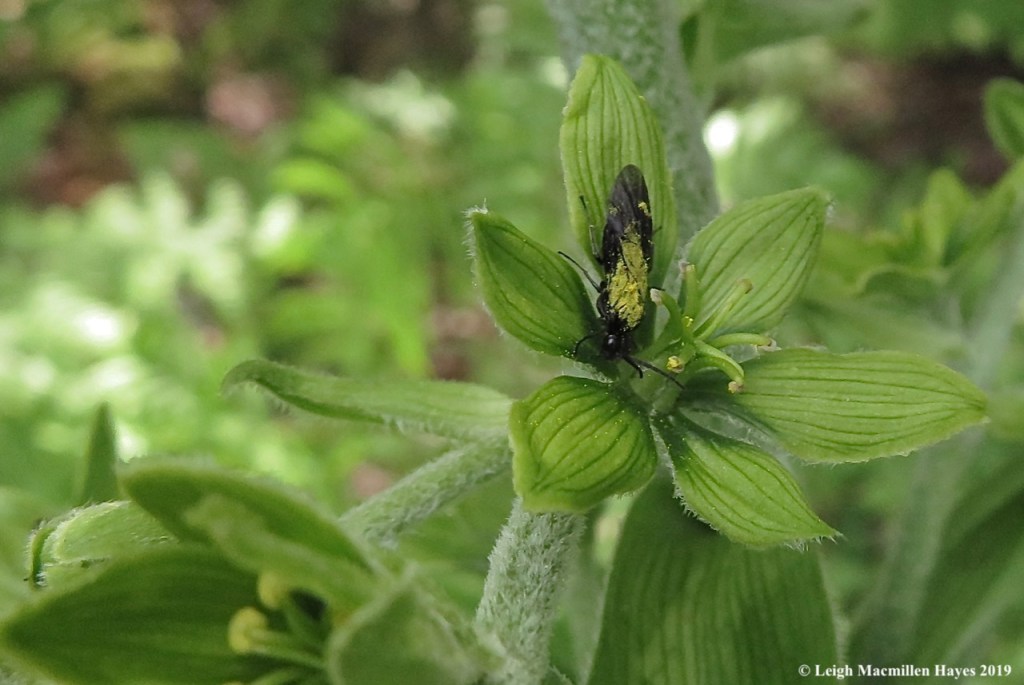
its star-shaped flowers
atop the plant
revealed themselves.
With
petals and sepals
combined
as tepals,
my friend noted
their resemblance
to the leaves below.
The more we looked, 
the more we realized
there were others
who also
revered
such a unique structure,
in particular
the nectar-producing glands
at each flower's base.
The plant
took advantage,
or so it seemed,
of allowing those
who ventured
into its sweetness
with a dash,
or perhaps
a dollop,
of pollen
to pass on
for future reference.
Because of its location
in the moist habitat,
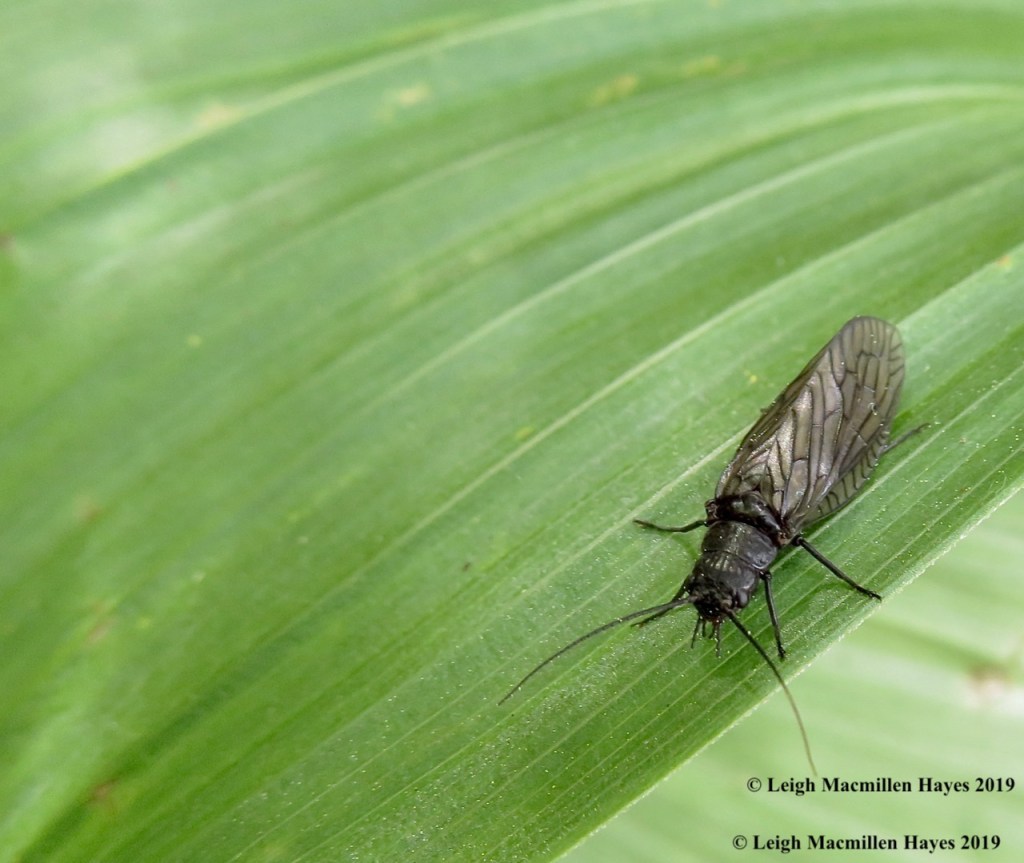
insects formerly aquatic,
such as
the Alderfly,
did walk
with sluggish movements.
Up its stout stalk
one rose,
the fuzzy structure
perhaps providing
it texture
upon which to climb.
Did it seek
the bright yellow anthers?
Or the nectar below?
With wings
delicately veined
and folded over
like a tent,
the Alderfly
paused
and hardly pondered
its next move.
The flower
mattered not
for this
weak flyer.
At last
it reached
the tip
of the
long, upright
inflorescence,
conical in form,
and I wondered:
would it pierce
the unopened flowers
for a bit
of nutrition?
Perhaps not,
for adults
of this species
have a need
more important
than eating.
Theirs is to
mate,
particularly at night.
Maybe it was
a he,
looking for a sight
to meet
a she.
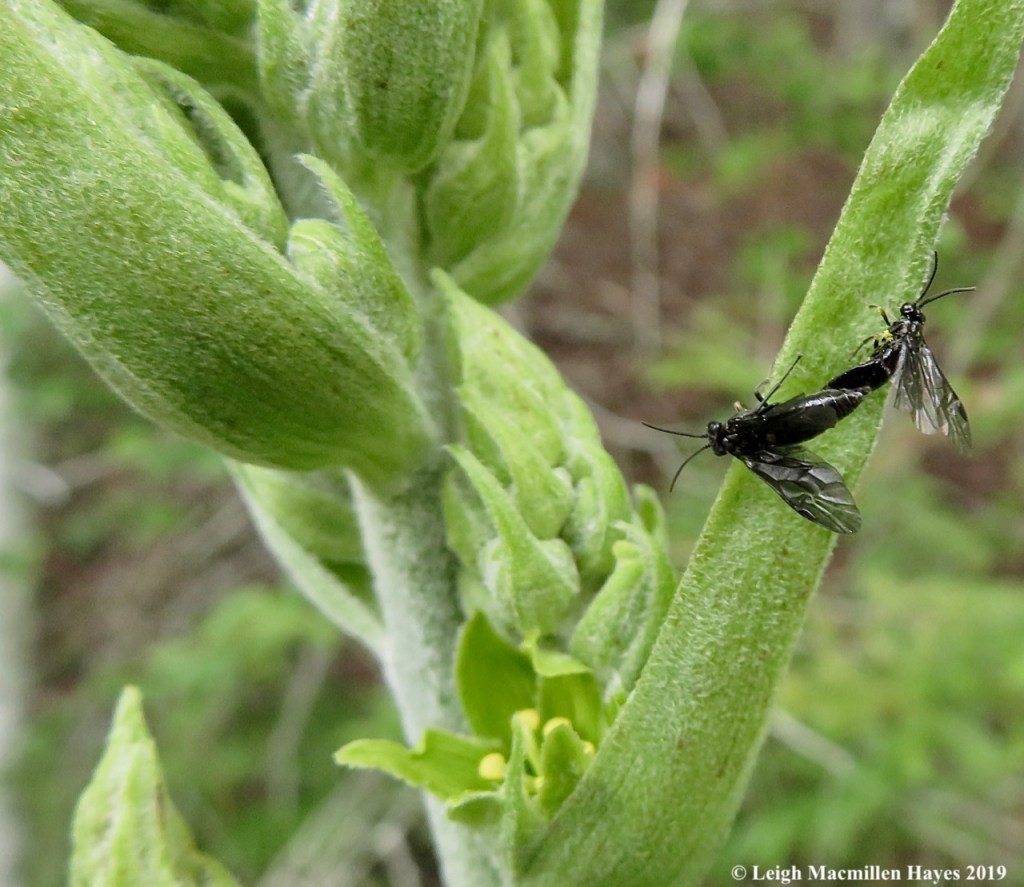
As it 
turned out,
not all
who had
canoodling
on their minds
could wait
until the day
darkened
to
night.
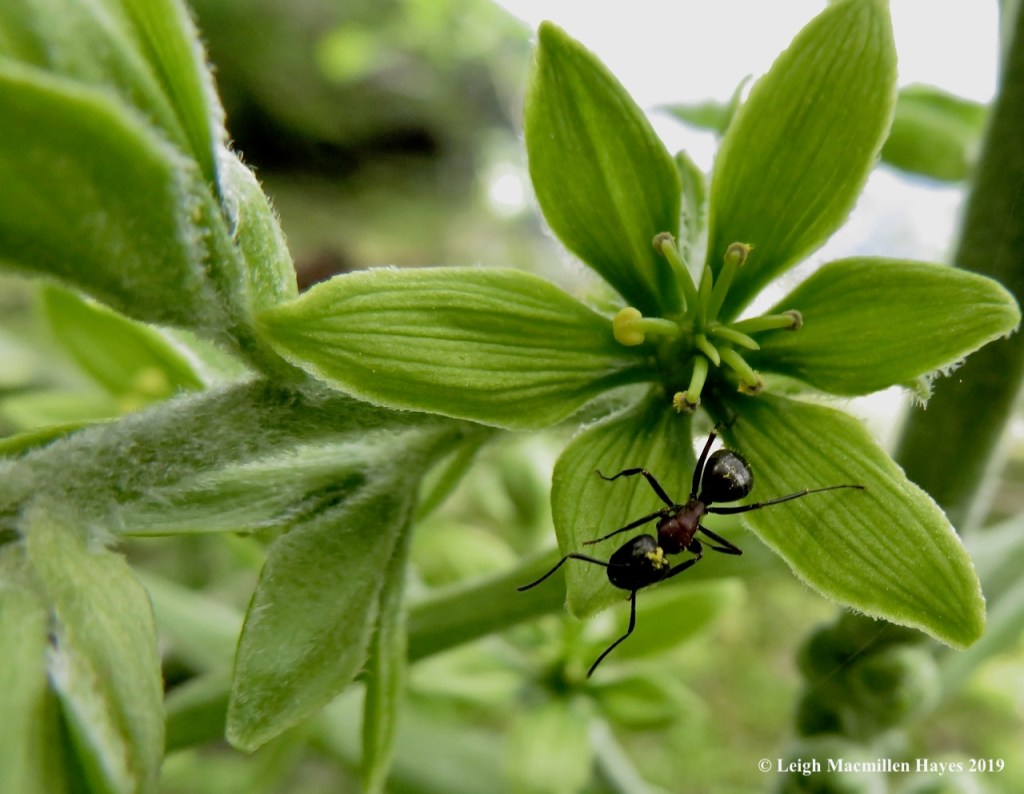
Meanwhile,
there were others
who sought
the sweet satisfaction
of nectar
for their needs.
And in 
the process
of seeking,
tads of pollen
decorated
their backs,
in this case
where X
marks the spot.
It was 
a place
for many
to gather
and garner
including
Lady Beetles
of many colors.
And upon 
those pleated leaves,
were Mayflies
who had
lived out
their short lives,
and Craneflies
taking a break,
while showing off
their wings
reminiscent
of stained glass.
After such 
an up-close greeting
of the delicate flowers,
and recognizing
for the first time
their immense splendor,
June 15
will forevermore be
the day
to celebrate
False Hellebore.

Behold the Gold Shoe

Today’s quest found me

seeking the Holy Grail,

though floral in form.

Yellowish-greens danced

on the breeze like dainty skirts.

Not the ones I sought.

Red stamens on one

dangled from the second tier.

Not the ones I sought.

Three distinct edges

of the capsule formed below.

Not the ones I sought.

More yellow tinges

on anthers hanging under.

Not the ones I sought.

Birds ready to fly

with wings a deep magenta.

Not the ones I sought.

At long last the stairs

Leading to the palace door.

Not the ones I sought.

Two more sets of stairs

But the palace door still closed.

Not the ones I sought.

Five sets of stairs checked,

each time the palace locked.

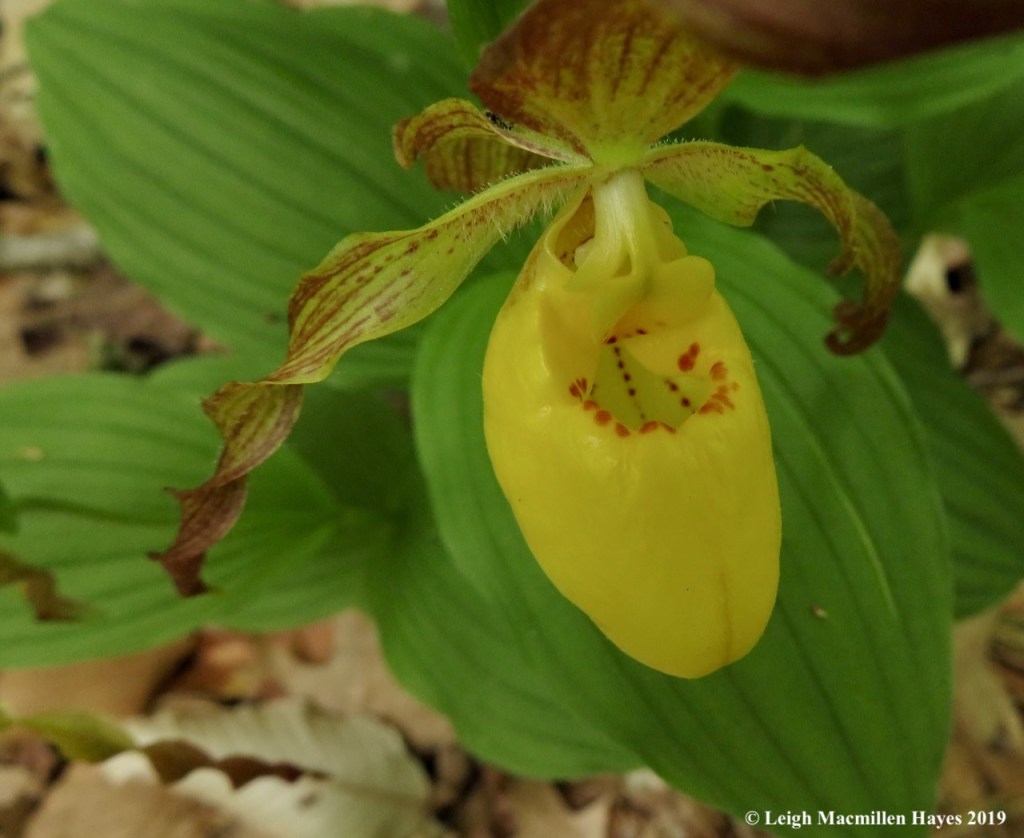
No shoes of gold here.

At last more steps climbed

and the palace doors opened.

My search had ended.

Uncommon in Maine,

the Holy Grail I sought.

Spring ephemeral.

Behold the gold shoe.

A showy forest orchid.

This Lady’s Slipper.

P.S. Thanks to Parker, Carol, and Ursula for sharing these flowers with me on past tramps we’ve shared.

Heaven on Heath

When Alanna Doughty, of Lakes Environmental Association fame, and I pulled into the parking lot of Saco Heath this morning, we had no idea what to expect. It is described as the southern-most coalesced domed bog in Maine. I have to admit, I need to learn so much more to understand the real meaning of that. According to The Nature Conservancy, for this is one of their preserves, “the heath formed when two adjacent ponds filled with decaying plant material called peat. Eventually, the two ponds filled completely and grew together to form a raised coalesced bog, where the surface of the peat is perched above the level of the groundwater.”

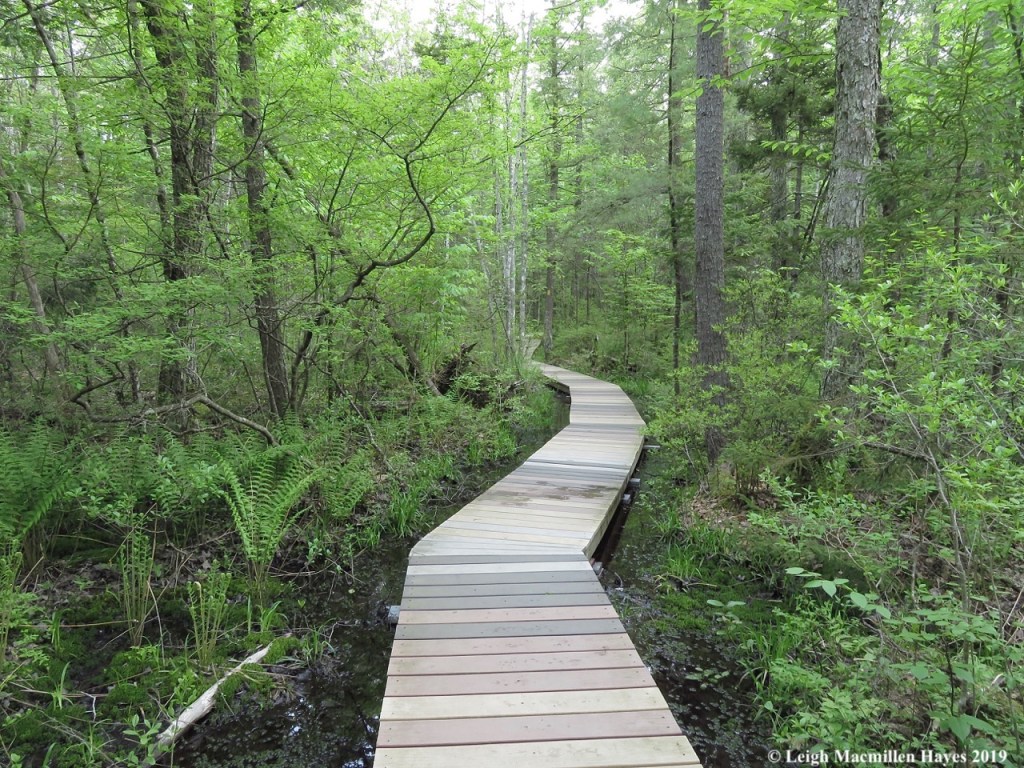
Our first steps found us walking through a forested bog rich with wetland plants including Cinnamon and Royal Ferns.

And then we entered the peatland through the pearly gates.

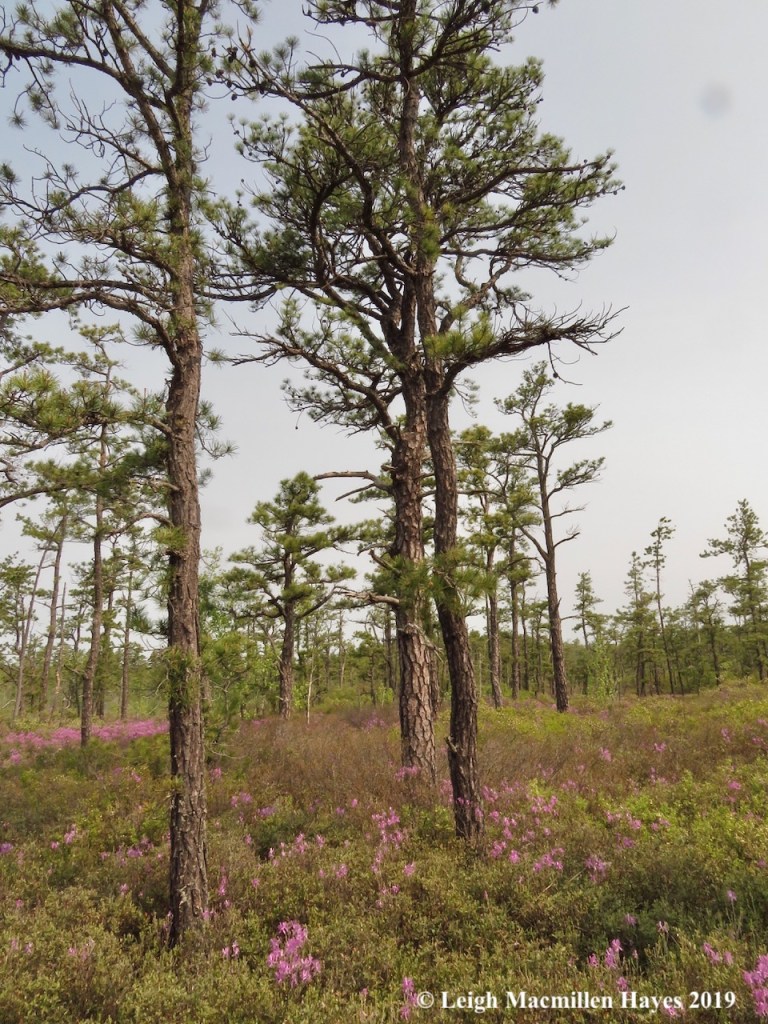
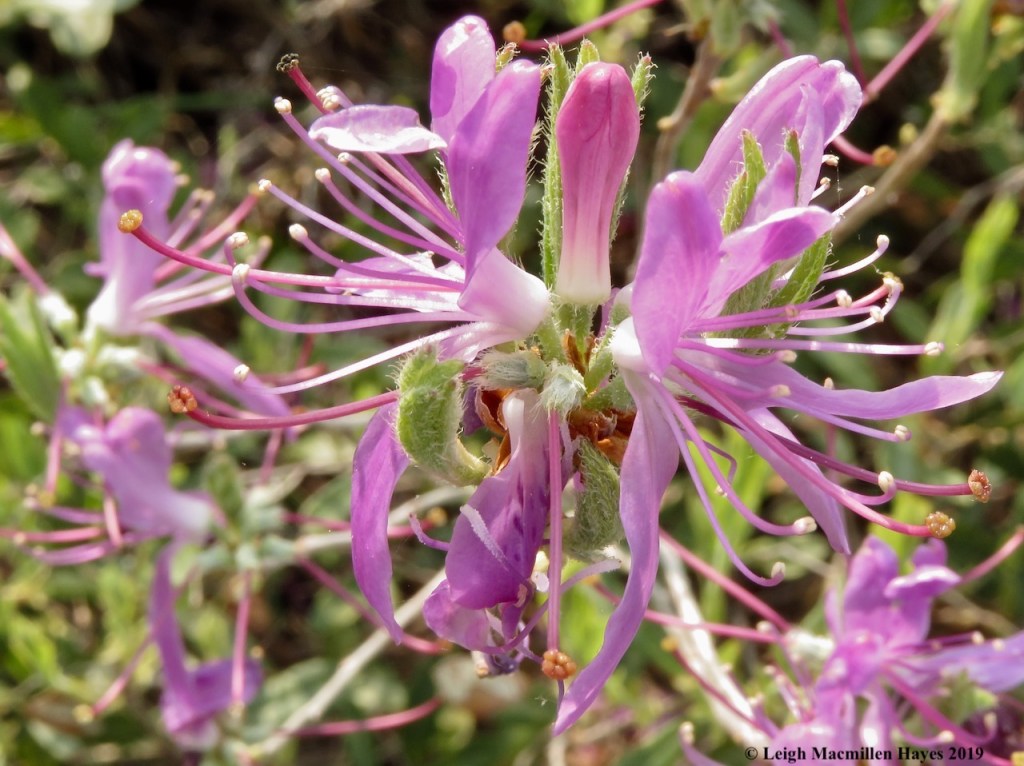
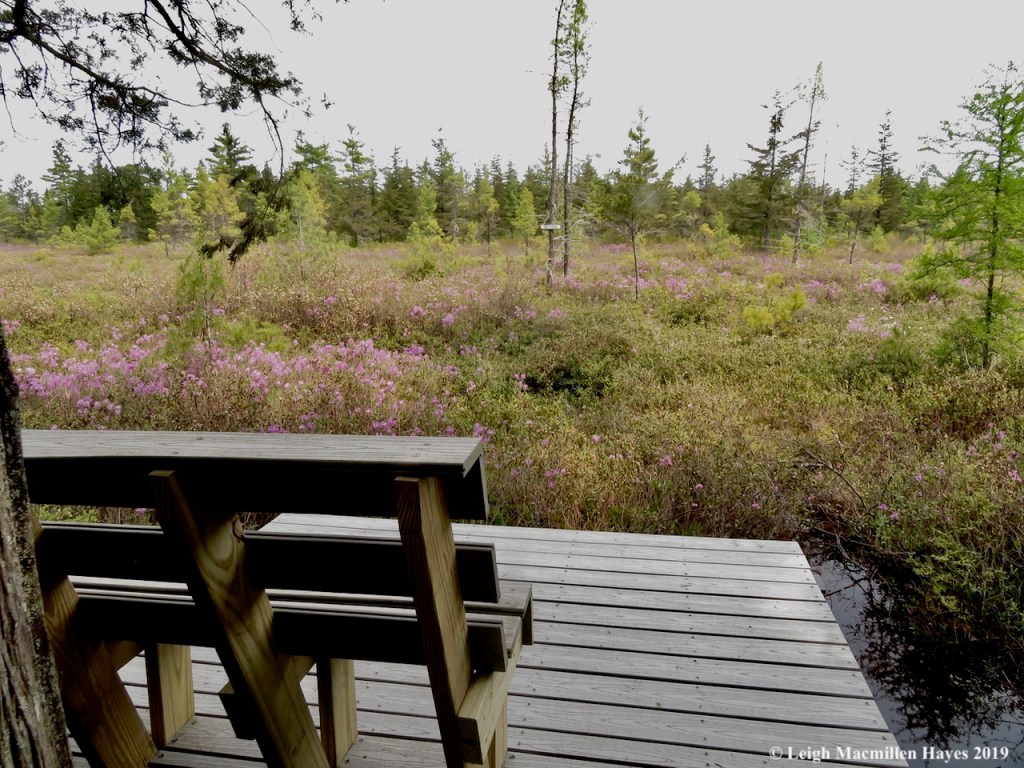
It was a place where one could disappear for a few lifetimes and eventually emerge completely preserved. With Pitch Pines and Black Spruce towering above, the colors gave us our first pause for the Rhodora was in full bloom and neither of us could remember ever seeing so much of it before.

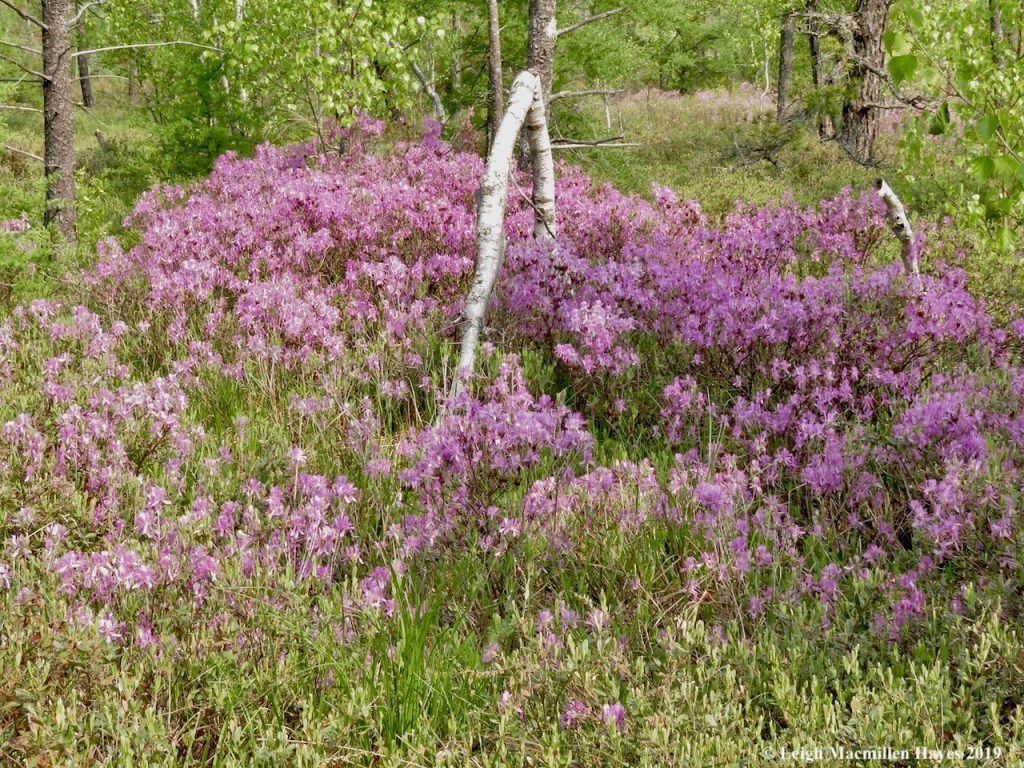
As it was, we seemed to have been transported into a still-life painting of spring where even the toppled Gray Birch might have been intentionally placed for such a contrast it provided.

Taking a closer look, it was suddenly obvious that life was not still at all and the flower drew our eyes in and out and in and out again with all of its lines.

We even found a few with brand new hairy leaves complementing the presentation.

This was a place where old friends live and greeting them again with a friendly handshake seemed only natural.

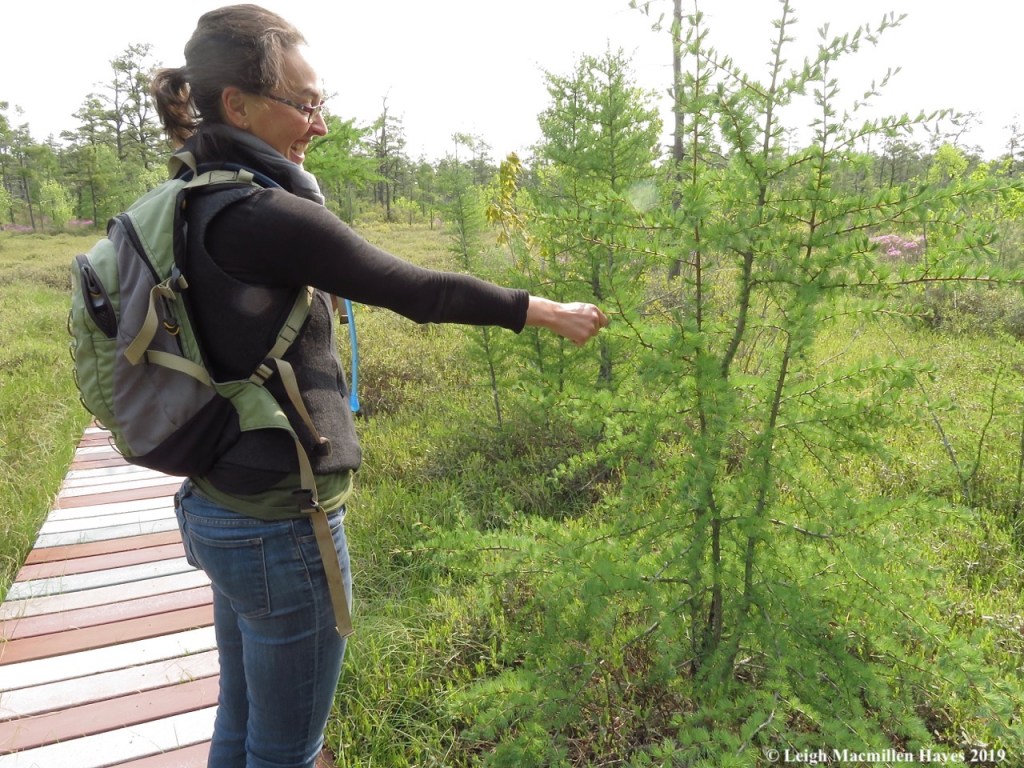
The Tamarack’s needles so soft and bright green graced the tree with a feathery appearance.

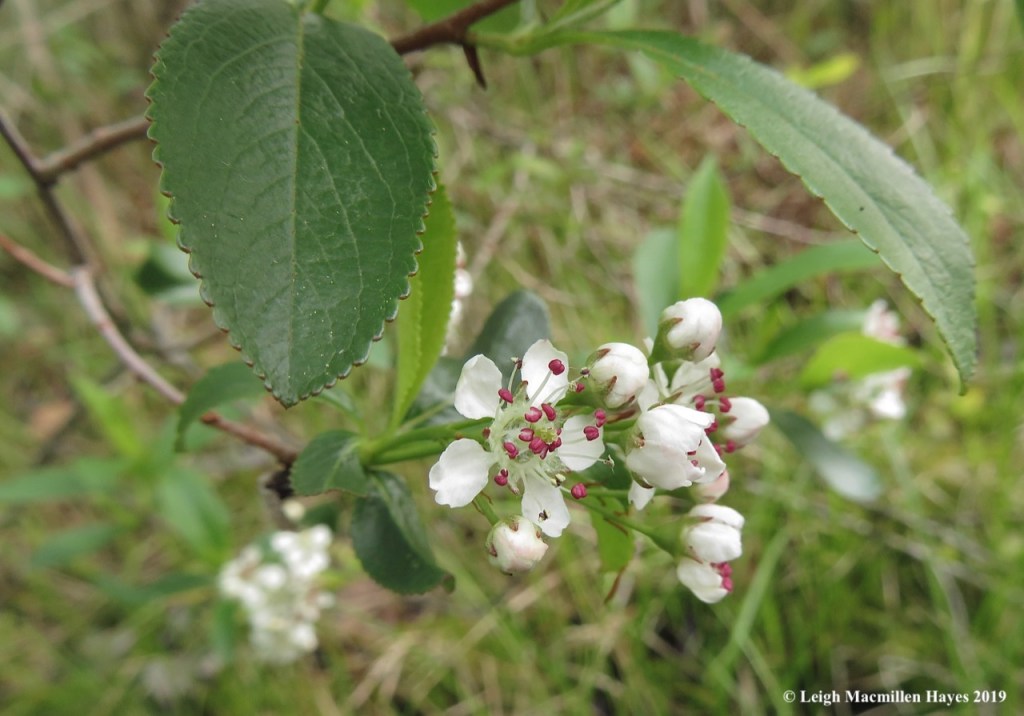
The flowers of the Black Chokeberry gave us pause for a few minutes for we had to get our shrub eyes adjusted to the brightness that surrounded us.

We weren’t the only ones with large eyes noticing all the goodness in our midst.

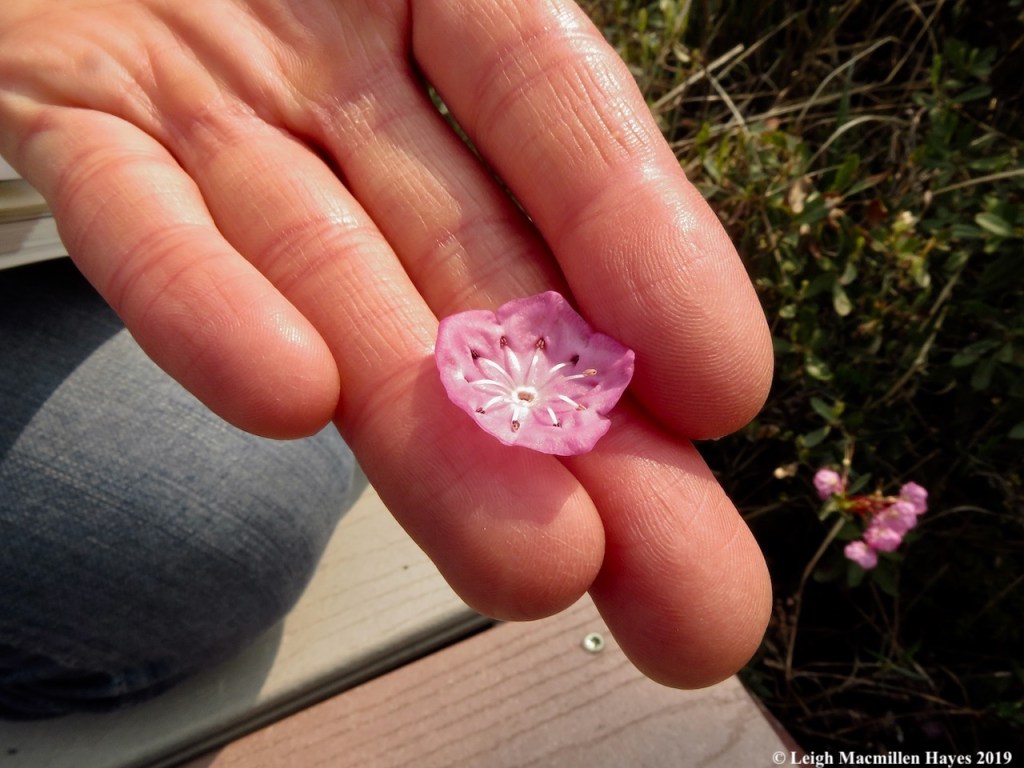
Being in a heath, members of the heath family made their presence known, such as the Bog Laurel. Some of the flowers had fallen to the sphagnum moss floor below the boardwalk, so we sat down to take a closer look at the flower, its petals fused into a shallow, five-lobed bowl. The interior of the bowl was interrupted by ten indentations where the pollen-bearing anthers snuggled as if in individual pockets. Each awaited a pollinator to trigger the spring-like tension and thus get showered with pollen. We may have unintentionally aided in sharing the goodness.

Because we were looking and trying to gain a better understanding, Alanna ran her fingers down the Bog Laurel’s stem, reveling in the recognition of the longitudinal ridges between each pair of leaves. From one set of leaves to the next, the ridge orientation and next set of leaves shifted 90˚. In the land of wonder, we were definitely wallowing in awe.

Another member of the heath family stumped us for a few minutes until it reminded us that its “pineapple” form atop the rhododendrum-like leaves was not the fruit, but rather the start of the flower.

It was a few plants later, that we noticed the flowers beginning to burst.

While we watched, a male Painted Lady paused atop one of the laurels as if it was a pedestal, the better place from which to possibly entice a mate.

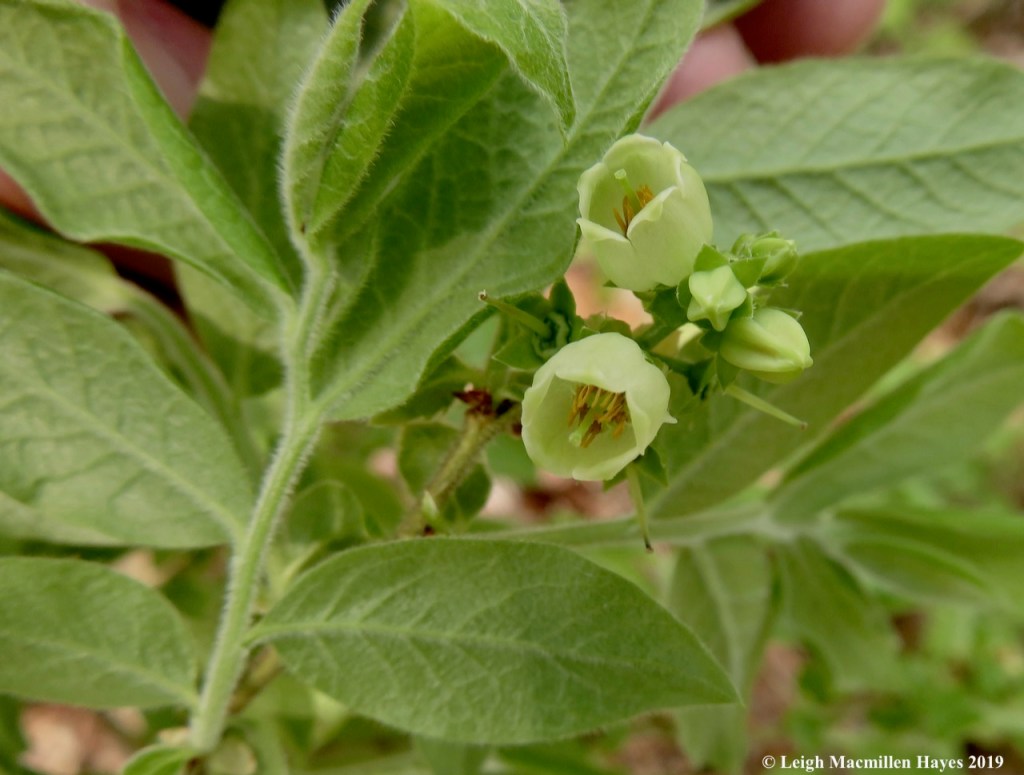
Shortly thereafter we made a new acquaintance. By its shiny, parallel-veined leaves we thought we knew it, but then we spied the tiny white flowers. We know False Solomon’s Seal, but join us in greeting Three-leaved False Solomon’s Seal. Ronald B. Davis writes in Bog & Fens, “In bogs, it commonly occurs on a peat moss mat at the transition between a mineorotrophic black-spruce wooded area and a more open ombrotrophic area.”

Indeed, I have a lot to learn, but the natural community was transitioning again.

And within the transition zone, we met another new friend: Mountain Holly. In retrospect, we may have met in a past life, but it’s always good to spend some time getting reacquainted with the finer details such as the tiny flowers at the end of long, fine petioles.

At the end of the boardwalk, the trail loops around through a forest of pines and oaks.

At the shrub level, Bumblebees acted as bell ringers while they flew from one flower of the Highbush Blueberry to the next, making sure that all were in tune.

It was in this same neighborhood that we met another for the first time. Velvet-leaved Blueberry’s leaves and stems were as soft as any robe an angel might wear.

Below, her bell-shaped skirts dangled.

A surprise along the loop trail was a spur to an outlook where a sturdy bench offered time for contemplation and meditation.

Several signs beyond our reach warned us not to step off the platform and into the bog, but . . . it was soooo tempting. And weren’t we in the garden?

As we stood and wondered about what we might be missing, we spied several Pitcher Plants with their urn-like leaves.

And directly behind the bench stood one of the rare species for which this place is known: Atlantic White Cedar

Though we never did see the Hessel’s Hairstreak Butterfly, another rare species associated with Atlantic White Cedar, we honored the tree by taking a closer look at its foliage.

And then it was time to return back across the boardwalk, upon which we immediately noticed a huge Pitcher Plant we’d missed on our previous pass. In its center the bulbous red flowers posed as cranberries.

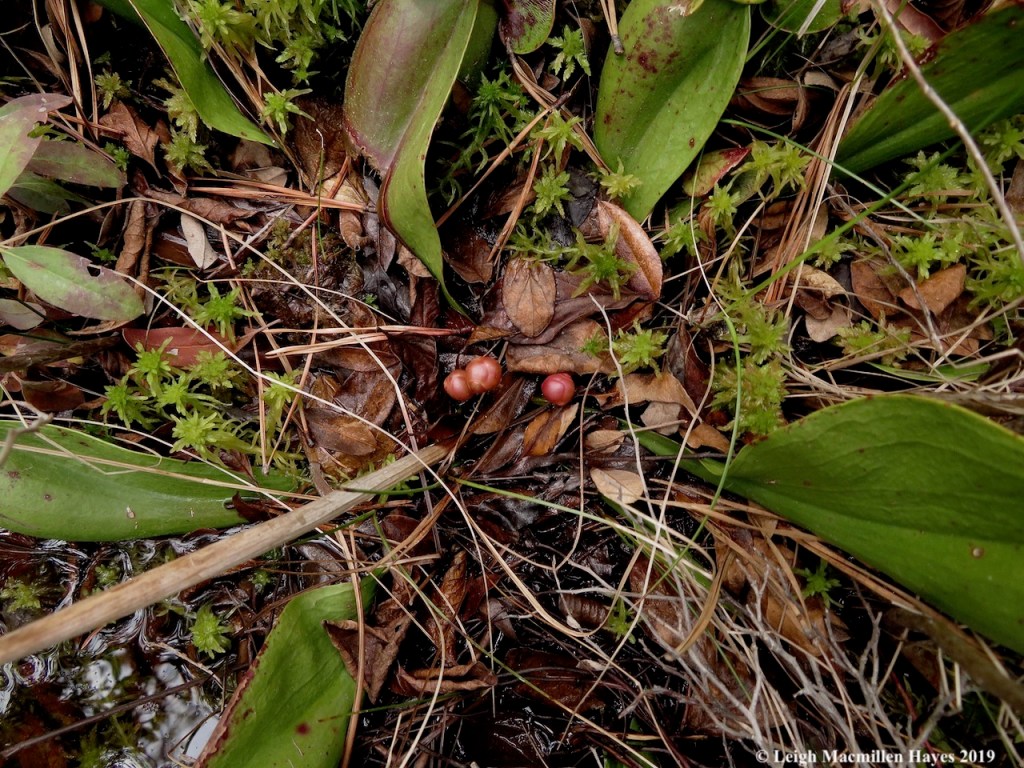
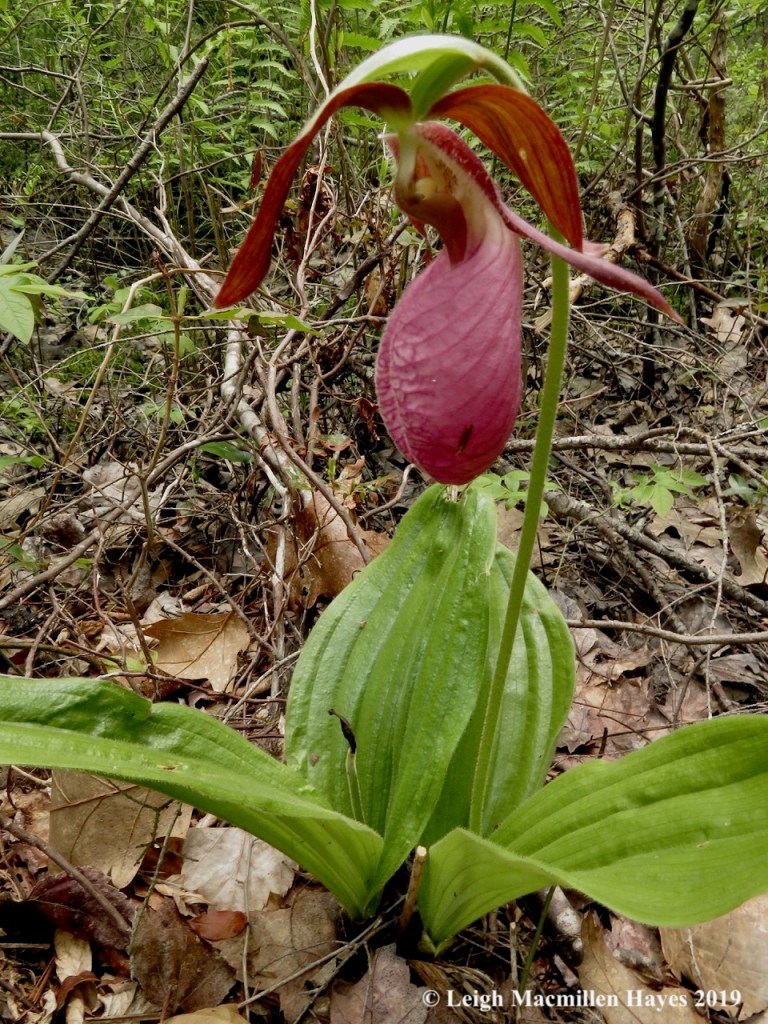
We also spotted a couple of Pink Lady’s Slippers in bloom that we’d previously walked past, giving thanks that we’d had to follow the same route and because of that made some new observations.

At the end of our time we knew we’d visited a very special place that allowed us to come to a better understanding of old friends and make new acquaintances. It certainly felt like we’d spent the morning at Heaven on Heath.

Because of the Elder Alder

“Mind your elders,” they say. And so today I did.

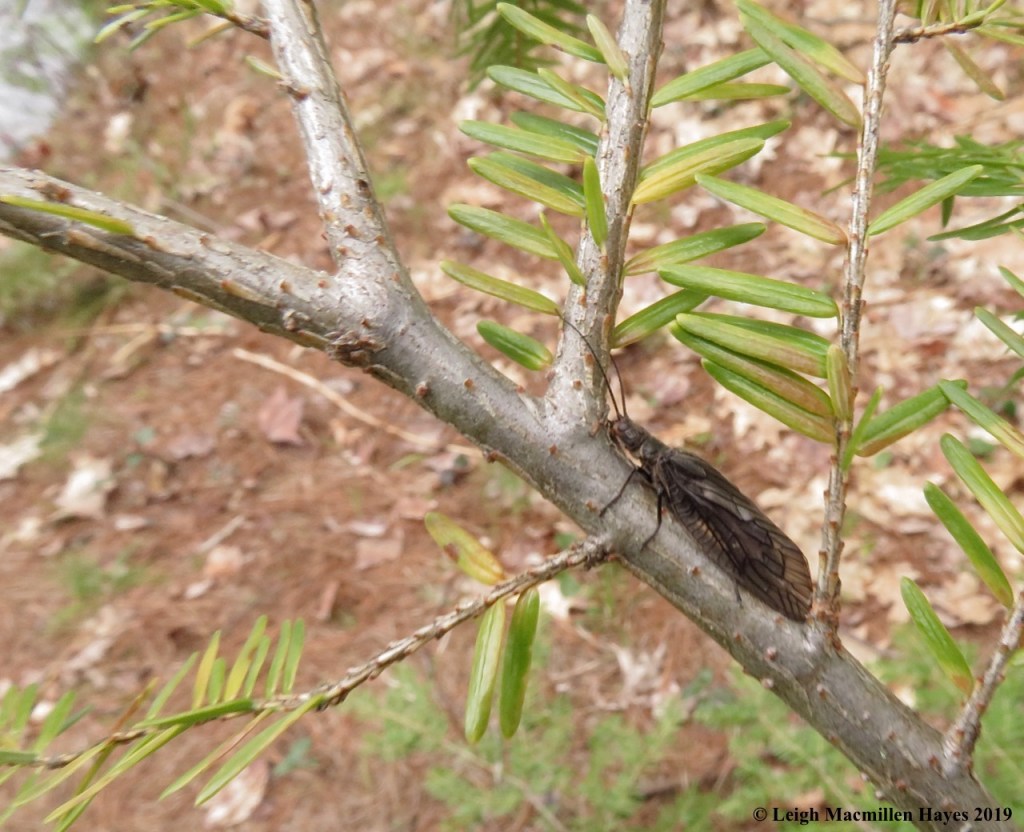
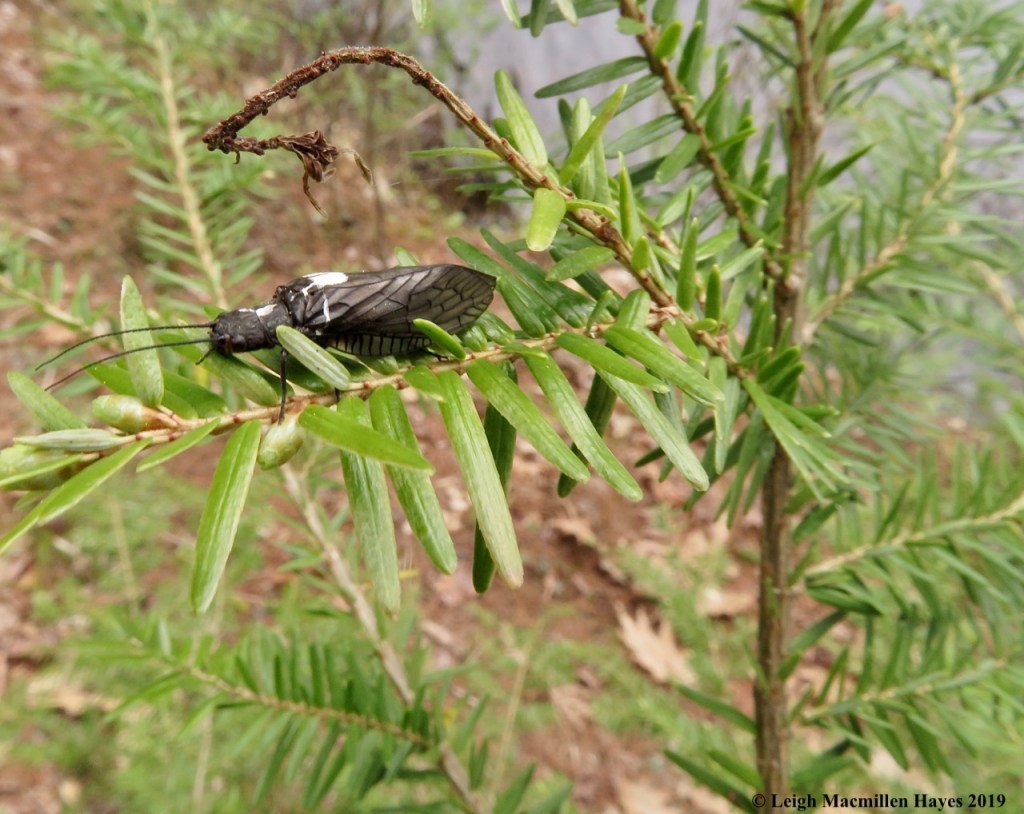
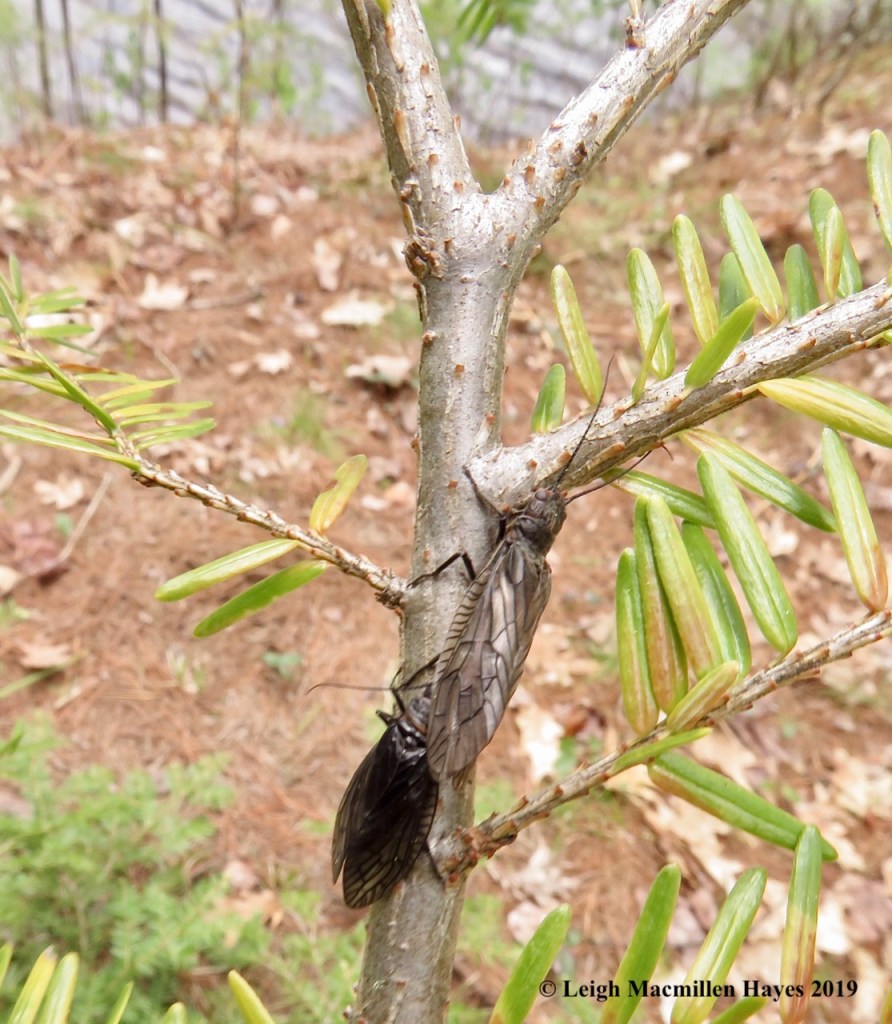
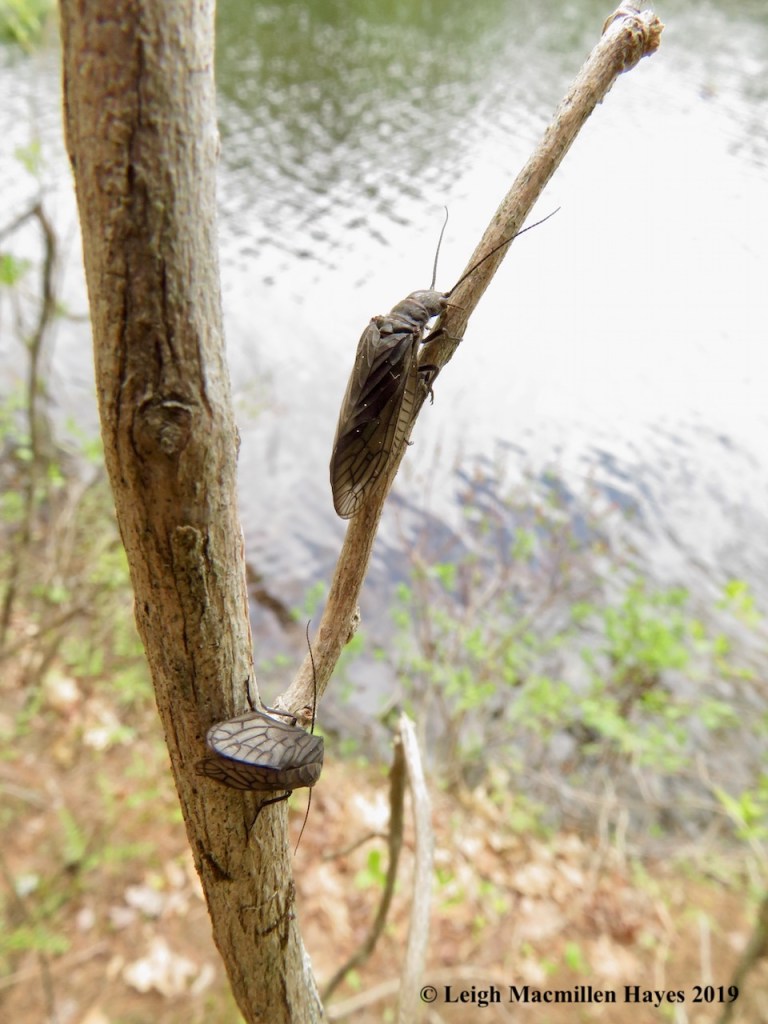
It all began when I stood by a river in expectation of spying a few dragonfly exoskeletons. Low temperatures of late mixed in with lots of rain, however, meant that while the Black Fly and Mosquito populations are on the high side, the dragonflies have been slow to delight us with their presence. But . . . while I looked my eyes began to focus on another bug. On small saplings of Hemlock and others along the river bank, I found numerous takes on the same insect. Though winged, none of them appeared to be in a great hurry.

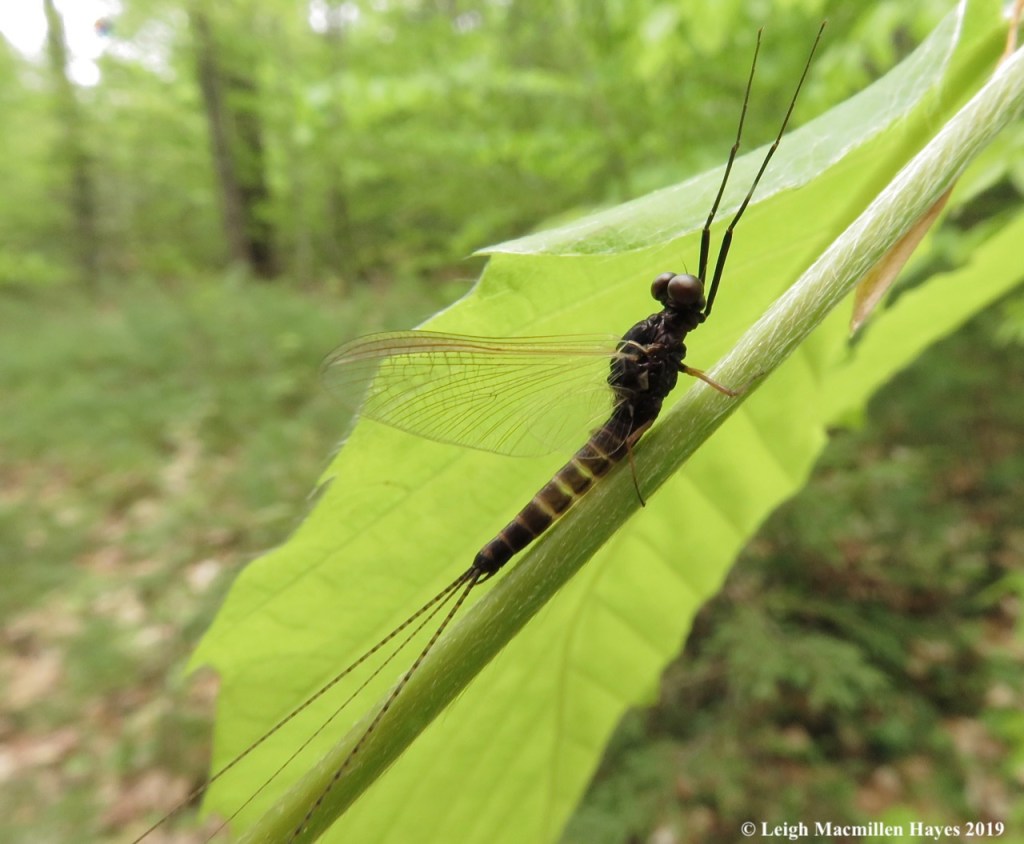
While I looked about, I realized that they weren’t the only ones who chose to stand rather still. The same was true of the Mayflies recently hatched, their eyes so big, bodies so striped, and mouths non-existent for eating was not their prime duty. Mating was the name of the Mayfly game.

And it appeared that others had the same intention in mind. And so I continued to circle back to them in my usual stalking routine.

“My, what long antennae you have.”

“The better to stroke you with, my dear.”

While I looked about, a bird flew in. My initial reaction: a thrush. More specifically: a Hermit Thrush. But . . . recently I’d learned that what I thought was a Hermit turned out to be a Swainson’s Thrush–a species I tended to ignore because I didn’t realize it might be a possibility in western Maine, until it was. And in the past two weeks, I’ve had three occasions upon which to make its acquaintance.

What I’m learning to note is its buffy eye ring and consistent color. I’m not a great birder, and don’t ask me about sound. Though I was raised in a musical family, the gene somehow was dropped from my DNA. I find that I appreciate the songs and calls that I hear. In fact, my life is enlightened by the morning orchestra. But . . . don’t ask me to repeat a note for it goes in one ear, out the other, and continues on into the forest reverberating against bark and leaves and illuminating the world in a manner ethereal–just not one I can remember.

As for the resident bugs, I found one that had bird droppings on it, but somehow it had managed to avoid becoming dinner. So far.

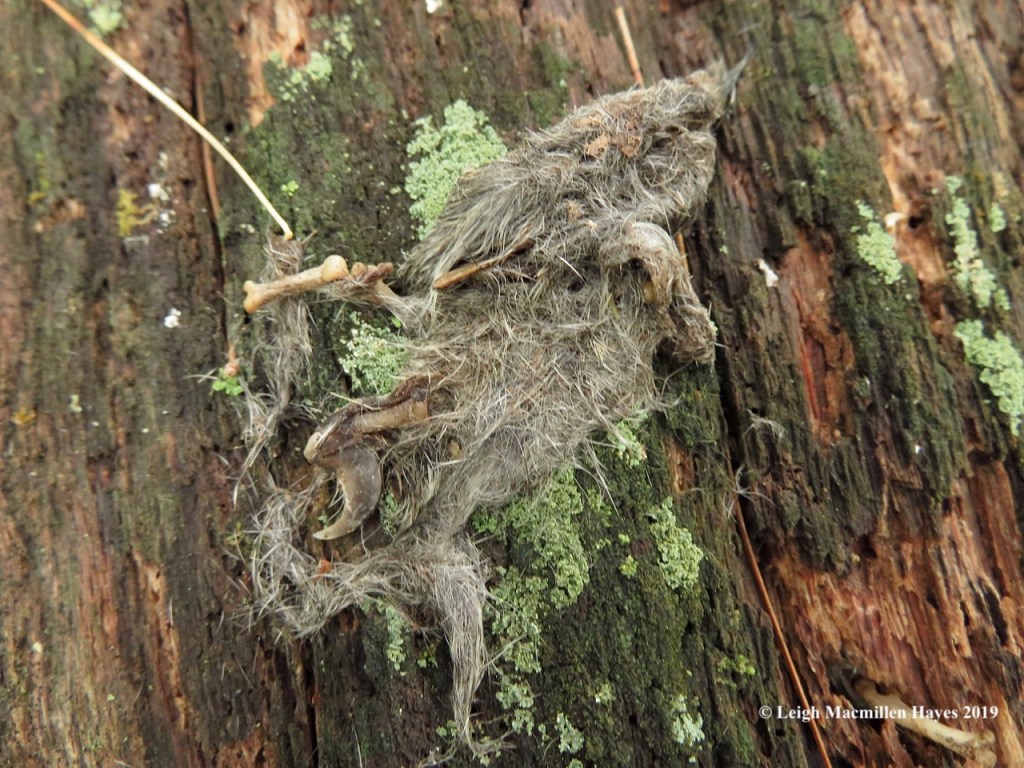
While I looked about, a bird of another sort made itself known–via a pellet filled with hair and bones.

Meanwhile, back on the first Hemlock sapling, I overheard this:

“Do you want to see me Hemlock needle collection?”

“Oh yes, please. I thought you’d never ask.”

While I looked about, I also noticed Starflowers in bloom, their tender blossoms practically imitating the leaves below.

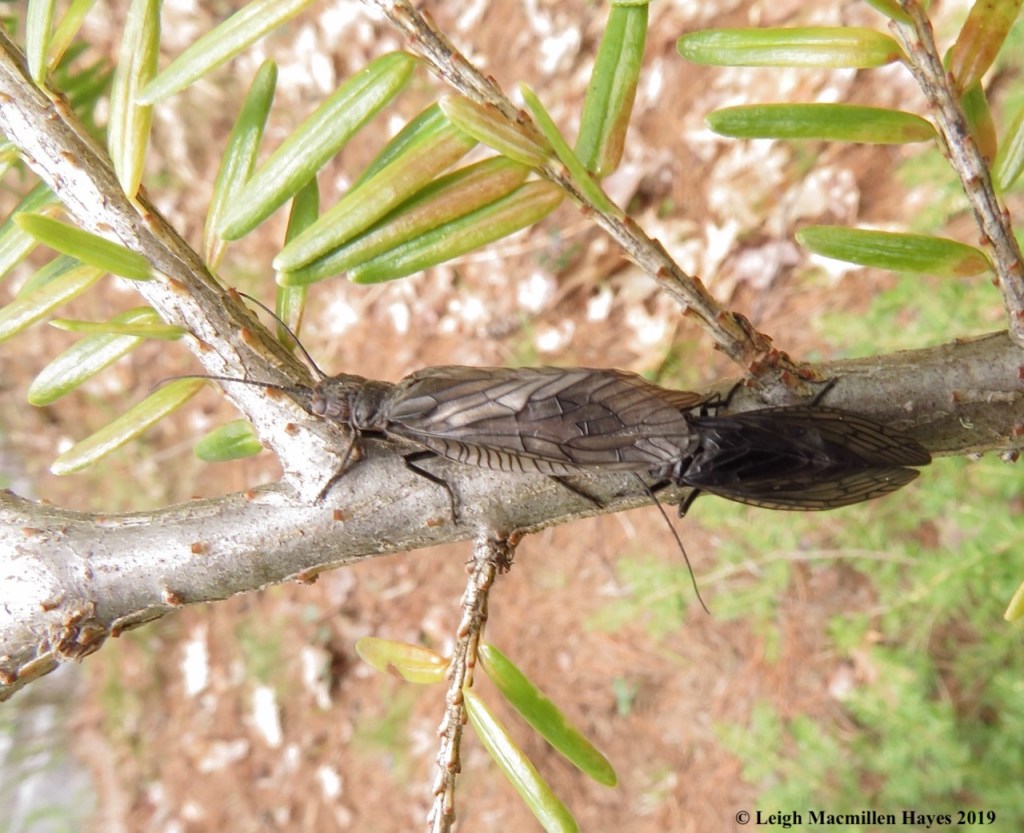
Back at the ranch, or rather branch, the dance had finally begun. It was a slow one, indeed.

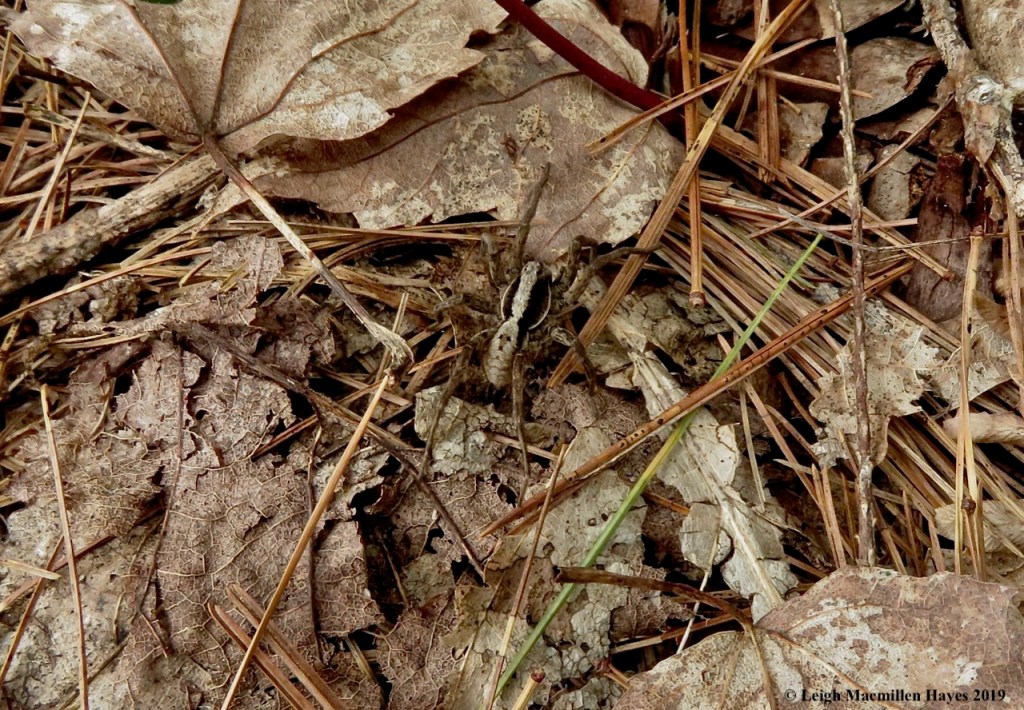
While I looked about, one with much more speed scurried across the forest floor. Where’s Waldo Spider? Do you see him?

And on the branch the slow dance continued as the partners spent time getting to know each other.

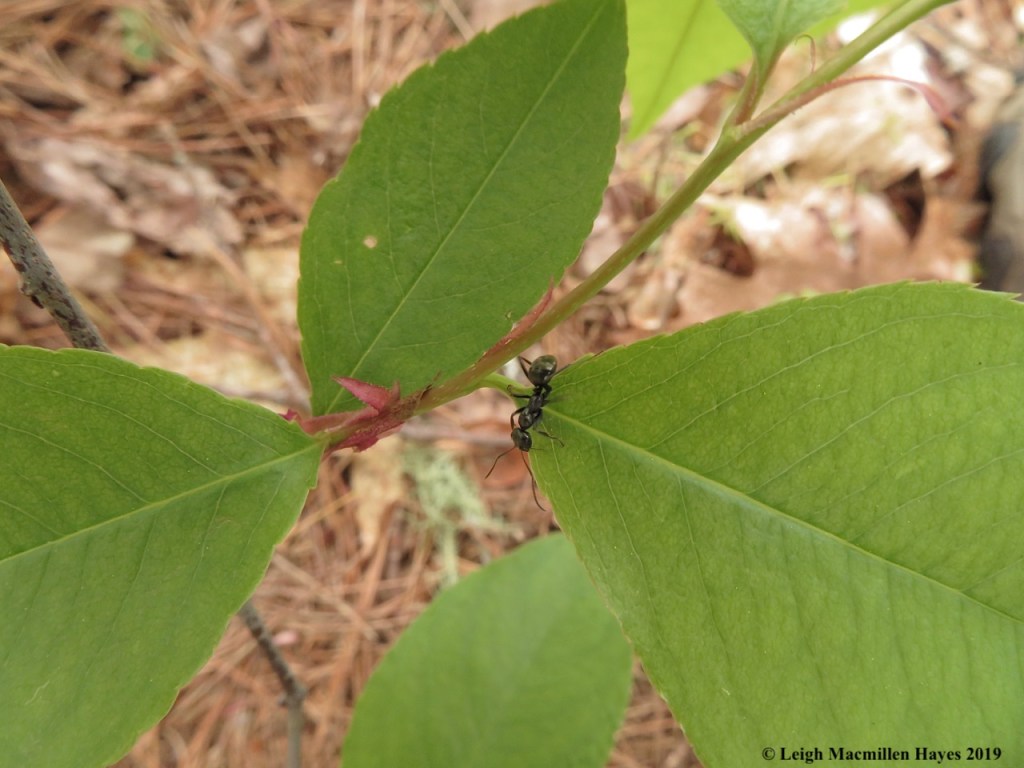
While I looked about, ants ran up and down stems all around on a quest I couldn’t quite understand, though I’m sure there was sugar involved.

On the branch: He stepped in closer with his left foot and she with the right as they began to Rumba.

While I looked about, I realized other insects had become meals so caught were they in the tangle of a web.

On another sapling, others waited to cut in. It’s a recognized practice to cut in. The guy who wants to cut taps the gal’s partner quietly on the shoulder. The dancer must let her go both courteously and cheerfully. She, of course, has no choice in the matter.

On the branch: He was going to allow no one to cut in. And she felt the same.

While I looked about, I discovered a white Lady’s Slipper not yet in full bloom, but when it does, it will be the perfect dance shoe.

When I at last left, the couple continued to explore each other, though mating doesn’t typically take place until nighttime. I guess this male was ready to get a head start. After all, their window of opportunity isn’t long, so they must make hay while the sun doth shine.

Because of these elder Alderflies, I had the honor to see and learn so much today.

Bluebird, Bluebird, Through My Focus

It rained. The sun came it. Rain drops continued to fall. Until they didn’t. Then the temperature rose to a degree we haven’t seen in over eight months here in western Maine. And we melted.

But, with the heat wave came some new visitors, including this male Baltimore Oriole, so named because his coloration resembled the coat-of-arms of Lord Baltimore.

The funny thing about Lord Oriole: he’d stopped by a few days ago when I had a sturdy chunk of suet in the feeder. After seeing him, I immediately added orange slices to the offering in hopes of enticing him to return.

And so when he did this morning, I marveled at the fact that he ignored the oranges and chose instead a small bite of the suet.

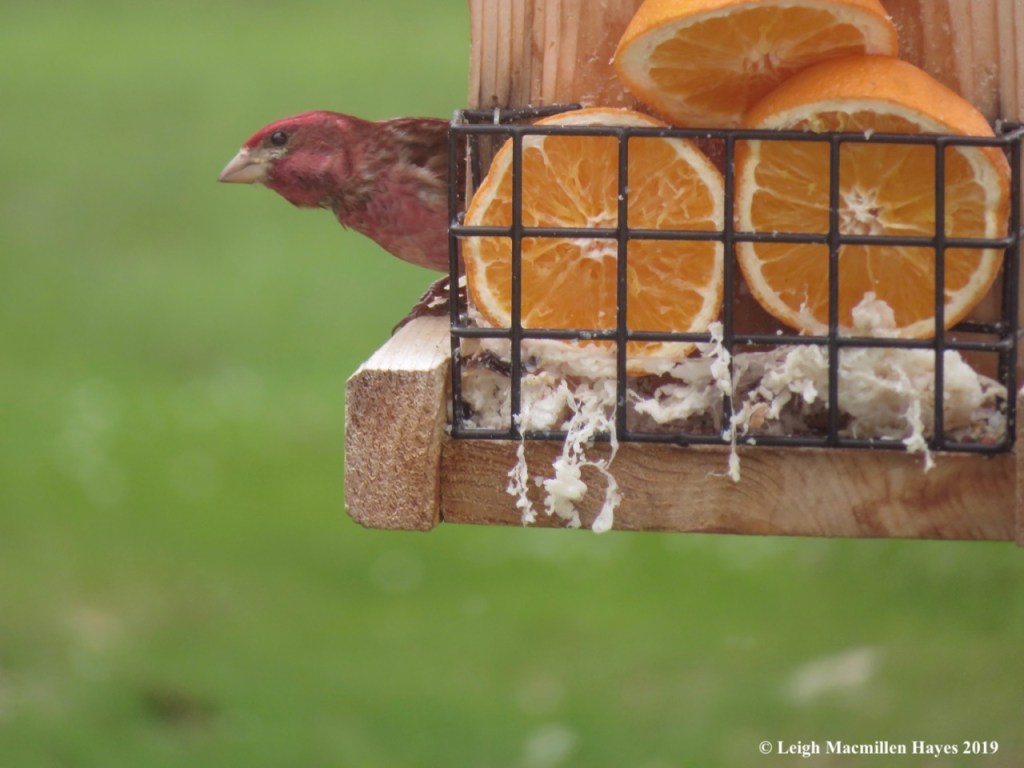
Adding more color to the yard was a male House Finch. He tarried not long for his gal paused in the lilac bush and then flew past and he followed in hot pursuit.

But I gave thanks to the finch for as I looked for him to return, I noticed movement on the outer edge of the garden below the back deck. Shuffling about the dried leaves looking to glean a meal was a Common Yellowthroat. My very own Common Yellowthroat. Certainly another reason to rejoice.

There was more rejoicing to be done for I eventually found my way to the vernal pool. I realized I’ve been avoiding it lately, ever fearful after discovering a few dead frogs that life had taken a turn for the worse within that small body of water.

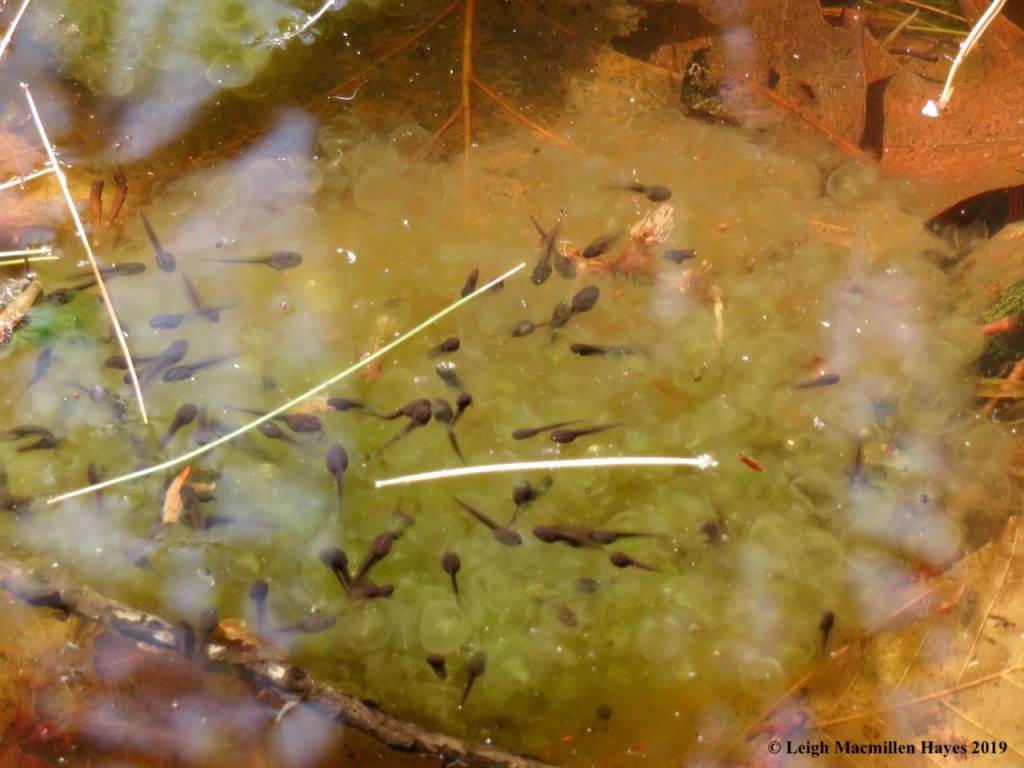
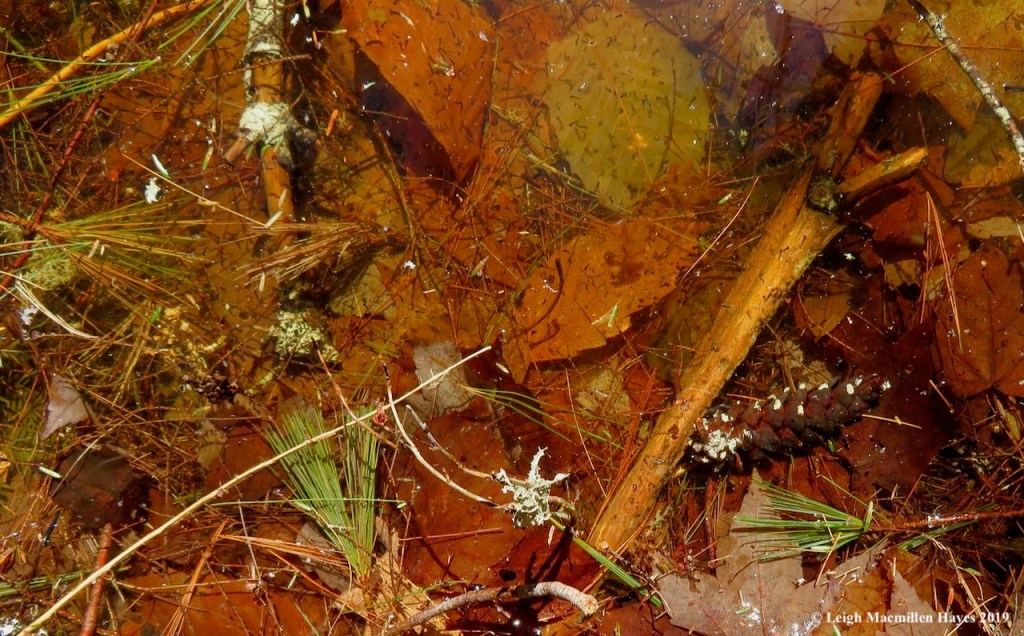
But the surprise was all mine when I discovered recently hatched tadpoles resting atop an egg mass. The green color is an algae with which they share a symbiotic relationship. The algae colonize the egg mass and produces oxygen. Being symbiotic, it’s a two-way street and the algae benefits from the eggs by gaining carbon dioxide produced by the embryos. The carbon dioxide is needed for the photosynthetic process. For a few days after hatching, the tadpoles feed on the alga.

Salamander embryos within their own gelatinous also took on that greenish hue due to the same symbiotic alga. My heart was filled with joy for there were numerous masses within the pool, most of them spotted salamander. And now I can only hope that the pool stays wet enough for them to mature and crawl out as their parents did.

Leaving the pool behind, I wandered toward home, but a familiar call beckoned. It took a few minutes for me to locate the creator, but eventually I saw him.

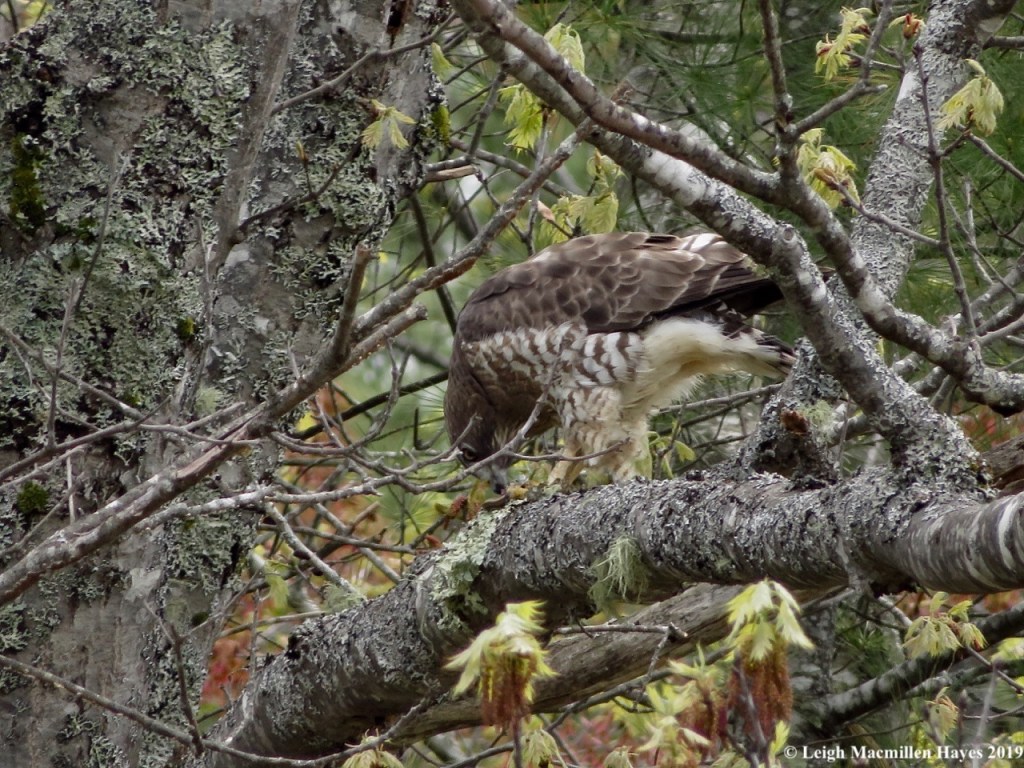
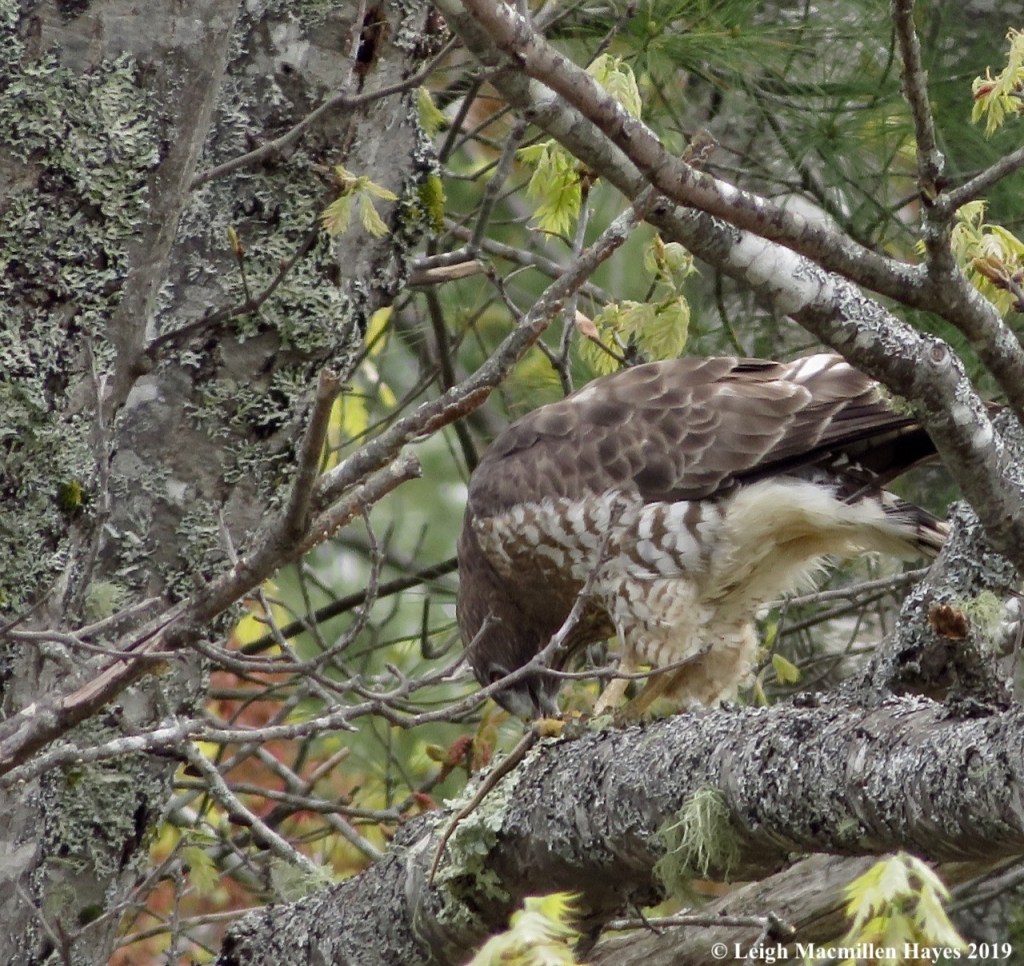
On a sturdy branch parallel to the ground, the Broad-winged Hawk did dine. He also frequently announced his presence with his high-pitched voice.

As a true carnivore, he’s known to eat reptiles, amphibians, birds, small mammals and even large insects. From my stance, I thought I saw a long tail that didn’t seem right for a vole. Instead, I wondered if it was a snake. I kept expecting to be greeted by one beside the vernal pool and the hawk wasn’t all that far away. I suppose that means that if the salamanders and frogs are able to crawl and leap out of the water, they’d better find good hiding places because this guy and a possible mate have been soaring above for a couple of weeks and probably have a nest nearby.

In the end, it seemed that whatever his meal was, it was lip-licking good. Upon finishing it, he flew south while I trudged across the field to the east. But I suspect our paths will cross again going forward.

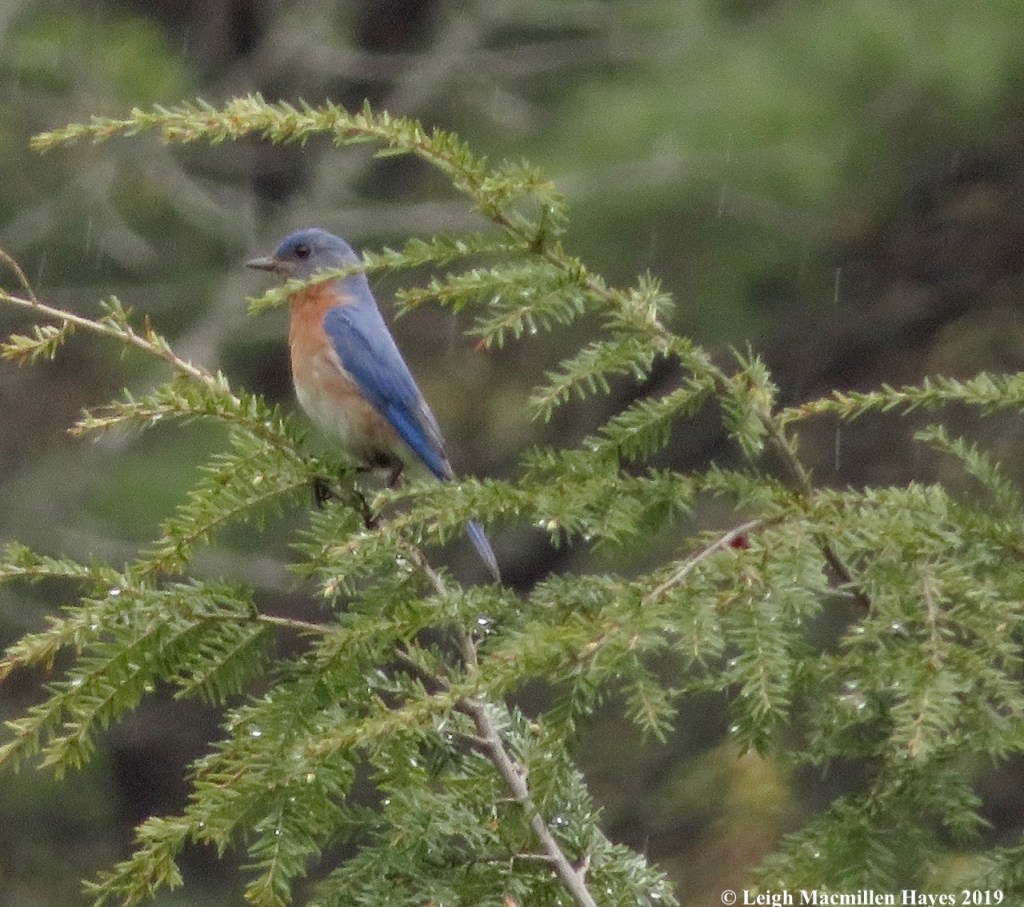
All of those finds were spectacular, but . . . one of the best parts of the day–watching Eastern Bluebirds in the yard. I first spied the male in this morning’s rain.

And then late this afternoon, I was surprised to discover that they were both here, the she and the he. For the most part, they stayed out by the stone wall, perched on branches above before flying down to catch a meal.

Then they flew closer to the house and landed atop the feeders where I don’t have any mealy worms that are much to their liking. I hadn’t even planned to still have the feeders out, but with each new day bringing new visitors, I’ve delayed taking them in for the season. That is, until a Black Bear arrives.

But no Black Bears yet. (Just wait, one will probably show up overnight or tomorrow.)

And so . . . Bluebird, Bluebird, through my focus. Thanks for taping me on the shoulder. ;-) And sharing this day with me.

Significant Fairies

We’d made promises in the recent past that fell flat. With that in mind, when the Greater Lovell Land Trust’s Nature Explorers, a homeschool group led by Docent Juli, gathered this morning, she was smart and stuck to the life cycles of potential sightings like frogs rather than possibilities.

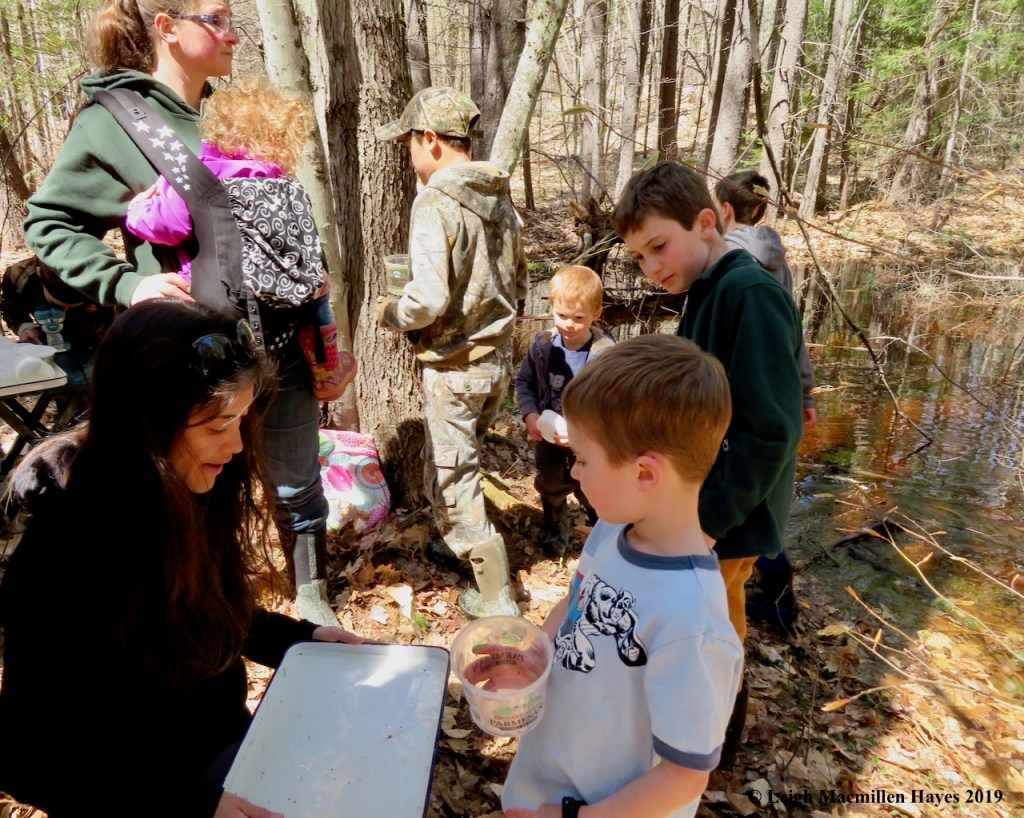
The group that gathered was large–24 in all with a mix of moms and their children.

Of course, being kids, they were immediately attracted to the water below the mill site at Heald Pond. But after letting them explore for a few minutes, a light whistle pulled them all together again.

At the nearby vernal pool, everyone quickly learned what larval mosquitoes looked like as they watched them somersault through the water column. A few complaints were expressed about future bites, but that was redirected to the fact that mosquitoes feed birds and dragonflies, and in their larval form, other aquatic insects.

Pond dipping became the morning habit and at first, it was only the mosquito larvae that made it into the containers.

But, that led to a quick lesson on the biting insects’ life cycle–one of many teachable moments that snuck into the morning fun.

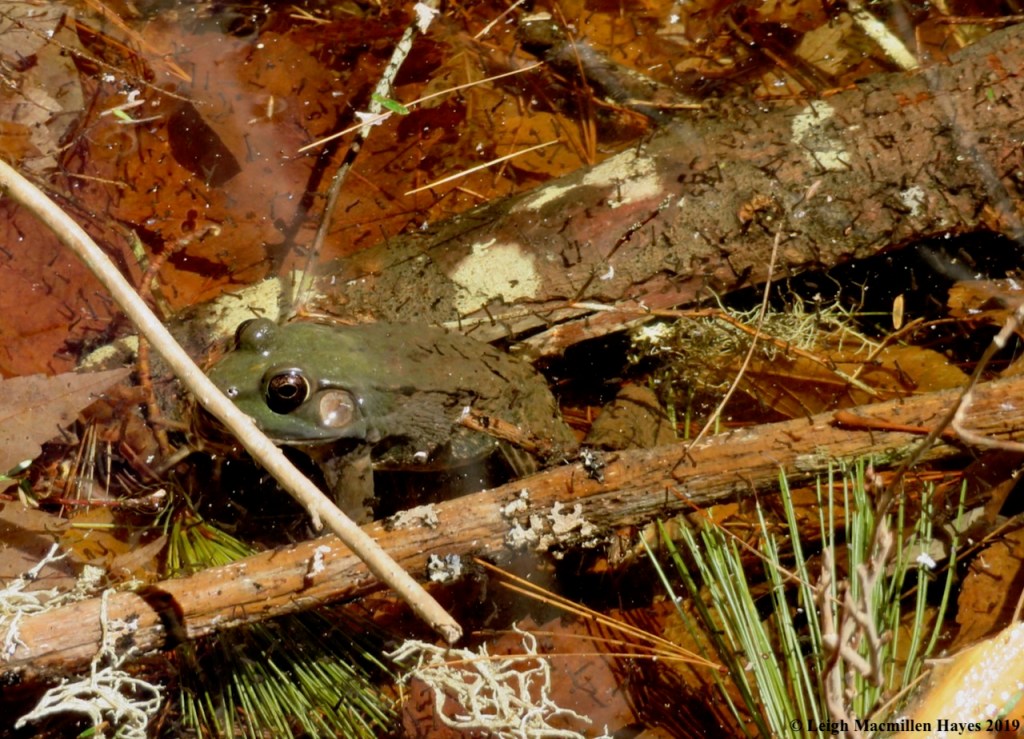
Oh yes, those larval mosquitoes also feed amphibians and thanks to Juli’s son Aidan for finding a large Green Frog. Notice the ear disc, aka tympanum, that is located behind its eye. Given its size as being bigger than the eye, this was a male. And notice the dorsal lateral ridge or fold that extends from behind the eye down the side of its back (there’s one on either side)–that’s a clue that this is a Green Frog and not a Bull Frog, for the latter’s ridge circles around the tympanum.

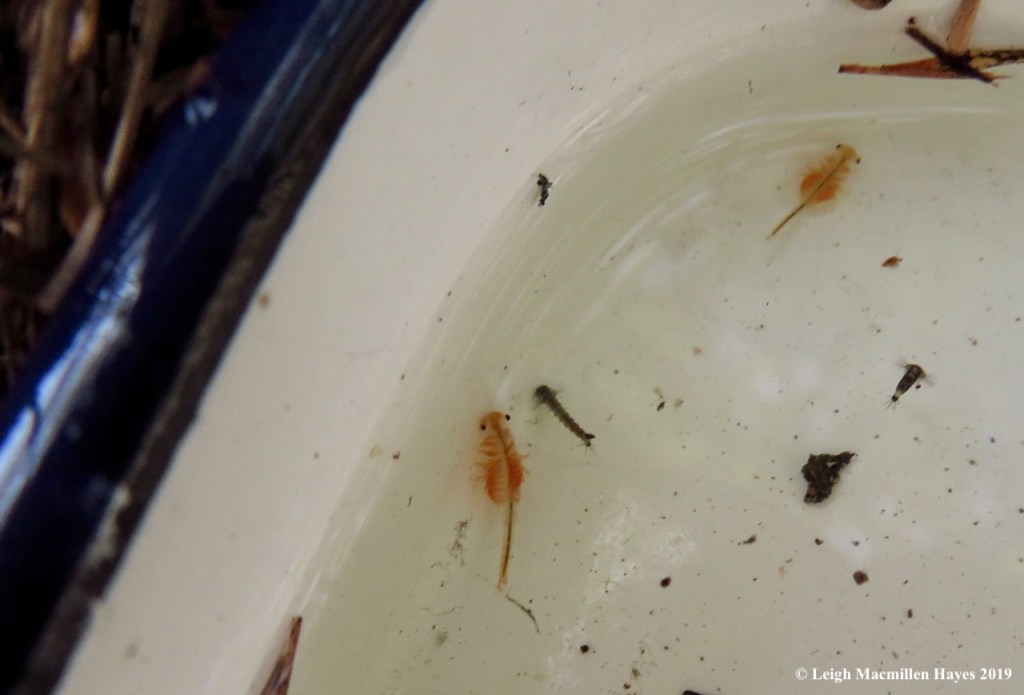
As the morning went on, it turned out that today was Aidan’s day to shine for he was also the first to find a Fairy Shrimp.

A what? Yes, a Fairy Shrimp. Do you see that delicate orangish body in the middle of the tray? It’s a mini crustacean that lives only in vernal pools.

The kids all got caught up in the thrill of such a find and within minutes became pros at recognizing them.

And so the dipping continued.

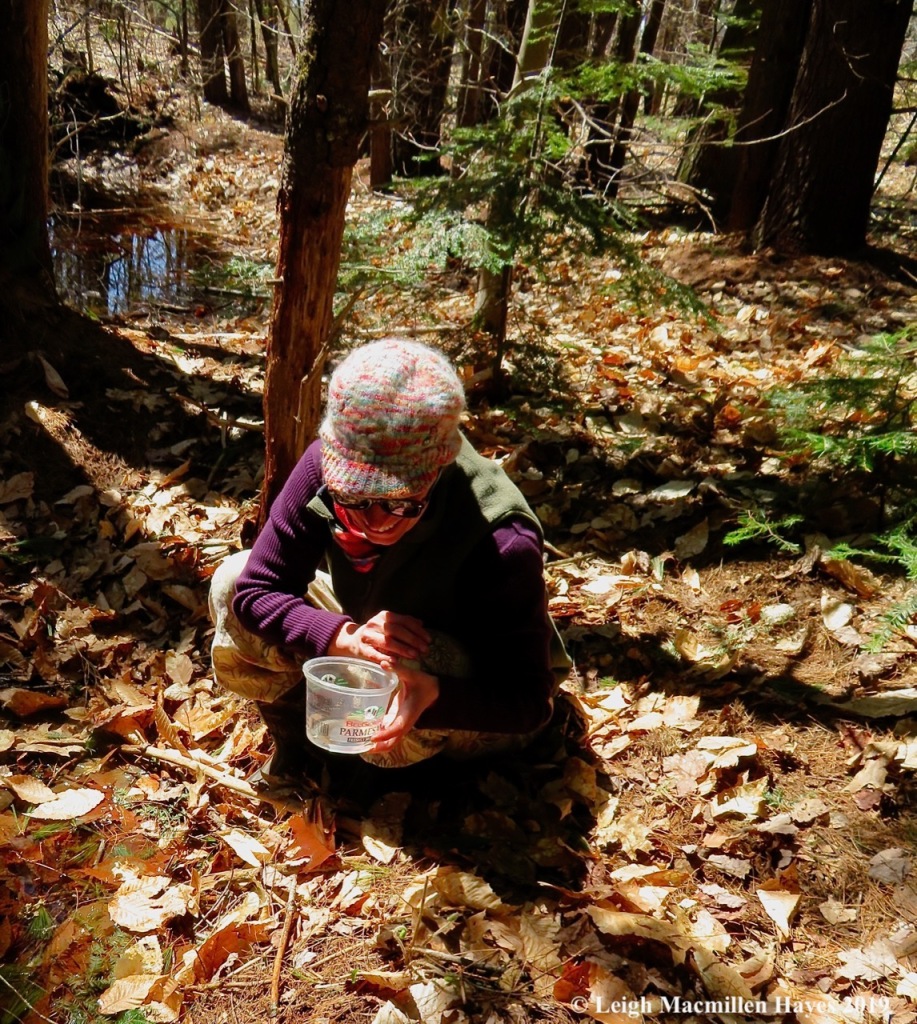
Moms also got caught up in the dipping experience.

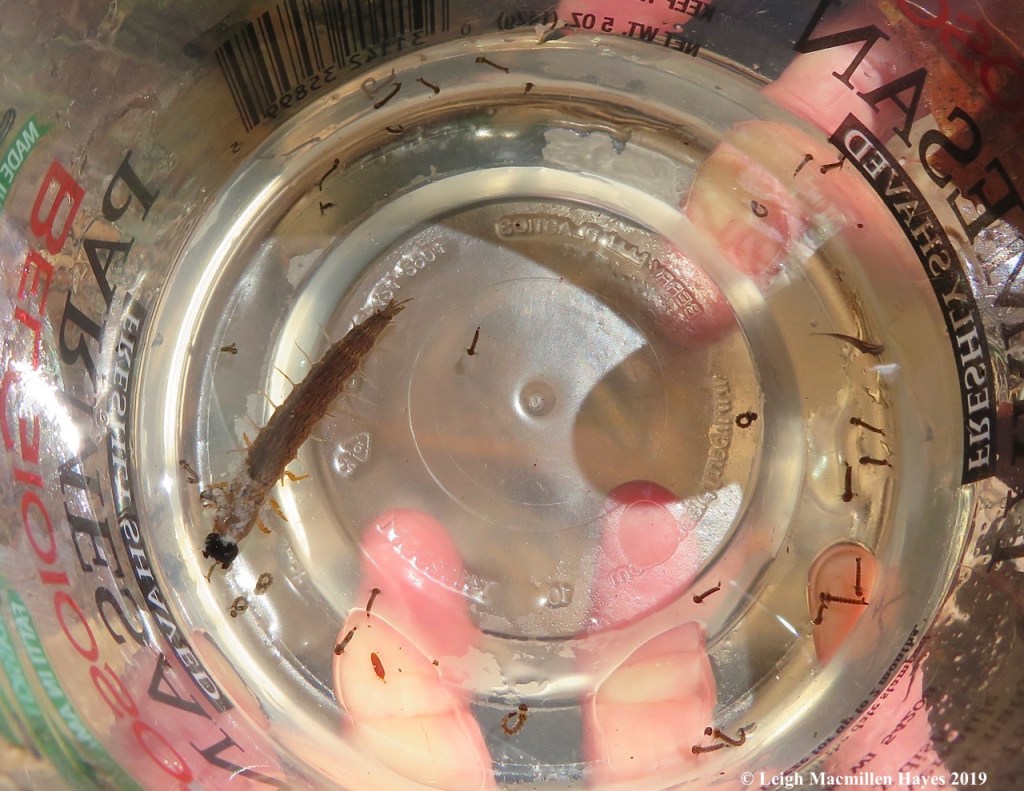
And they also found cool stuff, like Kim’s Fishfly. We kept expecting it to eat the mosquito larvae, but it seemed that they preferred to nudge it in a way we didn’t understand.

While Kim focused on her new friend, the kids were also making new friends, testing their balance, getting rather wet and muddy, and having a blast as they sought more Fairy Shrimp.

Their pan began to fill up with one, two, three, four, five and even a few more.

And then other species were discovered, including aquatic beetles and a Phantom Midge.

We’d come in hopes of at least finding Wood Frog and Spotted Salamander egg masses, which the kids quickly recognized. By the time we were ready to leave a few hours later, some of the boys had discovered the best way to spot the masses was from the crow’s nest.

But in the end, our most significant find was the Fairy Shrimp. You see, on a public walk a couple of weeks ago, when we’d promised folks such a sighting, we came up short. But today . . . they made their presence known. And with the find of just one Fairy Shrimp, the vernal pool became a significant one as recognized by the State of Maine.

A hearty thanks to Juli for leading and the moms and their kids for attending. It was such a joy to watch everyone interacting and engaging. I only wish I could have been a Fishfly on the wall at suppertime as they shared their finds of the day with other family members.

Duck, Duck, Porky Bear!

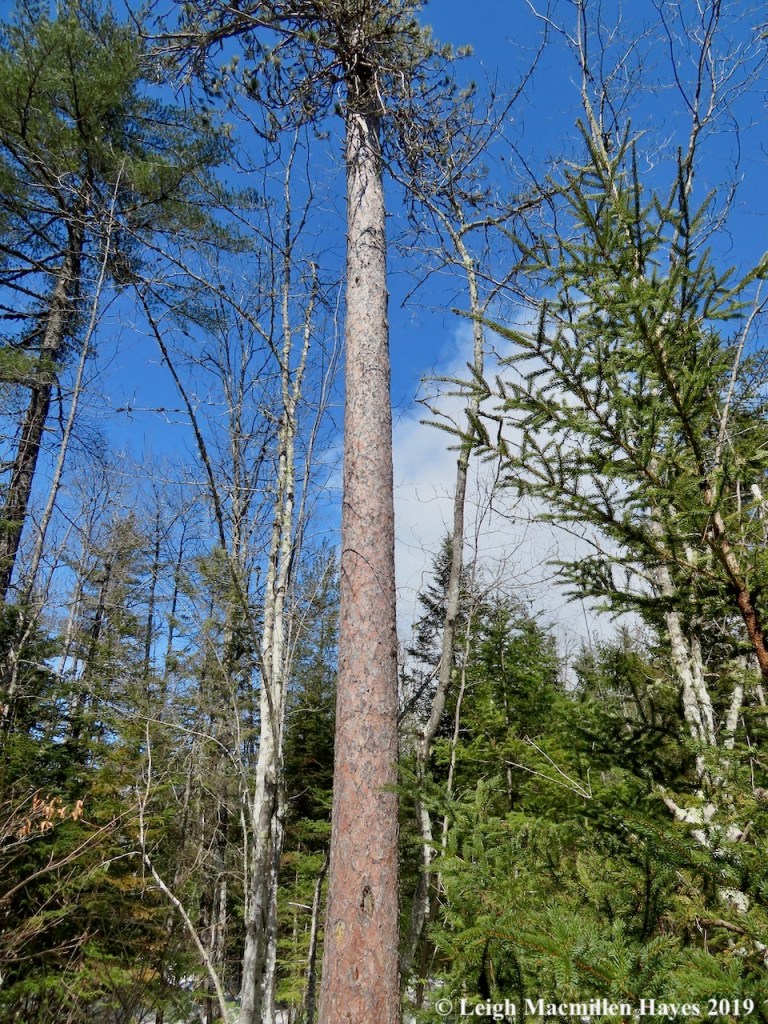
Our mission today, which we chose to accept, was to revisit a Porcupine den and check on the activity there and if time allowed, find a certain Red Pine tree in the forest. We knew the location of the den for we’ve visited it several times in the past three or four months, but had only a vague idea of where the Red Pine grew tall.

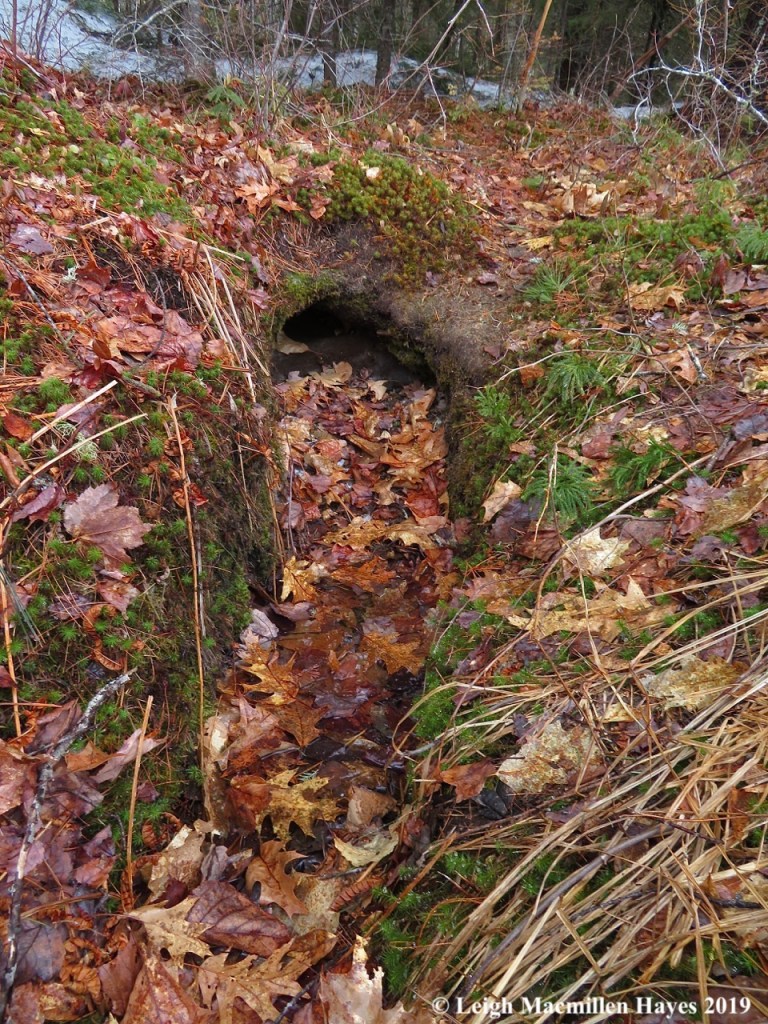
The Porcupine’s entry hole was just as we’d remembered it, but it was the scene about that had changed since our last visit. Hemlock boughs decorated the still snow-covered forest floor in great quantity.

And so we looked up–at two trees now mere skeletons of their former selves. All that was left–backbones and ribs. The meat and flesh had been almost completely nipped off. But, it still made us smile for the Porcupine had done what Porcupines do. And except for our occasional visits, it seemed they’d not been interrupted by human interference.

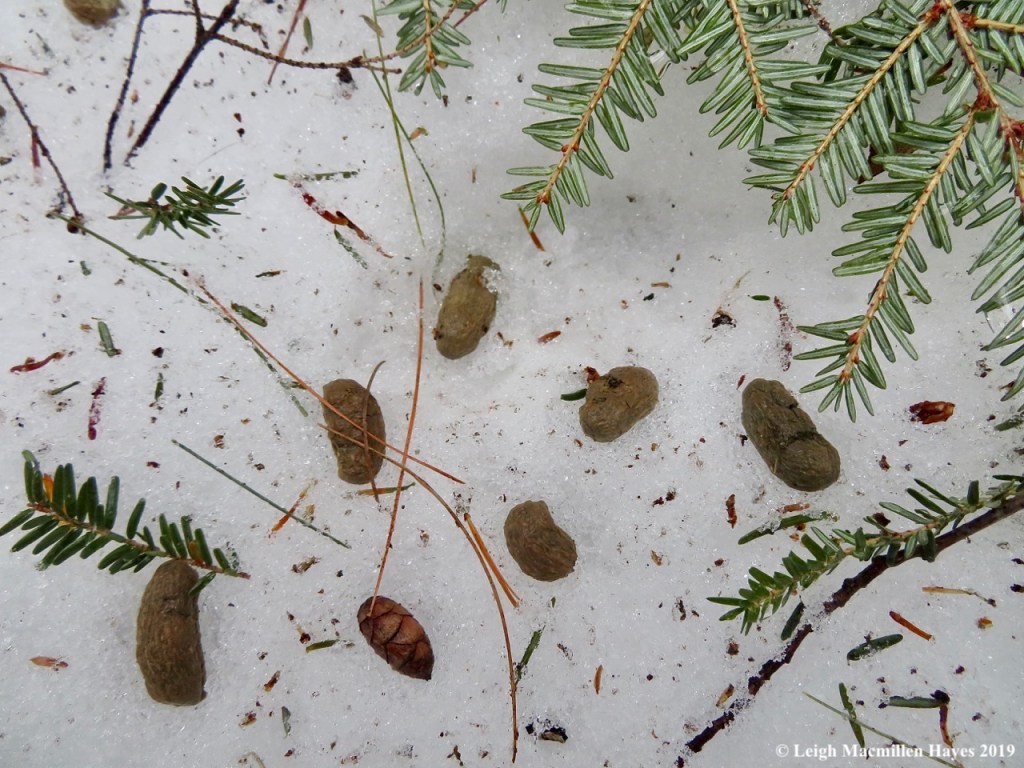
The other thing Porcupines do is scat. Prolifically. Below their tree of choice. And by their dens. Of course, I needed to document such. This presentation offered a delightful contrast, subtle though it may have been, of the prickly rodent’s scat and a Hemlock cone. Sometimes the color is so similar, and as you can see the size is as well, that it’s difficult to tell them apart. But, if we are what we eat, then their similarities make perfect sense.

After admiring the Hemlocks, we returned to the hole and noticed a few quills. You may need your detective eyes to locate them. I’ll leave it at that (Faith and Sara–good luck).

And then we moved out to the edge of the brook to check on another entrance to the same den. It didn’t appear to have been used recently, but that got us wondering about the melting snow. Having said that, we could see the pathway created to the upper right of the tunnel was worn, but any scats we found there were quite dried out and deteriorated to the point of being almost unrecognizable.

Just above the tunnel, however, a new discovery–another Porcupine tree. This one a Beech sapling–most of it denuded of bark and even a few twigs. Our questions continued. Was the upper part of this seven or eight foot tree dined upon when the snow was deep? And the lower part as the snow melted? Or had the Porcupine recently climbed up? How in the world can such a large animal climb such a small tree without snapping the trunk in half? I could practically wrap my thumb and pointer finger around it. Ah, but they do. Another amazing feat by one with grippers for feet.

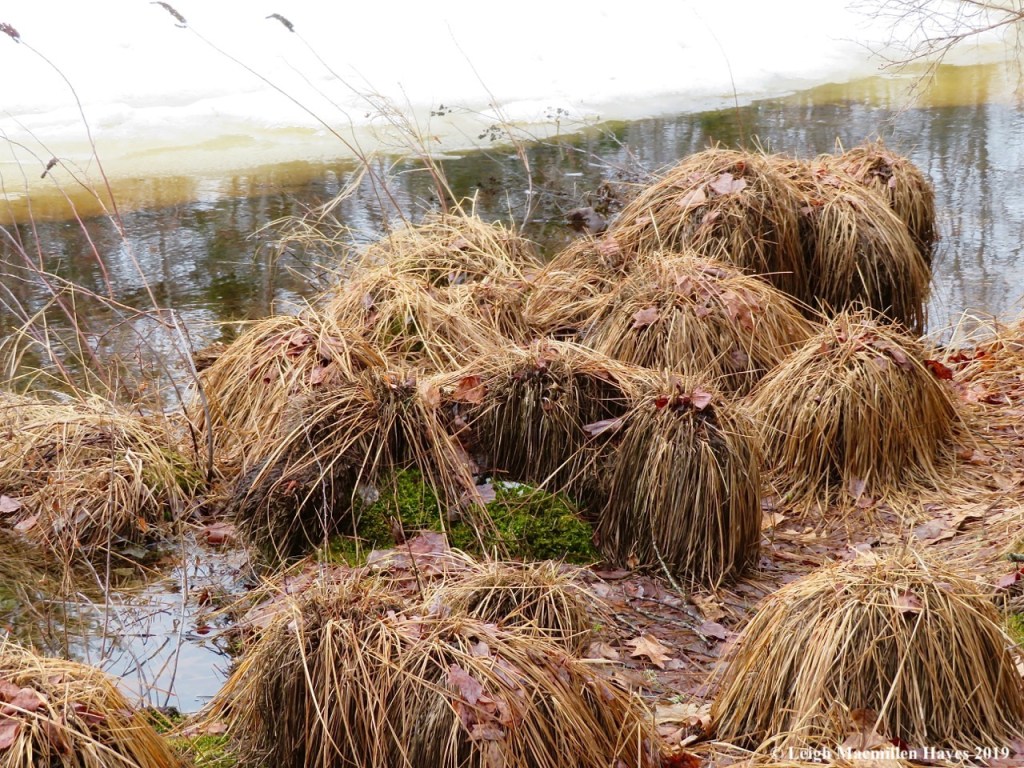
Leaving the Porcupine area behind, we moved along beside the brook and paid our respects to the Itt family. Cousin Itt and his cousins stood clustered together eagerly awaiting the sun that was to come.

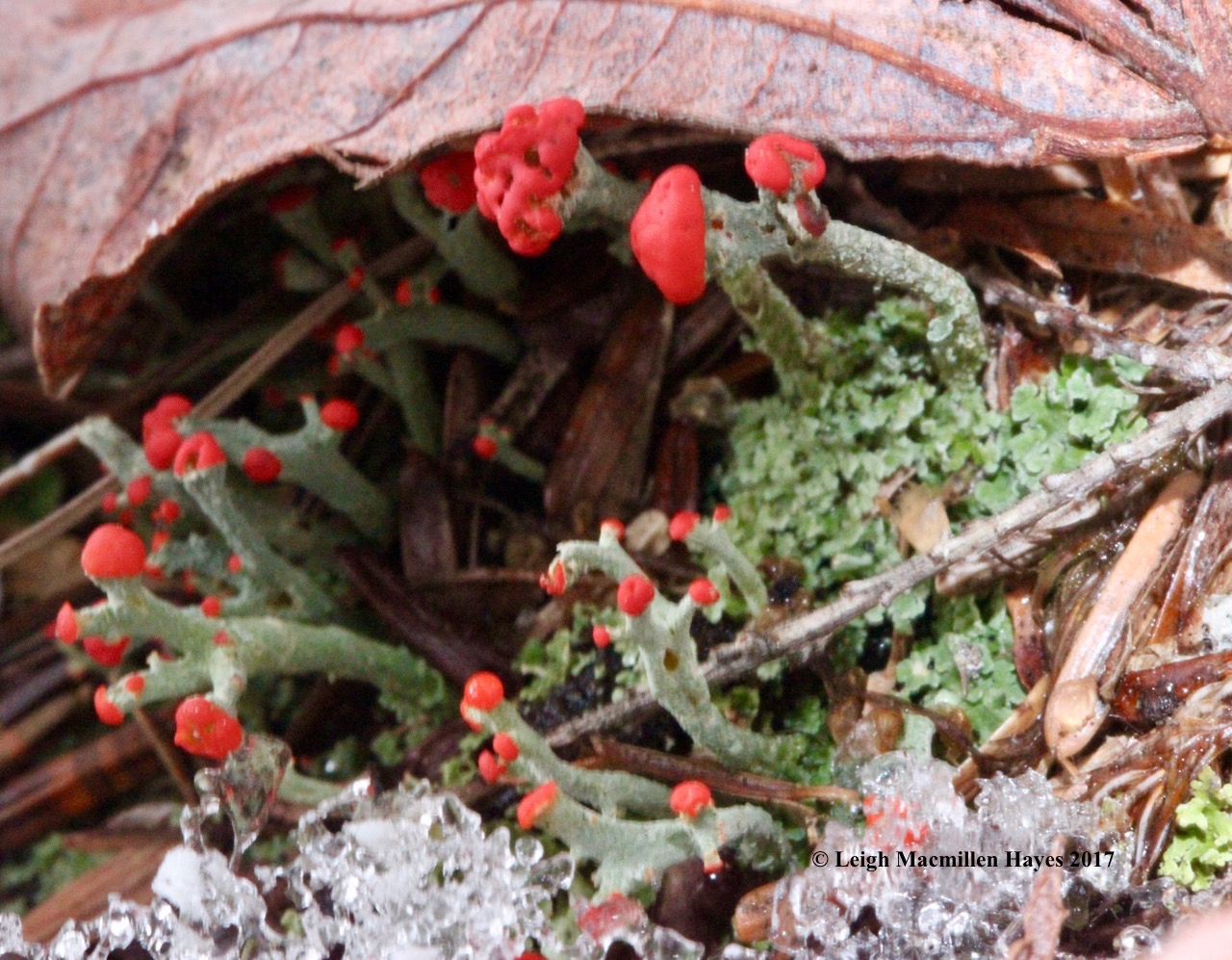
Our slow motion then found us beside a stump upon which Pixie Cup lichens grew. Pixie Cups or Goblet lichens are members of the Cladonia group. This find made us realize that as the snow pack dwindles we have so much to learn or relearn. Thank goodness it’s a slow melt and we have time. ;-)

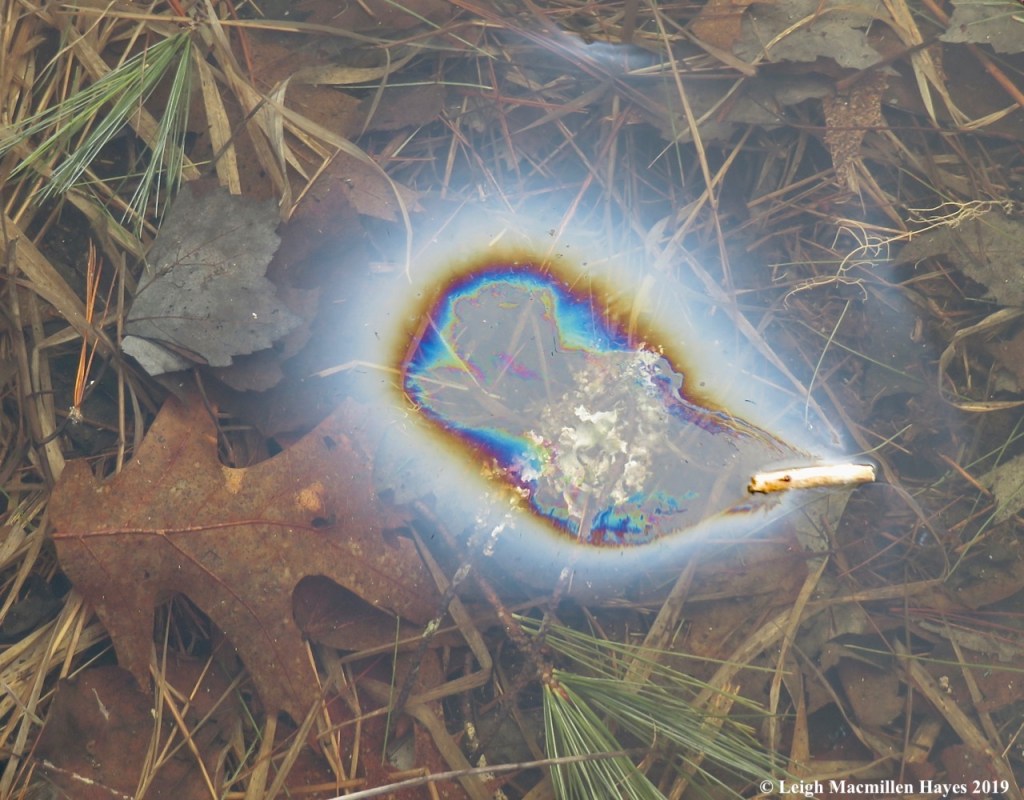
Our time today next involved a magic trick. One of us poked the blisters on the trunk of a Balsam Fir.

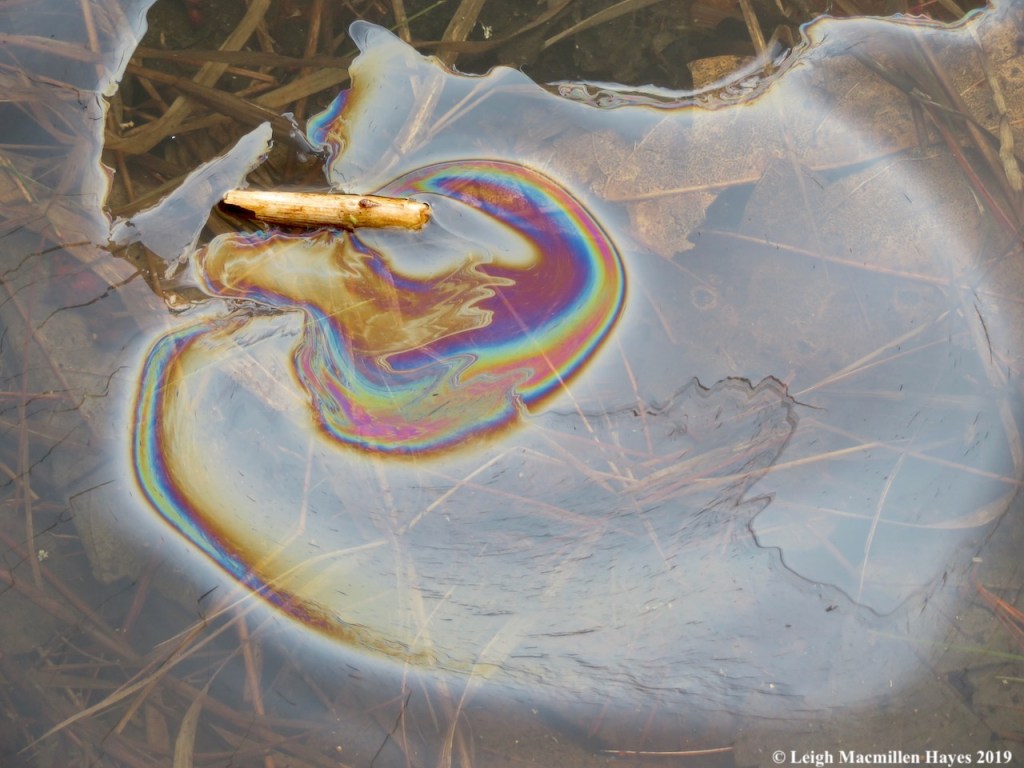
With a glob of resin attached to the broken twig, she tossed it into the water. Then we stood and watched . . . as the oil dispersed, changed shape and colors, and the tiny piece of twig moved about like a water fairy’s motorboat.

The essential oil within the sticky tree goo propelled the twig and created a map that could have been the United States.

As we watched, some of the oil broke away and feathered out in the movement of the water . . . but in a fashion we didn’t understand for it seemed to only float so far and then circled back.

As I said, we watched for a while, and where the little twig settled, we began to notice another shape emerging . . . a duck. Some people look at clouds, but we were fascinated by a substance that has antiseptic properties to seal cuts and protect them from infection, lessens the pain of burns if smeared gently onto skin, and serves as nature’s gasoline when one wants to start a fire. Oh, and reacts in water by creating fascinating rainbows while propelling objects.

At last we pulled away for I had a time crunch, but we still wanted to reach the Red Pine. To get there, we passed a Turkey kill site we’d discovered in January. The feathers remained and reminded us of the day we’d spent trying to solve the mystery of the Turkey’s demise. If nothing else, we came up with a good story that day.

From the feathers, we journeyed on, reaching the edge of a wetland that stretched away from the brook. My time was running out, but we gave ourselves six more minutes (why not five, you ask? Why not?) and scanned the tree tops in search of one Red Pine. And then . . . we spied it.

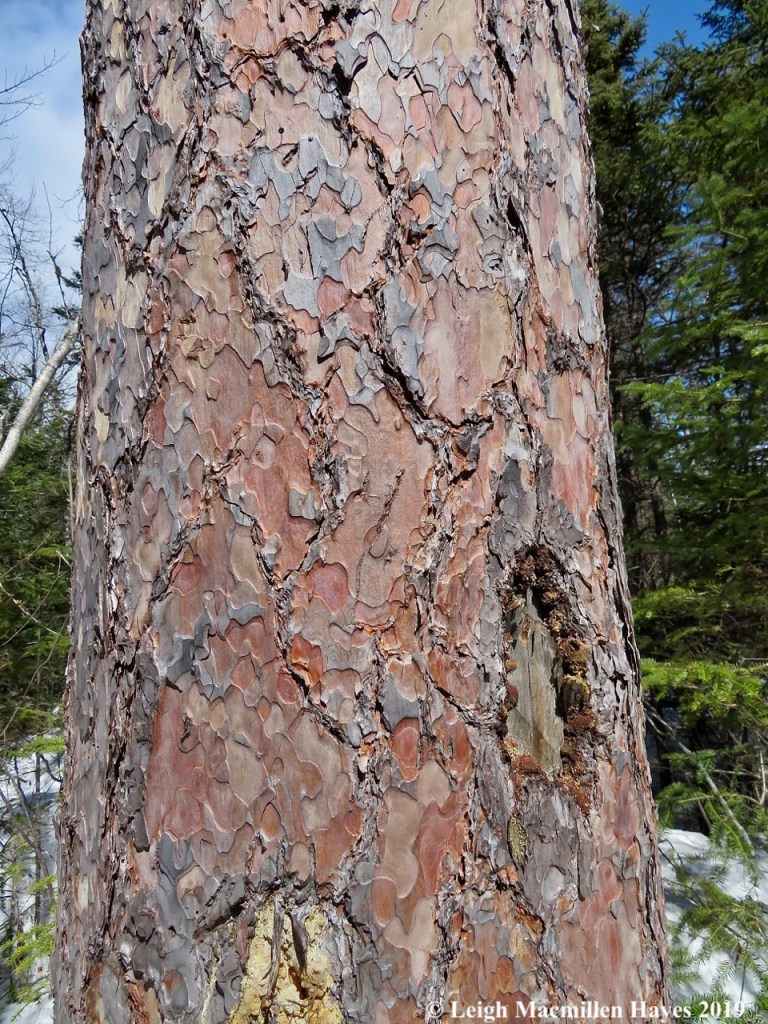
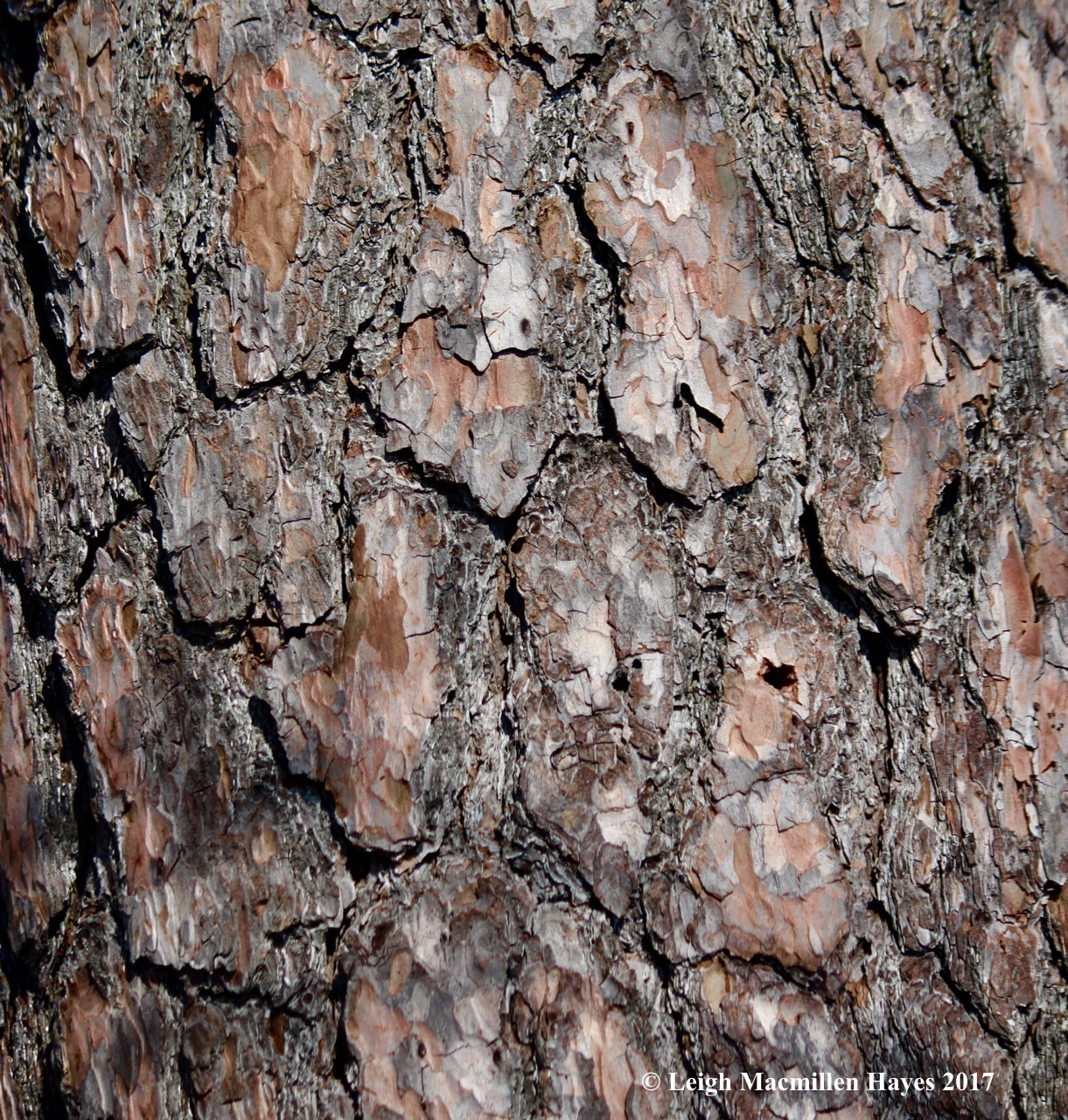
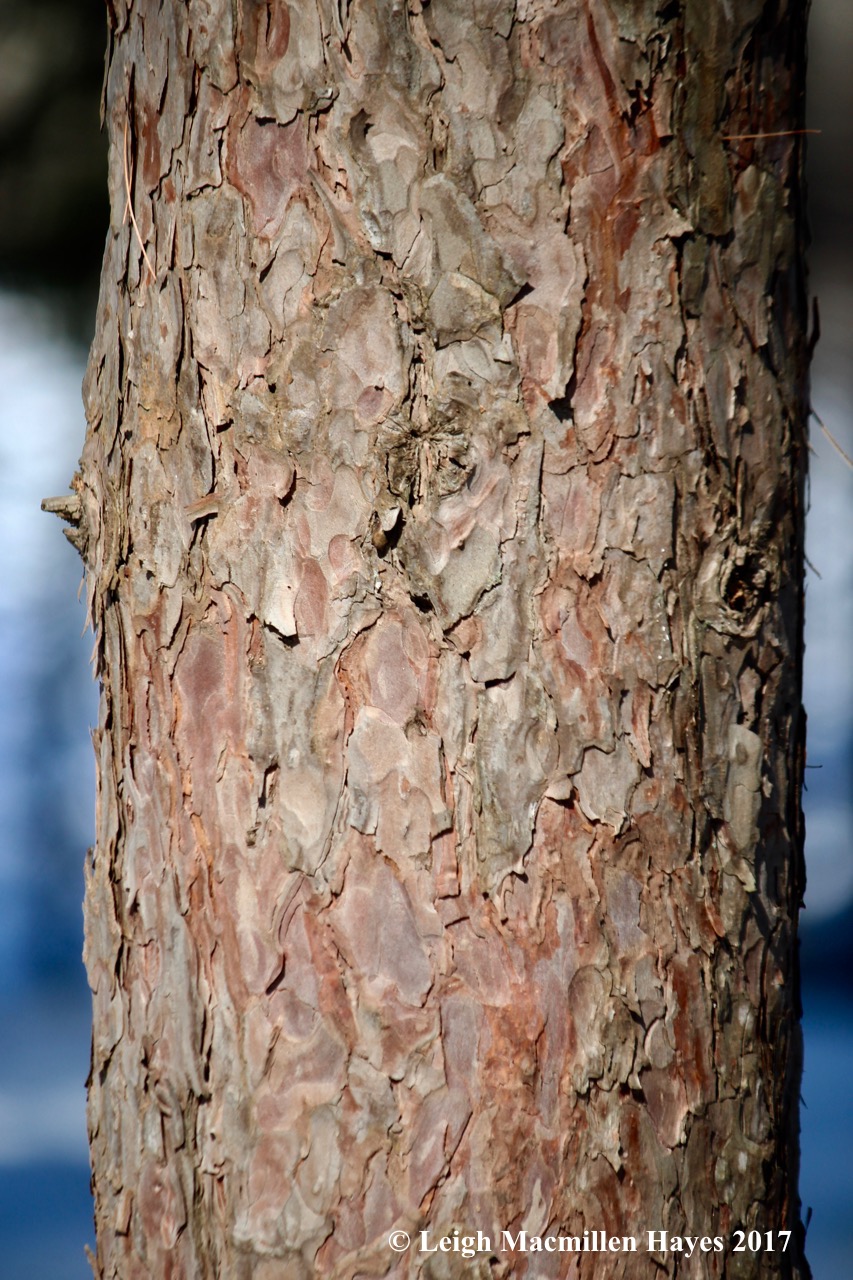
We weren’t the first, for a Winter Firefly moved out from under the bark as we admired its colors and jigsaw presentation–of the bark that is. We admired the insect as well, but that bark. Oh my.

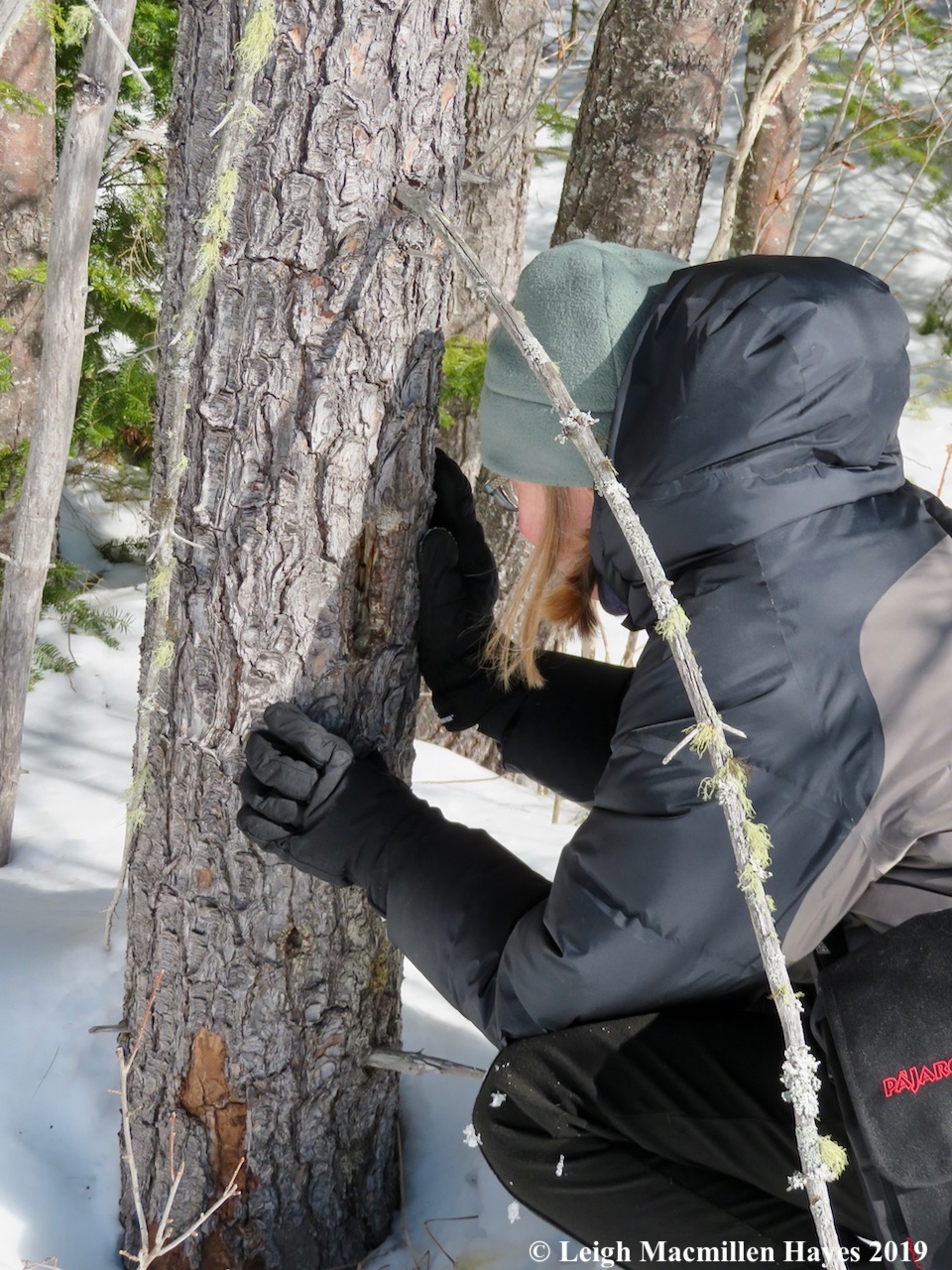
And then our real “Oh my!” exclamations began for we had found what we sought. Bear claw marks on the bark! They are much more subtle on Red Pines than American Beech, but as we circled the tree we kept seeing them.

The thing about the Red Pine is that the flaky bark must make it difficult to climb, but then again, we couldn’t tell how high Ursus americanus had gone. Mind you, we didn’t look at any other trees in the forest, and as I sit and think about this one now, I can’t wait to return (I’ve a feeling my guy will want to be in tow for the next expedition) because this morning I’d forgotten that Black Bears use lone Red Pines as communication poles–turning their heads and biting into the tree while rubbing their backs against it to leave a scent (Think date night invitation). Usually, some hair is left behind in the sap. We did located old Pileated Woodpecker holes filled with sap, but no hair. Yet.

Our journey out was more of a bee-line because our six minutes took longer and I was a wee bit late to an interview, but my hostess was gracious when I explained that a Red Pine had held me up! And then on my way home I stopped by some more open water and much to my delight, a pair of Wood Ducks struck just the right pose.

And now I’m torn. Which duck do I prefer? The Balsam Fir Duck or the male Wood Duck? Such decisions to have to make at the end of the day.

Duck, duck, porky bear! They were each special in their own way.

For Whom The Crows Caw

At 6am, a flock of crows outside our bedroom window drew me out of bed. There were three birds in the quaking aspen by our back deck, and all were squawking as they stared at the ground.

I peeked about, but saw nothing. That is, until I went down to the kitchen and looked out the door.

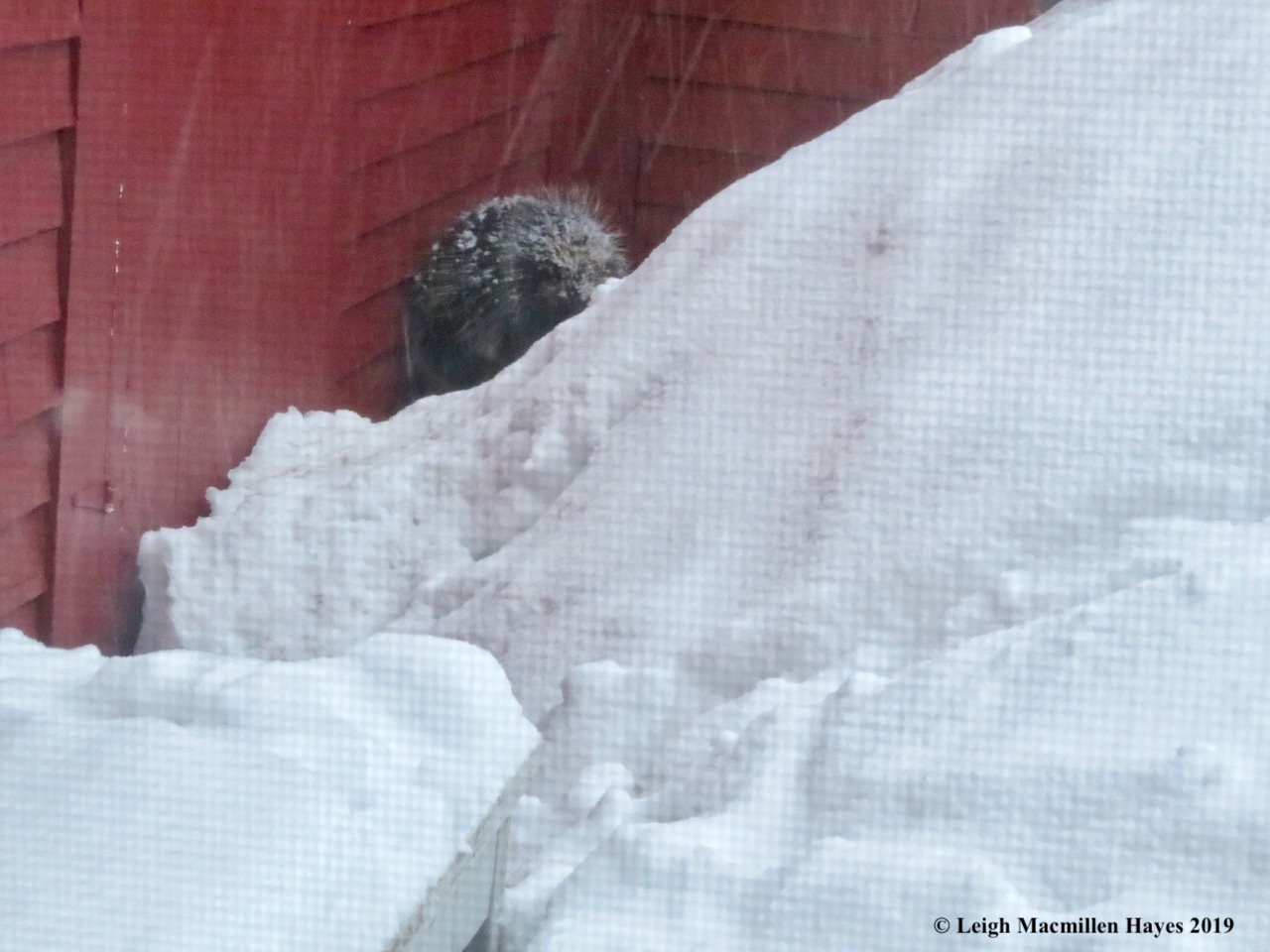
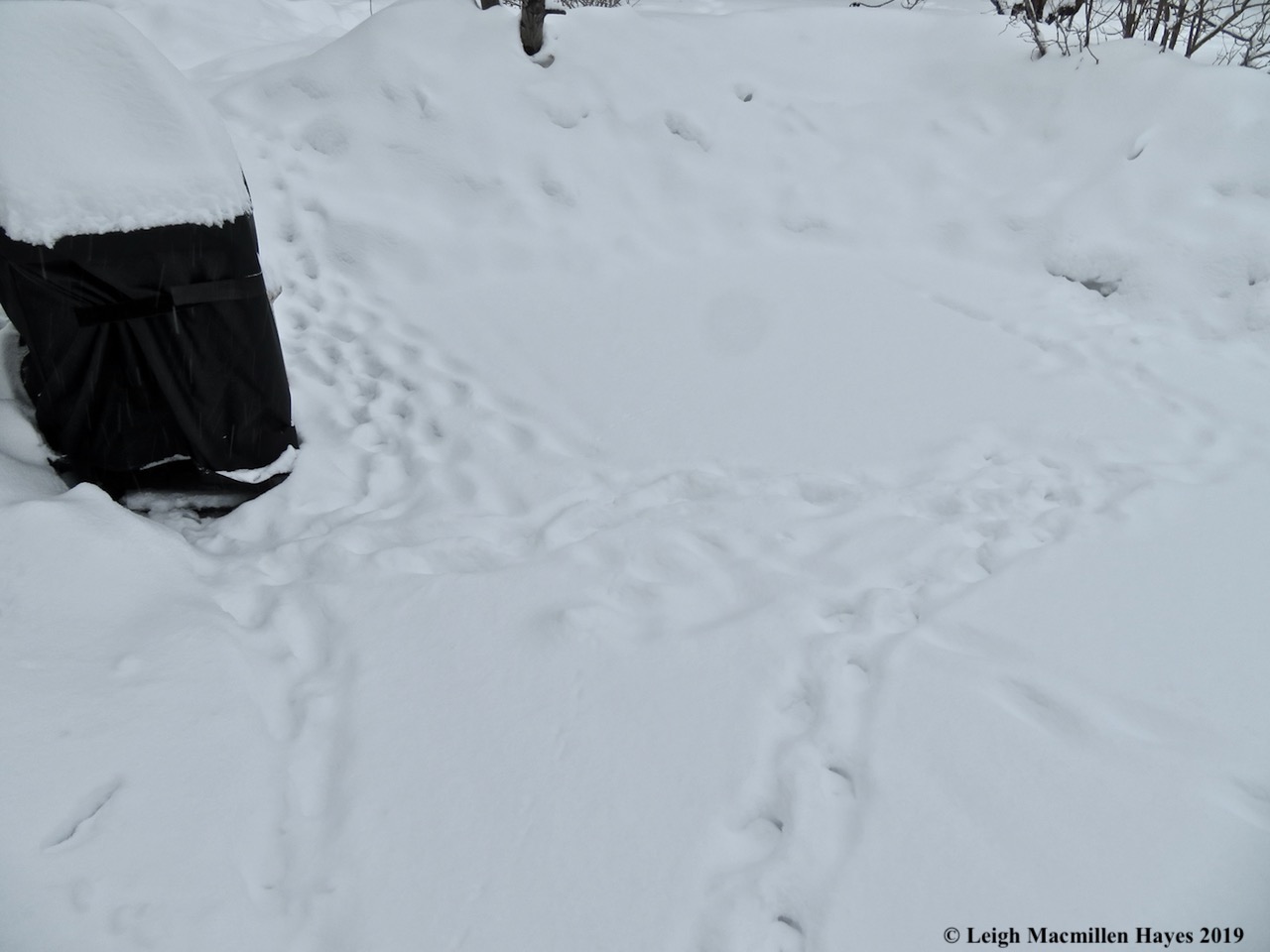
That’s when this set of tracks drew my attention. It took a moment for my sleepy brain to click into gear, but when it did I began to wonder why the critter had come to the back door and sashayed about on the deck. Typically, her journey takes her from under the barn to the hemlock stand in our woodlot, where she visits several a night before returning to her den. I say she for two reasons. “She” includes “he” so I can’t possibly be wrong and it’s my understanding that the males of this particular species are more likely to spend the day outside than the female. She returns home every morning and I never see her. Until . . .

This morning for when I stepped into the summer kitchen that serves as my office, there she was in the corner, near her entryway to her under-barn den. And numerous other sets of her tracks decorated the snowbank.

The birds continued to scold, but not quite as vehemently as they had ten minutes earlier. And the snow continued to fall. Why hadn’t she headed down under?

The thing about porcupines is that they are rather lackadaisical, so maybe she didn’t care about the birds?

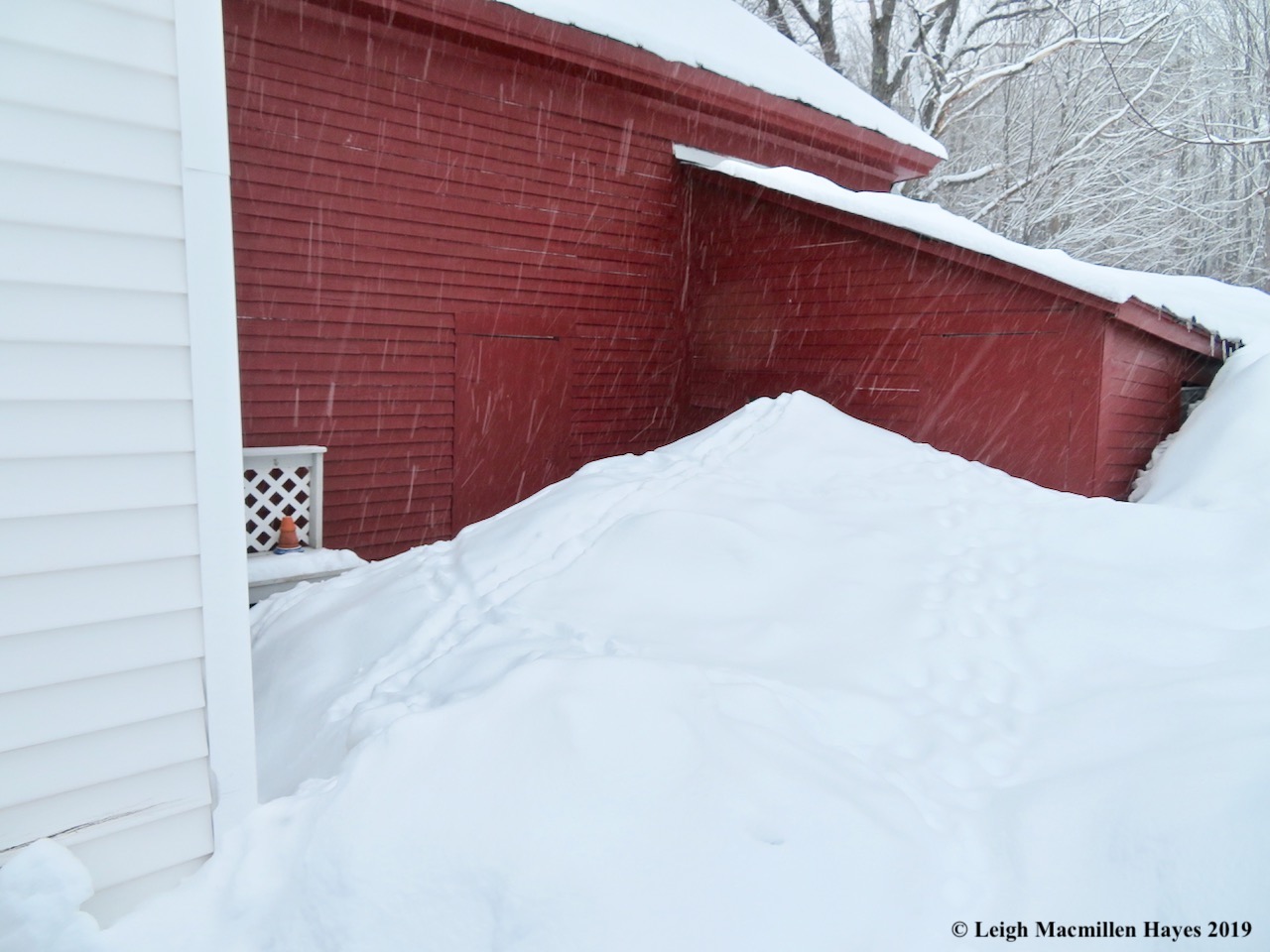
My interest in her was far greater I’m sure than she cared and so I stood and watched every move. And noted that in her dance she’d also crossed over the potting table that’s almost hidden by the snow. Why so much movement for such a slow-moving critter? Was it because of the birds? And why did they care about her presence?

Eventually, she did what I expected and disappeared under the corner between the barn and shed.

And so I headed out the door, where I discovered even more tracks. It’s not like its mating season, for porcupines mate in the fall. So why all this movement, including a visit to the grill. Was she pacing?

Peering toward the barn, I couldn’t see her, but I did hear some mini-grunts coming from the corner.

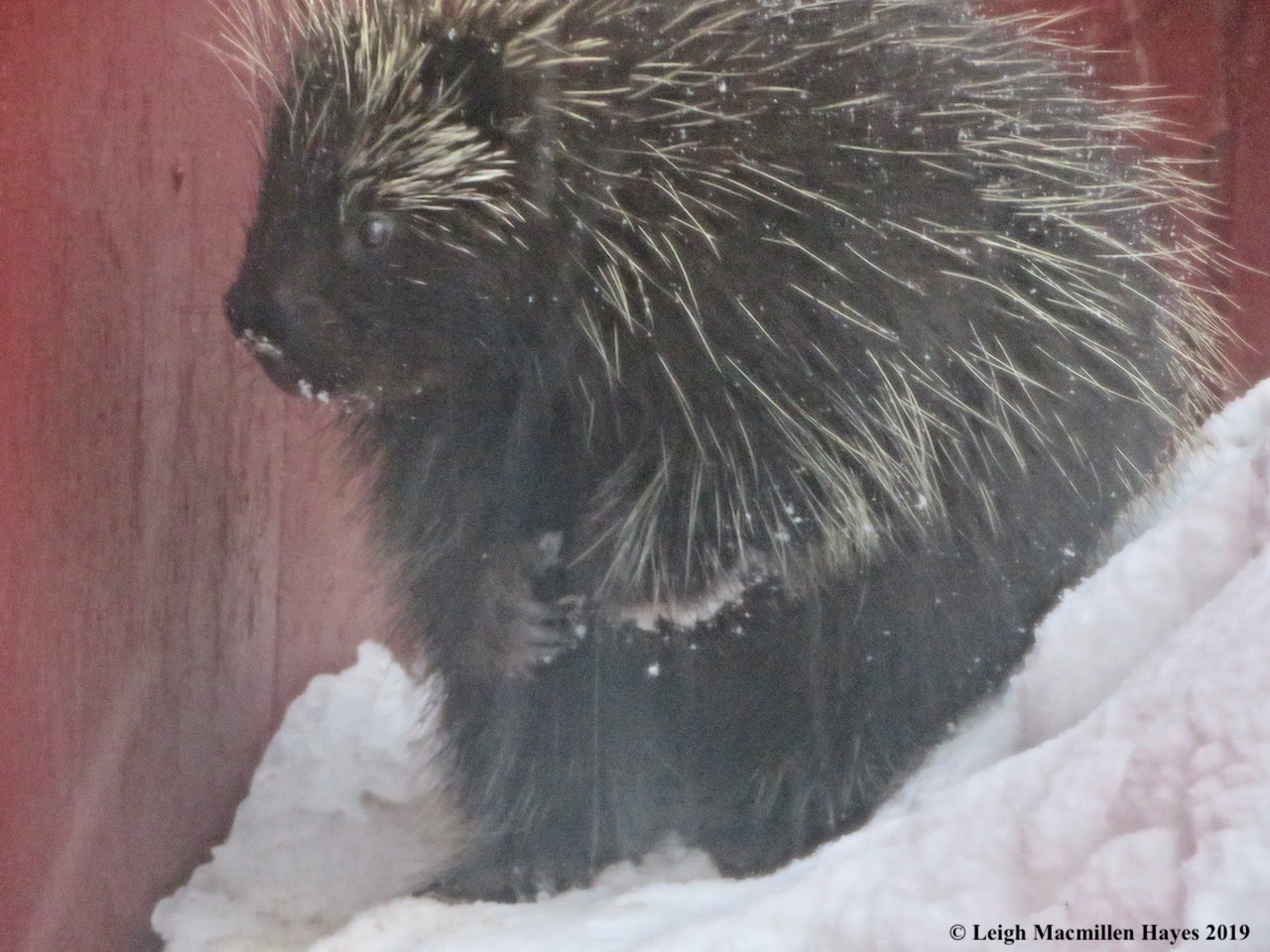
And then she emerged and I headed back in to give her space. Check out those quills. Did you know that they are a form of hair. In fact, from Mary Holland’s Naturally Curious Day-by-Day, I learned that a porcupine has five forms of modified hair–each with its own purpose: dark, woody underfur serves as insulation, which is important as she journeys outside her den every single night no matter the weather or temperature; long guard hairs sensitive to touch that help her maneuver; stout whiskers also sensitive to touch; short, soft bristles on her tail’s underside provide stability when she grips bark; and then there are the roughly 30,000, yes 30,0000, quills that cover all but her face, ears, and part of her belly.

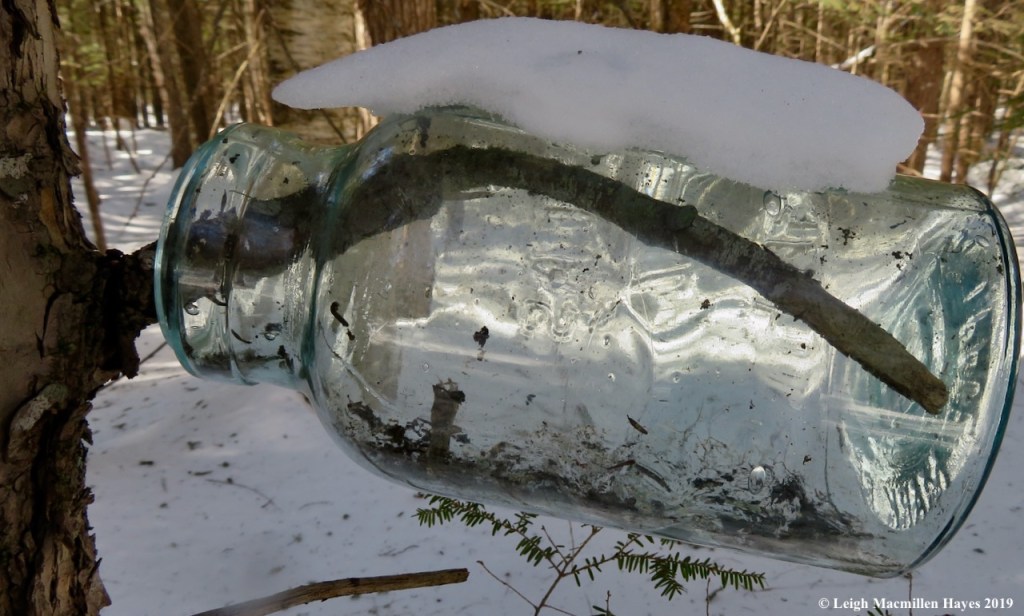
It’s those 30,000 quills that provide me with the most awe. So here’s another “did you know” fact: Within one square inch on her back, she has 100 quills. I got to thinking about that recently and cut out a square inch (well, sorta as it’s not exactly straight) of material that I glued to the top of a Ball jar.

And then I filled it with 100 toothpicks left over from a Valentine’s Chocolate Fest the PTA put on when our sons were in elementary school.

One hundred quills/square inch. Talk about prickly! Of course, she looses some especially when she squeezes into tight places, like under the barn. And others detach easily when touched (no, porcupines do not shoot quills).

There’s also her coloration to consider. Like a skunk, the black and white of the quills should be a STOP sign to her predators, who are colorblind as well as nocturnal. BEWARE is subtly written in that black line up the middle of her tail that is bordered in white.

After we’d spent almost an hour together, sometimes with window glass and a screen between us, my porcupine finally disappeared under the barn. And so I stepped into her space for a closer look. Notice the mud and scat in her track. She is the pigpen of the woods who scats and urinates at her den entrance, which perhaps helps provide further insulation.

Scat Happens! 75 – 200 times per day does she eliminate and depending on what’s she’s feeding on determines its structure. Of late, it’s the bark and twigs of hemlocks that constitute the fibrous structure. I’ve heard them described as macaroni or cashews. I prefer to think of her scats as commas, perhaps indicating a brief pause in her routine.

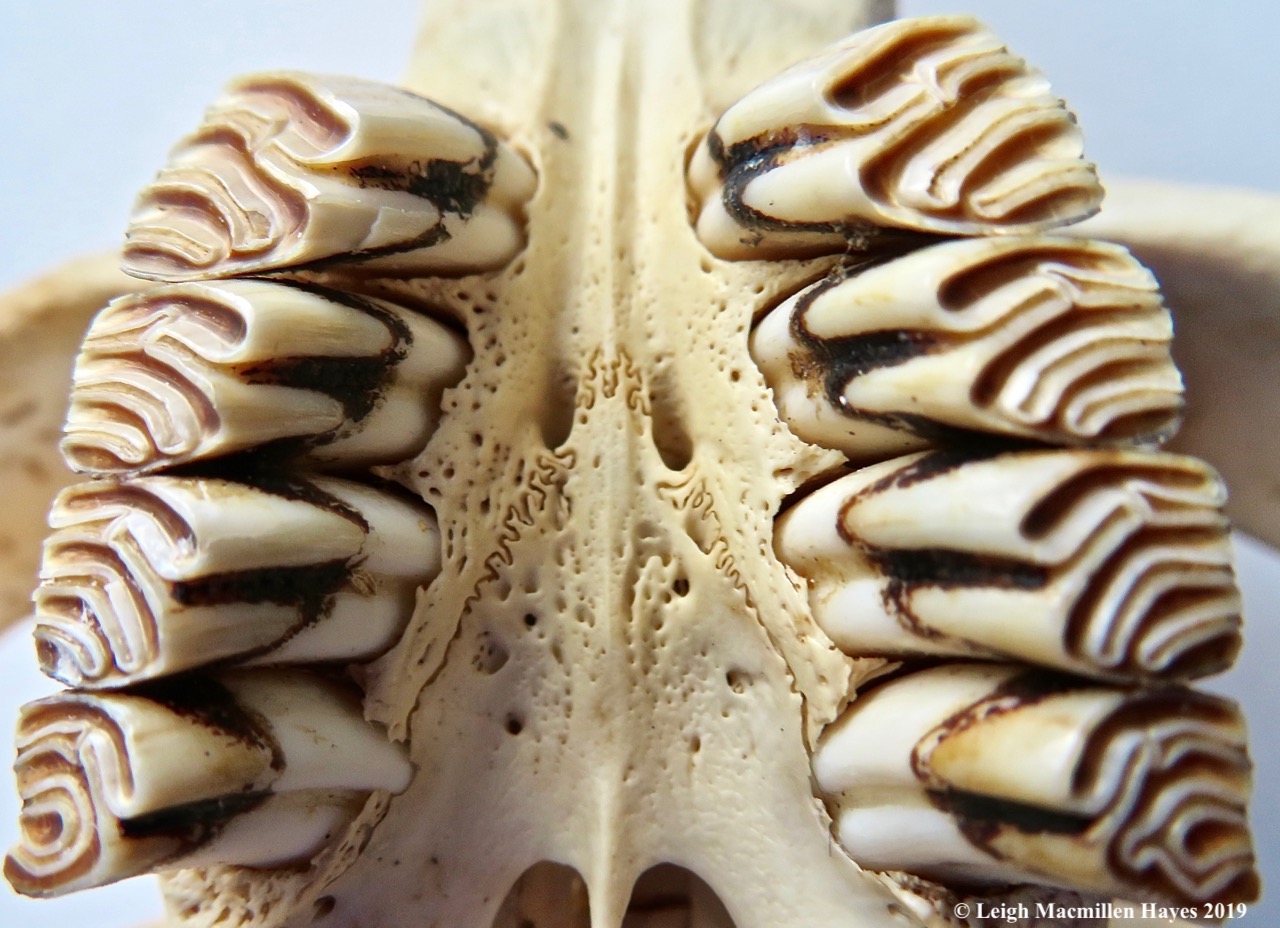
As strict herbivores, porcupines have strong, flat molars that are good for grinding plant material. This is the skull of a beaver, but it provides a good example for a porcupine’s check teeth are similar.

Also from the beaver skull are these prominent incisors. The difference is that a porcupine’s incisors are a bit thinner. For both, the front surface is enamel, while the back is a softer dentine. Their incisors are rootless and grow continually–up to twelve inches per year. Gnawing, therefore is rather important to wear down those chisels.

She’s managed to maintain normal dental wear by working on this hemlock in the corner of our yard and others in our woodlot.

As the day progressed, I wandered around looking for her tracks and those of any others. Strangely enough, she didn’t visit the hemlock last night, but rather checked on the sugar maple in our front yard–perhaps a sign that the season is changing and she’s ready to feast on some sweet buds for a while.

She also circled the barn in a random style. Was she seeking other entryways that are now well hidden below the snow? What was she thinking? Was she thinking? Or acting by instinct? I didn’t see any predator tracks to speak of, but perhaps there was an aerial predator she strived to avoid?

I don’t know. What I do know is that because I climbed up the snow mound, I discovered that she’s been sharping her teeth on the barn clapboards. And where the corner between the shed and barn has long had a cut-out presumably created by her and probably her ancestors, it appeared today that she’d munched a wee bit more and come spring’s meltdown, we’ll be surprised by the damage. My guy reminded me that she and her family members have been dining below the barn for more than the 26 years that we’ve lived here and the structure’s integrity has long been compromised.

As the snow slid off the barn roof, the hole began to disappear.

Until finally, it was only a memory.

I went out again at dusk in hopes of seeing the grand lady dig her way out, but her time schedule was not the same as mine. In the morning, however, I’ll check on her trail as I do every day. I can’t wait to see where she went–will she give me any more clues as to her strange behavior this morning? Was it a reaction to the crows? I don’t know.

But this I do know: when the crows caw–listen. And look. And wonder.

Forest in a Bottle

When Pam and I stepped into the woods this morning, I don’t think either one of us understood the enormity of the task before us. You see, our job was to gather all the pieces of the forest through which we’d pass.

And so we began by collecting a recent beaver masterpiece with fresh wood chips below.

There was a beaver sculpture as well, those tooth grooves deep and distinctive.

And their tracks, which all emerged from a recently frozen-over hole. The tracks were a few days old, but we added them to our findings just the same.

Because we were in beaver territory, to our delight we found otter tracks and slides galore–many of them fresh.

There was even an otter hole that we wondered if the beavers had used as well. We decided we might as well throw it in to our bag.

And we couldn’t resist our favorite otter activity of all–the spot where the infamous slider slid.

Following the trail to a different part of the forest, we spotted a diptera pupa that gave us pause for quite a while as we admired its structure and the perfectly formed circle where the fly had chewed its way out. We were so in awe that it seemed only obvious we would want to include it in the collection.

Further on, we reached a brook and spied a muskrat, that dark body in the center. As it turned out, it was a stone muskrat and we left it behind as we chuckled about our mistaken ID.

By the brook, we did, however, find mink prints in the dust of snow that had settled upon thin ice. Those were certainly worth capturing.

We also gathered more otter slides, and then stumbled upon an apparent otter roll, an area where the playful critter made a lot of fuss and left behind some urine and tarry-looking scat. We were sure we’d hit the jackpot.

Because we were beside running water, the icy baubles were not to be ignored.

Nor was the snow depth, which we determined to be close to four feet deep.

And then we marched onto a wetland, where we were stumped for quite a while about some mystery tracks. Should we take them or leave them, we wondered. The pattern indicated a perfect walker, as in a candid or feline, but the depth was deep and the toes threw us off.

The curious thing was that those tracks and others left behind by a mink and a fox led to a deep hole beside a tree.

I thought the frozen fluid within was blood, but Pam leaned more toward urine. One thing we knew for sure, if it was a kill site, there were no remains. Had the mammals been on the hunt to no avail? Take it or leave it–we put it in the same category as the mystery prints.

The mystery tracks also led to a beaver lodge and it appeared that the mystery track maker had tried to locate another meal. Given that there was no air vent at the top of the lodge, we doubted anyone was at home at the time of its visit, and so we left the lodge behind.

After standing in the middle of the wetland and eating our own lunches, we discovered a set of perfect red fox prints that we just had to include in our collection. The top print in this photo is actually the hind foot and the lower print is the front. Can you see the chevron in the foot pad?

There was another lodge we considered grabbing because the top of it appeared to possibly have a vent, but like the fox, we took a closer look and discovered that it, too, was abandoned so we left it behind.

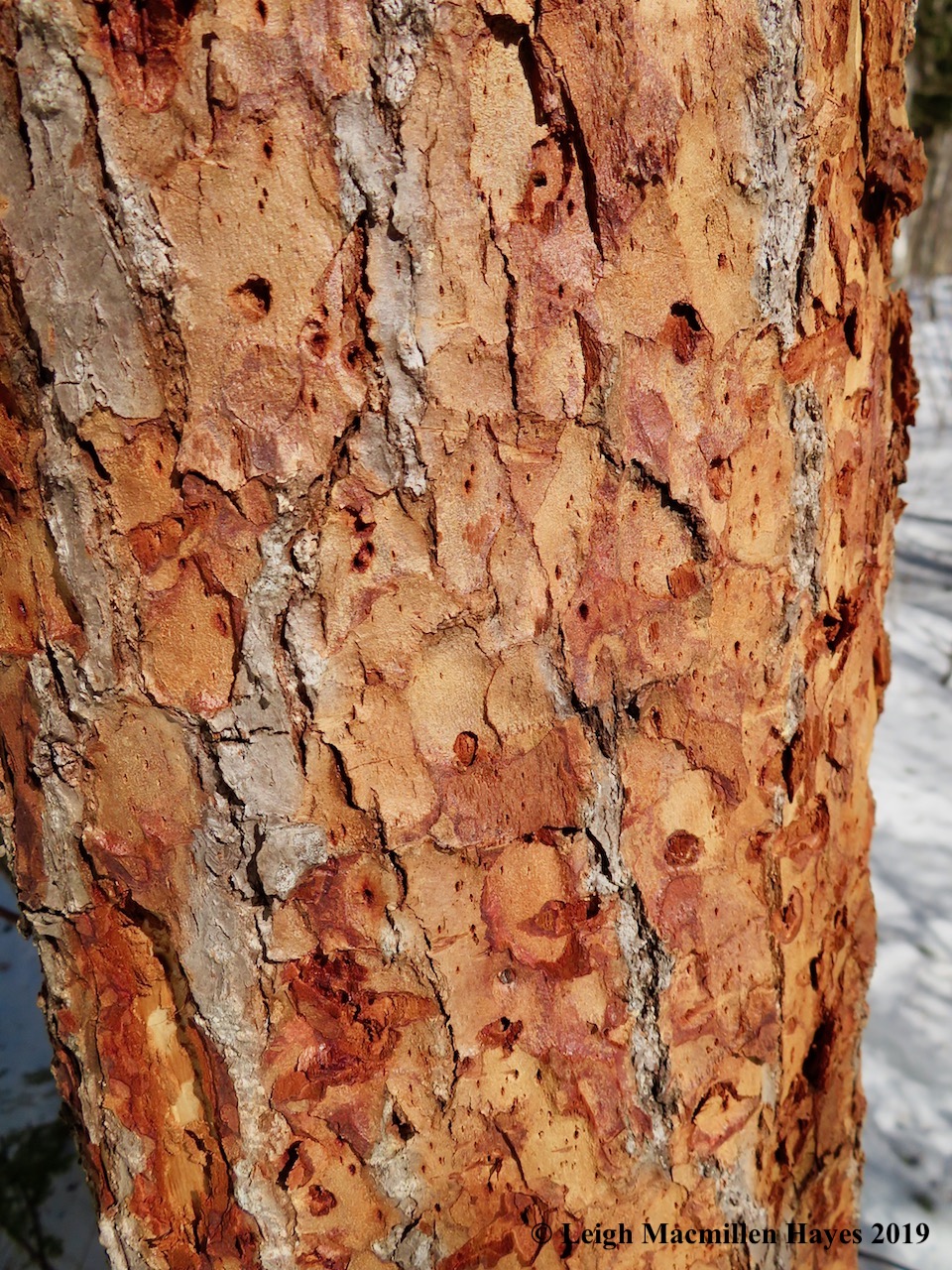
Instead, we made our way off the wetland and back into the woods where a debarked hemlock tree stopped us in our tracks. Nuthatches and woodpeckers are known to scale trees–removing the outer bark to get at the insects underneath. Can you see the insect holes? And the cinnamon color of the inner bark? This one was a keeper, for sure.

Especially since a section where the inner bark had been removed revealed a polished layer like one might find on a table top.

There was also a huge snow-capped burl to pick.

And a small cross-section of the liverwort Frullania juxtaposed beside script lichen. Everyone should have a sample of those two.

Two old heron nests were well worth adding into the mix. They’d been used in the past until two years ago. If the herons do return to the rookery, we suspect they’ll build new structures so we didn’t feel so bad gathering these.

And then there was a pileated woodpecker hole that would have to represent all woodpecker holes in these woods. Before tossing it into the bag, Pam made sure that no other critter had set up housekeeping within.

Our final finding was one that made us think back to the mystery tracks. The more we studied these and later met the mystery tracks again and followed them for a while, the more we understood that not only did beavers, otters, foxes, deer, mink, and snowshoe hare romp in these woods, but so did coyotes.

The best thing about this coyote was that it made a coyote angel in the snow! We most definitely scooped that up.

For you see, our mission was to put it all together–in a glass jar. Haven’t you always wondered about the magic involved with placing a ship in a bottle? Well, today, we spent six hours amassing various items in the woods and then assembled them–creating a forest in a bottle. Can you see it?

Book of February: Ferdinand Fox’s First Summer

Yikes. Here it is the end of February and I’ve spent the month mentally flipflopping between two books to recommend–one about tracks and the other about tree buds.

And then this day dawned. Not long into the morning as I sat at my desk beside a window, a swift motion captured my attention . . .

and I knew immediately that Ferdinand Fox’s First Summer by Mary Holland would be the February Book of the Month.

In this factual, yet delightful story, Mary tells of Ferdinand’s birth, childhood activities, and growth as he and his siblings are born and eventually weaned. Her amazing photographs fill the pages and alone are worth a reason to purchase this book. But there’s so much more and one doesn’t need to be 3-8 years old to enjoy it. Even those of us who are more “mature” can surely learn from the information shared on each of the book’s 32 pages.

And there’s even more to the book because at the end is a section her publisher labels “For Creative Minds.” Though one can’t copy other pages in the book, we are encouraged to use the material in this section for educational, non-commercial purposes.

Included are “Red Fox Fun Facts and Adaptations” with photographs and brief blurbs to describe various behaviors of these canines. (I remember a time when I had to get it through my brain that a fox was a canine and not a feline.)

One of my favorites from this section: “Red foxes are most active at dusk and dawn (crepuscular). In summer, they are more active at night (nocturnal) because their prey, mice, are more active then. Foxes may hunt during the day (diurnal) in the winter because it’s harder to find food.”

Bingo! That brings me to the reason why I chose this book for February.

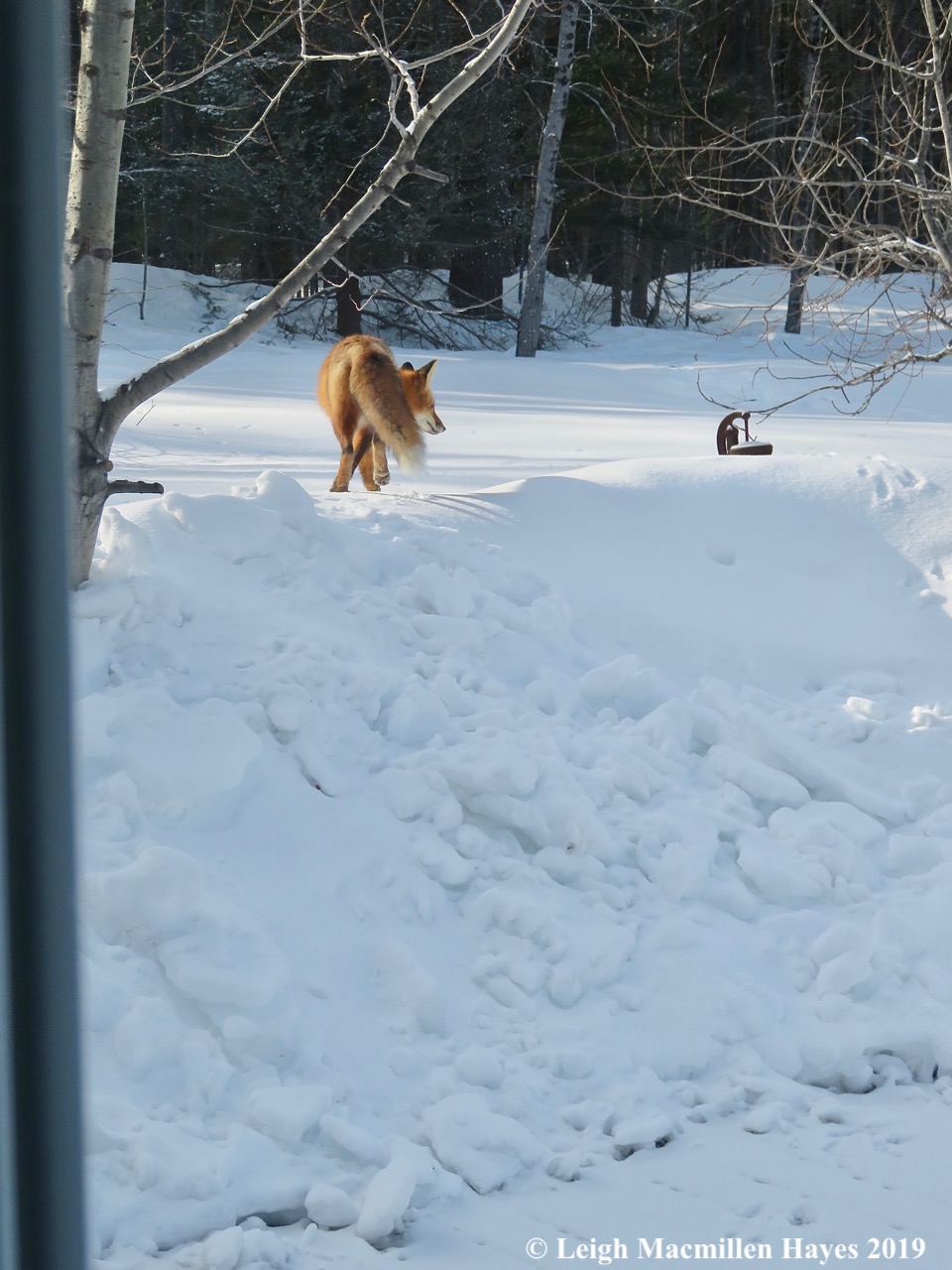
Remember that motion I mentioned observing this morning. Well, I went to the kitchen door and there on the snowbank by the back deck was my neighborhood fox.

He was on the prowl. Do you see all the gray and red squirrel tracks on the snow? And Mary’s comment that foxes will hunt during the day in the winter. One would think that given all the squirrels and mice folks were dealing with last fall, a result of the previous year’s mast crop production of acorns, pinecones, and beechnuts, the foxes and coyotes and bobcats would have plenty to feast on. But . . . there wasn’t so much food for those little brown things to cache this winter and so it’s a rare occasion that I find a squirrel midden or even mouse tracks in the snow right now. Instead, they are all at my bird feeding station. And my daily fox knows this. Though I haven’t seen him find success, he returns repeatedly and follows the same route each time so I suspect he’s helped himself to a few local delicacies.

Notice that long snout–the better to smell you with, my dear. Oh wait, that was the big bad wolf, not the big, bad fox.

Just after I shot this photograph, he pivoted and dashed off in the direction from whence he’d come.

And then he returned, with nothing dangling from his mouth. His eyes, in the front because he was born to hunt (eyes on the side, born to hide–like a deer), focused on something in the quaking aspen that I couldn’t quite see from my vantage point.

He went back to the tree and for a second I thought he was going to climb it. Hmmm, gray foxes climb trees, not red.

Again, this was from the edge of the door and I couldn’t quite see what had captured his attention. Prior to his visit, the feeders and ground had been a party spot for a slew of squirrels and birds. I doubted a bird would hang out in a tree while a fox lurked below, but wondered if a squirrel was trying its darnedest to blend in with the tree trunk. And if it was a red squirrel, it was keeping its mouth shut for a change for I heard not a bit of its usual chatter.

After a minute or two, Fred, as I’ll call him (after all, Mary named her fox) moved a few feet away, sat down and began to scratch behind his ear. Those darn fleas.

He sat there for a few minutes and then got up and began to walk away. But his eyes . . . still they were focused on that tree.

At last he gave up on that particular quarry and ran off, following his usual route across the yard toward the neighbor’s house. I wonder how many cats they have left.

I gave Fred a wee bit of time to move on so I wouldn’t disturb him and then I headed out because, after all, who can resist the opportunity to check out brand, spanking fresh tracks? Remember that red fox’s feet are quite hairy so their prints look rather muffled, even in the fresh dusting of snow that fell overnight.

Do you see the X between toes and pad? Some semblance of nails? And can’t you just envision him loping across the yard?

Remember how he sat down to scratch behind his right ear (looking head on it would have been his left to us)? Well, I found the spot where he’d left an impression on the snow. And more. A tad of pee and SCAT! He’d dined on something.

I backtracked him for a while, crossing over stonewalls and into neighboring tree lots curious about where he comes from, but as Mary Holland reminded me, “As the weather turns cold, Ferdinand and his siblings sleep outside on the ground and no longer use their den.” Instead, they curl up and their bushy tails keep them warm. At last, I came to a tree where he’d dillydallied.

And then I spied a tiny amount of yellow snow–he’d tinkled (what fun to write “tinkled”) there. The sniff test results: skunky scent. Has he not mated yet? One day more than a month ago he did bring a gal by, but I haven’t seen her since. Red foxes typically breed in January and February, and it is, after all, still February for a few more hours.

At the end of our cowpath, he’d turned south as he always does and his track became but a memory.

Mary’s book can help keep that memory alive. It’s only one of numerous children’s books she’s now written. All have cross-curriculum teaching activity guides that one can download from www.SylvanDellPublishing.com.

Mary is also the author of Naturally Curious, which is now out of print (though someone told me there is an updated edition, but I’m not sure its been published yet), and Naturally Curious Day-by-Day, and she shares a blog post about five times a week with those who wish to learn more.

I’ve had the honor of being in her presence twice, both times here in western Maine, and she is delightful, down-to-earth, and extremely gifted as a naturalist, photographer and author. She’s also quite approachable and I’m always amazed that she takes the time to answer questions via e-mail.

If you follow her blog or read her books, you’ll feel as if she’s either walking beside you or just ahead. Mary, if your ears are burning, it’s because those of us who do follow in your tracks often comment on the fact that what we see you just happened to post. Thank you for helping all of us, no matter our age, become naturally curious.

Once again, the February Book of the Month: Ferdinand Fox’s First Summer.

Ferdinand Fox’s First Summer by Mary Holland, Sylvan Dell Publishing, 2013.

Doozy of a Playdate

When I sent out the invite to the Maine Master Naturalist Program’s Lewiston 2013 class for a tracking expedition at one of two possible locations, grad Alan responded, “Any place you pick in western Maine is fine; you know the area and conditions well. The only request I have is for you to try to show me a ‘bear tree.’”

Bingo! I pulled a third location out of my hat because it was within an hour of those who would join us and I knew that it passed the bear tree test.

And so six of us met at 10am, strapped on our snowshoes, and ventured forth. It’s always such a joy to be with these peeps and talk and laugh and share a brain.

Because our focus at first was on beech bark while we looked for bear claw marks left behind, we also shared an imagination. One particular tree made us think of a horseshoe.

Even

Eventually we found a few trunks with the etched scratches of bear claws that had grown wider with the years. After the first find, which was actually on a different tree, the others developed their bear tree eyes and became masters at pointing them out.

And though we’d come to track, there wasn’t a whole lot of movement in the preserve except for the occasional deer. But . . . we still found plenty to fascinate us, including Violet-toothed Polypore.

Alan was the fungi guru of the group and so to him we turned to confirm our ID. We were correct, but in the process he taught us something new about this gregarious mushroom. There are two types of Violet-toothed: Trichaptum biforme grows on hardwoods; Trichaptum abietinum grows only on conifers. Now we just need to remember that. Before our eyes the former reached to the sky on the red maple.

All along, as I’ve done all winter, I searched for an owl in a tree. Penny found one for me. Do you see it?

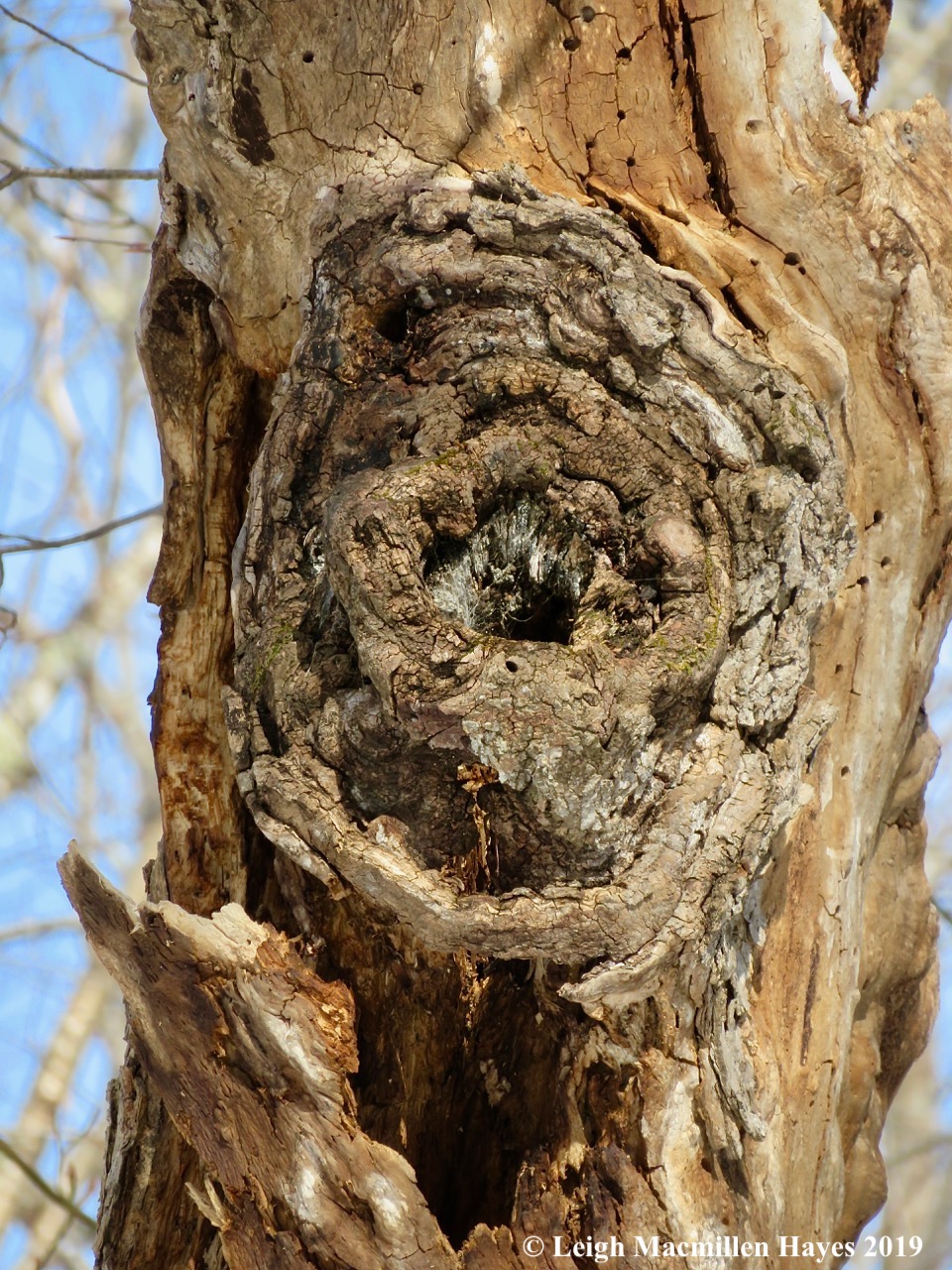
What I actually saw more than the owl was the face of a bear. OK, so I warned you that we took our imaginations with us.

We were almost down to the water, when the group paused. Tracks at last. Near water. Track pattern on a diagonal meaning one foot landed in front of the other in a consistent manner for each set of prints. Trail width or straddle: almost three inches. Stride we didn’t measure because it varied so much, but it was obvious that this mammal bounded through the landscape. Identification: mink. Repeatedly after first finding the tracks, we noted that it had covered a lot of territory.

At last, we made our way out onto the wetland associated with South Pond and followed the tracks of a much bigger beast–in fact multiple beasts: snowmobiles.

Rather than find lunch rock, we chose lunch lodge and stood in the warm sun to enjoy the view.

We did wonder if it was active and determined that though there had been some action in the fall as evidenced by the rather fresh looking sticks, there was no vent at the top so we weren’t sure any beavers were within. Maybe it was their summer cottage.

Close by, however, we found another lodge and the vent was open so we didn’t walk too near.

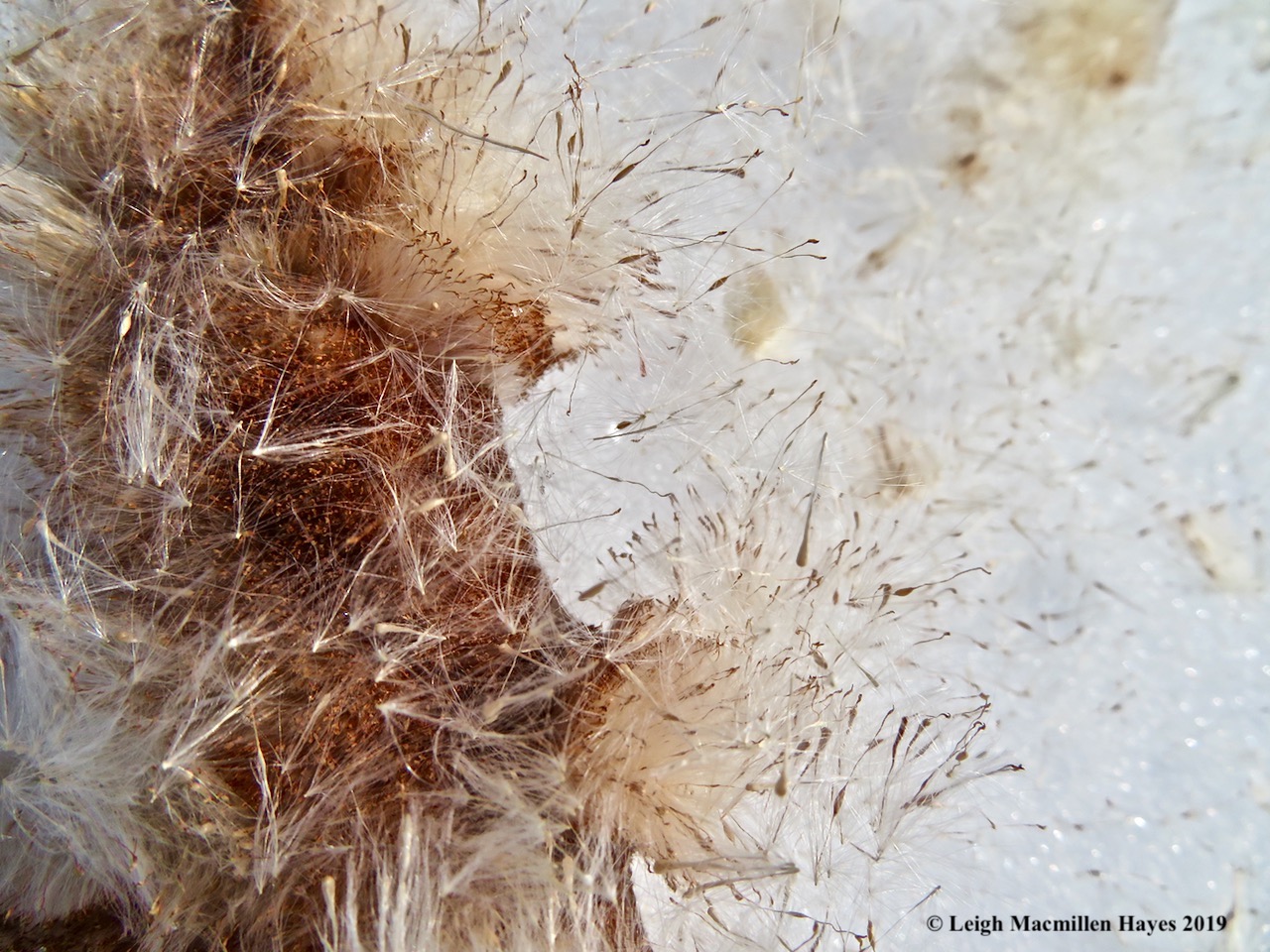
Because we were on the wetland, we did pause to admire the cattails, their seeds exploding forth like a fireworks finale (but of the silent type, which I much prefer).

Back on the trail, the bark of another tree stopped us. We looked at the lenticels, those lines that serve as a way to exchange gases much like our skin pores, and noted that they were thin rather than the raised figure 8s of a pin cherry.

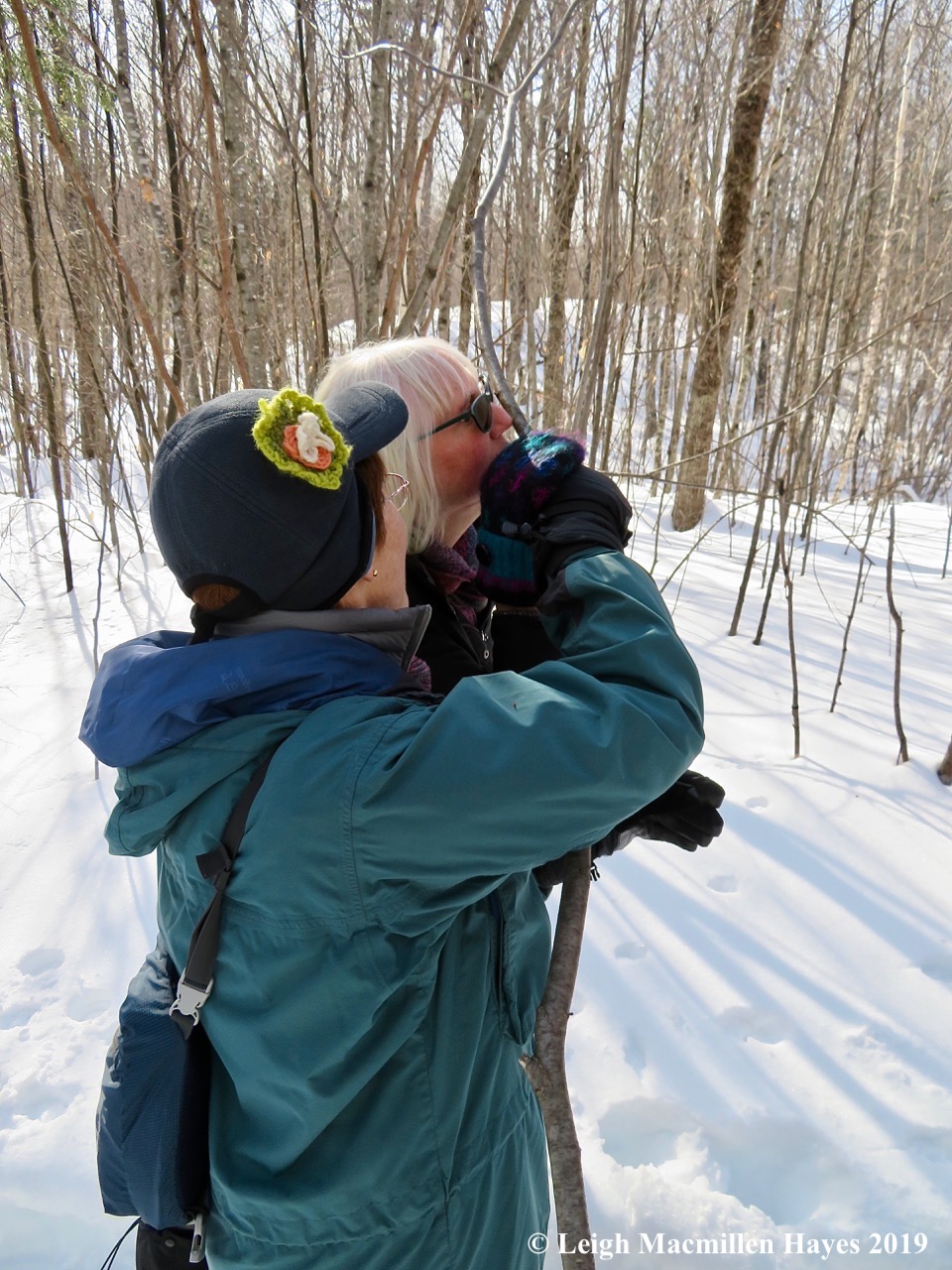
We had a good idea of its name, but to be sure we conducted a sniff test.

Smells like . . . wintergreen! We were excited to have come face to face with black or sweet birch. Some also call it cherry birch. Hmmm . . . why not wintergreen birch? Because, yellow birch, a relative, also has that wintergreen scent when you scratch the bark, especially of a twig.

Continuing along, the temperature had risen and snow softened so periodically we had to help each other scrape snowballs off the bottoms of shoes.

Otherwise the feeling was one of walking on high heels.

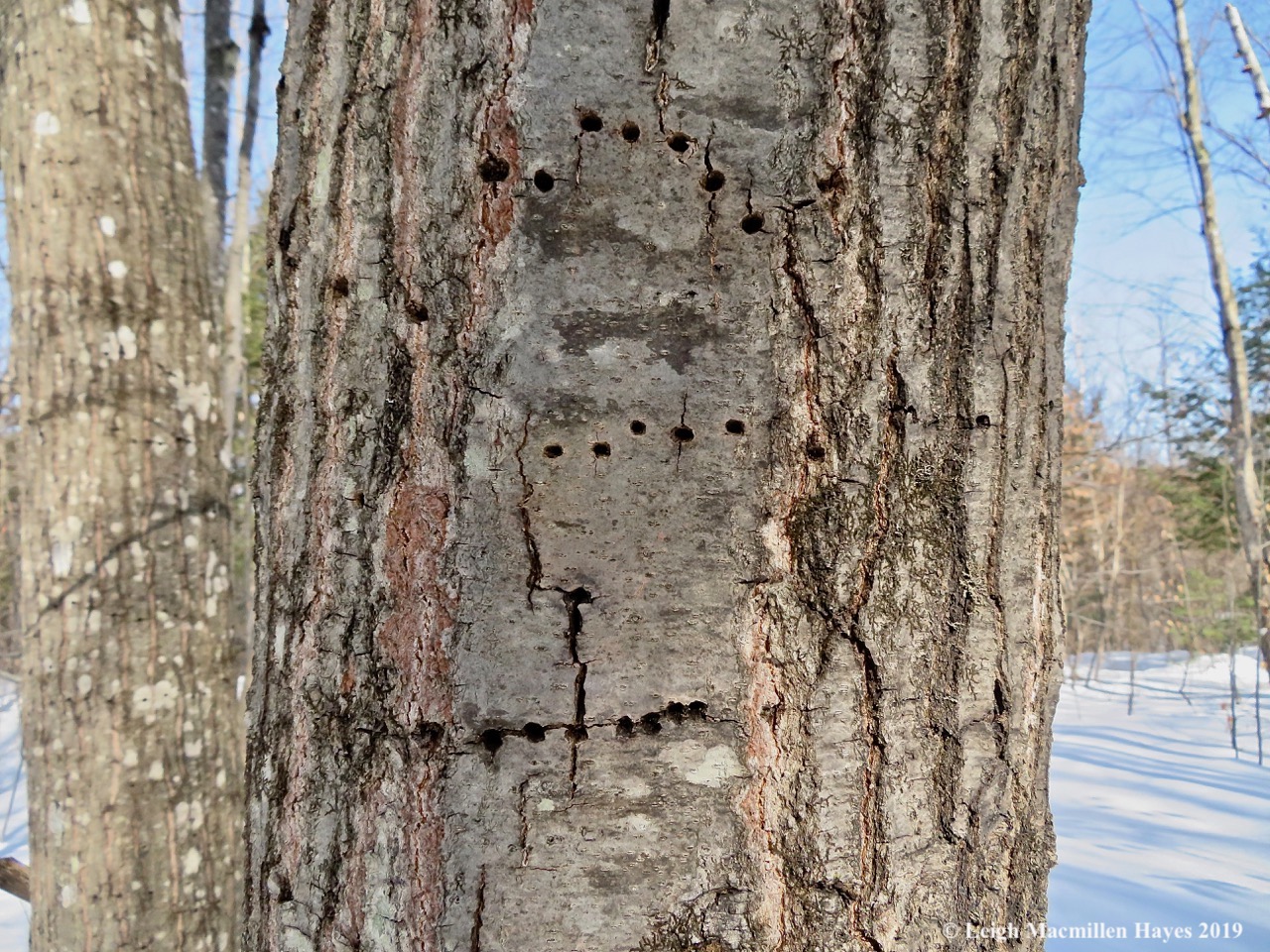
As I said earlier, all kinds of things stopped us, including the straight lines of the holes created by sapsuckers, those warm-weather members of the woodpecker family. One in the neighborhood apparently decided to drum to a different beat as noted by the musical notes of the top line.

Speaking of woodpeckers, for a few minutes we all watched a pileated and admired its brilliant red crest in the afternoon sun, but we couldn’t focus our cameras on it quickly enough as it flew from tree to tree. We did, however, pause beneath a tree where it had done some recent excavation work.

And left behind a scat that resembled a miniature birch tree.

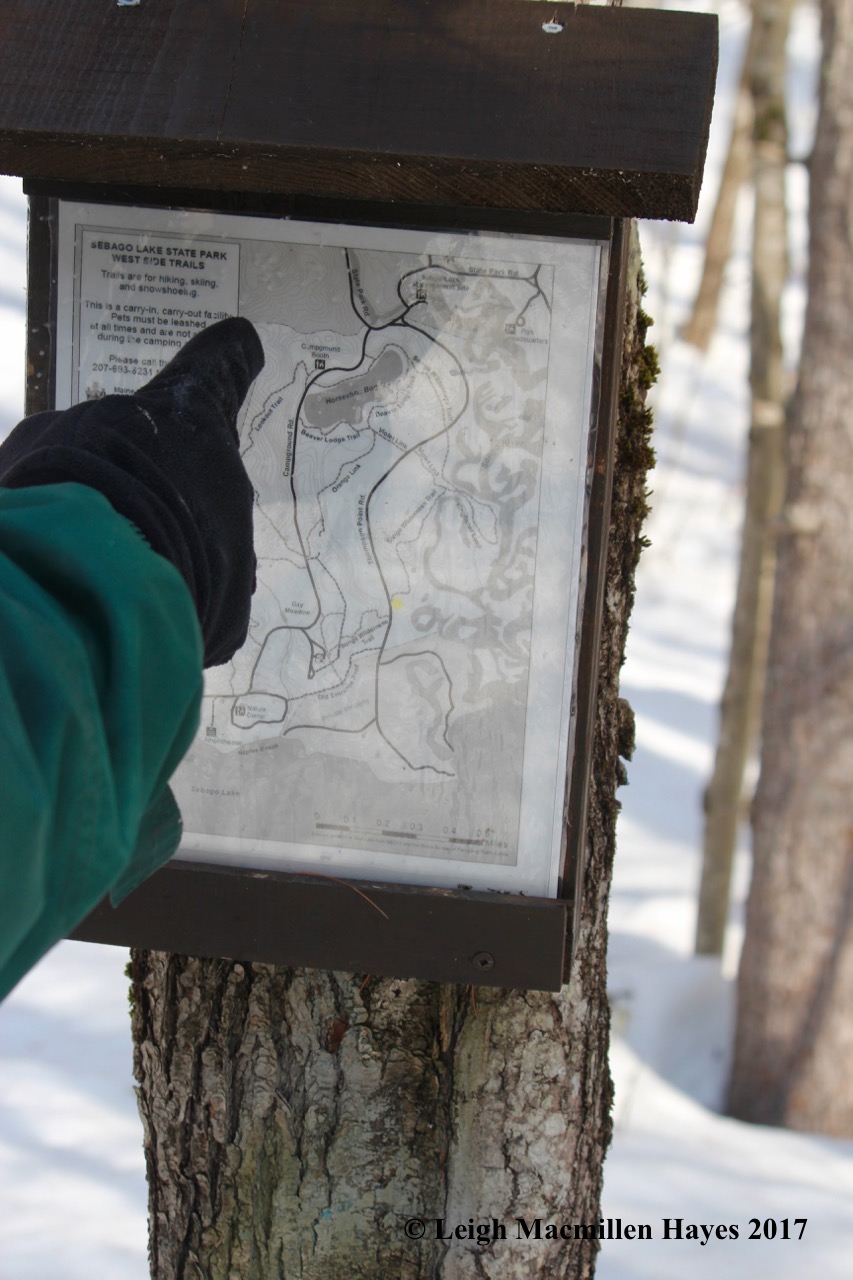
At last, four hours and two miles after starting (we’d intended to only be out for three), we’d circled around and stopped again at the kiosk to look at the map. Do note that we’d also picked up a passenger along the way for Carl Costanzi, a Western Foothills Land Trust board member and steward of the Virgil Parris Forest came upon us and joined our journey. We picked his brain a bit about the property and he picked up a pair of snowshoes that had malfunctioned for one of us. Thank you, Carl! That’s going above and beyond your duties.

Before departing, we did what we often do–circled around and took a selfie.

And then we left with smiles in our hearts and minds for the time spent reconnecting. Our memories will always be filled with the discovery of the first bear tree not too long after we began. As Penny said, “That first one was a doozy.”

Our entire time together was a doozy–of a playdate.

Thanks Beth, Gaby, Roger, Alan, and Penny. To those of you who couldn’t join us, we talked about you! All kind words because we missed you.

A Berry Pleasant Mountain Hike

Thirty-two years ago I moved to Maine (the only place I’ve ever lived where the number of years counts as bragging rights) and Pleasant Mountain quickly figured into my life. The first day I drove past it on Route 302, I was killing time before a job interview and one look at Moose Pond with the mountain looming over it and I knew I very much wanted to live here. A couple of days later, I received the phone call I’d been waiting for and principal Larry Thompson said it was only a matter of formality that my name go before the school board. By the next week, I was packing up in New Hampshire and making my way further north. I’d found a place to live that meant I’d pass by the mountain on my way to and from school each day. And then that October I attended a Halloween party with friends at the ski lodge of what was then called Pleasant Mountain Ski Resort. I was an olive and I met this guy dressed as a duck hunter. Turns out he’d never been duck hunting, but had a great duck puppet and he could turn its head with the stick within. He certainly turned my head!

Thus began the journey with my guy. Our first hike together–up the Southwest Trail of Pleasant Mountain. That first winter, he taught me to downhill ski, well sorta. My way of turning that first time included falling as I neared the edge of the trail, shifting my body once I was down on the snow, begging for the components of a steak dinner, rising and skiing across at a diagonal to the opposite side only to repeat my performance. Dinner was great that night! And well deserved.

Time flashed forward four years, and at noon on August 4, 1990, we were married; our reception in the Treehouse Lounge at the Ski Resort. In all the years since we first met and then were married and beyond, we’ve skied (though I have managed to avoid that concept more recently) together and with our sons before their abilities outgrew mine, snowshoed and hiked and grown only fonder of the place we call home. Our intention yesterday was to climb the mountain in celebration of our 28th anniversary, but the weather gods outpouring of moisture was not in our favor.

Today, however, dawned differently and so mid-morning we made our way with a plan to hike up the Bald Peak Trail, across the ridge to the summit, and down the Ledges Trail. We’d left the truck at the Ledges, ever mindful that the last thing we want to do after climbing down the mountain is to walk 1.5 miles to reach our vehicle.

1-heading up

As I’ve done over and over again in the past 32 years, I followed my guy–over rocks and roots and bald granite faces.

2-Pinesap

Once in a while I announced the need for a stop because my Nature Distraction Disorder ticked into action. In this case, it was Pine-sap, or Monotropa hypopitysMono meaning once and tropa turned; hypopitys for its habitat under a pine or fir. Also called Dutchmen’s Pipe, this is a parasitic plant that obtains all its nutrients by stealing them from the roots of a host tree. It doesn’t enter the host directly, but through a fungal intermediary. And like Indian Pipe, it has no green tissues. It differs from I.P. in two ways, its yellow color as compared to white, and two to eleven flowers versus a single flower. In my book of life, both Pine-sap and Indian Pipe are great finds.

3-Moose Pond below

I didn’t let my NDD get the better of me too often on the way up. It was extremely humid and so we did stop frequently, but also kept a pace that worked for both of us and soon emerged onto the ridge where a look back through the red and white pines revealed a peek of the causeway that crosses Moose Pond.

5-hidden camp

Employing the telephoto lens, I spied our camp hidden among the trees, only the dock and our little boat showing. It’s amazing how obvious all the neighboring camps seemed when viewed from up high.

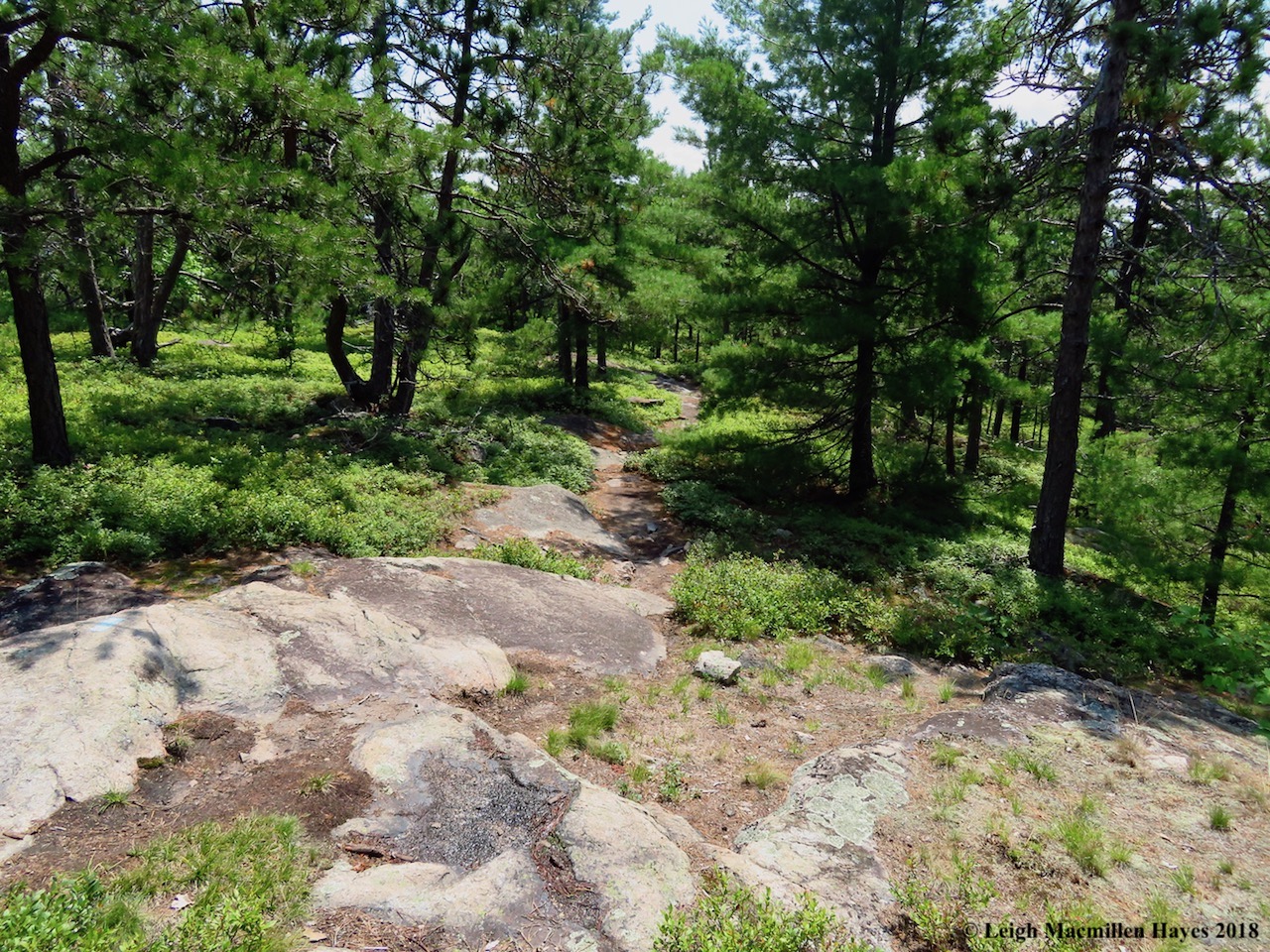
7-ridge line trail

After the climb up, the ridge always seems a cinch as the pathway wanders through blueberries, pines and oaks.

6-lunch rock

At last we found lunch rock, a place to pause in the shade and enjoy our PB&J sandwiches. We’d packed cookies for dessert, but decided to save those for later. My guy, however, had accidentally unpacked my work backpack and discovered a few pieces of a dark chocolate KitKat–my stash when I’m tired at the end of the day and need a pick-me-up before driving home. It looks like the purchase of another KitKat is in my near future for we topped off the sandwiches with a sweet treat.

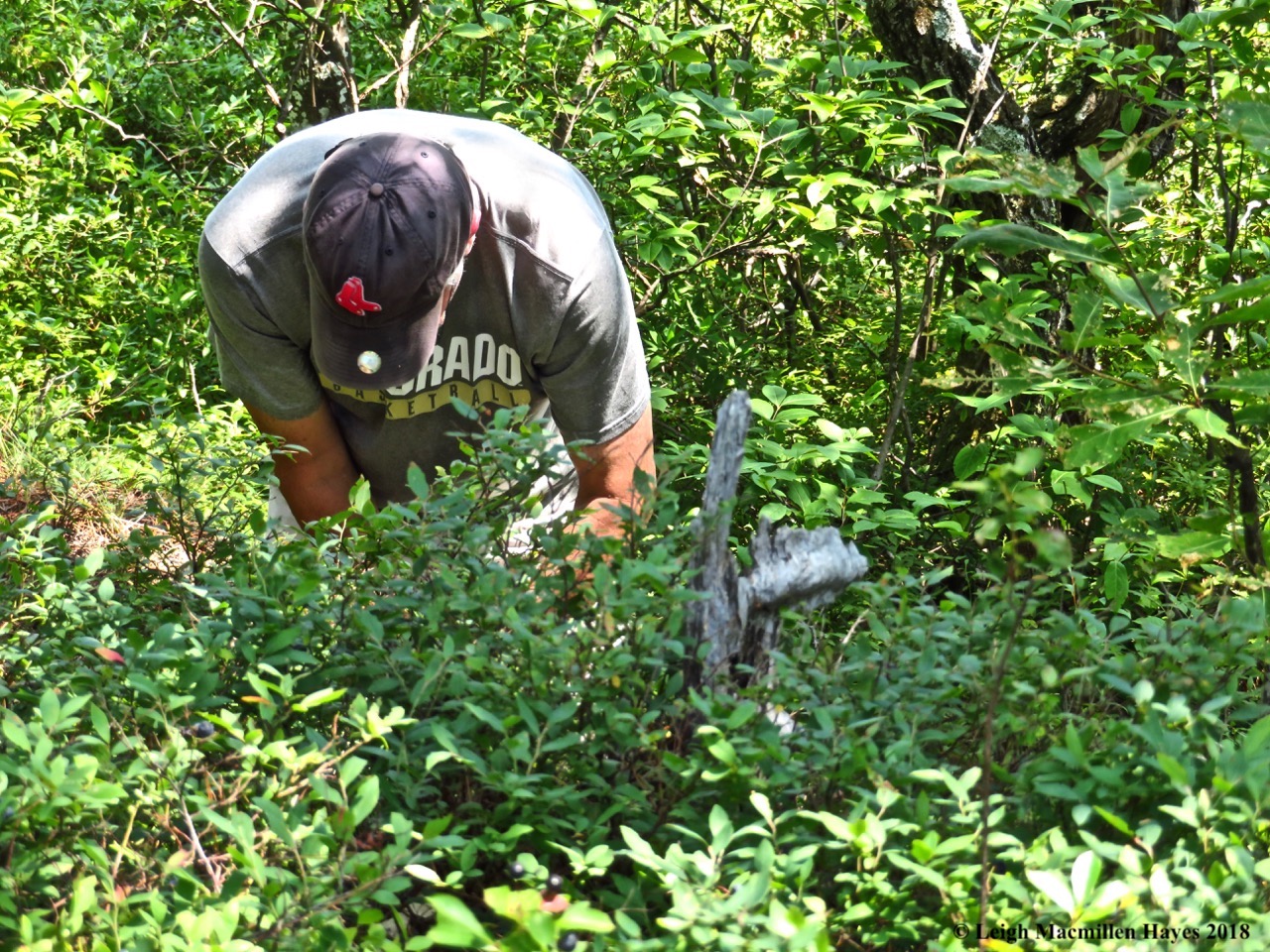
8-picking blueberries

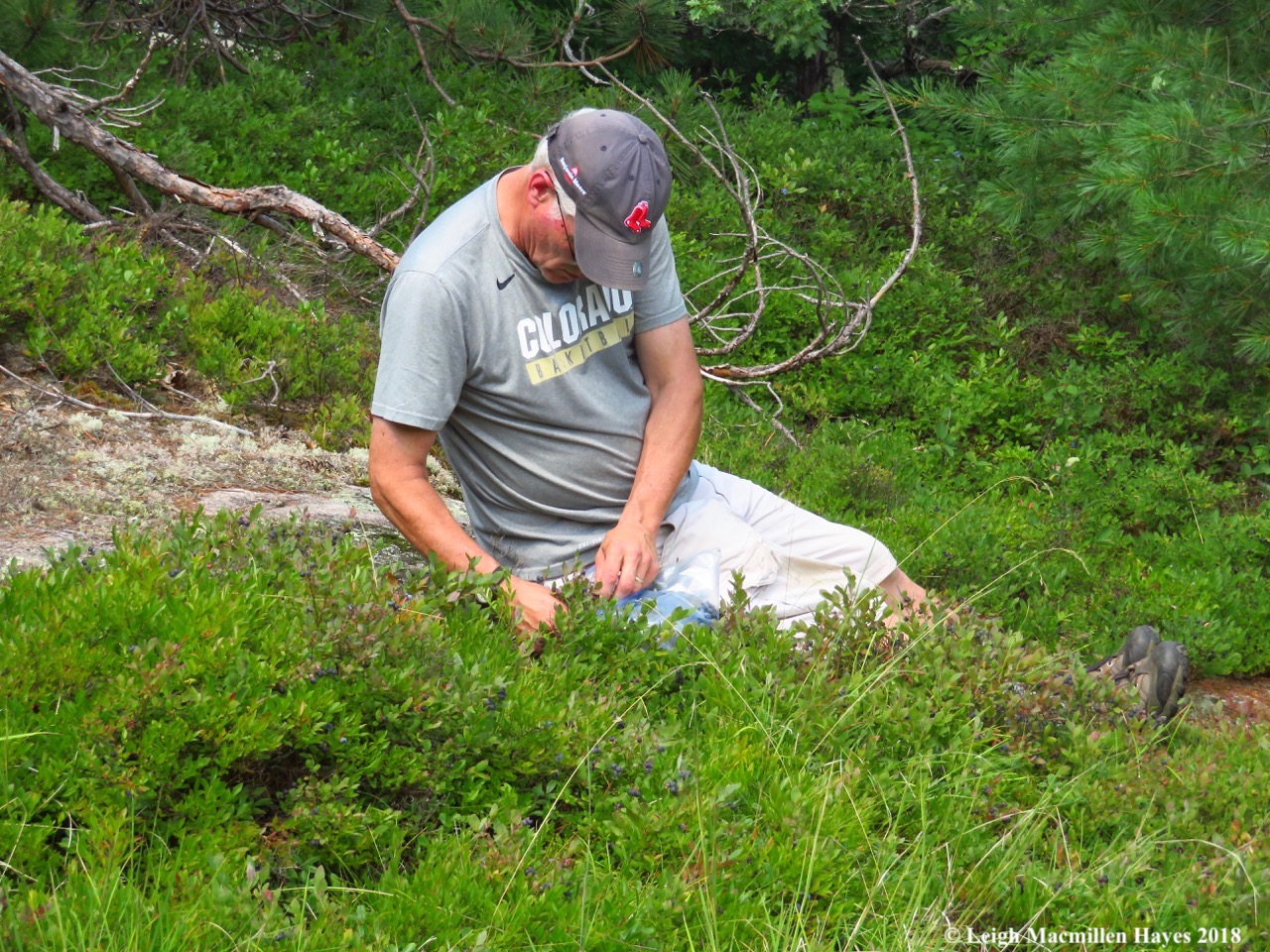
After lunch, my guy’s eyes focused in on one thing only. That is after he moved away from his original spot behind the rock we’d sat upon for our repose. Unwittingly, he’d stirred up a yellow jacket nest and managed to walk calmly away, only one bee stinging his leg.

14-blueberries

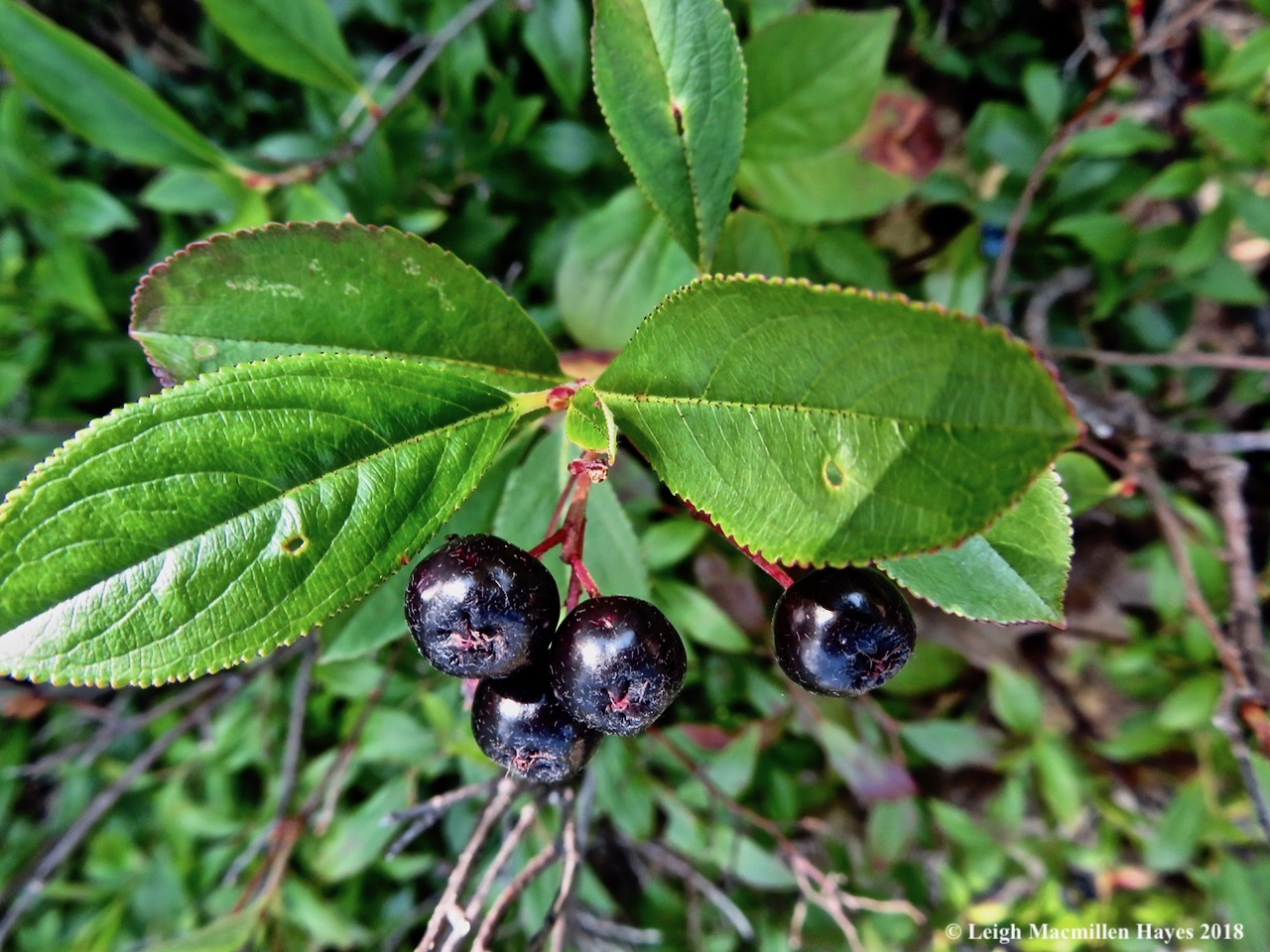
While his attention was on the gold at his feet–in the form of low-bush blueberries, I turned my lens in a variety of directions. Oh, I helped pick. A. Wee. Bit.

9-Lake Darner Dragongly

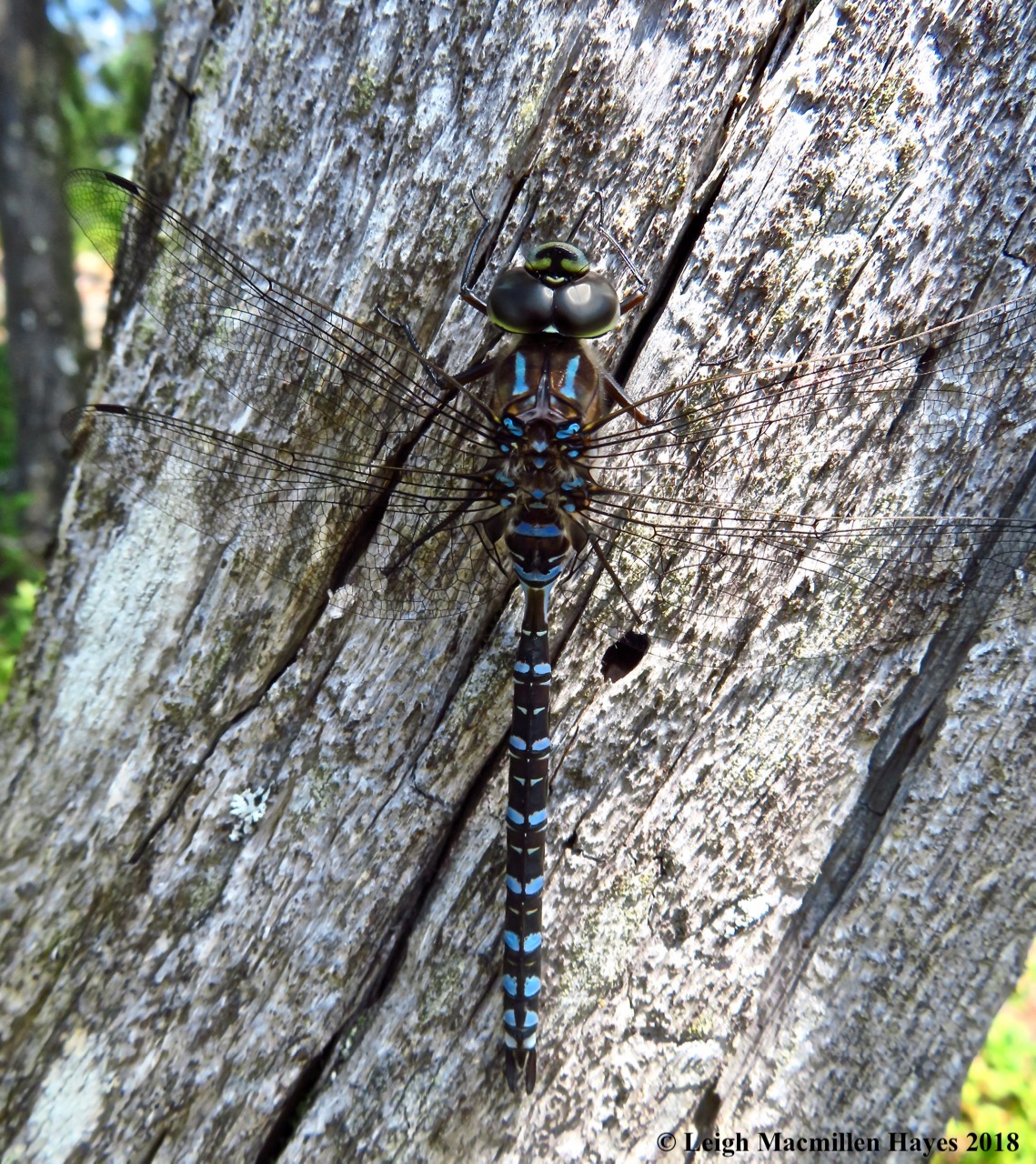
But there were other things to see as well and this dragonfly was a new one for me. A few highlights of this beauty: Do you notice the black cross line in the middle of the face. And on the thoracic side stripe, do you see the deep notch?

10-Lake Darner Dragonfly

Both of those characteristics helped in ID: Meet a Lake Darner. Even the male claspers at the tip of the abdomen are key, for they’re paddle-shaped and thicker toward the end. Though he didn’t pause often, Lake Darners are known to perch vertically on tree trunks. I was in awe.

11-grasshopper

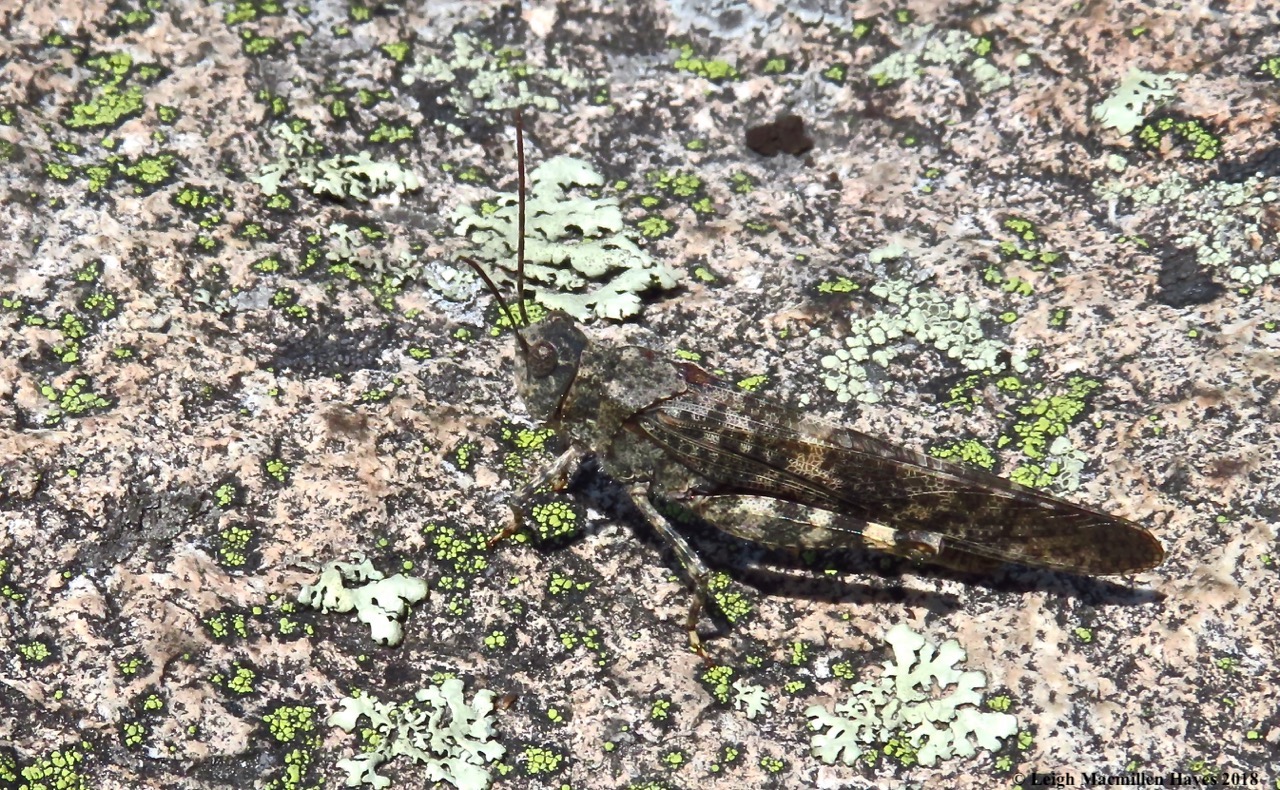
All the while we were on the ridge, the Lake Darners flew about, their strong wing beats reminiscent of hummingbirds, so close did they come to our ears that we could hear the whir. And then there was another sound that filled the summer air with a saw-like buzziness–snapping and crackling as they flew. I couldn’t capture their flight for so quick and erratic it was, but by rubbing pegs on the inner surface of their hind femurs against the edges of their forewings, the grasshoppers performed what’s known in the sound world as crepitation. Crepitation–can’t you almost hear the snap as you pronounce the word?

12-coyote scat

It wasn’t just insects that caught my eye, for I found a fine specimen of coyote scat worth noting for it was full of hair and bones. It was a sign bespeaking age, health, availability, and boundaries.

12A

Turns out, it wasn’t the only sign in the area and whenever we hike the trails on Pleasant Mountain these days, we give thanks to Loon Echo Land Trust for preserving so much of it. According to the land trust’s website: “Currently, Loon Echo owns 2,064 mountain acres and protects an additional 24 acres through conservation easements.”

13-picking some more

Our time on the ridge passed not in nano seconds, for my guy was intent on his foraging efforts. I prefer to pick cranberries, maybe because they are bigger and bring quicker satisfaction as one tries to fill a container. But, he leaves no leaf unturned. And enjoys the rewards on yogurt or the possible muffin if his wife is so kind, until late in the winter.

15-middle basin of Moose Pond

As we slowly moved above the middle basin of Moose Pond, I found other berries growing there.

14-lingonberries

Among them, lingonberries were beginning to ripen. They grow low to the ground, below the blueberries, and resemble little cranberries. In fact, some call them mountain cranberries. Like blueberries, they like acidic, well-drained soil. For all the leaves, however, there were few fruits and I had to wonder if the birds were enjoying a feast.

16-huckleberries

Huckleberries also grow there, though not quite as abundantly as along our shorefront on Moose Pond. They’re seedier than blueberries, though the local squirrels don’t seem to mind. Both red and gray harvest them constantly as they move throughout the vegetated buffer in front of camp.

17-summit fire tower

It took some convincing, but finally my guy realized that we needed to move on and so we gradually made our way to the summit, where the once useful fire tower still stands as a monument to an era gone by.

18-summit view in the haze

Our pause wasn’t too long for so strong was the sun. And hazy the view, Kearsarge showed its pointed profile to the left, but Mount Washington remained in hiding today.

19-ledges view of Moose Pond's southern basin

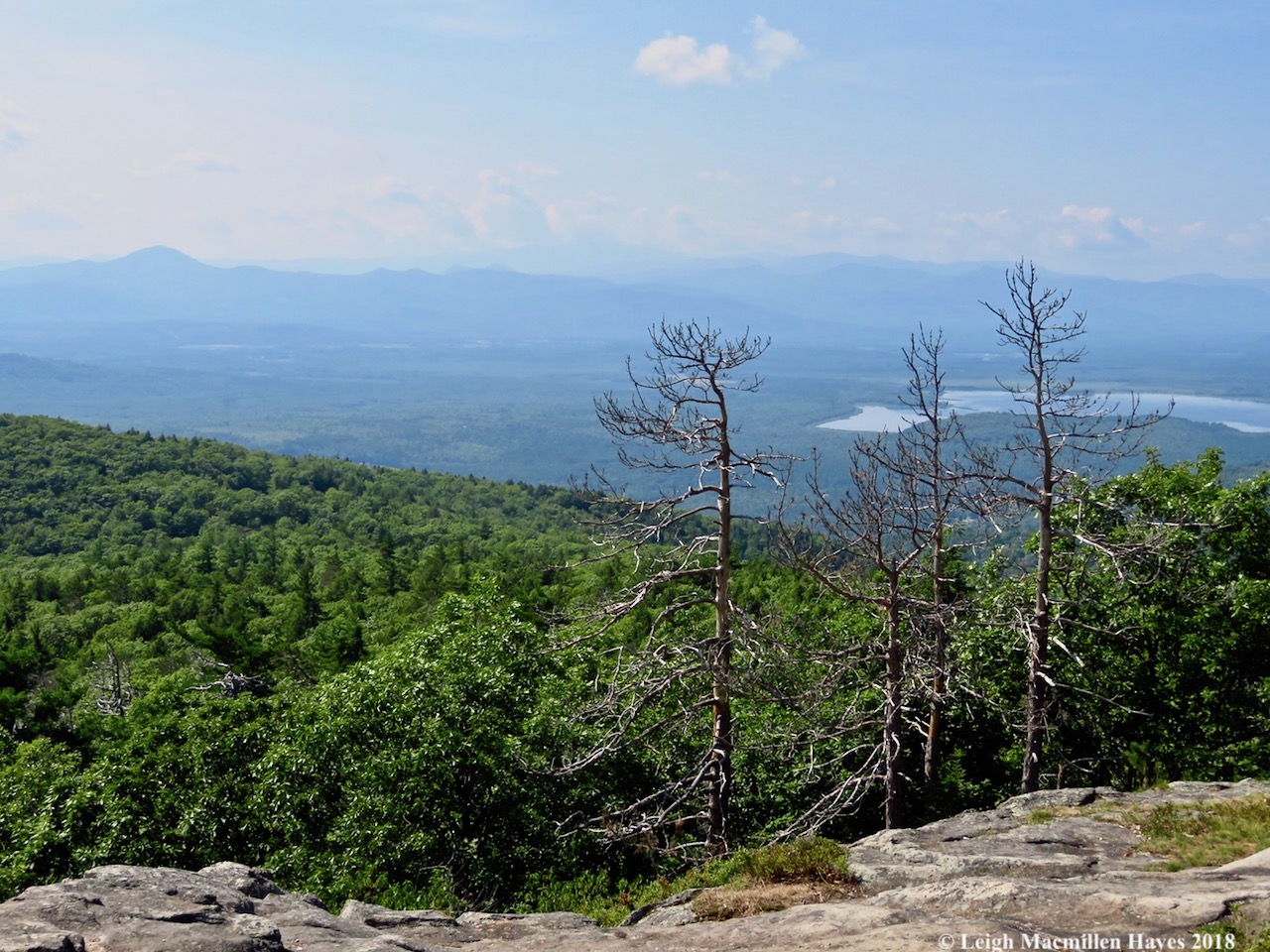
The journey down was rather quick. Perhaps because we were so tired, it felt like we just rolled down. But we did stop to admire the view of the southern bay of Moose Pond in Denmark. Our intention was also to eat the cookies we’d packed once we reached this point. Through both bags we hunted to no avail. I remembered packing the cookies under our sandwiches. And then moving the sandwiches to the second pack, but leaving the cookies. Did we accidentally take them out after all? Were they on the kitchen counter? In the truck? The final answer was no on all fronts. We think we must have taken them out at lunch rock and they never made it back into the pack. I had moved the backpacks with great calmness once we discovered the yellow jacket nest. Just maybe the yellow jackets are dining on some lemon cookies. Perhaps it was our unintended peace offering.

20-hiking down following this guy

After a five plus hour tour, filled with blueberries and sweat, I followed my guy down. We’ve spent the greater part of our lives following in each other’s footsteps and it’s a journey we continue to cherish, especially on our favorite hometown mountain.

Here’s to many more Berry Pleasant Mountain Hikes with my guy.


Miracle of the Stable

Who knows how it all began. Perhaps it was a teeny, tiny thought tucked away in the back of a mind.

p-milkweed 2

A seed of an idea waiting to express itself in one form . . .

p-polypody

or another.

p-yellow birch in pine tree

The seed was sown and sprouted despite adverse conditions.

p-Normway maple leaf

More thoughts followed, some even considered “invasive” despite their exterior beauty.

p-bittersweet

Occasionally, the invasive ideas forged ahead and crowded the mind.

p-car

Certainly, not all the thoughts were natural in nature.

p-boardwalk

But still, new paths formed.

p-fisher tracks

And trails were traveled to and fro on a quest.

p-stream curves

The path was never intended to be straight and easy.

p-Stevens Brook 2

Obstacles became challenges.

p-brook reflections

And challenges offered reflections.

p-ice feathers

Amidst the offerings, fresh ideas feathered forth fostering education.

p-garland

And with education, knowledge was linked.

p-tree cookie

Because of all the seriousness, humor became a necessary ornament.

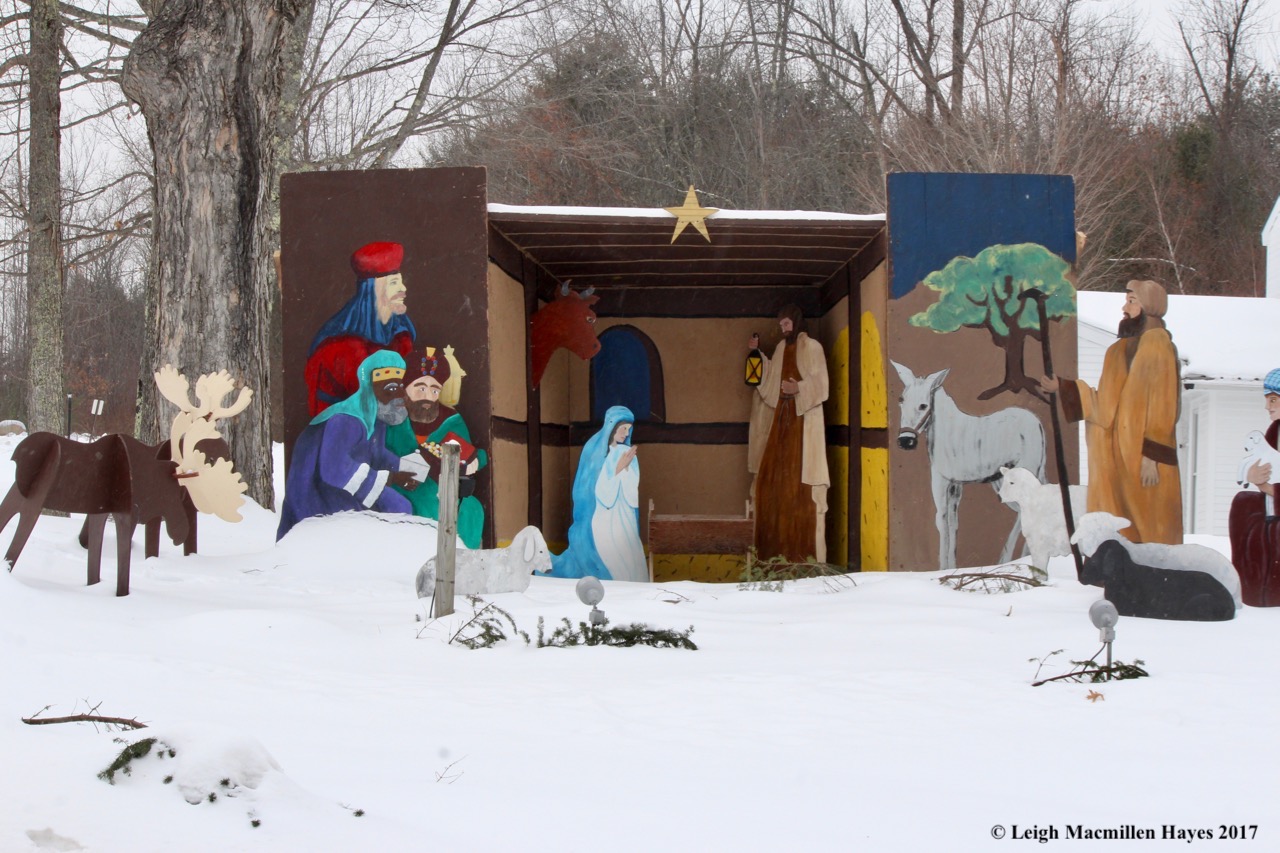
p-nativity

And so it was that moose stood watch with others by the stable in anticipation of a miracle that began with a seed of an idea and expressed the wonder of it all.


Celebrating Place–Naturally

Once the snow melts it will be more difficult for me to wander and wonder in the woods I explore all winter given its spring/summer water level and logging slash. And so I make the most of these days–trying to notice as much as I can before I can notice no more (or at least until next winter).

l-bushwhack 1

Though I’d promised myself I’d not go again in an effort to not disturb the deer, promises are meant to be broken. And from that came a lesson–the deer are sticking to the snowmobile trail and field edges where tender bark of young red maples and hemlocks, plus swelling buds meet their needs for the moment. So, it was OK that I broke my promise, for the deeper I tramped, the fewer tracks I encountered.

l-spring tails1

Today’s warmer temps in the low 40˚s found the springtails hopping about on any and all surfaces.

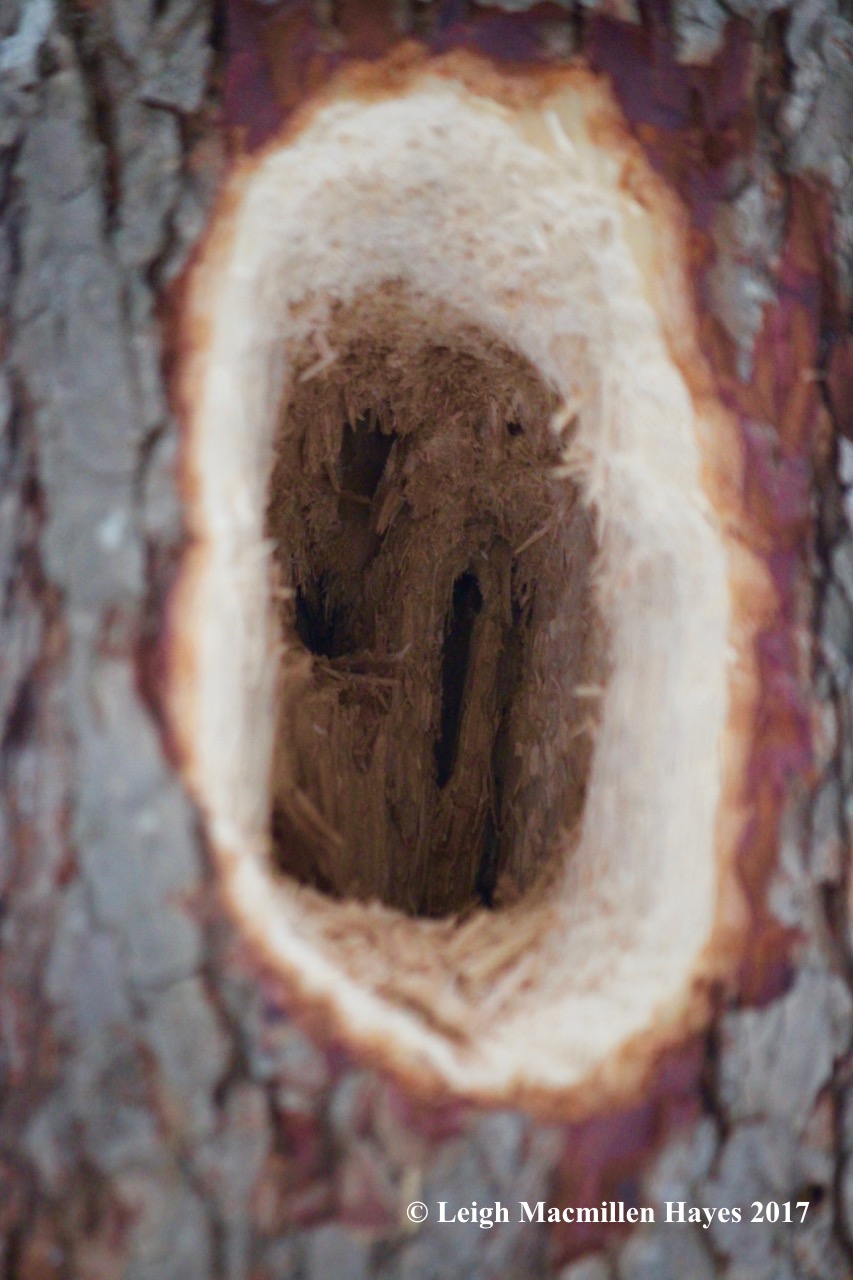
l-pileated hole

As is my habit, I checked on a pileated woodpecker hole when I saw bark and wood scattered atop the snow. Deep was this excavation in search of nourishment.

l-pileated scat-seeds and ant

And chock full was the scat below, which contained insect body parts and seeds of the dreaded bittersweet. Beside the scat, a springtail sought to placate its own food needs which among other things includes plant material and animal remains.

l-red maple bull's eye

Turning to another tree, I landed on a perfect bull’s eye! The target fungus that affects many red maples makes for an easy ID.

l-crustose, liverwort and moss

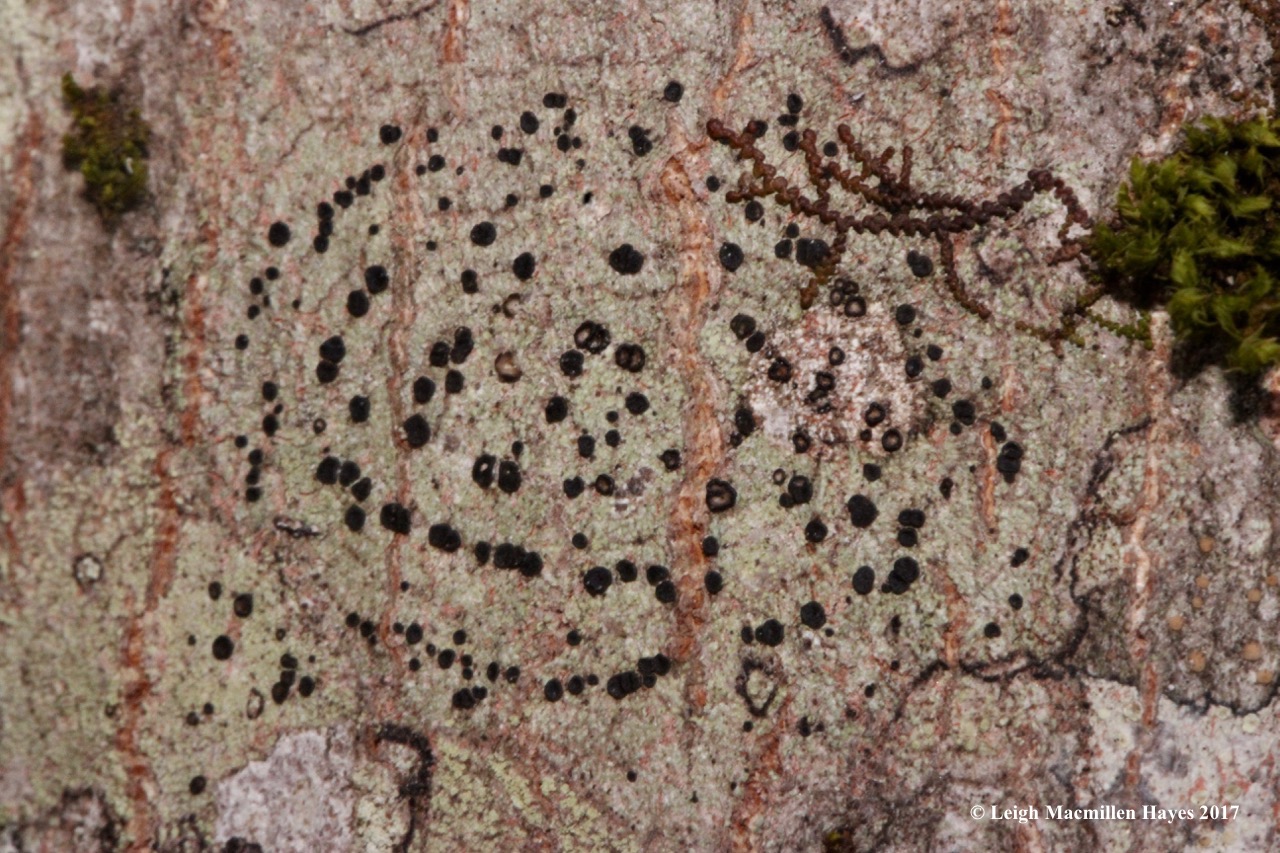
Lichens have also been a focus of late. What I like about this one, the circular green with the black disks of a crustose lichen (possibly bark disk lichen), was its location beside a liverwort (the beaded brown Frullania eboracensis) and a moss that I didn’t key out. Tree bark has its own structure and texture, but so often others also call it home.

l-shield lichens on rock

Rocks also serve as a substrate and this one featured a couple of leafy foliose shield lichens, their colors enhanced by yesterday’s inch of snow.

l-hair lichen and beard lichen

And dangling from a branch, two forms of fruticose (branching or fruit-like structure–) lichens. The dark is a hair lichen, while the green a beard–seems about right with the hair above the beard.

l-lichen garden

On another maple I spied a garden–you’ve got to liken it. (Corny joke that always manages to enter a lichen conversation.)

l-frullania 1

I’ve often paused beside Frullania eboracensis, a liverwort with no common name, but today several trees shared displays of mats called Frullania asagrayana, so named for a botanist and natural history professor at Harvard University from 1842-1873–Asa Gray.

l-frullania asagrayana 1

Its shiny, overlapping chain of red-brown leaves reminded me of caterpillars crawling along the maple bark.

l-spirea:steeplebush

Casting my eye elsewhere, steeplebush in its winter form offered an artistic presentation.

l-bracken fern1

And as the snow melts, last year’s bracken fern made an appearance.

l-speckled 3

One last shrub made me stop. Minus any catkins or “cones” for which it is known, I had to think for a moment about the speckled alder. But those speckles or lenticels through which gas exchange occurs, and the buds and leaf scars were give aways.

l-speckled buds and leaf scar

The two bud scales meet at their edges and look like miniature footballs. But it’s the bundle scars where leaves were formerly attached that make me laugh. That vascular system looks like a face–two round eyes, a funny shaped nose and a round mouth, as if it’s exclaiming, “Ohhh” or “Wow.”

l-Pleasant Mtn in background

At last I reached my turn-around point. I could see Pleasant Mountain in the distance and knew where I was in the world. This is my place and I love every opportunity to celebrate it–naturally.

Hiking the West Mondate

How could it be? We realized this past week that we’d only hiked in Sebago Lake State Park together once–thirty years ago. Oh, I’ve skied there, visited friends who were camping, and participated in several eighth grade class picnics back in my public education days.  But today we decided to remedy our hiking opportunity–or lack thereof.

s-sebago-sign

Our intention wasn’t to camp, but rather to explore the trails that circle around and cut through the 1,400-acre property. For those of you who know my guy, though we certainly haven’t spent a lot of time in the park, he does feel a certain affinity–to the brown stain that the park staff purchases in five gallon buckets from his hardware store. :-)

s-boundary-blazes

After looking at a map near the entry booth, we headed off on a trail marked with orange blazes. Or so we thought. Until we realized we were following the boundary. But all the orange paint made me think of our young neighbor, Kyan, and as it turns out he was on my brain for a great reason–he’s been in remission for the past six months following his bone marrow transplant and today had his central line removed. No wonder we spent an hour following those orange blazes. All the while, however, we did think the trails were poorly marked.

s-high-point-1

Unwittingly, we spotted a bit of brown–on the picnic table. We appeared to be on a high spot, home to the table and a cairn garden.

s-cairns-3

I’m of several minds when it comes to cairns. I know that some are historical and symbolic and others mark trails, but these, though each different in sculptural form, bothered me.

s-cairn

While my guy saw them as offering hikers something to do, I saw them as disruptive to the natural landscape. That being said, the landscape was formed by a glacier and these pieces spoke to the bedrock geology of the Sebago pluton with their pinkish coloration.

s-kneeling-before-map

Turns out we were at the summit of the Lookout Trail, the highest point in the park at 499 feet. And behind the cairn park, we found the trail itself, blazed with red triangles, which we followed down to the campground road where we found a map–worth kneeling and worshiping. Well, actually, given the snow depth, that was the easiest way to read it. From that point forward, we found “You Are Here” maps whenever trails intersected, though we did tend to wander off occasionally.

s-ice-bubbles

Over a brook, where balls of ice formed,

s-artist-conks

past artist conks decorating a decaying birch tree,

s-locust-bark

and through woods featuring the braided ridges of black locust bark, we hiked.

s-tree-silhouette

And then we reached the beach. On Sebago Lake.

s-rocky-coast-of-maine

We’d arrived at Witch Cove Beach.

s-waves-and-wind

The wind had kicked up the waves and it felt almost ocean like. Almost.

s-maple-and-pitch

Certainly, tree roots beside the lake spoke to wave action and higher tides (no, the lake doesn’t have a tide, but in storms and floods it must surge higher). Beside the water, a red maple and pitch pine tree embraced from their root source.

s-pitch-pine-bark-1

The bark of the pitch pine featured its reddish plates surrounded by deep furrows.

s-red-pine-bark

While it’s similar to red pine bark that grows nearby, there are subtle differences–red pine bark being plated but much thinner and tighter to the trunk. Plus, the pitch pine has bundles of three needles, while the red features two needles.

s-pitch-pine-growth

The other unique characteristic of pitch pines, their epicormic sprouting of needles on the trunk that grow from dormant buds on the bark.

s-sand-prints

Eventually, we moved on, leaving prints in our wake.

s-beach

Our substrate switched from snow to sand and back to snow, which we much preferred.

s-beach-eyes

Before we turned away from the beach, we found the sand goddess eyeing the world. Again, we noted the orange and thought of Ky, but didn’t truly realize its significance.

s-lunch-table

Into the picnic area we moved, after watching a few deer who eventually flashed their white tails before moving on. Lunch table beckoned us. It needs some fresh stain–there’s job security in that thought–for the park staff and my guy.

s-buried-table-2

Some tables spoke to the snow depth.

s-cache-fest

After we finished our sandwiches, we discovered that others had used the picnic ground–for a cache site. Somewhere in the park, at least one red squirrel prospered through the winter.

s-glacial-kettle

Our journey took us past the glacial kettle formed by the melting of large blocks of ice.

s-map

And then we figured out our final trails to follow.

s-songo-river

We crossed Thompson Point Road and followed the oxbows and meandering of Songo River, which actually proved to be bittersweet. I’d only been on the river twice and both with the milfoil team of the Lakes Environmental Association. As we hiked beside it today, I recognized various points Adam Perron, the milfoil dude had pointed out. Again I say, RIP Adam.

s-beaver-bog-from-table

At last we reached Horseshoe Bog, home to one of those picnic tables needing work. You know who spied it from a mile off.

s-beaver-works-3

He also spied the work of others and eagerly showed me.

s-beaver-teeth

My what big teeth grooves a beaver leaves.

s-beaver-works-4

It left its mark everywhere.

s-beaver-5

And sometimes such works met the forces of nature and all was well that ended well.

s-spur-trail

The same could be said for us. We began the day on a trail that wasn’t and ended by trying to follow a spur trail out, that we couldn’t quite locate (except for the sign at the beginning that identified it as a spur trail) and so we bushwhacked and then an anomaly caught our eyes–snow on a structure, which turned out to be the entry booth from which we’d begun our expedition.

As it turns out, we realized that our adventure thirty years ago was on the east (Casco) side of the park and this was our first visit to the west (Naples) side. Here’s hoping it doesn’t take us thirty more years to return for another Mondate–indeed.


Seeing Red

I wander through the same woods on a regular basis, sometimes following old logging roads and other times bushwhacking through the understory–a mix of young conifers and hardwoods that are slowly reclaiming their territory. Always, there are water holes to avoid as this is a damp area, so damp that in another month I probably will have to curb some of my wandering habits because it will become difficult to navigate.

h-maleberry-buds

But it’s that same water that gives life to the flora and fauna that live therein, such as the buds on the maleberry shrub. Notice how downy the twig is. And the bright red bud waiting patiently within two scales–preparing for the day when it will burst forth with life.

h-maleberry-pods

On the same shrub exists evidence of last year’s flowers, now capsules reddish-brown and five-celled in form.

h-red-maple-buds

And like the maleberry buds, the red maples buds grow more global each day, some with three scales of protective covering and others more.

h-snowflakesbuds

Today was a day of contrasts, from sunshiney moments to snow squalls, as well as greens to reds, tossed in with a mix of browns and grays.

h-moose-scrape

Continuing my venture, I soon realized I wasn’t the only one enjoying red. The moose and deer with whom I share this place, also find it a color of choice–especially the bark of young red maple trees.

h-moose-scrape-2

As I looked at the tree trunks, I could sense the motion of the moose’s bottom incisors scraping upward and then pulling against its hard upper palate to rip the bark off. Everywhere I turned, the maples showed signs of recent scrapes.

h-moose-rub

Less frequently seen were antler rubs such as this one, where the middle was smoothed by the constant motion and the upper and lower ends frayed. Such finds offer noted differences between a scrape and rub–the former has tags hanging from the upper section only and the teeth marks stand out, while the latter often features a smooth center with the ragged edges at top and bottom. But . . . like us, nature isn’t perfect and not everything is textbook, so I often have to pay closer attention.

h-moose-bedscat

I saw more than red and so I could hardly resist a moose bed filled with scat and urine. I’m always in awe of the sense of size and again I saw motion, of this large mammal laying down to take a rest and perhaps a few hours later, getting its feet under itself to rise again, do its duty and move on to browse some more.

h-witch-hazel-scattered

Deer tracks were even more numerous than moose and the solidness of the snow allowed them to travel atop the crust. At one point I spied something I didn’t recall seeing before–witch hazel capsules decorating the snow.

h-witch-hazel-pod

At this time of year, these grayish tan capsules persist on the trees, but their work was completed in the fall when they expelled their two glossy black seeds.

h-witch-hazel-bud-nibbled

Ruffed grouse, wild turkeys and snowshoe hare like witch hazel buds. As do deer, who rip them off in the same fashion as a moose and leave a tag behind–as a signature.

h-witch-hazel-bud

Not all were eaten–yet. Notice these buds, ensconced in dense reddish/yellowish/brown hairs rather than the waxy scales of the maleberry and maple. And the shape extending outward from the twig, almost in scalpel-like fashion. Yeah, I was still seeing a hint of red.

h-witch-hazel-flower-bracts

If I wanted to carry my red theme to the extreme, I could say that the bright yellow bracts that formed the base of the former flowers were framed in red, but really, it’s more of a hairy light tan along their rims. Eventually, the bracts will develop into seed capsules and next autumn they’ll be the ones to shoot their seeds with a popping sound. We always talk about that sound and refer to Henry David Thoreau for as far as I know he was the one to first hear it. This past fall, a friend tried this and like Thoreau, he was awakened during the night by the seeds being forcibly expelled. (Credit goes to Bob Katz for that experiment.)

h-british-soldiers

Back to red. Under the hemlocks where the deer had traveled, I was looking at some mosses when these bright red soldiers showed their cheery caps–it’s been a while since I’ve seen British Soldier lichens, most of it buried beneath the snow.

h1-red-oak-bark

As I headed toward home, a red oak beside the cowpath asked to be included. It seems in winter that the rusty red inner bark stands out more in the landscape, making the tree easy to identify. Of course, don’t get confused by the big tooth aspen, which slightly resembles a red oak at the lower level, but a look up the trunk suddenly reveals similarities to a birch.

h1-acorn-cap

Many of the acorns have been consumed after such a prolific year, but their caps still exist and the color red was exemplified within the scales.

h1-icicles

Back at the homestead, I walked by the shed attached to the barn where icicles dripped–again speaking to this day. By that time the snow squalls had abated and sun shone warmly, but a brisk wind swirled the snow in the field into mini whirling dervishes. My cheeks were certainly red.

h-cardinal

My red adventure was completed at the bird feeder. A happy ending to scenes of red.


Meditation in the City

Though I grew up outside New Haven, Connecticut, and spent a great deal of time there as a child/tween/teen, I am not a city girl. In fact, stepping onto a sidewalk in even the smallest of cities yanks me from my comfort zone.

And so it was with great surprise that I met a city I rather liked. Over the last thirty years, I’ve passed through it numerous times, but twice this past week, I followed my tour guide from one monument to the next–my eyes wide and mouth gaping open with each new view, the obvious sign of a tourist.
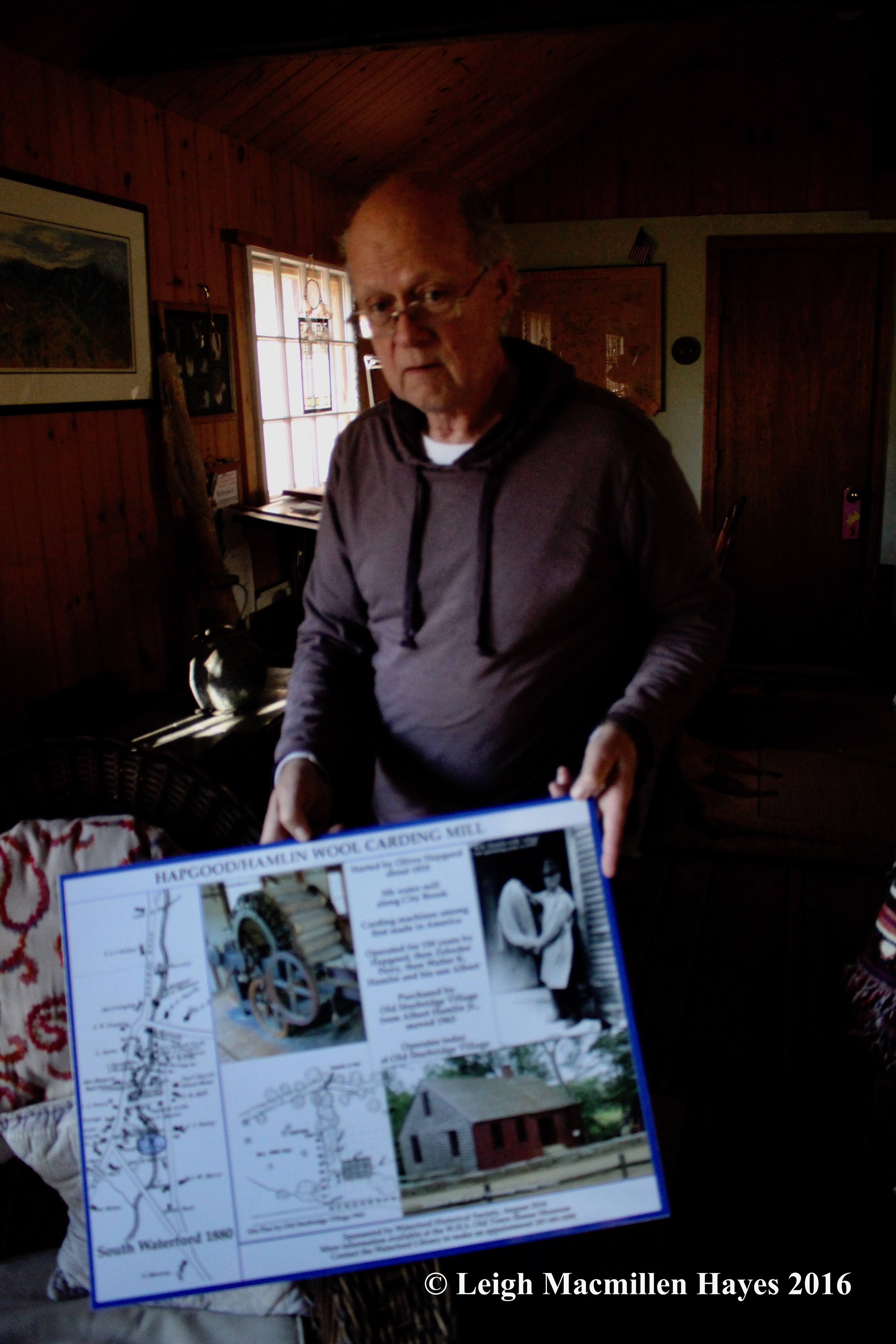
w-bobsign

Meet my tour guide, Bob Spencer, who proudly displayed a future landmark sign.
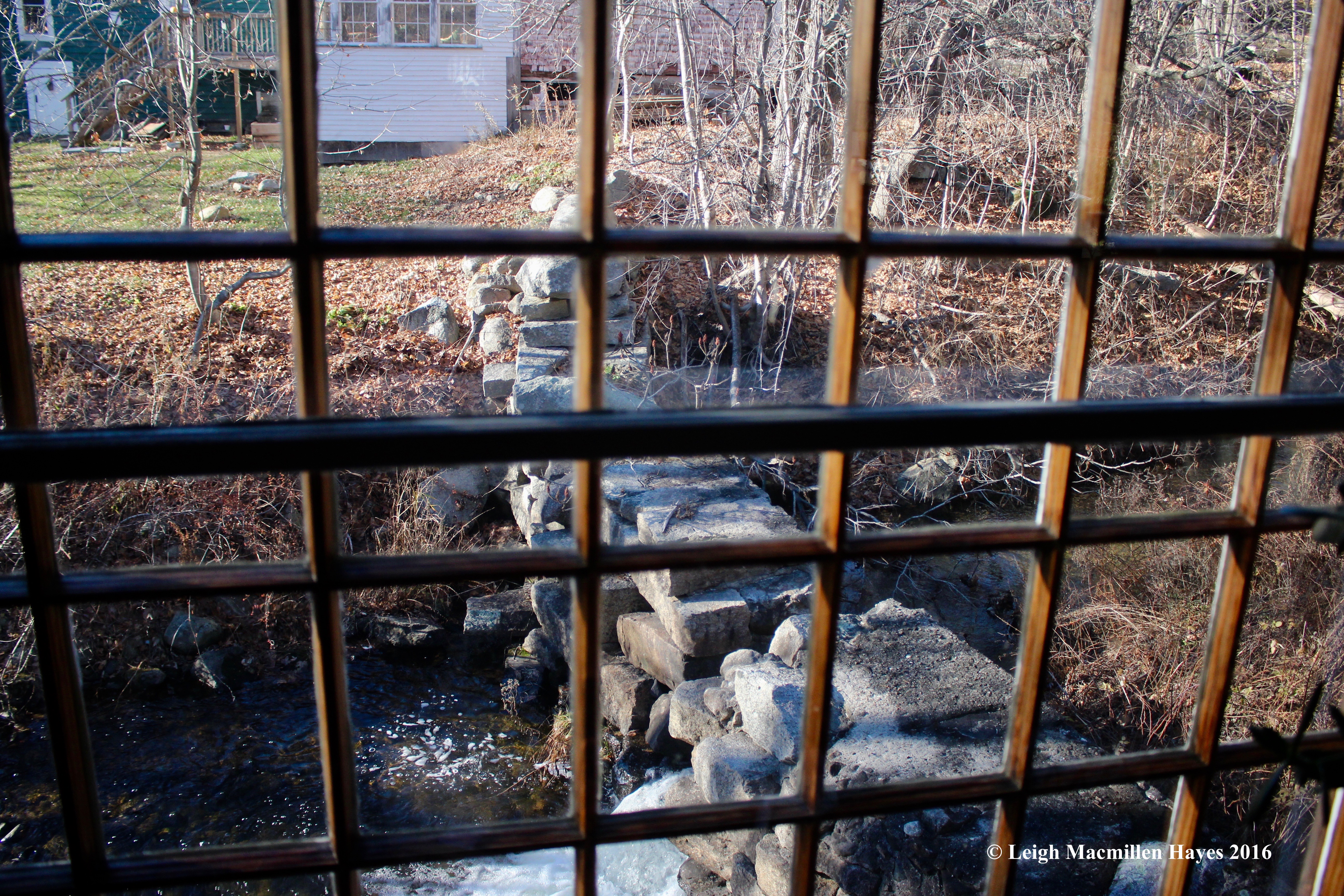
w-indoor-view

Bob’s world view begins at City Center, aka Watson’s Falls.
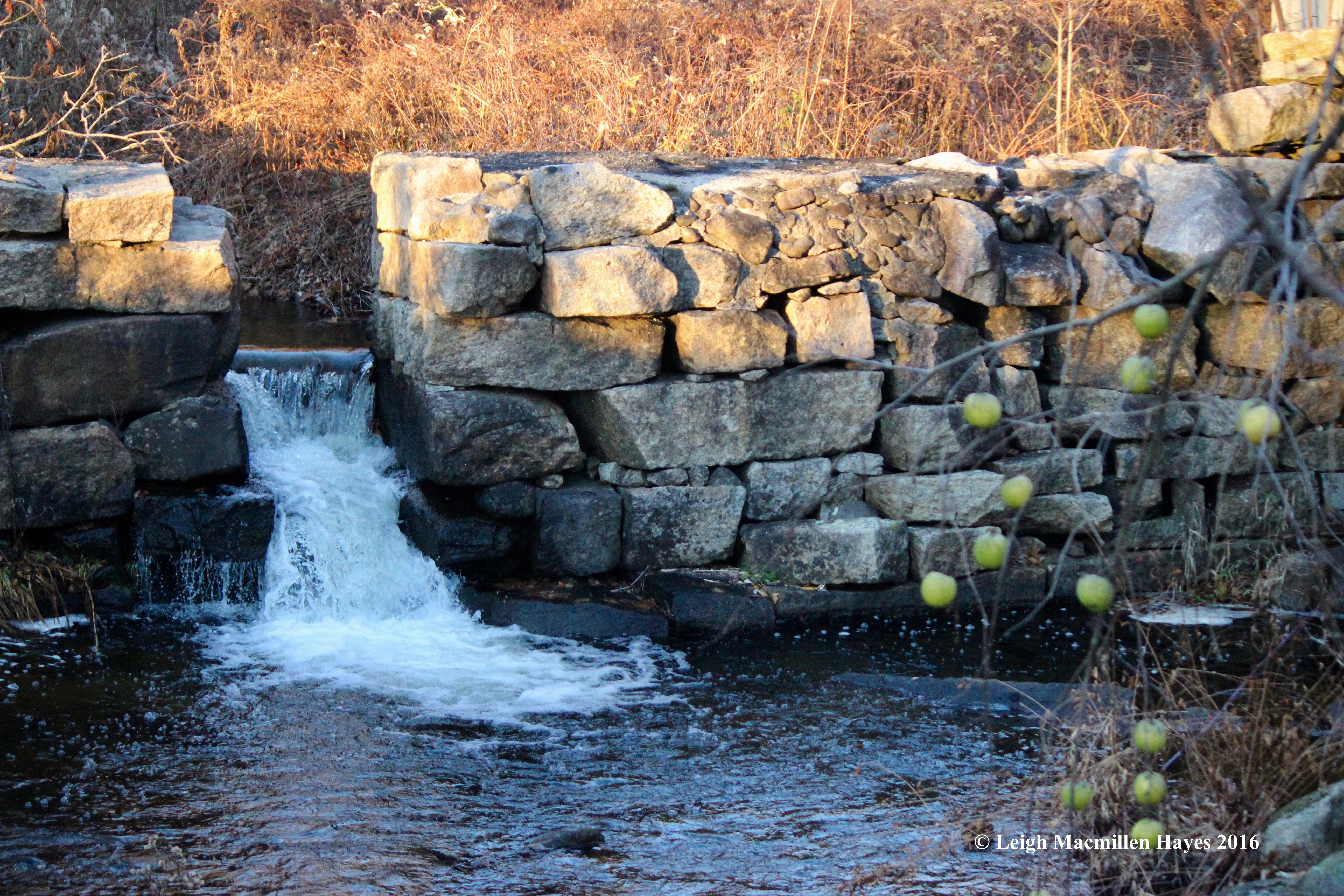
w-watsons-falls-1

From the home he and his wife, Gere, have made in a former mill, the view encompasses one of nine water privileges or mill sites. Theirs is the fifth privilege along the stream, which was originally granted to Isaac Smith in 1795 for a saw mill. Over the course of its lifetime, the building served as a cloth and linseed oil mill, saw mill, salt box factory and cider mill. I love that apples still dangle above the water, a reminder of that last rendition.
w-library

On Saturday, we stepped north for a few minutes, and chatted about the mill pond and its function while Bob pointed out foundations and retaining walls and told stories of the standing buildings.

w-watson-falls-2

Then we turned south along the brook, where remnants of dams and the stonework foundations of other water-powered mills flourished from the days of the town’s settlement until the mid 1900s.

Bob is a fellow writer and naturalist with a keen interest in history. I’m flattered that he shared this place with me as well as his own written musings:

For most travelers on busy state Route 35/37, our brook is of little interest or importance. To the village of South Waterford, however, a cluster of thirty buildings which lie on either bank of this stony rill, it has served as a source of life and vitality throughout much of history. Landforms here were carved into the granite bedrock as a much larger ice-age water course scoured out a valley between Bear and Hawk Mountains to the east and Mount Tir’em and Stanwood Mountain to the west. Native Americans gathered along its banks to fish and camp. Eighteenth century settlers were drawn to the environs for a source of their fresh water and of power to produce lumber and flour, which were essential to survival. Nineteenth century industrialists, before and after the Civil War, earned their livelihoods by producing both commercial and consumer goods traded locally and in cities such as Portland and Boston.

w-flood-plainmill-pond

As we walk along he pointed out buildings still standing, those in stages of disrepair, and others that were merely memories. We paused by a meadow where he described the spring flooding events and I examined the evergreen wood ferns.
w-city-brook-meanders

And then we noted the gouge that deepened as we climbed, where “a glacial moraine as melt water engorged the brook into a raging river 15,000 years ago. The brook serves as the marshy wetland home of fish, birds and mammals. Such a short stream can teach everyone who allows the time many lessons about our ecology systems: how they work and how they were born.”
w-outlet-1

At the emergence of the brook we’d followed with two smaller brooks (Mutiny and Scoggins), we paused as Bob described their origins and journeys.
w-bear-pond

And then we turned to Bear Pond–the outlet. The temperature was relatively warm and pond almost inviting.

w-bear-mtn

With Bear Mountain overlooking, we’d reached the southern most point of the city.

w-beaverworks-2

On our return trip, we found numerous signs that local residents were still industrious. Sometimes they were successful and the trees fell to the ground.
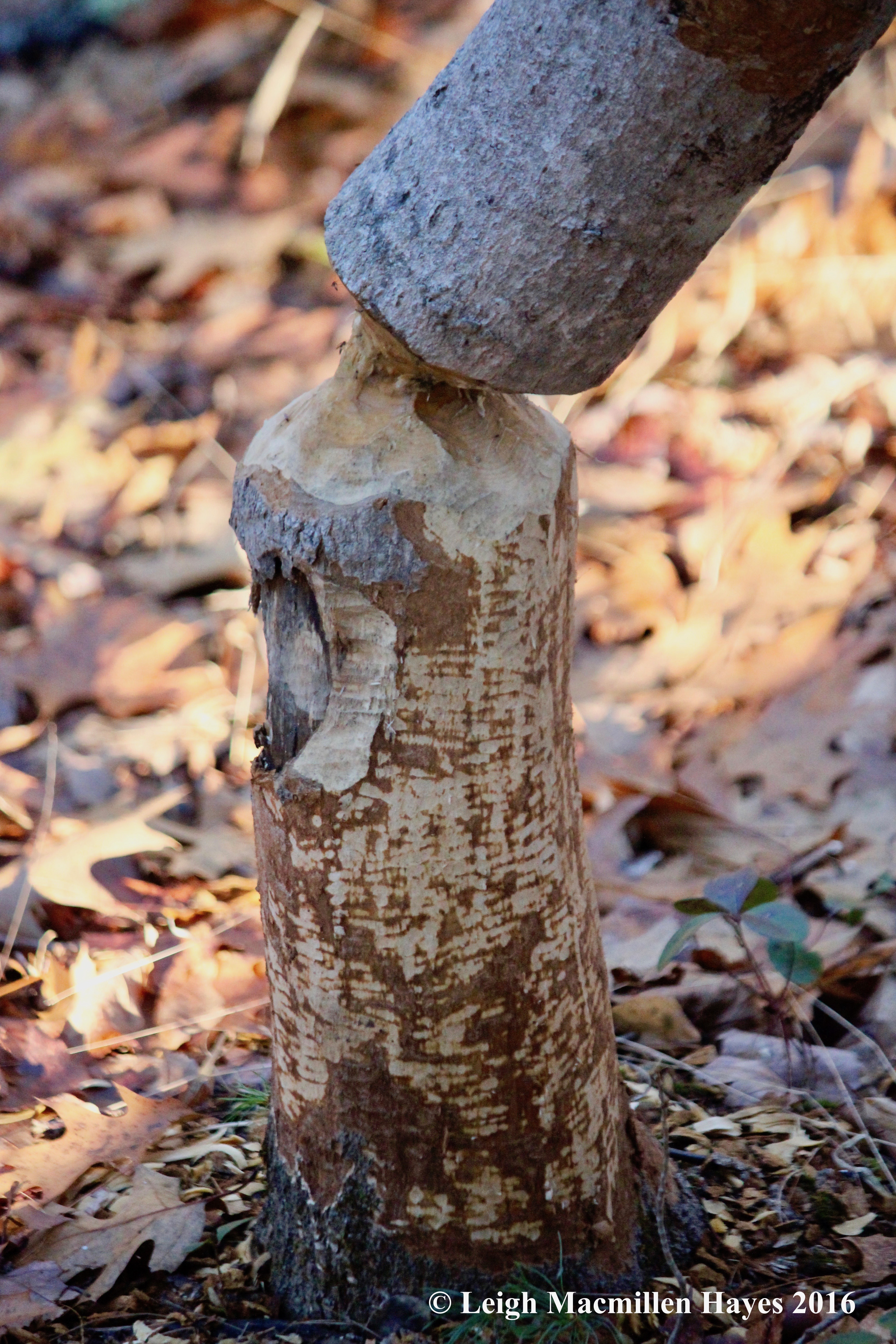
w-beaver-works-1

As with all industrious efforts, there were times when hang ups prevented success.

w-late-day-reflection

Sunshine and late afternoon reflections gave me a taste of why Bob referred frequently to the meditative nature of this place.

w-the-city

As we climbed a small hill and crossed a field, we again approached City Center.

w-sluice-1

And then we doubled back, walking to the intersection of Sweden Road with Routes 35/37. Plaster mills, bucket mills, a carding mill, saw mill and grist mill–waterpower was a necessity to any enterprise–beginning with lumber sawed for dwellings, grain ground for life-sustaining bread, shingles for siding and roofing, carded wool for the seamstress.
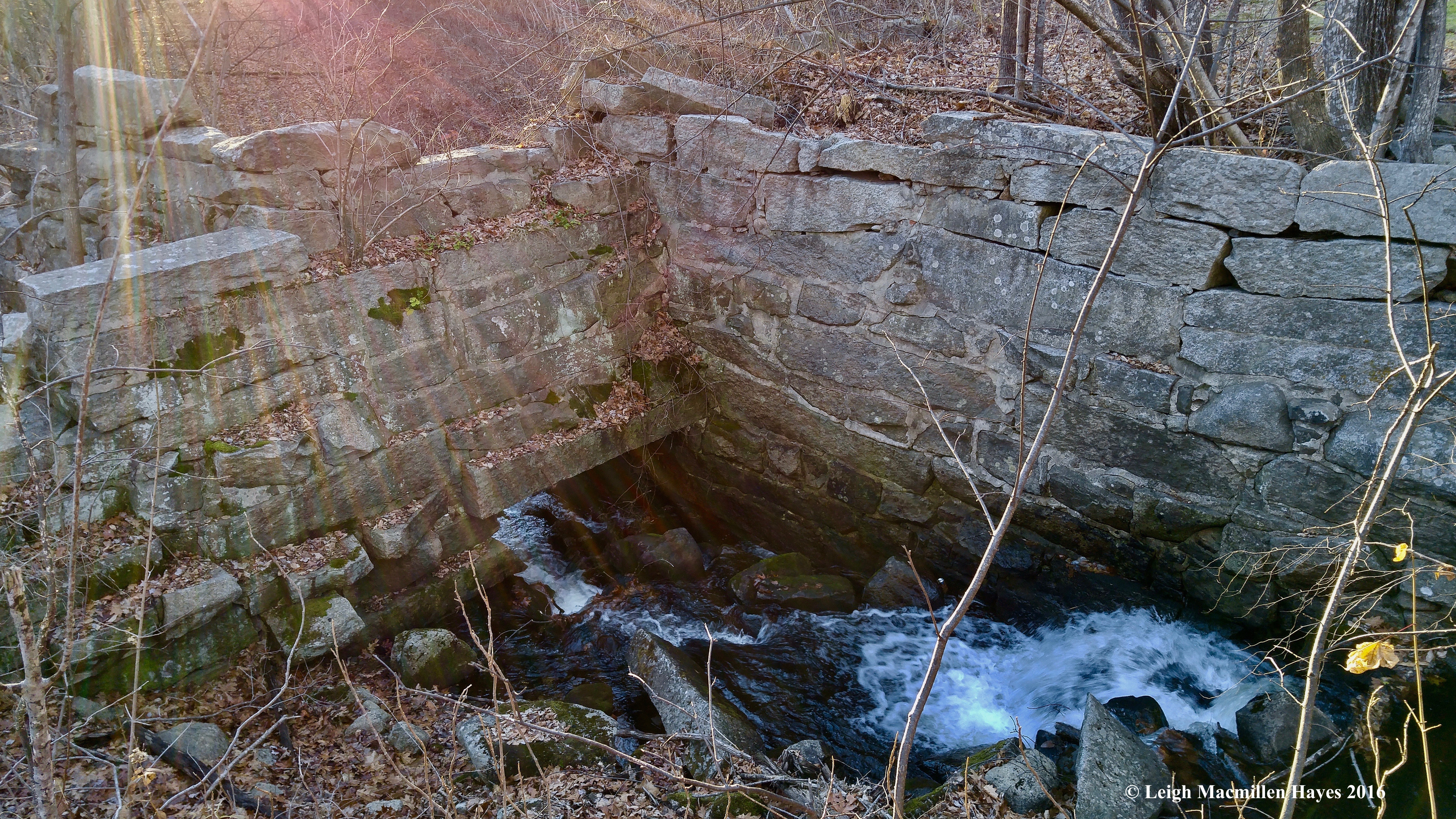
w-bucket-2-1

With the sun’s rays dipping lower in the sky, we stood in awe of the sluice and thought about the men and oxen and all the work that went into creating the mill–before the real work actually began.

w-sluiceway

How many times have I traveled past this site and never spied it? Too many.

w-bear-pond-2-1

After our first tour ended, I paused at the southernmost end of Bear Pond for further reflection.
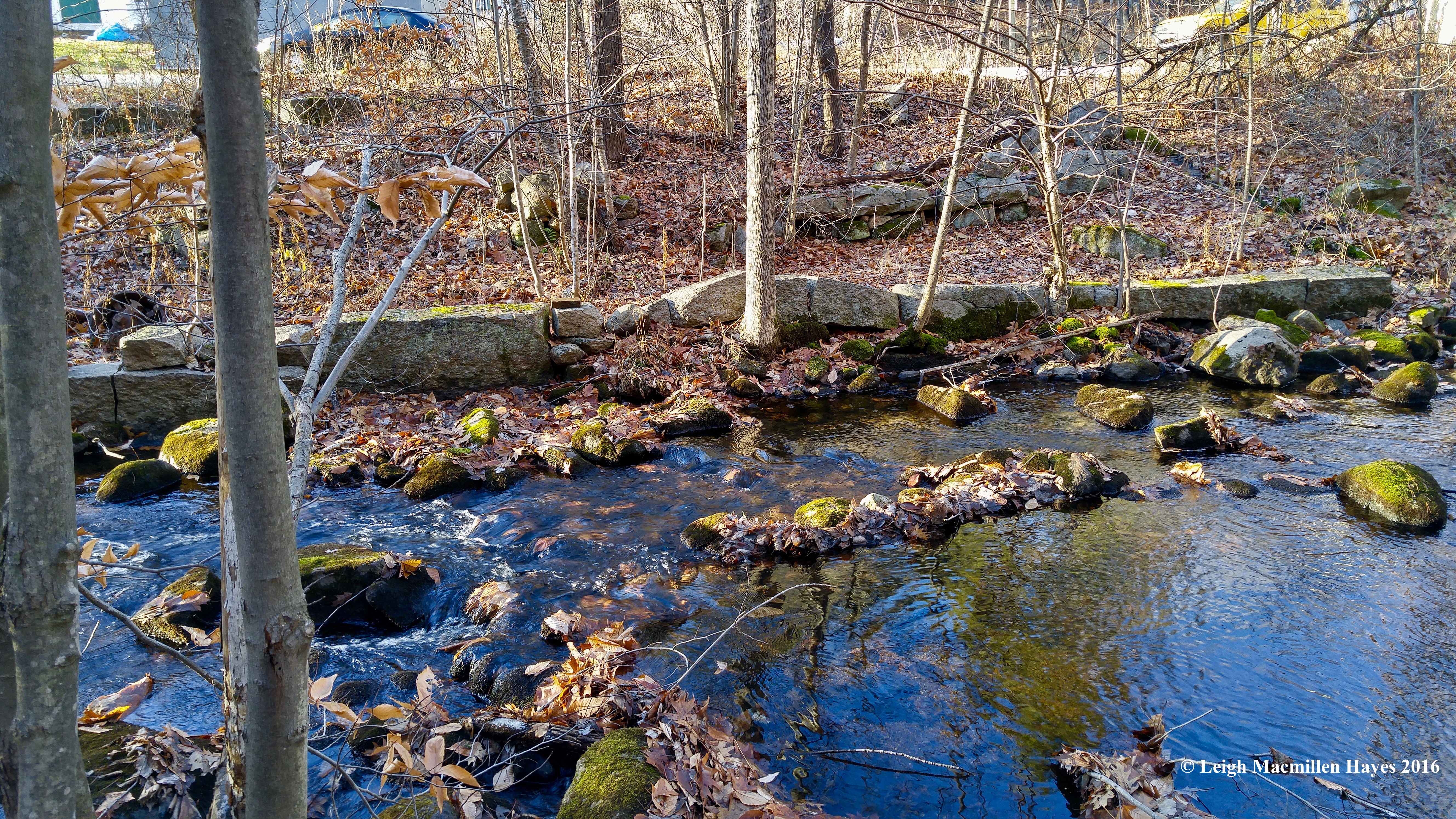
w-brook-wall-2-1

But . . . there was still more to see of the city and so a few days later I eagerly joined my tour guide again. This time we walked north, and wondered about the rock placements and considered their role as runways that once helped direct the water flow.

w-stones-line-brook

All along, we saw evidence of human intervention.

w-split-stone

We noted the feather and wedge marks on split stones.
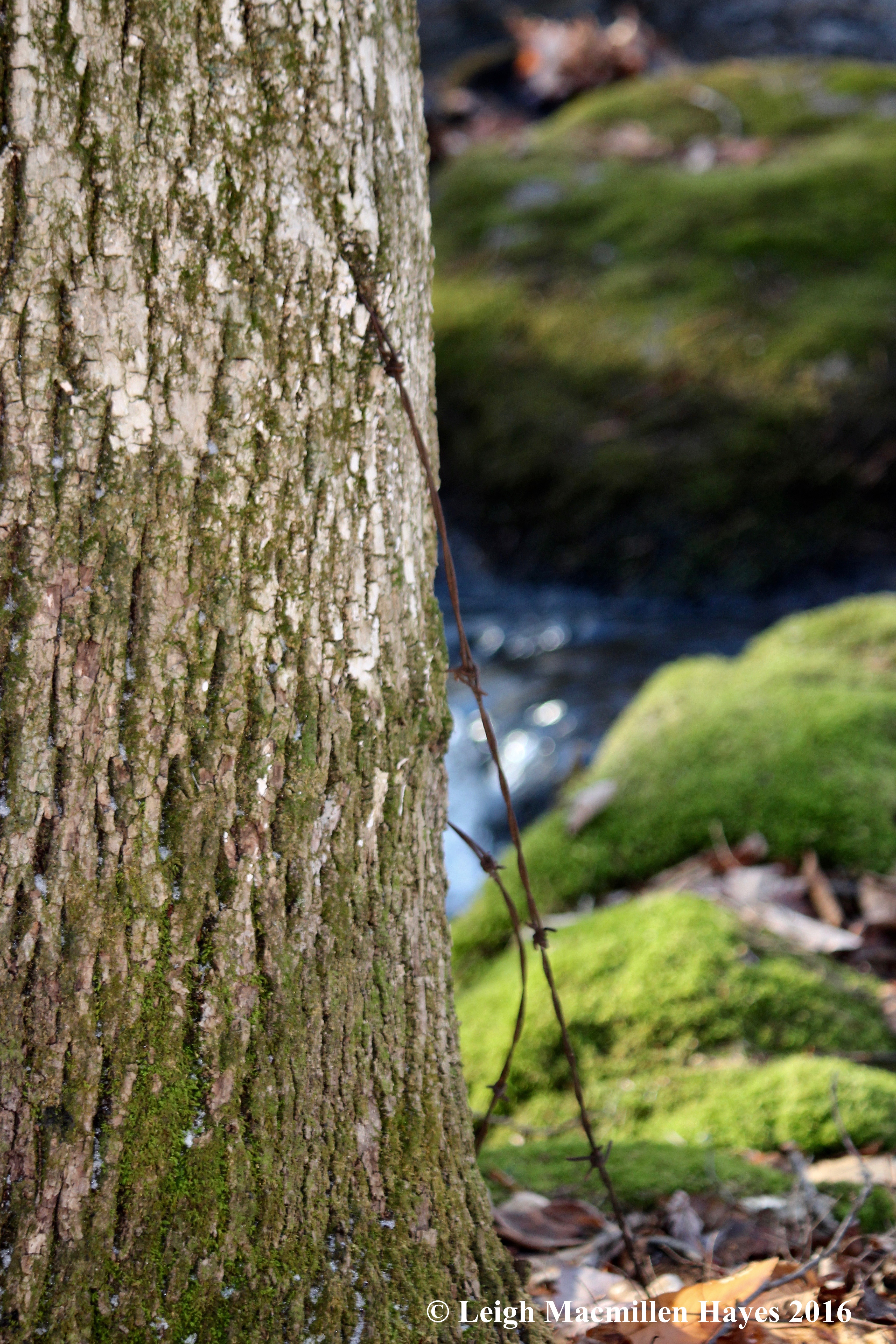
w-barbed-wire

Barbed wire made us think about the land being used for agriculture. Though it didn’t seem that the land had been plowed, we wondered if farm animals had roamed. Bob reminded me that a carding mill once stood nearby and so we envisioned sheep.

w-barrel-wire

w-barrel-staves-1

w-artifact

Barrel wire and staves made sense to us, but we didn’t always recognize the artifacts for their use.
w-cellar-hole-2-1

We even found a cellar hole, or perhaps a cellar hole, that Bob hadn’t seen before. Of course, we speculated. It certainly had structure. But why was it cut out around large boulders, we wondered.

w-tree-foundations

And we noted the industrial work of trees that forged their own way beside the brook.
w-city-brook-large-rocks-1

For every sight that we seemed to understand, there were more that we didn’t. With his vast knowledge of local history and the land formations along the brook, Bob pointed out natural and man-made features, but even he admitted he didn’t always get it. The pile of obviously quarried granite was one such.
w-sluice-and-old-dam-2-1

Suddenly, we reached what might be considered the crossroads of long ago and more recent past.

w-sluice-way-4

To the west, an obvious rock sluiceway.

w-stantion

To the right, stanchions from a former, yet more recent power site.

w-old-dam-3-1

This was all located at the original spot of the first dam along the brook.
w-keoka-dam-2-1

Curiously, Bob explained as we walked along,  a more modern dam was built about a quarter mile north.
w-keoka-3-1

We’d reached Keoka Lake, formerly known as Thomas Pond. Supposedly, in the early 1900s, Thomas Chamberlain ran away from Native Americans and survived by hiding in a crack in a rock. Though the lake is no longer named for him, Tom Rock Beach holds his legacy. Today, the clouds told the story of the much cooler temperature. 
w-flats-1

Bob directed my attention to our left, where Waterford Flats was visible.

w-start-of-city-brook-1

And then we looked south, to the outlet of Keoka and the beginning of City Brook–the place where it all began. Though no longer held by dams and funneled through the rock sluiceways, it was the water that passed this very way that once provided the energy converted by water wheels and turbines to power the life of the city.
w-wheel-2

w-wesleyan-church

w-bear-mountain-grange

“Waterford City” as it was known, has changed, though some standing monuments still speak to its former life. Until Saturday, I had no idea the brook was named City Brook or that South Waterford was known as a city, so named for the industry that once existed here.

As Bob wrote, “The age of industrial prosperity is now long gone, victim to growth of large manufacturing plants which required more powerful rivers and many other economic changes since the 1870s. At that time, South Waterford was dubbed “Waterford City” for the noise and bustle brought to the town by nine mills and many supporting outbuildings lining the brook. Invisible to today’s busy passerby are many remnants of a past industrial heyday: a large concrete and split stone ruin on the access road to Keoka’s modern dam, two-story stone work that served as the foundation for a 19th century bucket mill, a simple shingled mill building atop a 1797 stone dam beside the town’s last rustic stone bridge. Further exploration may reveal lost foundations beneath the water surface, a 36-inch rusty circular saw blade, burnt remains of Waterford Creamery or an earthen dam long overgrown by bushes and brambles. These vestigial remains of human endeavor are of historical interest to many.”
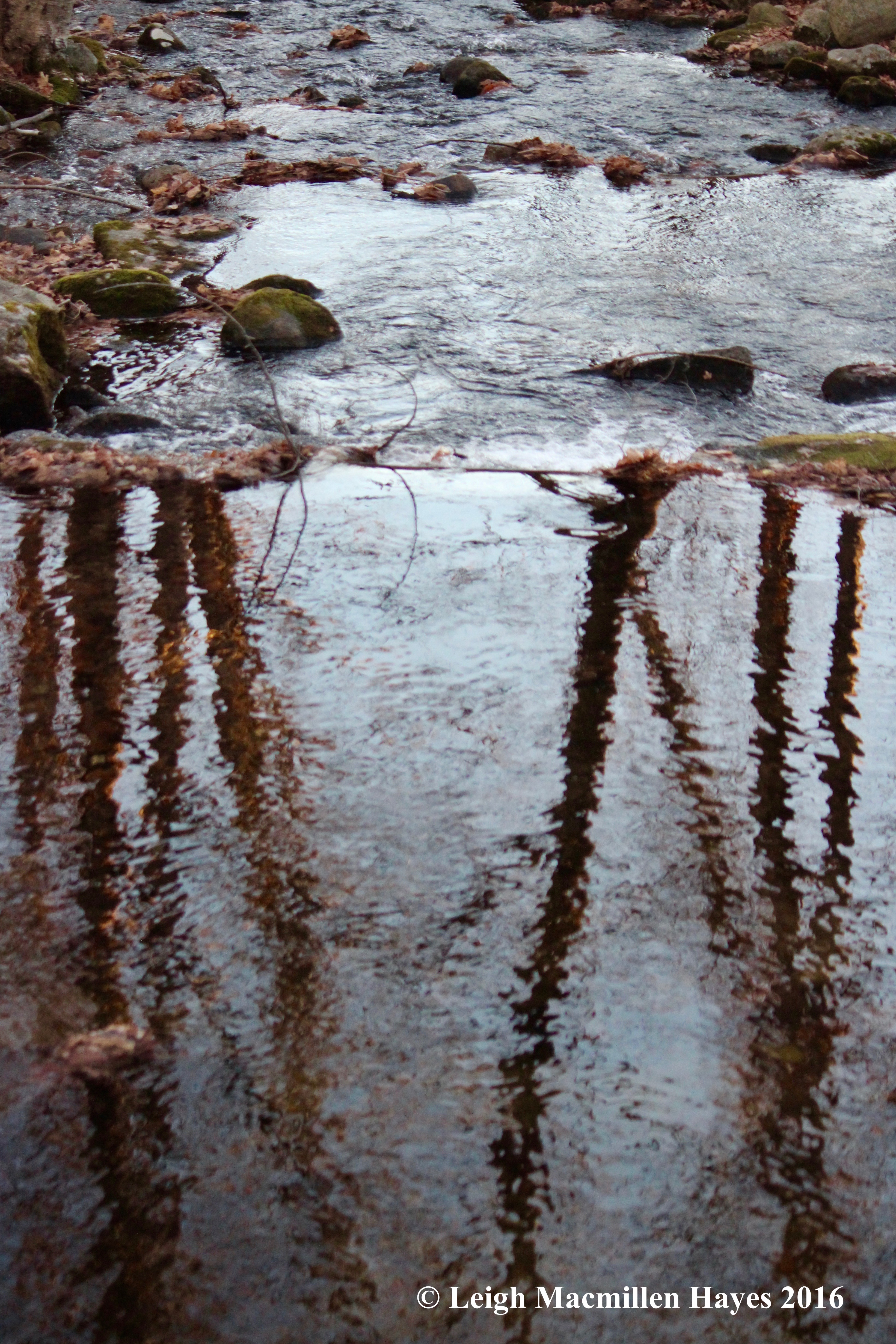
w-city-brook-2

After our tour came to an end,  I paused below the cider mill one more time–a fitting spot to share another of Bob’s ponderings on this place:

“The whirling bubble on the surface of a brook
admits us to the secret of the mechanics of the sky.”
Ralph Waldo Emerson

It is appropriate to begin this study with a quote from American philosopher, existentialist Ralph Waldo Emerson (1802-1882), whose life spanned from early days of village settlement through the denouement of its industrial zenith. Emerson spent much of his boyhood visiting three aunts who lived in Waterford. He likely honed his naturalistic views while exploring City Brook or Mutiny Brook near Aunt Mary Moody Emerson’s home, Elm Vale, which was located across from the cemetery of the same name on Sweden Road.
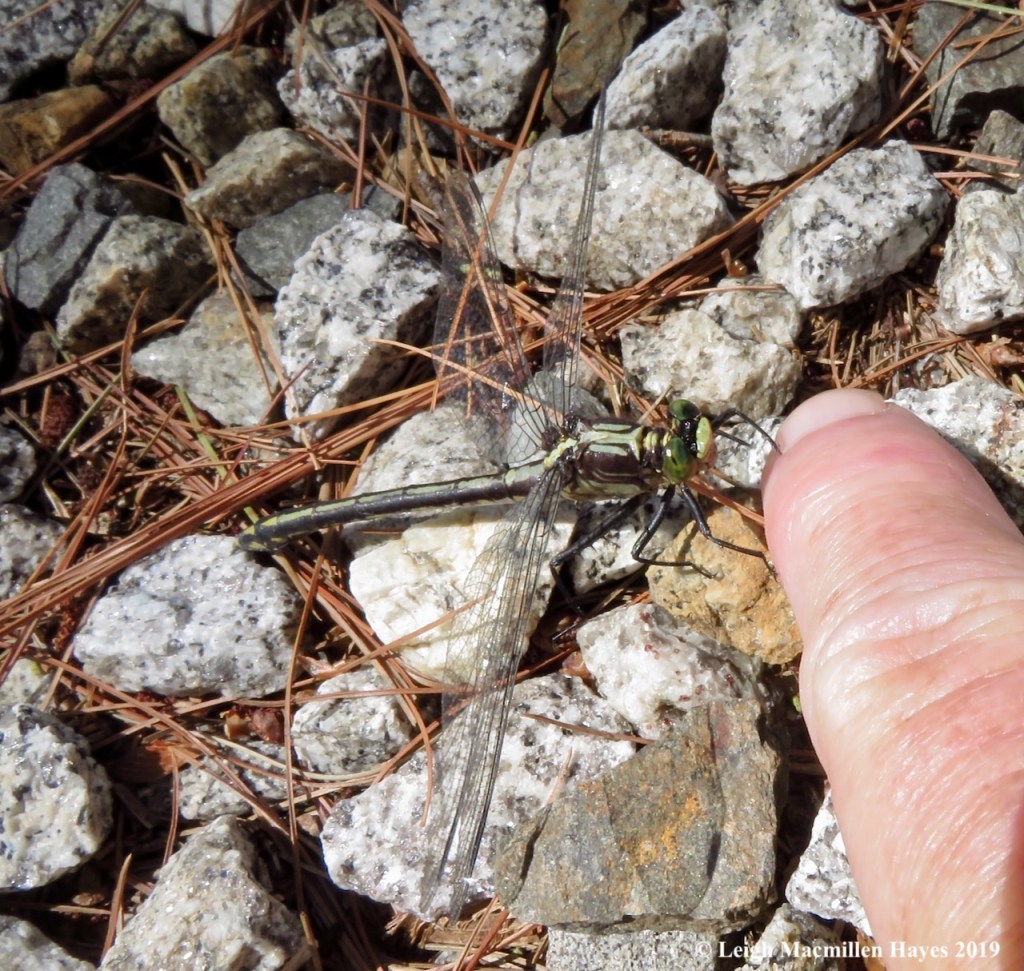
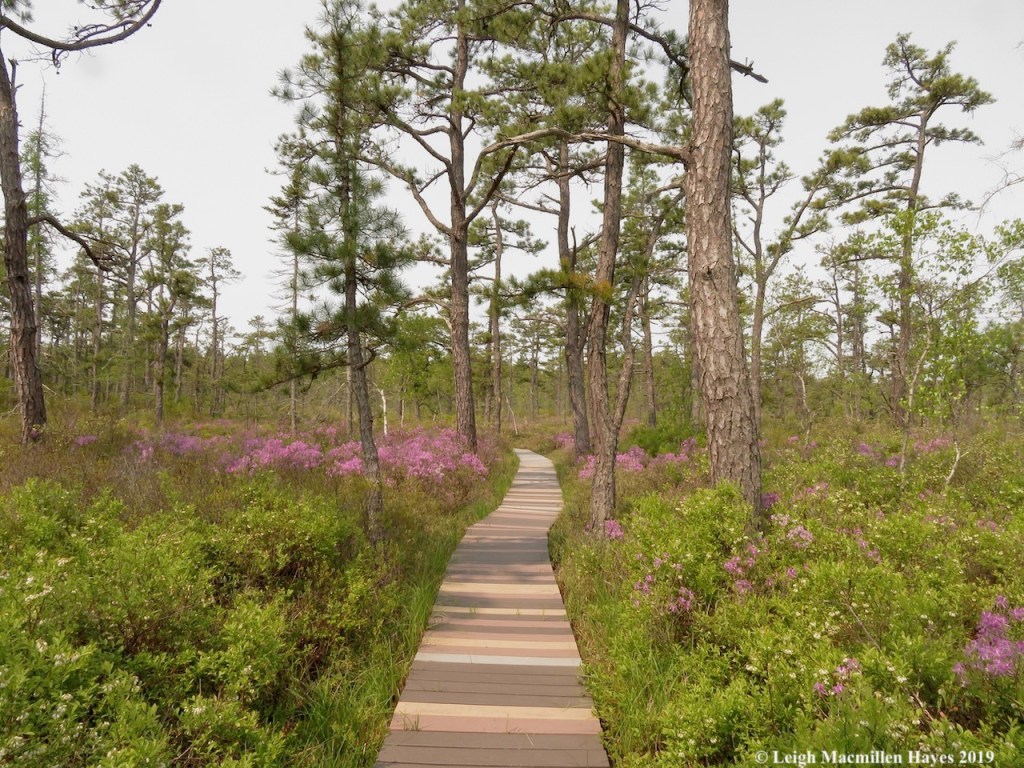
This is one city I’m thankful to have visited. And I look forward to further explorations.

I’m grateful to Bob for sharing this place with me and especially for pointing out all of his favorite meditative places. Meditation in the city–Waterford City style.