The Secret Giver of Gifts 2025

Being St. Nicholas Day, the day to honor the 4th century bishop from Myra who is the patron saint of children and sailors, I was reminded of a time when we were heading home and our youngest asked, “Mom, are you Santa?”

I love this story and so even if you’ve read it before, I hope you’ll enjoy it again.

He’d held onto the belief for far longer than any of his classmates. And for that reason, I too, couldn’t let go. And so that day as we drove along I reminded him that though the shopping mall Santas were not real, we’d had several encounters that made believers out of all of us.

The first occurred over thirty years ago when I taught English at a school in New Hampshire. Across the hall from my classroom was a special education class. And fourteen-year-old Mikey, a student in that class, LOVED Santa.

Each year the bread deliveryman dressed in the famous red costume when he made his final delivery before Christmas break. To Mikey’s delight, he always stopped by his classroom. That particular year, a raging snowstorm developed. The bread man called the cafeteria to say that he would not be able to make the delivery. School was going to be dismissed after lunch, but we were all disappointed for Mikey’s sake.

And then  . . . as the lunch period drew to a close, Santa walked through the door and directly toward Mikey, who hooted with joy as he embraced the jolly old elf. As swiftly as he entered, Santa left. I have no doubt that that was Santa.

And about twenty-seven years ago, as the boys sat at the kitchen counter eating breakfast on Christmas Eve morning, we spotted a man walking on the power lines across the field from our house. We all wondered who it was, but quickly dismissed the thought as he disappeared from our view, until . . . a few minutes later he reappeared.

The second time, he stopped and looked in our direction. I grabbed the binoculars we kept on the counter for wildlife viewings. The man was short and plump. He wore a bright red jacket, had white hair and a short, white beard. The boys each took a turn with the binoculars. The man stood and stared in our direction for a couple of minutes, and then he continued walking in the direction from which he’d originally come. We never saw him again. I have no doubt that that was Santa.

Another incident occurred about seventeen years ago, when on Christmas Eve, our phone rang. The unrecognizable elderly male voice asked for our oldest son. When I inquired who was calling, he replied, “Santa.”

He spoke briefly with both boys and mentioned things that they had done during the year. I chatted with him again before saying goodbye. We were all wide-eyed with amazement. I have no doubt that that was Santa.
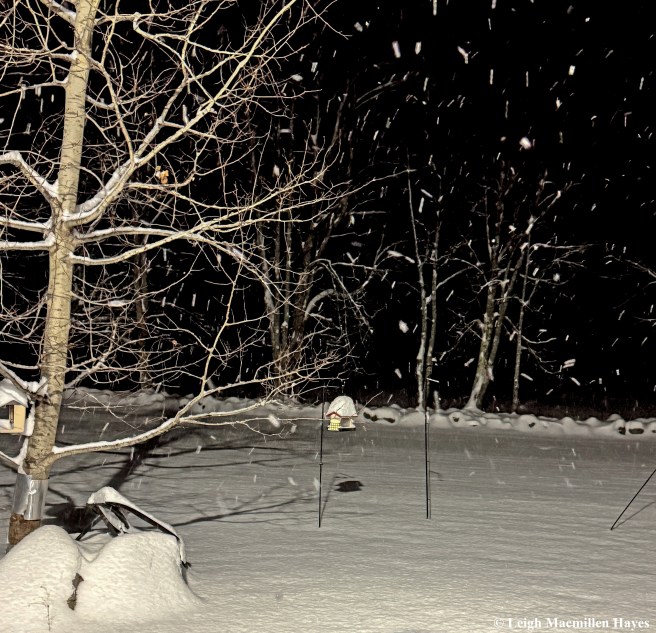
Once I reminded our youngest of those stories, he dropped the subject for the time being. I knew he’d ask again and I also knew that none of us wanted to give up the magic of anticipation for those special moments we know as Christmas morning, when the world is suddenly transformed.

I also knew it was time he heard another story–that of Saint Nicholas, the Secret Giver of Gifts. It goes something like this . . .

The nobleman looked to Heaven and cried, “Alas. Yesterday I was rich. Overnight I have lost my fortune. Now my three daughters cannot be married for I have no dowry to give. Nor can I support them.”

For during the Fourth Century, custom required the father of the bride to provide the groom with a dowry of money, land or any valuable possession. With no dowry to offer, the nobleman broke off his daughters’ engagements.

“Do not worry, Father. We will find a way,” comforted his oldest daughter.
Then it happened. The next day, the eldest daughter discovered a bag of gold on the windowsill. She peered outside to see who had left the bag, but the street was vacant.

Looking toward Heaven, her father gave thanks. The gold served as her dowry and the eldest daughter married.

A day later, another bag of gold mysteriously appeared on the sill. The second daughter married.

Several days later, the father stepped around the corner of his house and spied a neighbor standing by an open window. In shocked silence, he watched the other man toss a familiar bag into the house. It landed in a stocking that the third daughter had hung by the chimney to dry.

The neighbor turned from the window and jumped when he saw the father.

“Thank you. I cannot thank you enough. I had no idea that the gold was from you,” said the father.

“Please, let this be our secret,” begged the neighbor. “Do not tell anyone where the bags came from.”

The generous neighbor was said to be Bishop Nicholas, a young churchman of Myra in the Asia Minor, or what we call Turkey. Surrounded by wealth in his youth, Bishop Nicholas had matured into a faithful servant of God. He had dedicated his life to helping the poor and spreading Christianity. News of his good deeds circulated in spite of his attempt to be secretive. People named the bishop, “The Secret Giver of Gifts.”

s-stockings

Following Bishop Nicholas’ death, he was made a saint because of his holiness, generosity and acts of kindness. Over the centuries, stockings were hung by chimneys on the Eve of December 6, the date he is known to have died, in hopes that they would be filled by “The Secret Giver of Gifts.”

According to legend, Saint Nicholas traveled between Heaven and Earth in a wagon pulled by a white steed on the Eve of December 6. On their doorsteps, children placed gifts of hay and carrots for the steed. Saint Nicholas, in return, left candy and cookies for all the good boys and girls.

In Holland, Saint Nicholas, called Sinterklaas by the Dutch, was so popular for his actions, that the people adopted him as their patron saint or spiritual guardian.

Years later, in 1613, Dutch people sailed to the New World where they settled New Amsterdam, or today’s New York City. They brought the celebration of their beloved patron with them to America.

To the ears of English colonists living in America, Sinterklaas must have sounded like Santa Claus. Over time, he delivered more than the traditional cookies and candy for stockings. All presents placed under a tree were believed to be brought by him.

Santa Claus’ busy schedule required he travel the world in a short amount of time. Consequently, as recorded in Clement Moore’s poem, “The Night Before Christmas,” a sleigh and eight tiny reindeer replaced the wagon and steed.

Since Saint Nicholas was known for his devout Christianity, the celebration of his death was eventually combined with the anniversary of Christ’s birth. December 24th or Christmas Eve, began to represent the Saint’s visit to Earth.
Traditionally, gifts are exchanged to honor the Christ Child as the three Wise Men had honored Him in Bethlehem with Frankincense, Gold and Myrrh.

One thing, however, has not changed. The gifts delivered by Saint Nicholas or Santa Claus, or whomever your tradition dictates, have always and will continue to symbolize the love people bear for one another.

Though they are now adults, my continued hope for my sons is that they will realize the magic of Christmas comes from the heart and that we all have a wee bit of Santa in us. Yes, P, Santa is real.

May you and everyone continue to embrace the mystery and discover wonder wherever you look. And may you find joy in being the Secret Giver of Gifts.

Student Teacher in the Field and Yard Classroom

I am so thankful that I was born with a desire to learn and somehow landed in at a most pleasant neighborhood school. Of course, the classrooms vary depending upon the season. These past two days, and actually these past few weeks, I’ve been majoring in field and yard lessons.

Oh, don’t get me wrong–that doesn’t mean field and yard work, though I did help mow the lawn today.

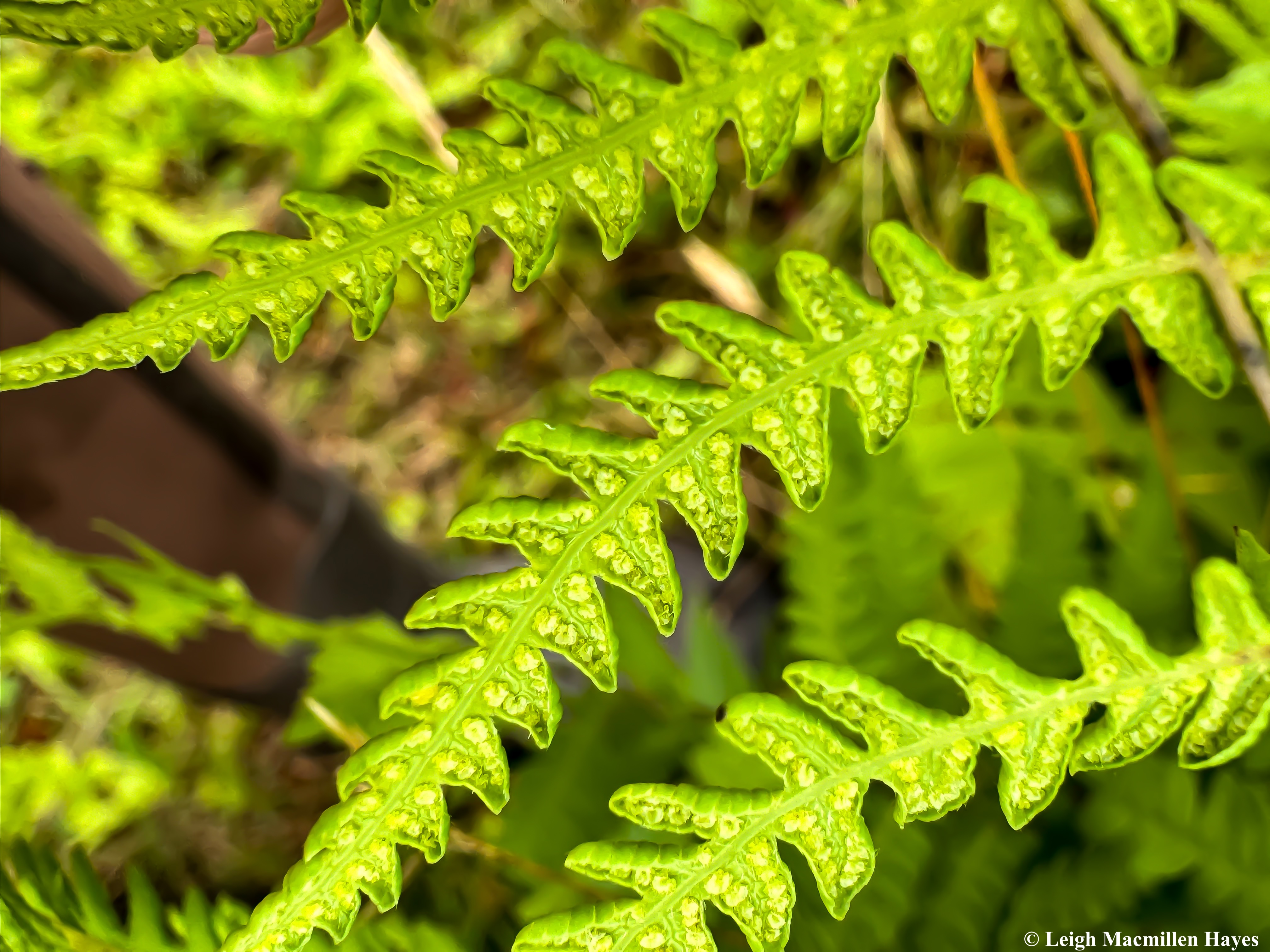
Let’s begin, however, with the class in the field, which is really more of a meadow given how wet it can be and some of the species who call it home attest to that, including this Marsh Fern.

At first glimpse, I thought it was a Lady Fern, but there was something different about the leaflets–they seemed to present as three-dimensional.

When I turned the blade over, I saw why. On fertile leaflets, such as these, the subleaflets curl around the kidney-shaped indusia which cover the sori, or spore cases.

There are lots of other ferns out there including Interrupted and Sensitive, but Marsh is one I don’t often see, so to have it on display in the school hallway is exciting to me.

Meadowsweet, or Spirea, is another plant that doesn’t mind wet feet, also indicating that this class leans toward being a wet meadow.

And today, I met a new-to-me insect species with a funny name.

Tumbling Ragdoll, aka Mordella marginata, is a Tumbling Flower Beetle. I love the name, and am reminded that as a child I loved my Raggedy Andy doll made by an “aunt” who wasn’t actually related to our family; my sister received Raggedy Ann. Years later, my sister also later created Andy and Ann for me, so I have a complete set, plus one from “Aunt” Betsy.

Anyway, from Tom Murray’s Insects of New England & New York, I discover that these beetles are so named because “When threatened their escape method is to jump and tumble about wildly.”

For science lab, I will attempt a mere scare in the future to see if that is true; but today approached with care so as not to disturb them.

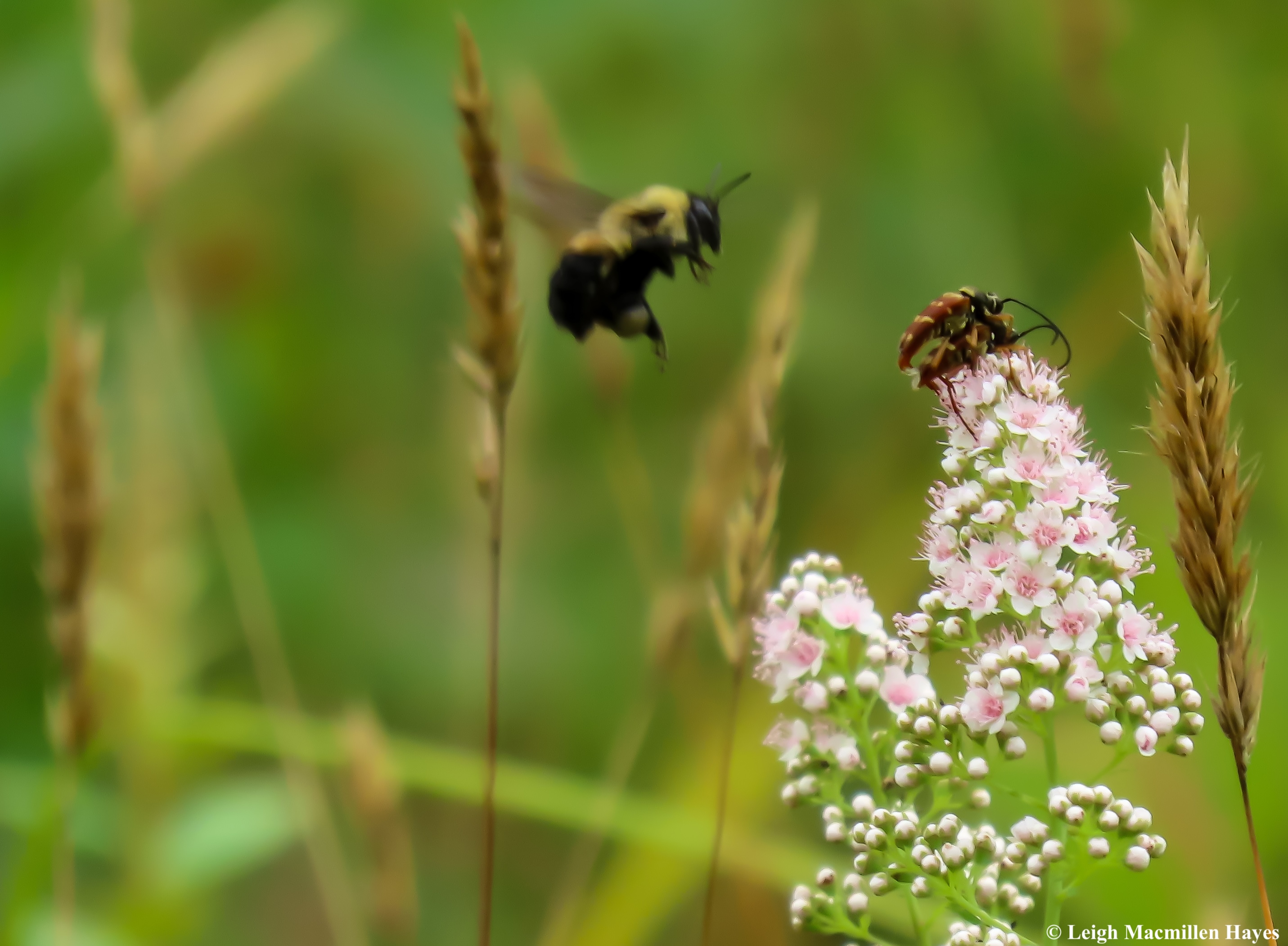
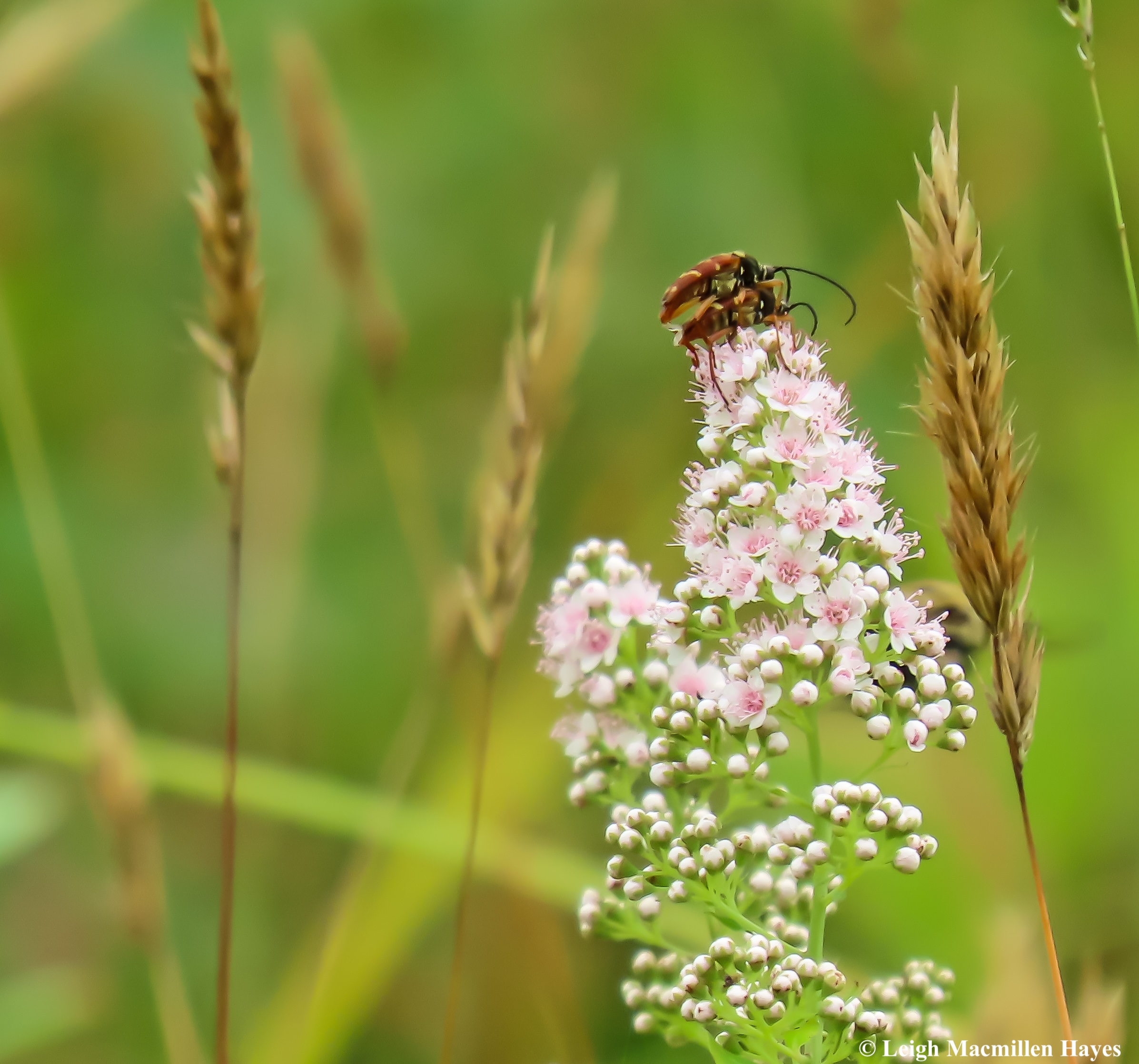
When I got up from my chair to sharpen my pencil, I spotted what my friend Amanda calls a B-52 Bomber Bumblebee. It was large and fast. But that didn’t disturb the Banded Longhorn Beetles at the top of the Meadowsweet.

They were mid-canoodle, and nothing was going to pause their intense interest in each other.

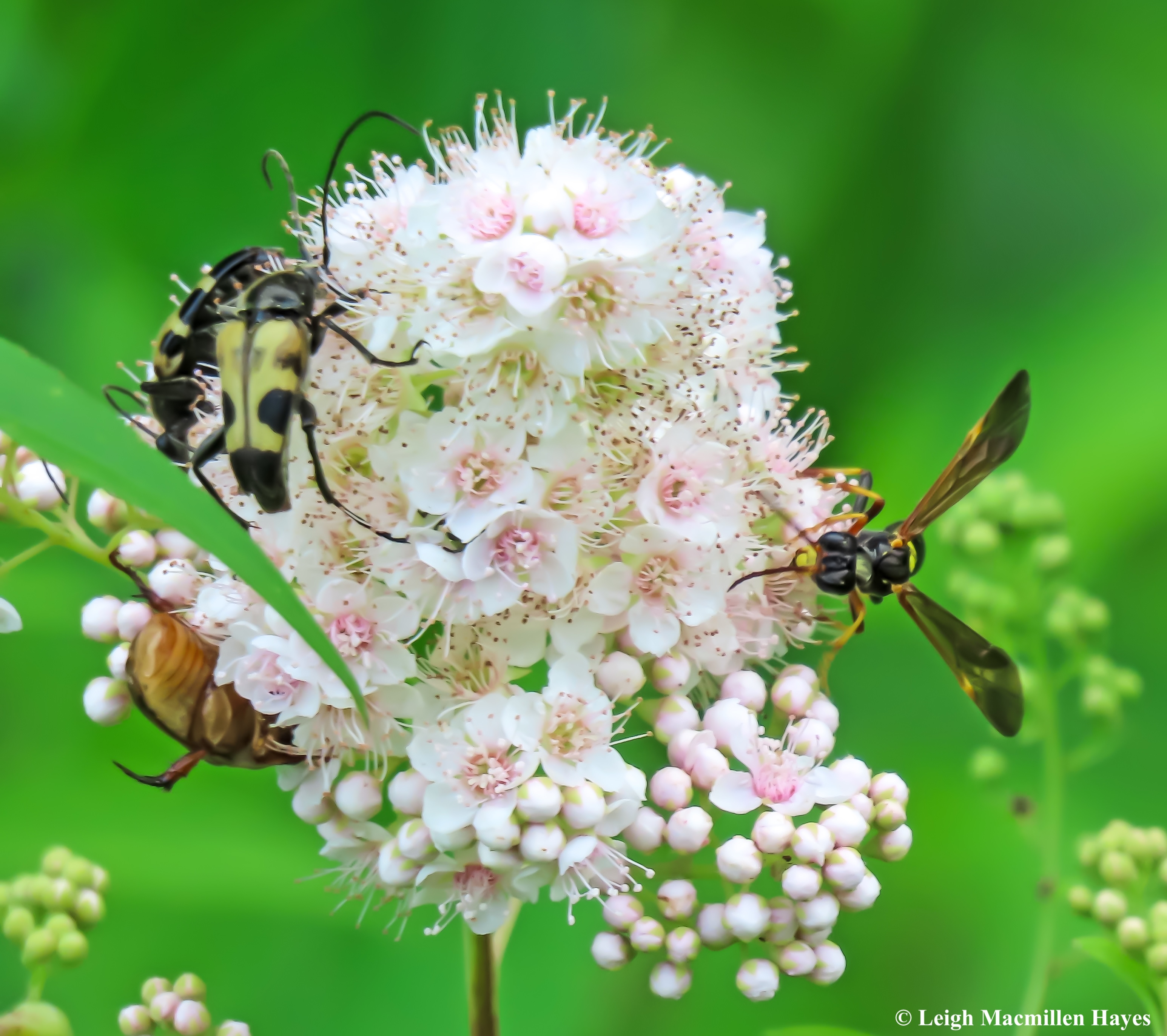
Upon another Meadowsweet, it was as if the whole community had shown up to pollinate the flowers, and miraculously, they all got along. At least while I watched. I love that the teacher had lined up this subtle lesson–about putting aside differences to work for the common good.

She reiterated it more than once.

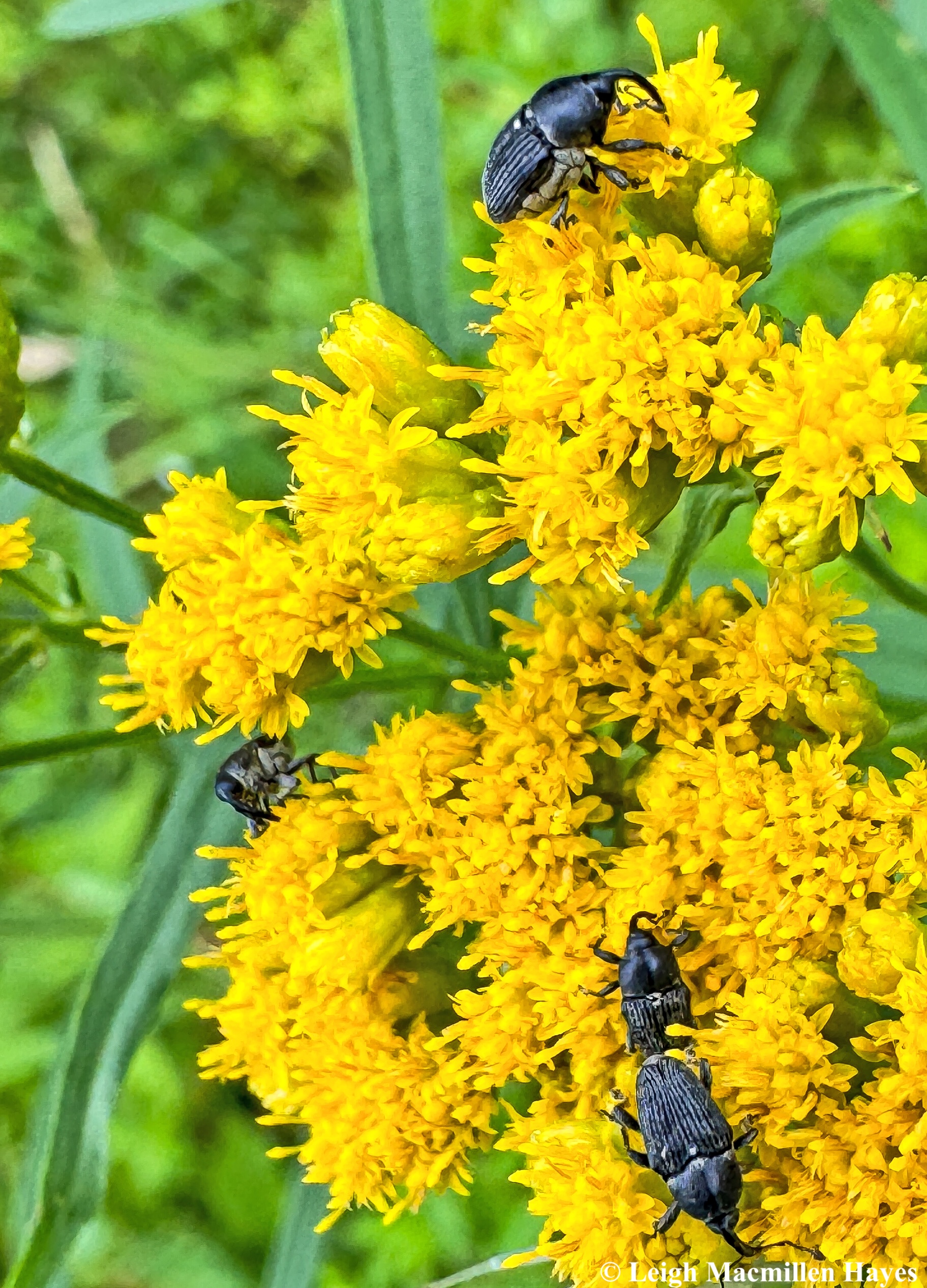
Over by the window, there was another new-to-me species to meet. By their tiny, yet robust bodies, and long snouts that seemed to grow right out of their heads, I knew they were Weevils. If I got the answer correct on the homework, these are Rugged Flower Weevils, aka Odontocorynus salebrosus.

Ragged. Rugged. Interesting choices for today.

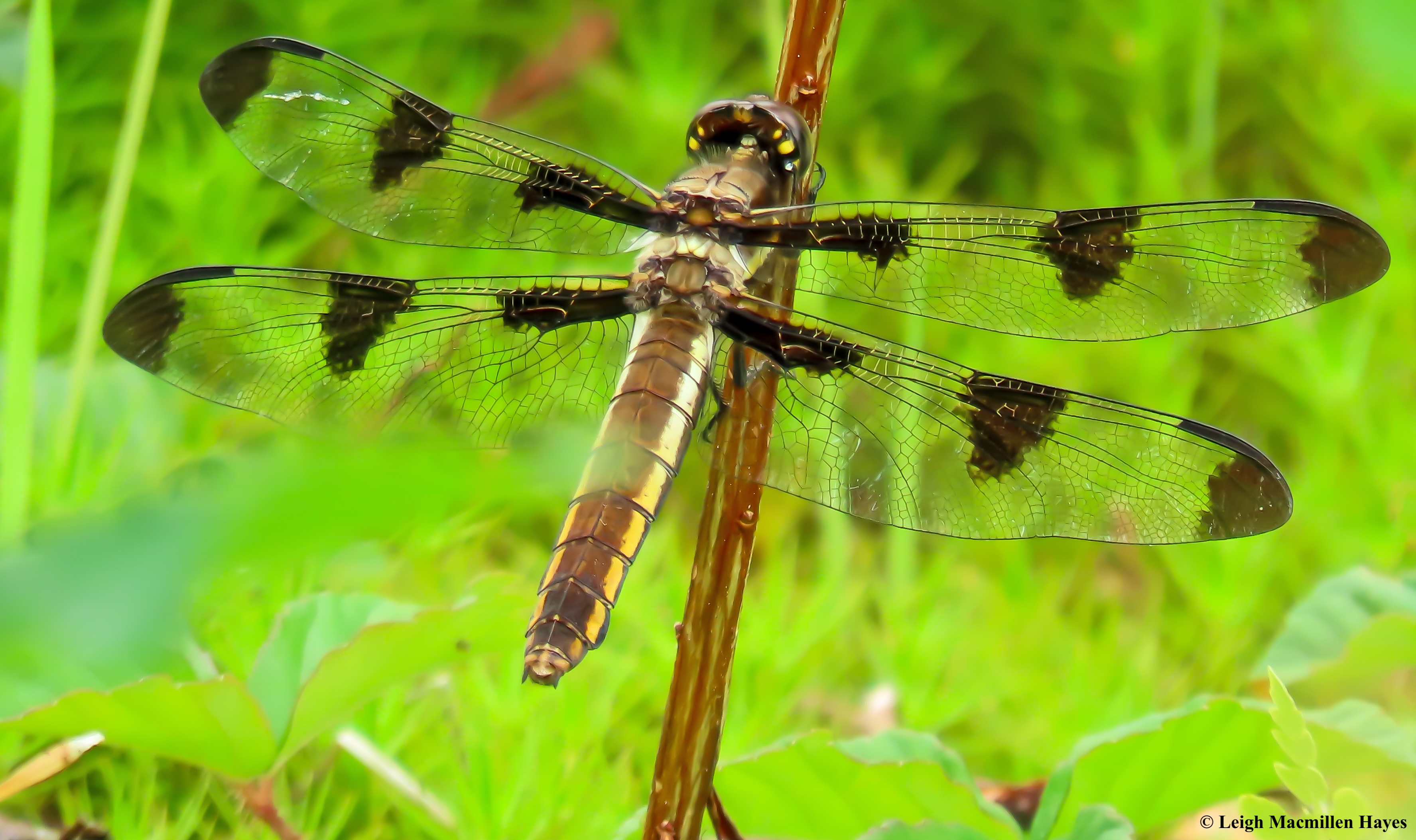
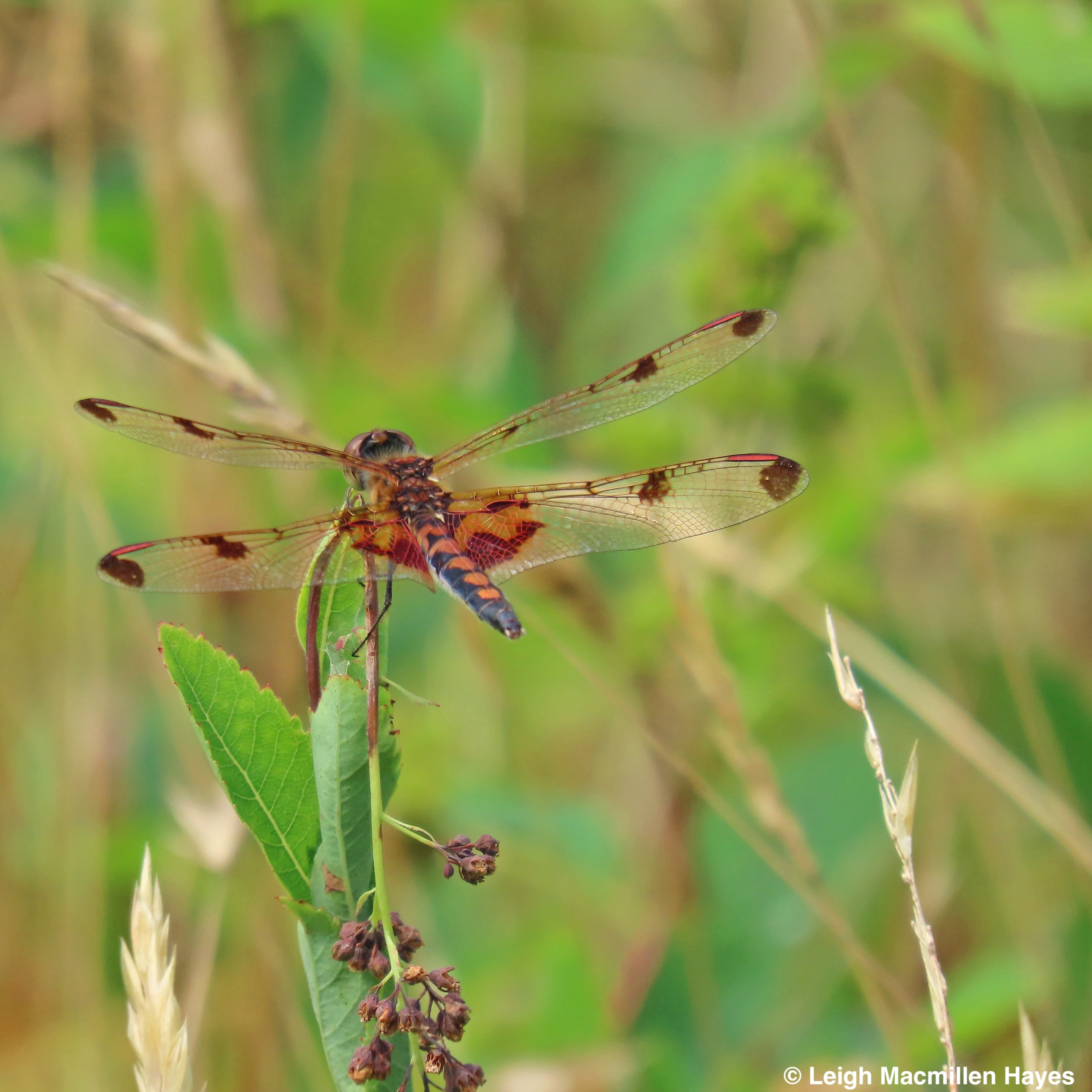
In the midst of it all, some old friends stopped by to visit, including a slew of male and female Calico Pennant Skimmer Dragonflies and this sole female Common Whitetail Skimmer.

I asked the teacher what is so common about this dragonfly that instead seems quite exotic with black splotches on the wings and a two-toned abdomen. I also inquired about the name Whitetail. She said she’d get back to me. Later, in the classroom next door, I saw a single male Common Whitetail, and its abdomen is much whiter (a light blue actually), so I know why that part of the name, but the female certainly wasn’t taken into account when naming occurred several hundred years ago.

And much to my surprise and delight, a male Spangled Skimmer stalked the halls, another indicator in my mind, that this is more of a meadow than a field.

Look at those white stigmas on the wings. It’s the only Skimmer I know of with such markings, thus making it easy to ID on the spot.

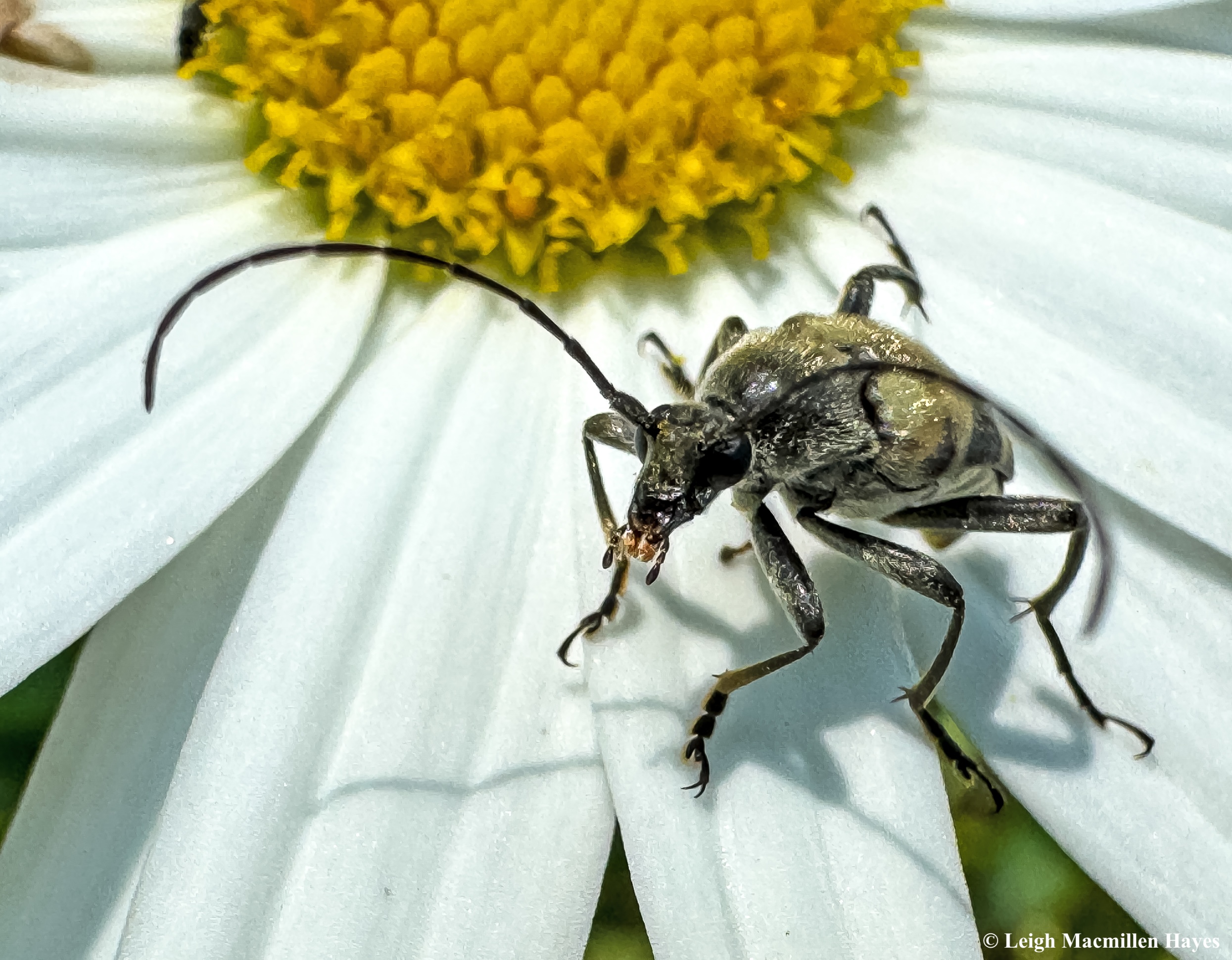
After recess, I crossed back over the wall to the classroom in the yard. Judolia cordifera is one of the Flower Longhorn Beetles, and those long horns were so obvious.

But that face. If I have nightmares tonight, I hope my mom will understand why. And my teacher won’t mind when I take a nap during class tomorrow.

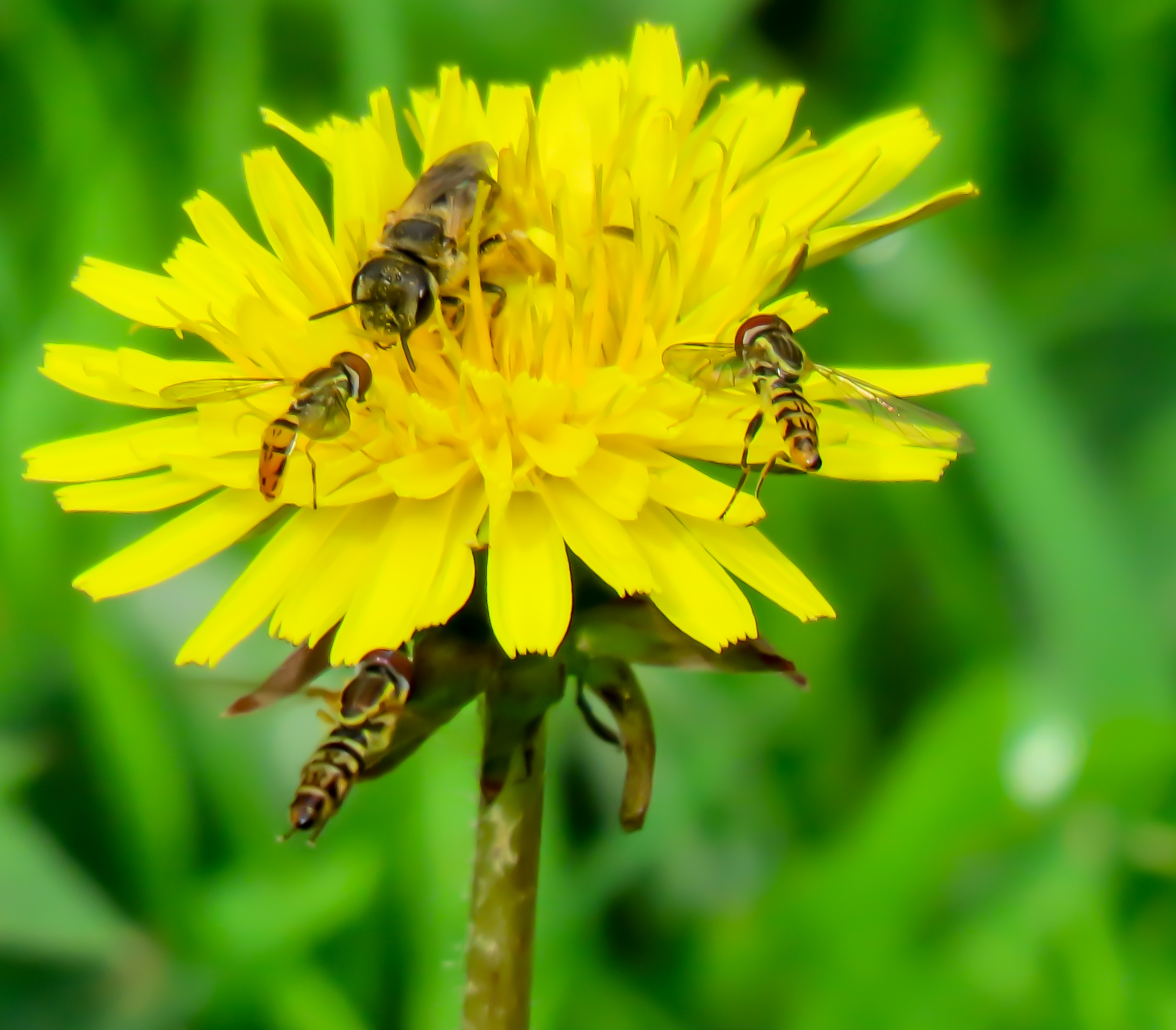
Sweat Bees were also busy pollinating, especially the composite flowers, but its the Crab Spider who presented today’s challenge as the teacher wondered if I saw it. Camouflaged as it was, its duty is to mimic the daisy petals. For the moment the Sweat Bee survived, but the spider often wins in the end.

During lunch, this Gray Catbird landed about ten feet from the table where I sat with my classmates. As a person who dabbles in art, and loved Painting 101 with Miss Jessie, the many shades of gray stood out to me. But I was reminded that a Catbird is more than just a gray bird. First, there’s the small black cap, dark tail, and the rufous-rusty patch under the tail. Sometimes its hard to see the patch, but from my spot at the cafeteria table, I had a spot-on view.

And just before class let out, our school mascot flew in. Or rather, the child of our school mascot. Being so young, it was only an arm’s length away from me, but being the mascot, it seemed not to mind my presence.

Then again, maybe it did for the immature Red-breasted Nuthatch looke around, perhaps for back-up. I know it has several siblings, but the others weren’t feeling so brave as to stand so close to me.

At the end of the day, before the last bell rang, I realized that I was the student teacher–always learning something new and finding joy in sharing those learnings.

Today’s lessons were brought to you from the Field and Yard Classrooms. Stay tuned for more lessons.

Where The Moccasins Led Us

Rituals. We follow them. Some more than others.

For My Guy and me, there is one in particular that captures our attention beginning in mid-May.

And so I follow him . . . across Beaver dams,

beside the Atlantic Ocean,

up mountain trails,

even on the hottest day so far with Canada wildfire smoke casting a haze.

This year it was more trails than usual that were included in our ritual and along the way we spotted Wild Columbine in bloom, growing as it does among the rocks, and always pleasing our senses with its brilliant colors and artistic nodding presentation.

Fringed Polygala, and how I love the way those two words roll of my tongue, also showed off, making its common name of Gaywings so apparent. Doesn’t it look like a Bird of Paradise coming in for a landing upon its very own leaves?

Upon one of our journeys we found a few Red Trilliums still in bloom, though it seemed late in the season for them. But as My Guy teases, I did what I do and added this photo to the other trillion I have of this plant. They all need to be honored, don’t they?

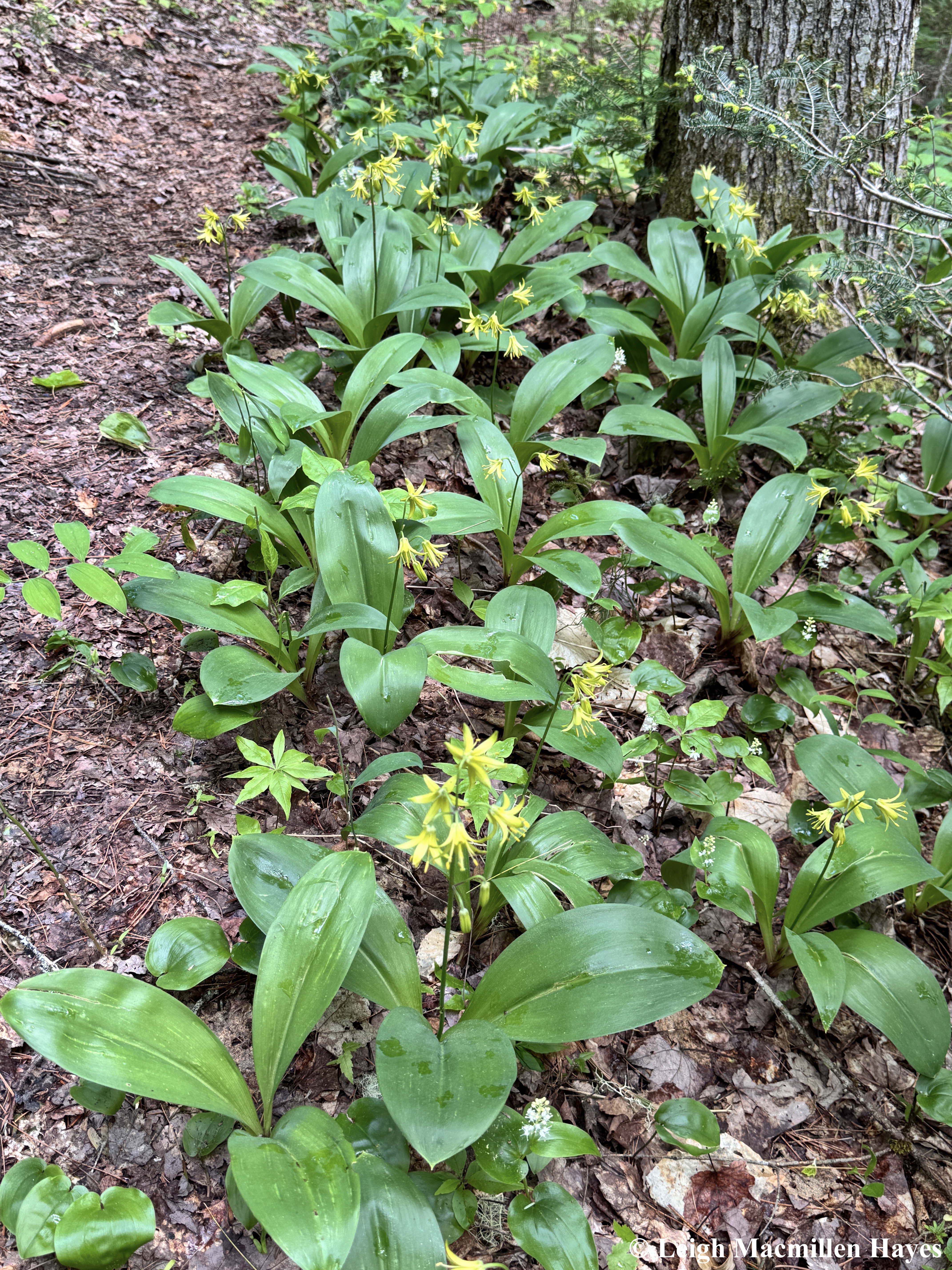
Seemingly everywhere, Clintonia, aka Blue-Bead Lily bloomed, adding specks of sunshine to the path and lighting our way, even on the grayest or rainiest of days. Yes, we even hike on rainy days.

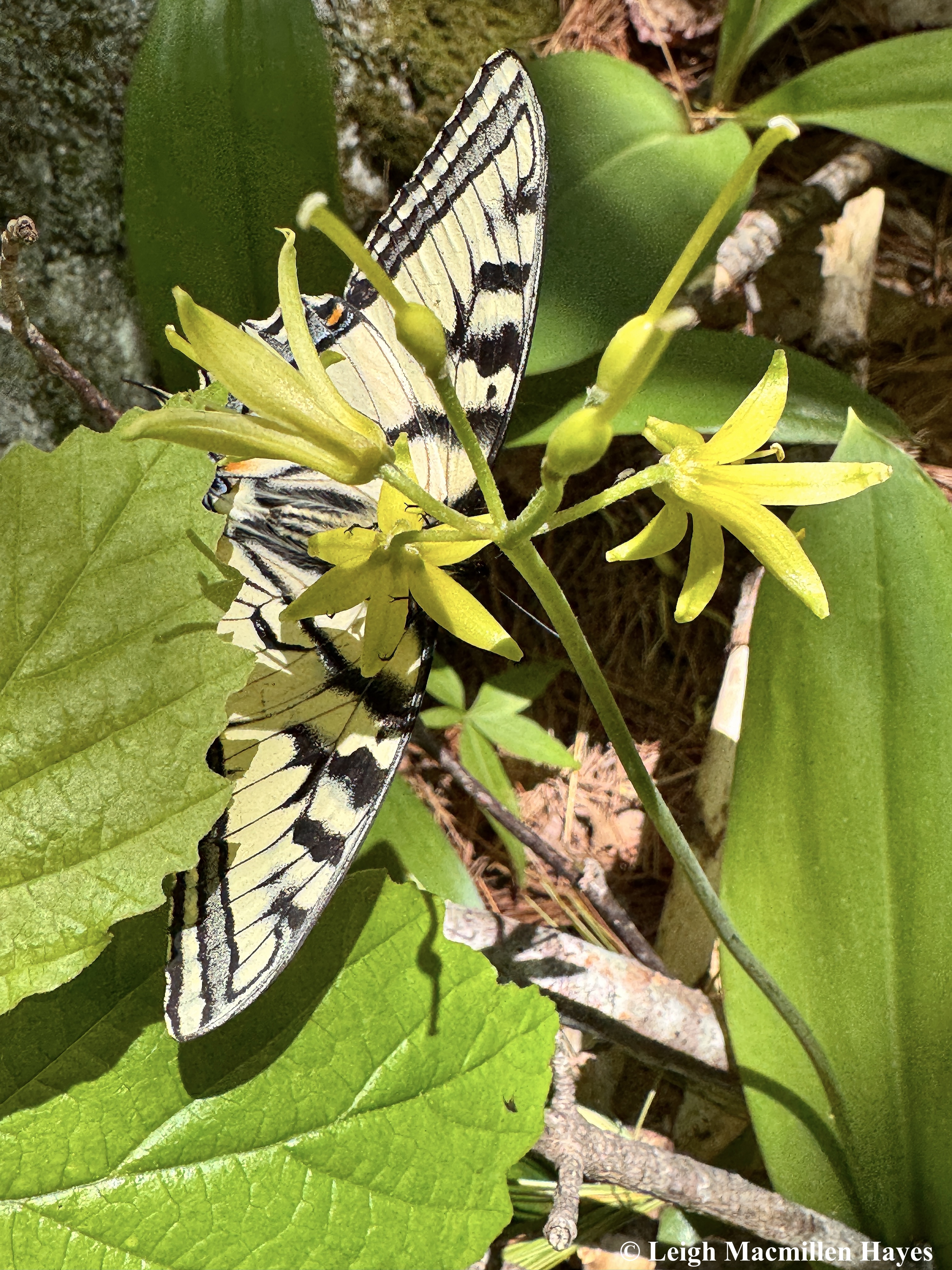
On sunnier days, the Tiger Swallowtails added their own yellow to the equation. Can you see the tiny pretarsi or insect feet of the butterfly as it held on why sucking the flower’s nectar?

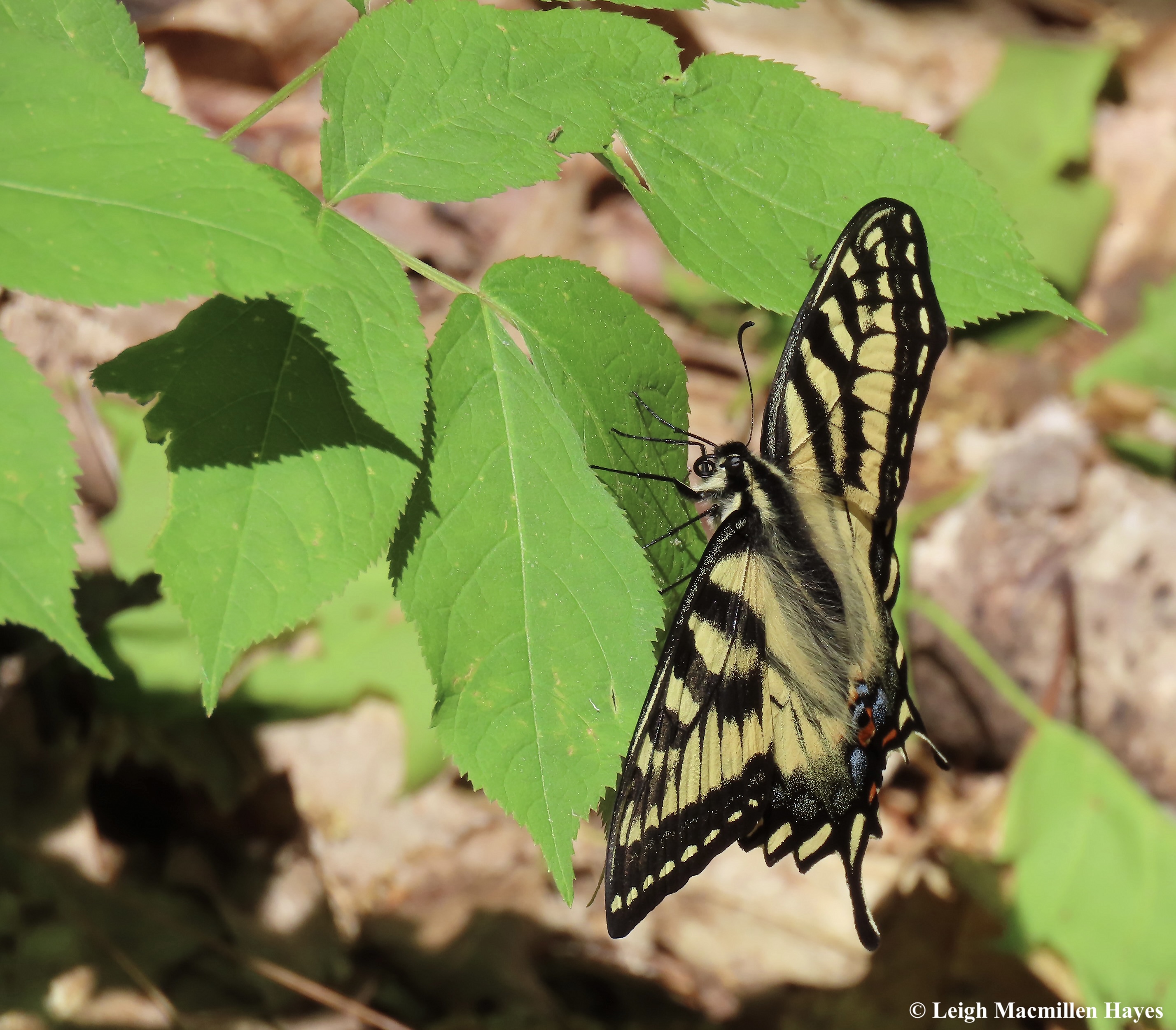
This spring it seems the Tiger Swallowtails are everywhere we travel by foot or truck. What I love about this one is that it was taking a break upon the leaves and you might be able to see its proboscis or siphoning mouthpart coiled up because there was no nectar to seek in that moment.

Right now the Swallowtail butterflies are the largest we’ve seen flying, but during a hike the other day, we spotted one of the smaller ones, this being a Northern Azure feasting upon Black Chokeberry flowers at a summit.

Jack, or rather Jill-in-the-Pulpit, for she needed the extra leaves to help her in her mission of producing seeds, greeted us in various places where the soil was moist including beside the cow path in our woods, where it totally surprised me despite the fact that we’ve lived in this house and wandered about for over thirty years.

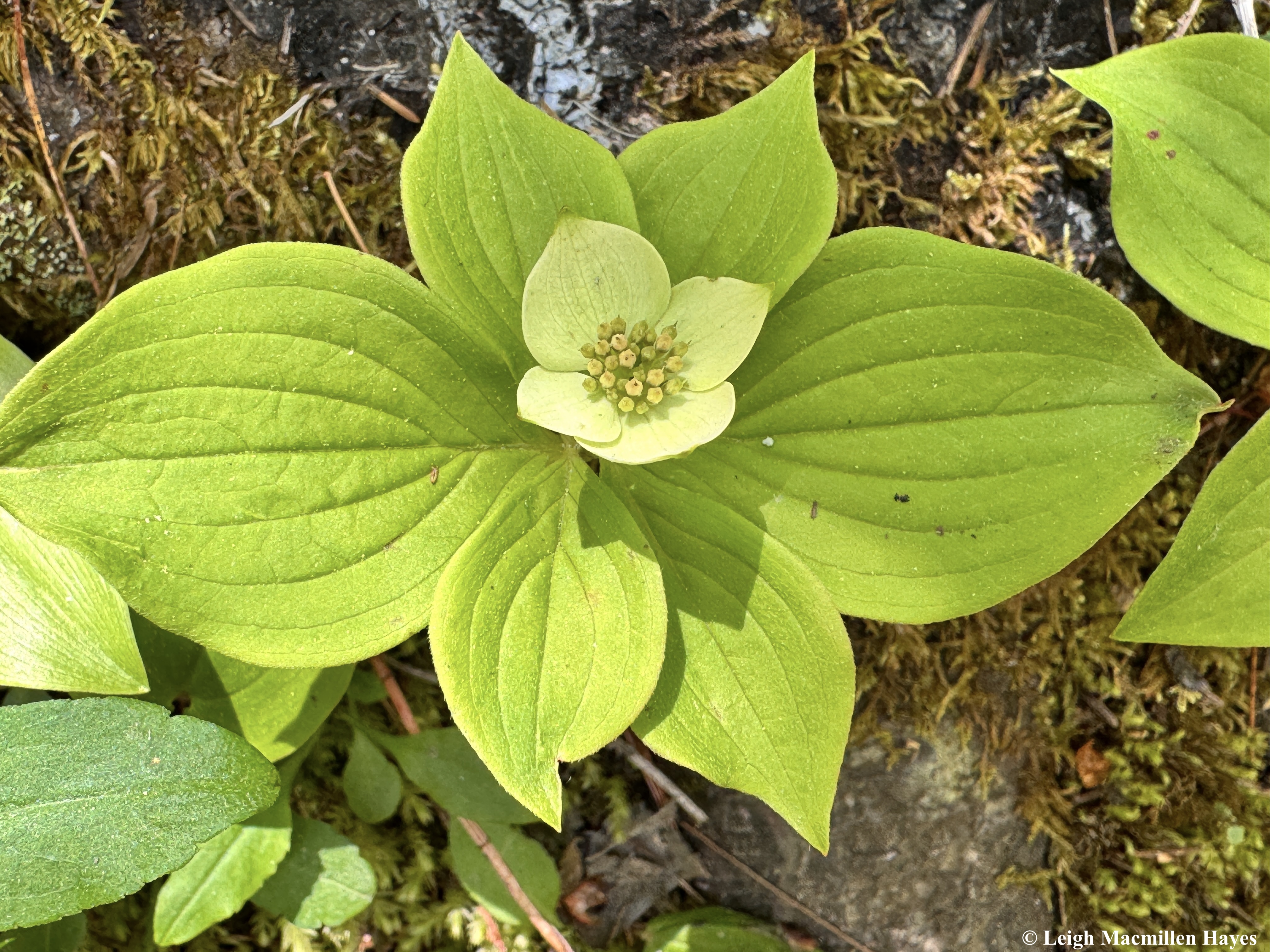
As one week turned to the next, and the flowers that were in full bloom kept changing, suddenly Bunchberry was added to the list. Again, like Jill-in-the-Pulpit, Bunchberry needs two extra leaves in order to have more energy to produce flowers followed by the berried fruits that bunch together in a cluster of bright red. You may look at the veins on those leaves and immediately know the family to which this wee plant belongs–if you guessed Dogwood, you are correct.

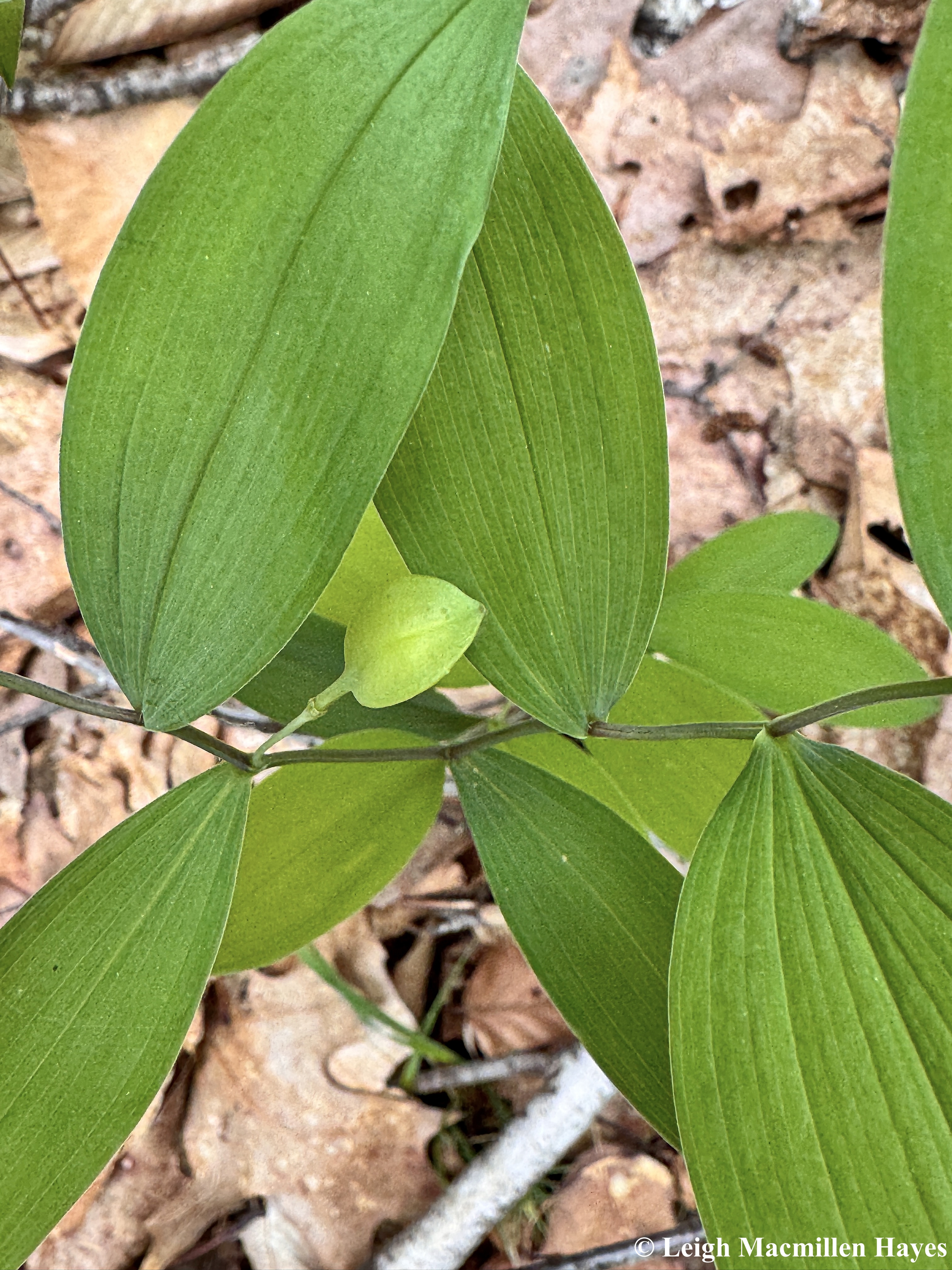
One of the earliest bloomers of spring, has already formed into a fruit, in this case three sided. Meet the Wild Oat of Sessile-leaf Bellwort. It reminds me that in a snap of the fingers, the season passes by much too quickly.

It wasn’t just flowers that marked our journeys. About the same time that we began the latest ritual, dragonflies and damselflies slowly began to emerge, for which we always give great thanks as they gobble up some of the Mosquitoes and Black Flies that so annoy us. This American Emerald had only just made the transformation from aquatic form to terrestrial hours earlier based on the sheen still visible on its drying, but not quiet dried yet, wings.

Much more mature were these two, who had formed the marital wheel in order to canoodle. I knew they were Emerald Dragonflies, but wasn’t sure which species until I searched my guides back at home: Uhler’s Sundragon, a new species for me.

And in at least one spot, some smaller female dragonflies deposited eggs as they tapped the water’s surface with their abdomens. Think of it as Naiads to come, who will live in the water for 1 – 3 years, depending upon species, before climbing out and transforming miraculously into terrestrial fliers.

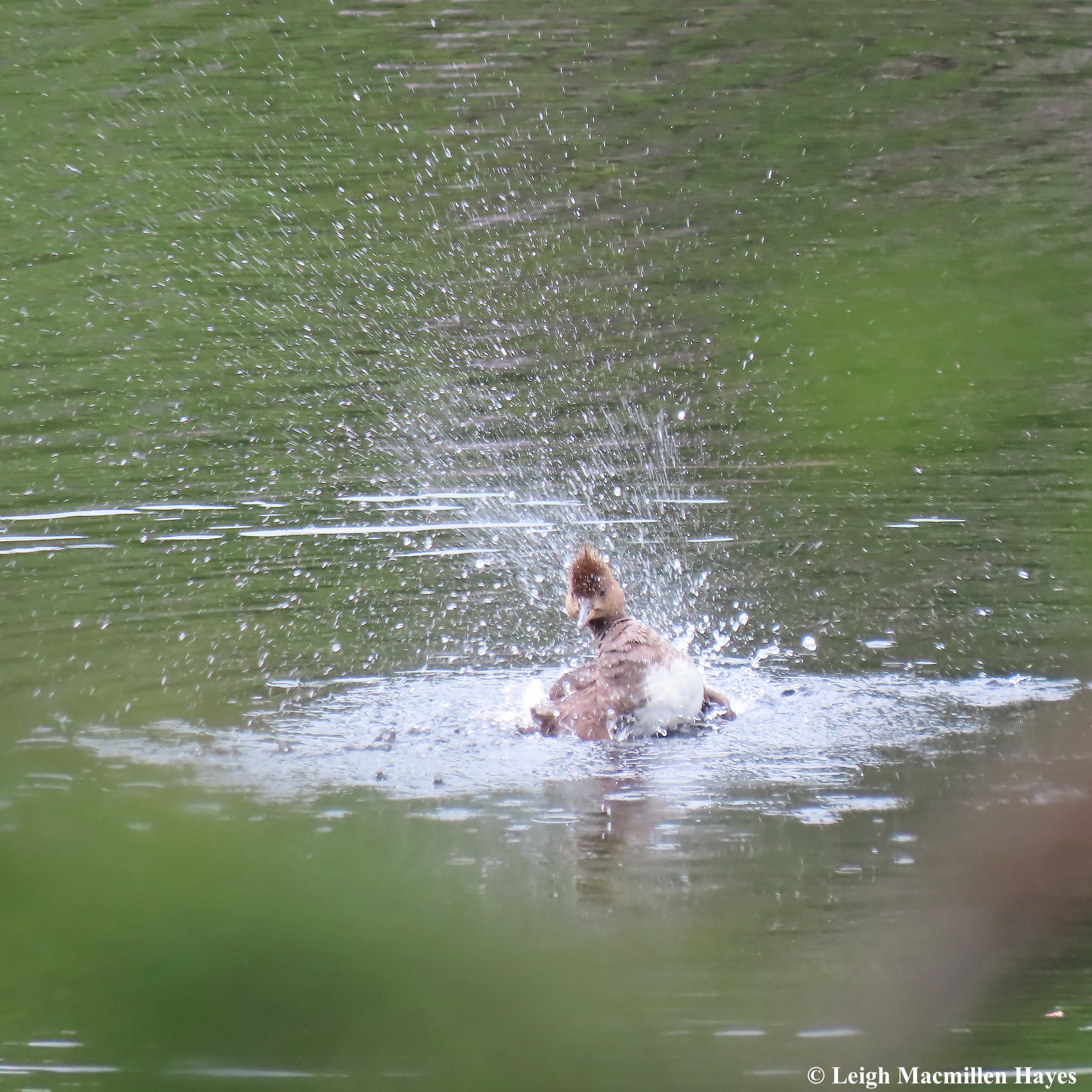
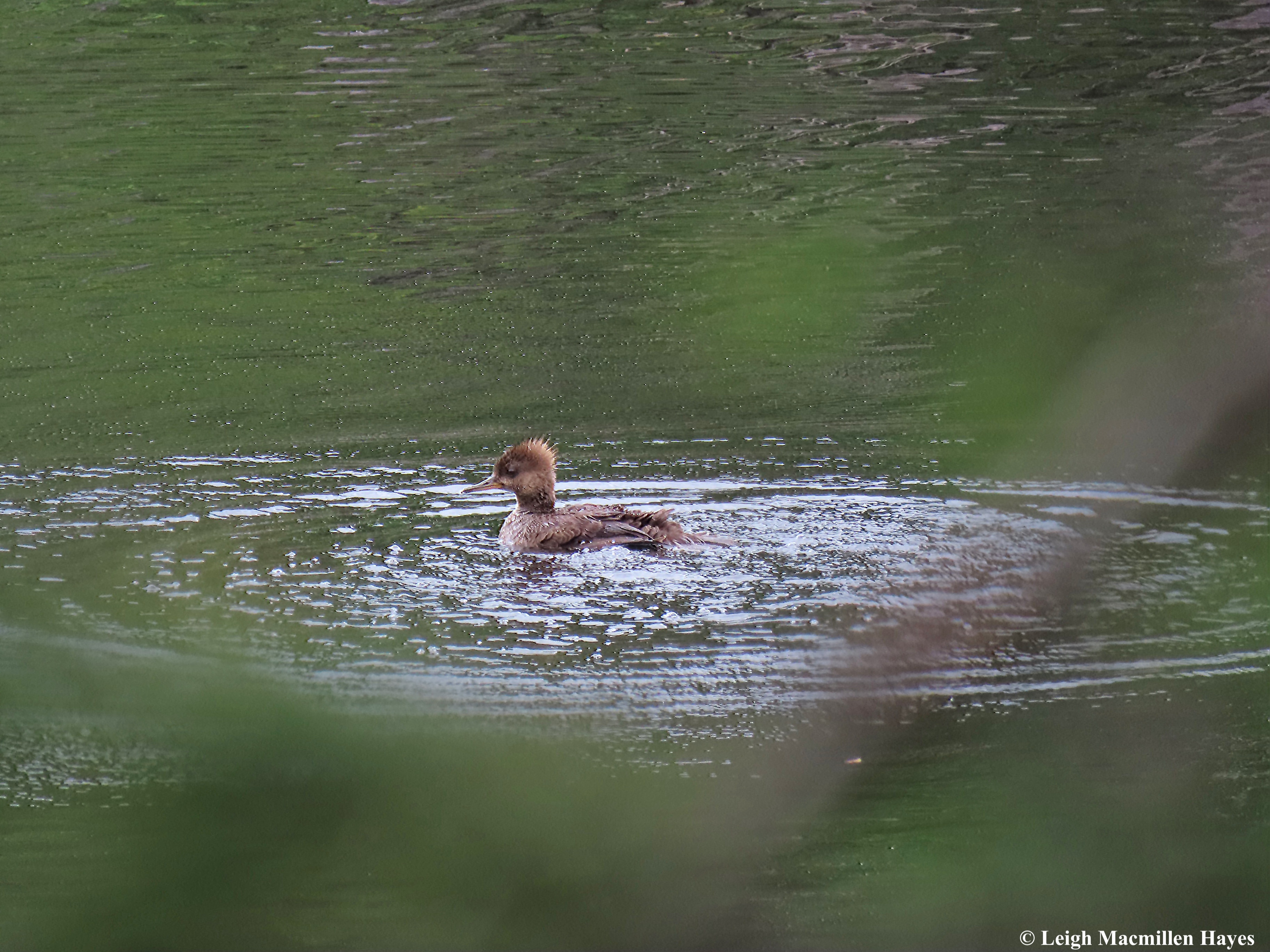
Being beside water in another place, and looking between tree branches, we spied a Common Merganser taking a bath.

We stood just far enough back, that it didn’t realize it had an audience as it splished and splashed.

And finally shook itself off, with water spraying everywhere, before it continued on its journey . . . and we did the same.

Basking Painted Turtles became a common sight as well, and this one had the cushiest place upon which to recline, all others being on fallen logs or rocks and boulders in the water.

One, however, that I assume was a female, though I didn’t want to disturb it and get any closer to check the length of its nails, I surmised had been laying eggs or was about to. Our time together was limited so I don’t have the entire story, but she was in a safe place, no matter what.

One of our most unusual sightings as we performed the ritual was spying a Bald Eagle steal a fish from the grip of an Osprey. If you look closely at the center of the photo, you might spot the thief on its get-away mission–it is flying above the picnic tables, about in the middle of the trees.

As it flew over our heads, the Eagle had the audacity to look back to see if the Osprey was hot on its tail. It was. We don’t know how this story ended either, but we assume the Osprey had to cast its fishing line again.

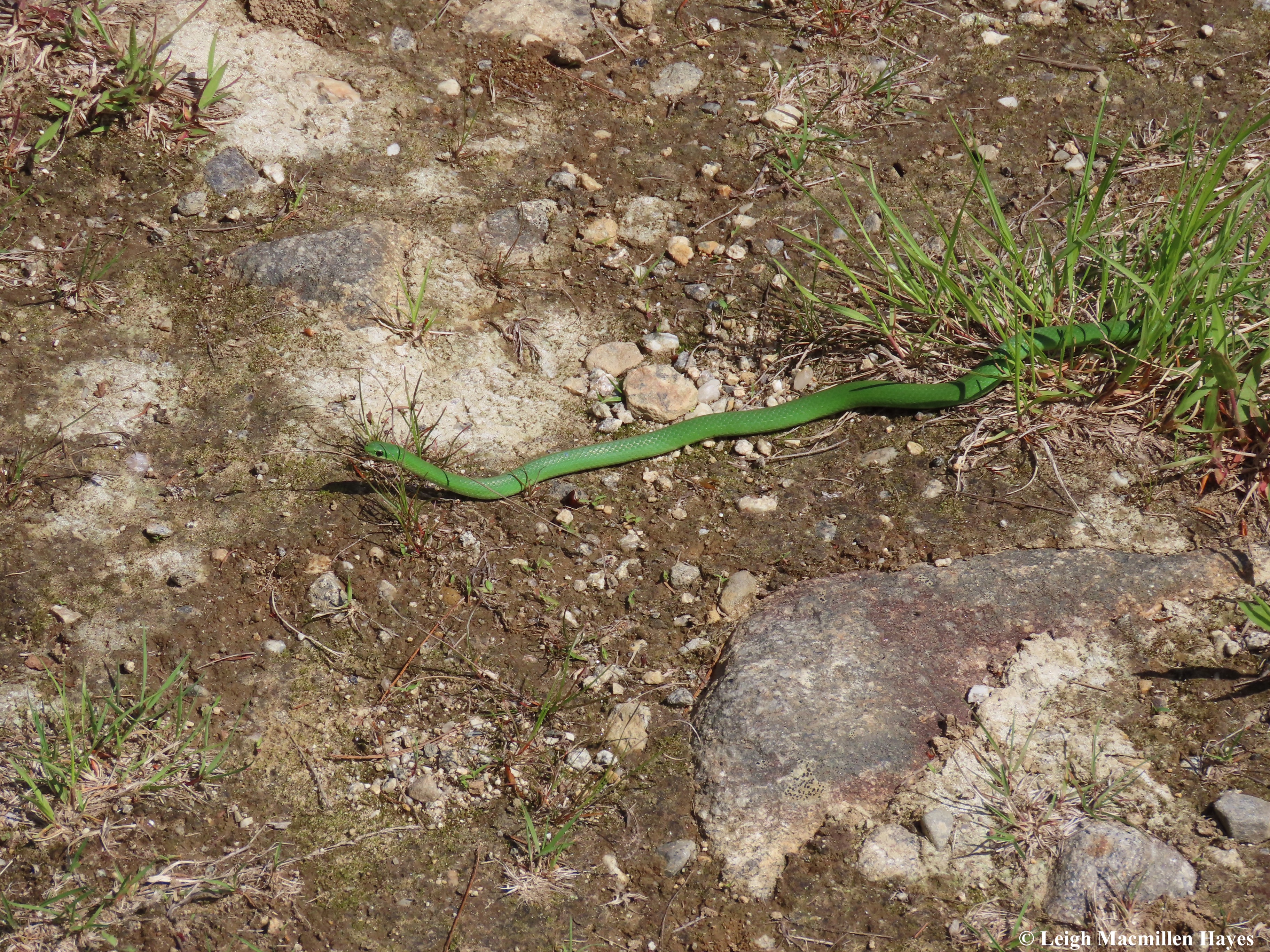
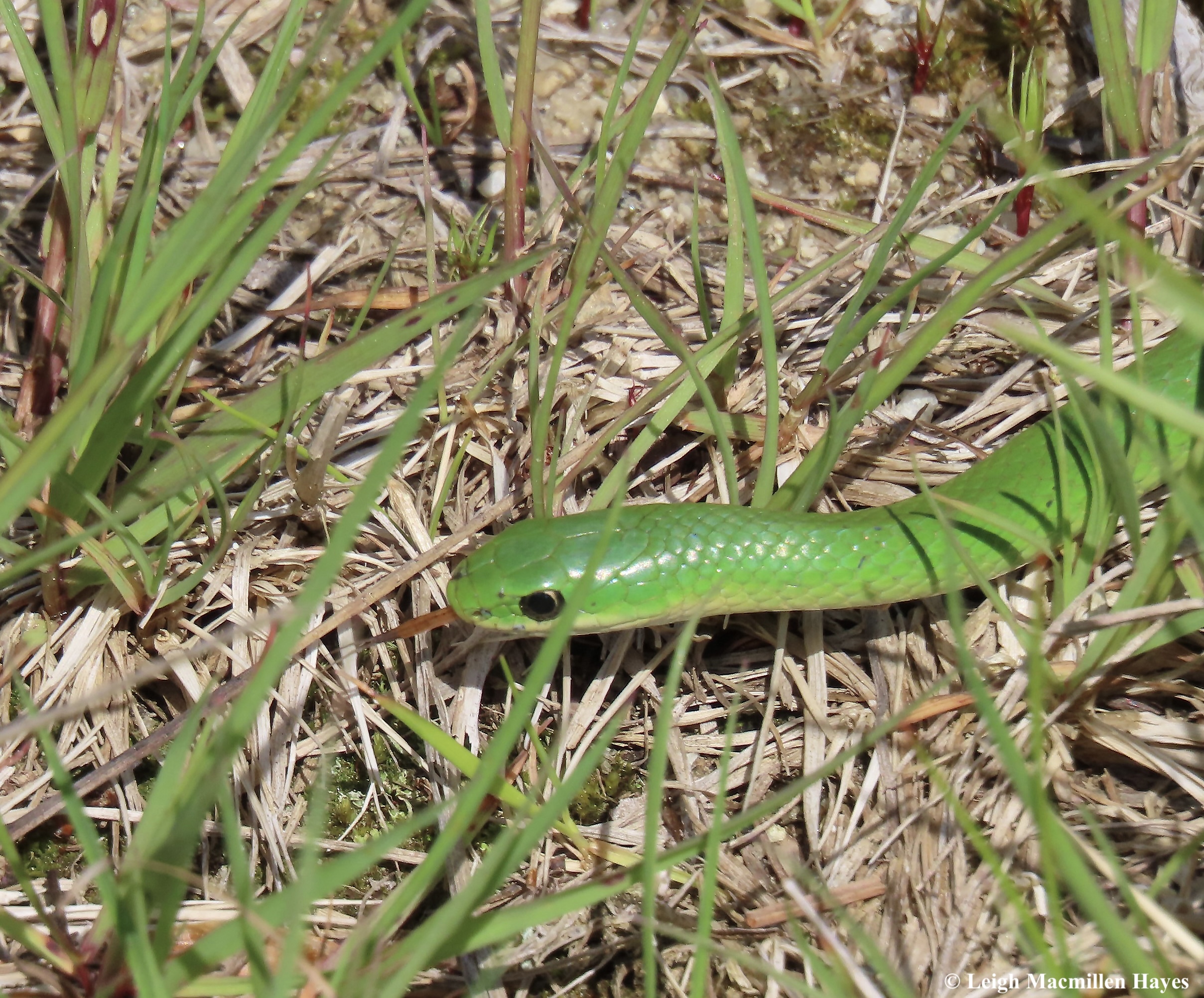
Another fun sighting occurred as we crossed under a powerline on the return trip of a seven mile hike around a river, over to a pond, up a hill behind the pond, and back down and out. Almost the color of the grass that sparsely grew along this section of the trail, a green snake slithered across just after My Guy had stepped that way.

I just love its forked tongue–sensing the trail in snake manner as it did.

The two tines at the tip of the tongue, seen here as it withdrew this sensory organ, help it to smell in stereo and thus find its way and find a meal.

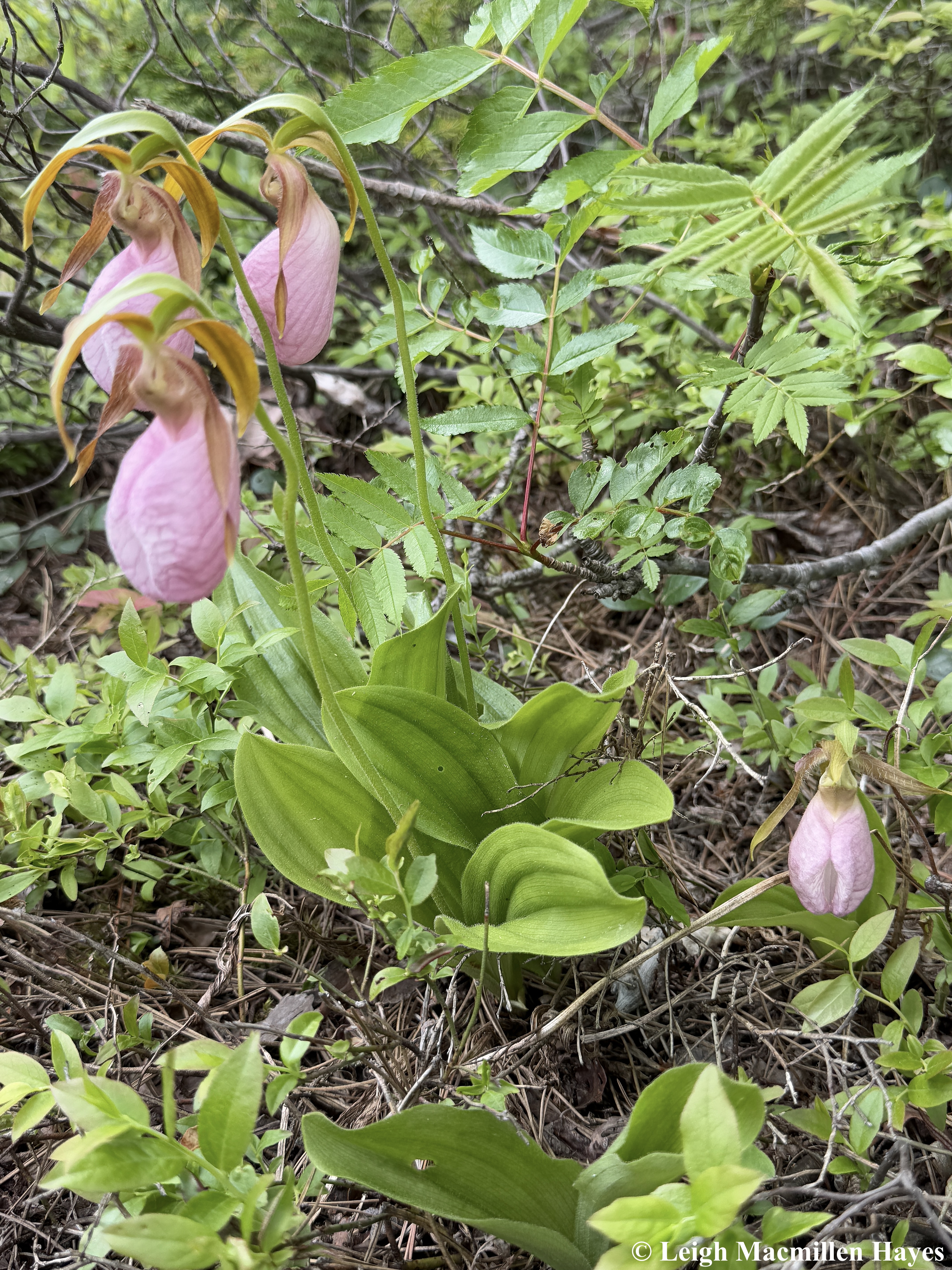
All of these things we saw because of the ritual that we perform every year at this time. It’s one that we now realize involves some greed, but still we feel compelled to do it. We count Lady’s Slippers.

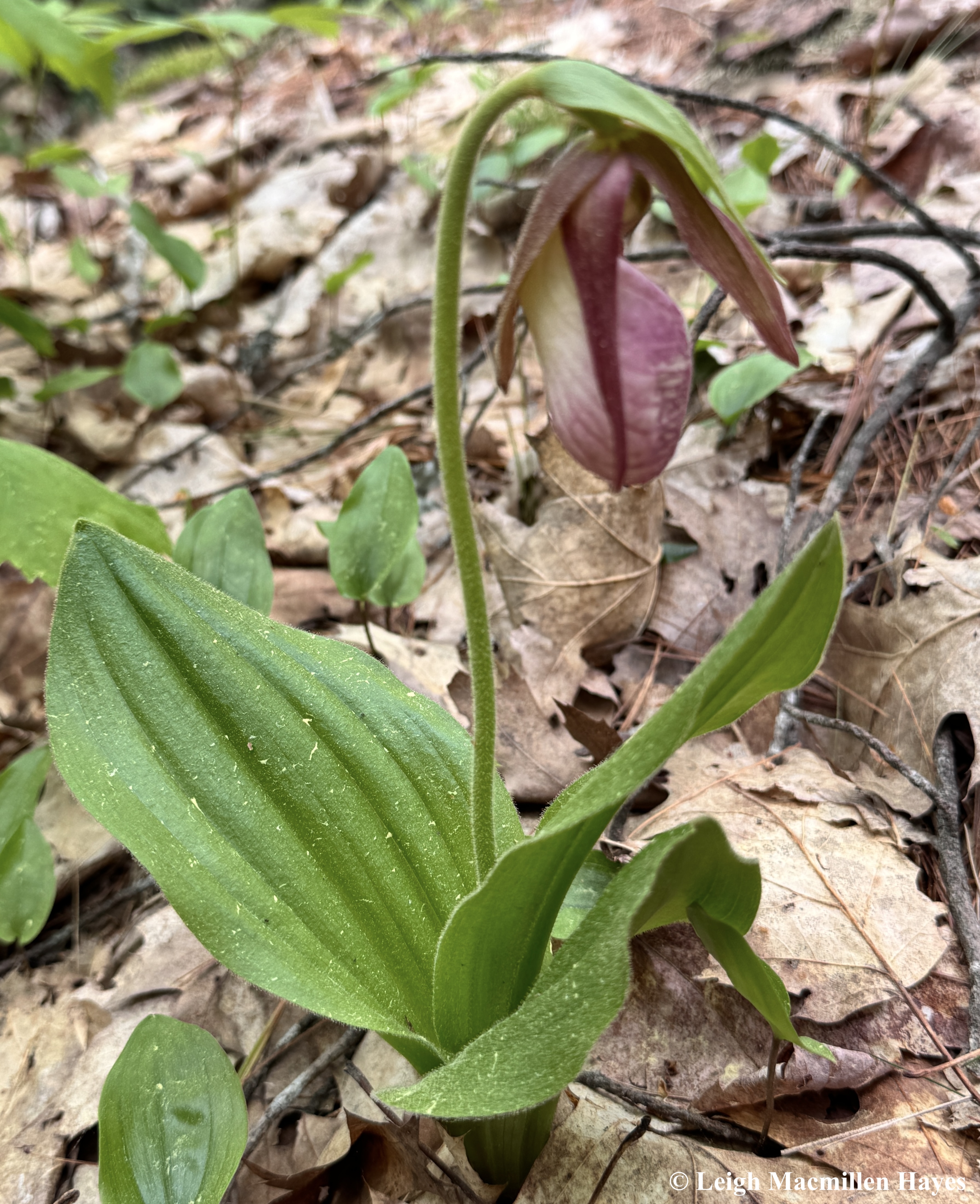
I always thought that orchids were something you received on Prom night and that they grew at the florist. I had no idea that they were actually wildflowers until about thirty years ago. According to Orchids of New England and New York by Tom Nelson & Eric Lamont, Lady’s Slippers are one of 65 species and variants found in our region.

And so they deserved to be counted.

But, oh, how they hide. Do you see the one in the photograph above?

How about now?

Knowing that they can be elusive causes My Guy to slow down for a change. It’s no longer the destination that counts, but rather the number of Pink (and their white variants) flowers that we can spot.

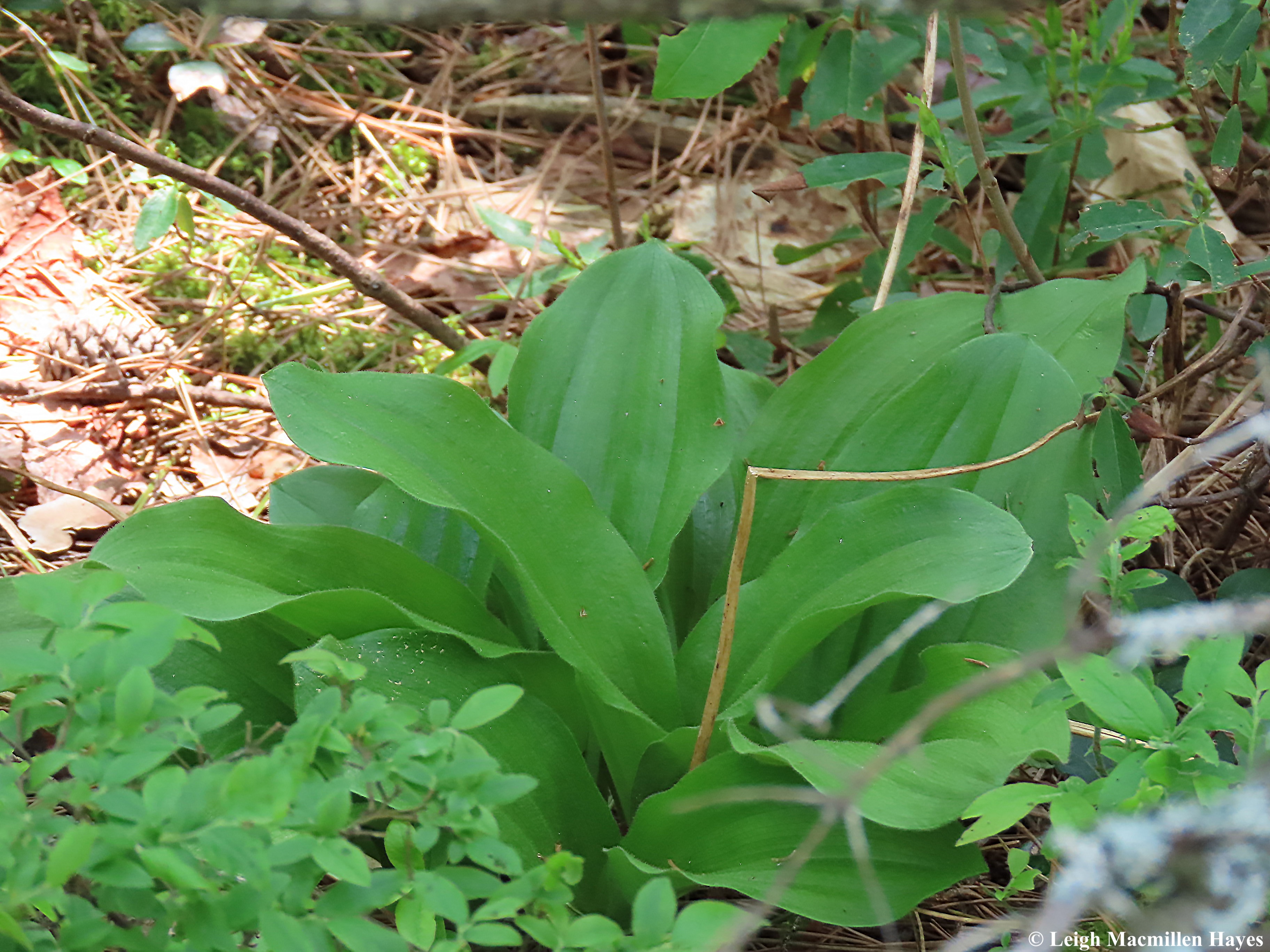
Some are tall, and others quite small. And some are sets of leaves with no flowers yet as in the foreground. We don’t count those.

Here’s the thing about Lady’s Slippers. It takes a long time for a minuscule seed to become a plant. The seeds, developed in capsules, are beyond numerous, but each one has no food source or endosperm. So . . . it must develop a relationship with a Rhizoctonia fungus in the soil to survive. From the fungus the plant gets nutrients for germination and growth. The fungus, in turn, receives nutrients from the orchid’s roots.
BUT . . . all of this takes time. And the presence of the fungus.

Years. First, after at least three years the plant produces a pair of two basal leaves that fold like accordions and remind me of the paper fans we used to make as kids.

One author says it’s another 5 – 10 years before the plant produces a flower; another states 10 – 17. Either way, by the time you spot one, it’s been working for a long time to become a thing of beauty. (And should not be picked or transplanted.)

We found one that stymied us for it appeared to have three basal leaves. I can only wonder if there was a second plant there and something happened to its other leaf.

In one spot, we found what we call a bouquet. Sometimes we see three or four grouped together, but in this case 14 plants in bloom.

And in another spot where we expected the same, nada. What happened. My Guy was disappointed because this is his favorite and he loves to show it off to anyone who happens to be hiking that way.

We have a theory, though we don’t have scientific knowledge to back it up. But here goes. Last summer, our count was quite high. The previous spring and summer it had rained. A. Lot.

Last year, we experienced a drought. This year fewer flowers in most places that we hiked in the last few weeks. Perhaps less of the fungus?

And sometimes the flowers are spotted growing in a bit of a line, making us think perhaps there is a rotting nurse log beneath the soil. As for soil and habitat, acidic seems to be the favorite and we often find them among Low-bush Blueberries and towering over Reindeer Lichen.

And then there’s pollination: Lady’s-slipper pollination is a curious thing. Bees are lured in by the guide lines to a slit in the front petal, the slipper-like pouch, or flower’s labellum. Once inside, the bee cannot exit the way it entered because the petal structure turns inward.

The exit is at the top of the slipper, but to reach it, the bee must move through a hairy interior and rub against the flower’s stigma, depositing any pollen it may have carried in and brushing against the pollen mass called the pollenia before flying out. It strikes me as being like a house of mirrors. And all I want to do is quickly find my way out.

Some bees get frustrated with the dilemma of discovering there is no nectar and the task of finding the exit and instead chew their way out, which seems to be what happened to this flower.

It looks like the bee frantically tried to escape this one.

I tried to honor them with a painting, but our best way is by counting each and every one. I’m going to share last year’s numbers and this years. Also, this year, we counted along a bunch of other trails than just the Big Three as My Guy refers to the first three for which I have been keeping records since 2000.

Wolfe’s Neck State Park: 2024: 475; 2025: 159

Albany Mountain: 2024: 364; 2025: 411

Sanborn River and Overset Mountain: 2024: 598; 2025: 526

Grand Total of the Big Three: 2024: 1,437; 2025: 1096

Plus these trails all from this year only:

Mount Tom: 25 (but we were there on May 18, and this was the kick-off event that got us going this year; more may have bloomed since then. Actually, after spotting the first one, My Guy wasn’t sure he wanted to count this year, but let me tell you, he still has the greed!)

Mount Tire’m: 31

Proctor Pond Reserve: 41

Kezar River Forest: 63

Narrow Gauge (only 1.5 mile section): 56

Sleigh Trail at Notch View Farm: 44

Home woods: 2

Grand total of all trails: May 18 – June 6: 1,358

Even with the extra trails, the count was down.

But still . . .

Where the Moccasins (Lady’s Slippers) Led Us–up and down many a path with so many wonder-filled moments and sighting along the way. Counting Lady’s Slippers is a ritual that we love to share together and with others.

Senior College: Forever Students

We honestly weren’t sure anyone would sign up. Or show up.

Vernal Pools and Macroinverebrates
Leigh Macmillen Hayes and Dawn Wood
Friday, April, 25, May 2, 9, and 16th, 9:30 – 11:30 am
April 25: The Hidden Life of Vernal Pools
Discover the wonders of vernal pools—seasonal wetlands vital to forest ecosystems. Learn how wood frogs, salamanders, and fairy shrimp rely on them for breeding and why protecting these fragile habitats matters. Join us indoors at St. Peter’s Episcopal Church for this engaging workshop.
May 2: A Day at the Vernal Pool
Meet at Loon Echo Land Trust’s Raymond Community Forest, Conesca Road, Raymond. Walk ¼ mile to the vernal pool, where we’ll provide tools to explore its temporary residents and their unique ecosystem.
May 9: Meet the Macros
Ever wonder who lives in local streams? Join us to discover the tiny creatures that call them home! Dive into the world of macro-invertebrates—those fascinating “big bugs” without backbones—and learn how macros tell us about the health of the environment. This hands-on workshop will take place indoors at St. Peter’s Episcopal Church. 
May 16: Macro-invertebrates Up Close
Explore the role of macro-invertebrates in stream health and the ecosystem. Join us for hands-on dipping and rock turning to assess water quality at Northwest River and Douglass Brook, Tiger Hill Community Forest, Sebago.
Maine Master Naturalists Leigh Macmillen Hayes and  Dawn Wood of Bridgton will lead these experiential classes. Both have a sense of wonder about the natural world and spend hours exploring only a few feet from a trailhead.

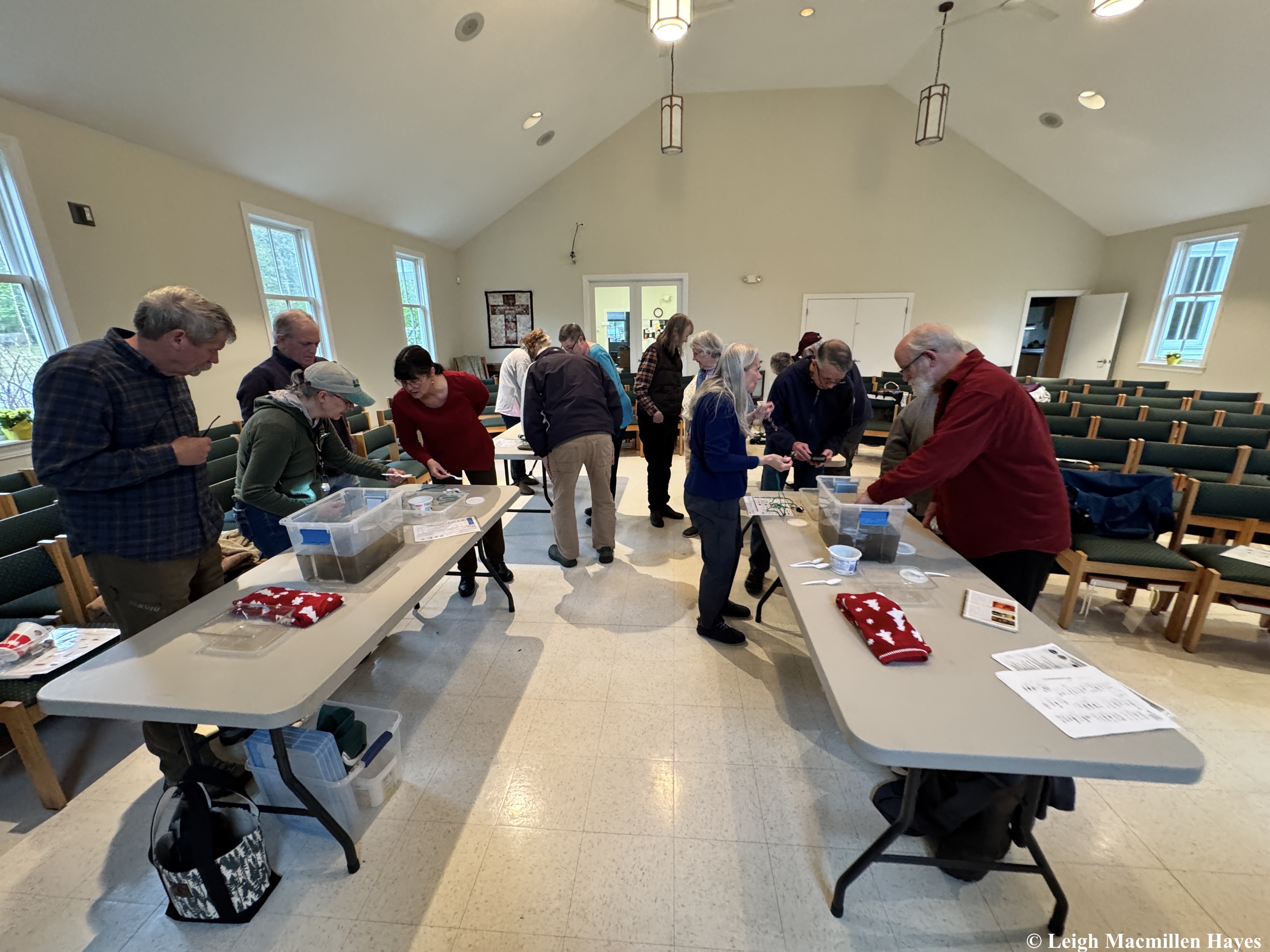
And then they did. Almost 30 of them. The first class, as you can see, was an indoor introduction to vernal pools where we shared our photographs, ID books, and models, and told stories about our experiences in these ephemeral habitats. Their questions were numerous and they shared stories as well, making it an even richer experience.

And then we ended with a musical treat since we knew that there was at least one conductor in the audience. As you click on the arrow to listen to the Springtime Chorus, remember that Wood Frog calls sound like “Wruck, wruck.” Spring Peepers: “Peep, peep, peep.” Green Frogs: “Ga-dunk, ga-dunk.” And Bullfrogs: “Jug-a-rum, jug-a-rum.”

Thank you, Jan, for leading this, and thank you to everyone for participating so willingly.

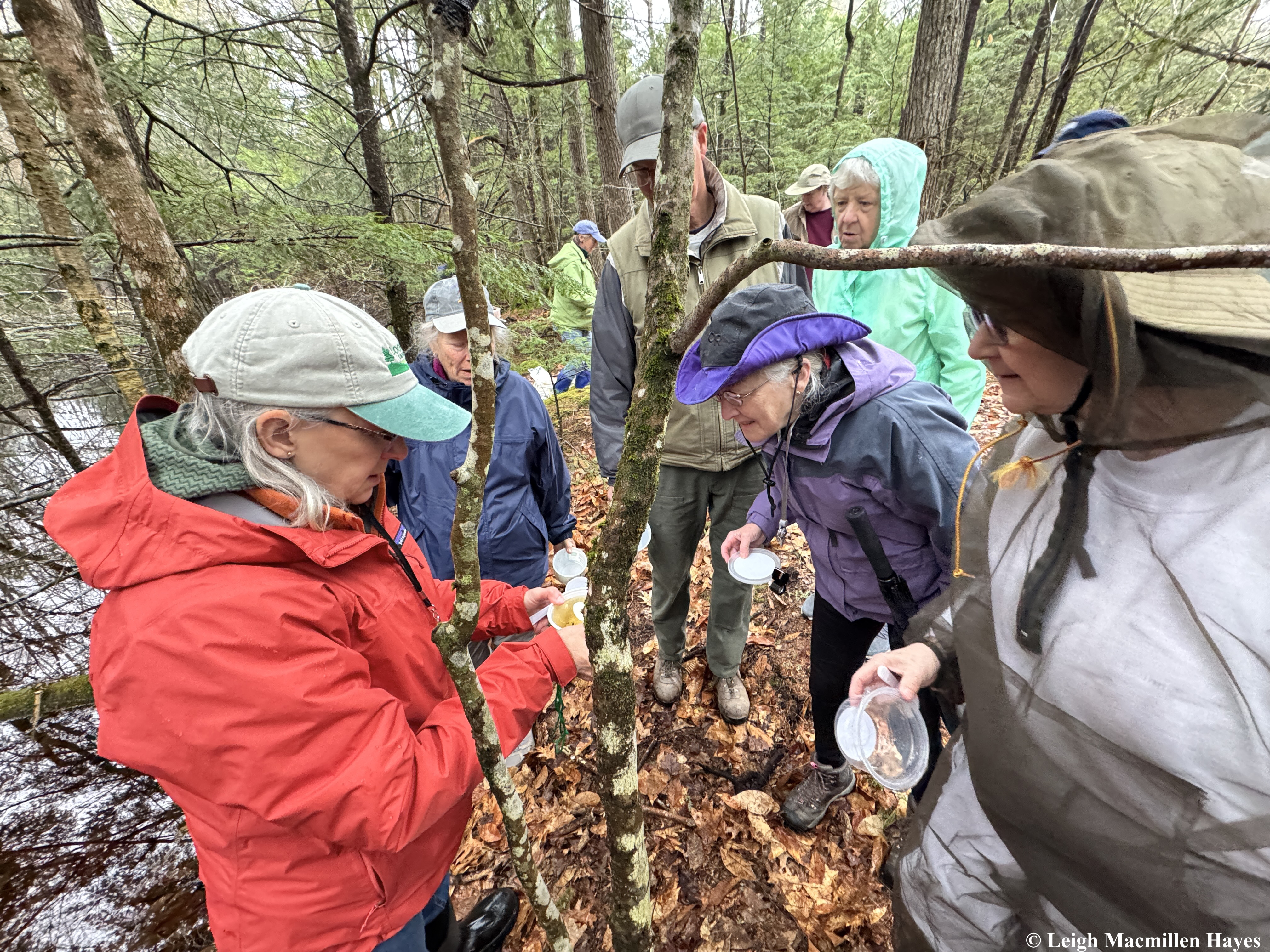
The following Friday we awoke to rain and again we were sure no one would show up. BUT . . . that did not stop them and we slowly snaked through the forest on our way to the vernal pool.

Of course, we all suffer from that most wonderful of syndromes: Nature Distraction Disorder (NDD), and the summer grape that grows along the Grapes Expectations Trail at Raymond Community Forest was the first thing to draw our attention.

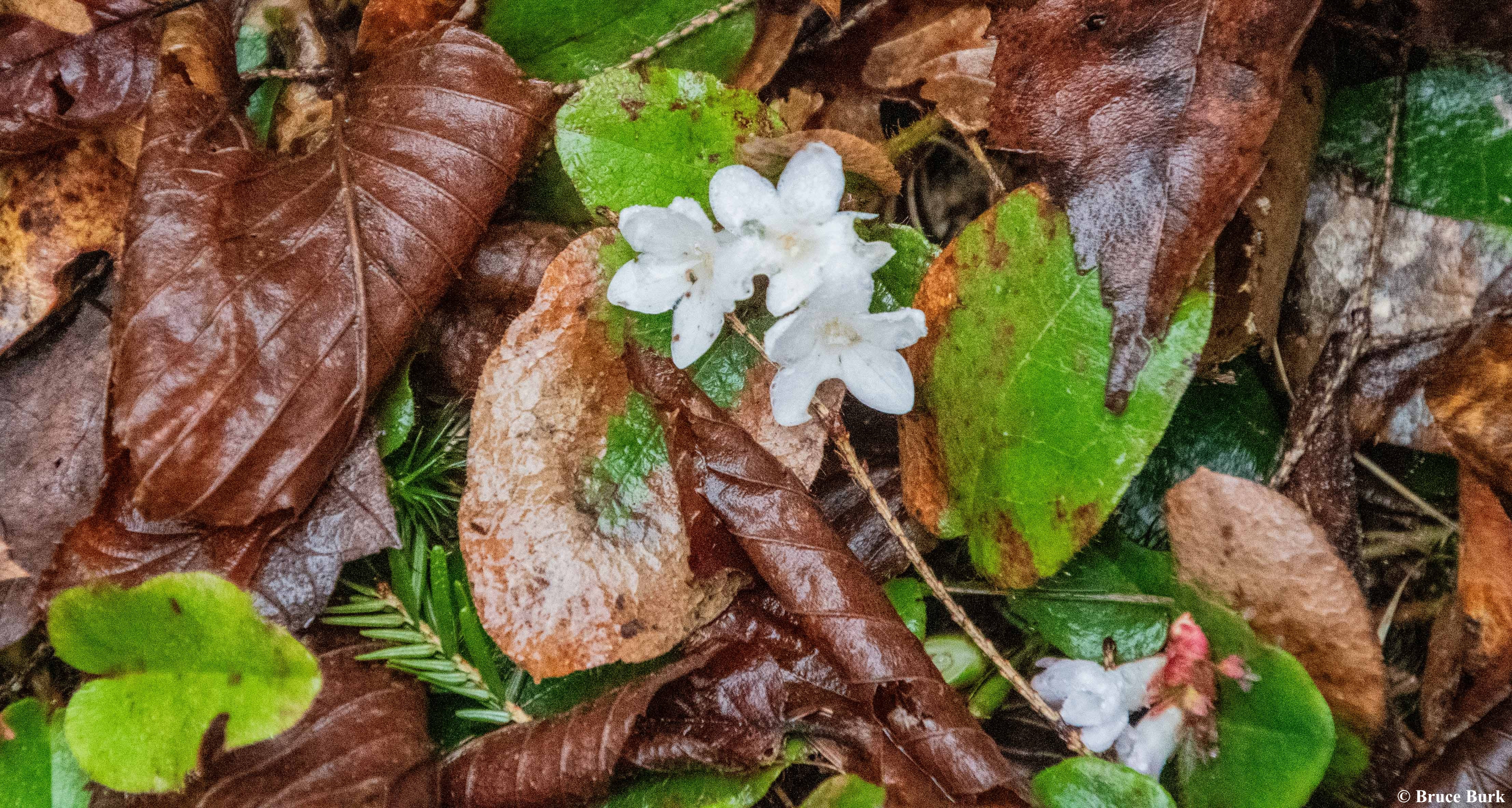
Trailing Arbutus with its sweet little flowers also caused us to pause.

At last we reached the pool and because the sky was overcast and some raindrops and mist fell, we couldn’t see into the pool very well, especially to admire the egg masses deposited by Wood Frogs and Spotted Salamanders. But . . . we could dip.

And within a few minutes the prize of the day was discovered and everyone came to take a peek at what Dawn had found.

Soon one Fairy Shrimp (just enough to make the pool significant by Maine standards) was followed by multiple more. This particular one happens to be a female with a full brood sac at the top of her abdomen.

I’ve said this before, but it’s worth mentioning again and again:

40 Wood Frog egg masses make a pool significant; OR 20 Spotted Salamander egg masses; OR 10 Blue Spotted or Jefferson Salamander egg masses; OR a single, yes one, Fairy Shrimp.

Fairy Shrimp are cool because in order for eggs to be viable, the pool must dry out. And they can survive being dry for multiple years. And in any given year, not all eggs will hatch, thus saving some in the bank for another year or ten.

Our other finds that day include Phantom Midges–with inner workings visible through the translucent body.

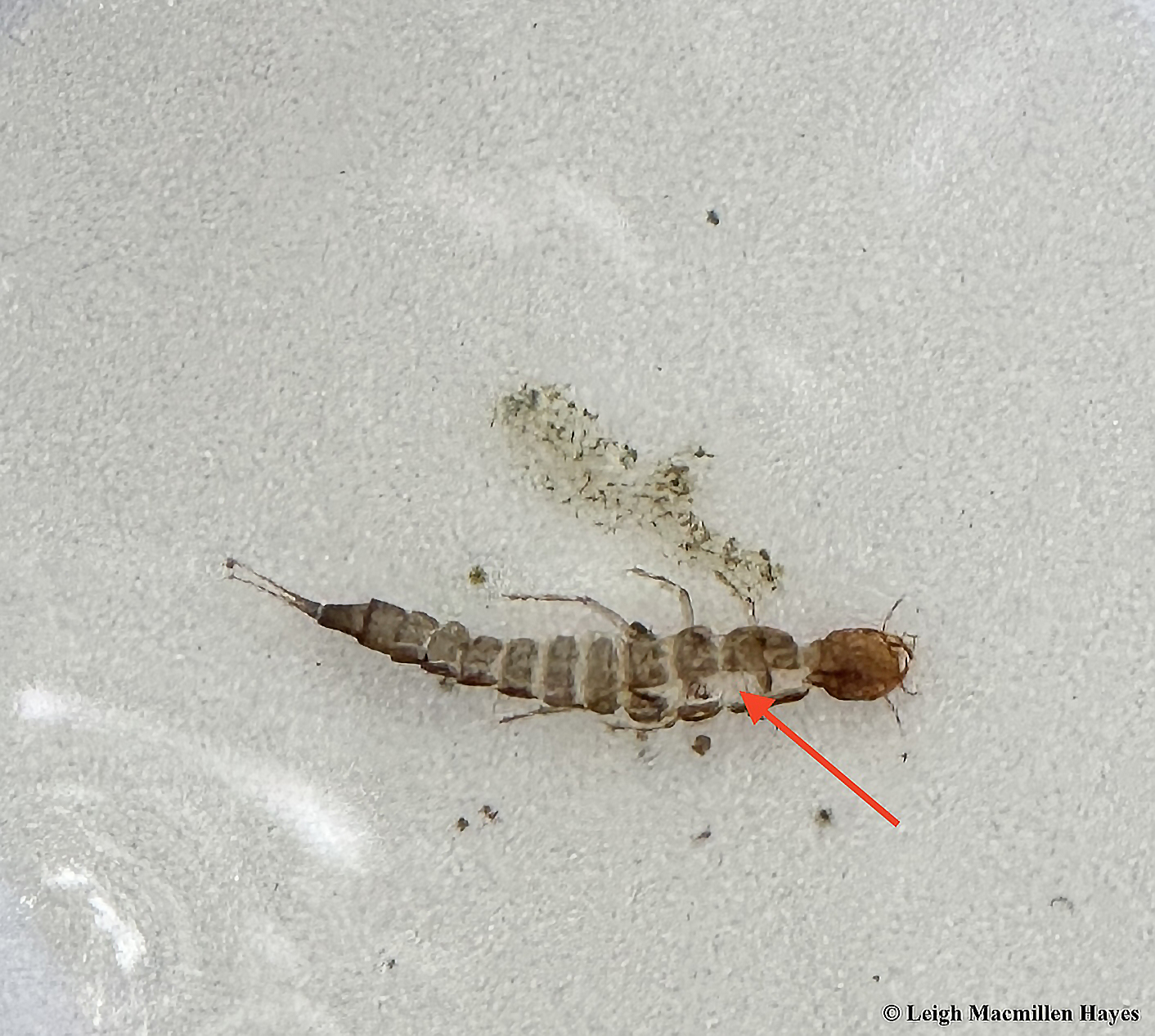
And Predaceous Diving Beetle larva, plus . . .

the shed skin of a PDB, with a split where the wings of the adult emerged first and then the rest of the body squeezed out through that slit that the arrow indicates.

This is the adult, with an air bubble on its back end; and if you look closely, you may see a few Mosquito Wrigglers twisting and turning in the photo as well.

We always remind everyone that all larval forms must go back into the pool or stream or whatever waterbody, because in the whole scheme of things, everything is important.

I laugh when I look at this photo because as a youngster, my brother always noted that my mouth was always open in pictures–apparently he thought I talked too much.

But obviously, on this Friday I was waxing poetic about something.

Before we left the pool that day, the students had a surprise for us. The previous week I had pulled out a party noisemaker and reminded those who had attended our winter class on insects that it served as a great tool to illustrate how a butterfly or moth proboscis (mouth part) curls up in flight, but upon a flower, they extend it to reach the nectar. Turn the noisemaker over, however, and suddenly you have a frog tongue–as they snap it out to capture an insect.

And tada, unbeknownst to us, everyone was suddenly a frog. Heck, if we were going to make them perform in the frog chorus, then they might as well be frogs. It was awesome. And yes, they did perform in the chorus once again, after which we left the pool and headed home.

Week three found us back at the church, where we began with a slide show about Benthic Macro-invertebrates.

Benthic: Living at the bottom of a body of water (stream, river, pond)

Macro: Large enough to be seen with the naked eye

Invertebrate: Animal without a backbone

Macro-invertebrate: Large, water dwelling animal able to be seen with the naked eye.

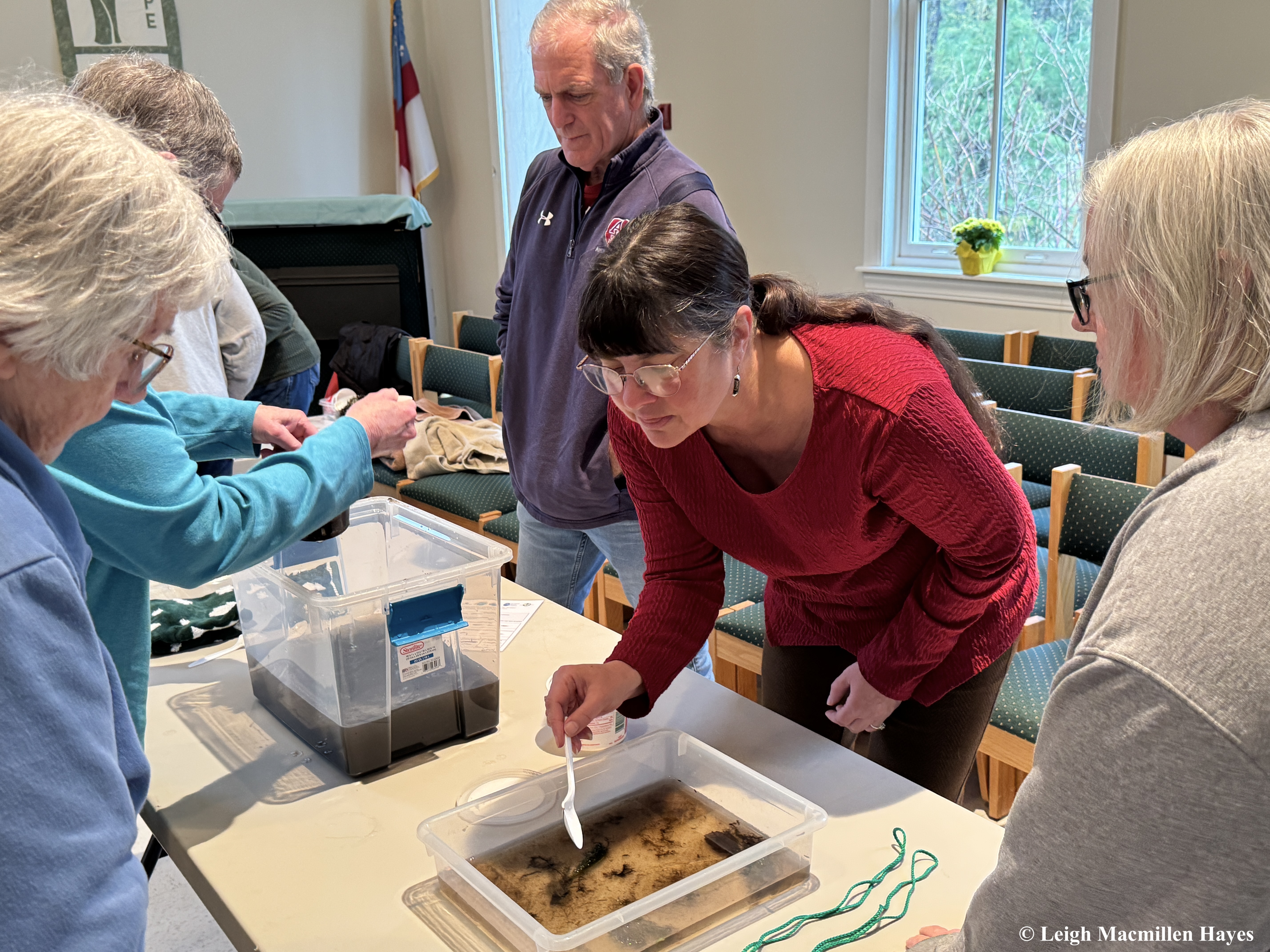
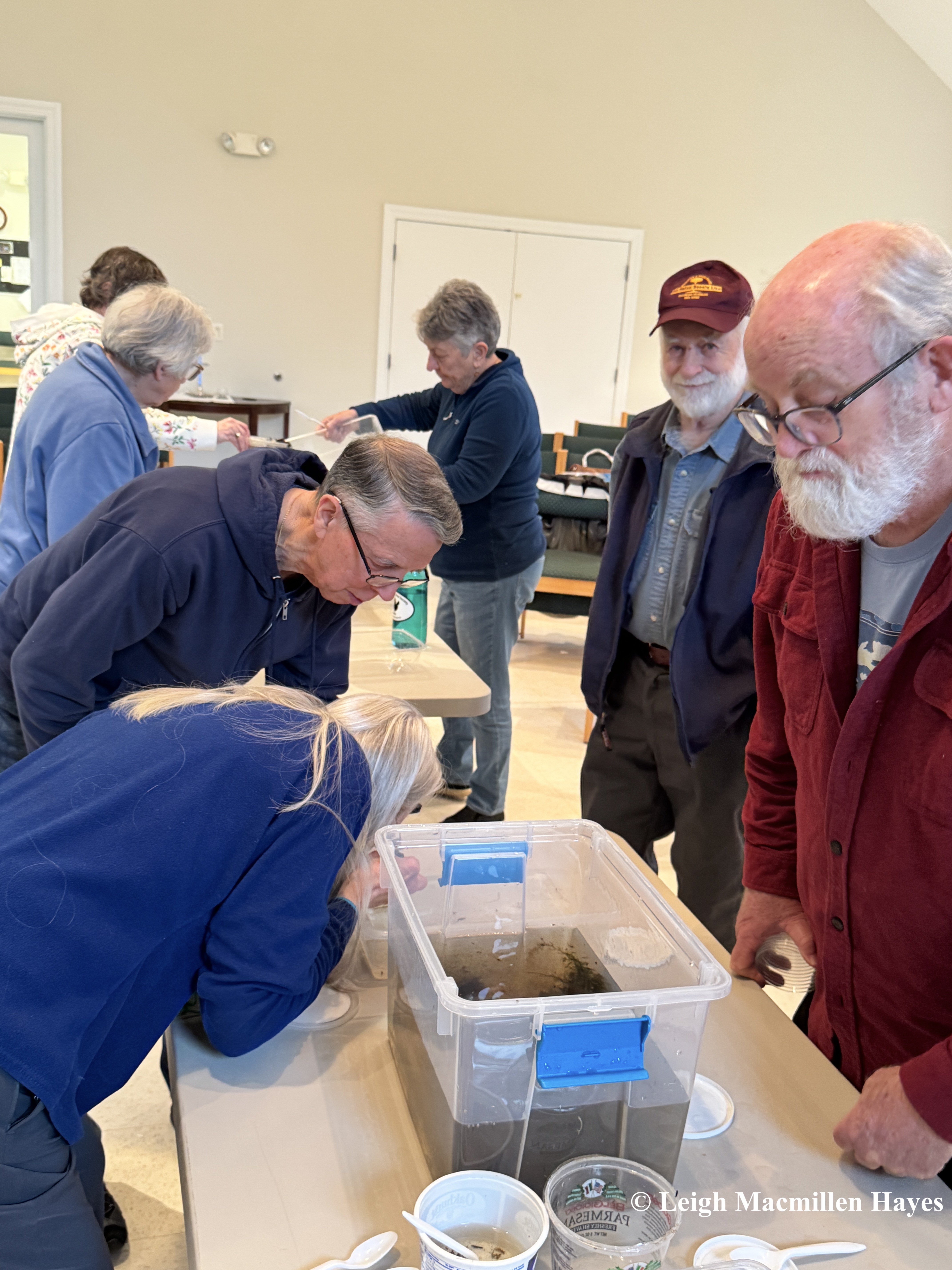
Prior to the class, Dawn and I spent an hour or so trudging to and fro a local wetland to retrieve containers of water so that after the initial presentation, the students could take a look–up close and personal, in the comfort of a building. (Never fear: all critters were safely released in the same spot where we captured them with our D-nets)

They started starring into the water and began to notice movement. And then, using spoons and small containers and lids, all recycled, they were able to glimpse the wonders of the water.

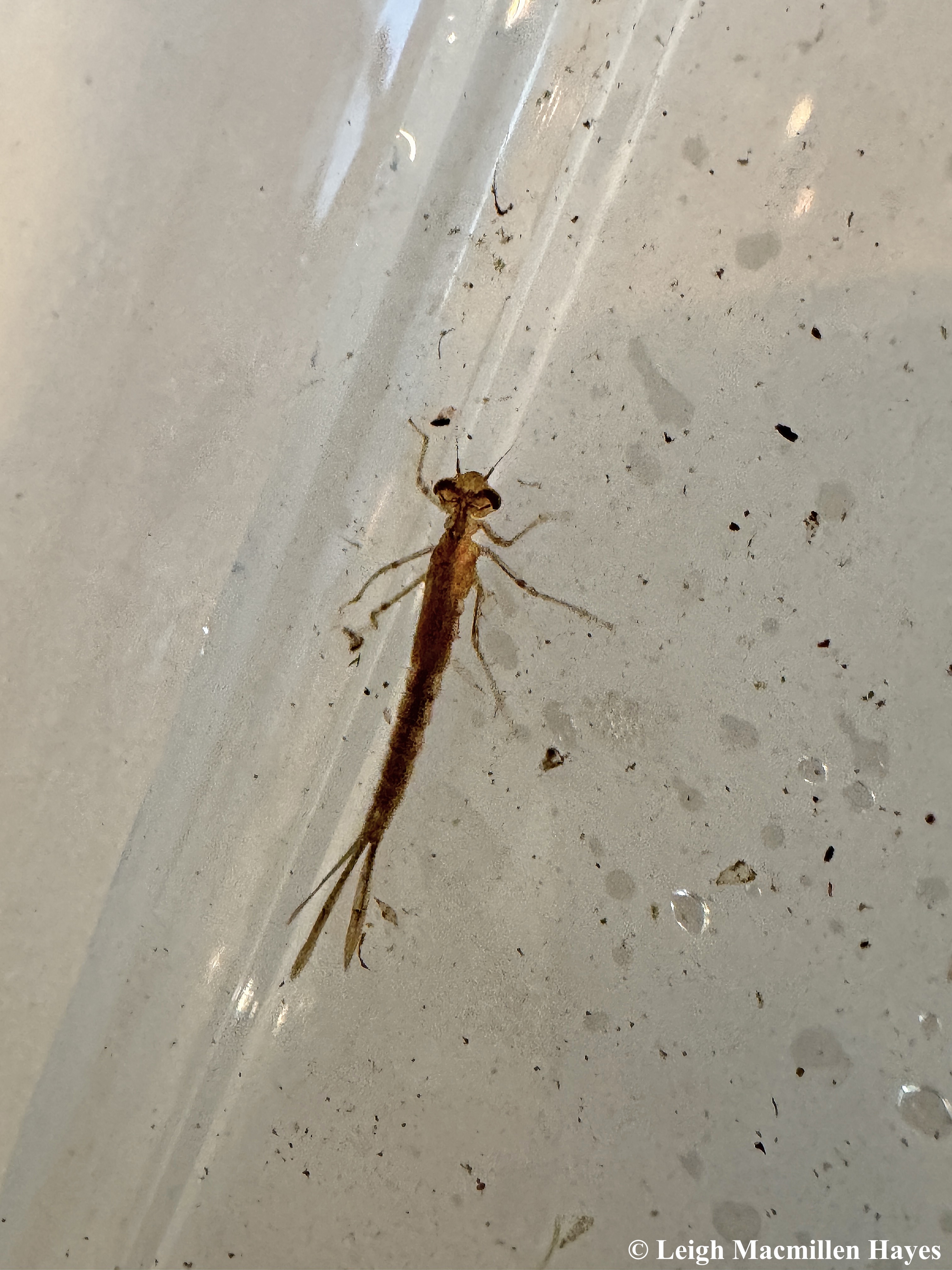
One of the favorite finds was the larval form of a damselfly, with three paddle-shaped tails that serve as gills.

The critters love to hide under the leaves and muck that we’d pulled up so sometimes it took a few moments to wait for the water to settle before spotting something moving.

But they did. And with the use of loupes on lanyards that we borrowed from Loon Echo Land Trust, they found Mayflies and Damselflies and Dragonflies and Backswimmers and more.

Finally, today dawned. The forecast kept changing all week, so we were pleasantly surprised by the sun. That said, you know those Mosquito larvae we always encourage everyone to save? Well, they are hatching. But, just as for the rain, everyone was prepared.

Oh, and yes, another moment of NDD hit us only a hundred feet from the parking lot. We love mud.

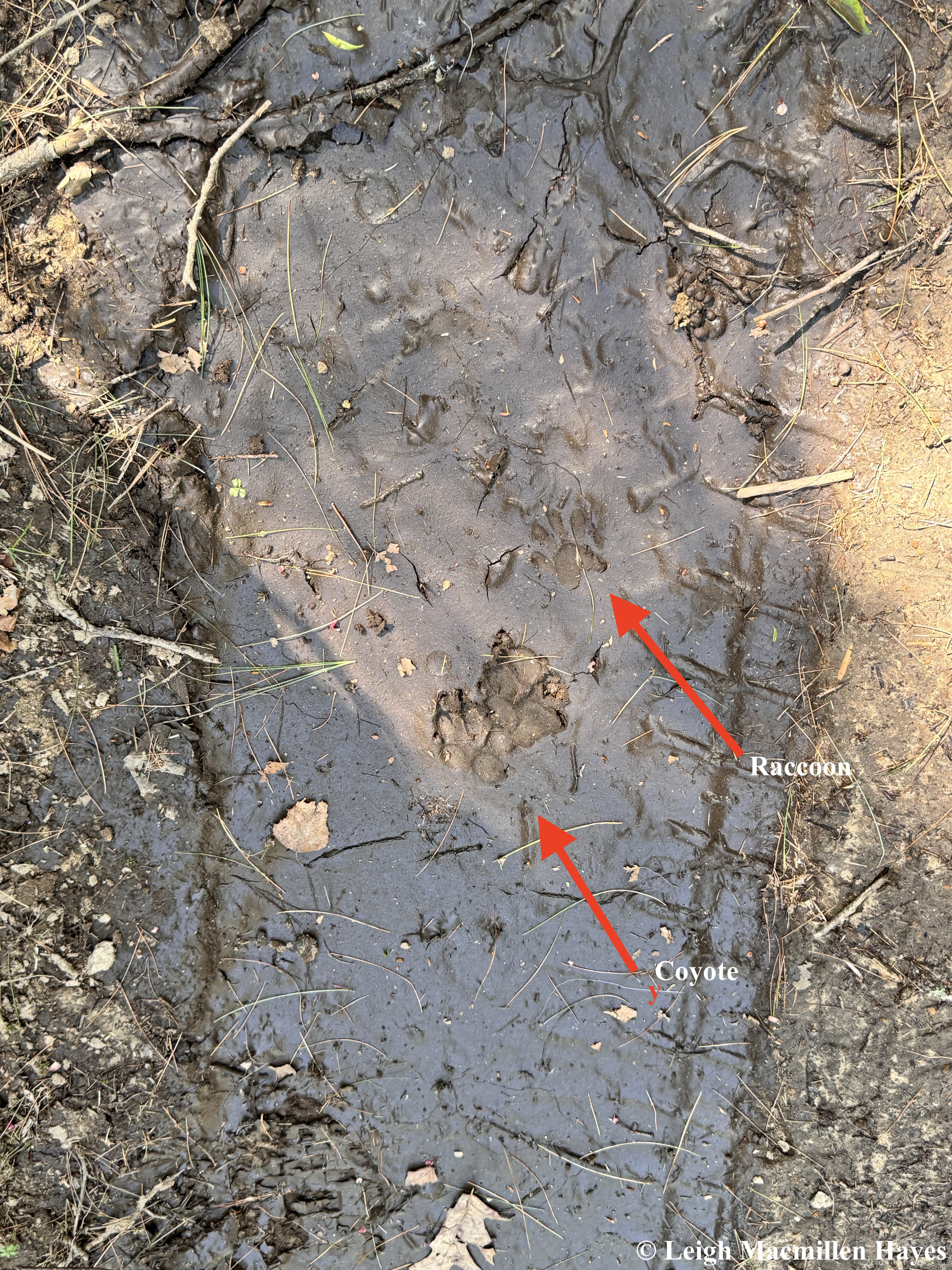
Especially when it tells us who passed this way during the night. In this case, it was two critters: a Coyote and a Raccoon. If we can’t have snow, mud is great. In many ways, it’s even better than snow for the prints are much crisper and easier to read. (Don’t tell the snow I said that. Ever. If you do, I’ll deny it.)

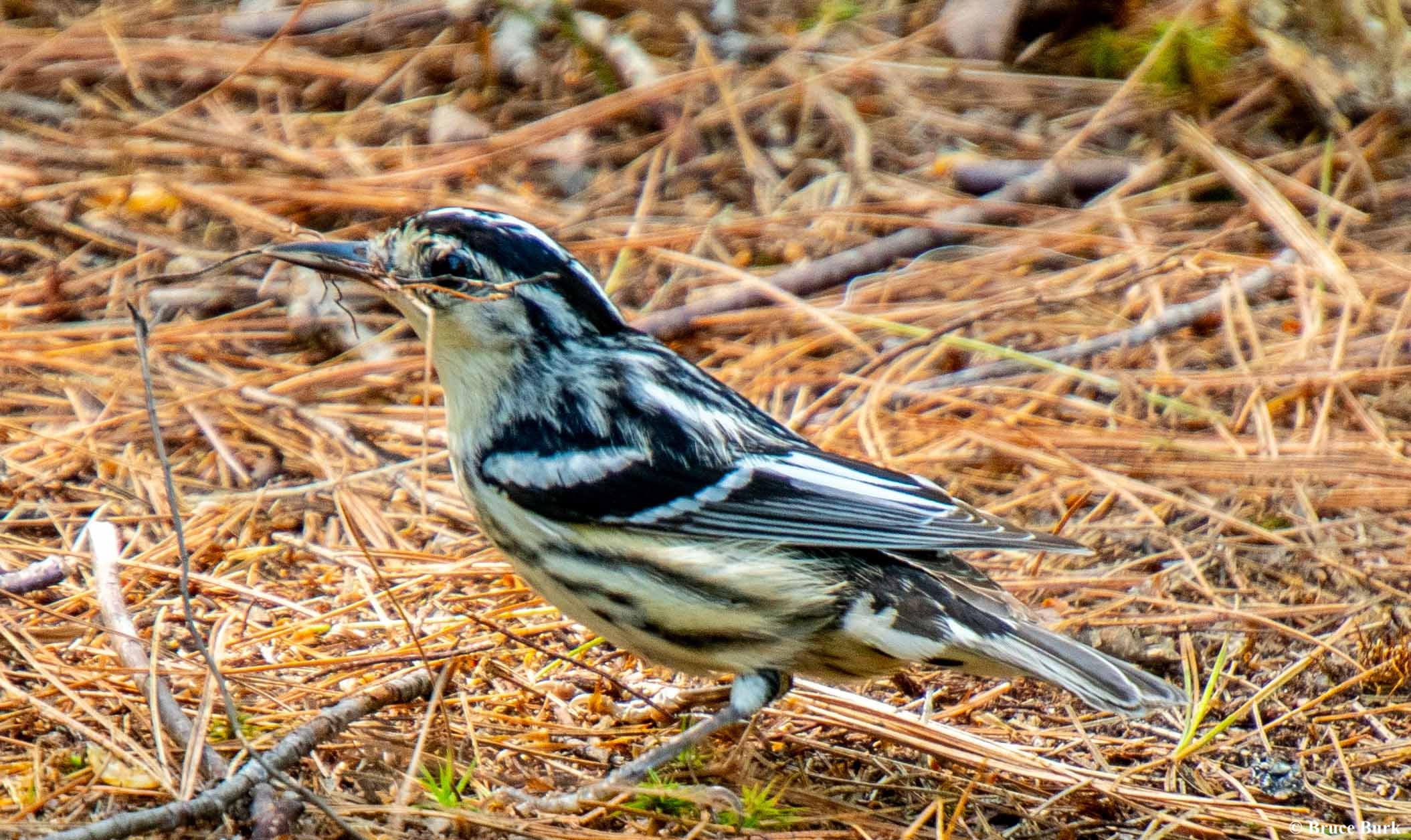
But . . . we had a mission and a time frame. The Black and White Warbler didn’t care. Apparently, we had entered its territory and despite our presence, it went right on collecting nesting material.

When nature surprises us with these moments, I always feel we’ve been blessed to be witnesses.

Finally, it was time to dip the D-nets into the river.

We’d placed a few tables near it so everyone could take a look without risking going into the water. Plus, the trail to the water is narrow and once we realized the bird was building a nest there, it made it even more important that we not spend too much time.

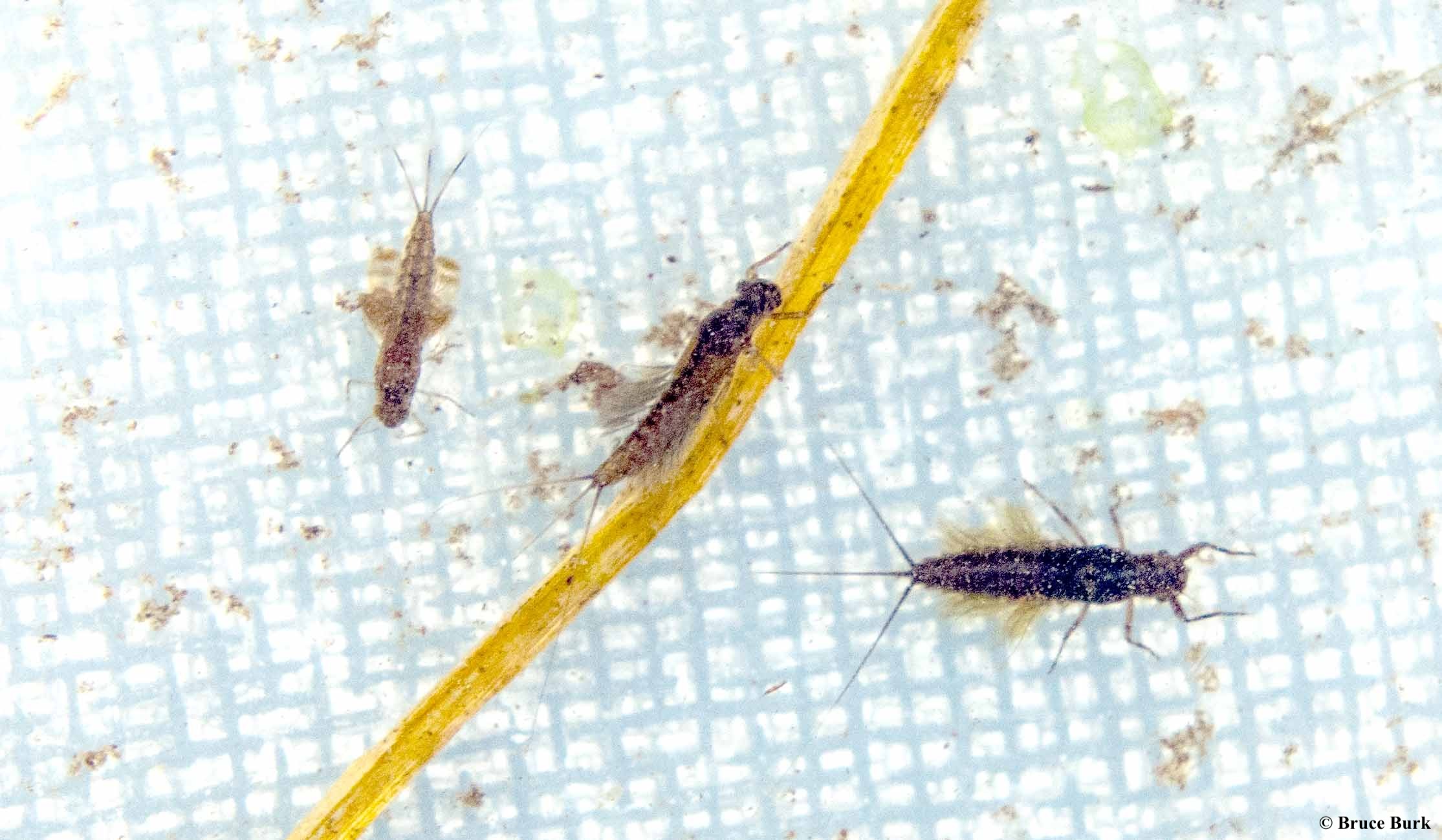
The most prolific finds of the day: Mayfly larvae.

There are so many types of Mayflies as everyone soon realized. What I love about them: their feathery gills on the sides of their abdomens, and the three long tails that most feature, which they even had as adults, probably helping with balance for one thing.

Again, it was an enthusiastic crew and any time something interesting was discovered, all wanted a chance to see.

We had a damselfly that at first I thought was a Water Scorpion because the three shorter tails were held together so that they looked almost like the tubes at the end of the abdomen, but then I took a better look and realized that they weren’t elongated and in every other way, it had damselfly written all over its head and body.

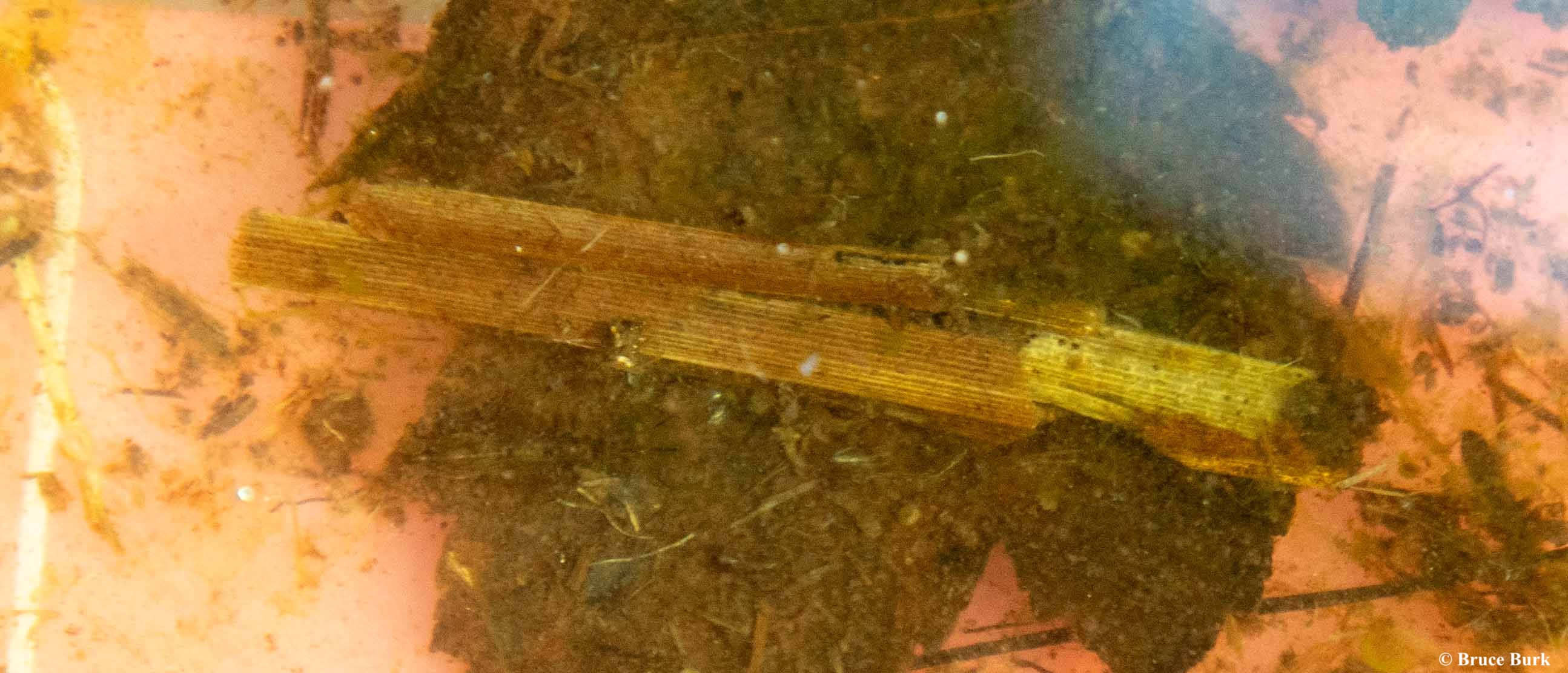
Caddisfly larvae also entertained us and we found a Northern Case Maker, plus . . .

what might have been a Giant Case Maker, who built its home from the broken off tube of vegetation.

Everyone was fascinated, but we had one more stop to make so eventually we had to pack up shop in this location and move down the road to another trail.

Another NDD moment happened as we walked beside a vernal pool where we could not only spot Spotted Salamander egg masses, but also these of the Wood Frog variety, and tons of tadpoles feeding on the green algae. It actually created a full circle from our first classes about vernal pools.

A Pickerel Frog also caught our attention and delight. Bruce caught an amazing photo of the underside of its rear thighs–with the yellowish coloration. Both Pickerel Frogs and Northern Leopard Frogs have spots, but one of the defining differences is the yellow, or sometimes orange color that you see here.

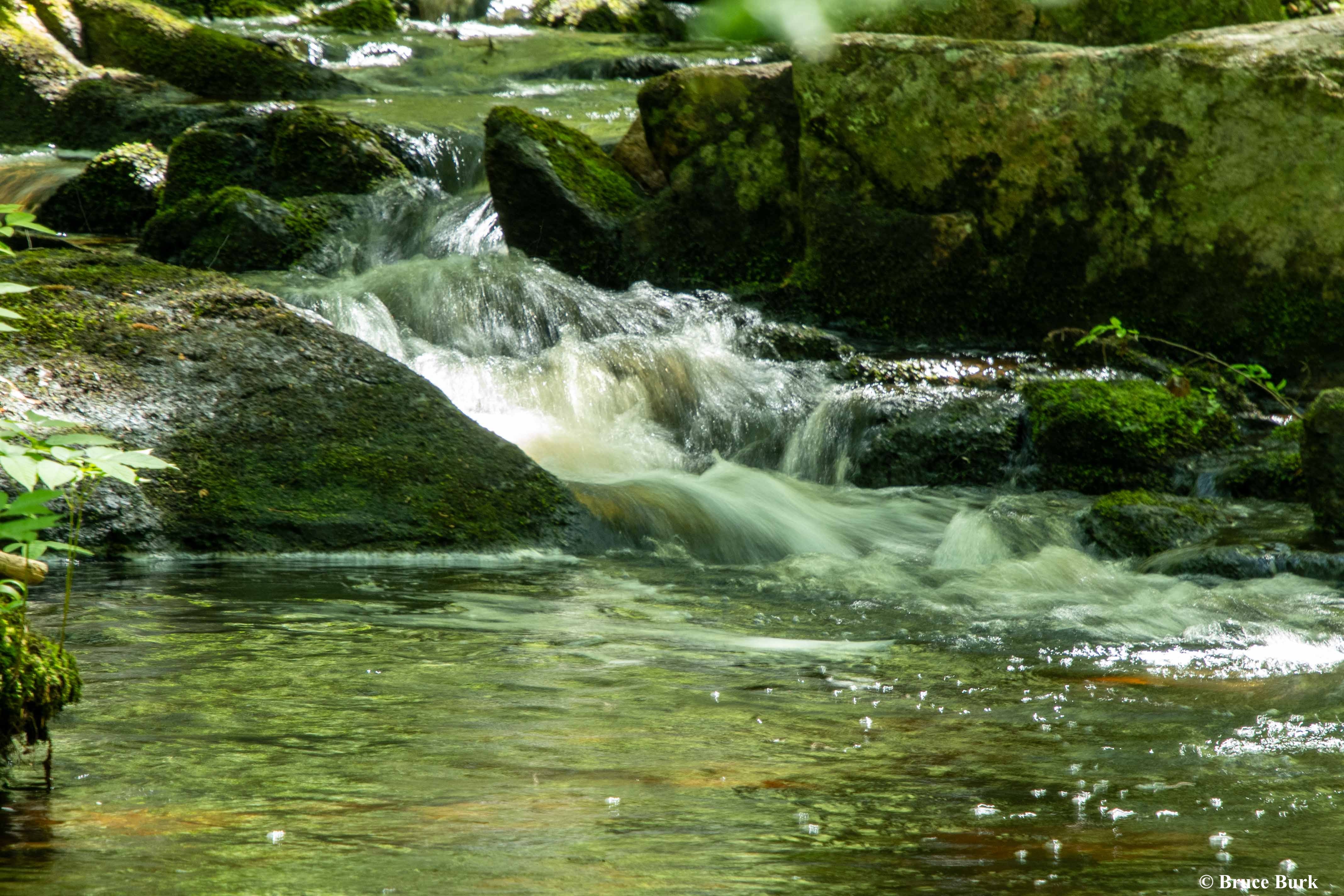
Our final destination was Douglass Brook, where the water flowed faster than it did in the section of the river where we had dipped only a half hour earlier.

Our reason for this location was because it has lots of rocks and we wanted everyone to see how some critters use them as places to cling.

So once again, we took an up close and personal look.

And scooped up anything we could find.

Including Black Fly larva which like fast-flowing water. I think folks were not quite as keen on saving every little critter given how many Mosquitoes swarmed us, but still they did.

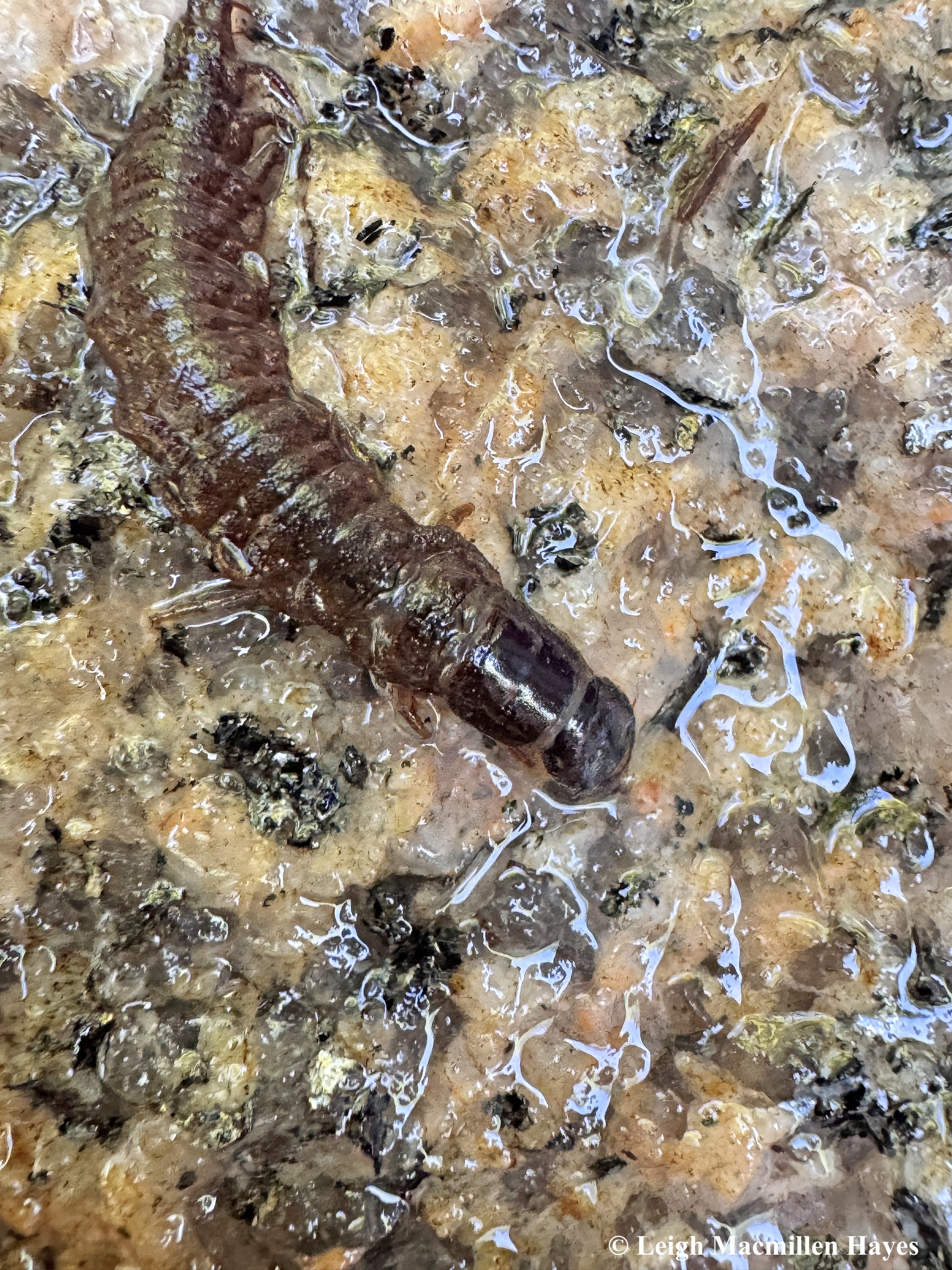
We also found a Dobsonfly Larva, aka Hellgrammite, who prefer the fast flowing water and hold onto rocks with strong claws on their legs, or so I read in A Guide to Common Freshwater Invertebrates of North America, and that’s exactly what this one did.

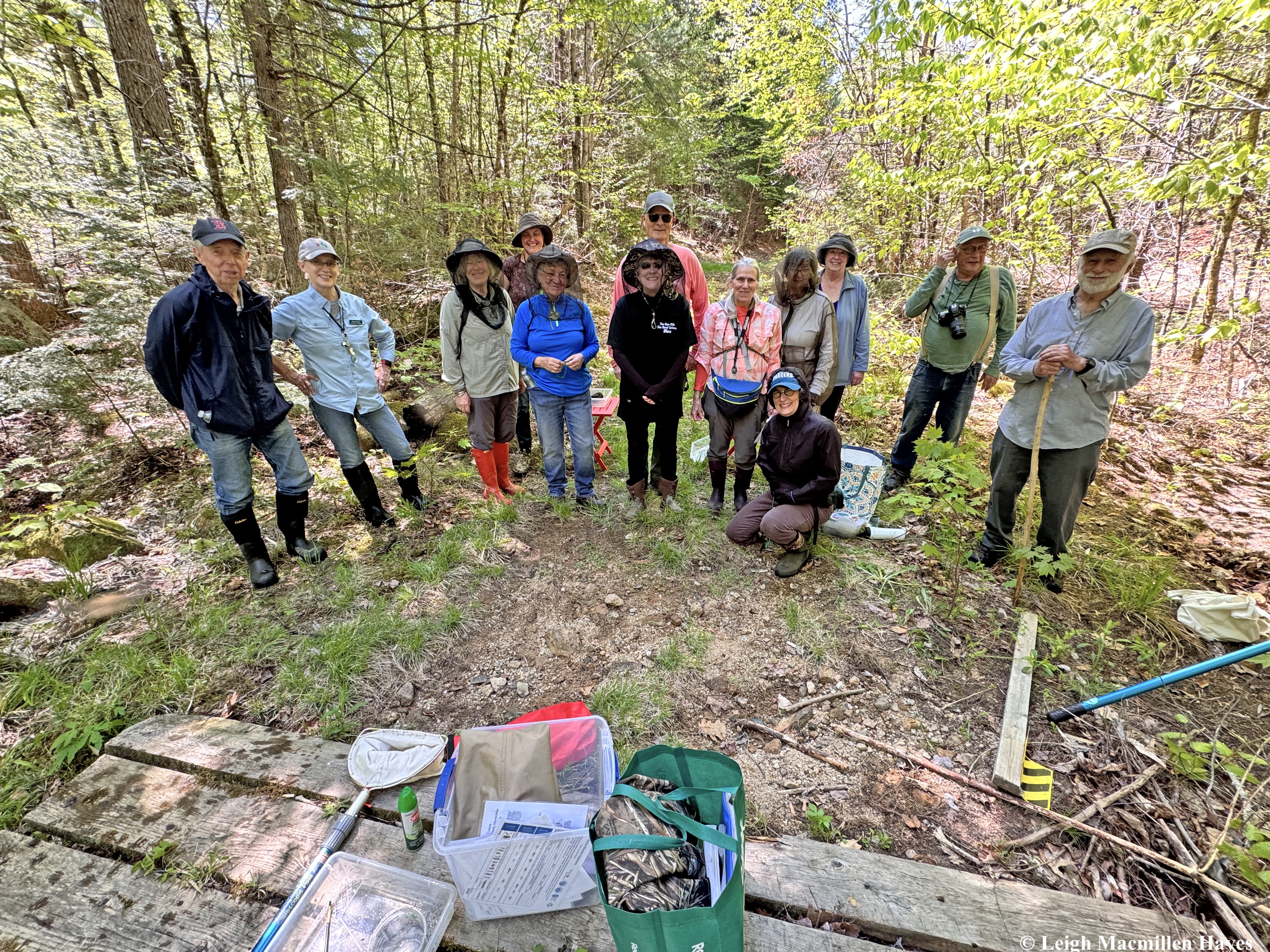
Two hours passed quickly and finally it was time for the four-week class to come to an end. And we were all smiles.

Senior College is an awesome opportunity for us mature beings to learn. The curriculum is diverse; there are no prerequisites, term papers, exams, or grades.

Hats off to the all-volunteer board. And to the students. We can’t believe how many of you joined us each week. And thank you all for helping us carry equipment today.

Many thanks also to Dawn for co-leading with me. And to Bruce for taking so many photos so that I could use them to share all of these incredible learnings with you.

Mr. Cretella, my high school Spanish and Latin teacher, popped into my head just now. In my yearbook, Mr. C. wrote, “Never lose your desire to learn.” Those words have reverberated with me over the years. I don’t remember what anyone else wrote, but his sentiment struck a cord. Pretty amazing, given that when I took Latin I my senior year, I was forever substituting Spanish words if I didn’t know the answer on a quiz or test.

Wherever he is now, I’m grateful that Mr. C. encouraged my desire to learn. And love that so many are the same.

Senior College: Forever Students indeed!

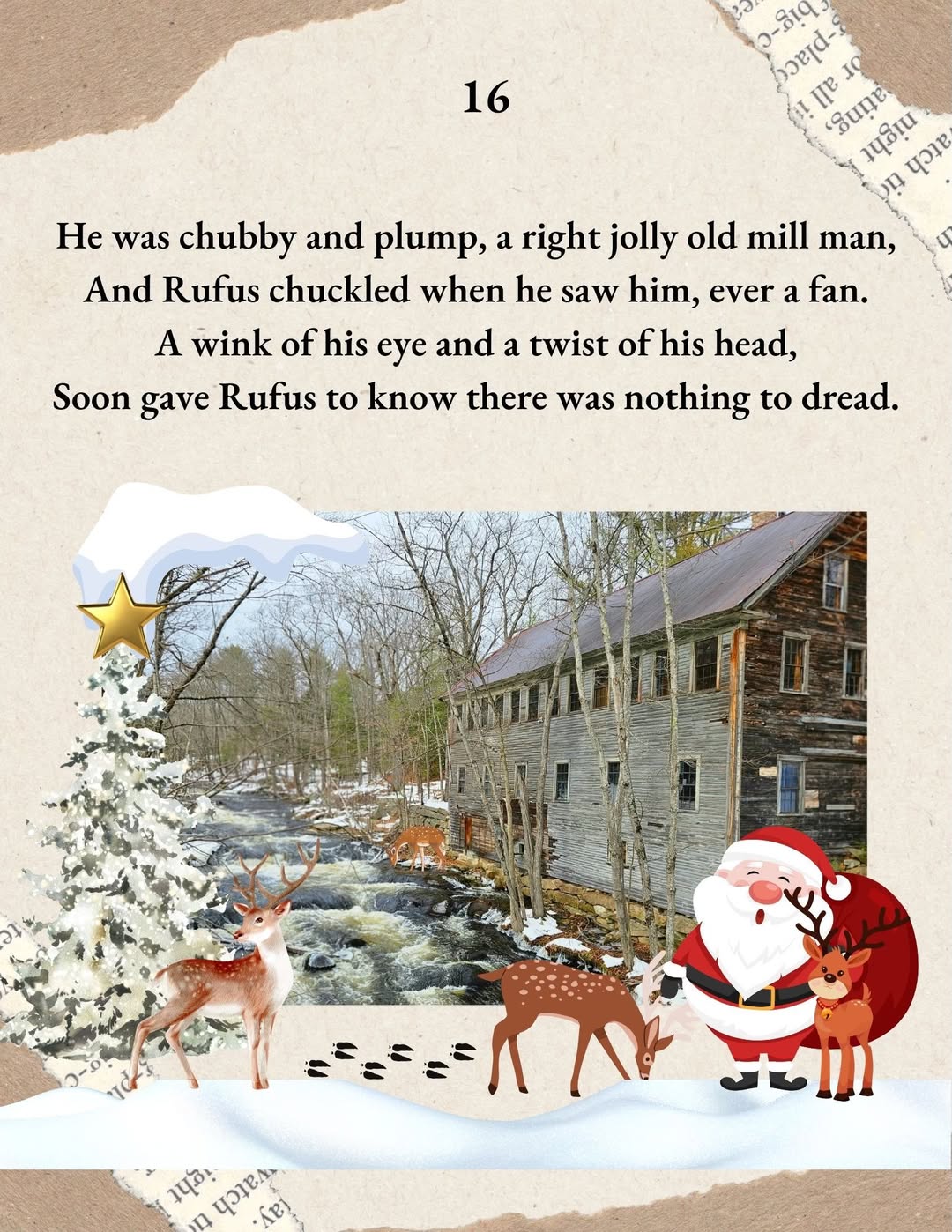
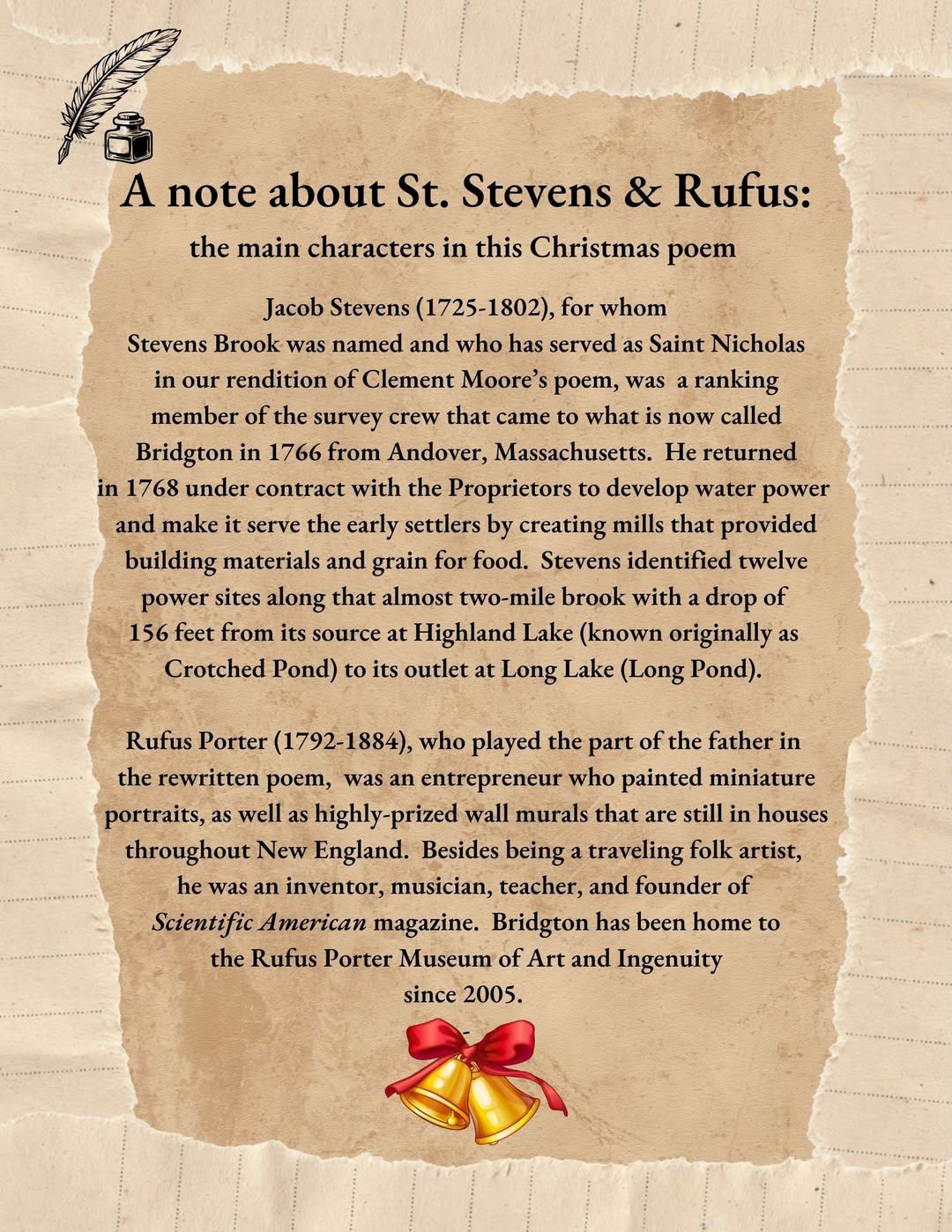
Twas The Night Before with a local twist

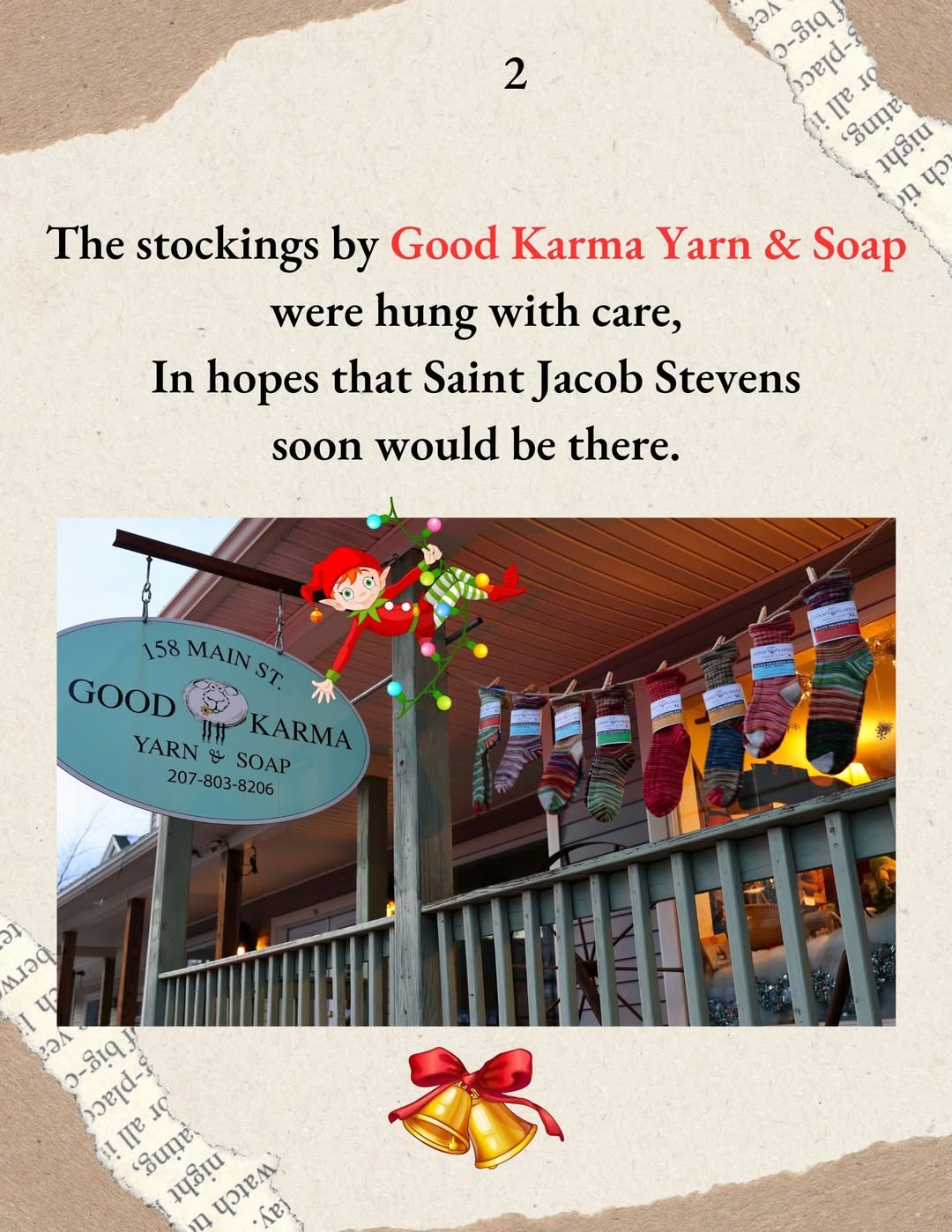
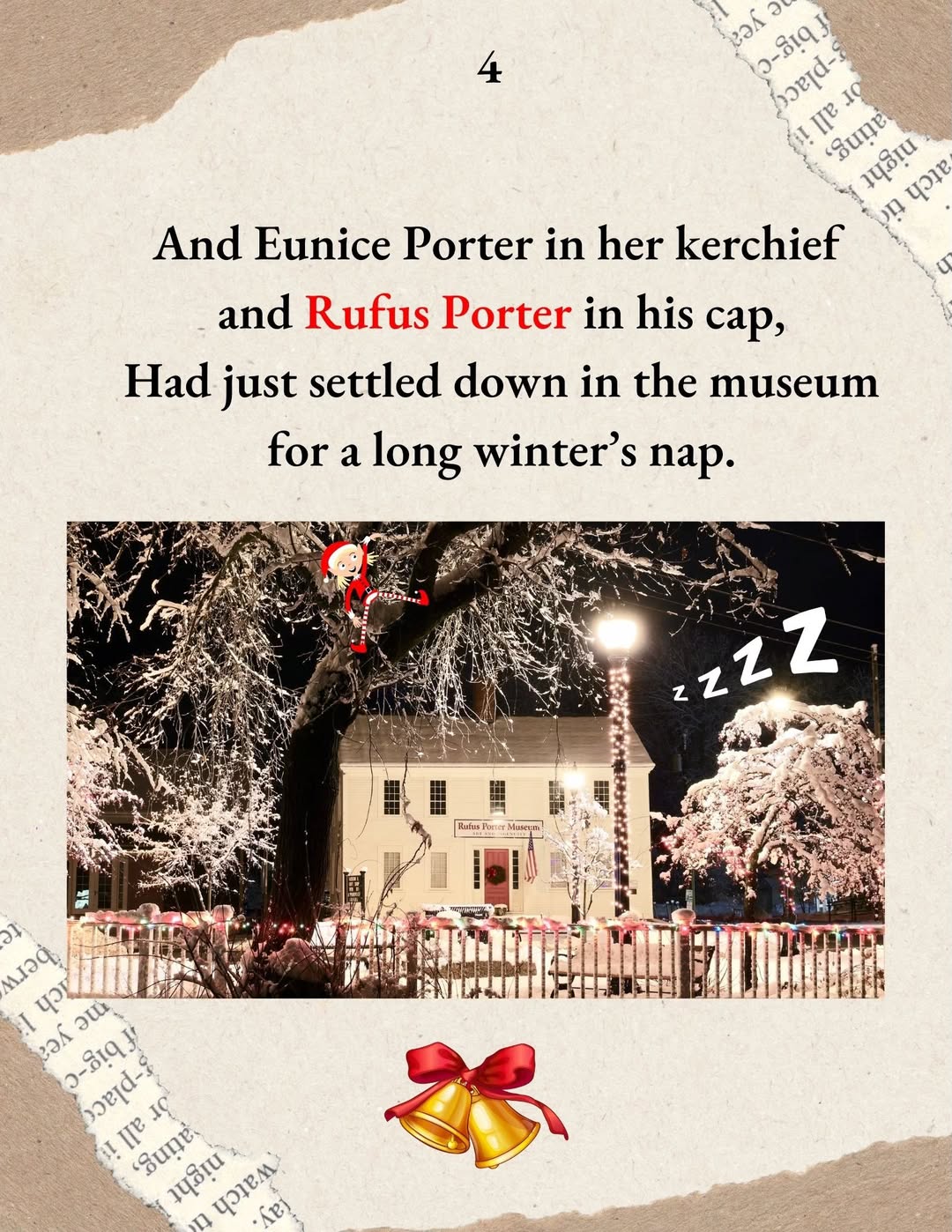
Pam Ward and I hope you have enjoyed reading our rendition of “Twas The Night Before Christmas” as much as we enjoyed revising and illustrating it so it encompassed at least a wee bit of our community and the spirit that ties us together.

Pam is a photographer and co-owner with her husband, Justin, of Bridgton Books. Please be sure to step into this wonder-filled independent book store when you are in town. Oh, and you might purchase a copy of The Giant’s Shower, a fairy tale, while you are there.

Perfect Present

The Giant’s Shower: a book by me

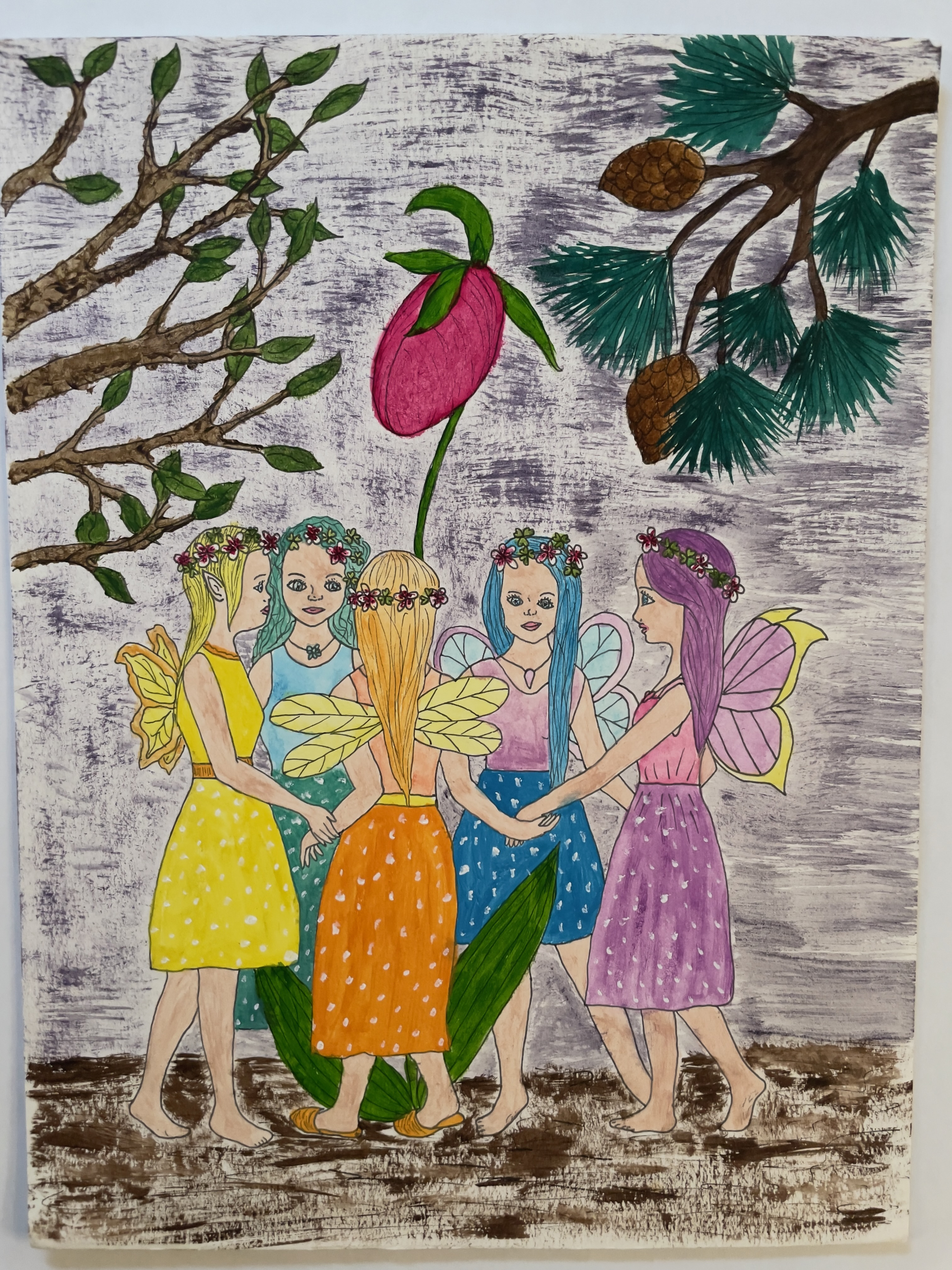
I did a thing. Years ago I wrote a children’s story. Well, a bunch of them actually. And I tried to sell this particular one to publishing houses. No takers. Then, a couple of years ago I purchased a Fairy Coloring Book created by the one and only Solana, teenage daughter of the Fly Away Farm Wards in Lovell and Stow, Maine, and approached her about illustrating my fairy tale. She took on the task and did an amazing job. Then I asked copyeditor Pam Marshall to wave her magic wand over it. And I asked local graphic designer Dianne Lewis to use some fairy dust and turn it into an actual book. I always said I’d never self-publish a book. And tada: I did just that. And now it’s even better because it’s published by http://www.indieauthorbooks.com.

Aisling, a fairy who lives on Sabattus Mountain in the western Maine village of Lovell, has a vision during the Midsummer Eve celebration. 

Twinkles, flitters, a bit of fairy dust and some tsk-tsking are necessary to make Aisling’s vision a reality. 

If you read the story aloud, I highly encourage you to get all in your audience to participate in saying “Tsk, tsk,” each time Biddie does the same.

You and your children will delight in the story accompanied and the colorful and whimsical illustrations created by artist Solana Ward.  In fact, you don’t even need children to enjoy this story.

Marita Wiser, author of Hikes and Walks in and around Maine’s Lakes Region had this to say about the book, “The fairies in The Giant’s Shower will captivate children with their merry life in the forest. It’s not all magical though, as they moved from New Hampshire to Sabattus Mountain in Maine to avoid a certain devil. At least they thought the giant was a devil, but the situation wasn’t what it seemed at first. Both the writing and the detailed illustrations capture many features of the woods of northern New England, and the fun of fairy life and houses.” 

A naturalist and writer, many of you know that I hike frequently in Maine and New Hampshire, and those adventures inspired this story. I feel the fairies’ magic whenever I’m among moss-covered ground and tree stumps.

Included in the book are directions to the two featured settings, Sabattus Mountain and Arethusa Falls, featured in the photo above. Both are easily accessible for young hikers who might experience some magical moments while exploring. 

Also included is a list of character names and their explanations, as well as instructions to create fairy houses and fairy dust. 

The Giant’s Shower is available for $16.99 at Bridgton Books, Hayes Ace Hardware, Fly Away Farm, or by contacting me: thegiantsshower2023@gmail.com. Cash, check, or Venmo all work.

I do charge an extra $5.00 for shipping and handling if you ask me to send it to you.

Please consider purchasing a copy, or ten, as the book does make the perfect present.

Snow–Bugs and Flakes

Betwixt. Between. Be flowers. Be bugs. Be glad for there is so much to wonder about in the natural world. And I don’t even know the half of it. But I wouldn’t be happy if I wasn’t always learning.

It was 28˚ when I awoke this morning. Late this afternoon on this brilliant sunlight day, with temps at least 30˚ warmer, I walked out through our woodlot to the right and then looked back across the neighbor’s field toward our house, taking in the sea of seedheads and I was sure my insect hunting days had come to an end.

But much to my surprise, and really, I shouldn’t have been surprised, the chirps of crickets and grasshoppers, like this Red-legged example, filled the air. I might not have seen the grasshoppers if they hadn’t flown to a new spot occasionally, for so camouflaged are they in the current setting. Or always.

And then, much to my delight, I noticed a Saffron-winged Meadowhawk flying low and making frequent stops, allowing me to do the same. We live in a wet area, but still, I’m often surprised by some of species I meet here.

From the field, I decided to continue along the power line that crosses our property and the neighbor’s and many more beyond that and as I’d told my friend Meg from North Carolina the other day–Mount Washington, our mighty New England Rock Pile, is at the far end and it looks like we could walk right to it. Give or take a few days–or drive there in about an hour.

It’s along the path below the lines that I discovered Cotton-grass, which is a sedge, with its fluffy little heads speaking to the bogginess of this area.

Cottongrasses self-pollinate, their flowers being “perfect,” given that each contains both male (stamen) and female (carpel) parts. And the seeds are attached to parachutes waiting for a breeze (or animal) to move them to a new home.

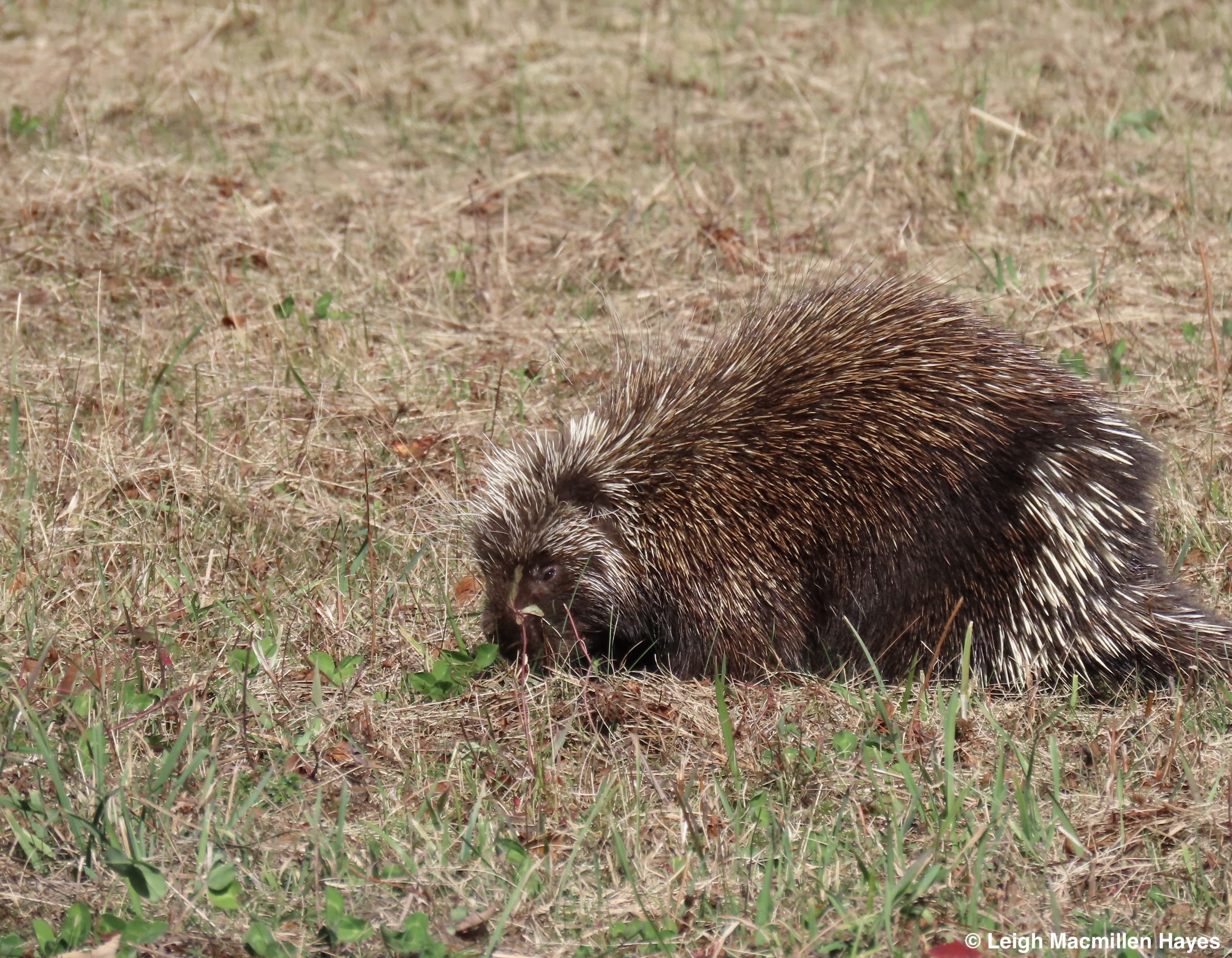
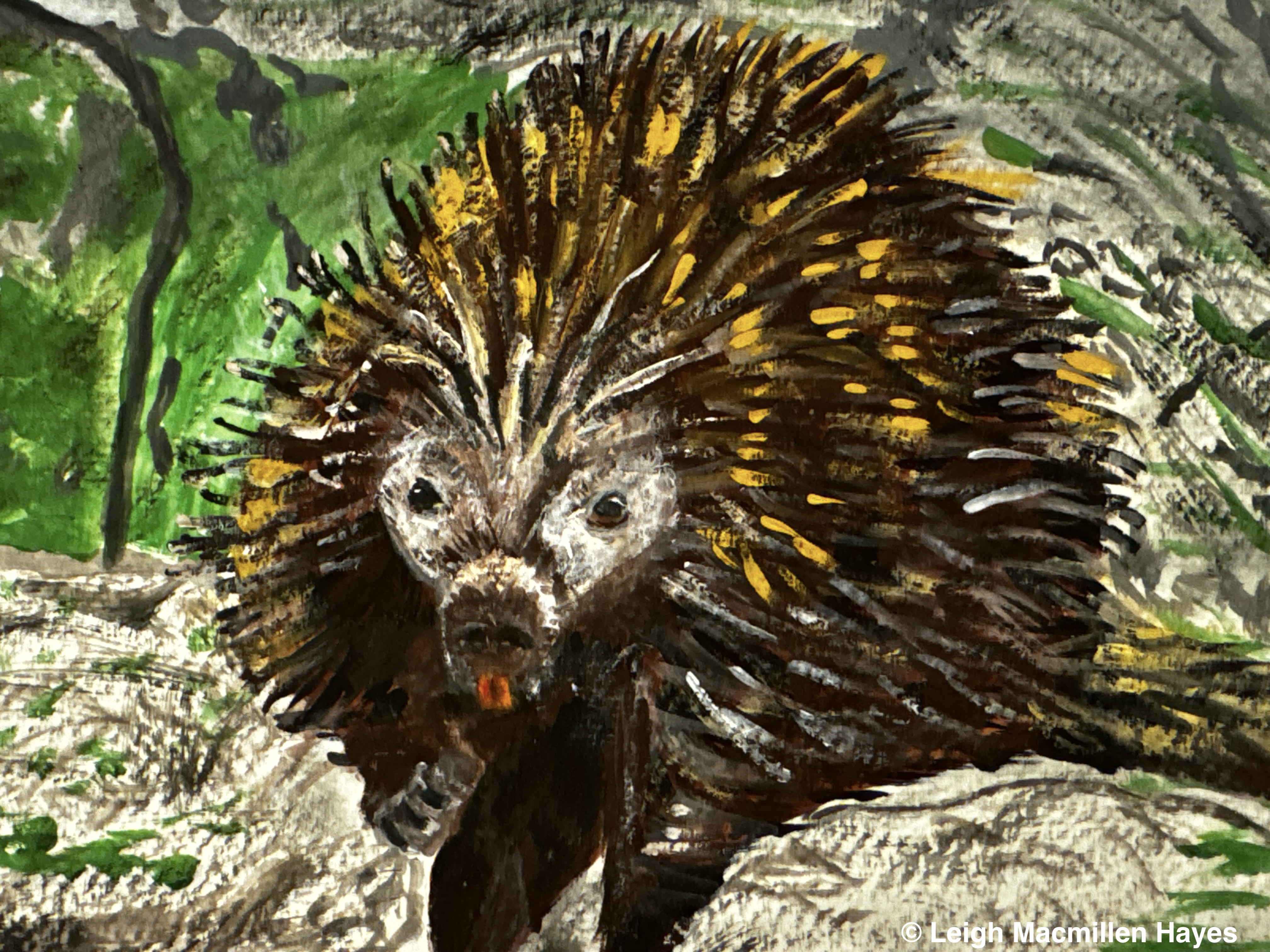
Spotting the curly, cottony-hairs reminded me of the belly hairs of porcupines, which of course, reminded me of the Porky some friends and I spotted in another field in town yesterday. The time is coming when these critters, whom I’ve come to adore, will transition from life in the field to life in forest trees.

Last November I wrote about this particular porcupine, Bandit, whom I met in our yard, along the same route I began today’s journey. Perhaps soon, we will meet again.

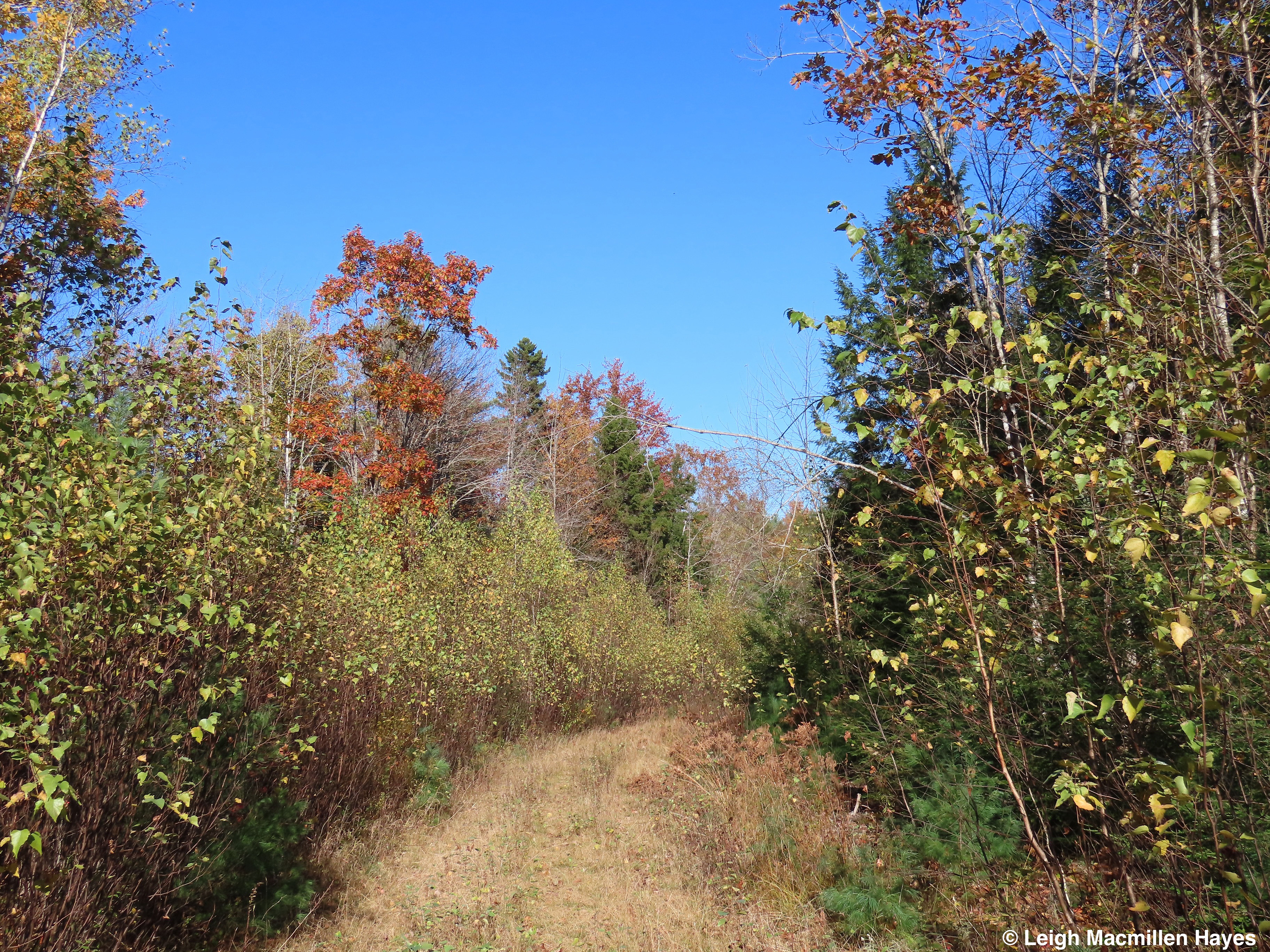
Getting back to today’s story, I left the power line, and headed out an old logging trail that I tend to frequent most often in the winter. But it was sunny, and I was enjoying that warmth, and wondered what else I might spy along the way.

For starters, there were the “dried” Pearly Everlasting Flowers, which I should have gathered because they do dry so well. Instead, I just admired them.

And I had frequent encounters with more Saffron-winged Meadowhawks, flying much like White Corporal Skimmers in early spring–always landing and then moving a couple of feet ahead of me whenever I made a move.

Helping with ID of this species, are the fine black lines in the sutures of the abdomen. And the red stigma toward the tip of each wing is outlined in black. Otherwise, I might confuse it for an Autumn Meadowhawk.

I also had the pleasure of meeting a female Shadow Darner, but then I went to offer a finger for her, thinking she might want to take advantage of my body heat, and instead she tried to bite me. So, I let her be and we went our own ways.

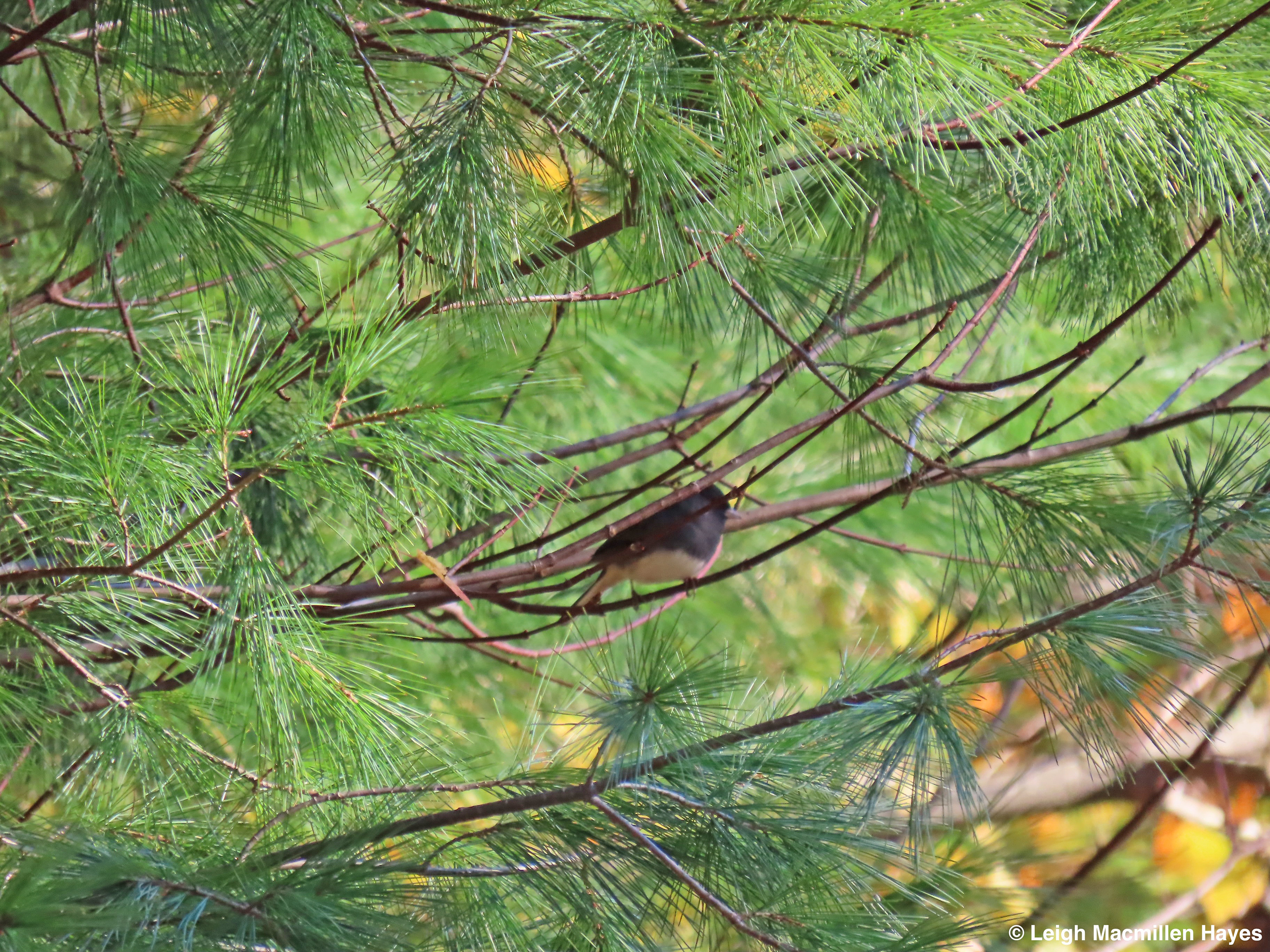
At a former log landing, Juncos were on watch, and given how much seed is available, I know they’re mighty happy with the current conditions. It seems like they just arrived in the past week or so, but the good news is that many will overwinter here.

Oh and a few will fly to Connecticut so that my dear friend, Kate, can watch them as well.

Being an old logging road and log landing, conditions were apparently ideal this past summer, and I paused for a moment to admire forest succession, with grasses and herbs forming the floor, and more grasses and sedges growing taller, topped by Gray Birch, and a backdrop of Red Maples, and Big-tooth Aspen, and Paper Birch.

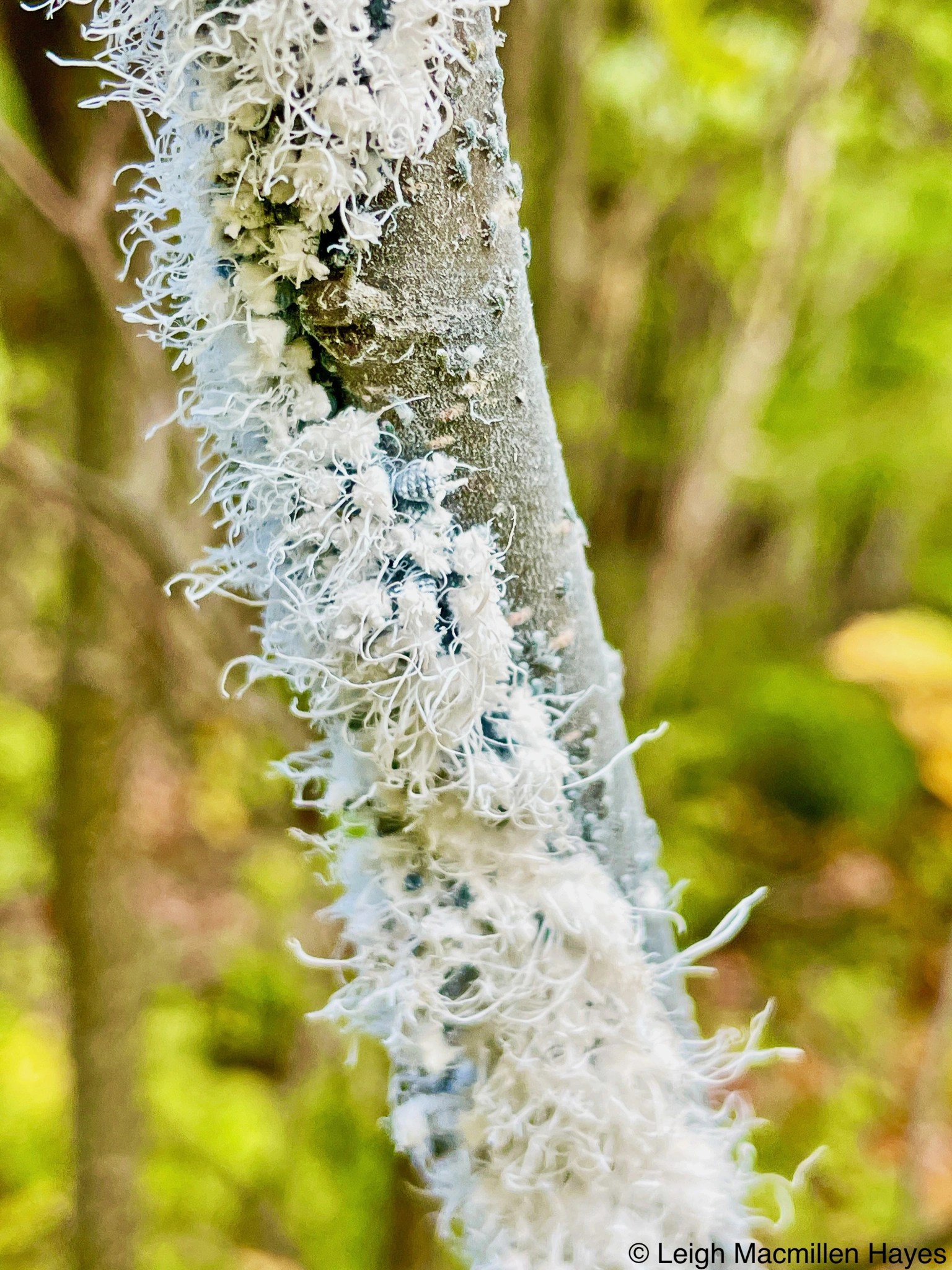
And then it was back to the now dry bed of a stream crossing where Speckled Alder shrubs are closing in on the trail, and Woolly Alder Aphids are living their best life seeking sap from the woody plants.

That Cotton Candy or even Cotton-grass look is actually a waxy material they produce from their abdomens, and when they group together like this, perhaps its meant to detract visitors. Or protect them from the weather. Had a I visited on a summer day, I’m sure I would have spotted ants trying to tickle them (it’s called farming) to take advantage of the honey dew the aphids secrete.

Speckled Alder Aphids live an interesting life style. Actually, according to Donald W. Stokes in his book, A Guide to Observing Insect Lives, “There are two life cycles in this species. In one, the aphids remain on alder trees throughout their lives. They are believed to overwinter as adults in the leaf litter at the base of an alder. In spring, they crawl up the plant and feed on its sap. There are several generations per year and adults of the last generation overwinter.

In the other life cycle, the aphids alternate between two plants. The aphids overwinter as eggs placed on maple twigs. In the spring they hatch into females, which feed on the undersides of maples leaves and reproduce. They are wingless, but in midsummer produce winged offspring, also females, which fly to alders. These females feed and reproduce on alders, and give birth to wingless young. Then in the late fall, they produce winged young, which fly back to maples and give birth to both male and female young. The males and females mate, and each fertilized female lays a single egg on a maple twig. Only the eggs overwinter.”

It’s things like this that add to my sense of wonder. Two life cycles? The adults of one life cycle overwinter while the eggs of the other are do the same? That’s amazing.

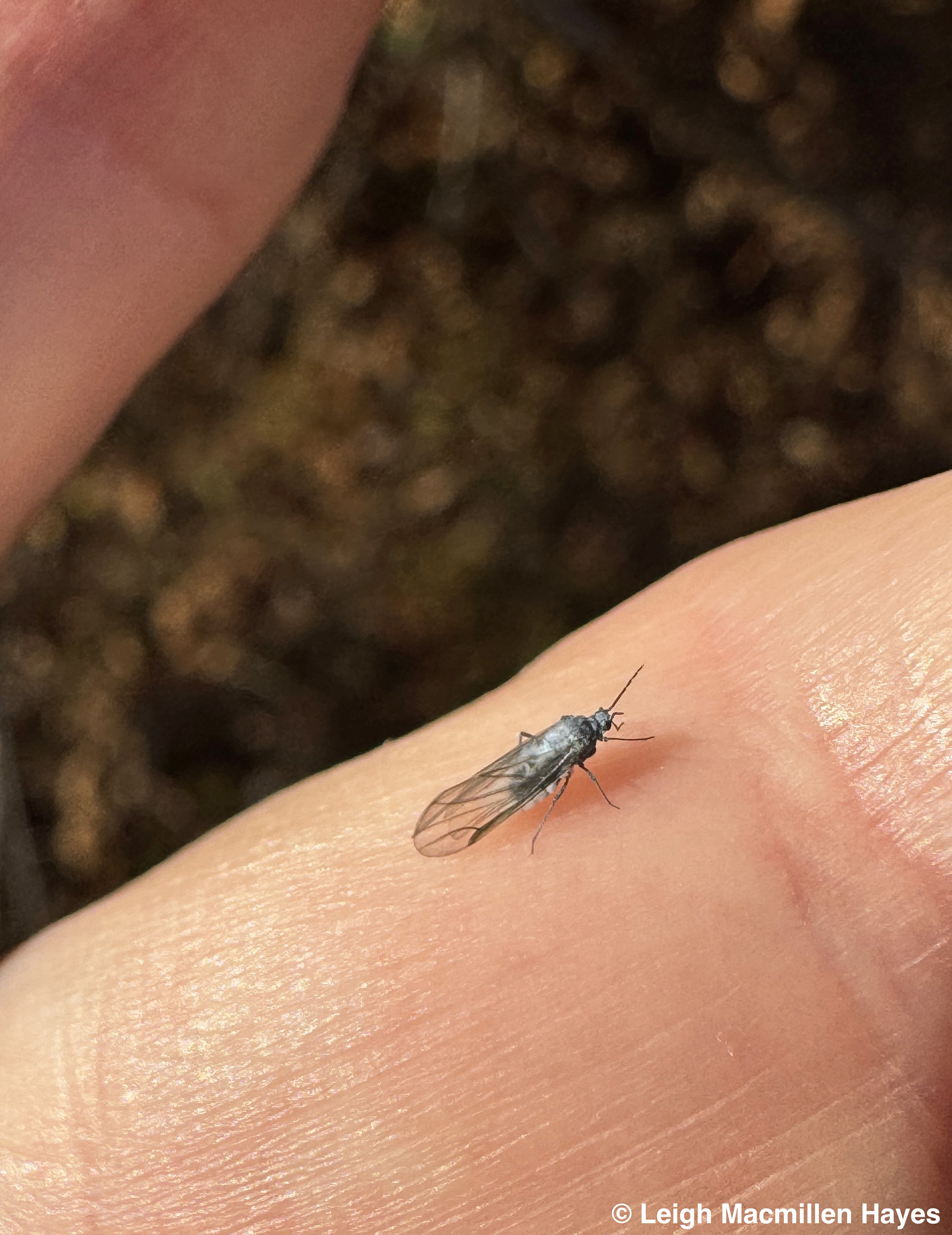
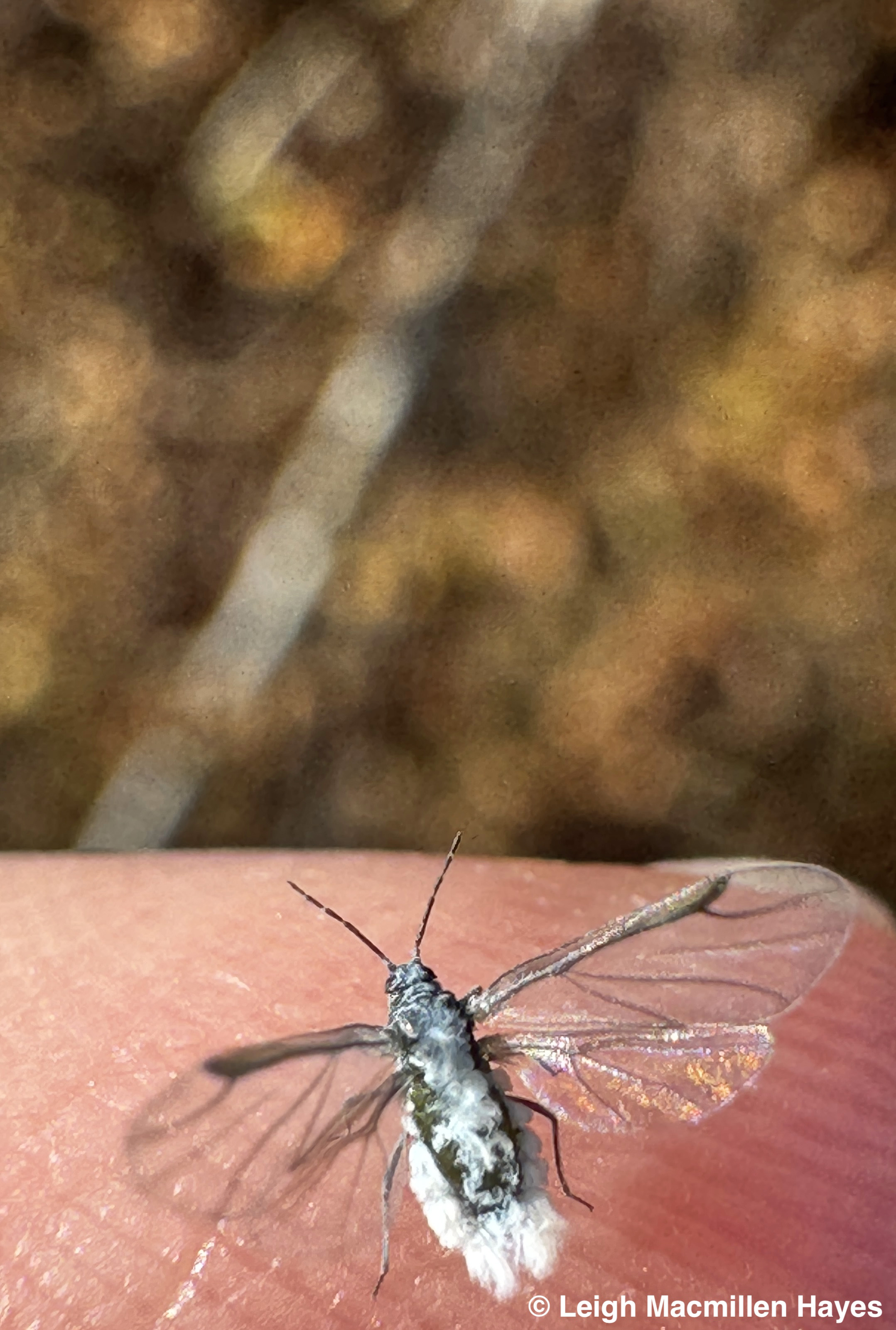
And on the fly in a bit of abundance right now for I saw a bunch today and I’ve been seeing them along many trails that I hike, are the flying aphids. If you stick your hand out and cup it, you can get one to land.

Don’t worry, they don’t bite. And they don’t even tickle, despite that waxy hair.

They’re actually kinda beautiful in their own way and as they fly they look like tiny flakes of snow, thus some refer to them as Snow Bugs.

So I have two forever-friends-since-birth and I’ve already referred to Kate earlier in this blog because she is a great lover of Juncos, along with everything else in the natural world, and so is her sister, Patty, who once told this joke when we were kids:

Q: What’s white and goes up?

A. A dumb snowflake.

One of these two is eleven months younger than me and the other is eleven months older and she and I just chatted yesterday and I’m so thankful to have them in my life all these years. Yes, B.S., I am also incredibly thankful to have you in my life.

But once again I digress. Except I had to tell that joke. Because it kinda reminds me of the aphids in flight.

Back to the power line, I decided to pull the Mighty Mount Washington in with the telephoto lens. Yes, dear readers, that is snow! Several inches of the white stuff has fallen over the last few days. And there is rime ice.

My favorite season is only a walk down the power line away.

Snow: Bugs and Flakes. It’s all wonder-filled.

The Long Farewell

Saying goodbye is so hard to do, yet at some point we all must. These last few days I’ve been trying to wrap my brain around how best to do that and not feel melancholy.

But then again, maybe the future isn’t all that far off. Wait a minute. Blueberries in flower? Yes! Sadly so. Over the past week or so friends, relatives, and I have noticed various species flowering due to warmer than normal autumn temperatures. These of the low-bush variety are along the path that my neighbor mowed through the field where I’ve spent many a glorious hour observing.

It’s in the same field where I delight in spotting bowl and doily spider webs and this one, a funnel web with the funnel weaver sitting inside waiting for a meal to arrive.

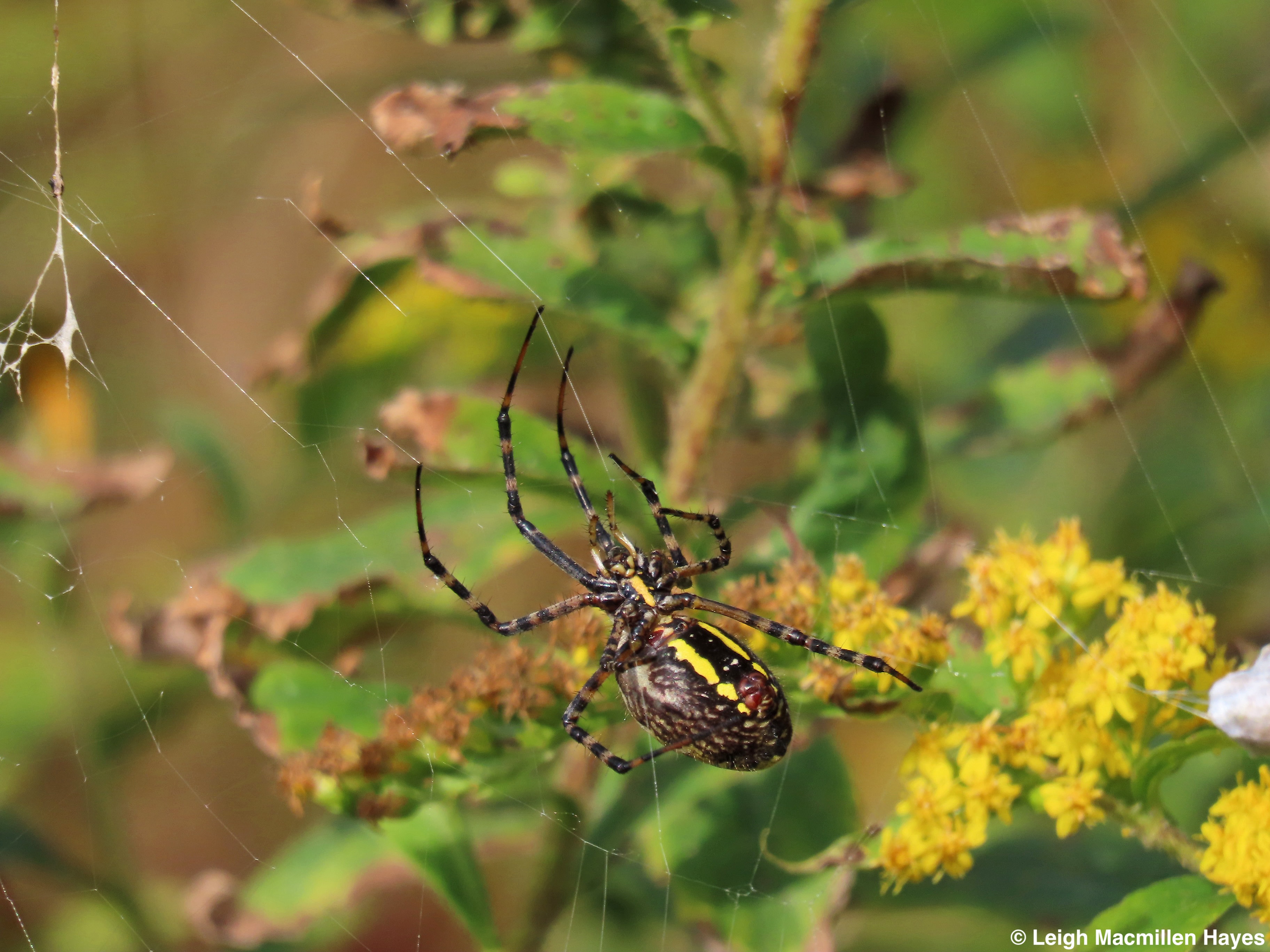
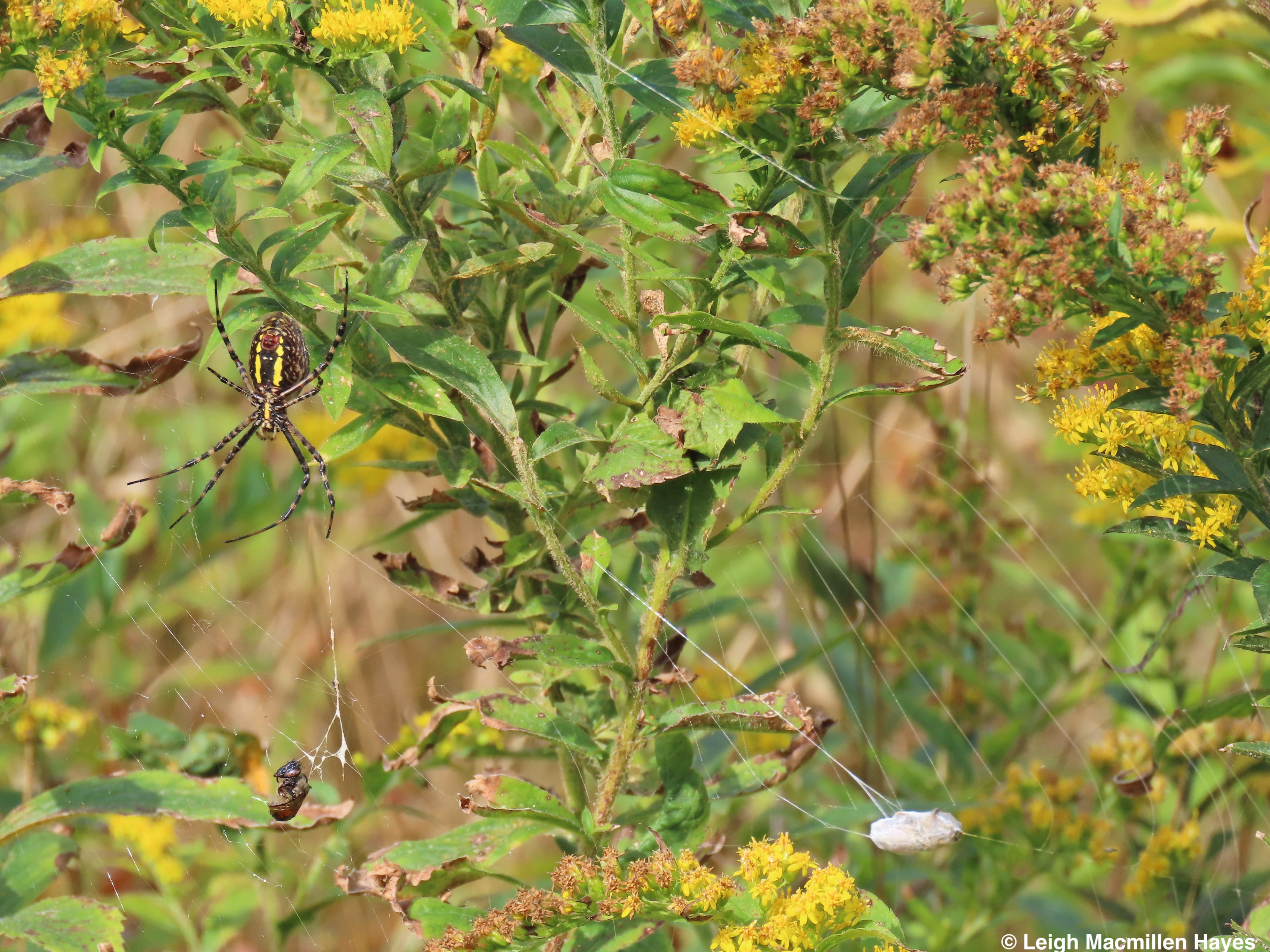
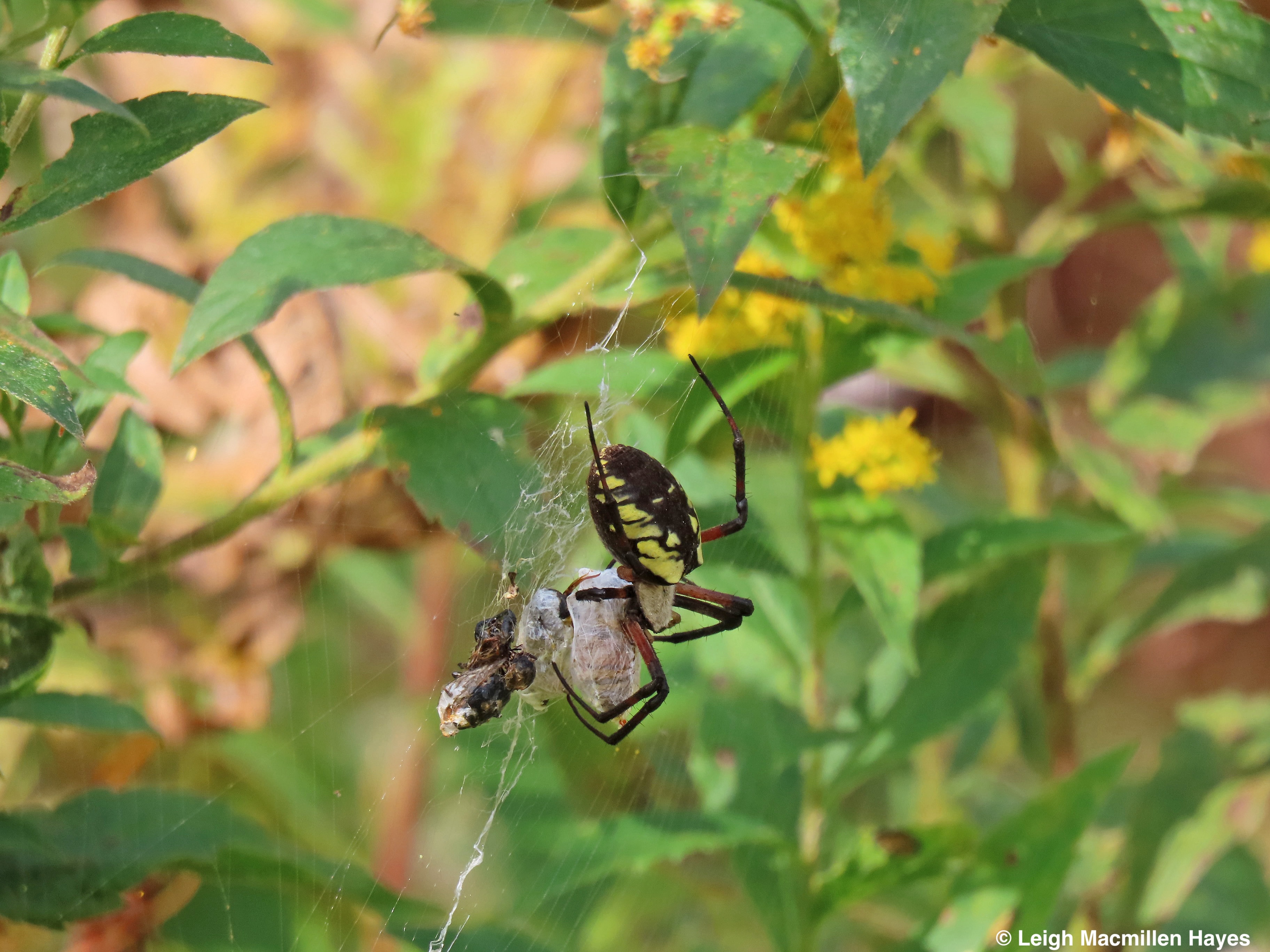
Orb weavers have also been mighty abundant this year and at first I assumed this was Ye Olde Black and Yellow Garden Spider that I love to watch at work–usually wrapping its prey as this one was doing.

Before I say more, take a look at the silk coming out of its spinnerets. I like this explanation by Naturalist R.J. Adams about spider silk: “Within each spider’s abdomen are a variety of silk glands which can vary in number depending on the species. Some of the oldest lineages, including relatives of California’s tarantulas and trapdoor spiders, have only a single type of silk gland, while some orb weavers can have up to eight different kinds. Each gland produces a protein-rich liquid which connects to numerous minute spigots at the tip of the spider’s spinnerets. When silk is needed, tiny valves behind each spigot control its release, and as the fluid is compressed through the spigot’s openings, tension orients the molecules into a solid, thread-like structure.”

Liquid. Spigots. Thread. What an amazing invention!

As I watched the spider move away from its packaged meal, walking so confidently on those guide lines, I realized its coloration was a wee bit different than that of the Black and Yellow Garden Spider.

Not only was the design/coloration different, but also the fact that there was no Zig-zaggy stabilimentum, an ultraviolet runway of multiple threads which perhaps provides stability or attracts prey or tells others to stay away, a trademark of the Black and Yellow.

That’s because this was a Banded Orb Weaver with a different pattern. And now I can’t wait to look for these again next year.

Until a couple of days ago, I was still seeing Black and Yellows, but not as frequently as I had all summer long. It seemed like this gal had stocked her pantry, perhaps knowing her days were coming to an end.

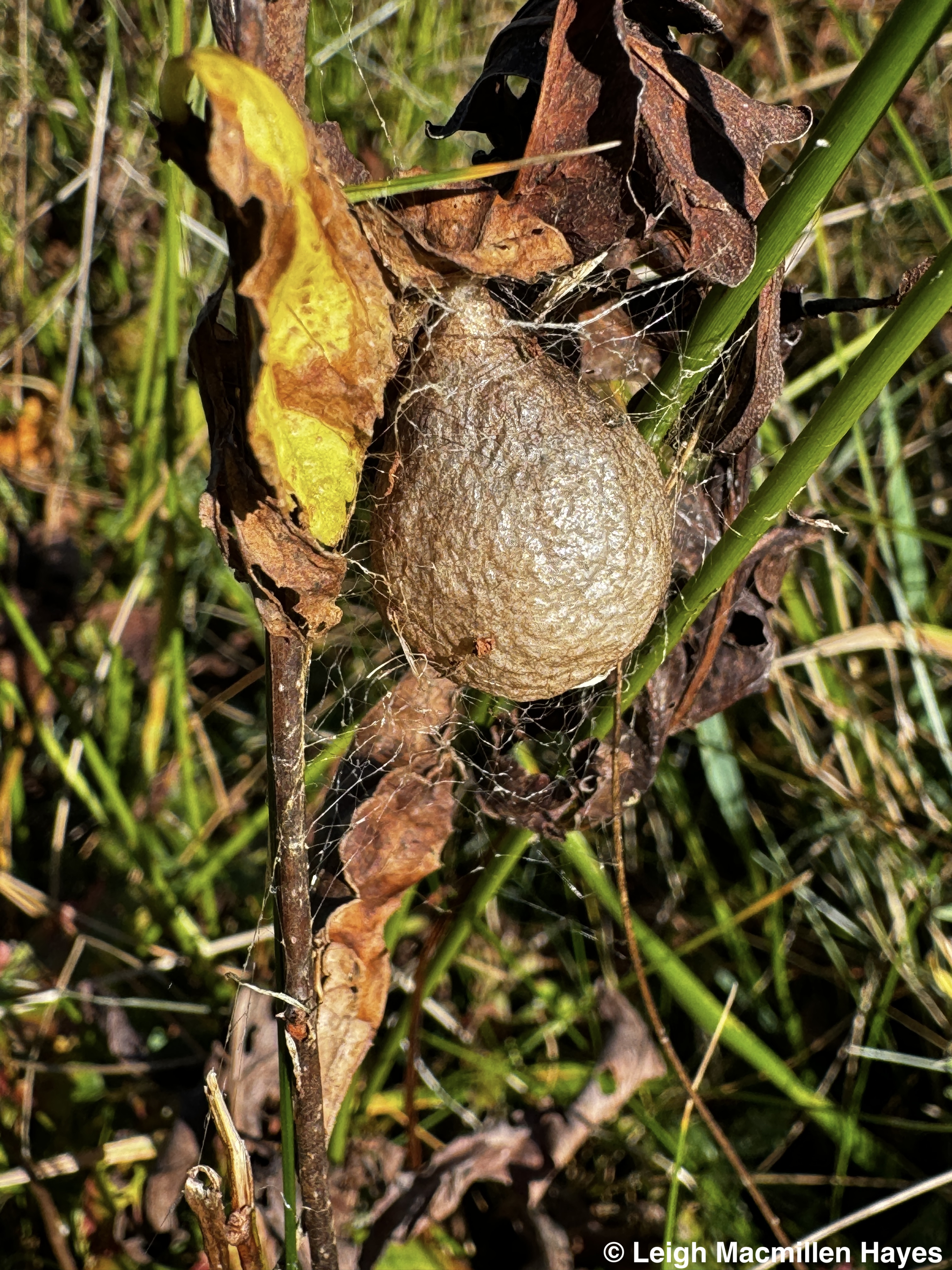
The good news is this sac, soft on the inside and parchment-like on the outside, was created by a Black and Yellow, and within her eggs will survive the winter months. Where there is one sac, I suspect there are dozens more.

Do you see them? The egg sacs I mean? No, I don’t either. Camouflage is the name of the game as the goldenrods and asters go to seed.

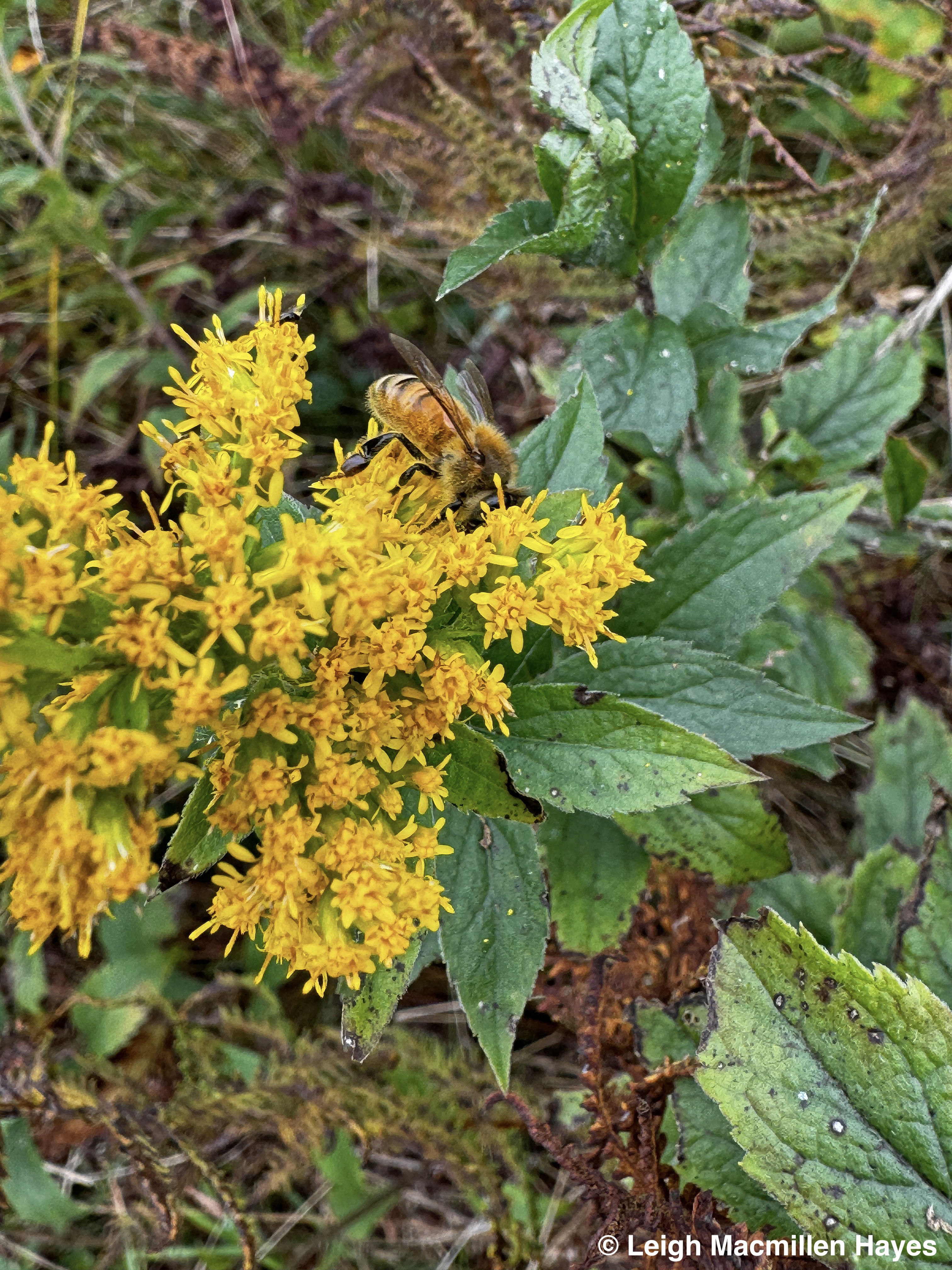
Despite or because most of the flowers have gone to seed, those that still thrive are the subject of heavy pollination activity. Frenzied in fact. From Honey Bees to . . .

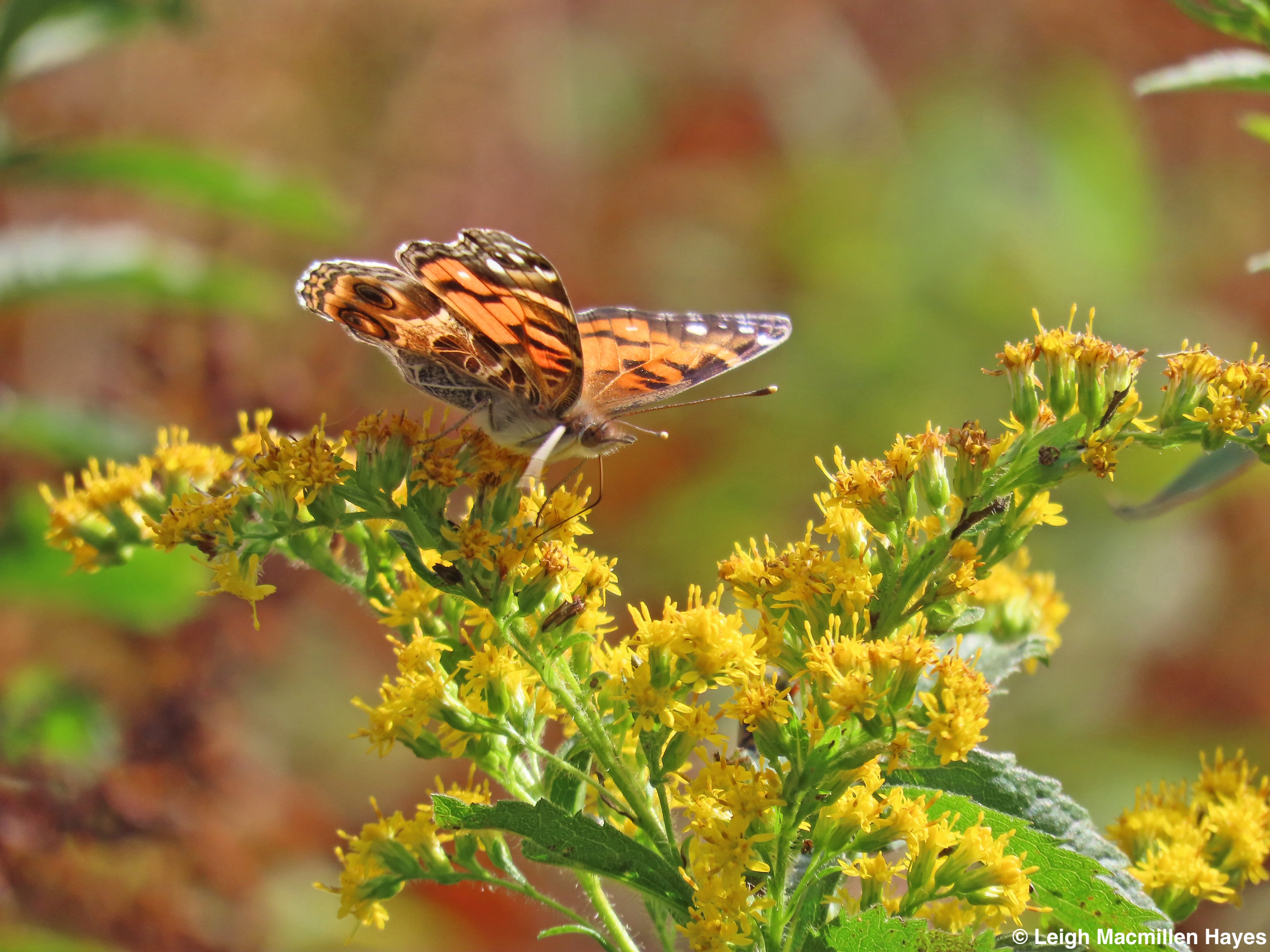
an American Lady, to . . .

Female Pearl Crescents (gender ID based on orange color of antennal clubs versus dark colors for males) and their counterparts who all greet me each day, to . . .

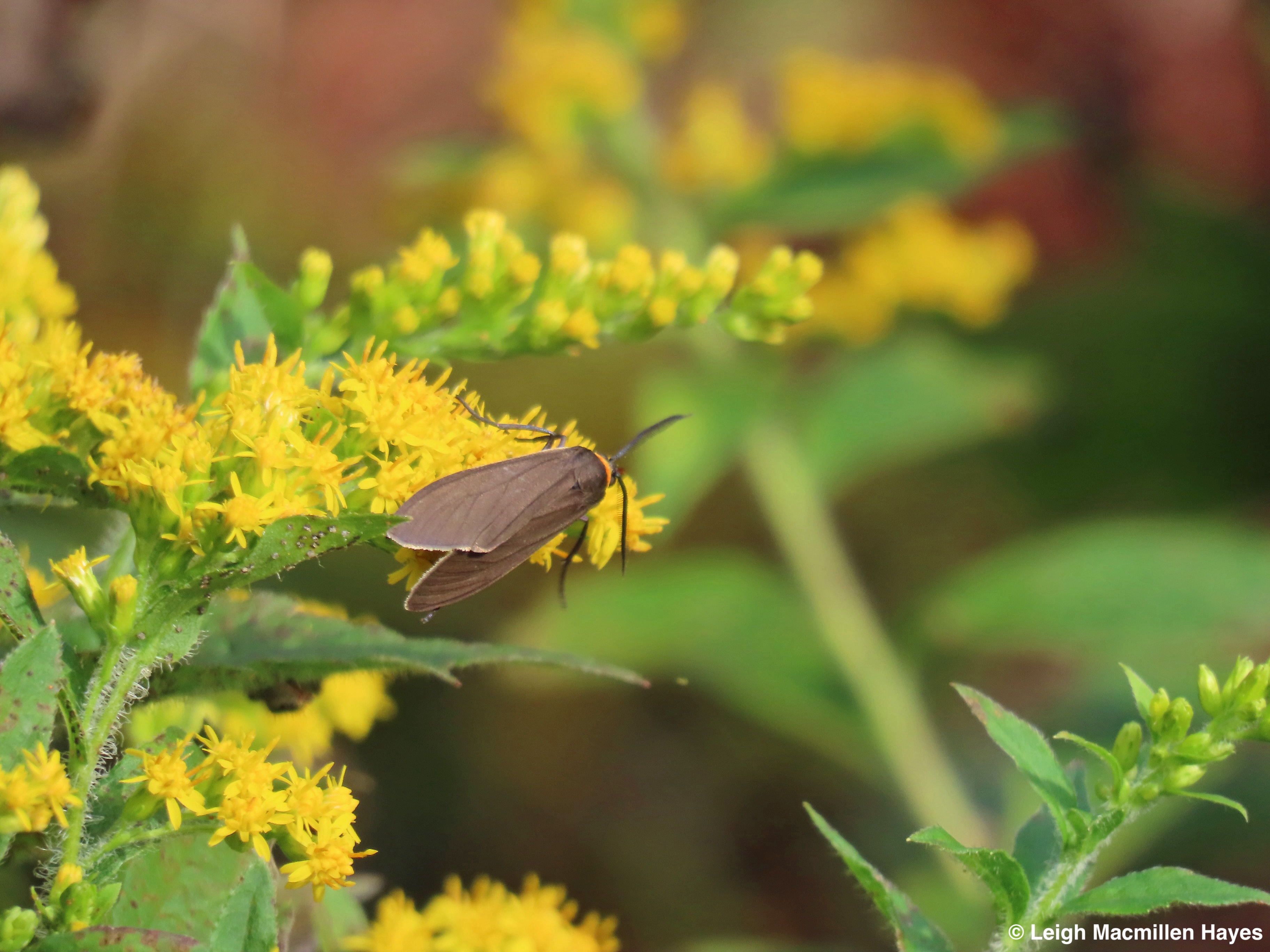
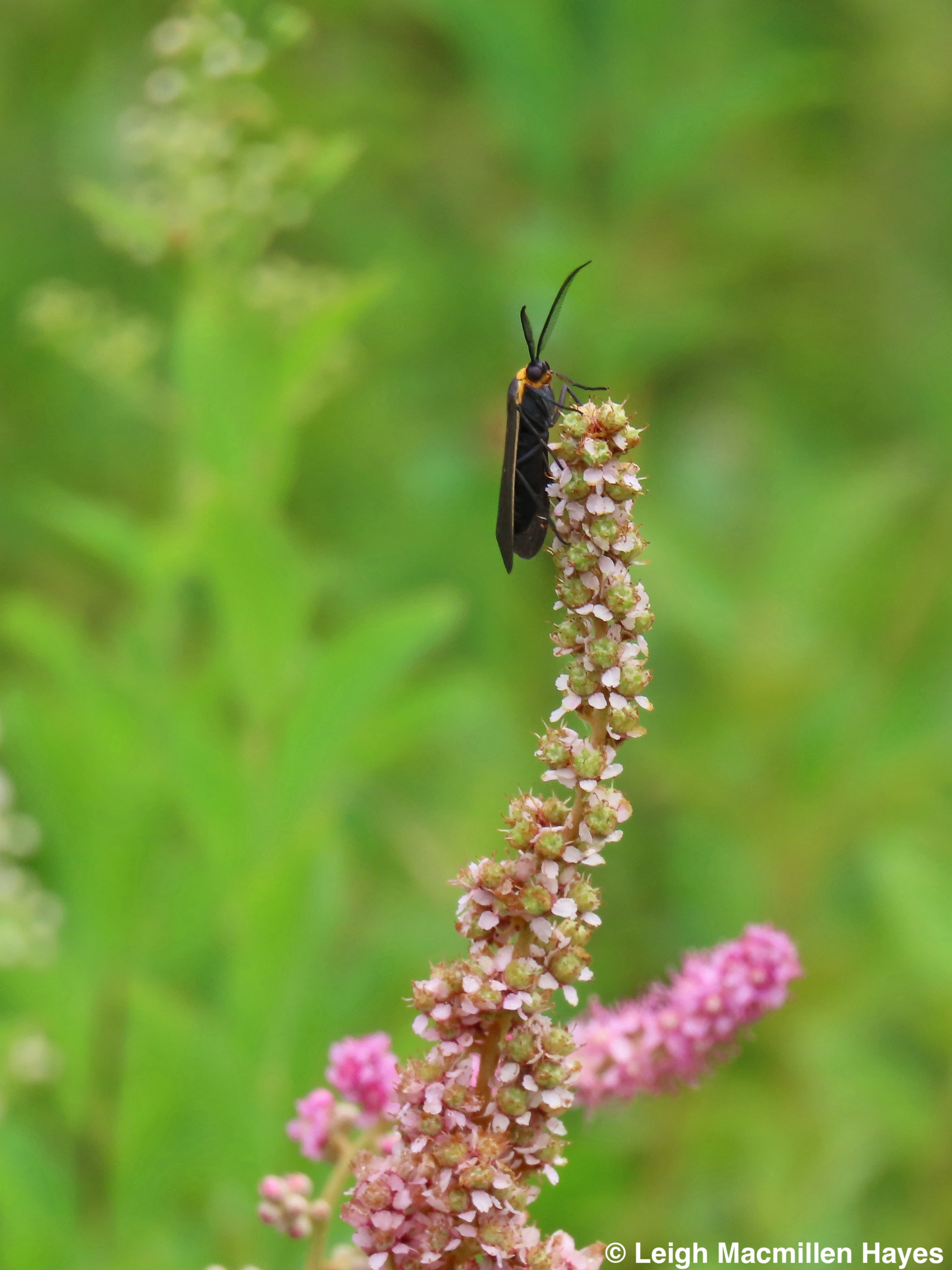
Yellow-collared Scape Moths, to . . .

Locust Borers, to . . .

long-bodied Sweetfern Underwing Moths, to . . .

Paper Wasps, to . . .

Bumblebees, this one special because it showed me that its proboscis is orangey-reddish, to . . .

Flower Flies with big eyes.

The plants literally tremble with all the activity so it’s easy to figure out where the insects are located.

The best part of greeting so many is that occasionally a tiny new visitor enters the scene and I have to watch for a few minutes to get a good read on who it might be as it flits and flutters and finally lands.

It wasn’t the diminutive size that made my heart skip a few beats, but rather the color when the Eastern Tailed-Blue Butterfly opened its wings–a mixture of blue and pink that made me think of skyblue-pink we often see at sunset.

And then another sighting stopped me in my boots. It’s camo is incredible and it could simply be another goldenrod leaf.

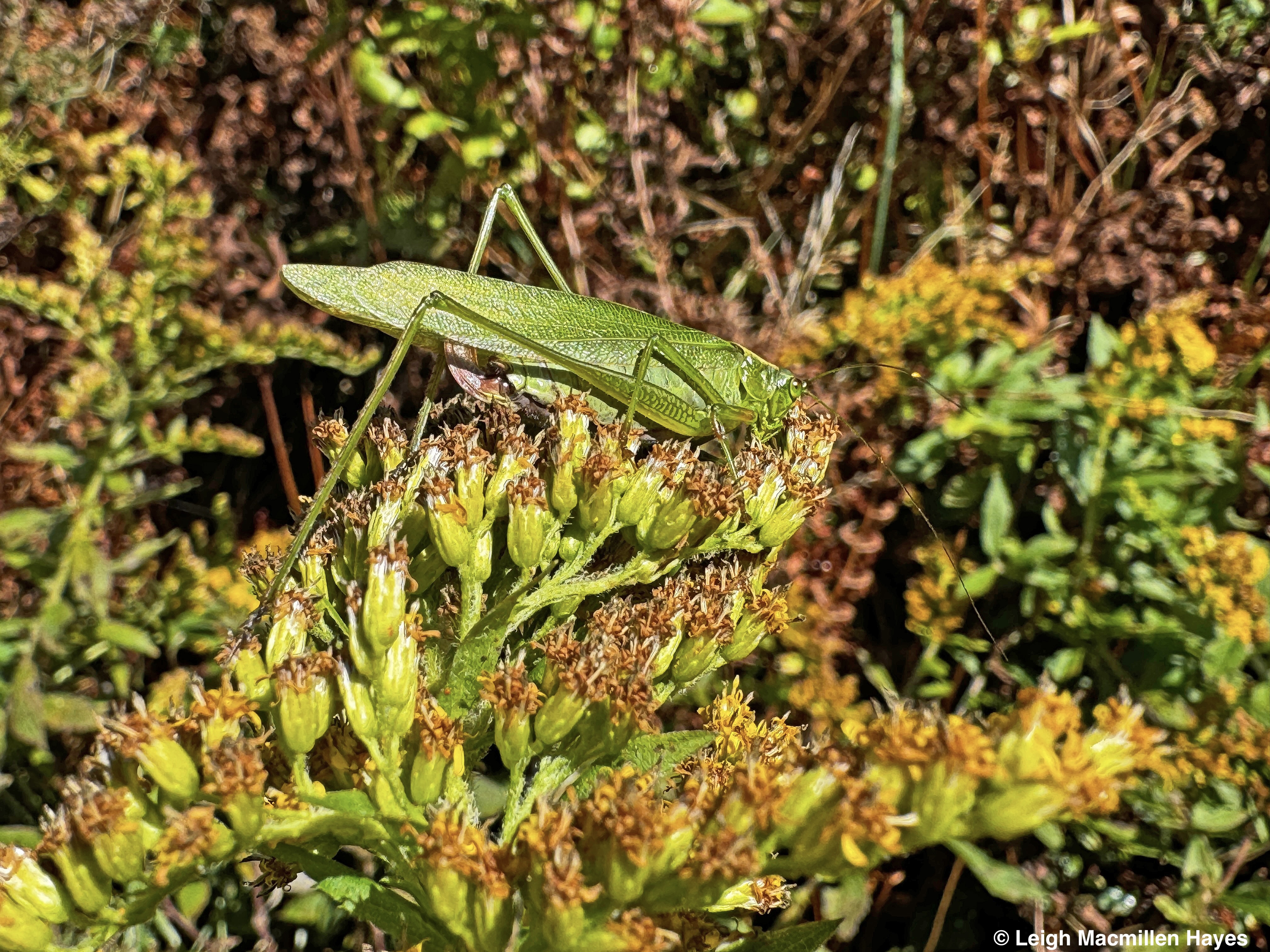
But rather, it is a Katydid, only the second I’ve spotted this year. Katydids always make me happy because they remind me of my forever-since-birth friend and at about the same time that I spotted this insect she just happened to comment on a photo I’d taken during a hike this past week–of a mountain stream–because it reminded her of our “fishing” adventures as children, sticks being our poles and leaves our fish. Katydid. Of course she did.

But of all my finds, my heart was the stillest for this magnificent creature, also a gossamer-winged butterfly. I noted it first on August 3, 2024, and again on August 26. But to see one on October 4, 2024 . . .

Incredible. And RARE! I contacted Dr. Ron Butler once again as he’s one of the co-authors of Butterflies of Maine and the Canadian Maritime Provinces.

Different Bat Time, but same Bat Place for this sighting.

Ron’s reply, “Lucky you. I’ve only seen them in more southern states. I’ll add this to the database.”

Lucky me indeed. According to the book, White M Hairstreaks have only been spotted in our region four times (prior to the three I’ve now noted) and they were seen from late July to late August. So, um, that can now be updated to early October.

BUT . . . what does that mean? Ron has only seen them in more southern states. Blueberries are flowering in October. My nephew shared a photo with me this past week of a Lilac blooming in New Hampshire.

Climate change.

All that said, saying goodbye to all that the field has offered this summer and early fall is not easy. I’m going to miss the spiders and butterflies I had the honor of greeting each day. Oh, I know there’s so much more to come as the days grow shorter and temperatures drop and my favorite season arrives. I live where I do because of the change of seasons.

Still, it’s a long farewell as we transition from one season to the next and for that I’m grateful.

Porcupine, Snakes, and Bears, Oh My!

Disclaimer: there may be some not so pleasant photos in this post. I apologize. BUT, what you will see is a fact of life.

Do I have your attention now?

Our afternoon began so innocently as we hiked along a well-traveled trail at Hawk Mountain in Waterford, Maine, where Goldenrods and Asters shown the way.

I knew I was in the right place the moment I saw a Black and Yellow Spider for I have spent the last two months enjoying their presence in our neighbors’ field and though they are beginning to decline in number as summer heads toward fall, a few are still on the hunt and packaging meals such as you see here.

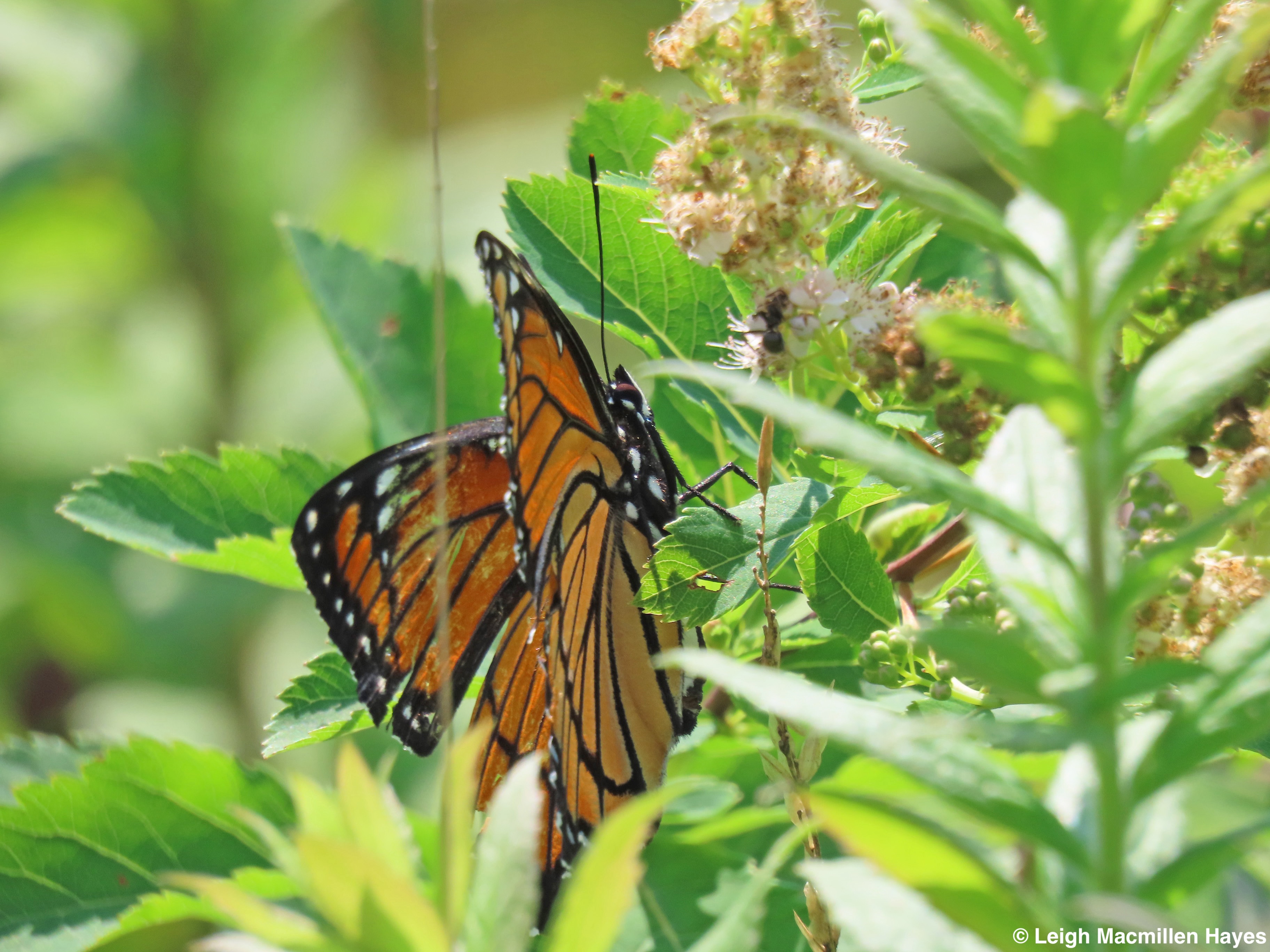
Also like home, the presence of butterflies. Granted, we were only twenty minutes from home, so spotting Monarchs nectaring wasn’t a surprise. It was a delight, really.

And an American Painted Lady, her two eyespots on the hind wing as opposed to four smaller spots on the same wing of a Painted Lady, pasued on some bramble branches.

A Red Admiral also decorated the scene, even if it did appear to have a bit of attitude given its stance.

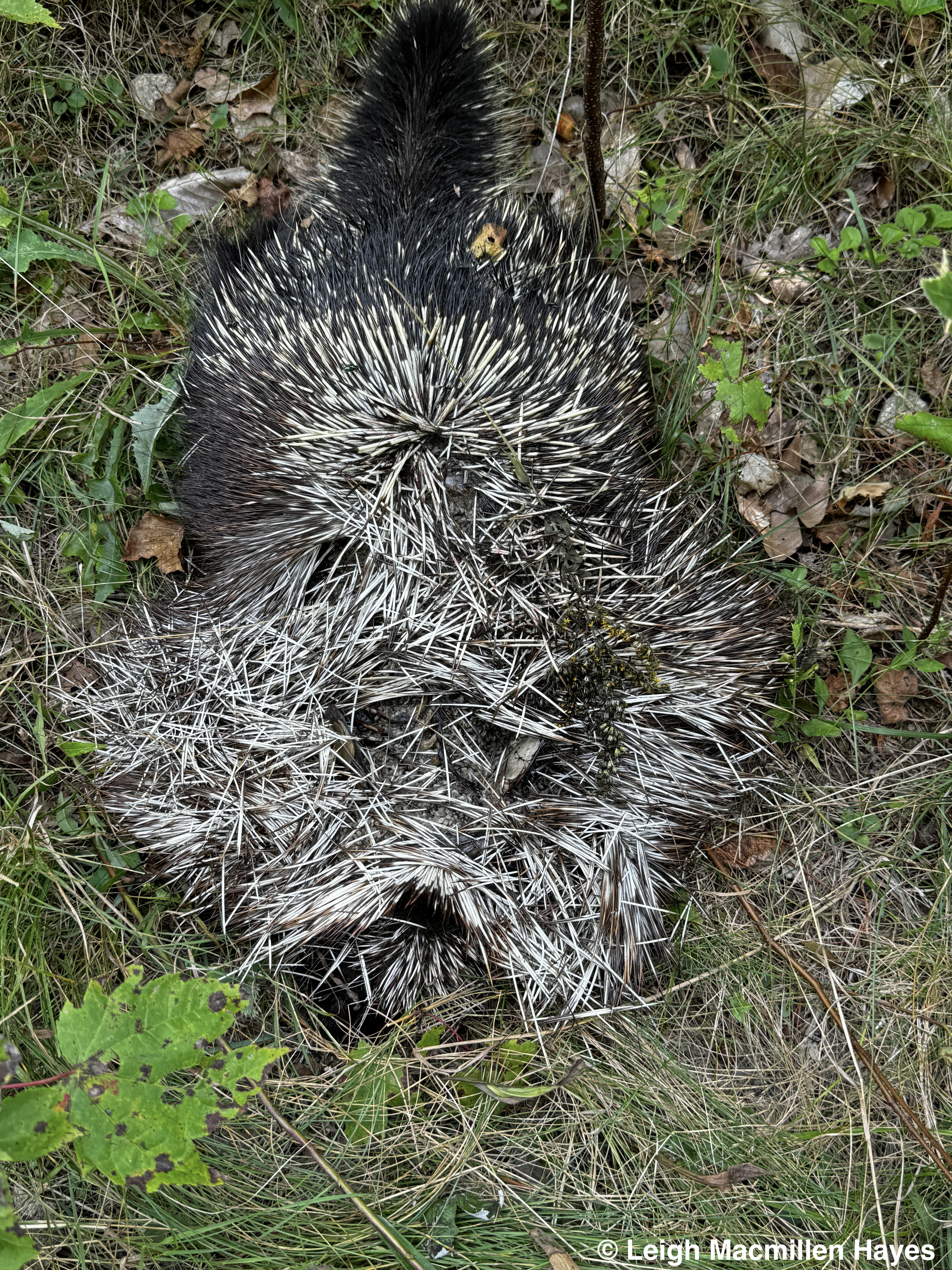
And then . . . and then I saw the body of a dead porcupine. It didn’t smell. But the Common Green Bottle Flies (in the Blow Fly family) that made their fly buzzing sounds around it indicated it had been dead for a bit. Some of you know that I love a such a wildlife mystery–and the opportunity to try to figure out what happened. BUT, the story doesn’t always piece together as neatly as I’d like.

First, there appeared to be three wounds on the animal’s back. Large openings. As if from a very hungry predator. And a brave one? Fishers are the porcupine’s main predator and they are known to attack the others face and belly, where the hair is soft as compared to the 30,000 barbed quills on its back. And a fisher and others would then visit the carcass repeatedly to dine. That hadn’t happened in this case. Instead, the animal died on its stomach. And other mammals didn’t take a repast from the offering. Did a domestic dog do the duty? If so, it must have had a head full of quills.

As for those metallic green flies, their maggots squirmed inside each large wound. By the hundreds. Maybe thousands. I wasn’t about to count. In his book, Insects of New England and New York, Tom Murray explains, “Blow flies are often associated with decaying organic matter, particularly carcasses and other sources of rotting meat and feces. In fact, they can figure prominently in forensic entomology, aiding in determining time of death.”

Murray adds, “This might sound like the dark ages, but cultures of sterile maggots of green bottle flies are sometimes used in hospitals to clean up deep wounds and infections that otherwise are difficult to treat. They only eat dead tissue, and secrete an antibiotic, preventing further infection. In nature, the normal food source is carrion.”

Maggots. A source of wonder! Who knew? Well, obviously doctors and scientists and Tom Murray!

There was one other thing to look at on the carcass, besides those three-toned quills and the soft curly hairs in the mix. The sole. Look how pebbly it is! The better for climbing trees, my friend. Think of non-slip socks with those little white treads. Porcupines don’t need to wear socks. Maybe they were the inspiration for such. Ahh, this site just got even better!

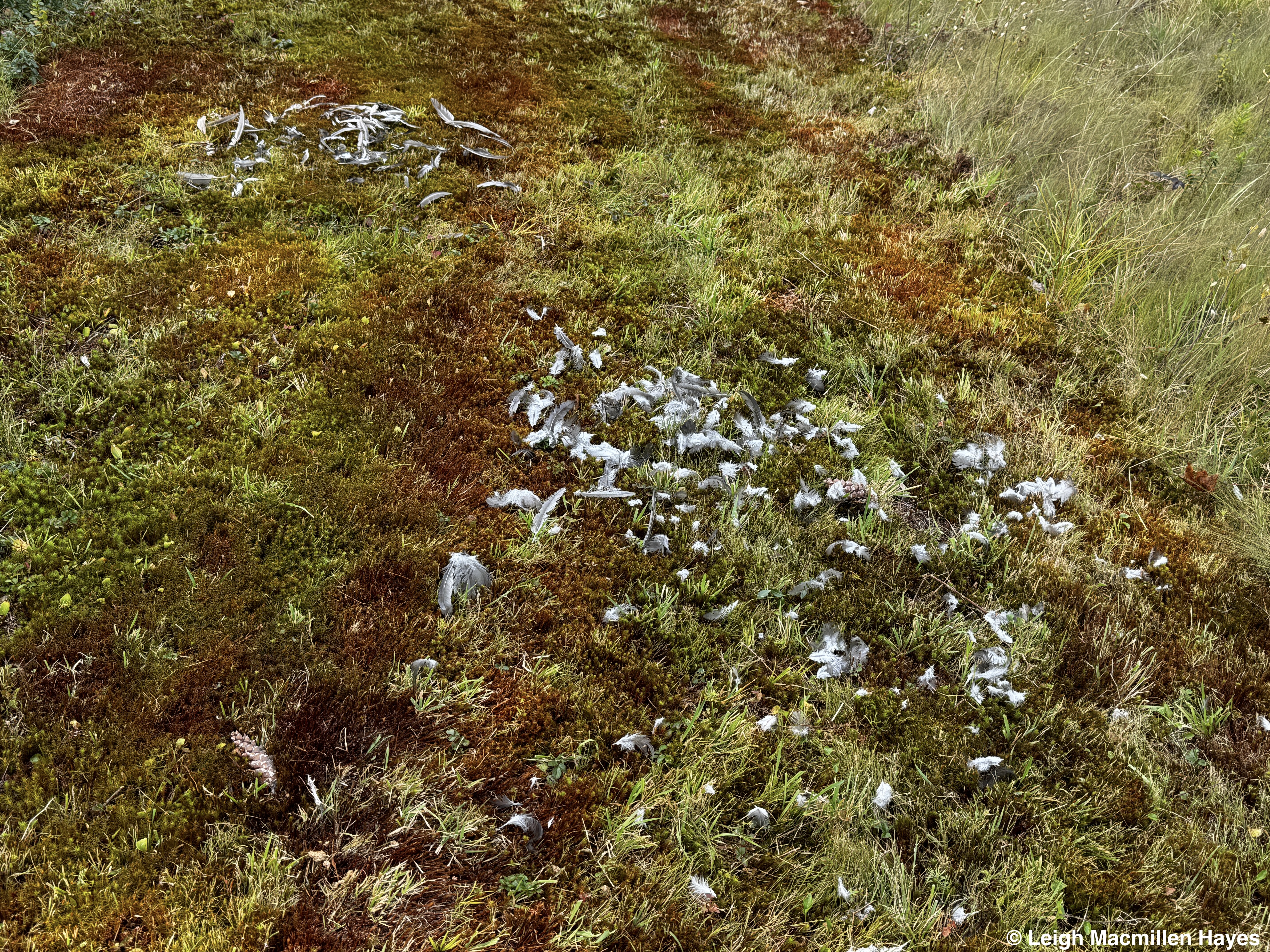
I still don’t know who the predator was but it took me back to what my neighbor and I discovered in her field yesterday. Two piles of feathers from the same bird.

The feathers appeared to have been plucked so I suspect a raptor did the deed, after all, they need to eat too. But what species died? We don’t know birds well enough to say. What was curious to us was that there was no blood. Nor any body parts. My neighbor’s dogs were onto a scent in the feathers, however, and we suspect that they had a better sense of either who the prey was or who needed a meal than we did.

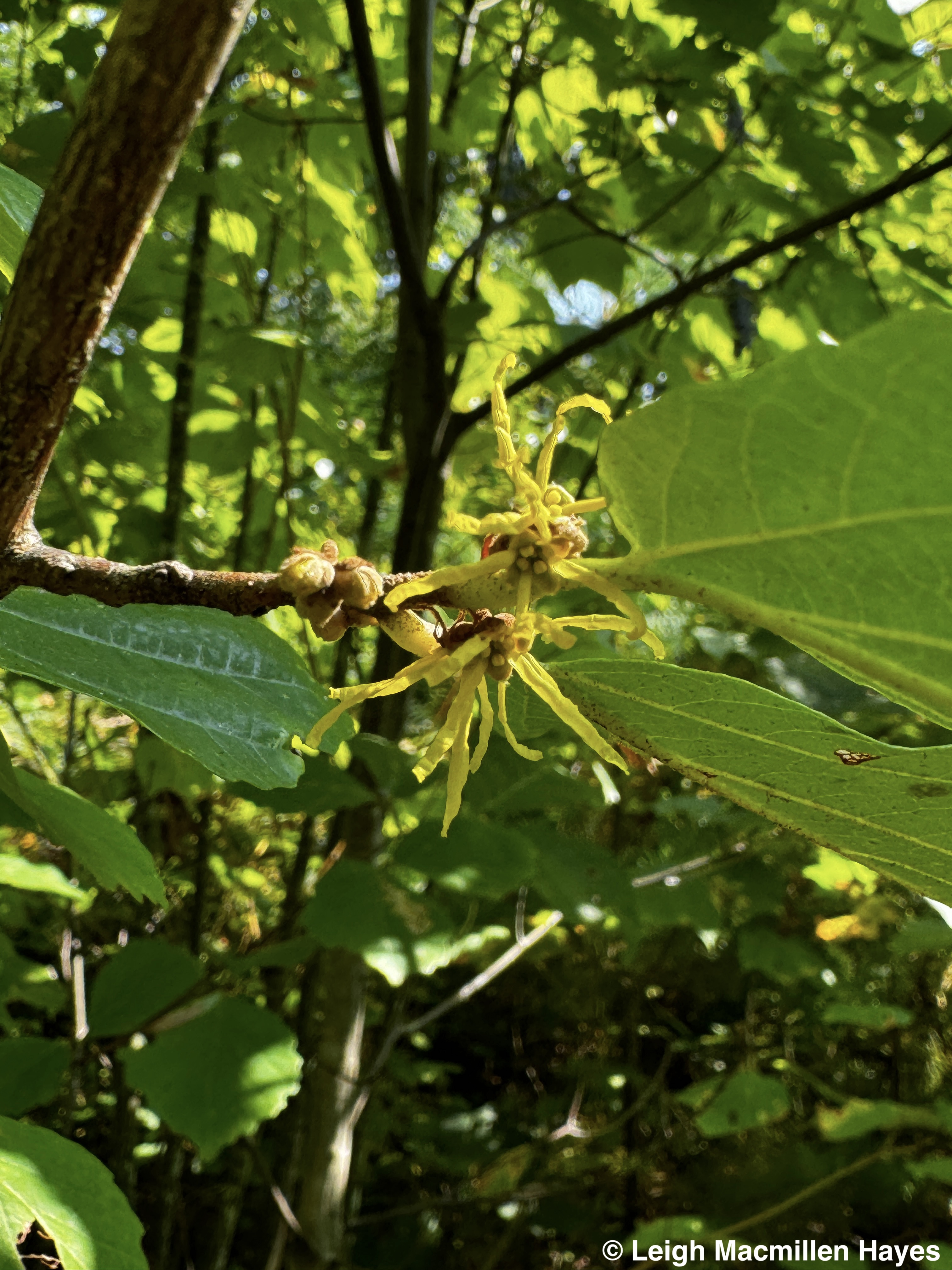
Returning to today’s trail, I spotted Witch Hazel in bloom, the first of the season for me to spy. This flower always makes me happy with it’s yellow ribbons haphazardly displayed.

And then I sawa Maple Leaf Viburnum, its leaves already their magenta color and so many berries still intact.

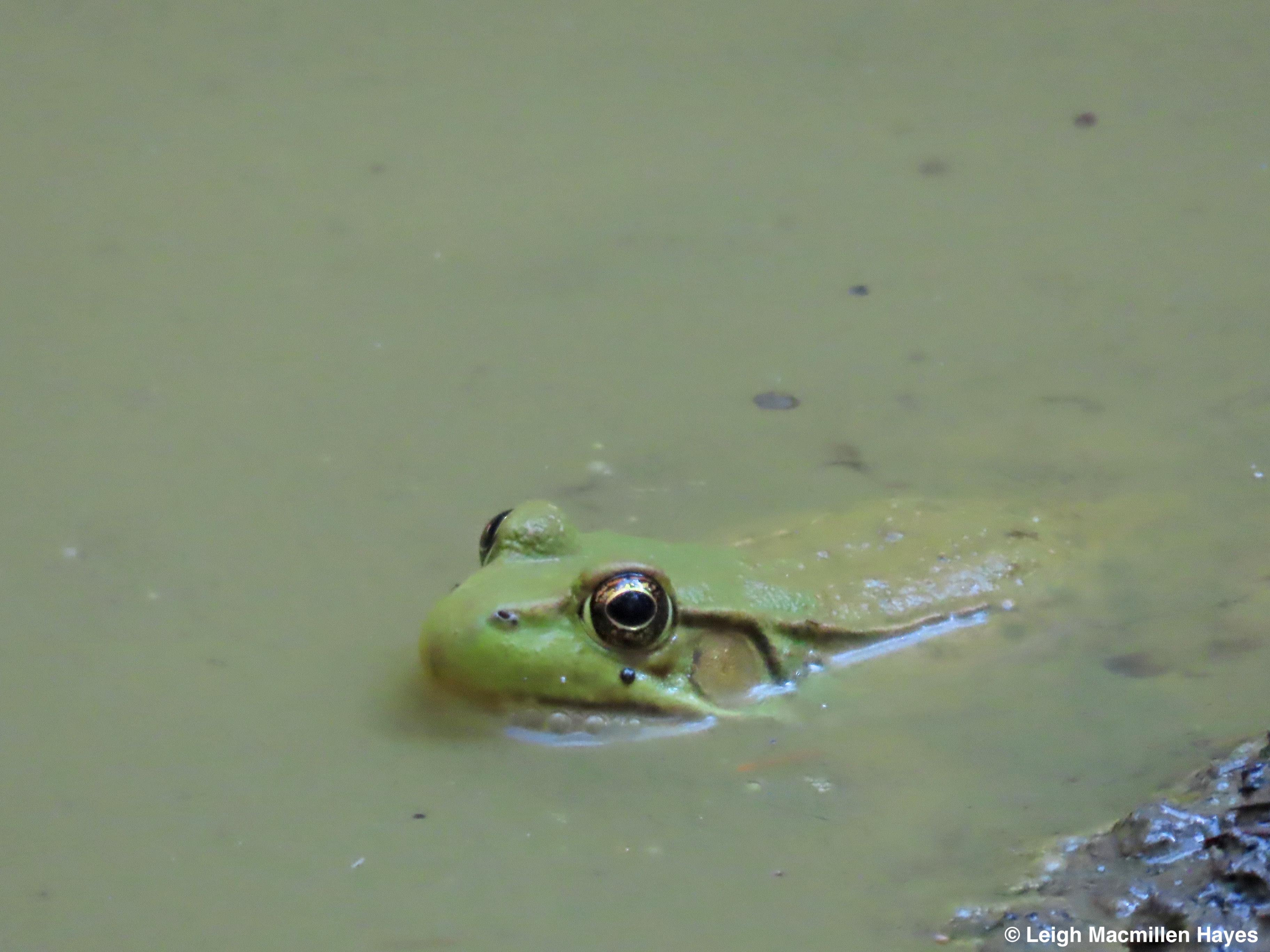
And a Green Frog in a mucky puddle as we approached the summit.

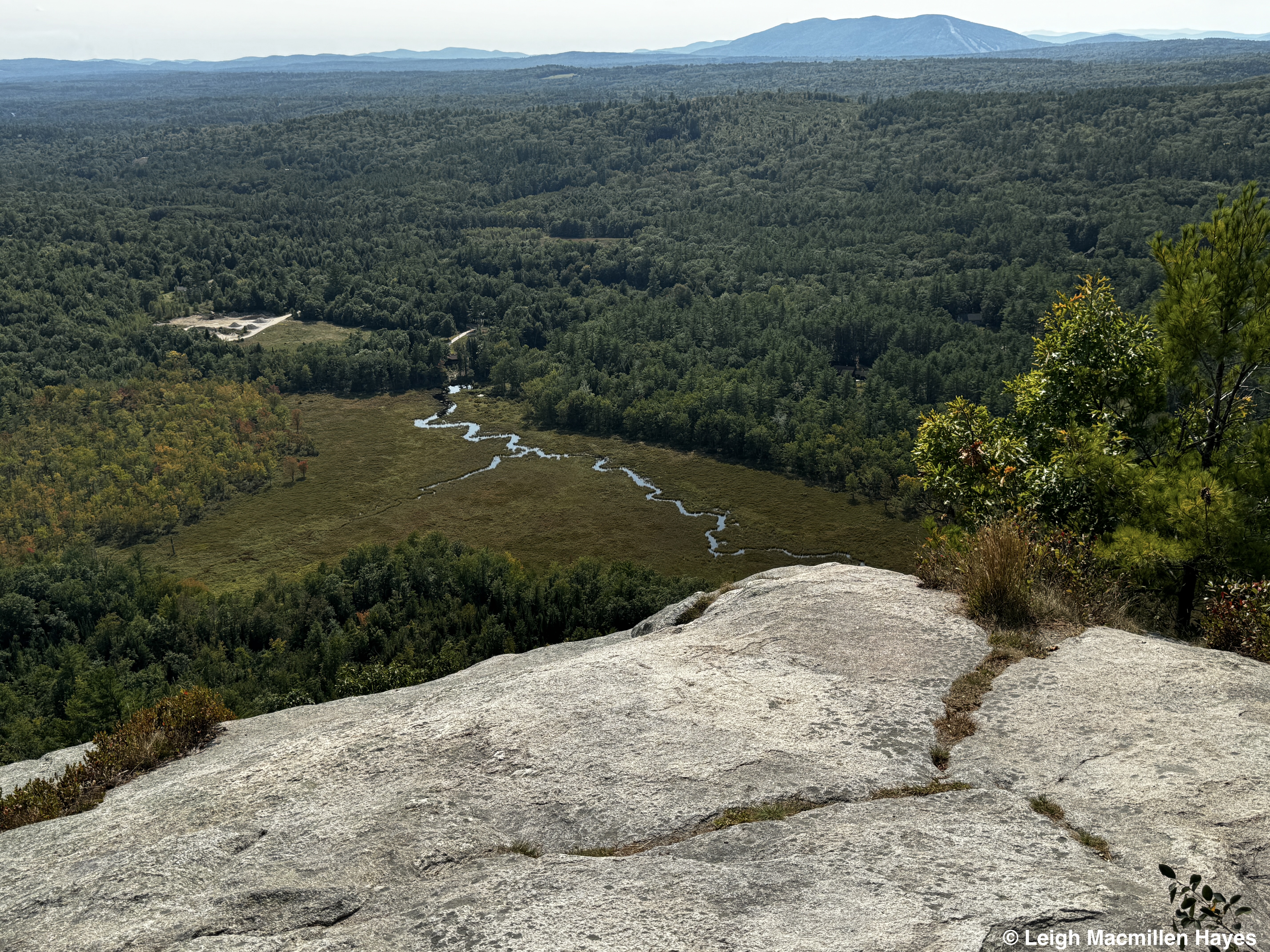
The view is always amazing, enhanced by the brook and wetland below and our beloved Pleasant Mountain in the distance. You can even see the ski area at the right or northern end.

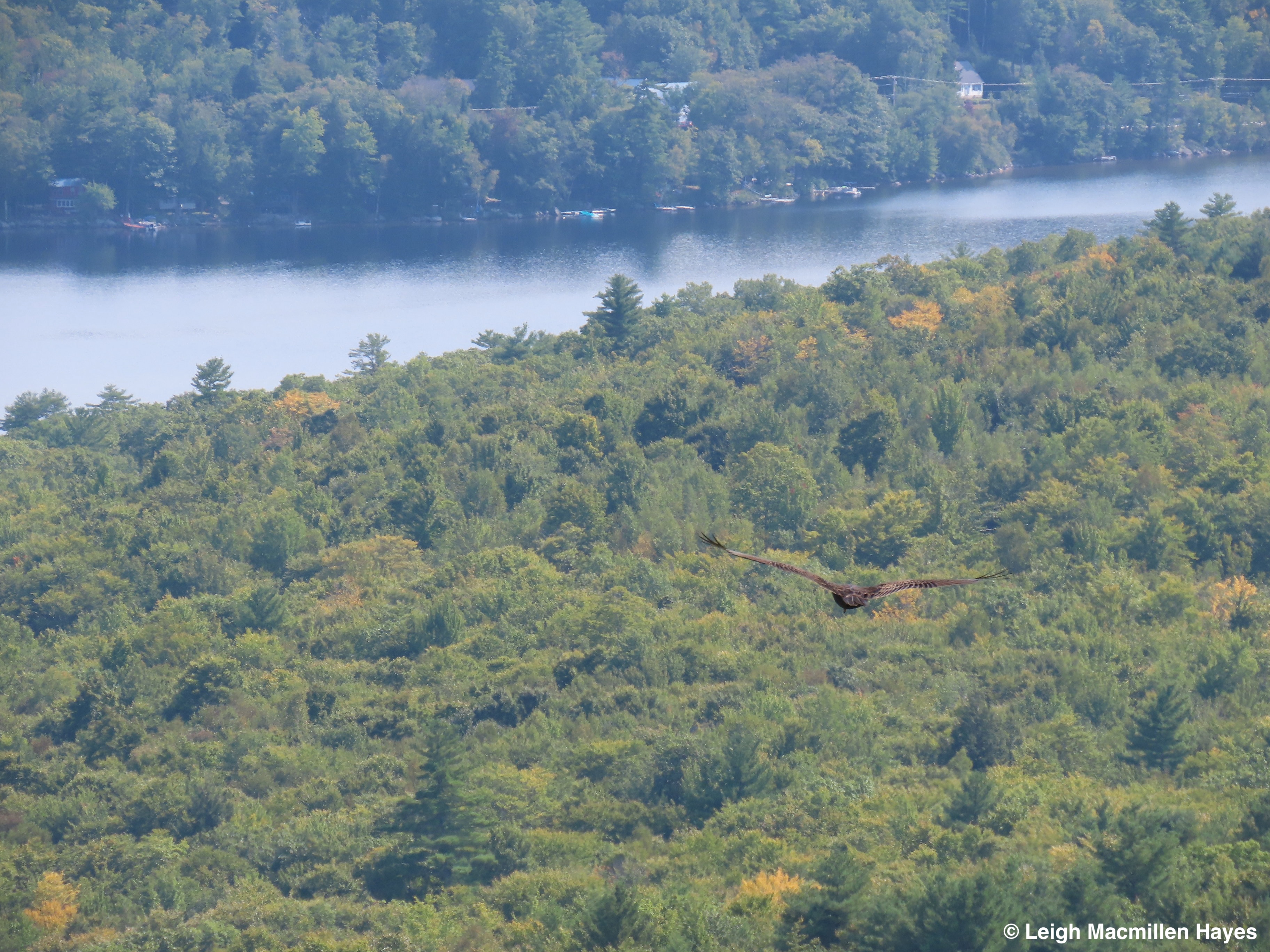
While we were out there I only captured a photo of one Turkey Vulture, but at least three road today’s thermals, gliding round and round.

And on the way down a small Garter Snake tried to hide from us. It was about the size of a pencil. And reminded me of another site in the field at home that I spotted this morning.

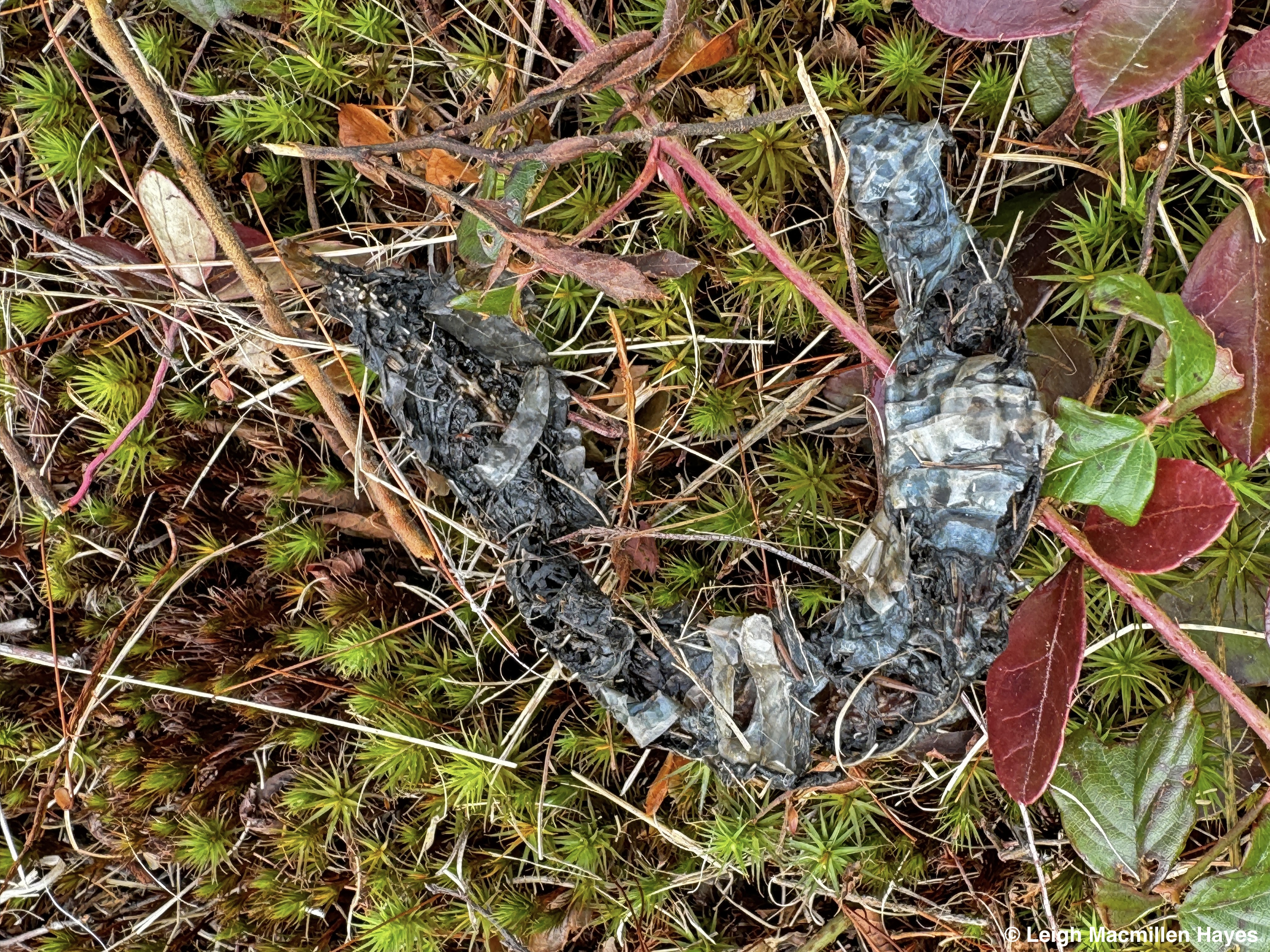
My first thought. Scat. Of course. Until I took a closer look. A spine?

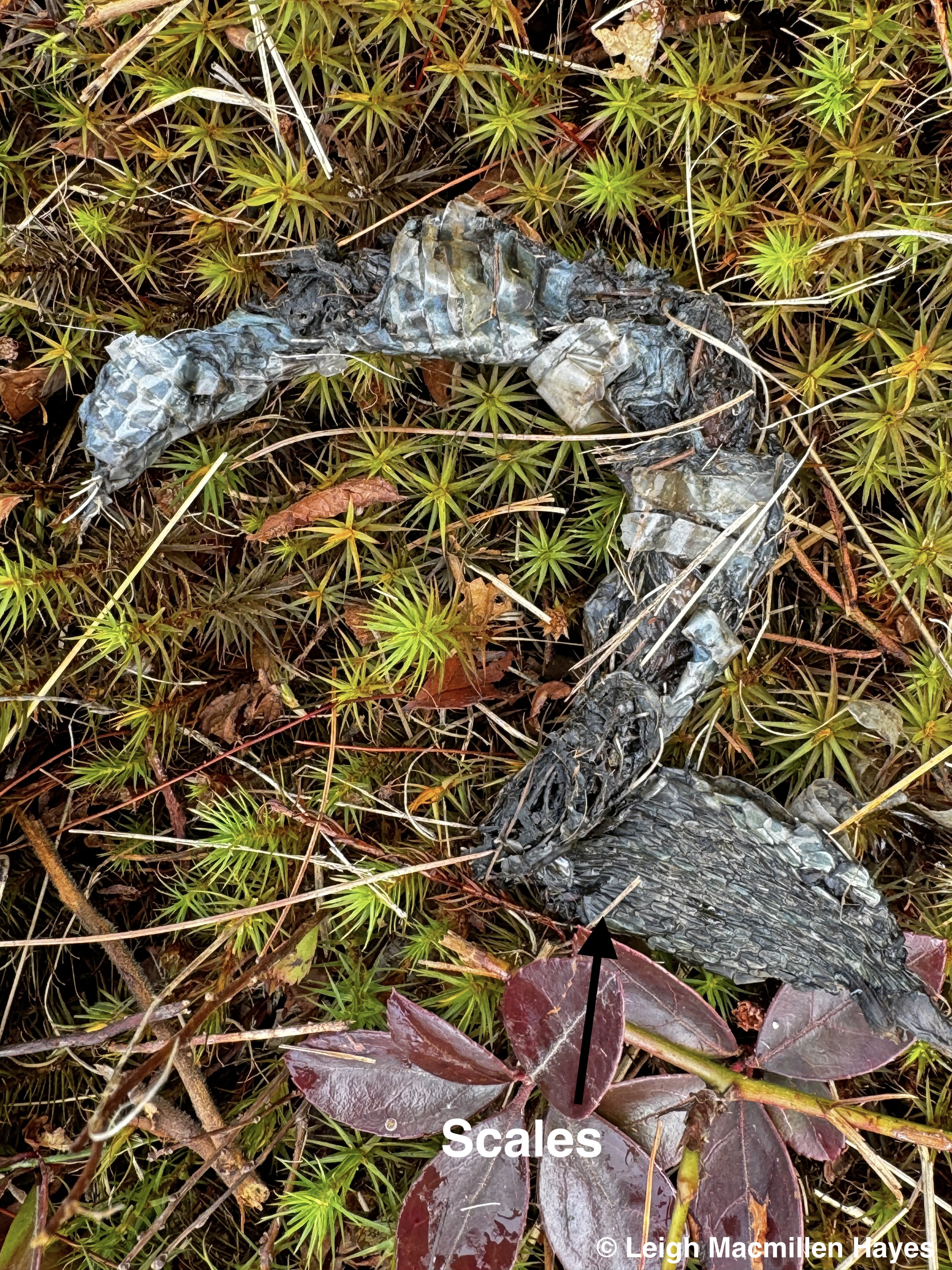
And then I flipped it over and spotted scales. Probably a much larger Garter Snake. If I took a closer look at the scale pattern I could be certain of this ID. Maybe tomorrow. If I can locate it again.

From Hawk Mountain we made a mad dash to Mount Tire’m and again at the summit, a view toward Pleasant, just from a somewhat different angle.

We were in a bit of a rush, but My Guy didn’t mind that I wanted to explore the erratic boulders in the woods behind the summit. I think everyone who climbs that mountain ends up at this spot. Rock Castle? Bat Cave? Bear Den?

We decided on the latter given that we spied a bear through the trees.

And so, I did what I always do here and channeled my inner bear.

Now really, this wasn’t such a gruesome post after all, right? But wow. Porcupine with maggots, snakes, and a human bear. Oh my!

Field of Vision

Sometimes it’s the big things that pull me out the back door and other times it’s the small things. But this past week, it was an in-between thing that did the trick. And kept me returning for more and more.

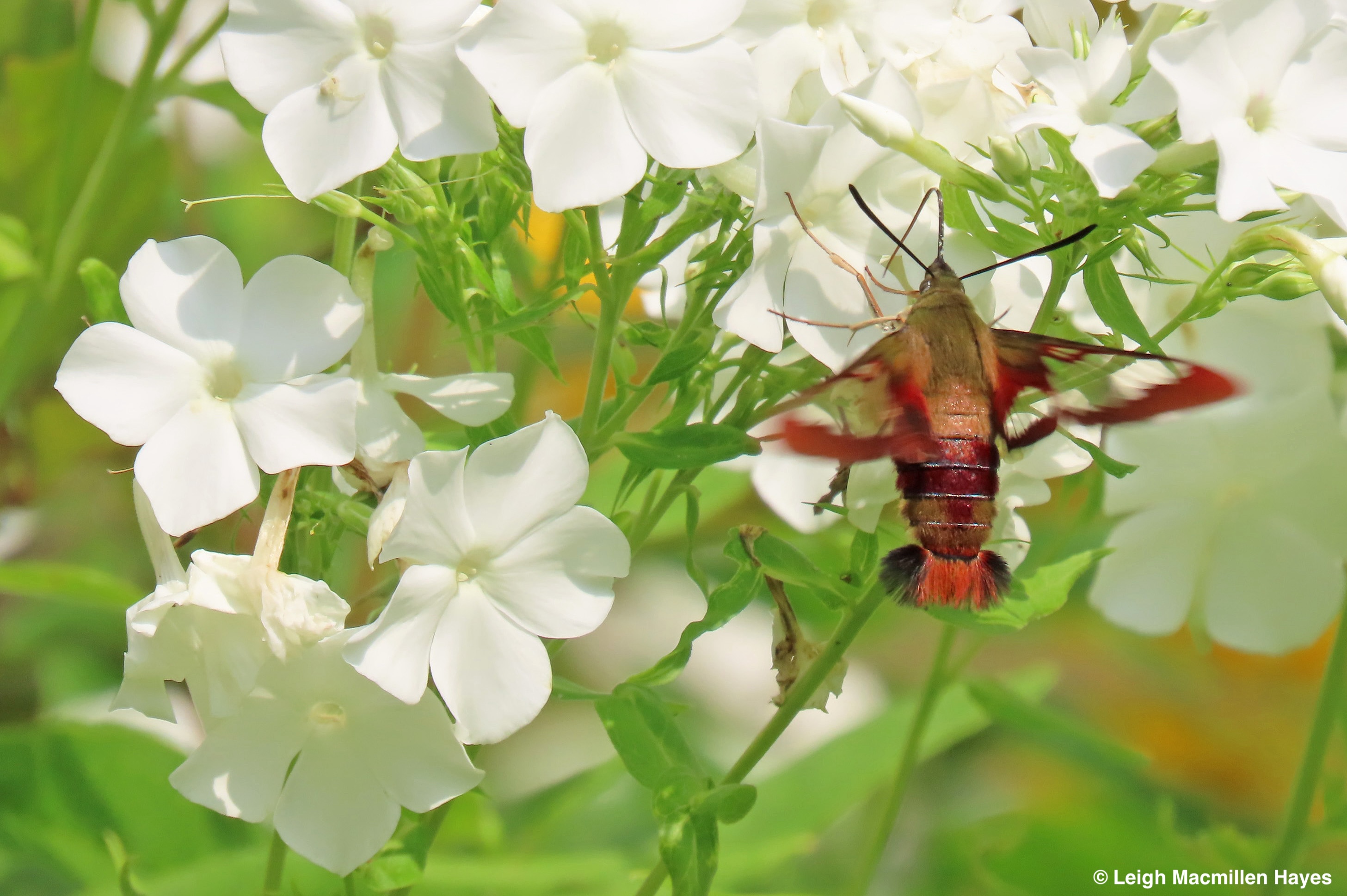
Feeding on the Phlox outside the kitchen window was a Hummingbird Clearwing Moth. I’d seen it on several occasions, but the minute I stepped outside it flew off. Until this day when it let me snap numerous photos as I watched it seek nectar from the same flowers our local Hummingbirds love to visit.

And once I was out there, I knew it was time to climb over the stonewall and visit the neighbor’s field to see what it had to offer, given that so many goldenrods are in full bloom.

Upon a Steeplebush, a Netwing Beetle looked like it was holding court. I love the featheriness of its antennae standing tall above those beady eyes.

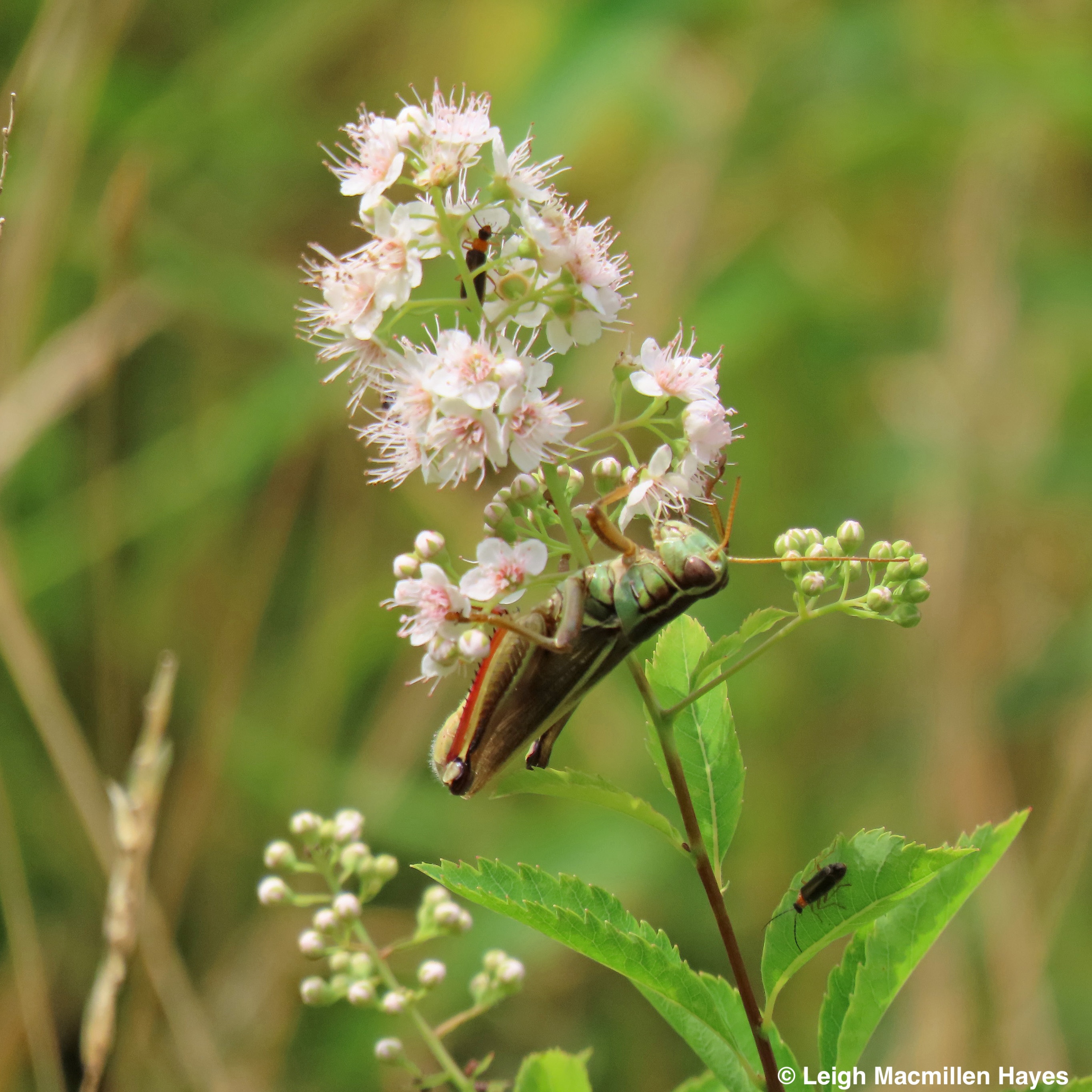
On a nearby Meadowsweet, another in the Spirea family like the Steeplebush, a Two-striped Grasshopper was certain that I couldn’t see it. I could. And I could hear grasshoppers and cicadas and crickets and birds, a field orchestra in full rehearsal form.

And as has been the action of so many Gold-marked Thread-waisted Wasps, these two were canoodling. I suspect we are surrounded by so many because they are so good at reproducing. Not a bad thing.

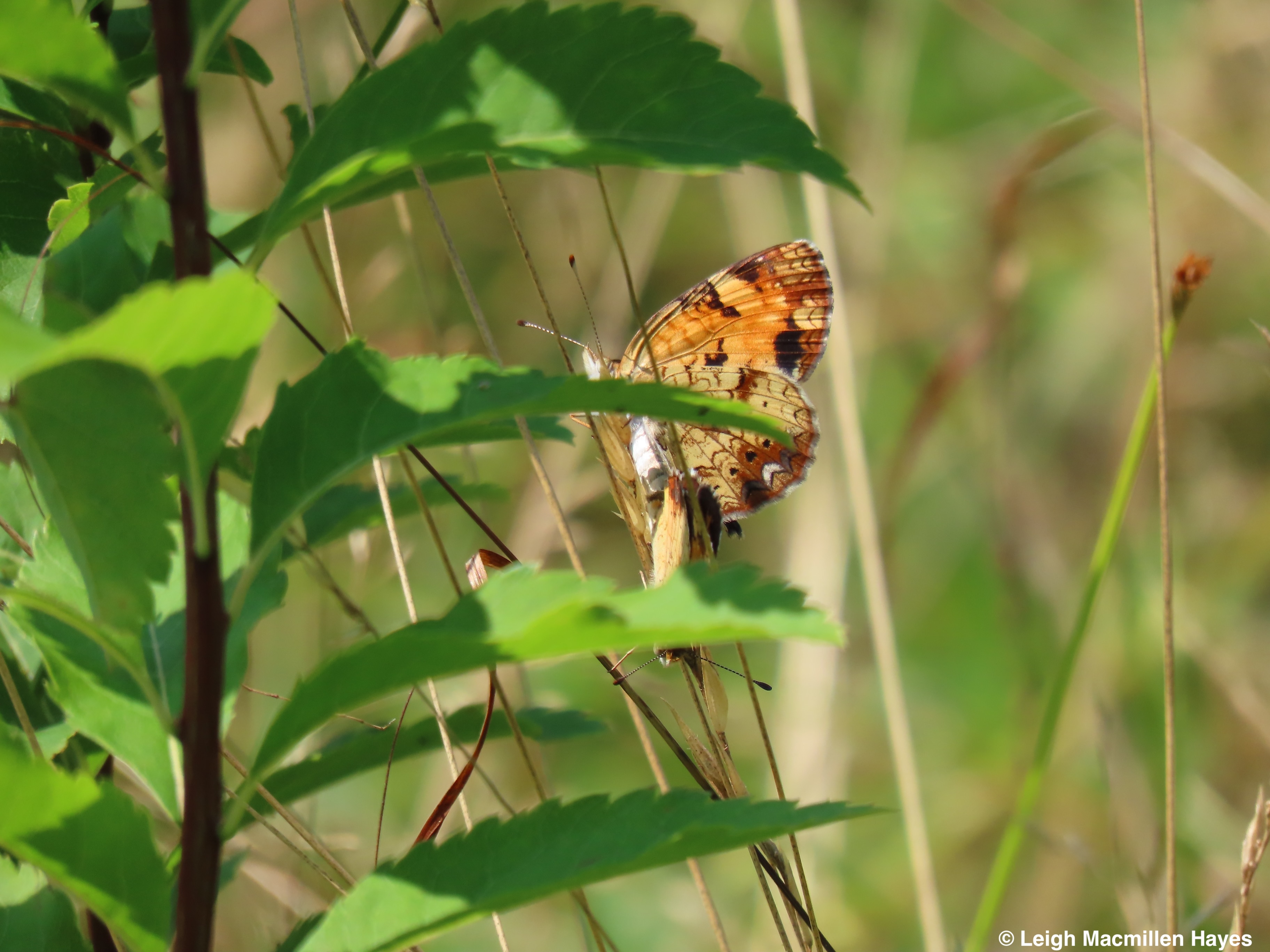
Also on frequent display and frequently in flight were the Pearl Crescent Butterflies.

And they too canoodled, though a bit discreetly. If you look at the underwing, do you see the pearly-white crescent? Thus the common name.

I had hoped to find a date for this male Calico Pennant Skimmer Dragonfly, her coloring would be all in yellow where his is red, but I’m afraid for the moment he’s still single. Maybe one day soon a gal will show up. I know I’ll keep looking.

Along the dragonfly line of field residents, this immature Blue Dasher Skimmer also posed for me. Again, on a Steeplebush, which gives height and vision for those who seek prey.

But some, like this Lancet Clubtail, prefer lower vegetation, and I suspect that’s where most of its meals were found.

My heart skipped a beat when I saw this large orange butterfly and I thought, “First Monarch of the season for me.” Until it wasn’t. This being a Viceroy, so identified by the lines or transverse bands on upper and lower wings. Monarchs don’t have that additional band.

My heart skipped another beat when I spotted this female Jagged Ambush Bug hanging out among the Goldenrod flowers. My, what powerful looking front legs she has. The better to grasp a meal. Can you spot a potential meal in her sight? I saw it, but she never showed any interest while I was watching. Darn. I hoped for a little action.

Believe it or not, the Jagged Ambush Bug can tack down an insect as large as a Bald-faced Hornet, such as this one. I haven’t witnessed it yet, but there’s still plenty of summer left.

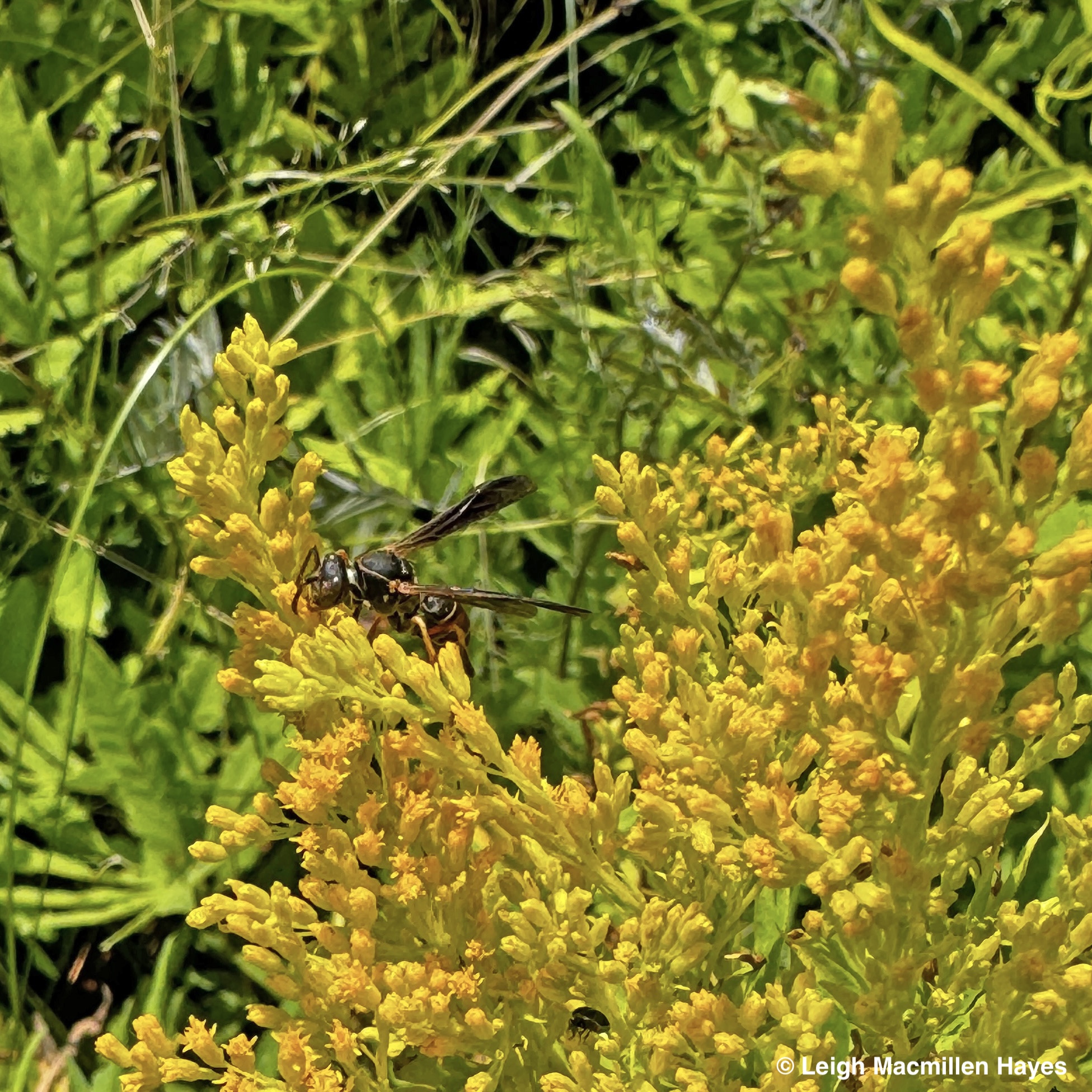
Paper Wasps were also making the rounds. And really, the flowerheads fluttered constantly with all the frenzied activity happening upon them.

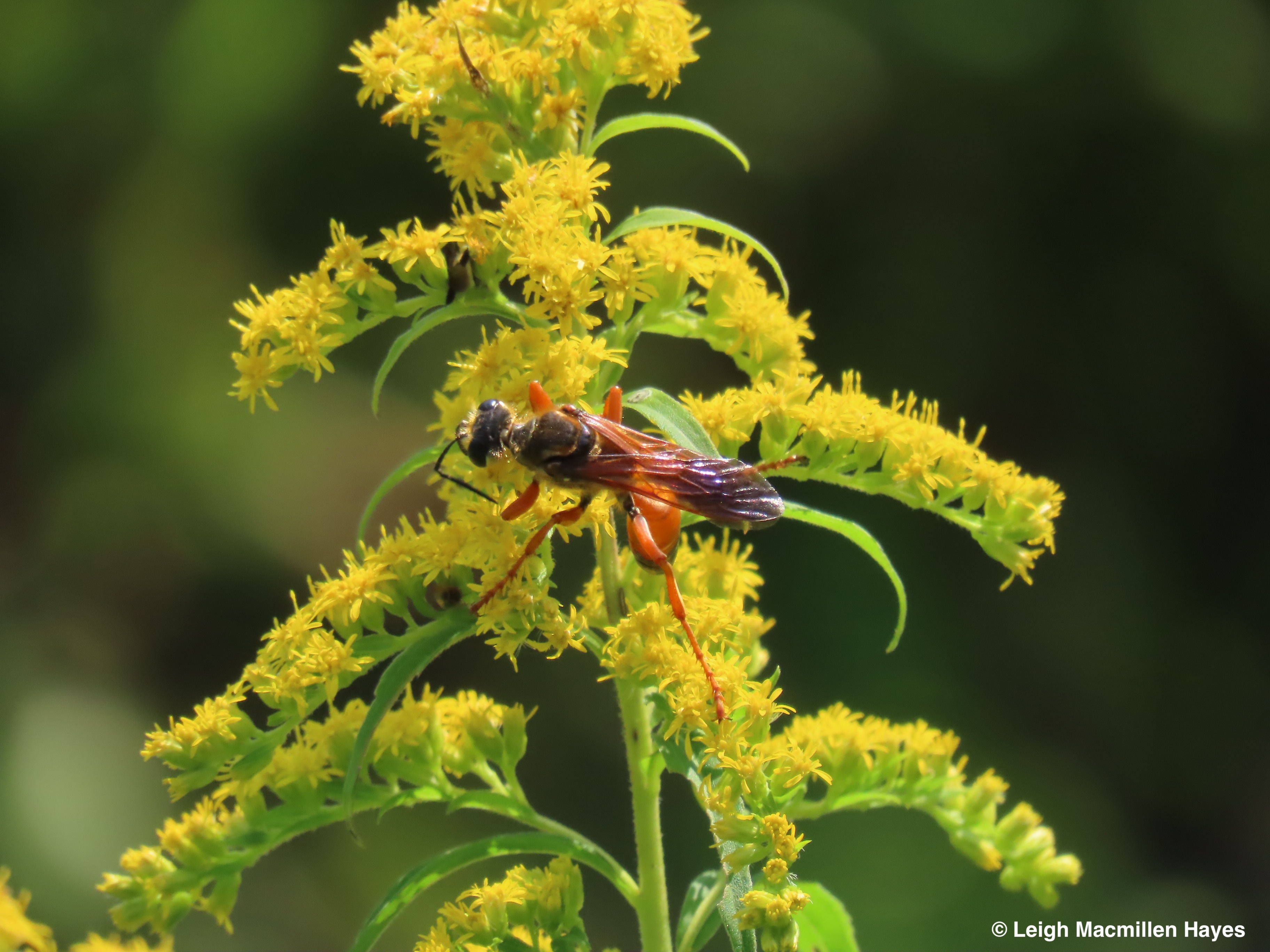
Even a Great Golden Digger Wasp partook in some of the nectaring collection.

But . . . there was something else I wanted to see. And I suspected that if I really looked, I might have success.

Bingo. It was the white packages at the outer edge of the web that led me to the creator. Charlotte.

I had a feeling Charlotte would be writing messages somewhere in the field.

And indeed she was. Years ago, when I didn’t dare walk into the field because of ticks, I wrote a children’s story about kids coming upon these large Black and Yellow Garden Spiders as they ran through Goldenrod flowers. Of course, that was about 28 years ago and I was starring out the window at the same field I can now walk in.

And because I can now do so, I found Charlotte 2 . . .

And Charlotte 3 who was preparing a meal for later. It looked to be a grasshopper of choice. If I spotted three, can you imagine how many more spiders there are out there?

In my story, if I recall correctly, the young boy character was afraid to run through the field and the young girl tried to give him some facts about Black and Yellow Garden Spiders because she wanted to become an entomologist. I should pull it out of the filing cabinet and reread it, but it’s not one for publication. It was just fun to write.

The reason I can go into the field now is thanks to my neighbors, Karen and Bill. He has mowed a circular trail so she can walk her dogs, and I love it because I can walk my thoughts. It’s a place where I can meet old friends and learn from them, and make new acquaintances.

And right now it’s a place where I can celebrate my new sight thanks to the medical team that performed cataract surgery on both of my eyes over the past two week. Until all of this happened, I had no idea how much I’ve been missing (think road signs and car blinkers for starters–never mind all the little things in nature that I love to spy).

I’m forever grateful for this new field of vision, the nurses and techs and Dr. France of Eyecare Medical Group physically for me, and my neighbors who carved this path as a way to save all those critters, who like me, call this place home. Of course, many of the critters are also a source of pollination for their vegetable gardens.

But I’ve saved the best for last. For I spotted one more critter in the field, and when I got home, it was on the Hydrangea.

This is a White M Hairstreak Butterfly. Do you see the M marking just below the orange on its hindwing? This is a RARE sighting! To be sure of ID, I grabbed Butterflies of Maine and the Canadian Maritime Provinces by Phillip G. deMaynadier, John Klymko, Ronald G. Butler, W. Herbert Wilson, Jr, and John V. Calhoun from the shelf in our study. And there it was: “Status and distribution in Maine: Probably a rare colonist.” Of the five authors, I’ve worked with Ron Butler in the past, so I reached out to him.

After I finally attached the photo (he had to remind me that I had neglected to do that), Ron sent this response:

“Hi Leigh,

Definitely!  And the furthest inland record to date.  Do you post your observations to iNaturalist? If not, can you send me the date and lat-long (or location on a map – I can get the lat-long) for this record?

Thanks – Ron”

According to the comments section in their book, “The White M Hairstreak is an expected and welcome addition to our region’s fauna, with the first adult observation in Falmouth by Doug Hitchcox on 24 July 2018, followed by two more records in 2018 from Rockport (Brian Willson) and Eliot (Bryan Pfeiffer and Josh Lincoln). A female was also recorded from Eliot on 5 August 2020 (John Calhoun), making this the first known repeat occurrence at a Maine locality.

I am in great company. Of course, I’m already anticipating the next edition of the book–haha.

I thank you again, Karen and Bill, for giving me the opportunity to explore the field and to my medical team for making sure my vision is crisp and clear.

Field of Vision indeed!

Pondering in Pondicherry

I love that I can step out the back door and explore hundreds of acres of woods or follow a path, cross a road, and step into a town park protected with a conservation easement. Lately, I’ve been spending a lot of time in the park, for starters because I love to spot the Mallards and look for Winter Stoneflies, but also because I’m working on getting to know bryophytes and lichens better. Of course, I could to that anywhere because mosses and lichens grow everywhere. And do not harm the substrates upon which they grow. In fact, they may actually help as in the form of mosses retaining water.

So, I invite you to step across the Bob Dunning Memorial Bridge and into Bridgton’s Pondicherry Park. Sixty-six acres of forest beside Stevens and Willet Brooks, with stonewalls, an old spring, and carved trails, including one that is ADA accessible, though in the current conditions, it’s icy and micro-spikes are the best bet for staying upright.

I’m almost certain these two ducks are named Donald and Daffy, but what I do know is that they laugh. A lot. Or at least that’s what it sounds like when they quack.

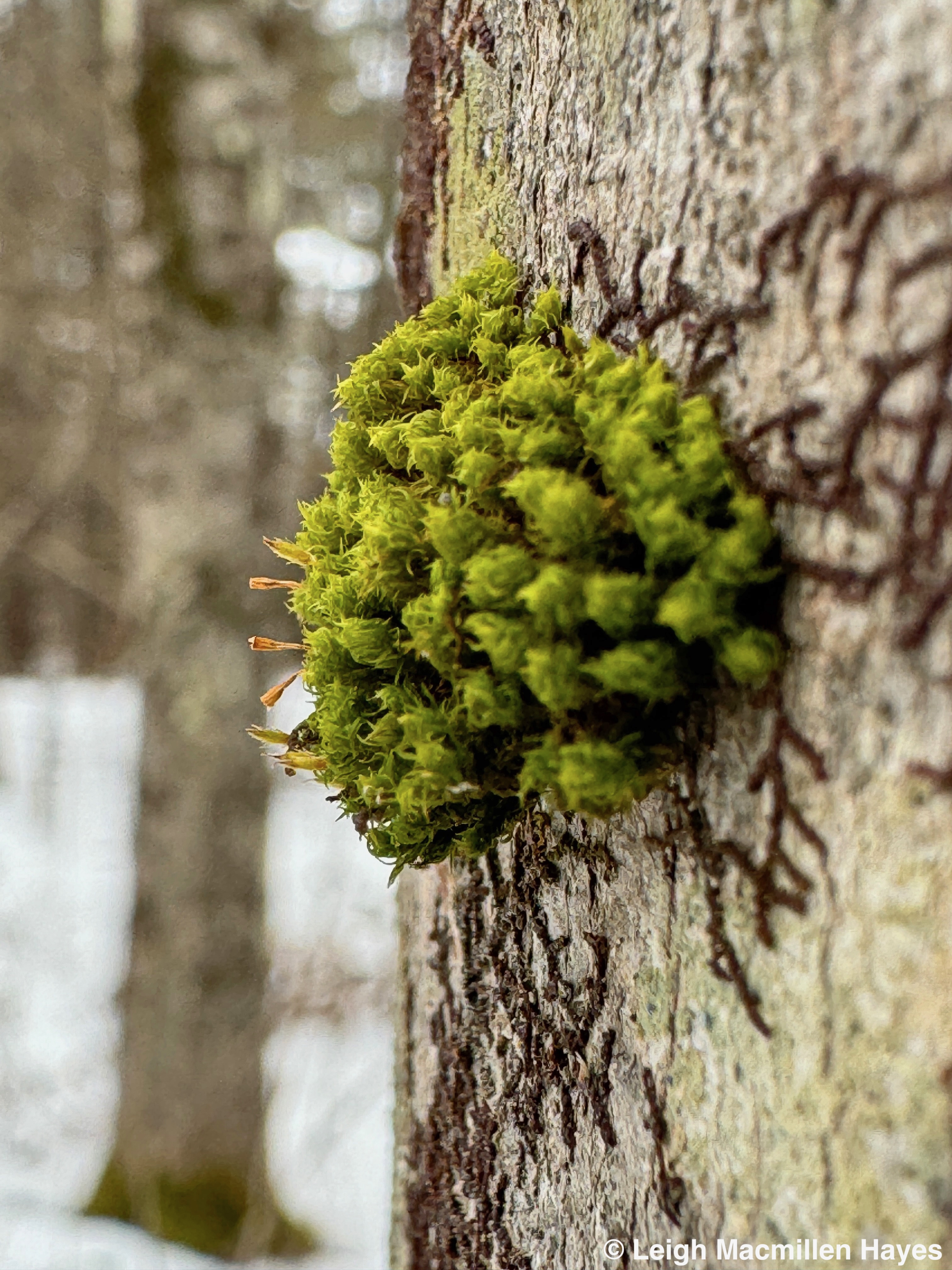
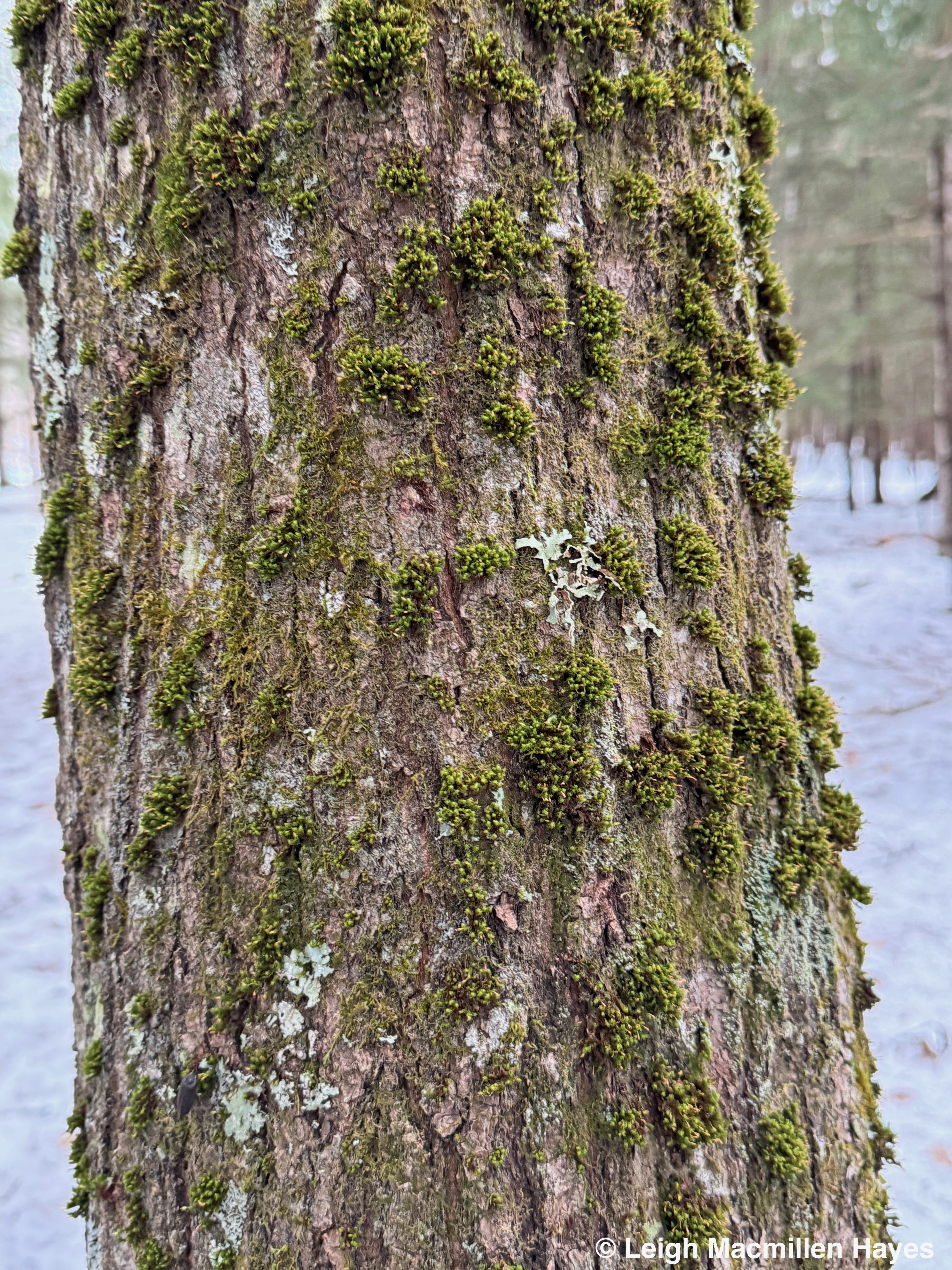
Finally, the reason I invited you along for this journey. One of my favorite little mosses. Meet Ulota crispa, or Crispy Tuft Moss (and Curled Bristle Moss and Crisped Pincushion . . . and probably several other common names). This moss is an acrocarp in form, meaning that the main stem generally grows upright and the capsules and seta or stalks that hold the capsules grow from the tip of the main stem. Usually, they grow upright that is, but in the case of Ulota crispa, they orient horizontal to the ground.

On this tree trunk, you might notice the pale green crustose lichen (crustose meaning crust-like and tightly pressed to the surface of its substrate) and the brown spiderwebby structure of a Frullania liverwort. Like mosses, liverworts are also considered bryophytes–meaning they don’t have a vascular system like plants and trees; nor do they produce flowers or seeds.

Ulota crispa grows in little tufts between the size of a nickel and a quarter. On some trees you might find one or two and others, such as this one, there are many.

My walk in the park was actually a self-assigned quiz because a friend and I had visited a few days prior and I wanted to make sure I could identify species on my own. As I always say when I’m tracking by myself, I was 100% correct in my ID.

But actually, this quiz did give me time to slow down and notice features, such as the thickness of the Brocade Moss, aka Hypnum imponens. This one is a pluerocarp in form, because the moss grows mostly prostrate, has many branches, and the capsules and seta (stem supporting capsule) arise from a side branch rather than the tip like that of the acrocarp.

I found one downed tree (and I’m sure there are many others under the snow) that looked as if it was covered with a carpet, a Brocade carpet. Given that a brocade fabric has a raised design, this common name seems to fit, though my research informs me that the Latin Imponens is the root for “imposter.” Apparently it can have different looks. That’s something I’ll need to pay attention to in the future.

Delicate Fern Moss, or Thuidium delicatulum, is another pluerocarp species. The fronds really do look like miniature fern fronds, in fact, twice-cut in fern lingo. But that’s a topic for another day.

I found the Delicate Fern Moss growing on a tree trunk, but also on a rock. Mosses don’t have actual roots, because remember, they are non-vascular plants. Instead, they have rhizoids, which look rather root-like, that anchor the plant to the substrate.

So how do they get water and nutrients? Via their leaves. And they have the unique ability of being able to dry out completely and stop growing, but pour water on them, or visit them on a rainy day after a dry spell, and they’ll begin growing again and turn from brown to green as photosynthesis kicks back into action.

If you been in the park, then you may now this stream below the Kneeland Spring. And you realize that I’d probably already spent an hour on the path and hadn’t moved very far. The old joke that I can still see my truck in the parking lot doesn’t work this time though because I had walked there. But I could still see the parking lot.

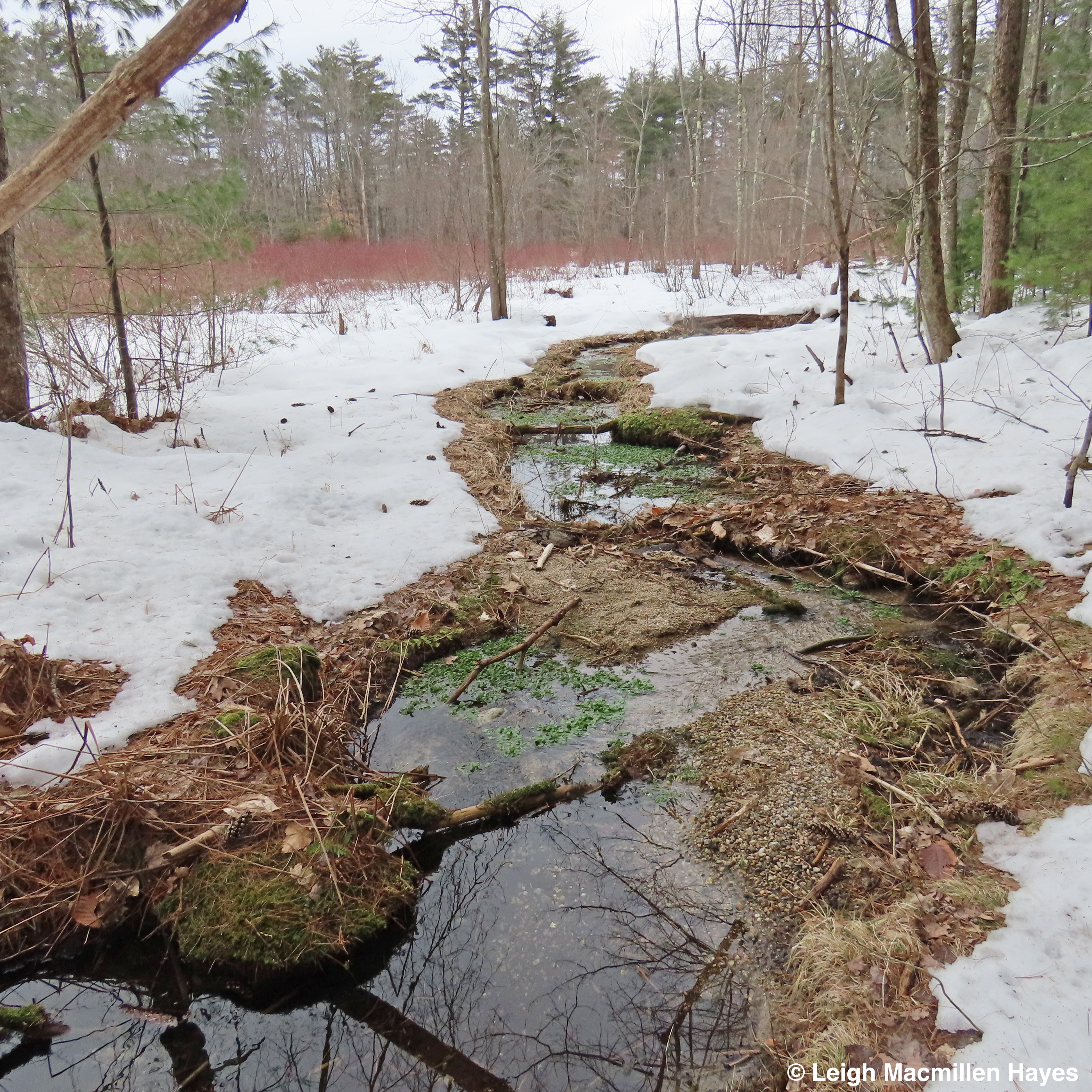
What attracted me to the stream was the sense of color. On a bleak winter day, the view was breathtaking in a subtle way.

In particular, the bright green of a plant that isn’t a moss or liverwort, but rather a vascular plant known as Watercress. It grows in natural spring water, thus its abundance below the spring from which this water flows.

While I was admiring the Watercress, I met a moss that I swear I’ve never laid eyes on before, but don’t think I’ll ever forget going forward: Willow Moss, aka Fontinalis antipyrectica. Its one that prefers to be submerged, thus its location. When the water is warmer, I need to get to know it better, but it almost looked like the leaves were braided.

The funny thing about this spot is that as I was looking down, a young couple walked along the trail above me. In an instant, the young man and I made eye contact and at once recognized each other as we are neighbors. He said, “I wondered who was down by the stream.” He wasn’t at all surprised.

Because the snow is beginning to melt, I finally saw an example of the poster child for acrocarpous mosses: Common Haircap Moss or Polytrichum commune. Here are a couple of easy ways to ID it from other haircap species: when dry, the leaves don’t twist as they fold upward toward the stem and the leaves have reddish tips.

Mixed in with the mosses were some little structures that actually remind me of caterpillars. They are also non-vascular and are associates of mosses, these being liverworts. Bazzania trilobata does not have a common name as far as I know. That’s probably a good thing because it forces me to learn the scientific name.

A small piece may have followed me home and stuck itself under the microscope. Liverworts are also small and where a moss has leaves arranged in more than three rows, a liverwort has two rows, like this one. That said, some have a third row underneath. Another key is that while mosses often feature a midrib, liverworts as you can see by this example do not. There’s more, but that’s enough to get started.

Mosses and liverworts aside, I had been looking for examples of this foliose lichen upon a previous visit, and finally found this one. It’s one of the ribbon lichens, but I haven’t yet figured it out to species. And I don’t know if it grows on anything other than Eastern White Pines, for that is where I see it.

Lichens come in four forms. Earlier I mentioned crustose: crust-like or pressed against the substrate; foliose–foliage-like or leafy; fruticose: upright and pendant, think grape branch; and squamulose: with little raised scales.

So, which form is this? Ah, the quiz is now in your hands. Crustose, Foliose, Fruticose, or Squamulose. I’ll tell you it isn’t the latter. Of the first three, which is it?

The little black discs or bumps are its reproductive structures.

Here’s a great take-away from Joe Walewski’s Lichens of the North Woods: “Successional stages of lichen communities on rock progress from crustose lichens, to foliose lichens, and then on to fruticose lichens. In contrast, successional stages for lichen communities on tree bark follow an opposite pattern. Many crustose lichens are a sign of an older successional lichen community.”

If you answered my question above as the form being crustose, you would be correct. Common Button Lichen or Buellia stillingiana.

This next one pictured above is among my favorites. Maybe it’s because though I find it on other trees, I love how it appears between the “writing paper lines” on the ridges of Eastern White Pine bark. Known as Common Script Lichen, or Graphis scripta, you might see it year round as white spots on trees but the squiggly apothecia (reproductive or spore-producing structure) appear only when it gets cold enough.

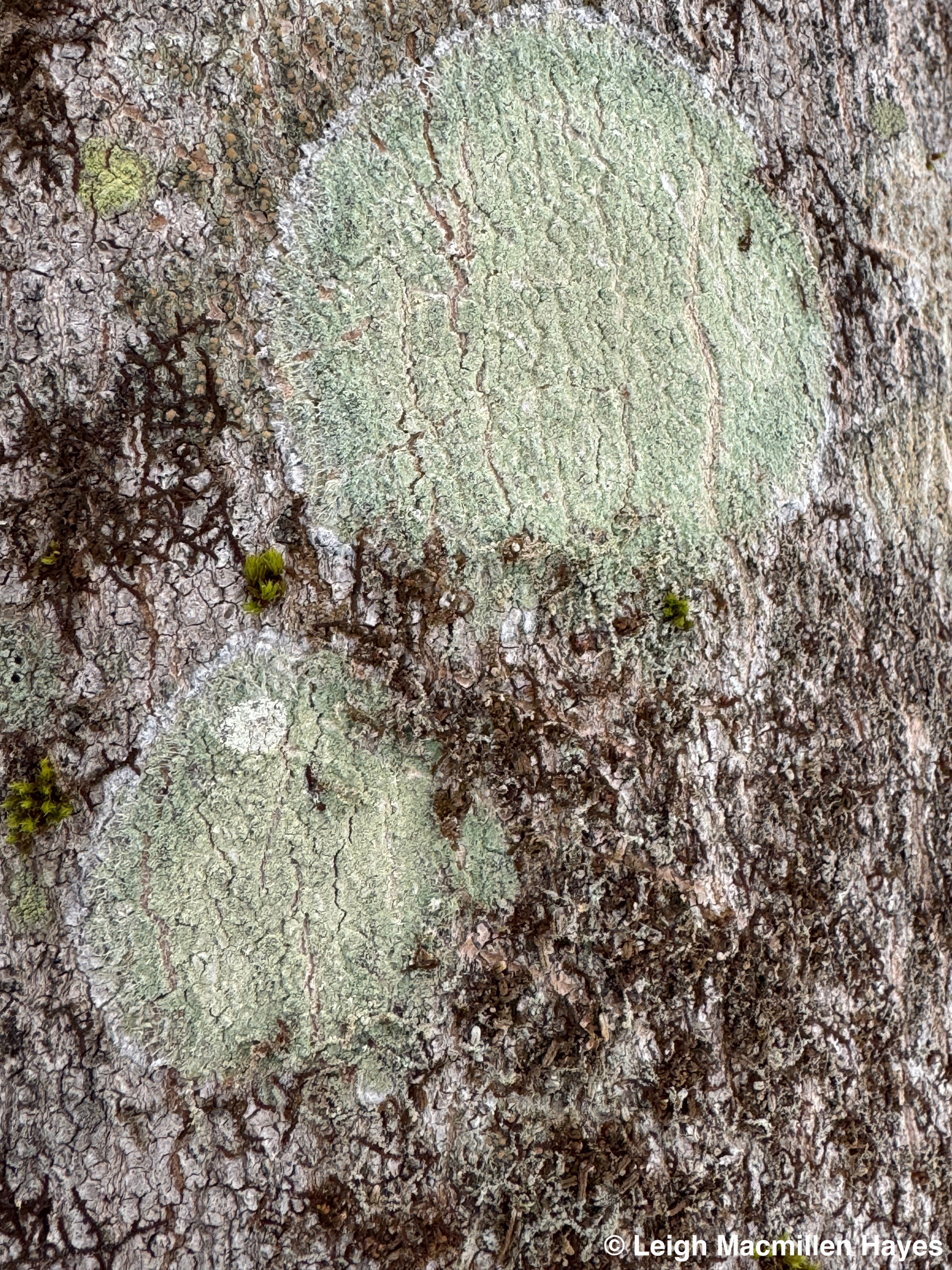
And here again: same crustose form, different crustose colors. Do you see at least three colors? Two shades of green surrounded by a blueish-grayish white? The white fringe is called the prothallus, a differently colored border to a crustose lichen where the fungal partner is actively growing but there are no algal cells. Though named the Mapledust Lichen, Lecanora thysanophora, it grows on several species of trees just to keep us all questioning ourselves.

The final lichen of this journey, and believe me, there could be a million more, or maybe not quite that many, but . . . anyway, is the Common Green Shield. I’m realizing just now that I don’t have a fruticose lichen to share, but that I’ll leave for another day. This Flavoparmelia caperata demonstrates the foliouse form. One that my lichenologist friends, Jeff and Alan, describe as one you can easily ID while driving 60 mph. Of course, you should be looking a the road and not at the lichens or your cell phone, but should you glimpse it out of the corner of your eye, you can easily remind yourself that it is a Common Green Shield.

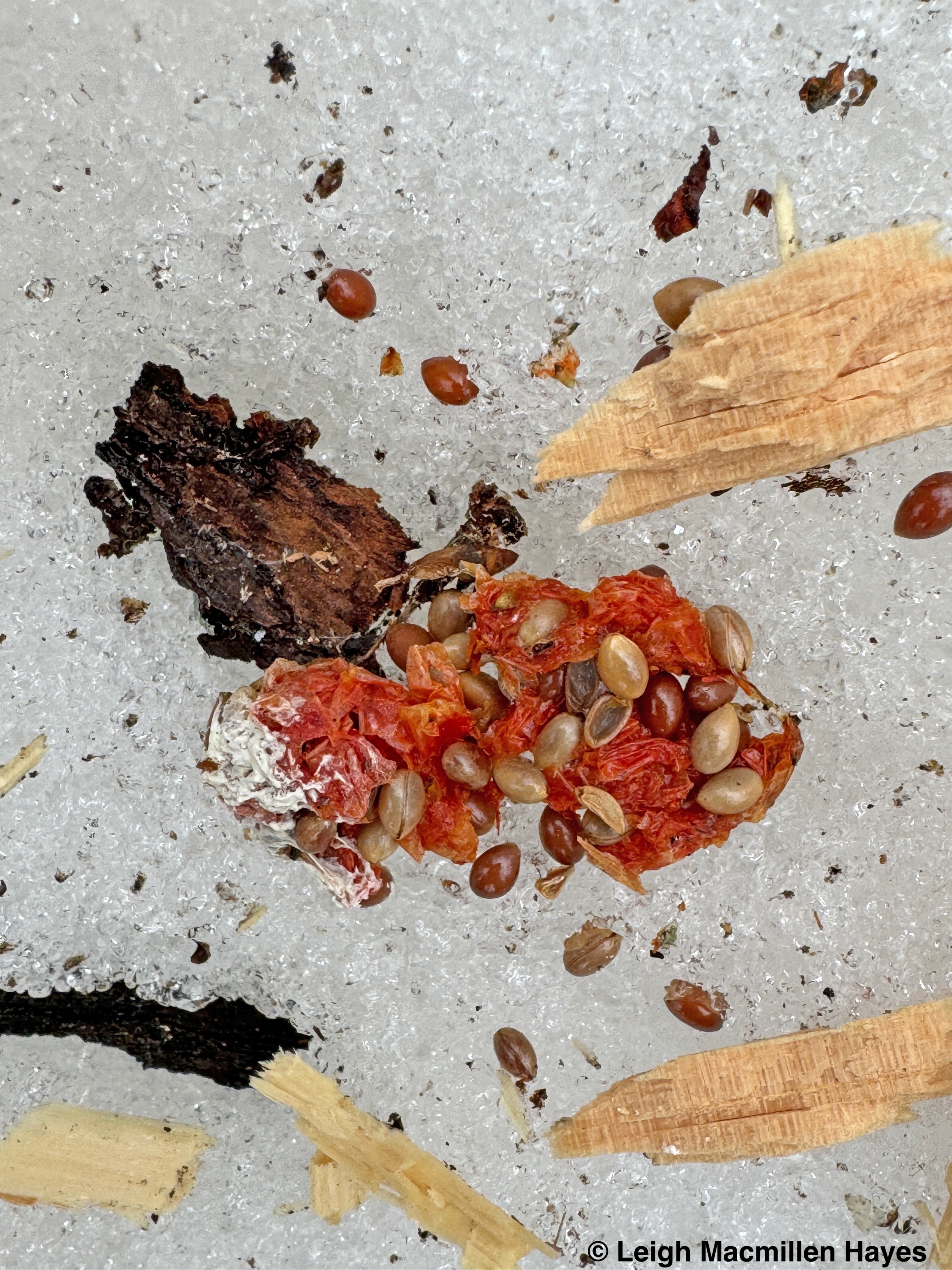
While finally making my way homeward, I was stopped by a sight that always invites a look. You may be tired of seeing it, but I hope I never am. The debris left behind by a Pileated Woodpecker.

There are at least two packets worth examining in this mess, and if you know what I mean, see if you can find them.

The tree was one rather gnarly Eastern White Pine and it grew near one of the old boundaries for the park was originally three different properties that were combined to create such an open space. You can read about that in Pondering the Past at Pondicherry Park. I suspect its growth pattern had something to do with being a boundary tree in an otherwise open area.

Do you see the bird’s excavation site?

And did you find this scat in the debris? Staghorn Sumac had been part of this bird’s diet prior to visiting the tree.

But carpenter ants were on the menu as well. Vegetable, Protein, Fiber. The perfect meal.

When I arrived home, it was time to do some organizing of my moss collection, some of these which I’d collected in the past and kept in Ralph Pope’s Mosses, Liverworts, and Hornworts: A Field Guide to Common Bryophytes of the Northeast.

The book is warped because, of course, most of these were damp when I placed them in it.

Here’s the thing about collecting mosses: only take just enough to study. Mosses can take a long time to grow, so you only need a small piece for closer inspection. As for lichens, if you need to, collect from those that have fallen off trees. Otherwise, let them be. They take even longer than mosses to grow.

And I encourage you to spend some time trying to get to know what you meet up close and personal. Looking through a loupe and sketching help me.

Slowing my brain down and noticing. I love that I am finally making time to do this again. And taking topics that had often stymied me and trying, trying, trying to get to know them better.

While I was pondering once again in Pondicherry, I did notice that someone was pondering about me. I went with the expectation of possibly seeing an owl while spending time quizzing myself on all of these species, and indeed I did. See an ice owl that is.

The Giant’s Shower

I did a thing. Years ago I wrote a children’s story. Well, a bunch of them actually. And I tried to sell this particular one to publishing houses. No takers. Then, a couple of years ago I purchased a Fairy Coloring Book created by the one and only Solana, teenage daughter of the Fly Away Farm Wards in Lovell and Stow, Maine, and approached her about illustrating my fairy tale. She took on the task and did an amazing job. Then I asked copyeditor Pam Marshall to wave her magic wand over it. And finally a few weeks ago I asked graphic designer Dianne Lewis to use some fairy dust and turn it into an actual book. I always said I’d never self-publish a book. And tada: I did just that.

Aisling, a fairy who lives on Sabattus Mountain in the western Maine village of Lovell, has a vision during the Midsummer Eve celebration. 

Twinkles, flitters, a bit of fairy dust and some tsk-taking are necessary to make Aisling’s vision a reality. 

You and your children will delight in the story accompanied and the colorful and whimsical illustrations created by artist Solana Ward.  

Marita Wiser, author of Hikes and Walks in and around Maine’s Lakes Region had this to say about the book, “The fairies in The Giant’s Shower will captivate children with their merry life in the forest. It’s not all magical though, as they moved from New Hampshire to Sabattus Mountain in Maine to avoid a certain devil. At least they thought the giant was a devil, but the situation wasn’t what it seemed at first. Both the writing and the detailed illustrations capture many features of the woods of northern New England, and the fun of fairy life and houses.” 

A naturalist and writer, many of you know that I hike frequently in Maine and New Hampshire, and those adventures inspired this story. I feel the fairies’ magic whenever I’m among moss-covered ground and tree stumps.

Included in the book are directions to the two featured settings, Sabattus Mountain and Arethusa Falls. Both are easily accessible for young hikers who might experience some magical moments while exploring. 

Also included is a list of character names and their explanations, as well as instructions to create fairy houses and fairy dust. 

The Giant’s Shower is available for $16.99 at Bridgton Books, Hayes Ace Hardware, Fly Away Farm, or by contacting me: thegiantsshower2023@gmail.com.

Lake Living magazine, Fall/Winter 2023

It takes us several months to toss ideas around, set up and conduct interviews, and then let the writing process play out. The latter is among my favorite activities because it takes work to figure out how to present the topic and because people are passionate about their subject and share a lot more in an interview than we need, as writers we have to get to the gist of it and then hone, and hone, and hone some more. Even the final published piece is not really the final draft because always, at least when I read what I’ve written, there are things I would change or other words I wished I’d used or examples I wish I’d given. But . . .

With all that said, I present to you the Fall/Winter issue of Lake Living magazine, which is in its 26th year of publication (and I give great thanks that I’ve been privileged to write for and work on the magazine staff since 2006).

And the table of contents:

The cover photo and lead article were written by Marguerite Wiser, a young woman of many talents. Marguerite has written several articles for Lake Living in the last few years and it’s great to have her voice in the mix.

Tear Cap, as you’ll discover upon reading the article, is about a collaborative effort that celebrates community in an old mill in Hiram, Maine.

Editor and publisher Laurie LaMountain has written about Ian Factor’s studio in Bridgton in a previous issue, but now Ian has taken his work a step further and you can read all about what he’s bringing to Fryeburg Academy students in Fryeburg, Maine.

Laurie wrote several other articles as you can see from the table of contents, one about the Magic Lantern and their STEM programs, and another about an interesting painter who captured her whimsy with his own sense of whimsy. When we chatted on the phone after she’d interviewed Dwight Mills, I could tell she most jazzed about the man.

A new contributor to this issue was Mollie Elizabeth Wood. When I heard about her topic, my gut reaction was, “Really? For Lake Living?” But, you’ve got to read this article. It’s incredibly well written and brings death to the forefront, because, after all, it’s on the horizon for all of us.

One of my articles is about a new building currently under construction at the Rufus Porter Museum in Bridgton, Maine. If you are a long time follower of wondermyway.com, you may recall the day the community walked the Church Building at the museum down Main Street. If you are new to wmw.com or have a memory like mine, here’s the link: Walking with Rufus Porter. Now, the campus is growing and it’s an exciting addition to town.

Pre-pandemic, when advertisers were more abundant, and publishing costs were lower, we published Lake Living four times/year and in the fall and spring issues you could find book reviews from the owners and staff of Bridgton Books, an independent book store. Above are Justin Ward’s picks from the bookshelf.

Now, we only publish two issues, so in each one you can see what they recommended each time you pick up a copy of the magazine. These are Perri’s Preferences.

This last article resonated with me because it’s about two people from different sides of the table who sat down to chat and realized they have a lot in common and figured out a way to work together. Rex Rolfe of Rolfe Corporation in Bridgton, owns an aggregate /excavation business, and Erika Rowland is the former Executive Director at Greater Lovell Land Trust, where I also work.

This past summer, a small group of us stood in one of Rex’s pits that abuts land trust property, and the two shared their story. It’s what got me thinking that we need to educate others about this topic.

Oh, and that pile of sand behind Rex–it’ll help keep you from sliding on local roads when the snow finally flies this winter as town trucks have been going in and out recently to fill their storage facilities.

When we came up with the editorial list for this issue I thought, “Well, this one doesn’t seem to have a theme,” but as Laurie wrote in her editor’s notes on page 4, “Community, connection, collaboraton, creativity–these are the concepts that thread through this issue of Lake Living . . . they are the hallmarks of where we live . . . ”

And on October 10, Laurie received this message from a reader:

I leave you all with an image of Rex Rolfe’s toy collection and hope that you’ll take the time to brew a cup of tea and sit down with the magazine and enjoy all that is within its covers . . . and then support the advertisers so we can continue to bring this to you for free!

Here’s a link to the whole shebang: Lake Living magazine

Lake Living Summer Issue 2023

With twists and turns along the way, somehow we once again pulled off a summer issue of Lake Living magazine.

This one is super cool because not only are all the articles written by women, but they each feature women. And one was actually written by a high school student; while another is about an fabulous twenties-something naturalist who is also an artist. I wrote an article about the middle school class I have the pleasure of working with each week during the school year. And another about Maine women who support an incredible group of women in Zambia. There’s another about The Summer Camp, a camp for girls from Maine and beyond who are at-risk (and an organization I worked for years ago). Plus, there’s one about mushrooms, because as most of us know, mushrooms are most intriguing. The issue also includes everyone’s favorites: The Summer Bookshelf list of recommendations by the owners and staff of Bridgton Books.

I hope you’ll take some time to savor this issue. And I hope this link works as intended because we don’t have it on the Lake Living website yet and that may take a bit.

Read it here: Lake Living Summer 2023

Lake Living Magazine, Fall/Winter 2022-23

Smack dab in the midst of a hectic work schedule, we pulled off another issue of the mag. And I have to say, I really loved working on this one. As did Laurie LaMountain.

It’s full of history, both local as I had the fortune to visit with Louisa Attenborough at the Garcelon mansion on Kezar Lake in Lovell, and across the pond (read the intros to the recipes in “One Potato, Two Potato”).

Here’s an exclusive look at a bathroom window at Garcelon, flanked by mirrors that reflect the lights in the room and in the bedroom beyond.

And a side view not included in the article. The servants’ quarters, circa 1908, were in the upper-left hand corner.

Another of my articles is about the big reveal at our local ski area, which was purchased last year by Boyne Resorts. According to general manager Ralph Lewis, lots of updates have been made since the ski area closed in the spring, but the biggest one is the name change, which excites many of us. You can read all about it in “Welcome Back Pleasant Mountain.”

My third, and probably favorite article is entitled “Life Beneath the Ice,” which features the work of fellow Maine Master Naturalist Edwin Barkdoll and his discoveries as he worked on a capstone project, and Dr. Ben Peierls of Lakes Environmental Association.

“A calm winter day. Freezing temps. Thickening ice. A lid is placed on the ecosystem below. And all aquatic life goes dormant. Or does it?” You’ll have to read the article to find out.

So here’s a look at the cover, and a view of a Whirligig Bug walking under the ice that Edwin captured during his studies.

Within, you’ll also find articles by Laurie, including “Chasing Arrows,” about what happens to those items we so carefully recycle; “Fast and Affordable,” about the need for high-speed internet in our rural communities and what a collective group of towns is trying to do for affordable broadband, and “Creative Housing Solutions,” about what a group in Norway, Maine, is trying to do to bring equitable housing to the community. Plus the recipes (and history) in “One Potato, Two Potato.”

And always back by popular demand are the book reviews from the staff at Bridgton Books. Plus ads, ads, ads, for local businesses. Please take a look at them, and then visit the businesses and let them know you saw the ad in the mag.

If you’d like to read the magazine, you can find it by clicking here: Lake Living magazine

Happy reading.

Lake Living Celebrates 25 Years in Print

I wish I could say I’ve been along for the entire journey, but still, I’ve been working with Laurie LaMountain to produce Lake Living since 2006, so I’ve been here for sixteen of the magazine’s 25-year journey.

In her editorial note of the summer 2022 issue, Laurie comments about our brainstorming sessions, where with our shared brain we bounce off of each other and do come up with what we both think are great ideas and once we get going the thoughts flow like raindrops pouring out of the water spout. What she doesn’t mention is that we also solve all the problems of the world, or at least our small portion of it. And we don’t always agree, but still we listen to each other and maybe months later recognize that our guts were right or the other one knew best. There’s an article in this issue that ruffles my feathers a wee bit, but . . . as I said, we don’t always agree and that’s fine. I’m sure you as readers don’t always agree with us either.

I think the thing about working on the magazine all these years is that I’ve had the honor of meeting so many interesting people who live right here. We rarely travel far for an interview. And yet if you look at the archived magazines, you’ll see that we’ve covered a multitude of topics.

And the special thing for me about working with Laurie is that she gives me huge, read that as HUGE, leeway to pursue a topic at any angle that I see fit. She also knows what topics I prefer to write about and usually those come my way, but sometimes I have to do what is best for the magazine and leave my personal opinions in my truck. It’s rare, but it has happened over the years.

Enough of my jabbering. On with the magazine!

In the line-up: “Growing Up” about downtown Bridgton by Laurie; “Scribner’s Mill & Homestead” about a living history museum in Harrison by me; “Docks that Stay Sturdy” by Great Northern Docks owner Sam Merriam in Naples; “A Fascination for Fungi” about a local artist’s interpretation by Laurie; “Summer Living,” which is a modified calendar of local events by me; “Summer Bookshelf” by the owners and staff of Bridgton Books; “Click-free Shopping” about Main Street stores that somehow survived the chaos of the last few years and chose to meet customers’ needs without too many online sales by me; and “Salted” about cooking with salt by Laurie.

Here’s a link to the entire issue should you care to read it online: Lake Living Summer 2022

You may have noticed that we didn’t produce a winter or spring issue. Sadly, that was due to the pandemic and local economy. Lake Living is free and supported by the advertisers. For the last three years, we’ve been unable to get enough winter advertisers, so we combined fall and winter articles into one. And then this year when things became even worse, we couldn’t get enough to support a spring issue that we’d pulled together. Unfortunately, because of that, some of those articles are now in a folder and I don’t know if they’ll ever get published. And even when it seemed we could pull off a summer issue, again there weren’t quite enough advertisers to support the usual 40 pages and this one is only 32. That coupled with the fact that the cost of paper went up 40% this spring, added to the downsized summer issue and again, not all the articles we’d written made it in to the final copy and some had to be edited drastically in order to fit the page count.

But . . . the magazine is out there. On a shelf if you live locally, or in the link I included above. I hope you’ll take time to read it. And then take time to support the advertisers and let them know where you saw their ads because unless you tell them, they don’t know the effect of their dollars.

Happy 25th Birthday, Lake Living! And hats off to Laurie and editorial designer Dianne Lewis, and all those who have contributed over the years.

Lake Living magazine: fall/winter 2021

I always get excited when an issue of Lake Living hits the shelves and the fall/winter one is now being distributed. If you are able to pick up a copy, please do so. And if you aren’t local, you can find a link to it here and below. 

The first article, written by Laurie LaMountain, is “Finding Center” about an artist who purchased a building that began its life as a Roman Catholic Church, whose congregation outgrew it, and then for decades as Craftworks, a highly successful retail clothing and homewares store until it closed in March 2020. And now it is transforming into Factor Fine Art Center for the Arts and the story is as much about the building as it is about the man who is behind this repurposing project. 

As always, in the fall issue, there is an article about a house renovation, this one entitled “Big Pine Farm,” also written by Laurie. The color scheme reminds me so much of our own kitchen renovation. 

Next inside the cover is an article I wrote about a large barn that isn’t undergoing a renovation, but rather is being rescued from listing to the west and possibly toppling over, thus I titled it “Rescue Mission.” I had the great pleasure of meeting and interviewing a young man who is overseeing the project. Keeno Legare grew up looking at (and sometimes exploring) the barn and has a strong desire to continue to preserve the structure. 

One of my favorite parts of the building is the silo—located inside rather than out. The article includes some of the history of the barn and the passion its owner, David McGrath, has for it. 

“The Home Sauna: Active Relaxation” is Laurie’s third article. This is about one man’s COVID project that resulted in a small building where he can reap health benefits while letting the world wash away.

Laurie’s final article is entitled “Light Breaking.” This is about Laurie Downey, a woman who transformed her artistic direction after working as the set designer for her daughter’s school drama club. “Taking her cue from nature, she initially created a dozen lyos lightscreen patterns from drawings and photographs, or a combination of the two, that mimic rippling water, sun dappled foliage, forsythia in bloom, stands of saplings, and bare branches.” As you can see in the title photograph, ice also informs her art. 

My second article is about Forest Therapy in the winter. Maine Master Naturalist and Forest Therapy Guide Jeanne Christie shared with me information about how a forest therapy session works, the values of participating in such a walk, and ways to make sure you stay warm while doing this in the cold season. I’ve participated in a few of Jeanne’s forest therapy walks and highly recommend that if you learn of one of these in your area, you strap on your snowshoes and head into the woods with a guide. 

“Night Show” is my final article. The essence of this article is about light pollution from artificial light. “The International Dark Sky Association (IDA) defines light pollution  as ‘inappropriate or excessive use of artificial light,’ and goes on to stay that ‘it can have serious environmental consequences for humans, wildlife, and our environment.’” Since writing this article, my guy and I had the opportunity to visit Katahdin Woods and Waters National Monument, designated an International Dark Sky Place. It’s the first place on the eastern seaboard to receive this designation and only places as remote as Antartica have darker skies. 

The article includes information about light trespass and ways we can improve our own indoor/outdoor lighting for the benefit of all. Just imagine—if we all jumped on the bandwagon and turned off or down our lights, the stars would surely amaze us. 

The magazine concludes with everyone’s favorite: the bookshelf with book reviews from the owners and staff of Bridgton Books. 

That’s a summary. I do hope you’ll either pick up a copy and read the articles and let the advertisers know that you saw their ads . . . cuze the magazine is free to you. And if you can’t pick up a copy, please click on the link here: lake living fall/winter 2021

lake living magazine: Summer 2021

It feels like forever, but has only been since last fall that we produced an issue of Lake Living. Our hiatus was due to the pandemic and the fact that we didn’t have the usual amount of advertisers (the mag is free to you, so please support the advertisers who make it happen–and tell them where you saw their ads. Thank you.), and stores and other businesses didn’t necessarily want to put a magazine on the shelf. That was all before we understood this devastating disease better.

But . . . we’re back! And with some timely articles I think you will enjoy.

The first article, “Conservation Collaboration,” by yours truly is about Sebago Clean Waters, an initiative that includes Loon Echo Land Trust, Western Foothills Land Trust, Portland Water District, Lakes Environmental Association, Mahoosuc Land Trust, and some bigger entities. I won’t give away how it works because I want you to read the article, but it’s all about clean water and the Sebago Lake watershed and what these organizations are doing to benefit all of us.

In “A Sense of Space,” Laurie LaMountain describes how architect John Cole recreated a lakeside house in a creative way given shoreland zoning laws in Maine. Not only is this an enjoyable read to learn more about how John and the homeowner problem solved to turn small living quarters into airy living quarters, but Laurie also provided valuable information about the laws that govern building beside our lakes and ponds.

Laurie is also the writer of this extremely important topic: protecting our most precious resource. A must read for everyone, both here in Maine and afar.

Up next is another article by me, “From the Earth to the Moon and Beyond,” about the world-class Maine Mineral and Gem Museum in Bethel, Maine, where I had the opportunity to hold this moon rock. You can too! But again, be sure to tell them you read about it in lake living.

That’s followed by the Summer Living calendar of events that comes with the warning that all items are subject to change because one of the take-aways from the last 15 months is that we all need to be flexible. So . . . check websites before heading out the door. I know this to be so true because at Greater Lovell Land Trust we’ve already made some changes since publishing our summer calendar.

“Eat What You Sow,” about three local gardeners including lake living‘s graphic designer, Dianne Lewis, is an informative article by my friend and emerging writer, Marguerite Wiser, Farm Lead at The Ecology School in Saco, Maine.

Possibly one of the most visually colorful articles I wrote, entitled “The Bag Lady,” features Designs by Diana Bags, a Lovell, Maine, business Diana Davis created and her story of how it came to be that’s she’s selling hand-made bags and other consigned items from her boutique and workshop on Main Street. Another one where you need to stop in and let Diana know you read her story here.

And no copy of the summer issue would be complete without book reviews from the folks at Bridgton Books, including owners Justin and Pam Ward, and employees Sue and Perri. There’s something in these pages for everyone, and once again I beg you to shop local. By now you know what to tell them when you step up to the counter to make your purchase. ;-)

Finally, Laurie brings us recipes as she always does, this time in the form of “l’apéritif.” If you don’t know what that means, you’ll have to check it out. Well, of course, you need to check it out because ’tis the season.

To say we’re excited to be back would be an understatement. I hope you’ll pour a cup of coffee or glass of lemonade and enjoy the read. Here’s the link: Lake Living Summer 2021

Summer by Nature

Given the fact that the day the spring issue of Lake Living was to be distributed to stores and other businesses throughout the lakes region of Maine was the day the state shut down because of COVID-19, thus meaning Laurie LaMountain had box loads sitting around with no where to go but her garage, and many businesses had completely shuttered their doors and windows and those that stayed open were serving a limited number of customers and didn’t necessarily want magazines, we weren’t sure there would be enough advertising dollars to produce a summer issue.

By the same token, we both felt it was our duty to produce a summer issue. And so we did. It did not come out on June 20th, as would have been the case in the past, but suddenly that didn’t matter. It’s not as long as prior summer editions, but suddenly that didn’t matter. The three to four page calendar spread is missing, because, um, not a whole lot is going on, but suddenly that didn’t matter.

As happens more often than not, a theme emerged. Laurie addressed it in her Editor’s Notes. I’ll just say this: Take your time. And notice.

Be sure to check out the book reviews from Bridgton Books and picnic recipes. Plus read about some wicked cool fish food, Lake Environmental Association’s history, and a few local businesses that are employee owned.

I was given the good fortune to write about my passion for the world beyond doors and windows, which allowed me to weave a bunch of ideas together in a ramble of sorts.

I also wrote about a woman who can take a slab of wood and turn it into a three-dimensional piece of art. Sue Holland’s work is incredibly intricate and always tells a story.

I can’t help but smile every time I look at the cover of this issue. Sports Illustrated move over!

We’ve even got a centerfold you might want to hang on a wall!

This issue of Lake Living is about summer by nature. Pour a cup of tea or glass of wine, click on the link and enjoy the articles: Lake Living Summer 2020

All Aboard Mondate

His birthday present several weeks ago was a Cat’s Meow replica of the North Conway Scenic Railroad (from my collection) and a note: October 21, 11:00 am – 4:00 pm. Be there!!

This morning I drove him there. No, I wasn’t the engineer of the train, but rather the conductor of his entertainment schedule.

Our chosen car, the Dorthea Mae, was built in the mid-1950s for transcontinental service in the United States and turned out to be the perfect choice for this adventure. We’ve ridden the Conway Scenic train before–several times when our sons were young and we took the one hour ride from North Conway to Conway, New Hampshire, and once for an anniversary celebration as we enjoyed dinner on the Bartlett Route. But for all the times we’ve driven along Route 302 through Crawford Notch and looked at the scary trestles hugging the mountains, we always said we’d love to take the longer ride. Well today, that became a reality.

Group by group, riders were welcomed to climb on and find their assigned seats. Ours was located opposite a delightful and chatty couple from Iowa, MaryPat and Ron.

For us, part of the fun was recognizing familiar spots along the rail, including a rail crossing on Route 302 by a historic barn.

Through the village of Bartlett we travelled along rails originally laid down in the 1870s for what was once the Maine Central Railroad’s famed Mountain Division Trail.

The church to the left is the Union Congregational Church on Albany Avenue, and to the right the Odd Fellows Hall, a historic fraternal society.

Early on we crossed trestles over several rivers where shadows, angles, curves, and foliage delighted our eyes.

As we headed toward Crawford Notch, again it was the same, only different, with ever the click-clack of motion providing a new vista that captured our awe.

History presented itself over and over again, with old rail ties and power poles dotting the landscape–obscured for a wee bit longer by the golden hues of the forest.

Knowing that today was the only date available when I’d booked the trip, and in fact, that we got the last two seats on the Dorothea Mae, we wondered how much color we might see given that we were traveling north. It was past peak, but still . . . one Red Maple stood out amongst the yellowy-orange-bronzes of the landscape.

There was also some white to view–not only the few clouds, but the summit of Mount Washington with a recent coating of snow and rime ice.

The ridgeline of Mount Webster, forming the eastern side of the U-shaped glacial valley which forms Crawford Notch, stood crisp and clear as we headed north.

The mountain was named for Daniel Webster, a statesman and orator born in Salisbury, New Hampshire, which is present day Franklin where I began my former teaching career in 1980.

From our seat on the train, looking south, Mount Webster was on the left, Route 302 between, and Mount Willey on the right forming the western side of the U.

By Mount Willard, we heard the story of the section house that stood here in the 1900s.

Willey Brook Bridge is Crawford Notch, New Hampshire https://digitalcollections.nypl.org/items/510d47d9-a2cf-a3d9-e040-e00a18064a99 Detroit Publishing Company Collection, Photography Collection, Miriam and Ira D. Wallach Division of Art, Prints and Photographs, The New York Public Library, Astor, Lenox and Tilden Foundation

Our narrator, Denise, spoke of the Mt Willard Section House built in 1887 for section foreman James E. Mitchell, his family, and crew who maintained Section 139 of the railroad. Loring Evans became foreman of Section 139 in 1903. He was killed ten years later in a railroading accident at Crawford’s yard, but his wife, Hattie, raised their four children and despite all odds ran the Section House until 1942. It was Hattie’s job to house and feed the men who worked on the shortest yet most treacherous stretch of the rail.

A memorial garden still honors her work.

Below Mount Jackson, across the way, two waterfalls graced the scene. Typically, we’ve viewed them one at a time, but from the train, both Flume and Silver Cascades were visible as water raced down the mountain’s face.

This being Silver, but both looked like traces of chalk from our position.

Two hours after our journey began, we arrived at Crawford’s Depot.

Disembarking, and with an hour to ourselves, my guy and I ate a picnic lunch that included chicken salad sandwiches enhanced with home-made cranberry-orange relish, and then we crossed the road to walk the .4-mile trail around Saco Lake, the origin of Saco River.

Beside it a few Dandelions flowered. And my guy questioned me. “You’re taking a photo of a Dandelion?” Yup. Never Call it just a Dandelion is the title of a most delightful and informative book. And sooo true. Notice how each ray is notched with five teeth representing a petal and forms a single floret. Completely open as this one was, the bloom was a composite of numerous florets. And can you see the stigmas? Curled and split in two? “Yes, I am taking a picture of a Dandelion because it deserves to be honored. And not pulled from the lawn. Just sayin’. ”

Meadowsweet (Spiraea alba var. latifolia) also posed, its fruit’s five-parted capsules each containing two to four small seeds. It was the color that made me smile on this fall day.

Upon a small bridge where Elephant Head Brook flows into Saco Lake, most people paused and then turned for so wet was the trail. But you know who kept going. Despite wearing sneakers rather than our hiking boots, we found our way and soon moved beyond the wet trail.

We laughed when we discovered a wooden boardwalk in a drier section.

Others had also ventured here and called it home, although based on the lack of new wood, we suspected the beavers had left the lodge. Perhaps they’d moved across the street to the AMC’s Highland Center.

Upon granite that defined the outer side of sections of the trail, Rock Tripe lichens grew, some turning green as they photosynthesized when I poured water upon them.

Always one of my favorite views is the discovery of Toadskin Lichen beside the Rock Tripe, both umbilicate forms.

Back to Route 302, asters showed their displays of seeds awaiting dispersal and those older empty nesters forecasting their winter form in a flower-like composition all their own.

Just prior to 2:00pm, we reboarded the train for the journey south.

For the return trip, we’d switched seats with those who sat on the western side of the train for the journey north and so got to spy the Willey foundation. Local lore has it that in 1793, Samuel Willey took his wife, five children and two hired men to live in a small, remote house in the mountains. That year, he and the hired men built a house.

As our narrator said, “In June of 1826, a heavy rain terrified the Willey family when it caused a landslide across the Saco River. Sam decided to build a stone shelter above the house where he thought the family could find safety in case of another landslide. On August 28, 1826, a violent rainstorm caused a mudslide. The Willeys and hired men took refuge in the shelter. The landslide killed all nine of them, but the house they’d fled stood still.” Apparently, a ledge above the house spared it from destruction.

We loved the historical aspects of the trip, as well as the scenery, short hike, and good company.

At the end of the day, we were all smiles for this All Aboard Mondate.