Yo, Brooklyn!

Past visits to New York City have always included museums and shows, but this weekend we followed a bit of the familiar path and sometimes took the trail less touristy in an attempt to get to know the area better.

2-Manhattan in the fog

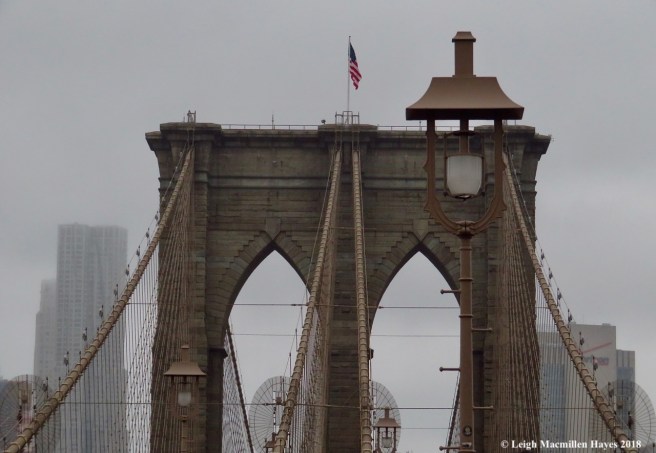
Saturday afternoon, following our arrival via a bus from Worcester, Mass., we walked across the Brooklyn Bridge to Manhattan, which was a bit veiled in fog, thus softening  ordinarily crisp lines.
1-Brooklyn Bridge

Begun in 1869 and completed by 1883, the bridge spans the East River and connects the boroughs of Brooklyn and Manhattan.

3-bridge like a spider's web

Among the throngs of people who walked or rode bicycles across, we all wove strands of thread that fit easily into the web long ago created. Some of us paused suddenly here and there, as the arachnid tried to take hold, while others tried to maneuver along the silken dragline writing messages with their feet much the way Charlotte may have within her web.

6-wildlife on the bridge

And a few got caught up by the constrictors waiting at the center.

7-onto the streets of Manhattan

At last we emerged on the other side, where our attention was diverted by the architecture and colors.

8-New York Stock Exchange

Often, it was the interaction of today and yesterday that drew our notice, joined together as they were with a global reference.

9a-entrance door to St. Patrick's

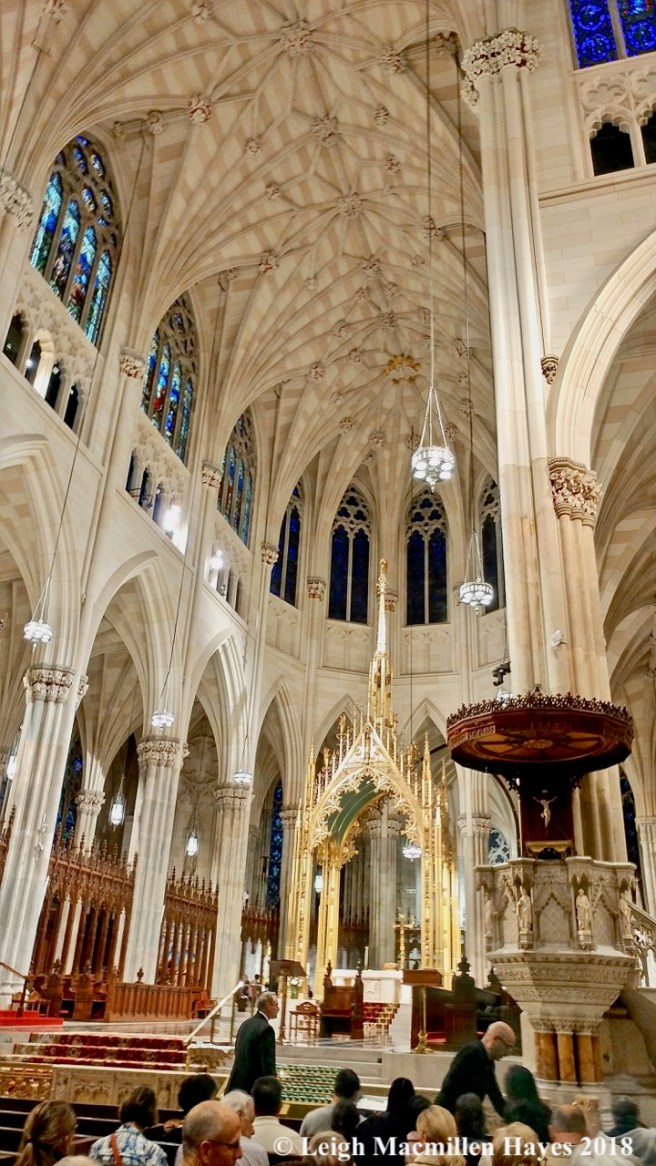
Eventually, we passed through the doorway of St. Patrick’s Cathedral . . .
9-St. Patrick's Cathedral

where many have gathered for centuries to light candles in memoriam of those who have passed from this layer of life to the next and prayed for the future.

11-view from Central Park

And then we slipped into Central Park, where we were again struck by the architecture, especially as juxtaposed against the artificially landscaped natural world.
13-goldfish

As we watched the Mallards and Canada Geese, one of our biggest moments of awe was for a goldfish–the largest we’d ever seen.

Eventually, we boarded a train and found our way back to Brooklyn, where a quiet evening awaited.
14-the bridges from below

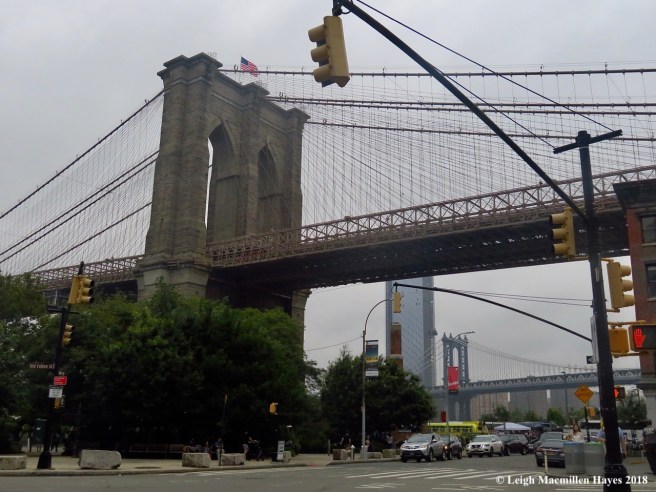
Sunday morning found us passing below the Brooklyn Bridge, where we could glimpse  the more “modern” Manhattan Bridge in the distance.

15-skyline from the promenade

Again, the skyline was muffled, but its edges softened.
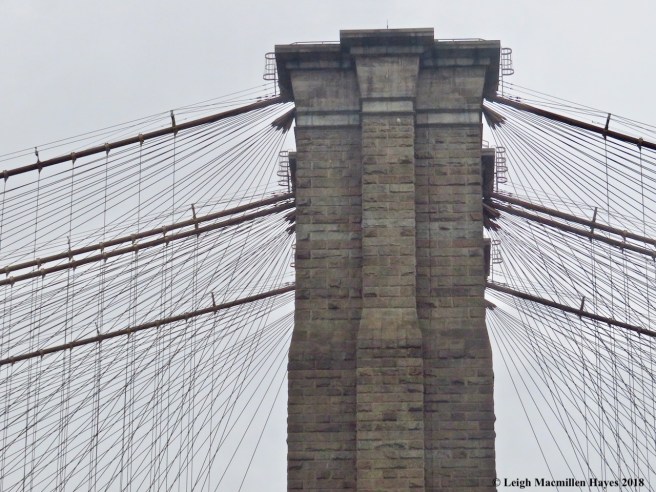
16-spider web again

And once more we looked with wonder at the web construction.

17-river boat NYC style

Ever so slowly, we moved away even as a paddlewheeler representing the south made its way north.

18-cormorants and gull

Despite our thrill at watching water taxis, tour boats, jet skis, sailboats, powerboats, and even a police boat move up and down the river, the local Cormorants and a Herring Gull took it all in stride.

19-cormorant preening

After all, they had feathers to preen.
20-Canada Goose

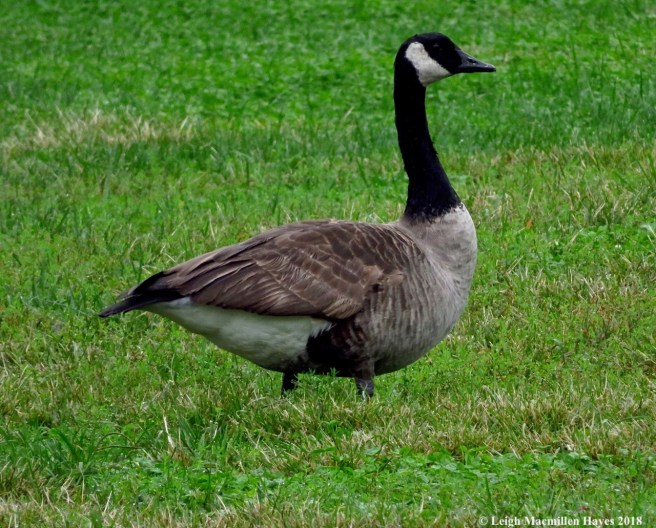
And the Canada Geese–a grassy park to foul. The irony was that no dogs were allowed, but the geese made themselves quite at home.
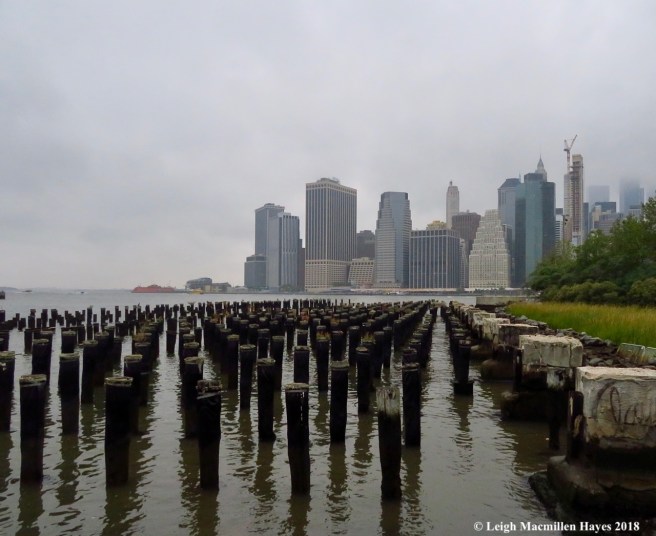
22-offices of many sorts

Above the Cormorant/Gull condos, Lower Manhattan gave way to the harbor, and we enjoyed the view from the Brooklyn Heights Promenade.

26-Lady Liberty

Our perch included the sight of Lady Liberty as she greeted all.

24-Queen Mary 2

And another grand lady, the Queen Mary 2. The last time I saw the QM, it was a previous rendition and she’d anchored in New Haven Harbor (Connecticut) in the summer of 1979. My father, sister, and I drove into the city to catch a view and then we followed the route Queen Elizabeth, who had arrived in town for a very brief visit, would take before departing from Tweed New Haven Airport. Crowds lined the route and we practiced our best QE wave. Humoring us, some waved back. We did glimpse the queen as her motorcade eventually drove by and that was enough to fulfill our Anglophile envy.

27-water tank in Brooklyn Heights

But, this weekend we were in Brooklyn to admire New Yorkers, (and we knew the queen wasn’t on the boat), so we pulled our point of view back to the area around us, which included a mosaic structure worth noting. Watertower is actually a sculpture created by Brooklyn artist Tom Fruin. He used plexiglass and steel in 2012 to represent one of the icons of our nation–a water tower.

29-playing fields on the piers

From pier to pier we followed the promenade beside the river, noting natural places and sports fields filled with athletes of many talents as they played games or worked out.

30-Brooklyn Heights

Eventually, we circled back and then climbed up into Brooklyn Heights, enjoying our meander through a beautiful neighborhood.

31-sycamore tree

And my guy, he became a pro at identifying Sycamore trees for so prolific do they grow in that neck of the woods.
33-pigeons

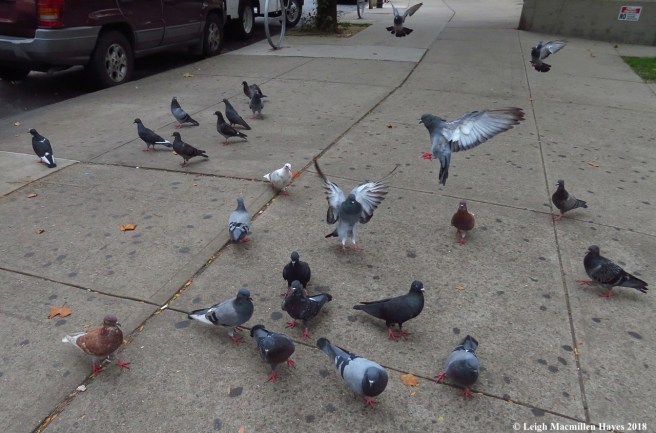
And then, and then we encountered a flock of happy pigeons. Yes, we were in New York City and all pigeons are happy there. It has something to do with peanut kiosks perhaps?
35a-pigeon

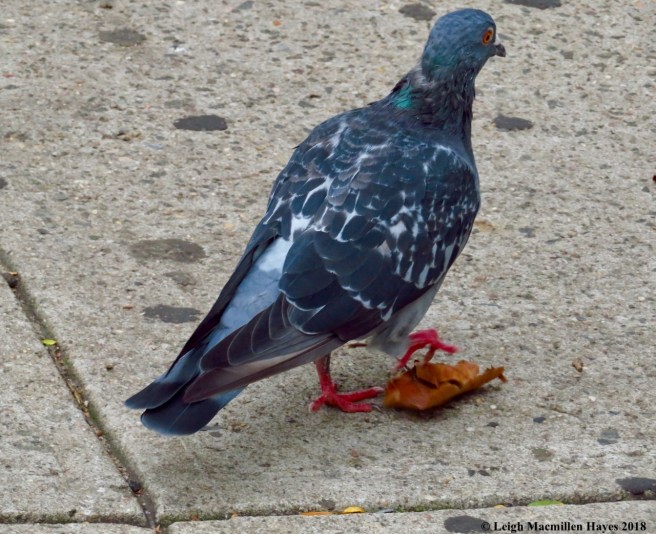
There were the typical blue-gray birds with two dark wingbars,
35-pigeon

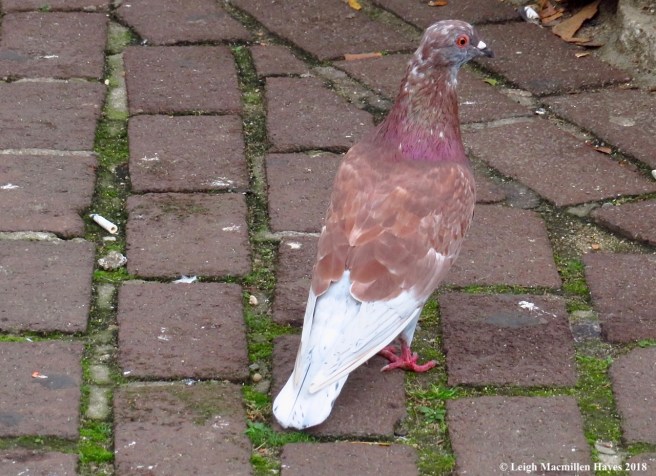
rusty red version,

34-pigeon

those spotted or mottled,

36-pigeon

and even pale among the gang.

34a-piegon

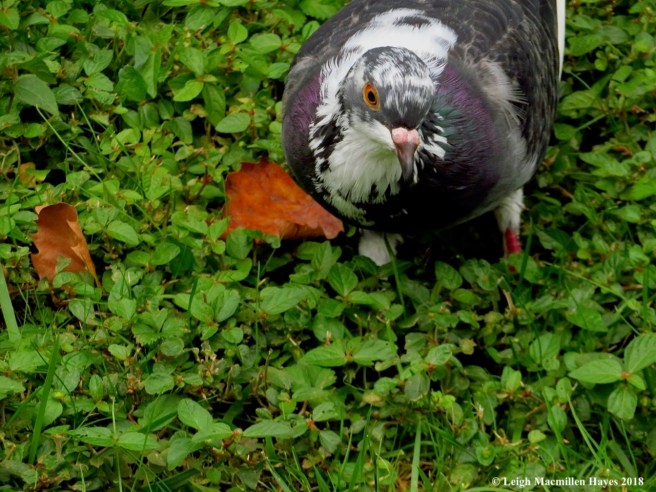
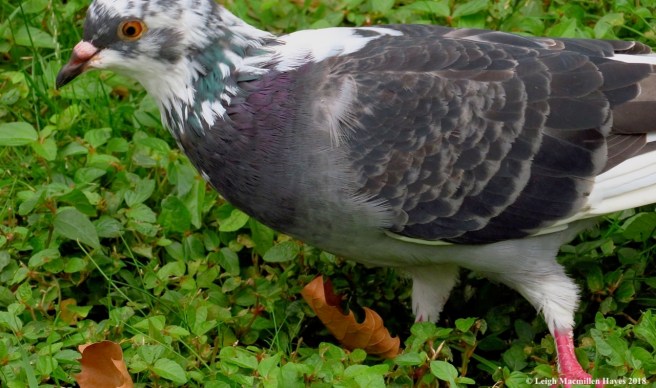
But really, have you ever taken the time to look at those iridescent colors?
39-piegon

Or that sweet face?

40-maidenhair tree, ginko

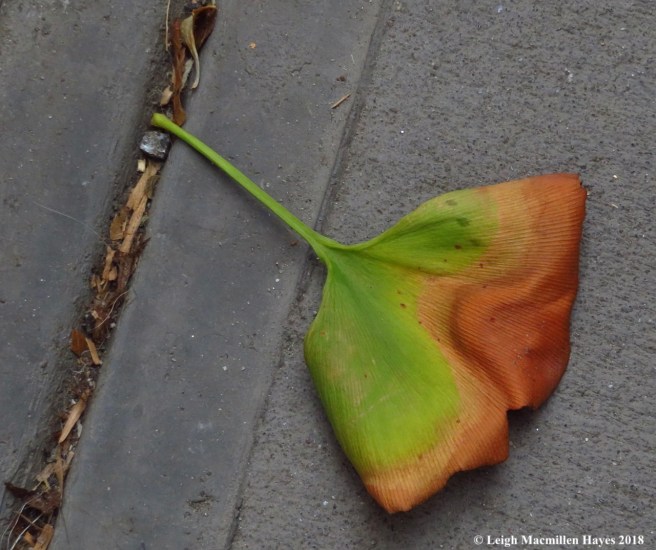
At last we left our pigeon admiration behind and continued on, noting another tree not in our familiar category–the Maidenhair or Gingko Tree.
41-maidenhair leaf

Its fan-shaped leaves showed off the carotenoids that had been hidden all summer by the green pigment. Fall was slowly embracing the city, but it hadn’t arrived in full yet.

42-barber shop

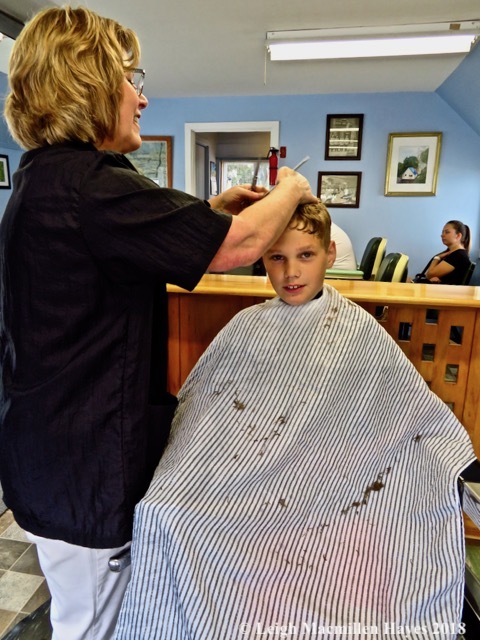
As we moved from a more residential to commercial area, we were surprised to find a barber shop open on a Sunday morning. Given that I’d recently written about barber shops for Lake Living, it was fun to peek inside. And note how many men waited. But, in this city where many work late each day, it made sense that they’d make time on a Sunday morning for a hair cut.

43b-hardware

Eventually, our wanderings led us to a hardware store. And not just any kind of hardware store . . .

43-True Value

for it was an independently-owned True Value, much like my guy’s.

43a-entering the hardware store

And since one of our reason’s for visiting the city was to celebrate his 65th birthday, I followed him in.

45-fig in the garden

Lunch found us eating a slice of pizza from a local pizzeria. It was OK; better than what we find in Maine, but not quite what I remember from my childhood in Connecticut. We did eat in the “garden” where figs grew! I wasn’t quite sure how that related to pizza. But . . . we were in New York.

42-intential grafitti

New York . . . a city where graffiti is understood.

44-my guy.jpg

Our day ended with dinner at a small neighborhood Italian restaurant, Santa Panza, where we quietly celebrated my guy’s birthday with the most delicious dinner.
40-rotating statues of Miss Brooklyn and Miss Manhattan

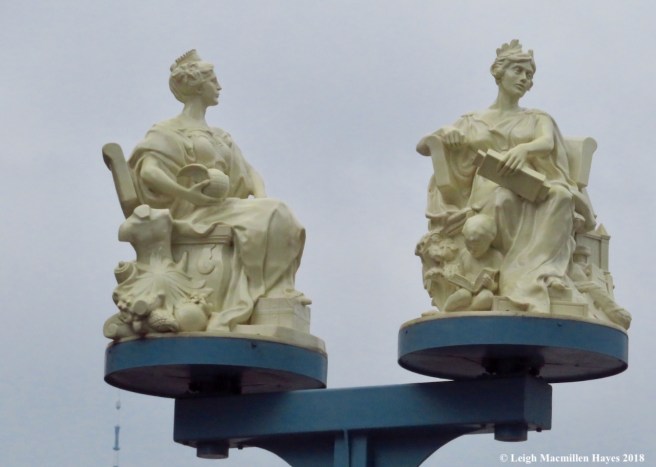
As this morning dawned, it was time for us to look out the window of our hotel and say goodbye to the two ladies who’d waved us in and would wave us out. Miss Manhattan and Miss Brooklyn rotated continuously at the intersection of Flatbush Avenue and Tillary Street.

According to a Brooklyn Public Library’s website: “Miss Manhattan sits haughtily with her right foot atop a chest of money (or jewels?); in her right hand she holds a winged globe reminiscent of a cross-bearing orb, an ancient symbol of authority; a peacock, flashiness and luxury incarnate, is by her side. (The peacock, in the belief system of the Ancient Greeks, also represented immortality/eternity.) The bows of three ships hint at the status of Manhattan as an important port and an international trade hub. She is all dignity, privilege and hubris.

Miss Brooklyn’s demeanor could not be more different. Her expression is gracious, introspective and calm; she is surrounded by a church spire (Brooklyn to this day counts more houses of worship than any other borough); a lyre and a child with a book (a reference to the borough’s patronage of culture and education). The book on the child’s lap is massive. It must be a Bible, another reference to the borough’s spiritual thrust. Her head is adorned with a laurel wreath. In her hands she holds a tablet with the Dutch inscription “Ein Drach Mackt Maght” (“In Union there is strength”), a hint at the Dutch origins of Brooklyn and at the fairly recent New York City consolidation of 1898.

The granite maidens originated on the Manhattan Bridge, but these sculptures were installed on a pedestal at their current location about a year ago. For us, they were our home monuments much as Pleasant Mountain serves as our home mountain. Not only did they welcome us and send us on our way, but we knew where we’d lay our heads for the night as we approached.

43-Yo

At last, our brief city adventure came to an end, but we trust we’ll return.

Yo, Brooklyn! Yo Miss Manhattan and Miss Brooklyn. Thanks for the welcome. Until we meet again . . .



Lake Living, Fall 2018–worth a read

The autumn issue of Lake Living is now available at a local store (for free) or you can read it online.

I had the pleasure of writing three articles. The first is about my friend Marita and the sixth edition of her book entitled Hikes & Woodland Walks in and around Maine’s LAKES REGION.

m1-cover

Of course, I got to hike many a trail with her and so perhaps my review is a wee bit biased.

The article ends with a brief description of several hikes–I tried to choose different levels of ability for those.

1

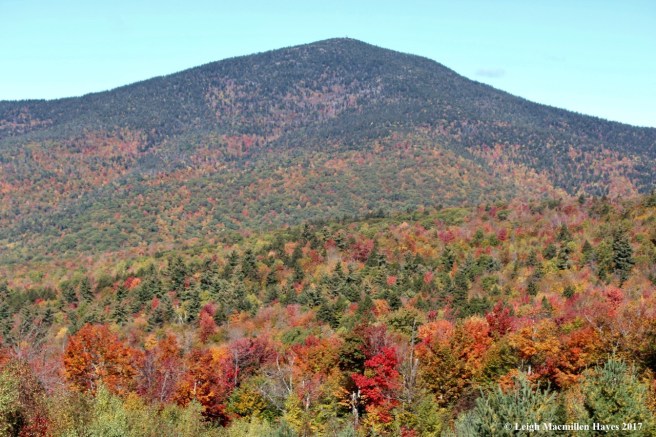
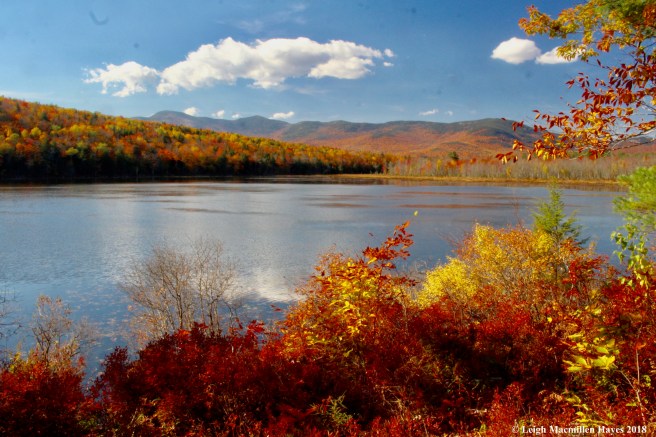
All offer incredible fall foliage viewpoints, including Shell Pond off Route 113 in Evans Notch. (Wait a month and it will like this again.)

4

Then there is the article about barbershops. In the process of writing this one, I learned the story behind the barber pole. Do you know it?

2

Sitting in four local barbershops was fun–a great way to catch up on gossip and listen to some funny stories. Again I was a wee bit biased as Steph of Steph’s Barber Shop in Fryeburg is our next door neighbor at camp.

3

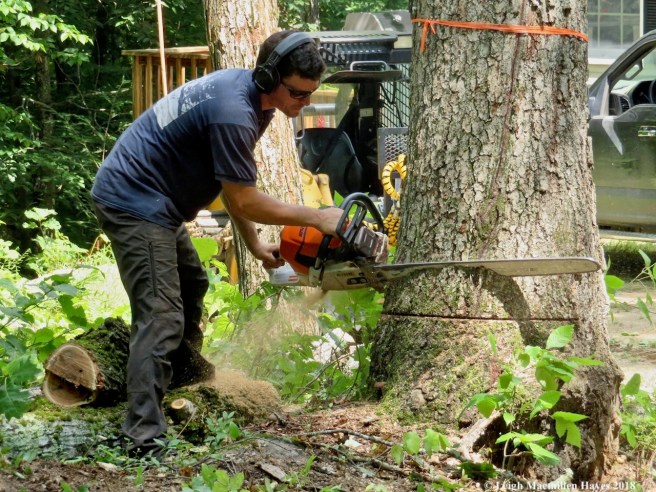
And finally, I spent some time with Arborist Josh of J and C Trees and learned more about his talent, entrepreneurial spirit and love of trees.

To say it was a busy summer would be an understatement, but the final product of Lake Living was worth it–as usual. Oh, and Laurie and Perri also wrote articles that will appeal to you.

So . . . as usual, brew a cup of coffee or tea and curl up with Lake Living. You won’t be disappointed.

Book of July: HIKES & Woodland Walks in and around Maine’s LAKES REGION

If you think I’ve promoted this book before, you are correct, for HIKES & Woodland Walks in and around Maine’s LAKES REGION by Marita Wiser was featured as the Book of October in 2016.

m1-cover

But . . . I’m thrilled to announce that Marita has published the Sixth Edition, aka 25th Anniversary Edition, of her hiking guide and it’s available at local stores as you read this. Or you can order directly from her, and I’ll tell you how later in this review.

m2-signed copy

Before I tell you about changes since the Fifth Edition, let me say that I’m a bit biased for I’ve had many the pleasure of hiking the trails mentioned within with Marita, and sometimes her lovely daughters, and she once again offered me the kindness of letting me edit. She even paid me. How cool is that? And then gave me a signed copy.

m4-blaze orange

To top it off, I modeled blaze orange with her youngest, Marguerite! If you’d like me to sign your copy, I’d be happy to do so ;-)

To keep things fresh, Marita recast her rating system with two green circles meaning easiest and one green equaling easy. That was to differentiate between those like Holt Pond or Pineland Farms, which have well-groomed and fairly flat trails (or boardwalks–just watch out when wet), from Pondicherry Park or Mount Ti’rem, where the terrain varies more, but still isn’t enough of an elevation change to meet her guidelines for a blue square indicating moderate such as Mount Will or a black diamond meaning hard like Mount Chocorua.

She also added some color photos as you can see from above, but I love that she kept some classics, including a few of her daughters that were taken twenty years ago.

The centerfold map is also in color and shows not only where the trails are located, but their degree of difficulty as well.

One of the final new additions is what she’s titled “The Lure.” What is there about a trail that might attract you to it? Marita spells out those keen features such as “wheelchair accessible,” “plenty of vertical for a cardio workout,” “interesting old foundation,” and “the Rock Castle.” There are more, but you’ll need to purchase the book to read them all.

r8-mount kearsarge 1

Among the new trails Marita recommended in this edition is the Red Tail Trail that leads to Black Cap Mountain in North Conway. My guy and I had the privilege of introducing her to that one fine day last fall.

s-Marita, Bruce and Gary 2 (1)

Together, she and I discovered the well-built trail that Bruce, the property manager, and his assistant, Larry, were building on Long Mountain in Albany.

l9a-teepee and islands in background

She’s also kept in the classics like Pleasant Mountain and . . .

c-heading up 1

Mount Chocorua and their varied trails.

I’d give away all the surprises if I told you more.

Oh, and one more thing I like about this book is that it’s an all-local effort with Marita’s writing, her mother’s sketches, an old friend’s work on the map, my fine editing skills, Laurie LaMountain of Almanac Graphics (and Lake Living magazine fame) on design, and production of the final product at Cardinal Press in Denmark. Denmark, Maine, that is.

m3-back cover

You may purchase a copy of HIKES & Woodland Walks in and around Maine’s LAKES REGION, which is printed on recycled paper with soy-based ink, at your local shop, including Bridgton Books where its long been a best seller. And if you don’t live locally, but still would like to buy a copy, the information on the back cover as seen above provides all the details you need.

HIKES & Woodland Walks in and around Maine’s LAKES REGION by Marita Wiser, designed by Almanac Graphics and self-published at Cardinal Printing, both of Denmark, Maine, 2018


Lake Living Summer 2018

For your weekend reading pleasure, here’s a link to Lake Living–hot off the press.

Of course all of the articles are worth a read, but my favorite is the one I wrote about The Hazel and Owen Currier Doll Museum in Fryeburg, Maine entitled “Dolls on Display.” Even if you don’t like dolls, I think you’ll enjoy the article.

And if you read it, then you’ll understand these next two photos better.

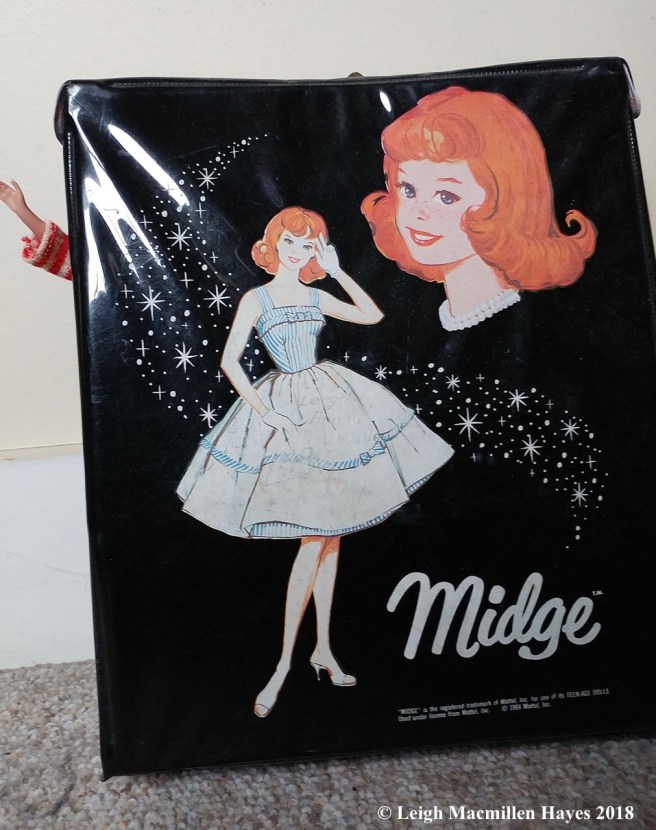
Midge 1

I don’t know when Midge actually stuck her hand out to wave, but I only noticed it this week.

m2

And I have to admit that it’s been a few or more years since I last took a peek. I think she could use some of Hazel’s tender loving care.

There’s plenty more to the magazine, including book reviews from the owners and staff of Bridgton Books. So . . . brew a pot of coffee or tea, open up the link to the magazine, and enjoy.


Unexpected Gifts

While vegetables roasted in the oven for the black bean soup that will be consumed during our Christmas gathering, I stepped outside to get some fresh air on this snowy day.

c-junco and cardinal

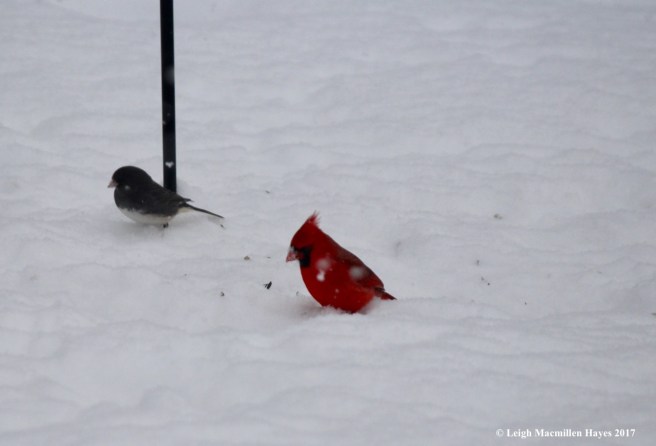
The bird feeders and ground beneath are always more active during storms and today was no different. At least forty juncos accompanied by one white-throated sparrow have been repeat feeders and occasionally the male cardinal invites his female friend along. Tufted titmice, goldfinches, chickadees, a downy woodpecker, nuthatches and bluejays rounded out the flock.

c-into the woods

Though conditions are expected to change by morning, with an ice storm in the forecast, today’s gift was fluffy and light as it embraced me in silence.

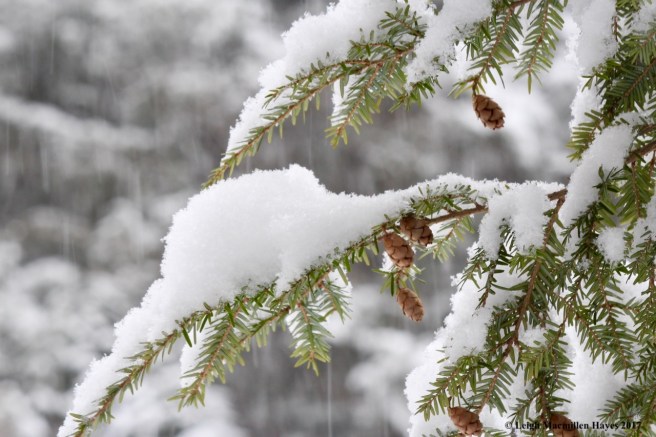
c-hemlock baubles

Because of that fluffiness, it built up quickly, bedecking branches with puffy clouds of white.

c-star-flake

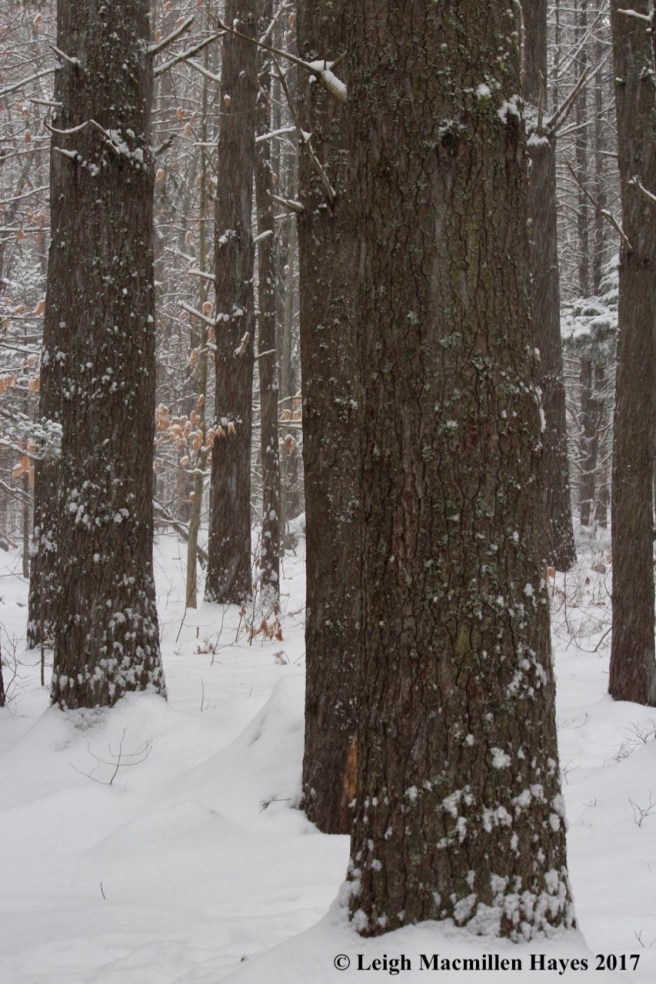
And then, when I stepped into a darker world where the hemlocks grow in a dense grove, I began to notice something.

c-spider garland 3

On every branch of every tree . . .

c-spider garland 2

snowflake garlands . . .

c-spider garland 1

danced. And I was reminded of a story I used to read to my nephew and niece when they were babes–it was based on a legend about a poor family who had no decorations for their Christmas tree. As the tale goes, while the children slept, spiders spun webs of silver around the tree’s branches. The next morning, the family awoke to a Christmas tree sparkling with silver webs. Today’s webs were such and I was richer for the experience.

c-cheddar cheese

I’m also richer for other gifts, such as Washington State University’s white cheddar cheese;

c-ornament

an ornament created with birch seeds and their fleur de lis bracts placed between mica sheets from Mount Apatite in Auburn,

c-heartwood

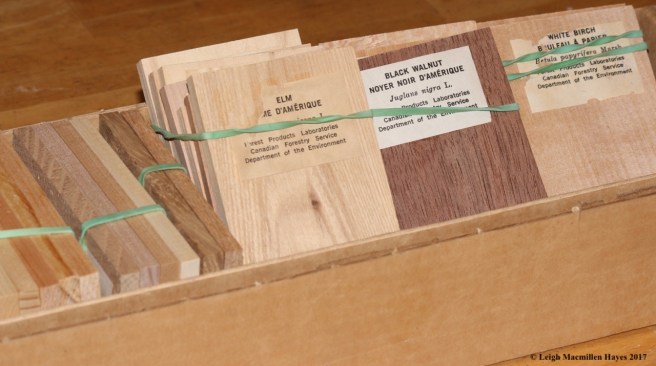
a box filled with heartwood samples all labeled,

c-Santa's visit

and just a few minutes ago a lengthy e-mail from someone who had read the article entitled “digging for roots” that I wrote for the winter issue of Lake Living magazineThe gentleman who sent the note had gone out of his way to visit my guy’s store and ask for my address. He wanted to share his own experiences of dipping into the past and suggested a few avenues my guy and I might follow with our search for ancestors.

I’m totally blown away by these unexpected gifts. And forever blessed.


Lake Living Magazine: Winter Issue

They say you shouldn’t judge a book by its cover, but indeed, I do. Especially if the book isn’t really a book, but rather a magazine called Lake Living. One look at those vibrant hacky sacks against the snow on the cover of the new winter issue and I find myself mindful, each time seeing a different configuration of the whole or focusing on a single feature.

And then there is the content, from Laurie LaMountain’s editorial comment ending with “Our collective differences have the power to both define us and unite us,” to the book reviews by the staff of Bridgton Books.

2017-12-21_0923

Of course, thrown into the mix are the articles, including Laurie’s eloquent feature about hacky sack and relationships, ending with a challenge to all of us. A must read.

And don’t miss my two contributions, “digging for roots” about genealogy and the Fryeburg Historical Society’s Kendal C. and Anna Ham Research Library; and “forever green” about . . .  evergreen trees.

Laurie’s been producing the magazine for twenty years and I’ve had the honor and pleasure of working with her for the last twelve. Here’s to the future.

P.S. If you live locally, please mention the mag when you are shopping. Remember, the mag is free and therefore totally dependent upon advertisers. It can’t survive without your support.

Book of December: A Beginner’s Guide to RECOGNIZING TREES of the NORTHEAST

Fellow master naturalist Alan Seamans recently sent me an e-mail with this message: “I found a new book that might be of interest to you. It’s called A Beginner’s Guide to Recognizing Trees of the Northeast, by Mark Mikolas, published Oct. 3, 2017. Rather than leaves, buds or flowers, he focuses on bark, stature, habitat, and some other techniques to teach beginners how to recognize about 40 common tree species. It’s a compact softcover guide, very educational, lots of photos illustrating his points. Not text heavy. I like it, and learned many things.”

IMG_3897

Book of December

And so I did what I often do when I hear of a book that might interest me and marched into Bridgton Books in search of a copy. Alan was correct. It isn’t text heavy and indeed simplifies things in a way a dichotomous key cannot. Actually, this book includes so many of the nuances I like to share along the trail with folks who are looking at trees for the first or hundredth time and as I read it I felt like I was on a guided tour with a new friend.
Mikolas begins this tree identification book by restricting the focus area to the Northeast–in a zone those of us who live in New England may find amusing for it ranges from our grand states south to West Virginia and west to Indiana and Michigan. As he explains, though, that’s the Northeast as defined by the World Geographical Scheme of Recording Plant Distributions.

The book is divided into two sections–deciduous or broad-leaf trees and coniferous–or cone-bearing trees. And within each section, it’s broken down into individual trees with plenty of photographs to explain each characteristic.

Mikolas keeps it simple and I wish I’d had this book when I first began my journey into familiarizing myself with different tree species. Similar to the approach taken by Donald W. Stokes in A Guide to Nature in Winter, who suggested learning six deciduous trees and the evergreens, Mikolas also encourages the reader to start with the most common, though he prefers the number twelve.
I wondered what I might learn or relearn as I began reading. And found plenty of information, some of it already stored in my brain, and more to be tucked away.

s-target

The book begins with red maple, which always has something red to display, but Mikolas also mentions the target fungus that affects only this species, creating a round bull’s eye on the bark. I know from experience that once your eye focuses on the target, you’ll begin to see if on so many maple trees. And as he said, and a forester told me several years ago, here in western Maine, 90% of our maples are Acer rubrum. That’s one thing you don’t have to worry about, except for one instance that I could find, he doesn’t use the Latin names. For some folks, that may be a downfall, but this is a beginner’s guide.

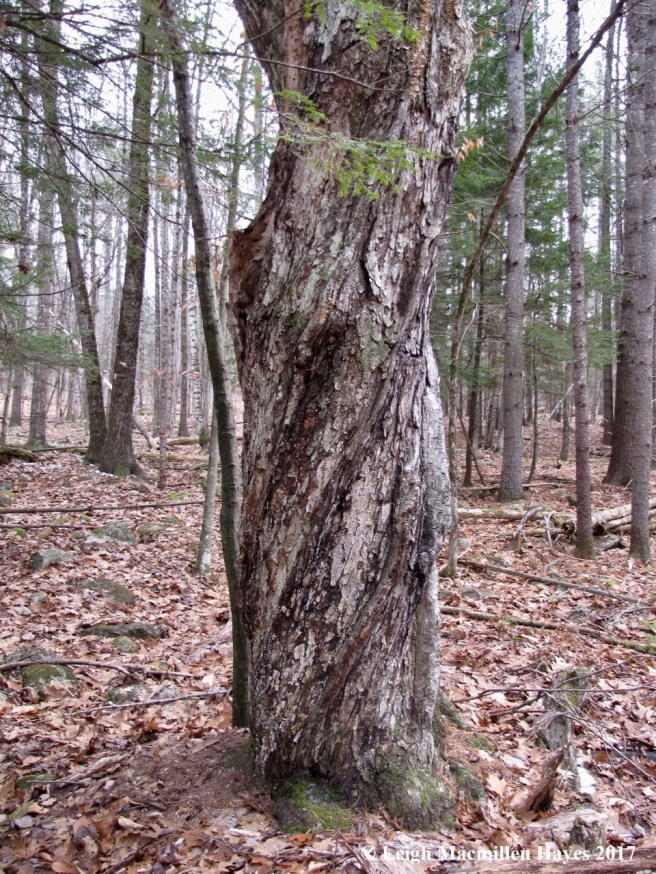
b-twisted maple

I was pleased that he included the twisting of a sugar maple. Other trees twist as well and I can remember first realizing this while tramping with a friend. We couldn’t understand what was going on. The reason for the spiral growth is on page 26–you’ll have to read it for yourself.

After describing these two trees, as he does periodically throughout the book, Mikolas gives clues on how to tell them apart. For these two, he describes their habitat, bark, twig and bud color.

m-beech sunshine

One of the clues he provides for beech trees is the fact that the leaves remain on the trees all winter. What I like about his comment is that he says this happens on young trees, for indeed, since I started paying attention, that’s what I’ve noted.

b-marcescent leaf

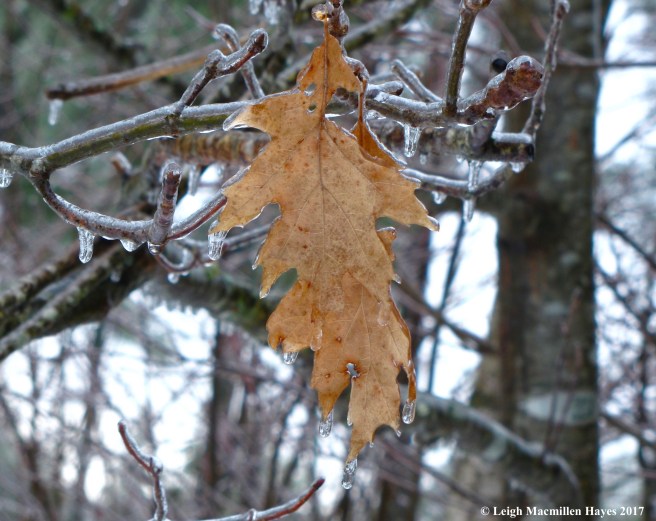
He also described the habit of oaks retaining their leaves, but what he didn’t mention was the term to describe this habit: marcescence or withering. Maybe I was disappointed because I just like to say marcescence.

b-ash bark

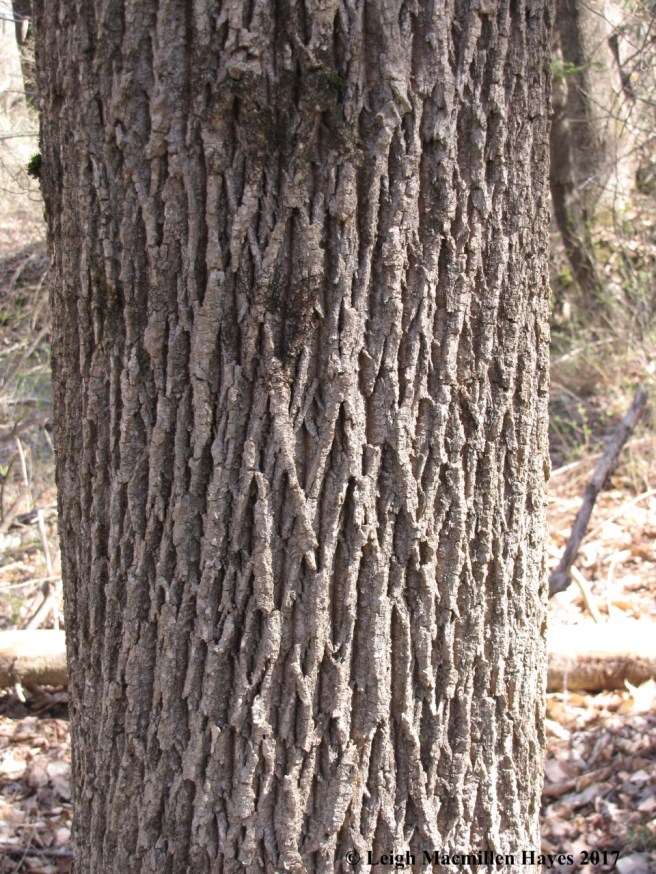
When it came to ash trees, I was pleased that he described the bark as being diamond-shaped, but he added an X to the pattern and that may help when I next look at an ash tree with others. Some have a difficult time finding the diamonds. They don’t exactly glitter in the sunshine.
b-aspen bark

I was thankful that when it came to the quaking and big-toothed aspen trees, Mikolas acknowledged that they are difficult to identify by bark alone. A few years ago, I spent some time practicing my tree ID with two different foresters and when I asked about these trees, they too, had a difficult time pinpointing the differences. Both were sure we were looking at quaking, but a quick scan of the ground below showed us big-tooth leaves.

b-aspen 2

One thing I’d add to Mikolas’ description is that on the lower portion of older trees, the vertical lines are similar to that of a red oak. One of the really cool tricks I picked up from the book in reference to aspens is what he calls “birds on a wire.” Again, you’ll need to purchase a copy to find out what he means. Or join me for a tramp.

b-grandaddy birch

Another description that brought a smile to my face was how he casted a mature and shaggy yellow birch as “the granddads or old wise men of the forest.”

b-yellow birch

I had the good fortune to meet one such character just the other day.

b-basswood

In reference to basswood,  Alan Seamans wrote in his e-mail message: “I didn’t know you could confirm i.d. of basswoood by the sound it makes when you hit it with a stick!” I didn’t either, but you can bet that’s on my list of things to do–frequently.

b-paper-birch-old

Mikolas’ photo essay on the aging of paper birch bark from a teen to an old man is well worth a look. My only disagreement with him in this section is that what he sees as an inverted V over the branch, looks more like an inverted U to me, or as I’ve always described it–a fu manchu mustache of sorts.

b-gray birch

Likewise, Mikolas sees black triangles under the branches of gray birches. I could agree with him on that for when I say it’s a chevron, people don’t always get what I’m talking about. One friend, in keeping with the paper birch’s mustache, suggested the gray birch may have a beard–a gray beard. Mikolas also says that gray birches are chalkier than paper–experiment for yourself  by rubbing your fingers on the bark and come to your own conclusion on that one.

IMG_5301

Turning to striped maples, I was tickled to learn a new common name. He used goosefoot, which describes the leaf shape,  and moosewood because deer and moose like to leave their scent by rubbing their antlers on the bark, but a name I hadn’t heard before–whistle wood. Apparently, slip-bark whistles can be carved from striped maple or willow in the spring.

n-Central Park 1

I do wish I’d read this book before venturing to Central Park a few weeks ago. I was in awe of the American elms that grow there, and wondered about their health given that so many elms have succumbed to Dutch elm disease. What I didn’t realize is that what I saw before me was one of the largest and last stands of these majestic trees.

b-red pine plantation

Heading back into a woodland setting, and this one was actually in Vermont, occasionally we stumble upon red pine plantations. It was my understanding that these were planted by the CCC or Civilian Conservation Corps between 1938 and 1942 to provide farmers with a hill crop and others with employment. When walking in the woods and suddenly encountering a sterile environment where trees stand stalwart in lines and there is no undergrowth due to the thick needle cover below, and little diversity in wildlife, one may have entered such a plantation. At the time, it seemed like a good idea and provided work.

hemlock petioles (stems) and stomata lines

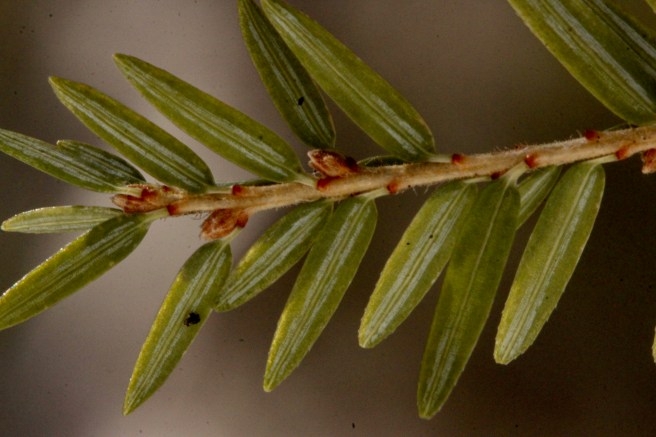
In the forest, I often discover hemlock and balsam fir saplings sharing a space. One word of caution when it comes to differentiating between the hemlock shown here and balsam fir needles that are shown on page 188–both have two white stripes of stomata on the underside. There are other clues to help tell them apart and I’ve actually written about such in the upcoming issue of Lake Living magazine so you’ll have to stay tuned.

spiky spruce

And then there are the spruces and I have to admit, I have a difficult time with red versus white, though forester friends have said they hybridize. I noticed that Mikolas mentions both, but doesn’t provide the fine details about scent and twig hair. Perhaps it’s enough to know it’s a spruce–especially if it’s spikey to the touch.

b9-tamarack gold

The tree descriptions conclude with the one and only deciduous conifer of our woods–the tamarack–the cone-bearing tree that loses its leaves (needles) each winter.

And with that, I will conclude this rather lengthy review. I’m so glad Alan recommended it to me, for it really is a gem. I hope you’ll purchase a copy and together we can head out on the tree trail and get to know our local species even better.

Put A BEGINNER’S GUIDE TO RECOGNIZING TREES OF THE NORTHEAST on your wish list and shop local.

A BEGINNER’S GUIDE TO RECOGNIZING TREES OF THE NORTHEAST, by Mark Mikolas, published 2017, The Countryman Press.

Post script, or maybe it should be post post. This comment appears on my About page, but I couldn’t resist including it here. I’m always tickled and honored when an author responds to one of my posts:

Thanks so much for the detailed and positive review of my book, A Beginner’s Guide to Recognizing Trees. It sounds like it would be great to take a hike with you. I really appreciate the good press. –mm

Liked by you

  1. Mark, Thank YOU so much for taking the time to read this and comment. I think A Beginner’s Guide to Recognizing Trees is a fabulous addition to my book shelf and back pack. In fact, I’m on the board of the Maine Master Naturalist Program and asked our curriculum coordinator to review it. If it doesn’t become one of our text books, it should at least be on our recommended reading list. Well done, indeed. Oh, and if you’re ever in western Maine–give a shout. LMH


Lake Living–spring 2017

I always get excited when an issue of lake living is published. This spring issue contains great articles including three by moi (so of course they are great!)–groundcover (a quiet garden oasis in Bridgton) , Into the Box  (Lovell Box Company) and The Art of Collaboration (where glass meets wood at Studio 448 in Norway). Click on the link and enjoy!  lake living (1)

From Sheep to Dinosaurs, Oh My!

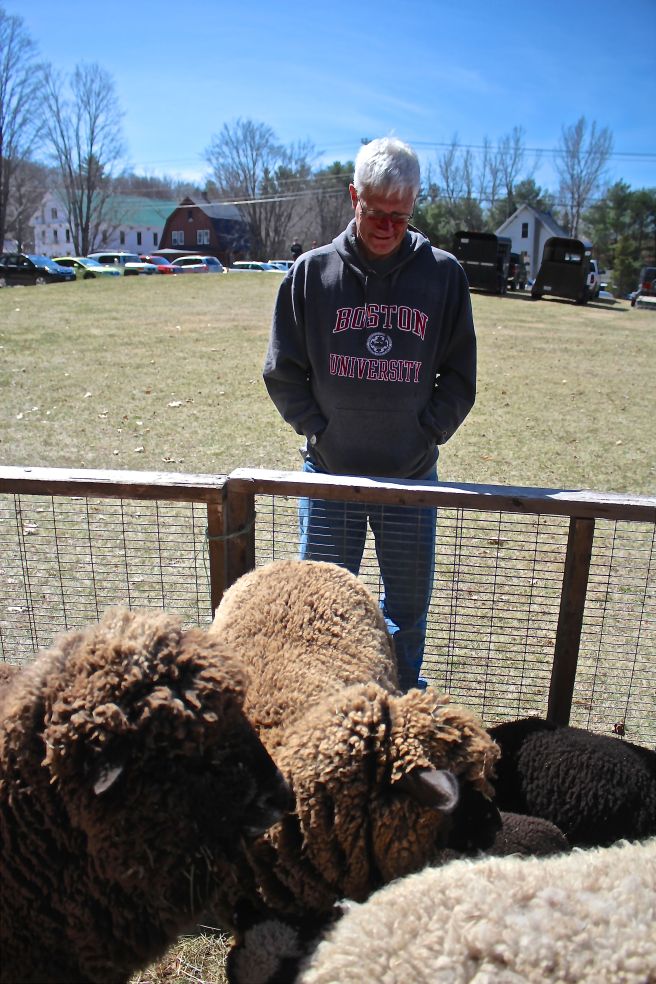
After leaving a truck at the base of the Ledges Trail on Pleasant Mountain, my guy and I drove to Denmark Village to attend an annual celebration of fiber: the Denmark Sheepfest.

s-sheep 1

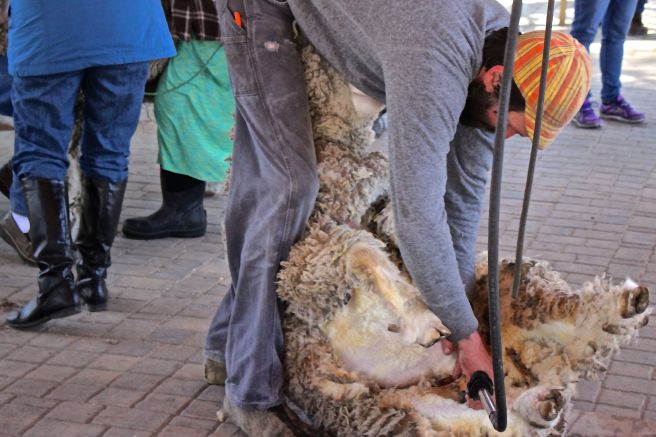
Like us, local sheep were ready to shed their winter coats.

s-sheepish look

Waiting their turn, they offered sheepish looks.

s-sheep shearing

But we heard no complaints as the shearing began.

s-MacKay 1

From there, we continued on to the Southwest Ridge Trail of Pleasant Mountain. As we climbed, we thought about the former name of the trail: MacKay’s Pasture Trail.

s-Mac 2

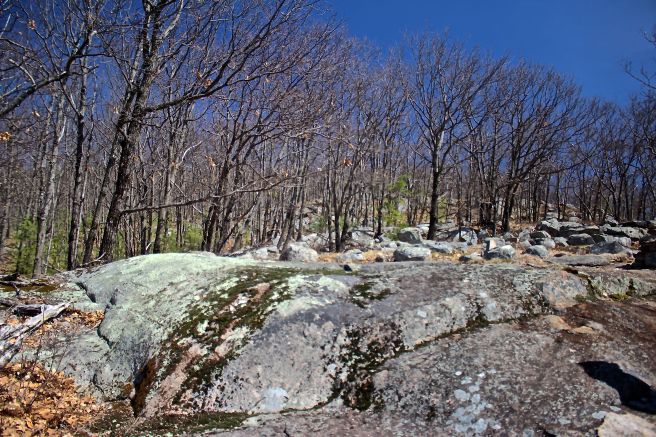
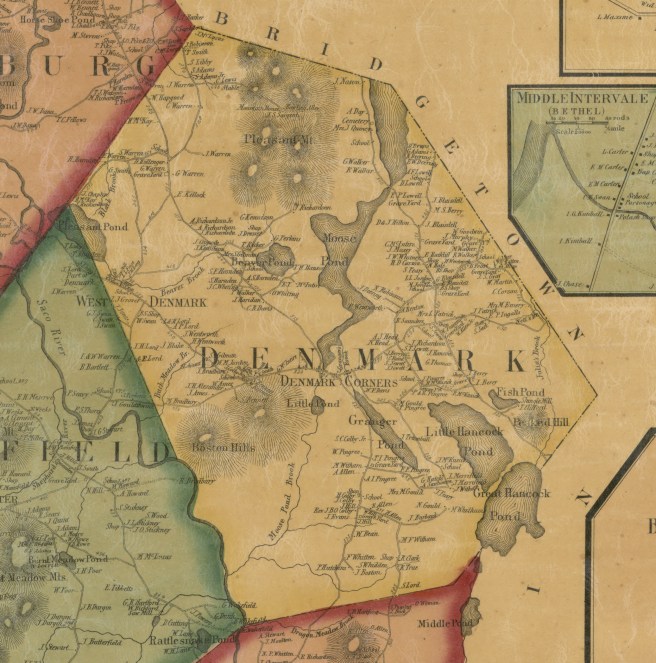
Between the rock outcrops and slope we decided that in the 1800s sheep probably roamed this side of the mountain. I found an 1858 map on the Denmark Historical Society’s Web site, but it’s too small to check names.

s-Denmark_1858

(Thanks to Jinny Mae for sending me a better copy of the map–the McKay’s property is located near the base of the trail on the Denmark/Fryeburg line–makes perfect sense that the side of the mountain served as pastureland for their farm.) Sheep and shepherds–We feel a certain affinity to shepherds/shephards because it’s a family name and were saddened to learn yesterday of the death of one relative we met this past fall in New Brunswick, Canada. Our acquaintance was short, but relationship long. As the Irish say, “May the light of heaven shine upon your grave.” Rest in peace, Ellis Shephard.

s-hiking

We love climbing up this trail and pausing . . .

s-mac 3

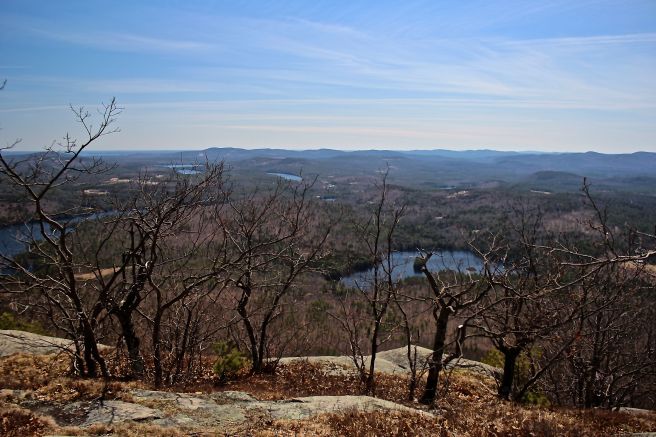
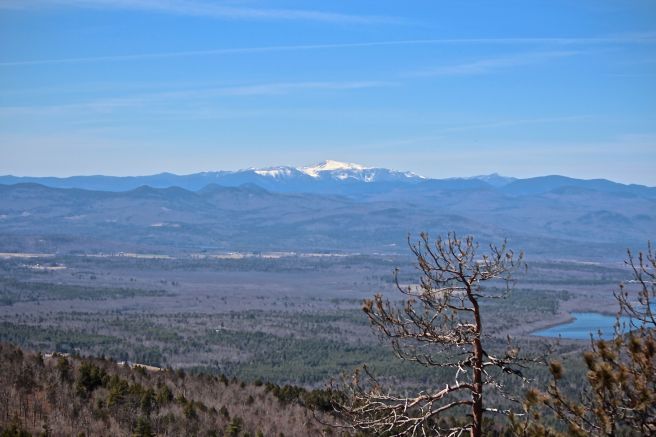
to take in the views behind us–Brownfield Bog, Lovewell Pond, Eastern Slopes Airport in Fryeburg, Maine, and White Mountains of New Hampshire in the distance.

s-lunch

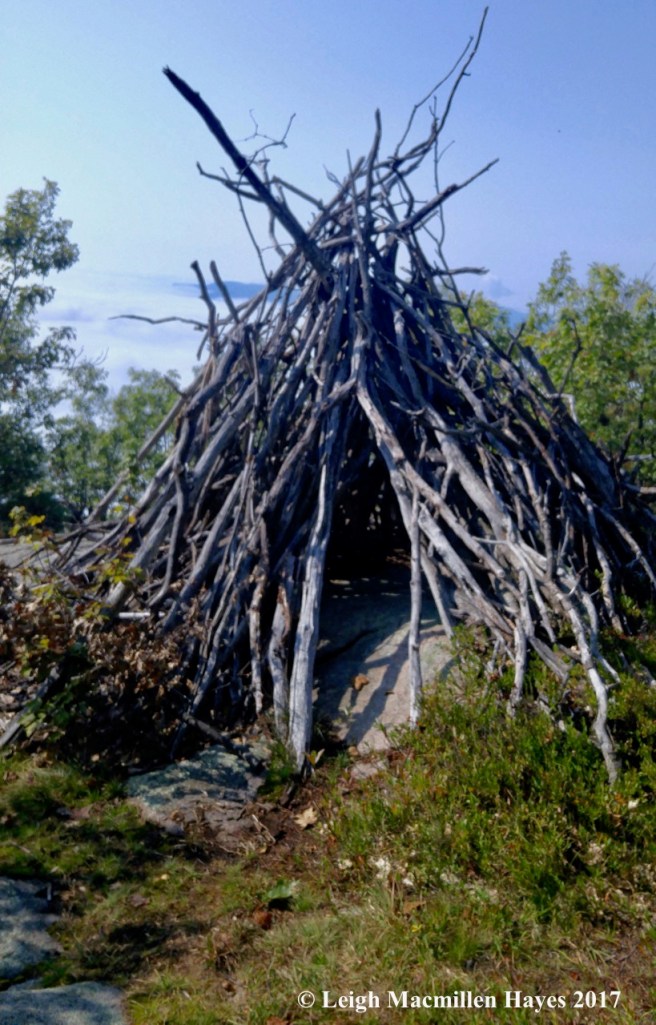
In no time, or so it seemed, we reached lunch rock by the teepee. The teepee was constructed by the late George Sudduth, director/owner of Wyonegonic Camps , the oldest camp for girls in America. His wife, Carol, whom I’ve had the pleasure of hiking with, and family still run the camp, located below on Moose Pond.

s-lunch view

Our view as we appreciated fine dining–ham and swiss instead of PB&J–Moose Pond’s lower basin to the left, Sand (aka Walden) Pond with Hancock Pond behind it, Granger Pond and Beaver Pond directly below us. Actually, if you look closely, you might see Long Lake between Moose and Hancock. This is the Lakes Region of Maine.

s-fire tower 1

We continued along the ridge and the fire tower came into view. Once the leaves pop, this view will disappear until fall.

s-vp

At the vernal pool between knobs, we only saw one large egg mass–I had to wonder if the number is related to the amount of human and dog traffic.

s-ft2

And then . . . we were there. At the summit of Pleasant Mountain. With a kazillion other people and dogs.

s-summit 3

Again, we could see the bog and Lovewell Pond behind it,

s-summit view

plus Kezar Pond in Fryeburg and Mount Washington beyond.

s-summit 2

No matter how often I gaze upon this view, I’m always awestruck.

s-trail sign

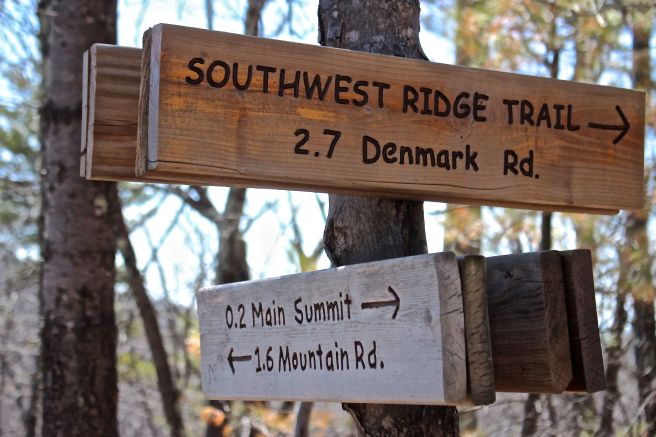
We had two options because we’d left two trucks, and decided to follow the Ledges Trail to Mountain Road.

s-toadskin

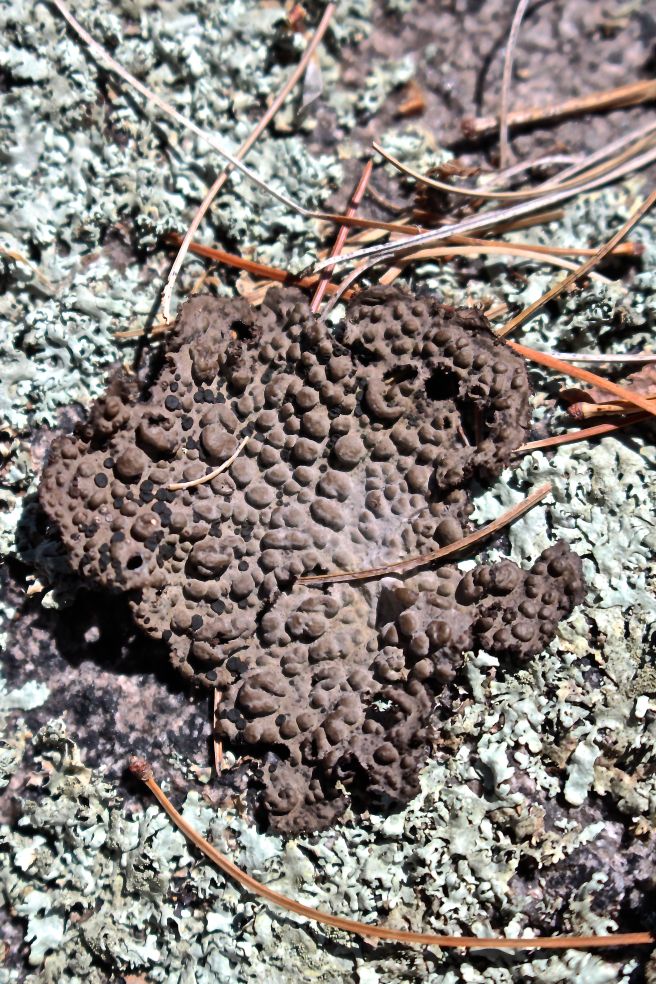
Though I was with my guy, Mr. Destinationitis, I did stop long enough to admire the common toadskin lichen with its warty pustules.

s-toadskin and tripe

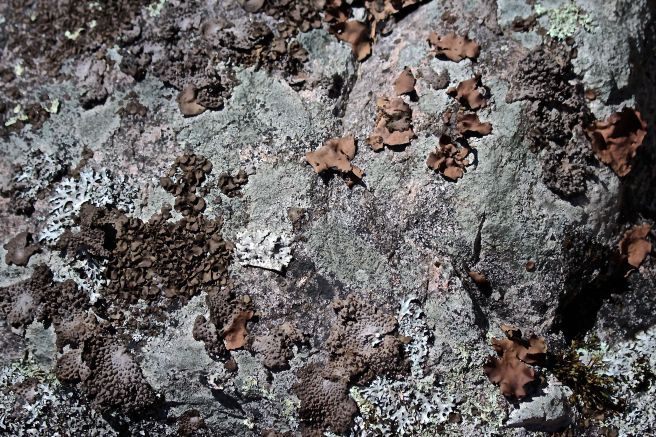
Had this been a teaching moment, the lesson plan was laid out in front of me–toadskin versus common rock tripe. Warty versus smooth. A difference in color. Both umbilicate lichens–attached to the rock substrate at a single point. OK, so maybe it was a teachable moment.

s-rest

But one of us didn’t give two hoots. He tolerated me . . . while he rested. ;-)

s-ledges 1

For the most part, we hiked within feet of each other, but I can never resist stopping at this point as we come upon the beginning of the ledges that gave this trail its name.

s-trees

Continuing down, I frequently grasped trees and thought about how many handprints are imbedded in the history of this land–from Native Americans to surveyors to shepherds to trail blazers and hikers. On this made-in-Maine type of day, we encountered many people of all ages and abilities–and were glad to share the trail with them.

s-dino1

It’s not only people and sheep who have moved across Pleasant Mountain. Even today, dinosaurs made their presence known.