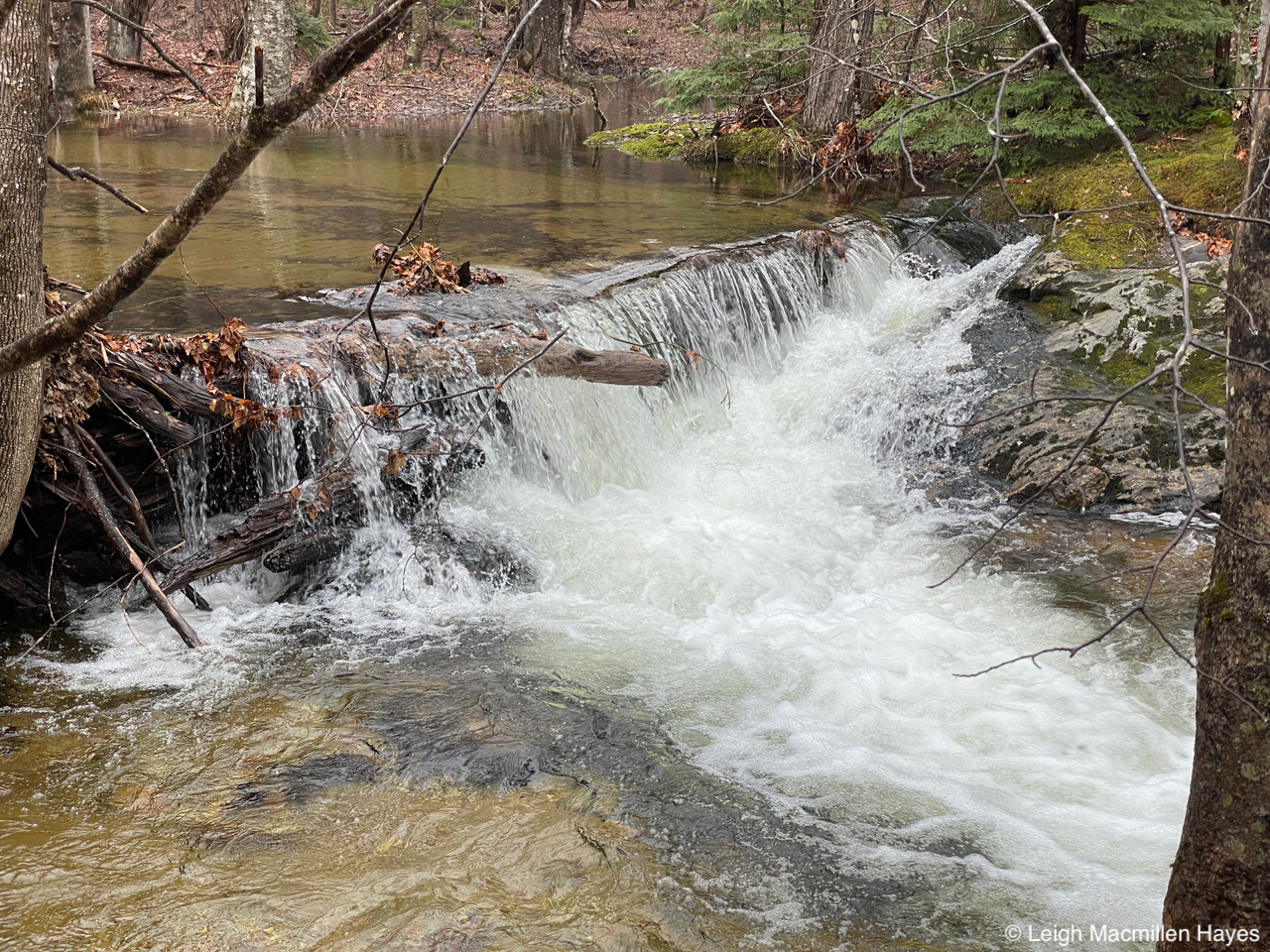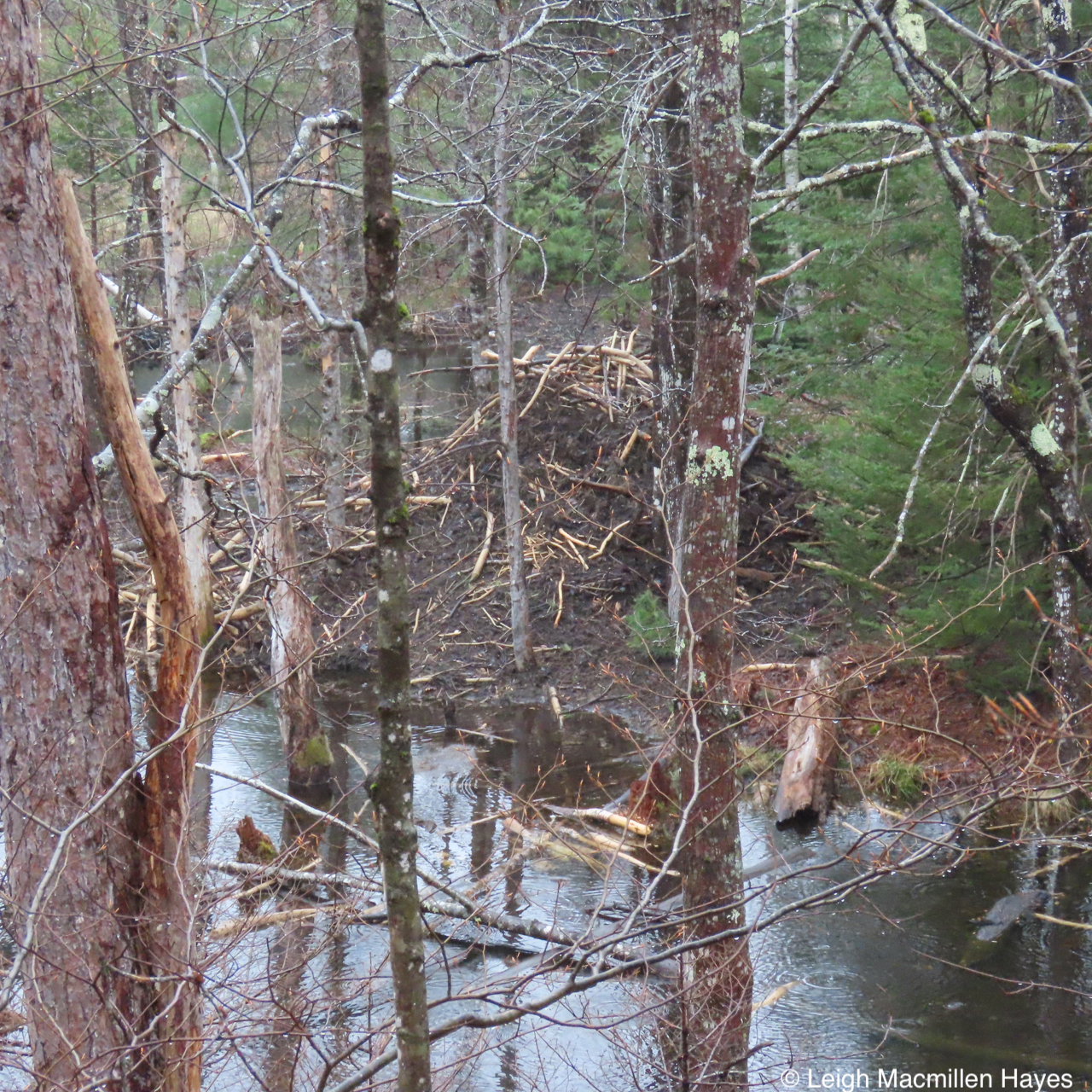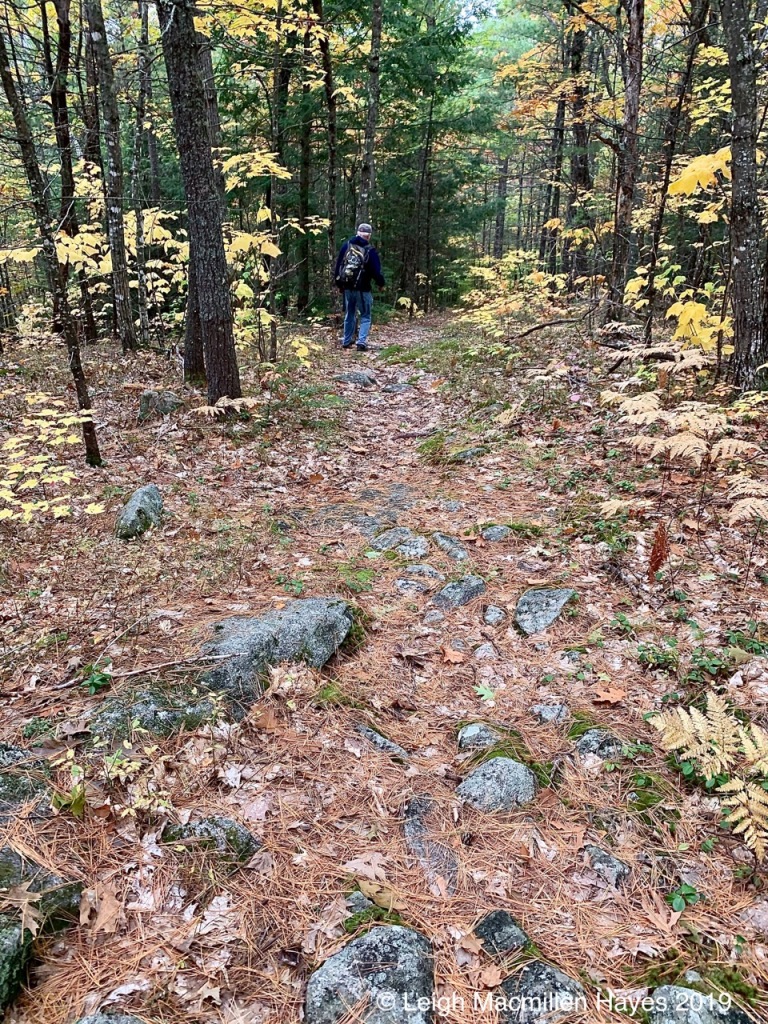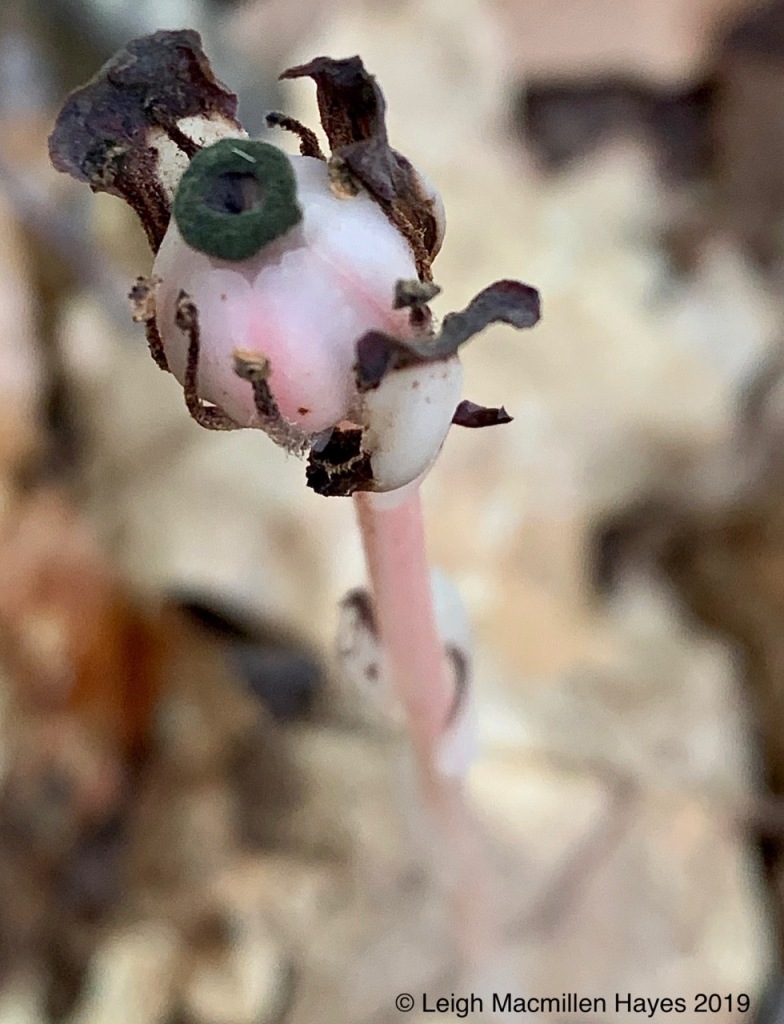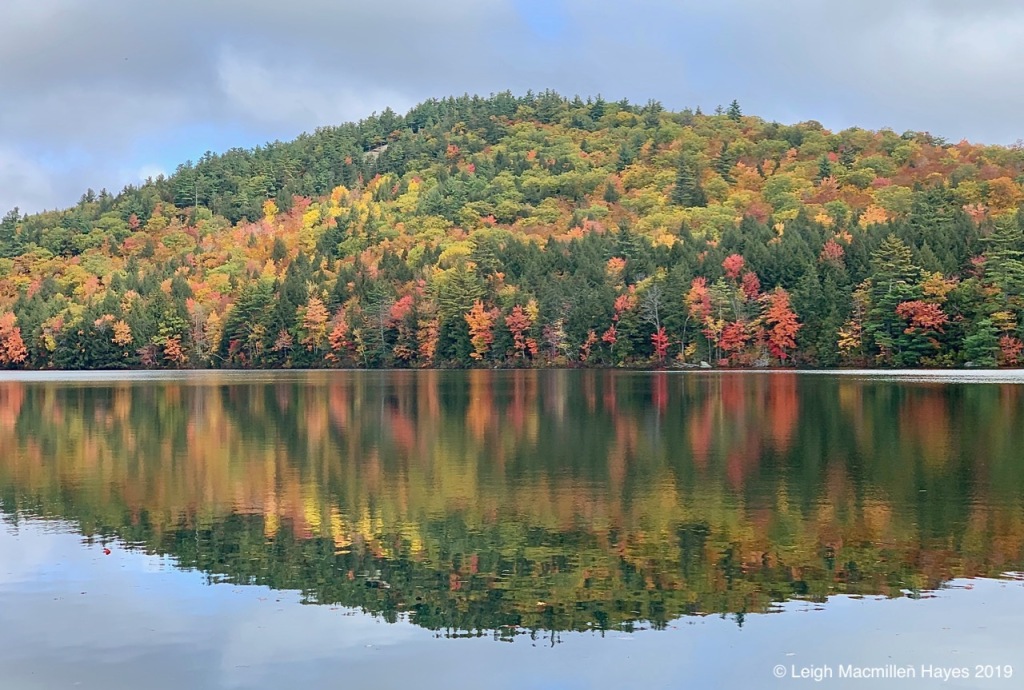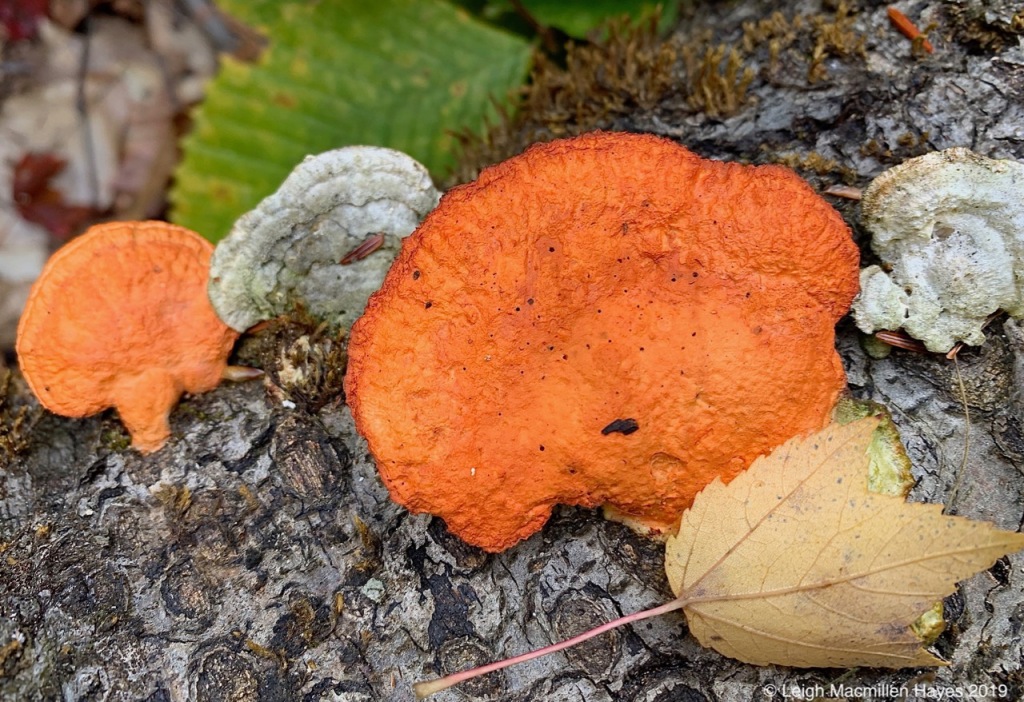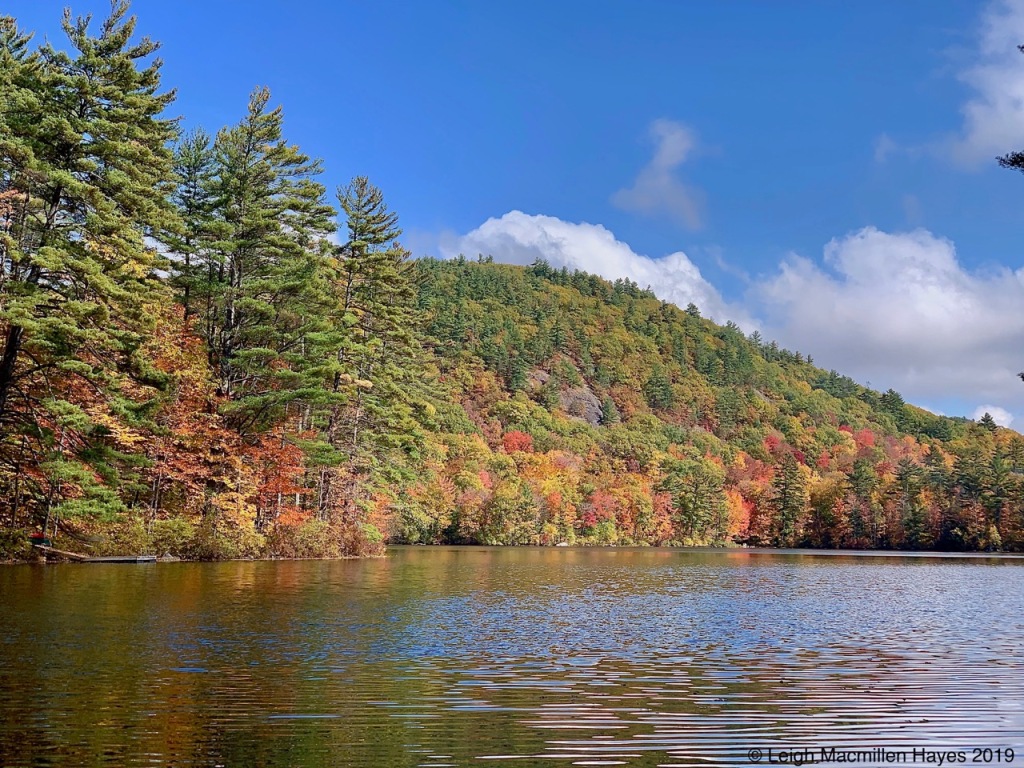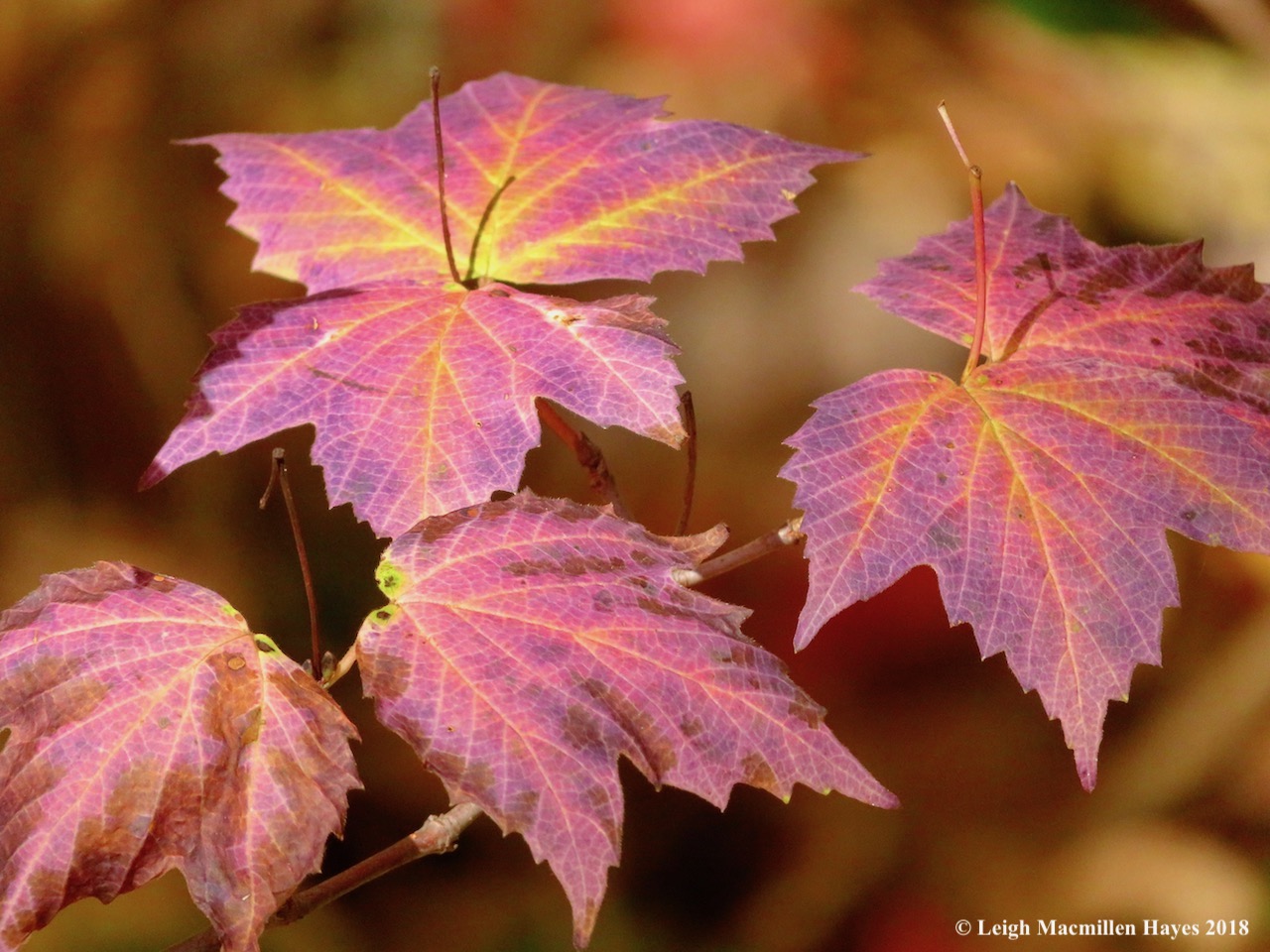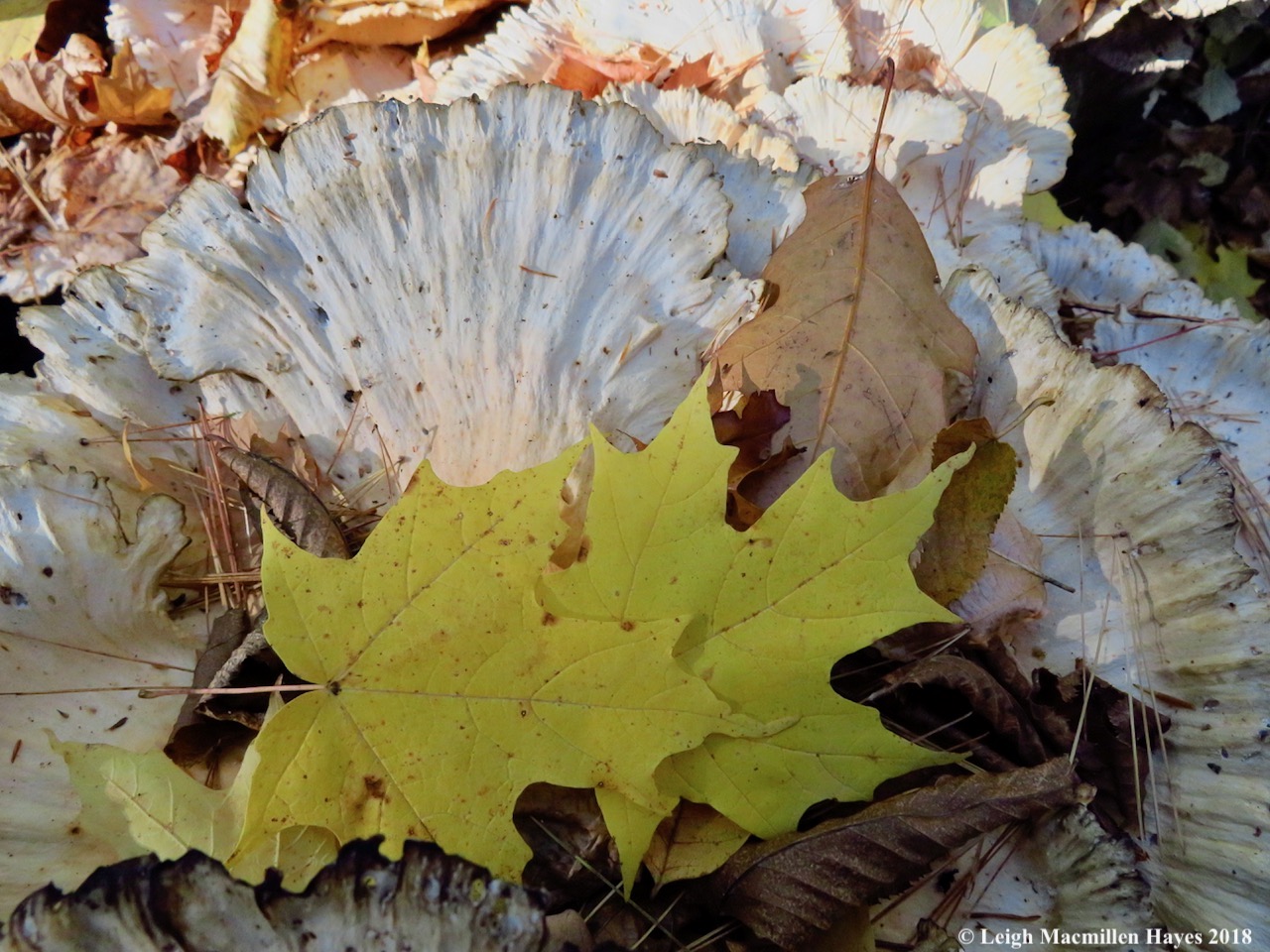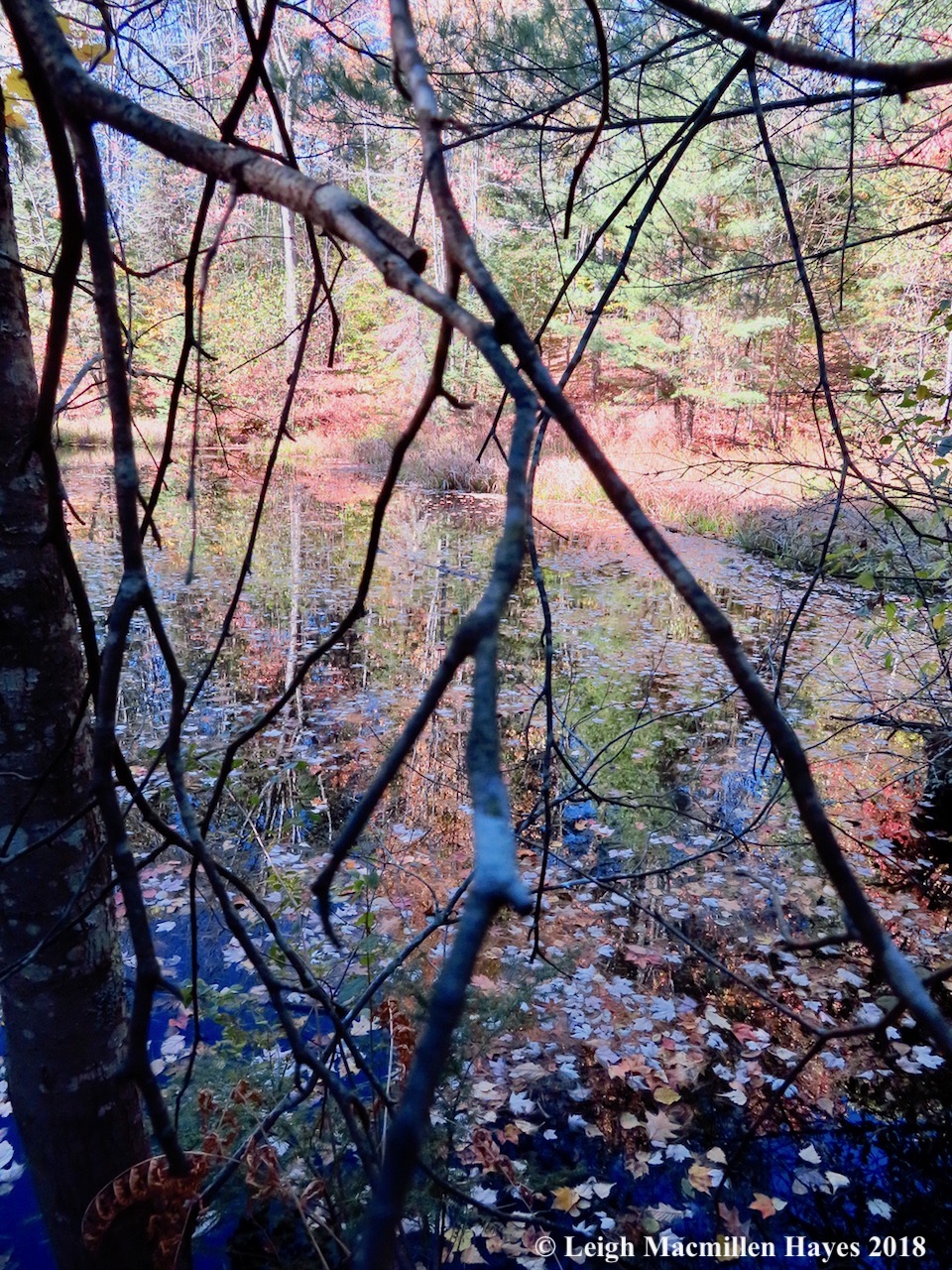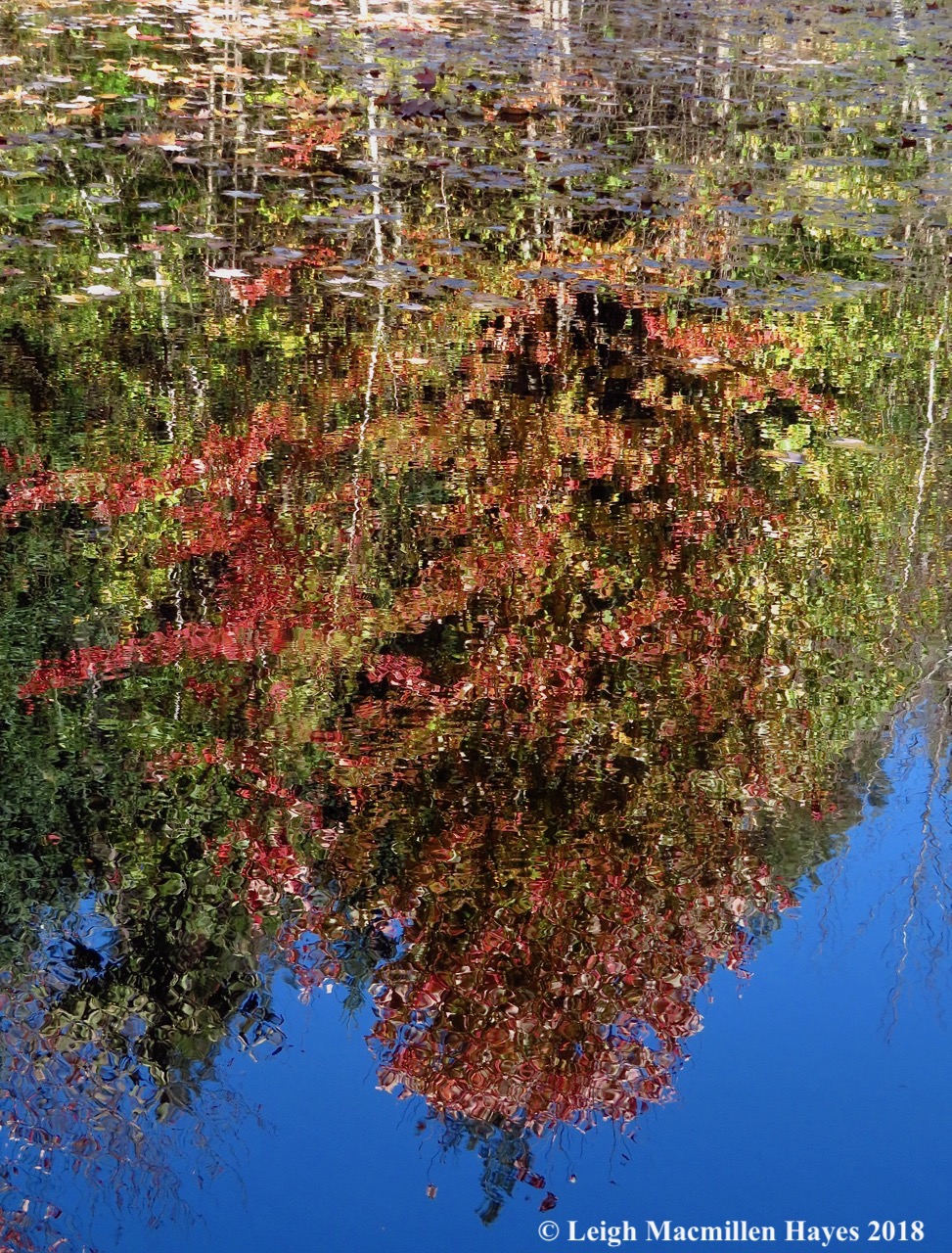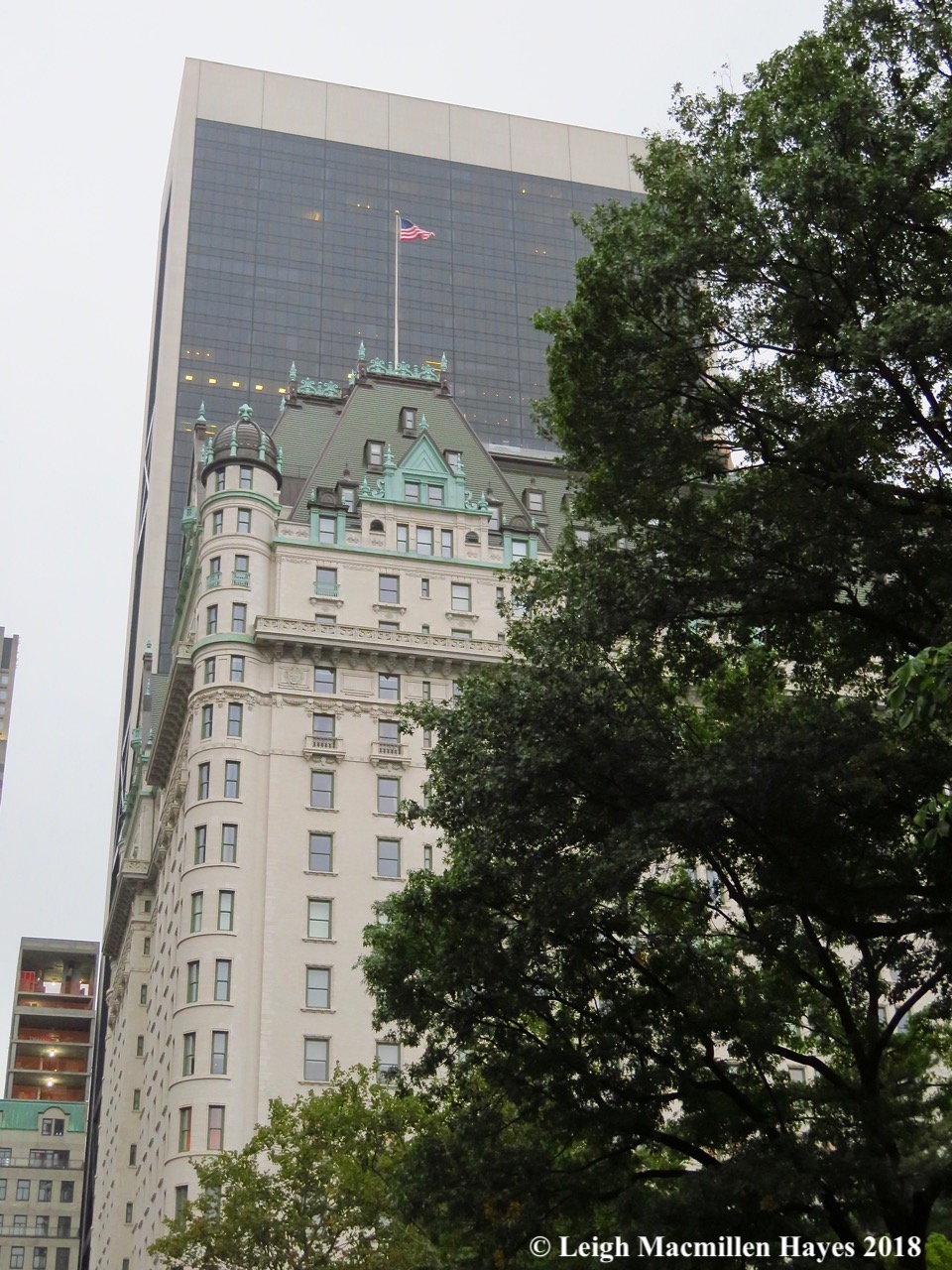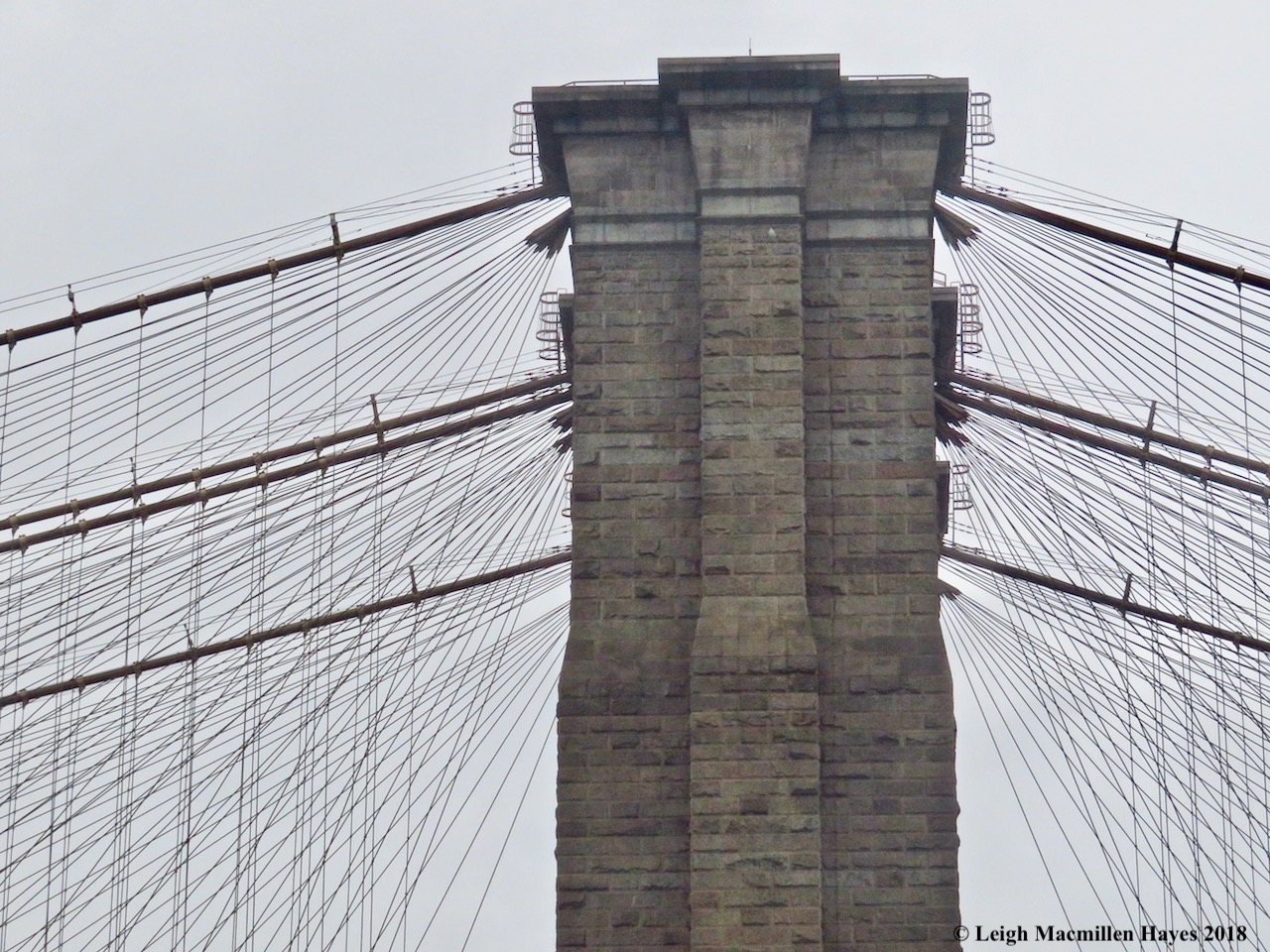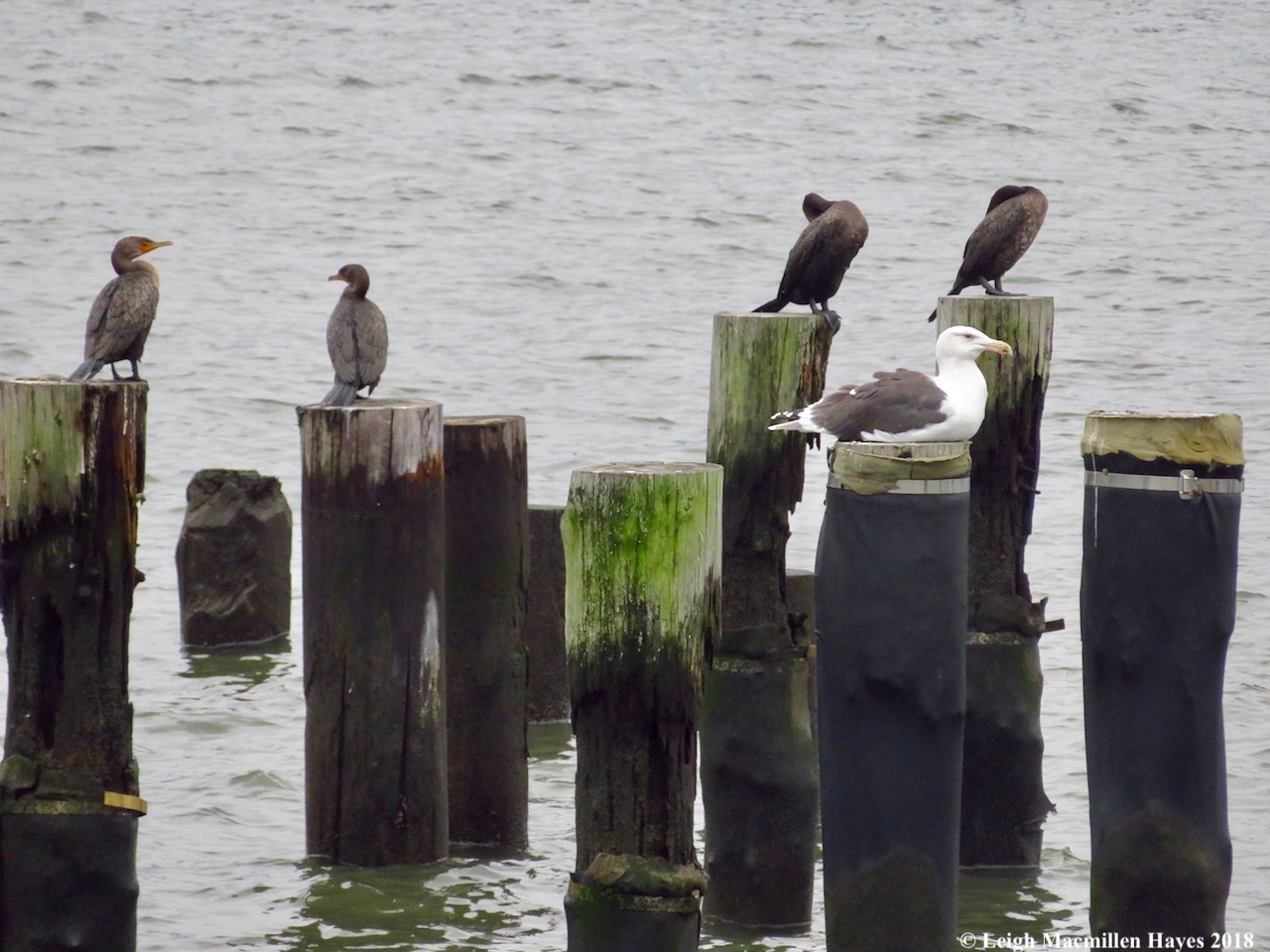
Above and Below: a few wonders from skyline

Grab a cuppa your favorite beverage cuze this is gonna be a long one.

We haven’t taken a vacation in the past two years, but this past week changed that . . . thankfully. It was rather a last minute decision and the Wednesday evening prior to our Sunday afternoon departure found us booking places to stay and suddenly it felt real.

And then it was.

After a long drive, which we split up with a stay in Scranton, Pennsylvania, where we kept looking for the truck carrying “30,000 pounds of … bananas,” we pulled into Front Royal, Virginia, and vacation really began.

Our intention was to drive along Skyline Drive in Shenandoah National Park and hike as many trails as we could fit into five days. Thankfully, our friend Kimmy had given us a bunch of suggestions, and the rangers at the Visitor Centers had maps for each one.

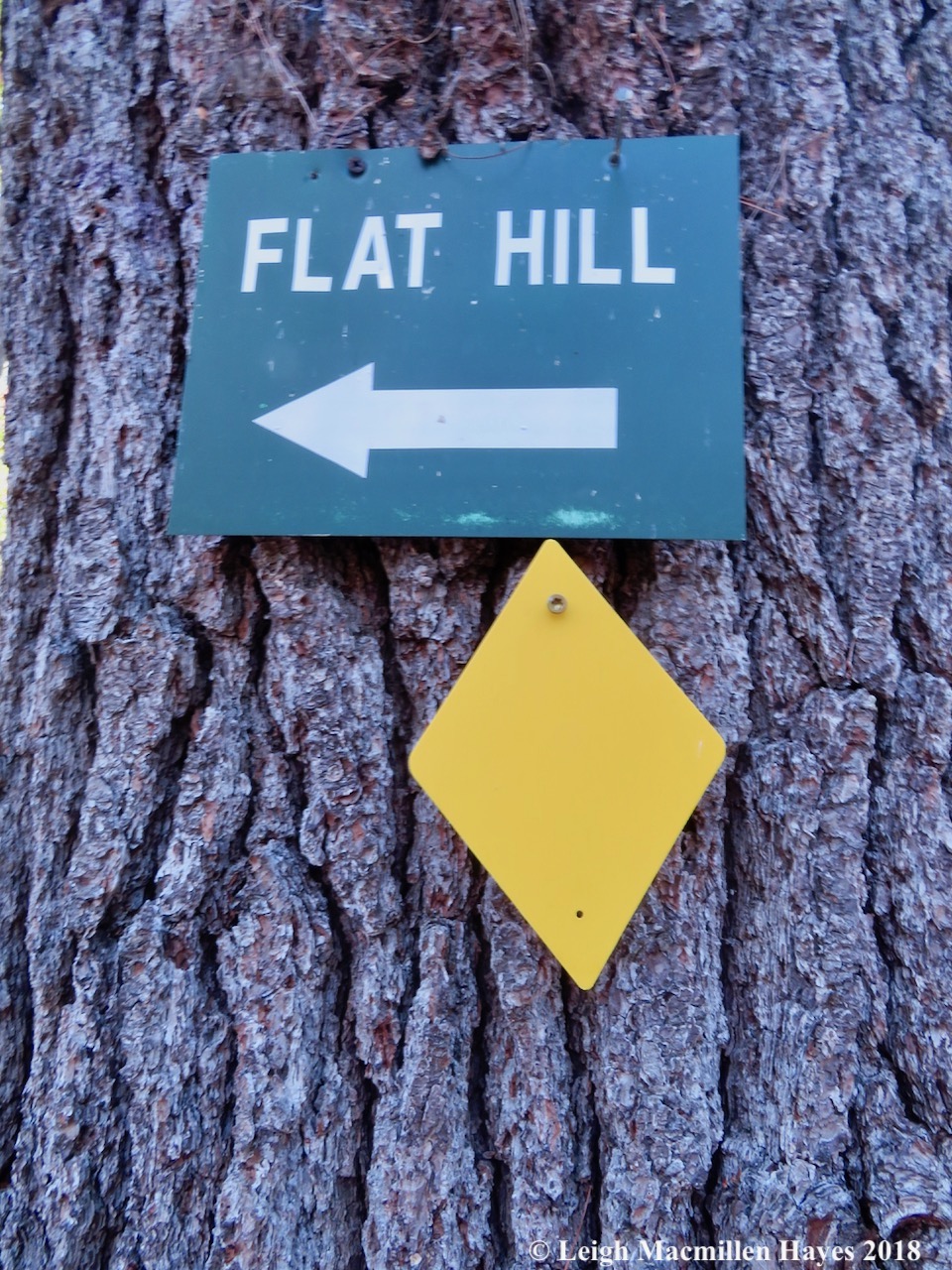
On each of the trails we hiked, metal bands on the trail markers were stamped with the direction and mileage, and after not paying attention on Day 2, and finding ourselves at least a half mile beyond the point where we should have been looping around, we had to backtrack, and learned our lesson. Always check first before proceeding.

Had we looked, rather than thinking that we knew better, we would have discovered that the trail was to the right.

But it was a loop, so we thought we would end up back in the same spot. The laugh was on us. And laugh we did.
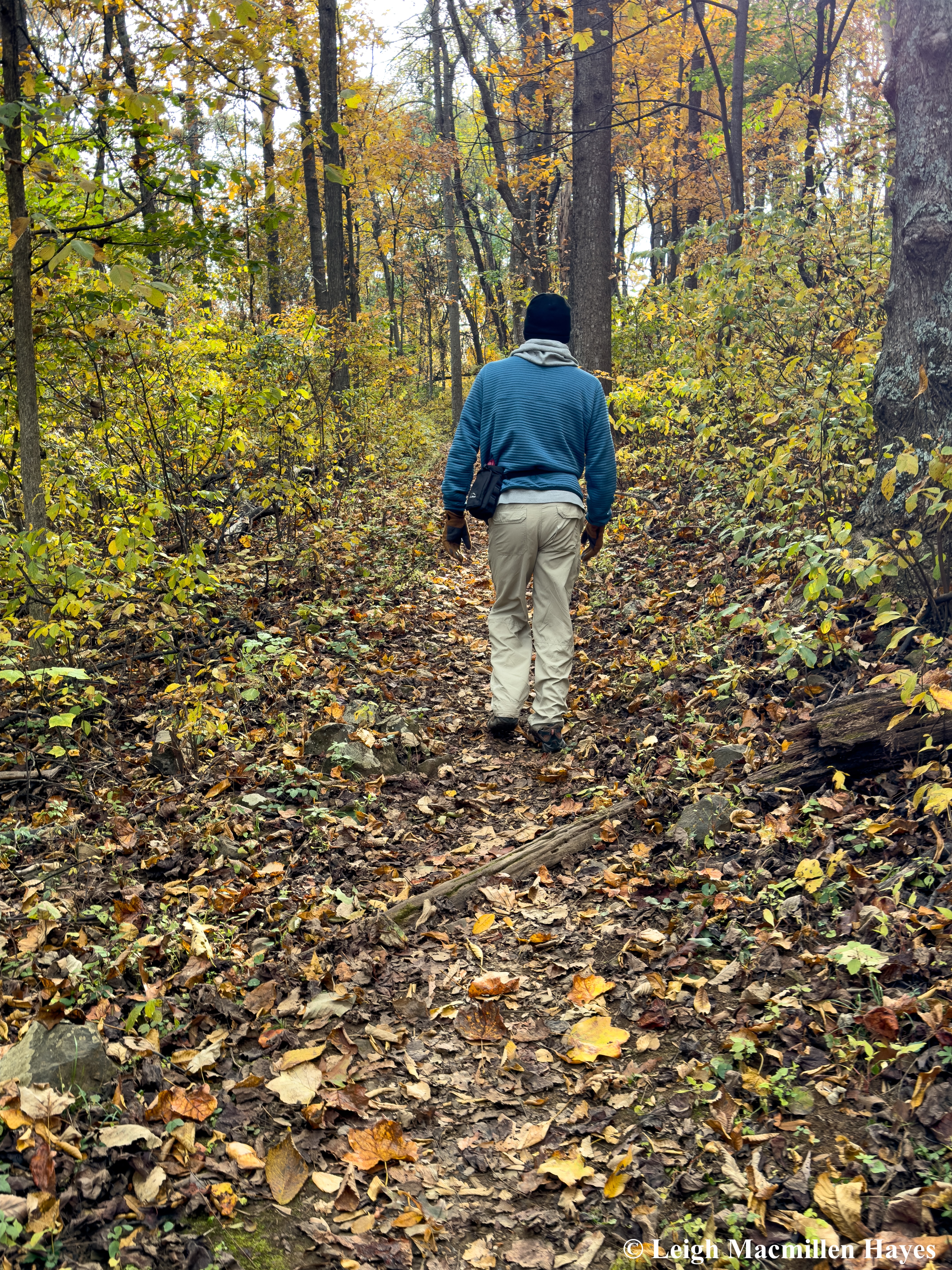
The trails we followed varied from easiest to moderate to difficult with somewhat steep sections or scrambles, and we loved the variety . . . underfoot and in the shrubs and trees, but more on that in a wee bit.

Many had outlooks where we could enjoy the view, but one in particular, reminded us to look, that being White Oak Trail.
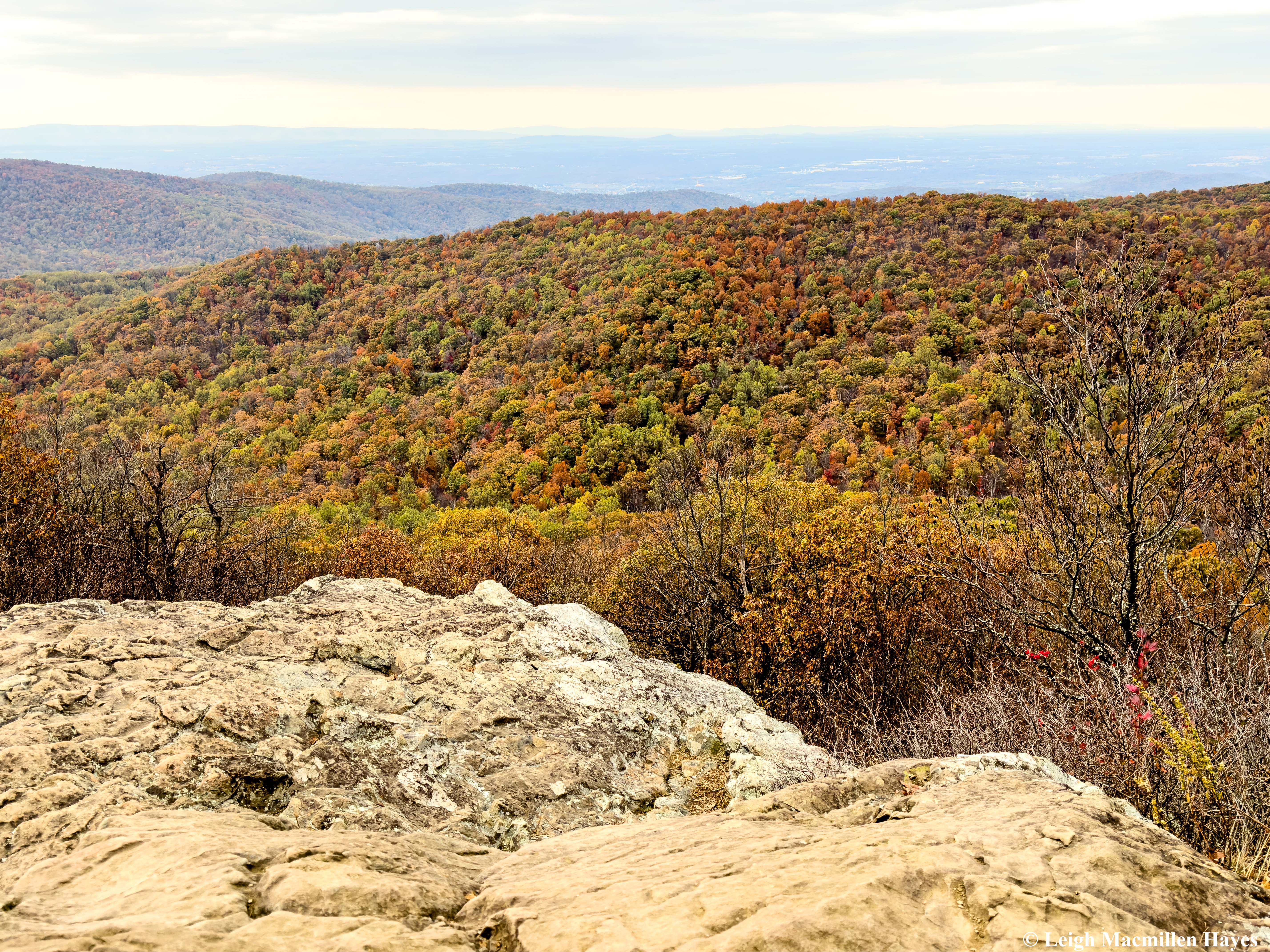
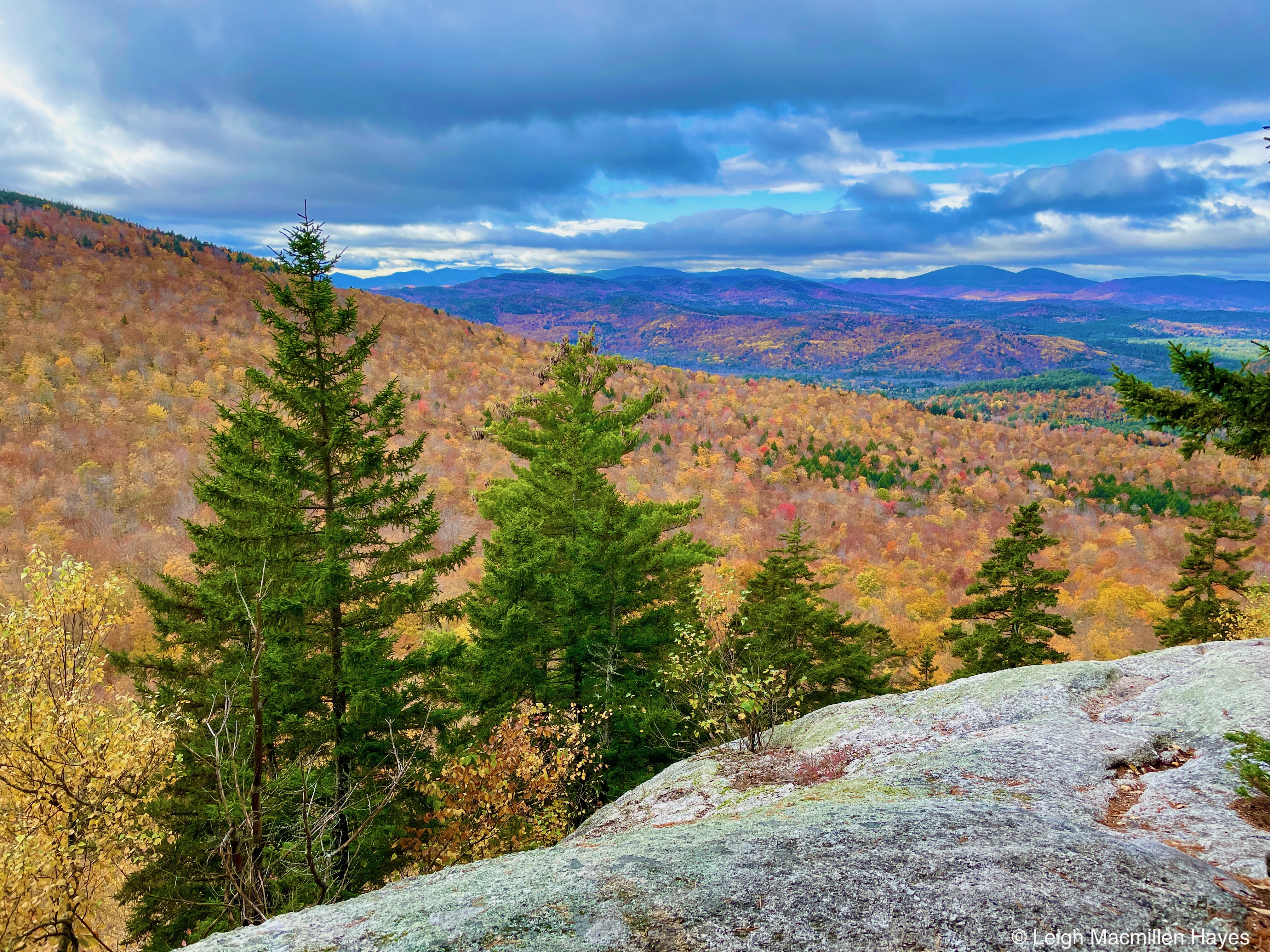
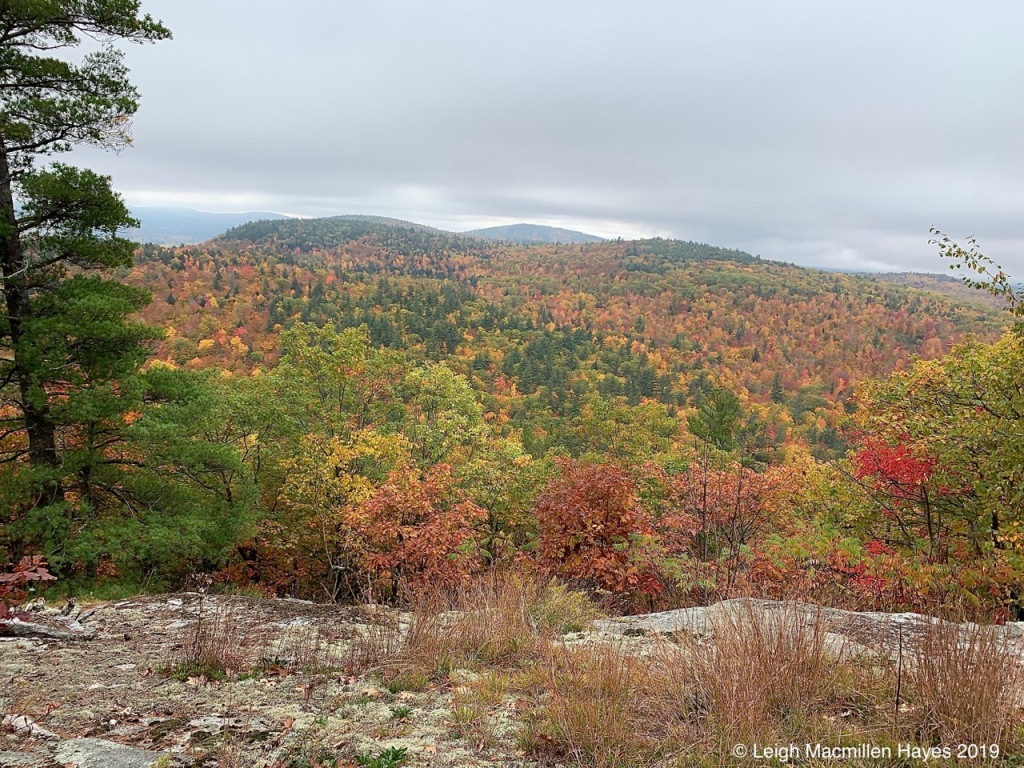
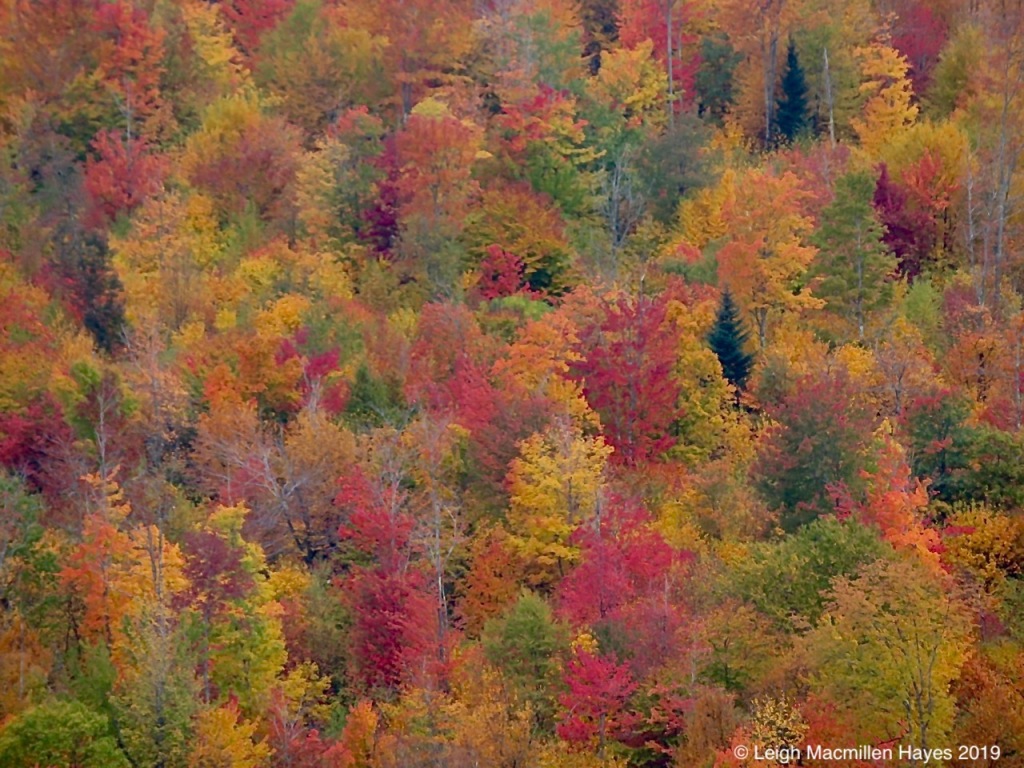
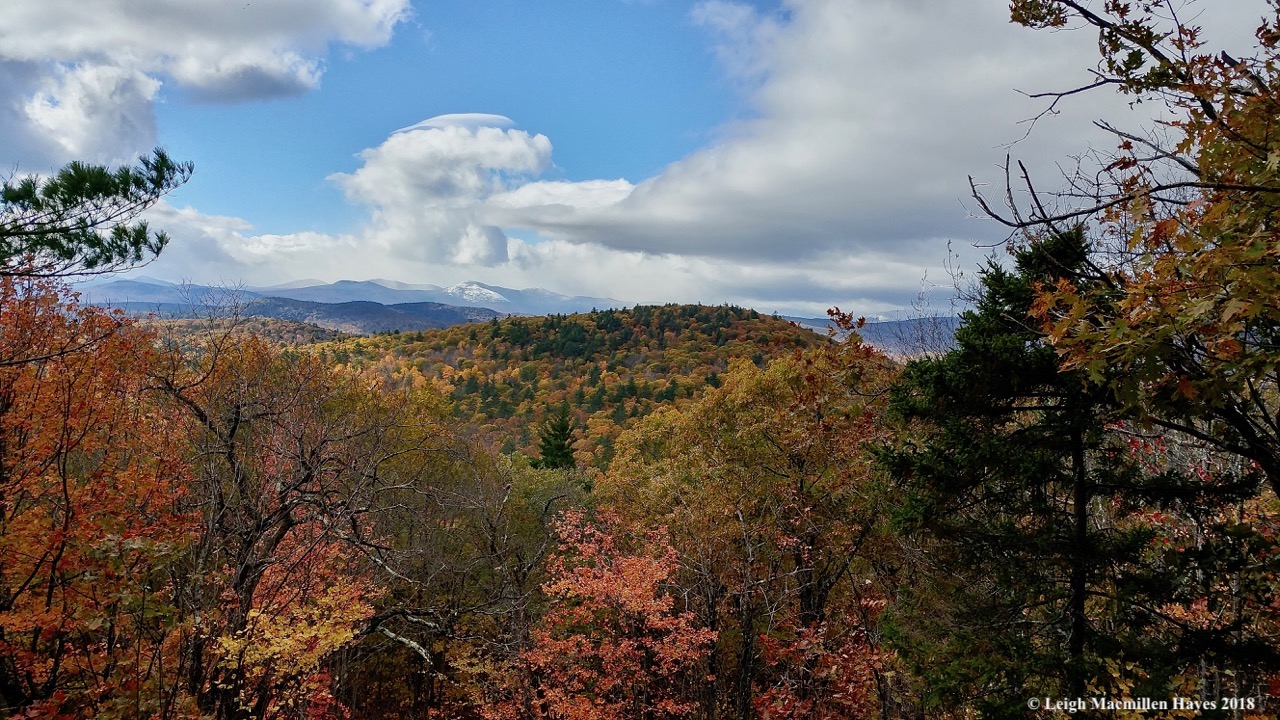
As the week went on, it was fun to note how the foliage changed. When we first arrived, the view at Compton Gap was that of a November tapestry . . . golds and greens and oranges and rusts . . . just a bit past peak. By the end of the week, after a windy, rainy period, many trees had lost their leaves.

The next day, though we drove up the long and windy road and through Mary’s Tunnel, it was said rain that greeted us.
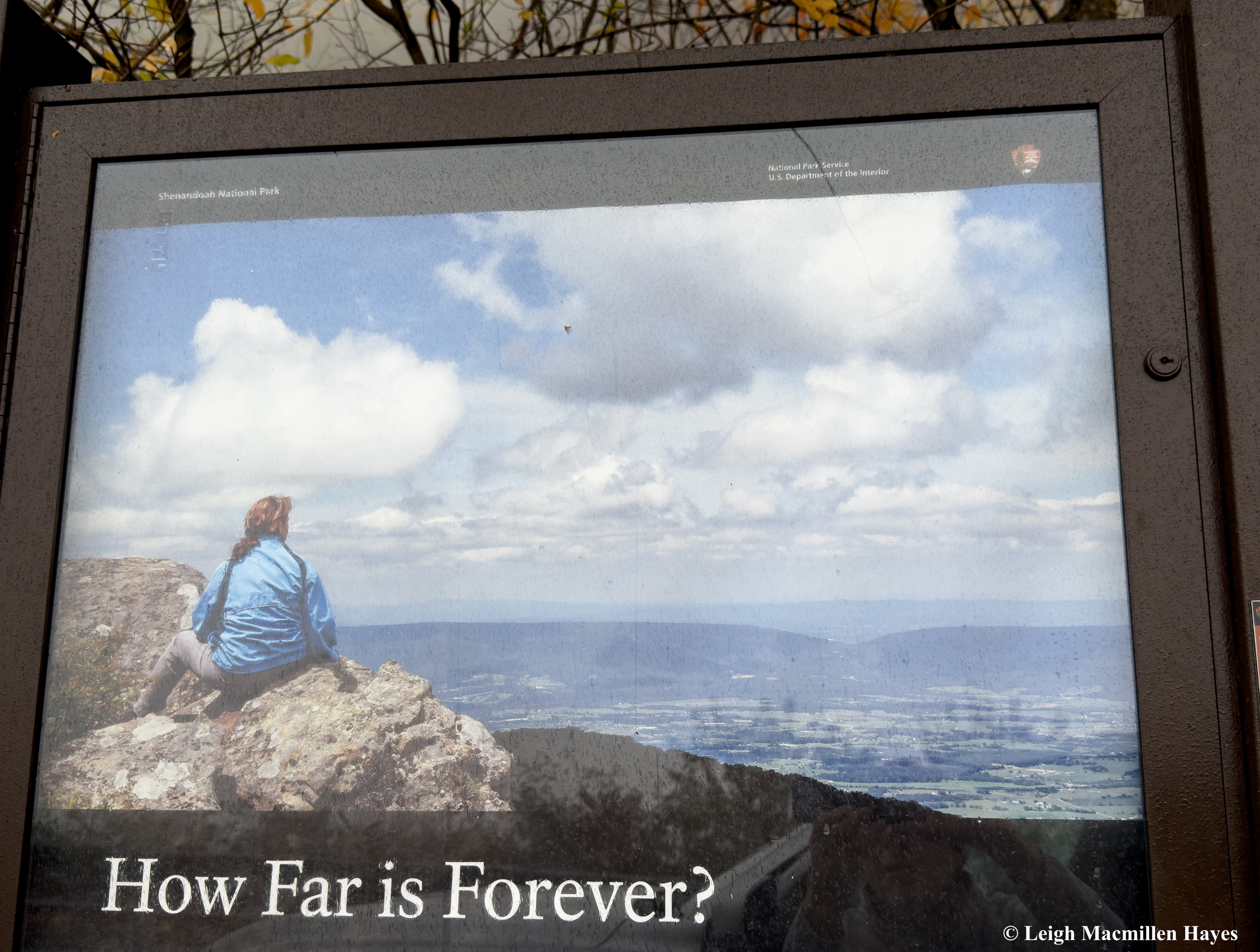
On that day and on and off the next, how far Was forever?
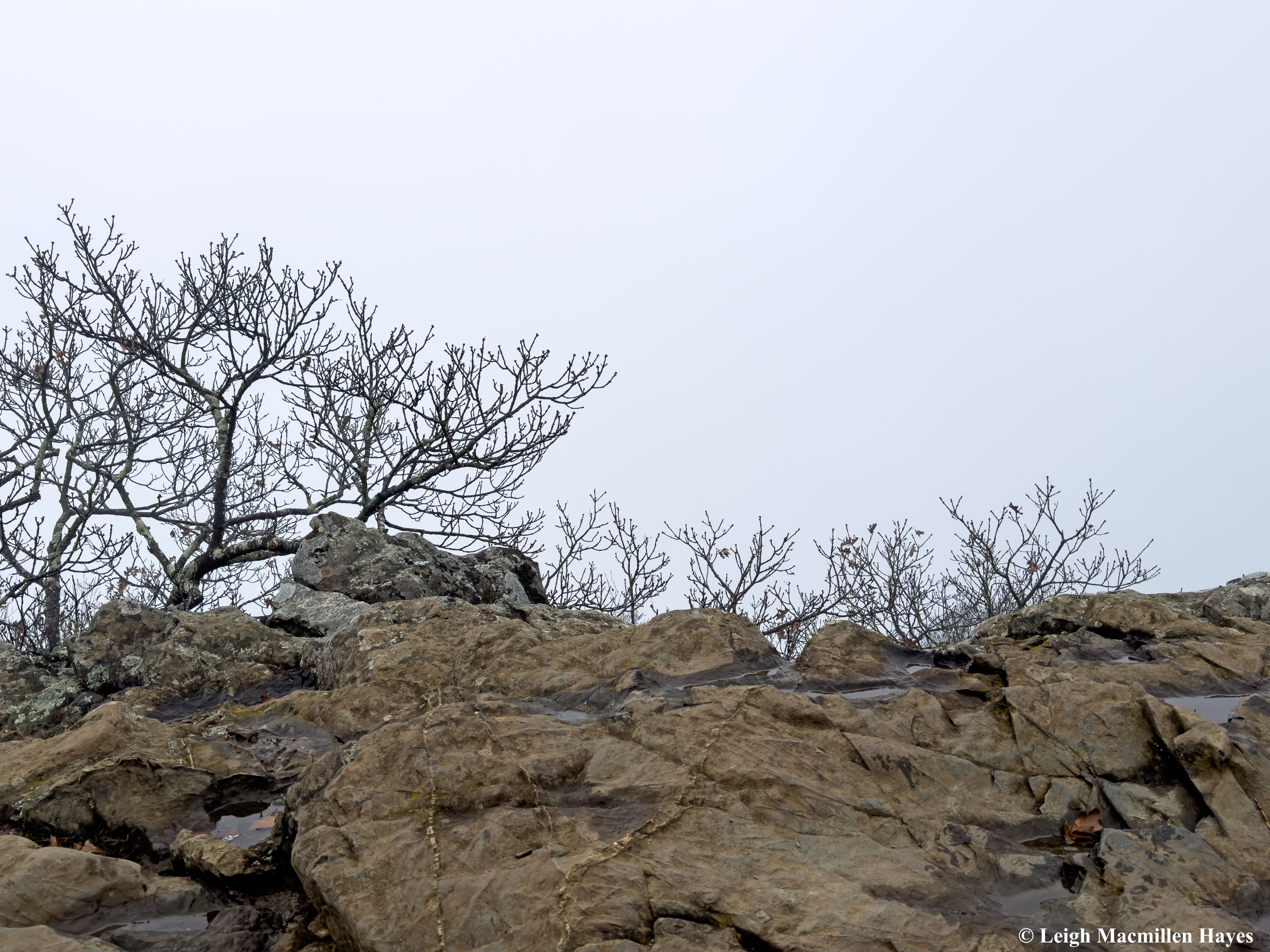
Not very.

Even from the stone look-out at the summit of Stony Man, all was obscured.

But . . . we weren’t the only ones making the trek, and as we met other hikers along the way, we all chuckled about the lack of a view.
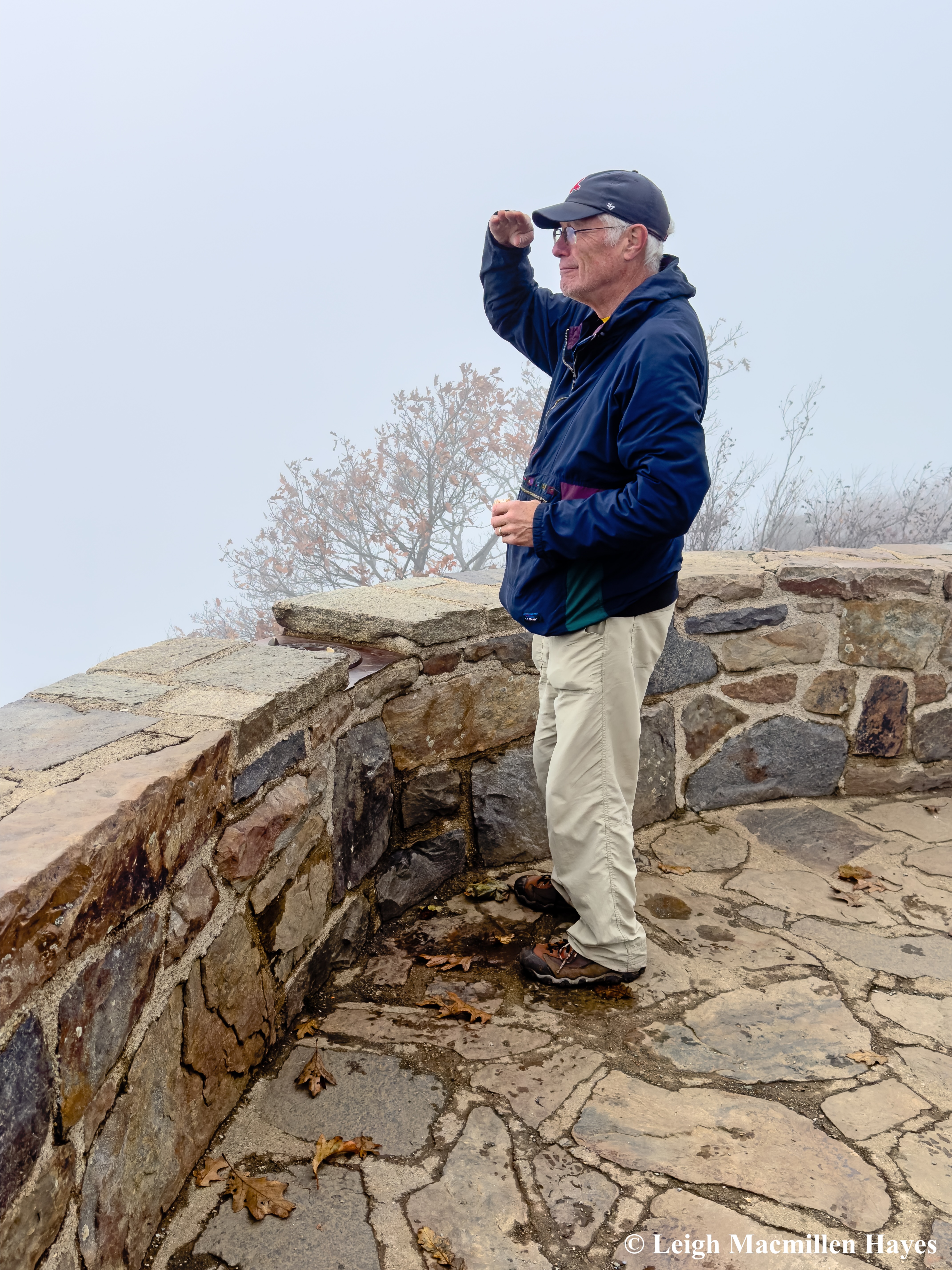
It didn’t really matter. We were there to hike, and that we did. And to enjoy each other’s company, and perhaps the lack of view put the emphasis on the latter focus.

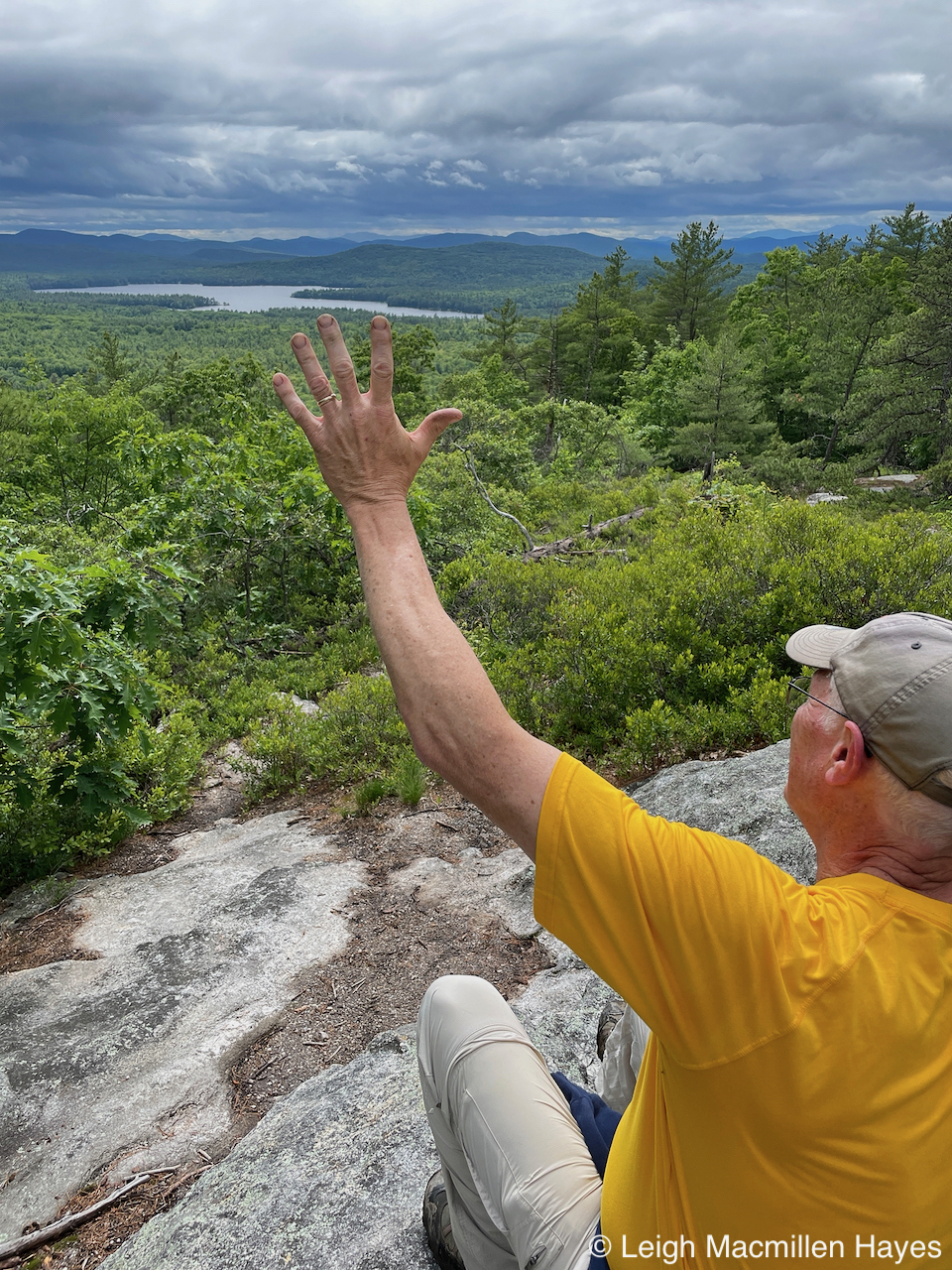
There were other days or even moments on the same days, when we could see Forever, and gained a better understanding of the local topography.
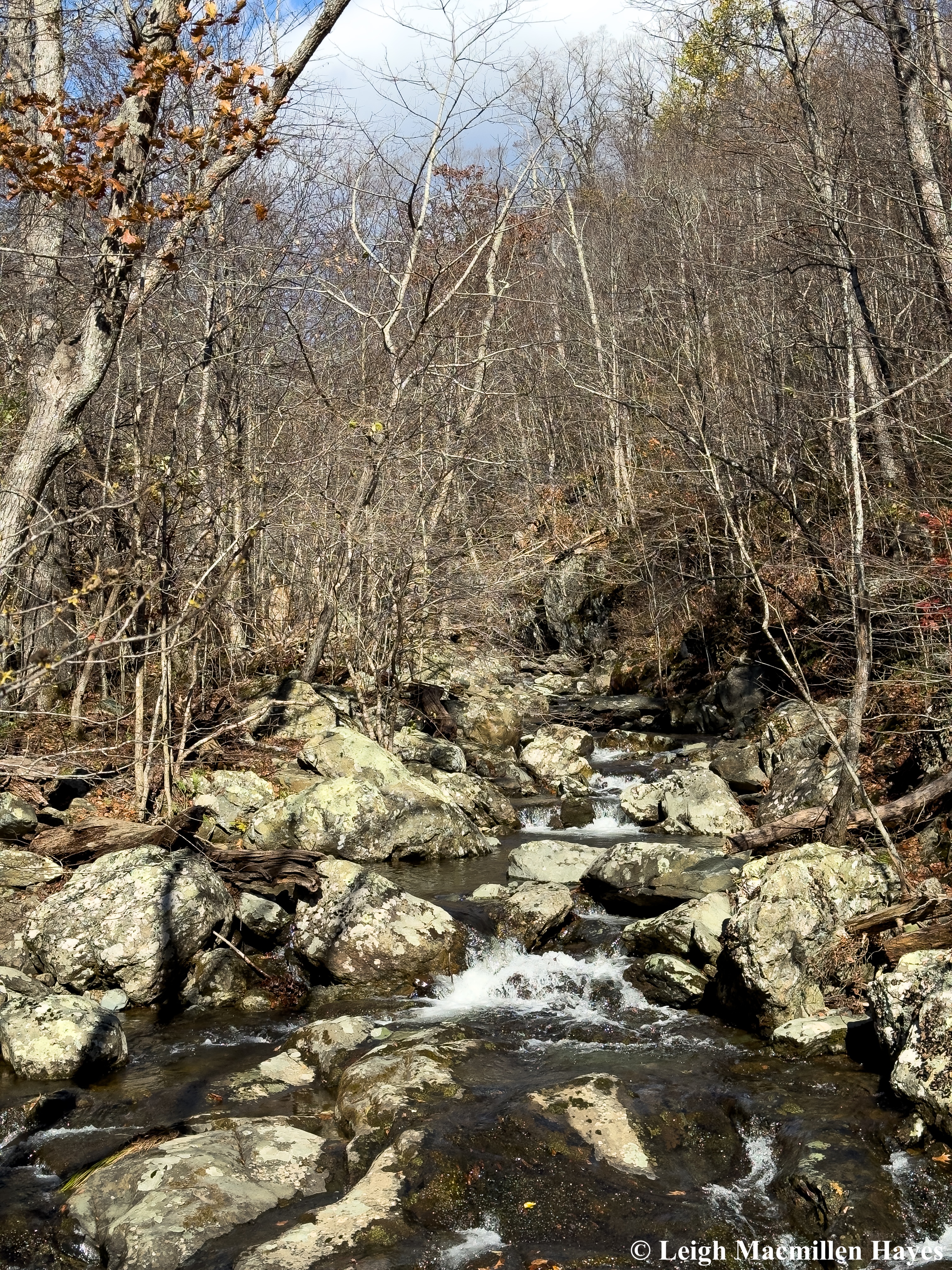
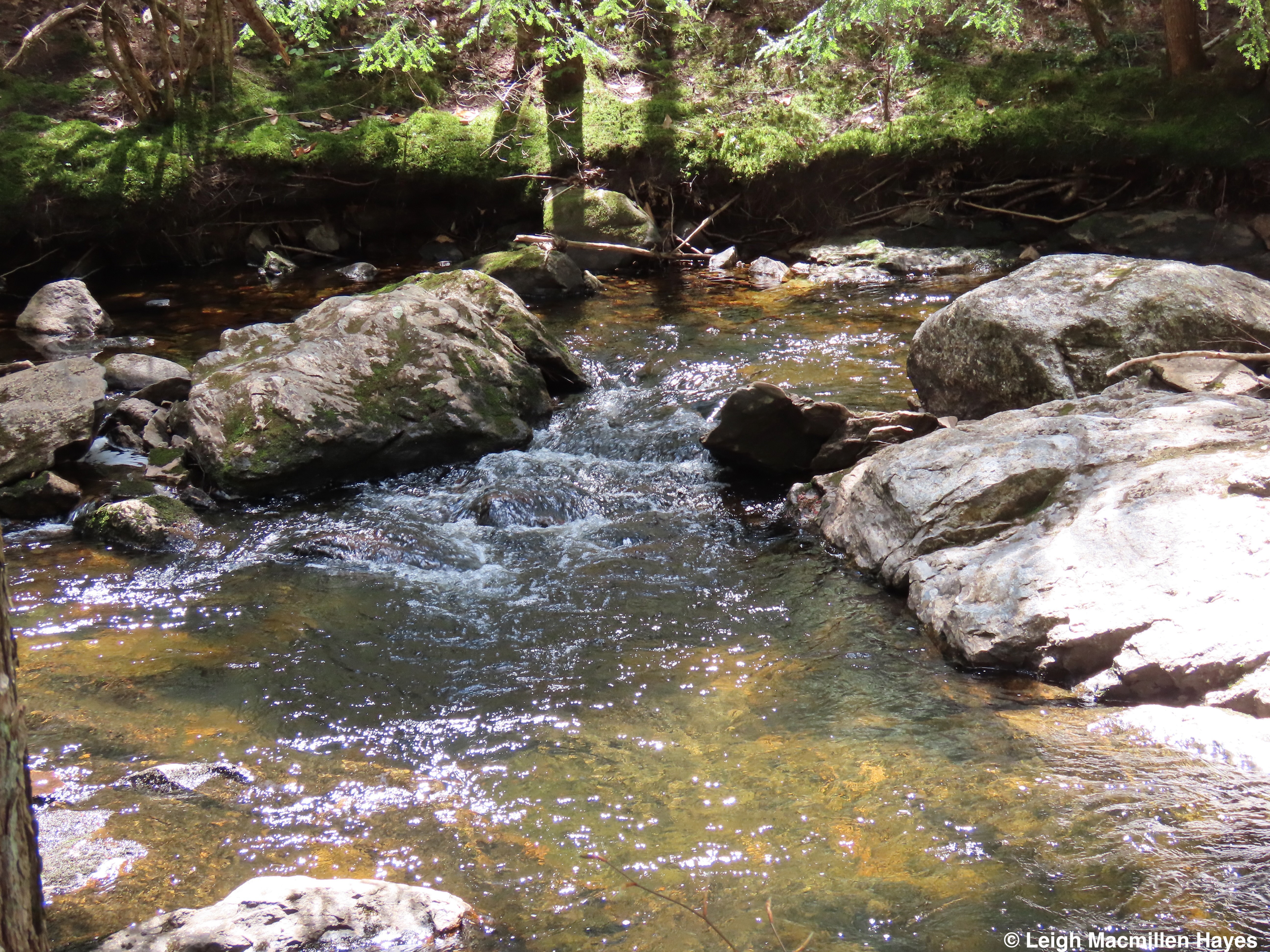
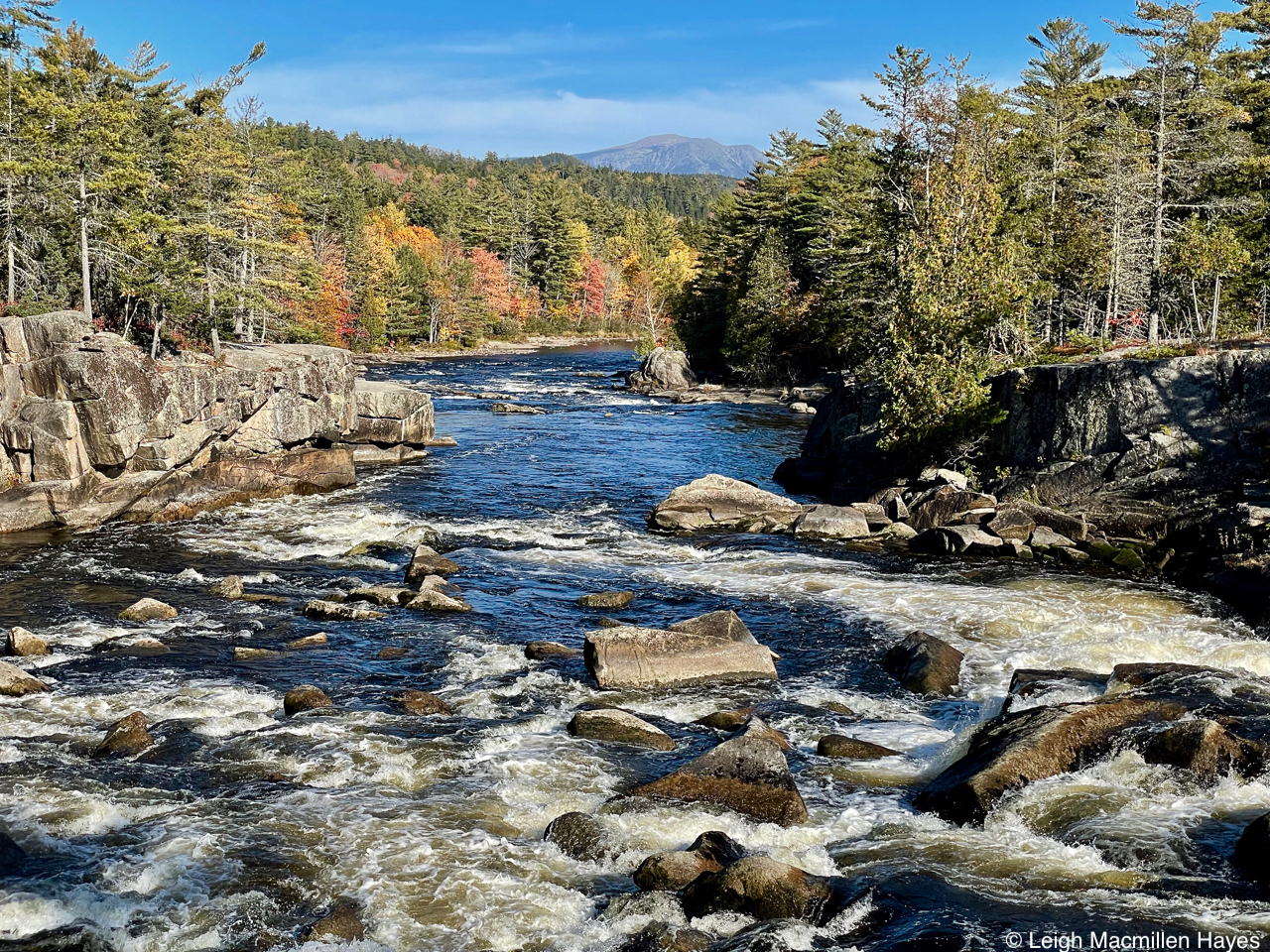
And sometimes we followed water, the very sound of which gladdened our hearts because it’s been so dry not only in New England, but also in the mid-Atlantic states, maybe more so, and the rain was welcomed by all.
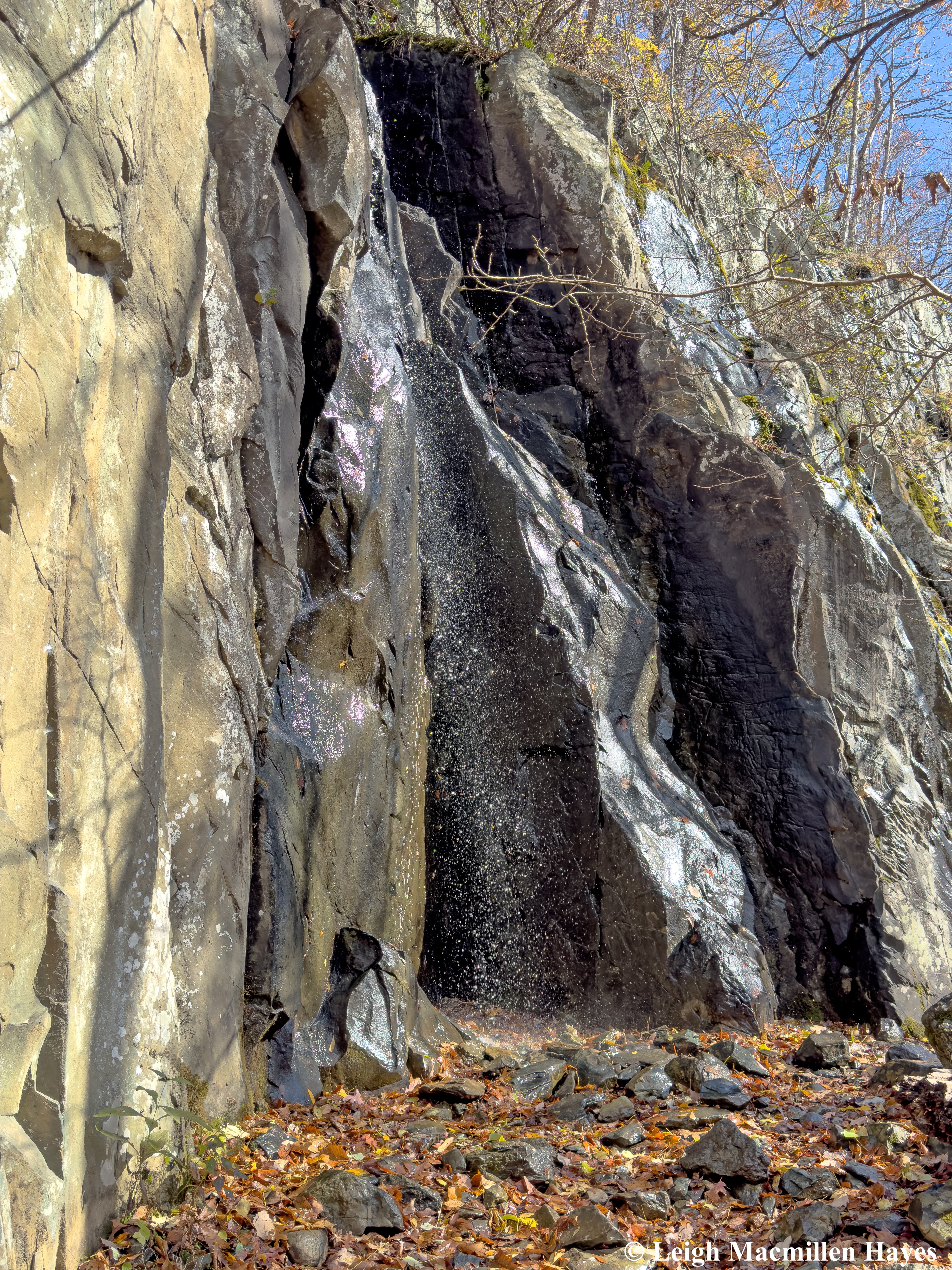
It even offered instant showers and since we were on and off the Appalachian Trail, we suspected thru-hikers might enjoy this very spot where the water poured down as a gift from above.
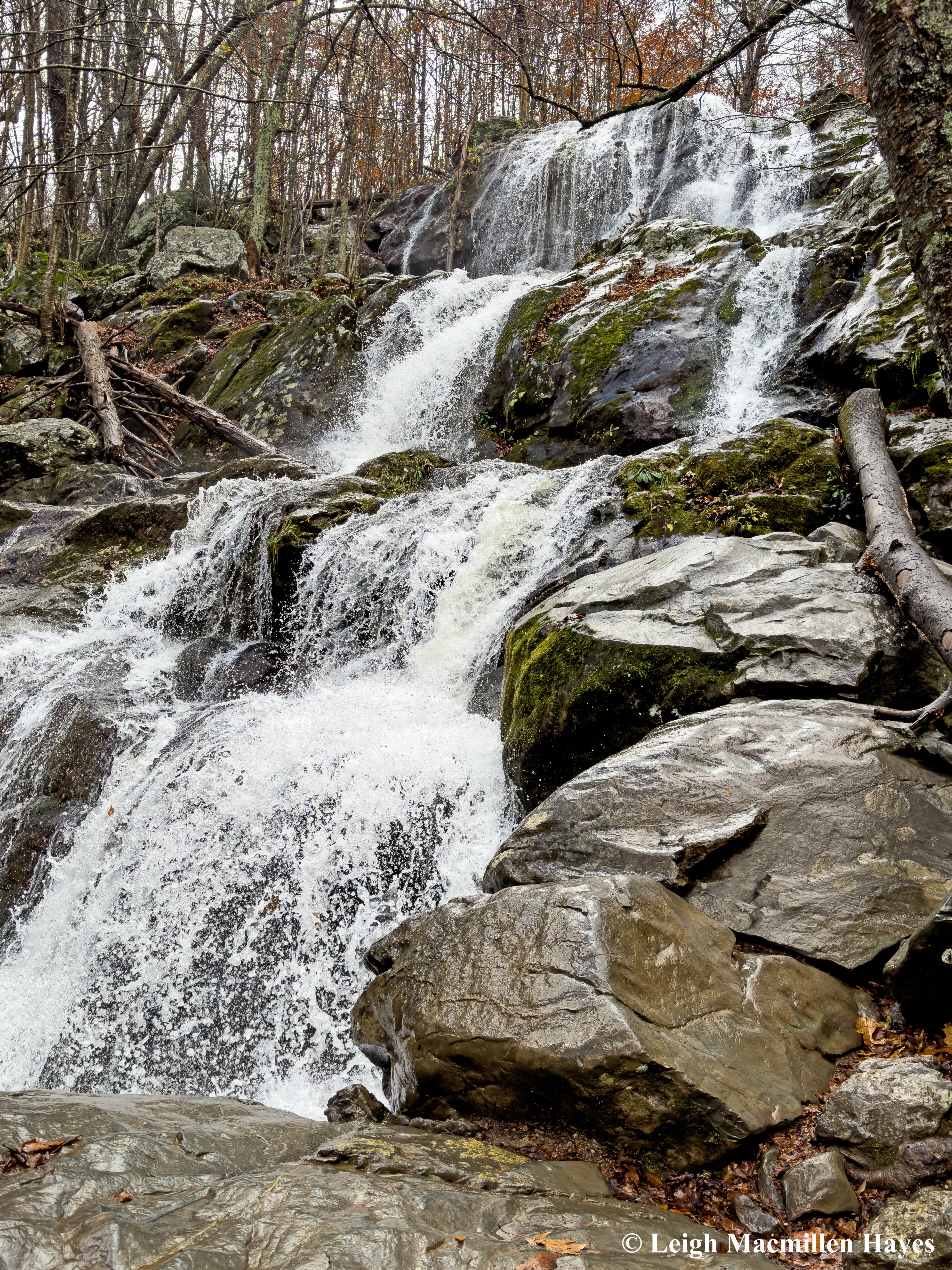
By week’s end, we had three favorite hikes, this one being to Dark Hollow Falls.
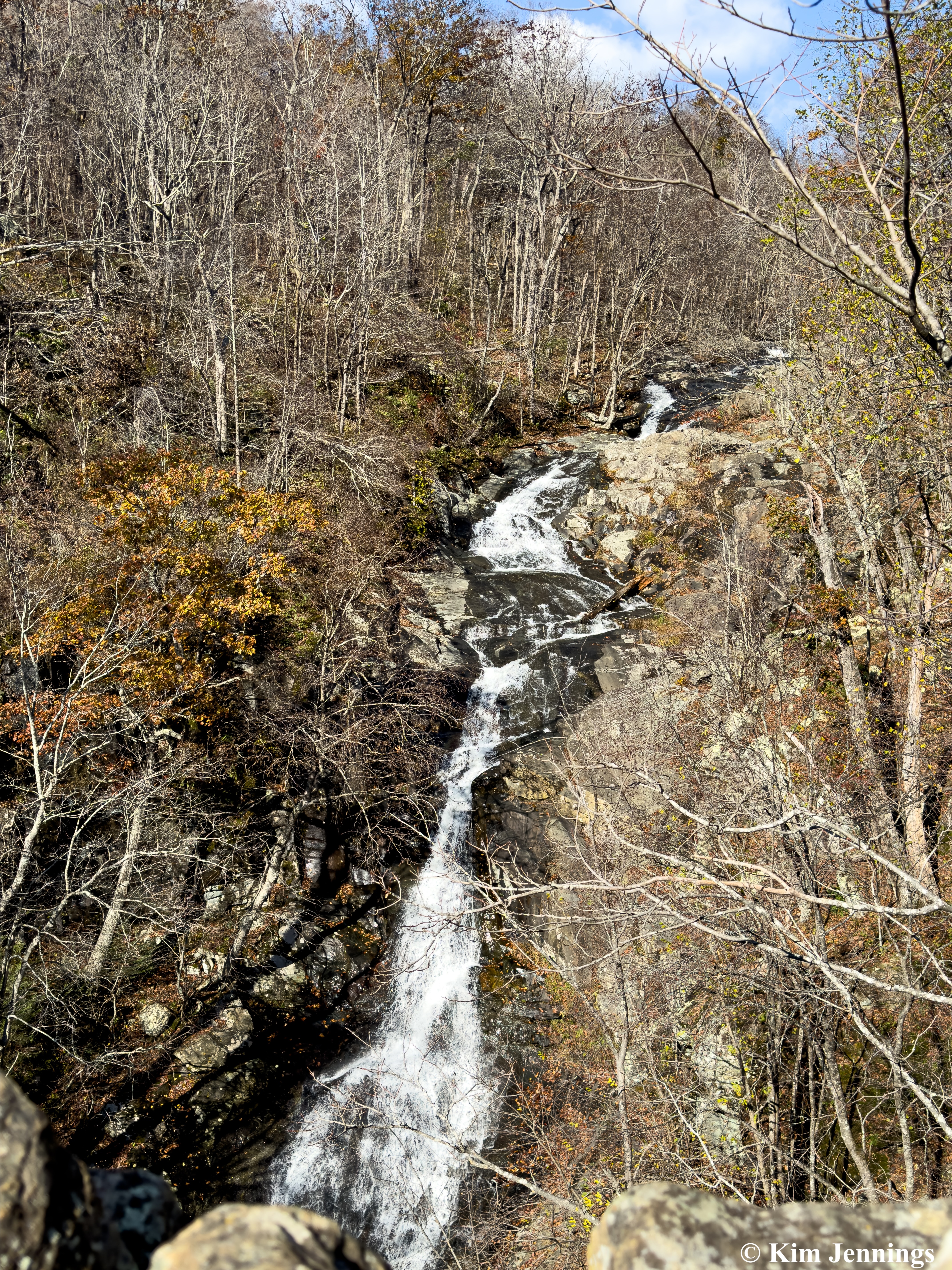
And then with two friends to White Oak Falls we discovered another favorite. I must admit that though this photo was taken with my camera, I let my friend, Kimmy, do the dirty work as the rocks she climbed over daunted me, especially as the wind roared.

The view also included much smaller sightings, like this Shaggy Soldier (Galinsoga quadriradiata), a curious little plant that was still in bloom along many of the trails. From a Botany in Scotland Blog, I read that “The genus Galinsoga is named after Ignacio Mariano Martinez de Galinsoga (1756- 1797). He was a famous physician in Spain’s royal court and is remembered most for writing a book about the health hazards of wearing corsets.” I’m not sure that answers the question of why the common name, but I do know that I completely agree with him about the health hazards of wearing corsets.
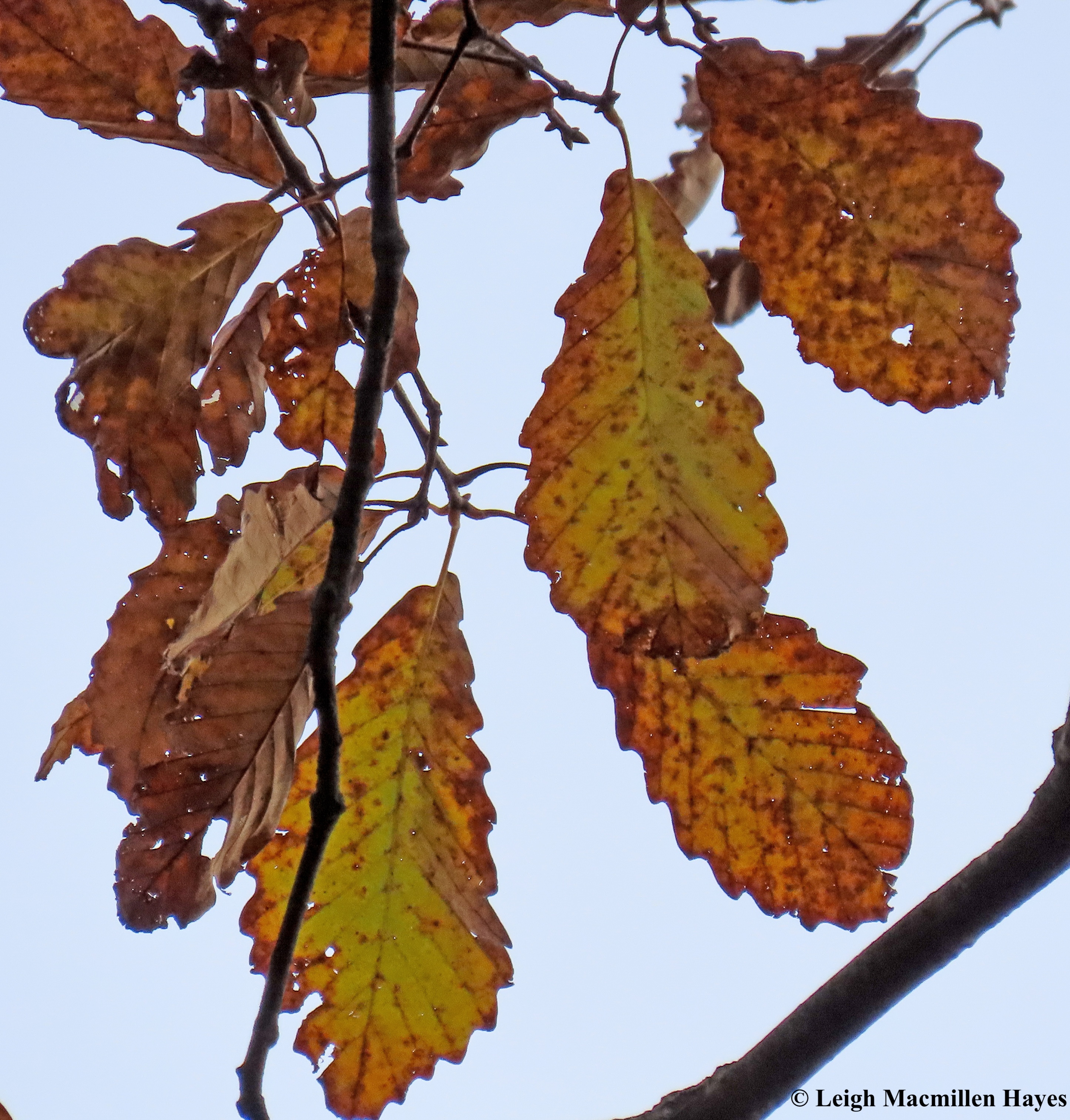
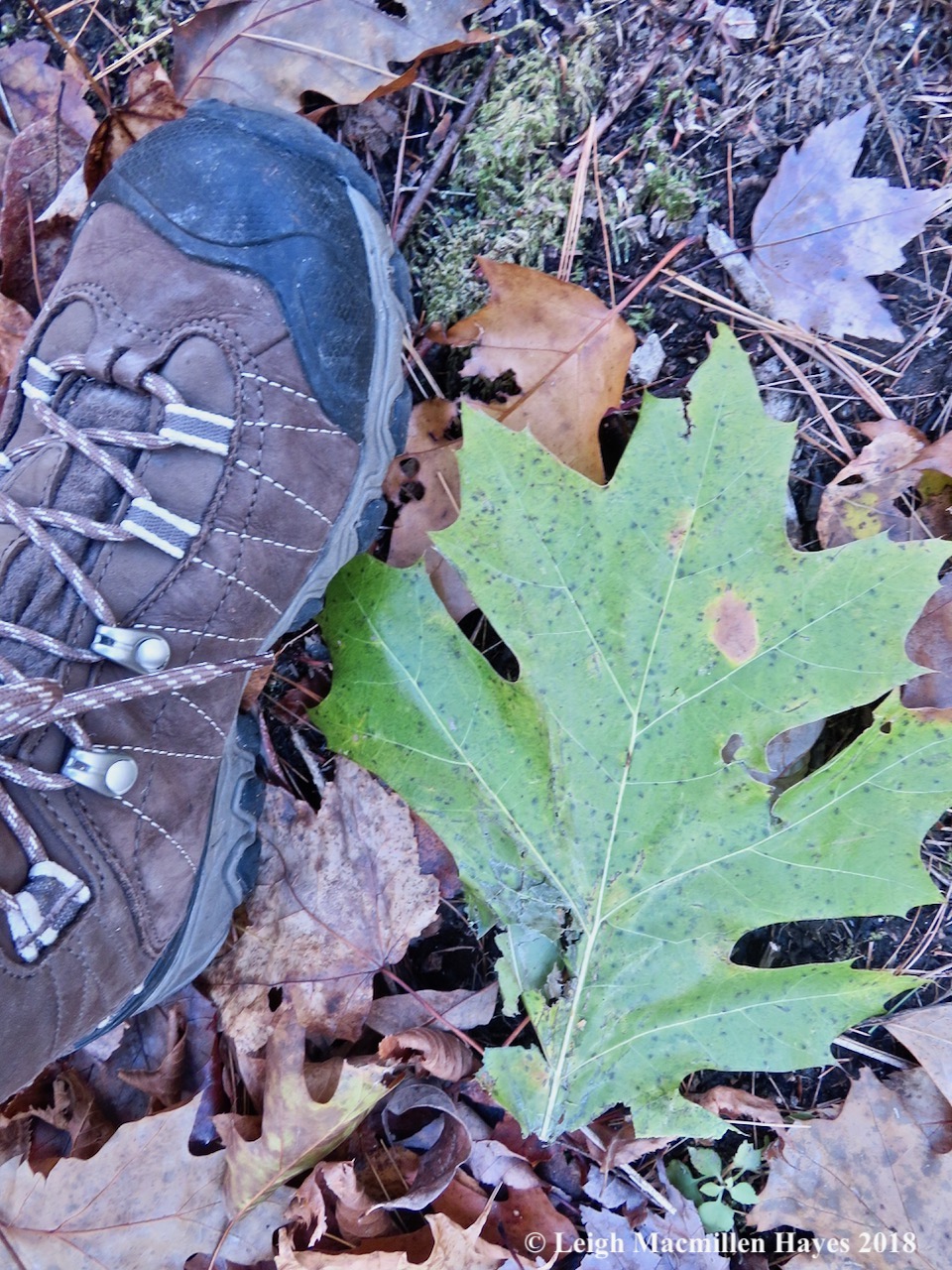
My heart nearly split in two when I spotted these Chestnut Oak leaves. A friend recently saw one of these in Portland, Maine, but this was my first introduction to the species.
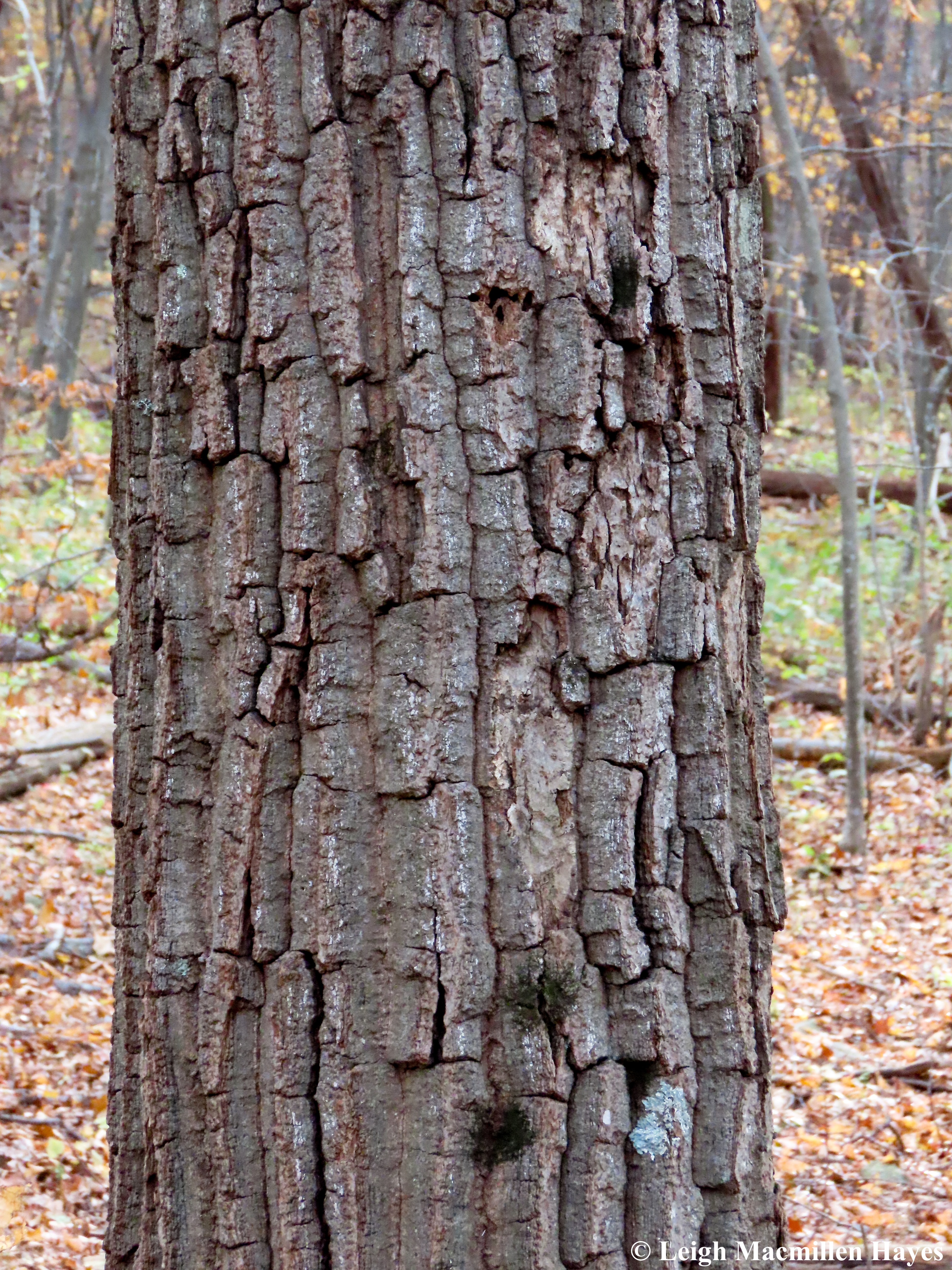
The mature bark is a combination of ridges and furrows, with a blocky presentation.

As I continued to meet new trees, I was thrilled and challenged and so purchased a Pocket Naturalist® Guide of Virginia Trees & Wildflowers.

My next introduction was to Sassafras, with its tulip-like, three-lobed leaves. There were so many on the ground, that they became part of the scenery along some trails.

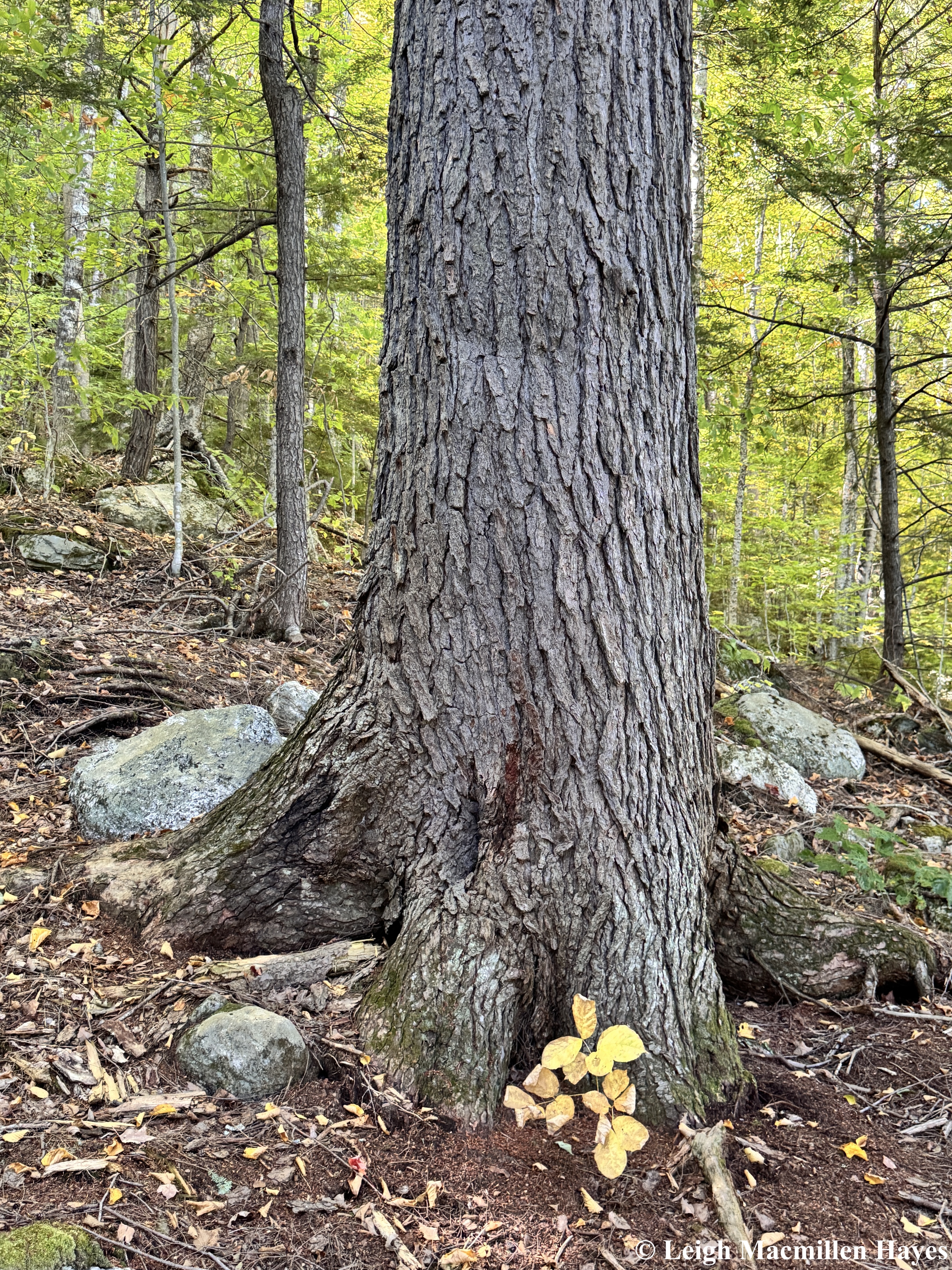
And on Day 2, yes, it was chilly, but I took the opportunity to honor a Sassafras with a hug. That was one huge tree.

Again, the bark had ridges and furrows, though it wasn’t blocky like the Chestnut Oak. But . . . I could have easily thought it was an Ash. In hindsight, however, we didn’t encounter any Ash trees.
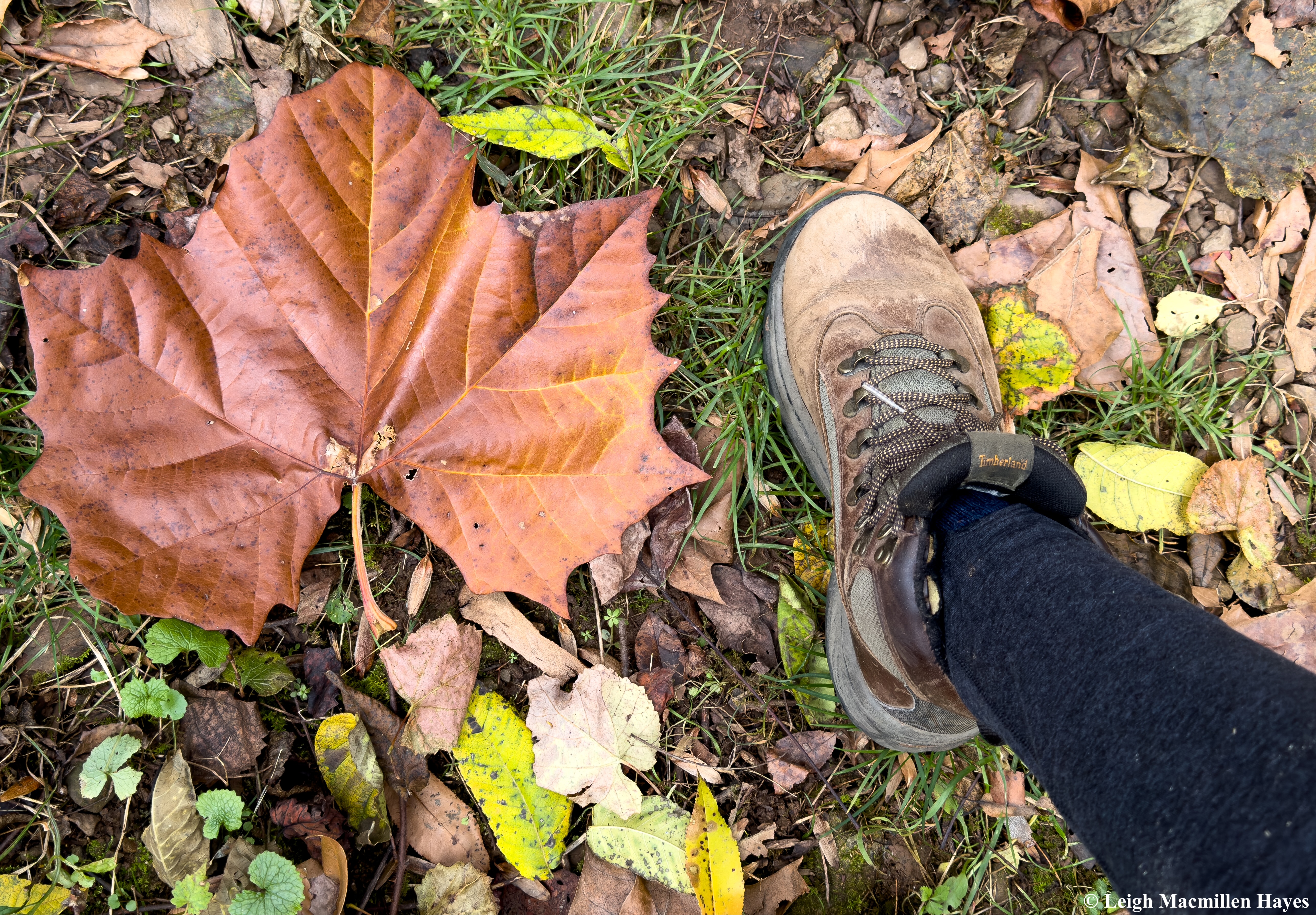
Though I have met the American Sycamore before, in fact, there used to be a large one in a neighboring town and for all I know it may still grow there. it was still fun to get a sense of the size of the leaves.

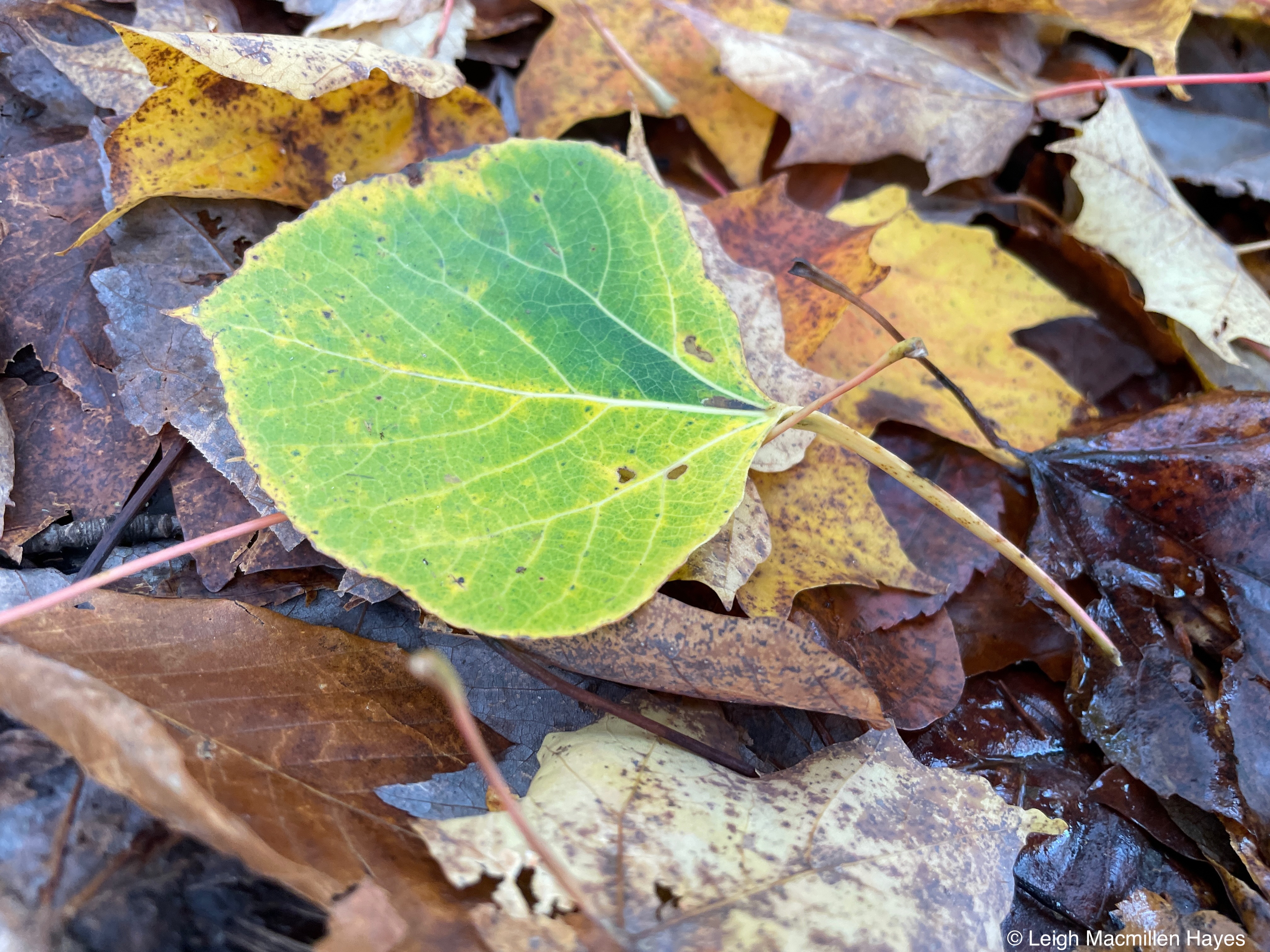
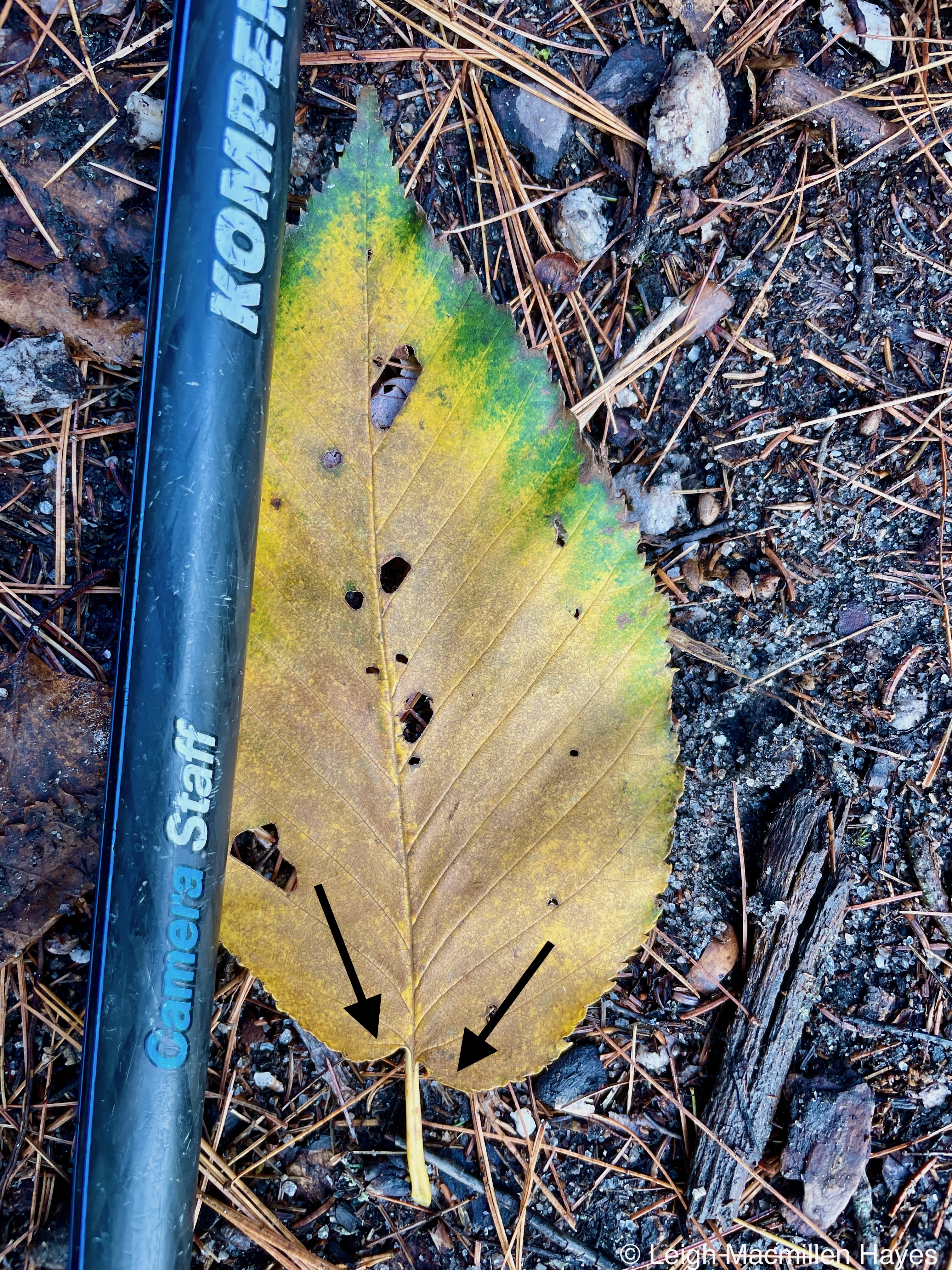
And then there was the Eastern Cottonwood, a cousin of our Aspens (Poplars), and I could only imagine all of the fluff along the Hawksbill Greenway in Luray, where this tree grew.

By its bark, I never would have known it, but fortunately, there was a sign below it that indicated it was a Cottonwood. I love signs!

Again, any of the barks we met all looked the same, at least during our brief encounters, so I was grateful for leaves that helped me differentiate them.

Others from away have mentioned Pawpaw, but this was my first time seeing the leaves that are widest at the middle.

They seemed to grow in clumps or groves and I wondered if they were all from seeds or is some root sprouting had also taken place. They reminded me of American Beech, which can do both and quickly fill an area where the sun shines.

One that I had never even heard of was the Princess-tree, and it had leaves the size of umbrellas. I’ve since read both pros and cons about this tree and you can do the same and make up your own mind about it, but it was certainly a surprise to meet it.
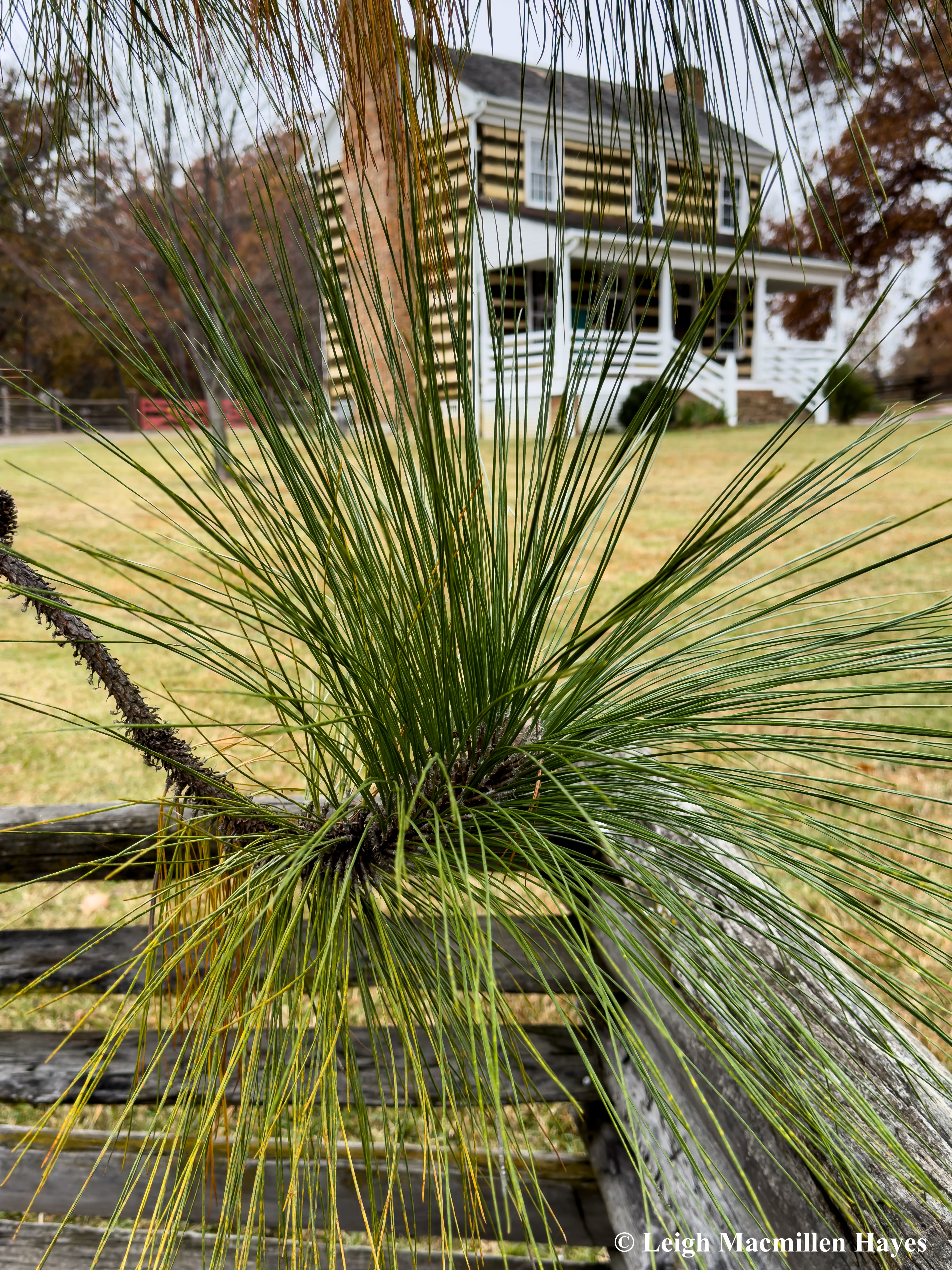
Almost last was one we found at the Shenandoah Heritage Village Museum. Again, I’ve heard of it, but this was a first time seeing it. My what long needles.

At about eight inches, each packet of three led me to identify it as a Loblolly Pine. I am sooo grateful that I purchased that guide.

So here’s the thing about the conifers. For a couple of days we met only deciduous trees, and most of them were the species I mentioned above. And then, as we went higher in elevation, we began to meet a few Eastern Hemlocks and White Pines and many of the trees we are familiar with in our woods. My Guy even noticed the various communities, and along some trails Mountain Laurel grew almost like a hedge.

I’ve saved this particular leaf for last in the tree section of this blog. Oh, believe me, I have plenty more to say. But this skinny leaf that My Guy held for me, is another Oak species.
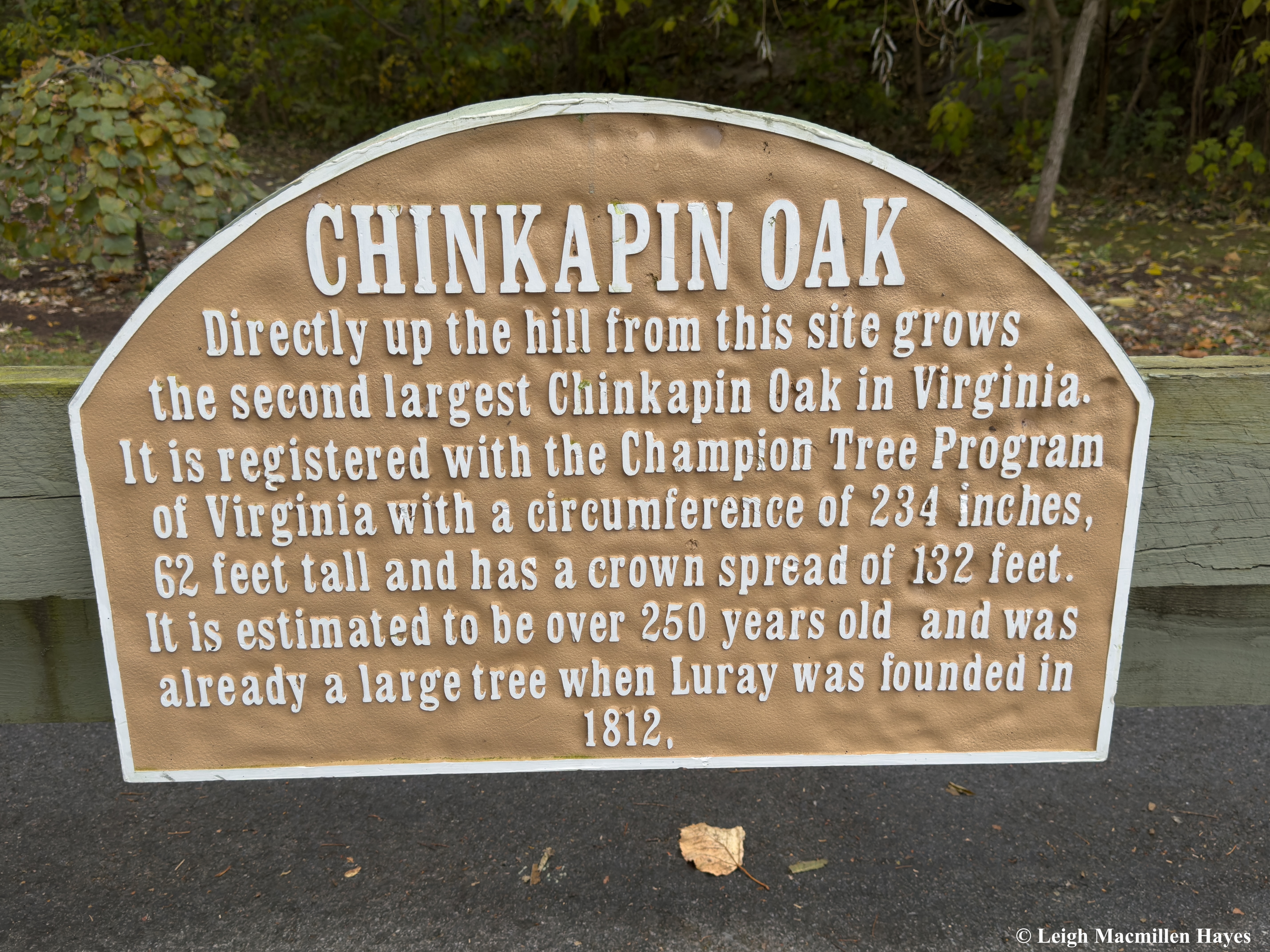
We only knew about it because on our rainy day hike, when we turned around from a mountain adventure and decided instead to explore in Luray, we discovered this sign along the Hawksbill Greenway, a two-mile trail through town.

We looked up the hill from the sign and didn’t spot anything that looked different. After we’d walked to both ends of the trail and back to our starting point in the middle, we headed up one street that led us to the next, and then one more because we had spotted something that we thought just might be the champion.

Meet the Chinkapin Oak. Born about 1775, think about all that this tree has witnessed. I wanted to hug it, but refrained because I didn’t want to accidentally introduce something to it. For example, what if I had teeny aphids on my mittens that I wasn’t aware were there from having touched other trees? No, instead, I just stood in awe of this mighty giant. We both did, actually.

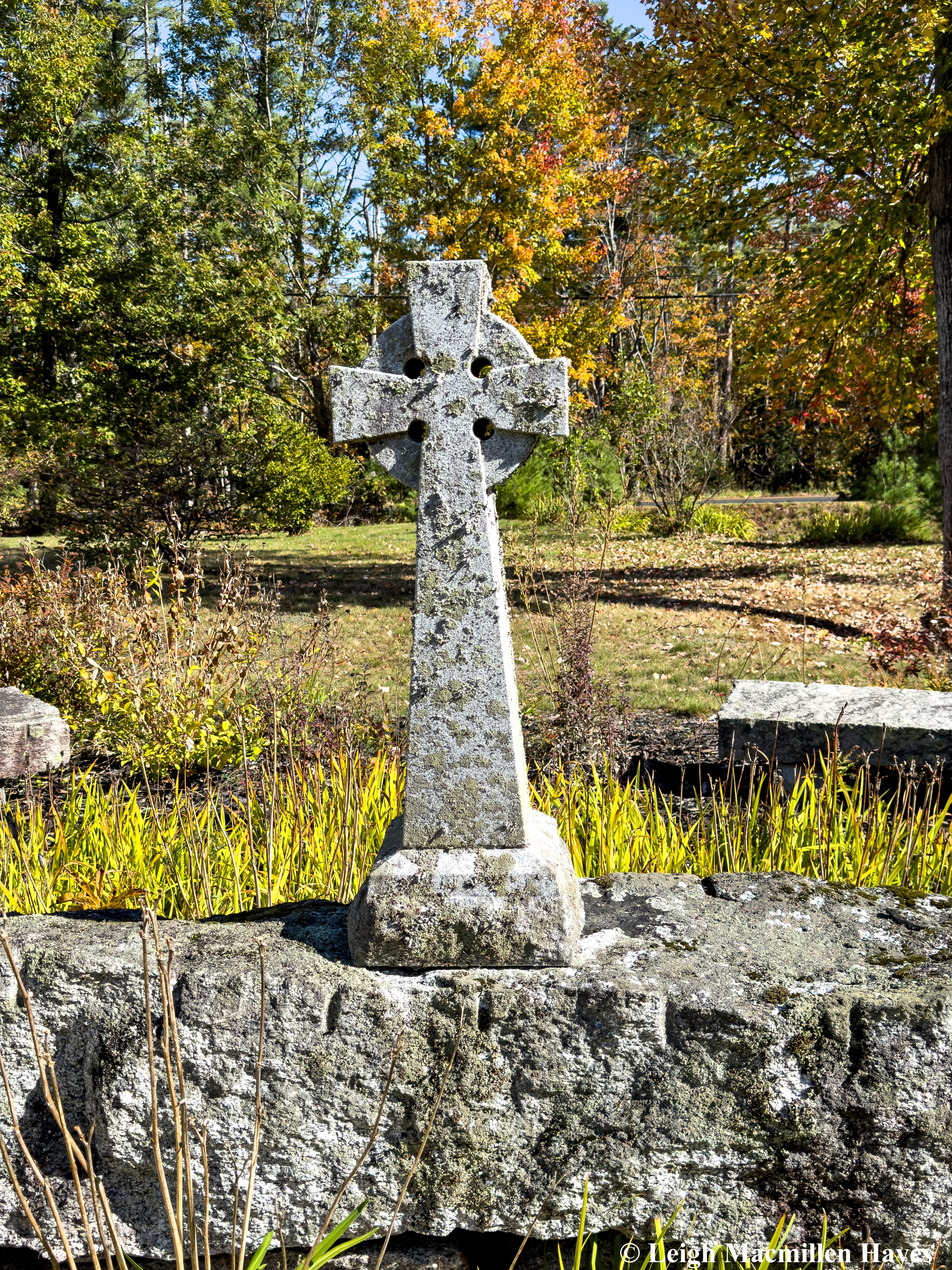
Returning to the trails, sometimes we came upon historic sites, this one being the Fox family graveyard.

Lemuel F. Fox died in 1916 at the advanced age of 78. That’s actually an incredible feat.

Especially considering he survived the Civil War, where he served with the Confederate States of America.

At the Snead Farm on another trail, we discovered what seemed to be a raised dooryard and large foundation and sensed the Sneads had some money.

Perhaps the house burned down, or was taken apart and moved, but the horse barn still stands.

I peeked into each of the stalls, just because I could.

Interestingly, visitors can ride horses on some trails specifically designed for them. though this one isn’t.

It’s a place for everyone, including those with mobility issues, for the Limberlost Trail is accessible. .

And truly it is a place for everyone as we met people from a variety of states and countries, including Sri Lanka, Spain, England, Germany, Israel, and more.

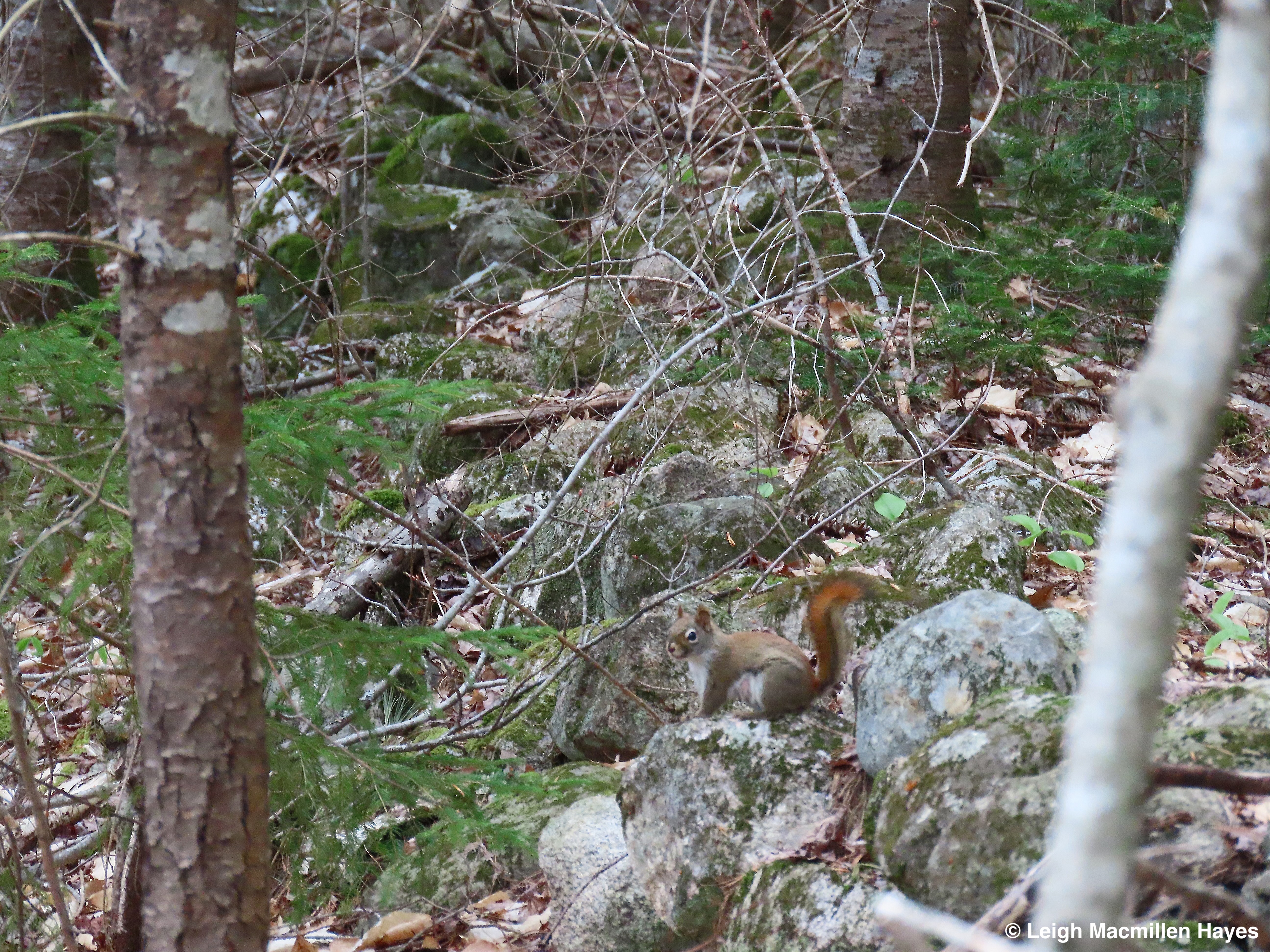
A place for all also includes the critters who make their homes here. Deer. Did I mention White-tailed Deer? They are everywhere. We also spotted the occasional Gray Squirrel. And we really wanted to see a Black Bear, but didn’t have that opportunity.

Our most prolific mammal sighting, other than Deer, the Northern Short-tailed Shrews. These are not everyone’s favorite food as they emit a toxin and so are quickly dropped upon capture. Either one larger predator didn’t learn the lesson the first, second, third, fourth, or fifth time, or there are so many of them running around at night that the everyone tries to make a meal of them.
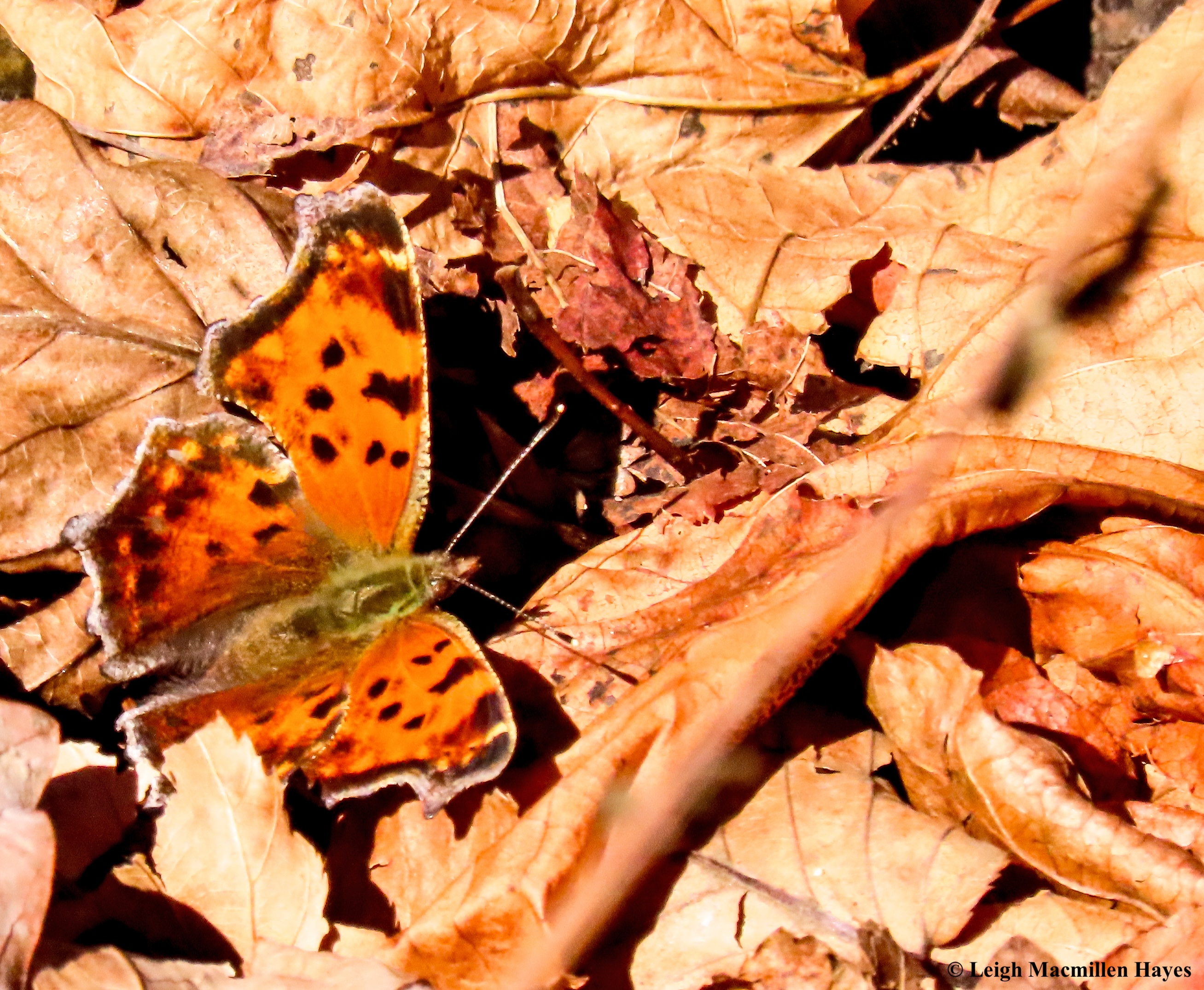
On the day we hiked with our friends, we had a couple of fun insect sightings, including this Punctuation or Anglewing Butterfly–be it either a Question Mark or Comma. It never did show the underside of its wings so we couldn’t determine it to species, but it was still a fun butterfly to spot.

Speaking of spots, we saw at least three Spotted Lanternflies. I was intrigued with their colors, but Kimmy told me to squish them as they are extremely invasive.

And because of her we got to see a Walkingstick upon a rock where she just happened to place her hand. If it hadn’t moved in that moment, she would probably not have seen it. We were all grateful that it did move. And then it posed for us.
Now that you’ve stuck with me for this long, I’ll let you know that I saved some of the best for last.

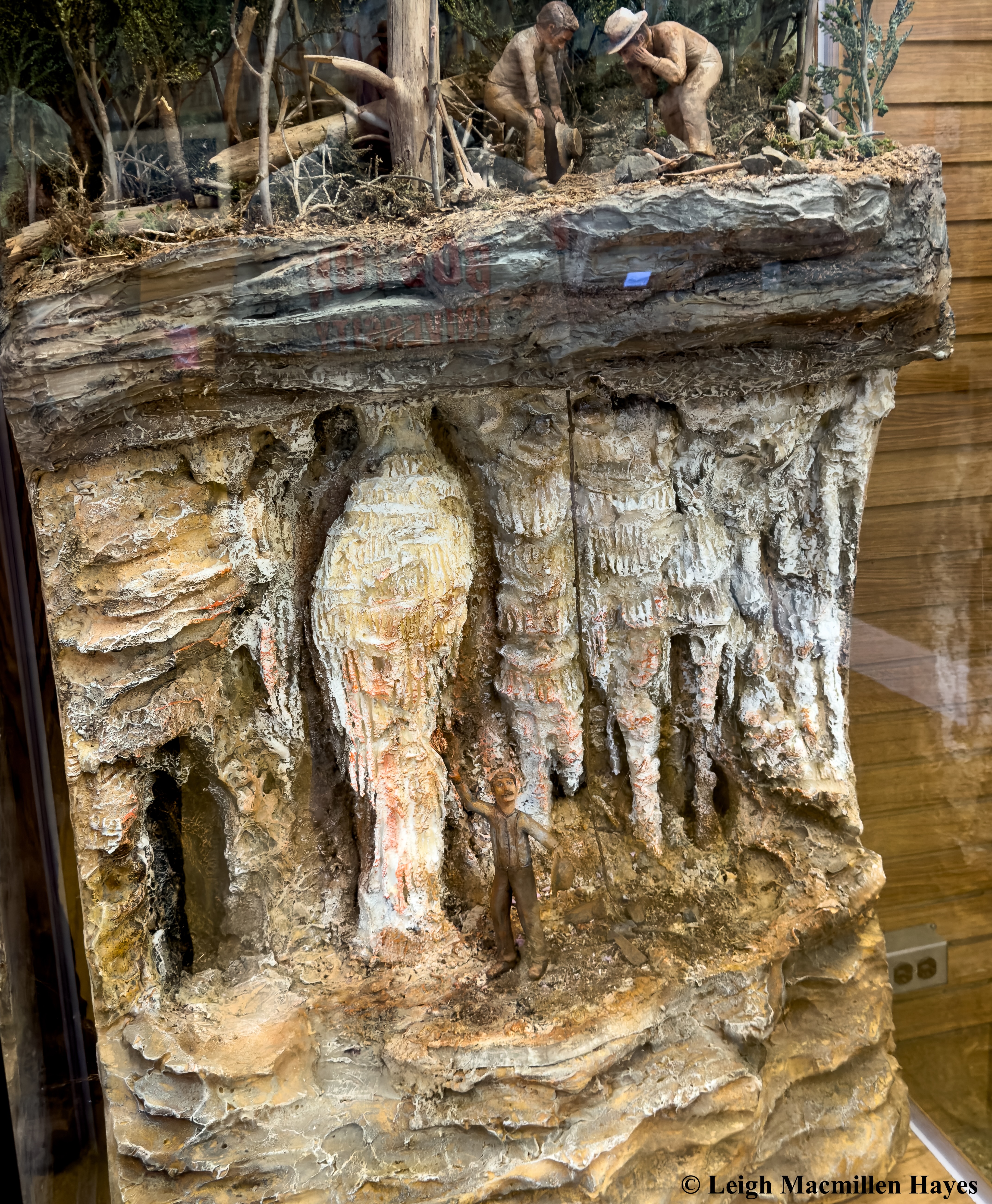
On that rainy day, we not only walked the Hawksbill Greenway, but we also went on a self-guided tour of Luray Caverns. According to the brochure we received at the ticket booth, the caverns are the largest in the East and were discovered by a tinsmith and local photographer in 1878. This diorama depicts that moment when the discovery was made.

And X marks the spot where it was made. Can you imagine the man’s excitement and amazement?

Discovered in August, we were told that the first tour occurred that November.

The cavern is a cave where Stalactite and Stalagmite meet, but in this instance that is an optical illusion. Can you see why?

There are veils to admire.

As well as a tent . . .

made of “curtains” that seem almost transparent.
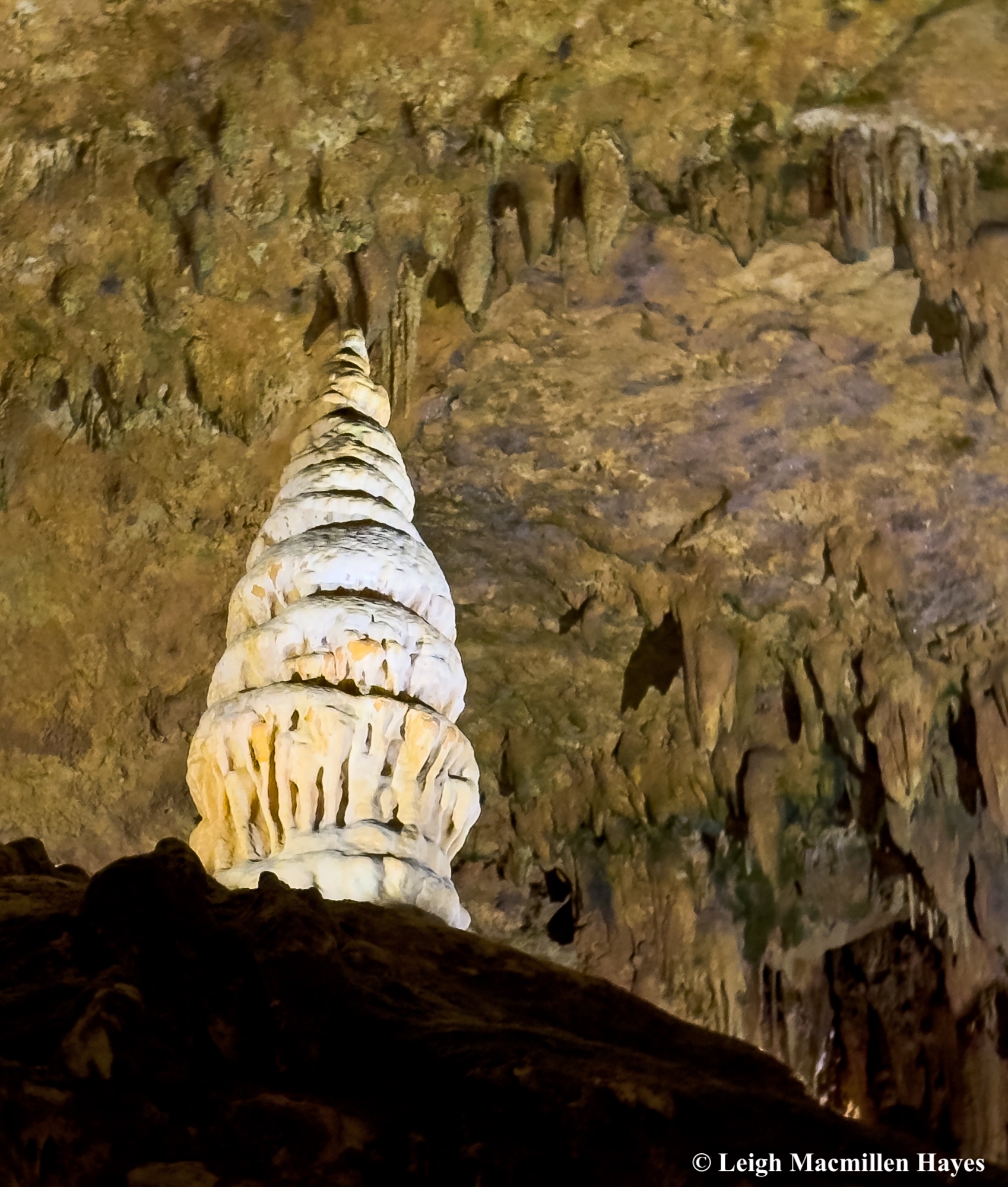
We chatted with a couple of young docents and they told us that this structure is seen as something different in every season–from a Christmas tree to a pine cone to an ice cream cone, and one more that neither of us can remember. But the big question was: what ice cream flavor?

The answer: Rocky Road.
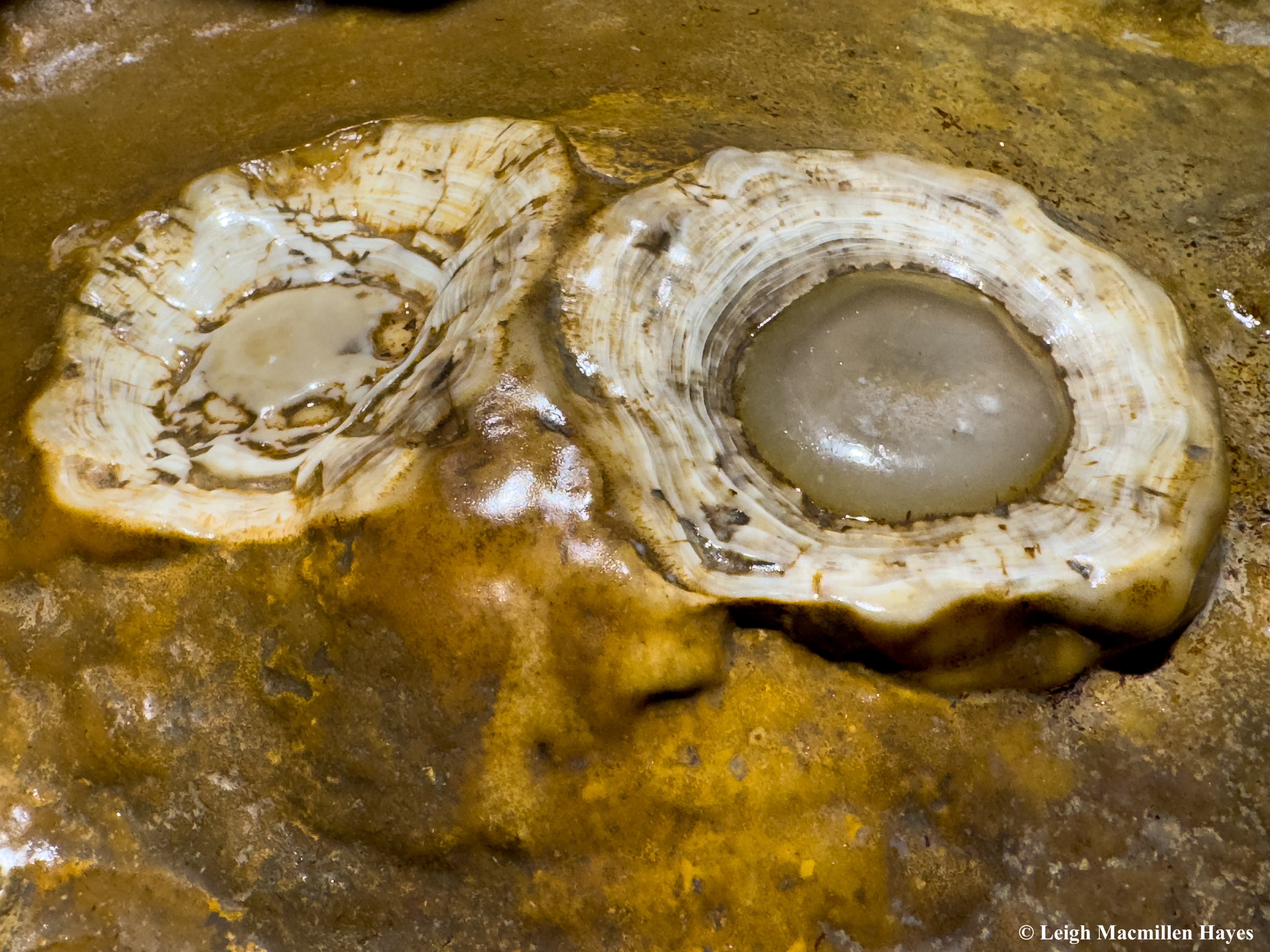
And then there were the Fried Eggs. Or oysters on a half shell?

We highly recommend a visit. I’ve only shared a few of beyond-belief spots, as around every corner there was a different formation to look at. I felt like I was in fairy land with lots of action everywhere as stories unfolded.
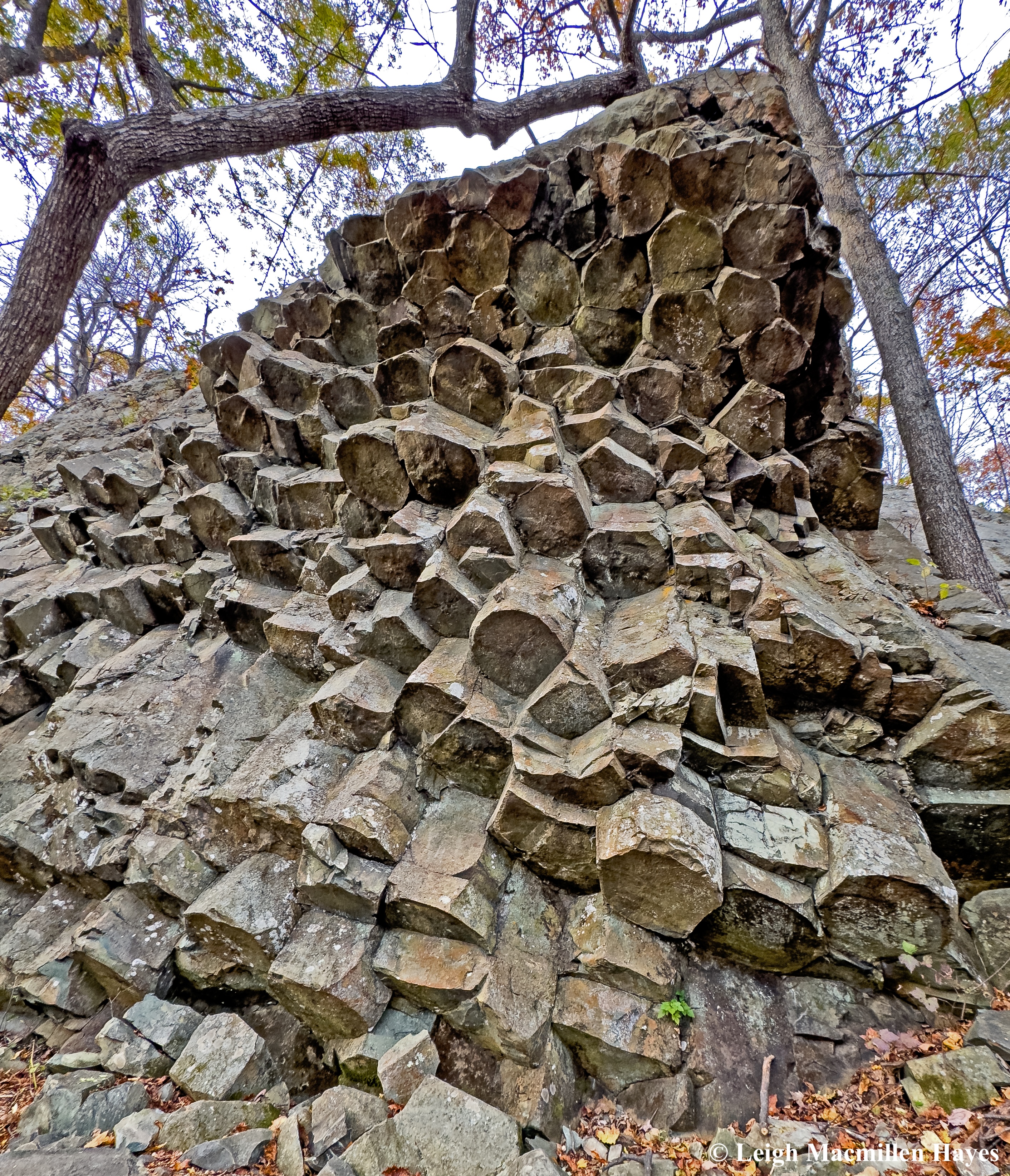
Back on the trails, we also had fun finds, like this columnar jointing, which turned it into yet another favorite trek. It’s known as the Fort Windham rocks and is greenstone and part of a series of lava flows, that we spotted in other places as well.

It reminded us of the Giants Causeway in Ireland, a geological phenomenon of 40,000 basalt stone columns formed by volcanic eruptions over 60 million years ago.

And so we posed.

We posed again at Dark Hollow Falls.
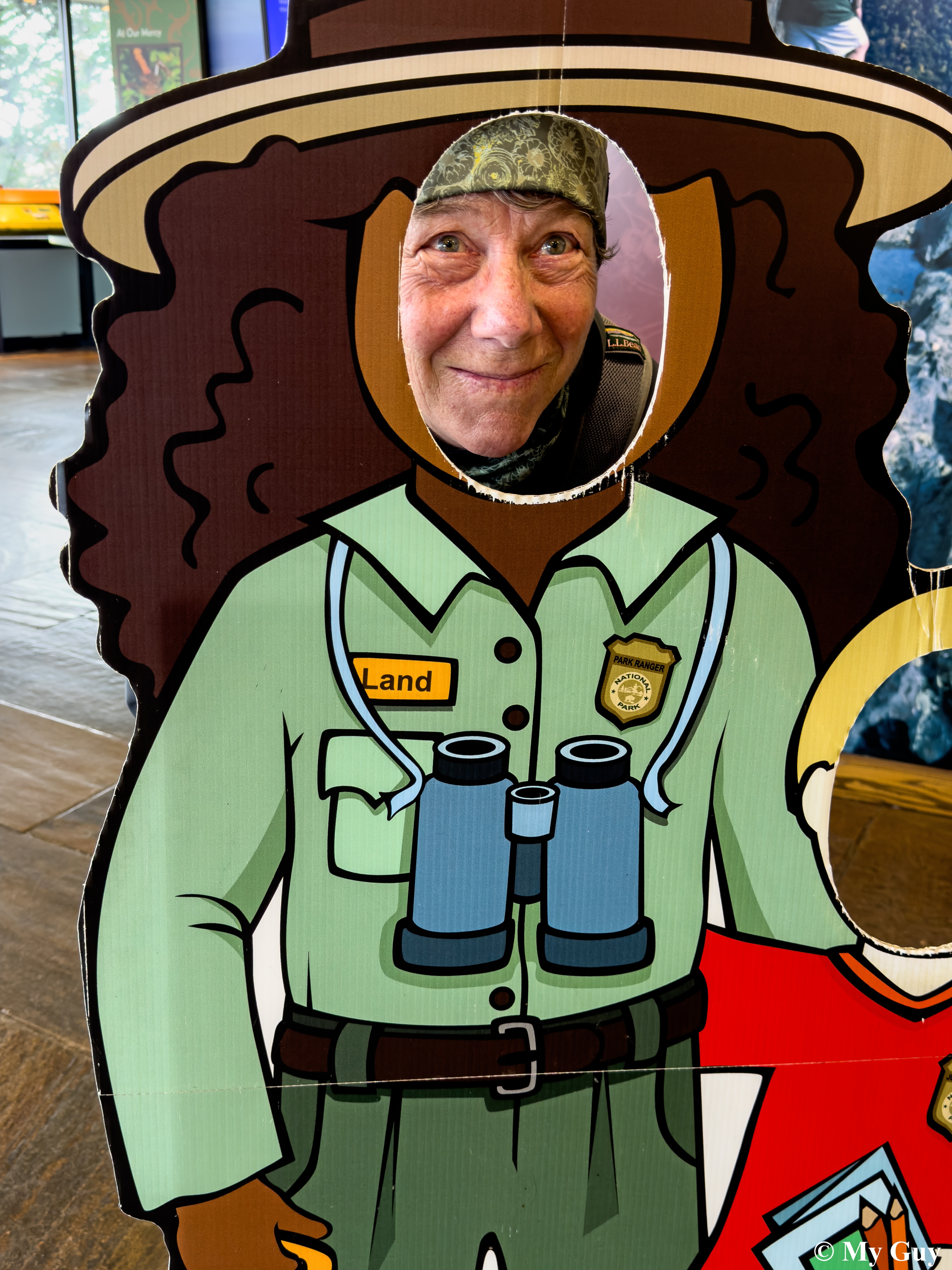
And then I took a shift as a park ranger. (Actually, the park rangers are furloughed under the current shutdown, so we were reminded each day to be extra careful while hiking because rescues could take hours.)

As for My Guy . . . no vacation is complete without a trip into the local hardware store.
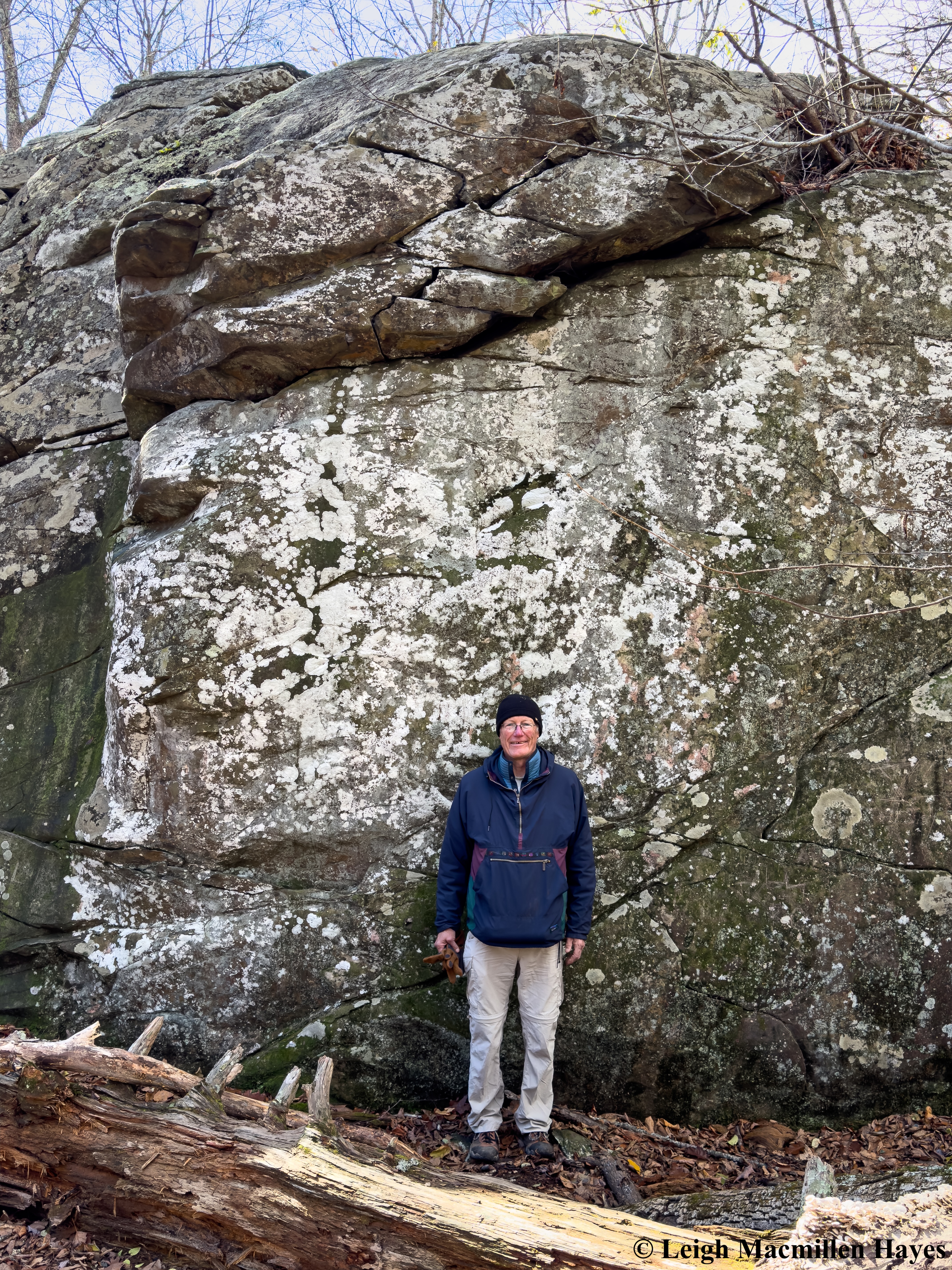
But where my readers usually see only the back of him, he was happy to lend his almost 6′ height as a reference for this large boulder.

And while we were truly excited to spend a week hiking together, we were equally excited to share the trail with these two, Maddie, a high school senior who had the day off, and her mom, Colonel Kimmy Jennings, USAF retired. Kim was a student of mine back in her middle school days. It’s always a joy for all of us when we can meet up and share the trail, though typically it’s when she makes a trip home to Maine, so she was thrilled that we’d actually ventured south. And our pose was in front of another example of columnar jointing.

After we hiked for about four hours with them, we had one more hike to tackle bringing our total to ten trails, that being Mary’s Rock, and then we left Luray and returned to Front Royal for the night before beginning our two-day journey home with a stop over in Albany, NY and a quick tour of the Norman Rockwell Museum on the final stretch.

Like any vacation, we’ll cherish this one forever.

Above and Below, I guess it was actually more than a few wonders that wowed us along Skyline Drive and in the area.

A Blooming Surprise

Two days ago we awoke to a temperature of 27˚ and the ground was covered with frost. And the Juncos flew into the yard. And so it seemed that autumn was turning a new page.

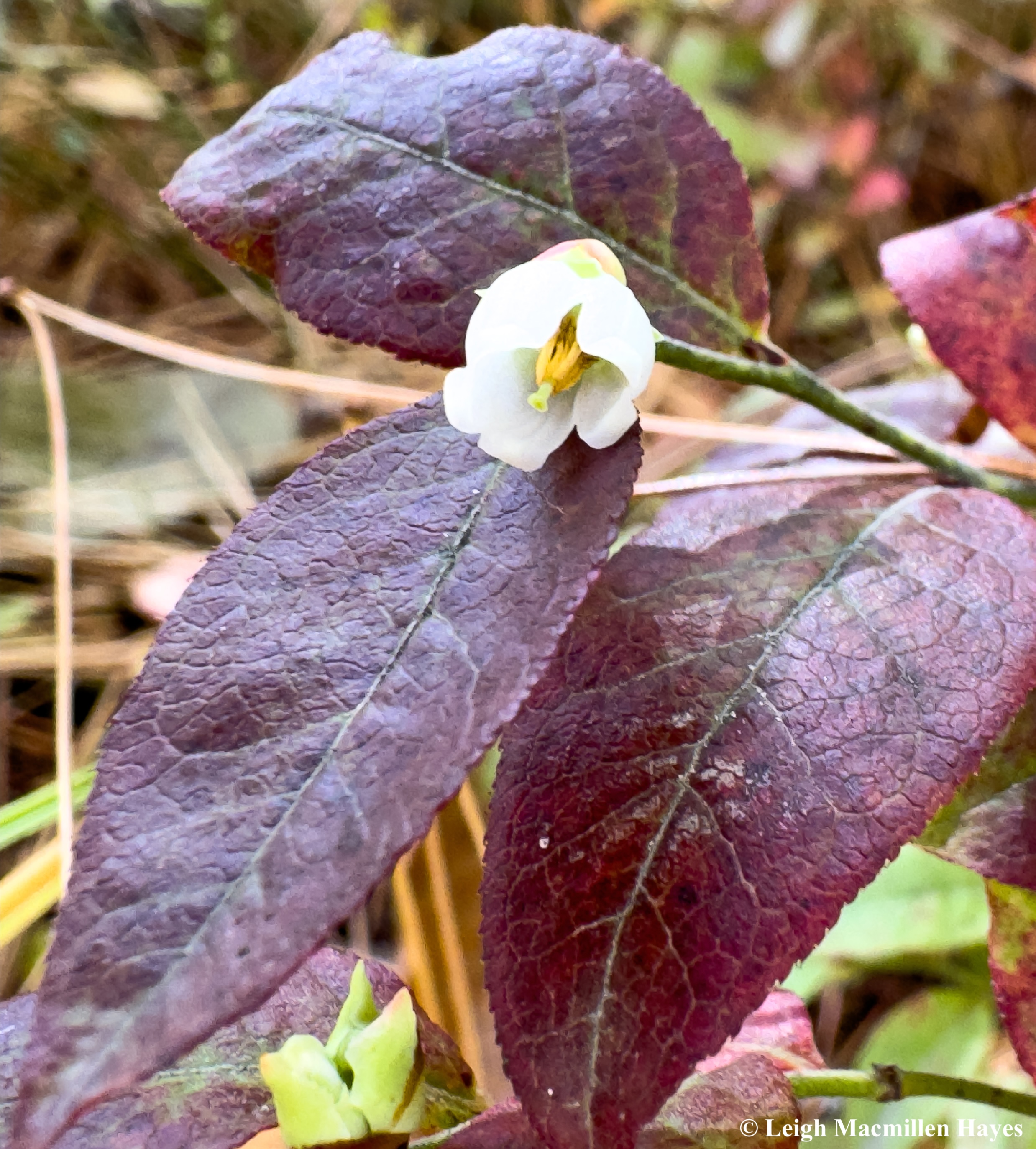
But . . . the day before the frost, as I walked along a local trail, something tiny captured my attention and as I bent down, I realized that despite the fact that the leaves of this Low-bush Blueberry had shut down their food production process and let the anthocyanin that had been stored in the leaves finally show through since chlorophyll was no longer a key factor, the plant was flowering.

There were somewhere between a dozen and two flowers in bloom on this one plant. After seeing that, I checked others, but didn’t spot any more flowers.

Of course, I did what I always do when such an event occurs, and immediately sent the photos to my nephew who lives in southwestern New Hampshire. The past few years we’ve exchanged such photos when the out-of-the-ordinary occurs and last year it seems like we found a bunch of species in bloom at the wrong time. This was the first for both of us this year, and as he commented, probably because it’s been so dry. But still, it’s also been hot and the flowers seem to get confused–more than they used to, at least in our memories. How about for you?

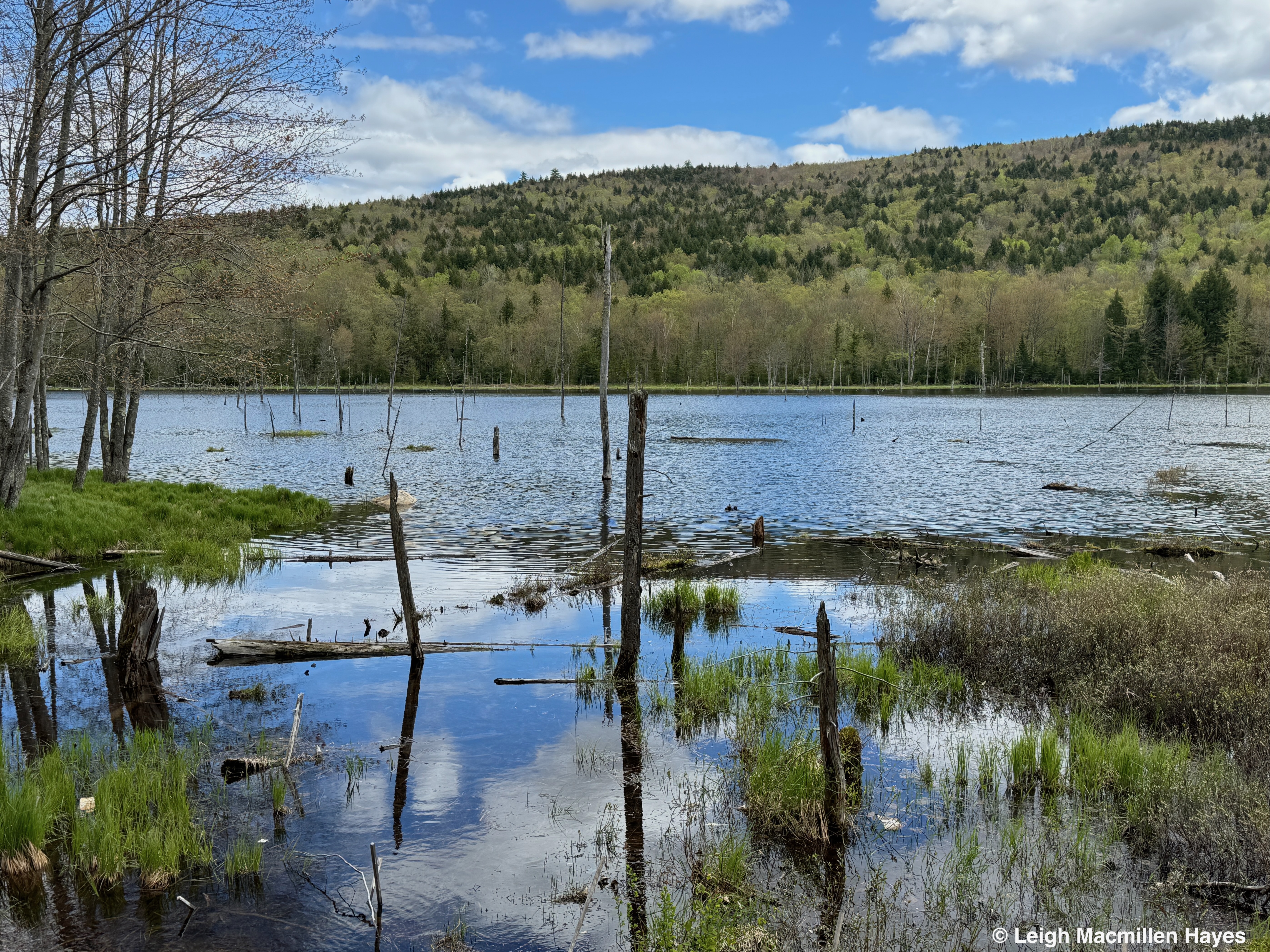
And so today I stopped by St. Peter’s Episcopal Church in Bridgton, Maine, because I love the land that surrounds the building and wondered what it might have to offer. I actually stopped by twice–first in the late morning, and then again in the middle of the afternoon.

Seeing Hawkweed both in bloom and preparing to send seeds forth for future blooms wasn’t a surprise at all, for this flower is prolific and hardy.

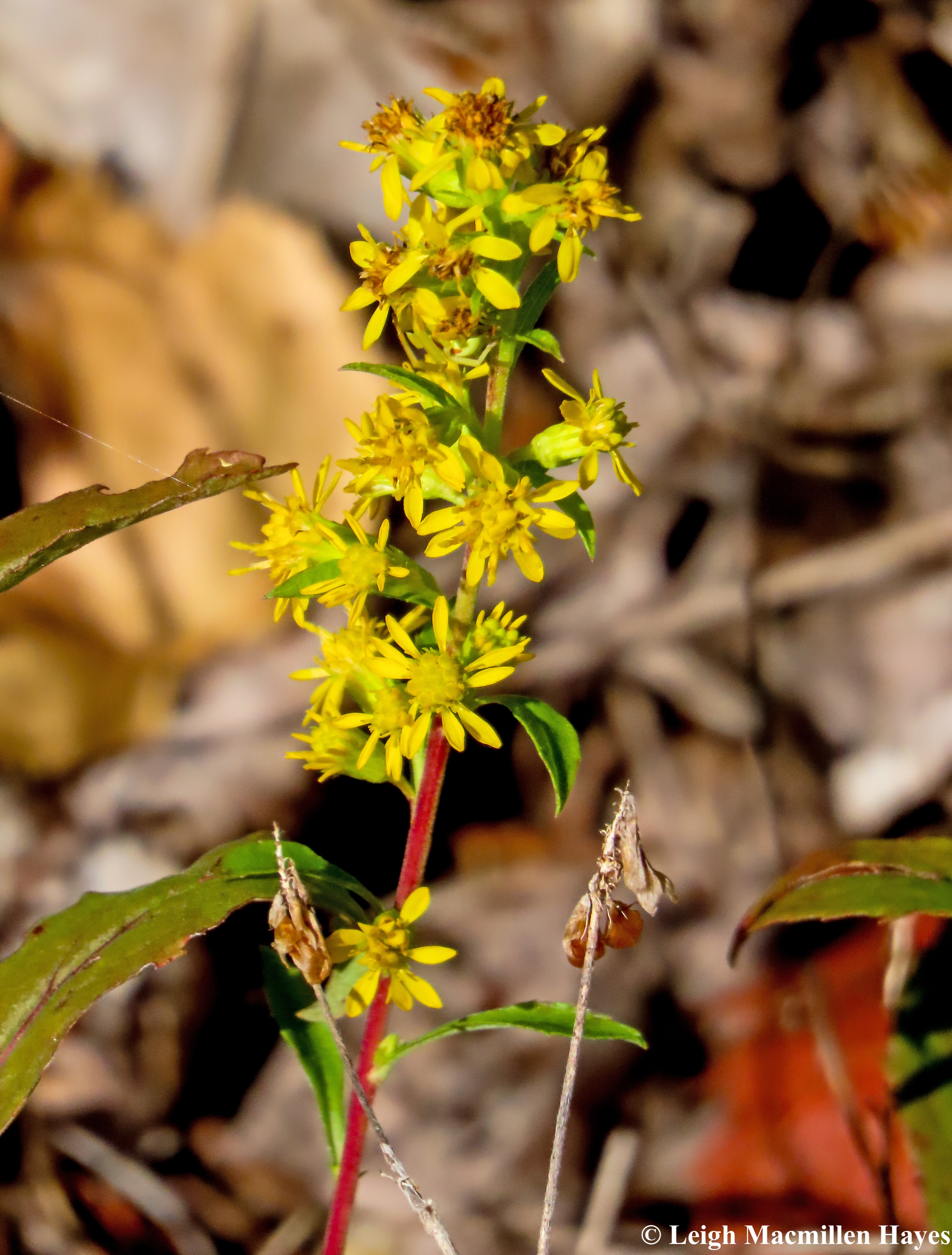
A few Goldenrods had also not yet achieved their gray-head status and instead served as beacons of light for any who were searching.

And the few Bumbleebees I saw gave thanks that there was still some food available.

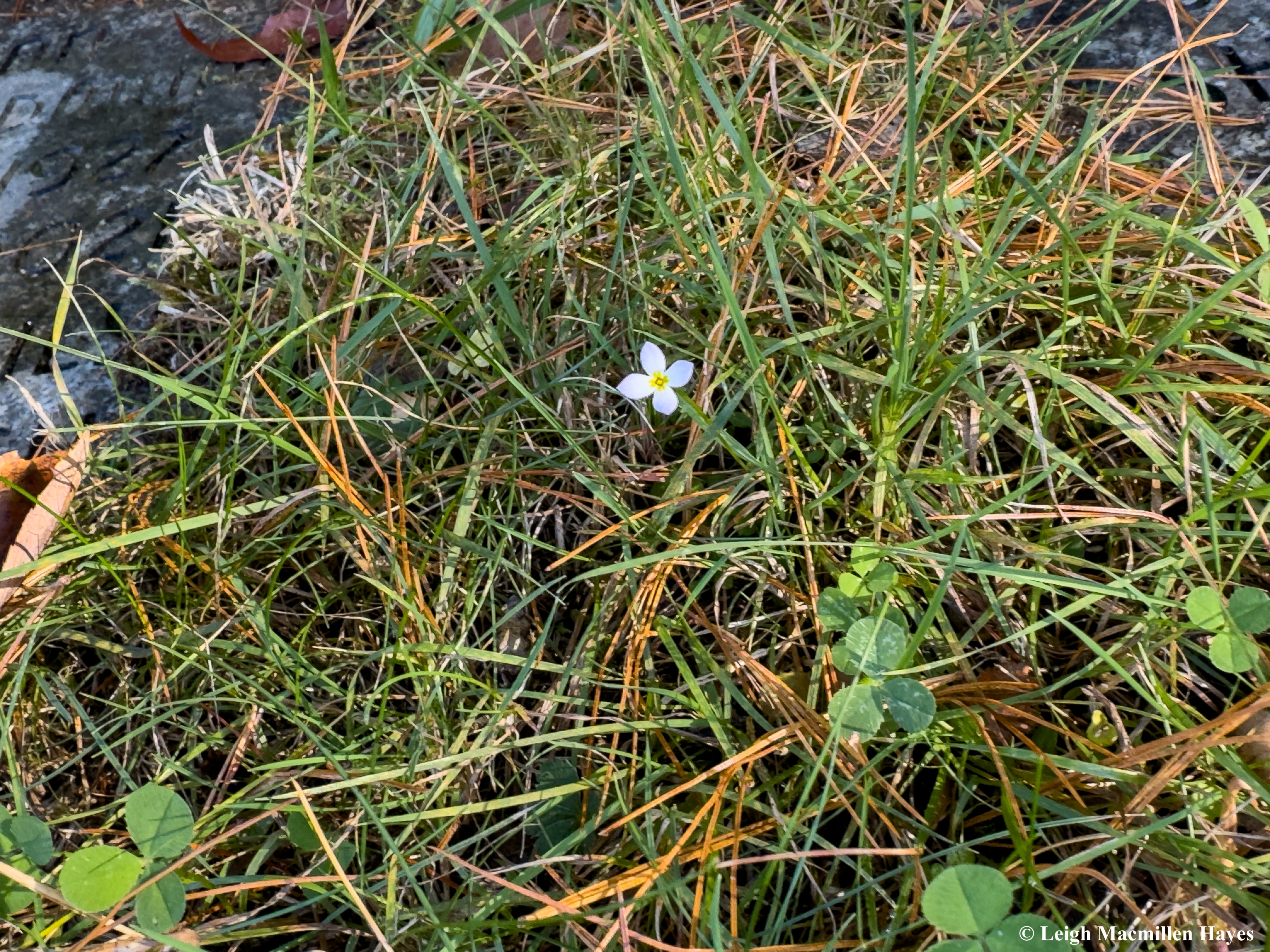
But then I spotted it . . . A single Bluet, aka Mayflower, one of our early bloomers that blossoms in May, showing off its perky little face between two grave markers in the church’s burial site.

I gave thanks for the Bluet, because it was located between two dear friends who died within months of each other, after a marriage of 71 years! To spend a few minutes wondering about the Bluet with them today was a blessing.

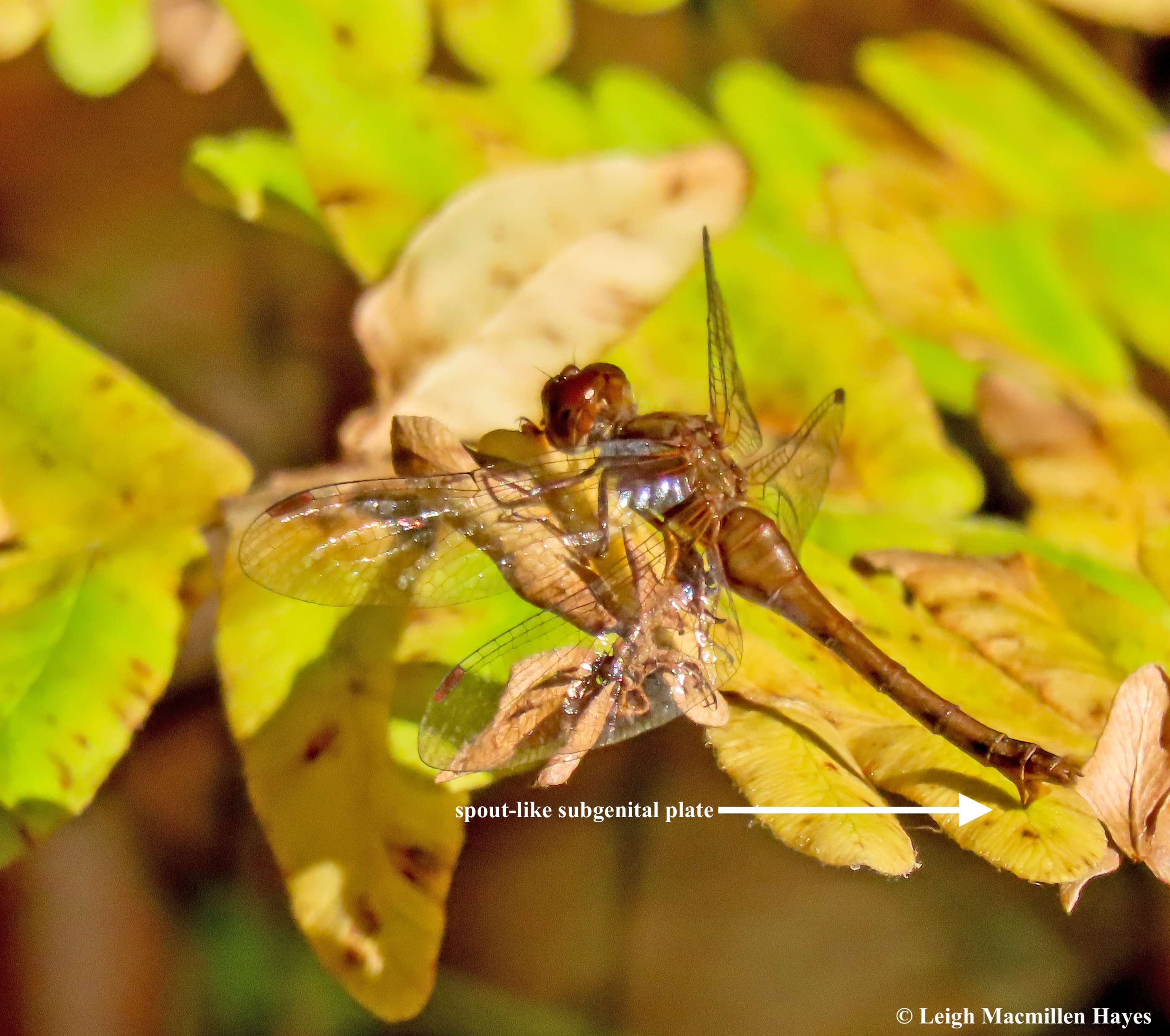
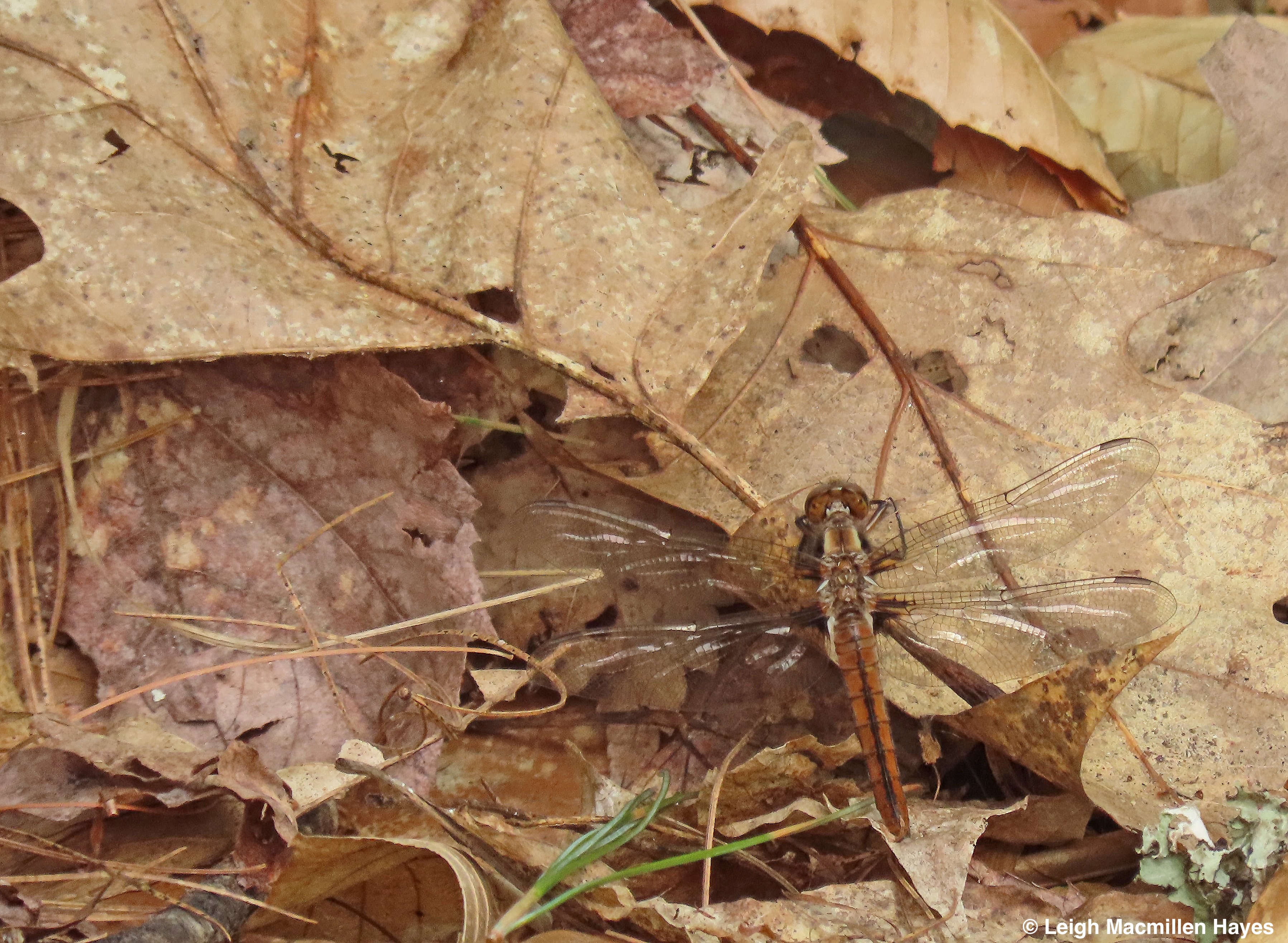
And no matter where I walked, be it the church lawn, woods, or parking lot, it seemed there were Autumn Meadowhawk Skimmer dragonflies, this being the male. If I moved, they moved a slight bit, but then landed nearby every time.

The females were also flying and landing everywhere I went. And I truly expected to find a pair canoodling, but they seemed more interested in landing near me than chasing each other for a date.

While female Autumn Meadowhawks are typically pale brown, as they mature, their abdomens may turn red like that of their male counterpart.

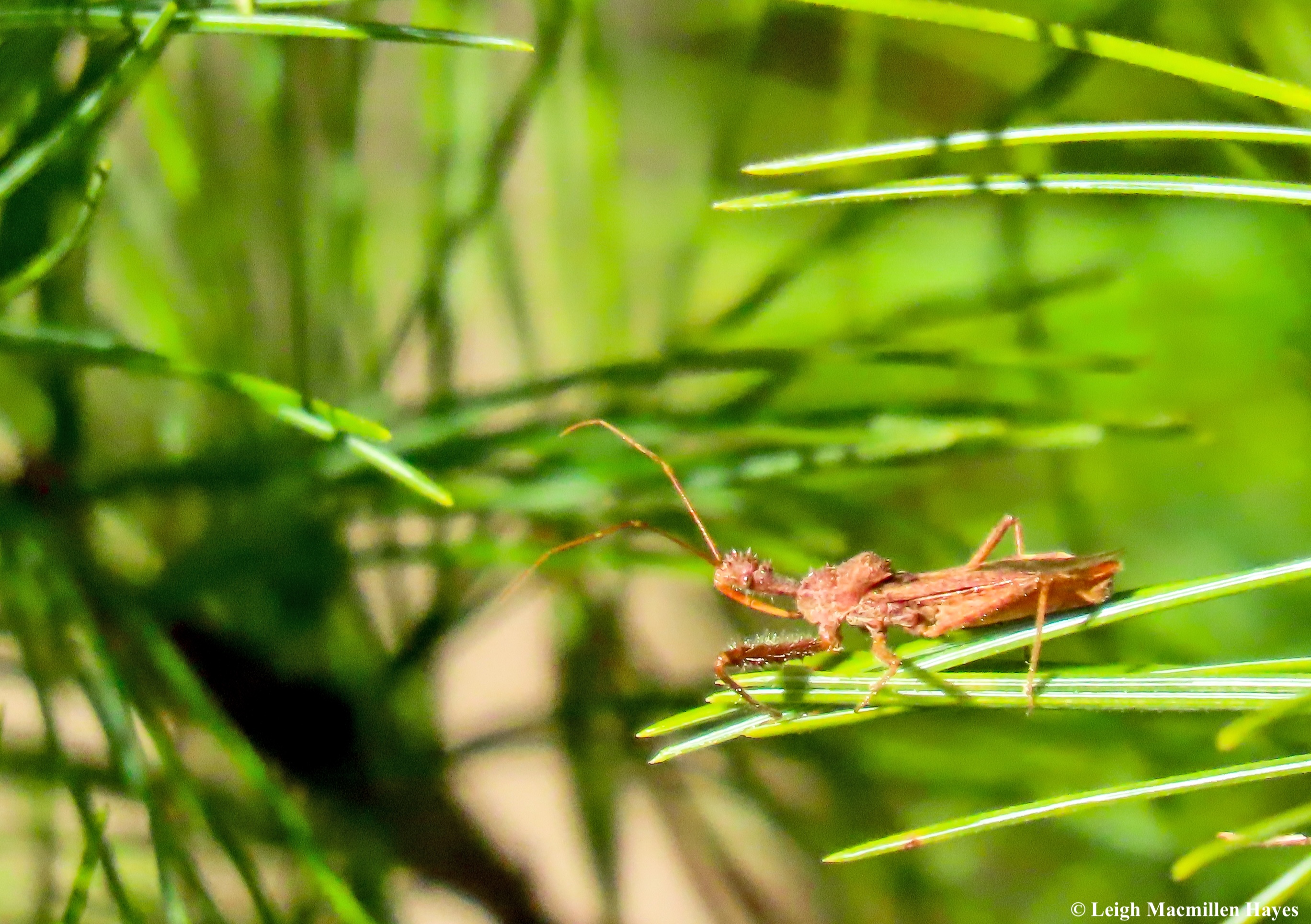
Of course, they all need to watch out for this guy. Or maybe he needs to watch out for them. The Spined Assassin Bug was on the move–the hunter or the hunted I don’t know, but it was just a fun find. And beside the church parking lot of all places. But then again, churches welcome all, especially those who are not perfect. Thank goodness!

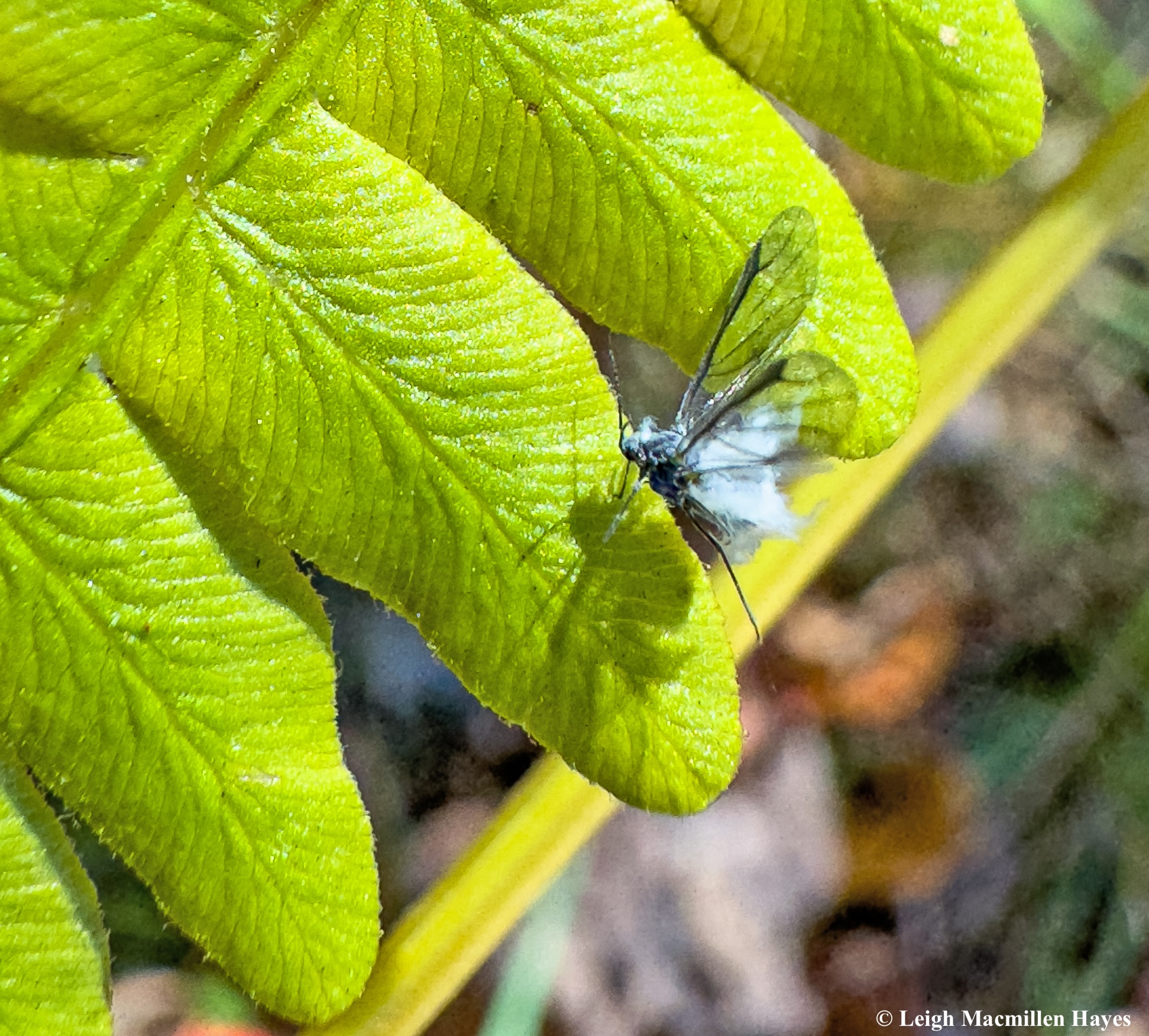
As I continued to explore, I spotted one of my favorite fall finds dancing through the air rather like a little fairy, though some think of it as a snowflake, and just yesterday someone described these insects as bits of ash. All make sense to me.

I captured this one so I could take a closer look at those iridescent wings and the waxy fluff on the abdomen.

And then I released it onto a fern frond.

I invite you to notice the hint of blue as well.

This is the teeny, tiny Asian Woolly Hackberry Aphid, one who is searching for a sap source.

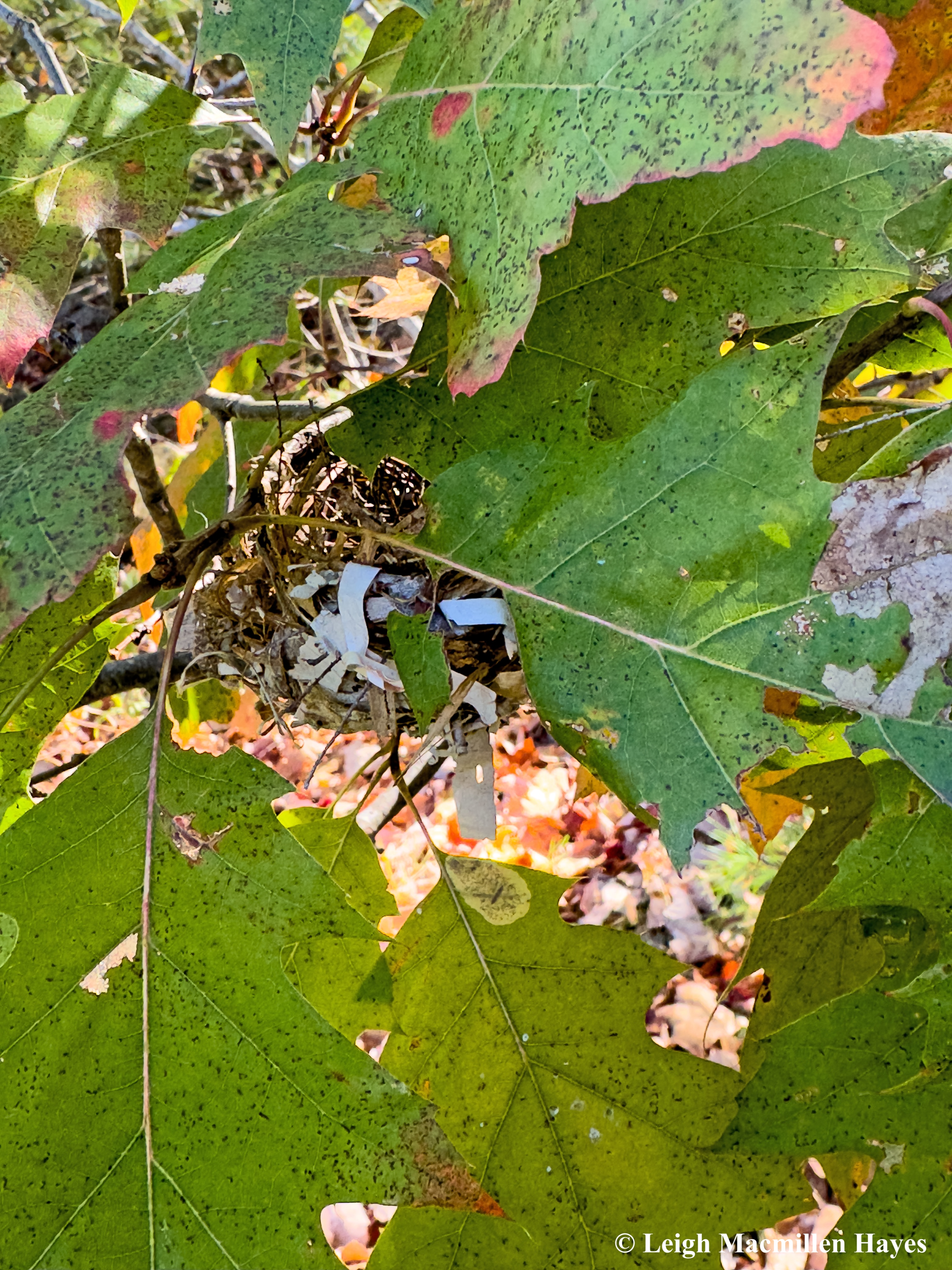
And then I came upon another surprise that I had forgotten. It was hiding below some leaves at about breast height.

A few of us first spotted this nest back in June when we accidentally approached it because we couldn’t see it hiding as it was below leaves, but Momma Red-eyed Vireo suddenly flew off. We apologized to her, took a quick photo of her eggs and promised her we would leave her be so she could raise her young in this place that we hoped provided safety. I never checked on her again.

But looking at the nest today, it appeared that she had a successful breeding season.

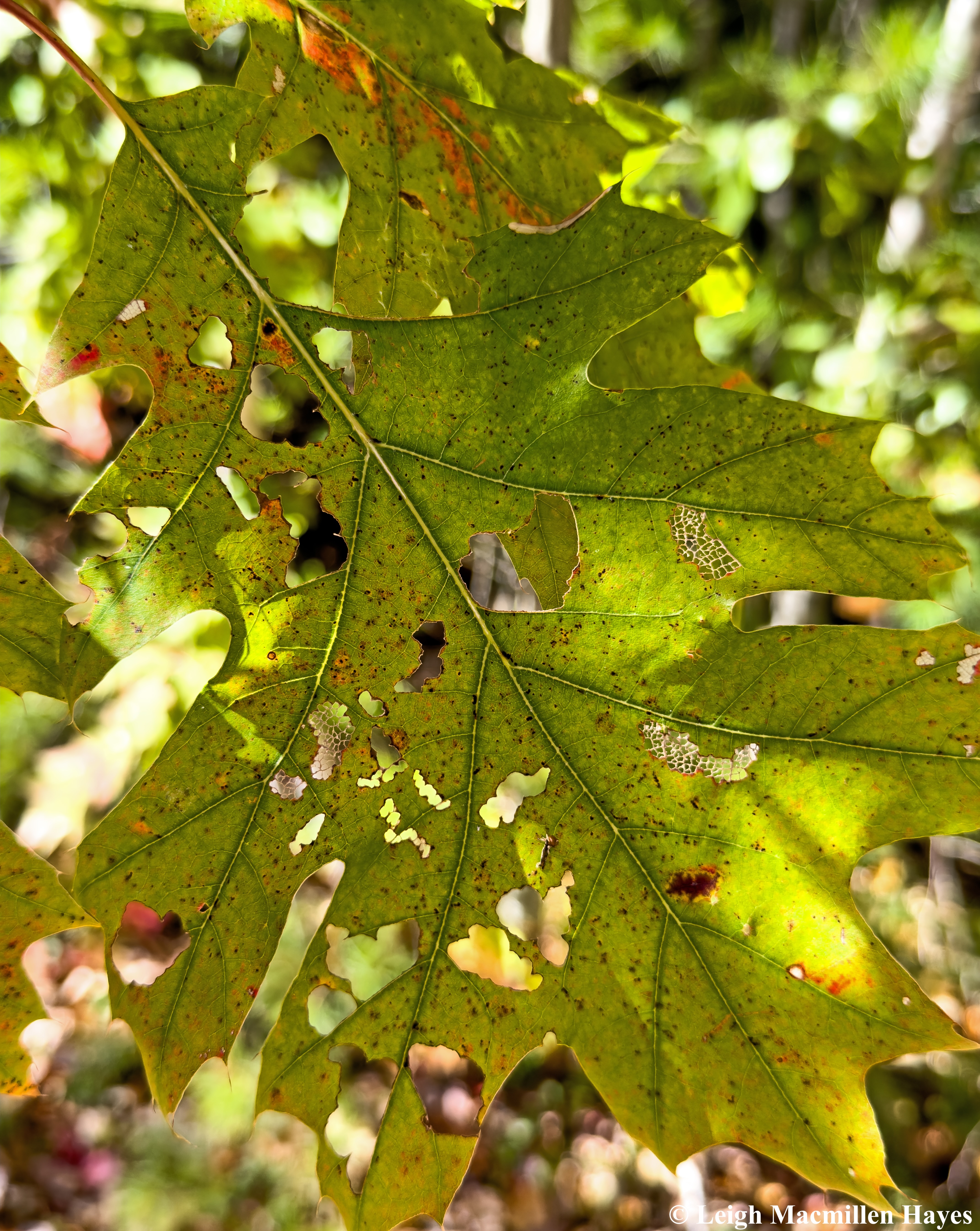
Looking at some Northern Red Oak leaves, like those that hid the nest, I was reminded of stained glass. Ours is a church that doesn’t have stained glass windows, but rather allows the outside world in. The ever-changing qualities of the natural world as seen through the windows serve as the scenes for us all to ponder each season.

And ours is a church with a group of people who wander out the door each week with others always welcome to join us as we wonder about all that surrounds us. We call ourselves Trail Snails, because slow is the manner of our movement.

And we have a mascot that was gifted to us by a couple from First Congregational in Bridgton, for they occasionally have joined our group to wander and wonder. T.S., short for Trail Snails, loves to pose along the way.

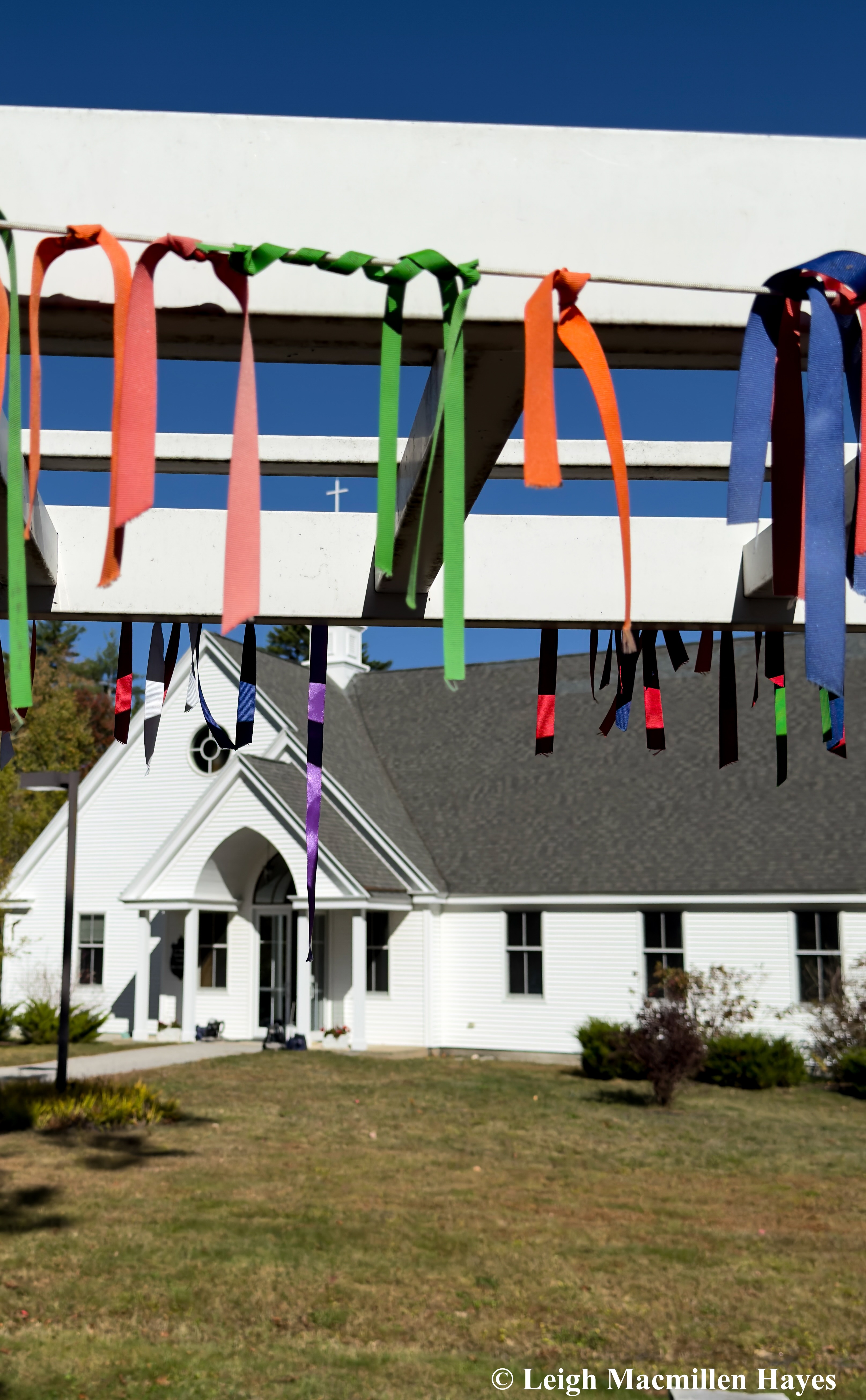
It’s also a church that knows the power of prayer and the ribbons tied onto the arbor actually represent specific prayers of parishioners and people we’ve only met for the first time.

And there’s a beautiful Memorial Garden where all the flowers have now gone to sleep, but their leaves and seedheads offer different colors and textures in this season and anyone is welcome to sit in this space.

This all brings me around to my opening thoughts, for as I rounded the corner of the church building this morning, a shocking pink color on a bush mostly gone to fruit beckoned a closer look.

I wasn’t the only one peering in, for a Spotted Cucumber Beetle was making the rounds on the anthers within one of the flowerheads.

Blueberries, and Bluets, and even a Rose–a blooming surprise was each on this the eleventh day of October. Plus all the other wonder-filled finds.

Far Winde-a-Way Mondate

It’s been a while since I’ve written about a Mondate, and believe me, we’ve had numerous. And other dates during the week as well, but today found us exploring a new-to-us property that’s just too special not to share. And I think the owners would appreciate it. I know that we appreciate that M suggested this to us. She was spot-on correct that we’d like it.

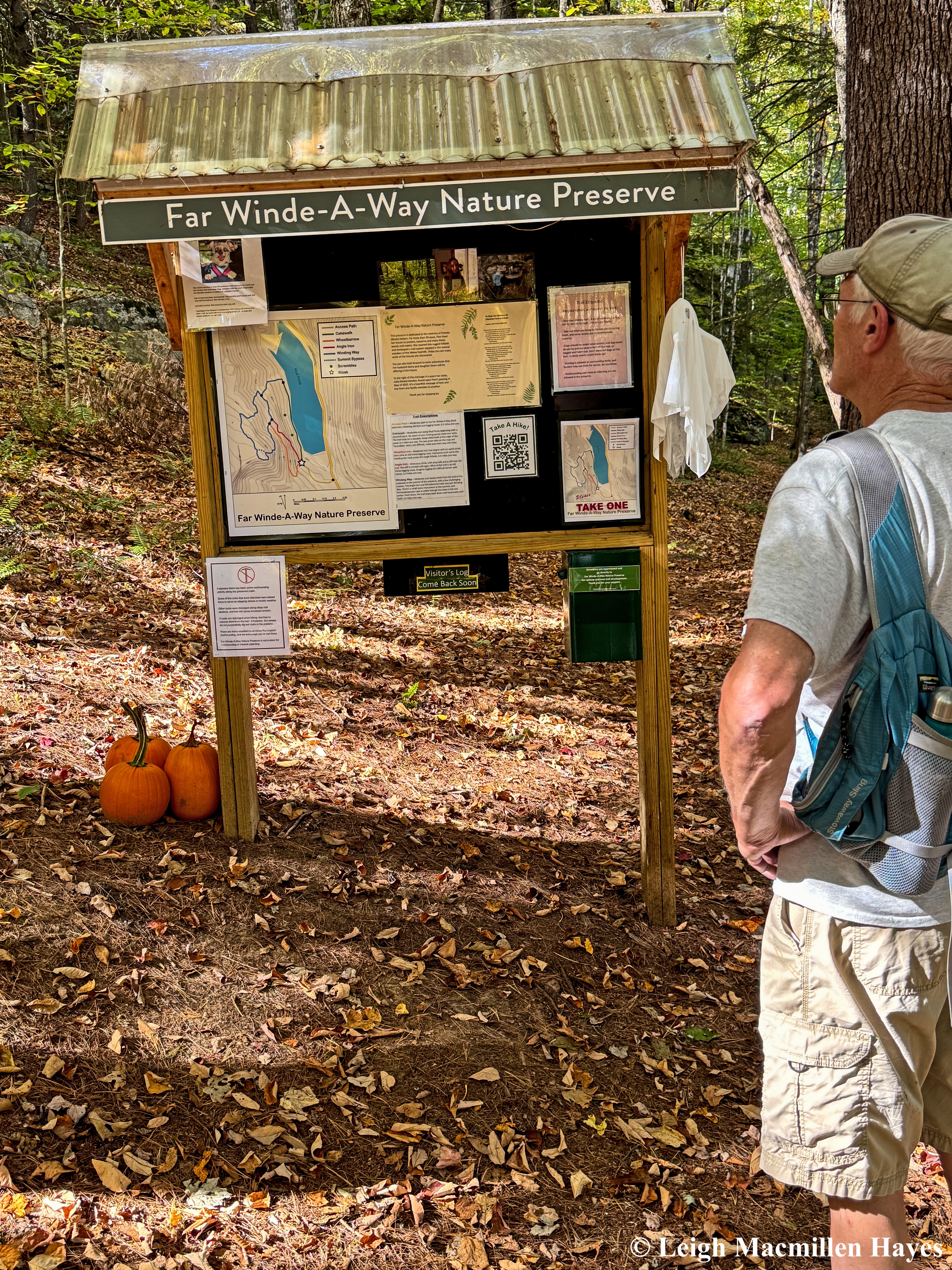
We’d been by a trail sign on the road a bunch of times to hike other trails in Greenwood, but until M mentioned it, we hadn’t really paid much attention. Until today. The kiosk is about .2 in from the road and I loved that there were pumpkins and a ghost to decorate it. And all the information hikers need to enjoy the area. Though My Guy goes without, I highly recommend trekking poles should you go forth on the well-marked trails. They are steep in places. And rocky in others. But that all adds to the fun.

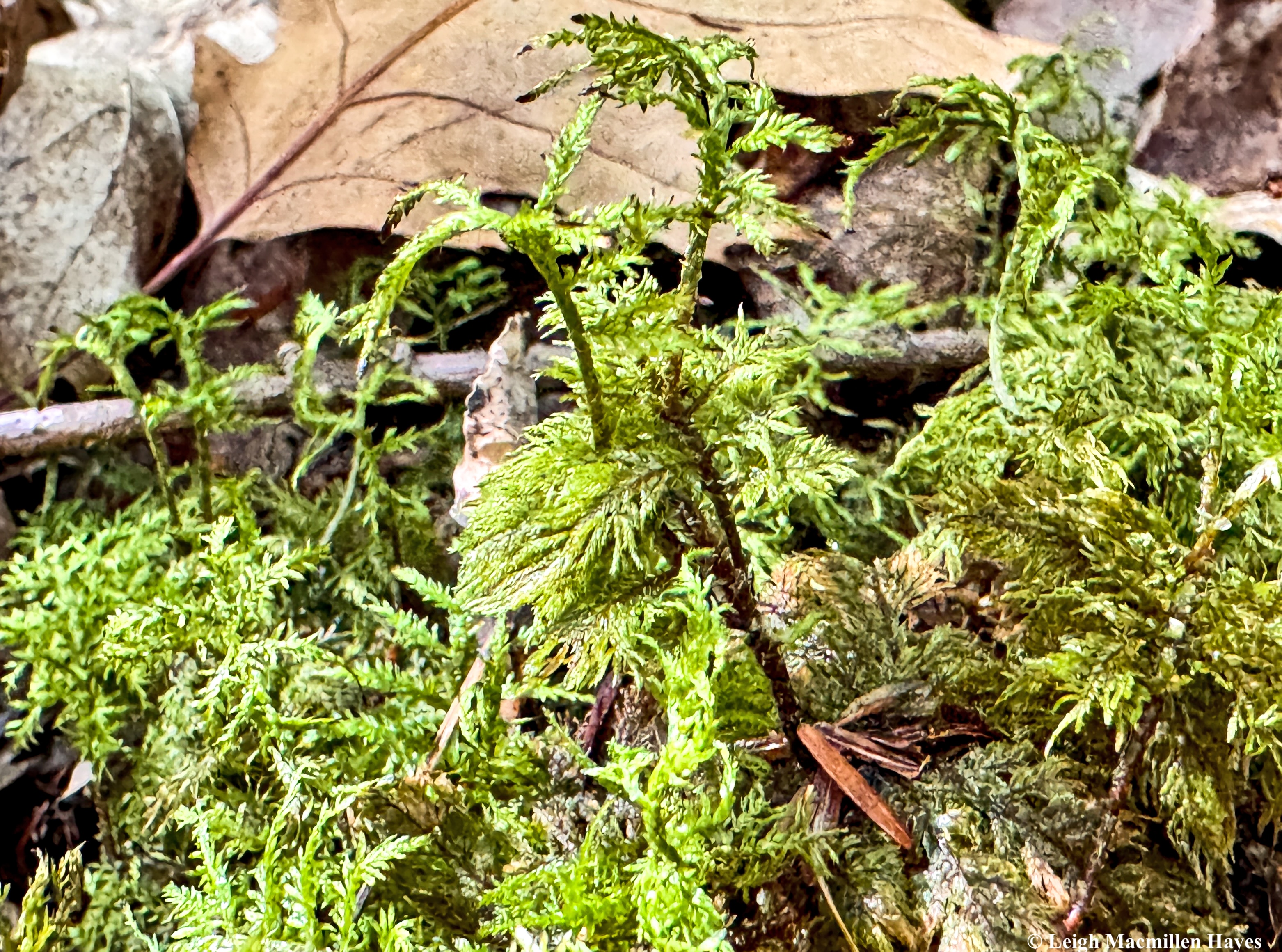
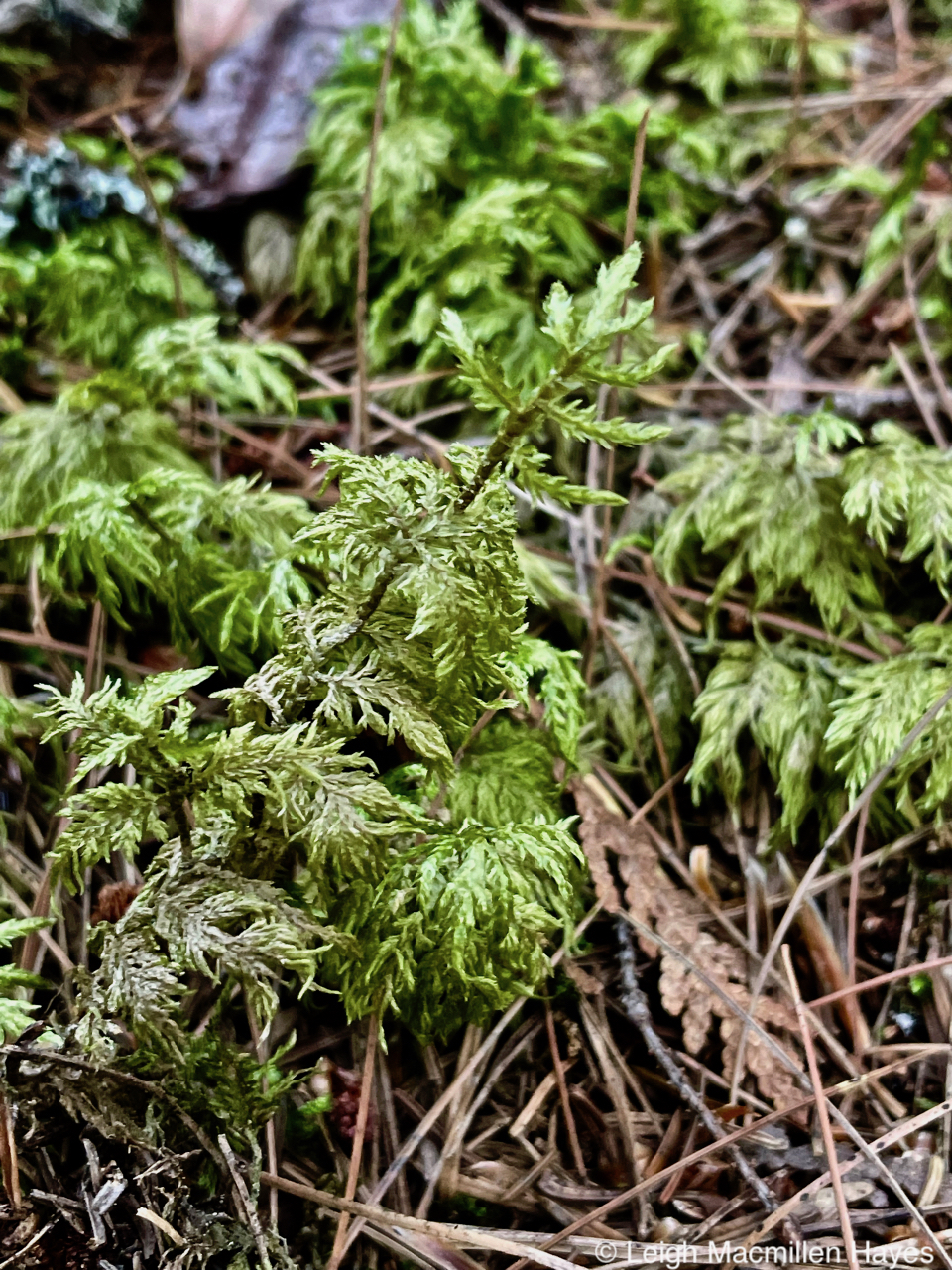
For me, the fun was enhanced by spotting examples of this pleurocarpous moss. It took me a while to learn that pleuro refers to side and carpous means fruit, thus they have a side fruit. They are low, tangled mats with branches that rise from the main stem.

This particular moss is the Stair-step Moss or Hylocomium splendens. It prefers deep shade and damp conditions. Due to the dry conditions we’ve been experiencing, this year’s growth of a new step rising from last year’s stem probably didn’t occur until recently.

There were other mosses, giving the trail a fairy-land look at times, but also abundant were the Christmas Ferns, which decorated long stretches of our route.

And not to be left out were the Common Polypody that always give boulders a bad-hair day look.

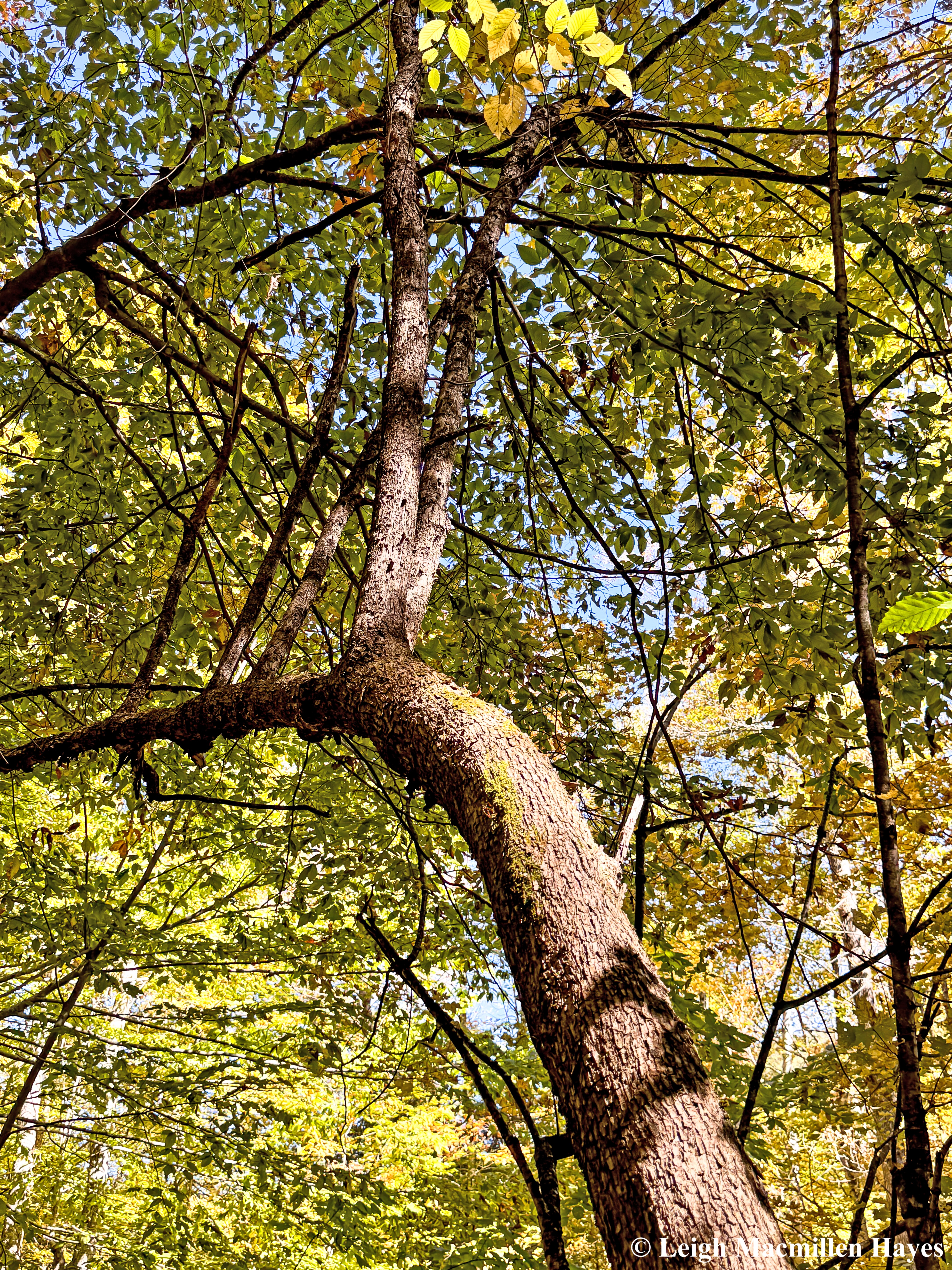
Those items would have been enough, but we realized from the start that we were in Hop-Hornbeam territory, and several surprised us. Typically, this is a tree that stands straight and tall, but a few must have been hit by other trees during storms perhaps, and their trunks had turned. Despite that, other branches took over and reached for the sun.

The other day some of us were looking at a sample of this tree and I asked them what they noticed about the bark. Their responses: shaggy and vertical lines. Spot on. Sometimes the bark is a bit tighter to the tree than this one we saw today, but it’s a great example of how this bark behaves. If you rub your hand on it, some pieces will flake off.

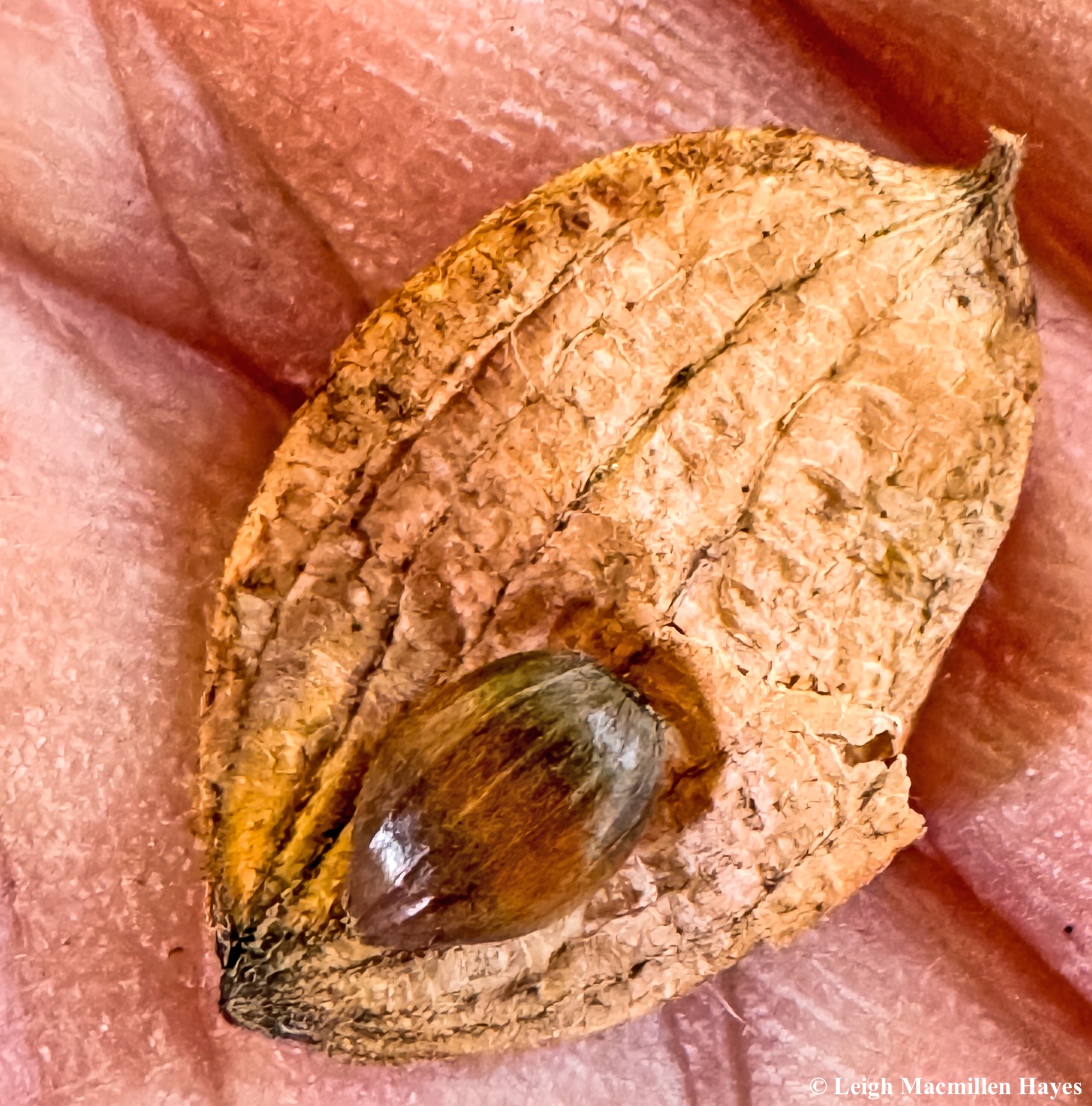
What I really wanted to see since we were in the presence of so many Hop-Hornbeams, were the hops for which it was named and BINGO! They were scattered along the trail, so I picked one up and slit the inflated paper-thin casing open and pulled out a seed. Such a small nutlet compared to the bouyant sac it was borne in.

The leaves are double-toothed and just as these emerged in the spring, male and female flowers would have developed. Being a member of the Birch family, the flowers are in the form of catkins, the male being longer and reddish-brown, while the female would have been shorter and green. Pollen is dispersed by the wind.

During the summer, the fertilized females form into cone-like structures, or strobiles, and their shape gives them their name for they look like hops.

I challenged My Guy to find some of these, which he’d never seen before. Knowing he likes a challenge, like counting Lady’s Slippers and looking for Bear Claw trees, I knew he’d pull through, and he did. But, he also developed Warbler Neck, for so high up in the tree does one need to look in order to spy the hops.

And so to counteract that, I suggested he look down. Success again. This guy is good!

At lunch log, we had a chance to enjoy the view and realized we were looking at Noyes Mountain, which we had hiked about a month ago.

With the camera, I could pull in the rocks on Noyes where we ate lunch before descending into an old mine below.

After circling around the summit of Far Winde-a-Way, where the views may be better in the winter, but we didn’t mind because that’s where we found some of the hops, we began our descent and noted a few artifacts, which got My Guy talking about the fact that metal cans for motor oil were replaced by plastic in the 1980s. He is Mr. Hardware, after all.

And I found a stone that had split naturally in quarters.

Well, maybe they weren’t exact quarters, but still it was worth a wonder to notice.

Another tree that we noticed as we descended was an American Basswood. The bark is similar to Northern Red Oak, but without the red in the furrows between the ridges, and the ridges are flat, almost brushed. Again, I rubbed my hand along the almost smooth surface.

I kick myself now, because I didn’t think to look for their fruits, but I did spot leaves on the forest floor. They are typically quite large, and have an assymetrical base, so if you fold a leaf in half, one base will be shorter than the other. The only other trees in our woods with this feature are the American Elm and Witch Hazel.

Next we reached a brook, where I’m sure the water cascaded over the moss-covered rocks in the spring when we experienced about fourteen rainy weekends, but today it was almost all dry, except for a few pools.

Creating a spider-web appearance on the pool’s surface were about a dozen Water Striders, so speedy in their dance routines.

And hiding at the edge, perhaps in hopes of capturing a Water Strider for a meal, was a Green Frog, with its dorsal lateral folds beginning behind its eyes and continuing down the edges of its back.

At the Cakewalk, for so a trail closer to Mud Pond is named, we met Mouth Rock. We’re pretty sure this wide-mouthed boulder ate all the cake because we never found any.

But our finds did include a champion! Co-champion actually–for the largest Eastern Hemlock in Oxford County according to Far Winde-A-Way Nature Preserve‘s website.

And I quote: The tree is: 10 feet in circumference, 90 feet tall, with a crown spread of 60 feet.

We also found this great specimen. Rock or tree? Tree or Rock? Rock and tree! Tree and rock!

Where does one end and the other begin for they looked like twins. Maybe that’s what happens when you spend so much time together. Kinda like some people looking like their dogs (we had a neighbor when I was growing up who always had beagles and he really did look like a beagle himself. Of course, we never told him that.)

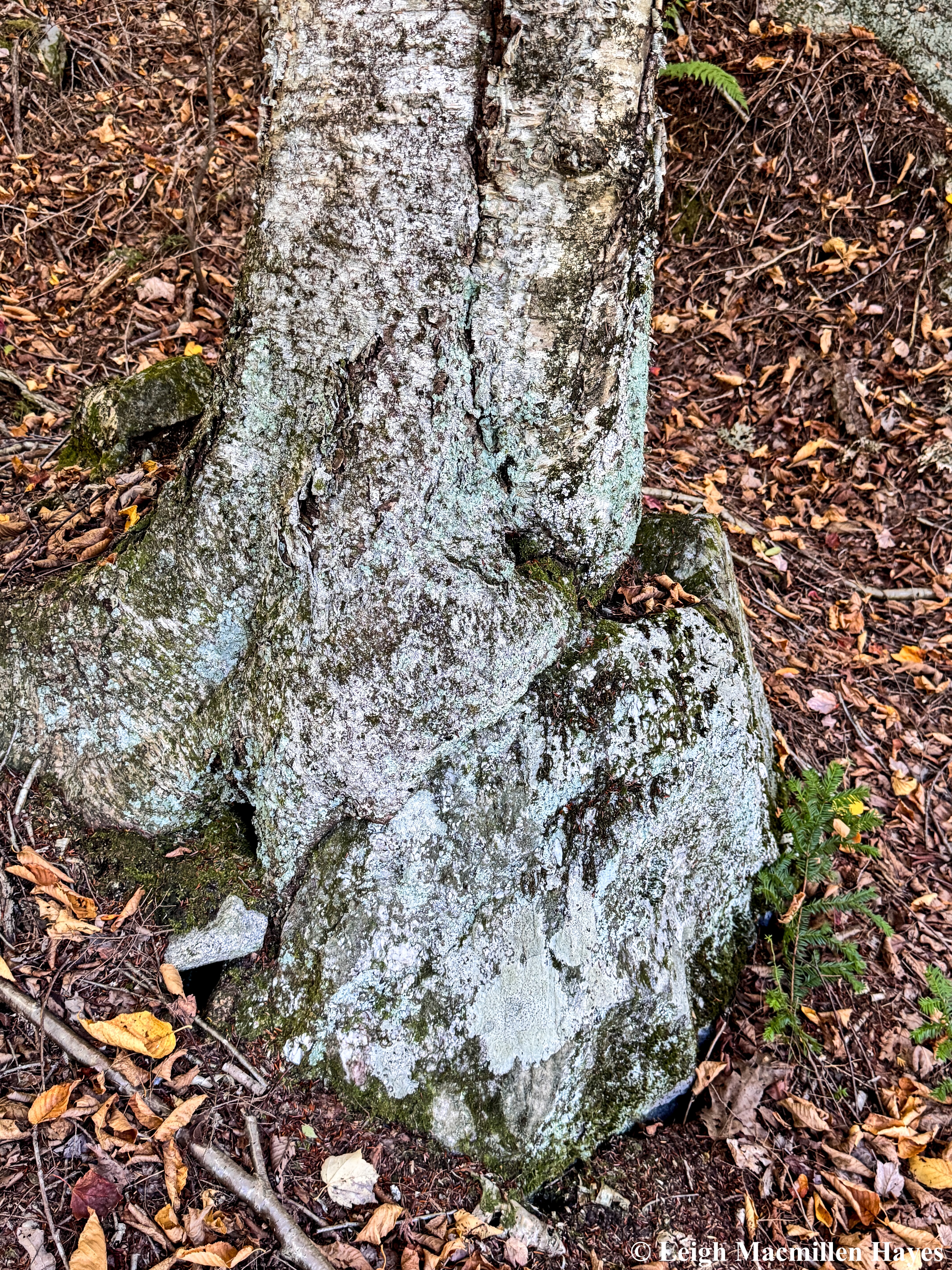
Anyway, this is a Yellow Birch that got its start in the moist soil that probably formed on the moss atop the rock and then sent its roots downward and trunk upward, but really, the two could have been one.

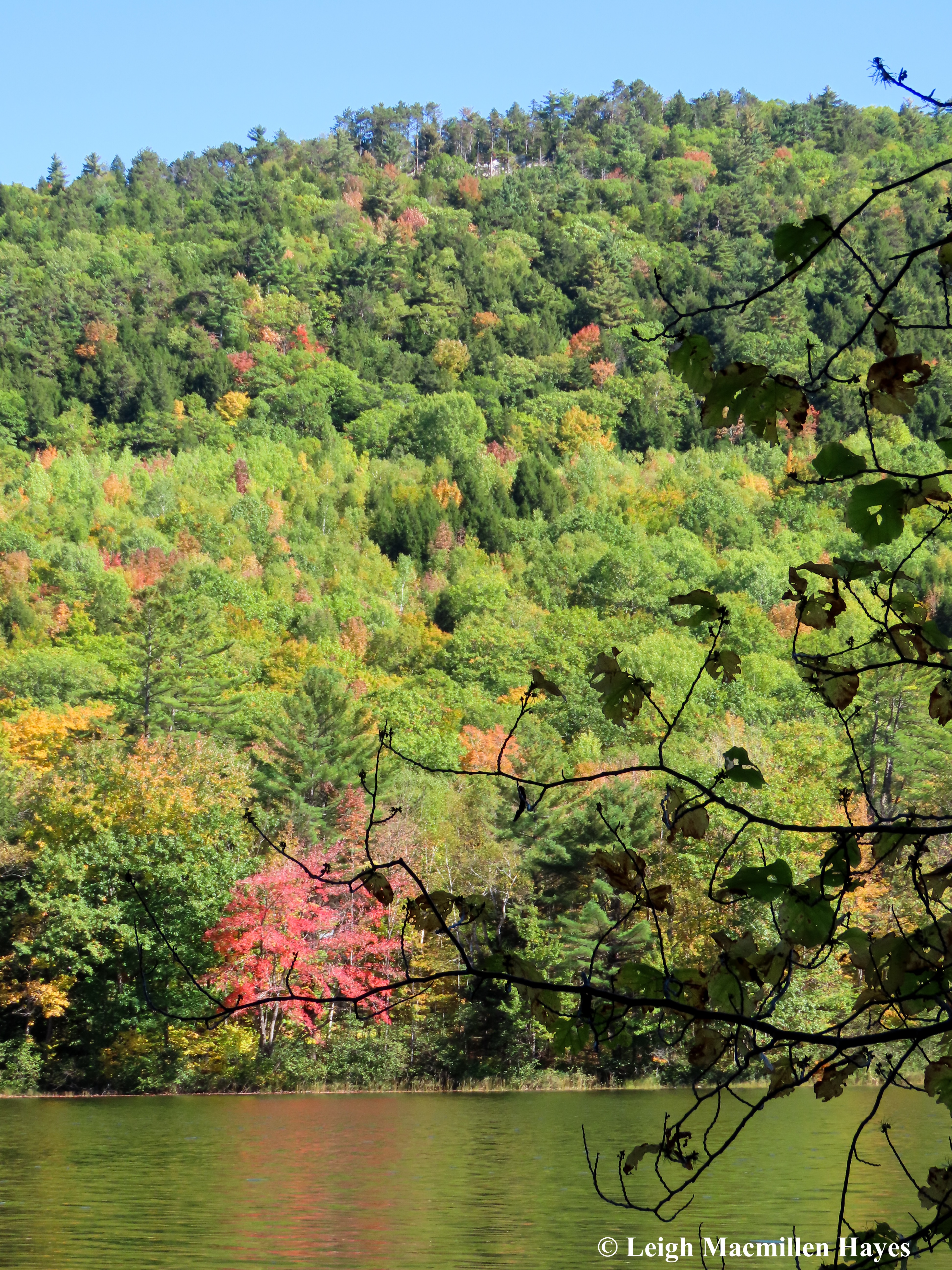
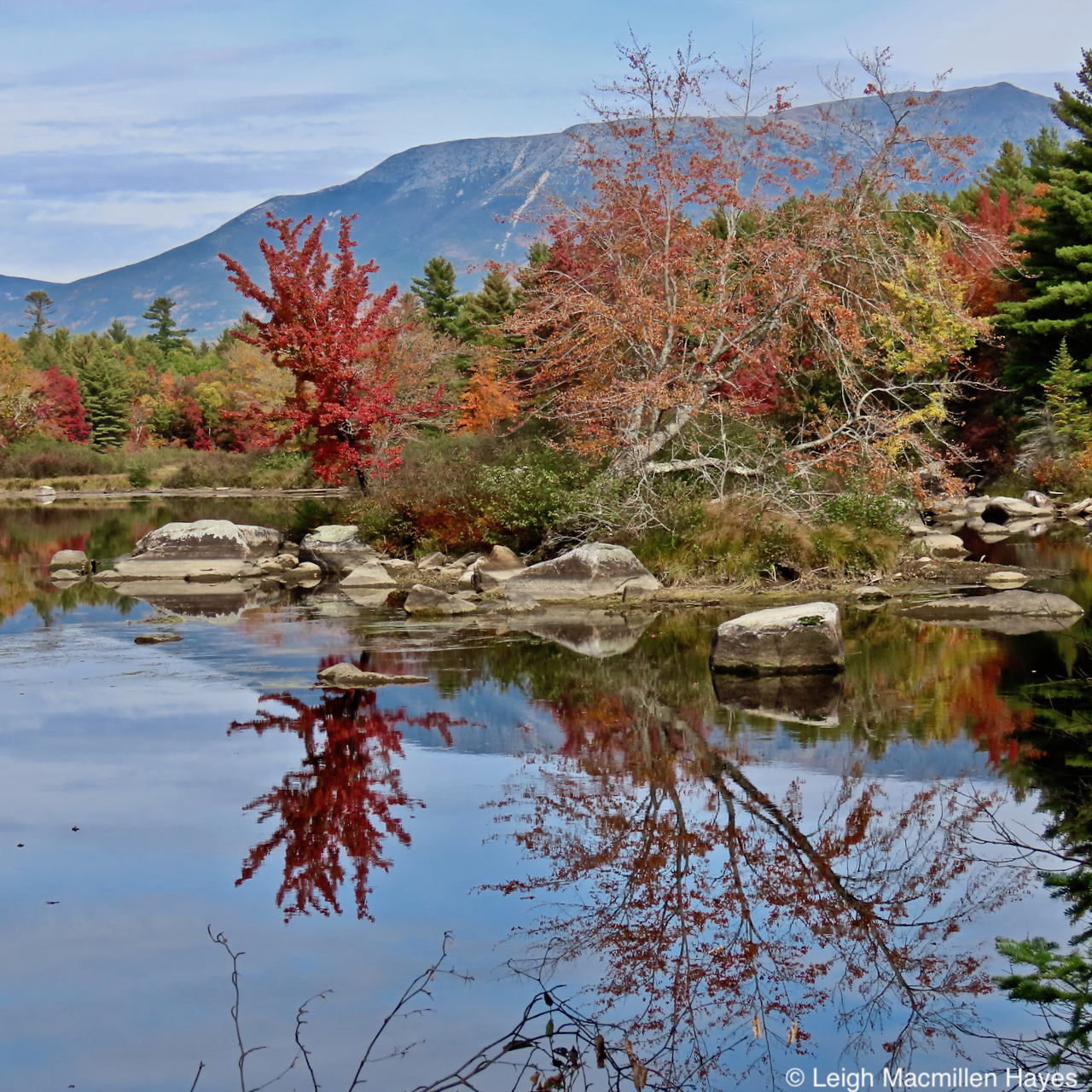
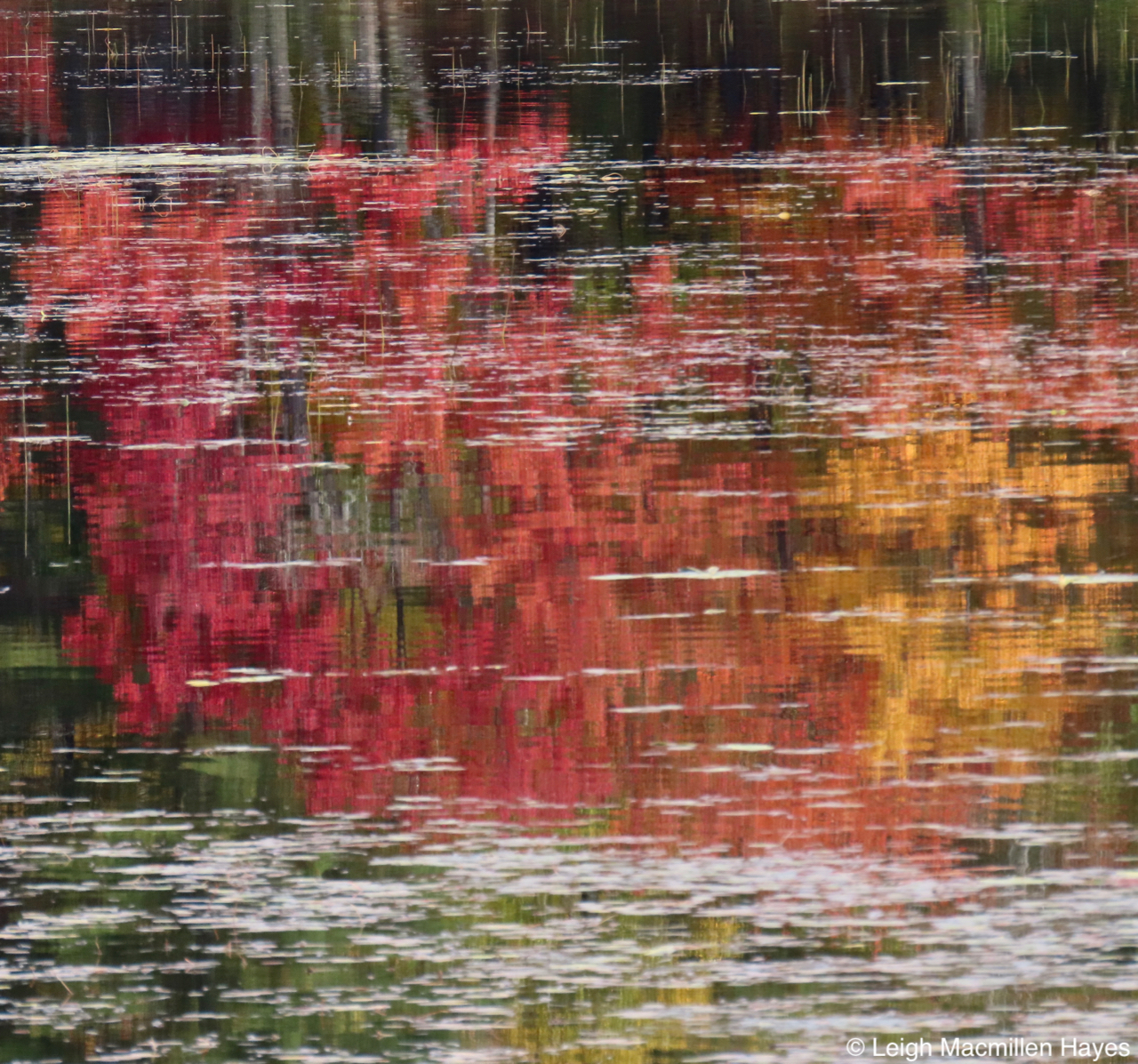
One of our last views before heading back up to the kiosk, was of Noyes Mountain again, only this time it included Mud Pond. And our early fall foliage season. Foliage reflections are among my favorite.

I’ll close this Far Winde-a-Way Mondate by giving thanks not only for My Guy and his love of new adventures, but also for the family that made these hiking trails available so that all of us could enjoy them: The husband and daughter of the late Pam Nelson. “This preserve is dedicated to the memory of Pamela (Roots) Nelson. For more than 30 years, Pam lived her dream to protect, conserve and enjoy these woods and waters. She roamed this rugged hillside and developed a trail system steeped in the natural wonders of the Maine foothills. Today you can enjoy some of the beauty she discovered.”

Pam passed away in 2022, but her family carries on her tradition, and this poem at the kiosk was written by her sister.

Thank you to M for suggesting Far Winde to us, and to the Nelsons for sharing it with all of us.

Zodiac Three: A Perfect Picture

The message arrived again for a boat trip, but this time the meet-up time was 5:30am, rather than 6. So I set my alarm for 4:00 in order to have an hour of quiet time to greet the day in darkness as I read and meditated and reflected and sipped coffee.

It was still dark when I arrived at the Captain’s home and hopped into his truck, with the boat in the back.

About ten minutes later we were in Hiram, Maine, at a boat launch along the Saco River. It’s been his dream for three years to make this journey and I love that I get invited along for the adventure.

I would have written about Zodiac Two, when we cruised along (with a small electric motor) the Old Course of the Saco in Brownfield Bog, but my photos were all out of focus and so since then he has given me a photography lesson and many tips.

The sun was just brightening the sky as we headed upriver, a smart plan in case the motor’s battery ran out of juice and then we could paddle and float back to the launch site.

I’ve been on the Saco a bunch of times in a variety of boats, but neither of us had ever explored this section below the Brownfield Bridge and I was struck by how calm and clean it was. The water is also quite low–thanks to the drought that we’ve been experiencing again this summer so we had to be aware of sandbars and stumps and logs and rocks. Well, actually, any time you are on the river, you have to be aware of obstacles.

As we started the journey a dragonfly landed on my leg, and she proceeded to try to lay eggs. Have you ever felt the tip of a dragonfly’s abdomen try to pierce your skin? It’s a bit of a prickle. While she was doing that, I tried to snap a photo, but neither she nor I were successful. Still, I counted her as a good omen.

Sometimes, as we gently cruised along, we each took photos of the same scene, so some of these are his used with permission, and others are mine.

The reflection of the shoreline was one that struck both our fancies. We didn’t talk about it, but it was the layers that intrigued me and reminded me of the force of the water in this mighty river that originates in Saco Lake at the top of Crawford Notch in New Hampshire and winds its ways with a million oxbows to North Conway, NH, and then into Fryeburg, Maine, and across the state before it flows into the Atlantic Ocean in Saco.

Sometimes we realized we were looking at Silver Maple floodplains and other times there were steep cliffs. Always, we knew if there was a house or camping trailer near the edge, because they seemed to be located on high ground, but all the trees were cut between their high ground and the river to provide a view, and the result was intense erosion. One person even had several tarps draped over the ground in what we figured was an attempt to stave off the erosion. We think leaving the trees and trimming branches would have been a better choice, but no one asked us.

Another sign of erosion, the visible roots of many, many trees, also created works of art and my brain is already painting this scene in the future . . . maybe.

And then there was this work of art–a Silver Maple Lollipop, its leaves already shutting down chlorophyl production perhaps as a result of the dry spell we’ve been experiencing.

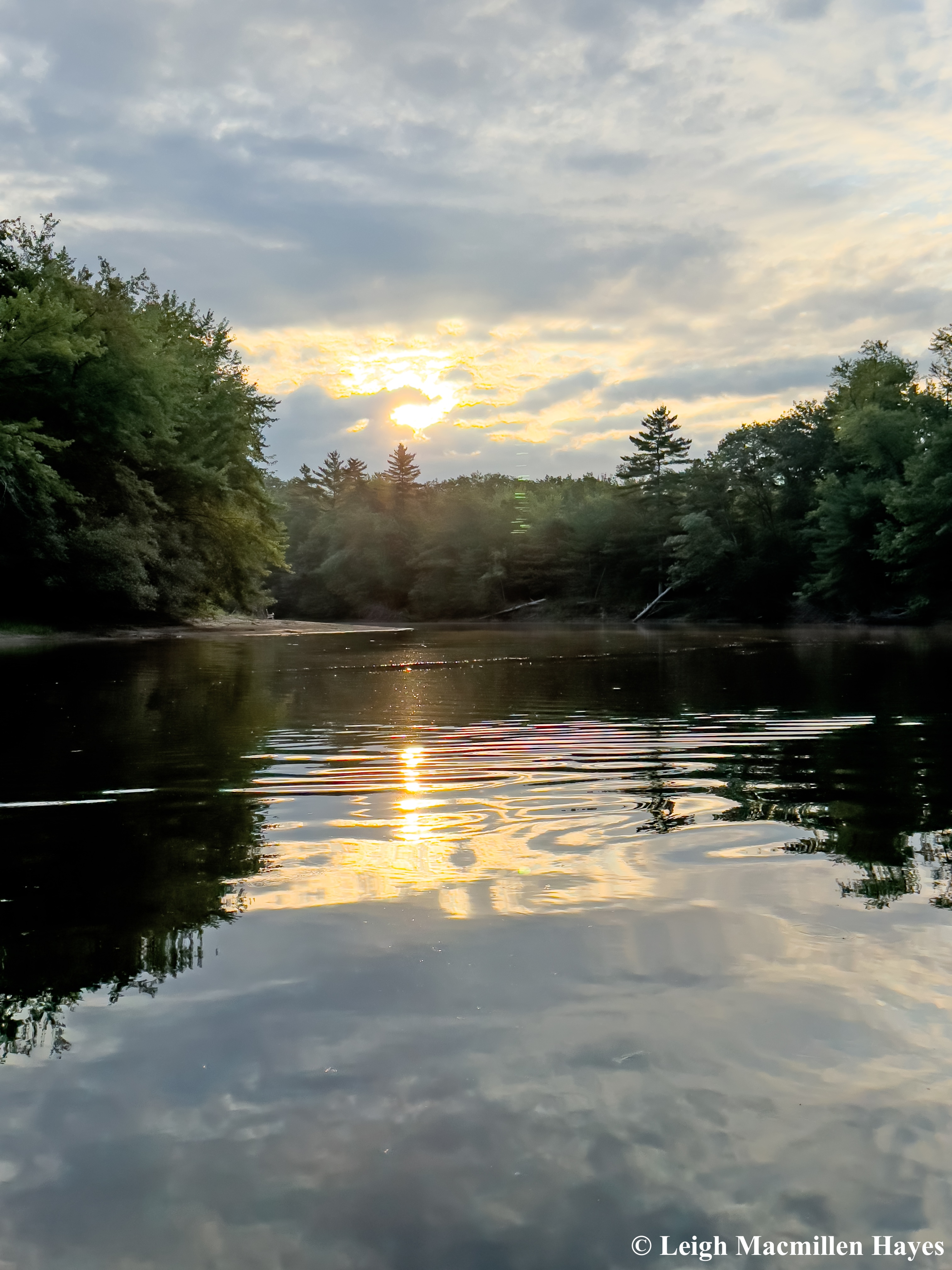
Slowly the sun rose and the water captured the sky in whirls and swirls and rainbows of its own making.

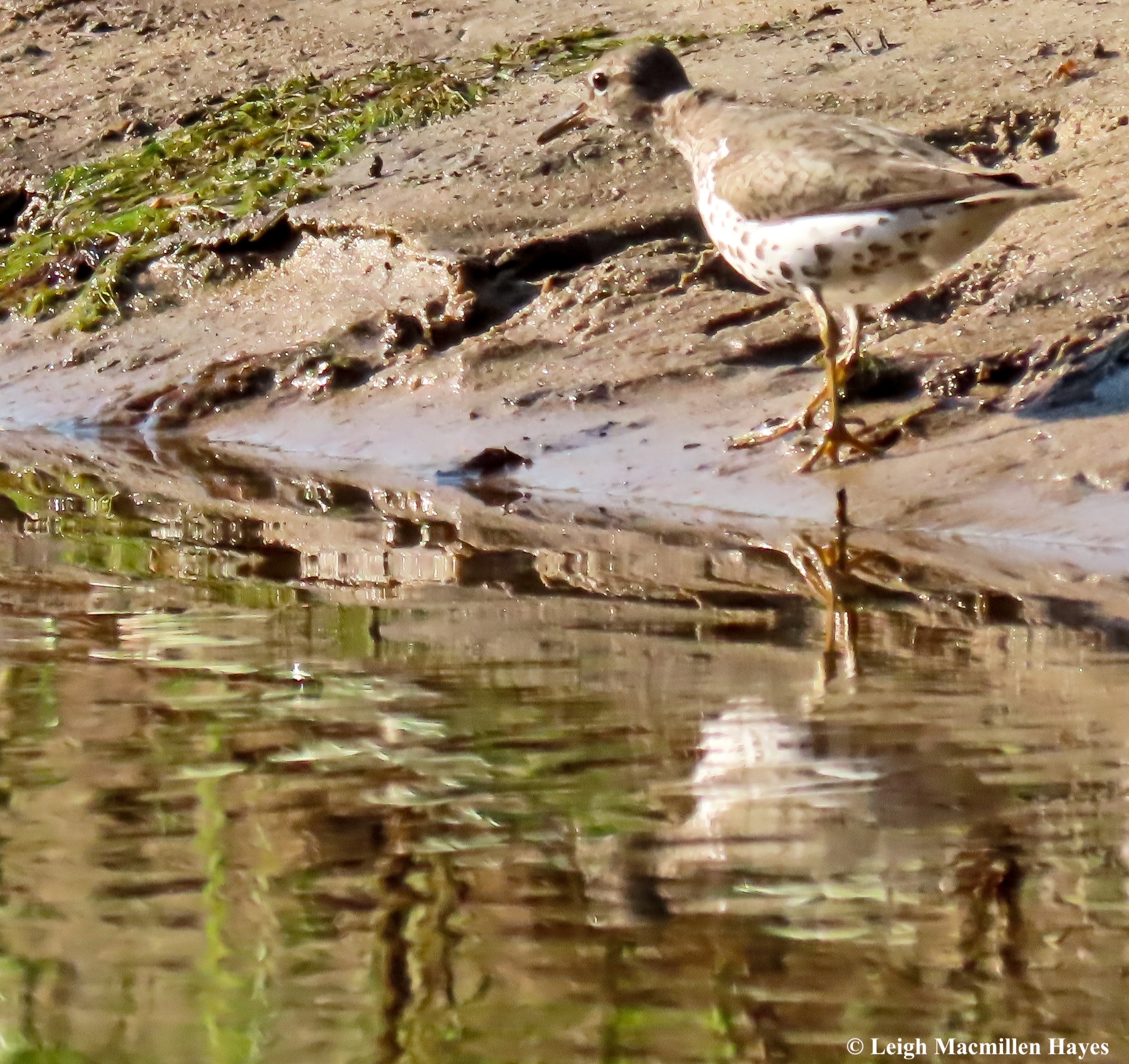
We’d both headed into this boat ride expecting to see birds, which we did, but we really expected Great Blue Herons and Bald Eagles. The drama artists. Our best sighting of the day was this Spotted Sandpiper, who walked along the river’s edge and then flew ahead and landed and did the same thing all over again. Over and over again.

Once the sun was fully up, our day turned into a bright one, and we had a nice breeze to accompany us. Plus tons of dragonflies and a few damsels, all of whom did not wish to let the paparazzi photograph them. Still, we gave thanks for we could see bugs in the air, but nothing attacked us, unlike during our Zodiac One and Two trips.

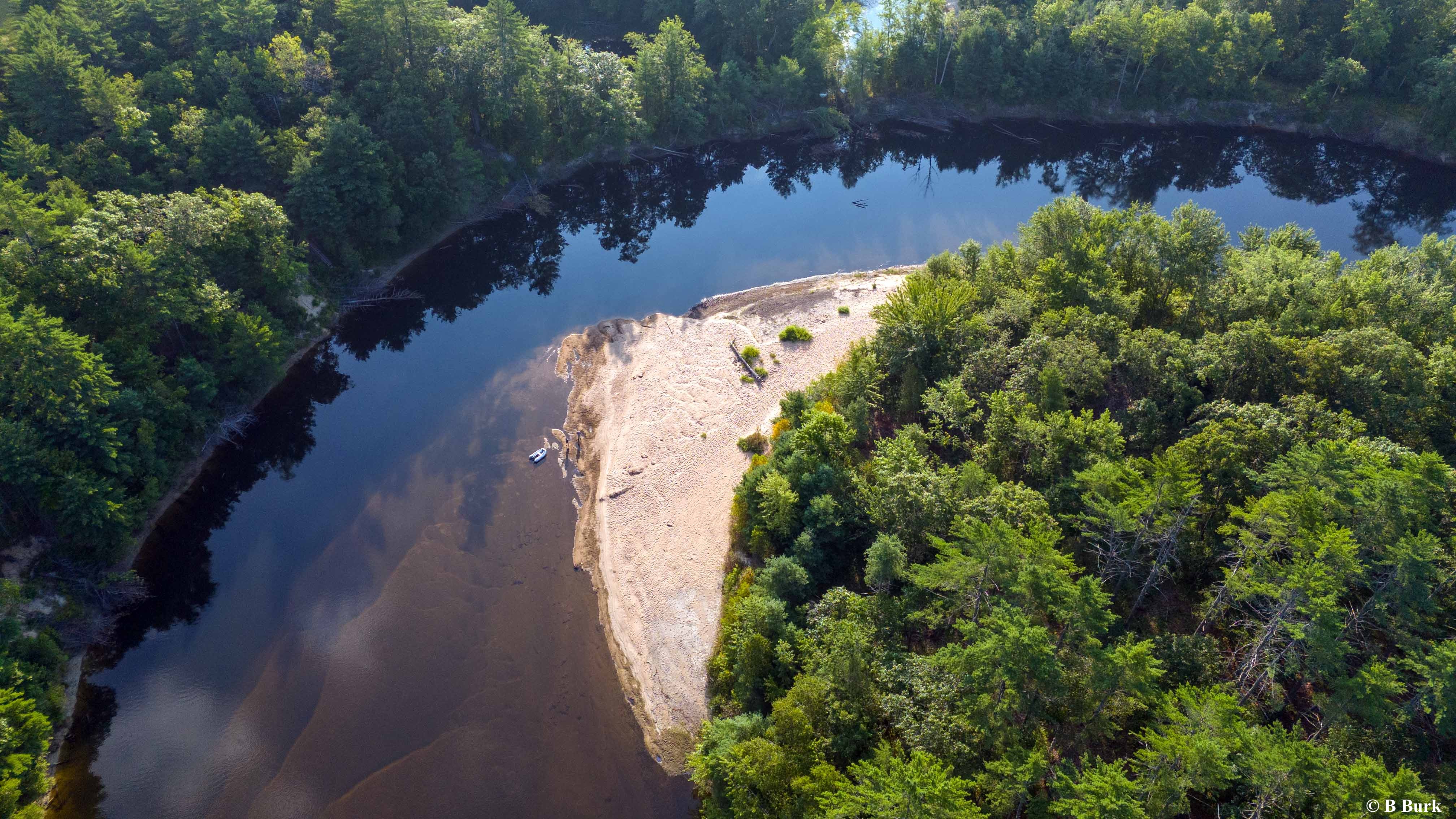
At what became our turn-around point, we got out of the boat and waded through the water to a beach, where Captain B set up his drone.

Above us, the waning moon stood out in the Bluebird Blue section of the sky.

The drone allowed us to see the lay of the land, and despite the fact that I’ve seen it recently from Mount Cutler while hiking with My Guy and a friend, I was once again reminded just how beautiful this area is and how small we are.

Do you see that beach in the river’s bend? We were standing there.

You might be able to see the Zodiac now.

And the two of us near the boat. Plus the indentations of a million duck and goose footprints. A flock of something skittered and flew off as we approached this spot, but they were too quick for us to identify.

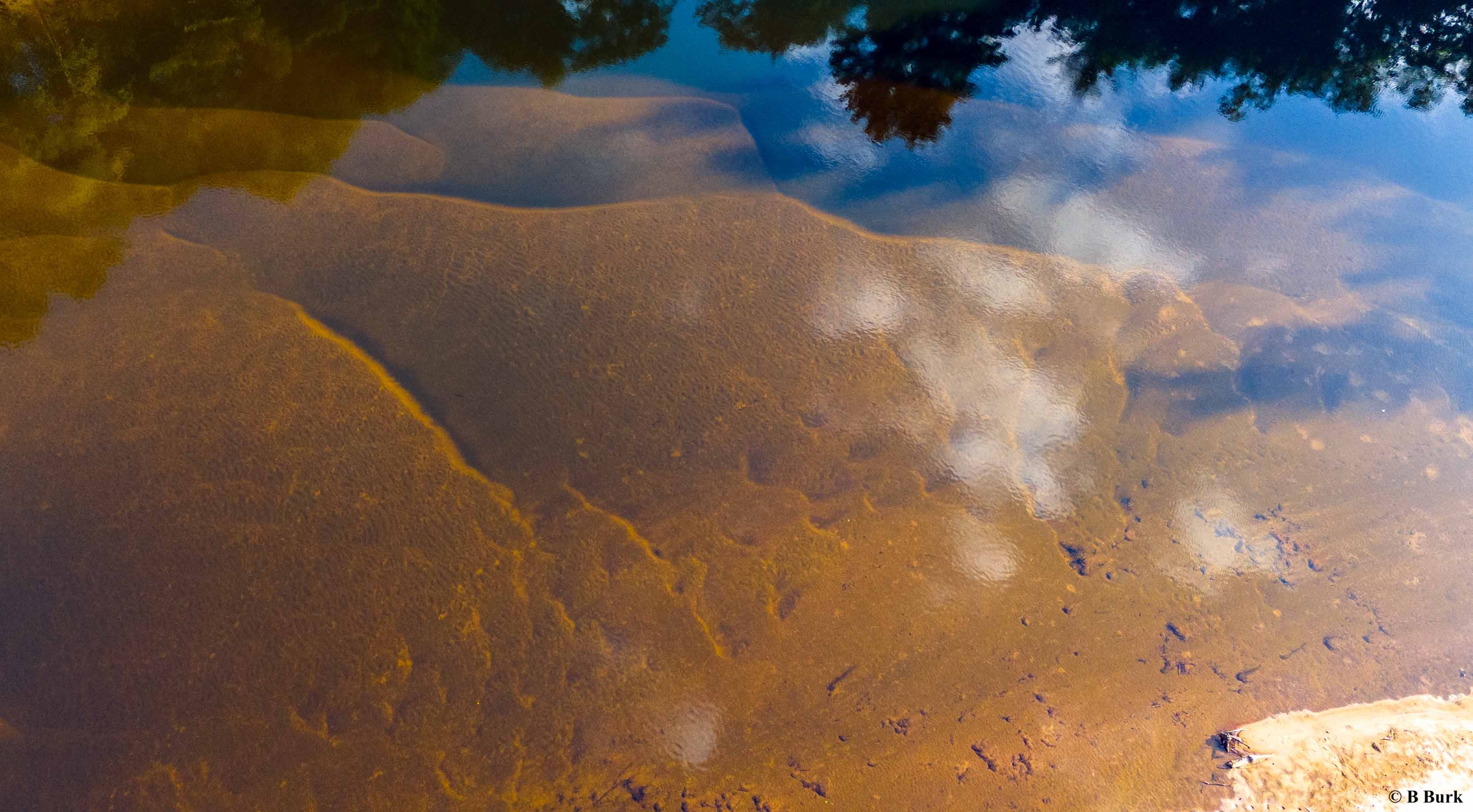
The drone also gathered this shot of the layers of silt in the water. Or maybe we weren’t really on the Saco, and had instead taken a trip to Mars? Oh, but wait, there is a reflection of trees that very much spoke to our being in Maine.

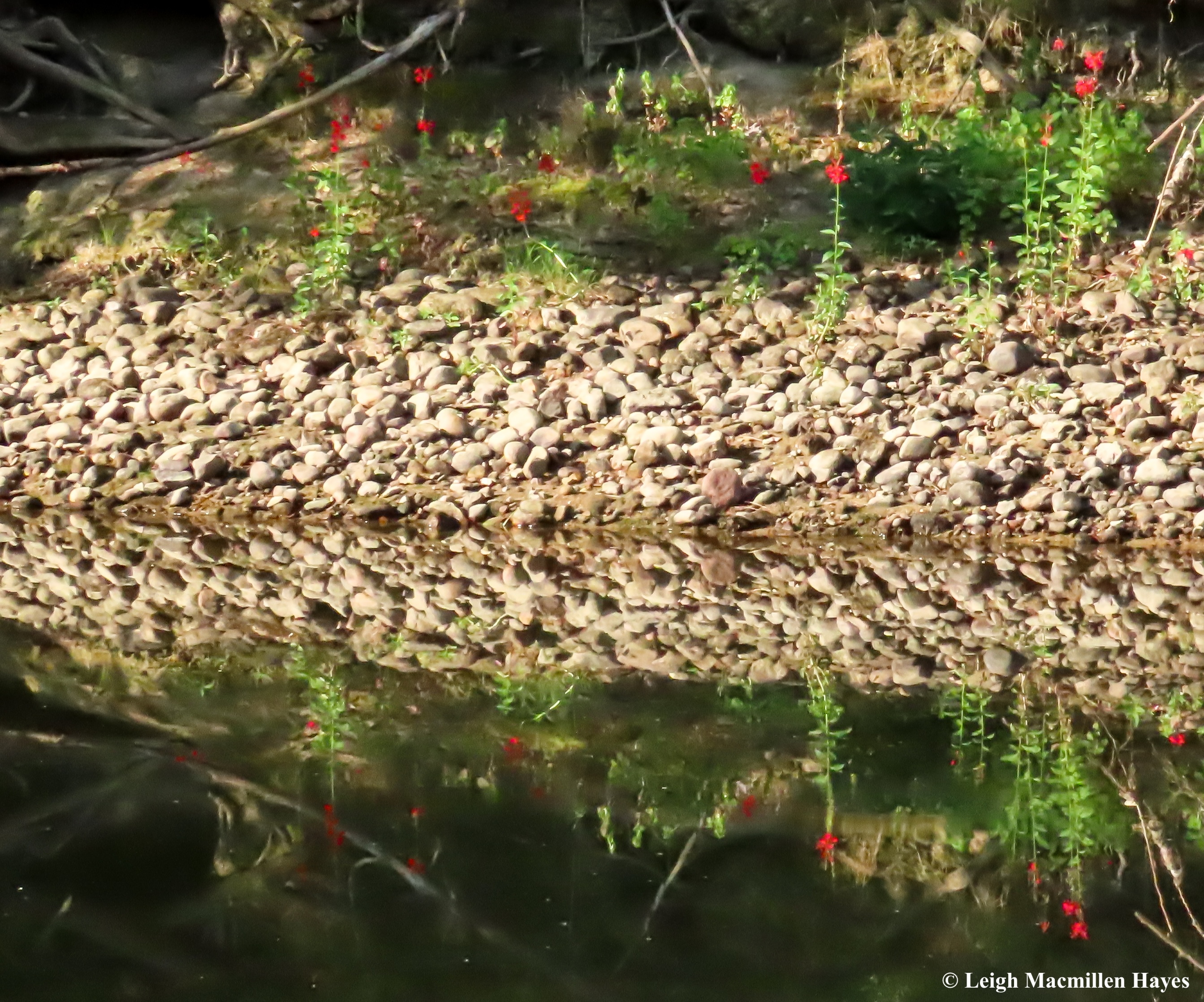
On the way back, we spotted Cardinal flowers that we somehow missed on the first leg of the journey. They decorated a few sections of the shoreline and maybe stood out more because the sun was shining so brilliantly on them.

For Captain B, it was a new flower to add to his list. For me, it was a sign that it is August and we were by water because they do like wet feet.

We also spotted one tiny Painted Turtle that didn’t seem at all bothered by our presence. I’d really wanted to see a turtle, so was thrilled with this finding. But surprised that we only saw one.

According to my GPS, our trip was four miles in each direction, but then I realized that the APP cut some corners, so maybe it was 4.5 miles one way. Plus I forgot to start it until after we’d left the beach.

The length wasn’t really important. It mattered more to have the opportunity to discover this wild and scenic and quiet section of the river (and not have to paddle!).

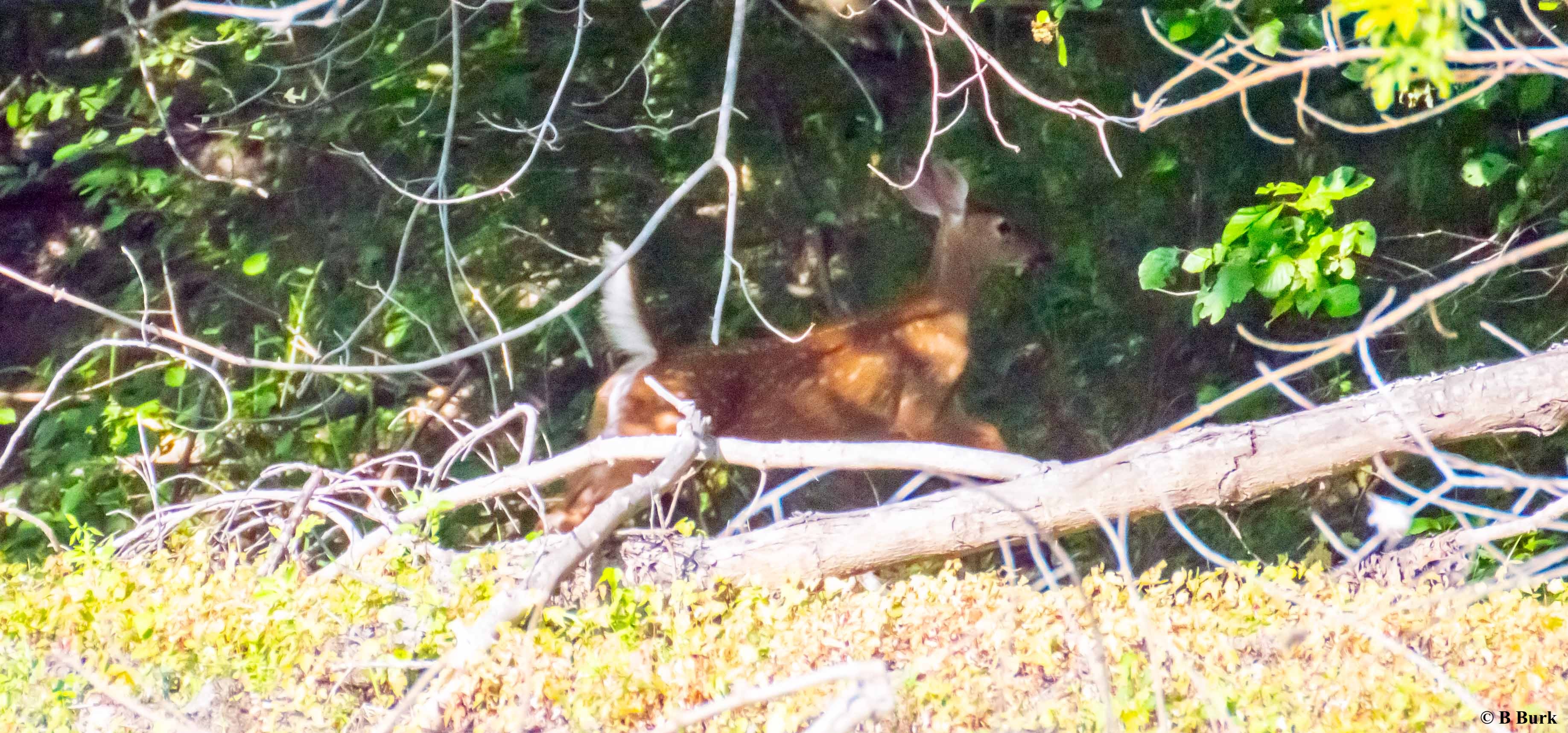
As for the perfect picture, this is one that Captain B snapped and I can’t believe he actually captured the fawn. We were both surprised, even though we’d expected to see deer, when a Doe and her spotted youngster stood by the water’s edge as they nibbled on grasses, but they saw us and quickly dashed into the woods, their white tails on high alert.

The sight of the two of them, however, is what I’ll cherish in my mind’s eye because that’s really where perfect pictures are stored.

Zodiac Three: The Perfect Picture. Thank you again and again, Captain B, for creating the opportunity. And I can’t believe you did get this last photo after all.

Presents in the Moment

I went on a reconnaissance mission today in preparation for co-leading a Loon Echo Land Trust hike in about another month–once hunting season draws to end. This particular property, like several others that they own, probably sees more people hunting and riding snowmobiles than hiking or tracking. The latter two fall into my realm and today found me doing a bit of both.

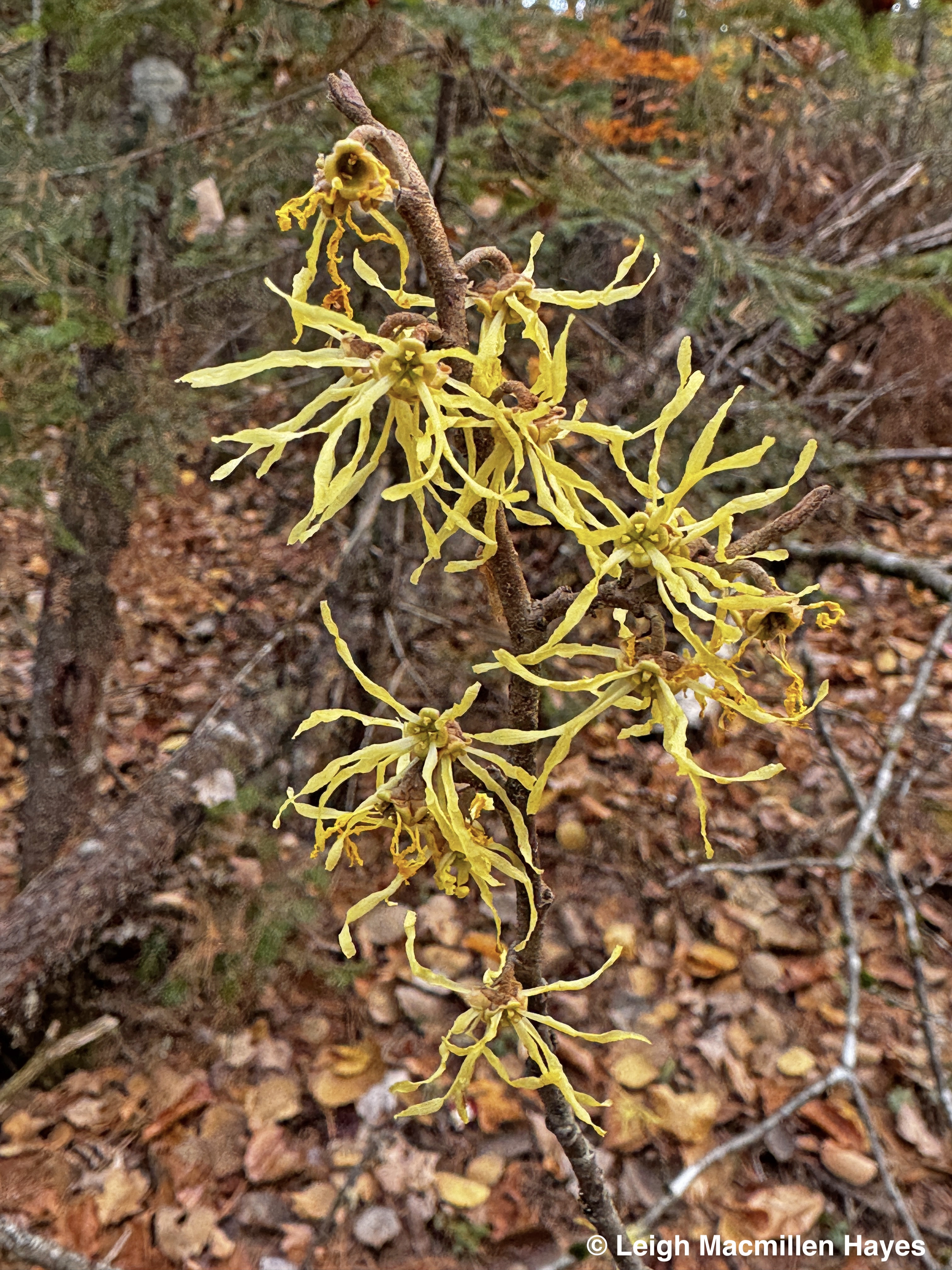
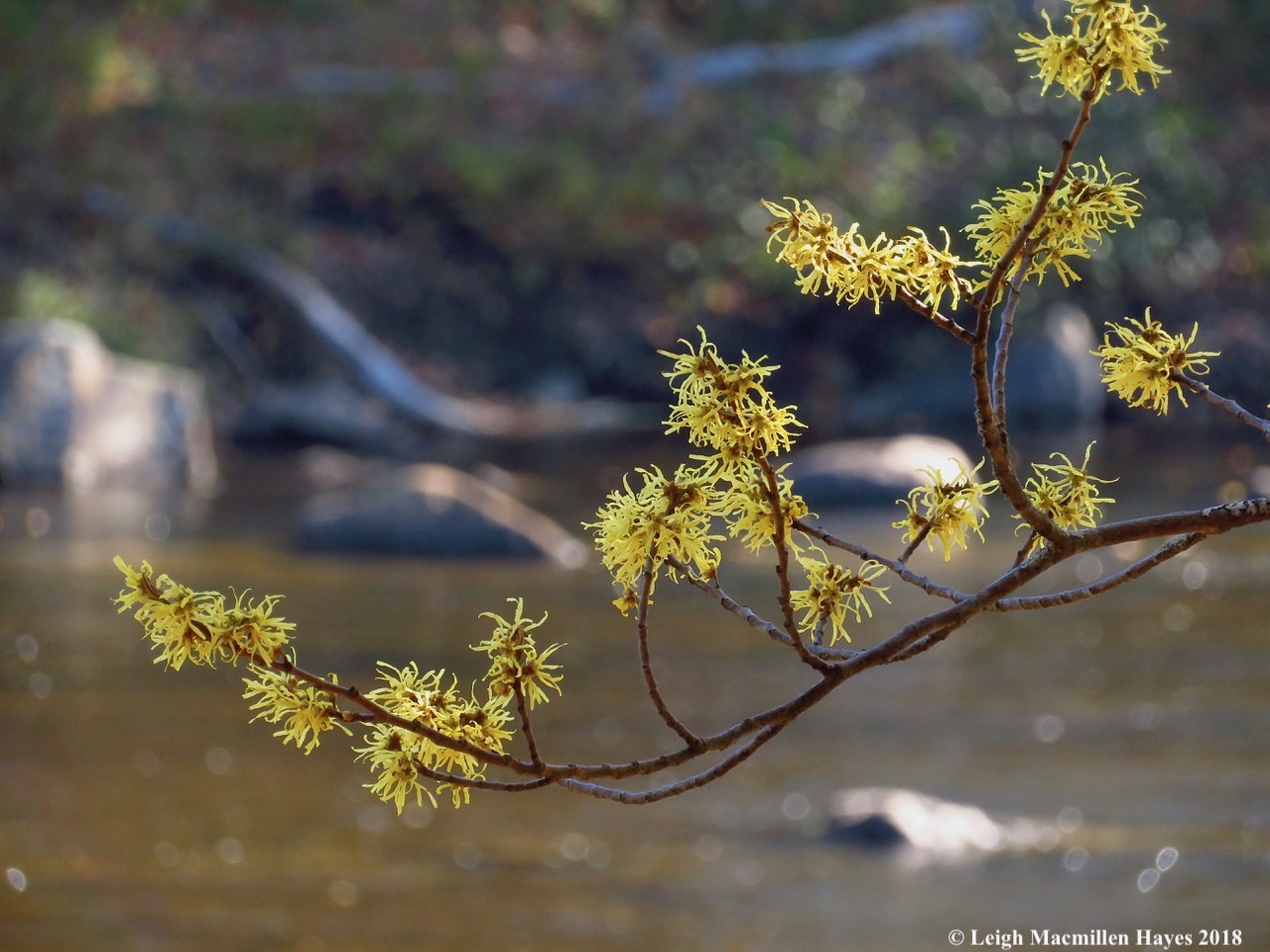
But first, I was stunned by the beauty of the ribbony flowers of Witch Hazel. I don’t know why these always surprise me, but maybe it’s the delicate petals that add bits of sunshine at this time of year when everything is else is dying back.

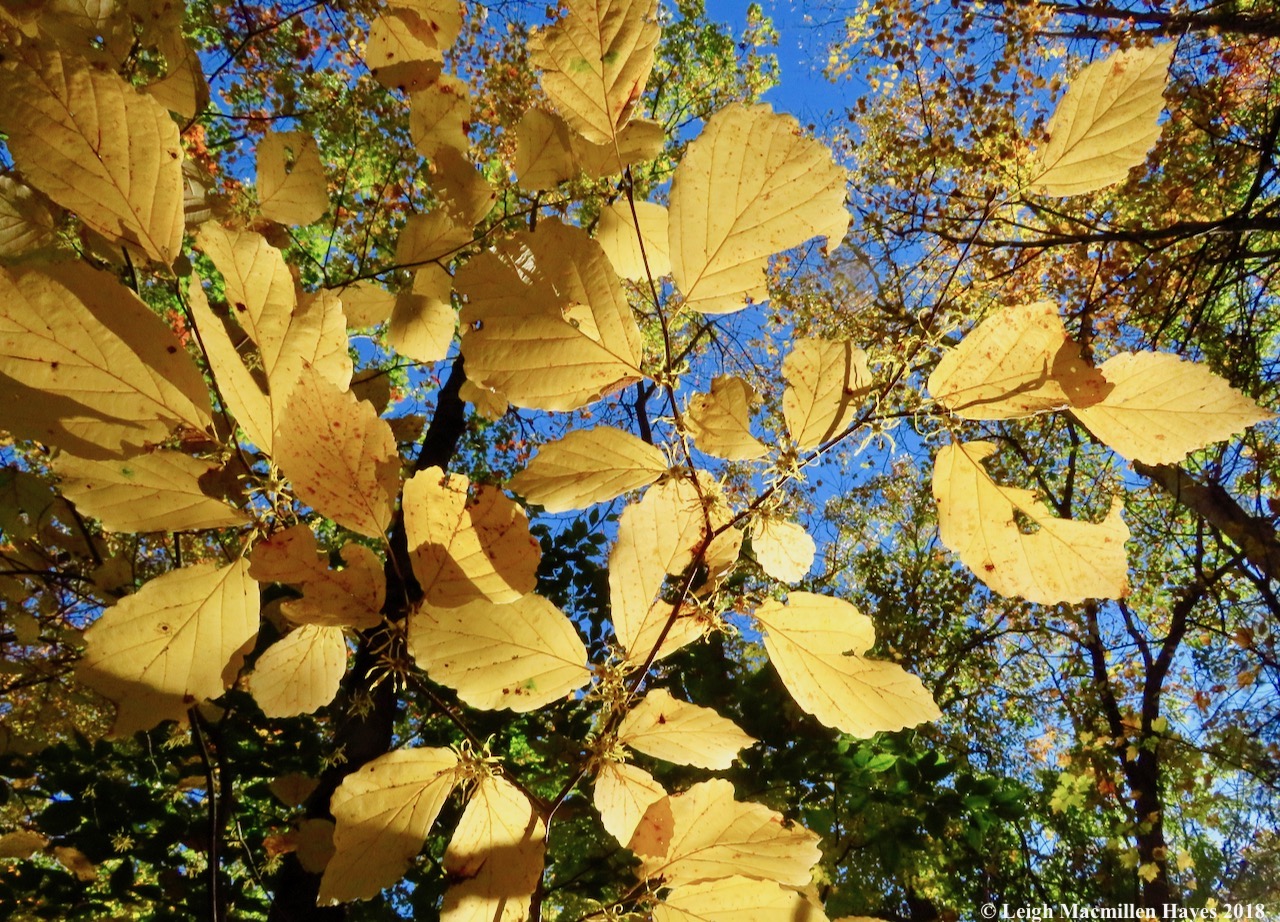
Their wavy-edged leaves also add color as October quickly gives way to November.

A bit farther along the first trail I followed, I found something else to stop me in my steps. Little packages of bird scat inside a hole excavated by a Pileated Woodpecker. If you follow wondermyway.com, then you know that I LOVE to find the woodpecker’s scat, but this was much smaller and I had visions of several smaller birds huddled inside on a cold autumn night.

At the end of the trail I reached a brook that flows into a river. Today, it was a mere trickle. In fact, I took this photo from the high water mark and don’t think I’ve ever seen it this low. Well, not since I began exploring this property in 2020. But then again, since then, we’ve had some heavy rain years and this year has been a bit drier.

I knew once I spotted the trickle that the nearby Beaver dam would not be working to stop the flow.

But . . . in walking over to take a look at it, I spotted something else worth noting . . .

At first my brain interpreted this disturbed site as a bird’s dust bath. Until . . .

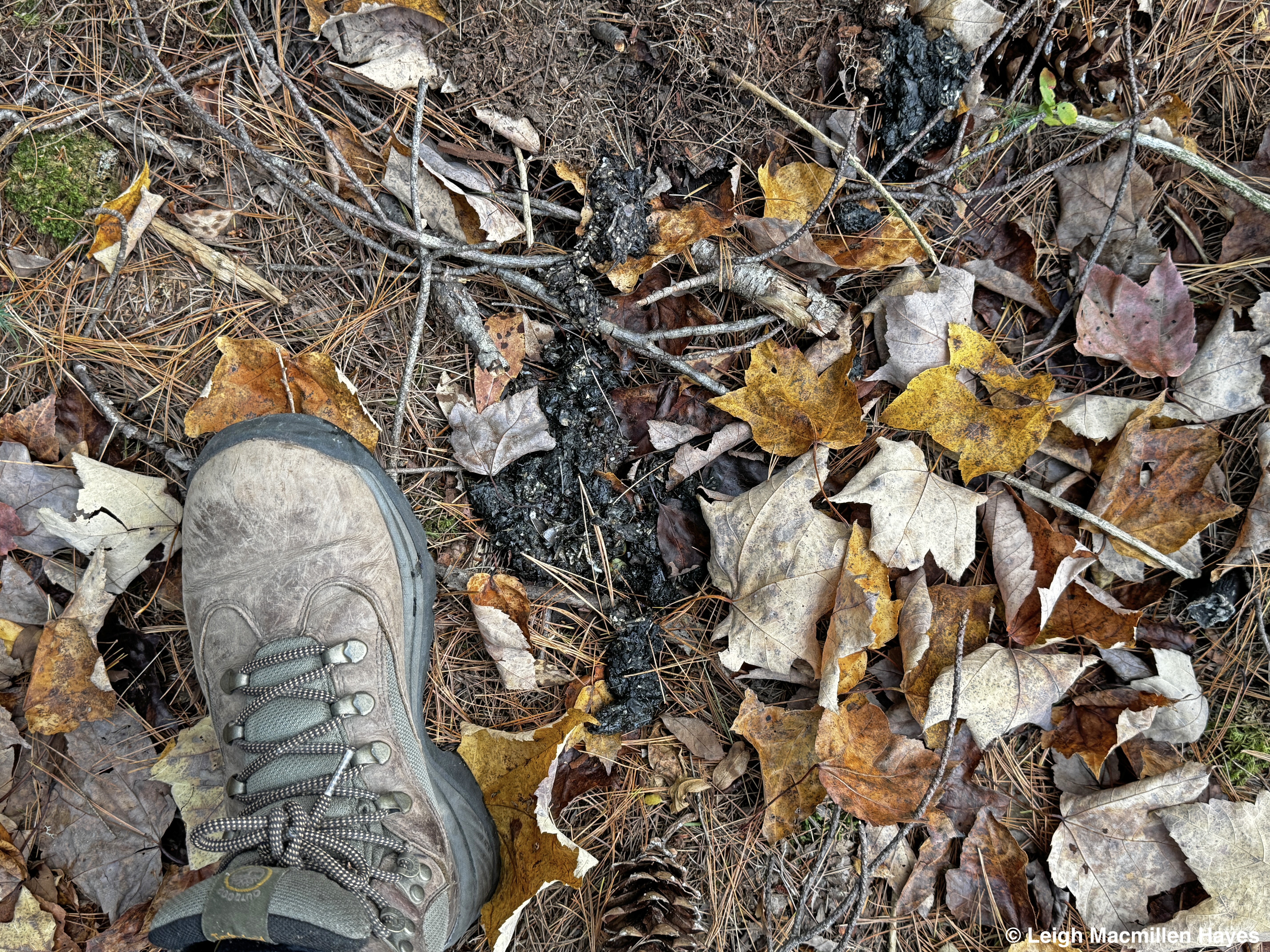
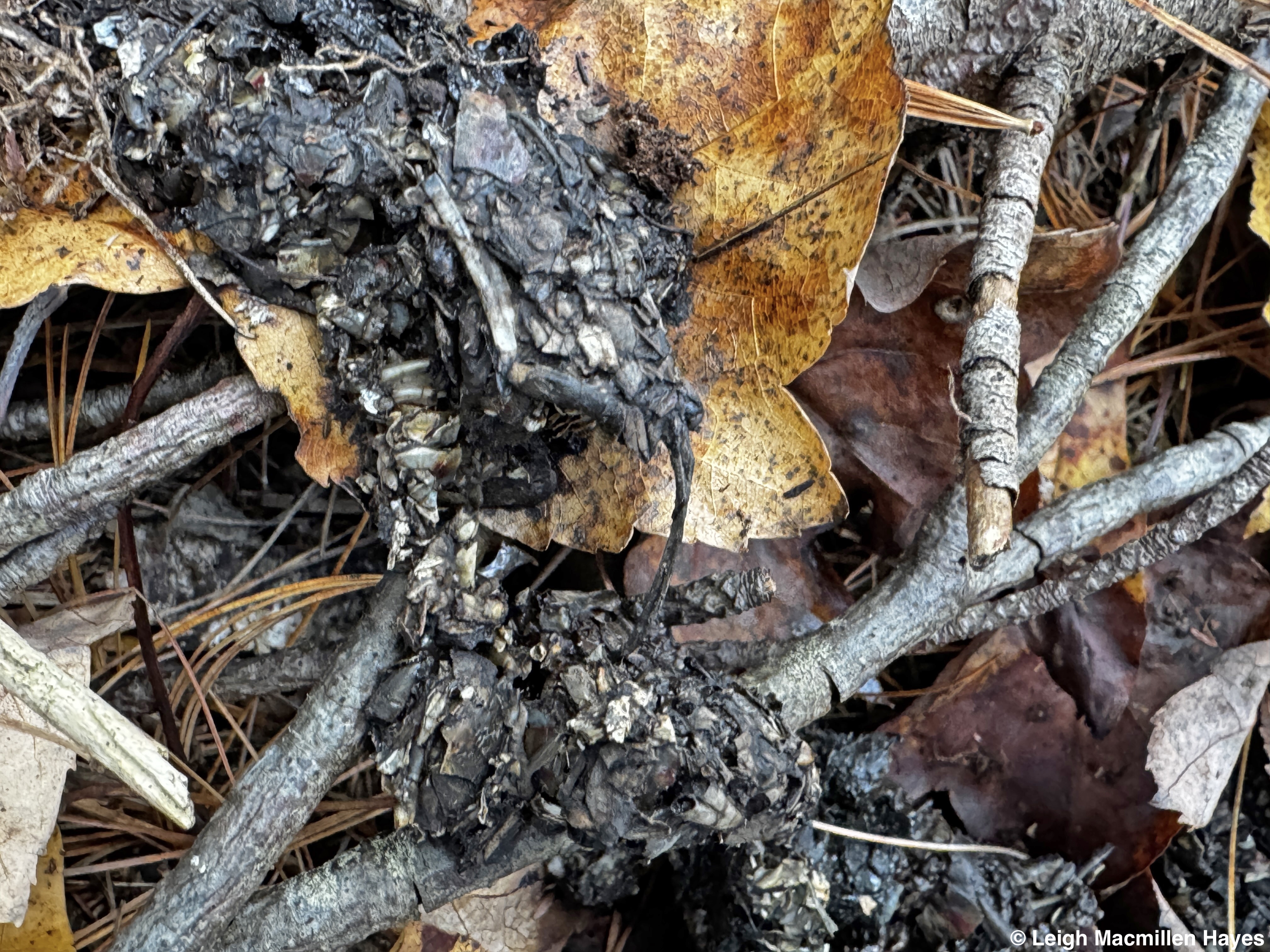
I spotted River Otter scat. A latrine, in fact. That’s when I knew (or think, anyway–okay, assume!) that the disturbed sight was a spot where the otter rolled around, or maybe two or three did as they most often travel as a family unit.

How did I know it was otter scat? Look at those fish scales in it. And it wasn’t all that old based on the leaves under and on top of it.

Feeling like I was in the right place at the right time, I doubled back on the trail because it ends at the brook, and then turned onto another to see what else I might find. Along this one, a second brook had a better flow and had me envisioning the land trust group dipping for macro-invertebrates in this spot we haven’t explored yet.

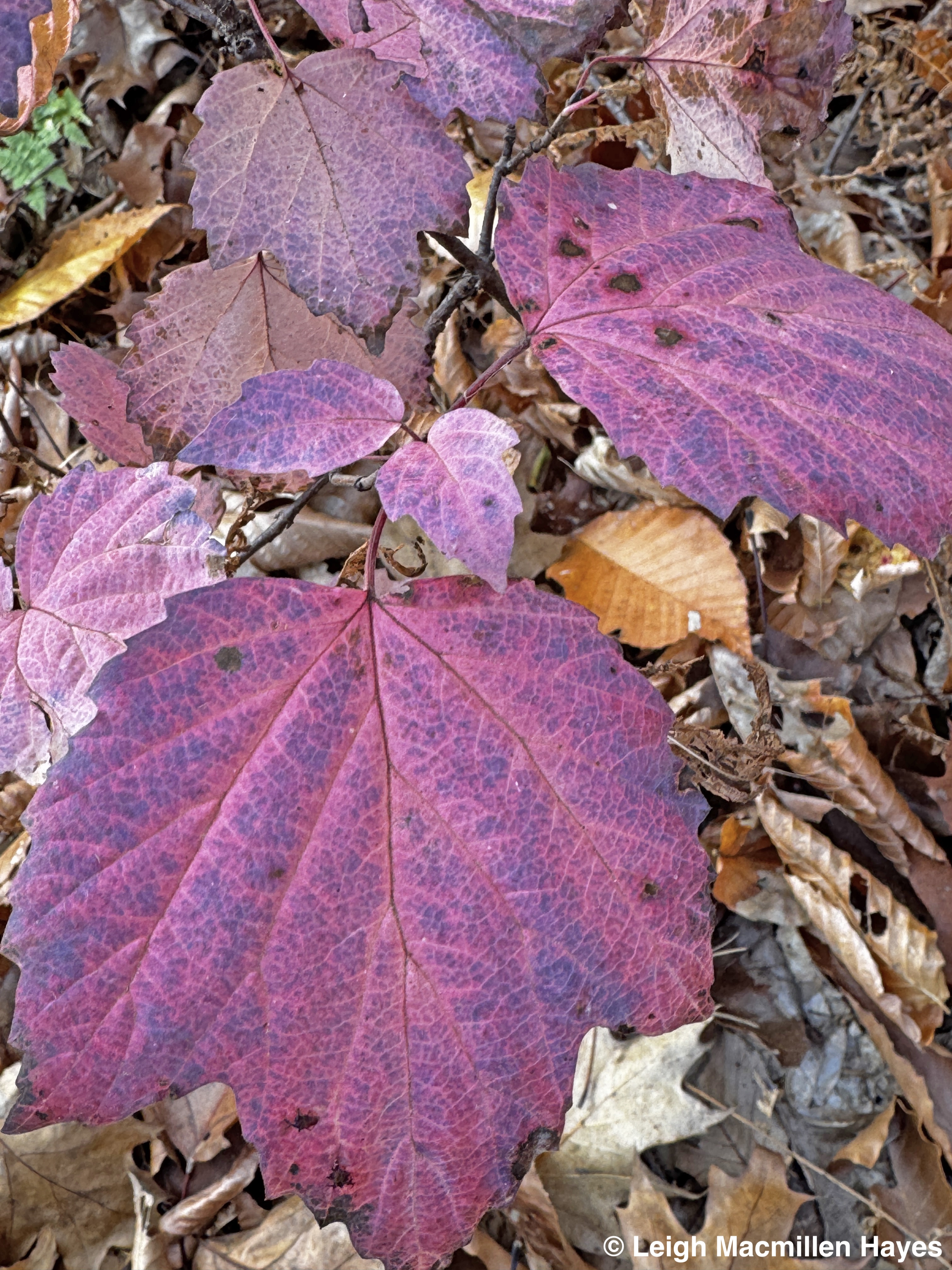
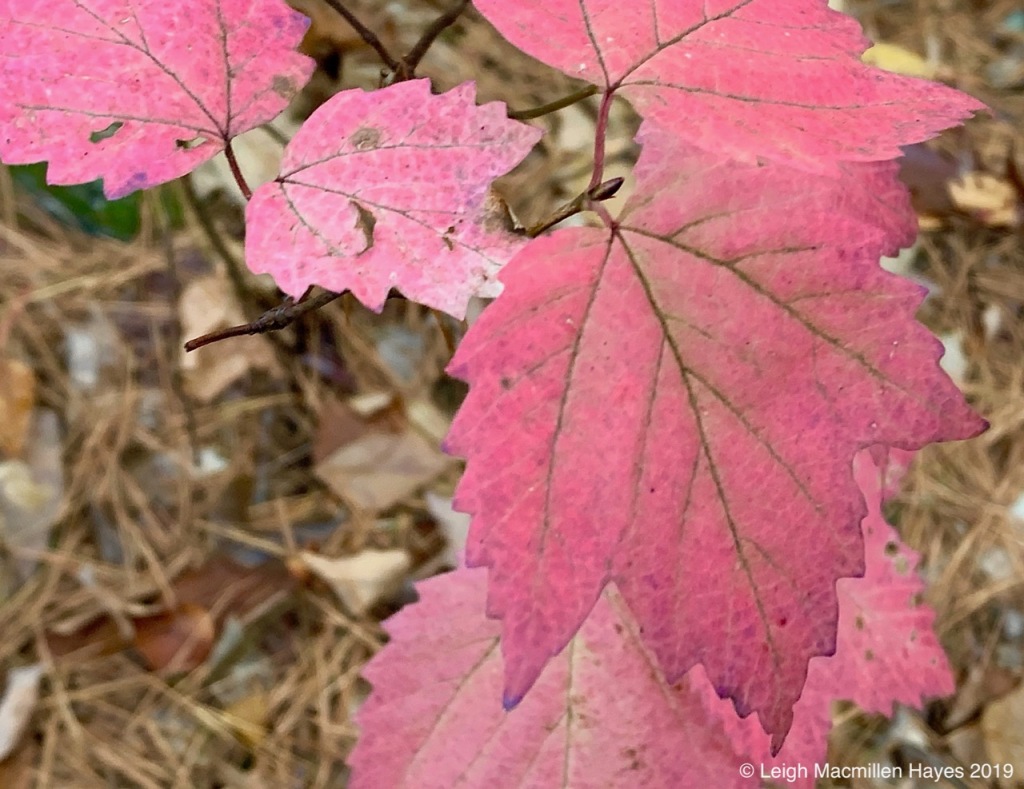
I also found another shrub that thrills me as much as the Witch Hazel. Also a shrub, I can’t pass by a Maple-leaf Viburnum in the fall without admiring its color. Mulberry? Heather? Sky-purple-pink? However you describe it, this I know–no other leaves feature these hues.

If you do spot one, take a moment and touch the leaf. I love the touchy-feely walks that are not about feelings, but rather about actually feeling something (as long as it isn’t poison ivy!).

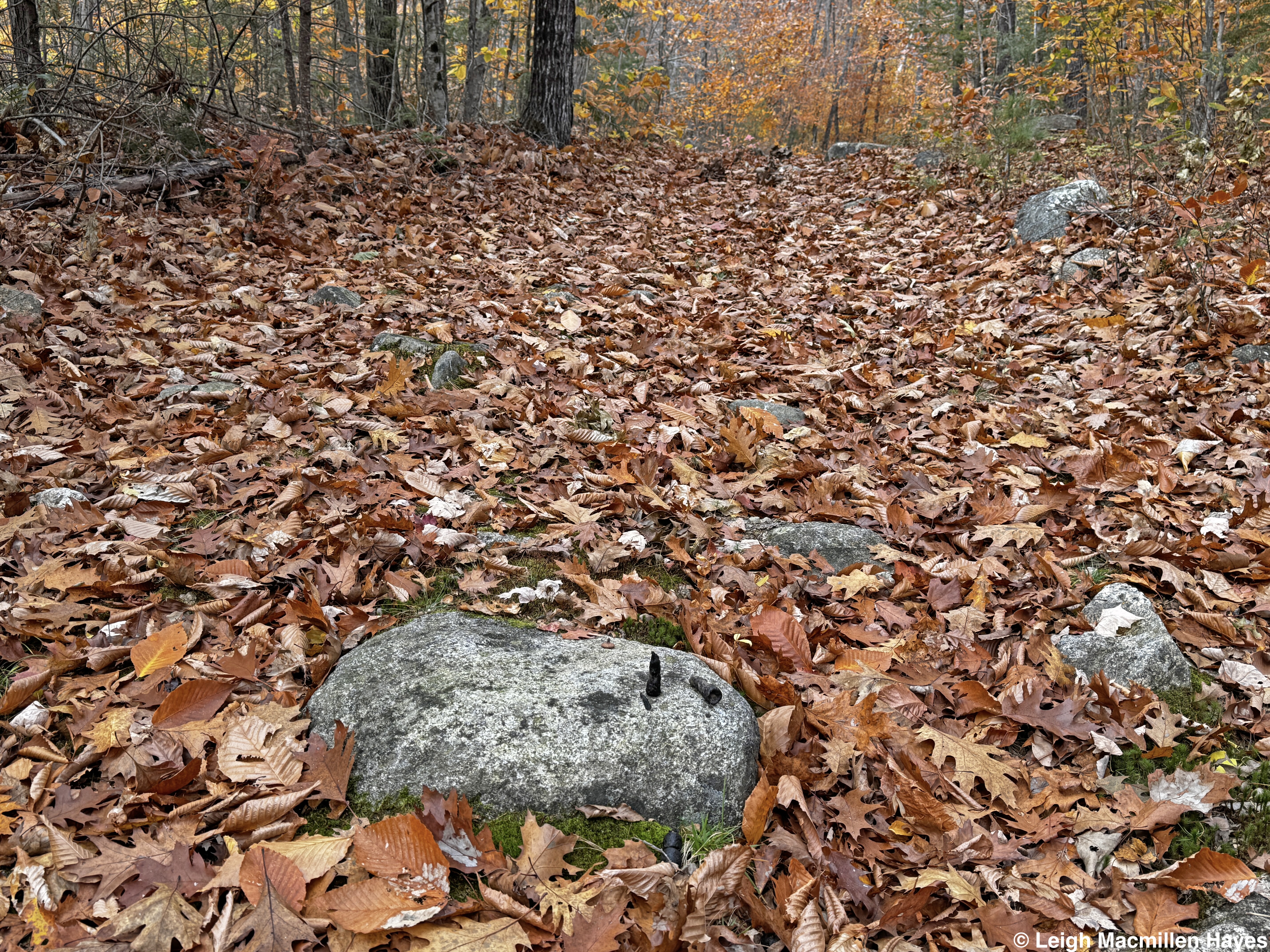
As luck would have it, I was following an old logging road by this point, which these days serves as a snowmobile trail. Despite its uses, rocks and boulders mark sections of it. And atop one, oh my! Do you see what I saw?

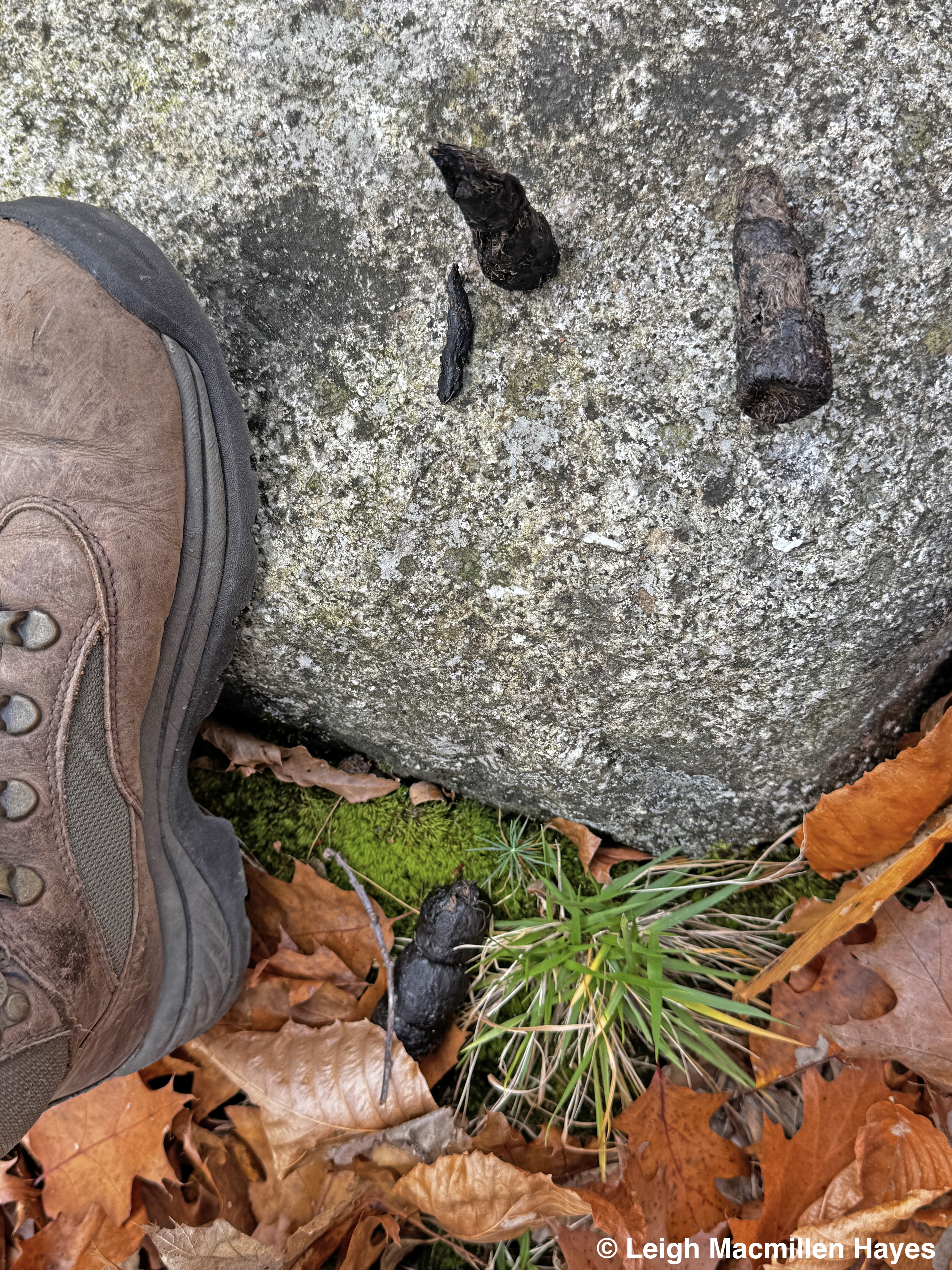
A LARGE Bobcat scat and a tiny weasel scat. Could life get any better than that? I think not. Well, unless I saw the actual critters and as I write this a local friend just texted me that she and her family saw a pair of eyes reflecting in their headlights as they pulled up to their house: “I thought it was our cat from a distance. I got out to investigate. It was a bobcat! And it wasn’t afraid. I couldn’t believe it! It was so close. I could see the face. I ran inside to get a flashlight. It just watched us as we watched it.” ~Amanda.

If she was someone else, she’d jump on social media and inform the world that the big bad wolf is in the neighborhood because that seems to happen any time someone spots a Bobcat or Fisher. But, she appreciates the gift of the sighting and I’m so thankful for that.

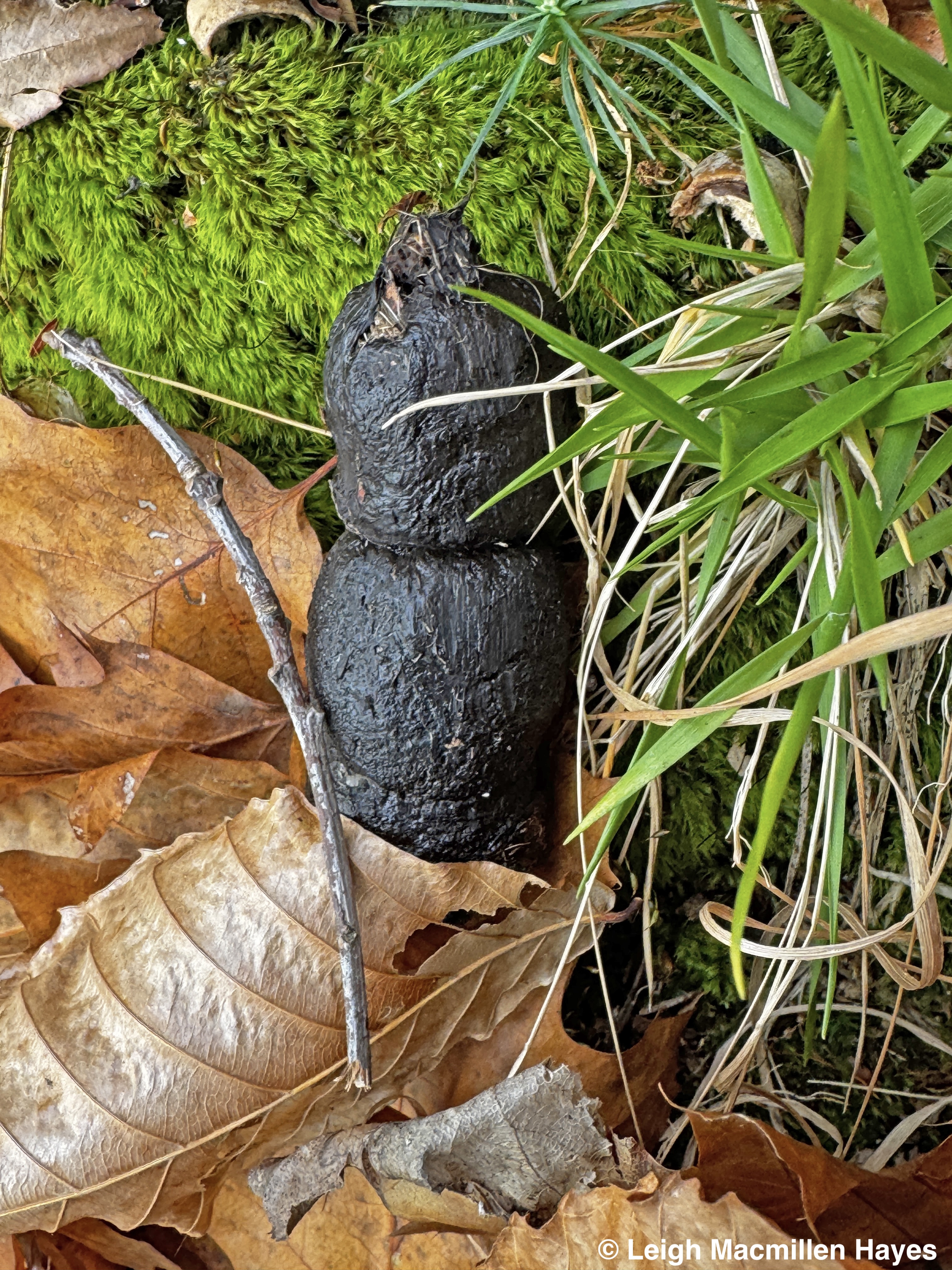
Back to my Bobcat, or rather Bobcat scat–it was classic! Segmented, tarry, and no bones. Ahhhh! What dreams are made of–at least my dreams.

It was also quite hairy. Squirrel? Snowshoe hare? Weasel? Pop goes the weasel? Into the Bobcat’s mouth? I’ll never know. But I love that one marked the rock in the middle of the trail and the other followed suit. And I also love how that one piece stands upright like a tower. I don’t think I’ve ever spotted such a presentation before.

No, don’t worry, we don’t have yet. But I took this photo of a Bobcat print, also classic in presentation, along the same trail last February. Same critter? Offspring? Sibling? Any of the above.

At last I reached what would become my turn-around point, again on an out-and-back trail. And once again, I slipped off the trail and made my way toward an expansive wetland that is actually part of the small brook I’d crossed.

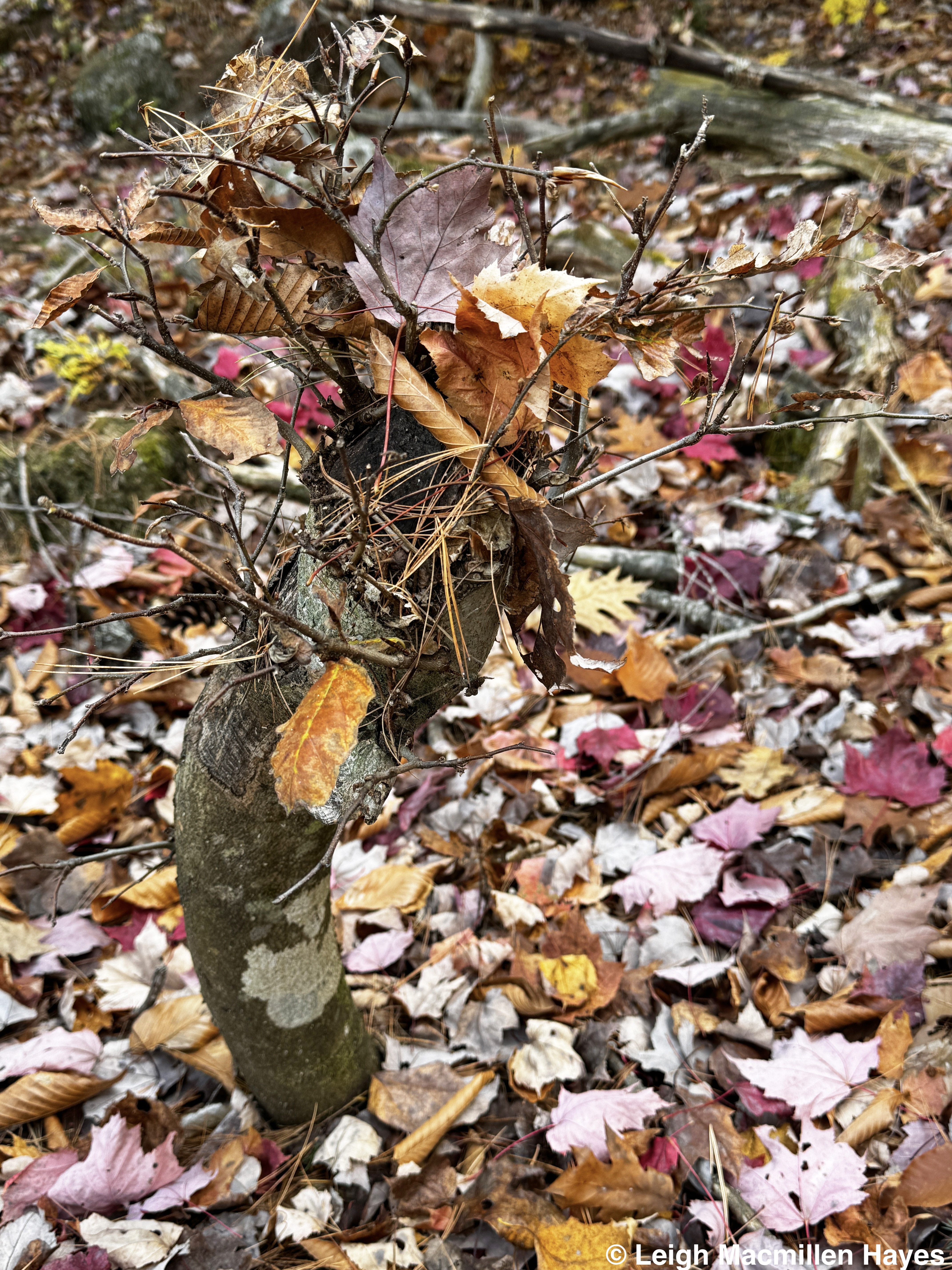
Old Beaver works, such as this American Beech with a bad-hair day from stump sprouting, were evident everywhere.

Other Beaver sculptures created a few years ago as indicated by the dark color of heartwood where the rodent had gnawed and cut the tree down, probably to use as building material, now sport fungi in decomposition mode.

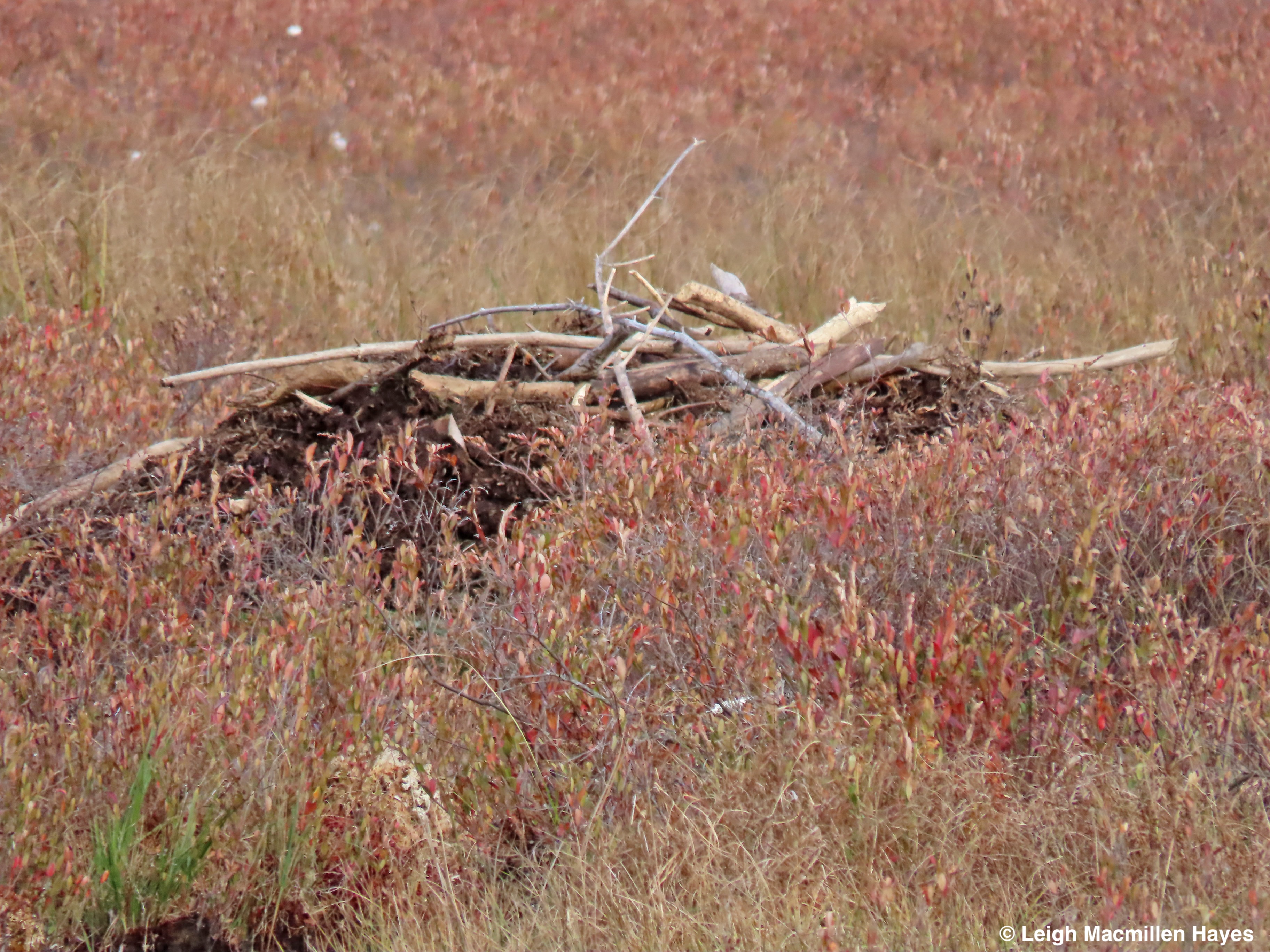
In the wetland, I spotted two Beaver lodges, both featuring some mud for winter insulation. There were two other larger lodges with no mud, so I suspect these are the residences of choice for this year.

I also spotted a Beaver channel, but could find no new work on the land.

That surprised me given that there was new wood on top.

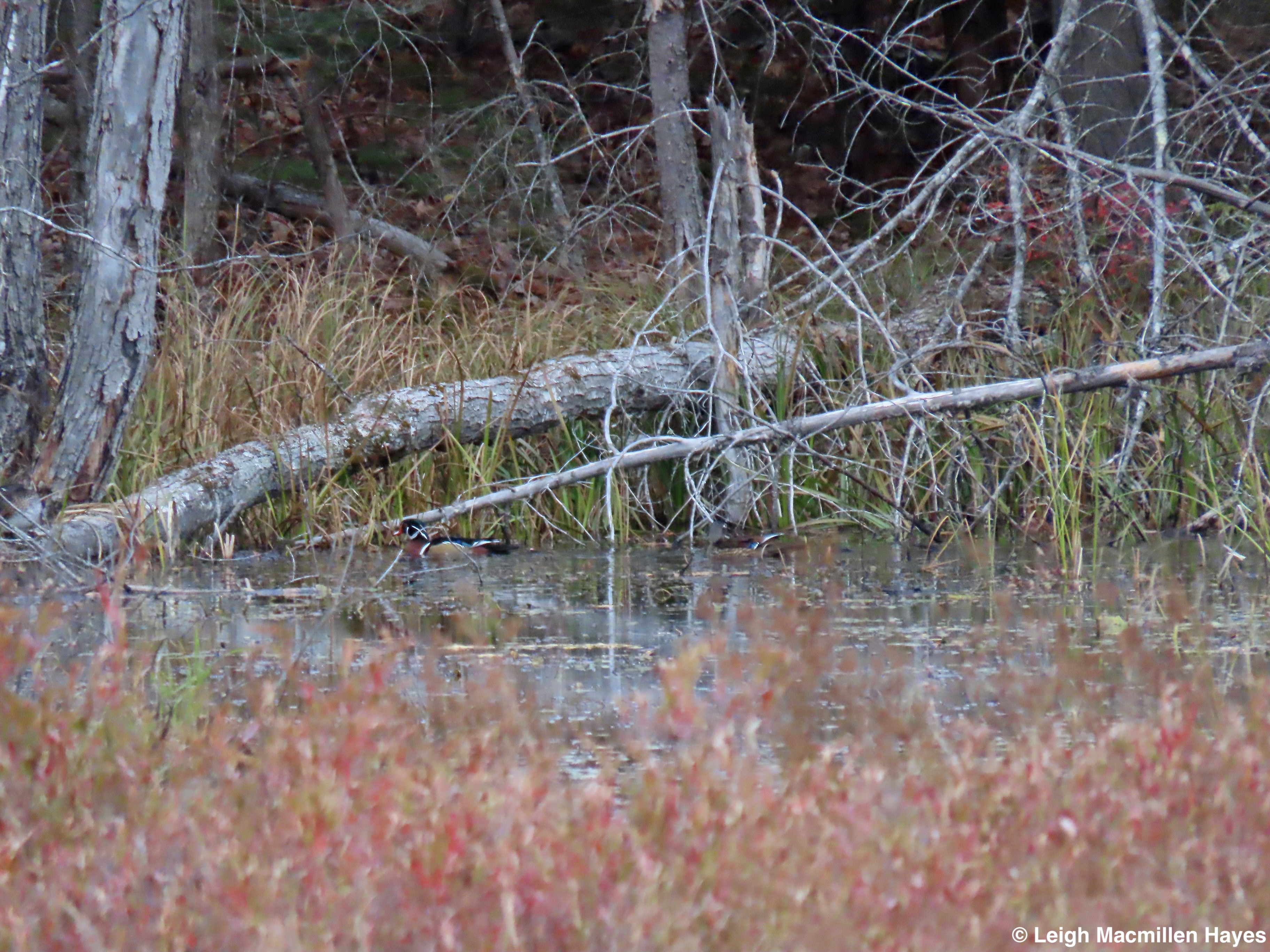
I could have walked farther along the wetland and may have spotted some freshly hewn trees, but when I spotted several Wood Ducks on the far side, I decided to stand still for a bit because they are easily spooked.

And my grand hope was that if I was quiet, I might get treated to a Beaver sighting. Or two.

For a half hour I waited. Nada. And so I climbed back up to the trail and walked out.

But, I was present in the moment today and received so many gifts, which may or may not be there when I bring others to explore. That’s okay, because together we’ll make other discoveries.

Thanks for stopping by, once again, dear readers. I leave you with this painting as a parting gift for being so faithful in following me as I wander and wonder.

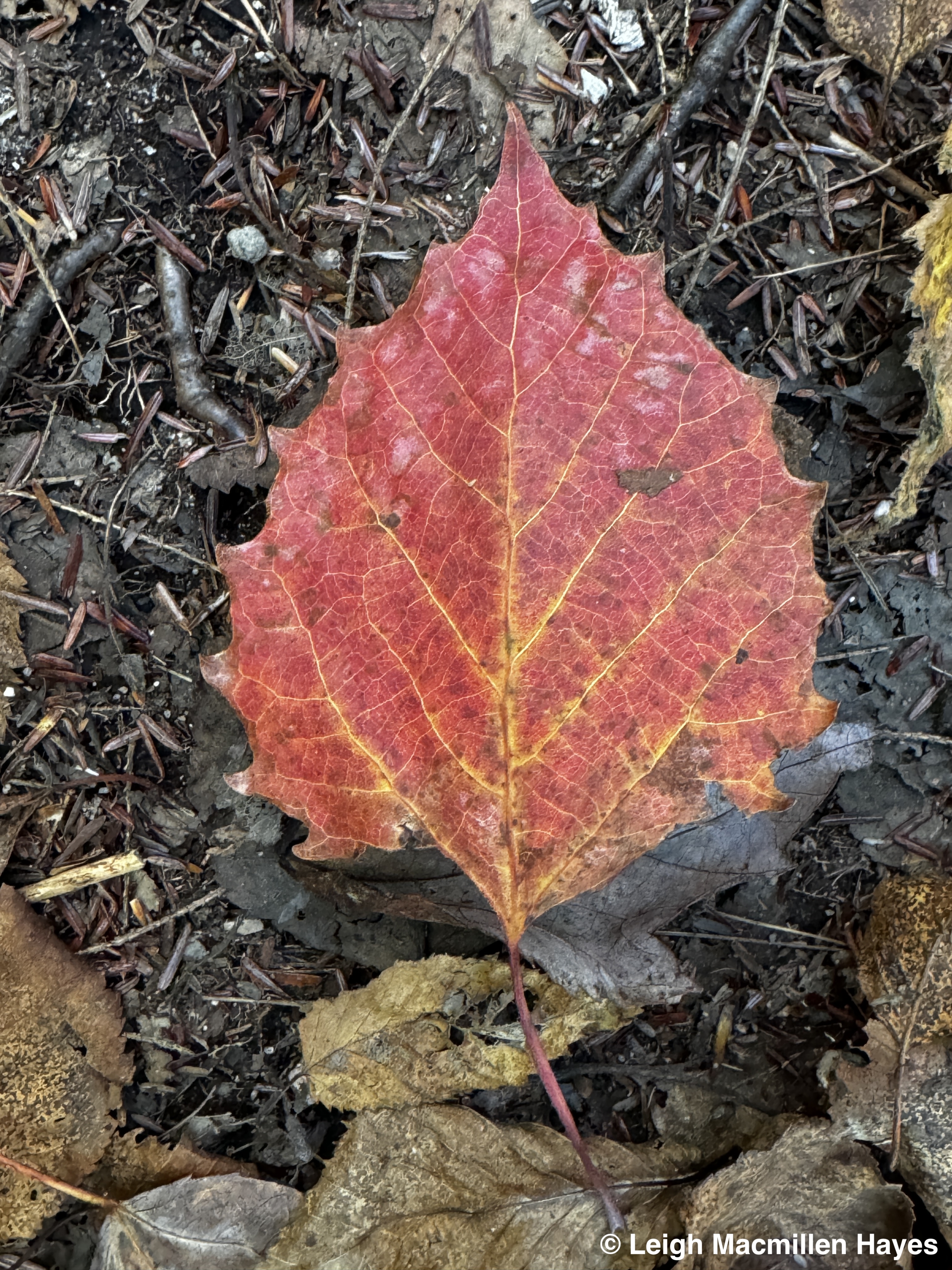
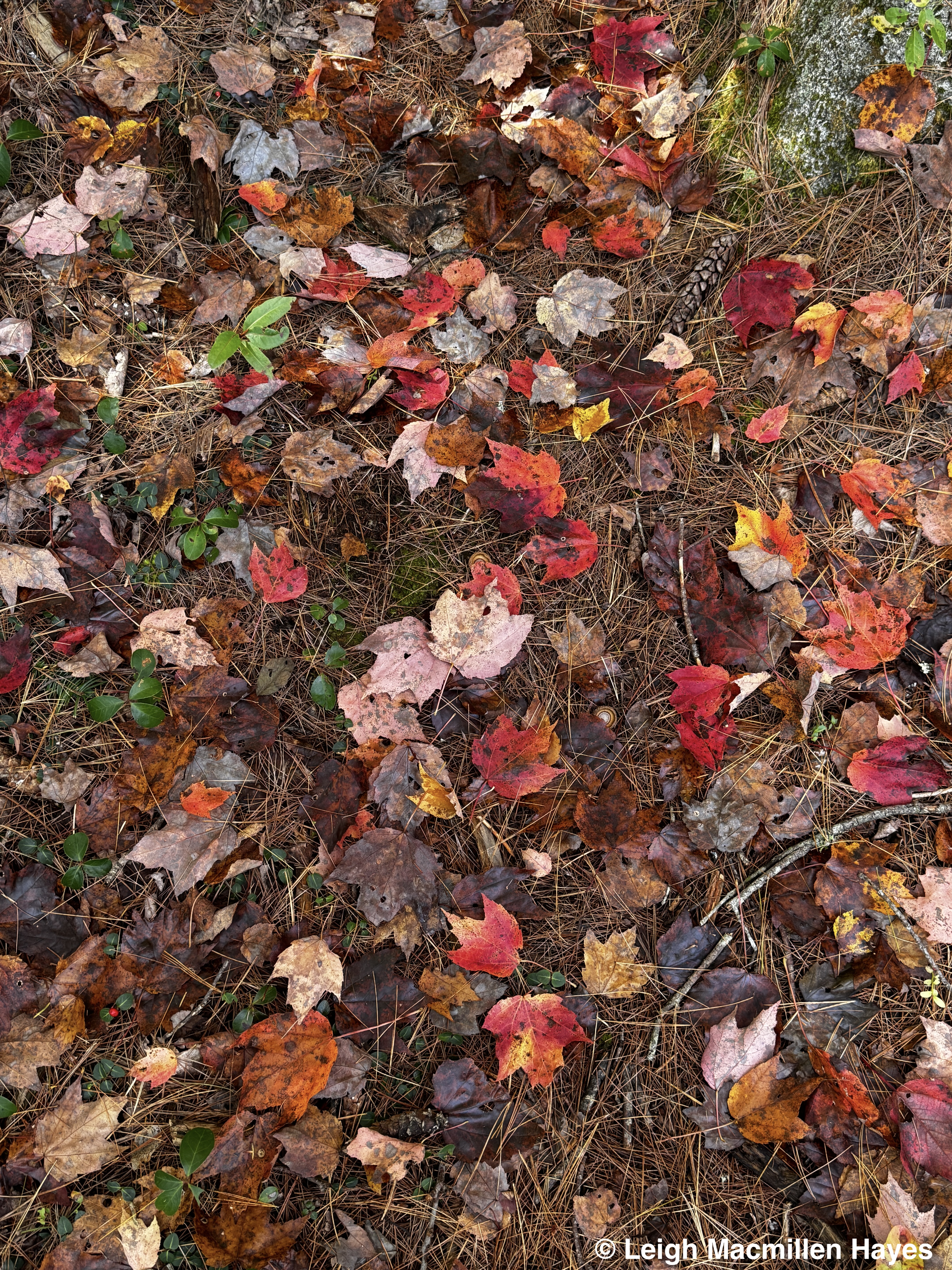
Celebrating the Work of the Leaves

In response to shorter days
and sunshine's declining density,
leaves begin the age old process
leading to their demise.
Like so many others, 
I make time to honor
the tapestry they weave
before they fall.
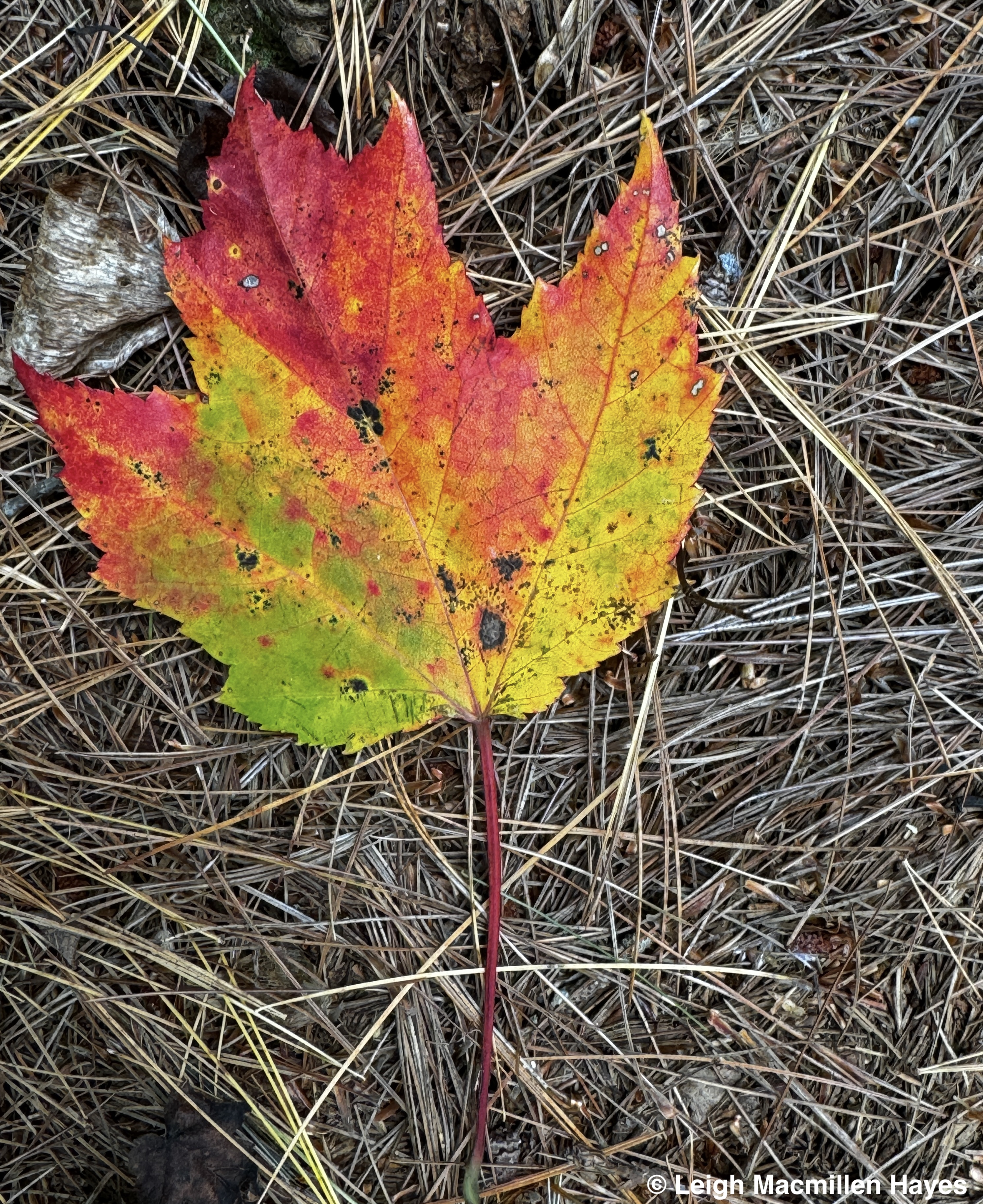
Chlorophyll, the green pigment
we associate with summer,
and necessary for photosynthesis,
slows and then stops manufacturing food,
and the leaves go on strike.
Veins that carried fluids
via the xylem and phloem close off,
trapping sugars, and promoting the production
of anthocyanin, the red color
we associate with Red Maples and Silver.
Though in the same family, 
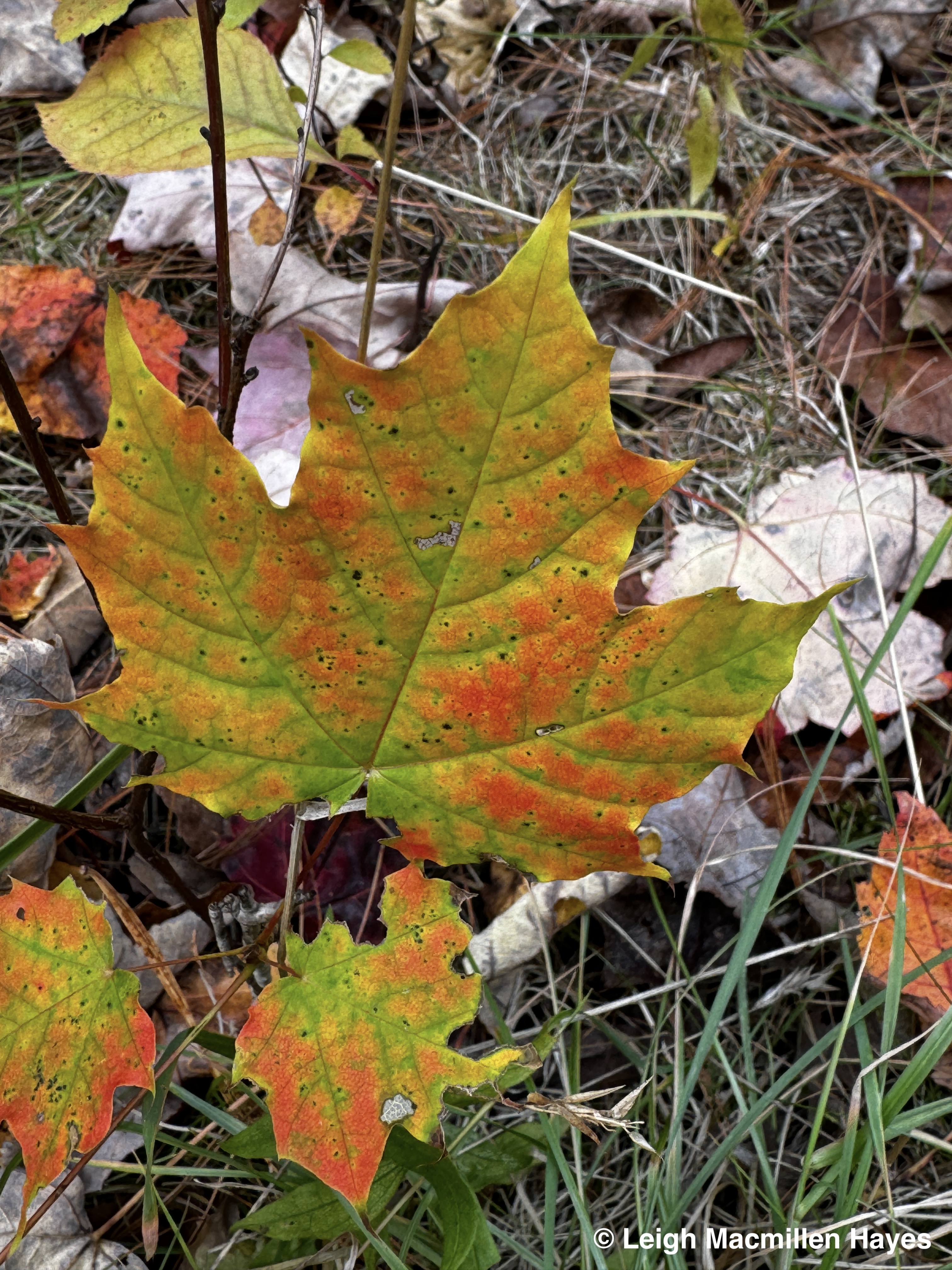
Sugar Maple displays
the yellows and oranges
of the ever present Carotenoids,
which had previously been masked
by Chlorophyll.
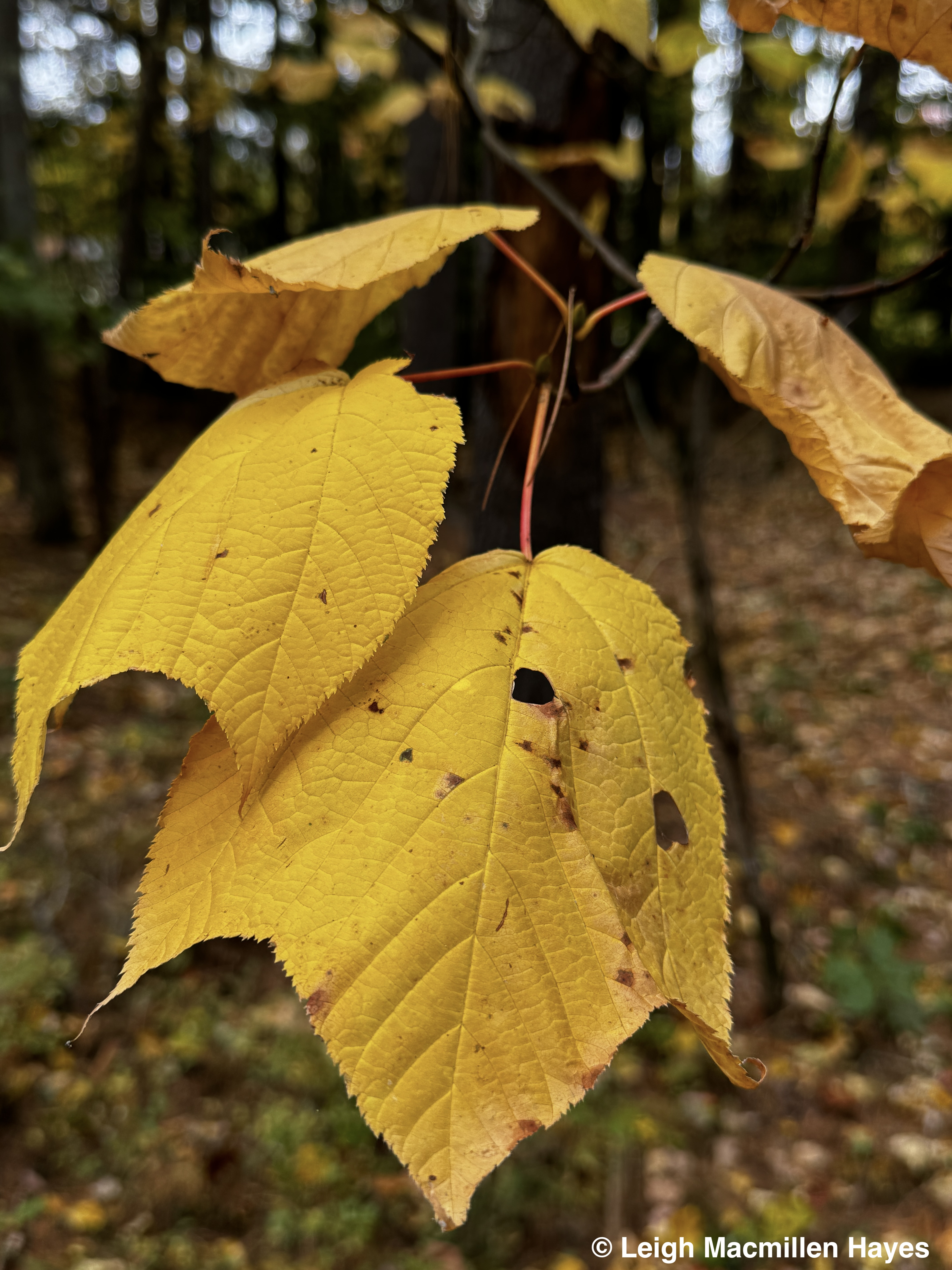
Stripped Maple knows
only one hue,
making it easy
to spot its large display of brownish yellow.
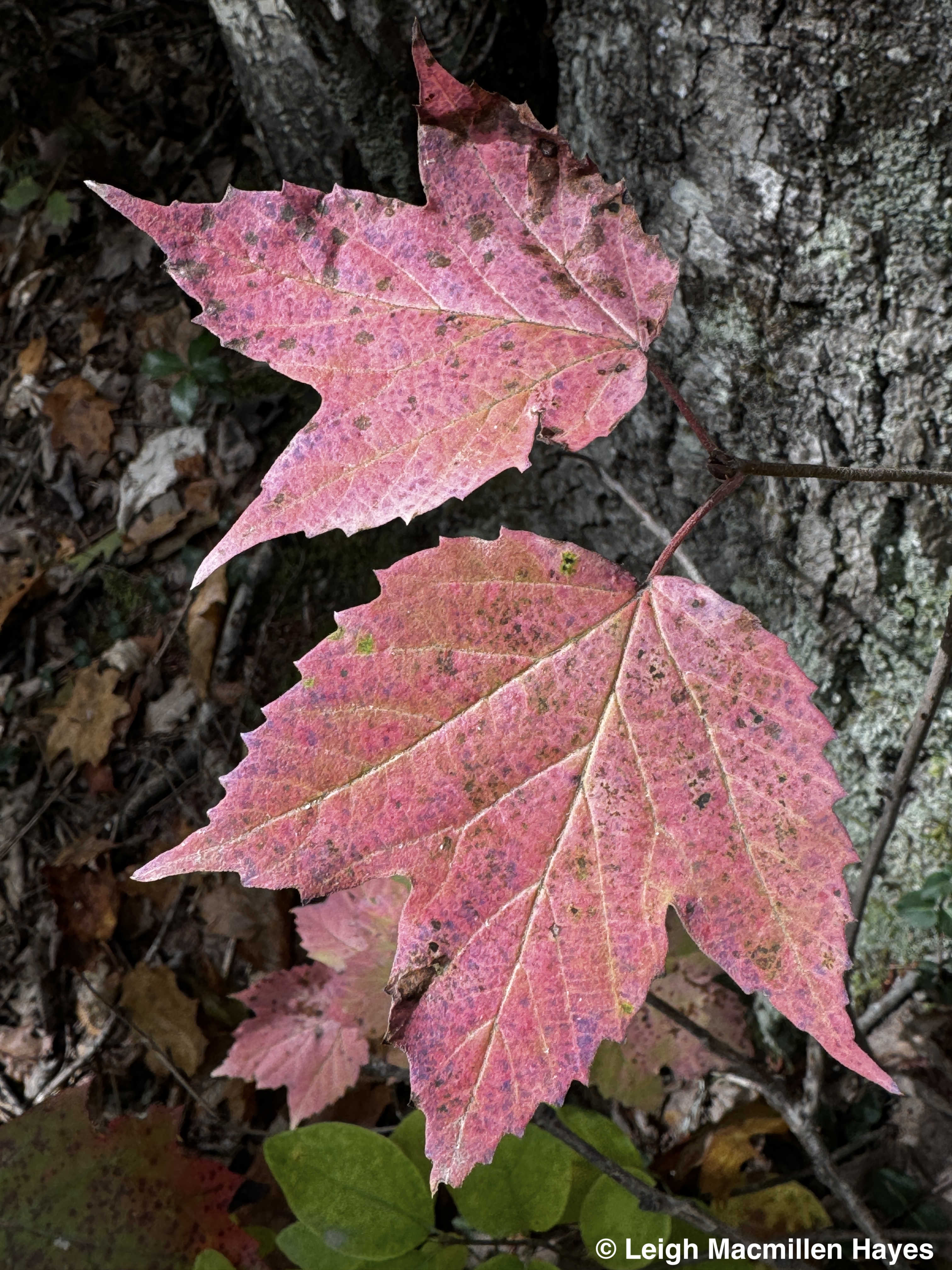
One of my favorites
is the reddish-pinky-purples
of Maple-leaf Viburnum,
a shrub with maple-shaped leaves.
Ash follows suit,
though its leaves
are the quickest to drop
and disappear into the forest floor.
Big-tooth Aspens turn a golden yellow,
but other colors
have a tendency to seep in
and create a striking picture.
American Beech, 
Paper and Gray Birch
show off a yellow
to golden bronze presentation.
And a little late to the show, 
Northern Red Oaks
put their colors on display
after other species
have already dropped their leaves.
Not really a part of the foliage, 
but still important because it is present,
is the splotchy display caused by Anthracnose fungi,
a result of too much rain stressing trees
and not allowing them to properly respire.
Once connecting tissues 
between leaf petioles and their twigs
form a seal,
the forest floor is colored with gems
that will eventually turn various shades of brown
as they decompose and restock the soil with nutrients,
plus provide food for numerous organisms. And shelter.
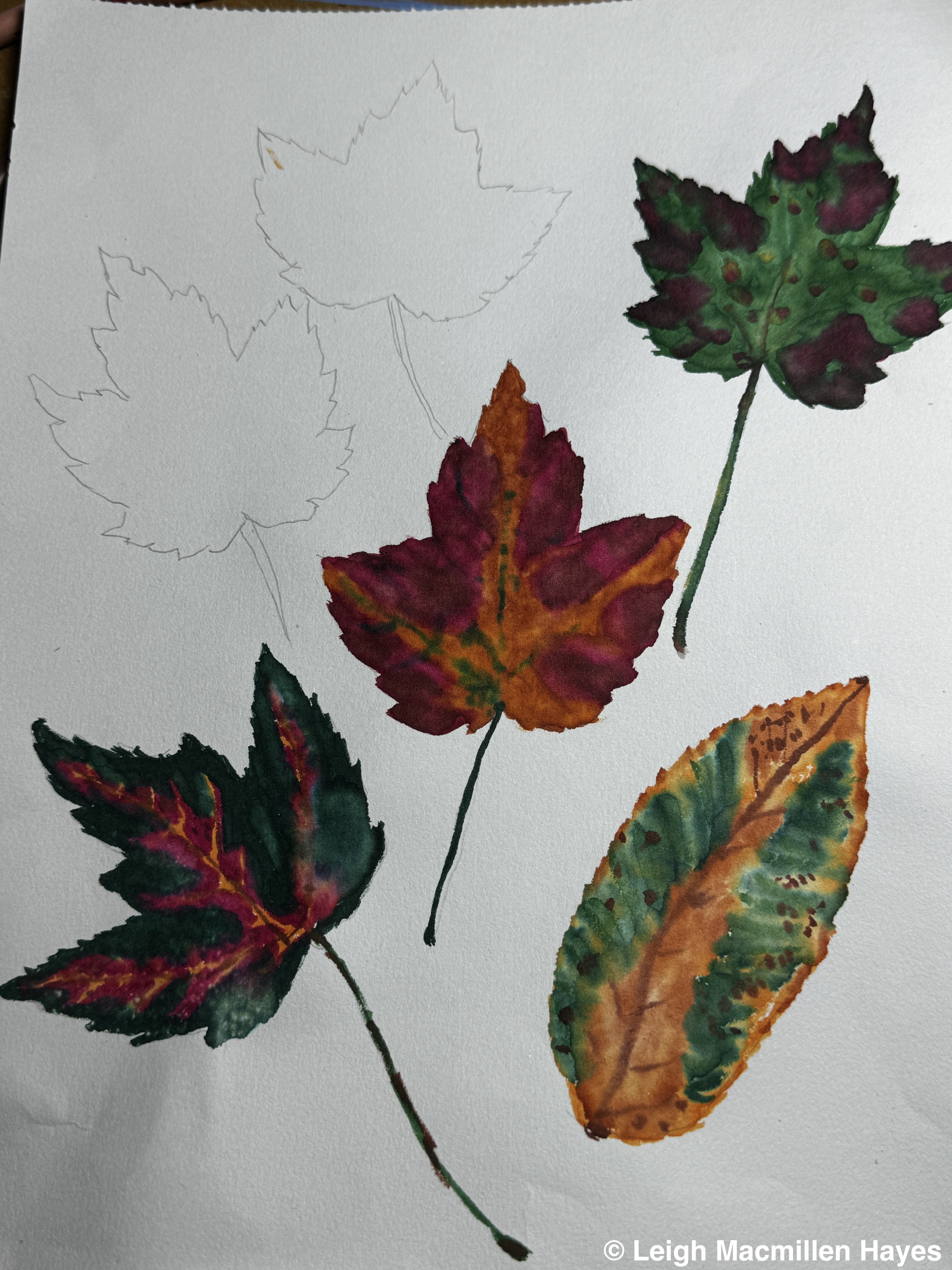
In a Senior College (Lifelong Learning) class
this past week,
I attempted to use watercolor pens
to capture the colors.
And then at home, 
I tried to do the same,
only this time using watercolor pencils
to show off the vibrant variety of hues.
In doing so, 
I was forced to slow down
and notice how the color changes
often followed the veins
in this biochemical process.
Fall foliage is fleeting,
and I give thanks
that every year
we can celebrate the work of the leaves.

A Day of Firsts

This has never happened before. Then again, there’s a first for everything.

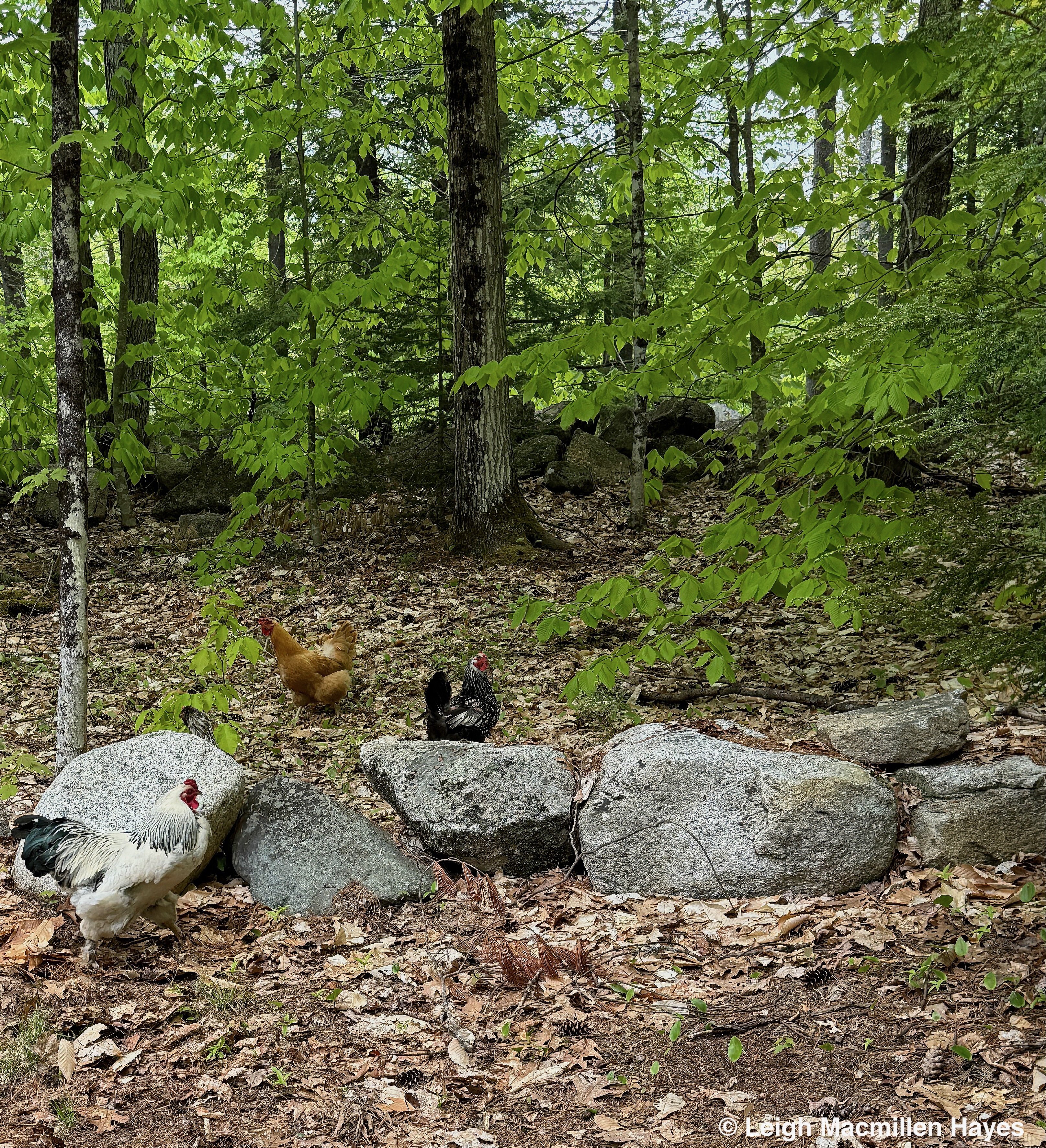
My Guy and I have been hiking together for the last 38 years, and in all that time, never, ever have we been greeted by neighborhood chickens, with one rooster even sending us off to the tune of his cock-a-doodle-do.

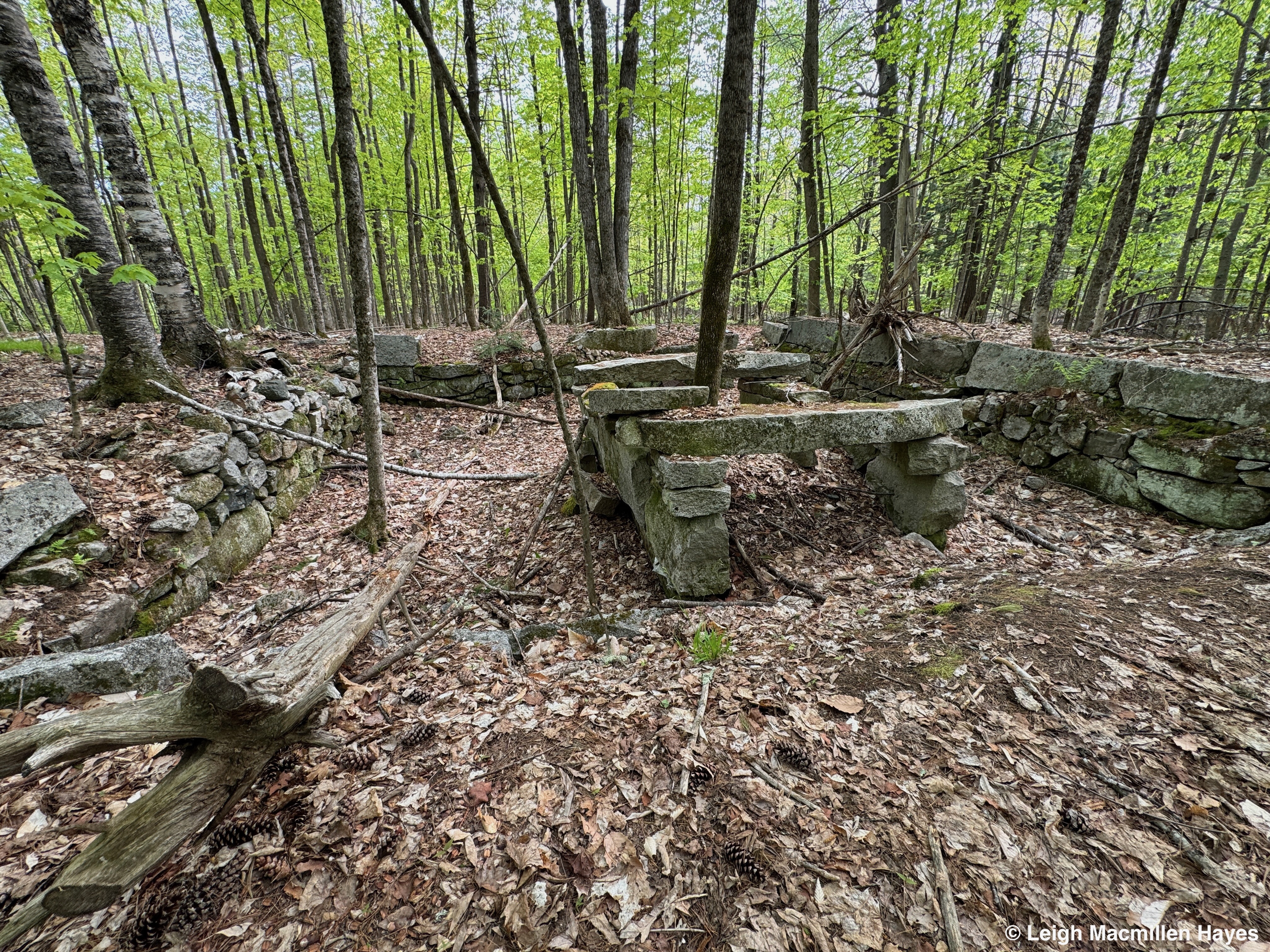
The past is always present and just after the send off, we paused by the homestead foundation, possibly that of A.H. Evans, which is located within feet of the trail’s head. And it appears that if this did belong to A.H., he was the head of a large family for it’s a huge foundation.

The barn foundation was also impressive and we could sense the work that went into such a creation.

And based on the configuration of rocks and boulders between the house, outbuildings and barn, all were once attached.

Again, assuming all of this belonged to A.H., I did discover a 1916 document that suggested he grew rutabagas: “A. H. Evans, Fryeburg, raised 90 bushels rutabagas in 1-8 of an acre.”

At some point in time, the land also must have served as a saw mill close to what is now a small stream, but may have been more of a brook in the past, there’s a pile of saw dust that hikers must climb. This is not uncommon in Maine woods. And it’s forever soft underfoot, however many years later.

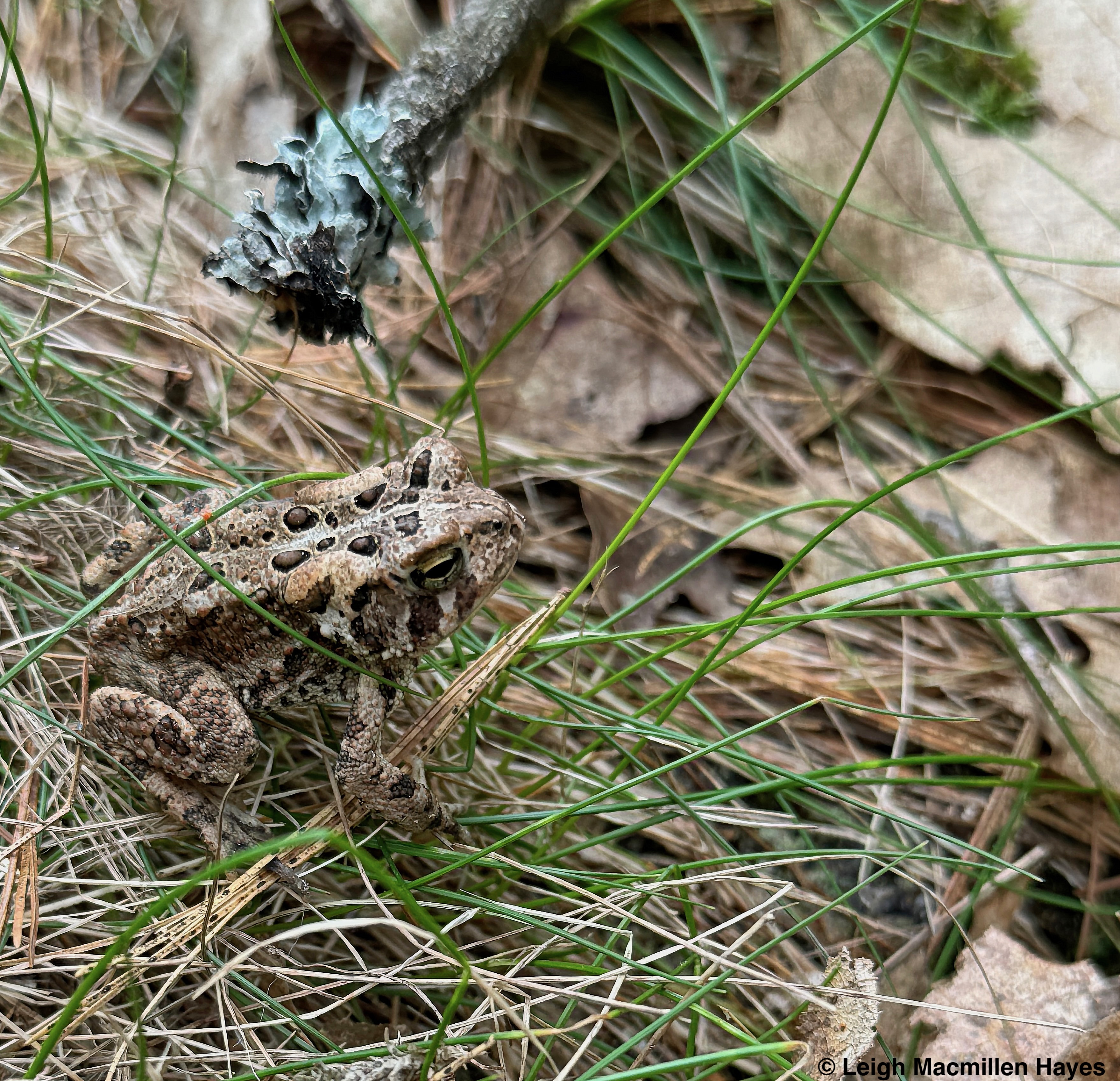
We spotted a few Painted Trilliums, and lots of Sessile-leafed Bellwort, and other flowers waiting to come, and a Chipmunk peeking out from a rocky ledge, and mosses, and lichens, and so much more, (oh, and a few Black Flies, but again, not bad in the scheme of things), but this was the first American Toad of the year for us. Toads can remain absolutely still, a smart adaptation as they blend into the scenery.

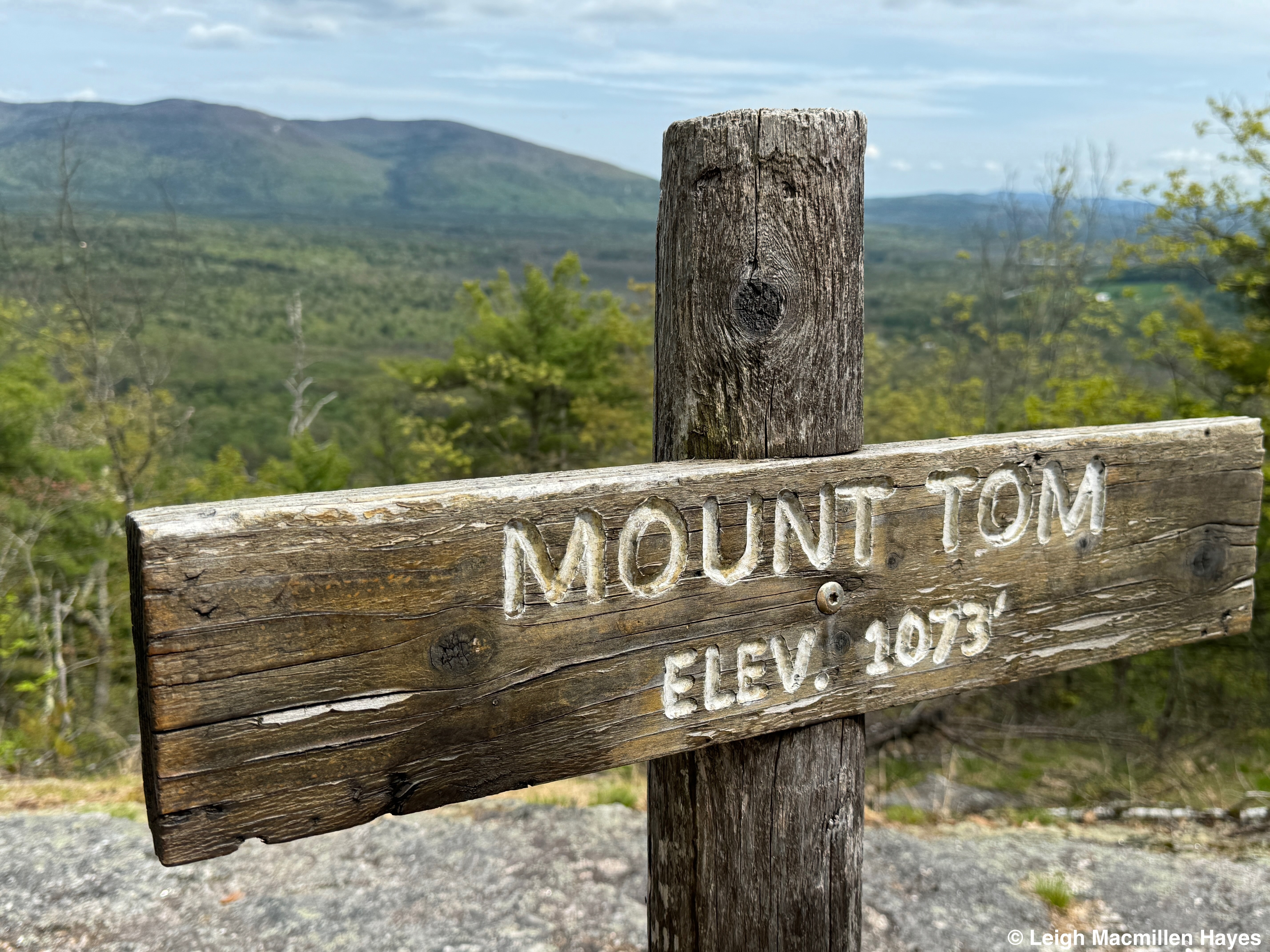
It’s about two miles to the summit, which isn’t all that high, but it’s the perfect quick hike (okay, remember who I was hiking with) for an afternoon. And at said summit, we stood for a few moments as we gazed upon the ridgeline of our hometown mountain–Pleasant by name.

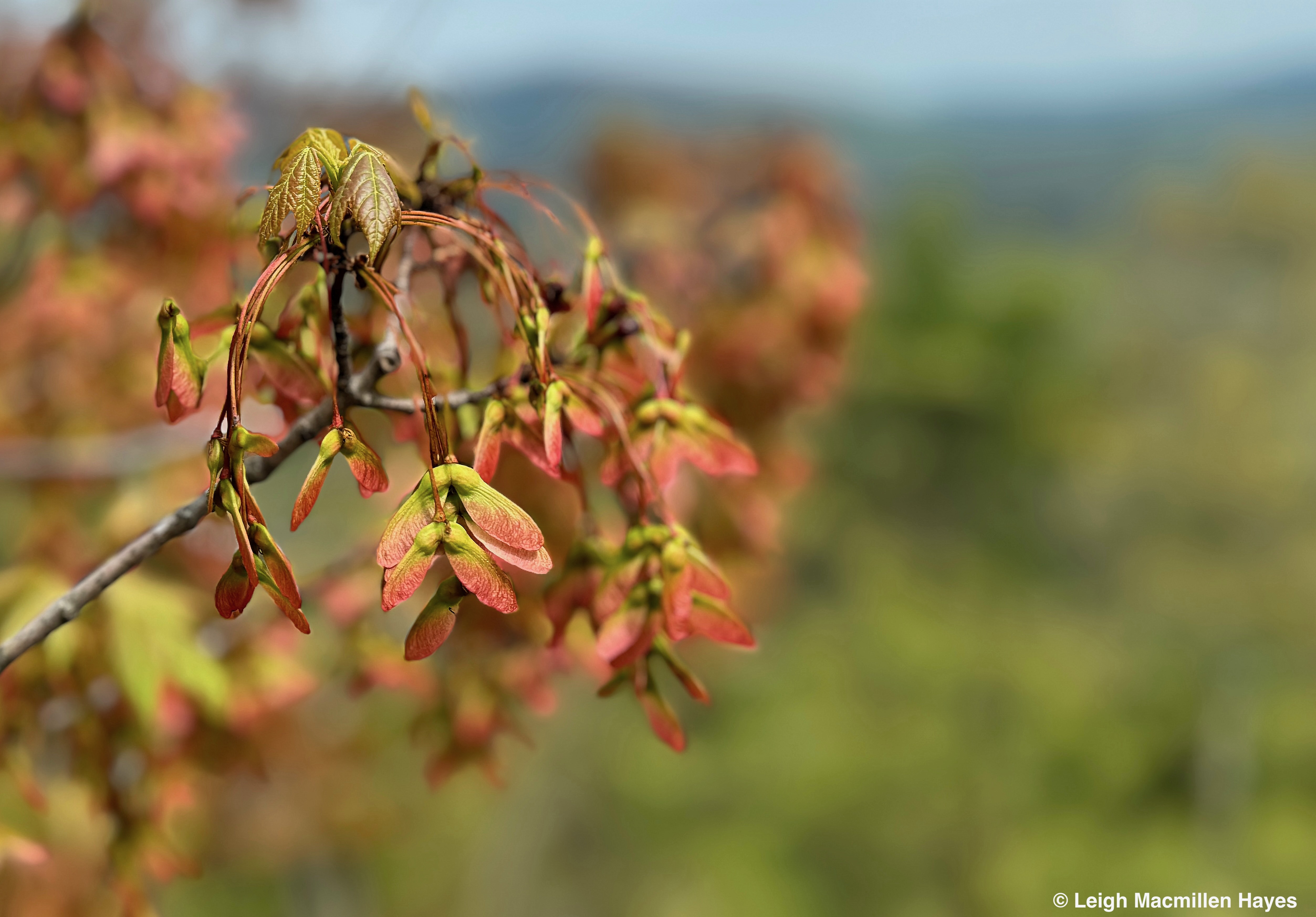
And at the summit, a Red Maple showed off its gifts to the future in the form of an abundance of samaras. Well, I see them as gifts. Given that we have an abundance of Sugar Maple seedlings growing in our yard doesn’t exactly thrill MG.

As we started to walk back along the trail, I spotted something we’d both missed on the way up. Wild Columbine. In flower. The. Most. Spectacular. Flower. That structure. Those colors.

And because we took a different path down, Striped Maple showed off its own set of flowers, limeade green in hue. I chuckled later when I commented on how the Beech leaves gave the trail such a summery look, and MG mentioned that he had even spotted toilet paper. It took me a second, during which I searched for a roll of white, before I realized he was referring to Nature’s Toilet Paper, for so large are the leaves of Striped Maples, and soft, and not poisonous, so you know they are safe to use. Not that we often encounter Poison Ivy in the woods, but it could happen.

Back at the trailhead, the chickens weren’t there to congratulate us for a safe return, but we encountered probably the best finds of the day–several immature Chalk-fronted Skimmer Dragonflies. Let this next season begin.

Indeed, this was a day of firsts.

Savoring Spring

My paths were multiple this weekend as if I was on a quest.

On a bridge over a brook,

down a road through the forest,

beside a bog,

along a boardwalk,

and even following this guy down low and up high.

Together today, we circled another brook (if one can actually circle a brook, but we did),

enjoyed this view from lunch roots,

and dessert on the rocks where we could peek down on said roots.

Though I may have been alone for much of the weekend, I never really was for the bird song, including the conk-er-ies from this male Red-winged Blackbird, accompanied me where ever I hiked.

There were Eastern Chipmunks adding to the chorus as they chortled at me and I chortled back, though I did wonder if life hasn’t always been so easy for this one given the marks on its body and a very short tail.

I watched Painted Turtles bask, despite cooler temperatures, though the air was probably warmer than that of the water.

And I was chastised by this Red Squirrel, but really I had done nothing wrong–except to enter his territory without an invitation.

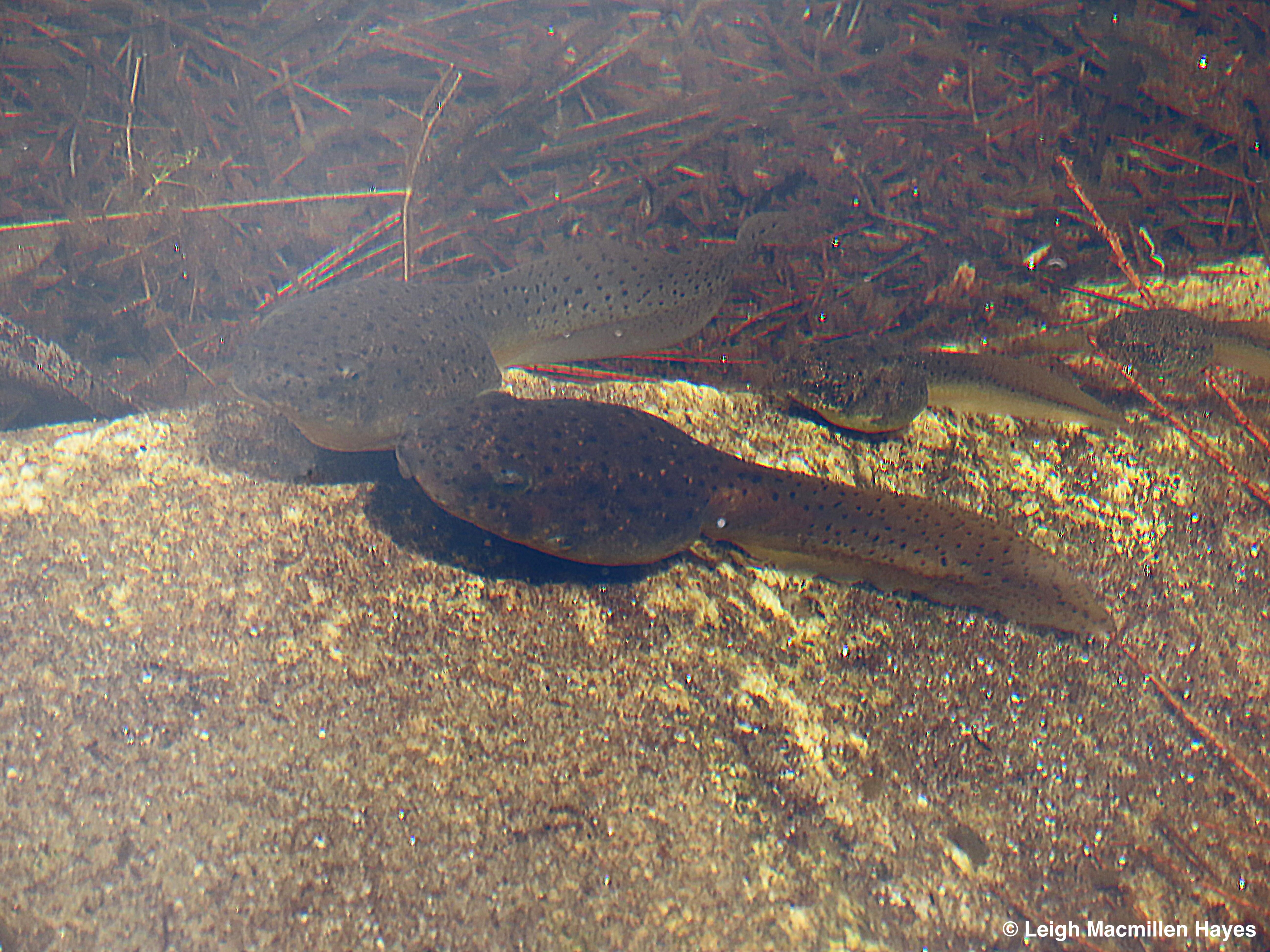
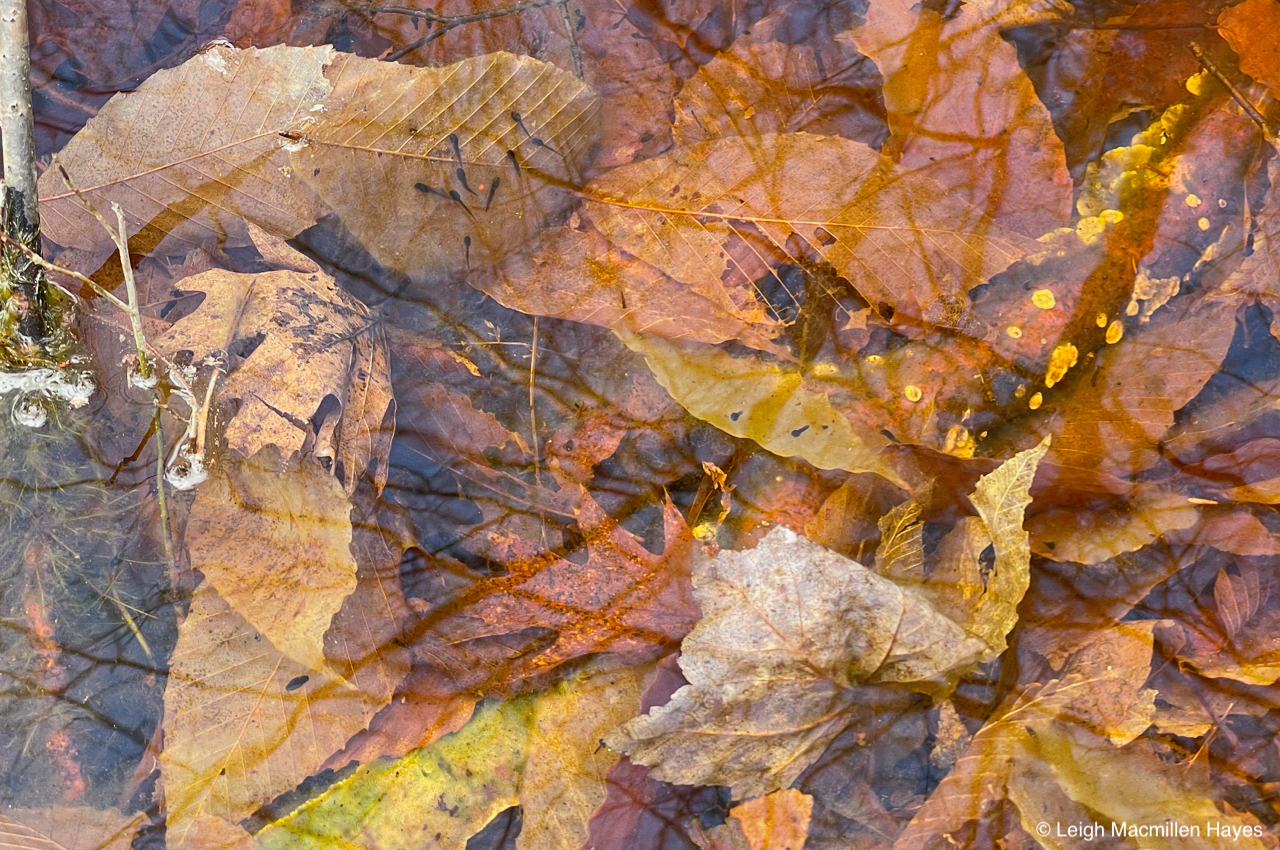
In the depths of the water today, tadpoles. HUGE tadpoles of the Bullfrog sort, which take two years to mature. I spotted tiny hind legs growing beside where the abdomen meets the tail. There were also lots of smaller tadpoles, too big to be Wood Frogs or Pickerel, but I suspected either one-year old Bullfrogs, or perhaps they were Green. Or both.

A few flying insects also brightened the days (and I have to say I’m not referring to Black Flies, which I hardly spotted–and actually caused me concern, for where have the little biters gone?), including this Anglewing butterfly. I can’t name it to species, for it is either a Comma or Question Mark, but never in the time I watched did it pose so that the underwings were visible. Okay, so My Guy and I spotted it today and when I explained to him the difference between the two, the C having a small white comma on its underwing and the QM, a small comma and a dot looking rather like the punctuation mark, he decided it must be an Exclamation Mark instead.

And in the same area, an American Lady added her color to the scene.

Leatherleaf’s bell shaped flowers reminded me of clothing hanging from an outdoor line.

And I’m really beginning to believe there are a trillion Painted Trillium, though I didn’t actually count. There’s something to admire about those olive green leaves and perhaps it’s that we don’t often see that color in nature.

I even spotted a few that chose a different paint palette. I could explain away the color of the leaves by thinking that perhaps they were showing off their anthocyanin, which gives fall leaves their red color and is seen in the spring as well, perhaps serving as a sunscreen for the plant. But the color of the petals was equally amazing, though who knows, maybe it’s common and I was just paying attention to it for the first time. That does happen. A lot.

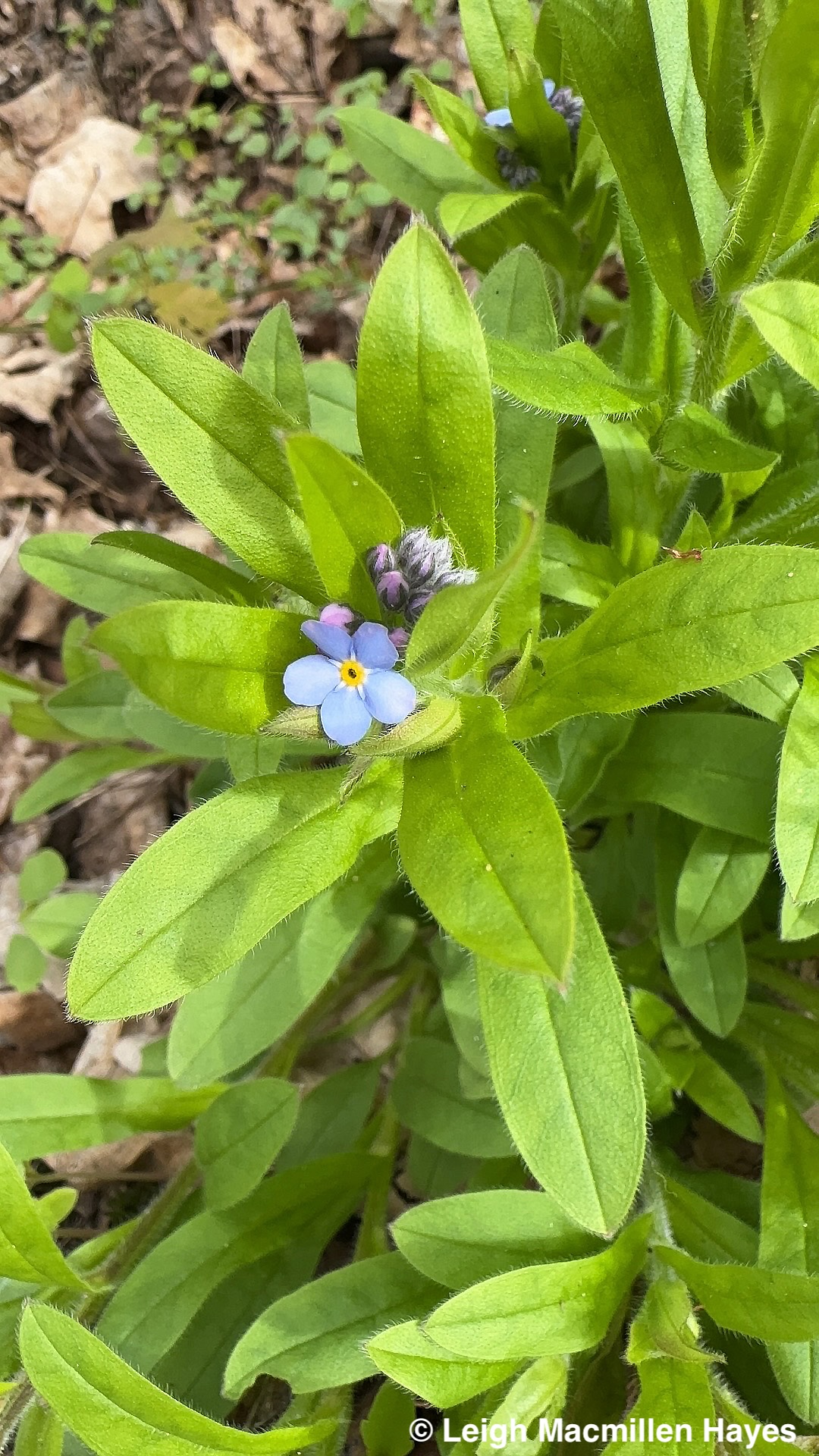
And then there was the amazing blue hue of Forget-Me-Nots. I surely won’t. Forget you that is.

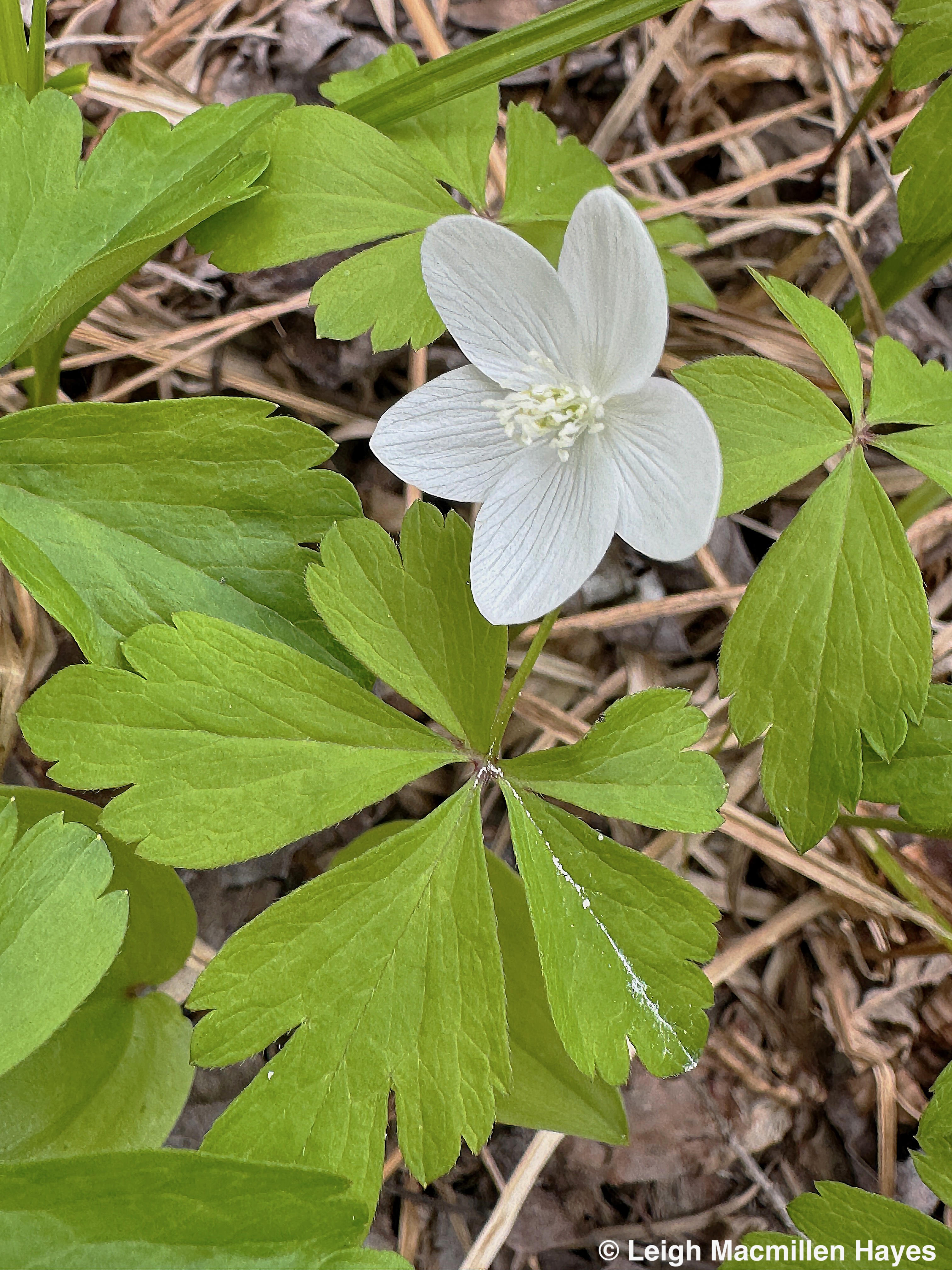
And Wood Anemone, its compound leaves notched, and flowers deeply veined, looking so tender and fragile.

Not looking tender, and hardly fragile, but still beautiful, was the carnivorous Pitcher Plant, of which I paused beside several. I’ve known this particular one for at least twenty years so when I encounter it, I always feel like I’m meeting an old friend. Because I am.

Hiding beneath its lime green leaves, American-Fly Honeysuckle’s delicate flowers did dangle in their manner of two. The shrub always surprises me, though it is a native, but I don’t get to greet it often enough.

All of these flowers bloom so early because they take advantage of sunlight before leaves emerge. That’s all changing now and in another week it will surely look more like summer around here. What I love about some leaves, especially American Beech, is that they are so hairy to start, and look like they’d make great fringed skirts for fairies. The other thing I became aware of this weekend, was the raindropy sound of their bud scales hitting the ground.

I love winter, but this season to follow is flying by, and already the Trailing Arbutus has reached its waning hour.

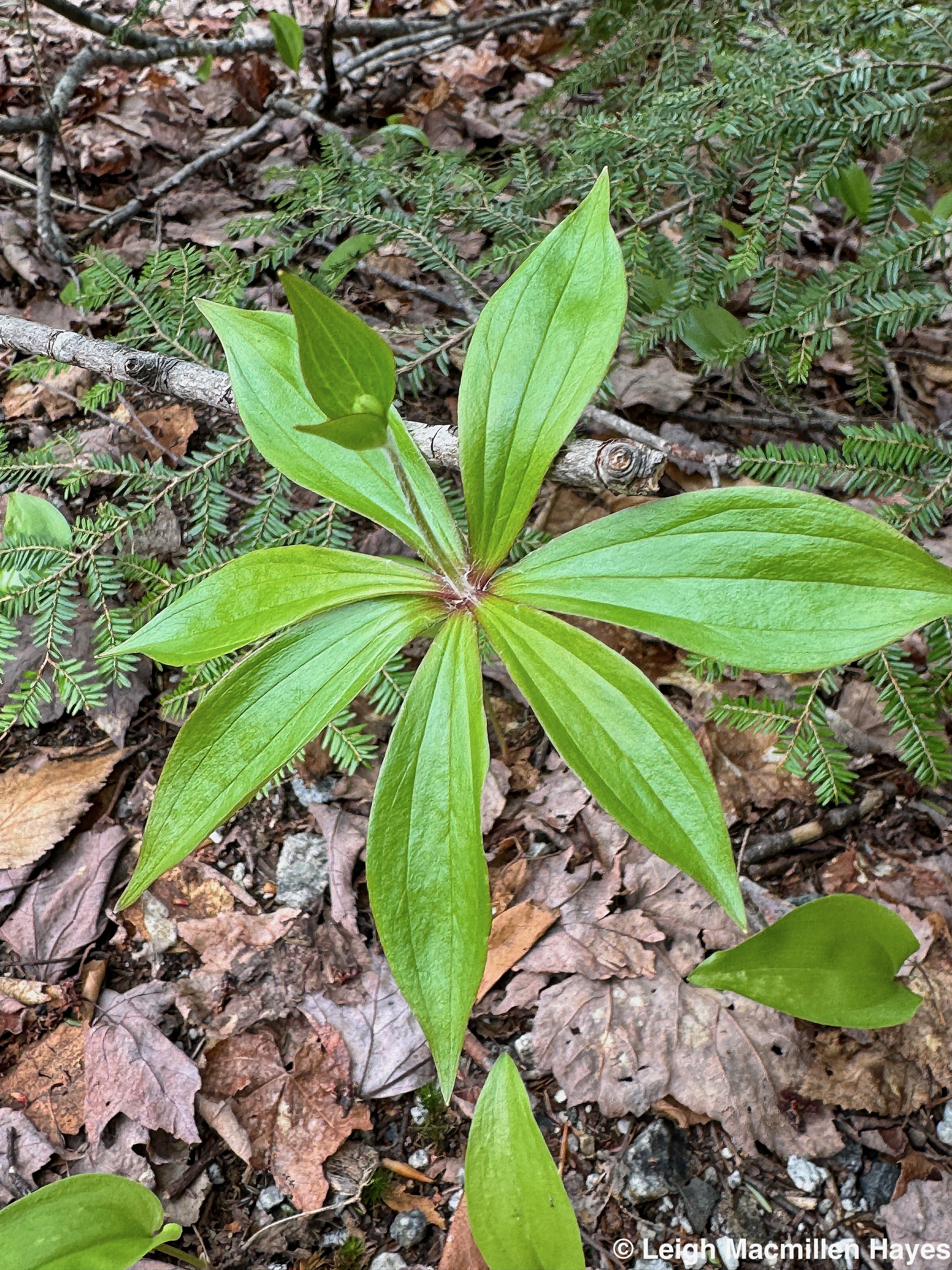
But there is hope in the form of others, like this Indian Cucumber Root, creating a second tier and a bud, and in a few weeks I’ll be seeking out its otherworldly flowers.

I’m savoring spring–before it moves on. I hope you are on the same quest.

Dissing Fall Foliage?

It rained. And rained again. And rained some more. All spring. Seemingly all summer. And then we had a wee bit of a break as summer turned to fall. But . . . as important as rain is to trees, they didn’t necessarily appreciate so much of it. At least, that’s been the case for some species, in particular Sugar Maples.

Typically, the leaves on this Sugar Maple in our front yard don an orangey-yellow hue and add a glow to our front rooms in mid-October. Not this year. I took this photo on October 1, and as you can see, many of the leaves had dried up and fallen off prematurely.

The reason. The rain. Well, not the rain but related to the rain. Between all that water saturating the roots, high humidity, and warmer than normal temperatures, fungal spores attacked the leaves, causing them to turn brown and dry up since their photosynthesis had been slowed and they no longer had the energy to carry on into foliage season.

Probably adding to this particular tree’s stress was the fact that it had produced prolific fruits. It did look rather odd to see so many samaras dangling and nary a leaf. But, the silver lining, the fruits speak to future generations and next year’s buds are present and ready to overwinter for emergence in the spring.

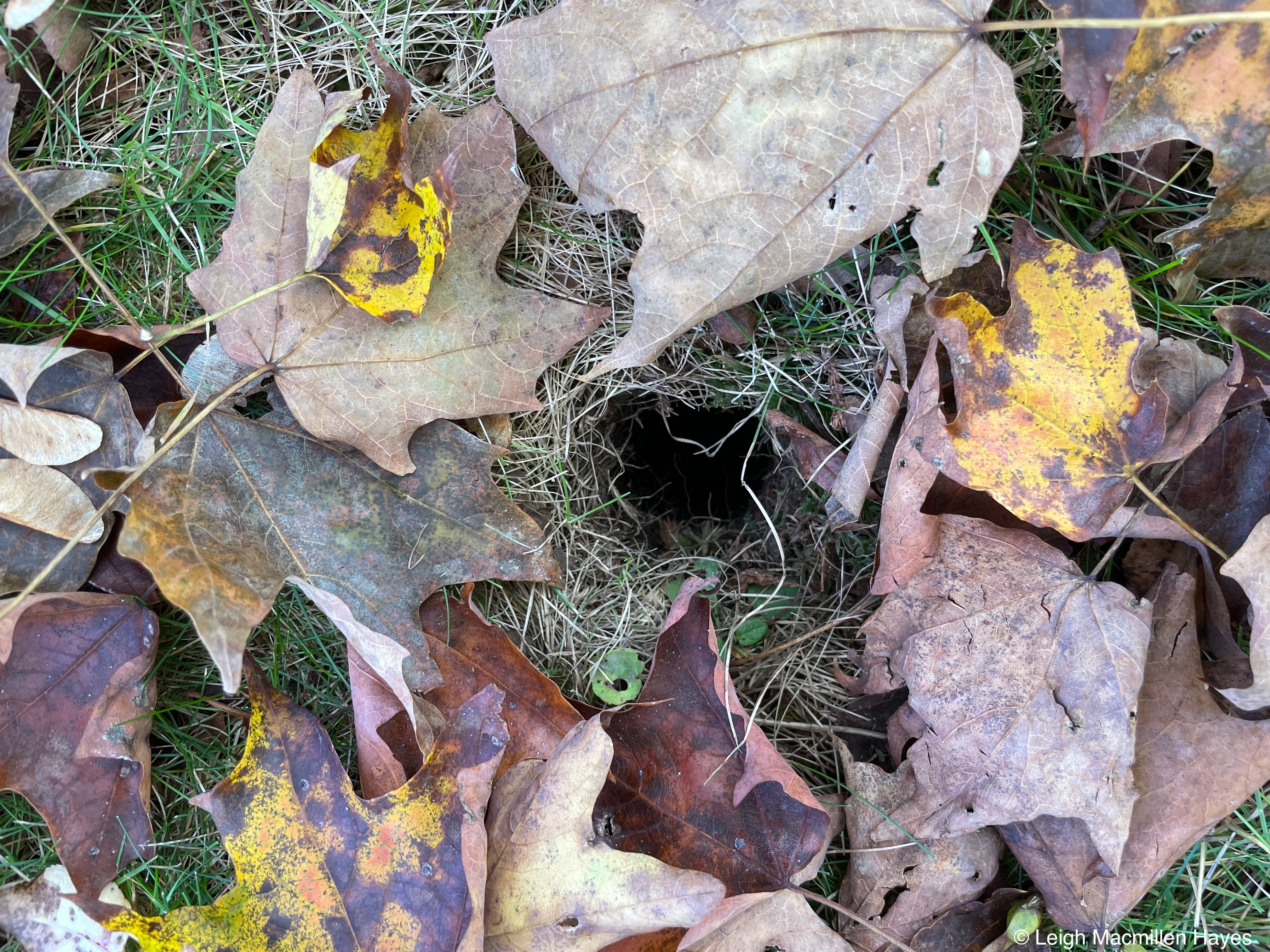
That said, the front yard doesn’t look all that pretty with a pile of dried up leaves, but the chipmunk hole tells me that some local residents are thrilled–they’ve had leaves available for longer than is the norm to fill their nursery/bedding chambers and now that the seeds are finally dropping, they have an abundance of food as well.

With that in mind, my mind has formed a negative take on this year’s foliage. Oh, it’s been pretty in little pockets, but nothing to rave about and I was getting frustrated with Peak Foliage Reports telling leaf peepers how beautiful it is.

And so I wondered as we headed across a boardwalk to Long Mountain this afternoon, what we might encounter for color on our climb.

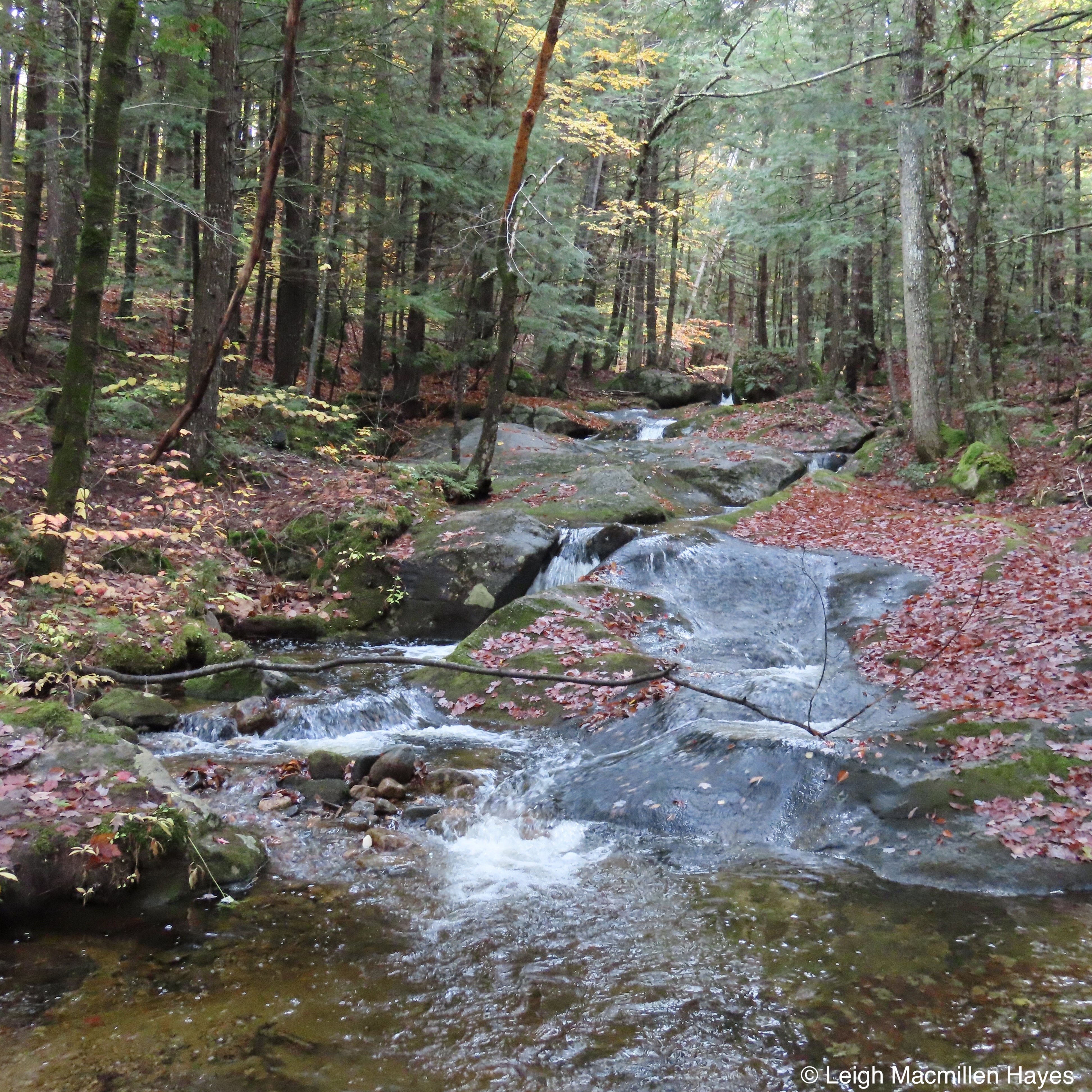
During much of the hike, Mill Brook babbled insistently . . .

flowed intensely . . .

and even roared immensely.

So much water, mimicking spring run-off, was the result of several more inches of rain that fell this past weekend.

Accompanied by the sound of the rushing water, and perhaps calmed by it as well, I began to notice the colors that surrounded us.

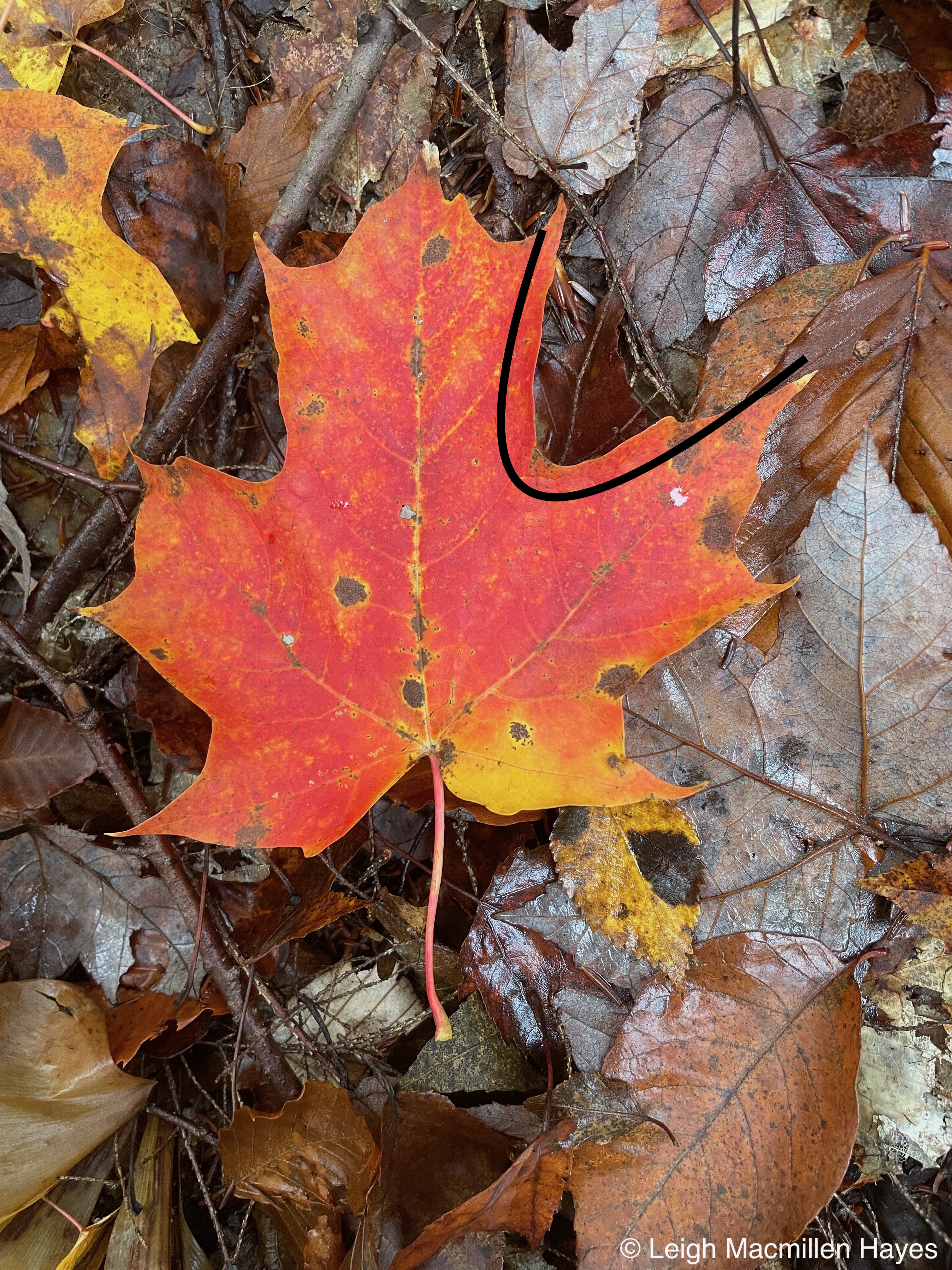
And when I looked down, there were jewels to be admired, like this Red Maple. Notice the V I added to the gap between the leaf’s pointed lobes? Red Maples offer a V-shape in the gap because they are VERY abundant in the Maine woods.

Fortunately, the Sugar Maples in this forest faired better than the ones on our road, which made me happy. So . . . how to tell the difference between the Red and the Sugar. The U-shaped gap can be thought of as a scoop. Get it? A scoop of sugar?!

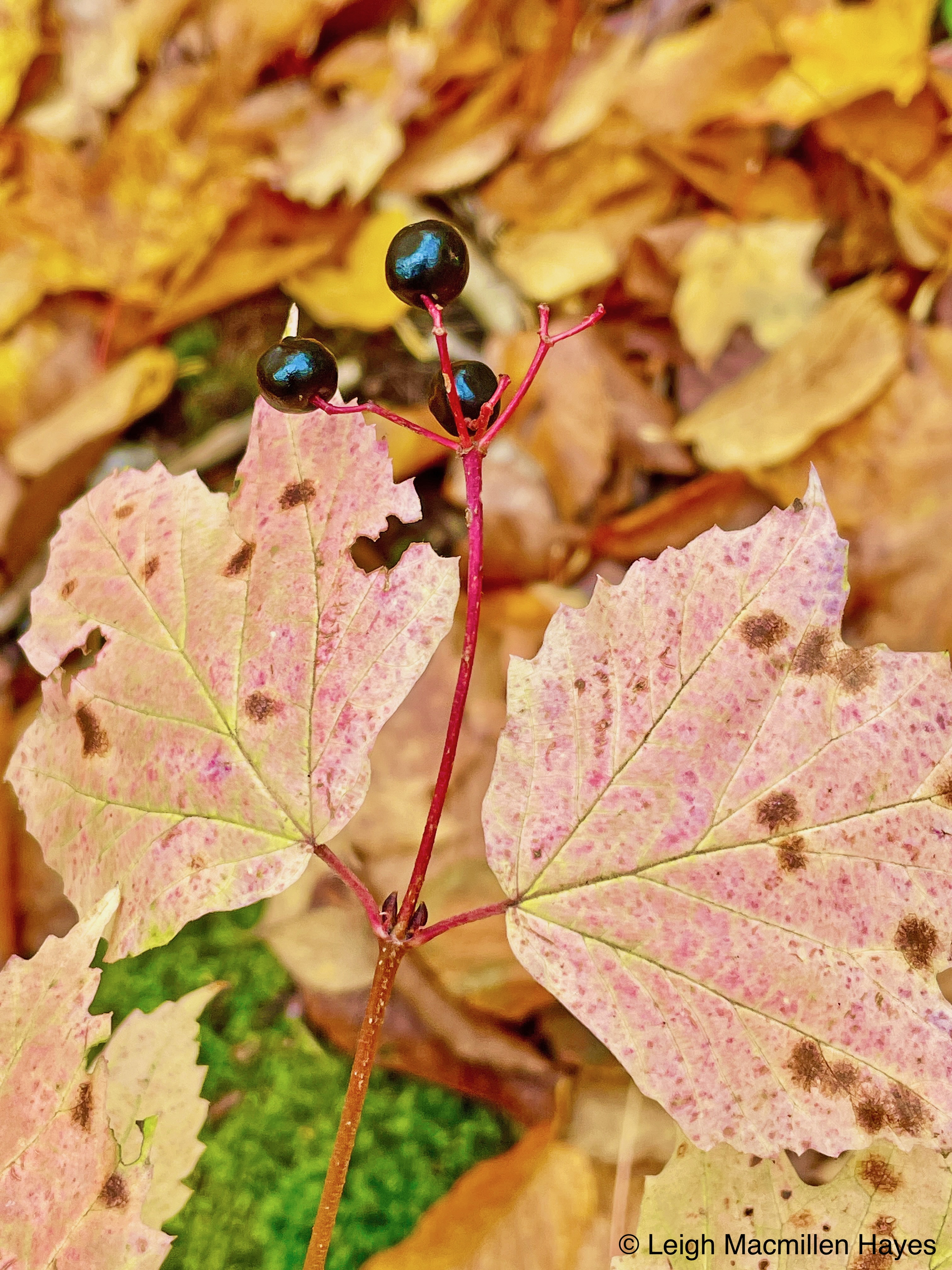
Maple-leaf Viburnum, a shrub in the understory, had its own hues to offer. Usually I see these leaves in their mulberry shade, but either we were too late today, or this one decided to be much more pastel in hue. It doesn’t really matter because it was still beautiful, had fruits left for wildlife, and bright red buds preparing for the future.

It is a bit early for Northern Red Oaks, but some in the understory had given up their need to continue to produce energy and change is in the air, or at least along the veins.

A Quaking Aspen with its flat petiole (stem), was the greenest of the species we encountered today.

I think one of my favorites was the Quaking’s cousin, a Big-tooth Aspen, which also features a flat petiole. Oh, and what big teeth along the leaf’s margin.

I was reminded as I looked at this leaf that yesterday we learned of a man who when in kindergarten many decades ago, was allowed to use only one color of crayon. I suppose the same teacher also told him to stay within the lines.

As the Big-tooth Aspen can attest, nature is a much better teacher in that and so many other regards.

Okay, so I called the Big-tooth my favorite, but then I spotted an Elm. It didn’t feel quite like an American Elm to me lacking as it was that gritty sandpaper feeling, but being with My Guy, I didn’t have time to look around for more leaves or locate the tree. One day I will. The other choice is a Slippery Elm, but this isn’t actually their habitat. But then again, another lesson or two from nature–she doesn’t always read the books and there are no absolutes.

The cool thing, besides the tie-dyed coloration of this leaf’s edge, is the asymmetrical base, one side dipping longer down the petiole than the other.

And then there was the Indian Cucumber Root. I think what caught my eye as much as the red on the leaves and the fruits waiting for a critter to dine, was the negative space between the upper tier of leaves, creating a five-pointed star. Maybe they always look like that and I’ve just never noticed before.

Today’s hike began to give me a change of heart about the foliage. Whether at our feet . . .

or flying above us . . .

or forming a tapestry before us . . .

it was beautiful in its own way . . .

and I’m grateful that this turned into a Not Dissing Fall Foliage Mondate.

Waving on Father’s Day

It barely rained. Well, actually, it didn’t rain. Just a bit of drizzle now and again. And so this afternoon, after a Facetime session with our youngest and his gal, we headed off for a hike, My Guy and me. I’m pretty sure he missed most of what I saw, but that’s okay. It was a day to celebrate him and he was welcome to do as he wished and think whatever he thought along the way.

Every once in a while, I’d say, “Hold on,” because something caught my eye and I needed to stop to honor whatever it might be . . . in this case Northern Bush Honeysuckle, a native species. Honeysuckles always take me back to my childhood and that heady scent that filled many a walk from beach to town. I spotted only an ant today crawling into the leaves, but suspect on a warmer day butterflies and moths will stop by for a sip and in the process aid in pollination.

Next up, was another not quite in flower yet . . . a Bristly Sarsaparilla. Its round flowerhead is known as an umbel and when the individual flowers do bloom, each will offer five teeny, tiny petals.

One contrast between this, the Bristly version and a Wild Sarsaparilla is that the compound leaves of the former are found below the umbels, while the latter flowers occur on a separate stem and hide below, as if the leaves are an umbrella.

And that adjective in the name . . . Bristly . . . refers to the bristles on the stem, which aren’t sharp at all. The stem of the Wild version is smooth, another difference to consider when trying to distinguish the two varieties.

The next stop in my tracks find was a Red Raspberry Slime Mold, aka Tubifera ferruginosa. It’s one of those species that you wish you could spend hours or even days watching, but My Guy didn’t quite feel the same and so we moved onward.

Much more to his liking . . . a few Lady’s Slippers. We only saw three in total, a low number in our book of hundreds, but we still rejoiced in these because their days are waning.

So much so that the petals and sepals of this particular orchid had begun to change form and we suspect there will be a capsule head and seeds in the future.

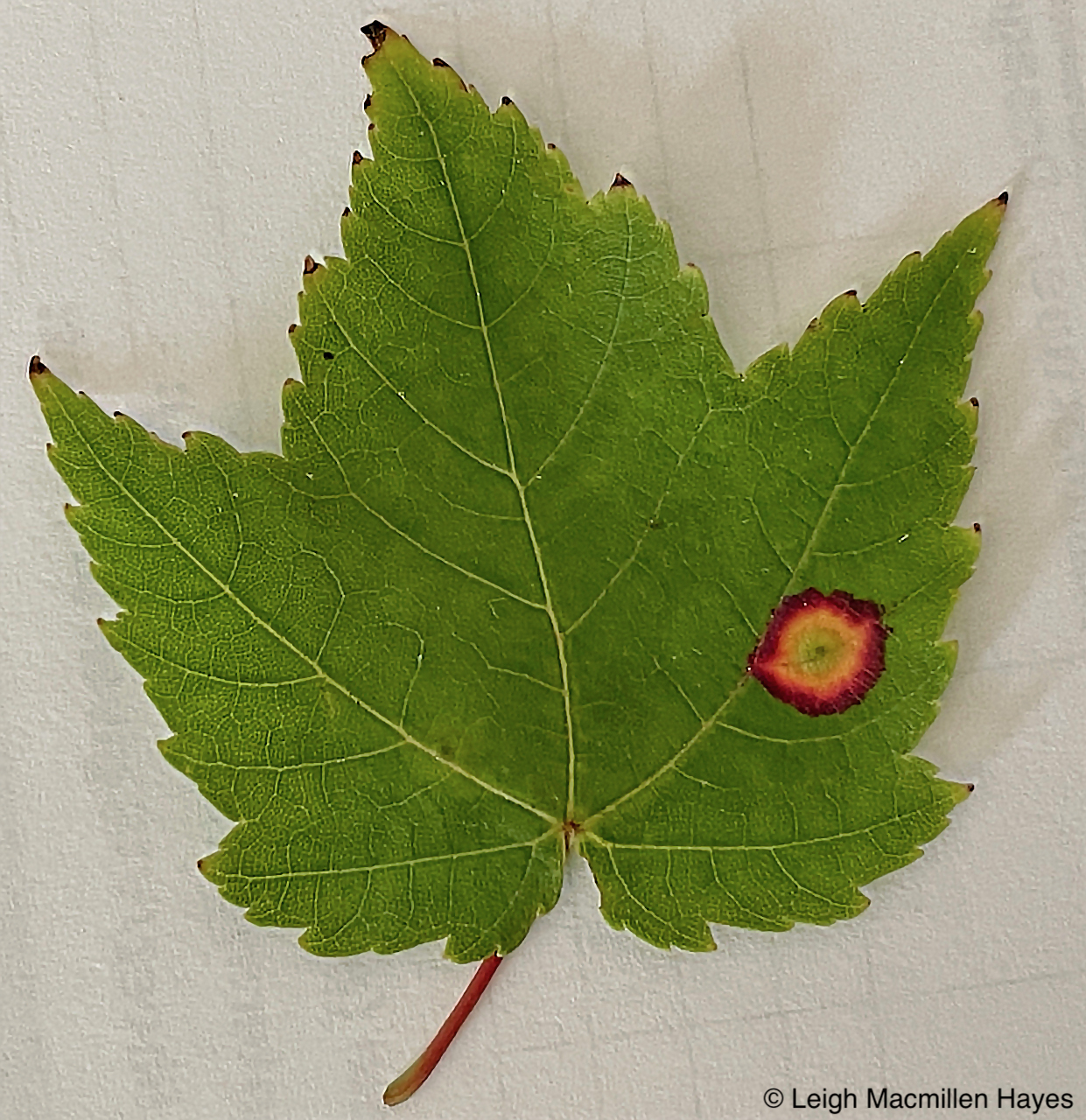
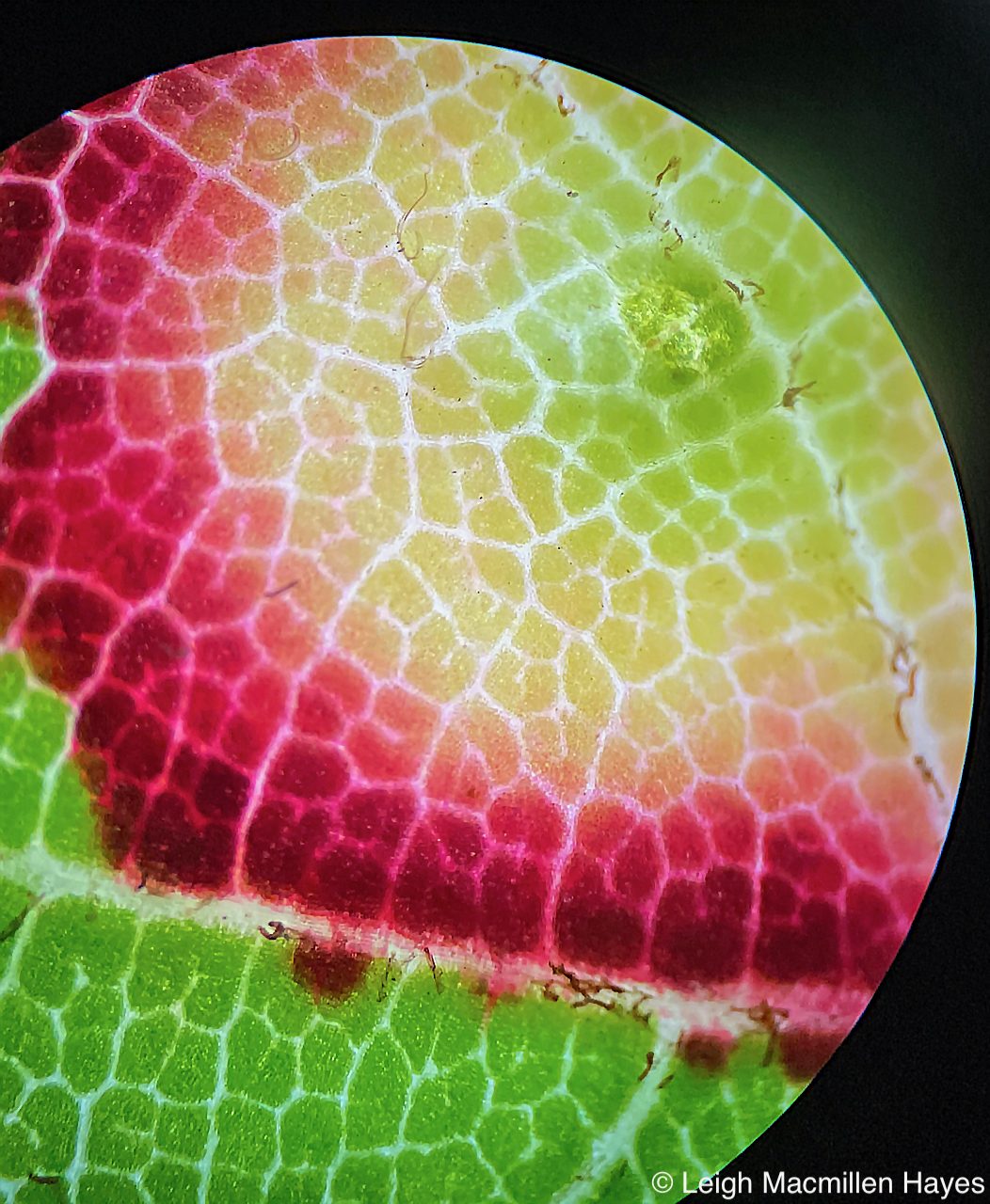
The last great find of the day was what could almost be considered a crystallized candy upon maple leaves. But really, it’s bumpy pink growths caused by a gall mite. This is the Maple Velvet Erineum Gall.

The mites overwinter under loosened bark and around wounds and scars. In early spring, they produce the gall-forming stage that migrate to expanding buds and make themselves at home as they begin to feed on the undersurface of future leaves. The tree won’t die, but really, leaves work so hard to survive the winter and then are attacked on so many fronts.

Can you believe that one leaf followed me home? Here’s a look at part of its structure not affected by the gall.

The pinkish-red, however, is the gall. The mite itself is so microscopic that I don’t think I can locate it.

I did take a closer look and maybe the dark thing on the right is related. But what struck me most was the deformed shapes where the gall had affected the leaf’s cells.

And then there was this other interesting form, again on the right, in a different section of the leaf. It certainly looked like it had a form and purpose, but I’m not yet privy to that information. Maybe some day.

Could it be a bunch of mites?

In the meantime, it is still Father’s Day and My Guy took a moment to wave hello to family and friends from the summit. We’re pretty sure we saw you all wave back.

Looking Through A New Lens

I have a new toy. While I’m still learning how to use it, I’m having the best time making discoveries. And trying to understand what I see. Actually, it’s two new toys. One that sees. And a second one that sees what the first one sees. Now that you either need to know more, or have already clicked out of this blog, let me explain.

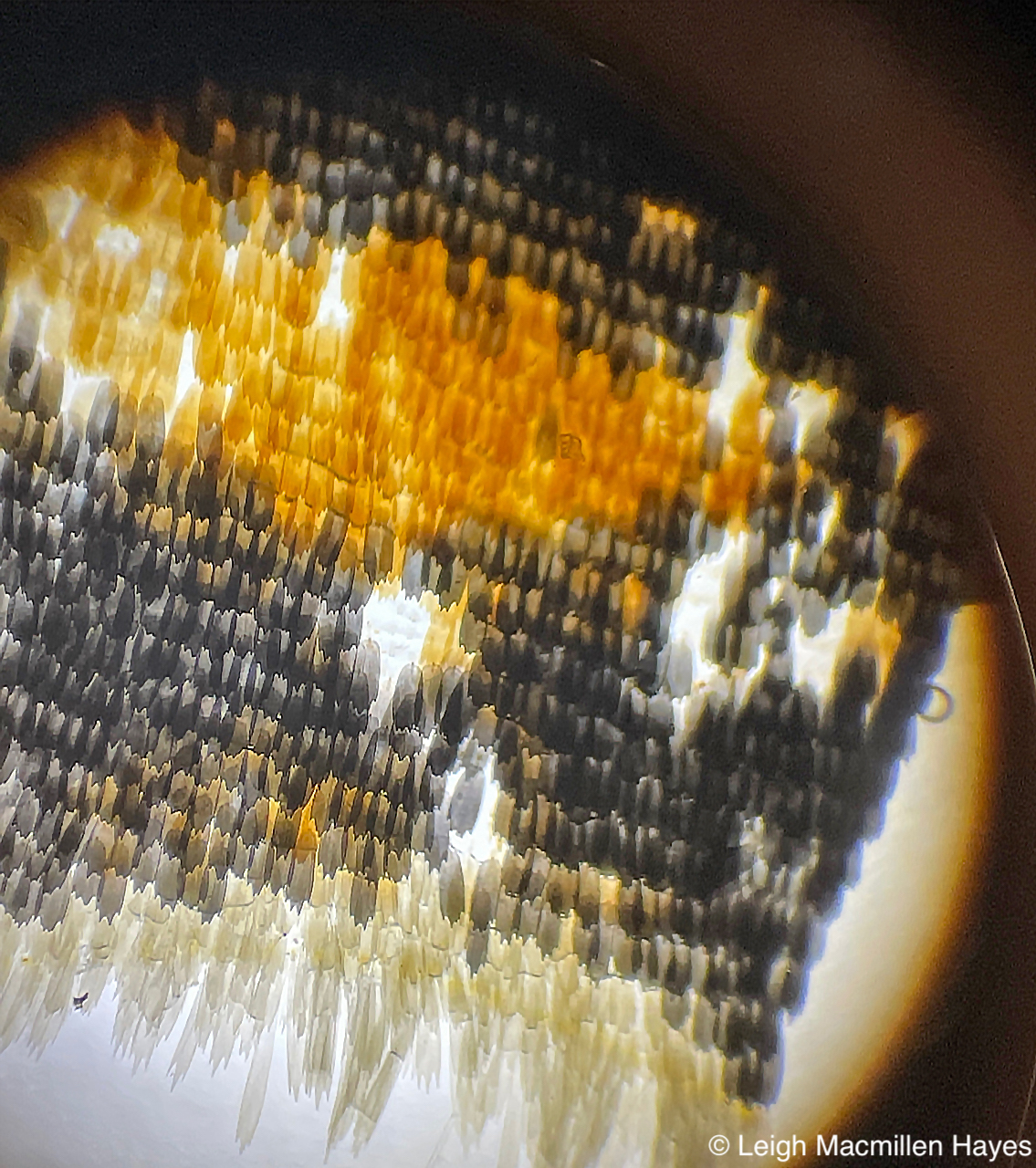
It all begins with a Tiger Swallowtail butterfly, one of exquisite color and form. This is one I spotted recently.

But one of my Pam friends, being Pam M., tells a story of finding a tattered one that still had some life and how she tended it for a few days and hoped it would fly, but alas, the other day she found it did not survive. So she did what good friends do and saved a piece of the wing for me to look at under my new microscope. Check out each of those scales, which put together form the color pattern we see.

The wings consist of thousands of tiny scales that overlap. If you were to touch the wings of a butterfly, and I don’t encourage that unless it is dead, it might feel like you have powder on your hands. That powder is actually the scales, so if handling a butterfly, you may be removing some of these delicate forms that together make up the mosaic which becomes the color pattern we recognize.

Our next look is at a leaf I gathered last week while tramping with some friends. I regret that I didn’t take a photo immediately. Instead, the leaf spent a week in a bag in my truck and when I took it out yesterday, the bag was full of insect frass. This is an upper view of the leaf.

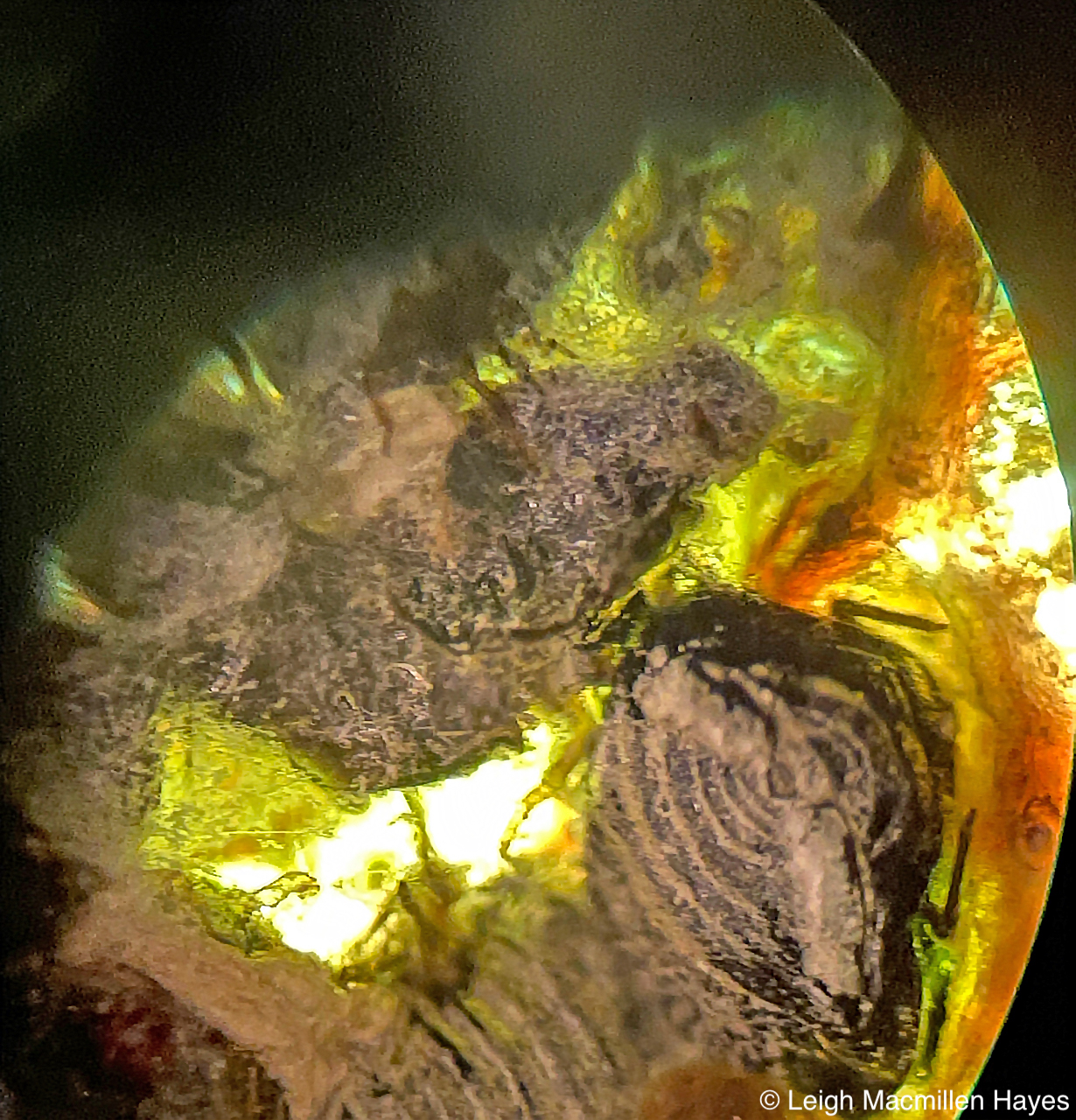
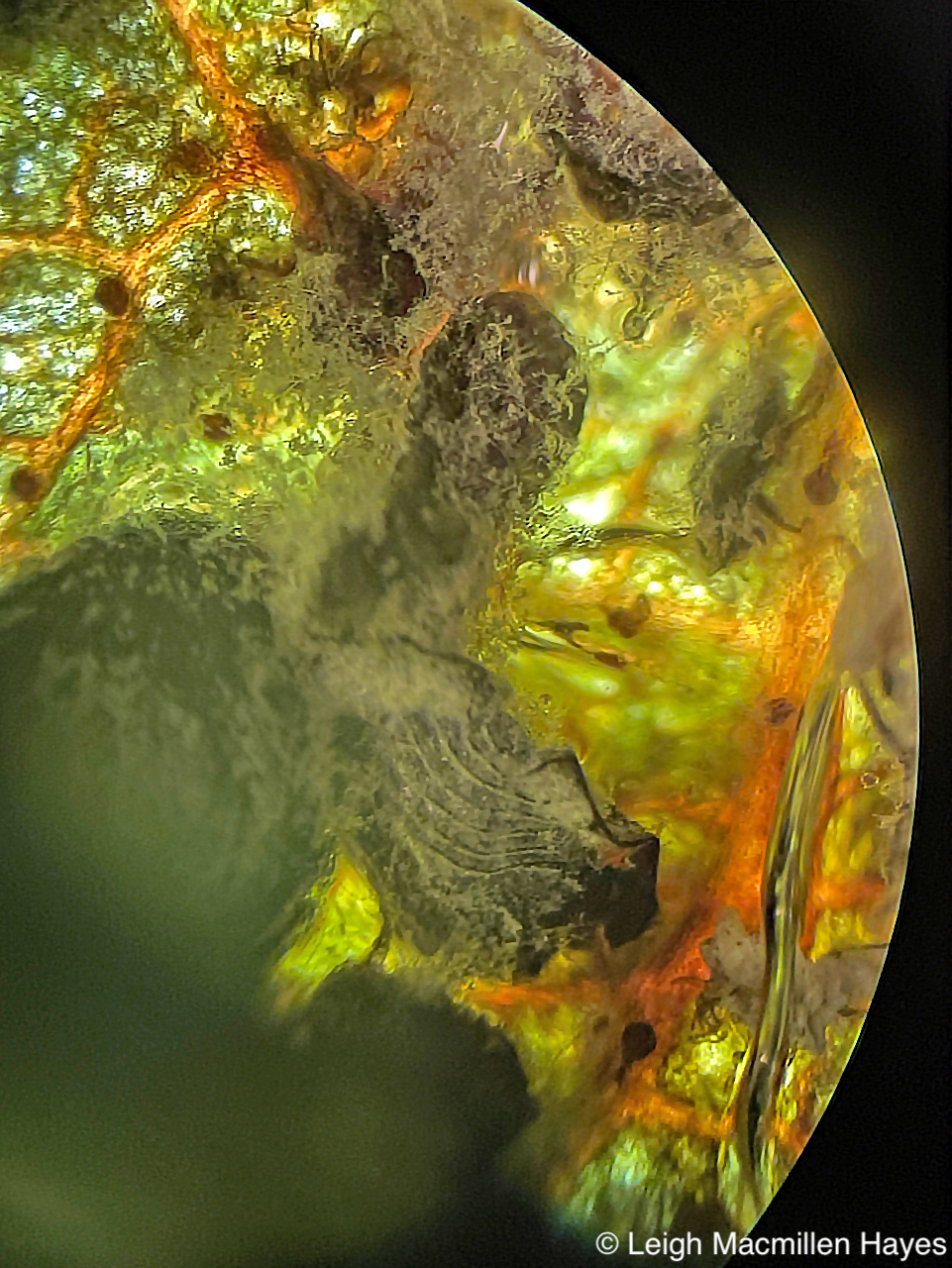
And this is the underside. When we spotted it last week, we all used our loupes to take a closer look and what we saw intrigued us, but we didn’t quite understand what we were seeing. Where the leaf is brown-gray on the left-hand side and a bit deformed, there was a series of structures all in a row. They seemed to be a bit raised. Sad to say I cannot share that image with you because I did not take it.

But . . .

When I looked through the microscope, these critters appeared. they are minute, and some sort of leaf eater.

As best I can describe it, you are looking at several insects, some frass (think mammal scat or bird poop), leaf veins and tissue and colors that don’t appear to the naked eye.

I’m not the best with using the second toy I mentioned earlier, which is an adapter so I can take photos through the microscope with my phone, but at least I have something to work toward. And understanding all that I’m seeing will also take time. In the meantime, I’m just enjoying it for the sake of the different world it has opened up to me.

The final selection was found by a group of us today and it’s a Maple Eyespot Gall created by a Maple Eyespot Gall Midge (Ocellate Gall Midge). The curious thing about this fly midge is that larvae develop in leaves, but after about a week during which time the gall forms, the larva falls to the ground and burrows under the leaf litter to pupate.

This is a view of the top side of the leaf. I’m in awe not only of the colors of the gall, but of the intricate structure of the leaf as well. The midge larva had been in the upper right-hand corner until recently based on the vivid colors, which will fade with time.

Here is the underside, and that same area that had stored the midge, now visible toward the center, appears to be an open hole, meaning the larva had moved from tree to earth, but this also gives a sneak peek at the cellular structure of the leaf. A topic to explore more down the road.

That’s all for my first attempts at taking a closer look with the microscope and then trying to capture what I saw with a phone, but I had to share this little critter because I don’t often get to see the actual creator of the Snake Spit. Yes, I grew up believing that all that plants that had this foamy white “spit” on them had been visited by a snake. It’s actually the protective covering for the larval form of a Spittlebug.

This was a first attempt to wonder with the help of some new technology. I don’t know about you, but it’s opening a whole new world to me so stay tuned for occasional closer looks through the lens.

Where The Moose Led Us Mondate

It seems there are never enough rainy days to complete home chores so when today dawned as such I thought that all the contents I’d been sorting from a closet would finally make their way to new homes like the dump store or community clothing closet or back into containers to be stored for another rainy day.

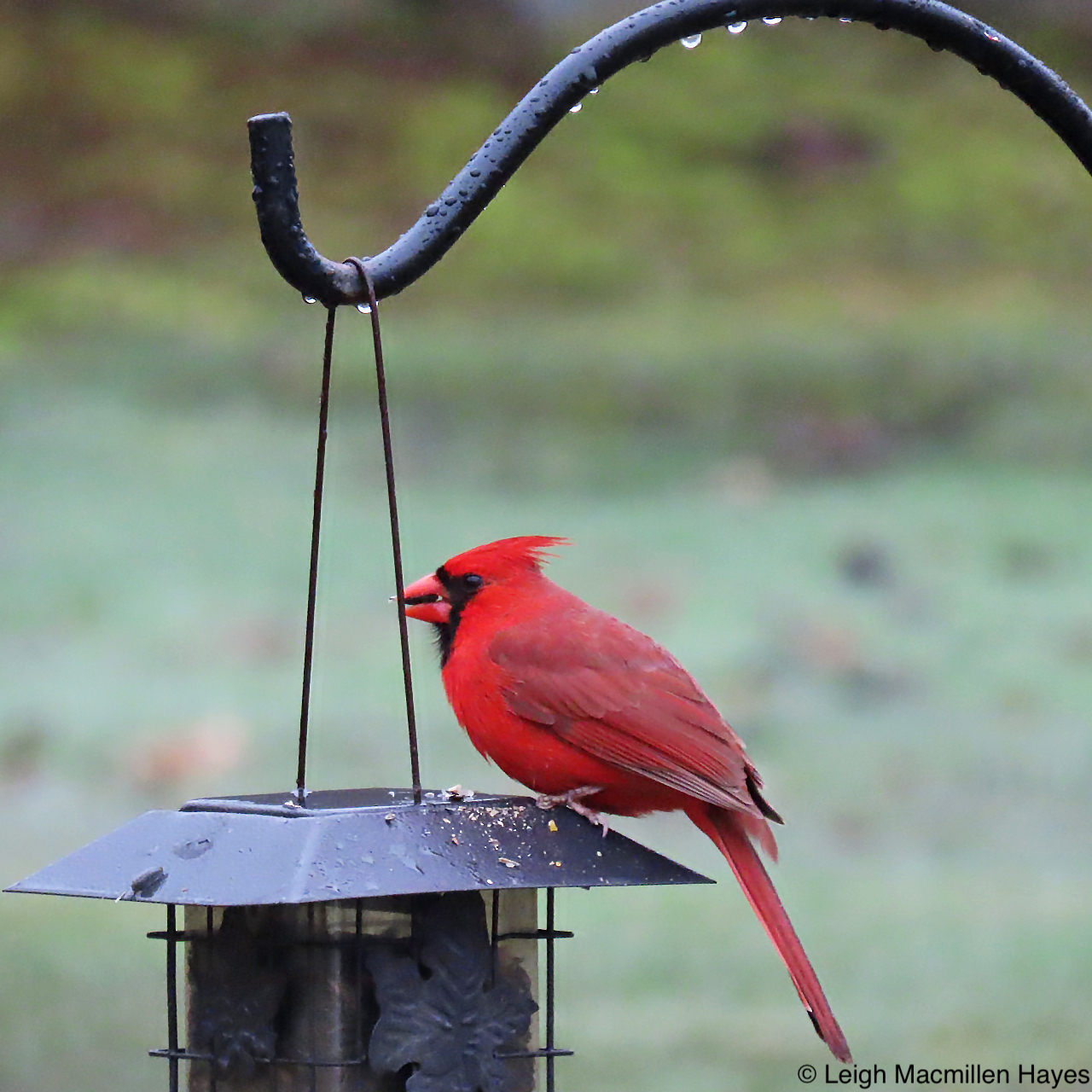
Apparently, I thought wrong for the Cardinal beckoned and we answered the call to head out the door.

When I mentioned a location for today’s hike to My Guy, he agreed that it sounded good, though come to find out, in reality he thought we were going someplace else and even when we arrived at Great Brook, he couldn’t recall our last visit, which was in 2016. Fair enough. I’ve been there many more times.

It soon became apparent that we were in Moose territory and our excitement rose. Actually, on another trail in this same neck of the woods we once spotted a Moose, so all we could do was hope that today we’d receive the same honor.

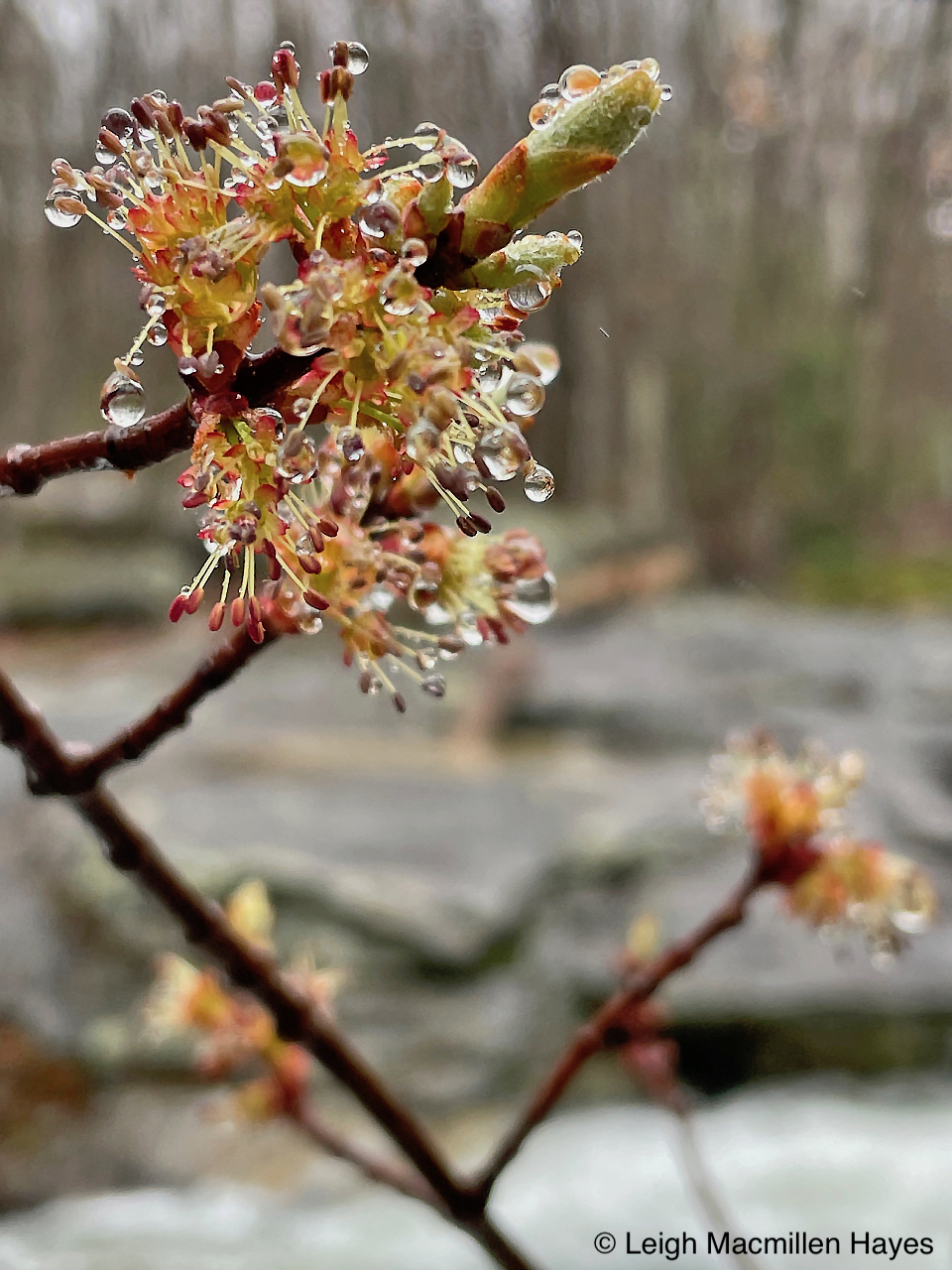
But first, there were other honors to receive, such as this bouquet of flowering Red Maple.

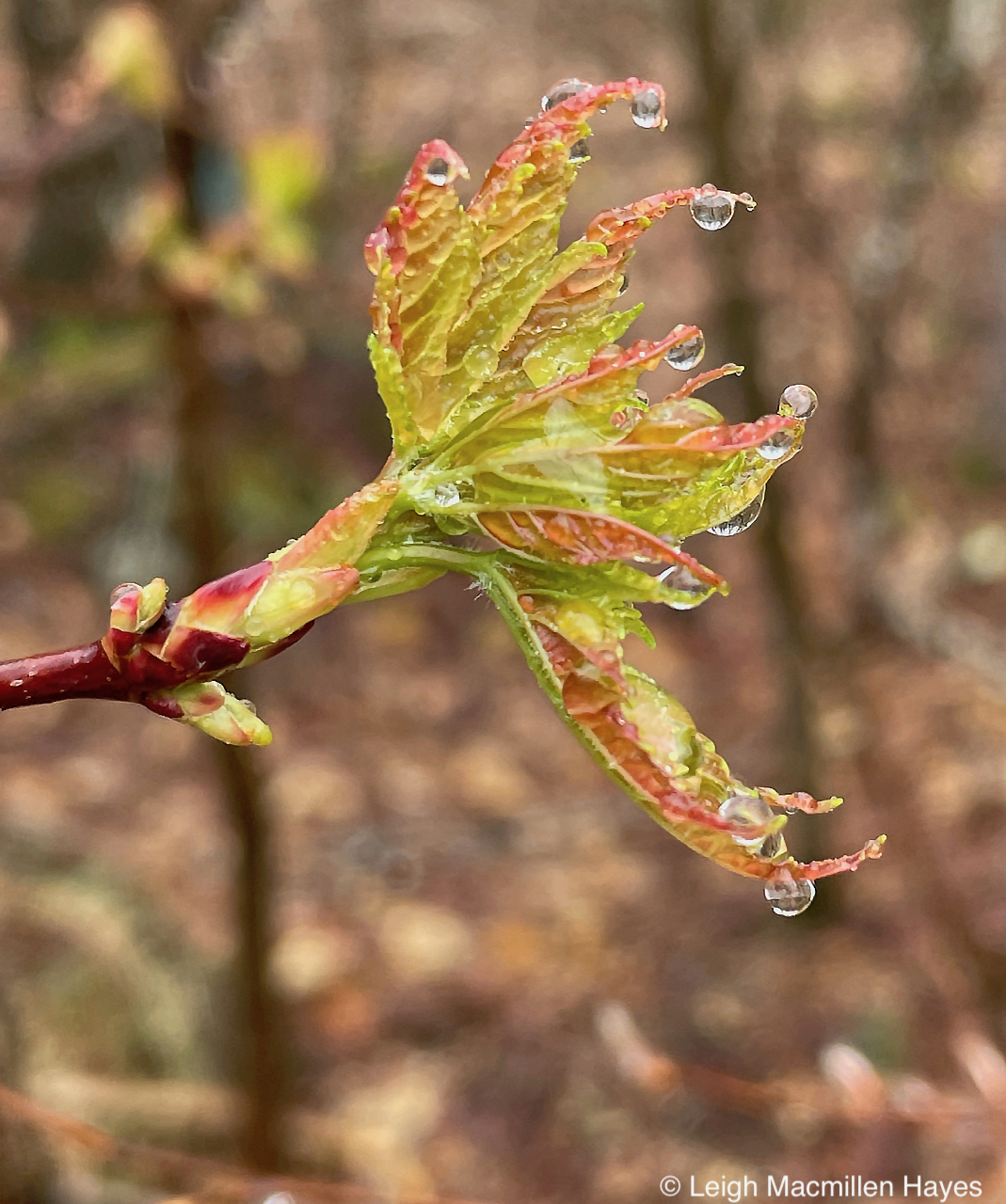
And the first of the season for us, maple leaves bursting forth in all their spring glory of color.

Onward we hiked deeper into the woods where a place one might think of as no place was once some place. This particular foundation has long been a favorite of mine because within is a root cellar.

It’s one I can’t resist stepping into because you never know what tidbit might have been left behind.

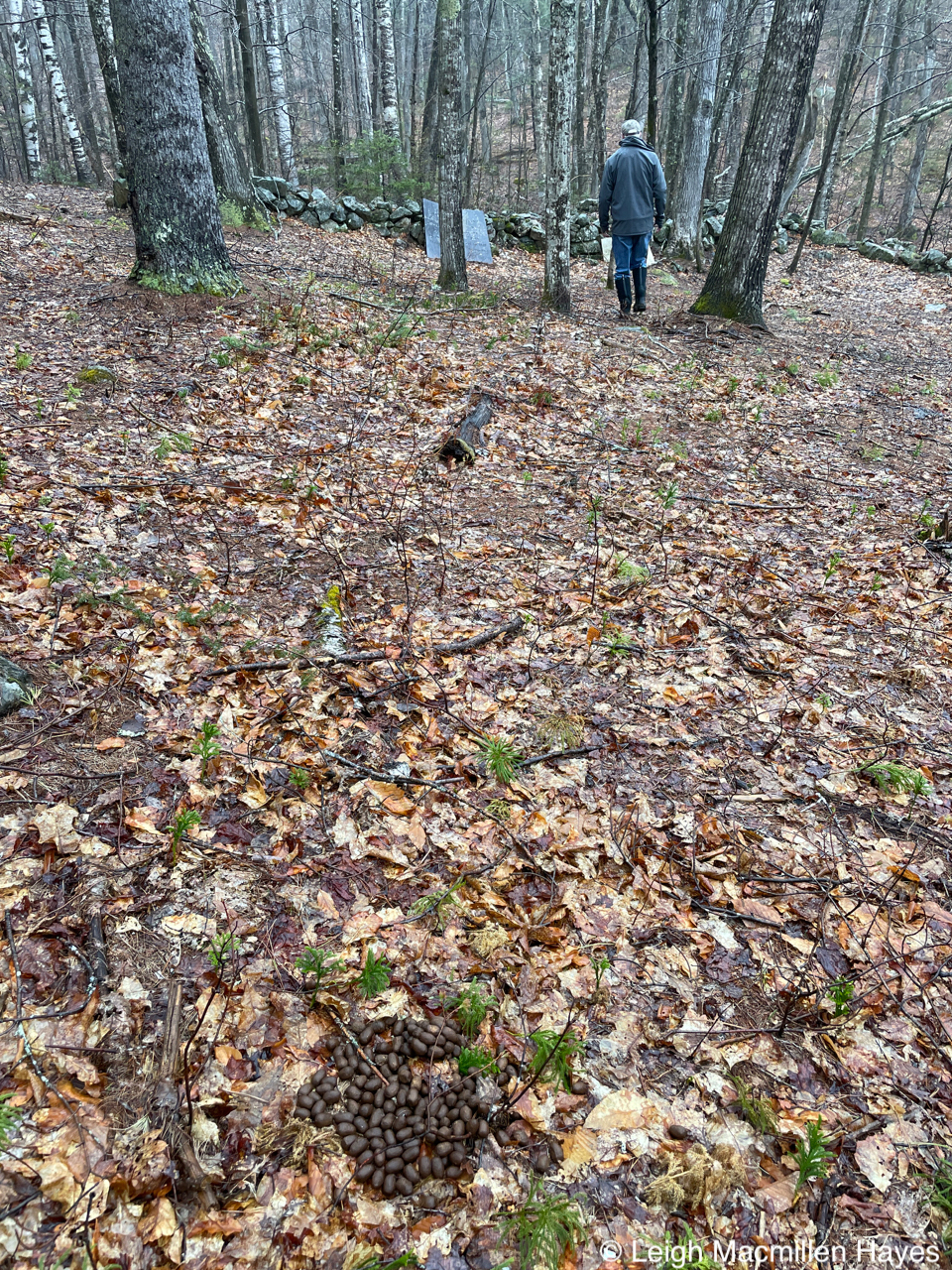
Porcupine scat! Rather old, but still.

My friend, Jinny Mae (RIP), was a talented techie and though the red line isn’t the entire route we followed today, it’s one she and I explored back in 2016. The map is from a section of the 1858 map of Stoneham. And we were at E. Durgin’s old homestead.

Knowing that there were some gravestones in the woods behind the house, we once again followed the Moose who led us directly to the family cemetery. Someone has cleared the site a bit, so it was easy to spot, especially since the trees haven’t fully leafed out.

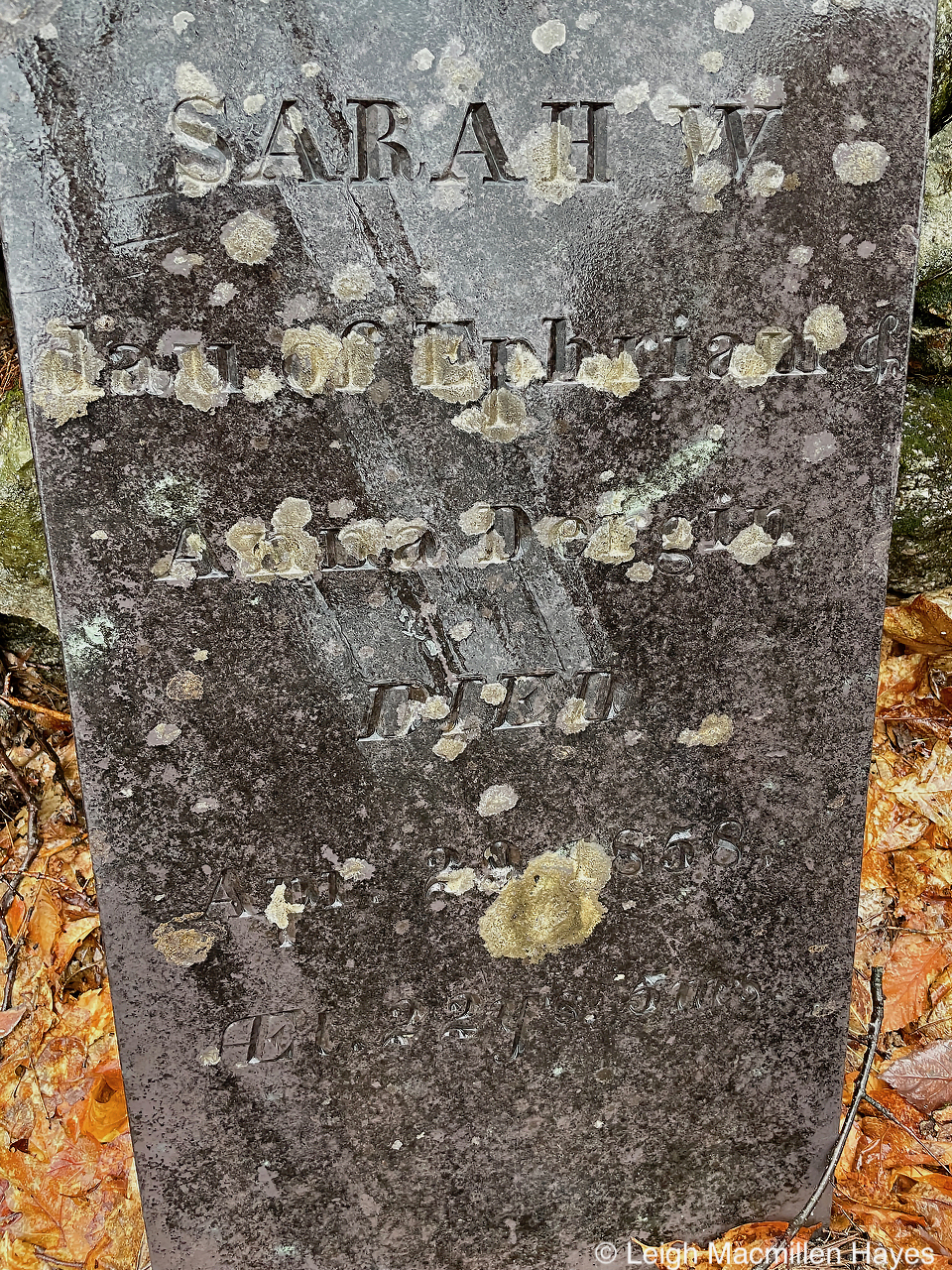
Sarah, daughter of Anna and Ephraim Durgin, is the first tombstone. She died in 1858 at age 22.

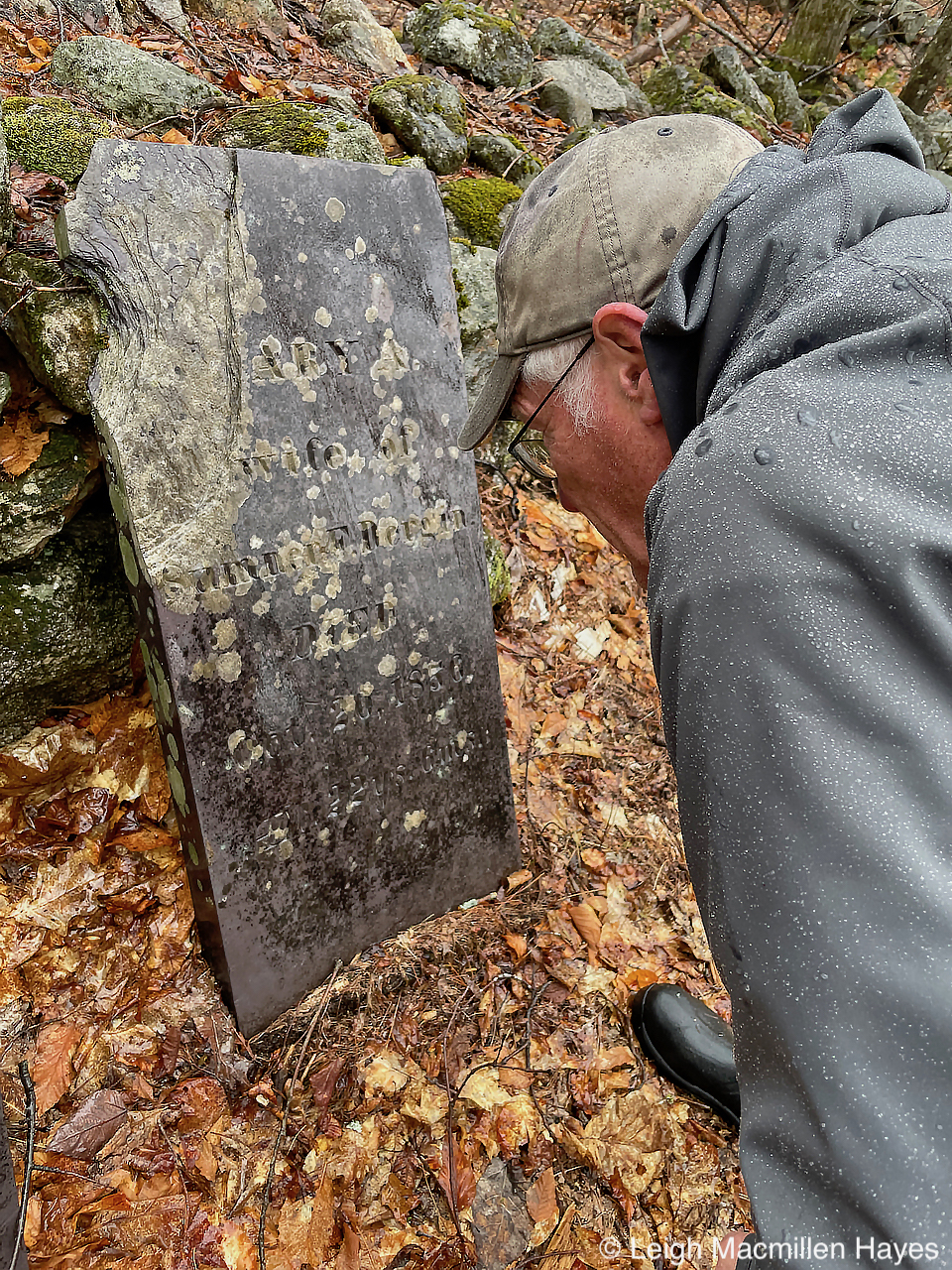
Beside her is the stone for Mary, wife of Sumner Dergin, who died before Sarah–in 1856. She, too, was 22 years old. As best I can tell, Sarah and Sumner were siblings.

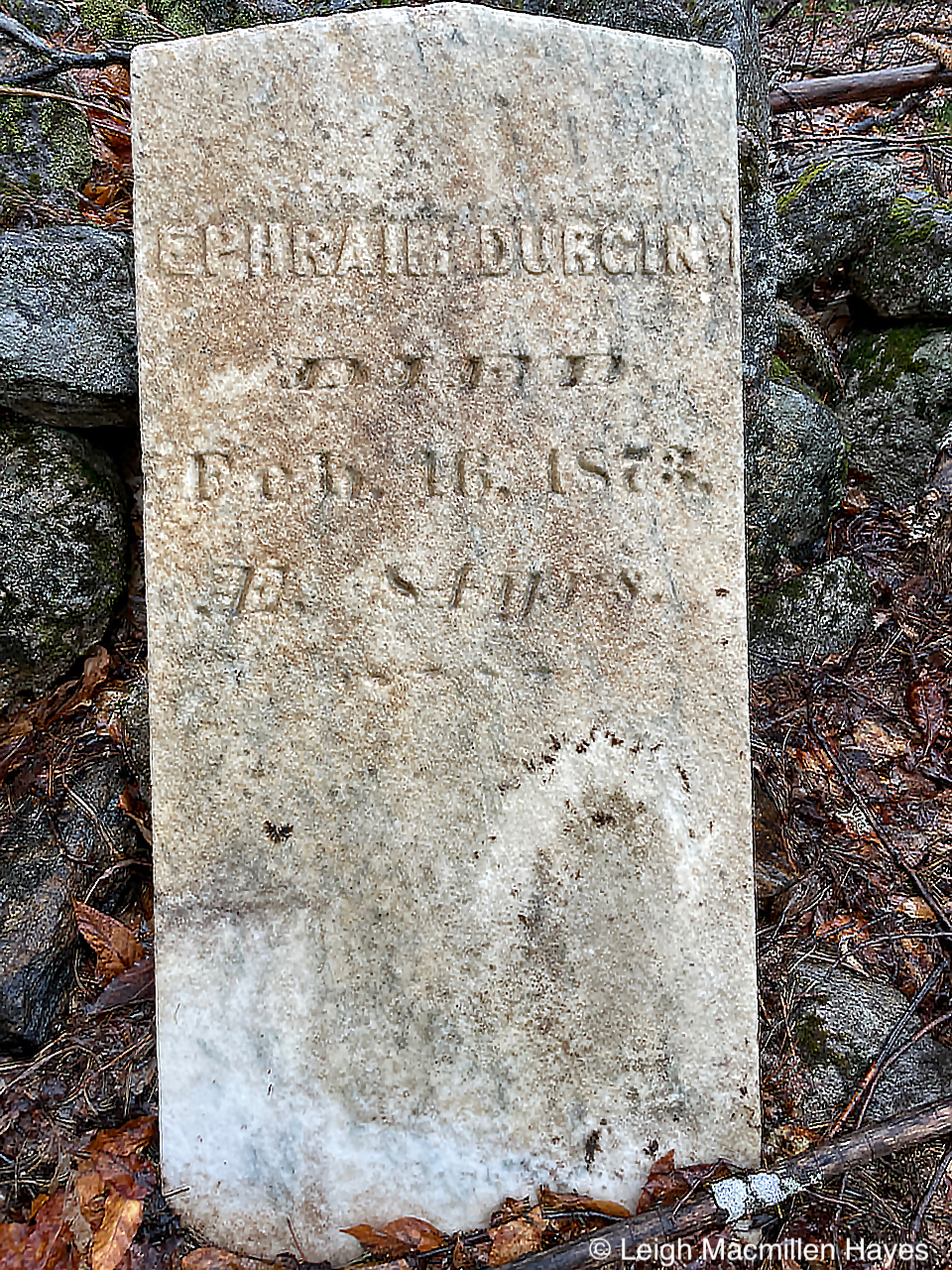
And Ephraim, Sarah’s father, died in 1873 at age 81. Notice the difference in stone from the two girls to Ephraim? Slate to cement. And the name spelling–Dergin and Durgin. As genealogy hobbiests, we’ve become accustomed to variations in spelling.

I found the following on RootsWeb:

8. ANNA3 FURLONG (PATRICK2, JOHN1) was born 1791 in Limerick, Maine, and died 1873 in Stoneham, Maine. She married EPHRAIM DURGIN June 18, 1817 in Limerick, Maine14. He was born April 13, 1790 in Limerick, Maine, and died in Stoneham.

Children of ANNA FURLONG and EPHRAIM DURGIN are:
i.OLIVE4 DURGIN, b. 1811, Stoneham, Maine; m. DUNCAN M. ROSS, April 11, 1860, Portland, Maine.
ii.SALOMA DURGIN, b. 1813.
iii.ELIZABETH DURGIN, b. 1815.
iv.SALLY DURGIN, b. 1817.
v.SUMNER F. DURGIN, b. 1819, Of Stoneham, Massachusettes; m. MARY ANN DURGAN, July 11, 1853, York County, Maine; b. Of Parsonsfield, Maine.
vi.CASANDIA DURGIN, b. 1821.
vii.EPHRAIM DURGIN, b. 1823.
viii.FANNY DURGIN, b. 1825.

Sarah isn’t listed above. But . . . Sally and Sarah were often interchangeable.

By 1880, there had been a change in ownership of the neighborhood homes and the Rowlands had moved into the Durgin house.

Again, we followed the moose, this time in the form of a Striped Maple browsed upon, curious to see what might be ahead.

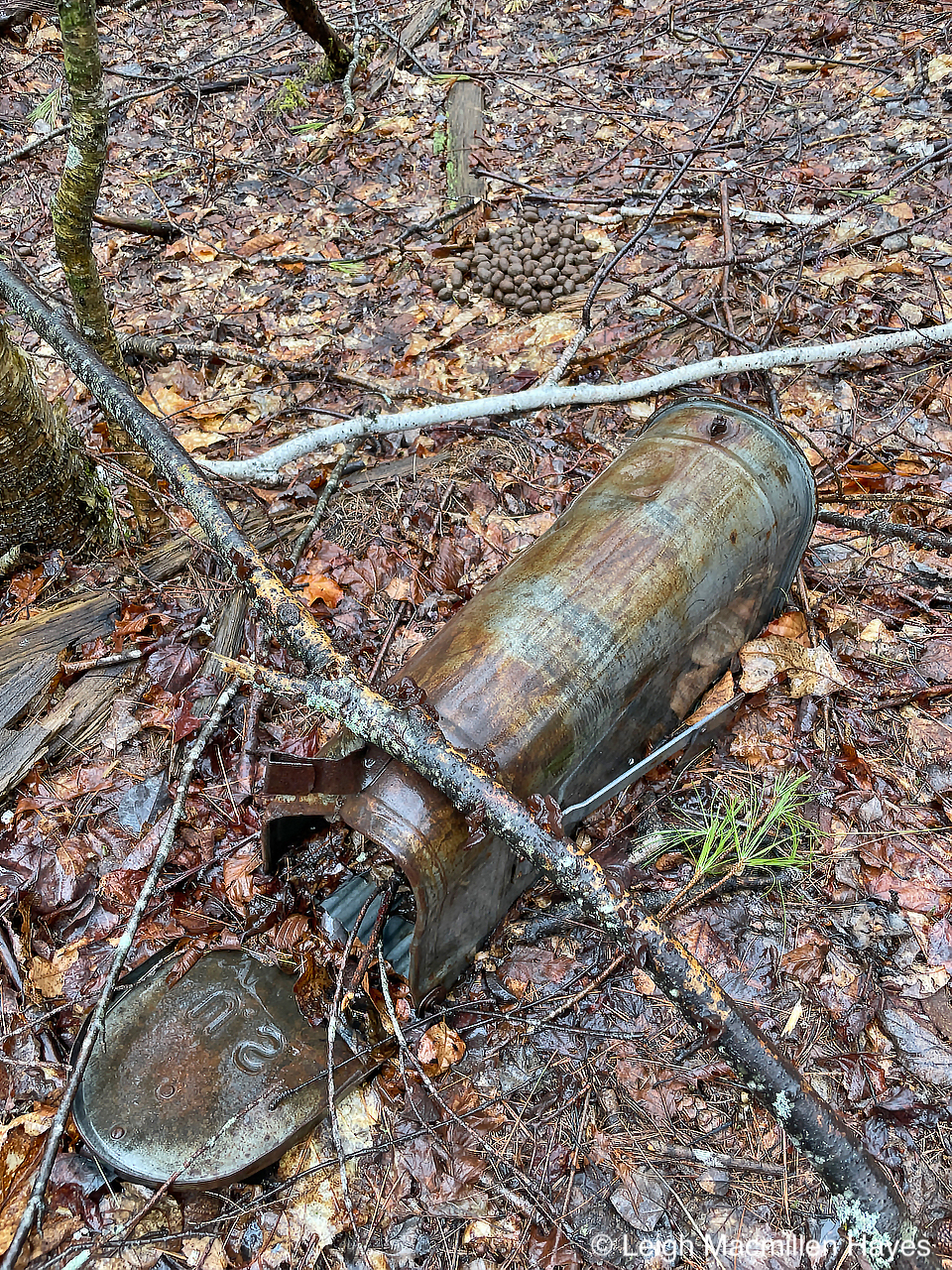
A chuckle. Yes, a mailbox in the middle of nowhere, this spot being a place where someone once had a camp. Our Moose tried to send a letter, but missed by a couple of feet.

Willard Brook was our next stop and I was reminded that when I first started wondermyway.com, a post about this brook initiated some discussion about the Indigenous stonework found throughout the area. I’ve explored it looking for such and convinced myself in the past that I saw the turtles in most of the stonewalls. In fact, I see them everywhere, but today I was looking at different subjects.
Beside the brook, lots of Hobblebush looked ready to burst into life and we thought how fortunate that the moose hadn’t decided to dine. Yet.

There were even tiny Hobblebush leaves to celebrate for their accordion style.

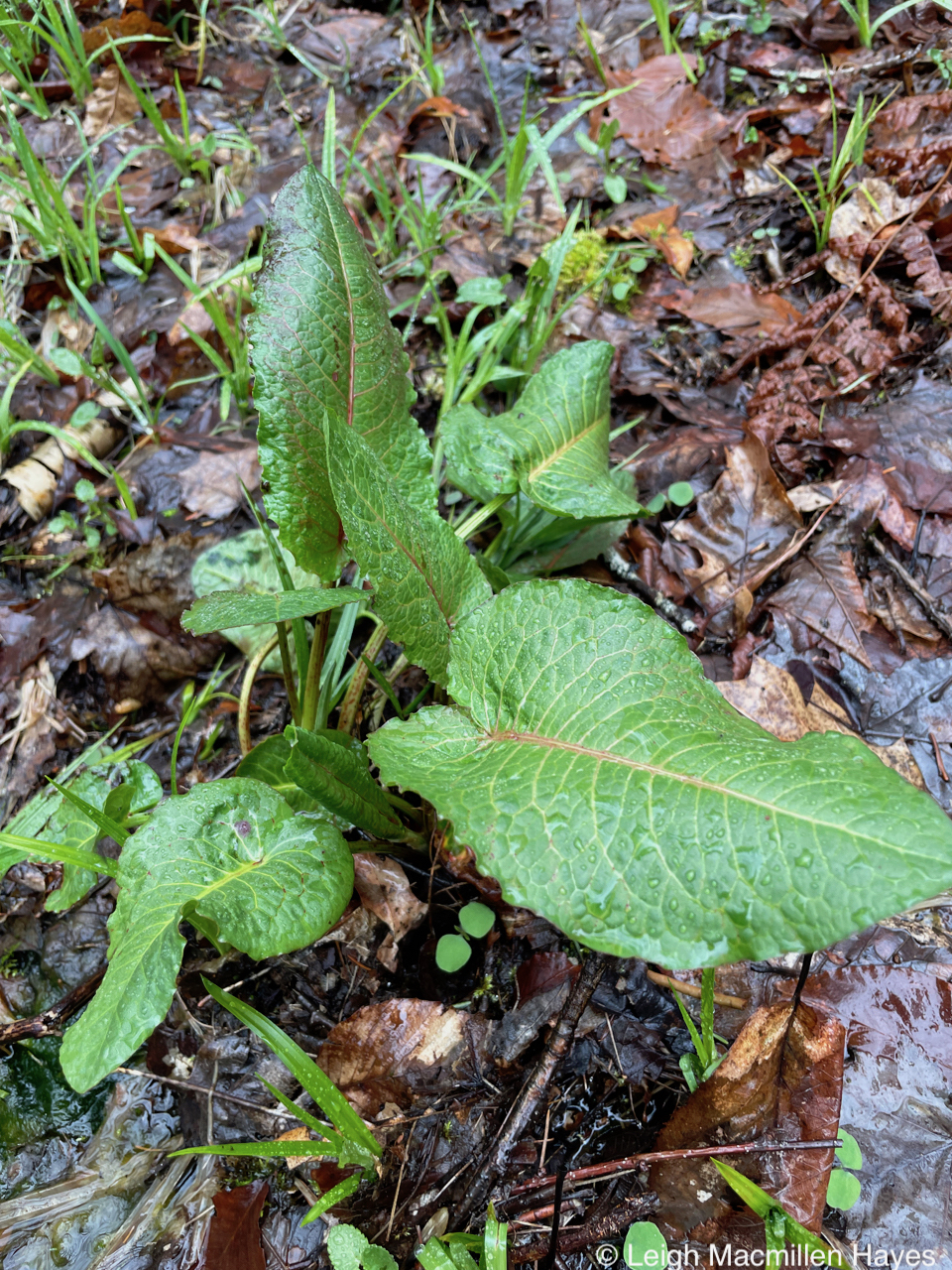
And Broad-leaved Dock looking quite happy and healthy.

Back to Great Brook we eventually wandered, still with no actual Moose in sight.

But beside the brook I did spot some Trailing Arbutus buds preparing for their grand opening.

As we walked back on the dirt road we’d walked in on, we paused beside a beaver pond where Spring Peepers sang their high-pitched love songs. I made My Guy scan the area with me because just maybe . . .

or maybe not. We did spot a Mallard couple. Oh well, We still had fun discovering everything else where the Moose led us on this rainy day.

And when we arrived home I had an email from an acquaintance double-checking with me that the print he found on his shore front of Kezar Lake was a moose print. Indeed it was!

(And now it’s time to prepare for Big Night. Finally. The temperature is in the 40˚s; it’s been raining all day and will continue tonight; and though lots of amphibians have moved to their native vernal pools, I think there will be some action tonight and we’ll be able to help them cross the road safely.)

Beautiful Maine (and Canada)

Our time for a road trip was long overdue. But where to go? We knew we’d begin the week by driving to Lubec, Maine, where we’d enjoyed two days last year, but left knowing there was so much more to explore. And so we booked a room for the first four nights of vacation. After that? The question loomed. The answer eventually presented itself, but first, here’s to Lubec.

We’d barely landed in town after a five hour drive, when a walk down the road found my guy posing before entering Lubec Hardware. Curiously, because the owner had been to Stone Mountain Arts Center in Brownfield, Maine, not far from our hometown, he knew of my guy’s store and they enjoyed a chat. From there we sipped a beer at Lubec Brewery before heading off for our first adventure of the week, along a beach trail within reach from town.

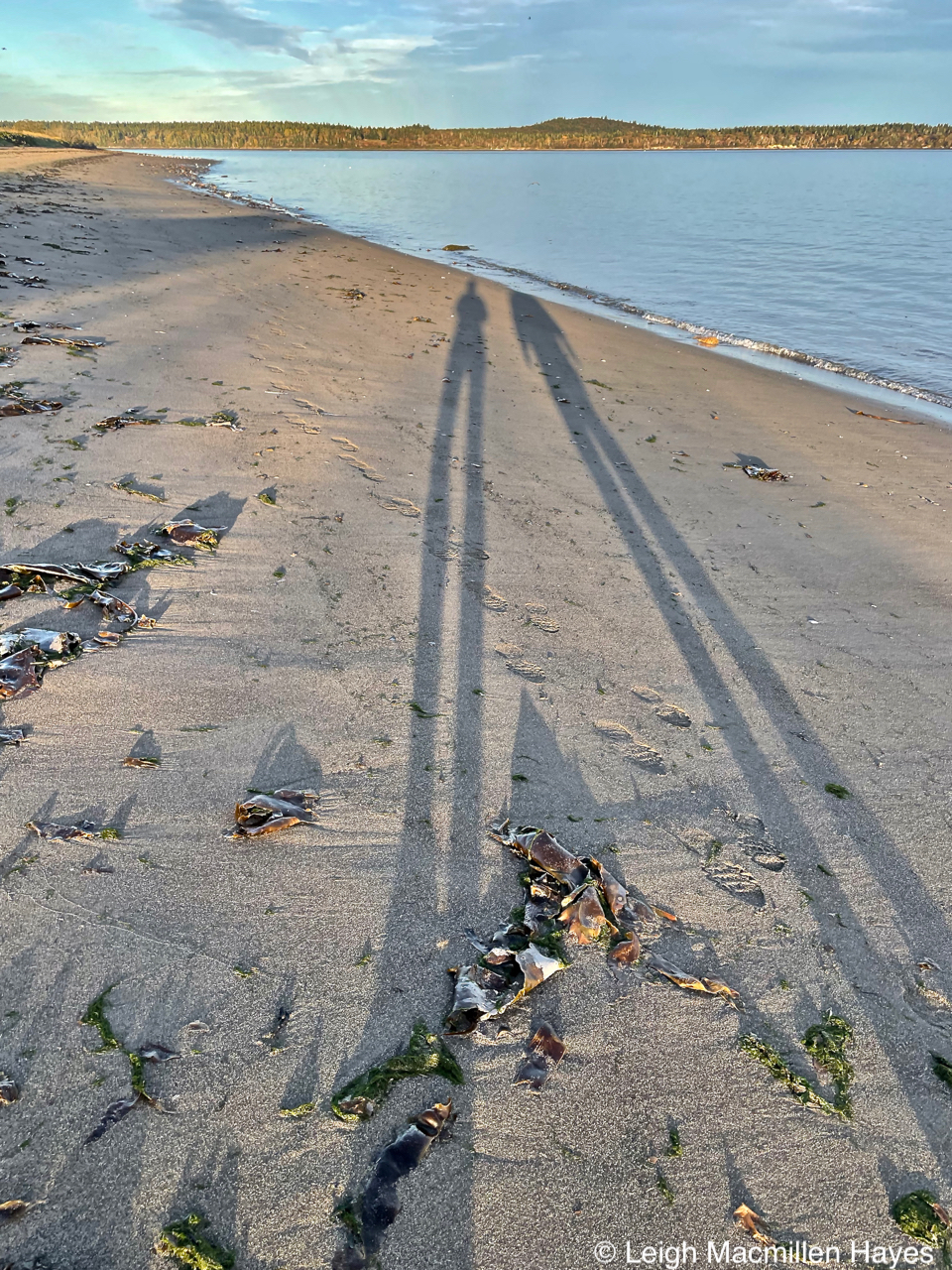
After skipping some stones, we turned around and headed back toward our room, enjoying the cast of our shadows upon sand . . .

and cobbled beaches.

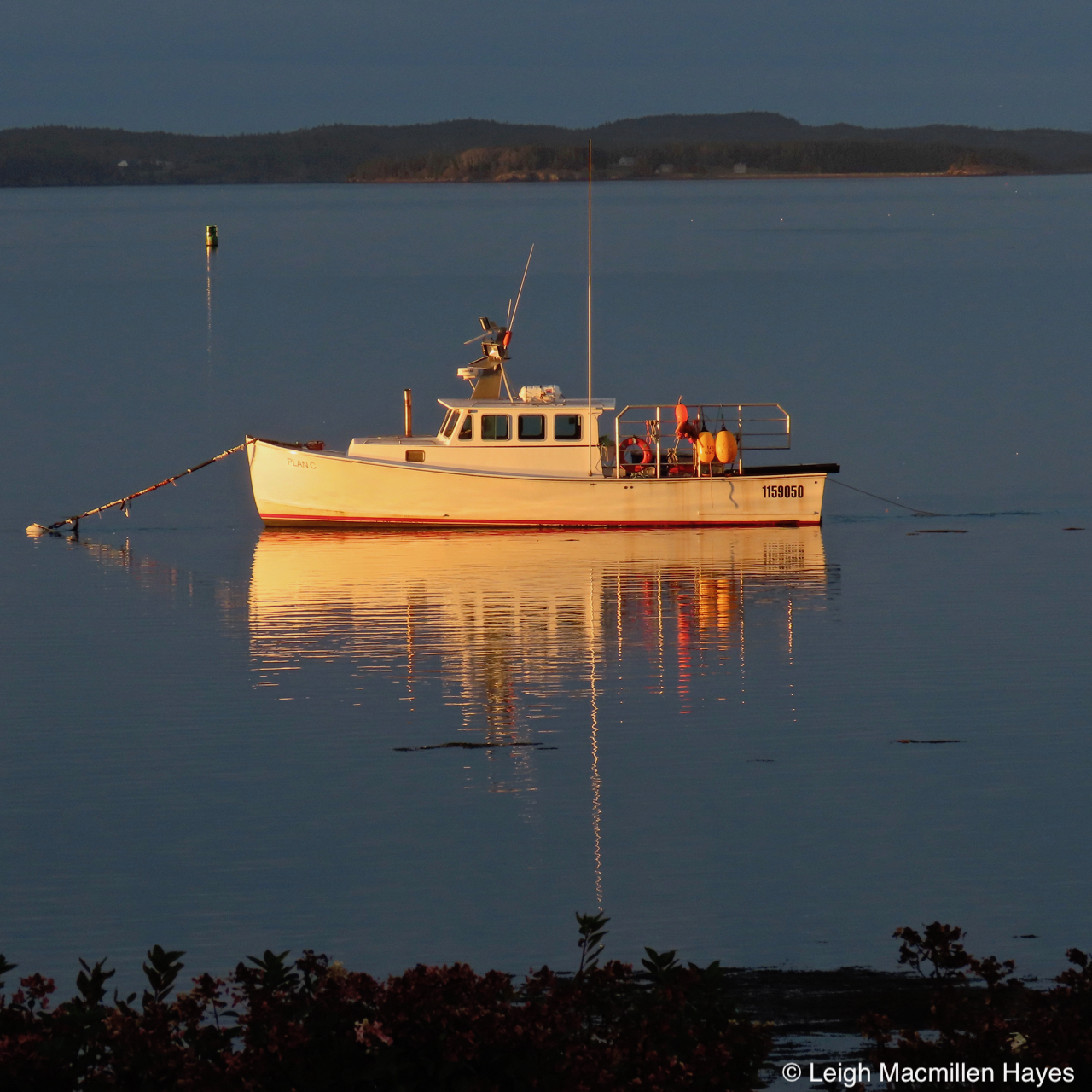
Back in the harbor of Johnson Bay, the setting sun upon moored boats captured our fancy.

And we got our bearings with a view of Mulholland Light on Canada’s Campobello Island located exactly across the Lubec Narrows from our room.

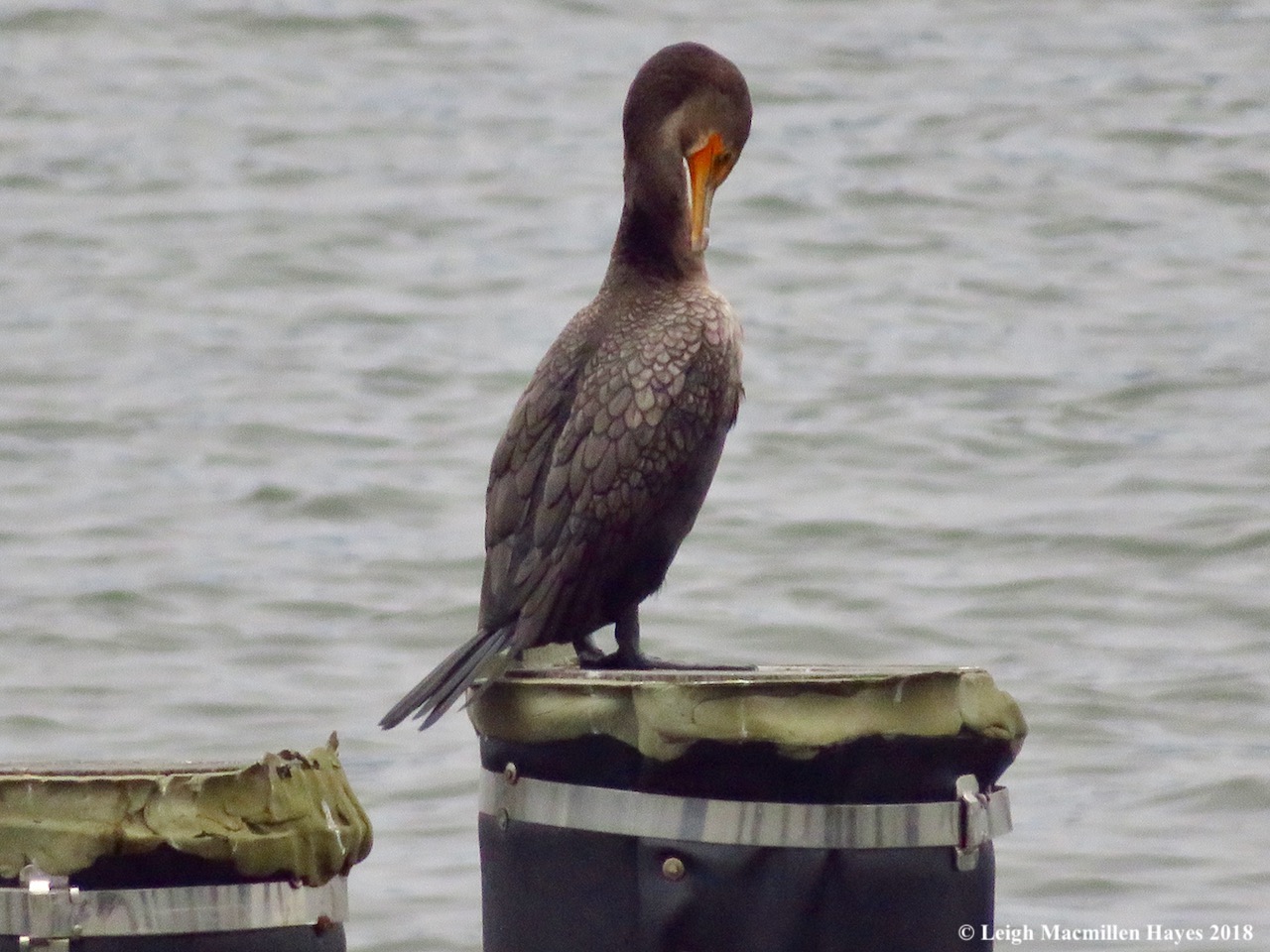
Morning and evening, whenever we were by the Narrows, we watched as the Cormorants preened and flew and swam against the current and preened some more.

On the windiest day, we took to the woods rather than the coast, knowing it would be calmer. And quieter. We weren’t disappointed.

Especially since we found a display of bear scat, this being only one chunk. Berry seeds pass through a bear’s digestive system and exit intact and viable, making bears an important part of nature’s seed distribution system.

We also spotted the largest burl either of us could remember seeing, this at the base of an old Yellow Birch turned silver in age like the rest of us.

We circled through a beaver’s territory, hoping that if we couldn’t catch sight of the bear, we might at least see the beaver, but both alluded us. Fred, the Red Squirrel, however, scolded us at every opportunity.

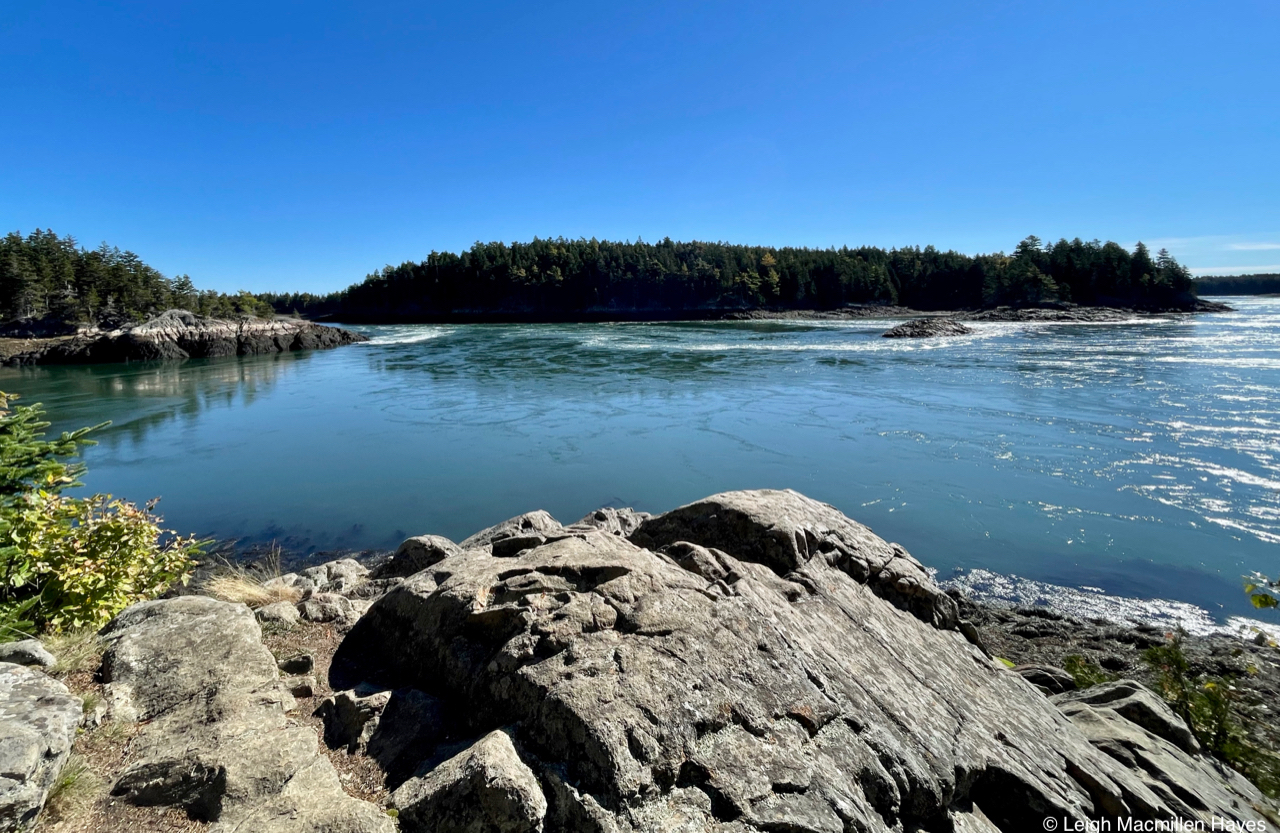
The next day dawned brisk and chilly, as most did, and found us first finding our way to Reversing Falls, where the incoming tide hit some rocks that splashed the water “backwards.”

Click on the link to catch a brief glimpse of the action.

Over the course of the day, we explored a few trails of Cobscook Shores, including enjoying lunch on a bluff overlooking sandbars at low tide.

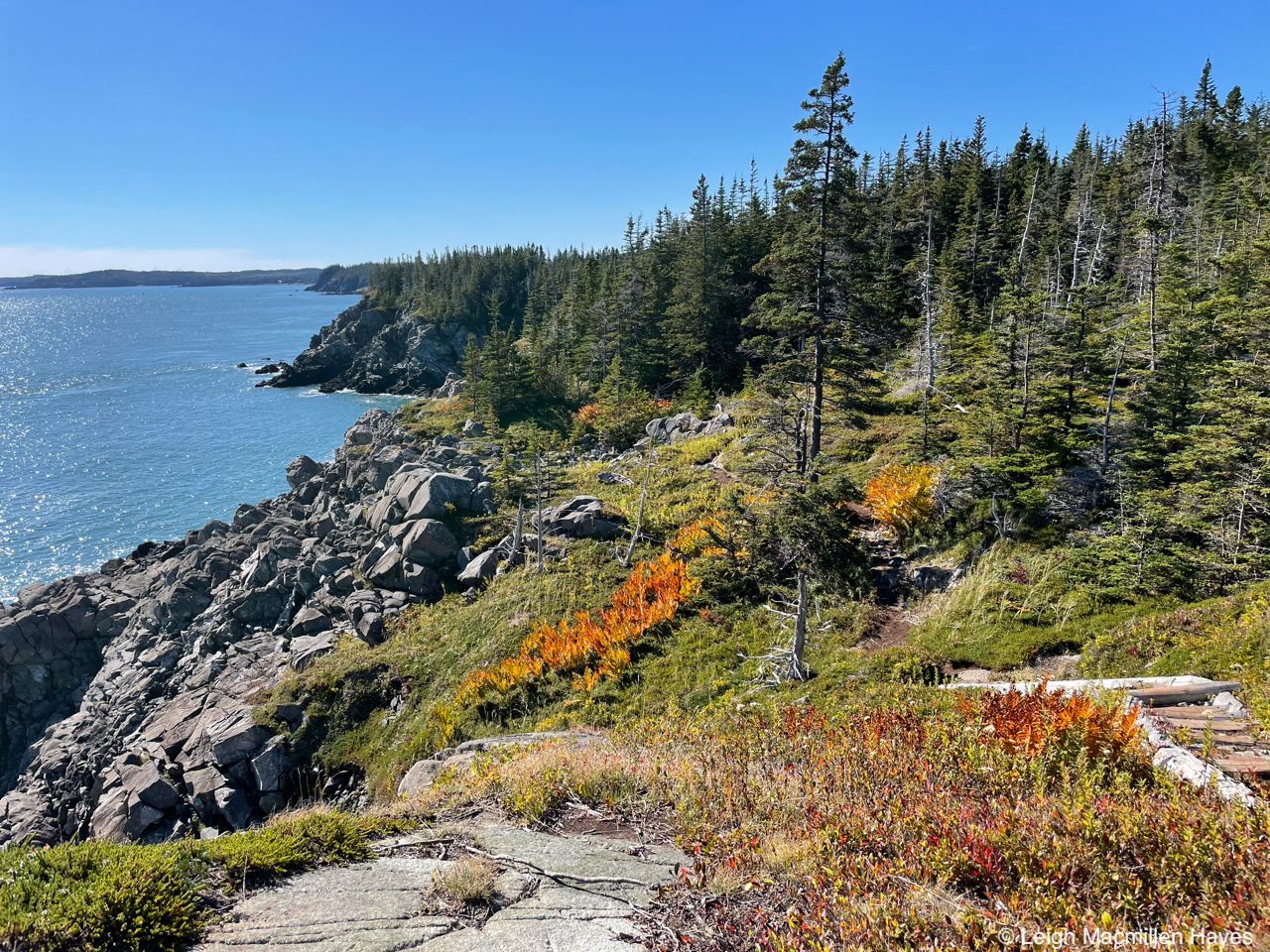
Boot Head Preserve along the coast offered a variety of terrains and natural communities, including upland forests, bogs, coastal wetlands, and steep rocky shoreline.

My mom would have loved this–the rocky coast of Maine spoke to her.

We also appreciated all the bog bridging and benches placed to take in the vistas and gave thanks to those who had hustled to create such infrastructure, including my colleague Rhyan, a former intern at Maine Coastal Heritage Trust. The chicken wire along the bridges sang as we trudged, boot tread hitting wire, wire strumming against wood, and song echoing with each step as the wire bounded back off the wood. There was that to be thankful for, as well as the facts that it kept us from slipping, and from stepping upon the fragile environment at our feet.

Despite the daily chill, flower flies such as this bee mimic continued to pollinate asters in a manner hectic as the days grow shorter and temps lower.

Behind the asters we saw plenty of juicy Rose Hips and I thought of my dad who loved to eat these on our beach walks in Connecticut.

Because we followed a smattering of trails, the berry choices changed from Cranberries to . . .

Withe-rod or Wild Raisin,

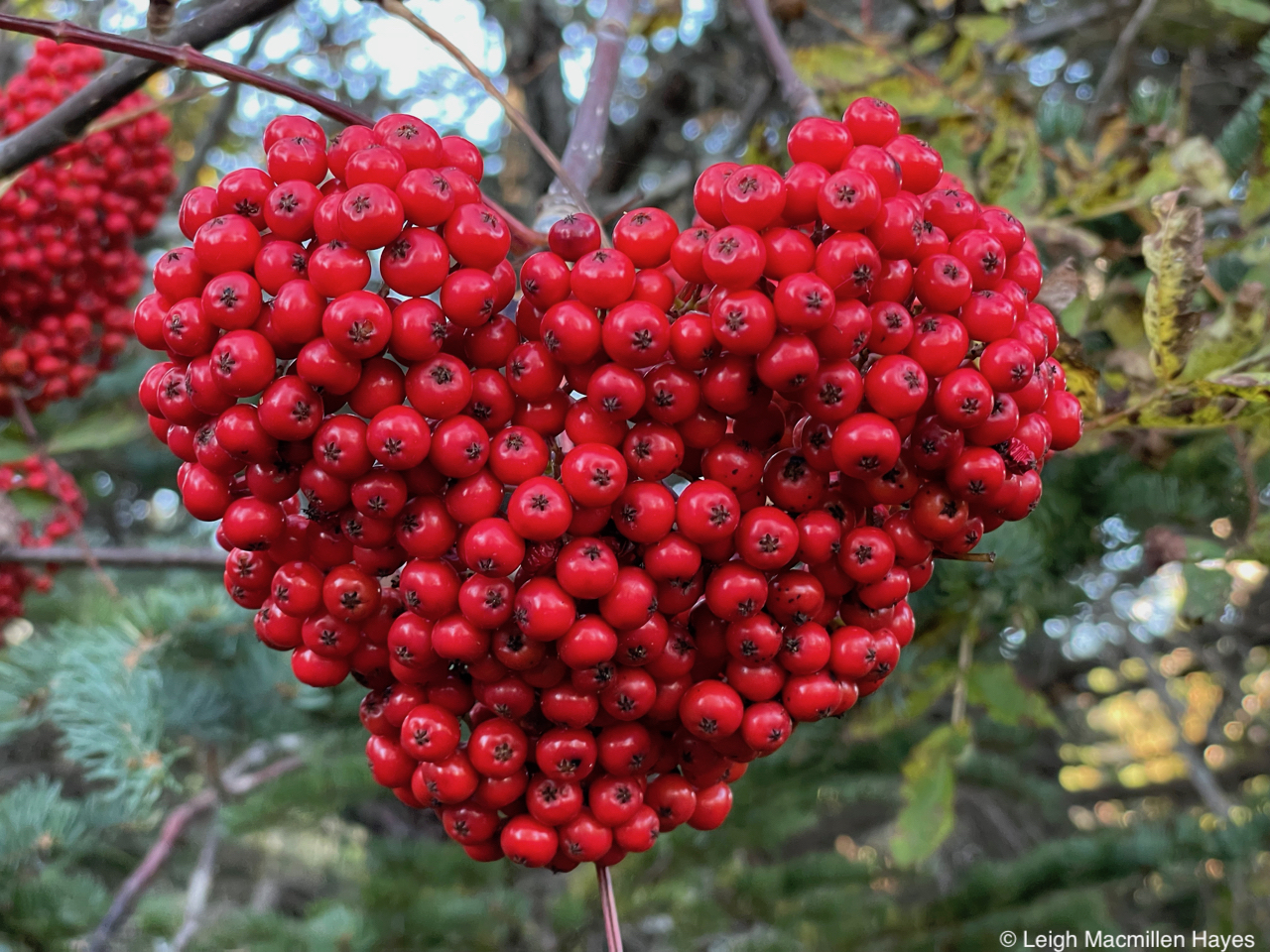
and Mountain Ash in the shape of a heart.

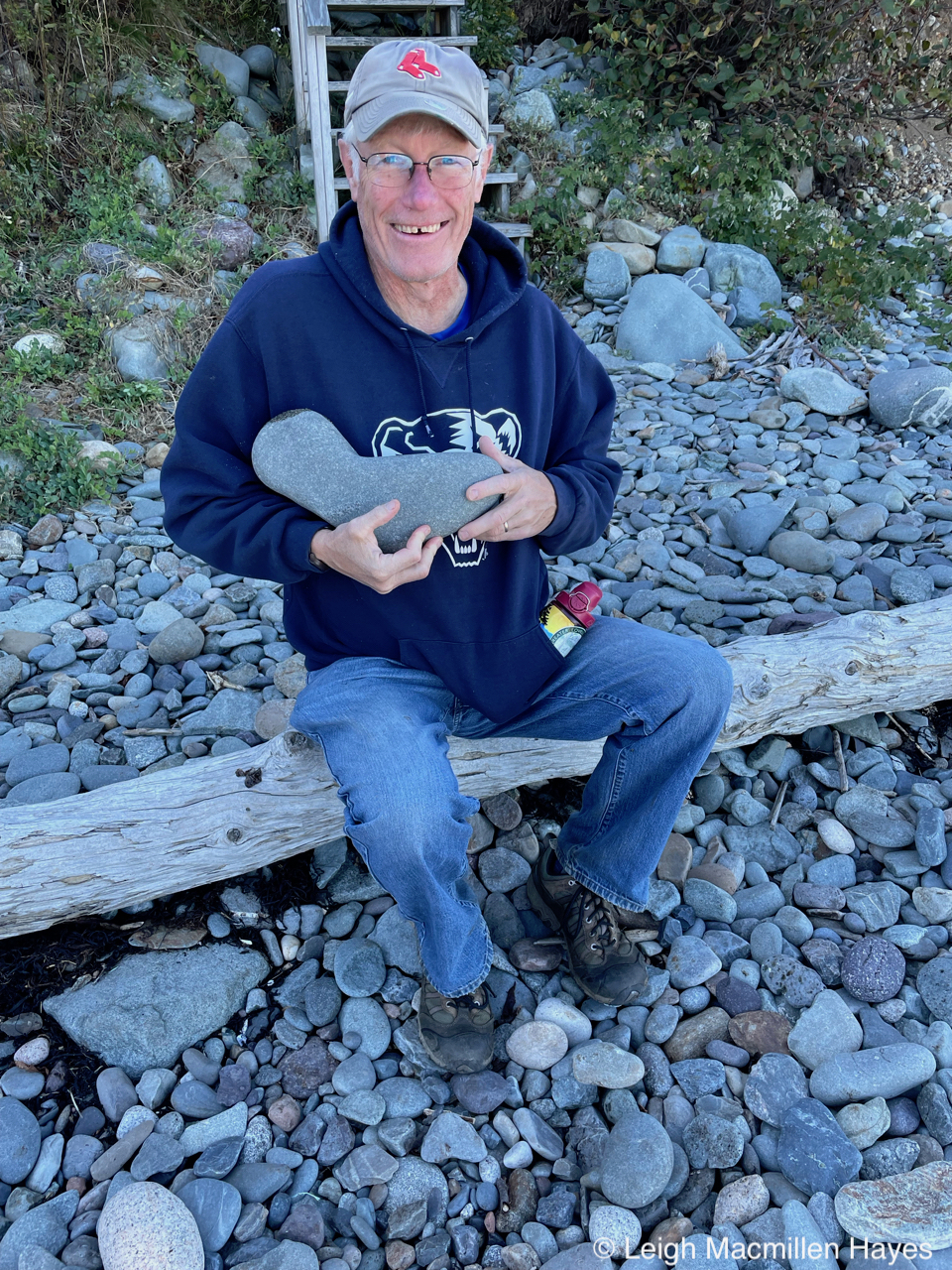
Those berries fit right in with our daily cobbled beach quest for hearts and we found many, a few which followed us home. But this one, not exactly perfect, as no heart really is, my guy gave a pulse. A pulse with a smile. And then he left it behind.

Our favorite heart selection we did not disturb because it appeared in the midst of a fairy ring created by the tide.

Our adventures found us exploring different areas of the Bold Coast than we’d visited a year ago, but it seemed imperative that we make a quick stop at West Quoddy Head Lighthouse at the end of one day. It’s the easternmost point in the United States, thus bragging rights.

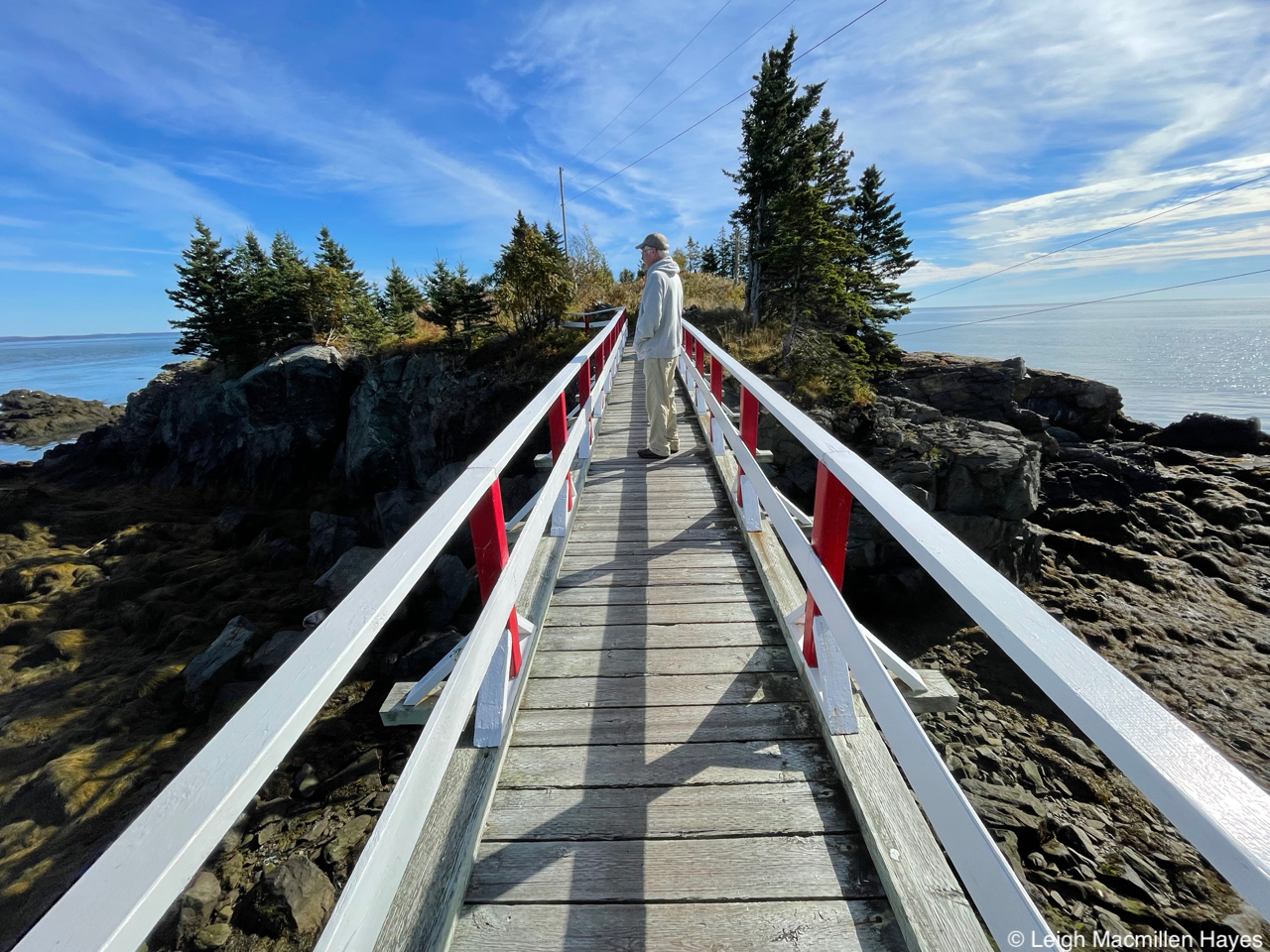
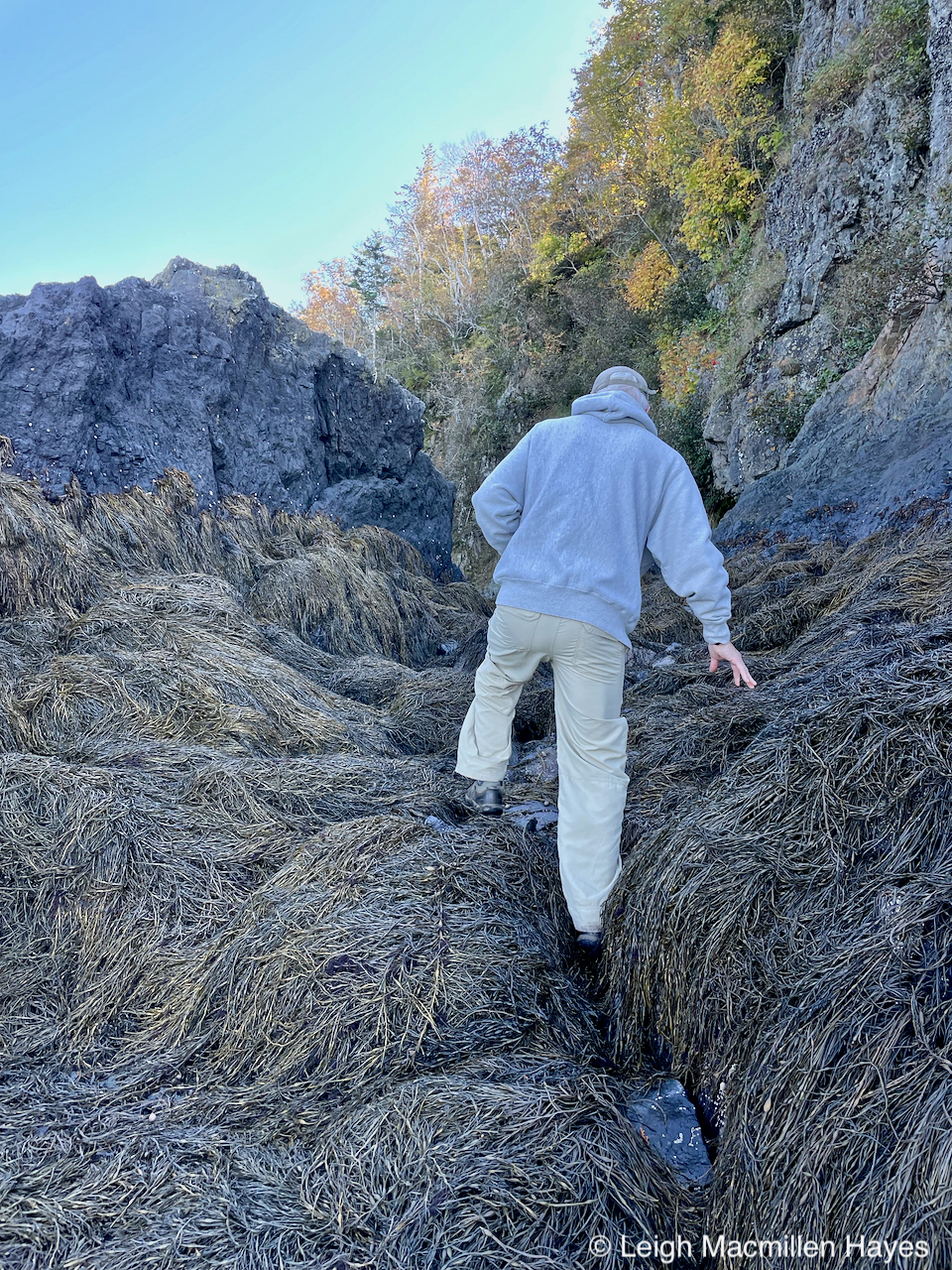
The cool news is that as of our first day of vaca, the border between the USA and Canada opened for travel without pandemic protocol and so we drove across the road bridge located about two minutes from our room, showed our passports, and within two minutes entered one of our favorite countries, this time to a place we’d never been before: Campobello Island. Once there, we drove east to the companion light of West Quoddy–and then climbed up and down two steep sets of stairs and across this wooden bridge, with lots of slippery seaweed in the mix to reach . . .

East Head Quoddy Lighthouse.

Driving back toward trails we wanted to hike, we paused to take in the scene of Head Harbour Public Wharf where lobster boats were docked in the moment.

It struck us as a safe harbor for the effects of the business.

Our next destination was Friar’s Head, where according to interpretive signs, “While occupying Eastport, the British navy was said to have used the stone pillar for target practice, altering its outline to that of a hooded monk or Friar in deep contemplation.

Native American Passamaquoddy legend referred to this rock as the Stone Maiden. “The legend speaks of a young brave leaving on a long journey, telling his lover to sit and wait for his return. Many months passed and the brave did not return. The young maiden was terribly upset and sat on the beach below the head and waited. When the brave finally returned to the village, he found his young maiden turned to stone, forever to wait and watch.”

Finally, it was time for a tour of the cottage of Franklin Delano and Eleanor Roosevelt. It has 34 rooms of which 18 are bedrooms and six bathrooms. Until he was afflicted with polio in 1921, Franklin spent every summer on the island, his parents having owned a property next door. As a belated wedding present, FDR’s mother, Sara, gave the young couple this summer home, which they filled with five children, servants, and guests.

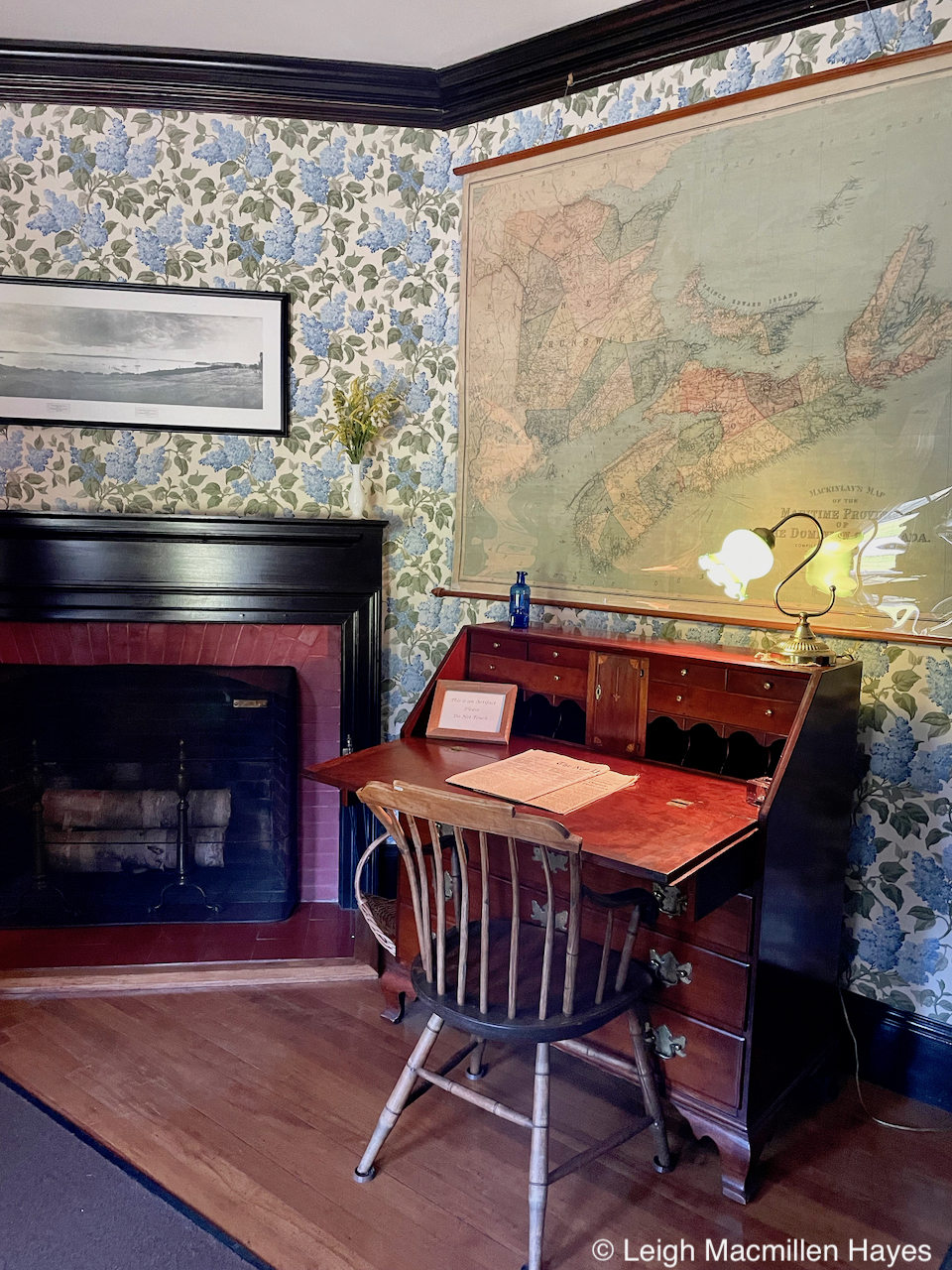
One of my favorite rooms was the site of Eleanor’s desk, where she wrote at least 500 words/day five days a week.

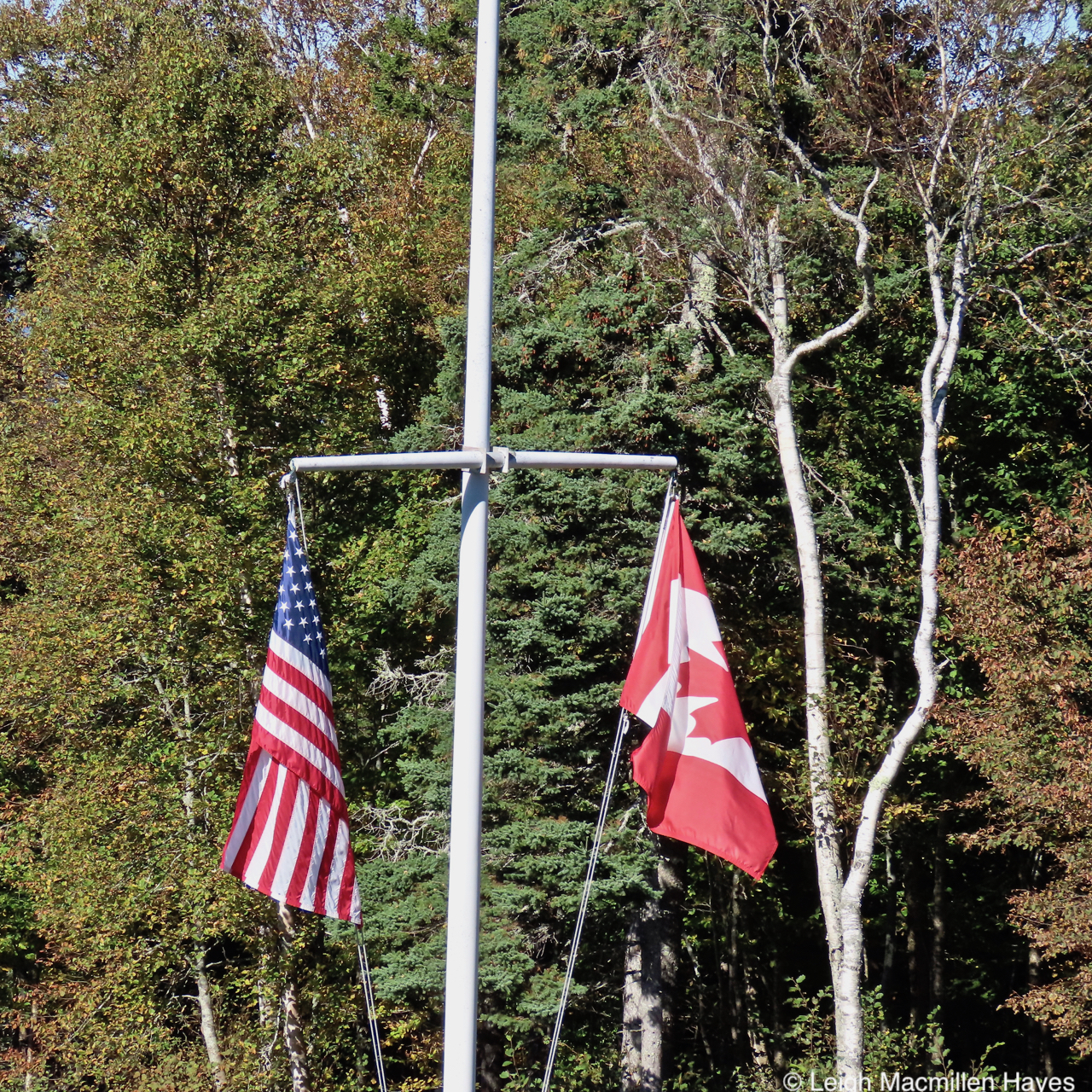
In the backyard stands a reminder that the 2,800-acre Roosevelt Campobello International Park is a US Government Agency and a Canadian Government Corporation, established in 1964.

Next door is the Hubbard Cottage, where the rusticators were known to party–men smoking their cigars as they played pool and women gathering around the grand piano, but . . . it’s the oval window that offers a breathtaking frame on the world beyond, ever changing as the seasons.. Mr. Hubbard was a very successful real estate developer from Chicago and his cottage was the envy of many. The oval window in the main room apparently was imported from France. 

Not ready to be done with our Canadian journey, we visited Eagle Hill Bog and then from Raccoon Beach we hiked along a loop path through bogs and fields and forest and along the coast, where we spotted a natural sculpture of faces and wondered if they represented people lost at sea or those looking for loved ones or perhaps those who came to wonder and wander like we did.

At Ragged Point, we followed a short spur to SunSweep, one of three sculptures carved from a slab of Canadian black granite and located strategically at this location in New Brunswick, a second in Minnesota, and a third in Washington. All are aligned to follow the sun’s path from daybreak to nightfall. We were there as evening approached and still had some hiking to do, so onward we journeyed.

But first, we made a quick stop at Sugar Loaf Rock, which reminded me of an iguana, and from this site had the good fortune to watch Minke whales feeding in the distance.

Before leaving Canada, we had one final stop to make–a visit to Mulholland Lighthouse, the oldest lighthouse in the country. It’s a wooden octagonal structure that was erected in 1883 and decommissioned in 1963. During its heyday, it guided ships through the Lubec Narrows, where even FDR, who served as Assistant Secretary of the Navy from 1913 to 1920, once made an inspection trip along the Maine coast aboard the U.S.S. Flusser. On a plaque it states: Taking the helm, the future President captained the vessel through the narrow channel between Lubec and Campobello Island, earning the respect of an initially concerned Lieutenant (later Admiral) William F. “Bull” Halsey. Admiral Halsey later wrote, “As Mr. Roosevelt made his first turn, I saw him look aft and check the swing of our stern. My worries were over; he knew his business.”

Our fascination with the lighthouse was that from our room at Cohill’s Inn we looked straight across to the lighthouse–the room being the double window just above the white door as we took in the opposite view.

But even more fun was spotting Harbor Seals who came snuffuluffing along with the incoming tide. It was a great way to end our Campobello/Lubec leg of the journey.

A few hours drive the next day and we began an exploration of Millinocket. I think in the back of both our minds we expected to end up there, but the plan didn’t fall into place until almost midweek. Thankfully, we found a place to stay and headed off on a trail soon after we pulled into town.

Whereas the colors along the coast were a bit muted, it was peak fall foliage in this neck of the woods, where Mount Katahdin dominates the landscape.

One hike found us making our way to Rainbow Lake, home of Eastern Brook Trout and Blueback Char. Though we didn’t see any fish actually jump there, we saw lots of activity while eating lunch beside Clifford Pond–ask us how high the fish jumped and you’ll get a different answer. Mine is maybe six inches, but according to my guy: two feet. That’s a fish tale if I ever heard one.

At the urging of an article by Carey Kish in the Portland Press Herald published on Oct 2 entitled Hiking in Maine: A hidden gem in the midst of Baxter State Park, we decided to check out the River Pond Nature Trail–and we’re glad we did. If you go from the Golden Road, we suggest following the trail counterclockwise. There are lots of blow downs that are easy to maneuver around or over or under if you begin from the opposite direction, but those might have dissuaded us at the start.

Instead, we enjoyed beautiful vistas before encountering the blowdowns. And always looked forward to the interpretive signs along the way.

I’m pretty sure that just as the moon follows us when we drive at night, so does the mountain when you hike this trail.

We were dazzled by the kaleidoscope of colors no matter where we looked.

It was pure magic enhanced by reflections along the way.

Of course, there were other things to see, like Stairstep Moss, one of my favorites known for producing a new level of growth each year. (And one that will always remind me of my dear friend, Jinnie Mae, RIP, for we discovered this species on a rock on her land.)

We added to our red berry collection when we spotted several Bunchberrys in fruit form.

A Jack Pine was also a welcome surprise, known for its bundles of two short needles: think Jack and Jill.

And then we headed into the land of the Bad Hair Day Giants, for so the Polypody fern covered erratics did seem.

Our destination–ice caves in the Debsconeag Lakes Wilderness Area! The cool environment in a deep hole under a jumble of boulders can retain ice sometimes as late as August (though I doubt that happened this year given how hot it was over the course of the summer). While we didn’t need nature’s air conditioning on this day, it was still a cool opportunity to explore.

One more stop on this day was a visit to The Crib along Penobscot River’s West Branch, where we recalled memories of dining above during a rafting expedition about 35 years ago and then how I ducked into the boat when we later passed this spot. Really though, when we rafted, they’d opened the dam above and there was much more water, but still . . . it was fast and furious. Oh, and do you see that mountain in the background? The Mighty K once again.

Our wildlife sightings on this part of the journey included a couple of startled Ruffed Grouse, a Fred the Red Squirrel who followed us, I swear, for we endured his scolding on every trail in both locations (and we hiked over 70 miles all told) and this Garter Snake. But then, the creme de la creme presented itself across from River Pond where we’d first stopped on the Golden Road to photograph Mount K and actually spotted its tracks in the morning.

Yep. We got us a moose! A male yearling I think.

On the way home a day later, we decided we hadn’t bumped across the Golden Road enough, and so headed west on it toward Greenville. Approaching Greenville, we spotted a sign for the B52 Memorial and made a sudden decision to follow the seven-mile road to the site.

The story is a somber one of a United States Air Force Boeing B-52 Stratofortress on a low level navigation training mission during the Cold War that went awry. After the aircraft encountered turbulence on an extremely cold and windy January 24, 1963, a vertical stabilizer came off and the plane went into a nose dive on Elephant Mountain.

Only the pilot and a navigator survived. Signage explains the experience: “The pilot landed in a tree 30 feet (9.1 m) above the ground. He survived the night, with temperatures reaching almost −30 °F (−34 °C), in his survival-kit sleeping bag atop his life raft. The navigator’s parachute did not deploy upon ejection. He impacted the snow-covered ground before separating from his ejection seat about 2,000 feet (610 m) from the wreckage with an impact estimated at 16 times the force of gravity. He suffered a fractured skull and three broken ribs. The force bent his ejection seat and he could not get his survival kit out. He survived the night by wrapping himself in his parachute.”

Fortunately an operator on a road grater saw the plane turn and the black smoke that followed the crash. Rescuers looked in the wrong area that day. The next day, after plowing ten miles of fifteen foot snowdrifts and snowshoeing the final mile, they reached the site.

Today, pathways lead to the strewn pieces and viewers are asked to remain silent out of reverence. Visiting the site gave us pause and we offered thanks for those who protect us and those who complete rescue missions.

We’re glad we stopped there, just as we’re glad we revisited the two locales we enjoyed last year. Except for this one spot and West Quoddy Lighthouse, it was an entirely different adventure. Oh, and we celebrated my guy’s birthday, while also celebrating our beautiful Maine and Canada.

Peering Into The Pool

If you’ve been following wondermyway for a few years, you know that each spring I make a bee-line for vernal pools, those shallow, short-lived ponds that fill with snowmelt or spring rain for at least several weeks most years, have no major inlet or outlet, and most importantly, no fish. Without fish, reproductive success is more likely for some amphibians, crustaceans, and insects who depend upon these ephemeral water bodies for breeding.

There are four indicator species in Maine that define a vernal pool as significant. Since 2007, significant vernal pool habitat has been protected by law under Maine’s Natural Resources Protection Act (NRPA): “Significant Vernal Pool (SVP) habitat consists of a vernal pool depression and a portion of the critical terrestrial habitat within a 250-foot radius of the spring or fall high water mark of the depression. Any activity in, on, or over the SVP or the 250-foot critical terrestrial habitat zone must avoid unreasonable impacts to the significant vernal pool habitat and obtain approval from the Maine Department of Environmental Protection, either through Permit by Rule (a streamlined permitting process) or full individual NRPA permit.”

Those four indicator species that define such significance: Wood Frogs, Spotted Salamanders, Blue Spotted Salamanders, and Fairy Shrimp. The pool must contain 40 Wood Frog egg masses, or 20 Spotted Salamander Egg masses, or 10 Blue Spotted Salamander egg masses, or one Fairy Shrimp. I’ve yet to see a Blue Spotted Salamander or its eggs.

Some may see these ponds as oversized puddles, but let your eyes focus and suddenly you’ll realize that they are places teeming with life.

As you do, it might surprise you to spot lots of flying activity just above the pool’s surface. It’s actually Midges on the move, trying to get a date so that there will be even more Midges on the move. They look rather like mosquitoes, but don’t bite, so not to worry.

Male Midges have a longer, more slender body that the females, and they like to posture in attempts to interest one of the opposite gender. They’re actually fun to watch.

Of course, equally, ahem, fun to watch are the larval forms of Mosquitoes as they wriggle and wraggle through the water column, some even forming dense clusters.

If you do some container dipping at a vernal pool near you in order to take a closer look, I trust you won’t dump these onto the leaf litter rather than back into the water. As much as the females annoy us once they morph into that annoying flying insect that needs to suck mammal blood to gain proteins and nutrients for their eggs, they play an important part in the food web.

Especially for warblers such as this Yellow-rumped that was part of a flock that arrived in western Maine this week–just as it should have, being the end of April. It was spotted quite near one of the pools, so I suspect Mosquito Mash will soon be on the menu.

Back to those four indicator species for a significant vernal pool . . . it was this week that while looking close up at some Wood Frog eggs, I realized we had babies in the form of tadpoles.

I saw “we” because mom and dad Wood Frog do not hang around. Once they’ve canoodled and eggs have been fertilized and deposited, they exit the pool and return to their upland habitat, where they spend the next fifty weeks, so it’s up to us to watch over their young ones. Their metamorphosis, or change to adult form, will be completed by late June or earlier should temperatures rise and the pool begin to dry out.

I encourage you , dear readers, to do what I do and stare intently into the leaf litter to see if you can spot some tadpoles. And who knows what else you might discover.

While looking into another section of the pool, you might notice another type of egg mass, this one coated with a gelatinous mass that encompasses all of the eggs. Spotted Salamanders made their Big Night return to the pools about a week or so later than the Wood Frogs, so the embryos are still developing.

I find it fascinating to see the little forms take shape. It’s like looking into a mother’s womb without medical devices.

Okay, it’s time for you to peer into the pool again. This time you are looking for Fairy Shrimp, those tiny crustaceans that are about a half inch long, swim on their backs, and move eleven pairs of legs like a crew team in a rowing shell. Remember, I said one Fairy Shrimp makes a pool significant according to the State of Maine. How many do you see in this photo?

Those in the first Fairy Shrimp photo are males, but females are present as well. The way to identify a female is to look for her two brood sacs that are positioned just under her legs or appendages.

So here’s the thing. Fairy Shrimp have a short life span, but . . . their eggs must dry out and freeze before they can respond to environmental cues such as reflooding to hatch. One of the pools I’ve been frequenting lately I’d only discovered last year and it had no Fairy Shrimp. The other day when I approached with some volunteer docents from Greater Lovell Land Trust, one exclaimed within seconds of our arrival, “Fairy Shrimp.”

That got me thinking: how is it that we didn’t spot any last year, and this year we started seeing them everywhere. Also, in another pool where we’ve often spied a few, we’ve noticed they are in abundance. Previous to this week, I knew that the eggs, known as cysts, can remain dormant for years, but assumed that if the pool flooded each year, they all hatched. It didn’t make sense though that one pool suddenly has shrimp and the other has so many more than normal. It was time to do a little research, and what I learned from the Vermont Center for Ecostudies , is that only a small portion of cysts hatch each year, thus leaving plenty more for the future. And temperature plays a key role in hatching. So I thought about winter 2021 and how we didn’t have a lot of snow and the temperature was on the mild side. This past winter was much snowier (though not enough still in my book) and much chillier. My unscientific conclusion, based only on limited knowledge and observation, is that conditions weren’t conducive in 2021 at that one pool and so no shrimp hatched. I’m already looking forward to next year.

For your enjoyment I’ve included a video of a Fairy Shrimp moving through a pool this past week. Fairy Shrimp indicate unpolluted water, so finding one is significant. Finding so many . . . bliss.

When you are peering into the water for such a long time, other life forms make themselves known, such as Predacious Diving Beetle larvae, aka Water Tiger. Just like the adult this insect will morph into, it eats everything including tadpoles and insects, and even its siblings sometimes.

It wasn’t just the docents and I who had fun at the pools, but also a group of middle school students I have the immense honor to work with each Friday and yesterday they enjoyed documenting life at the pool that suddenly had Fairy Shrimp this year. Quiz yourself on ID of the species one student scooped up in this bug box. And rest assured that these critters were released back into the pool after being studied for a few minutes.

As I said, I’ve done a lot of scanning this week, including on a couple of solo trips, and it was on one of these that I made one of my favorite discoveries: a Caddisfly larvae. In larval form, Caddisflies are resourceful architects who repurpose their surroundings to create their homes. Sometimes I find them constructed of hemlock needles topped with a maple flowers, and a friend sent a photo today of one she found who had built its house of grains of sand. My find . . . in the pool that suddenly had Fairy Shrimp this year: a mobile home built of leaves. It was so well camouflaged that only the movement made me realize what was before my eyes.

Larval Caddisflies eat various types of detritus, including bits of leaves, algae, and miscellaneous organic matter so they, too, are important as they break down what is in the pool.

If it wasn’t that I need to eventually find my way home and make dinner, I’d probably still be out there. But yikes, it’s 7:00pm, and I haven’t even started dinner, and my guy will be home from work soon, so I’d better get going.

If you are looking for me in the next few weeks, however, I’ll be the one with hands on bent knees as I hunch over the pool. Join me and we can peer in together.

Ponds #1 and #2 Mondate

My friend, Alice, suggested a trail to me over the weekend, and so when this day dawned, my guy and I had a plan. We’d pack a lunch, drove a wee bit north, and let the fun begin. We love exploring places new to us and this was such.

Immediately, the forest floor reflected the canopy above where Sugar Maples, Beech and Red Oak presided.

Other items also made themselves known, including the dried capsules of Pinesap, a plant that features three to ten topaz-colored flowers during the summer. The plant has such cool characteristics: it lacks chlorophyll because it doesn’t have any leaves to photosynthesize, and acts as an indirect parasite of trees. You see, Pinesap’s roots steal nutrients from mycorrhizal fungi, specifically from the genus Tricholoma, that the mushroom obtains from associated trees.

It wasn’t long before the carpet changed color indicating we’d entered a Red Maple community.

And again, upon the ground, another cool site worth honoring. Many-fruited Pelt is a foliose lichen that grows on soil, moss and rocks. The rust-colored projections among the shiny brown lobes made me squat for a photo call. Those reddish-brown projections are the fruiting bodies on the leafy margins–thus the name.

Again we moved onward and upward and again the community changed, the leaves telling us we’d entered a Big-Tooth Aspen/American Beech neighborhood.

Wherever beech trees grow this year, it seems the parasitic Beechdrops are also present. Lucky for me, though my guy likes to hike as if on a mission to get to the destination, when I ask him to pause, he quietly does. I’m forever grateful that he understands my need to take a closer look. I’m not sure if he’s amused by it or just tolerates it, but he never complains. And occasionally he points things out for me to notice or tells me the name of something.

Anyway, Beechdrops, like Pinesap, lack chlorophyll, have scales in place of leaves so they have no way to photosynthesize, and are parasitic. In the case of the Beechdrops, however, it’s the roots of the American Beech from which it draws its nutrition. Small, root-like structures of the Beechdrops insert themselves into the tree’s roots and suck away. Do they damage the trees? The short answer is no because the parasitic plant is short-lived.

Our journey continued to take us uphill and really, it wasn’t easy to follow, but somehow (thanks to GPS–I surprised myself with my talent) we stayed on the trail.

Do you believe me now that it wasn’t easy to follow? Yes, that is a blaze, the yellow paint practically obliterated by a garden of foliose and fruticose lichens. Foliose being a “leafy” looking structure and at least two grew on the bark. Fruticose, likewise the “fruity” structure (think a bunch of grapes minus the fruits) also presented itself in at least two forms.

Of course, there were still many other things to admire including the multiple shades of magenta presented by the shrub: Maple-leaf Viburnum. In my book of autumn, nothing else exhibits such an exquisite color, making it easy to identify.

Our luck increased once we began to spy rock cairns marking the trail.

And it got even better when I noticed several classic deposits beside the cairns. Bobcat scat! Check this one out. Have you ever seen anything quite so beautiful? Look at that hair tucked within the packet. Of a snowshoe hare. Oh my.

While taking a closer look, I realized I wasn’t the only one with all eyes on the structure. Yes, that’s a wolf spider.

Realizing we were at the summit of a certain small mountain, suddenly we found ourselves walking along ledge.

And then the view opened up. It became lunch rock view.

Words seemed not enough to describe.

At last we made our way down, for still we hadn’t reached our destination.

And that’s when Pinesap’s cousin, Indian Pipe showed off its one-flowered structure. While Pinesap features three to ten flowers per stalk, Indian Pipe offers only one waxy structure made of four to five small petals. Until fertilized by a Bumblebee, the flower droops toward the earth, but upon pollination turns upward toward the sun. Eventually a woody capsule will form.

Also parasitic, Indian Pipes have a mutually beneficial relationship with many tree species plus Russula and Lactarius mushrooms, as they work together to exchange water and carbohydrates with nutrients from the soil.

At long last, we reached the first of our destinations, Pond #1. The glass-like water offered a perfect mirror image of the scene upon the opposite shore and we both let “oohs” and “aahs” escape from our mouths when we came upon an opening in the shrubby vegetation that protected the shore. I think my favorite portion of this photo is the evergreens that add a fringed frame.

Our journey, however, didn’t stop there, for we had another pond to locate. Again, we referred to the GPS and found ourselves climbing over several fallen trees. Upon one, I spied pumpkin-colored fungi that requested a stop. Of course. But really, it’s another I can never resist–Cinnabar-red Polypore.

As lovely as the color of the upper surface may be, it’s the pore surface that really makes my jaw drop. That color. Those angular shapes. Another “oh my” moment.

And then upon another downed tree, multi-aged tinder mushrooms. It was the mature one that fascinated me most for it looked like happy turtle basking on rocks in the sun.

Last week I met a Snapping Turtle in the shade and he hardly looked thrilled with our encounter.

At last my guy and I reached Pond #2, where we sat for a few minutes and took in the scene. Okay, so we also enjoyed a sweet treat–as a celebration.

We still had another mile or so to hike before reaching my truck, but we gave thanks to Alice for the suggestion and for the fun we’d had discovering Pond #1 and #2 on this Mondate. And all that we saw between.

Go ahead, take a second look at that bobcat scat. You know you want to.

Put The Lawn Furniture Away Holiday

I don’t know the why of it, but it seems that each year when we plan to put the lawn furniture away, the forecast either includes wind gusts or snow. Well, yesterday it snowed. Not a lot of snow, mind you. But enough.

1-snow on the kayaks

It was, however,  melting quickly when we stopped by camp to begin our autumn chores.

3-porcupine tracks

Upon our return home, I diverted my attention for a bit and headed off into the woods, where much to my delight, tracking opportunities made themselves known. Though I didn’t see any of the creators, I smiled with the knowledge that I can share this land with them. Along the way I found a porcupine track pattern,

4-coyote--18 inch stride

plus a coyote with a stride of about nineteen inches (when you don’t take a tape measure it pays to improvise),

5-snowshoe lobster

and my favorite for this first tracking day of the season . . . a snowshoe lobster–I mean hare.

6-moose scat

Another favorite sighting, which I spied a few times–rather fresh moose scat the size of chocolate nuggets. (And no, I didn’t collect it to make jewelry. ;-))

7-my own track

As I moved, I left behind my own tracks and wondered if the mammals looked at those and knew I’d passed by. “Middle-aged female, the one who stalks us,” they might comment if they could talk. But really, it’s by my scent that they probably know me best. “Stinky middle-aged female . . .”

7a-leaves enhanced by snow

It wasn’t just tracks that caught my attention. The snow, spotted with tree drips, enhanced the color and borders of the foliage, making each leaf stand out.

7b-leaves under slush

In contrast, a more muted tapestry formed where foliage was trapped in slush-topped puddles.

8a-melted snow on sugar maple

And then there were those leaves turned upside down. I was fascinated by the variation of size in the water drops left behind as the snow melted. Every dot enhanced the pastel back-side colors . . .

8-melted snow on big tooth aspen leaf

and acted as a scope by showing off segments of venation.

9-snowdrops on grass

Patterns changed depending on the shape of the structure to which they clung.

10-goldenrod

And all were momentary for each drop eventually did what they do . . . dripped.

11-tachinid fly

While I admired the beauty, I wondered about the goldenrod that still bloomed and reminded me that though it had snowed and we’ve had some rather cold days, today was a bit warmer and it’s not winter yet. But those cold temps of a few days ago, I think they caught some by surprise, including this tachinid fly that dangled from another flower stalk.

12-hickory tussock moth caterpillar

And several times I found hickory tussock moth caterpillars frozen in place. While I admired the way the melted snow drops clung to the hair, I wondered about what I was seeing. Was it a shed skin? Or had this caterpillar been taken by surprise with weather conditions?

If you know, please enlighten me.

As it was, I needed to finish my wander for there was more furniture to put away on the homefront.

13-red-backed salamander

And when we opened the cellar hatch door to store the table and chair downstairs, another discovery was made . . . an Eastern red-backed salamander on top of the first step.

The day probably should have been named “Day After the First Snow Storm of the Season” but instead it was our “Put the Lawn Furniture Away Holiday.” Not everyone celebrates this day, but we do because as exciting as it is to bring the furniture out in the spring, it’s equally exciting to put it away and anticipate the coming season. Oh, and when we pull it again in the spring, you can trust that it will snow at least one more time.


What the Tree Spirit Knows

As I drove to Lovell this morning to take a photo for the Greater Lovell Land Trust’s winter newsletter, the crisp outline of a snow-covered Mount Washington made me realize that I had a short, unintended hike in my immediate future.

1a-Flat Hill view

Yesterday, I’d climbed the Flat Hill Trail at the Heald and Bradley Ponds Reserve to take another photo for the newsletter–that one of the view from the summit of snow falling in the White Mountains. This past summer, staff and volunteers of the land trust had made some trail changes and opened several views, the one from Flat Hill being the most dramatic and the foliage, snow and sky enhanced the opening. But . . . today’s view was different and I knew I needed to capture it again.

Page 3 a

So . . . after a staff photo shoot at the Kezar River Reserve of Stewardship Associate Dakota, Associate Director Aidan, and Office Manager Alice, I headed north.

1-voss sign

And laughed at myself for yesterday I never noticed the yellow Voss blazes that had been mounted to mark the trail. The hope is that eventually all the trails will be signed with different colored diamonds that will ease navigation.

2-big tooth aspen

It’s a trail I know well, even with a new backwards S curve about two thirds of the way up that erased a steep and slippery portion and so instead I focused on those sights at my feet. While many leaves had already begun the long process of decomposition as they slowly break down and give nutrients back to the earth from which their trees grew, a few still sparkled like gems, including this Big-Tooth Aspen, aka poplar.

3-sugar maple

I was thrilled to discover Sugar Maple, defined by the U shape between its pointed lobes;

4-red maple

its V between lobes and toothier cousin, Red Maple;

5-striped maple

and even toothier kin, Striped Maple, known ’round these parts a goosefoot because its shape is similar. Some of us also refer to it as nature’s toilet paper for it’s large, soft, and easy to identify. You wouldn’t think of confusing it with poison ivy.

The curious thing about the Maple family, like all families in our northern New England forests, is that while the shape and color of the leaf helps us specify the family origins, each leaf within the family is different–whether in color or flaws or insect bites or galls. But despite their differences, they are all family.

6-large red oak

With the Striped Maple, I thought I’d found the largest species of the day, but a few more steps toward the summit revealed a rather large Northern Red Oak leaf.

7-even larger basswood leaf

And then the biggest of all–Basswood. My hiking boots are size 8. And the leaf–also a size 8, with an asymmetrical base. That must prove a challenge when trying to find the right fit.

13-polypody ferns

Focusing on the leaves took my mind off the climb and within no time I’d reached the summit where Polypody ferns in their evergreen form decorated the northwestern corner of an otherwise bald rock.

14-red maple flower and leaf buds awaiting
From the ferns where I’d planted my feet, I looked skyward and noticed the leaf and flower buds of a Red Maple, all tucked inside their waxy scales. It was the right place to be for as the north wind blew and my cheeks turned rosy red, I looked to the west.

9-Baldfaces to Carter Dome

Yesterday’s view had been transformed. No longer was it snowing from the Baldfaces to Carter Dome, with Mount Washington the whitest of all, posing between them. But still, it was chilly.

10-telescoping in on Mount Washington

A slight push on the camera lever and I pulled the scene a wee bit closer.

16-Perky's Path

At last I pulled myself away and hiked down, but so delightful was the morning, that I knew my newsletter work would have to wait a few more minutes at the intersection with Perky’s Path, for I felt the calling.

17-wetland--old beaver pond

It’s a wetland I visit frequently and once upon a time about five years ago it was filled to the brim with water because beavers had dammed it for their convenience.

18-suds reflect leaf

The only water today was found in a small stream that flowed through, its origin at Bradley Pond and terminus at Heald Pond. I stopped at the rock stepping path to admire what the water had to offer, including suds forming their own rachis or mid-vein from which side veins extended, a sideways rendition for the birch leaf caught between twigs.

19-view from the rock

In the middle of the stepping stones is a large flat rock. It was there that I settled in for a while, enjoying the feel of its sun-absorbed heat and the sound and views offered as the brook flowed slowly forth.

21-view from the bench

At last I pulled myself away and continued toward the bench that overlooked the wetland. All was quiet on this brisk day, but its a place of life and love and change.

22-back to the wetland

From there I continued to circle the old beaver pond to the point where I knew it had formerly been dammed. Climbing over and around moss-covered rocks, and into former stream beds, I made my way to the edge of what I used to call an infinity pool for the water was once at the dam’s upper level.

23-view from the beaver dam

Once I reached the dam, making my way one step at a time, for it was rather tricky footing at times, I discovered life on the other side. For all the years I’ve been involved with the land trust, I’d never seen this edge from this view. My surprise included the almost bald rocks.

25-coyote scat full of bones

Stepping from boulder to boulder, I made my way into the wetland a wee bit, but along the way realized someone had visited prior to me. Actually probably almost a year prior given the conditions of the scat left behind. Based on its shape, size, and inclusion of multiple bones plus lots of hair, I suspected a coyote had feed on a hare.

26-spider view

The coyote and I weren’t the only ones who knew of this secret place. A wolf spider darted in and out among the leaves, more afraid of me than I was of it.

27-spatterdock

And then I discovered something that perhaps they both already knew: the water supported a small colony of Spatterdock, a plant that will need to be added to the list of flora for this property. Do you see the ice on the Micky Mouse ear leaves?

28-ice

Ice had also formed around a fallen log, its swirls portraying a high-heeled boot that certainly might be appropriate in an ice sculpture but not on ice.

28-tree spirit

All of what I saw the tree spirit already knew. And yet, it allowed me to make discoveries from my feet to the sky.

29-Mount Washington summit

And every layer between. I know he’s not there anymore, but can’t you imagine Marty Engstrom on top of Mount Washington?


To Pause and Focus

I had no idea what to expect of today’s tramp with two friends as I didn’t even know prior to this afternoon that the trail we would walk even existed. And so I pulled in to the parking area at the end of Meetinghouse Road in Conway, New Hampshire, sure that we’d only be able to walk down to the Saco River about a hundred feet away and that would be the extent of our adventure.

1-Conway Rec Path

But . . .  much to my pleasant surprise I was wrong and in the northeastern corner of the parking lot we crossed a bridge into the unexpected setting.

2-Saco River framed

For the entire journey, we walked above and beside the Saco River. And our minds were awed by the frames through which we viewed the flowing water and boulders.

3-clear view of the Saco River

Occasionally, our view was clear and colorful, the colors now more pastel than a week ago.

5-witch hazel, understory

Even as the colors have begun to wane and leaves fall, we looked up from our spot below the under and upper stories and sighed.

4-Witch Hazel

For much of the time, we were wowed by the Witch Hazel’s flowers–for so thick were they on many a twig.

4a-witch hazel flowers

In fact, if one didn’t pause to notice, you might think that each flower featured a bunch of ribbons, but really, four was the count over and over again.

4b-witch hazel flowers, leaf:bundle scars

And some were much more crinkly than others. One of my other favorites about this shot is the scar left behind by a recently dropped leaf. Do you see the dark smile at the base of the woody yet hairy flower petiole? And the dots within that represented the bundles where water and nutrients passed between leaf and woody structure?

6-spotted wintergreen

And then one among us who is known for her eagle eyes spied a Spotted Wintergreen, Chimaphila maculata, a name that has always made us wonder for its dark green leathery leaves seem far more stripped than spotted. It’s one of those plants with a bunch of common names and so we should try another one on: spotted wintergreen; striped prince’s pine; striped wintergreen; striped pipsissewa; spotted pipissewa; and pipissewa. But perhaps the fact that it’s striped and referred to as spotted helps me to remember its name each time we meet. A sign of how my brain works.
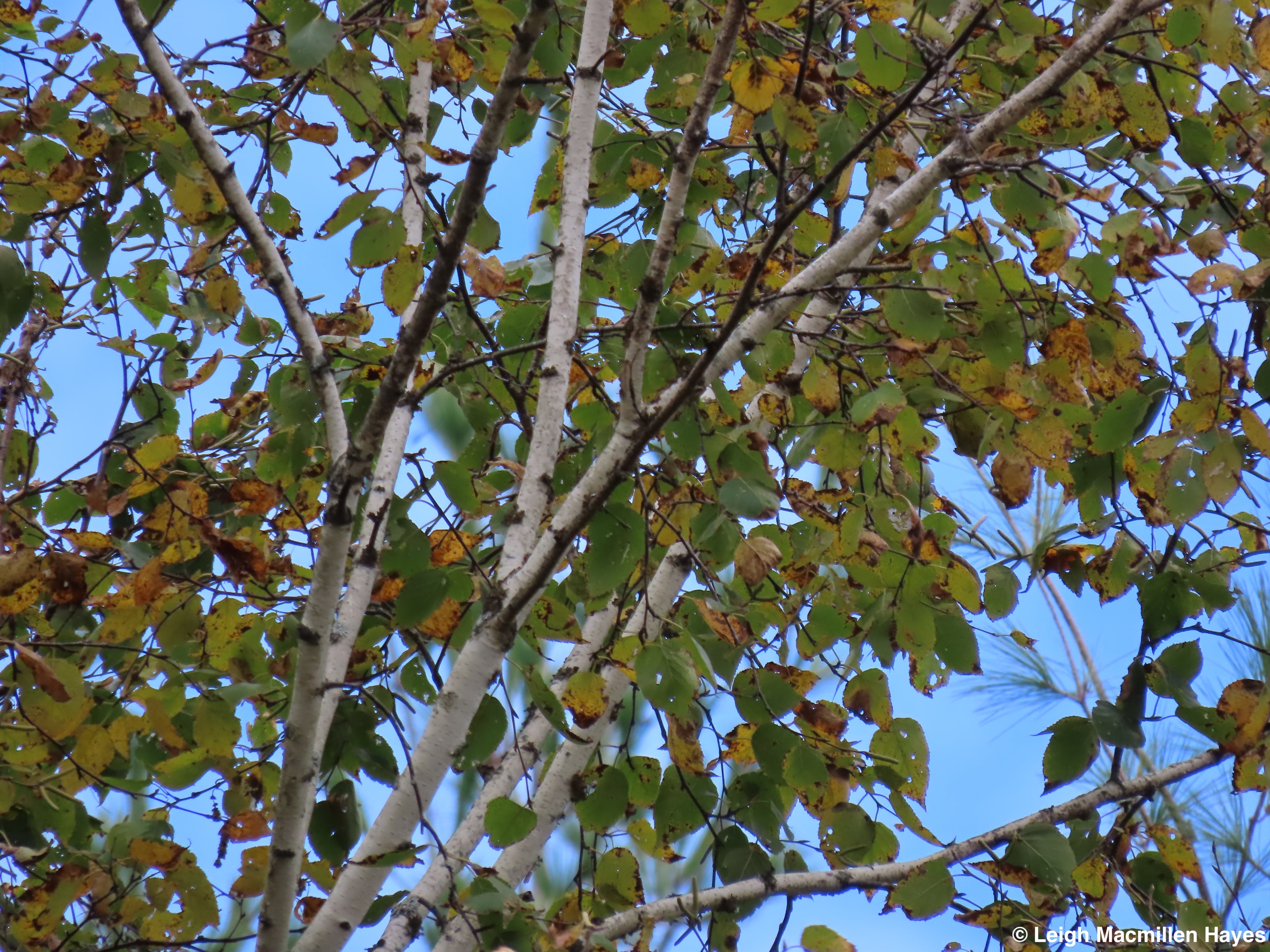
7-spotted wintergreen patch

While we know it to be rare and endangered in Maine, it grew abundantly under the pines on the slight slope beside the river in New Hampshire, and we rejoiced.

8-spotted wintergreen capsules

Its newer capsules were green, but a few of last year’s woody structures also graced the forest floor. Reseeding helps the plant propagate, but it also spreads through its rhizomes.

9-maple-leaf viburnum

Everywhere we looked there was a different sight to focus our lenses and we took photo upon photo of the variations in color of some like Mapleleaf Viburnum (Viburnum acerifolium), a shrub with three-lobed maple-like leaves and small white flowers in the spring that form blue fruits in the early fall and had been consumed, only their stems left to tell the story.

10-red maple leaves

Red Maple (Acer rubrum) leaning over the river offered their own hues that bespoke autumn.

16-platter sized mushrooms

And tucked into a fungi bowl, we found the yellow form of Sugar Maples (Acer saccharum). 

11-Saco River with Moat Mountains in background

Onward we continued with the river to our left, outlined with maples and evergreens, and backdropped by the Moat Mountains.

12-small pond stained glass window

And to our right, a small pond where trees in the foreground helped create a stained glass effect filled with autumn’s display.

13-reflection

And once again, in the pond’s quiet waters reflections filled our souls.

14-turn around trespass

A wee bit further, we trespassed onto private land, and decided to make that our turn-around point as we got our bearings via GPS.

15-trail

Backtracking was as enjoyable as our forward motion. We had been on a trail called the Conway Rec Path, part of the Mount Washington Valley Rec Path, intended for walking, running, biking, snowshoeing, cross-country skiing, bird watching, wildflower viewing , tree study, plus river and mountain views. Kennett High School athletes ran past us and we encountered couples out for exercise. None took their time as we did, but that’s our way and occasionally we ventured off trail because something caught our eye.

9-rock carvings match the waves

Meanwhile, the river continued to flow, as it has for almost ever, and the water continued to carve patterns yet to be seen, but we enjoyed those that reflected its action.

17-old silver maple

Back at the parking lot, we were wowed by a Silver Maple (Acer saccharinum), its girth suggesting an age older than a century.

18-silver maple buds

As had been the case all along the way, we experienced another wow moment when we realized how developed were the flower and leaf buds already. We know they form in the summer, but . . . they looked ready to pop!

19-white-throated sparrow

As we stood and admired, a flock of Juncos and White-throated Sparrows flew from one spot to the next as they sought seeds on the ground. Occasionally, the sparrows paused for a moment.

20-2 white-throated sparrows

And then moved on again.

21-Eagle over Moose Pond

At last it was time for us to move on as well and head for home, my friends’ to their mountainside abode in New Hampshire and me to my humble house on the other side of the Moose Pond Causeway. But as I always do when making the crossing, I looked up.

22-immature Bald Eagle

And was honored by a sighting that pulled me out of my truck. The immature Bald Eagle I’d watched and listened to all summer graced me with another opportunity to view it.

One scene after another, it was a delightful autumn afternoon. Thanks P&B, for the sharing a new trail with me and providing many moments to pause and focus.

Mondate Challenge

It was a mere drizzle when we stepped outside and walked to Pondicherry Park, but eventually we needed to pull up the hoods of our raincoats. Our journey was rather quick as we followed first the Snowshoe Hare trail, and then the Pasture Trail, which led us to the Stonewall Loop, where two thirds of the way around, we diverted.

1-crossing onto LEA property

Our main intention had been to cross over the stonewall that marks the park’s boundary and explore the Pinehaven Trail owned by Lakes Environmental Association. It is on this land that the Maine Lake Science Center is located, but there are other cool features as well.

2-You Are Here

As the first sign informed us, we had arrived. And you can see by the moisture that it was raining in earnest.

3-park rules

Funding for the Pinehaven Trail signs and low-element course was provided by LEA Board Member Roy Lambert and his wife Mary Maxwell, summer residents of Bridgton who have made a huge impact on protecting the lakes and ponds we all love. Roy has brought the LakeSmart Program to LEA and Mary has spearheaded LEA’s invasive plant patrols.

Despite the fact that the sign warned us the course is “dangerous when wet,” we decided to test it out. After all, we were accompanied by a leaf as indicated.

4-Birds on a Wire

Broken into four wonderful sets, each offering a variety of activities, we began by becoming birds on a wire.

5-my own nuthatch pose

Though I would have liked to say that I was a Barred Owl or Cooper’s Hawk, being a Nuthatch wasn’t so bad.

6-my guy nuthatch

My guy . . .

7-walking the tightrope

was also a Nuthatch.

8-next set of challenges

Set Two meant getting more practice in the art of walking on a balance beam. It looked so easy, but with each one, the level of difficulty increased a bit as our confidence did the same . . . for the most part.

10-balance beam series

And at first, our eyes saw only a few anomalies in the woods, but once we focused we realized each leg of the course was more involved than first anticipated.

11-swinging beam

The second set found us not only keeping our balance on the beams that zigzagged through the grove, but also on a swinging beam.

12-stepping up

And then we had to step up and up and up.

14-around the white pine

One of my favorite parts was circling the tree like a rock wall climber might do.

15-tree hugger!

In the process, I got to hug the pine, not that I ever need an excuse.

13-bench

My other favorite part of Set Two was the bench. There were other benches along the trail, but I found this one to be the most aesthetically appealing. Even if you don’t want to try out the course, you can walk the trail and sit a bit. You might just see a deer–we did. And in the past I’ve seen other animals including a red fox.

16-Alanna's signs

As we walked on, not sure if there were more sets, we spied the first interpretive sign created by LEA’s Education Director, Alanna Doughty, and featuring her explanations and drawings. I LOVE them. And want to decorate my house with them. I didn’t tell my guy that. The other thing I loved about all the signage–it was mounted on rough-edged boards, adding to the natural look. Do I know the creator of those boards? A local box company perhaps?

17-third set

Much to our delight, not much further on we came to Set Three.

18-Enchanted Forest

The forest really was enchanted and we found ourselves using all four modes of operation in order to get from one piece of wood to the next.

19-tree cookie steps

There were lots of tree cookies to step on and more balance beams to conquer.

20-hopping along

Sometimes we hopped like toads, who don’t leap as far as frogs with their longer hind legs.

21-a balancing act

Other times we had to channel our inner Cooper’s Hawk as there was no place to put our hands.

22-waiting for the wires to stop swaying

And in doing so, my guy figured out that pausing to wait for the wire to stop swaying made for an easier crossing. He succeeded. (I need to sneak back and practice this one some more as my knees were a tad too shaky.) We suspected that kids run across without giving it a thought. And so our excuse–it was raining.

23-yeegads--getting higher

Though it looked intimidating at first, moving across the log was fun, but I wasn’t so sure about the beam that turned out to be the highest one yet. It felt like crossing a brook and so after he finished I asked my guy to come back and give me a supporting hand. He laughed and asked if I expected him to stand in the imaginary water. Yes! Chivalry at its best. Once I started across while grasping his hand, I felt rather confident and soon let go. At the other side, I rejoiced in my success. And thanked him, of course.

24-clean water

Onward still, we encountered another one of Alanna’s signs, simple yet informative. And still, we were accompanied by a leaf. And no, we didn’t place the leaves on the signs.

This sign struck me as extremely important, not that the others weren’t. But . . . clean water is what the Lakes Environmental Association is all about.

26-Paul Bunyan's Playground

At last we reached the final set, or first if you approach from Willet Road. Again, a leaf ;-)

As for how good would we be as lumberjacks? Well, my guy would pass. I’d almost get there, but I have to work on my log rolling skills.

26a-variety of swings

What I liked about the final set was not only the focus on various types of trees, but also that the same theme was executed in a variety of ways and so we crossed another swinging step bridge.

27-I got this!

Sometimes, the choice to be a Nuthatch or Barred Owl didn’t exist and we had to become Cooper’s Hawks as we had nothing to grab onto while moving forward.

28-now you don't see him

There were opportunities to be apes as well and then disappear around the back sides of rather large pine trees, their girth indicative of the fact that the land had once been agricultural and the trees grew in abundant sunshine after it was no longer farmed. So, do you see my guy?

30-now you do

Now you do! Circling around that tree was as fun as the first and it had ash tree foot and hand holds.

31-Me Tarzan

He Tarzan! And notice how the piece he was about to step onto was set on a log. Yup, it was a foot seesaw. There were several and we really liked them.

32-rope climbing, log rolling

The last set included climbing a rope to the upper deck and then descending the ladder to another and on to a balance beam and then the log rolling. He did it all. I saved the wet log for another visit.

33-Mast sign

Just beyond the final set was Alanna’s last sign and a hot topic this year since last year’s mast crop of white pine cones, acorns, maple samaras, and beech nuts have meant a banner year for squirrels and mice. Remember, those little rodents don’t have as much food this year and they’ll become food for the predators and nature will try to balance itself once again. Oh, and not only are Alanna’s drawings beautiful but her humor and voice come through in the interpretive signs.

34-across the boardwalk and back into the park

As for us, we had finished our balancing act, crossed the science center’s driveway, followed the second portion of the Pinehaven Trail and wound our way down to the board walk that passes back into Pondicherry Park. From there, we found our way home.

What a blast. I think we were both a bit let down that we’d finished the course.

Thank you LEA, Alanna, Roy and Mary, for providing us with a delightful Mondate Challenge . . . even in the rain.  My guy and I highly recommend the Pinehaven Trail.

Yo, Brooklyn!

Past visits to New York City have always included museums and shows, but this weekend we followed a bit of the familiar path and sometimes took the trail less touristy in an attempt to get to know the area better.

2-Manhattan in the fog

Saturday afternoon, following our arrival via a bus from Worcester, Mass., we walked across the Brooklyn Bridge to Manhattan, which was a bit veiled in fog, thus softening  ordinarily crisp lines.

1-Brooklyn Bridge

Begun in 1869 and completed by 1883, the bridge spans the East River and connects the boroughs of Brooklyn and Manhattan.

3-bridge like a spider's web

Among the throngs of people who walked or rode bicycles across, we all wove strands of thread that fit easily into the web long ago created. Some of us paused suddenly here and there, as the arachnid tried to take hold, while others tried to maneuver along the silken dragline writing messages with their feet much the way Charlotte may have within her web.

6-wildlife on the bridge

And a few got caught up by the constrictors waiting at the center.

7-onto the streets of Manhattan

At last we emerged on the other side, where our attention was diverted by the architecture and colors.

8-New York Stock Exchange

Often, it was the interaction of today and yesterday that drew our notice, joined together as they were with a global reference.

9a-entrance door to St. Patrick's

Eventually, we passed through the doorway of St. Patrick’s Cathedral . . .

9-St. Patrick's Cathedral

where many have gathered for centuries to light candles in memoriam of those who have passed from this layer of life to the next and prayed for the future.

11-view from Central Park

And then we slipped into Central Park, where we were again struck by the architecture, especially as juxtaposed against the artificially landscaped natural world.

13-goldfish

As we watched the Mallards and Canada Geese, one of our biggest moments of awe was for a goldfish–the largest we’d ever seen.

Eventually, we boarded a train and found our way back to Brooklyn, where a quiet evening awaited.

14-the bridges from below

Sunday morning found us passing below the Brooklyn Bridge, where we could glimpse  the more “modern” Manhattan Bridge in the distance.

15-skyline from the promenade

Again, the skyline was muffled, but its edges softened.

16-spider web again

And once more we looked with wonder at the web construction.

17-river boat NYC style

Ever so slowly, we moved away even as a paddlewheeler representing the south made its way north.

18-cormorants and gull

Despite our thrill at watching water taxis, tour boats, jet skis, sailboats, powerboats, and even a police boat move up and down the river, the local Cormorants and a Herring Gull took it all in stride.

19-cormorant preening

After all, they had feathers to preen.

20-Canada Goose

And the Canada Geese–a grassy park to foul. The irony was that no dogs were allowed, but the geese made themselves quite at home.

22-offices of many sorts

Above the Cormorant/Gull condos, Lower Manhattan gave way to the harbor, and we enjoyed the view from the Brooklyn Heights Promenade.

26-Lady Liberty

Our perch included the sight of Lady Liberty as she greeted all.

24-Queen Mary 2

And another grand lady, the Queen Mary 2. The last time I saw the QM, it was a previous rendition and she’d anchored in New Haven Harbor (Connecticut) in the summer of 1979. My father, sister, and I drove into the city to catch a view and then we followed the route Queen Elizabeth, who had arrived in town for a very brief visit, would take before departing from Tweed New Haven Airport. Crowds lined the route and we practiced our best QE wave. Humoring us, some waved back. We did glimpse the queen as her motorcade eventually drove by and that was enough to fulfill our Anglophile envy.

27-water tank in Brooklyn Heights

But, this weekend we were in Brooklyn to admire New Yorkers, (and we knew the queen wasn’t on the boat), so we pulled our point of view back to the area around us, which included a mosaic structure worth noting. Watertower is actually a sculpture created by Brooklyn artist Tom Fruin. He used plexiglass and steel in 2012 to represent one of the icons of our nation–a water tower.

29-playing fields on the piers

From pier to pier we followed the promenade beside the river, noting natural places and sports fields filled with athletes of many talents as they played games or worked out.

30-Brooklyn Heights

Eventually, we circled back and then climbed up into Brooklyn Heights, enjoying our meander through a beautiful neighborhood.

31-sycamore tree

And my guy, he became a pro at identifying Sycamore trees for so prolific do they grow in that neck of the woods.

33-pigeons

And then, and then we encountered a flock of happy pigeons. Yes, we were in New York City and all pigeons are happy there. It has something to do with peanut kiosks perhaps?

35a-pigeon

There were the typical blue-gray birds with two dark wingbars,

35-pigeon

rusty red version,

34-pigeon

those spotted or mottled,

36-pigeon

and even pale among the gang.

34a-piegon

But really, have you ever taken the time to look at those iridescent colors?

39-piegon

Or that sweet face?

40-maidenhair tree, ginko

At last we left our pigeon admiration behind and continued on, noting another tree not in our familiar category–the Maidenhair or Gingko Tree.

41-maidenhair leaf

Its fan-shaped leaves showed off the carotenoids that had been hidden all summer by the green pigment. Fall was slowly embracing the city, but it hadn’t arrived in full yet.

42-barber shop

As we moved from a more residential to commercial area, we were surprised to find a barber shop open on a Sunday morning. Given that I’d recently written about barber shops for Lake Living, it was fun to peek inside. And note how many men waited. But, in this city where many work late each day, it made sense that they’d make time on a Sunday morning for a hair cut.

43b-hardware

Eventually, our wanderings led us to a hardware store. And not just any kind of hardware store . . .

43-True Value

for it was an independently-owned True Value, much like my guy’s.

43a-entering the hardware store

And since one of our reason’s for visiting the city was to celebrate his 65th birthday, I followed him in.

45-fig in the garden

Lunch found us eating a slice of pizza from a local pizzeria. It was OK; better than what we find in Maine, but not quite what I remember from my childhood in Connecticut. We did eat in the “garden” where figs grew! I wasn’t quite sure how that related to pizza. But . . . we were in New York.

42-intential grafitti

New York . . . a city where graffiti is understood.

44-my guy.jpg

Our day ended with dinner at a small neighborhood Italian restaurant, Santa Panza, where we quietly celebrated my guy’s birthday with the most delicious dinner.

40-rotating statues of Miss Brooklyn and Miss Manhattan

As this morning dawned, it was time for us to look out the window of our hotel and say goodbye to the two ladies who’d waved us in and would wave us out. Miss Manhattan and Miss Brooklyn rotated continuously at the intersection of Flatbush Avenue and Tillary Street.

According to a Brooklyn Public Library’s website: “Miss Manhattan sits haughtily with her right foot atop a chest of money (or jewels?); in her right hand she holds a winged globe reminiscent of a cross-bearing orb, an ancient symbol of authority; a peacock, flashiness and luxury incarnate, is by her side. (The peacock, in the belief system of the Ancient Greeks, also represented immortality/eternity.) The bows of three ships hint at the status of Manhattan as an important port and an international trade hub. She is all dignity, privilege and hubris.

Miss Brooklyn’s demeanor could not be more different. Her expression is gracious, introspective and calm; she is surrounded by a church spire (Brooklyn to this day counts more houses of worship than any other borough); a lyre and a child with a book (a reference to the borough’s patronage of culture and education). The book on the child’s lap is massive. It must be a Bible, another reference to the borough’s spiritual thrust. Her head is adorned with a laurel wreath. In her hands she holds a tablet with the Dutch inscription “Ein Drach Mackt Maght” (“In Union there is strength”), a hint at the Dutch origins of Brooklyn and at the fairly recent New York City consolidation of 1898.

The granite maidens originated on the Manhattan Bridge, but these sculptures were installed on a pedestal at their current location about a year ago. For us, they were our home monuments much as Pleasant Mountain serves as our home mountain. Not only did they welcome us and send us on our way, but we knew where we’d lay our heads for the night as we approached.

43-Yo

At last, our brief city adventure came to an end, but we trust we’ll return.

Yo, Brooklyn! Yo Miss Manhattan and Miss Brooklyn. Thanks for the welcome. Until we meet again . . .