Another Amazing Lesson From A Squirrel

Maybe I’m a slow learner. Maybe I just need the same lessons over and over again.

Whatever it is, I’m grateful for all who teach me, non-human to human, because there is always something to learn.

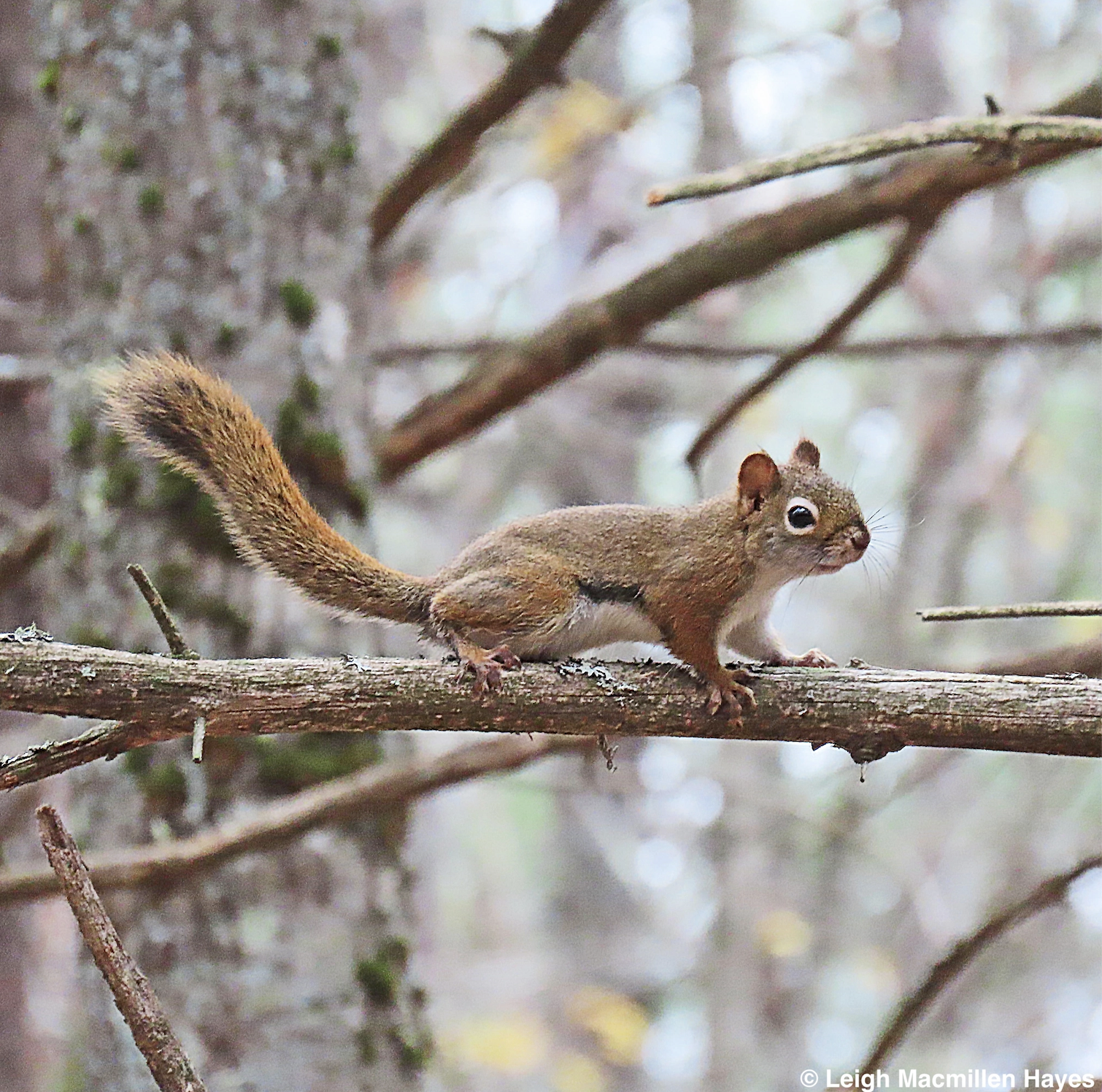
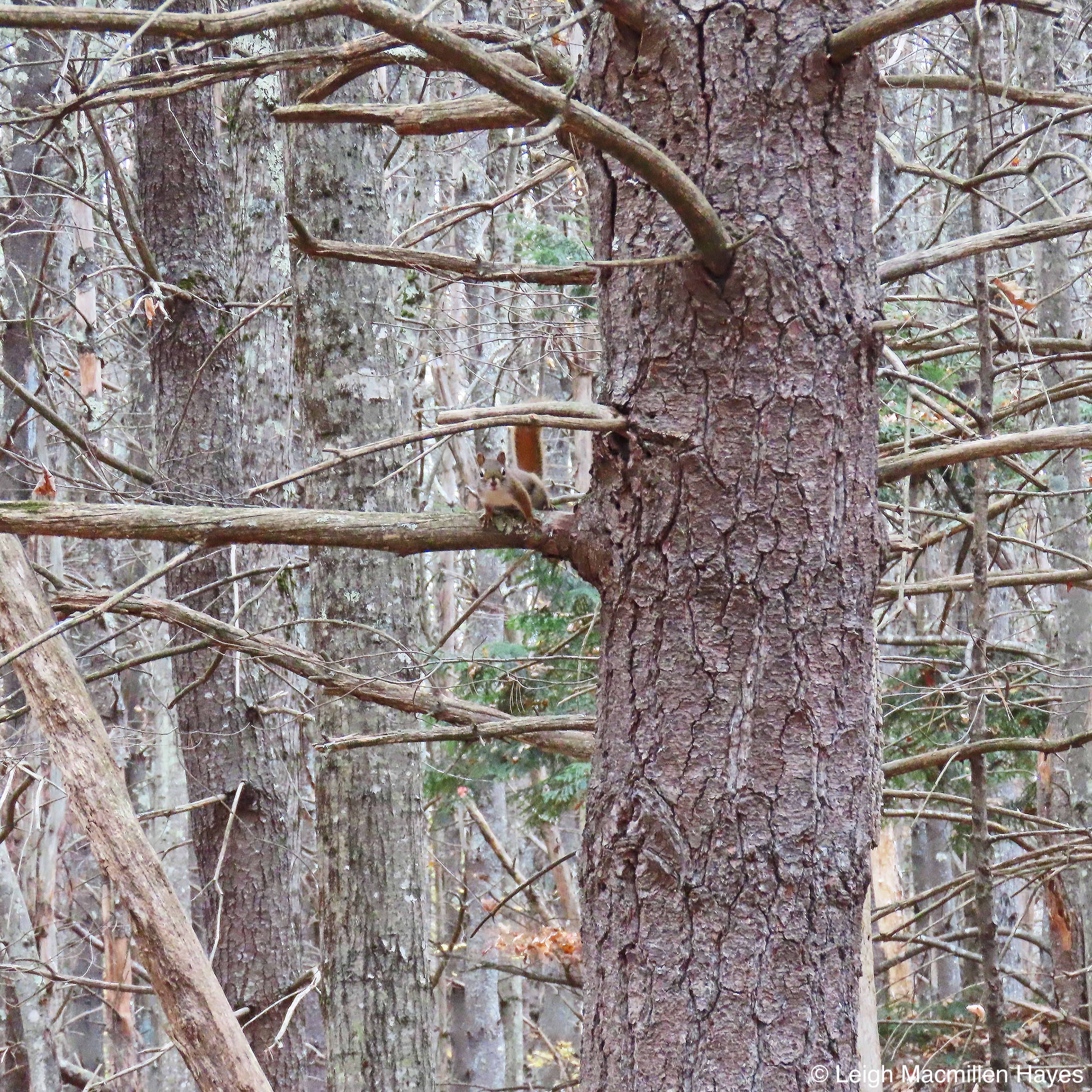
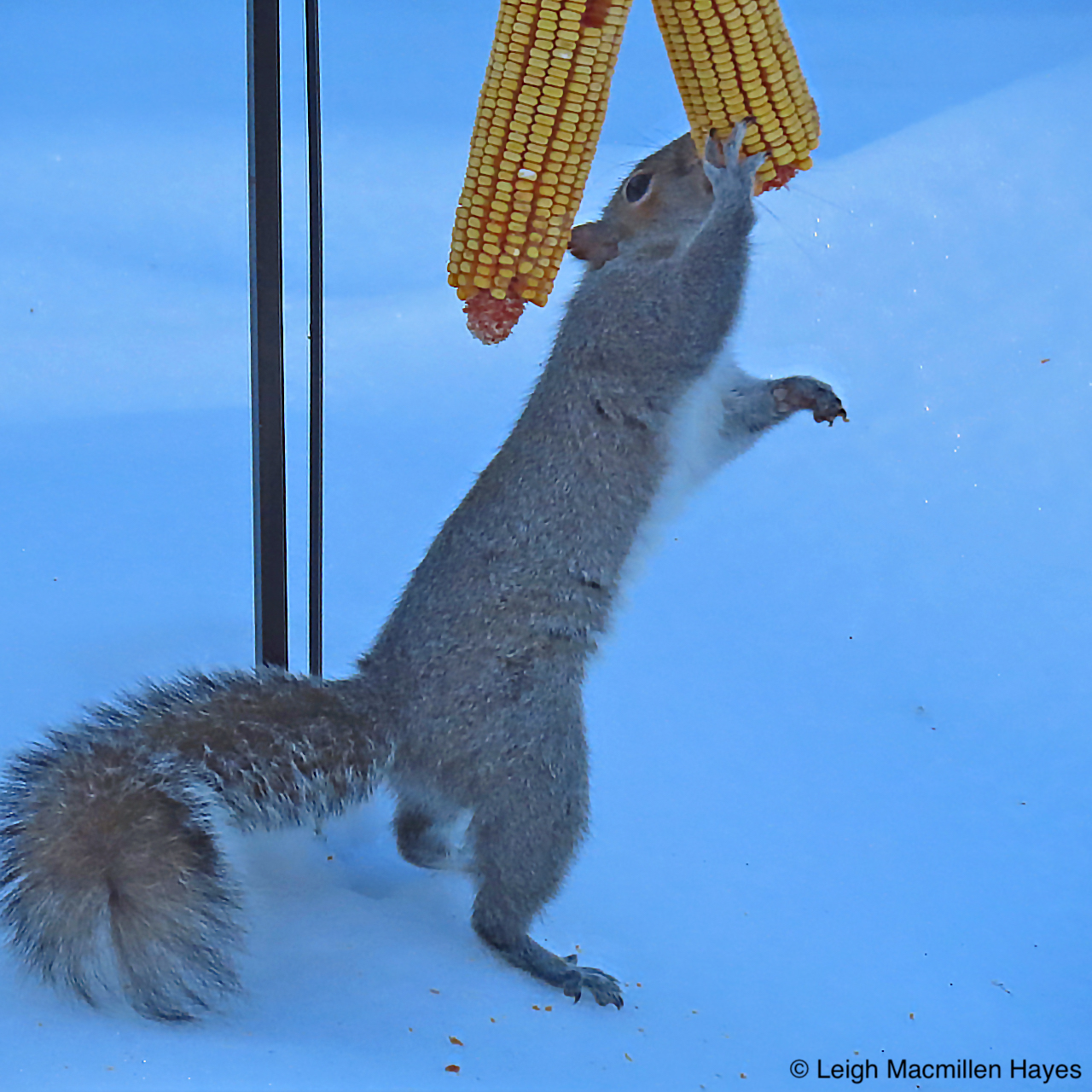
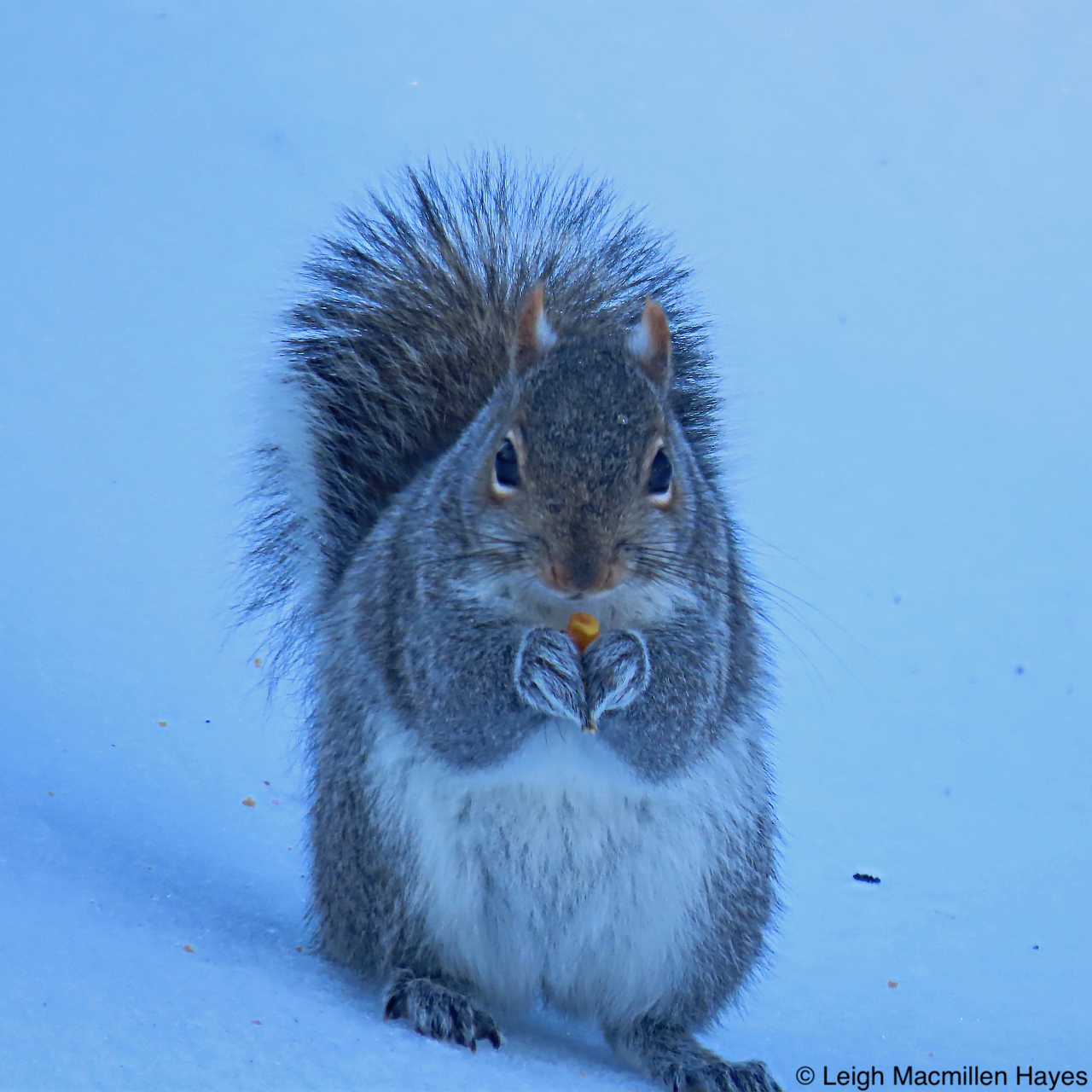
This week it was my friend Red who led the class. If you were down the hall in this outdoor school, you may have heard him, for he tends to be quite loud, and a bit critical, when he’s not dining upon a pinecone that is.

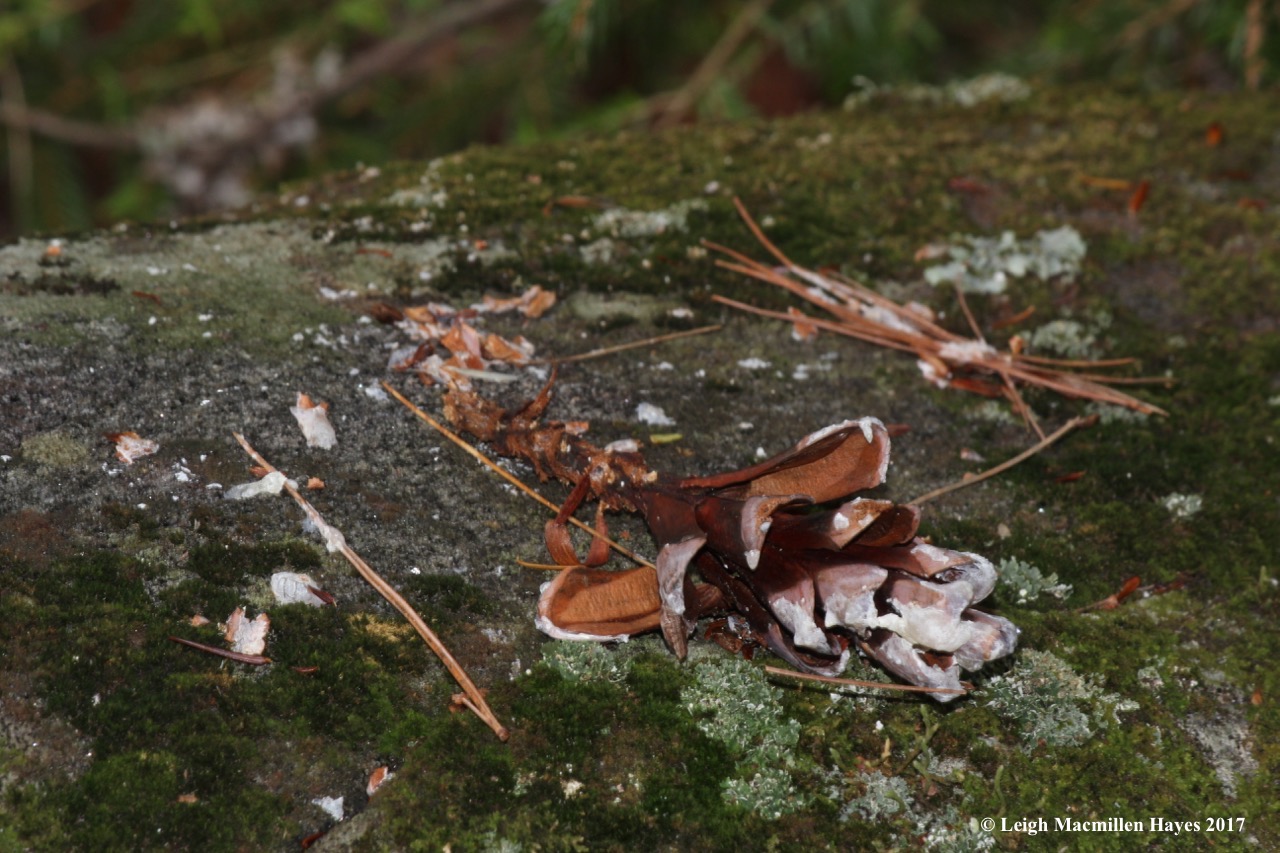
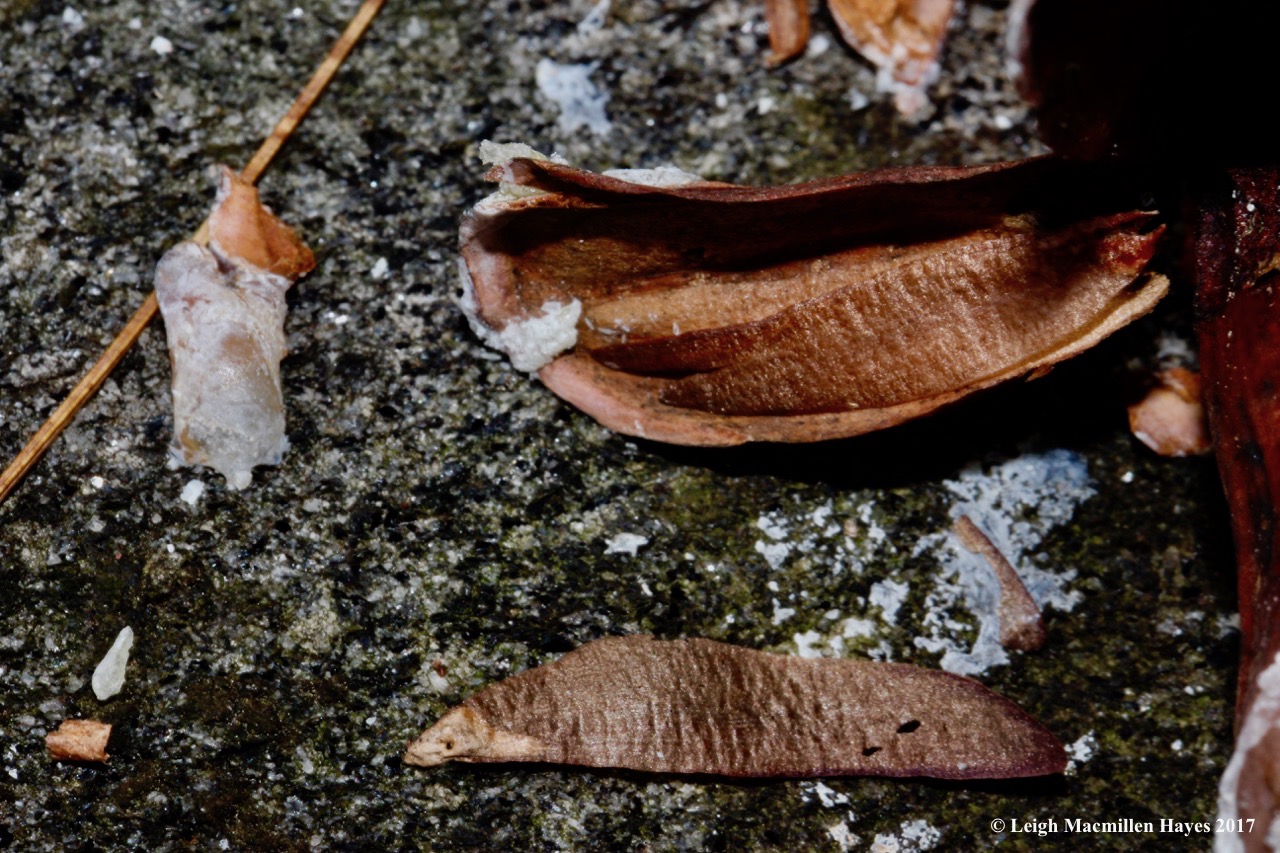
His plan, as it often is, was to strip the cone of its protective scales and seek the tiny seeds tucked in by the core or cob of the cone. Each scale contains two winged (think samara that help the seeds flutter toward the earth when its warm enough for the scales to open on their own) seeds and to me it seems like a lot of work for a little gain.

But if you’ve ever watched a Red Squirrel at work, you’ve noticed they are quick and can zip through one cone in mere minutes. Of course, it helps that they don’t worry about the “trash” and just let the scales and discarded seed coverings or pods, and even half consumed cones and cobs pile up in a garbage pile known as a midden. Spotting one of these is a sure sign you’ve entered Red’s classroom. And if you pause and look around, surely you’ll find many more middens. After all, Red Squirrels are voracious consumers. But again, given the size of the seeds, they need to be.

So here’s lesson #1: Leave the scraps. Oh wait, not on our indoor dining tables, but in the woods. And not our food in the woods, unless you are composting. But downed trees and snags and leaves and all that will replenish the earth, just as my squirrel’s garbage will do.

I should clarify that Red shares the school with many others who have their own classrooms and I’m sure when I finish my latest assignments I’ll have more to learn from the porcupines and deer and hare and coyotes and foxes and bobcats and yada, yada, yada who live under the mixed forest canopy.

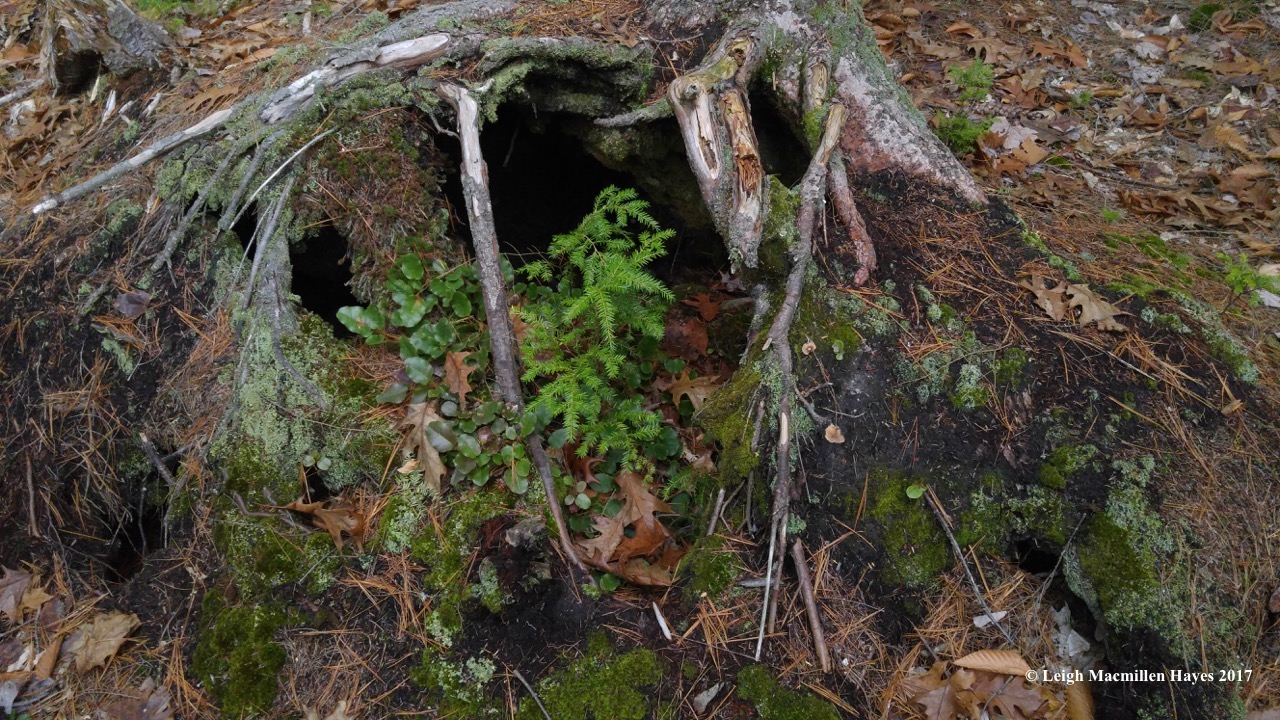
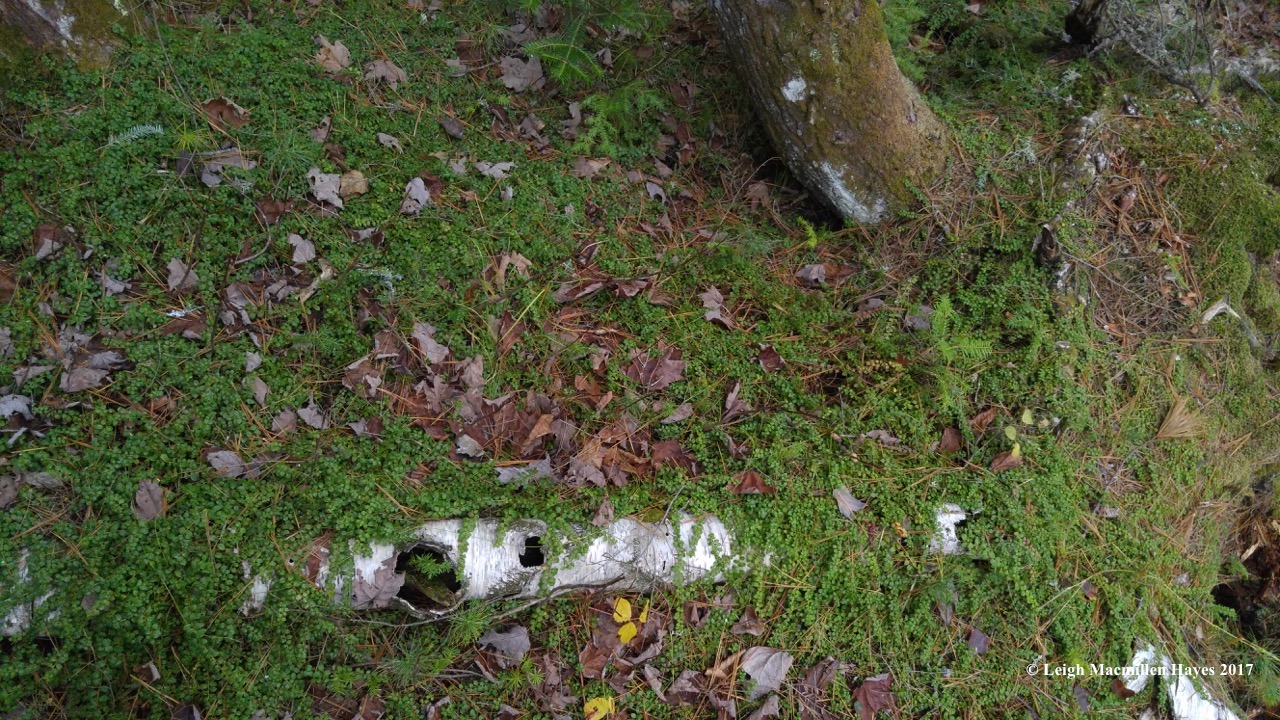
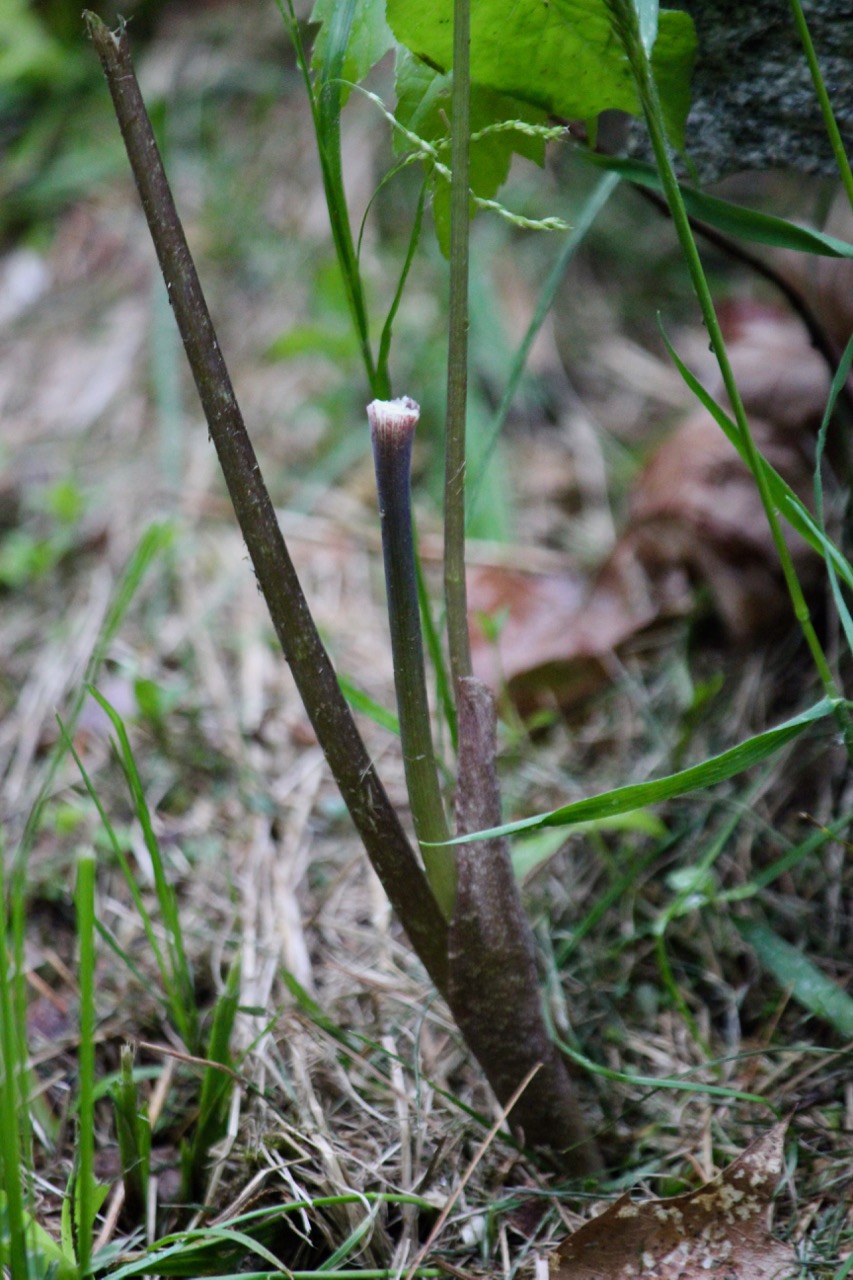
The sight of so many Eastern Hemlock twigs on the forest floor told me I’d stepped into Porky’s room so I looked for evidence, wondering if he was at his desk or not.

Lesson #2: Slow down and observe.
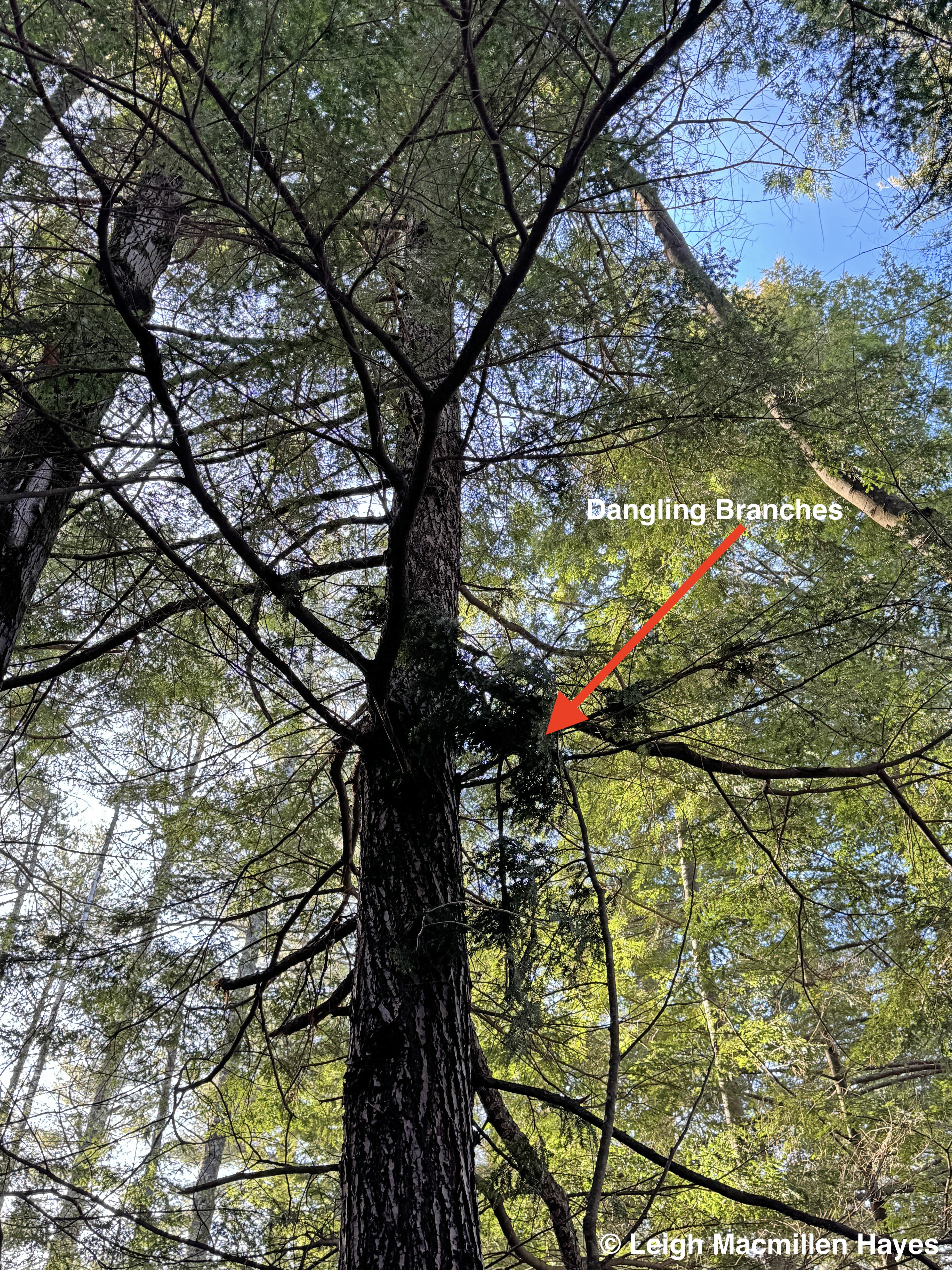
The answer was no, but he’d left his calling card on a dangling twig and so I know where I might find him should a prickly question enter my mind.
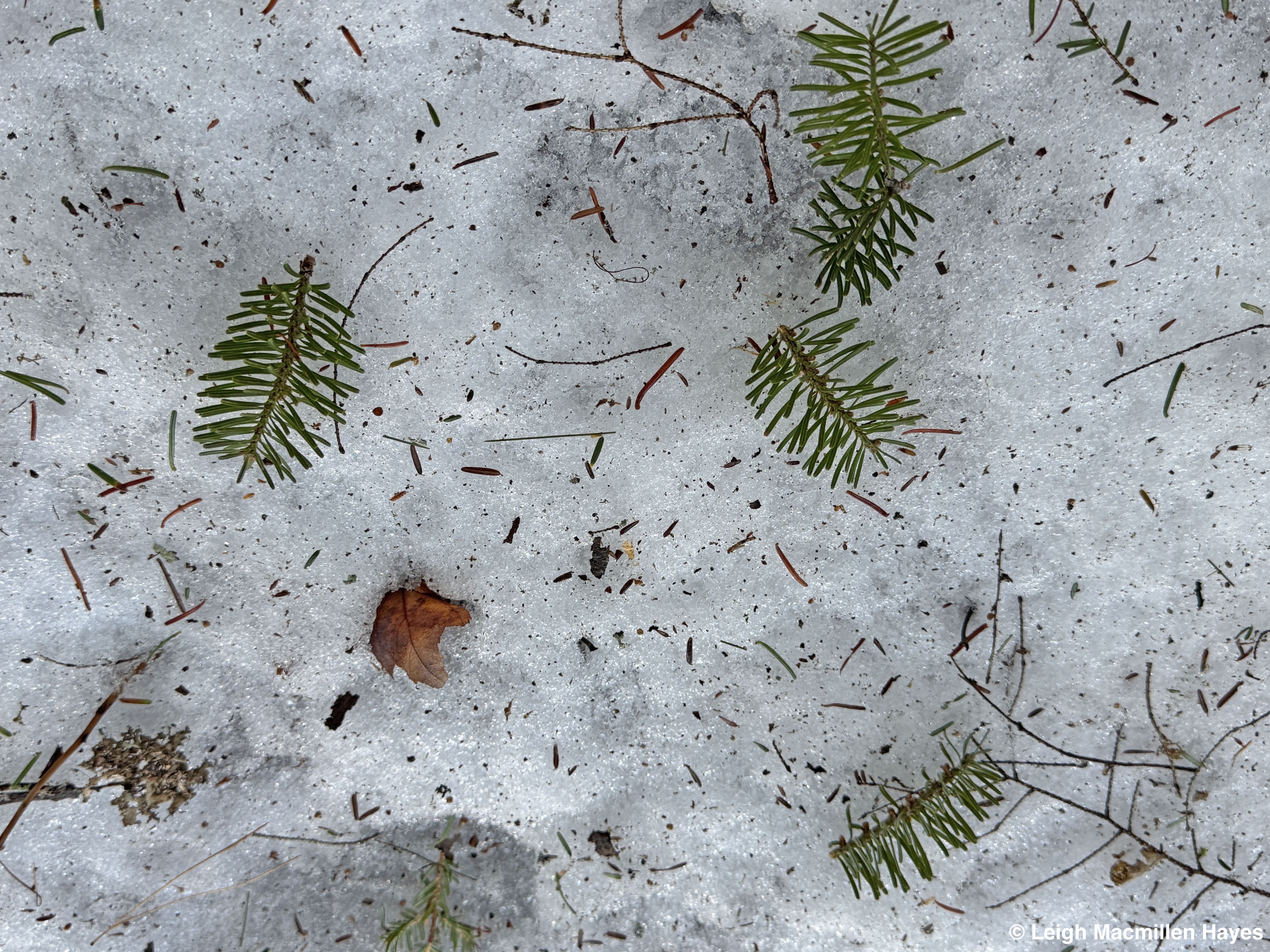
Because I was told by Red to slow down and observe, I noticed another spot where he’d visited and this time his midden was of a different sort in the form of snipped twigs. Much smaller snips than Porky drops, which is a good way to tell the two critter’s food source apart.

Just as Porky’s twigs had been cut with the rodent diagonal, so were Red’s.

I noted that he hadn’t eaten the buds at the tip of the twig, but once I flipped one over I discovered numerous buds or seed pods had been dined upon.

Lesson #3: Check twigs more often. And remember, this year was not a mast year for Eastern White Pines, so Red has to supplement with hemlock buds and cones. (And also remember, cones on hemlocks are not called pinecones because they don’t grow on pine trees. Conifer refers to cone-bearing, so both pines and hemlocks are coniferous trees.)
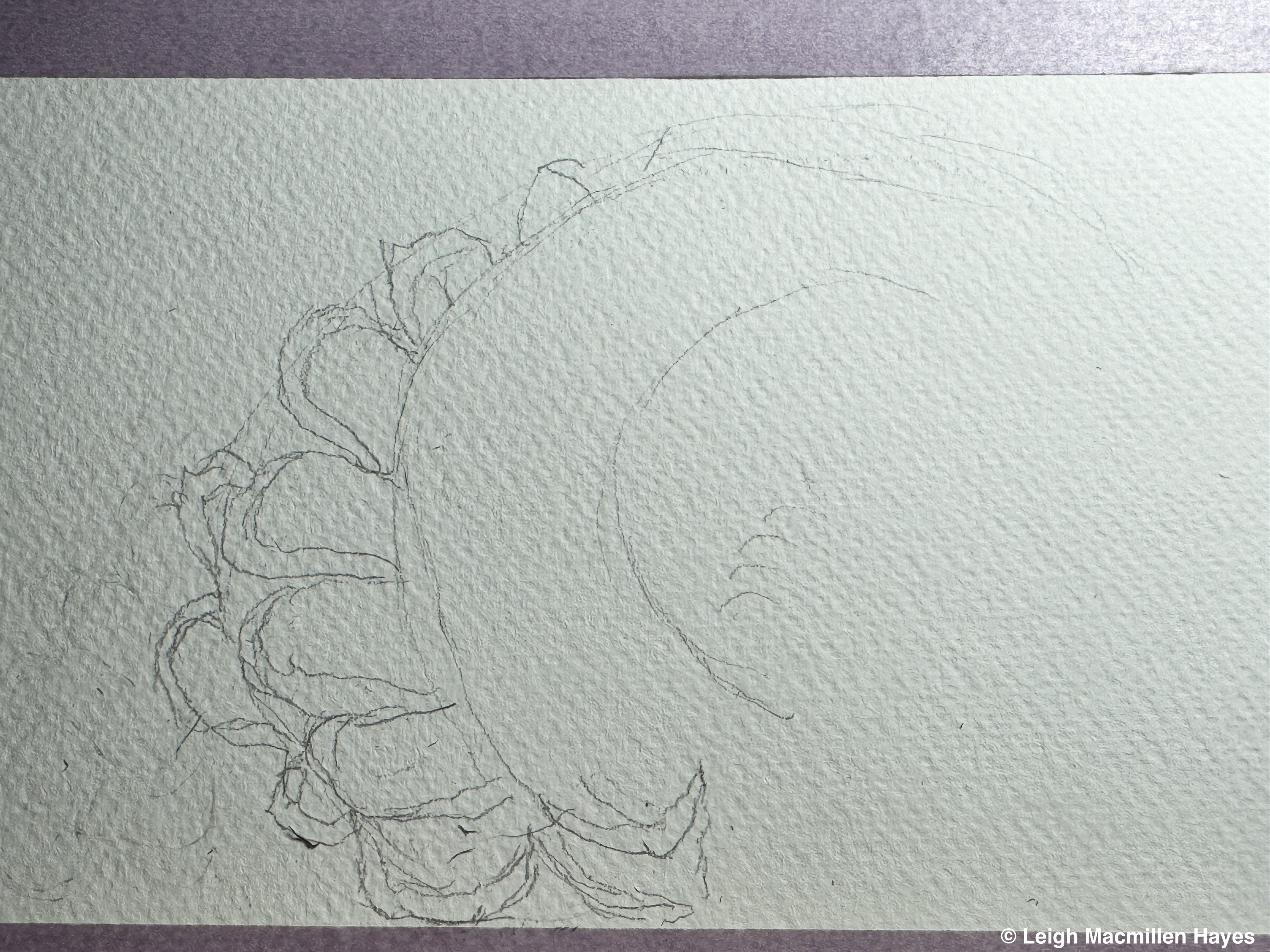
Back inside I decide to sketch a pinecone. It was a sketch I’d started months ago, but abandoned because it seemed to difficult to draw.

But then, thanks to Red, a realization came to mind.

Lesson #4: Pinecones have overlapping bracts or scales that protect those seeds developing inside of them. They close in the dark and open in light, especially on sunny days and it is then that the seeds become airborne on their samaras. And the bracts or scales grow in spirals around the core or what I think of as a cob. I knew that, but had forgotten it until I decided to sketch.

And so I drew some guidelines to aid me as I tried to recreate the cone’s spiral staircase.
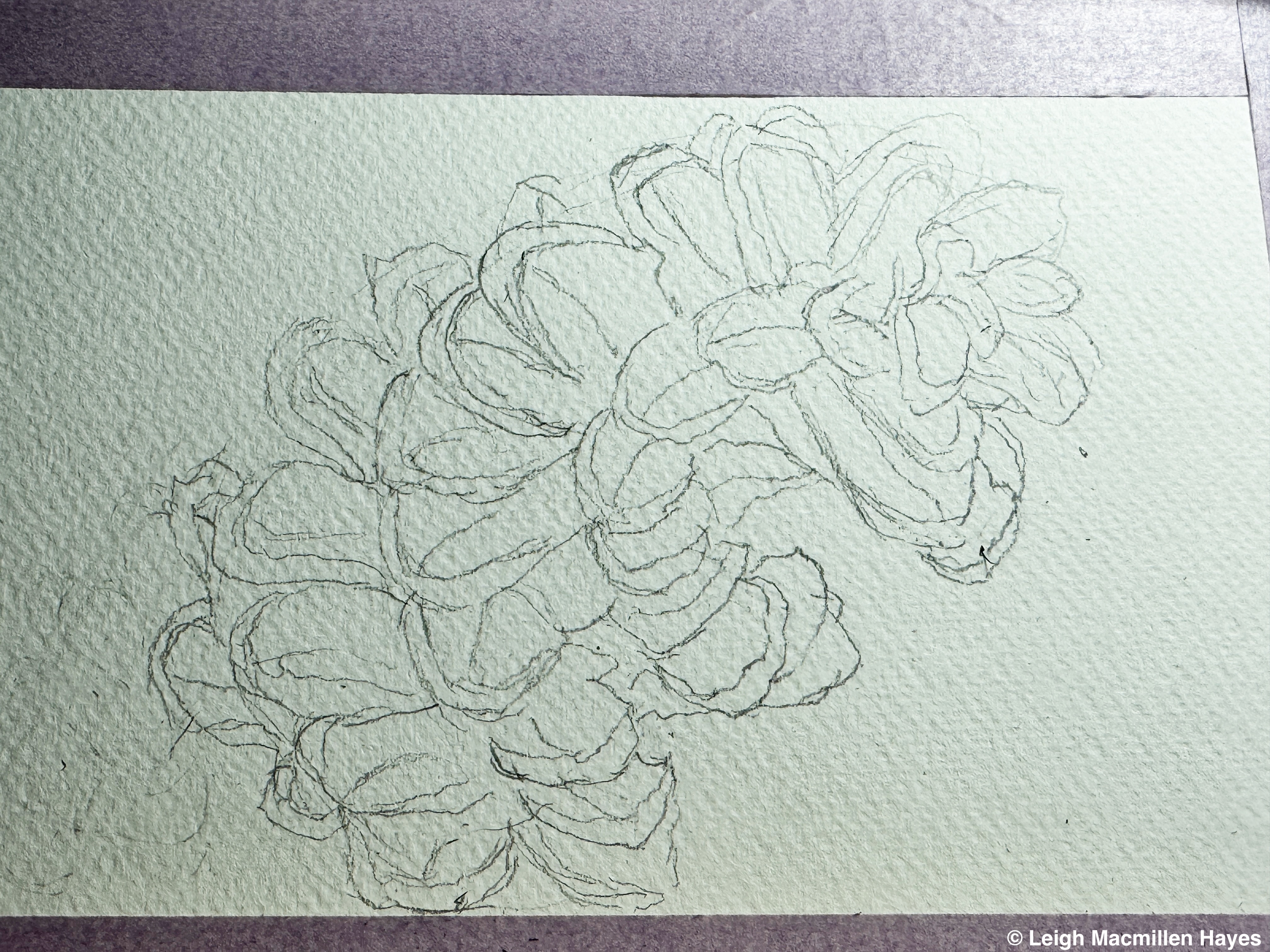
It was fun to watch it grow and realize each cone actually fans out in a Fibonacci spiral sequence. It’s an amazing wonder of nature.

Feeling my drawing was complete, I began to add color in the form of gouache paint, scale by scale.

And slowly, the painting began to represent a cone . . . at least in my mind’s eye.

A dash more color and voila–my amateur attempt at painting a pinecone. I have to admit, I was rather tickled because I really didn’t think I could pull this one off. But I have my art teacher, the talented Jessie Lozanski, to thank for giving me the confidence to try.

And I have Red, my other teacher, to thank for the lessons because it was in watching him turn the cob ever so effortlessly that I was reminded about the cone’s spiral.
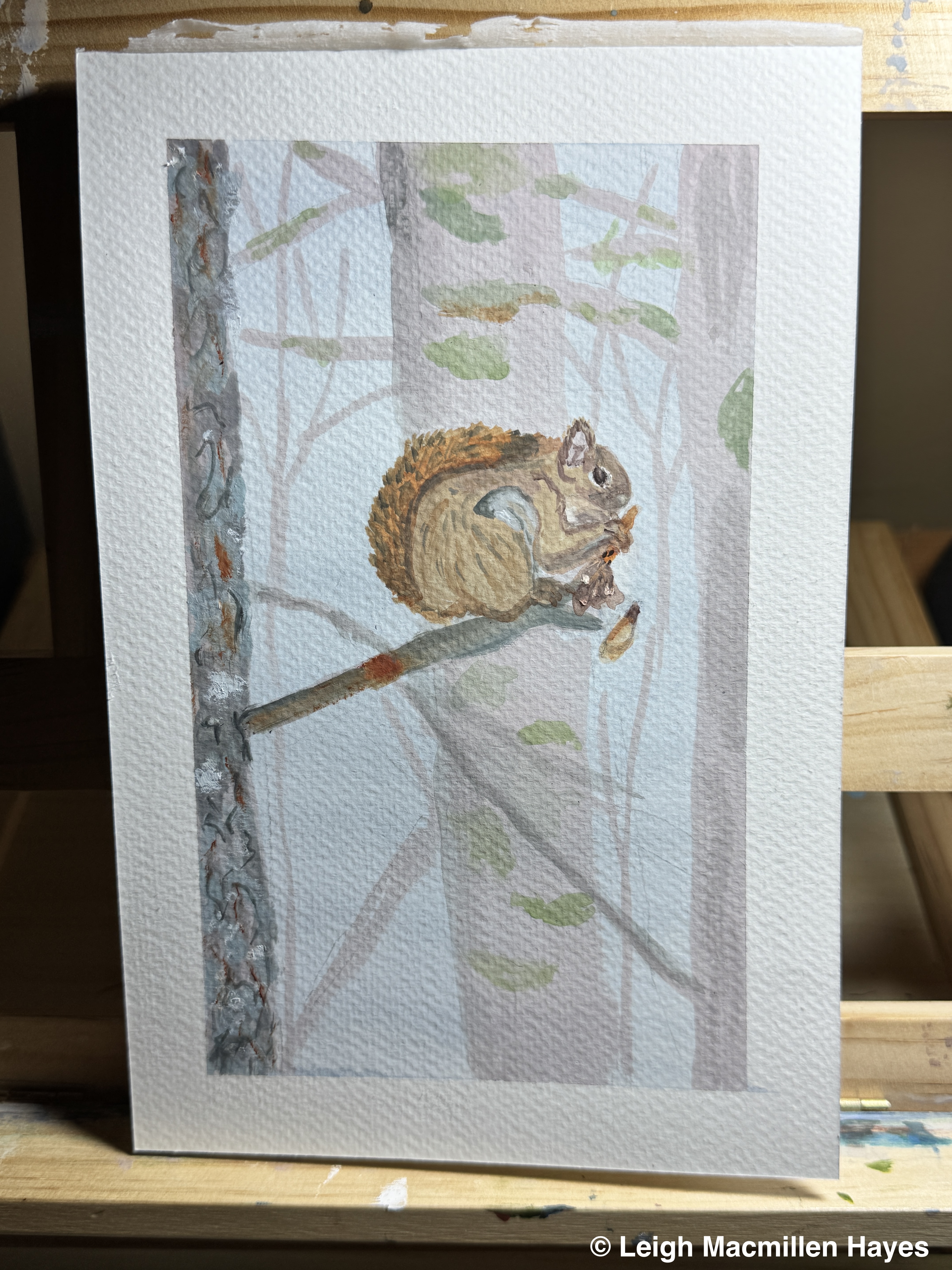
And so I tried to honor him as well. I may be a teacher, but I’ll always be a student.

Lesson #5: As we head into this new year, I hope you’ll join me in slowing down and noticing and honoring. Especially outdoors. Or even out your window.

I’m forever grateful to Red and all the other teachers who come in many forms, not just as mammals, for the amazing lessons I’ve learned and can’t wait for the next class.
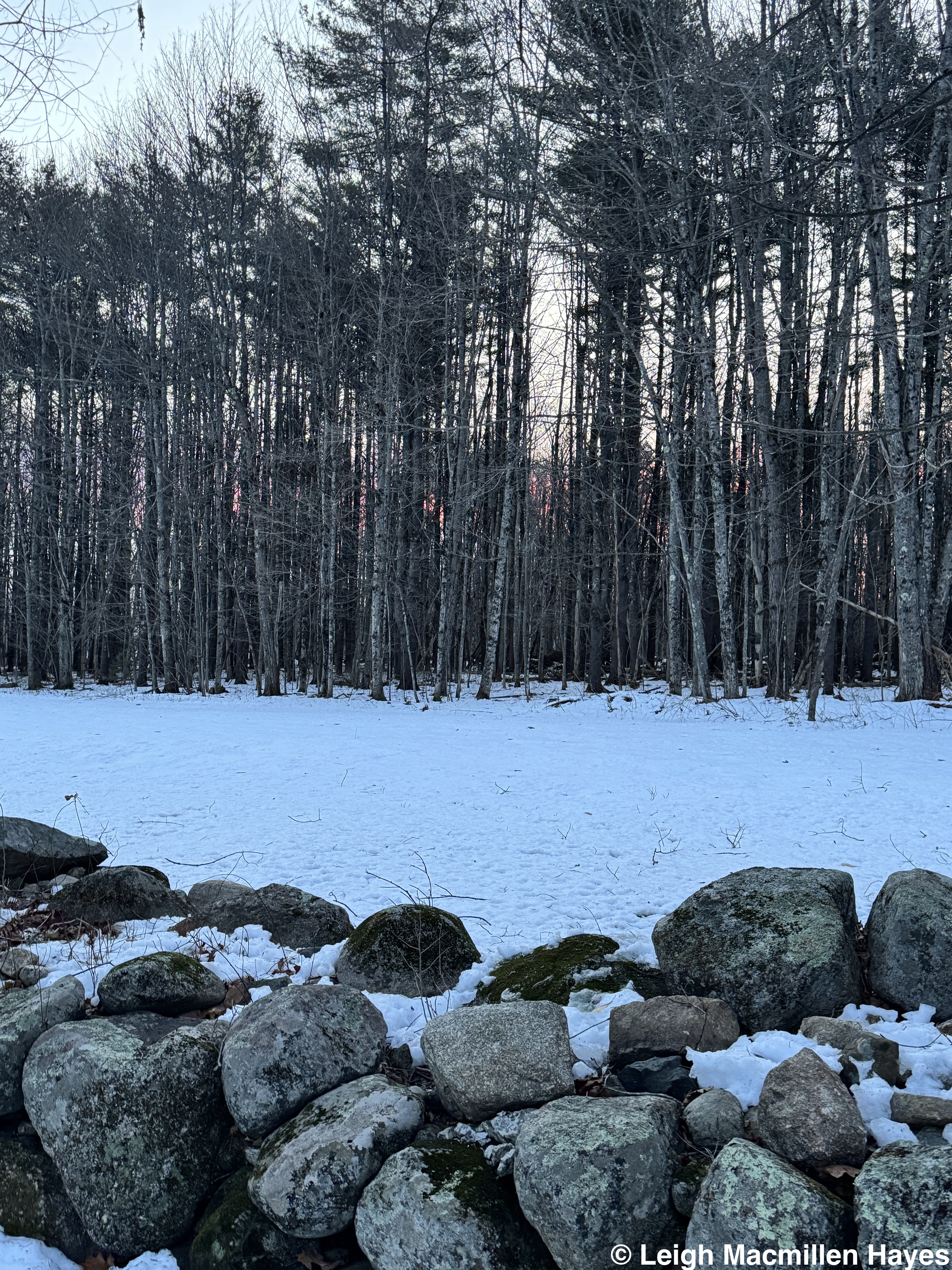
Wait. Watch. Wonder. Learn.

As I waited for the sun to rise on this final day of autumn 2024, before the dawning of the winter solstice, I watched the sky. It seemed late. Of course it seemed late. Tomorrow will be the shortest day of the year.

Ever so gradually, the sky brightened. First, there was barely a hint of light shining through the trees as if taking its time was a way to remind me to slow down.

And then I began to see it. Not the orangey-yellow I expected, but rather a blue gray that slipped out from behind the silhouettes of the tree trunks, who stand as watchers, observers, of every dawn every day.

Ever so slowly, a hint of pinkish purple rose in the East and the blue gray was transformed.

I, too, wished to be transformed. By this first light. By this new day.

And then it occurred to me that I do rejoice at each daybreak and look forward to its offerings.

Today, however, was a wee bit different as it was the day to enter a place I’ve barely visited since the spring and I felt drawn to part the hemlock boughs and venture forth into my own secret garden, that isn’t a garden at all, at least not if you expect it to be a place where flowers and vegetables are tended. Ah, but it is a garden from so many others. And its those others that I hoped to meet.

In her book entitled Church of the Wild: How Nature Invites Us Into The Sacred, author Victoria Loorz writes, “You wander slowly and intentionally. It is your full presence along the path that matters. It is an act of reverence, a saunter. John Muir hated the word hike. He urged people to saunter. ‘Away back in the Middle Ages,’ he told his friend once, ‘people used to go on pilgrimages to the Holy Land, and when people in the villages through which they passed asked where they were going, they would reply, ‘A la sainte terre,’ ‘To the Holy Land.’ And so they became known as sainte-terre-ers or saunterers. Now these mountains are our Holy Land, and we ought to saunter through them reverently, not ‘hike’ through them.”

And so I sauntered, not letting the stone walls or barbed wire stop me from crossing over manmade boundaries.

All the while, I wondered, “Who will I interact with today?” and “Will I be able to shut down my inner ramblings and really wait, watch, and listen?”

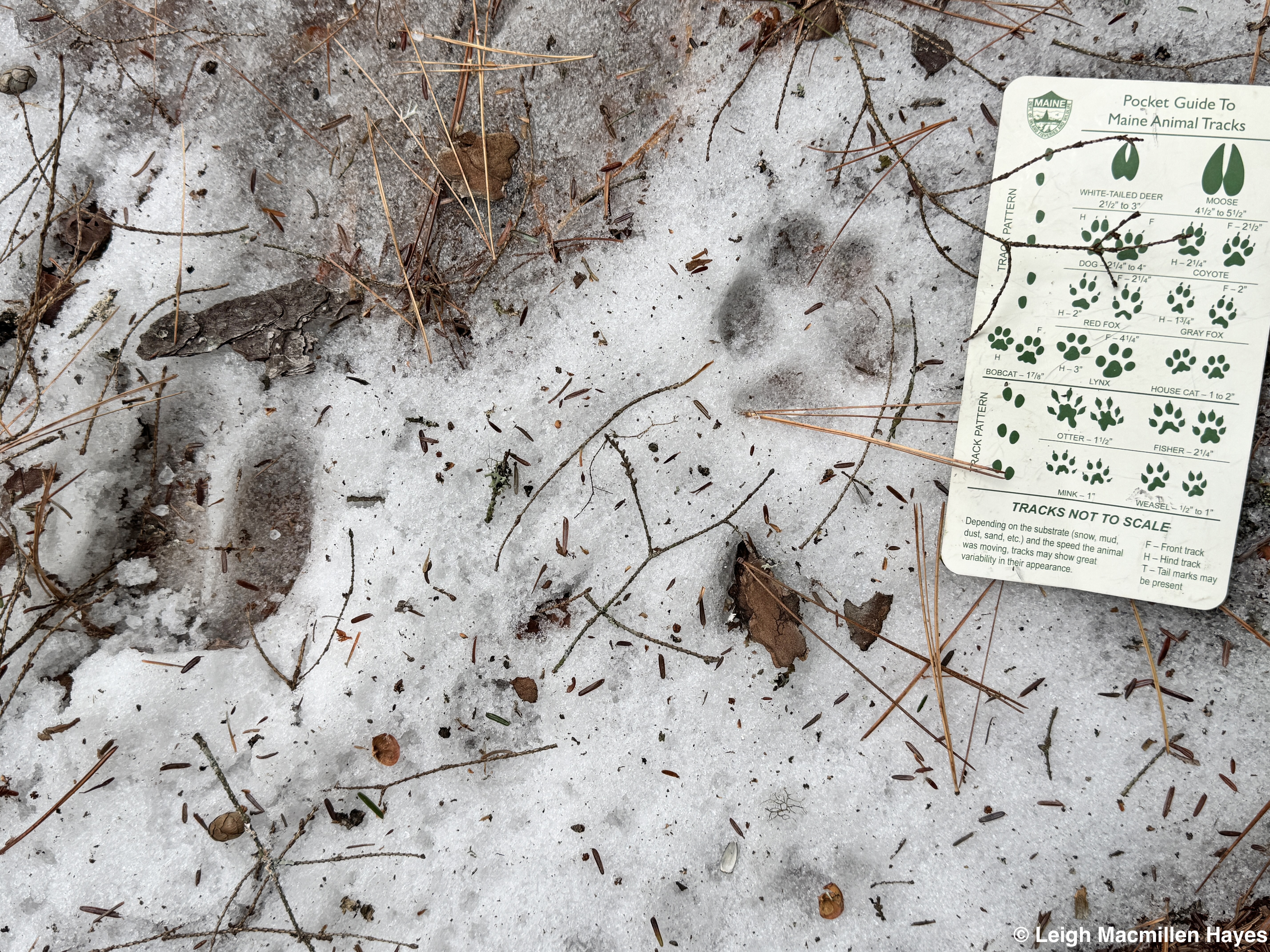
My heart quickened despite my efforts to slow my breathing, when I spotted not only the heart-shaped prints of White-tailed Deer who really own these woods, but also one who pursues them, the Bobcat.

Would I spot any evidence that though they travelled in opposite directions a day or so apart, their paths eventually crossed? That remained to be seen.

What I did know was that unless I sat for a time, I would not spot any critters because the snow conditions were such that I stood firmly on top–like walking on water–frozen water, and made a loud crunching sound with the fall of each footstep.

Those who know me well, know that I am a cradle Episcopalian. Among other things, I love the liturgy. But what I’m discovering I love the most is the shared fellowship with a diverse group of people.

And in the same way, I love the woods out my door and how each and every other-than-human being IS diverse, and how they aid and abet their neighbors, sometimes offering a helping tree limb or shared nutrients, and other times feeding upon others because they, too, need energy.

And in the forest, there is life and death, and a dead snag can be just as beautiful as a live tree. And in its death, offer space for others to live.

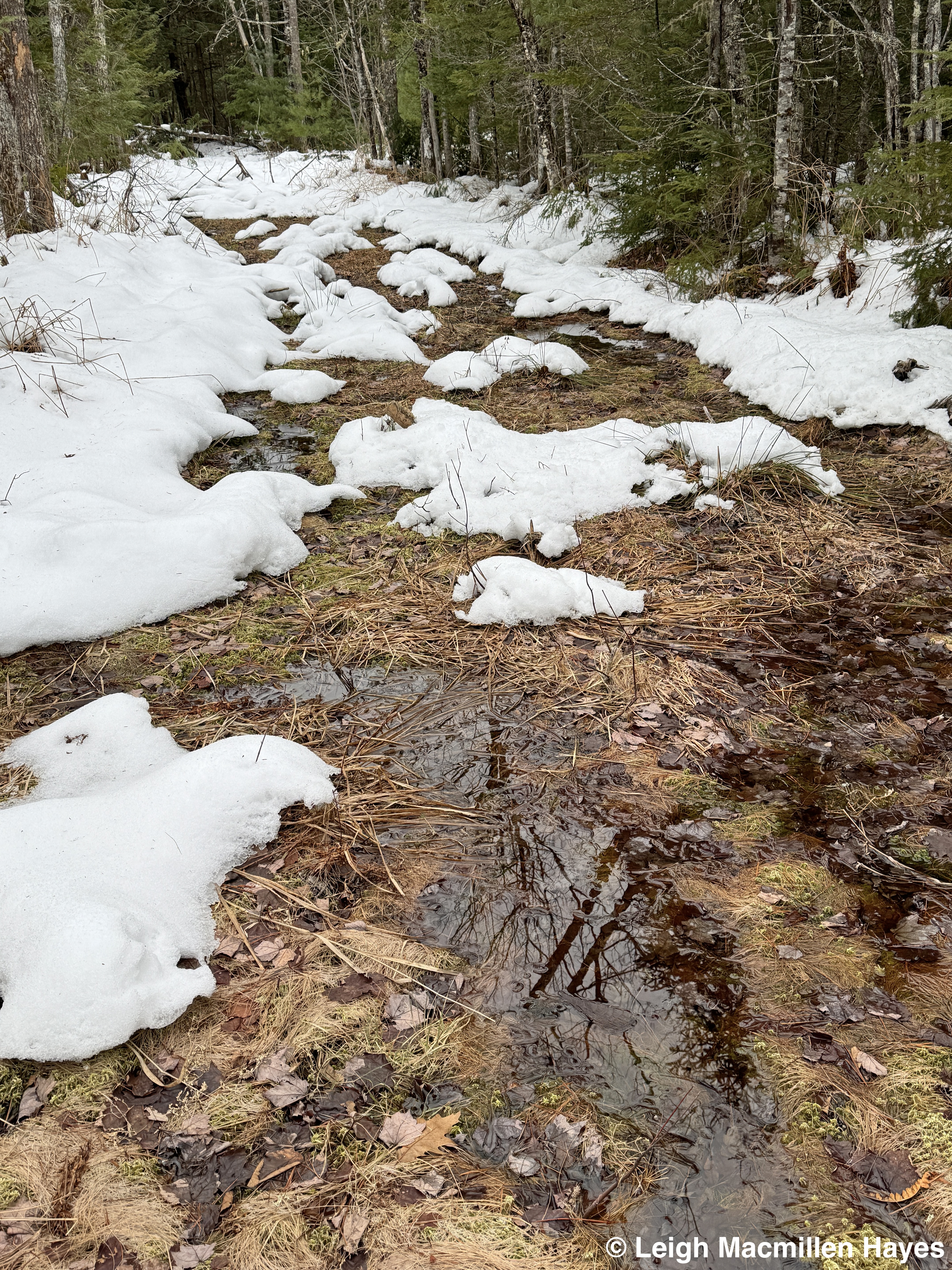
During today’s saunter, I bushwhacked sometimes and followed old logging trails in other moments. During all of my visit, I often encountered places that needed consideration for navigation, but in the pause as I gave thought to my way forward, I noticed reflections that reminded me of my desire to do the same. Take time to reflect.

I made sure to look up and down and felt a need to celebrate discoveries, such as this perfectly round Snowshoe Hare scat. Last year there weren’t many hares in this part of the woods, so I can only hope that this year will be different.

Evidence of deer activity was everywhere, from well tramped routes that generations have followed for eternity to freshly rustled up Northern Red Oak leaves indicating a search for acorns to dine upon.

What made me chuckle, however, was the realization that it wasn’t just the deer who were taking advantage of an abundant acorn crop. A squirrel had cached one here and another there–that should serve as a meal for a later day.

After searching for a friend I doubted I’d meet, and I didn’t (Porky is saving our meeting for another day), I stepped out to an old logging road and instead met another I couldn’t recall from previous saunters. Perhaps it was because I was approaching it from a different direction than my norm.

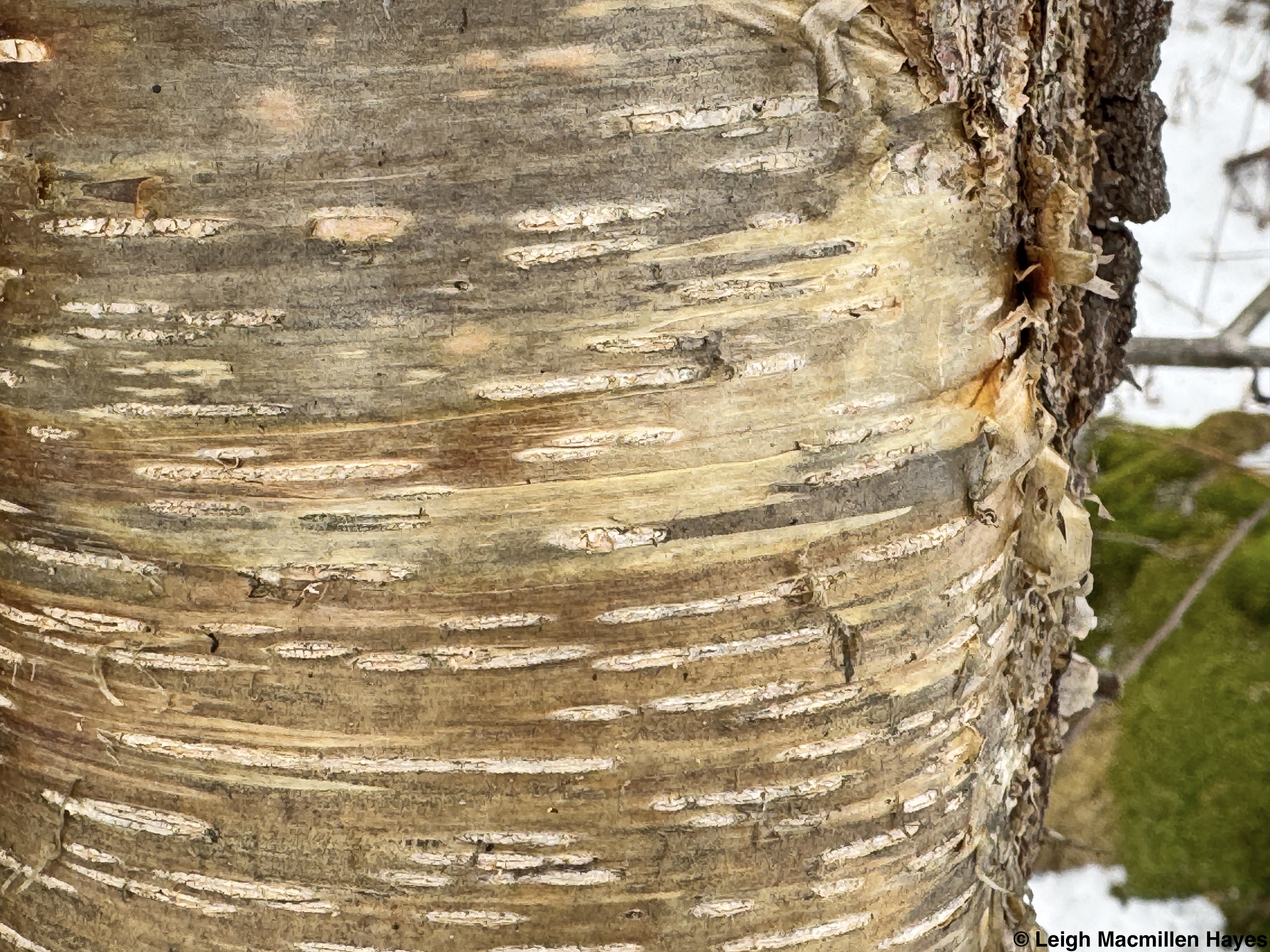
This Yellow Birch has apparently graced this spot on a boulder for many years. And though it looks as if it served as a turning tree during a logging operation about ten years ago, it still stands tall.

In fact, by the amount of catkins at the tips of its branches, it appeared the birch was full of life and love and ready to make more birches in the future.

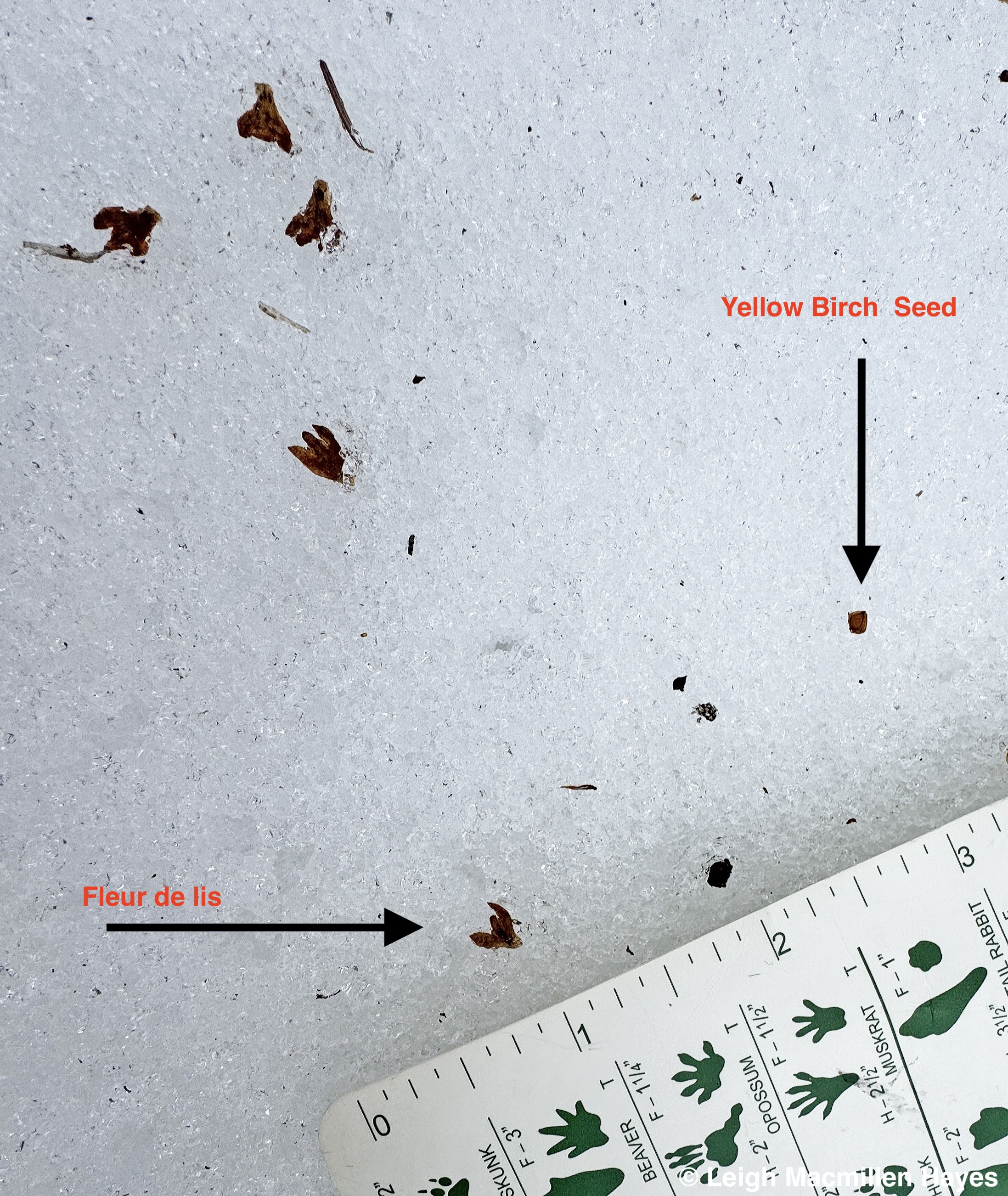
At its feet, fleur de lis scales that protected its tiny seeds had fallen from last year’s pollinated catkins and will eventually break down and add to nutrients to the forest floor.

What I am always wowed by, and today was no different, is the shape of a birch seed–which reminded me of a tiny insect with antennae. A future is stored in that wee structure and maybe this one seed will some day germinate on the boulder below it. Unless a bird eats it first. But then again, maybe it will germinate somewhere else when it comes out in the bird’s scat.

The bark of the birch made me think of landscape paintings I’ve seen from deserts far from this place in western Maine. And I realized I don’t have to go far to travel to other places.

Even as I left the Mother Birch behind, I turned back to see if I could remember it from so many other visits, because certainly it didn’t just appear today. Or did it?

Turning around again, I nearly tripped over a few fallen twigs, but it was what stood out among the dying vegetation covering the twigs that drew my attention. A random feather?

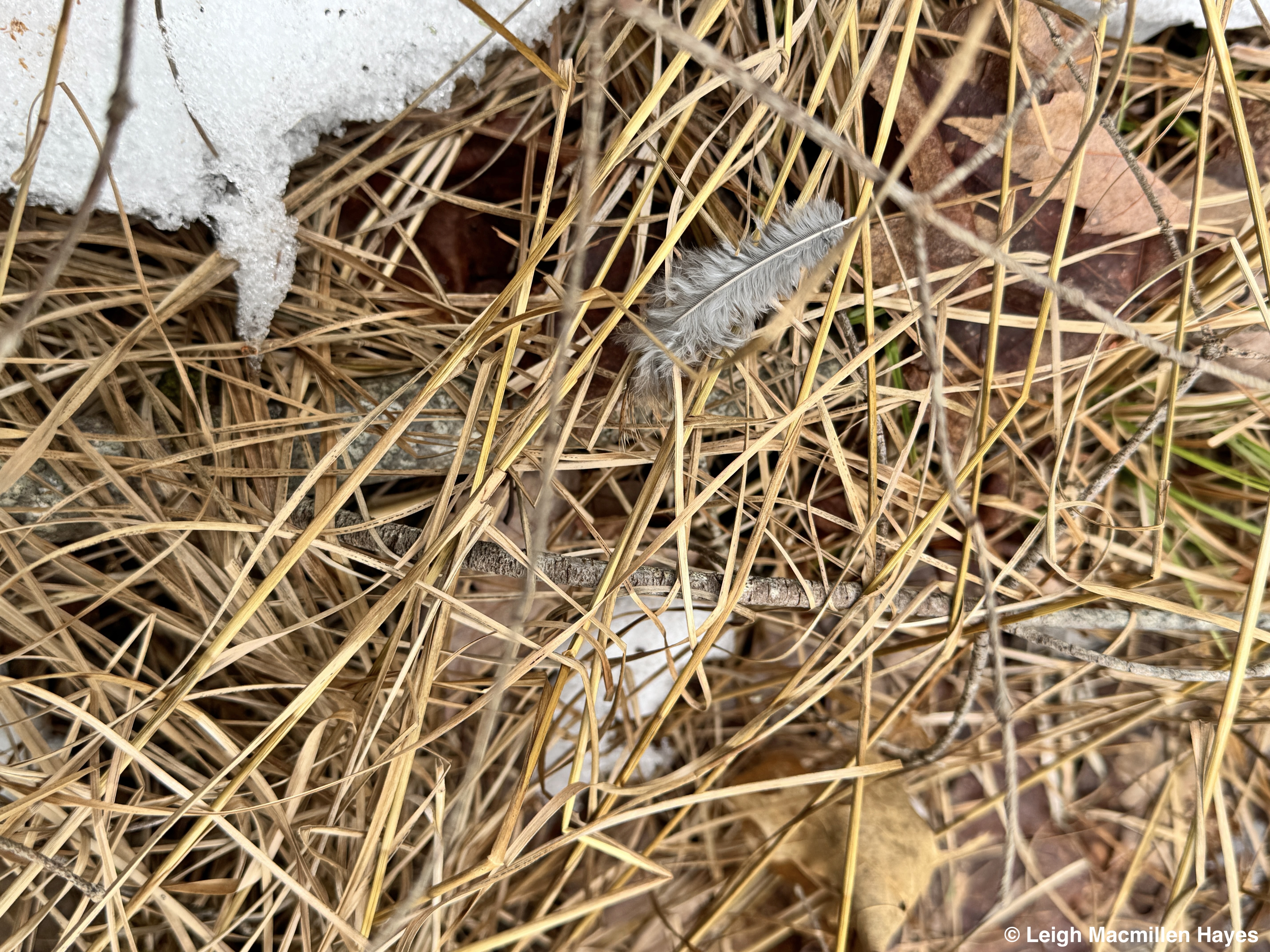
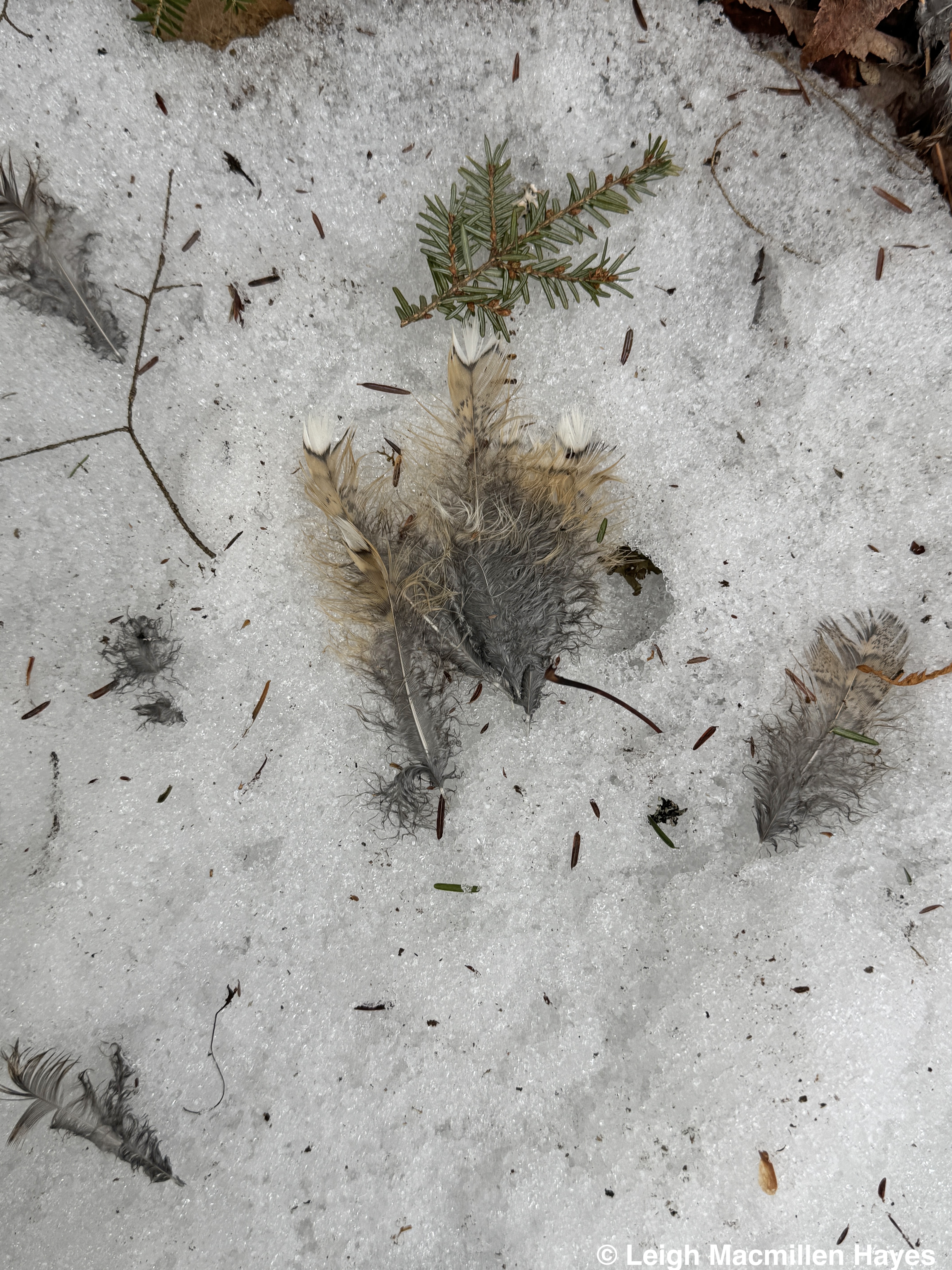
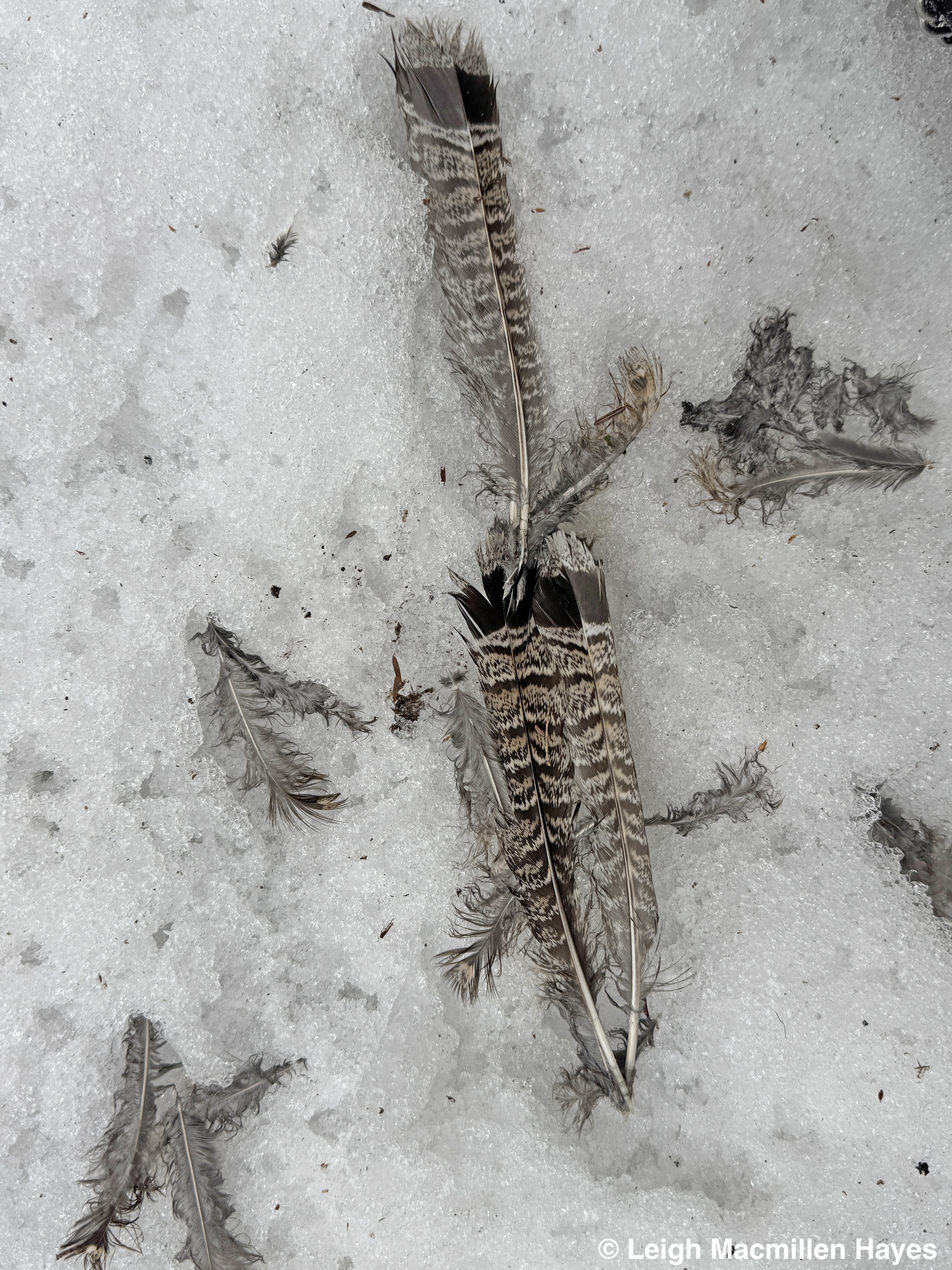
Not at all. I’d stumbled, rather than sauntered, upon a site where a bird had given up its last breath so that another critter could live.

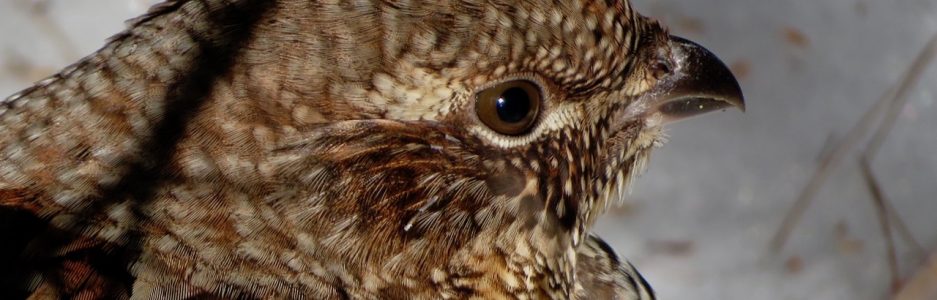
The bird happened to be a Ruffed Grouse, and I had to remind myself not to be sad about the loss because of the joule or energy units procured by another. In its death, sunshine and birch seeds and whatever else the bird had eaten provided sustenance in the form of a gift.

Of course, spotting the Ruffed Grouse’s track did give me pause for I suspected it to be the bird’s last impression.

Moving on toward a former log landing, I smiled again at the sight of another who took a risk of crossing the large forest opening, but knew enough to tunnel under the snow frequently. Was it frequently enough? Voles are everyone’s favorite food. Well, maybe not mine. But I’ve possibly eaten meat from some critter that dined on a vole and so maybe some of its joule had been passed on to me as well.

Frequently on my journey, as often happens in these woods, I encountered the one who greeted me at the start. Well, its footprints greeted me at least. But I always give thanks for such sightings for though Bobcats are solitary and elusive, knowing they are here and that we walk in the same woods and perhaps see and smell the same things makes me happy.

And then it occurred to me. I need to be more like the Bobcat and improve my waiting and watching and listening skills. I’m always in too much of a rush to see what might be next on the agenda. So much for sauntering.

As this last day of autumn 2024 gives way in the wee hours of December 21 to winter, and the sun once again rises in the East, I need to remember to be more like the saunterers. To be alert to offerings. To wait. To watch. To wonder. To learn.

Each day is a new awakening with teachings. Thank God for that.

Time Travel: Trail Until Rail

Picture this: It’s 1888. You’re in a train car on what was once the Portland and Ogdensburg Railway (P&0), but is now leased by Maine Central (MEC) and renamed the Mountain Division Trail. You are making the journey from the White Mountains of New Hampshire to Portland, Maine, with a brief stop in Fryeburg, Maine.

Off the train you hop, and suddenly you find yourself wandering down the Mountain Division Trail in the year 2024. Only, it’s not the rail bed that you walk upon, but rather a paved path beside the tracks.

And you give thanks, because this is the season of doing such, though really we should do so every day, for the Mountain Division Alliance, formed in 1994, out of concern that the rail right of way would be lost. MEC had sold the line to Guilford Transportation in 1981, about twenty plus years after the demise of passenger service. About seven years later, freight service also ended.

In 1994, The Mountain Division Alliance, under the direction of Alix Hopkins, Director of Portland Trails, “brought people together from over 20 groups. Out of this group came the vision for a rail with trail connecting the nine communities [Portland, Westbrook, Windham, Gorham, Standish/Steep Falls, Baldwin, Hiram, Brownfield, and Fryeburg] along the rail corridor from Portland to Fryeburg.”

The Alliance was started to “convince the State of Maine to purchase the rail bed right-of-way. The vision that a bicycle and pedestrian trail could be built along the rail line connecting Fryeburg to Portland came about at this time [1994],” wrote Dave Kinsman, former president of the Mountain Division Alliance in an article published by The Brownfield Newsletter.

So back to going for a wander down the trail. I did such this afternoon, and it’s a path I love to follow at any time of year, because it offers such diversity so I hope you’ll not hop right back on the train just yet, but instead wander with me.

Some may see it as the land of dried up weeds and some trees, but oh my. There’s so much to see.

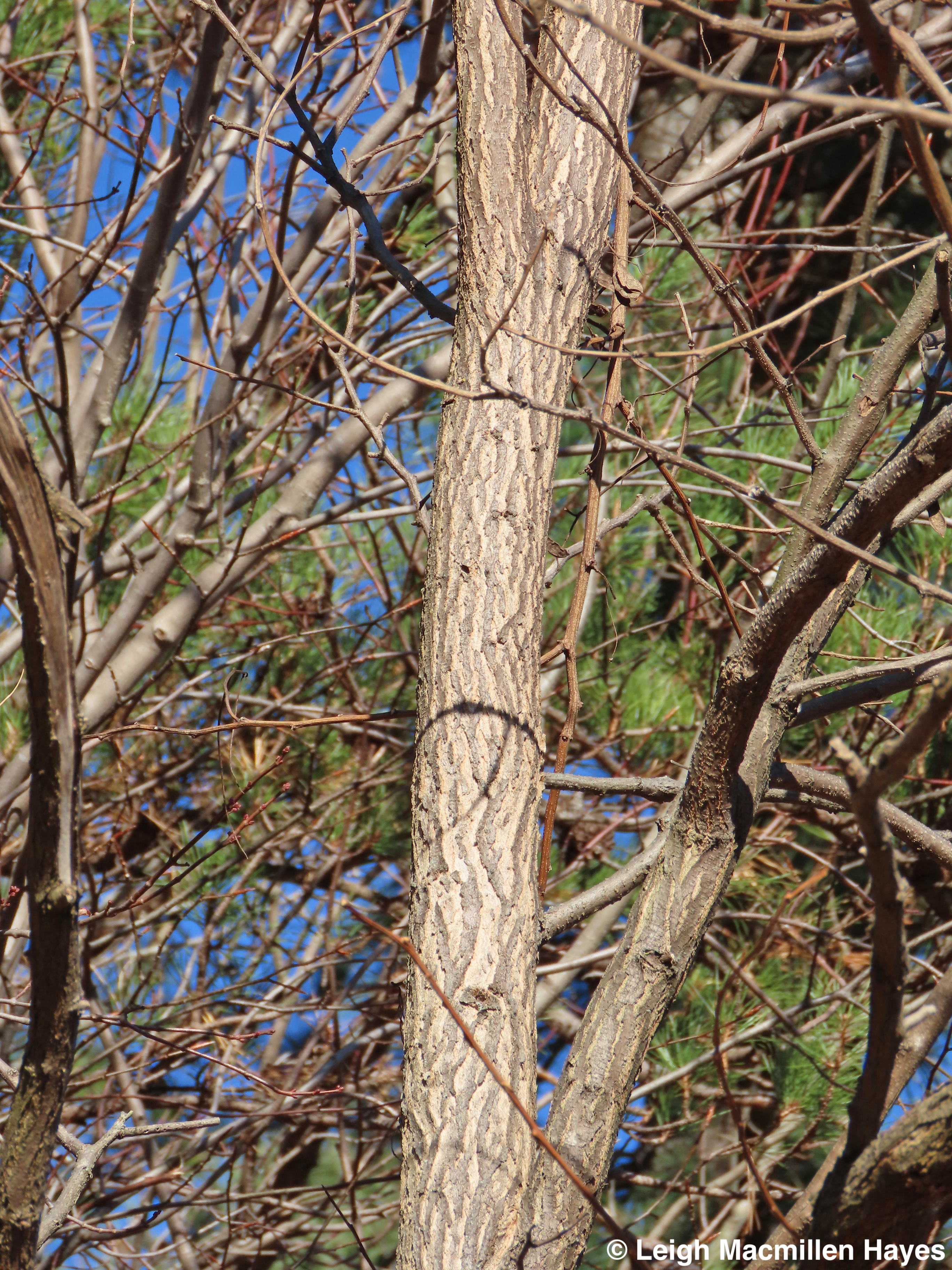
For starters, Black Locust trees, with their two-toned braided bark.

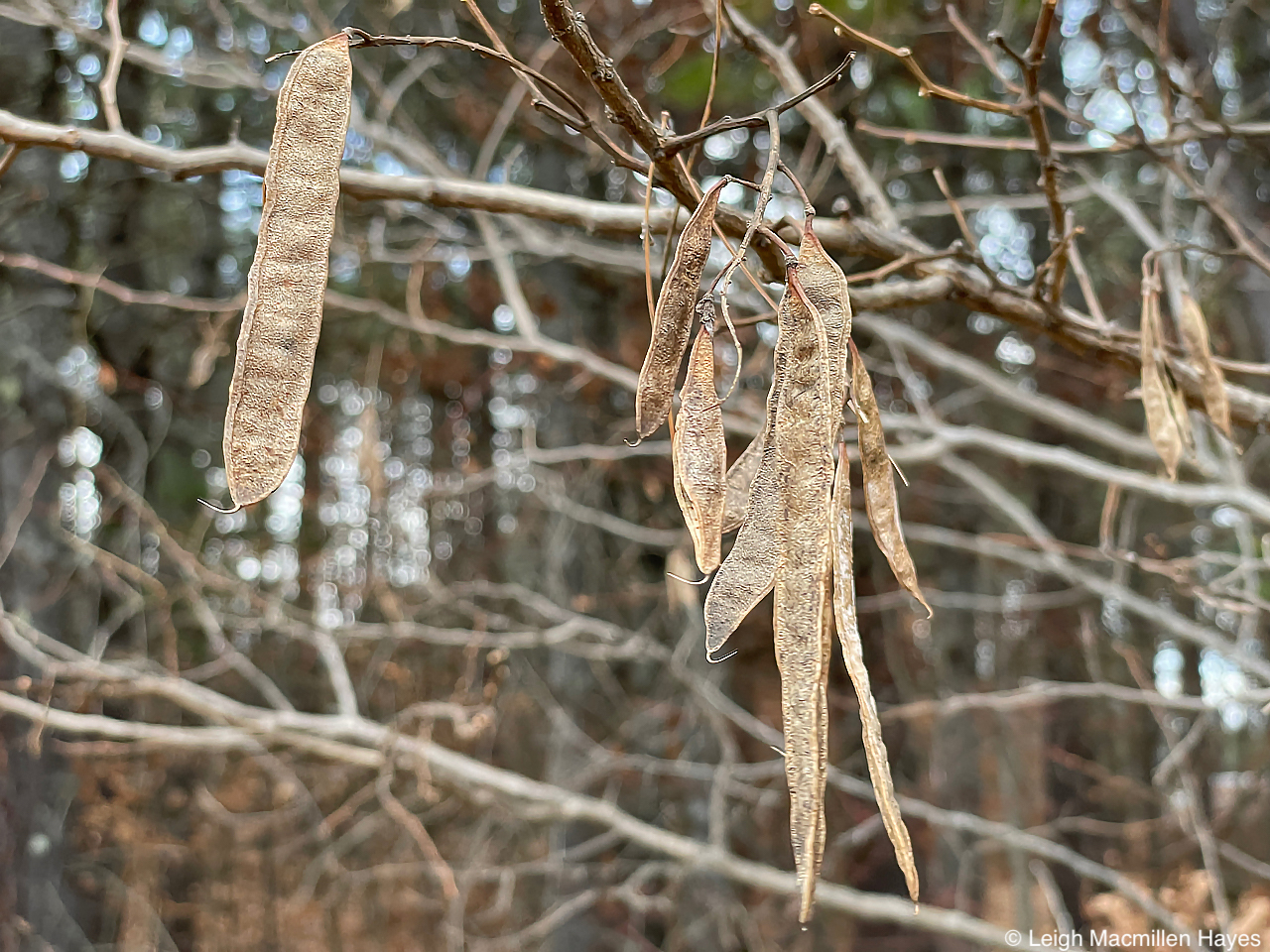
Dangling from the locust twigs are the “pea” pods that contain “bean-shaped” seeds ready to add another generation to the landscape.

And then there are the oaks, this being the blocky bark of White Oak, which is always a treat for because I have to travel to locate it.

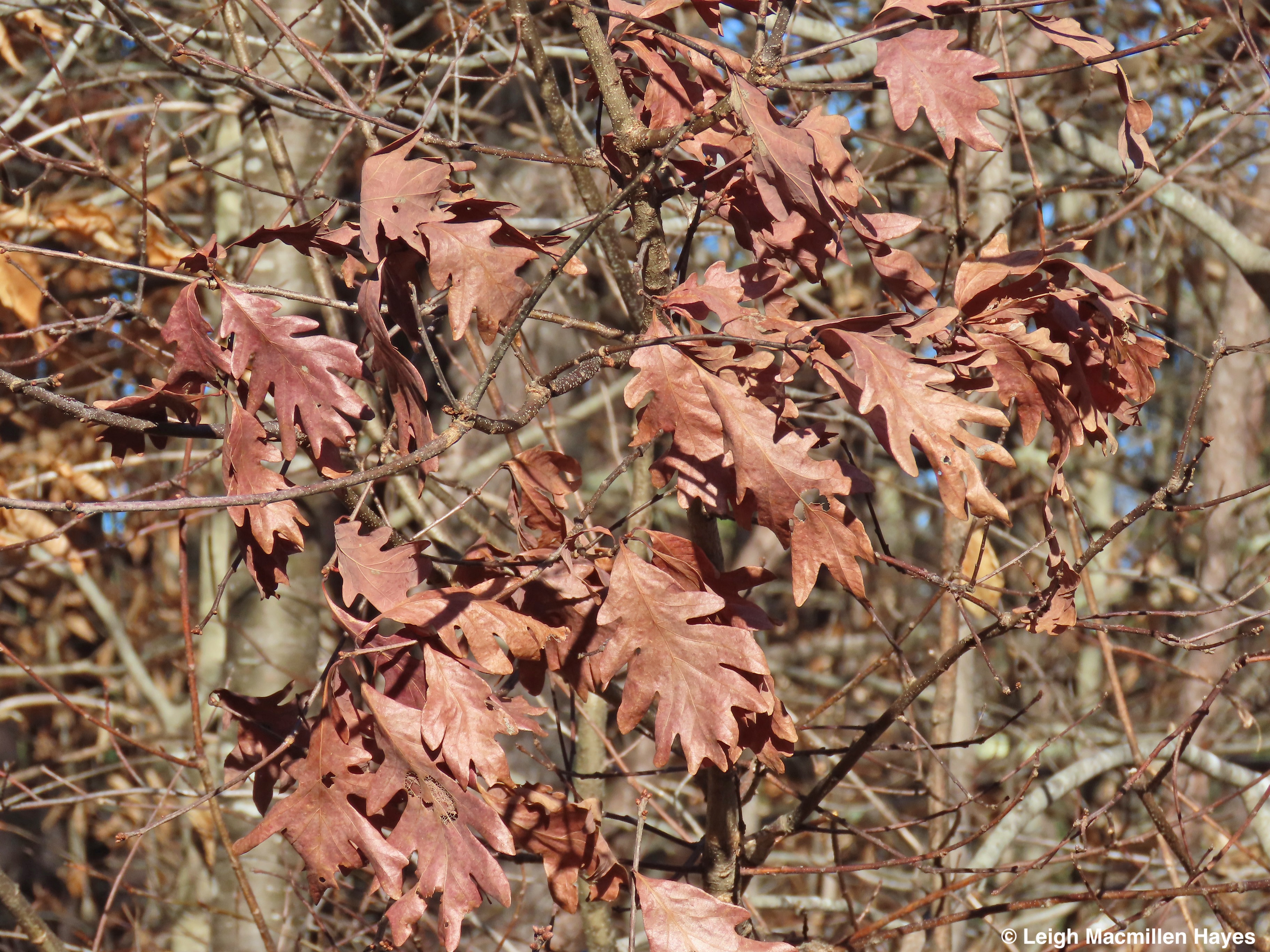
I’ve said it before and I’m sure I’ll say it again, but I LOVE White Oak leaves in their autumn/winter presentation. While they look like mittens with a thousand thumbs, it’s the salmony color and way that they dry on the twig as if they were caught in an awkward dance move that really captures me. Maybe because I can relate to those awkward movements, having never had a sense of rhythm.

Behold also, the White Oak’s cousin, Northern Red Oak, with its raised ridges offering ski slopes for those who dare, accentuated by the red in the furrows.

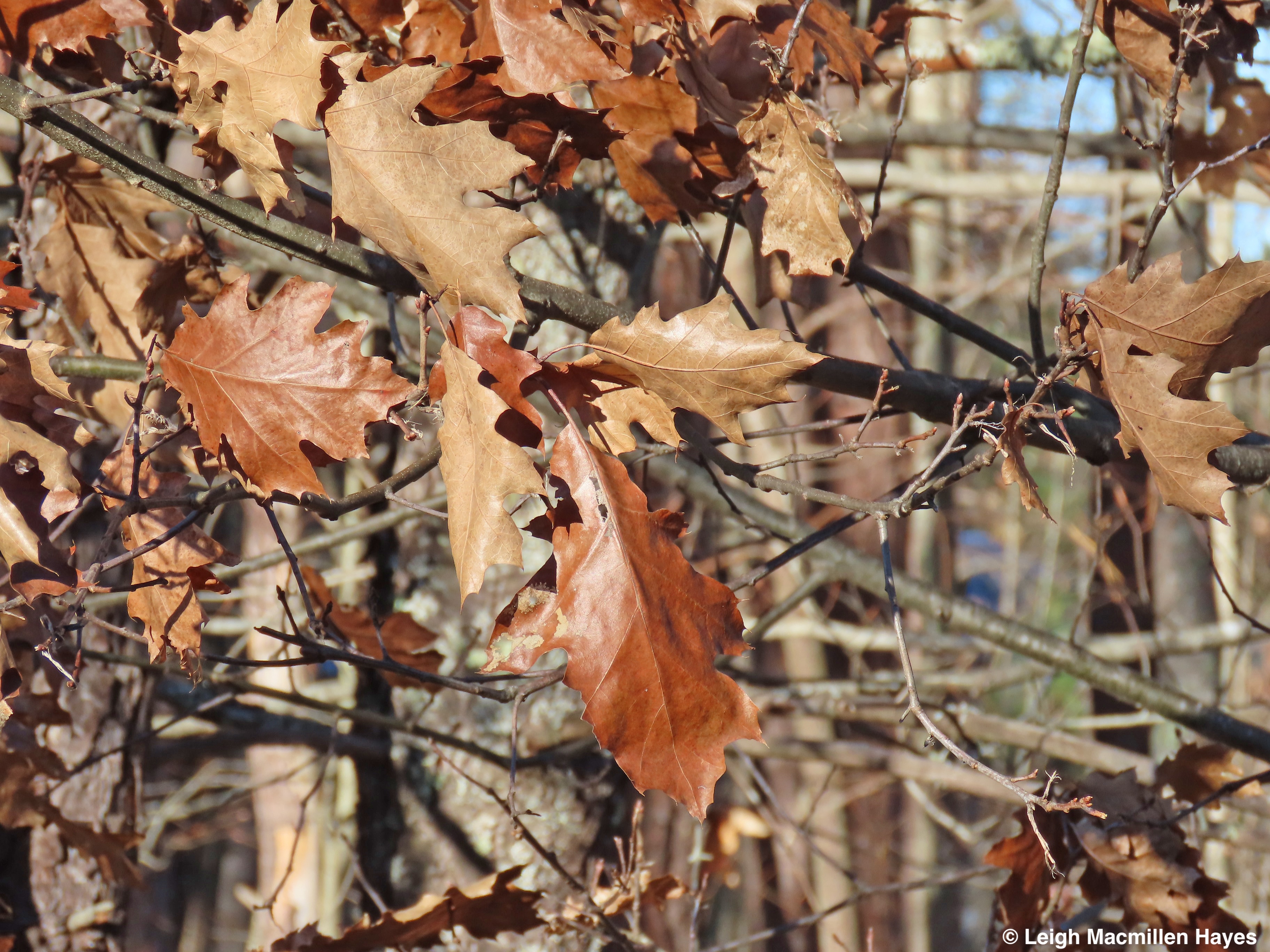
It’s like a perfect classroom along the Mountain Division Trail because the bristly lobed leaves of the Red Oak are so shiny in their shade of mahogany.

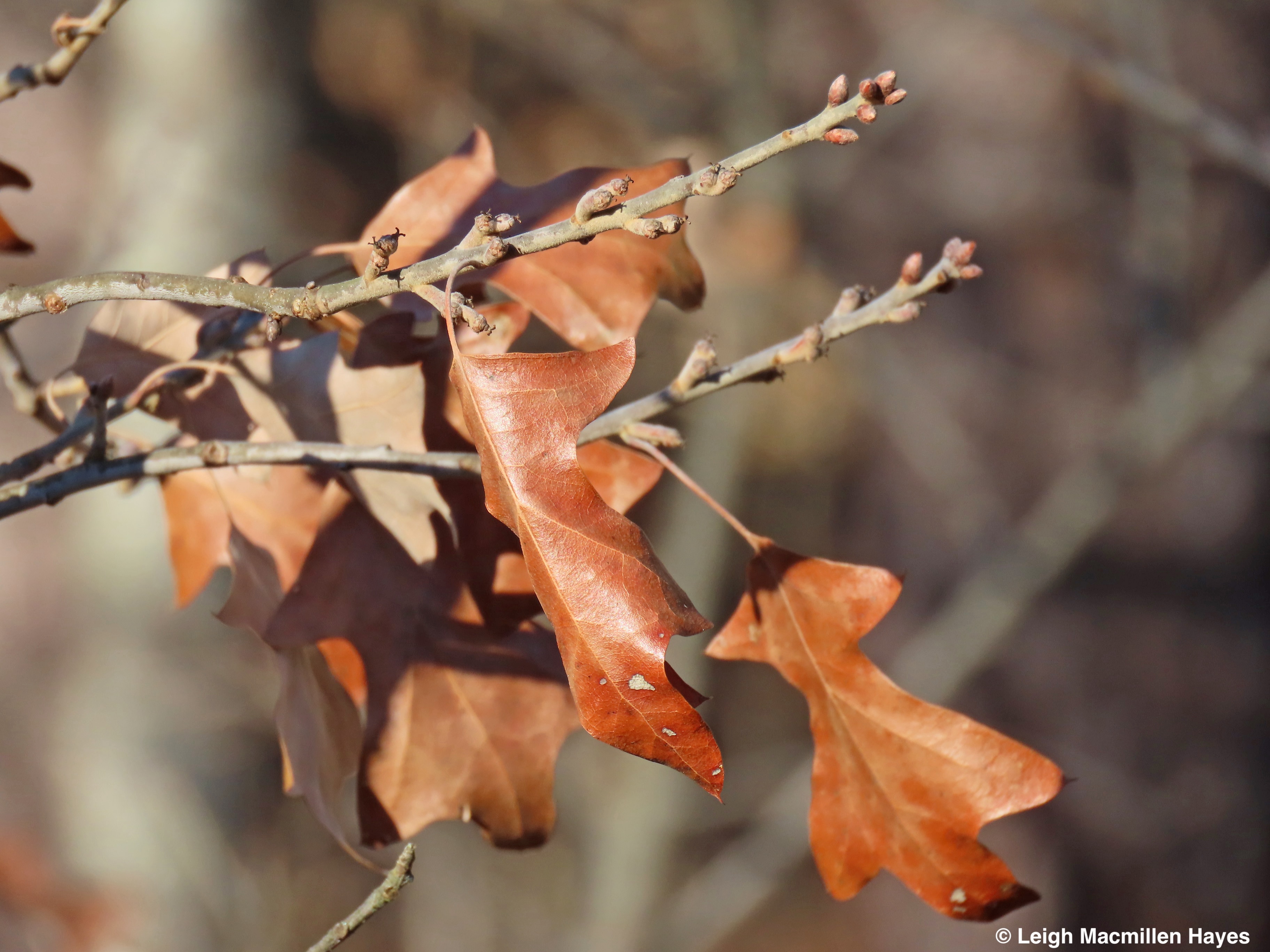
And not to be left out in this lesson: Bear Oak (aka Scrub Oak), growing in a more shrubby manner than the other two. It’s the leaves of this species that remind me who I’m meeting–notice how the second set of lobes from the stem are larger than any of the others.

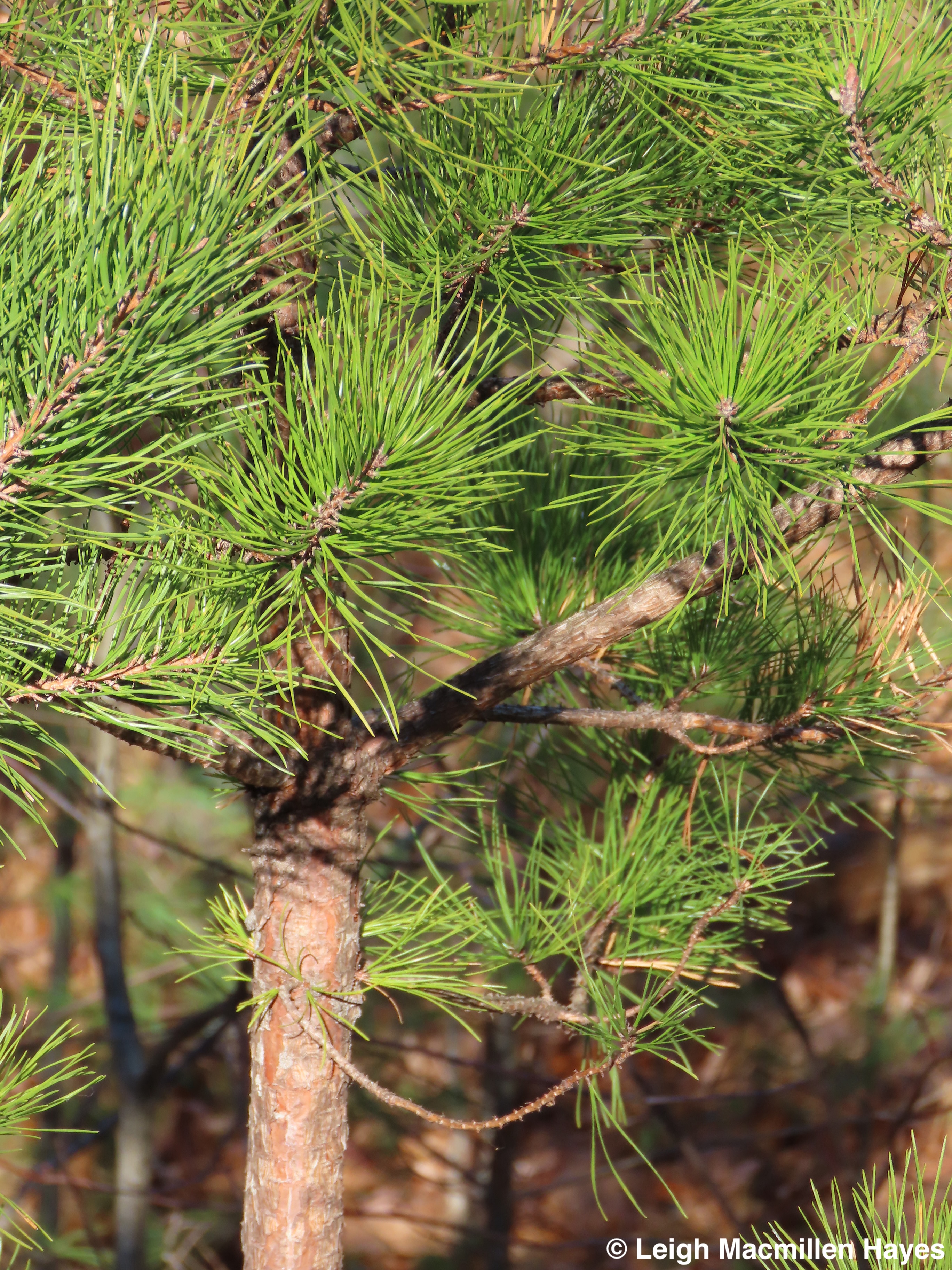
In the mix of deciduous or broad-leafed trees are plenty of conifers, including those we encounter often in this neck of the woods from White Pines to Eastern Hemlocks, and Spruce and Balsam Fir. But . . . there are a couple of standouts along the Mountain Division Trail such as this one with three needles in each bundle.

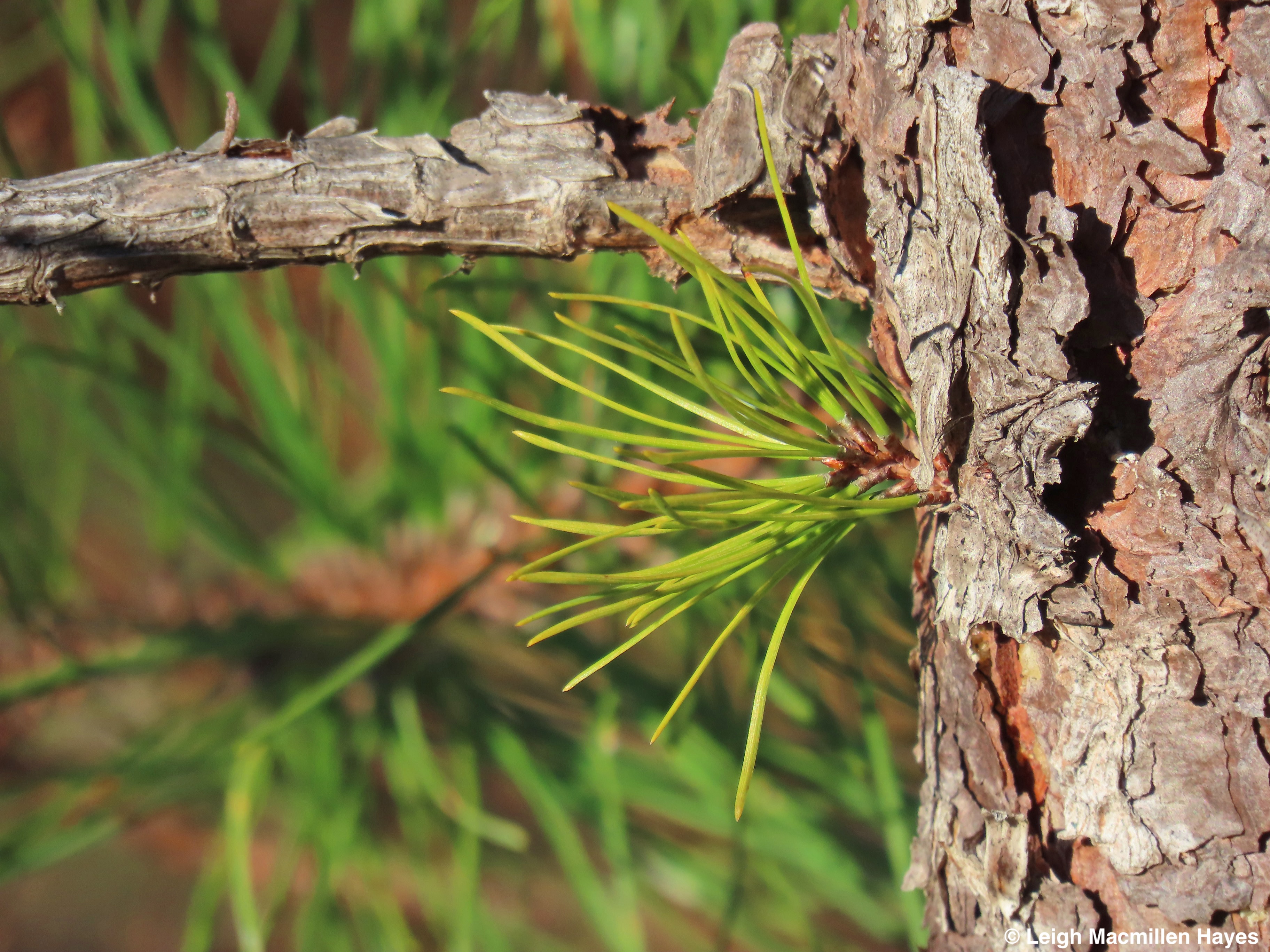
It’s those bundles of three, and the fact that occasionally a clump of needles grows directly out of the bark rather than on a twig that provide the clues for this species: Pitch Pine, three strikes and you are out. Get it? Baseball–pitch–three needles/bundle. I wish I could take credit for coming up with that mnemonic.

I promised more than one interesting conifer and tada. Only thing is, all the other conifers retain their leaves (needles) throughout the winter, thus giving them the name of Evergreens because they are forever green, even when they are shedding some needles.

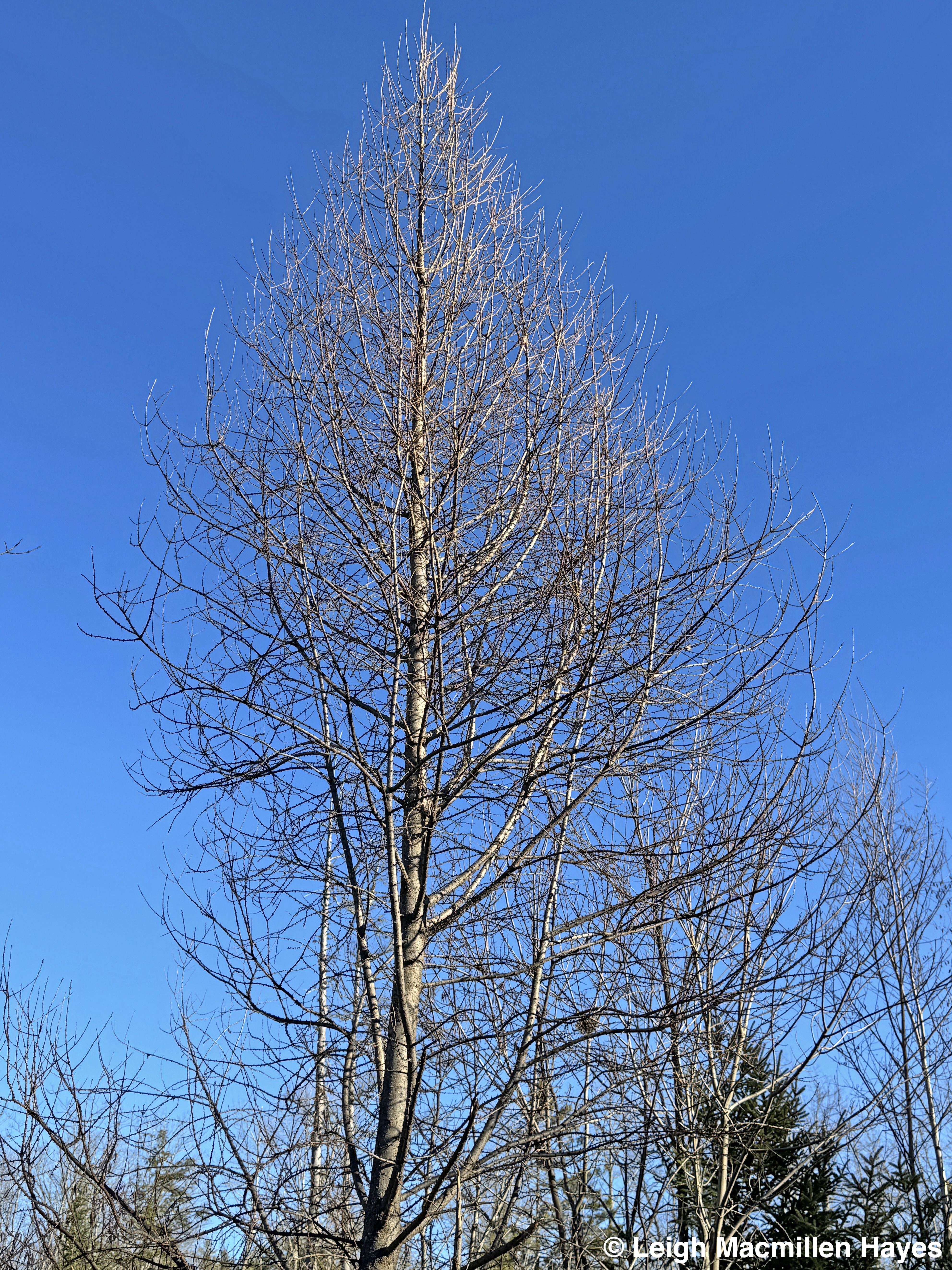
This pyramid-shaped tree is the only deciduous conifer in Maine: the Tamarack (Larch and Hackmatack being its other common names).

Tamarack’s needles turn a golden yellow in autumn, and eventually all fall off. But, it’s a cone-bearing tree, thus it’s a conifer.

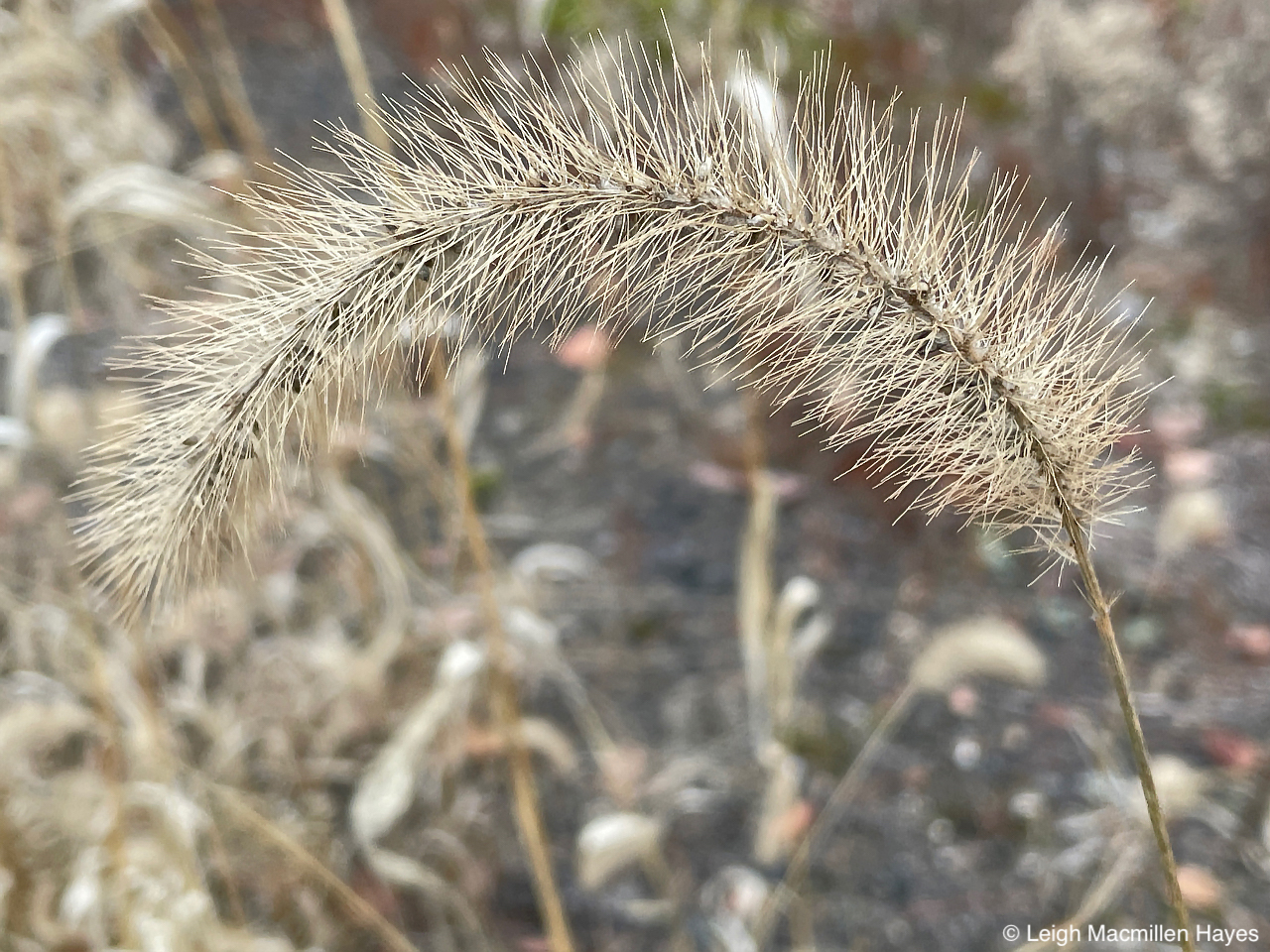
Picking up speed now, along the rail grows Great Fox-tail Grass, and its name seems a great descriptor.

Then there’s the Sweet Fern, which isn’t actually a fern for it has a woody stem, but what I love most about it in fall and winter is the way its leaves curl, each doing its own thing.

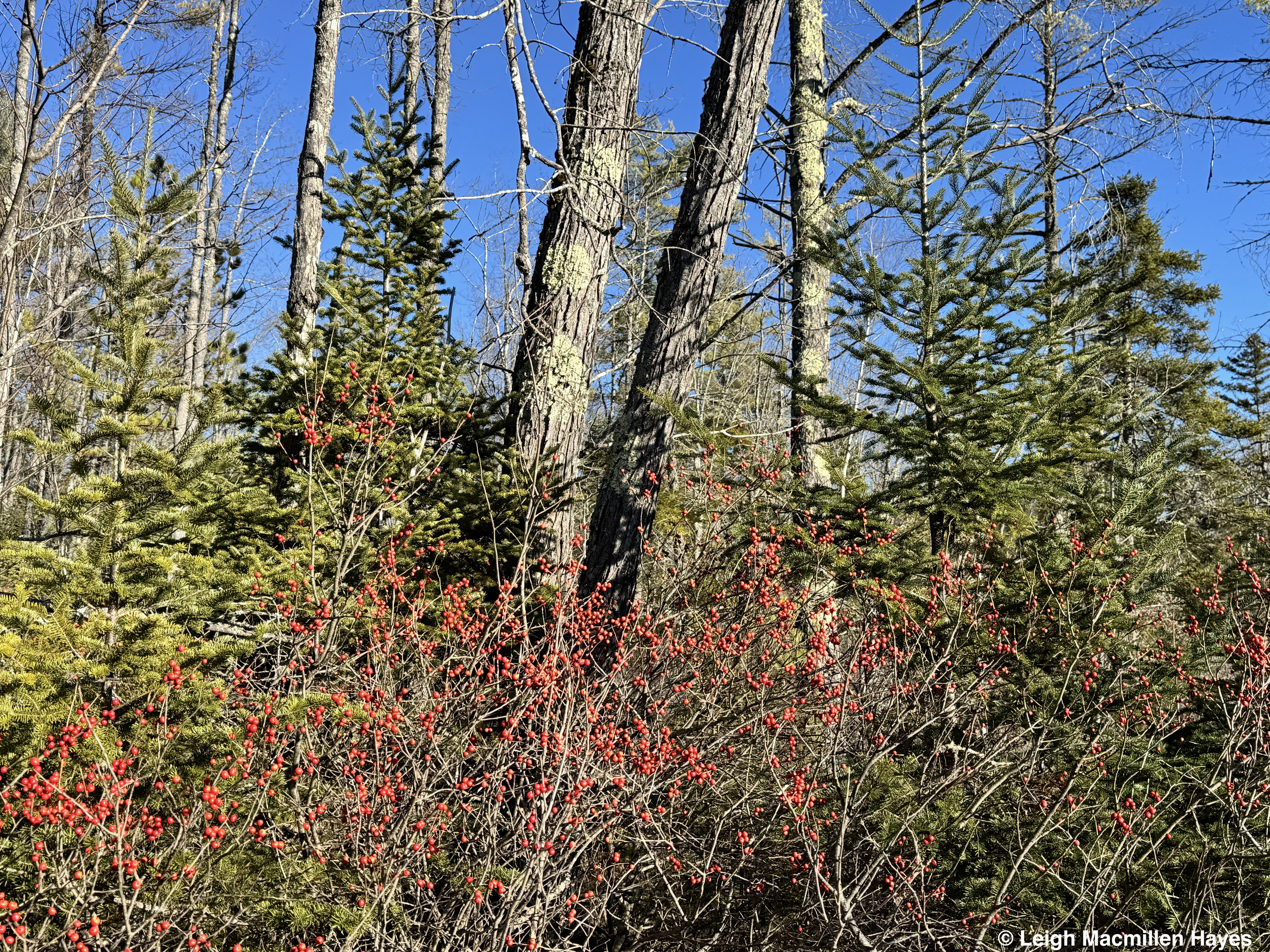
In a wetland, for the habitats vary along the way, Winterberry is now showing off its brilliant red berries. And the Robins are thrilled as are many other birds seeking fruit at this time of year.

Mullein, tall as it stands, has already spread many of its seeds as evidenced by the open pods.

And the same is true for the even taller Evening Primrose.

It’s the fruiting structures of both of these plants that make them beautiful standouts as winter weeds.

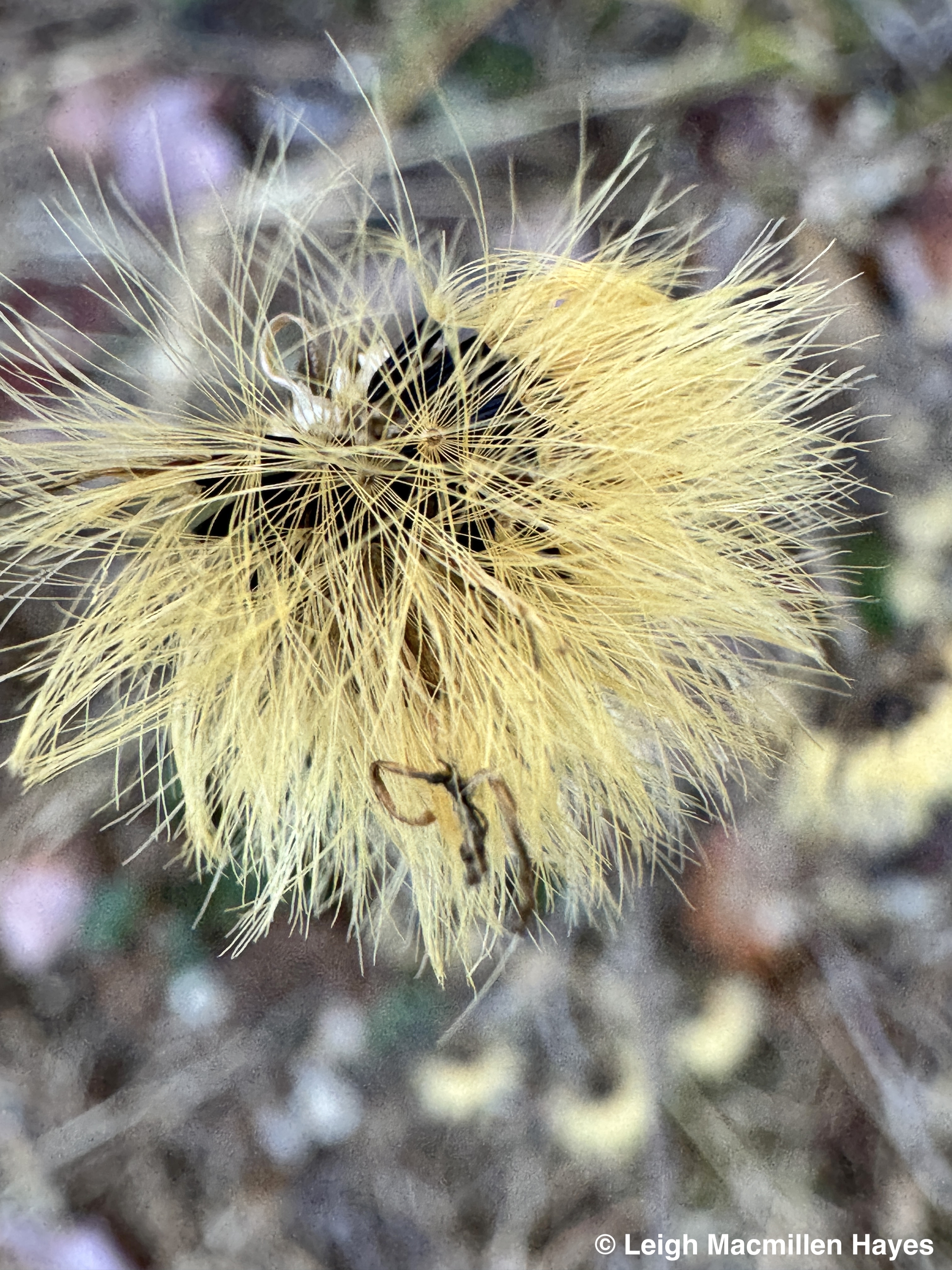
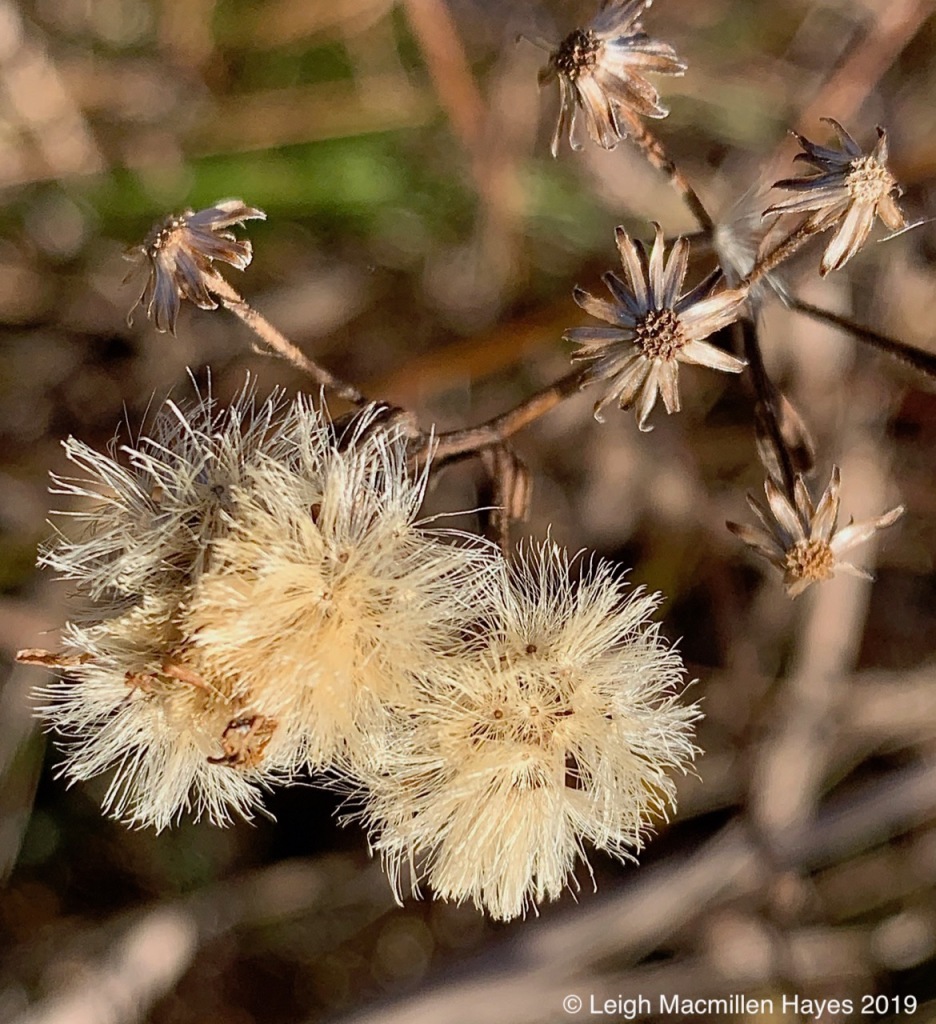
Aster seeds are slowly taking their own leave, one hairy parachute at a time.

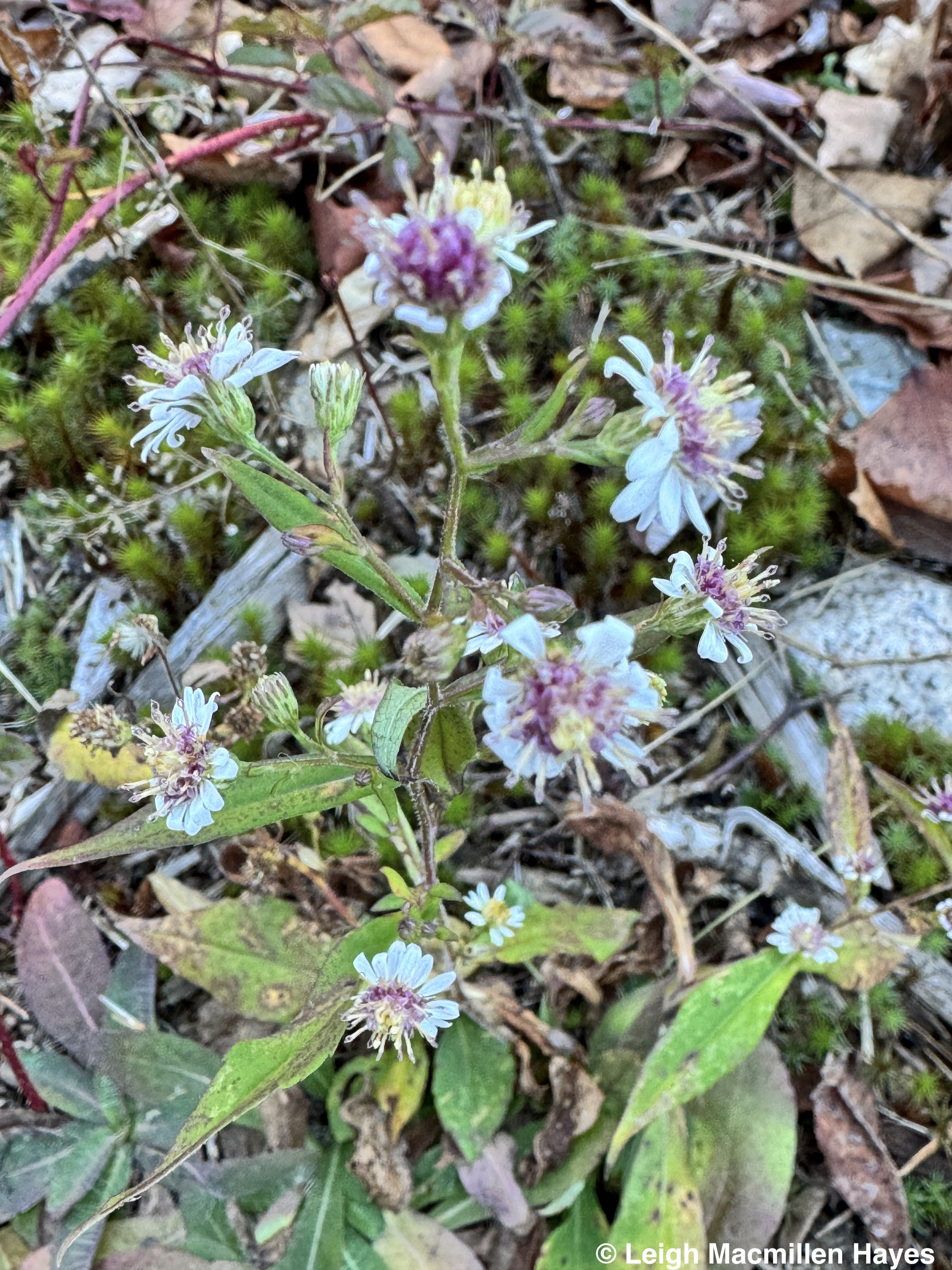
But here’s the thing. Not all Asters have gone to seed and I was surprised to find several Calico Asters still flowering. Given that the past few days have been quite brisk, this didn’t make sense.

But the same was true for Yarrow.

And I saw a bunch of Blue-stemmed Goldenrods still blooming. While the Asters and Goldenrods flower late in the season, perhaps I shouldn’t have been surprised, except that this past weekend’s wild rain and wind, and temps that felt more like November than we’ve experienced lately, made me question what I was seeing.

I was thrilled as I approached the airport end of the trail to find a few Dog-day Cicada exoskeletons still clinging to the underside of the fence railings. My, what large lobster-like claws you have, the better to dig yourself out of the ground when you are ready to emerge from your root-sap-sucking days to form wings, and fly away, and find a mate.

Because my imaginary train had let me off at Porter Road in Fryeburg, about halfway between the two ends of this four-mile route, I wandered and wondered for about two miles toward the airport end, located just beyond the mileage sign.

Portland: 47 miles away.

But it’s not all rail trail . . . yet.

As I looked across Rte 5, I imagined what will happen next. “A twelve-member Mountain Division Rail Use Advisory Council was created in June 2021 to study and review the 31 miles of state-owned, inactive rail line in order to make recommendations for its future use. Frequent meetings occurred . . . at which the civil engineering consulting firm, HNTB, ‘presented feasibility studies for future rail, rail with trail, and interim trail/bikeway use options and economic benefits. It was determined that restoring rail use would cost $60,000,000. For rail with trail, the cost would be $148,300,000. Removing the rails and building a trail until rail, which would keep the rail bed intact so the trail could return to rail if needed, wold cost $19,800,000. The final vote was 11 – 1 in favor of Trail Until Rail . . . After thirty years of work and thanks to the efforts of so many people, on July 6, 2023, Maine Governor Janet Mills signed LD404 into law, authorizing MaineDOT [Department of Transportation] to remove the railroad tracks and construct a 31-mile, multi-use trail until rail on the Mountain Division Rail Line between Fryeburg and Standish . . . Trail Until Rail means that this will be an interim trail because it can be pulled up and the tracks restored to rail should the return of train operations be economically viable. As stated on the alliance’s website: ‘Most major rail corridors are federally protected in perpetuity (that’s forever!). If the tracks ever need to go back in for train service, they will.'” ~ from my article Trail Until Rail: Mountain Division Trail Expansion in published Lake Living, Fall 2024, vol. 17, no. 2.

I turned around by Route 5 and followed the rail with trail back to my truck. Though I’m a hiker, wanderer in the woods by nature, the Mountain Division trail always amazes me with all that it has to offer and today was no different.

If all goes as intended, this 31-mile rail until trail project will be broken into six segments and within two years work will get underway to connect the airport end to this spot by the intersection on Route 160 in Brownfield.

Thanks for taking the time to travel with me today.

Thanks also to Terry Egan, vice president of the Mountain Division Alliance, and Andrew Walton, secretary of the organization, for walking a section of the trail with me several months ago and sharing their stories and visions of this asset to our area.

A Squirrel’s Garden

A lot has happened this week on many different fronts, both personal and public, both positive and not so, some comical (like the porcupine that awoke me one morning because it had managed to climb to the second floor of the barn and toppled our sons’ many “earned” trophies) and others more serious, with some in between thrown into the mix, cuze life happens.

To that end, some of my best moments were spent looking and wondering. In the woods. Of course. In our woods, in particular.

I headed out onto the old cowpath in search of a dear friend, not certain if I’d meet him or at least spot signs of his passing. And it wasn’t a deer I was looking for–although, in a way it was because I haven’t seen a single one in several months and any scat along this trail is from last winter and spring and at that time it was so prevalent that with every step I took, it was there.

No, it was this little guy that I sought. This photo is from last winter when he and I spent hours eyeing each other.

Though his territory could have been several acres and there’s plenty of land out there to inhabit, he, like me, preferred the cowpath, and especially the stone walls since they served as perfect spots to cache his immense supply of pine cones, and as dining room tables, the better to see any approaching predators.

What he sought were the tiny winged seeds, tucked into each protective scale by the twos. If you’ve ever had the joy of watching him munch, you’ll know it’s fast paced as he deftly pulls the seeds out and discards the scales, getting right down to the “cob” of the cone.

The result is a pile of half consumed scales and a few uneaten seeds and cones not quite yet opened and some scat and its all known as a midden (by us humans anyway) or the trash barrel.

Actually, any high place will do and if it has nooks and crannies to serve as storage shelves all the better. Last year was a mast year for the White Pines in our woods. It takes two years for a pine cone of this species to reach maturity.

This year, there are only remnants of Red’s garbage pails and even they are almost hidden by twigs and leaves and needles.

But, while I was exploring his old neighborhood, I discovered something else in this pile that he had used for refrigeration and dining purposes.

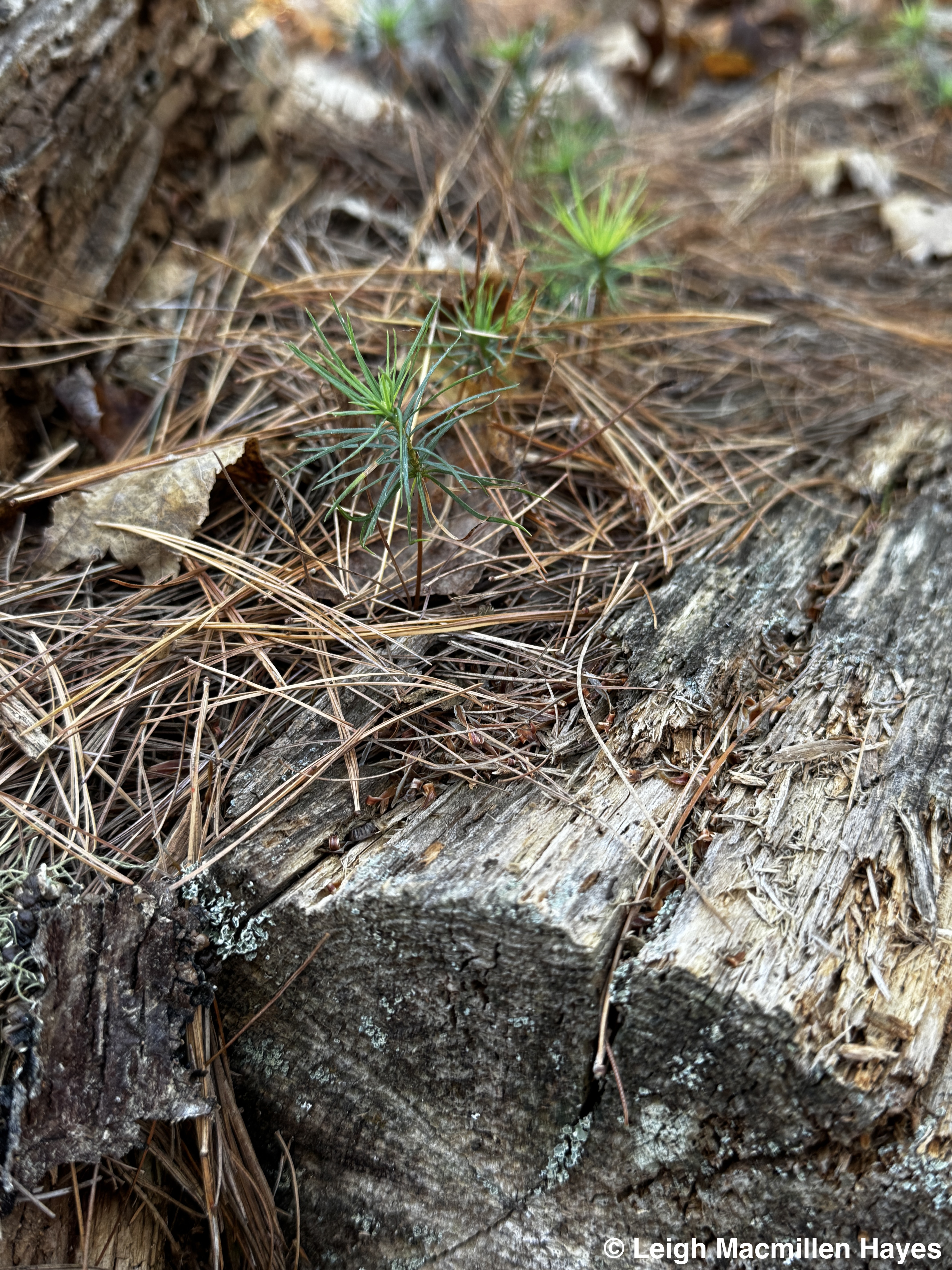
Do you see what I spotted? Babies! No, not squirrel babies. But rather: Miniature White Pines.

Once I saw those, I checked every stack that we’d cut years ago and found the same story written upon them. The seeds Red had left uneaten found conditions were right on the rotten logs. Will they survive? Maybe a few, but there are plenty more tiny saplings on the forest floor.

The thing is that I found no evidence of Red and not once did he squawk at me, so I suspect either he moved on to a better food source or became a meal for another, passing all of that energy and sunshine he’d consumed on to the next.

This year, it’s the Northern Red Oaks that have produced a mast crop–of acorns. Actually, they did so last year, and the year before as well. For those of us who frequent Red Oak woods, it’s like walking on ball bearings–and can be a wee bit treacherous as they roll under our boots.

Red Oak acorns are filled with tannins and so, unlike their White brethren which are gobbled up almost immediately by rodents and birds and deer among their consumers, it seems a little of this one is nibbled, and then a little of that one initially. Eventually, the tannins leach out, especially if the acorn has been buried for future consumption, and then the entire nut within may be eaten.

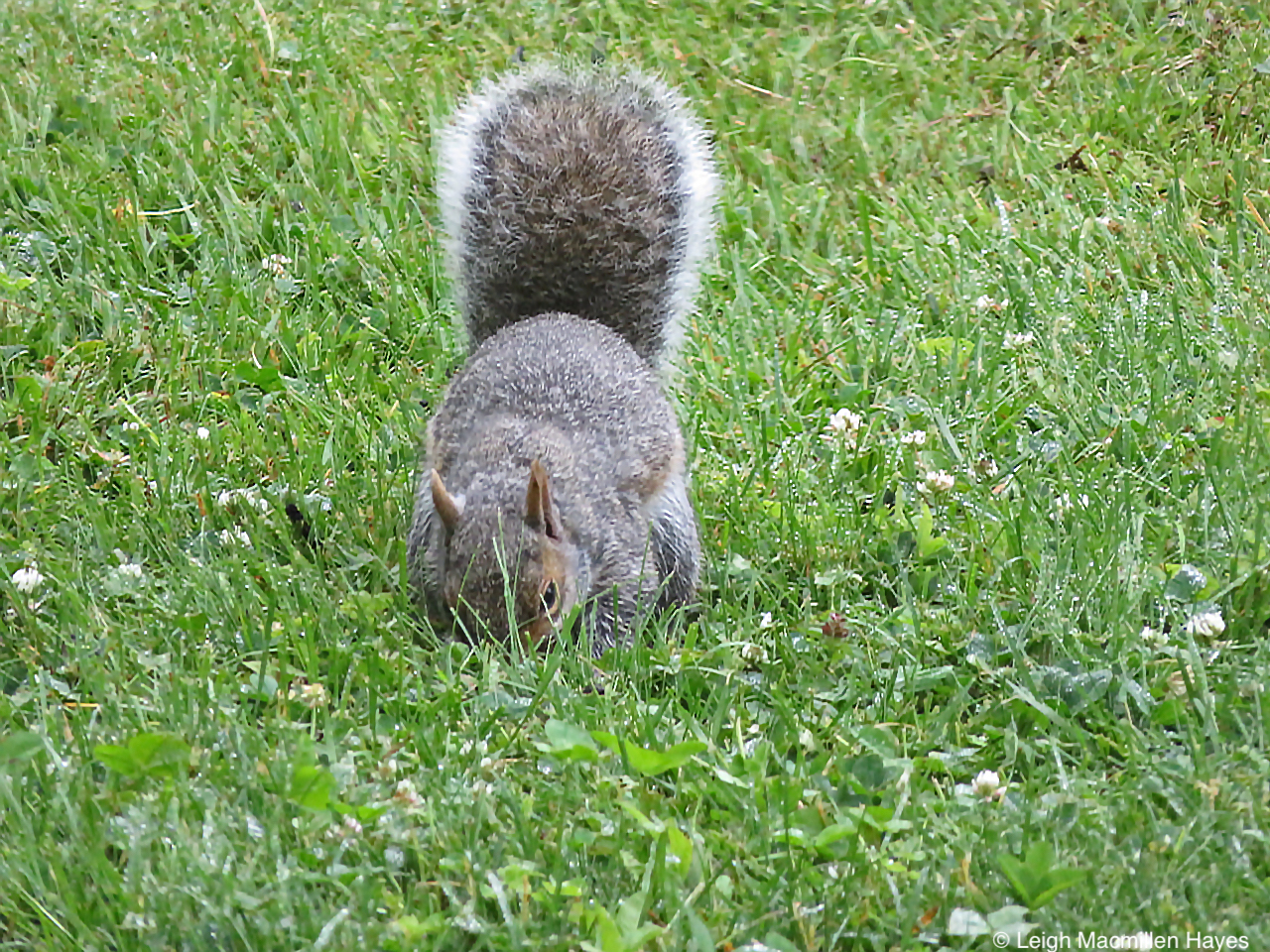
As I looked for Red this past week, I found instead his cousins, the Gray Squirrels in action. Where Red Squirrels are very territorial, Grays tend to have overlapping habitats, and there are at least three on our six acre plot of land.

Burying acorns is their way of caching and it’s possible that what I observed was this squirrel leaving a scent mark with its nose so that come snowfall (and I have faith that it will fall–and can only hope abundantly), it can relocate the food supply. What this squirrel misses, another will find. And those that no one finds might turn into oak trees that will feed future generations, just as the pine saplings may someday do.

It’s for these critters and so many more that we ask that no motorized vehicles pass along the cow path, no matter how tempting it may be. (Thank you, Marguerite, for creating this sign for me.)

And if you are in there, you might happen along the rather rough labyrinth I created, a place that like the squirrels, I return to often.

It’s at the start of the labyrinth that brings a smile to my face each time, for Red had visited and his calling card is still there.

Thank you, Red, for planting your Squirrel Garden. And for capturing my mind and heart and soul this week.

Thanks to the Cardinal

I love this time of year when the windows are open and the birds wake me and invite me to head down the stairs and stare out the window. And so I did this morning.

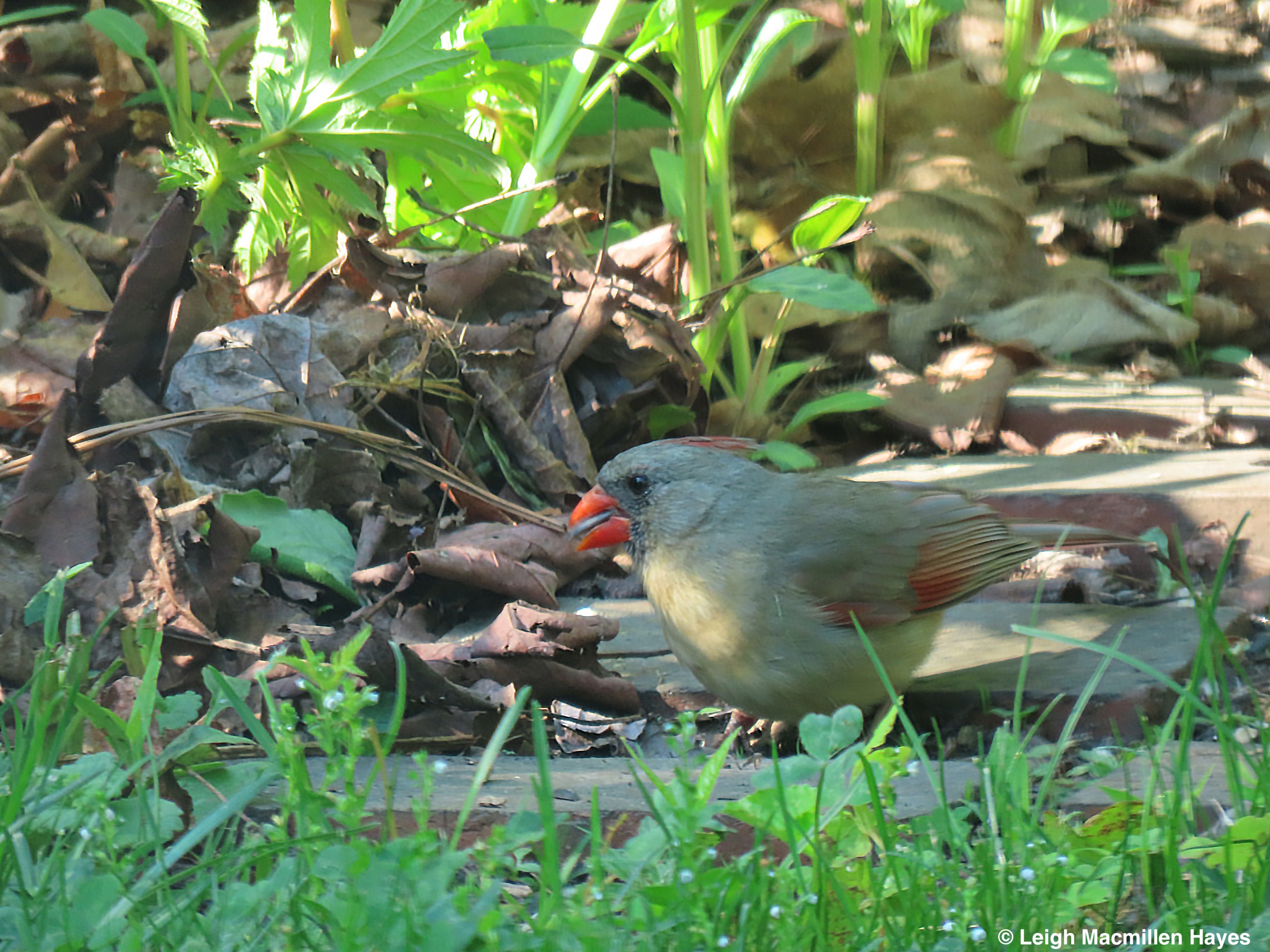
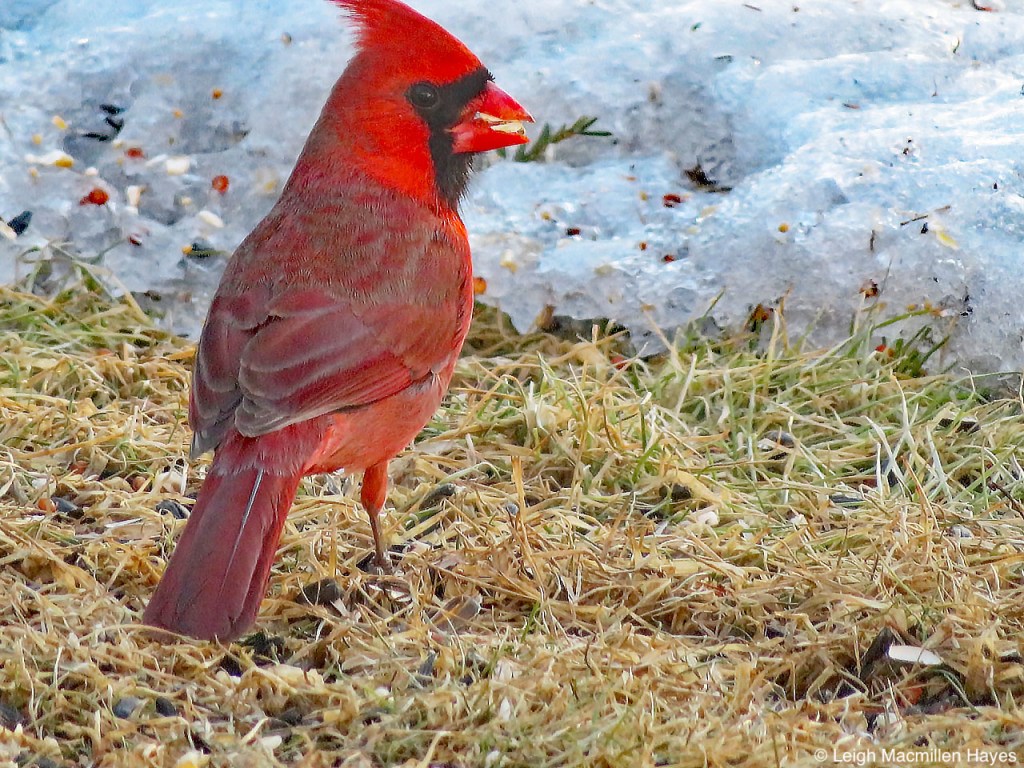
It seems the Northern Cardinals always announce their arrival with a “Chewip, Chewip, Chewip,” call and usually he arrives first, and she, pictured above follows. For some reason, I didn’t see him this morning, but maybe tonight as they are early morning and early evening visitors.

While watching her another bird flew in. This a House Finch. And it immediately amazed me. I didn’t realize that they eat Dandelion seeds . . . until, that is, I watched it do exactly that.

So, My Guy and I are at opposite ends of the spectrum when it comes to Dandelions. He wants to banish all from the yard. I want to encourage them and any other wildflower that chooses to appear.

And today, I decided to discern what I might hear when I take time to listen, and not just listen to the birds.

It was the voice of the Dandelion for which I yearned. Some call them weeds and wish they would wither and die. But the Dandelion wants us to know it is strong and persists even in the poorest soils.

And so it should.

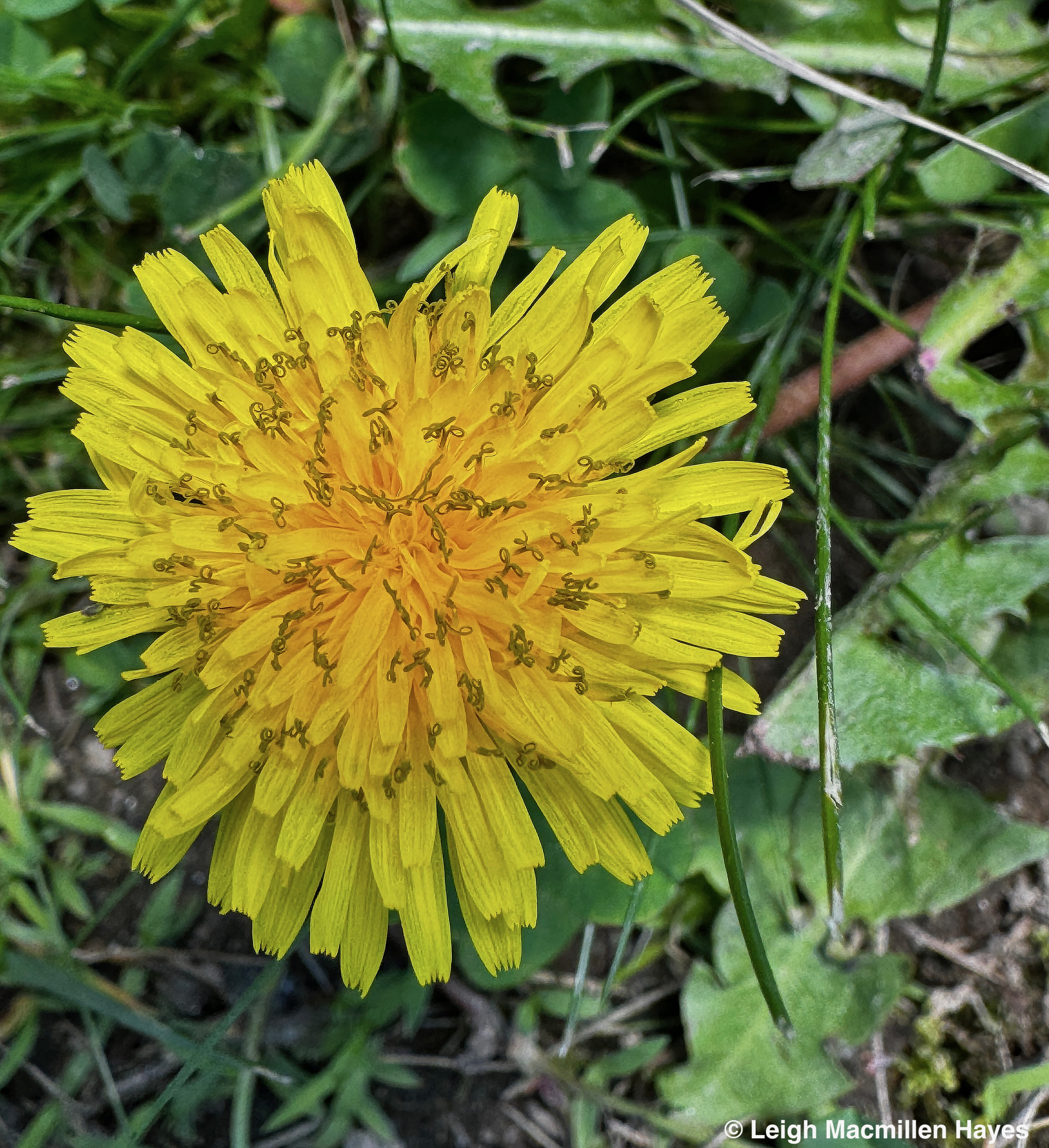
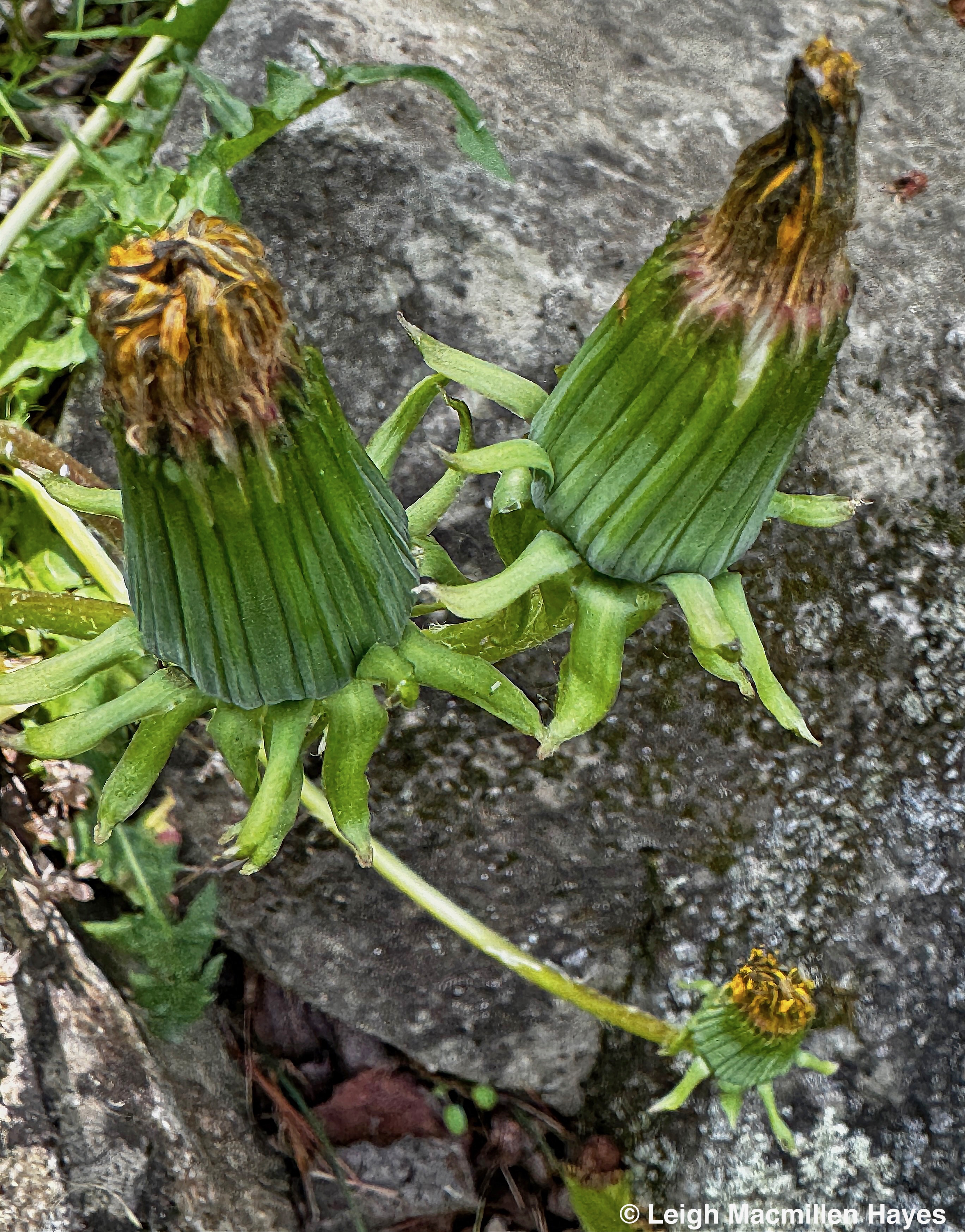
To begin, there are the green bracts. Some of the bracts are turned downward as if in a dance, perhaps to keep certain insects that might gobble up the flower at bay, while other bracts protect the developing flower.

When the flowerhead begins to open, it does so one ray or “petal” at a time, for each “petal” is actually a floret, all of which combined look like the sun at high noon and make this plant a composite.

Toward the stem, each floret narrows into a tube, which rests on an ovary containing a single ovule. In that tiny tube is the nectar. While you may not see the tubes unless you carefully pull the flower apart, we can’t overlook the stigma, that tip of the pistil, or female part, covered with pollen. Each stigma for each floret is split at the end into two curling lobes.

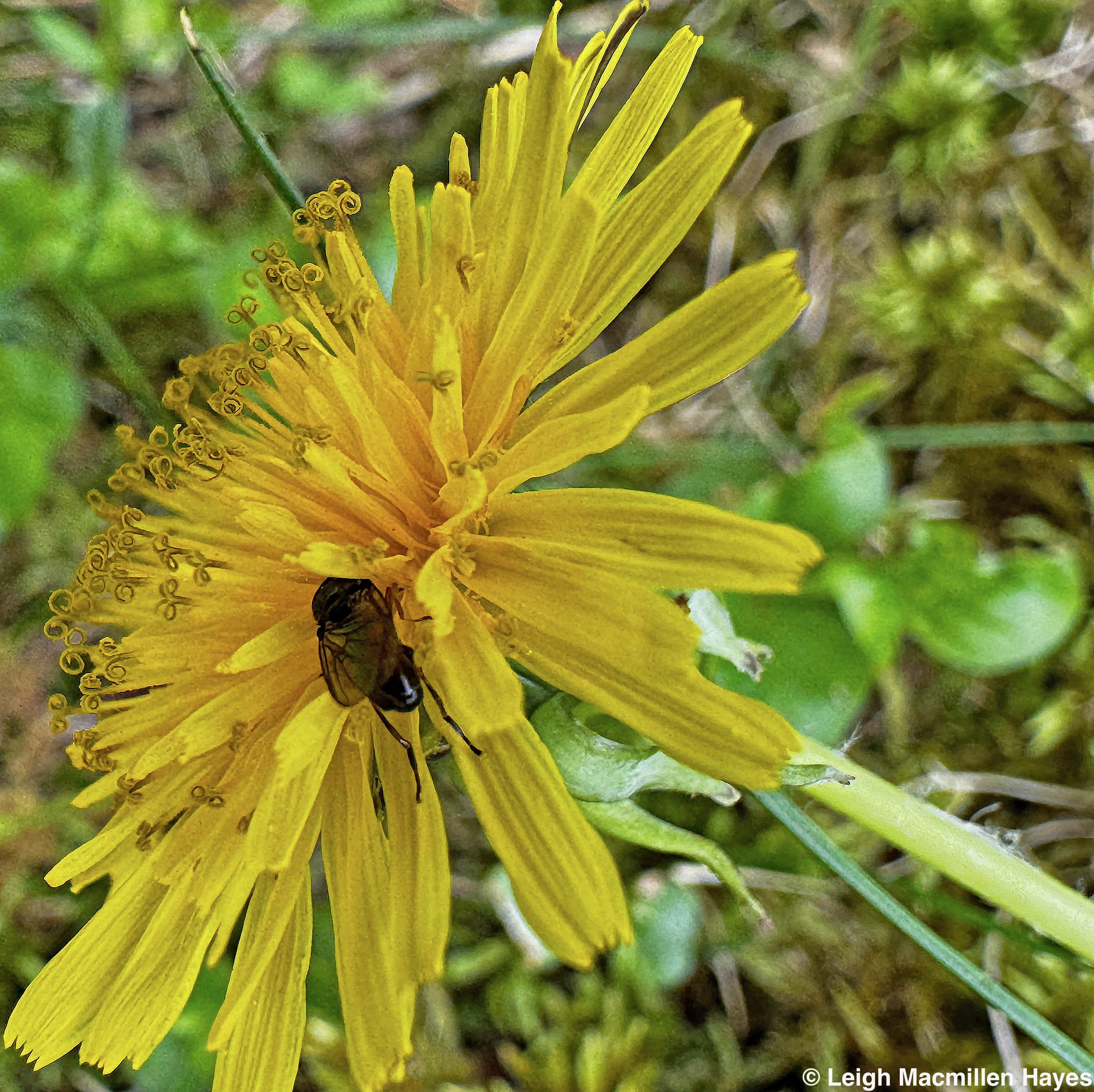
The Dandelion sings out from its nectary, inviting insects to stop by for a visit. Meanwhile, the pollen remains in the protected areas within the circles or loops the two lobes of the stigma create.

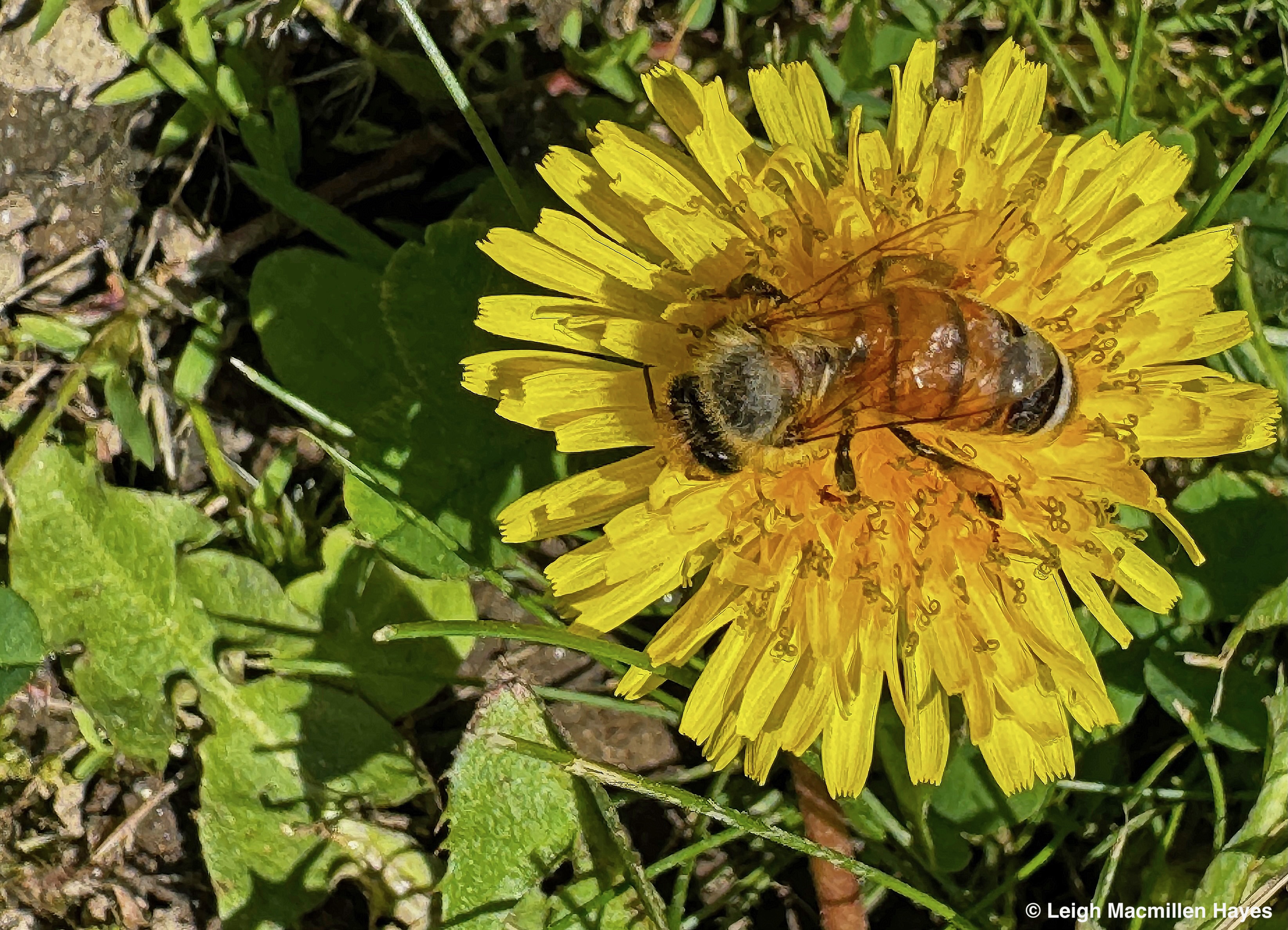
Bees and many flying insects seek the nectar and in the process of visiting the flower, they smear themselves with pollen grains, which drop off at the next flower where the insect seeks another drink, thus insuring cross-pollination.

Of course, if you are going to listen to a Dandelion in full flower, you should be equally wowed as it continues its journey.

In time, the entire head of the bloom matures, the florets close up within the green bracts, and the bloom looks almost like it did as a bud, and evokes an image of our life cycle–from birth to death.

But the transformation isn’t over yet. Next on the Dandelion journey, the flowerhead opens into a fluffy ball of seeds, that fluff being fine hairs attached to each seed that will serve as a parachute.

Each seed represents one floret. And they wait for us, the wind, animal. or bird to disperse them. Out into the world they are ready to go. I don’t know about you, but it’s hard to resist the temptation to pick a stem and blow on the puffball.

As I walked around our yard today, I noticed carpets of another composite, with a flower of the same color, but this one a Mouse-ear Hawkweed.

One easy way to differentiate between the two plants is by their leaves. Both have basal leaves, but those of the Dandelion are irregularly lobed.

The Mouse-ear Hawkweed leaves are entire, and entirely hairy. And much shorter in length.

Some call them weeds, but I prefer to think of them as volunteers who reflect the sun’s image. When I take the time to listen to them, they remind me that we are all interconnected and we need each other to survive, a lesson the pandemic certainly taught us. And that includes letting the undesirables flourish–in our yards and in our lives. I know I need to remember that.

If we take the time, really take the time, to slow down and observe, watch the variety of insects that pollinate flowers like Dandelions and Hawkweeds, and begin to understand that we need to save the flowers in order to save the bees and their relatives who also pollinate the fruits and vegetables we need in order to flourish, then we may change our minds and realize they are desirable after all.

And not all the seeds will end up growing in your lawn, as the House Finch taught me today.

Thanks to the Northern Cardinal for leading me to the House Finch, and subsequently the Dandelion and Hawkweed.

Reflection Mondate

Snow. Slush. Mud. Water. Flurries. Wind. Sun. Clouds. They were all on today’s menu. It’s a March thing. And so we decided to embrace it and head to a spot we usually avoid this time of year.

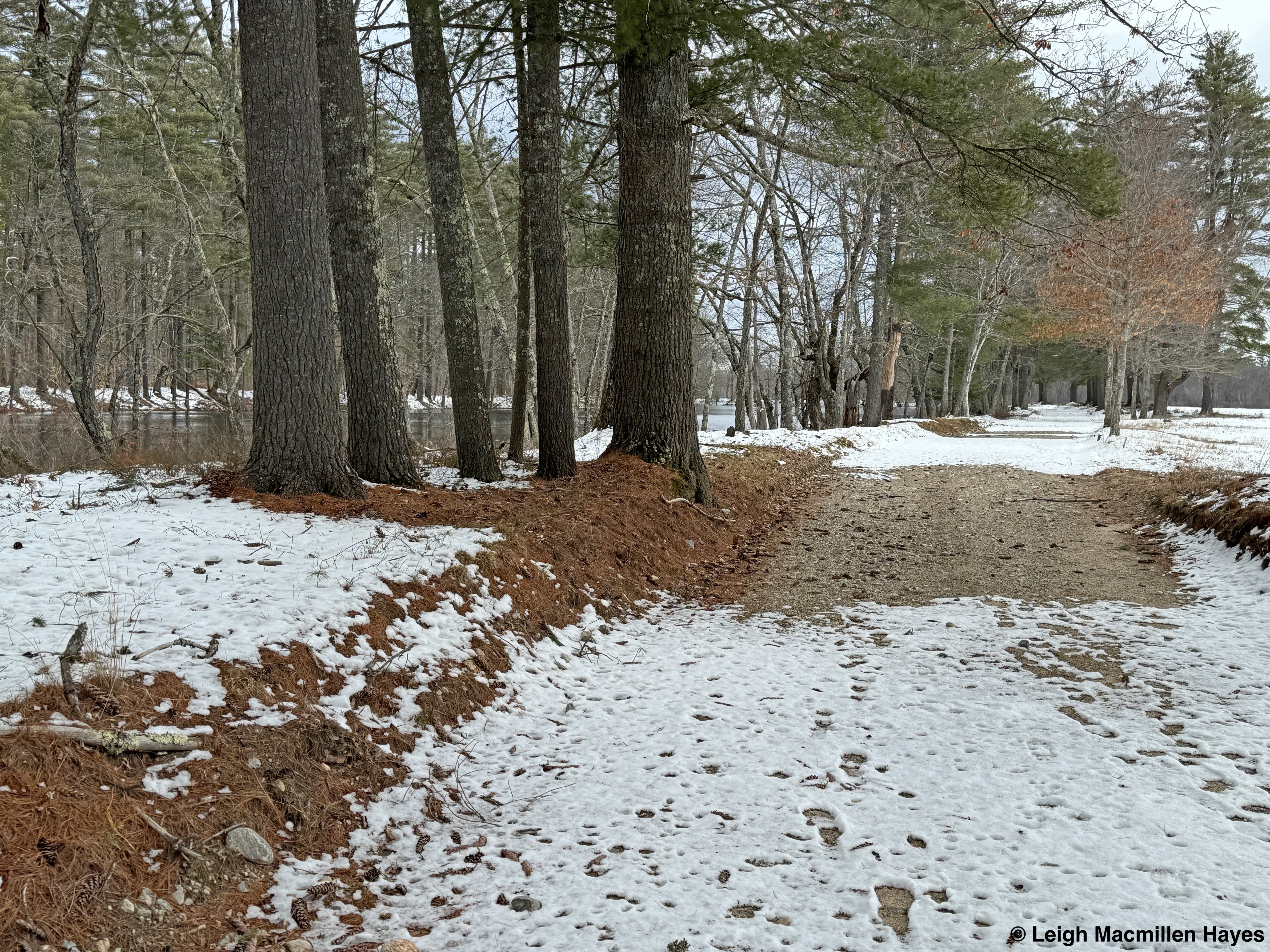
Our destination was a country lane beside the Old Course of the Saco River in Fryeburg, Maine. During the winter, this road is part of the snowmobile system. In spring, summer, and fall, it sees a fair amount of traffic. But . . . because of current conditions and the fact that a portion of the road washed out a few months ago and another portion is under at least six inches of water, the gates are closed and the only traffic is via foot. Perfect conditions in our book.

I love to walk roads like this because they always have something to offer and today it was the discovery of a bunch of rather dramatic winter weeds known as Roundhead Bush-clover. Bristly, spiky flower heads. Curly leaves with nooks and crannies.

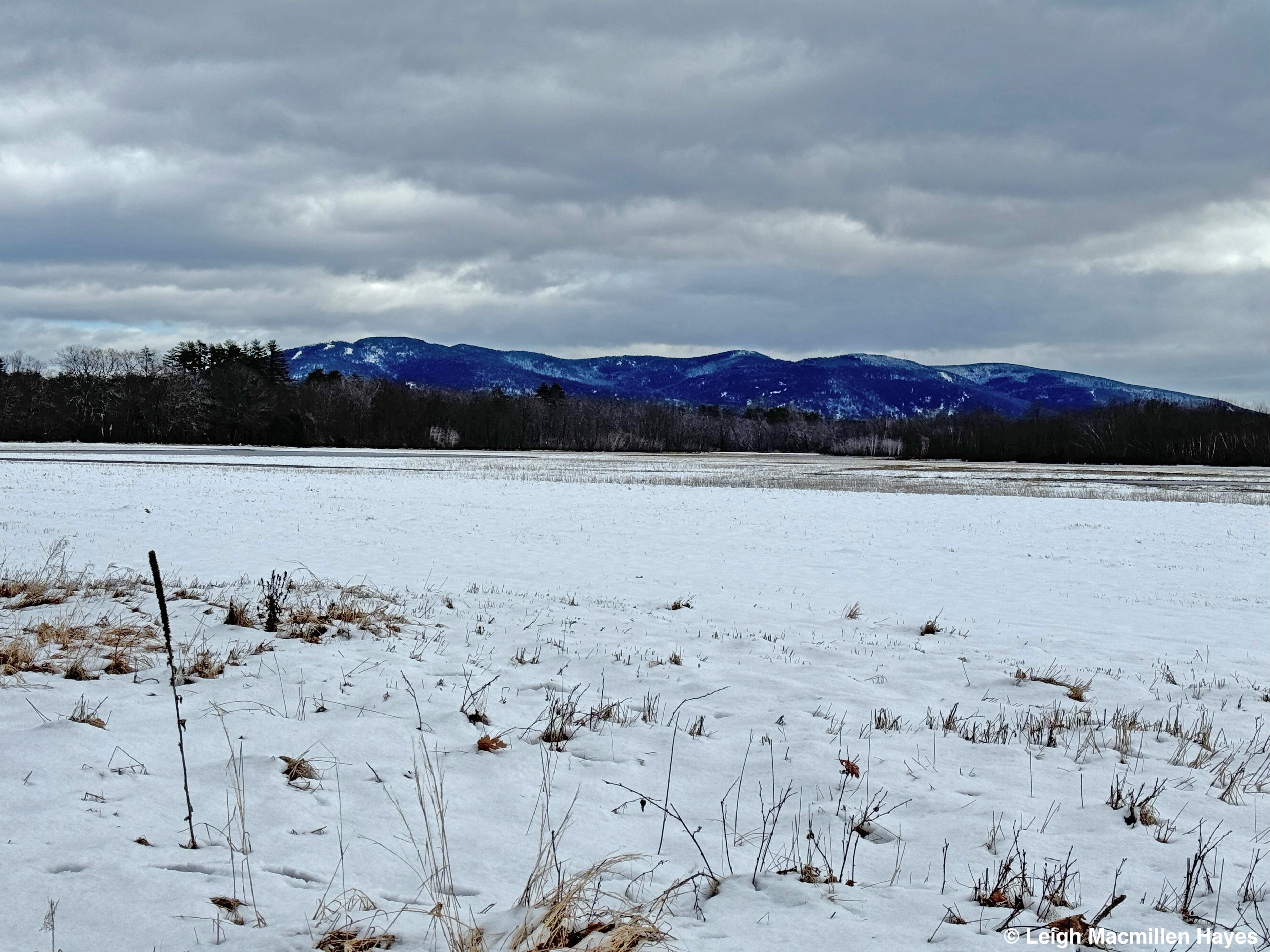
The sky was equally dramatic and ever changing as we viewed it while walking southeast with the ridge line of our beloved Pleasant Mountain forming the backdrop.

We managed to easily get around a major washout, but then encountered this and it is not a puddle. The water is flowing across the road and we could feel the current as we were determined to get to the other side.

We are both here to report it was at least six inches deep in the deepest spots. We were feeling pretty darn smart for thinking to wear our muck boots.

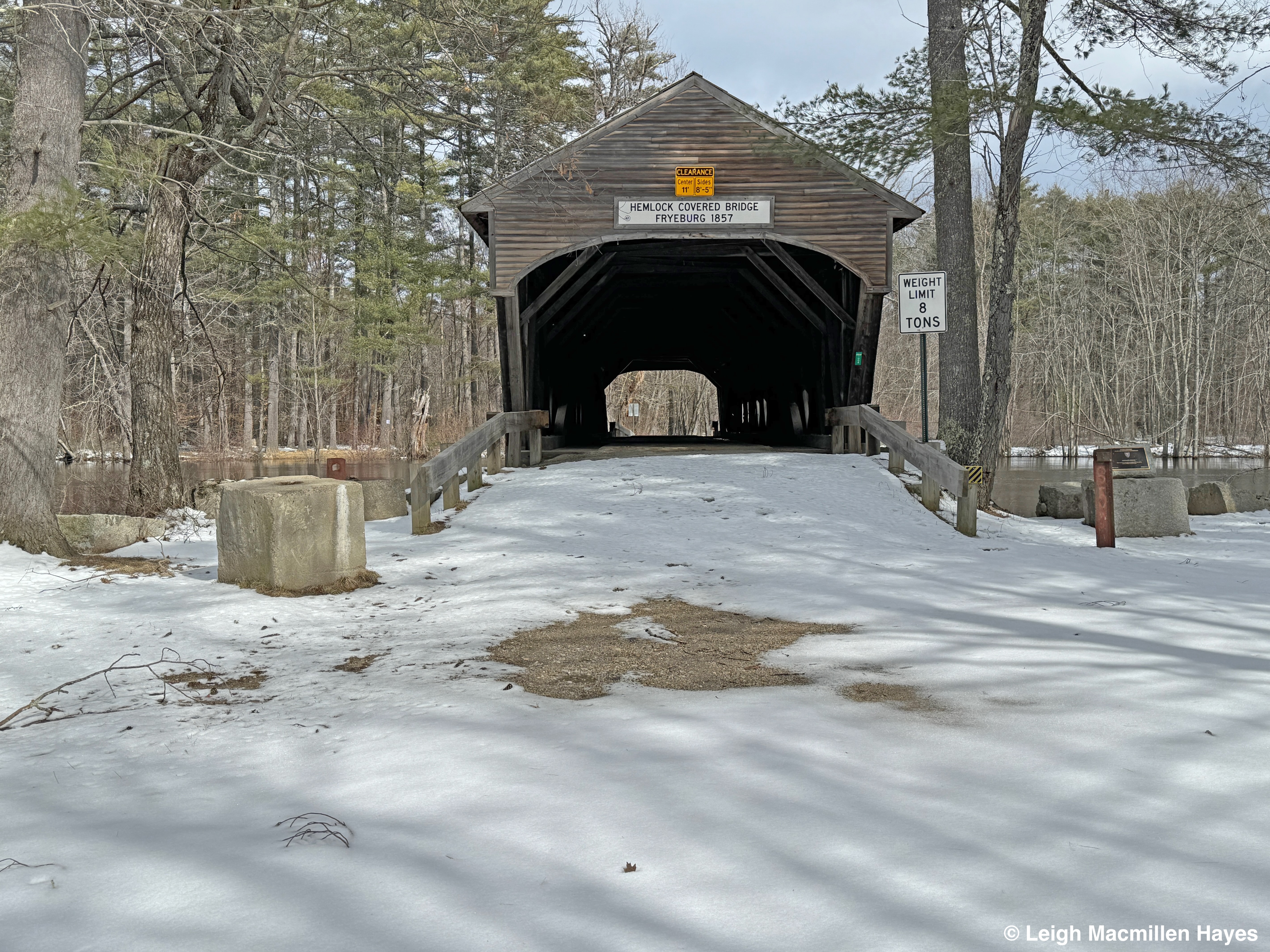
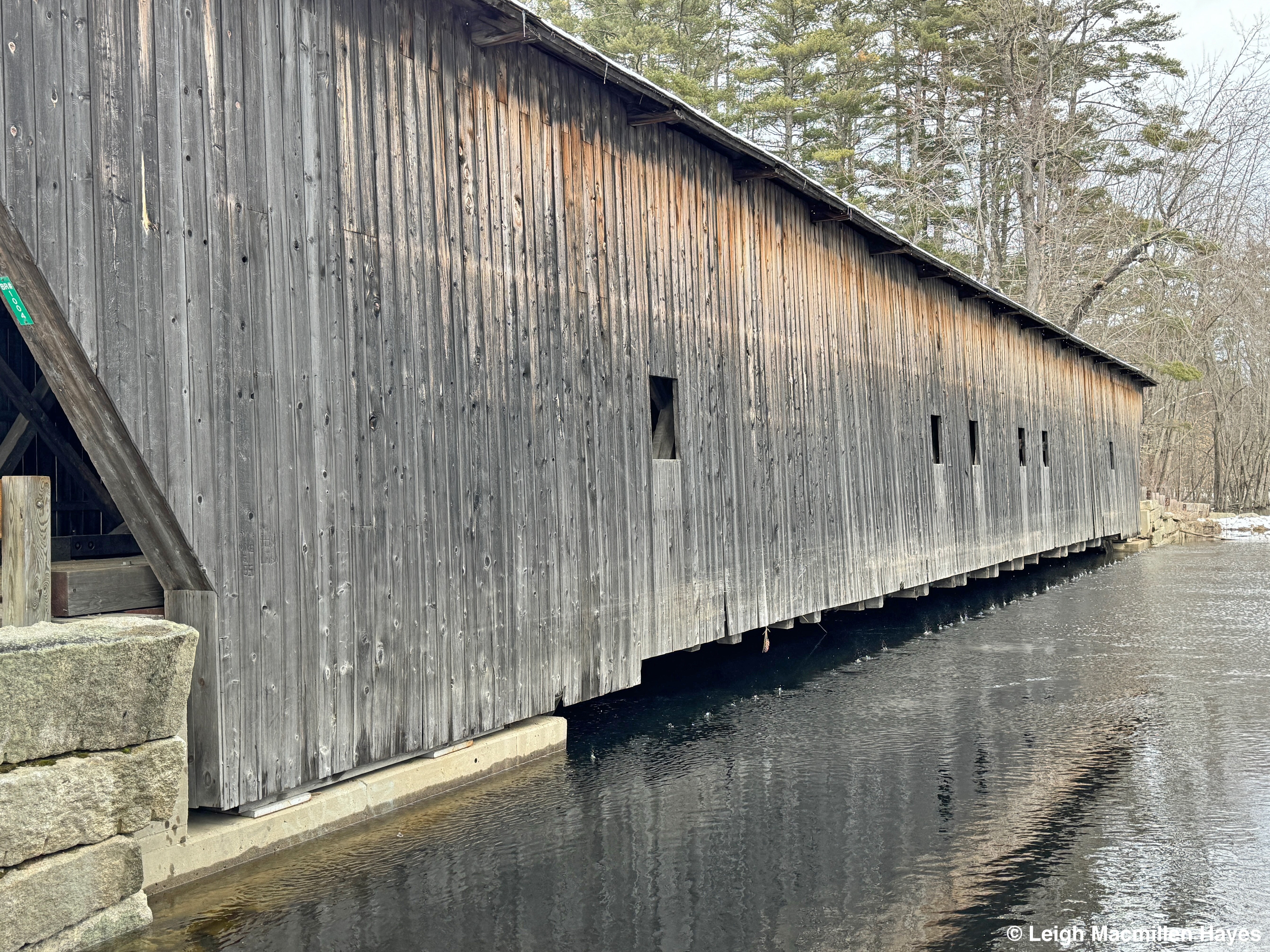
Just over a mile in we reached the coveted spot: Hemlock Bridge. The bridge has spanned what is now the Old Course of the Saco River for 167 years. Built of Paddleford truss construction with supporting laminated wooden arches, Hemlock Bridge is one of the few remaining covered bridges still in its original position.

Peter Paddleford of Littleton, New Hampshire, created this design by replacing the counter braces of the Long-style truss bridge, creating an unusually strong and rigid structure. During three seasons, you can still drive across it.

Yes, we’d seen a lot of water on the road and in the field and noted how high the river was and flooded the fields were, but it really struck home when we noted the short distance between the bridge and the water. And a memory popped into our heads simultaneously.

Today we never would have been able to kayak to Kezar Pond as we did in August 2023. If you look at the cement support on the left and scroll back up to the previous photo, you get a sense of how high the water is right now. And that’s not the highest it’s ever been. Not by a long shot. But you must keep reading to learn more about that.

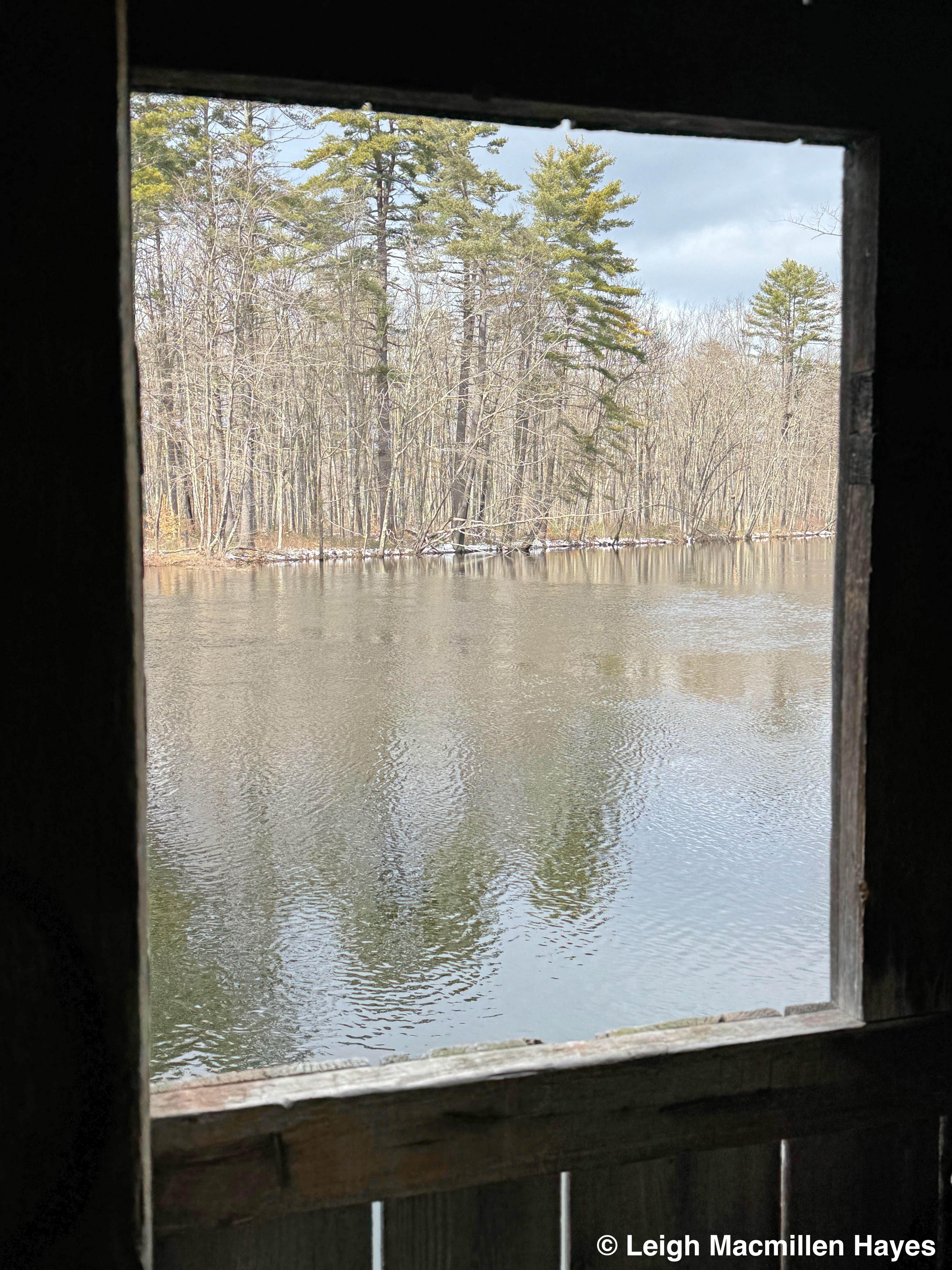
Once on the bridge, there’s plenty of graffiti to examine, or not. I prefer to take in the views and love how the boards create a frame–this one looking in the direction of Kezar Pond.

And this toward Saco River. Both are a bit of a paddle, but a fun paddle.

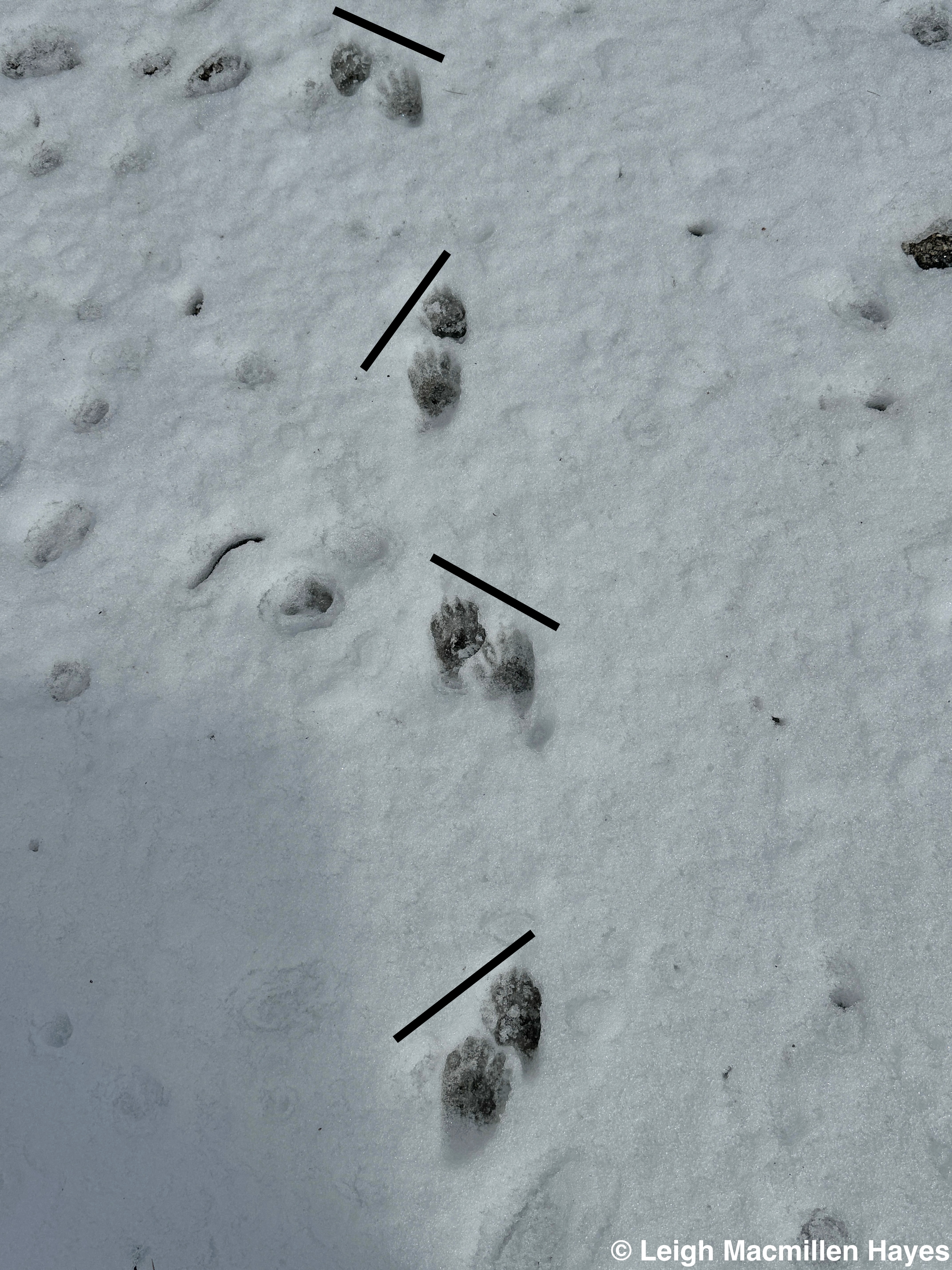
Exiting the other side of the bridge, we discovered we weren’t the only ones to have passed this way. Perhaps we were the only humans, but raccoons had also been out for a walk, or rather a waddle.

After spending a few minutes looking around and scaring off Wood Ducks, it was time to turn around.

On the way out, it was the silhouette of one large and statuesque American Elm that captured my heart as it always does.

And we could see snow squalls in the mountains, while a few flurries fell on us.

At last we finished up where we’d started. And that’s when we saw the owner of the land we’d passed through coming down his son’s driveway. The legendary Roy Andrews is a storyteller of the past and we were delighted that he stopped his truck to chat with us. He told of stories passed on to him about logging operations and situations, especially when the river reverses flow during high water events and once a huge amount of logs were lost until they could haul them out individually in the summer. And he told us that the highest he has ever seen the river is three feet above the floor of the bridge. “Well, that’s a bit of an exaggeration,” he said. “It was 34 inches high.”

This was a reflection Mondate as Roy reflected upon the past and we did the same, both recalling different times we’ve traveled this way, via skis and snowmobile and vehicle and foot and we are so grateful that we can continue to enjoy the past and present. And hope for the same in the future.

My Friend Red

It’s been two years since we’ve spent time together, and to be honest, I kind of doubt this is my friend from 2021, but perhaps an offspring. Anyway, what I do know is that last year was not a mast year in my woods and so there wasn’t much food available–the type my friend prefers to survive the winter months. But this year–pine cones and acorns abound.

As I headed down the cowpath that marks one of the boundaries of our property here in western Maine, I knew instantly by the chortling that greeted my ears that things had changed for the better.

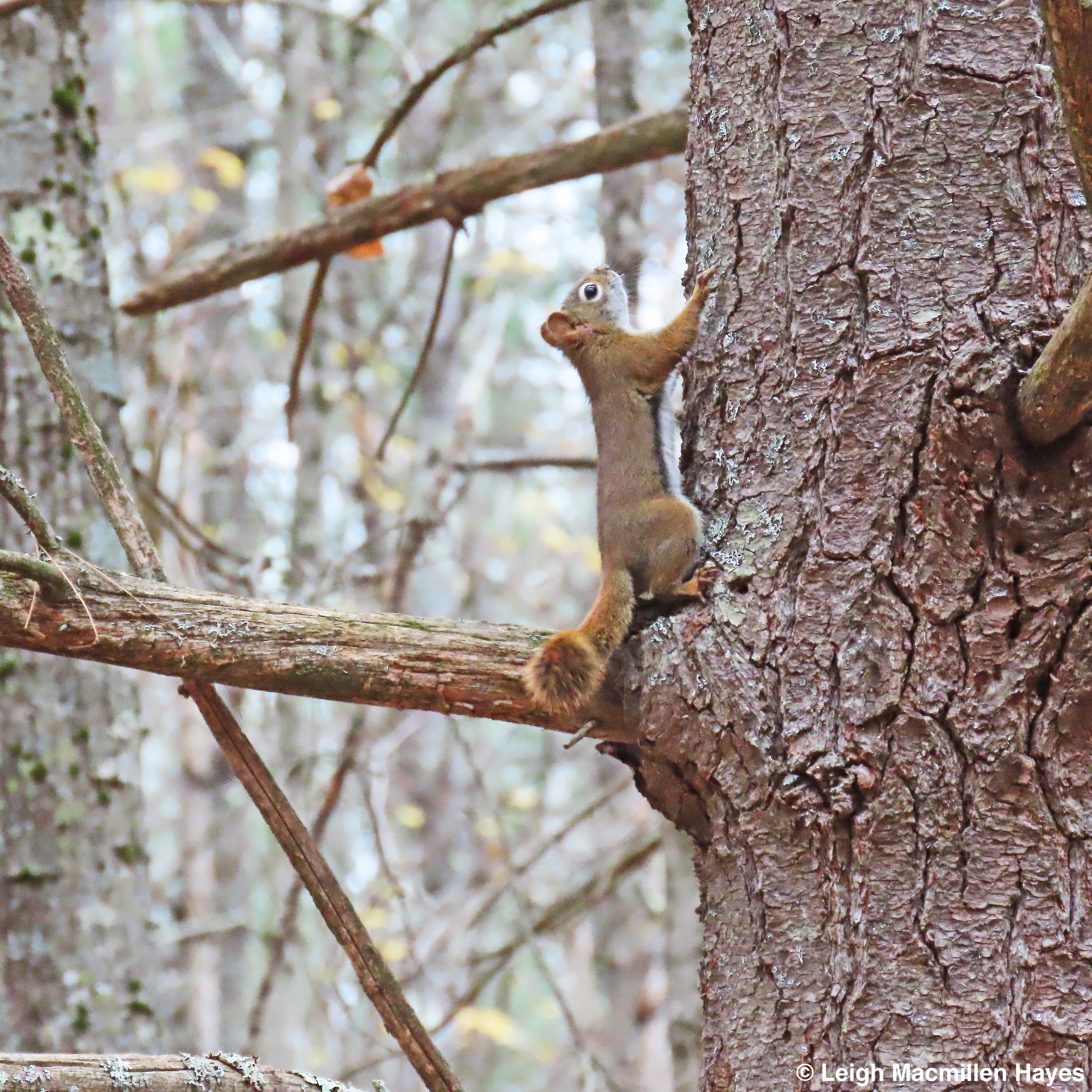
You see, my friend is a Red Squirrel. And he spotted me before I spotted him. And then he let me know in no uncertain terms that I was not welcome. What kind of friend is that?

As I looked at the rocks along the inside path of the cowpath, I began to notice garbage piles Red had created, or middens as we prefer to call them, full of cone scales and the inner core or cob.

They were located in high places where Red could sit and eat in peace . . . that is until someone like me comes along, or worse . . . a neighboring squirrel, or even worse, . . . a predator. Given that a cone on this rock was only partially eaten indicated he’d been interrupted mid meal.

Maybe that’s why he continued to chastise me as he climbed higher up the tree.

It takes at least two years for an Eastern White Pine cone to mature. And once they do, Red has a habit of squirreling his way out to the tips of twigs, gnawing the cone stem and letting it fall to the ground. If you spot a pine cone with closed scales such as this, count the number of scales and then multiply that number by 2. That’s the number of pine nuts the cone offers.

And trust that all are still tucked inside.

Pine cones are in a way like Common Polypody ferns and Rhododendrons in that they predict the weather. If it’s dry, the scales on cones will open. If rain and humidity are in the air, the former being today’s weather, the scales will close tightly, overlapping and sealing the seeds from the outside world.

While wet weather dampens seed dispersal, dry windy days are best and that allows the seeds to be carried away from the mother tree.

In the photo above, you can see where the two seeds had been tucked in, close to the the cob, while the lighter shade of brown indicates where the wings or samaras that help carry the seeds were attached to the outer scale.

And I can attest that the sap on the scales is still sticky even though this cone no longer had any seeds stored inside. The sap coats the cones because its the tree’s reaction of placing a bandaid on a wound when its been injured or in this case had a fruit gnawed free.

One would think that Red’s face and whiskers would be covered in sap, and that does happen, but just as it stuck to my fingers initially, eventually it wore off. And Red is much better at grooming than I’ll ever be.

To get to the seeds, Red begins by holding the cone with both front paws, and turns it in a spiral, tearing off one scale at a time. Quickly! And gnawing each tiny seed packet open. The seeds may be small, but they are highly nutritious.

He continued to watch, vocalizing constantly, as I explored his territory below.

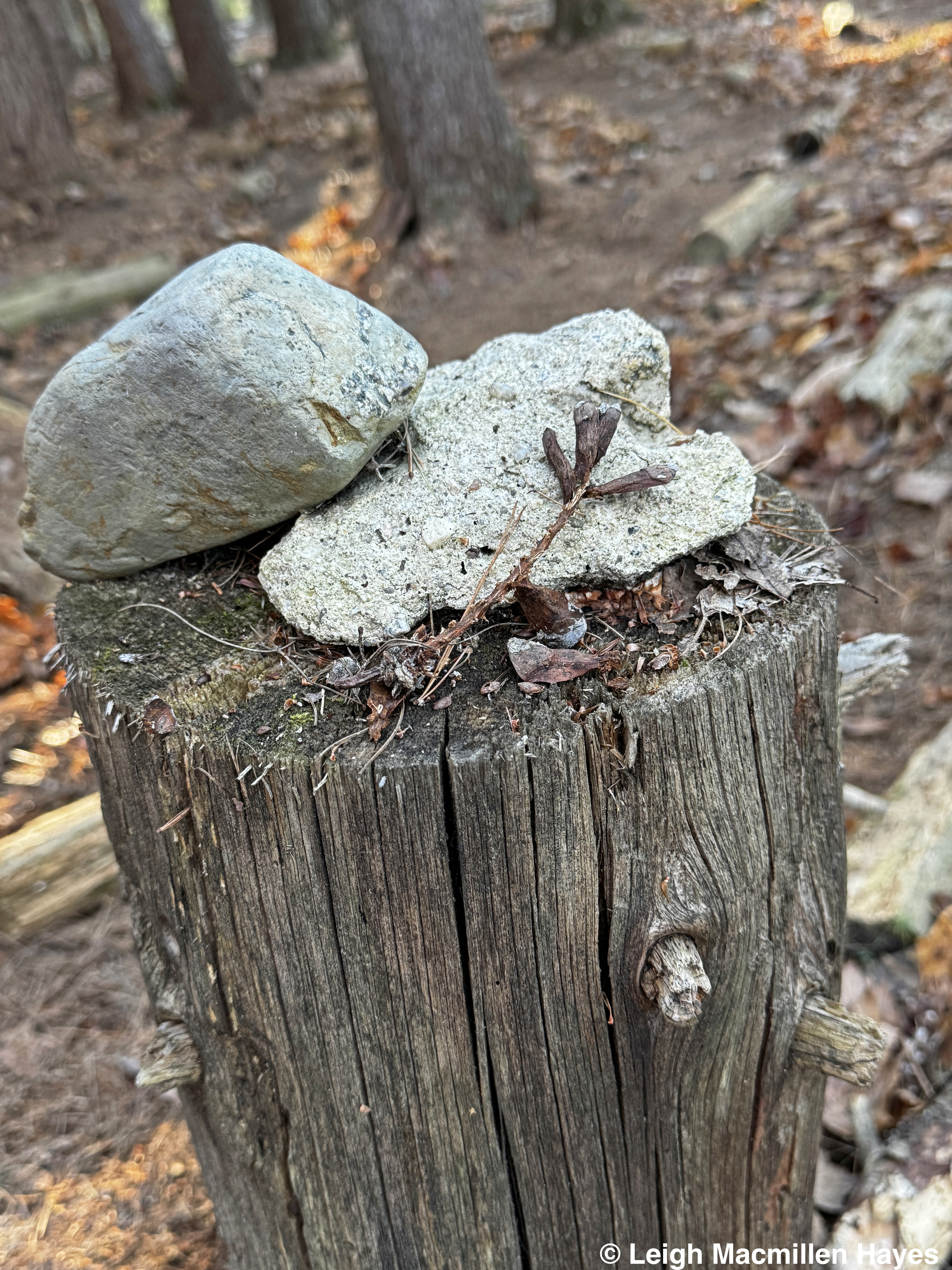
Upon every high spot, including tree stumps, there was at least a midden, but also a few cones for possible future consumption, though I did have to wonder if some went uneaten because he realized they were open and thus not viable.

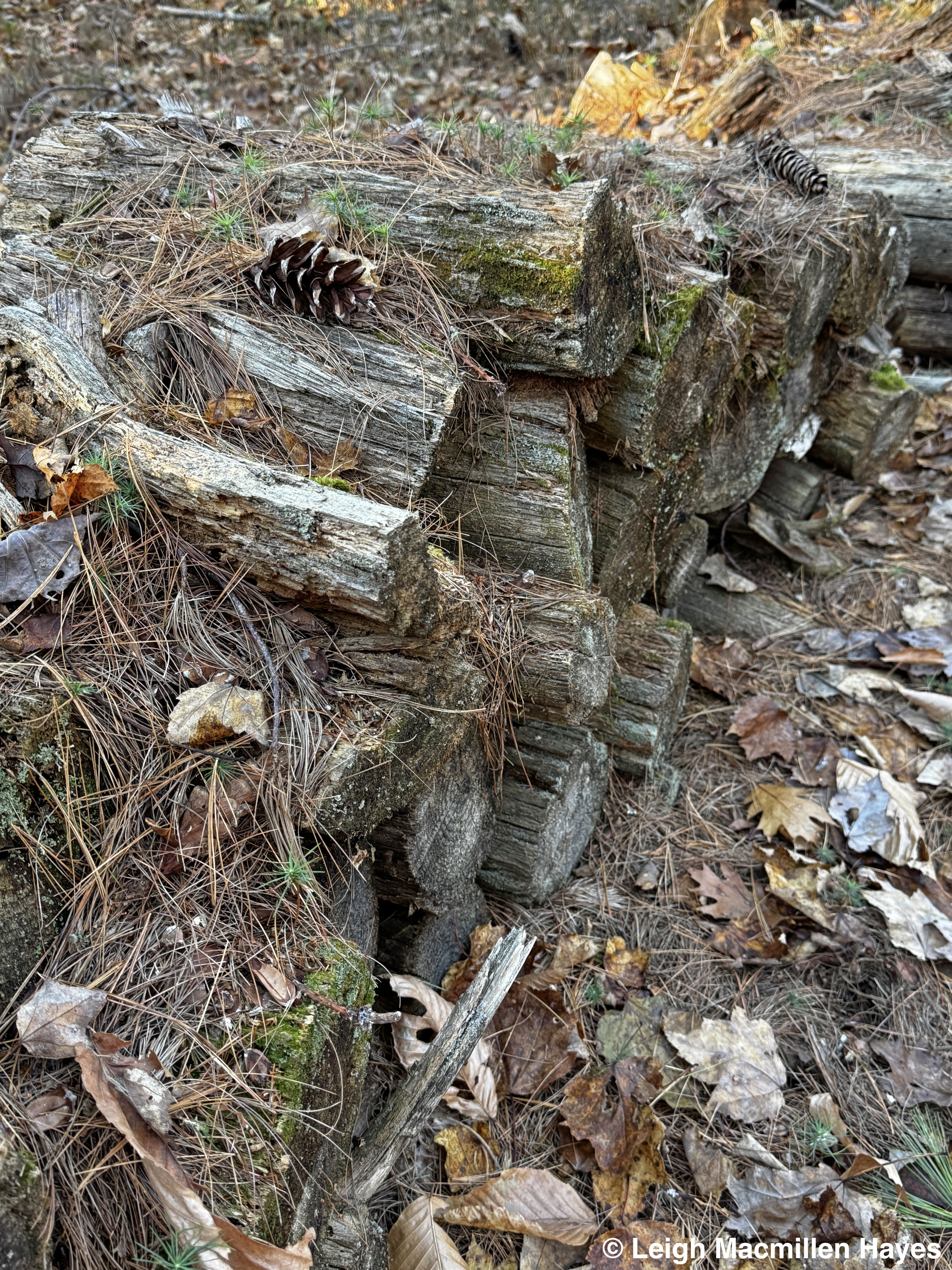
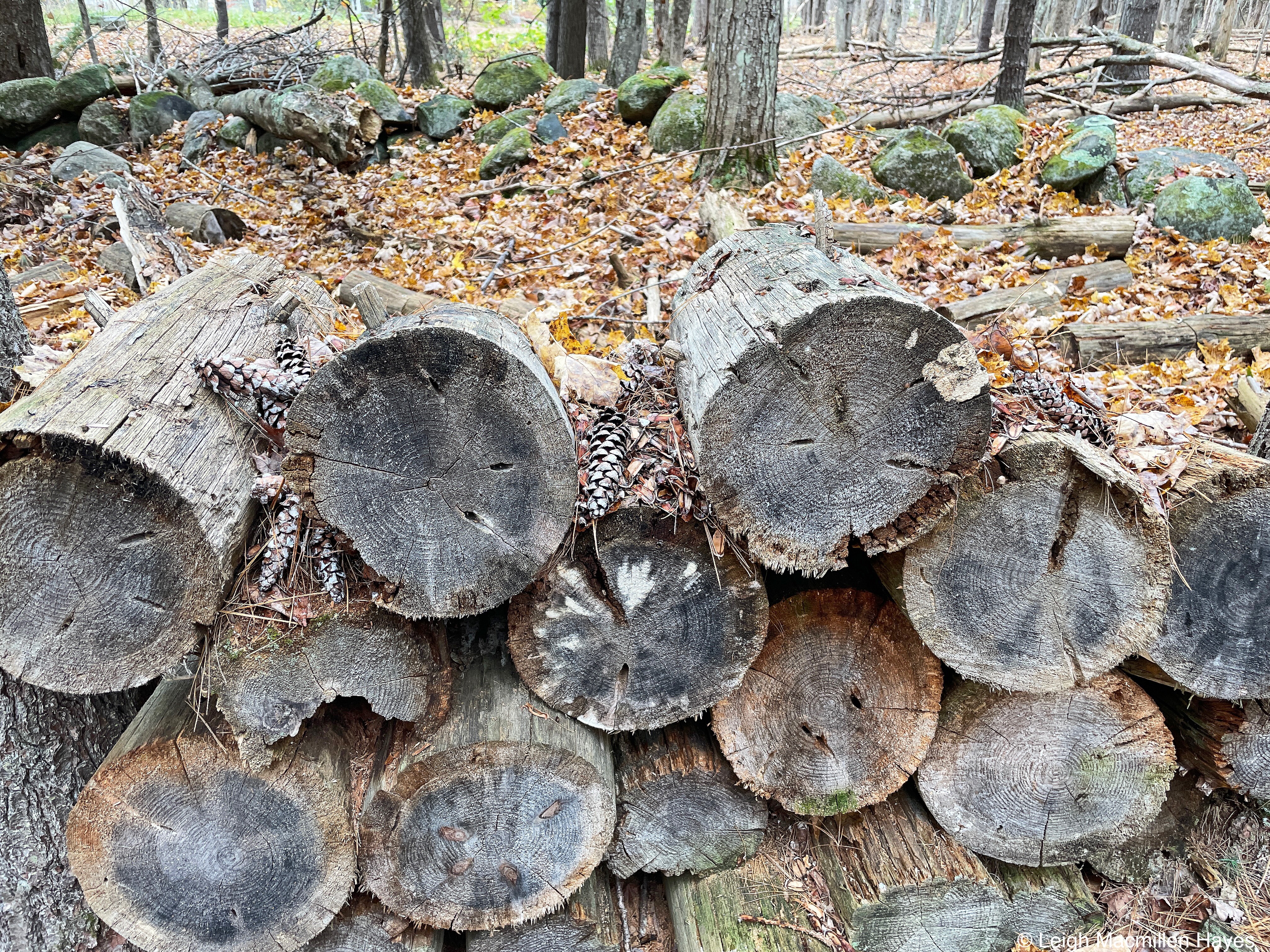
More of the same I found upon some of the cut pine stacks we created long ago that serve as shelter and . . .

Storage! I’ve been looking for a cache for the past few weeks, a squirrel’s food pantry, and today I located a few small ones that I know will grow in the coming weeks. Cool. moist locations like among the logs, but also in the stone wall, offer the best places to keep the cones from drying out.

As he backed up but still chattered at me, one thing I noticed about Red, which will help me to locate him in the future, is that he not only has a reddish gray coat, but between his back and white belly there is a black stripe. Maybe he’s disguising himself so he can go trick-or-treating this week and his neighbors won’t recognize him.

So here’s the thing. Red is an omnivore. And though we associate him with pine cones, especially in the winter, he also eats flowers and insects and fungi and even smaller mammals if given the chance. And acorns. And this year is also a mast year for acorns in our neck of the woods.

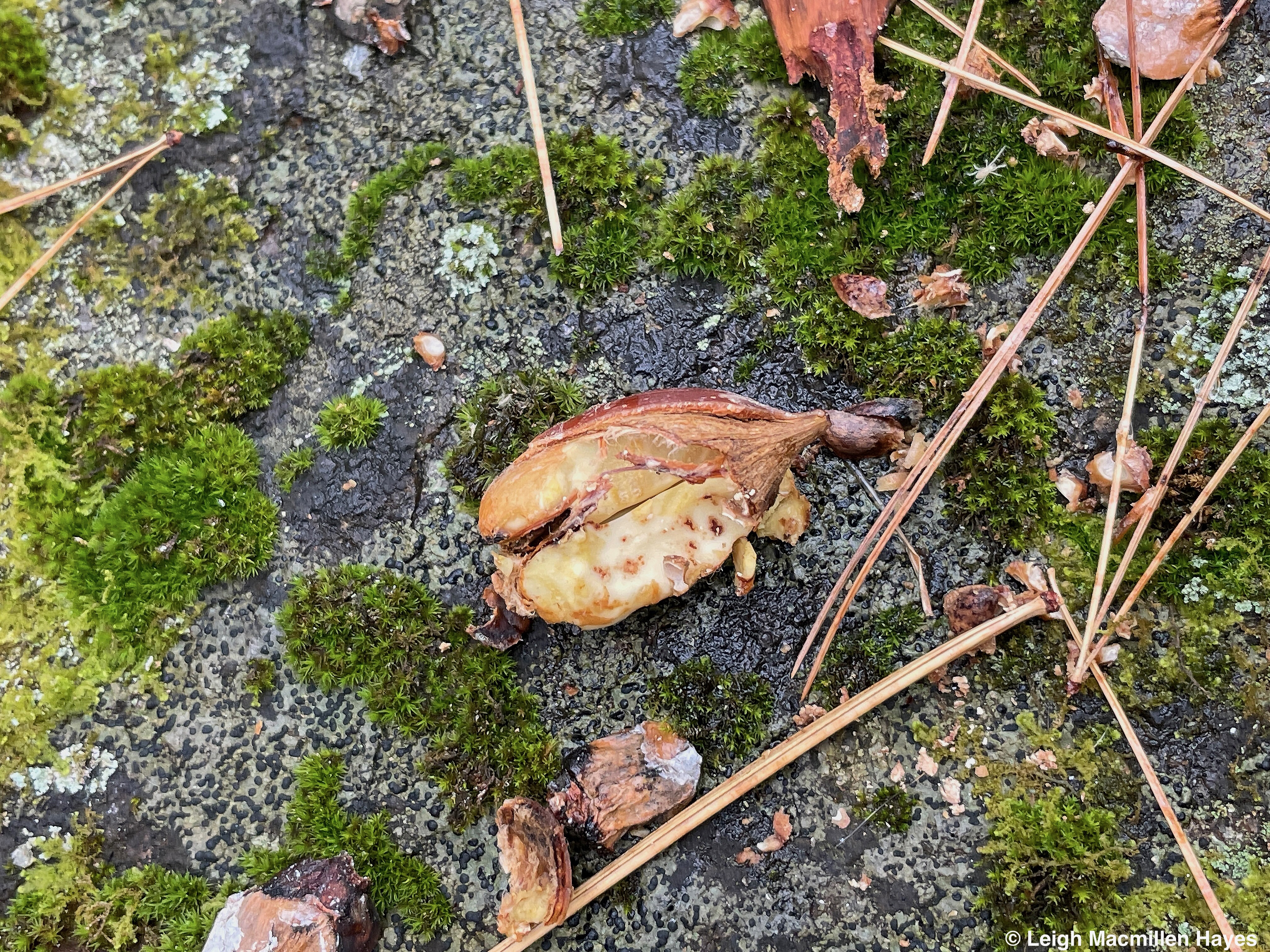
He’d peeled the outer woody structure away and had started to dine, but again, something or someone, and possibly I was the culprit, had interrupted his feeding frenzy.

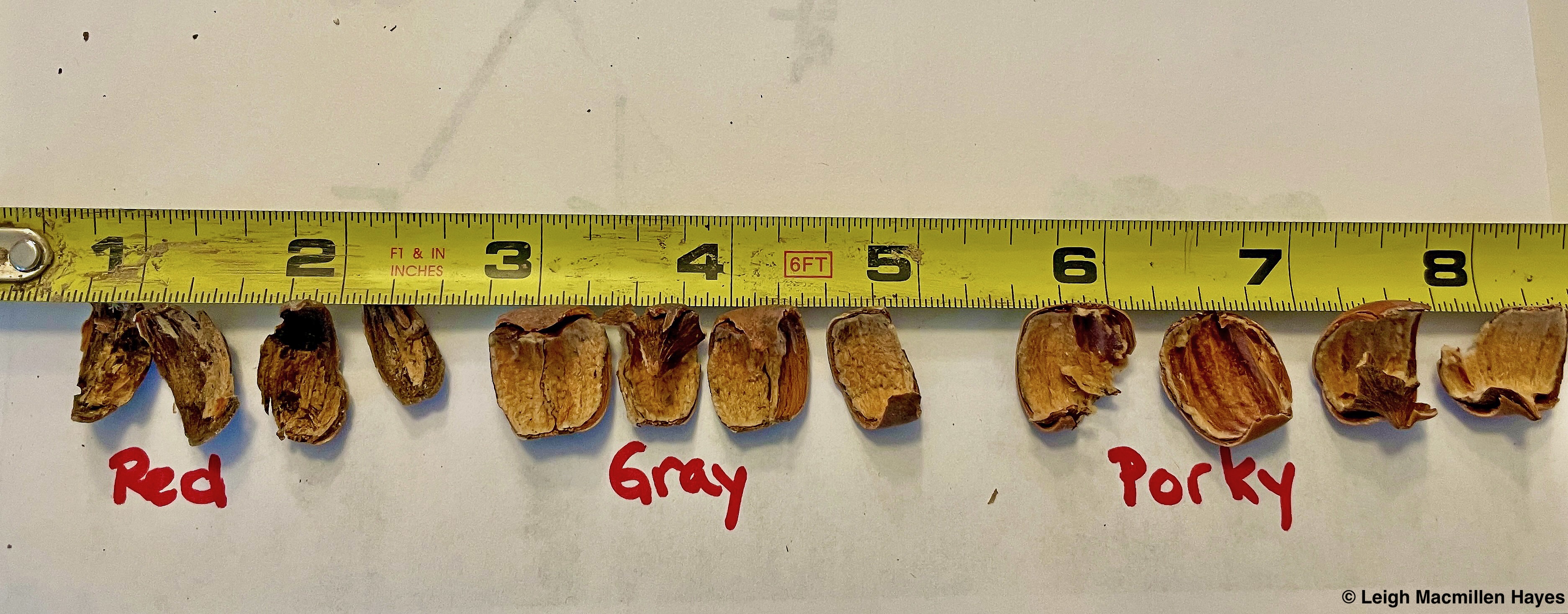
That said, I was delighted to find the acorn shell fragments because already in my collection I had samples from a Gray Squirrel and a Porcupine. Now I have all three and you can see by the tape measure how they compare in size, as well as the manner of stripping. As you can see, Red’s fragments are about a quarter inch in size, while Gray’s a half inch or so, and Porky’s are about three quarters of an inch. And the latter are much more ragged in shape.

Red. My Squirrel Friend. He just doesn’t know it. Maybe by the end of the winter he will because I intend to call upon him frequently to see what else he might teach me.

Finding Food Is The Name of the Game

Winter finally arrived in western Maine this past week in the form of three snowstorms, the last ending with a coating of ice. Between storms, I’ve been teaching others the art of tracking mammals and birds through my work at Greater Lovell Land Trust, as well as a two-day class I taught for a local Senior College, and a day-long class for Maine Master Naturalists.

I love, love, love watching others experience joy as they begin to notice the nuances of print and patterns and scat and sign.

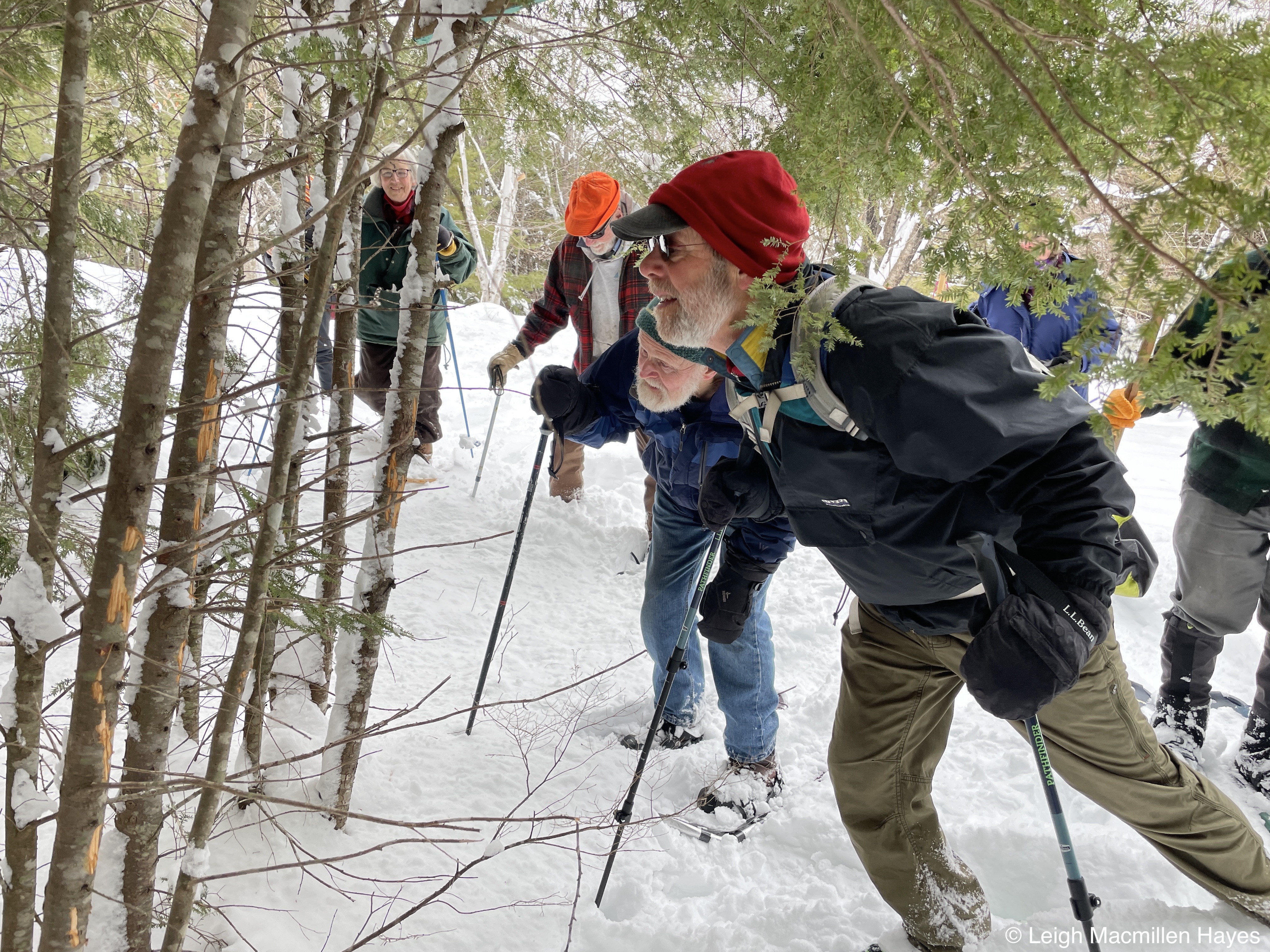
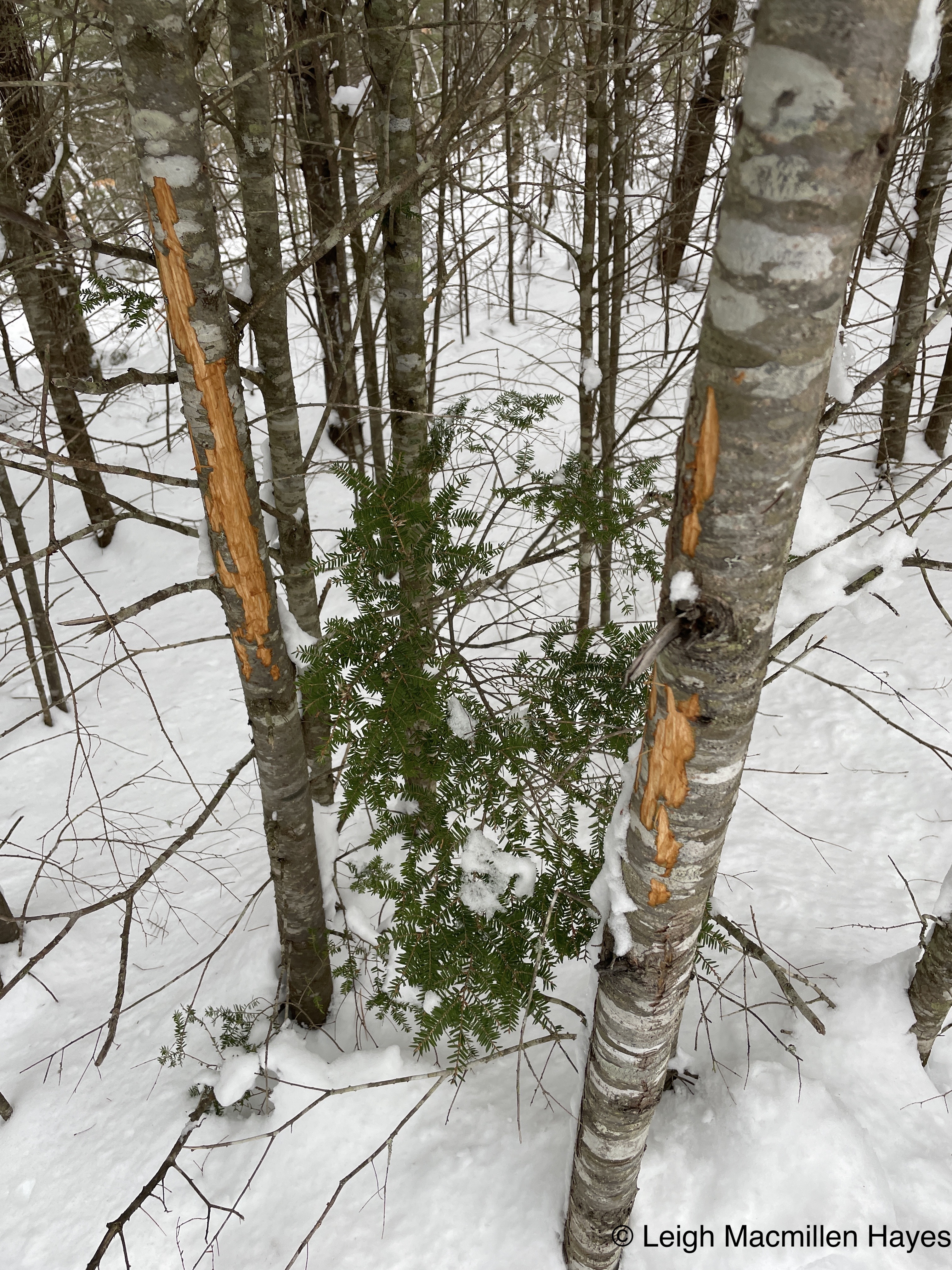
This being the work of a White-tail Deer who scraped its lower incisors up the bark of a tree to get at the cambium layer where the sugars and starches flow. The tags at the top of the scrape are a tell-tale sign because ungulates like deer and moose do not have upper incisors or canines, but rather a hard palate, and yank at the wood as they press their lower incisors against the palate to pull the bark off a tree–mostly Eastern Hemlock or Red Maple.

It wasn’t long after the Senior College outing on Wednesday that snowflakes announcing the third storm began to fly and one of our resident Red Squirrels stopped by to check out the offerings at the bird feeders.

This hearty sole is Ed and as you can see, he’s lost an eye–probably in a disagreement with a sibling, but that doesn’t stop him. He’s perfectly capable of finding food, seeking cover when necessary, and fighting off his brothers.

Ed wasn’t the only one out in the snow, for a male Downy Woodpecker made frequent trips to the suet feeder.

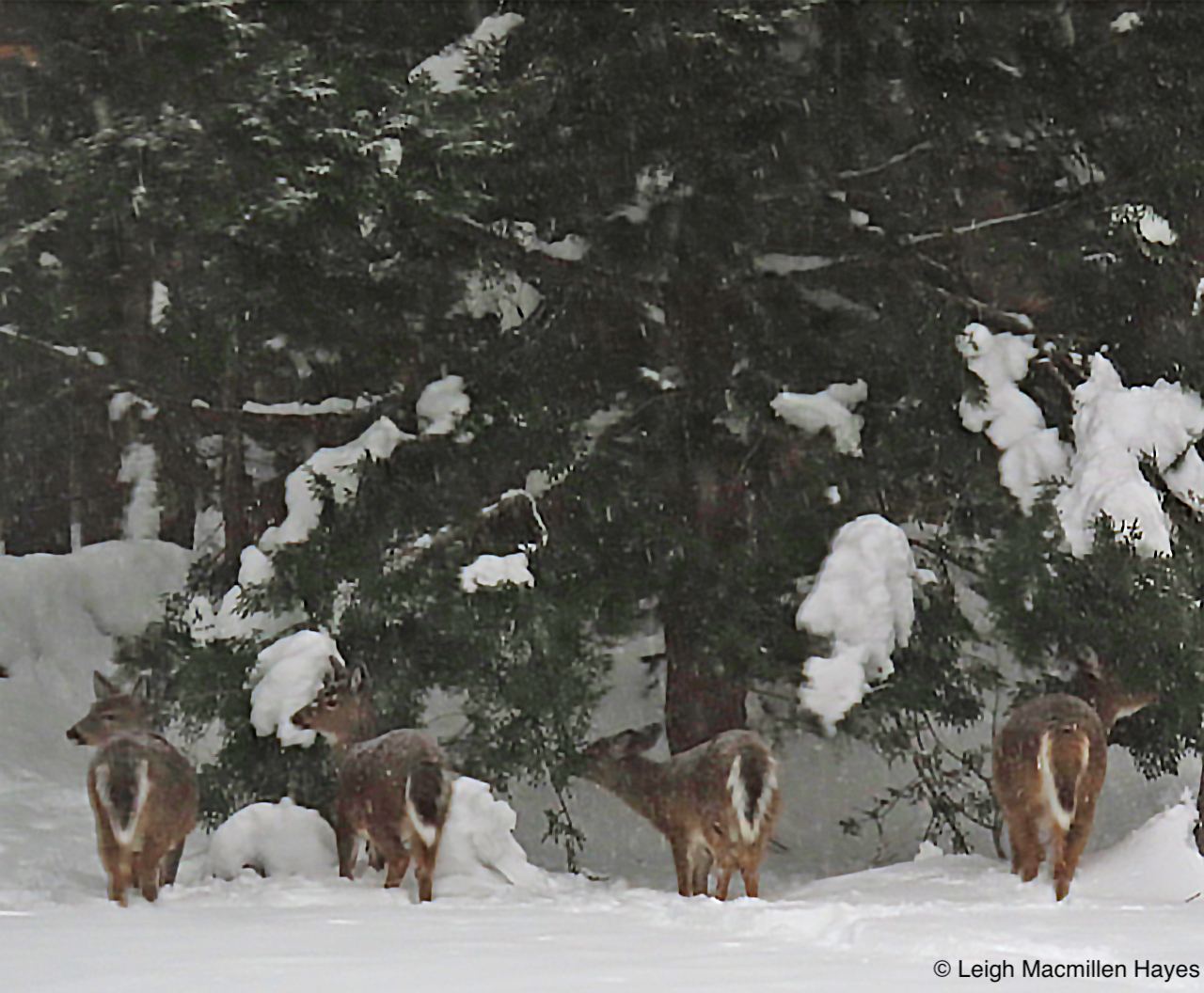
And then, just before twilight the Deer began to appear. The first walked to a Squirrel feeder I was gifted recently, with some peanut butter added to the corn as an enticement. She didn’t seem impressed. I thought that was weird because if you’ve ever made a bird feeder out of pinecones smothered with peanut butter and sunflower seeds, you might notice that the Deer lick everything off within hours of hanging the cones from a branch.

Following the arrival of the first Deer, a sibling came in with mom, but they too, were not impressed.

So the thing about watching the Deer, was that they provided a photographic lesson–beginning with the two cloven toes that form the heart-shape of the impression they leave in the snow–with the pointed end of the heart always indicating the direction of travel. And further up the foot are the dew claws, which sometimes show in a print. If you look at the two hind legs, you can see the dew claws just above the snow. I’ve been told that if the dew claws appear, then it is a buck. I’m not 100% convinced of that. I think it has more to do with snow conditions.

And sunflower seed is not their only form of nutrition, for one of the Hemlocks by the stonewall between our yard and woodlot offered some delectable needles full of vitamin C. Do the Deer know that?

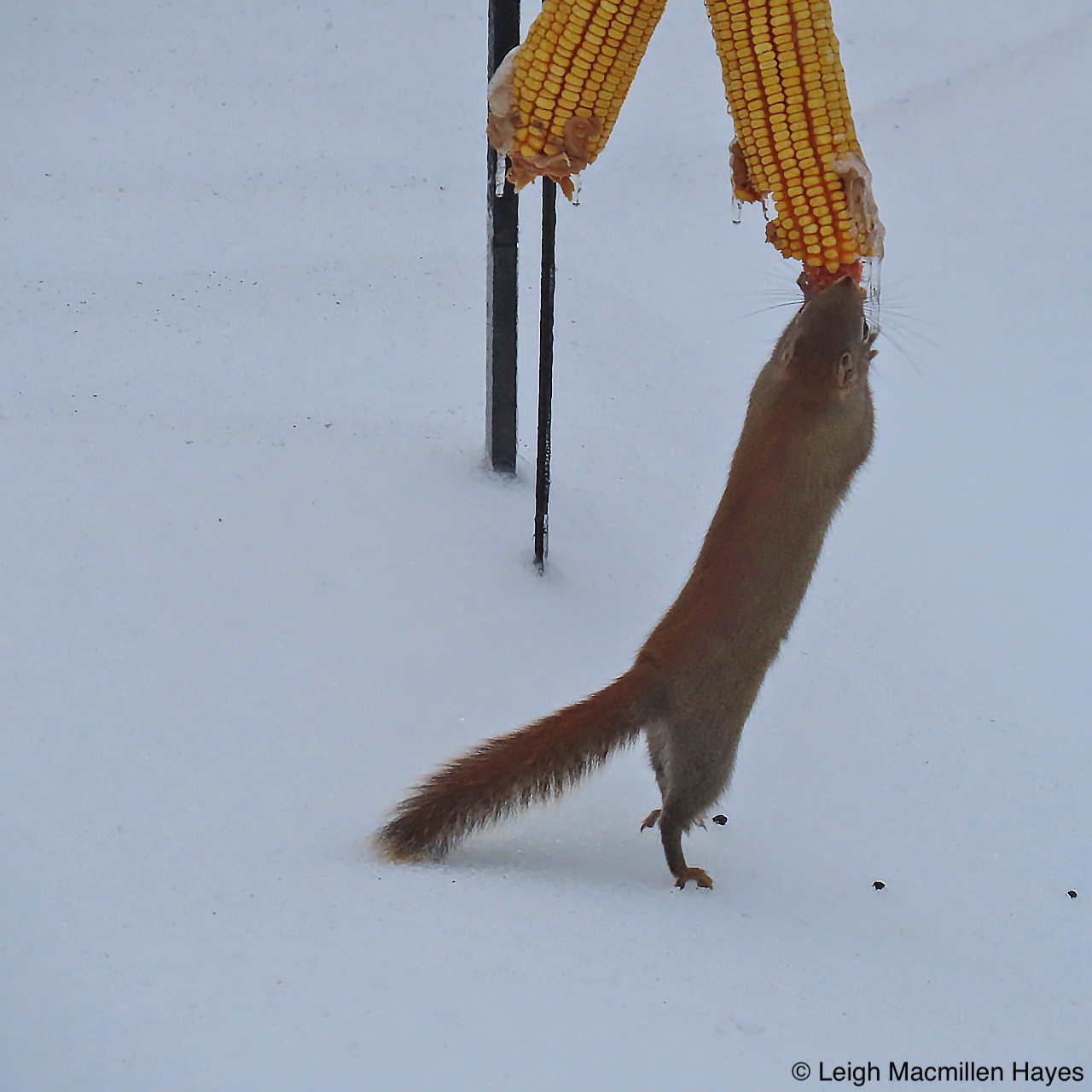
Following the storm, a coat of ice covered the tree branches and even the corn, but that didn’t stop Ed’s brother, Fred, from grabbing a kernel. Actually, the corn had originally been placed about two feet off the ground in an area we’d shoveled, but the snow had piled up again, making the meal easy to reach.

I spent yesterday shoveling what felt like cement. The first two storms offered a much fluffier take on snow consistency. Periodically, like Ted, another brother of Ed, I’d duck into the house. His home is a network of tunnels near the feeders, and so far it has provided good protection.

This morning dawned brighter, and a bit frosty to start. While Fred, Ted, and Ed, ate birdseed and chased each other round and round, a Gray Squirrel stopped by to get a handle on things.

The perfect meal was garnered.

As it turned out, today was a super busy day at the feeders, which Black-cap Chickadees and Nuthatches making frequent visits.

And the puffed up feathers of a male Downy bespoke the temp in the teens. Birds fluff up in the cold to trap as much air in their feathers as possible. The more trapped air, the warmer the bird.

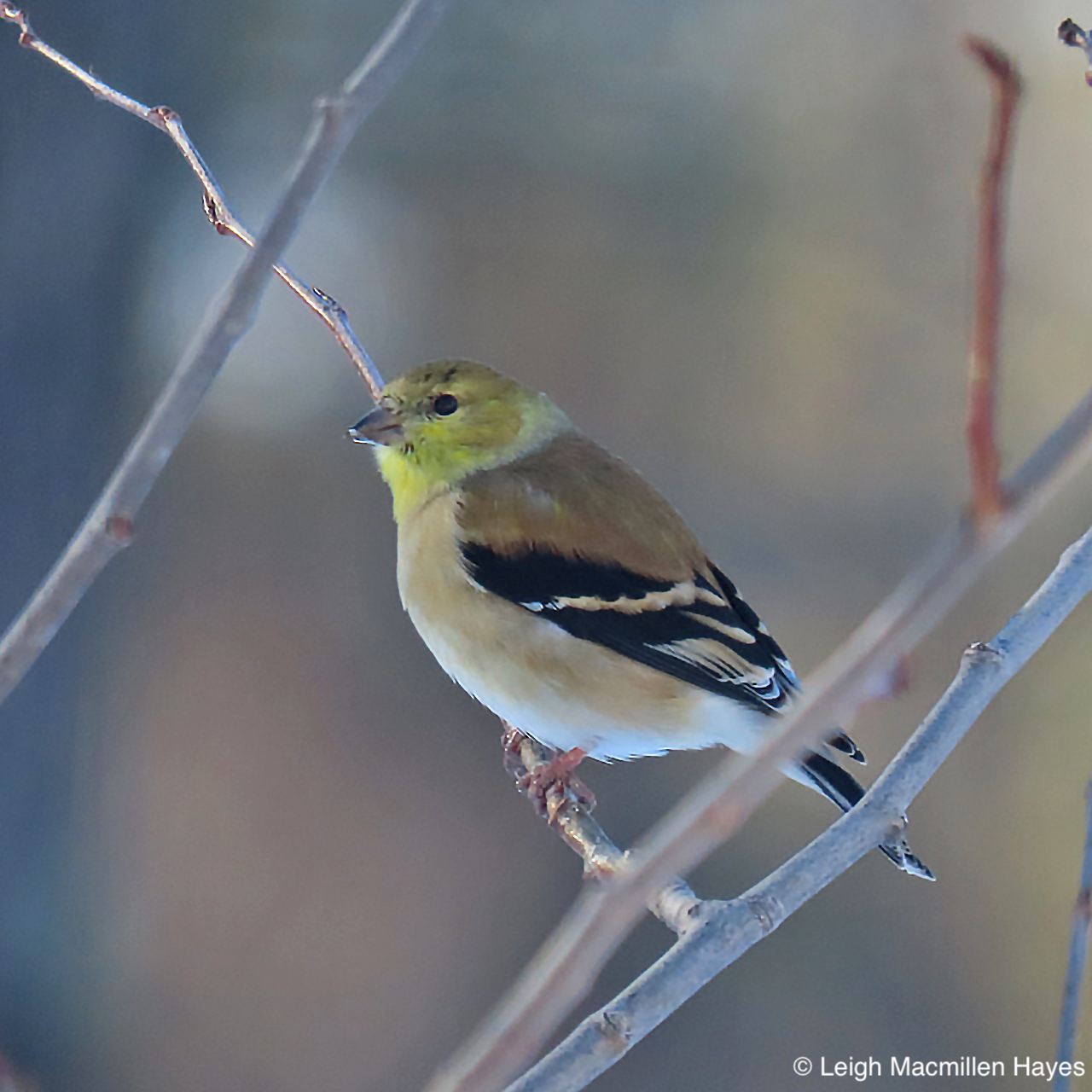
A couple of American Goldfinches were early morning visitors as well, and I love that unlike the Chickadees, Finches are much calmer and stay in one spot for a bit.

Probably my favorite visitor was a surprise for as I was watching the Hairy Woodpeckers, in flew a Red-bellied who worked at a chunk of suet and finally flew off with it.

When I finally headed outside this afternoon, donning my snowshoes to stay atop the 2.5+ feet of snow, I couldn’t believe that for the most part I could stay on top of it, for such was the crusty coating from yesterday’s rain finale. And with each step I took, I heard the crunch below–sounding much like breaking glass.
Much to my surprise, I found the track of a Ruffed Grouse, who did break through the snow.

Of course, it was no surprise to find the figure eight of a deer print, with the foot impression about two feet down. This is a difficult time of travel for them. And I suspect mine will be back by the feeders during the night looking for an easy meal.

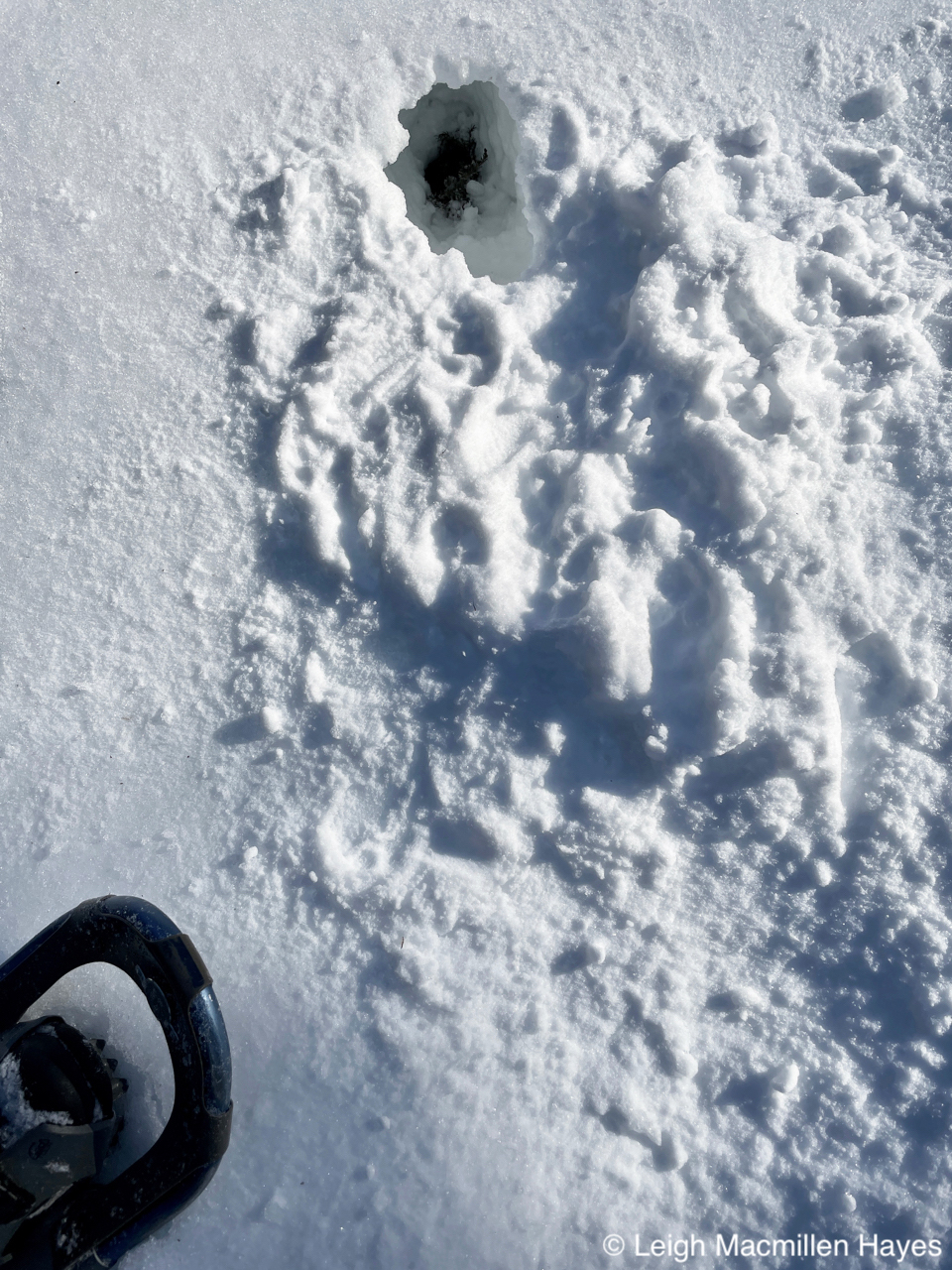
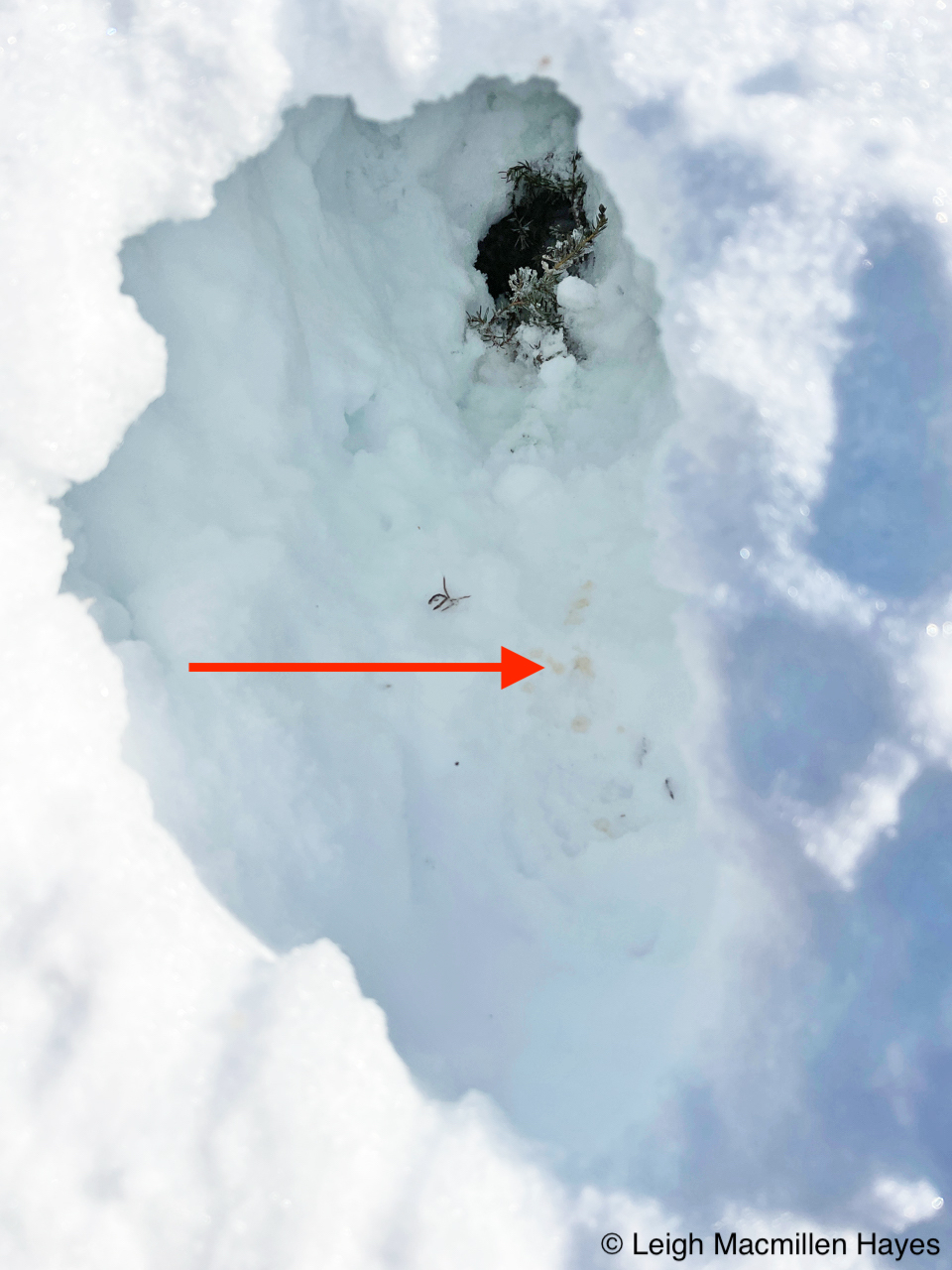
And then I discovered a disturbance that I had to investigate. A deep hole had been excavated.

A look at the size and X between the toe and metacarpal pads and I knew who had done the job: an Eastern Coyote.

What it consumed I could not say, but there were some drops and I wonder if they were blood that had darkened a bit as they aged. It’s funny, because I was so sure that I’d come upon a Ruffed Grouse’s snow cave and totally expected to see the bird’s scat in the hole. That was not the case at all, but I don’t know who the victim was that provided the Coyote with a meal. Or at least a snack.

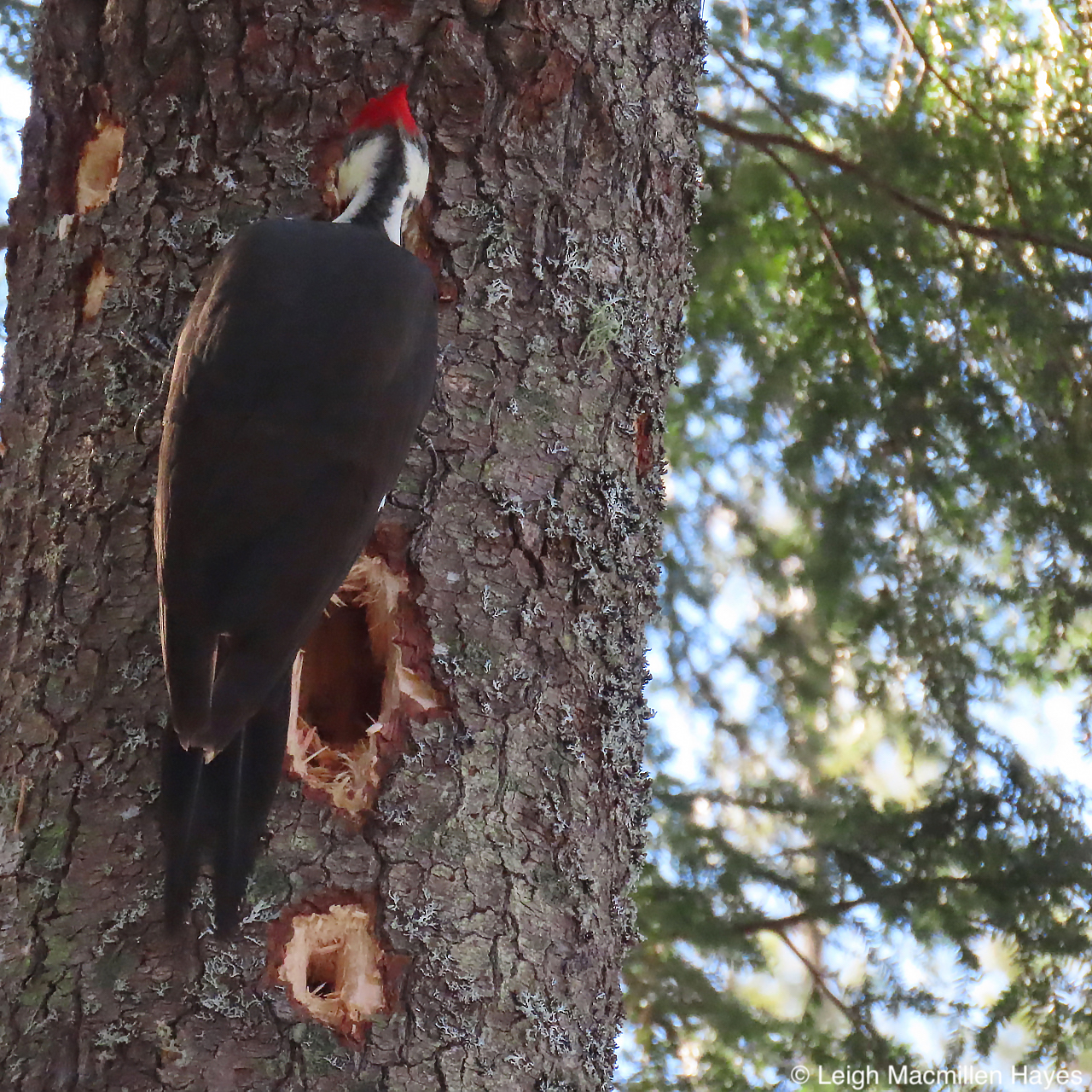
Back in our woods, I met an old friend who has graced these woods for years–or at least members of his family have done so.

He, too, was looking for food. And so intent upon his job was he, that I stood only about fifteen feet away while he worked.

I didn’t step under to check the scat because I didn’t want to scare him off, so I’m not sure if the Pileated Woodpecker’s needs were fulfilled, but given that he had worked on the tree for a while and some of the holes were quite deep, I suspect he had dined on his favorite meal of Carpenter Ants.

Finding food is the name of the game, though it’s hardly a game at all–especially when it’s cold, the snow is deep, and there’s a crust of ice atop it. And that’s just for the critters. Never mind people who have to deal with the elements on a daily and nightly basis.

Support your local food pantry,

The Richness of Life

In the midst of walking toward the vantage point upon the Mountain Division Trail in Fryeburg, Maine, grows a grass of distinction for its form,

All fluffy and arced as the seedhead is, Giant Foxtail seems an apropos common name, though its known as a pest to farmers who grow corn.

I’m struck over and over again as I walk upon the paved pathway,

by the colors and textures of so many seeds ready to float astray.

And then there is a tree that cannot make up its mind

and chooses instead to be two of a kind.

Its known as a conifer because it grows needles each year,

but this Tamarack sheds them in deciduous form as winter draws near.

I next pause beside one who displays all ages,

from yesterday’s cones to today’s catkins and tomorrow’s buds waiting to turn spring’s pages.

Some of the Speckled Alder cones hide beneath tongues imitating piles of snakes stretching out,

made from galls caused by an infection to increase the surface for spores from a fungus to spout.

Another with long, feathery white plumes overpowers a chain-linked fence along the way,

the seeds of this native vine, Virgin’s Bower, await a breeze to help them stray.

Other seeds also announce their presence, these hanging from trees.

Being Black Locust, their pods are inedible legumes related to peas.

Tossed into the mix these scale-like needles that make me think of braids form a flat spray.

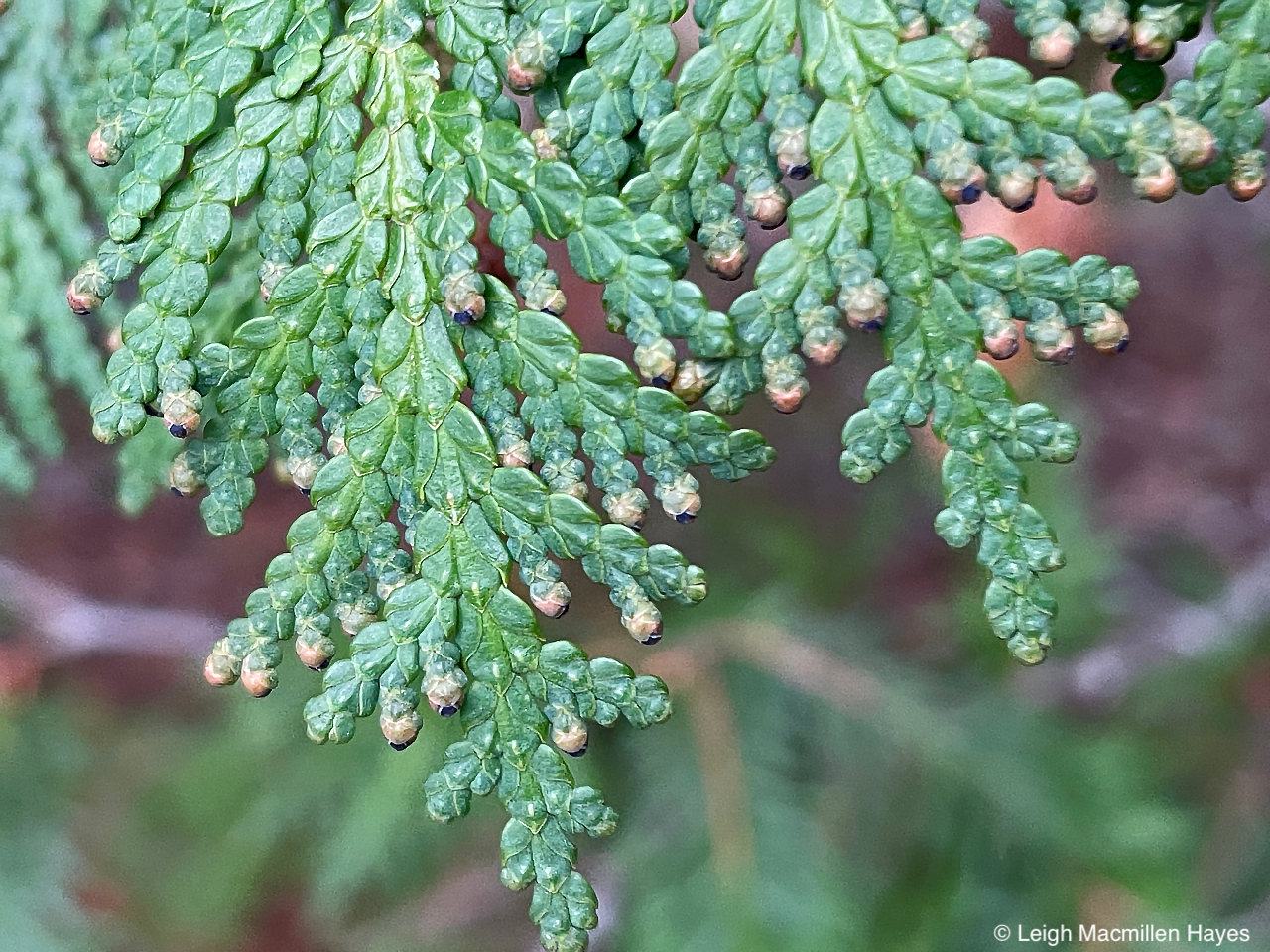
The tiny flower buds at the tips of Northern White Cedar’s leaves preparing to bloom next May.

What amazes me most about this extremely warm November day,

is spotting flowers in bloom like the colorful Calico Aster array.

And then there was a plant bright yellow in flower with lance-shaped leaves of green on display for no apparent reason,

This Showy Goldenrod being one I couldn’t recall noticing before but will recognize when we meet again in another season.

Even the insects are confused this fall,

such as this flower beetle taking advantage of an in-bloom Yarrow offering a nectar haul.

One of my favorites though, knows that the flowering season should have ended by now,

As the Evening Primrose showed off a Christmas display of deeply-veined basal leaves meant to wow.

Thankfully, a nest the size of a basketball I spot dangling from a branch shows signs it is no longer full of life,

The hornets who built the papery structure have abandoned it, causing us who follow the trail no more strife.

At last, returning to the vantage point from whence I have come,

I’m filled to the brim with colors and textures that would mean only death to some.

At the end of today’s journey I realize

this place is as rich in death as it is in life and I have won the prize.

Needed: Minds to Wonder

Along a paved trail seemingly flat that follows a track to a vanishing point did I walk today.

It’s a place some see as desolate, but nature always has something to present and today it was signs of the season to come that drew my attention.

Hints of autumn’s hues . . .

contrasted sharply with summer’s chlorophyll-induced greens.

Redder than red winterberries bespoke the presence of a nearby male–since as a dioecious species, female flowers and male flowers grow on separate shrubs. They also signaled bird food and seasonal decorations–depending on who arrives first: Avian species or human.

Disturbed though the land is, Asters such as this Calico, invited visitors like the Paper Wasp to stop by for a sip of nectar.

Goldenrods also sent out messages and Bumble Bees RSVPed . . .

for they had baskets to fill one pollen grain at a time.

In the mix along this route of disturbed soil and gravel, there were those whose seedheads, while reminiscent of a dandelion, proved more beautiful than the Pilewort’s actual nondescript flower.

Less obvious, but no less beautiful, Wood Sorrel quietly softened the edges of the rocks upon which it grew.

Jewelweed, also known as Touch-Me-Not for its seed’s habit of springing forward when touched, had a visitor all its own whose name I wasn’t allowed to catch.

Similar in color to the Jewelweed, a Monarch butterfly filled up . . .

perhaps a last series of sips before the long journey south.

All of this color and action was observed by a Chippy, who was busy adding to his collection of goods, while his kin added their clucks to the chamber music orchestrated by grasshoppers and crickets.

The Mountain Division Trail in Fryeburg, Maine (home to the Fryeburg Fair), is hardly flat and not at all desolate–it just needs people with eyes to see and ears to hear and minds to wonder as they wander. Okay, so maybe it was desolate in terms of being deserted of people, but I kinda like it that way. As for being dismal and bleakly empty–I beg to differ.

The Happy Fox Trot

I know. I know. I should have taken the bird feeders down two months ago. But I blame it on My Guy because he keeps bringing damaged bags of bird seed home. And because of that, we’ve actually had a delightful time watching all the action at the feeders and below where I scatter plenty of seed on the ground so others can partake.

A pair of Northern Cardinals are the most frequent visitors, and lately he’s taken to making sure she’s well fed. Often she sits and waits rather than helping herself, taking notes on the kind of parent he will be to their offspring.

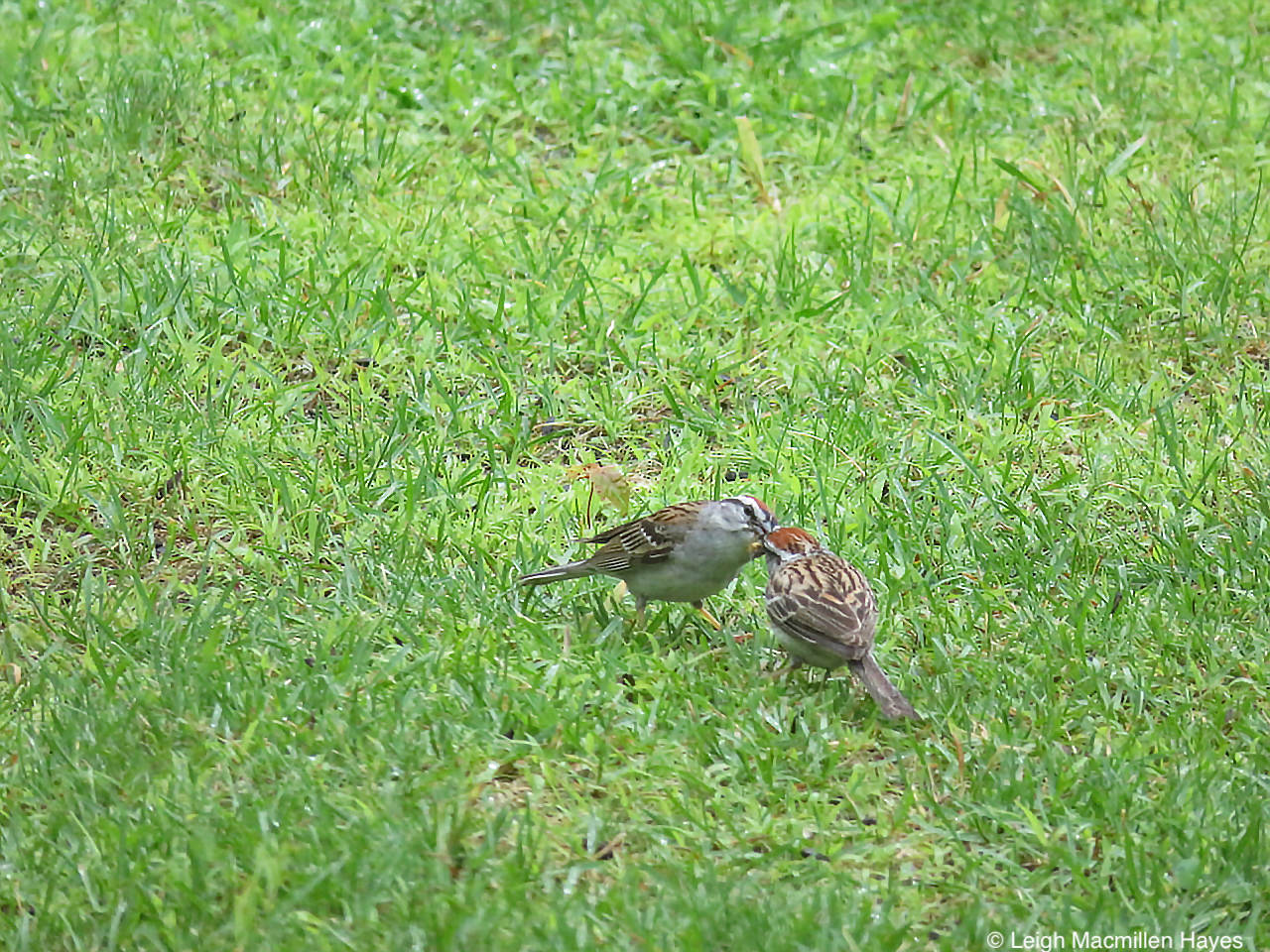
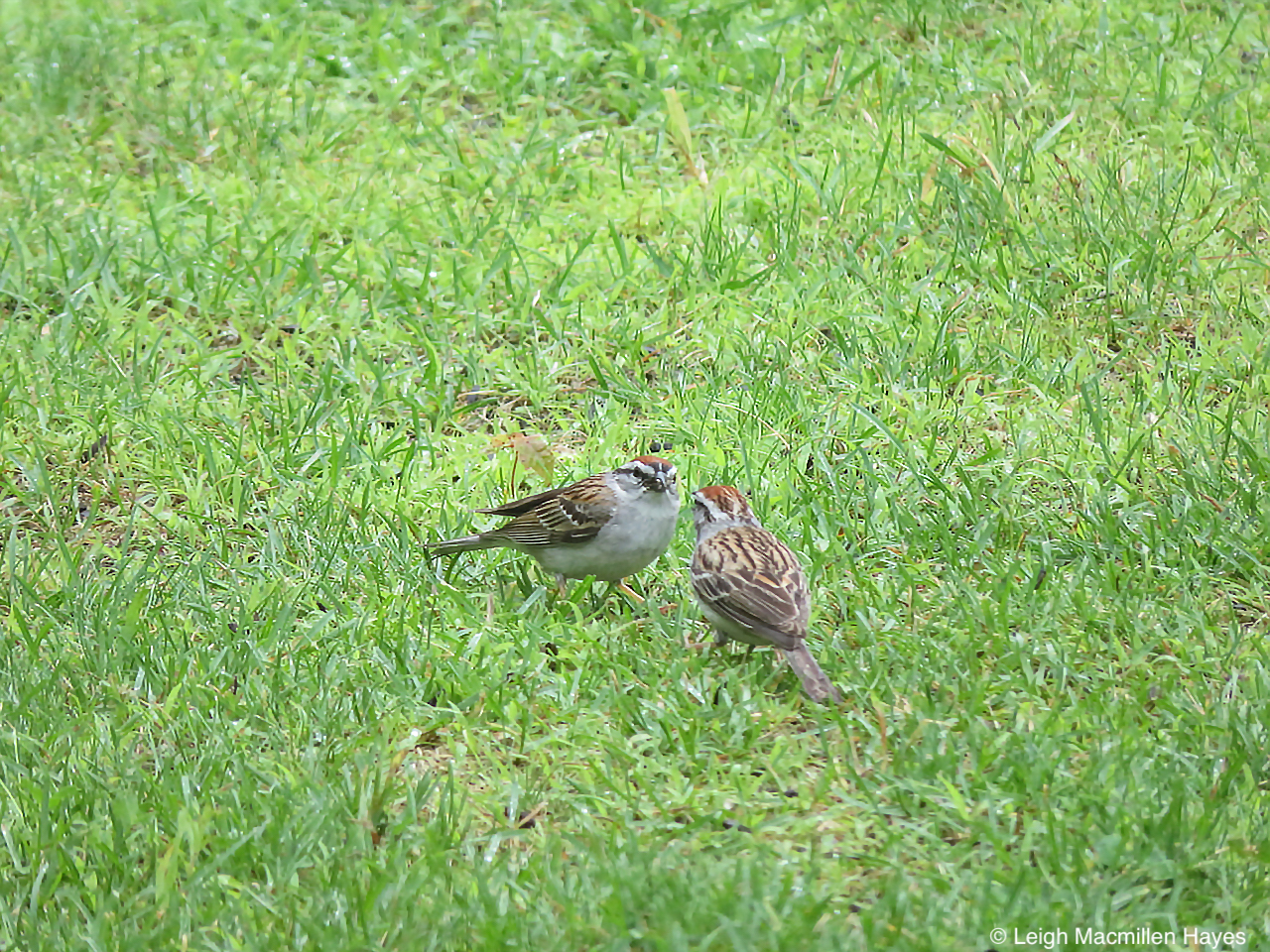
Chipping Sparrows have also participated in courtship feeding, and just maybe this behavior also strengthens the bond between the two genders.

He did look at me as if to say, “Hey, this is between the two of us. Skedaddle.” And I eventually did disappear.

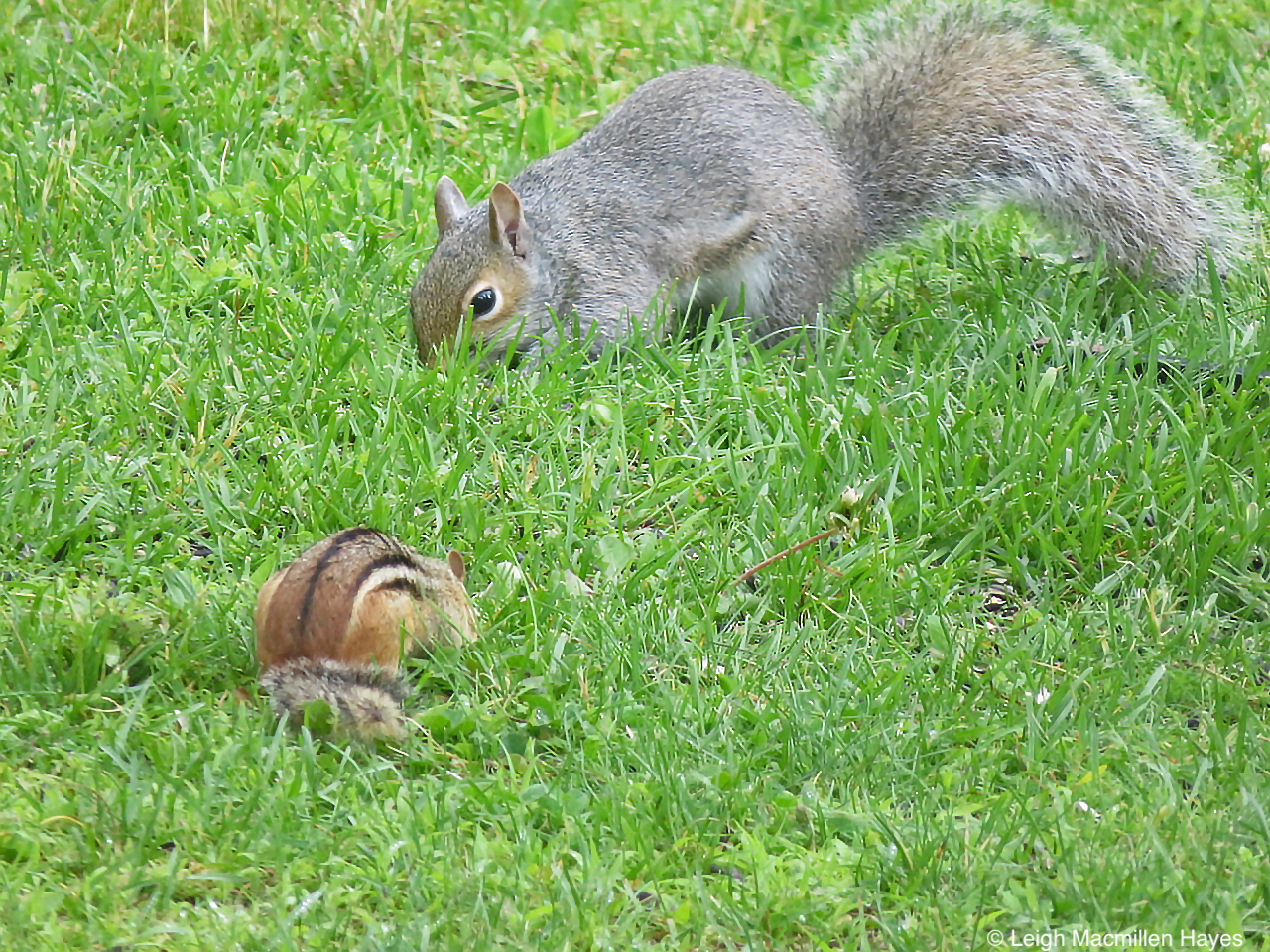
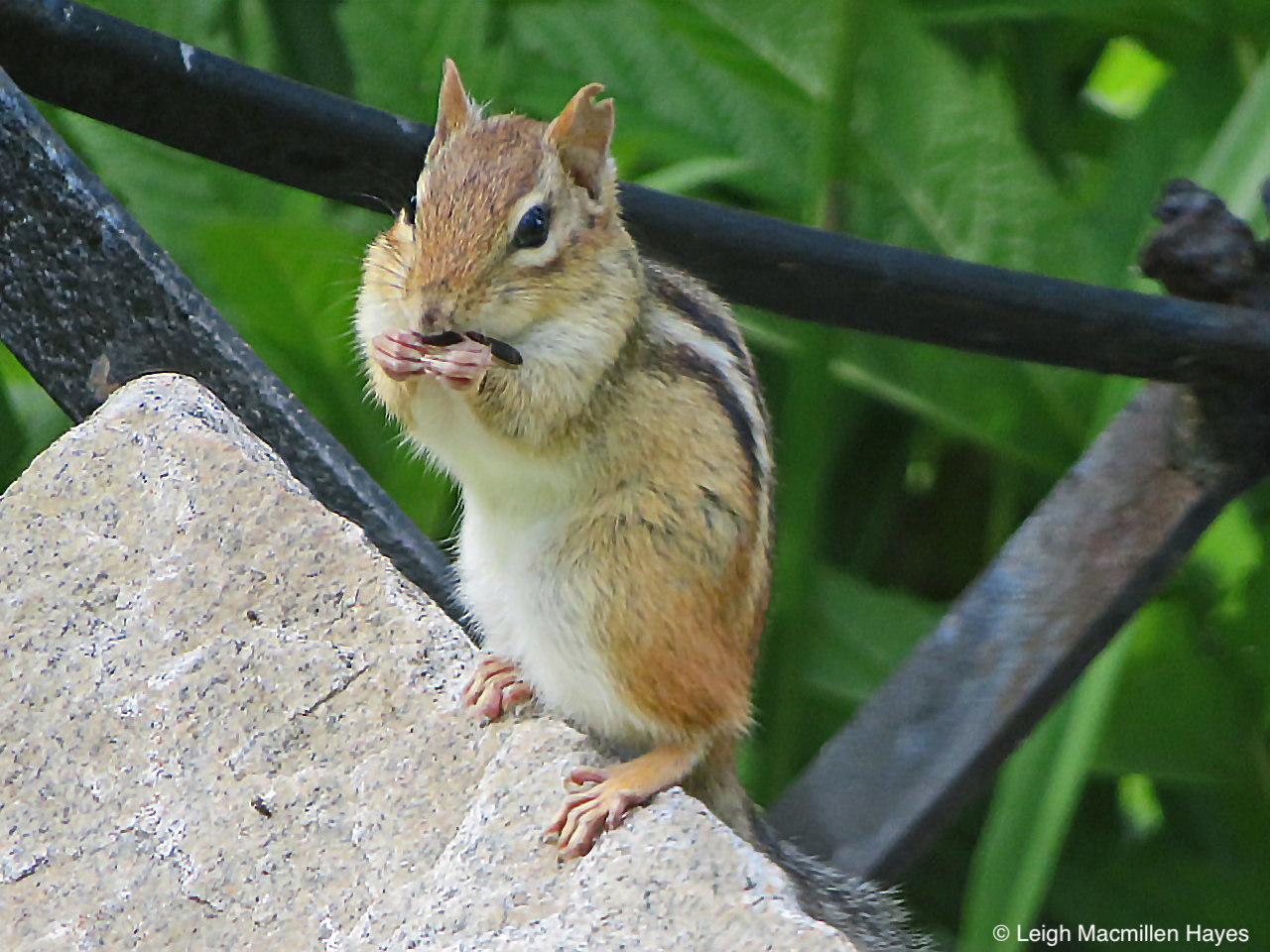
But when I looked again, I spotted an Eastern Chipmunk filling its cheeks. While this is common behavior, what wasn’t quite so common is that fact that most of its tail was missing. Had a fight occurred or did it narrowly escape becoming a meal?

I’ll never know. Among the most frequent mammal visitors are the Gray Squirrels. And they, along with the Red Squirrels and Eastern Chipmunks have learned where we store the seed in the barn and no matter how many times we think we’ve outfoxed them, we soon discover that they’ve been chewing again. We’re now using small metal trash cans, but knowing the prowess of these critters, I doubt we’ve won this battle. And keeping them out of the barn is impossible because it’s an old barn with lots of secret passageways, some that I’m sure we’re not aware of . . . yet.

Some days there are five or six Gray Squirrels foraging for seeds and looking as if they own the place. I suppose they do. We’re merely itinerate tenants and we give thanks that they let us live here.

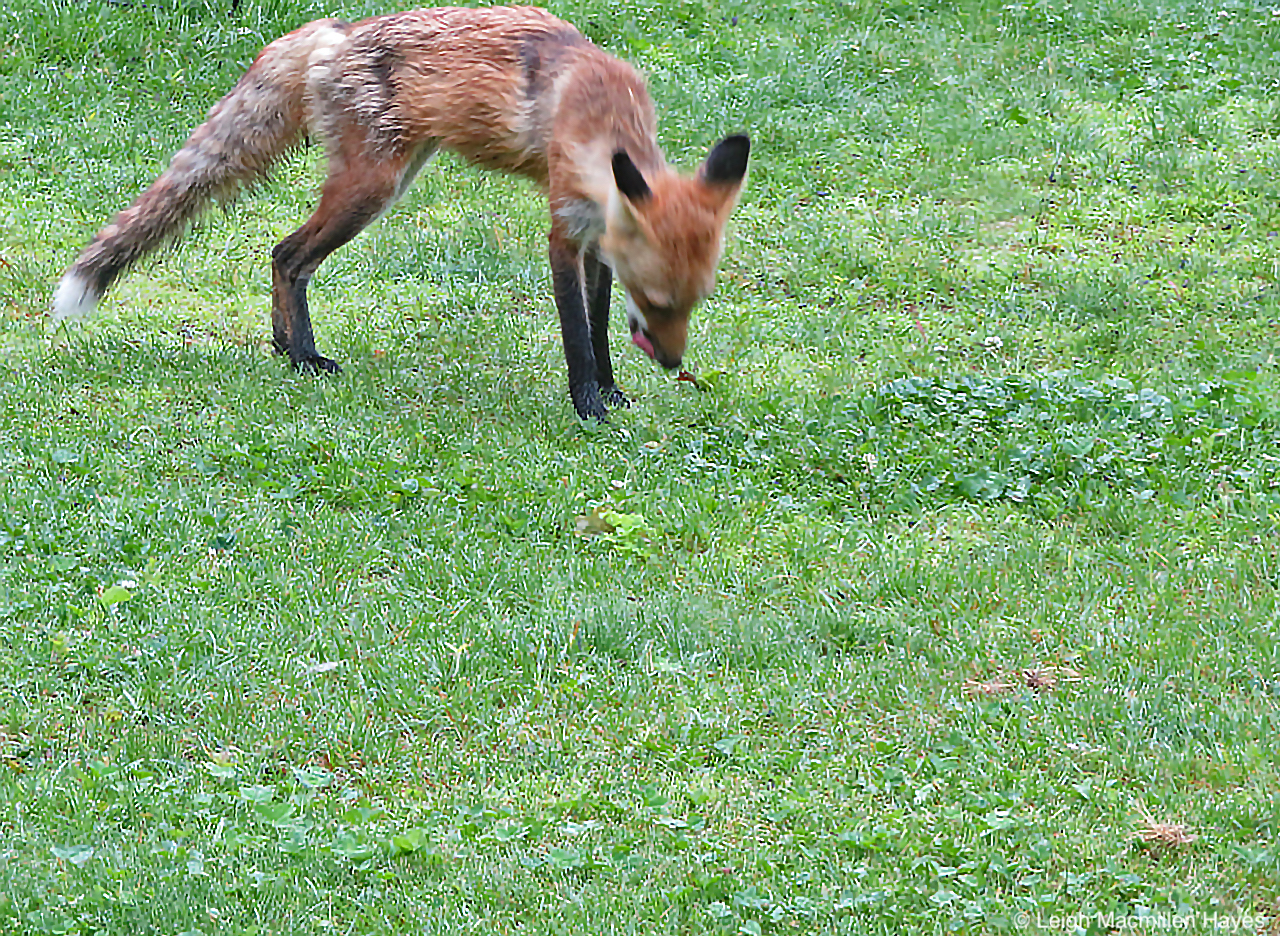
Oh, and then there’s the neighborhood fox. We haven’t discovered the den yet, but every morning we can expect two or three visits. If it isn’t successful at sneaking up on one of the other critters, and squirrels and chipmunks can outrun a fox, it, too, dines on some seeds.

And then pauses to lick its chops.

But what the fox really wants is a more substantial meal and I suspect it has kits nearby that need feeding.

Unfortunately for the fox, sometimes the American Crows announce its presence and all the little critters run up trees or fly away.

Soon, however, they return. And begin to forage again.

And from high positions, they’ll take a break, and actually pull seeds out of those puffed-up cheeks in order to dine.

And so this morning dawned with a light rain, and just as our Red Fox walked in front of the stones by the garden, I saw a flash of brown run across the flatter rock. R.F. jumped up, looked around, jumped down and gave chase. The fox was unsuccessful.

But that didn’t stop it from returning and though the crows didn’t alert us, the squeal of a Gray Squirrel made us raise our heads and look out the back door.

Breakfast had been secured and the last we saw of the fox, it was trotting away with a meal in its mouth.

The Happy Fox Trot indeed.

The Invitation Stands

It took me by surprise, this change of seasons.

Despite all the clues from fading otter prints . . .

and not so deep moose tracks . . .

to reverse tracks raised above the snow cover as a result of a frozen crust followed by wind and warmer temperatures.

But still, somehow I was fooled into thinking winter would hold its grasp for a wee bit longer because I don’t like to let it go. The faces hiding in the ice knew otherwise.

As did the constitution of pond ice that despite recent brisk days and nights began to react to the sun’s rays and display the tea-stained color of organic matter decomposing in the water below.

Even Winter Dark Fireflies, who don’t carry lanterns like their summer cousins, and aren’t even flies as their name suggests (they are beetles), knew what was happening before I did for in their adult form they’d been tucked under bark in recent months, but in a flash are now visible on many a tree trunk as they prepare to mate in a few weeks.

The same is true of the Winter Stoneflies who only recently started crawling out of the water. and drumming as an announcement that they too are ready to let the mating season begin.

The birch trees also knew before I did and made sure to let last year’s catkins release their scaled fleur de lis, thus scattering the seeds that look like tiny winged insects upon the snow where they’ll join the melt down and eventually find a moist spot upon which to germinate.

And so it is that spring snuck in a few days after St. Patrick’s Day as it always does, but still surprising me and now I join others and anticipate the changes to come.

But . . . there’s something different about this spring. Oh, I’ll still stalk vernal pools until they dry up.

I’ll marvel at each and every tiny bud preparing to bloom like those of Trailing Arbutus.

I’ll spy on spiders and insects for hours on end.

I’ll continue to look for fine specimens of scat, including otter filled with shiny, mica-like fish scales . . .

and coyote that at first glance I might think is bobcat, but the tapered ends offer one hint of its owner . . .

and the sight of bones and toenails tucked within remind me that bobcats are true carnivores who grind the contents of a meal so no bones are typically visible in their deposits, while such do show due to the omnivore appetite of a candid. I will be sure to question the meal based on the color of the fur as well as the contents.

But . . . this spring will be different. Yes, such was the same a year ago when we all moved into our bubbles. Now, though, there’s a glimpse of hope on the horizon and with that comes an assimilation to being with others and I can’t help but wonder, how will I react? I’ve become so accustomed to this forced insulation, and I have to admit that there are parts of it that haven’t bothered me, perhaps because I don’t mind being in my own space.

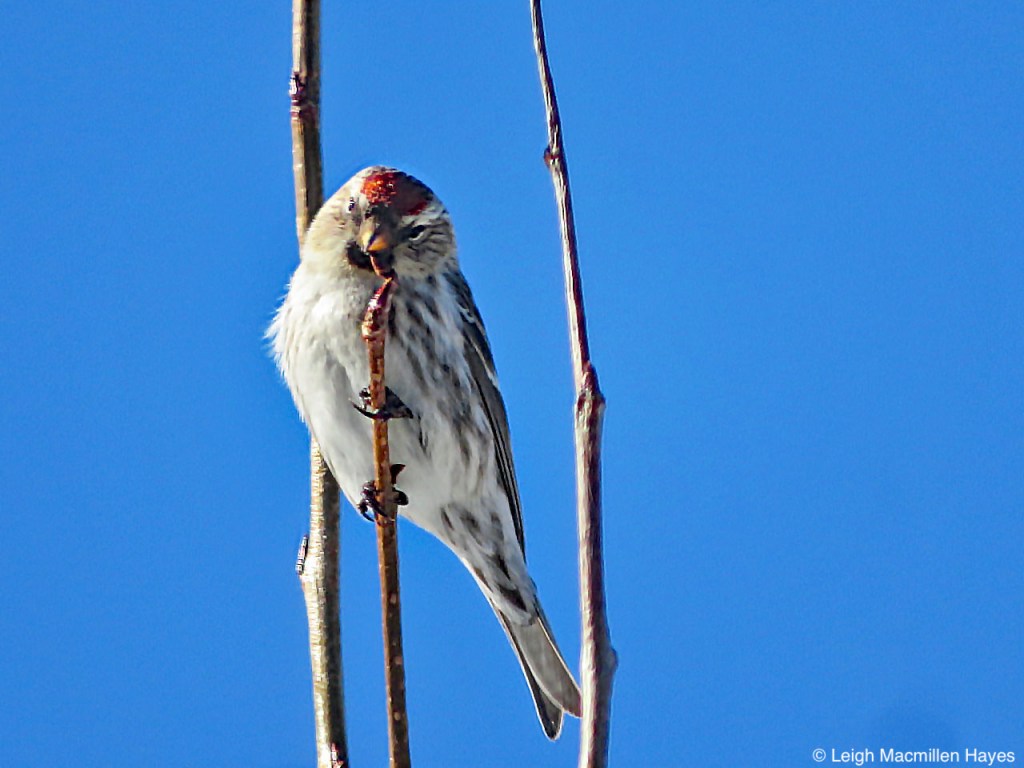
The question has been on my mind a lot lately and the answer flew in this morning as I listened in on a ZOOM church service. Just as it was to begin a small flock of Common Redpolls arrived to check out our birdfeeders.

“Invite in” were the words I heard another utter on the computer screen.

Indeed. Each day this past week, the variety of birds at the feeders grows, some species arriving at their breeding grounds, while others like the Redpolls pause before passing through. For the most part, our feathered friends accept the presence of others. An over-the-shoulder look being what it is, they remind me that I must behave like them and be open to opportunities.

As the snow melts, I realize that I must share space with all who wander here . . .

including the deer who tried to walk the labyrinth path.

The Invitation Stands. Spring is indeed here and I invite you to join me for a wander when you are able so we can wonder about nature’s communities together. I look forward to welcoming you back with a smile . . . though please don’t expect a hug.

All Aboard Mondate

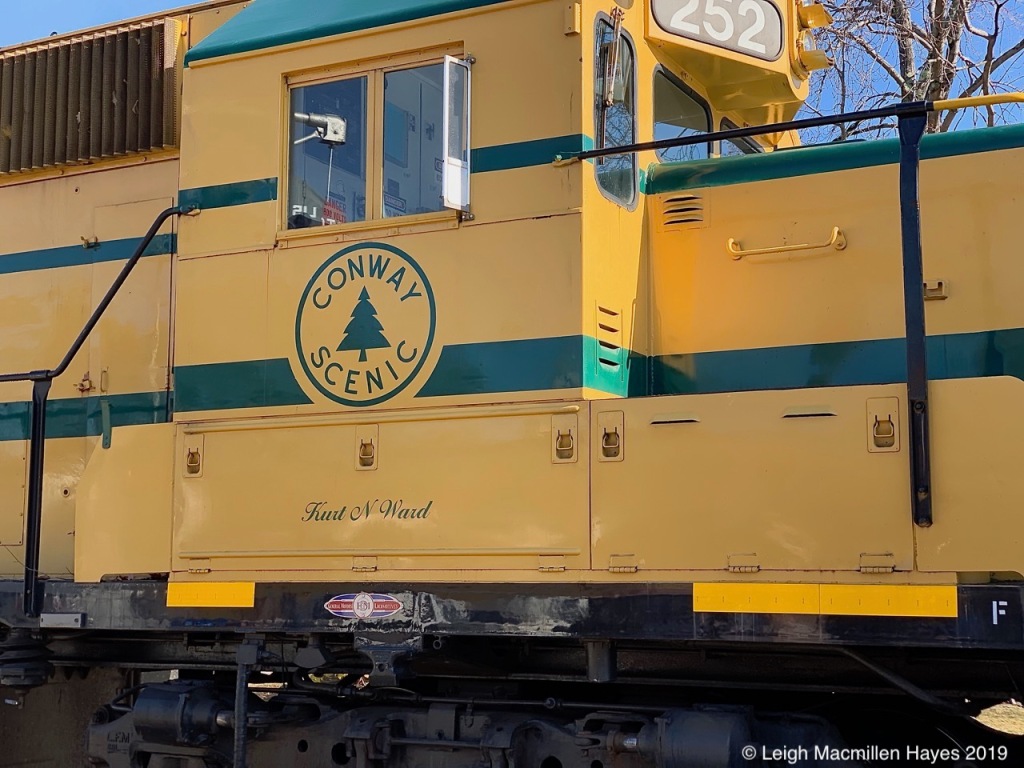
His birthday present several weeks ago was a Cat’s Meow replica of the North Conway Scenic Railroad (from my collection) and a note: October 21, 11:00 am – 4:00 pm. Be there!!

This morning I drove him there. No, I wasn’t the engineer of the train, but rather the conductor of his entertainment schedule.

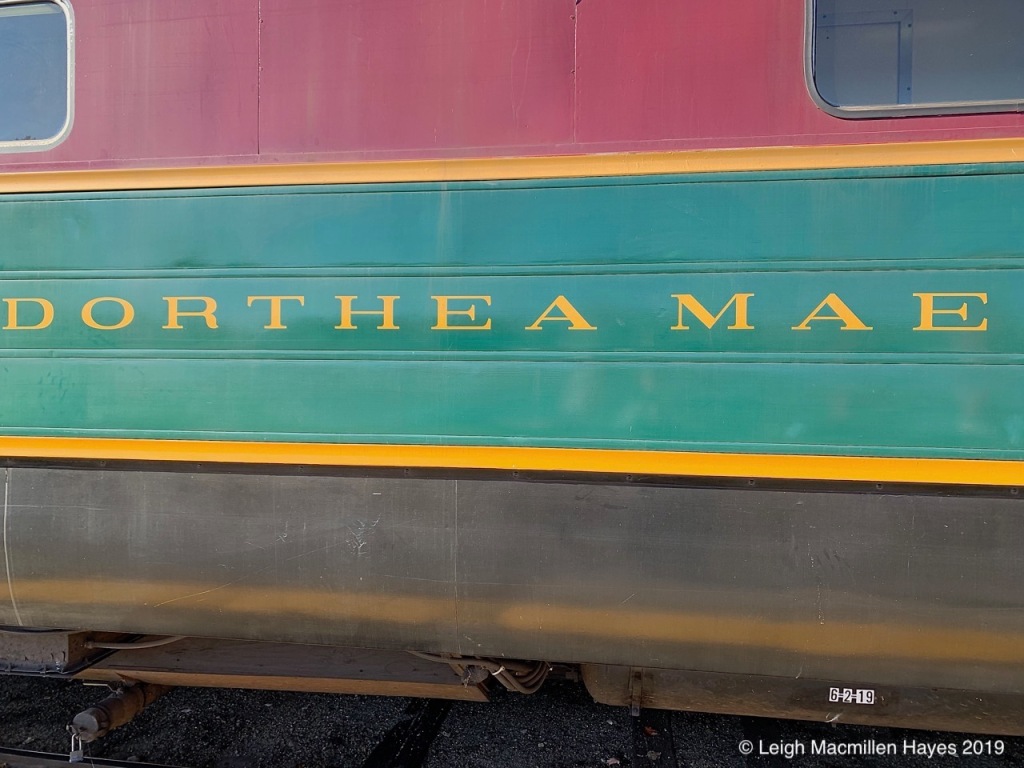
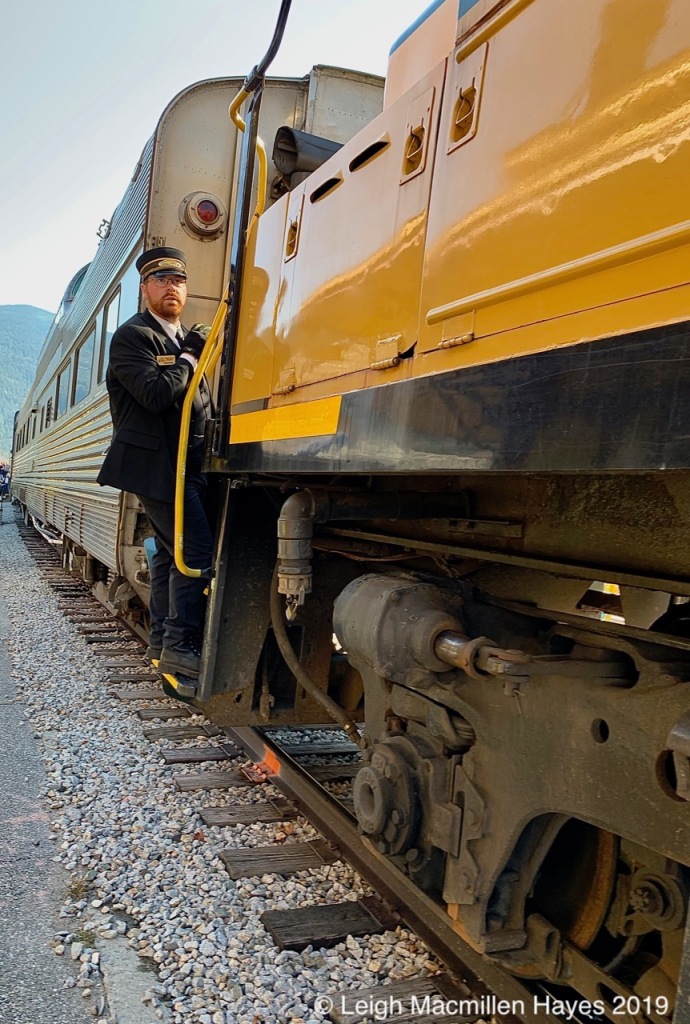
Our chosen car, the Dorthea Mae, was built in the mid-1950s for transcontinental service in the United States and turned out to be the perfect choice for this adventure. We’ve ridden the Conway Scenic train before–several times when our sons were young and we took the one hour ride from North Conway to Conway, New Hampshire, and once for an anniversary celebration as we enjoyed dinner on the Bartlett Route. But for all the times we’ve driven along Route 302 through Crawford Notch and looked at the scary trestles hugging the mountains, we always said we’d love to take the longer ride. Well today, that became a reality.

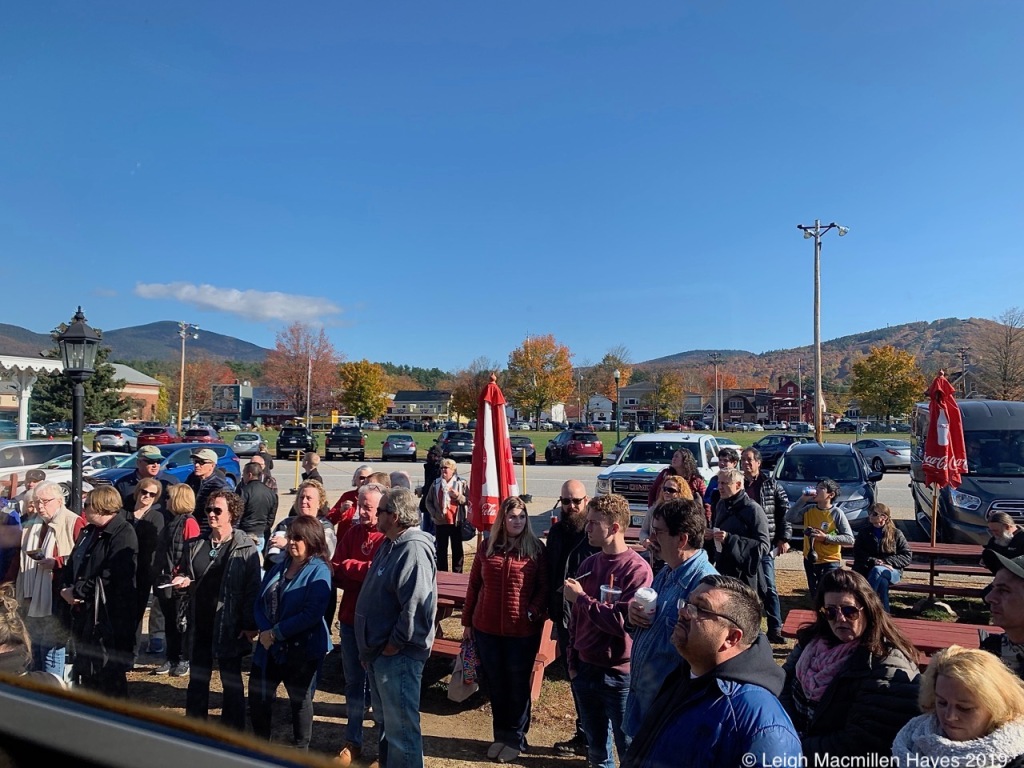
Group by group, riders were welcomed to climb on and find their assigned seats. Ours was located opposite a delightful and chatty couple from Iowa, MaryPat and Ron.

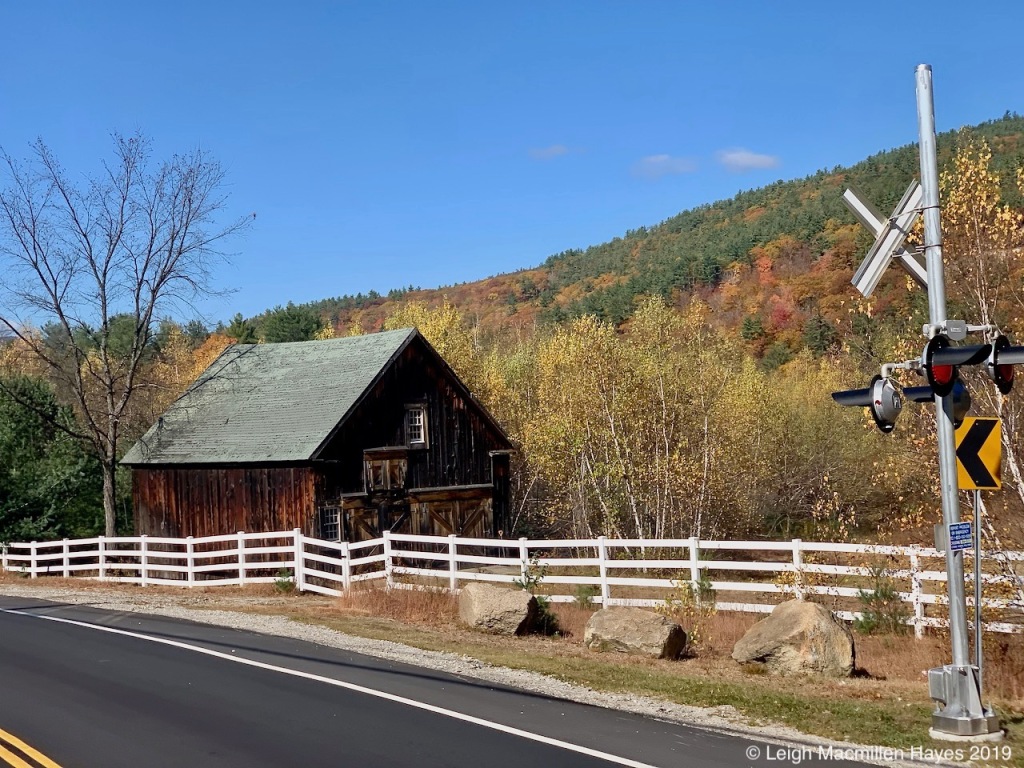
For us, part of the fun was recognizing familiar spots along the rail, including a rail crossing on Route 302 by a historic barn.

Through the village of Bartlett we travelled along rails originally laid down in the 1870s for what was once the Maine Central Railroad’s famed Mountain Division Trail.

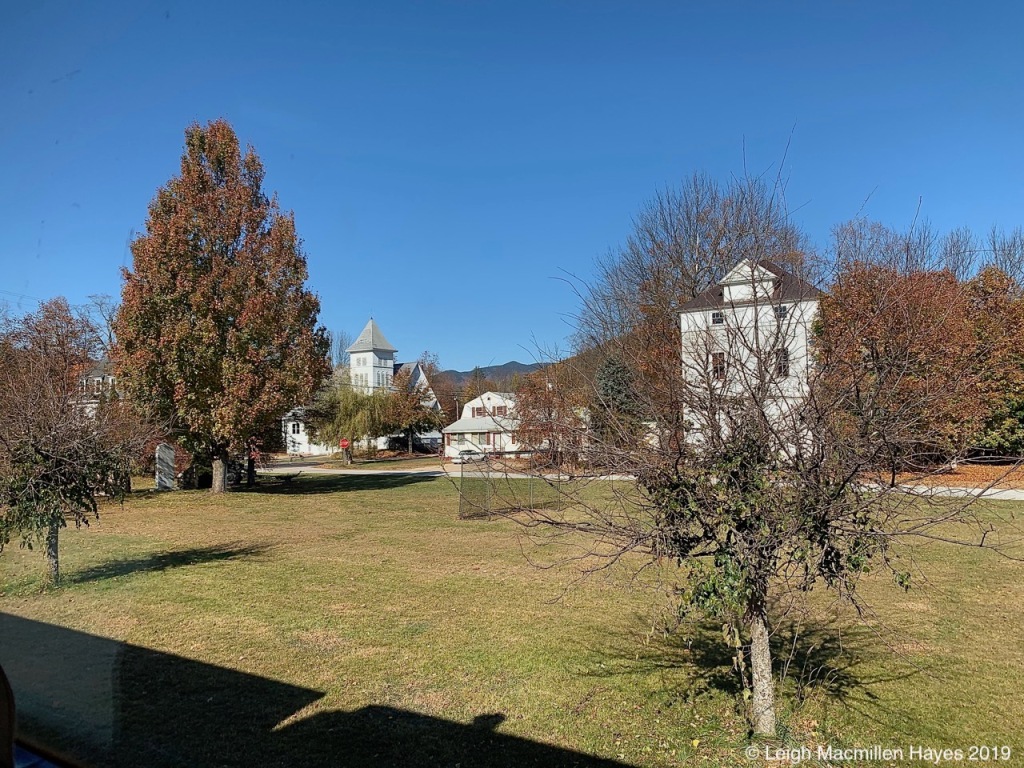
The church to the left is the Union Congregational Church on Albany Avenue, and to the right the Odd Fellows Hall, a historic fraternal society.

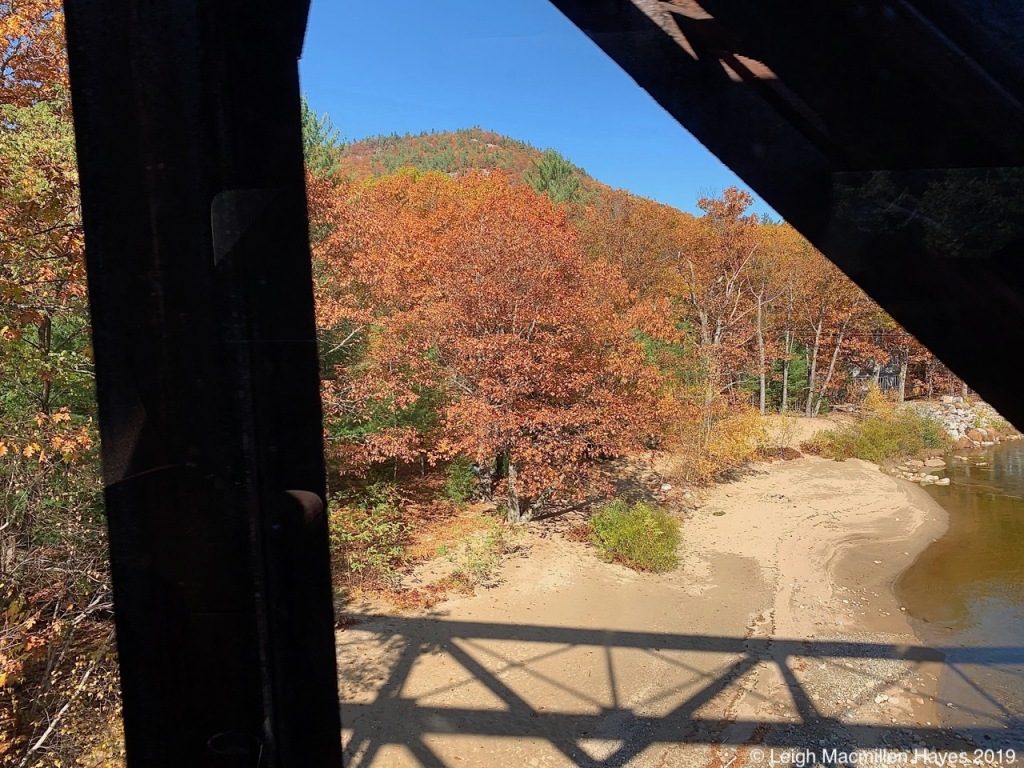
Early on we crossed trestles over several rivers where shadows, angles, curves, and foliage delighted our eyes.

As we headed toward Crawford Notch, again it was the same, only different, with ever the click-clack of motion providing a new vista that captured our awe.

History presented itself over and over again, with old rail ties and power poles dotting the landscape–obscured for a wee bit longer by the golden hues of the forest.

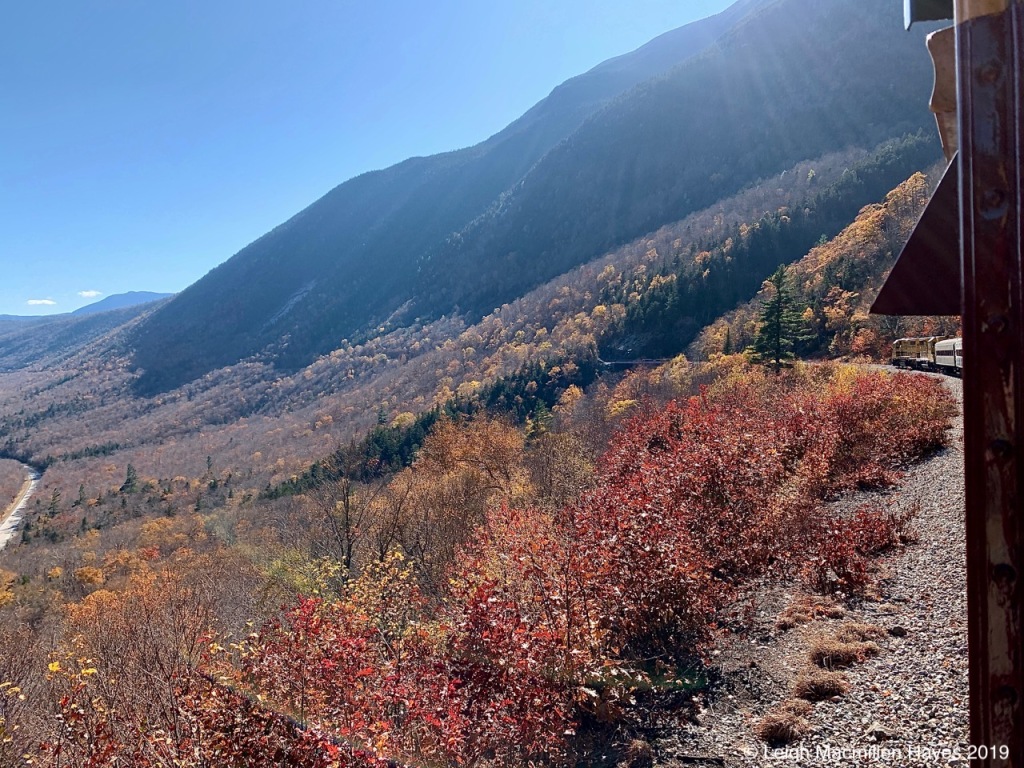
Knowing that today was the only date available when I’d booked the trip, and in fact, that we got the last two seats on the Dorothea Mae, we wondered how much color we might see given that we were traveling north. It was past peak, but still . . . one Red Maple stood out amongst the yellowy-orange-bronzes of the landscape.

There was also some white to view–not only the few clouds, but the summit of Mount Washington with a recent coating of snow and rime ice.

The ridgeline of Mount Webster, forming the eastern side of the U-shaped glacial valley which forms Crawford Notch, stood crisp and clear as we headed north.

The mountain was named for Daniel Webster, a statesman and orator born in Salisbury, New Hampshire, which is present day Franklin where I began my former teaching career in 1980.

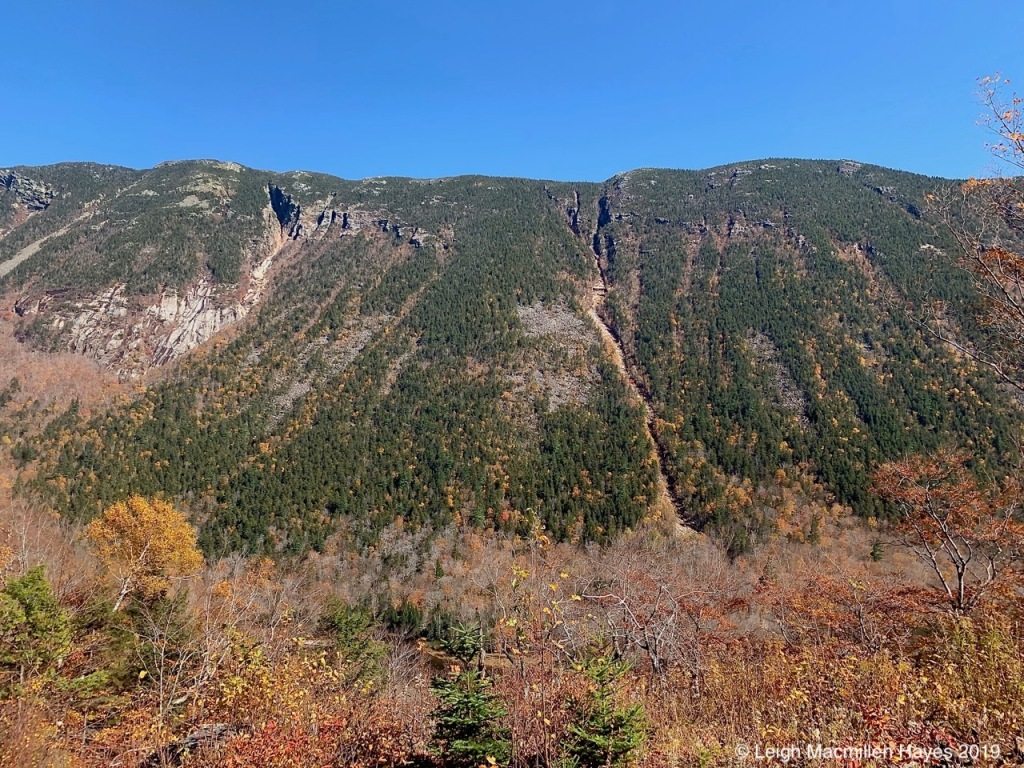
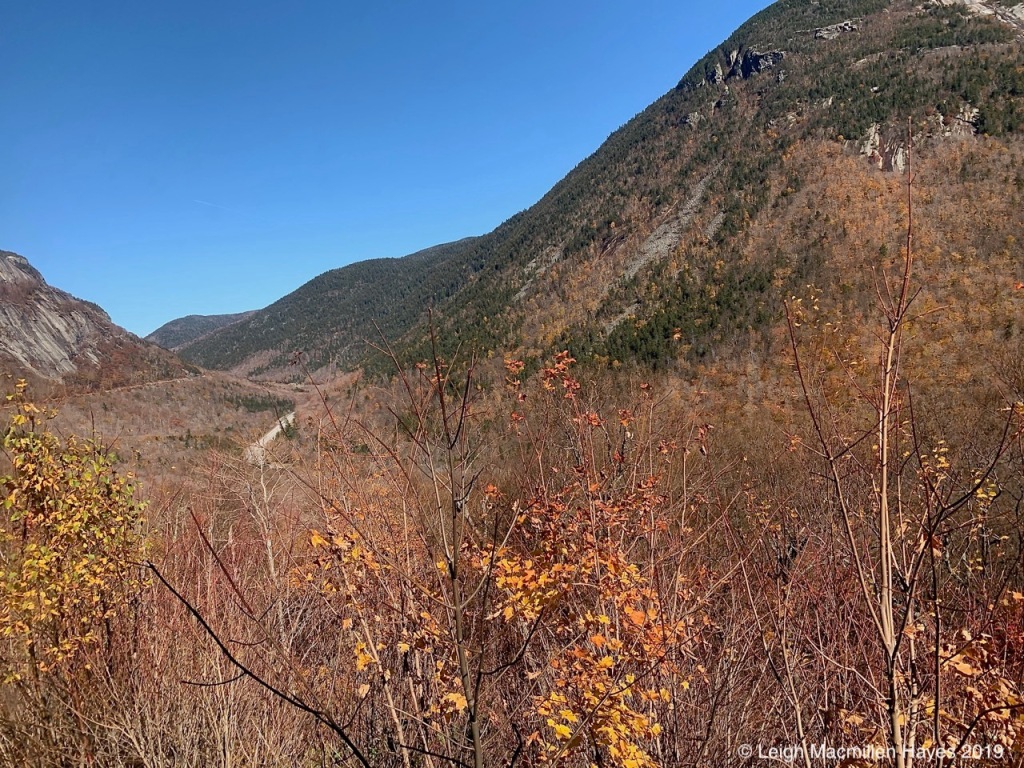
From our seat on the train, looking south, Mount Webster was on the left, Route 302 between, and Mount Willey on the right forming the western side of the U.

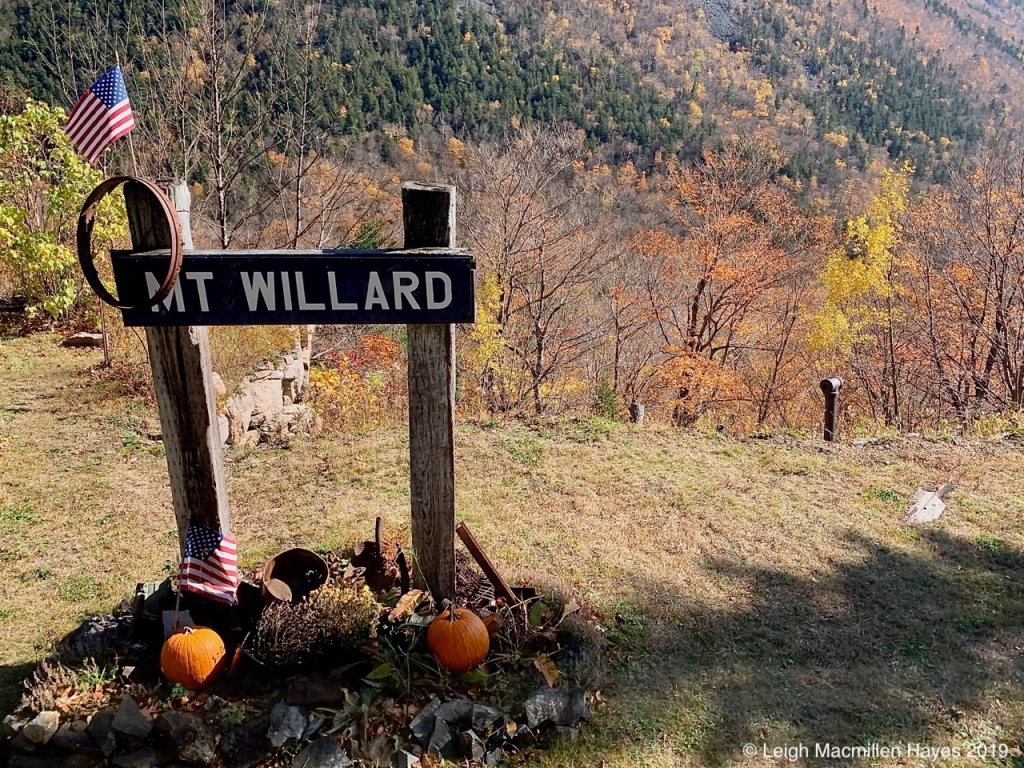
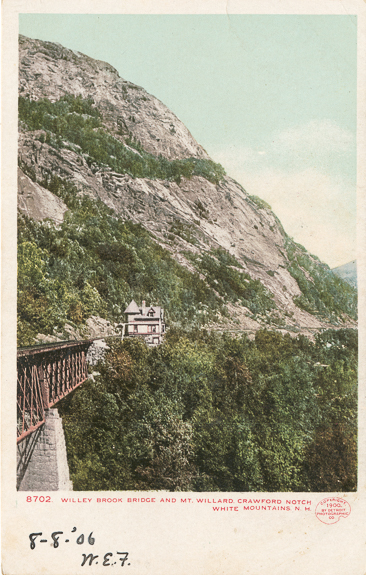
By Mount Willard, we heard the story of the section house that stood here in the 1900s.

Willey Brook Bridge is Crawford Notch, New Hampshire https://digitalcollections.nypl.org/items/510d47d9-a2cf-a3d9-e040-e00a18064a99 Detroit Publishing Company Collection, Photography Collection, Miriam and Ira D. Wallach Division of Art, Prints and Photographs, The New York Public Library, Astor, Lenox and Tilden Foundation

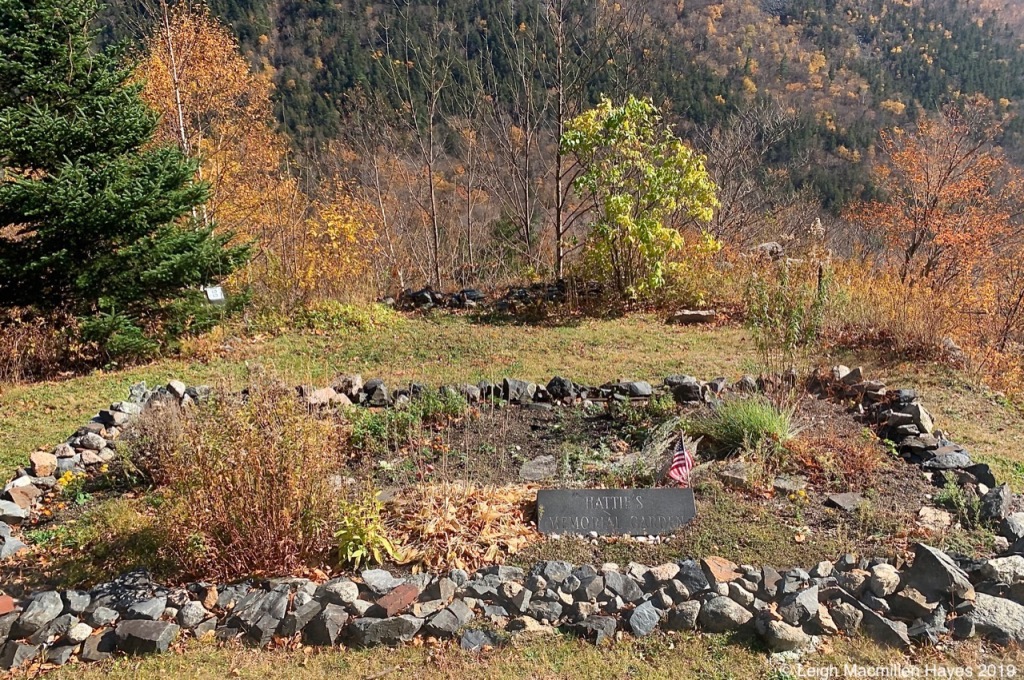
Our narrator, Denise, spoke of the Mt Willard Section House built in 1887 for section foreman James E. Mitchell, his family, and crew who maintained Section 139 of the railroad. Loring Evans became foreman of Section 139 in 1903. He was killed ten years later in a railroading accident at Crawford’s yard, but his wife, Hattie, raised their four children and despite all odds ran the Section House until 1942. It was Hattie’s job to house and feed the men who worked on the shortest yet most treacherous stretch of the rail.

A memorial garden still honors her work.

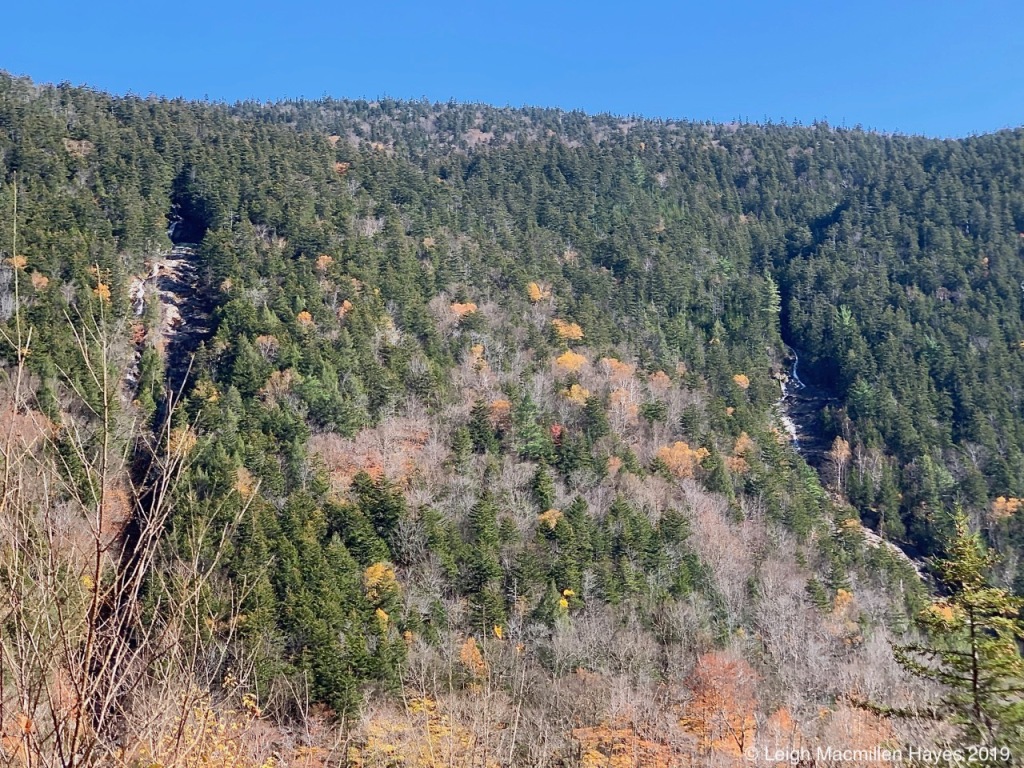
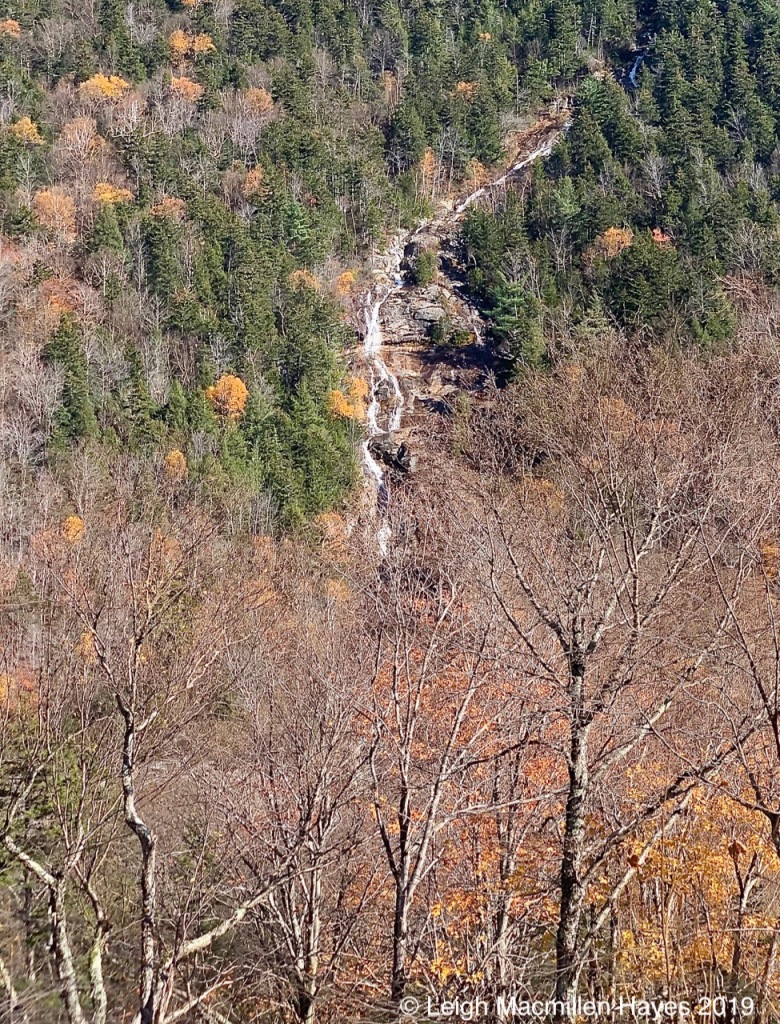
Below Mount Jackson, across the way, two waterfalls graced the scene. Typically, we’ve viewed them one at a time, but from the train, both Flume and Silver Cascades were visible as water raced down the mountain’s face.

This being Silver, but both looked like traces of chalk from our position.

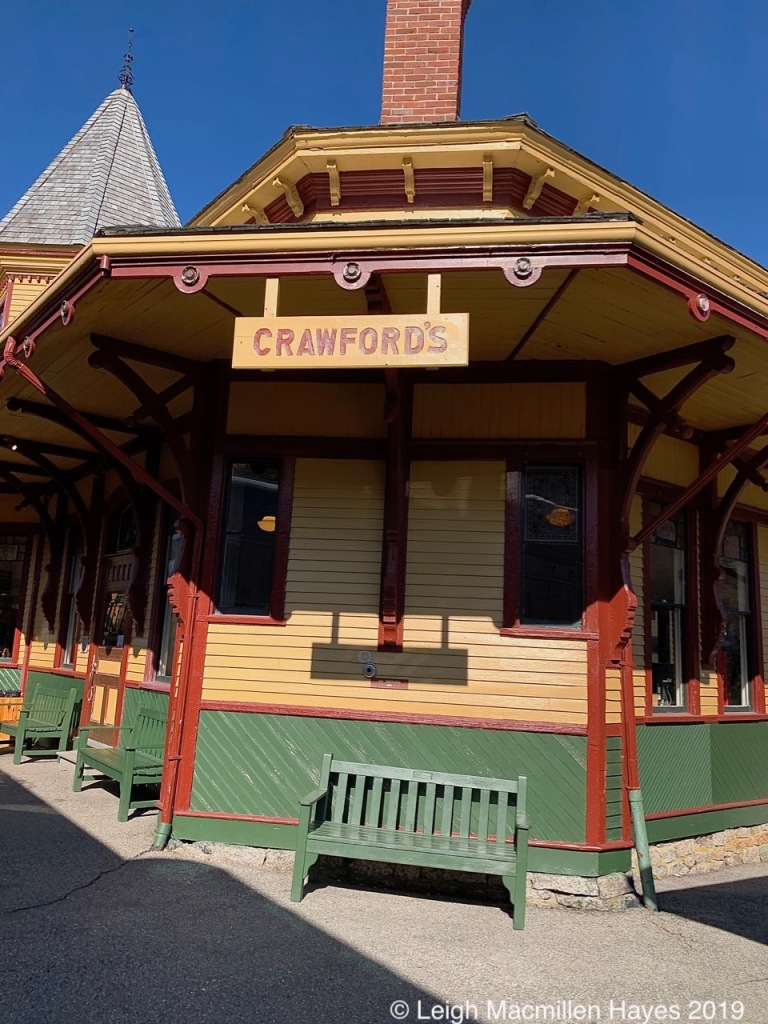
Two hours after our journey began, we arrived at Crawford’s Depot.

Disembarking, and with an hour to ourselves, my guy and I ate a picnic lunch that included chicken salad sandwiches enhanced with home-made cranberry-orange relish, and then we crossed the road to walk the .4-mile trail around Saco Lake, the origin of Saco River.

Beside it a few Dandelions flowered. And my guy questioned me. “You’re taking a photo of a Dandelion?” Yup. Never Call it just a Dandelion is the title of a most delightful and informative book. And sooo true. Notice how each ray is notched with five teeth representing a petal and forms a single floret. Completely open as this one was, the bloom was a composite of numerous florets. And can you see the stigmas? Curled and split in two? “Yes, I am taking a picture of a Dandelion because it deserves to be honored. And not pulled from the lawn. Just sayin’. ”

Meadowsweet (Spiraea alba var. latifolia) also posed, its fruit’s five-parted capsules each containing two to four small seeds. It was the color that made me smile on this fall day.

Upon a small bridge where Elephant Head Brook flows into Saco Lake, most people paused and then turned for so wet was the trail. But you know who kept going. Despite wearing sneakers rather than our hiking boots, we found our way and soon moved beyond the wet trail.

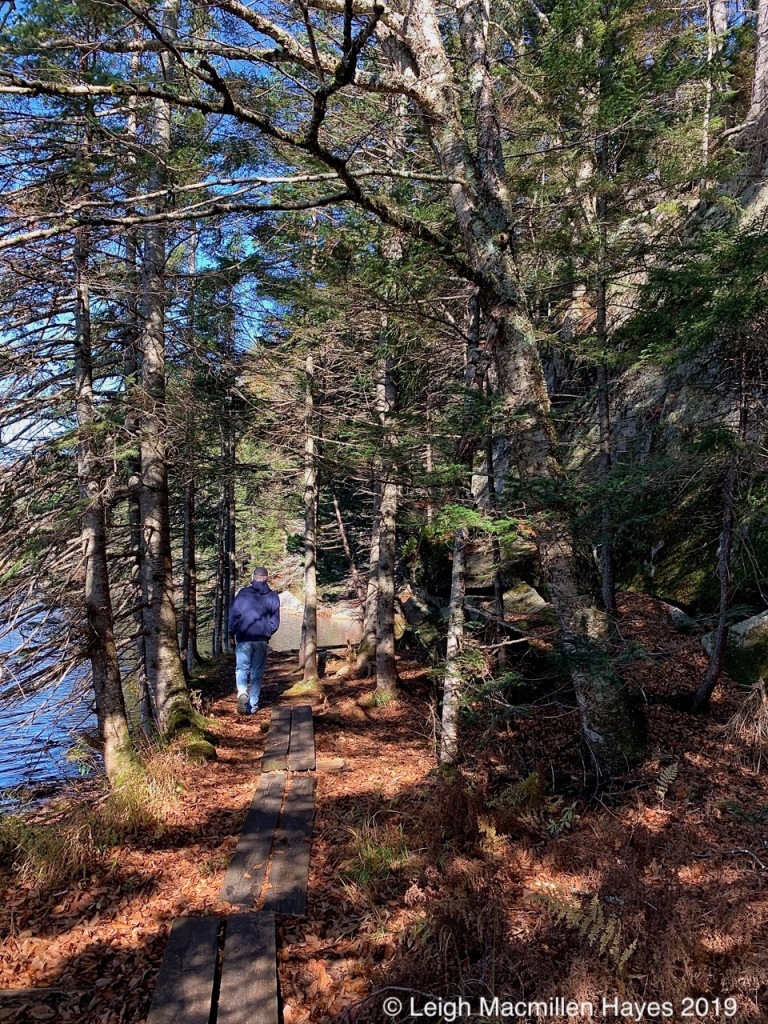
We laughed when we discovered a wooden boardwalk in a drier section.

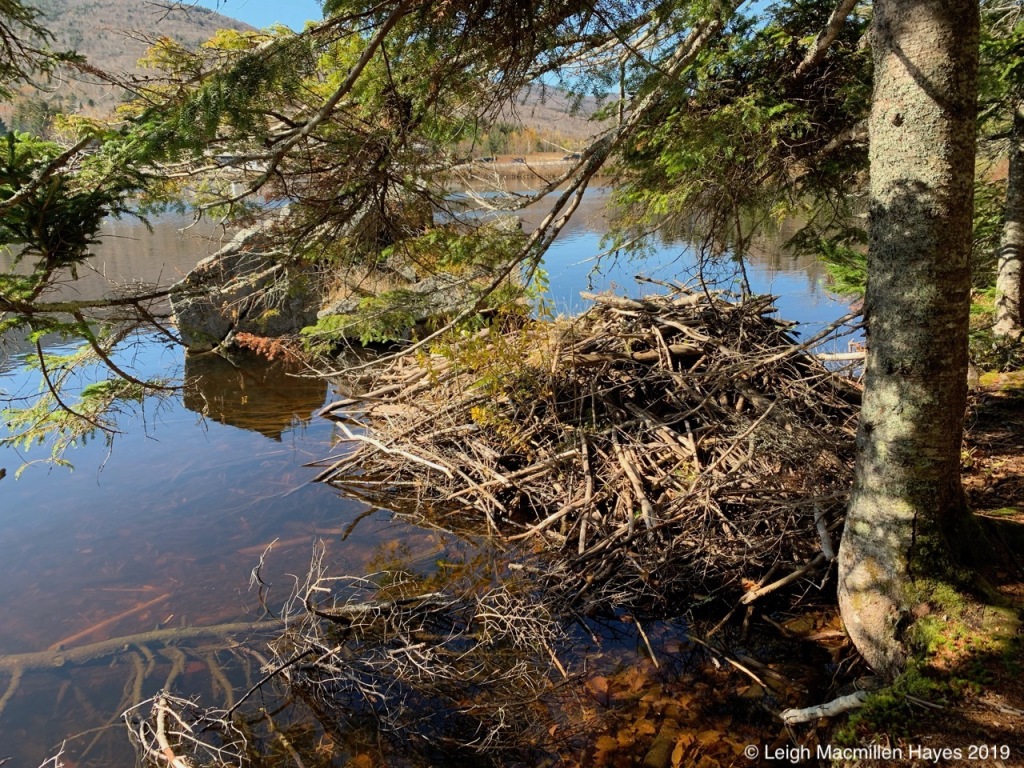
Others had also ventured here and called it home, although based on the lack of new wood, we suspected the beavers had left the lodge. Perhaps they’d moved across the street to the AMC’s Highland Center.

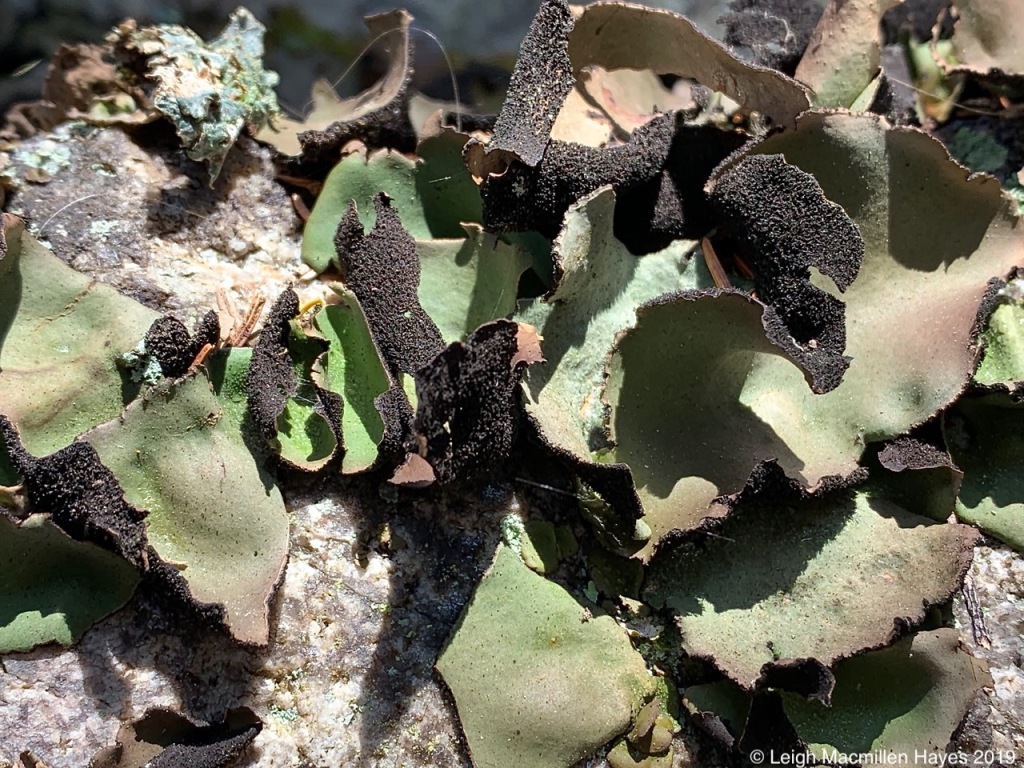
Upon granite that defined the outer side of sections of the trail, Rock Tripe lichens grew, some turning green as they photosynthesized when I poured water upon them.

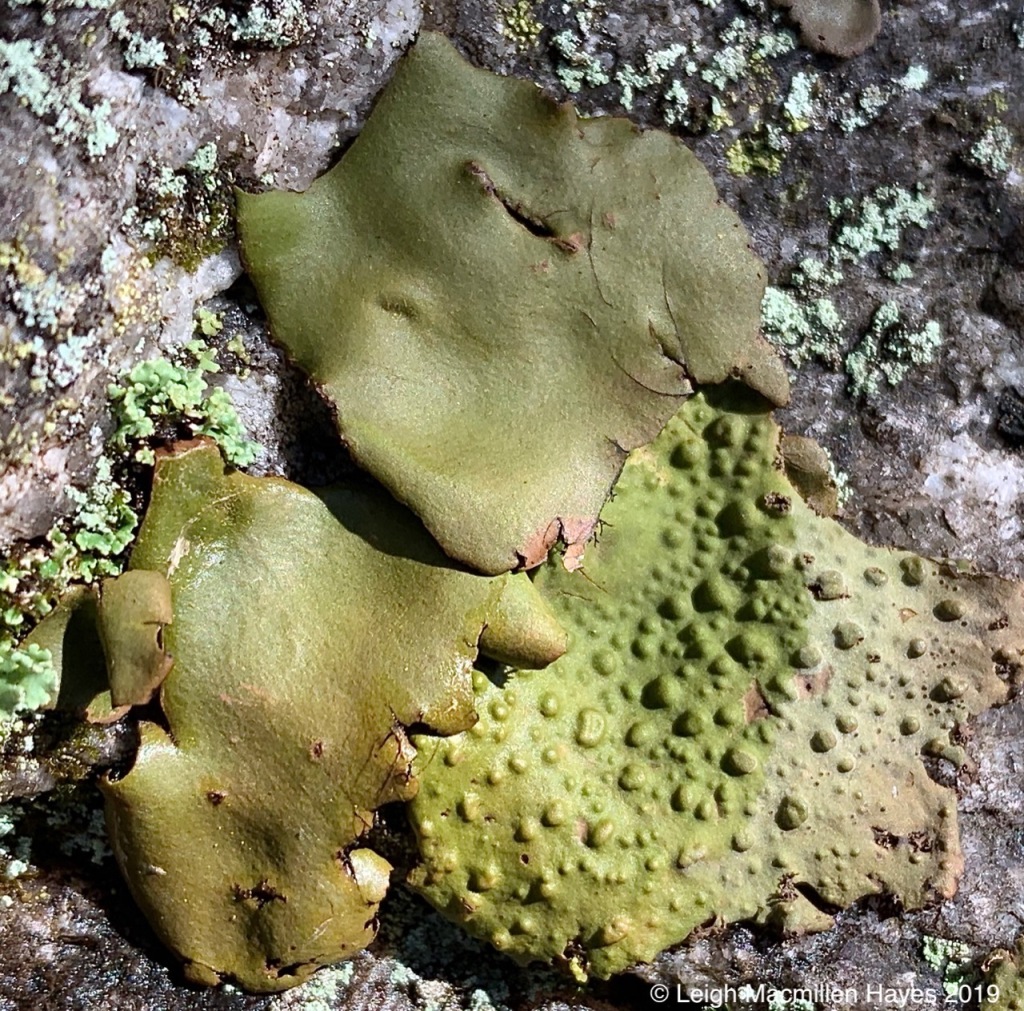
Always one of my favorite views is the discovery of Toadskin Lichen beside the Rock Tripe, both umbilicate forms.

Back to Route 302, asters showed their displays of seeds awaiting dispersal and those older empty nesters forecasting their winter form in a flower-like composition all their own.

Just prior to 2:00pm, we reboarded the train for the journey south.

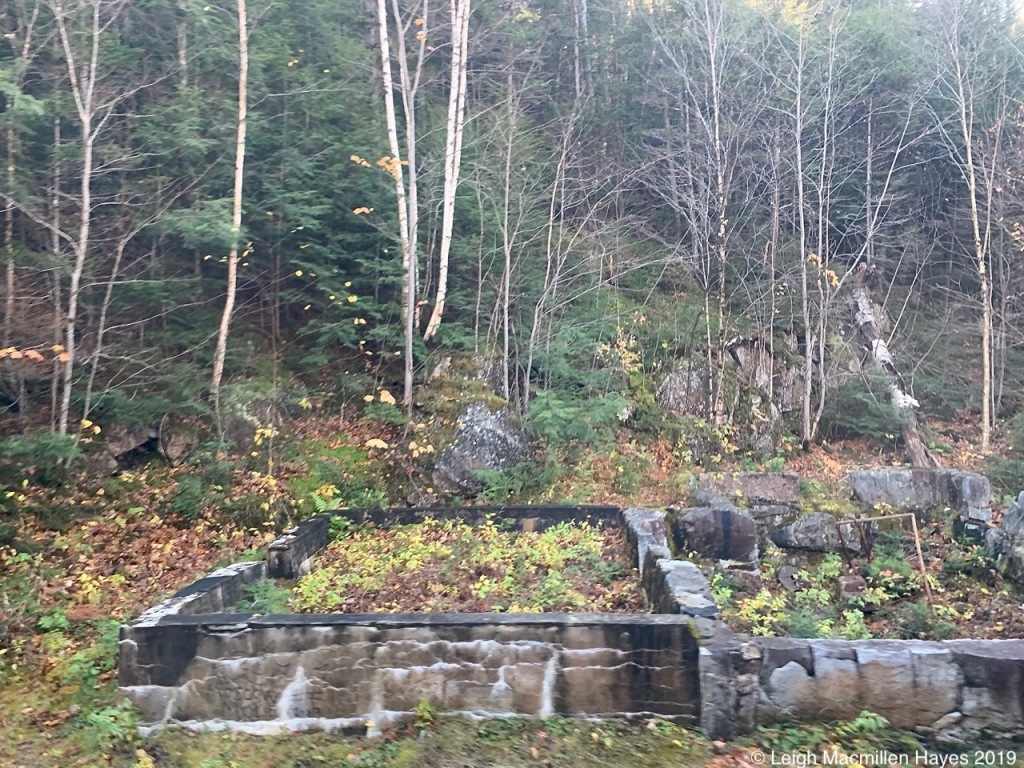
For the return trip, we’d switched seats with those who sat on the western side of the train for the journey north and so got to spy the Willey foundation. Local lore has it that in 1793, Samuel Willey took his wife, five children and two hired men to live in a small, remote house in the mountains. That year, he and the hired men built a house.

As our narrator said, “In June of 1826, a heavy rain terrified the Willey family when it caused a landslide across the Saco River. Sam decided to build a stone shelter above the house where he thought the family could find safety in case of another landslide. On August 28, 1826, a violent rainstorm caused a mudslide. The Willeys and hired men took refuge in the shelter. The landslide killed all nine of them, but the house they’d fled stood still.” Apparently, a ledge above the house spared it from destruction.

We loved the historical aspects of the trip, as well as the scenery, short hike, and good company.

At the end of the day, we were all smiles for this All Aboard Mondate.

Wandering and Wondering the Jinny Mae Way

This morning I chose to channel my inner Jinny Mae in honor of my dear friend who has been in isolation for medical reasons since last January. That meant I had to try to slow down and be sure to notice. And ask questions. Mostly it meant I needed to wonder.

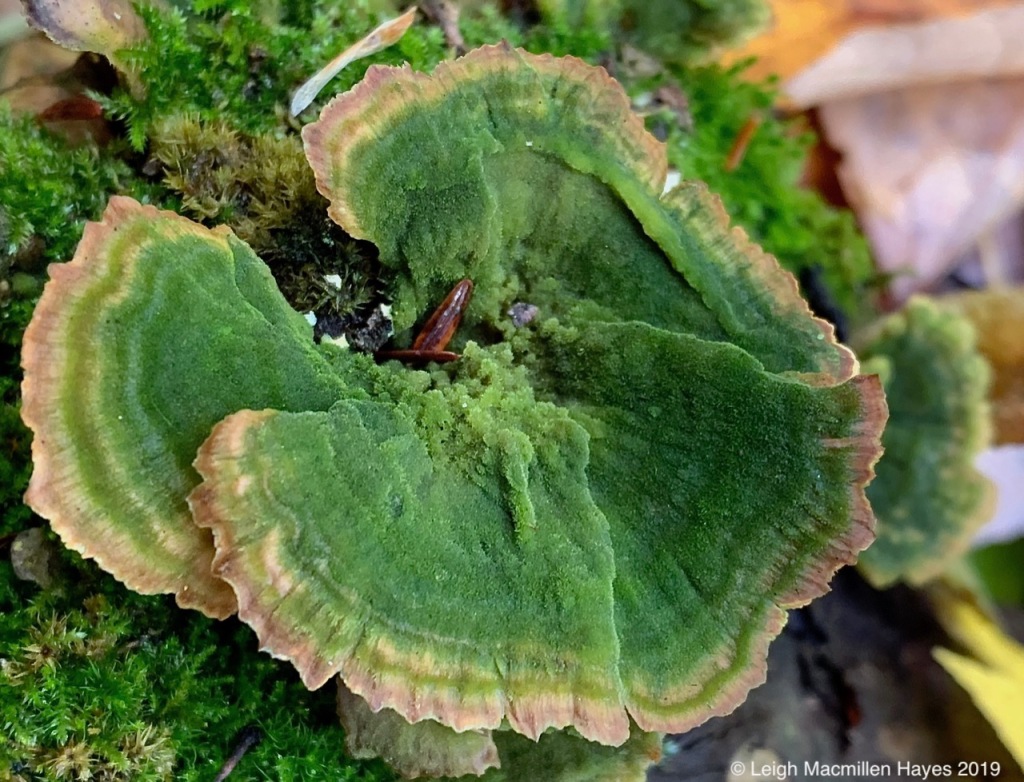
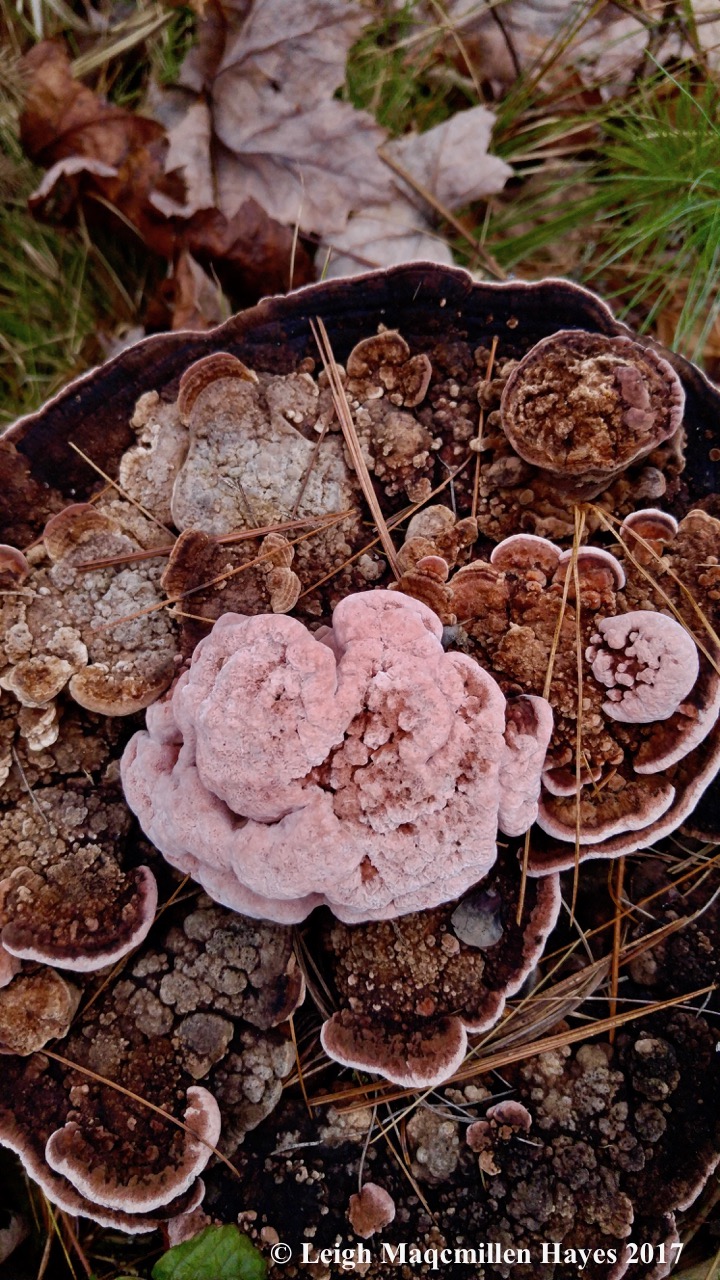
She’s a lover of fungi, so I knew that she’d pause beside the Violet-toothed Polypores that decorated a log. The velvety green algal coating would surely attract her attention. Why does algae grow on this fungus?

I didn’t have the answer in my mind, but a little research unearthed this: “As is the case for lichens, the algae on top of a polypore arrangement appears to benefit both partners. The algae (usually single-celled ball-shaped green algae), being filled with green photosynthetic pigments, use sunlight to make sugars out of carbon dioxide gas. Some of these leak out and are absorbed and consumed by the fungi as an extra source of energy-rich organic carbon. The fungus, in turn, provides a solid platform upon which the algae can set up shop and grow into dense green communities.” (~rosincerate.com)

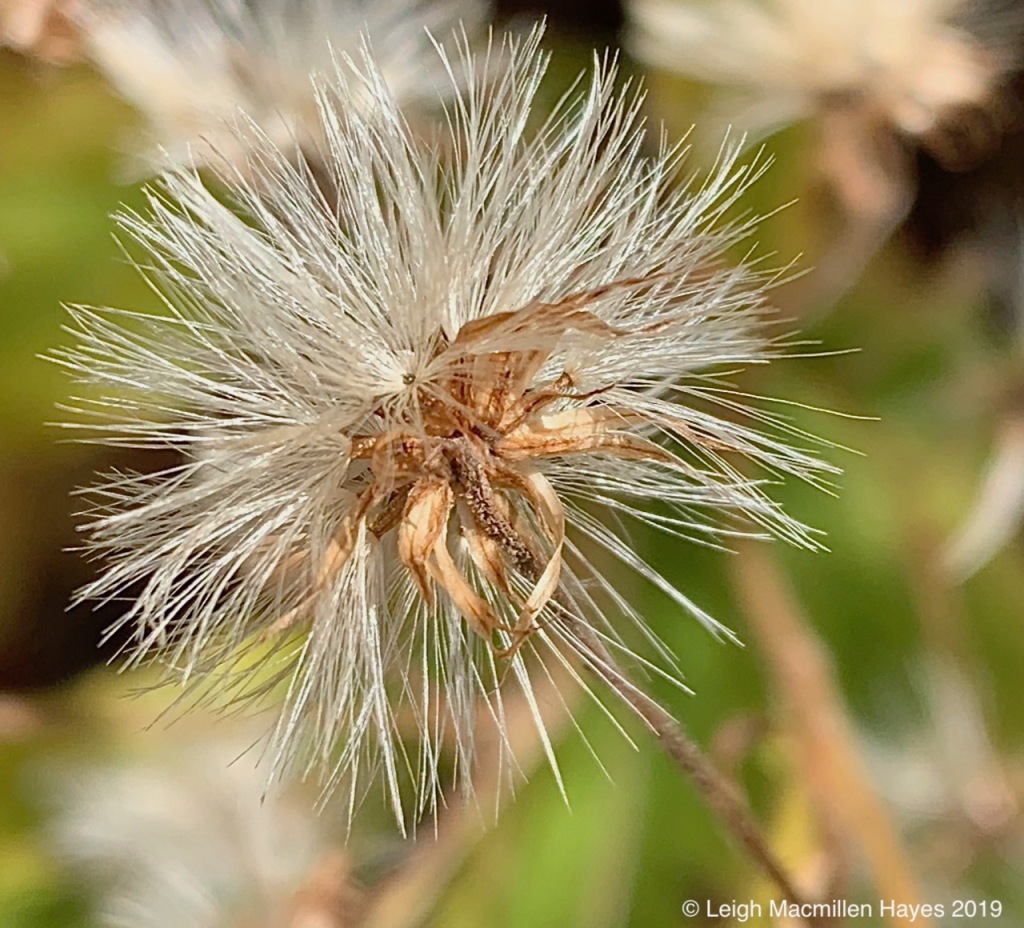
The next stop occurred beside the fall forms of asters where the seeds’ parachutes could have easily passed as a flower. What’s a seed’s parachute and why does it have one? The parachutes are made up of hair-like structures. As an immobile parent plant, it needs to disperse its young so that new plants can grow away from those pesky competitive siblings. And maybe even colonize new territories. At this stage of life, the seedy teenager can’t wait to fly away from home and start its own life. Do you remember that time in your life?

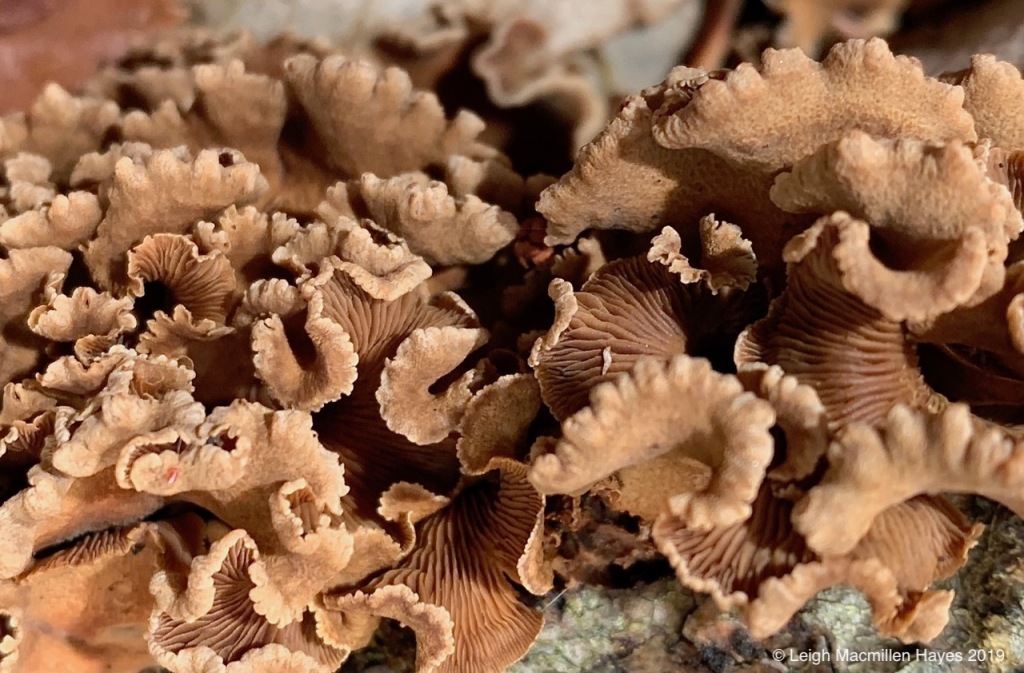
And then, it was another fungus that asked to be noticed. Those gills. That curly edging. And crazy growth structure. Jinny Mae would have keyed in on it right away, but it took me a while. I think it’s a bioluminescent species, Night Light aka Bitter Oyster (Panellus stipticus). But as I often say, I don’t know mushrooms well, so don’t look to me as the authority. What would Jinny Mae ask? Hmmm. What makes it glow? That’s even further beyond my understanding than naming this species. But I can say that it has to do with enzymes that produce light by the oxidation of a pigment. And have I ever actually seen such a glow? NO. But one of these nights ;-)

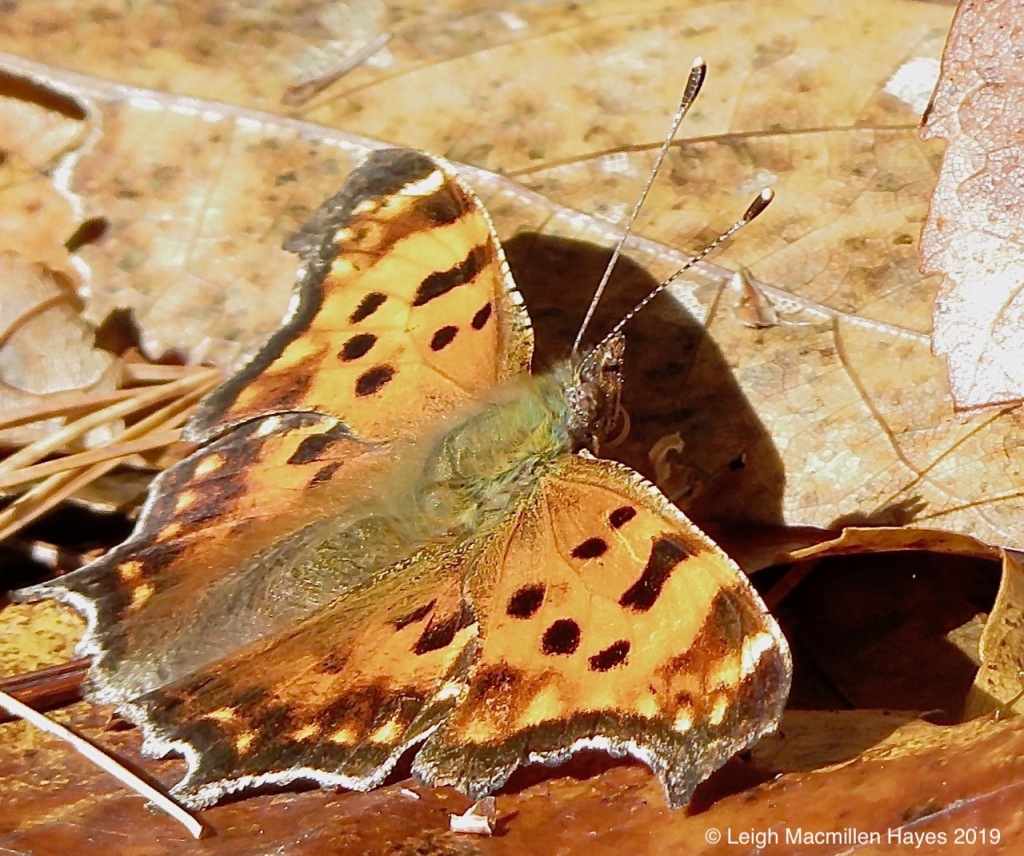
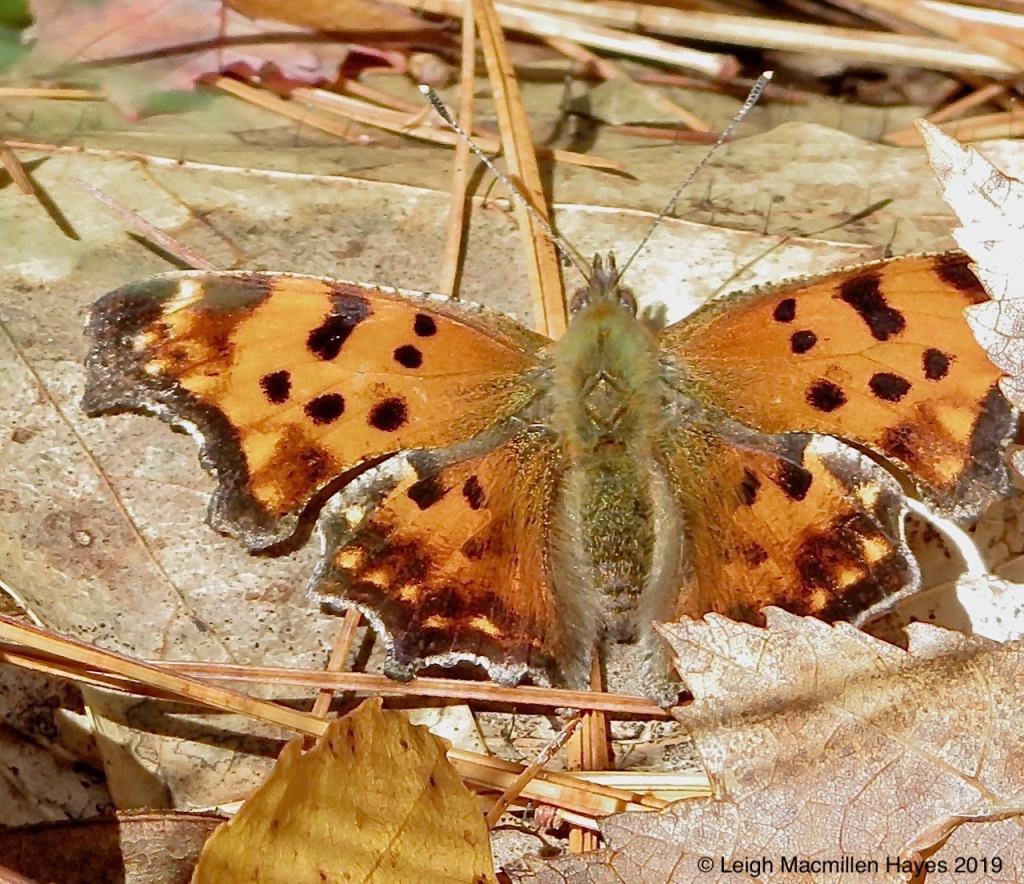
As I continued to walk along, I noticed movement and realized I was in the presence of a butterfly. A butterfly I don’t recall ever meeting before. It had the markings of several familiar species, but it wasn’t until I arrived home that I figured out its name. Do you see its curled proboscis?

Jinny Mae would have been as wowed as I was by this species that I can confidently call a Faunus Anglewing or Green Comma. Typically it flies from May to September, so why today? I got to wondering if this week’s Nor’easter caught it in a more southern clime and forced it north on the wind? But I discovered that its a boreal species and was perhaps at the southern end of its range. Maybe the storm did have something to do with its presence today after all.

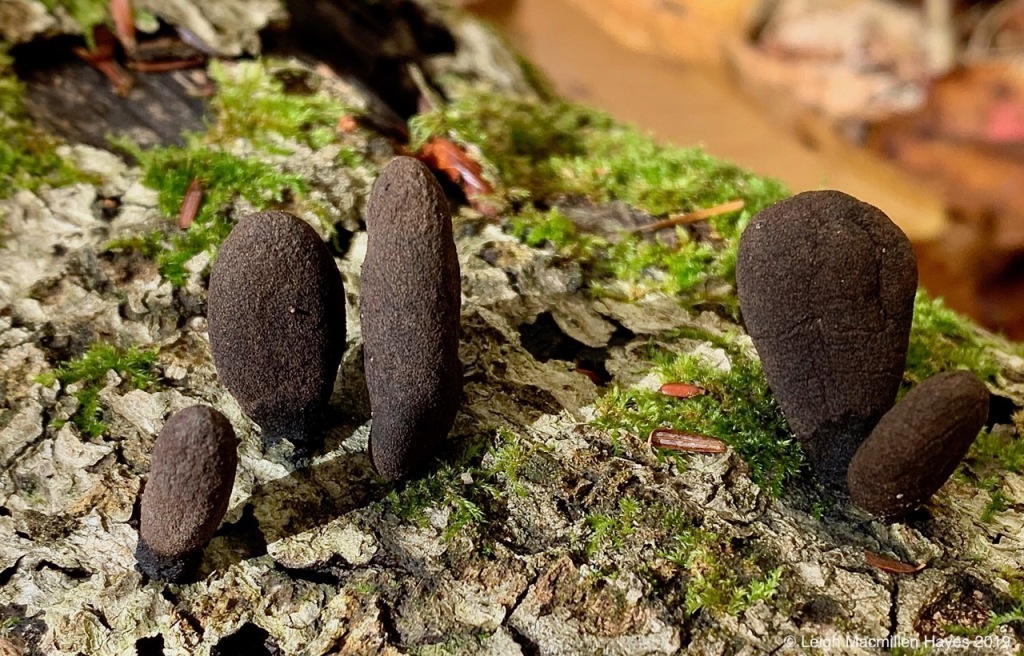
Eventually the journey became a mix of following a trail and bushwhacking. Both provided examples of the next moment I knew Jinny Mae would love. Dead Man’s Fingers, all five of them, in their fall form, the lighter color spores having dispersed and the mushroom now turning black. Why the common name for Xylaria longipes? According to Lawrence Millman, author of Fascinating Fungi of New England, “Certain African tribes believe that if you’ve committed a crime, and you rub the spore powder from an immature Xylaria on your skin, the police won’t identify you as the culprit.”

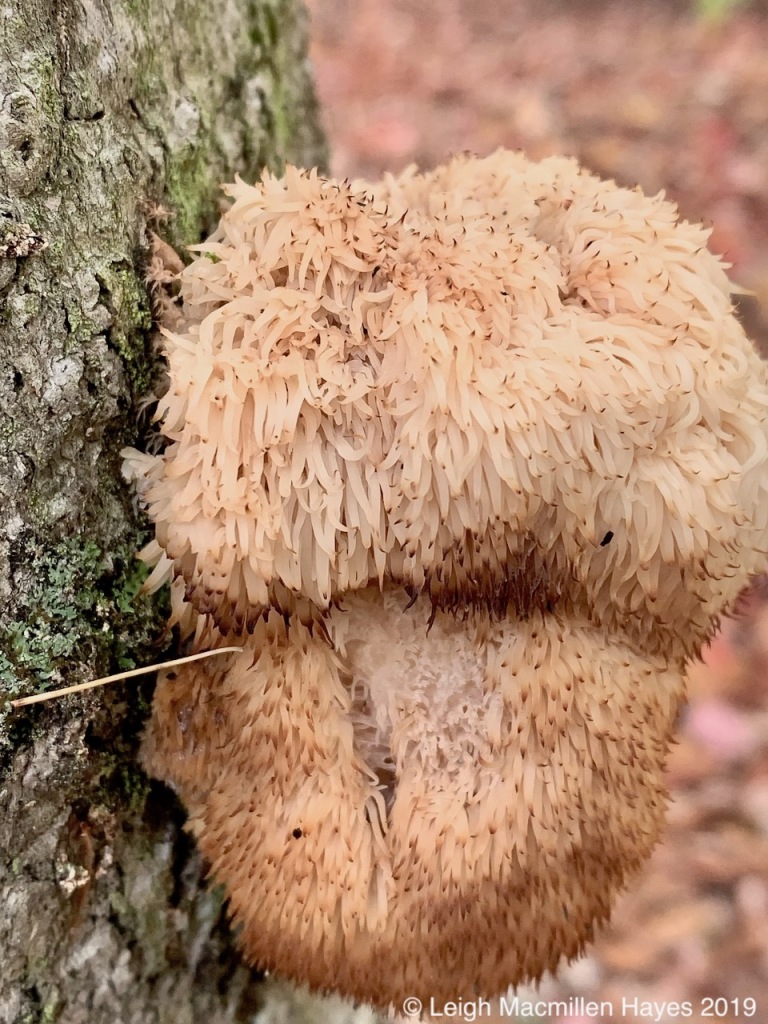
It seemed these woods were a mushroom garden and one after another made itself known. I could practically feel Jinny Mae’s glee at so many fine discoveries. Resembling cascading icicles (I was wearing a wool hat and my snowpants actually, which turned out to be overdress after three hours), I wanted to call it Lion’s Mane, but to narrow down an ID decided to leave it at the genus Hericium. I suspected Jinny would agree that that was best and it should just be enjoyed for its structure no matter who it really was.

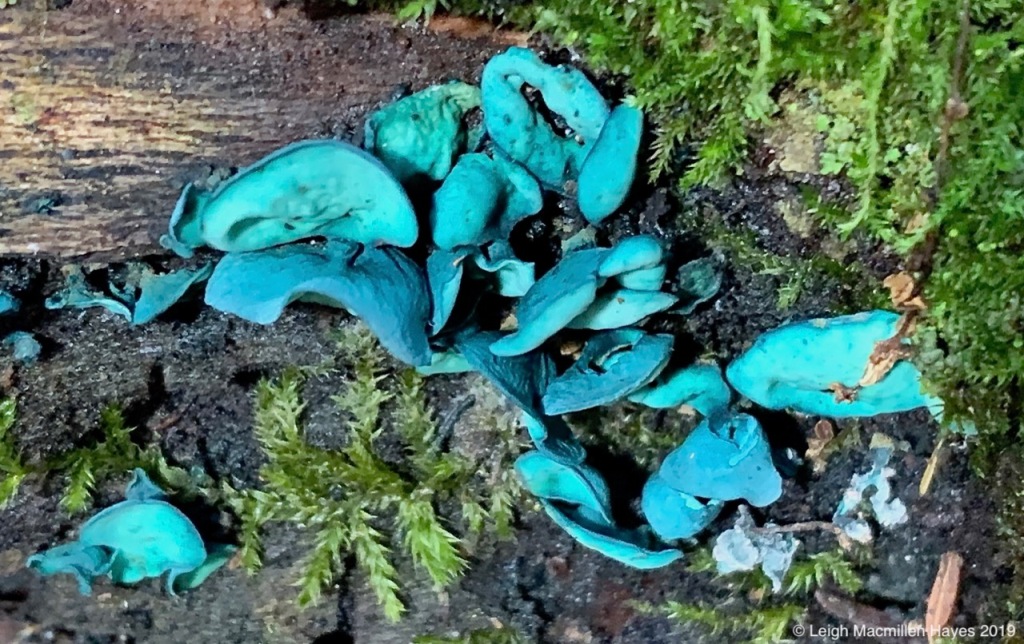
Nearby, another much tinier, in fact, incredibly teenier fungus could have gone unnoticed had the sun not been shining upon it. I was pretty certain 2019 would be the year that would pass by without my opportunity to spy this one. But, thankfully, I was proven wrong. Forever one of my favorites, I knew Jinny Mae also savored its presence. The fruiting body of Green Stain are minute cup-shaped structures maybe 1/3 inch in diameter. I used to think when I saw the stain on wood that it was an old trail blaze. And then one day I was introduced to the fruiting structure and rejoice each time I’m graced with its presence. There was no reason to question these delightful finds. Noticing them was enough.

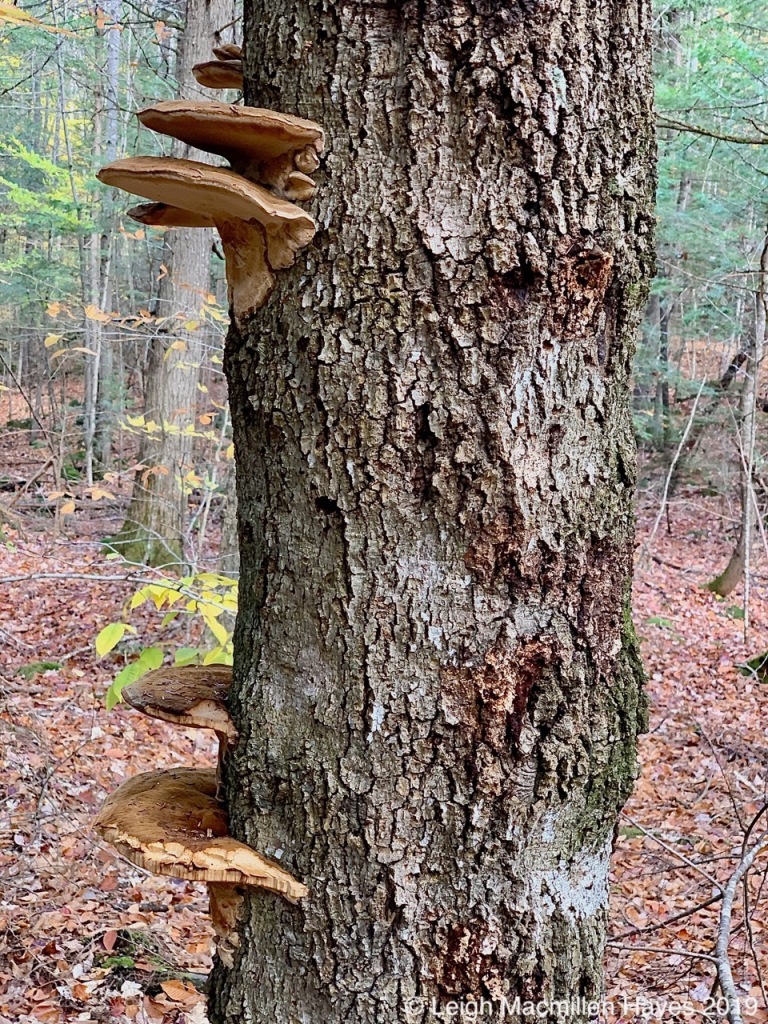
In complete contrast, upon a snag nearby, grew a much larger fungus.

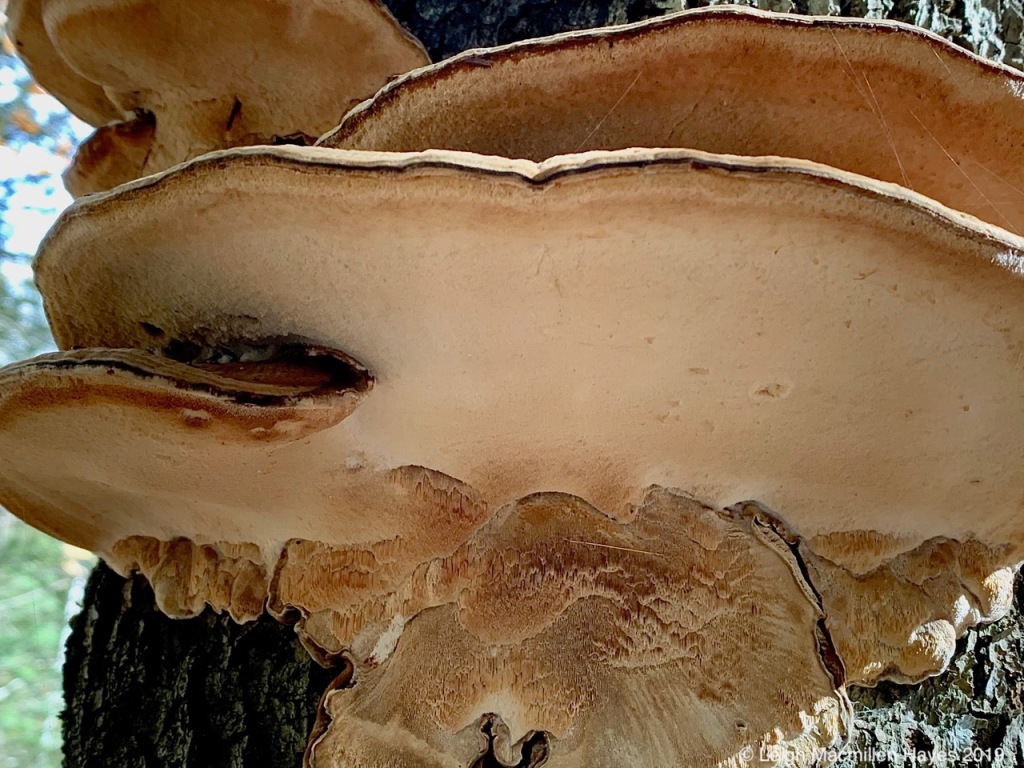
Part of its identification is based on its woody, shelf-like structure projecting out from the tree trunk. Someone had obviously been dining upon it and based on its height from the ground and the tooth marks, I suspected deer.

The pore surface, however, is the real reason to celebrate this find for it stains brown and provides a palette upon which to sketch or paint, thus earning it the common name of Artist Conk. But the question: while some mushrooms fruit each year and then if not picked, rot and smell like something died in the woods, what happens with a shelf fungus? The answer as best I know: A shelf fungus adds a new layer of spore tissue every growing season; the old layer covered by the new one, which look like growth rings in a tree.

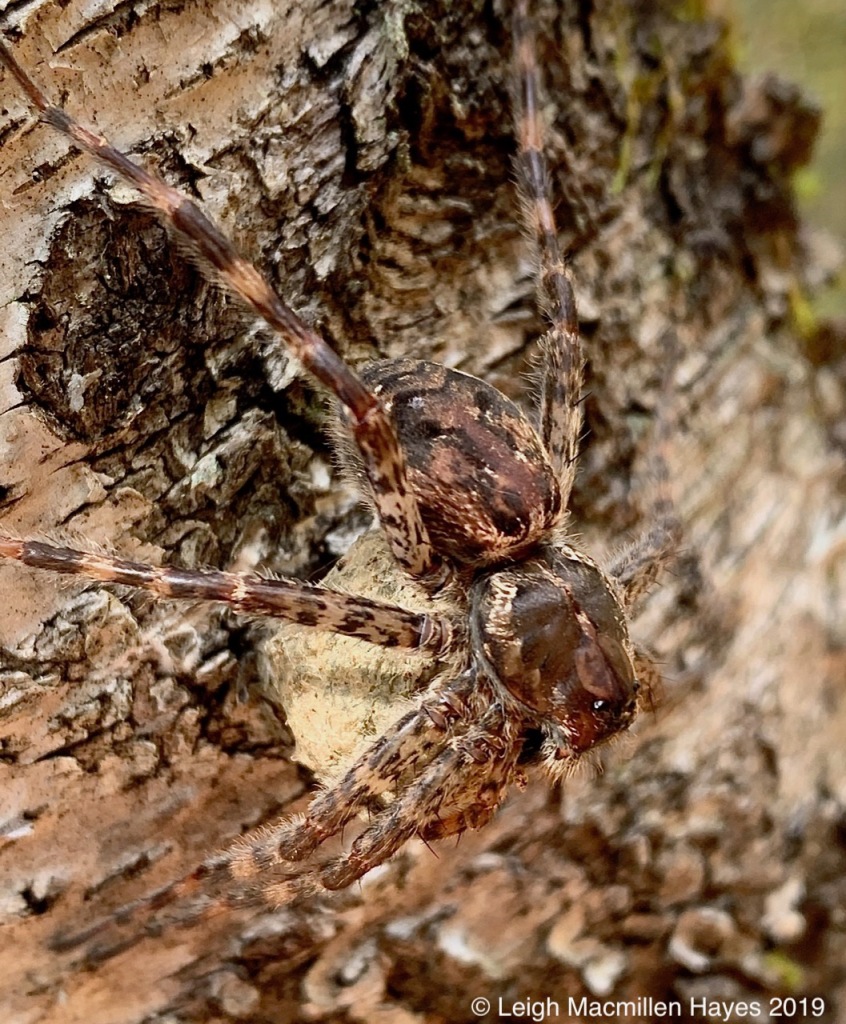
A lot of the focus on this morning’s walk tended to be upon the fungi that grew in that neck of the woods, but suddenly something else showed its face. Or rather, I think, her face. A Wolf Spider. Upon an egg sac. Super Mom though she may be for making a silk bed and then enveloping her young in a silk blanket, and guarding it until her babies hatch, this spider did not make the slightest movement, aggressive or not, as I got into its personal space. Usually the mother dies either before or after her babies leave the sac. What would Jinny Mae think? Perhaps that for some reason Momma waited too long and maybe the cold weather we’ve experienced upon occasional lately got the better of her?

I don’t know entirely what Jinny Mae would think, but I have a pretty good idea because the reality is that today, she and I traveled the trail together for the first time in forever. For each of these finds, it was like we played trail tag–first one spying something wicked cool and then the other finding something else to capture our attention as we tried to capture it with our cameras.

We caught up. We laughed. We noticed. We questioned. We laughed some more.

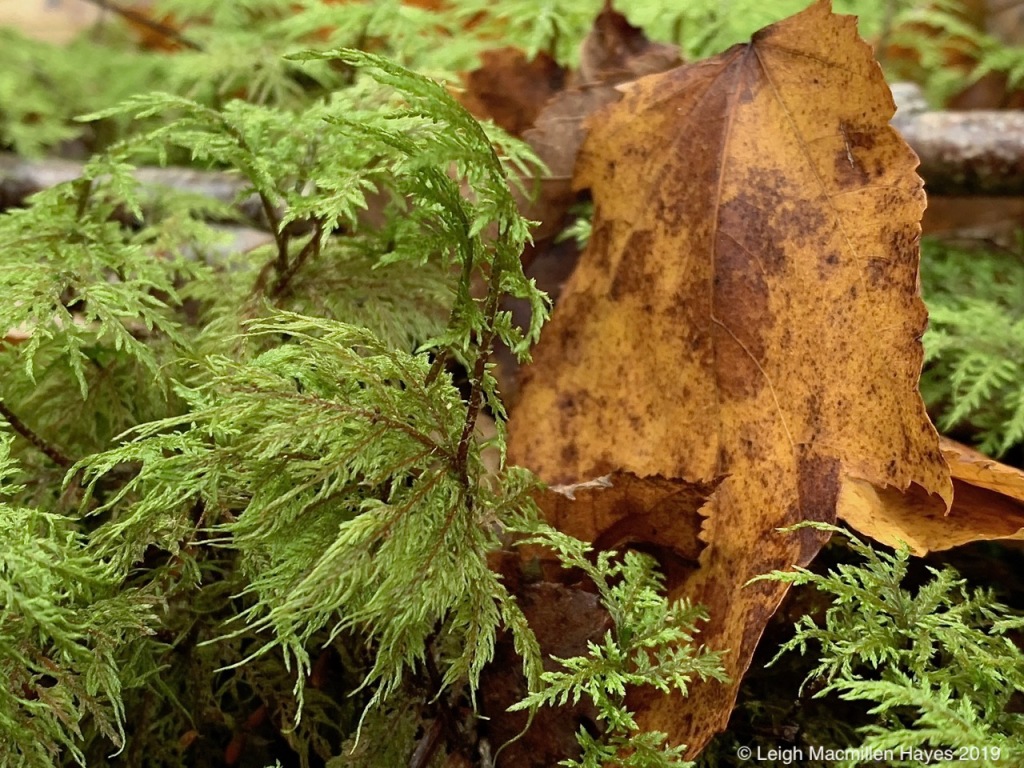
Our three-hour journey drew to a close as we revisited the Stair-step Moss that grows in her woods.

I’m still giddy about the fact that I got to wander and wonder the Jinny Mae way today.

P.S. Jinny Mae returned to Super Momma spider a couple of days later and as she paused to take a photo, Momma scooted into a tree hole, carrying her sac. She LIVES.

Summer Marches On

Today I attended a celebratory parade.

0-Subtle colors

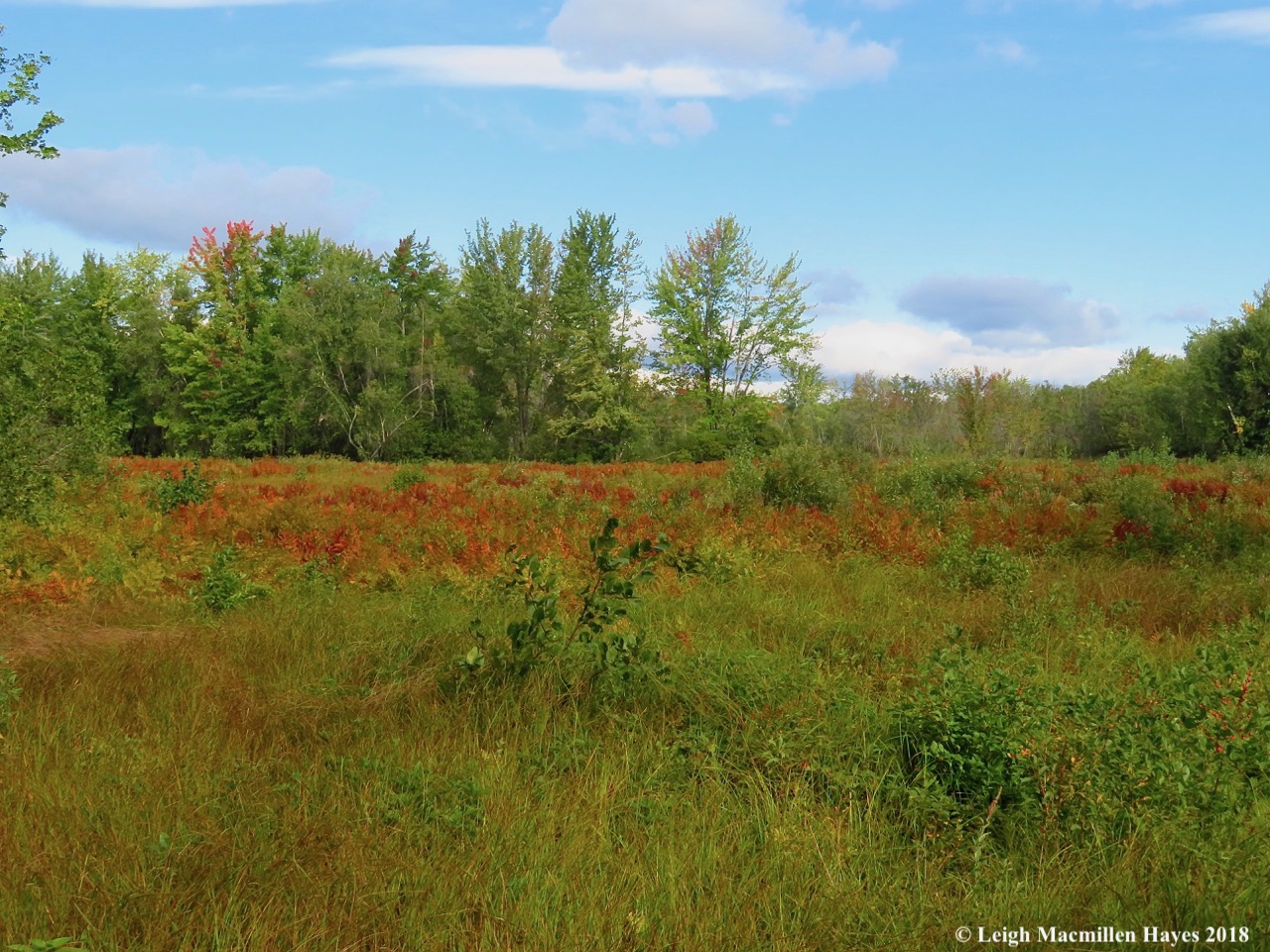
The route followed the old course of a local river and along the way the trees stood in formation, some showing off their bright new coats.

5-colors in the field

Each float offered a different representation of the theme: transition.

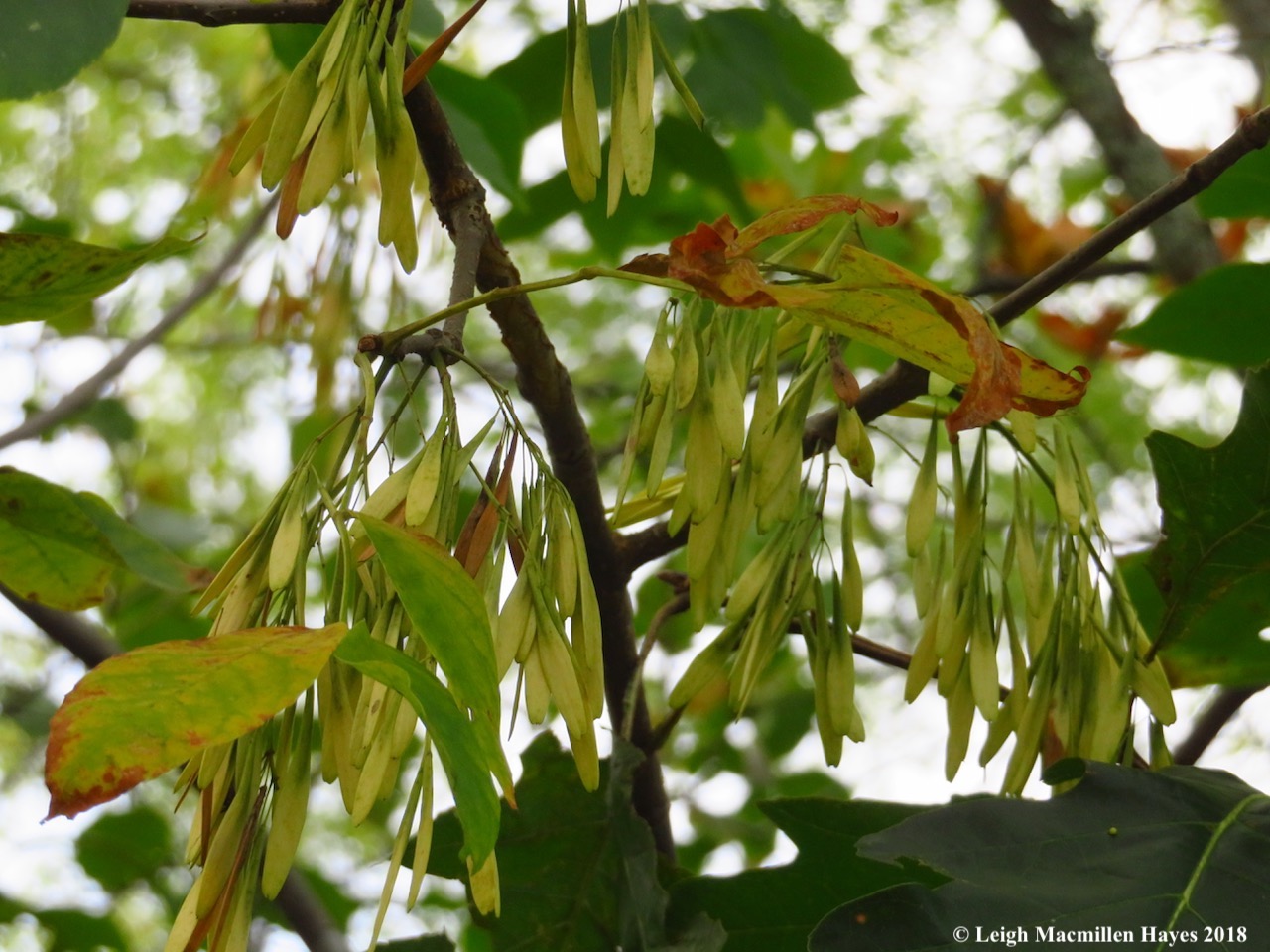
3-ash seed raining

Upon some floats, seeds from the Ash rustled as they prepared to rain upon the ground like candy tossed into the gathered crowd.

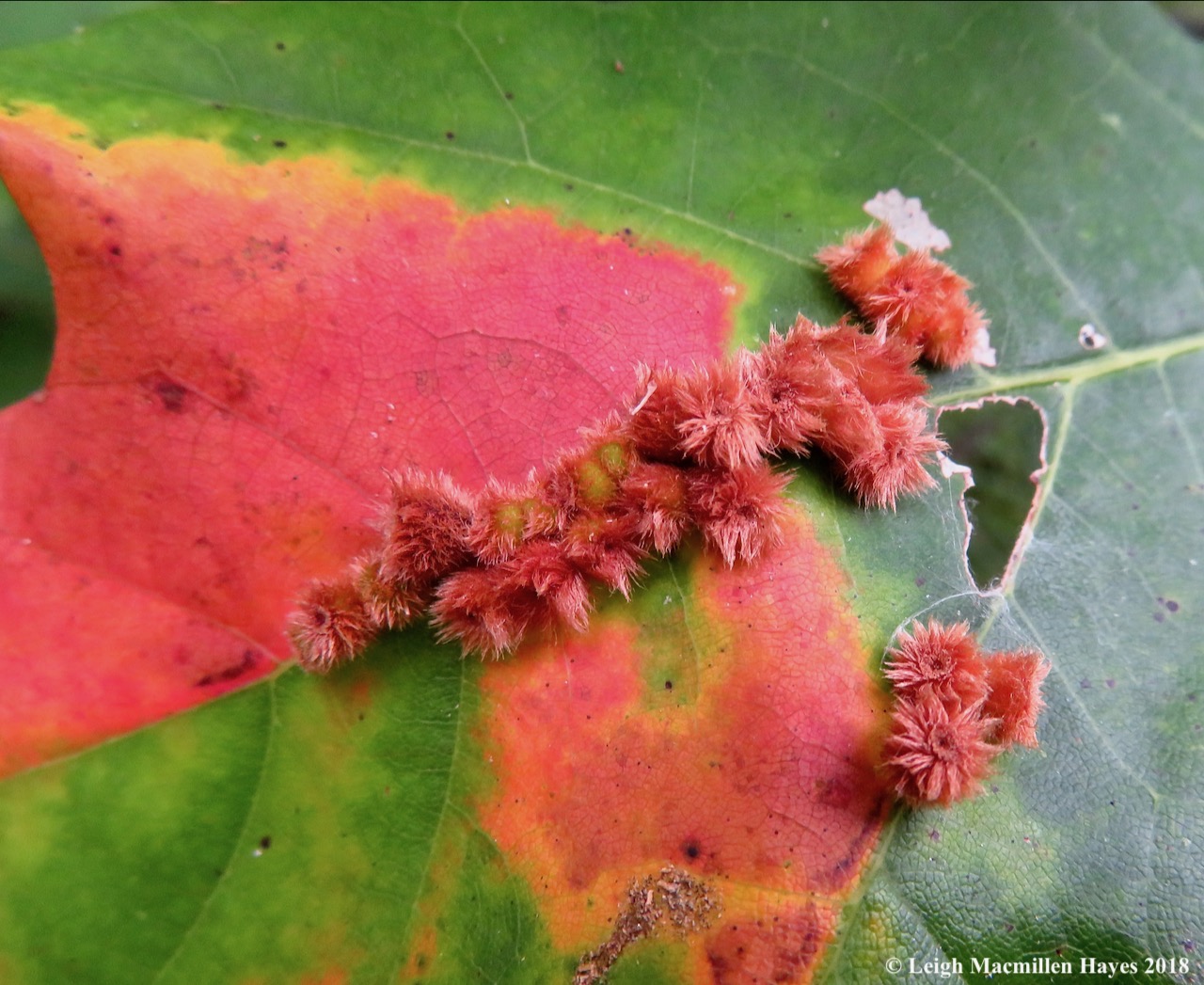
4-crystalline tube gall on red oak

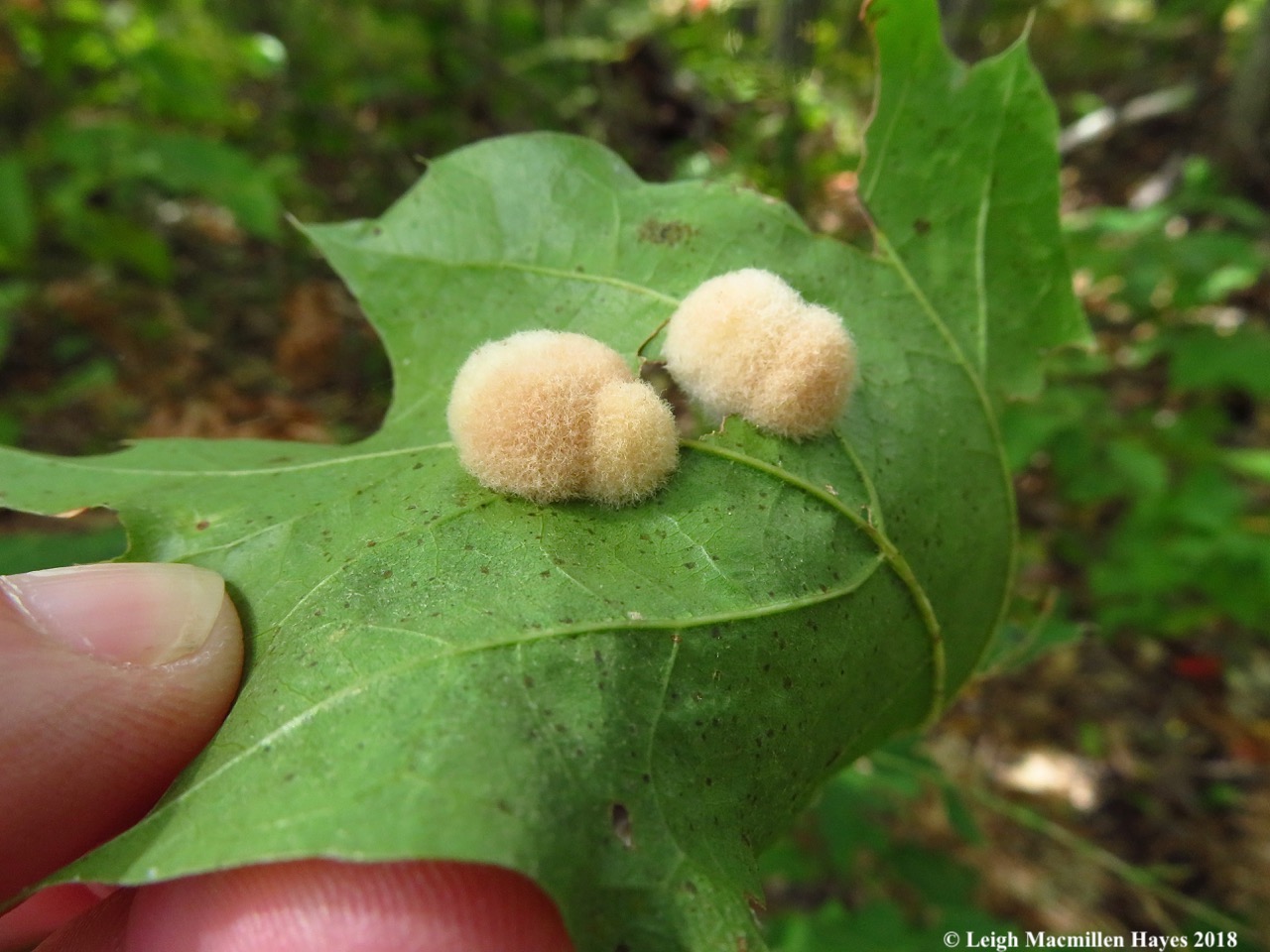
Oak leaves showed off their pompoms of choice–some being crystalline tube galls and others . . .

19-hedgehog gall?

possibly called hedgehog.

8-bald-faced hornet

Playing their instruments were the Bald-faced Hornets,

9-autumn meadowhawk

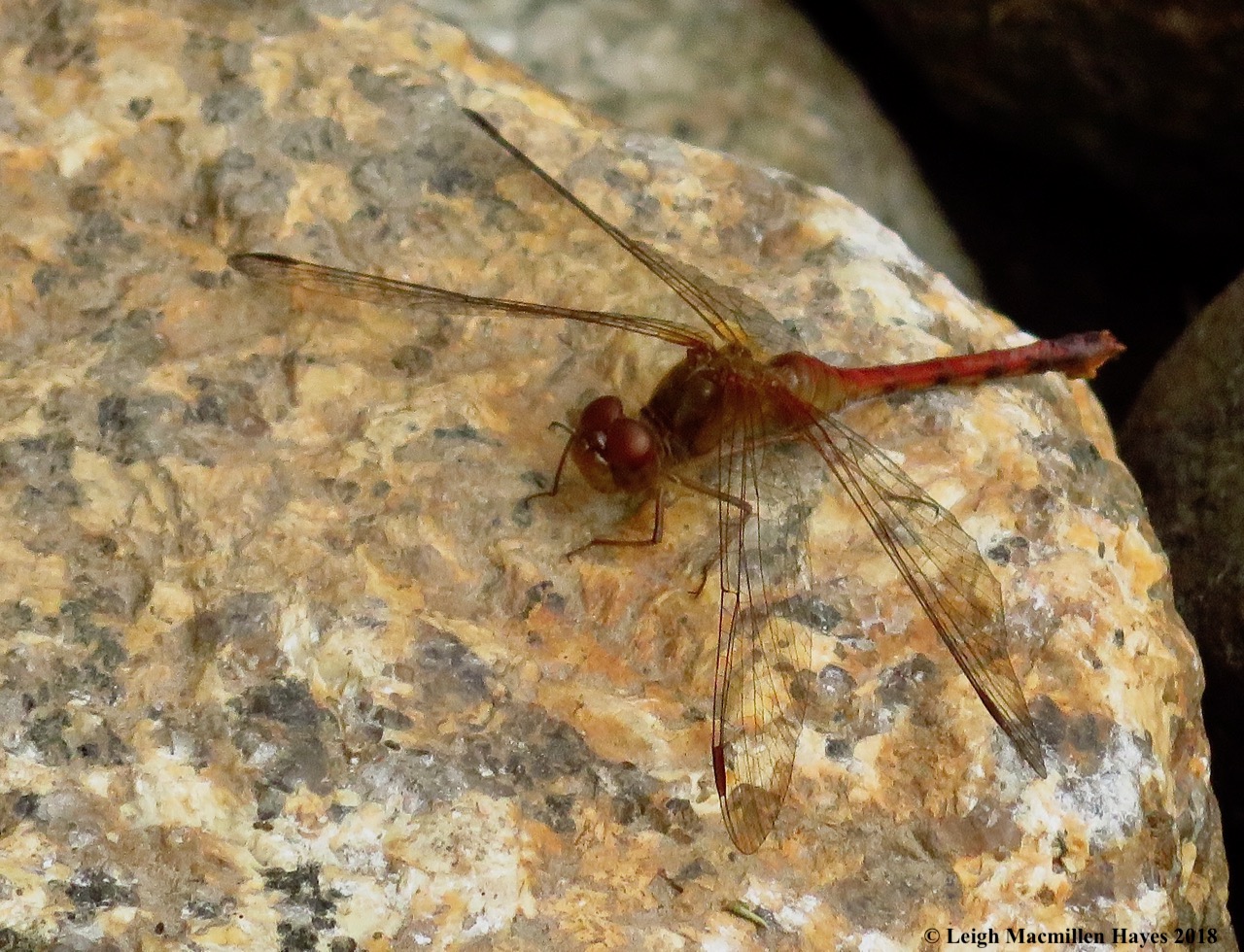
Autumn Meadowhawk Dragonflies,

11-immature green stink bug

and even an immature Green Stink Bugs.

10-green frog

On the percussion instruments at the back of the band were the green and . . .

23-pickerel frog

pickerel frogs.

15-yellow-rumped warbler

Adding a few fainter notes were a couple of Yellow-rumped Warblers.

16-yellow-rumped warbler

They didn’t want the chickadees to get all the credit for the songs of the woods.

17-hairy woodpecker

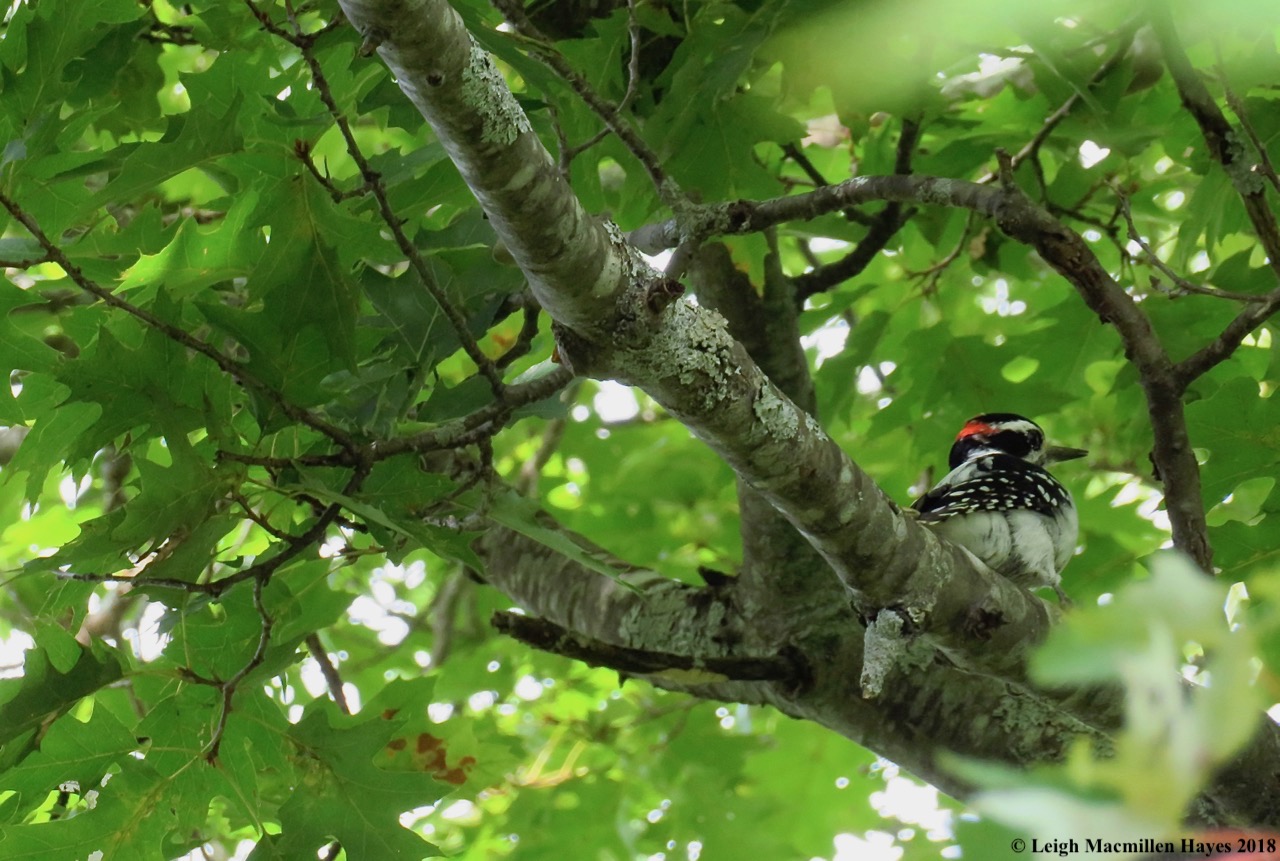
A Hairy Woodpecker also tapped a view beats.

12-wood ducks

Probably my favorite musicians, however, sported their traditional parade attire and awed those watching from the bandstand.

13-wood duck

Even a non-breeding male made the scene look like a painting.

14-wood ducks taking off

Their real contribution, though, came from the modestly plumaged females who offered a squealing “oo-eek, oo-eek”  each time they took flight.

18-sensitive fern

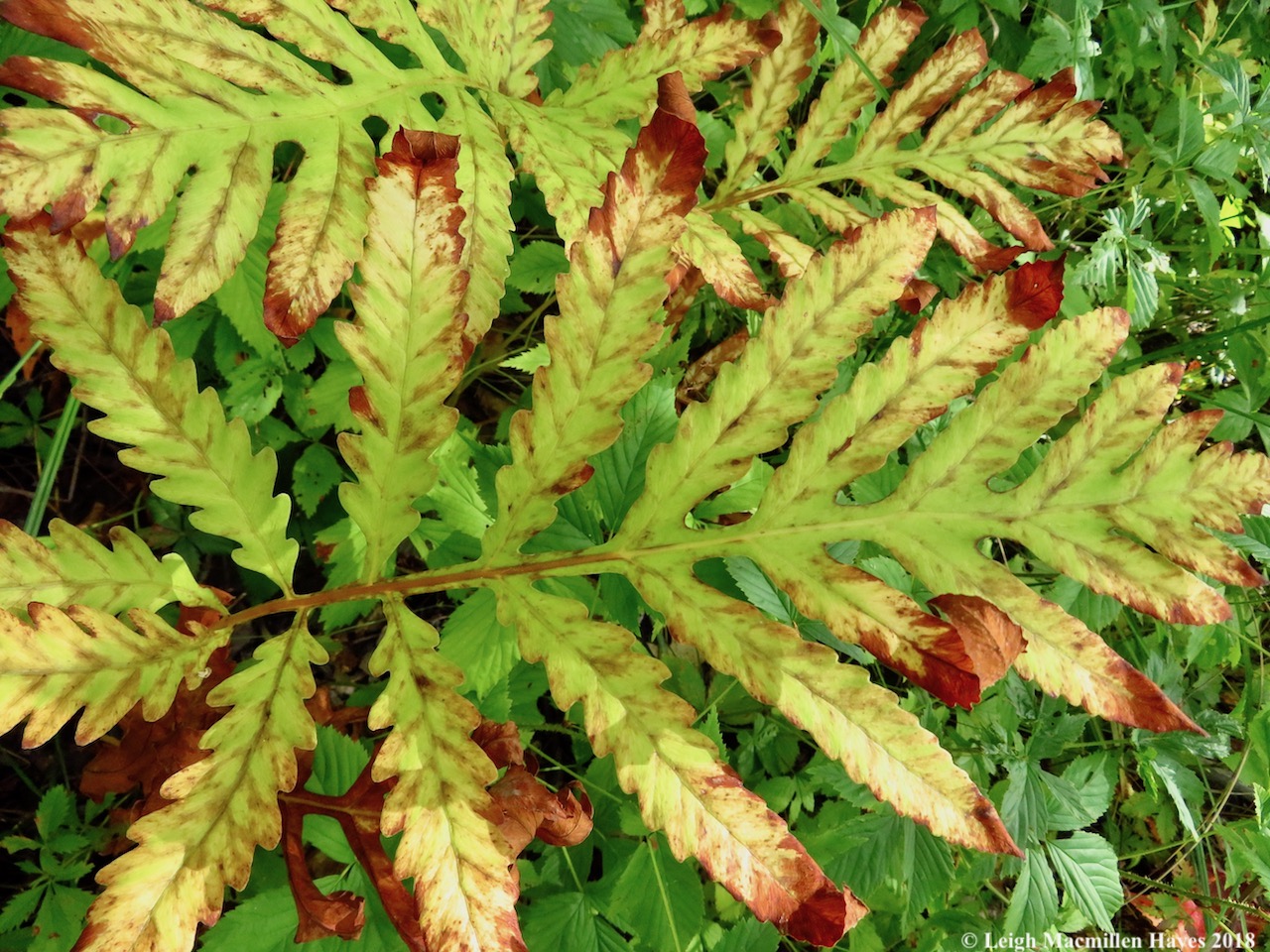
Though green attire was the most prominent of the day, others sported colors of change from yellows and browns to . . .

6-red emerging

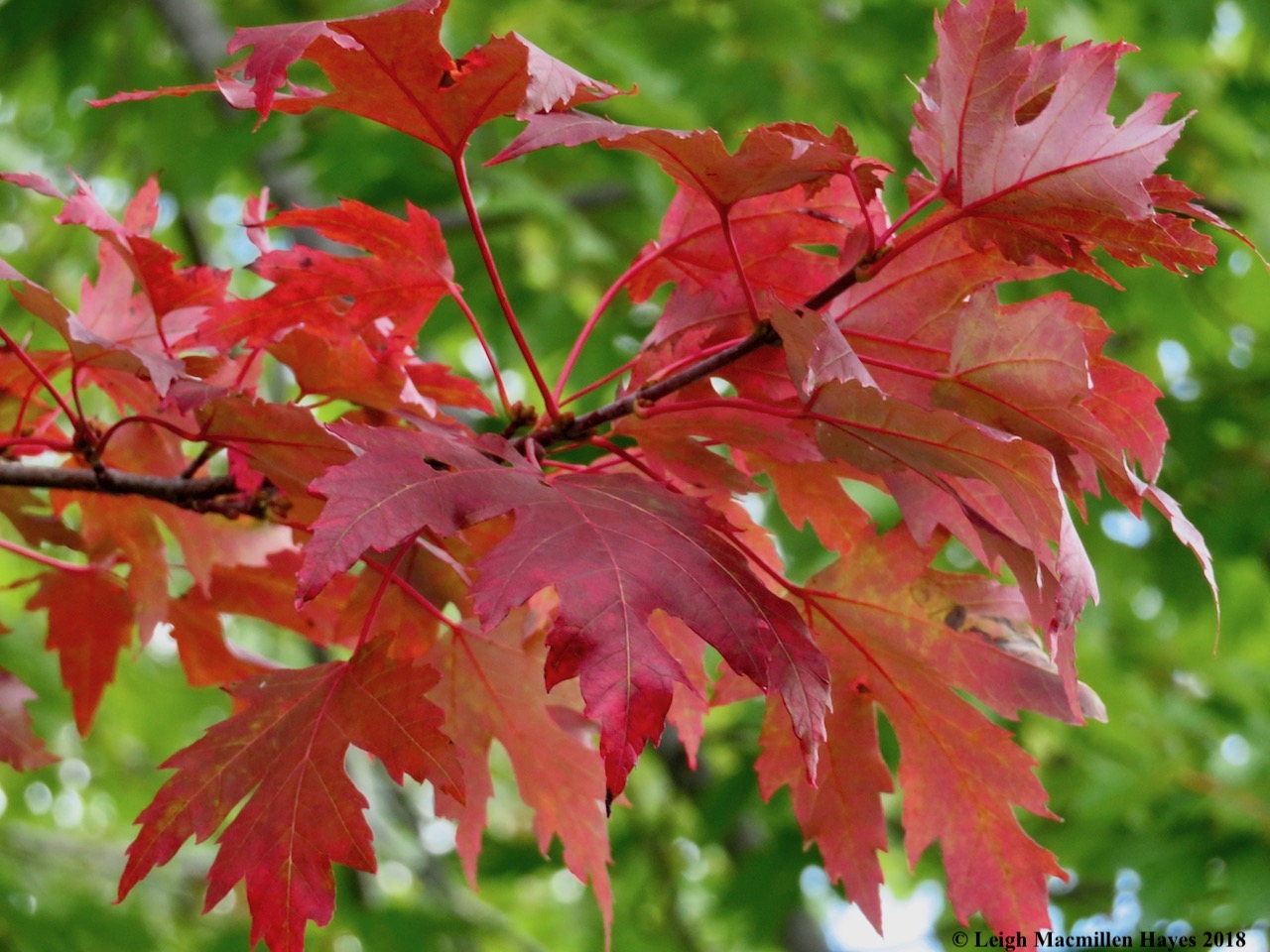
brilliant reds.

21-Brigadoon

As is often the case along such a route, vendors offered works of art for sale, including local scenes painted with watercolors.

22-lily reflection and aquatic aphids

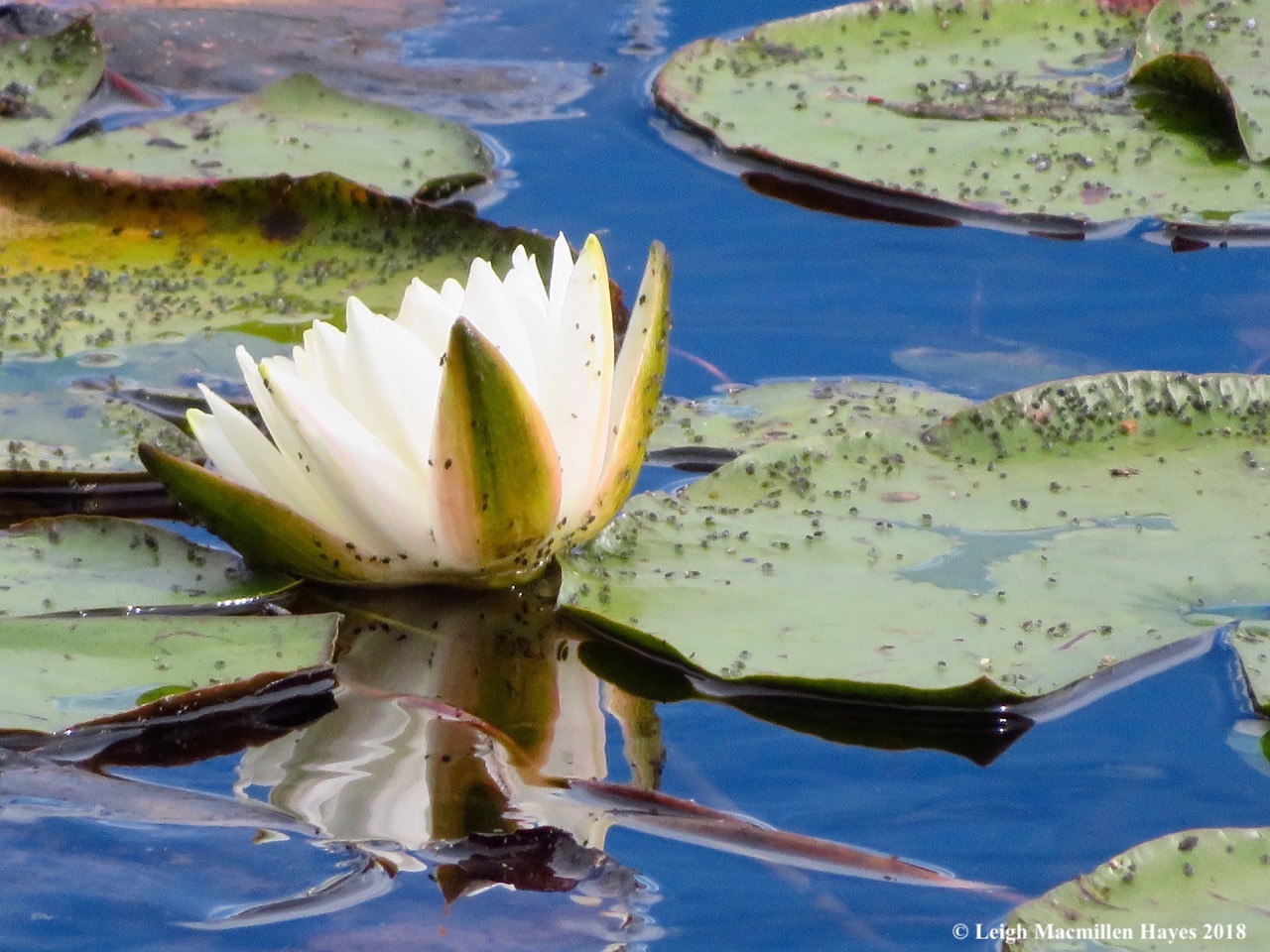
Before it was over, a lone lily danced on the water and offered one last reflection.

24-season transformation

And then summer marched on . . . into autumn.

Miracle of the Stable

Who knows how it all began. Perhaps it was a teeny, tiny thought tucked away in the back of a mind.

p-milkweed 2

A seed of an idea waiting to express itself in one form . . .

p-polypody

or another.

p-yellow birch in pine tree

The seed was sown and sprouted despite adverse conditions.

p-Normway maple leaf

More thoughts followed, some even considered “invasive” despite their exterior beauty.

p-bittersweet

Occasionally, the invasive ideas forged ahead and crowded the mind.

p-car

Certainly, not all the thoughts were natural in nature.

p-boardwalk

But still, new paths formed.

p-fisher tracks

And trails were traveled to and fro on a quest.

p-stream curves

The path was never intended to be straight and easy.

p-Stevens Brook 2

Obstacles became challenges.

p-brook reflections

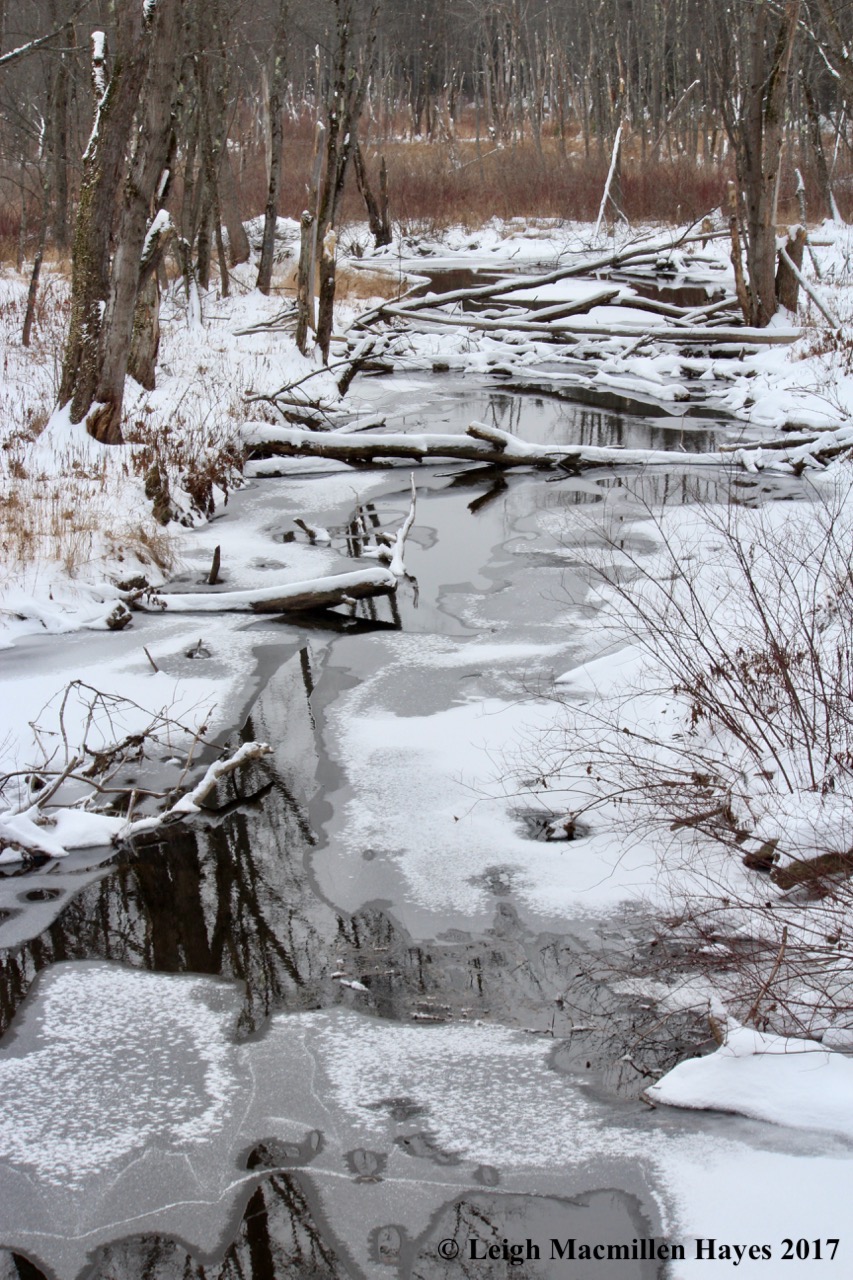
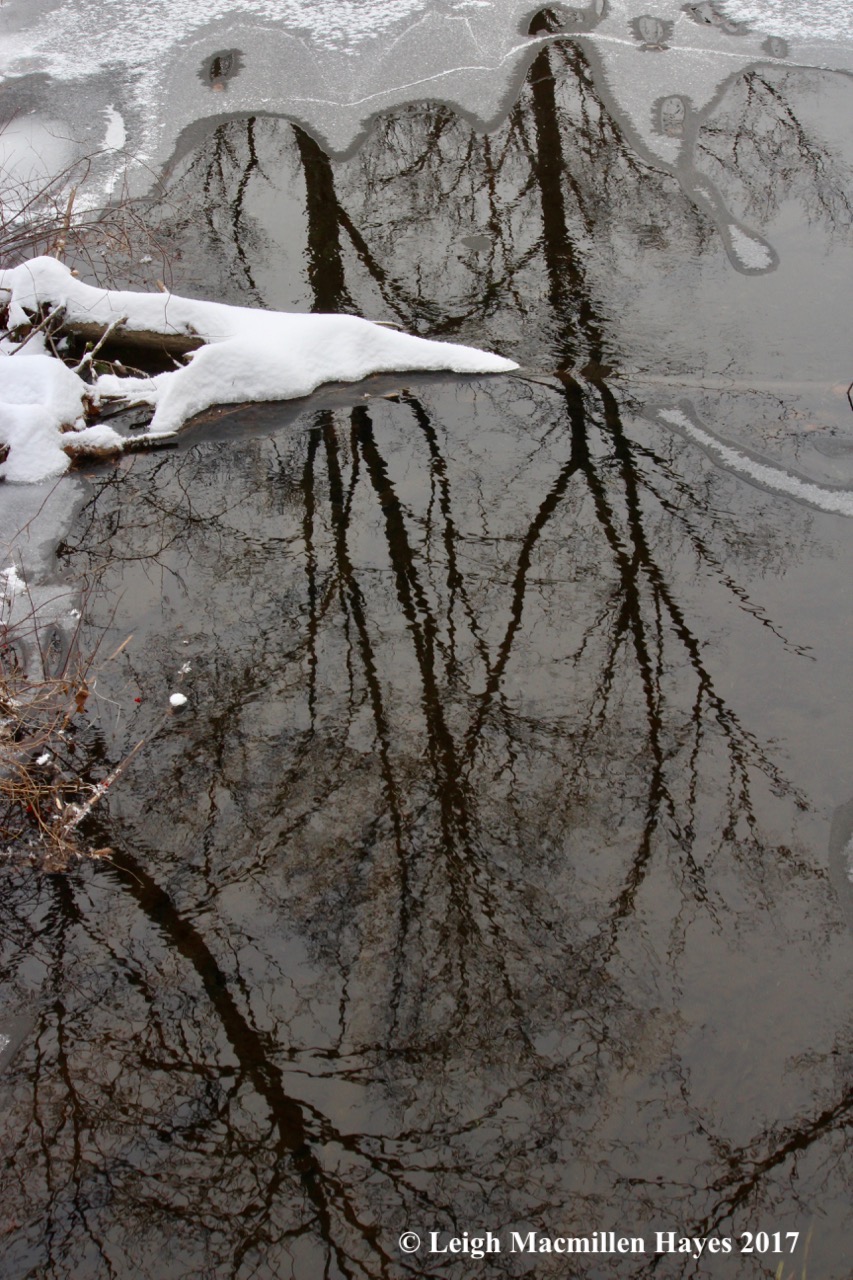
And challenges offered reflections.

p-ice feathers

Amidst the offerings, fresh ideas feathered forth fostering education.

p-garland

And with education, knowledge was linked.

p-tree cookie

Because of all the seriousness, humor became a necessary ornament.

p-nativity

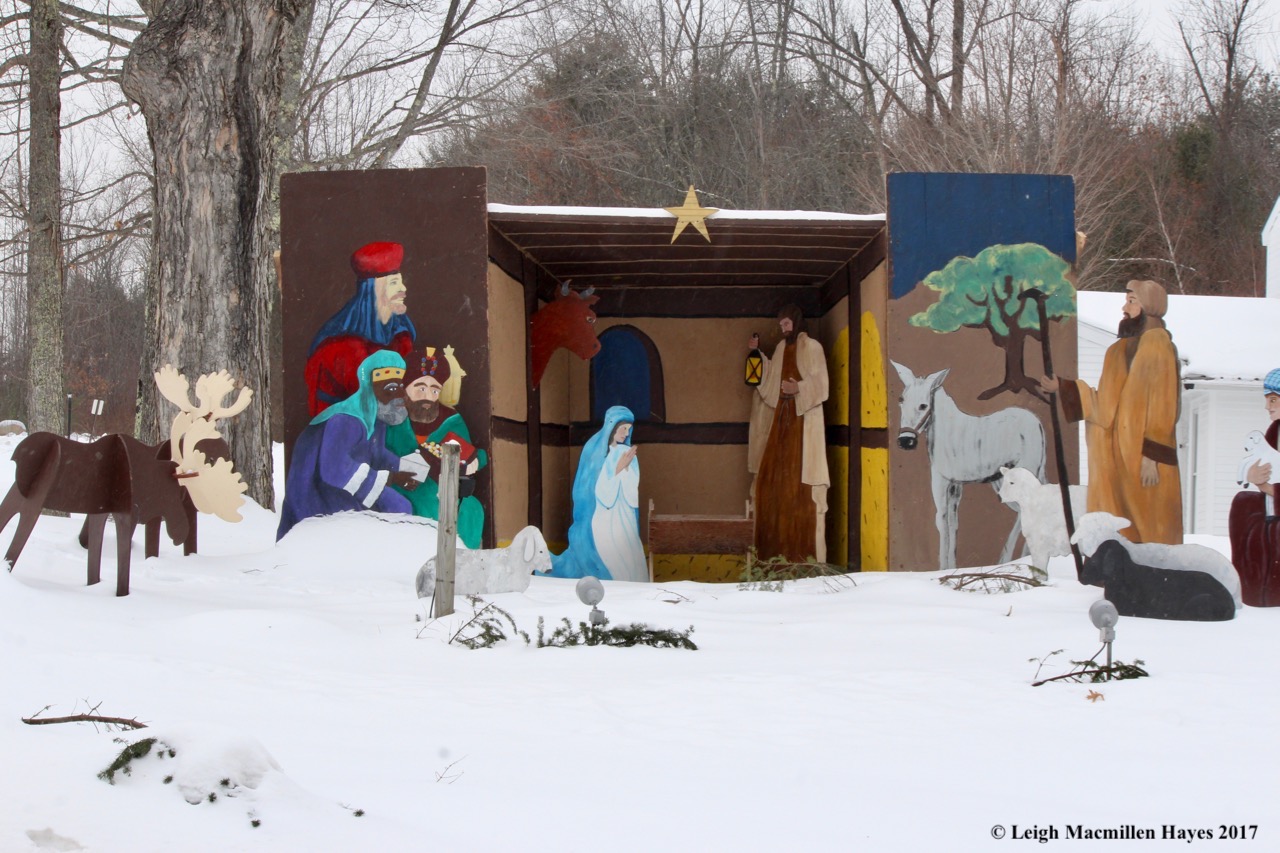
And so it was that moose stood watch with others by the stable in anticipation of a miracle that began with a seed of an idea and expressed the wonder of it all.


Sunday School

After church this morning, I stepped out the door, passed through openings in a couple  of stonewalls and then down the cowpath, crossed the power line, and ventured into my smiling place. It had been more than several months since I’d pushed the hemlocks aside to enter for it’s a wetland and woodland filled with growth that can make it difficult to meander through without snowshoes. But before winter arrives, I wanted to take a peek and learn what I could along the way.

o-oak saplings

My lessons started early as I noted a couple of red oak saplings growing in the hollow of an old tree stump, their color reminiscent of the Christmas season. Last year’s mast crop (and another for some oak trees this year) meant a plentiful supply of food for weevils, little brown things, squirrels, turkeys and deer. And yet, not all were consumed and so they sprouted. Now my plan will be to wait and watch–and wonder which of this array actually will win the race to adulthood.

o-huge squirrel cache 1

A little bit further into the woods, I spied a huge cache of white pine cones. This made my heart sing, for I love to keep on eye on big caches such as this and watch as they get whittled down over the course of the winter.

o-pine cones up close

While I stood there admiring the work of the red squirrel who’d filled its larder presumably when the cones were green (and by the way, these cones are two years old, for it takes two years for them to mature atop the pine trees), I thought about the sap that coats them in white. Though the sap is drier now, does it get stuck to their feet. I know that when I come in from a walk through a pine forest, I have sap on my soles, and attached to that may be pine needles or dried leaves. Is it the same for a squirrel? If so, does it wear off like that on my boots? It must because I’ve never seen it on their feet.

o-pine on the cob 1

And what about as they work on their pine-on-the-cobs? Does the sap on the scales come off on  their lips or teeth–much like when we eat something sticky and gooey like peanut butter?

o-pine seeds

It’s a lot of work to get to the two tiny seeds tucked within each scale. They look to be about an inch long, but most of that is the wing (think maple samara). When the weather is warm and dry, pine cone scales open to release the seeds. The squirrel who’d hoarded the stash, had plucked the cones when they were still green and atop the tree–dropping them to the forest floor before they opened so he’d have plenty to eat. And then he had to gather all that he’d dropped into the piles. And now I can’t wait for the coming months–to watch the pile dwindle and middens grow; to see the tunnels he makes in the snow; and just maybe to sit quietly nearby and watch him in action. He was a bit peeved that I was poking about today and let me know with so many chirrs from a branch nearby.

o-porky den?

I finally moved on and saw an uprooted tree I’ve visited on previous occasions. Last year I followed porcupine tracks to this very spot and spied porky within. But when I checked on later occasions, it didn’t seem as if he’d returned. Today, I peeked in and saw water. Even though it looked like a grand home to me, I’m learning that porky knows best.

o-walking in a hemlock grove

At times, I moved quietly upon the duff under the hemlock trees. Frequently, I stopped to listen and look.

o-cinnamon fern leaves1

And then in an opening, I was again in the wet zone where the cinnamon ferns grew abundantly. In curled formation, their leaves added interest to the landscape and a bit of a crunch to my footsteps.

o-cinnamon fern 2

And piled as they were surrounding each plant, I thought back to the pinecone cache. This was food of a different kind, for those leaves will decompose over the winter and nourish the earth.

o-snowberry 1

Continuing on, I came to one of my favorite spots–where the creeping snowberry grew. I hunted under the tiny leaves for the little white berries, but found none. And I’m not sure that I’ve ever seen them, especially in this place, for I suppose that I miss all the action since snow melt always seems to call a halt to such visitations and then I never make my way deep into these woods all summer. I have to assume that the little brown things and birds had a feast. Although, as any teacher knows, one should never assume. Perhaps next year, I’ll make a point of checking on these plants.

o-birch tree in offing

My tramp was a meander, for I knew not what direction each footstep might take me, changing my mind constantly and trusting that if I turned left or right, I wasn’t missing something in the opposite direction. The sight of a beech tree, its leaves ever rattling, did mean that I’d have a chance to move to drier land for a few minutes.

o-equisetum

And then I stepped up onto a rock, where the growth at my feet surprised me for I didn’t realize that equisetum grew in this part of the woods. Always something new to learn.

o-tamarack branch 1

That wasn’t all. As I looked around, a branch with yellow needles by my foot caught my attention.

o-tamarack branch 2

This was the twig of a tamarack tree, with its needles growing in tufts atop little spurs. Had we met before, the tree and me? If so, I couldn’t remember it. Nor could I find it.

o-evergreen hallway

Before me was a wall of evergreens, in a classroom all of their own, for really, these are among my favorite places where learning opportunities present themselves. But, today’s lesson wasn’t about the hemlock, white pine, fir and spruce idiosyncrasies.

o-tamarack tree

And so I scanned the sky, and about twenty-thirty feet away, I found the tree. A tamarack or larch or hackmatack tree, aka Larix laricina, is our only deciduous conifer because unlike all the evergreens, it sheds its needles each fall.

o-moose scat

A few minutes later, I heard movement, and looked up to see . . . no, not the moose that made this deposit last winter, but two flashes of white as a couple of deer bounded off. I think that’s one of my favorite lessons of these woods, for the landscape changes repeatedly and thus offers a variety of habitats for the mammals of western Maine. This is the place where I get to learn the most about them and their behaviors.

o-deer rub 1

Sometimes I’m rewarded with spying the mammal from a distance, but other times I find evidence of its behavior, like this antler rub with frayed bark at top and bottom and smooth wood between.

o-varied habitat 1

I’ve watched the forest succession in these woods for twenty-five years,

o-varied habitat 6

and it’s been logged again more recently.

o-varied habitat 4

With each change, comes more change. And so the mammals move from one spot to another, but they’re still all here–somewhere.

o-varied habitat

I just need to listen and look.

o-turkey tail fungi

It’s not just the mammals and trees that I get to learn about. My studies include among other topics, fungi, of which I’m only a so-so student. But I do know that this is turkey tail, aka Trametes versicolor.

o-Fomitopsis cajanderi  (Rosy Polypore) 2

And then I happened upon a hemlock stump topped with a large, beautiful display outlined in a coffee brown and salmon pink. It took me some work to remember its name. I can tell you where else I’ve seen it for it grows upon a hemlock log at Holt Pond.

o-unknown mushroom 1

Before I forget again, it’s a rosy polypore, if memory serves me right. I only hope my fungi teachers weigh in on this one.

o-logging road 1

At long last, it was time to follow a logging road back to the snowmobile trail.

o-snowberry on sphagnum

Sometimes, I slip back into the woods before reaching the trail, but today I chose to follow it. And what to my wondering eyes should appear, but more creeping snowberry atop sphagnum moss.

o-home sweet home

As I finally crossed the field toward home, I gave thanks for the classroom that is right outside our back door and for the lessons learned in this Sunday School. Now I just have to remember everything, which is why I record so much.


I Spy, You Spy, We All Spy

As I stepped out the door early this morning to dump yesterday’s coffee grounds, my eyes were immediately drawn to a pattern in the dew and I knew that Porky had paid us a visit.

t-porcupine trail in morning dew

His trademark sashay showed in the wet grass almost as well as it does in snow with that pigeon-toed pattern and swish of a tail. Only yesterday I’d been noting all the freshly nipped oak branches in our yard and woodlot, cut as they were at that telltale 45˚ angle.

t-flat hill sign--oxymoron

And then, after today’s coffee (grounds waiting until tomorrow to be disposed) and breakfast, I drove to Lovell to meet up with some Greater Lovell Land Trust docents for a climb up Flat Hill–that oxymoron of a name. But really, the summit is rather flat–after climbing the hill, of course.

t-trail light

It was early and felt more fall-like than we’ve experienced of late and we reveled in the temperature as well as the light along the trail as the sun played with the leaves and added a golden glow to our day.

t-coyote scat 1

When we weren’t looking up, we looked down. One of our first sights–scat! Coyote scat, we thought. Only the contents of this scat were different than most.

t-coyote scat 2

And so we went in for a closer look–for it was filled with quills. Not my home porky, but we know that the summit and rocky ledge below are porcupine territory so it made perfect sense that we found such scat in the middle of the trail.

t-fox scat

We found more scat a little further along–this one was filled with berries and seeds and also in the middle of the trail, atop a rock. Smaller in size, we suspected red fox.

t-paper birch lenticels

There were other things than scat to attract our attention, like the long lenticels on a downed paper birch–their pattern looking like either zippers on a jacket or a bunch of spruce trees in their spire formation.

t-maple-leaf viburnum

We marveled at the color and texture of the maple-leaf viburnums–like no other in the mix.

t-hop hornbeam bark and leaf

And when we reached the hop hornbeams with their shaggy bark and double-toothed leaves, we knew to look below for their seed pods. It wasn’t an easy search for they are small and blend in well with the birch and hornbeam leaves on the ground.
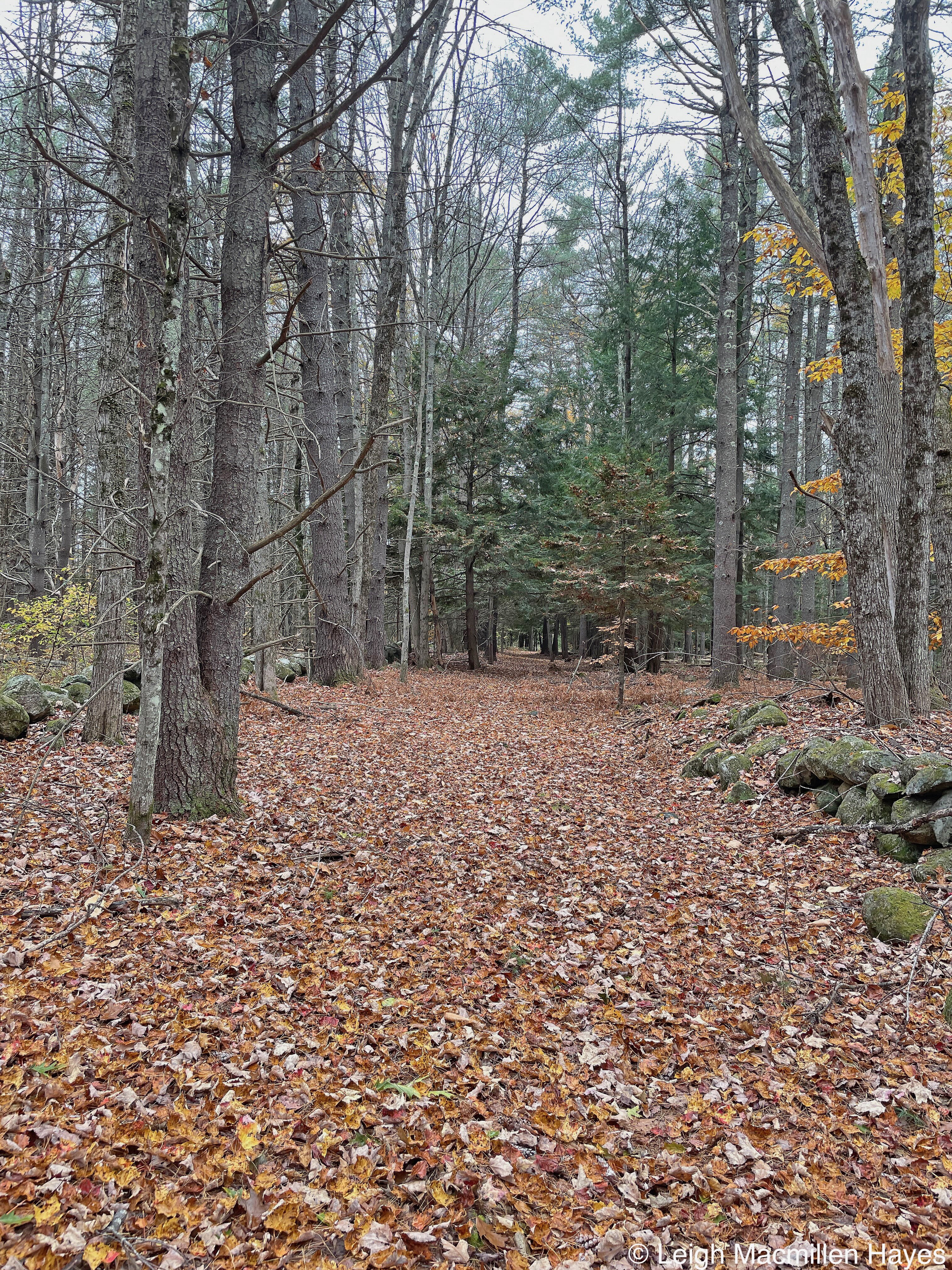
t-hop seed 2

But we found one–its papery sack enclosing the nutlet. We were curious to see the seed and so opened the inflated casing. It was almost a 3D tear-drop shape, coming to a sharp point.

t-hops

Skipping ahead for a moment, after we finished hiking I visited a tree back near the parking lot where Pam and I had noted plentiful fruits in the summer. It takes about twenty-five years for a hop hornbeam to fruit. And the common name–“hop” refers to the seed clusters that represent true hops used in beer production.

t-summit view 1

At last we reached the summit and stood for a while, in awe of the color display before us.

t-polypody 1a

From the same spot, we also noted the polypody ferns that grow upon the summit rock.

t-polypody spores 2

Ferns reproduce by spores rather than seeds. The itty bitty spores (think dust sized), called sporangia, grew on the underside of these leathery frond leaflets. The sporangia form clusters called sori and in the case of polypody the sori are naked. Some had already dispersed.

t-chipmunk

At last we started down, but not without a side trip of bushwhacking and annoying a chipmunk who had some housekeeping details to attend to.

t-docents 1

Less than three hours later (amazing for us), we gathered at the bottom and said our goodbyes to Darbee and David on the left–they’ll return to their winter home soon. Bob and Pam will hang with us for a bit longer, but while I reflected on all the wonderful reasons to enjoy winter in Lovell, the two couples made plans to connect in their winter habitat.

t-wooden spoon

The day wasn’t over yet and this afternoon another docent and I set up a “Kim’s game” of natural and unnatural items on a sheet covered with a bandana on the trail behind the New Suncook School. Then we walked further along the trail and hid a bunch of unnatural items for our after-school Trailblazers to locate. (We had to relocate them as well and are almost certain we found all of them. Maybe . . . )

t-noticing leaf colors

Before the kids did anything though, they introduced Linda to their trees–clusters of trees really for all are copiced, that they’ve befriended and named and gotten to know up close and personal. This afternoon, they noted that the colors of the leaves were changing.

t-Linda and Sassy

They loved giving Linda a tour and she loved being part of the action.

t-alligators in the woods

The kids did an excellent job with their observation skills, including locating at least one species that didn’t quite belong in these woods.

t-fallen log 1

And then we started gently rolling over fallen limbs, curious about what we might find below.

t-red-backed salamander

And what to our wondering eyes should appear? A red-backed salamander under the first one. We rolled a few more and didn’t find much. But then we heard something and stood still as we listened. Finally, it called again and we called back–a barred owl was somewhere nearby. At last it was time for the kids to head home and as we walked out of the woods to meet their parents, we stopped to roll one more log–where we found a yellow-spotted salamander. Unfortunately, in our excitement, I couldn’t take a decent photo, but still . . . we were thrilled.

What a perfect day–of I spy, you spy, we all spy. Indeed we did.


May(be) a Mondate

We headed out the backdoor, into our woodlot, down the cowpath, along the snowmobile trail, veered left behind the church, walked down a driveway, crossed the road and snuck into Pondicherry Park.

p-NOrway maple and samaras

Or so we thought, but as we stood below this Norway maple with its widely-divergent two-winged samaras, a familiar voice hailed us. Our friend, Dick Bennett, appeared out of nowhere (well, really from somewhere–for like us, he lives nearby and uses these trails frequently to get to town) and so we chatted briefly. He was on a mission and we were headed in a different direction along the multi-layered loop system.

p-crossing the field

Within minutes we followed the path out of the woods and across the field–prepared as we were for rain. Our plan was to retreat when it started to pour.

Once we entered the woods again, we heard a barred owl call from the distance with its infamous “Who cooks for you?” “Our oldest son and his girlfriend,” was our response for they had surprised us this weekend with a visit and prepared last night’s meal.

p-foxhole debris

For the most part we stuck to the trail system, but then we stepped over the wall onto the Lake Environmental Association’s Maine Lake Science Center property because I wanted to show my guy this pile of dirt and stones.

p-fox hole

On a recent bushwhack with a few others, we’d discovered this fox hole and I immediately recalled all the fox tracks and seeing a red fox this past winter not far from this location.

p-boardwalk1

After poking about for a few minutes, we made our way back to the LEA trail and eventually landed at the boardwalk that weaves through a wetland. From there, it was back through the woods to the park trails. I know my guy wanted to move quickly, such were the bugs, but I wanted to take everything in and so he patiently waited from time to time.

p-Canada mayflower

After all, there were visions in white exploding with glory in the form of Canada mayflowers,

p-foamflowers

foam-flowers,

p-wild sarsapirilla

and wild sarsaparilla.

p-gaywings

We also feasted our eyes on visions offering the purplish hue of gaywings, aka fringed polygala.

p-fern stream

And then there were the ferns.

p-cinnamon fern fertile frond

The fertile stalks of cinnamon ferns shouted their name,

p-royal fern

while the royal ferns were much more subtle–

p-royal fern fertile fronds

their fertile crowns practically blending into the sterile fronds.

p-chipmunk

At the chimney by the amphitheater, a chipmunk paused to ponder our intentions and then quickly disappeared.

p-Stevens Brook

We followed the river trail to the Bob Dunning Bridge and noted all the shades of green beside Stevens Brook.

p-boxelder samaras

And then there were other sights to see, like the boxelder and its samaras. Its common name refers to the resemblance of its leaves to elder trees and the use of the soft wood for box making. Its also our only maple with compound leaves. And the samaras differ greatly from the Norway maple we stood under at the beginning of our walk–for the boxelder’s winged seeds more closely resemble upside down Vs or peace signs.

p-catbird 1

As is often the case when stopping by the bridge, the catbirds who nest in the undergrowth paused beside the brook during their foraging expeditions.

p-caterpillars on maple leaf

Nearby, we saw some food meant for them–a colony of Eastern tent caterpillars consuming maple leaves right down to the veins. It seemed like it was time for some units of energy to be passed along the food web.

Besides the wildlife, our only human encounters included a relative crossing the bridge on his way home from work and our friend Dick, whom we’d seen at the start.

For various reasons, May has been devoid of dates and so today’s adventure, though not long, served as our only Mondate celebration for the month–no maybes about it. And it never did rain.


Sharing My Site

I count myself among the fortunate because pollen doesn’t keep me inside during its high season. Nor do the bugs or rain. Mind you, I do my fair share of complaining–after all I am human. At least I think I am, though I was honored to be called an ent yesterday. (Thanks Cyrene.)

Enough of that. Let’s head outside to see what we might see.

IMG_5267

True confession. I took this photo yesterday, but didn’t have time to write. Finding this jack-in-the-pulpit beside a granite bench by my studio was a complete surprise.

IMG_5741

Today’s journey began in the front yard where sugar maple samaras dangled below full-grown leaves. Their presence will soon offer presents to the world below.

IMG_5302

My next stop was beside another secret giver of gifts–blueberry flowers.

IMG_5301

And then I stepped into the woodlot, where a single striped maple which was the bearer of a deer antler rub last year and scrape (upward motion with lower incisors) this past winter, had something else to offer.

IMG_5480

Below its almost dinner-plate size leaves–flowers. Happy was I to find these little beauties.

IMG_5287

Perhaps . . . just maybe . . . there will be more striped maples offering their bark to those in need.

IMG_5517 (1)

Moving along, I stopped at the opening of the cowpath to admire baby hemlock cones when something white and bubbly caught my attention. My first spittle bug sighting of the year. An adult spittlebug whips up some slimy froth to cover its eggs in late summer and the nymphs cover themselves while feeding in the spring–and so I concluded that I was viewing a nymph’s locale.

IMG_5327

Emerging under the power lines, the community changes. It’s here that the land is especially wet and species one might find in a bog grow–such as the black chokeberry shrub. These also like rocky ledges, but such is not the case in this spot.

IMG_5532

I was thankful to find it for those flattened bright pink anthers brightened this damp day.

IMG_5696 (1)

Heading north, I sloshed through the deep puddles on a quest to find the sundews I discovered growing in this area for the first time last fall.

IMG_5703

No such luck, but I did welcome the sight of the candy lichen fruits exploding from their crustose base. And then . . . and then . . . what did I see (but only when I looked at the photograph on my computer, and so now I know where they are located)? The round-leaved sundews–do you see them in the bottom right-hand corner? These are carnivorous plants (think Venus Flytrap) and their prey consists of small insects. Already, I can’t wait to make their acquaintance again.

IMG_5583

I turned around and headed south–on my way to the vernal pool. But before passing through a stonewall, I had to look at the bunchberries in bloom.

IMG_5581

Normally, a bunchberry plant has two-sets of leaves. But . . . when one is mature enough to grow a third set, typically larger leaves (perhaps to capture more energy) than the first two sets, it produces four white bracts that we think of as petals but they are actually modified leaves. The flowers are in the center–tiny as they are.

IMG_5680 (1)

And because I was in the neighborhood, in the land of mosses, reindeer lichens, Canada Mayflowers and wintergreen, trailing arbutus (aka Mayflower) spoke up. Its flowers were slowly transforming from white to rust and I shouldn’t rush the season, but I can’t wait to see its fruit again.

IMG_5586

At last I reached the vernal pool and realized I wasn’t the only visitor. What perfect hunting ground it proved to be for the . . .

IMG_5593

phoebe. I cheered for its insatiable insect appetite.

IMG_5596 (1)

Because the day was dark, it was difficult to see tadpoles, but I did note that many spotted salamanders were still forming. I also noted that the water level has dropped a wee bit–hard to believe–and where yesterday I found a few egg masses a bit high and dry, today they were gone. Something enjoyed eggs for dinner.  Scrambled or otherwise, I’m not sure.

IMG_5625

Back on the trail and at the next stone wall, interrupted fern showed off its fertile pinnae near the middle of the blades. It’s called interrupted because of the interruption in the blade. Again, this is an inhabitant of moist to wet forests and so it was no surprise to find it growing there.

IMG_5609

A fertile blade, such as this, may have two to seven pairs of middle pinnae.

IMG_5619

The globose sporangia is bright green when young, but darkens to tan or black as it matures.

IMG_5362 6.10.27 PM

On the other side of the wall, I spied some more flowers.

IMG_5360

These were the elongated loose clusters of black cherry trees, that open when the leaves are fully developed.

IMG_5636

One that flowers and fruits before its leaves are fully developed is the red maple.

IMG_5630

And fruits and fruits . . . need I say more?

IMG_5375

Though the wind blew, the samaras weren’t yet ready to let go and set down their roots. It won’t be long though, I’m sure.

IMG_5403

Finally returning home, I passed by the granite bench once more and was still stymied by the site I saw about a half hour after discovering the jack-in-the-pulpit yesterday.  It had been consumed. I suspected the woodchucks that live under the studio. Either that or a bear came along and I missed it.

And so ended today’s tramp. Thanks for traipsing along with me to visit these sites out our back door. I especially welcome those who are homebound with allergies, like my friend Jinny Mae. She gave me the inspiration to take a look today–to be her eyes for the moment and share my sight.